Laozi

Household Daoists tend to know about performance, not doctrine. I focus on practical knowledge—right down to which cymbal patterns to use as interludes for which hymns, and when to use them, or not. What the Li family don’t know, or do, is things like secret cosmic visualizations.

They don’t necessarily know how to write the texts, or if they do so (for me) they may write some characters a bit approximately because they already know how to recite them.

They know nothing of Laozi’s Daode jing, so central to Western images of Daoism. When I quote the pithy, nay gnomic, opening two lines to Li Manshan and his son Li Bin:

道可道非常道    The way you can follow is not the eternal way;
名可名非常名    The name you can name is not the eternal name.

they don’t quite get it, and I have to translate it into colloquial Chinese for them! Hmm…

We have a bit of fun playing with feichang, which in modern Chinese is “very”, rather than the classical “not eternal”. Actually, in their local dialect they don’t use feichang at all, though of course they know it. In Yanggao the usual way of saying “very” is just ke 可, pronounced ka—thus “dao kedao feichang dao” might seem to be “The way is soooo waylike, I mean it’s just amazingly waylike”…

Still, Daoists like Li Manshan will have picked up a broad understanding of the texts they sing every day, even if they have never been taught their “meaning”. They know Laozi not as the author of the Daode jing but as a god.

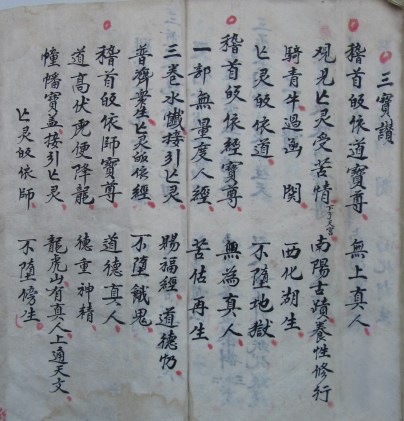
As I wrestled with translating the Hymn to the Three Treasures (Sanbao zan), used for Opening Scriptures in the morning (Daoist priests of the Li family, pp.262–3, and film from 22.01), Li Manshan explained it to me.
sanbao-zan-2-in-1-cropped

Hymn to the Three Treasures, from Li Qing’s hymn volume, 1980.

sanbao-zan-best

The subject of the first verse to the dao, “We bow in homage to the worthy of the dao treasure, Perfected One without Superior” (Jishou guiyi daobaozun, Wushang zhenren) is Laozi himself, so it is he who is the subject of the remainder of the verse: “He descended from the heavenly palace” (xialiao tiangong) refers to Laozi descending from the heavenly palace after beholding the sufferings of the deceased spirit (guanjian wangling shou kuqing)—it’s all about Laozi! So you see, Li Manshan does get the texts…

As for any ritual tradition, where does the “meaning” reside, when texts are unintelligible to their audience? When we translate and explain ritual texts, we are radically altering them as experienced by their audience. True, the performers, the priests, certainly “understand” them, to various degrees, if not in the same way as scholars translating them. I don’t suggest limiting ourselves to the consideration of how people experience rituals, but that should surely be a major part of our studies. Experience lies beyond textual exegesis, consisting largely in sound and vision.

I am reminded of Byron Rogers on an American version of the New Testament (Me: the authorized biography, p.268):

Pilate: “You the King of the Jews?”
“You said it.” said Christ.

There’s another one for the Matthew Passion (cf. Textual scholarship, OMG). “What is truth?”, indeed…

Mercifully, there is no movement to translate the ancient texts of Daoist ritual into colloquial modern Chinese. Of course, for northern Daoist ritual a modern translation wouldn’t make the texts any more intelligible anyway, given the slow tempo and melisma.

Laozi does appear in one of our favourite couplets for the scripture hall (see Recopying ritual manuals, under “The couplet volume”; cf. my book pp.194–5—not easily translated!):

穩如太山盤腿座     Seated in lotus posture firm as Mount Tai,
貫定乾坤李老君     Old Lord Li thoroughly resolves male and female aspects.

For a basic roundup of posts on the Li family Daoists, see here.

Travel

In Isobel Fonseca’s brilliant Bury me standing she recalls showing her passport to a young guard at the Polish border:

Uniquely intriguing to him was the stamp for Albania, or “E Republikes Popullore Socialiste te Shquiperise”, with the “Popullore” and “Socialiste” touchingly crossed through by hand.

Funny as this is, she goes on to reflect soberly:

People believe that Gypsies are dangerous because they have nothing to lose. And here I sat, impatient, even indignant, as the pale border guard felt up my passport. Swollen with extra pages, that little accordion and its inky scores of distant anthems was the proof that I was the only one who had nothing to lose. I could just leave.

For Albanian folk music, see here.

Tone of voice, and audiences

bailey

Around 1975, while “studying” at Cambridge, I somehow managed to get an invitation to tea with Sir Harold Bailey (see also here), eminent scholar of ancient Central Asian philology. I guess it was Laurence Picken, or Denis Twitchett, who made the introduction.

Sitting me down at his side, Sir Harold at once embarked on a lengthy discourse about medieval Khotanese texts, peering at a jumble of manuscripts on the desk before us. His only companion was his cat, whom he also addressed periodically, without modifying either his gaze or his measured academic tone.

“Here I found a clear clue to a syntactical link with the Sogdian manuscripts that had been excavated some time before… And I suppose you want another saucerful of milk.”

Before I could assure him that I was fine with my cup of tea, he went on,

“It may take some time to map the linguistic links between the various medieval oasis towns… It’s no use rubbing up against my legs like that, you’re not going out into the garden again, we can’t have you bringing in any more birds…”

It took me some time to get the hang of this.

From his obituary:

A task now facing Bailey’s colleagues is the elucidation of his rhyming diaries. When told at our last meeting that the course of a lifetime had transformed these into an epic of over 3,000 verses in a private language concocted from classical Sarmatian inscriptions, I asked Bailey why he was so fond of obscurity. “Well, the diaries are not really so obscure,” he said. “Indeed I’d say there’s hardly a line that could not have been understood by any Persian of the fourth century.”

For another story about context sensitivity, see here. And do read Compton Mackenzie meets Henry James!

In memory of Paul Kratochvil

Paul 1976

Wedding party, Cambridge 1976.

At Cambridge during the Cultural Revolution, immersed as I was in the Tang dynasty, my only clues to the funkiness of contemporary Chinese culture came from my teacher the fine linguist Paul Kratochvil (a surname that suitably means “fun”). Born in 1933, he had somehow became an expert on the phonetics of modern Chinese, fleeing Czechoslovakia in 1968 to take up a post at Cambridge with the help of the Oxford sinologist Piet van der Loon. He features in this impressive introduction to Prague sinologists (for whom, see here).

Recommending to me a book called Current Trends in Linguistics, Paul looked bemused when I asked him what I should look it up in the library under—like an editor’s name or something:

“Well, Steve, try ‘C’—if that doesn’t work, I guess you could try ‘K’…”

While he was still in Prague, a friend in China addressed the envelope of a letter to him with great economy:

Paul

(“Czechoslovakia, Comrade Paul”). Sure enough, he received it.

spectacles

Over copious beer in the pub where he used to take me for what were euphemistically described as “supervisions”, Paul recalled this story:

While still in Czechoslovakia he had served as interpreter for the Czech army, and at one high-level conference in Prague receiving a Chinese military delegation, he found himself interpreting for a Czech general at one end of the table and a Chinese general at the other.

The talks had gone well, and the Czech general was winding up with the customary sonorous platitudes.

“I hope both sides will be able to exchange experiences!” he declared majestically.

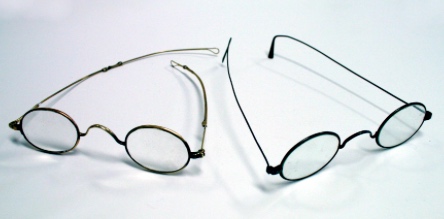
My friend Paul was already a fine linguist, and he knew there were some binomes in Chinese which you could say in the order either A-B or B-A, but alas he thought jingyan, “experience”, was one of these. So he blithely translated, “Wo xiwang shuangfang nenggou jiaohuan yanjing”, which unfortunately comes out only as

“I hope both sides will be able to exchange spectacles.”

This puts the Chinese general in a spot; the TV cameras are trained on him, and he mustn’t make a faux pas. Can this be some weird Czech custom denoting fraternal solidarity? As luck would have it, both generals are wearing spectacles. The Chinese general hesitantly takes off his glasses and holds them out over the table towards his Czech counterpart.

This, of course, presents no less of a challenge for the Czech general; having said nothing at all about spectacles, he is mystified to see this Chinese geezer holding out his spectacles across the table, and he too has to think quickly. Can this be some ancient Confucian ritual denoting fraternal solidarity? He too hesitantly takes off his glasses and offers them across the table.

My chastened mentor later switched on the Prague TV news to see a report, the newsreader announcing solemnly, “And at the end of the conference the two sides exchanged spectacles in the ancient Chinese gesture of comradeship”—as the two generals groped their way to the door.

For a suitable fanfare for the event, see here. Among several more fine stories from Paul, I like this, and indeed this. See also Czech stories: a roundup.

Confession

I truly believe that one day there will be a telephone in every town in America—Alexander Graham Bell

phone

The date of the first landline phone in Li Manshan’s village is another of our standing jokes.

This is really embarrassing to admit, but when I asked him about it in 2011, I heard his reply as ‘sisannian’, so I unquestioningly wrote ‘1943’ in my notebook, I mean how mindless was that of me… Only later, writing up my notes back home, did I smell a rat, and it finally dawned on me that he must have said shisannian (qian), ‘thirteen years ago’! (The difficulty of distinguishing shi and si was only part of my howler; and actually, he would never say sisannian for 1943—even if he knew such a date he could only say “32nd year of the Republican era”, cf.my book pp.37-8). So the first landline was only installed in 1998, just a few years before mobile phones swept the board.

Now, whenever we misunderstand each other, we just say “sisannian” and fall about laughing. For more on our relationship, see here; and for a classic joke, here. For early linguistic escapades in Hebei, see here.

A meeting with Teacher Wang

lms-and-me-in-hk

With Li Manshan in Hong Kong, 2011

Chinese peasants tend to “eat” cigarettes (chiyan) rather than the standard “take a drag on” them (chouyan)—yet another instance of the practical blunt charm of their language.

Timothy Mo alludes to this locution in Sour Sweet:

“Eat things, eat things,” he said aloud, gesturing to the smoking plates in front of everyone but only lighting a cigarette for himself.
“You don’t eat things yourself, Grandpa?” This was Mui.
“I eat smoke,” he quipped, laughing immoderately at his own wit.

Indeed, the expression survives from 17th-century usage, as shown by Timothy Brook in Vermeer’s hat.

At a conference in Hong Kong (my book pp.333–4) I was delighted to introduce Li Manshan to the illustrious Taiwanese scholar C.K. Wang. Apart from his indefatigable energy in opening up the vast field of ritual studies in mainland China, he has a remarkable gift for finding a place for a surreptitious smoke (cf. the first poem in Homage to Tang poetry). In Hong Kong, where smoking laws are draconian, he would regularly lead us through labyrinthine corridors to some corner of an underground car park for a furtive fag.

This soon became part of my secret language with Li Manshan. Back in Yanggao, he was careful not to smoke in the presence of his baby grandson—so sometimes when I felt he needed a fag-break, I would suggest to him, “Shall we go and hold a meeting with Teacher Wang?”

For Li Manshan and Andy Capp, click here.

Yoof

To complement OMG, here’s Bill Bailey on the plague of “LOL”:

(He actually did this with an audience at a live standup gig, but it’s disappeared from YouTube).

An economical expression such as

I’m like, hello?”

is brilliant. Our elders (or let’s face it, some of us) would have to fall back on a ponderous formulation like

“I must confess I found myself at a loss to respond to the sheer fatuity of my companion’s comment, and could only register a mock expression of disdain”.

I recommend reading this in the voice of Jacob Tree-Frog (aka The Haunted Pencil, Minister for the 18th century)—actually “I’m like, hello?” sounds just as funny with his patrician tones, like the Queen reading MIles Davis’s autobiography.

Cf. this cartoon found on https://twitter.com/PhilosophyMttrs:

DCq7F76WsAAItpX.jpg-large

Textual scholarship, OMG

One often finds oneself consulting quoteinvestigator.com. Doesn’t one.

Like “Meretricious and a Happy New Year”, or “She ran the gamut of emotions from A to B”. This is the kind of meticulous historical work that one expects from the scholarship of Daoist ritual texts.

“OMG” isn’t there, but appears to date from at least 1917 (OMG!)—recalling the brilliant Armstrong and Miller sketches (playlist):

And that’s kinda like a commentary on what we do when we listen to Bach (qv): we can’t help hearing the cadences of our own experience of life in the scenarios of the past. And shit like that. Innit though.

In the Bach Passions, textspeak could generally work for the choral crowd scenes, but actually “Erbarme Dich, OMG” fits worryingly well too:

erbarme-dich

Or

He has risen from the dead, YAY!”

YAY being a more economical version of Hallelujah…

Maybe I’m onto something. Let’s hope not.

Fun with anachronisms

And the roar of Moses’ Triumph is heard in the hills

Without even knowing how I feel about the White Cloud Temple in Beijing, my adorable cat Kali (R.I.P.) threw up over my copy of the Jade Pivot Scripture, which I had bought in an edition printed at the temple.

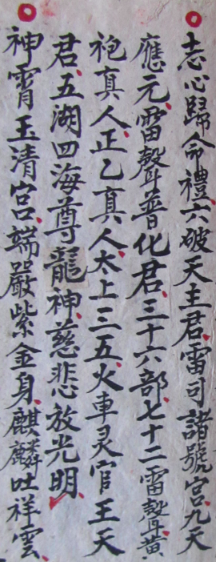
One ritual title that features only fleetingly in the ritual manuals of the Li family Daoists in north Shanxi is Thunder Lord of Three-Five Chariot of Fire (Sanwu huoche leigong). This is among the attributes of the deity Wang Lingguan, and a trace of the thunder rituals of Divine Empyrean Daoism. [1] In the Li family manuals it appears only in the Mantra to Lingguan and in the Xijing zayi manual, no longer performed and thus no longer familiar to them: [2]

huoche

From Xijing zayi manual (Sanwu huoche Lingguan on line 3), copied by Li Qing

So my excuse to discuss it here is flimsy as ever, but we all need a bit of light relief every so often. This also relates tenuously to my comments on hearing Bach with modern ears.

Huoche “chariot of fire” (glossed as “fireball”) may prompt titters at the back, since in common modern parlance it means “train”. Whereas “And the roar of Moses’ Triumph is heard in the hills” is a translation that has been inadvertently amusing only since the spread of the automobile [mental note: must get that exhaust fixed], [3] huoche is an ancient original which could have been affording chuckles to Daoist scholars since the term became common usage for “train” in the late 19th century. When you’re immersing yourself in the abstruse mysteries of the Daoist Canon, you have to take such diversion where you can find it.

What’s more, we may giggle impertinently at another of Lingguan’s attributes, Sanwu (Three-Five)—erstwhile a brand of cigarette that Chinese people associate with Englishness (much to my perplexity, since I’ve never heard of them outside China) just as much as London fog. (For “the smoking substances of non-nationals”, see More from Myles).

So here we appear to find Lingguan smoking a posh foreign cigarette on a train journey through his spiritual domain—being a high-ranking Daoist cadre, he would get to travel soft-sleeper (cf. Fieldwork and textual exegesis).


[1] The appellation may commonly be found in the Daoist Canon, but, more relevant to “texts in general circulation” (my book pp.218–24) and the practices of the Li family may be its appearances in Xuanmen risong: Xuanmen risong zaowan gongke jingzhu 玄門日誦早晚功課經注, chief editor Min Zhiting (Beijing: Zongjiao wenhua chubanshe, 2000), pp. 166–7, 244–5. See also Rethinking Zhengyi and Quanzhen.

[2] My Daoist priests of the Li family, p.376, cf. p.381; for the Divine Empyrean, see also pp.219–20.

[3] A substantial irreverent online industry in such Biblical quotes has arisen.

Limerick

That first English haiku is matched by this:

There was a young man from Japan
Whose limericks never would scan
When asked why this was
He replied “It’s because
I always try and fit as many words into the last line as I possibly can”

which complements

There was an old man from Peru
Whose limericks stopped at line two

For more limericks, see here and here. Oh, and here. And now, some Portuguese- and Polish-themed limericks!

Lost in translation

Two gems I found on a room service menu in Beijing, 2015: 

Fuck to fry the cow

Discredited mandarin fish of Mount Huang

Translations on menus provide rich entertainment, of course. For East Asia, Victor Mair gets to grips with some on languagelog (some links here), and that site has many more Silly signs.  See also my Temple Chinglish.

For a menu pun, I’m most taken by this—as if inviting a Chinese franchise of Flann O’Brien:

Times

which indeed leads nicely into Lyrics for theme tunes

Homage to Tang poetry

Hermit

Lest anyone suppose I frittered away my time while studying classical Chinese at Cambridge, here are three poems I composed then in the style of the great Tang masters (though even Bai Juyi’s ouevre was variable). I think they display precocious signs of the pointless inanity that was to distinguish my later writings. OK, the finer rules of prosody have always eluded me, but I borrowed most of the phrases from original Tang poems, giving them what I believe is known as a contemporary twist.

A smoke behind the cricket pavilion
This was prompted by the pun on chan: “Zen” , and “cricket” in the sense of cicada; from there I punned with another kind of cricket. “Smoke”, of course, is what you see wafting from a rural hamlet at sundown.

獨坐蝉亭后                      Sitting alone behind the cricket pavilion
輕聞白衣玩                      Hearing vaguely the cricketers playing *
忽然含烟氣                      Suddenly I retain the smoke vapour
畏有蝉師来                      What if the cricket master should come?

* Inspired by Alan Marett’s sound comments below, I now add this wacky footnote, in the style of Mots d’heure: gousses, rames and the faqu series (see under A Tang mélange):

“Cricketers” for baiyi, “white clothes”: at least in later dynasties, this might be understood as referring to White-clothed Bodhisattva Guanyin.

A version of this poem recently discovered amongst a collection of apocrypha [sic] in cave 17 at Dunhuang gives this variant of the second line:

柳條擊革聲 The thwack of leather on willow

Liutiao “willow branch” seems to allude to the rain ceremony (highly efficacious—“rain stopped play”)—indeed, White-clothed Guanyin is often depicted as holding a willow branch (or “bat”);
ge “hide/skin” is one rubric under the ancient eightfold classification of musical instruments—the membranophone used in this rain ceremony being spherical in shape. For football in the Song dynasty, see here.

I may add that this was long before I experienced the ritual of smoking with Daoists.

On receiving a visit in late spring from Mr Yan and his friends
This is the title of a poem by Wang Wei, which conjured up sinister images of the mafia in a B-movie (“We wouldn’t want this vase to get broken, would we? Oh dear me, how clumsy…”).

贵居来人少                    Your esteemed abode has few visitors
黄髮君已老                     You are old now, with your grey hair
一時破此瓶                      Just suppose this vase got broken
惆怅悲無際                      Such sadness, limitless grief!

At the pictures
Inspired by the original phrase “old overcoat”, and the common occurrence of the term “washerwoman”, this poem charmingly describes an indecent exposure at the cinema.

春寒著弊袍                 The spring is cold—I put on an old overcoat
上堂来人少                 The cinema has few visitors
静坐依浣女                 Quietly sitting, I nudge a washerwoman
一閃啼連天                 One flash, and the howls reach to the heavens!

Note also On visiting a hermit, and many posts under the Tang tag.

Mind your language

I can’t resist citing a charming story from a Chinese anthropologist documenting a village in Shaanxi province: [1]

One sunny afternoon in February 1992, I went to the main village by myself. Since it was not long after the Chinese New Year’s day, everyone in the village was still in new dresses. When I was walking around, trying to talk to people, I met an old woman who carried her little grandson whose age was no more than three or four. The little boy was dressed up in a new green suit designed like the People’s Liberation Army uniform, and he was wearing a brand new green hat with a red star in the middle. He looked so pretty that I bent over to say “hello” to him. To my surprise, the little prince quietly said to me, “Fuck your mother”. I was so embarrassed that I did not know if I had done anything improper. The old woman slapped her grandson and told him, “No, you little fucking bastard! Don’t say that to Teacher Liu. He is a fucking nice person.”


[1] Liu Xin, Zhao villagers: everyday practices in a post-reform Chinese village, PhD (Dept of Anthropology and Sociology, SOAS, 1995), p.183—cruelly censored from the published version In one’s own shadow (2000)!

It’s the only language they understand

In the early 1990s, arriving with my long-suffering friend and colleague Xue Yibing in a typically bare and grimy office of the Bureau of Culture in a county south of Beijing, we settle down to courtesies with the Bureau Chief, to clear our way to go down to the villages. I launch into my routine again—delighted to be in this fine county, heard so much about your wonderful music, blah-blah, most grateful for your support, international cultural exchange blah-blah.

The Bureau Chief is looking even more nonplussed by all these pathetic clichés than one would expect, and eventually, as I flounder around searching for yet more sonorous bullshit with which to impress him, Xue Yibing interjects,

“Do you understand what he’s saying, Bureau Chief?”

He replies earnestly,

“Well, if Mr Jones could speak Chinese, I might understand a bit!”

OK, my accent may not be perfect, but really! Xue diplomatically explains,

“Mr Jones doesn’t speak Chinese so well…”, which prompts me to joke with him,

“My Chinese is a lot better than your bloody English, mate—wodya mean, motherfucker?”

Needless to say, these choice expressions come out in perfect Chinese readily understood by all. The assembled cronies are bemused.

This story soon became part of our Fieldworkers’ joke manual (cf. Writing English: the etic view), and has even been immortalised, if somewhat modified, in a little article I published in a Chinese conference volume. [1]

* * *

Gao Liwang 1993

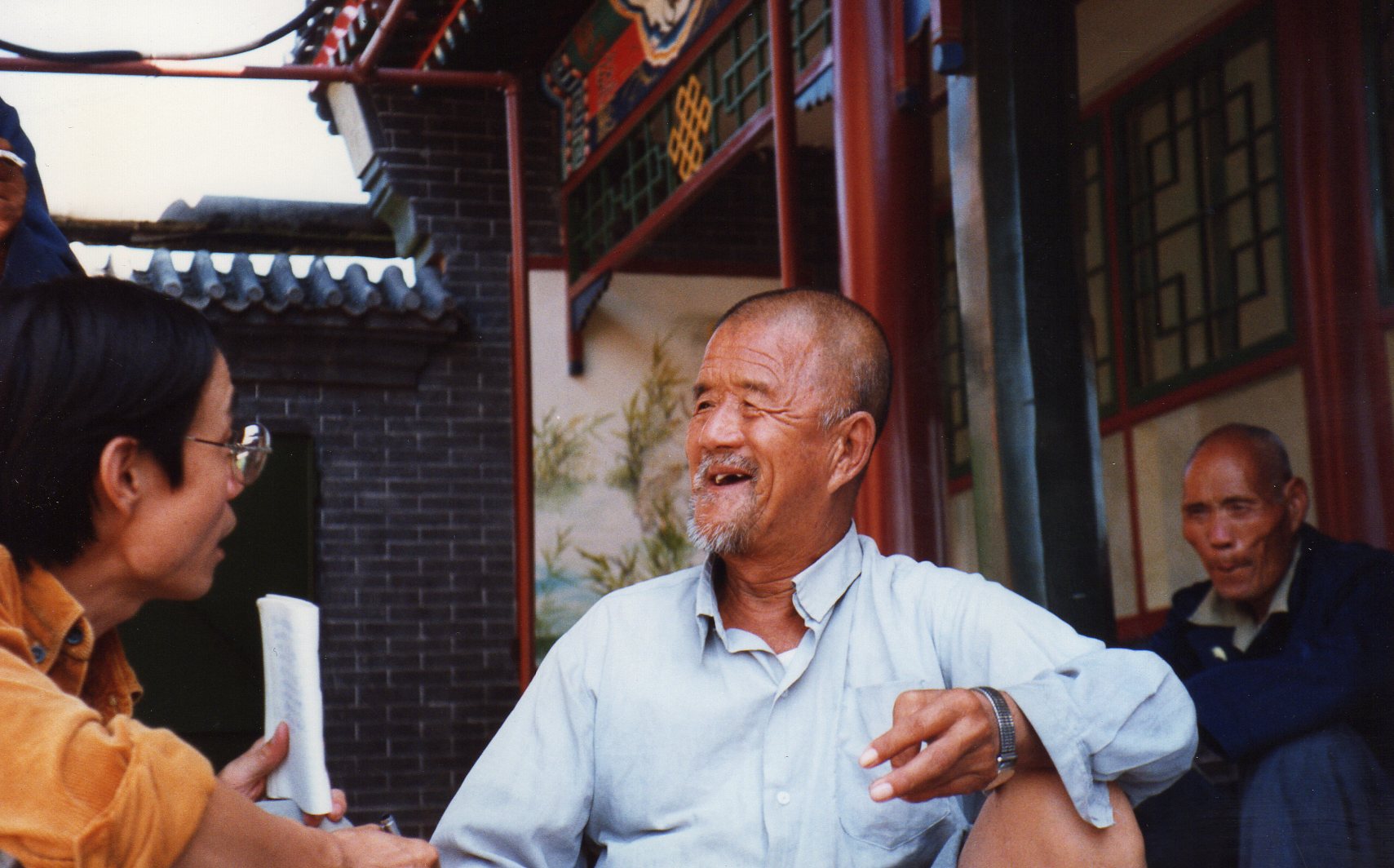
My confidence was restored soon after, when we visited an old-people’s home where we were told a fine former Daoist priest was living. We find him, and are soon chatting in the sunny courtyard with a crowd of lovely old geezers assembled. They haven’t had such fun since the Red Star Chairman Mao Thought Propaganda Troupe arrived to perform classic hits like We are little screws in the revolutionary machine and Thrust into the Enemy Rear. As I explain to the old Daoist,

“Old Wang in your home village told us we might find you here, he said you used to do some great rituals…”,

one old guy bursts out,

“Hey, this is amazing—their language is the same as ours!”

His ears were more finely tuned than those of the Bureau chief.

Cf. China: writing in the air; for challenges to communication in “English”, click here.


[1] “Cong ‘Jiaru Zhong xiansheng neng shuo Hanyu dehua’ shuoqi”  从《假如钟先生能说汉语的话》说起, in Qiao Jianzhong 乔建中 and Xue Yibing 薛艺兵 eds., Minjian guchuiyue yanjiu 民间鼓吹乐研究 (Shandong youyi cbs, 1999), pp.407–13.