Harpo

À propos the Marx brothers, apart from the verbal dexterity, their charm was also beyond words:

Harpo is naturally most endearing to musos—notably Steven Isserlis, whose brilliant tribute is here (the link to the radio programme may be defunct, but watch this space). Note his fine historical reflections too.

Harpo’s mute persona might have been inspired by Rossini’s trio Mi manca la voce

For Steven’s Bach, see here.

Faqu tu 2, or tutu

At Cambridge, Paul Kratochvil was not alone in enjoying a bit of drôlerie.

Here’s another jeu d’esprit on the faqu 法曲, from a precious old letter that I just found from my teacher Denis Twitchett, sent (by post!) from Princeton in 1986. A tad more wacky than his magnum opus Financial administration under the T’ang dynasty, it deserves to take its place among his magisterial writings on Tang history:

Dear Steve,
Some further ruminations on that mysterious term faqu. I am reminded of the hypothesis (first adumbrated in my alas-as-yet-unfinished “Preliminary proleptical remarks proving beyond Reasonable Doubt that Li Bai [aka Patrick O’Leary] was the earliest Irish poet”) that faqu is a rough-and-ready transliteration of the greeting shouted at tax-collectors in the medieval Irish countryside, and also commonly exchanged by rival drivers of donkey carts involved traffic accidents. The etymology of its common form in Chinese is obscure; under the Liao dynasty a folk etymology suggested that it meant “May the Law twist [your private parts]!” It should not be confused with the alternative writing (found in non-Buddhist contexts) fa-k’iu 發具 (explained by Karlgren as “Get out your [ritual] implement!”). This is quite distinct from the forms fakefu 法可夫 or 伏軻䮛 (the latter writing mistranslated by Legge as “Kneel by the hubcap of the Prince Consort”), meaning, according to Admiral Ting (first Chinese to be trained in the Royal Navy), “Be on your way, Jack!”

“French pieces” were surely more normally written in Tang Chinese as faji 法伎 or more colloquially as fashi 法式 “French models”. The title of the well-known Song-dynasty work Yingzao fashi 營造法式 is now attached to a rather boring work on architecture which explains how to construct yourself a baroque dog-kennel without mod cons. This work, however, is clearly a forgery by a Ming author, horrified to the depths of his neo-Confucian sensibilities by the original contents of the book, originally a Song DIY handbook “Make yourself a French model”.

The French presence long predates the Tang, and surely explains Zhuangzi’s Frog in the Well (a fine metaphor for the petty self-interest of the French). This also explains the title of the Tang Li Wa zhuan 李蛙傳, “The story of Froggy Li [the French model]”, and how the word wa “frog” came to have its other meaning “lascivious” or wanton”.

Empirical language acquisition

Pilsen

Frances Wood, a distinguished former student of the late great Paul Kratochvil, reminds me of another of his stories.

Paul liked to tell us this as we grappled with the use of classifiers (measure words) for Chinese nouns. The nearest equivalent in English is for collective nouns, like a gaggle of geese or a school of fish. In Chinese a basic all-purpose one is ge (“a person” is not yiren but yige ren), but one needs to use all kinds of classifiers before different types of nouns, like ben for a book (not yishu but yiben shu), or (if you wanna get pleasantly obscure—as I do) zuan for a sheng mouth-organ (yizuan sheng).

Anyway, Paul was just a kid when American GIs liberated his home village in Czechoslovakia in May 1945. They were kind of heroes, and he began hanging out at their barracks, gradually picking up English—entirely through daily aural experience.

After some time a grammatical rule subliminally formulated in his young mind: English nouns must invariably be preceded by the classifier fuckin’. No-one ever said “Gimme a beer!”, it was always “Gimme a fuckin’ beer!”; never “Open the window!”, always ““Open the fuckin’ window!”

Paul’s spoken English came along rapidly, and his father, realising he had a real gift for language learning, somehow managed to arrange for him to go up to Prague to take an English oral proficiency test.

Paul knocks on the door. Commanding English military type shouts out, “Come in!”, and finding a scruffy kid in short trousers standing before him, barks,

“Yes boy, what do you want?”

Paul, hesitantly:

“Hey bud, I come to take ze fuckin’ exam in fuckin’ English.”

At Cambridge such stories made a change from my encounters with scholars of a more classical bent, like Laurence Picken and Sir Harold Bailey. See also Language learning: a roundup.

Noddy: the art of conducting

A tribute to the great Gennadi Rozhdestvensky (1931–2018)

We musos may be critical of conductors (cf. Norman Lebrecht, The maestro myth: great conductors in pursuit of power), but don’t get me wrong, we deeply admire great ones—such as Boulez, Tennstedt, Gardiner, Rattle (unlikely bedfellows…). See under The art of conducting.

Apart from Boulez, another highlight of depping regularly with the BBC Symphony Orchestra was working for Rozhdestvensky (known in the trade as Noddy).

Gennadi Rozhdestvensky—conductor or conjuror? (Bruno Monsaingeon, 2003) is a wonderful film:

In a work that otherwise requires little imaginative filming, do watch the brilliant scene from 32.40—the traffic cop Marcel Mehala should take a bow too.

Believing in a kind of spontaneous combustion, and trusting his players to match his own mastery, taking risks together, Noddy was renowned for his aversion to rehearsal—greater still than that of orchestras. Once, turning up for the first of a couple of whole days’ scheduled rehearsals for a fiendishly difficult and unfamiliar modern piece, he conducted the first few bars and then told the band nonchalantly, “Good, see you at the concert”. In a rare reversal of the musos’ philosophy of “It’ll be all right on the night”, the leader took him to one side and asked him if he wouldn’t mind just taking them through the whole piece once.

Even on stage, his style doesn’t look like much—inscrutable, even casual, his gestures by turn minimal and flamboyant (in the film, from 22.24, he explains his economical solution to conducting the opening of the Symphonie fantastique (cf. Yet more conducting). But his concerts were electrifying. Doing Petrushka, it was as if we were all composing it, living it, together with him. And the Scriabin piano concerto with his wife Viktoria Postnikova was exquisite too—here’s an audio recording:

We can also relish them together in Rachmaninoff’s 4th concerto:

In Historical ears and eyes I feature Noddy conducting Rachmaninoff’s gorgeous 2nd symphony. And do listen to his Tchaik 6. The documentary ends with an illuminating sequence where he rehearses and reflects on Tchaikovsky’s Romeo and Juliet. If only we could see more of the archive footage below—the curious camerawork shows him only briefly, though with characteristic gestures:

Monsaingeon’s Notes interdites (aka Red baton) also features another film in which Noddy reflects on the political vagaries of the Soviet system.

Noddy

For obituaries, click here and here. See also The art of conducting; and Lives in Stalin’s Russia.

A great Daoist priest

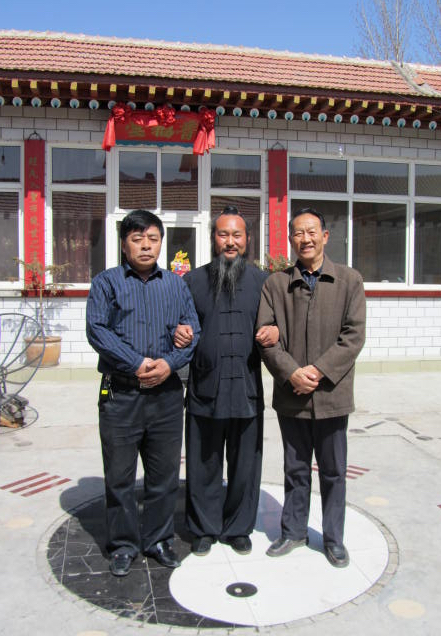
Today is the first anniversary of the death of Zhang Minggui 张明贵 (1931–2016). He was one of the most exceptionally enlightened Daoists I have had the honour of meeting, a fine authority not only on Daoism but on all aspects of local culture, and indeed life. [1]

zmg

With Zhang Minggui, Baiyunshan 2001. Photo: Zhang Zhentao.

He served his local community as long-term abbot of the White Cloud temple (Baiyunguan, known as White Cloud Mountain Baiyunshan) temple complex of Jiaxian county in Shaanbei, bordering the Yellow River that divides Shaanxi from Shanxi.

One of many determined local temple managers, [2] with his archetypal long white beard Zhang Minggui couldn’t help becoming a poster-boy for official Daoism, and was honored with high positions in the state Daoist hierarchy. We spent a few days as his guests during the 4th-moon temple fair in 2001. In informal chats between receiving a constant stream of pilgrims and visitors, freed of the necessity to churn out the usual empty clichés, he was far from the bland diplomacy of the modern Daoist priestly leadership or the simplistic patriotic eulogies to be found on Chinese websites. [3]

Zhang Minggui was tireless in his work on behalf of his local community under both Maoism and the reforms. His life reminds me of the continuum between temple and folk life. Baiyunshan has been a rather popular topic in Daoist research. In recent years his prestige hasn’t protected the temple from the Busby-Berkeley-esque stage commodification of its Daoist practice demanded by “cultural” officials—but we should look beyond that, and beyond the temple, to study the wider picture of folk ritual activity in Jiaxian county.

The temple complex is now an isolated outpost of institutional Daoism in the region, with its Longmen Quanzhen tradition whose priests have long performed both jiao and mortuary rituals among the local people. Founded in the 17th century from the Baiyunguan in Beijing—though links with Huashan and Shanxi may have been just as significant in its early history—it is a zisunmiao “hereditary” temple. [4]

The temple Daoists were first given permission to marry in the Republican period (one Daoist there told us it was in 1924), apparently creating competition (presumably including ritual competition) between the married priests and those unable to find wives. [5]

From their biographies, [6] we find that the priests listed for the 20th century were all local, indeed from the county itself—unlike the priests of many large metropolitan Quanzhen temples, who come from many areas, notably south China. Their numbers since the 1940s have stayed at around a dozen. Coming from poor families—inevitably, since Jiaxian is the poorest county in a chronically poor region—most of them entered the clergy “from infancy”, or in specific cases between the ages of 7 and 14 sui.

Zhang Minggui was exceptional, coming from a scholarly family; since he was ill, his parents pledged him to the temple when he was 5 sui old, but they bought him back after a couple of years, only giving him back to the temple when his illness recurred at the age of 11. Notwithstanding the destruction of the temple’s precious Daoist Canon by the occupying PLA in 1946, Mao’s 1947 famous visit to Baiyunshan to hear the opera there [7] was the beginning of the local CCP’s efforts to recruit Zhang Minggui as a schoolteacher. He reached a deal whereby he could also take care of temple affairs. He was already a fine vocal liturgist by the age of 18, and went on to steer the temple through the choppy waters of Maoism.

Throughout this period there was also Byzantine intrigue among the priestly adherents of the Hunyuan and Yaochi dao sects for control of the temple. This continued through the 1950s, just as they were being targeted in campaigns, with sectarian Daoists plotting against the more orthodox clerics; some activity is still said to continue today. [8]

The temple complex (and the sects) managed to keep active through the 1950s until 1963, with vast crowds attending the temple fairs. More open worship resuming gingerly around 1979. Through this period Zhang Minggui worked tirelessly to restore the temple. Since then there has been a political tug-of-war for control of the temple and its substantial funds between the Daoists and the mafias of the secular county departments—the temple income is a major factor in the economy of this poor county.

The main temple fair on the mountain is held over the week leading up to 4th moon 8th, with smaller fairs on 3rd moon 3rd and 9th moon 9th. Throughout the county there is an active tradition of performing major jiao Offering rituals. The jiao is held four times in the spring: in three specific villages in the 1st and 2nd moons, apparently not a recent tradition; in the temple itself during the 4th-moon temple fair; and eight times earlier in the winter, sponsored by a group of many villages in a parish (she) clubbing together, rotating the host village over many years. [9] The latter system consists of a group of 48 villages to the south of the temple, and 12 villages to the north; to the west, the smaller jiao is a niuwang jiao for the Ox King. Apart from the temple Daoists, there are other less costly lay Daoist groups performing similar rituals in the nearby countryside. [10]

A major aspect of devotional activity at the Baiyunshan temple fairs is a group of eight (five in the 1950s, now in practice more than eight) regional associations (hui), which serve mainly to organize the large groups of pilgrims, though they appear to include few groups of ritual specialists. [11]

candlelit altar

Pilgrims of a regional association listen to a bard, Baiyunshan 2001.

Apart from the temple fairs, the Daoists’ income comes mainly from performing funerals outside the temple.

Sincere and broadly curious, Zhang Minggui’s tastes extended to writing articles on Beijing opera and stars of world ping-pong. [12] Far from a mere figurehead, he was an active ritual performer, deeply concerned with the welfare of his community. He will be much missed.


[1] These notes are based on my In search of the folk Daoists, pp.96–101; further detail in Zhang Zhentao, Shengman shanmen, pp.178–209. See also Yuan Jingfang, Li Shibin, and Shen Feixue, Shaanxi sheng Jiaxian Baiyunguan daojiao yinyue (1999); for Abbot Zhang, see pp.40–41. On the temple’s history, note the writings of Fan Guangchun. We await further work from Liu Hong of the Shanghai Centre for Ritual Music.
[2] For an ethnography of a temple in southern Shaanxi, cf. Adeline Herrou, A world of their own, and await further work from her.
[3] Cf. my “Reading between the lines: reflections on the massive Anthology of folk music of the Chinese peoples”.
[4] Despite the claims of Yuan, Li, and Shen (1999: 26), their shengguan music cannot have been acquired from the Baiyunguan in Beijing, which never had any; it is possible that it came from contact with Buddhist monks, as local scholar Shen Feixue suggested to us.
[5] See also my Ritual and music of north China, vol.2: 97 n.11.
[6] Yuan, Li, and Shen 1999: 30–42.
[7] Among many bland reports, see e.g. http://crt.blog.ifeng.com/article/35721644.html, http://blog.sina.com.cn/s/blog_551d0f8c010005r3.html,
http://www.360doc.com/content/16/0603/15/3196639_564749991.shtml.
[8] Yuan, Li, and Shen 1999: 28; Zhang, Shengman shanmen, pp.182–4. Zhao Jiazhu, Zhongguo huidaomen shiliao jicheng (2004) contains many refs. to both sects; those to the Yaochi dao are mainly for counties in Shaanxi and Gansu (see also his general introduction, p.14)—indeed, I haven’t found it in areas of Hebei and Shanxi that I have visited.
[9] For the parish, see the indexes of my various books.
[10] For more on the jiao in Jiaxian, see my Ritual and music of north China, vol.2: 98–101; Zhang, Shengman shanmen, pp.187–9. Several Chinese websites for Shaanbei show photos and videos of jiao rituals around Jiaxian.
[11] For these groups, see refs. in Ritual and music of north China, vol.2: 85 n.20; Zhang, Shengman shanmen, pp.172–5.
[12] Zhang, Shengman shanmen, p.180.

Yet more French letters

Female musicians, Tang Dynasty. Note konghou harpist, rear right.

Further evidence that my taste for drôlerie chinoise is far from recent: a spoof I wrote while helping Laurence Picken with his extraordinary research on Tang music—which I elaborated with another Cambridge mentor, the great Tang historian Denis Twitchett. The genre of faqu 法曲 (“dharma pieces”) has indeed been the (serious) object of scholarly attention. Reading this now, I find the fluency of my affectionate pastiche of academic style somewhat disturbing…

Informal communication with Dr T.H. Barrett [1] has suggested the possibility that faqu may actually mean “French pieces”. Study of a recently discovered and as-yet-untranscribed score from Dunhuang for “hand-wind instrument” (perhaps a kind of manually operated keyed chordophone) entitled Dunhuang shoufeng qinpu 敦煌手風琴譜 reveals a colophon dated 1st April 895 (lunar calendar) which contains references to a certain “Master Ma” (Mashi 馬師), or as we might say, “Chevalier”. The authenticity of this score is no longer in doubt. It includes many faqu, besides one title, Zhena legelede li’a 柘拿樂葛樂德篥阿, [2] evidently a transliteration from a language of the Western Regions (xiyu 西域), but otherwise unattested in Tang sources.

The contacts between the Tang court and the Western world are by now well documented. We find frequent references in Tang anecdotal sources to “strings of onions” (congchuan 蔥串), [3] often in connection with men with a certain type of moustache that became highly fashionable under the emperor Xuanzong, riding carts described as “self-propelling” (zixingche 自行車), [4] and clad in close-fitting garments with black and white stripes (a variant of the yinyang symbol?), as well as floppy caps known as beilei 鞞儡.

The French letter: a rejoinder
Further evidence of the Gallic influence on early Chinese musical culture is to be found in the ancient institution of the fashu 法書 (more recently faxin 法信) or “French letter”, a kind of prophylactic talisman deployed in ancient Chinese households in the hope of avoiding unfavorable consequences.

Traditionalists [5] might evoke the sacred power of music and the jiefa 節法 or “rhythm method”, [6] but more pragmatic counsel, favouring foreign and commercial expansion, and under the influence of Buddhist philosophy, gave rise to the “French letter”.

This popular device was available as early as the Tang dynasty in the form still to be found in temples today, the fawu liutong chu 法物流通處 or “Durex machine”. Although nowadays more innocuous material has replaced the original merchandise, the original meaning of “French thingies” (fawu) is clear. The phrase liutong is somewhat arcane: liu implies dissemination, and tong some kind of intercourse, so one might expect tongliu as an early form of resultative verb—thus, perhaps, “French thingies for penetration and ejaculation”.

Faqu tu
Yet another Gallic connection appears in the instrument fajue 法角 “French horn”, often supposed to refer to a kind of conch sounded in ritual. [7] Recent scholarship suggests that jue was often used metaphorically in the Tang, having once been associated with the debauchery of the notorious Zheng and Wei 鄭魏 kingdoms—the latter also known as “Wei-Hei”. Thus it had the connotation of “horny” or “lascivious” music, as in the term jueshi 爵士, once “gentleman of rank” but by the Tang, “jazz” or “jazzer”. The term dejue 得角 “obtain the horn” is also found in the Dunhuang MSS, apparently referring to a desire for imminent fulfillment; nor can this be limited to exclusively religious fervour.

The well-known notational technique of denoting rhythm by means of dots to the right-hand side of the note (again referring to the above jiefa “rhythm method”) is also found as early as the Dunhuang pipa score. Known as pangdian 旁點 “a bit on the side”, this practice is thought to have been inspired by the ancient French penchant for extra-curricular activities, or gewai shi 格外事.

Moreover, the ambiguity in Tang scores between jue 角 and yu 羽 modes (Aeolian and Dorian respectively, differing only in the sixth degree of the scale) may also be traced to the innovative cultural influence of the French. The term yu is in fact an abbreviation of yulong 羽龍 or “feathered dragon”, a mythical beast said to appear upon rendition of this mode (cf. Han Feizi), and this was soon formalized into what we now know as the “feather boa”, and used in the celebrated Huntuo 褌脫 or “Removing the Drawers” dance, itself remarkable for its ambiguity between jue and yu modes. Thus the apparel used in this ancient French ritual dance gave its name to the mode most often used to accompany it.

For a sequel, see here; and for more Tang drolerie, here. Click here for a roundup of posts on Tang culture.


[1] In the Aardvark and Climbing Boot, 14th October 1985. Just before closing time.
[2] For the reconstructed Tang pronunciation of this enigmatic title, see Karlgren, Grammata Serica Recensa. Can the resemblance to Je ne regrette rien be fortuitous?
[3] Alternatively, some commentators have construed this phrase as indicating the Congling 蔥嶺 range in Central Asia. Indeed, the recent excavation of a large hoard of 7th-century snail shells from this very region makes the siting of a French colony there highly plausible.
[4] Thought to refer to a mystical “journey of the spirit”: see H. Maspero, “Le voyage dans le monde intérieur et la difficulté de trouver un endroit pour le parking”, T’oung Pao 27 (1913), pp. 856–979. For a similar view of the spiritual propensities of this means of conveyance, see Flann O’Brien, The third policeman.
[5] On the conflict between rival factions under Xuanzong, see The Cambridge history of China, vol.3.
[6] See Jones, “Time gentlemen please: the bell as colotomic indicator in Chinese ritual music” (for further articles I haven’t really written, see here).
[7] Cf. the hujia 胡笳 “barbarian pipes”, another import from the Western regions. 2019 update: in an apparent nod to Goodness Gracious Me, it has recently been “proved” that the ancient Gauls came from Hunan—where Daoists still use both a conch and a curved ox-horn 牛角 (popularly known as kaluosa 咔螺薩, a more durable form of the French croissant) to great effect in their rituals. Indeed, will Chinese scholars now “prove” that Charlemagne 沙了蠻 was a Tang vassal?

1990 Daoist

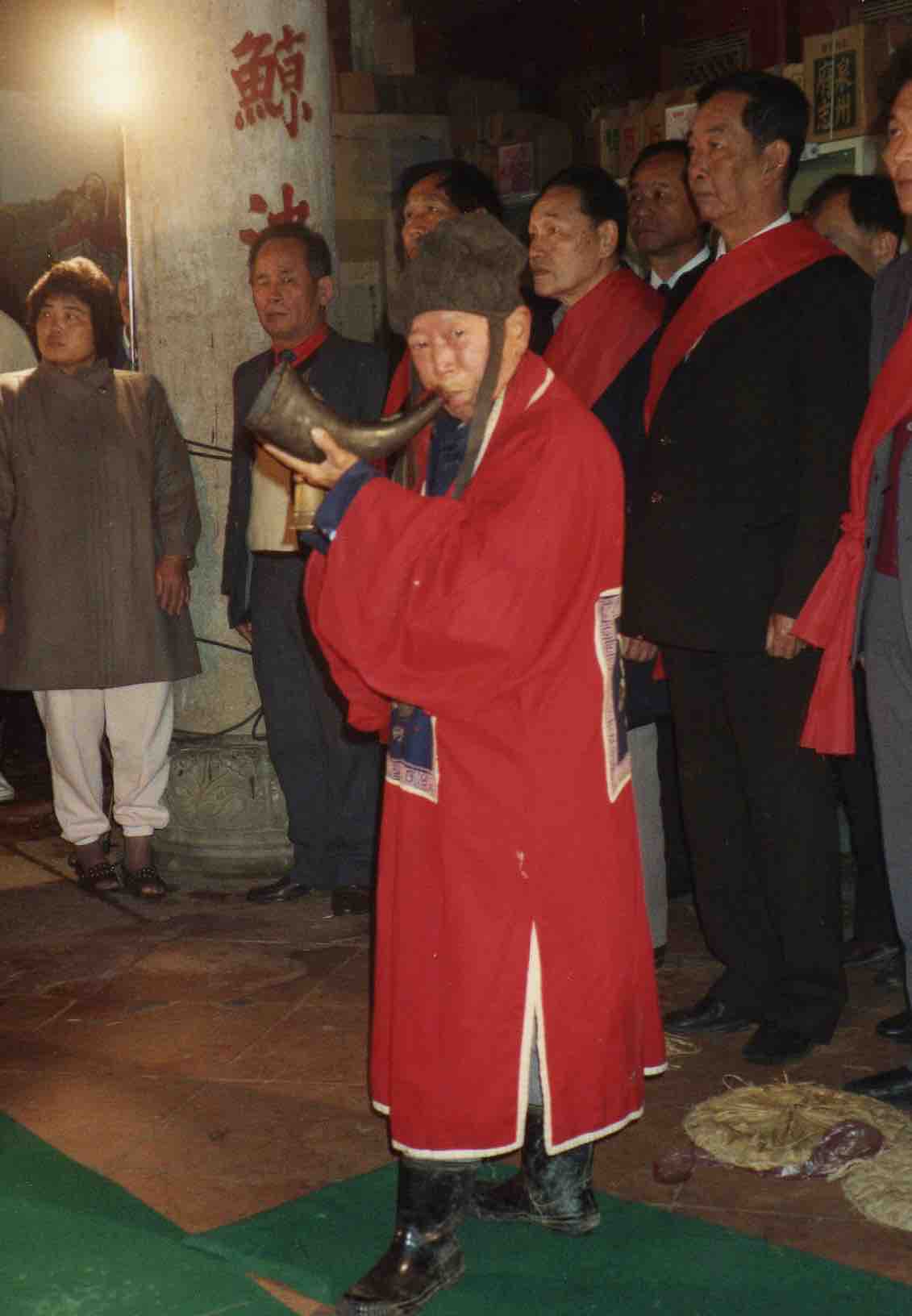
Daoist priest, Quanzhou 1990.

Remembering an old friend 憶故人

That’s the title of one of the most soulful, and popular, pieces in the qin zither repertoire—unusually, not documented until 1937.

lyr

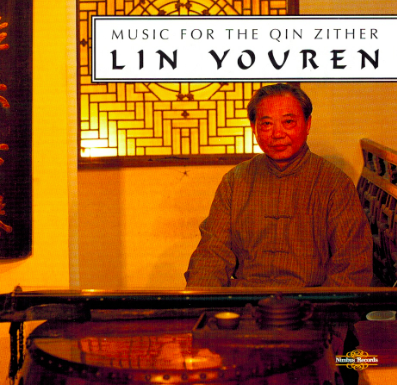
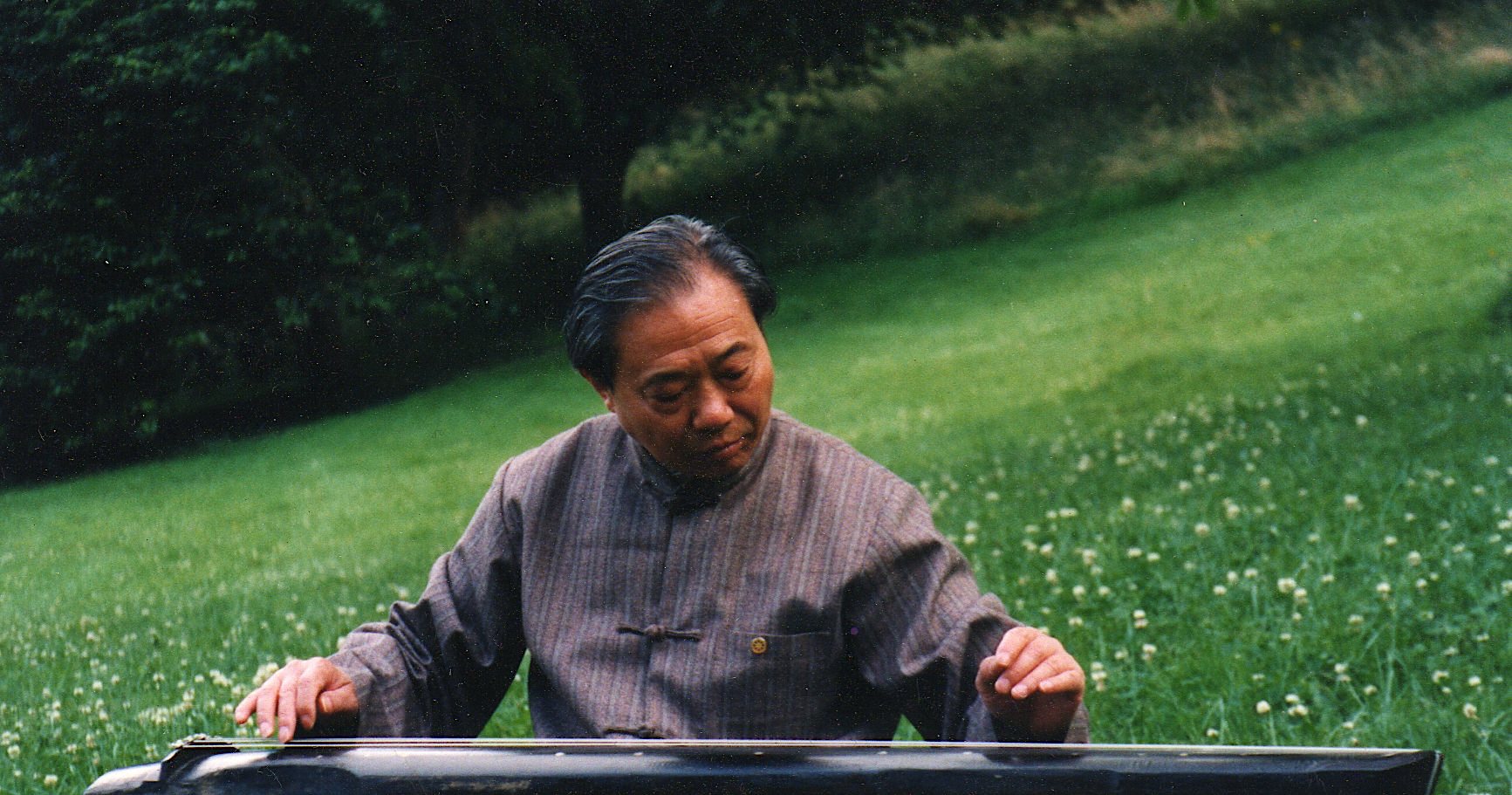
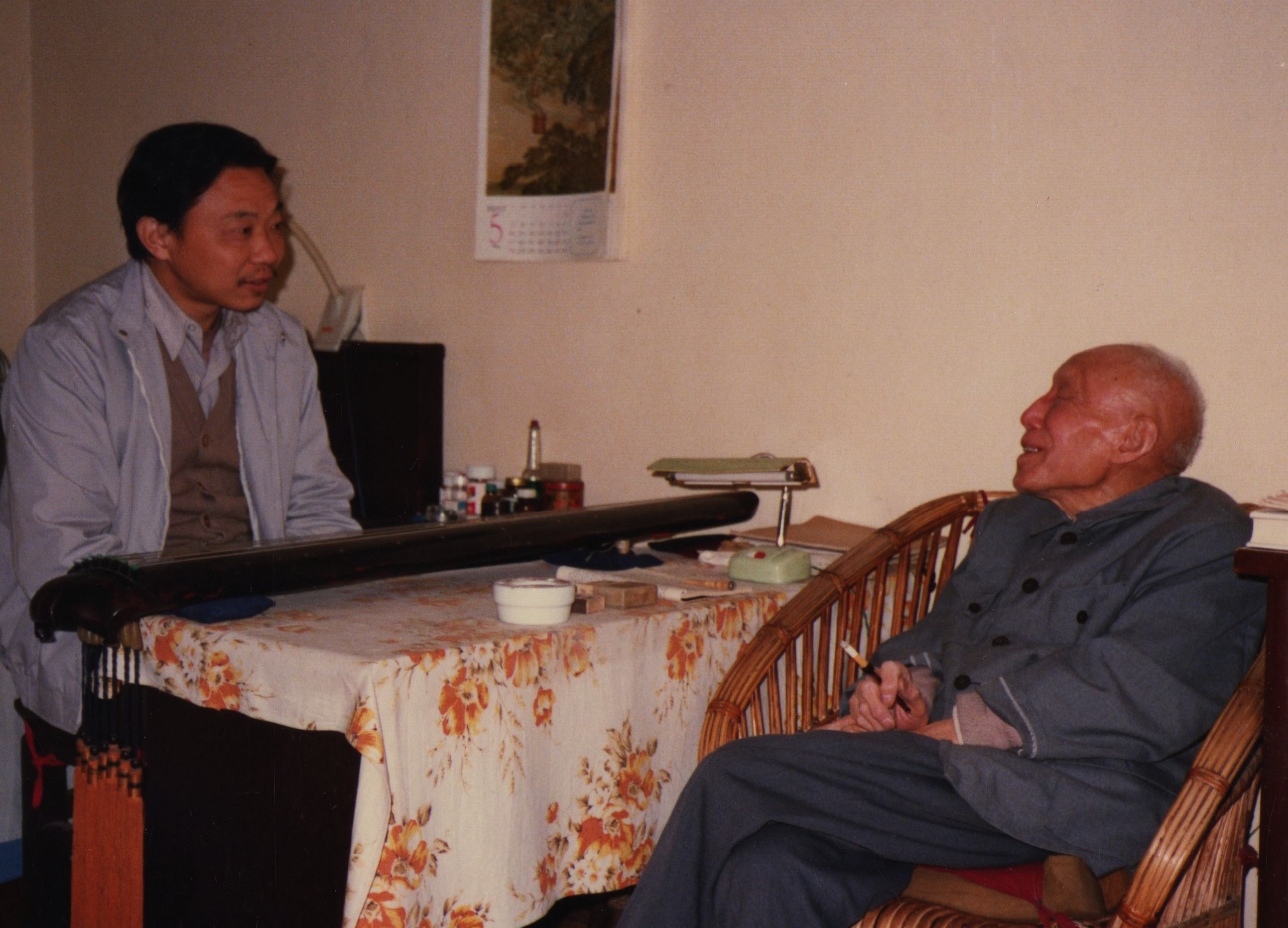
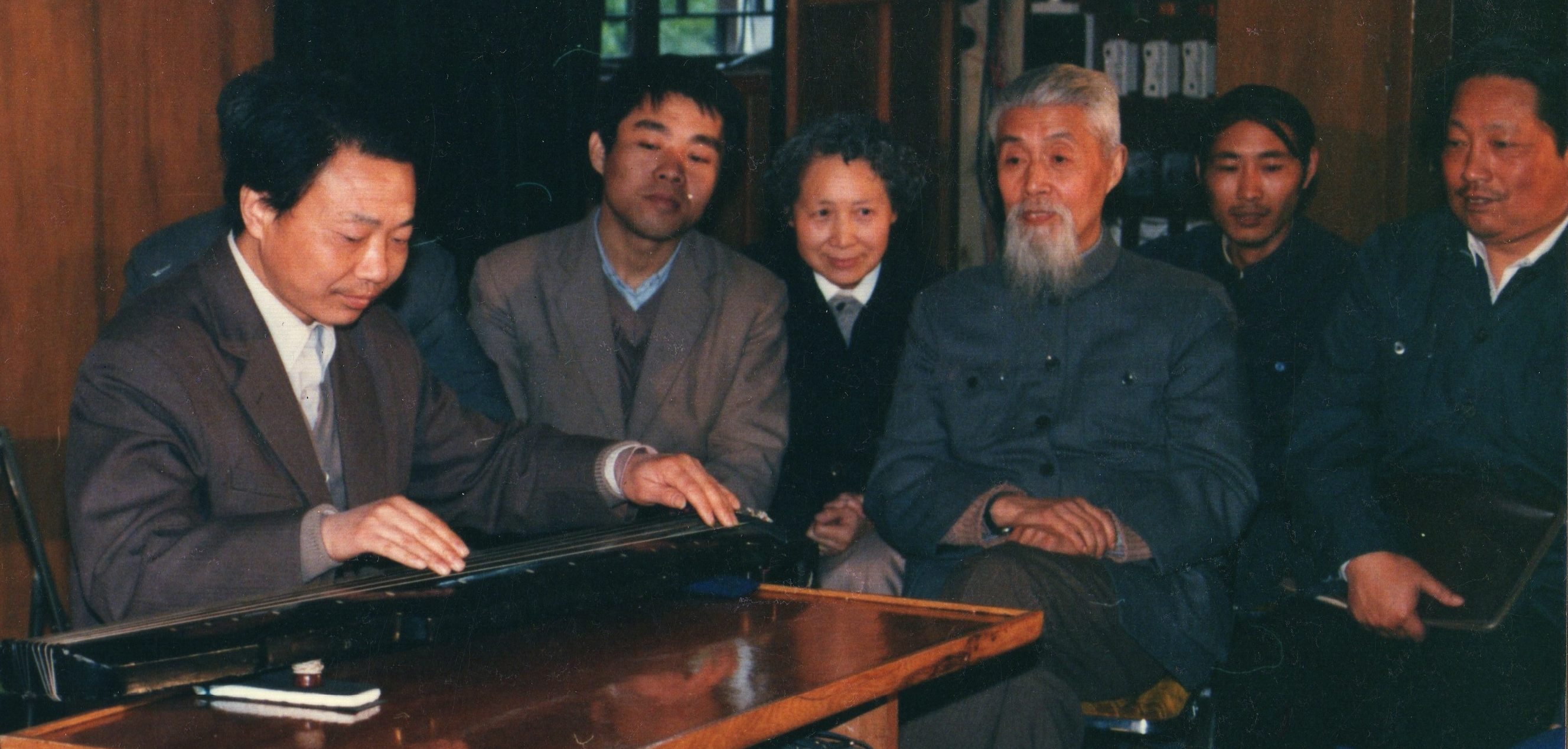
You can find tributes to my mentor Lin Youren (1938–2013) online, including the delightful

included in the fine article

So here I’ll just add a few of my own memories of Lin Youren.screen-shot-2016-12-30-at-12-20-31

Excerpts from my liner notes with the CD:

Lin Youren is a true eccentric. [Here I’m thinking of the Seven Sages of the Bamboo Grove]. His story contains intriguing contrasts, since he learned and taught the qin under the conservatory system, but came to find the juxtaposition incongruous, quietly subverting it from within. […]

His preferred way of playing is alone with a few friends—and, in another ancient tradition of the qin player, a bottle or two of Shaoxing wine. […]

If his playing roams the clouds of Daoist selflessness, his conversation is quirky, cryptic and full of puns.

The CD is very fine—here’s the opening track, “Evening song of the drunken fisherman” (Zuiyu chang wan 醉漁唱晚):

One unusual feature is its inclusion of his “Improvisation for Michael Owen”. More from the notes:

I’m not sure you really want to know this, but the musical germ of this fantasia was the singing of exhilarated English fans in my local pub after we relished Michael Owen’s superb goal against Argentina in the 1998 World Cup. Lin found the famous football song reminiscent of the singing of Miao tribespeople in southwest China (“Not a lot of people know that”, I mused as we emerged from the pub), but by the time we got to the recording session he had wholly internalized it for the intimacy of the qin.

Actually, since Lin Youren was staying with me, he tried it out for the first time as soon as we got back from the pub. A couple of days later we took the train for the recording session at Nimbus’s fine studio near Monmouth. To help him feel at home we plied him with Shaoxing wine; and he felt it would further help the vibe if I sat with him as he played, so he would have a real, and empathetic, audience. He improvised for much longer than the version on the CD, which is edited down—not quite to his satisfaction. Still, this CD was his favourite among all his recordings.

LYR in field

At Nimbus, 1998.

lyr-and-zzq

With qin master Zhang Ziqian, 1987.

lyr-and-wzj

Qin gathering, 1987. With beard is Suzhou qin master Wu Zhaoji.

For the Beijing qin scene, see here, and my series on the fortunes of the qin under Maoism; for my own mixed feelings about the qinhere. For a meretricious speculation on the rudra vina in India, see n.2 here. See also the qin tag.

Speaking from the heart

Further notes on fieldwork
A tribute to Antoinet Schimmelpenninck (1962–2012)

 revised version of a talk I gave at the CHIME conference in Leiden, 2012
ant

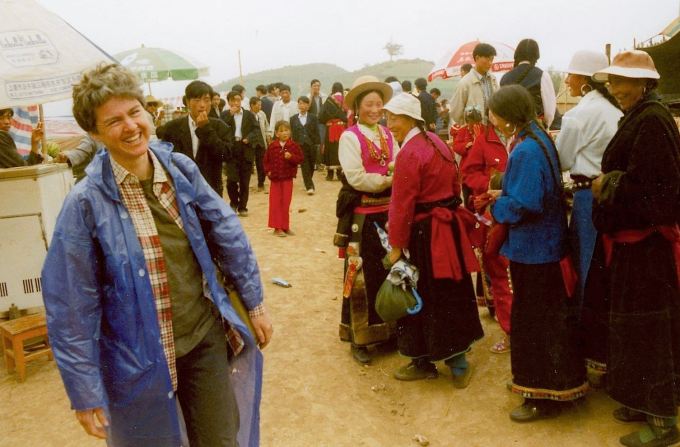
Amdo-Tibetan area, south Gansu, 2001 (photo: Frank Kouwenhoven).

I never did any fieldwork with Antoinet, but I admired and envied her natural engagement with musicians and with people altogether.

I won’t portray her as some kind of Lei Feng, so this can also be a kind of homage to, and reflection on, fieldwork itself. And I will discuss her alone, whereas of course she and her partner Frank Kouwenhoven, dynamic leaders of CHIME in Leiden, made an indivisible team.

Almost anything can be fieldwork, such as talking to your mum, or your kids, or going clubbing—although we’re perhaps unlikely to undertake all three at the same time. But I refer here to spending time with Chinese musicians in the countryside, which requires a rather different set of skills from hanging out with rock musicians in Beijing, for instance.

Fieldwork by the Chinese on their local musical traditions, in a sense that we can recognize, goes back to at least the 1920s. But when we laowai began to join in in the 1980s, it was exciting to get some glimpses of local folk traditions. We can see that sense of discovering a “well-kept secret” right from Antoinet’s articles in early issues of CHIME[1]

All these years later, I suspect local traditions are still largely a well-kept secret, and that may not be an entirely bad thing. But fieldwork by the Chinese has also thrived since the 1980s; plenty of Chinese are doing great work. In those early days, Chinese fieldwork was rather mechanical: the main object was to collect material in the form of musical pieces, conceived of as rather fixed and somewhat detached from changing social context. Antoinet was at the forefront of broadening the subject; the title of her book, Chinese folk songs and folk singers, is significant. This inclusion of the performers in the frame has borne fruit in Chinese and foreign work.

as-book-cover

Among general skills, we might list

  • preparation (finding available material, maps, preparing questions, etc.)
  • linguistic competence (how I envied her ability to communicate, and latch onto regional dialect)
  • musicality (and “participant observation”; routine for us, rare among Chinese scholars)
  • back home: analysis/reflection; sinology and ethnomusicogical/anthropological theory

In addition to my citings of Bruce Jackson and Nigel Barley (Fieldwork, under Themes), further reflections include:

  • Helen Myers in Ethnomusicology: historical and regional studies (New Grove Handbooks on Music)
  • Barz and Cooley, Shadows in the field
  • Lortat-Jacob, Sardinian Chronicles
  • Don Kulick and Margaret Willson (eds.), Taboo: sex, identity and erotic subjectivity in anthropological fieldwork.

As to what is ponderously known as “participant observation”, musicians tend to react well to other musicians—it shows a willingness to engage, and also helps us think up useful questions.

As to what we do after fieldwork: Antoinet was well grounded in ethnomusicological readings, but she was never controlled by theory, she used it critically to illuminate points, as one should. Scholarship is not always like that! Her book really is an amazing achievement. She not only broadened the subject, she made it more profound.

Rapport
A lot has been written about personal interaction in fieldwork. I like Bruce Jackson’s book very much. We all have different personalities; some of us may seem more outgoing than others. It’s an unfair accident of birth, upbringing, and all that. Musicians will be more forthcoming with people they feel comfortable with—like Antoinet. Of course fieldwork manuals talk about good guanxi, but it’s more. We respect people that we talk to, but we also aspire to some sort of equality; we hope to be neither obsequious nor superior. On the agenda here are sociability, informality, amateurism, humanity/fun/enthusiasm/empathy, and humour—all without naivety or romanticism!

We do naturally adapt our behaviour to different situations. I’m much more sociable in China than in England. Antoinet, it seems to me, never needed to adapt, she was just always naturally gregarious and sparkling.

Age is an interesting factor: I guess it’s good to be old or experienced enough to be taken seriously, but intelligence and sincerity are appreciated, and it’s also good to be young enough, at least at heart, not to seem too important! Antoinet was always self-effacing, companiable.

I do bear in mind Nigel Barley’s warning (The innocent anthropologist, p.56):

Much nonsense has been written, by people who should know better, about the anthropologist being “accepted”. It is sometimes suggested that an alien people will somehow come to view the visitor of distinct race and culture as in every way similar to the locals. This is, alas, unlikely. The best one can probably hope for is to be viewed as a harmless idiot who brings certain advantages to this village.

By the way, I’m not a harmless idiot, I often feel like a harmful idiot: I hope it’s a coincidence that everywhere I go, the local traditions go down the drain…

Our ways of repaying all this hospitality are variable, depending on our means and inclinations. One may send photos and videos, and organise tours; Chinese colleagues have gone so far as to install running water, or find urban jobs for relatives.

I note some some handy Maoist clichés linking fieldwork and Communist ideals:

  • chiku 吃苦 “eating bitterness”
  • santong 三同 “the three togethers” (eating, living, and labouring together. Hah!)
  • dundian 蹲点 (“squat”; more generously defined in my dictionary as “stay at a selected grass-roots unit to help improve its work and gain firsthand experience for guiding overall work”. How long is this dictionary?!)
  • gen qunzhong dacheng yipian 跟群众打成一片 “becoming at one with the masses”
  • bu na qunzhong yizhenyixian 不拿群众一针一线 “not taking a single needle or thread from the masses”

My point here is to get over the empty formalism of such slogans and see through to the sincere humanity that once inspired them.

These thoughts on empathy aren’t something we can do much about, but it’s interesting to reflect on the topic. Obviously enthusiasm isn’t enough; on its own it can be quite irritating!

I guess we all use teamwork to some extent, and Antoinet was good at finding, and supporting, good regional and local scholars to work with. I have always relied heavily on my Beijing colleagues to make notes, at least until circumstance and greater familiarity lend me the confidence to spend time with musicians on my own.

Group fieldwork is good up to a point. It depends partly on one’s means, but the group perhaps shouldn’t be too large. I like the informality and flexibility of working alone, but it is a bit much to take photos and videos and make notes and distribute fags all at once.

 Of course Antoinet was interested in all kinds of music-making, but she was among few laowai who did much work outside the main urban areas. Her two main fieldwork areas were very different: in south Jiangsu she found herself mainly doing a salvage project, but in Gansu she found a ritual scene that is very much alive.

As to time-frame, she and Frank mainly made repeated visits over time, and as I did for Plucking the Winds or my work with the Li family. Talking of Plucking the Winds, I’ve never had such a perceptive meticulous and patient editor as Antoinet.

Obviously, a brief interview with a stranger is likely to yield less interesting or reliable results than long-term acquaintance. But I do take on board the notion of stranger value. On one hand (Jackson, Fieldwork, pp.69–70, after Goldstein),

The collector who comes from afar and will disappear again will be able to collect materials and information which might not be divulged to one who has a long-term residence in the same area.

On the other hand, there’s the whole “You will never understand this music” thing (Nettl, The study of ethnomusicology, ch.11, brilliant as ever).

And then, who is an insider? What of urban Chinese? How might an urban-educated male Fujianese get along with female spirit mediums in rural Shanxi, and so on?! There are several complex subjects for discussion here.

Talking of etic questioning, here’s another vignette from the Li band’s 2012 tour of Italy (my book p.336):

Third Tiger is as curious as ever, always asking weird “etic” questions like “Why are Italian number-plates smaller at the front than at the back?” Bemused, I later ask several Italian friends, who have never noticed either. It strikes me that this is probably just the kind of abstruse question that we fieldworkers ask all the time, and I’m sure my enquiries in Yanggao sound just as fatuous. I must cite Nigel Barley (The innocent anthropologist, p.82)—and note the car link:

They missed out the essential piece of information that made things comprehensible. No one told me that the village was where the Master of the Earth, the man who controlled the fertility of all plants, lived, and that consequently various parts of the ceremony would be different from elsewhere. This was fair enough; some things are too obvious to mention. If we were explaining to a Dowayo how to drive a car, we should tell him all sorts of things about gears and road signs before mentioning that one tried not to hit other cars.

By the way, I was the victim of a flawed fieldwork interview some years ago. A Korean student, whom I knew fairly well, was doing an MA on ethnomusicology in London, and had to do an interview. She knew I was both a violinist and did fieldwork on Chinese music, so she came over to my place with a list of questions all prepared. Her English wasn’t great—like, even worse than my Chinese. OK, her project demanded quite a short interview.

She began with “Who is your favorite composer?” and I went, “Well, music is more about context, mood, not compositions, and anyway I don’t listen to so much WAM these days, and most music in the world we don’t really know of a “composer”… OK, if you insist, then Bach.” She went, “Thankyou. What was the best concert you ever done?” so I observed that we don’t do so many memorable concerts over a year, and that great music-making doesn’t only happen in concerts. “Being an orchestral musician can be frustrating, one’s teenage idealism tends to get beaten down, getting a plane, then five minutes in the hotel before a long rehearsal with a boring conductor, no time to eat properly… You could ask me, what was the most wonderful musical experience I have had—it wouldn’t necessarily be playing with an orchestra…” In response to this cri de coeur, she went on, “Thankyou. What is the difference between the Western violin and the Chinese violin?” Aargh. I mean, anyone would want to follow up on all that I had just said, right? But her rigid questionnaire was in control.

So is that what I have been doing in China all these years—misunderstanding, ignoring leads, and following up with my own stupid blinkered questions?!

One hopes to find questions that will get people talking at length (so avoid questions that invite simple Yes/No answers!); but there was I blabbering on, and all she wanted was short snappy answers!

I’m still very attached to the detailed notes of my Chinese colleagues. One can’t record everything on audio or video, and even if we could, it would leave unclear how many characters should be written. I used to use video mainly to film ritual—I only began to record informal situations later. Antoinet was great at bypassing formality.

They recorded all kinds of things as well as formal singing sessions, and sure they had the means to do that, as well as recruiting helpers and so on.

A questionnaire is essential, [2] but it must always be flexible, following their flow, always thinking of new questions, how to express them suitably, and listening. All of which Antoinet was brilliant at.

For me fieldwork is a constant discovery of how inaccurate and superficial my previous notes were. Antoinet and Frank’s enquiring spirit can be seen in these reflections that Frank later sent me:

We had no such thing as a “method”—in general we did tend to visit singers more than one time, preferably many times, in order to ask them the same questions repeatedly, and to let them sing the same songs more than once, with intervals of days, weeks, months or even years in-between. That was only possible with individual songs, of course, not with spontaneous dialogue songs, which we got acquainted with mainly in Gansu.

I think we learned most from what people told us spontaneously, about their own lives, in personal conversations, which were not strictly private conversations. People are nearly always in a space together with others. But group interviews (group chats, rather) were good, people felt at ease, they were not “attacked” by us, they were simply chatting…

Basically, in our fieldwork, we were always out to discover what we were not aware of yet. That is a hard task. And I think we kept discovering that we had not yet asked the right questions, had not investigated the right topics yet… Even now do I realize that I should go back… Maybe this is only the natural, classic, condition for fieldworkers: you return home with an idea of how things might be, you end up with an hypothesis, you suddenly stumble upon a new hypothesis which sheds new light on the situation, but then you have to go back again to test it, and the work starts all over again… A never-ending process, also because the questions you ask are nearly always bigger than the time and resources you have, and you need to address your problems piecemeal… We often wished we were five hundred people!


By the way, do watch their beautiful film Chinese shadows: the amazing world of shadow puppetry in rural northwest China (Pan, 2007).

In short, fieldwork may be an unending amount of work, but it’s endless inspiration too: and one works better when inspired. So I hope we can keep Antoinet’s spirit alive by emulating her humanity, enthusiasm, and critical intelligence.

For a recent volume on doing fieldwork in China, see here. And note the folk-song research of Qiao Jianzhong.


[1] Or for Daoist ritual, see e.g. the early fieldwork of Kenneth Dean.

[2] For her sample questionnaire for southern Jiangsu, see Chinese folk songs and folk singers, pp.395–6. Cf. McAllester’s questionnaire for the Navajo.

Strauss (R.) and Elvis

Wild

David Lynch always amazes (for Twin Peaks, click here), but the final sequence of Wild at heart (1990) is gorgeous. Morphing, almost seamlessly, from the Four Last Songs of Richard Strauss to Elvis, it makes both works seem even more intense; and then Love me tender (really sung by Nicholas Cage!) is filmed in one long take, the camera coiling amorously around him and Laura Dern (cf. Susan McClary on the baroque trio sonata).

Worth celebrating genius—all the more in the USA these days, where the list of artists deemed “overrated” by the arbiter of cultural taste will be growing… (written in 2017)

Another Czech mate

Hasek last photo

Further to my Czech mentor Paul Kratochvil:

Along with Flann O’Brien, high on the guest list for my fantasy dinner-party would be Jaroslav Hašek—”humorist, satirist, journalist, anarchist, hoaxer, truant, rebel, vagabond, play-actor, practical joker, bohemian (and Bohemian), alcoholic, traitor to the Czech legion, Bolshevik, and bigamist”.

Hašek’s The Good Soldier Švejk has long been popular in China. Cecil Parrott, its English translator, also wrote a biography of Hašek’s “bottle-strewn life”, The bad Bohemian. Former British Ambassador in Prague, Parrott effortlessly avoids betraying any sympathy with Hašek’s reprobate behaviour (see also Hašek’s adventures in Soviet Tatarstan). As he explans in the introduction to his translation:

His next escapade was to found a new political party called The Party of Moderate and Peaceful Progress within the Limits of the Law […] publicly debunking the monarchy, its institutions and its social and political system. Of course it was only another hoax, designed partly to satisfy Hašek’s innate thirst for exhibitionism and partly to bolster the finances of the pub where the election meetings were held.

Among his many japes, his short-lived editorship of the journal The Animal World was curtailed after he published articles about imaginary animals.

Dangerous herds of wild Scottish collies have recently become the terror of the population in Patagonia

Thoroughbred werewolves for sale

Newly discovered fossil of an antediluvian flea

And his hobbies combined:

Everyone who votes for us will receive as a gift a small pocket aquarium.

Svejk Chinese

Gratifyingly, The Good Soldier Švejk clearly appeals to Chinese sensibilities; it was translated, and the 1956–1957 Czech films were dubbed into Chinese:

Alexei Sayle wonders if the Czech regime knew what they were doing promoting Švejk, since its message hardly supports the ideals of socialist conformity. Though it became popular in many languages, I suspect there’s something about it that appeals in particular to Chinese people—an antidote to compulsory patriotism? The Chinese translator dutifully portrays it as a tirade against imperialism, but it surely spoke to The Common Man (Flann O’Brien’sThe Plain People of Ireland”) oppressed by the destructive irrationalities of a newer system…

The Chinese version of Švejk’s name (Shuaike 帅克) is perfect. It drives me to a little fantasy.

An unsung local hero

li-jin-2013

I mentioned the splendid Li Jin 李金 briefly in my book (p.20):

I also made a couple of brief trips doing a reccy of Daoists in the nearby counties, assisted by my saintlike old friend Li Jin, bright young scholar Liu Yan, and feisty Driver Ma, all delightful company. No-one will ever accept any reward for all their work as my amanuensis. Elif Batuman’s fine adage about her time in Samarkand rings true: “We were either trying not to give money to people who were trying to take it, or trying to give money to people who were trying to refuse it.”

Pufo tang

Li Jin (right), with Jiao Lizhong (centre) and driver (and polymath!) Ma Hongqi,
Hunyuan county-town 2011.

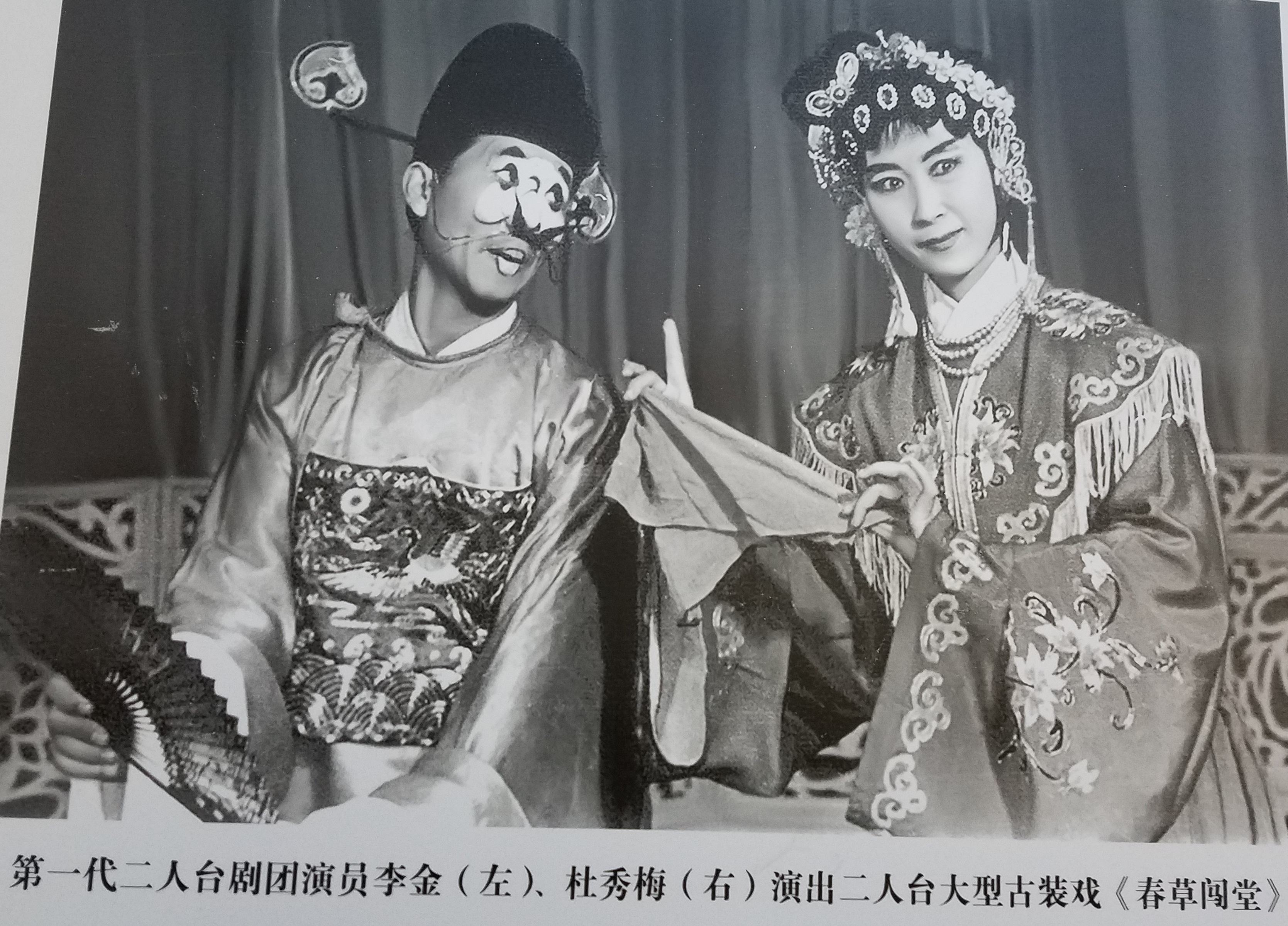
Li Jin is indeed a treasure. I only realized quite recently that he was once a celebrated performer—but it’s his infinitely generous sincerity that strikes all who meet him. In this he resembles the great Li Qing, but his story differs in that the Li family Daoists always strived to keep under the radar, maintaining their independence from official control, whereas Li Jin’s life has been shaped more directly by the vicissitudes of the Party. In many ways his story is unexceptional, but while my accounts of Yanggao generally concern folk more than state, [1] it reminds us of the presence of the latter—and the presence of Good People within it.

A year older than Li Manshan (but not related to the Li family Daoists), Li Jin was born in 1945 in the poor village of East Shahe just southwest of Tianzhen county-town. He had two older brothers, and at first his family thought to give him away to a close friend, a childless local doctor, but in the end they kept him. Their grandfather was the patriarch. He had gradually accumulated over 30 mou of land, and with the three brothers helping in the fields, their life was quite comfortable until “Liberation”. In the land reform of 1947–48 they were classified as middle peasants (cf. my book pp.95–9); in the 1964 Four Cleanups campaign they were stigmatized as “rich peasants”, and only rehabilitated in 1982—not unlike the Li family Daoists.

When a basic primary school system was established, Li Jin went to school in the converted Dragon King temple. He recalls the fine opera stage opposite it, where an opera troupe would perform for the gods on the 18th of the 6th moon. The stage remained intact—young Li Jin himself remembers performing the item “Playing the flower drum” (Da huagu 打花鼓) there when he was 10 sui.

By the time he graduated from six years of primary school he was a favourite of the teacher. He became prominent in school performances; what he calls his “silly look” was popular. In 1959 he passed the exam to enter secondary school in Tianzhen county-town—no easy feat. It was life-changing for him. On his very first day there, he was thrilled by the flag-raising ceremony in the school’s huge exercise ground. He began learning Russian enthusiastically, dreaming of becoming a translator. But he was soon chosen to do an audition in Yanggao county for a new state-run troupe that was to perform the popular skittish local duet “little opera” errentai.

So in the 2nd moon of 1960, when only 16 sui, he was chosen to join the new county folk opera troupe (Yanggao xianzhi p.468). This, indeed, was soon after Li Qing was chosen for the regional arts-work troupe in Datong (my book pp.113–118), and at the height of the famine.

Later Li Jin heard that he had nearly got the county mayor into trouble. None other than Jing Ziru, head of the Bureau of Culture and the (only) brilliant local historian of Yanggao (my book p.50), told him that at his audition, the mayor had taken exception to his two “wolf-teeth”, but the others pointed out they could be taken out—indeed, in 1962 he had them extracted by a quack dentist while they were performing in Zuoyun county. Rather him than me.

Li Jin soon went on to become a celebrated performer. The troupe’s expenses were to be footed by all the people’s communes in the county, so it was ponderously named Shanxi sheng Yanggao xian renmin gongshe lianshe minjian gejutuan 阳高县人民公社联社民间歌舞团. If there was a sign at the gate of the compound, it must have collapsed under the weight of its own lettering

Li Jin remembers those early days in the troupe fondly, with its twelve performers and six musicians. Of course it was a terribly tough time, but the troupe was doing well, and led a somewhat less tenuous existence than the common folk, “like being in kindergarten”. Still, he only earned 18 kuai a month.

The leadership praised their first hastily-rehearsed programmes of Da jinqian 打金钱, Zou xikou 走西口, Gua hongdeng 挂红灯, and Gusao tiaocai 姑嫂挑菜. At first Li Jin was chosen to specialize in the handsome sheng roles, but with his “silly look” he found it too much of a challenge, and he soon gravitated to the chou clown role.

li-jin-1-low-res

The character is meant to make people laugh, but once he made himself corpse. Playing the role of a clown county official, one day he got the words wrong and couldn’t help bursting out laughing. The troupe leaders gave him a kicking backstage but he still couldn’t stop laughing. At the next meeting he was criticized and his 3 mao supplement for the day was withheld. This is the kind of story that musos delight in.

They were on tour all year round. I was surprised to learn that tickets were for sale—so they had to try and control villagers without tickets trying to sneak a look, no simple task.

li-jin-2-low-res

Following the mood of the times, the troupe soon began performing modern items instead of their original classical stories, so Li Jin’s clown roles were now mainly “negative” characters like spies or traitors, not the more sympathetic (or at least neutral) roles of old. Despite the troupe’s popularity with audiences, and Li Jin’s own reputation, in the Lesser Four Cleanups campaign of 1963 they were banished to the countryside for “tempering through manual labour” (laodong duanlian). As the campaign intensified, they were active in Tianzhen county as a Four Cleanups work troupe. At first Li Jin was excluded from taking part in such “battle teams” (zhandoudui) by his bad class background, but soon the order came down that everyone had to join in, so for the next two years he was part of a group of a dozen or so “Red Flag warriors”.

By 1967 a new directive descended on them, warning them that their performances since the formation of the troupe, glorifying “ox demons and snake spirits, scholars and beauties”, contradicted the agenda of the Party. The leadership decided to amalgamate the troupe with the county’s other opera troupe (for the classical opera Jinju), at the same time reducing the personnel. By 1968 even this new combined troupe was abolished. Li Jin was assigned to work as a cook. His wife was sent to work in a troupe in Xinzhou, rather far south—so even his family was being broken up. He’s grateful that she managed to return after some time.

In 1970 the county established a Mao Zedong Thought Propaganda Team. All the recruits had to do was to be able to hum a few phrases and not be too ugly, and they were in. But the authorities soon realized the standard wouldn’t do, and had recourse to the disgraced former troupe members. So Li Jin now found himself taking part in simple cheerleading performances, trapped in “a bottleneck of monotony”. But they did raise standards, and their performances enjoyed a certain popularity.

The scene changed quickly from 1976, with more traditional genres regaining a position among modern styles. In 1979 the county “folk opera troupe” (minjian gejutuan, later called Errentai jutuan) was restored, with both new and old styles reflected. Supported by the county leadership, their reputation again spread. Li Jin, still only in his mid-30s, got back to work conscientiously, going on to become Director of the troupe. In 1988, as “popular voting” came into vogue, he stepped down after a close-fought election.

In 1989 he moved to the county Bureau of Culture, a radical change in work style—and a challenge upon which he embarked with typical enthusiasm. He was glad to broaden his experience of local culture. Since then, privately-run errentai groups have bloomed in the countryside, taking a major role at weddings and funerals. I don’t suppose Li Jin is always impressed by the pop style that now dominates there, but he is proud of playing a role in the recognition of the Li family Daoists and the Hua family shawm band in the Intangible Cultural Heritage roster. Despite my reservations about the ICH, I can appreciate his satisfaction.

In a climate since the 1990s whereby most cadres seem to spend their time staggering around pissed from one state-funded banquet to the next, [2] Li Jin seemed to be the only one who ever got any real work done. And he at once understood that I was there to work too, inconspicuously doing all he could to help me—like biking through the snow to convey an obscure foreign message on my first trip.

In recent years, while staying with Li Manshan and following him round funerals, I make occasional visits back to the town for a shower and a nice quiet informal meal with Li Jin. Since his retirement, though not in great health, he has returned to his beloved errentai, taking place in regular amateur meetings.

He is affable and generous with everyone, and accepts people (even me) as he finds them—embodying the noble virtues that the system often trampled on. He has always believed in humanity, social justice, and the aims of the Party.

* * *

This is the kind of life that books like those of Dikötter, single-mindedly focused on tragedy, cannot reflect. Whereas the more focused ethnography of Friedman, Pickowicz, and Selden is also unflinching, it is based on fieldwork, and so can’t help showing a certain empathy. But more general trawls through the archives like those of Dikötter can only be partial, another kind of propaganda. One can hardly challenge his details—indeed, the tragedy lies precisely in the way that sincerity was repressed, and it does need documenting—but one needs a more nuanced, perspective.

My account may make Li Jin sound a little like one of those selfless cadres of yore, by contrast with the self-serving crew that holds sway today. But there really were, and are, people like that… See also Yanggao personalities.

There is nothing like a quiet chat over a simple bowl of noodles with Li Manshan and Li Jin.


[1] In my 2004 book on the Gaoluo ritual association, one finds a closer relationship between folk consciousness and local cadres.

[2] Though in my book (p.314) I note recent sumptuary laws, and a jolly good thing too.

Tone of voice, and audiences

bailey

Around 1975, while “studying” at Cambridge, I somehow managed to get an invitation to tea with Sir Harold Bailey (see also here), eminent scholar of ancient Central Asian philology. I guess it was Laurence Picken, or Denis Twitchett, who made the introduction.

Sitting me down at his side, Sir Harold at once embarked on a lengthy discourse about medieval Khotanese texts, peering at a jumble of manuscripts on the desk before us. His only companion was his cat, whom he also addressed periodically, without modifying either his gaze or his measured academic tone.

“Here I found a clear clue to a syntactical link with the Sogdian manuscripts that had been excavated some time before… And I suppose you want another saucerful of milk.”

Before I could assure him that I was fine with my cup of tea, he went on,

“It may take some time to map the linguistic links between the various medieval oasis towns… It’s no use rubbing up against my legs like that, you’re not going out into the garden again, we can’t have you bringing in any more birds…”

It took me some time to get the hang of this.

From his obituary:

A task now facing Bailey’s colleagues is the elucidation of his rhyming diaries. When told at our last meeting that the course of a lifetime had transformed these into an epic of over 3,000 verses in a private language concocted from classical Sarmatian inscriptions, I asked Bailey why he was so fond of obscurity. “Well, the diaries are not really so obscure,” he said. “Indeed I’d say there’s hardly a line that could not have been understood by any Persian of the fourth century.”

For another story about context sensitivity, see here. And do read Compton Mackenzie meets Henry James!

In memory of Paul Kratochvil

Paul 1976

Wedding party, Cambridge 1976.

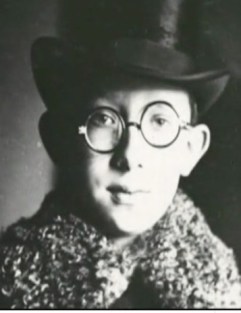
At Cambridge during the Cultural Revolution, immersed as I was in the Tang dynasty, my only clues to the funkiness of contemporary Chinese culture came from my teacher the fine linguist Paul Kratochvil (a surname that suitably means “fun”). Born in 1933, he had somehow became an expert on the phonetics of modern Chinese, fleeing Czechoslovakia in 1968 to take up a post at Cambridge with the help of the Oxford sinologist Piet van der Loon. He features in this impressive introduction to Prague sinologists (for whom, see here).

Recommending to me a book called Current Trends in Linguistics, Paul looked bemused when I asked him what I should look it up in the library under—like an editor’s name or something:

“Well, Steve, try ‘C’—if that doesn’t work, I guess you could try ‘K’…”

While he was still in Prague, a friend in China addressed the envelope of a letter to him with great economy:

Paul

(“Czechoslovakia, Comrade Paul”). Sure enough, he received it.

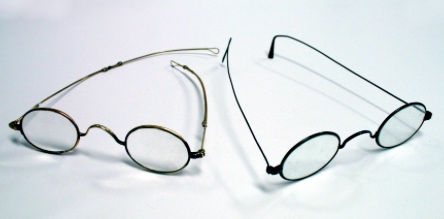
spectacles

Over copious beer in the pub where he used to take me for what were euphemistically described as “supervisions”, Paul recalled this story:

While still in Czechoslovakia he had served as interpreter for the Czech army, and at one high-level conference in Prague receiving a Chinese military delegation, he found himself interpreting for a Czech general at one end of the table and a Chinese general at the other.

The talks had gone well, and the Czech general was winding up with the customary sonorous platitudes.

“I hope both sides will be able to exchange experiences!” he declared majestically.

My friend Paul was already a fine linguist, and he knew there were some binomes in Chinese which you could say in the order either A-B or B-A, but alas he thought jingyan, “experience”, was one of these. So he blithely translated, “Wo xiwang shuangfang nenggou jiaohuan yanjing”, which unfortunately comes out only as

“I hope both sides will be able to exchange spectacles.”

This puts the Chinese general in a spot; the TV cameras are trained on him, and he mustn’t make a faux pas. Can this be some weird Czech custom denoting fraternal solidarity? As luck would have it, both generals are wearing spectacles. The Chinese general hesitantly takes off his glasses and holds them out over the table towards his Czech counterpart.

This, of course, presents no less of a challenge for the Czech general; having said nothing at all about spectacles, he is mystified to see this Chinese geezer holding out his spectacles across the table, and he too has to think quickly. Can this be some ancient Confucian ritual denoting fraternal solidarity? He too hesitantly takes off his glasses and offers them across the table.

My chastened mentor later switched on the Prague TV news to see a report, the newsreader announcing solemnly, “And at the end of the conference the two sides exchanged spectacles in the ancient Chinese gesture of comradeship”—as the two generals groped their way to the door.

For a suitable fanfare for the event, see here. Among several more fine stories from Paul, I like this, and indeed this. See also Czech stories: a roundup.

5’20”

Of all the beautiful things you can do in 5 minutes and 20 seconds (like playing Yellow Dragon Thrice Transforms its Body at the end of the Transferring Offerings ritual), the divine Ronnie’s 1997 maximum is likely to remain unmatched in human history:

Beats 4’33” any day, with all due respect to John Cage.

I shouldn’t need an excuse for showing this, but here it is. After taking Li Manshan to a conference in Hong Kong (my book, p.333), I was staying with him in a posh hotel in Beijing when we switched on the TV to find Ronnie playing in the world masters snooker. Snooker has become staggeringly popular in China, but Li Manshan hadn’t seen it before, and his amazement was delightful. So I showed him this 147, which is flabbergasting even if you don’t quite know how ridiculously difficult it is…

After the lavish banquets in Hong Kong, at which we both felt rather uncomfortable, we were happy to eat a simple bowl of noodles in peace together in a little caff over the road. Next day I took him to the station to take the train home and get on with his routine of determining the date, decorating coffins, and funerals.

My favourite expression of snooker commentators is “he’s eying up a plant” (see here, and here). Tang poetry is all very well, but I wonder how you say that in Chinese…

Since Ronnie is often described as the Mozart of snooker, I note that Mozart enjoyed a game of billiards.

For more on Ronnie and snooker, see this roundup.