Analysing world music

AAWM

My writings on Chinese ritual may seem to privilege ethnography and social change. But I do also like to relate all this to the nuts and bolts of the language of sound, as with my Dissolving boundaries (comparing qin and shawm pieces!), and for the liturgy of the Li family Daoists, clues in my book, chs. 14 to 16.

Having just made a plea for soundscape to be considered an intrinsic component of ritual studies, these analyses are highly technical, so I may now be shooting myself in the foot, but hey.

Once upon a time, analysis was the bread-and-butter of world music studies, often following Western Art Music musicology in taking reified “works of art” as its object. Recently the online journal Analytical approaches to world music takes a valuable step forward—enriching silent text by embedded audio examples. And while the analyses are dense, they always take note of changing social and performance contexts.

Some highlights that appeal to my own tastes—starting with flamenco, since I’m always grappling with the palmas hand-clapping patterns:

For a roundup of my series on north Indian raga, click here.

And a perspective on chant:

Anyway, none of this should dissuade the ethnographer with a less technical grasp of musical elements from paying attention to the soundscape of ritual and the lives of performers and their patrons!

Learning the lingo

Sedaris

I’ve noted the unlikely connection between Li Manshan and David Sedaris.  Both are fine humorists, but the latter takes language-learning to the cleaners with his essay “Easy, Tiger” in Let’s explore diabetes with owls. As with Daoist ritual or any text expressed through performance, Sedaris’s literary ouevre works best if you read it in his endearingly whiny voice (for more on public speaking, see here, here, and here).

On trips to Japan, rather than adopting the sinister Teach yourself Japanese (which would be right up his street) he makes progress with the aid of the Pimsleur language program [sic]. But

instead of being provided with building blocks that would allow you to construct a sentence of your own, you’re left with using the hundreds and thousands of sentences that you have memorized. That means waiting for a particular situation to arise in order to comment on it; either that, or becoming one of those weird non-sequitur people, the kind who, when asked a question about paint color, answer, “There is a bank in front of the train station,” or “Mrs Yamada Ito has been playing tennis for fifteen years.”

BTW, the ability to adapt by using building blocks is just what Indian musical training provides. In WAM we don’t even memorise hundreds and thousands of sentences, we depend on reading them out of the score. FFS…

One of the things I like about Tokyo is the constant reinforcement everyone gets for trying. “You are very skilled at Japanese,” everyone keeps telling me. I know people are just being polite, but it spurs me on, just as I hoped to be spurred on in Germany. To this end, I’ve added a second audio program, one by a man named Michael Thomas, who works with a couple of students, male and female. At the start, he explains that German and English are closely related and thus have a lot in common. In one language the verb is “to come”, and in the other it’s “kommen“. English “to give” is German “geben“. Boston’s “That is good” is Berlin’s “Das ist gut“. It’s an excellent way to start and leaves the listener thinking, Hey, ich kann do dis.

My own German vocabulary extends only as far as the Matthew Passion, blut, ellenbogen [Wozzeck], and plötzlich—none of which are very handy when you’re trying to buy toothpaste—but I know it will expand exponentially once I get to grips with Nina Hagen and Ute Lemper. Evoking my own inept flailings, Sedaris comments,

People taught me all sorts of words, but the only ones that stuck were “Kaiserschnitt” which means “cesarean section”, and “Lebenabschnittspartner“. This doesn’t translate to “lover” or “life partner” but rather, to “the person I am with today”, the implication being that things change, and you are keeping your options open.
[…]
There’s no discord in Pimsleur’s Japan, but its Germany is a moody and often savage place. […] It’s a program [still sic] full of odd sentence combinations. “We don’t live here. We want mineral water” implies that if the couple did live in this particular town they’d be getting drunk like everyone else. Another standout is “Der Wein ist zu teuer und Sie sprechen zu schnell” (“The wine is too expensive and you talk too fast”). The response to this would be “”Anything else, Herr Asshole?” But of course they don’t teach you that.

For a trip to China he reaches the “Romance” and “Getting closer” sections of the Lonely planet phrasebook:

A line that might have been written especially for me: “Don’t worry, I’ll do it myself.”
Oddly, the writers haven’t included “Leave the light on,” a must if you want to actually say any of these things.

Sedaris doesn’t see politeness in foreign languages as much of a problem, recalling the phrasebooks of his youth,

where the Ugly American was still alive and kicking people. “I didn’t order this!” he raged in Greek and Spanish. “Think you can cheat me, do you?” “Go away or I’ll call the police”.

In my own ancient German phrasebook I’m still very taken by the script suggested by the sequence

“The chambermaid never comes when I ring.”
“Are you the chambermaid?”

And while we’re about it, don’t miss the classic “Look!” story.

I also look forward to a phrasebook of Yanggao dialect—for me, better late than never. For impressionistically-translated Italian guidebooks, see Towers and wells.

See also Language learning: a roundup.

* * *

Doubtless I will chortle further over David Sedaris on this blog, but meanwhile (still in Let’s explore diabetes with owls) I note an intriguing parallel with the choristers’ famous kangaroo story (in “Laugh Kookaburra”):

It was around this time that we finally entered the bush. Hugh pointed out the window at a still lump of dirty fur lying beside a fallen tree, and Pat caroled, “Roadkill!” Then she pulled over so we could take a closer look. […] We walked toward the body and saw that it was a… what, exactly? “A teenage kangaroo?”
“A wallaby,” Pat corrected me. […]
“Hugh,” I called, “come here and look at the wallaby.”
It’s his belief that in marveling at a dead animal on the roadside, you may as well have killed it yourself—not accidentally but on purpose, cackling, most likely, as you ran it down. Therefore he stayed in the car.
“It’s your loss,” I called.

A selection of recent posts


To help navigate through a plethora of recent posts, this is just a selection of some of the more substantial ones:


For more, click on MY BLOG in the top menu and scroll down…

Indian singing at the BM

*For a roundup of posts on raga, with a general introduction, see here!*

Bihag

Bihag, ragamala. Yale University Art Gallery.

After some time immersed in the rich harmonies of Mahler 10, it made a nice contrast for me to bask in the purity of monophonic Hindustani music in the Indian gallery of the British Museum. With the arhat at the other (Chinese) end of the gallery gazing on serenely from afar, Kaushiki Chakraborty sang with the lucidity and intensity characteristic of the style, accompanied by tabla and harmonium (the latter, alas, only intermittently suggestive of the bandoneon—call me old-fashioned, but you still can’t beat the sarangi).

She began with a khayal in the late-evening rāg Maru Bihag—whose relation with rāg Yaman (and Yaman Kalyan) is a subtlety to be explored by the aficionado. But even for the less attuned ear it’s worth homing in on the basic vocabulary of raga: the pitch relationships, always expounded most clearly in the opening alap.

To simplify absurdly the ascending and descending scales, and the choices of phrases within them, Ms Chakraborty’s version of the rāg featured Ni and Ma prominently, using an ascending scale of

Ni  Re  Ga  Ma  Dha  Ni

—feeding on the tension with the tonic drone of Sa, as in many ragas. The natural-fourth degree ma is introduced as a subsidiary theme (Ni Ga ma, or Sa ma, and Ga ma Ga), and later a sustained Pa also features. Here’s a version she sang in 2017:

Here’s a rendition by the great Nikhil Banerjee on sitar:

And for a version on shehnai, see Raga for winds.

Back to black

For the anniversary of Amy’s death

Sure, for me to write about Amy is rather like a football journalist pontificating on ballet. But she was one singer I was entranced by at the time, rather than decades too late—her music forming a soundtrack while I was getting to grips with the rituals of the Li family Daoists. I continue to listen to her songs in awe. Here’s You know I’m no good, live from the Shepherd’s Bush Empire in 2007:

I cheated myself,
Like I knew I would,
I told you I was trouble,
You know that I’m no good

—a song full of brilliant lines like

And sniffed me out like I was Tanqueray.

The comparison with Billie Holiday is inevitable. Rather as Billie isn’t considered a blues singer (astounding exception here!), Amy isn’t necessarily associated with jazz. Pop, like WAM (at least since the 19th century!), is at the narrow end of the spectrum of variation in world music (instances of the broader end perhaps including Indian raga or Aboriginal dream songs)—whereas Amy sang with the freedom of a jazz instrumentalist. Listening to all her different versions of the same song with the aid of YouTube, no matter how strung-out she was, you can hear how she couldn’t help exploring constantly: she couldn’t bear to sing anything the same way twice. So I guess the commercial pressure to churn out the same old standards “note-perfect” contributed to her decline.

Back to black is one of the all-time great songs: *

Sifting through different versions of her songs is instructive (more so, for instance, than comparing recordings of Zerfließe). The whole album is a masterpiece. This BBC film by Jeremy Marre in the Classic albums series is a fascinating insight into the process of creation and recording—great contributions from producers Mark Ronson and Salaam Remi, instrumentalists and friends, with Amy always a moving presence.

For all the craft that went into perfecting the studio album, Mark Ronson comments,

Sometimes I’d even go to her shows and I found it a little maddening, cos I was like, “We worked so hard and these are the songs and people wanna hear it this way, but everything is slightly improvisational. She would never sing a melody the same way twice, because it’s almost like, “Why would you do that? I already did it that way.”

She was at her best (and this may be a universal truth) in small-scale informal sessions.

Please excuse the BBC bias here (“Typical!“), but her 2007 session for them makes a good compromise, where she is on her best behaviour yet comfortable in the personal setting of Porchester Hall, with her home crowd.

Her late work with Tony Bennett is moving:

A definitive film is Asif Kapadia’s Amy (2015). A programme in the Soul music series on Radio 4 also shows how much she moved people.

I’d love to be reincarnated as one of her seriously hot backing singers, though this seems unlikely. I would have settled for her staying alive, and happy.


“The all-time great songs” is generally used in the limited sense of “favourites of Anglo-American pop since the 1960s”, but here I am indeed happy to rank her oeuvre alongside the likes of Orpheus, Hildegard von Bingen, and Niña de los Peines. Do also listen to my playlist here.

In memory of Natasha

Natasha 2

This week is the fourth anniversary of the loss of my friend Natasha at the age of 34—younger than Mozart, and just less than two years after Amy Winehouse’s death.

Unable to do anything at all for months after, I thought I’d better not cancel my planned stay with Li Manshan in September, and indeed he and the other Daoists were understanding, easing me back to life. The Li family had themselves suffered a family tragedy at just the same time. The funeral rituals they perform are always moving, but now, as the sounds of shengguan blending with the vocal liturgy soared above the kowtowing kin, I felt their grief more personally.

Natasha left barely a trace on the world apart from her wonderful kids. I dearly want to write a book on her, but since I now find I know nothing about her, this tribute will have to suffice.

Natasha smile

“Troubled genius” doesn’t do Natasha justice. She deeply touched all who met her; irresistible, she could be impossible. She was the incarnation of Elena Ferrante’s Lila.

Her wild and prodigious early life was spent in Ternopil in west Ukraine. She made her home in London aged 18. Painter and composer, with her icons and Tarot, electronica, Bach, and Arvo Pärt, earth mother and sophisticated cook, femme fatale with her look of heroin chic, chunky jewelry and slinky outfits, finally holding down a mundane job for the sake of surviving as a single mum after teaching and playing in a rock band, childlike and severe, intoxicating and intoxicated, insatiable and hallucinatory, her thirst for knowledge reflected in her multi-coloured notebooks full of sketches and musings, she was on another planet. Hearing TurangalîlaragaMozart, or Naturträne through her ears, deep in her soul, was overwhelmingly intense.

Natasha painting

Natasha’s paintings were both radiant and disturbed—her later works were yet darker. Klimt and Schiele would have lapped her up (and she them). It wasn’t easy for her inhabiting a world of Parajanov:

We were supposed to be going to Mahler 5 at the Proms when she had her first heart attack. This is a perfect version of her song, with Magdalena Kožená and Claudio Abbado:

Thriving on impermanence, that I get. But Natasha, you have to keep living…

More Messiaen

Yay! Messiaen was BBC Radio 3’s Composer of the week!

http://www.bbc.co.uk/programmes/p058n84d

With its biographical vignettes, the series is always a good way to explore pieces that may have escaped us. I tend to immerse myself in the works for orchestra, piano, and organ, but how wonderful is his vocal writing—like Harawi, Cinq rechants, or indeed the ravishing Poèmes pour Mi (a fine complement to Berlioz’s Nuits d’été and Ravel’s Shéhérazade). Good to hear Messiaen’s last work too, Concert à quatre.

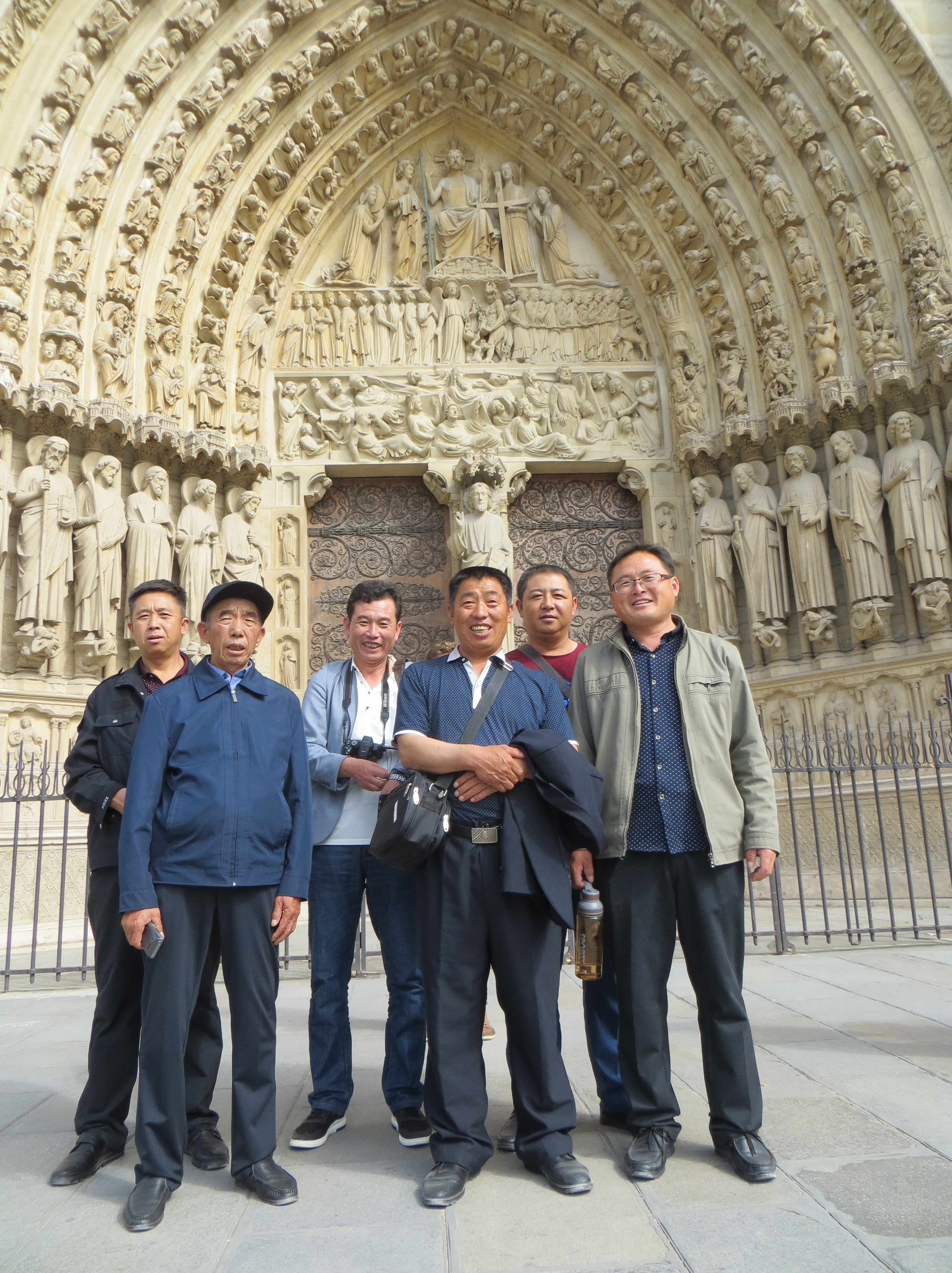
His Catholic faith was, um, catholic—he made a natural mentor for the budding world music movement. Apart from his beloved birdsong, both his music and teaching were permeated with genres like raga, gamelan, and gagaku. If only I could have introduced him to the Li family Daoist band in Paris!

Notre Dame

For yet more Messiaen, see here.

Indian and world fiddles

*See also Ways of playing the violin*

The other day, just before my alarming rendition of Bach on the erhu, I went to an enthralling concert of Carnatic violin by the sisters M. Lalitha and M. Nandini at the Bhavan Centre in West London, a lively centre for the Indian community.

How mesmerizing Indian music can be, unfolding naturally with grace and fluency! Learning such oral traditions is aided by memorizing sargam solfeggio. Tuning the strings in open fifths (like G–D–g–d, often used in world fiddle styles— actually, here they commonly have five strings) lends the violin a wonderful sonority (cf. Keef’s excited epiphany).

The ideal in many cultures is for instruments of all kinds to imitate the voice—I love the way Wu Mei decorates the vocal liturgy of the Li band on the guanzi oboe, for instance. It was by chance that I ended up playing the violin in WAM, but we can all appreciate the link between the voice and bowed lutes (or should I say friction chordophones? No you bloody shouldn’tThe Plain People of Ireland) by extending our interests to other world genres. OK, for us WAM fiddlers embarking on Mahler 5 there may be no clear benefits to this, but why don’t we all learn the rudiments of Indian style and technique too? However rigorous a training in rag may be, it can’t be as arid and painful as ploughing through sodding Ševčík studies—it’s amazing we didn’t all give up.

The Bhavan audience was sadly thin on the ground, but it’s the magic of the rapport that counts. It reminds me of a Mozart Requiem tour of Italy with John Eliot Gardiner in the 1990s. For some reason we ended up doing a gig at a dingy cinema in the sleepy town of Terni on a Sunday afternoon, performing for a tiny audience that barely outnumbered the massed orchestral and choral forces. Nonetheless, with stellar singers like Barbara Bonney and Anne Sofie von Otter, it was one of our most moving performances.

At the risk of sounding like Away from it all (“the one thing that Venice truly lacks is leprechauns“), here’s a random but inspiring sample of some further riches of world fiddling—needless to say, it’s all about technique at the service of the music, which in turn stems from its social use…

Still with the exquisite gamak styles of India, here’s a Hindustani female dynasty (cf. Rāg Malkauns):

And then there’s the wonderful sarangi—click here, here, and here for the remarkable work of Nicolas Magriel.

I outline some of the diverse bowed lutes of China here; the erhu is the least traditional of them, but you must hear this astounding playing. See also here. For the distinctive Korean haegeum, click here.

Irish fiddling can be irresistible (for more from Liz Carroll, listen to Dear Old Erin’s Isle here):

Some unaccompanied Bach (on violin instead of cello, for a change):

And Transylvanian bands (see mainly here):

Poland has some fine fiddle traditions too—here’s Stanisław Klejnas, from a village near Łódź:

From Iran, here’s Mohammad Reza Lotfi on kamancheh:

Kamancha playing from Azerbaijan is amazing too. I used to have a clip here of an Azeri party—complete with mobile phones, naff yet tasteful accompaniment, and no fancy fakelore costumes. But it’s disappeared, so we’ll have to settle for a reified official concert version:

And here’s a stellar gathering of players, all with their own distinctive styles (with thanks to Jeffrey Werbock, himself a fine exponent of Azeri music):

Note also the lyra of Crete and the Pontic Greeks. And here’s a taksim on violin by Salih Baysal (1973):

For more violin taksim, click here. See also New sounds of Anatolia.

For the Uyghurs of Xinjiang, besides the ghijak, the soul of the muqam is the plangent long-necked satar (featured in a wonderful muqaddime prelude here), but they use “our” violin just as expressively too, as on this recording of Raq muqam—from a cassette by the renowned singer Abliz Shakir in the early 1990s:

Some of these genres are explored in the fine projects Growing into music and The music of Central Asia.

That’s just a start. I leave jazz fiddling to another post… For yet more, see fiddles tag in the sidebar, introduced here. For more concerts at the Bhavan, click here and here.

Rag Kafi Zila

*For a roundup of posts on raga, with a general introduction, click here!*

kafi

Kafi, ragamala:
“Holding a delightful rasna-flower and wearing a garland of flowers,
she is a beautiful lady who enjoys the fanning. She has a celestial voice.
Such is Kafi ragini, who enters fully into the exploits of a hero.”

From the late 60s, at a time when it was hardly possible to be amazed by the riches of Chinese traditional music, I was devoted to Indian music—which then meant mainly the solo “classical” traditions, as it mainly still does in the popular image.

If Heart of Glass reminded me fleetingly, impertinently, of rāg Marwa and Nikhil Banerjee, I still treasure his lyrical rendition of rāg Kafi Zila, which appeared magically on BBC Radio 3 in the early 1970s.

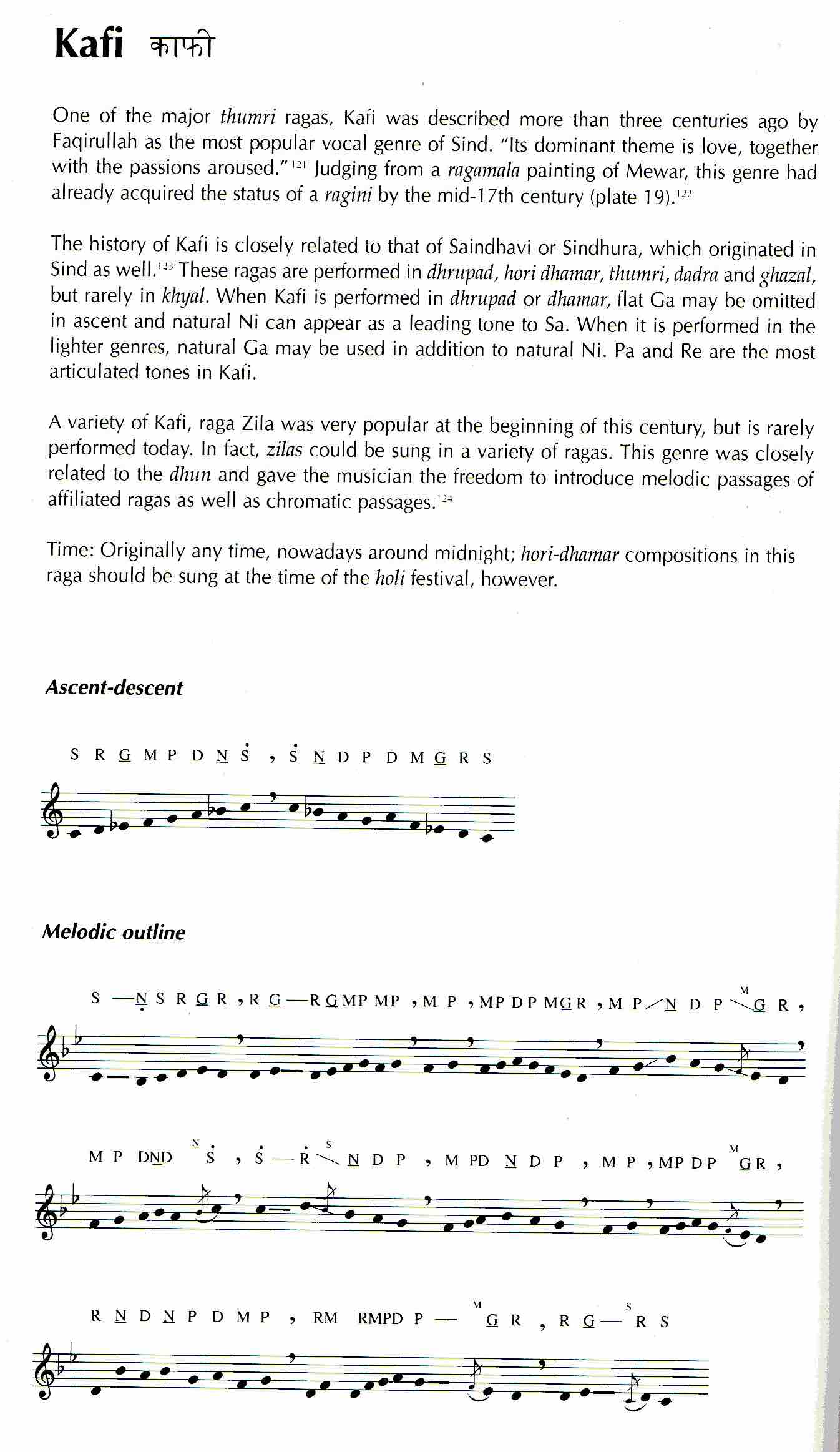
It’s an entrancing raga, for the second quarter of the night. Within its basic minor scale with flat 3rd and 7th, it sometimes features the major 3rd degree. Here’s the introduction to rāg Kafi in The raga guide:

Kafi RG 1

Kafi RG 2

The suave BBC announcer’s introduction (citing Alain Daniélou) remains etched in my heart:

Of shining whiteness,
Kafi, who inspires lust,
tenderly sits on the lap of her playmate in the royal palace.
Fond of parrots,
she is dressed in blue
and decked with jewels.
She is the image of sensuousness.
In the Lotus of my heart
I cherish her,
lovelier than Lakshmi
the goddess of Fortune.

Of course, as with Bach, I’m just reporting my own infatuation, which is merely a product of a particular place, social milieu, and time—far from the responses of indigenous audiences of various types.

Here’s one of several exquisite versions by Nikhil Banerjee, with Anindo Chaterjee on tabla:

And here he explores Mishra Kafi for over an hour:

Click here for a sarod version by Amjad Ali Khan.

Here’s a relatively light, but always entrancing, vocal rendition by the Dagar brothers:

As I observed here, training in Indian sargam solfeggio is a basic grounding in monophonic musics—far from a mere conceptual exercise, it draws us towards the heart of the music.

Heart of glass, and Rag Marwa

Heart of glass is yet another masterpiece from the late 70s—just after Naturträne.

Apart from its spacey vibe, there’s one detail of Debbie Harry’s song that Yer Average fan will experience instinctively, but the tedious analytical bent of the musicologist may home in on: the hallucinatory temporary modulation at the end of the third line (find/blind), fleetingly sketching a major triad on la—all the more ironic for the deflation expressed by the lyric.

That harmonic shift reminds me of rag Marwa, with its implied major scale on Dha/la (A major, one might say) over the Sa–Pa/do–so/C–G drone, the flat re (C♯) clashing with the tonic. Sure, Heart of glass hardly compares with the complexities of the ascending and descending scales of the raga, worked through over a long period, but hey.

Most transcendental are renditions in dhrupad style. Here’s Zia Mohiuddin Dagar on rudra vina, in his last year:

And Rahim Fahimuddin Dagar:

Nikhil Banerjee on sitar:

Here’s a sarangi version from Sultan Khan (compliments to the heading ‘Marwa’-lous!)):

For another rendition on sarangi by Ram Narayan, click here. For Amjad Ali Khan on sarod, see under Raga at the Proms; and for Hariprasad Chaurasia on bansuri, see Raga for winds.

For a roundup of my series on raga, with a general introduction, see here.

The iceberg

For Chinese culture (ritual, music) I always use the image of the iceberg—

to contrast the tiny little chunk that protrudes above the water (the conservatoire concert solos, and so on) with the vast unseen mass of popular culture below the surface—like temple fairs, shawm bands, household Daoists, spirit mediums

Of course it applies widely to world cultures (cf. Italy). Even under the umbrella of WAM, there’s a fluid canon changing over time, with many outer rings; socially too, it’s not just the professional symphony orchestras. And Indian music is far more than sitar solos.

As to Daoism, it’s far more than the Daoist Canon and the White Cloud Temple; and far more than wise southeastern Daoists doing their mystical sublimation in the course of a jiao Offering. And Daoist ritual—over China, north China, Shanxi, north Shanxi, and even in the north-eastern central area of Yanggao county, is far more than the Li band!

Speech therapists too consider “the iceberg of fear“.

Spring

Spring, not String.

Discussing ritual activity around Houshan in Yixian county, I mentioned the fine ritual specialist Li Yongshu in Baoquan village. After my little detour in Festivals, here the word for “village” is cun.

And Baoquan means Panther Spring—“spring” as in wellspring, not as in

with all the coiled sexual energy of a panther about to spring,

applied satirically to John Major.

Another nice John Major quote comes from a BBC correspondent reporting on the Prime Minister’s visit to an Indian mela:

He brought a splash of grey to an otherwise colourful scene.

Festivals: the official—folk continuum

The upcoming CHIME conference in LA (29 March to 2 April), presided over by the excellent Helen Rees, looks like a fine event, though I can’t make it. The theme this time is festivals.

Gansu miaohui FKTemple procession, Xincheng, south Gansu, June 1997. [1]
Photo: Frank Kouwenhoven. © CHIME, all rights reserved.

Of course, festivals and pilgrimages all over the world are a major theme of ethnography: not just Uyghur meshreps and mazar, and Tibetan monastery festivals, but Indian melas, Sufi festivals, the Mediterranean (Andalucian fiestas, south Italy…), Moroccan ahouach, you name it. Bernard Lortat-Jacob’s 1994 book Musiques en fête is charmant, with wise and vivid words about Morocco, Sardinia, and Romania (¡¿BTW, why do French books put the list of contents at the back?! ¡¿Typical Gallic contrariness?!)

To adopt the metaphor of “the whole dragon” again, there is a long continuum between folk festivals, based on ritual (often calendrical) observances, and secular events for a largely urban audience.

So I too am going to link up diverse themes like temple fairs, ritual, famine, village names, Eurovision, and propaganda. It does make sense, though—trust me, I’m a doctor.

Traditional events in China`
Funeral rituals have been my main topic in China for thirty years, but of course it’s not easy to plan visits much in advance. The calendrical dates of temple fairs (often known as miaohui) may seem easier to anticipate. Again, scholars of religion tend to home in on their specifically religious elements, as in the great jiao Offering—though note Ken Dean’s fine film Bored in heaven. But like funerals they are multivalent, embracing all kinds of activity: ritual, opera, folk-song, pop, commerce, “hosting” and “red-hot sociality” (Chau!)…

Apart from my 2007 and 2009 books, names like Zhao Shiyu, Guo Yuhua, Wang Mingming, Yue Yongyi, Stephan FeuchtwangAdam Chau, and Wu Fan spring to mind. The knack is to detail both sacred and secular aspects of temple fairs.

But the dates of calendrical rituals, like temple fairs, may not be easily vouchsafed to the outsider either. The temple fairs on the Houshan mountains in Yixian county southwest of Beijing, mainly in the 3rd and 7th moons, are much less well known than those of Miaofengshan, but they also draw huge crowds, both local and from further afield.

To work all this out you have to spend time around the villages of Liujing and Matou in the foothills around Houshan, and then observe who goes where when and does what. Although Chinese villagers are a rich source of ritual and musical information (far more than any silent library), they often speak prescriptively rather than descriptively, telling us on what occasions a jiao Offering ritual should be performed, whether or not is has been performed since the 1940s. They don’t necessarily volunteer information on change, preferring (like some officials and scholars) to present their traditions as constant, eternal—even if contexts and repertoires have evidently changed in their lifetime. On our first visit to Liujing we rather assumed that villagers’ descriptions of ritual pilgrimages related to “the past”— but we soon found that they were very much alive.

The Songs-for-winds associations: propaganda and catastrophe
What got me “thinking” (I use the word loosely) about all this was that 1950 visit to Tianjin of the “Songs-for-winds” band from Ziwei village, in what later became Dingxian county.

The Central Conservatoire (as it was then) was then still based at Tianjin, of course. The work of Yang Yinliu and Cao Anhe on the Songs-for-winds may be considered a prelude to that on the more solemn ritual style of the Beijing temples that Yang undertook from 1952, a topic that was to expand vastly after 1986. But the Songs-for-winds groups, more popular than the ritual style that is my main focus, are worth a little detour here.

We should bear in mind that such wind ensembles were quite unfamiliar to southerners like Yang and Cao. Having invited the Ziwei band to the conservatoire, they recorded their repertoire on a Webster wire recorder. The band went back some six generations, and under the leadership of the celebrated Wang Chengkui, they had invited the great wind player Yang Yuanheng  to teach them in the winters of 1945 and 1946. Yang Yuanheng, a former Daoist priest in a little temple in Anping county, was himself appointed professor of guanzi oboe at the conservatoire in 1950. [2] Yang Yuanheng, like the Buddhist monk Haibo, was a major influence on many shengguan ritual associations in the area: we would hear their names from many village associations.

Yang and Cao’s monograph on the Ziwei band, published in 1952,  consists mainly of transcriptions, with little of the social detail that they covered for the Wuxi Daoists or Yang’s 1956 Hunan fieldtrip. Ziwei would go on to supply wind players to many state troupes for decades to come.

Langfang huahui 1991

Secular New Year’s huahui parade, Langfang city, 1991.

Xushui
Adapted from my Folk music of China (p.196):

During the 1958 Great Leap Forward (or Backward, as it’s known), Dingxian and particularly Xushui counties became model counties for the relentless drive to full communization. [3] At the height of the Leap back in August 1958, Chairman Mao visited communes there. In Dasigexiang district just southeast of Xushui county-town, Dasigezhuang village was now renamed the 4th August brigade. Notable for its revolutionary fervour at this time was the “Great Leap Forward Songs-for winds association” of Qianminzhuang brigade in Xushui, which performed for this visit.

The propaganda of the Leap makes a stark contrast with the grim realities of the period, with villages throughout the area suffering from crop failure, famine, and social disruption.

Our visit to Qianminzhuang in 1993 was the only time I’ve ever had a police escort—to take me there for a change, not to drag me away! Predictably, such an effusive welcome for me as a “foreign guest” indicated close supervision and censorship of our fieldwork.

QMZ band 1993

QMZ pose 1993

Striking a pose with the leaders, Qianminzhuang 1993

In 1995 we visited some of the senior musicians independently, with much more useful results.

Xushui’s favoured status did nothing to prevent many starving to death there in 1960—but just near Qianminzhuang, the Gaozhuang ritual association still managed to restart in 1961. Religion revived in China precisely at moments of political crisis such as the famines of 1960 and the Cultural Revolution, albeit with great difficulty. It may provide solace, or a focus for resistance—both against Maoism and later against the insecurities ensuing its demise.

The Gaozhuang ritual association was one of many in Xushui villages that used, and use, the older more solemn shengguan style. Ritual associations throughout the area commonly claim transmission from either Buddhist monks (heshangjing 和尚經) or Daoist priests (laodaojing 老道經)—the Gaozhuang association is Buddhist-transmitted. In another common taxonomy, the association divides into “front altar” (qiantan, the shengguan instrumental ensemble, and “rear altar” (houtan, vocal liturgy).

Despite its revolutionary image, Xushui county has remained a hotbed for religion, notably the cult of the sectarian creator goddess Wusheng laomu. Associations there commonly hang out ritual paintings, like the Ten Kings (Shiwang) or Water and Land (Shuilu) series, and they use “precious scrolls” and other ritual manuals. They too are within the catchment area of Houtu worship—they used to make the pilgrimage to Houshan. Even the revolutionary Qianminzhuang band told us that their former tradition was to recite the scriptures, performing only as a social duty for funerals, not for weddings. And certainly not to accompany mendacious parades to report a bumper harvest…

In 1994 the Gaozhuang association built an Ancestral Hall to Venerable Mother (Laomu citang), occupying about one mu, stylish and grand. It cost around 60,000 kuai to build; the stele lists 132 donors, who gave from 50 up to 3,000 kuai. The altar has Wusheng laomu in the centre, Wangmu niangniang and Songzi niangniang to the right, Cangu niangniang and Houtu niangniang to the left.
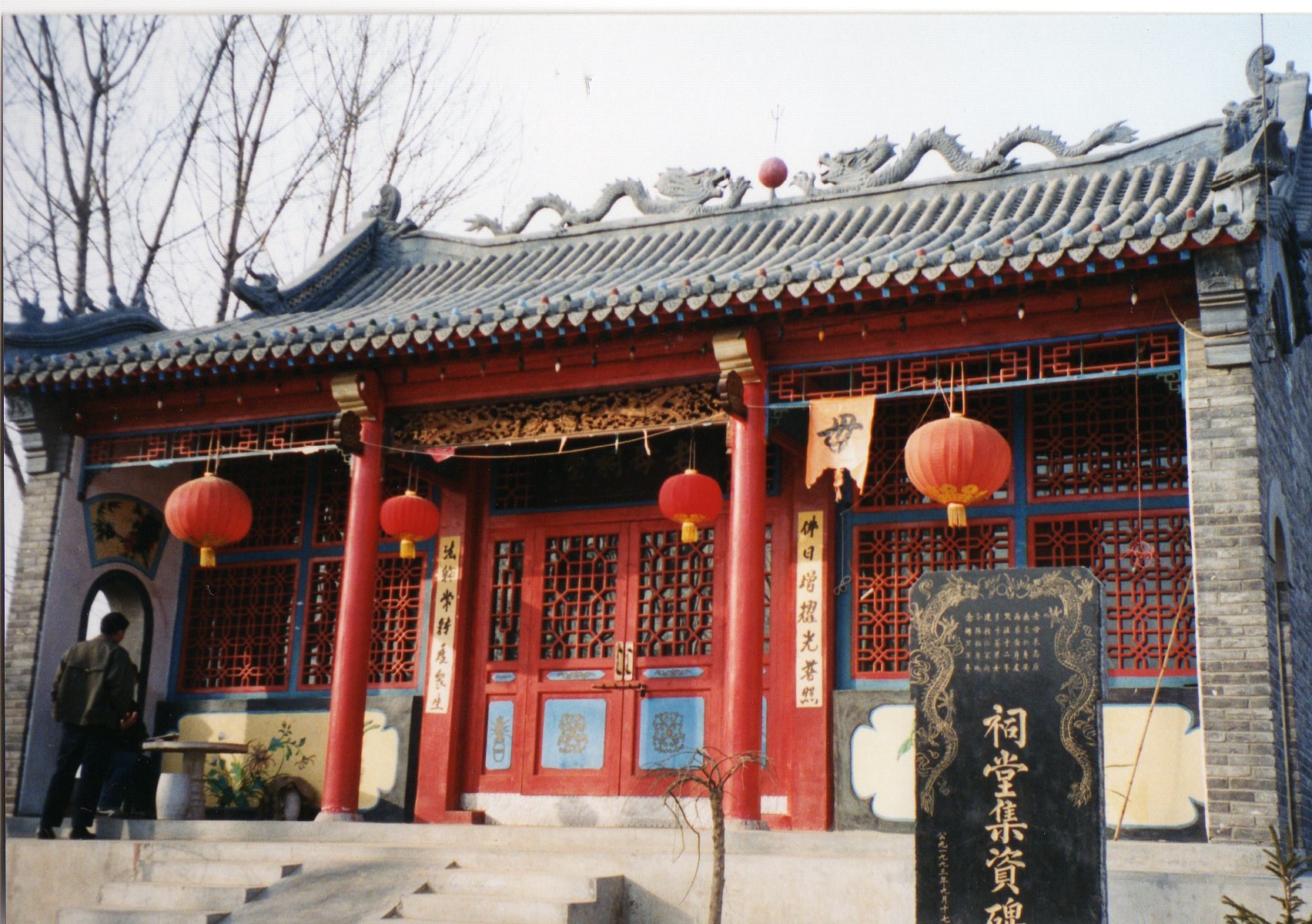
Gaozhuang citang

The village Party Secretary told us that sources of support included incense money from the Great Tent Association (Dapeng hui, a common term in the area for a ritual association) and from the temple, and money from fortune-telling and curing illness. He reflected, “A dozen or so women kept on coming to see me about building a temple. I had no choice—the brigade couldn’t refuse, so I gave them a plot of land. Believing in the gods and having a temple is no bad thing, it’s not as if you stop production if you believe in it!”

In all, the flamboyant (and readily secularized) Songs-for-winds style remains a common image of wind bands on the Hebei plain, but since all our fieldwork through the 1990s it is clear that ritual practice, with its more solemn shengguan instrumental style, is both older and more common. It is resilient too. This persistence of tradition, both in religious and musical practice, is all the more striking in such a once-revolutionary county as Xushui.

Mao was impressively modest about his limited success when he admitted to Nixon in 1972:

“I haven’t been able to change [China]—I’ve only been able to change a few places in the vicinity of Peking.”  [4]

But he wasn’t modest enough: in some ways even a county so near Beijing, such a focus of the revolution, has remained resistant to Maoist ideology, predating and outliving it. Still, disruption was severe. For more on Xushui, see here.

Official festivals in the 1950s
Meanwhile, the new government, in its own way, was promoting local culture through the medium of regional folk festivals (diaoyan, huiyan). First, local festivals were held to select representatives for major performances in the regional capitals. Some laicized priests were even assembled to perform as “troupes“, sometimes for the first time in many years—such as Baiyunshan Daoists (1955), Wudangshan Daoists (1956 and 1957), Wutaishan Buddhists (1958). For such performances, inevitably, their shengguan instrumental music was plucked out of its ritual context. I haven’t heard stories as distressing as the fate that befell kobzari blind minstrels in Ukraine when summoned for an official festival in the early 1930s; but folk ritual specialists were still anxious about performing for officials around 1980.

These festivals served partly as auditions for the state song-and-dance troupes then expanding all over China. Daoist and Buddhist ritual specialists had a deserved reputation as outstanding instrumentalists. Many, like our very own Li Qing (my book pp.113–25), were recruited as musicians to state troupes around 1958—and then sent home again as the state apparatus collapsed in 1962.

While such festivals stimulated the collection and documentation of folk music, we must balance this with the ongoing assaults on its traditional context. The background ( beginning from the 1940s) was campaigns against “feudal superstition”, terrifying public executions of sectarians, and the destruction of temple life.

The reform era
Urban festivals featuring rural groups—perhaps related to a conference—make a convenient recourse for busy academics into whose holidays they fit nicely. From the 1980s, the secular arts festivals of the Maoist era were remoulded into more glossy events. In 1990 the Li family Daoists took part in a festival of religious music in Beijing.

By the 21st century the new ideology was confirmed in the regular staged “living fossil” presentations of the Intangible Cultural Heritage. The latter project, with its whole bureaucratic workings, has now become a major research topic on its own, at the expense of studies of the local traditions that it is supposed to assist (my book pp.331–3). Note also the Qujiaying bandwagon.

I tend to steer clear of conferences, but in May 2016, as a pretext for going to hang out yet again with Li Manshan in Shanxi for a couple of weeks, I accepted an invitation to take part in a conference celebrating the 80th birthday of my esteemed teacher Yuan Jingfang in Beijing (for the resulting volume, see here).

It was a déjà-vu experience. Apart from a sequence of eulogies, the event also featured staged performances from three representatives of Yuan Jingfang’s long-term research areas: the Hanzhuang ritual association from Xiongxian in Hebei (near Xushui), the Zhihua temple group, and a ritual band from near Xi’an.

Hanzhuang 1993

Filming the Hanzhuang association in their ritual tent, 1993 (photo: Xue Yibing). Rear centre: two frames of ten-gong yunluo.

It made me feel my age, reminding me of all our visits to these very groups between 1986 and 2001. Taking time out of the conference to chat with the Hanzhuang group outside by the lake, we recalled their kindly association leader Xie Yongxiang 解永祥, father of the present leader, and another of those wise sheng masters. We had learned a lot from him in 1993 and 1995.
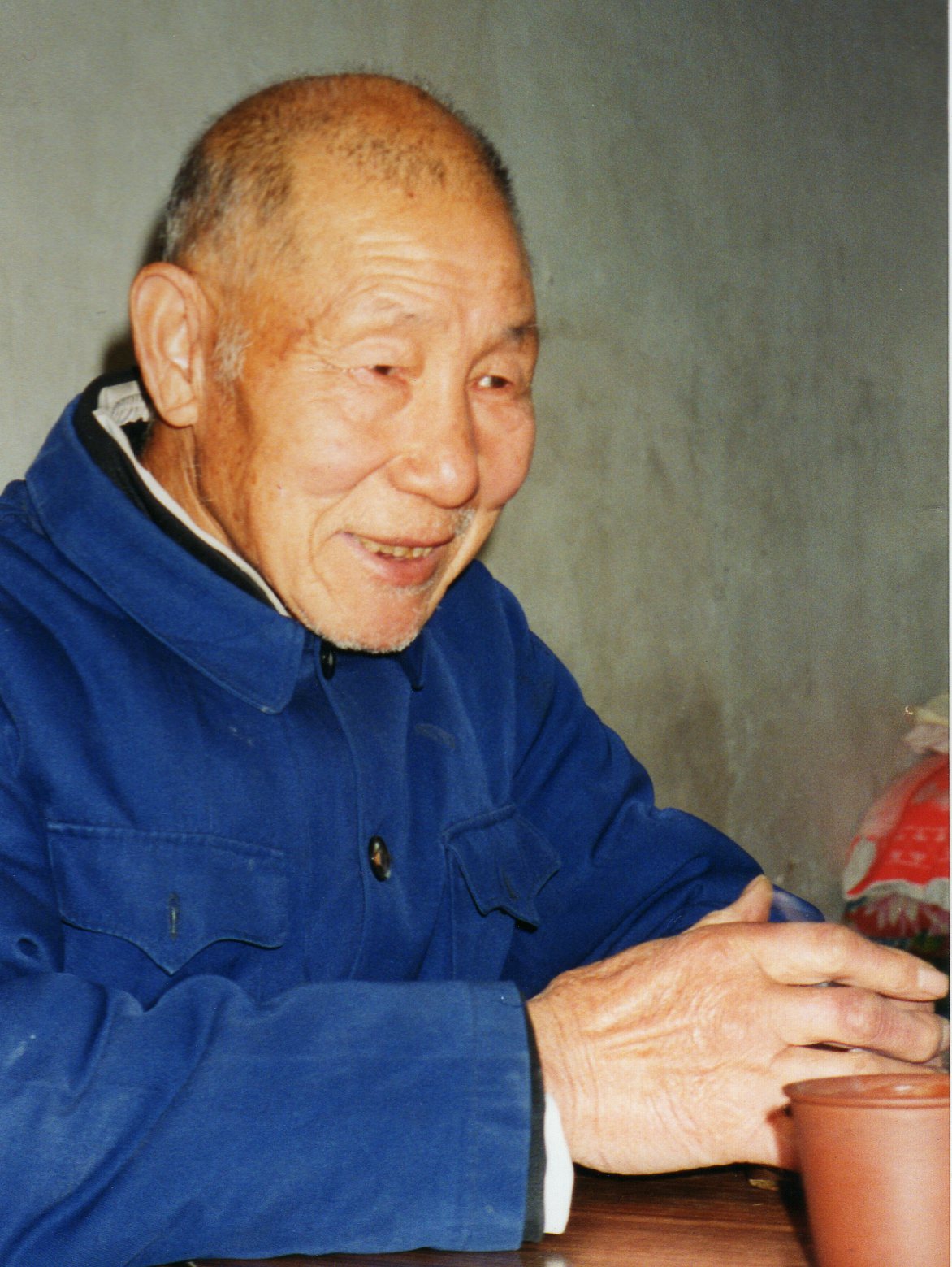
Xie Yongxiang 1995

Xie Yongxiang, 1995

But returning to the conference—the object of admiration, inevitably, was their “music”, detached from its enduring social context. I already missed hanging out with Li Manshan in the scripture hall.

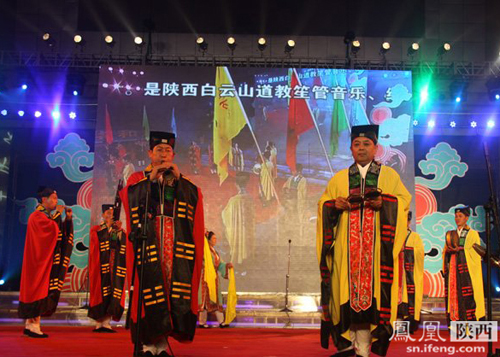
All the glossy stage presentation has many Western parallels—flamenco on the Terry Wogan show, WOMAD, Songlines, prizes, urbane discourse explaining its “cultural value” to outsiders… The fancy costumes and dry ice of many Chinese events are reminiscent of Eurovision; they may seem like a Disneyland version of the Chinese heritage.

That photo comes from a recent ICH “performance” of the Baiyunshan Daoists, no less.

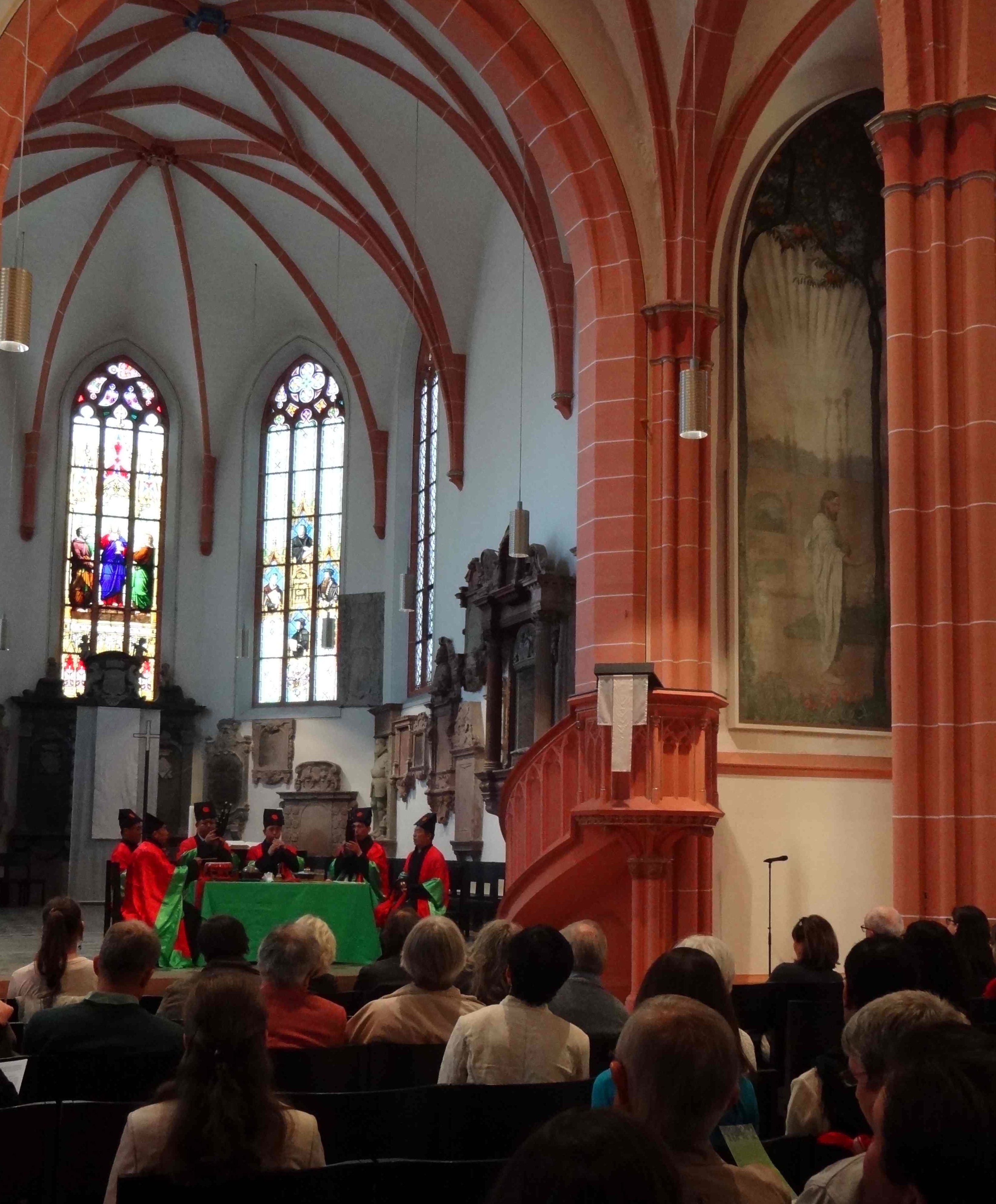
Now, I adore opportunities to present the Li family Daoist band on the concert platform (see e.g. this post and a whole related series of vignettes from May 2017), but while it is of course a compromise, we take care not to tart them up—we can hardly do otherwise, so solemn is their demeanour. The ambience and acoustic of churches makes a fine setting,  the Daoists’ sheng mouth-organs filling the Peterskirche in Heidelberg on our 2013 tour (cf. Buildings and music):
Hberg 2012

The Li family Daoist band in concert, Heidelberg April 2013.

Still, their regular “rice-bowl”—day in, day out—is always performing funerals for their local, not global, clientele.

What is dodgy is when people begin mistaking the staged events for the Real Thing, or some kind of ideal. Urbanites may do so, but villagers know better. Of course those staged events are themselves a legitimate, and popular, object of scholarly analysis. But I worry that it creates a fait accompli, like the way that in old-school WAM musicology the Great Composers were the main story (as deconstructed by McClary, Small, Nettl)—“this is what we find, so it must reflect the real picture, and so this is the object of study”. As always, “modern” secular performance doesn’t replace traditional activity: they co-exist.

The CHIME conference in LA will doubtless turn up many instances of what I’m struggling not to call “contested negotiation”. Anyway, staged events can give us a lead, rather like using the photos in the Anthology, otherwise flawed, to draw us towards folk activity.

For thoughts on the theme of the 2021 CHIME conference, see here.


[1] For more, see Frank Kouwenhoven, “Love songs and temple festivals in northwest China: musical laughter in the face of adversity”, in Frank Kouwenhoven and James Kippen eds., Music, dance and the art of seduction.
[2] For this whole section, see my Folk music of China, pp.48–52, 195–203; “Chinese ritual music under Mao and Deng”, British Journal of Ethnomusicology 8 (1999): 27–66; “Reading between the lines: reflections on the massive Anthology of folk music of the Chinese peoples”, Ethnomusicology 47.3 (2003): 287–337. See also my In search of the folk Daoists of north China, pp.166–7, 183–4, 188–90.
[3] As correctives to all the Xushui propaganda, see e.g. the brilliant works of Friedman, Pickowicz, and Selden, Chinese village, socialist state and Revolution, resistance, and reform in village China—describing a commune not far from Xushui. Note Chinese village, socialist state, pp.215–20; Dikötter, Mao’s great famine, pp.40, 47–9, 68–70; and estimable analysis online in Chinese, e.g. http://mjlsh.usc.cuhk.edu.hk/book.aspx?cid=6&tid=184&pid=2269. For the model commune of Greater Quanshan in Shanxi, precursor of Dazhai, and temporary “home” to the Li family Daoists, see my Daoist priests of the Li family, pp.122–3, and here, under “Famine in China”.
[4] Also reported by Henry Kissinger in Newsweek, 3rd March 1997, p.31.

The meaninglessness of ritual

Staal

The work of Frits Staal on Indian ritual contains much from which scholars of Daoist ritual (not least I) might benefit, confronting issues that I encounter in working with Li Manshan. Staal’s ideas about orthopraxy seem to go beyond the discussions following those of James Watson for China. There’s a lot more to Staal’s work than that, but this is a start.

In “The meaninglessness of ritual”[1] Staal eschewed “the dewy-eyed romanticism that is pernicious to any serious study of cultures and people.”

A widespread but erroneous assumption about ritual is that it consists in symbolic activities which refer to something else. It is characteristic of a ritual performance, however, that it is self-contained and self-absorbed. The performers are totally immersed in the proper execution of their complex tasks. Isolated in their sacred enclosure, they concentrate on correctness of act, recitation and chant. Their primary concern, if not obsession, is with rules. There are no symbolic meanings going through their minds when they are engaged in performing ritual.
Such absorption, by itself, does not show that ritual cannot have a symbolic meaning. However, also when we ask a brahmin explicitly why the rituals are performed, we never receive an answer which refers to symbolic activity. There are numerous different answers, such as: we do it because our ancestors did it; because we are eligible to do it; because it is good for society; because it is good; because it is our duty; because it is said to lead to immortality; because it leads to immortality. A visitor will furthermore observe that a person who has performed a Vedic ritual acquires social and religious status, which involves other benefits, some of them economic. Beyond such generalities one gets involved in individual case histories. Some boys have never been given much of a choice, and have been taught recitations and rites as a matter of fact; by the time they have mastered these, there is little else they are competent or motivated to do. Others are inspired by a spirit of competition. The majority would not be able to come up with an adequate answer to the question why they engage in ritual. But neither would I, if someone were to ask me why I am writing about it.
[…]
Most questions concerning ritual detail involve numerous complex rules, and no participant could provide an answer or elucidation with which he would himself be satisfied. Outsiders and bystanders may volunteer their ideas about religion and philosophy generally—without reference to any specific question. In most cases such people are Hindus who do not know anything about Vedic ritual. There is only one answer which the best and most reliable among the ritualists themselves give consistently and with more than average frequency: we act according to the rules because this is our tradition (parampara). The effective part of the answer seems to be: look and listen, these are our activities! To performing ritualists, rituals are to a large extent like dance, of which Isadora Duncan said: “If I could tell you what it meant there would be no point in dancing it.”
Ritual, then, is primarily activity. It is an activity governed by explicit rules. The important thing is what you do, not what you think, believe or say.

This echoes Catherine Bell’s comment that I cited in my post on Bach and Daoist ritual—for her masterly surveys of ritual studies, click here.

Here’s a trailer for Staal’s 1975 film on the Vedic fire ritual:

Poul Andersen offers caveats to Staal in a review of volumes on Shanghai Daoist ritual (Daniel Overmyer, Ethnography in China today, pp.263–83). He highlights the interpretations of the participants (including the liturgists themselves), which “in many ways influence the actual performance. They are relevant for the way in which performances take shape, develop, and are modified over time.” Such interpretations, while important, rarely offer a detailed critique, so such a view refines rather than refutes Staal’s point.

I pursue the theme under Navajo culture.


[1] Numen 26.1 (1979): 2–22. See also Ritual and mantras: rules without meaning (Motilal Banarsidass, 1996), and (source of my quote here) S.N.Balagangadhara, “Review of Staal’s Rules without meaning”, Cultural dynamics 4.1 (1991), pp.98–106.

Solfeggio

An aspiring singer on a TV talent show decided to perform Doh a deer, and rashly decided to go out, too literally, on a high note:

do

Which reminds me—the traditional gongche notation for the melodic skeleton of ritual shengguan ensemble translates nicely into solfeggio (and indeed into modern Chinese cipher notation)…

25-lq-zouma

Da Zouma score, written for me by Li Qing, 1992 (playlist #4, commentary here).

“But that’s not important right now”. I allude, of course, to Airplane:

The Chinese gongche system, like those of Europe and India, is heptatonic:

cipher notation:  1     2     3       4     5       6       7
solfeggio:              do  re   mi     fa    so     la      si
Indian sargam:   Sa  Re   Ga    Ma   Pa   Dha  Ni
gongche:               he  si    yi  shang  che gong  fan
,
with liu and wu as upper octave notes for he/do and si/re respectively (taking the older system with he, rather than shangas do! Call Me Old-fashioned).

For those who can’t fathom the British propensity for punning, the only line of Doh a Deer that makes any sense is La, a note to follow so—precisely the only line where the author reveals a touching fallibility. Such literal audiences would be happier if it were all like that:


Re, a note to follow do
Mi, a note to follow re
Fa, a note to follow mi
and so on…

It only remains to overhaul the opening line. The original version “La, a note to follow so—if you’re moving upwards in conjunct motion that is” was overruled as too pedantic, of course.

Another fun exercise is to sing the phrases in reverse order, descending instead of ascending from Doh:

Doh, a deer…
Ti, a drink with jam and bread
La, a note to follow ti!
So, a needle pulling thread
etc.

Given how well we know the song, it seems a bit weird how crap we Brits are at solfeggio. Another fun game would be to try singing the whole thing only in solfeggio:

Do, re mi, do mi do mi,
Re, mi fafa mire fa

and so on.

Then we can use the tune to familiarise ourselves with Indian and Chinese solfeggio:

Sa, Re Ga, Sa Ga Sa Ga,
Re, Ga MaMa GaRe Ma…

he, si yi, he yi he yi,
si, yi shangshang yisi shang

We can also sing the song to the many scales of Indian raga in turn, with their varying flat or sharp pitches (note my series, introduced here)—a simple example: in rāg Yaman, try singing a sharp fourth for fa, a long long way to run

Alas, a fascinating medley of versions in French, German, Italian, Spanish (x3), Japanese, and Persian has just disappeared from YouTube. Let me know if you find it!

For a brilliant pun on the Mary Poppins song, see here. And for “do, a note to follow mi“, click here.