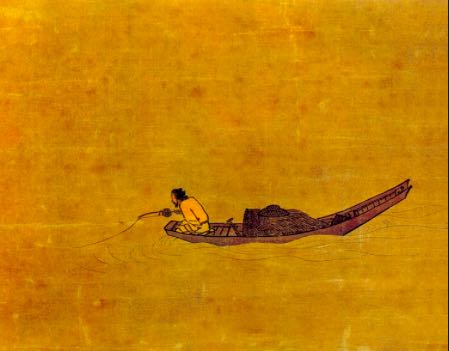
Fishing alone on cold river 寒江獨釣圖, Ma Yuan (1160–1225).
To follow A Tang couplet, the bold investigative journalism of the “underground historian” Jiang Xue 江雪 (see under Sparks) reminds me of one of the great Tang poems, by Liu Zongyuan (773–819), River Snow (much discussed, e.g. here):
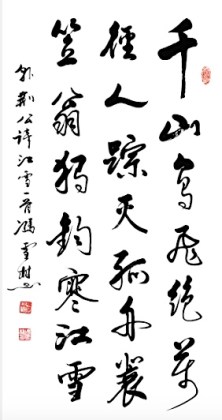
Calligraphy by Feng Xuelin 冯雪林 (b.1950).
《江雪》
千山鳥飛絕 On a thousand mountains, not a bird takes flight 萬徑人蹤滅 On ten thousand paths, not a soul in sight 孤舟簑笠翁 In a solitary boat, grass-caped old man in bamboo hat 獨釣寒江雪 Fishing alone in snow of cold river
I’ve got a lot of time for blind musicians around the world, but somehow I’ve never quite warmed to the great Ray Charles (1930–2004; website; wiki; YouTube channel)—probably because I’m allergic to singers accompanying themselves at the piano, smacking of mere showbiz entertainment, the feel-good crossover into pop seeming too flagrantly commercial. But (not for the only time) I’ve been missing out.
The balance of joy and pain—Passion in its various senses—is a common issue throughout pop, folk traditions, and Western Art Music. Clearly some of the great performers communicate great joy through music and dance, from Bach to Madonna; Billie Holiday had a unique ability to transmit both at the same time. But when the theme of so many songs is suffering (e.g. flamenco), I generally find the smiley stage demeanour of musicians false, superficial. That jovial image was common enough in the days before dour hardcore jazzers like Miles Davis, but to me Ray Charles somehow didn’t seem troubled enough, despite his difficult childhood and his later struggles with heroin. As he played to the gallery, finding an image where he’s not grinning is no easy task. Now, at last, I’ve got over the shiny showbiz surface.
Henry Pleasants observed:
Sinatra, and Bing Crosby before him, had been masters of words. Ray Charles is a master of sounds. His records disclose an extraordinary assortment of slurs, glides, turns, shrieks, wails, breaks, shouts, screams and hollers, all wonderfully controlled, disciplined by inspired musicianship, and harnessed to ingenious subtleties of harmony, dynamics and rhythm… It is either the singing of a man whose vocabulary is inadequate to express what is in his heart and mind or of one whose feelings are too intense for satisfactory verbal or conventionally melodic articulation. He can’t tell it to you. He can’t even sing it to you. He has to cry out to you, or shout to you, in tones eloquent of despair—or exaltation. The voice alone, with little assistance from the text or the notated music, conveys the message.
For the gamut of vocal techniques in world music, note the wonderful CD set Les voix du monde.
Ray was with Atlantic Records from 1952 until signing with ABC in 1959. Here’s I got a woman (1954): *
In 1957, with Milt Jackson on vibes, he recorded Soul brothers and Soul meeting, also playing alto sax (here as playlist):
What’d I say (1959), with its “grunt’n’groan” exchanges, was a huge hit, and a major influence on the Beatles and the Stones:
Nelson George wrote:
By breaking down the division between pulpit and bandstand, recharging blues concerns with transcendental fervor, unashamedly linking the spiritual and the sexual, Charles made pleasure (physical satisfaction) and joy (divine enlightenment) seem the same thing. By doing so he brought the realities of the Saturday-night sinner and Sunday-morning worshipper—so often one and the same—into raucous harmony.
What’d I say became the finale to all his shows, and has been widely covered. Ray observed:
I saw that many of the stations which had banned the tune started playing it when it was covered by white artists. That seemed strange to me, as though white sex was cleaner than black sex. But once they began playing the white version, they lifted the ban and also played the original.
The great ethnomusicologist Bernard Lortat-Jacob devotes an essay to the song in his book Petits pays, grandes musiques.
From 1962 Ray added Country to his range—in this Nashville Special from 1985 he sang I can’t stop loving you with his friend Willie Nelson:
And here’s Spirit in the dark, his cameo with Aretha Franklin (see e.g. Amazing Grace, and under Detroit 67) in her joyous 1971 show at the Fillmore West (from 6.15):
Over the following years, with the scene ever changing, while Ray Charles’s output became less original, his commercial success was modified as he assumed the comfortable role of familiar legend performing a well-established playlist—a common pattern.
The documentary The genius of soul (1991) provides good context, including tributes to (and from) his fellow musicians:
And here’s a playlist of clips from the movie Ray (2004):
Originally shown on BBC4 in 2020 (reviewed here), we can now watch it on YouTube:
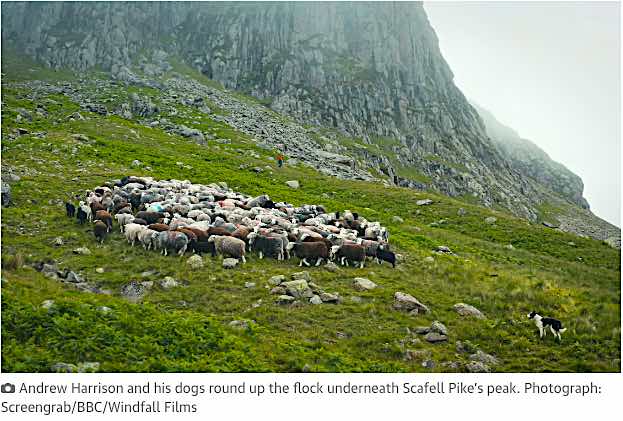
From their base in the valley of Eskdale, the shepherds tend to their flock on the slopes of Scafell Pike.
I’m generally resistant to nature films, but this is an exquisite meditation in an awe-inspiring landscape, neither sentimental nor weird like One man and his dog. Sounds of nature (bleats, barks, birdsong) largely suffice—no romantic music distorts the grandeur of the landscape, and the human voice is heard only rarely. The shepherd Andrew Harrison occasionally makes thoughtful, instructive interjections in his dry, matter-of-fact tone. Specially-commissioned poetry by Mark Pajak was presumably designed as a contrast, and could probably be evocative, but I felt that Maxine Peake (otherwise wonderful) burdened it with too much thespian pomp.
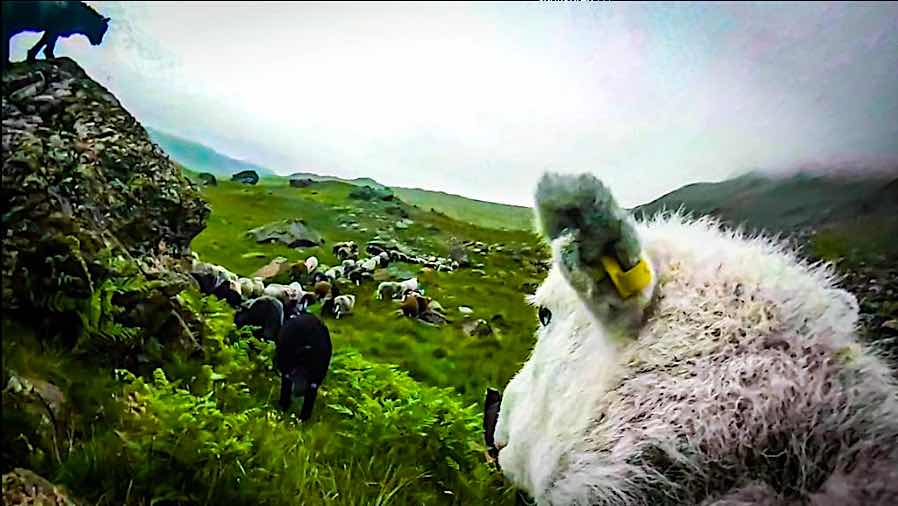
Anyway, the drone footage is mesmerising, with long slow aerial pans an ideal way to transmit the tranquil majesty of the fells. At ground level, the bodycam on the shepherd enhances the atmosphere, while the only moments at all resembling hurly-burly come from the bodycams on sheep and dog.
One hardly feels a story is being told; the fells, and the sheep, are just there. Most of the time the solitary shepherd is the only human presence. Half-way through, the fellside gather adds a modest sense of drama, as he becomes part of a little team coaxing the sheep down from austere heights. Only towards the end do we reach verdant valleys, with enclosures, sheep pens, and even farmhouses, and the quasi-dénouement of the shearing. The aerial drone, tracing the patterns of the flock, continues to weave its magic.
It’s an enchanting film.
With thanks to Caroline
* * *
Though I’ve never been at all nostalgic for my youth, I’m reminded of annual school holidays in the Lakes with my parents, exploring the fells with the aid of the Wainwright guides (rather before they acquired a wider cult following), with their beautiful hand-drawn maps, drawings, and directions—his project one of the great labours of love. Entering the world of fells, tarns, scree, bracken, and dry stone walls made a welcome diversion from Ancient Greek verbs and Ševčík violin studies in the London suburbs. Only rarely do I realise what a great gift those holidays were.
Still, the goal of outsiders swanning in for some fell-climbing is very different from that of the solitary local shepherd. For the Lakes and Heritage flapdoodle, click here.
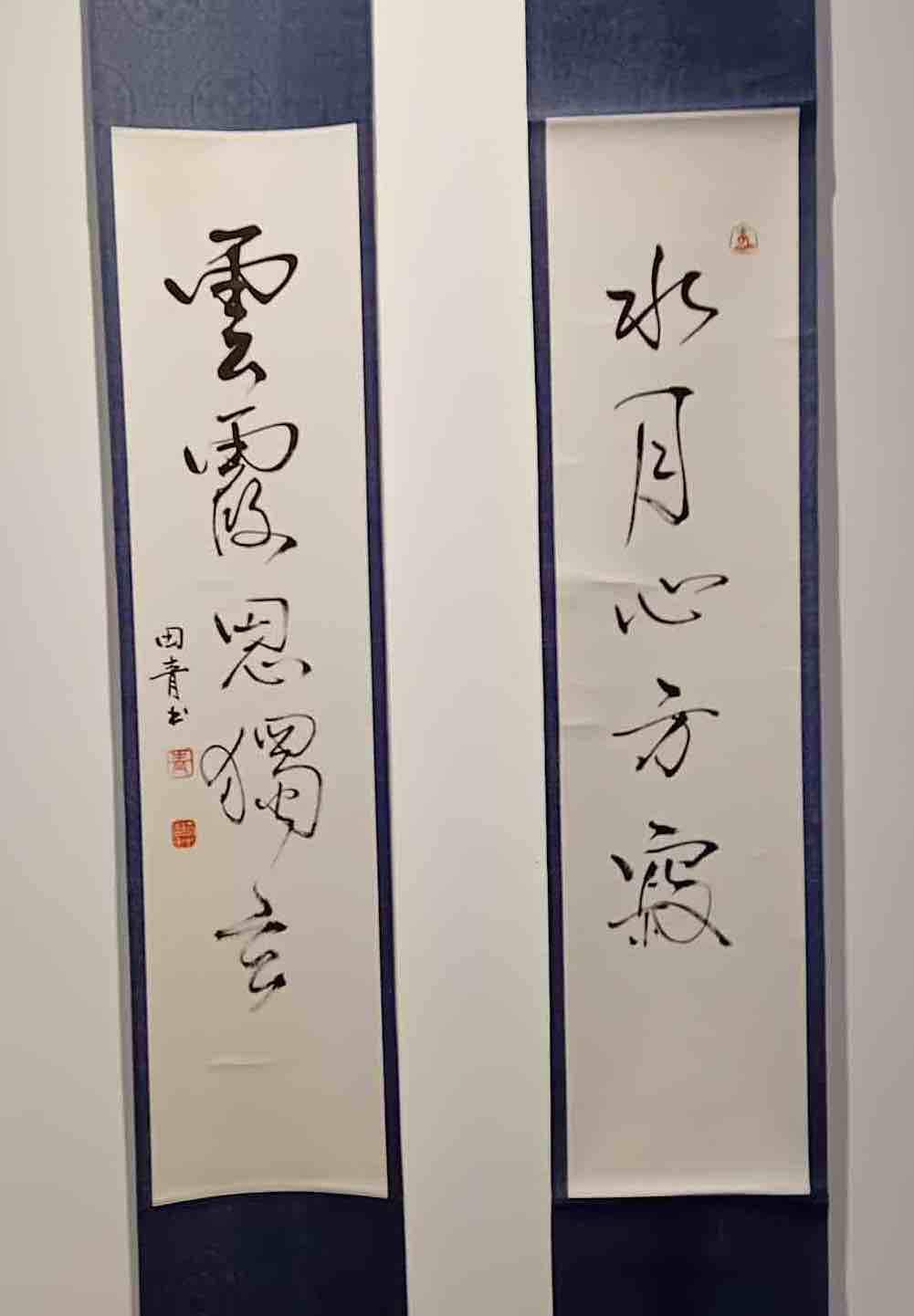
Adorning my newly-transformed house is calligraphy that my old friend Tian Qing wrote for me over thirty years ago, rather before he became an eminent cultural pundit. Among his endless stories, I’m always amused by the telegram he sent me from Beijing as we prepared for the Wutaishan monks’ UK tour in 1992, and the one about misreading a restaurant sign…
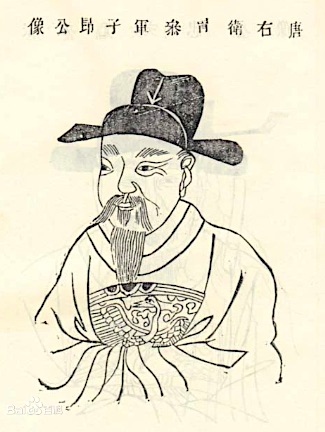
The couplet comes from a poem by the early-Tang poet Chen Zi’ang (661–702), who served as an advisor to Empress Wu Zetian, and (by an interesting coincidence) spent time in prison.
Chen composed the poem (see e.g. here and here) in 692 in praise of the illustrious Chan Buddhist master Yuanhui 圆晖. It’s generously titled
《同王员外雨后登开元寺南樓因酬晖上人獨坐山亭有贈 》
鐘梵經行罷,香床坐入禪
岩庭交雜樹,石濑瀉鳴泉 水月心方寂,雲霞思獨玄
寧知人世里,疲病苦攀缘
The couplet in question evokes Yuanhui’s meditation:
Moon in water, heart at last tranquil Clouds and haze, pondering particularly profound
The moon reflected in water is a Buddhist metaphor for the illusory nature of life (cf. the early-Qing-dynasty Shunzhi emperor’s long poem on impermanence, recited for rituals by the Li family Daoists until the 1960s). Tang poets frequently extolled their interactions with Chan Buddhist masters (see e.g. here).
Tian Qing, Beijing 1987.
I don’t know if this was at the back of Tian Qing’s mind, but apart from our proclivity for Chan (Zen), the opening character of the poem is zhong 鐘 (bell), my Chinese surname, accompanying the vocal liturgy that I was just getting to know (mainly among household rather than temple ritual specialists)… I can’t find an English translation of the complete poem by someone who actually knows about Tang poetry, so here’s my very approximate rendition (“Hey, I’m just a fiddle player”: revisions welcome!):
Finished are sounds of bell with chant, and scripture ambulation On incense platform he sits to enter meditation
Rock garden interspersed with trees Eddying of rocks, swirling round resounding spring
Moon in water, heart at last tranquil
Clouds and haze, pondering particularly profound
How could he know, among the human world, Our fatigueand disease at the bitter social climb?
Besides Tian Qing’s many reflections on the Intangible Cultural Heritage (in English, see this interview with Ian Johnson), for his calligraphy and painting, see Fayu chanfeng: Tian Qing shuhua zuopin ji 法雨禅风:田青书画作品集 (2014). For his writings on Buddhism, see e.g. his book Chan yu yue 禅与乐 [Zen and music] (2012) and Liu Hongqing 刘红庆, Foxin 佛心 (2007)—for Liu’s harrowing study of blind bards in Shanxi (whom Tian Qing also promoted), click here. And for the bond between qin zither, chess, calligraphy, and painting, see masters featured in The qin zither under Maoism.
Following The souls of China (2017), Ian’s valuable survey of the diverse manifestations of religious activity in the PRC, this is a most admirable study—thoughtful and eminently readable. Ian’s website lists the many rave reviews by people far more qualified than me, so I need hardly add to them; but I’d really like to spread the word still further. For his teaching notes, click here.
Sparks revolves around the control of history (“a battleground for the present”), and the role of memory in countering official propaganda. While “dissidents” are well documented for the Soviet bloc (for the USSR itself, Ian refers to Orlando Figes’ The whisperers; see also under Life behind the Iron Curtain), their Chinese counterparts have been less prominent in the public eye (see e.g. China: memory, music, society).
The book’s protagonists are “underground historians” (Sebastian Veg: “amateur or one might say guerrilla historians”), waging an “asymmetrical battle between a few, often beleaguered citizens opposing an overwhelmingly strong state”. While much of the material here is available in niches of academia (the work of the counter-historians has been highlighted by Western scholars such as Geremie Barmé, David Ownby, and Sebastian Veg), Ian portrays even activists who are already quite well-known with great clarity and perception. A major thread through all this is the personal missions of Ai Xiaoming and Jiang Xue.
Ai Xiaoming (left) and Jiang Xue—among the images by Sim Chi Yin that enrich the book.
As noted in a review by Han Zhang, Ian’s first book on China, Wild grass (2004), covered a not dissimilar group of activists during a relatively liberal period. Whereas after the authoritarian clampdown since 2016 his tone might seem less upbeat, nonetheless the work of those introduced in Sparks continues to inspire hope, even amidst the gruesome litany of atrocities, persecutions, and cover-ups that they document.
Ian meshes the successive eras of modern China: pre-Liberation, Maoism, the “reform and opening” of the 1980s and the early 21st century, back to the current retrenchment under Xi Jinping.
This conviction of history’s importance drives a movement of underground historians that has slowly gained momentum over the past twenty years. I call these people historians as a shorthand for a broad group of some of China’s brightest minds: university professors, independent filmmakers, underground magazine publishers, novelists, artists, and journalists. Some are outsiders and might be thought of as dissidents, but most have one foot inside the system, where they continue to hold jobs, own property, and raise families. All of them risk their careers, their futures, and prison to publish samizdat journals, banned books, and independent documentary films. They seek to correct the Party’s misrepresentation of the past and change their country’s slide toward ever-stronger authoritarian control. And they do so by using new technologies to publicize the regime’s failings, often linking current problems to debacles of the past.
It’s long been clear that not all Chinese people gullibly accept Party propaganda. As the state reverts to more draconian policies, while the growth in new technology helps the security surveillance apparatus, righteous Chinese historians also use it to find ways to evade censorship. And their mission is important for our understanding of China:
If people grow up thinking that the Chinese Communist Party played a key role in fighting the Japanese, took power thanks to popular support, and is led by a group of meritocratic patriots, then they will have a hard time understanding why China is prone to purges, corruption, and political violence.
* * *
Sparks is in three parts, The Past, The Present, and The Future. The chapters are interspersed with vignettes on Memory.
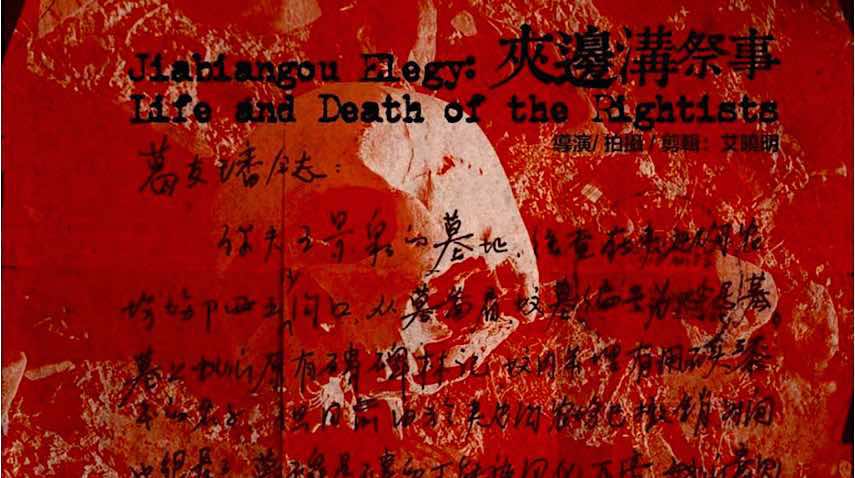
Part One opens with the labour camp of Jiabiangou in the poor northwestern province of Gansu, a series of determined investigations culminating in the long documentaries of Ai Xiaoming and Wang Bing. And this is no mere documenting a traumatic past, as Ai Xiaoming’s experience spells out:
The “hit, smash, loot” tactics of the Cultural Revolution that she and her family had experienced were not unique and are not dead; it is how the party regularly deals with people who have different views—especially when they dare touch on Communist Party history.
Still in the northwest, the memoirs of Gao Ertai (a Jiabiangou survivor) reveal the political turmoil at the Buddhist cave complex of Dunhuang in the 1960s.
Members of the Spark group, 1960:
Tan Chanxue, Sun Ziyun, Zhou Shanyou, Ding Hengwu.
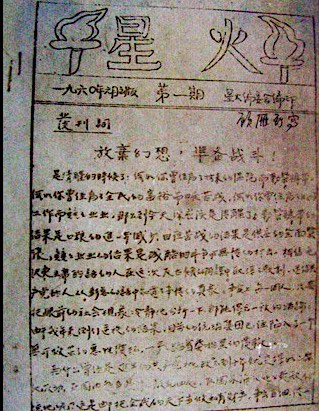
A major theme is the work of Hu Jie and Jiang Xue on the short-lived magazine Spark, published by a group of students in Tianshui in 1960. At first they had the upright resolve to make the people’s desperate plight during the famine known to the central leadership, but soon, as it became clear that the latter had compelled the chain of regional and local cadres to report fictitious, exaggerated grain yields, they penned cogent critiques denouncing the people’s communes and the whole socialist edifice. Forty-three of those involved were soon arrested and sentenced to long prison terms; two of the leaders, Zhang Chunyuan and Du Yinghua, were executed in 1970.
Ian cites the solitary anti-Nazi propaganda of Otto and Elsie Hampel under Hitler, driven to tell the truth even if the attempt was futile—a story evoked in Hans Fallada’s novel Every Man Dies Alone / Alone in Berlin.
Spark 1st edition, 1960: “Give up your fantasies and prepare to fight!”.
From 2008 Hu Jie filmed compelling interviews with many of the original Spark group, still passionate in their determination to speak the truth. He released a moving documentary online in 2013 (note the mournful shawms from 3.00 to commemorate Du Yinghua):
In “Memory: Snow’s visit”, Ian introduces Jiang Xue’s own work on Spark with a vignette on her extended, intimate interview with Xiang Chengjian in 2016—here’s the film, edited by Tiger Temple (see below) (slightly different edit here):
Just as moving is an earlier film by Hu Jie, Searching for Lin Zhao’s soul (2004), on the horrifying fate of a young Peking University student, unable to compromise her democratic ideals as society disintegrated in the wake of the Anti-Rightist campaign, who was imprisoned for six years before she was executed in 1968.
Ian looks back at the Party’s machinations, casualties, and pathological purges at Yan’an in the wartime Shaanbei Base Area, with the stories of Liu Zhidan and Liu Jiantong’s banned 1962 novel about him; of Gao Gang, Wang Ming, and Xi Jinping’s father Xi Zhongxun. Even after a palatable version of the Maoist era was being fabricated in the 1980s, and as “Red tourism” swept the country, Gao Hua embarked on a scathing indictment of the Yan’an period.
Ian gained experience of the Party’s control of archives in his study of the fate of the Maoshan temples since the 1930s (see Ritual life around Suzhou). Under Xi Jinping, with history ever more rigidly controlled, the National Museum of China has become a mere propaganda showcase.
In Part Two we meet the novelist Wang Xiaobo and his wife Li Yinhe, documenting subaltern lives; and the anthropologist Guo Yuhua, whose research on “the sufferers” in Yangjiagou village thoroughly demolished the Shaanbei myth. In Xi’an (setting for the cult novels of Jia Pingwa) Ian accompanies Jiang Xue to visit citizen journalist Zhang Shihe (“Tiger Temple”), with his bitter past as a child labourer in the Cultural Revolution. We eavesdrop on meetings of the editors of the Zhiwuzhi public forum.
Returning to Ai Xiaoming, Ian explains her background, and her support for rights-defender lawyers. Assessing the current retrenchment she comments,
The severe political pressure unleashed through governmental response has made it clear that it is unshakable, it does not need to listen, it has idolized itself. What happened in the past, the demonization of those critical of the government, is taking place once again.
The mass murders of the early Cultural Revolution in Daoxian county, Hunan, where—at the instigation of the Party—over 9,000 were murdered in August 1967, have been exhaustively researched by Tan Hecheng, and published in English as The killing wind: a Chinese county’s descent into madness during the Cultural Revolution. Ian provides a vignette on Yu Luoke’s exposé of the massacre in Daxing county in the Beijing suburbs at the same time. Yu was arrested and executed in 1970, but since 2016 his story has been circulating again.
A couple of instances of how such scars should impact on our fieldwork: in the 1990s I was impressed to find amateur Daoist and Buddhist ritual groups in Daxing, but I never learned of the 1967 massacre there. Ian comments further:
One survey of local gazetteers [Yang Su, Collective killings in rural China during the Cultural Revolution] shows that between four hundred thousand and 1.5 million people perished in similar incidents, meaning there were perhaps another one hundred Dao County massacres around this time.
And, from a distance, I’ve long been curious about the expressive culture of Gansu province—including its household Daoist traditions. The counties that scholars of religious and musical life should do fieldwork are among those where the most disturbing abuses under Maoism took place—so somehow we have to integrate society and culture into our studies.
Ian visits retired film historian Wu Di, co-founder of Remembrance (one of a whole series of samizdat journals), taking up the shocking topic of high-school girls in Beijing torturing and beating their vice-principal Bian Zhongyun to death in 1966—subject of another harrowing film by Hu Jie, Though I am gone, recounted by her bereaved husband:
This leads the Remembrance group to debate the career of Red Guard poster-girl Song Binbin, who witnessed (at least) the murder.
In Sichuan we meet Huang Zerong, who, undaunted by over two decades in labour camp as a “Rightist”, in his old age began publishing an unofficial history magazine, Small scars of the past—earning him another prison sentence, a fine, and close surveillance. In a reproach to the reluctance to “dwell on the past” (common among many traumatised peoples), he explains the importance of the 1958 Anti-Rightist Campaign:
Without the Anti-Rightist Campaign there would have been no Great Leap Forward; without the Great Leap Forward, people would not have starved to death. If people didn’t starve to death, there would not have been the Cultural Revolution. Without the Cultural Revolution, there would have not have been Tiananmen.
Fanning out from Beijing, Cui Yongyuan (Oral History Centre) and Wu Wenguang (Village Documentary Project and Folk Memory Project, focusing on the Great Famine) have done impressive work.
Li Wenliang.
Part Three, “The Future”, reveals shifting concerns. Ian documents the Coronavirus in Wuhan and whistle-blower Li Wenliang; while the Party was busy suppressing the truth, the awful realities of life under a draconian lockdown were again exposed by independent counter-historians, including Ai Xiaoming, along with front-line diarist-reporters like Zhang Zhan and the reputable novelist Fang Fang. Ian’s account is always nuanced:
The events in Wuhan show the potential anger, dissatisfaction, and critical thinking that lies beneath the surface. People like Ai Xiaoming, Jiang Xue, Tiger Temple, and Tan Hecheng represent a minority of Chinese. But their well-articulated critiques resonate when people are shaken from their lethargy.This is why one way to look at the Wuhan outbreak is as an example of government power. But a more convincing explanation is that it was a classic example of the repeated eruptions against unchecked government authority.
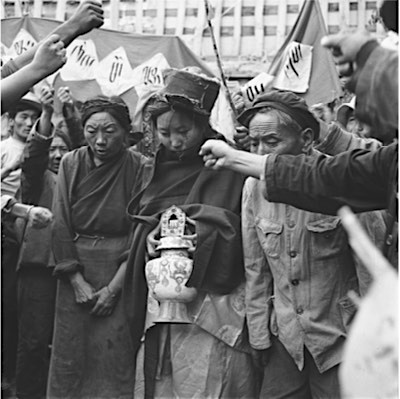
Lhasa, 1966: from Woeser’s Forbidden memory.
The ever more vexed flashpoints of Xinjiang, Tibet, and Hong Kong are another major area for underground historians. Ian introduces the work of Tsering Woeser on her father’s photos of the Cultural Revolution in Lhasa, and the Tibetan stories collected in Conflicting memories. We learn of the travails of Hong Kong and the elimination of the free publishing world there. Part Three ends, perhaps rather more tangentially, with another trip with Jiang Xue to visit the Zhongnanshan hermits (also outside society), alongside an account of the lockdown in Xi’an.
The excellent Conclusion confronts the underlying questions: are the odds too great, is resistance to the authoritarian state useless, are those few who resist doomed to failure? Ian ponders how we should engage with China, challenging conventional wisdom on how to view it—when
the dominant way of understanding China is that nothing happens there except a string of dystopian horrors: surveillance, cultural genocide, mindless nationalism.
But
Government propagandists can flood the media with their version of reality or slow down unwanted information. This sophisticated form of censoring means that most people will still agree with the government version of events. And yet enough people now have access to alternative interpretations of the past that questioning has become widespread and persistent, despite harsher and harsher crackdowns. […]
The fact that people still resist and do so in a more coordinated form than at any time in the past, seems more significant than the banal point that an authoritarian regime is authoritarian.The fact is that independent thought lives in China. It has not been crushed.
He goes on,
The Party does not always win. Despite overwhelming odds, people inside China today still publish works and make films that challenge authority. Their ideas continue to spread, and when problems in society reach a critical point, people look to them for ways of thinking about their country. This is why Xi Jinping has made control of history one of his signature policies—because he recognises counter-history as an existential threat.
Thus Ian queries whether amnesia has really triumphed:
Saying that “most people” don’t know or care is a truism applicable to almost every society in every era; what matters is that many Chinese do know and continue to battle, today, to change their society.
Moreover,
Prosperity is not inevitable. For any country, it requires constant self-reflection and an ability to think up new solutions to new problems. The Chinese Communist Party’s ability to do so is open to question, especially when we consider its decade-long aversion to meaningful economic reform and its failure to build a top-ranked education system for non-elites.
Before the extensive Bibliography comes a useful Appendix on Exploring China’s Underground History. Ian notes dGenerate Films, Icarus Films, and the Chinese Independent Film Archive, while on YouTube there are channels for Hu Jie, Ai Xiaoming, and Tiger Temple—I’ve featured some of his recommendations above. He also offers a succinct list of recommended books. And an important new site, the China Unofficial Archives, has just gone live (see my introduction). Endnotes (a system that I much admire, cf. Eat the Buddha) provide detailed further references.
* * *
One naturally characterises such figures as “brave”. Guo Yuhua, herself long punished by the authorities and harassed by state security, told me she doesn’t feel particularly brave: rather she acts out of a sense of duty—part of a long tradition of righteous scholars throughout Chinese history, as Ian observes. One can only feel the deepest respect for the people who have stood up for truth, and for those who document their labours.
Still, these are people whom most of us wouldn’t normally encounter—or might not be aware of encountering. So where might The Masses stand on all this—those who swallow their scruples for the sake of a quiet life for themselves and their families? One finds plenty of resentment, of course, and even resistance—such as from organised religious groups; and individual cynicism is often heard, both from those clearly targeted, like “reactionaries”, and from the peasantry, who suffered just as grievously and in larger numbers. But just as distressing are the fates of the many who fervently believed in the Party, yet were assaulted in successive campaigns.
Foreign scholars may visit China for a variety of reasons. However much we may wish to eschew politics, and however much we like and esteem our friends in China, the gruesome history of the Party, trampling people’s lives, is the essential backdrop to all the topics that we study in modern (and indeed imperial) China—including history, culture (art, architecture, music, literature), and religion (see my post Cultural Revolutions). Mao was right about one thing: “There is no such thing as art that is detached from or independent of politics”. No walks of life have been untouched by all this, and Sparks should be essential reading for us all.
Aaron Smith leading the All Blacks in the haka. Source.
The Rugby World Cup is coming to the boil nicely (if not “reaching a crescendo”). Last night’s quarter-final between the All Blacks and Ireland was remarkable (if you missed it, do watch highlights on ITV). The final phase, when the All Blacks held out against wave upon wave of attacks (37 phases!), was a tense dénouement. Much as I love football (see under A sporting medley), the visceral impact of rugby, with its variety of team and individual skills, brute force and artistry, are on another dimension.
The All Black haka makes an awe-inspiring overture (I introduced it here, with some history, and flippant suggestions on suitable ripostes from other nations, including Bring me sunshine and The Rite ofSpring!). The current edition additionally features a hoe carved wooden paddle:
Local Maori cultures evince variations in styles, handles, and blades of the hoe (some instances were presented to Captain Cook in 1769.). Its use in the haka reminds me impertinently of that of the chaoban in Daoist ritual (e.g. here).
I still find it extraordinary how rugby players (in few of whose daily lives traditional customs or ceremonial performance can play a major role) can enter the groove with such focus, and how an apparently secular situation can be instantly transformed into a ritual of such intensity.
Today we can also admire the Fiji team performing the cibi before their quarter-final with England!
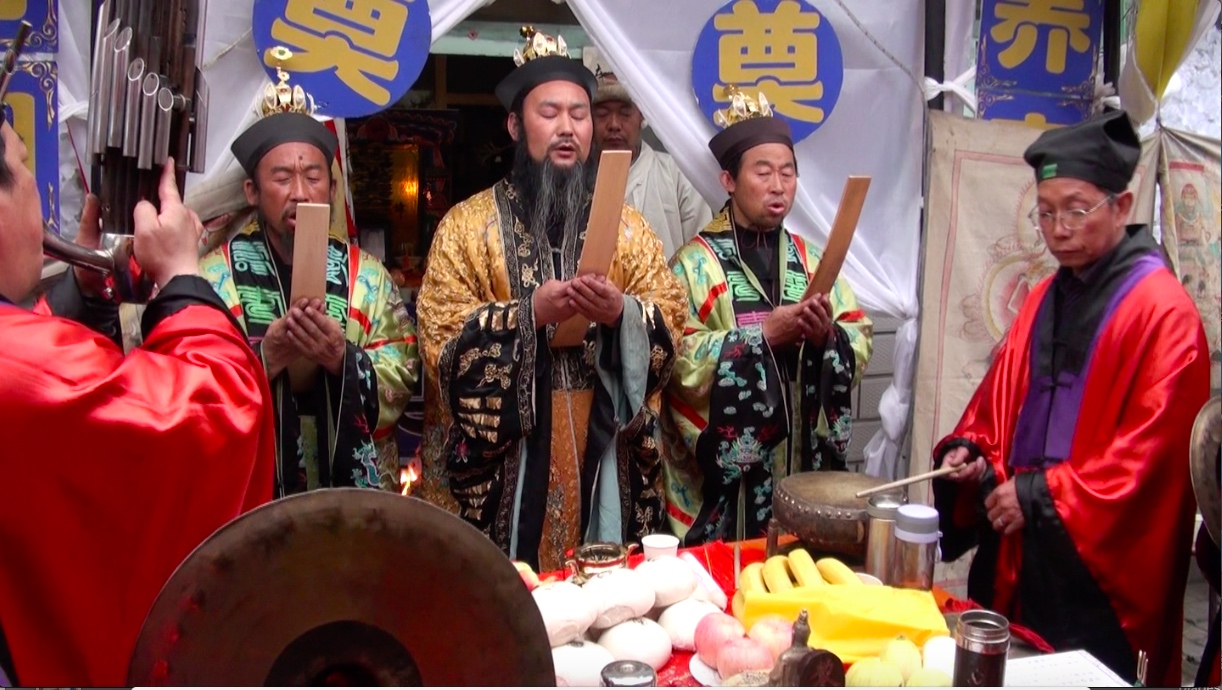
Craig Clunas gleefully spotted this clip (posted by Tong Bingxue on what I still like to call “Twitter”), performed by the Yuzhang Daoist Music Troupe 豫章道乐团 (original here):
The troupe (YouTube playlist) is based at a temple in Nanchang (in Jiangxi province, where some of the most vibrant household traditions of Daoist ritual are to be found, BTW)—but regional style is irrelevant here. There are two issues in need of unpacking:
First, Beethoven—much as I like to blame him, in this case he’s obviously Not Guilty (cf. Monty Python: “the second tune, which Beethoven said on his arrest was ‘just a harmless bit of fun’…”). Anyway, the Yuzhang Daoist Music Troupe clearly aren’t in the market for a Beethoven work that might evoke a suitably profound and abstruse mood, like the HeiligerDankgesang of the A minor string quartet—rather, they’ve gone for the ultimate cliché, Für Elise—such a heavy albatross around the necks of generations of hapless piano students. And if we have to hear it yet again, this arrangement has a certain charm, I suppose, in a cutesy chinoiserie kinda way—a step up from its use for the garbage trucks of Taiwan (“Whenever I hear Für Elise, I feel like I need to take out the garbage as well”).
But quite apart from the choice of piece, far more insidious is the style of instrumental ensemble itself. Adopted in recent years by such “Daoist music troupes” (a concept that I dismantled here!), it’s based on the modernised “national” conservatoire style.
In both musical and religious affairs, it would clearly be wrong to expect central authorities to have more taste than local cultural officials. Since the White Cloud Temple in Beijing led the way, * the chimera of the Intangible Cultural Heritage also plays a dodgy role in encouraging this kind of style, with Disneyfied staged performances of “Daoist music” given by temple groups such as the White Cloud Temple in Shaanbei.
So here we have a mixed-gender ensemble (itself an affront to tradition, but hey) playing modernised sheng, erhu, yangqin, ruan—a Veritable Smorgasbord™ of kitsch. The style is garish enough when it’s just accompanying Daoist hymns, but with this video, what ARE they thinking?! To imagine that Furry Lisa (as it’s known in the biz) would be just the thing to enhance their international credibility—just picture the troupe’s apparatchiks in a meeting:
After decades creating a debased concept of “Daoist music” to delude the ignorant masses, what more can we do to consolidate our reputation? Aha, I know!!!
Beat that, Richard Clayderman. One can only look forward to a Yubu Can-can. Re-education required (though not in a 1958-labour-camp kinda way). Meretricious (and a Happy New Year)!
I mean, Don’t Get Me Wrong, I’m all for experimentation—in a suitable context (e.g. “world music” versions of Bach). Of course there is a certain audience for this kind of thing in China, and even abroad; some listeners whose taste monitor isn’t programmed for China may find it charming, and It’s a Free Country (Yeah right—Ed.]. It is what it is. The ethnographer may feel obliged to document all kinds of activities, but whether or not we believe in the Wisdom of the Ancient Sages, it’s our solemn duty to ridicule such folly, which distorts and cheapens the whole notion of Daoist ritual and its soundscape [Go for it—Ed.].
Meanwhile, away from the concert platform, household Daoists like the Li family in Shanxi continue to perform life-cycle and calendrical rituals for their local communities—and so do temple priests, even in Shanghai and Beijing.
The only way I can bear to hear Furry Lisa is with the brilliant Two Set Violin (complementing their Mahler 5 and Pachelbel’s capon):
* Under the misguided rubric of “Daoist music”, the style was “developed” in the 1980s at the White Cloud Temple (Baiyun guan 白云观) in Beijing, headquarters of the national Daoist Association and official showcase for the acceptable face of Daoism under Party control. By 1985 the venerable Min Zhiting (1924–2004)—whose former priestly career had hitherto been based in Shaanxi—was chosen to teach at the temple, going on to serve as figurehead of the Daoist Association. But despite his great wisdom, the temple authorities were adept at serving the demands of Party conformity.
There’s a certain merit in the temple’s performance of the daily services, or occasional rituals such as Flaming Mouth (yankou), as they still practise the tradition of vocal liturgy accompanied only by percussion—albeit in the “southern style” that has been widely promoted in recent years. Among many videos on YouTube, here’s the final part of a yankou in 2015:
I’ve just updated my list of Great Chinese stammerers with the Southern Tang dynasty muralist Dong Yu—joining early luminaries such as Deng Ai, Han Feizi, and Sima Xiangru; and for the modern era, Feng Youlan and Gu Jiegang.
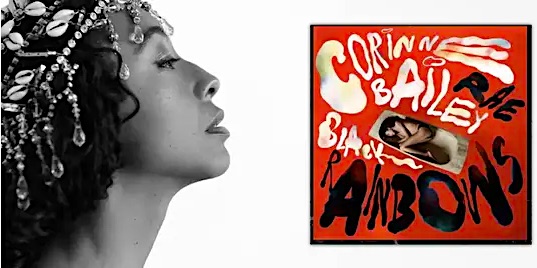
The music of Corinne Bailey Rae (website; wiki) is on an ever-growing list of Things No-one Ever Told Me About—as my mother said about the Beatles, “Well I’ve never heard of them—they can’t be famous!”.
So in a futile effort to stem the tide of my eighth decade (cf. Staving off old age), I’ve been admiring her new album Black rainbows—her fourth, after a seven-year break, “a scream through the letterbox” by contrast with the “coffee-shop staples” of her previous work. * Inspired by visiting the Stony Island Arts Bank archive in Chicago, as Damien Morris comments in the Guardian,
its audacious mix of rock, electronica, jazz and Afrofuturism forms an epic soundtrack narrating journeys to freedom.
The title track:
Erasure, channelling punk:
They tried to erase you They tried to erase you They tried to eviscerate you, hide behind the curtain Make you forget your name They tried to erase you They tried to erase you They tried to eviscerate you, hide behind the curtain Make you forget your name
New York transit queen:
He will follow you with his eyes:
Peach velvet sky:
And the final track Before the throne of the invisible god, “in which, metamorphosis complete, she becomes an east Pennine Alice Coltrane”:
Uh-oh, I’ve been cajoled into giving local partygoers another burst on the erhu fiddle—* I’m more used to people asking me not to play it… This gives me another pretext to roll out my old excuses, such as “It was in tune when I bought it”, and “I just sort of… picked it up” (cf. my early days with Ray Man).
Along with Abing’s inescapable Erquan yingyue (immortalised in Yang Yinliu‘s 1950 recording), the plangent Jianghe shui (literally “River waters”, but often rendered, suitably, as “Song of suffering”) has been a mainstay of the erhu concert repertoire since the 1960s (see here, and David Badagnani’s notes).
The concert piece derives from a melody of traditional shengguan ritual wind ensembles in south Liaoning—sadly, I can’t find a rendition, so we’ll just have to imagine it from other recordings, such as the guttural shawms on #6 of my Audio Gallery in the sidebar (notes here). Soon after the 1949 “Liberation” it was adapted to the conservatoire style (for which see here, and here) as a solo for the double guanzi oboe (shuangguan)—here’s Gu Xinshan with the Lüda Song and Dance Troupe of Dalian in 1956:
Hu Zhihou on (single) guanzi, with a sparsely-inflected rendition:
Indeed, the melody has re-entered the folk repertoire in Liaoning, as we can hear on #12 of the Ocora CD Chine: musiques de la première lune.
But Jianghe shui soon came to be known mainly as an erhu solo, accompanied by yangqin dulcimer, following Huang Haihuai’s 1962 arrangement—click here for his recording from 1963.
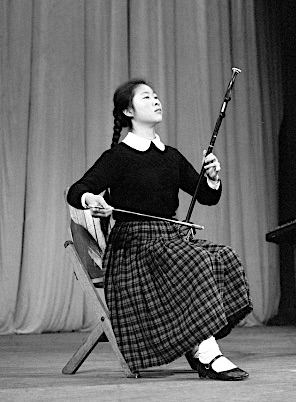
Min Huifen, 1963.
It became a signature piece of the great Min Huifen—here she is in 2007:
Even conservatoire solos were largely a male preserve until the 1980s (see e.g. the archive CD-set Xianguan chuanqihere), when women players began to dominate; see e.g. Song Fei’s lecture-demonstration on her own highly emotive interpretation.
In between the flexibility of the traditional wind ensemble style and the rigidly-prescribed conservatoire version, all I might add is that while playing Jianghe shui on erhu it’s always worth bearing in mind the plaintive timbre of the double reed. And I learn much from the sheer physical dynamism of the great players, their kinetic grace with both hands and arms. Of course I can’t even begin to emulate the sheer technical perfection of conservatoire virtuosos, but I can just about get away with it before an audience that has never heard real Chinese musicians who can actually play it. And as a change from my usual diet of rural funerals and temple fairs, it’s an interesting challenge to think myself into the heart-on-sleeve romanticism of the conservatoire style.


 The balance of joy and pain—


 The couplet comes from a poem by the early-Tang poet
 Besides Tian Qing’s many reflections on the









 Stephen Jones: a blog