More Chinese wordplay, and a poem

or
What’s in a name?

My Chinese name Zhong Sidi 鍾思第 was given to me by the great Tang-music scholar Yin Falu 陰[阴]法鲁 (1915–2002) at my first supervision with him during my 1986 study-period at Peking University.

“Zhong” (Bell) approximates to my surname Jones; while itself a common surname, for me it has nice echoes of both ritual and music, evoking both Zhong Kui 鍾馗 the ugly drunken demon-queller (Ha!) and the woodcutter Zhong Ziqi 鍾子期, zhiyin soul-mate of qin zither master Bo Ya in the famous ancient story. And even Zhongli Quan 鍾離權, one of the Eight Immortals—a bit of a stretch, perhaps, since Zhongli is a rare double-surname (see here), but hey. Not to mention the huangzhong 黃鍾 and linzhong 林鍾 pitches of the ancient tonal system!

“Sidi” is short for “Sidifen”, a transliteration of “Stephen”. * Professor Yin chose the characters 思第, which in classical Chinese mean something like “mindful of advancement”—which is elegant but somewhat ironic, since I’ve always had enough of the hippy in me to mitigate against any worldly success (it never occurred to me that I might ever get a job, and sure enough I never did).

Without the bamboo radical at the top, the character di 弟 following the si would be a female name: “wanting a little brother”—one that peasants, disapppointed at having a daughter (yeah I know), do indeed sometimes adopt. And one cultural official in Yanggao, moved to write an article about my fieldwork there, somehow miswrote the character as 娣, with the female radical at the side. When I showed it to Li Manshan, we had another typical exchange:

Me: “WTF?! Doesn’t he know how to write my bloody name by now?”

Li Manshan (peering pensively at the character): “Maybe he thinks you’re a hermaphrodite…”

Anyway, as my interests soon transferred from early music history to living traditions of folk music (see here, and here), Yin Falu was remarkably tolerant of my frequent absences to go and hang out with peasants—as was Yuan Jingfang, my supervisor at the Central Conservatoire the following year. I’m also deeply grateful that Yin Falu introduced me early on to Tian Qing (then a lowly and impoverished research student!) and the Music Research Institute, beginning a fruitful long-term collaboration.

* * *

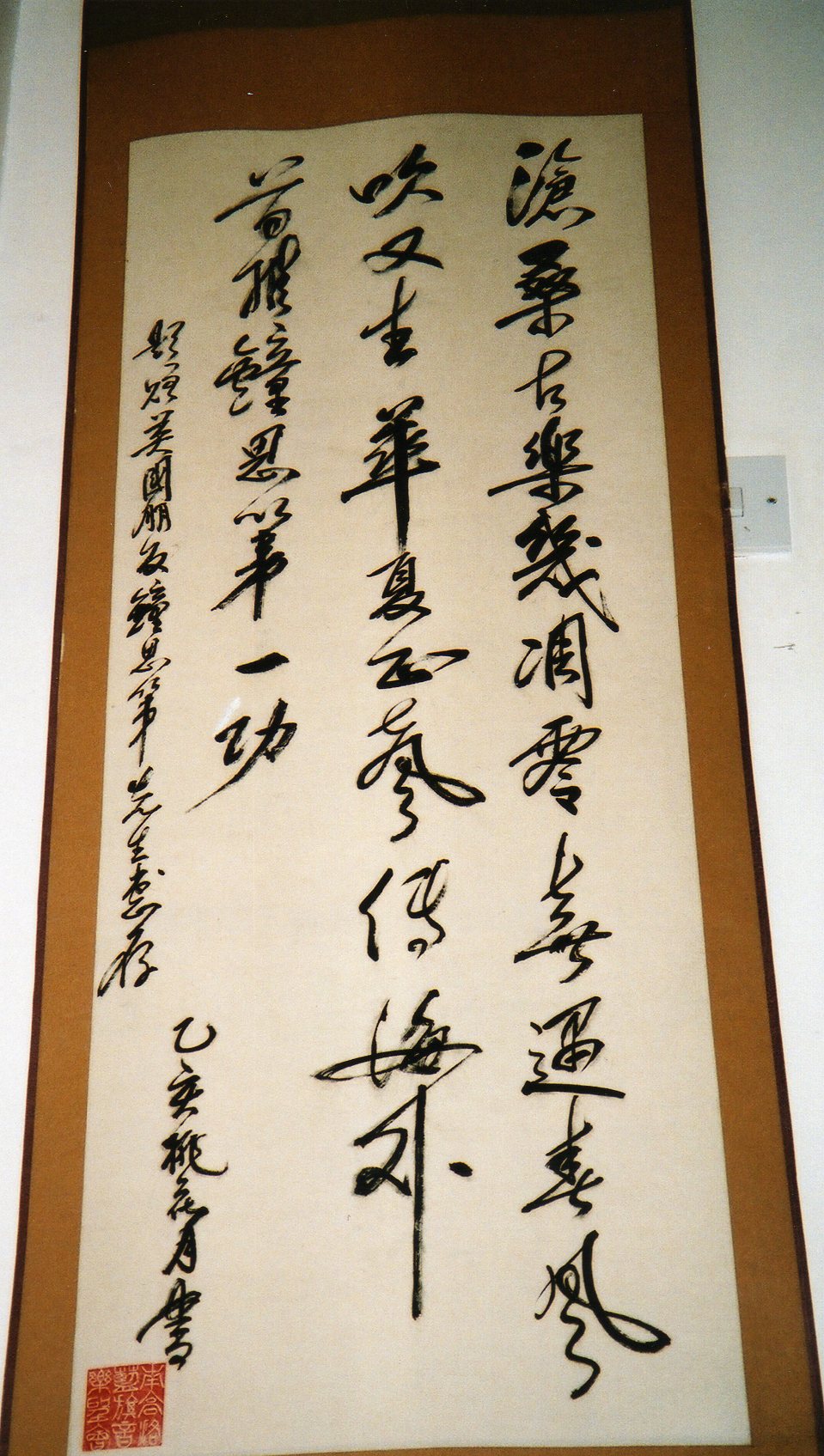
One of the most treasured gifts I’ve received is a scroll that the ritual association of South Gaoluo gave me in 1995 on the eve of my return to Europe (see my Plucking the winds, pp.236–8). They went to great trouble to have a piece of calligraphy made for me, which illustrates their ingenuity. First they “collectively” composed a poem, led by Cai Yurun and the urbane brothers Shan Ming and Shan Ling, most literate of the musicians. They then travelled to town to buy good-quality paper, went and found artistic Shan Fuyi (peasant xiucai litterateur, himself a great authority on the village’s history) at his work-unit and got him to do the calligraphy. To have the paper mounted, they then took the bus to Baoding, where they had a contact from Yongle village who had worked in the prestigious Rongbaozhai studio in Beijing. All this was a complex process, expressing their appreciation of our relationship.

GL scroll

The seven-word quatrain itself shows not only their literary flair but also their own perception of the significance of my fieldwork:

How rare the strains of ancient music
Gladly meeting the spring breeze, blowing is reborn
As the proper music of the ancient Chinese is transmitted beyond the seas
First to be praised is Stephen Jones

There are several charming puns here: in “blowing is reborn” (chui you sheng), “blowing” alludes to the breeze but also clearly to their wind music, and the “born” of “reborn” is homophonous with sheng 笙 the mouth-organ. The last line, impossible to translate, incorporates the device they had been seeking all along: the character di of my Chinese name Zhong Sidi is also an ordinal (as in diyi “first”, di’er “second”, and so on), so by playing with the caesura they managed to incorporate it into a meaningful phrase.

They couldn’t have thought of a better gift. I adore it, not for its flattery—foreigners in China are only too accustomed to receiving extravagant and groundless praise—but because they expressed their appreciation of our bond with such creative energy. In our everyday dealings, the musicians are all too used to me forestalling any incipient flattery by my favourite Chinese phrase, beng geiwo lai zheyitao 甭给我来这一套 “cut the crap”. This expression also comes in handy whenever someone is so sentimentally drunk that they, suddenly moved by the sheer fun of our fieldwork, rashly let out the awful Chinese cliché “international cultural exchange“.

My friends call me “Old Jonesy” (Laozhong 老钟), which is also a jocular way for Chinese people to refer to themselves (老中, for Zhongguo 中国 China) as opposed to laowai 老外 “foreigner”, even “Wog”. Laozhong then leads onto Naozhong 闹钟 “alarm clock”. (For nicknames in the music biz, see here.)

For Craig Clunas’s Chinese name, click here.


* Talking of transliterations of foreign names (see here and here), “Stephen” is conventionally rendered as 斯蒂芬. That last fen character is shared with Beethoven (Beiduofen 贝多芬), whose characters, following the brilliant (if controversial) gender analysis by Susan McClary, I like instead to render as 背多粪 “shouldering a load of shit”—“but that’s not important right now”.

Gaoluo: a restudy, and my role

Thankfully, I am rarely the object of interview—far more often the interviewer asking fatuous questions. I mentioned one such encounter where I failed in my task of giving snappy predictable answers, as well as Jack Body’s original take on my stammer.

Far more in-depth in nature is the new PhD thesis

  • Zhang Lili 张黎黎, Lun Zhong Sidide Nan Gaoluo yinyuehui yanjiu 论钟思第的南高洛音乐会研究 [On Stephen Jones’s research on the ritual association of South Gaoluo] (Beijing: Zhongguo yishu yanjiuyuan 中国艺术研究院 2017),

on my own relationship with the ritual association of South Gaoluo village, and my whole approach. Referring to my book

she consulted me over a long period with frequent and detailed emails, and it has been most stimulating for me to reflect on my fieldwork. Her thesis (supervised by the illustrious Tian Qing) is enriched by several visits to Gaoluo—allowing her to make what is effectively a restudy, updating my history of the village and its ritual practice in the light of their later adoption into the dreaded Intangible Cultural Heritage (ICH) razzmatazz, with all the problems that it entails.

She explores the association’s memories of my visits—prompting further reflections from me here, leading to this page suggesting my challenge to the official narrative. She also discussed our work on Gaoluo, indeed our whole project on the Hebei ritual associations, with my fellow-fieldworkers Xue Yibing and Zhang Zhentao—a fruitful collaboration that stimulated us all.

MYL played

Taking part in the New Year’s rituals, 1998.

And my work in Gaoluo (from 1989 to 2001) may be seen as a blueprint for my later in-depth study with the Li family Daoists (going back to 1991, but intensive since 2011). The subject of the former was an amateur village-wide group, whereas the latter are an extended occupational family of household Daoist ritual specialists—but the principles of thick description and participant observation remain similar.

On my own “method”, at first I can’t really see what the fuss is about: isn’t this what anthropologists do?! Even in China there are many fine ethnographers, such as Wang Mingming, Guo Yuhua, Jing Jun; and in music (apart from Xue Yibing and Zhang Zhentao), Xiao Mei, Qi Kun, Wu Fan, and so on. They’re much better equipped than me for such work.

But sure, two decades ago my approach was more detailed, and personal, than was then the norm in Chinese musicology. The anthropologists whose work I was myself only beginning to digest—even those fine Chinese scholars who were later to become leading figures—were still hardly known in China. I was educating myself by reading up on both modern social-political background for China and wider ethnomusicological studies (Plucking the winds, Appendix 1). By now, such an approach is less remarkable, but then I found myself somewhat ahead of the game in ethnography—certainly within Chinese musicology, where the “living fossilsflapdoodle has remained hard to erase. Another approach that I took for granted was participant observation—a routine expectation in ethnomusicology, but still virtually unknown either in Chinese musicology or in studies of Chinese ritual.

Anyway, it will be good to see Zhang Lili’s restudy of Gaoluo, with further illustrations of the perils of the ICH.

Housekeeping

  • I’ve just added a few more photos to the gallery in the sidebar, as is my wont. And now I’ve linked them to particular posts/pages so you can follow them up. Like so:

  • There are many more photos of the Li family Daoists here, and throughout my posts.
  • And DO listen to the ear-scouring audio playlist too, consulting my comments here.

Yet more heritage flapdoodle: Hongtong

Hongtong 1
Further fodder for my distaste of the heritage shtick—thanks again to Helen Rees, my Word on the Street, I’ve been reading an interesting article by Ziying You,

  • “Shifting actors and power relations: contentious local responses to the safeguarding of Intangible Cultural Heritage in contemporary China”,
    Journal of folklore research 52.2/3 (2015).

And now she has published a book on the topic, which I look forward to reading:

Hongtong cover

Hongtong county, in south Shanxi, is always cropping up in studies of local culture in north China—notably since it was used as a huge migration transfer centre to areas further north and northeast that had been depopulated by the appalling dynastic warfare of the early Ming. Like many villages on the plain south of Beijing, Gaoluo, subject of my book Plucking the winds, is said to have been founded as a result of this migration; and Li Manshan’s lineage moved north to Yanggao just around this time. [1]

It’s a long time since we’ve featured The China Daily, so I’m delighted to cite a 2012 article here:

A step into Hongtong county in southern Shanxi province and I found myself transported into a land filled with fairy tales.

YAY! The paper hasn’t lost its old magic, then. It does provide a couple of charming pieces of folklore:

The Chinese term used today to mean “go to toilet” or jie shou is also linked to the legend.
The migrants had their hands tied behind their backs when they migrated. They were only allowed to untie their hands when they needed to relieve themselves. Jie shou, which literally means to untie the hands, gradually became the term used for “go to toilet”. The expression spread widely to the provinces where the Shanxi migrants were sent.

Another interesting tale on Hongtong involves a woman by the name of Su San in the Ming Dynasty, who became probably one of the most well-known prostitutes in Chinese history.
Su met young scholar Wang Jinglong at her brothel. The two fell in love and Wang stayed with Su for a whole year but was later chased out of the brothel because he ran out of money. Su was then sold to another man as concubine. She was framed for murdering the man, imprisoned and was sentenced to death.
Meanwhile, Wang who attempted the imperial examination, did well and was appointed governor of Shanxi. He heard about Su’s case and helped with the investigation to deliver her from death row.
The lovers eventually got married and as how all fairy tales end, they lived together happily ever after.
The story has been adapted as a Peking Opera play The Story of Su San (Yu Tang Chun) and became one of the best-known Peking Opera plays in China. Hongtong county where Su San was imprisoned became well-known through the play.
Although the original prison was severely damaged during the “cultural revolution” (1966-76), the present one restored in 1984 retains all its original features. For example, there is a cave used for dead bodies, and a well with very small mouth to prevent prisoners from jumping in to kill themselves.
Su San’s story has brought fame to the prison, making it a must-see in Hongtong. Today the site is renamed as “Su San Prison”, and her story is presented by a series of wax statues within the site.

Damn, I’m trying to write about the ICH here… Led astray by The China Daily“typical!”

Anyway, Ziying You’s article concerns Hongtong as the site of an enduring cult to the ancient sage-kings Yao and Shun, in which several villages form a she parish, with temple fairs and processions. [2] For ICH purposes it is nominated as Hongtong zouqin xisu “the custom of visiting sacred relatives in Hongtong” [3] — and yes, sure enough the term “living fossil” rears its ugly head again.
Hongtong procession
Though not currently on the UNESCO “Representative list” for the ICH, it has been inscribed on the provincial and then national lists since 2006. With typical official razzmatazz, local cultural cadres set up a “Hongtong Centre for the safeguarding of ICH”, niftily bypassing the temple committees which are the lifeblood of the whole tradition.

BTW, as at many such festivals, I see no signs here of liturgical sequences of ritual specialists—only large groups of gong-and-drum ensembles (which are also widespread in Shanxi).

By contrast with the alacrity of cadres,

For most ordinary people, ICH was a foreign term remote from their knowledge and discourse.
[…]
Those who were mobilized to assist in the ICH application expected to receive a large amount of money from the central government to do whatever they wished within their local communities.

Not only has this expectation been unfulfilled—the Yangxie temple committee spent a substantial amount in the extended process of preparing the application. Moreover, the Centre, jockeying for favour with ICH bodies higher up the chain, monopolizes as-yet elusive state funding. And while the local conflicts between the villages did not originate with the ICH application, they were exacerbated in the process. Anyway, the temple committees, true “bearers of the heritage”, have been disempowered.

The ICH project thus became a means for the local ICH centre to exploit the local population and harvest the profits from the state.

Citing Chiara de Cesari, the author comments:

UNESCO frequently ends up reinforcing the power and reach of the nation-state and its bureaucracy, which is contradictory to its own principle of involving local communities and “grassroots”.

Yet again, the ICH machinery appears not to be safeguarding local cultures so much as safeguarding itself.

My encounters over the years with groups earmarked for ICH status—such as the village ritual associations of Qujiaying and Gaoluo, as well as the Li family Daoists—only confirm such findings. But the juggernaut rolls on.

As I write, Haitink’s recent Prom is on the radio, with the Prague symphony. No Mozart balls, just boundless energy and creativity!


[1] For the migrations to Yanggao, see Jing Ziru’s article in Yanggao wenshi ziliao 阳高文史资料 2: 216–228 and 206.
[2] Note also Anning Jing, The Water God’s Temple of the Guangsheng Monastery: Cosmic Function of Art, Ritual, and Theater (Brill, 2001)—albeit more historical iconography than contemporary ritual ethnography.
[3] These photos are among many from http://photo.xinzhou.org/2010/0717/picture_1826.html

Calendrical rituals

Further to my thoughts on festivals, today is the focus of the round of Bach Passion performances, now a kind of secular pilgrimage very different from the original liturgical context—not just of Good Friday but of the whole calendar (note John Eliot Gardiner, Music in the castle of heaven, ch.9, “Cycles and seasons“). Different too are our ears, bodies, world-views, experiences, sanitation

Mark Padmore, incomparable Evangelist in the Passions, makes some thoughtful points here (cf. this article). Do watch his Matthew Passion as staged by Peter Sellars. And here he is in the John Passion (cf. Passion at the Proms)—how he sings und ging heraus und weinete bitterlich (from 33.48), and how Bach composed it, is miraculous:

Also in the John Passion is one of Bach’s most moving arias is Zerfließe, mein Herze:

Zerfließe, mein Herze, in Fluten der Zähren        Dissolve, my heart, in floods of tears
Dem Höchsten zu Ehren!                                         to honour the Almighty!
Erzähle der Welt und dem Himmel die Not:        Tell the world and heaven your distress:
Dein Jesus ist tot!                                                     your Jesus is dead!

More performative tears (see links here)—like north Chinese Daoist ritual, the aria is also accompanied by anguished wind ensemble, almost evoking (for modern ears) French film music.

While Protestants do their thing, let’s not forget Holy Week in Spain, with solemn hooded processions, soaring trumpets, and saeta devotional songs for the images of Christ and the Virgin (for more saeta, along with other moving cante jondo songs, see here):

Indeed, for me one of the benefits of being a touring muso was being able to combine both Bach Passions and flamenco. In southern Spain flamenco only tends to get going in the small hours, but concerts also begin at 10pm or later. So by the time we had played the final chorus of the Matthew Passion in Seville, there was plenty of time to stroll over the bridge to the wonderful Anselmas bar in Triana, downing a few G&Ts before the flamenco began to get in the groove.

Note also the liturgy of Castelsardo in Sardinia.

* * *

Meanwhile it’s a busy period in the Chinese ritual year calendar too. [1] On the Hebei plain, apart from everyone taking part in the lineage observances for the Qingming festival, Catholics are busy holding Masses and making pilgrimages—not least evading police road-blocks (see here, and for the Gaoluo Catholics, here). It is also the time of the 3rd-moon festival for the goddess Empress Houtu, when many villagers go on pilgrimage to the Houshan mountain temples to revere her.

Houshan disciples

The Houshan pilgrimage, which under the commune system had been observed only by a tenacious minority through the 1960s and 70s, began reviving in the 1980s; by the 1990s it was attracting around 100,000 pilgrims for its 3rd-moon temple fair. We met several village ritual associations on the mountain for the festival in 1995, though Gaoluo village no longer organizes a group; in recent years “people’s hearts are in discord”, as association leader He Qing lamented. In some places the Houtu festival has been revived within the village: for the 3rd-moon festival in 1996, for instance, we visited Shenshizhuang, south of Yixian county-town, whose four ritual associations all celebrate the Houtu festival in their separate ritual buildings in the village.

SSZ xihui 1996

Altar to Houtu, Shenshizhuang West association 1996.

Many villagers make the pilgrimage in small groups on their own initiative. Their vows are pledged to Houtu. One can climb to the Houshan temples to offer incense and pledge a vow, or just make it at home; the vow often used to include a promise to “look after a banquet” for the ritual association.

So the red flag which one often sees adorning truckloads of villagers in the 3rd moon now heralds a group of pilgrims rather than any political campaign—another sign of the changing times. But despite the lengthy impoverishment of ritual and faith, the power of Houtu is still strong: even in 1997 Gaoluo friends reminded me “Here we believe in the Empress Houtu, so a lot of people offer incense”.

* * *

For the dispassionate (sic) observer, some photos may distinctly suggest a stress on masochism in Easter observances around the world. Meanwhile on a visit to the Saudis, celebrated defenders of religious values, our Prime Minister gets herself embroiled in a futile dispute about Easter eggs with the notoriously subversive National Trust. Indeed, this “We’re not even allowed to celebrate our own culture any more” fatuity is itself becoming an annual ritual. Hey-ho.

For thoughts on our approaches to Morris dancing and local Chinese rituals, see here. See also The Annunciation in art and music.


[1] These notes are revised from my Plucking the winds.

Obituary of a determined village leader

movie-sound-of-laozu-by-wang-qingren-p1-mask9

From Wang Qingren’s film Sound of Laozu (2013).

Lin Zhongshu 林中树 (1940–2017), a great village leader deeply concerned, nay obsessed, with maintaining his local culture, died on 18th March, aged 78 sui.

Chinese chat-sites are already buzzing with substantial tributes (here and here), and over the coming weeks and months there will doubtless be many more. So here’s my own tribute—my thoughts here (albeit thirty years too late) may differ somewhat from the many hagiographies within China, but also derive from deep respect for him.

Right into the very end of the 20th century, Qujiaying 屈家营 village was an exceptionally  poor village in the exceptionally poor county of Gu’an, Hebei province—a short but bumpy trip south of Beijing, and a world away. It’s still nothing to write home about today. Lin Zhongshu was not himself active as a  performing member of the village’s amateur ritual association (another kind of Country music?), but he cared passionately about it. In the early 1980s, just as the liberal reforms were gradually kicking in, he became village chief, and it was entirely thanks to him that scholars became aware that there was far more to ritual culture around Beijing than the Zhihua temple.

Lin Zhongshu’s “obstinacy” (zhizhuo 执着) is legendary. He constantly besieged cultural officials and scholars in Beijing with phone-calls and visits right to the “head of the dragon”, not in the least deterred by the cultural gap. It was as if an unwashed and semi-literate chairman of the Surbiton village choral society just made up his mind to get on the phone to Roy Jenkins, or buttonhole Ted Heath, insisting that they make the journey to Surbiton to hear them performing in their grotty church hall. Actually, that’s easier to imagine.

And to the extent that Qujiaying became renowned not just among musicologists but throughout the Chinese and international media, Lin Zhongshu’s Herculean labours were fulfilled. A more subtle approach would  hardly have succeeded.

As we soon discovered, Qujiaying is one of hundreds of similar amateur village ritual associations in the region with a rich tradition of ritual performance—while their vocal liturgy seems to have long dormant, their shengguan wind ensemble, ritual percussion, and reciting of the gongche scores all amazed scholars, some time before we realized it was a widely shared heritage.

QJY 1987018

Brilliant Feng Wenci leading the magnificent percussion suite on bo cymbals, my first visit 1987. My photo.

The first, historic, visit of scholars to Qujijaying on 28th March 1986 soon became a new calendrical fixture for Qujiaying, annually celebrated with a gaggle of media pundits descending on the village. Thinking back, despite Xue Yibing and Wu Ben’s fine article, I realize the ethnography of ritual life was never on the agenda with Qujiaying; visitors came largely for an “autonomous” musical experience. But it was on my visit in 1987 that I met Xue Yibing, and with Qiao Jianzhong we hatched the scheme of a survey of ritual associations throughout the plain.

But from Wang Qinghe’s fine film (see below) we can also see that media exposure hasn’t succeeded in securing the future of the association. As with other ritual associations like that of Gaoluo, the problem was acute anyway. We advised Gaoluo against “going down the Qujiaying road” (and Lin Zhongshu really did have a road built to the village!), and his tireless initiatives (and later the Intangible Cultural Heritage project) haven’t managed to resolve the issues. But I didn’t have a better solution.

Admittedly, all the ensuing flummery—with grandiose speeches, romanticized fake-antique costumes, official funding way beyond the imagination of a poor Hebei village in the 1980s (not least the incongruous construction of a new “concert hall”), “living fossil” flapdoodle, and so on—inevitably distracted from the association’s declining role in the ritual life of local people, confirming the media reification of ritual cultures.

Meanwhile, back in the late 1980s, scholars soon became aware that beyond the Zhihua temple, and beyond Qujiaying, similar ritual associations were ubiquitous on the Hebei plain. On the whole background to our “discoveries”, apart from the various links here and in my other posts, I’ve just noticed this interesting discussion between Liu Fu, Zhang Zhentao, Qi Yi, and Yin Hubin.

We also soon learned that such identification with their ritual culture was quite standard among village leaders. We met many village cadres who not only led land reform and Maoist campaigns, but preserved and performed the ritual manuals of their village association, like Cai Fuxiang in Gaoluo. But no-one could compare with the obstinate ambition of Lin Zhongshu.

Authoritative figures like this, perceiving no contradiction between Maoism and the gods, were crucial to the maintenance of ritual culture through the commune system.

I was impressed to read young Chinese music students tweeting “yesterday Lin Zhongshu departed, today it’s Chuck Berry“. [1] Times they are a-changin—and they always have been, as any scholar of medieval Daoist ritual can tell you.

If “Without the Communist Party there would be no new China”, then without Lin Zhongshu there would be no project on the Hebei ritual associations, no new Chinese musicology. His departure is another milestone in their history.

Here are some photos from his funeral, taken by Qi Yi 齐易, who has diligently followed up our fieldwork on the Hebei associations.

1

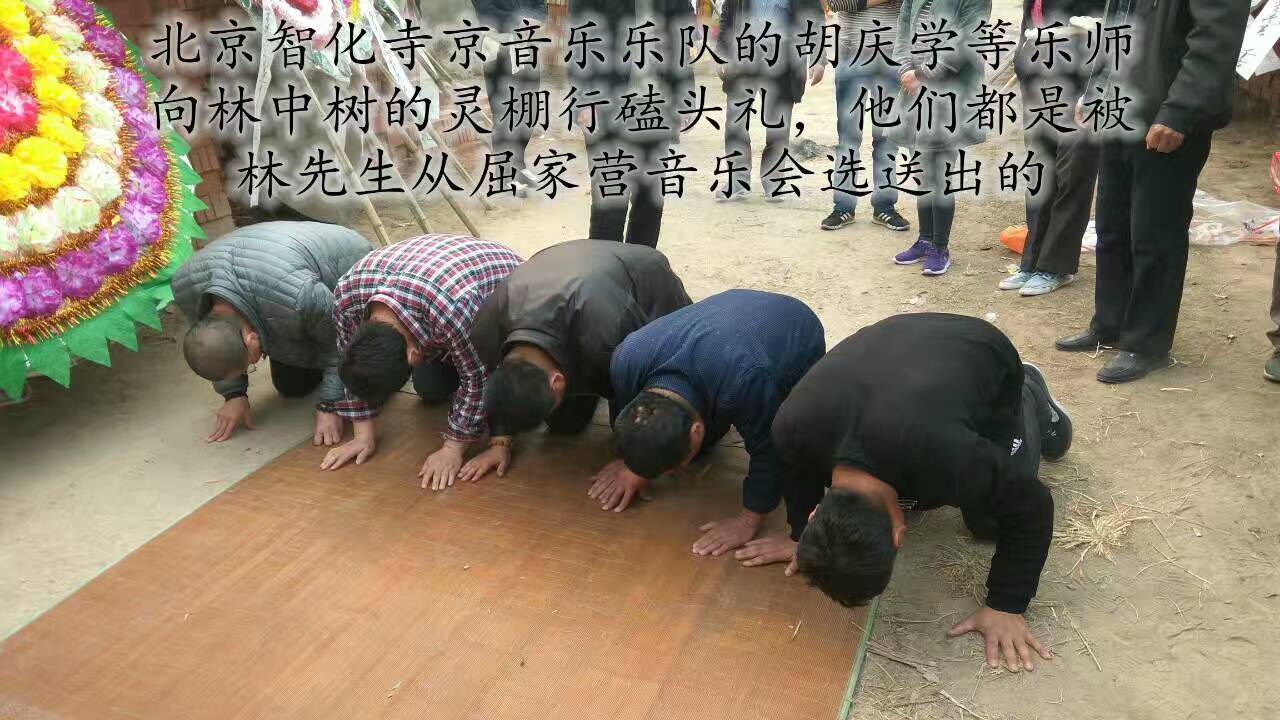
2Led by Hu Qingxue, Qujiaying villagers, later trained in the Zhihua temple style, kowtowing before the soul hall at Lin Zhongshu’s funeral, and playing the classic sequence Jinzi jing, Wusheng fo, and Gandongshan.

9

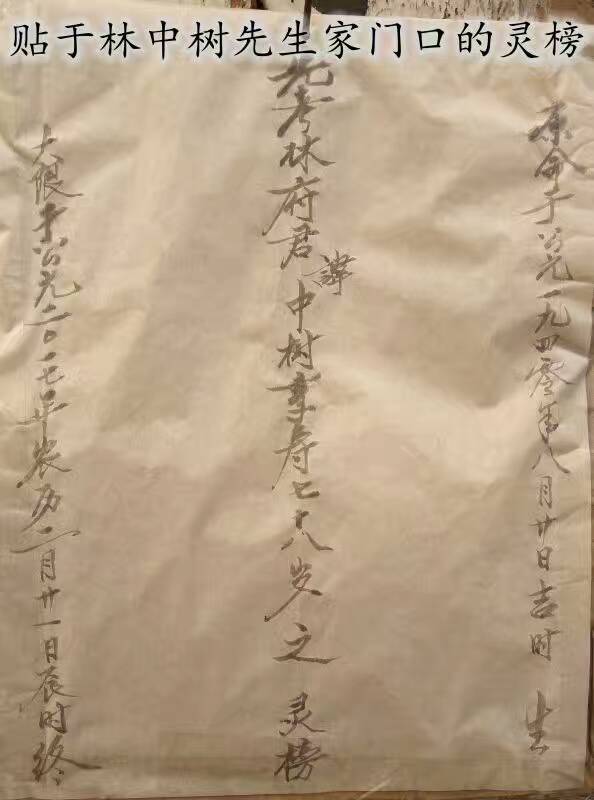
The funeral placard

Sources
Material on Lin Zhongshu and Qujiaying is too plentiful to encapsulate here. Apart from the links above, and a plethora of journalistic articles, scholarly coverage began with a brief yet brilliant article by Xue Yibing 薛艺兵 and Wu Ben 吴奔,

  • 屈家营音乐会的调查与研究, Zhongguo yinyuexue 1987.2: 87–96,

with all the kinds of musical and social detail that we would later augment. For further sources, see my article here.

Qiao Jianzhong 乔建中, successor to Yang Yinliu as director of the Music Research Institute in Beijing and one of the great instigators of research on north Chinese music, documented Lin Zhongshu’s own account in

  • 望:一位老农在28年间守护一个民间乐社的口述史 (Beijing: Zhongyang bianyi chubanshe, 2014, reproduced in Qiao Jianzhong wenji 乔建中文, vol.7, 2023).

and Zhang Zhentao 张振涛 writes perceptively as ever in articles such as

  • 平原日暮——屈家营的故事, Zhongguo yinyuexue 2009.3.

His memorial to Lin Zhongshu has also just been posted by the Shanghai Centre for Ritual Music:

  • 他让乡村乐社走进国家乐史 ——祭林中树

Among many rather grandiloquent films, this leads to further links, while a more sober film by Wang Qingren 王清仁 (2013) is both fascinating and disturbing.

For a list of sources on the Zhihua temple and the current group, see here; and for a roundup of some posts under the Gaoluo tag, here.

[1] Actually, both died on 18th March, so perhaps it was a question of time zones. Anyway, this is no time for pedantry.

Festivals: the official—folk continuum

The upcoming CHIME conference in LA (29 March to 2 April), presided over by the excellent Helen Rees, looks like a fine event, though I can’t make it. The theme this time is festivals.

Gansu miaohui FKTemple procession, Xincheng, south Gansu, June 1997. [1]
Photo: Frank Kouwenhoven. © CHIME, all rights reserved.

Of course, festivals and pilgrimages all over the world are a major theme of ethnography: not just Uyghur meshreps and mazar, and Tibetan monastery festivals, but Indian melas, Sufi festivals, the Mediterranean (Andalucian fiestas, south Italy…), Moroccan ahouach, you name it. Bernard Lortat-Jacob’s 1994 book Musiques en fête is charmant, with wise and vivid words about Morocco, Sardinia, and Romania (¡¿BTW, why do French books put the list of contents at the back?! ¡¿Typical Gallic contrariness?!)

To adopt the metaphor of “the whole dragon” again, there is a long continuum between folk festivals, based on ritual (often calendrical) observances, and secular events for a largely urban audience.

So I too am going to link up diverse themes like temple fairs, ritual, famine, village names, Eurovision, and propaganda. It does make sense, though—trust me, I’m a doctor.

Traditional events in China`
Funeral rituals have been my main topic in China for thirty years, but of course it’s not easy to plan visits much in advance. The calendrical dates of temple fairs (often known as miaohui) may seem easier to anticipate. Again, scholars of religion tend to home in on their specifically religious elements, as in the great jiao Offering—though note Ken Dean’s fine film Bored in heaven. But like funerals they are multivalent, embracing all kinds of activity: ritual, opera, folk-song, pop, commerce, “hosting” and “red-hot sociality” (Chau!)…

Apart from my 2007 and 2009 books, names like Zhao Shiyu, Guo Yuhua, Wang Mingming, Yue Yongyi, Stephan FeuchtwangAdam Chau, and Wu Fan spring to mind. The knack is to detail both sacred and secular aspects of temple fairs.

But the dates of calendrical rituals, like temple fairs, may not be easily vouchsafed to the outsider either. The temple fairs on the Houshan mountains in Yixian county southwest of Beijing, mainly in the 3rd and 7th moons, are much less well known than those of Miaofengshan, but they also draw huge crowds, both local and from further afield.

To work all this out you have to spend time around the villages of Liujing and Matou in the foothills around Houshan, and then observe who goes where when and does what. Although Chinese villagers are a rich source of ritual and musical information (far more than any silent library), they often speak prescriptively rather than descriptively, telling us on what occasions a jiao Offering ritual should be performed, whether or not is has been performed since the 1940s. They don’t necessarily volunteer information on change, preferring (like some officials and scholars) to present their traditions as constant, eternal—even if contexts and repertoires have evidently changed in their lifetime. On our first visit to Liujing we rather assumed that villagers’ descriptions of ritual pilgrimages related to “the past”— but we soon found that they were very much alive.

The Songs-for-winds associations: propaganda and catastrophe
What got me “thinking” (I use the word loosely) about all this was that 1950 visit to Tianjin of the “Songs-for-winds” band from Ziwei village, in what later became Dingxian county.

The Central Conservatoire (as it was then) was then still based at Tianjin, of course. The work of Yang Yinliu and Cao Anhe on the Songs-for-winds may be considered a prelude to that on the more solemn ritual style of the Beijing temples that Yang undertook from 1952, a topic that was to expand vastly after 1986. But the Songs-for-winds groups, more popular than the ritual style that is my main focus, are worth a little detour here.

We should bear in mind that such wind ensembles were quite unfamiliar to southerners like Yang and Cao. Having invited the Ziwei band to the conservatoire, they recorded their repertoire on a Webster wire recorder. The band went back some six generations, and under the leadership of the celebrated Wang Chengkui, they had invited the great wind player Yang Yuanheng  to teach them in the winters of 1945 and 1946. Yang Yuanheng, a former Daoist priest in a little temple in Anping county, was himself appointed professor of guanzi oboe at the conservatoire in 1950. [2] Yang Yuanheng, like the Buddhist monk Haibo, was a major influence on many shengguan ritual associations in the area: we would hear their names from many village associations.

Yang and Cao’s monograph on the Ziwei band, published in 1952,  consists mainly of transcriptions, with little of the social detail that they covered for the Wuxi Daoists or Yang’s 1956 Hunan fieldtrip. Ziwei would go on to supply wind players to many state troupes for decades to come.

Langfang huahui 1991

Secular New Year’s huahui parade, Langfang city, 1991.

Xushui
Adapted from my Folk music of China (p.196):

During the 1958 Great Leap Forward (or Backward, as it’s known), Dingxian and particularly Xushui counties became model counties for the relentless drive to full communization. [3] At the height of the Leap back in August 1958, Chairman Mao visited communes there. In Dasigexiang district just southeast of Xushui county-town, Dasigezhuang village was now renamed the 4th August brigade. Notable for its revolutionary fervour at this time was the “Great Leap Forward Songs-for winds association” of Qianminzhuang brigade in Xushui, which performed for this visit.

The propaganda of the Leap makes a stark contrast with the grim realities of the period, with villages throughout the area suffering from crop failure, famine, and social disruption.

Our visit to Qianminzhuang in 1993 was the only time I’ve ever had a police escort—to take me there for a change, not to drag me away! Predictably, such an effusive welcome for me as a “foreign guest” indicated close supervision and censorship of our fieldwork.

QMZ band 1993

QMZ pose 1993

Striking a pose with the leaders, Qianminzhuang 1993

In 1995 we visited some of the senior musicians independently, with much more useful results.

Xushui’s favoured status did nothing to prevent many starving to death there in 1960—but just near Qianminzhuang, the Gaozhuang ritual association still managed to restart in 1961. Religion revived in China precisely at moments of political crisis such as the famines of 1960 and the Cultural Revolution, albeit with great difficulty. It may provide solace, or a focus for resistance—both against Maoism and later against the insecurities ensuing its demise.

The Gaozhuang ritual association was one of many in Xushui villages that used, and use, the older more solemn shengguan style. Ritual associations throughout the area commonly claim transmission from either Buddhist monks (heshangjing 和尚經) or Daoist priests (laodaojing 老道經)—the Gaozhuang association is Buddhist-transmitted. In another common taxonomy, the association divides into “front altar” (qiantan, the shengguan instrumental ensemble, and “rear altar” (houtan, vocal liturgy).

Despite its revolutionary image, Xushui county has remained a hotbed for religion, notably the cult of the sectarian creator goddess Wusheng laomu. Associations there commonly hang out ritual paintings, like the Ten Kings (Shiwang) or Water and Land (Shuilu) series, and they use “precious scrolls” and other ritual manuals. They too are within the catchment area of Houtu worship—they used to make the pilgrimage to Houshan. Even the revolutionary Qianminzhuang band told us that their former tradition was to recite the scriptures, performing only as a social duty for funerals, not for weddings. And certainly not to accompany mendacious parades to report a bumper harvest…

In 1994 the Gaozhuang association built an Ancestral Hall to Venerable Mother (Laomu citang), occupying about one mu, stylish and grand. It cost around 60,000 kuai to build; the stele lists 132 donors, who gave from 50 up to 3,000 kuai. The altar has Wusheng laomu in the centre, Wangmu niangniang and Songzi niangniang to the right, Cangu niangniang and Houtu niangniang to the left.
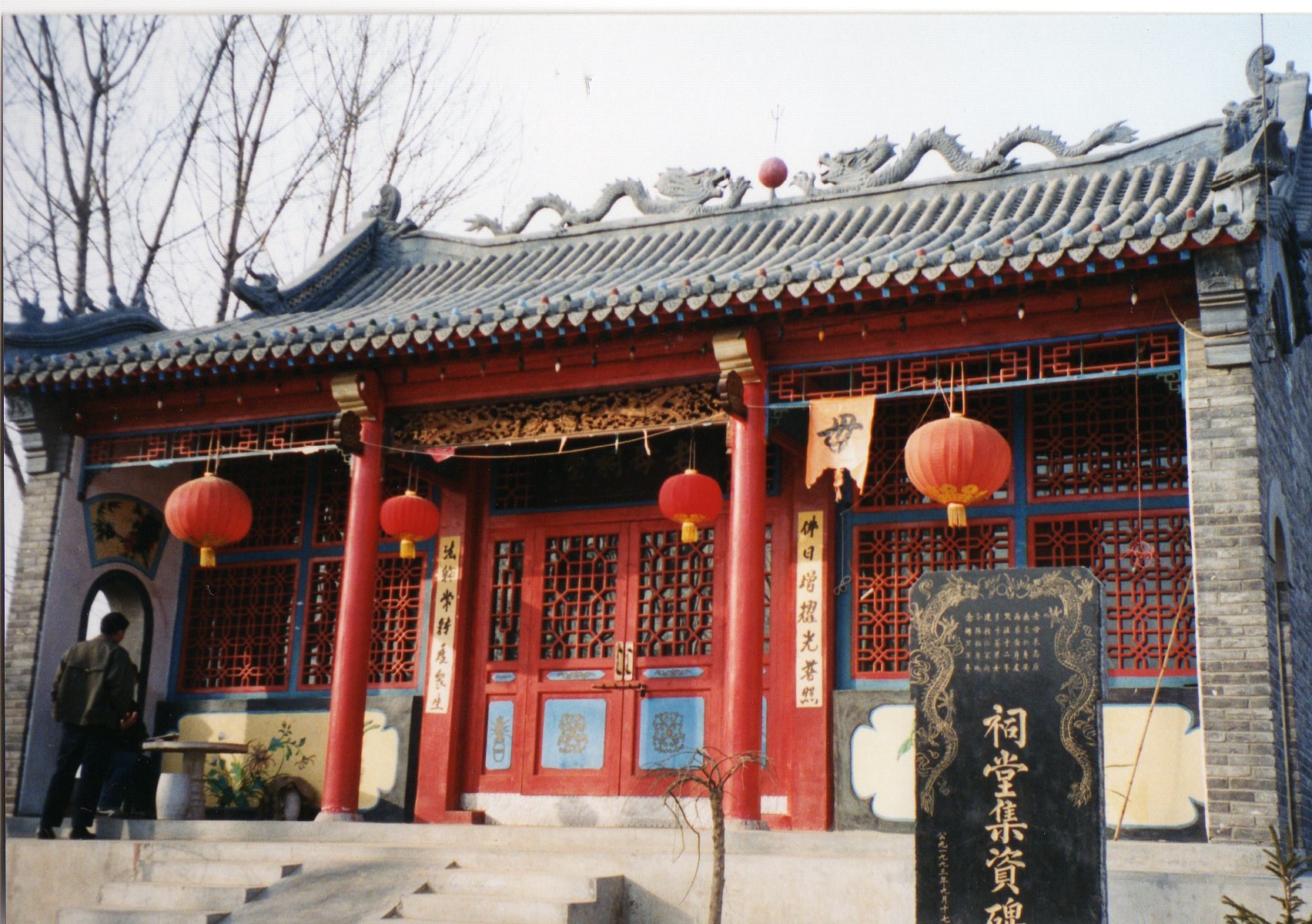
Gaozhuang citang

The village Party Secretary told us that sources of support included incense money from the Great Tent Association (Dapeng hui, a common term in the area for a ritual association) and from the temple, and money from fortune-telling and curing illness. He reflected, “A dozen or so women kept on coming to see me about building a temple. I had no choice—the brigade couldn’t refuse, so I gave them a plot of land. Believing in the gods and having a temple is no bad thing, it’s not as if you stop production if you believe in it!”

In all, the flamboyant (and readily secularized) Songs-for-winds style remains a common image of wind bands on the Hebei plain, but since all our fieldwork through the 1990s it is clear that ritual practice, with its more solemn shengguan instrumental style, is both older and more common. It is resilient too. This persistence of tradition, both in religious and musical practice, is all the more striking in such a once-revolutionary county as Xushui.

Mao was impressively modest about his limited success when he admitted to Nixon in 1972:

“I haven’t been able to change [China]—I’ve only been able to change a few places in the vicinity of Peking.”  [4]

But he wasn’t modest enough: in some ways even a county so near Beijing, such a focus of the revolution, has remained resistant to Maoist ideology, predating and outliving it. Still, disruption was severe. For more on Xushui, see here.

Official festivals in the 1950s
Meanwhile, the new government, in its own way, was promoting local culture through the medium of regional folk festivals (diaoyan, huiyan). First, local festivals were held to select representatives for major performances in the regional capitals. Some laicized priests were even assembled to perform as “troupes“, sometimes for the first time in many years—such as Baiyunshan Daoists (1955), Wudangshan Daoists (1956 and 1957), Wutaishan Buddhists (1958). For such performances, inevitably, their shengguan instrumental music was plucked out of its ritual context. I haven’t heard stories as distressing as the fate that befell kobzari blind minstrels in Ukraine when summoned for an official festival in the early 1930s; but folk ritual specialists were still anxious about performing for officials around 1980.

These festivals served partly as auditions for the state song-and-dance troupes then expanding all over China. Daoist and Buddhist ritual specialists had a deserved reputation as outstanding instrumentalists. Many, like our very own Li Qing (my book pp.113–25), were recruited as musicians to state troupes around 1958—and then sent home again as the state apparatus collapsed in 1962.

While such festivals stimulated the collection and documentation of folk music, we must balance this with the ongoing assaults on its traditional context. The background ( beginning from the 1940s) was campaigns against “feudal superstition”, terrifying public executions of sectarians, and the destruction of temple life.

The reform era
Urban festivals featuring rural groups—perhaps related to a conference—make a convenient recourse for busy academics into whose holidays they fit nicely. From the 1980s, the secular arts festivals of the Maoist era were remoulded into more glossy events. In 1990 the Li family Daoists took part in a festival of religious music in Beijing.

By the 21st century the new ideology was confirmed in the regular staged “living fossil” presentations of the Intangible Cultural Heritage. The latter project, with its whole bureaucratic workings, has now become a major research topic on its own, at the expense of studies of the local traditions that it is supposed to assist (my book pp.331–3). Note also the Qujiaying bandwagon.

I tend to steer clear of conferences, but in May 2016, as a pretext for going to hang out yet again with Li Manshan in Shanxi for a couple of weeks, I accepted an invitation to take part in a conference celebrating the 80th birthday of my esteemed teacher Yuan Jingfang in Beijing (for the resulting volume, see here).

It was a déjà-vu experience. Apart from a sequence of eulogies, the event also featured staged performances from three representatives of Yuan Jingfang’s long-term research areas: the Hanzhuang ritual association from Xiongxian in Hebei (near Xushui), the Zhihua temple group, and a ritual band from near Xi’an.

Hanzhuang 1993

Filming the Hanzhuang association in their ritual tent, 1993 (photo: Xue Yibing). Rear centre: two frames of ten-gong yunluo.

It made me feel my age, reminding me of all our visits to these very groups between 1986 and 2001. Taking time out of the conference to chat with the Hanzhuang group outside by the lake, we recalled their kindly association leader Xie Yongxiang 解永祥, father of the present leader, and another of those wise sheng masters. We had learned a lot from him in 1993 and 1995.
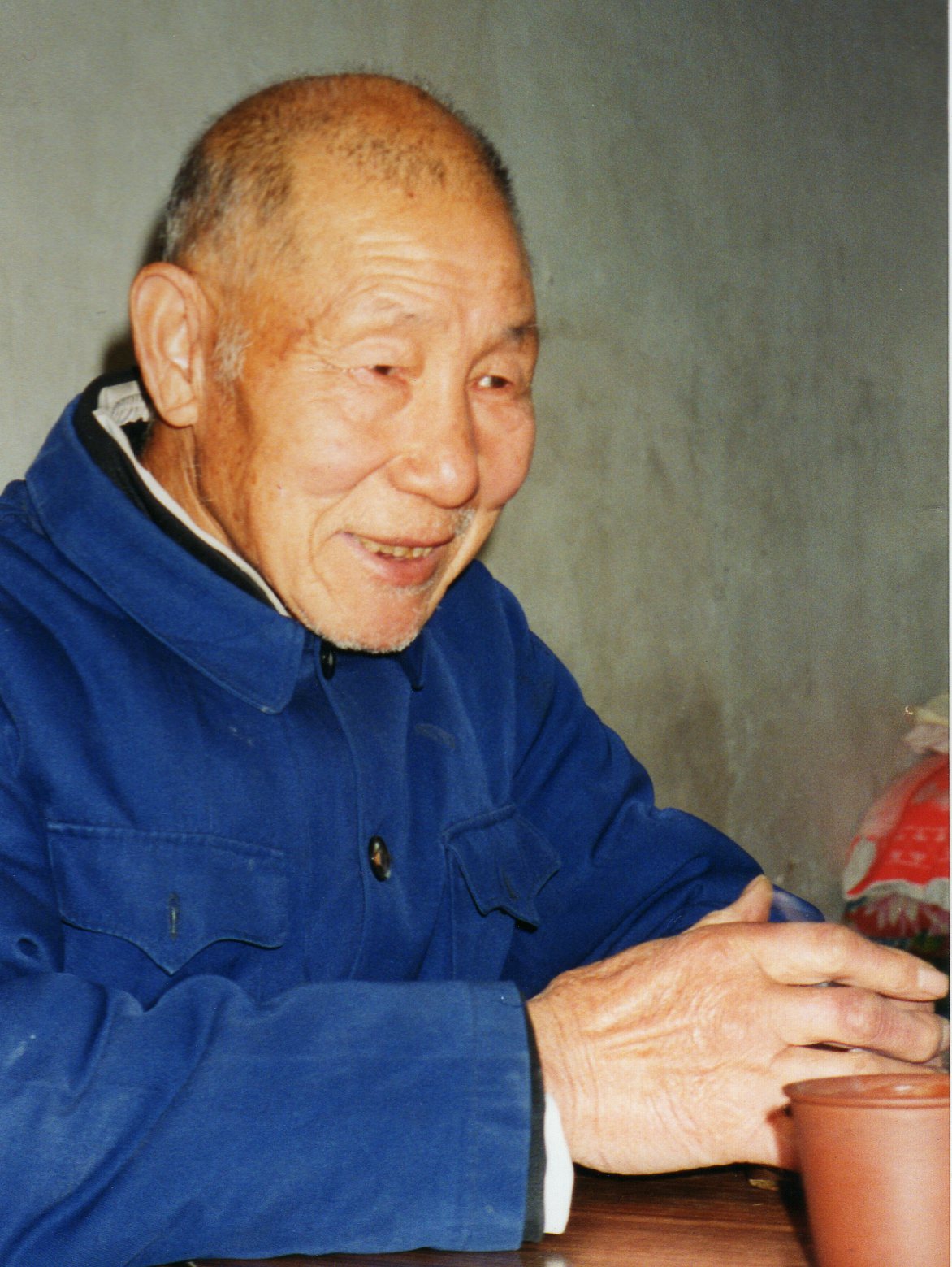
Xie Yongxiang 1995

Xie Yongxiang, 1995

But returning to the conference—the object of admiration, inevitably, was their “music”, detached from its enduring social context. I already missed hanging out with Li Manshan in the scripture hall.

All the glossy stage presentation has many Western parallels—flamenco on the Terry Wogan show, WOMAD, Songlines, prizes, urbane discourse explaining its “cultural value” to outsiders… The fancy costumes and dry ice of many Chinese events are reminiscent of Eurovision; they may seem like a Disneyland version of the Chinese heritage.

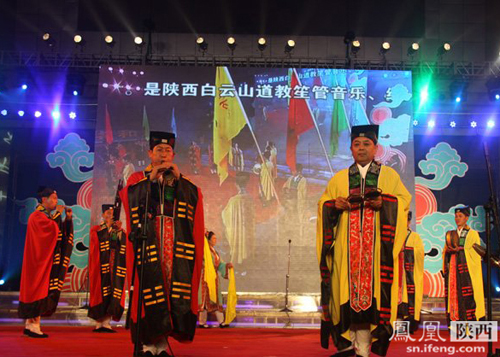
That photo comes from a recent ICH “performance” of the Baiyunshan Daoists, no less.

Now, I adore opportunities to present the Li family Daoist band on the concert platform (see e.g. this post and a whole related series of vignettes from May 2017), but while it is of course a compromise, we take care not to tart them up—we can hardly do otherwise, so solemn is their demeanour. The ambience and acoustic of churches makes a fine setting,  the Daoists’ sheng mouth-organs filling the Peterskirche in Heidelberg on our 2013 tour (cf. Buildings and music):
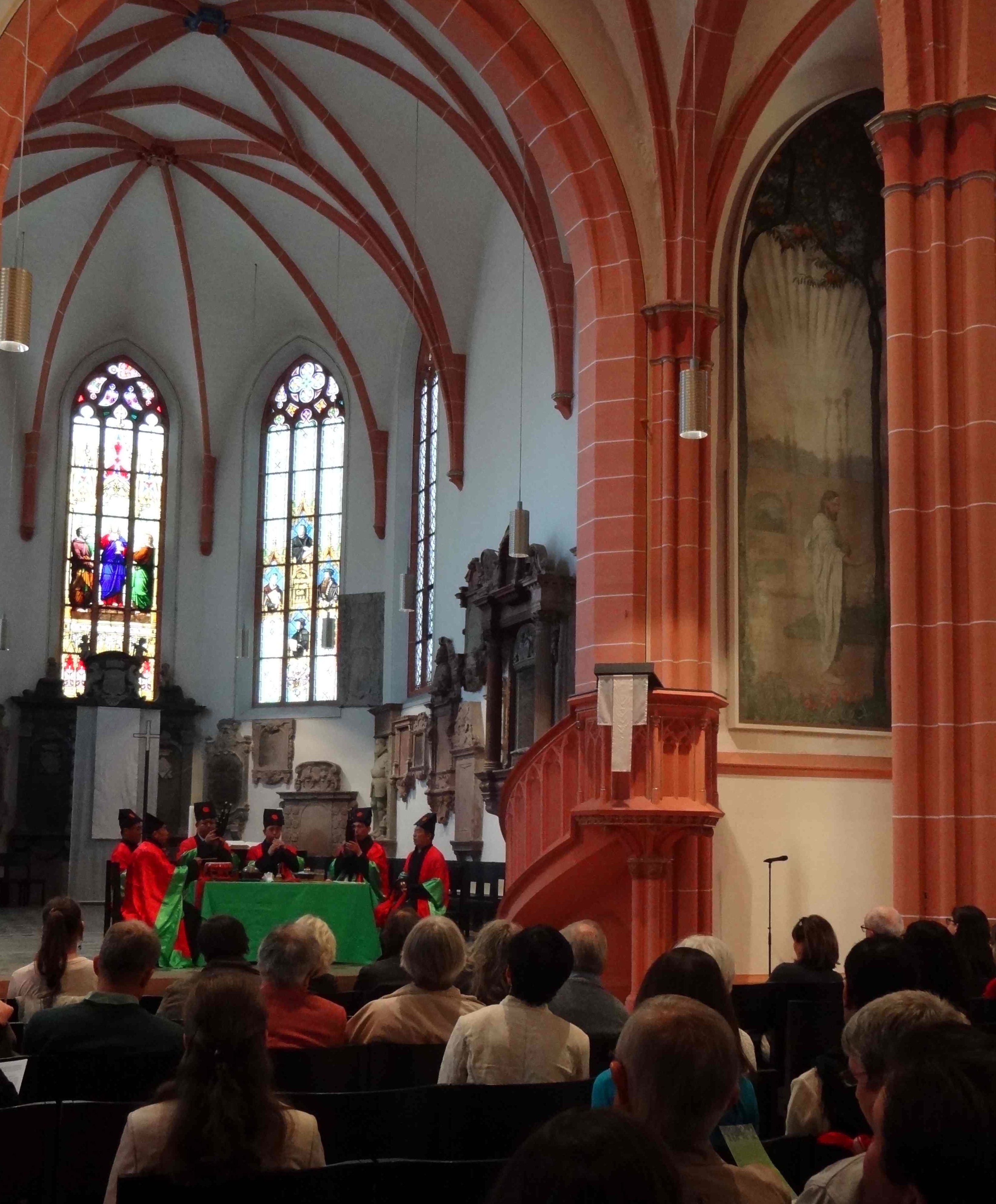
Hberg 2012

The Li family Daoist band in concert, Heidelberg April 2013.

Still, their regular “rice-bowl”—day in, day out—is always performing funerals for their local, not global, clientele.

What is dodgy is when people begin mistaking the staged events for the Real Thing, or some kind of ideal. Urbanites may do so, but villagers know better. Of course those staged events are themselves a legitimate, and popular, object of scholarly analysis. But I worry that it creates a fait accompli, like the way that in old-school WAM musicology the Great Composers were the main story (as deconstructed by McClary, Small, Nettl)—“this is what we find, so it must reflect the real picture, and so this is the object of study”. As always, “modern” secular performance doesn’t replace traditional activity: they co-exist.

The CHIME conference in LA will doubtless turn up many instances of what I’m struggling not to call “contested negotiation”. Anyway, staged events can give us a lead, rather like using the photos in the Anthology, otherwise flawed, to draw us towards folk activity.

For thoughts on the theme of the 2021 CHIME conference, see here.


[1] For more, see Frank Kouwenhoven, “Love songs and temple festivals in northwest China: musical laughter in the face of adversity”, in Frank Kouwenhoven and James Kippen eds., Music, dance and the art of seduction.
[2] For this whole section, see my Folk music of China, pp.48–52, 195–203; “Chinese ritual music under Mao and Deng”, British Journal of Ethnomusicology 8 (1999): 27–66; “Reading between the lines: reflections on the massive Anthology of folk music of the Chinese peoples”, Ethnomusicology 47.3 (2003): 287–337. See also my In search of the folk Daoists of north China, pp.166–7, 183–4, 188–90.
[3] As correctives to all the Xushui propaganda, see e.g. the brilliant works of Friedman, Pickowicz, and Selden, Chinese village, socialist state and Revolution, resistance, and reform in village China—describing a commune not far from Xushui. Note Chinese village, socialist state, pp.215–20; Dikötter, Mao’s great famine, pp.40, 47–9, 68–70; and estimable analysis online in Chinese, e.g. http://mjlsh.usc.cuhk.edu.hk/book.aspx?cid=6&tid=184&pid=2269. For the model commune of Greater Quanshan in Shanxi, precursor of Dazhai, and temporary “home” to the Li family Daoists, see my Daoist priests of the Li family, pp.122–3, and here, under “Famine in China”.
[4] Also reported by Henry Kissinger in Newsweek, 3rd March 1997, p.31.

Two local cultural workers

These notes are partly stimulated by Zhang Lili, currently writing her PhD in Beijing on my relationship with the village of South Gaoluo, subject of my book Plucking the Winds.

A useful idiomatic term evoking the whole spectrum, whether of guanxi contacts or the range of funeral services, is yitiaolong “the whole dragon” (indeed, this blog may itself be considered “the whole dragon”, making links between seemingly diverse topics).

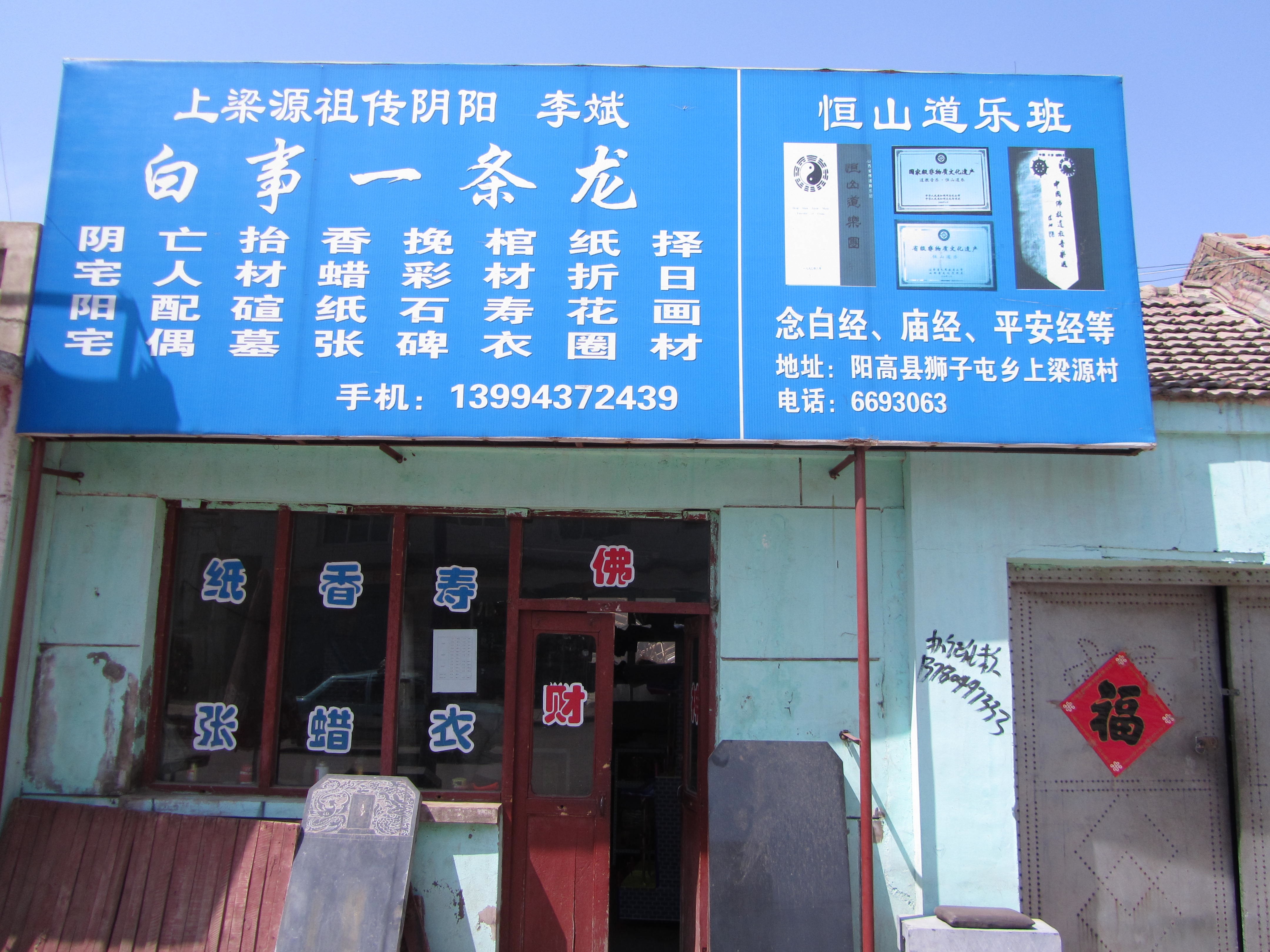
Li Bin’s first funeral shop in town.

Li Bin’s funeral shop in Yanggao county-town, Shanxi.

So having praised Yang Yinliu, shining pinnacle of Chinese musicology, I want to pay tribute to two admirable local cultural workers at the opposite end of the dragon (cf. An unsung local hero) whose work has inspired us since 1989:

Liu Fu 刘阜 and Wang Zhanlong 王占.

Their only qualification was that they were local, and came to take pride in documenting their local traditions under the stimulus of the new directive from the Anthology of folk music of the Chinese peoples, the vast project that got under way from 1979 as China began to liberalize after the collapse of Maoism.

Let me adapt a passage from my article

  • “Reading between the lines: reflections on the massive Anthology of folk music of the Chinese peoples”, Ethnomusicology 47.3 (2003), pp.287–337 (for reading between the lines of a Chinese article on 1950s’ Tibet, see here).

Antoinet Schimmelpenninck described the process of collecting folk-song in Jiangsu in the early 1990s.

The collecting of folk-songs is one task, but by no means the only or primary task of the bureaus of culture. They carry out political propaganda, make posters about family planning or about the punishment of local criminals, organize dance parties, stage plays and children’s games for local entertainment, run libraries, and execute various administrative tasks which help the provincial government. […]
It is not, at present, one of the specific tasks of the Cultural Bureaus of the Wu area to collect folk-songs. I visited one wenhua zhan (village cultural post) which was mainly engaged in printing labels for jam jars and other consumer goods.

Censorship may operate throughout the process: first, self-censorship of performers (e.g. what kind of songs singers see fit to sing for fieldworkers), and then editorial adaptation of the material collected. In Baoding, one single region of Hebei province, where ritual associations have important traditions, such fieldwork as was done on “instrumental music” took place mainly from 1983 to 1985, but in only two or three of a dozen counties we have visited did we find knowledgable cadres who had done such work.

One of the most diligent of these was Liu Fu, of the Hall of Culture in Laishui county. He acted early on the Anthology directive, printing a mimeograph (4 pp. introduction, map, list of contents, 128 pp. transcriptions, 22 pp. field report, 8 pp. diagrams of instruments) on the county’s instrumental music as early as 1983, which was an important inspiration for my own work on ritual associations there. I don’t know if the regional editors ever forwarded Liu Fu’s work, but it was entirely omitted from the final provincial publication. The following passages of his “Field report” show some of the problems faced by local collectors, here partly relating to the sensitive and secret nature of ritual music:

The work of collecting folk instrumental music is not always smooth: we have met considerable difficulties. For instance, some elderly folk musicians had been struggled against during past campaigns for this [their music/ritual], and had been labelled as “black cliques” and “ox demons and snake spirits”, so they are still anxious. When they heard that we wanted to collect pieces of music, they suspected that it was once again “luring the snake out of its hole”, and so they refused to play for us.

Some associations are very conservative in their thinking, and are concerned that their distinctive pieces will be taken off and learnt by others—in their own words “something we begged for on our knees, we can’t just throw it out now we’re on our feet”, and so they make excuses not to play for us. Some associations take the opportunity to make economic demands. Some brigade [village] cadres think this work is meaningless, and are afraid it might have side-effects, and so are unwilling to co-operate with us. And so on.

Since these are ritual associations, by “side-effects” he apparently means that the collection may be seen as encouraging feudal superstition. Liu Fu continues:

To tackle this situation, every time we arrive in a place, we explain the document “On the collection and documenting of the Chinese folk musical heritage” from the Ministry of Culture and the Musicians’ Association, and the spirit of the directive from the relevant organs of the province and regions, and we discuss the great academic value of the repertory of the ritual associations in our county, and the great significance of the work of collecting, to make the cadres and musicians have a correct understanding; we then show them that they can play whatever they have to play, they must not leave it to later musicians, but do their best to make their own page in the Anthology of instrumental music.

Poor equipment for sound recording, copying, and photography was the norm. Liu Fu goes on to discuss the problems of recording:

Although there are said to be instructions and directives from the central, provincial, and local authorities for the work of collecting instrumental pieces, no-one has given us a scrap of money, and the expenses of the county Bureau of Culture are reduced year by year. Under present conditions, where they can only guarantee annual salaries, they can’t supply any more money to support the work apart from producing a minimal sum for buying necessary goods like tape and paper. Thus, all the associations have to perform for free. This requires us to record as much as possible in a short time.

I might add that any tapes were poorly annotated if at all, and haphazardly stored. One keen cadre I know in the same area had to use a single tape over and over, transcribing a piece in one village one evening and then re-recording music in another village the next day on top of the old recording. But at least he did some work! Of course there was a lot more that local scholars could have done, given time and money—like copying gongche scores and ritual manuals, filming rituals, documenting the histories of the associations, and giving detailed descriptions of ritual sequences, as we later aspired to do in our project around several nearby counties. But Chinese fieldworkers have now overtaken us.

Central funds barely reached down to grass-roots level, and cultural cadres did what they could. On one hand, they were indigenous to the musics they were documenting, but they were rarely able to afford the time or resources, even if they had the training, to make systematic reports. Still, some of the results are impressive.

Anyway, we knew that we might learn from local cultural officials how to find ritual groups. Besides, in those early days, when the memory of the commune system was still fresh, it was a necessary first stage to go through the chain of local officialdom. Sometimes, when our preliminary research in Beijing failed to suggest any knowledgeable local officials, we simply bypassed them. A couple of times we got our fingers burnt, but the most fruitful leads to ritual groups often came just by stopping to chat to any old melon-seller by the roadside—he would generally tell us where the grand rituals were held, and which villages were worth visiting.

There were actually two types of cultural officials: those inclined towards “cultural work”, and jobsworths. The latter, once we began visiting the villages regularly, realized that we didn’t constitute an excuse to hold another vast banquet; I was clearly not an eminent foreign professor but an ill-dressed and impecunious young researcher, so they soon left us to our own devices.

Times have changed, though: now the local Bureaus of Culture are staffed by administrators, not necessarily even local, with their smartphones and spreadsheets.

Liu Fu and Gaoluo
Further to A slender but magical clue, I’ve been recalling how we found the village of Gaoluo.

Liu Fu himself came from a Laishui village, East Mingyi, with its own tradition of vocal liturgy (including baojuan “precious scrolls”) and shengguan ensemble. After the 1986 “discovery” of the Qujiaying ritual association in nearby Gu’an county, he had already approached officials in Beijing to tell them that there were plenty of similar groups in his county alone, giving them a copy of his fine 1983 mimeograph and a tinny tape he had somehow made of a few of their shengguan pieces.

In Beijing Liu Fu also met my mentor Qiao Jianzhong, Yang Yinliu‘s successor as head of the Music Research Institute, who then made an exploratory trip to two other Laishui villages in 1988. It was this that prompted me and my friend Xue Yibing  (a bright musicologist from the distinguished Music Research Institute in Beijing) to visit Liu Fu in his bare dingy office in Laishui county-town as part of our first fieldwork survey in New Year in 1989.

After giving us an outline of the various ritual groups in the county, Liu Fu recommended Gaoluo, so we all sallied forth. Here I adapt from the Prelude of Plucking the Winds:

I first arrived in the village of South Gaoluo on a cold but bright winter’s afternoon, on the 14th day of the 1st moon in 1989, in the middle of the great New Year’s rituals then taking place in every village in China. This was one of many villages just south of Beijing where I was working with Xue Yibing in doing exploratory fieldwork on amateur ritual groups.

Escorted on that first visit by a well-meaning ganbu (“cadre”, as state officials are known in China) from the cultural bureau of the county-town, we made slow progress by jeep along the bumpy track to the village; though it is only nine kilometres from the dingy county-town of Laishui, the journey took over half an hour.

cart

An encounter on the way to Gaoluo, 1989.

First we went to the house of the then village chief Cai Ran, himself a vocal liturgist in the village ritual association, and had to spend over an hour in heated debate before we could cajole him into allowing us to trudge through the alleys to the ritual building a few hundred yards away, where the association was then performing before the god paintings at the altar (photo here).

cai-ran

Cai Ran, 1989.

diaogua

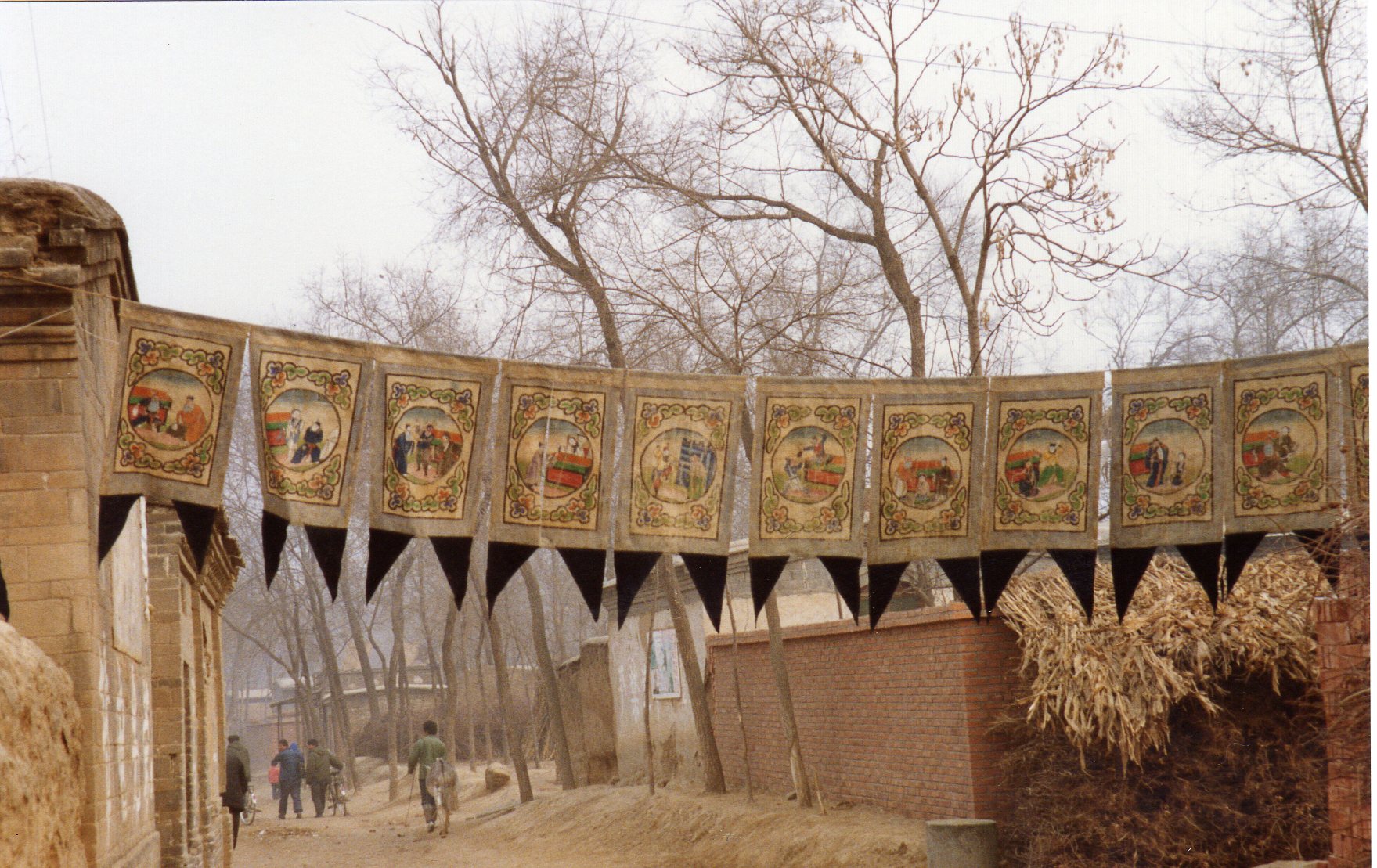
Diaogua hangings for the New Year’s rituals, 1989.

gl-beiwen

Donor’s list (1930) of the South Gaoluo association, New Year 1989.

At the time Cai Ran’s caution seemed to me excessive, since we were all clearly sympathetic, and the county cadre was taking responsibility, but in retrospect I felt rather embarrassed: maybe we should have respected his reluctance. Later, when I learned of the 1951 imprisonment of the Italian missionary Bishop Martina, apparently the last foreigner to visit the village, and as I experienced more often the sensitivity of “superstitious” practices in China, I understood his anxieties better. But later Cai Ran recalled that his hostility that day was not related to the revealing of secret rituals to foreigners, nor to fear of criticism from county cadres, but rather to the possible appropriation of his village’s ritual music by the cadre, whom he already suspected of handing on some pieces to the association in his own home village. After this strange introduction, we soon came to enjoy our sessions with Cai Ran: he has a wonderful informality, a great sense of humour, and is full of insight.

Later I liked to share with the villagers another amusing memory of that first afternoon. After finally persuading Cai Ran to escort us to the ritual building, and having gained the musicians’ approval to record and take photos (alas, I didn’t yet have a camcorder!), I had just set up my recording equipment when in walked a severe-looking policeman in uniform. Knowing the sensitivity of what the musicians were doing, and of what I was doing in watching them doing it, my heart sank: feeling irrationally as if I’d been caught in the act (fan cuowu “made a mistake”, as the eloquent Chinese expression goes), I prepared for further lengthy negotations. But the policeman, the splendid Shan Rongqing, back in the village for the New Year holiday, immediately picked up the large ritual cymbals and joined in with feeling. He later took part keenly in our studies of the village traditions; we often admired his musicianship on the ritual percussion, and later too on the “old fellow”, the bowed fiddle on which he accompanied the local opera.

srq

Shan Rongqing, 1989.

That day we felt lucky enough to have been allowed—eventually—to witness the association’s afternoon ritual, and since we had business in the county-town that night, we agreed to return the next day to talk with the members. That next day they were friendly, as always with such amateur associations; we recorded them “singing the score” of some of their shengguan pieces for us (cf. sidebar playlist, #9), and learned the bare bones of the New Year’s rituals and the history of the association—material which later, in view of all that we would gradually learn, came to look ludicrously sparse. And again we took our leave—the time still had not come for in-depth work, since we were only making a general survey.

Somehow, that first visit to South Gaoluo left us with a deep impression: the village seemed isolated (a view we later corrected) and its ritual life intense, with all the beautiful hangings decorating the temporary temple and the alleys outside. But it was not until the summer of 1993 that we were able to go back there. By now we were engaged on a four-year project to document village ritual associations throughout the area; but while we continued to collect basic data on other villages, we naturally felt the need to dig beneath the surface, not just to “gaze at flowers from horseback”. Gaoluo became a magnet for us, and over the following years we made many stays there, having a fantastic time as we learn more about the turbulent experiences of the village and its ritual performers throughout the 20th century.

Wang Zhanlong
The very next day after those first visits to South Gaoluo at New Year 1989, in the adjacent county of Yixian, home of the Western tombs of the Qing emperors, we visited the office of the Bureau of Culture to seek clues to local ritual associations. There we found the splendid and unassuming Wang Zhanlong. Like Liu Fu, he too relished the task of collecting material, riding his bicycle through poor villages with a crummy little tape recorder and a notebook. Wang promptly took us to Liujing village, also in the midst of their New Year’s rituals.

liujing

Xue Yibing documents pantheon, Liujing, New Year 1989.

This was the start of our studies of the Houshan pilgrimage and the cult of the goddess Houtu.

wzl-xyb

Wang Zhanlong and Xue Yibing, Houshan 7th-moon temple fair, 1993.

Houshan is just one of those numerous local mountain sites attended several times each year by vast throngs of pilgrims, ritual groups, spirit mediums, and beggars, yet (unlike Miaofengshan to the northwest of Beijing) it had never attracted the attention of outsiders.

houshan

Houshan temple fair, 7th moon 1993. Matou village ritual association (left) accompanies a spirit medium (front centre) and disciples (whom she has healed) for boat-burning ritual as they pray.

Right through the 1990s Wang Zhanlong made a wonderful sincere companion on our regular visits to Houshan and the ritual groups of Yixian county, always in sympathy with our project. Here we are in 1995 with erudite ritual specialist Li Yongshu in Baoquan village near Houshan, learning the details of the complex performance practice of the “precious scrolls” to Houtu, the Ten Kings, and so on.

Li Yongshu, Baoquan 1995

liujing-pantheon-1995

Pantheon, Liujing, hung out for rituals on the 1st day of the 3rd moon, 1995. Right: envelope with petition, to be burned in supplication to the goddess Houtu.

For an intrepid fieldworker in Liaoning, see here. See also surveys based on the Anthology for Fujian and Tianjin.

More on Hebei

I’ve been revisiting my account of the amateur ritual association of South Gaoluo, my field-base through the 1990s, and I’ve just added a page (click here) on two major characters in the association. Now I’ve also given a roundup of posts on the village.

dengpeng

The New Year’s rituals 1989, our first visit

In my sojourns with the Li family Daoists in Yanggao I am mainly chatting with one extended family, seemingly detached from politics—not even on my early visits in 1991 and 1992 did we ever have any contact with local cadres. The headquarters of the village “brigade” have long stood derelict. Indeed, the experience of household Daoists—as freelancers, like shawm bands or carpenters—was different from that of peasants tied to the land, and they largely felt at a distance from the efforts of the leadership to rebuild society, more concerned for their own livelihood, always straining to gain some independence from the production teams. Moreover, Li Qing’s family was among the “black elements” in the village, suffering discrimination. Even if I had spent more time with the senior generation, I suspect their experiences of Maoism would have been similar: though inevitably deeply affected by political vicissitudes, they had little investment in the public affairs of the village.

By contrast, through the 1990s our team from the Music Research Institute in Beijing was doing a survey of villages on the plain south of Beijing, documenting amateur village ritual associations. These groups perform vocal liturgy, ritual percussion, and haunting shengguan wind music, mainly within their own village for funerals and calendrical festivals for the gods, so they are basically supported by the whole village.

While doing “hit-and-run” missions to several dozen villages in the area, I was increasingly attracted to one, South Gaoluo. Apart from the well-preserved condition of all aspects of the association’s ritual practice, I was drawn by the musicians’ personalities, and I ended up doing a detailed study on the fortunes of the village and its ritual association through the 20th century. What I tried, and failed, to write was a kind of cross between The Archers, Wild swans, and Philharmonia.

As I compiled the history of the association, several sources helped me to put its ritual and social culture in political context. There, many of the members of the association held positions of authority under all three periods of 20th-century history, so we naturally talked with the village leadership. With their detailed knowledge of the modern history of the village, several senior men, past and present cadres, were able to offer clear accounts of major events in the area and to connect them to the village’s ritual association.

But in both cases (occupational household Daoists and village-wide amateur ritual associations) the complexities of local relations can have a deep influence on ritual practice. Perceived cultural capital also changes. As with my work on the Li family Daoists, dry timeless disembodied lists of ritual sequences and vocal and instrumental items are far from adequate. What is fascinating is the interaction of personal biographies, the whole social and political environment, with changing ritual practice.

So on the new page I illustrate all this with the stories of two outstanding members of the South Gaoluo association, Cai Fuxiang (c1905–79) and Cai An (1942­–2012). In the official discourse, Cai Fuxiang would merit a polite footnote as an “old revolutionary” who preserved the ritual manuals and the performance of the vocal liturgy under Maoism; whereas the great Cai An might hardly feature at all. For more on the liturgists, click here.

Hebei: new discoveries

In the recent, ongoing, fieldwork project continuing our work on the Hebei ritual associations, led by the energetic Qi Yi 齐易, most welcome for me so far is new material on Hubenyi 虎贲驿 village (see e.g. here).

htj-2htj-1

In Plucking the Winds (pp.90–92) I told how the beautiful surviving copy of the Houtu scroll of Gaoluo village was copied by Ma Xiantu, a cultured teacher and sectarian from Hubenyi village just further northeast. Then teaching in Beijing, he first borrowed the old copy of the scroll from South Gaoluo “to supplement the deficiency of my village’s Hongyang Holy Association”. His brother-in-law, South Gaoluo villager Shan Hongfu, was also staying in Beijing, and watched Ma Xiantu copying the scroll; he then bought more paper and asked Ma to make another copy for South Gaoluo. So Ma Xiantu copied it every day after school. He started copying the scroll in the 6th moon of 1942, and completed it in the 1st moon of 1943, finally adding the punctuation in red while he visited South Gaoluo to hand it over formally to the Association for the New Year’s rituals.

The 2015 fieldwork at Hubenyi, though not mentioning Ma Xiantu or the Houtu scroll, revealed further Hongyang scriptures, including an old copy of the Hunyuanjiao Hongyang zhonghua baojing 混元教弘陽中華寶經. Qi Yi and Song Yingtao 荣英涛 have collected basic data, so with bated breath I await a study from scholars of folk sectarian religion, for whom this whole area should be such a rich field… And who will supplement our work on the foshihui 佛事會 ritual associations around Yixian county?

For Hunyuan and Hongyang sects in the region, see my In Search of the folk Daoists of north China, Part Three.

An unsung local hero

li-jin-2013

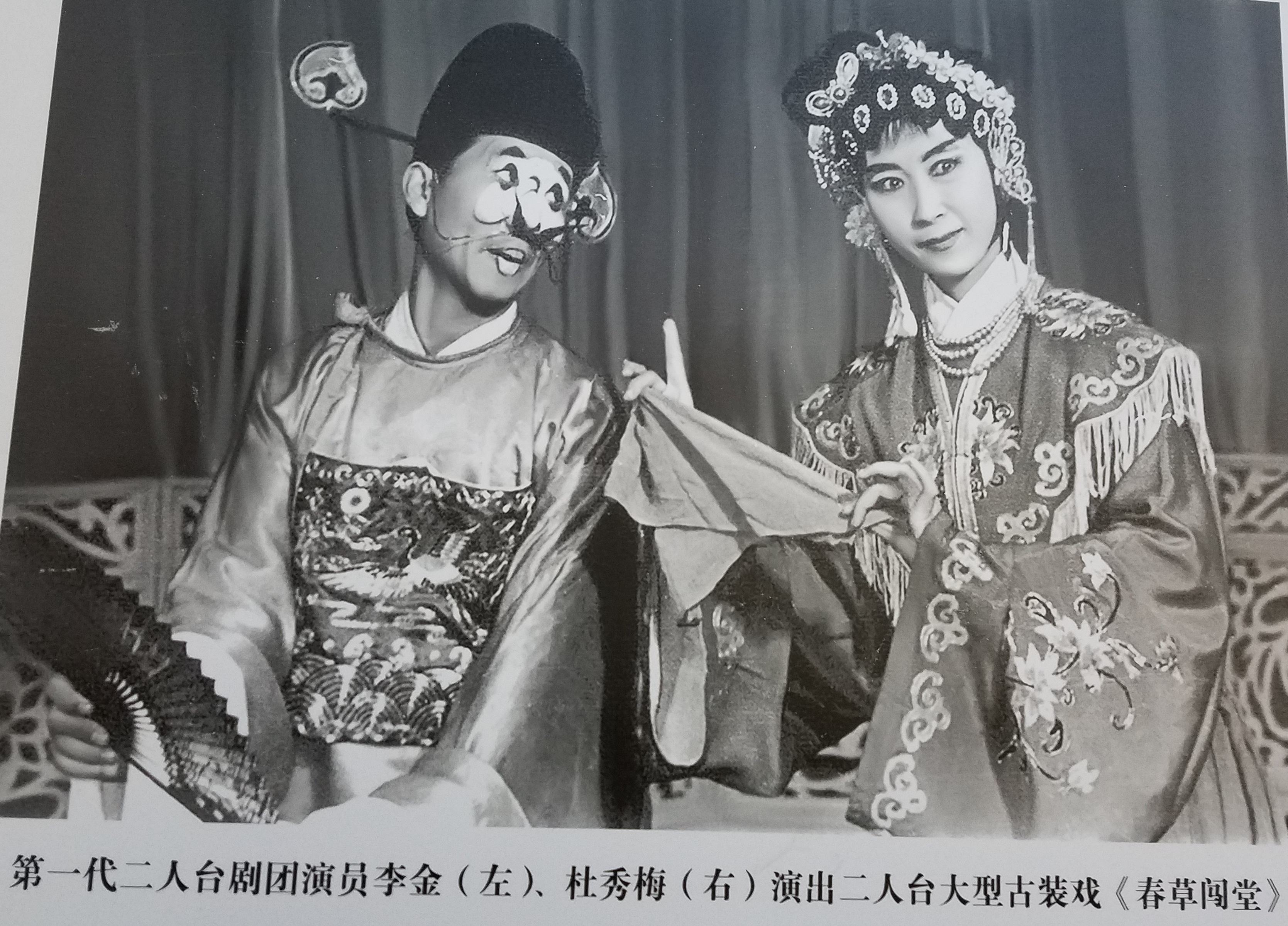
I mentioned the splendid Li Jin 李金 briefly in my book (p.20):

I also made a couple of brief trips doing a reccy of Daoists in the nearby counties, assisted by my saintlike old friend Li Jin, bright young scholar Liu Yan, and feisty Driver Ma, all delightful company. No-one will ever accept any reward for all their work as my amanuensis. Elif Batuman’s fine adage about her time in Samarkand rings true: “We were either trying not to give money to people who were trying to take it, or trying to give money to people who were trying to refuse it.”

Pufo tang

Li Jin (right), with Jiao Lizhong (centre) and driver (and polymath!) Ma Hongqi,
Hunyuan county-town 2011.

Li Jin is indeed a treasure. I only realized quite recently that he was once a celebrated performer—but it’s his infinitely generous sincerity that strikes all who meet him. In this he resembles the great Li Qing, but his story differs in that the Li family Daoists always strived to keep under the radar, maintaining their independence from official control, whereas Li Jin’s life has been shaped more directly by the vicissitudes of the Party. In many ways his story is unexceptional, but while my accounts of Yanggao generally concern folk more than state, [1] it reminds us of the presence of the latter—and the presence of Good People within it.

A year older than Li Manshan (but not related to the Li family Daoists), Li Jin was born in 1945 in the poor village of East Shahe just southwest of Tianzhen county-town. He had two older brothers, and at first his family thought to give him away to a close friend, a childless local doctor, but in the end they kept him. Their grandfather was the patriarch. He had gradually accumulated over 30 mou of land, and with the three brothers helping in the fields, their life was quite comfortable until “Liberation”. In the land reform of 1947–48 they were classified as middle peasants (cf. my book pp.95–9); in the 1964 Four Cleanups campaign they were stigmatized as “rich peasants”, and only rehabilitated in 1982—not unlike the Li family Daoists.

When a basic primary school system was established, Li Jin went to school in the converted Dragon King temple. He recalls the fine opera stage opposite it, where an opera troupe would perform for the gods on the 18th of the 6th moon. The stage remained intact—young Li Jin himself remembers performing the item “Playing the flower drum” (Da huagu 打花鼓) there when he was 10 sui.

By the time he graduated from six years of primary school he was a favourite of the teacher. He became prominent in school performances; what he calls his “silly look” was popular. In 1959 he passed the exam to enter secondary school in Tianzhen county-town—no easy feat. It was life-changing for him. On his very first day there, he was thrilled by the flag-raising ceremony in the school’s huge exercise ground. He began learning Russian enthusiastically, dreaming of becoming a translator. But he was soon chosen to do an audition in Yanggao county for a new state-run troupe that was to perform the popular skittish local duet “little opera” errentai.

So in the 2nd moon of 1960, when only 16 sui, he was chosen to join the new county folk opera troupe (Yanggao xianzhi p.468). This, indeed, was soon after Li Qing was chosen for the regional arts-work troupe in Datong (my book pp.113–118), and at the height of the famine.

Later Li Jin heard that he had nearly got the county mayor into trouble. None other than Jing Ziru, head of the Bureau of Culture and the (only) brilliant local historian of Yanggao (my book p.50), told him that at his audition, the mayor had taken exception to his two “wolf-teeth”, but the others pointed out they could be taken out—indeed, in 1962 he had them extracted by a quack dentist while they were performing in Zuoyun county. Rather him than me.

Li Jin soon went on to become a celebrated performer. The troupe’s expenses were to be footed by all the people’s communes in the county, so it was ponderously named Shanxi sheng Yanggao xian renmin gongshe lianshe minjian gejutuan 阳高县人民公社联社民间歌舞团. If there was a sign at the gate of the compound, it must have collapsed under the weight of its own lettering

Li Jin remembers those early days in the troupe fondly, with its twelve performers and six musicians. Of course it was a terribly tough time, but the troupe was doing well, and led a somewhat less tenuous existence than the common folk, “like being in kindergarten”. Still, he only earned 18 kuai a month.

The leadership praised their first hastily-rehearsed programmes of Da jinqian 打金钱, Zou xikou 走西口, Gua hongdeng 挂红灯, and Gusao tiaocai 姑嫂挑菜. At first Li Jin was chosen to specialize in the handsome sheng roles, but with his “silly look” he found it too much of a challenge, and he soon gravitated to the chou clown role.

li-jin-1-low-res

The character is meant to make people laugh, but once he made himself corpse. Playing the role of a clown county official, one day he got the words wrong and couldn’t help bursting out laughing. The troupe leaders gave him a kicking backstage but he still couldn’t stop laughing. At the next meeting he was criticized and his 3 mao supplement for the day was withheld. This is the kind of story that musos delight in.

They were on tour all year round. I was surprised to learn that tickets were for sale—so they had to try and control villagers without tickets trying to sneak a look, no simple task.

li-jin-2-low-res

Following the mood of the times, the troupe soon began performing modern items instead of their original classical stories, so Li Jin’s clown roles were now mainly “negative” characters like spies or traitors, not the more sympathetic (or at least neutral) roles of old. Despite the troupe’s popularity with audiences, and Li Jin’s own reputation, in the Lesser Four Cleanups campaign of 1963 they were banished to the countryside for “tempering through manual labour” (laodong duanlian). As the campaign intensified, they were active in Tianzhen county as a Four Cleanups work troupe. At first Li Jin was excluded from taking part in such “battle teams” (zhandoudui) by his bad class background, but soon the order came down that everyone had to join in, so for the next two years he was part of a group of a dozen or so “Red Flag warriors”.

By 1967 a new directive descended on them, warning them that their performances since the formation of the troupe, glorifying “ox demons and snake spirits, scholars and beauties”, contradicted the agenda of the Party. The leadership decided to amalgamate the troupe with the county’s other opera troupe (for the classical opera Jinju), at the same time reducing the personnel. By 1968 even this new combined troupe was abolished. Li Jin was assigned to work as a cook. His wife was sent to work in a troupe in Xinzhou, rather far south—so even his family was being broken up. He’s grateful that she managed to return after some time.

In 1970 the county established a Mao Zedong Thought Propaganda Team. All the recruits had to do was to be able to hum a few phrases and not be too ugly, and they were in. But the authorities soon realized the standard wouldn’t do, and had recourse to the disgraced former troupe members. So Li Jin now found himself taking part in simple cheerleading performances, trapped in “a bottleneck of monotony”. But they did raise standards, and their performances enjoyed a certain popularity.

The scene changed quickly from 1976, with more traditional genres regaining a position among modern styles. In 1979 the county “folk opera troupe” (minjian gejutuan, later called Errentai jutuan) was restored, with both new and old styles reflected. Supported by the county leadership, their reputation again spread. Li Jin, still only in his mid-30s, got back to work conscientiously, going on to become Director of the troupe. In 1988, as “popular voting” came into vogue, he stepped down after a close-fought election.

In 1989 he moved to the county Bureau of Culture, a radical change in work style—and a challenge upon which he embarked with typical enthusiasm. He was glad to broaden his experience of local culture. Since then, privately-run errentai groups have bloomed in the countryside, taking a major role at weddings and funerals. I don’t suppose Li Jin is always impressed by the pop style that now dominates there, but he is proud of playing a role in the recognition of the Li family Daoists and the Hua family shawm band in the Intangible Cultural Heritage roster. Despite my reservations about the ICH, I can appreciate his satisfaction.

In a climate since the 1990s whereby most cadres seem to spend their time staggering around pissed from one state-funded banquet to the next, [2] Li Jin seemed to be the only one who ever got any real work done. And he at once understood that I was there to work too, inconspicuously doing all he could to help me—like biking through the snow to convey an obscure foreign message on my first trip.

In recent years, while staying with Li Manshan and following him round funerals, I make occasional visits back to the town for a shower and a nice quiet informal meal with Li Jin. Since his retirement, though not in great health, he has returned to his beloved errentai, taking place in regular amateur meetings.

He is affable and generous with everyone, and accepts people (even me) as he finds them—embodying the noble virtues that the system often trampled on. He has always believed in humanity, social justice, and the aims of the Party.

* * *

This is the kind of life that books like those of Dikötter, single-mindedly focused on tragedy, cannot reflect. Whereas the more focused ethnography of Friedman, Pickowicz, and Selden is also unflinching, it is based on fieldwork, and so can’t help showing a certain empathy. But more general trawls through the archives like those of Dikötter can only be partial, another kind of propaganda. One can hardly challenge his details—indeed, the tragedy lies precisely in the way that sincerity was repressed, and it does need documenting—but one needs a more nuanced, perspective.

My account may make Li Jin sound a little like one of those selfless cadres of yore, by contrast with the self-serving crew that holds sway today. But there really were, and are, people like that… See also Yanggao personalities.

There is nothing like a quiet chat over a simple bowl of noodles with Li Manshan and Li Jin.


[1] In my 2004 book on the Gaoluo ritual association, one finds a closer relationship between folk consciousness and local cadres.

[2] Though in my book (p.314) I note recent sumptuary laws, and a jolly good thing too.