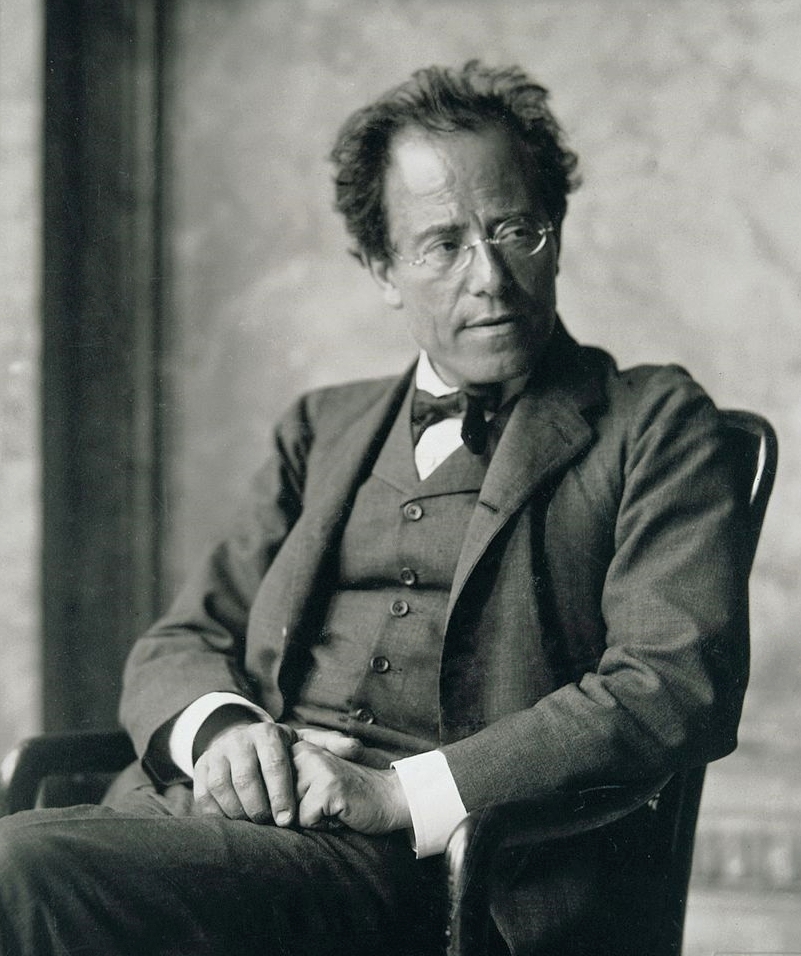
Mahler 10

*For an introduction to my whole series on Mahler, with links, click here!*

After returning from an exhilarating day with the Zhihua temple at the BM, I caught S-Simon Rattle‘s overwhelming Mahler 10 with the reborn LSO on BBC Radio 3.

Here’s the opening Adagio from the concert—BTW, yet another illustration of the benefits of conducting from memory:

And here’s the complete 1980 recording with Simon (“as he was then”—before he was awarded the impediment) conducting the Bournemouth symphony orchestra:


Only half-written before Mahler died in 1911, the work was hardly performed until Deryck Cooke’s completed version became popular in the 1960s. Though I got to know it not so long after, it’s ages since I immersed myself in it.

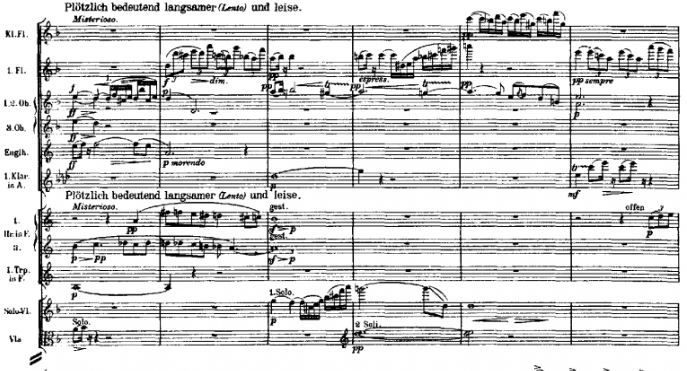
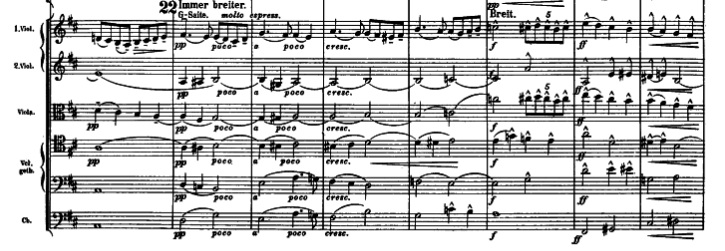
Under Mahler’s own torments the music often splinters, exemplifying the later devastation of European culture. In context (from 17.24 in the video, 16.15 on the 1980 version) the Scream chord of the Adagio is truly horrifying, presaged by huge nightmarish clashing granite slabs of sound, linked by a terrifying high sustained trumpet note, and followed by a screeching top D from the violins:

Mahler 10 scream

Now I don’t generally go in for this kind of thing,* but after my recent visit to Sachsenhausen one might hear that short episode (under two minutes) as a graphic condensed soundscape foretelling the torments of Europe from c1930 to 1945—like deathbed episodes flashing past (timings as on the 1980 audio recording):

  • 16.15 the descent into hell begins
  • 16.44 rise of Nazism
  • 17.06 brief moment of false hope (Weimar cabaret): desperate “Maybe we’ll be all right”
  • 17.25 Kristallnacht; invasions of Poland and Russia
  • 17.37 the concentration camp system
  • 17.50 the horrors of the camps are finally revealed.

Of course, you can ignore all that, and just hear it as a cumulative drama of agony.

LHJ 456 Kings detail

A Chinese parallel? Detail from painting of the Ten Kings of the Underworld, north Shanxi.

Here’s Bernstein conducting the Adagio (with the Vienna Phil still uncontaminated by women…)

* * *

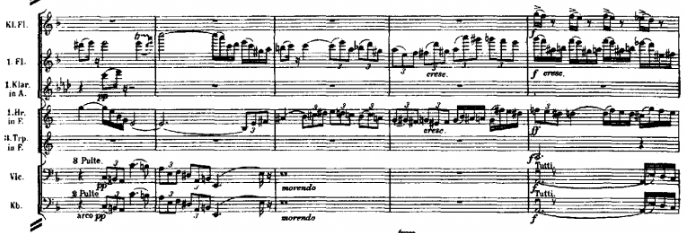
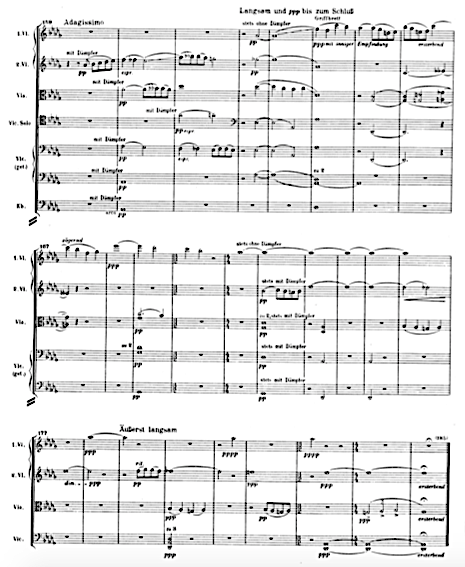
An ominous opening to the Finale—inspired, according to Alma, by hearing from afar the funeral of a heroic fireman in New York [1]—leads into an exquisite flute solo (from 53.57 on Rattle’s recording) and sustained string lines (with more of those climactic struggling quintuplets, e.g. from 1.11.51) almost recalling the finale of the 3rd symphony. Despite interruptions from the funeral drum and the Scream, the mood is more serene, less desolate than his other late works.

Mahler 10 end

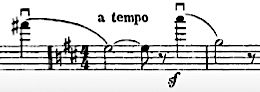
In last week’s LSO version the violins (and violas?!) made their final searing leap on the G string!!! [My Mahlerian exclamation marks].

M10 end

The Barshai version of the symphony is also much praised:

(for a discerning series of photos to accompany the finale, see here)

* * *

Mahler’s “late” works are such a comprehensive series of farewells (Abschied) that it’s always strange to realize that he died at the age of 50. What would have become of him, and his music, had he lived into the 1940s?

Not so late, but perhaps most moving of all, is Ich bin der Welt abhanden gekommenwith a final violin leap similar to that at the end of the 10th symphony, only pianissimo.


[1] For accessible accounts of Mahler’s last years, the 1907 New York funeral, and the history of Deryck Cooke’s version, see Lebrecht, Why Mahler?, pp.171–223, 275–9. Here’s Alma’s recollection of the funeral (Gustav Mahler: memories and letters, p.135):

Marie Uchatius, a young art-student, paid me a visit one day in the Hotel Majestic. Hearing a confused noise, we leaned out of the window and saw a long procession in the broad street along the side of Central Park. It was the funeral cortege of a fireman, of whose heroic death we had read in the newspaper. The chief mourners were almost immediately beneath us when the procession halted, and the master of ceremonies stepped forward and gave a short address. From our eleventh floor window we could only guess what he said. There was a brief pause and then a roll of muffled drums, followed by a dead silence. The procession then moved forward and all was over.

The scene brought tears to my eyes and I looked anxiously at Mahler’s window. But he too was leaning out and his face was streaming with tears. The brief roll of the muffled drums impressed him so deeply that he used it in the Tenth Symphony.


* Imputing verbal programmes to musical detail, I mean: the whole point of music is that it expresses things that can’t be expressed in words. Even novelists—who do use words!—find this irritating; I can’t find a source or precise quote, but as I recall, when asked “What were you trying to say in this book?”—one frustrated novelist replied, “I was ‘trying’ to say exactly what I did say.” (Martin Amis, would be my guess. Anyone?)

Lieder

Apart from the Matthew Passion and Nina Hagen (yet more unlikely bedfellows), here are further compelling reasons to learn German. While I’ve never been drawn to the mainstream lieder scene, yet again I owe my enchantment by these song cycles to Boulez (cf. Mahler’s Rückert lieder, and Ravel’s Shéhérazade).

First Wagner—the Wesendonck lieder. Here’s Janet Baker with Reggie Goodall in 1971:

Anne Sofie von Otter is just as wonderful:

Then Berg, exploring a path opened up by his mentor Mahler. The Seven early songs (which I got to love at our 1971 NYO Prom)—here’s Jessye Norman with Boulez (with helpful Japanese subtitles):

and his (five, nearly as early) Altenberg lieder—to picture-postcard texts (Ansichtskartentexte, another entry in our lexicon of German mouthfuls)—fin-de-siècle Viennese haiku? Here’s Margaret Price with Abbado in 1970:

The third song is haunting:

Über die Grenzen des All blicktest du sinnend hinaus
Hattest nie Sorge um Hof und Haus
Leben und Traum von Leben—plötzlich ist alles aus!
Über die Grenzen des All blicktest du sinnend hinaus

Berg

After the menacing whisper of “plötzlich ist alles aus!” (plötzlich is officially my favourite word), find me a singer who can diminuendo from pp up to that final top C—Nina Hagen, perhaps?!

See also Strauss’s Four last songs. A spellbinding recent addition to the canon is Hans Abrahamsen’s let me tell you, for the great Barbara Hannigan. Sgt Pepper and Abbey road also rank alongside these orchestral song-cycles.

Mahler 9

*For an introduction to my whole series on Mahler, with links, click here!*

Mahler 9 is always stunning in performance. The NYO Prom in 2015 was very fine (cf. here), and I’ve just heard Esa-Pekka Salonen doing it with the Philharmonia (reviewed here; cf. here; see also Harding’s Mahler 6 Prom).

I’ve got a lot of time for Salonen—not just because of the wonderful story about his interview for the LA Phil job! There’s something special about composers (also including Boulez) conducting Mahler, some personal identification with his struggles. Mahler anyway foretold the whole torment of 20th-century history—his music atomised, fragmenting, ersterbend—and we can only hear the 9th symphony with our own ears (that link also referring to Taruskin; see also here). Mahler never got to conduct it, or even hear it; while it remains startlingly modern even today, it’s hard to believe that it wasn’t premiered in the UK until 1930, and it was first heard in the USA (where Mahler was fêted even while he was composing it) in 1931. The symphony eventually became a pillar of the repertoire with the Mahler craze of the 60s—where I came in. Without entertaining any notions of the moral value of WAM, I have a fantasy of getting Chicago street gangs to sit through it.

Salonen brings out the Philharmonia’s talent for making chamber music amidst grand forces. Not having worked with him, I find him easy on the eye, and he looks comfortable to work with—more selfless, less anguished than Bernstein or Rattle, but far from the schoolmasterly air of Haitink or the aloof conductors of yore. Here’s Bernstein with the Vienna Phil in 1962:

Barbirolli and the Berlin Phil in 1964:

and Abbado with the Lucerne Festival Orchestra (2010), always magnificent:

We emerge immersed in the dying sounds of the finale, but as ever, the first movement is a miracle in itself (as commentaries go, Ben Zander has some acute observations, albeit rather hung up on sonata form…). Beginning quietly yet ominously with a rhythmic pattern said to represent Mahler’s own irregular heart-beat, the violins enter with a motif descending from F♯ to E that turns out to be both pervasive and deeply moving—dramatically augmented at the first climax (4.21 in the Abbado performance above) by the 1st violins with a huge leap:

M9 leap

The lyrical aspect of the opening is constantly undermined (sinister brass punctuations from 7.34, a spooky passage from 8.49, more ominous brass from 15.03 and 19.09), becoming still more eery with enigmatic chamber music from 22.48:

M9.1a

M9.1b

M9.1c

The brief hint of tranquility from 24.42 soon fragments again:

M9.1 end

I’ll leave you to immerse yourselves in the following movements—like the Abschied, or Ich bin der Welt abhanden gekommen, Mahler 9 live is an overwhelming experience, not to be missed.

Mahler 9 end

For a 2022 performance with Daniel Harding and the Concertgebouw, click here. See also Mahler: quintuplets. For an unlikely connection, see here; and for a macabre tale from Inside No.9, here. See also Salonen’s Mahler 10.

Conducting from memory

As S-S-Simon Rattle formally takes over the LSO, his latest media love-in reminded me of Harry and Paul’s fine departure in their Scousers series:

But Seriously Though Folks, some thoughts about conducting from memory. As both a performer and a concert-goer, I love it when conductors do this. I suppose it excites me partly because I’ve spent most of the last three decades toiling under what Norman Lebrecht calls “semi-conductors” in the early-music world, where it’s very rare—but never mind them.

WAM soloists commonly perform from memory (for an intriguing instance, click here)—as do musicians in most the world (to take an entirely random instance: um, Daoist ritual specialists…). Conducting from memory now seems to me like a basic courtesy to the orchestra. Conductors don’t have to worry about strings going out of tune, or reeds misbehaving, or splitting notes—they’re earning a zillion times more than the poor people who actually play the music, and all they have to do is “wave the stick until the music stops, then turn around and bow”. And the benefits, for both players and audience, are immense.

Conductors have more nuanced views, of course. Here’s Paul Hostetter:

Conductors had the score in front of them, not because it wasn’t memorised most of the time, but rather almost as a reverent gesture to the composer’s intent.

Similarly, John Murton:

I always interpreted this as a sign of humility towards the music they were performing, perhaps even in some quasi-sacred rite of ceremonially placing the score at the centre of the act of performance.

This is revealing. But Will Crutchfield comments:

… among [conductors] it is becoming something of a point of honour to perform without a score.
And why shouldn’t they, if we’re going to say soloists ought to? There are essential differences. First and simplest, it’s harder. There are many instruments and thus far more notes to be memorised; even if you can easily recall the musical substance, the matter of who’s playing what, when, with whom is complex and constantly shifting. And the conductor does not have the benefit of motor or tactile memory of how the notes feel because he does not play any of the notes.
For the same reason, conductors are the only musicians who can fake memorisation, or perform a piece ”off book” when it is only partly learned. If it’s a matter of putting down the right keys on the piano, you either know it or you don’t. But if a conductor succeeds in memorising the score at a gross level (the basic rhythms, the major entrances), he can go ahead and conduct ”by heart” while he’s still learning the details, or perhaps without ever learning some of them. If you don’t think this happens, even in big places, have a beer with any longtime orchestral player and ask.

The practice caught on from Toscanini. Furtwängler, Celibidache, Karajan (sorry), BöhmBernstein, Barbirolli… Of all conductors I would expect to dispense with the score, it would be Rozhdestvensky—he was so spontaneous and direct. But apparently he always had the score in front of him, and the result was electrifying anyway.

The score can serve as a safety-net for the conductor; for the band, as a psychologically stabilising element. But it’s also as a protective layer insulating the conductor from communicating directly—we know how much more thrilling a performance is without the safety-net.

The focal position of the score reminds us all that we’re here not so much to celebrate an incandescent moment of communication between musicians, as to reinforce the hegemony of a dead composer. During the “performance” the audience may even consolidate this by occasionally resorting to the printed programme.

I just find it distracting, and a sad limitation to the potential for the direct engagement that should be intrinsic to any kind of performance.

Kleiber

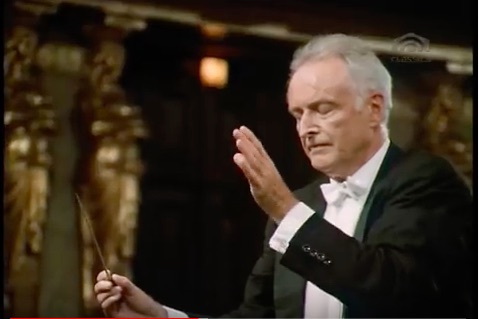
Just a few instances. Foremost is the magical Carlos Kleiber conducting Brahms 2 in 1991, with an unrepentantly all-male Vienna Phil. With 1st and 2nd violins seated opposite, here (exceptionally) he encouraged the 1st violins to use free bowing. Alas, it’s elusive on YouTube, but you can, and must, find it here. In the words of a Classic FM presenter, “It doesn’t get much better than that—or does it? Give us a call.”

And here’s S-S-Simon with the opening of the 2nd movement of Mahler 5:

For his Mahler 10, click here; and for his Mahler 2 at the 2022 Proms, here.

Claudio Abbado also conducted free of the score. I’ve featured his performances of Mahler 1Mahler 5,  Mahler 2, and Mahler 6; and don’t miss him accompanying Magdalena Kožená in Ich bin de Welt abhanden bekommen, and the divine Hélène Grimaud in Rachmaninoff’s 2nd piano concerto.

Chamber groups like the Chiara quartet have also found playing from memory fruitful. Even more radical is to get (and pay?!) the orchestra to play from memory too, as the Aurora orchestra often does:

Note this roundup of posts on conducting.

Mahler 6 at the Proms

*For an introduction to my whole series on Mahler, with links, click here!*

Nothing can beat the atmosphere of a Mahler symphony at the Proms. Following the 1st, 2nd, 4th, and 10th symphonies this season, I just went to hear the 6th, with the amazing Vienna Phil under Daniel Harding.

Hot on the heels of the equally fine Concertgebouw orchestra in the 4th symphony, the Vienna Phil sounds like an enormous marshmallow cake, with individual personalities smothered in Schlagrahm—apart from the cowbells, evidently from a large herd. Notwithstanding changes in performance practice over the past century, standing beside recent early-music versions of such repertoire, venerable orchestras like this convey a tangible feeling of direct continuity with tradition.

Here’s Mitropoulos with the New York Phil in 1955:

and the Vienna Phil with a bearded Bernstein, c1977:

Barbirolli’s 1967 version with the New Philharmonia (as the old Philharmonia was then known):

Tennstedt with the LPO at the Proms in 1983:

And do click here for Abbado live, conducting from memory, in 2006. For recordings, note Tony Duggan’s thorough review.

The exquisite slow movement is unfairly eclipsed by those of the 4th and 5th symphonies, I feel. Harding put it second, in line with Mahler’s own rethink, but I side with those who favour his original order—not so much for the argument of the tonal scheme, but rather so that the Scherzo can continue the demonic power of the first movement (as in the 5th symphony), the slow movement then making its full impact before the devastation of the finale. Christoph Eschenbach puts this case in an interesting page where various conductors reflect on all the symphonies; see also David Matthews.

God, how I’d love to get stuck into passages like this again (from 1.10.39 on the Barbirolli version, responding desperately to the hammer-blow):

M6 1

M6 2

M6 3

Here’s the first movement in a 2017 performance with S-Simon Rattle and the LSO:


* Historical note: I often chose Bernstein’s Mahler performances with the Vienna Phil, but it won’t necessarily strike the casual listener/viewer that there’s something else remarkable about the orchestra. It’s one of several that haven’t exactly led the way in gender equality: permanent posts were only given to female musicians in 1997, and even by 2013 the orchestra only had six female members. Historically authentic, sure, but… (cf. Maestro).

“I dunno, where’s it all going to end, eh? They’ll be demanding control over their own bodies next. PC gone mad if you ask me.”

Chords

All in a chord is a stimulating series of short programmes on BBC Radio 3:

http://www.bbc.co.uk/programmes/b088tzkv/episodes/guide

including the horrifying Scream from Mahler’s 10th symphony (above); The Rite of Spring; and an exploration of the minimalist style through Terry Riley’s In C. Making connections between them, Ivan Hewitt and his discussants provide fine social context, to boot—”harmony as a reflection of history”.

Meanwhile, most of the world’s societies have always got along perfectly well without harmony. “But that’s not important right now“.

I’ve always understood harmonic language more by instinct and experience than by theory. I trust plenty of other orchestral musos are more erudite about chords and harmony, but it is jazzers who are most deeply imbued in the language—and not just the keyboard players.

Metamorphosen

R Strauss

The Aurora orchestra recently performed Richard Strauss’s Metamorphosen at the Proms—where, like the John Wilson orchestra, it has made an invigorating recent addition to their house bands. The piece is always a moving experience, not least thanks to its intimate chamber form, with eloquent elegiac solo strings.

(I wasn’t even going to mention their Eroica in the second half. But with the band standing, now playing from memory before a rapt Prom audience, it had all the electrifying directness of involvement that you get from a live jazz big band. As with the orchestra’s other memorized renditions, however inauthentic such a practice may be, this is the 21st century, and this is one way of communicating now.)

* * *

Strauss composed Metamorphosen during the closing months of World War Two, from August 1944 to April 1945—just as Nazi panic at imminent disaster was leading to ever-more inhuman violence. It was commissioned by Paul Sacher, to whom Strauss dedicated it.

Much I as love many of Richard Strauss’s works, in that simplistic binary trap of ours I find myself siding firmly with Mahler.

Alex Ross devotes the first chapter of The rest is noise to “The golden age: Strauss, Mahler, and the fin de siècle”. Both composers “released images of fragmentation and collapse”, yet whereas Strauss (“earthy, self-satisfied, more than a little cynical”) often seems sumptuous and glossy, Mahler was always heartfelt. Sure, I found it overwhelming to play Elektra (composed in 1909! Just as Mahler was being fêted in New York) in Dresden in 1980. And everyone knows the opening of Also sprach Zarathustrabut how many of us bask in the passage that immediately follows it, some of the most sumptuous string writing ever? Metamorphosen is among rather few of Strauss’s works where I can detect true sincerity. See also under La voix humaine.

* * *

Reading through endless discussions of Strauss’s relationship with Nazism, I’m little the wiser. (For context, see Ross, pp.333–70).

Both Nazi official and anti-Nazi émigrés made the same complaint about Strauss—that he acted like “a total bystander”.

As Michael White observes,

As for Furtwängler and the others who performed under the swastika, there was an undoubted mixture of foolishness, delusion, opportunism and cowardice. You can say of all these people that they should have had more courage, more integrity, and been prepared to sacrifice careers, futures and maybe lives. But that’s a big ask. What would you or I have done? I like to think I’d have been brave, but I can only thank God that I’ve never had to find out.”

Strauss was four years younger than Mahler, but outlived him by thirty-eight years. Who knows how, or if, Mahler would have adapted to Nazism—having already been welcomed to New York from 1908, one imagines him seeking refuge there. He (rather than a host of imitators, or his estate) might have profited from the film-music boom for which he was too early, but it’s intriguing to wonder how his work might have developed over a further three decades or more.

* * *

In 1947, the year after the first performance of Metamorphosen, with Europe in ruins, the Berlin Phil recorded the threnody (“authentically”) under Furtwängler (just imagine):

For me it was another formative experience to perform it at Cambridge in 1974 under Charles Groves—in the same concert where we played the summery Mozart C major piano concerto.

As a late flowering of depth and intimacy, Metamorphosen belongs with the Four last songs. Here’s Kirsten Flagstad singing Beim Schlafengehen with Furtwängler and the Philharmonia in London in 1950—when the world, however deeply scarred, was being transfigured again:

For more on the Four last songs, see here; and for Heldenleben, here (and note); for a more recent transformation, here. Cf. Schoenberg’s Verkaerte nacht.

Taruskin on early music

***Link to this page!***

I’ve finally got round to reading the great Richard Taruskin properly. Among his wide-ranging themes, in this page (under WAM in Menu), I discuss his seminal comments on early music, informed by my own humble experiences of the scene.

As he links it with modernism, placing it firmly within the context of our contemporary culture, this is no mere niche topic, it’s profound, essential reading on culture in modern society— and with maestro-baiting galore!

Even if one disagreed with every word of the book, the writing is always a joy to read.

Mahler, the exclamation mark, and John Wayne!

*For an introduction to my whole series on Mahler, with links, click here!*

We’ve had Mahler and Anna May Wong, now for Mahler and John Wayne.

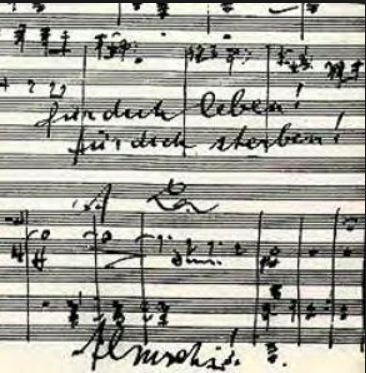
I make but a paltry effort to control my addiction to exclamation marks (!). In my defence I cite Mahler himself— I recall the instructions in his scores as being liberally sprinkled with them. Now that I come to seek instances, they’re not so ubiquitous, but here are some examples:

viel Bogen!

Vorschlage möglichst kurz!

And, like a red rag to a bull for the horns (sic) or clarinets, the immortal

Schalltrichter auf!

Such exclamation marks add a personal touch—we can feel the composer–conductor communicating with his musicians. At the climax of Der Abschied, transcendent finale of Das Lied von der Erde, they suggest awe:

Langsam! ppp!

My search continues for instances of his use of triple exclamation marks!!!

Having drawn attention to Mahler’s use of quintupletsDer Abschied is full of cross-rhythms— time dissolving into the nirvana of

Allüberall und ewig blauen licht die Fernen!
Ewig… ewig…

In this melody, emerging out of mysterious ascending motifs on flutes, the triple time is soon subverted by a duple metre, the quintuplet leading into that most distinctively plaintive of Mahler chords. (from 10.44 on the YouTube link here):

Abschied 2

Abschied

* * *

Now, you may think those awed exclamation marks make a flimsy and irreverent pretext to cite the famous John Wayne story—but hey:

In rehearsal for The greatest story ever told, the Duke, playing the Roman soldier who spears Jesus on the cross, says rather flatly,
“Truly he was the son of God.”
The director cuts in: “Not like that—say it with awe!”
Obligingly Wayne repeated his line, still deadpan:
“Aw—truly he was the son of God.”

And that links to the notorious vinegar ad.

Searching for a comprehensive analysis of Mahler’s markings, I came across this guide, which is even funnier.

In memory of Natasha

Natasha 2

This week is the fourth anniversary of the loss of my friend Natasha at the age of 34—younger than Mozart, and just less than two years after Amy Winehouse’s death.

Unable to do anything at all for months after, I thought I’d better not cancel my planned stay with Li Manshan in September, and indeed he and the other Daoists were understanding, easing me back to life. The Li family had themselves suffered a family tragedy at just the same time. The funeral rituals they perform are always moving, but now, as the sounds of shengguan blending with the vocal liturgy soared above the kowtowing kin, I felt their grief more personally.

Natasha left barely a trace on the world apart from her wonderful kids. I dearly want to write a book on her, but since I now find I know nothing about her, this tribute will have to suffice.

Natasha smile

“Troubled genius” doesn’t do Natasha justice. She deeply touched all who met her; irresistible, she could be impossible. She was the incarnation of Elena Ferrante’s Lila.

Her wild and prodigious early life was spent in Ternopil in west Ukraine. She made her home in London aged 18. Painter and composer, with her icons and Tarot, electronica, Bach, and Arvo Pärt, earth mother and sophisticated cook, femme fatale with her look of heroin chic, chunky jewelry and slinky outfits, finally holding down a mundane job for the sake of surviving as a single mum after teaching and playing in a rock band, childlike and severe, intoxicating and intoxicated, insatiable and hallucinatory, her thirst for knowledge reflected in her multi-coloured notebooks full of sketches and musings, she was on another planet. Hearing TurangalîlaragaMozart, or Naturträne through her ears, deep in her soul, was overwhelmingly intense.

Natasha painting

Natasha’s paintings were both radiant and disturbed—her later works were yet darker. Klimt and Schiele would have lapped her up (and she them). It wasn’t easy for her inhabiting a world of Parajanov:

We were supposed to be going to Mahler 5 at the Proms when she had her first heart attack. This is a perfect version of her song, with Magdalena Kožená and Claudio Abbado:

Thriving on impermanence, that I get. But Natasha, you have to keep living…

Mahler in Chinatown

*For an introduction to my whole series on Mahler, with links, click here!*

It’s always worth tuning in to Donald Macleod’s Composer of the week on BBC Radio 3. Even for a Mahler fanatic like me, last week’s programmes (based on the well-trodden theme of his years with Alma) were instructive.

I suppose this story belongs to the cliché of “international cultural exchange” (guojixing wenhua jiaoliu 国际性文化交流, which deserves an entry in my Catechism of Chinese cliché):

We all know (don’t we) about Mahler’s settings of Hans Bethge’s embroidered translations of Tang poems for Das Lied von der Erde (composed in 1909 but only performed after his death in 1911). In 1910, as he was fêted in New York, the Schirmers [some sources say the Roosevelts] took him and Alma on a visit to an opium den in Chinatown. Long before the stereotypes of Fu Manchu and Anna May Wong, this could have been an intriguing encounter.

Their visit to the “teeming” Lower East Side Jewish quarter must have been more conflicted (among myriad discussions of Mahler and Judaism, Norman Lebrecht, Why Mahler? is accessible). Alma’s portrayals are not always reliable, but here it’s worth citing her account (Gustav Mahler: memories and letters, pp.161–2)—more prurient than ethnographic:

We were invited by the music publisher, Schirmer, and his wife to dine with them one day and drive with them afterwards “down town”, into China town. The indispensable detective sat beside the chauffeur. We turned out of the busy streets into narrower ones which became by degrees quieter, narrower, darker and more uncanny. We got out, accompanied by the detective with a loaded revolver in his pocket, and went into an opium den. A creature with a sickeningly womanish face received us in an ante-room, where we had to put down a sum of money. He began at once to give us a long list of his successes with white ladies, and told us he acted female parts in the Chinese Theatre. A Chinese woman, of course, may not either act or look on in a theatre. He showed it in his face—it was the most degenerate man-woman face you could imagine. He showed us numerous photographs of American women he had—and he said the rest by gestures. Then he conducted us into several small but high rooms, empty in the middle but furnished with bunks along the sides, each of which contained a stretcher; and on each stretcher lay a doped Chinese with his head lolling into the room. Some of them raised their heads heavily as we approached, but at once let them sink again. It was a gruesomely horrible sight. They were simply dumped there to sleep off their intoxication. They might be robbed or murdered while they were in this state and know nothing about it. The whole scene resembled a baker’s shop with human loaves.

On now to a house of cards higher and higher, up into a room luxuriously furnished for strangers, cushions everywhere, and beside each cushion an opium pipe. And a Chinese, for payment, was ready to smoke a pipe on the spot while we watched him slowly succumb, rolling his eyes and twisting his limbs about. We were invited to smoke too but declined with horror. Next the theatre. Charming, but no play was being given. If it had been, no European would have been allowed among the audience. On again. Rats with long pigtails slunk nimbly and rapidly along the walls of the stinking street. Mahler said: “I can hardly believe that these are my brothers.”

On again. Small shops, small hotels, all silent. Finally, on the outskirts of this district we came on the habitat of a religious sect. There was a large hall at the far end of which sat a man with the face of a fanatic playing hymns on a harmonium in a pronouncedly whining style. The benches were occupied by a starving congregation. We were given the explanation. For listening to those hymns and joining in—a cup of coffee and a roll. What wretchedness in those faces! We pushed our way out, followed by hostile eyes, and for long afterwards we could still hear the flat notes of the hungry singers.

On again, and now the Jewish quarter. It was dark by this time. But here all was life and bustle, chaffering and shouting. The racial difference was staggering, but it was because the Jews worked day and night shifts to lose no time. The whole street was full from end to end of old clothes and rags. The air was heavy with the smell of food. I asked Mahler softly in his own words, “Are these our brothers?” He shook his head in despair.

With a sigh of relief we at last turned a corner and found ourselves in a well-lighted street among our own sort of people. Can it be that there are only class and not race distinctions?

Mahler’s music is so full of what would be known as folk and world music that his consternation is startling; can his success have made him so oblivious to his own background? And as ever, while trying to visualise the ethos of the time, we can only read this with later history in mind.

For more on Der Abschied, see also here and here. For more on Mahler in New York, and an ominous funeral, see Mahler 10.

Practice makes perfect

More WAM ethnography:

Brass players enjoy, even flaunt, their hooligan image (more “licence to deviate from behavioural norms”)—or at least, UK brass players in a befuddled heyday from the 1960s to the 1990s, still an ongoing hangover today.

Becoming a musician (or indeed a household Daoist) is about far more than “learning the dots”; aspiring musicians also look to the lifestyles of their role models. The intoxicant du jour changes—Chinese shawm players have moved from opium to amphetamines, for instance. But both in jazz and WAM, many musos have learned to their cost that adopting the, um, recreational pastimes of Charlie Parker or John Wilbraham doesn’t necessarily help them play the way their heroes  did.

The trumpeter John Wilbraham (“Jumbo”) was legendary. This is a beautiful site well worth exploring—an insider’s ethnography. I came across him when he was trumpet tutor for the NYO, and later in the BBC Symphony Orchestra.

There are also some fine stories on this site, not least about two of my most admired conductors (more maestro-baiting):

“The one thing we do know about Bach for certain, is that he didn’t want it to sound fucking awful!”
—John Wilbraham to John Eliot Gardiner.

(a succinct critique of the Early Music movement?), and

“If I’d wanted to play in front of a clown, I’d have joined the fucking circus.”
—John Wilbraham (Jumbo) on Gennadi Rozhdestvensky (Noddy)

(For more orchestral nicknames, see here).

Learning to perform—in any tradition!—requires endless hours of practice (again, it’s the stories about jazzers, rather than WAM musos, that inspire me here). There’s another famous story, which strangely I haven’t yet found among all the online anecdotes:

Before Mahler 5 at the Proms, a music critic was having a drink in the 99, favoured hostelry of Prom-goers. He watched in amazement as Jumbo downed pint after pint, and then picked up his trumpet case to stagger off to the gig. Expecting the worst, the critic took his place in the audience. The symphony opens with a scary exposed trumpet solo, and is challenging throughout. Jumbo played the whole piece perfectly.

After the concert the critic returns to the pub, to find Jumbo already propped up at the bar, more pints lined up. He walks up to him and says,

“You must excuse me, Mr Wilbraham, but may I ask how you manage to play so perfectly when you’re pissed?”

“It’sh perfectly simple,” Jumbo smiles back at him conspiratorially, “I practice pissed!”

Stories like this belong to the treasury of orchestral myth-making.

Mahler: quintuplets

*For an introduction to my whole series on Mahler, with links, click here!*

I’m so permanently immersed in Mahler 2, 5, 6, and 9 that I sometimes neglect the 3rd symphony.

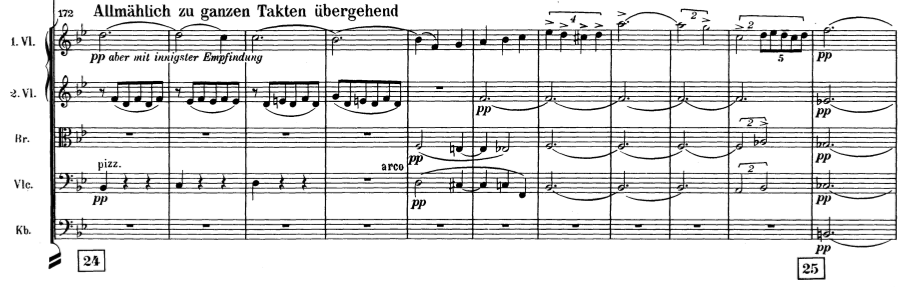
Apart from the overwhelming overall effect, I’d merely like to zoom in on a tiny detail (as I did with the syncopated percussion cadential pattern in the hymns of Yanggao Daoists): the use of quintuplets, often informed by Mahler’s instruction nicht eilen! (“Don’t rush!”). An example from the finale (fig.22, from 1.27.27 in Abbado’s performance here):

Mahler 3

The figure returns at 1.31.58, and then with the full orchestra led by blazing trumpets.

Quintuplets play a similar role at climactic moments of the 9th symphony, like this passage (from 1.06.09 on the Bernstein performance here):

Mahler 9
—and just dig all those string glissandos. Such a rhythm creates a quite different effect from the more conventional alternative, like this magnificent recapitulation on the horns (for the major 7th leap, see here):

Mahler 9 horns

It is as if the quintuplets are struggling to emerge from the stone like Michelangelo’s Slaves. For further instances, see here and here.

The Li band in France: notes

It’s worth rounding off these vignettes of the Li family on tour with some of my daily notes, as a little contribution to the ethnography of one, um, caravanserai on the global bazaar—and also as a further illustration that Daoists are Real People, not mere Faceless Paragons of Ancient Wisdom.

18th May
After a long journey from Yanggao via Beijing, the Daoists reach our hotel at 7.30am. Alas, despite my blandishments at the desk, they have to wait all morning for their rooms to become available, but I catch up with them as they rest on sofas in the foyer, letting Li Manshan sleep in my little room.

I take Li Bin, Golden Noble, Erqing, and Wang Ding round the corner to Rue de Rome, helping spendthrift Li Bin buy a preliminary round of gifts for his guanxi network back home: he asks me to help him choose four bottles of olive oil and ten bottles of vin rouge. Confessing my ignorance, I try to muster a little bon goût. He wants to splash out on more posh bottles, but I choose vin pretty ordinaire, trying vainly to control his reckless spending. A friend of Erqing has even asked him to buy him a particular vintage of Château Lafite. I tell him to forget it. Still, imagine—twenty years ago the average annual income for a Yanggao peasant was still only around £100.

We do splash out on an adapter, though. This has become a touring ritual, since they never bring the ones we have bought on previous trips. They keep it busy with recharging their mobiles and i-pods.

At midday we go round the corner to Rue Budapest for Sichuan noodles. They drink Erguotou liquor. We chuckle over our Confucian hosts’ quirky arrangement over expenses: 20 kuai each per meal for them, a mere 15 kuai for me. This causes much mirth: do I get less because I’m too fat?! After lunch, and after a meeting with Teacher Wang, now abbreviated to “hold meeting” (kaihui), their rooms are available—three doubles (sociable types that they are, they wouldn’t even want singles).

It’s so great to be on tour with a brilliant sextet who have been doing rituals together for thirty years, and who are now in the rhythm of touring abroad too. Li Manshan is a wise laissez-faire (wuwei?!) leader, Li Bin an able fixer, Golden Noble and Wu Mei best mates, and Erqing and Wang Ding are cool too. We slot into our secret language, always laughing, dusting off old stories, devising new takes.

At 6pm our hosts Adeline Herrou and Yan Lu, with her assistant Alessandra, come to our hotel to guide us to the conference banquet. Arriving a bit late in a downpour, we are fortunately siphoned off to another quieter restaurant nearby so we can get to know our hosts in peace. Yan Lu is géniale, petite, full of joi de vivre. We give her our favourite ritual couplet written by Li Manshan, and local dried apricots from Yanggao. It’s been a long first day (and their travel from Yanggao itself took nearly 24 hours before that), but after taking the metro home, Li Manshan and I have our usual sweet chat outside the hotel.

19th May
We have a good breakfast; they eat plenty of everything, with lashings of coffee. I no longer have to help—they’re even experts with the egg-boiling contraption.

I end up in Golden Noble and Wu Mei’s room, where we have a nice chat. I mention the Wang family Daoists of Shuozhou just southwest of Yanggao. Wu Mei knows Wang Junxi’s guanzi-playing and likes it, having seen his videos online; he has appeared in a secular show with them, but there was nothing much for them to talk about!

Now that my film and book are out, we can relax without my constant pedantic questions. But I’m always in fieldwork mode—I just can’t help taking notes. Li Manshan tells me more about the Temple of the God Palace in the southeast of his village—site of the original settlement Dazhaizhai 大寨寨.

53 GN and WM amused cropped

Relaxing in the scripture hall between rituals, Golden Noble and Wu Mei amused by my notebook, 2011.

The Daoists busy themselves preparing for our first gig at the Nanterre conference: while Li Bin packs all the stuff to take, Golden Noble checks their sheng mouth-organs, Wu Mei works on his reeds. Their rooms are scattered with the debris of touring: shavers, battery chargers, mobiles, i-pods, cymbals, a solder (to tune their sheng), fags, pot noodles just in case, cigarette cartons, gifts of dried apricots…

We take the train to Nanterre, and after a canteen lunch the splendid Hélène Bloch takes us on a reccy of our pre-concert route to and through La ferme du bonheur circus on campus—it’s just like being back in Yanggao, as it really is a farm, with sheep, a peacock, and lovely laidback warm people. I dream of running away to join the circus; there’s a new release of La strada just out. The peacock displays for Li Manshan but not for me, a typical show of xenophilia (chongyang meiwai 崇洋媚外)!

edf

La ferme du bonheur. Photo: Hélène Bloch.

After my film screening, the Daoists are waiting outside to lead the audience through the campus to the farm, where we all take a tea-break, and then to the concert hall.

The hall is small, but the gig is amazing, as always. Our encore of the Mantra to the Three Generations, with me joining in, goes well.

Nanterre encore

As Ian Johnson observes in his book The souls of China (pp.37–40), the progression of the Li band to minor international celebrity has been a gradual process, from Chen Kexiu’s research to the 1990 Beijing festival, through to our foreign tours (cf. my book, ch.18).

For what it’s worth, such northern ritual styles do perhaps lend themselves better to the concert format than many southern Daoist groups, the entrancing wind ensemble supplementing the vocal liturgy and percussion.

We take the train back to our hotel, then go for supper. Li Manshan has given me two bottles of lethal Fenjiu white spirit from Shanxi, which we (all except him—he’s not a drinker) polish off with our meal. I’m TP again. I stagger back to my room to take stock, then around midnight Li Manshan knocks on my door for another “meeting” outside. First we gravitate to my bathroom for me to explain how the taps work, and he tells me his story about a Chinese guy who brought back the hotel soap as a present, and his mate says “Uurgh, this foreign white chocolate tastes disgusting!”.

We adjourn outside for more jokes, and fond reminiscences of Li Qing. As always, our most intimate moments are late at night, tranquil, alone together. These tours just get better and better. Yan Lu and all our hosts love this, and so do we.

My two rules for when the time has come to leave China:
1) when I begin to enjoy drinking baijiu white spirit;
2) when I begin to like Chinese pop.

In the old days such tours were inevitably accompanied by a gaggle of superfluous apparatchiks on a freebie trip abroad. Now the Daoists have their own private passports, and on tour I look after them on my own.

It’s also amazing how much Chinese food abroad has improved over the last couple of decades. “Long gone are the days when” we have to endure sweet-and-sour pork—though even that has a certain nostalgia for me. With a busy schedule, and several good Chinese restaurants on our doorstep, I feel no great need to educate the Daoists in the richesses of French cuisine.

20th May Saturday
By 5am I’m chatting with Li Manshan again outside the hotel over a fag. After a quick breakfast we all take the new line 14 to Gare de Lyon. Streetwise Erqing is useful on the metro, noticing our route, watching out for signs—I no longer need to marshall them so closely, but the spectre of losing a national treasure in New York in 2009 still haunts me.

SanskritWe’re in plenty of time for the 8.59 to Clermont-Ferrand—whose Chinese name Kelaimeng Feilang, preceded by Aofonie (Auvergne) reminds me of one of the Li band’s pseudo-Sanskrit codas, such as the one at the end of the hymn Diverse and Nameless!

I go off with Li Bin to buy lunch for the band to eat on the train.

The lunch-pack of Notre Dame

(How could I resist? Just in case you’re not familiar with this one, it’s the answer to “What’s wrapped in cellophane and goes DONG?”)

Wu Mei and Li Manshan soon nod off, the latter tapping out drum rhythms even in his sleep. Later as I try to photo him chatting with Golden Noble, he tries to mess up my photo with his smelly sock.

They get excited seeing a field. To me it’s just a field. Wisely, they’ve long given up asking me technical questions about European agriculture. Golden Noble and Wu Mei have a beautiful chat—relaxed, thoughtful.

Our train is late, but hey. Valérie Bey-Smith and Wu Yunfeng, our keen Confucian hosts, meet us on the platform. Clermont-Ferrand feels pleasantly remote and eccentric—a bit like one of those Hunan mountain towns (where I’ve never been, BTW). We make hasty preparations for the gig in the conservatoire. After intros from the Confucius Institute and the Chinese consul in Lyon, my talk goes fine, with Valérie translating for me. I’m getting better at this. The gig is great—the audience goes wild.

The concerts only last an hour, but the Daoists are soaked in sweat. Still, it’s no big deal compared to their long rituals in Yanggao. The two sheng players, little trumpeted, have to work especially hard. In the trick sequence, even the way Erqing stays still for Wu Mei to slot the bell of his curved trumpet onto the pipe and then at once starts twirling it, playing all the while, is virtuosic. Wu Mei sometimes gets in a bit of trouble balancing the cymbal on his head, or the false eyes (walnut shells) coming loose, which all adds to the excitement—I observe to him that such little hitches should be a deliberate part of his routine, so as to show the audience how difficult it is, and keep them on edge.

SONY DSC

SONY DSC

Nanterre. Photo: Nathalie Béchet.

CF congratulations

Congratulations from the Chinese Consulate General in Lyon.

I get the usual erroneous compliments from the Chinese about me “discovering” them, and about the Chinese not knowing their own culture. OK, urban educated Chinese may not (I’m no great authority on Morris dancing either), but there has long been a wealth of research from native scholars, which is ongoing; and The Plain People of Yanggao have always been perfectly clear about their local Daoist culture.

CF group

After a nice meal with our hosts and innocent young students, they take us for a little tour of town, but we’re all completely knackered, and soon retire to our quaint hotel—next to the Hotel Ravel, I note.

Valérie, like our other hosts, is understandably ému (not Emu, or Rod Hull).

21st May Sunday
Up again by 5, I take a little stroll near our hotel with the band, admiring the market, and the murals on the wall next door.

murals CF.jpg

In a nearby square we find five little posts, correctly arranged for a bonsai Hoisting the Pennant ritual (my film, from 44.21) on a future fantasy visit of Li Manshan’s 5-year-old grandson and his schoolmates.

CF posts

Doing daily travel with a gig is tough—but like my former orchestral life, it incites camaraderie. Our previous tours have been less frantic, but this one is pleasantly condensed.
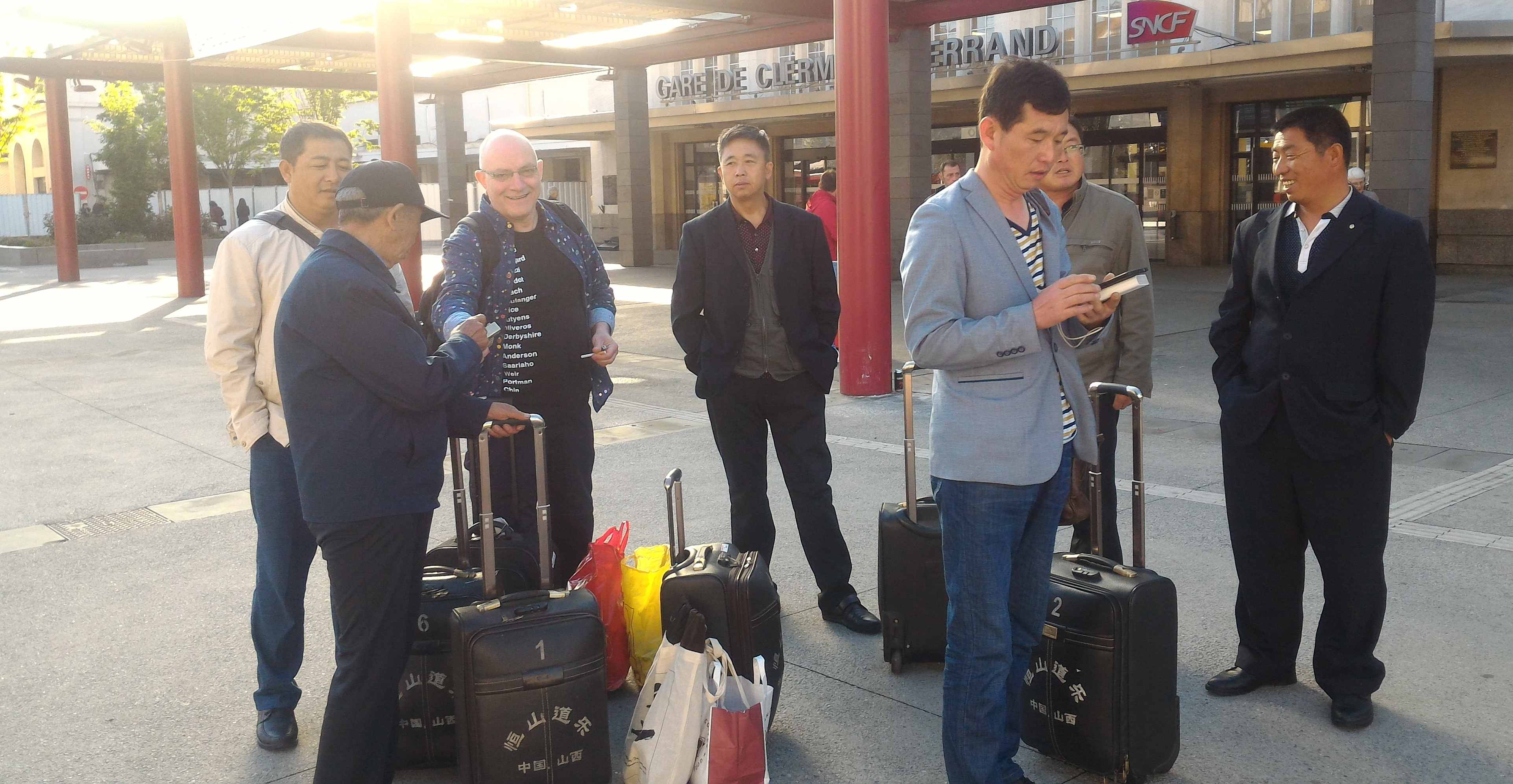
Jpeg

The touring life. Photo: Wu Yunfeng.

Valérie and Teacher Wu take us to the station, with thoughtful gifts of Gitanes (!) and food for the train. We were also happy to receive Clermont-Ferrand Confucius Institute umbrellas.

Jpeg

Valérie sees us off on the train.

The train ride is fun again. It’s much faster today, so we arrive early at midday, and take the metro to find the Centre Mandapa, a splendid venue for world music since 1978, led by the splendid Milena Salvini.

With Mandapa technician Milou we try out my film for a most successful screening; my intro goes well, and at the end Li Manshan and I take a bow. The Daoists love watching our film too.

It’s a lovely little area, so we have plenty of time to relax. They find the quirky antique emporium over the road. A succession of beggars ask us for fags, which they give gladly. Intriguingly, the Centre Mandapa is also right opposite the 1913 church of the Antoinist cult:

Deviation

The state stance on “heterodox cults”? My photo.

We set up the stage during a tea-break for the audience, then the Daoists do yet another amazing gig. Though it’s a small room, my fears that the concert will be deafening turn out to be unjustified—it’s a great acoustic. I join them again for the encore (playlist #3, with commentary here).

It’s always good to see friends at our concerts. Several Shanxi people introduce themselves, excited to find the band performing in France; and today fine scholars like Jacques Pimpaneau, Robin Ruizendaal, François Picard, and Nicolas Prevot come along too.

One cultural difference: after a gig, sure we all want to get away, but the Daoists only drink with food, not before or after (usually), whereas we WAM musos make a beeline for the pub as soon as we have taken our final bow.

Our secret language (“black talk” heihua) is as arcane as ever, with all our inside jokes. Recalling a filthy joke that Guicheng told at a hotel party in Leipzig (I can’t possibly tell you that one), I only have to say “Can you sew this up for me?” for Li Bin to burst out laughing. We giggle again at Tian Qing’s “Eat a young monk” joke.

22nd May
We have a free day at last before the Daoists’ evening flight home. Last night Old Lord Li had a bath, slept till 1am, watched TV, slept again, and got a call from a family in Pansi village to determine the date for a funeral, so he was up before 4. Meeting up at 5 yet again, I take him to the bar down the road, where Tweety McTangerine comes on TV—Li Manshan hasn’t even heard of him, how enviable! Back to my room together to read Yan Lu’s draft article on the Nanterre events.

Li Manshan calls the Pansi family again at 6am. It’s a village that he likes best, and they most trust him. Then we have a good breakfast.

We stroll down together past the Opéra to the amazing Chinese department of Galeries Lafayette, brilliantly rendered as Laofoye (“Old Buddha Elder”). Li Bin and Erqing buy loads of perfume (“Hey guys, how many lovers have you got?!”)

Laofoye

Later Li Manshan and I buy toys for his young grandson: a trumpet and maracas, to go with the, um, Ming-dynasty instruments I bought him before.

We store our luggage and go for lunch, washed down by Leffe. Old Lord Li is drumming with his chopsticks again. Delightful mood over lunch, as always—everyone chipping in with stories, jokes, reflections. Over delicious yuxiang qiezi, I ask Li Manshan if he has an aubergine tree. Often the subject turns to their hymns, as well as the Zouma suite (playlist #4, commentary here) and funky Yellow Dragon percussion piece, and the whole calibration of the trick sequence—how to improve them, tempi, and so on.

They rest on sofas at the hotel, and I film Li Manshan telling another sh-sh-sh-shikuaiqian joke.
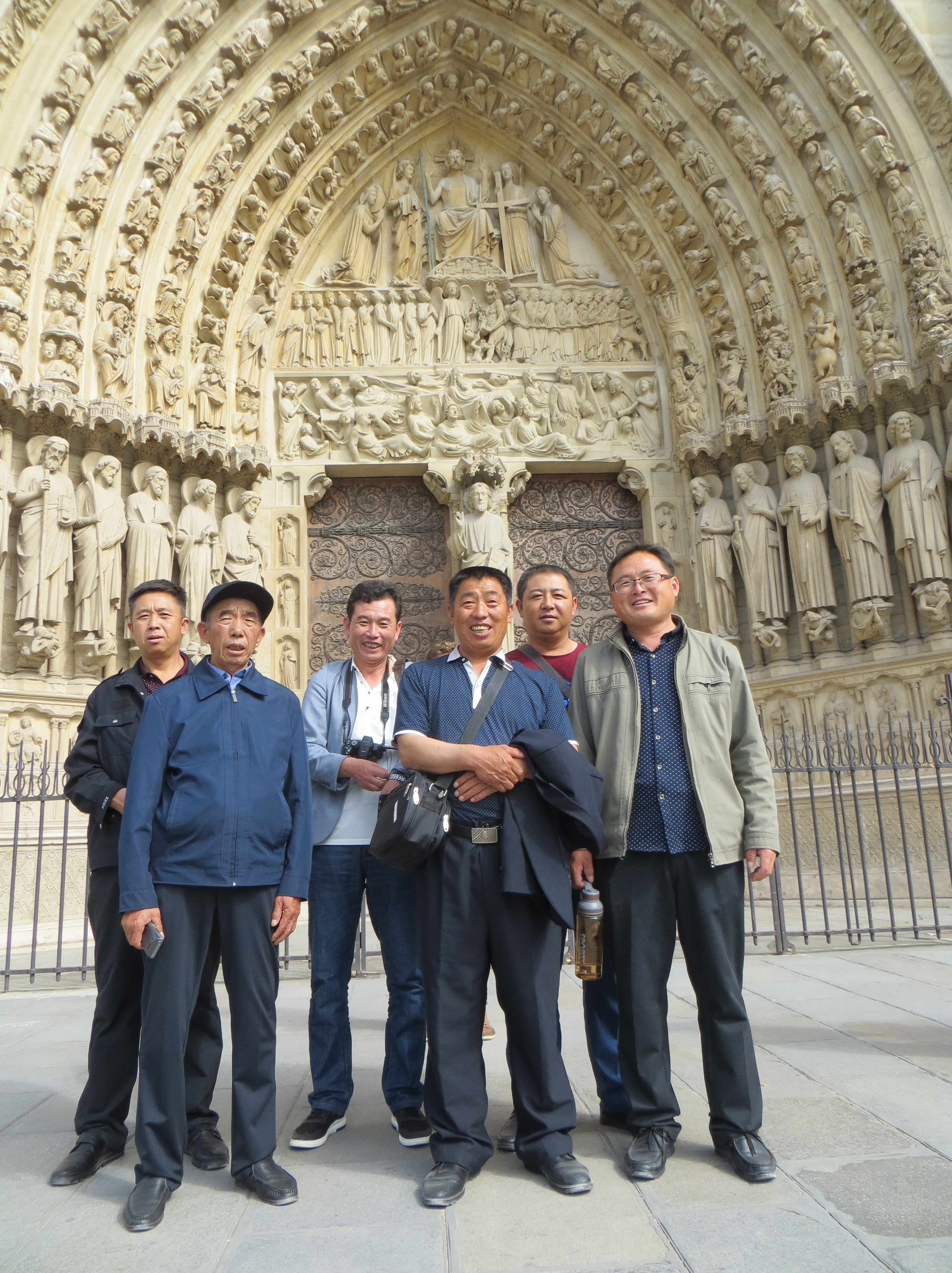
Notre Dame

Later we take line 14 to Châtelet, and wander round the little islands. I choose different flavours of Bertillon ice-cream on Île de la Cité for them. After a little guided tour of Notre Dame, we return home for a quick supper of  noodles and beer before Adeline and Yan Lu arrive, Lu thoughtfully giving them posh French chocolates. I have to go off to catch the last train back to London, but their taxi for the airport arrives early, so I can wave them off after all, but it’s a hasty parting.

If it’s a quick hop back home to London for me, their journey was not so simple:

22nd: 23.20 flight from CDG to Beijing,
23rd: landing at 15.20, 21.40 train from Beijing station,
24th: arriving in Yanggao at 03.44! But both Li Manshan and Li Bin had to rush off almost immediately to attend to village clients (for Li Bin’s diary after returning, see here).

I’ve been out of love with Paris for a while; the romantic image is hard to square with its gritty realities (rather like China, perhaps?). But this trip with the Li band naturally made me fall in love with it again. In this supposedly homogenised age—as with other cities like Leipzig, VeniceSeville, or Lisbon—we must delight in Parisian culture too!

After Daoist music in France (and Italy, and Germany), try Andean music in Japan

As I write these notes up, Haitink conducting Mahler 9 comes on Radio 3, live from the Barbican; and then next evening, another live broadcast of Turangalîla! Perfect. I hear echoes of the Li family rituals in both: all the contrasts of monumental tutti and intimate chamber styles that we find in a Daoist ritual. But that’s just me… If only Messaien were still around to hear the Li family in Paris!

Posted at 5am to commemorate daily sessions with Old Lord Li.

Vignettes 1: Li Manshan

Li Manshan is as adorable as ever.

I was determined to get to CDG to meet the band off their Air France flight from Beijing, but it arrived early at 5.30am, so in the end I just had to wait for them at our hotel right by Gare Saint Lazare. We met up there at 7.30, Li Manshan giving me a big grin and a hug.

Now 72 sui, he is gradually giving way to his son Li Bin, only doing nearby rituals. But he still can’t turn down requests to go and determine the date, and he still decorates coffins. This process of handing over must always happen, but no-one ever describes it. Personalities within a ritual group, the transmission from father to son as the latter gradually takes over—all such detail is absent from both historical records and most fieldwork reports. If only we could document it in detail for ancient Daoist masters like Du Guangting.

Li Manshan has new headgear, now a more trendy baseball cap, not as sweet as his old one, but hey. He only takes it off, reluctantly, when we enter Notre Dame. He also has a new mobile, the same old make, but with a new ringtone that sounds like The magic roundabout, so another of my names for him is Zebedee—who would have liked the Daoist Pacing the Void. I miss Li Manshan’s old kitsch ringtone of The little wicker basket.

After his lovely gift to me of the old folding stool he made, I gave him a digested translation of The good soldier Švejk, a copy I must have bought in Beijing in the early 1990s. I inscribed it to him:

踏罡步斗的明星李老君
Old Lord Li, superstar Stepping the Cosmos and Pacing the Dipper

“Old Lord Li” references one of our favourite ritual couplets pasted up at the gateway of the scripture hall, hard to translate elegantly:

穩如泰山盤腿座
貫定乾坤李老君
Seated in lotus posture firm as Mount Tai,
Old Lord Li thoroughly resolves the male and female elements.

And Stepping the Cosmos and Pacing the Dipper are rituals in the family’s manual collection.

Old Lord Li is immediately hooked on Švejk. I knew it would be just his cuppa tea—the innocent common man muddling his way jovially through an irrational state machinery. He can’t put it down. Later, suitably, I also give him my old spare toothbrush to use, as he hasn’t brought one.

After catching up together and working out our day, I go off with Li Manshan for the first of many meetings with Teacher Wang, now abbreviated to “hold meeting” (kaihui).

How amazing to be on tour again with this brilliant sextet who have been doing rituals together for thirty years, and who are now in the rhythm of touring abroad too. We use our secret language, always laughing.

In the concerts, the others (like Wu Mei for his amazing tricks on the wind instruments, or Golden Noble with his solo recitation) may attract more attention, but Li Manshan is right at the heart of everything, drumming unerringly, singing intensely, subtly directing. Even the twisting route he improvises on the tiny stage as he leads the final Chase round the Five Quarters, unsheathing the “precious sword” to sketch talismans on the ground, is magisterial.

LMS on train to Nanterre

On the train to Nanterre.

Late at night we have our usual sweet chat outside the hotel. It’s been a long day, but they’re troopers.

Li Manshan is always tapping away on his fingers (even while sleeping on the train) or on his chopsticks as we wait for our meal to arrive.

LMS at Hotel Ravel

Clermont-Ferrand: two of my favourite masters.

Following a quick weekend flit to Clermont-Ferrand, after our last gig back in Paris he had a (rare) bath—the concerts are hot work, and they’re all bathed in sweat. He then slept till 1am, watched some TV, slept again, got a call from Pansi village to determine the date after a death, and was up by 4am.

We meet up in the foyer at 5am for fags outside, lovely. I take him to the bar down the road, full of workmen on the early shift, so I can have a café and orange juice as we chat with the Wenzhou people behind the bar. Trump comes on TV—Old Lord Li hasn’t even heard of him, how enviable. Back to my room together to read through a draft article by our wonderful Confucius Institute host Yan Lu that she has just sent me.

Li Manshan calls Pansi again at 6am with more guidance. It’s a village that he likes best, and they most trust him.

After our hectic schedule, we’re all glad to have a final day free for sightseeing and buying gifts. While his son spends a fortune, Li Manshan just wants to find a couple of toys for his young grandson.

LMS and WD

With his pupil Wang Ding.

A quick farewell hug, and they embark on their long journey back to Yanggao to resume their busy ritual routine. Hardly had they got back home when both Li Manshan and Li Bin had to rush off to separate villages to determine the date for more funerals, which is the start of another sequence of tasks for them over the next couple of weeks (for Li Bin’s diary after their return, see here).

See also The Li band in France: notes.

Private Passions

Radio 3’s Private Passions is always insightful. The edition with Philippe Sands (here) shows that he too “delights in all manifestations of the Terpsichorean muse”(see Muzak)—Leonard Cohen, Michael Chance singing Erbarme Dich

(see also herehere, and here—and for an Arabian version, here), Bruno Walter conducting Mahler 9 (here, and here) in 1938, and Let’s pretend we’re bunny rabbits. Actually, the latter isn’t such a kitsch choice as its title suggests, but hey.

My posts A Nazi legacy and The Ratline introduce Sands’s harrowing film and books.

Men behaving badly: Freud and Mahler. And Alma

*For an introduction to my whole series on Mahler, with links, click here!*

Alma

Mahler’s only meeting with Freud was their famous consultation in Leiden in 1910, when Mahler’s marriage and health were in crisis. [1] The day after Mahler’s funeral in May 1911, Freud sent the bill to his executor—“unabashedly” or “somewhat tactlessly”, I read online. “Somewhat”??

I hope Mahler’s widow Alma told Freud where he could stuff it.

* * *

There’s so much online about Alma studies and “the Alma problem” that I hesitate to enter the fray. Even Mahler’s notorious enjoinder to her, before their marriage, turns out to be controversial: [2]

[Alma writing:]
. . . we had our first major conflict. I once wrote more briefly than usual, explaining that I still had to work on a composition, and Mahler was outraged. Nothing in the world was to mean more to me than writing to him; he considered the marriage [on more or less equal terms] of Robert and Clara Schumann “ridiculous,” for instance. He sent me a long letter with the demand that I instantly give up my music and live for his alone . . . I cried all night . . . [but he then] moderated his demands.

Norman Lebrecht [3] attempts to mount a hopeless rearguard action for the defence, brushing aside feminist accusations. Citing Mahler:

In your letter you write of “your music” and “my” music. Forgive me but I cannot remain silent. On this point, my Alma, we must set things straight and I mean right now, before we meet again. Let me speak in general terms. A husband and wife who are both composers: how do you envisage that? Such a strange relationship between rivals: do you have any idea how ridiculous it would appear, can you imagine the loss of self-respect it would later cause us both? If, at a time when you should be attending your household duties or fetching me something I urgently needed, or if as you wrote you wish to relieve me of life’s trivia—if at such a moment you were befallen by “inspiration”—what then?
Don’t get me wrong! I don’t want you to believe that I take that philistine view of marital relationships which sees a woman as some sort of diversion, with additional duties as her husband’s housekeeper. Surely you wouldn’t expect me to feel or think that way? But one thing is certain: if we are to be happy together, you will have to be “as I need you”—not my colleague, but my wife!

Lebrecht comments, his adulation for Mahler (which I entirely share; I like his writings too, otherwise) rather complicating his vision:

He goes on to say such blustery things as “you have only one profession: to make me happy”, and “this makes me suffer just as much as you”, affording future feminists all the ammunition they need to depict Mahler as a brute and Alma as his victim. Starting with a tendentious biography by the French politician Françoise Giroud, Alma and her thwarted creativity will be cited as an admonitory case history in the future academic study of “feminist aesthetics” [SJ: fine use of scare-quotes!]. Mahler, however, is not asserting male dominance. He specifically denounces “Nietsche’s utterly false and brazenly arrogant theories of masculine supremacy”, assuring her that he is not seeking a submissive wife. On the contrary, he loves her combative nature. [SJ: “Don’t you just love a filly with a bit of spirit?” Pah] What he seeks to avoid is a professional rivalry that might offer his enemies a chink of vulnerability. There can only be one composer in this marriage. If there were two, his work might be vaunted at his expense and he might be attacked for promoting, or suppressing, it. If both composed, both would lose and the marriage would fail.
These are not unreasonable considerations, given the disparity of their achievements. Mahler is a famous composer. Alma has written ninety-five songs, piano pieces and sketches, none of them published or performed. She is not, by any reckoning, a professional composer, nor is she convinced that this is what she was born to do. He does not forbid her to compose. What he demands is that she should not compete.

Sure, we should interpret phenomena (like Daoist ritual!) within the social context of their time. But Mahler’s values can’t somehow be validated by belittling feminism.

Mahler’s aim is to negotiate a pre-nuptial accord with a young woman who is headstrong [SJ: another classic sexist term], desirable [sic], and by her own account, superficial [sic]. His final demand is that she
surrender yourself to me unconditionally, make every detail of your future life completely dependent on my needs, in return you must wish for nothing but my love. And what that is, Alma, I cannot tell you—I have already spoken too much about it. But let me tell you just this: for someone I love the way I would love you if you were to become my wife, I can forfeit all my life and all my happiness.
Taking Mahler at his word—in a letter that is not revealed until 1995, by which time feminist prejudices are set in stone—he offers to “forfeit all my life” for Alma.

Given the previous history, how does that letter challenge those “feminist prejudices”? How does his airy claim that he would “forfeit all my life” override his demand “Surrender yourself to me unconditionally“?

Some kind of defence may be worth presenting, but it surely deserves short shrift by now. Lebrecht seems to dig an even larger hole in which he can join Mahler—a concept that might interest Freud (as long as he got paid…).

All this may just have to remind us that great (male) artists don’t necessarily behave in an enlightened way. Don’t let it put you off Mahler’s amazing music…

And fortunately Alma’s songs are being performed too. For her daughter Anna, see here.


[1] Lebrecht, Why Mahler?, pp.207–13. For a rare and unilluminating interview with Alma in 1960, click here.
[2] https://www.newcriterion.com/articles.cfm/The-other-Mahler-7126. Source not cited; not the same as Alma Mahler, Gustav Mahler: memories and letters, p.22.
[3] Why Mahler?, pp.128–30.

An unwitting put-down

Leinsdorf

For WAM buffs, a story about Erich Leinsdorf, conducting Mahler with the Boston Symphony in the 1970s:

Driving along the freeway on his way into town for the concert in Symphony Hall, Leinsdorf has cut it a bit fine, so he puts his foot down, and sure enough the cops pull him over.

He’s getting really late now, so he blurts out,

“Look officer, you gotta let me go, I’m a real famous conductor, I gotta go and conduct the Boston Symphony, they’re counting on me—my name’s Erich Leinsdorf!”

The cop (chewing gum languorously) looks at him skeptically and goes,

“I don’t care who you are, bud—you could be Arthur Fiedler for all I care!”