We have ways of making you talk

I have already mentioned my encounter with a stammering shawm player in Shaanbei.

As a stammerer, I’m all for a good stammering joke. Now as a limerick this is no big deal:

But sung as a round, in the fine melody to which it was set, it can be brilliant, with its syncops and manic pile-ups of unconnected final words.

I say “can be”… It sounds great sung in the gentle polished affectionate tones of my Oxbridge chums, one to a part. But for us stammerers, the regimented impersonal nature of such a rendition by a large school choir may seem mesmerizingly traumatic. One imagines poor stammering schoolkids cowering red-eyed with fear in the corner, their anxious parents in the audience. Anyway, let’s just imagine it sung kindly with humour… As usual, it’s all about context, and the intentions of performers and audiences.

It’s easy for you to say that, Steve…

It’s well known that stammerers can sing fluently—indeed, most can do silly voices too, although that’s hardly a long-term solution. I note too that stammering is predominantly male; and that it is also common in Japan, another highly pressurized island culture.

“Stammer” or “stutter” is another instance of US/UK English variation.

And further to the collation of Daoist texts, a note on textual variation: some versions open “There was an old man from Calcutta”. Stammering tends to decline with age—though for sufferers like me it takes variant forms. One wonders whether the old man was an expat, or native to Calcutta; if the latter, his fondness for dairy products may be merely an Raj-esque affectation, or else it may indicate a predilection for paneer and ghee—but that would scupper the p-p-poem.

For a more avant-garde take on stammering, see here; and for the brilliant fugal pastiche Donald Trump is a wanker, here.

You’ll be glad to know that our encyclopaedic resident publication The China Daily covers stammering too:

Feng Kezhi, a 24-year-old garage worker, suffered stammering so much that he once stood in the pouring rain and kept slapping his face but this didn’t cure him. It was Wang’s clinic that brought back his confidence. “There are many people like Feng who need a helping hand and I must try my best to help them”, Wang said.

China presents a fine challenge for stammerers like me.  When the English are confronted by a ferocious bout of stammering, polite embarrassed sympathetic reactions are de rigueur—immortalized by the finely-observed scene in A Fish called Wanda:

Conversely, the Chinese just tend to burst out laughing, a nice honest response.

What’s more, whereas in England we fiendishly covert stammerers can usually get away with limiting our conversations to one or two people, in China one is rarely in a group of less than a dozen; so short of feigning dumbness or unconsciousness, it’s not really possible to avoid public talking. It’s rather good shock therapy: “We have ways of making you talk”—which was of course the motto of the S-S-Stammering Association (hence also the name SS). Progress is only possible once one begins to stammer openly.

It’s good to hear Ed Balls talking (openly, and fluently) about his stammer (see also here):

He joins the ranks of distinguished stammerers like Moses, Demosthenes, the Byzantine emperor Michael II, Wittgenstein, Somerset Maugham, Marilyn Monroe, Kylie Minogue, Maggie O’FarrellJoe Biden, Amanda Gorman, * and JJJJJerome Ellis—and for China, see here. There’s another fantasy dinner party, hosted by Michael Palin—a notable advocate for stammering, and the greatest ambassador anyone could ever have for anything.

The excellent British Stammering Association used to run a cartoon series called Stammering Stan, which was somewhat controversial. But this will be evocative for stammerers:

stammering stan

Li Manshan has a brilliant stammering joke, which he loves telling me—but it’s best if you hear him tell it himself…

For more stammering songs, click here and here. See also the stammering tag, including this post on chipping away at the iceberg of fear.

* Update: 13-year-old stammerer Brayden Harrington just made a powerful speech for the 2020 Democratic National Convention:

* Another update: in The speaking voice, do listen to the brilliant Amanda Gorman, erstwhile stammerer, at the 2021 Inauguration!

Gorman

Ashiq: the last troubadour

*Distressing update*

After all these years when the common response to a comment on the Uyghurs of Xinjiang was “The WHAT of WHAT?”, their new-found global fame is yet more unfortunate. It’s hard to believe now that the screening of this film, less than two years ago, came at a time when the Uyghurs were little known, when films like this could still be made about groups that were still active, and still seemed relevant; when dedicated Uyghur scholars and performers still had room to maintain their culture. Following their pervasive silencing since then, among a host of fine articles on the appalling current situation in Xinjiang, see here, and here, including Rachel Harris’s comments on the disappearance of Sanubar Tursun. Among many articles on the distinguished ethnographer and film-maker Rahilä Dawut, another victim of the purge, is this. Click here for remarkable videos of Sufi Naqshbandi ritual among the Uyghurs. For more, see my roundup of posts on Uyghur culture.

I’ve left the review below as I first wrote it.

* * *

In my little list of ethnographic films, I mentioned Liu Xiangchen 刘湘晨, an outstanding film-maker based in Urumqi in Xinjiang. On Monday at SOAS, as part of a conference on Islamic soundscapes in China (itself part of an excellent project[1] he attended a screening of his Ashiq: the last troubadour (2010, 122 mins), one of several films by him on various ethnic groups in Xinjiang.

Filmed mainly between 2003 and 2007, Liu’s four-hour version of Ashiq was shown last year at the splendid Shanghai Centre for Ritual Music, with a detailed discussion (which, ominously, has since disappeared from the web).

Here’s an 8-minute trailer:

and the 2-hour version, with Chinese subtitles:

The “exotic” ethnic minorities are always a more popular research topic than the somewhat mundane Han Chinese; I would say, only I’d sound like the UKIPs, that the Han Chinese have become a minority in their own country—which would be just as absurd, given that, in the face of vast Han Chinese immigration to Xinjiang, it is precisely the Uyghurs who feel threatened. But I envy scholars of the minorities the stunning scenery, and the costumes—and if they no longer wear them, they’re used to being asked to put them on for the cameras.

I’m now a little confused about what ashiq actually means among the Uyghurs. Simply stated, they are Sufi mendicants who congregate at the shrines of Islamic saints. From the YouTube blurb:

Some ashiq are ironworkers, others are beggars, merchants, grave diggers, barbers, woman ashiq, Sheikh (the Islamic clergy) and so on.

As Rachel Harris notes, [2] the term may be a rather modern usage for people once more commonly known as dervishes or qalandar. It’s taxonomy again.

Liu described them as marginalised, a minority themselves, but it looks like a substantial phenomenon. And marginalisation is their very raison d’être: they thrive on flouting social norms (cf. Merriam). The subtitle “the last troubadour” seems unsuitable, not only since the use of a (largely secular) term like troubadour is hardly useful, but because the film doesn’t seem to show that they are dying out. Maybe they are, but it repeats a mantra chanted by anthropologists since early times, claiming to have discovered a pristine tradition that is endangered, rather than noting constant change.

For an outsider, the film, like that of De Martino in south Italy, may also shock. For the total novice, it will just amaze: didn’t the CCP destroy religion over sixty years ago—all the more in Xinjiang or Tibet? At least it shows what a huge task the CCP faces. Are we to celebrate the slow spread of state education and modernization?

The nomination of the ashiq for Intangible Cultural Heritage status is captioned early in the film without comment, though (like that of the Uyghur meshrep) [3] it will seem so very incongruous; perhaps it serves as a kind of amulet to protect the film from official criticism. As with the Han Chinese, a majority of genres selected for the ICH are grounded in ritual, impossible to reconcile with the state’s goals without destroying them—which may indeed be the idea. It is the duty of the ethnographer to reflect such micro-societies faithfully, like any other. It goes without saying that it is no use to regard them purely as “musical cultures” detached from their social roots.

The conceit of academic objectivity may make ethnographers seem to refrain from either celebration or criticism, yet at the same time (to return to De Martino), some may be shocked, pondering the link between religion and poverty—an obstacle to those social changes that can genuinely improve people’s lives, health, life-expectancy, and so on?

I gave an instance for the Han Chinese in my Shaanbei book (p.86):

Back in the county-town, returning to our hostel one evening, we switch on the TV to find a documentary about coal-mining accidents, which are reported nightly. There are some rather fine investigative programmes on TV these days, and one main theme of this one is how the response of the village Communist Party leadership, rather than considering improving safety measures, has been to give funds to construct a new village temple in the hope of divine protection. OK, in this case the programme happens to fit into an agenda of rationalism against superstition, a view we sometimes feel inclined to challenge, but tonight I can only go along with the presenter’s lament.

One doesn’t have to be a Maoist apparatchik to worry about this. Observers will draw their own conclusions.

Returning to the Uyghurs, the gender issue is sobering too. There’s one fine scene of a group of female ashiq, but as Rachel Harris (whose latest book revolves around women’s religious groups) pointed out at the screening, only a female film-maker could get proper access to such groups—like Rahilä Dawut (on whom see here).

The film suggests so many complex issues. It gives full coverage to songs, and texts, not just sonic icing on the cake. The ashiq aren’t big on cake, but some weed helps them commune.

Their basic accompaniment is the sapaye, paired sticks pierced with metal rings, played in a kind of stylized self-flagellation, notable in various degrees in both Islamic and Han Chinese ritual cultures (for one gory instance from Fujian, see Ken Dean’s film Bored in heaven).

The tear-stained faces of the ashiq as they sing may remind us that the expression of suffering is a quasi-universal feature of music-making. But it’s always culturally mediated, with differing implications; Rachel Harris again explores the significance of “performative tears” both for Uyghur and other cultures (for the Bach Passions, see here).

The sudden, startling, introduction of scenes from the bustling modern capital of Urumqi is effective. I didn’t pick up hints to change in the rural scene, which must be constantly occurring too, so the film may seem merely to suggest a contrast between (“backward”?) rural traditions and harsh urban commodification. But the structure works well, right down to the final scenes with a birth and a death, the latter in an extraordinary landscape.

I pen these thoughts as a mere outsider. Talking of which, one also wonders how all this relates to the old rejection of ethnographic outsiders, summarised by Nettl as “You will never understand our music”. But here, as with the late great Zhou Ji 周吉 (1943–2008), one of the consultants on the film, Uyghurs seem to have few reservations about certain Han Chinese (or Westerners, indeed) documenting their lives—as long as they are clearly in sympathy and willing to engage fully. Liu Xiangchen, though not himself Uyghur, was also advised by Dilmurat Omar of the Institute of Ethnology and Sociology at Xinjiang Normal University.


[1] I am grateful to Rachel Harris, estimable authority on Uyghur culture and music, for pointing me towards several sources. As usual, it goes without saying that I am entirely responsible for my interpretations here.
[2] “Theory and practice in contemporary Central Asian maqām traditions” (forthcoming).
[3] Note this important report. See also under Soundscapes of Uyghur Islam.

The counter-tenor, and minimalism

Greenaway

The male counter-tenor voice is well suited to the ethereal. In early music, apart from Michael Chance, you can find many brilliant singers—Andreas Scholl, Iestyn Davies, and so on.

Veering somewhat off the beaten track, here’s Klaus Nomi (1944–83) singing Purcell’s Cold song:

for which I’m again indebted to Private passions, this time George Shaw.

Nomi was singing the song shortly before becoming an early victim of AIDS. But it still recalls the vibrant experimentalism of the New York scene, with punk and so on—like Diaghilev’s Paris, or indeed New York after the war. For more on the American minimalist scene, try Alex Ross, “Beethoven was wrong” (The rest is noise, ch.14); and on BBC Radio 3, Tom Service.

Meanwhile England was buzzing too. Apart from punk, we had the films of Peter Greenaway, like The draughtsman’s contract (1982—just before Lost Jockey’s Buzz Buzz Buzz, and Madonna’s stunning debut album!) with Michael Nyman’s exhilarating minimalist take on Purcell:

And his funky Don Giovanni:

All this, note, at a time when it was Neither Profitable Nor Popular.

20 final page - Version 2

Meanwhile, over on the other side of the world in a poor village in north China, Li Qing was leading the revival of his hereditary tradition of Daoist ritual, copying a full set of their manuals, preserved by his uncle Li Peisen. Indeed, having noted the importance of percussion for the minimalists, they might enjoy the cymbal patterns of the Daoists, with their complex hocketing.

Later (we’re back in England with the counter-tenor now), Martin Jacques, in The Tiger Lilies, was spellbinding too:

For a roundup with further posts, see here. Cf. Bobby McFerrin.


* Note for Rowan: There, I did notice some popular culture at the time…

Gems from the farm, or Crumbs of comfort

CCF film

Still giggling at Stella’s resumé of The Flayed, I must just return to celebrating the original Cold comfort farm.

You might think it would be one of those books that could only be spoilt by being Made Flesh (or at least celluloid, or whatever they use these days, with their new-fangled ungodly ways). But the 1995 TV film is highly regarded, and at a tender age, having recently read the book, I found the 1968 serialization most drôle—such as Alastair Sim as Amos, perfect:

“Ye know, doan’t ye, what it feels like when ye burn yer hand in takin’ a cake out of the oven or wi’a match when ye’re lightin’ one of they godless cigarettes? Ay. It stings wi’ a fearful pain, doan’t it? And ye run away to clap a bit o’ butter on it to take the pain away. Ah, but” (an impressive pause) “there’ll be no butter in hell!”

Then there’s the herd of Jersey cows—Graceless, Aimless, Feckless, and Pointless; and Aunt Ada Doom’s regular use of the dilapidated Milk Producers’ Weekly Bulletin and Cowkeepers’ Guide to smite anyone within reach.

The book also exemplifies the clash of urban and rural cultures that is a major theme of anthropology, not least for China. The Li family Daoists sum it up brilliantly in their joke after the final credits of my film.

Flora takes on the project of Meriam the hired wench, in labour yet again:

And carefully, in cool phrases, Flora explained exactly to Meriam how to forestall the disastrous effect of too much sukebind and too many long summer evenings upon the female system.
Meriam listened, with eyes widening and widening.
“ ‘Tes wickedness! ‘Tes flying in the face of nature!” she burst out fearfully at last.
“Nonsense!” said Flora. “Nature is all very well in her place, but she must not be allowed to make things untidy.”

Meriam’s mother (wife of Agony Beetle, no less) has a plan for her daughter’s growing brood:

“Come another four years and I can begin makin’ use of them.”
“How?” asked Flora. […]
“Train the four of them up into one of them jazz-bands. […] So that’s why I’m bringing them up right, on plenty of milk, and seein’ they get to bed early. They’ll need all their strength if they ‘ave to sit up till the cows come ‘ome playing in them night-clubs.”

Lastly, statuesque sullen ravaged Judith:

I am a used husk… a rind… a skin.

Fragrant Flora’s own personal bible, The Higher common sense by the Abbé Fausse-Maigre, isn’t always up to the challenge posed by the Starkadders. (BTW, one wonders if the Abbé lived at 7 bis, rue du Nadir-aux-Pommes.)

Judith gives a classic rebuke to Flora’s gentle probing:

“By the way, I adore my bedroom, but do you think I could have the curtains washed? I believe they are red; and I should so like to make sure.”
Judith had sunk into a reverie.
“Curtains?” she asked, vacantly, lifting her magnificent head. “Child, child, it is many years since such trifles broke across the web of my solitude.”

Filming techniques

Like I’d know…

Following my naïve reflections on the general plan for filming, here are a few hallowed film techniques that Get my Goat:

1) The Ken Burns effect. Don’t get me wrong, his series on jazz is like (sorry) the greatest documentary series ever??? But zooming in slowly to focus on the eyes of a photo is such an insistent habit—bludgeoning the viewer into sharing a profound experience of which the object is innocent.
My brilliant editor Michele Banal (or Michele trivial as he is now known) has educated me in the value of movement in showing photos, but he’s obligingly worked round my wish to keep it subtle and avoid such sentimentalizing.

2) Closeups of hands. In a similar vein, lingering shots of the interviewee’s hands are to be avoided. It may be a desperate measure to paper over a dodgy edit, but again it corrals us all into a conspiracy of profundity. Gnarled, clasped in anguish, elegantly manicured, or not, they’re just hands.

3) Slow-mo. I mean, what’s the point? Sure, used subtly it can sometimes be a useful way round a dodgy bit of filming, but why would we want to see people doing stuff at the wrong speed?

3) Filming while moving backwards as the subject walks towards you. It’s a cliché of many movies, often satirized in the standard corridor scene. Watching most dramas I am quite able to suspend my disbelief, but here I keep thinking, “Hey, how can they not have noticed that there’s this film crew moving backwards in front of them?”
No less irritating is the documentary presenter walking into shot, addressing some earnest words to camera, and then floating off again reflectively. Again, this is well satirized.

For voiceovers, see here.

OK, enough. Next I shall pontificate on canine dentistry…

The wonders of auto-translation

I’m sure many authors have seen their finely-crafted prose befall a similar fate, but a crazy garbled version of the vimeo blurb for my film that I found online, if not entirely accurate, is very funny.

Apart from dubbing my fine editor “Michele trivial”, gems include

This movie intimate portrait explores the lifetime of the eighth technology Taoist Li Manshan (b.1946) household, chief of a gaggle of formality specialists within the poor countryside of Yanggao County.

Nor does the title of my book get off lightly:

Daoist monks of formality Li household, life within the village of China.

I always try to pen a compelling blurb, but I have been outshone here. I can’t wait to see the gaggle of formality specialists in Paris in May.

Countrier than you

Countrier

As I browse the back catalogue of Rusty Debris, I find Rich Hall makes an engaging guide for my latent dilettante interest in Country. He’s also a fine Tweety-baiter, of course, such as this. And his BBC4 film is both instructive and hilarious:

Country may often seem banal to us poncey liberal elite—although we’re on thin ice if we’re going to laugh at the outfits. But like flamenco, or tango (or, come to think of it, almost any genre worth its salt), beyond the cosy domestic image it’s about pain, and poor suffering Hugh Manity.

Another entry in the list of drôle Country song titles:

If you won’t leave me, I’ll find someone who will.

In time the industry managed to cash in on the outlaw image (at first latent, later a badge of honour) that came to supplement the homely veneer—embodied in The Highwaymen and the great Johnny Cash. And so on to Willie Nelson (“Then one day, thankfully, his house caught fire”).

Rich’s comments on Tom Hiddleston’s ill-advised Hank Williams biopic I saw the light are priceless. He also manages to give short shrift to John Travolta, Taylor Swift, and even Bono.

Like a gen-u-ine ethnomusicologist, he notes the diverse ethnic origins of Country, its local distinctiveness, migration, and patronage. Again, there are some fine taxonomies here. He notes the shift from Nashville to Austin, and the Cosmic Cowboy collision of redneck and hippy. And wow, there’s some hot fiddling.

He only lets himself down a bit on female singers, who were (and are) such a major aspect of the genre’s success.

There are also some nice details on changing instrumental technique—a trademark of the best discussions of music—like “He [Chuck Berry Junior, not the Chuck Berry, R.I.P.!] told him [Waylon ] to replace the top E string with a banjo string to bend it easier, and to shave down the frets on his guitar to get a lower action.”

The secret is to replicate, not to regurgitate.

This quote from the online blurb could be an encapsulation of ethnomusicology:

As he unearths the roots and inner workings of country music, Rich finds it’s more than just music—it’s a lifestyle.

There are loads of wonderful documentaries on such topics, avoiding hagiography while evincing proper respect—but where are all the programmes about shawm bands or Daoists, eh?

Update: Ken Burns now has a major series Country music (cf. his Jazz series), its eight parts now being shown in abbreviated form on BBC4. Just the opening programme, on the early history of Country to 1933, is an aural and visual feast. For more, see here.

Country

See also Accordion crimes.

1066

As any fule no, The Battle of Hastings was held not at Hastings but at nearby Battle—cf. Groucho (as Rufus T. Firefly) in Duck soup:

Ambassador: “I am willing to do anything to prevent this war.”
Rufus T. Firefly: “It’s too late. I’ve already paid a month’s rent on the battlefield.”

To modern ears The Battle of Battle sounds rather cool, but You Know Those Mediaevals, they were looking for something more catchy.

Anyway, here’s the purpose of this fatuous preamble:

A friend of mine stopped off at a general store just outside Battle to buy some provisions. The bill came to £10.66.

***

On the shelves of another village store, I noticed not price-tags but jokes. I still use

What’s yellow, got 22 legs, and goes “crunch crunch”?
A Chinese football team, eating crisps.

This almost gets us to the classic joke of the Li family—after the final credits of my film, not to be missed!

A successor to Myles

Talking of Brief encounter, Trevor Howard also appeared, remarkably, in the title role of Sir Henry at Rawlinson End (Vivian Stanshall, 1980)

—yet another gem that I missed at the time.

It’s hard to classify—a Spike Milligan remake of Last year at Marienbad?

That was inedible muck. And there wasn’t enough of it.

Worthy of the great Flann O’Brien is the line

If I had all the money I’ve spent on drink—I’d spend it on drink.

Along with punk, the film was part of the rich tapestry of British culture at the time (please be upstanding for God save the queen)

Historical ears and eyes

Brief encounter

We can never unhear the soundscape of our times (for a roundup of posts on reception history, click here).

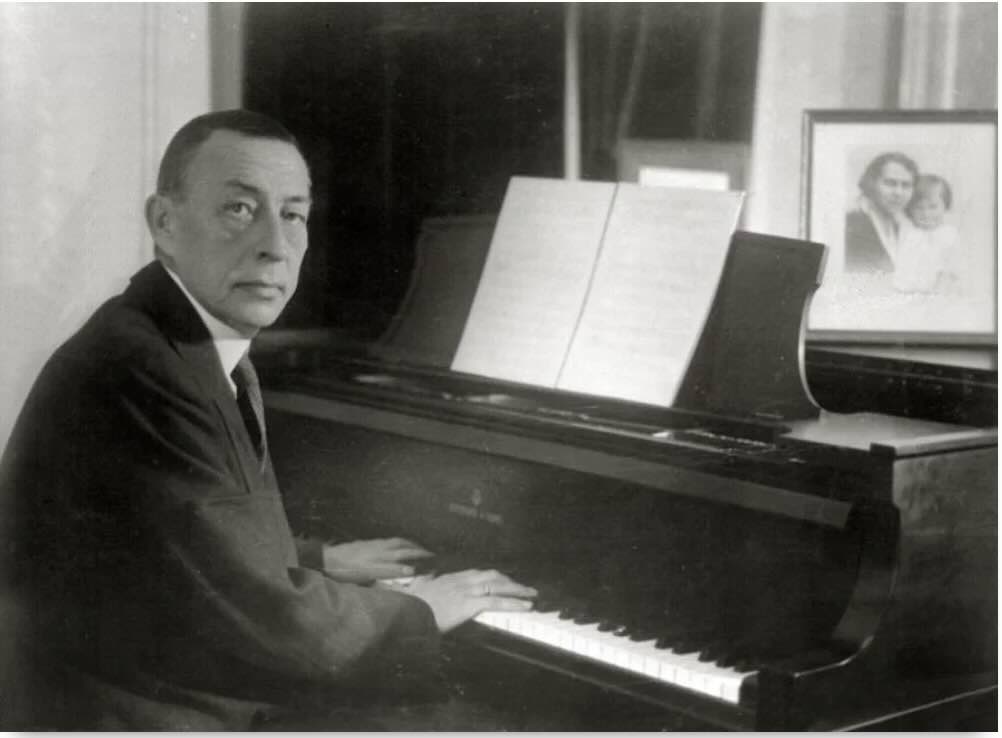
As I continue to delight in Hélène GrimaudRachmaninoff’s 2nd piano concerto (1901) comes with a lot of accumulated baggage, which may both blur and enrich our appreciation. The most obvious instance is the soundtrack of Brief encounter (David Lean, 1945). Even for me, growing up in the swinging 60s, this is an inescapable association—let alone for my parents’ generation (cf. A short story), for whom the story of the wife’s reluctant retreat from a life-enhancing affair back to a stultifying marriage would have been still more telling, and modern, than for more recent audiences in similar situations. The Guardian, awarding it top place in a survey of twenty movies about doomed love, gave a splendid summary:

[They] end up rejecting continental-style hanky-panky in favour of boring but honourable married fidelity, all of this set in the long-gone days when the middle-classes spoke with clipped RP accents and the trains ran on time.

Readily parodied, the film must have meant a lot when it was released—in 1945, of all times. The play by Nöel Coward dates from 1936; it was at his insistence that the concerto was later used for the film—and then we might try and think ourselves back to 1901 when Rachmaninoff completed it, when he was just recovering from a breakdown and depression. He gave the American premiere of the concerto in 1909, accompanied by a programme note [really?] by Philip Hale cited in the wiki article:

The concerto is of uneven worth. The first movement is labored and has little marked character. It might have been written by any German, technically well-trained, who was acquainted with the music of Tchaikovsky.

Rach

Nicolas Slonimsky’s Lexicon of musical invective has a similarly dismissive review from 1919:

… a little too much like a mournful banqueting on jam and honey… In all the music of Rachmaninoff there is something strangely twice-told. From it there flows the sadness distilled by all things that are a little useless… He is still content with music that toys with the pianoforte… He writes pieces full of the old astounding musical dislocation [WTF? SJ]. There was a day, perhaps, when such music served. But another day has succeeded to it. And so, Rachmaninoff comes among us like a very charming and amiable ghost.

He recorded the concerto in 1924 with Stokowski and the Philadelphia Orchestra, and again with the same team in 1929—a recording that opens this valuable YouTube collection of the four concertos and Rhapsody on a theme of Paganini, with useful captions at the beginning that you might like to read separately:

However definitive (and despite his beguiling rubato), Rachmaninoff’s own interpretation may strike the modern ear as rushed and understated—as with baroque music, it’s always worth paying attention to changing performance practice (see e.g. here, and here). The soundtrack for Brief Encounter was recorded by Eileen Joyce with (I think) Erich Leinsdorf and the LPO.

Whether or not we can (or wish to) put all this baggage aside, it’s a magical concerto—I adore this exquisite performance by Hélène Grimaud and Claudio Abbado—rendered in black-and-white, enhancing its period feel:

* * *

And while I’m on Rachmaninoff, I can’t believe I never got to play the 2nd symphony, also overwhelming… Of all the versions, André Previn’s recording with the LSO is much praised (for his name in Chinese, see here):

The great Rozhdestvensky with the LSO in 1988 (Andrew Marriner with the clarinet solo in the slow movement!):

(cf. their live performance in 1984, with cuts).

But I’m most attached to this live performance in the Concertgebouw, with Eivind Gullberg Jensen conducting from memory:

This seems to be an exception to my rule that our experience of all kinds of music is enriched by early associations. Not only have I never played it, I only got to know it properly over the last few years.

More Rachmaninoff herehere, and here.

Papa papa papa papa papapa, papa papa papa papaaaaa PA!

Papa

For me, that Parks and recreation theme is right up there with Pete Moore’s 1968 classic Asteroid, or should I say the Pearl and Dean intro—a relic of bygone days when people went to a dark place called “the cinema”. (In the pre-mobile age, they couldn’t even say “I’m in a dark place at the moment”.)

Asteroid belongs well just after the style so effectively parodied at the opening of Monty Python’s Away from it all. And it shows that we too can learn additive rhythms—in this case, 3+3+2. We might set the repeated ambiguous ascending opening phrase to “I’ve got rhythm”.

If historical musicology is your bag, you can compare various versions over time—from the classic

through the 90s’ version, to the 2006 creation. The latter (at all of 2’16”) seems positively Wagnerian in its expansiveness; with our attention-span long conditioned to a quick burst, it takes some getting used to.

I note online comments on the BBC news report on the story:

This appears to reference something in British culture.
and
This Pearl and Dean thing seems pretty trivial and obscure to me.

O tempora! O mores! (You can read this as a football result: “Tempora nil—Mores nil.)

Now, Call Me Old-Fashioned [What, again?—Ed.], but the original has an authentic feel that is hard to recapture.

It’s tempting to use the piece as a prelude segueing right into the WAM classic of your choice—like the opening of the John Passion, the slow movement of the Schubert string quintet, or the Adagietto of Mahler 5.

Anyway, ritual efficacy does not necessarily correlate with duration. Ha.

It might also serve as an anthem for stammerers like me. For more pa-pa-pa, see here.

One more time, Altogether now:

Papa papa papa papa papapa, papa papa papa papaaaaa PA!

More fieldwork tips

The Police squad series builds on Airplane the way Don Giovanni builds on Le nozze di Figaro.

An idée fixe that often comes in handy during fieldwork (see also under Themes) is the old “Cigarette?” line:

In rural China the etiquette of exchanging cigarettes and lighting up for each other is an important skill for the fieldworker to acquire, confirming social bonds (my Daoist priests of the Li family, p.24). Generally, when two or more men meet they compete to be first to get their offer accepted. The first offer is vehemently rejected; the giver is then obliged to insist until the cigarette is reluctantly accepted. The word thankyou is never used. Some shoving may be involved. Then the two compete to be first to proffer a light; as the recipient lights up, he expresses appreciation by touching the lighter’s hand with the little finger of the hand holding the cigarette, and the man with the lighter takes care to keep the flame going as he lights his own. I learn to emulate Li Manshan’s ritual of reluctantly accepting a cigarette, his frown, his look of confusion—“What is this funny little tubular object that is being offered to me, and how should I react?”

With the Li family Daoists we’ve developed a classification of cigarettes according to price, which varies widely. Using the class status language of land reform, we call the posh brands “rich-peasant fags”—the cheaper ones are for wannabe poor peasants like me.

Police squad provides another useful idée fixe on the importance of local knowledge in fieldwork:

The Greek subtitles inadvertently add a further Pythonesque touch. Though perhaps less so if you’re Greek.

My current favourite fieldwork tip heads this post.

The life of the household Daoist

vocal trio 2001

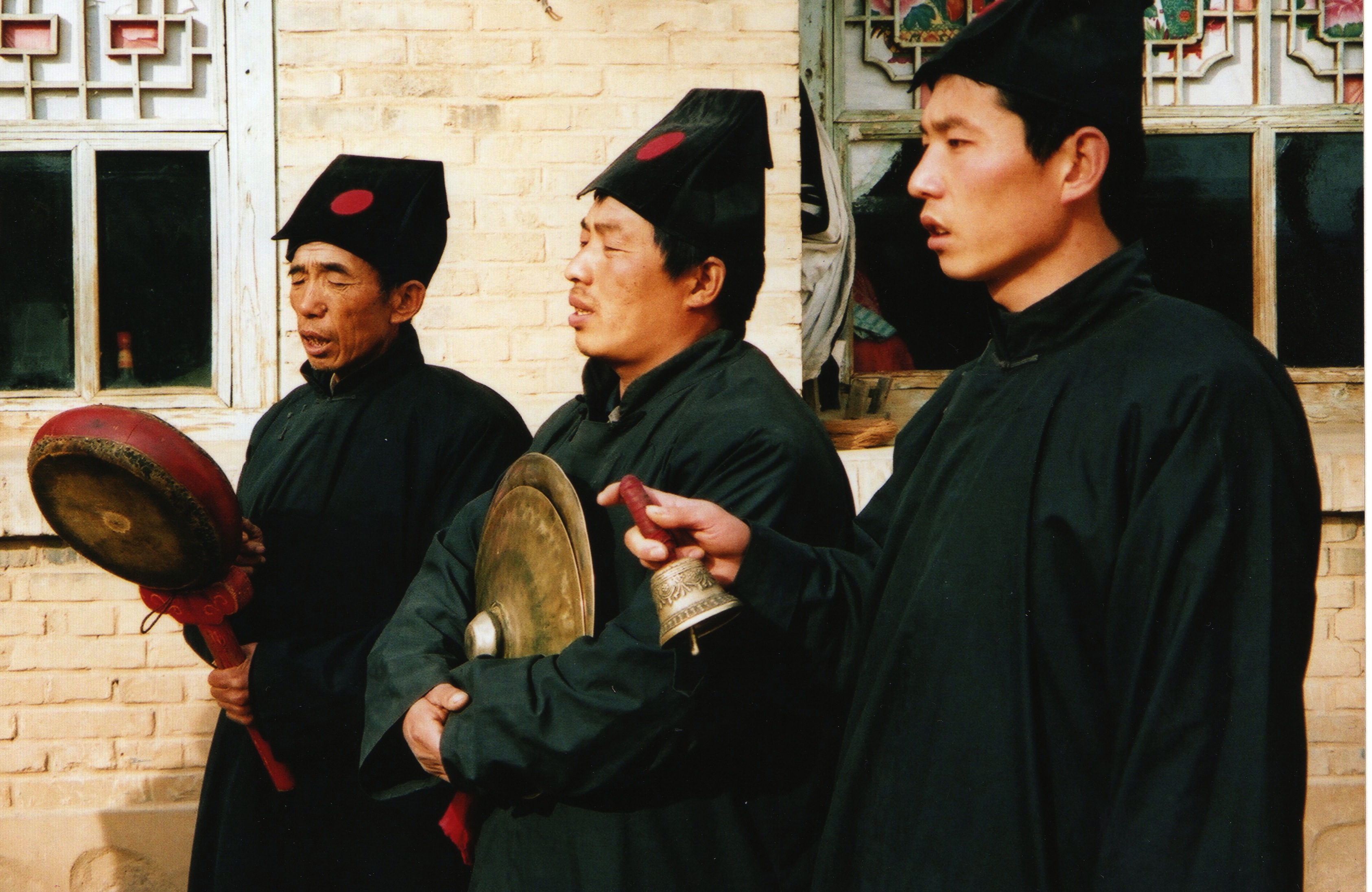
Vocal trio, 2001: Li Manshan, Golden Noble, Li Bin.

Not so much

Don’t put your daughter on the stage, Mrs Worthington

as

Don’t put your son on the Daoist ritual arena, Mr Li.

Patrice Fava’s film Han Xin’s revenge, about the rituals of a group of household Daoists in rural Hunan, is very fine. The voiceover contains an intriguing line:

“Many young people choose to become Daoists.”

Whether in Hunan or elsewhere, today or when the film was made, I find this hard to believe—it seems a romantic notion.

As I observe in my book, Li Bin (b.1977) is the ninth generation of Daoists in the Li family, and could well be the last. Moving with his family to the county-town in 2007 was initially a stepping-stone for his son to get a better education—seeing it as a route towards betterment, just as his forebears had done under successive regimes.

Even if new recruits can now skimp on the training, Daoist fathers no longer want their sons to continue the tradition; there are now easier ways to make a better living, and people like pop music anyway. Fees are low, and the lifestyle, working long days and nights traipsing around backward demoralized villages, is tough and none too comfortable (see e.g. recent diaries of Li Bin and Li Manshan). Potential young recruits go away to seek urban laboring work or get a good education leading to a secure job in town, providing an escape from the countryside towards urban registration and higher wages. And this is what their parents (including Daoists) want for them.

In The souls of China (p.48) Ian Johnson puts it well (in a passage about Li Manshan’s “determining the date” activities):

… Their relief was palpable, but so was Old Mr Li’s exhaustion. It was a tiring life, always on call, staying in people’s homes, burying their dead, eating their banquets. The questions never stopped—an avalanche of new challenges and problems that were overwhelming these old villages.

So whereas Daoist ritual somehow managed to survive after Liberation in 1949, and to revive after the liberalizations from 1979, today, in a world turned competitive, where the villages themselves are depleted, working as a household Daoist offers no route to advancement. As the Daoists realize, official initiatives like the Intangible Cultural Heritage project are quite unable to solve these issues.

If there are indeed areas of China where recruits do still emerge to perform a more complex repertoire of rituals, it would be interesting to discern reasons for such variation.

All this is explored in my film too. After screenings I like to ask the audience,
“Would you let your sons take this up as a livelihood?”

This doesn’t amount to hand-wringing, however. Daoist ritual has adapted under all kinds of vicissitudes over the last century, as it always has done.

Harpo

À propos the Marx brothers, apart from the verbal dexterity, their charm was also beyond words:

Harpo is naturally most endearing to musos—notably Steven Isserlis, whose brilliant tribute is here (the link to the radio programme may be defunct, but watch this space). Note his fine historical reflections too.

Harpo’s mute persona might have been inspired by Rossini’s trio Mi manca la voce

For Steven’s Bach, see here.

Travel: our changing times

Morgan

In Morgan: a suitable case for treatment (Karel Reisz, 1966; see also here), Morgan’s mother (the magnificent Irene Handl), a 1930s Communist who “refuses to de-Stalinise”, asked for news of her son, exclaims incredulously:

Got a postcard from ‘im, from Greece… I mean, what is there in Greece?

This was pretty much my parents’ attitude to my fieldwork in China.

Here they are paying respects at Marx’s grave:

Studying the cello

Ladykillers

“People often say to me…”

When I am asked how I came to play the violin, I’m inclined to cite The Ladykillers (1955):

As the gang is plotting their robbery, posing as a string quintet while they play a recording of the Boccherini Minuet, sweet little old Mrs Wilberforce (Katie Johnson) takes them by surprise—so to maintain the deceit they have to hurriedly pick up their instruments (which they can’t actually play). The magnificently obtuse One-round (Bernard Bresslaw) is clutching a cello like a sledgehammer:

Mrs Wilberforce: “May I ask you where you studied?”

One-round: “…Well, I didn’t really study any place, Lady… I just sort of… picked it up.”

I still can’t help thinking of the scene whenever I hear that minuet.

This leads nicely to Muso speak: excuses and bravado. For more convincing mastery of the cello, see here; and for Hugh Maguire leading the Allegri quartet in another Boccherini minuet, here. See also Learning the piano.

Healthy eating: Sleeper

Meanwhile we lapped up the early films of Woody Allen, like Sleeper.

Two doctors are monitoring the owner of a health food store who has been cryogenically frozen in 1973 and defrosted 200 years later:

https://www.youtube.com/watch?v=3iG6Hrh4v08

Dr Melik: This morning for breakfast he requested something called “wheat germ, organic honey and tiger’s milk.”
Dr Aragon: [chuckling] Oh, yes. Those are the charmed substances that some years ago were thought to contain life-preserving properties.
Dr Melik: You mean there was no deep fat? No steak or cream pies or… hot fudge?
Dr Aragon: Those were thought to be unhealthy—precisely the opposite of what we now know to be true.
Dr Melik: Incredible.

A funky address

To follow Five easy pieces, a very different kind of oeuvre of that époque—less verité—is Jacques Rivette’s 1974 film Céline et Julie vont en bateau (here, on vimeo).

One abiding memory is my favourite address, where much of the “action” (if that’s the mot juste) takes place:

7 bis, rue du Nadir-aux-Pommes

I often used this a forwarding address.

What an age—Rafaelson, Bertolucci, Godard, Chabrol… (more here). At the time [historical note—Ed.], the way to see all these films was to do something called “going to the cinema”. Late-night Marx brothers films at the Arts Cinema were a rite de passage too…

In my imagination I tend to reduce my student years to the Tang dynasty, violin, and Adnams, forgetting how important (and how modern) my wider education was—film, art, literature. But the lacunas were remarkable too.

Meanwhile, Li Manshan and his fellow Daoists were languishing in silence and hunger (my book, p.133):

“We just sat around at home, but we could never feel at peace”—always fearing a knock at the door.

Five easy pieces

Somewhat akin in alienated mood to Jia Zhangke’s Platform is Five easy pieces (Bob Rafaelson, 1970).

The diner scene (“No substitutions”, “Hold the chicken”) is iconic:

But there’s far more to it than that. Among its many virtues, it’s a moving exposé of the pressures and frustrations of the classical musician’s life. In an abrupt change of mood, when Bobby finally reaches the family home, he enters to hear the Andantino of the E flat piano concerto K271 in an arrangement for two pianos, played in a ponderous style that matches the stifling, oppressive mood of the house:

—far from the charm of Robert Levin:

Just as exquisite is the Andante of the E flat concerto K482, also in C minor:

Bobby’s alienation is confirmed when he is cajoled into playing a Chopin Prelude, a piece that holds similarly disturbing childhood memories for me—note the powerful effect of the family photos:

In those heady times (The king of Marvin gardens, The last detailthose were the days) before Jack Nicholson began impersonating himself, his final monologue before his mute father is overwhelming (sorry—far better if you can watch the whole film, of course!):

Here’s a wise review for the fiftieth anniversary of the film in 2020.

For Augusta…

Platform

Platform

In connection with my film on the Li family Daoists, I already recommended the verismo fictional films of Jia Zhangke 樟柯 about the alienating changes of life in small-town Shanxi through the reform era. Of many appreciations, this is good, and this. For antedecents of his style, see Chinese films of the early reform era.

His brilliant Platform (Zhantai 站台, 2000) shows how the members of a now-rootless arts-work troupe experiment with changing fashions as they struggle to adapt to the loss of their “iron rice-bowl”.

In one of many moving scenes (from 1.21.45) the illiterate Sanming, desperate for a job, turns up at a doddery coal mine to enlist for a daily wage of 10 kuai. His friend reads out for him the brief, shocking, contract he has to sign, opening:

Contract of life and death: 1) Life and death are a matter of fate, prosperity depends on Heaven. I am willing to work in Gaojiazhuang mine. Management accepts no blame for accidents.
生死合同。第一,生死由命,富贵在天。本人自愿在高家庄煤矿采煤,如遇万一,与煤矿无任何关系。

Just that opening phrase Life and death are a matter of fate, prosperity depends on Heaven resounds with the peasant mindset, if less so with modern law. The contract, and Sanming’s uncomprehending acceptance of it, are at once convincing and tragicomic.

Do go on to watch his other films, including Xiao Wu 小武 (1997), Unknown pleasures (Ren xiaoyao 任逍遥, 2002), The world (Shijie 世界, 2004), and Still life (Sanxia haoren 三峡好人, 2006). Now we also have an open-access volume of his interviews with Michael Berry. See also the films of Wang Xiaoshuai.

* * *

Shanxi province (apart from its fine household Daoists!) is also notable for its mining accidents. From my book on neighbouring Shaanbei:

Back in the county-town, returning to our hostel one evening, we switch on the TV to find a documentary about coal-mining accidents, which are reported nightly. There are some rather fine investigative programmes on TV these days, and the main theme of this one is how the response of the village Communist Party leadership to the disaster, rather than considering improving safety measures, has been to give funds to construct a new village temple in the hope of divine protection. OK, in this case the programme happens to fit into an agenda of rationalism against superstition, a view we sometimes feel inclined to challenge, but tonight I can only go along with the presenter’s lament.

Only later did I put together further pieces of a grisly jigsaw. Under the tradition of posthumous marriage (minghun), revived in northwest China, within five years after the death of an unmarried male over the age of 15 sui, a suitable dead unmarried female is found. Indeed, shawm bands often perform, and a Daoist may officiate. The unnatural deaths of many men in unregulated mines were bad enough, but newspaper reports in 2007 revealed that women (often disabled, or from poorer provinces) were being murdered to cater for this market.

For “ghost marriages”, note this article.

Noddy: the art of conducting

A tribute to the great Gennadi Rozhdestvensky (1931–2018)

We musos may be critical of conductors (cf. Norman Lebrecht, The maestro myth: great conductors in pursuit of power), but don’t get me wrong, we deeply admire great ones—such as Boulez, Tennstedt, Gardiner, Rattle (unlikely bedfellows…). See under The art of conducting.

Apart from Boulez, another highlight of depping regularly with the BBC Symphony Orchestra was working for Rozhdestvensky (known in the trade as Noddy).

Gennadi Rozhdestvensky—conductor or conjuror? (Bruno Monsaingeon, 2003) is a wonderful film:

In a work that otherwise requires little imaginative filming, do watch the brilliant scene from 32.40—the traffic cop Marcel Mehala should take a bow too.

Believing in a kind of spontaneous combustion, and trusting his players to match his own mastery, taking risks together, Noddy was renowned for his aversion to rehearsal—greater still than that of orchestras. Once, turning up for the first of a couple of whole days’ scheduled rehearsals for a fiendishly difficult and unfamiliar modern piece, he conducted the first few bars and then told the band nonchalantly, “Good, see you at the concert”. In a rare reversal of the musos’ philosophy of “It’ll be all right on the night”, the leader took him to one side and asked him if he wouldn’t mind just taking them through the whole piece once.

Even on stage, his style doesn’t look like much—inscrutable, even casual, his gestures by turn minimal and flamboyant (in the film, from 22.24, he explains his economical solution to conducting the opening of the Symphonie fantastique (cf. Yet more conducting). But his concerts were electrifying. Doing Petrushka, it was as if we were all composing it, living it, together with him. And the Scriabin piano concerto with his wife Viktoria Postnikova was exquisite too—here’s an audio recording:

We can also relish them together in Rachmaninoff’s 4th concerto:

In Historical ears and eyes I feature Noddy conducting Rachmaninoff’s gorgeous 2nd symphony. And do listen to his Tchaik 6. The documentary ends with an illuminating sequence where he rehearses and reflects on Tchaikovsky’s Romeo and Juliet. If only we could see more of the archive footage below—the curious camerawork shows him only briefly, though with characteristic gestures:

Monsaingeon’s Notes interdites (aka Red baton) also features another film in which Noddy reflects on the political vagaries of the Soviet system.

Noddy

For obituaries, click here and here. See also The art of conducting; and Lives in Stalin’s Russia.

More fucking gondolas

MP

Another gratuitous spinoff from the Li band’s trip to Venice (cf. Scunthorpe and Venice, and indeed Venice: daily life in a theme park—oh, and Some Venetian greetings!):

A lesser-known gem of Monty Python is Away from it all, a ghastly travelogue with all the lovingly recreated stereotypes of John Cleese’s voiceover (Part Two should follow on):

… the one thing that Venice truly lacks—is leprechauns.

Bulgaria gets a candid assessment too:

Hard to believe, isn’t it, that these simple, happy folk are dedicated to the destruction of Western civilisation as we know it…

Eventually it’s exposed in the narrator’s increasingly deranged breakdown:

All this dashing about in search of Peace and Contentment—it doesn’t work! There’s no escaping yourself—how do you face the existential terror, the hopelessness, the dark corridors of one’s mind, the yawning, black, meaningless abyss they don’t tell you about in the brochures…

Several of us recall seeing this in the cinema as a trailer before The life of Brian.

You know whose fault it is? You lot—yes, you, you so-called cinema patrons! You sit there, stuffing your stupid faces with chocolate peanuts, gawping at these dreadful films… Well, why do you put up with them? You could stop them tomorrow if you had the guts to go to the manager and say, Why do you put this rubbish on?

For more travel clichés, see Molvania, and China–Italy: International Cultural Exchange zzzzz.

Private Passions

Radio 3’s Private Passions is always insightful. The edition with Philippe Sands (here) shows that he too “delights in all manifestations of the Terpsichorean muse”(see Muzak)—Leonard Cohen, Michael Chance singing Erbarme Dich

(see also herehere, and here—and for an Arabian version, here), Bruno Walter conducting Mahler 9 (here, and here) in 1938, and Let’s pretend we’re bunny rabbits. Actually, the latter isn’t such a kitsch choice as its title suggests, but hey.

My posts A Nazi legacy and The Ratline introduce Sands’s harrowing film and books.

Strauss (R.) and Elvis

Wild

David Lynch always amazes (for Twin Peaks, click here), but the final sequence of Wild at heart (1990) is gorgeous. Morphing, almost seamlessly, from the Four Last Songs of Richard Strauss to Elvis, it makes both works seem even more intense; and then Love me tender (really sung by Nicholas Cage!) is filmed in one long take, the camera coiling amorously around him and Laura Dern (cf. Susan McClary on the baroque trio sonata).

Worth celebrating genius—all the more in the USA these days, where the list of artists deemed “overrated” by the arbiter of cultural taste will be growing… (written in 2017)

Another Czech mate

Hasek last photo

Further to my Czech mentor Paul Kratochvil:

Along with Flann O’Brien, high on the guest list for my fantasy dinner-party would be Jaroslav Hašek—”humorist, satirist, journalist, anarchist, hoaxer, truant, rebel, vagabond, play-actor, practical joker, bohemian (and Bohemian), alcoholic, traitor to the Czech legion, Bolshevik, and bigamist”.

Hašek’s The Good Soldier Švejk has long been popular in China. Cecil Parrott, its English translator, also wrote a biography of Hašek’s “bottle-strewn life”, The bad Bohemian. Former British Ambassador in Prague, Parrott effortlessly avoids betraying any sympathy with Hašek’s reprobate behaviour (see also Hašek’s adventures in Soviet Tatarstan). As he explans in the introduction to his translation:

His next escapade was to found a new political party called The Party of Moderate and Peaceful Progress within the Limits of the Law […] publicly debunking the monarchy, its institutions and its social and political system. Of course it was only another hoax, designed partly to satisfy Hašek’s innate thirst for exhibitionism and partly to bolster the finances of the pub where the election meetings were held.

Among his many japes, his short-lived editorship of the journal The Animal World was curtailed after he published articles about imaginary animals.

Dangerous herds of wild Scottish collies have recently become the terror of the population in Patagonia

Thoroughbred werewolves for sale

Newly discovered fossil of an antediluvian flea

And his hobbies combined:

Everyone who votes for us will receive as a gift a small pocket aquarium.

Svejk Chinese

Gratifyingly, The Good Soldier Švejk clearly appeals to Chinese sensibilities; it was translated, and the 1956–1957 Czech films were dubbed into Chinese:

Alexei Sayle wonders if the Czech regime knew what they were doing promoting Švejk, since its message hardly supports the ideals of socialist conformity. Though it became popular in many languages, I suspect there’s something about it that appeals in particular to Chinese people—an antidote to compulsory patriotism? The Chinese translator dutifully portrays it as a tirade against imperialism, but it surely spoke to The Common Man (Flann O’Brien’sThe Plain People of Ireland”) oppressed by the destructive irrationalities of a newer system…

The Chinese version of Švejk’s name (Shuaike 帅克) is perfect. It drives me to a little fantasy.

Bach on film

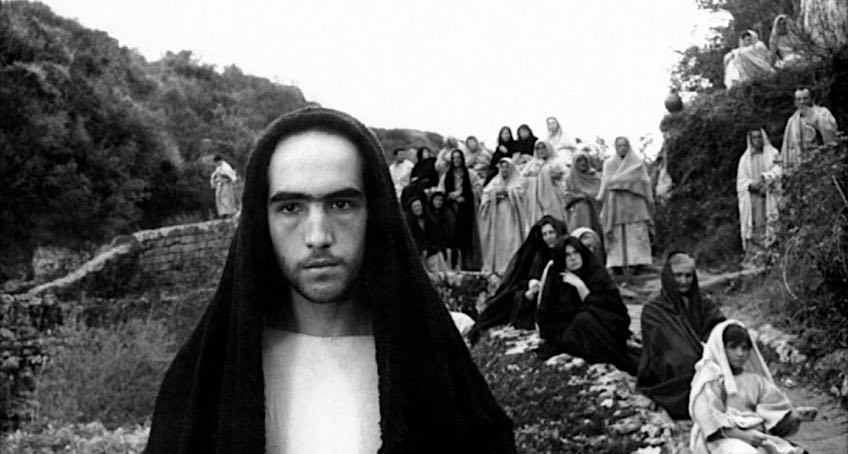
Pasolini SMP

As part of my extensive coverage of Bach (roundup here), two feature films from the 1960s, despite their extreme contrast, are linked both by their intensity and by the way they don’t just accept but probe our own modern values:

and

  • The chronicle of Anna Magdelena Bach (Jean-Marie Straub and Danièle Huillet, 1968—with  Gustav Leonhardt as Bach!). YouTube links come and go; I try and keep an eye on them, but you can do your own YouTube searches if they disappear. Here’s the complete film:

I also found a version enriched by Japanese subtitles (like the Greek subtitles of Johnny the shoeshine guy), and here’s a colourised version of the opening sequence (more on which here):

Out-take

B and S

In my book Daoist priests of the Li family I coyly decided against

The Hoisting the Pennant and Judgment and Alms rituals go together like Brian and Stewie.

BTW, the Family Guy musical numbers are brilliant, rich in production values.

And for anyone trying to learn stave notation, here’s a handy aid:

For the excellent theme tune (cf. The art of the miniature), here’s a comparison between 1999 and 2017 versions—not entirely akin to Glenn Gould’s different recordings of the Goldberg variations, but perhaps calling to mind the variants of Asteroid:

And a bonus number to complement the role of Family guy in my post Jesus jokes:

For a comprehensive playlist, click here; and for Alan Bennett’s cameo role, here. See also Oh Noh!

The Three Wise Men

congshu

Fieldwork reports on local Daoist ritual continue to amass. Note the growing series Daojiao yishi congshu 道教儀式叢書.

In my book I described the main instigators of this impressive movement—C.K. Wang, John Lagerwey, and Lü Pengzhi—as a “holy trinity”. Then I thought maybe that should be the Three Pure Ones (Sanqing 三清)—but actually (since they are not so much objects of veneration as witnesses to marvels), a better metaphor might be the Three Wise Men:

“…Creeping around a cow shed at two o’clock in the morning? Doesn’t sound very wise to me…”
“We were led by a star!”
“Led by a bottle, more like!”

(Sorry, can’t help it…)

Now I’m wondering if they had a list, perhaps from Fortnum and Mason—how embarrassing if they’d all brought myrrh. “Sorry, your choice is already taken, please choose gold”.

For related irreverence, see Jesus jokes.