On visual culture

As with my remarks on punk and so on,

You think I know Fuck Nothing—but I know FUCK ALL!

Or to adapt it to the topic in hand,

You think I know Shag Nothing, but I know CHAGALL!

More genteel would be the old “I Don’t Know Much About Art, But I Know What I Like!” (groan from Myles). So, following Myles, I write this in the spirit of The Plain People of Ireland. As often, I’m seeking clues relevant to my own areas of study, making connections that can easily get buried beneath our individual specialities. Perhaps this post might be entitled Renaissance art for Dummies in the Field of Daoist Ritual Studies—not one of their bestsellers, I suspect.

Sassetta: St Francis giving his cloak to a poor soldier.

I first came across

  • Michael Baxandall, Painting and experience in fifteenth-century Italy: a primer in the social history of pictorial style (1st edition 1972)

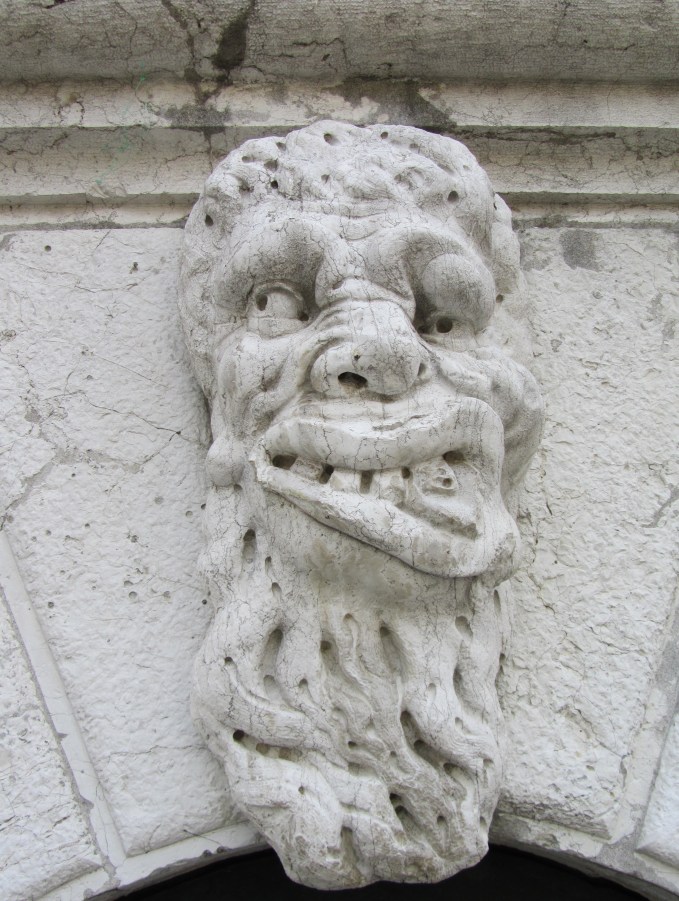
while browsing Rod Conway Morris’s library in Venice, along with Horatio E. Brown’s splendidly-titled Some Venetian knockers.

It’s my kind of book, full of the practical detail of materials, technical skill, and patronage, as well as exploring changing perceptions. Quite short, and eminently readable, it gains much from having grown out of a series of lectures that he gave. It addresses issues that I hardly find in discussions of Chinese ritual and music (for any period), so I’d like to explore it at a certain length.

Baxandall opens by encapsulating, in plain and elegant language,** issues that, um, scholars of Daoist ritual (of all periods) should absorb:

A 15th-century painting is the deposit of a social relationship.
On one side there was the painter who made the picture, or at least supervised its making. On the other side there was somebody else who asked him to make it, provided funds for him to make it, reckoned on using it in some way or other. Both parties worked within institutions and conventions—commercial, religious, perceptual, in the widest sense social—that were different from ours and influenced the forms of what they together made.

He observes that

The picture trade was a very different thing from that in our own late romantic condition, in which painters paint what they think best and then look round for a buyer.

Exploring the mismatch between our concepts of “public” and “private”, he notes that

Private men’s commissions often had very public roles, often in public places. A more relevant distinction is between commissions controlled by large corporate institutions like the offices of cathedral works and commissions from individual men or small groups of people: collective or communal undertaking on the one hand, personal initiatives on the other. The painter was typically, though not invariably, employed by an individual or small group. […] In this he differed from the sculptor, who often worked for large commercial enterprises. (p.5)

He meshes all this with detailed technical discussion, like the use of ultramarine:

The exotic and dangerous character of ultramarine was a means of accent that we, for whom dark blue is probably no more striking than scarlet or vermilion, are likely to miss. (p.11)

Thus in the Sassetta painting above, the gown St Francis gives away is an ultramarine gown.

The contracts point to a sophistication about blues, a capacity to discriminate between one and another, with which our own culture does not equip us.

Baxandall notes change over the course of the Quattrocento:

While precious pigments become less prominent, a demand for pictorial skill becomes more so. […] It seems that clients were becoming less anxious to flaunt sheer opulence of material.

But he goes on:

It would be futile to account for this sort of development simply within the history of art. The diminishing role of gold in paintings is part of a general movement in western Europe at this time towards a kind of selective inhibition about display, and this show itself in many other kinds of behaviour too. It was just as conspicuous in the client’s clothes, for instance, which were abandoning gilt fabrics and gaudy hues for the restrained black of Burgundy. This was a fashion with elusive moral overtones.
[…]
The general shift away from gilt splendour must have had very complex and discrete sources indeed—a frightening social mobility with its problem of dissociating itself from the flashy new rich; the acute physical shortage of gold in the fifteenth century; a classical distaste for sensuous licence now seeping out from neo-Ciceronian humanism, reinforcing the more accessible sorts of Christian asceticism; in the case of dress, obscure technical reasons for the best quality of Dutch cloth being black anyway; above all, perhaps, the sheer rhythm of fashionable reaction. (pp.14–15)

To show how skill was becoming the natural alternative to precious pigment, and might now be understood as a conspicuous index of consumption, he returns to “the money of painting”—the costing of painting-materials, and frame, as against labour and skill.

You will no longer be surprised to learn that the Quattrocento division of labour between master and disciples (pp.19–23) reminds me of Daoist ritual specialists.

Baxandall goes on to note the differences in patrons’ demands for panel paintings and frescoes. He attempts to address the issue (even for the time of creation) of public response to painting:

The difficulty is that it is at any time eccentric to set down on paper a verbal response to the complex non-verbal stimulations paintings are designed to provide: the very fact of doing so must make a man untypical. (pp.24–5)

Aesthetic terms expressed in words are contingent, varying from age to age, and anyway elusive. Even with the vocabulary of such accounts, discussing that of a Milanese agent, Baxandall notes:

the problem of virile and sweet and air having different nuances for him than for us, but there is also the difficulty that he saw the pictures differently from us.

He goes on to explore different kinds of viewers’ own exercise of skill in appreciating a painting, with their different backgrounds:

… the equipment that the fifteenth-century painter’s public brought to complex visual stimulations like pictures. One is talking not about all fifteenth-century people, but about those whose response to works of art was important to the artist—the patronizing classes, one might say. […] The peasants and the urban poor play a very small part in the Renaissance culture that most interests us now, which may be deplorable but is a fact that must be accepted. […] So a certain profession, for instance, leads a man [sic—SJ] to discriminate particularly effectively in identifiable areas. (p.39)

Whatever [the painter’s] own specialized professional skills, he is himself a member of the society he works for and shares its visual experience and habit. (p.40)

And given that “most 15th-century pictures are religious pictures”, he asks in detail,

What is the religious function of religious pictures?

His answer, in brief, is that they were used “as respectively lucid, vivid and readily accessible stimuli to meditation on the Bible and the lives of Saints.” But he goes on to enquire:

What sort of painting would the religious public for pictures have found lucid, vividly memorable, and emotionally moving?
[…]
The fifteenth-century experience of a painting was not the painting we see now so much as a marriage between the painting and the beholder’s previous visualizing activity on the same matter. (pp.40–45)

Again he makes the crucial point:

15th-century pictorial development happened within fifteenth-century classes of emotional experience.

Alongside colour, he discusses the beholders’ appreciation of gesture and groupings, adducing dance and sacred drama.

It is doubtful if we have the right predispositions to see such refined innuendo at all spontaneously. (p.76)

And apart from their basic level of piety (largely lost to us today), many of the “patronizing classes” would have assessed the work partly through their knowledge of geometry and the harmonic series.

In Part III Baxandall attempts to sketch the “cognitive style” of the time, with the reservation that

A society’s visual practices are, in the nature of things, not all or even mostly represented in verbal records. (p.109)

Finally he reverses his main argument—that “the forms and styles of painting respond to social circumstances” (and so “noting bits of social convention that may sharpen our perception of the pictures”)—by suggesting that “the forms and styles of painting may sharpen our perception of the society” (p.151).

An old painting is the record of visual activity. One has to learn to read it, just as one has to learn to read a text from a different culture, even when one knows, in a limited sense, the language; both language and pictorial representations are conventional activities. […]

In sum,

Social history and art history are continuous, each offering necessary insights into the other.

Such reflections seem more sophisticated than the “autonomous”, timeless approaches still common in both WAM and Daoist ritual. To be fair, we are quite busy trying to document ritual sequences, hereditary titles, and so on—but the Renaissance scholars have just as much nitty-gritty to deal with too.

* * *
Carpaccio

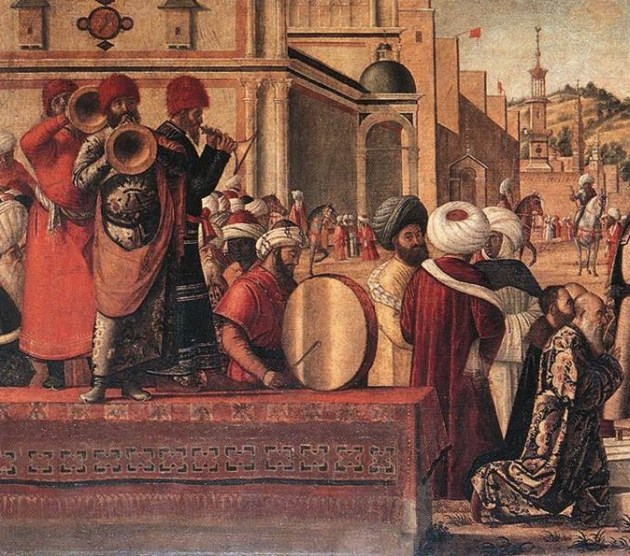
Carpaccio: Baptism of the Selenites, c1504–7 (detail). San Giorgio degli Schiavoni, Venice.

(The painting features a shawm band that I’d love to hear! For Venice’s musical contacts with the East, see e.g. here).

Baxandall ends with a caveat:

One will not approach the paintings on the philistine level of the illustrated social history.

I don’t think he quite had in mind

  • Alexander Lee, The ugly renaissance: sex, greed, violence and depravity in an age of beauty (2014),

a less technical, more sociological book with a firm political agenda that some may find more appealing than others (cf. this review of Catherine Fletcher, The beauty and the terror: an alternative history of the Italian Renaissance (2020).

Poking around beneath the glamorous surface image of the Renaissance, seemingly “an age of beauty and brilliance populated by men and women of angelic perfection”, he observes:

If the Renaissance is to be understood, it is necessary to acknowledge not just the awe-inspiring idealism of its cultural artefacts but also the realities which its artists endeavoured to conceal or reconfigure.

Lee explores the brutal social universe in which artists were immersed. Like Baxandall, he explores the relationship between artist and his assistants and apprentices:

The relationship was naturally based on work, and hence could often be punctuated by squabbles, or even dismissal. Michelangelo continually had trouble with his assistants, and had to sack several for poor workmanship, laziness, or even—in one particular case—because the lad in question was “a stuck-up little turd”.

Given that patrons were as important as artists in shaping the form and direction of Renaissance art,

Rather than being seduced by the splendor of the works they commissioned, it is essential to uncover the world behind the paintings; a world that was populated not by the perfect mastery of colour and harmony that is usually associated with the Renaissance, but by ambition, greed, rape, and murder.

He shows the often dubious motives of patrons. They often valued a commission “for the contribution it could make to reshaping the image of often extremely disreputable men”. Such works “were intended more to conceal the brutality, corruption, and violence on which power and influence were based than to celebrate the culture and learning of art’s greatest consumers”.

Lee also seriously questions the image of the period as one of “discovery” of the wider world:

In their dealings with Jews, Muslims, black Africans, and the Americas, the people of the Renaissance were not only much less open towards different cultures than has commonly been supposed, but were willing to use fresh experiences and new currents of thought to justify and encourage prejudice, persecution, and exploitation at every level.

I suspect such angles may not go unchallenged, but I find it refreshing. And these unpackings again augment my comments on the “Golden Age nostalgia” of the heritage industry in China.

* * *

jue

China: jue libation vessel, Shang/Zhou dynasty.

Reception history has perhaps become a rather more established feature of visual culture (including the history of art) than for musical culture. The term “visual culture” itself reflects a more mature holistic approach, like that of “soundscape” for ritual music in China, and indeed the whole inclusive brief of ethnomusicology.

As I dip into Marcia Pointon’s History of art; a student’s handbook, she soon observes:

The meanings of the painting will be determined by where, how and by whom it is consumed.
[..]
Art historians are interested not only with objects with but with processes. […They] concern themselves with visual communication whatever its intended audiences or consumers.
[…]
Art historians investigate the origins, the connections between “high” and “low”, and the ways in which imagery such as this contributes to our understanding of a period of historical time, whether in the present or in the far distant past.

On one hand, as with music, we envy earlier viewers/audiences their familiarity with subjects/languages that we can no longer interpret easily, if at all. At the same time we have also lost the shock of the new.

We’re familiar with the idea of restoring old paintings to their original colours—negating their history?—but we can’t perform a similar operation on our eyes and minds. Doubtless there’s a vast scholarly literature on this, but one might be reluctant to remove the patina from Shang bronzes, restoring them to the condition of glossy new Italian kitchenware. For patina, see also Richard Taruskin’s comments on Gardiner’s Schumann.

Just as most people who experienced art in 15th-century “Italy” had access mainly to those works on public display in their particular city, so, long before CDs and youtube, Leipzig dwellers heard little music apart from Bach and the pieces by other composers that he selected, mostly within the Leipzig tradition. Some creators themselves might be so lucky as to travel, gaining a certain experience of other styles. And in both art forms, a majority of such work was contemporary—even the instruments that baroque musicians played were mostly modern.

To try and get to grips with what art and music meant at the time doesn’t make us able to experience it as did the “consumers” of the day—we can’t unsee Monet, TV, or skyscrapers any more than we can unhear Mahler and punk. And I hope our teeth are in a better state.

* * *

I also admire

  • Michael Jacobs, Everything is happening: journey into a painting (2015), [1]

on Velázquez’s Las Meninas (1656)—with chapters by his friend Ed Vulliamy added after Jacobs’ untimely death. As Vulliamy observes,

In this half-book, beyond a fragment, we have not only a typically Jacobs-esque narrative of his life with Velázquez—one of chance encounters, aperitifs, musings and restless autobiography—but also this manifesto for the liberation of how we look at painting. (p.146)

Jacobs does that thing that people always do in blurbs:

cutting a picaresque swathe

—and the picaro simile is fitting. Jacobs was constantly deploring the “sunless” world of academia. He documents the shift in art history that was then occurring widely in scholarship:

Many of the younger lecturers and researchers, conscious perhaps of the lingering popular image of their discipline as a precious and elitist pursuit, began adopting what rapidly became the prevailing art-historical methodology—a pseudo-Marxist one. People who might once have become connoisseurs in tweeds reinvented themselves as boiler-suited proselytisers dedicated to exposing in art revealing traces of the social conditions of a period, often resorting in the process to a hermetic prose peppered with terms I had first come across in Foucault, such as “discourses” and “the gaze”. (p.44)

Oh all right then, I’ll go for a hat-trick:

You think I know Fuck Nothing, but I know FOUCAULT!

(Note on pronunciation: whereas I can only hear “You think I know Fuck Nothing, but I know FUCK ALL!” in the caricature-Nazi accent of Karl Böhm, the above bon mot clearly belongs on the foam-specked lips of an angry young Alexei Sayle.)

By contrast with the treatments of Baxendall and Lee (themselves quite different), Jacobs’ approach is based on including “us”, the viewers, as agents in the picture—whatever his reservations, he was inspired by Foucault.

Proust, writing on Rembrandt, had spoken about paintings as being not just beautiful objects but also the thoughts they inspired in their viewers. [Svetlana] Alpers was cited as saying that “looking at a work in a museum and looking at other people looking at a work in a museum is like taking part in the life story of this work and contributing to it.”

Still, Jacobs ploughed his own furrow. As Paul Stirton recalls,

Michael always believed in the wonder of looking. Yes, there may be a profound message in a painting, but Michael didn’t want to dress it up in philosophical trappings. By all means approach a painting in a scholarly manner, but never lose the wonder. (pp.179–80)

In his book about artists’ colonies at the end of the nineteenth century, The good and simple life, he is scathing about how most painters wanting to live that life considered “the downtrodden country folk … as little more than quaint components of the rural scene. Their social conscience was as little stirred by them as by pipe-playing goatherds in the Roman Campagna.” At moments, though he is the antithesis of a “political” art critic, Michael’s writing reads like Walter Benjamin fresh from his Frankfurt School, but with a glass of Sangria in his hand. (p.182)

From both his own experience and Thomas Struth’s photos of the public response to Las Meninas over several days, Jacobs recalls

All the faces of the bored, the transfixed, the distracted, the deeply serious, the adults whose only concern was to get the perfect snap, the school children who were wondering when their ordeal would be over, the others who fooled around or diligently made notes, the few whose lives were being transformed. (pp.69–70)

So (suitably) like Monty Python’s Proust sketch, Jacobs never quite got as far as discussing the painting “itself”—not so much due to his death, as by virtue of his propensity to dwell on personal reminiscences on modern Spanish history and his own relationship with it and the painting.

He remarks wryly on the images of Spain current in his youth, reminding me of images of China, not to mention Away from it all. He recalls a train journey in the early years of Spain’s transition to democracy, when he was reading a book that

gave no hint of Spain’s repressive military regime, but instead referred to the country’s “growing agricultural and industrial prosperity” and to the “happy coexistence of the old and the new”.
The book’s role as a catalyst for my early, life-changing Spanish journeys was due entirely to its black-and-white photos, which neglected this supposedly modern and prosperous country in favour of basket-laden donkeys, adobe-walled farms, palm groves, sun-scorched white alleys and other such images that endowed Spain with a predominantly medieval and African look. Even Madrid, so regularly criticized by past travellers for its brash modernity, was made to seem more exotic and rural than any other western city I had seen. The sole street-scene was one of a large flock of sheep being herded in front of a neo-Baroque, cathedral-like post-office building popularly dubbed “Our Lady of the Post”. (p.60)

He discusses the fortunes of Las Meninas during the civil war, as well as more recent events:

… closed shops wherever you looked, restaurants offering “crisis menus”, daily protests, and graffiti and posters revealing grievances with everyone and everything, from the monarchy, to the banks, to the multinationals, to the European Community, to the politicians who made Spain the country with the the highest number of politicians per capita in Europe. (p.72)

And he describes the painting’s changing frames and settings:

The Sala Velázquez was like a shrine. […] On entering this inner sanctuary, people took off their hats, spoke in low voices, and tiptoed around so as not to destroy the atmosphere of worshipful solemnity. Every so often someone would be observed bursting into tears.
There were of course others visitors who disliked this room’s churchlike theatricality and the sentimentally nationalistic and mindless emotional reactions it inspired. (p.115)

So as it stands, Jacobs’ book is concerned more with reception history than with the society of the time of the creation of Las Meninas (though he explored this elsewhere, and doubtless had voluminous notes on the painting to supplement existing research). Background on the society of Velazquez’s day is provided mainly by Vulliamy’s fine Introduction. Evoking Lee, he notes that Seville, far from “the great Babylon of Spain, map of all nations”,

was also headquarters of the Inquisition. Indeed, the “Golden Age” which followed the unification of Spain in 1492 was accomplished, writes Michael Jacobs, “in a spirit of brutal fanaticism”, with the expulsion or enforced conversion of Andalucia’s many Moors and Jews. This dogmatism and what we would now call “ethnic cleansing” [here Vulliamy writes with traumatic personal experience in Bosnia] had a major and insidious demographic impact on the city, yet Seville remained characterized by “an architecture … of great contrasts”, wrote Michael, “for alongside the Muslim-inspired love of decorative arts richness is an inherently Spanish love of the austere”.

For a similar approach that sets forth from 17th-century Delft to go global, note Timothy Brook’s brilliant book Vermeer’s hat.

    * * *

GL Ten Kings

Yama King painting from Ten Kings series, North Gaoluo 1990.

All these books incorporate ethnography and reception history far more than the fusty old reified appreciation of “autonomous” objets d’art. For China,

  • Craig Clunas, Art in China (1st edition 1997)

makes a useful, wide-ranging, and thoughtful introduction, exploring themes like genres, techniques, functions, patrons, markets, producers, class, and gender.

For instance, discussing a wooden sculpture of the female deity Guanyin from Shanxi carved c1200 CE, he describes its original multi-coloured decoration:

All this added to the immediacy of the image for worshippers, but it was covered over at some point, probably about 300–400 years later in the Ming dynasty (1368–1644), when it was painted gold in imitation of a gilded metal sculpture. Such an aesthetic change must have gone hand in hand with some change in the understanding of what a successful image ought to look like, a change at the level of both popular belief and the attitudes of religious professionals which is as yet hardly understood. (pp.56–7)

Whereas much scholarship remains based on artefacts in museums and galleries, fieldwork reveals a vast further repository of images still used in ritual practice. One thinks of the vast hoard of religious statuettes found in rural Hunan, subject of fine research.

And apart from statues and temple murals, ritual paintings depicting the Ten Kings and the punishments of the underworld—hung out for temple fairs and funerals—suggest comparisons with Christian equivalents in medieval and Renaissance art. And they too must have changed their meanings for audiences over recent centuries. At least, illiterate rural audiences would be affected rather deeply, and modern viewers may be underwhelmed now that they are saturated with horror films and video games. But we learn rather little about this from the scholarship; Daoist culture tends to be reified. Meanwhile, household ritual specialists have continued to perform Ten Kings scriptures for funerals.

It reminds me, challenged as I am in the field of visual culture, that ritual images through the ages also need unpacking—assessing changing meanings there too, including early sources for music iconography.

This has a lot to do with reception history. Such studies of visual culture may feed into our experience of Bach and all kinds of early and folk music. If even scholars of WAM and Renaissance painting feel it germane, then studies of Chinese musical cultures, and of Daoist ritual, shouldn’t lag behind.

* * *

But I’d like to end with some more populist vignettes (“Typical!”) on the meanings of art.

Among the numerous virtues of Alan Bennett is his accessible promotion of painting, found in Untold Stories (pp.453–514) [2]notably a talk he gave for the National Gallery, with the fine title “Going to the pictures”. These essays are also a passionate plea for culture to remain accessible, a rebuke to mercenary philistine governments.

He recalls an inauspicious early lecture he gave at Oxford on Richard II:

At the conclusion of this less than exciting paper I asked if there were any questions. There was an endless silence until finally one timid undergraduate at the back put up his hand.
“Could you tell me where you bought your shoes?”

 We’ve all been there. But his remarks on painting are priceless:

Somewhere in the National Gallery I’d like there to be a notice saying, “You don’t have to like everything”. When you’re appointed a trustee, the director, Neil MacGregor, takes you round on an introductory tour. Mine was at 9am, when I find it hard to look the milkman in the eye, let alone a Titian.

We were passing through the North Wing, I remember, and Neil was about to take me into one of the rooms when I said, “Oh, I don’t like Dutch pictures”, thereby seeming to dismiss Vermeer, De Hooch and indeed Rembrandt. And I saw a look of brief alarm pass over his face as if to say. “Who is this joker we’ve appointed?”

He cites his play A question of attribution, about (Michael Jacobs’ teacher) Anthony Blunt:

“What am I supposed to feel?” asks the policeman about going into the National Gallery.
“What do you feel?” asks Blunt.
“Baffled,” says Chubb, “and also knackered” … this last remark very much from the heart.
[… Blunt] tries to explain that the history of art shouldn’t be seen as simply a progress towards accurate or realistic reprentatation.
“Do we say Giotto isn’t a patch on Michelangelo because his figures are less lifelike?”
“Michelangelo?” says Chubb. “I don’t think his figures are lifelike frankly. The women aren’t. They’re just like men with tits. And the tits look as if they’ve been put on with an ice cream scoop. Has nobody pointed that out?”
“Not quite in those terms.”

In a *** passage AB blends hilarity with insight, evoking Baxandall:

In A question of attribution the Queen is made to have some doubts about paintings of the Annunciation.
“There are quite a lot of them,” says the Queen. “When we visited Florence we were taken round the art gallery there and well … I won’t say Annunciations were two a penny but they were certainly quite thick on the ground. And not all of them very convincing. My husband remarked that one of them looked to him like the messenger arriving from Littlewoods Pools. And that the Virgin was protesting that she had put a cross for no publicity.”
This last remark, though given to the Duke of Edinburgh, was actually another flag of distress, stemming from my unsuccessful attempts to assimilate and remember an article about the various positions of the Virgin’s hand, which are an elaborate semaphore of her feelings, a semaphore instantly understandable to contemporaries but, short of elaborate exposition, lost on us today. It’s a pretty out-of-the-way corner of art history but it leads me on to another question and another worry.
Floundering through some unreadable work on art history I’ve sometimes allowed myself the philistine thought that these elaborate expositions—gestures echoing other gestures, one picture calling up another and all underpinned with classical myth—that surely contemporaries could not have had all this at their fingertips or grasped by instinct what we can only attain by painstaking study and explication, and that this is pictures being given what’s been called “over meaning”. What made me repent, though, was when I started to think about my childhood and going to a different kind of pictures, the cinema.
When I was a boy we went to the pictures at least twice a week as most families did then, regardless of the merits of the film. I must have seen Citizen Kane when it came round for the first time, but with no thought that, apart from it being more boring, this was a different order of picture from George Formby, say, or Will Hay. And going to the pictures like this, unthinkingly, taking what was on offer week in week out was, I can see now, a sort of education, and induction into the subtle and complicated and not always conventional moral scheme that prevailed in the world of the cinema then, and which persisted with very little change until the early sixties.

Unpacking the complex attributes of two stock characters, he concludes:

The 20th-century audience had only to see a stock character on the screen to know instinctively what moral luggage he or she was carrying, the past they had, the future they could expect. And this was after, if one includes the silent films, not more than thirty years of going to the pictures. In the sixteenth century the audience or congregation would have been going to the pictures for 500 years at least, so how much more instinctive and instantaneous would their responses have been, how readily and unthinkingly they would have been able to decode their pictures—just as, as a not very precocious child of eight, I could decode mine.
And while it’s not yet true that the films of the thirties and forties would need decoding for a child of the present day, nevertheless that time may come; the period of settled morality and accepted beliefs which produced such films is as much over now as is the set of beliefs and assumptions that produced an allegory as complicated and difficult, for us at any rate, as Bronzino’s Allegory of Venus and Cupid.

For a similar case, see here.

* * *

Apart from any intrinsic merit this little tour of visual culture may have, for me it also suggests several angles barely explored for Daoist ritual.

OK then, just one last aperçu—this time from Kenneth Clark (thanks, Rod). On the contrast between reified art and social reception, here’s his typically urbane formulation in Civilization:

At some time in the 9th century one could have looked down the Seine and seen the prow of a Viking ship coming up the river. Looked at today in the British Museum, it is a powerful work of art; but to the mother of a family trying to settle down in her little hut, it would have seemed less agreeable.

On behalf of the splendid Craig ClunasI accept full responsibility for any inanities in this post.
If you all play your cards right, I promise not to do this kind of thing too often. Craig and any other art historians who have managed to read this far might care to exact revenge by writing Specious Flapdoodle
[famous 19th-century Baptist pastor—Ed.] about early music or Daoist ritual… 


** Not, may I just say, the kind of moronic homespun language used by one maniacal Führer about another: “smart cookie” or “total nut-job”? Roll over Cicero.

[1] Some stimulating reviews may be found herehere, and here.
[2] Online excerpts include http://www.independent.co.uk/life-style/i-know-what-i-like-but-im-not-sure-about-art-1620866.html and https://www.lrb.co.uk/v20/n07/alan-bennett/alan-bennett-chooses-four-paintings-for-schools.
More wordplay

This little digest is partly by way of cajoling my friend Nick, distinguished tenor
[cheap at the price], into unleashing his amazing anagram tales on the world
(now featured on this blog: roundup here!).

Wordplay in English and other languages (not least Chinese) displays dazzling and indeed warped creativity. For “constrained writing”, the oeuvre of Oulipo is most celebrated.

I’ll content myself with one anagram, on Mike Keith’s fine site, an extraordinary version of Dante’s Inferno:

This is a simultaneous anagram and translation. The English text is both an anagram of and an approximate translation of the first four tercets of Canto III of Dante’s Inferno, from the original 13th-century Italian.

Original:
Per me si va ne la citta dolente
Per me si va ne l’etterno dolore
Per me si va tra la perduta gente.

Giustizia mosse il mio alto fattore;
Fecemi la divina podestate,
La somma sapienza e ‘l primo amore.

Dinanzi a me non fuor cose create
Se non etterne, e io etterno duro.
LASCIATE OGNE SPERANZA, VOI CH’INTRATE.

Queste parole di colore oscuro
vid’ io scritte al sommo d’una porta;
per ch’io: “Maestro, il senso lor m’e duro.”

Anagram:
I am a portal to a sad place.
I am a cover to eternal fire.
Go, see our pit ooze craven memories.

Elite persistence moved some creator;
Divine omnipotence created me;
I am solo orgies of primal love.

Listen: ere me no denizens used our portal
I quit not, and I last eternal.
FOREGO ALL HOPE, ALL MEN THAT ENTER.

Crazed and curious, in a daze I sat
To see man pour out over a portal;
So I said: “Master, I cannot see its import.”

For more succinct anagrams, see Igor Stravinsky; Charles MackerrasDarcey Bussell—and Maidstone (an unlikely venue for their rendition of the Rite of Spring). See also

* * *

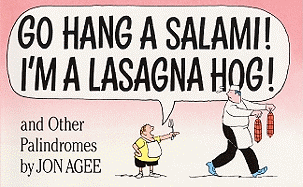
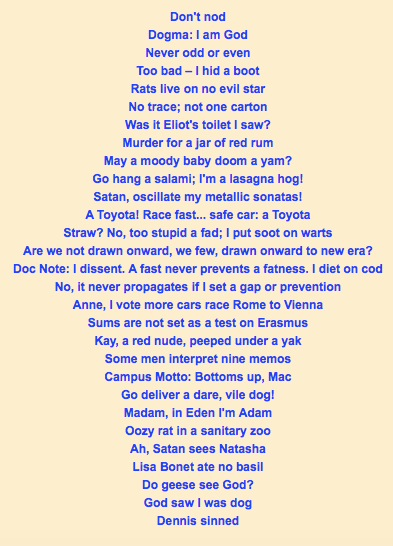
Among palindromes, [1] I’ve always been fond of

T. Eliot, top bard, notes putrid tang emanating, is sad. “I’d assign it a
name: gnat dirt upset on drab pot toilet”

—attributed to Alastair Read rather than W.H. Auden, it seems.

I like the sound of the Finnish palindrome with 10,102 words—even if, as one commentator candidly observes, “It’s really not that much fun.” We can limber up with some shorter ones (here), like

saippuakuppinippukauppias—soap cup batch trader
[SJ: Aha, perhaps this is useful as Elk lubricant?]

The following are to be found on the sites
http://palindromist.org (“Wary, Alpine Zen: I Play Raw”) and
http://www.cadaeic.net/palind.htm

They can be elegant and suggestive:

Rot, cello collector!

Mao bore Jeroboam.

No more Cicero, mon! [the Rastafarian has had his fill of the classics.]

 Overheard at the flea-market:
“Camel bible, Mac?”
“Cameraware, Mac?”

or the fine

An igloo costs a lot, Ed!
Amen. One made to last! So cool, Gina!

Now Derek can kiss Anais A. Nin, as I, an ass (I, knackered) won.
[extra points for proper names, as Mike Keith notes—the more evocative the better]

Olson, I won—see Saratoga repossess opera! Go, Tara, see Snow in Oslo.

Ajar? Aha! Maybe, Dan, omelet is opposite lemonade, by a Maharaja!

Some men interpret nine memos.

And longer ones like

“Traci, to regard nine men in drag,” Eric (in a play or an ironic art spot) warned, “I am not so bad.” “I’d never even seen knees … never even did a Boston maiden raw,” tops Traci, “nor in a royal panic. I regard nine men in drag —erotic art.”

Or a poem:

Amen, Icy Cinema [title and poem are separate palindromes]
Amen, I can!
I stop elastic ire
To see La Dolce Vita.

Covet?
I moisten nose,
Sonnets I omit, evocative clod!

Ale? Esoteric?
It’s ale! Pots in a cinema!

There are word-unit palindromes too:

You swallow pills for anxious days and nights, and days, anxious for pills, swallow you.

And sure enough, some have risen to the challenge of the palindromic haiku (work in progress), like this one by Ailihphilia (sic):

Oak, dove, temple: hymn
In mutual autumn, in my
Helpmete vodka. O!

Or some by Dalibor.

And then for the gourmet, there’s the menu from the “Moor Room”, a restaurant for palindromists:

Do, O Food [main course]
Tangy gnat
Koalas a la OK
La emu meal
Salad, alas

Gorge Grog [drinks]
Regal lager
Lemon o’ Mel

Desserts Stressed
Sugar a Gus
Bananas an’ a Nab

Some entries from “Drown In Word”, the (fictional) palindromic dictionary:
Gigolo:  Solo gig.
Paranoia:  I, on a rap.
Semantic:  It names.
Pa Plato:  Total pap.

This (from here) is pleasing:

palindromes

I note that “fear of palindromes” is Aibohphobia.

Finally, the erudite David Hughes, himself no mean songster, draws my attention to this:

* * *

True, while any sophisticated artistic activity (which perhaps excludes the KKK songbook and poetry competition) may be seen as a bulwark against philistinism, none of this quite butters any parsnips in the task that currently confronts us—to resist with every pore the barbarity of the putrid tang emanating from the drab pot toilet of the White House. T. Eliot, top bard, would have been sad too. I’d assign it a name, all right.

[1] See e.g.
http://www.cadaeic.net/palind.htm
http://www.cadaeic.net/silopolis.htm
https://www.theguardian.com/notesandqueries/query/0,5753,-2762,00.html
https://www.dailydot.com/debug/worlds-longest-palindrome-sentence/

Some Venetian greetings

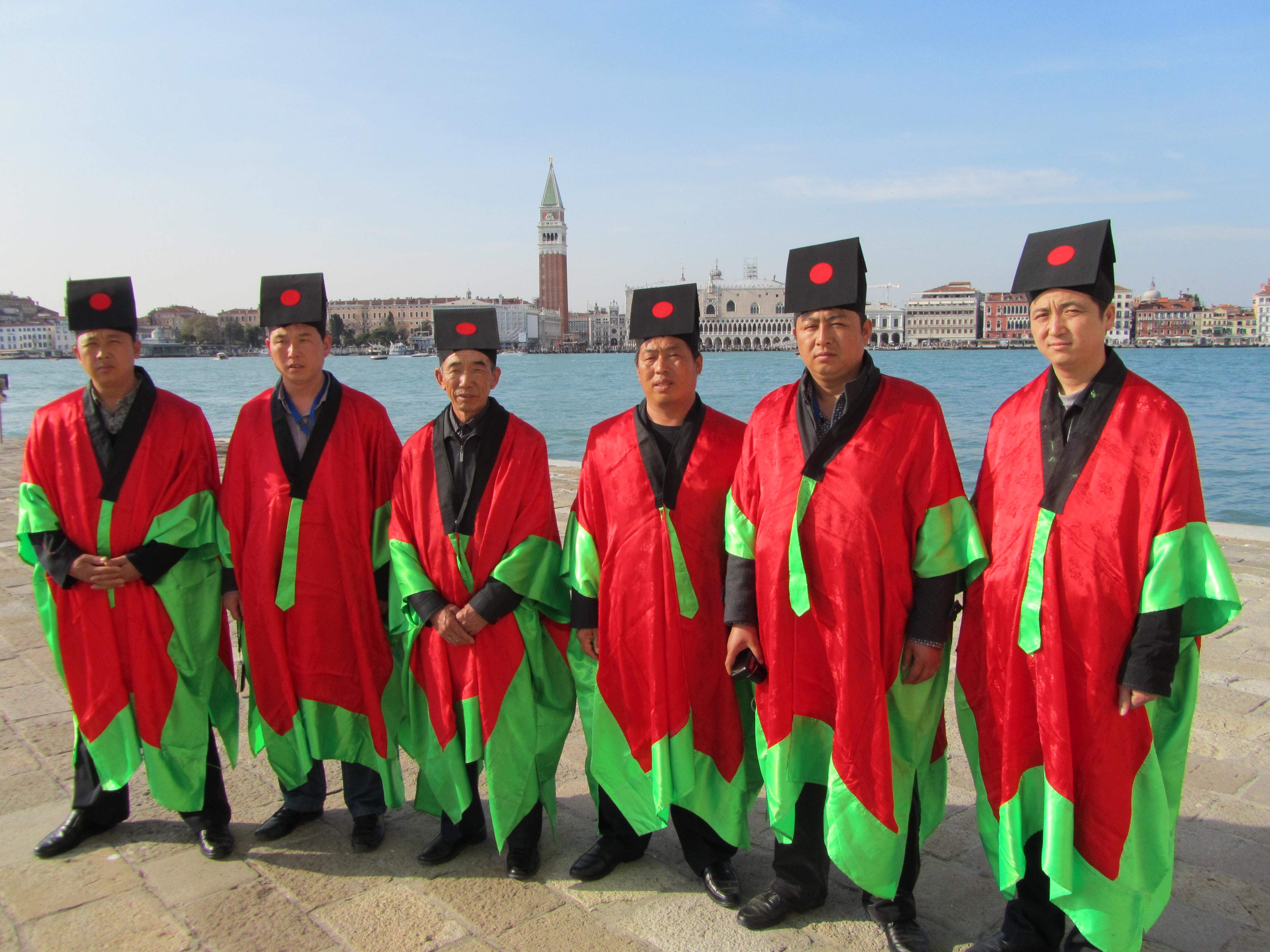
On the Li family Daoists’ 2012 sojourn in Venice in 2012 we were guests of the Fondazione Cini, staying virtually alone on the tranquil little island of Isola San Giorgio, just across from bustling San Marco.

Chatting with our Cini hosts, the fragrant Chiara and Sabrina, they told me that when Venetians come across each other by chance they like to exclaim

Fatalità!” (pronounced “Fataità!”)—“Fate!”

A quaint English equivalent might be “Fancy bumping into you!”

Venice 2012

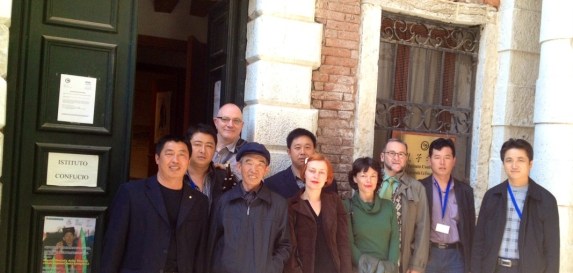
Fatalità! Venetian dwellers with the Li band, or “Selling the Daode jing at the door of Confucius”  在孔子門前賣道德經。

I gather “Fatalità!” is more commonly an interjection, as when telling a story (“And what should happen but…”) or (in reacting) “Fancy that!”. It can also be a humorous way of accepting fate, almost like the English “Typical!” or “That’s life!”.

Without regard to expense or the feelings of the public, the erudite Rod Conway Morris, himself a long-term chronicler of Venetian mores, has obligingly ferreted out a little discussion by Sandro Mattiazzi (Veneziani: Figli del Leone Alata, 2002), with pleasantly arcane examples of a quarrel between gondoliers and a dispute during the war with the Turks, both defused by the timely exclamation.

Fatalità is chance [caso], the fortuitous event that is yet the result of a necessity great or small, and is typical of the Venetian mentality. […] Don’t despair if you can’t find the way to your hotel, or if you’ve left your bag on top of some well. Chance, which has aided the Venetians for almost two thousand years, will surely come to your aid.  Fatalità means that by randomly following another tourist you will arrive at your lost hotel, where perhaps you will find your bag on the porter’s desk. [my translation]

“Fate!” recalls fado, or (as I explained to Li Manshan) the Chinese ming 命… Those terms aren’t part of any such greeting, though in classical Chinese chen 臣 equates with the hackneyed “Ciao!”—itself borrowed from Venetian, and cognate with slave and Slav (for an erudite discussion, see here). Or the English “your humble servant”, mercifully abbreviated from “I trust I shall have the honour to remain your humble servant”, which is of course the correct form of address for foreigners to employ when staggering out of an East End pub at closing time.

Following an arcane exchange in The Times (“Have these people got no Holmes to go to?”—Myles. Mind you, I can’t talk) wherein it is established that Gautier’s Tra la, tra la, la-la-laire is not in fact a reference to the call of the inevitable ubiquitous gondolier, Rod observed in a letter (whose date of 1st April 2016 he assures me is merely coincidental—remember, the word “gullible” doesn’t appear in the OED):

The traditional gondolier’s cry (especially when rounding blind corners in canals) is “O-i!” This is also sometimes used by the inhabitants of the city as a jocular greeting.

I respectfully submit, m’Lud, that had they gone on to use the honorific form of address, the greeting might have become “O-i vo-i!”, evoking Venice’s Jewish heritage (I’ll spare you my fantasy reconstruction of the temporal and spatial vowel-shift). And given the city’s Turkish connection, I’m also still hoping Rod will further unearth the greeting “Ey-up!“—which, in turn, became the correct form of address when entering a kebab shop in Barnsley (cf. my haiku on Morris dancing). The joys of multiculturalism…

Inspired by Rod’s stimulating review, if you read in the gazette of the imbroglio over an arsenal of contraband artichokes; and if you’ve ever been quarantined after zany scampi and pistachio marzipan in the ghetto, or worn sequined pantaloons to a regatta—actually, even if you haven’t, which (let’s face it) is more likely—then you should tip your imaginary hat to the Venetian language. For a borrowing from Turkish, see The kiosk in Turkey and Europe; for Indian influences, see Tickety-boo.

Time for another gin.

Cinema Paradiso

As a change from the Rite of Gran visits York and Li Manshan, I do hope you know Cinema Paradiso (Giuseppe Tornatore, 1988), and its soundtrack. Morricone’s* music comes into its own in the overwhelming final sequence—not merely sentimental but a triumph over prurient censorship. You really have to watch the film all the way through—but hey, here goes:

Even in concert, the Big Tune is irresistible—all the more so with violin playing like this, from a 2011 Prom:

In the right hands, it would sound great on the erhu too.

For more on Italian film, see here, and indeed here.

* Actually, it being a father–son collaboration, I should perhaps write Morricones’—hmm.

Landmarks

Reluctant as I am to play into the hands of the fatuous “Paul Nuttall and the UKIPs”, this local landmark in Bedford Park may seem to suggest that the continent, with its fancy foreign monuments like those of Pisa and indeed Paris, isn’t necessarily all it’s cracked up to be.

pillarbox

The leaning pillarbox* of Chiswick.

Left-leaning too, you note… Is this the kind of subversion that scares off a certain old friend of mine?!

Did you hear about Karl Marx’s vegetable garden?
It’s a Communist plot.

QMZ pose 1993

Identity parade: the usual suspects.


* For younger readers whose grasp of Old English is less than perfect, a “pillarbox” was an ancient device into which were inserted objects called “letters”, written on paper (often with a “pen”) and enclosed in an “envelope” with a “stamp” attached. By a mysterious alchemical process, the addressee would often receive such missives within the space of a mere few days.

More useful socialist vocabulary

I’ve mentioned several distinctive terms in the vocabulary of former socialist countries, like China and the GDR. But still more usefully:

Lumumba

It’s good to learn that what is called caffé corretto in Italy (an espresso “corrected”, with grappa, or what the Chinese term with blunt accuracy dub “white spirit”) was known in Communist Albania as a Lumumba. (Garton Ash, The file, p.45). Well, you do need a snifter to get through all those Norman Wisdom films. (Cf. elsewhere in north Europe, where it is a somewhat different beverage.)

Cubalibre

This is rather in the spirit (sic) of the cubalibre[1] one of my favourite tipples in Spain as a change from my standard G&T. By contrast with the mealy-mouthed measures of English pubs (which should come with a microscope), both are notable because you are presented with a large tumbler into which the waiter pours an unlimited quantity of gin/rum/bacardi, leaving only a token amount of room for a casual dash of tonic/coke.

The cubalibre is quite familiar to our Spanish waiter, but I always enjoy the little ritual we go through whereby he looks enquiringly at the range of spirits behind the bar while I specify, with one of my few fluent phrases,

… con Ron, por favor!

Back in Blighty, the Spanish influence on my own domestic aperitifs is clear in my generous measures from the Azure Cloud Bottle—to which my address on the home page pays fitting homage. I ring the changes by buying the occasional bottle of Tanqueray, purely in homage to Amy.

In China, where the 1957 Anti-Rightist backlash following the Hundred Flowers movement was prompted in no small measure by the recent Hungarian uprising, the threat of liberal agitation was charmingly known as goulash deviationism. That sounds funny to us now, even if at the time it was a taint that could ruin people’s lives and destroy whole families.

The Lumumba never caught on in China—whyever would you want to dilute white spirit? But they did stage a rally to protest his killing in 1961:

[1] “Free Cuba”—descriptive or prescriptive?! Cf. the British tabloid headline
“Free Nelson Mandela”,
to which a reader wrote in,
“I dunno what a Nelson Mandela is, but if it’s free, can I have one please?”

And now we have this headline, which could do with a bit of punctuation:

Come on England

Venice: daily life in a theme park

On brief trips to Venice, the dream of timeless aesthetic delight may override reflection on social change. My 2012 stay there with the Li band was largely untrammelled by such thoughts—partly because I was preoccupied with my daily tasks as minder, roadie, and stage manager. Like most visitors, I was just thrilled to be there, especially with them.

Some months later, staying with Li Manshan in his village, I go online to show his next-door neighbour some images of this magical place, unimaginable to Yanggao dwellers. As I reinforce the myth, the Li band’s visit there indeed seems like a miracle.

But Venice makes a notable example of the conflict between image and ethnography. Among the vast corpus of writings, Jan Morris’s Venice is a classic. I realise I should also seek writings by Venetians, or at least Italians, to supplement the outsider perspective. But here I’ll dip into Polly Coles’s book The politics of washing: real life in Venice (2013), which explores “the uneasy relationship between the Venice in which a few thousand people live out their daily lives and the Venice that is an impossibly beautiful stage set”.

It may seem like living in a museum, or a theme park. Most of the twenty million visitors each year are day-trippers. Over the past three decades the fixed population has dwindled from 120,000 to 55,000—fewer than a thousand years ago.

Yet despite the constant fall in population, real people also live here. One may dismiss their real lives as merely “hideous encounters with domestic necessity”, to cite Compton Mackenzie’s wonderful recollection of his meeting with Henry James. Beset by ordering washing machines and taking the kids to school, Polly Coles begins to feel guilty about the sheer quantity of art that she has not looked at since she became a resident. “The Venetian dream lasts only as long as you can keep it detached from reality and, most particularly, from the reality of modern Italy”. Finding a haberdashery shop shutting down, Polly Coles observes the ineluctable usurping of the variety of suppliers of daily needs by shops selling pizza, ice cream, glass, and masks—a monoculture in which “people are constantly re-enacting the same limited roles: as purveyors or consumers of the city as museum or playground”. “What kind of beauty is barren? Is dead beautiful?

gondola maker

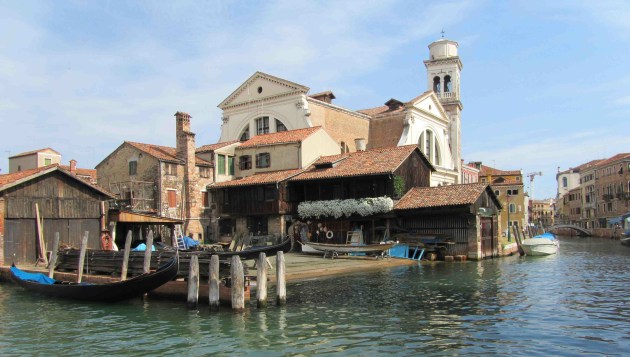
Squiero at San Trovaso. My photo, 2012.

After a while one almost forgets “the inestimable privilege of a daily life without cars”. Greetings between friends are no less gentle, kind, and humorous than in any Italian town. Given that thousands of strangers are traipsing through their living room (literally) every day, I’m amazed how courteous and laidback Venetian dwellers are; one feels no more ripped off than elsewhere. While they are long accustomed to outsiders (they have no choice), perhaps it’s partly because one can never be in a hurry here—although residents and “infantilised” tourists can still be recognised from their pace, their whole body language. As Polly Coles observes, the shared necessity of walking lends an illusion of classlessness.

By contrast, she also comments well on the wider issue (in Italian, and other European languages) of choosing lei or tu, as opposed to the deceptively classless English “you” (pp.155–9). Meanwhile, the Venetian language (rather than dialect) seems cool, indeed zany (an English borrowing from Venetian), with lots of z and weird stuff going on (see also here). I like drio (“busy”). And do read Some Venetian greetings.

Not only are the sestieri like separate villages, but even recently I heard of a 100-year old woman who had only ventured twice as far as San Marco.

While Venice has long been celebrated as a racial and cultural melting-pot, Alexander Lee’s The ugly Renaissance can warn us against celebrating its multi-culturalism too naively. Polly Coles goes on to note the current ethnic contradictions, with its white tourists serviced by East European cleaners and African street vendors (163–70). She’s good on ritual too—like her dissection of Midnight Mass in San Marco during acqua alta, “neither hushed nor holy”, with a “general air of distraction” (pp.111–113). And Carnival: “somebody has organized an enormous party in your backyard but it’s not your party and you don’t know any of the guests”.

After my stay there with the Li band in April 2012, I went back that August to flat-sit on the Guidecca for friends, allowing me time both to reflect on Venice and continue writing my book.

home
From my diary:

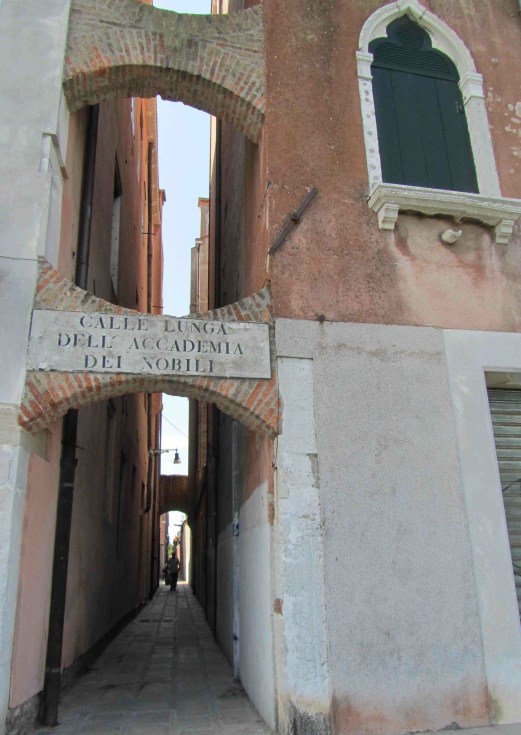
Senses heightened, changing light—large drops of rain, clouds, sunset, gulls bobbing on the waves. Simple pleasures. How long might it be before one began taking for granted the panorama of churches and pastel palaces and windows and balconies and bridges? Even the street signs are delightful.

Guidecca

I emerge from a narrow vicolo into a broad campo. Many canals are as narrow as alleys too.

Just using the wooden shutters is a delight, with their little head of a man, like a chess piece, to hold them in place.

shutter
Where does all this arty sensibility get us? How does listening to Monteverdi in an elegant flat on the Giudecca differ from listening to Abba in a council flat on the North Circular with flying geese on the walls? The shared goal, presumably, is happiness.

Supposing some waggish sculptor decided to pre-empt the pigeons by designing a pigeon on top of Our Lord’s head at the apex of a church, would a pigeon come and perch on that too? How many pigeons would he have to sculpt on top of each other for the pigeons to decide, “Stuff this for a lark“? Or would it only be grist to their mill?

It comes as a relief to see some typical ugly modern buildings on the Giudecca, tucked away behind the elegant facade. The walk to my local supermarket, through miniature courtyards bedecked with flowers, has to be the most picturesque ever—but once inside, the standard produce of daily necessities brings a welcome semblance of normality.

From a certain distance on what passes as terra firma, the sight of passengers on a vaporetto evokes a silent search for truth, some mysterious voyage, a pact. I don’t think this comes entirely from Don’t Look Now. Of course it’s not quite like that for the passengers on the vaporetto (cf. Coles, pp.118–24).

Cruise liners have become common, another nail in the coffin. One morning as I emerge from the flat I have a surreal vision. Usually I’m blessed with a wonderful glimpse of the Zattere across the canal through the archway at the end of my narrow alleyway, but today all I can see is a gleaming white tower-block, seemingly constructed overnight, obliterating the pristine view, blocking out the sky “like a genetically reconstructed dinosaur that has escaped from Jurassic Park and is wreaking havoc in the world of human beings” (Coles). And it’s moving too—or is it the Giudecca moving?

If the wholehearted Chinese adoption of tourism is hardly an unmitigated blessing, the march of “progress” and “development” seems unstoppable—compounded by the commodifying agendas of cultural heritage projects. All this is one reason why even scholars of Daoism might pause before adding to the unchanging image of ancient grandeur, rather incorporating ethnography into their accounts.

Ashiq: the last troubadour

*Distressing update*

After all these years when the common response to a comment on the Uyghurs of Xinjiang was “The WHAT of WHAT?”, their new-found global fame is yet more unfortunate. It’s hard to believe now that the screening of this film, less than two years ago, came at a time when the Uyghurs were little known, when films like this could still be made about groups that were still active, and still seemed relevant; when dedicated Uyghur scholars and performers still had room to maintain their culture. Following their pervasive silencing since then, among a host of fine articles on the appalling current situation in Xinjiang, see here, and here, including Rachel Harris’s comments on the disappearance of Sanubar Tursun. Among many articles on the distinguished ethnographer and film-maker Rahilä Dawut, another victim of the purge, is this. Click here for remarkable videos of Sufi Naqshbandi ritual among the Uyghurs. For more, see my roundup of posts on Uyghur culture.

I’ve left the review below as I first wrote it.

* * *

In my little list of ethnographic films, I mentioned Liu Xiangchen 刘湘晨, an outstanding film-maker based in Urumqi in Xinjiang. On Monday at SOAS, as part of a conference on Islamic soundscapes in China (itself part of an excellent project[1] he attended a screening of his Ashiq: the last troubadour (2010, 122 mins), one of several films by him on various ethnic groups in Xinjiang.

Filmed mainly between 2003 and 2007, Liu’s four-hour version of Ashiq was shown last year at the splendid Shanghai Centre for Ritual Music, with a detailed discussion (which, ominously, has since disappeared from the web).

Here’s an 8-minute trailer:

and the 2-hour version, with Chinese subtitles:

The “exotic” ethnic minorities are always a more popular research topic than the somewhat mundane Han Chinese; I would say, only I’d sound like the UKIPs, that the Han Chinese have become a minority in their own country—which would be just as absurd, given that, in the face of vast Han Chinese immigration to Xinjiang, it is precisely the Uyghurs who feel threatened. But I envy scholars of the minorities the stunning scenery, and the costumes—and if they no longer wear them, they’re used to being asked to put them on for the cameras.

I’m now a little confused about what ashiq actually means among the Uyghurs. Simply stated, they are Sufi mendicants who congregate at the shrines of Islamic saints. From the YouTube blurb:

Some ashiq are ironworkers, others are beggars, merchants, grave diggers, barbers, woman ashiq, Sheikh (the Islamic clergy) and so on.

As Rachel Harris notes, [2] the term may be a rather modern usage for people once more commonly known as dervishes or qalandar. It’s taxonomy again.

Liu described them as marginalised, a minority themselves, but it looks like a substantial phenomenon. And marginalisation is their very raison d’être: they thrive on flouting social norms (cf. Merriam). The subtitle “the last troubadour” seems unsuitable, not only since the use of a (largely secular) term like troubadour is hardly useful, but because the film doesn’t seem to show that they are dying out. Maybe they are, but it repeats a mantra chanted by anthropologists since early times, claiming to have discovered a pristine tradition that is endangered, rather than noting constant change.

For an outsider, the film, like that of De Martino in south Italy, may also shock. For the total novice, it will just amaze: didn’t the CCP destroy religion over sixty years ago—all the more in Xinjiang or Tibet? At least it shows what a huge task the CCP faces. Are we to celebrate the slow spread of state education and modernization?

The nomination of the ashiq for Intangible Cultural Heritage status is captioned early in the film without comment, though (like that of the Uyghur meshrep) [3] it will seem so very incongruous; perhaps it serves as a kind of amulet to protect the film from official criticism. As with the Han Chinese, a majority of genres selected for the ICH are grounded in ritual, impossible to reconcile with the state’s goals without destroying them—which may indeed be the idea. It is the duty of the ethnographer to reflect such micro-societies faithfully, like any other. It goes without saying that it is no use to regard them purely as “musical cultures” detached from their social roots.

The conceit of academic objectivity may make ethnographers seem to refrain from either celebration or criticism, yet at the same time (to return to De Martino), some may be shocked, pondering the link between religion and poverty—an obstacle to those social changes that can genuinely improve people’s lives, health, life-expectancy, and so on?

I gave an instance for the Han Chinese in my Shaanbei book (p.86):

Back in the county-town, returning to our hostel one evening, we switch on the TV to find a documentary about coal-mining accidents, which are reported nightly. There are some rather fine investigative programmes on TV these days, and one main theme of this one is how the response of the village Communist Party leadership, rather than considering improving safety measures, has been to give funds to construct a new village temple in the hope of divine protection. OK, in this case the programme happens to fit into an agenda of rationalism against superstition, a view we sometimes feel inclined to challenge, but tonight I can only go along with the presenter’s lament.

One doesn’t have to be a Maoist apparatchik to worry about this. Observers will draw their own conclusions.

Returning to the Uyghurs, the gender issue is sobering too. There’s one fine scene of a group of female ashiq, but as Rachel Harris (whose latest book revolves around women’s religious groups) pointed out at the screening, only a female film-maker could get proper access to such groups—like Rahilä Dawut (on whom see here).

The film suggests so many complex issues. It gives full coverage to songs, and texts, not just sonic icing on the cake. The ashiq aren’t big on cake, but some weed helps them commune.

Their basic accompaniment is the sapaye, paired sticks pierced with metal rings, played in a kind of stylized self-flagellation, notable in various degrees in both Islamic and Han Chinese ritual cultures (for one gory instance from Fujian, see Ken Dean’s film Bored in heaven).

The tear-stained faces of the ashiq as they sing may remind us that the expression of suffering is a quasi-universal feature of music-making. But it’s always culturally mediated, with differing implications; Rachel Harris again explores the significance of “performative tears” both for Uyghur and other cultures (for the Bach Passions, see here).

The sudden, startling, introduction of scenes from the bustling modern capital of Urumqi is effective. I didn’t pick up hints to change in the rural scene, which must be constantly occurring too, so the film may seem merely to suggest a contrast between (“backward”?) rural traditions and harsh urban commodification. But the structure works well, right down to the final scenes with a birth and a death, the latter in an extraordinary landscape.

I pen these thoughts as a mere outsider. Talking of which, one also wonders how all this relates to the old rejection of ethnographic outsiders, summarised by Nettl as “You will never understand our music”. But here, as with the late great Zhou Ji 周吉 (1943–2008), one of the consultants on the film, Uyghurs seem to have few reservations about certain Han Chinese (or Westerners, indeed) documenting their lives—as long as they are clearly in sympathy and willing to engage fully. Liu Xiangchen, though not himself Uyghur, was also advised by Dilmurat Omar of the Institute of Ethnology and Sociology at Xinjiang Normal University.


[1] I am grateful to Rachel Harris, estimable authority on Uyghur culture and music, for pointing me towards several sources. As usual, it goes without saying that I am entirely responsible for my interpretations here.
[2] “Theory and practice in contemporary Central Asian maqām traditions” (forthcoming).
[3] Note this important report. See also under Soundscapes of Uyghur Islam.

Taranta, poverty, and orientalism

taranta

Watching the 1959 footage of healing sessions for possessed women in south Italy by Ernesto De Martino and Diego Carpitella, one may feel almost voyeuristic (Part One, and Two).

Below I cite a review by Stephen Bennetts (Weekend Australian, Review section, 28–29 January 2006) of

  • Ernesto De Martino, The land of remorse: a study of Southern Italian tarantism (pdf of original Italian edition here).

First published in 1961, The Land of Remorse is a classic of anthropological detective work. Was this bizarre phenomenon really caused by the bite of the tarantula, or was it instead a mere “superstitious relic”, or a localised form of psychosis prevalent among illiterate Southern Italian peasants? Almost sixty years ago, in 1959, a group of scholars arrived in the small town of Galatina to unravel the riddle. They comprised a historian of religion (De Martino), neuropsychiatrist, toxicologist, psychologist, anthropologist, ethnomusicologist, social worker and photographer.

It soon became clear that the research team was documenting the last vestiges of the cult, which by now had retreated to an isolated pocket of peasant society in Salento, the stiletto heel of Southern Italy. Tarantism still persisted in its classical form in the music and dance therapy sessions conducted in the home, whilst the partly Christianised form of the cult, amputated of its musical and dance component, continued in the grotesque and histrionic displays at the Chapel of St Paul, as possessed tarantati arrived for the feast day of Saint Paul to ask the saint for healing.

In De Martino’s analysis, the mythology of the taranta and the catharsis of the possession state provide a framework in which personal psychological tensions common throughout Southern Italian peasant society could be publicly dramatised. Private sufferings caused by unhappy love, bereavement, sexual frustration, or subaltern social status were transfigured into annually recurring possession states which were culturally determined, rather than being the result of a real spider bite. The ritualised healing through dance and music provided victims with psychological closure and reintegration back into the community, at least until the summer of the following year.

[According to one Salentine authority, the last episode of tarantism involving actual possession took place in 1993, but the last living practitioner died in 2000. Yet “tarantism” has recently taken on another curious form. The current Southern Italian folk revival and associated pizzica dance craze incorporate a grab bag of different impulses: re-emergent Southern regionalism, the reevaluation of a peasant past which is now distant enough for young Southern Italians to romanticise rather than feel ashamed of, and a rejection by the Italian anti-globalisation movement of the television-fixated “cultural homogenization” of Berlusconian Italy. De Martino’s book has now achieved cult status beyond the academy; go to many folk concerts in Southern Italy today and you will find it on sale alongside tambourines, castanets and other accoutrements of the recently exhumed Southern Italian past. In a process which has been aptly described as “proletarian exoticisation”, De Martino’s plain female peasant tarantate have given way in contemporary reworkings of the theme to video clips featuring dissociated but picturesque young beauties writhing to the latest tarantella folk hit. Within the current Salentine folk revival, De Martino functions as a kind of symbolic fetish, validating an isolated area of Southern Italy which almost nobody had heard of until the “rediscovery” of tarantism and tarantella ten years ago suddenly put Salento on the map.]

Along with more detached ethnographic observations, one easily discerns severe social problems here—not least poverty, and not just the role of the church. Urban Chinese observing rural Chinese ritual may be beset by similar, prescriptive, responses—which will be secondary for foreign fieldworkers, more entranced by the persistence, perhaps exoticism, of religious practice there. That’s partly why study of the practices of “primitive” ethnic minorities are so fashionable.

De Martino’s work, though focused on religion, makes a successor to Carlo Levi’s 1945 book Christ stopped at Eboli, and even James Agee’s 1941 Let us now praise famous men, with the photos by Walker Evans. Accounts like these are a world away from the idealizing of peasant communities often implied in Chinese cultural studies. But both types have their own agendas. Meanwhile, brave Chinese journalists have blazed a trail, with village surveys like those for Anhui, and a substantial body of work on the famines around 1960.

We may contrast the anthropology/ethnography of religion with pious insiders’ views of religion. Of course a participant or “believer’s” own account will be important material. But if in the description the ethnographer promotes her own “belief”, that is dangerous: more like propaganda. Empathy is to be desired, evangelism to be avoided. Good histories of Christianity or Islam are unlikely to come from the standpoint of proponents for such beliefs.

So what is, or should be, the anthropologist’s view on religion? While showing how it works in the society, one doesn’t have to promote it as entirely beneficial there, or to that of other societies. Of course our picture is blurred by the quest for ancient oriental wisdom, which may even follow on from hippy mysticism. It is remarkable how commonly this still plays a role in studies of Daoism.

Some scholars make a case for the superiority of Daoism as a world view, over other religions and other world views. Not only is this not the job of the ethnographer, but it may flaw the whole research enterprise. What we learn from such accounts is what a Western scholar, of a particular upbringing and taste, thinks about Daoism; not what Daoism in society is like.

To repeat, it is different to develop a certain empathy with one’s subjects than to come from a standpoint of evangelical zeal. In the course of an ethnographic relationship one will doubtless begin to explain their mindset, their backstory, and so on. But the study of Daoists is mainly to be done with the same kind of anthropological curiosity that one would bring to the study of any other group, such as Party cadres or sex workers (funny how those two random examples seem to make suitable bedfellows. I didn’t say that).

Participant observation brings many benefits. In the case of religion, to participate fully in the life of Daoists will certainly confer insights—but there is no single type of Daoist, and even participation is only one aspect of the duties of the scholar. One should observe not only how religious activities inspire local patrons, or bring social cohesion, but how people may ignore or oppose them. I’m not even arguing with evangelism, necessarily; just that it blurs proper scholarship.

Study of oriental religion risks exoticizing. Even if the scholar avoids the trap of “Just look at this rare ritual I’ve stumbled across/gained unique access to”, rituals may yet be portrayed as “special”, ancient, mystical, and so on—whether they are or not, and downplaying their routine nature. This kind of social behaviour is normal. The visitor may stumble (once) across something supposedly rare, but more likely it will be repeated again and again—always adapting over time.

Note also this documentary from 1952, with funeral laments from Lucania:

and the 1958 sequel Magia Lucana:

See also Healing with violin in the heel of Italy; for more recent pizzica, click here and here; for Sardinia, here. I’ve also outlined work on folk musicking around Italy. For the festa of the Madonna of Mount Carmel in East Harlem, New York, click here. Cf. Portugal: folk traditions.

The art of translation

culone

Burlesque-only (who may now seem like a more benign, cultured, dignified, humane, sophisticated, intellectual, and honest prototype for Tweety McTangerine)

SO UNFAIR!!!

is alleged to have described Angela Merkel as a “culona inchiavabile”. This was magnificently rendered in English as

unfuckable lard-arse.

Fine as the original Italian is, this is a splendid translation. Of all the possibilities for culona (“big arse”) and inchiavabile (“unscrewable”), it must have taken considerable artistry to come up with “unfuckable lard-arse”. Imagine the translator, worn down by years of work at tedious political committees rendering the minutiae of financial subsidies, finally able to spread his wings and exercise his dormant mastery of idiom.

Better still, Auntie’s former rottweiler-in-chief Jeremy Paxman raised the issue in his interview with Berlusconi, enquiring in his measured patrician tones,

“Mr Berlusconi, is it true that you once described Angela Merkel as an unfuckable lard-arse?”

Such translation puts in context my strivings to render ancient Daoist texts.

Paxman is also praiseworthy for his relentless 1997 interview with Michael Howard:

More fucking gondolas

MP

Another gratuitous spinoff from the Li band’s trip to Venice (cf. Scunthorpe and Venice, and indeed Venice: daily life in a theme park—oh, and Some Venetian greetings!):

A lesser-known gem of Monty Python is Away from it all, a ghastly travelogue with all the lovingly recreated stereotypes of John Cleese’s voiceover (Part Two should follow on):

… the one thing that Venice truly lacks—is leprechauns.

Bulgaria gets a candid assessment too:

Hard to believe, isn’t it, that these simple, happy folk are dedicated to the destruction of Western civilisation as we know it…

Eventually it’s exposed in the narrator’s increasingly deranged breakdown:

All this dashing about in search of Peace and Contentment—it doesn’t work! There’s no escaping yourself—how do you face the existential terror, the hopelessness, the dark corridors of one’s mind, the yawning, black, meaningless abyss they don’t tell you about in the brochures…

Several of us recall seeing this in the cinema as a trailer before The life of Brian.

You know whose fault it is? You lot—yes, you, you so-called cinema patrons! You sit there, stuffing your stupid faces with chocolate peanuts, gawping at these dreadful films… Well, why do you put up with them? You could stop them tomorrow if you had the guts to go to the manager and say, Why do you put this rubbish on?

For more travel clichés, see Molvania, and China–Italy: International Cultural Exchange zzzzz.

Scunthorpe and Venice

Further to my reminiscences of The Li band in Italy (and my book pp.334–7),

We board another train to carfree and carefree Venice, where we have four wonderful days. We are staying—virtually alone—at the splendid hostel on the tranquil Isola San Giorgio, home of the majestic Cini Foundation, gazing across the water at San Marco. In the evening we take the vaporetto for our first meal at the excellent trattoria Il Giardinetto. This sure beats doing a Messiah in Scunthorpe for a jolly good tea, as we London musos say.

In the spirit of the sinological footnote, the precise version goes like this:

A fixer calls us up and goes, “Hi—can you come and do a Messiah next Monday night in Scunthorpe? There’s no fee, but there’ll be a jolly good tea.”

(Cf. the more tempting message I received in a Shanxi village in 1991.) For more on Venice, see here. Oh, and here. Not forgetting Monty Python’s sublime guide. For unlikely place-names to find in the index of a book on Daoist ritual, see here. And here I surmise that the wisdom of Nadia Boulanger might not have been in quite such demand had she been based in Scunthorpe.

For a tennis parallel, click here.

Speaking from the heart

Further notes on fieldwork
A tribute to Antoinet Schimmelpenninck (1962–2012)

 revised version of a talk I gave at the CHIME conference in Leiden, 2012

ant

Amdo-Tibetan area, south Gansu, 2001 (photo: Frank Kouwenhoven).

I never did any fieldwork with Antoinet, but I admired and envied her natural engagement with musicians and with people altogether.

I won’t portray her as some kind of Lei Feng, so this can also be a kind of homage to, and reflection on, fieldwork itself. And I will discuss her alone, whereas of course she and her partner Frank Kouwenhoven, dynamic leaders of CHIME in Leiden, made an indivisible team.

Almost anything can be fieldwork, such as talking to your mum, or your kids, or going clubbing—although we’re perhaps unlikely to undertake all three at the same time. But I refer here to spending time with Chinese musicians in the countryside, which requires a rather different set of skills from hanging out with rock musicians in Beijing, for instance.

Fieldwork by the Chinese on their local musical traditions, in a sense that we can recognize, goes back to at least the 1920s. But when we laowai began to join in in the 1980s, it was exciting to get some glimpses of local folk traditions. We can see that sense of discovering a “well-kept secret” right from Antoinet’s articles in early issues of CHIME[1]

All these years later, I suspect local traditions are still largely a well-kept secret, and that may not be an entirely bad thing. But fieldwork by the Chinese has also thrived since the 1980s; plenty of Chinese are doing great work. In those early days, Chinese fieldwork was rather mechanical: the main object was to collect material in the form of musical pieces, conceived of as rather fixed and somewhat detached from changing social context. Antoinet was at the forefront of broadening the subject; the title of her book, Chinese folk songs and folk singers, is significant. This inclusion of the performers in the frame has borne fruit in Chinese and foreign work.

as-book-cover

Among general skills, we might list

  • preparation (finding available material, maps, preparing questions, etc.)
  • linguistic competence (how I envied her ability to communicate, and latch onto regional dialect)
  • musicality (and “participant observation”; routine for us, rare among Chinese scholars)
  • back home: analysis/reflection; sinology and ethnomusicogical/anthropological theory

In addition to my citings of Bruce Jackson and Nigel Barley (Fieldwork, under Themes), further reflections include:

  • Helen Myers in Ethnomusicology: historical and regional studies (New Grove Handbooks on Music)
  • Barz and Cooley, Shadows in the field
  • Lortat-Jacob, Sardinian Chronicles
  • Don Kulick and Margaret Willson (eds.), Taboo: sex, identity and erotic subjectivity in anthropological fieldwork.

As to what is ponderously known as “participant observation”, musicians tend to react well to other musicians—it shows a willingness to engage, and also helps us think up useful questions.

As to what we do after fieldwork: Antoinet was well grounded in ethnomusicological readings, but she was never controlled by theory, she used it critically to illuminate points, as one should. Scholarship is not always like that! Her book really is an amazing achievement. She not only broadened the subject, she made it more profound.

Rapport
A lot has been written about personal interaction in fieldwork. I like Bruce Jackson’s book very much. We all have different personalities; some of us may seem more outgoing than others. It’s an unfair accident of birth, upbringing, and all that. Musicians will be more forthcoming with people they feel comfortable with—like Antoinet. Of course fieldwork manuals talk about good guanxi, but it’s more. We respect people that we talk to, but we also aspire to some sort of equality; we hope to be neither obsequious nor superior. On the agenda here are sociability, informality, amateurism, humanity/fun/enthusiasm/empathy, and humour—all without naivety or romanticism!

We do naturally adapt our behaviour to different situations. I’m much more sociable in China than in England. Antoinet, it seems to me, never needed to adapt, she was just always naturally gregarious and sparkling.

Age is an interesting factor: I guess it’s good to be old or experienced enough to be taken seriously, but intelligence and sincerity are appreciated, and it’s also good to be young enough, at least at heart, not to seem too important! Antoinet was always self-effacing, companiable.

I do bear in mind Nigel Barley’s warning (The innocent anthropologist, p.56):

Much nonsense has been written, by people who should know better, about the anthropologist being “accepted”. It is sometimes suggested that an alien people will somehow come to view the visitor of distinct race and culture as in every way similar to the locals. This is, alas, unlikely. The best one can probably hope for is to be viewed as a harmless idiot who brings certain advantages to this village.

By the way, I’m not a harmless idiot, I often feel like a harmful idiot: I hope it’s a coincidence that everywhere I go, the local traditions go down the drain…

Our ways of repaying all this hospitality are variable, depending on our means and inclinations. One may send photos and videos, and organise tours; Chinese colleagues have gone so far as to install running water, or find urban jobs for relatives.

I note some some handy Maoist clichés linking fieldwork and Communist ideals:

  • chiku 吃苦 “eating bitterness”
  • santong 三同 “the three togethers” (eating, living, and labouring together. Hah!)
  • dundian 蹲点 (“squat”; more generously defined in my dictionary as “stay at a selected grass-roots unit to help improve its work and gain firsthand experience for guiding overall work”. How long is this dictionary?!)
  • gen qunzhong dacheng yipian 跟群众打成一片 “becoming at one with the masses”
  • bu na qunzhong yizhenyixian 不拿群众一针一线 “not taking a single needle or thread from the masses”

My point here is to get over the empty formalism of such slogans and see through to the sincere humanity that once inspired them.

These thoughts on empathy aren’t something we can do much about, but it’s interesting to reflect on the topic. Obviously enthusiasm isn’t enough; on its own it can be quite irritating!

I guess we all use teamwork to some extent, and Antoinet was good at finding, and supporting, good regional and local scholars to work with. I have always relied heavily on my Beijing colleagues to make notes, at least until circumstance and greater familiarity lend me the confidence to spend time with musicians on my own.

Group fieldwork is good up to a point. It depends partly on one’s means, but the group perhaps shouldn’t be too large. I like the informality and flexibility of working alone, but it is a bit much to take photos and videos and make notes and distribute fags all at once.

 Of course Antoinet was interested in all kinds of music-making, but she was among few laowai who did much work outside the main urban areas. Her two main fieldwork areas were very different: in south Jiangsu she found herself mainly doing a salvage project, but in Gansu she found a ritual scene that is very much alive.

As to time-frame, she and Frank mainly made repeated visits over time, and as I did for Plucking the Winds or my work with the Li family. Talking of Plucking the Winds, I’ve never had such a perceptive meticulous and patient editor as Antoinet.

Obviously, a brief interview with a stranger is likely to yield less interesting or reliable results than long-term acquaintance. But I do take on board the notion of stranger value. On one hand (Jackson, Fieldwork, pp.69–70, after Goldstein),

The collector who comes from afar and will disappear again will be able to collect materials and information which might not be divulged to one who has a long-term residence in the same area.

On the other hand, there’s the whole “You will never understand this music” thing (Nettl, The study of ethnomusicology, ch.11, brilliant as ever).

And then, who is an insider? What of urban Chinese? How might an urban-educated male Fujianese get along with female spirit mediums in rural Shanxi, and so on?! There are several complex subjects for discussion here.

Talking of etic questioning, here’s another vignette from the Li band’s 2012 tour of Italy (my book p.336):

Third Tiger is as curious as ever, always asking weird “etic” questions like “Why are Italian number-plates smaller at the front than at the back?” Bemused, I later ask several Italian friends, who have never noticed either. It strikes me that this is probably just the kind of abstruse question that we fieldworkers ask all the time, and I’m sure my enquiries in Yanggao sound just as fatuous. I must cite Nigel Barley (The innocent anthropologist, p.82)—and note the car link:

They missed out the essential piece of information that made things comprehensible. No one told me that the village was where the Master of the Earth, the man who controlled the fertility of all plants, lived, and that consequently various parts of the ceremony would be different from elsewhere. This was fair enough; some things are too obvious to mention. If we were explaining to a Dowayo how to drive a car, we should tell him all sorts of things about gears and road signs before mentioning that one tried not to hit other cars.

By the way, I was the victim of a flawed fieldwork interview some years ago. A Korean student, whom I knew fairly well, was doing an MA on ethnomusicology in London, and had to do an interview. She knew I was both a violinist and did fieldwork on Chinese music, so she came over to my place with a list of questions all prepared. Her English wasn’t great—like, even worse than my Chinese. OK, her project demanded quite a short interview.

She began with “Who is your favorite composer?” and I went, “Well, music is more about context, mood, not compositions, and anyway I don’t listen to so much WAM these days, and most music in the world we don’t really know of a “composer”… OK, if you insist, then Bach.” She went, “Thankyou. What was the best concert you ever done?” so I observed that we don’t do so many memorable concerts over a year, and that great music-making doesn’t only happen in concerts. “Being an orchestral musician can be frustrating, one’s teenage idealism tends to get beaten down, getting a plane, then five minutes in the hotel before a long rehearsal with a boring conductor, no time to eat properly… You could ask me, what was the most wonderful musical experience I have had—it wouldn’t necessarily be playing with an orchestra…” In response to this cri de coeur, she went on, “Thankyou. What is the difference between the Western violin and the Chinese violin?” Aargh. I mean, anyone would want to follow up on all that I had just said, right? But her rigid questionnaire was in control.

So is that what I have been doing in China all these years—misunderstanding, ignoring leads, and following up with my own stupid blinkered questions?!

One hopes to find questions that will get people talking at length (so avoid questions that invite simple Yes/No answers!); but there was I blabbering on, and all she wanted was short snappy answers!

I’m still very attached to the detailed notes of my Chinese colleagues. One can’t record everything on audio or video, and even if we could, it would leave unclear how many characters should be written. I used to use video mainly to film ritual—I only began to record informal situations later. Antoinet was great at bypassing formality.

They recorded all kinds of things as well as formal singing sessions, and sure they had the means to do that, as well as recruiting helpers and so on.

A questionnaire is essential, [2] but it must always be flexible, following their flow, always thinking of new questions, how to express them suitably, and listening. All of which Antoinet was brilliant at.

For me fieldwork is a constant discovery of how inaccurate and superficial my previous notes were. Antoinet and Frank’s enquiring spirit can be seen in these reflections that Frank later sent me:

We had no such thing as a “method”—in general we did tend to visit singers more than one time, preferably many times, in order to ask them the same questions repeatedly, and to let them sing the same songs more than once, with intervals of days, weeks, months or even years in-between. That was only possible with individual songs, of course, not with spontaneous dialogue songs, which we got acquainted with mainly in Gansu.

I think we learned most from what people told us spontaneously, about their own lives, in personal conversations, which were not strictly private conversations. People are nearly always in a space together with others. But group interviews (group chats, rather) were good, people felt at ease, they were not “attacked” by us, they were simply chatting…

Basically, in our fieldwork, we were always out to discover what we were not aware of yet. That is a hard task. And I think we kept discovering that we had not yet asked the right questions, had not investigated the right topics yet… Even now do I realize that I should go back… Maybe this is only the natural, classic, condition for fieldworkers: you return home with an idea of how things might be, you end up with an hypothesis, you suddenly stumble upon a new hypothesis which sheds new light on the situation, but then you have to go back again to test it, and the work starts all over again… A never-ending process, also because the questions you ask are nearly always bigger than the time and resources you have, and you need to address your problems piecemeal… We often wished we were five hundred people!


By the way, do watch their beautiful film Chinese shadows: the amazing world of shadow puppetry in rural northwest China (Pan, 2007).

In short, fieldwork may be an unending amount of work, but it’s endless inspiration too: and one works better when inspired. So I hope we can keep Antoinet’s spirit alive by emulating her humanity, enthusiasm, and critical intelligence.

For a recent volume on doing fieldwork in China, see here. And note the folk-song research of Qiao Jianzhong.


[1] Or for Daoist ritual, see e.g. the early fieldwork of Kenneth Dean.

[2] For her sample questionnaire for southern Jiangsu, see Chinese folk songs and folk singers, pp.395–6. Cf. McAllester’s questionnaire for the Navajo.

Bach on film

Pasolini SMP

As part of my extensive coverage of Bach (roundup here), two feature films from the 1960s, despite their extreme contrast, are linked both by their intensity and by the way they don’t just accept but probe our own modern values:

and

  • The chronicle of Anna Magdelena Bach (Jean-Marie Straub and Danièle Huillet, 1968—with  Gustav Leonhardt as Bach!). YouTube links come and go; I try and keep an eye on them, but you can do your own YouTube searches if they disappear. Here’s the complete film:

I also found a version enriched by Japanese subtitles (like the Greek subtitles of Johnny the shoeshine guy), and here’s a colourised version of the opening sequence (more on which here):

The Li band in Italy

Taking the Li family Daoists on tour in Italy (Turin, Milan, Venice, Rome) in March 2012 was delightful (my book pp.334–8).

li-band-venice

From “our” island towards San Marco. Cheer up, lads.

img_2430

Li Manshan before the Duomo in Milan.

img_2434

The band at the Gallerie, Milan.

In Venice (a well-kept secret—Yeah, Right. Good to get here before it gets “discovered”—see here, and here), every other gondola seemed to be full of Chinese tourists. I was delighted to introduce the band to Mirella Licci, whom I hadn’t seen since she was studying the guqin at the Shanghai Conservatoire in 1987!

img_2448

Venice: lunch at Il Giardinetto with Mirella Licci, our favourite groupie.

gargoyle-img_2481
One evening we took aperitivos in Campo Santa Maria Formosa with our Confucius Institute hosts (see also here) and two splendid ethnomusicological Giovannis, Giuriati and de Zorzi. Li Manshan felt a particular affinity with the gargoyle on the campanile of the church.

I also note the fine tome by Horatio E. Brown, Some Venetian knockers.

Before I could work on my film on the ritual life of the Li family Daoists at home, we issued a DVD of their concert performance at the Cini Foundation in Venice. Here are some highlights (sic):

For evocative notes on our French tour in 2017, see here.

Points mean prizes

zampogna

Musos always play this game on tour, but I’m sure it’s common in many walks of life.

On tour in Italy, for instance, we all come back from lunch in our different groups, outdoing each other with stories of an amazing find:

Little trattoria in a tiny backstreet, not even a sign on the door, only locals in there, no menu, they just give you what they’re having, five courses, home-made pasta… Toothless old lady dressed in black treading the grapes… And you know, it was incredibly cheap… And then she invited us to her granddaughter’s wedding, and there was this fantastic band playing zampogna and piffero

And so on—you get the idea. See also Nearly an Italian holiday.