The life of the household Daoist

vocal trio 2001

Vocal trio, 2001: Li Manshan, Golden Noble, Li Bin.

Not so much

Don’t put your daughter on the stage, Mrs Worthington

as

Don’t put your son on the Daoist ritual arena, Mr Li.

Patrice Fava’s film Han Xin’s revenge, about the rituals of a group of household Daoists in rural Hunan, is very fine. The voiceover contains an intriguing line:

“Many young people choose to become Daoists.”

Whether in Hunan or elsewhere, today or when the film was made, I find this hard to believe—it seems a romantic notion.

As I observe in my book, Li Bin (b.1977) is the ninth generation of Daoists in the Li family, and could well be the last. Moving with his family to the county-town in 2007 was initially a stepping-stone for his son to get a better education—seeing it as a route towards betterment, just as his forebears had done under successive regimes.

Even if new recruits can now skimp on the training, Daoist fathers no longer want their sons to continue the tradition; there are now easier ways to make a better living, and people like pop music anyway. Fees are low, and the lifestyle, working long days and nights traipsing around backward demoralized villages, is tough and none too comfortable (see e.g. recent diaries of Li Bin and Li Manshan). Potential young recruits go away to seek urban laboring work or get a good education leading to a secure job in town, providing an escape from the countryside towards urban registration and higher wages. And this is what their parents (including Daoists) want for them.

In The souls of China (p.48) Ian Johnson puts it well (in a passage about Li Manshan’s “determining the date” activities):

… Their relief was palpable, but so was Old Mr Li’s exhaustion. It was a tiring life, always on call, staying in people’s homes, burying their dead, eating their banquets. The questions never stopped—an avalanche of new challenges and problems that were overwhelming these old villages.

So whereas Daoist ritual somehow managed to survive after Liberation in 1949, and to revive after the liberalizations from 1979, today, in a world turned competitive, where the villages themselves are depleted, working as a household Daoist offers no route to advancement. As the Daoists realize, official initiatives like the Intangible Cultural Heritage project are quite unable to solve these issues.

If there are indeed areas of China where recruits do still emerge to perform a more complex repertoire of rituals, it would be interesting to discern reasons for such variation.

All this is explored in my film too. After screenings I like to ask the audience,
“Would you let your sons take this up as a livelihood?”

This doesn’t amount to hand-wringing, however. Daoist ritual has adapted under all kinds of vicissitudes over the last century, as it always has done.

Yet more conducting

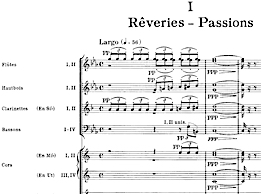
Berlioz opening

In the Rozhdestvensky film, I like his solution (from 22.29) to the perennial problem posed by the opening of the Symphonie fantastique:

“I simply invited them to begin”

and then let them get on with it.

Which reminds me, a noted baroque conductor (or “semi-conductor“, to use Norman Lebrecht’s term) was rehearsing the opening of a slow aria in the Matthew Passion. One of the wind players suggested he might try subdividing:

“Could you give us 7–8 into it?”

Conductor, indignantly: “I didn’t get where I am today by giving 7–8!”

“I didn’t get where I am today by…” soon became another musos’ snowclone.

And here’s Larson’s take on conducting.

The Invitation ritual

At the heart of the funeral sequence of the Li family Daoists today is the Invitation ritual (zhaoqing 召請). This introduction is adapted from my book, pp.109–12, 298–307—and do watch the film from 58.14. For audio segments, click on ##1–3 of the playlist in the sidebar (commentary here). See also Translating Daoist ritual texts.

This is another illustration that ritual manuals don’t tell the whole story—performance is primary.

1 Li Manshan

Fig. 1: Li Manshan performs the Invitation,  2009

I have two reasons to focus on the Invitation—one about simplification, one about complexity. This is one of the few ritual segments for which the Daoists still have a manual, although as usual they don’t need it in performance. It is among the longest in their collection, but they now perform only a small part of its nineteen double pages; as with Fetching Water, a comparison of their present performance practice with the manual shows a significant simplification. Perhaps the term “complete” in the title Zhaoqing quanbu suggests that it was commonly abbreviated. But only rarely can we speculate how long it may be since they used more of its text.

As to complexity, whereas today the bulk of their performance of funerary texts consists of slow choral hymns, for this Invitation sequence the a cappella rendition over a mere fifteen minutes or so is now perhaps their most densely-packed, complex, and varied segment of ritual performance, full of dramatic contrasts in tempo and dynamics—with both slow and fast choral singing and chanting, free-tempo solo singing, and a variety of styles of percussion interludes and accompaniment.

The Invitation was also a major section within the lengthy nocturnal yankou ritual, both here and in the great temples. For two-day funerals now, with the yankou anyway obsolete, the Invitation has evolved into a public ritual at dusk before the evening session of Transferring Offerings. Whereas even in the early 1990s many village onlookers accompanied the kin, creating more bustle, now it is largely a private ritual for the kin.

The sequence
First, as the Daoists arrive at the soul hall, Golden Noble faces the coffin to recite a seven-word quatrain solo.

The manual opens with the quatrain “Sandai zongqin ting fayan 三代宗親聽法言”:

Let the three generations of ancestors hear the dharma speech,
Paying homage to the previous souls by burning paper money.
May the dharma speech open up the road to the heavenly hall,
To invite the deceased souls to attend the jasper altar.

shuowen

Fig. 2

But instead Golden Noble recites another shuowen introit—which appears on the last page of the manual. That is how he learned from Li Qing, and it does the job just as well:

May the deceased souls come to the Bathing Hall, [1]
Transforming their shape and countenance to return to the immortal realm.
Now dipping into the bowl to bathe their bodies,
For an audience with the Three Treasures on the way to the Western Quarter.

Golden Noble then calls out “Proceed together, led by the Dao” (tongxing daoyin 同行道引), as shown at the end of the opening quatrain of the manual. If we didn’t know by observation, that would be a clue that while the preceding quatrain was performed at the soul hall, the remainder of the manual is to be performed on arrival at the site on the edge of the village.


Hereby Shaking the Bell
The next section in the manual, no longer performed, is Hereby Shaking the Bell (Yici zhenling 以此振鈴). One of several Yici zhenling texts that are a common part of the temple yankou, this slow sung hymn may also be used for other rituals, such as Delivering the Scriptures and Transferring Offerings—although the Yanggao Daoists no longer use it there either.

Song in Praise of the Dipper
Once they reach the site at the edge of the village, the altar table is set down, and the kin kneel in two rows in front of it while the Daoists stand in two rows behind it. Golden Noble presides, wielding flag, bell, and conch as he stands facing the kin. After a short percussion prelude with blasts on the conch, the first text now performed is Golden Noble’s solo chanting from the section of seven-word couplets opening Xinzhi jiguo 心知己過. Now he usually only chants the last two of the six couplets in the manual:

xinzhi-jiguo

Fig. 3

I am the one to report the declaration of the procedures at the Jade Capital,
Vowing to save all beings and emerge from the web,
So the deceased soul may be born in the upper realms,
We sing in unison the Song in Praise of the Dipper.

This indeed serves to introduce the Song in Praise of the Dipper (Gedou zhang), a slow choral hymn sung tutti a cappella. The title is to the Northern Dipper, otherwise not prominent in their funerary texts, explaining the respective responsibility of the five quarters for the salvation of the soul. Its seven-word couplets are each sung to the same melody; the short strophic melody has all the hallmarks of other hymns.

gedouzhang

As each sung couplet ends, Golden Noble shakes the bell, waves the flag, and bows, as the other Daoists play a cymbal interlude—a variant of the pattern Qisheng 七聲 as notated by Li Qing, as you can see below from the tiny differences in the first and penultimate bars between the naobo line in practice and the Qisheng mnemonics. As ever, the line for the drumming, ever flexible, shows a typical version as played by Li Manshan.
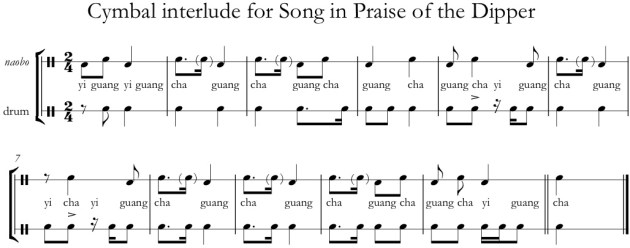
gdz-naobo

In recent years they tend to sing the hymn rather faster than they know it should go (you can hear a more majestic version in concert on track 1 of the audio playlist, and on the 2014 DVD). Anyway, with a very gradual accelerando over the verses, as they reach the seventh and eighth couplets they launch into fast isorhythmic chanting. They now play the fast cymbal interlude Gui jiao men (“Ghosts calling at the door”)—a pattern the same length as the processional Tianxia tong but differing subtly.
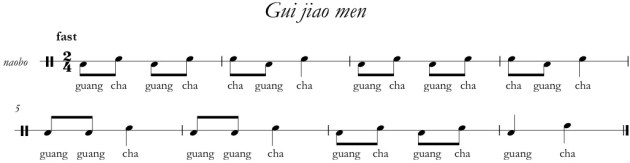
gui-jiao-men

This leads into the five-word quatrain Jishou wufang zhu, sung tutti isorhythmically to a simple descending melody, without percussion, now slightly less hectic:

Bowing to the lords of the five quarters,
The masters of the lads of the five spirits
Open up the roads of the five quarters,
Receive and guide all the ghostly souls.

GDZ 2.jpg

Fig. 4

Then two sections summoning a roster of gods of the local territory—now accompanied by percussion, and punctuated twice by the Gui jiao men cymbal pattern—are chanted tutti, most hectically. Prepared by the instruction at the end of the Song in Praise of the Dipper (Great Supreme, in haste like the Northern Dipper!), and in extreme contrast with the long slow melismatic hymns that now dominate most rituals, this transitional sequence flies past as black clouds swirl, purple mists coil, with complex adjustments of style, tempo, and instrumentation. This too is a rare instance in Yanggao today of the kind of fast chanting commonly heard in south China.

The Invitation verses (playlist #1)
In abrupt contrast to this rousing climax, time now stands still as Golden Noble gently begins to sing a sequence of solo verses in free tempo, accompanied only by his shaking of the bell, with Li Manshan punctuating the phrases with a brief subdued pattern on drum. Li Manshan has let Golden Noble lead this ritual since about 2003; his solo melody is modeled on the way that Li Qing sung it. Even the way he repeats words in the opening phrase (Zhiyixin zhaoqing, yixin zhaoqing, zhaoqing) is distinctive, setting a contemplative mood. We are in the middle of barren countryside, far from the bustle of the village; as night falls, the main light comes only from the little piles of paper money burned by the kin. Notwithstanding interruptions at the end of each verse by a fast loud chorus with percussion, and periodic deafening explosions of firecrackers, this exquisite solo plaint perfectly reflects the desolation of the surrounding countryside where the ancestors are to assemble.

The twenty verses in the manual, each beginning “Vowing with hearts at one we Invite” (Zhiyixin zhaoqing), describe all kinds of occupations of the lost souls: emperors, ministers, generals, literati, sing-song girls, beggars, and so on. These verses are also found in the Li family’s Buddhist (not their Daoist) yankou manual—a sequence sometimes attributed to the great poet Su Dongpo (1037–1101). The twenty verses are now never sung complete; the chief Daoist chooses no more than six or seven of them. Both Li Manshan and Golden Noble agree that they should be performed complete, and were “in the past,” but even Li Manshan never heard the elders recite the whole sequence. To give an idea of the literary beauty of these texts, here is the opening verse (recto, lines 3–6):

zhiyixin

Fig. 5

Vowing with hearts at one we Invite:
Emperors and lords of successive dynasties,
Empresses and concubines of epochs immemorial,
Bedecked in twelve-gemmed crowns,
Countenance outranking three thousand rouge-and-kohl belles.
All under heaven their remit, all under heaven their family,
Ultimately ascending.
Singing within the palace, dancing within the palace,
At the final moment they can only perish and fall.
Alas! Have you not heard?
Once astride the dragon of Yu they cannot return,
(tutti) In vain to deploy the Pipes of Shao within the Department of Caverns,
Fluttering the shadows and echoes, imperceptibly approaching!

But once rendered in exquisite solo melody, such textual beauty is multiplied.

For the last two seven-word couplets at the end of each verse (last line of recto and first line of verso), the first is still sung solo, while for the second the whole group interjects to chant the text fast. But, then, instead of the manual’s elegant and long refrain (opening “And thus from time immemorial” Rushi guwang jinlai, 5th–3rd lines from end of verso above) confirming the invitation, they now substitute a single phrase “Fluttering the shadows and echoes, gradually approaching” (Piaopiao yingxiang ranran lailin 飄飄影響冉冉來臨), again sung tutti. This phrase is borrowed from the shorter sequence of a mere three Invitation texts from their other (“Daoist”) shishi manual.[2] It leads into another burst of the cymbal interlude Gui jiao men.

That is how Li Qing taught them, but they know that the two versions were once alternatives: when the older generation used the longer refrain, it was still sung solo, and they didn’t use a cymbal interlude. So using the Piaopiao phrase with cymbal interludes wasn’t Li Qing’s invention in the 1980s; but already by then, deciding that the full refrain was too long, they were generally adopting the shorter version.

Some other adaptations also have to be learned orally. In the Jinwu sijian section about the sun and moon, and again in the following verse “Gazing from afar on mountain hues” (Yuanguan shan youse), the name of the deceased has to be inserted, and another text replaces the tutti coda of the manual.

The Invitation verses in Beijing Buddhist ritual
I have to take it on trust that all twenty sections were once performed complete, including the longer refrain. The substitution of the “Fluttering the shadows and echoes, gradually approaching” phrase with cymbal interlude for the longer final refrain shortens the ritual a little; and the more recent practice of reciting only selected sections shortens it further.

Actually, the version as sung by the Li family in Yanggao is remarkably similar to that of Buddhist temples in old Beijing. In a fine initiative from the mid-1980s, the performance of the Buddhist yankou by former monks from popular temples in Beijing was recorded; later it was also transcribed and notated.[3] The Invitation sequence, virtually identical in text, is interesting.[4] All twenty sections were indeed performed for the recording. The text is divided between main and assistant cantors, both singing in free tempo with impressive beauty, accompanied only by the bell, the refrain of each section fast choral with drum. So again, it is worth pursuing temple links.

The Invitation memorial
When Golden Noble has finished singing the Invitation verses, first the short section Chenwen dadao 臣聞大道 (see Fig. 7 below) should be recited fast, either solo or tutti, with percussion, confirming the efficacity of the ritual in saving the deceased. This text is commonly omitted today.

Then (as specified in the manual, in red ink) Golden Noble presents the memorial. Having handed the bell to a colleague, who sounds it continuously, he takes out the folded document from his pocket, singing it solo in the same melodic style as the preceding “Vowing with hearts at one we Invite” verses, only more exuberantly, with muffled accompaniment on drum and small cymbals and occasional fast tutti choruses repeating a phrase. He unfolds each new section as he folds up the previous one—though he hardly needs to consult it except to check the names of the kin. In recent years, if the others start accompanying too fast on percussion then Golden Noble sometimes likes to corpse the others (especially his mate Wu Mei) by reading faster and faster, rolling his eyes rapidly up and down over the text.

The manual doesn’t contain the text of the memorial; it is not among the templates in Li Qing’s collection of ritual documents, and Li Manshan and Golden Noble write it from memory. Sometimes entitled Memorial of Rites and Litanies to Escort the Deceased (Songzhong lichan yiwen), it is addressed to the Court of Sombre Mystery for Rescuing from Suffering (Qingxuan jiuku si), and announces the details of the deceased and lists of the preceding three generations of kin. Generally Li Manshan writes the text first and fills in the names of the ancestors later when a member of the kin brings them to him. Dates, as always, are written in the traditional calendar.

yiwen-copy-2

Fig. 6: Invitation memorial, written by Li Manshan, Pansi 2011

Having sung the memorial complete, Golden Noble opens it out and hands it over to be burned by the kin, while the Daoists slowly and solemnly declaim a final five-word quatrain “Thousand-foot waves at Bridge of No Return” (Naihe qianchilang), another common temple text:

naihe

Fig. 7

Thousand-foot waves at Bridge of No Return,
Bitter sea myriad leagues deep.
If the soul is to evade the cycle of rebirth and suffering,
The Daoists are to recite the names of the Heavenly Worthies.

The return procession
So now after the document has been burned, if Redeeming the Treasuries is combined then the two treasuries are burned. The Daoists then lead the kin on procession back to the soul hall. Whereas the whole of the previous sequence has been performed a cappella, they now play shengguan all the way back while the kin burn paper to illuminate the way for the ancestors; on procession on the way out, they only use percussion because there is no-one to escort yet.

However, in Li Qing’s manual there follow thirteen verses for Triple Libations of Tea (san diancha). Li Manshan recalled these verses being recited on the route back, accompanied by Langtaosha on shengguan, but later they only played Qiansheng Fo without vocal liturgy. They still sometimes use a three-verse version for the solo introits in Presenting Offerings before lunch, and as a slow accompanied hymn for Transferring Offerings.

Even after the Libations of Tea were omitted, villagers used to “impede the way” (lanlu) on the return to demand popular “little pieces” from the Daoists, but by the late 1990s no longer did so—they now had plenty of other opportunities to hear pop music. Since around 2011 the kin often just stop occasionally to burn paper, not all along the route as they should. Altogether, the impetus towards simplification derives from the changing needs of the patrons.

The hymn at the gate (playlist ##2 and 3)
On the return to the soul hall, the Daoists now stand informally around the gateway to sing the Mantra to the Three Generations a cappella, as the kin again kneel and burn paper. This is the “Jiuku cizun” text in the manual. As usual, this a cappella version is sung faster than that with shengguan, though they retain the cymbal interludes. They round off the hymn with the fast percussion coda Lesser Hexi, and then lead the kin into the courtyard with a short burst of the pattern Tianxia tong. That is the end of the Invitation as performed today.

But in the manual, before the Mantra to the Three Generations, a further text Lijia quyuan 離家去遠 appears—also apparently a hymn, but unknown today. The volume then concludes with the solo recited quatrain that in current practice they recite at the initial visit to the soul hall; and then a final six-line hymn Qinghua jiaozhu, which should be sung (again, surely a cappella) while the oldest son kowtows.

Conclusion
One wonders how there was ever time for all the extra material in the manual, within what was once an even more busy ritual sequence throughout the day. The ritual in its present condensed form may have taken shape gradually, and it still makes a cogent and moving sequence that meets the needs of patrons.

Beyond just documenting which sections of text are performed today and which have been lost, we need to know how the texts are performed, and how Daoists adapt the material. It’s always hard to imagine the performance of ritual texts from the page, but here is a fine instance of variety. The text is rendered efficacious, and its drama heightened, through a varied yet cohesive sequence of slow solemn choral singing, hectic mantric choral chanting interspersed with percussion interludes, and exquisite free-tempo solo singing accompanied by conch and bell. Such a cappella rendition is of a different kind of complexity from the slow melismatic hymns that now form the bulk of their performance. Despite ritual simplification in modern times, the Daoists need to internalize complex rules—orally—in order to deliver the text efficaciously, animating it into a magical sequence.

[1] By the way, the Yanggao Daoists now have no separate Bathing (muyu) ritual, though it is part of the obsolete shezhao muyu ritual in Li Peisen’s funeral manual.
[2] It is used in the Summons (shezhao) ritual of the temples: Min Zhiting, Daojiao yifan 道教儀範 (Taipei: Xinwenfeng 2004 edn), p. 179.
[3] Ling Haicheng, Yuqie yankou yinyue foshi 瑜珈焰口音乐佛事 cassettes, with booklet (1986); Yuan Jingfang, Zhongguo hanchuan fojiao yinyue wenhua 中国汉传佛教音乐文化 (2003), pp.301–451, Yuan Jingfang Zhongguo fojiao jing yinyue yanjiu 中国佛教京音乐研究 (2012), pp.228–439. Cf. Chang Renchun, Hongbai xishi 红白喜事 (1993), pp.324–6.
[4] Yuqie yankou yinyue foshi, cassette 4b; Yuan Jingfang Zhongguo hanchuan fojiao yinyue wenhua, pp.389–395, Yuan Jingfang, Zhongguo fojiao jing yinyue yanjiu, pp.386–391.

Periodizing modern China

slogan

Satirical Chinese saying, c2010.

In my book Daoist priests of the Li family I stress the importance of fieldwork on the modern period, not just attempting to imagine the rosy distant past. Talking of the modern period (p.141):

Just as historians document ritual change throughout the medieval and late imperial periods, we find constant adaptation in the years before and after the Communist revolution of 1949. Similarly, a detailed account of over three decades of ritual practice since the liberalizing reforms of the early 1980s reveals continuing changes.

Chinese peasants have a different conception of time from the periodization we find in official history. Li Manshan described his wedding in 1971 as “after the end of the Cultural Revolution”; “land reform” is often used to mean the privatization around 1980; and now when people mention “liberation” they often mean after the end of the commune system in the 1980s. Now that the Maoist era is a rather distant memory, it may seem like a blip in the long sweep of history—but it has left deep scars.

Similarly, while in the official story the term “three years of difficulty” (1959–61) makes a veiled recognition of the devasting famine, it means little to many peasants, since they suffered from severe food shortages right through from the early years of collectivization until the collapse of the commune system.

WWJD

Talking heads

Further to Alan Bennett’s reflections, bearing on the trope of WWJD (“What would Jesus do?”—a snowclone, I now learn), this is from his Talking heads monologue A chip in the sugar:

She said, “He knows what I mean. Where did you get those shoes?” He said, “They’re training shoes.” She said, “Training for what? Are you not fully qualified?” He said, “If Jesus were alive today, Mrs Whittaker, I think you’d find these were the type of shoes he would be wearing.”

Catching the tiger, Wu Mei, oboes and cymbals

This Larson cartoon reminds me of the “catching the tiger” tricks of the Li band—a rare moment of secular entertainment within the liturgical sequence.

In my film (from 42.52), Wu Mei’s tricks are charming (see also §B8 on the DVD with my 2007 book)—interesting also to compare (from 51.22) the more leisurely 1991 version of his predecessor Wang Chang.

Wu Mei [1] (b.1970; film from 53.52; see also this vignette), known as Zhanbao 占宝, is one of the great wind players in world music. Of course he does everything—also singing the liturgy, playing the large cymbals for a cappella sequences, and occasionally giving another Daoist a turn on the guanzi while he plays sheng mouth-organ. He’s a Daoist, not a “musician”, yet his musical genius is indispensable to the success of the Li band.

He was the fourth of five children from a poor family—his blind younger brother spent some time learning the shawm, and their father was an old friend of Li Qing. Wu Mei was at once enchanted by the sound of the funeral ritual, and there and then he went up to Li Qing and asked him if he could become his disciple. He went to live with him for the first year, and then commuted by walking an hour from his village, five li away.

Wu Mei recalls that the first time he played guanzi for a ritual was for a funeral at Lower Liangyuan in 1990, during his third year, playing small guanzi along with the aged Li Yuanmao on large guanzi. This might remind us of young, pre-punk, Nigel Kennedy in duet with venerable Yehudi Menuhin. But Wu Mei doesn’t remember much about it—they just got on with it; anyway, the seniors were satisfied with his playing.

When the hymns are accompanied by shengguan, a good guanzi player makes all the difference. Like Li Yuanmao or Li Tong in the old days, Wu Mei is not just totally reliable, he is inspired, helping the other Daoists to sing to the best of their ability, complementing them perfectly—managing to combine a deeply mournful tone with an almost playful way of weaving in and out of the melodic line, ducking and diving, sometimes soaring. The singers recognize that a good guanzi player is a great help to them in rendering the text.

Wu Mei soon became a local star. With his radiant innocence, he is on another planet, floating in the clouds above this world of dust. Here there is no empty display; he is a vessel, a puppet for the gods, like Bach. On guanzi—and not just in slow hymns but even in the zany “catching the tiger”—he has none of the posturing of the virtuoso. And not even just when he is actually playing: it is delightful when he takes a little break in the instrumental suite or the popular errentai sequence, doodling a little phrase reflectively on the guanzi before plunging back into the fray.

WM zhuo laohu

Concert performance in Rome, 2012

He is always devising new decorations, like renaissance divisions—experimenting, seeking new ways of making transitions. The others are attuned to all this as they accompany him. While the decorations of the older generation remained within strict confines, Li Manshan and Golden Noble observe that in recent years Wu Mei has been experimenting beyond the “rules”. To me, there was always an element of playfulness even in the slow solemn style (like Liu Zhong, although he wasn’t so admired); and if this is modernizing, then I’m cool with it. When I suggest to Li Manshan that Wu Mei’s ornaments are still serious and spiritual, he defers to my musical ears—but obviously he is a master musician with way more experience of the style. Perhaps the way to see it is as an innovation that began with Liu Zhong and has culminated in Wu Mei—it’s amazing, even if not strictly kosher. Bach would have adored Wu Mei’s guanzi playing.

YD

The way he plays the large bo cymbals is childlike and adorable too; you can sense how utterly comfortable he is as a musician. Again he has a particularly charming way of decorating the patterns, tastefully testing his partner’s creativity and probing the possibilities. The most exhilarating, and by far the longest, cymbal piece is Yellow Dragon Thrice Transforms Its Body, now played only as a coda for Transferring Offerings (for which, apart from the edited version in my film [from 1.11.07], you can enjoy a fantastic complete concert rendition in the 2014 DVD), but also prescribed upon ascending the platform in the Pardon (film from 50.31). Wu Mei and Yang Ying can’t help showing their delight in it, whereas Erqing and Li Bin maintain their serious demeanour. This is the only percussion piece that ever attracts an audience, and even applause. Local or urban, Chinese or foreign, no-one remains unmoved by this exhilarating piece.


[1] These comments are edited from my book.

Harpo

À propos the Marx brothers, apart from the verbal dexterity, their charm was also beyond words:

Harpo is naturally most endearing to musos—notably Steven Isserlis, whose brilliant tribute is here (the link to the radio programme may be defunct, but watch this space). Note his fine historical reflections too.

Harpo’s mute persona might have been inspired by Rossini’s trio Mi manca la voce

For Steven’s Bach, see here.

Travel: our changing times

Morgan

In Morgan: a suitable case for treatment (Karel Reisz, 1966; see also here), Morgan’s mother (the magnificent Irene Handl), a 1930s Communist who “refuses to de-Stalinise”, asked for news of her son, exclaims incredulously:

Got a postcard from ‘im, from Greece… I mean, what is there in Greece?

This was pretty much my parents’ attitude to my fieldwork in China.

Here they are paying respects at Marx’s grave:

Studying the cello

Ladykillers

“People often say to me…”

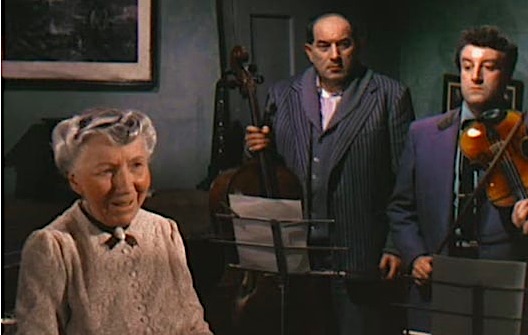
When I am asked how I came to play the violin, I’m inclined to cite The Ladykillers (1955):

As the gang is plotting their robbery, posing as a string quintet while they play a recording of the Boccherini Minuet, sweet little old Mrs Wilberforce (Katie Johnson) takes them by surprise—so to maintain the deceit they have to hurriedly pick up their instruments (which they can’t actually play). The magnificently obtuse One-round (Bernard Bresslaw) is clutching a cello like a sledgehammer:

Mrs Wilberforce: “May I ask you where you studied?”

One-round: “…Well, I didn’t really study any place, Lady… I just sort of… picked it up.”

I still can’t help thinking of the scene whenever I hear that minuet.

This leads nicely to Muso speak: excuses and bravado. For more convincing mastery of the cello, see here; and for Hugh Maguire leading the Allegri quartet in another Boccherini minuet, here. See also Learning the piano.

Faqu tu 2, or tutu

At Cambridge, Paul Kratochvil was not alone in enjoying a bit of drôlerie.

Here’s another jeu d’esprit on the faqu 法曲, from a precious old letter that I just found from my teacher Denis Twitchett, sent (by post!) from Princeton in 1986. A tad more wacky than his magnum opus Financial administration under the T’ang dynasty, it deserves to take its place among his magisterial writings on Tang history:

Dear Steve,
Some further ruminations on that mysterious term faqu. I am reminded of the hypothesis (first adumbrated in my alas-as-yet-unfinished “Preliminary proleptical remarks proving beyond Reasonable Doubt that Li Bai [aka Patrick O’Leary] was the earliest Irish poet”) that faqu is a rough-and-ready transliteration of the greeting shouted at tax-collectors in the medieval Irish countryside, and also commonly exchanged by rival drivers of donkey carts involved traffic accidents. The etymology of its common form in Chinese is obscure; under the Liao dynasty a folk etymology suggested that it meant “May the Law twist [your private parts]!” It should not be confused with the alternative writing (found in non-Buddhist contexts) fa-k’iu 發具 (explained by Karlgren as “Get out your [ritual] implement!”). This is quite distinct from the forms fakefu 法可夫 or 伏軻䮛 (the latter writing mistranslated by Legge as “Kneel by the hubcap of the Prince Consort”), meaning, according to Admiral Ting (first Chinese to be trained in the Royal Navy), “Be on your way, Jack!”

“French pieces” were surely more normally written in Tang Chinese as faji 法伎 or more colloquially as fashi 法式 “French models”. The title of the well-known Song-dynasty work Yingzao fashi 營造法式 is now attached to a rather boring work on architecture which explains how to construct yourself a baroque dog-kennel without mod cons. This work, however, is clearly a forgery by a Ming author, horrified to the depths of his neo-Confucian sensibilities by the original contents of the book, originally a Song DIY handbook “Make yourself a French model”.

The French presence long predates the Tang, and surely explains Zhuangzi’s Frog in the Well (a fine metaphor for the petty self-interest of the French). This also explains the title of the Tang Li Wa zhuan 李蛙傳, “The story of Froggy Li [the French model]”, and how the word wa “frog” came to have its other meaning “lascivious” or wanton”.

Empirical language acquisition

Pilsen

Frances Wood, a distinguished former student of the late great Paul Kratochvil, reminds me of another of his stories.

Paul liked to tell us this as we grappled with the use of classifiers (measure words) for Chinese nouns. The nearest equivalent in English is for collective nouns, like a gaggle of geese or a school of fish. In Chinese a basic all-purpose one is ge (“a person” is not yiren but yige ren), but one needs to use all kinds of classifiers before different types of nouns, like ben for a book (not yishu but yiben shu), or (if you wanna get pleasantly obscure—as I do) zuan for a sheng mouth-organ (yizuan sheng).

Anyway, Paul was just a kid when American GIs liberated his home village in Czechoslovakia in May 1945. They were kind of heroes, and he began hanging out at their barracks, gradually picking up English—entirely through daily aural experience.

After some time a grammatical rule subliminally formulated in his young mind: English nouns must invariably be preceded by the classifier fuckin’. No-one ever said “Gimme a beer!”, it was always “Gimme a fuckin’ beer!”; never “Open the window!”, always ““Open the fuckin’ window!”

Paul’s spoken English came along rapidly, and his father, realising he had a real gift for language learning, somehow managed to arrange for him to go up to Prague to take an English oral proficiency test.

Paul knocks on the door. Commanding English military type shouts out, “Come in!”, and finding a scruffy kid in short trousers standing before him, barks,

“Yes boy, what do you want?”

Paul, hesitantly:

“Hey bud, I come to take ze fuckin’ exam in fuckin’ English.”

At Cambridge such stories made a change from my encounters with scholars of a more classical bent, like Laurence Picken and Sir Harold Bailey. See also Language learning: a roundup.

Healthy eating: Sleeper

Meanwhile we lapped up the early films of Woody Allen, like Sleeper.

Two doctors are monitoring the owner of a health food store who has been cryogenically frozen in 1973 and defrosted 200 years later:

Dr Melik: This morning for breakfast he requested something called “wheat germ, organic honey and tiger’s milk.”
Dr Aragon: [chuckling] Oh, yes. Those are the charmed substances that some years ago were thought to contain life-preserving properties.
Dr Melik: You mean there was no deep fat? No steak or cream pies or… hot fudge?
Dr Aragon: Those were thought to be unhealthy—precisely the opposite of what we now know to be true.
Dr Melik: Incredible.

A funky address

To follow Five easy pieces, a very different kind of oeuvre of that époque—less verité—is Jacques Rivette’s 1974 film Céline et Julie vont en bateau (here, on vimeo).

One abiding memory is my favourite address, where much of the “action” (if that’s the mot juste) takes place:

7 bis, rue du Nadir-aux-Pommes

I often used this a forwarding address.

What an age—Rafaelson, Bertolucci, Godard, Chabrol… (more here). At the time [historical note—Ed.], the way to see all these films was to do something called “going to the cinema”. Late-night Marx brothers films at the Arts Cinema were a rite de passage too…

In my imagination I tend to reduce my student years to the Tang dynasty, violin, and Adnams, forgetting how important (and how modern) my wider education was—film, art, literature. But the lacunas were remarkable too.

Meanwhile, Li Manshan and his fellow Daoists were languishing in silence and hunger (my book, p.133):

“We just sat around at home, but we could never feel at peace”—always fearing a knock at the door.

Five easy pieces

Somewhat akin in alienated mood to Jia Zhangke’s Platform is Five easy pieces (Bob Rafaelson, 1970).

The diner scene (“No substitutions”, “Hold the chicken”) is iconic:

But there’s far more to it than that. Among its many virtues, it’s a moving exposé of the pressures and frustrations of the classical musician’s life. In an abrupt change of mood, when Bobby finally reaches the family home, he enters to hear the Andantino of the E flat piano concerto K271 in an arrangement for two pianos, played in a ponderous style that matches the stifling, oppressive mood of the house:

—far from the charm of Robert Levin:

Just as exquisite is the Andante of the E flat concerto K482, also in C minor:

Bobby’s alienation is confirmed when he is cajoled into playing a Chopin Prelude, a piece that holds similarly disturbing childhood memories for me—note the powerful effect of the family photos:

In those heady times (The king of Marvin gardens, The last detailthose were the days) before Jack Nicholson began impersonating himself, his final monologue before his mute father is overwhelming (sorry—far better if you can watch the whole film, of course!):

Here’s a wise review for the fiftieth anniversary of the film in 2020.

For Augusta…

Platform

Platform

In connection with my film on the Li family Daoists, I already recommended the verismo fictional films of Jia Zhangke 樟柯 about the alienating changes of life in small-town Shanxi through the reform era. Of many appreciations, this is good, and this. For antedecents of his style, see Chinese films of the early reform era.

His brilliant Platform (Zhantai 站台, 2000) shows how the members of a now-rootless arts-work troupe experiment with changing fashions as they struggle to adapt to the loss of their “iron rice-bowl”.

In one of many moving scenes (from 1.21.45) the illiterate Sanming, desperate for a job, turns up at a doddery coal mine to enlist for a daily wage of 10 kuai. His friend reads out for him the brief, shocking, contract he has to sign, opening:

Contract of life and death: 1) Life and death are a matter of fate, prosperity depends on Heaven. I am willing to work in Gaojiazhuang mine. Management accepts no blame for accidents.
生死合同。第一,生死由命,富贵在天。本人自愿在高家庄煤矿采煤,如遇万一,与煤矿无任何关系。

Just that opening phrase Life and death are a matter of fate, prosperity depends on Heaven resounds with the peasant mindset, if less so with modern law. The contract, and Sanming’s uncomprehending acceptance of it, are at once convincing and tragicomic.

Do go on to watch his other films, including Xiao Wu 小武 (1997), Unknown pleasures (Ren xiaoyao 任逍遥, 2002), The world (Shijie 世界, 2004), and Still life (Sanxia haoren 三峡好人, 2006). Now we also have an open-access volume of his interviews with Michael Berry. See also the films of Wang Xiaoshuai.

* * *

Shanxi province (apart from its fine household Daoists!) is also notable for its mining accidents. From my book on neighbouring Shaanbei:

Back in the county-town, returning to our hostel one evening, we switch on the TV to find a documentary about coal-mining accidents, which are reported nightly. There are some rather fine investigative programmes on TV these days, and the main theme of this one is how the response of the village Communist Party leadership to the disaster, rather than considering improving safety measures, has been to give funds to construct a new village temple in the hope of divine protection. OK, in this case the programme happens to fit into an agenda of rationalism against superstition, a view we sometimes feel inclined to challenge, but tonight I can only go along with the presenter’s lament.

Only later did I put together further pieces of a grisly jigsaw. Under the tradition of posthumous marriage (minghun), revived in northwest China, within five years after the death of an unmarried male over the age of 15 sui, a suitable dead unmarried female is found. Indeed, shawm bands often perform, and a Daoist may officiate. The unnatural deaths of many men in unregulated mines were bad enough, but newspaper reports in 2007 revealed that women (often disabled, or from poorer provinces) were being murdered to cater for this market.

For “ghost marriages”, note this article.

Another translation

sizhu 87

À propos translation:

In the silk-and-bamboo ensemble music of the Shanghai teahouses, the wonderful piece Xingjie 行街—properly rendered as something like “Street Parade”— appeared on one Chinese cassette as “The streetwalker”.

BTW, Call Me Old-Fashioned [You’re old-fashioned—Ed.], but Xingjie is one of those pieces that is much more satisfying, not in the short version common on stage, but in its full form, working through all the tempo divisions (see my Folk music of China, pp.278–80). “But that’s not important right now.”

At the dentist

LiffThe inspiration of the brilliant The Meaning of Liff series was that “it seemed a waste to have words cluttering up signposts when they could be usefully attached to something namelessly familiar”. Two related definitions:
Gallipoli. Of the behaviour of a bottom lip trying to spill out mouthwash after an injection at the dentist. Hence, loose, floppy, useless.

Ljubljana. What people say to the dentist on the way out.

See also More vocab for the dentist’s.

More conducting

group

Left to right: Arnold Schoenberg, Otto Klemperer, Hermann Scherchen,
Anton Webern, Erwin Stein, 1924

The late great Hugh Maguire told me that Hermann Scherchen’s conducting technique was described as

like milking a flying gnat.

For a fleeting glimpse of this method, see the wonderful film Gennadi Rozhdestvensky—conductor or conjuror?, from 00.26, under Noddy: the art of conducting.

Noddy: the art of conducting

A tribute to the great Gennadi Rozhdestvensky (1931–2018)

We musos may be critical of conductors (cf. Norman Lebrecht, The maestro myth: great conductors in pursuit of power), but don’t get me wrong, we deeply admire great ones—such as Boulez, Tennstedt, Gardiner, Rattle (unlikely bedfellows…). See under The art of conducting.

Apart from Boulez, another highlight of depping regularly with the BBC Symphony Orchestra was working for Rozhdestvensky (known in the trade as Noddy).

Gennadi Rozhdestvensky—conductor or conjuror? (Bruno Monsaingeon, 2003) is a wonderful film:

In a work that otherwise requires little imaginative filming, do watch the brilliant scene from 32.40—the traffic cop Marcel Mehala should take a bow too.

Believing in a kind of spontaneous combustion, and trusting his players to match his own mastery, taking risks together, Noddy was renowned for his aversion to rehearsal—greater still than that of orchestras. Once, turning up for the first of a couple of whole days’ scheduled rehearsals for a fiendishly difficult and unfamiliar modern piece, he conducted the first few bars and then told the band nonchalantly, “Good, see you at the concert”. In a rare reversal of the musos’ philosophy of “It’ll be all right on the night”, the leader took him to one side and asked him if he wouldn’t mind just taking them through the whole piece once.

Even on stage, his style doesn’t look like much—inscrutable, even casual, his gestures by turn minimal and flamboyant (in the film, from 22.24, he explains his economical solution to conducting the opening of the Symphonie fantastique (cf. Yet more conducting). But his concerts were electrifying. Doing Petrushka, it was as if we were all composing it, living it, together with him. And the Scriabin piano concerto with his wife Viktoria Postnikova was exquisite too—here’s an audio recording:

We can also relish them together in Rachmaninoff’s 4th concerto:

In Historical ears and eyes I feature Noddy conducting Rachmaninoff’s gorgeous 2nd symphony. And do listen to his Tchaik 6. The documentary ends with an illuminating sequence where he rehearses and reflects on Tchaikovsky’s Romeo and Juliet. If only we could see more of the archive footage below—the curious camerawork shows him only briefly, though with characteristic gestures:

Monsaingeon’s Notes interdites (aka Red baton) also features another film in which Noddy reflects on the political vagaries of the Soviet system.

Noddy

For obituaries, click here and here. See also The art of conducting; and Lives in Stalin’s Russia.

A great Daoist priest

Today is the first anniversary of the death of Zhang Minggui 张明贵 (1931–2016). He was one of the most exceptionally enlightened Daoists I have had the honour of meeting, a fine authority not only on Daoism but on all aspects of local culture, and indeed life. [1]

zmg

With Zhang Minggui, Baiyunshan 2001. Photo: Zhang Zhentao.

He served his local community as long-term abbot of the White Cloud temple (Baiyunguan, known as White Cloud Mountain Baiyunshan) temple complex of Jiaxian county in Shaanbei, bordering the Yellow River that divides Shaanxi from Shanxi.

One of many determined local temple managers, [2] with his archetypal long white beard Zhang Minggui couldn’t help becoming a poster-boy for official Daoism, and was honored with high positions in the state Daoist hierarchy. We spent a few days as his guests during the 4th-moon temple fair in 2001. In informal chats between receiving a constant stream of pilgrims and visitors, freed of the necessity to churn out the usual empty clichés, he was far from the bland diplomacy of the modern Daoist priestly leadership or the simplistic patriotic eulogies to be found on Chinese websites. [3]

Zhang Minggui was tireless in his work on behalf of his local community under both Maoism and the reforms. His life reminds me of the continuum between temple and folk life. Baiyunshan has been a rather popular topic in Daoist research. In recent years his prestige hasn’t protected the temple from the Busby-Berkeley-esque stage commodification of its Daoist practice demanded by “cultural” officials—but we should look beyond that, and beyond the temple, to study the wider picture of folk ritual activity in Jiaxian county.

The temple complex is now an isolated outpost of institutional Daoism in the region, with its Longmen Quanzhen tradition whose priests have long performed both jiao and mortuary rituals among the local people. Founded in the 17th century from the Baiyunguan in Beijing—though links with Huashan and Shanxi may have been just as significant in its early history—it is a zisunmiao “hereditary” temple. [4]

The temple Daoists were first given permission to marry in the Republican period (one Daoist there told us it was in 1924), apparently creating competition (presumably including ritual competition) between the married priests and those unable to find wives. [5]

From their biographies, [6] we find that the priests listed for the 20th century were all local, indeed from the county itself—unlike the priests of many large metropolitan Quanzhen temples, who come from many areas, notably south China. Their numbers since the 1940s have stayed at around a dozen. Coming from poor families—inevitably, since Jiaxian is the poorest county in a chronically poor region—most of them entered the clergy “from infancy”, or in specific cases between the ages of 7 and 14 sui.

Zhang Minggui was exceptional, coming from a scholarly family; since he was ill, his parents pledged him to the temple when he was 5 sui old, but they bought him back after a couple of years, only giving him back to the temple when his illness recurred at the age of 11. Notwithstanding the destruction of the temple’s precious Daoist Canon by the occupying PLA in 1946, Mao’s 1947 famous visit to Baiyunshan to hear the opera there [7] was the beginning of the local CCP’s efforts to recruit Zhang Minggui as a schoolteacher. He reached a deal whereby he could also take care of temple affairs. He was already a fine vocal liturgist by the age of 18, and went on to steer the temple through the choppy waters of Maoism.

Throughout this period there was also Byzantine intrigue among the priestly adherents of the Hunyuan and Yaochi dao sects for control of the temple. This continued through the 1950s, just as they were being targeted in campaigns, with sectarian Daoists plotting against the more orthodox clerics; some activity is still said to continue today. [8]

The temple complex (and the sects) managed to keep active through the 1950s until 1963, with vast crowds attending the temple fairs. More open worship resuming gingerly around 1979. Through this period Zhang Minggui worked tirelessly to restore the temple. Since then there has been a political tug-of-war for control of the temple and its substantial funds between the Daoists and the mafias of the secular county departments—the temple income is a major factor in the economy of this poor county.

The main temple fair on the mountain is held over the week leading up to 4th moon 8th, with smaller fairs on 3rd moon 3rd and 9th moon 9th. Throughout the county there is an active tradition of performing major jiao Offering rituals. The jiao is held four times in the spring: in three specific villages in the 1st and 2nd moons, apparently not a recent tradition; in the temple itself during the 4th-moon temple fair; and eight times earlier in the winter, sponsored by a group of many villages in a parish (she) clubbing together, rotating the host village over many years. [9] The latter system consists of a group of 48 villages to the south of the temple, and 12 villages to the north; to the west, the smaller jiao is a niuwang jiao for the Ox King. Apart from the temple Daoists, there are other less costly lay Daoist groups performing similar rituals in the nearby countryside. [10]

A major aspect of devotional activity at the Baiyunshan temple fairs is a group of eight (five in the 1950s, now in practice more than eight) regional associations (hui), which serve mainly to organize the large groups of pilgrims, though they appear to include few groups of ritual specialists. [11]

candlelit altar

Pilgrims of a regional association listen to a bard, Baiyunshan 2001.

Apart from the temple fairs, the Daoists’ income comes mainly from performing funerals outside the temple.

Sincere and broadly curious, Zhang Minggui’s tastes extended to writing articles on Beijing opera and stars of world ping-pong. [12] Far from a mere figurehead, he was an active ritual performer, deeply concerned with the welfare of his community. He will be much missed.


[1] These notes are based on my In search of the folk Daoists, pp.96–101; further detail in Zhang Zhentao, Shengman shanmen, pp.178–209. See also Yuan Jingfang, Li Shibin, and Shen Feixue, Shaanxi sheng Jiaxian Baiyunguan daojiao yinyue (1999); for Abbot Zhang, see pp.40–41. On the temple’s history, note the writings of Fan Guangchun. We await further work from Liu Hong of the Shanghai Centre for Ritual Music.
[2] For an ethnography of a temple in southern Shaanxi, cf. Adeline Herrou, A world of their own, and await further work from her.
[3] Cf. my “Reading between the lines: reflections on the massive Anthology of folk music of the Chinese peoples”.
[4] Despite the claims of Yuan, Li, and Shen (1999: 26), their shengguan music cannot have been acquired from the Baiyunguan in Beijing, which never had any; it is possible that it came from contact with Buddhist monks, as local scholar Shen Feixue suggested to us.
[5] See also my Ritual and music of north China, vol.2: 97 n.11.
[6] Yuan, Li, and Shen 1999: 30–42.
[7] Among many bland reports, see e.g. http://crt.blog.ifeng.com/article/35721644.html, http://blog.sina.com.cn/s/blog_551d0f8c010005r3.html,
http://www.360doc.com/content/16/0603/15/3196639_564749991.shtml.
[8] Yuan, Li, and Shen 1999: 28; Zhang, Shengman shanmen, pp.182–4. Zhao Jiazhu, Zhongguo huidaomen shiliao jicheng (2004) contains many refs. to both sects; those to the Yaochi dao are mainly for counties in Shaanxi and Gansu (see also his general introduction, p.14)—indeed, I haven’t found it in areas of Hebei and Shanxi that I have visited.
[9] For the parish, see the indexes of my various books.
[10] For more on the jiao in Jiaxian, see my Ritual and music of north China, vol.2: 98–101; Zhang, Shengman shanmen, pp.187–9. Several Chinese websites for Shaanbei show photos and videos of jiao rituals around Jiaxian.
[11] For these groups, see refs. in Ritual and music of north China, vol.2: 85 n.20; Zhang, Shengman shanmen, pp.172–5.
[12] Zhang, Shengman shanmen, p.180.

Embarrassment, pah!

Tying in disturbingly with my posts on Alan Bennett (here and here) and Watching the English:

Never mind all the compelling reasons why the UK might balk at hosting an evil racist misogynist bigot bent on destroying all moral values and sowing global discord. Instead, it may be this one—stated in the petition against the visit—that will quaintly hold sway:

because it would cause embarrassment to Her Majesty the Queen.

And we can’t have that now can we? As to “putting the Queen in a very difficult position”, let’s not go there…

Court jester Boris, as usual, opens his mouth and puts his foot in it with the argument: we’ve had Mugabe, we’ve had Ceausescu, why not Go for Gold? There’s a fantasy dinner party from hell…

Mind the Gap: The Three Homages

Chapter 10 of my book is called Mind the Gap. My use of this classic London underground warning, I gladly concede, may well be less effective in Daoist ritual studies than that of the wonderful Bridget Christie for feminist comedy.

Anyway, I explore how rituals as performed don’t make a close fit with ritual manuals—apart from the fact that the latter are silent. Here’s an instance. [1]

The Li family makes four visits to the soul hall in the morning to Deliver the Scriptures (songjing 送經). The final one of these sessions is Presenting Offerings (shanggong 上供), parts of which are shown in my film, from 32.12.

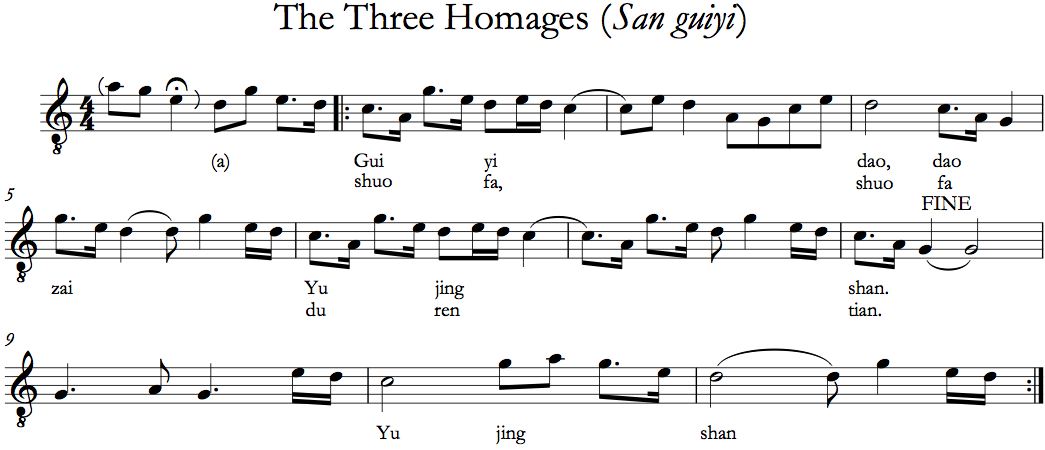
The Three Homages hymn (San guiyi, also known as Zan sanbao) is part of an unusual sequence in their current practice. This is another instance of the importance of using ritual performance rather than relying merely on ritual manuals. Finding the short text of The Three Homages in Li Qing’s hymn volume (and I haven’t yet found it elsewhere), we couldn’t know that each of its three verses (accompanied by shengguan) is preceded by a choice of solo shuowen recited introit (now commonly based on the Triple Libations of Tea). The first one commonly goes like this:

I hereby declare:
The lustre of time soon passes, life and death are hard to evade.
Don’t ask of the three sovereigns and five emperors, or cultivate the search of Qin and Han emperors most high.
Coveting Pengzu’s eight hundred years, or cultivating Yan Hui’s four hundred years.
Although old and young differ, they can’t help being equal in rank.
Burning incense in the golden incense-burner, jade cups full of tea,
With filial kin raising up the cups, the first libation of tea pouring.

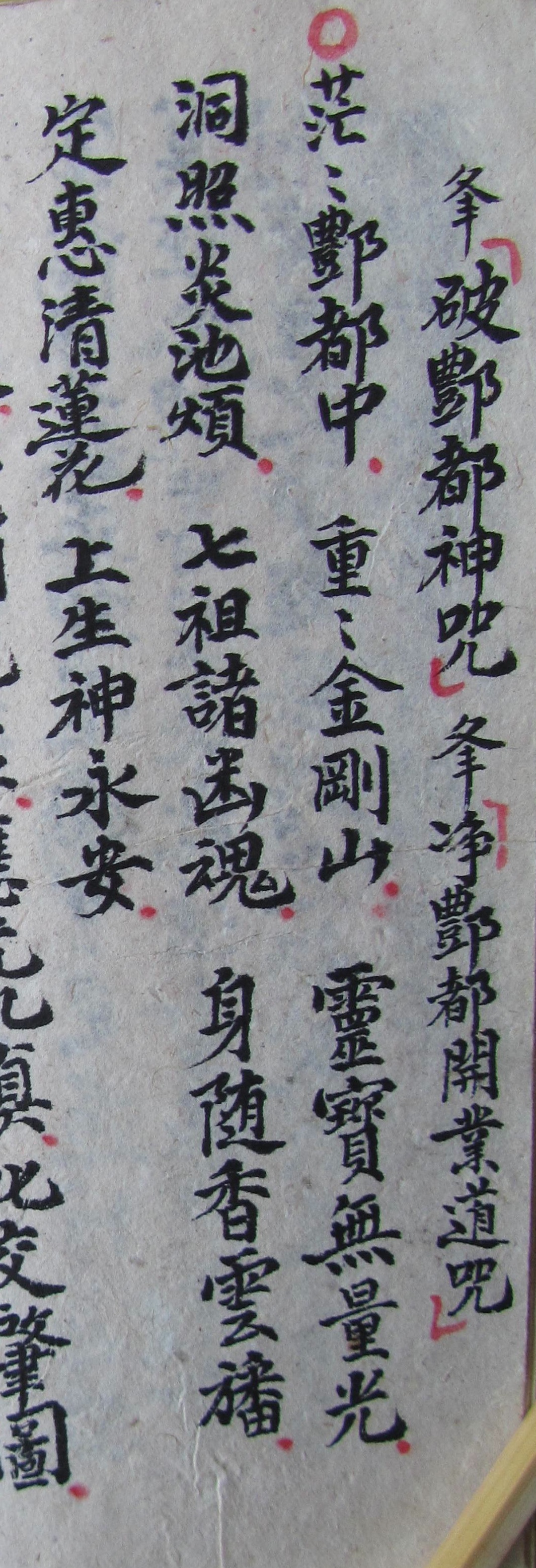
Nor could we know that the hymn is followed by the fast tutti a cappella chanted Mantra to Smash the Hells (which appears not in the hymn volume but in the Bestowing Food manual):

mantra-to-smash-the-hells

In boundless Fengdu hell, the vastness of Mount Vajra.
Immeasurable light of the Numinous Treasure
thoroughly illuminating the woes of Scorching Pool.
The Seven Ancestors and all the netherworld souls
Bearing incense-cloud pennants,
Blue lotus flowers of meditation and wisdom,
Life-giving gods eternally in peace.

Nor yet could we imagine that the whole sequence then concludes with any short hymn from elsewhere in the hymn volume, like The Ten Redemptions of Sin (Shi miezui) or the Five Offerings (Wu gongyang), again with shengguan.

With its short verses, the tempo of The Three Homages is not as slow as most of the Li family’s hymns, so one might think it would be an easy-learning item, but it is still none too easy for the outsider to learn. Indeed, they don’t grade their learning like this—they just plunge in, picking up the hymns as they occur in ritual practice.

san-guiyi-for-book

San guiyi text.jpg

The text illustrates a system found in some other hymns, where the last words of each line are repeated to open the following line—as here, the first of three verses:

Homage to the Dao,
The Dao residing on Jade Capital Mountain. [2]
On Jade Capital Mountain preaching the dharma,
Preaching the dharma to deliver humans to heaven.

By the way: fa, commonly equated with the Buddhist “dharma”, is just as common in Daoism. I usually render it as “ritual,” only retaining “dharma” in a couple of binomes—like shuo fa here, and fayan “dharma speech”.

In sum, useful as it is to have collections of texts on the page, none of the efficacy of ritual in performance is contained there. All the segments of this Presenting Offerings ritual differ in style. To read them on the page, as ever, is quite inadequate.

For another instance, see the Invitation ritual.


[1] Adapted from my book, pp.208–9, 264.
[2] Li Qing’s manual gives Yuqing shan 玉清山, which I have (unusually) revised to the standard Yujing shan 玉京山.

Money money money

The term emoluments is suddenly enjoying a dubious revival with a clause in the US constitution that is among many currently battening down the hatches.

The term, while not constantly on the lips of the rap generation, evokes fond memories from my days studying Tang history.

True, this is scant consolation for the current Destruction of Civilisation As We Know It.

Another namby-pamby term used in academia that always makes me giggle is honorarium. But since I very occasionally get one, I mustn’t bite the hand that feeds me.

Musos are more straight-talking. One day our Mozart recording sessions in St John’s Smith square were interrupted by deafening building work outside. Reluctant to send us all home, the conductor discussed with the record company whether they might offer the workmen some kind of bribe to knock it off. Meanwhile the orchestra, aware that we would still have to be paid even if the session had to be called off, wondered whether we might make them a better offer to get them to keep going.

This was around the time of a dispute between a certain conductor and the brass players about overtime. A trumpet player (legendary for many touring exploits besides) put their case with the classic remark,

It’s not the principle, it’s the money!

This actually goes back at least to Eisenhower in 1959.

Flora, Amos, and the tweet

CCF

Even without the compelling negative example of Tweety McTangerine, I recoil from social media in the same way that Amos Starkadder, leader of the Church of the Quivering Brethren in Beershorn, argues with the fragrant Flora in Stella Gibbons’ brilliant 1932 Cold comfort farm:

“You ought to preach to a larger congregation than the Brethren,” suggested Flora, suddenly struck by a very good idea. “You mustn’t waste yourself on a few miserable sinners in Beershorn, you know. Why don’t you go round the country with a Ford van, preaching on market days?” […]

“I mun till the fields nearest my hand before I go into the hedges and by-ways,” retorted Amos, austerely. “Besides, ‘twould be exaltin’ meself and puffin’ meself up if I was to go preachin’ all over the country in one o’ they Ford vans. ’Twould be thinkin’ o’ my own glory instead o’ the glory o’ the Lord.”

So this is not so much technophobia on my part; as a “follower” [sic] of Krishnamurti, I’m sure he too would be as mortified by the idea as Amos.

Still, Amos relents under Flora’s subtle blandishments:

“I’m going to go all about in a Ford van. Like the apostles of old, I’ll go about the land.”

On the roar of Moses’ Triumph, see Fun with anachronisms.

Going too far

I’ve been trying to keep my addiction to Alan Bennett under control, but this, from 1992, has a certain topical feel:

A young man sets himself on fire during the Two Minutes’ Silence and, as he lies on the ground burning, shouts, “Think about the people today.” Closer in feeling and in genuine agony to what is being commemorated than anyone else on the parade, he is bundled away to be treated for 60 per cent burns at Roehampton, and nothing more will be heard of him. If Jan Palach had put a match to himself in Whitehall and not Wenceslas Square, the same would have happened. It’s not called “martyrdom” in England, just “going too far”. Still, “it is thought that the Royal Party were unaware of the incident,” and that’s the important thing.

Recreation

MYL played

Some may (wrongly) imagine folk cultures as a kind of “living fossil”, but in China, thankfully, few yet seek to recreate the performances of the past in arid concert halls. Or at least it’s still a small industry, such as attempts to recreate Tang music… And so far it’s been an exercise performed, with little or no concern for historical style, not by folk musicians but by urban educated pundits and conservatoire performers, trapped within their modern preconceptions. [1] Folk musicians, like symphony orchestras (at least until recently), are quite happy working within their evolving tradition, without agonizing over “preserving” some supposed “authenticity”.

Scholars of Daoist ritual aren’t necessarily seeking to “hear a centuries-old piece of music as it was heard when it was composed”. What they may do, though, is silently equate living performance with that of the Tang or Song dynasties. From my Daoist priests of the Li family, p.369:

While Lagerwey’s fine accounts of Daoist ritual in Taiwan occasionally suggest clues to changing ritual practice in modern times, “our primary interest […] is less to give a complete description of actual practice […] than it is to analyse the deep structure of that practice” (Lagerwey 1987: 91)—an influential perspective that tends to lead to the noble yet arcane goal of studying texts as evidence for the ritual structures of medieval times.

And Daoist scholars do sometimes seek to recreate rituals from the memory of elderly Daoists, as in Shanghai—evidently a worthy “salvage” project, albeit without reference to the changing social context since their youth.

Context and style have changed far less than with WAM—but they have changed. Apart from more general social changes, early music studies influence me in noting all kinds of changes in the Li band’s performance practice since the 1930s (my book pp.358–60):

Recently they have reduced the personnel from seven to six, discarding one guanzi, and the dizi has hardly been needed since the 1990s,

Turning to rituals, since current practice is dominated by funerals, this might at first seem to be their tradition. But they clearly recall a tripartite system of funerary, earth, and temple rituals; even if the latter two are now virtually obsolete, it is clear from their manuals. Thanking the Earth, once their most frequently performed ritual, has been lost since 1954; people can now afford to commission it again, but don’t. Though some temples have been restored, those holding fairs are fewer, and ritual sequences have been simplified along the lines of funerals. Three-day funerals are less common; and when they are held, the old sequence has become simplified and homogenised.

As to ritual segments within funerals, some were already largely obsolete by the 1940s, while others could still be performed in the 1990s but weren’t. Some, like Communicating the Lanterns and Judgment and Alms, have been radically simplified into mere symbolic tokens since the 1990s. Some—such as Dispensing Food or those from the “outer five rituals” like Crossing the Bridges—have become virtually obsolete since the 1950s; Li Qing and his colleagues could perform Opening the Quarters and the Pardon, but his disciples have hardly needed to do so. Yet others were probably rare even by the 1930s (Presenting the Memorial, Roaming the Lotuses, Smashing the Hells) or already lost by then (Offering Viands). Though segments have been adapted under Li Manshan’s leadership, his elders were already doing so long before.

As for the ritual manuals, we must take care to avoid some timeless ideal depiction. As the repertoire shrinks the manuals are not needed at all, but even before the 1950s many segments were performed without them. Li Qing probably didn’t know how to perform some of the rituals whose texts he copied in the 1980s. The lengthy chanted scriptures—around half of the total collection of manuals—were indeed placed on the table during performance, yet Li Qing and his colleagues could recite them so fluently that they barely needed to glance at them; now they are no longer expounded.

Along with the reduction in ritual repertoire, all three performance styles have been reduced—vocal liturgy, percussion items, and melodic instrumental music. The current repertoire of hymns is smaller than that in Li Qing’s score, so where there is a choice (as for Delivering the Scriptures and Transferring Offerings), that choice has become smaller. The “words of blessing” for Thanking the Earth are no longer performed, and fewer shuowen recited introits and mantras for offering paper are used. As the rituals that require them have been lost, instruments like the chaoban tablet, muyu woodblock, and qing bowl have fallen silent; and the dizi flute is no longer part of the melodic ensemble. The lengthy instrumental suites for Thanking the Earth and temple fairs are hardly performed, and the old variety of scales has been reduced. The repertoire of percussion items has also diminished.

But I don’t seek to lead the Li band towards reconstructing the practice of the 1930s, still less that of earlier ages.

Two small examples. Chatting with Li Manshan, I have mentioned how the “classic” instrumentation of the melodic ensemble that accompanies Daoist (and Buddhist) ritual around Beijing, and elsewhere in Shanxi, includes a ten-gong frame of yunluo—like Wutaishan further south, and Tianzhen (adjacent to Yanggao)—where they still use a seven-gong frame, the lowest row missing. If Li Manshan felt so inclined, he could order a ten-gong frame, and “restore” it to the ensemble.

“But we don’t know how to play it!” he comments, reasonably.

“Even I could teach you!” I point out impertinently, adducing the common folk saying,
“A thousand days for the guanzi, a hundred days for the sheng; you can learn the yunluo by the fifth watch”.

But one reason I won’t press the idea is that, despite the Tianzhen yunluo, even Li Manshan’s father Li Qing didn’t recall a ten-gong frame. I may surmise that it must surely have been part of the band at some stage before the 20th century, but I don’t interfere. Li Manshan isn’t in the business of recreation, and neither am I. I describe, not prescribe—except when I transplant them to the alien context of the concert hall, when my subliminal influence, and their own perceptions of the demands of the situation, seem to prompt them to perform with somewhat more grandeur than in the casual current conditions of rural funerals.

Another instance: in Chapter 12 of my book I note that since 1953 there have been hardly any patrons commissioning the two-day Thanking the Earth ritual. Li Qing’s colleague Kang Ren (b.1925) described its sequence to us before his death in 2010; Li Manshan and Golden Noble were interested enough to take notes, but can’t mobilise their local patrons to invite them to do it. Most of its components could be recreated, if there were demand. But there isn’t. This is the kind of thing that Daoist scholars might commission specially as a worthwhile salvage project, but my gentle suggestions lead nowhere. Some other obsolete or rarely-performed funerary rituals (my book ch.13) could also be restored, just about. But local patrons wouldn’t welcome it—it’s inconceivable, until such time as they suddenly do request them.

For thoughts on the recreations of Qing court genres, click here and here; for the recreation of early pieces for the elite qin zither, preserved in early tablatures but long lost from the repertoire, see e.g. here. For the early music movement in the West, see Richard Taruskin and John Butt. Cf. Soundscapes of Dunhuang.


[1] A rather different, if minor, case is recreations of obsolete rituals at the behest of local Bureaus of Culture. Such initiatives feel artificial, and scholars should take care both to point out the conditions under which they are made and to avoid silently equating them with some “authentic” folk practice. See e.g. Overmyer, Ethnography in China, pp.287–95.

More pastiche: Molvania


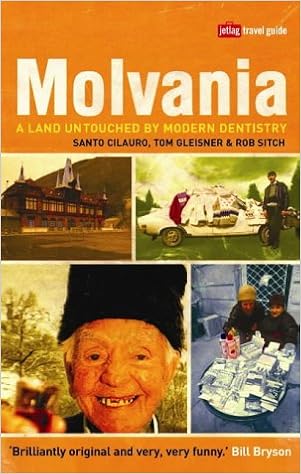
Do correct me if I’m wrong, but try as I may to detect racist undertones, Molvania: a land untouched by modern dentistry (first and most outstanding in the series Jetlag travel guides) still seems hilarious to me in its loving pastiche of the popular style of travel guides, rather than any perceived slight to Funny Foreigners. Indeed, it spares no energy in exposing racist sterotypes.

The style is faithfully observed, right down to the contributors’ biographies.

Molvania 1

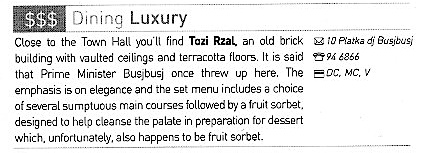
The restaurant reviews are convincing:

Molvania 2

And further to my comments on historical recreation:

Molvania 3

Nor does Molvania neglect music:

Molvania 4

A passage from the sequel Phaic Tăn: sunstroke on a shoestring might come in handy in a lecture on music and socialism:

During the 60s, many Phaic Tănese folk groups were forced to practice in secret. This was not due to government policy, it was a result of their neighbours complaining.

Voices of the world

Voix du monde

For those coming to Daoist ritual from a sinological background (as is likely)—and for those who recognize that if we are going to study ritual, that involves performance, which in turn involves sound—here’s a quick crash course. Indeed, it comes in handy for anyone—particularly for those whose concept of music and singing is based on either WAM or pop (see e.g. here and here).

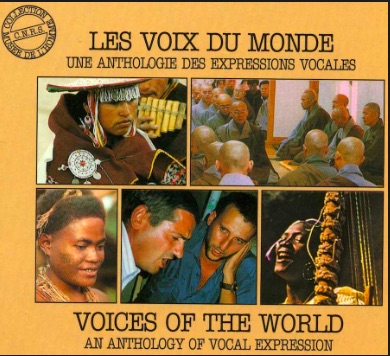
Among all the ethnomusicological surveys of vocal music, the 3-CD set

  • Les voix du monde: une anthologie des expressions vocales
    (CNRS/Musée de l’Homme, 1996),

with its detailed booklet, makes a precious introduction. A wide range of styles of vocal production is covered here:

  • Techniques
    Calls, cries, and clamours
    Voice and breath
    Spoken, declaimed, sung
    Compass and register
    Colours and timbres
    Disguised voices
    Ornamentation
    Voices and musical instruments
    Employ [sic] of harmonics
  • Polyphonies
    Heterophony
    Echoes and overlapping
    Drones and ostinato
    Parallel, oblique or contrary motion
    Chords
    Counterpoint and combined techniques.

Apart from a veritable smorgasbord [sorry, been writing too many blurbs] of amazing audio tracks from all over the world, the booklet contains valuable notes, a glossary, and tables such as “Different forms of polyphony” in graphic form:

Voix Polyphony

Here are the CDs:

For ethnic polyphony in China, see here.

Then all we need is to digest

  • Bell Yung “The nature of Chinese ritual sound“, in Yung, Rawski and Watson eds., Harmony and counterpoint: ritual music in Chinese context, pp.13–31

and we’re all set to enter the fray…

Period style

Picnic

Talking of authentic recordings, here’s the classic 1932 version of Pique-nique by Edouard Ibert (“Call me Ted”) (cf. Authorship):

With Val Rosing’s wonderful plummy voice, and great original, period instrumentation—menacing brass and xylophone, and zany woodblocks, like Cantonese jazz, I may be drawn to it by its heavy use of the pentatonic scale, but the final chorus is a definitive proclamation of those sober values that Made the British Empire “Great”, after the sinister bacchanalian debauchery of the sylvan outing…

See them gaily gad about
They love to play and shout
They never have any cares
At six o’clock their mummies and daddies will take them home to bed
Because they’re tired little teddy bears.

Cf. the reflections of Alan Bennett. And the pique-nique may remind us of Five go mad in Dorset, with lashings of ginger beer…

On a pedantic note, it’s Teddy bears’ picnic, with the apostrophe belonging after bears!

Intonation

Another maestro-baiting story about an unnamed conductor:

Rehearsing an orchestra, the conductor stops them after a complex wind chord and glares at the second oboist: “You there—that note was out of tune!”

Unabashed, the oboist retorts, “OK then maestro… so was it sharp, or was it flat?”

Floundering, the conductor goes, “It was sooo out of tune, I couldn’t tell!”

Viola jokes and maestro-baiting

Cottrell

  • Stephen Cottrell, Professional music-making in London: ethnography and experience (Ashgate, 2004)

takes a proud place among studies of more “exotic” cultures in the splendid SOAS Musicology series. Complementing the work of Bruno Nettl and Christopher Small, as well as Ruth Finnegan’s classic The hidden musicians, it strikes many a chord with my work on Chinese ritual groups.

As I observed under WAM, it’s not that Western cultures, of any kind, should be a benchmark for discussing other societies (note Is Western Art Music superior?, and What is serious music?!); to the contrary, it’s fruitful to integrate them into a “Martian” view of world cultures, wearing both emic and etic hats. Many of Cottrell’s themes resemble those that an ethnographer like me would explore in studying Daoist ritual specialists:

  • The practical aspects of earning a living
  • The importance of “on the job” training, sociability, and oral/aural experience in what seems like a narrowly text-based tradition.
  • The importance of timbre (pp.44–55), little theorised even in WAM but quite prominent in China for the qin zither, deserves recognition in Daoist ritual and shawm bands.
  • His account of “depping” (57–76) augments the parallel that I draw for household Daoists (Daoist priests of the Li family, pp.319–26), not least the insecurity of the freelance living—and it’s fascinating to read (Cottrell p.60) an account of depping from 1760s’ Britain.
  • The modification of dreams: the tensions or discord between early training and ideals (based on solistic individualism and creativity) and the delicate social/practical negotiations, frustrations, and grinding routine of professional orchestral life (42–4, 103–21; cf. also Scunthorpe and Venice, and Ecstasy and drudge); personalities and crisis management within an ensemble (89–90). I should add that household Daoists, as hereditary (almost ascriptive) artisans, don’t experience such a conflict, never setting out with such a spiritual ideal; but the practical exigencies of occupational routine are shared. Here I also think of Yang Der-ruey’s study of the changing training of Shanghai temple Daoists. Cottrell cites a telling comment:

We’re artisans rather than artists. What an orchestral musician is doing is taking someone else’s creative idea which they put down as dots on paper and actually turning it into sound. So we’re more like bricklayers—the architect would do the plan and then they actually put the bricks into place.

  • And his dissection of the performance event, subsuming ritual, theatre, and play (149–82)—continuing from Small’s account, about which he expresses reservations. He observes diversity within the audience and in their responses (159–64)—a feature that for Chinese ritual is clearly germane, not only today but even in (supposedly more homogeneous) pre-Liberation society.
  • Cottrell’s discussion of myth and humour (123–47), citing Merriam’s paradigm of low status, high importance, and deviant behaviour—“licence to deviate from behavioural norms” (137, cf. 143)—often reminds me of the Li band (cf. my book p.23); one might also think of other embattled freelancers like actors (“luvvies”). Like household Daoists, musicians are poorly paid. I might add that muso humour (particularly that of the classical muso—or the ritual specialist?!) further serves both to defuse pressure and to deflate pretension. A lot of our stories immortalise hooligan behaviour on tour. Such deviant behaviour—or at least deviant self-image—is a kind of “No, I won’t be a paragon of elite culture for you”, however childish.
  • Good too to see Cottrell drawing attention to “conductor-baiting”—better described as “maestro-baiting” (cf. his discussion of musos’ sarcastic use of the term maestro, p.139), recounting the famous story “You think I know Fuck Nothing—but I know FUCK ALL!” (135–6) (for variations, see my post on Visual culture). He attributes it to Celibidache, but I’ve heard it about Böhm (both are perfect candidates!); and outside the orchestral context it is usually attributed to director Michael Curtiz. Conductors are an authority figure par excellence. Here’s another story about George Szell:

Talking to Peter Gelb, General Director of The Met, someone was defending Szell against the charge of being a bully, remarking “Of course Szell is his own worst enemy”—to which Gelb replied “Not while I’m alive he isn’t”.

  • He cogently discusses viola jokes (131, 136, 142, 144–6)—for which whole websites have arisen, of course. In Plucking the winds (p.233) I cited this one:

What two things have the Beatles got in common with the viola section of the BBC Symphony Orchestra?
Most of them are still alive; and they haven’t been together since the 1960s.

This dates from a time in the 1980s when at least the first part of the punchline was more applicable; though still funny, the joke now has an added period charm (cf. Musical joke-dating). I’ll limit myself to one more:

What’s the difference between a viola player and a supermarket shopping trolley?
The trolley’s got a mind of its own.

Anyway—in all, such ethnographic enquiry is routinely applied to all kinds of world societies, and scholars of Daoist ritual can of course learn much from studies of the “usual suspects” like south Asia or Africa. But it may be stimulating for us to see such approaches applied to an apparently familiar (prestigious? literate?) culture that is easily taken for granted. As with the “great composers” myth, reified ancient Daoist texts can also somehow be taken for granted, tending to dominate scholarly attention at the expense of real changing social performance and experience.

See also Mozart in the jungle, Perfection is NOT the word for it, and under Perfect pitch.

Gems from Chinese history

CHC

Some drôle quotes from The Cambridge history of China, which even I didn’t quite dare sneak into the indexes:

What is the use of a stele? —Sui emperor Wendi (“Just call me Wendi”) (vol.3, p.62).

The Cheng sisters were captured and decapitated. Mopping-up operations continued till the end of 43. —(vol.1, p.271). Messy business eh.

The “director of records for the empress” may have kept a record of the emperor’s cohabitations with the empress. This cannot have been a great burden. —(vol.1, p.503).

Hierarchies are an essential part of a well-ordered society, and they must be accepted voluntarily. —(vol.1, p.705). So there.

Let us judge whether the Chinese are a race of ethnocentrics who do not know how to manage when they think they have something to learn from foreigners. (vol.1, p.852) (cf. They come over ‘ere…).

For a sequel, click here.

Ravel et al.

Further to my Ravel page (under WAM):

Tanita Tikaram (where has she been all my life?), for her wonderful Private Passions, chose Michelangeli’s version, also very fine, of the slow movement of Ravel’s Piano Concerto.

Apart from Bach (including the amazing Lalo Schifrin) she featured the slow movement of Mozart’s A major piano concerto, with the ill-fated Clara Haskil.

Yet more French letters

Female musicians, Tang Dynasty. Note konghou harpist, rear right.

Further evidence that my taste for drôlerie chinoise is far from recent: a spoof I wrote while helping Laurence Picken with his extraordinary research on Tang music—which I elaborated with another Cambridge mentor, the great Tang historian Denis Twitchett. The genre of faqu 法曲 (“dharma pieces”) has indeed been the (serious) object of scholarly attention. Reading this now, I find the fluency of my affectionate pastiche of academic style somewhat disturbing…

Informal communication with Dr T.H. Barrett [1] has suggested the possibility that faqu may actually mean “French pieces”. Study of a recently discovered and as-yet-untranscribed score from Dunhuang for “hand-wind instrument” (perhaps a kind of manually operated keyed chordophone) entitled Dunhuang shoufeng qinpu 敦煌手風琴譜 reveals a colophon dated 1st April 895 (lunar calendar) which contains references to a certain “Master Ma” (Mashi 馬師), or as we might say, “Chevalier”. The authenticity of this score is no longer in doubt. It includes many faqu, besides one title, Zhena legelede li’a 柘拿樂葛樂德篥阿, [2] evidently a transliteration from a language of the Western Regions (xiyu 西域), but otherwise unattested in Tang sources.

The contacts between the Tang court and the Western world are by now well documented. We find frequent references in Tang anecdotal sources to “strings of onions” (congchuan 蔥串), [3] often in connection with men with a certain type of moustache that became highly fashionable under the emperor Xuanzong, riding carts described as “self-propelling” (zixingche 自行車), [4] and clad in close-fitting garments with black and white stripes (a variant of the yinyang symbol?), as well as floppy caps known as beilei 鞞儡.

The French letter: a rejoinder
Further evidence of the Gallic influence on early Chinese musical culture is to be found in the ancient institution of the fashu 法書 (more recently faxin 法信) or “French letter”, a kind of prophylactic talisman deployed in ancient Chinese households in the hope of avoiding unfavorable consequences.

Traditionalists [5] might evoke the sacred power of music and the jiefa 節法 or “rhythm method”, [6] but more pragmatic counsel, favouring foreign and commercial expansion, and under the influence of Buddhist philosophy, gave rise to the “French letter”.

This popular device was available as early as the Tang dynasty in the form still to be found in temples today, the fawu liutong chu 法物流通處 or “Durex machine”. Although nowadays more innocuous material has replaced the original merchandise, the original meaning of “French thingies” (fawu) is clear. The phrase liutong is somewhat arcane: liu implies dissemination, and tong some kind of intercourse, so one might expect tongliu as an early form of resultative verb—thus, perhaps, “French thingies for penetration and ejaculation”.

Faqu tu
Yet another Gallic connection appears in the instrument fajue 法角 “French horn”, often supposed to refer to a kind of conch sounded in ritual. [7] Recent scholarship suggests that jue was often used metaphorically in the Tang, having once been associated with the debauchery of the notorious Zheng and Wei 鄭魏 kingdoms—the latter also known as “Wei-Hei”. Thus it had the connotation of “horny” or “lascivious” music, as in the term jueshi 爵士, once “gentleman of rank” but by the Tang, “jazz” or “jazzer”. The term dejue 得角 “obtain the horn” is also found in the Dunhuang MSS, apparently referring to a desire for imminent fulfillment; nor can this be limited to exclusively religious fervour.

The well-known notational technique of denoting rhythm by means of dots to the right-hand side of the note (again referring to the above jiefa “rhythm method”) is also found as early as the Dunhuang pipa score. Known as pangdian 旁點 “a bit on the side”, this practice is thought to have been inspired by the ancient French penchant for extra-curricular activities, or gewai shi 格外事.

Moreover, the ambiguity in Tang scores between jue 角 and yu 羽 modes (Aeolian and Dorian respectively, differing only in the sixth degree of the scale) may also be traced to the innovative cultural influence of the French. The term yu is in fact an abbreviation of yulong 羽龍 or “feathered dragon”, a mythical beast said to appear upon rendition of this mode (cf. Han Feizi), and this was soon formalized into what we now know as the “feather boa”, and used in the celebrated Huntuo 褌脫 or “Removing the Drawers” dance, itself remarkable for its ambiguity between jue and yu modes. Thus the apparel used in this ancient French ritual dance gave its name to the mode most often used to accompany it.

For a sequel, see here; and for more Tang drolerie, here. Click here for a roundup of posts on Tang culture.


[1] In the Aardvark and Climbing Boot, 14th October 1985. Just before closing time.
[2] For the reconstructed Tang pronunciation of this enigmatic title, see Karlgren, Grammata Serica Recensa. Can the resemblance to Je ne regrette rien be fortuitous?
[3] Alternatively, some commentators have construed this phrase as indicating the Congling 蔥嶺 range in Central Asia. Indeed, the recent excavation of a large hoard of 7th-century snail shells from this very region makes the siting of a French colony there highly plausible.
[4] Thought to refer to a mystical “journey of the spirit”: see H. Maspero, “Le voyage dans le monde intérieur et la difficulté de trouver un endroit pour le parking”, T’oung Pao 27 (1913), pp. 856–979. For a similar view of the spiritual propensities of this means of conveyance, see Flann O’Brien, The third policeman.
[5] On the conflict between rival factions under Xuanzong, see The Cambridge history of China, vol.3.
[6] See Jones, “Time gentlemen please: the bell as colotomic indicator in Chinese ritual music” (for further articles I haven’t really written, see here).
[7] Cf. the hujia 胡笳 “barbarian pipes”, another import from the Western regions. 2019 update: in an apparent nod to Goodness Gracious Me, it has recently been “proved” that the ancient Gauls came from Hunan—where Daoists still use both a conch and a curved ox-horn 牛角 (popularly known as kaluosa 咔螺薩, a more durable form of the French croissant) to great effect in their rituals. Indeed, will Chinese scholars now “prove” that Charlemagne 沙了蠻 was a Tang vassal?

1990 Daoist

Daoist priest, Quanzhou 1990.

Literary wordplay

One for readers of Chinese!

Among the ritual manuals of the Li family Daoists, the final page of Li Qing’s Xiewu ke (below left) yields this ingenious poem about the Eight Immortals (below right), each pair of “characters” making up a seven-word line (4 +3):

This has nothing to do with their ritual practice. Though the composite characters may look at first sight like talismans, any cultured reader would enjoy reading (and deciphering) the poem. For a sequel, see More composite characters.

Li Manshan enjoys such word games, and puts me onto others like this:

screen-shot-2017-01-20-at-10-35-10

to be read thus:

半夜三更門半開
小姐等到*月西斜
山高路遠無口信
哭斷肝腸少人来

* 到 to be substituted for the implied 倒:
“an upturned 等 turned back upright”.

Indeed, as Sven Osterkamp eruditely tells me, Robert Morrison remarked on a very similar poem in an entry “Enigma” in his A dictionary of the Chinese language (1822), Part III, p.142—expanded upon by Jean-Pierre Abel-Rémusat in his “Explication d’une énigme chinoise”, in vol.2 of his Mélanges asiatiques (1826), pp.266–8:

Meanwhile over lunch at a transport caff (“Greasy Chopstick”) between visits to Daoists in Shuozhou, our wonderful and erudite driver Ma Hongqi wrote this elegant poem into my notebook, said to have been composed by Yingying on her first meeting with Scholar Zhang in the Romance of the Western Chamber:

Ma poem

which, as the young scholar soon discerned, is to be read first vertically, all the way down; then back upwards, turning left at 花; then all the way back to the right; and finally back to the left, turning upwards at 花—creating this four-line verse:

九月九花金顶头
头顶金花好风流
流风好花头上戴
戴上头花九月九

Variant versions of these can be found online.

More fucking gondolas

MP

Another gratuitous spinoff from the Li band’s trip to Venice (cf. Scunthorpe and Venice, and indeed Venice: daily life in a theme park—oh, and Some Venetian greetings!):

A lesser-known gem of Monty Python is Away from it all, a ghastly travelogue with all the lovingly recreated stereotypes of John Cleese’s voiceover (Part Two should follow on):

… the one thing that Venice truly lacks—is leprechauns.

Bulgaria gets a candid assessment too:

Hard to believe, isn’t it, that these simple, happy folk are dedicated to the destruction of Western civilisation as we know it…

Eventually it’s exposed in the narrator’s increasingly deranged breakdown:

All this dashing about in search of Peace and Contentment—it doesn’t work! There’s no escaping yourself—how do you face the existential terror, the hopelessness, the dark corridors of one’s mind, the yawning, black, meaningless abyss they don’t tell you about in the brochures…

Several of us recall seeing this in the cinema as a trailer before The life of Brian.

You know whose fault it is? You lot—yes, you, you so-called cinema patrons! You sit there, stuffing your stupid faces with chocolate peanuts, gawping at these dreadful films… Well, why do you put up with them? You could stop them tomorrow if you had the guts to go to the manager and say, Why do you put this rubbish on?

For more travel clichés, see Molvania, and China–Italy: International Cultural Exchange zzzzz.

PC gone mad gone mad

Lee PC

Waaay more fatuous than political correctness is “PC gone mad”—that’s “PC gone mad” gone mad. As ever, Stewart Lee has a definitive routine:

And there’s his eloquent demolition of Amanda Platell’s complaint about Bake Off: she

made minor chocolate ripples by suggesting in print that a middle-class woman called Flora Shedden, and her chocolate carousel, were booted off the BBC’s Bake Off cake contest in favour of Muslim mum Nadiya Hussain, gay doctor Tamal Ray and “new man” Ian Cumming, because she wasn’t “politically correct” enough. Perhaps, wrote Platell, “if she’d made a chocolate mosque she’d have stood a better chance”.
[…]
The idea that a chocolate mosque would have scored better than a chocolate carousel suggests a baking competition in which, as well as for the technical quality of the cake, points are also awarded for the meaning and cultural significance of the thing that the cake is made to look like.

The idea that Shedden lost because she didn’t make a chocolate mosque would only hold water had she been in competition with other cakes that had also been baked into the shape of culturally, socially or politically significant icons, saturated with meanings designed to appeal to the liberally biased judges of Platell’s fecund imagination; i.e. a sponge Unitarian chapel, a meringue women’s refuge, a fudge abortion clinic, or an icing sugar Tom Daley. As this was not the case, and her fellow competitors’ cakes were not baked in shapes smothered with inference, it is spurious to suggest that the outcome of the cake contest was decided on these terms.

An obvious subtext to Platell’s story is that the other contestants were favoured, irrespective of the quality of their cake work, because they fulfilled some kind of politically correct quota, such as “Muslim mum” and “gay doctor”. But the idea that this could be a deciding factor is undermined by the presence of the third victor, Ian Cumming, for whom the best denigrating epithet that the increasingly desperate Platell can find is “new man”, a phrase last used pejoratively by a woman wearing legwarmers in the early 1980s.

Anyway, I’m still fond of the musos’ PC version of the Missa Solemnis:

Ms A. Solemnis

Just a harmless bit of fun

mp

Only more serious scholars of the Python oeuvre may be aware of the LP Another Monty Python Record (1971), cunningly packaged as “Beethoven Symphony No.2 In D Major”.

The album contains some of the great classics (Spanish Inquisition, Spam, and so on)—”But That’s Not Important Right Now“. Here I’d like to highlight its “serious” liner notes on the back, which eventually degenerate into a commentary on Beethoven’s Wimbledon debut.

After a lengthy and erudite account of the composer and the symphony, little comments begin to slip in inconspicuously:

The important part of the first subject is Beethoven’s almost disdainful use of the high lob, forcing Hewitt to play right up to the net.
[…]
In all the Allegro is a compact and closely argued musical proposition, which would have been impossible on a hard court.
[…]
The second tune, which Beethoven said on his arrest was “just a harmless bit of fun”…
[…]
Beethoven now goes on to Forest Hills for the American hard court championships, and if this boy can repeat the devastating lobbying and volleying which he has shown on grass, but at the same time control his tendency to swing away on his second service and backhand returns, he could earn his position as No.2 seed behind the burly Roger Chopin of Puerto Rico.

For Beethoven’s creative tribulations, click here; for his dogged refusal to write a tune, here; and for a justly neglected composer, here.

Writing English: the etic view

Further to It’s the only language they understand, we often cite another quote from a Hebei village. Watching me writing in English in my notebook, a  peasant described what I was doing as

二十几个字来回倒

It’s not easy to translate nicely—something like

messing around with a couple of dozen letters

Or even

arbitrarily jumbling up a couple of dozen letters.

This is clearly a common sentiment among those unfamiliar with the process—it always gets a laugh. Cf. a local cultural cadre’s noble attempt to render the name of my orchestral fixer in a message (here).

53 GN and WM amused cropped

Relaxing in the scripture hall between rituals, Golden Noble and Wu Mei amused by my notebook.

Actually, my notes would be pretty incomprehensible to most English people too, with all my personal acronyms, abbreviations, and pinyin—like

LMS: HL at end of ZX; + for FS, on shang fatai.

which tells me (and only me):

Li Manshan says: the percussion item Yellow Dragon Thrice Transforms Its Body (Huanglong san zhuanshen) is played at the end of the Transferring Offerings (zhuanxian) ritual, and also for the Pardon (fangshe), on ascending the ritual platform.

I often marvel when fieldworkers quote from their apparently perfectly formulated notebooks, full of theoretical reflections. Gregory Barz (Shadows in the Field, p.45–62) explores this issue well. For me, an idiolect of shorthand is vital—in the middle of chasing round trying to keep up with Li Manshan, offering round cigarettes in a noisy crowded room, snatched moments between ritual segments to document what I’ve just learned, and further seeking his guidance…

Recognition

Talking of language-learning, I like this sequence in my old German phrasebook:

The chambermaid never comes when I ring.
Are you the chambermaid?

Maybe the scenario goes like this:

Englishman rings bell.
Woman in black uniform and white apron arrives.
Englishman shrugs; she leaves.
He rings again. Woman comes back.
Englishman shrugs; she leaves.
He rings again. Woman comes back.
Irked, he says to her, “The chambermaid never comes when I ring.”
She leaves again. He rings again. Woman comes back.
(He, with dawning realization) “Are you the chambermaid?”

For a worrying Turkish spinoff, click here.

That is the snake that bit my foot

snake

If you’re thinking of dabbling with Japanese, then as a more practical guide than the sketch “How to learn Japanese in three easy lessons” (freezing cold, constipated, and absent-minded—available on request), then allow me to recommend Teach yourself Japanese, by the reputable Messrs Dunn and Yanada.

First published in 1958, it’s full of phrases that will stand you in good stead. I will cite the examples faithfully in the precise order that the plot develops; and believe me, these citations are real! (For Effle, click here, with further fine links; for another wacky linguistic fantasy, here.)

Let’s begin with

There is a hat on your head.

Gosh! Thanks for telling me! It all seems to start off so innocently. But a hint of the sinister turn that the lessons will be taking comes with

Cats die in water.

Mastery of conjugations for dying is considered essential as early as Lesson 5, and we soon meet

The cat is dead

as well as

Both the man and the dog are dead.

Lest we get bogged down, after a phrase meaning “reading is possible”, we are advised

but it is probably better not to analyse the meaning of expressions such as this.

Just don’t ask no questions and no-one gets hurt, OK? The authors appear to nurse an ambition to write screenplays for Japanese horror films:

The rain is repugnant.

He is an unpleasant child.

More arcane, with echoes of The Third Policeman, is

 Isn’t there a bicycle that isn’t heavy?

It cannot be said that they are not keen to avoid initiating us into the use of multiple negatives. Lesson 9 contains a sentence that will be vital on those visits to the Kyoto police station to take part in identity parades:

That is the snake that bit my foot.

Just imagine all those snakes lined up in identical hats and scarves. Back to the horror film:

There is someone in that room.

This time, some vocabulary for the unfortunate snake, now singled out:

I did not see anybody. I did not meet anybody.

He’s not giving in. More on that story later.

Meanwhile, idiom is the order of the day. The particle Saa

might correspond to “Let me see now”, “That’s a teaser”.

The horror film is never far away:

The window from which the child fell.

Soon after death comes the first hint of alcoholism, beginning with the classic disclaimer

I drank a little beer.

Despite the Japanese reputation for politeness, sometimes there’s just no beating around the bush:

The fact is, his suit is peculiar.

The fact is, this book is peculiar. Death is not going to be enough—by Lesson 13 we have to master suicide:

Why did he commit suicide?

Not because his suit was peculiar, I hope. To take our minds off it all, how about a vacation?

The thing to do in America is to buy shirts.

Forget the Empire State Building—though hey, we’ve already learnt the verbs for falling and committing suicide, so why not?

Let’s not be pedantic—to explain the sentence

You’ve bought the case we saw yesterday?

we are offered the helpful comment

If the case was in the window of the shop when you saw it with your friend, then, on the next day, it was gone, on meeting your friend again you might presume that he had bought it, and would use a sentence like this to ask if your presumption was correct.

Got that? More visual imagery:

We are laughing at the one the tip of which is shining.

It’s OK, they’ve only drunk a little beer. Also highly suggestive is

He saves time by using machinery.

A chainsaw, maybe? Back to philosophy:

Shall I too die tomorrow?

Look guys, we have to learn this properly: a slightly different formulation

could also be translated in the same way, but would imply the will to die—“Shall I too kill myself tomorrow?”

Ma Yuan

Most elegant scene in the budding screenplay is

I wonder if the man who was standing on the island in the middle of the river was trying to get across.

Eat your heart out, Kurosawa.

Back to our man saving time by using machinery:

Let’s use as thick and heavy a lid as possible.

For a while now we’ve been so busy dismembering people and attempting suicide with correct conjugations that we haven’t had time for another “little” drink, but at last in Lesson 16

I drank a lot of sake yesterday, so my head aches today.

Let’s face it,

In spite of the fact that he promised not to drink sake, he drinks a lot every evening.

Well, with such a peculiar suit, you have to, don’t you? More mystery:

The packet is dry, I wonder why the cigarettes are wet.

And here’s a crap-haiku version of the Bucharest bread-queue joke (also available on request—Ed.):

How many cakes are left?
There aren’t a lot of cakes left.
There’s not even one cake left.

Back at the Kyoto AA meeting, predictably, eating cakes is thirsty work:

As there was any amount of beer, we drank a lot.

I saw through that cake-eating shtick right from the start. No wonder that

Every week I think I will go to the committee meeting, but I never can.

Just can’t seem to find the time eh? Back at the police station, we overhear the interrogation following the snake identity parade:

Have you at any time been to see a Chinese play?

(“There some kinda law against it?” sneers the snake cockily, chewing his gum.)

Sure enough,

Are you all lined up?

Back to our man with the machinery:

Today’s meat is different from the usual.

Uh-oh. More useful tips:

If we leave aside the brusque imperative used in military circles and when speaking angrily to inferiors…

Meanwhile, back at the horror film:

You had better not open the door.

Oh well, what the hell:

Do you want to drink some beer?

This is getting scary:

I shall go with you, but before that will it be all right if I just phone somebody?

‘Fraid not, kid. Just get in. Useful once you’ve learnt how to say

Follow a person, trail somebody.

More homespun philosophy:

What is there after this?

Hmm, that’s a teaser. Always good to avoid embarrassment:

In the sentence above the children ran away so the teacher could not see them. A similar thought lies behind: “Let us clear this room up before the guest comes”. Here the purpose is to avoid letting the guest see what an untidy state the room is in.

Yup, beer bottles and body parts strewn all over the darn place. Don’t say you haven’t been warned:

It seems that it is dangerous to go along that road at night.

On the same page, we meet

someone who looks like a doctor.

Inevitably, we are soon asked

Is it still alive? I expect it will still be alive tomorrow.

The weather is playing its part splendidly: apart from the constant rain,

I suppose there will be fog again today.

Indeed,

If you go to a place like that once, you probably won’t want to go again.

By now I’m even worried by

May I give you some water?

Machinery man has an accomplice:

Please go and wash this knife.

For our friend who has walked along the dangerous road at night and asked to make a phone call before coming with machinery man, some more vocabulary that may come in handy—if not for long:

If there is a good opportunity I shall run away.

Too bad, just when he was thinking the man who looked like a doctor would be able to save his leg after that snake bit his foot at the Chinese play. Sure don’t look like he’s going to make that committee meeting. And what is it with water? First it’s the cigarettes, now

I only dried that suit this morning and it’s quite wet again!

The peculiar suit? Cats do tend to thrash around a lot when they’re being held down in water. There’s no escape:

They killed even the children.

Hey! Do you want us to come to your country or not?

The quicker the better.

Just when you’d quite like to be learning sentences that’ll help you make friends, learning how to walk into a shop and buy a black kimono that’s not covered in fucking bloodstains, some more handy everyday vocabulary:

He died at the second hour after taking poison.

Still, there’s useful information:

It is only the third bottle from the left which has poison in it.

Oh well, at least

He had his sword taken away by the policeman.

No wonder that

There is a funny smell in this room, isn’t there?

Not just blatant horror, the more subtle ghost story isn’t neglected either:

I feel that I have been here before.

But machinery man is getting careless:

When I looked in through the window, there was a corpse lying on the floor.

More useful vocabulary—though not for machinery man’s victims, I guess:

One’s legs are there in order that one may walk.

Or is he just goading them? They do have to be, like, attached to your body. By Lesson 27, at last we get a clue to that seemingly inconsequential phrase near the beginning:

You must not go into a room with your hat on.

I see! Machinery man just can’t help dismembering people who walk into his room wearing a hat. That early deadpan comment of his “There is a hat on your head” was the beginning of this whole nightmare. Brilliant suspense. The fact is, his suit is peculiar. Soon the psychological details fall into place:

Cats disgust him.

Lesson 30 covers the polite language, but I fear the time has long passed.

And that’s just the Lessons—you should see the Conversations.

The latest news from Japan is that it looks like the snake’s gonna get off the rap. They can’t pin nothing on him—not even a hat, and he has an alibi for the night of the Chinese play. But will it stand up in court?

Simile

Further to my remarks on Ravel (under WAM), the dreamlike last movement of Ravel’s Shéhérazade, “L’indifférent”, is clearly about an androgynous boy, as Roger Nichols (Ravel, pp.54–7) recognizes in a cogent discussion—though he gets a tad bogged down in discussing the gender of the singer/voyeur, as if it matters. You might think the title itself would offer a clue, but some translators couldn’t even countenance the androgynous boy, making it necessary to vandalize, coyly,

Tes yeux sont doux comme ceux d’une fille

into

Your eyes are soft like those of any girl.

Resting case
I mean, you wouldn’t say, “Your skin is wrinkly like that of an elephant” if you were talking to an elephant, now would you eh? I rest my case (left: me resting my case in Paris, 2017).

Simile can be silly (“What Am I Like? LOL“):

“Shall I compare thee to a summer’s day?”
“Naa,” [chewing gum], yer allright.”

Anyway, do listen to Shéhérazade in my post—and all the other enchanting ouevres there!