Daoists and Confucians

Jpeg

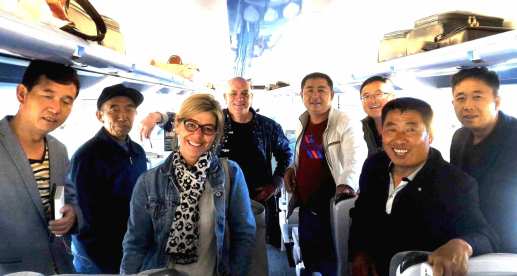
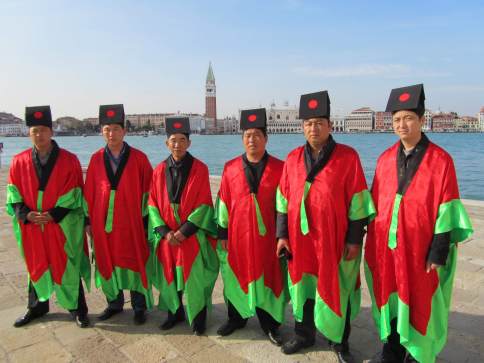
On tour in France, spellbound yet again by the Li family Daoists’ performances under the august aegis of the Confucius Institute, who better to cite than the Grand Maître himself:

子在齊闻韶,三月不知肉味,曰: 不图為樂之至于斯也。
《論語·述而》

After Confucius heard the Shao music in the kingdom of Qi, he didn’t notice the taste of meat for three months.* He said, “I had no idea that music-making could reach such heights!”
Analects §7.14.

My comment, precisely 2,534 years later:

鐘注:小子在巴闻道亦是也!
Jones notes: Lil Ol’ Me feels the same on hearing the Way in Paris! [1]

I feel blessed to have found this subject—fieldwork, inspiration, ritual, laughter. And now to take a rocking sextet on tour, all at ease with each other, great mates.

For more from Confucius, see here.


* The Analects doesn’t appear to contain his later comment, “Stuff this for a lark, anyone fancy a burger?”


[1] 巴: short for Paris 巴黎, not 巴蜀 Sichuan. Or Bali, for that matter. Note how I replace Shao by Dao.

The whole long dragon 一条龙

To bring this little French tour to fruition has involved a lot of work. A long chain of people has made it possible, from the Cini people in Venice (2012) and Thomas Roetting in Leipzig (2013) to Adeline Herrou and Hélène Bloch at Nanterre, the brilliant Yan Lu of the Nanterre Confucius Institute, Kersten Zhang our able fixer in Beijing, the Clermont-Ferrand CI team, Nicolas Prevot, the Centre Mandapa, and Li Bin in Yanggao.

Indeed, the roots of our tours, and my whole project on the Li family, go right back to Chen Kexiu’s early research and the 1990 trip to Beijing led by Li Qing.

Again, with the Li band we riff on “Without the Communist Party there would be no new China”:

(me:) Without Chen Kexiu there would be no Steve-and-the-Li-band
(Li Bin:) Without Steve  there would be no Li band tours
(me:) Without the Li band there would be no Steve

As I observed (my book, p.339):

The audiences go wild, their faces rapt; I love the feeling of turning on audiences to this music that has enchanted me for so many years. Our hosts always latch onto how very special this tour is.

Yan Lu prepared one of the most detailed schedules I’ve ever had in four decades of orchestral touring. And I love it when we’ve done all possible preparation, and then just naturally come together in haste, improvising to make the little details work, carried along on a wave of enthusiasm.

The Daoists fit into it all and always put on an amazing show night after night, so that we and everyone, dazzled by their brilliance, see that it’s all been worthwhile.

Still, all this is merely an occasional interlude for them: their daily “rice-bowl” remains performing rituals for their local community in the Yanggao countryside.

Vignettes 1: Li Manshan

Li Manshan is as adorable as ever.

I was determined to get to CDG to meet the band off their Air France flight from Beijing, but it arrived early at 5.30am, so in the end I just had to wait for them at our hotel right by Gare Saint Lazare. We met up there at 7.30, Li Manshan giving me a big grin and a hug.

Now 72 sui, he is gradually giving way to his son Li Bin, only doing nearby rituals. But he still can’t turn down requests to go and determine the date, and he still decorates coffins. This process of handing over must always happen, but no-one ever describes it. Personalities within a ritual group, the transmission from father to son as the latter gradually takes over—all such detail is absent from both historical records and most fieldwork reports. If only we could document it in detail for ancient Daoist masters like Du Guangting.

Li Manshan has new headgear, now a more trendy baseball cap, not as sweet as his old one, but hey. He only takes it off, reluctantly, when we enter Notre Dame. He also has a new mobile, the same old make, but with a new ringtone that sounds like The magic roundabout, so another of my names for him is Zebedee—who would have liked the Daoist Pacing the Void. I miss Li Manshan’s old kitsch ringtone of The little wicker basket.

After his lovely gift to me of the old folding stool he made, I gave him a digested translation of The good soldier Švejk, a copy I must have bought in Beijing in the early 1990s. I inscribed it to him:

踏罡步斗的明星李老君
Old Lord Li, superstar Stepping the Cosmos and Pacing the Dipper

“Old Lord Li” references one of our favourite ritual couplets pasted up at the gateway of the scripture hall, hard to translate elegantly:

穩如泰山盤腿座
貫定乾坤李老君
Seated in lotus posture firm as Mount Tai,
Old Lord Li thoroughly resolves the male and female elements.

And Stepping the Cosmos and Pacing the Dipper are rituals in the family’s manual collection.

Old Lord Li is immediately hooked on Švejk. I knew it would be just his cuppa tea—the innocent common man muddling his way jovially through an irrational state machinery. He can’t put it down. Later, suitably, I also give him my old spare toothbrush to use, as he hasn’t brought one.

After catching up together and working out our day, I go off with Li Manshan for the first of many meetings with Teacher Wang, now abbreviated to “hold meeting” (kaihui).

How amazing to be on tour again with this brilliant sextet who have been doing rituals together for thirty years, and who are now in the rhythm of touring abroad too. We use our secret language, always laughing.

In the concerts, the others (like Wu Mei for his amazing tricks on the wind instruments, or Golden Noble with his solo recitation) may attract more attention, but Li Manshan is right at the heart of everything, drumming unerringly, singing intensely, subtly directing. Even the twisting route he improvises on the tiny stage as he leads the final Chase round the Five Quarters, unsheathing the “precious sword” to sketch talismans on the ground, is magisterial.

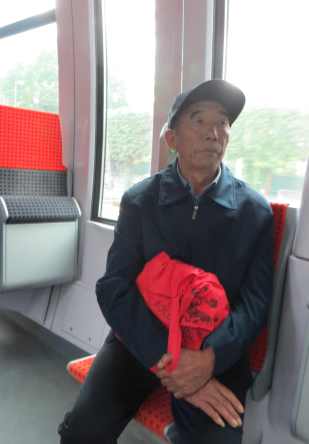
LMS on train to Nanterre

On the train to Nanterre.

Late at night we have our usual sweet chat outside the hotel. It’s been a long day, but they’re troopers.

Li Manshan is always tapping away on his fingers (even while sleeping on the train) or on his chopsticks as we wait for our meal to arrive.

LMS at Hotel Ravel

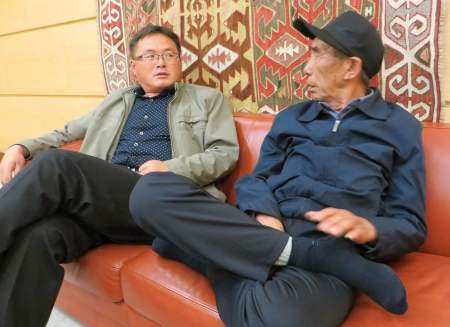
Clermont-Ferrand: two of my favourite masters.

Following a quick weekend flit to Clermont-Ferrand, after our last gig back in Paris he had a (rare) bath—the concerts are hot work, and they’re all bathed in sweat. He then slept till 1am, watched some TV, slept again, got a call from Pansi village to determine the date after a death, and was up by 4am.

We meet up in the foyer at 5am for fags outside, lovely. I take him to the bar down the road, full of workmen on the early shift, so I can have a café and orange juice as we chat with the Wenzhou people behind the bar. Trump comes on TV—Old Lord Li hasn’t even heard of him, how enviable. Back to my room together to read through a draft article by our wonderful Confucius Institute host Yan Lu that she has just sent me.

Li Manshan calls Pansi again at 6am with more guidance. It’s a village that he likes best, and they most trust him.

After our hectic schedule, we’re all glad to have a final day free for sightseeing and buying gifts. While his son spends a fortune, Li Manshan just wants to find a couple of toys for his young grandson.

LMS and WD

With his pupil Wang Ding.

A quick farewell hug, and they embark on their long journey back to Yanggao to resume their busy ritual routine. Hardly had they got back home when both Li Manshan and Li Bin had to rush off to separate villages to determine the date for more funerals, which is the start of another sequence of tasks for them over the next couple of weeks (for Li Bin’s diary after their return, see here).

See also The Li band in France: notes.

Depping with master singers

Just home from Paris after an unforgettable time with the Li family Daoists. It already seems like a dream.

Nanterre encore

Our encore, Centre Mandapa. Photo: Nicolas Prevot.

As an encore [English term—Ed. When in France say bis!] I joined in with the Li band, singing the Mantra to the Three Generations a cappella (audio playlist track 3, cf. 2001 version, track 2: commentary here).

For anyone fortunate enough to do fieldwork on Daoist ritual, I thought this might remind us of the benefits (indeed the very possibility) of participant observation; but it was also an opportunity for me to keep my hand in after a year apart from the Daoists. Having remoulded the proverb “Mr Li wearing Mr Zhang’s hat”, I enjoy refuting another popular one, “The monk from outside knows how to recite the scriptures” (wailaide heshang hui nianjing 外来的和尚会念经).

Long schooled by accompanying Mark Padmore and the Monteverdi Choir on my violin, I now have to set aside my instinct to invest words with meaning, instead trying to latch onto the lugubrious timbre of the voices of Li Manshan and Golden Noble, and Wu Mei’s guanzi. Li Manshan’s bushy eyebrows are a useful image here.

During rituals, when we sing a cappella hymns we stand in two rows of three, facing each other across the altar table. So usually I’m either playing small cymbals over the other side from Wu Mei, or playing gong at the other end. But this time I found myself standing right next to him and Golden Noble for the encore, with Li Bin (also brilliant) on my right, all of them subtly supporting me. I realised Wu Mei is not only one of the greatest wind players in the world and a brilliant player of the bo cymbals, but (like Li Manshan and Golden Noble) a fantastic singer too. Not just his nasal timbre and the projection of his voice, but the taste of his choices—where to inject extra volume and fervour, rise up high, or put in a tiny variation. Listening carefully to each other as always, dovetailing, with subtle “rules” about where to take a breath and where to sustain. There’s much more to their singing than meets the ear—the texts of the a cappella hymns are rendered with great intensity and concentration.

Over fags outside the hotel we had worked out an edited version of the Mantra, segueing smoothly from the end of the 1st verse directly into the coda of the 3rd verse. With a very subtle accelerando, its exuberant repeated final couplet begins from a high do the first time, soaring to an exuberant high mi on the repeat:

Vowing this evening to attend the ritual assembly,
Leading the deceased spirits to ascend upwards towards the Southern Palace!

We noted a nice pun, glossing “ritual assembly” (fahui) as “French concert” (Faguo yinyuehui)—the extra characters to be recited silently (monian), like a secret formula. Li Manshan congratulates me again on my silent recitation—”The only thing you’ve learned properly, Steve!”

In rituals back home they don’t always give their all, but on tour, wanting to put on a good show, they are magnificent. Standing in with the Li band—whether at a Paris concert or at a Yanggao funeral—is one of the great musical experiences of my life, “and I’ve had a few in my time I can tell you” (take your pick—Christmas Oratorio in Weimar, B Minor Mass in the Barbican after a tour of Japan, and so on…).

After all my tedious academic questions, being right in the middle of the action with these master Daoists (not “musicians”!) is overwhelming for me. Li Manshan, Golden Noble, and Wu Mei are right on my case. There are no passengers—Erqing and Wang Ding (Li Manshan’s pupil, a welcome new recruit to our touring band) are great too. Focusing on the vocal ensemble, surrounded by Li Manshan’s sparse and subtle drum patterns, the regular crotchet beat of the gong, and quavers on the bell, I also have to remember where to beat out the occasional syncopated cadences on the small cymbals with Li Manshan’s drum accents.

It reminds me of my occasional depping with them in Yanggao for funeral segments (my book, pp.325–6) when they’re one short—waiting on the substitutes’ bench. It also has a disturbing echo of my orchestral experience—that’s another depressingly familiar phone-call from orchestral fixers,

“Can you come and do a Messiah next Tuesday in Barnsley? I’ve tried everyone, we’re absolutely desperate!”

Thanks a lot…

Our chats turned to the singing of the revered older generation of Li Qing and his colleagues. Li Zengguang was admired as a vocal liturgist; Li Qing’s own voice declined somewhat with age. Some had fine voices but less mastery of the texts; other masters who knew all the texts perfectly were somewhat variable in intonation and vocal ability. Apart from their astounding instrumental ensemble, I doubt if there’s ever been a more brilliant vocal group than the present band under Li Manshan, working together almost daily for thirty years.

More useful socialist vocabulary

I’ve mentioned several distinctive terms in the vocabulary of former socialist countries, like China and the GDR. But still more usefully:

Lumumba

It’s good to learn that what is called caffé corretto in Italy (an espresso “corrected”, with grappa, or what the Chinese term with blunt accuracy dub “white spirit”) was known in Communist Albania as a Lumumba. (Garton Ash, The file, p.45). Well, you do need a snifter to get through all those Norman Wisdom films. (Cf. elsewhere in north Europe, where it is a somewhat different beverage.)

Cubalibre

This is rather in the spirit (sic) of the cubalibre[1] one of my favourite tipples in Spain as a change from my standard G&T. By contrast with the mealy-mouthed measures of English pubs (which should come with a microscope), both are notable because you are presented with a large tumbler into which the waiter pours an unlimited quantity of gin/rum/bacardi, leaving only a token amount of room for a casual dash of tonic/coke.

The cubalibre is quite familiar to our Spanish waiter, but I always enjoy the little ritual we go through whereby he looks enquiringly at the range of spirits behind the bar while I specify, with one of my few fluent phrases,

… con Ron, por favor!

Back in Blighty, the Spanish influence on my own domestic aperitifs is clear in my generous measures from the Azure Cloud Bottle—to which my address on the home page pays fitting homage. I ring the changes by buying the occasional bottle of Tanqueray, purely in homage to Amy.

In China, where the 1957 Anti-Rightist backlash following the Hundred Flowers movement was prompted in no small measure by the recent Hungarian uprising, the threat of liberal agitation was charmingly known as goulash deviationism. That sounds funny to us now, even if at the time it was a taint that could ruin people’s lives and destroy whole families.

The Lumumba never caught on in China—whyever would you want to dilute white spirit? But they did stage a rally to protest his killing in 1961:

[1] “Free Cuba”—descriptive or prescriptive?! Cf. the British tabloid headline
“Free Nelson Mandela”,
to which a reader wrote in,
“I dunno what a Nelson Mandela is, but if it’s free, can I have one please?”

And now we have this headline, which could do with a bit of punctuation:

Come on England

Registers

Talking of acronyms, one that slips less lightly off the tongue is ENSRC, a useful network for Chinese religion led by the indefatigable Philip Clart and Vincent Goossaert.

I welcome spoof suggestions for what ENSRC might stand for, à la LUFTHANSA…

There’s been a recent flurry of discussion there about Daoist lu registers (not the lu emoluments that I miss), discussing their varied formats and functions (have we no homes to go to?!).

I don’t think anyone has yet suggested that such registers were ever rolled up in the form of a scroll, but if they were (by analogy with baojuan “precious scriptures”, sometimes rendered as “divine rolls“), they might be known as

lu rolls

Wordplay with Daoists

Sometimes when I’m with the Li family Daoists I wear my SOAS T-shirt, which bears the name “SOAS, London University” in most of the Oriental and African languages taught there. The Chinese version, on the back, reads

伦大亚非学院         Lunda YaFei xueyuan,

Lunda being short for Lundun daxue (London University),* Yafei short for Yazhou (Asia) and Feizhou (African), and xueyuan meaning academy. One day in Italy the ever-lively Third Tiger, Li Manshan’s younger brother, frowning as he tried to interpret these six arcane characters, asked me,

What’s Lundaya feixueyuan supposed to mean?

We all burst out laughing, as usual. He was reading it not as three binomes (Lunda—YaFei—xueyuan), but as Lundaya—some weird transliteration of a foreign name, perhaps?—and feixueyuan, “anti-academy”. But his interpretation has stuck; it has a further resonance when adorning my own back, since with my championing of more earthy folk sounds I’m (ever-so-slightly simplistically) notorious for my anti-conservatoire stance… On my next visit to Yanggao I just had to bring a SOAS T-shirt to give him.

In similar vein (my book, pp.331—2), Li Manshan and I have a lot of fun with the name Intangible Cultural Heritage. The Chinese translation Feiwuzhi wenhua yichan is itself flagrantly at odds with, um, the Chinese heritage. I set the ball rolling by wilfully getting the name wrong, calling it Feiwenhua wuzhi yichan, “Anti-cultural materialistic heritage.” Li Manshan, now designated as a Transmitter of the ICH, takes up the riff: when I joke with him, “You’re an Intangible (feiwuzhi)!”, he comes back with: “Ha, I’m a Waste of Space (feiwu 废物), more like!” This becomes our regular name for the project.

For more T-shirts, see here—oh, and here. And for more wordplay with Daoists, here.

*Another regular sources of giggles on visits to rural latrines is the common re-formation of Lundun with the characters 轮蹲, “taking turns to squat”, further elaborated in our revision of Lundun dashiguan 伦敦大使馆 “London embassy” to  轮蹲大屎馆  or “Taking turns to squat in the big London shithouse”…

Poetic satire

Of a different type of ingenuity from more literary wordplay is a couplet pasted up at people’s doorways in the Cultural Revolution (see my Daoist priests of the Li family, p.131).

In one of few ways that peasants could ridicule the rigid political system, some satirised the deprivation of their conditions. A couplet commonly pasted up at the time ran succinctly:

Two three four five, six seven eight nine.

This may not seem like the most inspired piece of poetry, but Chinese is so ingenious—everyone knew that the lack of the numbers one and ten meant that people had no yi (“one,” also clothing) or shi (“ten,” also food)—queyi shaoshi 缺衣少食, a proverb that goes back to the Ming dynasty.

queyi shaoshi

One of the Daoists pasted the couplet up and was ticked off by the village cadres. Like naughty schoolboys, villagers joked that so-and-so may have written it but someone else had thought it up. But it was engraved in the sullen sardonic hearts of many peasants.

Still, their impotence reminds me of Peter Cook’s comment:

those wonderful Berlin cabarets which did so much to stop the rise of Hitler and prevent the outbreak of the Second World War.

As today, satirists’ gain is society’s loss…

See also under famine.

Two Chinese–English novels

Two novels over half a century apart give a flavour of changing Chinese experiences in Britain.

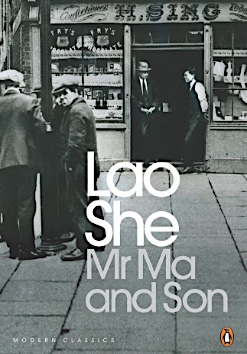
Lao She cover

Mr Ma and son
Lao She
(1899–1966) wrote Mr Ma & Son: a sojourn in London in the 1920s—while he was a young lecturer at SOAS, indeed. At a time when Chinese in the West were represented by “yellow devil” stereotypes like Fu Manchu and Anna May Wong, he evokes the difficulties of mutual comprehension, and the gulf between Chinese workers in the East End and patriotic students trying to negotiate their place in the world—all still ongoing issues.

Back in China, after leading the All-China Resistance Association of writers and artists during the Japanese occupation, Lao She enjoyed another sojourn in the USA until returning to Beijing in 1949. He perhaps made a more inevitable recruit to the political cause after Liberation than the great musicologist Yang Yinliu, but all such intellectuals had to negotiate a tortuous path. In the 1950s he got to know the Hrdličkas in Beijing.

Lao She’s Afterword (“How I wrote Mr Ma & Son”) is full of sophisticated and modest reflections on the encounter between of classical and vernacular style—all the more impressive in view of the later indignities inflicted by the simplistic prose style of Maoist ideology, not to mention his own brutal fate at the outset of the Cultural Revolution.

Mo cover

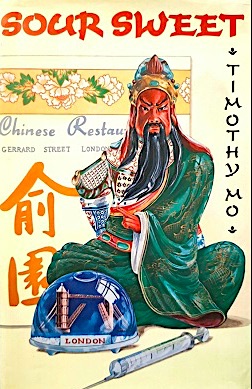
Sour sweet
Timothy Mo’s 1982 novel Sour sweet is a brilliant evocation of the insecurity of newly-arrived Cantonese immigrants to the UK in the 1960s. Concerned with a different set of questions to intellectuals like Lao She, they seek to survive with their little takeaway business. Little by little, ineluctably, the seemingly separate family worlds of innocent domesticity and Triad brutality clash in shockingly graphic violence.

It’s also very funny. Mo captures the language of new arrivals brilliantly. They put up notices in the restaurant:

MANAGEMENT NOT RESPONSIBLE FOR COOK’S COOKING

TRESPASSER WOULD BE PROSECUTED

Once,

Seeing that Mui and the lorry driver have brought a crate of Coca Cola: “Ah,” said Lily, “Whore Lock!” (or a close phonetic representation to that effect), identifying one of the products in question by its Cantonese name.

‘Eh?’ said the driver, considerably startled.

Lily smiled her charming (for westerners) smile. “You like Whore Lock all the time, too, hah! It’s the real thing!” she quoted enthusiastically. Mui averted what might have turned into major embarrassment all around. “My sister not understand English too much,” she explained. “you please excuse.”

Reminiscent of my mentor Paul Kratochvil’s story is an exclamation that Mui hears from one of the truck drivers:

Far kin aid her!

for which she supplies a suitably Confucian interpretation:

May distant relatives come to her assistance.

(Despite a thorough trawl, I haven’t retrieved the original quote, so this is my memory of it. Anyone?)

And Lily’s alarm when she learns of the Terror Pin at her young son Man Kee’s school:

Lily was horrified but not basically surprised. Typical of the English: their discipline was either lax to the point of non-existence or ferocious—like beating Hong Kong factory workers senseless with truncheons and then giving them free medical treatment. The Terror Pin was kept in a glass box of its own. (Display of force often eliminated need for its exercise.) Occasionally, it was brought out when as an additional refinement of torture the children was actually allowed to handle it! She discovered it when she saw Man Kee taking some winter greens in his satchel, obviously as some kind of propitiatory offering, similar to the symbolic offering of lettuce (money) to the New Year dragon. Concerned, as what mother wouldn’t have been, Lily examined Son’s adorable arms for tell-tale puncture marks but hadn’t found any. Good boy.

For some discussion, see here, and this weighty analysis of the book’s Confucian—and Daoist—themes is intriguing. The Daoist link also features here. For Chinese music in Soho, click here, and for immigration, here.

Dire straits

Shuishen huore

Source here.

In China my vocabulary—acquired at a time when the commune system was still a recent memory—is absurdly peppered with classic expressions from the Maoist era, like “not taking a single needle or thread from the masses”. My Chinese colleagues have been known to exclaim, “Steve, you sound like a bloody village Party Secretary from the 1950s!”

Of course my usage (like much convoluted Oxbridge-speak) is partly satirical—but only partly.

One handy phrase is actually ancient, going right back to Mencius:

shuishen huore 水深火热
“waters deep, fires raging”—or simply “in desperate straits”

Used in imperial times to describe the abysmal sufferings of the common people, it was applied under Maoism [by Mao? source?] to the plight of populations under capitalism, in need of rescue. Elaborating on the motto, here’s an instance of the lively critiques going on these days (this is from a US-based site, but it’s no longer unimaginable within China):

During the Cultural Revolution there was a famous slogan, “The happy Chinese people are deeply solicitous for the American people, who live in desperate plight”. Experience tells us that the standard of living of the American people living in desperate plight far exceeded that of the happy Chinese people, and that the American people living in desperate plight didn’t seem to need the concern of the happy Chinese people. Under the theory of the great class struggle, tens of millions of happy Chinese people starved to death.

Again, when I use the phrase “waters deep, fires raging” about life in the UK or the West, I’m not being entirely satirical. It partly ties in with that “typical” English self-deprecation, and as the above quote shows, the irony of applying it to the USA can have been lost on few Chinese, even under Maoism. But the expression can be genuinely useful—it is worth reminding some Chinese people (who may still have a rose-tinted view of life in the “Western paradise”) about homelessness, alienation, strains on social care, and so on. If we can be honest about our problems, perhaps China can be too—let’s dispense with the platitudes.

Anyway, “waters deep, fires raging” never came in so handy as now—to describe the current turmoil amidst environmental degradation and moral turpitude, with civilized values widely threatened. Finally its time has come.

The Catechism of Chinese Cliché

li-band-venice

Following the Li family Daoists‘ 2012 tour of Italy, praise within China came in a report published online in the regional capital Datong. Written in bold red characters in the style of a report on a bumper harvest in the Great Leap Forward, here’s an excerpt:

cliché

Recalling Myles and my very own Catechism of Orchestral Cliché, this inspires me to pen a Catechism of Chinese Cliché:

What kind of response did they evince in their audience? Would it have been sullen and apathetic, by any chance?
No. It was warm and enthusiastic, Begob.

What did the performances achieve?
They consolidated the friendship between the Chinese and Italian Peoples.

Surely they did more than consolidate it?
OK, they developed it too.

And what was the art of Chinese Daoist culture able to do where?
Be magnified 弘扬 and promoted 宣传 in a foreign country.

Just in a foreign country?
Oh all right then, you win—on the soil of a foreign country.

So what did the performances receive from the Italian people?
A good assessment and high praise.

And what did the tour do for the entire group?
Um, it encouraged and stimulated their trust and determination to revive our Chinese Daoism.

So since their return, what are they now doing?
They are gradually perfecting and elevating their art.

Is that all?
[grits teethThey are developing and strengthening it too. Do give it a rest.

The report also contains a resounding clarion call:

This is the pride of us Chinese People! The pride of the Chinese Nationality! It is the pride of us Shanxi people! The pride of Datong people! More precisely, it is the pride of our 300,000 People of Yanggao!

I’m not entirely taking the piss. A report like that, however comical and cliché-ridden it may seem, evinces genuine feelings. Even if such terms are alien to peasants like Li Manshan, some people do use them, and most can; and it’s a useful skill for us outsiders to deploy them in suitable contexts.

Also, such coverage subtly, um, Consolidates the reputation of the Li family and Daoist ritual in north Shanxi. What it doesn’t do is make local patrons and audiences value their rituals as much as pop music.

BTW, the article is quite right to observe that “More precisely, it is the pride of our 300,000 People of Yanggao”. Still, it uses the duplicitous Chinese media title for the Li band, “Hengshan Daoist Music Troupe”—which I take to the cleaners here.

Still on the theme of International Cultural Exchange (grrr) between China and Italy, I penned the party game The Silk Road (“hours of harmless fun for all the family!”).

While we’re about it,

What is the Venice of the East?
Suzhou, if you must. Like Balham is gateway to the south.

Note also clichés of Chinese art and music, as well as the fine parody Eat, pray, self-love: my lyrical journey through the heart of genocide country. Cf. Tibetan clichés.

Festivals: the official—folk continuum

The upcoming CHIME conference in LA (29 March to 2 April), presided over by the excellent Helen Rees, looks like a fine event, though I can’t make it. The theme this time is festivals.

Gansu miaohui FKTemple procession, Xincheng, south Gansu, June 1997. [1]
Photo: Frank Kouwenhoven. © CHIME, all rights reserved.

Of course, festivals and pilgrimages all over the world are a major theme of ethnography: not just Uyghur meshreps and mazar, and Tibetan monastery festivals, but Indian melas, Sufi festivals, the Mediterranean (Andalucian fiestas, south Italy…), Moroccan ahouach, you name it. Bernard Lortat-Jacob’s 1994 book Musiques en fête is charmant, with wise and vivid words about Morocco, Sardinia, and Romania (¡¿BTW, why do French books put the list of contents at the back?! ¡¿Typical Gallic contrariness?!)

To adopt the metaphor of “the whole dragon” again, there is a long continuum between folk festivals, based on ritual (often calendrical) observances, and secular events for a largely urban audience.

So I too am going to link up diverse themes like temple fairs, ritual, famine, village names, Eurovision, and propaganda. It does make sense, though—trust me, I’m a doctor.

Traditional events in China`
Funeral rituals have been my main topic in China for thirty years, but of course it’s not easy to plan visits much in advance. The calendrical dates of temple fairs (often known as miaohui) may seem easier to anticipate. Again, scholars of religion tend to home in on their specifically religious elements, as in the great jiao Offering—though note Ken Dean’s fine film Bored in heaven. But like funerals they are multivalent, embracing all kinds of activity: ritual, opera, folk-song, pop, commerce, “hosting” and “red-hot sociality” (Chau!)…

Apart from my 2007 and 2009 books, names like Zhao Shiyu, Guo Yuhua, Wang Mingming, Yue Yongyi, Stephan FeuchtwangAdam Chau, and Wu Fan spring to mind. The knack is to detail both sacred and secular aspects of temple fairs.

But the dates of calendrical rituals, like temple fairs, may not be easily vouchsafed to the outsider either. The temple fairs on the Houshan mountains in Yixian county southwest of Beijing, mainly in the 3rd and 7th moons, are much less well known than those of Miaofengshan, but they also draw huge crowds, both local and from further afield.

To work all this out you have to spend time around the villages of Liujing and Matou in the foothills around Houshan, and then observe who goes where when and does what. Although Chinese villagers are a rich source of ritual and musical information (far more than any silent library), they often speak prescriptively rather than descriptively, telling us on what occasions a jiao Offering ritual should be performed, whether or not is has been performed since the 1940s. They don’t necessarily volunteer information on change, preferring (like some officials and scholars) to present their traditions as constant, eternal—even if contexts and repertoires have evidently changed in their lifetime. On our first visit to Liujing we rather assumed that villagers’ descriptions of ritual pilgrimages related to “the past”— but we soon found that they were very much alive.

The Songs-for-winds associations: propaganda and catastrophe
What got me “thinking” (I use the word loosely) about all this was that 1950 visit to Tianjin of the “Songs-for-winds” band from Ziwei village, in what later became Dingxian county.

The Central Conservatoire (as it was then) was then still based at Tianjin, of course. The work of Yang Yinliu and Cao Anhe on the Songs-for-winds may be considered a prelude to that on the more solemn ritual style of the Beijing temples that Yang undertook from 1952, a topic that was to expand vastly after 1986. But the Songs-for-winds groups, more popular than the ritual style that is my main focus, are worth a little detour here.

We should bear in mind that such wind ensembles were quite unfamiliar to southerners like Yang and Cao. Having invited the Ziwei band to the conservatoire, they recorded their repertoire on a Webster wire recorder. The band went back some six generations, and under the leadership of the celebrated Wang Chengkui, they had invited the great wind player Yang Yuanheng  to teach them in the winters of 1945 and 1946. Yang Yuanheng, a former Daoist priest in a little temple in Anping county, was himself appointed professor of guanzi oboe at the conservatoire in 1950. [2] Yang Yuanheng, like the Buddhist monk Haibo, was a major influence on many shengguan ritual associations in the area: we would hear their names from many village associations.

Yang and Cao’s monograph on the Ziwei band, published in 1952,  consists mainly of transcriptions, with little of the social detail that they covered for the Wuxi Daoists or Yang’s 1956 Hunan fieldtrip. Ziwei would go on to supply wind players to many state troupes for decades to come.

Langfang huahui 1991

Secular New Year’s huahui parade, Langfang city, 1991.

Xushui
Adapted from my Folk music of China (p.196):

During the 1958 Great Leap Forward (or Backward, as it’s known), Dingxian and particularly Xushui counties became model counties for the relentless drive to full communization. [3] At the height of the Leap back in August 1958, Chairman Mao visited communes there. In Dasigexiang district just southeast of Xushui county-town, Dasigezhuang village was now renamed the 4th August brigade. Notable for its revolutionary fervour at this time was the “Great Leap Forward Songs-for winds association” of Qianminzhuang brigade in Xushui, which performed for this visit.

The propaganda of the Leap makes a stark contrast with the grim realities of the period, with villages throughout the area suffering from crop failure, famine, and social disruption.

Our visit to Qianminzhuang in 1993 was the only time I’ve ever had a police escort—to take me there for a change, not to drag me away! Predictably, such an effusive welcome for me as a “foreign guest” indicated close supervision and censorship of our fieldwork.

QMZ band 1993

QMZ pose 1993

Striking a pose with the leaders, Qianminzhuang 1993

In 1995 we visited some of the senior musicians independently, with much more useful results.

Xushui’s favoured status did nothing to prevent many starving to death there in 1960—but just near Qianminzhuang, the Gaozhuang ritual association still managed to restart in 1961. Religion revived in China precisely at moments of political crisis such as the famines of 1960 and the Cultural Revolution, albeit with great difficulty. It may provide solace, or a focus for resistance—both against Maoism and later against the insecurities ensuing its demise.

The Gaozhuang ritual association was one of many in Xushui villages that used, and use, the older more solemn shengguan style. Ritual associations throughout the area commonly claim transmission from either Buddhist monks (heshangjing 和尚經) or Daoist priests (laodaojing 老道經)—the Gaozhuang association is Buddhist-transmitted. In another common taxonomy, the association divides into “front altar” (qiantan, the shengguan instrumental ensemble, and “rear altar” (houtan, vocal liturgy).

Despite its revolutionary image, Xushui county has remained a hotbed for religion, notably the cult of the sectarian creator goddess Wusheng laomu. Associations there commonly hang out ritual paintings, like the Ten Kings (Shiwang) or Water and Land (Shuilu) series, and they use “precious scrolls” and other ritual manuals. They too are within the catchment area of Houtu worship—they used to make the pilgrimage to Houshan. Even the revolutionary Qianminzhuang band told us that their former tradition was to recite the scriptures, performing only as a social duty for funerals, not for weddings. And certainly not to accompany mendacious parades to report a bumper harvest…

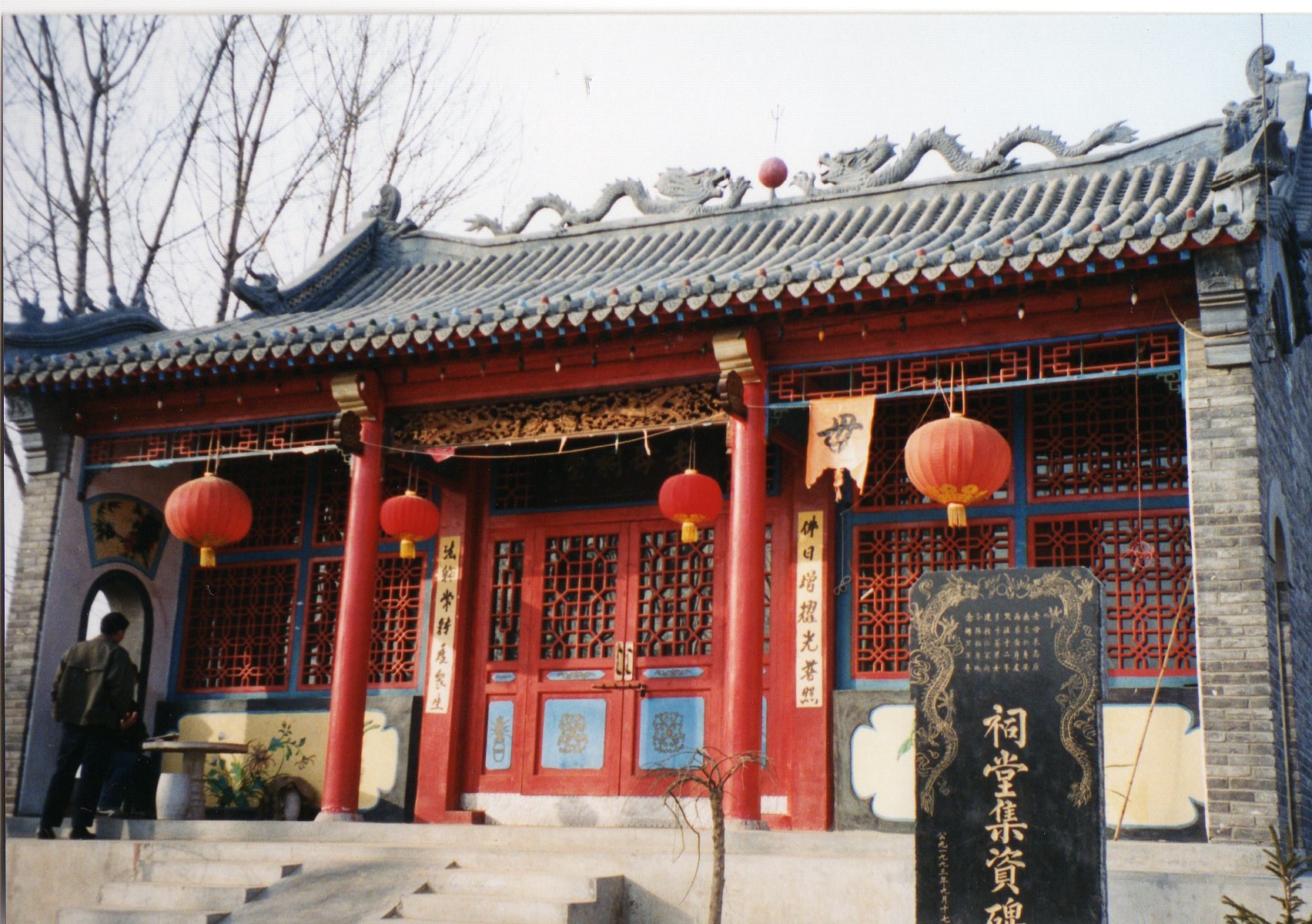
In 1994 the Gaozhuang association built an Ancestral Hall to Venerable Mother (Laomu citang), occupying about one mu, stylish and grand. It cost around 60,000 kuai to build; the stele lists 132 donors, who gave from 50 up to 3,000 kuai. The altar has Wusheng laomu in the centre, Wangmu niangniang and Songzi niangniang to the right, Cangu niangniang and Houtu niangniang to the left.

Gaozhuang citang

The village Party Secretary told us that sources of support included incense money from the Great Tent Association (Dapeng hui, a common term in the area for a ritual association) and from the temple, and money from fortune-telling and curing illness. He reflected, “A dozen or so women kept on coming to see me about building a temple. I had no choice—the brigade couldn’t refuse, so I gave them a plot of land. Believing in the gods and having a temple is no bad thing, it’s not as if you stop production if you believe in it!”

In all, the flamboyant (and readily secularized) Songs-for-winds style remains a common image of wind bands on the Hebei plain, but since all our fieldwork through the 1990s it is clear that ritual practice, with its more solemn shengguan instrumental style, is both older and more common. It is resilient too. This persistence of tradition, both in religious and musical practice, is all the more striking in such a once-revolutionary county as Xushui.

Mao was impressively modest about his limited success when he admitted to Nixon in 1972:

“I haven’t been able to change [China]—I’ve only been able to change a few places in the vicinity of Peking.”  [4]

But he wasn’t modest enough: in some ways even a county so near Beijing, such a focus of the revolution, has remained resistant to Maoist ideology, predating and outliving it. Still, disruption was severe. For more on Xushui, see here.

Official festivals in the 1950s
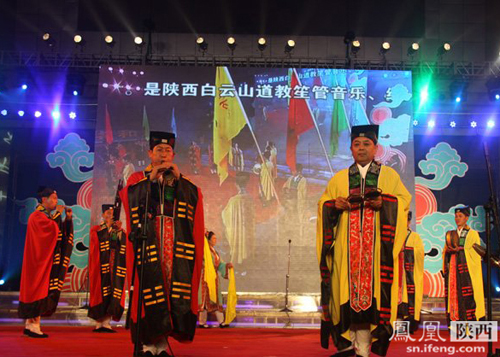
Meanwhile, the new government, in its own way, was promoting local culture through the medium of regional folk festivals (diaoyan, huiyan). First, local festivals were held to select representatives for major performances in the regional capitals. Some laicized priests were even assembled to perform as “troupes“, sometimes for the first time in many years—such as Baiyunshan Daoists (1955), Wudangshan Daoists (1956 and 1957), Wutaishan Buddhists (1958). For such performances, inevitably, their shengguan instrumental music was plucked out of its ritual context. I haven’t heard stories as distressing as the fate that befell kobzari blind minstrels in Ukraine when summoned for an official festival in the early 1930s; but folk ritual specialists were still anxious about performing for officials around 1980.

These festivals served partly as auditions for the state song-and-dance troupes then expanding all over China. Daoist and Buddhist ritual specialists had a deserved reputation as outstanding instrumentalists. Many, like our very own Li Qing (my book pp.113–25), were recruited as musicians to state troupes around 1958—and then sent home again as the state apparatus collapsed in 1962.

While such festivals stimulated the collection and documentation of folk music, we must balance this with the ongoing assaults on its traditional context. The background ( beginning from the 1940s) was campaigns against “feudal superstition”, terrifying public executions of sectarians, and the destruction of temple life.

The reform era
Urban festivals featuring rural groups—perhaps related to a conference—make a convenient recourse for busy academics into whose holidays they fit nicely. From the 1980s, the secular arts festivals of the Maoist era were remoulded into more glossy events. In 1990 the Li family Daoists took part in a festival of religious music in Beijing.

By the 21st century the new ideology was confirmed in the regular staged “living fossil” presentations of the Intangible Cultural Heritage. The latter project, with its whole bureaucratic workings, has now become a major research topic on its own, at the expense of studies of the local traditions that it is supposed to assist (my book pp.331–3). Note also the Qujiaying bandwagon.

I tend to steer clear of conferences, but in May 2016, as a pretext for going to hang out yet again with Li Manshan in Shanxi for a couple of weeks, I accepted an invitation to take part in a conference celebrating the 80th birthday of my esteemed teacher Yuan Jingfang in Beijing (for the resulting volume, see here).

It was a déjà-vu experience. Apart from a sequence of eulogies, the event also featured staged performances from three representatives of Yuan Jingfang’s long-term research areas: the Hanzhuang ritual association from Xiongxian in Hebei (near Xushui), the Zhihua temple group, and a ritual band from near Xi’an.

Hanzhuang 1993

Filming the Hanzhuang association in their ritual tent, 1993 (photo: Xue Yibing). Rear centre: two frames of ten-gong yunluo.

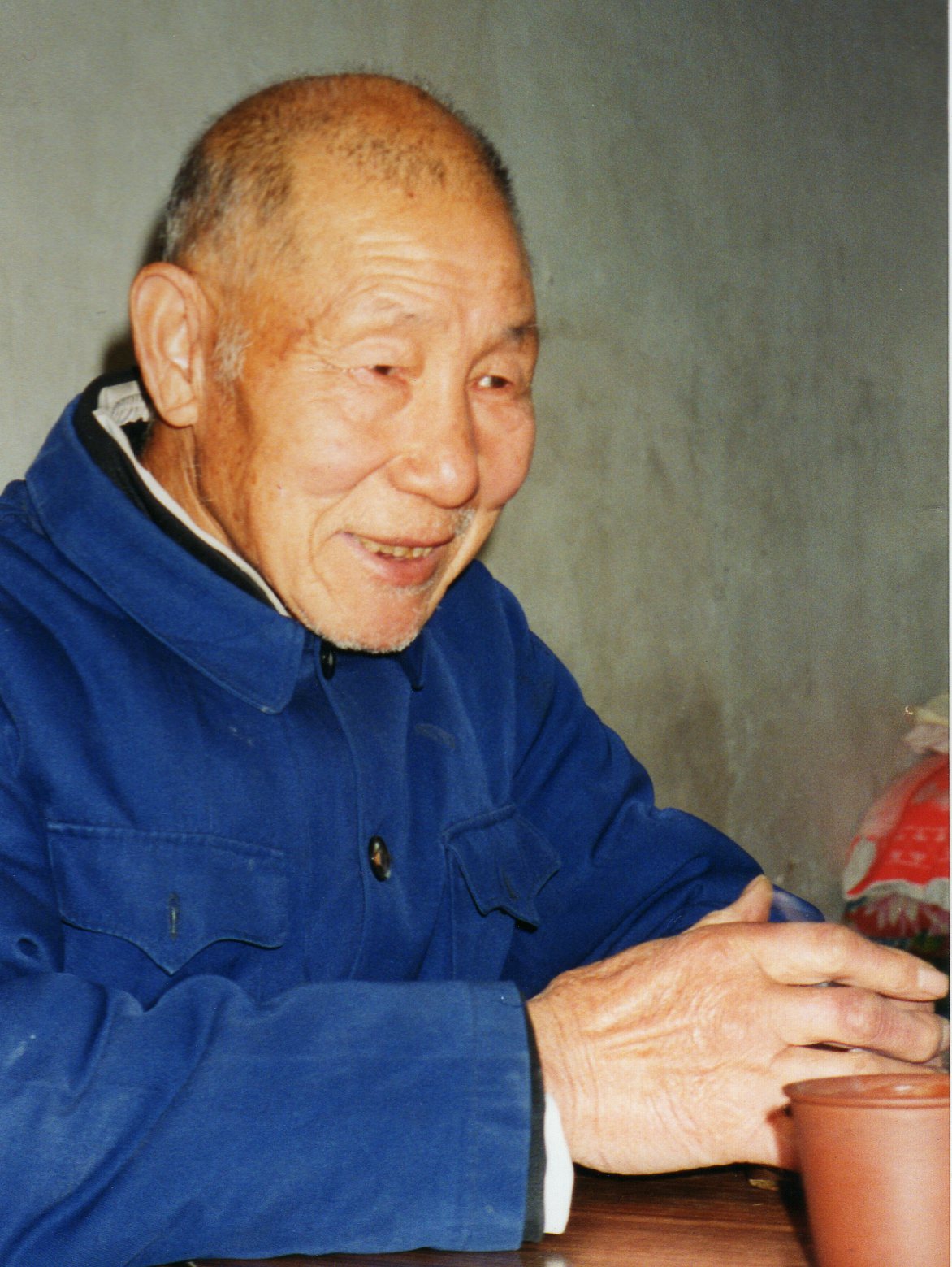
It made me feel my age, reminding me of all our visits to these very groups between 1986 and 2001. Taking time out of the conference to chat with the Hanzhuang group outside by the lake, we recalled their kindly association leader Xie Yongxiang 解永祥, father of the present leader, and another of those wise sheng masters. We had learned a lot from him in 1993 and 1995.

Xie Yongxiang 1995

Xie Yongxiang, 1995

But returning to the conference—the object of admiration, inevitably, was their “music”, detached from its enduring social context. I already missed hanging out with Li Manshan in the scripture hall.

All the glossy stage presentation has many Western parallels—flamenco on the Terry Wogan show, WOMAD, Songlines, prizes, urbane discourse explaining its “cultural value” to outsiders… The fancy costumes and dry ice of many Chinese events are reminiscent of Eurovision; they may seem like a Disneyland version of the Chinese heritage.

That photo comes from a recent ICH “performance” of the Baiyunshan Daoists, no less.

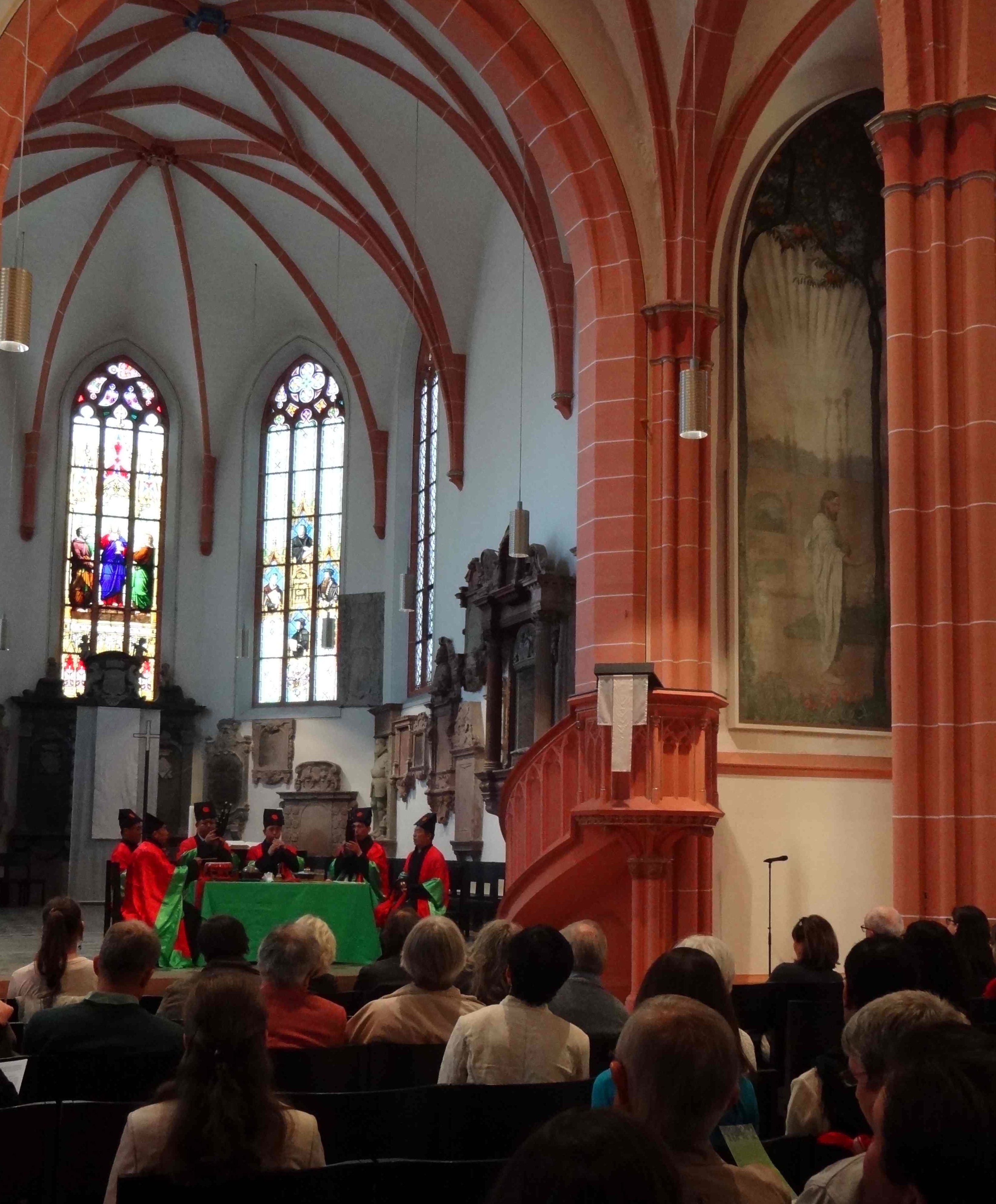
Now, I adore opportunities to present the Li family Daoist band on the concert platform (see e.g. this post and a whole related series of vignettes from May 2017), but while it is of course a compromise, we take care not to tart them up—we can hardly do otherwise, so solemn is their demeanour. The ambience and acoustic of churches makes a fine setting,  the Daoists’ sheng mouth-organs filling the Peterskirche in Heidelberg on our 2013 tour (cf. Buildings and music):

Hberg 2012

The Li family Daoist band in concert, Heidelberg April 2013.

Still, their regular “rice-bowl”—day in, day out—is always performing funerals for their local, not global, clientele.

What is dodgy is when people begin mistaking the staged events for the Real Thing, or some kind of ideal. Urbanites may do so, but villagers know better. Of course those staged events are themselves a legitimate, and popular, object of scholarly analysis. But I worry that it creates a fait accompli, like the way that in old-school WAM musicology the Great Composers were the main story (as deconstructed by McClary, Small, Nettl)—“this is what we find, so it must reflect the real picture, and so this is the object of study”. As always, “modern” secular performance doesn’t replace traditional activity: they co-exist.

The CHIME conference in LA will doubtless turn up many instances of what I’m struggling not to call “contested negotiation”. Anyway, staged events can give us a lead, rather like using the photos in the Anthology, otherwise flawed, to draw us towards folk activity.

For thoughts on the theme of the 2021 CHIME conference, see here.


[1] For more, see Frank Kouwenhoven, “Love songs and temple festivals in northwest China: musical laughter in the face of adversity”, in Frank Kouwenhoven and James Kippen eds., Music, dance and the art of seduction.
[2] For this whole section, see my Folk music of China, pp.48–52, 195–203; “Chinese ritual music under Mao and Deng”, British Journal of Ethnomusicology 8 (1999): 27–66; “Reading between the lines: reflections on the massive Anthology of folk music of the Chinese peoples”, Ethnomusicology 47.3 (2003): 287–337. See also my In search of the folk Daoists of north China, pp.166–7, 183–4, 188–90.
[3] As correctives to all the Xushui propaganda, see e.g. the brilliant works of Friedman, Pickowicz, and Selden, Chinese village, socialist state and Revolution, resistance, and reform in village China—describing a commune not far from Xushui. Note Chinese village, socialist state, pp.215–20; Dikötter, Mao’s great famine, pp.40, 47–9, 68–70; and estimable analysis online in Chinese, e.g. http://mjlsh.usc.cuhk.edu.hk/book.aspx?cid=6&tid=184&pid=2269. For the model commune of Greater Quanshan in Shanxi, precursor of Dazhai, and temporary “home” to the Li family Daoists, see my Daoist priests of the Li family, pp.122–3, and here, under “Famine in China”.
[4] Also reported by Henry Kissinger in Newsweek, 3rd March 1997, p.31.

Reading Chinese: a caveat

Not unlike the order of spoken binomes, temple placards can be confusing to read. Written horizontally, they usually read from right to left; but sometimes, as when an emperor bestows a placard on a temple, they may read from left to right. This can even be an issue in reading secular slogans, which now almost always read from left to right.

Among the numerous stories of Tian Qing, eminent pundit of the Intangible Cultural Heritage, this is one of few that I dare publish…

A distinguished elderly Buddhist monk from mainland China was visiting Taiwan. Above a little restaurant opposite the temple that was hosting him, he was alarmed to see a sign:

heshang

EAT A YOUNG MONK

It took him a while to work out that hopefully it might read in the other direction:

尚和小吃

SNACKS OF ESTEEMED HARMONY

For another fine instance, see here. For more Chinese character-play, see under the Chinese jokes tag—this one is particularly charming. OK then, here’s another story from Tian Qing—again on a Buddhist theme.

The Invitation ritual

At the heart of the funeral sequence of the Li family Daoists today is the Invitation ritual (zhaoqing 召請). This introduction is adapted from my book, pp.109–12, 298–307—and do watch the film from 58.14. For audio segments, click on ##1–3 of the playlist in the sidebar (commentary here). See also Translating Daoist ritual texts.

This is another illustration that ritual manuals don’t tell the whole story—performance is primary.

1 Li Manshan

Fig. 1: Li Manshan performs the Invitation,  2009

I have two reasons to focus on the Invitation—one about simplification, one about complexity. This is one of the few ritual segments for which the Daoists still have a manual, although as usual they don’t need it in performance. It is among the longest in their collection, but they now perform only a small part of its nineteen double pages; as with Fetching Water, a comparison of their present performance practice with the manual shows a significant simplification. Perhaps the term “complete” in the title Zhaoqing quanbu suggests that it was commonly abbreviated. But only rarely can we speculate how long it may be since they used more of its text.

As to complexity, whereas today the bulk of their performance of funerary texts consists of slow choral hymns, for this Invitation sequence the a cappella rendition over a mere fifteen minutes or so is now perhaps their most densely-packed, complex, and varied segment of ritual performance, full of dramatic contrasts in tempo and dynamics—with both slow and fast choral singing and chanting, free-tempo solo singing, and a variety of styles of percussion interludes and accompaniment.

The Invitation was also a major section within the lengthy nocturnal yankou ritual, both here and in the great temples. For two-day funerals now, with the yankou anyway obsolete, the Invitation has evolved into a public ritual at dusk before the evening session of Transferring Offerings. Whereas even in the early 1990s many village onlookers accompanied the kin, creating more bustle, now it is largely a private ritual for the kin.

The sequence
First, as the Daoists arrive at the soul hall, Golden Noble faces the coffin to recite a seven-word quatrain solo.

The manual opens with the quatrain “Sandai zongqin ting fayan 三代宗親聽法言”:

Let the three generations of ancestors hear the dharma speech,
Paying homage to the previous souls by burning paper money.
May the dharma speech open up the road to the heavenly hall,
To invite the deceased souls to attend the jasper altar.

shuowen

Fig. 2

But instead Golden Noble recites another shuowen introit—which appears on the last page of the manual. That is how he learned from Li Qing, and it does the job just as well:

May the deceased souls come to the Bathing Hall, [1]
Transforming their shape and countenance to return to the immortal realm.
Now dipping into the bowl to bathe their bodies,
For an audience with the Three Treasures on the way to the Western Quarter.

Golden Noble then calls out “Proceed together, led by the Dao” (tongxing daoyin 同行道引), as shown at the end of the opening quatrain of the manual. If we didn’t know by observation, that would be a clue that while the preceding quatrain was performed at the soul hall, the remainder of the manual is to be performed on arrival at the site on the edge of the village.


Hereby Shaking the Bell
The next section in the manual, no longer performed, is Hereby Shaking the Bell (Yici zhenling 以此振鈴). One of several Yici zhenling texts that are a common part of the temple yankou, this slow sung hymn may also be used for other rituals, such as Delivering the Scriptures and Transferring Offerings—although the Yanggao Daoists no longer use it there either.

Song in Praise of the Dipper
Once they reach the site at the edge of the village, the altar table is set down, and the kin kneel in two rows in front of it while the Daoists stand in two rows behind it. Golden Noble presides, wielding flag, bell, and conch as he stands facing the kin. After a short percussion prelude with blasts on the conch, the first text now performed is Golden Noble’s solo chanting from the section of seven-word couplets opening Xinzhi jiguo 心知己過. Now he usually only chants the last two of the six couplets in the manual:

xinzhi-jiguo

Fig. 3

I am the one to report the declaration of the procedures at the Jade Capital,
Vowing to save all beings and emerge from the web,
So the deceased soul may be born in the upper realms,
We sing in unison the Song in Praise of the Dipper.

This indeed serves to introduce the Song in Praise of the Dipper (Gedou zhang), a slow choral hymn sung tutti a cappella. The title is to the Northern Dipper, otherwise not prominent in their funerary texts, explaining the respective responsibility of the five quarters for the salvation of the soul. Its seven-word couplets are each sung to the same melody; the short strophic melody has all the hallmarks of other hymns.

gedouzhang

As each sung couplet ends, Golden Noble shakes the bell, waves the flag, and bows, as the other Daoists play a cymbal interlude—a variant of the pattern Qisheng 七聲 as notated by Li Qing, as you can see below from the tiny differences in the first and penultimate bars between the naobo line in practice and the Qisheng mnemonics. As ever, the line for the drumming, ever flexible, shows a typical version as played by Li Manshan.
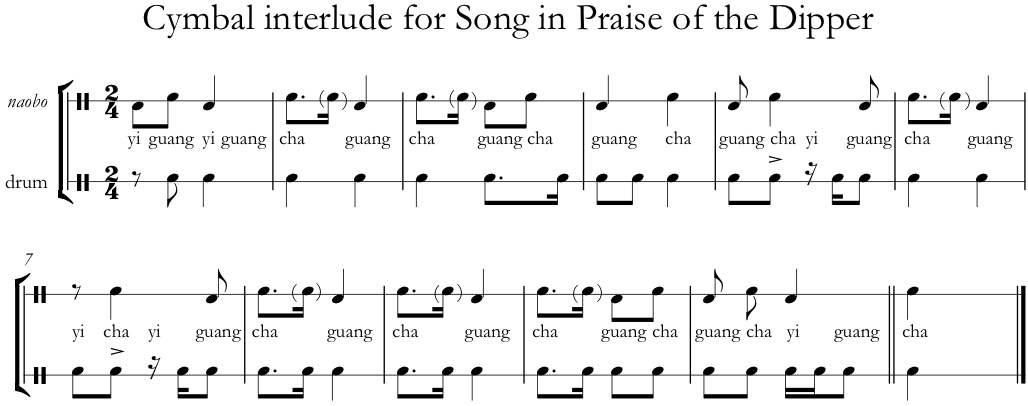
gdz-naobo

In recent years they tend to sing the hymn rather faster than they know it should go (you can hear a more majestic version in concert on track 1 of the audio playlist, and on the 2014 DVD). Anyway, with a very gradual accelerando over the verses, as they reach the seventh and eighth couplets they launch into fast isorhythmic chanting. They now play the fast cymbal interlude Gui jiao men (“Ghosts calling at the door”)—a pattern the same length as the processional Tianxia tong but differing subtly.
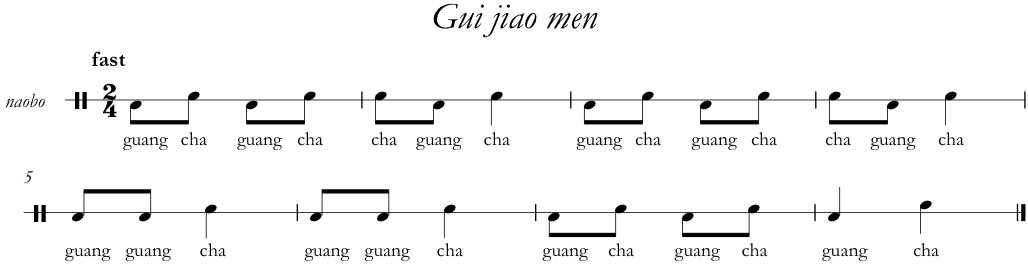
gui-jiao-men

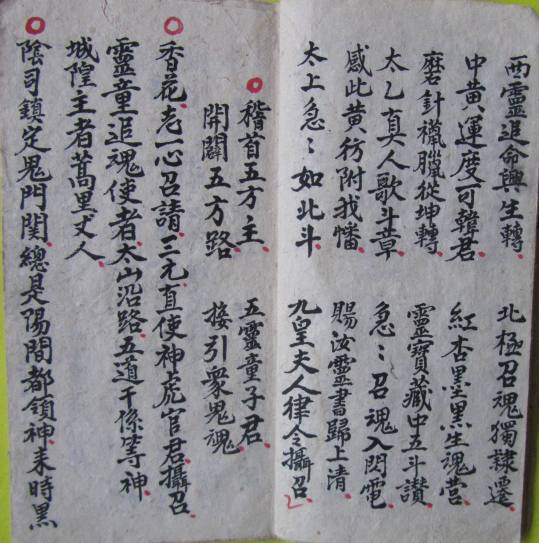
This leads into the five-word quatrain Jishou wufang zhu, sung tutti isorhythmically to a simple descending melody, without percussion, now slightly less hectic:

Bowing to the lords of the five quarters,
The masters of the lads of the five spirits
Open up the roads of the five quarters,
Receive and guide all the ghostly souls.
GDZ 2.jpg

Fig. 4

Then two sections summoning a roster of gods of the local territory—now accompanied by percussion, and punctuated twice by the Gui jiao men cymbal pattern—are chanted tutti, most hectically. Prepared by the instruction at the end of the Song in Praise of the Dipper (Great Supreme, in haste like the Northern Dipper!), and in extreme contrast with the long slow melismatic hymns that now dominate most rituals, this transitional sequence flies past as black clouds swirl, purple mists coil, with complex adjustments of style, tempo, and instrumentation. This too is a rare instance in Yanggao today of the kind of fast chanting commonly heard in south China.

The Invitation verses (playlist #1)
In abrupt contrast to this rousing climax, time now stands still as Golden Noble gently begins to sing a sequence of solo verses in free tempo, accompanied only by his shaking of the bell, with Li Manshan punctuating the phrases with a brief subdued pattern on drum. Li Manshan has let Golden Noble lead this ritual since about 2003; his solo melody is modeled on the way that Li Qing sung it. Even the way he repeats words in the opening phrase (Zhiyixin zhaoqing, yixin zhaoqing, zhaoqing) is distinctive, setting a contemplative mood. We are in the middle of barren countryside, far from the bustle of the village; as night falls, the main light comes only from the little piles of paper money burned by the kin. Notwithstanding interruptions at the end of each verse by a fast loud chorus with percussion, and periodic deafening explosions of firecrackers, this exquisite solo plaint perfectly reflects the desolation of the surrounding countryside where the ancestors are to assemble.

The twenty verses in the manual, each beginning “Vowing with hearts at one we Invite” (Zhiyixin zhaoqing), describe all kinds of occupations of the lost souls: emperors, ministers, generals, literati, sing-song girls, beggars, and so on. These verses are also found in the Li family’s Buddhist (not their Daoist) yankou manual—a sequence sometimes attributed to the great poet Su Dongpo (1037–1101). The twenty verses are now never sung complete; the chief Daoist chooses no more than six or seven of them. Both Li Manshan and Golden Noble agree that they should be performed complete, and were “in the past,” but even Li Manshan never heard the elders recite the whole sequence. To give an idea of the literary beauty of these texts, here is the opening verse (recto, lines 3–6):
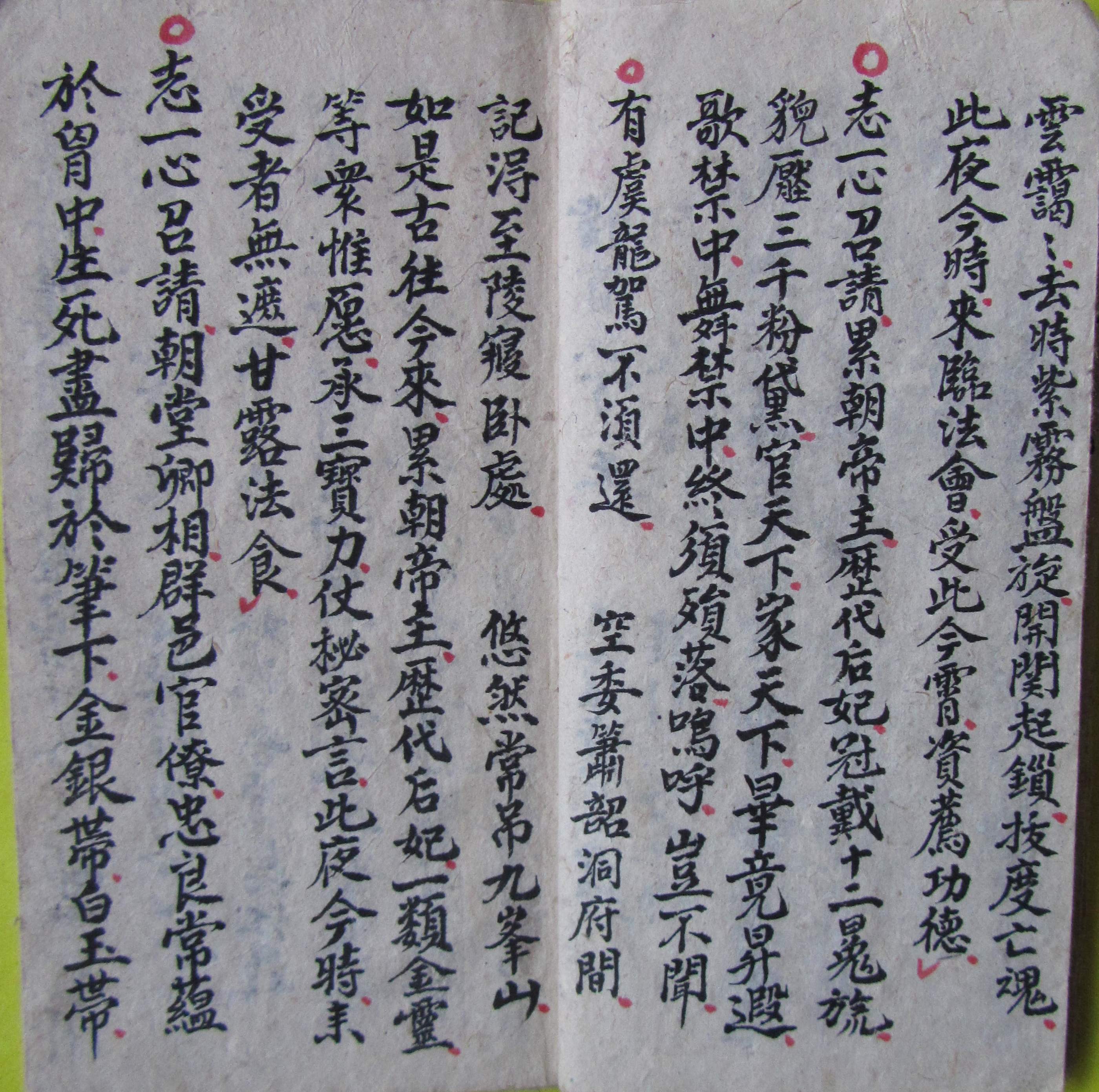
zhiyixin

Fig. 5

Vowing with hearts at one we Invite:
Emperors and lords of successive dynasties,
Empresses and concubines of epochs immemorial,
Bedecked in twelve-gemmed crowns,
Countenance outranking three thousand rouge-and-kohl belles.
All under heaven their remit, all under heaven their family,
Ultimately ascending.
Singing within the palace, dancing within the palace,
At the final moment they can only perish and fall.
Alas! Have you not heard?
Once astride the dragon of Yu they cannot return,
(tutti) In vain to deploy the Pipes of Shao within the Department of Caverns,
Fluttering the shadows and echoes, imperceptibly approaching!

But once rendered in exquisite solo melody, such textual beauty is multiplied.

For the last two seven-word couplets at the end of each verse (last line of recto and first line of verso), the first is still sung solo, while for the second the whole group interjects to chant the text fast. But, then, instead of the manual’s elegant and long refrain (opening “And thus from time immemorial” Rushi guwang jinlai, 5th–3rd lines from end of verso above) confirming the invitation, they now substitute a single phrase “Fluttering the shadows and echoes, gradually approaching” (Piaopiao yingxiang ranran lailin 飄飄影響冉冉來臨), again sung tutti. This phrase is borrowed from the shorter sequence of a mere three Invitation texts from their other (“Daoist”) shishi manual.[2] It leads into another burst of the cymbal interlude Gui jiao men.

That is how Li Qing taught them, but they know that the two versions were once alternatives: when the older generation used the longer refrain, it was still sung solo, and they didn’t use a cymbal interlude. So using the Piaopiao phrase with cymbal interludes wasn’t Li Qing’s invention in the 1980s; but already by then, deciding that the full refrain was too long, they were generally adopting the shorter version.

Some other adaptations also have to be learned orally. In the Jinwu sijian section about the sun and moon, and again in the following verse “Gazing from afar on mountain hues” (Yuanguan shan youse), the name of the deceased has to be inserted, and another text replaces the tutti coda of the manual.

The Invitation verses in Beijing Buddhist ritual
I have to take it on trust that all twenty sections were once performed complete, including the longer refrain. The substitution of the “Fluttering the shadows and echoes, gradually approaching” phrase with cymbal interlude for the longer final refrain shortens the ritual a little; and the more recent practice of reciting only selected sections shortens it further.

Actually, the version as sung by the Li family in Yanggao is remarkably similar to that of Buddhist temples in old Beijing. In a fine initiative from the mid-1980s, the performance of the Buddhist yankou by former monks from popular temples in Beijing was recorded; later it was also transcribed and notated.[3] The Invitation sequence, virtually identical in text, is interesting.[4] All twenty sections were indeed performed for the recording. The text is divided between main and assistant cantors, both singing in free tempo with impressive beauty, accompanied only by the bell, the refrain of each section fast choral with drum. So again, it is worth pursuing temple links.

The Invitation memorial
When Golden Noble has finished singing the Invitation verses, first the short section Chenwen dadao 臣聞大道 (see Fig. 7 below) should be recited fast, either solo or tutti, with percussion, confirming the efficacity of the ritual in saving the deceased. This text is commonly omitted today.

Then (as specified in the manual, in red ink) Golden Noble presents the memorial. Having handed the bell to a colleague, who sounds it continuously, he takes out the folded document from his pocket, singing it solo in the same melodic style as the preceding “Vowing with hearts at one we Invite” verses, only more exuberantly, with muffled accompaniment on drum and small cymbals and occasional fast tutti choruses repeating a phrase. He unfolds each new section as he folds up the previous one—though he hardly needs to consult it except to check the names of the kin. In recent years, if the others start accompanying too fast on percussion then Golden Noble sometimes likes to corpse the others (especially his mate Wu Mei) by reading faster and faster, rolling his eyes rapidly up and down over the text.

The manual doesn’t contain the text of the memorial; it is not among the templates in Li Qing’s collection of ritual documents, and Li Manshan and Golden Noble write it from memory. Sometimes entitled Memorial of Rites and Litanies to Escort the Deceased (Songzhong lichan yiwen), it is addressed to the Court of Sombre Mystery for Rescuing from Suffering (Qingxuan jiuku si), and announces the details of the deceased and lists of the preceding three generations of kin. Generally Li Manshan writes the text first and fills in the names of the ancestors later when a member of the kin brings them to him. Dates, as always, are written in the traditional calendar.

yiwen-copy-2

Fig. 6: Invitation memorial, written by Li Manshan, Pansi 2011

Having sung the memorial complete, Golden Noble opens it out and hands it over to be burned by the kin, while the Daoists slowly and solemnly declaim a final five-word quatrain “Thousand-foot waves at Bridge of No Return” (Naihe qianchilang), another common temple text:

naihe

Fig. 7

Thousand-foot waves at Bridge of No Return,
Bitter sea myriad leagues deep.
If the soul is to evade the cycle of rebirth and suffering,
The Daoists are to recite the names of the Heavenly Worthies.

The return procession
So now after the document has been burned, if Redeeming the Treasuries is combined then the two treasuries are burned. The Daoists then lead the kin on procession back to the soul hall. Whereas the whole of the previous sequence has been performed a cappella, they now play shengguan all the way back while the kin burn paper to illuminate the way for the ancestors; on procession on the way out, they only use percussion because there is no-one to escort yet.

However, in Li Qing’s manual there follow thirteen verses for Triple Libations of Tea (san diancha). Li Manshan recalled these verses being recited on the route back, accompanied by Langtaosha on shengguan, but later they only played Qiansheng Fo without vocal liturgy. They still sometimes use a three-verse version for the solo introits in Presenting Offerings before lunch, and as a slow accompanied hymn for Transferring Offerings.

Even after the Libations of Tea were omitted, villagers used to “impede the way” (lanlu) on the return to demand popular “little pieces” from the Daoists, but by the late 1990s no longer did so—they now had plenty of other opportunities to hear pop music. Since around 2011 the kin often just stop occasionally to burn paper, not all along the route as they should. Altogether, the impetus towards simplification derives from the changing needs of the patrons.

The hymn at the gate (playlist ##2 and 3)
On the return to the soul hall, the Daoists now stand informally around the gateway to sing the Mantra to the Three Generations a cappella, as the kin again kneel and burn paper. This is the “Jiuku cizun” text in the manual. As usual, this a cappella version is sung faster than that with shengguan, though they retain the cymbal interludes. They round off the hymn with the fast percussion coda Lesser Hexi, and then lead the kin into the courtyard with a short burst of the pattern Tianxia tong. That is the end of the Invitation as performed today.

But in the manual, before the Mantra to the Three Generations, a further text Lijia quyuan 離家去遠 appears—also apparently a hymn, but unknown today. The volume then concludes with the solo recited quatrain that in current practice they recite at the initial visit to the soul hall; and then a final six-line hymn Qinghua jiaozhu, which should be sung (again, surely a cappella) while the oldest son kowtows.

Conclusion
One wonders how there was ever time for all the extra material in the manual, within what was once an even more busy ritual sequence throughout the day. The ritual in its present condensed form may have taken shape gradually, and it still makes a cogent and moving sequence that meets the needs of patrons.

Beyond just documenting which sections of text are performed today and which have been lost, we need to know how the texts are performed, and how Daoists adapt the material. It’s always hard to imagine the performance of ritual texts from the page, but here is a fine instance of variety. The text is rendered efficacious, and its drama heightened, through a varied yet cohesive sequence of slow solemn choral singing, hectic mantric choral chanting interspersed with percussion interludes, and exquisite free-tempo solo singing accompanied by conch and bell. Such a cappella rendition is of a different kind of complexity from the slow melismatic hymns that now form the bulk of their performance. Despite ritual simplification in modern times, the Daoists need to internalize complex rules—orally—in order to deliver the text efficaciously, animating it into a magical sequence.

[1] By the way, the Yanggao Daoists now have no separate Bathing (muyu) ritual, though it is part of the obsolete shezhao muyu ritual in Li Peisen’s funeral manual.
[2] It is used in the Summons (shezhao) ritual of the temples: Min Zhiting, Daojiao yifan 道教儀範 (Taipei: Xinwenfeng 2004 edn), p. 179.
[3] Ling Haicheng, Yuqie yankou yinyue foshi 瑜珈焰口音乐佛事 cassettes, with booklet (1986); Yuan Jingfang, Zhongguo hanchuan fojiao yinyue wenhua 中国汉传佛教音乐文化 (2003), pp.301–451, Yuan Jingfang Zhongguo fojiao jing yinyue yanjiu 中国佛教京音乐研究 (2012), pp.228–439. Cf. Chang Renchun, Hongbai xishi 红白喜事 (1993), pp.324–6.
[4] Yuqie yankou yinyue foshi, cassette 4b; Yuan Jingfang Zhongguo hanchuan fojiao yinyue wenhua, pp.389–395, Yuan Jingfang, Zhongguo fojiao jing yinyue yanjiu, pp.386–391.

Literary wordplay

One for readers of Chinese!

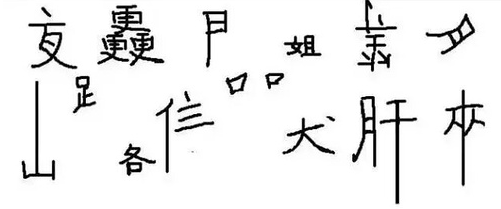
Among the ritual manuals of the Li family Daoists, the final page of Li Qing’s Xiewu ke (below left) yields this ingenious poem about the Eight Immortals (below right), each pair of “characters” making up a seven-word line (4 +3):

This has nothing to do with their ritual practice. Though the composite characters may look at first sight like talismans, any cultured reader would enjoy reading (and deciphering) the poem. For a sequel, see More composite characters.

Li Manshan enjoys such word games, and puts me onto others like this:

screen-shot-2017-01-20-at-10-35-10

to be read thus:

半夜三更門半開
小姐等到*月西斜
山高路遠無口信
哭斷肝腸少人来

* 到 to be substituted for the implied 倒:
“an upturned 等 turned back upright”.

Indeed, as Sven Osterkamp eruditely tells me, Robert Morrison remarked on a very similar poem in an entry “Enigma” in his A dictionary of the Chinese language (1822), Part III, p.142—expanded upon by Jean-Pierre Abel-Rémusat in his “Explication d’une énigme chinoise”, in vol.2 of his Mélanges asiatiques (1826), pp.266–8:

Meanwhile over lunch at a transport caff (“Greasy Chopstick”) between visits to Daoists in Shuozhou, our wonderful and erudite driver Ma Hongqi wrote this elegant poem into my notebook, said to have been composed by Yingying on her first meeting with Scholar Zhang in the Romance of the Western Chamber:

Ma poem

which, as the young scholar soon discerned, is to be read first vertically, all the way down; then back upwards, turning left at 花; then all the way back to the right; and finally back to the left, turning upwards at 花—creating this four-line verse:

九月九花金顶头
头顶金花好风流
流风好花头上戴
戴上头花九月九

Variant versions of these can be found online.

New definitions

lu
Daoist ordination certificate, Putian.
Source: Kenneth Dean, Taoist ritual and popular cults of southeast China.

In the spirit of I’m sorry I haven’t a clue

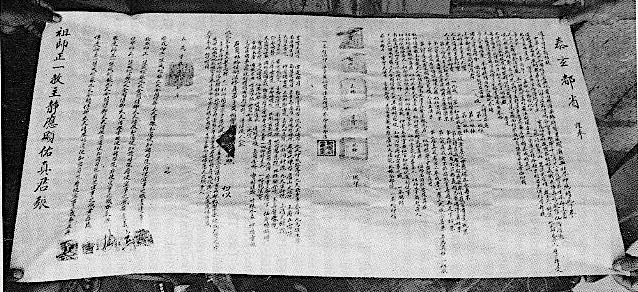
Further to Speaking from the heart, where I noted the somewhat elaborate definition of the term dundian, here’s another fine definition—ironically, from the Chinese-Chinese dictionary of my Daoist master Li Manshan, no less, which we consulted when I mentioned the term lu , Daoist “registers” (lengthy hereditary titles bestowing the authority to conduct rituals), unfamiliar to him (my translation):

a superstitious thing that Daoists use to trick people

Hmm. Li Manshan shrugs, and we both giggle.

Mind your language

I can’t resist citing a charming story from a Chinese anthropologist documenting a village in Shaanxi province: [1]

One sunny afternoon in February 1992, I went to the main village by myself. Since it was not long after the Chinese New Year’s day, everyone in the village was still in new dresses. When I was walking around, trying to talk to people, I met an old woman who carried her little grandson whose age was no more than three or four. The little boy was dressed up in a new green suit designed like the People’s Liberation Army uniform, and he was wearing a brand new green hat with a red star in the middle. He looked so pretty that I bent over to say “hello” to him. To my surprise, the little prince quietly said to me, “Fuck your mother”. I was so embarrassed that I did not know if I had done anything improper. The old woman slapped her grandson and told him, “No, you little fucking bastard! Don’t say that to Teacher Liu. He is a fucking nice person.”


[1] Liu Xin, Zhao villagers: everyday practices in a post-reform Chinese village, PhD (Dept of Anthropology and Sociology, SOAS, 1995), p.183—cruelly censored from the published version In one’s own shadow (2000)!