“No account of [the French pieces] would be complete without…” (cf. Molvania) the great Marty Feldman’s smoky chanson to the lyrics of the HP Sauce bottle (Cette sauce de haute qualite est un mélange de fruits orientaux, d’épices et de vinaigre…):
The phrase “Armageddon outta here” may naturally spring to the lips of USA residents these days. Like the vuvuzela, its origin is unclear. I’m keen to know…
This story from 1999, in my Shaanbei book, already describes a bygone age:
One afternoon, after a couple of weeks in the countryside unable to get in touch with my partner in London, I decide to try and find a phone from where I can make an international call. Yangjiagou still has no phone [like Li Manshan’s village at the time!], certainly not one connected to the international network, so with my colleague Guo Yuhua we set off by foot down the hill towards the district township, almost an hour’s walk.
We find a phone in the post office and, miraculously, I get through. As I pay the sullen assistant, she makes out a receipt, asking what name she should fill in. I tell her not to bother, but as we come out onto the street, I take a look at the receipt: she has made it out to “WOG” (laowai).
on the many websites devoted to drôle country song titles, I like
How can I miss you when you won’t go away?
Also of note is
Get your tongue outta my mouth, I’m kissing you goodbye. *
Many such titles, of course, are a stark record of the misogyny of the milieu, though some express mutual alienation—if that helps…
À propos, I note Nicholas Dawidoff’s splendid book title In the country of country—another piece of musical ethnography. See also the films of Ken Burns and Rich Hall.
* On a more scholarly tack, for farewell poems in the Tang dynasty, see here.
In our little grammar revision, we’ve done nominal classifiers—so further to gender in French, here’s Lee Mack on the topic (watch from 2.17):
You can’t win with the French. I went to a French restaurant recently, I thought, ”I’ll make the effort, I’ll order in French.” When in Rome, do as the Romans do. Me dad taught me that just before he was jailed in Italy for killing 20,000 Christians. This waiter came in and I was trying to order the egg custard. And I said,
”Have you got… le creme d’oeuf?”
And this waiter went, ”It’s not le creme d’oeuf. ”It’s la creme d’oeuf. ”It’s feminine.”
I said, ”It’s not feminine, is it? It’s an egg custard. What do I need to know the sex of an egg custard for? I want to eat it—not fuck it.”
A marriage guidance counsellor is having a tough time at a session with a couple reluctant to make any effort—sullenly refusing to speak to each other, only addressing their bitter comments through the counsellor.
So he whips out his double bass and starts playing a convoluted jazz solo. At once the couple strike up an animated conversation.
Intrepid early-and later-music bass player Pete McCarthy told me this one on a long coach ride on a US tour, c2001.
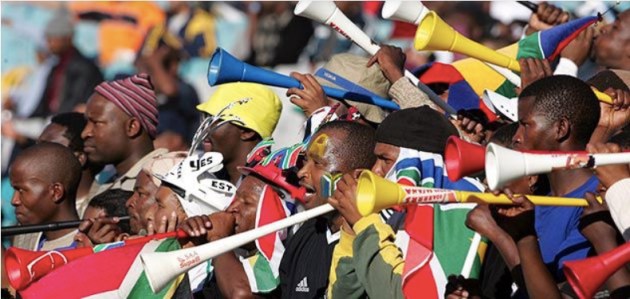
The star of the 2010 World Cup in South Africa was the long trumpet vuvuzela, which enabled spectators to feel as if they were in the middle of a beehive.
The Guardian commented,
Some people say the vuvuzela originates from a tribal instrument used to summon people to important meetings. Others say it comes from a plastics factory in south China. The truth is unclear.
Clothes clothes clothes music music music boys boys boys [1]
(to give it its full title—her mum’s reproach to her as a teenager)is a beautiful inspiring book, full of sincere humanity and insight. We can draw a veil over the story of her messy “dalliance” (dunno why I’m suddenly coming over all Jane Austen) with Johnny Rotten. The account of her post-punk life is no less compelling than that of her time in The Slits, with their amazing singer Ari Up (RIP). Women, and sexism, in punk are justly favoured topics in musicology and glossies alike—more so, I note, than Daoist ritual (funny, that). For female punk band Vulpes in Madrid, see here.
I was sadly unaware of all these brilliant singers at the time, except (for some reason) for Nina Hagen—Naturträne (1978) has long been one of my favourite songs (see this playlist):
You can, and must, watch her singing it live on video too, but that recording is astounding. I was busy being a Boulez groupie… OK, there’s room for technique in punk too, but it’s not quite the point; I could presumably square that song with my snobby sensibilities long before I also learnt to rejoice in the Sex Pistols or the Ramones. Or Daoist ritual…
Just as much as the Matthew Passion, or Wozzeck, it makes want to learn German:
Natur am Abend, stille Stadt Verknackste Seele, Tränen rennen Das alles macht einen mächtig matt Und ich tu’ einfach weiterflennen
We can save punk in China for another time—but again, it’s all part of the rich ethnographic tapestry. Not quite punk, but Cui Jian’s classic song Nothing to my name
prompted a fine complaint from Wang Zhen, veteran of the Long March:
“What do you mean, you’ve got nothing to your name? You’ve got the Communist Party haven’t you?”
Mutatis mutandis, Thatcher might have concurred.
[1]Pedantic note: most superior reviews abide by the title’s lack of punctuation.
Burlesque-only (who may now seem like a more benign, cultured, dignified, humane, sophisticated, intellectual, and honest prototype for Tweety McTangerine)
SO UNFAIR!!!
is alleged to have described Angela Merkel as a “culona inchiavabile”. This was magnificently rendered in English as
unfuckable lard-arse.
Fine as the original Italian is, this is a splendid translation. Of all the possibilities for culona (“big arse”) and inchiavabile (“unscrewable”), it must have taken considerable artistry to come up with “unfuckable lard-arse”. Imagine the translator, worn down by years of work at tedious political committees rendering the minutiae of financial subsidies, finally able to spread his wings and exercise his dormant mastery of idiom.
Better still, Auntie’s former rottweiler-in-chief Jeremy Paxman raised the issue in his interview with Berlusconi, enquiring in his measured patrician tones,
“Mr Berlusconi, is it true that you once described Angela Merkel as an unfuckable lard-arse?”
Having praised them both, my amusement about Stravinsky’s description of Messiaen is tempered with surprise:
All you need to write like him is a large bottle of ink.
But then he described Ravel as a “Swiss watch maker” too, so just let’s move on. There’s no pleasing some people…
In Nicolas Robertson’s brilliant series of anagram tales, composed in free moments on choral tours in between (or during) frequenting local hostelries and singing like angels—anagrams masterminded and elaborated by (“more on that story later”)—Igor Stravinsky comes out as
I was one of Laurence Picken’s more tangential disciples, but he remains among the great inspirations of my life. [1]
I know several of us have fond memories of turning up for lunch at his little house overflowing with books, a sherry followed by a carefully prepared meal, listening to him explaining, non-stop for four or five hours (for all his encyclopaedic erudition, he knew nothing of small-talk; see also here) how the marker to the right of the column in some 11th-century Japanese zither manuscript had been misinterpreted—with liberal asides on plainchant, birdsong, and medieval Sogdian viniculture—to which I occasionally managed to interject “I say, fancy that…” And that’s how it went, every couple of months for about twenty-five years.
Apart from his immense scholarly arsenal, he was a true amateur, an enthusiast. He maintained a network of like-minded people, communicating extraordinary enthusiasm for a topic that, even by the high standards of obscurity of those topics that many of us here today pursue, was pretty arcane. His devotion to scholarship was nothing to do with conforming to institutional demands; as a bit of a Lone Ranger myself, I now realise where I got it from.
He corresponded indefatigably with scholars all over the world (not least Eastern Europe)—he had to wait far too long for the invention of email. Though I think his influence on Western scholarship on Chinese music has been disappointingly slight, his work on Tang music had echoes in that of Chinese scholars, including He Changlin and a group of musicologists in Shanghai, from Ye Dong and Chen Yingshi to a newer generation. Senior scholars like Yang Yinliu, Huang Xiangpeng, Ren Erbei, and Yin Falu were themselves engaged in similar work through the 1950s, and would have relished a chance to exchange ideas with Laurence (cf. Soundscapes of Dunhuang).
Having assisted him with his magnum opus Music from the Tang court for many years, I finally began going to China in 1986. The reason for my first visit was to seek clues to Tang performance practice in living traditions there—how to recreate his transnotations in a convincing style. Except for his early and late visits, most of his life coincided with a period when few foreigners could gain meaningful access to living traditions in the PRC. And immediately I discovered a vast unknown treasury of living folk and ritual music, soon putting historical musicology to one side in favour of contemporary ethnography (see e.g. my Plucking the Winds, pp.169, 184–5). But what I really appreciate is that Laurence entirely understood, and was immensely generous and supportive of this churlish choice of mine.
A special edition of Early Music, edited by Richard Widdess, includes my succinct thoughts on the relation between “early music” and living traditions in China, with thoughts on notation and recreation:
“Source and stream: early music and living traditions in China”, Early Music August 1996: 375–88.
As I published a lengthy analysis of some of the pieces from the Hua family shawm band’s suites introduced in my 2007 book (and the accompanying DVD, and an amazing CD; cf. Dissolving boundaries), it reminded me that while Chinese and Western scholars have described the scales and macro-structure of Chinese instrumental music, few have done any serious analysis of its melodic progression—so Laurence’s project with Noel Nickson (however traditional in style) on the Tang repertoire remains a bold, comprehensive, and detailed body of work. My only reservation is that I’m not so keen on analysing old scores when we can’t hear how they actually sounded; doing fieldwork in rural China, I’m happy if we can make an educated guess—within a living tradition—about how a score no longer in use was performed 100 years ago, let alone 1,000!
A distant relative of the Cambridge early music movement (Dart, Munrow, Hogwood…), Laurence’s Tang music project was controversial, not least in Japan, where it challenged deeply-held assumptions about the sanctity of gagaku. [2] Most striking is his theory that in Japan the Tang scores were gradually retarded—ending up being played up to sixteen times more slowly, robbing the melodies of their melodic coherence. Generally this remains convincing, though our later experience of living genres in China like the temple music of Beijing, or nanguan in Fujian, might prompt us to refine it.
Unlike some scholars, I quite accept that the Tōgaku scores that Laurence collected do indeed represent Tang music. But I wish I could debate with him now. His tenet that we should read the scores “with no more information than that given in the manuscripts themselves” [3] may seem at odds with his following comment, “the attempt to determine what an ancient text meant at the time when it was written”. So I think he might concur with my response:
I agree absolutely that we mustn’t assume the way a piece is performed now is the way it was performed before; this was his way of explaining an alternative to the passive acceptance of modern-day gagaku performance practice in Japan. However, one cannot possibly “use only the information contained in the scores themselves”! Recreations of European medieval music (a tradition to which Laurence belonged) always try to extract as much information as possible from early instruments, treatises, anecdotal literature, iconography, society, and so on—and also, notably, from living traditions which have remained relatively stable, as performers of European medieval music do for folk singing and instrumental heterophony in Europe and North Africa. All such material is abundant for the Tang, and Laurence would have loved to make more use of it; one cannot possibly treat the score (a skeletal outline) as if it provides all the information necessary to performance (it doesn’t even do that for Bach or Mozart!), in some kind of cultural void. Of course, we need to select judiciously which cultures we use as our material. Music is never merely notes on a page! See also More Silk Road soundscapes.
Laurence remained committed to the qin zither after his initial studies in wartime Chongqing, along with Robert van Gulik (imagine…). In the 1960s he provided notes for John Levy’s Lyrichord recordings of Daoist and Buddhist ritual in Taiwan and Hong Kong, a rare initiative for the time—Laurence would have been excited by later projects on the mainland. (I note, en passant, that one online catalogue, under Genre listing, gives “Non-music”!)
The interminably long titles of his articles were endearing—my prize goes to
“The musical implications of Chinese song-texts with unequal lines, and the significance of nonsense syllables, with special reference to the art songs of the Song dynasty”.
And his language was charming, with formulations like
In this context, sheng 聲 is to be understood as an acoustic phenomenon with extension in time—something organized so that (again in time) it may be complete or incomplete; in fact, a tune.
Apart from his chamber music gatherings, I have another cherished memory of Laurence playing Bach on the clavichord—above which a magnificently garish framed picture (gift from a friend in China) of the workers, peasants, and soldiers clutching the Little Red Book, celebrating the “achievements” of the Cultural Revolution.
* * *
And for what it’s worth (not, you realize, for what it’s not worth), here are my notes for Laurence’s memorial service:
Music from the Tang court: Qinghai bo (Waves of Kokonor)
Laurence worked for several decades on recreating the Tang court music of the early 8th century. His insights from deciphering scores exported from Tang China to Japan still deserve wider recognition.
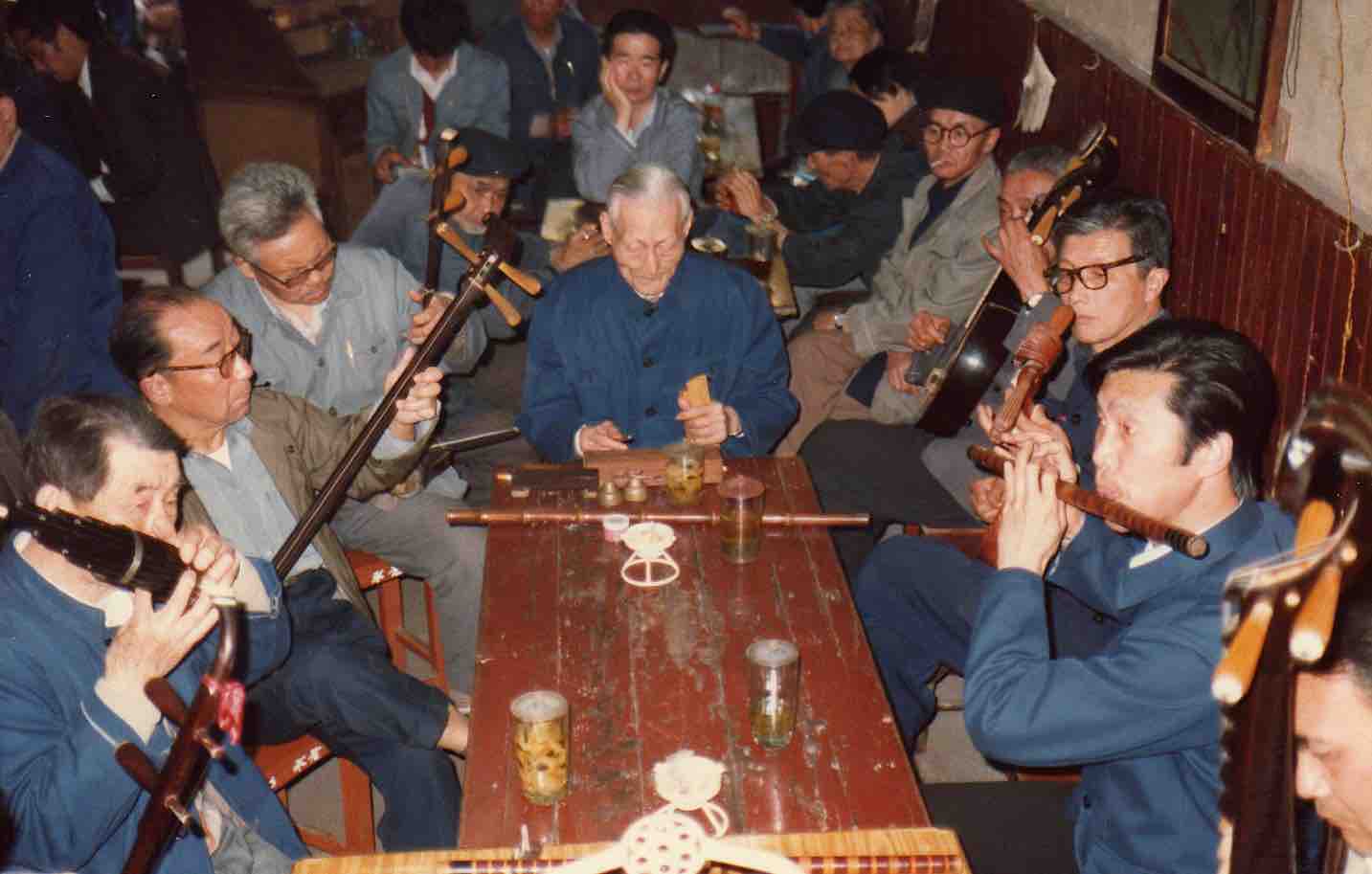
We tried playing these transcriptions in the 1970s, with more enthusiasm than ideas about Tang performance practice, or indeed any Chinese performance practice—given that this was during the Cultural Revolution, when we had virtually no access to the practice of traditional music in China. I still have little idea of Tang practice, but trying to play such pieces under the influence of “ancient” genres still performed today for rituals in the north Chinese countryside—notably the shengguan wind ensemble of ritual specialists around Xi’an, Wutaishan, and Beijing—yields what I find rather attractive results.
Laurence changed the course of my life. I first went to China in 1986 in search of clues from living music there about how to perform these scores, and he was most generous, as ever, in understanding my rapid conversion to the documenting of living traditions in China, postponing historical reconstruction—well, until now.
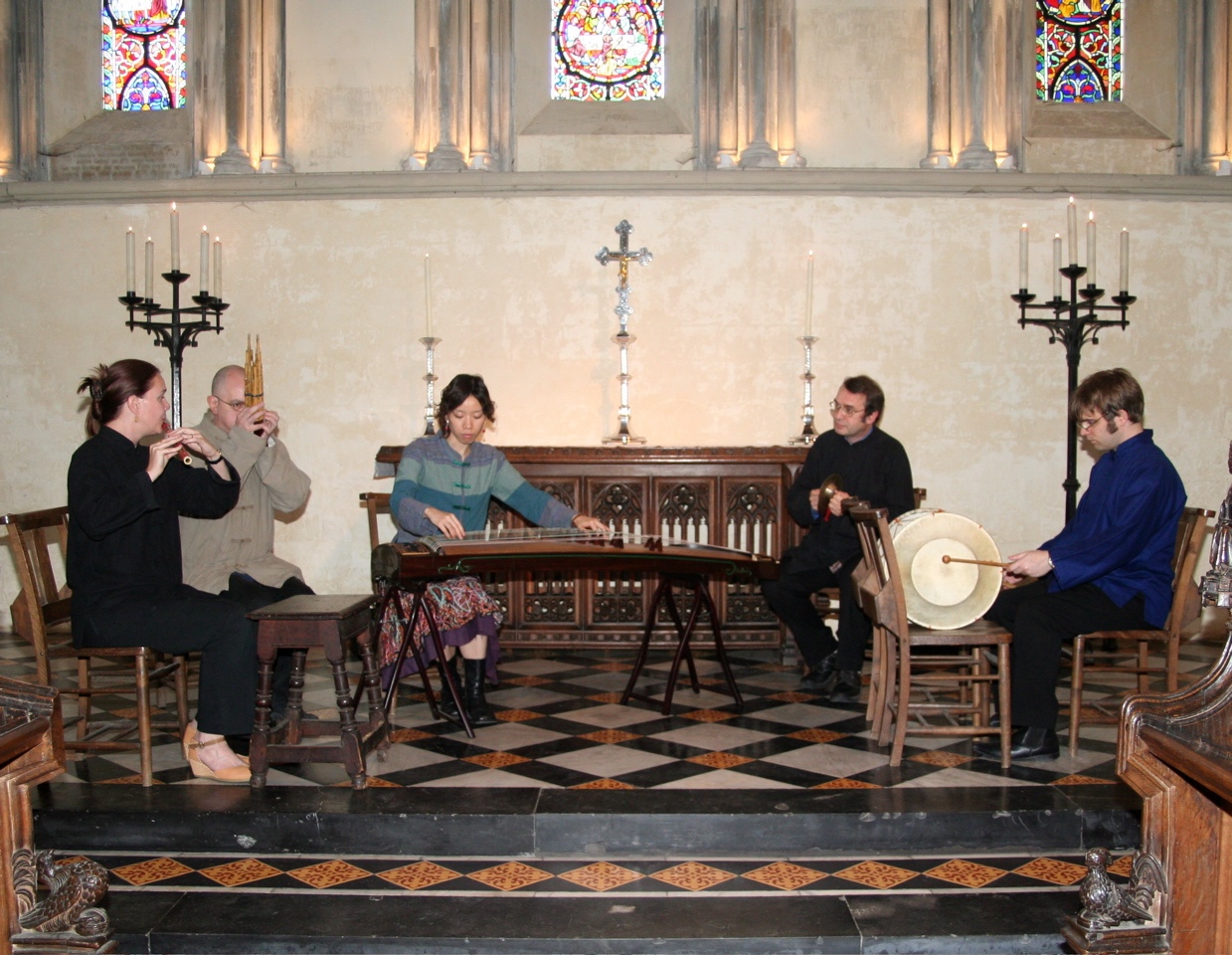
In returning to the piece Qinghai bo (Waves of Kokonor), we ornament the simple outline of the tune, in 12 bars of 8/4, as Laurence suggested; we model our version on shengguan music, and are also influenced by our playing of Shanghai teahouse music. Whereas Laurence convincingly showed that Japanese performance practice had retarded the melody substantially, we begin with a very slow ornamented version, and gradually strip the ornaments away as we speed up, as they still do in Shanghai. I have no evidence that this practice was used in the Tang—given that the piece seems to be in 8/4, the first, slow, version is most likely to be “original”, but the faster versions are closer to the way that Laurence would have heard it, so these successive versions are more like alternatives.
Today we use dizi flute, sheng mouth-organ, and zheng zither, all of which have early scores for this melody; accompanied by a small Korean changgo drum (a rough approximation to the Tang jiegu), and a pair of small cymbals, as in north Chinese ritual music today.
Laurence didn’t allow purism to delay his exploratory renditions of these pieces: one of my enduring memories of him is his playing of the melodica, with a completely straight face—I’m sure he would have recognised that modern ritual specialists’ style on the sheng, with its addition of fifths and octaves to the melodic line, might make a more suitable model.
While this is far from a historically informed rendition, it marks an advance from our versions of the 1970s; Laurence would doubtless have many comments! The music at last sounds Chinese—if not necessarily Tang Chinese…
[2] Among much discussion, Richard Widdess provides context: “Historical ethnomusicology”, in Helen Myers (ed.), Ethnomusicology: an introduction (The New Grove handbooks in music), pp.219–37.
An idée fixe that often comes in handy during fieldwork (see also under Themes) is the old “Cigarette?” line:
In rural China the etiquette of exchanging cigarettes and lighting up for each other is an important skill for the fieldworker to acquire, confirming social bonds (my Daoist priests of the Li family, p.24). Generally, when two or more men meet they compete to be first to get their offer accepted. The first offer is vehemently rejected; the giver is then obliged to insist until the cigarette is reluctantly accepted. The word thankyou is never used. Some shoving may be involved. Then the two compete to be first to proffer a light; as the recipient lights up, he expresses appreciation by touching the lighter’s hand with the little finger of the hand holding the cigarette, and the man with the lighter takes care to keep the flame going as he lights his own. I learn to emulate Li Manshan’s ritual of reluctantly accepting a cigarette, his frown, his look of confusion—“What is this funny little tubular object that is being offered to me, and how should I react?”
With the Li family Daoists we’ve developed a classification of cigarettes according to price, which varies widely. Using the class status language of land reform, we call the posh brands “rich-peasant fags”—the cheaper ones are for wannabe poor peasants like me.
Police squad provides another useful idée fixe on the importance of local knowledge in fieldwork:
The Greek subtitles inadvertently add a further Pythonesque touch. Though perhaps less so if you’re Greek.
My current favourite fieldwork tip heads this post.
Which reminds me, a noted baroque conductor (or “semi-conductor“, to use Norman Lebrecht’s term) was rehearsing the opening of a slow aria in the Matthew Passion. One of the wind players suggested he might try subdividing:
“Could you give us 7–8 into it?”
Conductor, indignantly: “I didn’t get where I am today by giving 7–8!”
“I didn’t get where I am today by…” soon became another musos’ snowclone.
In my bookDaoist priests of the Li family I stress the importance of fieldwork on the modern period, not just attempting to imagine the rosy distant past. Talking of the modern period (p.141):
Just as historians document ritual change throughout the medieval and late imperial periods, we find constant adaptation in the years before and after the Communist revolution of 1949. Similarly, a detailed account of over three decades of ritual practice since the liberalizing reforms of the early 1980s reveals continuing changes.
Chinese peasants have a different conception of time from the periodization we find in official history. Li Manshan described his wedding in 1971 as “after the end of the Cultural Revolution”; “land reform” is often used to mean the privatization around 1980; and now when people mention “liberation” they often mean after the end of the commune system in the 1980s. Now that the Maoist era is a rather distant memory, it may seem like a blip in the long sweep of history—but it has left deep scars.
Similarly, while in the official story the term “three years of difficulty” (1959–61) makes a veiled recognition of the devasting famine, it means little to many peasants, since they suffered from severe food shortages right through from the early years of collectivization until the collapse of the commune system.
Further to Alan Bennett’s reflections, bearing on the trope of WWJD (“What would Jesus do?”—a snowclone, I now learn), this is from his Talking heads monologue A chip in the sugar:
She said, “He knows what I mean. Where did you get those shoes?” He said, “They’re training shoes.” She said, “Training for what? Are you not fully qualified?” He said, “If Jesus were alive today, Mrs Whittaker, I think you’d find these were the type of shoes he would be wearing.”
À propos the Marx brothers, apart from the verbal dexterity, their charm was also beyond words:
Harpo is naturally most endearing to musos—notably Steven Isserlis, whose brilliant tribute is here (the link to the radio programme may be defunct, but watch this space). Note his fine historical reflections too.
Harpo’s mute persona might have been inspired by Rossini’s trio Mi manca la voce…
When I am asked how I came to play the violin, I’m inclined to cite The Ladykillers(1955):
As the gang is plotting their robbery, posing as a string quintet while they play a recording of the Boccherini Minuet, sweet little old Mrs Wilberforce (Katie Johnson) takes them by surprise—so to maintain the deceit they have to hurriedly pick up their instruments (which they can’t actually play). The magnificently obtuse One-round (Bernard Bresslaw) is clutching a cello like a sledgehammer:
Mrs Wilberforce: “May I ask you where you studied?”
One-round: “…Well, I didn’t really study any place, Lady… I just sort of… picked it up.”
I still can’t help thinking of the scene whenever I hear that minuet.
At Cambridge, Paul Kratochvil was not alone in enjoying a bit of drôlerie.
Here’s another jeu d’esprit on the faqu 法曲, from a precious old letter that I just found from my teacher Denis Twitchett, sent (by post!) from Princeton in 1986. A tad more wacky than his magnum opus Financial administration under the T’ang dynasty, it deserves to take its place among his magisterial writings on Tang history:
Dear Steve,
Some further ruminations on that mysterious term faqu. I am reminded of the hypothesis (first adumbrated in my alas-as-yet-unfinished “Preliminary proleptical remarks proving beyond Reasonable Doubt that Li Bai [aka Patrick O’Leary] was the earliest Irish poet”) that faqu is a rough-and-ready transliteration of the greeting shouted at tax-collectors in the medieval Irish countryside, and also commonly exchanged by rival drivers of donkey carts involved traffic accidents. The etymology of its common form in Chinese is obscure; under the Liao dynasty a folk etymology suggested that it meant “May the Law twist [your private parts]!” It should not be confused with the alternative writing (found in non-Buddhist contexts) fa-k’iu 發具 (explained by Karlgren as “Get out your [ritual] implement!”). This is quite distinct from the forms fakefu 法可夫 or 伏軻䮛 (the latter writing mistranslated by Legge as “Kneel by the hubcap of the Prince Consort”), meaning, according to Admiral Ting (first Chinese to be trained in the Royal Navy), “Be on your way, Jack!”
“French pieces” were surely more normally written in Tang Chinese as faji 法伎 or more colloquially as fashi 法式 “French models”. The title of the well-known Song-dynasty work Yingzao fashi營造法式 is now attached to a rather boring work on architecture which explains how to construct yourself a baroque dog-kennel without mod cons. This work, however, is clearly a forgery by a Ming author, horrified to the depths of his neo-Confucian sensibilities by the original contents of the book, originally a Song DIY handbook “Make yourself a French model”.
The French presence long predates the Tang, and surely explains Zhuangzi’s Frog in the Well (a fine metaphor for the petty self-interest of the French). This also explains the title of the Tang Li Wa zhuan 李蛙傳, “The story of Froggy Li [the French model]”, and how the word wa “frog” came to have its other meaning “lascivious” or wanton”.
Frances Wood, a distinguished former student of the late great Paul Kratochvil, reminds me of another of his stories.
Paul liked to tell us this as we grappled with the use of classifiers (measure words) for Chinese nouns. The nearest equivalent in English is for collective nouns, like a gaggle of geese or a school of fish. In Chinese a basic all-purpose one is ge (“a person” is not yiren but yige ren), but one needs to use all kinds of classifiers before different types of nouns, like ben for a book (not yishu but yiben shu), or (if you wanna get pleasantly obscure—as I do) zuan for a sheng mouth-organ (yizuan sheng).
Anyway, Paul was just a kid when American GIs liberated his home village in Czechoslovakia in May 1945. They were kind of heroes, and he began hanging out at their barracks, gradually picking up English—entirely through daily aural experience.
After some time a grammatical rule subliminally formulated in his young mind: English nouns must invariably be preceded by the classifier fuckin’. No-one ever said “Gimme a beer!”, it was always “Gimme a fuckin’ beer!”; never “Open the window!”, always ““Open the fuckin’ window!”
Paul’s spoken English came along rapidly, and his father, realising he had a real gift for language learning, somehow managed to arrange for him to go up to Prague to take an English oral proficiency test.
Paul knocks on the door. Commanding English military type shouts out, “Come in!”, and finding a scruffy kid in short trousers standing before him, barks,
“Yes boy, what do you want?”
Paul, hesitantly:
“Hey bud, I come to take ze fuckin’ exam in fuckin’ English.”
Meanwhile we lapped up the early films of Woody Allen, like Sleeper.
Two doctors are monitoring the owner of a health food store who has been cryogenically frozen in 1973 and defrosted 200 years later:
Dr Melik: This morning for breakfast he requested something called “wheat germ, organic honey and tiger’s milk.” Dr Aragon: [chuckling] Oh, yes. Those are the charmed substances that some years ago were thought to contain life-preserving properties. Dr Melik: You mean there was no deep fat? No steak or cream pies or… hot fudge? Dr Aragon: Those were thought to be unhealthy—precisely the opposite of what we now know to be true. Dr Melik: Incredible.
To follow Five easy pieces, a very different kind of oeuvre of that époque—less verité—is Jacques Rivette’s 1974 film Céline et Julie vont en bateau (here, on vimeo).
One abiding memory is my favourite address, where much of the “action” (if that’s the mot juste) takes place:
7 bis, rue du Nadir-aux-Pommes
I often used this a forwarding address.
What an age—Rafaelson, Bertolucci, Godard, Chabrol… (more here). At the time [historical note—Ed.], the way to see all these films was to do something called “going to the cinema”. Late-night Marx brothers films at the Arts Cinema were a rite de passage too…
In my imagination I tend to reduce my student years to the Tang dynasty, violin, and Adnams, forgetting how important (and how modern) my wider education was—film, art, literature. But the lacunas were remarkable too.
Meanwhile, Li Manshan and his fellow Daoists were languishing in silence and hunger (my book, p.133):
“We just sat around at home, but we could never feel at peace”—always fearing a knock at the door.
In connection with my film on the Li family Daoists, I already recommended the verismo fictional films of Jia Zhangke贾樟柯 about the alienating changes of life in small-town Shanxi through the reform era. Of many appreciations, this is good, and this. For antedecents of his style, see Chinese films of the early reform era.
His brilliant Platform (Zhantai 站台, 2000) shows how the members of a now-rootless arts-work troupe experiment with changing fashions as they struggle to adapt to the loss of their “iron rice-bowl”.
In one of many moving scenes (from 1.21.45) the illiterate Sanming, desperate for a job, turns up at a doddery coal mine to enlist for a daily wage of 10 kuai. His friend reads out for him the brief, shocking, contract he has to sign, opening:
Contract of life and death: 1) Life and death are a matter of fate, prosperity depends on Heaven. I am willing to work in Gaojiazhuang mine. Management accepts no blame for accidents. 生死合同。第一,生死由命,富贵在天。本人自愿在高家庄煤矿采煤,如遇万一,与煤矿无任何关系。
Just that opening phrase Life and death are a matter of fate, prosperity depends on Heaven resounds with the peasant mindset, if less so with modern law. The contract, and Sanming’s uncomprehending acceptance of it, are at once convincing and tragicomic.
Do go on to watch his other films, including Xiao Wu 小武 (1997), Unknown pleasures (Ren xiaoyao 任逍遥, 2002), The world (Shijie 世界, 2004), and Still life (Sanxia haoren 三峡好人, 2006). Now we also have an open-access volume of his interviews with Michael Berry. See also the films of Wang Xiaoshuai.
* * *
Shanxi province (apart from its fine household Daoists!) is also notable for its mining accidents. From my book on neighbouring Shaanbei:
Back in the county-town, returning to our hostel one evening, we switch on the TV to find a documentary about coal-mining accidents, which are reported nightly. There are some rather fine investigative programmes on TV these days, and the main theme of this one is how the response of the village Communist Party leadership to the disaster, rather than considering improving safety measures, has been to give funds to construct a new village temple in the hope of divine protection. OK, in this case the programme happens to fit into an agenda of rationalism against superstition, a view we sometimes feel inclined to challenge, but tonight I can only go along with the presenter’s lament.
Only later did I put together further pieces of a grisly jigsaw. Under the tradition of posthumous marriage (minghun), revived in northwest China, within five years after the death of an unmarried male over the age of 15 sui, a suitable dead unmarried female is found. Indeed, shawm bands often perform, and a Daoist may officiate. The unnatural deaths of many men in unregulated mines were bad enough, but newspaper reports in 2007 revealed that women (often disabled, or from poorer provinces) were being murdered to cater for this market.
BTW, Call Me Old-Fashioned [You’re old-fashioned—Ed.], but Xingjie is one of those pieces that is much more satisfying, not in the short version common on stage, but in its full form, working through all the tempo divisions (see my Folk music of China, pp.278–80). “But that’s not important right now.”
The inspiration of the brilliant The Meaning of Liffseries was that “it seemed a waste to have words cluttering up signposts when they could be usefully attached to something namelessly familiar”. Two related definitions:
Gallipoli. Of the behaviour of a bottom lip trying to spill out mouthwash after an injection at the dentist. Hence, loose, floppy, useless.
Ljubljana. What people say to the dentist on the way out.
For a fleeting glimpse of this method, see the wonderful film Gennadi Rozhdestvensky—conductor or conjuror?, from 00.26, under Noddy: the art of conducting.
Never mind all the compelling reasons why the UK might balk at hosting an evil racist misogynist bigot bent on destroying all moral values and sowing global discord. Instead, it may be this one—stated in the petition against the visit—that will quaintly hold sway:
because it would cause embarrassment to Her Majesty the Queen.
And we can’t have that now can we? As to “putting the Queen in a very difficult position”, let’s not go there…
Court jester Boris, as usual, opens his mouth and puts his foot in it with the argument: we’ve had Mugabe, we’ve had Ceausescu, why not Go for Gold? There’s a fantasy dinner party from hell…
The term emoluments is suddenly enjoying a dubious revival with a clause in the US constitution that is among many currently battening down the hatches.
The term, while not constantly on the lips of the rap generation, evokes fond memories from my days studying Tang history.
True, this is scant consolation for the current Destruction of Civilisation As We Know It.
Another namby-pamby term used in academia that always makes me giggle is honorarium. But since I very occasionally get one, I mustn’t bite the hand that feeds me.
Musos are more straight-talking. One day our Mozart recording sessions in St John’s Smith square were interrupted by deafening building work outside. Reluctant to send us all home, the conductor discussed with the record company whether they might offer the workmen some kind of bribe to knock it off. Meanwhile the orchestra, aware that we would still have to be paid even if the session had to be called off, wondered whether we might make them a better offer to get them to keep going.
This was around the time of a dispute between a certain conductor and the brass players about overtime. A trumpet player (legendary for many touring exploits besides) put their case with the classic remark,
It’s not the principle, it’s the money!
This actually goes back at least to Eisenhower in 1959.
Even without the compelling negative example of Tweety McTangerine, I recoil from social media in the same way that Amos Starkadder, leader of the Church of the Quivering Brethren in Beershorn, argues with the fragrant Flora in Stella Gibbons’ brilliant 1932 Cold comfort farm:
“You ought to preach to a larger congregation than the Brethren,” suggested Flora, suddenly struck by a very good idea. “You mustn’t waste yourself on a few miserable sinners in Beershorn, you know. Why don’t you go round the country with a Ford van, preaching on market days?” […]
“I mun till the fields nearest my hand before I go into the hedges and by-ways,” retorted Amos, austerely. “Besides, ‘twould be exaltin’ meself and puffin’ meself up if I was to go preachin’ all over the country in one o’ they Ford vans. ’Twould be thinkin’ o’ my own glory instead o’ the glory o’ the Lord.”
So this is not so much technophobia on my part; as a “follower” [sic] of Krishnamurti, I’m sure he too would be as mortified by the idea as Amos.
Still, Amos relents under Flora’s subtle blandishments:
“I’m going to go all about in a Ford van. Like the apostles of old, I’ll go about the land.”
I’ve been trying to keep my addiction to Alan Bennett under control, but this, from 1992, has a certain topical feel:
A young man sets himself on fire during the Two Minutes’ Silence and, as he lies on the ground burning, shouts, “Think about the people today.” Closer in feeling and in genuine agony to what is being commemorated than anyone else on the parade, he is bundled away to be treated for 60 per cent burns at Roehampton, and nothing more will be heard of him. If Jan Palach had put a match to himself in Whitehall and not Wenceslas Square, the same would have happened. It’s not called “martyrdom” in England, just “going too far”. Still, “it is thought that the Royal Party were unaware of the incident,” and that’s the important thing.
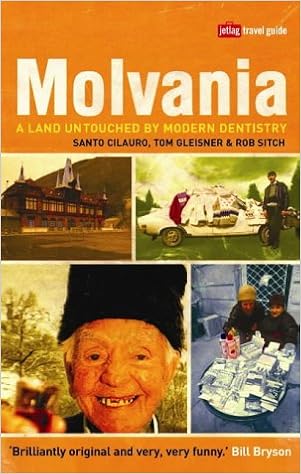
Do correct me if I’m wrong, but try as I may to detect racist undertones, Molvania: a land untouched by modern dentistry (first and most outstanding in the series Jetlag travel guides) still seems hilarious to me in its loving pastiche of the popular style of travel guides, rather than any perceived slight to Funny Foreigners. Indeed, it spares no energy in exposing racist sterotypes.
The style is faithfully observed, right down to the contributors’ biographies.
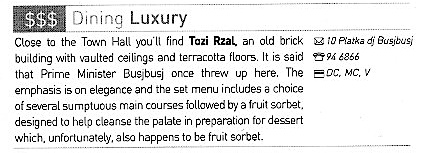
The restaurant reviews are convincing:
And further to my comments on historical recreation:
Nor does Molvania neglect music:
A passage from the sequel Phaic Tăn: sunstroke on a shoestring might come in handy in a lecture on music and socialism:
During the 60s, many Phaic Tănese folk groups were forced to practice in secret. This was not due to government policy, it was a result of their neighbours complaining.
Talking of authentic recordings, here’s the classic 1932 version of Pique-nique by Edouard Ibert (“Call me Ted”) (cf. Authorship):
With Val Rosing’s wonderful plummy voice, and great original, period instrumentation—menacing brass and xylophone, and zany woodblocks, like Cantonese jazz, I may be drawn to it by its heavy use of the pentatonic scale, but the final chorus is a definitive proclamation of those sober values that Made the British Empire “Great”, after the sinister bacchanalian debauchery of the sylvan outing…
See them gaily gad about They love to play and shout They never have any cares At six o’clock their mummies and daddies will take them home to bed Because they’re tired little teddy bears.
Stephen Cottrell, Professional music-making in London: ethnography and experience(Ashgate, 2004)
takes a proud place among studies of more “exotic” cultures in the splendid SOAS Musicology series. Complementing the work of Bruno Nettl and Christopher Small, as well as Ruth Finnegan’s classic The hidden musicians, it strikes many a chord with my work on Chinese ritual groups.
As I observed under WAM, it’s not that Western cultures, of any kind, should be a benchmark for discussing other societies (note Is Western Art Music superior?, and What is serious music?!); to the contrary, it’s fruitful to integrate them into a “Martian” view of world cultures, wearing both emic and etic hats. Many of Cottrell’s themes resemble those that an ethnographer like me would explore in studying Daoist ritual specialists:
The practical aspects of earning a living
The importance of “on the job” training, sociability, and oral/aural experience in what seems like a narrowly text-based tradition.
The importance of timbre (pp.44–55), little theorised even in WAM but quite prominent in China for the qin zither, deserves recognition in Daoist ritual and shawm bands.
His account of “depping” (57–76) augments the parallel that I draw for household Daoists (Daoist priests of the Li family, pp.319–26), not least the insecurity of the freelance living—and it’s fascinating to read (Cottrell p.60) an account of depping from 1760s’ Britain.
The modification of dreams: the tensions or discord between early training and ideals (based on solistic individualism and creativity) and the delicate social/practical negotiations, frustrations, and grinding routine of professional orchestral life (42–4, 103–21; cf. also Scunthorpe and Venice, and Ecstasy and drudge); personalities and crisis management within an ensemble (89–90). I should add that household Daoists, as hereditary (almost ascriptive) artisans, don’t experience such a conflict, never setting out with such a spiritual ideal; but the practical exigencies of occupational routine are shared. Here I also think of Yang Der-ruey’s study of the changing training of Shanghai temple Daoists. Cottrell cites a telling comment:
We’re artisans rather than artists. What an orchestral musician is doing is taking someone else’s creative idea which they put down as dots on paper and actually turning it into sound. So we’re more like bricklayers—the architect would do the plan and then they actually put the bricks into place.
And his dissection of the performance event, subsuming ritual, theatre, and play (149–82)—continuing from Small’s account, about which he expresses reservations. He observes diversity within the audience and in their responses (159–64)—a feature that for Chinese ritual is clearly germane, not only today but even in (supposedly more homogeneous) pre-Liberation society.
Cottrell’s discussion of myth and humour (123–47), citing Merriam’s paradigm of low status, high importance, and deviant behaviour—“licence to deviate from behavioural norms” (137, cf. 143)—often reminds me of the Li band (cf. my book p.23); one might also think of other embattled freelancers like actors (“luvvies”). Like household Daoists, musicians are poorly paid. I might add that muso humour (particularly that of the classical muso—or the ritual specialist?!) further serves both to defuse pressure and to deflate pretension. A lot of our stories immortalise hooligan behaviour on tour. Such deviant behaviour—or at least deviant self-image—is a kind of “No, I won’t be a paragon of elite culture for you”, however childish.
Good too to see Cottrell drawing attention to “conductor-baiting”—better described as “maestro-baiting” (cf. his discussion of musos’ sarcastic use of the term maestro, p.139), recounting the famous story “You think I know Fuck Nothing—but I know FUCK ALL!” (135–6) (for variations, see my post on Visual culture). He attributes it to Celibidache, but I’ve heard it about Böhm (both are perfect candidates!); and outside the orchestral context it is usually attributed to director Michael Curtiz. Conductors are an authority figure par excellence. Here’s another story about George Szell:
Talking to Peter Gelb, General Director of The Met, someone was defending Szell against the charge of being a bully, remarking “Of course Szell is his own worst enemy”—to which Gelb replied “Not while I’m alive he isn’t”.
He cogently discusses viola jokes (131, 136, 142, 144–6)—for which whole websites have arisen, of course. In Plucking the winds (p.233) I cited this one:
What two things have the Beatles got in common with the viola section of the BBC Symphony Orchestra? Most of them are still alive; and they haven’t been together since the 1960s.
This dates from a time in the 1980s when at least the first part of the punchline was more applicable; though still funny, the joke now has an added period charm (cf. Musical joke-dating). I’ll limit myself to one more:
What’s the difference between a viola player and a supermarket shopping trolley? The trolley’s got a mind of its own.
Anyway—in all, such ethnographic enquiry is routinely applied to all kinds of world societies, and scholars of Daoist ritual can of course learn much from studies of the “usual suspects” like south Asia or Africa. But it may be stimulating for us to see such approaches applied to an apparently familiar (prestigious? literate?) culture that is easily taken for granted. As with the “great composers” myth, reified ancient Daoist texts can also somehow be taken for granted, tending to dominate scholarly attention at the expense of real changing social performance and experience.
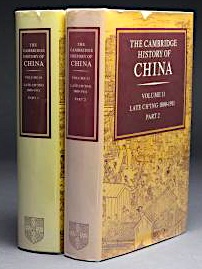
Some drôle quotes from The Cambridge history of China, which even I didn’t quite dare sneak into the indexes:
What is the use of a stele? —Sui emperor Wendi (“Just call me Wendi”) (vol.3, p.62).
The Cheng sisters were captured and decapitated. Mopping-up operations continued till the end of 43. —(vol.1, p.271). Messy business eh.
The “director of records for the empress” may have kept a record of the emperor’s cohabitations with the empress. This cannot have been a great burden. —(vol.1, p.503).
Hierarchies are an essential part of a well-ordered society, and they must be accepted voluntarily. —(vol.1, p.705). So there.
Let us judge whether the Chinese are a race of ethnocentrics who do not know how to manage when they think they have something to learn from foreigners. (vol.1, p.852) (cf. They come over ‘ere…).
Further evidence that my taste for drôleriechinoise is far from recent: a spoof I wrote while helping Laurence Picken with his extraordinary research on Tang music—which I elaborated with another Cambridge mentor, the great Tang historian Denis Twitchett. The genre of faqu 法曲 (“dharma pieces”) has indeed been the (serious) object of scholarly attention. Reading this now, I find the fluency of my affectionate pastiche of academic style somewhat disturbing…
Informal communication with Dr T.H. Barrett[1] has suggested the possibility that faqu may actually mean “French pieces”. Study of a recently discovered and as-yet-untranscribed score from Dunhuang for “hand-wind instrument” (perhaps a kind of manually operated keyed chordophone) entitled Dunhuang shoufeng qinpu 敦煌手風琴譜 reveals a colophon dated 1st April 895 (lunar calendar) which contains references to a certain “Master Ma” (Mashi 馬師), or as we might say, “Chevalier”. The authenticity of this score is no longer in doubt. It includes many faqu, besides one title, Zhena legelede li’a 柘拿樂葛樂德篥阿, [2] evidently a transliteration from a language of the Western Regions (xiyu 西域), but otherwise unattested in Tang sources.
The contacts between the Tang court and the Western world are by now well documented. We find frequent references in Tang anecdotal sources to “strings of onions” (congchuan 蔥串), [3] often in connection with men with a certain type of moustache that became highly fashionable under the emperor Xuanzong, riding carts described as “self-propelling” (zixingche 自行車), [4] and clad in close-fitting garments with black and white stripes (a variant of the yinyang symbol?), as well as floppy caps known as beilei 鞞儡.
The French letter: a rejoinder Further evidence of the Gallic influence on early Chinese musical culture is to be found in the ancient institution of the fashu 法書 (more recently faxin 法信) or “French letter”, a kind of prophylactic talisman deployed in ancient Chinese households in the hope of avoiding unfavorable consequences.
Traditionalists [5] might evoke the sacred power of music and the jiefa 節法 or “rhythm method”, [6] but more pragmatic counsel, favouring foreign and commercial expansion, and under the influence of Buddhist philosophy, gave rise to the “French letter”.
This popular device was available as early as the Tang dynasty in the form still to be found in temples today, the fawu liutong chu 法物流通處 or “Durex machine”. Although nowadays more innocuous material has replaced the original merchandise, the original meaning of “French thingies” (fawu) is clear. The phrase liutong is somewhat arcane: liu implies dissemination, and tong some kind of intercourse, so one might expect tongliu as an early form of resultative verb—thus, perhaps, “French thingies for penetration and ejaculation”.
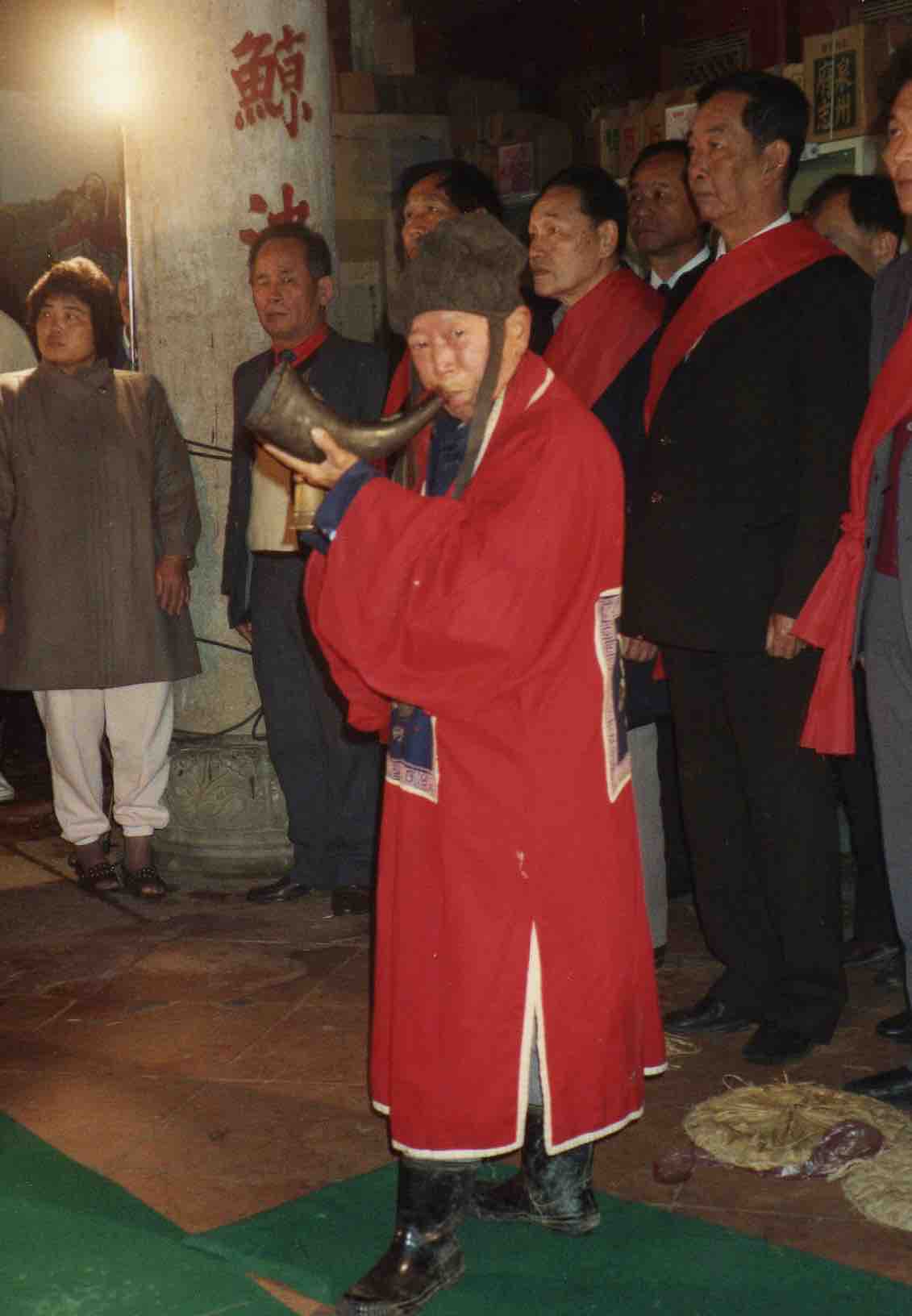
Faqu tu Yet another Gallic connection appears in the instrument fajue 法角 “French horn”, often supposed to refer to a kind of conch sounded in ritual. [7] Recent scholarship suggests that jue was often used metaphorically in the Tang, having once been associated with the debauchery of the notorious Zheng and Wei 鄭魏 kingdoms—the latter also known as “Wei-Hei”. Thus it had the connotation of “horny” or “lascivious” music, as in the term jueshi 爵士, once “gentleman of rank” but by the Tang, “jazz” or “jazzer”. The term dejue 得角 “obtain the horn” is also found in the Dunhuang MSS, apparently referring to a desire for imminent fulfillment; nor can this be limited to exclusively religious fervour.
The well-known notational technique of denoting rhythm by means of dots to the right-hand side of the note (again referring to the above jiefa “rhythm method”) is also found as early as the Dunhuang pipa score. Known as pangdian 旁點 “a bit on the side”, this practice is thought to have been inspired by the ancient French penchant for extra-curricular activities, or gewai shi 格外事.
Moreover, the ambiguity in Tang scores between jue 角 and yu 羽 modes (Aeolian and Dorian respectively, differing only in the sixth degree of the scale) may also be traced to the innovative cultural influence of the French. The term yu is in fact an abbreviation of yulong 羽龍 or “feathered dragon”, a mythical beast said to appear upon rendition of this mode (cf. Han Feizi), and this was soon formalized into what we now know as the “feather boa”, and used in the celebrated Huntuo 褌脫 or “Removing the Drawers” dance, itself remarkable for its ambiguity between jue and yu modes. Thus the apparel used in this ancient French ritual dance gave its name to the mode most often used to accompany it.
For a sequel, see here; and for more Tang drolerie, here. Click here for a roundup of posts on Tang culture.
[1] In the Aardvark and Climbing Boot, 14th October 1985. Just before closing time. [2] For the reconstructed Tang pronunciation of this enigmatic title, see Karlgren, Grammata Serica Recensa. Can the resemblance to Je ne regrette rien be fortuitous? [3] Alternatively, some commentators have construed this phrase as indicating the Congling 蔥嶺 range in Central Asia. Indeed, the recent excavation of a large hoard of 7th-century snail shells from this very region makes the siting of a French colony there highly plausible. [4] Thought to refer to a mystical “journey of the spirit”: see H. Maspero, “Le voyage dans le monde intérieur et la difficulté de trouver un endroit pour le parking”, T’oung Pao 27 (1913), pp. 856–979. For a similar view of the spiritual propensities of this means of conveyance, see Flann O’Brien, The third policeman. [5] On the conflict between rival factions under Xuanzong, see The Cambridge history of China, vol.3. [6] See Jones, “Time gentlemen please: the bell as colotomic indicator in Chinese ritual music” (for further articles I haven’t really written, see here). [7] Cf. the hujia 胡笳 “barbarian pipes”, another import from the Western regions. 2019 update: in an apparent nod to Goodness Gracious Me, it has recently been “proved” that the ancient Gauls came from Hunan—where Daoists still use both a conch and a curved ox-horn 牛角 (popularly known as kaluosa 咔螺薩, a more durable form of the French croissant) to great effect in their rituals. Indeed, will Chinese scholars now “prove” that Charlemagne 沙了蠻 was a Tang vassal?
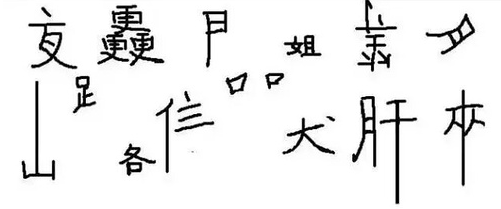
Among the ritual manuals of the Li family Daoists, the final page of Li Qing’s Xiewu ke (below left) yields this ingenious poem about the Eight Immortals (below right), each pair of “characters” making up a seven-word line (4 +3):
This has nothing to do with their ritual practice. Though the composite characters may look at first sight like talismans, any cultured reader would enjoy reading (and deciphering) the poem. For a sequel, see More composite characters.
Li Manshan enjoys such word games, and puts me onto others like this:
to be read thus:
半夜三更門半開
小姐等到*月西斜 山高路遠無口信
哭斷肝腸少人来
* 到 to be substituted for the implied 倒:
“an upturned 等 turned back upright”.
Indeed, as Sven Osterkamp eruditely tells me, Robert Morrison remarked on a very similar poem in an entry “Enigma” in his A dictionary of the Chinese language (1822), Part III, p.142—expanded upon by Jean-Pierre Abel-Rémusat in his “Explication d’une énigme chinoise”, in vol.2 of his Mélanges asiatiques (1826), pp.266–8:
Meanwhile over lunch at a transport caff (“Greasy Chopstick”) between visits to Daoists in Shuozhou, our wonderful and erudite driver Ma Hongqi wrote this elegant poem into my notebook, said to have been composed by Yingying on her first meeting with Scholar Zhang in the Romance of the Western Chamber:
which, as the young scholar soon discerned, is to be read first vertically, all the way down; then back upwards, turning left at 花; then all the way back to the right; and finally back to the left, turning upwards at 花—creating this four-line verse:
A lesser-known gem of Monty Python is Away from it all, a ghastly travelogue with all the lovingly recreated stereotypes of John Cleese’s voiceover (Part Two should follow on):
… the one thing that Venice truly lacks—is leprechauns.
Hard to believe, isn’t it, that these simple, happy folk are dedicated to the destruction of Western civilisation as we know it…
Eventually it’s exposed in the narrator’s increasingly deranged breakdown:
All this dashing about in search of Peace and Contentment—it doesn’t work! There’s no escaping yourself—how do you face the existential terror, the hopelessness, the dark corridors of one’s mind, the yawning, black, meaningless abyss they don’t tell you about in the brochures…
Several of us recall seeing this in the cinema as a trailer before The life of Brian.
You know whose fault it is? You lot—yes, you, you so-called cinema patrons! You sit there, stuffing your stupid faces with chocolate peanuts, gawping at these dreadful films… Well, why do you put up with them? You could stop them tomorrow if you had the guts to go to the manager and say, Why do you put this rubbish on?
Waaay more fatuous than political correctness is “PC gone mad”—that’s “PC gone mad” gone mad. As ever, Stewart Lee has a definitive routine:
And there’s his eloquent demolition of Amanda Platell’s complaint about Bake Off: she
made minor chocolate ripples by suggesting in print that a middle-class woman called Flora Shedden, and her chocolate carousel, were booted off the BBC’s Bake Off cake contest in favour of Muslim mum Nadiya Hussain, gay doctor Tamal Ray and “new man” Ian Cumming, because she wasn’t “politically correct” enough. Perhaps, wrote Platell, “if she’d made a chocolate mosque she’d have stood a better chance”.
[…]
The idea that a chocolate mosque would have scored better than a chocolate carousel suggests a baking competition in which, as well as for the technical quality of the cake, points are also awarded for the meaning and cultural significance of the thing that the cake is made to look like.
The idea that Shedden lost because she didn’t make a chocolate mosque would only hold water had she been in competition with other cakes that had also been baked into the shape of culturally, socially or politically significant icons, saturated with meanings designed to appeal to the liberally biased judges of Platell’s fecund imagination; i.e. a sponge Unitarian chapel, a meringue women’s refuge, a fudge abortion clinic, or an icing sugar Tom Daley. As this was not the case, and her fellow competitors’ cakes were not baked in shapes smothered with inference, it is spurious to suggest that the outcome of the cake contest was decided on these terms.
An obvious subtext to Platell’s story is that the other contestants were favoured, irrespective of the quality of their cake work, because they fulfilled some kind of politically correct quota, such as “Muslim mum” and “gay doctor”. But the idea that this could be a deciding factor is undermined by the presence of the third victor, Ian Cumming, for whom the best denigrating epithet that the increasingly desperate Platell can find is “new man”, a phrase last used pejoratively by a woman wearing legwarmers in the early 1980s.
Anyway, I’m still fond of the musos’ PC version of the Missa Solemnis:









 The inspiration of the brilliant The Meaning of Liff series was that “it seemed a waste to have words cluttering up signposts when they could be usefully attached to something namelessly familiar”. Two related definitions:










 Stephen Jones: a blog

