After Boléro as a pulsating early overture the previous week, S-S-Simon‘s Ravel Prom was a delight from start to finish.
Even the opening Ma mère l’Oye—in the expanded ballet version (1912), less often heard than the suite—was charming, chiming with the childlike world of L’enfant et les sortilèges after the interval. Here too there’s a magic garden, a princess, and birdsong. Ravel seems less likely than Debussy to have been inspired by hearing gamelan at the 1889 Exposition universelle, but oriental influences abound in his music; the organum of the oboes at the beginning and end of L’enfant reminds me of the sheng mouth-organ.
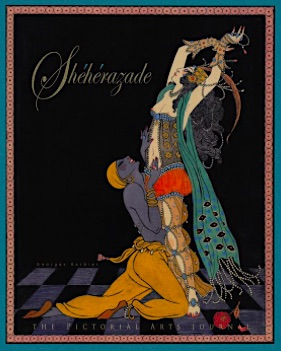
Chinoiserie (see here, and here) is prominent in Shéhérazade too. Last year at the Proms Marianne Crebassa sang it exquisitely; in a week when we rejoiced in Aretha Franklin and Madonna, Magdalena Kožená’s singing was further cause for celebration of the wonders of the human voice.
L’enfant et les sortilèges (first performed in 1925, but not heard in Britain until 1958!) is an enchanted, enchanting lyric fantasy. In the story the protagonist is 6 or 7 years old—the same age as the girls for whom Ravel wrote the original piano pieces of Ma mère l’Oye.
Whereas Colette wrote the text in eight days, Ravel worked on it over several years—she was in awe of the way he brought her libretto to life. Full of variety, the piece blends the comic drôlerie of the furniture, with ragtime and foxtrot, and the astounding fire aria, with the moving scene of shepherds and shepherdesses from the wallpaper leading into the boy’s poignant duet with the storybook princess.
The cat duet leads into a magical evocation of the garden. Here Ravel’s music anticipates Messiaen‘s use of birdsong and the ondes martenot, with evocative use of a slide whistle (Sachs-Hornbostel 421.221.312!—the cheese grater escapes me, though). Now it’s the turn of the animals and birds to indict the boy’s casual cruelties.
Amidst all the quirky virtuosic pastiche, and ravishing orchestration, the moments of tendresse register all the deeper, as he reflects on his errors; redeeming himself at last, the final chorus is a moving atonement.
*For an introduction to my whole series on Mahler, with links, click here!*
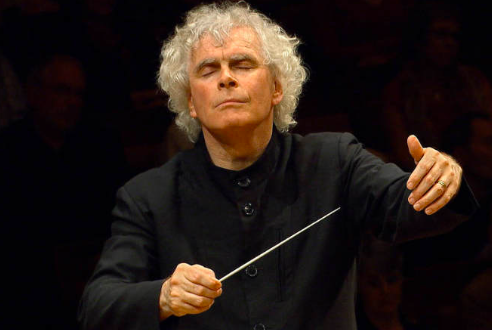
After returning from an exhilarating day with the Zhihua temple at the BM, I caught S-Simon Rattle‘s overwhelming Mahler 10 with the reborn LSO on BBC Radio 3.
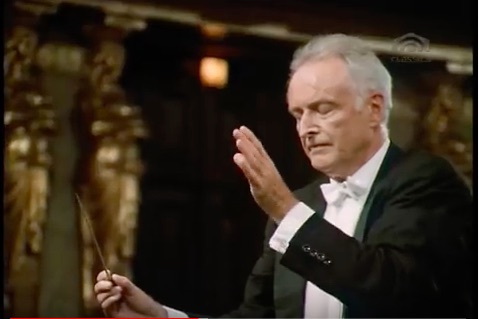
Here’s the opening Adagio from the concert—BTW, yet another illustration of the benefits of conducting from memory:
And here’s the complete 1980 recording with Simon (“as he was then”—before he was awarded the impediment) conducting the Bournemouth symphony orchestra:
Only half-written before Mahler died in 1911, the work was hardly performed until Deryck Cooke’s completed version became popular in the 1960s. Though I got to know it not so long after, it’s ages since I immersed myself in it.
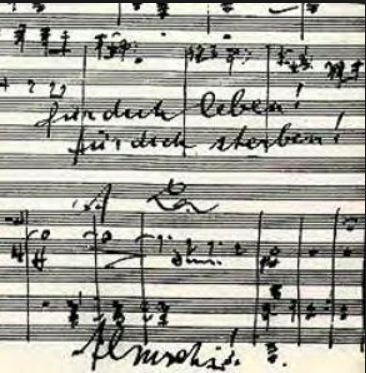
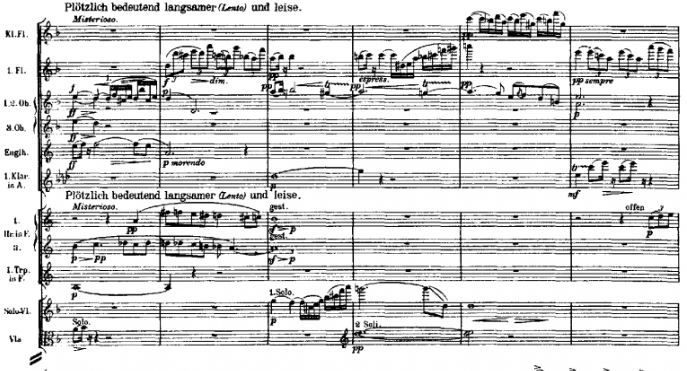
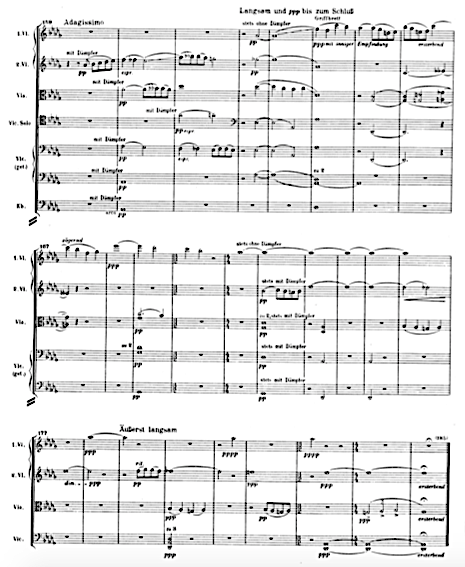
Under Mahler’s own torments the music often splinters, exemplifying the later devastation of European culture. In context (from 17.24 in the video, 16.15 on the 1980 version) the Scream chord of the Adagio is truly horrifying, presaged by huge nightmarish clashing granite slabs of sound, linked by a terrifying high sustained trumpet note, and followed by a screeching top D from the violins:
Now I don’t generally go in for this kind of thing,* but after my recent visit to Sachsenhausen one might hear that short episode (under two minutes) as a graphic condensed soundscape foretelling the torments of Europe from c1930 to 1945—like deathbed episodes flashing past (timings as on the 1980 audio recording):
An ominous opening to the Finale—inspired, according to Alma, by hearing from afar the funeral of a heroic fireman in New York[1]—leads into an exquisite flute solo (from 53.57 on Rattle’s recording) and sustained string lines (with more of those climactic struggling quintuplets, e.g. from 1.11.51) almost recalling the finale of the 3rd symphony. Despite interruptions from the funeral drum and the Scream, the mood is more serene, less desolate than his other late works.
In last week’s LSO version the violins (and violas?!) made their final searing leap on the G string!!! [My Mahlerian exclamation marks].
The Barshai version of the symphony is also much praised:
(for a discerning series of photos to accompany the finale, see here)
* * *
Mahler’s “late” works are such a comprehensive series of farewells (Abschied) that it’s always strange to realize that he died at the age of 50. What would have become of him, and his music, had he lived into the 1940s?
Not so late, but perhaps most moving of all, is Ich bin der Welt abhanden gekommen—with a final violin leap similar to that at the end of the 10th symphony, only pianissimo.
[1] For accessible accounts of Mahler’s last years, the 1907 New York funeral, and the history of Deryck Cooke’s version, see Lebrecht, Why Mahler?, pp.171–223, 275–9. Here’s Alma’s recollection of the funeral (Gustav Mahler: memories and letters, p.135):
Marie Uchatius, a young art-student, paid me a visit one day in the Hotel Majestic. Hearing a confused noise, we leaned out of the window and saw a long procession in the broad street along the side of Central Park. It was the funeral cortege of a fireman, of whose heroic death we had read in the newspaper. The chief mourners were almost immediately beneath us when the procession halted, and the master of ceremonies stepped forward and gave a short address. From our eleventh floor window we could only guess what he said. There was a brief pause and then a roll of muffled drums, followed by a dead silence. The procession then moved forward and all was over.
The scene brought tears to my eyes and I looked anxiously at Mahler’s window. But he too was leaning out and his face was streaming with tears. The brief roll of the muffled drums impressed him so deeply that he used it in the Tenth Symphony.
* Imputing verbal programmes to musical detail, I mean: the whole point of music is that it expresses things that can’t be expressed in words. Even novelists—who do use words!—find this irritating; I can’t find a source or precise quote, but as I recall, when asked “What were you trying to say in this book?”—one frustrated novelist replied, “I was ‘trying’ to say exactly what I did say.” (Martin Amis, would be my guess. Anyone?)
One morning in Maida Vale studios, as the great Pierre Boulez was rehearsing the BBC Symphony Orchestra, he stopped and said suavely,
“Please, we play again from measure* 180.”
Brilliant cockney percussionist Gary Kettel, from the back of the orchestra, punched the air gleefully and screamed out,
“ONE HUNDRED AND EIGHTYYY!!!”
Since Boulez’s broad erudition didn’t stretch to the world of UK darts, he was somewhat nonplussed [‘Ow you say in French?] by Gary’s recondite allusion to the fabled score of three triple 20s. Still, he and Gary always had the utmost respect for each other’s musicianship.
*Boulez always used the French word for “bar”. Endearingly, he called the cor anglais “ze English ‘orn”.
*For an introduction to my whole series on Mahler, with links, click here!*
Mahler 9 is always stunning in performance. The NYO Prom in 2015 was very fine (cf. here), and I’ve just heard Esa-Pekka Salonen doing it with the Philharmonia (reviewed here; cf. here; see also Harding’s Mahler 6 Prom).
I’ve got a lot of time for Salonen—not just because of the wonderful story about his interview for the LA Phil job! There’s something special about composers (also including Boulez) conducting Mahler, some personal identification with his struggles. Mahler anyway foretold the whole torment of 20th-century history—his music atomised, fragmenting, ersterbend—and we can only hear the 9th symphony with our own ears (that link also referring to Taruskin; see also here). Mahler never got to conduct it, or even hear it; while it remains startlingly modern even today, it’s hard to believe that it wasn’t premiered in the UK until 1930, and it was first heard in the USA (where Mahler was fêted even while he was composing it) in 1931. The symphony eventually became a pillar of the repertoire with the Mahler craze of the 60s—where I came in. Without entertaining any notions of the moral value of WAM, I have a fantasy of getting Chicago street gangs to sit through it.
Salonen brings out the Philharmonia’s talent for making chamber music amidst grand forces. Not having worked with him, I find him easy on the eye, and he looks comfortable to work with—more selfless, less anguished than Bernstein or Rattle, but far from the schoolmasterly air of Haitink or the aloof conductors of yore. Here’s Bernstein with the Vienna Phil in 1962:
Barbirolli and the Berlin Phil in 1964:
and Abbado with the Lucerne Festival Orchestra (2010), always magnificent:
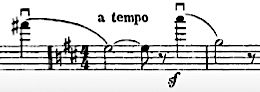
We emerge immersed in the dying sounds of the finale, but as ever, the first movement is a miracle in itself (as commentaries go, Ben Zander has some acute observations, albeit rather hung up on sonata form…). Beginning quietly yet ominously with a rhythmic pattern said to represent Mahler’s own irregular heart-beat, the violins enter with a motif descending from F♯ to E that turns out to be both pervasive and deeply moving—dramatically augmented at the first climax (4.21 in the Abbado performance above) by the 1st violins with a huge leap:
The lyrical aspect of the opening is constantly undermined (sinister brass punctuations from 7.34, a spooky passage from 8.49, more ominous brass from 15.03 and 19.09), becoming still more eery with enigmatic chamber music from 22.48:
The brief hint of tranquility from 24.42 soon fragments again:
I’ll leave you to immerse yourselves in the following movements—like the Abschied, or Ich bin der Welt abhanden gekommen, Mahler 9 live is an overwhelming experience, not to be missed.
For a 2022 performance with Daniel Harding and the Concertgebouw, click here. See also Mahler: quintuplets. For an unlikely connection, see here; and for a macabre tale from Inside No.9, here. See also Salonen’s Mahler 10.
The brilliant Roy Mowatt (see under comments here), a real bedrock of the early music orchestral scene, was always remarkably tolerant of my violin playing in the section he led. I treasure a remark he made to me over a beer or three in a piazza in Parma after a Mozart opera, c1994 (evoking Hugh Maguire’s comment to Pete Hanson—“Pete, even if your strings are out, you must play in tune! Just do it wit’ your fingers!”):
Thing about you, Steve, is that it doesn’t make any difference if your strings are in tune!
You can take that either way, and I think he meant it both ways. I was quite adaptable; yet my intonation wasn’t necessarily helped by tuning up… Cf. “It was in tune when I bought it”.
While I’m in confessional mood, here’s another comment I might add to my CV. Just around that time, a certain maestro took me aside and observed suavely,
Steve, I can’t help noticing that you have a somewhat low threshold of boredom…
As Kate Fox observes, the creativity of the English language reveals itself at multiple levels.
The fragrant Gary Lineker recalls how the the team-mates of the footballer Kiki Musampa called him Chris (think about it). There are more where that came from, like Fitz Hall—known as One Size.
Brian Smith, a “straight” symphony-orchestra violinist who became a semi-detached admission to the rarefied early music scene in the 1980s, had a whole series of drôle nicknames for his new colleagues, making his conversation surreal: “I think Identikit’s gone off with Ironing Board”. Once word got round that I was making regular trips to China, I became The Missionary. He only used the real names of musos who had a life outside early music and thus qualified as Real People.
Conductors’ nicknames are another rich vein under the rubric of maestro-baiting. The great Charles Mackerras was known as Slasher—not an allusion to his conducting technique, but an abbreviation of his anagram: Slasher M. Earcrack.
Pace Robert Hanks and indeed the great man himself, one can never have too much of Alan Bennett.
From his 2008 diaries, more perceptive ethnography of both orchestral musicians and audiences (cf. here and here), about a TV broadcast of the West-Eastern Divan Orchestra from the Proms:
… one of the cameras fascinated with a particular woodwind player who has a good deal to do, but who in turn obviously fancies the flautist who’s next but one. So at the end of his own contribution he’ll often half-turn in order to pass the tune or whatever to this flautist, and she is equally attentive during his solos. There’s a cellist with a cheeky face who plainly makes jokes, a bear of a violinist who throw himself about a lot, and next to him the child violinist with a face made tragic by concentration. It’s hard to conceive how such a small figure copes with the great winds of Brahms, though he’s more composed about it than his hairy and demonstrative neighbour.
It’s moving, too, of course because of the moral stance of the orchestra, though the players are by now probably bored or at least matter-of-fact about this ethical burden. But with similar experience in the theatre (including I hope The History Boys), one longs to stay with them once the performance is over and they disperse. Who looks after the child, I wonder, whom does the cheeky cellist sleep with and are the flautist and the woodwind player as close as their performances suggest? So there’s sadness too in being excluded from all this and longing, just as there is coming away from the theatre or for some people, I imagine, the football stadium.
Competing with the lofty claim of detached spiritual contemplation of the work in hand, such observation is a universal yet little-documented feature of attending public performances—just the kind of detail that ethnomusicologists might seek, and that the “absolute music” wing of WAM scholars would eschew.
My work with the Li family Daoists is full of such detail, both for their funeral practice at home—such as Golden Noble corpsing the others while reciting the Invitation memorial, or the reluctance of the kin to pay attention to the liturgy of the Daoists they still feel obliged to hire—and for their concerts on tour (such as this, and this). But even in the 1990s I had apparently read enough Geertz, Barley, and so on to pay attention to the behaviour of the Gaoluo villagers—like this passage (Plucking the winds, pp.304–5):
After supper on the 15th, the “temple” courtyard is packed. Apart from South Gaoluo villagers, some have also come from the North village and elsewhere. Many have come to offer incense, but many also just for the fun. Boisterous children are chasing around letting off firecrackers, both outside and inside the “temple”. Five sticks of incense are considered “a bundle” (yifeng).
As to ordinary villagers, though there are more women than men offering incense, quite few of the people are elderly: young and middle-aged women and young men seem to be more active in this. Many pray silently to the goddess Houtu for a healthy son, or for the health of their aged parents; more generally, people pray for good luck and prosperity. One couple were offering incense for the safety of the husband, who is a driver—even for the most diehard atheist, recourse to divine help is particularly tempting on Chinese roads. The atmosphere is highly jocular as people enter the courtyard. As they go to offer incense and kowtow they look embarrassed, but then when they are actually doing it they become extremely serious. Then as they get up and dust down their trousers, they look all embarrassed again, and, avoiding meeting the gaze of all the onlookers, they leave the area, often going into the “temple”.
Of course, Geertz, Barley, and indeed Bennett may do it better, but as with WAM, such social ethnography is quite rare in (both Chinese and foreign) studies of Daoist ritual, which are more concerned with recreating the abstract deep structure of medieval texts and ritual sequences. And similarly, it’s not one or the other—both angles are desirable.
* * *
Later in 2008 AB notes a comment on the distressingly populist Classic FM radio:
Elgar’s Nimrod conducted by John Eliot Gardiner. It doesn’t get much better than that. Or does it? Give us a call.
As S-S-Simon Rattle formally takes over the LSO, his latest media love-in reminded me of Harry and Paul’s fine departure in their Scousers series:
But Seriously Though Folks, some thoughts about conducting from memory. As both a performer and a concert-goer, I love it when conductors do this. I suppose it excites me partly because I’ve spent most of the last three decades toiling under what Norman Lebrecht calls “semi-conductors” in the early-music world, where it’s very rare—but never mind them.
WAM soloists commonly perform from memory (for an intriguing instance, click here)—as do musicians in most the world (to take an entirely random instance: um, Daoist ritual specialists…). Conducting from memory now seems to me like a basic courtesy to the orchestra. Conductors don’t have to worry about strings going out of tune, or reeds misbehaving, or splitting notes—they’re earning a zillion times more than the poor people who actually play the music, and all they have to do is “wave the stick until the music stops, then turn around and bow”. And the benefits, for both players and audience, are immense.
Conductors have more nuanced views, of course. Here’s Paul Hostetter:
Conductors had the score in front of them, not because it wasn’t memorised most of the time, but rather almost as a reverent gesture to the composer’s intent.
I always interpreted this as a sign of humility towards the music they were performing, perhaps even in some quasi-sacred rite of ceremonially placing the score at the centre of the act of performance.
… among [conductors] it is becoming something of a point of honour to perform without a score.
And why shouldn’t they, if we’re going to say soloists ought to? There are essential differences. First and simplest, it’s harder. There are many instruments and thus far more notes to be memorised; even if you can easily recall the musical substance, the matter of who’s playing what, when, with whom is complex and constantly shifting. And the conductor does not have the benefit of motor or tactile memory of how the notes feel because he does not play any of the notes.
For the same reason, conductors are the only musicians who can fake memorisation, or perform a piece ”off book” when it is only partly learned. If it’s a matter of putting down the right keys on the piano, you either know it or you don’t. But if a conductor succeeds in memorising the score at a gross level (the basic rhythms, the major entrances), he can go ahead and conduct ”by heart” while he’s still learning the details, or perhaps without ever learning some of them. If you don’t think this happens, even in big places, have a beer with any longtime orchestral player and ask.
The practice caught on from Toscanini. Furtwängler, Celibidache, Karajan (sorry), Böhm, Bernstein, Barbirolli… Of all conductors I would expect to dispense with the score, it would be Rozhdestvensky—he was so spontaneous and direct. But apparently he always had the score in front of him, and the result was electrifying anyway.
The score can serve as a safety-net for the conductor; for the band, as a psychologically stabilising element. But it’s also as a protective layer insulating the conductor from communicating directly—we know how much more thrilling a performance is without the safety-net.
The focal position of the score reminds us all that we’re here not so much to celebrate an incandescent moment of communication between musicians, as to reinforce the hegemony of a dead composer. During the “performance” the audience may even consolidate this by occasionally resorting to the printed programme.
I just find it distracting, and a sad limitation to the potential for the direct engagement that should be intrinsic to any kind of performance.
Chamber groups like the Chiara quartet have also found playing from memory fruitful. Even more radical is to get (and pay?!) the orchestra to play from memory too, as the Aurora orchestra often does:
*For an introduction to my whole series on Mahler, with links, click here!*
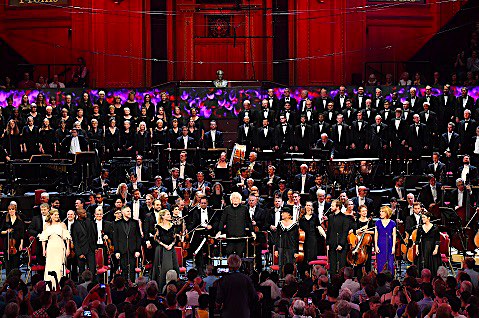
Nothing can beat the atmosphere of a Mahler symphony at the Proms. Following the 1st, 2nd, 4th, and 10th symphonies this season, I just went to hear the 6th, with the amazing Vienna Phil under Daniel Harding.
Hot on the heels of the equally fine Concertgebouw orchestra in the 4th symphony, the Vienna Phil sounds like an enormous marshmallow cake, with individual personalities smothered in Schlagrahm—apart from the cowbells, evidently from a large herd. Notwithstanding changes in performance practice over the past century, standing beside recent early-music versions of such repertoire, venerable orchestras like this convey a tangible feeling of direct continuity with tradition.
Here’s Mitropoulos with the New York Phil in 1955:
and the Vienna Phil with a bearded Bernstein, c1977:
Barbirolli’s 1967 version with the New Philharmonia (as the old Philharmonia was then known):
The exquisite slow movement is unfairly eclipsed by those of the 4th and 5th symphonies, I feel. Harding put it second, in line with Mahler’s own rethink, but I side with those who favour his original order—not so much for the argument of the tonal scheme, but rather so that the Scherzo can continue the demonic power of the first movement (as in the 5th symphony), the slow movement then making its full impact before the devastation of the finale. Christoph Eschenbach puts this case in an interesting page where various conductors reflect on all the symphonies; see also David Matthews.
God, how I’d love to get stuck into passages like this again (from 1.10.39 on the Barbirolli version, responding desperately to the hammer-blow):
Here’s the first movement in a 2017 performance with S-Simon Rattle and the LSO:
* Historical note: I often chose Bernstein’s Mahler performances with the Vienna Phil, but it won’t necessarily strike the casual listener/viewer that there’s something else remarkable about the orchestra. It’s one of several that haven’t exactly led the way in gender equality: permanent posts were only given to female musicians in 1997, and even by 2013 the orchestra only had six female members. Historically authentic, sure, but… (cf. Maestro).
“I dunno, where’s it all going to end, eh? They’ll be demanding control over their own bodies next. PC gone mad if you ask me.”
I’ve written about the Symphonie fantastique before—not least the wonderful Rozhdestvensky’s solution to conducting the opening (by not conducting it).
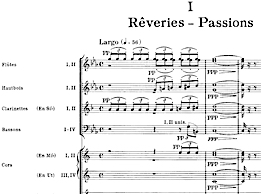
Apart from Berlioz’s prophetic evocation of a 1960s’ curry-house, another respect in which he was well ahead of his time is in his meticulously verité depiction of an irritating upstairs neighbour giving furniture-moving lessons * at 3 o’clock in the morning, just as the drama of the 1st movement is unfolding—an unwelcome interruption to the Rêveries-Passions of its title. You know, one of those disturbances you can’t quite be bothered to get out of bed for to bang your broom on the ceiling.
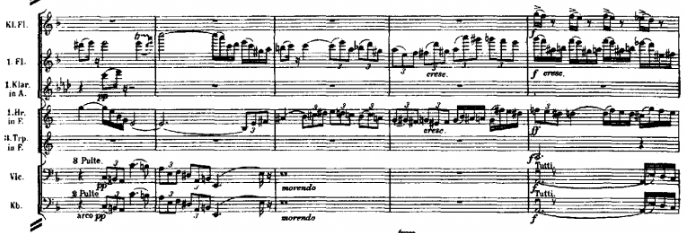
This touching domestic scene is economically evoked with a random series of little grunts in the double basses (from 12.06 in the recording below) punctuating little wind phrases in the brief lull after the first throbbing climax is interrupted (to evoke Susan McClary):
But here’s one, by Alex Bruggemann (Die Welt am Sonntag, 2004), about a concert he gave with the Berlin Phil. Indeed, I found it posted with uncharitable glee on the notice board of the Chicago Symphony when we were doing a gig at Symphony Hall—our stay in Chicago another welcome opportunity to slope off to bars afterwards to hear some amazing blues.
I cite from the review not as an endorsement, you understand, but for the charm of the image:
While Rattle romps expressively on the podium, the Philharmonic musicians sometimes tend to play as inconsequentially as if they were a wife reaching to the fridge to get out a beer for her husband.
No pleasing some people. It was just a phase they were going through.
A more inadvertent critique was offered by a Radio 3 announcer introducing Brahms’s Tragic overture:
We don’t know which particular tragedy Brahms had in mind when he composed this overture. … But here it is, conducted by Richard Hickox.
Of course the Bach Passions are a regular subject of imaginative modern re-creations (Jonathan Miller, Sellars–Rattle, ENO, and so on); but the climax of the Proms Reformation Day on Sunday, John Butt’s version of the John Passion, in a certain liturgical context, was special. Note also his book Playing with history.
Like Daoist ritual (see many posts on this blog, including my starter page on Bach!), Passions in Thuringia for Good Friday vespers varied regionally, and evolved. Of course we now attend them in “concerts”. The Albert Hall in 2017 is clearly not the Nikolaikirche in 1739—although the audience/congregation was apparently of a similar size. But having read Taruskin, and Butt’s own astute views on the HIP movement, surely we can welcome such renditions; it’s a stimulating way for us (“miserable sinners”) to experience the work anew.
Bach revised the John Passion several times; Butt recreated an “ideal” sequence based on the 1739 version (which was never actually performed!), directing with an unaffected schoolmasterly air that indeed evoked Bach the Cantor himself (cf. Robert Levin’s incarnation of Mozart).
As in Bach’s Leipzig, both parts of the Passion opened and closed with organ music and sung chorales. By contrast with the concert version (finely evoked by John Eliot Gardiner, Music in the castle of heaven, p.343), when the orchestra plunged into the anguished dissonances of the first chorus of Bach’s music, it makes you think how a congregation still unaccustomed to their new Cantor’s style, yet unprepared (though not quite—see Gardiner, pp.347–9) for the constant flow of extraordinary creativity that they were to enjoy for the next twenty-seven years, must have thought (in 18th-century Thuringian), “WTF?!” (cf. The ritual calendar).
The focal point of the Good Friday Vespers in Leipzig was actually the long sermon in between the two parts of the Passion music, which at the Albert Hall was thankfully replaced by an interval (glass of wine, ice-cream…). I wonder if a talk by someone like Malala might be a suitable further exploration—since many in the audience will experience the Passion deeply despite being less than devout religiously.
Do listen to John Butt’s remarks in the interval of the TV broadcast too (from 53.10)—and I like the analogy of Richard Coles (nay, “the Reverend Richard Coles”—clever choice of presenter, BBC!) with the mass singing at Cardiff Arms Park (more ritual and sport).
Given the rowdy behaviour of Leipzig congregations in Bach’s day, perhaps the Prom audience should have been a tad less attentive?! After we had all joined in singing the chorale O lamb of God, applause at the interval felt a bit weird, but it was entirely natural as a novel response to the life-affirming ending—after the beautiful motet Ecce quomodo moritur by Jacobus Handl (1550–91!), a blessing and response, Bach’s own organ chorale prelude Nun danket alle Gott, and a final rousing rendition of Now thank we all our God from the whole hall (a tune, suitably, that most members of the “audience” would know), accompanied by organ at exhilarating full throttle—all confirming joy at atonement.
By comparison, the great Passion performances of recent decades may seem more immaculate and micro-managed (“Chanel No.5″), but they remain deeply moving—like Gardiner’s version (also from the Proms, with the superlative Mark Padmore (note this roundup). But this performance had a Lutheran simplicity that was differently moving.
Butt also notes “the different levels of singing cultivated in the church and school environments of Bach’s time,” from basic to more advanced pupils and indeed the congregation (again, cf. Butt’s interval remarks), so that the liturgy accommodated the whole community:
What we hear in concert performance is only the tip of a much larger iceberg, a culture of singing and participation that can only be fleetingly evoked in a modern performance.
This reminds me of the different levels of accomplishment within (you guessed it) a Daoist ritual group:
This dilution of personnel is a recent change, but before 1949 too, Daoist groups might recruit some extra percussionists who would gradually pick up the basic of the vocal liturgy. The substantial group of Li Qing’s senior colleagues from the 1930s didn’t come from his own family, but they had all trained from young with his uncles, and went on to become fine Daoists. In Beijing before 1949 some Daoist and Buddhist priests specialized more in the vocal liturgy, others mainly in the melodic instruments, and some village men spent time serving the temples there mainly as instrumentalists. Thus there have long been different levels of expertise, both between groups and within a single group. In the imperial era one imagines that some groups in larger towns, serving wealthy patrons regularly, might have more abstruse knowledge than poor village bands. But even within a single group—in the courts and elite temples as well as rural household groups like the Li family—there would have been a variety of accomplishments. Both temple and household groups often included a young boy just starting out on the gong, still unfamiliar with the ritual texts. (my book, pp.324–5).
Again like a Daoist ritual, the recreated Passion also features different styles of old and new music, not such an evident feature of the usual concert version. And it reminds me rather of the Li family Daoists’ concert performances of excerpts from their lengthy funeral rituals, uprooted from their liturgical context—remember, the Li band gave wonderful performances in Leipzig in 2013.
In John Butt’s John Passion at least we get an impression, in a secular concert setting, of the power of Bach’s contribution to Good Friday Vespers.
For the 2024 Prom performance of Suzuki and BCJ, click here.
During a rehearsal, as some tedious conductor insisted on honing the opening phrase of some symphony ad nauseam, making us repeat the first four bars for what seemed like hours, one player eventually piped up from the back:
“Excuse me Maestro—I believe bar 5 is rather good too!”
Note again the exemplary sarcastic deployment of the term Maestro.
I’ve just added another lengthy page on Messiaen, with reflections on further thought-provoking ideas from Richard Taruskin, this time on new (and New Age) spirituality—leading me to ponder ritual and music, East and West.
I’ve already posted a wonderful performance of Rachmaninoff’s 2nd symphony, but the recent Prom included another moving version, conducted by Thomas Dausgaard. I Like the Cut of his Jib, as Adrian Chiles observed prophetically about Guus Hiddink’s managing of the South Korean football team in 2002. Nor is the BBC Scottish to be sniffed at—I loved their Mahler 5 at the 2015 Proms, with Donald Runnicles.
With typical Proms flair, the concert opened with concert versions of Orthodox liturgy sung by the Latvian radio choir. After Rachmaninoff’s 3rd piano concerto, the encore of Vocalise led me to his own 1929 studio recording of his orchestral version:
Of all versions, you can’t beat it on theremin—here’s the divine Clara Rockmore:
And the theremin might lead us to Messiaen‘s ondes martenot…
In The shock of the new I reflected on the scandalous première, the ballet, jazz and HIP versions, and a rendition on organ.
Like the NYO’s other Proms in recent years (Turangalîla, Mahler 9; cf. here), there’s something special for the audience in experiencing young performers relishing challenging modern masterpieces, sizzling with energy and commitment. The Rite may have become more of a repertoire piece than it was even in 1970, but it never fails to amaze. Even if I missed Boulez—who relished the sensuality as well as the violence of the piece (“Not A Lot of People Know That”—I grew up with his Mahler and Ravel too).
The complete BBC4 broadcast included a feature before The Rite with lovely paeans to the band from some of the great conductors who have worked with them, including Boulez and Rattle—the latter himself an alumnus. Our 1970 Rite with Boulez wasn’t at the Proms, but our 1971 Prom with him included more Gran visits York (sorry, I mean Igor Stravinsky), as well as Bartok, Berg, Webern, and Debussy. Wow, how awesome is that—as we hadn’t yet learned to say...
I always admire Esa-Pekka Salonen in concert—and not merely because of the fine story (about his interview for the LA Phil) that I love to relay, illustrating establishment mindsets in both WAM and Daoist studies.
And I can never resist a live performance of Ravel’s Shéhérazade. At the Prom yesterday it was just magical. The venue itself creates a remarkable intimacy—the special communication between performers and Prommers, rapt attention, unique silences. Marianne Crebassa’s singing was exquisite: embodying Ravel’s intimate parlando style, she was always a vehicle for the nuance and drama of the text, deftly avoiding the diva trap. And Salonen conducts with suitably detached clarity. (For L’indifférent, see also here.)
Reluctant as I was to break the spell, John Adams’s grand Naïve and sentimental music eventually won me over.
Hot on the heels of my implausible link from Bach to Stravinsky, the concert began with a more convincing one, Stravinsky’s Variations on Vom himmel hoch. Reading Richard Taruskin as I am just now, I was more in the mood for it than usual.
Talking of Roaming in Paradise, perfect music for summer nights (cf. Berlioz) is Mozart’s C major piano concerto—not least the amazing vista that miraculously unfolds in the finale, introduced by an abrupt cadence (from 3.47):
I’m by no means an early music purist, but I really find the fortepiano more expressive here—or rather, the way it suggests the music can be played. All Mozart’s amazing late concertos are really piano and wind quintets, but melting into those string entries (1.03, 1.52) is a spine-tingling experience.
By contrast with the disembodied fallacy of “autonomous music”, our experiences of all kinds of music are always an accumulation of associations. Those sessions with Malcolm Bilson at St John’s Smith Square (in interludes between my fieldwork in China) are a happy memory. It also reminds me of accompanying Roy Howat (also a brilliant Ravel specialist) with Charles Groves* directing the Cambridge University Chamber Orchestra during May Week (which is of course two weeks in June, as Clive James reminds us) in 1974. And Robert Levin’s Mozart is in a league of its own.
Sharing the piece with Natasha, always attuned to classical beauty alongside her taste for icons and electronica, was magical too.
*He had just been knighted. I haven’t written “Sir Charles Groves”, not so much out of resistance to antiquated honorifics, but because it would only remind me of the Sir Simon Rattle story. Oh go on then.
Brass players enjoy, even flaunt, their hooligan image (more “licence to deviate from behavioural norms”)—or at least, UK brass players in a befuddled heyday from the 1960s to the 1990s, still an ongoing hangover today.
Becoming a musician (or indeed a household Daoist) is about far more than “learning the dots”; aspiring musicians also look to the lifestyles of their role models. The intoxicant du jour changes—Chinese shawm players have moved from opium to amphetamines, for instance. But both in jazz and WAM, many musos have learned to their cost that adopting the, um, recreational pastimes of Charlie Parker or John Wilbraham doesn’t necessarily help them play the way their heroes did.
The trumpeter John Wilbraham (“Jumbo”) was legendary. This is a beautiful site well worth exploring—an insider’s ethnography. I came across him when he was trumpet tutor for the NYO, and later in the BBC Symphony Orchestra.
There are also some fine stories on this site, not least about two of my most admired conductors (more maestro-baiting):
“The one thing we do know about Bach for certain, is that he didn’t want it to sound fucking awful!”
—John Wilbraham to John Eliot Gardiner.
(a succinct critique of the Early Music movement?), and
“If I’d wanted to play in front of a clown, I’d have joined the fucking circus.”
—John Wilbraham (Jumbo) on Gennadi Rozhdestvensky (Noddy)
Learning to perform—in any tradition!—requires endless hours of practice (again, it’s the stories about jazzers, rather than WAM musos, that inspire me here). There’s another famous story, which strangely I haven’t yet found among all the online anecdotes:
Before Mahler 5 at the Proms, a music critic was having a drink in the 99, favoured hostelry of Prom-goers. He watched in amazement as Jumbo downed pint after pint, and then picked up his trumpet case to stagger off to the gig. Expecting the worst, the critic took his place in the audience. The symphony opens with a scary exposed trumpet solo, and is challenging throughout. Jumbo played the whole piece perfectly.
After the concert the critic returns to the pub, to find Jumbo already propped up at the bar, more pints lined up. He walks up to him and says,
“You must excuse me, Mr Wilbraham, but may I ask how you manage to play so perfectly when you’re pissed?”
“It’sh perfectly simple,” Jumbo smiles back at him conspiratorially, “I practice pissed!”
Further to my old theme of our irredeemably modern ears (and here), Simon Rattle,* on one of his early early-music outings with the Age of Enlightenment, was rehearsing Mozart with the band.
After one finely polished phrase, he stopped us and said admiringly,
“Wow! I’ve been waiting all my life to hear it played like that! … Anyway, now I’ve heard it, I don’t like it—can you just play it normally, please?!”
*As a stammerer, I hesitate (sic) to call him Sir Simon Rattle. As in the (real) line from a waggish Radio 3 announcer:
That was Sir Simon Rattle conducting Brahms’s 4th symphony. Next week’s guest conductor is M-Mark Elder.
But I now learn from Felix Warnock, encyclopedic authority for orchestral stories, that this line goes back to Symphony Hall in Birmingham, when both the CBSO and the Hallé were rehearsing on the same day for separate concerts. At the stage door, bumping into an old colleague he hadn’t seen for some time, one muso asks another,
Hugh Maguire (1926–2013) managed to combine his work as leader of orchestras with making some fine chamber music. I share my admiration for his playing with far more distinguished pupils of his. As he caressed the strings lovingly, his way of turning a phrase was irresistible.
In the NYO another important kind of education for me was pub sessions where he and flautist Norman Knight would swap indiscreet orchestral stories over copious G&Ts.
Blessed with a brilliant Irish sense of humour (see also Irish tag), Hugh could be both charming and tough with conductors; it was he who told me the Hermann Scherchen story. This reminiscence of Jacqueline du Pré, with whom he and Fou Ts’ong loved playing piano trios in the 1960s, gives an idea of his sincerity.
Hugh’s playing appears all too rarely on YouTube, but here’s his wonderful 1964 recording of Scheherazade (Rimsky-Korsakov, not the equally ravishing Ravel version) with Pierre Monteux and the LSO:
Pete Hanson, heir to Hugh’s own spirit, recalls his account of a scary moment during the Scheherazade sessions:
Towards the end of a day’s recording, Monteux turned to him after the first take of the finale, with its ethereal high harmonics, and said “Come on Maguire, get it right!”
Hugh too could be as down-to-earth as his playing was sublime. Here’s Pete again, with a couple of choice comments received during lessons:
“You sound great, Pete, all the shapes and feelings are there—but you’ve got to play all the notes!”
“Pete, even if your strings are out, you must play in tune! Just do it wit’ your fingers!”
Nor is the play of fag-ash on ancient instrument the exclusive province of Li Manshan. Yet again, Cieran Carson has a beautiful description (Last night’s fun, p.54):
So I remember fiddle-players with cigarettes poised between two fingers of their bow-hand, and the ash would wave and sprinkle across their trouser-knees; or the cigarette that drooped between a player’s lips would let drop a little grub of ash into an f-hole of a fiddle, where it disintegrated as it crashed into the ersatz “Stradivari” label. The knees were dusted off, someone rosined up, and a fitful shaft of sunlight would illuminate the dust-motes like a dissolute snowstorm souvenir.
This 1968 recording of the Mendelssohn Octet has long been a favourite, with Hugh leading a star cast including Neville Marriner and Iona Brown (or Iona Brown violin, as she’s known):
On the same LP, the poise of Hugh’s playing in the Minuet of the Boccherini Quintet is charming too—with a bold yet tasteful glissando on the cello (0.37, 1.03, and best of all at 3.15):
Boccherini also makes a priceless backdrop for The ladykillers. For an incident in the middle of a string quartet, see here; and for another string quartet, here.
And here’s Hugh leading the Allegri quartet in the Mozart clarinet quintet, with Jack Brymer:
Norman Lebrecht has long laid bare the links of celebrated senior conductors (as well as Karajan…) to Nazism: it’s one subtext of his fine book The maestro myth.
I just read his review of Fritz Trümpi, The political orchestra: the Vienna and Berlin Philharmonics during the Third Reich.
The book actually takes the story through to our own times. As Lebrecht observes, neither orchestra emerges with any credit—indeed, it’s a shocking account.
For me, as a teenager in the National Youth Orchestra (of GB), another inspiring conductor (apart from Boulez) was Rudolf Schwarz (1905–94). Member of the Vienna Philharmonic in his youth, later inmate of Auschwitz and Belsen, after the liberation of the camps he eventually ended up in Bournemouth, remoulding the orchestra there. His Bruckner 7 with the NYO was wonderful—all the more intense with his laboured conducting style, partly the legacy of a broken shoulder-blade in Auschwitz. Never a superstar in the Karajan mould (which was why musicians appreciated him), he was a formative influence on the young Simon Rattle, my contemporary in the NYO.
Bruckner 7 is in the incandescent key of E major, just like the basic scale of the Li family Daoists‘ shengguan ensemble—I often think of it while I listen to the shengguan piercing the bright blue sky of rural north China (e.g. playlist, #4, with commentary here).
Meanwhile, as Rudi was being dragged through the camps, here’s WilhelmFurtwängler conducting the Adagio with the Berlin Philharmonic in 1942. Like Philippe Sands’ choice of Bruno Walter conducting Mahler 9 in 1938— and just as with Daoist ritual—we have to personalise such seemingly disembodied works, and place them in time.
You can find a newly remastered version here. For Celibidache’s Bruckner 7, see here.
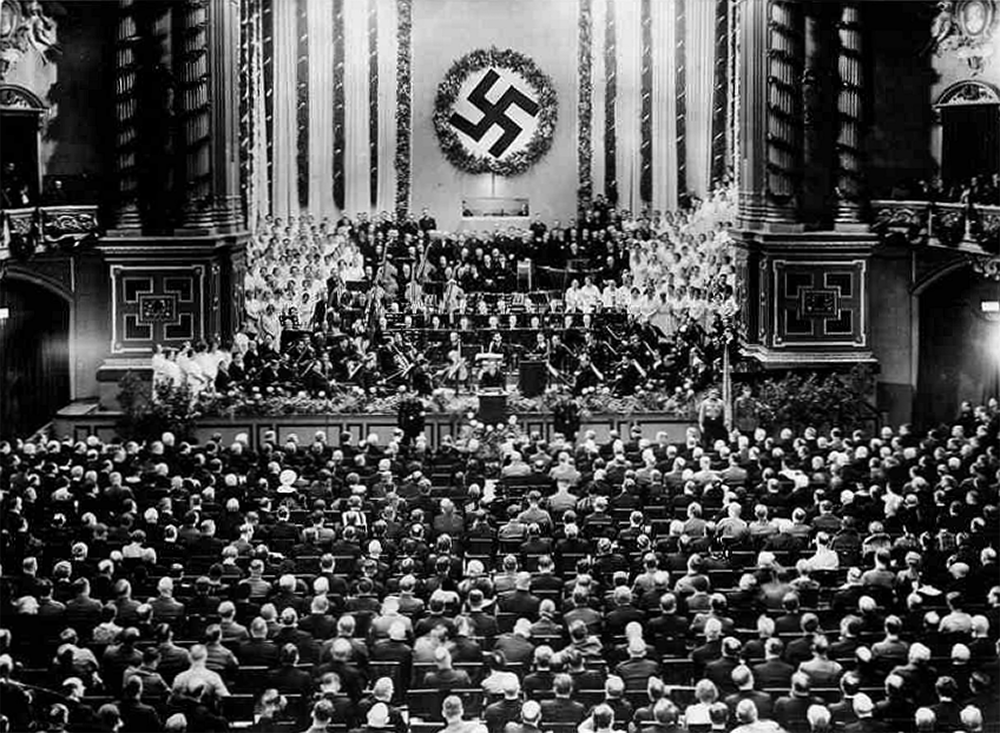
Furtwängler’s relationship with Nazism has been much debated. Generally reluctant to collaborate, he did what he could, even helping some Jews escape, and with close ties to the resistance. Yet inevitably people baulk at his participation in events like this Beethoven 9 for Hitler’s birthday, also in 1942:
Lebrecht sums up his legacy (The maestro myth, p.93):
In Furtwängler the Nazis retained an interpreter who performed German music with undiminished conviction while genocide was committed in his name. By opting to remain, he endowed the Nazis with cultural respectability at a crucial moment in their ascent, and in wartime gave moral sustenance to their cause. In his confrontations with tyranny, Furtwängler proved a feeble adversary who was all too easily manoeuvred into outright collusion. The humanity he expressed in music was traduced and travestied by his paymasters. His legacy as a performer may well be among the most significant in the annals of conducting, but his conduct under political pressure compromised the very profession on which he wielded so formative an influence. [for Lebrecht’s more recent exposé, see here.]
Still, it’s easy for us to say that. Reflecting on the Nazi era from the perspective of our blessed safety from invasion and agonising choices, Neil MacGregor poses the disturbing question “What would we have done?”. In his brilliant 2014 book Germany: memories of a nation (and no less enchanting are his podcasts—the perfect Radio 4 voice!), using both works of art and everyday material objects, he ponders how we can fit the great humanistic traditions of Germany into the same picture with Nazi barbarism. And having suffered throughout this whole period, people of Central and Eastern Europe would still have to continue making appalling moral choices for decades to come.
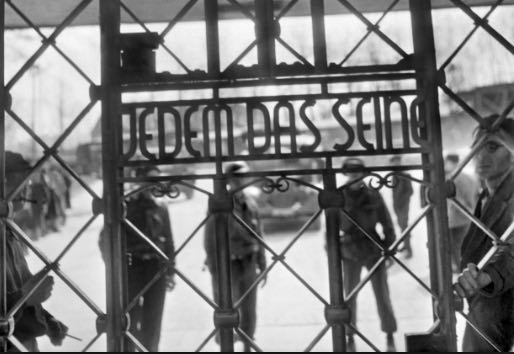
Apart from MacGregor’s astute discussions of earlier historical artefacts, one can’t help being drawn into those from more recent history—like the slogan (“to each what they are due”) above the camp gates of Buchenwald—just a few miles outside the Weimar of Goethe and Bach:
MacGregor observes the noble lineage of words that had once signified an ideal of justice—the very words that Bach used as the title of a cantata in 1715 Weimar. Indeed, as a prelude to John Eliot Gardiner’s epoch-making Bach Cantata Pilgrimage all through 2000, I played a modest role in the Christmas oratorio at the Herderkirche in Weimar—here’s Part One. Next day we all visited Buchenwald.
I’m not sure we can derive any encouragement from MacGregor’s idea that the stylish lettering of those words above the gate (designed by an inmate, Communist and former Bauhaus student Franz Ehrlich) might be read by fellow inmates as a subtly subversive message that the SS would eventually get their just deserts. By the way, Ehrlich survived, also disturbingly, to become a Stasi informant under the GDR.
MacGregor gives a fine diachronic survey of Käthe Kollwitz’s work,
as well as the incarnations and migrations of Ernst Barlach’s Hovering angel (1926, cf. the 1966 GDR film The lost angel),
But he also discusses movingly the “rubble women” (Trümmerfrauen) who rebuilt shattered Germany after the war, and objects such as a little hand-cart pulled by refugees from Eastern Pomerania in late 1945—now reminding us tellingly of the refugee crises of our own day.
But to return to Trümpi’s book, this tale of two orchestras brings us, shamefully, right up to the lives of my generation and later. It was not until 2013 that the Vienna Philharmonic revoked the Ring of Honour it had bestowed on three leading figures in the Nazi genocide—including Richard Strauss’s patron Baldur von Schirach, who (also in 1942) described the deportation he oversaw of 65,000 Viennese Jews to the death camps as a “contribution to European culture”. Indeed, our feelings about those celebrated Viennese New Year’s concerts can’t help being stained by learning that it was Schirach who instigated them.
As an aside, these orchestras haven’t exactly been at the forefront of gender equality either. Competing hotly in the misogyny stakes with “Rear Admiral” Foley, Karl Böhm (a Great Maestro far more flawed than Furtwängler) is quoted as saying that “the Nazis aren’t that bad—they want to eliminate women from politics.” Digging himself into a deeper hole, he went on, “Of course, not all women are worthless—Rainer Maria Rilke [sic] wrote some good poems.”
And now there are new causes for anxiety, threatening all the liberal values that have been achieved so painfully over several centuries.
Which reminds me, a noted baroque conductor (or “semi-conductor“, to use Norman Lebrecht’s term) was rehearsing the opening of a slow aria in the Matthew Passion. One of the wind players suggested he might try subdividing:
“Could you give us 7–8 into it?”
Conductor, indignantly: “I didn’t get where I am today by giving 7–8!”
“I didn’t get where I am today by…” soon became another musos’ snowclone.
For a fleeting glimpse of this method, see the wonderful film Gennadi Rozhdestvensky—conductor or conjuror?, from 00.26, under Noddy: the art of conducting.
A tribute to the great Gennadi Rozhdestvensky (1931–2018)
We musos may be critical of conductors (cf. Norman Lebrecht, The maestro myth: great conductors in pursuit of power), but don’t get me wrong, we deeply admire great ones—such as Boulez, Tennstedt, Gardiner, Rattle (unlikely bedfellows…). See under The art of conducting.
Apart from Boulez, another highlight of depping regularly with the BBC Symphony Orchestra was working for Rozhdestvensky (known in the trade as Noddy).
Gennadi Rozhdestvensky—conductor or conjuror? (Bruno Monsaingeon, 2003) is a wonderful film:
In a work that otherwise requires little imaginative filming, do watch the brilliant scene from 32.40—the traffic cop Marcel Mehala should take a bow too.
Believing in a kind of spontaneous combustion, and trusting his players to match his own mastery, taking risks together, Noddy was renowned for his aversion to rehearsal—greater still than that of orchestras. Once, turning up for the first of a couple of whole days’ scheduled rehearsals for a fiendishly difficult and unfamiliar modern piece, he conducted the first few bars and then told the band nonchalantly, “Good, see you at the concert”. In a rare reversal of the musos’ philosophy of “It’ll be all right on the night”, the leader took him to one side and asked him if he wouldn’t mind just taking them through the whole piece once.
Even on stage, his style doesn’t look like much—inscrutable, even casual, his gestures by turn minimal and flamboyant (in the film, from 22.24, he explains his economical solution to conducting the opening of the Symphonie fantastique (cf. Yet more conducting). But his concerts were electrifying. Doing Petrushka, it was as if we were all composing it, living it, together with him. And the Scriabin piano concerto with his wife Viktoria Postnikova was exquisite too—here’s an audio recording:
We can also relish them together in Rachmaninoff’s 4th concerto:
In Historical ears and eyes I feature Noddy conducting Rachmaninoff’s gorgeous 2nd symphony. And do listen to his Tchaik 6. The documentary ends with an illuminating sequence where he rehearses and reflects on Tchaikovsky’s Romeo and Juliet. If only we could see more of the archive footage below—the curious camerawork shows him only briefly, though with characteristic gestures:
Monsaingeon’s Notes interdites (aka Red baton) also features another film in which Noddy reflects on the political vagaries of the Soviet system.
The term emoluments is suddenly enjoying a dubious revival with a clause in the US constitution that is among many currently battening down the hatches.
The term, while not constantly on the lips of the rap generation, evokes fond memories from my days studying Tang history.
True, this is scant consolation for the current Destruction of Civilisation As We Know It.
Another namby-pamby term used in academia that always makes me giggle is honorarium. But since I very occasionally get one, I mustn’t bite the hand that feeds me.
Musos are more straight-talking. One day our Mozart recording sessions in St John’s Smith square were interrupted by deafening building work outside. Reluctant to send us all home, the conductor discussed with the record company whether they might offer the workmen some kind of bribe to knock it off. Meanwhile the orchestra, aware that we would still have to be paid even if the session had to be called off, wondered whether we might make them a better offer to get them to keep going.
This was around the time of a dispute between a certain conductor and the brass players about overtime. A trumpet player (legendary for many touring exploits besides) put their case with the classic remark,
It’s not the principle, it’s the money!
This actually goes back at least to Eisenhower in 1959.
Stephen Cottrell, Professional music-making in London: ethnography and experience(Ashgate, 2004)
takes a proud place among studies of more “exotic” cultures in the splendid SOAS Musicology series. Complementing the work of Bruno Nettl and Christopher Small, as well as Ruth Finnegan’s classic The hidden musicians, it strikes many a chord with my work on Chinese ritual groups.
As I observed under WAM, it’s not that Western cultures, of any kind, should be a benchmark for discussing other societies (note Is Western Art Music superior?, and What is serious music?!); to the contrary, it’s fruitful to integrate them into a “Martian” view of world cultures, wearing both emic and etic hats. Many of Cottrell’s themes resemble those that an ethnographer like me would explore in studying Daoist ritual specialists:
The practical aspects of earning a living
The importance of “on the job” training, sociability, and oral/aural experience in what seems like a narrowly text-based tradition.
The importance of timbre (pp.44–55), little theorised even in WAM but quite prominent in China for the qin zither, deserves recognition in Daoist ritual and shawm bands.
His account of “depping” (57–76) augments the parallel that I draw for household Daoists (Daoist priests of the Li family, pp.319–26), not least the insecurity of the freelance living—and it’s fascinating to read (Cottrell p.60) an account of depping from 1760s’ Britain.
The modification of dreams: the tensions or discord between early training and ideals (based on solistic individualism and creativity) and the delicate social/practical negotiations, frustrations, and grinding routine of professional orchestral life (42–4, 103–21; cf. also Scunthorpe and Venice, and Ecstasy and drudge); personalities and crisis management within an ensemble (89–90). I should add that household Daoists, as hereditary (almost ascriptive) artisans, don’t experience such a conflict, never setting out with such a spiritual ideal; but the practical exigencies of occupational routine are shared. Here I also think of Yang Der-ruey’s study of the changing training of Shanghai temple Daoists. Cottrell cites a telling comment:
We’re artisans rather than artists. What an orchestral musician is doing is taking someone else’s creative idea which they put down as dots on paper and actually turning it into sound. So we’re more like bricklayers—the architect would do the plan and then they actually put the bricks into place.
And his dissection of the performance event, subsuming ritual, theatre, and play (149–82)—continuing from Small’s account, about which he expresses reservations. He observes diversity within the audience and in their responses (159–64)—a feature that for Chinese ritual is clearly germane, not only today but even in (supposedly more homogeneous) pre-Liberation society.
Cottrell’s discussion of myth and humour (123–47), citing Merriam’s paradigm of low status, high importance, and deviant behaviour—“licence to deviate from behavioural norms” (137, cf. 143)—often reminds me of the Li band (cf. my book p.23); one might also think of other embattled freelancers like actors (“luvvies”). Like household Daoists, musicians are poorly paid. I might add that muso humour (particularly that of the classical muso—or the ritual specialist?!) further serves both to defuse pressure and to deflate pretension. A lot of our stories immortalise hooligan behaviour on tour. Such deviant behaviour—or at least deviant self-image—is a kind of “No, I won’t be a paragon of elite culture for you”, however childish.
Good too to see Cottrell drawing attention to “conductor-baiting”—better described as “maestro-baiting” (cf. his discussion of musos’ sarcastic use of the term maestro, p.139), recounting the famous story “You think I know Fuck Nothing—but I know FUCK ALL!” (135–6) (for variations, see my post on Visual culture). He attributes it to Celibidache, but I’ve heard it about Böhm (both are perfect candidates!); and outside the orchestral context it is usually attributed to director Michael Curtiz. Conductors are an authority figure par excellence. Here’s another story about George Szell:
Talking to Peter Gelb, General Director of The Met, someone was defending Szell against the charge of being a bully, remarking “Of course Szell is his own worst enemy”—to which Gelb replied “Not while I’m alive he isn’t”.
He cogently discusses viola jokes (131, 136, 142, 144–6)—for which whole websites have arisen, of course. In Plucking the winds (p.233) I cited this one:
What two things have the Beatles got in common with the viola section of the BBC Symphony Orchestra? Most of them are still alive; and they haven’t been together since the 1960s.
This dates from a time in the 1980s when at least the first part of the punchline was more applicable; though still funny, the joke now has an added period charm (cf. Musical joke-dating). I’ll limit myself to one more:
What’s the difference between a viola player and a supermarket shopping trolley? The trolley’s got a mind of its own.
Anyway—in all, such ethnographic enquiry is routinely applied to all kinds of world societies, and scholars of Daoist ritual can of course learn much from studies of the “usual suspects” like south Asia or Africa. But it may be stimulating for us to see such approaches applied to an apparently familiar (prestigious? literate?) culture that is easily taken for granted. As with the “great composers” myth, reified ancient Daoist texts can also somehow be taken for granted, tending to dominate scholarly attention at the expense of real changing social performance and experience.
For WAM buffs, a story about Erich Leinsdorf, conducting Mahler with the Boston Symphony in the 1970s:
Driving along the freeway on his way into town for the concert in Symphony Hall, Leinsdorf has cut it a bit fine, so he puts his foot down, and sure enough the cops pull him over.
He’s getting really late now, so he blurts out,
“Look officer, you gotta let me go, I’m a real famous conductor, I gotta go and conduct the Boston Symphony, they’re counting on me—my name’s Erich Leinsdorf!”
The cop (chewing gum languorously) looks at him skeptically and goes,
“I don’t care who you are, bud—you could be Arthur Fiedler for all I care!”
Applicants for the post of principal conductor of the LA Phil were asked to submit a list of works they’d like to conduct in their first season. Esa-Pekka Salonen’s list was full of pieces by challenging contemporary composers. At the interview, the chair of the board looked severely over his application, turned to him and said,
“I don’t quite know how to put this to you, Mr Salonen, but… here at the Phil, we prefer our composers… dead.”
This may still apply to a considerable extent within the echelons of WAM; yet ironically, when those dead composers were alive, the core repertoire was contemporary: baroque and romantic audiences came along expecting to hear new music.
For China too, as I show in Appendix 1 of my book Daoist priests of the Li family, I attempt not a normative reconstruction of some timeless ancient wisdom, but a descriptive account of ritual life within changing modern society. See Debunking “living fossils”.
For the great maestro Salonen, see also here and here. For more interview stories, click here.













:format(jpeg):mode_rgb():quality(40)/discogs-images/A-843647-1270908146.jpeg.jpg)




 Stephen Jones: a blog
