Musical analysis

At school, among many inspirational teachers with whom I was blessed, one of my music teachers explained the ABA form of da capo arias in the baroque like this:

It’s like someone going,

I went into the garden today and picked an apple.
God it was delicious.
I went into the garden today and picked an apple. 

Even much later, when I learned that in HIP renditions the da capo A section might be boldly varied on the repeat—like

I went into the garden today, falala, and picked an apple, falala,

it still didn’t seem very impressive.

Spring

Spring, not String.

Discussing ritual activity around Houshan in Yixian county, I mentioned the fine ritual specialist Li Yongshu in Baoquan village. After my little detour in Festivals, here the word for “village” is cun.

And Baoquan means Panther Spring—“spring” as in wellspring, not as in

with all the coiled sexual energy of a panther about to spring,

applied satirically to John Major.

Another nice John Major quote comes from a BBC correspondent reporting on the Prime Minister’s visit to an Indian mela:

He brought a splash of grey to an otherwise colourful scene.

Impertinence

Writing home

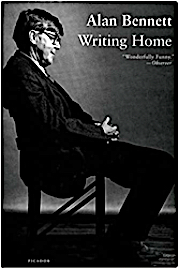
This 1983 diary entry by Alan Bennett (Writing home, p.127) bears both on professional tact and the insecurity of the freelance artist:

3 March, Yorkshire. I take a version of a script down to Settle to be photocopied. The man in charge of the machine watches the sheets come through. “Glancing at this,” he says, “I see you dabble in playwriting.” While this about sums it up, I find myself resenting him for noticing what goes through his machine at all. Photocopying is a job in which one is required to see and not see, the delicacy demanded not different from that in medicine. It’s as if a nurse were to say: “I see, watching you undress, that your legs are nothing to write home about.”

Festivals: the official—folk continuum

The upcoming CHIME conference in LA (29 March to 2 April), presided over by the excellent Helen Rees, looks like a fine event, though I can’t make it. The theme this time is festivals.

Gansu miaohui FKTemple procession, Xincheng, south Gansu, June 1997. [1]
Photo: Frank Kouwenhoven. © CHIME, all rights reserved.

Of course, festivals and pilgrimages all over the world are a major theme of ethnography: not just Uyghur meshreps and mazar, and Tibetan monastery festivals, but Indian melas, Sufi festivals, the Mediterranean (Andalucian fiestas, south Italy…), Moroccan ahouach, you name it. Bernard Lortat-Jacob’s 1994 book Musiques en fête is charmant, with wise and vivid words about Morocco, Sardinia, and Romania (¡¿BTW, why do French books put the list of contents at the back?! ¡¿Typical Gallic contrariness?!)

To adopt the metaphor of “the whole dragon” again, there is a long continuum between folk festivals, based on ritual (often calendrical) observances, and secular events for a largely urban audience.

So I too am going to link up diverse themes like temple fairs, ritual, famine, village names, Eurovision, and propaganda. It does make sense, though—trust me, I’m a doctor.

Traditional events in China`
Funeral rituals have been my main topic in China for thirty years, but of course it’s not easy to plan visits much in advance. The calendrical dates of temple fairs (often known as miaohui) may seem easier to anticipate. Again, scholars of religion tend to home in on their specifically religious elements, as in the great jiao Offering—though note Ken Dean’s fine film Bored in heaven. But like funerals they are multivalent, embracing all kinds of activity: ritual, opera, folk-song, pop, commerce, “hosting” and “red-hot sociality” (Chau!)…

Apart from my 2007 and 2009 books, names like Zhao Shiyu, Guo Yuhua, Wang Mingming, Yue Yongyi, Stephan FeuchtwangAdam Chau, and Wu Fan spring to mind. The knack is to detail both sacred and secular aspects of temple fairs.

But the dates of calendrical rituals, like temple fairs, may not be easily vouchsafed to the outsider either. The temple fairs on the Houshan mountains in Yixian county southwest of Beijing, mainly in the 3rd and 7th moons, are much less well known than those of Miaofengshan, but they also draw huge crowds, both local and from further afield.

To work all this out you have to spend time around the villages of Liujing and Matou in the foothills around Houshan, and then observe who goes where when and does what. Although Chinese villagers are a rich source of ritual and musical information (far more than any silent library), they often speak prescriptively rather than descriptively, telling us on what occasions a jiao Offering ritual should be performed, whether or not is has been performed since the 1940s. They don’t necessarily volunteer information on change, preferring (like some officials and scholars) to present their traditions as constant, eternal—even if contexts and repertoires have evidently changed in their lifetime. On our first visit to Liujing we rather assumed that villagers’ descriptions of ritual pilgrimages related to “the past”— but we soon found that they were very much alive.

The Songs-for-winds associations: propaganda and catastrophe
What got me “thinking” (I use the word loosely) about all this was that 1950 visit to Tianjin of the “Songs-for-winds” band from Ziwei village, in what later became Dingxian county.

The Central Conservatoire (as it was then) was then still based at Tianjin, of course. The work of Yang Yinliu and Cao Anhe on the Songs-for-winds may be considered a prelude to that on the more solemn ritual style of the Beijing temples that Yang undertook from 1952, a topic that was to expand vastly after 1986. But the Songs-for-winds groups, more popular than the ritual style that is my main focus, are worth a little detour here.

We should bear in mind that such wind ensembles were quite unfamiliar to southerners like Yang and Cao. Having invited the Ziwei band to the conservatoire, they recorded their repertoire on a Webster wire recorder. The band went back some six generations, and under the leadership of the celebrated Wang Chengkui, they had invited the great wind player Yang Yuanheng  to teach them in the winters of 1945 and 1946. Yang Yuanheng, a former Daoist priest in a little temple in Anping county, was himself appointed professor of guanzi oboe at the conservatoire in 1950. [2] Yang Yuanheng, like the Buddhist monk Haibo, was a major influence on many shengguan ritual associations in the area: we would hear their names from many village associations.

Yang and Cao’s monograph on the Ziwei band, published in 1952,  consists mainly of transcriptions, with little of the social detail that they covered for the Wuxi Daoists or Yang’s 1956 Hunan fieldtrip. Ziwei would go on to supply wind players to many state troupes for decades to come.

Langfang huahui 1991

Secular New Year’s huahui parade, Langfang city, 1991.

Xushui
Adapted from my Folk music of China (p.196):

During the 1958 Great Leap Forward (or Backward, as it’s known), Dingxian and particularly Xushui counties became model counties for the relentless drive to full communization. [3] At the height of the Leap back in August 1958, Chairman Mao visited communes there. In Dasigexiang district just southeast of Xushui county-town, Dasigezhuang village was now renamed the 4th August brigade. Notable for its revolutionary fervour at this time was the “Great Leap Forward Songs-for winds association” of Qianminzhuang brigade in Xushui, which performed for this visit.

The propaganda of the Leap makes a stark contrast with the grim realities of the period, with villages throughout the area suffering from crop failure, famine, and social disruption.

Our visit to Qianminzhuang in 1993 was the only time I’ve ever had a police escort—to take me there for a change, not to drag me away! Predictably, such an effusive welcome for me as a “foreign guest” indicated close supervision and censorship of our fieldwork.

QMZ band 1993

QMZ pose 1993

Striking a pose with the leaders, Qianminzhuang 1993

In 1995 we visited some of the senior musicians independently, with much more useful results.

Xushui’s favoured status did nothing to prevent many starving to death there in 1960—but just near Qianminzhuang, the Gaozhuang ritual association still managed to restart in 1961. Religion revived in China precisely at moments of political crisis such as the famines of 1960 and the Cultural Revolution, albeit with great difficulty. It may provide solace, or a focus for resistance—both against Maoism and later against the insecurities ensuing its demise.

The Gaozhuang ritual association was one of many in Xushui villages that used, and use, the older more solemn shengguan style. Ritual associations throughout the area commonly claim transmission from either Buddhist monks (heshangjing 和尚經) or Daoist priests (laodaojing 老道經)—the Gaozhuang association is Buddhist-transmitted. In another common taxonomy, the association divides into “front altar” (qiantan, the shengguan instrumental ensemble, and “rear altar” (houtan, vocal liturgy).

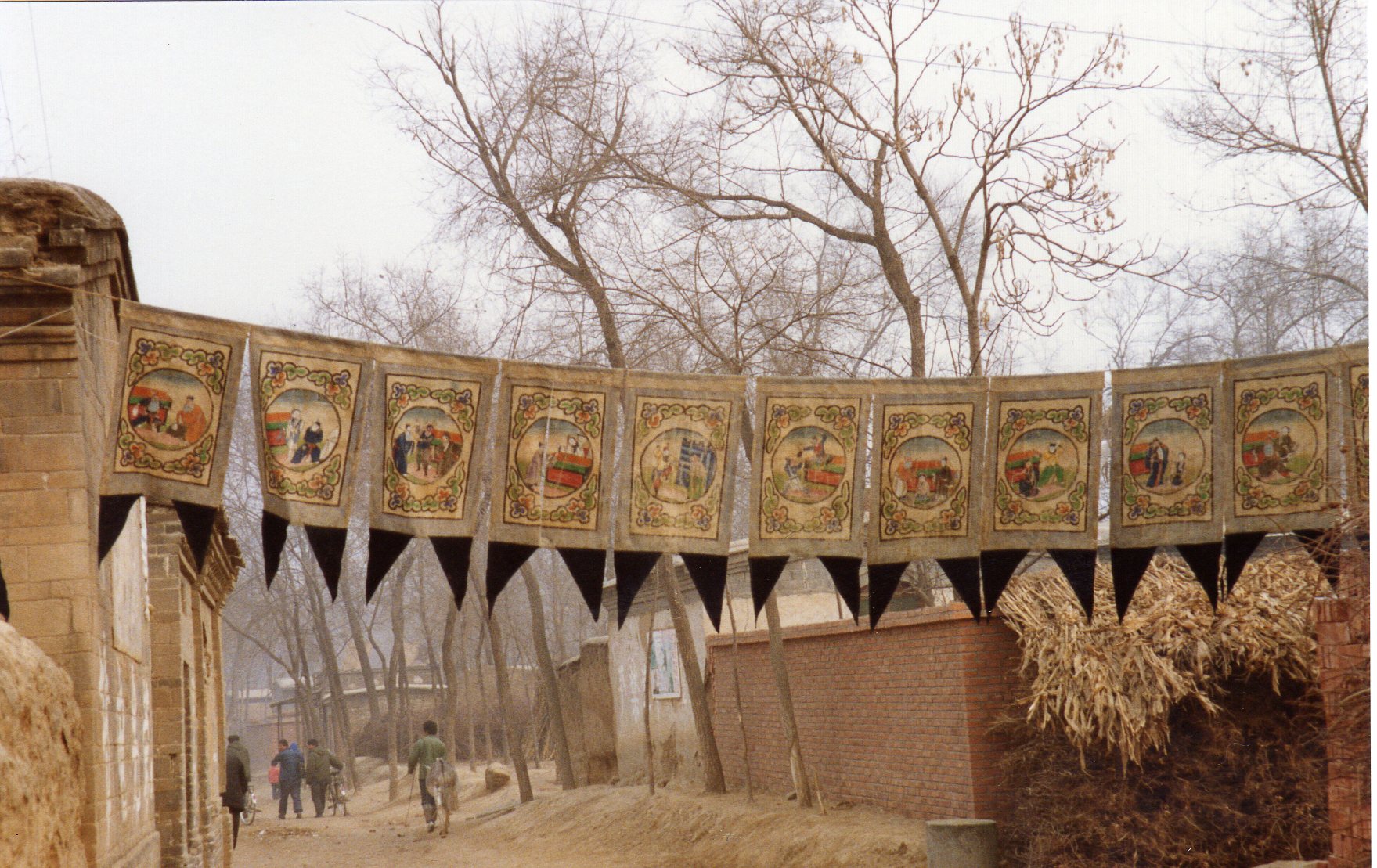
Despite its revolutionary image, Xushui county has remained a hotbed for religion, notably the cult of the sectarian creator goddess Wusheng laomu. Associations there commonly hang out ritual paintings, like the Ten Kings (Shiwang) or Water and Land (Shuilu) series, and they use “precious scrolls” and other ritual manuals. They too are within the catchment area of Houtu worship—they used to make the pilgrimage to Houshan. Even the revolutionary Qianminzhuang band told us that their former tradition was to recite the scriptures, performing only as a social duty for funerals, not for weddings. And certainly not to accompany mendacious parades to report a bumper harvest…

In 1994 the Gaozhuang association built an Ancestral Hall to Venerable Mother (Laomu citang), occupying about one mu, stylish and grand. It cost around 60,000 kuai to build; the stele lists 132 donors, who gave from 50 up to 3,000 kuai. The altar has Wusheng laomu in the centre, Wangmu niangniang and Songzi niangniang to the right, Cangu niangniang and Houtu niangniang to the left.
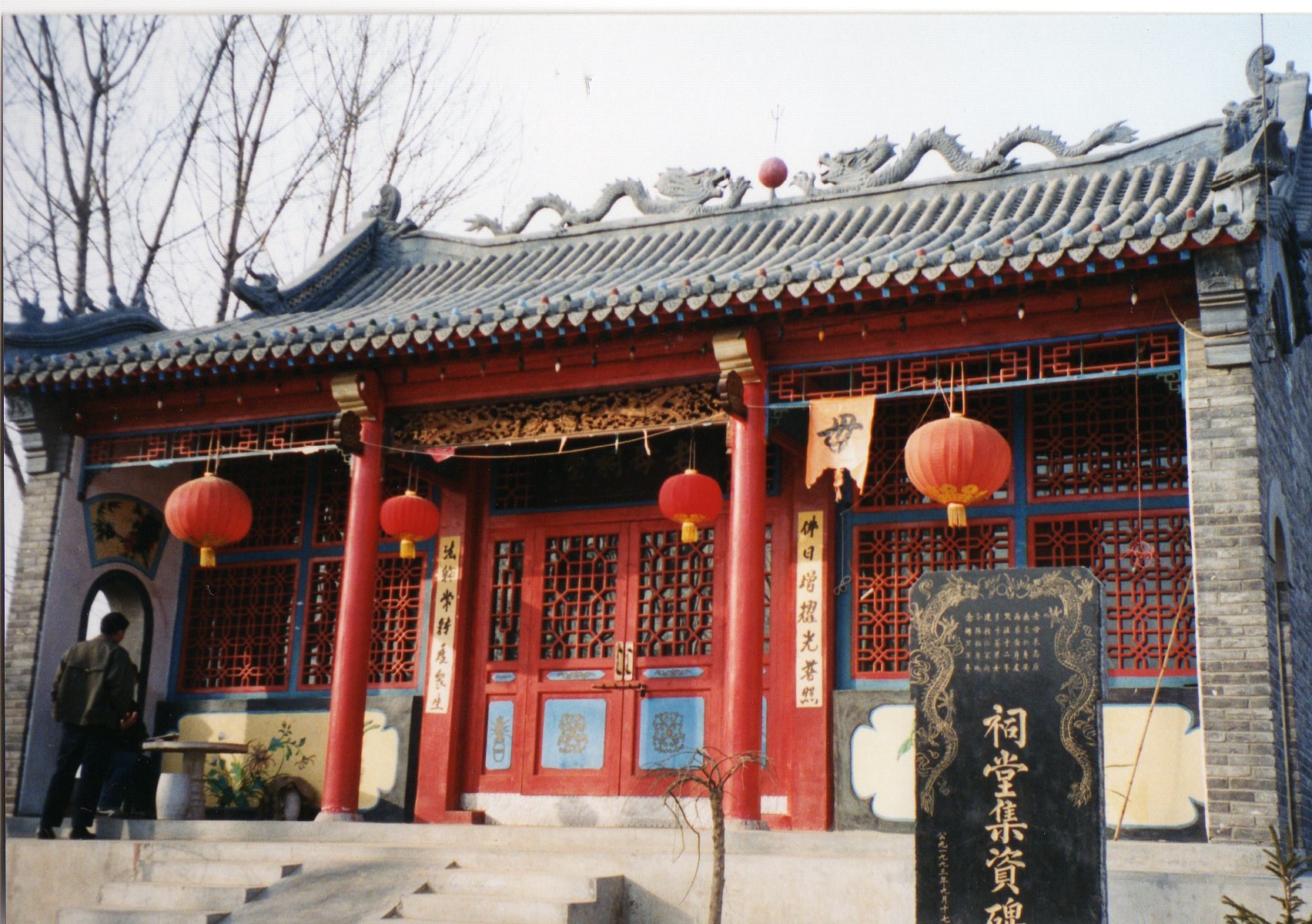
Gaozhuang citang

The village Party Secretary told us that sources of support included incense money from the Great Tent Association (Dapeng hui, a common term in the area for a ritual association) and from the temple, and money from fortune-telling and curing illness. He reflected, “A dozen or so women kept on coming to see me about building a temple. I had no choice—the brigade couldn’t refuse, so I gave them a plot of land. Believing in the gods and having a temple is no bad thing, it’s not as if you stop production if you believe in it!”

In all, the flamboyant (and readily secularized) Songs-for-winds style remains a common image of wind bands on the Hebei plain, but since all our fieldwork through the 1990s it is clear that ritual practice, with its more solemn shengguan instrumental style, is both older and more common. It is resilient too. This persistence of tradition, both in religious and musical practice, is all the more striking in such a once-revolutionary county as Xushui.

Mao was impressively modest about his limited success when he admitted to Nixon in 1972:

“I haven’t been able to change [China]—I’ve only been able to change a few places in the vicinity of Peking.”  [4]

But he wasn’t modest enough: in some ways even a county so near Beijing, such a focus of the revolution, has remained resistant to Maoist ideology, predating and outliving it. Still, disruption was severe. For more on Xushui, see here.

Official festivals in the 1950s
Meanwhile, the new government, in its own way, was promoting local culture through the medium of regional folk festivals (diaoyan, huiyan). First, local festivals were held to select representatives for major performances in the regional capitals. Some laicized priests were even assembled to perform as “troupes“, sometimes for the first time in many years—such as Baiyunshan Daoists (1955), Wudangshan Daoists (1956 and 1957), Wutaishan Buddhists (1958). For such performances, inevitably, their shengguan instrumental music was plucked out of its ritual context. I haven’t heard stories as distressing as the fate that befell kobzari blind minstrels in Ukraine when summoned for an official festival in the early 1930s; but folk ritual specialists were still anxious about performing for officials around 1980.

These festivals served partly as auditions for the state song-and-dance troupes then expanding all over China. Daoist and Buddhist ritual specialists had a deserved reputation as outstanding instrumentalists. Many, like our very own Li Qing (my book pp.113–25), were recruited as musicians to state troupes around 1958—and then sent home again as the state apparatus collapsed in 1962.

While such festivals stimulated the collection and documentation of folk music, we must balance this with the ongoing assaults on its traditional context. The background ( beginning from the 1940s) was campaigns against “feudal superstition”, terrifying public executions of sectarians, and the destruction of temple life.

The reform era
Urban festivals featuring rural groups—perhaps related to a conference—make a convenient recourse for busy academics into whose holidays they fit nicely. From the 1980s, the secular arts festivals of the Maoist era were remoulded into more glossy events. In 1990 the Li family Daoists took part in a festival of religious music in Beijing.

By the 21st century the new ideology was confirmed in the regular staged “living fossil” presentations of the Intangible Cultural Heritage. The latter project, with its whole bureaucratic workings, has now become a major research topic on its own, at the expense of studies of the local traditions that it is supposed to assist (my book pp.331–3). Note also the Qujiaying bandwagon.

I tend to steer clear of conferences, but in May 2016, as a pretext for going to hang out yet again with Li Manshan in Shanxi for a couple of weeks, I accepted an invitation to take part in a conference celebrating the 80th birthday of my esteemed teacher Yuan Jingfang in Beijing (for the resulting volume, see here).

It was a déjà-vu experience. Apart from a sequence of eulogies, the event also featured staged performances from three representatives of Yuan Jingfang’s long-term research areas: the Hanzhuang ritual association from Xiongxian in Hebei (near Xushui), the Zhihua temple group, and a ritual band from near Xi’an.

Hanzhuang 1993

Filming the Hanzhuang association in their ritual tent, 1993 (photo: Xue Yibing). Rear centre: two frames of ten-gong yunluo.

It made me feel my age, reminding me of all our visits to these very groups between 1986 and 2001. Taking time out of the conference to chat with the Hanzhuang group outside by the lake, we recalled their kindly association leader Xie Yongxiang 解永祥, father of the present leader, and another of those wise sheng masters. We had learned a lot from him in 1993 and 1995.
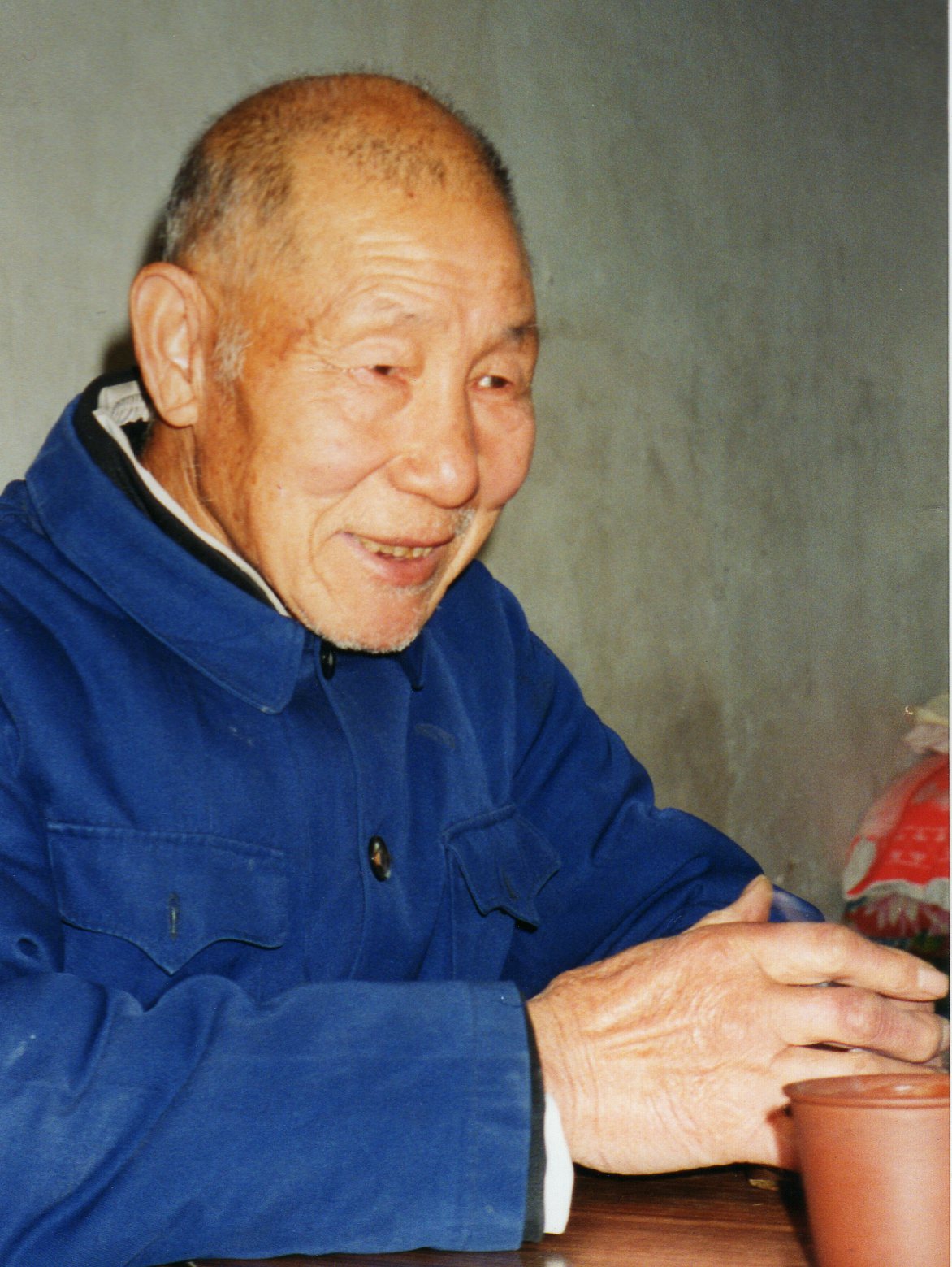
Xie Yongxiang 1995

Xie Yongxiang, 1995

But returning to the conference—the object of admiration, inevitably, was their “music”, detached from its enduring social context. I already missed hanging out with Li Manshan in the scripture hall.

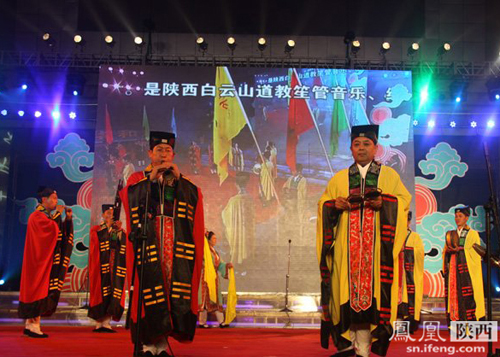
All the glossy stage presentation has many Western parallels—flamenco on the Terry Wogan show, WOMAD, Songlines, prizes, urbane discourse explaining its “cultural value” to outsiders… The fancy costumes and dry ice of many Chinese events are reminiscent of Eurovision; they may seem like a Disneyland version of the Chinese heritage.

That photo comes from a recent ICH “performance” of the Baiyunshan Daoists, no less.

Now, I adore opportunities to present the Li family Daoist band on the concert platform (see e.g. this post and a whole related series of vignettes from May 2017), but while it is of course a compromise, we take care not to tart them up—we can hardly do otherwise, so solemn is their demeanour. The ambience and acoustic of churches makes a fine setting,  the Daoists’ sheng mouth-organs filling the Peterskirche in Heidelberg on our 2013 tour (cf. Buildings and music):
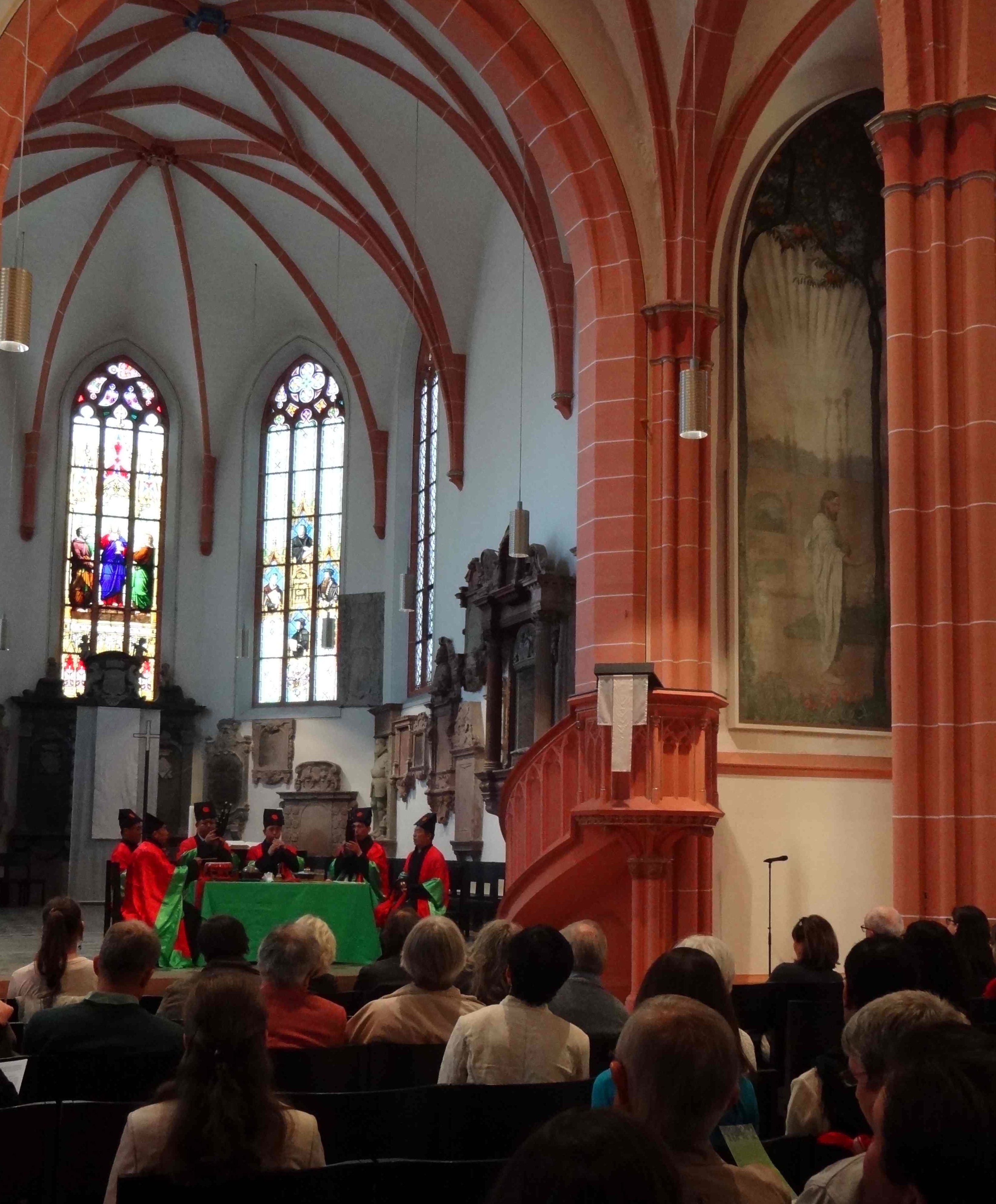
Hberg 2012

The Li family Daoist band in concert, Heidelberg April 2013.

Still, their regular “rice-bowl”—day in, day out—is always performing funerals for their local, not global, clientele.

What is dodgy is when people begin mistaking the staged events for the Real Thing, or some kind of ideal. Urbanites may do so, but villagers know better. Of course those staged events are themselves a legitimate, and popular, object of scholarly analysis. But I worry that it creates a fait accompli, like the way that in old-school WAM musicology the Great Composers were the main story (as deconstructed by McClary, Small, Nettl)—“this is what we find, so it must reflect the real picture, and so this is the object of study”. As always, “modern” secular performance doesn’t replace traditional activity: they co-exist.

The CHIME conference in LA will doubtless turn up many instances of what I’m struggling not to call “contested negotiation”. Anyway, staged events can give us a lead, rather like using the photos in the Anthology, otherwise flawed, to draw us towards folk activity.

For thoughts on the theme of the 2021 CHIME conference, see here.


[1] For more, see Frank Kouwenhoven, “Love songs and temple festivals in northwest China: musical laughter in the face of adversity”, in Frank Kouwenhoven and James Kippen eds., Music, dance and the art of seduction.
[2] For this whole section, see my Folk music of China, pp.48–52, 195–203; “Chinese ritual music under Mao and Deng”, British Journal of Ethnomusicology 8 (1999): 27–66; “Reading between the lines: reflections on the massive Anthology of folk music of the Chinese peoples”, Ethnomusicology 47.3 (2003): 287–337. See also my In search of the folk Daoists of north China, pp.166–7, 183–4, 188–90.
[3] As correctives to all the Xushui propaganda, see e.g. the brilliant works of Friedman, Pickowicz, and Selden, Chinese village, socialist state and Revolution, resistance, and reform in village China—describing a commune not far from Xushui. Note Chinese village, socialist state, pp.215–20; Dikötter, Mao’s great famine, pp.40, 47–9, 68–70; and estimable analysis online in Chinese, e.g. http://mjlsh.usc.cuhk.edu.hk/book.aspx?cid=6&tid=184&pid=2269. For the model commune of Greater Quanshan in Shanxi, precursor of Dazhai, and temporary “home” to the Li family Daoists, see my Daoist priests of the Li family, pp.122–3, and here, under “Famine in China”.
[4] Also reported by Henry Kissinger in Newsweek, 3rd March 1997, p.31.

Hours, days, millennia

Another feast of wonderful programmes to explore on BBC Radio 3 for International Women’s Day—women composers deserving wider attention, like those of Renaissance Ferrara; Fanny Mendelssohn, Ethel Smyth; and young composers right now. Loads more on the website—like this playlist including Amy Beach, Sofia Gubaidulina, Carole King, Sally Beamish, Joan Baez, Judith Weir, Chen Yi, Elisabeth Maconchy, Tineke Postma, Louise Farrenc… or this one, with 34 composers from Hildegard von Bingen right down to today.

And then there are all the great women singer-songwriters in pop and punk.

Hmm, one hour a day for Woman’s Hour, one day a year for Women’s Day. I do realise that they’re not entirely bound within these little cages, but still…Hey-ho. Somehow this day seems more significant this year, given the need to fight the misogyny of the current White House.

The “PC gone mad” brigade, with bees in their dainty little bonnets, may throw their toys out of the pram yet again. The often-cited riposte to the Neanderthals who bleat “Why can’t we have a Men’s Hour, eh?” is that that’s basically what all the other hours are.

slogan

While I’m about it, there’s nothing you can possibly play after Turangalîla, or even after its infinitely growing long final chord—but at the National Youth Orchestra’s Prom in 2012, they did manage to find a wonderful encore that somehow matches the spirit of Turangalîla, channelling its mood, both hieratic and exhilarating:

It’s even moving when the band gets back to clapping the composer as she comes on stage to acknowledge the audience’s clapping…

And did those feet in ancient time?

Still thinking about Alan Bennett’s feet and early religious culture:

In the wonderful song Jerusalem, rather like those questions they ask you at the airport check-in desk, you think all the answers are going to be “No”, but you have to keep on your toes (sic, see below) just in case.

Great that it’s tipped for our new national anthem, to replace the meretricious God save the Queen (although the version here is fine)—but we have to take care not to “leave it unattended at any time” in case it gets hijacked by “Paul Nuttall and the UKIPs”.

Mind you (and talking of keeping on your toes), if I had an anthem like this (Wow! Italian opera at its most intoxicating! 1831-ish, see here)

even I would score a goal like this:

(1970—“ancient time”?] That’s right up there with Ronnie’s 147.

The Italian anthem is just as exhilarating. And Latin American nations (notably Uruguay and Ecuador) are among the star exhibits in Tom Service’s entertaining programme “How Do You Make a National Anthem?” in The listening service.  For the German anthem, click here.

I was in Washington DC with the amazing Hua family shawm band in 2002 when Brazil won the World Cup (click here). We all crowded into the hotel bar early in the morning to cheer them on, suitably lubricated with A Pint of Plain—It’s Your Only Man.

And then there’s our fantasy football team/Daoist ritual band

“which will bring us back to”

Li Manshan!

[Been at the Bombay Sapphire again, Dr Jones?—Ed.]

A new headline

Confirming Kate Fox’s anthropological observation that the creative love of wordplay evinced by our tabloid headlines is one of rather few things of which the British can be proud, here’s one spotted today (about a table-tennis player involved in an altercation, you understand):

Ping-Pong Ding-Dong

Actually, a quick search online shows that this has quite a history. Once freed of the petty constraint of describing an actual event (which has seldom held the tabloids back), it can even expand into the headline reporting a fight with a giant ape at a table-tennis club karaoke night:

King Kong Ping-Pong Sing-Song Ding-Dong

For more on King Kong, see here; and for “Xi sells seashells by the seashore”, here. For a more sonorous ding-dong, click here. A related headline opens my haiku on Morris dancing; note also my roundup of wacky headlines.

Orthodoxy

More from Private passions:

The Serbian/British author Vesna Goldsworthy describes herself as an “orthodox agnostic”—another good entry in the catalogue of religious affiliations.

Wonderful playlist, too. From here it is not too far to Kapka Kassabova’s Border: tales from the edge of Europe on Radio 4’s Book of the week.

After a wealth of gorgeous Slavic music Goldsworthy ends (by contrast) with Purcell’s ineffable When I am laid in earth, with Lorraine Hunt Lieberson. Here’s one of many other fine versions online (old and new):

A Pint Of Plain Is Your Only Man: Addendum

To Alex,
for pooling his version of The interview,
as well as for his so-called “simple” cuisine.

I rather hoped I had Succeeded in Encapsulating the Intricacies of Flann O’Brien’s Masterwork in one succinct yet definitive post, as in the All-England Summarise Proust Competition (if the You Tube link disappears, here’s the script).

But far from it—like The third policeman, all this flummery is inevitably fated to continue ad infinitum.

I note that A Pint Of Plain Is Your Only Man [A POPIYOM? Not a poppadom, anyway—Ed.] is also a topic for dogged doggerel in At-swim-two-birds (pp.77–80):

When things go wrong and will not come right,
Though you do the best you can,
When life looks black as the hour of night—
A PINT OF PLAIN IS YOUR ONLY MAN.

By God there’s a lilt in that, said Lamont.
Very good, said Furriskey. Very nice.
I’m telling you it’s the business, said Shannahan. Listen now.

When money’s tight and is hard to get
And your horse has also ran,
When all you have is a heap of debt—
A PINT OF PLAIN IS YOUR ONLY MAN.

When health is bad and your heart feels strange,
And your face is pale and wan,
When doctors say that you need a change,
A PINT OF PLAIN IS YOUR ONLY MAN.
[…]
When food is scarce and your larder bare,
And no rashers grease your pan,
When hunger grows as your meals are rare—
A PINT OF PLAIN IS YOUR ONLY MAN.
[…]
If he knew nothing else, he knew how to write a pome. A pint of plain is your only man.
[…]
Excuse me for a second, interposed Shanahan in an urgent manner, I’ve got a verse in my head. Wait now.
What!
Listen, man. Listen to this before it’s lost.

When stags appear on the mountain high,
With flanks the colour of bran,
When a badger bold can say good-bye,
A PINT OF PLAIN IS YOUR ONLY MAN!

The interview

So this young music scholar goes for an interview at Cardiff University Music Department for the job of junior lecturer.

One of the board asks him, “Would you care to share your thoughts on the late Beethoven quartets with us?”
“Oh yeah, cool”, he replies eagerly. “You gotta love all those riffs on the sax! And their drummer was amazing.”
“I see… And, um…, how about Bartók?”
“Well, you can’t beat the way he works in all that stuff from reggae.”
“Um, thankyou very much… I don’t think we have any more questions…”
“Well in that case, my lovelies,” the candidate goes on, “Maybe we can knock it on the head then—I’ll just be in time to catch the 16.38 to London.”

After he hurries off, the board consults. The chair asks the others,
“So what did we all think, gentlemen?”
“Well I thought he was absolutely splendid—he could be the one! How about you?”
“Hmm, I’m not so sure. There’s something about him that doesn’t seem quite right…”, he frowns. “…You see—there is no 16.38 to London…”

For more interview stories, click here.

Book cover

Lee

Having just shown that I don’t only do jokesStewart Lee does occasionally do some, and it must be mortifying for him to find them cited in online soundbites, callously plucked out of their labyrinthine context—like this:

My granddad always said, “You should never judge a book by its cover”… And it’s for that reason that he lost his job as chair of the British Book Cover Awards panel.

Shanxi, summer 1992

Partly to remind myself that I don’t only do jokes, here are some more fieldnotes.

I’ve already noted the differences between our early fieldwork in the 1990s and conditions more recently. So I thought I’d give you a flavour of one of those earlier fieldtrips.

Over the hot summer of 1992, following hot on the heels of the Wutaishan Buddhist group’s visit to England, Xue Yibing and I made a three-week trek from Taiyuan northwards through Wutai, Xinzhou, Daixian, and Hunyuan, finding ritual activity all along the way, en route for another rendezvous with the great Li Qing in Yanggao. Our last stop was nearby Yangyuan county, just in Hebei.

Since our fruitful initial survey of ritual associations in Hebei over New Year in 1989, this was my fourth fieldtrip with Xue Yibing. Before we could return to the Hebei plain, and before I began to focus on particular villages and families, this was still only a partial survey of central and north Shanxi—for what became Chapter 12 of my book Folk music of China.

We had a van and a driver from the MRI at our disposal, and for parts of the trip we were accompanied by Shanxi scholars Jing Weigang and Wang Bin, whose local knowledge was valuable. We were mostly unencumbered by the need to “kowtow to the Gods of the Soil”, except when we knew there was a knowledgeable scholar—like the senior Liu Jianchang in Taiyuan, who was studying the Buddhist ritual music of the Wutaishan mountains through the 1950s whenever political conditions allowed. All along the way we found local traditions, differing significantly from each other. [1] Power cuts were frequent. And before motorways, our progress was often far from smooth; even on the main roads we generally found ourselves crawling along behind long lines of coal lorries.

stuck-in-mud

Dongye township
In central Shanxi, I had already visited central Wutaishan, so I was interested to explore the outlying areas. While we found many shawm bands (here called gufang 鼓房), our main interest was in ritual shengguan bands (here called xiangda 响打). Though they were rarely ritual specialists with vocal liturgy, some bands performed a fine repertoire of long suites related to the temples of Wutaishan and Beijing—the kind of groups found by the great Yang Yinliu in 1953, in whose steps we were now following.

dongye-chubin

Funeral procession, South Daxing, Dongye.

We spent time with one such band, led by Xu Yousheng in Dongye.

It soon became clear that this whole area was also a hotbed for female spirit mediums, including Xu Yousheng’s wife. These mediums did exorcistic rituals as a group, singing ritual songs a cappella. In this photo, at Xu Yousheng’s house near Dongye, his wife and her fellow medium pose before ritual paintings commissioned by him.

mediums

This page from Xue Yibing’s precious notebook lists the gods on the pantheon to the right in the photo.

xu-pantheon-xyb

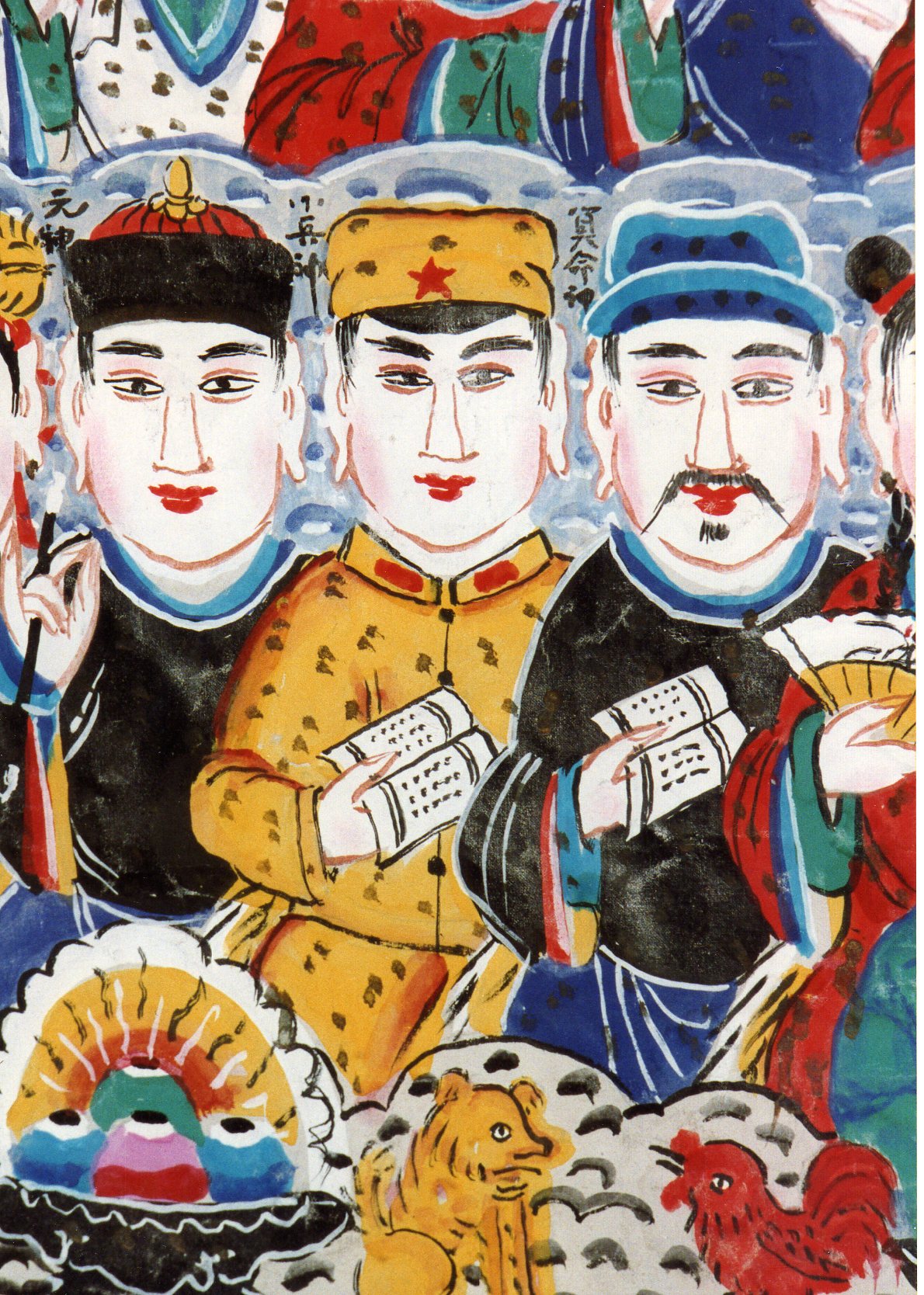
In this detail, the “young soldier god” features because a medium had divined that he once saved the life of Xu’s son while he was in the army:

painting-detail

For more on such pantheons, see the remarkable website of Hannibal Taubes.

The Xinzhou region
In this large and mountainous region we found more household Daoists (this time of the Complete Perfection branch!), as well as a thriving community of Catholics who also used shengguan music to accompany their rituals.

christians-1992

The Ekou Buddhists
After digging our van out of the mud yet again, we reached Ekou township in Daixian county, in the northern foothills of Wutaishan. I was hoping to see Chengde, lovely former Buddhist monk whom I had hosted in England a few weeks earlier. But he was doing a temple fair some distance away—so we had a chat with his older brother, who provided us with useful detail on local ritual life there. This was one of rather few occupational household Buddhist groups that we found.

ekou-painting-1

Old pantheon at Chengde’s house.

Hunyuan
Arriving hot and sweaty in the (then) cosy little hill town of Hunyuan (at the foot of Hengshan, the northern marchmont of Daoism), we checked into a modest hostel. On the guest registration form, under “Level of Culture” (wenhua chengdu 文化程度) I wrote “None” (wu 无), as is my wont.

After a long drive and many days in scorching temperatures without running water, we were delighted to find that not only did our room have a bath, but that hot water was promised (typically “after 8pm”, which often means either “never” or “from 3.30 to 3.35 am”).

The bathroom wasn’t exactly hygienic, but hey, we weren’t fussy—ruxiang suisu, “when in Rome…”. Xue Yibing rashly took the plunge first, and he was just sinking into the water in ecstasy when the ceiling (exhausted by unprecedented strains on the plumbing above) promptly caved in, covering him in rusty debris (or is that the name of a Country singer?). Adopting what Nigel Barley calls “fieldwork mode”, we both burst out laughing. He came out a lot dirtier than he went in.

Next day we found no ritual activity at the Hengshan mountain temples, but in town we found yet another great family of household Daoists.

hunyuan-ritual

hunyuan-manual

Page from ritual manual: end of Fetching Water ritual and opening of Dispensing Food.

This group belonged to a lengthy Orthodox Unity lineage. By the time I went back to see them in 2011 with the wonderful Li Jin, significant changes had taken place in their practice (see fieldnotes here).

The north
After a brief visit to more Orthodox Unity household Daoists in Datong county, we reached Yanggao, where I was delighted to find Li Qing again, performing a funeral with his ritual band. He also managed a long session with us, providing detailed accounts of ritual sequences, augmenting my notes from the previous year.

After a brief and rather unedifying stop-off in Yangyuan county, we made our way back to Beijing. Upon my return, I once again (as usual) sought out former monks, before we set off once more for Liaoning in the northeast, finding majestic shawm bands there too…

* * *

Such early fieldtrips with Xue Yibing were an important training for us both, before we launched into more in-depth study of the Hebei ritual associations. I always treasure his notes, but however brief our visits on that Shanxi trip, the three hand-written volumes he copied out for me are full of wonderful ethnographic detail on folk religion.

Since 2011, having profited from collaborative fieldwork for twenty-five years, I have largely engaged with the Li family Daoists on my own, regaining a certain self-esteem—except for the occasional mishap


[1] For more detail on most of these sites, see my In search of the folk Daoists, pp.65–81; Chen Yu, Jinbei minjian Daojiao keyi yinyue yanjiu, pp.65–90 and passim. For a richly-illustrated overview of folk customs throughout Shanxi, see Wen Xing 文幸 and Xue Maixi 薛麦喜 (eds.), Shanxi minsu 山西民俗 (Taiyuan: Shanxi renmin cbs, 1991).

Cloudy with showery outbreaks, know wot I mean?

Rain later, good.

The Shipping Forecast

Left to right: Liaochong, Yunrui, Yunzhi, Liaoman,
Yungui, Xuanping, Chengde, Renliang.

My old friend Tian Qing, now pre-eminent pundit of the Intangible Cultural Heritage, is a constant source of stories.

Long ago in summer 1989 he organised a wonderful festival of “religious music” to take place in Beijing, but it inevitably had to be postponed. With him now “indisposed” for a couple of years, his colleagues at the Music Research Institute managed to reschedule the festival for the following summer—among the many Daoist and Buddhist groups taking part was our very own Li family band of household Daoists, led by the great Li Qing.

By 1992 Tian Qing was rehabilitated, but still under a certain scrutiny. One of the groups in the 1990 festival was the “Wutaishan Buddhist Music Troupe”, consisting of (former) Buddhist monks trained at the Wutaishan mountain temples and nearby. (For “Buddhist music”, and “troupes”, see here and here.)

In collaboration with Tian Qing I was now working with BBC Radio 3 to invite the group to perform for the splendid Spirit of the Earth festival on the South Bank in London.

Time was getting short, and the BBC urgently needed the monks’ names in order to get their work permits. So Tian Qing innocently sent me the list by telegram, with no comment—just their eight poetic Buddhist names, that together make no obvious literal sense:

了滿了充雲枝雲瑞任亮成德玄平玄貴
Liaoman Liaochong Yunzhi Yunrui Renliang Chengde Xuanping Xuangui
    or
Final and complete final and ample cloudy branches cloudy and auspicious trusty and bright accomplished virtue profound equality profound nobility

We later learned that the Chinese authorities spent months trying to decipher this cryptic message to a foreigner, convinced it was some counter-revolutionary code.

The UK tour was great, though, and Tian Qing soon went on to become a distinguished leader and cultural pundit. So that’s all right then.

History, or not

Alan Bennett (for it is he) reflects on his transition from earnest young Oxford historian to star of Beyond the fringe:

I wasn’t getting any better at [teaching], though the celebrity of the revue to some degree compensated my pupils for the shortcomings of the tuition. This period came to an end in 1962, when the show went to Broadway, thus putting an end to my dwindling hopes of being a historian. The rest, one might say, pompously, is history. Except that in my case the opposite was true. What it had been was history. What it was to be was not history at all.

A tongue-twister for the household Daoist

57 shengguan trio

Yang Ying (right) and Li Bin (left) accompany Wu Mei before the coffin, 2011.

A popular dep in Li Manshan’s band is Yang Ying, who studied briefly with Li Qing not long before his stroke in 1996, but as boss of a busy shawm band has to juggle his ritual work (my book pp.319–21).

Since household Daoists like this are known here as yinyang, and since (like the “non-national” Euripides, to cite Myles yet again) Yang is partial to “smoking substances”, one day while we were all relaxing in the scripture hall I composed a suitable epithet for him, on a par with my headline for Švejk and Saint-Saëns:

阴阳杨英饮洋烟
Yinyang Yang Ying yin yangyan

The yinyang Yang Ying smokes foreign tobacco with a water-pipe.

Note: 饮 “drinks” is a little obscure (“eats” chi  is more idiomatic, but that doesn’t work, of course), but evidently refers to a water-pipe. We’re always joking about “foreign tobacco“, which has long suggested opium.

For some excellent German tongue-twisters, click here.

More on taxonomy

As with feminist punkvocal styles of the worldthe organology of the world’s instrumentarium, and indeed any other human activity, the taxonomies made by ordinary people are evident from their fine discriminations of nuance between pop genres that may seem arcane to the outsider—like acid house, drum and bass, grunge, indie, metal, Northern soul (“Naa, I’m not into the Manchester sound, guys”), rap, hip-hop, and even trainers, FFS  (don’t ask me…).

And just the same goes for rural dwellers’ perceptions of ceremonial genres and ritual activity in any single county of China: shawm bands, geomancers and spirit mediums (distinctions within the latter partly gender-based), [1] amateur sects, temple priests, occupational household ritual specialists, inner and outer altars, civil and martial altars, Buddhist Daoists and Daoist Buddhists (I kid you not), [2] “northern” and “southern” ritual wind bands around Beijing[3] opera troupes, singers, bards, beggars….

Taxonomy is not merely the preserve of the fusty academic; it’s part of what makes us all human.

Such perceptions can also arouse passionate and bitter disputes—never more so than between, and within, religions (if less so in China, notwithstanding imperial persecutions). But classification doesn’t have to equate with building walls. Whereas the brutish black-and-white (sic) xenophobia of a certain Tangerine fuckwit suggests that his sensibilities may not be so finely tuned, taxonomy can also reveal connections and build bridges.


[1] For just one region, see Adam Chau, Miraculous response, pp.54–8.
[2] See several reports in the Daojiao yishi congshu series, and Overmyer, Ethnography in China.
[3] See also my In search of the folk Daoists of north China, Appendix 1.

The definitive transliteration

Svejk

I just can’t resist constructing a headline to incorporate some of my favourite Chinese transliterations (for more, see here, with thread):

帅克耍耍圣桑的兔子不拉屎
Shuaike shuashua Shengsangde tuzibulashi

or

Conquering General plays with the Rabbits-don’t-shit of Sage Mulberry

or, if you insist,

Švejk plays with the toothbrush of Saint-Saëns

What kind of language do you call that, ask the Plain People of Ireland. Beat that, China Daily.

In The good soldier Švejk, among several references to the toothbrush, try this:

Then she took out of the hamper three bottles of wine for the convalescent and two boxes of cigarettes. She set out everything elegantly on the empty bed next to Švejk’s, where she also put a beautifully bound book, Stories from the life of our Monarch, which had been written by the present meritorious chief editor of our official Czechoslovak Republic who doted on old Franz. Packets of chocolate with the same inscription, “Gott strafe England,” and again with pictures of the Austrian and German emperors, found their way to the bed. On the chocolate they were no longer clasping hands; each was acting on his own and turning his back to the other. There was a beautiful toothbrush with two rows of bristles and the inscription “Viribus unitis,” so that anyone who cleaned his teeth should remember Austria.

The latest research, however, suggests that Saint-Saëns (1835–1921) once carelessly left his toothbrush behind at his hotel while on tour in Prague—he was indeed a keen traveller, but his biographies are curiously silent about this incident. Later the Good Soldier came across it by chance while rummaging in a junk shop, and proceeded to toy with it.

Still, we cannot dismiss the possibility that the toothbrush may be employed here in its popular Slovakian metaphorical sense. In a comment suggestive of Molvania, Andrew Lawrence Roberts (From Good King Wenceslas to the Good Soldier Švejk: a dictionary of Czech popular culture) notes:

Slovácko is best-known for its traditional culture: distinctive national costumes are still occasionally worn, folk traditions like The Ride of the Kings [a major theme of Kundera’s The joke—SJ] still celebrated yearly. The largely rural residents of Slovácko are known as well for their love of slivovice, which they refer to as their morning toothbrush.

So have I been barking up the wrong tree? In this case, one wonders further: just what kind of liqueur was Saint-Saëns’ so-called “toothbrush”? In our headline, perhaps we may now interpret the verb shuashua “fooling around with” as referring to a tasting session—given Švejk’s Bacchic propensities, surely an epic event, at which Flann O’Brien would have been more than welcome.

The changing nature of fieldwork in China

Further to various comments (collected here), over my three decades doing fieldwork in China the nature of the equipment we use, and fieldworkers themselves, have changed just as much as our objects of study and the rest of the population—of course just like anywhere else, and over earlier periods of ethnographic history.

Never mind all those wonderful fieldtrips of the 1950s; through the 1990s, when my trusty fieldwork companion Xue Yibing and I went on long fieldtrips together (Hebei, Shanxi, Liaoning, Fujian, Guangdong), I used to show up at Beijing train station with a heavy bag full of audio and video tapes, dozens of films for my camera, a bulky array of batteries and chargers, and even a few spare clothes; besides my heavy equipment bag with camera, camcorder, tape recorder, leads, and so on. As you do… And even that was very modest compared with the lists advised by some earnest ethnomusicologists, giving an inventory that would be the envy of British troops invading a third-world country—even Bruce Jackson gives a daunting list. All that is fine if you have an army of docile sherpas, but per-leez

Meanwhile Xue Yibing just brought a slim shoulder-bag containing only his little notebook, a biro, and a toothbrush. Out of all our combined equipment, it was his notebook that would turn out to be most precious.

Sometimes—not always—we managed to hire a clapped-out old minivan. To find ritual activity, we just had to “go down” to the villages and hope; not only were there no smartphones, very few villages even had a landline. As soon as we “went down”, we were cut off from all contact with the outside world.

Fast-forward to the last few years, and young Chinese fieldworkers take an array of high-class audio and video equipment, laptops, and smartphones, with which few foreign scholars of their age can now compete. Smartphones give fieldworkers instant access to all kinds of information—one could virtually do everything (including photos and recordings) with just a phone. They often drive fancy and robust cars, with GPS to help them navigate and find the villages. The road network is vastly improved; local tracks may still be pretty crap, but motorways have expanded a lot.

And among these young scholars, women are now in a clear majority—bright people like Qi Kun, Wu Fan, and Chen Yu were trained by female scholars of senior generations, like Yuan Jingfang in Beijing and now the brilliant Xiao Mei at Shanghai, ethnographer par excellence. Chinese students also now have some grounding in international ethnomusicology. Of course, one always seeks to do diachronic as well as synchronic work, and our own changing experiences are part of that.

This and that

phone

One of the delights of the two cultures “divided by a common language” (George Bernard Shaw?) is in our respective phone greetings.

Whereas we Brits tend to say “Who is that?”, across the pond they are more likely to ask, “Who is this?”. It has been observed that when British people hear the latter greeting, they tend to wait—expecting them to do an impression.

See also Momentarily.

WAM on the erhu

Sun Huang

Long hooked on the gritty folk intensity of rural Chinese music-making, I’ve never had much time for the suave polished solos of the conservatoire virtuosos (pipa lute, zheng zither, erhu fiddle…) that dominate the media. In rural China, instrumental solos are virtually non-existent: ceremonial life is dominated by ensembles, often for wind and percussion—such as the searing shawm bands.

And if there’s one thing that Gets my Goat more than erhu solos, it’s erhu solo arrangements of WAM classics. So this isn’t the kind of thing you might expect me to say—but this has to be the greatest ever rendition of a piece that I wrestled with on the fiddle through my teens:

That’s a truncated adaptation, of course (even with Sun Huang’s technique, some of the violin arpeggio stuff just won’t translate). Here she is later, playing a fuller version—still heavily arranged:

Seriously though, this is jaw-dropping stuff. OK, it’s part of the whole conservatoire shtick of extreme emoting (yet more distressing when they play “traditional” Chinese solos), and similarly virtuosic techniques are all too abundant in China. But just compare the versions of Heifetz or any other hallowed violin maestro on YouTube—no-one has ever remotely approached that depth of expression and mastery (it’s hard enough with four strings, let alone two). Both Sun Huang’s left-hand technique (like qigong, utterly internalised within the body, all in the service of the music) and the engagement of her bow with the strings, by turns mellifluous and gritty, are beyond belief.

BTW, as with Švejk (Shuaike 帅克), here we have another fine Chinese transliteration of a foreign name—Saint-Saëns is perhaps flattered by the rendition Shengsang 圣桑 “Sage Mulberry”. It sounds like one of those pre-historic deities. So in another post I just have to posit a link between the two great sibilant sages.

In the first video, note how Sun Huang is deluged beneath an avalanche of cuddly toys at the end. Quite right too. Before we begin agonising over sexist infantilising, if Heifetz had ever managed to play the piece even half as well, he would have deserved a similar bombardment.

From the sublime to the ridiculous, here you can listen to my own rendition of Bach on the erhu, and speculate on musical life at the 18th-century Beijing court. For my baptism on the erhu, click here. For other types of Chinese fiddles, see here.

Myles: a glowing paean, or The life of O’Brien

Flann

For a Parisian deviation, see here.

What’s all this fuss about Flann O’Brien, I hear you ask. (One perceptive tribute by Kevin McMahon is penned entirely in the form of a Mylesian pub conversation). [1] Padraig Colman, in a fine series of detailed tributes, sums him up dispassionately as “a morose drunk who led an uneventful life as a senior civil servant in Dublin”. For anyone not O’Fay with O’Brien (as the Great Man must have said somewhere?), here’s a little resumé, before you plunge into sundry other posts under the Myles tag.

Well, for one thing, as fellow Flanneurs will know, he was an astute observer of “Poor suffering Hugh Manity”, that’s why. He was a dedicated chronicler of the Hugh Mann condition—a common and distressing affliction. He had a keen ear for the conversation of The Plain People of Ireland, The Brother, and insufferable bores of any Ilk, whether pretentious or just trite. He had the Cut of their Jib, whatever that is. His intolerance of cant (and doubtless Kant) has brought him a cult following [Autospell running amok?—Ed.].

Apart from The Man Who Has Read It In Manuscript, another snowclone that is constantly on the lips of the aficionado is

The Man Who Spoke Irish At A Time When It Was Neither Profitable Nor Popular.

This meretricious character inevitably takes a bow in the Myles na Gopaleen Catechism of Cliché,

a unique compendium of all that is nauseating in contemporary writing. Compiled without regard to expense or the feelings of the public.

Of what was any deceased citizen you like to mention typical?
Of all that is best in Irish life.

Correct. With what qualities did he endear himself to all who knew him?
His charm of manner and unfailing kindness.

Yes. But with what particularly did he impress all those he came in contact with?
His sterling qualities of mind, loftiness of intellect and unswerving devotion to the national cause.

What article of his was always at the disposal of the national language?
His purse.

And what more abstract assistance was readily offered to those who sought it?
The fruit of his wide reading and profound erudition.

At what time did he speak Irish?
At a time when it was neither profitable nor popular.

With what cause did he never disguise the fact that his sympathies lay?
The cause of national independence.

And at what time?
At a time when lesser men were content with the rôle of time-server and sycophant.

What was he in his declining years?
Though frail of health, indefatigable in his exertions on behalf of his less fortunate fellow men.

Whom did he marry in 1879?
A Leitrim Lady.

And at what literary work was he engaged at the time of his death?
His monumental work on The Oghams of Tipperary.

And of what nature is his loss?
Well-nigh irreparable.

Looby describes Myles as

a postmodernist at a time when it was neither profitable nor popular,

and McMahon signs off with a flourish:

When did you start reading this stuff?
At a time when it was neither profitable nor popular.

(Go, and never darken my towels again—Rufus T. Firefly)

What with our Psalm, and our Sermon, I hereby declare our impertinent sequence of Trois petites liturgies quorate.

OK, watch this, now I’m going to make a subtle transition (and Myles would have relished the voiceover to Away from it all):

Gondolas, gondolas, gondolas. Everywhere… gondolas.
But there’s more to Venice than gondolas […]
We pause to reflect that despite its cathedrals,
its palaces, its bustling markets,
and its priceless legacy of renaissance art,
the one thing that Venice truly lacks—is leprechauns.
[scene changes] But there’s no shortage of leprechauns here:
Yes, Ireland, the emerald island…

Here we are again. Normal service resumed. A critic, and a critic of critics, Flann O’Brien discussed art, music, and theatre acutely—sometimes even more acutely than this:

Literary criticism
My grasp of what he wrote and meant
Was sometimes only five or six %.
The rest was only words and sound—
My reference is to Ezra £.

He would have enjoyed my Heifetz story too.

His Keats and Chapman series is full of shameless yet often arcane puns:

“My dear girl”, he said, “You have been living in F. Huehl’s pair o’dice.”
When she was gone he turned to Chapman.
“F. Huehl and his Monet are soon parted,” he observed.

Cf. this sequel.

Some more from Groucho:

“Sir, you try my patience!”
“I don’t mind if I do—you must come over and try mine sometime.”

For all his withering disdain for pretension, Myles’s essays are liberally sprinkled with French, German, and what Peter Cook, in a not-unMylesian sketch, called “The Latin”:

(or for surly purists, the full authentic urtext here).

Nor is the Catechism of Cliché limited to English. It becomes increasingly unhinged (as one does):

Quis custodiet ipsos custodes?
Mulieres eorum.

One for the Jesuit sinologist, methinks:

Noli me quidere?
Tang.

And, for the Indologist, no trawl through the Mylesian ouevre would be complete without

Ubi nemo mi lacessit (inquit Gandhi)?
In Poona.

In 2016, writing in The Irish Times (since Myles’s day, allegedly an organ otherwise less hilarious than The China Daily), Frank McNally did a rather good sequel on the elections. Indeed, it’s a fun game to play. One day, if you don’t watch your step, I may regale you with my very own Catechism of orchestral cliché. You have been warned.
[Oh all right then, if you insist—here you are. Now I’ve even penned a Catechism of Chinese cliché, and of Chinese music clichés. Is nothing sacred?]

On my visits to Germany I constantly giggle at Myles’s Buchhandlung service:

A visit that I paid to the house of a newly married friend the other day set me thinking. My friend is a man of great wealth and vulgarity. […] Whether he can read or not, I do not know, but some savage faculty of observation told him that most respectable and estimable people usually had a lot of books in their houses. So he bought several book-cases and paid some rascally middleman to stuff them with all manner of new books, some of them very costly volumes on the subject of French landscape painting.
I noticed on my visit that not one of them had ever been opened or touched, and remarked the fact.
“When I get settled down properly,” said the fool, “I’ll have to catch up on my reading.”
This is what set me thinking. Why would a wealthy person like this be put to the trouble of pretending to read at all? Why not [pay] a professional book-handler to go in and suitably maul his library for so-much per shelf? Such a person, if properly qualified, could make a fortune.

Tweety McTangerine take note…

And we haven’t even discussed At-swim-two-birds or The third policeman, Begob. Here one may even detect a certain affinity with Cold comfort farm. As Myles observed,

It goes without Synge that many of my writings are very fine indeed.

I can only deplore the paucity in his oeuvre of allusions to fieldwork reports on Daoist ritual. And vice versa. Still, it is pleasant to imagine the travails of the Chinese translator of Flann’s great works.

Flann O’Brien survived longer than Hašek, but drank himself to an early grave (“But it’s not even closing time yet!”, I hear him exclaim) in 1966—sadly not in time to reflect

If I had all the money I’ve spent on drink—I’d spend it on drink.

A Pint of Plain is Your Only Man

There are some nice radio and TV tributes online, like

and the only filmed interview with the Great Man, here. And even interviews with people who knew him, here.

One last time—Altogether Now:

At what time did he speak Irish?
At a time when it was neither profitable nor popular.
And of what nature is his loss?
Well-nigh irreparable.
So what capital adornment do I take off to him?
(It’s your turn.)


[1] Other discussions include https://vulpeslibris.wordpress.com/2011/04/06/the-best-of-myles-by-flann-obrien/ and Robert Looby at http://www.ricorso.net/rx/az-data/authors/o/OBrien_F/xtras/xtra5.htm. Note also the egregious Flann O’Brien society, with its weighty bibliography.

Worrying echoes from history

Another “Remind you of anybody?” exchange from Duck Soup:

Minister of Finance: “Here is the Treasury Department’s report, sir. I hope you’ll find it clear.”
Rufus T. Firefly: “Clear? Huh! Why, a four-year-old child could understand this report. [to secretary] Run out and find me a four-year-old child, I can’t make head or tail of it.”

Note: Either Firefly or Tweety is a caricature. The more far-fetched one is quite capable of writing his own gags, better than we could ever dream up. And to what avail are our easy jibes?

Punk and feminism

While I’m on the topic of feminist songs, and continuing from Clothes clothes clothes music music music boys boys boys, this is another fantastic piece of, um, diachronic ethnographic herstoriography:

http://pitchfork.com/features/lists-and-guides/9923-the-story-of-feminist-punk-in-33-songs/

Predictably, bands from East and West coasts of North America dominate the list. For any China-watchers branching out into Riot grrrl and Bikini kill, look out for the latter’s Rebel Girl as soundtrack to The red detachment of women

Indeed, Feels blind was released in 1991, the year I first met the late great household Daoist priest Li Qing in Yanggao…

The UK comes up a strong second on the list—not least the amazing Poly Styrene, and The Slits, and there’s even a great early PJ Harvey number (roll over “late Beethoven“). The playlist does suggest the wider nature of the scene, with Volpes from Spain and the Swiss band Kleenex. But I do wonder if Pitchfork’s postbag has been flooded with a letter from a Mrs Ivy Trellis of North Wales, deploring the lack of French, German, or Spanish bands—or indeed Dame Vera Lynn. Not to mention Pussy Riot, or Chinese bands… For more female punk playlists, click here, and this roundup of my posts on punk.

Consider this an addition to my growing category of topics about which I know Fuck All. I guess covering feminist punk in a blog about Daoist ritual is marginally less implausible than the other way round—I do look forward to that, though.

1066

As any fule no, The Battle of Hastings was held not at Hastings but at nearby Battle—cf. Groucho (as Rufus T. Firefly) in Duck soup:

Ambassador: “I am willing to do anything to prevent this war.”
Rufus T. Firefly: “It’s too late. I’ve already paid a month’s rent on the battlefield.”

To modern ears The Battle of Battle sounds rather cool, but You Know Those Mediaevals, they were looking for something more catchy.

Anyway, here’s the purpose of this fatuous preamble:

A friend of mine stopped off at a general store just outside Battle to buy some provisions. The bill came to £10.66.

***

On the shelves of another village store, I noticed not price-tags but jokes. I still use

What’s yellow, got 22 legs, and goes “crunch crunch”?
A Chinese football team, eating crisps.

This almost gets us to the classic joke of the Li family—after the final credits of my film, not to be missed!

Two local cultural workers

These notes are partly stimulated by Zhang Lili, currently writing her PhD in Beijing on my relationship with the village of South Gaoluo, subject of my book Plucking the Winds.

A useful idiomatic term evoking the whole spectrum, whether of guanxi contacts or the range of funeral services, is yitiaolong “the whole dragon” (indeed, this blog may itself be considered “the whole dragon”, making links between seemingly diverse topics).

Li Bin’s first funeral shop in town.

Li Bin’s funeral shop in Yanggao county-town, Shanxi.

So having praised Yang Yinliu, shining pinnacle of Chinese musicology, I want to pay tribute to two admirable local cultural workers at the opposite end of the dragon (cf. An unsung local hero) whose work has inspired us since 1989:

Liu Fu 刘阜 and Wang Zhanlong 王占.

Their only qualification was that they were local, and came to take pride in documenting their local traditions under the stimulus of the new directive from the Anthology of folk music of the Chinese peoples, the vast project that got under way from 1979 as China began to liberalize after the collapse of Maoism.

Let me adapt a passage from my article

  • “Reading between the lines: reflections on the massive Anthology of folk music of the Chinese peoples”, Ethnomusicology 47.3 (2003), pp.287–337 (for reading between the lines of a Chinese article on 1950s’ Tibet, see here).

Antoinet Schimmelpenninck described the process of collecting folk-song in Jiangsu in the early 1990s.

The collecting of folk-songs is one task, but by no means the only or primary task of the bureaus of culture. They carry out political propaganda, make posters about family planning or about the punishment of local criminals, organize dance parties, stage plays and children’s games for local entertainment, run libraries, and execute various administrative tasks which help the provincial government. […]
It is not, at present, one of the specific tasks of the Cultural Bureaus of the Wu area to collect folk-songs. I visited one wenhua zhan (village cultural post) which was mainly engaged in printing labels for jam jars and other consumer goods.

Censorship may operate throughout the process: first, self-censorship of performers (e.g. what kind of songs singers see fit to sing for fieldworkers), and then editorial adaptation of the material collected. In Baoding, one single region of Hebei province, where ritual associations have important traditions, such fieldwork as was done on “instrumental music” took place mainly from 1983 to 1985, but in only two or three of a dozen counties we have visited did we find knowledgable cadres who had done such work.

One of the most diligent of these was Liu Fu, of the Hall of Culture in Laishui county. He acted early on the Anthology directive, printing a mimeograph (4 pp. introduction, map, list of contents, 128 pp. transcriptions, 22 pp. field report, 8 pp. diagrams of instruments) on the county’s instrumental music as early as 1983, which was an important inspiration for my own work on ritual associations there. I don’t know if the regional editors ever forwarded Liu Fu’s work, but it was entirely omitted from the final provincial publication. The following passages of his “Field report” show some of the problems faced by local collectors, here partly relating to the sensitive and secret nature of ritual music:

The work of collecting folk instrumental music is not always smooth: we have met considerable difficulties. For instance, some elderly folk musicians had been struggled against during past campaigns for this [their music/ritual], and had been labelled as “black cliques” and “ox demons and snake spirits”, so they are still anxious. When they heard that we wanted to collect pieces of music, they suspected that it was once again “luring the snake out of its hole”, and so they refused to play for us.

Some associations are very conservative in their thinking, and are concerned that their distinctive pieces will be taken off and learnt by others—in their own words “something we begged for on our knees, we can’t just throw it out now we’re on our feet”, and so they make excuses not to play for us. Some associations take the opportunity to make economic demands. Some brigade [village] cadres think this work is meaningless, and are afraid it might have side-effects, and so are unwilling to co-operate with us. And so on.

Since these are ritual associations, by “side-effects” he apparently means that the collection may be seen as encouraging feudal superstition. Liu Fu continues:

To tackle this situation, every time we arrive in a place, we explain the document “On the collection and documenting of the Chinese folk musical heritage” from the Ministry of Culture and the Musicians’ Association, and the spirit of the directive from the relevant organs of the province and regions, and we discuss the great academic value of the repertory of the ritual associations in our county, and the great significance of the work of collecting, to make the cadres and musicians have a correct understanding; we then show them that they can play whatever they have to play, they must not leave it to later musicians, but do their best to make their own page in the Anthology of instrumental music.

Poor equipment for sound recording, copying, and photography was the norm. Liu Fu goes on to discuss the problems of recording:

Although there are said to be instructions and directives from the central, provincial, and local authorities for the work of collecting instrumental pieces, no-one has given us a scrap of money, and the expenses of the county Bureau of Culture are reduced year by year. Under present conditions, where they can only guarantee annual salaries, they can’t supply any more money to support the work apart from producing a minimal sum for buying necessary goods like tape and paper. Thus, all the associations have to perform for free. This requires us to record as much as possible in a short time.

I might add that any tapes were poorly annotated if at all, and haphazardly stored. One keen cadre I know in the same area had to use a single tape over and over, transcribing a piece in one village one evening and then re-recording music in another village the next day on top of the old recording. But at least he did some work! Of course there was a lot more that local scholars could have done, given time and money—like copying gongche scores and ritual manuals, filming rituals, documenting the histories of the associations, and giving detailed descriptions of ritual sequences, as we later aspired to do in our project around several nearby counties. But Chinese fieldworkers have now overtaken us.

Central funds barely reached down to grass-roots level, and cultural cadres did what they could. On one hand, they were indigenous to the musics they were documenting, but they were rarely able to afford the time or resources, even if they had the training, to make systematic reports. Still, some of the results are impressive.

Anyway, we knew that we might learn from local cultural officials how to find ritual groups. Besides, in those early days, when the memory of the commune system was still fresh, it was a necessary first stage to go through the chain of local officialdom. Sometimes, when our preliminary research in Beijing failed to suggest any knowledgeable local officials, we simply bypassed them. A couple of times we got our fingers burnt, but the most fruitful leads to ritual groups often came just by stopping to chat to any old melon-seller by the roadside—he would generally tell us where the grand rituals were held, and which villages were worth visiting.

There were actually two types of cultural officials: those inclined towards “cultural work”, and jobsworths. The latter, once we began visiting the villages regularly, realized that we didn’t constitute an excuse to hold another vast banquet; I was clearly not an eminent foreign professor but an ill-dressed and impecunious young researcher, so they soon left us to our own devices.

Times have changed, though: now the local Bureaus of Culture are staffed by administrators, not necessarily even local, with their smartphones and spreadsheets.

Liu Fu and Gaoluo
Further to A slender but magical clue, I’ve been recalling how we found the village of Gaoluo.

Liu Fu himself came from a Laishui village, East Mingyi, with its own tradition of vocal liturgy (including baojuan “precious scrolls”) and shengguan ensemble. After the 1986 “discovery” of the Qujiaying ritual association in nearby Gu’an county, he had already approached officials in Beijing to tell them that there were plenty of similar groups in his county alone, giving them a copy of his fine 1983 mimeograph and a tinny tape he had somehow made of a few of their shengguan pieces.

In Beijing Liu Fu also met my mentor Qiao Jianzhong, Yang Yinliu‘s successor as head of the Music Research Institute, who then made an exploratory trip to two other Laishui villages in 1988. It was this that prompted me and my friend Xue Yibing  (a bright musicologist from the distinguished Music Research Institute in Beijing) to visit Liu Fu in his bare dingy office in Laishui county-town as part of our first fieldwork survey in New Year in 1989.

After giving us an outline of the various ritual groups in the county, Liu Fu recommended Gaoluo, so we all sallied forth. Here I adapt from the Prelude of Plucking the Winds:

I first arrived in the village of South Gaoluo on a cold but bright winter’s afternoon, on the 14th day of the 1st moon in 1989, in the middle of the great New Year’s rituals then taking place in every village in China. This was one of many villages just south of Beijing where I was working with Xue Yibing in doing exploratory fieldwork on amateur ritual groups.

Escorted on that first visit by a well-meaning ganbu (“cadre”, as state officials are known in China) from the cultural bureau of the county-town, we made slow progress by jeep along the bumpy track to the village; though it is only nine kilometres from the dingy county-town of Laishui, the journey took over half an hour.

cart

An encounter on the way to Gaoluo, 1989.

First we went to the house of the then village chief Cai Ran, himself a vocal liturgist in the village ritual association, and had to spend over an hour in heated debate before we could cajole him into allowing us to trudge through the alleys to the ritual building a few hundred yards away, where the association was then performing before the god paintings at the altar (photo here).

cai-ran

Cai Ran, 1989.

diaogua

Diaogua hangings for the New Year’s rituals, 1989.

gl-beiwen

Donor’s list (1930) of the South Gaoluo association, New Year 1989.

At the time Cai Ran’s caution seemed to me excessive, since we were all clearly sympathetic, and the county cadre was taking responsibility, but in retrospect I felt rather embarrassed: maybe we should have respected his reluctance. Later, when I learned of the 1951 imprisonment of the Italian missionary Bishop Martina, apparently the last foreigner to visit the village, and as I experienced more often the sensitivity of “superstitious” practices in China, I understood his anxieties better. But later Cai Ran recalled that his hostility that day was not related to the revealing of secret rituals to foreigners, nor to fear of criticism from county cadres, but rather to the possible appropriation of his village’s ritual music by the cadre, whom he already suspected of handing on some pieces to the association in his own home village. After this strange introduction, we soon came to enjoy our sessions with Cai Ran: he has a wonderful informality, a great sense of humour, and is full of insight.

Later I liked to share with the villagers another amusing memory of that first afternoon. After finally persuading Cai Ran to escort us to the ritual building, and having gained the musicians’ approval to record and take photos (alas, I didn’t yet have a camcorder!), I had just set up my recording equipment when in walked a severe-looking policeman in uniform. Knowing the sensitivity of what the musicians were doing, and of what I was doing in watching them doing it, my heart sank: feeling irrationally as if I’d been caught in the act (fan cuowu “made a mistake”, as the eloquent Chinese expression goes), I prepared for further lengthy negotations. But the policeman, the splendid Shan Rongqing, back in the village for the New Year holiday, immediately picked up the large ritual cymbals and joined in with feeling. He later took part keenly in our studies of the village traditions; we often admired his musicianship on the ritual percussion, and later too on the “old fellow”, the bowed fiddle on which he accompanied the local opera.

srq

Shan Rongqing, 1989.

That day we felt lucky enough to have been allowed—eventually—to witness the association’s afternoon ritual, and since we had business in the county-town that night, we agreed to return the next day to talk with the members. That next day they were friendly, as always with such amateur associations; we recorded them “singing the score” of some of their shengguan pieces for us (cf. sidebar playlist, #9), and learned the bare bones of the New Year’s rituals and the history of the association—material which later, in view of all that we would gradually learn, came to look ludicrously sparse. And again we took our leave—the time still had not come for in-depth work, since we were only making a general survey.

Somehow, that first visit to South Gaoluo left us with a deep impression: the village seemed isolated (a view we later corrected) and its ritual life intense, with all the beautiful hangings decorating the temporary temple and the alleys outside. But it was not until the summer of 1993 that we were able to go back there. By now we were engaged on a four-year project to document village ritual associations throughout the area; but while we continued to collect basic data on other villages, we naturally felt the need to dig beneath the surface, not just to “gaze at flowers from horseback”. Gaoluo became a magnet for us, and over the following years we made many stays there, having a fantastic time as we learn more about the turbulent experiences of the village and its ritual performers throughout the 20th century.

Wang Zhanlong
The very next day after those first visits to South Gaoluo at New Year 1989, in the adjacent county of Yixian, home of the Western tombs of the Qing emperors, we visited the office of the Bureau of Culture to seek clues to local ritual associations. There we found the splendid and unassuming Wang Zhanlong. Like Liu Fu, he too relished the task of collecting material, riding his bicycle through poor villages with a crummy little tape recorder and a notebook. Wang promptly took us to Liujing village, also in the midst of their New Year’s rituals.

liujing

Xue Yibing documents pantheon, Liujing, New Year 1989.

This was the start of our studies of the Houshan pilgrimage and the cult of the goddess Houtu.

wzl-xyb

Wang Zhanlong and Xue Yibing, Houshan 7th-moon temple fair, 1993.

Houshan is just one of those numerous local mountain sites attended several times each year by vast throngs of pilgrims, ritual groups, spirit mediums, and beggars, yet (unlike Miaofengshan to the northwest of Beijing) it had never attracted the attention of outsiders.

houshan

Houshan temple fair, 7th moon 1993. Matou village ritual association (left) accompanies a spirit medium (front centre) and disciples (whom she has healed) for boat-burning ritual as they pray.

Right through the 1990s Wang Zhanlong made a wonderful sincere companion on our regular visits to Houshan and the ritual groups of Yixian county, always in sympathy with our project. Here we are in 1995 with erudite ritual specialist Li Yongshu in Baoquan village near Houshan, learning the details of the complex performance practice of the “precious scrolls” to Houtu, the Ten Kings, and so on.

Li Yongshu, Baoquan 1995

liujing-pantheon-1995

Pantheon, Liujing, hung out for rituals on the 1st day of the 3rd moon, 1995. Right: envelope with petition, to be burned in supplication to the goddess Houtu.

For an intrepid fieldworker in Liaoning, see here. See also surveys based on the Anthology for Fujian and Tianjin.