The Invitation ritual

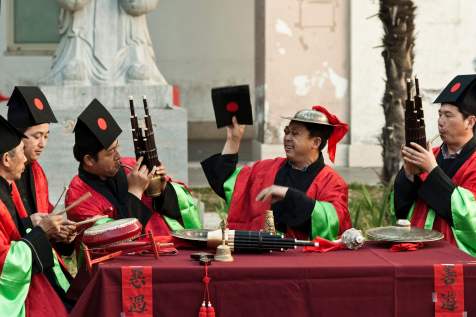
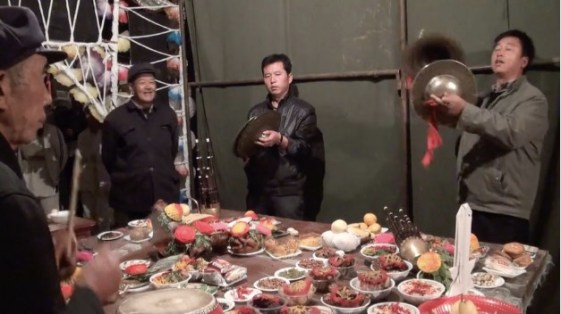
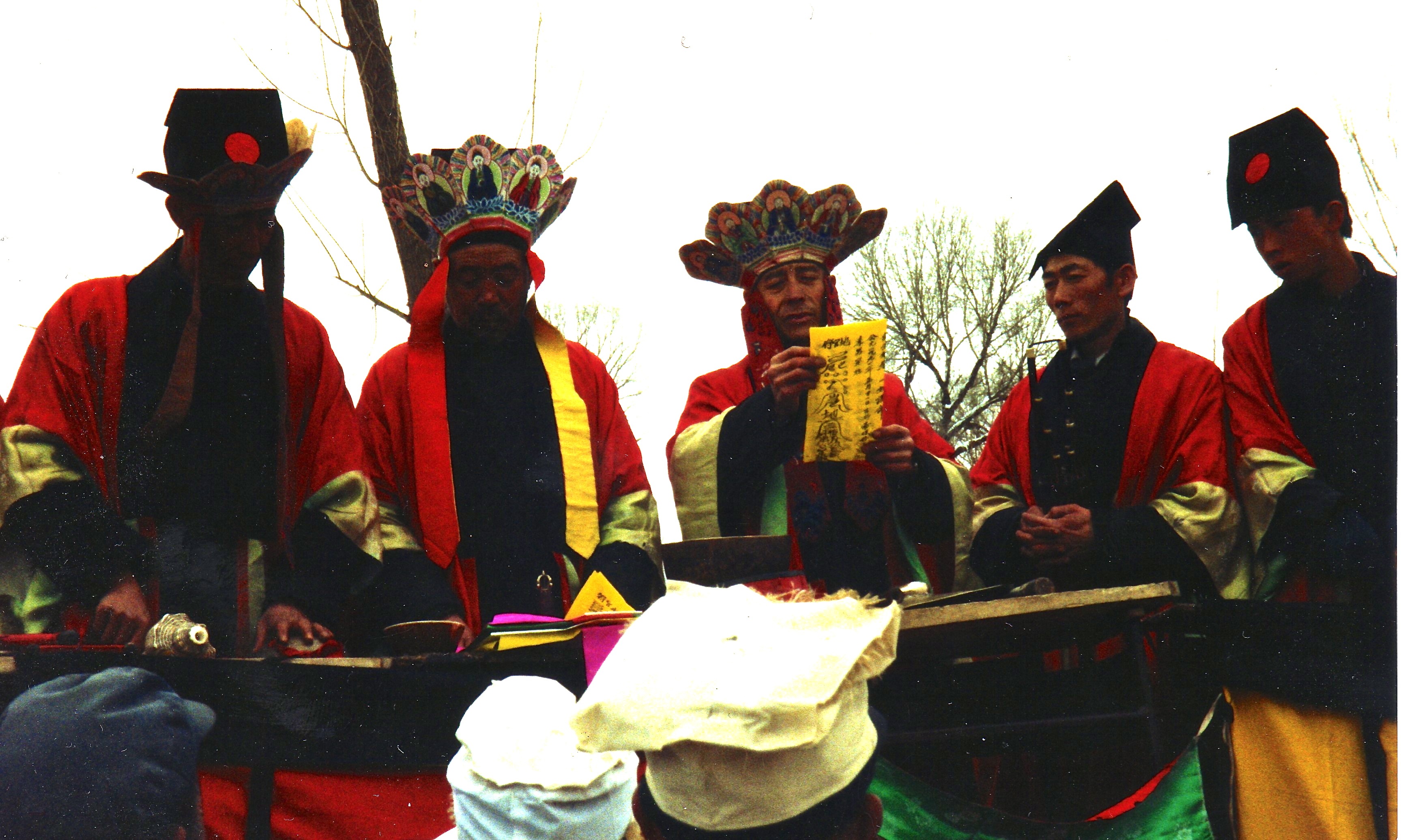
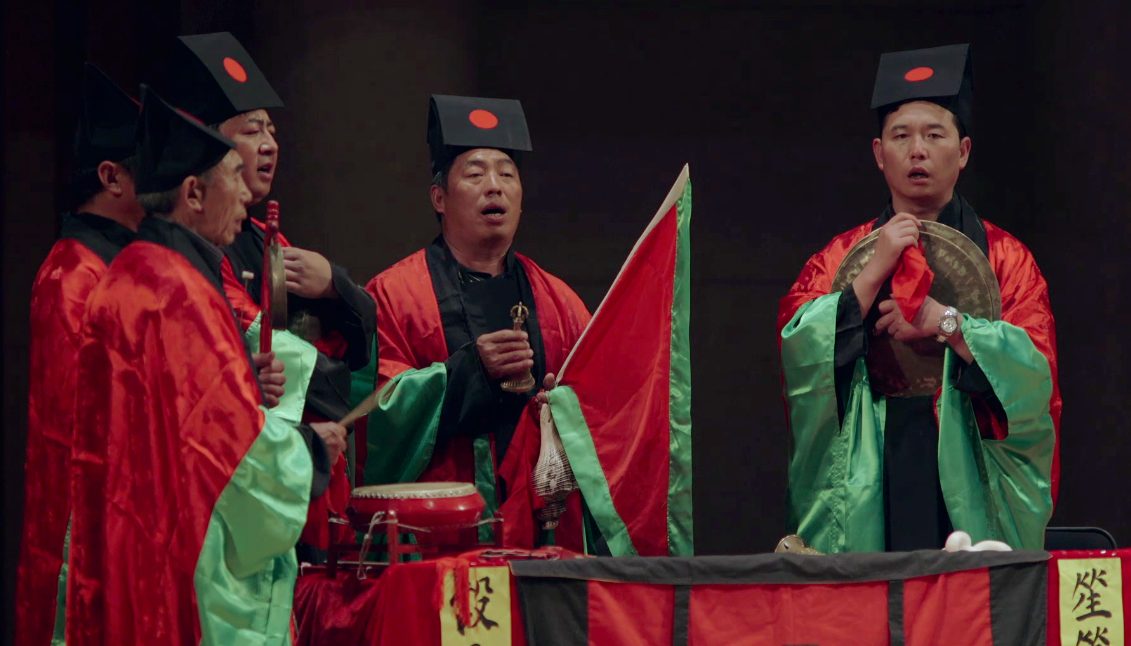
At the heart of the funeral sequence of the Li family Daoists today is the Invitation ritual (zhaoqing 召請). This introduction is adapted from my book, pp.109–12, 298–307—and do watch the film from 58.14. For audio segments, click on ##1–3 of the playlist in the sidebar (commentary here). See also Translating Daoist ritual texts.

This is another illustration that ritual manuals don’t tell the whole story—performance is primary.

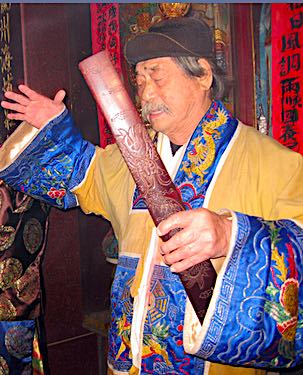
1 Li Manshan

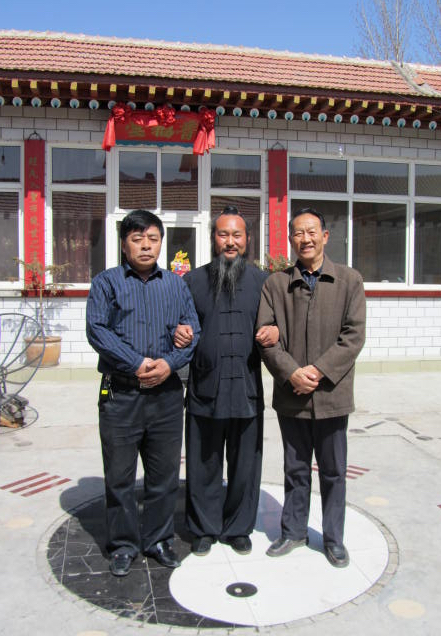
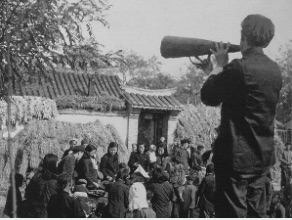
Fig. 1: Li Manshan performs the Invitation,  2009

I have two reasons to focus on the Invitation—one about simplification, one about complexity. This is one of the few ritual segments for which the Daoists still have a manual, although as usual they don’t need it in performance. It is among the longest in their collection, but they now perform only a small part of its nineteen double pages; as with Fetching Water, a comparison of their present performance practice with the manual shows a significant simplification. Perhaps the term “complete” in the title Zhaoqing quanbu suggests that it was commonly abbreviated. But only rarely can we speculate how long it may be since they used more of its text.

As to complexity, whereas today the bulk of their performance of funerary texts consists of slow choral hymns, for this Invitation sequence the a cappella rendition over a mere fifteen minutes or so is now perhaps their most densely-packed, complex, and varied segment of ritual performance, full of dramatic contrasts in tempo and dynamics—with both slow and fast choral singing and chanting, free-tempo solo singing, and a variety of styles of percussion interludes and accompaniment.

The Invitation was also a major section within the lengthy nocturnal yankou ritual, both here and in the great temples. For two-day funerals now, with the yankou anyway obsolete, the Invitation has evolved into a public ritual at dusk before the evening session of Transferring Offerings. Whereas even in the early 1990s many village onlookers accompanied the kin, creating more bustle, now it is largely a private ritual for the kin.

The sequence
First, as the Daoists arrive at the soul hall, Golden Noble faces the coffin to recite a seven-word quatrain solo.

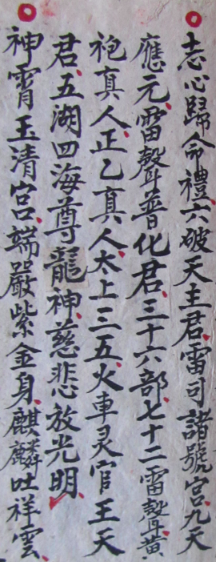
The manual opens with the quatrain “Sandai zongqin ting fayan 三代宗親聽法言”:

Let the three generations of ancestors hear the dharma speech,
Paying homage to the previous souls by burning paper money.
May the dharma speech open up the road to the heavenly hall,
To invite the deceased souls to attend the jasper altar.

shuowen

Fig. 2

But instead Golden Noble recites another shuowen introit—which appears on the last page of the manual. That is how he learned from Li Qing, and it does the job just as well:

May the deceased souls come to the Bathing Hall, [1]
Transforming their shape and countenance to return to the immortal realm.
Now dipping into the bowl to bathe their bodies,
For an audience with the Three Treasures on the way to the Western Quarter.

Golden Noble then calls out “Proceed together, led by the Dao” (tongxing daoyin 同行道引), as shown at the end of the opening quatrain of the manual. If we didn’t know by observation, that would be a clue that while the preceding quatrain was performed at the soul hall, the remainder of the manual is to be performed on arrival at the site on the edge of the village.


Hereby Shaking the Bell
The next section in the manual, no longer performed, is Hereby Shaking the Bell (Yici zhenling 以此振鈴). One of several Yici zhenling texts that are a common part of the temple yankou, this slow sung hymn may also be used for other rituals, such as Delivering the Scriptures and Transferring Offerings—although the Yanggao Daoists no longer use it there either.

Song in Praise of the Dipper
Once they reach the site at the edge of the village, the altar table is set down, and the kin kneel in two rows in front of it while the Daoists stand in two rows behind it. Golden Noble presides, wielding flag, bell, and conch as he stands facing the kin. After a short percussion prelude with blasts on the conch, the first text now performed is Golden Noble’s solo chanting from the section of seven-word couplets opening Xinzhi jiguo 心知己過. Now he usually only chants the last two of the six couplets in the manual:

xinzhi-jiguo

Fig. 3

I am the one to report the declaration of the procedures at the Jade Capital,
Vowing to save all beings and emerge from the web,
So the deceased soul may be born in the upper realms,
We sing in unison the Song in Praise of the Dipper.

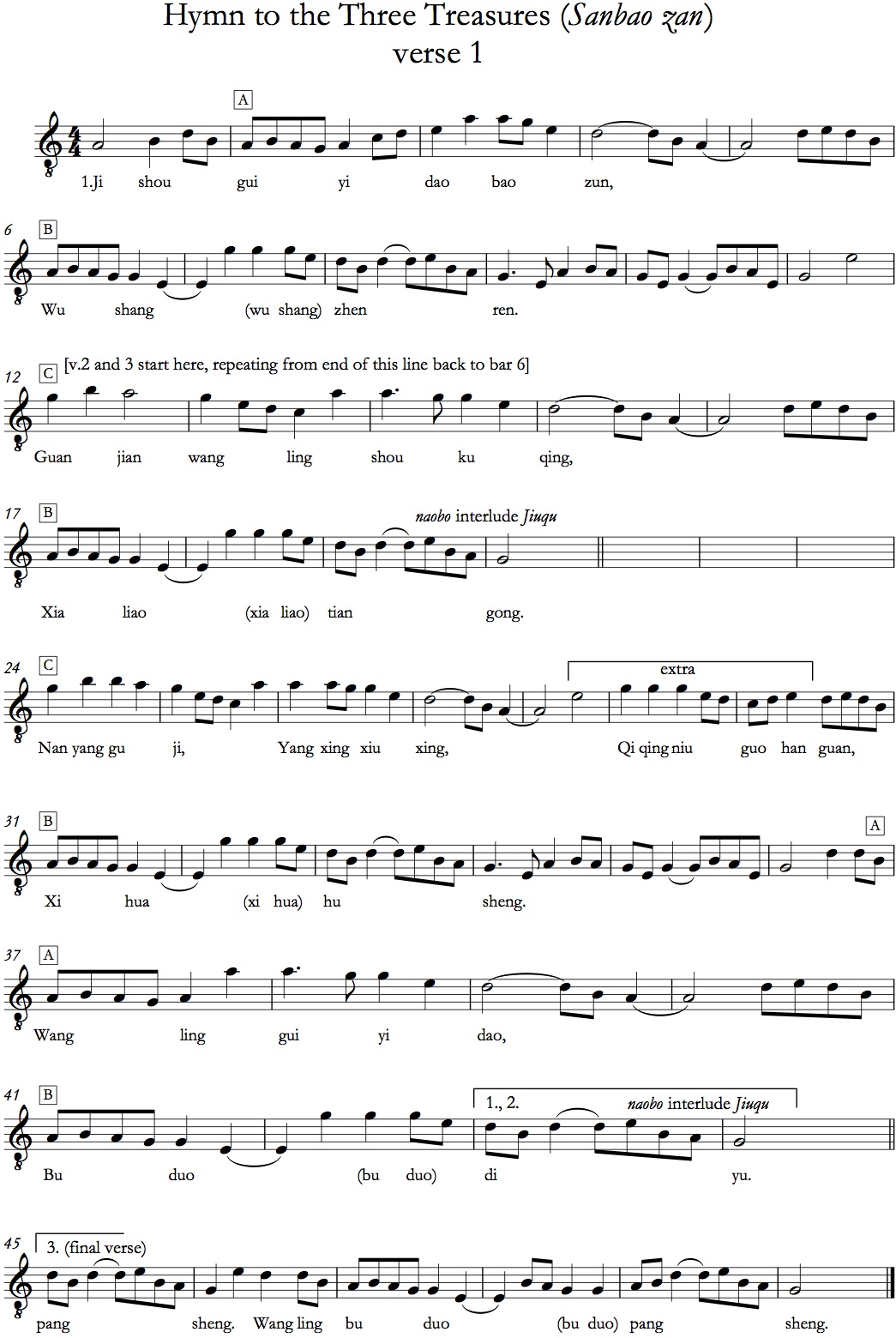
This indeed serves to introduce the Song in Praise of the Dipper (Gedou zhang), a slow choral hymn sung tutti a cappella. The title is to the Northern Dipper, otherwise not prominent in their funerary texts, explaining the respective responsibility of the five quarters for the salvation of the soul. Its seven-word couplets are each sung to the same melody; the short strophic melody has all the hallmarks of other hymns.

gedouzhang

As each sung couplet ends, Golden Noble shakes the bell, waves the flag, and bows, as the other Daoists play a cymbal interlude—a variant of the pattern Qisheng 七聲 as notated by Li Qing, as you can see below from the tiny differences in the first and penultimate bars between the naobo line in practice and the Qisheng mnemonics. As ever, the line for the drumming, ever flexible, shows a typical version as played by Li Manshan.
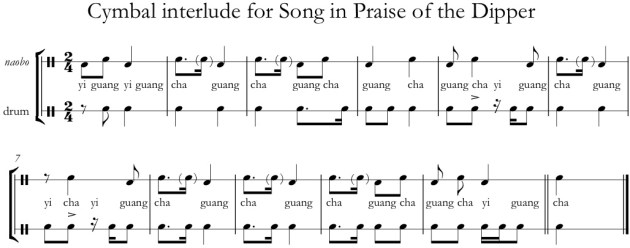
gdz-naobo

In recent years they tend to sing the hymn rather faster than they know it should go (you can hear a more majestic version in concert on track 1 of the audio playlist, and on the 2014 DVD). Anyway, with a very gradual accelerando over the verses, as they reach the seventh and eighth couplets they launch into fast isorhythmic chanting. They now play the fast cymbal interlude Gui jiao men (“Ghosts calling at the door”)—a pattern the same length as the processional Tianxia tong but differing subtly.
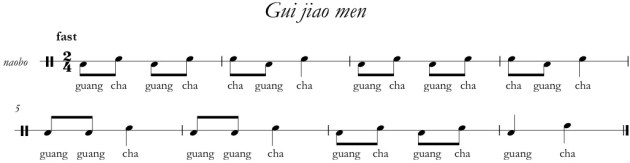
gui-jiao-men

This leads into the five-word quatrain Jishou wufang zhu, sung tutti isorhythmically to a simple descending melody, without percussion, now slightly less hectic:

Bowing to the lords of the five quarters,
The masters of the lads of the five spirits
Open up the roads of the five quarters,
Receive and guide all the ghostly souls.

GDZ 2.jpg

Fig. 4

Then two sections summoning a roster of gods of the local territory—now accompanied by percussion, and punctuated twice by the Gui jiao men cymbal pattern—are chanted tutti, most hectically. Prepared by the instruction at the end of the Song in Praise of the Dipper (Great Supreme, in haste like the Northern Dipper!), and in extreme contrast with the long slow melismatic hymns that now dominate most rituals, this transitional sequence flies past as black clouds swirl, purple mists coil, with complex adjustments of style, tempo, and instrumentation. This too is a rare instance in Yanggao today of the kind of fast chanting commonly heard in south China.

The Invitation verses (playlist #1)
In abrupt contrast to this rousing climax, time now stands still as Golden Noble gently begins to sing a sequence of solo verses in free tempo, accompanied only by his shaking of the bell, with Li Manshan punctuating the phrases with a brief subdued pattern on drum. Li Manshan has let Golden Noble lead this ritual since about 2003; his solo melody is modeled on the way that Li Qing sung it. Even the way he repeats words in the opening phrase (Zhiyixin zhaoqing, yixin zhaoqing, zhaoqing) is distinctive, setting a contemplative mood. We are in the middle of barren countryside, far from the bustle of the village; as night falls, the main light comes only from the little piles of paper money burned by the kin. Notwithstanding interruptions at the end of each verse by a fast loud chorus with percussion, and periodic deafening explosions of firecrackers, this exquisite solo plaint perfectly reflects the desolation of the surrounding countryside where the ancestors are to assemble.

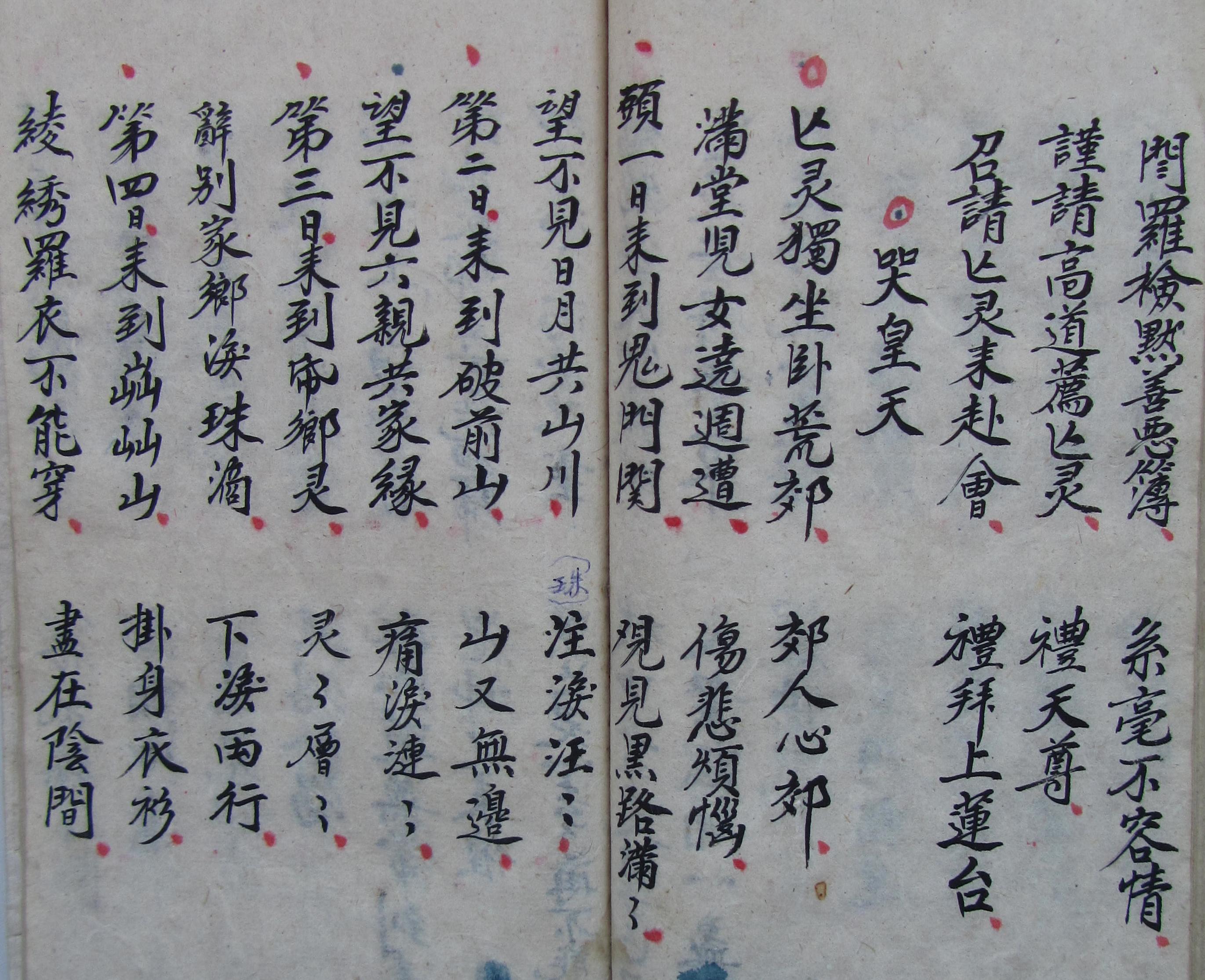
The twenty verses in the manual, each beginning “Vowing with hearts at one we Invite” (Zhiyixin zhaoqing), describe all kinds of occupations of the lost souls: emperors, ministers, generals, literati, sing-song girls, beggars, and so on. These verses are also found in the Li family’s Buddhist (not their Daoist) yankou manual—a sequence sometimes attributed to the great poet Su Dongpo (1037–1101). The twenty verses are now never sung complete; the chief Daoist chooses no more than six or seven of them. Both Li Manshan and Golden Noble agree that they should be performed complete, and were “in the past,” but even Li Manshan never heard the elders recite the whole sequence. To give an idea of the literary beauty of these texts, here is the opening verse (recto, lines 3–6):

zhiyixin

Fig. 5

Vowing with hearts at one we Invite:
Emperors and lords of successive dynasties,
Empresses and concubines of epochs immemorial,
Bedecked in twelve-gemmed crowns,
Countenance outranking three thousand rouge-and-kohl belles.
All under heaven their remit, all under heaven their family,
Ultimately ascending.
Singing within the palace, dancing within the palace,
At the final moment they can only perish and fall.
Alas! Have you not heard?
Once astride the dragon of Yu they cannot return,
(tutti) In vain to deploy the Pipes of Shao within the Department of Caverns,
Fluttering the shadows and echoes, imperceptibly approaching!

But once rendered in exquisite solo melody, such textual beauty is multiplied.

For the last two seven-word couplets at the end of each verse (last line of recto and first line of verso), the first is still sung solo, while for the second the whole group interjects to chant the text fast. But, then, instead of the manual’s elegant and long refrain (opening “And thus from time immemorial” Rushi guwang jinlai, 5th–3rd lines from end of verso above) confirming the invitation, they now substitute a single phrase “Fluttering the shadows and echoes, gradually approaching” (Piaopiao yingxiang ranran lailin 飄飄影響冉冉來臨), again sung tutti. This phrase is borrowed from the shorter sequence of a mere three Invitation texts from their other (“Daoist”) shishi manual.[2] It leads into another burst of the cymbal interlude Gui jiao men.

That is how Li Qing taught them, but they know that the two versions were once alternatives: when the older generation used the longer refrain, it was still sung solo, and they didn’t use a cymbal interlude. So using the Piaopiao phrase with cymbal interludes wasn’t Li Qing’s invention in the 1980s; but already by then, deciding that the full refrain was too long, they were generally adopting the shorter version.

Some other adaptations also have to be learned orally. In the Jinwu sijian section about the sun and moon, and again in the following verse “Gazing from afar on mountain hues” (Yuanguan shan youse), the name of the deceased has to be inserted, and another text replaces the tutti coda of the manual.

The Invitation verses in Beijing Buddhist ritual
I have to take it on trust that all twenty sections were once performed complete, including the longer refrain. The substitution of the “Fluttering the shadows and echoes, gradually approaching” phrase with cymbal interlude for the longer final refrain shortens the ritual a little; and the more recent practice of reciting only selected sections shortens it further.

Actually, the version as sung by the Li family in Yanggao is remarkably similar to that of Buddhist temples in old Beijing. In a fine initiative from the mid-1980s, the performance of the Buddhist yankou by former monks from popular temples in Beijing was recorded; later it was also transcribed and notated.[3] The Invitation sequence, virtually identical in text, is interesting.[4] All twenty sections were indeed performed for the recording. The text is divided between main and assistant cantors, both singing in free tempo with impressive beauty, accompanied only by the bell, the refrain of each section fast choral with drum. So again, it is worth pursuing temple links.

The Invitation memorial
When Golden Noble has finished singing the Invitation verses, first the short section Chenwen dadao 臣聞大道 (see Fig. 7 below) should be recited fast, either solo or tutti, with percussion, confirming the efficacity of the ritual in saving the deceased. This text is commonly omitted today.

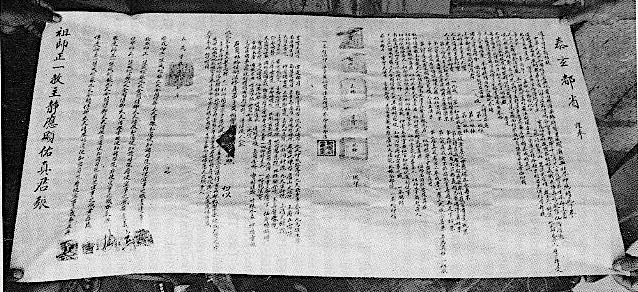
Then (as specified in the manual, in red ink) Golden Noble presents the memorial. Having handed the bell to a colleague, who sounds it continuously, he takes out the folded document from his pocket, singing it solo in the same melodic style as the preceding “Vowing with hearts at one we Invite” verses, only more exuberantly, with muffled accompaniment on drum and small cymbals and occasional fast tutti choruses repeating a phrase. He unfolds each new section as he folds up the previous one—though he hardly needs to consult it except to check the names of the kin. In recent years, if the others start accompanying too fast on percussion then Golden Noble sometimes likes to corpse the others (especially his mate Wu Mei) by reading faster and faster, rolling his eyes rapidly up and down over the text.

The manual doesn’t contain the text of the memorial; it is not among the templates in Li Qing’s collection of ritual documents, and Li Manshan and Golden Noble write it from memory. Sometimes entitled Memorial of Rites and Litanies to Escort the Deceased (Songzhong lichan yiwen), it is addressed to the Court of Sombre Mystery for Rescuing from Suffering (Qingxuan jiuku si), and announces the details of the deceased and lists of the preceding three generations of kin. Generally Li Manshan writes the text first and fills in the names of the ancestors later when a member of the kin brings them to him. Dates, as always, are written in the traditional calendar.

yiwen-copy-2

Fig. 6: Invitation memorial, written by Li Manshan, Pansi 2011

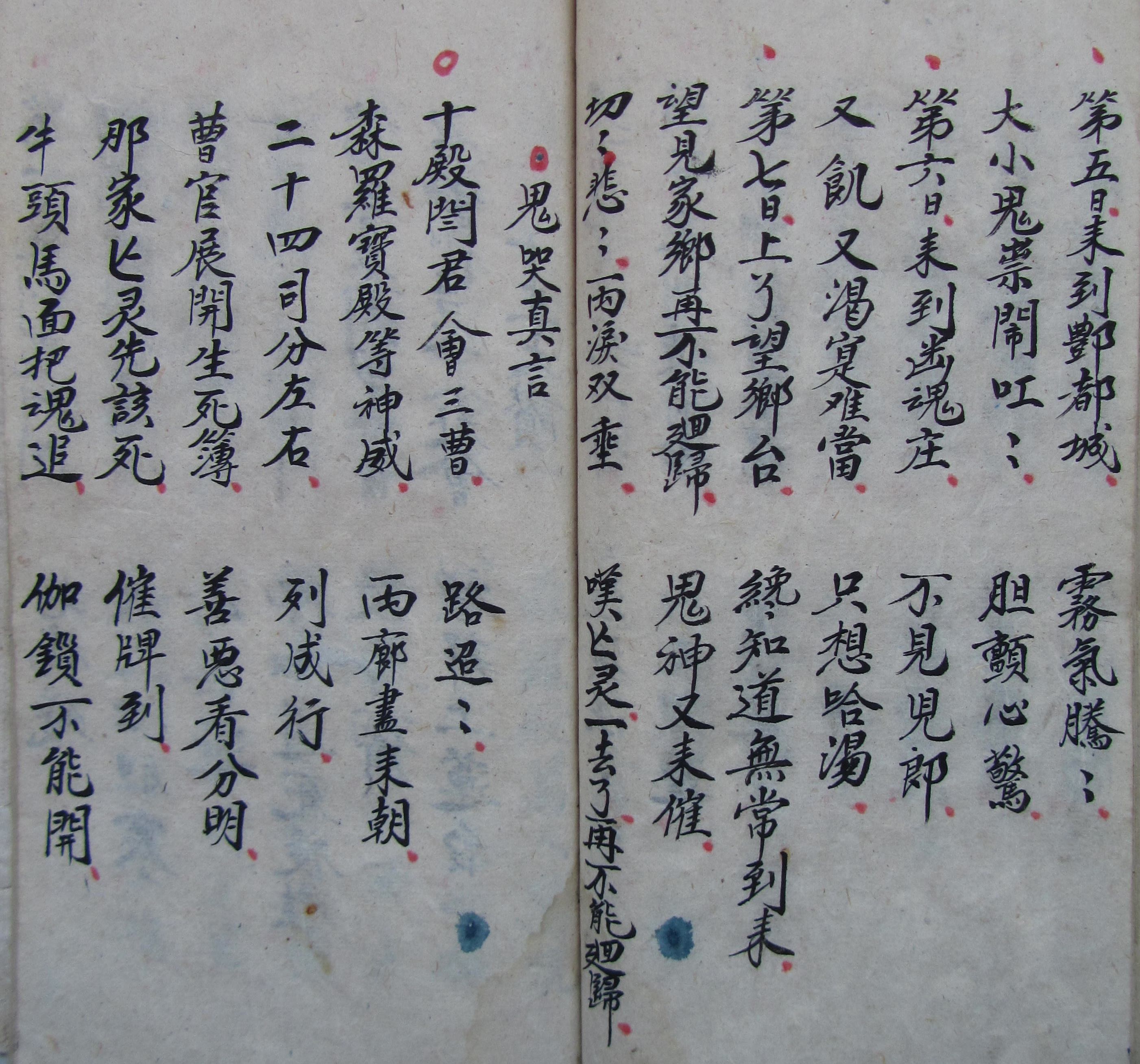
Having sung the memorial complete, Golden Noble opens it out and hands it over to be burned by the kin, while the Daoists slowly and solemnly declaim a final five-word quatrain “Thousand-foot waves at Bridge of No Return” (Naihe qianchilang), another common temple text:

naihe

Fig. 7

Thousand-foot waves at Bridge of No Return,
Bitter sea myriad leagues deep.
If the soul is to evade the cycle of rebirth and suffering,
The Daoists are to recite the names of the Heavenly Worthies.

The return procession
So now after the document has been burned, if Redeeming the Treasuries is combined then the two treasuries are burned. The Daoists then lead the kin on procession back to the soul hall. Whereas the whole of the previous sequence has been performed a cappella, they now play shengguan all the way back while the kin burn paper to illuminate the way for the ancestors; on procession on the way out, they only use percussion because there is no-one to escort yet.

However, in Li Qing’s manual there follow thirteen verses for Triple Libations of Tea (san diancha). Li Manshan recalled these verses being recited on the route back, accompanied by Langtaosha on shengguan, but later they only played Qiansheng Fo without vocal liturgy. They still sometimes use a three-verse version for the solo introits in Presenting Offerings before lunch, and as a slow accompanied hymn for Transferring Offerings.

Even after the Libations of Tea were omitted, villagers used to “impede the way” (lanlu) on the return to demand popular “little pieces” from the Daoists, but by the late 1990s no longer did so—they now had plenty of other opportunities to hear pop music. Since around 2011 the kin often just stop occasionally to burn paper, not all along the route as they should. Altogether, the impetus towards simplification derives from the changing needs of the patrons.

The hymn at the gate (playlist ##2 and 3)
On the return to the soul hall, the Daoists now stand informally around the gateway to sing the Mantra to the Three Generations a cappella, as the kin again kneel and burn paper. This is the “Jiuku cizun” text in the manual. As usual, this a cappella version is sung faster than that with shengguan, though they retain the cymbal interludes. They round off the hymn with the fast percussion coda Lesser Hexi, and then lead the kin into the courtyard with a short burst of the pattern Tianxia tong. That is the end of the Invitation as performed today.

But in the manual, before the Mantra to the Three Generations, a further text Lijia quyuan 離家去遠 appears—also apparently a hymn, but unknown today. The volume then concludes with the solo recited quatrain that in current practice they recite at the initial visit to the soul hall; and then a final six-line hymn Qinghua jiaozhu, which should be sung (again, surely a cappella) while the oldest son kowtows.

Conclusion
One wonders how there was ever time for all the extra material in the manual, within what was once an even more busy ritual sequence throughout the day. The ritual in its present condensed form may have taken shape gradually, and it still makes a cogent and moving sequence that meets the needs of patrons.

Beyond just documenting which sections of text are performed today and which have been lost, we need to know how the texts are performed, and how Daoists adapt the material. It’s always hard to imagine the performance of ritual texts from the page, but here is a fine instance of variety. The text is rendered efficacious, and its drama heightened, through a varied yet cohesive sequence of slow solemn choral singing, hectic mantric choral chanting interspersed with percussion interludes, and exquisite free-tempo solo singing accompanied by conch and bell. Such a cappella rendition is of a different kind of complexity from the slow melismatic hymns that now form the bulk of their performance. Despite ritual simplification in modern times, the Daoists need to internalize complex rules—orally—in order to deliver the text efficaciously, animating it into a magical sequence.

[1] By the way, the Yanggao Daoists now have no separate Bathing (muyu) ritual, though it is part of the obsolete shezhao muyu ritual in Li Peisen’s funeral manual.
[2] It is used in the Summons (shezhao) ritual of the temples: Min Zhiting, Daojiao yifan 道教儀範 (Taipei: Xinwenfeng 2004 edn), p. 179.
[3] Ling Haicheng, Yuqie yankou yinyue foshi 瑜珈焰口音乐佛事 cassettes, with booklet (1986); Yuan Jingfang, Zhongguo hanchuan fojiao yinyue wenhua 中国汉传佛教音乐文化 (2003), pp.301–451, Yuan Jingfang Zhongguo fojiao jing yinyue yanjiu 中国佛教京音乐研究 (2012), pp.228–439. Cf. Chang Renchun, Hongbai xishi 红白喜事 (1993), pp.324–6.
[4] Yuqie yankou yinyue foshi, cassette 4b; Yuan Jingfang Zhongguo hanchuan fojiao yinyue wenhua, pp.389–395, Yuan Jingfang, Zhongguo fojiao jing yinyue yanjiu, pp.386–391.

Periodizing modern China

slogan

Satirical Chinese saying, c2010.

In my book Daoist priests of the Li family I stress the importance of fieldwork on the modern period, not just attempting to imagine the rosy distant past. Talking of the modern period (p.141):

Just as historians document ritual change throughout the medieval and late imperial periods, we find constant adaptation in the years before and after the Communist revolution of 1949. Similarly, a detailed account of over three decades of ritual practice since the liberalizing reforms of the early 1980s reveals continuing changes.

Chinese peasants have a different conception of time from the periodization we find in official history. Li Manshan described his wedding in 1971 as “after the end of the Cultural Revolution”; “land reform” is often used to mean the privatization around 1980; and now when people mention “liberation” they often mean after the end of the commune system in the 1980s. Now that the Maoist era is a rather distant memory, it may seem like a blip in the long sweep of history—but it has left deep scars.

Similarly, while in the official story the term “three years of difficulty” (1959–61) makes a veiled recognition of the devasting famine, it means little to many peasants, since they suffered from severe food shortages right through from the early years of collectivization until the collapse of the commune system.

Catching the tiger, Wu Mei, oboes and cymbals

This Larson cartoon reminds me of the “catching the tiger” tricks of the Li band—a rare moment of secular entertainment within the liturgical sequence.

In my film (from 42.52), Wu Mei’s tricks are charming (see also §B8 on the DVD with my 2007 book)—interesting also to compare (from 51.22) the more leisurely 1991 version of his predecessor Wang Chang.

Wu Mei [1] (b.1970; film from 53.52; see also this vignette), known as Zhanbao 占宝, is one of the great wind players in world music. Of course he does everything—also singing the liturgy, playing the large cymbals for a cappella sequences, and occasionally giving another Daoist a turn on the guanzi while he plays sheng mouth-organ. He’s a Daoist, not a “musician”, yet his musical genius is indispensable to the success of the Li band.

He was the fourth of five children from a poor family—his blind younger brother spent some time learning the shawm, and their father was an old friend of Li Qing. Wu Mei was at once enchanted by the sound of the funeral ritual, and there and then he went up to Li Qing and asked him if he could become his disciple. He went to live with him for the first year, and then commuted by walking an hour from his village, five li away.

Wu Mei recalls that the first time he played guanzi for a ritual was for a funeral at Lower Liangyuan in 1990, during his third year, playing small guanzi along with the aged Li Yuanmao on large guanzi. This might remind us of young, pre-punk, Nigel Kennedy in duet with venerable Yehudi Menuhin. But Wu Mei doesn’t remember much about it—they just got on with it; anyway, the seniors were satisfied with his playing.

When the hymns are accompanied by shengguan, a good guanzi player makes all the difference. Like Li Yuanmao or Li Tong in the old days, Wu Mei is not just totally reliable, he is inspired, helping the other Daoists to sing to the best of their ability, complementing them perfectly—managing to combine a deeply mournful tone with an almost playful way of weaving in and out of the melodic line, ducking and diving, sometimes soaring. The singers recognize that a good guanzi player is a great help to them in rendering the text.

Wu Mei soon became a local star. With his radiant innocence, he is on another planet, floating in the clouds above this world of dust. Here there is no empty display; he is a vessel, a puppet for the gods, like Bach. On guanzi—and not just in slow hymns but even in the zany “catching the tiger”—he has none of the posturing of the virtuoso. And not even just when he is actually playing: it is delightful when he takes a little break in the instrumental suite or the popular errentai sequence, doodling a little phrase reflectively on the guanzi before plunging back into the fray.

WM zhuo laohu

Concert performance in Rome, 2012

He is always devising new decorations, like renaissance divisions—experimenting, seeking new ways of making transitions. The others are attuned to all this as they accompany him. While the decorations of the older generation remained within strict confines, Li Manshan and Golden Noble observe that in recent years Wu Mei has been experimenting beyond the “rules”. To me, there was always an element of playfulness even in the slow solemn style (like Liu Zhong, although he wasn’t so admired); and if this is modernizing, then I’m cool with it. When I suggest to Li Manshan that Wu Mei’s ornaments are still serious and spiritual, he defers to my musical ears—but obviously he is a master musician with way more experience of the style. Perhaps the way to see it is as an innovation that began with Liu Zhong and has culminated in Wu Mei—it’s amazing, even if not strictly kosher. Bach would have adored Wu Mei’s guanzi playing.

YD

The way he plays the large bo cymbals is childlike and adorable too; you can sense how utterly comfortable he is as a musician. Again he has a particularly charming way of decorating the patterns, tastefully testing his partner’s creativity and probing the possibilities. The most exhilarating, and by far the longest, cymbal piece is Yellow Dragon Thrice Transforms Its Body, now played only as a coda for Transferring Offerings (for which, apart from the edited version in my film [from 1.11.07], you can enjoy a fantastic complete concert rendition in the 2014 DVD), but also prescribed upon ascending the platform in the Pardon (film from 50.31). Wu Mei and Yang Ying can’t help showing their delight in it, whereas Erqing and Li Bin maintain their serious demeanour. This is the only percussion piece that ever attracts an audience, and even applause. Local or urban, Chinese or foreign, no-one remains unmoved by this exhilarating piece.


[1] These comments are edited from my book.

A funky address

To follow Five easy pieces, a very different kind of oeuvre of that époque—less verité—is Jacques Rivette’s 1974 film Céline et Julie vont en bateau (here, on vimeo).

One abiding memory is my favourite address, where much of the “action” (if that’s the mot juste) takes place:

7 bis, rue du Nadir-aux-Pommes

I often used this a forwarding address.

What an age—Rafaelson, Bertolucci, Godard, Chabrol… (more here). At the time [historical note—Ed.], the way to see all these films was to do something called “going to the cinema”. Late-night Marx brothers films at the Arts Cinema were a rite de passage too…

In my imagination I tend to reduce my student years to the Tang dynasty, violin, and Adnams, forgetting how important (and how modern) my wider education was—film, art, literature. But the lacunas were remarkable too.

Meanwhile, Li Manshan and his fellow Daoists were languishing in silence and hunger (my book, p.133):

“We just sat around at home, but we could never feel at peace”—always fearing a knock at the door.

Mind the Gap: The Three Homages

Chapter 10 of my book is called Mind the Gap. My use of this classic London underground warning, I gladly concede, may well be less effective in Daoist ritual studies than that of the wonderful Bridget Christie for feminist comedy.

Anyway, I explore how rituals as performed don’t make a close fit with ritual manuals—apart from the fact that the latter are silent. Here’s an instance. [1]

The Li family makes four visits to the soul hall in the morning to Deliver the Scriptures (songjing 送經). The final one of these sessions is Presenting Offerings (shanggong 上供), parts of which are shown in my film, from 32.12.

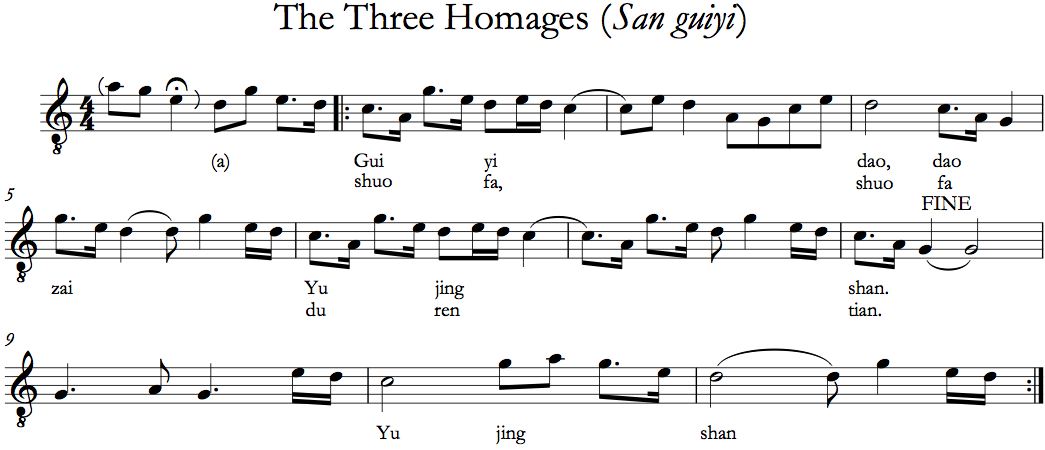
The Three Homages hymn (San guiyi, also known as Zan sanbao) is part of an unusual sequence in their current practice. This is another instance of the importance of using ritual performance rather than relying merely on ritual manuals. Finding the short text of The Three Homages in Li Qing’s hymn volume (and I haven’t yet found it elsewhere), we couldn’t know that each of its three verses (accompanied by shengguan) is preceded by a choice of solo shuowen recited introit (now commonly based on the Triple Libations of Tea). The first one commonly goes like this:

I hereby declare:
The lustre of time soon passes, life and death are hard to evade.
Don’t ask of the three sovereigns and five emperors, or cultivate the search of Qin and Han emperors most high.
Coveting Pengzu’s eight hundred years, or cultivating Yan Hui’s four hundred years.
Although old and young differ, they can’t help being equal in rank.
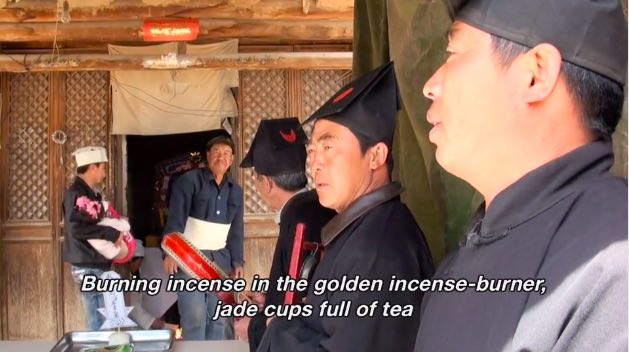
Burning incense in the golden incense-burner, jade cups full of tea,
With filial kin raising up the cups, the first libation of tea pouring.

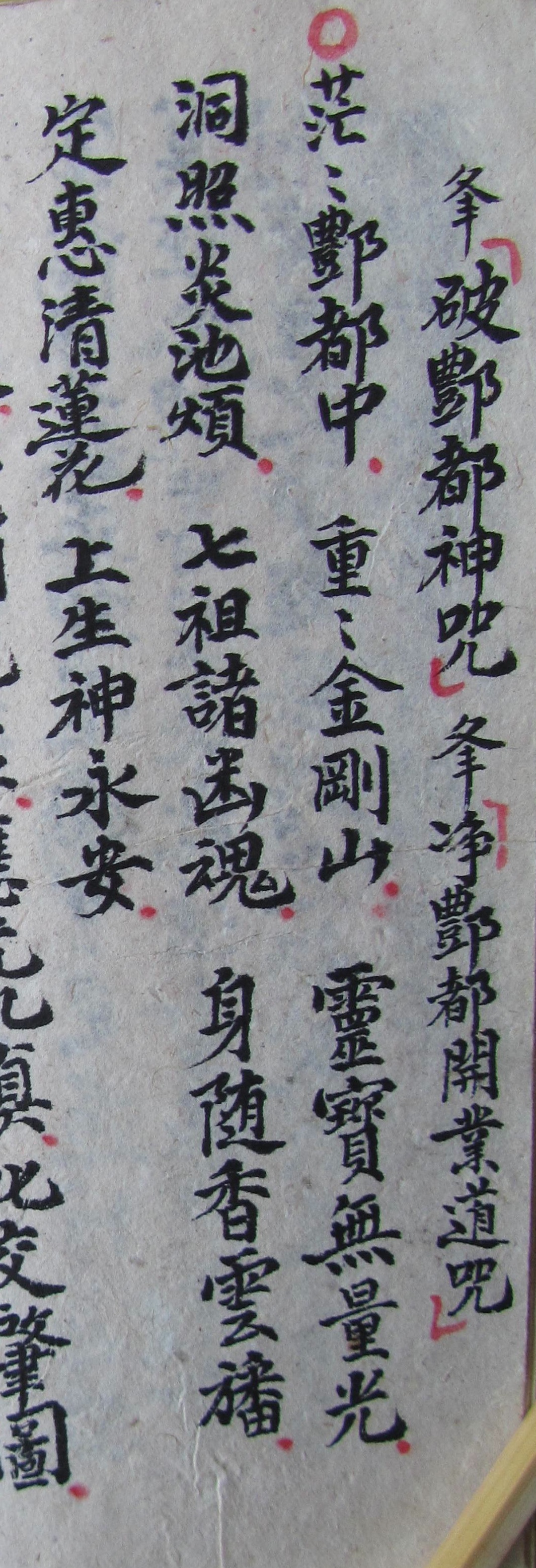
Nor could we know that the hymn is followed by the fast tutti a cappella chanted Mantra to Smash the Hells (which appears not in the hymn volume but in the Bestowing Food manual):

mantra-to-smash-the-hells

In boundless Fengdu hell, the vastness of Mount Vajra.
Immeasurable light of the Numinous Treasure
thoroughly illuminating the woes of Scorching Pool.
The Seven Ancestors and all the netherworld souls
Bearing incense-cloud pennants,
Blue lotus flowers of meditation and wisdom,
Life-giving gods eternally in peace.

Nor yet could we imagine that the whole sequence then concludes with any short hymn from elsewhere in the hymn volume, like The Ten Redemptions of Sin (Shi miezui) or the Five Offerings (Wu gongyang), again with shengguan.

With its short verses, the tempo of The Three Homages is not as slow as most of the Li family’s hymns, so one might think it would be an easy-learning item, but it is still none too easy for the outsider to learn. Indeed, they don’t grade their learning like this—they just plunge in, picking up the hymns as they occur in ritual practice.

san-guiyi-for-book

San guiyi text.jpg

The text illustrates a system found in some other hymns, where the last words of each line are repeated to open the following line—as here, the first of three verses:

Homage to the Dao,
The Dao residing on Jade Capital Mountain. [2]
On Jade Capital Mountain preaching the dharma,
Preaching the dharma to deliver humans to heaven.

By the way: fa, commonly equated with the Buddhist “dharma”, is just as common in Daoism. I usually render it as “ritual,” only retaining “dharma” in a couple of binomes—like shuo fa here, and fayan “dharma speech”.

In sum, useful as it is to have collections of texts on the page, none of the efficacy of ritual in performance is contained there. All the segments of this Presenting Offerings ritual differ in style. To read them on the page, as ever, is quite inadequate.

For another instance, see the Invitation ritual.


[1] Adapted from my book, pp.208–9, 264.
[2] Li Qing’s manual gives Yuqing shan 玉清山, which I have (unusually) revised to the standard Yujing shan 玉京山.

Recreation

MYL played

Some may (wrongly) imagine folk cultures as a kind of “living fossil”, but in China, thankfully, few yet seek to recreate the performances of the past in arid concert halls. Or at least it’s still a small industry, such as attempts to recreate Tang music… And so far it’s been an exercise performed, with little or no concern for historical style, not by folk musicians but by urban educated pundits and conservatoire performers, trapped within their modern preconceptions. [1] Folk musicians, like symphony orchestras (at least until recently), are quite happy working within their evolving tradition, without agonizing over “preserving” some supposed “authenticity”.

Scholars of Daoist ritual aren’t necessarily seeking to “hear a centuries-old piece of music as it was heard when it was composed”. What they may do, though, is silently equate living performance with that of the Tang or Song dynasties. From my Daoist priests of the Li family, p.369:

While Lagerwey’s fine accounts of Daoist ritual in Taiwan occasionally suggest clues to changing ritual practice in modern times, “our primary interest […] is less to give a complete description of actual practice […] than it is to analyse the deep structure of that practice” (Lagerwey 1987: 91)—an influential perspective that tends to lead to the noble yet arcane goal of studying texts as evidence for the ritual structures of medieval times.

And Daoist scholars do sometimes seek to recreate rituals from the memory of elderly Daoists, as in Shanghai—evidently a worthy “salvage” project, albeit without reference to the changing social context since their youth.

Context and style have changed far less than with WAM—but they have changed. Apart from more general social changes, early music studies influence me in noting all kinds of changes in the Li band’s performance practice since the 1930s (my book pp.358–60):

Recently they have reduced the personnel from seven to six, discarding one guanzi, and the dizi has hardly been needed since the 1990s,

Turning to rituals, since current practice is dominated by funerals, this might at first seem to be their tradition. But they clearly recall a tripartite system of funerary, earth, and temple rituals; even if the latter two are now virtually obsolete, it is clear from their manuals. Thanking the Earth, once their most frequently performed ritual, has been lost since 1954; people can now afford to commission it again, but don’t. Though some temples have been restored, those holding fairs are fewer, and ritual sequences have been simplified along the lines of funerals. Three-day funerals are less common; and when they are held, the old sequence has become simplified and homogenised.

As to ritual segments within funerals, some were already largely obsolete by the 1940s, while others could still be performed in the 1990s but weren’t. Some, like Communicating the Lanterns and Judgment and Alms, have been radically simplified into mere symbolic tokens since the 1990s. Some—such as Dispensing Food or those from the “outer five rituals” like Crossing the Bridges—have become virtually obsolete since the 1950s; Li Qing and his colleagues could perform Opening the Quarters and the Pardon, but his disciples have hardly needed to do so. Yet others were probably rare even by the 1930s (Presenting the Memorial, Roaming the Lotuses, Smashing the Hells) or already lost by then (Offering Viands). Though segments have been adapted under Li Manshan’s leadership, his elders were already doing so long before.

As for the ritual manuals, we must take care to avoid some timeless ideal depiction. As the repertoire shrinks the manuals are not needed at all, but even before the 1950s many segments were performed without them. Li Qing probably didn’t know how to perform some of the rituals whose texts he copied in the 1980s. The lengthy chanted scriptures—around half of the total collection of manuals—were indeed placed on the table during performance, yet Li Qing and his colleagues could recite them so fluently that they barely needed to glance at them; now they are no longer expounded.

Along with the reduction in ritual repertoire, all three performance styles have been reduced—vocal liturgy, percussion items, and melodic instrumental music. The current repertoire of hymns is smaller than that in Li Qing’s score, so where there is a choice (as for Delivering the Scriptures and Transferring Offerings), that choice has become smaller. The “words of blessing” for Thanking the Earth are no longer performed, and fewer shuowen recited introits and mantras for offering paper are used. As the rituals that require them have been lost, instruments like the chaoban tablet, muyu woodblock, and qing bowl have fallen silent; and the dizi flute is no longer part of the melodic ensemble. The lengthy instrumental suites for Thanking the Earth and temple fairs are hardly performed, and the old variety of scales has been reduced. The repertoire of percussion items has also diminished.

But I don’t seek to lead the Li band towards reconstructing the practice of the 1930s, still less that of earlier ages.

Two small examples. Chatting with Li Manshan, I have mentioned how the “classic” instrumentation of the melodic ensemble that accompanies Daoist (and Buddhist) ritual around Beijing, and elsewhere in Shanxi, includes a ten-gong frame of yunluo—like Wutaishan further south, and Tianzhen (adjacent to Yanggao)—where they still use a seven-gong frame, the lowest row missing. If Li Manshan felt so inclined, he could order a ten-gong frame, and “restore” it to the ensemble.

“But we don’t know how to play it!” he comments, reasonably.

“Even I could teach you!” I point out impertinently, adducing the common folk saying,
“A thousand days for the guanzi, a hundred days for the sheng; you can learn the yunluo by the fifth watch”.

But one reason I won’t press the idea is that, despite the Tianzhen yunluo, even Li Manshan’s father Li Qing didn’t recall a ten-gong frame. I may surmise that it must surely have been part of the band at some stage before the 20th century, but I don’t interfere. Li Manshan isn’t in the business of recreation, and neither am I. I describe, not prescribe—except when I transplant them to the alien context of the concert hall, when my subliminal influence, and their own perceptions of the demands of the situation, seem to prompt them to perform with somewhat more grandeur than in the casual current conditions of rural funerals.

Another instance: in Chapter 12 of my book I note that since 1953 there have been hardly any patrons commissioning the two-day Thanking the Earth ritual. Li Qing’s colleague Kang Ren (b.1925) described its sequence to us before his death in 2010; Li Manshan and Golden Noble were interested enough to take notes, but can’t mobilise their local patrons to invite them to do it. Most of its components could be recreated, if there were demand. But there isn’t. This is the kind of thing that Daoist scholars might commission specially as a worthwhile salvage project, but my gentle suggestions lead nowhere. Some other obsolete or rarely-performed funerary rituals (my book ch.13) could also be restored, just about. But local patrons wouldn’t welcome it—it’s inconceivable, until such time as they suddenly do request them.

For thoughts on the recreations of Qing court genres, click here and here; for the recreation of early pieces for the elite qin zither, preserved in early tablatures but long lost from the repertoire, see e.g. here. For the early music movement in the West, see Richard Taruskin and John Butt. Cf. Soundscapes of Dunhuang.


[1] A rather different, if minor, case is recreations of obsolete rituals at the behest of local Bureaus of Culture. Such initiatives feel artificial, and scholars should take care both to point out the conditions under which they are made and to avoid silently equating them with some “authentic” folk practice. See e.g. Overmyer, Ethnography in China, pp.287–95.

Viola jokes and maestro-baiting

Cottrell

  • Stephen Cottrell, Professional music-making in London: ethnography and experience (Ashgate, 2004)

takes a proud place among studies of more “exotic” cultures in the splendid SOAS Musicology series. Complementing the work of Bruno Nettl and Christopher Small, as well as Ruth Finnegan’s classic The hidden musicians, it strikes many a chord with my work on Chinese ritual groups.

As I observed under WAM, it’s not that Western cultures, of any kind, should be a benchmark for discussing other societies (note Is Western Art Music superior?, and What is serious music?!); to the contrary, it’s fruitful to integrate them into a “Martian” view of world cultures, wearing both emic and etic hats. Many of Cottrell’s themes resemble those that an ethnographer like me would explore in studying Daoist ritual specialists:

  • The practical aspects of earning a living
  • The importance of “on the job” training, sociability, and oral/aural experience in what seems like a narrowly text-based tradition.
  • The importance of timbre (pp.44–55), little theorised even in WAM but quite prominent in China for the qin zither, deserves recognition in Daoist ritual and shawm bands.
  • His account of “depping” (57–76) augments the parallel that I draw for household Daoists (Daoist priests of the Li family, pp.319–26), not least the insecurity of the freelance living—and it’s fascinating to read (Cottrell p.60) an account of depping from 1760s’ Britain.
  • The modification of dreams: the tensions or discord between early training and ideals (based on solistic individualism and creativity) and the delicate social/practical negotiations, frustrations, and grinding routine of professional orchestral life (42–4, 103–21; cf. also Scunthorpe and Venice, and Ecstasy and drudge); personalities and crisis management within an ensemble (89–90). I should add that household Daoists, as hereditary (almost ascriptive) artisans, don’t experience such a conflict, never setting out with such a spiritual ideal; but the practical exigencies of occupational routine are shared. Here I also think of Yang Der-ruey’s study of the changing training of Shanghai temple Daoists. Cottrell cites a telling comment:

We’re artisans rather than artists. What an orchestral musician is doing is taking someone else’s creative idea which they put down as dots on paper and actually turning it into sound. So we’re more like bricklayers—the architect would do the plan and then they actually put the bricks into place.

  • And his dissection of the performance event, subsuming ritual, theatre, and play (149–82)—continuing from Small’s account, about which he expresses reservations. He observes diversity within the audience and in their responses (159–64)—a feature that for Chinese ritual is clearly germane, not only today but even in (supposedly more homogeneous) pre-Liberation society.
  • Cottrell’s discussion of myth and humour (123–47), citing Merriam’s paradigm of low status, high importance, and deviant behaviour—“licence to deviate from behavioural norms” (137, cf. 143)—often reminds me of the Li band (cf. my book p.23); one might also think of other embattled freelancers like actors (“luvvies”). Like household Daoists, musicians are poorly paid. I might add that muso humour (particularly that of the classical muso—or the ritual specialist?!) further serves both to defuse pressure and to deflate pretension. A lot of our stories immortalise hooligan behaviour on tour. Such deviant behaviour—or at least deviant self-image—is a kind of “No, I won’t be a paragon of elite culture for you”, however childish.
  • Good too to see Cottrell drawing attention to “conductor-baiting”—better described as “maestro-baiting” (cf. his discussion of musos’ sarcastic use of the term maestro, p.139), recounting the famous story “You think I know Fuck Nothing—but I know FUCK ALL!” (135–6) (for variations, see my post on Visual culture). He attributes it to Celibidache, but I’ve heard it about Böhm (both are perfect candidates!); and outside the orchestral context it is usually attributed to director Michael Curtiz. Conductors are an authority figure par excellence. Here’s another story about George Szell:

Talking to Peter Gelb, General Director of The Met, someone was defending Szell against the charge of being a bully, remarking “Of course Szell is his own worst enemy”—to which Gelb replied “Not while I’m alive he isn’t”.

  • He cogently discusses viola jokes (131, 136, 142, 144–6)—for which whole websites have arisen, of course. In Plucking the winds (p.233) I cited this one:

What two things have the Beatles got in common with the viola section of the BBC Symphony Orchestra?
Most of them are still alive; and they haven’t been together since the 1960s.

This dates from a time in the 1980s when at least the first part of the punchline was more applicable; though still funny, the joke now has an added period charm (cf. Musical joke-dating). I’ll limit myself to one more:

What’s the difference between a viola player and a supermarket shopping trolley?
The trolley’s got a mind of its own.

Anyway—in all, such ethnographic enquiry is routinely applied to all kinds of world societies, and scholars of Daoist ritual can of course learn much from studies of the “usual suspects” like south Asia or Africa. But it may be stimulating for us to see such approaches applied to an apparently familiar (prestigious? literate?) culture that is easily taken for granted. As with the “great composers” myth, reified ancient Daoist texts can also somehow be taken for granted, tending to dominate scholarly attention at the expense of real changing social performance and experience.

See also Mozart in the jungle, Perfection is NOT the word for it, and under Perfect pitch.

Literary wordplay

One for readers of Chinese!

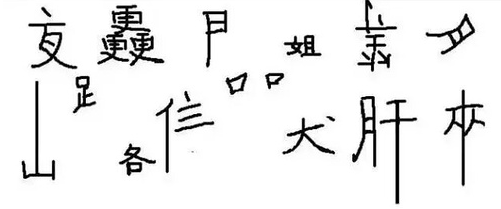
Among the ritual manuals of the Li family Daoists, the final page of Li Qing’s Xiewu ke (below left) yields this ingenious poem about the Eight Immortals (below right), each pair of “characters” making up a seven-word line (4 +3):

This has nothing to do with their ritual practice. Though the composite characters may look at first sight like talismans, any cultured reader would enjoy reading (and deciphering) the poem. For a sequel, see More composite characters.

Li Manshan enjoys such word games, and puts me onto others like this:

screen-shot-2017-01-20-at-10-35-10

to be read thus:

半夜三更門半開
小姐等到*月西斜
山高路遠無口信
哭斷肝腸少人来

* 到 to be substituted for the implied 倒:
“an upturned 等 turned back upright”.

Indeed, as Sven Osterkamp eruditely tells me, Robert Morrison remarked on a very similar poem in an entry “Enigma” in his A dictionary of the Chinese language (1822), Part III, p.142—expanded upon by Jean-Pierre Abel-Rémusat in his “Explication d’une énigme chinoise”, in vol.2 of his Mélanges asiatiques (1826), pp.266–8:

Meanwhile over lunch at a transport caff (“Greasy Chopstick”) between visits to Daoists in Shuozhou, our wonderful and erudite driver Ma Hongqi wrote this elegant poem into my notebook, said to have been composed by Yingying on her first meeting with Scholar Zhang in the Romance of the Western Chamber:

Ma poem

which, as the young scholar soon discerned, is to be read first vertically, all the way down; then back upwards, turning left at 花; then all the way back to the right; and finally back to the left, turning upwards at 花—creating this four-line verse:

九月九花金顶头
头顶金花好风流
流风好花头上戴
戴上头花九月九

Variant versions of these can be found online.

More fucking gondolas

MP

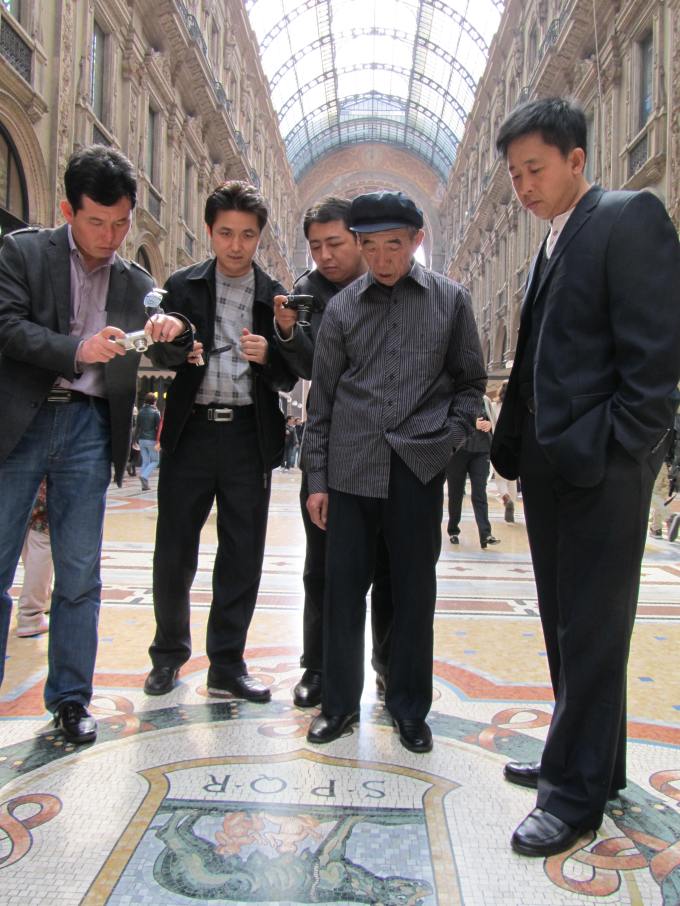
Another gratuitous spinoff from the Li band’s trip to Venice (cf. Scunthorpe and Venice, and indeed Venice: daily life in a theme park—oh, and Some Venetian greetings!):

A lesser-known gem of Monty Python is Away from it all, a ghastly travelogue with all the lovingly recreated stereotypes of John Cleese’s voiceover (Part Two should follow on):

… the one thing that Venice truly lacks—is leprechauns.

Bulgaria gets a candid assessment too:

Hard to believe, isn’t it, that these simple, happy folk are dedicated to the destruction of Western civilisation as we know it…

Eventually it’s exposed in the narrator’s increasingly deranged breakdown:

All this dashing about in search of Peace and Contentment—it doesn’t work! There’s no escaping yourself—how do you face the existential terror, the hopelessness, the dark corridors of one’s mind, the yawning, black, meaningless abyss they don’t tell you about in the brochures…

Several of us recall seeing this in the cinema as a trailer before The life of Brian.

You know whose fault it is? You lot—yes, you, you so-called cinema patrons! You sit there, stuffing your stupid faces with chocolate peanuts, gawping at these dreadful films… Well, why do you put up with them? You could stop them tomorrow if you had the guts to go to the manager and say, Why do you put this rubbish on?

For more travel clichés, see Molvania, and China–Italy: International Cultural Exchange zzzzz.

Scunthorpe and Venice

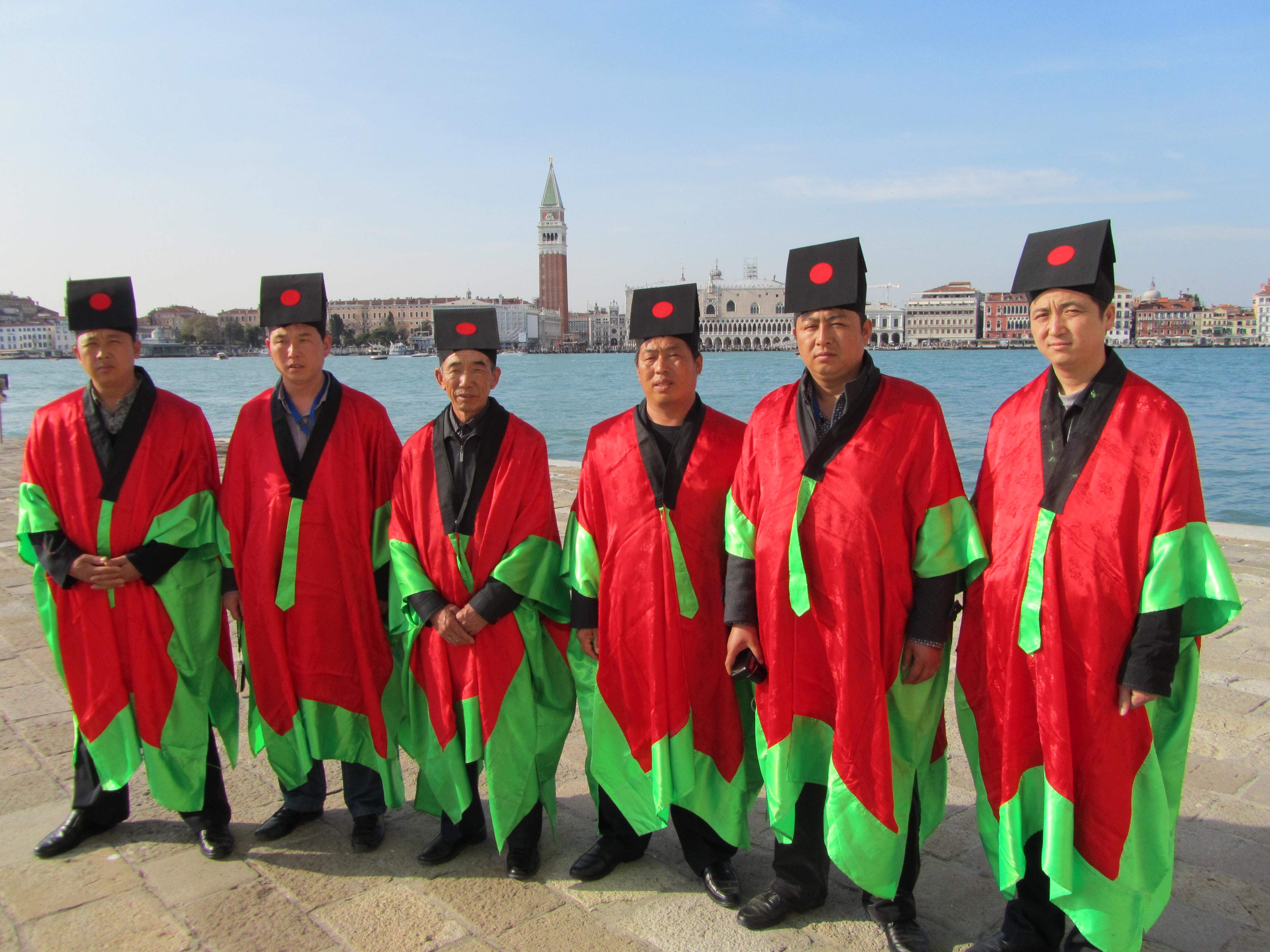
Further to my reminiscences of The Li band in Italy (and my book pp.334–7),

We board another train to carfree and carefree Venice, where we have four wonderful days. We are staying—virtually alone—at the splendid hostel on the tranquil Isola San Giorgio, home of the majestic Cini Foundation, gazing across the water at San Marco. In the evening we take the vaporetto for our first meal at the excellent trattoria Il Giardinetto. This sure beats doing a Messiah in Scunthorpe for a jolly good tea, as we London musos say.

In the spirit of the sinological footnote, the precise version goes like this:

A fixer calls us up and goes, “Hi—can you come and do a Messiah next Monday night in Scunthorpe? There’s no fee, but there’ll be a jolly good tea.”

(Cf. the more tempting message I received in a Shanxi village in 1991.) For more on Venice, see here. Oh, and here. Not forgetting Monty Python’s sublime guide. For unlikely place-names to find in the index of a book on Daoist ritual, see here. And here I surmise that the wisdom of Nadia Boulanger might not have been in quite such demand had she been based in Scunthorpe.

For a tennis parallel, click here.

Wisdom of the elders

granddad

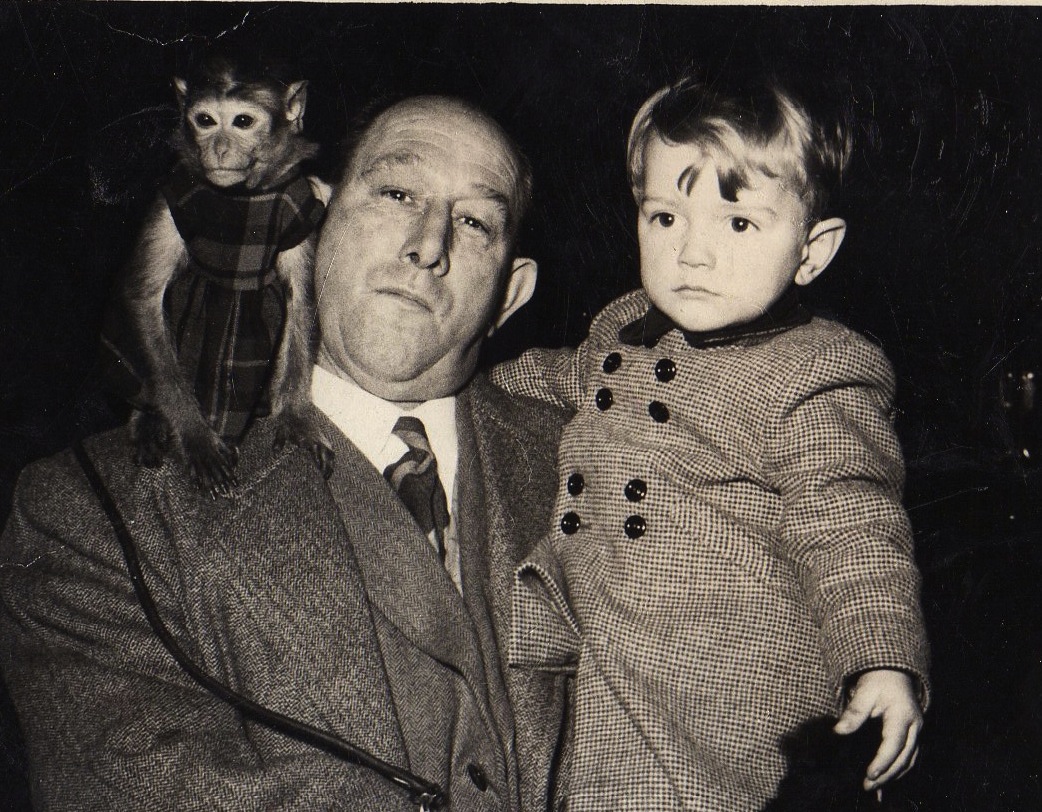
My maternal grandfather used to say,

“If we had some bacon, we could have bacon and eggs. If we had some eggs.”

Having assumed this was his own invention, I now find that this goes back at least to Groucho, and perhaps to World War I. And bacon and eggs was only becoming an item around then, thanks to Freud’s nephew Edward Bernays (see here, and here, as well as The Full English).

Li Manshan likes my granddad’s line, identifying the sentiment with his memories of privation. Indeed, the photo above would have been taken in the late 1950s, just when Yanggao people were starving.

Eating lions

The English language may have a propensity for wordplay (cf. Headline punning, and Myles), but you can’t beat Chinese. This poem (“The story of Mr Shi eating lions”), composed in the 1930s by Yuen Ren Chao (Zhao Yuanren), plays solely on different meanings of characters pronounced shi:

施氏食狮史
石室诗士施氏,嗜狮,誓食十狮。施氏时时适市视狮。十时,适十狮市。是时,适施氏适市。
施氏视十狮,恃矢势,使是十狮逝世。氏拾是十狮尸,适石室。石室湿,施氏使侍拭石室。
石室拭,施氏始试食十狮尸。食时,始识十狮实十石狮尸。试释是事。

For what it’s worth, you can read about the Li family’s shishi Bestowing Food ritual in my book

For further wonderful wordplay from the Li family, see here.

Bach, alap, and driving in Birmingham

WAGZ score

Hesi prelude and opening of Qi Yan Hui suite: score showing melodic outline in gongche solfeggio, West An’gezhuang village, Xiongxian county, Hebei.

It was Yoyo Ma who put me onto playing the Preludes of Bach cello suites as a kind of alap. Actually, that’s how he introduced the Allemande, the second movement of the sixth suite, playing it al fresco as thanks for our group of helpers at the amazing Smithsonian Festival of the Silk Road in 2002, which he was curating.

As I come to adapt the Bach cello suites for violin, I consider how to play the opening two movements of the sixth suite on their own. Should I play the Allemande first, as a kind of alap? Or else take Bach’s opening movement with majesty rather than virtuosity, at an exploratory rather than hectic pace, as a kind of prelude to the alap of the Allemande… Either way can work.

Prelude and Allemande, 6th cello suite, manuscript of Anna Magdalena Bach.

For wise words on, not to say wonderful renditions of, the cello suites, we can turn to Steven Isserlis (click here for the CD set). Here he is playing the fifth suite (the Prelude here unambiguously meditative, like both the later Allemande and Sarabande):

For another Bach Allemande that seems to suit an alap-esque style, see here.

My brilliant friend Paola Zannoni likens the bariolage of the Prelude to the marranzanu Sicilian jew’s harp. The sixth suite, of course [sic—Ed.], was written for a five-string cello, but—in the current spirit of austerity—I make do with four.

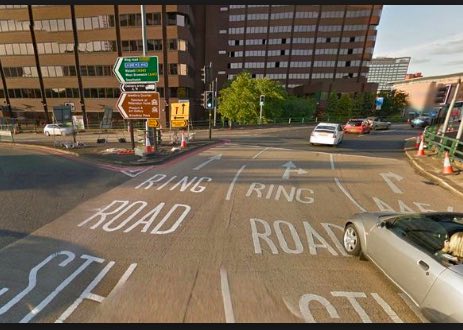
While learning Bach (or indeed shengguan ritual melodies), one has to take care not to take a wrong turning. Like driving in Birmingham, if you take a false exit then you can find yourself going round in circles for hours.

Brum

Anyway, free-tempo movements (known as sanban 散板 in educated Chinese) are more commonly associated with solo genres like folk-song and qin—unlikely bedfellows. Apart from alap, one thinks of Middle Eastern taksim (see here, here, and here) and the Uyghur muqaddime (the singing of the latter ideally accompanied by the wonderful satar long-necked bowed lute). In these genres, the term “free-tempo” isn’t precise, since they do indeed have a underlying pulse.

Slow ensemble preludes called pai’r are also an exquisite feature of the lengthy suites of Buddhist and Daoist ritual shengguan ensembles. As with shengguan suites altogether, the pai’r in Hebei (see e.g. here, under West An’gezhuang) are best heard with a small ensemble, like the fantastic group of Gaoqiao village in Bazhou (audio playlist #8, from Plucking the Winds, CD #14—see commentary; this movement actually follows the opening pai’r, but itself opens with its own lengthy sanban prelude), where the heterophony of the four melodic instrument types can be best appreciated.

Such preludes are also a feature of ritual suites around Xi’an. But they are strangely absent from the suites of Daoist ritual repertoires in north Shanxi like those of the Li family—which are otherwise clearly related to the suites of old Beijing, still played in Hebei.

And don’t miss Aretha’s extraordinary alap to Amazing Grace! And the exquisite expositions of dhrupad!!!

In the past

From my book (pp.33–4):

We have to learn to latch onto troublesome terms like “in the past” (guoqu) or “originally” (yuanxian). I’m getting better at leaping in and asking, “You mean in the 1980s? Or before the Cultural Revolution?” or even more precisely, “Before the 1964 Four Cleanups, or before Li Qing went to Datong in 1958? Or before Liberation?” Even the seemingly mechanical task of eliciting dates requires imagination. Though not necessarily clear on dates, they may recall how old they were the last time they performed such and such a ritual, or we may ask questions like “Was Li Peisen still alive?” or “Before your first son was born?”

One day, admiring the trendy outfit that Li Manshan’s second daughter Li Min has bought for her young son, I observe, “Funny, in the past one never had to worry about fashion for kids’ clothing, either in China or England!” She has an astute come-back:
“How do you mean, ‘in the past’?!”
Me: “Ha—that’s what I’m always asking your dad!”
Hoist on my own petard.

Like her dad, she is perceptive and humorous—for more, see here.

New definitions

lu
Daoist ordination certificate, Putian.
Source: Kenneth Dean, Taoist ritual and popular cults of southeast China.

In the spirit of I’m sorry I haven’t a clue

Further to Speaking from the heart, where I noted the somewhat elaborate definition of the term dundian, here’s another fine definition—ironically, from the Chinese-Chinese dictionary of my Daoist master Li Manshan, no less, which we consulted when I mentioned the term lu , Daoist “registers” (lengthy hereditary titles bestowing the authority to conduct rituals), unfamiliar to him (my translation):

a superstitious thing that Daoists use to trick people

Hmm. Li Manshan shrugs, and we both giggle.

Li Manshan film: new version

Michele has just uploaded a new version of the film, with only tiny imperceptible changes. Spot the difference…

The main change is removing the out-take at the Temple of the God Palace (8’24” ff.).

We walked over there just after sunrise to go and record, when there wouldn’t be too much background noise. As it turned out, the cooing of birds was deafening—delightful as it was on my headphones, Michele managed to keep it under control when editing later. Li Manshan was going to do a little spoken intro recalling the temple, and since we were joined by a nice villager who also recalled the temple fondly, I thought it’d be nice to get him to stand just out of view of my camcorder so Li Manshan could have an interlocutor. It worked out fine, but their opening exchange made us all burst out laughing:

Li Manshan [confidently explaining the setup to his mate]: So we’re gonna have a natter!
[begins spiel]: In the past this Temple of the God Palace…
[Mate interrupts]: If it hadn’t been demolished, it’d be a tourist spot now!
[Li Manshan has drôle thought]:  … What, you mean you demolished it?!

We tried including this exchange in the film, with a suitable pause while we composed ourselves for Take 2, but it doesn’t quite work unless you were there…

The meaninglessness of ritual

Staal

The work of Frits Staal on Indian ritual contains much from which scholars of Daoist ritual (not least I) might benefit, confronting issues that I encounter in working with Li Manshan. Staal’s ideas about orthopraxy seem to go beyond the discussions following those of James Watson for China. There’s a lot more to Staal’s work than that, but this is a start.

In “The meaninglessness of ritual”[1] Staal eschewed “the dewy-eyed romanticism that is pernicious to any serious study of cultures and people.”

A widespread but erroneous assumption about ritual is that it consists in symbolic activities which refer to something else. It is characteristic of a ritual performance, however, that it is self-contained and self-absorbed. The performers are totally immersed in the proper execution of their complex tasks. Isolated in their sacred enclosure, they concentrate on correctness of act, recitation and chant. Their primary concern, if not obsession, is with rules. There are no symbolic meanings going through their minds when they are engaged in performing ritual.
Such absorption, by itself, does not show that ritual cannot have a symbolic meaning. However, also when we ask a brahmin explicitly why the rituals are performed, we never receive an answer which refers to symbolic activity. There are numerous different answers, such as: we do it because our ancestors did it; because we are eligible to do it; because it is good for society; because it is good; because it is our duty; because it is said to lead to immortality; because it leads to immortality. A visitor will furthermore observe that a person who has performed a Vedic ritual acquires social and religious status, which involves other benefits, some of them economic. Beyond such generalities one gets involved in individual case histories. Some boys have never been given much of a choice, and have been taught recitations and rites as a matter of fact; by the time they have mastered these, there is little else they are competent or motivated to do. Others are inspired by a spirit of competition. The majority would not be able to come up with an adequate answer to the question why they engage in ritual. But neither would I, if someone were to ask me why I am writing about it.
[…]
Most questions concerning ritual detail involve numerous complex rules, and no participant could provide an answer or elucidation with which he would himself be satisfied. Outsiders and bystanders may volunteer their ideas about religion and philosophy generally—without reference to any specific question. In most cases such people are Hindus who do not know anything about Vedic ritual. There is only one answer which the best and most reliable among the ritualists themselves give consistently and with more than average frequency: we act according to the rules because this is our tradition (parampara). The effective part of the answer seems to be: look and listen, these are our activities! To performing ritualists, rituals are to a large extent like dance, of which Isadora Duncan said: “If I could tell you what it meant there would be no point in dancing it.”
Ritual, then, is primarily activity. It is an activity governed by explicit rules. The important thing is what you do, not what you think, believe or say.

This echoes Catherine Bell’s comment that I cited in my post on Bach and Daoist ritual—for her masterly surveys of ritual studies, click here.

Here’s a trailer for Staal’s 1975 film on the Vedic fire ritual:

Poul Andersen offers caveats to Staal in a review of volumes on Shanghai Daoist ritual (Daniel Overmyer, Ethnography in China today, pp.263–83). He highlights the interpretations of the participants (including the liturgists themselves), which “in many ways influence the actual performance. They are relevant for the way in which performances take shape, develop, and are modified over time.” Such interpretations, while important, rarely offer a detailed critique, so such a view refines rather than refutes Staal’s point.

I pursue the theme under Navajo culture.


[1] Numen 26.1 (1979): 2–22. See also Ritual and mantras: rules without meaning (Motilal Banarsidass, 1996), and (source of my quote here) S.N.Balagangadhara, “Review of Staal’s Rules without meaning”, Cultural dynamics 4.1 (1991), pp.98–106.

Ask my father

*Part of my series on Irish music!*

Ennis

Peter Kennedy (fiddle), Marie Slocombe, and Séamus Ennis (Uillean pipes).

Another passage from Last Night’s fun that reminds me of Chinese music is Carson’s brilliant discussion (pp.7–13) of the naming of tunes, what the Chinese call qupai 曲牌 “melodic labels”:

A: What do you call that?
B: Ask my father.
A: “Ask my father”?

I can only hope we haven’t made such a mistake in documenting folk qupai. Indeed, I could well have asked Li Manshan’s son that very question (cf. the joke at the end of our film)…

Here’s the great Séamus Ennis playing Ask my father:

This story of his bears on the subject too:

For Scottish pibroch, click here.

More early music

*Part of my series on Irish music!*

LNF

In Irish music I already cited some fine quotes from Cieran Carson’s Last night’s fun bearing on the mania for soulless competitions, including the tale of the three fiddlers. The final passage in this section is remarkable (p.98):

I find among these people commendable diligence only on musical instruments, on which they are incomparably more skilled than any nation I have seen. Their style is not, as on the British instruments to which we are accustomed, deliberate and solemn but quick and lively; nevertheless the sound is smooth and pleasant.

It is remarkable that, with such rapid fingerwork, the musical rhythm is maintained and that, by unfailingly disciplined art, the integrity of the tune is fully preserved through the ornate rhythms and the profusely intricate polyphony… They introduce and leave the rhythmic motifs so subtly, they play the tinkling sounds on the thinner strings above the sustained sounds of the thicker strings so freely, they take such secret delight and caress [the strings] so sensuously, that the greatest part of their art seems to lie in veiling it, as if “that which is concealed is bettered— art revealed is art shamed”. Thus it happens that those things which bring private and ineffable delight to people of subtle appreciation and sharp discernment, burden rather than delight the ears of those who, and in spite of looking do not see and in spite of hearing do not understand; to unwilling listeners, fastidious things appear tedious and have a confused and disordered sound.

That passage might seem like a fine description of Irish music today—but it was written in 1185, by Giraldus Cambrensis in Topographia Hiberniae!

Generally (my Daoist priests of the Li family, p.291),

I wage a tireless campaign against the Chinese scholarly trend to make ambitious links between ancient citations and living folk practice, but here is one case where I totally support it. Comparable to the centrality of the keyboard for 18th-century kapellmeisters, the sheng master was the grand director of courtly ritual music right from the Zhou dynasty around the 6th century BCE, with an unmatched understanding of scales and pitches, a custom that has persisted throughout imperial history right down to today. Of all the wise sheng masters we have met in north Chinese villages, Li Qing was among the most outstanding.

Doubtless Irish music has changed in many ways since the 12th century, and that passage is just general enough to allow us to discern parallels that may not add up to so much—but still, it’s impressive.

Voices and instruments

In my book (p.261) I glibly compared the Li band’s hymns to the arias in the Bach Passions, “where action and drama are suspended while we contemplate the deep meaning of a scene.” In most elite Daoist and Buddhist temples, liturgy is accompanied only by percussion, not melodic instrumental music. Many of the Li band’s hymns are sung thus, a cappella—including those used to Open Scriptures in the morning and afternoon.

Whereas Chinese studies of northern Daoist and Buddhist “music” often focus almost entirely on shengguan melodic instrumental music, in my book (ch.16) I try to put it within the ritual context. But does the shengguan accompaniment (notably the constant variations of the guanzi) express what the vocal text is unable to embody?

As usual, this is not a close parallel, but one thinks of Erbarme Dich:

“Language is not essential to this moment, or even adequate to it. A verbal penitence is expressed by the alto voice, but the violin expresses a more universal distress.” (Gardiner p. 422, citing Naomi Cumming).

But remember, I find nothing akin to word-painting in the Li band’s vocal repertoire (my book p.277):

I can find no matching of melody to textual content. There is nothing akin to word-painting, no illumination of the meaning of the text through music. Vocal liturgy is capable of arousing emotion, as for instance it should do in the Song of the Skeleton (see Yesterday…), but this is achieved through the general style of delivery rather than the specific text-setting. In musical style the Song of the Skeleton is no different from other hymns, and even its desolate text is not comprehensible when sung.

So expression is conveyed mainly through timbre. The more I listen to Li Manshan and Golden Noble, the more impressive I find the mournful nasal quality of their voices; I can sing some hymns, but can’t emulate this. They have utterly absorbed the meaning of the texts into their voices. And when the shengguan accompanies, Wu Mei complements them perfectly on guanzi, managing to combine a deeply mournful tone with an almost playful way of weaving in and out of the melodic line, ducking and diving, sometimes soaring. The singers recognize that a good guanzi player is a great help to them in rendering the text.

Anyway, both the decorations of a Daoist on guanzi and Bach’s oboe lines are spellbinding—an intrinsic part of the realization of the text. So I both demote and stress the shengguan accompaniment.

Beyond the transition of the Passions from liturgical to concert performances, the staged versions of recent years can also be compelling (for us):

And we’re already in tears (along with Peter) from the recitative of the Evangelist that introduces it. The shuowen introits of the Daoist also introduce arias…

Those of a sensitive disposition may wish to avoid reading my Textual scholarship, OMG.

Yesterday…

I have outlined the importance of the Song of the Skeleton in the rituals of both north and south China (In Search of the folk Daoists pp.233–4). It’s a common theme throughout the north—mainly as part of the yankou, both Daoist and Buddhist.

In Yanggao Daoist ritual (Daoist Priests of the Li family, pp.274–5), several hymns are related. The Mantra of the Skeleton (Kulou zhenyan 骷髏真言, more commonly known here by the melodic label Wailing to Sovereign Heaven, Ku huangtian 哭皇天) is prescribed, a cappella, for Opening Scriptures on the first afternoon of a funeral.

It’s a kind of catalogue aria, with seven long verses for the visits to the stations of purgatory over seven days. Its melodic material overlaps substantially with that of other hymns, beginning with the opening of the Diverse and Nameless melody (Daoist priests pp.267–8). The melismatic “Ah, Skeleton” (Kulou) refrain, and the coda in pseudo-Sanskrit (also in common with Diverse and Nameless), are not written here in the manual. My film (from 56’08”) shows the sixth verse:

Ah Skeleton! Skeleton!
On the sixth day he reaches Netherworld Souls Village
His sons not to be seen
Starving and parched, at his wits’ end,
Desperate to sup broth.

kulou-2kulou-1
From Li Qing’s hymn volume, 1980. The final folio on the left has the opening of Mantra to the Wailing Ghosts—my book p.266, also featured in the film, from 1.03.56).

* * *

For most such hymns one hardly expects an “emotional” response from audiences—in Yanggao, after all, it shares both melodic material and style with many others in the repertoire. But in his brilliant ethnographic studies of ritual practice in old Beijing, Chang Renchun notes how the renditions of two celebrated Buddhist monks moved their audiences to tears. Performative tears feature in many posts on this blog—links here.

Some common versions open:

昨日去荒郊玩游        Yesterday, seeking diversion roaming in the barren outskirts…

So talking of “Yesterday”, Paul McCartney heard his own version in a dream, like Aboriginal singers.

Yesterday

Though secular, it’s deeply moving. Here’s an early solo rendition, live (and Paul’s unaffected style is a major element of the song’s impact—no cover versions come close):

Here’s the remastered version from 2009:

As I observe in the introduction to my series on the great Beatles albums, analysis, while optional, can supplement our response; again it’s instructive to read Wilfred Mellers and Alan W. Pollack. Dating from the same period as A hard day’s night, Mellers considers Yesterday a “small miracle”:

Although the opening words tell us that yesterday his troubles seemed far away, the music in the second bar immediately enacts these troubles with a disquieting modulation from tonic, by way of the sharpened sixth, to the relative. The first bar, with its gentle sigh, seems separated, stranded, by the abrupt modulation; and although the troubles “return to stay” with a descent to the tonic, the anticipated modulation sharpwards is counteracted when the B♮is flattened to make an irresolute plagal cadence. […]

The immediate nostalgia of the song is without suspicion of sentimentality, and the corny accompaniment of string quartet can be employed, with validity, to reinforce the music’s frail bewilderment.

Yesterday quartet

George Martin’s manuscript for Yesterday, on display at Abbey road studios.

Pollack’s analysis is also insightful. And as he notes (also in my roundup), the opening uses a device here that Paul was to use regularly in some of his great songs: a declarative word, followed by a pause, and then rhythmically active ascent.

I can be quite confident about our own emotional responses to this song; less so about the responses of various types of Chinese mourners to the Skeleton, over time.

An unsung local hero

li-jin-2013

I mentioned the splendid Li Jin 李金 briefly in my book (p.20):

I also made a couple of brief trips doing a reccy of Daoists in the nearby counties, assisted by my saintlike old friend Li Jin, bright young scholar Liu Yan, and feisty Driver Ma, all delightful company. No-one will ever accept any reward for all their work as my amanuensis. Elif Batuman’s fine adage about her time in Samarkand rings true: “We were either trying not to give money to people who were trying to take it, or trying to give money to people who were trying to refuse it.”

Pufo tang

Li Jin (right), with Jiao Lizhong (centre) and driver (and polymath!) Ma Hongqi,
Hunyuan county-town 2011.
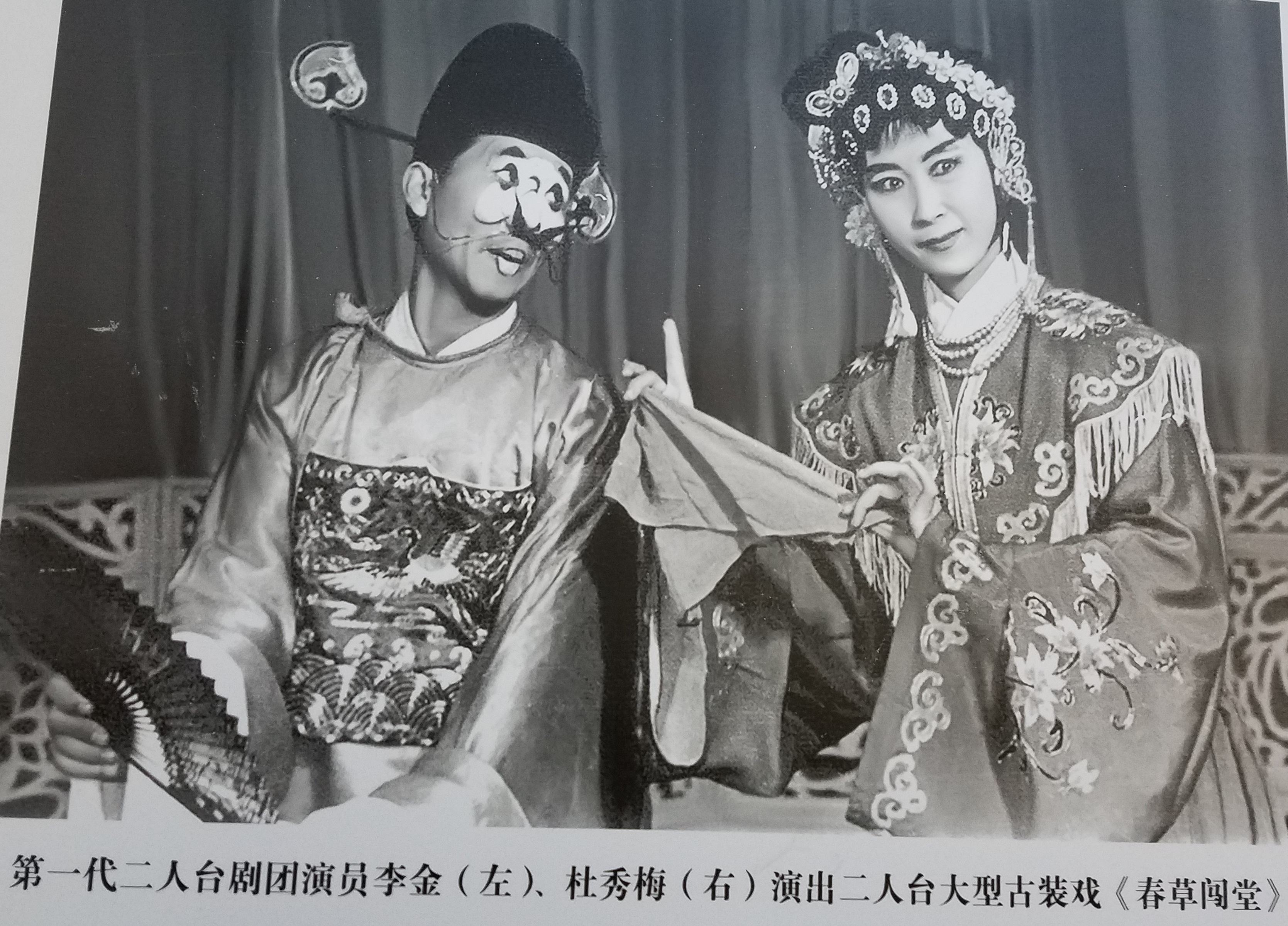
Li Jin is indeed a treasure. I only realized quite recently that he was once a celebrated performer—but it’s his infinitely generous sincerity that strikes all who meet him. In this he resembles the great Li Qing, but his story differs in that the Li family Daoists always strived to keep under the radar, maintaining their independence from official control, whereas Li Jin’s life has been shaped more directly by the vicissitudes of the Party. In many ways his story is unexceptional, but while my accounts of Yanggao generally concern folk more than state, [1] it reminds us of the presence of the latter—and the presence of Good People within it.

A year older than Li Manshan (but not related to the Li family Daoists), Li Jin was born in 1945 in the poor village of East Shahe just southwest of Tianzhen county-town. He had two older brothers, and at first his family thought to give him away to a close friend, a childless local doctor, but in the end they kept him. Their grandfather was the patriarch. He had gradually accumulated over 30 mou of land, and with the three brothers helping in the fields, their life was quite comfortable until “Liberation”. In the land reform of 1947–48 they were classified as middle peasants (cf. my book pp.95–9); in the 1964 Four Cleanups campaign they were stigmatized as “rich peasants”, and only rehabilitated in 1982—not unlike the Li family Daoists.

When a basic primary school system was established, Li Jin went to school in the converted Dragon King temple. He recalls the fine opera stage opposite it, where an opera troupe would perform for the gods on the 18th of the 6th moon. The stage remained intact—young Li Jin himself remembers performing the item “Playing the flower drum” (Da huagu 打花鼓) there when he was 10 sui.

By the time he graduated from six years of primary school he was a favourite of the teacher. He became prominent in school performances; what he calls his “silly look” was popular. In 1959 he passed the exam to enter secondary school in Tianzhen county-town—no easy feat. It was life-changing for him. On his very first day there, he was thrilled by the flag-raising ceremony in the school’s huge exercise ground. He began learning Russian enthusiastically, dreaming of becoming a translator. But he was soon chosen to do an audition in Yanggao county for a new state-run troupe that was to perform the popular skittish local duet “little opera” errentai.

So in the 2nd moon of 1960, when only 16 sui, he was chosen to join the new county folk opera troupe (Yanggao xianzhi p.468). This, indeed, was soon after Li Qing was chosen for the regional arts-work troupe in Datong (my book pp.113–118), and at the height of the famine.

Later Li Jin heard that he had nearly got the county mayor into trouble. None other than Jing Ziru, head of the Bureau of Culture and the (only) brilliant local historian of Yanggao (my book p.50), told him that at his audition, the mayor had taken exception to his two “wolf-teeth”, but the others pointed out they could be taken out—indeed, in 1962 he had them extracted by a quack dentist while they were performing in Zuoyun county. Rather him than me.

Li Jin soon went on to become a celebrated performer. The troupe’s expenses were to be footed by all the people’s communes in the county, so it was ponderously named Shanxi sheng Yanggao xian renmin gongshe lianshe minjian gejutuan 阳高县人民公社联社民间歌舞团. If there was a sign at the gate of the compound, it must have collapsed under the weight of its own lettering

Li Jin remembers those early days in the troupe fondly, with its twelve performers and six musicians. Of course it was a terribly tough time, but the troupe was doing well, and led a somewhat less tenuous existence than the common folk, “like being in kindergarten”. Still, he only earned 18 kuai a month.

The leadership praised their first hastily-rehearsed programmes of Da jinqian 打金钱, Zou xikou 走西口, Gua hongdeng 挂红灯, and Gusao tiaocai 姑嫂挑菜. At first Li Jin was chosen to specialize in the handsome sheng roles, but with his “silly look” he found it too much of a challenge, and he soon gravitated to the chou clown role.

li-jin-1-low-res

The character is meant to make people laugh, but once he made himself corpse. Playing the role of a clown county official, one day he got the words wrong and couldn’t help bursting out laughing. The troupe leaders gave him a kicking backstage but he still couldn’t stop laughing. At the next meeting he was criticized and his 3 mao supplement for the day was withheld. This is the kind of story that musos delight in.

They were on tour all year round. I was surprised to learn that tickets were for sale—so they had to try and control villagers without tickets trying to sneak a look, no simple task.

li-jin-2-low-res

Following the mood of the times, the troupe soon began performing modern items instead of their original classical stories, so Li Jin’s clown roles were now mainly “negative” characters like spies or traitors, not the more sympathetic (or at least neutral) roles of old. Despite the troupe’s popularity with audiences, and Li Jin’s own reputation, in the Lesser Four Cleanups campaign of 1963 they were banished to the countryside for “tempering through manual labour” (laodong duanlian). As the campaign intensified, they were active in Tianzhen county as a Four Cleanups work troupe. At first Li Jin was excluded from taking part in such “battle teams” (zhandoudui) by his bad class background, but soon the order came down that everyone had to join in, so for the next two years he was part of a group of a dozen or so “Red Flag warriors”.

By 1967 a new directive descended on them, warning them that their performances since the formation of the troupe, glorifying “ox demons and snake spirits, scholars and beauties”, contradicted the agenda of the Party. The leadership decided to amalgamate the troupe with the county’s other opera troupe (for the classical opera Jinju), at the same time reducing the personnel. By 1968 even this new combined troupe was abolished. Li Jin was assigned to work as a cook. His wife was sent to work in a troupe in Xinzhou, rather far south—so even his family was being broken up. He’s grateful that she managed to return after some time.

In 1970 the county established a Mao Zedong Thought Propaganda Team. All the recruits had to do was to be able to hum a few phrases and not be too ugly, and they were in. But the authorities soon realized the standard wouldn’t do, and had recourse to the disgraced former troupe members. So Li Jin now found himself taking part in simple cheerleading performances, trapped in “a bottleneck of monotony”. But they did raise standards, and their performances enjoyed a certain popularity.

The scene changed quickly from 1976, with more traditional genres regaining a position among modern styles. In 1979 the county “folk opera troupe” (minjian gejutuan, later called Errentai jutuan) was restored, with both new and old styles reflected. Supported by the county leadership, their reputation again spread. Li Jin, still only in his mid-30s, got back to work conscientiously, going on to become Director of the troupe. In 1988, as “popular voting” came into vogue, he stepped down after a close-fought election.

In 1989 he moved to the county Bureau of Culture, a radical change in work style—and a challenge upon which he embarked with typical enthusiasm. He was glad to broaden his experience of local culture. Since then, privately-run errentai groups have bloomed in the countryside, taking a major role at weddings and funerals. I don’t suppose Li Jin is always impressed by the pop style that now dominates there, but he is proud of playing a role in the recognition of the Li family Daoists and the Hua family shawm band in the Intangible Cultural Heritage roster. Despite my reservations about the ICH, I can appreciate his satisfaction.

In a climate since the 1990s whereby most cadres seem to spend their time staggering around pissed from one state-funded banquet to the next, [2] Li Jin seemed to be the only one who ever got any real work done. And he at once understood that I was there to work too, inconspicuously doing all he could to help me—like biking through the snow to convey an obscure foreign message on my first trip.

In recent years, while staying with Li Manshan and following him round funerals, I make occasional visits back to the town for a shower and a nice quiet informal meal with Li Jin. Since his retirement, though not in great health, he has returned to his beloved errentai, taking place in regular amateur meetings.

He is affable and generous with everyone, and accepts people (even me) as he finds them—embodying the noble virtues that the system often trampled on. He has always believed in humanity, social justice, and the aims of the Party.

* * *

This is the kind of life that books like those of Dikötter, single-mindedly focused on tragedy, cannot reflect. Whereas the more focused ethnography of Friedman, Pickowicz, and Selden is also unflinching, it is based on fieldwork, and so can’t help showing a certain empathy. But more general trawls through the archives like those of Dikötter can only be partial, another kind of propaganda. One can hardly challenge his details—indeed, the tragedy lies precisely in the way that sincerity was repressed, and it does need documenting—but one needs a more nuanced, perspective.

My account may make Li Jin sound a little like one of those selfless cadres of yore, by contrast with the self-serving crew that holds sway today. But there really were, and are, people like that… See also Yanggao personalities.

There is nothing like a quiet chat over a simple bowl of noodles with Li Manshan and Li Jin.


[1] In my 2004 book on the Gaoluo ritual association, one finds a closer relationship between folk consciousness and local cadres.

[2] Though in my book (p.314) I note recent sumptuary laws, and a jolly good thing too.

Recitation

In 1980, when Li Qing began recopying the family ritual manuals as Daoist activity gradually revived, the very first manual that he copied was the hymn volume of funerary texts.

Within this volume, Li Manshan loves, and identifies with, the beautiful long meditation on impermanence titled Kangxi yun—actually attributed to Kangxi’s father the Shunzhi emperor (1638–61), and Buddhist in language. The standard version is known by names such as as Poem on returning to the mountains (Guishan shi 歸山詩), Poem on entering the clergy (Chujia shi 出家詩), or Gātha in praise of the sangha (Zanseng jie 贊僧偈).

The Li family’s ritual manuals are largely superfluous to their ritual practice today: those rituals that are still required they perform from memory. The Kangxi yun is one of many texts in the manuals that are no longer performed; and the Daoists never read the manuals as silent literature. But as I began to go through them with Li Manshan, I found that he was most taken by the poem. It shows how drawn he is to the retreat from worldly cares; household Daoists don’t necessarily evince this, and you might not notice this contemplative aspect of his character.

Li Manshan says parts of it were formerly performed as a shuowen 說文 solo introit within particular ritual segments. He has a distant memory of hearing the Daoists reciting it for a temple ritual when he was 8 or 9 sui, around 1953–54, but he only began taking note of it when he came across it in his father’s hymn volume in the 1980s.

Indeed, it is among several rather long texts grouped together in the hymn volume that could be used thus; but there are no longer any suitable ritual segments in which to recite them. The shorter solo introits still used, like those for Presenting Offerings, are now mostly recited by Golden Noble.

shanggong

From my film: a shuowen introit from the shanggong ritual.

I’ve long wondered how, and when, this long poem found its way into the ritual manuals and ritual practice of the Yanggao Daoists. We discussed this further during my stay with Li Manshan in 2018 (under “Pacing the Void”).

* * *

For readers less than fluent in classical Chinese (of whom I hope there are many!), below I offer a very rough translation (for the challenges of translating the Li family texts, see here). I can’t find an English rendition of Shunzhi’s standard text (anyone?), but here I use the variant in the Li family manuals, only resorting to the original where sense requires. But often Li Qing’s variants seem no less elegant than the original, and sometimes I even find them preferable.

When we have a more widely-distributed “classical” source with which to compare the ritual texts of household Daoists (as is often the case), one often finds minor discrepancies. Many manuals (including most of those of the Li family) were recopied from memory in the 1980s, so a certain amount of variation was likely. However, while sometimes the Daoists might remember how to recite or sing a phrase or character but not how to write it, in general Li Qing’s manuals are remarkably accurate. Moreover, it’s also likely that variants had entered into the ritual manuals of household Daoists long before that. So it’s hard to tell when and how the variant of this poem arose.

The poem is not just about the emptiness of worldy cares, but refers to Shunzhi’s own struggle between his responsibilities as emperor and his personal inclination to Buddhist transcendence:

The forest of temples throughout the empire offers sustenance like a mountain
Everywhere the monastic bowl depends on the lord to provide.
There is no value in yellow gold and white jade
Only to don [1] the monastic cassock is difficult.
I, as great lord of the land of mountains and rivers
Am concerned for the nation and the people, serving to deflect their troubles.
One hundred years, thirty-six thousand days [2]
For a monk, don’t amount to [3] half a day’s rest.
Confusion on arrival, bewilderment on departure [4]
Travelling in vain for a while among men.
Better not to arrive and not to depart
With neither pleasure nor pain.
Before I was born, who was I?
Who was I at the hour of birth?
I only became an adult after I grew up
And once eyes are closed in the void, then who am I?
In this world the only good is to enter the clergy
With pure heart and peaceful mind, who is to know?
The mouth having taken its fill of eating harmonious flavours
One can always wear restitched robes from cast-offs.
The five lakes and four seas make a superior guest
Roaming free in the God Palace, lodging at will.
Do not call it easy to attain the dharma by becoming a monk
Let us talk only of the various bodhi of bygone ages.
I, as great lord of the land of mountains and rivers [5]
Seek the body of Crop Founder descended to earth.
Bright as is the cassock of the Western Quarter
Why has it descended upon the imperial family?
Just because at first my recitation was deficient
I had to exchange my purple cassock for a humble new robe.
For eighteen years I have been dreaming—
When can I rest from the great task of mountains and rivers?
Today, clapping my hands, I return to the mountains
How can I be expected to control the thousand, myriad autumns?

I’ve largely refrained from adding the Teutonic scholarly footnotes that the text suggests, but:

[1] Using the original 披肩.
[2] Chinese poetry has a lot of lines like this, and they read better in Chinese!
[3] Using the original不及.
[4] Referring to life and death, of course—but please feel free to provide your own joke about the airline of your choice.
[5] Here Li Qing repeats the earlier phrase, whereas the original couplet has “Even without being a true luohan, one also dons the triple vestments of Sakyamuni.” The following couplets of Li Qing’s version depart further from the original, and my translation is even more approximate.

The Li band in Italy

Taking the Li family Daoists on tour in Italy (Turin, Milan, Venice, Rome) in March 2012 was delightful (my book pp.334–8).

li-band-venice

From “our” island towards San Marco. Cheer up, lads.

img_2430

Li Manshan before the Duomo in Milan.

img_2434

The band at the Gallerie, Milan.

In Venice (a well-kept secret—Yeah, Right. Good to get here before it gets “discovered”—see here, and here), every other gondola seemed to be full of Chinese tourists. I was delighted to introduce the band to Mirella Licci, whom I hadn’t seen since she was studying the guqin at the Shanghai Conservatoire in 1987!

img_2448

Venice: lunch at Il Giardinetto with Mirella Licci, our favourite groupie.

gargoyle-img_2481
One evening we took aperitivos in Campo Santa Maria Formosa with our Confucius Institute hosts (see also here) and two splendid ethnomusicological Giovannis, Giuriati and de Zorzi. Li Manshan felt a particular affinity with the gargoyle on the campanile of the church.

I also note the fine tome by Horatio E. Brown, Some Venetian knockers.

Before I could work on my film on the ritual life of the Li family Daoists at home, we issued a DVD of their concert performance at the Cini Foundation in Venice. Here are some highlights (sic):

For evocative notes on our French tour in 2017, see here.

Solfeggio

An aspiring singer on a TV talent show decided to perform Doh a deer, and rashly decided to go out, too literally, on a high note:

do

Which reminds me—the traditional gongche notation for the melodic skeleton of ritual shengguan ensemble translates nicely into solfeggio (and indeed into modern Chinese cipher notation)…

25-lq-zouma

Da Zouma score, written for me by Li Qing, 1992 (playlist #4, commentary here).

“But that’s not important right now”. I allude, of course, to Airplane:

The Chinese gongche system, like those of Europe and India, is heptatonic:

cipher notation:  1     2     3       4     5       6       7
solfeggio:              do  re   mi     fa    so     la      si
Indian sargam:   Sa  Re   Ga    Ma   Pa   Dha  Ni
gongche:               he  si    yi  shang  che gong  fan
,
with liu and wu as upper octave notes for he/do and si/re respectively (taking the older system with he, rather than shangas do! Call Me Old-fashioned).

For those who can’t fathom the British propensity for punning, the only line of Doh a Deer that makes any sense is La, a note to follow so—precisely the only line where the author reveals a touching fallibility. Such literal audiences would be happier if it were all like that:


Re, a note to follow do
Mi, a note to follow re
Fa, a note to follow mi
and so on…

It only remains to overhaul the opening line. The original version “La, a note to follow so—if you’re moving upwards in conjunct motion that is” was overruled as too pedantic, of course.

Another fun exercise is to sing the phrases in reverse order, descending instead of ascending from Doh:

Doh, a deer…
Ti, a drink with jam and bread
La, a note to follow ti!
So, a needle pulling thread
etc.

Given how well we know the song, it seems a bit weird how crap we Brits are at solfeggio. Another fun game would be to try singing the whole thing only in solfeggio:

Do, re mi, do mi do mi,
Re, mi fafa mire fa

and so on.

Then we can use the tune to familiarise ourselves with Indian and Chinese solfeggio:

Sa, Re Ga, Sa Ga Sa Ga,
Re, Ga MaMa GaRe Ma…

he, si yi, he yi he yi,
si, yi shangshang yisi shang

We can also sing the song to the many scales of Indian raga in turn, with their varying flat or sharp pitches (note my series, introduced here)—a simple example: in rāg Yaman, try singing a sharp fourth for fa, a long long way to run

Alas, a fascinating medley of versions in French, German, Italian, Spanish (x3), Japanese, and Persian has just disappeared from YouTube. Let me know if you find it!

For a brilliant pun on the Mary Poppins song, see here. And for “do, a note to follow mi“, click here.

Laozi

Household Daoists tend to know about performance, not doctrine. I focus on practical knowledge—right down to which cymbal patterns to use as interludes for which hymns, and when to use them, or not. What the Li family don’t know, or do, is things like secret cosmic visualizations.

They don’t necessarily know how to write the texts, or if they do so (for me) they may write some characters a bit approximately because they already know how to recite them.

They know nothing of Laozi’s Daode jing, so central to Western images of Daoism. When I quote the pithy, nay gnomic, opening two lines to Li Manshan and his son Li Bin:

道可道非常道    The way you can follow is not the eternal way;
名可名非常名    The name you can name is not the eternal name.

they don’t quite get it, and I have to translate it into colloquial Chinese for them! Hmm…

We have a bit of fun playing with feichang, which in modern Chinese is “very”, rather than the classical “not eternal”. Actually, in their local dialect they don’t use feichang at all, though of course they know it. In Yanggao the usual way of saying “very” is just ke 可, pronounced ka—thus “dao kedao feichang dao” might seem to be “The way is soooo waylike, I mean it’s just amazingly waylike”…

Still, Daoists like Li Manshan will have picked up a broad understanding of the texts they sing every day, even if they have never been taught their “meaning”. They know Laozi not as the author of the Daode jing but as a god.

As I wrestled with translating the Hymn to the Three Treasures (Sanbao zan), used for Opening Scriptures in the morning (Daoist priests of the Li family, pp.262–3, and film from 22.01), Li Manshan explained it to me.

sanbao-zan-2-in-1-cropped

Hymn to the Three Treasures, from Li Qing’s hymn volume, 1980.

sanbao-zan-best

The subject of the first verse to the dao, “We bow in homage to the worthy of the dao treasure, Perfected One without Superior” (Jishou guiyi daobaozun, Wushang zhenren) is Laozi himself, so it is he who is the subject of the remainder of the verse: “He descended from the heavenly palace” (xialiao tiangong) refers to Laozi descending from the heavenly palace after beholding the sufferings of the deceased spirit (guanjian wangling shou kuqing)—it’s all about Laozi! So you see, Li Manshan does get the texts…

As for any ritual tradition, where does the “meaning” reside, when texts are unintelligible to their audience? When we translate and explain ritual texts, we are radically altering them as experienced by their audience. True, the performers, the priests, certainly “understand” them, to various degrees, if not in the same way as scholars translating them. I don’t suggest limiting ourselves to the consideration of how people experience rituals, but that should surely be a major part of our studies. Experience lies beyond textual exegesis, consisting largely in sound and vision.

I am reminded of Byron Rogers on an American version of the New Testament (Me: the authorized biography, p.268):

Pilate: “You the King of the Jews?”
“You said it.” said Christ.

There’s another one for the Matthew Passion (cf. Textual scholarship, OMG). “What is truth?”, indeed…

Mercifully, there is no movement to translate the ancient texts of Daoist ritual into colloquial modern Chinese. Of course, for northern Daoist ritual a modern translation wouldn’t make the texts any more intelligible anyway, given the slow tempo and melisma.

Laozi does appear in one of our favourite couplets for the scripture hall (see Recopying ritual manuals, under “The couplet volume”; cf. my book pp.194–5—not easily translated!):

穩如太山盤腿座     Seated in lotus posture firm as Mount Tai,
貫定乾坤李老君     Old Lord Li thoroughly resolves male and female aspects.

For a basic roundup of posts on the Li family Daoists, see here.

Terylene

In ch.18 of my book (p.342) I reflect on the Li band’s recent concert tours and Intangible Cultural Heritage status:

All this may sound like a typical story of adaptation to modern secular contexts. But it’s not. Let’s face it, the Li family is never going to become the next Buena Vista Social Club. Year in, year out, their livelihood remains performing for local rituals. Li Manshan’s recent nomination as Transmitter of the ICH brings him a modest extra income for now, but the Daoists continue to rely on doing funerals around their home base; their ICH status and foreign tours are only a minor element in their reputation, which is an accumulation of local charisma over many generations. They still lack disciples, either from their own or other families; and crucially, local patrons no longer pay much attention to the niceties of ritual practice.

It all reminds me of the elderly fiddle player in the Romanian village band Taraf de Haidouks, reflecting on his meteoric rise to global success on the world music scene:

A little fairy granted me my wish to be happy in old age. Now I have suits in terylene.

For more on adapting Daoist ritual for the concert stage, click here. For a populist fantasy, see Strictly north Chinese Daoist ritual. See also World music abolished!!! For Paris as pedagogical Mecca, see Nadia Boulanger, and Kristofer Schipper.

Confession

I truly believe that one day there will be a telephone in every town in America—Alexander Graham Bell

phone

The date of the first landline phone in Li Manshan’s village is another of our standing jokes.

This is really embarrassing to admit, but when I asked him about it in 2011, I heard his reply as ‘sisannian’, so I unquestioningly wrote ‘1943’ in my notebook, I mean how mindless was that of me… Only later, writing up my notes back home, did I smell a rat, and it finally dawned on me that he must have said shisannian (qian), ‘thirteen years ago’! (The difficulty of distinguishing shi and si was only part of my howler; and actually, he would never say sisannian for 1943—even if he knew such a date he could only say “32nd year of the Republican era”, cf.my book pp.37-8). So the first landline was only installed in 1998, just a few years before mobile phones swept the board.

Now, whenever we misunderstand each other, we just say “sisannian” and fall about laughing. For more on our relationship, see here; and for a classic joke, here. For early linguistic escapades in Hebei, see here.

The percussion prelude

In my book (p.280) I observed a subtlety of Yanggao Daoist ritual that may elude us:

Novices soon pick up the short pattern in rhythmic unison on drum, small cymbals and yunluo that opens and closes every item of liturgy, an accelerando followed by three beats ending with a damped sound. This is known as luopu (“cadential pattern”) and it turns out that the number of beats is fixed, 7 plus 4—unless the guanzi player needs a bit more time to prepare his reed!

See also Tambourin chinois, and Drum patterns of Yanggao ritual .

Much less impressive is Beethoven’s take on this, the four soft quarter-note beats that open his violin concerto (less creative than the EastEnders Doof Doof). The quote from my book is itself just a prelude to the popular story of a famous conductor rehearsing his orchestra in the concerto. Though he was notorious for nit-picking, one might suppose that at least here the band would get up a bit of a head of steam before he started correcting them. But no, sure enough he brings them to a halt even before the oboe can come in.

Turning to the bemused timpanist, he says,

“Can you play that with a little more… magic?”

The timpanist looks back at him sullenly, beats out the four notes again, and goes,

“Abra-ca-fucking-dabra”.

* * *

In Daoist ritual there’s nothing quite akin to “rehearsal”, but during a ritual Li Manshan maintains standards by the subtlest of facial gestures, with a little glare if the ensemble is less than perfect. As I learn, I benefit from such hints.

A meeting with Teacher Wang

lms-and-me-in-hk

With Li Manshan in Hong Kong, 2011

Chinese peasants tend to “eat” cigarettes (chiyan) rather than the standard “take a drag on” them (chouyan)—yet another instance of the practical blunt charm of their language.

Timothy Mo alludes to this locution in Sour Sweet:

“Eat things, eat things,” he said aloud, gesturing to the smoking plates in front of everyone but only lighting a cigarette for himself.
“You don’t eat things yourself, Grandpa?” This was Mui.
“I eat smoke,” he quipped, laughing immoderately at his own wit.

Indeed, the expression survives from 17th-century usage, as shown by Timothy Brook in Vermeer’s hat.

At a conference in Hong Kong (my book pp.333–4) I was delighted to introduce Li Manshan to the illustrious Taiwanese scholar C.K. Wang. Apart from his indefatigable energy in opening up the vast field of ritual studies in mainland China, he has a remarkable gift for finding a place for a surreptitious smoke (cf. the first poem in Homage to Tang poetry). In Hong Kong, where smoking laws are draconian, he would regularly lead us through labyrinthine corridors to some corner of an underground car park for a furtive fag.

This soon became part of my secret language with Li Manshan. Back in Yanggao, he was careful not to smoke in the presence of his baby grandson—so sometimes when I felt he needed a fag-break, I would suggest to him, “Shall we go and hold a meeting with Teacher Wang?”

For Li Manshan and Andy Capp, click here.

Fun with anachronisms

And the roar of Moses’ Triumph is heard in the hills

Without even knowing how I feel about the White Cloud Temple in Beijing, my adorable cat Kali (R.I.P.) threw up over my copy of the Jade Pivot Scripture, which I had bought in an edition printed at the temple.

One ritual title that features only fleetingly in the ritual manuals of the Li family Daoists in north Shanxi is Thunder Lord of Three-Five Chariot of Fire (Sanwu huoche leigong). This is among the attributes of the deity Wang Lingguan, and a trace of the thunder rituals of Divine Empyrean Daoism. [1] In the Li family manuals it appears only in the Mantra to Lingguan and in the Xijing zayi manual, no longer performed and thus no longer familiar to them: [2]

huoche

From Xijing zayi manual (Sanwu huoche Lingguan on line 3), copied by Li Qing

So my excuse to discuss it here is flimsy as ever, but we all need a bit of light relief every so often. This also relates tenuously to my comments on hearing Bach with modern ears.

Huoche “chariot of fire” (glossed as “fireball”) may prompt titters at the back, since in common modern parlance it means “train”. Whereas “And the roar of Moses’ Triumph is heard in the hills” is a translation that has been inadvertently amusing only since the spread of the automobile [mental note: must get that exhaust fixed], [3] huoche is an ancient original which could have been affording chuckles to Daoist scholars since the term became common usage for “train” in the late 19th century. When you’re immersing yourself in the abstruse mysteries of the Daoist Canon, you have to take such diversion where you can find it.

What’s more, we may giggle impertinently at another of Lingguan’s attributes, Sanwu (Three-Five)—erstwhile a brand of cigarette that Chinese people associate with Englishness (much to my perplexity, since I’ve never heard of them outside China) just as much as London fog. (For “the smoking substances of non-nationals”, see More from Myles).

So here we appear to find Lingguan smoking a posh foreign cigarette on a train journey through his spiritual domain—being a high-ranking Daoist cadre, he would get to travel soft-sleeper (cf. Fieldwork and textual exegesis).


[1] The appellation may commonly be found in the Daoist Canon, but, more relevant to “texts in general circulation” (my book pp.218–24) and the practices of the Li family may be its appearances in Xuanmen risong: Xuanmen risong zaowan gongke jingzhu 玄門日誦早晚功課經注, chief editor Min Zhiting (Beijing: Zongjiao wenhua chubanshe, 2000), pp. 166–7, 244–5. See also Rethinking Zhengyi and Quanzhen.

[2] My Daoist priests of the Li family, p.376, cf. p.381; for the Divine Empyrean, see also pp.219–20.

[3] A substantial irreverent online industry in such Biblical quotes has arisen.

Fantasy Daoist ritual

The Pardon, 1991

The Pardon ritual led by Li Qing (2nd from left), Yanggao 1991 (my film, from 48.34).

As a change from my literary party game, here’s an arcane spinoff from the game of picking a fantasy world football team, or chamber orchestra.

Let’s choose our all-time most amazing group of Daoist ritual specialists, including both liturgists and instrumentalists. Of course, the list of candidates is endless, so I’d seek to refine the search by selecting those known mainly for their ritual performance, rather than for compiling vast compendia of manuals.

Thus the list could include early luminaries like Kou Qianzhi 寇謙之 (365–448) (who might speak a dialect similar to that of Li Qing, except that they lived over 1500 years apart), Tao Hongjing 陶弘景 (456–536), and Du Guangting 杜光庭 (850–933) (see their entries under Fabrizio Pregadio ed., Encyclopaedia of Taoism).

Churlishly fast-forwarding a millenium, among modern Daoists we could include Chen Rongsheng  陳榮盛 (1927–2014) from Tainan, [1] Zhang Minggui  張明貴 (1931–2016) of the White Cloud Temple in Shaanbei, and our very own Li Qing 李清 (1926–99); among a host of great drum masters one might recruit An Laixu 安来緖 (1895–1977) from Xi’an and Zhou Zufu 周祖馥 (1915–97) from Suzhou.

Above: left, Kou Qianzhi; right, Tao Hongjing;
below: left, Zhang Minggui; right, An Laixu.

For once, we can leave historical change to one side: it remains to be seen how effective Pelé and Messi would be together as a forward line-up, or Saint Cecilia and Bach (in the orchestra, or indeed in the football team; cf. the Monty Python Philosophers’ football). A more basic difference is that—more than football or the WAM canon—the performance of Daoist ritual is always specific to a small locality. Even if their ritual manuals may have a lot in common, household Daoists from different places can hardly work together. Never mind Daoists from ShanghaiFujian, and Hunan; even within north Shanxi, the whole ritual performance of the Li family in Yanggao is significantly different from that of groups in Hunyuan or Shuozhou counties very nearby.

Fun game, though. See also Strictly north Shanxi Daoist ritual.

Chen Rongsheng

Chen Rongsheng.


[1] Until quite recently, much of our knowledge of modern Daoist ritual (despite its great diversity) was based on the tradition of Chen Rongsheng, meticulously documented by Kristofer Schipper and John Lagerwey. Here’s a tribute, with precious clips of Master Chen’s ritual practice:

Links to lengthier ritual sequences here. Alas, Michael Saso’s early clips of his Master Chuang no longer seem to be in the public domain.

Funeral music

Invitation, Beijing concert

Beijing concert, 2013.

On the Li family Daoists’ 2013 tour of Germany I suggested an extra item in our evolving concert programme, an a cappella sequence based on the Invitation ritual performed at the edge of the village (my book p.339; film, from 58.14; playlist #1, with commentary here).

At first they were reluctant: while they have no qualms about performing ritual items on stage, they worried that performing an item so explicitly funerary might be unsuitable. I pointed out that some of the greatest music in the concert tradition of Western Art Music is for the dead.

Apart from various requiems (Mozart, Brahms…), one of the pieces I used to reassure them that funeral music was quite familiar to Western audiences  was Buxtehude’s Klaglied. Though a recording by the wondrous Michael Chance has just disappeared from YouTube (BRING IT BACK AT ONCE!!!), Andreas Scholl’s version is also great:

Not that the Daoists were remotely impressed by it—by contrast with Steven Feld’s influential experiments in finding which kinds of alien musics might strike a chord among the Kaluli (Sound and sentiment). They enjoyed our trip to the Bach museum in Leipzig not so much for the music as to get a glimpse of the life of a European ritual specialist; and when I showed them the EBS video of the Christmas oratorio they were mainly amused to see me in tails. I can’t even turn them on to jazz.

Occasionally some well-meaning urbanites have rashly suggested I bring my violin to play along with the Daoists, or even arrange their music for orchestra—but to their credit, the Li band have the taste never to do so.

Anyway, the Invitation has turned out to be a great success in our touring programme, a moving tranquil interlude between the uproar of “catching the tiger” and the wild percussion of Yellow Dragon Thrice Transforms its body. As an encore for our French tour in 2017 we even sang the Mantra to the Three Generations (playlist #2 and #3), which follows the Invitation at the gateway after the return to the soul hall.

For adaptations of ritual to the concert stage, see also here, under “The reform era”.

Surprise

Constanze

In this photo, the woman on the far left is often claimed to be Mozart’s widow Constanze (1762–1842), just imagine (see here)… Or is it? For doubts, see wiki.

Many would like to believe it. If it is her, then it will be one of the most surprising things you will ever see. OK, it was taken in 1840, when Wolfgang was long gone. Few wives outlived their husbands. Given the harshness of the times, she hardly looks 78.

As Sean Munger comments, Constanze became the Yoko Ono of the 19th century. Wiki also cites the Grove dictionary:

Early 20th-century scholarship severely criticized her as unintelligent, unmusical and even unfaithful, and as a neglectful and unworthy wife to Mozart. Such assessments (still current) were based on no good evidence, were tainted with anti-feminism and were probably wrong on all counts.

* * *

If only we had photos of the Li family Daoists (and their wives) from the late imperial era… Even the photo of Li Peisen and his wife from the 1940s is rare enough. Indeed, in a world where female members of a family are taken for granted at best, people remembered her as exceptionally able and intelligent too.

5’20”

Of all the beautiful things you can do in 5 minutes and 20 seconds (like playing Yellow Dragon Thrice Transforms its Body at the end of the Transferring Offerings ritual), the divine Ronnie’s 1997 maximum is likely to remain unmatched in human history:

Beats 4’33” any day, with all due respect to John Cage.

I shouldn’t need an excuse for showing this, but here it is. After taking Li Manshan to a conference in Hong Kong (my book, p.333), I was staying with him in a posh hotel in Beijing when we switched on the TV to find Ronnie playing in the world masters snooker. Snooker has become staggeringly popular in China, but Li Manshan hadn’t seen it before, and his amazement was delightful. So I showed him this 147, which is flabbergasting even if you don’t quite know how ridiculously difficult it is…

After the lavish banquets in Hong Kong, at which we both felt rather uncomfortable, we were happy to eat a simple bowl of noodles in peace together in a little caff over the road. Next day I took him to the station to take the train home and get on with his routine of determining the date, decorating coffins, and funerals.

My favourite expression of snooker commentators is “he’s eying up a plant” (see here, and here). Tang poetry is all very well, but I wonder how you say that in Chinese…

Since Ronnie is often described as the Mozart of snooker, I note that Mozart enjoyed a game of billiards.

For more on Ronnie and snooker, see this roundup.