Prizes for Gaoluo film!

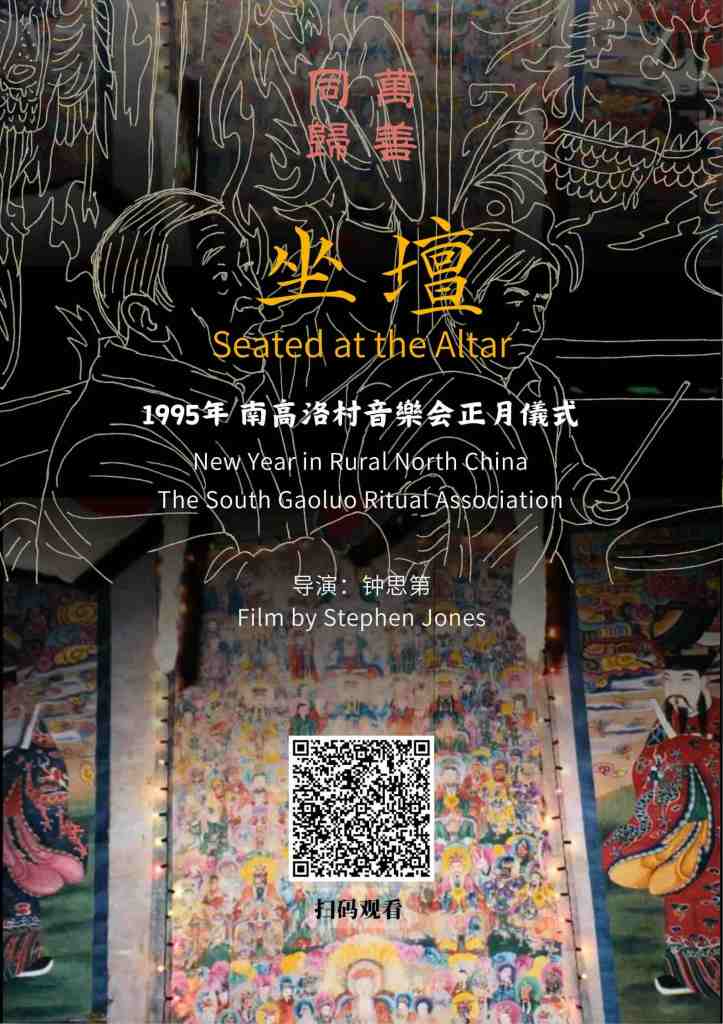
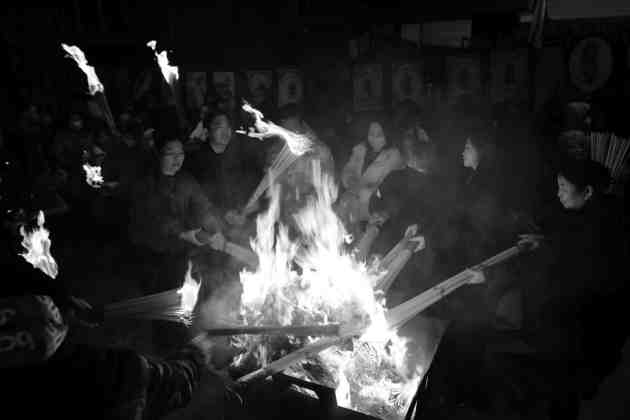
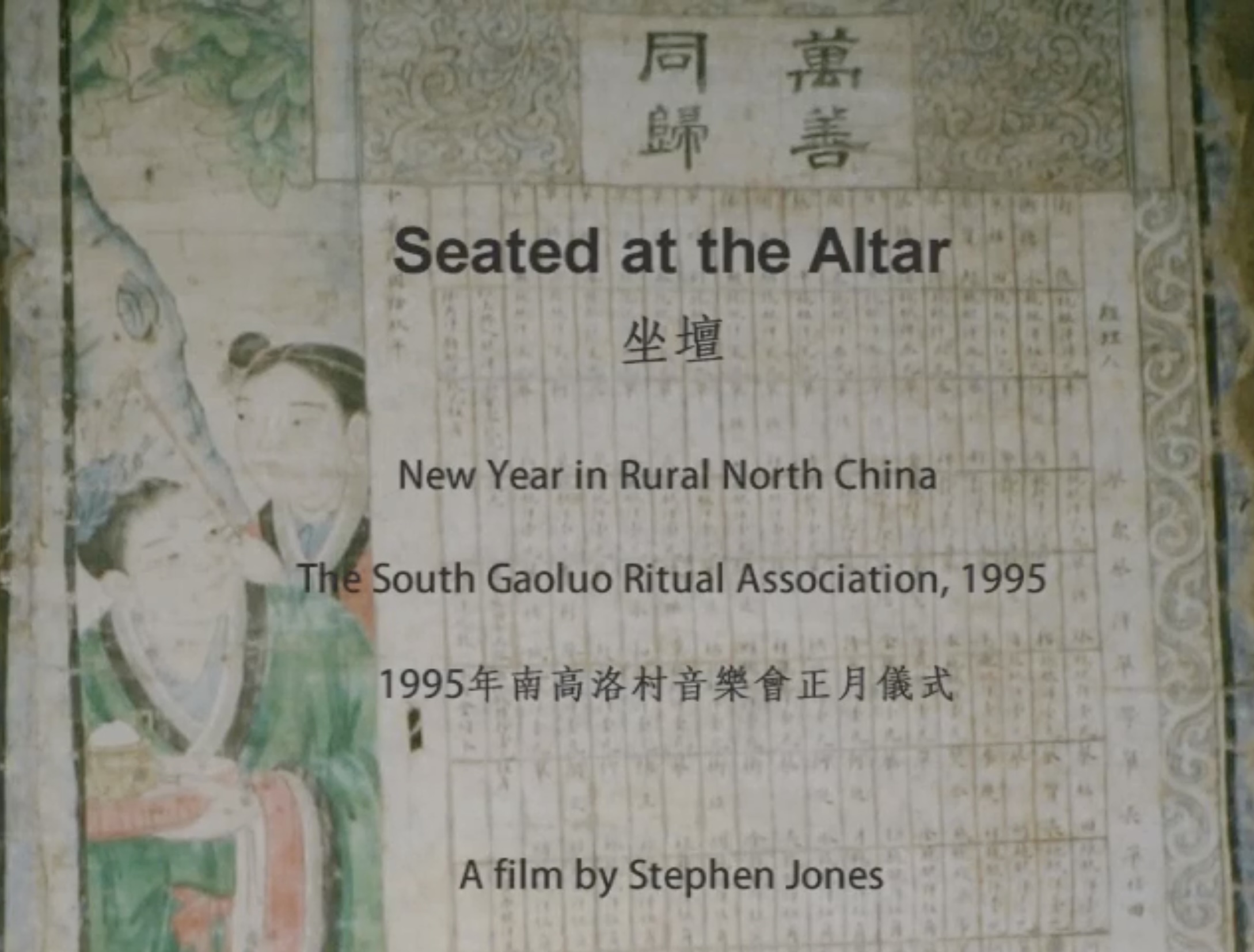
I’m most gratified that my film Seated at the altar, on the 1995 New Year’s rituals in Gaoluo village, was awarded two prizes at the Chinese Musics Ethnographic Film Festival (CMEFF) International Biennial of Audiovisual Ethnomusicology, held in July at the Shanghai Conservatory of Music. In addition to the Bronze Award, it received the Intangible Cultural Heritage Music Documentation Award—which, given my trenchant critiques of the ICH system, has a fine irony!

Zheng Zhentao, in his stimulating review of the film, highlights the contrast between my method (representing ethnographic standards in the West, I’d say) and the glamorised reification that is de rigueur within China in the portrayal of folk culture—an established  tradition long before the ICH. So I’m gratified to find that there are those in China who appreciate my approach, as confirmed both by the discussion at the festival and the film’s reception at the screening in the village. The mere fact that I filmed New Year’s rituals and funerals in the village—rather than choosing staged settings such as the concert hall—seems to be original. However, such a verismo method looks unlikely to gain ground in China.

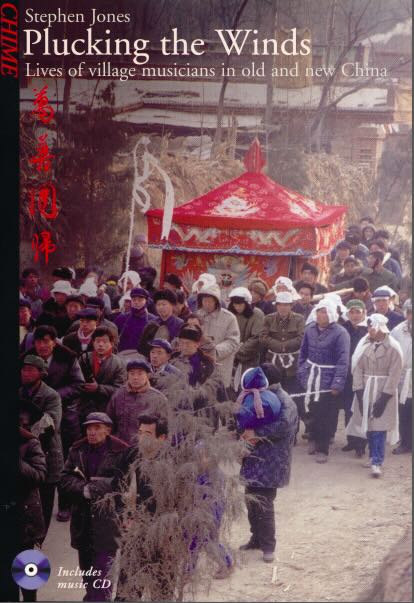
My films should always be viewed in conjunction with my writings—for Gaoluo, my detailed diachronic ethnography Plucking the winds. In the latter, far more broadly than mere “music”, the main themes of ritual, poverty, politics, and conflict are far more explicit. As I stressed here, “music” is merely a prism through which to document ritual and social change.

While I was doing fieldwork I was educating myself on rural Chinese society through modern regimes as revealed through Western scholarship (see e.g. here), such as Chen village, Gao village, and the studies of Friedman, Pickowicz, and Selden, as well as the work of Jing Jun, and (in Chinese) Guo Yuhua. These were my major inspirations.

It is easier to depict history on the page than in film. While the film hints at political aspects through photos and voiceovers, showing the village cadres’ support for the ritual association amidst the upheavals before and after the 1949 “Liberation”, this will only become clearer by reading my book (see e.g. this excerpt, and the history of the village Catholics). Yet these topics can hardly be broached under the current climate in China, where early history is idealised and modern history sanitised, in both text and film. Self-censorship is inevitable; even the word “politics” is largely taboo (cf. Ritual studies mildly censored).

So returning to the film, I’m still curious to know how Chinese audiences perceive the contrast between their romanticised image and ethnographic verismo. And I still wonder how Chinese film-makers manage to glamorise their rural themes.

Note the many posts on Gaoluo in the main Menu.

Red ritual

Before my diachronic ethnography of Gaoluo village was published, I surveyed the modern fortunes of amateur village ritual associations on the Hebei plain south of Beijing in “Ritual music under Mao and Deng”, British journal of ethnomusicology 8 (1999).

The same journal soon elaborated on the theme of ritual under Communism in a useful special issue (11.1, 2002) edited by Rachel Harris and Barley Norton, entitled “Red ritual“. Predating the Intangible Cultural Heritage razzmattazz, which further thickens the plot, it includes chapters on carnival in the Peruvian Andes (Jonathan Ritter), god processions in Cuba (Katherine Hagedorn), spirit mediums of northern Vietnam (Norton), Uyghur mazar festivals (Harris, with Rahilä Dawut—cf. this roundup), mortuary rituals in Fujian, China (Hwee-San Tan), and the Jewish service in Communist Hungary (Judit Frigyesi).

In their cogent Introduction the editors outline approaches to ritual, the contexts and functions of “ritual music” (focusing on performance), as well as revivals and recycling. Since they mention Kundera’s polemic against the state “bastardisation” of folk culture, we might now add the movie Cold war (see Resisting fakelore). See also Shamans in the two Koreas, Madonna pilfrimage in Communist Poland; and note Maoism tag. With local ritual practices often perceived as a counter-hegemonic threat to the state and a vehicle for political resistance, such studies confirm “the failure of Communism’s modernising mission. Ritual music continues to play a central role in religious expression and has the capacity to enact social memory, to forge ethnic identities, and to both propagate and challenge political and nationalist ideologies”.

The maintenance of ritual practice under authoritarian regimes is a theme that continues to engage me. Still, I find myself ever more wary of the rubric “ritual music”. While soundscape is always a crucial element animating ritual, and some of the most apposite fieldwork on performance comes from ethnomusicology, I still wish that scholars of religion and society could naturally consider soundscape without it having to be pigeonholed under “musicology” (cf. Bigenho). If the study of ritual subsumed soundscape and society, then it would be unnecessary to create a separate niche for “ritual music”.

Gaoluo film: Chinese version!

Following the online publication of my film on the 1995 New Year’s rituals in Gaoluo, a screening in the village itself prompted a version with Chinese subtitles, on which I worked with the diligent Feng Jun.

It is far from a literal translation of my English script—I was keen to adapt it to reflect the idiom and way of thinking of the Gaoluo villagers. So rather than the terminology of urban academia, we incorporated local vocabulary like lao guiju 老规矩 (“the old rules”: tradition), dangjia 当家 (“boss”), jiahuo 家伙 (percussion), wentan 文坛 (“civil altar”: vocal liturgy), and songjing 送经 (“escorting the scriptures”). In many ways I find it preferable to the English text—since the original English voiceovers are intact, it’s worth watching even for those not dependent on the translation.

The Chinese version is now available both (in China) on the CDTM website (follow this link) and on my YouTube channel (alongside the English version):

And do browse the posts under Gaoluo in the top Menu! Click here for thoughts arising from presenting the film at SOAS; here for an intriguing Chinese review; and here for a screening in Leiden along with my film on the Li family Daoists.

With many thanks to Wei Xiaoshi!

Gaoluo film: another Chinese review

I learned a lot from my invaluable fieldwork companions Xue Yibing 薛艺兵 and Zhang Zhentao 张振涛. Within Zhang’s prolific output, his book on the Hebei ritual associations is outstanding (see e.g. here). He has just published a perceptive review of my recent film Seated at the altar, based on his own rapport with the Gaoluo villagers:

  • “Guying yu duju—Zhong Sidi jilupian ‘Zuotan: 1995 nian Nan Gaoluo cun yinyuehui zhengyue yishi’ yingping”, 孤映与独举——钟思第纪录片《坐坛:1995年南高洛村音乐会正月仪式》影评, Zhongguo yinyuexue 中国音乐学 2025.2.

No sooner had I surmised that Chinese audiences might not articulate the stark differences between my (inadvertently) ethnographic perspective and the sanitised, beautified portrayals from the Intangible Cultural Heritage (e.g. here; cf. Gaoluo film: a village screening), Zhang does precisely that.

The social context of Chinese folk musical cultures hardly appears on film. While I had blamed this on the ICH system since 2004, Zhang shows how deeply embedded is China’s history of romanticising and glamorising rural life. Despite Chinese scholars’ exposure to Western ethnography since the 1980s, his comments suggest that social realism has had little impact, and that the habit of self-censorship remains ingrained. I suppose the Party line is that while one may wish to film for one’s own research purposes, such scenes are not fit for public consumption: that we should draw a veil over poverty—over real life. In international visual anthropology the theoretical nuances of the film-maker’s “gaze” are much discussed, but this seems a particularly disturbing impasse.

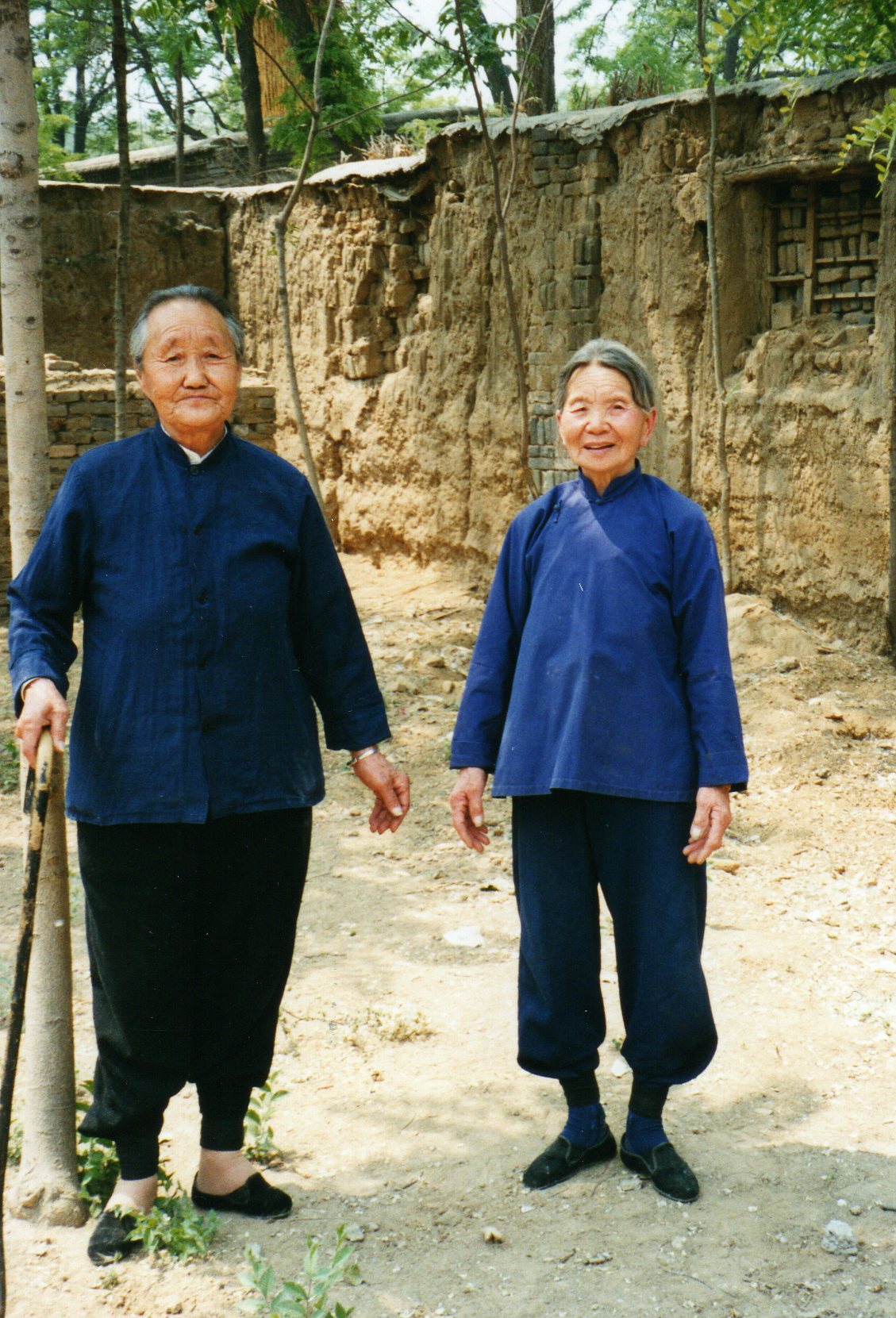
Even Zhang Zhentao, who evokes village life in detail on the page, seems somewhat perplexed that we might want to display images of it. He finds the style of Seated at the altar consistent with that of my film on the Li family Daoists, and he might also have mentioned the DVDs with my two books on Ritual and music of north China. Playing devil’s advocate, he reiterates the simplistic notion that foreigners choose to depict China in ugly and shameful images, making the Chinese people “lose face”. He queries an apparent lack of “aesthetic” values (shenmei, where mei means “beauty”), adducing scenes from my films showing squalid streets and dwellings, shabby clothes, old women with bound feet, and the decaying architectural remnants of political campaigns. As he explains, such scenes are justified by the ethnographer’s search for “authenticity” and “realism”. *

To dispel China’s victim complex, it should suffice to watch documentaries filmed in India, Africa or Indonesia—and indeed on our own doorstep, such as De Martino’s films on taranta. But Zhang’s comments suggest that documentaries about other parts of the world have little influence in China.

As to fictionalised films, Zhang mentions the classic 1979 Abing biopic Erquan yingyue, as well as the movies of Zhang Yimou (and rather than the beautified images of Raise the red lantern, I much prefer the gritty realism of The story of Qiuju, or Jia Zhangke‘s depictions of small-town life). In between stand movies like Yellow earth or The old well (see here). While “underground” documentaries like those of Wang Bing, Ai Xiaoming, Hu Jie, and Jiang Nengjie, or the subaltern films of Xu Tong, boldly challenge the Party line, investigative Chinese TV documentaries show (or showed?) scenes of real village life, and brief unedited footage on Chinese websites and YouTube makes a useful resource. I wonder how Chinese audiences assess Sidney Gamble’s footage from 1920s’ Miaofengshan. Some non-Chinese scholars have issued documentaries on expressive and ritual culture in rural China, such as Chinese shadows, Bored in heaven, and the films of Jacques Pimpaneau (see this roundup).  We might also adduce Ashiq: the last troubadour.

Politics: text and image
It’s impressive that Zhang Zhentao broaches the issue of gaze, but he can hardly spell out another respect in which my perspective differs. My films complement my written texts—which though full of detail on the successive social and political upheavals of the 20th century (notably the Maoist era), attract little attention in China because few of them are accessible in Chinese (though see here and here). Politics is the elephant in the room, remaining taboo for music scholars within China; and among Chinese anthropologists too, few go so far as Guo Yuhua in documenting the ordeals of villagers under Maoism (see also here).

Text allows for more detail; film makes a more vivid impact. Whereas the film could only hint at the impact of political campaigns on ritual life in Gaoluo, in my book Plucking the winds I discussed this in some depth—such as the devastating national famine of 1959–61, of which very few images are available, by contrast with propaganda films on the supposed achievements of the Great Leap Forward.

Filming ritual and expressive culture
In China, besides the official taboos on showing poverty and discussing politics, the study of religious ritual is largely confined to textual studies of pre-modern history.

Before the ICH (even during the Anthology era of the 1980s–90s), Chinese fieldworkers rarely had the wherewithal to film ritual activity; and even if they did so, such footage could hardly be published. I too filmed merely for my own research purposes, to enable me to document ritual activity in far greater detail than I could achieve through making notes, taking photos, and recording audio; my footage included all too few scenes of daily life, which significantly enhance a film.

Shaanbei: scenes from Notes from the yellow earth.

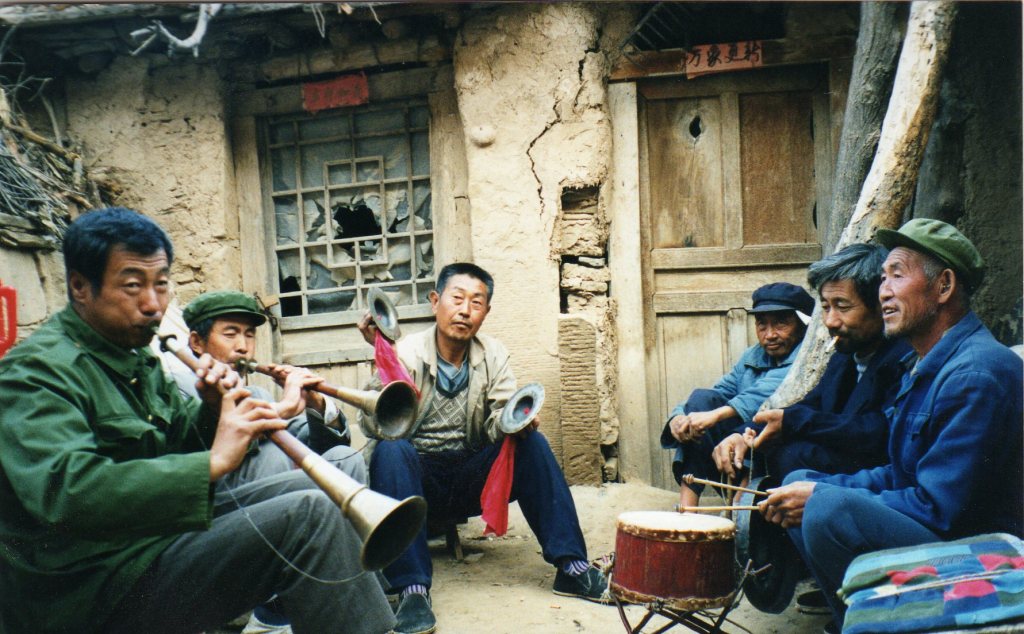
My own films include scenes of lowly shawm bands at village funerals, a blind bard performing for a family blessing, beggars singing at a wedding, and a drunken folk-singing session in a poor peasant home. There is nothing sensationalist or demeaning about all this. If we seek to document rural Chinese communities and their expressive culture, how can we then ignore the conditions in which it takes place? Even if I could think how to sanitise, beautify, and idealise such scenes, it would never occur to me to do so. The social and historical setting matters, but is airbrushed in China. While I see the differences between my approach and that of the ICH, I have no intention of being controversial: I merely seek to document traditional ritual culture as best I can.

Gaoluo: ritual, “music”, and daily life
In filming the New Year’s rituals in Gaoluo, my choices were limited, largely consisting not of any grand conceptual vision but of finding physical positions from which to frame the scene.

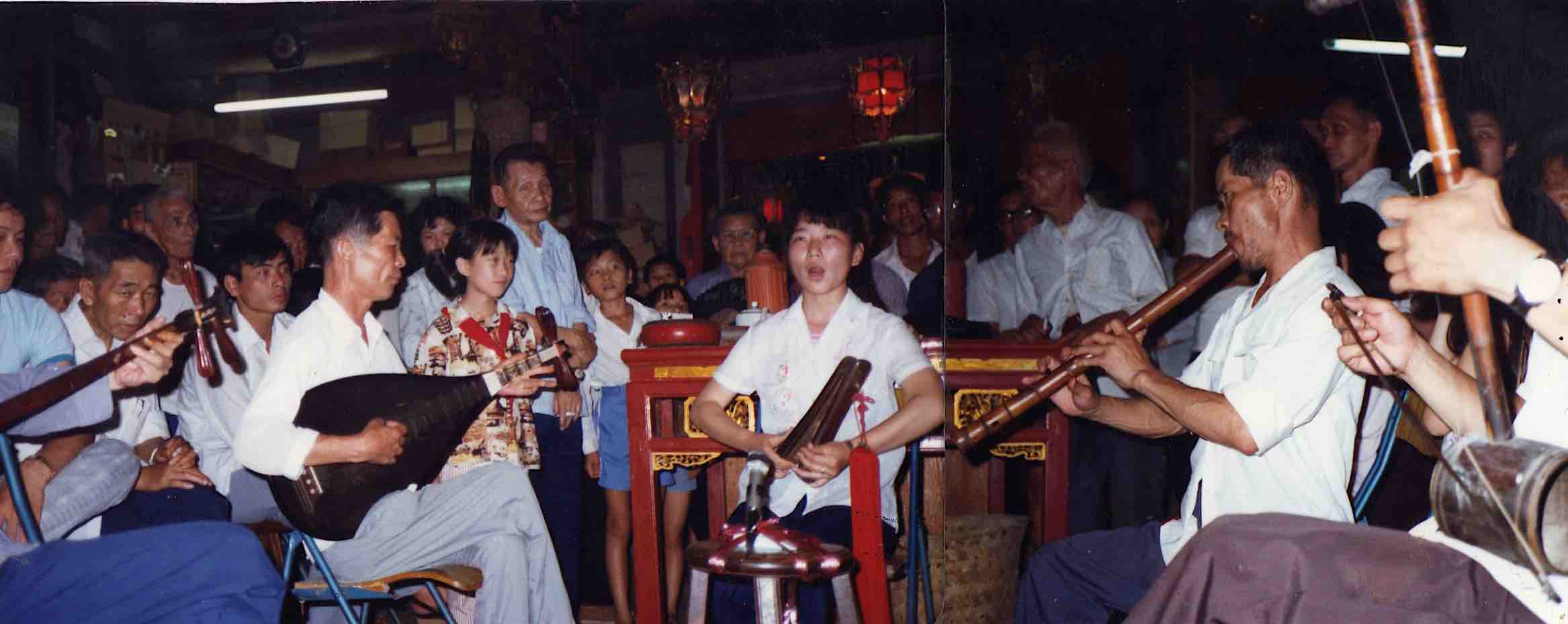
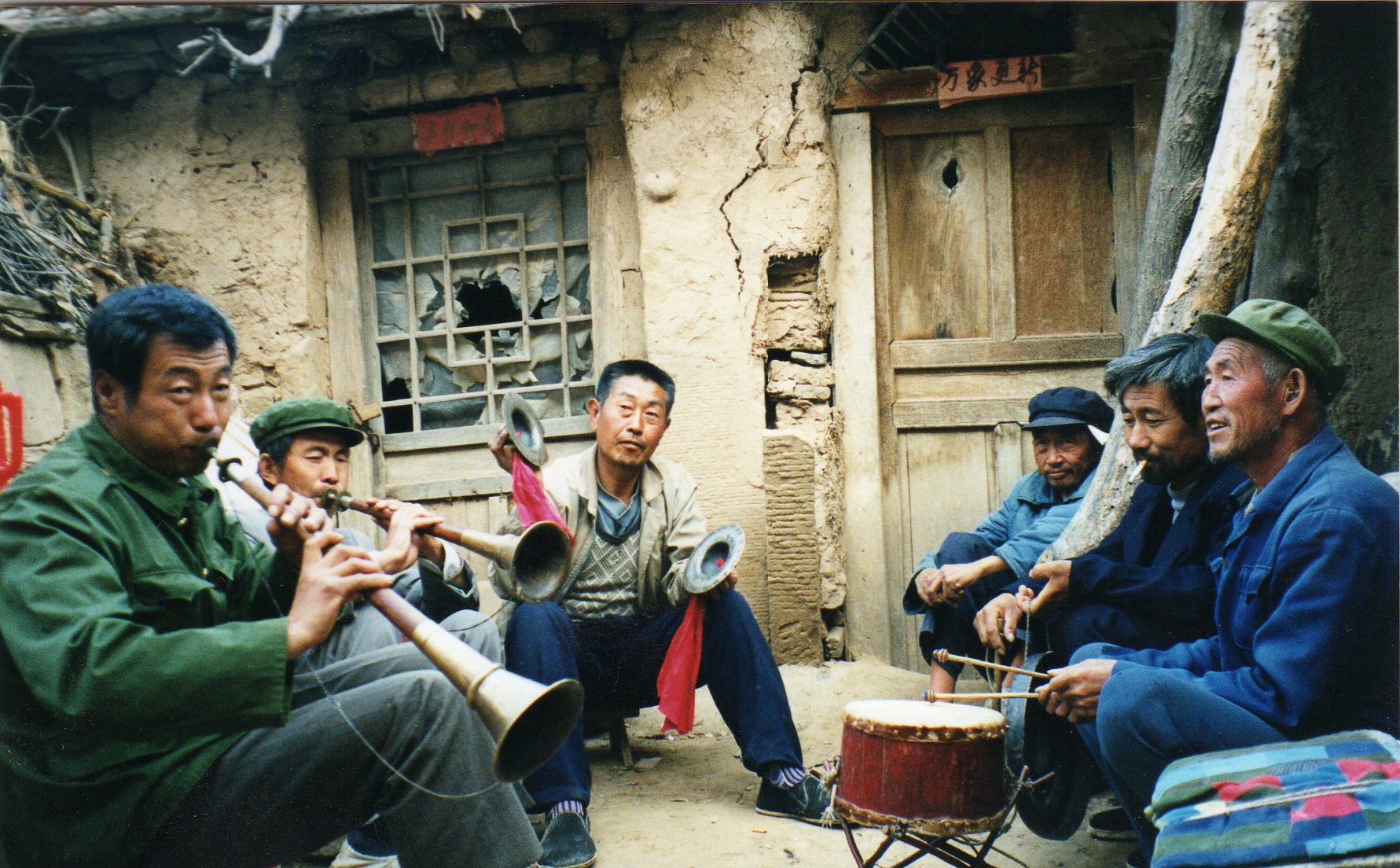
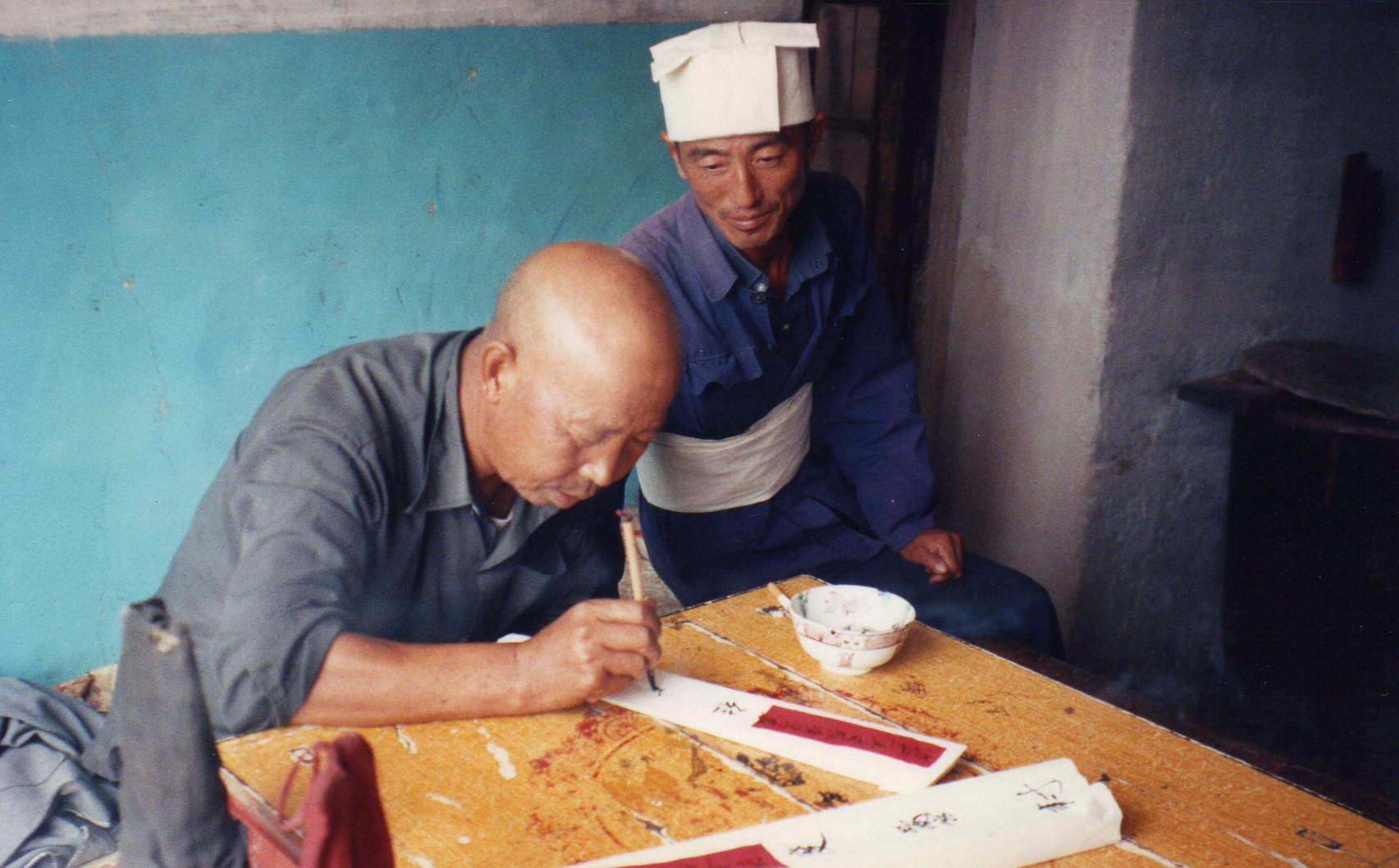
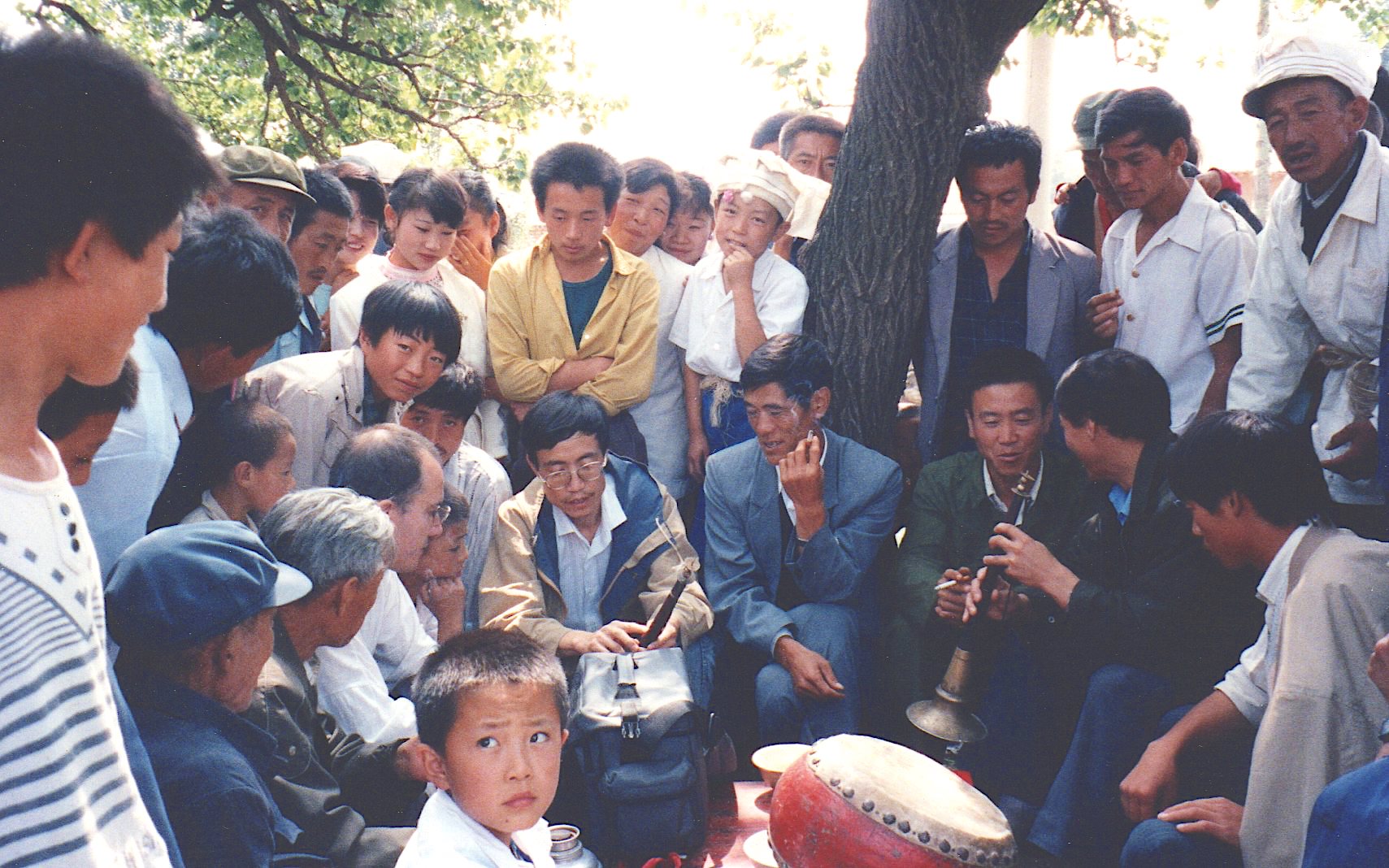
Knowing these villages so well, Zhang Zhentao seems both impressed and disturbed by my vignettes of daily life there—elderly people relaxing in the sunshine, Cai An at his general store, the family eating dumplings. Wearing their everyday clothes, villagers perform in simple peasant houses decorated only by pinups, or before the god paintings in their humble ritual buildings, with cigarette cartons and thermos flasks placed besides instruments on rickety wooden trestles—by contrast with the ICH format of presenting folk groups in fake-antique costumes performing on the concert stage or in tidy, arid government courtyards. Villagers smoke, they joke; they ride motor-bikes and use mobile phones. Social context is important; to censor the conditions of village life would be mendacious. It should go without saying that my films are made with the utmost respect for my village hosts, serving as a tribute to their resilience. **

“Music”
Zhang Zhentao stresses the contributions that musicologists can make to ethnographic filming, but for me the challenge is the other way round. In reviewing Seated at the altar he focuses on the recitation of “precious scrolls” and the moving performance of the percussion suite—but I see these as inevitable components of documenting the entire ritual process. What I find significant is including scenes that may appeal more to ethnographers than to musicologists, such as (in Li Manshan) choosing the date and siting of the burial, the encoffinment, and informal scenes of the Daoists relaxing between rituals; or (in Seated at the altar) worshippers kowtowing and offering incense, or preparing the soul tablet for the deceased.

Zhang highlights the vocal liturgists’ renditions of the Houtu precious scroll before the gods in the lantern tent. Here he does well to observe that they had only been striving to recreate it in performance since 1993, at our behest; their efforts were less than ideal, and the future of the vocal liturgy still remains precarious. The recitation of the precious scrolls is most distinctive, but to me, just as crucial are the scenes that show their singing of the hymns that punctuate funerals and the New Year rituals, including The Incantation of Pu’an.

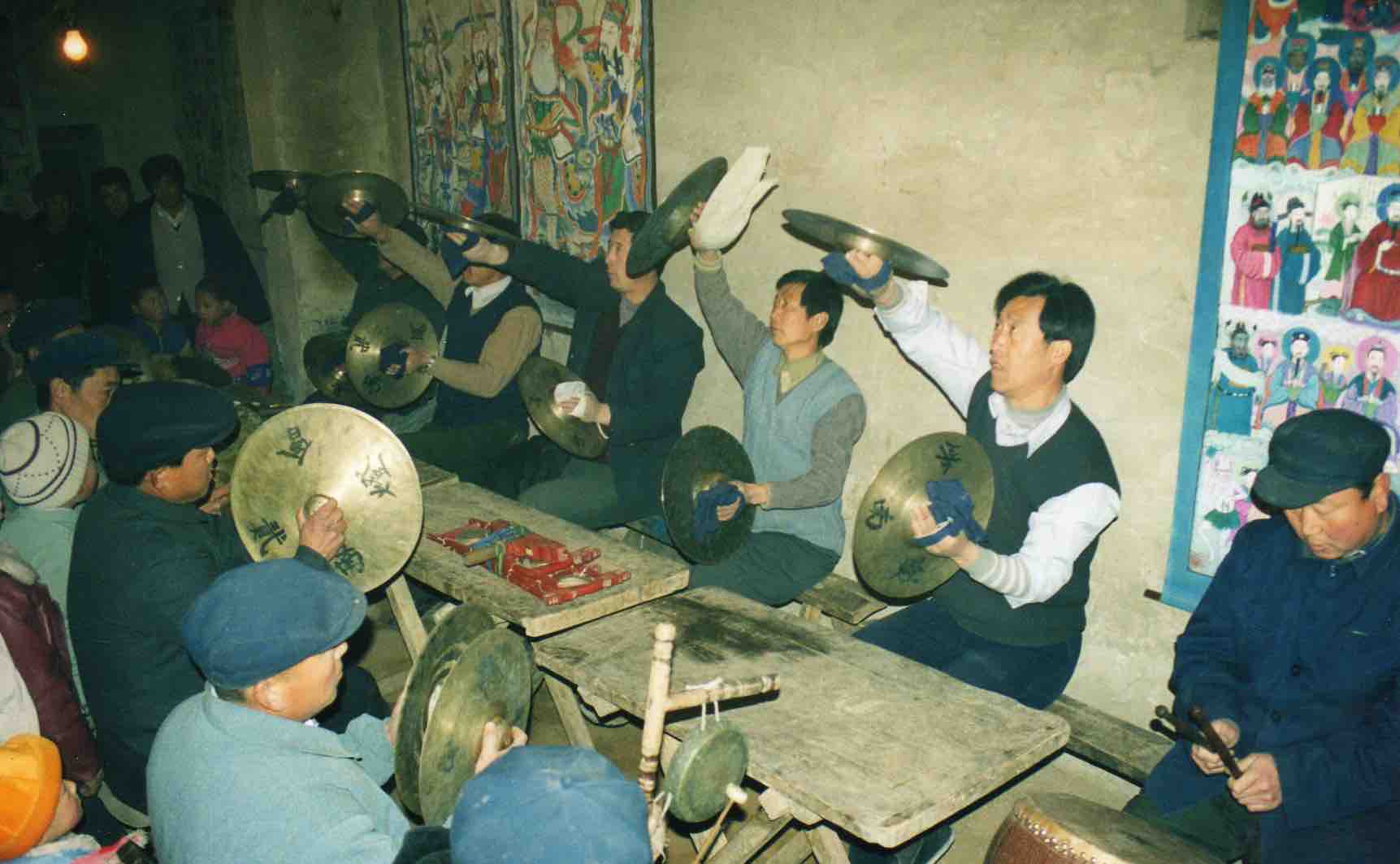
Similarly, while Zhang pays tribute to the visceral affective power of the percussion suite, I would also draw attention to the shorter percussion pieces that punctuate rituals. Still, the suite intoxicated me so much that over the years I missed no opportunity to film it during rituals, which taught me to find a suitable position and to zoom and pan at meaningful places. In China it would be unlikely to show the percussion suite within its actual function of ritual performance, but surely even Chinese audiences will find the result beautiful. True, in the Appendix that follows the final credits, our experiment with Cai An and Cai Yurun demonstrating the sections was one that might occur only to musicologists. ***

As to those final credits, Zhang notes the poignancy of the long list of performers, with their dates—many of them having died since the footage was filmed.

* * *

In sum, I simply fail to see how to evoke village ritual life, in either text or images, without providing social and historical context. Yet basic anthropological principles, that to us are self-evident, appear to struggle to gain acceptance in China—all the more under the current ICH regime. Because I’m so impressed by the work of my Chinese colleagues, I sometimes fail to register the constraints under which they operate.

Meanwhile at the Shanghai Centre for Ritual Music, Xiao Mei offers an impressive training in international approaches to ethnographic film-making, making me keen to see how they bridge the gulf—see my further reflections after my film won awards at the 4th Chinese Music Ethnographic Film Festival in Shanghai this July.


* And what if villagers actively prefer to be displayed in glamorous costumes on the concert stage?! So far I have no evidence that they are so allergic to displaying the conditions of their lives as are apparatchiks.

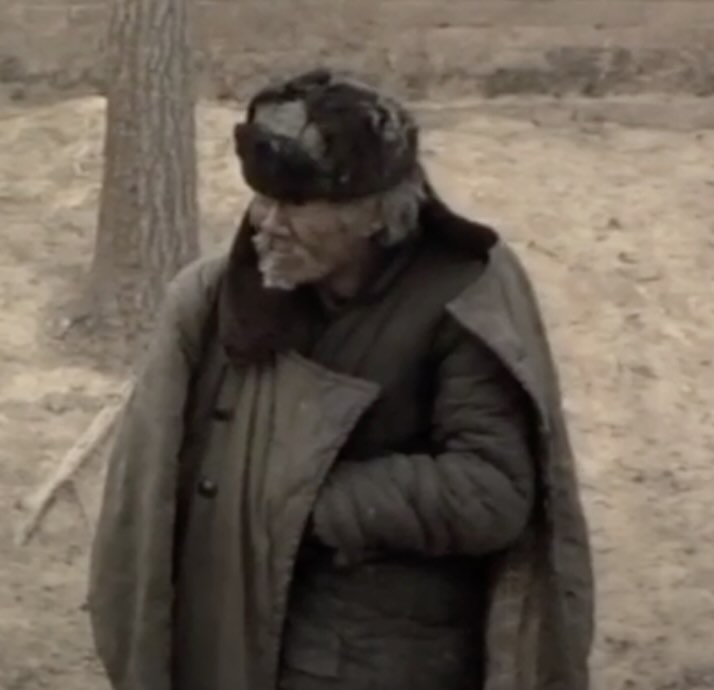
** Partly because I was reminded of the sad decline of revolutionary hero and vocal liturgist Cai Fuxiang, in the film’s funeral scene I included one tiny shot of the village’s only beggar at the time. I regret not chatting with him, because he would have added to our picture of village life, and our visit might have enhanced his self-esteem.

Cf. my sketch of the affable disabled ritual helper Yanjun in Yanggao, whose story I only gleaned at second hand (see under Yanggao: personalities).

In the film I allude to the Catholic minority in Gaoluo since the late 19th century, the 1900 massacre, and their re-evangelisation by Italian priests from the 1920s. Their continuing activity is a sensitive subject, but the scene of their brass band parading at New Year 1995 was so striking that it seemed acceptable to include it.

*** Cf. the complete shawm suite (with useful musical signposts in the voiceovers) at a 1992 funeral that forms the Appendix of my 2007 DVD Doing things.

Gaoluo: some themes

Presenting my film on Gaoluo at SOAS the other day, and the following discussion, thoughtfully led by Rachel Harris and Feng Jun, prompted me to try and rework some of my thoughts.

My book on Gaoluo was published in 2004, the result of frequent fieldtrips ever since 1989, and it’s full of detail on the lives of villagers through all the social and political upheavals of the 20th century. But I then moved onto other projects, and I only returned to the topic recently, to compile this film from my footage of the 1995 New Year’s rituals, which makes a nice succinct subject—and already a historical one, as I say in the film.

I see ethnography and film as essential complements to library work on imperial history (see here). This kind of subject, though vital to folk society, can’t be addressed only by reading old books in libraries. Actually, the topic hardly appears at all in old books—it’s only revealed by fieldwork. Until the 1950s almost every village in the region had an organisation like this; and many of them still do. While I eventually focused on this one village, we also did a survey of over a hundred village associations nearby (see e.g. under “Hebei” in the main menu, including this survey).

Religion
The whole topic of the Hebei ritual associations was only “discovered” by Chinese musicologists in 1986, and it has become a major theme within that discipline—but alas, not in religious studies. I think there are two main reasons for this.

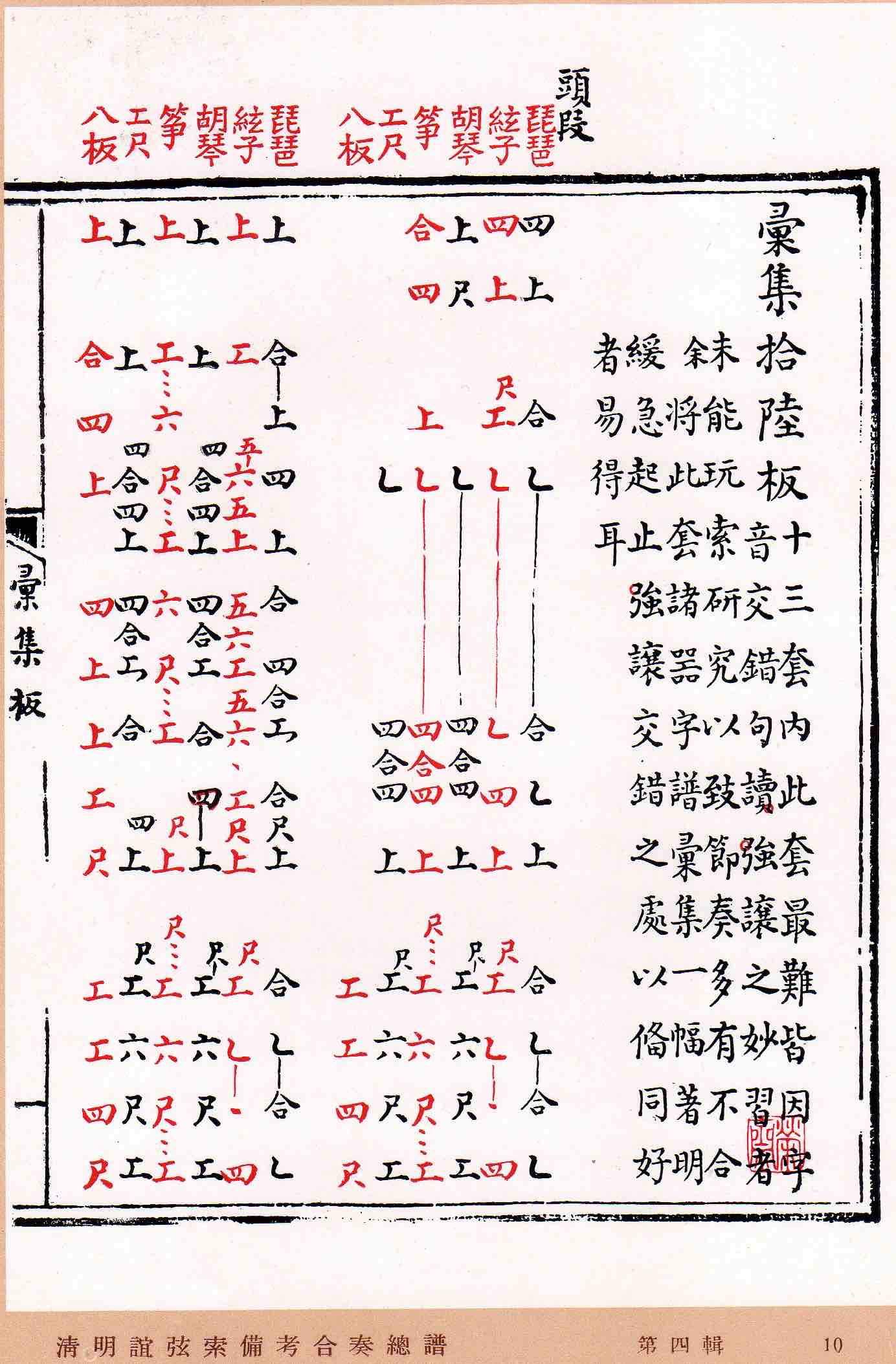
First, terminology. These groups are now commonly known by the umbrella term yinyuehui, which seems to translate simply as “Music Associations”. But it’s confusing: in these villages the term yinyue refers very specifically to the melodic instrumental ensemble that accompanies the rituals of Buddhist and Daoist temples. That indeed was our initial interest, but it’s only one aspect of the associations’ ritual activities, their “instrumental department”, if you like. The term does have an authentic historical pedigree, but to us (both in the West and for urban-educated Chinese) it suggests an unfortunately secular image, like some kind of folk club for entertainment, which encourages Chinese attempts (both in the media and in academia) to downplay the pervasive role of religion (or “superstition”!) in folk society. So I obstinately insist on calling them ritual associations. Despite the gradual decline of vocal liturgy in the region, associations preserve many ritual manuals. And while the melodic instrumental repertoire now dominates, many groups regard these pieces as “scriptures”.

Apart from terminology, folk religion is a sensitive subject. There are some fine scholars in China, but they mainly write about earlier history and written texts, and are cautious about documenting events since 1949, or current activity; whereas we who study expressive culture incline more towards fieldwork. At least, scholars of religion could choose a few villages to clarify the transmission (whether “Buddhist” or “Daoist”) from early temple priests, and study early artefacts such as ritual manuals (not least the “precious scrolls”) and god paintings. While it may now be hard to establish a different image to that of the ICH (see below), the system has legitimised such associations, and they are not subject to the taint of “superstition”—even if scholars of religion may choose to exercise a certain discretion about the early sectarian connections that we documented.

These associations on the Hebei plain are devotional, priding themselves on providing ritual services for their home village without payment. Their ritual sequences are not very dense, but their purpose is to appease the gods. I again put them in the context of other manifestations of religious behaviour in China (such as sects, occupational groups of household Daoists, and spirit mediums). Like my film on the Li family Daoists (which I also encourage you to watch!), this film is set in the north; the soundscapes of the two films are similar, but their social contexts are rather different.

After the end of the main film, the Appendix gives some clues to the workings of the majestic percussion suite, ending with the most moving complete rendition. This is the most convincing illustration of the inadequacy of text, audio recordings, and photos, and it shows the villagers’ deep commitment to the tradition.

All this is a good illustration of how ethnomusicology is based on society and soundscape. Ritual in performance is always animated by sound, so soundscape should always be a major element in our study of ritual. Indeed, most local traditions of “Chinese music” depend on ritual—folk-song, opera, narrative-singing, and dance. One might compare the ritual groups in southwest China studied by Helen Rees, or “song festivals” in the northwest. In Uyghur culture, the pervasive role of Islam is masked by Party propaganda on muqam. The world music industry also remoulds “Sufi music” misleadingly to highlight instrumental music.

Conflict, and the 1949 barrier
Politics and social change are major themes of my book and this website. It’s always important to break through the 1949 barrier. We must take modern history seriously. The story always continues, from imperial and Republican times to the Maoist and reform eras, adapting to the changing times. People’s life stories and personalities make a revealing human window onto history and social change. Stories like those that I document—amidst campaigns, conflicts, famine, massacres, thefts—are airbrushed under the current Chinese regime.

Unlike small occupational household groups such as Daoists and shawm bands, these associations are public bodies, which the villages cadres have always played a major role in supporting.

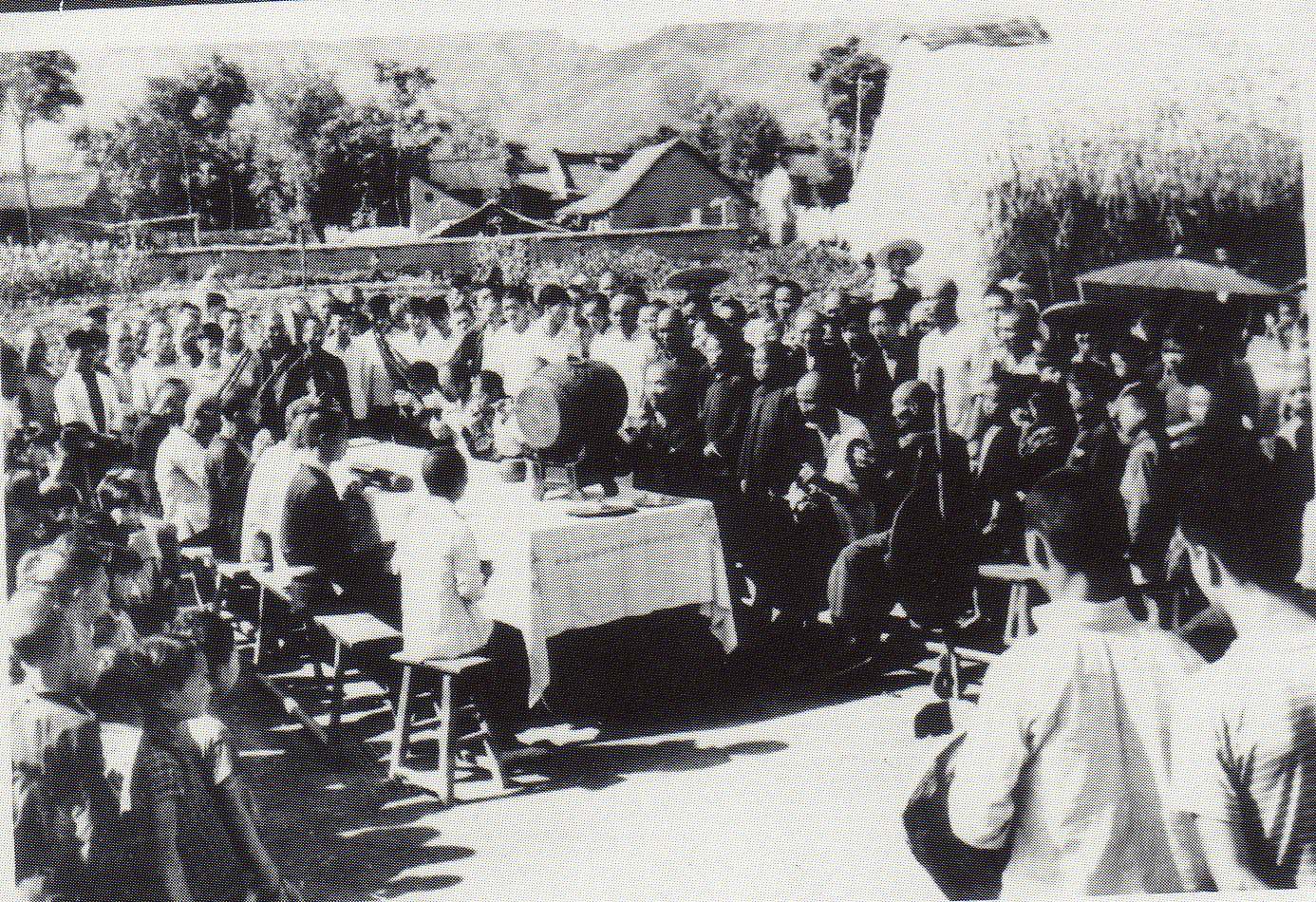
I’m always struck by this amazing image of a former monk training disciples in a nearby village in 1959 (see here, under North Xinzhuang), just as the devastating great famine was occurring—the famine is among crucial topics that can hardly be addressed in China.

Shadows in the field
I could only offer superficial responses to Feng Jun’s salient query about how I positioned myself in relation to the people and events I was documenting. It’s a major theme of the book (and of a thesis in Chinese). I was most fortunate to have two excellent fieldwork companions from Beijing, who were totally on board with studying social and religious change. It’s most important to stay in the village, and to take part in their ritual life (neither of which is common for Chinese scholars). The villagers were open in replying to my questions, which Chinese scholars hardly asked.

I never thought of making films for the public domain; I filmed strictly for my own research purposes, and only realised later that some footage could be edited into watchable films. Our visits energised the Gaoluo association, while others were declining, but transmission was a constant anxiety of theirs, and a theme of our discussions. We can now see this as a precursor of the Intangible Cultural Heritage system.

The ICH
Since my last visit in 2003, a lot has happened in these villages. They’re no longer so poor. Crucial issues, everywhere, are migration, social media, state education, and the whole emptying of the countryside. And there’s no escaping the ICH system, which has influenced many such village groups. Many authors have described how the system commodifies, secularises, and reifies local traditions (see e.g. here). It’s state propaganda; most “research” under its auspices is superficial. While my film, and the book, inadvertently make a contrast with the celebratory approach enshrined by the ICH, I’m perturbed that Chinese viewers don’t seem to articulate this; they can’t read my book in Chinese, and anyway I’m not sure they would care to dwell on my different approach. With recent Chinese fieldwork dominated by the ICH, it is hard to gain a more in-depth picture.

Although the system uses “music” and “culture” as a smokescreen to downplay religious life, it works both ways; for the communities themselves, it helps protect them, legitimise them. With the tenuous survival of these groups under question ever since the 1980s’ reforms, joining the ICH made a tempting expedient for the association leaders. And faith endures, with villagers using the system to their own ends; the Gaoluo association still does funerals, and villagers still offer incense.

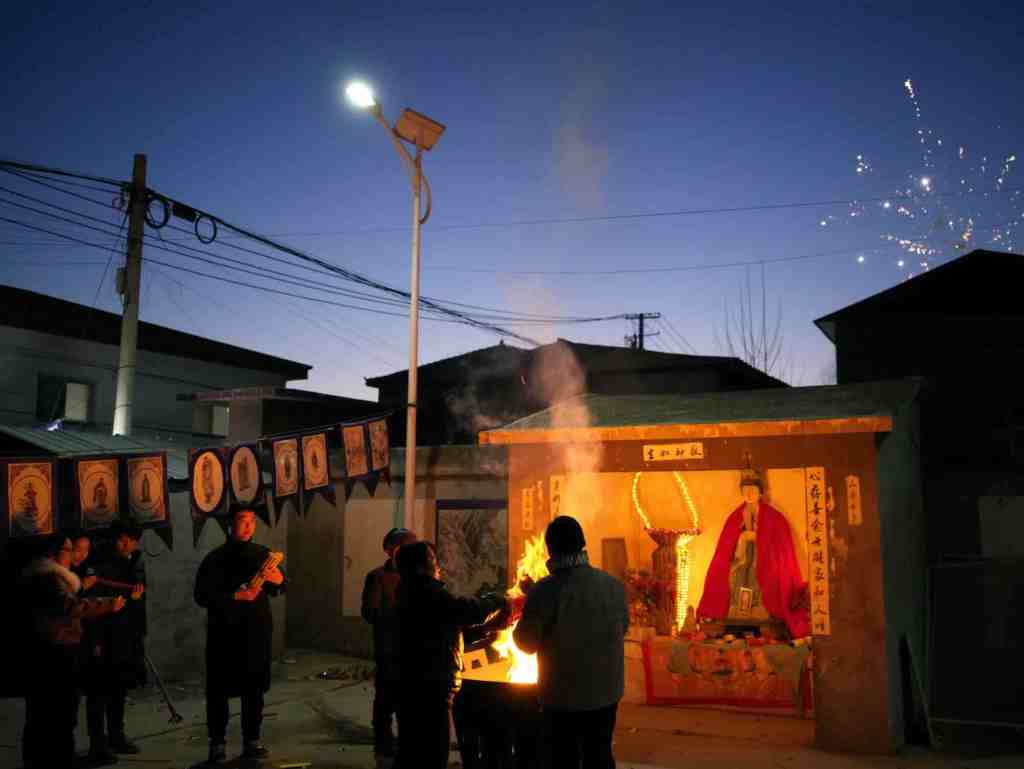
New Year in Gaoluo, 2025. Image: Wei Xiaoshi.

The village’s Catholic minority (whose brass band took part in a “demonstration” on 1st moon 15th in 1995, shown in the film) makes an intriguing sub-plot in the story. In this whole area the relationship between “Patriotic” and underground churches has long been opaque, and without a prolonged stay it would be hard to further our understanding of the shifting scene.

As with my work on the Li family Daoists, the combination of book, film, and website is most instructive.

Gaoluo film: another upcoming screening

My film on the 1995 New Year’s rituals in Gaoluo was shown recently in the village itself, and I went on to introduce it in Leiden. On the 20th May I’ll be presenting it at SOAS (details here)—I look forward to a lively discussion about folk religion, changing modern Chinese society, and perhaps even “music”…. For some themes arising from the screening, click here.

Donors’ lists 2: Gaoluo

Towards a dynamic approach to material artefacts in diachronic social context

Further to my previous post giving background on material support for amateur ritual associations on the Hebei plain, I now focus on Gaoluo village, whose four ritual associations all preserve a wealth of ritual artefacts. Here our prolonged fieldwork allows us to “break through the 1949 barrier” by incorporating the easily-neglected Maoist era into the wider picture both before the Communist victory and since the 1980s’ liberalisations.

Again, please excuse the considerable duplication with many of my previous writings on Gaoluo—in particular my book Plucking the winds, and on this site, my pages on Ritual images: Gaoluo and the village’s three other ritual associations. [1]

To remind you, both South and North villages have their own ritual association, now commonly known as Music Association (yinyuehui, yinyue referring to the “classical” style of paraliturgical melodic instrumental ensemble); and both villages have their own Guanyin Hall Association (or Eastern Lantern Association, dongdenghui), now known as Southern Music Association (nanyuehui, having adopted the more popular style of “Southern music”). But whereas the misleading term “music association” has since become standard in the region, note that neither the 1930 nor the 1990 lists of South Gaoluo use the term: both texts (like their 1983 gongche score) refer to “Southern Lantern Association” (nandenghui), the 1990 list glossing it as  “sacred society” (shenshe). So to stress yet again, this whole topic belongs firmly within the study of folk religion and society, far beyond “musicology”. Do watch my film on the 1995 New Year’s rituals in Gaoluo!

These two donors’ lists from 1930 and 1990 make striking exhibits, but the village’s other associations also suggest clues; having written about them separately, here I rework them into a diachronic account. 

A common stimulus for creating new donors’ lists is the expenditure of replacing ritual artefacts (ritual manuals, god paintings, instruments, and so on); besides recording the contributions of named villagers, many lists provide detailed public accounts.

The 1930s
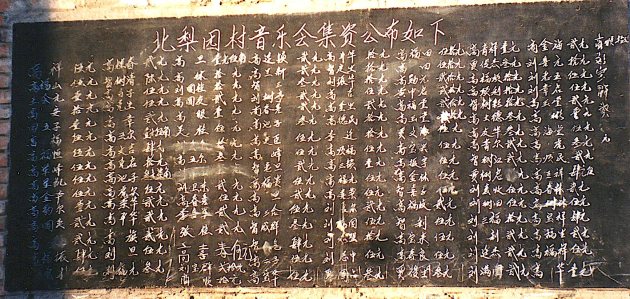
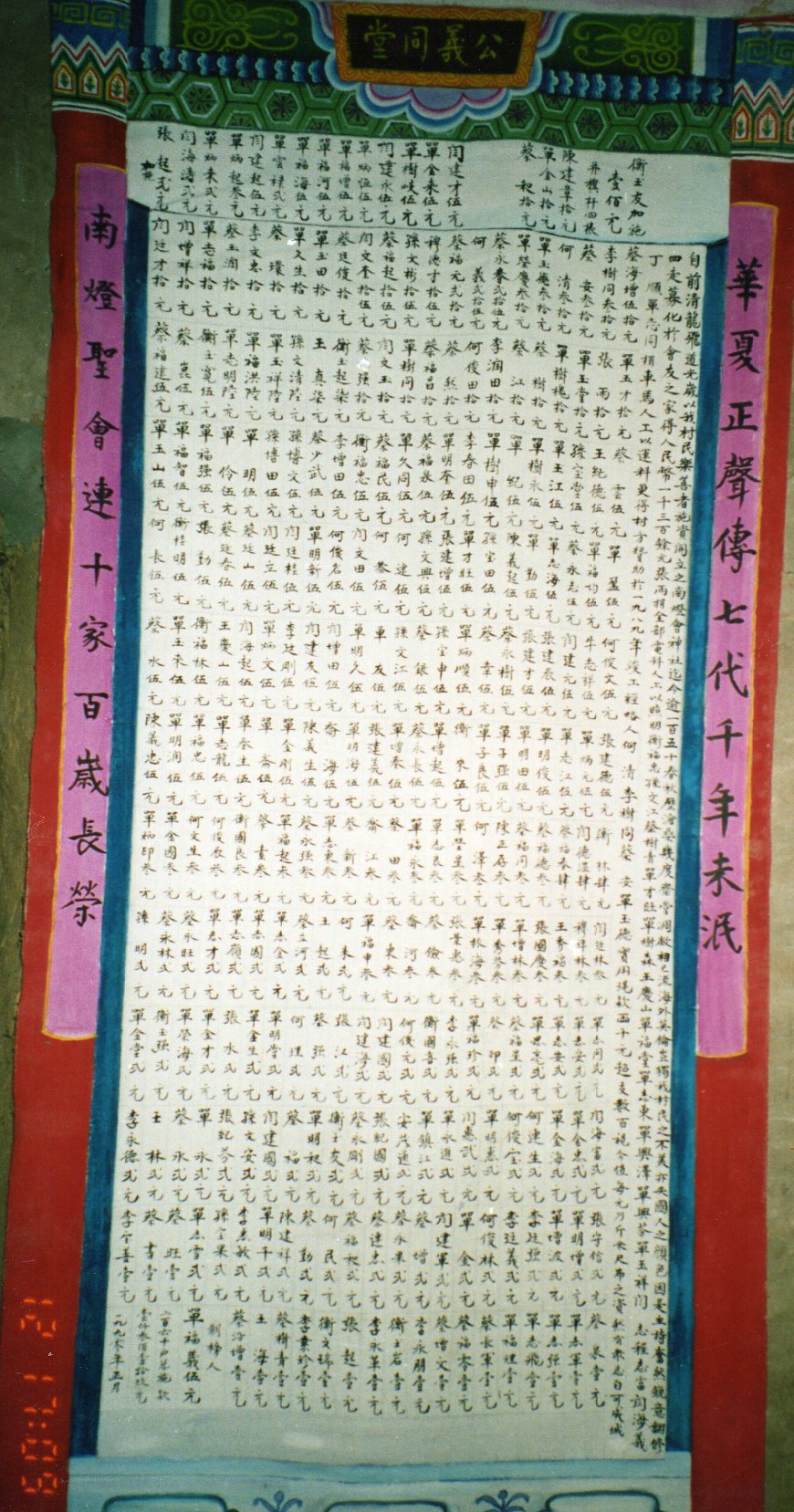
For our main ritual association in South village, one such list, which we saw adorning the lantern tent for the 1995 New Year’s rituals, was said to date from the late 19th century, but alas it was so faded as to be totally illegible. Instead, most handsome of the ritual artefacts on display was the 1930 donors’ list—apparently the only surviving list from before Liberation that we have found in the region:

Now if we saw this list on the wall of a museum, it would have limited potential. But since the tradition endures, not only can we witness rituals, hearing the wind and percussion music and vocal liturgy before the gods; but further, the descendants of the people featured in the list were able to provide considerable detail, putting the initiative in the context of the Republican era in the region. To summarise my discussion in Plucking the winds and in Ritual images: Gaoluo, during 1930 both associations in South village undertook a refurbishment of their ritual apparatus—apparently prompted both by the brief restoration of peace in the area after many years of fierce fighting between warlords, and by competition with the renewed energy of the village Catholics.

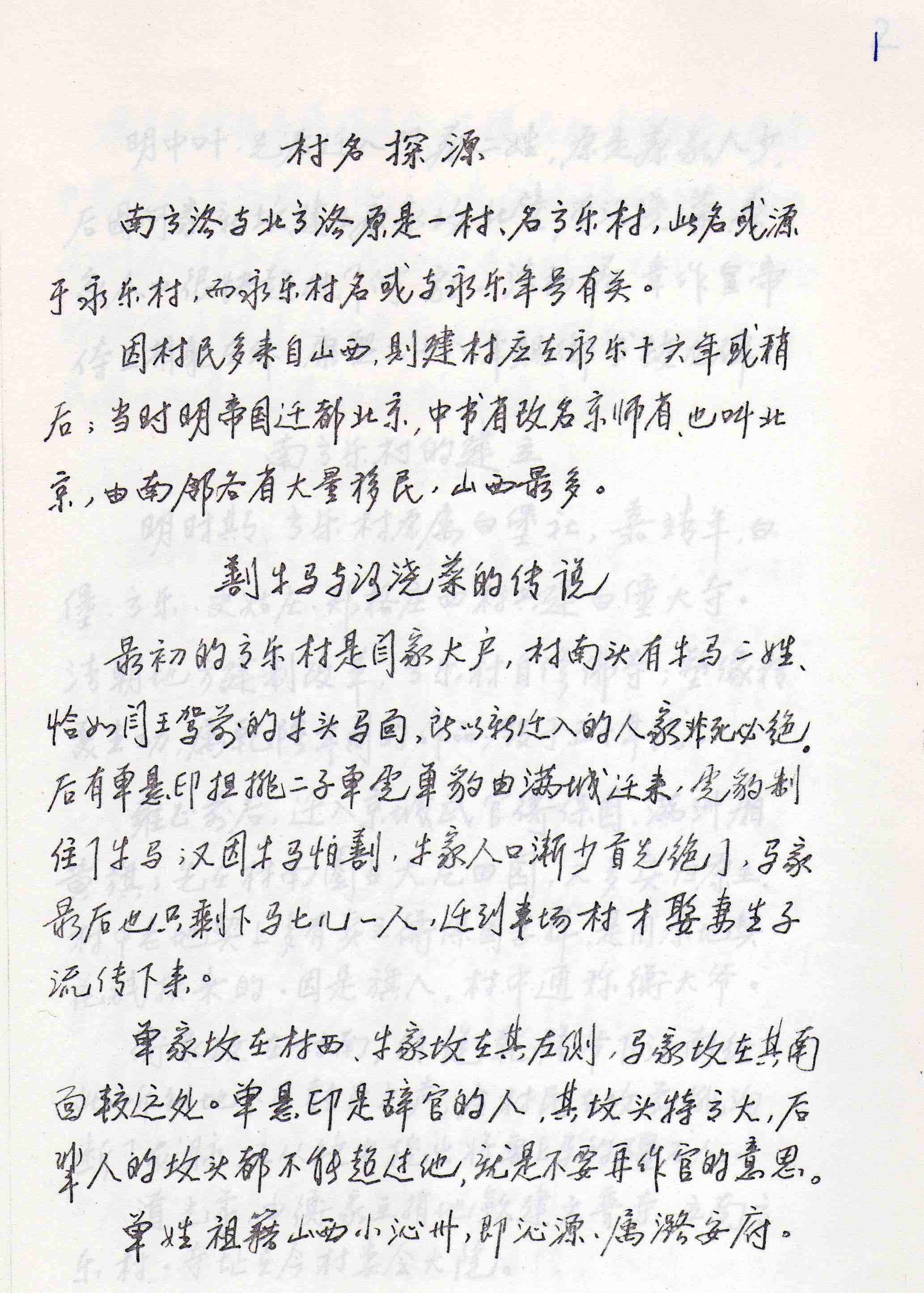
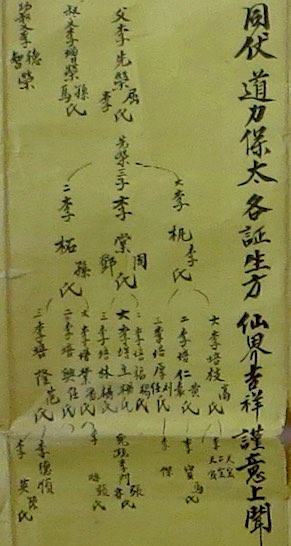
The 1930 list, entitled Wanshan tonggui (“The myriad charities return to the same source”), commemorates the commissioning of a major series of diaogua hangings from Painter Sun of Doujiazhuang village in Zhuozhou county just north. It records 92 heads of households, surely consisting of most of those then living in the southern half of South village which the association served, though some were doubtless too poverty-stricken to be able to afford even a minimal contribution. For all the beauty of the list, many (including all the womenfolk) were unable to read it.

The donations, ranging from 6 yuan to 5 jiao, totalled 109.83 yuan; the cloth cost 24 yuan, the paintings 61.5 yuan, and other expenses amounted to 33.83 yuan, leaving debts of 9.5 yuan. Five “managers” of the association are named at the head of the list: Cai Lin, Cai Ze, Shan Xue, Shan Chang, and Shan Futian (sketches in Plucking the winds, p.54). As their descendants recalled in the 1990s, all were prominent figures in the village, some of whom were also active as ritual performers.

Later in 1930, in preparation for the following New Year’s rituals, the South village Guanyin Hall Association also made a donors’ list for the commissioning of twelve new ritual paintings, listing four “managers”, two “organisers”, and three “incense heads”. The paintings were again made by Master Sun; the 1990s’ members also say he made new diaogua hangings for their association. In the years before the 1937 Japanese invasion, one Wang Laoguo from South Gaoluo painted more diaogua for them.

Further suggesting the ritual revival of the time, the early Dizang precious scroll of the Guanyin Hall Association in North Gaoluo contains a section recopied in 1932 (the precious scrolls are introduced here, and for Hebei, here and here).

Under Maoism
In the decades after the 1949 Communist revolution, many village ritual associations gradually became less active or ceased entirely. However, a close look belies the common notion that ritual life was in abeyance right until the 1980s’ reforms. For this crucial and ever more elusive period, material artefacts serve only as an adjunct to the memories of villagers.

With the new regime in its infancy, peace gave rise to hope for local communities long traumatised by warfare. Even as the collective system escalated, Gaoluo’s new village administration managed to embrace its traditional associations. The production teams used to give a little grain or other goods to support whichever association lay within their patch. The political climate didn’t dampen faith in village ritual associations: they continued to perform funerals and observe the New Year’s rituals in their respective lantern tents. Between 1950 and 1964 several groups of young men were recruited to learn both the vocal liturgy and the instrumental music; new gongche scores of the latter were compiled.

However, I doubt if the associations often dared hang out their ritual artefacts, and the atmosphere must have discouraged the making of donors’ lists. Our association didn’t make one between 1930 and 1990, but in 1952 the South village Guanyin Hall Association converted from their chaozi shawm-and-percussion music to the more popular style of “Southern music”. They invited the locally-renowned musician Hu Jinzhong from nearby West Yi’an village to teach them, giving him food and accommodation through the winter, but no fee, as ever. There was some official opposition to them learning the music, so the association sought no public donations; it still owned some land in the early 1950s, so it could buy instruments independently. Supporters merely “took care of a banquet” for the association, and no donors’ list was made.

The early 1960s
From 1961 to 1964, in the brief lull between the famine and the Four Cleanups campaign, ritual associations revived strongly throughout the Hebei plain, training youngsters in both the instrumental ensemble and the vocal liturgy. The latter tradition was in general decline on the plain, with the elders of the “civil altar” dying off. In Gaoluo, the vocal liturgy of South and North village Guanyin Hall Associations effectively came to an end with the deaths of Zhang Yi  in 1950 and Shan Yongcun around 1956. Only our South village ritual association had a group of keen teenagers who came forward in 1961 to study the vocal liturgy with senior masters. But elsewhere the shengguan instrumental ensemble increasingly came to represent the scriptures before the gods.

One might imagine the early 1960s’ revival prompting our association to compile a new donors’ list, but perhaps the leaders were wary of creating such a public pronouncement. However, in 1962 the South village Guanyin Hall Association used its 1930 list to add a new list of donors.

And in 1964 the Gaoluo village opera troupe, not inhibited by the taint of “superstition”, commemorated its revival in a donors’ list (composed by Shan Fuyi), with the 280 donors representing the great majority of households in North and South villages at the time. The list records the donation of c450 yuan in total.

For both the ritual associations and the opera troupe, the early 1960s were a cultural heyday such as they had not been able to enjoy since the early 1950s, reflecting the social recuperation after the famine afforded by a central withdrawal from extreme leftist policies. Little did they know that political extremism was once again to disrupt their lives still more severely; the optimism of their declarations was soon to look naive and hollow.

Since the 1980s’ reforms
In the Hebei villages, as throughout the whole of China, the last two decades of the 20th century were particular in that their associations were reviving after at least fifteen years of stagnation—and even those that had been active until the eve of the Cultural Revolution had practised somewhat furtively. Thus they needed to replace a considerable amount of their ritual equipment.

In Gaoluo after the liberalisations following the collapse of the commune system in the late 1970s, the village “brigade” (dadui) gave 100 yuan a year to all the village’s main associations, which our South village ritual association spent on getting its sheng mouth-organs tuned. In the early 1980s they commissioned a new ritual pantheon of Dizang and the underworld, and compiled a new gongche score, but they didn’t yet create a new donors’ list.

However, the North village Guanyin Hall Association had a donors’ list made as early as 1981, to commemorate their own revival, written in elegant classical Chinese (text copied in Zhang, Yinyuehui, pp.128–9). This association had a reputation for observing the ritual proprieties, and preserved splendid “precious scrolls” from the 18th century, but their fine tradition of reciting them was going into decline even before Liberation. The first historical material on the list consists of four names (“transmitters of the ritual business”) from the 1920s. Unusually, having originally been a temple-based ritual association based on reciting the scriptures, they had diversified by adopting secular genres, acquiring opera in the 1930s, reformed pingju opera in 1951, “Southern music” in the 1960s (learned from their sister association in South village), and lion dancing in 1981.

The 1990s
As the economic liberalisations gathered pace and communal consciousness was attenuated, many village associations that had revived found it hard to maintain activity. In Gaoluo the 1990s were distinctive for the renewed energy provided by our fieldwork (Plucking the winds, pp.189–205).

After our first visit over the New Year’s rituals in 1989, our association now resolved to refurbish their “public building”, which they had reclaimed from the village brigade after the collapse of the commune system. This initiative was led by the then village chief Cai Ran, himself a keen member of the “civil altar”. After writing enterprisingly but unsuccessfully to the Music Research Institute in Beijing to request funding for the project, they managed to be self-sufficient in realising the project, with villagers donating money and labour.

So in 1990 the leaders of our association invited Shan Fuyi to make a new donors’ list. His substantial text outlining the association’s history (see Ritual images: Gaoluo) makes clear that my visit was a stimulus for the project; still, it was written with no guarantee that outsiders would return.

The 1990 list names 270 heads of households. Still, villagers were becoming less conscientious about donating (see Women of Gaoluo, under “Rural sexism”).

From the 1930 and 1990 lists alone, we can hardly perceive change. The association still served the ritual needs of the villagers, and was still supported by most households in its catchment area. Without thick description from fieldwork and interviews, we might never know how ritual and social life were changing.

In the early 1990s there were several thefts of ritual artefacts in Gaoluo—but this served as a stimulus for the association to reclaim those that had been taken off by cultural authorities under Maoism.

The lantern tent of the South village ritual association, 1998,
with new and newly-copied donors’ lists.

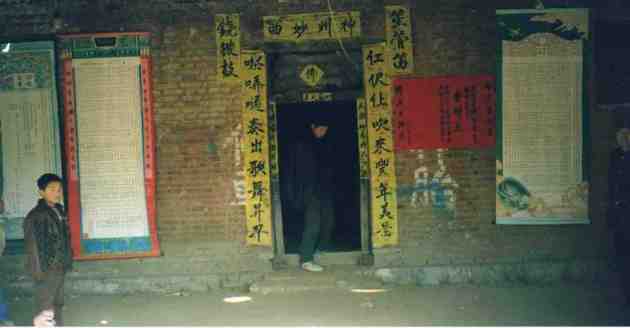
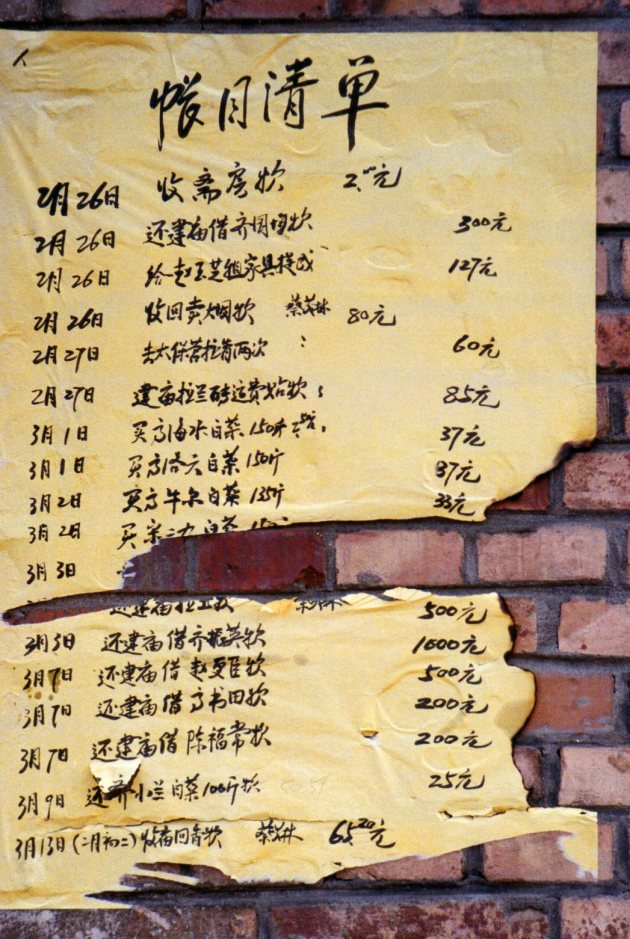
Our attention to the South village ritual association stimulated another competitive ritual flurry among the two villages’ other three ritual associations. For New Year 1990 the North village ritual association also had new ritual paintings made, of their own pantheon and the Ten Kings of the Underworld (for the donors’ list commemorating this initiative, see under Ritual images: Gaoluo). We also saw a more transient paper list of expenses from New Year 1992, pasted at the entrance to their ritual building, and already decrepit and hard to read by the following summer. They had received 690.47 yuan; they had incurred expenses such as buying coal, meat, vegetables, doufu, oil, salt, tea, firecrackers, tuning sheng, buying cloth bags for sheng, copying scores, and mounting ritual manuals and paintings—all conscientiously recorded. At New Year 1998 we saw their paper lists of income and expenses for the past year. Most of the association’s income had come from the hiring of crockery; donations had also been made when the association performed funerals (the rate being around 100 yuan). Some individuals had donated cash (one as much as 750 yuan), and the village committee had given 200 yuan. They had received 3,638.2 yuan (including 939.8 yuan brought forward from the previous year) and spent 2,992.2 yuan.

After the demise of the commune system, the South village Guanyin Hall must have revived along with the other associations by about 1980. Following our 1989 visit and the revamping of the ritual associations of North and South villages, they too had a surge of energy. For New Year 1992 they made a new donors’ list (image here) for the rebuilding of their humble ritual building, with this inscription:

The Eastern Lantern Association of South Gaoluo rebuilt its public building in 1992 AD under the People’s Republic of China, with the aid of the donors listed above. Total expenditure 2,984 yuan 4 jiao; 15 yuan surplus.

The list shows 215 household heads giving sums from 20 yuan to 2 yuan.

Conclusion
In all, community support for ritual life had not waned despite successive social upheavals. But new challenges were taking their toll: migration to the towns in search of work, state education, and popular media culture. Since my last visit in 2003, Gaoluo has continued to be transformed—notably by the arrival of the Intangible Cultural Heritage system, which I will address soon.

Static, silent material artefacts are most instructive when we can use them in conjunction with fieldwork and interview, helping us connect them to changing social life, filling in the gaps, learning more about practice and personalities over time. This is where the ethnographer has an advantage over the historian. I wish we had been able to find yet more detail—for instance on the 1950s: how funerals were changing, how calendrical rituals became less frequent, the decline of the vocal liturgy, and so on. We were lucky to be able to consult people who had taken part in the events commemorated in donors’ lists; but as time goes by, fewer villagers remain who can recall the early years of Maoism, let alone the “old society” before 1949.


[1] See the index of Plucking the winds, under “donations and donors’ lists”; Zhang Zhentao, Yinyuehui, pp.116–35, copies and discusses all the Gaoluo donors’ lists. On this site, note also the series of articles under the Gaoluo rubric of the main Menu.

Donors’ lists 1: Hebei

Stone, cloth, paper: economic support for village ritual associations

My new film on Gaoluo prompts me to revisit our fieldwork the ritual associations of the Hebei plain—a task further stimulated by the recent reification of these groups under the Intangible Cultural Heritage system. I now wish to outline economic support for such ritual organisations under the successive political regimes of modern times—”breaking through the 1949 barrier”.

First, in this post I expand on some themes from my survey of ritual associations on the Hebei plain; and in a sequel I focus on Gaoluo, where we found a wealth of ritual artefacts to accompany our prolonged fieldwork and discussions with villagers. Both essays are mere samples of the material we collected through the 1990s—please excuse the considerable overlap with many of my previous writings, both on the ritual associations and on Gaoluo. [1]

Introduction
Living traditions of Chinese folk ritual provide a rich source of material artefacts dating back several centuries (cf. China’s hidden century). Still, they are mere snapshots of particular moments: one hopes to be able to augment them by fieldwork on observed ritual practice and the oral accounts of villagers throughout living memory.

In rural China, as everywhere, ritual and cultural life depends on moral and economic support from local communities. Patronage, in cash and in kind, depends on the nature and scale of the enterprise.  Occupational family-based groups such as household Daoists and shawm bands (as well as individual intermediaries like spirit mediums) are paid for a particular event such as a funeral, and have successfully adapted to changing patterns of social support in the post-reform era.

In the religious sphere, alongside local temples, the composite term huidaomen (used pejoratively by the Communist state—hui Association, dao “Way”, and men “Gate”) subsumes both ascriptive amateur village-wide devotional associations and voluntary sectarian groups. On the Hebei plain, the two broad categories overlapped (see e.g. our notes on Xiongxian and Xushui counties).

Priding themselves on not accepting payment, ascriptive ritual associations have long relied on recouping their expenses through donations from the village communities whose ritual needs they serve. But whereas support for voluntary sectarian (as well as Catholic) groups remains grounded in enduring faith, the ascriptive associations have faced a particular crisis in the new economic climate since the 1980s. 

Temples and temple fairs, ritual associations and the “public building”
Temples have always been an important focus of community life, and in many regions they remain so, such as in south China (Fujian, Jiangxi, Hunan, and so on) and the northwest—although much research there has focused on the imperial legacy rather than modern change.

On the Hebei plain, temples were ubiquitous until the 1950s. Village ritual associations learned from Buddhist or Daoist temple clerics, or from other nearby associations that had done so, at various times since the Ming dynasty; they existed mainly to serve the village temples. But in a long process over the 20th century, temples were destroyed or abandoned; rather few have been rebuilt since the 1980s’ liberalisations, and still fewer have any regular staff apart from a temple-keeper. So the main venue for the reduced calendrical rituals of such villages became the “public building” (guanfangzi: Zhang Zhentao,Yinyuehui, pp.181–204), an inconspicuous building only adorned with god paintings and other ritual artefacts, easily stored away, during calendrical rituals on behalf of the community. Besides the long-term decline of active temples in the region, this may suggest insecurity among village communities through political upheavals.

Villages that have restored their former temples are in a minority, but in such cases the refurbished temples seem to provide a greater focus, visited and tended more often, as in Gaozhuang (Xushui county) and two villages in Xiongxian county, Hanzhuang and Kaikou. Still, their annual ritual calendar remains quite sparse (see my survey, under “Ritual duties”).

Even once we recognise the importance of the “public building”, a major part of the duties of these associations is to supply funeral rituals at the homes of deceased villagers.

Donors’ lists
Alongside the wealth of material artefacts that we found among the Hebei village ritual associations (ritual paintings, ritual manuals, scores, and so on) are donors’ lists (beiwen 碑文), documenting support over the previous year, or for a major initiative. Displayed alongside the god paintings in the ritual building, they proclaim the associations’ support among their community for providing calendrical observances and funerals, symbolising the village’s sacred core. As Zhang Zhentao notes, local terms like beiwen and bushi 布施 (“donating”) remind us of the living connection of these groups with the tradition of supporting Buddhist and Daoist temples.

More ephemerally than the stone steles of temples, the donors’ lists of Hebei village ritual associations are commonly inscribed on cloth; but many are even more perishable, written on paper, pasted on the wall of the ritual building over the New Year’s rituals—when new donations (often in cigarettes and tea) are recorded daily. Thus they might never be documented unless some ethnographer happened to be there to take photos at the time.

Throughout China, paper documents are commonly pasted up announcing temple fairs, temple inaugurations, and particular rituals; some of these may record donors and amounts contributed. Even for weddings and funerals, scribes record gifts. The donors’ lists of the Hebei associations are rather different, recording the names of household heads—thereby establishing them as members of the association not just for particular rituals but throughout the year—and amounts contributed. Since these associations were responsible for performing rituals on behalf of the whole village, their leaders sought donations from virtually every household. Besides a few more affluent patrons, most families could only afford a token contribution.

While village ritual associations were inextricably linked to their local temples, there is no direct transition from the stone steles of the latter to the cloth and paper memorials of the former. Most associations must have made donors’ lists ever since their founding, generally in the Qing dynasty or even the Ming, but alas they don’t survive. Even if they did, we couldn’t make a simple comparison.

For those Hebei temples that have been rebuilt since the 1980s’ liberalisations, we found a rare instance of a stone inscription listing donations on the back of the 1993 stele for the inauguration of the Ancestral Hall to Venerable Mother (Laomu citang) in Gaozhuang, Xushui county—led by the village’s ritual association.

Whatever the material on which such lists are written, the Hebei associations are mostly village-wide public bodies, perhaps encouraging them to openly display both their expenditure and the names of their patrons. Still, many of these groups have sectarian ancestry, so I wonder if such lists have been documented among sectarian groups elsewhere in China—leads welcome.

Lists of expenses
Also often detailed on such lists is the expenditure of the association, justifying the leaders’ probity on behalf of their patrons. Expenses documented include replacing instruments or maintaining them (notably tuning and repairing sheng mouth-organs), commissioning new ritual paintings; buying other equipment (tables, pennants, incense, candles, lanterns, paper, food for banquets); “utility bills” for the ritual building or rehearsal venue (coal for rehearsals, oil for lanterns, electricity); and New Year’s expenses such as firecrackers. For example, again from Gaozhuang is a paper list of expenses from 1995:

Here’s a 1994 list of expenses from Kaikou village (Xiongxian county) for the revival of the temple and its association (Zhang, Yinyuehui, pp.140–43):

Beiwen with written histories
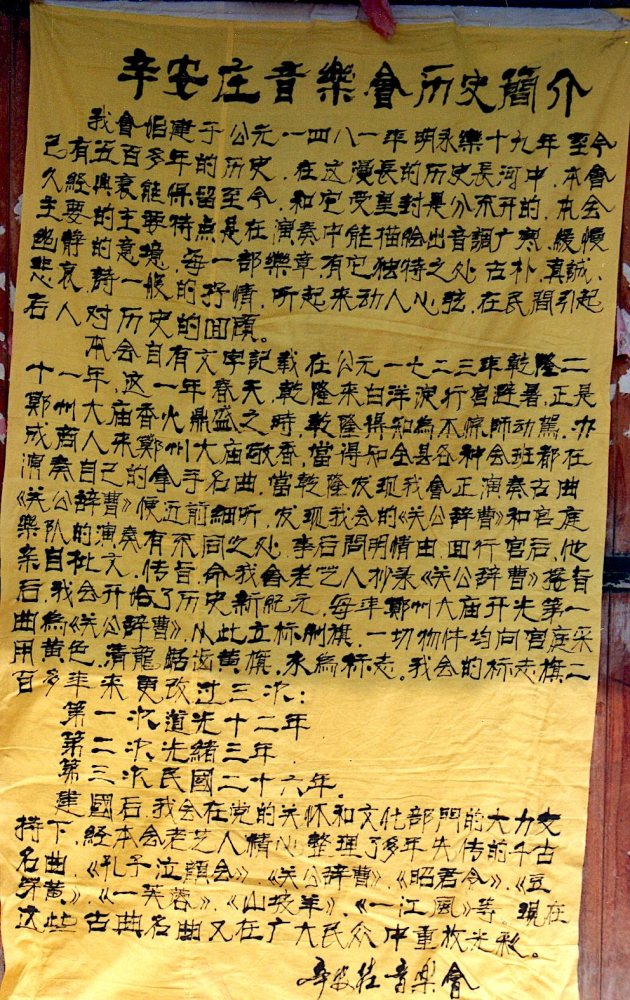
Rather as temple steles from imperial times might also document successive renovations, some donors’ lists include brief histories. Some associations even composed separate histories, such as a 1990 banner from Xin’anzhuang, Renqiu county:

Was this prompted by some interest from county cultural workers, I wonder? It clearly constituted some kind of public declaration; but the preludes of some gongche solfeggio scores of the paraliturgical melodic ensemble, whose readership was limited to the performers themselves, also contain brief histories of the association, like those of Longhua from 1963 and 1980 (for both Longhua and Xin’anzhuang, see under Ritual groups around the Baiyangdian lake).

Intriguingly, the instances that we documented were written since the 1949 revolution. Under state socialism, did political anxieties now prompt ritual associations to proclaim or justify their history, portraying the tradition as “culture”, downplaying religion? Re-reading the brief texts that head some donors’ lists, I find them diplomatic, distancing the associations from sectarian connections, claiming a place within the official discourse long before the Intangible Cultural Heritage. This seems to complement the innocuous appearance of the “public building”, the easily-concealed ritual artefacts, and indeed the growing prevalence of the shengguan instrumental ensemble over the vocal liturgy.

Still, such histories can make a useful starting point as we compile more detailed accounts from villagers’ oral recollections.

Some further examples
Apart from the Gaoluo associations (to be discussed in a separate post), Zhang Zhentao (Yinyuehui, pp.130–50) details donors’ lists from other village groups we visited on the Hebei plain. These include two 1992 paper lists from North Qiaotou in Yixian county (Zhang, Yinyuehui, pp.136–40; see my discussion here)—a donors’ list introduced by a text in praise of the association’s benevolent virtue:

and their list of expenses:

In Xushui county, on our visit to North Liyuan in 1995 we found donors listed on a blackboard:

Also under my page on Ritual groups of Xushui is material on the rebuilding of village temples in East Zhangfeng (§8) and Xiefangying (§9). Zhang Zhentao further documents lists from Zhaobeikou on the Baiyangdian lake, and Fuxin in Wen’an county.

Many of these groups were of sectarian ancestry—the North Qiaotou association derived from a Hunyuan sect, for instance. As I suggested above, perhaps this made their public proclamation of charitable virtue still more apposite, counteracting state suspicion of “superstition”.

Summary
Static, silent material artefacts only provide snapshots in the life of these groups. They are most instructive when we can use them in conjunction with fieldwork, helping us connect them to changing social life, filling in the gaps for the intervening periods, learning more about practice and personalities over time, using the frozen material evidence to prompt recollections from villagers, building up a picture of the longer term. This requires prolonged familiarity—as we gained in Gaoluo, subject of the following post.

And to repeat my point yet again, whereas the topic was discovered by musicologists, it belongs firmly within the study of folk religion and society. 


[1] For the Hebei ritual associations, see this survey, and many pages under the Gaoluo and Hebei rubrics of the main Menu. Besides my 2004 book Plucking the winds, as well as “Ritual music under Mao and Deng” and “Revival in crisis”, note in particular Zhang Zhentao’s 2002 book Yinyuehui: Jizhong xiangcun lisuzhongde guchuiyueshe 音乐会: 冀中乡村礼俗中的鼓吹乐社. Like his discussions of the “public building” and gongche scores (pp.181–204, 365–407), his chapter on donors’ lists (pp.115–80) is excellent; following perceptive discussions of particular lists, he analyses the material on pp.150–79, including the role of the local gentry in supporting ritual associations, and comparison with the opaque economics of the mercenary shawm bands.

Gaoluo film: village screening!

My new film on the 1995 New Year’s rituals in Gaoluo has recently been screened at a grand event (billed as a conference) in the village itself, thanks to the enterprise of Wei Xiaoshi (CDTM) in collaboration with Cai Yurun, who has long served both as leader of the ritual association and the village. A detailed review of the occasion has just appeared on the CDTM WeChat site (click here).

I’m delighted that my old fieldwork companion Xue Yibing could take part—we witnessed the New Year’s rituals in the village together for the first time in 1989, and his careful fieldnotes on Gaoluo and other villages over the next decade were invaluable (see mainly under Hebei in main Menu).

Gaoluo: our first visit to the Lantern Tent, New Year 1989.

Besides many of the villagers, delegations attended from a variety of musicological departments in Beijing, and from Hebei University. If only institutes of folk religious studies and sociology could be alerted to the significance of such ritual associations! But even if they were to venture beyond the safety of historical research into fieldwork on the condition of these groups since the 1940s, their ability to publish in China is ever more limited. 

One of my sessions with village litterateur Shan Fuyi, displayed on his daughter-in-law’s mobile.

I trust the film was well received, giving younger villagers an opportunity to glimpse their parents and grandparents in the days before the reified commodification inculcated by the Intangible Cultural Heritage began to influence their practices. With sonorous speeches inevitably the order of the day, the constraints of the occasion made me nostalgic for the informality of our fieldwork. The very setting, in a revamped Party Committee office, suggested how material conditions in the village have improved since my visits.

South Gaoluo New Year’s rituals, 2025. Images: Wei Xiaoshi.

Still, the religious context has not been lost: the New Year’s rituals still attract the village faithful, and the association still performs funerals for them. But the authoritative Cai Yurun voiced concerns that ICH support still can’t guarantee the future prospects of the association—in particular the vocal liturgy (which has been in a wider decline on the Hebei plain for many decades). It would take a further period of lengthy immersion in the villagers’ lives to learn their true perceptions (perhaps prompted by the film) on social and ritual change over these last thirty years. My film didn’t seem to prompt comments on how significantly the ethnographic perspective differs from the sanitised media approach typified by the ICH, but Zhang Zhentao has now published an intriguing review on this topic. Inevitably, whereas my book Plucking the winds stresses the constant tribulations of such villages under successive regimes, the prevailing congratulatory mood within China discourages such an approach.

Enbedded in the review of the event, the performance of the percussion suite in the courtyard, while still technically accomplished, inevitably lacks the spirit of the 1995 rendition before the gods. I doubt that this derives merely from the official secular context of the event; the total commitment of masters of yore like Cai An and Shan Rongqing seems to have been diluted.

Above: the association with helpers, 1995
Below: members of the association with connference delegates, 2025.

The Chinese version of the film will soon be available both on my YouTube channel (alongside the English version) and (in China) on the CDTM website. And do browse the posts under Gaoluo in the top Menu!

Click here for recent screenings in Leiden of my films on the Li family Daoists and Gaoluo.

With many thanks to Wei Xiaoshi!

Presenting my films in Leiden

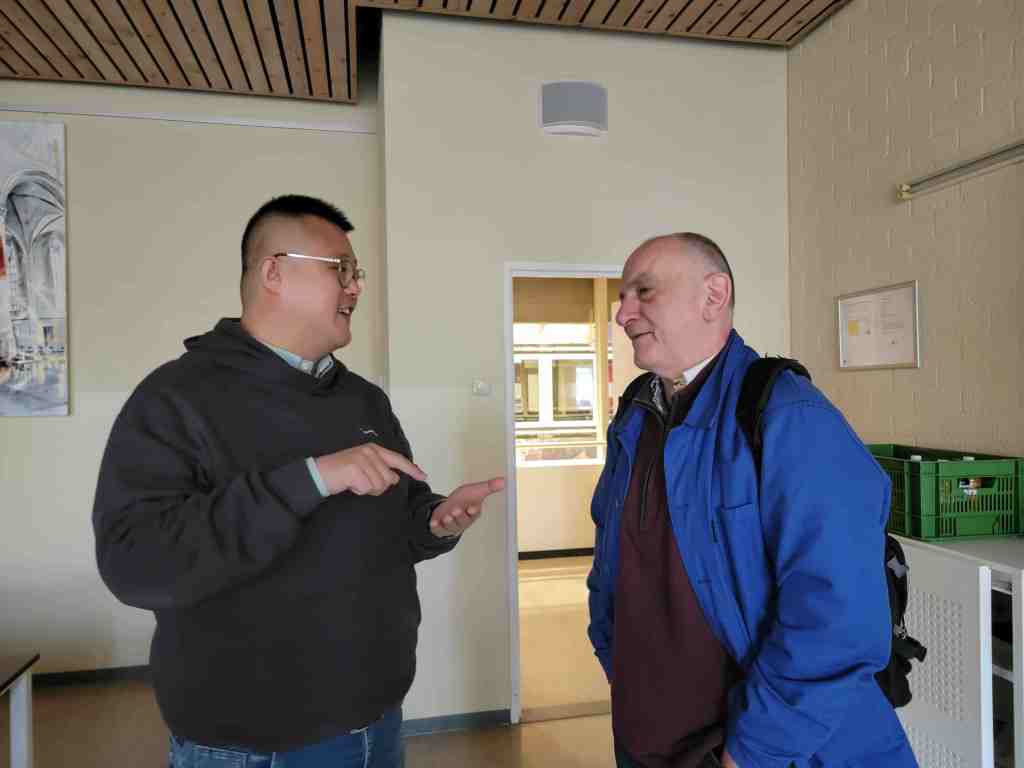
With Barend ter Haar (left) and Frank Kouwenhoven (right). Image: Yves Menheere.

Following the online publication of my recent film on the 1995 New Year’s rituals in Gaoluo, its public world premiere was at a grand event last week in the village itself. Shortly afterwards I visited Leiden University to present the film, as well as my portrait film on the Li family Daoists in Shanxi, as part of Yves Menheere‘s course on Chinese religion, and in collaboration with Frank Kouwenhoven of CHIME.

As I often stress (e.g. here), the study of both topics belongs firmly within the realm of religious studies, even if it has been dominated by Chinese musicologists. Sure enough, the distinguished sinologist Barend ter Haar graced us with lively comments, and I was delighted to see Tao Jin, formidable authority on Daoist ritual, on a visit from Beijing via Paris (see under Ritual life around Suzhou, and here).

With Tao Jin.

With both films concerning ritual life in north China, their subjects and soundscapes may appear somewhat similar, but the differences are significant (click here for differences in approach that emerge from studying with the two types of group). The Li family Daoists are

  • occupational, in a small group of five or six
  • active in a small radius around their home village; constantly busy, mainly for funerals,
  • with dense ritual sequences,

whereas Gaoluo is

  • among many amateur devotional associations, village-wide (cf. Xi’an, Yunnan, Jiangsu, and so on)
  • mostly serving the village itself, and not busy except at New Year,
  • its ritual sequences less dense.

My most focused fieldwork with the Li family Daoists was from 2011–18, with previous trips in 1991–2 and 2001–3; the film mainly shows footage from 2011 to 2015.  My fieldwork in Gaoluo took place from 1989 to 2003, the film footage showing three weeks in 1995.

While the impact of the Intangible Cultural Heritage on the Li family Daoists has been negligible (cf. here), in village ritual associations like Gaoluo it has been major—which makes the 1995 footage even more significant.

I look forward to introducing both films further to live audiences in the coming months. Meanwhile, do watch them online!

Not quite an update

I’m not exactly hibernating, but while I have various projects on the go, new posts are few and far between at the mo—so meanwhile do keep working through my previous ouevre:

Meanwhile, to follow this update on Nicolas Magriel’s voluminous sarangi site, he continues to add precious material… (see also under A garland of ragas).

I’m trying to abandon the iniquity of Twitter by moving to BlueSky, so do follow me there.

“Normal service will be resumed as soon as possible”

Gaoluo film: a Chinese review

GL CDTM review

A substantial Chinese review of my new film on the 1995 New Year’s rituals in Gaoluo has appeared on the WeChat public account of the CDTM 中国音网, headed by the enterprising Wei Xiaoshi

click here.

Following CDTM’s earlier review of my book on Gaoluo and its audio CD, access to the film within China should clarify my emphasis on the ritual function of such groups on the Hebei plain, over a decade before the Gaoluo ritual association came to fame as their image was remoulded by the Intangible Cultural Heritage.

Naturally, I hope the villagers themselves will be gratified to see vignettes of life in Gaoluo thirty years ago—many of them will hardly remember that era, and youngsters should be intrigued to see their grandfathers taking part in these rituals. As to scholars, it would also be good if the film finds an audience not only among musicologists but also in the fields of religion and folklore.

You can now watch the Chinese-subtitled version on my YouTube channel and here, and (in China) on CDTM (follow this link).

Chinese folk religion: “belief”

People like Li Wenbin and He Qing perceived no conflict between worshipping the gods and supporting Mao’s broad social goals.

Screenshot

My new film on the 1995 New Year’s rituals in Gaoluo prompted a recent post on the tenacity of rural tradition. Still reflecting on my fieldwork, it’s worth revisiting my remarks in Plucking the winds (pp.277–85, with minor edits) on “belief”—referring to devotional village-wide groups like those of Gaoluo

By 1995, as throughout its history, the association had a patchwork of ritual artefacts made at various times over the last century. The previously bare and unprepossessing “public building”, once fully adorned, becomes a place of great beauty, a fitting backdrop for the association’s ritual performance. But since the 1980s’ liberalisations, unlike many villages in north and south China, and indeed nearby such as Niecun just across the river, Gaoluo has not sought to build new permanent temples.

What beliefs do such artefacts symbolise? Aside from popular belief in Houtu and the God of Prosperity, formidable He Qing, always a fine source for old traditions, said the association worships Dizang, god of the underworld, as the association is said to go back to “the Tang king’s tour of hell”. Members have often said this was a Daoist association, even that Gaoluo was a Daoist village. We must understand this in the context of a dilution of the term Dao, meaning simply ritual. The senior He Yi recalls a tradition that their [melodic instrumental] music was learned long ago from Daoists (laodao), for what it is worth; perhaps a priest attached to the temple of North Gaoluo or the temple of South village. In fact, where one can distinguish, their ritual manuals have a substantial Buddhist component, and they also claim to believe in the Buddhas (fo). Fo and Dao are often interchangeable in these villages.

Association members themselves do not generally worship, regarding participation in ritual activities itself as a form of worship. In fact, women are altogether more prominent as worshippers, despite being excluded from active participation in the association. Incidentally, the name “music association” (yinyuehui, see here and here)  seems to be used less than terms like huitong 会统 “association” and zaijiaode 在教的 “those in the teachings”. Ritual function is paramount: in discussing the activities of the association, villagers also often talk of the scriptures, with terms like “taking out”, “escorting”, or “offering up” the scriptures (chujing 出经, songjing 送经, fengjing 奉经).

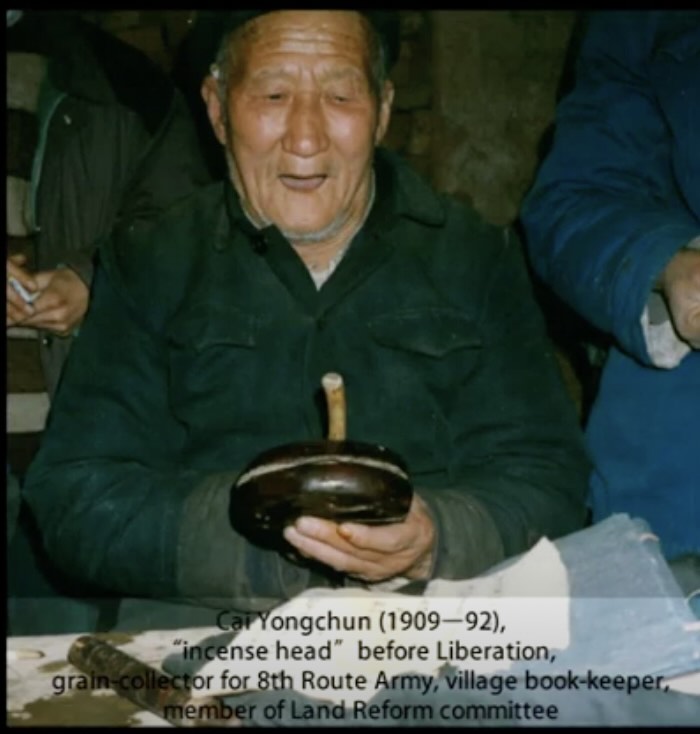
Masters of the vocal liturgy: left, Cai Yongchun; right, Li Wenbin.

As to the ritual specialists, while they practise the rituals with considerable intensity, few of them claim to “believe” deeply in the gods. This is a difficult area—my efforts to elicit insights often recall Nigel Barley’s bemusement in Cameroon. Genial Shan Yude, himself a member of the “civil altar” reciting the scriptures, recalled the previous generation frankly: “Cai Fuxiang didn’t really believe, he just learned the liturgy when he was young and got attached to it, like me; he was a Party member. Cai Yongchun believed—he didn’t join the Party.” In these cases there seemed to be a certain negative correlation between Party membership and religious faith.

But it was complex, for few sought or gained admission to the Party, but many more, including Cai Yongchun, were leading participants in the revolution. Anyway, after Cai Fuxiang’s decline, his belief in the gods, or the habit of ritual, endured, but that was not the cause of his later expulsion from the Party. And there were some people, whether Party members or not, who had no time for religious traditions at all, like Shan Yude’s own father: “He didn’t believe in any gods—he was always doing things for the Party, but he didn’t join.” But throughout the area we have found leading local Communist cadres preserving the tradition of reciting their villages’ ritual manuals. People like Li Wenbin and He Qing perceived no conflict between worshipping the gods and supporting Mao’s broad social goals. Whether or not they joined the Party, people’s commitment to the new society was just one element in their psychological make-up: there was no simple correlation between religious belief and identification with the ideals of the new society.

Shan Yude also claimed “Most people in this area aren’t so superstitious, but my grandparents’ generation was more devout.” This may be broadly true: on the Hebei plain, so near the modern ideas of Beijing, faith may have declined more over the 20th century—gradually, note, not abruptly upon Liberation—than in some more remote mountainous regions of inland central China. But again the point needs qualifying. As we saw, belief was already variable among the previous generation of ritual specialists, and continues to be so today. Cai Haizeng’s father Cai Fulü practised the rituals, but with no great commitment; but now, villagers say, Haizeng is a believer, certainly more than his father. Yude himself observed, “Cai Ran and Haizeng are more devout than me. He Qing also believed, but he had a lively mind.”

Yude even admits to not believing at all, like his father. Still, if so, then he practises the ritual with utter commitment: we should distinguish belief in gods and belief in tradition, in the morality of convention. Cai Yurun made a comment that reveals the new social tolerance: “whether villagers believe or not, it’s harmless”. Though it was only officially considered harmless after about 1980, under the Maoist climate of the previous decades private worship might have become rarer, but belief was hard to assess; after all, public rituals had persisted. Very limited scientific advances and an increasingly secular climate had only partially obviated the need for the gods, and people continued to feel vulnerable.

A facile comparison with Europe springs to mind. Regional variations in industrialisation and literacy may partly explain different levels of religious belief, but within particular societies, and between generations, the situation is uneven; north Italy may generally be less “superstitious” than south Italy, but young and old people in both regions may or may not believe. Our problem for China is to recognise variation and put the supposedly dominant control of ideology in perspective. […]

Cai Yurun pointed out: “The saying goes that when they’re folded away the god paintings are just cloth, but when they’re hung out they’re gods. Don’t pay too much attention to our bullshitting normally—as soon as we Open the Altar we’re pretty serious.”

guanfang 1998The lantern tent, New Year 1998, with new and newly-copied donors’ lists.

On pp.304–5 I observed:

As to ordinary villagers, though there are more women than men offering incense, quite few of the people are elderly: young and middle-aged women and young men seem to be more active in this. Many pray silently to the goddess Houtu for a healthy son, or for the health of their aged parents; more generally, people pray for good luck and prosperity. One couple were offering incense for the safety of the husband, who is a driver—even for the most diehard atheist, recourse to divine help is particularly tempting on Chinese roads. The atmosphere is highly jocular as people enter the courtyard. As they go to offer incense and kowtow they look embarrassed, but then when they are actually doing it they become extremely serious. Then as they get up and dust down their trousers, they look all embarrassed again, and, avoiding meeting the gaze of all the onlookers, they leave the area, often going into the “temple”.

So in many such villages over previous decades, the driving force behind the maintenance of ritual practice seems to have become not so much “religious belief” (itself an alien term) as the “old rules” (lao guiju 老规矩) of tradition. Devotional associations provide ritual as a service for the needs of the community. Under “Note on sources” in my introduction to these groups, see also my articles “Chinese ritual music under Mao and Deng” (1999) and “Revival in crisis” (2010).

Besides groups like these, this may even apply to occupational groups of household Daoists such as the Li family in north Shanxi. With the Maoist decades followed by the assaults of popular media and migration, ritual groups in some regions (including Hebei) are now further vulnerable to the secularised commodifications of the Intangible Cultural Heritage. But it would be interesting if one could somehow compare communities further south like Fujian (see under “Elsewhere” in main Menu), where religious faith appears to be a still more pervasive catalyst for popular culture. And of course faith in the gods is still evident in the popularity of spirit mediums, pilgrimages, and so on.

See also Catherine Bell on ritual.

The tenacity of local ritual traditions

Screenshot

Pondering the wider significance of my new film on the 1995 New Year’s rituals in Gaoluo, it strikes me that a major theme is the tenacity of mainland Chinese peasant communities in maintaining their ritual traditions “amidst massacre, invasion, civil war, famine, political campaigns, theft, destruction, banditry, and religious rivalry”—a history detailed in Plucking the winds.

It’s a theme I noted in this post with reference to the different modern histories of the PRC and Taiwan, and it’s all the more relevant today amidst the sanitised packaging of traditional expressive culture from the Intangible Cultural Heritage.


A new menu!

umbrella

Now that I’ve supplemented my  portrait film of Li Manshan with precious footage from the 1995 New Year’s rituals in Gaoluo, I feel it’s time to rearrange the deckchairs on the Titanic by revamping the Menu.

Here’s an instance of the submenus:

Screenshot

With a personal selection of some main topics, I hope it’s now more user-friendly. It’s work in progress, and doubtless I will continue refining it in the coming months, so please Bear With while I edit links throughout the site. It may take us all a while to get used to it—do keep using the search box too.

The new sequence (with many sub-menus to explore) goes

  • Home (also under reconstruction!)
  • POSTS
  • Li family Daoists
  • Gaoluo
  • Hebei
  • Elsewhere (Shaanbei, Gansu, Fujian…)
  • Themes (Zhengyi/Quanzhen, Fieldwork, Ritual, Famine…)
  • Roundups (including folk traditions around the world)
  • Western Art Music

Good luck! Feedback welcome.

Gaoluo 1995: new film!

Screenshot

YAYY, I’ve finally got round to publishing my new documentary on the 1995 New Year’s rituals in the village of Gaoluo just south of Beijing!!! Click *here* for the film and commentary—a page under the new Gaoluo rubric that now forms part of a totally revamped Menu. The film link is to my (currently small but perfectly formed) YouTube channel.

China not forgotten!

Over a summer hardly bathed in sunshine, but enlivened by football, tennis, Istanbul, and Proms, it may look as if I’m somewhat neglecting China. Still, just since May, posts include

China even plays a cameo role in

Actually, that should be enough to keep you busy (not to mention all the fieldnotes under Local ritual)—indeed, a little break might be welcome… I’m working on several new essays for my site, but in the interim I regularly post on Twitter—other recent China retweets including

Coming up soon is a reminder of a crucial theme, still little addressed:

It’s always worth reminding people of my work on the Li family Daoists:

And we should bear in mind the alternative perspectives of Tibetan, Uyghur, and Taiwanese cultures.

There’s a certain random quality to the topics of some of these retweets, but as with my original articles, I like to keep people guessing, and to remind readers of posts which may have escaped attention, or seem particularly apposite. So you may care to check my Twitter feed, or even “follow” me there…

The male dominance of public performing

heying

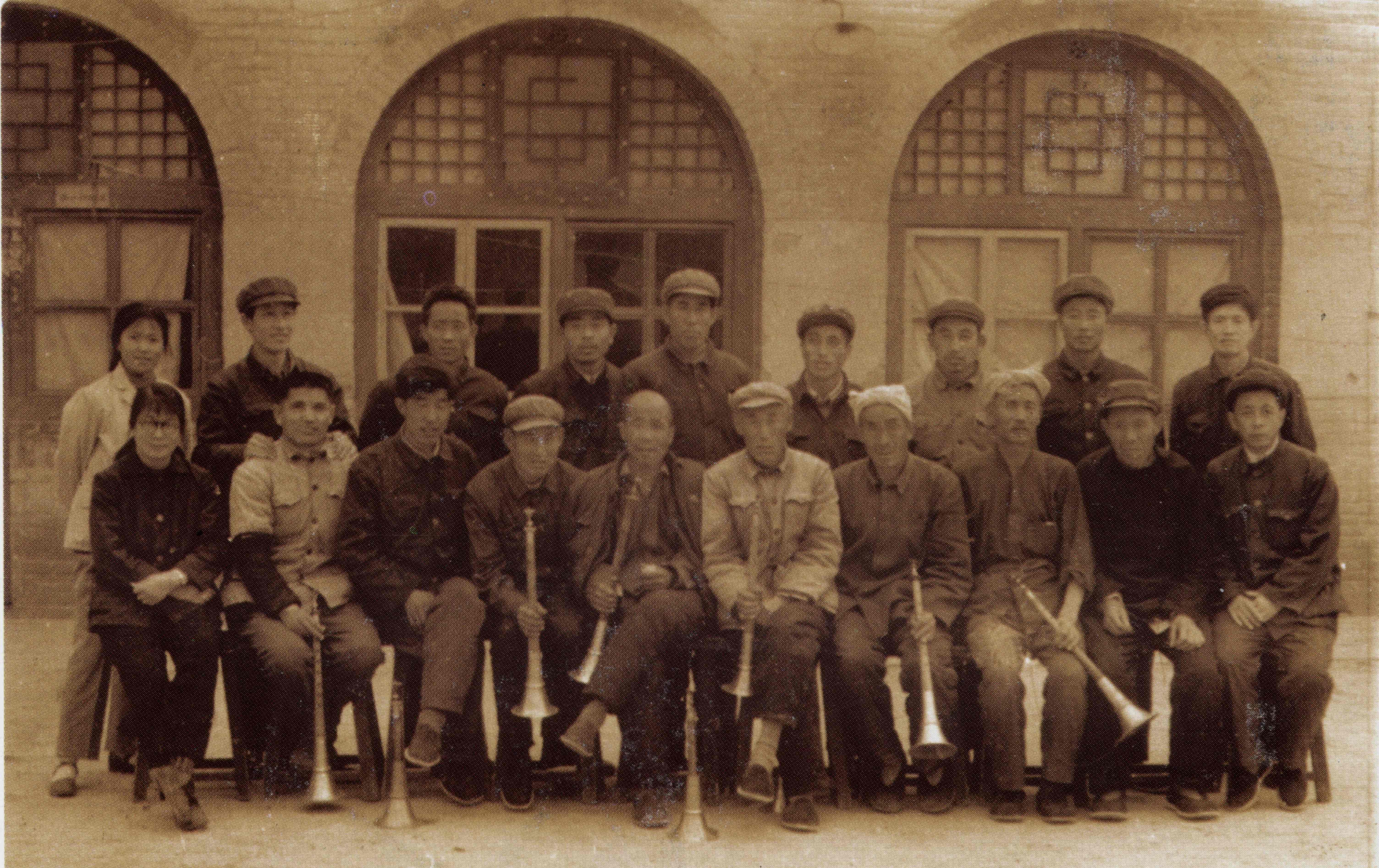
Members and helpers of the South Gaoluo ritual assocation, 1995.

This group photo, taken on the final day of the New Year’s rituals, is deeply nostalgic for me—but it makes a stark reminder of the male dominance of public performing in China.

Women in public performance:
left, Herat, 1970s
right, spirit medium, Houshan 1993.

Gender is one of the main themes in ethnomusicology (as in all Walks of Life…)—see a very basic sample of readings under this post in my flamenco series. I introduced gender issues in expressive culture and ritual in China here, including shawm bands, opera troupes, itinerant bards, and spirit mediums. The old public/domestic division of labour serves as a simple framework.

Two astounding—yet male—performances:
left, Bernstein with the LSO, 1973
right, Kleiber with the Vienna Phil, 1991.

Much has been written on gender in the rarefied echelons of WAM: whereas female soloists have long been common, the male monopoly of conducting has only been broken in recent years. And as to the orchestral musicians…

Maybe we take this for granted in old videos, as I guess we did at the time, but now I’m shocked when I watch the amazing films of Bernstein’s Mahler. When he performed Mahler 2 with the LSO in 1973, the orchestra had only two women (the harpists, of course) among 102 players. By the time they recorded excerpts for Maestro around 2022, despite going to such lengths to achieve historical authenticity, they inexplicably used the players of today’s LSO, 45% of whom are women. The New York Phil admitted its first female section player in 1966; by 1992 it included 29 women.

The Berlin Phil began recruiting the occasional woman in 1982, but by 2003 there were only 14 female members out of 120 positions. The Vienna Phil made a token effort from 1997, but by 2013 still had only 6 women, and 17% by 2024. (For the disturbing Nazi histories of these two orchestras, click here.)

See also under Gender: a roundup.

My work on Gaoluo: recent Chinese attention

There is no such thing as art that is detached from or independent of politics

—Mao Zedong

WeChat heading

For those with access to WeChat, the CDTM音网 public account there is clearly a major resource for Chinese music studies. On their recent post is a substantial introduction to my 2004 book Plucking the winds, a diachronic ethnography of ritual life in Gaoluo village just south of Beijing (see this roundup)—just as I finally get round to working on a new film on the 1995 New Year’s rituals there!

The WeChat article is based on a review of my book by Zhang Lili—though it was originally published in 2019, she is more thoroughly familiar with my work on Gaoluo than anyone in China, and the CDTM editors have done an attractive job, adding colour images as well as tracks from the audio CD that comes with my book.

While I’m both honoured and diffident at finding Chinese scholars taking note of my work, I like to cite the (satirical) saying 外来的和尚会念经 “The monk from outside knows how to recite the scriptures”: after all, there are plenty of fine Chinese ethnographers from whom we can learn (such as Guo Yuhua and Xiao Mei).

And it reminds me how hard it is for PRC scholars to absorb Chairman Mao’s wise words “There is no such thing as art that is detached from or independent of politics”. I addressed this issue in the Coda of Plucking the winds (pp.344–355; Chinese translation in Zhongguo yinyuexue  2005/3), and in this post on self-censorship.

Through the period that I was doing fieldwork, I came to feel that such topics were not entirely out of bounds in the PRC, but now I understand that it is increasingly impossible to air them. This is not the fault of Chinese scholars—even before any higher authority can censor their work, they instinctively censor themselves (cf. Tibet: ritual singing in an Amdo community).

So in China, all this talk of “social context” largely steers clear of politics. The WeChat review mentions “campaigns” in passing, but at the heart of my historical account is the travails of the Maoist decades: the trauma of collectivisation, the breakdown of revolutionary hero and vocal liturgist Cai Fuxiang, the famine, the brief revival of 1961–64 before the Four Cleanups and Cultural Revolution. A good introduction to these themes, based on my book, is my post South Gaoluo: a tribute to two ritual leaders.

In the earlier chapters of Plucking the winds, other topics that PRC scholars instinctively downplay (again, quite understandably) are the 1900 Boxer massacre and the story of the Catholics. I also emphasise the support of village cadres—through all regimes—for their local cultures. And I continue to observe crises and conflicts for the period since I made my base in Gaoluo—theft, ideological disputes within the association, and so on.

South Gaoluo:
left, the 1930 donors’ list;
right, the 1931 Catholic church.

So if Chinese musicologists are indeed searching for what is special about my work, how it differs from that of their own, then it is this inclusion of politics in the story. * If my book has any importance, then that is it; it could point the way for Chinese scholars, but in the current climate, such a perspective can only remain opaque. I’m not complaining, and I’m not so naive as to expect more coverage of these topics in China—just saying, like… And perhaps my own emphasis on politics in my posts on this blog is in part an attempt to fill the gap (e.g. Memory, music, society, and Gansu: connecting social trauma and expressive culture).

sgl-oldies

Senior members of the ritual association, 1995.

* * *

Another recurring theme of mine is that research on such groups shouldn’t be confined to musicological circles (see e.g. Unpacking “Daoist music”). As I explain in my overview of our Hebei project, despite the misleading name yinyuehui 音樂會, these are ritual organizations, and as such they are the proper subject of scholars of folk religion (ample evidence in our fieldnotes, under “Hebei” in the Menu). At the same time, as I also keep saying, soundscape should always be a major aspect of such study.

So yet again I find myself having to bang on about that term yinyuehui! Having used the literal translation “Music Associations” in Plucking the winds, I later avoided the term, since both its components are likely to confuse urban-educated people:

  • yinyue 音樂 refers not to any “music” (and certainly not to any secular music), but strictly to the solemn shengguan wind ensemble that serves funerals and calendrical rituals in conjunction with vocal liturgy and percussion—all transmitted via Buddhist and Daoist temples. Sure, that’s quite a mouthful…
  • nor is hui 會 a secular term—it’s not an “association” in the modern sense of xiehui 协会 (as in “Chinese Musicians’ Association”, and so on), nor is it a cosy amateur entertainment “club”; rather, it’s the hui of huidaomen 會道門, so they are ritual organizations descended from sectarian groups (such as Hunyuan, Hongyang, and LaoFomen) under the umbrella term of “White Lotus” religion. (The term huidaomen, of course, may alarm timid PRC students, since CCP propaganda generally prefixes it with the adjective “reactionary”!)

So a narrow focus on “music” entirely fails to capture the essence of these ritual groups. Yet besides politics, folk religion too is an increasingly sensitive issue in the PRC; scholarship there looks ever more sanitised.

The CDTM editors prepared the review with impressive urgency, and I didn’t have time to haggle over the title—to better reflect my own approach to the topic, I might have suggested

The travails and soundscape of folk religion in north Chinese society
华北民间宗教社会活动的风波与音声


* Perhaps I should specify. In Western studies of Chinese music, I feel that the ideology of elite theorists plays an excessive role, from the writings of Confucius to textual sources on the Tang court, Ming imperial Daoism, and notably the revolutionary operas and songs of the Maoist era. What I discuss is not that whole apparatus, but thick ethnographic description of the impact of campaigns on the lives of ordinary people and the ability of grassroots communities to maintain their local traditions.

New film in the making: Gaoluo, New Year 1995

PTW cover

Our fieldwork through the 1990s documenting amateur ritual associations in villages on the Hebei plain bore fruit in my book Plucking the winds (2004), a diachronic ethnography of the village of Gaoluo in Laishui county, on which you can find many posts here. It’s recently been the subject of a new wave of attention in China.

The book comes with an audio CD—but its taken me all this time (Like, Hello?) to realise that from my video footage I could create a beautiful film devoted entirely to the 1995 New Year’s rituals around 1st moon 15th—my first extended stay in the village.

So I’m admiring the creative editing skills of the splendid Andrea Cavazzuti 老安, himself a fine film-maker. Long resident in Beijing (see this interview; for his photos from the early 80s, click here), and an old friend of the Li family Daoists in Shanxi, he’s currently spending time in Milan, so I’ve just spent a few intensive days with him there crafting a rough cut, while relishing the joys of Italy after a long absence.

It’s been inspiring to revisit the 1995 footage, nostalgic to recall the kindness and good humour of the villagers, and fascinating to collaborate in editing.

gl baihui 98

Alongside the “heat and bustle” (cf. Chau, Religion in China, pp.67–8) of the village’s four ritual associations exchanging New Year’s greetings as they parade to their respective “lantern tents” adorned with exquisite god images, are the shengguan wind ensemble, the “civil altar” (wentan 文壇) singing hymns (as well as the Houtu precious scroll)—and in particular the moving, exhilarating percussion suite, led by the great Cai An. It’s also moving to see senior masters like He Yi, Li Shutong, and Yan Wenyu, who maintained the village’s ritual life through the tribulations of Maoism. But ritual activities in Gaoluo already belong to another era…

UPDATE: you can now watch the film here, making a worthy companion to my portrait film on the Li family Daoists!

Precious scrolls: some background

Precious scrolls of village ritual associations near Houshan, Hebei:
left, “Demon-queller scroll”, Lijiafen;
right, “Ten Kings scroll”, Jijiagou.

My sideline in “precious scrolls” (baojuan 寶卷) [1] goes back to our 1990s’ field project on the central Hebei plain, when we were impressed to find a substantial treasure-trove of early editions in villages of Yixian and Laishui counties—and particularly to witness them still being performed by the liturgists of amateur ritual associations there (see under The Houshan Daoists and The Houtu precious scroll).

While the central Hebei plain, and the living performance of its early sectarian scriptures, remain my main focus in baojuan studies, after this recent note on the traditions of Gansu my wider interest has been further piqued by the latest in a succession of anthologies:

whose 50 volumes contain 150 precious scrolls, each with an introductory synopsis. They belong mainly to sectarian groups such as Wuwei 無為, Huangtian dao 黄天道, Xi Dacheng jiao 西大乘教, and Hongyang jiao 弘阳教 / Hunyuan jiao 混元教, many of which feature in our fieldnotes on Local ritual in Hebei (see e.g. Ritual groups of Jinghai).

baojuan cuibian

As instances of texts that we found in rural Hebei, vols. 24 and 25 comprise six editions of the “Demon-queller scroll”  Huguo youmin Fumo baojuan 護國佑民伏魔寶卷, performed until recently for mortuary rituals in villages around Houshan. Of early printed scrolls that we found in Gaoluo village, the “White Clothes scroll” Xiaoshi Baiyi Guanyin pusa song ying’er xiasheng baojuan 銷釋白衣觀音菩薩送嬰兒下生寶卷 is in vol.29, and the Fuguo zhenzhai lingying Zaowang baojuan 富國鎮宅靈應竈王寶卷 in vol.38 (cf. the Gaoluo editions, from 1745 and 1720 respectively). The compendium also includes the “Dizang scroll” 地藏王菩薩執掌幽冥寶卷 (vol.29) and “Ten Kings scroll” 泰山東嶽十王寶卷 (vol.30), preserved by nearby village ritual associations in early editions. In this region at least, the most commonly performed scrolls address the major preoccupations of Chinese villagers: birth (to Guanyin and Houtu), and death (to Demon-queller, Dizang, and the Ten Kings). 

* * *

I can’t keep up with the “baojuan fever” that has grown since the 1990s. These notes serve as much for my benefit than yours—rather, perhaps, we constantly seek to refine and clarify our earlier studies.

Baojuan is an umbrella term for a range of texts. Many scholars have considered baojuan more as “folk literature”, or as a textual window onto early sectarian religion, than as a living performance tradition. Pu Wenqi’s own long-term research set forth from studying sectarian (if not always “secret”) folk religion in north China—under the aegis of the great Li Shiyu 李世瑜 (1922–2010); and it was Li Shiyu who blazed a trail in unpacking structural elements of baojuan in ritual performance, which are among the many themes discussed by later specialists.

The research paths of scholars have depended largely on which among the diverse types of baojuan were prevalent in their own region and to which they had access (cf. “blind people groping at the elephant“). As a broad outline, the early “religious” style has mainly been found near Beijing, while later “folk” texts are common in east-central China and the northwest.

Actually, in my earlier posts (based on Plucking the winds, and Appendix 3 of In search of the folk Daoists of north China) I appear to have had a basic grasp of the place of the Hebei scrolls in baojuan studies. As I noted, “while scholarship on the precious scrolls has tended to be more historical and sinological than contemporary and ethnographic”, “the whole point of these precious scrolls is that they are performed for rituals—they’re not musty tomes to be read silently in libraries.” What struck me about the Hebei scrolls was that they belonged very much to the early “religious” type of baojuan, but were still part of a living tradition—most performers we met were liturgists within ascriptive village-wide ritual associations, which had sectarian connections within living memory. And we found the classic structure of early religious baojuan to which Li Shiyu drew attention in 1957: 24 chapters (pin or fen ), each incorporating ten-word form, qupai labeled melodies, and so on (see under The Houtu precious scroll).

Of course, just as baojuan only constitute only one small sub-head among the vast mass of Daoist and Buddhist scriptures, they were just one component of the manuals performed by the liturgists whom we visited (see A tribute to two vocal liturgists, Gaoluo: vocal liturgists, Funerals in Hebei). (And zooming out still further, as Adam Yuet Chau reminds us, we need to overcome the hegemony of discursive/scriptural texts, when so much of the meaning of religious activity in society is relational and non-literate!)

Background
Early advocates for the study of baojuan were Gu Jiegang from 1924, and Zheng Zhenduo 郑振铎, inspiring a succession of articles in the 1930s and 40s. In the first catalogue, published in 1951, Fu Xihua 傅惜华 listed 246 scrolls in Baojuan zonglu 宝卷总录—the same title that Li Shiyu used for his 1960 catalogue, listing 618 scrolls in 1,487 editions.

Since the 1980s, as baojuan came out into the open both in performance and research, scholars have reflected further on origins and classification. Two authoritative figures in baojuan studies are Pu Wenqi 濮文起 and Che Xilun 车锡伦. Following Che Xilun’s useful 2001 retrospective, his major book Zhongguo baojuan yanjiu 中国宝卷研究 (2009) contains both an overview and case studies. Similarly, alongside chapters on specific themes, Pu Wenqi and Li Yongping 李永平 eds., Baojuan yanjiu 宝卷研究 (2019), includes surveys by Pu Wenqi himself and by Wang Mingbo 王明博 and Li Guisheng 李贵生. In English, the detailed studies of Rostislav Berezkin on traditions of baojuan performance in south Jiangsu include useful introductions to the wider topic (cf. my Appendix under Ningxia).

Che Xilun has distinguished “religious baojuan” before the Kangxi reign (1662–1722) from later “folk baojuan”—with subdivisions: [2]

  • A) Before the Kangxi reign: “religious baojuan
    明正德 (1505–21) 以前“佛教世俗化宝卷”:
         “演释佛经”
         “讲唱因缘”
    正德后“民间宗教宝卷”:
         “宣讲教义”
         “讲唱故事”
  • B) After the Kangxi reign: “folk baojuan
    劝世文
    祝祷仪式
    讲唱故事”:
         “神道故事”
         “妇女修行故事”
         “民间传说故事<”
         “俗文学传统故事”
         “时事故事”
    “小卷”

Catalogues and anthologies
By the 1990s, catalogues were expanding significantly, such as

  • Che Xilun, Zhongguo baojuan zongmu 中国宝卷总目 (2000, after a 1998 Taiwan edition), listing 1,585 scrolls in over 5,000 editions.

Wide-ranging anthologies of the texts themselves were also published, such as

  • Wang Jianchuan 王见川 and Lin Wanchuan 林万传 (eds), Ming-Qing minjian zongjiao jingjuan wenxian 明清民间宗教经卷文献 (1991) (12 vols, 207 texts) and the 2006 sequel edited by Wang Jianchuan, Che Xilun, et al. (12 vols, 204 texts), mostly consisting of baojuan.
  • Zhang Xishun 张希舜 et al. (eds), Baojuan chuji 宝卷初集 (1994) (40 vols, 153 texts).
  • Zhongguo zongjiao lishi wenxian jicheng weiyuanhui 中国宗教历史文献集成编委会 (Pu Wenqi!) (ed.), Minjian baojuan 民间宝卷 (2005) (20 vols, 357 texts).

Ma baojuan

Ma Xisha 马西沙, another long-term scholar of folk sectarian religion, has also addressed baojuan, including the major anthology

  • Zhonghua zhenben baojuan 中华珍本宝卷 (2013) contains 30 vols, with 138 texts,

before Pu Wenqi’s recent collection with which I opened this survey.

Regional fieldwork and research
Much of the collection work has long consisted in editing baojuan held in libraries and private collections, but fieldwork became an increasingly important source of texts—often bringing further insights from observing living performance (in another useful overview, see §3 and §5 here).

There had been a few such projects under Maoism, in a period when both performance and research were becoming increasingly risky (cf. the work of Yang Yinliu and his colleagues at the Music Research Institute in Beijing). [3] But fieldwork could only begin in earnest with the liberal reform era since the 1980s. Around Tianjin and further afield, Li Shiyu resumed his work with alacrity—now with a keen disciple in Pu Wenqi.

baojuan Berezkin
From Rostislav Berezkin, “Scripture-telling (jiangjing) in the Zhangjiagang area
and the history of Chinese storytelling”
(2011).

South Jiangsu and Zhejiang became popular sites for fieldwork, with a particular focus on ritual groups around the Suzhou region, notably Jingjiang (see here, and n.1 here). Again, many texts were published, [4] and fieldwork encouraged scholars to observe actual performance practice—often in the context of zuohui 做会 religious gatherings. In English, after a 2001 article by Mark Bender on the Jingjiang tradition, Rostislav Berezkin has expanded the field in a series of detailed articles.

Another lively site for baojuan studies was the Hexi corridor of Gansu (here I cited this recent survey by Cheng Guojun 程国君). Local cultural workers such as Duan Ping 段平 and Fang Buhe 方步和 were early collectors. [5] The numinous ancient site of Dunhuang tempted some researchers to embroider a connection with early bianwen religious narratives there—a tendency (akin to the persistent “living fossil” shtick, and further mired in romantic fantasies of the Tang and Silk Road) that Che Xilun disputed in his 1999 article “Ming-Qing minjian zongjiao yu Gansude nianjuan he baojuan” 明清民间宗教与甘肃的念卷和宝卷. Nearby, baojuan traditions were also discovered in the Mani assemblies 嘛呢会 of largely Tibetan areas of eastern Qinghai (see e.g. Liu Yonghong 刘永红, Qinghai baojuan yanjiu 青海宝卷研究, 2013); see also under Ningxia.

The baojuan of south Jiangsu and Gansu, while numerous (and again based in ritual performance), are mostly in the later “folk” style, not so early as the early 24-chapter sectarian scrolls that we found on the Hebei plain. For north China, besides Pu Wenqi, other scholars paying attention to the latter kind of baojuan include Cao Xinyu, Yin Hubin 尹虎彬, and Liang Jingzhi 梁景之.

In the great Anthology of folk music of the Chinese peoples, baojuan falls within the scope of the relevant provincial volumes for narrative-singing: Zhongguo quyi yinyue jicheng 中国曲艺音乐集成, and particularly the historical material of Zhongguo quyi zhi 中国曲艺志 (see e.g. under Famine and expressive culture). Foreign scholars of baojuan include Daniel Overmyer (for north China), Rostislav Berezkin (south Jiangsu), Victor Mair and Wilt Idema (Gansu).

As always, silent library study cries out (sic) to be enriched by documenting the soundscape and bustle of ritual in social life (cf. More films). To complement the vast corpus of published texts, and textual studies of their ritual context, even a modest collection of audio/video recordings of baojuan in folk performance is most desirable (my usual caveat: I refer to field recordings, rather than the reified, sanitised staged versions of the Intangible Cultural Heritage project!). The CD with my 2004 book Plucking the winds has a paltry two audio tracks from the Houtu scroll (one of which features on the playlist on this blog, with commentary here—and I look forward to making a new documentary on the 1995 New Year’s rituals in Gaoluo!!!). And click here for a video clip from a ritual performance by a group in Shaoxing.


[1] Though I use the term “precious scrolls”, which has attained a certain niche currency, allow me to repeat Dan Overmyer’s observation (n.3 here) that baojuan is more properly rendered as “precious volumes”.

[2] I’m not sure how useful is Che Xilun’s further distinction between “literary” and “non-literary” baojuan (按照宝卷的内容和题材,又可将宝卷分为文学宝卷(包括各个时期讲唱故事的宝卷及民间宝卷中的小卷和部分祝祷仪式宝卷)、非文学宝卷(包括宗教宝卷中演释佛经”“宣讲教义的宝卷和民间宝卷中的劝世文及部分祝祷仪式宝卷)两大类。)

[3] In south Jiangsu, Jiangsu nanbu minjian xiqu shuochang yinyue ji 江苏南部民间戏曲说唱音乐集 (1955) was part of a project collecting material on opera and narrative-singing. And for Jiexiu in Shanxi, Zhang Han 张颔, Shanxi minjian liuchuande baojuan chaoben 山西民间流传的宝卷抄本 (1957) used material collected in 1946—see also Li Yu 李豫, Shanxi Jiexiu Zhanglan diqu baojuan wenxue diaocha baogao 山西介休张兰地区宝卷文学调查报告 (2010), and the chapter by Sun Hongliang 孙鸿亮 in Baojuan yanjiu.

[4] E.g. Zhongguo Heyang baojuan ji 中国河阳宝卷集 (2007); You Hong 尤红  et al. eds, Zhongguo Jingjiang baojuan 中国靖江宝卷 (2007); Lu Yongfeng 陆永峰 and Che Xilun 车锡伦 eds, Jingjiang baojuan yanjiu 靖江宝卷研究, 2008; Che Xilun ed., Zhongguo minjian baojuan wenxian jicheng, Jiangsu Wuxi juan 中国民间宝卷文献集成·江苏无锡卷 (2014, 15 vols).

[5] As in all walks of life, both performers and scholars bore the scars of Maoist campaigns. Following her tribulations around 1960 as one of the Spark protesters blowing the whistle on the famine, Tan Chanxue 谭禅雪 was based from 1982 to 1998 at the Dunhuang Research Institute, where as part of her studies of Dunhuang folklore she published articles on, and editions of, baojuan.

China’s hidden century

Following the flummery of the Coronation, I keep finding myself perplexed by the ways in which elites dominate images of society.

BM catalogue
Exhibition catalogue.

The new exhibition at the British Museum, China’s hidden century, is a splendid idea. If the Qing dynasty is a poor cousin of the Ming, the 19th century has suffered by comparison with the long and glorious early-Qing reigns of the Kangxi (1661–1722) and Qianlong (1736–95) emperors. So it’s a worthy mission to reinstate the period, “often defined—and dismissed—as an era of cultural decline”, amidst economic crisis, uprisings, and foreign invasion. The Opium Wars of the 1840s marked the beginning of a “century of humiliation”, the late Qing making one of several instances of hitherto thriving empires that now suffered in turn at the hands of foreign imperialism (cf. Pankaj Mishra on the wider context of Ottoman modernization, at end of this post).

Attending a preview of the BM exhibition, I’m reminded that museums and art galleries, and indeed libraries, depend largely on material that reflects the values of a tiny minority of urban educated people (mainly men). This approach was long standard for most societies, but it’s clearly one that more recent historians have been seeking to refine. And of course, like books, artefacts are silent and immobile. Now I don’t mean to give you another of my “What About the Workers?” rants; I quite understand the brief of museums, and the culture of elite minorities has a rightful place alongside those of other social groups. But as anthropologists and ethnomusicologists seek to engage fully with the “red and fiery” nature of performance in local society, the limitations of both museums and elites soon become apparent (see e.g. Society and soundscape, and What is serious music?!).

yyl-on-xiaoSo I’m grateful to the exhibition for stimulating me to revisit some of my own material from the field. In this I’m always in awe of the incomparable erudition of Yang Yinliu (1899–1984). Brought up in Wuxi during the final years of the Qing dynasty, Yang learned instruments from Daoist priests from the age of six, going on to join the refined Tianyun she society and to become a fine exponent of qin zither, pipa and sanxian plucked lutes, while supplementing his training with an education in Western culture.

In his research he had a rare grasp of both early and later imperial history, and at the helm of the Music Research Institute in Beijing after the 1949 “Liberation” he embodied continuity with Qing traditions of performance and scholarship, as well as directing major fieldwork projects.

Proverb
I’m used to people (often local officials, indeed) citing this saying to explain
the inability of Communist policies to penetrate the countryside (an instance here),
but of course its original usage referred to imperial society.

In her online essay, exhibition curator Jessica Harrison-Hall asks,

How did Chinese cultural creativity demonstrate resilience in the face of unprecedented levels of violence in the long 19th century?

In the countryside some ritual and other performing groups suffered interruptions from warfare. Around Jiangsu, the Taiping rebellion must have disrupted some groups; but rather few local traditions were affected by military conflict, and those that were, recovered quite soon. The ritual association of Hejiaying village just south of Xi’an was caught up in conflict soon after the outbreak of the Hui rebellion in 1862, with instruments and scores destroyed and performers killed. The association was only able to relearn much of its repertoire in 1915 from the nearby village of South Jixian; both groups are still active today. I’d like to learn more about reasons for this remarkably long period of inactivity—much longer, for instance, than that between the 1949 Communist takeover and the 1980s’ reforms.

Xi'an village festival, 1950s.

Xi’an village festival, 1950s.

Through the 19th century a major change in local societies was the arrival of Christian missionaries, vividly documented for Shanxi by Henrietta Harrison. By 1900, as the Qing regime went into terminal decline, tensions with traditional religious communities led to the Boxer uprising, when Catholics around Beijing and Tianjin were massacred (as in Gaoluo)—with village ritual associations supporting the Boxers against the Allied armies. Senior villagers whom we met in the 1990s had heard many stories about the events from their parents.

The exhibition has five main themes: court, military, artists, urban life, and “global Qing”. As the online introduction explains,

The show illuminates the lives of individuals—an empress, a dancer, a soldier, an artist, a housewife, a merchant and a diplomat.
Visitors will glimpse the textures of life in 19th-century China through art, fashion, newspapers, furniture—even soup ingredients. Many people not only survived but thrived in this tumultuous world. New art forms, such as photography and lithographic printing, flourished while technology and transport—the telegraph, electricity, railways—transformed society.

This makes sense as far as it goes; but while seeking to reach beyond the elite, whose culture is only the tip of the iceberg in any era, it can hardly address the poor rural areas where the vast majority of the population lived—so any attempt to broaden the topic rather depends on “going down” to the countryside. The evidence for material and expressive cultures may also invite significantly different perspectives. When Dr Harrison-Hall writes “Representing the millions of people who were not wealthy is a challenge as so little survives”, she refers to the material culture preserved in museums. Among the folk, local traditions of ritual and music that endured throughout the troubled 20th century go back multiple generations; many groups preserve early artefacts such as instruments, scores, ritual paintings, and pennants, but more importantly they transmit life-cycle and calendrical rituals that were being modified in ways that can rarely be glimpsed—even in the wealth of field reports for Hebei, Shanxi, and elsewhere in my series on Local ritual.

Niu JinhuaThis reflects another common difficulty: we often seek to document history through major, exceptional events, whereas for peasants customary life is more routine. And apart from artefacts, much of the history of this (or any) period lies in oral tradition—which doesn’t lend itself so well to exhibitions.

Nor do women play a greater role in the traditions I’m about to outline; while we regularly came across elderly women with bound feet, they had hardly been exposed to the public activities of the village with which we were concerned (for posts on gender in China and elsewhere, click here; right, women of Gaoluo).

Even the rubric of “Qing court music” is already broad.

Qinxue rumenFrom Qinxue rumen (1864), with the innovation of gongche solfeggio
added besides the tablature.

The elite solo art of the qin zither is a close ally of museums, having an intrinsic bond with calligraphy, painting, and poetry. Again, qin scholars tend to focus on tablatures from the Ming and early Qing, but John Thompson’s definitive site lists around fifty such volumes from the 19th century. Within this tiny coterie, collections like the 1864 Qinxue rumen 琴學入門 and the 1876 Tianwen’ge qinpu 天聞閣琴譜 must have been in more common circulation than were early manuscripts.

XSBK
Xiansuo beikao score, copied by Rong Zhai in 1814.

It’s also worth observing that there was constant interplay between folk and elite traditions. In Beijing the Manchu-Mongol court elite, such as prince Rong Zhai, were patrons of lowly blind itinerant street performers, with whom they performed a recreational chamber repertoire. For the 19th century we have names (and not much else) of musicians like the blind sanxian player Zhao Debi, and Wang Xianchen, a protégé of the empress Cixi.

XS early
“Musiciens Chinois. légation a Pékin”, Paul Champion, 1865/1866.

In 19th-century Shanghai, the paraliturgical instrumental ensemble of Daoist temples gave rise to the new secular style of silk-and-bamboo, with amateur clubs thriving right down to today. And we can even listen to recordings of music from the late Qing, such as those made by Berthold Laufer in Beijing and Shanghai. Even later releases (e.g. here) reflect an tradition that was unbroken from those times.

* * *

WTS monks and luohan
Former Buddhist monks from Wutaishan with the exquisite arhat at the British Museum, 1992.

As to local temples, again we tend to focus on early dates when they were founded rather than on their social life thereafter, with steles commemorating their periodic renovation. In the temple network of imperial Beijing, traditions of shengguan ensemble which served ritual were inter-related. The Zhihua temple, built in 1443 as the private temple of a Ming eunuch, is famed for not only for its architecture but for its shengguan music, for which we have a precious gongche score from 1694.

Here it’s worth clarifying a significant misapprehension. As with notations for other genres (for the qin zither, the Beijing entertainment repertoire, or the village ritual groups we meet below), the date of copying was always long after the pieces came into currency. Scores were not consulted during performance, but constituted a prestigious artefact for their custodians. So the 1694 score of the Zhihua temple was not “composed” then; moreover, through the 19th century, long after the temple had lost its imperial prestige, the musical monks (yiseng 藝僧) of a network of Beijing temples continued to exchange and recopy scores—an energy that we can only imagine (I eagerly await the publication of Ju Xi‘s research on the evolution of the temple, in the next volume of the major EFEO series Epigraphy and oral sources of Peking temples). Meanwhile, temples in not so distant towns like Chengde and Shenyang were also acquiring new ritual repertoires.

South of Beijing, most village ritual associations on the Hebei plain seem to have been attracted by the same myths as the elite, tracing their history back to the Kangxi and Qianlong eras, or even the Ming—mostly on the basis of long oral tradition or early artefacts. While fieldworkers tend to dismiss the Chinese scholarly fashion for seeking “living fossils” in local traditions, when we extend our enquiries beyond contemporary observation to the past, perhaps we too are guilty of focusing on such early clues, rather downplaying references to 19th-century reign-periods:

Jiaqing 1796–1820
Daoguang 1821–50
Xianfeng 1850­–61
Tongzhi 1862–74
Guangxu 1875–1908

Yet despite the successive upheavals of the 20th century, visiting such groups in the 1990s we gained an impression of remarkable continuity.

Miaoyin transmission 1920
Recopyings of shengguan scores transmitted by Miaoyin,
including Tongzhi 13th year (1874). Hanzhuang village, Xiongxian, 1920. Photo: 1993.

Mostly we have to imagine Buddhist and Daoist priests arriving in rural temples to invigorate village ritual associations. In villages around Xiongxian county, the Buddhist monk Miaoyin transmitted a magnificent repertoire of shengguan suites in 1787, whose gongche scores were periodically recopied over the following 150 years.

S. Shilipu yunluo
Base of yunluo gong-frame with a Guangxu-era date equivalent to 1903,
South Shilipu ritual association.

Around the Baiyangdian lake, members of the Buddhist-transmitted association of Greater Mazhuang recalled an account in their old scriptures that in the Xianfeng era (1850–61) an elderly monk called Runan, from the Xingfu si temple in Libao village in Mancheng, came here regularly for three years to teach them. Nearby in Xin’anzhuang, a 1990 history of the association lists three changes of pennant over the previous two centuries and more: Daoguang 12th year [1832], Guangxu 3rd year [1877], and Republic 26th year (1937).

Ritual artefacts, South Gaoluo:
left, dragon placard, Guangxu reign 1st year [1875] 3rd moon 15th day,
at the behest of ritual leaders Heng Yun and Shan Wenrong;
right, ritual curtain, 1892.

In the village of Gaoluo, my main fieldsite through the 1990s, a new temple built in 1844 proclaimed the identity of a separate south village. In 1875 a “dragon placard” asserted allegiance to the new emperor, and a ritual curtain from 1892 was still displayed in the lantern tent for the New Year’s rituals in the 1990s (see early history, and ritual images).

Among ritual associations in this region the popular “southern music” that competed with the “classical” shengguan instrumental ensemble is commonly dated to the early 20th century, but Qianminzhuang in Xushui county (later famed during the Great Leap Forward) was among several village associations said to have learned in the Xianfeng era (1850–61) when the Daoist priest Wang Leyun came from Nangong county to transmit the style.

Genealogy of the Li family Daoists, from Li Fu, first in the lineage to learn Daoist ritual
in the 18th century (see also Customs of naming).

Our perspectives change once we engage with living traditions. By the 1990s, when we met senior ritual specialists born around the 1920s, they could often list the names of their forebears back five or more generations. Even if we can rarely do more than document their names, they would naturally feel more of a connection with their grandfathers than with earlier ancestors. For Shanxi, I think of hereditary household Daoist traditions like that of the Li family Daoists in their home village of Upper Liangyuan; if only we could learn more about the life of Li Qing‘s great-grandfather Li Xianrong (c1851–1920s), some of whose ritual manuals the family still preserves.

Left: manual for Presenting the Memorial ritual, copied by Li Xianrong.
Right: Li Manshan discovers temple steles.

Temples continued to be restored throughout the late Qing. The village’s Temple of the God Palace (Fodian miao) fell into disuse after Liberation (see our film, from 08.25), but we found a stele composed  in Guangxu 6th year (1880), the year after the villagers completed a new bell tower and four priests’ rooms in gratitude for the end of a drought following a rain procession in Tongzhi 6th year (1867). But severe droughts again afflicted Shanxi from 1876 to 1879, so perhaps the stele further offered gratitude for this second recovery.

Another instance from Shanxi: we can trace the hereditary transmission of the Zhou lineage of Complete Perfection household Daoists in Shuozhou county. Of the third generation, probably active from the late 18th century, Zhou Laifeng was a temple Daoist, his younger brother Zhou Lailong a household Daoist.

Yuhuang miao ms

Their descendant Zhou Erdan showed us a manuscript Yuhuang shangdi beiji (above, probably copied by his uncle Zhou Fusheng), that reproduces an 1813 stele of the Yuhuang miao temple in Shuozhou town, mentioning the brothers’ fine calligraphy.

Tianjin huanghui tuFrom Qing-dynasty Tianjin Tianhou gong xinghui tu 天津天后宫行會圖.

Yet another instance of a tradition maintained through from the 18th to the 20th centuries is the “imperial assembly” of Tianjin, in this case among folk dharma-drumming associations.

* * *

Wanhe tang 1993
Wanhe tang musicians, 1993, heirs to an illustrious tradition.

As to local traditions of narrative singing and opera, the respective provincial monographs of the great Anthology of folk music of the Chinese peoples (Zhongguo quyi zhi, Zhongguo xiqu zhi) contain much evidence for both material artefacts and oral tradition (e.g n.2 here; further citations in posts under Chinoperl). Near Suzhou, the Wanhe tang Kunqu association was founded in the second half of the 19th century, performing largely for life-cycle ceremonies.

In Shaanbei, the Yulin “little pieces” are said to have been transmitted outside the regional court in the Daoguang era (1821–50) by Li Diankui and his son Li Fang—and the brief biographies throughout the volumes of the Anthology introduce many locally-renowned 19th-century performers. The style of the “little pieces” is thought to be influenced by opera troupes brought by Qing-dynasty regional governors from the Jiangnan region; some local scholars claim that it was based on the opera of Hunan, which may have been brought during the Tongzhi reign (1862–74) by a company attached to a division of Zuo Zongtang’s Hunan army on campaign in the region.

nanyin 86
Nanyin in Quanzhou, 1986.

Further evidence is to be found in the riches of Hokkien culture of south Fujian, such as the exquisite nanguan (nanyin) ballads—the study of which is again rooted in the search for early origins rather than its vibrant later life. Similarly, scholars of  Daoist ritual set their sights firmly on Tang and Song texts, but monographs on local household altars around south China also contain material on 19th century transmissions, including particularly rich collections of ritual paintings and manuals.

Huapencun 2Mural (detail), Shrine to Lord Guan, Huapen village, Yanqing, Beijing suburbs, ~1809.

And to return to rural north China, Hannibal Taubes’ extraordinary fieldwork reveals that painters of temple murals were just as creative through the 19th century as in earlier and later periods. As he notes,

Late Qing murals are characterised by strong use of blue and white. While all of the old themes continued to be painted, a variety of new types of painting appeared in this period, some of them seemingly unrelated to anything which had come before. Important new developments include: new genres of opera-stage murals, often incorporating Western architecture, figures, or text; paintings connected to the Yellow River Formation 黃河陣 ritual; and a large number of rather eccentric Buddhist murals commissioned by charismatic wandering monks.

* * *

Given its parameters, the BM exhibition is very fine; here I’ve just offered a few suggestive instances of the potential for documenting grass-roots history through local fieldwork. Much as we may hope to broaden the social base of our enquiries, it’s often hard to say much more than this: despite growing challenges, rural and urban ritual and performing groups, founded in the 18th century or earlier, maintained activity not only through the late Qing and Republican eras, but even after the 1949 “Liberation” and the convulsive campaigns of Maoism. Still, as the exhibition reminds us, it’s important to join up the dots between the late Ming/early Qing and the 20th century; and whether or not we spell it out, the late imperial period makes a constant backdrop to our fieldwork.

Click here for politicised criticisms of the exhibition by Chinese academics.

Attending Greek liturgy in Istanbul

Greek church for blog

Having been impressed by Epiphany at the Greek church near the iskele ferry in Kuzguncuk, recently we got to attend Sunday service at the main Greek church further up the main street (for a fine study of the mahalle‘s multi-ethnic past, see Nostalgia for cosmopolitanism).

Greek church

The Greek population of Istanbul (like other ethnic groups there) having progressively dwindled since the early 20th century, only special feast days attract more than a very few worshippers from around the city.

One might just find the service a sad illustration of the decline of Greek culture in Istanbul, but it made me think. While I’ve long been alienated from prissy, drab Anglican worship, turning as an outsider to Orthodox liturgy (or to any ritual and musical tradition) I’m not in search of the exotic, but I’m drawn to it as if it’s a mystery, not in the sublime sense but like a thriller—trying to work out what’s going on, to decipher its rules.

The distinction between emic and etic perceptions comes into play. Rather than the more spectacular rituals that often attract scholars and visitors, stimulating their mystical romanticism, it’s good to attend normal services to get an impression of ritual as routine. As with the rituals I’ve frequented with Li Manshan’s Daoist band in rural China, one begins to perceive that for those attending it’s partly an obligation, and that for the ritual specialists, to some extent “it’s just a job” (more radically, Frits Staal described ritual as “meaningless”; cf. Catherine Bell). Of course, in both cases there are elements of duty to tradition, even faith; but any “meaning” we impute must be broader than mere doctrine, involving changing social perceptions.

In church the liturgists and assistants do their job unfussily; as in Britain, the little congregation goes through the motions with greater or lesser commitment—it’s a weekly duty. Devout spiritual feelings can’t be taken for granted.

In China, conversely, where the Gaoluo village Daoist/Buddhist ritual association often seemed to be going through the motions, attending vespers in the house church of the Catholic minority there I was struck by their intensity and solidarity, apparently a result of their outlaw status since the 1949 revolution. But whereas the Chinese village Catholics maintain their faith tenaciously, the Greek urban Catholics are a tiny minority overwhelmed in a sea of Islam.

Catholic vespers
Vespers in Gaoluo, 2001.

As to soundscape (the major vehicle for expressing whatever “purpose” there may be to ritual!), the Greek liturgists chant in monophony, with occasional organum, conscientiously alternating solo and choral sections. The tinkling of the thurifer, with the smell of incense, adds a further dimension—which to me remains transporting, though again that’s perhaps not the point.

And without being at all hung up on “living fossils” or Ancient Wisdom, I am somehow inspired by being reminded of a world beyond the dominance of the three-minute pop song, just as the sound of the Muslim call to prayer does more insistently, more publicly (and also routinely). Whereas the silences between phrases of the call to prayer are part of its magic (again, a magic that is not necessarily experienced), in church the liturgy is more continuous; even in melodic material, it reveals a different world from that of the call to prayer or ilahi hymns, though the latter are largely diatonic too.

See also Society and soundscape, and From the holy mountain.

A roundup of roundups!

Apart from my annual surveys (2024 here), I’ve added a tag in the sidebar for roundups, where I group together posts on a particular theme. Whether or not you share my fetish for taxonomy (see e.g. here) and the joys of indexing, as long as you start clicking away on the links (and the links within them…) then this could be a really useful navigational aid!

Note especially

China:

and surveys of my series on

I essayed an inventory of Chinese jokes under

Further global surveys:

Some other themes:

Western Art Music:

—a theme that also makes appearances under World musicking and ethnography:

Popular culture:

Drôlerie:

and

The headscarf, emblem of the Chinese revolution

Images from 1968 (left) and 1980 (right); see here.

In north China the white cloth that male peasants tie around their heads became an emblem of the revolution. The custom long predated the 1949 Liberation, but was another casualty of the collapse of the commune system in the late 1970s.

While the headgear was common throughout the north Chinese countryside, it is often associated with Shaanbei, revolutionary base from the 1930s. In this 1981 group photo from Yulin, only a couple of shawm players were wearing them (see Walking shrill), outnumbered by the peaked caps which were a more modern image of the revolution:

1981 photo

In the hill village of Yangjiagou, here’s the shawm player Chang Bingyou (1916–98), father of our friend Older Brother:

Chang Daye

Though fashion moved slowly in the countryside, by the time I visited Shaanbei in 1999 headscarves were already rare. Here’s the Yangjiagou band at a funeral in 1999:

YJG band

So it was purely in a spirit of nostalgia that we took this photo with Older Brother and Chouxiao in 1999:

YJG trio

But some older people in the region were still wearing the headscarf—here’s a band from Linxian (across the river in Shanxi) at the Baiyunshan temple fair in 2001:

BYS shawm band

Here’s Guo Yuhua with the last Yangjiagou villager still wearing it in 2005:

GYH chat with last headscarfed man

In the countryside south of Beijing, headscarves were also rare in Gaoluo by the 1990s. The wonderful He Yi was virtually the only villager who still wore one:

In the depth of winter villagers often wore protective earflaps:

GL wentan

Vocal liturgists perform for funeral, South Gaoluo 1995.

In Gaoluo even I resorted to headgear, affecting an English proletarian flat ’at.

See also Funerary headgear.

* * *

Meanwhile, a world away from the Chinese revolution:

JEG

English Baroque Soloists rehearsal: see Barbed comments.

The fine line between irony and Looking a Complete Twat is lost on the repugnant Minister for the 18th Century, “eternally trapped in the ridiculous fancy-dress outfit that he once wore for a laugh at a school party” (oh, I said that):

RM

And speaking of Boris Piccaninny Watermelon Letterbox Johnson, here’s an instance of his characteristic gravitas:

BJ hat

Irony was also in full flow during the recent Opening of Parliament, with a crown worth billions of pounds, delivered in a gilded carriage, on display during a speech that neatly sidestepped the cost-of-living crisis (government advice: “Why not try earning more money?”):

Crown

As to clothing, one might note that men are not only free to choose for themselves, but that they are also kind enough to decide on behalf of women.

Well folks, I guess that’s just about it for tonight!

Spirit mediums in China: collected posts

Houshan medium

Spirit medium for the deity Houtu, Houshan temple fair 1993. My photo.

In a post on gender in Chinese religious life I suggested a bold, nay revolutionary, idea:

I wonder how long it might take for us to totally reverse our perspectives on “doing religion” in China—privileging oral, largely non-literate practices and relegating elite discourse (including the whole vast repository of early canonical texts) and temple-dwelling clerics to a subsidiary place?!

In contrast to the more literate manifestations of religious practice in China that dominate sinology, spirit mediums also play an important role in local society (note the useful bibliographies of Philip Clart and Barend ter Haar). The gender ratio varies by region, but in many areas female mediums dominate, serving not only as healers but as protagonists in religious life; for women in particular, becoming a medium gives them a social status that is otherwise unavailable. Their tutelary deities may be either male or female.

me-mot

Me-mot mediums in Guangxi. Photo: Xiao Mei.

This is to draw your attention to a new “mediums” tag in the sidebar. The main posts include

  • Lives of female mediums, introducing studies on Guangxi (XIao Mei) and Wenzhou (Mayfair Yang)—as well as our own work around Hebei and north Shanxi, on which I reflect further in the second post of my series on
  • Women of Yanggao.

And I’ve introduced studies on activity in

as well as

  • the self-mortifying mediums of Amdo (here, and in note here).

Under Maoism, whereas public forms of religious life were vulnerable to political campaigns, the more clandestine activities of mediums were tenacious—indeed, the social and psychological crises of the era ensured that they continued to emerge (see e.g. the work of Ng and Chau above). Still, distribution is patchy; in this post I discussed the decline in Gaoluo village.

For the rituals of mediums in Korea, click here. Further afield, see Taranta, poverty, and exorcism.

One eye open, one eye closed

See Changing ritual artefacts.

A new draft regulation for Shanxi province (Chinese version here), propounding a ban on producing and selling funeral supplies such as paper artefacts, seems to have adverse implications for ritual activity and funeral shops. But it’s not so simple.

Official attempts to restrict “feudal superstition” and traditional funerary observances have a long history—not just under Maoism but through imperial and Republican eras. Indeed, temples have been destroyed and religious activity controlled throughout the 20th century, notably since the Communist takeover, and campaigns continue today.

But in my post on local government interference in Shandong I pondered the gap between rules and practice at local level. Often-heard phrases like “there’s a policy, but it isn’t implemented” and “one eye open, one eye closed” suggest the dilution of state policy as it works its way down to the grassroots, a long chain elegantly encapsulated in the expression yitiao long, “the whole dragon”.

Li Bin’s first funeral shop in town.

While state surveillance of the larger temples and their clerics has escalated since 2016, recent campaigns aimed at folk practice meet with resistance on social media even as they are diluted locally (for another instance, see here). Ritual specialists, their patrons, and local cadres take such official measures in their stride; campaigns blow over—this blog features several examples. Spirit mediums are a regular target of campaigns, but remain popular; and sectarian groups that are still officially proscribed can maintain activity discreetly (for Yanggao, see here).

Earth burial, long targeted, remains standard throughout rural areas like Yanggao, despite the government’s long propounding of cremation. So since “earth burial supplies can still be sold to ethnic minority residents who observe the custom”, it’s unclear if this rider will also apply to the Han Chinese—in which case, there’s nothing new here. And though a renewed attempt to enforce cremation also appears to be on the cards in Yanggao, a local observer reckons earth burial is safe for at least a dozen years yet—by which time the depletion of the rural population will have escalated yet further.

Over the first few years there after the reforms, officials made some attempts to contain the religious revival; but since household Daoists like Li Manshan’s son Li Bin and his colleagues took up the trade in the early 1990s they have practised without interference (see under The Li family Daoists: a roundup).

In my other main fieldsite of Gaoluo south of Beijing, we can see such manoeuvering in the stories of Shan Fuyi’s wedding in 1966 and the 1997 New Year’s rituals after Deng Xiaoping’s death.

Since the 1980s’ liberalisations, both household Daoists and amateur ritual associations have remained largely unaffected by any official prescriptions/proscriptions. More significant in the modification of ritual behaviour are factors such as migration, the changing tastes of local patrons, and the spread of pop music.

So it remains to be seen if the new draft directive for Shanxi will have any practical impact on local activity. While the destructive effects of state policy need to be reported, they may also serve as clickbait that obscures the maintenance of ritual life, which is stressed in detailed field reports from south China (see e.g. here).

Gaoluo: early history

*For main page, click here!*

dengpeng

My first experience of the New Year’s rituals in the Lantern Tent,
South Gaoluo 1989.

Under the Gaoluo sub-menu (Other publications > Gaoluo) I’ve just added a page on the early history of the village, like so:

GL menu

Apart from those pages in that menu, there are many more posts under the Gaoluo tag in the sidebar; for a basic roundup, see here.

My 2004 book Plucking the winds, an ethnography of Gaoluo and its amateur ritual association, mainly concerns the village’s fortunes under Maoism and since. Since history may seem to have been obliterated by the successive turmoils of the 20th century, I felt glad enough to be able to sketch the story as far back as the Republican era and even the late Qing. And thanks largely to talented village litterateur Shan Fuyi (b.1940), I went on to learn clues to the village’s founding in the Yuan–Ming transition and its fortunes through the Qing dynasty. The new page provides notes on the main lineages, local temples, the “parish” 社, “precious scrolls” 寶卷, and early ritual life.

The story of the Republican era continues with Ritual images: Gaoluo. But first, remarkably, a major trauma in the village in May 1900 is substantially documented in official sources, a story told in my post on the village Catholics.

All this was the background to the ritual associations that I got to know through the 1990s. It’s hard enough to reach definitive conclusions about ritual life today, but in this case at least we can observe, and ask…

Gaoluo: vocal liturgists

*For main page, click here!*

This is to direct you to yet another vignette on the ritual association of South Gaoluo, based on my detailed historical ethnography Plucking the winds. Focusing on the transmission of the vocal liturgy through the first fifteen years of Maoism and since the 1980s’ revival, my main purpose here is to illustrate the close relation of ritual and political authority both before and after the Communist revolution, with sketches of the vocal liturgists (“civil altar”) of the association, and their strong hereditary backgrounds, from the 19th right through to the 21st century.

The new page (to be read in conjunction with Two ritual leaders) features the great masters Cai Fuxiang, Cai Yongchun, and Li Wenbin, who steered the vocal liturgy through the early years of the revolution; and their young students from 1961 to 1964, Shan Mingkui, Shan Yude, Cai Ran, and Cai Haizeng, who have represented the “civil altar” in performing for funerals and calendrical rituals since the 1980s.

Do explore the wealth of further material on Gaoluo (as well as its tag) and the many other village ritual associations on the Hebei plain (also in the top menu)!

Epidemics in a Chinese county

Yizhan deng

Hymn A Lantern (Yizhan deng), a meditation on the impermanence of life,
sung before the coffin: see my film, from 27.07, and book, pp.264–6. Cf. the Shunzhi emperor’s poem, also part of the Li family Daoists’ repertoire.

When documenting a local ritual tradition, we need not only to home in on the detail of changing performance practice, but to spread our net quite widely—viewing our particular object of study as part of a system of other nearby ritual groups, as well as considering it within all kinds of social contexts. Changing material conditions tend to feature little in field reports on Daoist ritual (cf. Social issues in rural Hunan.).

In my work on the Li family Daoists in north Shanxi, I have found useful background on local history and culture in the accounts of the 1993 Yanggao county gazetteer (Yanggao xianzhi)—whose details on the Maoist era are far from the bland official depictions of many works of the period (see e.g. here, under “Famine in China”).

Weisheng

Having described the Li family Daoists’ continuing activity during the Coronavirus lockdown, I’m prompted to consult the gazetteer’s section on epidemic control in its chapter on Hygiene.

These villages are the catchment area of household Daoists groups like the Li family. Until the 1950s they performed for temple fairs and domestic rituals of blessing as well as providing all kinds of mortuary services; now they almost exclusively perform the latter. But all three types were responses to the fragility of human life, and it’s worth homing in on the painful progress of disease control through the 20th century. As I read, I think of Li Qing and his colleagues, catering to the ritual needs of their vulnerable village clients.

As we can see from the gazetteer’s chronology of “Major events”, epidemics—along with natural disasters and droughts—are a constant theme throughout imperial history, with high rates of mortality and low life expectancy. From 1884 rapacious wolves and rats caused a plague in the county. (For an ongoing bibliography on epidemics in late imperial China, click here; see also Vincent Goossaert, “Épidémies et religions chinoises”, Éphéméride, July 2020.)

Stores selling Chinese medicine were common in the county-town and rural townships from the Republican era, as folk healers did the rounds of the villages; attempts were made to register them from 1935. On 4th moon 28th household Daoists and opera troupes performed for the temple fairs of the Medicine King deity (for Hebei, see under Bazhou, Xiongxian, and Baiyangdian). Before modern healthcare—and still now, where it still remains unaffordable or unavailable, or is considered only a partial remedy—curing illness has long been a major domain of spirit mediums.

Under Maoism
The story of disease control accompanies that of political campaigns. In chronically poor rural counties like Yanggao, given the extreme poverty inherited by the PRC, progress under Maoism was significant (see e.g. Mobo Gao on his home village in Jiangxi, and, by contrast, Erik Mueggler’s The age of wild ghosts—both cited here). Still, rural dwellers remained terribly vulnerable even after the collapse of the commune system, as illustrated in Liu Hongqing’s harrowing book on blind singers in another Shanxi county.

After Liberation, a system of state-supervised clinics expanded from 1952. But despite their best efforts, the county medical authorities were still desperately short of supplies. Most diseases were identified by the late 1950s, with attempts to bring them under control continuing through the Cultural Revolution (when the system of barefoot doctors pervaded the countryside); but as long as the commune system locked the population into poverty, it was only by the 1980s that such measures became more effective.

Smallpox was attacked after Liberation, but an outbreak occurred in 1963 in Anjiazao village. In 1965, amidst the Four Cleanups campaign, smallpox was reported in the village of Yang Pagoda, whither household Daoist Li Peisen had prudently retreated in the late 1940s in order to avoid political scrutiny. The village was sealed off and houses disinfected.

Measles, a common cause of child mortality, was gradually eradicated. Typhoid had also disappeared by the 1960s, though outbreaks occurred in 1980 and 1983. Hepatitis, tuberculosis, and meningitis, long major causes of mortality, were targets of the medical authorities after Liberation, with campaigns still being waged in the 1980s.

Brucellosis, also affecting livestock, was first identified in a village west of the county-town in 1957. By 1958 over 60 people were afflicted, and by 1959 it had spread to other nearby villages. As it continued to spread, attempts to control it continued from the early 1960s into the Cultural Revolution.

Graves’ disease was also identified in Yanggao in 1958, only declining in the 1980s. The county authorities only began seriously addressing the widespread dental ailment fluorosis in the 1980s. There was a deadly outbreak of cholera in Anjiazao in 1932. A county-wide vaccination programe was initiated in 1952; though it had basically disappeared by the 1970s, it resurfaced in 1983 in Baideng district, home of the Li family Daoists.

* * *

Turning to my other main fieldsite of Gaoluo village south of Beijing, I also consulted the briefer account of epidemic control in the Laishui county gazetteer (2000).

Again, before Liberation, diseases such as smallpox, measles, cholera, malaria, and typhoid were common. In August 1946 an outbreak of cholera struck; among 273 deaths in the county, 99 people died in the village of Kongcun alone—home of a ritual association that we visited in 1993 (see here, under “Other local ritual groups”). Smallpox was eradicated by the 1960s. After an outbreak of measles in 1954, there were further cases in 1962, 1963 (just as village ritual associations were reviving briefly after the famine), 1965, and 1970. Even during our fieldwork in Hebei through the 1990s both I and my colleagues from Beijing were frequently distressed by the vulnerability of peasants to illness.

While the county gazetteers vary in quality, there’s much more to explore in these sections. Such accounts are based on official depictions, and village-by-village fieldwork might still elicit more detailed stories; but all this provides useful background on cultural life before and since Liberation.

For me, incidentally, it makes good practice to expand my Chinese vocabulary; and just as I noted the importance of learning local folk terms for ritual and music, we find a similar popular lexicon for diseases—such as measles (standard mazhen 麻疹), locally known as hongbu 红布 or chai 差.


Coronavirus: mourning Li Wenliang, and blind bards

LWL

WeChat: “In this world there are no heroes descended from heaven, there are only ordinary people who come forward”.

Among the many areas of life in China that are suffering under the lockdown prompted by the Coronavirus outbreak are collective events such as life-cycle and calendrical ceremonies among rural communities.

SGL guiwang

Ghost king, South Gaoluo.

The grand New Year’s rituals from the 12th to the 16th of the 1st moon that take place throughout villages in north China, such as those of Gaoluo village in Laishui county south of Beijing, have had to be cancelled—though their purpose is precisely to “destroy the hundred diseases” (dui baibing 丢百病).

It reminds me of a story that villagers told me about the New Year’s rituals in 1997 (Plucking the winds, pp.317–18: passages below modestly edited). After thefts of the association’s ritual paintings the previous year, the New Year’s rituals now made a focus for a cultural fight-back. In preparation they managed to retrieve some of the paintings handed over the Baoding museum during the Cultural Revolution, and had handsome new donors’ lists (also stolen) rewritten and repainted from my photos, ready to display in the lantern tent.

But just as everyone was preparing for an ostentatious New Year, the death of Premier Deng Xiaoping threatened to disrupt it. A typical bit of mental juggling was now required in order for the village rituals to continue undisturbed. Deng died on the 11th day of the 1st moon in 1997, with remarkable, if uncharacteristic, attention to the rural calendar. When his death was announced, just before the major rituals around the 15th, the “commune” (as they still call the district authorities) dutifully ordered that New Year’s celebrations should be cancelled, and the village brigade had to tell the ritual association not to perform. As one musician confided, “I turns it over in my head: when someone dies in the village, we play for them, so didn’t we oughta be able to play when Deng Xiaoping dies too? So I reckons, how about writing a motto ‘In mourning for Deng Xiaoping’, pasting it up outside the lantern tent, and playing as usual?” The village’s “southern” ritual association followed suit, and the New Year’s rituals went ahead.

I love this story: in order to make sure that Premier Deng’s death will not get in the way of their customary entertainment, they profess respect by pointing out the traditional use of ritual to venerate the dead. As with all the best scams, its sincerity is unassailable. Things had changed a lot in the two decades since Chairman Mao’s death in 1976. Then the ritual association had virtually ceased to exist, and villagers had obeyed central orders without question out of genuine, indeed almost “superstitious”, belief in the Great Helmsman. Since 1978 villagers doubtless had a lot to thank Deng for, but there were ironies. It was thanks to Deng’s liberalizations that the association had been able to revive, but it was threatened by new pressures; it was also thanks to him that people no longer placed blind faith in leadership, and were now disinclined to let his death take priority over their local culture.

Villagers regarded the 1997 New Year as the most lively in living memory, perhaps partly by necessity, to legitimize the association’s new leadership and fight back against the theft of the paintings.

In many regions “rites of affliction” have long been an important part of the repertoire of ritual specialists—serving a symbolic rather than medical function. In the current crisis, however, such large-scale gatherings are unthinkable.

1965 poster campaign combining public hygiene and eliminating superstition: “Incense ash cannot cure disease” and “Human diseases are not an offence of the gods and ghosts”—another reminder (see e.g. here, under “Expressive culture”) that even at such a revolutionary time, plenty of people still thought so.
Source: https://chineseposters.net.

Elaborate funeral rituals, for which among the many locals attending are kin returning from distant parts of the country, have also been put on hold. Still, in Yanggao county in Shanxi, far from both the source of the outbreak in Wuhan and major urban centres like Beijing, the Li family Daoists, individually, are still in demand to provide routine burial services, as I describe here.

On local government websites (e.g. those of Laishui and Yanggao counties) I haven’t yet found any explicit bans on collective ritual activities—only bland, formulaic warnings proclaiming the state’s resolute response to the crisis. But morbidly creative slogans everywhere hammer out the message:

slogan

No visits for New Year this year
Those who come to visit you are enemies
Don’t open the door for enemies.

For the response in Tibetan regions, see e.g. here; and for concerns over Xinjiang, here.

* * *

 Even if folk musical activities are suspended, there are signs that local performers are reflecting the outbreak, in what Confucius would have called “the sentiments of the people” (minqing 民情). First, some background.

I’ve already written at some length about shawm players (many of whom were traditionally visually impaired) and blind bards (see also this roundup for narrative-singing). The blindmens’ propaganda troupe of Zuoquan county in the Taihang mountains of east-central Shanxi has a history dating back to 1938, under Japanese occupation. One of the most illuminating and harrowing books on rural life in north China is

  • Liu Hongqing 刘红庆, Xiangtian er ge: Taihang mangyirende gushi 向天而歌: 太行盲艺人的故事 [Singing to the heavens: stories of blind performers of the Taihang mountains] (2004, with VCD, and abundant photos by Wang Jingchun).

LHQ book

One of innumerable such groups throughout the countryside, the Zuoquan troupe has always adapted to the changing times, from the warfare of the 1940s through Maoism to the reform era. In the latter period they began to perform stories criticising corruption.

The book’s author Liu Hongqing (see e.g. this interview) is the older brother of blind performer Liu Hongquan, whose life features prominently. Though Hongqing escaped the rural life to become a journalist, he kept in regular contact with his family, providing vivid stories of the troupe’s itinerant lifestyle (cf. Li Qing’s stint in the Datong Arts-Work Troupe from 1958 to 1962) and writing with great empathy about the lives of poor peasants.

ZQ pic

Liu Hongqing also pays great attention to the wretched fate of women in a rural area that remained chronically poor under Maoism. Two twins in the troupe had an older sister, four of whose five children were born blind. After she died in 1963 the burden of caring for the whole family fell upon the oldest daughter Chen Xizi, then 15 sui. She too was ill-fated. Her first daughter died at the age of 11 sui after going dumb the previous year; her son, born in 1968, was blind, dumb, and disabled; a second daughter died at the age of 7 sui; and a third daughter was herself left with three daughters at the age of 32 sui after her husband died. But amazingly, Chen Xizi’s youngest son endured great tribulations to become a researcher at Shanghai Communications University—the family’s only hope in an ocean of misery. Chen Xizi’s older brother Xizhao, a fine shawm player who died at the age of 55 sui in 1998, “bought” four wives, all mentally disabled.

After the death of another blind performer in the troupe, his widow had moved in with his younger brother, a common expedient (xuqin 续亲) in poor communities where early deaths were common and widows vulnerable.

Such stories, all too common in rural China (note e.g. Guo Yuhua’s ethnography of a Shaanbei village, and Bards of Henan), make an important corrective to rosy state propaganda, putting into perspective scholarly accounts of machinations within the central leadership; and the fierce, anguished singing and playing of groups like this are utterly remote from the bland, cheery ditties of official troupes.

The Zuoquan performers are instrumentalists too—Liu Hongquan is a fine shawm player (for thoughts on the way shawm-band music reflects suffering, see here). Like others in the troupe, he has taken several adopted sons, forming a network of well-wishers throughout the villages where they perform. Like blind performers in north Shanxi, they had their own secret language (p.69), based on the ancient qiezi 切字 phonetic system.

TQ

Tian Qing (left, in white) with the blind performers of Zuooquan.

The group was soon promoted by eminent cultural pundit Tian Qing (see e.g. here, and this video). Following his visit to Zuoquan they gave their first Beijing performance in 2003. From 2007 the popular TV presenter and director Yani took them to heart, engaging with their lives in a documentary filmed over ten years.

Since being enrolled under the aegis of the Intangible Cultural Heritage, while continuing their itinerant lifestyle performing for rural ceremonial, they have become media celebrities, promoted in regular TV appearances.

But even once absorbed into the state apparatus, such folk groups are not always mere mouthpieces for state propaganda. We may tend to think of folk-songs as commemorating events in the distant past—even when describing traumas such as famine, they tend to refer to early famines before the 1949 revolution. Itinerant performers like blind bards are occasionally enlisted to explain state policies among the folk, but they may also express resistance. With such topical songs hardly appearing in the collections of Chinese fieldworkers, it’s hard to judge how common they are. In Bards of Shaanbei (under “Old and new stories”) I explored the themes of AIDS, SARS, and Mo Yan’s fictional portrayal of a bard protesting at unjust local government requisitions, also linking to a protest song by Beijing blindman Zhou Yunpeng.

* * *

And so to Coronavirus and the debate over freedom of speech. The Wuhan ophthalmologist Li Wenliang was among the first whistleblowers (among a multitude of tributes, see e.g. here and here; for more on the lockdown in Wuhan, see Ian Johnson’s book Sparks, chapter 12). Before his death on 6th February at the age of 34 he was punished for “spreading false rumours”. Though the central Party later backtracked on criticising him (and by April he was officially deemed a martyr), the widespread tributes on Chinese social media mourning his death were largely an outpouring of popular resentment against the state’s irredeemably secretive policies in reaction to the outbreak—at a time when popular resistance to state power (notably in Xinjiang and Hong Kong) is otherwise muted. But online discussions continue to be censored.

A tribute to Li Wenliang, posted on WeChat on 8th February and only deleted by the 13th, featured a folk-song movingly performed by none other than Zuoquan blindman Liu Hongquan (contrast his rosy forecast here). Do listen to the song, since you can no longer hear it on WeChat:

The lyrics were written by Peking University economist Zhang Weiying, a native of Shaanbei who in 2019 composed, and sang, a Xintianyou folk-song in defence of dissident law professor Xu Zhangrun (see this article in a lengthy series by Geremie Barmé; for his translation of Xu’s essay on the virus, see here, and here; cf. this article in Chinese by Zhang Qianfan, another righteous scholar). Zhang Weiying’s lyrics for the new song commemorating Li Wenliang adopt the distinctive idiom of Shaanbei folk-song language, hard to render in translation:

At dead of night appeared a star
The whole world weeping in unison, Oh brother, for you

Snowflakes flurrying over three thousand leagues
Sleepless for the first time, Oh brother, and who’s it for?

Semi-translucent like lighting eggshell lanterns
First they sealed your lips, Oh brother, then they sealed the city

All over the world people’s feelings are bitter
When has it become to hard to tell the truth, Oh brother, about one’s feelings?

When you blew the whistle in the twelfth moon no-one listened
Amidst the bustle of the first moon, Oh brother, the sound of your song was silenced

Lighting lanterns at New Year to see you off
But throughout the land, Oh brother, it’s like observing the Feast of the Dead

Bright blue skies of Sovereign heaven
Now that the whole nation has awakened, Oh brother, you are already far away

Now that the whole nation was awakened, Oh brother, you are already far away.

LWL lyrics

The Party has also recruited performers to play a more orthodox role in promoting public health, such as this epic singer from Inner Mongolia:

(more here) and this song in the style of Huadengxi opera in Guizhou, filmed to promote awareness of the crisis.

And during the 2022 outbreak, here’s a great thread on ache-lhamo opera at a roadside Covid checkpoint in Tibet:

For more songs from north China on the virus, see here; for temple ritual in Sichuan, here; and for continuing activity of household Daoists in Shanxi, here.

Amidst the widespread publicity on the global ramifications of the virus, it’s worth considering its effects on poor rural communities in China and their collective observances. Perhaps some of you have further instances of how folk culture is suffering, responding, resisting?


Appendix

A beguiling online post from Duyi Han shows murals purporting to come from a Hubei church, paying homage to Coronavirus medical workers. On reflection it’s clearly a virtual creation, but it makes an impressive and ingenious artistic tribute:

church murals

One has to read carefully to interpret this sentence as implying that it’s a virtual project:

The project sees the walls and ceilings of a historic church in Hubei province transformed into a large mural depicting figures dressed in white decontamination suits.

It’s clarified in this interview, but if one took that literally, some doubts might soon spring to mind—I append mine below merely to show you how gullible I was initially, how little I know about logistics of life in Hubei over these weeks—and how careful we have to be about what we find online, “nowadays”:

  • Where is this chapel, and how many Chinese churches have such classical architectural features?
  • Did the congregation not demur at the loss of their original Christian images?
  • Who is the artist, and if working alone (?), however could the murals be completed so quickly?  Supposing Hubei churches have been closed since the outbreak, OK I guess the artist could get a key.
  • We have to imagine them somehow finding a vast amount of paint (assuming there’s a well-stocked shop that’s open over this period), and putting up scaffolding…
  • And how about all the stages of painting murals, and drying times in winter?

Still, it’s easy to take at face value. Incidentally, apart from the major Daoist temple complex of Wudangshan, I haven’t sought material on folk ritual life around Hubei (as ever, we might start with the “instrumental music” volumes of the Anthology for Hubei), though the scene is (or was, before the virus struck) doubtless more active than this report may suggest.

A village scholar

My vignettes from Gaoluo, taken from my book Plucking the winds, have featured both performing members of the village’s amateur ritual association (Cai Fuxiang, He Qing, Cai An) and supporters like the venerable Shan Zhihe. The name of Shan Fuyi has already cropped up in several posts, but he deserves a separate account.

SFY

Shan Fuyi (right) with my trusty colleague Xue Yibing, 1996.

Shan Fuyi (b.1940) is considered the village’s xiucai talented scholar. Amateur historian, painter and calligrapher, he is widely admired for his intelligence and artistic bent. He was given the task of writing the village history in 1965, and in between making donors’ lists for the opera troupe and the ritual association he did artwork for the Mao Zedong Thought Propaganda Troupe. Latterly he became a trusted employee of Boss Heng, the village’s own nouveau-riche entrepreneur.

We had heard so much about him, but since he was based at Boss Heng’s workplace near Laishui county-town, we never coincided in the village—he seemed elusive, and we even joked that maybe he was a figment of our imaginations.

Finally in 1996 we sought him out in his work-unit. He affably sat us down and, without any preamble, launched into a detailed account of the village from its founding through to the 1990s, instinctively understanding our brief without any need for the long justifications which we sometimes have to give cadres or even ordinary villagers. Indeed, later we did indeed meet up back in the village. Our hopes were well rewarded, and we had many edifying sessions with him, learning from his wide-ranging and impartial knowledge; his detachment in observing the vicissitudes of the village’s history was of rare value.

He is the main source of my account of the village’s early history (Plucking the winds, chs.1–3); indeed, his work gave us valuable perspectives on the history of the whole area, not least the terminology of village names and the she parish network.

Shan Fuyi is not a ritual specialist, and regards himself as a “thorough atheist”, but he takes a keen yet dispassionate interest in all aspects of human behaviour. He’s never been the leading type; unlike most Chinese, who are long accustomed to public speaking, he is petrified of such occasions; with my own stammer, this further endears him to me. He seems to float above the village, observing with detachment and perception. He understood our mission implicitly. He is at once down-to-earth and transcendent. Unassuming, introverted, yet humorous, he never bothered with the empty platitudes of Party-speak. Still, recalling his experiences in the Cultural Revolution and since, he reckons “I keep right up with the way things are going”, a charmingly ambiguous comment; perhaps his very detachment has enabled him to ride all the storms.

Shan Fuyi’s early years
Born in 1940 to a virtually illiterate father, Shan Fuyi attended private school in Zhuozhou county just north for half a year during the civil war when he was 7 sui. With quiet humour, he recalls:

Our texts were The Hundred Family Surnames and The Three Character Classic; when the 8th Route Army passed through we recited “Long live Chairman Mao”; when Nationalist troops passed through we recited “Long live Chairman Jiang” [Chiang Kaishek]; having not offended either of them, when they had both left we could get back to reciting “Zhao, Qian, Sun, Li” [The Hundred Family Surnames] again!

His godfather was Sun Xiang, a spirit medium and folk healer. In 1949 he entered 2nd grade at the village primary school. He recalled the village’s last rain procession that summer. From 1955 he attended the No.1 Secondary School in Laishui county-town, graduating from the junior department early in 1958. He then passed an exam to study surveying at technical college in distant Taiyuan, capital of Shanxi province to the west. In 1960 he began training at the Shanxi Machine Building Factory, but like many villagers, in the autumn of 1961 he was forced by the grave national economic hardships to return home to South Gaoluo, cutting short a promising career. He now served as book-keeper for the brigade orchards.

Meanwhile the village ritual associations continued to adapt to the new regime. After the Great Leap Forward and the famine, the revival of the early 1960s (however short-lived) was significant for the transmission of traditional culture. Not only were the village’s ritual associations reinvigorated, with a substantial group of new recruits training, but the opera troupe also revamped their equipment (Plucking the winds, pp.143–5). Like the ritual associations, they too sought donations from all the village households, shown on Shan Fuyi’s donors’ list dated 2nd moon 1964. In 1996 the musicians took it out to show us:

opera beiwen 1964 edited

Writing a village history
In 1965 the Four Cleanups work-team ordered Shan Fuyi to compile a history of the village up to Liberation in 1948. This may seem like an unlikely task, but their purpose was frankly political: in order to “cleanse the class ranks”, they needed a definitive version of the village’s history (for more, see here).

In north China, apart from county gazetteers (from imperial, Republican, and reform eras), in some counties one finds slim volumes of “material on cultural history” (wenshi ziliao); but with rural literacy low, this is the only history of an individual village that I have seen compiled by a local scholar.

As I observed here, in my work with the Li family Daoist in Shanxi I mainly talk with one extended family, seemingly detached from politics, and with hardly any contact with local leaders. Indeed, the experience of “freelance” household Daoists was different from that of peasants tied to the land, and they were always straining to gain some independence from the production teams. Though inevitably deeply affected by political vicissitudes, they had little investment in the public affairs of the village. In Gaoluo, by contrast, several sources helped me to put the village’s ritual and social culture in political context: many of the members of the association held positions of authority under all three periods of 20th-century history, so we naturally talked with the village leadership. With their detailed knowledge of the modern history of the village, several men were able to offer clear accounts of major events in the area and to connect them to the village’s ritual association. But some of our most detailed material came from our talks with Shan Fuyi.

Back in 1965 he conscientiously set about the task of compiling the history. Though the avowed focus would inevitably be the modern political background, he avidly sought evidence for the early history of the village, right back to its founding in the Yongle reign-period (1403–24) of the early Ming. Apart from documenting oral traditions, he consulted several steles: those of the North Baibao temple from the Ming-dynasty Jiaqing era (1522–66), the temple of North Gaoluo from the Qianlong reign (18th century), and the Wenpu si temple in South Gaoluo from the Daoguang era (1840s).  All these steles were soon to be destroyed. Still, even by the 1990s considerable material evidence survived for the history of both North and South villages of Gaoluo, supplementing Shan Fuyi’s research.

cunshi

The opening of Shan Fuyi’s village history.

After our first meeting with Shan Fuyi in 1996 we all sought the history everywhere in the village and in the county-town, but it didn’t surface. In 1998 he finally brought out a revised version of the history for me, with a mere twenty pages; as he told me, his 1965 version was rather more detailed but also couched in more revolutionary language, full of criticism of “bad elements”, while for his new version he used a more natural style. In a charming reversal of one’s preconceptions, he was apparently giving the foreigner a version from which Communist propaganda had been censored!

In fact our detailed conversations with Shan Fuyi were much more honest and complete than any official version could possibly be. Moreover, his written history went only as far as 1948, whereas our sessions together took the story on to the present. Indeed, he was a thoughtful source for the Maoist and reform eras too.

One topic on which I was able to find considerably more detail in sources from outside the village, unavailable to Shan Fuyi, was the 1900 massacre, which turned out to be a major episode in Boxer history (Plucking the winds, pp.37–42 and p.387 n.42). A team from Tianjin University even came to carry out interviews in 1974. Similarly, while elderly villagers still recalled the Italian missionaries before 1949, I managed to document them further through the Stimmatini archives in Verona.

Inevitably, the representation of events surrounding the complex struggle for Liberation was particularly sensitive and controversial. In 1965 Shan Fuyi was still able to interview most of the protagonists in the revolution, including long-serving Party Secretary Heng Futian—despite his recent demotion—and the traumatized Cai Fuxiang.

The brigade gave work-points to those taking part in the meetings—I had to note them down. We sometimes met at Cai Fuxiang’s house—the meetings were held anywhere convenient.

By no means all the meetings were group sessions:

To understand the situation with “negative characters” (those with particularly bad historical problems) we usually did one-to-one interviews—viewpoints could be so different, you couldn’t sort it out in group meetings.

The next stage was to seek corroboration:

After absorbing the statements we’d taken from people in the village, we needed to corroborate them with historical material, so we sent to the county-town for old police statements. We were very conscientious about seeking proper evidence. Whenever I needed any material, I wrote a note for the work-team, and they sent people to get it.

Cai Fumin, one of the large group of young men who had just begun learning the ritual music, was secretary of the village Youth Corps. He recalled,

The work-team wrote a letter of introduction, and me and Ding You went down the county police station to copy a load of statements, like He Jinhu and He Jinshui’s confessions (they’d been executed as counter-revolutionaries), about how they’d fled, how they’d organised the Return-to-the-district troupes and stuff.

The Cultural Revolution
Shan Fuyi remained largely aloof from factional upheavals. He was known as a good writer and artist, and just as in 1964 he had made the donors’ list in traditional style for the opera troupe, now he inevitably got roped in by both Red Guard factions to write the inscriptions for armbands and flags, and to paint cartoons of “class enemies”. “Large-character posters” were pasted up on the wall of the brigade just opposite maestro Cai An’s house, beside Shan Fuyi’s spirited cartoons showing Capitalist Roaders in dunce’s caps and ratlike figures carrying sedans. As he recalled:

I criticised Deng Xiaoping, criticized Confucius, criticized Liu Shaoqi, criticised the Gang of Four—I criticized everyone except Chairman Mao!

The activities of the village Red Guards were both farcically infantile and casually vicious. While factional strife was not as yet too serious, the Red Guards now singled out not only cadres but helpless individuals with bad class backgrounds.

One main target of the Red Guards’ mission to destroy the “Four Olds” was the demolition of the Catholic church. But they had to work harder to find other icons to smash. The statues in the old temples were so decrepit that no-one had cared much when the brigade finally got rid of them in the early 60s. As Shan Fuyi observed caustically,

The Red Guards were searching for more things to destroy, but there was nothing left, so they had to fight each other instead!

Meanwhile stalwarts of the ritual association scrambled to rescue what artefacts of the village’s tradition that they could, like the Houtu precious scroll.

Shan Fuyi helped out in the village’s Mao Zedong Thought Propaganda Troupe, painting scenery and doing make-up. Still, petty rivalries persisted. Shan Fuyi recalled the troupe going to perform in nearby Fuwei village in 1967 or 1968. Just like a traditional ritual association, they sent someone ahead to issue a red “paper of homage”; the host village then made preparations, setting up the opera stage and matting tent, and making arrangements to feed the performers. When the day arrived, the hosts walked to the entrance of the village to receive the Gaoluo troupe:

The United faction managed to put the boot in that day. They spread a rumour that the opera troupe was only going to perform there so they could cadge a free meal. The performers had no choice but to display their revolutionary fervour by nobly declaring that they wouldn’t perform at all if the village insisted on feeding them; they had brought their own rations, and they would absolutely not eat other people’s food! It was late at night by the time the performance came to an end, but they stuck to their guns and went home with empty stomachs, honour intact.

For more on the Cultural Revolution in Gaoluo, see Plucking the winds, ch.6.

Shan Fuyi’s wedding
Meanwhile, at the height of factional conflict, Shan Fuyi got married on the 29th of the 10th moon in 1966. The wedding was a sign of the subtle obstinacy of tradition. Though no great traditionalist himself (his historical erudition is quite dispassionate), as he recalled it for us thirty years later, it was the resistance to imposed modernity which he stressed—he didn’t mention the correct “revolutionary” part of the ceremony at all. They naturally wanted to invite the school percussion band (“gong-and-drum brigade”, luogudui) to give them a lively send-off.

Although these bands were widely used by work-units everywhere to “report joy”, at the time the use of such music for private celebration was considered feudal—indeed, loud percussion in China commonly serves an exorcistic function to “chase off ghosts”. So at the time the school band was not supposed to play for weddings: the revolutionary slogan went “new affairs must be conducted in a new way”. But they weren’t putting up with that: the evening before the wedding they still borrowed the instruments, and our friends suave Shan Ling and upright teacher Shan Rongqing got up a band to play on the edge of the village; on the big day they played in Shan Fuyi’s courtyard.

Incidentally, the blowers-and-drummers from Shiguzhuang just north (who had escorted Shan Zhihe‘s bride in 1937) had still kept active in the 1950s, but after the Cultural Revolution broke out they too were silenced; during wedding feasts some families now asked the blind Shan Jiuhong to sing a few stories instead.

The other area of conflict between tradition and revolution in Shan Fuyi’s wedding was the custom that the couple should ride horses. The chief of the Women’s Association had dutifully informed them that the bride must not observe this feudal custom; but again they got round the problem. They got hold of a couple of horses and rode the three or four hundred metres from his bride’s house to his own, led by villagers taking the bridles. There were five or six tables at the feast, mainly for the two immediate families.

The response of the village cadres was also a sign of the times. They diplomatically stayed away, making excuses that they had business to do outside the village; if they went to the wedding, they’d have to criticise it, or else they’d be criticised themselves later, so it was better just to stay away and feign ignorance. Such “one eye open, one eye closed” behaviour has ever been a major part of “socialism with Chinese characteristics”: within the village, ideology and policy have always been sensitive to local conditions.

Since the reforms
Through the 1980s, after the collapse of the commune system, Shan Fuyi farmed his own land. He also found outlet for his artistic talents by painting landscapes for the corridors and gardens of a hospital in the suburbs of Beijing.

Shan Fuyi enjoys painting and calligraphy—as with his penchant for local history, he is self-taught. He did traditional paintings on the walls of the houses of his musician friends Cai Ran, Cai Yurun, and Shan Ling, a rare sighting in such villages. Maestro Cai An told us:

He did four paintings in his house showing the quarrels between his mother and grandmother, like a sort of cartoon. And he wouldn’t let his family take them down, so everyone could see—that takes a lot of guts! The women quarrelled less after that.

Quite soon after the 1980 restoration, Shan Fuyi made a painting for the ritual association. Depicting Dizang, god of the underworld, it was displayed at for funerals and also for the New Year rituals:

GL Dizang

During this period while he was quite free, he also wrote a lengthy novel, “Dream of the spring boudoir”, aka “Miasma on the river of love”:

novel

novel intro

It describes illicit young love and wedding customs during the Cultural Revolution, against the background of a village opera troupe and the reclaiming of village land. He sent it to the Literature Association of the regional capital Baoding, who responded frankly that while it was well above the level demanded for publication, it wasn’t commercial enough since it was “pure literature”, not like the popular martial-arts romances that people wanted to read nowadays; if he wanted to publish it, he’d have to put up the money himself. So he put it back in his drawer. But in a poor rural society where literacy was still low, it’s impressive.

It was Shan Fuyi who made the ritual association’s handsome new donors’ list in 1990. Though we didn’t meet him until 1996, he was well aware that our first visit in 1989 had acted as a stimulus for a reinvigoration of the association. His phrase on the list, showing that the decrepit nature of their ritual building seen by a foreign visitor “lost face” for the Chinese people, turns out to have been sincere. For his story about the sexism of such donations, see here.

1990 beiwen

Shan Fuyi’s circumstances were transformed in 1991 when Boss Heng invited him to work at his embryonic tourist complex north of Laishui county-town, where he was made responsible for designing and organising architectural and horticultural features.

Shan Fuyi’s wife sometimes looked after the luxurious mansion of Boss Heng in South Gaoluo—a remarkable contrast with the lowly dwellings of other villagers. Of their four children, one son, training for a post in the air-force, married Boss Heng’s daughter on the politically-correct day of 1st October 1997, anniversary of the founding of the PRC. Though his connection with Boss Heng seems an uneasy alliance, this match must have confirmed his position as Heng’s protégé.

In 1995 my Gaoluo friends asked Shan Fuyi to do the calligraphy for a poem they had composed for me, which is one of my most treasured souvenirs:

GL scroll

One day, at a quiet and informal lunch with him and his family in the village, feeling utterly relaxed, I even broke my rule never to touch the lethal baijiu Chinese liquor, so free was he of the usual pompous macho ceremony which accompanies a drinking bout—and A Good Time Was Had By All.

Edifying commercial break: the highly palatable and efficacious Chongzhi Spirit, like Laishui county-town’s most enterprising institution, the Chongzhi Secondary school, is named after the great local mathematician Zu Chongzhi (430–510), who made what was to be the world’s most accurate measurement of Pi until the 16th century. A lot more accurate than if he’d been imbibing his eponymous spirit, I mused as I staggered out into the alley.

* * *

Again we see how the ritual association involved the whole village, serving its ritual needs both before and after Liberation. While Shan Fuyi was not an active member of the association, his research made major contributions in unearthing its history, and his artistic talents were in constant demand. We learned a lot from him.

Customs of naming

LPS jiapu detail

Detail of Li family genealogy copied by Li Peisen, showing Li Xianrong’s generation, and his sons and grandsons.

Lineages in rural north China commonly (though not invariably) observe the custom of alternating single and double given-names by generation.

Most of my instances come from household Daoist lineages, which happen to be my main material. Whereas most of their fellow villagers were illiterate, and common families might not be aware of their forebears’ names beyond their grandfather, household Daoists were often part of a prestigious local gentry, and their rather stable hereditary transmission has preserved names over many generations.

The genealogy of the Li family in Upper Liangyuan village makes a clear instance. The tree below shows only the Daoists in the lineage (Daoist priests of the Li family, p.5). Thus Li Qing gave double names to his sons (like Li Manshan), while their own sons received single names (like Li Bin):

Li jiapu

Daoists in the Li lineage, from Li Fu, himself the 16th generation in the lineage.

Indeed, Li Bin has continued the tradition by naming his son Li Bingchang. You will have noticed that this is a firmly patriarchal tradition; though wives’ surnames are listed on such genealogies, daughters don’t appear at all, and until the 1950s their formal names were little used anyway. While the rule seems to be used more flexibly for daughters, they too sometimes follow the pattern, as with Li Bin’s feisty sister Li Min.

Moreover (Daoist priests, p.40), for the double names used every other generation, in one generation the constant element in the given names is the first character, while in their grandsons’ given names it is the second character. Thus the first character pei [1] is the constant in Li Peiye 培業, Li Peixing 培興, Li Peilong 培隆, but in the names of Li Peixing’s grandsons it is the second character shan that is constant: Manshan 滿山, Yushan 玉山, Yunshan 雲山. Brothers with single names receive related characters, like Tao 淘, Qing 清, and Hai 海, all with the water radical; or in that same generation, Tong 桐, Xiang 相, Huan 桓, and Hua 樺, all with the wood radical, like their grandfathers Shi 柘 and Tang 棠.

Among many fine artefacts that Li Peisen handed down to his son Li Hua (see also here) is his 1981 copy of a memorial for a domestic Thanking the Earth ritual dating back to around 1930. Li Peisen dated his copy “70th year of the Republic” (which we perhaps needn’t consider as an affront to the Communist regime), but he didn’t copy the date of the original memorial. The latter was written by his father Li Tang (c1879–c1931) along with a fine genealogy of his branch of the lineage; moreover, when Li Peisen copied it in 1981 he updated it with a list of more recent kin.

And at New Year 1989 Li Qing edited it for his own branch of the family, also as part of a Thanking the Earth memorial. These documents are evidence of the rather prosperous status of the Li lineage. For a start, only relatively well-off households would commission a Thanking the Earth ritual. But further, such genealogies are less common in north China than in the south; Li Manshan estimates that only 10 or 20% of lineages in the area would ever compile their own genealogy. A family commissioning a Thanking the Earth ritual would invariably list the previous three generations of ancestors, but it was less common to use the occasion to copy such an extensive genealogy, so we are lucky here.

And here’s the Wang lineage of Baideng township (Daoist priests, pp.78–9), descended from the stepson of Li Zengrong—and also Daoists:

Wang jiapu

This custom is common further afield in north Shanxi, as you can see from many posts under Local ritual. Still in Yanggao, here’s another Daoist lineage in Luowenzao township:

Li Fa 李發
Li Wanxiang 李萬祥
Li Tai 李泰
Li Jincai 李進财
Li Ke 李科
Li Deshan 李德山
Li Yuan 李元
Li Tianyun 李天雲

Li Yuan writing

Li Yuan writing funerary documents, 1992.

And the Zhang family Daoists in Jinjiazhuang:

Zhang Lianzhu 張連珠
Zhang Kui 張奎
Zhang Wenbing 張文炳
Zhang Bi 張弼
Zhang Deheng 張德恆
Zhang Mei 張美
Zhang Jincheng 張進成
Zhang Nan 張楠

Zhang Nan and LMS

Li Manshan with Zhang Nan, Jinjiazhuang 2018.

And just south in Yingxian county, here are seven generations of Longmen Daoists in the Zhao lineage:

Zhao Tianyu 赵天玉
Zhao Ming 赵明
Zhao Yongzhen 赵永珍, Zhao Yongbao 赵永宝
Zhao Zhong 赵仲, Zhao Xiu 赵秀, Zhao Cai 赵财, Zhao Rui 赵瑞
Zhao Guowen 赵国文 (son of Zhao Xiu)
Zhao Fu 赵富, Zhao Pu 赵普
Zhao Shiwei 赵世伟

On a practical fieldwork note, as soon as you manage to get to grips with these names, you realize that no-one really uses them. Instead they use nicknames like Golden Noble (Jingui) or Zhanbao, their “little names” (xiaoming)—itself an informal term for “breast name” (ruming). Li Manshan doesn’t even necessarily know the formal names of some of the Daoists from other lineages that he calls on as ritual deps. Actually, this discrepancy with “standard” names is entirely normal in social groups, as I noted in this post featuring the conductor Charles Mackerras (“Slasher”).

The Li family also used another naming system. Males of the same generation were given a double name whose second character was the same; for Li Qing and his siblings it was shun 順, for Li Manshan’s generation it was heng 衡. Thus Li Qing was known as Quanshun, while those who know Li Manshan well call him Manheng. His son Li Bin seems to be known as Li Bin, though even this is complicated; Li Manshan gave him the name Bin 斌 (the characters for “civil” and “martial” combined), but he often uses the name Bing 兵 “Soldier”—he’s not fussy. But most often they refer to each other by kinship terms, like “third maternal uncle”—their precision only useful if you happen to have a detailed genealogy in your head.

* * *

Meanwhile in Hebei province, we can see that the custom of alternating single and double names by generation was widely used in the various lineages of Gaoluo, stalwarts of the village ritual association (Plucking the winds, genealogies pp.357–61) such as the Cai lineage:

Cai

As with the Li family in Shanxi, the generational names often shared a stable element. For instance, the given names of Cai Yurun’s grandfather and his two brothers all had the “mountain” 山 component (Shan 山, Ling 岭, Chong 崇), while their cousins’ names incorporated the “rain” 雨 component (Lin 霖, Lu 露). Traditionally, families would often invite an educated villager to choose suitable characters for the name of the new-born, but by the 1950s the tradition was attenuated, with the parents themselves choosing the name less conscientiously.

The Fu generation there was crucial to the transmission of the ritual association under Maoism, with a whole cohort of distinguished performers. Apart from Cai Fuxiang, old revolutionary and vocal liturgist (like Cai Yongchun, also part of that generation), Cai Fuquan was the leading guanzi player, and Cai Fulai, Fuzhong, Fulü, Fushun, Fumao, Fulin, Fumin, and Futong were all keen members. It was their sons who were our own mentors through through the 1990s, like Cai An, Cai Ran, and Cai Yurun (the latter, son of Cai Fuzhong, being a curious exception to the naming system). Under both the Maoist and reform eras many of them served as village cadres even while supporting the ritual association.

Cai Fulu

A rare image from Gaoluo on the eve of the 1937 invasion:
left, vocal liturgist Cai Fulü; right, Catholic Shan Wenyi, brother-in-law of Woman Zhang.

Back in 1930, when Painter Sun visited Gaoluo to depict ritual images for the association, the Cai lineage had used the occasion to ask him to make a fine genealogy for them on cloth—and it seems to be the only one that has survived decades of turmoil. Somehow it was handed down to Cai Haizeng, third generation of vocal liturgists in his family following in the footsteps of his father Cai Fulü (another exception to the naming rule). When Haizeng hung it up for me to photograph in 1998, he insisted on preparing an altar table with incense, candles, fruit, tea, liquor, and cigarettes.

Cai 1930

Cai lineage genealogy, 1930.

Unlike the Cais, most branches of the Shan lineage simply used double given-names for every generation, but the case of Shan Zhihe (1919–2002), one of our most venerable mentors in Gaoluo, is interesting. His father Shan Futian (1882–1953) gave his two sons their “official names” Zhizhong and Zhihe after their coming of age with the “lesser capping” ceremony. He named them thus because his public baths in Hohhot were called Zhonghe 忠和 (Loyalty and Peace) baths; their names showed that the baths would one day belong to them. The zhi 之 element in their given names was an “empty character”, and so they were considered single names.

But by the 1940s the “old rules” were already being diluted here. The two sons of Shan Zhihe, Shan Ming and Shan Ling, who would eventually become ambiguous figures in the village’s ritual association, were born in Hohhot in 1942 and 1948. Though the custom of alternating single and double names by generation persisted in the Cai and He lineages more than with the Shans, by this time it was becoming more flexible. So when it came to the naming of his own sons, although Shan Zhihe’s own name was effectively, and properly, single, they too were given single names; it was actually their grandfather Shan Futian who made the decision. From the 1950s some families were beginning to adopt “revolutionary” names (see e.g. the wonderful photo of the Qiao family in Yulin, here); but in the Shan family the old tradition was losing ground irrespective of political control.

Here too, people had variant names. At least until the 1980s, after reaching the age of 50 sui, men adopted an “old” name (laohao 老號) beginning with the character “old” (lao). In principle, the new name should complement the original name, in a charming parallel with Cockney rhyming slang. Just as “apples” stands for “stairs” by way of “apples and pears”, so Shan Chang (eternal) took the “old” name Laole (old joy) by way of the binome changle (eternal joy). Cai Qing’s given name Qing (verdant) was associated with the phrase “verdant hills and abundant waters” (shanqing shuixiu) to create his “old” name Laoxiu.

Incidentally, villagers agree that as long as the characters for their given name reflect its pronunciation, it’s not important which characters are used—admittedly within a very narrow choice of two or three. This is evident in the association’s own donors’ lists, where different written versions of the same given name appear. And I must say it’s one of the few reliefs available to us in making fieldnotes.

* * *

While the alternation of single and double given-names is far from a universal rule in rural north China, I suppose it must have been common in the cities too—is it still so? And what of other regions, like south China, where lineage consciousness is more deeply embedded? Comments welcome!

Click here for compound surnames in Chinese and English.


[1] By the way, the pei character is 培, though they often use 丕 (officially pi) as a simplified character. They also often write a simplified character for zeng 增 in several Daoists’ names, with zhong 中 to the right of the earth radical; I haven’t found this in dictionaries.

A village elder

SZH

Shan Zhihe at home, 1998. In background, his older son Shan Ming.

My book Plucking the winds is a historical ethnography of Gaoluo village in Hebei just south of Beijing, focusing on its amateur ritual association. I’ve already posted several vignettes assembling material from the book (listed here); so here’s another one: the story of the venerable Shan Zhihe 单之和 (1919–2002).

By the time of our stay at Gaoluo in May 1996, while my fieldwork with Xue Yibing was going well, we still hoped to be able to visualize the earlier 20th century in greater detail. One evening, invited to supper with our urbane friends Shan Ming and Shan Ling, now among the leaders of the ritual association, we finally met their elderly father Shan Zhihe.

Like his own father, though never a practising member of the village ritual association, Shan Zhihe was a long-standing benefactor. Whereas most Gaoluo villagers had little or no experience of the world beyond a day’s walk, Shan Zhihe had travelled quite widely, and his father even further. Although he spent little time in Gaoluo between 1931 and 1951, some of our most personal information for the changing times under the Republican era, Japanese occupation, and Maoism derives from our sessions with him.

His own experiences through the complex events before and after the 1949 Liberation don’t fall comfortably into the pattern prescribed by official jargon. After his higher education was disrupted by the Japanese invasion in 1937, he found himself working “on the wrong side” in the 1940s. Though his family was then handicapped with the label of “rich peasant”, and he never held any official position in the village, he was a much-admired figure.

Shan Futian
First Shan Zhihe narrated the remarkable story of his father Shan Futian, born into a very poor family in South Gaoluo in 1882. That very year his own father was beaten to death after being framed for the stealing of a donkey. The orphaned Shan Futian studied at the village private school for only three winters. He must have married not long after the 1900 Boxer uprising. His bride came from the Eastgate quarter of Dingxing town nearby. What with chaos of the Taiping uprising of the 1850s and the Boxers, villagers in the area, situated between the strategic centres of Beijing and Baoding, were constantly fearful for their unmarried daughters. So her family had sent her off to relatives in an isolated village just northwest of the Houshan mountains, centre of the cult to the goddess Houtu in whom locals still believe. As tradition demanded, the betrothed couple were not to meet until their wedding day. Shan Futian’s house, on the site of their present house, had only two bare rooms covered in thatch, empty apart from a clay vat to store millet.

But Shan Futian’s fortunes soon took a turn for the better. In about 1910 he found a job through relatives as tea-boy at an inn in Xiheyan in central Beijing, near the Forbidden City. There he earned the pittance of 12 dazir per month, equivalent to about 20 yuan today, according to Shan Zhihe; half of this he sent to his family back in Gaoluo. One day a general called Cai Chengxun came to the inn and noticed Shan Futian’s impressive build and honest demeanour. Cai was a platoon leader in the retinue of Yuan Shikai, who stepped in after the collapse of the Qing government and proclaimed himself emperor before his death in 1916.

Shan Futian now leapt at the invitation to become a bodyguard for Cai Chengxun: as a tea-boy he was bullied, and he couldn’t wait to move on. When Cai was promoted, he gave Shan Futian the post of banner-official in his cavalry. Shan was soon sent on duty to Baoding, where his oldest son Zhizhong was born in 1917, and then to relieve the garrison at Zhangjiakou further north, capital of Chahar; again, after some time his wife was able to join him there, and Shan Zhihe himself was born there in the 3rd moon of 1919.

Warlords were engaged in fierce fighting through the 1920s. The complexities of the political history of the time need not concern us here, but briefly, in 1922 Cai Chengxun, along with another warlord Sun Chuanfang, was sent by Cao Kun to reconquer the distant southern province of Jiangxi. Cai “bought” the governorship of the province, while Sun went on to control Fujian. Based at the Jiangxi capital Nanchang, Shan Futian now acted as cavalry commander.
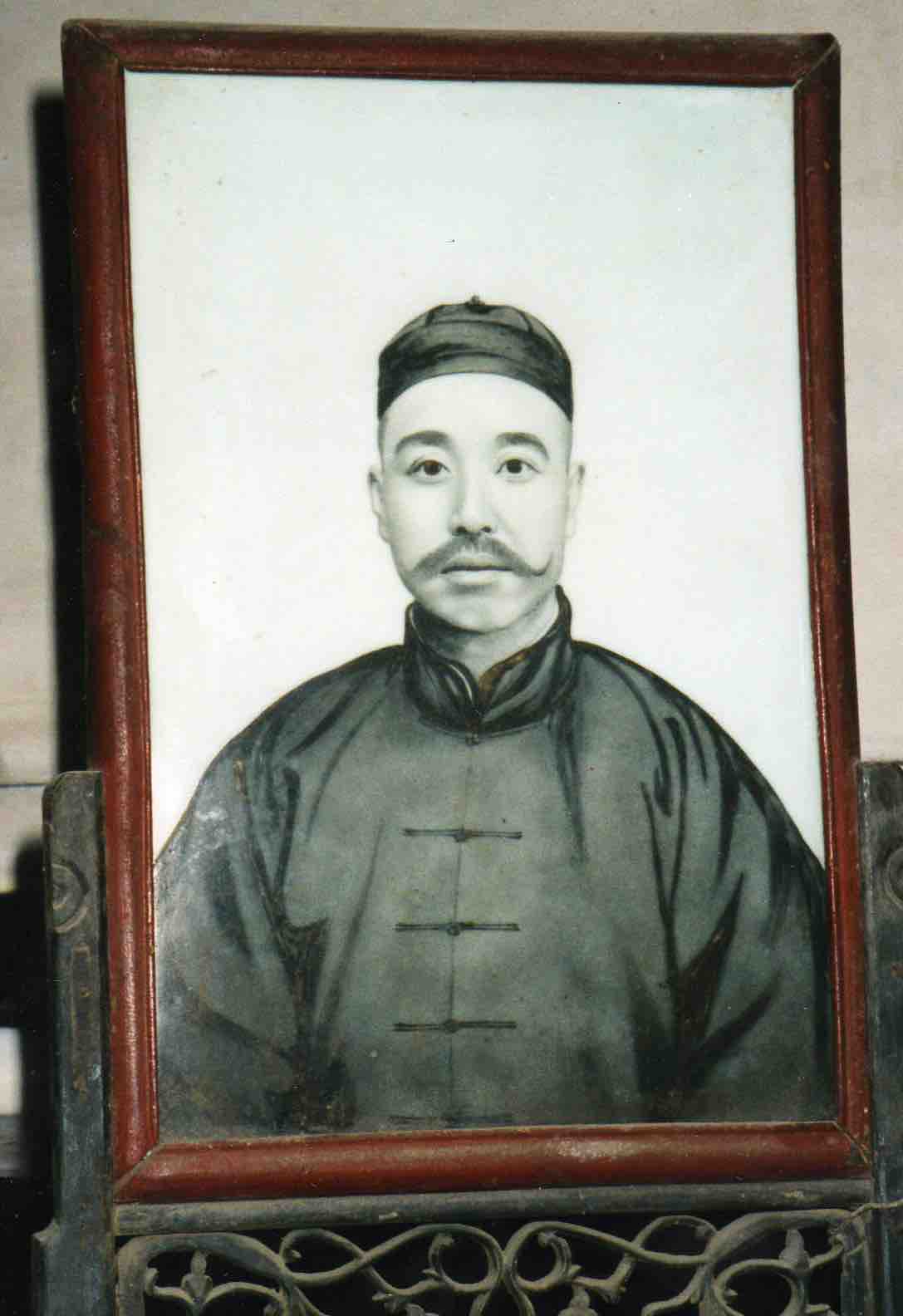
SFTCai Chengxun, victorious in battle, had now made his fortune. Returning north, he retired to his old home in Tianjin. “When the tree falls, the monkeys scatter”; Cai Chengxun’s retinue had now lost their patron. But Cai recognized Shan Futian’s honesty—Shan had never exploited his position in order to enrich himself—and before retiring he wanted to make Shan Futian mayor of De’an county, between Nanchang and Jiujiang, hoping Shan could use the opportunity to make a fortune for himself at last. Shan declined, afraid that his “lack of culture” would make the job difficult for him, although Cai offered him an adjutant. Instead he took the post of county police chief. The 1924 ceramic portrait of Shan Futian, which now had the place of honour overlooking the Shan family’s eight-immortals table, was fired at the famous kiln of Jingdezhen while he was serving in Jiangxi.

But without a patron Shan Futian found the work difficult, and in about 1927 he returned north, having made little money. After a brief reunion with his family in Gaoluo, he was introduced by a relative to do business back in Zhangjiakou. Before long he moved still further north to what is now Hohhot in Inner Mongolia, riding by camel. There he opened a leather business called Total Victory Leather Corporation; he also opened a public baths there in partnership with a relative from Dingxing. Different trades in Beijing were often monopolized by people from a particular area of the surrounding Hebei province; people from Dingxing and Laishui counties (the area of Gaoluo) used to work at public baths—this remained a traditional speciality of Gaoluo villagers right until the 1950s.

Shan Futian was one of several opium smokers in South Gaoluo, along with landlord Heng Demao and village bully He Jinhu. As Shan Zhihe observed, “It wasn’t just the rich who smoked: sick people and general reprobates also had recourse to it. I reckon no more than ten people in the village had the habit”. In 1935 Nationalist official Wang Zuozhou held a bonfire in the county-town as part of anti-opium campaigns throughout China. No-one heard of any such campaign reaching Gaoluo, but the habit—or perhaps rather the addicts themselves—must have died out soon after the Communist Liberation.

Early days of a scholar
Seated magisterially at his fine eight-immortals table, Shan Zhihe now began to relate his own story to us. Third of Shan Futian’s four children, he was born in 1919 at Zhangjiakou, where his father was then based. He and his older brother were given their “official names” Zhizhong and Zhihe after coming of age with the “lesser capping” ceremony. They were so named because their father’s public baths in Hohhot were called Zhonghe (Loyalty and Peace) baths; their names showed that the baths would one day belong to them.

Back in Gaoluo, the Juma river just east of the village had flooded in 1917. Though the flood was not serious and no-one died, it is still famous today in Gaoluo. The only other major flood in the village occurred in 1963. Gaoluo was fortunate, since throughout the whole area floods were frequent and devastating; indeed the village’s long-term immunity from natural disasters is still commonly attributed to the divine blessings brought by its ritual associations.

With his urban education, Shan Zhihe came to know the year of his birth, 1919, as the year of the May Fourth movement, a great urban intellectual ferment modernizing literature and social thinking. In fact, most villagers probably knew nothing of this movement: as amateur historian Shan Fuyi pointed out to us, the only big national historical event villagers definitely knew of was the Marco Polo Bridge incident on 7th July 1937, which unleashed the Japanese invasion. And if they do know such dates, they know them only in terms of the 8th or 26th years of the Republic, not by the official Western calendar.

Rather, most Gaoluo inhabitants know the 8th year of the Republic (1919) as the year of a serious epidemic in the village. In the heat of the 6th and 7th moons, “just as the melons were ripening”, villagers started to get stomach cramps and diarrhoea, death following quickly. Over sixty people died within a month. When one of the coffin-bearers died too, no-one dared observe proper funerals any more—the ritual associations too must have stayed away.

By now Shan Zhihe’s father was doing well in his business enterprises in Hohhot, and had bought up several dozen mu of land back in Gaoluo. In 1922, Shan Zhihe, still only 4, was sent back to South Gaoluo while his father went off to war in distant Jiangxi. Three years later he began attending private school in the village, studying along with forty or fifty other children. The school was at the home of his first teacher, Yan Zhan’ao. Seated before a portrait of Confucius hanging on the wall, the pupils learnt the standard Confucian curriculum, such as Surnames of the hundred families and Document of one thousand characters. Young Shan Zhihe studied there for five years. Since the older masters were less clear in their enunciation, pupils preferred younger teachers like Shan Hongru.

School tuition fees were 3 silver dollars per year. The teachers lived well; apart from tuition fees, pupils were also expected to present gifts three times a year: not only at New Year, but also on the Double Fifth (5th moon 5th) and Mid-Autumn (8th moon 15th) festivals—which have since lapsed in this area. The value of these gifts depended on family circumstances: better-off families might offer a pig or a sack of refined flour, but some poorer families were unable to give anything, and the teachers never blamed them.

The 1930s

1930 donors' list, South Gaoluo

1930 donors’ list, South Gaoluo.

Shan Futian was among the five “managers” on the ritual association’s precious 1930 donors’ list.

My father always thought to give the most money to the association, as much as 5 silver dollars. That was a lot of money then—2 silver dollars bought a sack (44 jin) of refined flour in Beijing. Whenever donations were required, the leaders of the association would go round all the households in the village. Leading members of the Heng lineage always gave last, so that they could display their economic power by giving the most, a bit more even than my father, and “taking first place”.

More charitably, some said it was also so that they could make up for any shortfall in donations. Indeed, on the 1930 list Heng Jun and his son Deyong head the list, before Shan Futian.

On the 6th day of the 9th moon in 1931, just a month after the benediction of the Catholic church, our venerable mentor Shan Zhihe, now 13, left Gaoluo to join his father Shan Futian in distant Hohhot, where he joined in classes of the province’s 4th Primary Comprehensive. Shan Futian wanted his son to continue his education; as we have seen, his own father was a pauper beaten to death without the least pretext, and Shan Futian himself had been poor and uneducated; persistent Confucian values still allotted far higher prestige to the scholar than to merchants like him. Having had such a hard time, he now considered giving his children an education more valuable than any material inheritance he might leave them. I wonder how this decision seems now: many educated Chinese today feel effectively discriminated against for having an education, not only during the Cultural Revolution, but under the market reforms since.

Shan Zhihe recalled ritual life before the Japanese invasion. I cited his account of processions to pray for rain here. He also had insights on the Italian Catholic missionaries, led by Bishop Martina, and the building of the church in 1931.

church

On the 6th day of the 9th moon in 1931, just a month after the benediction of the Catholic church, our venerable mentor Shan Zhihe, now 13, left Gaoluo to join his father in distant Hohhot, where he joined in classes of the province’s 4th Primary Comprehensive. Shan Futian wanted his son to continue his education; as we have seen, his own father was a pauper beaten to death without the least pretext, and Shan Futian himself had been poor and uneducated; persistent Confucian values still allotted far higher prestige to the scholar than to merchants like him. Having had such a hard time, he now considered giving his children an education more valuable than any material inheritance he might leave them. I wonder how this decision seems now: many educated Chinese today feel effectively discriminated against for having an education—not only during the Cultural Revolution, but under the market reforms since.

Shan Zhihe takes a bride
The next time Shan Zhihe returned to Gaoluo was for his wedding in the spring of 1937. One fine morning during New Year 1998 he finally described it for us; he had omitted to mention it during our previous talks, for reasons which will soon become clear.

My Beijing companion Xue Yibing and I both relish his refined conversation. He too is always glad to see us, to chat with relatively educated outsiders about current affairs and history, reflecting on and trying to make sense of his own extraordinary life. With his father’s portrait overseeing us, we sit round his lovely table munching melon seeds in our overcoats (it’s still terribly cold), his children and grandchildren regularly refilling our teacups.

After graduating from primary school in Hohhot, young Shan Zhihe was sent to secondary school in the Xuanwu district of central Beijing. On the 26th day of the 2nd moon in 1937, aged 19, he took leave from his studies to make a special trip back to South Gaoluo for his wedding. The betrothed couple, naturally, had never met. His bride came from the Eastgate quarter of Dingxing town, just like his mother, whose family had arranged the match. She had bound feet and was uneducated; Shan Zhihe was full of modern thinking and had learnt to oppose “feudal customs”, but he had to obey his parents. His return to Gaoluo must have seemed like surrendering himself to the servitude from which his education was promising to free him.

This was to be one of the last lavish weddings in the “old society”, costing the astronomical sum of 300 silver dollars. His bride was carried in an expensive new sedan; Shan Zhihe himself rode a sedan borrowed from landlord Heng Demao. The procession to meet the bride at Dingxing, 5 km distant, started out in pitch darkness at 4am: to set off back home with the bride after midday was taboo, spelling ill-fortune for the match.

The amateur ritual associations perform only for the “white rituals” of funerals, not for the “red rituals” of weddings. For the latter it is common to hire a professional shawm-and-percussion band, known as “blowers-and-drummers”. Since Gaoluo itself had no such band, one was hired from Shiguzhuang village just north. On the procession to collect the bride, the shawm band played as they passed through each village, called “crossing the villages”, as firecrackers were released deafeningly. By tradition the route back to the groom’s home must be different: they passed through Xicheng village in the Northgate area of Dingxing to Nanhou, crossing the river again at Wucun. On arrival at Gaoluo there was a sumptuous feast. The five blowers-and-drummers were handsomely rewarded with half a silver dollar each.

Shan Zhihe spent a month in the village before returning to his studies in Beijing, leaving his new bride behind. Apart from taking part in the lineage observances for the Qingming festival, it was the time of the 3rd moon festival for the goddess Houtu, when many villagers went on pilgrimage to the Houshan mountains. It was also Easter, and Shan Zhihe recalls seeing Bishop Martina ministering to his flock in Gaoluo.

Even in a society in which gender equality was still not remotely on the agenda—we saw the dreadful isolation of Woman Zhang—Shan Zhihe and his wife were to make a particularly incongruous couple, as he recalled dispassionately for us in 1998. She was what he now calls a “housewife” (jiating funü, a term which reveals his own education), and hardly literate; she was five years older than him, and with her bound feet was barely mobile (that was the idea, of course); he was tall and commanding, a scholar with ample experience in the outside world. Couples simply weren’t seen in public. She used to nag him to take her to watch the local opera; one day he had to give in, but as he says they must have made quite a spectacle themselves, with him reluctantly trying to adjust his manly stride as she hobbled along trying to keep up. They never went out together again, and she never forgave him. As he recalled wistfully, they never exactly had any problems: “She didn’t curse me, and I didn’t beat her.” When she died, on the 13th of the 7th moon in 1983, the funeral was quite grand; the ritual association performed, and lavish paper artefacts were displayed and burned, though there was a continuous downpour.

Courteously accepting another cigarette, Shan Zhihe reflects: “My brother and I were both victims of the feudal system of marriage. You can’t blame my parents, they were products of the system themselves. My older brother married a couple of years before me, in 1935, but then went away to study in Baoding; in 1939 he got into the 29th Army, stationed in Hebei, and after going south with the army he stayed there. It was all just to get away from the wife! She stayed behind in Gaoluo the whole time—she was only able to remarry after they got a postal divorce in 1957.”

Incidentally, in 1998 there were still about forty or fifty women in the village with bound feet; of those above 70, only one had natural feet.

The devils invade
In the summer of 1937, back in Beijing after his wedding, Shan Zhihe was in the midst of his studies when the “7th July incident” (Qiqi shibian) occurred. This battle between Chinese and Japanese troops at the Marco Polo Bridge, midway between Beijing and Gaoluo, marked the formal outbreak of the War of Resistance against Japan. It was a decisive moment in modern history for villagers, which they often call simply “the incident”. Of course, the preceding period too transpires to have been anything but rosy, but they often periodize cultural loss by this date, rather than by the Communist “Liberation” some ten years later—the Japanese invasion tacitly marking for them the increasing control of the Communists over their lives, as I eventually deduced.

With the whole Beijing area in chaos, Shan Zhihe eventually made his way back to Gaoluo on foot, by a long route avoiding the area of the Marco Polo Bridge, arriving back home late in July 1937. But what was he supposed to do now? His father had indeed blessed him with an education, and by now he didn’t relish the prospect of taking up as a peasant. The very fact of his education also made his situation precarious, for rival factions would seek to exploit his knowledge, and it would be difficult to choose his own path.

A month or so after his return to Gaoluo, it was clear that the Japanese advance along the main transport routes south could not be contained. Shan Zhihe’s older brother Zhizhong was part of the army which engaged the Japanese at Mentougou west of Beijing, but by the 7th moon they had to retire in defeat. Ordered to regroup at Zhengzhou, quite far south, they were constantly retreating through the area—Shan Zhihe’s mother was busy making bread for them. Zhizhong stopped off in Gaoluo for three days. After he resumed his journey, the brothers were not to meet again until after Liberation, over ten years later. Zhizhong later went off to work in Hubei province far to the south.

Their father Shan Futian was still in distant Hohhot. Shan Zhihe, though reluctant to abandon the family’s considerable property in Gaoluo, was responsible for his mother and sisters, and resolved to take them south out of danger. It was only when they heard the sound of heavy artillery that they decided they must go. But before they had even reached Baoding, they heard that the Japanese had already advanced as far as Shijiazhuang, still further south. Flight was impossible—they had no choice but to return to Gaoluo.

Japanese warplanes bombed Laishui county-town at 8am on 17th September (the 13th of the 8th moon) 1937, and that same day Japanese troops first entered Gaoluo. Coming from the direction of Wucun to the south, they were just passing through; they had about fifty tanks, and were covered by aircraft. The troops entered the village before Woman Zhang could take her children to the church to hide; they passed by her house. In order to dissuade them from murdering them all and setting fire to the village, the village leaders went out to welcome them. Before the Japanese even entered the village, they shot dead a villager who rashly stuck his neck out to look, but after entering Gaoluo they harmed no-one, just asking for fresh water, eggs, and meat. Shan Zhihe himself, along with Cai Ming (a sheng-player in the ritual association who worked as a pig-slaughterer), was responsible for looking after them and giving them water—the Japanese made them drink some first to be sure it wasn’t poisoned. Though they soon went on their way after a token search, Japanese cavalry and infantry passed through constantly for several days on their way to Baoding, and Gaoluo villagers had to look after them.

Seeing our evolving sketch-map of the village gave Shan Zhihe conflicting feelings:

Before the Japanese arrived they had prepared maps which they used when they first entered the village—they made me point out the way to Baoding. In the first party of Japanese troops were some savages [Ainu?] from Hokkaido. When they entered the village they caught some chickens and tore them to bits, eating them raw. When the troops discovered my hands weren’t calloused like those of a peasant they pointed their bayonets at me. I frantically tried to explain by gestures that I ran a baths, and they let me off.

The lawless conditions of the early 1930s had prompted many villagers to arm themselves. Soon after the Japanese invasion in 1937, some Gaoluo villagers sought to set up “Anti-Japanese brigades”. Villagers with guns were invited to join the new militia or at least to give their guns to the resistance effort. Within a couple of days some two hundred volunteers had assembled, including Catholics like Cai Chen and Cai Xing. The new militia called itself by the grandiose title of “The Rear Anti-Japanese self-protection troupe”, and even drew up a constitution. The house of North Gaoluo landlord Yan Shide served as command-post.

But educated Shan Zhihe soon found with dismay that most of the recruits were just village good-for-nothings. While a student in Beijing, he had taken part in patriotic demonstrations boycotting Japanese goods. Now finding himself back in his home village, taking his gun along and soon becoming one of the leaders of this motley crew, he was full of misgivings. Untrained, they were a menace to people outside their own village. “Ordinary people didn’t understand what this ‘anti-Japanese’ stuff was all about anyway, they thought the Japanese devils were just another bunch of bandits.”

The Japanese, learning that Gaoluo had organized a “Red Spears Association”, now sent a division of troops to “encircle and suppress” them. Shan Zhihe had a cousin called Wang Futong, whose family was quite well-off, owning over 100 mu of land. Wang was notorious as a wastrel who kept bad company. When an enemy of his spread a rumour that he was a militia leader, the Japanese came looking for him. Shan Zhihe had gone to Dingxing county-town that day to buy shoes for the militia, and by the time he got back the Japanese had gone, having failed to find Wang. But that was the end of the Gaoluo militia: some hid their guns or threw them down the wells, some went into hiding, while others joined militia groups in other villages, calling themselves anti-Japanese but actually plundering ordinary Chinese houses.

Cultured Shan Zhihe obviously had no future in such a militia. He handed in his gun and took no further part. Events now forced him to flee Gaoluo. Before long his profligate cousin Wang Futong was murdered by a drinking-buddy called Huo Zhongyi, leader of the militia in Xiazhuang just east of the river. Afraid that Shan Zhihe would seek revenge, Huo Zhongyi decided to “destroy root and branch”. He had Shan Zhihe summoned to the house of South Gaoluo landlord Heng Demao, but Shan suspected a trick and decided to flee. For a while he hid out at his grandmother’s house in the nearby town of Dingxing, and then set off to find his father again in distant Hohhot. The 10th moon of 1937 had still not arrived—an eventful start to his married life.

In occupied Hohhot
Shan Zhihe had already begun telling us his story in Gaoluo in 1996. We were back in Beijing for a few days between visits when we learned that he too had come there to stay with a family who needed his medical help. Back in the frenzy of ring-roads and fancy hotels, we missed Gaoluo already; glad of the opportunity to seek his guidance again, we asked him to continue his story for us.
Hohhot

Hohhot, 1930.
Source: https://www.xuehua.us/2018/07/23/罕见历史老照片,1930年蒙古人记忆中的呼和浩特!/

Shan Zhihe left for Hohhot in the 9th moon of 1937, where his father was still running a public baths. Shan Zhihe’s wife, as well as his mother, were able to join them in 1938; the sons Shan Ming and Shan Ling were born there in 1942 and 1948 (for naming customs, see here). But the war had made business enterprises highly subject to intimidation, as Shan Zhihe soon found out when he started working at the baths. Early in 1938 posters advertising for examinations for the police force seemed to offer him a better alternative. Shan Zhihe was a tall and well-educated young man; he passed the exam with no trouble. Only when he started the Japanese-style military training did he realize that what the poster had presented as a force for the protection of Hohhot was in fact a training for the collaborative “traitor army”. By the time he realized he had been conned, it was already too late, and Shan Zhihe was now subordinate to a Japanese police chief. If his story may sound disingenuous, it apparently didn’t seem so to later Communist investigators.

Shan Zhihe was first sent to work at the police station in Great South Street, the most affluent quarter of Hohhot; then after a month he was promoted to personnel management in the police department in the old town. Over the following years he gained promotion through the ranks of the Mongolian and Japanese armies. “I had contact with the Japanese all the time—I got to read the Japanese news, so I knew quite a bit about World War Two.” He was better informed than I about Dunkerque, which in itself was no great feat. He managed to save several Communist guerrillas: when the Japanese caught someone, friends got him to go and set things right, so they were set free.

In the 9th moon of 1942 Shan Zhihe at last got permission to return to Gaoluo for a visit. His military permit entitled him to carry firearms, and his first thought was to seek out Huo Zhongyi and “settle the debt” for the murder of his cousin. But he soon learnt that fate had done the job for him. Huo had gone over to the Japanese, and then, resentful of their cruelty, had resolved to rebel against them; but they had found out and executed him. Shan Zhihe spent only one night at home before setting off back towards Hohhot. On the way he spent a few days at the home of his older sister’s husband in Beijing, and applied for permanent leave from the Japanese army. This was granted, but after he returned to Hohhot he spent most of the next three years virtually unemployed, earning a bit from renting out rooms.

After the Japanese surrender in 1945, Nationalist commander Fu Zuoyi had entered Hohhot and gradually “suppressed” the most evil of the Japanese collaborators. “Times were tough in Hohhot after the Japanese surrender”, recalled Shan Zhihe. “There was no coal, and no barley—we had to eat ‘secondary barley’, a mix of husked sorghum and husked barley. The Nationalists had heard that I was educated and had military training, and they offered me an official post in their army, but I refused. Still, I was only 26, in the prime of life. Frustrated, I could see no options for myself, and in 1946 I ended up as a medical orderly in a hospital at Hohhot. The hospital was of regimental rank, and orderlies were between 1st and 2nd lieutenants in rank.”

Under Maoism

SZH 1948

Shan Zhihe worked as an orderly for the Nationalists in Hohhot through the civil war, witnessing different traumas from those taking place in Gaoluo. In 1948 he took some relatives to Beijing; a photo of him in military uniform shows his impressive stature.
Hohhot was “peacefully liberated” for the second time on 19th September 1949. For the time being the Shan family stayed on there; the family’s bath-house then had five rooms, two of which they rented out for use as a general store, selling off some of their furniture.

But eventually, as private enterprise under the Communists became untenable, the whole family had to return to Gaoluo. Shan Zhihe came back in 1951 with his wife, his daughter, and younger son Shan Ling—the first-born Shan Ming stayed behind with his grandparents, but he too came back with his grandmother in the 3rd moon of 1952.

The aged Shan Futian was last to return, in the following winter. By this time he was seriously ill. Ever filial, Shan Zhihe wanted to sell off the family’s property to help him buy medicine. The family had owned over 90 mu of good land before Liberation. Since they were absentee landlords, they had let villagers cultivate it; the villagers were liable to pay grain tax on it. But the Shans took only a nominal rent, and so upon land reform they were classified as “rich peasant” but were not made an “object of struggle”; they were allowed to keep over 40 mu of land, while the rest was parcelled out, but their property was not touched. Still, the family had been away from the village for the whole preceding period, and Shan Zhihe felt unhappy about his class label. Though the “hat” of landlord or rich peasant was not always brought into play (“neither hot nor cold”), it was a sword of Damocles.

As his father’s health declined, Shan Zhihe sold off 10 mu of the family’s remaining land in the hope of saving him, but Shan Futian wouldn’t let them dispose of more of their assets, and in the 6th moon of 1953 he died. Even in absentia he had been a longstanding benefactor of the ritual association, and his family used to give the association a banquet at New Year. Naturally the association played and performed the vocal liturgy for his funeral; Shan Laole played the drum, Chen Jianhe the guanzi. But the funeral was not especially grand, as Shan Futian had spent little time in the village. Since his son Shan Zhihe had done well since returning to the village by helping at the new village school, the teachers made a traditional offering of cloth.

Mindful of his dubious employment record serving Japanese and Nationalists, Shan Zhihe wrote a “self-examination” after returning to South Gaoluo in 1951. Investigators went to interview people in many places where he had been, but no “historical problems” were unearthed; everyone was full of praise for him. So, remarkably, he remained safe from assault—even through the Cultural Revolution.

Whatever his background, people like Shan Zhihe, the most educated man in the village with enviable modern learning, were much needed to consolidate the revolution in the countryside. He must have known he was skating on thin ice, and having to prove himself he now showed willing.

When I came back to Gaoluo they asked me to teach at the village school. I declined, but I did teach at the People’s School (the evening school) in the Sweep Away Illiteracy campaign of 1953. I was a leader of the West Yi’an district Sweep Away Illiteracy campaign then too. But I felt ashamed of my past, and threw myself into studying Marxism-Leninism, reading works like Das Kapital, On practice, and On contradictions. I read other revolutionary literature like How to make steel [an influential translation of a Soviet novel]. I taught the pupils about Marxism-Leninism, and won an award as a model teacher in the People’s School.

Opera
Apart from the four ritual associations of North and South Gaoluo—which managed to maintain activity through the first fifteen years after Liberation—both villages had an opera troupe, performing a local genre called bengbengr or laozi. In South Gaoluo in the early 1930s Shan Zhihe remembers his older brother Zhizhong getting money from his family to buy the troupe some costumes. But it had to disband after the Japanese invasion.

After Liberation the revamped South Gaoluo opera troupe acquired a great reputation locally. The troupe was to become a flagship for new official cultural policy, based at the village primary school. The reorganization of the troupe was strongly supported by the new Party Secretary Heng Futian, who thought it would be a good way of expanding the village’s influence.

The troupe now resolved to rehearse modern operas which had been created and performed in the revolutionary base of Yan’an in the 1940s: The White-haired girl (1945), as well as Liu Hulan (1948) and Wang Xiuluan. By performing these operas they identified directly with central official artistic policy on the modernization of traditional culture as canonized in Mao’s 1942 Talks at the Yan’an forum on literature and the arts—in stark contrast with the total impasse with the new political ideology which the ritual association continued to represent. Women now took part in the troupe for the first time.

Another main driving force for the opera troupe was Shan Zhihe. Though without formal dramatic training, he had gained experience of the arts while a student, and, despite his dubious work experience before Liberation, was respected as the most “cultured” person in the village. He now acted as director for The White-haired girl. He even brought out his father’s old clothes, hat, and pocket-watch to use as props for the part of the evil landlord Huang Shiren—a fine irony, since his own family had just been landed with the “hat” of rich peasant.

BMNThe virtuous part of the heroine Xi’er’s father Yang Bailao was originally given to He Junyan, Party Secretary of the village Youth League. But he wasn’t up to it, and took the part of Huang Shiren instead, while Shan Zhihe himself took over the role of Yang Bailao—a quaint reversal of their allotted roles in the village. Secretary Heng Futian’s son, Deputy Secretary Heng Qi, took the part of the kindly servant Zhang Dashen. I wonder if the White-haired girl herself, mistaken for a spirit until it transpires that she is merely a common villager whose suffering had turned her hair white, would have reminded locals of their own goddess Houtu.

Incidentally, as a sign of the times, when the Cultural Revolution ballet version of The White-haired Girl was revived in Beijing in 1996, some younger members of the audience missed the point spectacularly. The evil landlord is portrayed in the drama as shameless in his demands for repayment of debts from poor downtrodden peasants, and beats the heroine Xi’er’s father to death when he is unable to repay. At some early performances in the 1940s audience members had so hated the landlord that they virtually murdered the actor, and the plot had to be changed to reflect audiences’ hatred for him: in the revised version he is indeed sentenced to death rather than merely re-educated. But by 1996 his character attracted some sympathy: when interviewed, some said it was quite proper for the landlord to demand repayment! Official commentators understandably lamented the decline of morality: “Thanks to the introduction of a market economy, young Chinese are becoming business-oriented, and their comment reflects the philosophy of business.” Decades of socialist education had come to nought.

Like many Chinese, Shan Zhihe considered the social breakdown to have occurred only with the Cultural Revolution and the loss of integrity thereafter. As he reminded us, in the 1950s life was at last stable, and the Party was popular. Chairman Mao was revered: people said there had never been such a great figure in the whole of China’s long imperial history. The army served the people, fetching water and clearing the land for the villagers. Cadres abided by the “three main rules of discipline and the eight points for attention”, theme of a catchy new song. New Party Secretary Heng Futian was rushed off his feet for a whole month organizing the collection of grain taxes, and the village cadres just had a quick bowl of noodles before their meetings—there was not the least suggestion that they might be fleecing the people.

Shan Zhihe may have had reasons to thank the Party, but he voiced the feelings of many poorer villagers. People we met articulated no negative memories of the campaigns of the early 1950s, and I do not believe this was mere prudence. No-one found labour gangs at all sinister. Many of those who suffered, like the old bullies, were thought to deserve it. It was simply not in people’s vocabulary to sympathize with the plight of the Catholics. And as the landlords disappeared, people neither remembered them badly nor spared the sentiment to miss them. The political mood dictated from above was pervasive: people had no choice but to take part in the elaborate game of “snapping at each other”. People related to or erstwhile friends of those now classed as “elements” went through the motions. Sons of so-called rich peasants, such as young musician Shan Bingyuan, naturally had a tougher time than others from unassailable poor-peasant backgrounds. But even a cadre like Cai Fuxiang, with his impeccable revolutionary credentials, was traumatized by the violence of revolution.

As a former medical orderly, Shan Zhihe had later studied medicine under his older sister’s husband, and was now quite well qualified. He now started to treat patients for free in Gaoluo.

Despite their later nostalgia, many villagers must have been increasingly anxious as collectivization looked imminent. Some households certainly stood to gain from an efficiently-run system. By now the “rich peasant” family of venerable Shan Zhihe was poor: their labour force was weak and they had no experience of tilling the land, so they had no objections to joining the collective. Such families went along with the changes, but many already working efficiently with their own carts, tools, and draft animals saw communal agriculture as inefficient and alienating, and were reluctant to join. Though disgruntled, few were rash enough to articulate such thoughts: complaint was dangerous, and could instantly be interpreted as opposition to the sacrosanct state. The government had also just devised an unenviable class category of “new rich peasant”. Still, collectivization did arouse resistance and sabotage, and in many places (if not in Gaoluo) religious sects resurfaced to oppose it.

After the Great Leap Backward and the ensuing famine, a lull between extremist campaigns allowed a brief revival of the ritual association in the early 1960s. Among thirty new recruits in 1962 was Shan Zhihe’s son Shan Ling.

The Cultural Revolution, opera, and the reform era
Soon after the Four Cleanups campaign opened in 1964, Shan Zhihe wrote a letter to the authorities complaining of the unfairness of his “rich peasant” hat, but once the Cultural Revolution started he was unable to pursue it any further. He realized chaos would be unleashed as soon as he heard the ominous slogan “attack with culture, protect with force”, providing a pretext for violence. In Plucking the winds I describe the factional fighting that spread from the county-town to Gaoluo in 1966—including the remarkable rescue of the Houtu precious scroll. But despite his dubious past, Shan Zhihe remained immune from attack.

The village opera troupe had performed modern opera in the early 1950s, abandoning it in 1958 for the traditional bangzi style. By 1964, at the instigation of the county Bureau of Culture, themselves under orders as part of a huge national drive against the traditional “feudal superstitious” operas which had resurfaced widely, they started performing modern operas again. They then inevitably blew with the winds to serve as a Mao Zedong Thought Propaganda Team, performing the “revolutionary” model operas, as throughout China. By winter 1967 the troupe was performing revolutionary dramas like Shajiabang, Taking Tiger Mountain by strategy, as well as Stealing the seal (Duoyin 夺印, an opera about class struggle) and The commune-chief’s daughter (Shezhang de nü’er 社长的女儿). For most of our friends, erstwhile members of the utterly conservative, but now dormant, ritual association, the development of the opera troupe had an inevitability about it. Even ritual stalwart He Qing now relished playing the smugly virtuous revolutionary Li Yuhe in The tale of the red lantern.

But some other members were none too impressed. Shan Qing, then in his 20s, had learnt the bangzi style in 1962, and only wanted to perform the old operas; he didn’t approve of the model operas, so he withdrew. And despite having subscribed readily to the social goals of the 1950s, Shan Zhihe decided the Mao Zedong Thought Propaganda Team wasn’t his cup of Chinese tea.

Xie JinBut meanwhile he collected material in order to compose a libretto on the theme of Lin Zexu, hero of the Opium Wars. Like the Boxer uprising (also the object of much fieldwork under Maoism), this was always a popular theme rallying the people against the evil foreign imperialists; following a 1959 film, by 1997 the story was taken up in a big way in a blockbuster film by veteran director Xie Jin, making propaganda for the handover of Hong Kong back to the Chinese. The county Bureau of Culture supported Shan Zhihe in his project, but it never came to fruition—too bad, as I joked with him, or I might have landed a part in the revival, though I’m not sure I’d be up to playing Queen Victoria.

For better and for worse, the economic liberalizations after 1978 effectively brought an end to over twenty years of Maoist policies. A new era now began. Class labels were finally abolished, as Shan Zhihe (who had suffered less than many for his bad label) reminded us, causing people to praise the national leader Deng Xiaoping as “Blue Sky Deng”.

In 1980, just as the commune system was being dismantled and the ritual association reviving, South Gaoluo villagers dipped their toes in the newly flowing waters of emergent capitalism as a group of enterprising friends tried organizing an “incense factory”, and soon (sorry, I can’t resist this) got their fingers burnt. The village brigade, led by Cai Yurun, back from the army and just appointed Party Secretary, as well as a keen new recruit to the reviving ritual association, took the lead. The incense factory was also an early experiment in business practices for Heng Yiyou, former “backstage” supporter of the United faction, soon to become a leading local entrepreneur. Even the otherwise sage Shan Zhihe, already in his 60s, took part. Also in 1980 he passed an exam at county level, promoted by the commune, and went on to open a private clinic in Dingxing in partnership with some colleagues.

In 1998 we paid him further delightful visits. Still supporting the association in his old age, by the standards of rural China in the 1990s he was comfortable, well looked after by his family.

Meanwhile a miraculous revival of the village opera troupe was under way. Political freedoms after the dismantling of Maoism then allowed them to restore the traditional style from 1979 to 1981, but economic pressures soon forced them to disband. They started rehearsing again in 1997. The newly formed group was an extension of the village’s new shawm band; thus several members of the ritual association were also taking part, including Shan Zhihe’s urbane sons Shan Ming and Shan Ling. The troupe’s repertoire now subsumed both traditional and modern styles. For New Year 1998 they were preparing classical bangzi excerpts as well as parts of their newer repertory such as Liu Qiaor and the teahouse scene from the Cultural Revolution “model opera” Shajiabang, still in bangzi style. But the revival exacerbated animosities within the ritual association.

SJB

Shajiabang, New Year 1998: Cai Tingwen as Nationalist general, Shan Rongqing on fiddle.

In contrast to the rather insular world of many peasants, the Shan family continued to be rather well acquainted with world events. Indeed, some other villagers too were interested in the Iraq crisis which was reported on Chinese TV—they questioned me about Britain’s role. But the Shan family’s curiosity was rather exceptional, going back to the early 20th century with Shan Futian’s experiences in Beijing, Hohhot, and south China, and continuing with Shan Zhihe’s own background of studying in Beijing and working for the Japanese and Nationalists in Hohhot.

Shan Zhihe, who over half a century earlier had learned of the Normandy invasion, had maintained his interest in world events: he mentioned the death of Princess Diana and the channel tunnel between England and France. So the whole family, including his urbane sons Shan Ming and Shan Ling, naturally had an interest in new culture from outside. They had good contacts in Beijing, where Shan Zhihe paid occasional visits; his daughter’s husband had retired early and become a taxi-driver, making a regular trip to and from Gaoluo—another link to the modern world of the Shan household.

* * *

For me, Shan Zhihe’s story encapsulates the complex transition from the old to the new society. I shared the villagers’ great respect for him. Of course he presented himself in a good light; nearly half a century after having to write “confessions”, Shan Zhihe doubtless found our visits a further opportunity to reflect on his experiences. Now he was writing his memoirs, only partly under the stimulus of our visits. As he reflected to me,

I’ve got a good memory, but my fate is no good. Otherwise after studying in Beijing I might have gone off to England to continue my education! The year the Japanese surrendered I was already 26, but by then it was too late. While I was working for the Japanese I managed to save several Communist guerrillas. But for having served the Japanese I was condemned to live and die in the village, a dismal life.

But things could have been far worse: he could so easily have been branded for life as a Japanese and Nationalist collaborator. By his own analysis, he had gone down the wrong road just once in his life. Having demonstrated against Japanese goods while still a student, he still couldn’t understand how he ended up as a policeman under their rule. Although he had done no wrong, it somehow seemed right that he should return home to reflect on his past and his future—not that he had much choice.

If many people with similar experiences were persecuted under the Communists, many also must have been well treated. It seems that the new leaders knew whom they needed, and that local loyalties also counted. But of course there were also innumerable senseless casualties in the Chinese Revolution; over the following years many Party members who suffered to help build the new society, and remained wholeheartedly loyal to it, were to be ruined. Shan Zhihe now had reason to be grateful to the Party. Psychologically his story is complex. He seemed sincere in parroting the Party-speak cliché of “I reformed my thought through labour and sweat”: layers of irony are hard to fathom.

But he had survived. “My father taught me two things: ‘If you make money, you mustn’t look down on people; if you become an official you mustn’t con people’—I’ve managed to live right down to today by those two mottos.” I believe him, too; his refined demeanour is a far cry from that of so many cadres and nouveaux riches under the reforms. By the 1990s, his family were living rather well; his children and grandchildren were bright. The family has survived—what more could they ask? Zhang Yimou’s moving film To Live (Huozhe, surely better translated as “Surviving”) gives an impression of this instinct. And many ordinary Chinese today still revere Mao, despite all the appalling gratuitous sufferings he inflicted on them, and are actually nostalgic for Maoism, admiring strong leaders; they are confused and alienated by the reforms since the 1980s. We must beware reading such alienation into the vicissitudes of the 1950s.

Do read Plucking the winds!


Summary: update to Other publications


FWIW, in my post Other publications I’ve just appended a very brief outline of the, um, progression of my work on China. Do take a look!

From 1986, as I converted from Tang music to fieldwork on living traditions of local ritual—groups serving life-cycle and calendrical rituals, I focused first on amateur ritual associations in Hebei villages (notably Gaoluo) and then (after an interlude on shawm bands), on hereditary occupational groups of household Daoists around north China (notably the Li family Daoists in Shanxi).

All this accompanied a shift from studying reified “music” to the ethnography of changing ritual practice in local communities, and documenting the vicissitudes of people’s lives—before, during, and since the decades of Maoism.

Gaoluo: New Year’s rituals

*For main page, click here!*

vendor

Eating ice-cream in winter always reminds me of my stays in Gaoluo village over New Year, between rituals in the lantern tent, the opera outside, and imposing processions. As Chinese New Year approaches, I’ve just added a page on the rituals around 1st moon 15th, based on my book Plucking the winds and part of a revamped series on Gaoluo (see here).

fdz

Looking back now, I was most fortunate to be privy to this ever-changing microhistory—reinvention, conflicts and all, as social dynamics evolved constantly in the wake of successive thefts of ritual paintings, with a change of leadership, and the rise of rival groups.

Indeed, conflict was a regular feature of the village’s history, from the animosity between the ritual association and the Catholics which led to the 1900 Boxer massacre, to the social dislocation of Maoism. Such a detailed and frank account contrasts with both the sparse imperial records and recent heritage propaganda—conflict, another core socialist theory, biting the dust…

Gaoluo: the decline of spirit mediums

liang deshan 95

Liang Deshan, 1995.

This a kind of footnote to my series on the enduring activities of spirit mediums.

On the Hebei plain in the 1990s, alongside the folk religion derived from Buddhism and Daoism practised by the ritual associations, spirit mediums, claiming to heal illness by means of divine possession or assistance, were also quite common in the Laishui–Yixian area, and throughout rural China.

Having encountered many local mediums on the Houshan mountain during the 3rd-moon pilgrimage (see here, and here), I thought there might be some in Gaoluo, but they seems to have become rare in this village since Liberation.

Sun Xiang, who died in the late 1950s, father of opera singer Sun Bowen, was a medium and folk healer, who used to perform exorcisms. He acted alone, not as part of any association or sect, and he never sang while doing exorcisms; he drew talismans and wielded the “seven-star precious sword”. Such was Sun Xiang’s reputation for averting evil and guaranteeing well-being that several parents used to ask him to be godfather (ganye) to their young children; he was even godfather to the eminently rational village historian Shan Fuyi. The mother of ritual performer Cai Futong was also a medium, but since her death in the early 1960s the village itself had no other mediums.

Nonetheless, some Gaoluo dwellers still had recourse to other locally respected shamans when there was a problem. Soon after the 1980s’ reforms, villagers planning to build on the site of the old opera stage had consulted a medium, who advised them not to do so—but they had ignored the advice.

In 1992 a whole tractor-load of sick people went to consult a medium from a village in nearby Dingxing. In 1993 some villagers again enlisted her help when they were building a house and accidentally buried a trowel in the wall—a taboo. By lighting incense she was able to reveal where it was buried (cf. Henan). Since then she had been arrested by the police, which had itself given rise to a new story in praise of her psychic gifts: there were long queues outside her door, but she said “I can’t cure you all today, the police are coming to arrest me!”, and sure enough ten minutes later there they were.

Elderly He Yi recalled that the ritual specialists of the ritual association used to recite scriptures for exorcisms, but they had to stop after the arrival of the 8th Route Army in the 1940s. Indeed, exorcisms are still performed by ritual associations in some nearby villages; healing illness, however, is more often the domain of more explicitly sectarian groups, as in Xiongxian.

In this region mediums are called by names like mingren, xiangxiang, or tiaodashenr, rather than the official and derogatory shenpo, wupo, and shenhan. For male exorcists like Sun Xiang, Gaoluo villagers used the term wushi 巫师, like “wizard”, but more commonly they spoke of zhuoyaode 捉妖的 “demon-catcher” or namo xiansheng 南無先生 “namo master”. Domestic exorcisms were called Pacifying the Dwelling (anzhai 安宅 or jingzhai 净宅), for when the “black turtle disturbs the dwelling” (wugui naozhai 乌龟闹宅).

Elsewhere, as you can see from my post on Yanggao, and from Adam Chau’s work in Shaanbei, mediums were by no means stamped out after 1949, even during the Cultural Revolution, though their activities were doubtless furtive; and they revived strongly in the 1980s.

In 1995 I visited Liang Deshan (b. c1915) in a village in nearby Yixian county. He turned out to be a close colleague of Older Sister Kang, whom we had met on Houshan: they were fellow devotees of the goddess Houtu. He too knew the story of Houtu rescuing a battalion during the Korean War.

A “rich peasant”, he had attended sishu private school. He knew all about the three yang kalpas and the sectarian creator goddess Wusheng laomu, and had copied several scriptures, including “precious scrolls” and a Longhua juan. But I suspect his interest in sectarian religion dated only since the reforms, and he seemed to operate alone. In 1993 he had copied a Baiyang baojuan 白陽寶卷, “revealed” to him by the Baiyang god (Baiyang fo). At my request he donned his ritual costume and posed with his “precious sword” and “five-god hat” (wufo guan). As ever, it would have taken more time with him to learn more about his ritual life, but it made a slender clue to the enduring activities of mediums in the area.

* * *

I can’t perceive why in many regions (including north Shanxi, notably the remarkable ever-thriving scene around Wutai county; Shaanbei; and even quite near Gaoluo) mediums are a major engine of local temple activity, but here they declined. Nor can we quite recreate an earlier picture when they might have played a more prominent role in ritual life. I now wonder if mediums are less common in villages that have active ritual associations, though I doubt if they are clear-cut alternatives.

Rain rituals in north China

From Xiao Mei’s DVD footage of rain processions in Shaanbei.

In barren mountains barefoot males, stripped to the waist, adorned with head-dresses of willow branches, kneel in the dust to pray hoarsely to the Dragon Kings.

That’s the closing scene of Chen Kaige’s 1984 film Yellow Earth, evoking Shaanbei in 1939 (see also here). An iconic image, of course it’s romanticised, but it’s based on an enduring reality; while successive waves of social change have occurred, processions to pray for rain are still widely performed today

* * *

Images of the Dragon Kings in temple iconography are all the rage (see also my post on Elder Hu), but the practical purpose of veneration for such deities is expressed in performance—in this case, rituals to pray for rain.

Daniel Overmyer collects early sources on rain rituals in Chapter 1 of his Local religion in north China in the twentieth century. A slim tome by Dong Xiaoping and David Arkush also gives interesting clues for north China, including Gansu, Shanxi, Henan, and Hebei. [1]

Apart from calendrical rituals like temple fairs, the most important occasional observances are funerals—for which demand, of course, has remained constant. Another important ritual occasion until the 1950s was the ritual procession to pray for rain, held in the summer months—broadly to be subsumed under “rites of affliction” (see my In search of the folk Daoists of north China, p.9). On behalf of the whole community, it is organized by the village leadership.

The extreme weather of north China has long prompted processions to beseech the gods for rain. There is rarely any rain at all from September through to the following June; drought is common—although when it does rain in the summer, it is often torrential, and floods become a serious problem. So rain processions may be held in the summer during times of exceptional drought. But in many areas they may also be calendrical, part of temple fairs (see below), subsumed into Fetching Water (qushui) rituals there. [2]

Indeed, Fetching Water is a routine segment of funeral rituals; in such cases it commonly represents a more generalized prayer for well-being.

Here I’d like to pursue the story through Maoism and the reform era since the late 1970s. As with other areas of religious culture, we can’t simply assume that rain processions ceased after the Communists took power in the 1940s. We may question the official version that they became naturally obsolete after irrigation projects became efficient, but the general picture is that such public “superstitious” extra-village activities were severely restricted.

In some regions such processions restored from the 1980s along with the revival of tradition, but since such demonstrations require significant mobilization, as time went by they became less common. The close links between secular and sacred village leaderships had already been attenuated under Maoism; under the reforms urban migration and the loss of community cohesion, along with ever-diminishing reliance on agriculture, have had a major impact. Even so, the “sufferers” left behind still occasionally hold rain rituals.

These rituals are not liturgically complex. Texts to bring rain appear in the Daoist Canon, and local scholars in Tianshui (Gansu) have collected several rain scriptures, though sadly we have no notes on how, or if, they are performed (Dong and Arkush, Huabei minjian wenhua, pp.20–21). Indeed, rain-making, and the Dragon Kings, are just as much Buddhist as Daoist: there are texts in the Chanmen risong. Overmyer also describes clerics reciting scriptures. Some early sources mention jiao Offering rituals performed as part of the observances. However, in modern times rain ceremonies in north China seem rarely to involve Daoist or Buddhist clerics: even household ritual specialists play a minor role. In Hebei the shengguan ensemble of village ritual associations may perform “holy pieces”.

The Hebei plain
The case of the Hebei plain is rather exceptional, in that most villages had an amateur ascriptive public body for organizing rituals such as funerals and temple fairs, called yinyuehui and overlapping with various sectarian groups.

Our notes from many villages on the Hebei plain south of Beijing (links here; NB also Zhang Zhentao, Yinyuehui, pp.354–61, and Hebei tag) supplement Overmyer’s survey, showing how very common rain processions were before Liberation.

The letters of the Stimmatini Catholic priests from their parish of Yixian in the 1930s show the desperation caused by drought. Despite their faith in the miraculous appearance of the Madonna to protect the village of East Lücun, the priests mock the credulousness of the villagers. They often mention rain processions in Shannan village, in the southern part of Yixian county.

Rain ceremonies are held at a network of pilgrimage sites. These are often occasions when the associations go beyond the boundaries of the village, and establish or confirm links with other villages. As such, they have suffered with greater political control, since solidarity within the village may be threatened when worshippers leave the confines of the village. Thus the Xiaoniu Music Association continued to make the Houshan pilgrimage in the years leading up to the Cultural Revolution, but in a smaller group, and not daring to bring their association pennants with them. Part of the significance of the rain procession, musicians observed shrewdly in Gaoluo, was to demonstrate their adversity to the county authorities, in the hope of remission of taxes.

Rain prayers are most common in mountainous areas, but besides temples, wells and rivers are generally the goal. Most of this area is rather flat, but the mountains in northwest Laishui and Yixian seem to invite rain prayers.

As elsewhere, the main deities worshipped for rain here are the Dragon Kings (Longwang), Guandi (Laoye), and Erlangye, as in Qujiaying.

Gaoluo
My ethnography of Gaoluo village, in Laishui county, has some notes on rain rituals there (based on Plucking the winds, pp.93–4):

Since droughts were frequent and often disastrous, summer processions to pray for rain were a major part of villagers’ ceremonial life. By the 1950s rain processions in this area were rare, but not non-existent—some nearby villages even observed them in the early 1960s, as the pressures of campaigns and famine forced them to seek divine help. There are still occasional observances in this area today, but they are far less common than in more remote, barren mountainous regions like Shaanbei or Gansu, where they are regular and imposing. As Communist analysts would say, such “superstitions” persist largely where economic progress and ideological pressures have been ineffective. One nearby village which we visited in 1994 had just held a rain procession as a protest against the exorbitant water rates charged by the local authorities.

To pray for rain before Liberation, Gaoluo villagers once used to make a pilgrimage to Baiyutang in the mountains of Fangshan, quite distant, about 60 Chinese li (30 km) north, where they “fetched water” from a big gulley where turtles swam, taking a statue of the Dragon King. They filled a gourd with the water and took it back to the village. Venerable Shan Zhihe also recalled a rain pilgrimage to Xianggai village 10 li to the south, near which there was an auspicious well in the grounds of the Dragon Kings Temple. Someone from Bailu village had to come and take water from the well, since the Dragon Kings’ mother was said to come from there; she had married to Xianggai. Villagers could only take water from the well when there was a drought. They lowered a jar made from willow branches into the water, drawing it up with a pulley. They then emptied the water into a gulley nearby, from where it flowed into the Juma river towards Gaoluo.

Before 1932 young Shan Zhihe had himself gone twice on the procession to Xianggai, and had seen how efficacious it was: “it usually rained even before the water could reach the river. If it didn’t work the first time, it always rained the second time!” Our friends knew of the custom of putting a god statue out to make it suffer in the sun until it rained, which is commonly attested, but no-one recalled having to do so.

The statues taken by the villagers on these processions were of the Dragon Kings or Guangong (Laoye). The statues used for pilgrimages were smaller portable versions of the big clay ones in the temples, about a metre high, but not every village had them, and so rain-prayers were sometimes known as “stealing the statue” (touxiang), since they had to borrow one from a nearby village. Of course, it was a formal ritual procedure. They made a sedan for the statue out of willow-branches and carried it on poles. The ritual association would lead the procession; Cai Fuzhong, father of Party Secretary Cai Yurun, had fired the three-cartridge cracker-firer. The borrowing village would usually repaint the statue; egg-yolk, also used for the animation of god-statues, was used. Finally they returned it to the temple with great ceremony.

When the village men went to pray for rain, the ritual association decked out its “public building” with god paintings and incense. The men parading in front of the sedan sang “songs of rejoicing” (xige 喜歌)—a rare admission of any former folk-song tradition. The association would lead the procession; Cai Fuzhong, father of talented Yurun, fired the three-cartridge cracker-firer. Part of the significance of such processions, our friends observed shrewdly, was to demonstrate adversity to the county authorities, in the hope of remission of grain taxes; the Baiyutang procession actually stopped off at the county government yamen.

The second time Shan Zhihe went on the Xianggai procession was in 1930, when he was 12 sui and studying at the village private school, just before the Catholic church was built. Erudite Shan Fuyi recalled that the village’s last rain procession was in the summer of 1949 just after [the village] Liberation, when he was in 2nd grade at primary school. Though it was quite a small-scale occasion, the ritual association played. The villagers toured a statue of Laoye which they had “stolen” from Xiazhuang village just east of the river. After parading through North and South Gaoluo villages, they had the statue repainted, inviting a painter and ritual paper maker called Yang, from South Dawei; he repainted the statue in the ritual association’s “public building”. Some musicians even recalled a rain pilgrimage when Shan Ling was at secondary school, which must have been in the mid-1950s, when collectivization was already under way. That time, they claimed, they made the more distant procession to Baiyutang.

A similar ritual which soon became obsolete in Gaoluo was “setting out the river lanterns” (fang hedeng), an exorcistic ceremony still performed today by ritual associations on 7th moon 15th in several other parts of the region. Genial Shan Yude recalled seeing it in Gaoluo for the last time when he was 8 sui, around 1949. Lanterns were placed in a paper boat and in hollowed-out gourds to light the way for the souls of the drowned and avert flooding, while the association perfomed. The ritual may have been discontinued largely through official disapproval, though the river was anyway becoming more shallow.

Yixian county
Just west of Laishui county, in Liujing at the foot of Houshan, the guanshi assistants of the village’s four ritual associations go to a spring on Houshan called “water room” (shuifangzi) to offer incense and pray for rain. Menstruating women are forbidden to go, since they would offend the Dragon Kings and prevent rain falling. In 1985 the people made Dragon Kings and Dragon Mother statues. Around 1991 the four assistants were asked by the villagers to pray for rain; the cadres didn’t interfere, but the associations didn’t go because it would take too much arguing between the ritual representatives of the four villages.

Nearby in Baoquan, Li Yongshu (b. c1926) said they still performed rain ceremonies, burning incense and reciting scriptures—he said there was no special ritual manual, but the Ten Kings scroll was often used. They sang the Hymn to the Dragon Kings, inviting other gods like Laoye or even Houtu—the people decided which, depending on which they believe in. Li Yongshu had first prayed for rain when 17 or 18 sui (c1943), when five villages combined to take statues of the Dragon Kings and Laoye on tour.

Further south in Yixian, Shenshizhuang villagers used to go to the summit of Zijinguan, 100 li distant. They went in 1947, and again after the temples were destroyed in the Four Cleanups, around 1965. Then the brigade organized the ritual association to play on the pilgrimage; wearing hats made of willow branches, they took their own provisions, while locals provided firewood. They played any pieces, there was no fixed repertory. That very evening as they were walking home, it started to rain!

But most elderly villagers describing rain ceremonies remembered them only as a thing of their youth. Even Wei Guoliang in Matou described it thus. The last time his son’s wife recalled was in the 1950s. According to Wei, it was also called “catching the turtle” (zhua gui), just like an exorcism. There were two ritual sites on Houshan to seek water: Matou zhai and Taohua an. They used to go for three days, bearing aloft statues of the Dragon Kings, the ritual association playing in front. Daoist priests recited the Mantra to Mulang (Mulang zhou); Wei didn’t know what the Buddhist priests recited.

East Baijian village used to perform a rain ceremony called Offering for Hailstones (ji bingbao 祭冰雹). They went on procession to the Central Yi river to float lotus lanterns (or river lanterns?), with the ritual association accompanying. They still did it once after the Japanese invaded, but it became very rare thereafter. They had prayed for rain clandestinely in 1962 and even in 1964, by agreement with the village brigade, but they didn’t dare use the shengguan wind ensemble of the ritual association.

Remarkably, in the 7th moon of 1994 the East Baijian village men again prayed for rain, wearing headgear of willow branches and bearing aloft an image of Laoye. Unlike the clandestine observances of 1962 and 1964, this time the ritual association accompanied the procession with their shengguan. Despite the common official claim that irrigation has rendered such superstitious observances obsolete, this ceremony was precisely a kind of demonstration against the exorbitant water rates charged by the government. The authorities were charging the village 28,000 yuan for the irrigation of their land for only a dozen or so days—elders remembered when it only cost 300 yuan for a whole month! The villagers bore aloft an image of Laoye. So they still felt that they had to “rely on Heaven to eat” rather than on the government, or science.

Dingxing county
Zhang Mingxiang, former Daoist priest at the Donglin si temple in Dingxing county town, recalled their prayers for rain. The people bore aloft a statue of the Dragon King (Erlangye?), with a bell around its neck. They wore willow headdresses, went barefoot, even the county chief. There were wells at the Nanyin si and Longmu miao temples south of the town, one for praying for rain, the other for hailstone rituals. They took a bucket of water from the well, sprinkled it on the ground as they lit incense, set fire to an old gu tree, and recited the Zaotan shenzhou 早壇神咒 manual. If their prayers were answered, they staged an opera in the autumn. Here the last rain prayers were held in 1937–8—after that it became impossible because of the fighting.

Xiongxian and Renqiu counties
We found more clues to rain processions in the villages of Hanzhuang, Gegezhuang, Dabu, and Mihuangzhuang.

In Hanzhuang, Xie Yongxiang recalled rain ceremonies, which hadn’t been performed in the region since 1937—the last time was when Xie was 12 sui, his wife 15, the year they got married! For the first three days they took an image of Laoye (Guangong) outside the temple to expose it; after the third day the ritual association and the villagers, with willow branches on their heads, took it on a tour in a sedan. If it still hadn’t rained after nine days then they took the statue home. The ritual association played small pieces (lingqu 另曲), mainly three melodies given the acronym of Jin–Wu–Cui (Jinzi jing, Wusheng fo, and Cuizhulian).

Gegezhuang had last prayed for rain around 1945. They “beseeched Elder Wang”. The incense head (xiangtou, here the leader of the ritual association) was in charge. but the chaozi association played, not the ritual association. They went to the Yaowang miao temple, to beseech the three Wang Elders, of whom Liu Wangye (Yaowangye) was in charge. They took the Yaowang statue on a tour of the village—the last time was around 1945.

They had heard a story of nearby Dabu village praying for rain in the late Qing. There was not a cloud in the sky, but as soon as the incense head took the sword of fate (mingjian 命剑) of Yaowang and pointed it to the northeast, clouds appeared, and before long there was a downpour. But it fell only on the village; there was not a drop outside the village! In cases when it didn’t rain, they punished the incense head by locking him up for a few days.

Mihuangzhuang had a Yuwang miao temple (alas we omitted to clarify if this was Yu the ancient emperor or Yuhuang!). Two red poles, 5 or 6 metres long, were held horizontally, with a cover (mogai) hung from them. They brought out the statue of Guangong (Laoye) and placed it on the structure, parading to a large open space. People wore tabards. Everyone faced outwards in a circle, and the statue was paraded all round. Two people called “bridge-grabbers” stood on the poles, in the “eight-step zen position”, and while the carriers raced as fast as they could, they had to stand firm. There was no incense head—the organizer was just a senior villager. Again the percussion of the chaozi association, not the yinyuehui ritual association, performed.

Further south on the plain, North Hancun in the south of Renqiu county also went on a tour. Wherever the Dragon King Elder of a village was efficacious, they took it on tour around the villages, and the receiving villagers would provide refreshments of tea and snacks. The procession was accompanied by large drums, but no shengguan, and the nuns of the village didn’t take part. procession often went on for seven days, and if no rain, they extended it for three further days. There were “songs of rejoicing” for “red rituals” such as weddings and building a house—for which the village had a special singer.

Tianjin
We have a description of rain-prayers “in the past” in the greater Tianjin area, in which “dharma-drumming associations” (fagu hui 法鼓会) playing shengguan music took part. One would like an update.

Praying to Dragon King Elder, the procession was led by pennant-bearers. A gong was sounded to Open the Way; four men carried a statue of the dragon, one carried on his back a tortoise-shell made from a sieve, holding a large mace in each hand; another man pulled along a leech (representing the aquatic kingdom); and a man dressed as a leech wore a leather coat inside-out, his face painted red and black, wearing a “god hat” (foguan, known as mazi) made of paper, with a painting of Dragon King Elder on it, attached to the head with red string.

Immediately behind followed the incense bowl, and barefooted villagers. The Dharma-drumming association with their shengguan music brought up the rear (Guo writes “blowing”, not just percussion). As they proceeded, the musicians played the percussion item Changxingdianr, as someone shouted “Black dragon head, white dragon tail, day and night come to bring water”. When they reached the riverside all made kowtows, burned incense, chanted prayers, and the association played various melodies. Finally they threw the Dragon King statue into the river and dispersed, making their way home.

Shanxi
For north Shanxi, I have given some clues to former rain processions in Yanggao, home of the Li family Daoists[3] Going south, in Xinzhou before Liberation, “rain-thanksgiving” (xieyu) did require Daoist and Buddhist clerics. Rain ceremonies continued there after Liberation, and were still performed in the 1990s, though it is unclear if ritual specialists took part; we were even told of a village that held a rain procession in 1972, during the Cultural Revolution. Similarly, rain ceremonies persisted in the Wutai area after Liberation, and even took place on the quiet through the Cultural Revolution, continuing since.

Catholics in Shanxi also hold ceremonies for rain, like the Catholic village of Wujiazhuang, Xinzhou county, that we visited in 1992. Henrietta Harrison’s fine work on the Catholics of central Shanxi contains several instances. [4]

Daoists took part in rain prayers in the Liulin area of the Lüliang region in west Shanxi (Dong and Arkush, Huabei minjian wenhua, p.74), which belongs culturally with Shaanbei.

Shaanbei
In Shaanxi, pilgrimages to the mountains south of Xi’an in the sixth moon remain popular: see map here[5] But we have more detailed reports from Shaanbei, the northern part of the province. [6]

Rain processions in Shaanbei are commonly referred to as “shouldering the god sedan” (tai shenlou) or “shouldering the Dragon Kings” (tai Longwang). They mostly take place in the searing heat of the 6th moon. They are organized by a committee of senior male villagers, with all households contributing—except that the women are not allowed to observe. The route is thought to be determined by the gods: in one village they had to stop because the gods were leading them over a cliff.

As to soundscape, male villagers sing (or “shout”, as they say) in solo and choral response, the “rain master” playing gong, another villager playing drum, while shawm bands may play on arrival at ritual sites. Since many Dragon King temples are on remote hillsides, opera stages are often in the village; on return to the village an opera troupe is commonly invited to perform to thank the gods.

Notes from our 2001 visit to the Jiaxian opera troupe (my Ritual and music of north China, vol.2: Shaanbei, pp.17–19):

They take work all over the southern Yulin region. Sometimes (mainly in the winter) opera troupes are invited for weddings and funerals, costing around 1,000 yuan. But their main context is temple fairs from the 1st to the 8th moons, mainly in the six southern counties of the Yulin region—without temple fairs, as Li said, they would be out of business. They take part in over thirty temple fairs, large and small—most such contexts demand that they perform a series of items over three days. They also perform “three or five times a year” for villages holding rain prayers, from the 5th to the 7th moons.

Guo Yuhua‘s chapter on Yangjiagou in her Yishi yu shehui bianqian opens with an account of a rain ritual there. A chapter on Shaanbei rain rituals by Xiao Mei 萧梅,

  • “Huwu hujie qi ganlin: Xibei (Shaanbei) diqu qiyu yishi yu yinyue diaocha zongshu” [The buzz of praying for sweet rainfall: field survey on ritual and music of rain prayers in the northwest (Shaanbei) region], in Tsao Poon-yee [Cao Benye] (ed.), Zhongguo minjian yishi yinyue yanjiu, Xibei juan [Studies of Chinese folk ritual music, Northwest vol.] (Kunming: Yunnan renmin chubanshe, 2003, with DVD), pp.419­–88,

is enriched by two sequences on the accompanying DVD, filmed in 2000 at Longyangou and the Black Dragon Temple (for which Adam Chau‘s book Miraculous response is a must-read), and documented in her chapter. As ever, even a short film is worth hundreds of pages of silent, static textual accounts. Some screengrabs appear at the head of this article.

Xiao Mei begins her account like a traditional sinologist, with a useful survey of early historical sources, complementing those of Overmyer. But then she pursues the theme with a rare participant’s description, using an anthropologist’s eyes and ears. The only woman allowed to participate was a spirit medium (p.443).

And while you’re about it, do read Xiao Mei’s long article on spirit mediums in distant Guangxi (again with DVD), cited in n.4 here.

This documentary, filmed at a village in Hengshan county in 2005, is also worth watching.

Ningxia

Lianhuashan

Several volumes of the Anthology gives further slim leads to rain ceremonies, such as that for Ningxia, which has photos of the qingmiao shuihui Green Shoots Water Assembly procession on Lianhuashan mountain in Tongxin county—grandest of a network of calendrical observances for rain, with its main day on 4th moon 15th. [7]

I may add that the photos in the Anthology often surpass the texts in suggesting promising leads—even if in this case they considerably predate the iniquities of the Intangible Cultural Heritage, this event was recreated and elaborated quite soon after the 1980s’ revival with involvement from cultural cadres.

* * *

These piecemeal instances merely hint at the ubiquity of rain rituals in north China before the 1950s. As ever, such rituals might be large or small in scale. But as with all aspects of religious behaviour, they have undergone a fundamental change, not just since the 1950s but under the reforms, with rural populations depleted and community cohesion attenuated. Still, those rituals that are still performed are not some exotic vestige of “heritage”, but a sign of ongoing suffering. Contemporary ethnographic accounts are not just a means of imagining the dry accounts of past rituals, but a major part of our understanding current society.


[1] Dong Xiaoping and David Arkush, Huabei minjian wenhua, pp.20–22, 72–5, 106–13. For further early sources, see articles by Zhang Zhentao and Xiao Mei in this post.
[2] E.g. Wu Fan, Yinyang, gujiang, ch.3; see also Yuan Li, “”Huabei diqu qiyu huodongzhong qushui yishi yanjiu” [The Fetching Water ritual in north Chinese rain ceremonies], Minzu yishu (Guangxi) 2001.2, pp.96–108 and 121. For Fetching Water in Yanggao funerals and temple fairs, see also my film, and the DVD with my Ritual and music of north China: shawm bands in Shanxi.
[3] See my Ritual and music of north China: shawm bands in Shanxi, pp.72–4; Wu Fan, Yinyang, gujiang, ch.3. Further leads for other areas of Shanxi are to be found in Wen Xing 文幸 and Xue Maixi 薛麦喜 (eds.), Shanxi minsu 山西民俗 (Taiyuan: Shanxi renmin cbs, 1991), pp.399–400. Cf. Wang Lifang 王丽芳,”Minzhong qiuyu xisude shengtai jingjixue sikao: yi Shanxi minjian qiuyu xisu weili” 民众求雨习俗的生态经济学思考——以山西民间求雨习俗为例, Shengchanli yanjiu 2006.6.
[4] E.g. The man awakened from dreams: one man’s life in a north China village, 1857–1942and The missionary’s curse, pp. 104–7.
[5] Tiny clues in Zhongguo minjian gequ jicheng, Shaanxi juan: text 920, transcriptions 926–7.
[6] For some sources, see my Ritual and music of north China, vol.2: Shaanbei, pp.22–3. Cf. Zhongguo minjian gequ jicheng, Shaanxi juan, text p.572, transcriptions (from Dingbian, Jiaxian, and Fugu) pp.606–8.
[7] Transcriptions, with texts, from Lianhuashan and Xiangshan, as well as Pingluo and Yinchuan, in Zhongguo minzu minjian qiyuequ jicheng, Ningxia juan, pp.713–46. See also Zhang Zongqi 张宗奇, Ningxia daojiao shi [History of Daoism in Ningxia] (Beijing: Zongjiao wenhua cbs, 2006), pp.210–11, 261–7. The term “water association” (shuihui) is quite common; though some such urban groups were more or less secular—local militia for protection against fire and robbers—in rural north China they were often associations for rain, as in the pilgrimages just south of Xi’an (for refs. see my In search of the folk Daoists, p.81). The term Green Shoots has only been attached since 1983.

China and Europe: local society and politics


My article on Guo Yuhua leads to several related posts on my blog—many collected under the Maoism tag in the sidebar.

For further alternative grass-roots accounts of Chinese society, see

For the troubled maintenance of local ritual life under changing regimes:

On recent conflicts between state and society, see e.g.

In Guo Yuhua’s interview with Ian Johnson she gives short shrift to the Intangible Cultural Heritage—as do I. Some tasters among the numerous posts under the heritage tag in the sidebar:

* * *

For Chinese parallels with authoritarian regimes in Europe, see e.g. my posts on


For another handy digest on a variety of topics, see here.

Funerals in Hebei

*Click here for main page!*
(under Themes > Local ritual)

GL procession 95

Many descriptions of Chinese ritual sequences appear somewhat timeless, blurring variation and change. But generally I like to keep my accounts either descriptive, based on observed performances, or prescriptive, an ideal sequence recounted by elderly performers. Where I become familiar enough with the local scene I sometimes try to collate the two, as in this composite funeral sequence for one part of the Yixian–Laishui region south of Beijing.

Based on talks with senior ritual specialists there, it’s illuminated by attending (and taking part in) many funerals in this area over more than a decade. While we always seek to copy the diverse funeral manuals of each village, they can’t offer the kind of detail provided by observation of practice and the accounts of the ritual specialists themselves. In particular, my constant refrain: ritual is performance, and is expressed largely through sound—the items of vocal, percussion, and melodic instrumental music that permeate the sequence.

A gradual dilution of ritual practice has  undoubtedly occurred since the 1950s, but it’s never so simple as seeking to “restore” some notional ideal sequence from before Liberation on the basis of ritual manuals alone.

Ritual groups of Xiongxian, Hebei

*Click here for main page!*
(under Hebei in main menu)

GGZ xu 1

Through the 1990s, one of the most fruitful sites for our fieldwork project on the Hebei plain south of Beijing was the area around Xiongxian county, just south of Bazhou, and east of the regional capital Baoding. Recently this whole region has become the centre of a vast and radical new development project to expand metropolitan Beijing; but when we used to visit, it was still very much rural.

As throughout the region covered in this growing series on Hebei, most villages here had ritual associations until the 1950s, and we found many still active in the 1990s. But here we found less vocal liturgy than further north and west on the plain, with no foshihui groups reciting precious scrolls.

Instead, ritual services were now mainly represented by the “holy pieces” of the shengguan wind ensemble to “revere the gods”—here an exceptionally rich repertoire based on long suites related to those of the temples of old Beijing. Not all these groups were still performing, but there is rich material here, not only on the ethnography of local ritual in modern times, but for scholars of the late imperial period.

This is the latest in a series on ritual in Hebei that includes Houshan and the precious scrolls, suburban Beijing, and Bazhou.

Ritual images: Gaoluo

***For new page, click here!***

GL Dizang

This first page under a new series on ritual images again concerns Gaoluo.

Apart from their ritual manuals and gongche solfeggio scores, all four ritual associations in North and South villages of Gaoluo have collections of images, including god paintings, diaogua hangings and donors’ lists, from various stages since the 19th century—displayed for calendrical rituals of the village community.

Ritual paintings of north China

***For main page, click here!***
(under Themes, in main Menu)

SGL old pantheon detail

For aficionados of visual culture:

The main focus of our fieldwork on the Hebei plain through the 1990s was the ritual performance of amateur village-wide associations there. But of course we also documented the material artefacts of these groups—including ritual manuals, gongche solfeggio scores for the shengguan wind ensemble, donors’ lists, and so on.

I now realize that by comparison with elite painting, temple murals, and so on, what we may call “folk art” is not so well represented—either in print publications or online. So this is a new sub-menu for ritual paintings of village groups, mainly from Hebei. I’ve already included some of them in various posts/pages, but now I’m adding many more (mostly from the period since the late 19th century, but also some painted since the 1980s).

Most of these images are displayed for calendrical rituals (notably the New Year) and/or for funerals—the Ten Kings images are used for both.

Of course, these material artefacts are a sub-theme; our main material consists of a rich archive of audio and video recordings of ritual performance. Contemplating such images in a museum is a last resort: they are the backdrop to the ritual soundscape of vocal liturgy and “holy pieces” of shengguan wind ensemble, and a representation of the changing spiritual life of local communities. As you digest these pages, you might even listen to the items of vocal liturgy and shengguan on the playlist in the sidebar, with commentary here).

Performance ethnography

Pace Robert Hanks and indeed the great man himself, one can never have too much of Alan Bennett.

From his 2008 diaries, more perceptive ethnography of both orchestral musicians and audiences (cf. here and here), about a TV broadcast of the West-Eastern Divan Orchestra from the Proms:

… one of the cameras fascinated with a particular woodwind player who has a good deal to do, but who in turn obviously fancies the flautist who’s next but one. So at the end of his own contribution he’ll often half-turn in order to pass the tune or whatever to this flautist, and she is equally attentive during his solos. There’s a cellist with a cheeky face who plainly makes jokes, a bear of a violinist who throw himself about a lot, and next to him the child violinist with a face made tragic by concentration. It’s hard to conceive how such a small figure copes with the great winds of Brahms, though he’s more composed about it than his hairy and demonstrative neighbour.

It’s moving, too, of course because of the moral stance of the orchestra, though the players are by now probably bored or at least matter-of-fact about this ethical burden. But with similar experience in the theatre (including I hope The History Boys), one longs to stay with them once the performance is over and they disperse. Who looks after the child, I wonder, whom does the cheeky cellist sleep with and are the flautist and the woodwind player as close as their performances suggest? So there’s sadness too in being excluded from all this and longing, just as there is coming away from the theatre or for some people, I imagine, the football stadium.

Competing with the lofty claim of detached spiritual contemplation of the work in hand, such observation is a universal yet little-documented feature of attending public performances—just the kind of detail that ethnomusicologists might seek, and that the “absolute music” wing of WAM scholars would eschew.

Houtu tent

My work with the Li family Daoists is full of such detail, both for their funeral practice at home—such as Golden Noble corpsing the others while reciting the Invitation memorial, or the reluctance of the kin to pay attention to the liturgy of the Daoists they still feel obliged to hire—and for their concerts on tour (such as this, and this). But even in the 1990s I had apparently read enough Geertz, Barley, and so on to pay attention to the behaviour of the Gaoluo villagers—like this passage (Plucking the winds, pp.304–5):

After supper on the 15th, the “temple” courtyard is packed. Apart from South Gaoluo villagers, some have also come from the North village and elsewhere. Many have come to offer incense, but many also just for the fun. Boisterous children are chasing around letting off firecrackers, both outside and inside the “temple”. Five sticks of incense are considered “a bundle” (yifeng).

As to ordinary villagers, though there are more women than men offering incense, quite few of the people are elderly: young and middle-aged women and young men seem to be more active in this. Many pray silently to the goddess Houtu for a healthy son, or for the health of their aged parents; more generally, people pray for good luck and prosperity. One couple were offering incense for the safety of the husband, who is a driver—even for the most diehard atheist, recourse to divine help is particularly tempting on Chinese roads. The atmosphere is highly jocular as people enter the courtyard. As they go to offer incense and kowtow they look embarrassed, but then when they are actually doing it they become extremely serious. Then as they get up and dust down their trousers, they look all embarrassed again, and, avoiding meeting the gaze of all the onlookers, they leave the area, often going into the “temple”.

Of course, Geertz, Barley, and indeed Bennett may do it better, but as with WAM, such social ethnography is quite rare in (both Chinese and foreign) studies of Daoist ritual, which are more concerned with recreating the abstract deep structure of medieval texts and ritual sequences. And similarly, it’s not one or the other—both angles are desirable.

* * *

Later in 2008 AB notes a comment on the distressingly populist Classic FM radio:

Elgar’s Nimrod conducted by John Eliot Gardiner. It doesn’t get much better than that. Or does it? Give us a call.

Women of Gaoluo

Woman Zhang

Woman Zhang at 90 sui, 1998.

Chain-smoking cross-legged on the kang brick-bed with all the carefree abandon of the elderly, wielding her cigarettes with more relish than accuracy, Woman Zhang (Zhangshi nü 张氏女, b.1909) told us what she could about her life. As she said, entirely without feminist irony, “I had no [given] name until going to work [in 1958] in the Great Leap Forward—that’s when they gave me the name Yurong.”

Apart from the Li family Daoists (film, and book: also tag in sidebar), my other most in-depth ethnography concerns the ritual association of Gaoluo, just south of Beijing. On this blog I’ve written about two leading figures there, and the vocal liturgists, as well as their performance of “precious scrolls”—and also the village’s substantial minority of Catholics.

It may not have escaped the alert reader that much of my fieldwork is basically about the public activities of men. I made a partial attempt to redress the balance with three posts on Women of Yanggao (starting here). So here are some further notes on the status of women in rural China, setting forth from our chats with the characterful Woman Zhang in Gaoluo in 1998, and again based on vignettes from my book Plucking the winds (where you can find further detail).

Though 90 and illiterate, her mind is quite clear, and to my relief she speaks with a clear calm voice in a standard accent. Given her advanced age (she claims to remember the long pigtails still worn by men for a while after they ceased to be enforced with the fall of the Qing dynasty), our meeting should have been a fascinating glimpse into village history. But, in total contrast to the detailed day-by-day accounts of the cultured men Shan Zhihe and Shan Fuyi, I was taken aback by her ignorance of the momentous events which had convulsed the village. Of course, men can be muddled too; but this wasn’t muddle. We know a lot of men who are totally vague about dates, but at least they have participated in history, even when only trying to escape it or deplore it, and one can learn a lot. The problem was that she was not only uneducated and a woman, but had been widowed over fifty years earlier: she had simply played no part in the village’s public history. This itself was a salient lesson. We supplied the dates below: significantly, the only date she had ever heard of was 1960, the famine.

While nominally a Catholic, Woman Zhang “believes in everything”. Though she was only brought to Gaoluo from her home in a village in Dingxing just south in about 1930, she had heard stories about the famous Boxer massacre at Gaoluo in May 1900. Some of the Catholics took refuge in the Catholic stronghold of Anzhuang further south, while others fled to the Xishiku church in Beijing. Woman Zhang’s father-in-law Shan Zhong was the only survivor of his whole family from the Boxer massacre; two sons and a pregnant daughter had been slaughtered. Shan Zhong himself had gone to Dingxing town that day; on his way back he got as far as Wucun village just south of Gaoluo when he got wind of the massacre and fled, taking refuge in the Xishiku church in Beijing. After it became safe to return to Gaoluo, Shan Zhong remarried, taking a young wife.

1930 donors' list, South Gaoluo

1930 donors’ list.

By 1930 the village ritual association, sensing a need to compete with the revival of Catholic power, commissioned a new set of ornamental hangings for the New Year rituals (see here, under Ritual rivalry). Shan Zhong was by now an established leader of the village Catholics—but impressively, he was one of the most generous contributors whose names (all male, as heads of households) appear on the rival association’s handsome donors’ list.

That same year Woman Zhang, then 22 sui, was brought to Gaoluo to marry Shan Zhong’s 14-sui-old son Wenli, the youngest of their three sons. Later the Italian missionaries became popular partly because like the local spirit mediums they could cure illness, and Shan Zhong also gained quite a reputation as a healer. But he died only a year after Woman Zhang’s son was born, quite soon after the building of the church.

Soon after I married here, the Catholics used to try and get me to come to church, but my mother-in-law wouldn’t let me—I couldn’t just please myself when I went out, she’d beat me. They talked it over with the other Catholic wives. They took me to church, and after the service was over they took me home, so the mother-in-law didn’t beat me.

Through the growing fug of cigarette smoke, as we tried impertinently to help Woman Zhang direct some of her ash in the general direction of the floor, she went on: “They taught me eight scriptures [jing: hymns, I think, as often in folk parlance]—I couldn’t read them, I just learnt them by heart. Dunno what the words mean, though!”

Japanese warplanes bombed Laishui county-town at 8am on 17th September (the 13th of the 8th moon) 1937, and that same day Japanese troops first entered Gaoluo. Coming from the direction of Wucun to the south, they were just passing through; they had about fifty tanks, and were covered by aircraft. The troops entered the village before Woman Zhang could take her children to the church to hide; they passed by her house. In order to dissuade them from murdering them all and setting fire to the village, the village leaders went out to welcome them. Before the Japanese even entered the village, they shot dead a villager who rashly stuck his neck out to look, but after entering Gaoluo they harmed no-one, just asking for fresh water, eggs, and meat. The venerable Shan Zhihe, along with Cai Ming (a sheng-player in the ritual association who worked as a pig-slaughterer), was responsible for looking after them and giving them water—the Japanese made them drink some first to be sure it was not poisoned. Though they soon went on their way after a token search, Japanese cavalry and infantry passed through constantly for several days on their way to Baoding, and Gaoluo villagers had to look after them.

Woman Zhang was widowed during the War against Japan. Her husband, Catholic Shan Wenli, hoping to join up with the guerrilla army, had gone out with a big stash of opium to use as a “sub” for travel expenses, but it was soon stolen. Though he eventually managed to join the army, he was wounded first in one eye and then in the body. He was brought home to die, still only in his 30s. Woman Zhang went to kowtow to Cai Yantian, who by this time had been ordained as a priest by Bishop Martina, to ask him to come and give her husband the last rites.

In our talk we fast-forwarded to 1958 and the infamous campaign for making steel—most frenetic, exhausting, and pointless campaign of the Great Leap Forward, in which many households were deprived of precious equipment, even including woks and door-latches. Woman Zhang was enlisted, and since this was virtually the first time she had been allowed out of the house, she was now given a personal name—at the age of 50 sui. She told us with an incredulous cackle: “They wanted me to make steel out of woks!” She didn’t have a clue what that was all about, and none of us could enlighten her.

1960 was the worst year: villagers agreed it was just unbearable. Though the famine is generally known as “the three years of difficulty” (sannian kunnan shiqi), it is colloquially identified simply as “1960” (liulingnian). Everyone was still expected to report for work, but only able-bodied people could survive; less sturdy villagers soon got ill and started dying. Malnutrition was as serious as at any time in the hated old society. Woman Zhang remembers having to eat yam leaves to avoid starving to death. The village cadres were in the same boat—at best, they might have been able to sneak into the canteens after work to snatch an extra mouthful of snake-melon.

She perked up when we went on to seek her opinions on the Red Guards:

Oh yeah—what were they on about? I couldn’t make it out. I know they used to parade through the streets…

But some of their victims were her fellow Catholics.

Our time with Woman Zhang was both funny and sad. She had lived through so much over the last nine decades, but had little clue what had been going on. Over the following weeks, as winter turned to spring, I often saw her sitting outside “taking the breeze” at her gateway in the bright sunshine, looking curiously at passers-by and giving me a somewhat formal nod. Life too had passed her by, which maybe was not altogether a bad thing. Pretty bad, though: she had lost her husband young, and with or without him had led a semi-existence.

Still, she reckons life is much better than in the old society, and this is no expedient courtesy to a foreign guest. Blissfully oblivious of the continuing persecution of the Catholics and the general convulsions the society was subjected to, she was genuinely grateful both for Liberation and the reforms: “Now you can get to eat barley and white flour—years could pass in the old days without that stuff.” On the other hand, when we asked her provocatively, indeed rather desperately, whether she preferred the old or the new village cadres, she had absorbed enough of the cynical climate to retort: “They’re all rubbish, they just bully people, what is there to prefer?!”

Woman Zhang perhaps typified the belief of the older generation of women. Though a Catholic since she was young, she finds Jesus rather remote: “Who of us has actually seen Jesus?” But as to “Mountain Granny” (shanli nainai, a popular term for the local goddess Houtu), “How can you help believing in her? The village women used to buy incense and go on pilgrimage to burn incense on Houshan, so I went along too. Catholics aren’t supposed to burn incense, but I went on the quiet, they didn’t know. Yes, I believe in Granny.” As we saw, she went to Catholic services, but she also enjoys visiting the association’s lantern tent at New Year, and likes both the shengguan wind music and the percussion; she remembers hearing Cai Fuxiang recite the Houtu scroll, and though she didn’t understand it, she liked to listen to that too. Cases like hers confound those “tick one box only” surveys of “religious faith” in China.

Rural sexism
Local literatteur Shan Fuyi, as ever, had a nice story. In 1990 the leaders of the association were seeking donations from villagers to refurbish their ritual building. As it happened, South Gaoluo’s nouveau-riche entrepreneur Heng Yiyou was working away from the village when they called at his house, and his wife only had a paltry couple of kuai to hand. When Shan Fuyi, who was to write the donors’ list, asked her whose name he should write, she exclaimed sharply, “Write Heng Yiyou’s name of course—do I count as a person?!”, hitting the sexist nail on the head. Shan Fuyi did as she said, but soon realized they couldn’t put Boss Heng down for such a meagre amount. When he tracked Heng down, Heng now gave a further 100 yuan, besides four long bamboo poles from which to attach the association’s pennants. Luckily the donor’s list had a blank space at the top where Shan Fuyi could write up the extra donation, giving Boss Heng appropriate recognition.

1990 beiwen

1990 donor’s list, by Shan Fuyi.

The trenchant remark of Boss Heng’s wife gives us a pretext to reflect on the status of women in village life. For the record, she’s called Li Shufen! As Shan Fuyi observes, people are not generally aware of women’s names unless they are close relatives.

Screenshot

In Gaoluo, although women are devout in taking part in the ritual activities which the ritual association serves, both spiritual and secular spheres continue to collude in excluding them from learning the ritual music. Their exclusion from the association reflects their exclusion from power and influence in village society as a whole, underlining the persistence of tradition and the limited scope of the revolution. Sexism, like irrational violence, is one aspect of tradition which one could understand the Communists hoping to overturn, but they were largely unsuccessful.

I must preface these comments by admitting that they are entirely impertinent: I have only added to the burdens of both women and men while in Gaoluo, feeling unable to offer any practical assistance, and never transcending my status as a guest. One of our most uncomfortable experiences in these villages is the helpless feeling of colluding in the macho tradition, all men in a group smoking and chatting while the women cook for us. At meal-times, they serve us while the men all sit around the table discussing the Important Things men talk about; the women then get to eat the cold left-overs, often outside in the courtyard, only after we vacate the table and they have served us with tea. Our entreaties for them to join us are laughed away. To be fair, this happens mainly when there are guests: normally the family eats together, though segregation is also sometimes observed.

Thinking of Shan Zhihe and his arranged marriage, or of Woman Zhang and Cai An’s mum with their bound feet, I can’t help observing that despite the continuing glaring inferiority of women’s social position today, there has been some progress—thanks to the enlightened Communist Party, as I joke with them. Young people at least choose their own partners now, and even if the women won’t share the meal they have prepared for the men, they all now have a certain amount in common, standing around making good-humoured jokes while the menfolk are chatting away over their booze and fags.

But progress has been painfully slow. After Liberation, obeying a central decree, the village Party branch dutifully elected a token female head of the new Women’s Association. Under the commune system, the vague idea was that she should implement gender equality and the female liberation campaign, but there was no specific programme, and the position was largely a sinecure. The only thing anyone could remember her organizing was International Woman’s Day on the 8th March, when the women were summoned to a meeting. After the birth-control policy began to be enforced strictly in the 1980s, that became her main duty, an onerous and invidious one, dependent largely on the orders of a male establishment.

While Party membership is the means to career progress, the Gaoluo Party branch, like most others, has made no efforts to “develop” bright young female applicants; as one cadre said, “It’s a waste of time, they’re going to leave the village sooner or later [to get married]”—exactly the reason given for denying women admission to the ritual association. Men join the Party with the prospect of becoming cadres. Women are caught in a neat Chinese Catch-22: they are not considered for Party membership because they are not going to become cadres, and because they are not going to become cadres, there’s no point in admitting them to the Party. As we saw, some girls began to attend school in the 1950s, but seldom progressed to higher grades.

Traditional morality has retained its stranglehold in many respects. There are simply no women in the village with any authority. Any woman seeking an active social role was, and is, likely to be cursed as a slut (“broken shoe”, poxie) by men and women alike. The only publicly active woman I heard of was the mother of formidable He Qing, a respected midwife. Until at least the 1960s, women were just not allowed out of the house, as Woman Zhang’s story reminded us. Women and men did not mix unless they were related. Even at the village opera in 1998, the audience consisted almost entirely of women and children; the few men who wanted to watch clambered onto the rooves or walls.
opera
It’s clearly not that men don’t like opera. Perhaps they are embarrassed to be seen among women and children? Gender segregation is still mutually agreed upon.

Only the new karaoke bar, where separate gangs of teenage boys and girls eye each other up, posturing before the video-CD screen is overthrowing traditional morality, much to their relief and the chagrin of the elders; such bars in the nearby towns are indeed notoriously equivalent to brothels. Hence also the traditional disdain for female opera singers, who display themselves outside the house in the company of men. The female singers in the new village opera group have to watch their step—their reputation is at stake.

Returning to the association rituals, apart from women’s active participation in worship, some major female deities are worshipped, notably the Bodhisattva Guanyin and fertility goddesses like the goddess Houtu. Although the associations are invited to perform for the funerals of men and women alike, it is the eldest son who kowtows to the male leader of the male association to invite it. Donors’ lists for New Year or for special donations for new ritual manuals, god paintings or instruments list the male head of the household. In the secular sphere, government campaigns have long attempted to raise the prestige of female children in China, with wall slogans protesting feebly that “daughters are also descendants”.

slogan
Yet female infanticide remains common; under siege from the draconian birth control policy, women and men alike attend association rituals to pray to Houtu to be granted a healthy son.

The continuing exclusion of women from the ritual associations is all the more disturbing since there is a certain crisis in transmission—not so much as a result of political campaigns culminating in the Cultural Revolution, but rather since the 1980s, as young men desert the villages in search of work, at the same time espousing the modernity of pop music. Meanwhile the potentially gifted daughters of fine musicians remain in the home village, at least until marriage. Yet there is no prospect of adaptation. Girls are neither offered nor do they seek a role in public ritual.

Niu Jinhua

Niu Jinhua (left) with Yan Wenyu‘s widow (among several Gaoluo women with bound feet), 1996.

Since women are such a silent group in our studies, in 1996 we finally had a chat with Niu Jinhua (b.1920), mother of our host maestro Cai An—with great difficulty, I may add, since she is rather deaf; her brilliant granddaughter helped us get through, acting as interpreter. Though women are not allowed to perform the vocal liturgy or the ritual shengguan wind music, they benefit from listening to it as much as men. Asked if she likes the music, she replied enthusiastically, “Oh yes! I’ve heard it all my life, I like to listen, you can’t get tired of it (bufan).” One often hears villagers use this expression about shengguan music, but her matter-of-fact statement will remain with me, summing up its enduring impact; other women we’ve asked also express active enthusiasm. Niu Jinhua goes on, “My old home [Zhangcuitai village, just further north] has a ritual association, just the same as the one here, same pieces, they recite the Buddha too, and hang out the god paintings at New Year.” Cai An chips in: “Yes, I went there when I was young—it’s very like our association.”
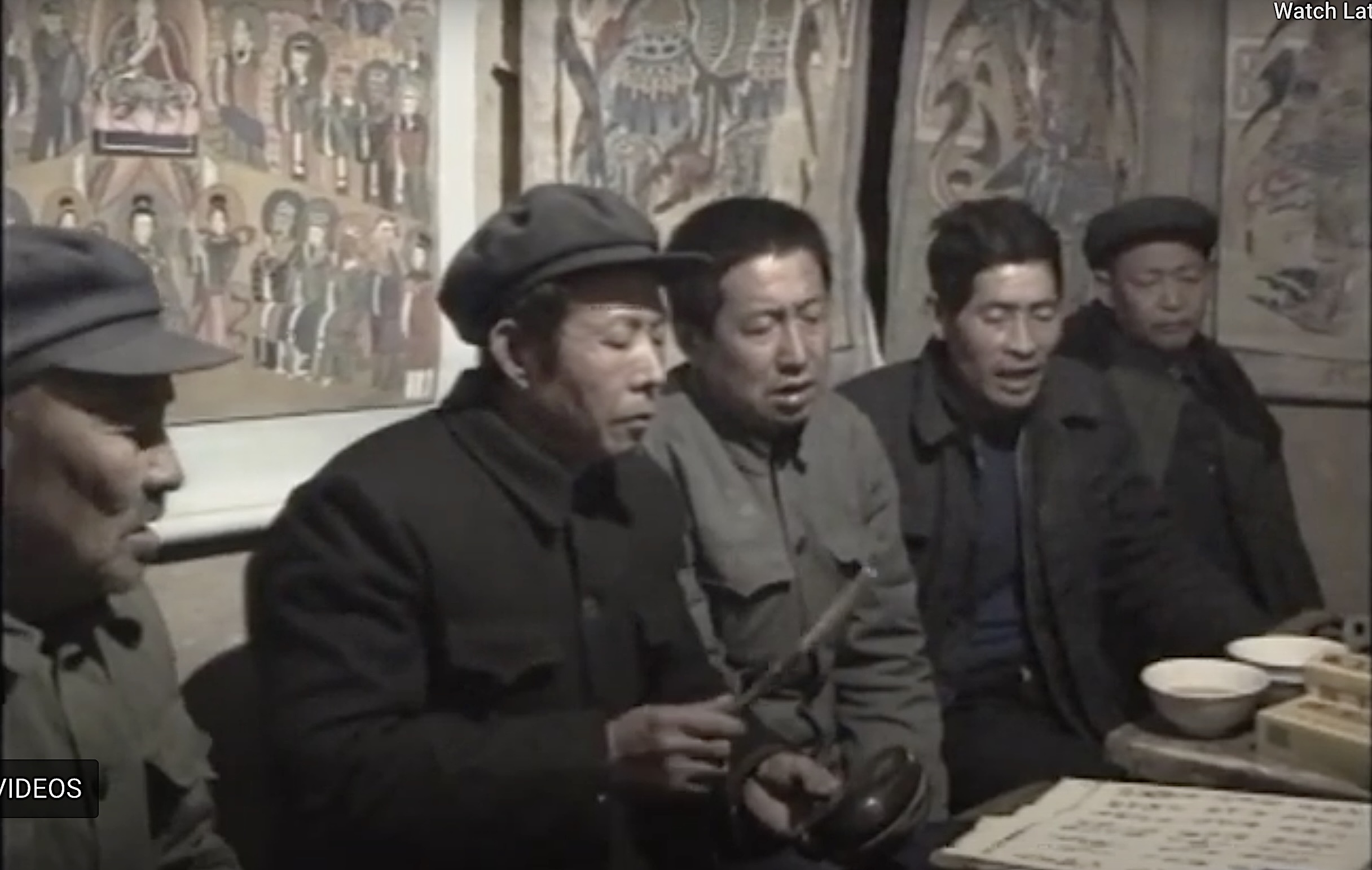
As we all smile quizzically, my friend Xue Yibing then asks Cai An’s mother ingenuously,
“Were there ever any women who learnt the music?!”
“Oh no!”, she cackles.
“Why not, then?!”
“It was Old Feudalism in them days, wannit, how could women take part?!”

While I wondered if the fact that women still don’t learn meant that we are still stuck with “Old Feudalism”, her comments sparked off a group discussion (which, for men, was quite observant) on the position of women in village life.

The men, while doing nothing about it, rather like their British counterparts, readily admit that women have a much harder time than men. Their explanation of the male monopoly on ritual is feeble: “The ritual performance of the associations is a business for Buddhist and Daoist priests; what with setting up the altar and burning the petitions, everyone kowtowing, it wouldn’t be convenient if there were women there.” Though I recall that nuns used to perform rituals and even play the shengguan wind music, the point is at least that men and women should be segregated—yet even all-female performing groups are rare in rural China. But after all, women constitute the majority of those offering incense and making vows during these rituals.

The male musicians go on, just a bit more plausibly, “Anyway, women just don’t have the time to study the music; their life is much more harsh, in the old days grinding flour, making shoes, mending clothes, cooking, looking after the kids, they were so busy. Men have nothing much to do except tilling the fields; especially in winter, they have time to learn the music.”

Indeed, men (both in Gaoluo and Beijing) think women’s liberation has gone too far. A familiar male lament is heard: “Nowadays the women even get their husbands to do the household chores!” To be sure, women can have quite a temper, and men commonly deplore their fate with the nice, if sexist, pun “I’ve got tracheitis”, tracheitis (qiguanyan) being homophonous with “hen-pecked” (“wife controls strictly”). One otherwise bright young village boy, back for New Year from his studies at college in Tianjin, couldn’t see what I was on about, claiming rather wistfully that men and women in Gaoluo were entirely equal—overlooking little details like the total absence of women in positions of responsibility, their failure to go on to higher education, their relegation to eating the cold leftovers after the men have taken their fill, and the fact that several Gaoluo wives have been bought. Moreover, since able-bodied men now migrate to the towns to seek work, women are left behind on their own not only to run the house and look after the elderly and young but also to tend the fields. Apart from that, they have a great life…

Though all this doesn’t exactly get to the roots of sexism, I’ve given a couple of vignettes. That’s how things were in Chinese villages in the 1990s; so much for gender equality under Maoism or the reforms. The closest we came to influencing women’s status in Gaoluo was that Cai An’s mum finally got used to being included in a round of cigarettes—hardly a great coup in favour of the global women’s movement.

All this began to change towards the late 1990s when rural girls began to move from secondary education to college in the towns and cities—but that’s another episode in the story.

The Houtu precious scroll

*Click here for link to page!*
(again, under Themes > Local ritual in top menu)

Hot on the heels of my article on the Houshan Daoists, we need a rather more detailed account of the “precious scrolls” (baojuan 寶卷) [1] performed by amateur ritual groups on the Hebei plain.

The four ritual associations of South and North Gaoluo all have early copies of precious scrolls on several themes, but what they, and I, consider their most exquisite volume, the Houtu scroll, was copied only in 1943 (see my Plucking the winds).

While the Ten Kings scroll was commonly recited for funerals until the 1964 Four Cleanups campaign, the Houtu scroll was performed for calendrical rituals—notably the New Year and Houtu’s own festival around 3rd moon 15th, either on Houshan or in the home village (playlist, track 6, and commentary).

The whole point of these precious scrolls is that they are performed for rituals—they’re not musty tomes to be read silently in libraries. And their performance practice—in the hands of peasant ritual specialists—transpires to be rather complex. As I always say, one can hardly study ritual without focusing on how it sounds.

This article is based on my In search of the folk Daoists of north China, Appendix 3, which contains further refs.

HTJ image


The Houshan Daoists

*Click here to read page!*

So far, most of my pages on local ritual have described traditions in Shanxi. The province of Hebei, surrounding Beijing, may seem “too close to home”, lacking the romantic image of either the ethnic minorities or the barren northwest, but it is a remarkably fruitful site for fieldwork.

While the topic belongs with my pages on Gaoluo (under Other publications), I’ve put it under Local ritual, since it sets forth from the lives of Daoist priests.

You can find background on the Hebei plain south of Beijing by consulting the many sources in my introduction here, but one major site in our fieldwork on ritual life there was Houshan 后山, in Yixian county, centre of the cult to the female deity Houtu 后土, whose temple fair I’ve already outlined.

This sketch of the Complete Perfection Daoist priests of the temple there on the eve of the 1949 Liberation again illustrates their close connection with the ritual life of local villagers. In a (lavishly illustrated!) article I introduce the Houshan priests; the village ritual associations and sects nearby which continued their ritual tradition; the rich trove of “precious scrolls” in the region; and nearby temples to Houtu.
Pantheon, Liujing 1995

Documenting religion in China

Gansu miaohui FK

Temple procession, Xincheng, south Gansu, June 1997. Photo: Frank Kouwenhoven. © CHIME, all rights reserved.

Ian Johnson’s recent book The souls of China is just as fine as its many reviews say. I’ve praised it in some detail in several posts (notably here and here), so here I’d like to discuss responses to it; my comments here also relate to my article on the brief of ethnography.

The religious revival in China since the late 1970s is hardly news: it has long been a major topic within the confines of academia. Scholars like Ken Dean have described local temple organizations as “China’s second government”. But by contrast with most studies within a narrow scholarly milieu, the great strength of Ian’s book is that he engagingly places religious practice within the changing context of Chinese society, blending the personal and the political with rare insights into the lives of Real People.

The souls of China has already been reviewed by some noted scholars of Chinese religion (such as here and here), but given that it laudably reaches out to a wider audience, some reviews have come from more general observers of contemporary China and the modern world. While this is clearly A Good Thing, amidst some fine reviews I find others that tend to somewhat misrepresent the book.

Preaching to the converted?
A comment in the publisher’s blurb gives me pause:

This entrancing and engaging book challenges the modern assumption that religion is a thing of the past; on the contrary, the dramatic resurgence of spirituality in China, after a century of violent persecution, suggests that it is an irrepressible force that may in some sense be essential to humanity.

Such an evangelical tendency may be Buddhist or Daoist (or indeed Islamic—Ian’s book wisely focuses on the Han Chinese), but it will often be Christian commentators who see the revival simply as “an astounding miracle”. Even less doctrinal readers may read The souls of China as a mere paean to “freedom” and some abstract “spirituality”—as if the Chinese revival represents some great victory for Western liberal values. This constitutes a handy stick with which to beat the Communist Party, quite lacking the nuance of Ian’s writing. Would pundits latch with such enthusiasm onto a notional (and unlikely) resurgence of religious faith in north Europe? It seems unlikely too that a study on the growth of atheism in China would be so enthusiastically received abroad.

To be sure, religious groups in China have often taken a stance against the regime, notably at times of extreme pressure, like collectivization, famine, and the Cultural Revolution—well, that just about covers the whole Maoist period. And more recently too, religion may indeed—in particular cases—act as an alternative sphere upholding moral values in public life, as is clear from Ian’s chapters on the Early Rain Christians of Chengdu.

His fieldwork sometimes blends with his own personal search for some kind of purpose—engaging in fine “participant observation” through involvement in meditational retreats and qigong (which indeed the CCP leadership first seized on with enthusiasm and then sought to suppress; note also Ian’s book Wild grass). But The souls of China manages to be both involved and dispassionate—covering a range of behaviours within what several scholars have called the “religious market”, with rich ethnographic detail on the diverse, messy, and inconvenient grass-roots situation.

Excesses
Religion can be a lucrative business. And—just like the Communist Party—it may sometimes serve as a cloak for highly reprehensible behaviour. The Party pounces on (and sometimes fabricates) instances of financial scams and sexual crimes among religious groups, although Party members themselves are renowned for such abuses. But they’re covered by the criminal code—even if it may be easier for Party members to escape the long arm of the law; so it makes no more sense to ban sectarian groups than it does to outlaw the CCP (now there’s a thought).

Religion may serve as spiritual inspiration, or to spur social action; but (as we can see in “democratic” societies like the USA or India) it can also be a socially conservative force—which is why in China (and Russia) the Party now co-opts its “traditional values”. During fieldwork in China, like De Martino in post-war Italy, I’ve sometimes been shocked at the delusions of religion, observing cripplingly poor rural familes unable to afford even basic healthcare yet spending vast amounts over New Year on a barrage of deafening and evanescent firecrackers. Or a vignette from my book on Shaanbei (p.86):

Back in the county-town, returning to our hostel one evening, we switch on the TV to find a documentary about coal-mining accidents, which are reported nightly. There are some rather fine investigative programmes on TV these days, and the main theme of this one is how the response of the village Communist Party leadership to the disaster, rather than considering improving safety measures, has been to give funds to construct a new village temple in the hope of divine protection. OK, in this case the programme happens to fit into an agenda of rationalism against superstition, a view we sometimes feel inclined to challenge, but tonight I can only go along with the presenter’s lament.

Only later did I put together further pieces of a grisly jigsaw. Under the tradition of posthumous marriage (minghun), revived in northwest China, within five years after the death of an unmarried male over the age of 15 sui, a suitable dead unmarried female is found. Indeed, shawm bands often perform, and a Daoist may officiate. The unnatural deaths of many men in unregulated mines were bad enough, but newspaper reports in 2007 revealed that women (often disabled, or from poorer provinces) were being murdered to cater for this market.

The souls of China does indeed document some of the less noble aspects of religious practice in China. Few commentators would regard the sectarian groups (including many Christian sects, indeed) like Eastern Lightning (ch.25, citing the work of Emily Dunn; cf. this update) as a paragon; some of them are no less weird and worrying than they are elsewhere in the world. We do indeed need to describe them, but not necessarily to praise them; Ian’s account is admirably balanced.

Christians

Catholic vespers

Gender-segregated Catholic Vespers  in a Hebei village house-church, 2001.

Permeating Plucking the Winds, my history of the ritual association of a Hebei village (see also Gaoluo tag), is the intriguing sub-theme of the underground Catholic community there. I note the complexities of their troubled relations with both the village association (whose conflict goes back to a massacre in the Boxer uprising) and the local state:

Their presence might be seen as somewhat akin to that of a Hindu temple in an English village, which has also created frictions.

One might both admire them for their obstinacy and worry at their intransigence.

Household Daoists
All this puts in perspective my work on the Li family Daoist band (as in my recent book and film). Ian’s splendid vignettes in The souls of China (cf. also his own video clips) focus on the life of Li Bin (b.1977), who is gradually taking over the leadership of the band from his wonderful father Li Manshan (b.1946); apart from all the material in my book and film, I’ve updated the story here, as well as explaining how unlikely it is that there will be a tenth generation of Daoists in the family.

Inasmuch as they are hereditary occupational ritual specialists, they don’t quite fit into the “faith” picture—although such groups are an ubiquitous part of the religious scene throughout China. They have been doing good business since the 1980s’ revival, and particularly since around 2009—not due to any resurgence of faith, but mainly, as Li Manshan sagely told me, because the demographic is such that it’s been a busy few years for funerals. Li Manshan still needs to choose the correct date and site for the burial; for the funeral proper, his band is invited more as a duty towards ancestral tradition (“the old rules” lao guiju) than as a sign of any resurgence of “spirituality”—funeral audiences now pay scant attention to their liturgy, only crowding round for the “red-hot sociality” of the (few) entertainment interludes over the day. When the kin are required to kneel and kowtow for the Daoists’ rituals at the “soul hall”, they are reluctant to drag themselves away from the pop routine outside the gate (do watch the eloquent vignette in my film, from 30.32!). Often I am the only audience for the magnificent vocal liturgy before the coffin.

But scholars of Daoism are unlikely to rejoice in this, since it’s “the wrong kind of Daoism”; nor does this quite fit into the kind of spiritual devotion sought by other foreign aficionados of religion. The current vibrancy of the band takes place amidst the depletion of the countryside and the discrediting of traditional rural values. I can see that Li Manshan’s services have considerable value for those “left behind” in such declining village communities, but that doesn’t mean that I wish to parade them as some kind of model for Chinese society.

Following Geertz, I described a “flawed funeral” I attended with the Li band:

The idea of a failed ritual tacitly accepts that the aim of the proceedings is to confirm and celebrate community solidarity—and indeed that there is such a thing. That Geertz and others don’t always find this may reflect on a supposed loss of such harmony under complex post-colonial (or whatever) social tensions; perhaps by contrast with an imagined earlier ideal age, a notion that we may obviously challenge too.

Funerals in China do indeed seem to me to represent something valuable, for both kin and community. But the family is subject to scrutiny; the event is an opportunity to confirm status within the family and community, but also a moment when underlying animosities may be entrenched. And this applies to other rituals too, like the vast territorial processions of southeast China. The conditions of the 20th century have doubtless created many dislocations in thinking; and we should recognize conflicts in imperial China, between classes and lineages, different aspirations, and so on.

What we might call the “hippy tendency” has a foothold in Daoist studies too, from Bill Porter’s intriguing work to more scholarly quests for the timeless wisdom of white-bearded temple-dwelling sages (and again, Ian well describes the solitary truth-seekers). The gritty realities of rural society, and household ritual specialists like Li Manshan, don’t quite mesh with such a picture. To use Ian’s book to “celebrate” religious faith ignores the serious social problems he notes, that such fervour won’t solve.

One can still be amazed at the vibrancy of temple festivals in areas like south Fujian or Gansu, but the religious “revival” of the last four decades has been taking place in the context of the depletion of the countryside and rapid urbanization, along with the pervasive spread of pop and consumer culture. So while many rural dwellers have used the liberalizations to reinvent their local traditions (not necessarily “faith”), those traditions are threatened by the migrations that liberalization also engendered. Ian covers both rural and urban pictures, but the “hope” of the faithful may reside more in the latter, with their wider online networks and more “modern” discursive modalities.

Let’s hear it for secular humanism
While freedom of religion may be a good principle, it’s not the same as extolling all its manifestations. Today, vapid materialism and blind faith in the supernatural are not the only choices; religion is not the only remedy for moral decay. As I observed in my book,

By comparison with the years of Maoism, people now have more decisions to make, choosing from a range of options. They may have rituals performed and seek consultations to determine the date and select auspicious sites, but they are not entirely fatalistic. They tend their fields, save money, gamble, watch TV, play video games online, eat out in restaurants, establish guanxi networks, set up businesses, deplore and exploit corruption. State education here may lag far behind the big cities, but it has become ever more important since the 1950s.

Whether or not people engage in meditation, prayer, or charitable projects for the common good, they can and do lead ethical lives, taking part in their communities and finding meaning without creating imaginary supernatural beings. It would take courage to argue with the long-term and ongoing humanist secularization of north Europe—a choice that has followed many centuries of violent religious persecution like that lamented in the blurb I cited above. People’s faith in imagined beings (Richard Dawkins’s “flying spaghetti monster”) needs to be documented, all over the world, but evangelism is best excluded—all the more on the part of romantic outsiders.

The purpose of ethnographies of religious practice, for any society, is not to Praise the Lord; scholarship like this shouldn’t be exploited by adherents of Western religious faith. Such faith is by no means universally admired—observers like Dawkins or Christopher Hitchens (whose work may be disputed, but can’t be dismissed as merely eccentric) might be shocked by any such revival of delusion and superstition.

I’d like to see a review of The souls of China from a committed secularist like the anthropologist Mobo Gao. In his fine book on his home village where he grew up, he comments approvingly on the hygiene and healthcare campaigns under Maoism that sought to lessen popular belief in mediums, noting the 1980s’ religious revival in measured tones (Gao village, pp.77–8, 89–90, 227–31). In similarly leftist vein, on William Hinton’s return to Longbow village, where he had documented the 1940s’ land reform in rich detail, he was disturbed by many social consequences of the 1980s’ liberalizations—not least the major Catholic revival there (see also his Through a glass darkly, pp.180–82, 209). While some anthropologists may dispute such views, they are valid and quite widely held—both in China and the West.

Many will feel that religious freedom is only a minor aspect of the freedoms that China needs—basic human rights, control over corruption, freedom of the press and the judiciary, and so on. Indeed, Ian is a leading observer of these movements, as is also clear in The souls of China. In some cases religion may contribute to such freedoms, but in others it is irrelevant or even obstructive. Given the diverse social problems of Chinese people today, it may seem whimsical to trust in gods to rescue them from adversity. And such issues are far from unique to China: the current persecution of atheism in Russia is worrying.

Ian’s book is exemplary in its rapport with religious practitioners, its ethnographic detail, and its involved yet dispassionate stance—that readers would do well to note.

Fieldworkers, Chinese and foreign

In my post on the brief of ethnography in response to a jaded urban Chinese worker, I mentioned the tribulations under Maoism of many urbanites on being sent down to the countryside.

The memories of my splendid Chinese fieldworker friends are just as painful. Among various Beijing colleagues who have accompanied me over the years, one recalls his family starving as a young boy in Shandong around 1960; another, witnessing colleagues being crushed to death in dangerous mines in Gansu in the Cultural Revolution; yet another, being exiled to a rural “May 7th Cadre School”.

For our local assistants, the countryside may have even more direct associations: I sometimes found myself taking them back to the very villages where they had taken part in “tempering through manual labour” during the Four Cleanups campaigns of the early 1960s.

From bitter personal experience, they have no reason to idealise rural life. Thankfully, the bright new generation of Chinese fieldworkers have been spared such sufferings—though this also makes it harder for them to empathise with the life stories of our peasant masters.

So as our fieldwork in Hebei and Shanxi took off in the 1990s, my friends must have felt as if they were being dragged back into “going down to the countryside to join in the brigade” (xiaxiang chadui 下乡插队). But it wasn’t me who was dragging them—I was following them—and they too were following in the footsteps of intrepid previous generations of Chinese fieldworkers.

XYB Huaiyin 1992

Xue Yibing (centre) with villagers in Huaiyin, Shanxi, summer 1992.

We were all aware of the phrase attributed to Confucius, no less:

“When the rites are lost, seek throughout the countryside”
   li shi qiu zhuye 禮失求諸野

Indeed, the thoughtful and prolific Zhang Zhentao 张振涛 called an early collection of his articles “Records of seeking music in the countryside” (Zhuye qiuyue lu 诸野求乐录).

ZZT Houshan 1995

Zhang Zhentao with members of the Xiaoniu village ritual association, Houshan temple fair, Yixian 1995.

Still, occasional forays were all very well, but I began to feel the need for longer stays. For me—safely armed with my passport and return air-ticket—sleeping on the kang brick-bed of my wonderful host Cai An in Gaoluo, fetching water from the well, slurping noodles with doufu and cabbage from chipped bowls at funerals, and even visiting the latrine by the pigsty, still had a certain exotic frisson.

While my Chinese friends shared my excitement at discovering such a wealth of material on ritual life in society, their other consolation was that this new rural exile was (semi-?!) voluntary—and that there was a clear time-limit on it. In those days their living conditions in the dilapidated Music Research Institute in Beijing were far less comfortable than they were later to become, with the huge improvement in living standards and their own growing reputation. But apart from the demands on their time in Beijing, extended stays might be somewhat beyond the call of duty. Still, they entered the fray with spirit, and the fruits of their labours are outstanding.

Zhuanlou 1992 caifang

Learning about shawm fingerings with the Hua family shawm band during a break at Zhuanlou village funeral, 1992. Holding shawms: Xue Yibing (left) and Jing Weigang (right).

See also my Plucking the winds, pp.234–5.

By the way, Zhang Zhentao keeps writing about how much I inspired him, but it was entirely mutual. Along with my other trusty fieldwork companion Xue Yibing, we forged our approaches in the 1990s on the anvil of the major project on Hebei ritual associations (qv). And both Zhang and I ended up writing three books on “northern” musical cultures—on Hebei:

  • Yinyuehui: Jizhong xiangcun lisuzhongde guchuiyueshe 音乐会: 冀中乡村礼俗中的鼓吹乐社 (Ji’nan: Shandong wenyi chubanshe, 2002),

Shaanbei:

  • Shengman shanmen: Shaanbei minzu yinyuezhi ‪声漫山门:陕北民族音乐志 (Beijing: Wenhua yishu cbs, 2014),

and Jinbei:

  • Chuipo pingjing: Jinbei guyuede chuantong yu bianqian 吹破平靜: 晋北鼓乐的传统与变迁 (Beijing: Wenhua yishu chubanshe, 2010).

He has also written a plethora of fine articles.

For more on our respective blind spots, see this post on Morris dancing.

At the barbers

Barbers 1917

Notwithstanding the constant transformation of Chinese society, Sidney Gamble’s photo from around 1917–19 shows a scene that is still common in rural China today (for his remarkable collection, see here; and for the Miaofengshan pilgrimage, including Gamble’s early film footage, here. And for more fine historical images, see this site).

I was wont to have my head shaved even before I began doing fieldwork in China. But since the older generation of peasants in north China tend to do so (mainly for the sake of hygiene), I emulate them while I’m there.

Early in the course of my long-term work with the ritual association of Gaoluo, one demonstration of our developing relationship was my decision to have my hair cut in the village. From my Plucking the winds (pp.205–6):

Our visits through the hot summer of 1993 were our first since our initial one in 1989. Though now engaged on a general survey of many villages, we were increasingly drawn to Gaoluo, returning there frequently, and despite the recent theft, we spent many happy times together. We used to sit outside on low stools in the shade of He Qing’s courtyard, with Cai An, Li Shutong, and others gathering round for a chat and a smoke. This was the time when we appreciated the depth of He Qing’s knowledge. And our major musical discovery that summer was the vocal performance of the magnificent Houtu scroll (audio playlist, track 6, and my notes here].

GL haircut

He Junqi prepares to cut my hair. Left: our fine MRI driver Little Deng; behind him, in white, maestro He Qing.

I admired the closely cropped heads of many of the musicians, and tend to do without much hair in the summer myself. He Junqi (then 54), a regular visitor to He Qing’s house, son of the sweet elderly flautist He Yi, used to cut the musicians’ hair for them, so I asked him if he’d like to do mine. Everyone stood round having a good laugh, while He Junqi gave me the most meticulous haircut and shave of my life, scouring my scalp with local “White Cat” washing-powder.

And since 2011, a regular haunt of mine on visits to Yanggao to hang out with Li Manshan and his Daoist band is the Barber for Old, Middle-aged and Young (Laozhongqing 老中青) in town, just round the corner from Li Bin’s funeral shop.

laozhongqing

Photo: Li Bin.

Since we all agree that I look years younger with my head shaved, we soon glossed the name as “Old Jonesy is younger” (Lao Zhong qing 老钟轻)—yet another in our series of merry puns