Echoes of the past 1

Echoes of the past: refuge and memory, 1

Train refugess 1945

Refugees, 1945.

Hildburg Williams is a long-serving and popular violinist in London chamber and early-music orchestras, who has latterly added a major string to her bow [1] by becoming a distinguished German-language coach for singers in opera, lieder, and oratorio repertoires.

I’ve known Hildi since 1982, when we were playing a Handel opera in Lyon with the English Baroque Soloists under John Eliot Gardiner. Though I worked with her on and off for the next eighteen years (mostly in EBS), somehow we never managed to have a proper chat. As is the way with orchestral life, we moved in different circles, different groups going off in search of restaurants, and she was rarely to be seen in the bars that my mates frequented after gigs.

So I knew nothing of Hildi’s early years, fleeing twice from war and trauma; or the tale of her sister, who stayed behind in the German Democratic Republic (GDR). Their stories are just a drop in the ocean of the continent-wide migrations in the period immediately following World War Two, not to mention more recent ones from farther afield—many such accounts have been published. But only very recently have I realized how important it is to tell the stories of such “migrants”; and this also bears on the post-traumatic amnesia that took hold not only on both sides of the German divide, but throughout Europe (including the UK)—and indeed China. All these lives are precious. [2]

After a couple of long sessions together, and some background reading, I produced a preliminary draft. Meanwhile, as Hildi was stimulated to reflect further on her life, more and more memories came to the surface, prompting her to give a more comprehensive account of her life—for her own sake, not merely at my behest. This, the first of two instalments, is my own adaptation of her story.

Chatting belatedly with Hildi has made an intriguing contrast with my main experience of fieldwork since 1986—making notes while hanging out with chain-smoking Chinese peasants between ritual segments at funerals. But the principle is rather similar: to document and empathize with people’s experiences through troubled times. Still, whereas in China my clear outsider-status somehow makes such talks quite smooth (though note my comments on “stranger value”), in this case, being somewhat closer I sometimes feel more impertinent. So it reminds me that we foreign fieldworkers intrude too blithely into the personal lives of our subjects—a privilege that is hardly earned.

Thankyou, Hildi—and a belated happy 80th birthday! Having boldly offered Stephan Feuchtwang some Bach for his own 80th, this tribute will at least be less aurally challenging.

Early years: Silesia
Hildburg was born in November 1937, the youngest of three siblings, in the town of Weißwasser in the Sorbian enclave of Upper Lausitz, east of Dresden—right by what is now the Polish border. The family ancestry can be traced back to Lower Silesia—her grandparents and parents originally lived in Bunzlau (now Bolesławiec, in Poland).

Both of Hildi’s elder siblings were born there, but by the time she was born the family had moved west to Weißwasser, where her father had been appointed as Rektor, school headmaster.

Hildi’s mother was also a teacher, but had to resign when she got married, as was the ruling in those days. However, when the war broke out she was reinstated. A young woman lived with the family, looking after the children.

Germans had made up the great majority in Silesia for many centuries. Weißwasser was just west of the Oder–Neiße line, which was to remain German even after 1945.

Through the 1930s the Jewish populations of such communities were ever more vulnerable. When Hildi was barely a year old, anti-semitic violence escalated with Kristallnacht; near Weißwasser, the Jewish population of Görlitz was among those targeted. In October 1939 a camp just south of Görlitz, originally for Hitler Youth, was modified into a PoW camp and began to receive inmates. Indeed, it was at this very camp that Messiaen, captured at Verdun in 1940, was interned—soon to compose and perform his amazing Quatuor pour la fin du temps there, as if untouched by human society.

By 1939 Hildi’s father was in his forties; in August, as the war started, he was called up by the Wehrmacht, going on to serve in the army administration in Poland, Russia, and France. Hildi reflects:

I can only remember one short visit when he was on leave. Apart from this, I only knew him from photographs and his letters home, which would often include little paragraphs to us children, with some drawings. [3]

But after the war he hardly talked about his experiences, so Hildi knows very little of this period in his life.

When she began attending school in 1943, her mother was her first teacher there (“a fact she enjoyed more than I”)—Hildi remembers addressing her in the third person like all the other pupils in class, anxious to fit in and not be treated differently from her classmates.

Up to the summer of 1943 the family spent the holidays at Hildi’s grandparents’ home in a little village just outside Bunzlau—they owned the former village school, with its large garden and a wooded area known as The Park. For the children it was an idyllic setting.

First flight
As we chat over coffee and cake in Hildi’s gemütlich little house in north London, I struggle to imagine the utter devastation of Germany by that time, evoking the most appalling images we have seen from Syria in recent years—and refugees then were just as vulnerable as Syrians today, desperately trying to survive by fleeing. Keith Lowe tellingly sums up the devastation of post-war Europe: [4]

Imagine a world without institutions. It is a world where border between countries seem to have been dissolved, leaving a single, endless landscape over which people travel in search for communities that no longer exist. There are no governments any more, on either a national scale or even a local one. There are no schools or universities, no libraries or archives, no access to any information whatsoever. There is no cinema or theatre, and certainly no television. The radio occasionally works, but the signal is distant, and almost always in a foreign language. No one has seen a newspaper for weeks. There are no railways or motor vehicles, no telephones or telegrams, no post office, no communication at all except what is passed through word of mouth.

There are no banks, but that is no great hardship since money no longer has any worth. There are no shops, because no one has anything to sell. The great factories and businesses that used to exist have all been destroyed or dismantled, as have most of the other buildings. There are no tools, save what can be dug out of the rubble. There is no food.

Law and order are virtually non-existent, because there is no police force and no judiciary. In some areas there no longer seems to be any clear sense or what is right and what is wrong. People help themselves to whatever they want without regard to ownership—indeed, the sense of ownership itself has largely disappeared. Goods belong only to those who are strong enough to hold onto them, and those who are willing to guard them with their lives. Men with weapons roam the streets, taking what they want and threatening anyone who gets in their way. Women of all classes and ages prostitute themselves for food and protection. There is no shame. There is no morality. There is only survival.

For modern generations it is difficult to imagine such a world existing outside the imaginations of Hollywood script-writers. However, there are still hundreds of thousands of people alive today who experienced exactly these conditions—not in far-flung corners of the globe, but at the heart of what has for many decades been considered one of the most stable and developed regions on earth.

By 1945, Silesia was ever more lawless. As German defeat was imminent, and with zones of occupation constantly shifting, the American and British inmates of the Görlitz PoW camp were marched westward in advance of the Soviet offensive.

On 17th January 1945 what was left of Warsaw was “liberated”; Krakow and Lodz soon followed. Budapest fell to the Soviet forces on 13th February; and as they were closing in on Berlin, Dresden was obliterated by RAF bombs on 13th–15th February.
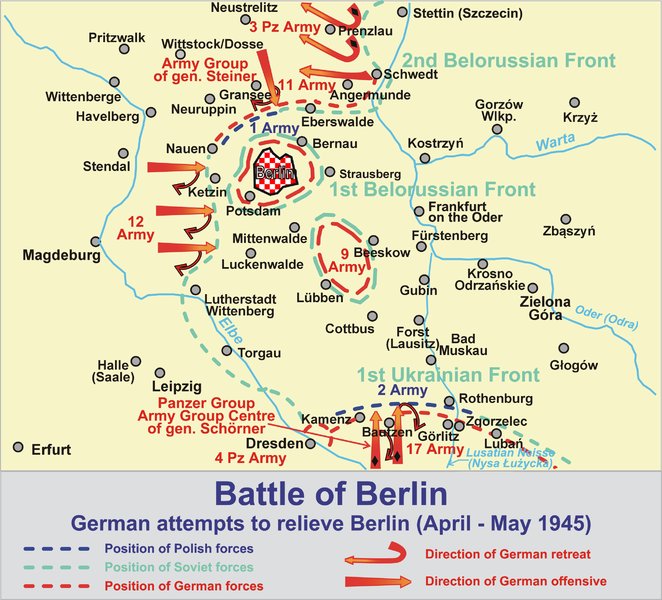
There was still desperate fighting (see also here) around the Silesian region in April. The 1st Ukrainian Front captured Forst on the 18th. As Hildi recalls:

I remember our last days in Weißwasser vividly—the food shortages, the frequent air raids, the sound of fighting, the endless treks of refugees fleeing westward passing along our street. Every night my mother would take a family in to give them food and a bed before they continued their journey the next morning. The raids intensified daily and on the 13th February the light from the burning Dresden was clearly visible. As the fighting drew nearer, we could hear the bombardments coming from Forst just north.

During these anxious days there was a young woman briefly lodging in the flat who was betrothed to a German lieutenant. He told her she should urge Hildi’s mother to leave. The last military train going west was due on the 19th February from Hoyerswerda, 7 kilometres from Weißwasser. So along with a throng of desperate people (mainly women, children, and the elderly, since most men were either dead or away fighting), they now fled their home. Hildi, then seven, vividly remembers the chaos, with refugees panicking as they fled in all directions.

The most essential items were hastily packed, and I still remember gratefully that I was allowed to take both my beloved dolls. The lieutenant sent his orderly with an open lorry for us to catch the train—which turned out to be already overcrowded with hardly any room. My sister was precariously perched on top of several suitcases, resting her feet on the handle of a pram.

The train eventually left the next morning, but even on the night before there was an air-raid. Some people panicked and fled, but luckily the train was not hit. The journey was agonizingly slow, with the train frequently grinding to a halt. At some stations it was possible to get some soup and a hot drink, but these were dangerous moments, as nobody knew how long these stops would last and people were afraid the train might set off without them.

Planning to get to the small town of Kahla, near Jena in Thuringia, to stay with the family of an uncle, Hildi’s family finally climbed out of the military train in Zwickau, embarking on several complicated train changes. Again the carriages were packed with huge numbers of other refugees and luggage, so sometimes people could only get off the train by clambering out of a window. It was snowing and the ground was covered with dirty slush.

Thuringia, 1945: brief US occupation
When after three days they at last reached their destination, Hildi’s aunt gave them the use of one room in her flat, with the children sleeping in a little attic room. But even here they found that far from being safe, escalating air raids meant spending anxious hours in the cellar huddled together with the other occupants of the house.

Communication was sporadic: there were disruptions everywhere, with large sections of the railway lines destroyed (at the end of the bombardment only 650 of 8,000 miles of track were operating), and so any letters that made it through were long delayed. With millions on the move, tracing the whereabouts of family and friends proved arduous.

The family did at least have a little radio, and Hildi was delighted when a broadcast of a classical concert came on. Meanwhile, news broadcasts were less instructive than rumours of the allied troops’ advance, which created great anxiety.

American forces began occupying the province of Thuringia from 1st April; Patton’s forces entered Buchenwald on the 11th (for my post on Ravensbrück, see here).

Dresden in ruins.

On 20th April the Russians reached Berlin. As agreed by Roosevelt, Churchill, and Stalin as early as 1944, and confirmed at the Yalta conference in February 1945, the defeated Germany (including Berlin) was to be divided into four zones of Allied occupation. Thuringia was to belong to the Soviet zone, but the Americans arrived there first before the fighting ended. Hildi’s family had no inkling of all this until later.

In Kahla, the situation deteriorated dramatically early in April, just after Easter, with frequent air raids. In a last-ditch effort, the German forces blew up the bridge over the river Saale. Warplanes were flying low over the town, with bombs exploding alarmingly close.

We seemed to spend most of our time in the cellar, anxiously listening and waiting for the all-clear signal, and then, climbing upstairs again, being thankful that, for now at least, we had been spared.

Then the day came when, with a roar of heavy motorcars and tanks, the Americans announced their arrival. Cautiously peeping through the windows, we saw the whole street full of cars and jeeps, which were constantly washed and polished.

The GIs went from house to house to find accommodation for their people. Nearly all the houses in our street had to be evacuated, but ours was spared. When the GIs came to investigate it was lunchtime, and our large family was sitting around the kitchen table—my mother, my aunt, my grandparents (who had recently arrived from Silesia by trek), and we children. When one man in uniform asked: “How many children?”, my mother answered in English “Five”, whereupon they left.

We mainly stayed indoors—there was a curfew in place, and at first only two hours were allowed daily for people to try and get provisions from shops, where there were long queues. On 2nd May ration cards were introduced, and the electricity supply seemed to be becoming more stable, but sadly, one day our radio was confiscated. From now on we could only get snippets of news while queueing for food. News of Hitler’s suicide on 1st May, and the signing of the act of surrender on the 7th, was anxiously passed around. We children picked up the atmosphere of doom and desolation.

Hildi recalls the GIs:

It was the first time in my life I saw a black person. I had heard that these were the people who were kind to children and were known to give them sweets and chocolate. So one day I plucked up my courage and gingerly approached one of them, uttering my first English words—“Have you chocolate?” I had never tasted chocolate—whenever I asked about it I would always get the answer: “When the war will be over”, to which I would wearily reply: “This is always your excuse!” Now the war really was over, this seemed to be the moment—but the soldier, somewhat bewildered, just shook his head.

At first the officials of the American Military Government were under strict orders to treat the defeated population with stern discipline. Rations began to shrink, often to under 1,000 calories per day. My mother lost so much weight that one day she was blown over by a gust of wind, spilling the precious thin broth she had just acquired from the butcher after queueing for ages. The black market flourished, but as refugees neither my mother nor my grandparents had anything of value to offer. Food shortage was a constant problem, but somehow they managed to put something on the table.

Under Soviet occupation, 1945–49
However, Thuringia was only to be very briefly within the US zone; in a deal unbeknown to locals, as the Allies had agreed with the Soviets for part of Berlin, the American troops began withdrawing on 1st July, ceding it to the Soviet forces—precisely those that Hildi’s family had fled from the east to evade.

 Then on 2nd July, without forewarning—almost overnight—the scene changed. The US jeeps disappeared, followed by an eerie, foreboding silence; and finally, as we all peeked anxiously through a small gap under the closed jalousie, Russian pony-driven carts arrived. What a change from the smart vehicles of the Americans! What a shock! What would become of us now?
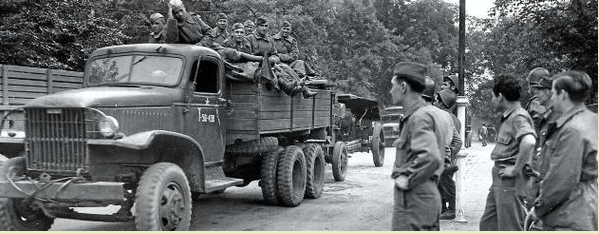
US Russian handover 1945

Russian troops passing GIs into Weimar, 4th July 1945.

For the time being, having only just escaped the east with such difficulty, Hildi’s family stayed put. They were now to live under the Russian regime until 1948, when the administration began to transfer to what in 1949 became the GDR.

Still, Hildi’s family had done well to flee early from the east. Over three million people had fled west before the organized expulsions began, mainly driven by fear of the advancing Soviet Army; and another three million Germans were expelled in 1946 and 1947. For many, the formal end of the war was not an end to their suffering but a beginning; vast numbers died in the process.

As a post on armaments in the Kahla region comments,

The population’s fear of retaliation at the hands of the incoming Red Army resulted in a gigantic wave of German refugees. […] All through May, the American military witnessed the panicked streams of refugees heading west. In addition, there were masses of people from further east fleeing before the advancing Soviet troops.

Hildi reflects on my impertinent queries asking if they now considered taking flight from the Russians once again in July 1945:

In July 1945 the whole of Germany was in total chaos. Everyone was solely occupied with survival—there was no time for reflection, still less for coming to terms with the past. While travel was still possible, not only were journeys arduous and complicated, with the rail network still in disarray, but where should we go?

The housing situation was dire. Apart from the millions of refugees from the East, there were all the survivors of the bombings, now homeless, who had to find a roof over their heads as most cities lay in ruins. One couldn’t just turn up anywhere—one had to know someone who could guarantee at least some sort of accommodation. My mother’s youngest sister lived in the northwest, but she only had one room for herself—though she became an important point of contact for our entire family, at a time when so many people were desperately trying to locate their loved ones and friends, or simply to find out if they were still alive.

Above all, in 1945, apart from the zones of occupation, one was not yet conscious of a divide within Germany into “East” and “West”. The whole of Germany faced the same chaos of devastation, having to deal with the aftermath of war. Mountains of rubble had to be cleared—a task mainly performed by women, since their men were either still prisoners of war or too old and infirm to take part. [6] Everyone was living from one day to the next. With our large family including aged grandparents, there was no hope of resettlement in the near future. Besides, there was no indication then that life was any easier anywhere else.

Were we worried? I am sure the adults were. Were we safe? I think, on the whole, we were. Following the departure of the American forces, the Soviet soldiers were now on strict orders to behave accordingly, and were severely punished, often beaten, when they transgressed. Fraternization was strictly forbidden—there was a definite “them” and “us”. The hegemony of the occupying forces was never in question.

Considering the widespread punitive measures against Germans in these first few years after the war, and many horror stories, they were relatively unscathed. But as Hildi observes, hunger was still a constant companion, especially for city dwellers. In the villages, in the early days before farms were confiscated by the state, there was still enough produce; townspeople brought anything they could find of any value to exchange for food. It was said that the only thing missing at the farms were the Persian carpets in the cowshed!

Although we were given ration cards, the shops did not have enough supply, so wherever there happened to be a queue people would join, even if it was unclear what was for sale.

I remember our excursions to pick mushrooms in the woods nearby. We became quite knowledgeable about them. At home we would clean and slice them, threading the slices on a pieces of string to dry for the winter. We did that with apples too. Eventually we were given a small plot of garden, and my grandfather worked hard growing vegetables and salad. As living standards improved in the Allied zone, the highlights were occasional food parcels from relatives there with essential provisions—and to our delight they would sometimes even reveal a chocolate!

My older sister, now 17, helped enormously, working for a farmer in a village 7 kilometres away—not only could she now get enough to eat, but we had one less mouth to feed. On many weekends she would walk this long distance, carrying back as much food as she could manage.

After the harvest the townspeople were allowed to glean the fields. They would all line up at the edge of the field and only after the farmer had raked it over thoroughly was the sign given to enter. The stalks were gathered like a bunch of flowers before the heads were cut into a sack. Back home my grandfather would beat the sack until the husks separated, then blow them away carefully until he had just the grains in his palm. They were worth their weight in gold; some would be ground in an old coffee grinder to make porridge, and if there were enough then the local mill would exchange them for flour, a welcome supplement.

Occasionally slices of bark and pieces of wood were available from the local sawmill, which we piled up high on our rickety wooden cart. My grandfather then used an axe or a saw to cut them for our stove and wrought-iron oven. He also built a rabbit hut. We children loved these cuddly animals, and got quite upset whenever one suddenly went missing—my grandfather made sure we were not around when he sacrificed it for the pot.

Women had to be inventive with their dishes. I remember a brownish bread spread, ambitiously called Leberwurst, made from a flour mixture and spiced with marjoram, as well as Schlagsahne (whipped cream) made from whey, a thin greenish liquid that was available for free at the local dairy. For some time these recipes were carefully stored in a box, but, thankfully, never used later on! We children could not be choosy— we ate everything.

For cooking we had enormous pots in the kitchen, as the food lacked the necessary substance. Later they were adopted for boiling the washing.

Looking back now it seems amazing how we adapted to the deprivations of our daily life. Power cuts were frequent, and with candles in short supply we just stuck a piece of resin-wood into an earth-filled flowerpot and set it alight—a sooty affair! At other times we just sat in the dark and sang.

In 1945 Hildi’s father had been captured and interned in a PoW camp; [5] by June he was able to rejoin his family in Kahla. He must have known that his wife would try to get them away from Weißwasser, but with no means of telephoning, and only a sporadic postal service, Hildi doesn’t know how he found out where they had escaped to.

As Hildi’s father approached, pushing a bicycle, she was standing at the gate; recognizing him as he called out her name, she was so excited to see him that she jumped up to greet him and chipped a corner out of one of her front teeth.

Now at last we were a real family! My father immediately applied for a job. At a time when numerous factories were dismantled and their machinery taken away, he was lucky to find a job at the still-functioning sawmill. For a man who had never had done any physical work in his life, this was hard for him. There was no other footwear but heavy wooden clogs, and my mother spent hours sewing patches onto his torn gloves.

My brother and I spent the summer holidays of 1946 with our former help and her family in a village near Bautzen, east of Dresden. For my parents this was a godsend, since they could be sure we would be properly fed there; for us children it meant an exciting long train journey and a wonderful time in the country. But the journey confronted us with images that remain ingrained in my memory even today. Passing through Leipzig we witnessed with horror the devastation on both sides of the track—ruins everywhere, eerie monuments of gruesome battles, tall buildings sliced through the middle, with the occasional lone piece of furniture precariously balancing on the edge.

Leipzig devastated.

Just opposite their house was a school that served as a barracks; during this time another building was used for some teaching. So Hildi’s grandfather (himself a former teacher) gave her additional lessons, with daily reciting of maths tables. When the troops finally moved out, the barracks became a school again, which Hildi now attended. Among the subjects there was Russian, which she learned reluctantly. But she was much keener on learning the violin, taking lessons along with her brother from elderly local musician Emil Wittig—Hildi’s brother became his star pupil, and to this day she still treasures a copy of the Kreutzer violin studies with a dedication to him from their teacher.

If their radio hadn’t been confiscated, Hildi would have loved to hear broadcasts of the classics with conductors like Furtwängler. Here he is in 1948, rehearsing Brahms 4 in London—where his visits were still sensitive, since though acquitted of collaboration late in 1946 it would still be some time before he was entirely rehabilitated abroad:

Like Chinese people, Hildi’s father never discussed his war experiences—which, apart from perhaps being politically uncomfortable, must have been deeply traumatic.

Although we children seemed to find our own way through this period of deprivation, we could not help picking up the general atmosphere of resignation, uncertainty, and fear. Outside the home people did not engage in conversation before making sure no-one was nearby who could possibly listen. At school it was not uncommon for a teacher to use children as tools to gain vital information from them about their elders’ opinions. My brother and I were instructed never to mention any sensitive topics we might have heard at home.

By October 1949 Hildi’s family found themselves part of the new German Democratic Republic (GDR).

Apart from the major trials of the worst culprits, de-nazification [7] was pursued patchily even in the first couple of years after the war, as the occupiers soon discovered it was both impracticable and undesirable; in the Allied zones, reconstruction took priority over principles as Cold War loomed. People heard about the war-crimes trials, but they were little discussed, and never part of the school curriculum.

Discretion became still more important when in 1949 Hildi’s father planned to cross the border to Westphalia in the British zone, hoping to find a new life in the West so the family could join him eventually. His parents-in-law had already made the journey earlier without too many problems, since “old people” were considered not just unproductive but a burden on the state.

Sure enough, after a long trek northwest Hildi’s father managed to reach Detmold, where he was offered the use of a hut in a large garden belonging to a friend of a friend. At once he found work as a gardener, later getting an office job with the British authorities.

With the de-nazification process now inevitably something of a formality, it was formally abolished in 1951 with the ponderously-named Entnazifierungsslußgesetz law (expanding my acquaintance with German polysyllables). Meanwhile, senior German conductors jumped through the requisite hoops as the new authorities pored over their careers under Hitler. The search for culprits still continues even today, but there was no call for repentance, and nothing resembling Truth and Reconciliation—either here or later in China.

In Kahla, Hildi’s mother was questioned twice about her husband’s whereabouts by two officials knocking on the door. She simply replied, “He has abandoned us. I have no idea where he is.”

Second flight
In March 1950 Hildi, with her mother and brother, managed to flee the new GDR to join her father. But this time her sister made the choice to stay behind. Her life had changed for the better in 1947, when she was accepted for the pedagogic school for mathematics and natural science in Gera, east of Kahla. In what Hildi observes was a strange way of beginning one’s studies, all the students had to take part in clearing the Thuringian forest, sawing and stacking felled tree trunks—at least they were allowed to take some wood home.

By 1948 Hildi’s sister had a diploma, and soon found a teaching post. She realized her qualifications would count for nothing in the Allied zones, and she couldn’t face having to retrain; and besides, she had fallen in love with her future husband. The family parting was difficult.

After the trauma of their original flight as part of a mass exodus west in 1945, this second journey posed different challenges.

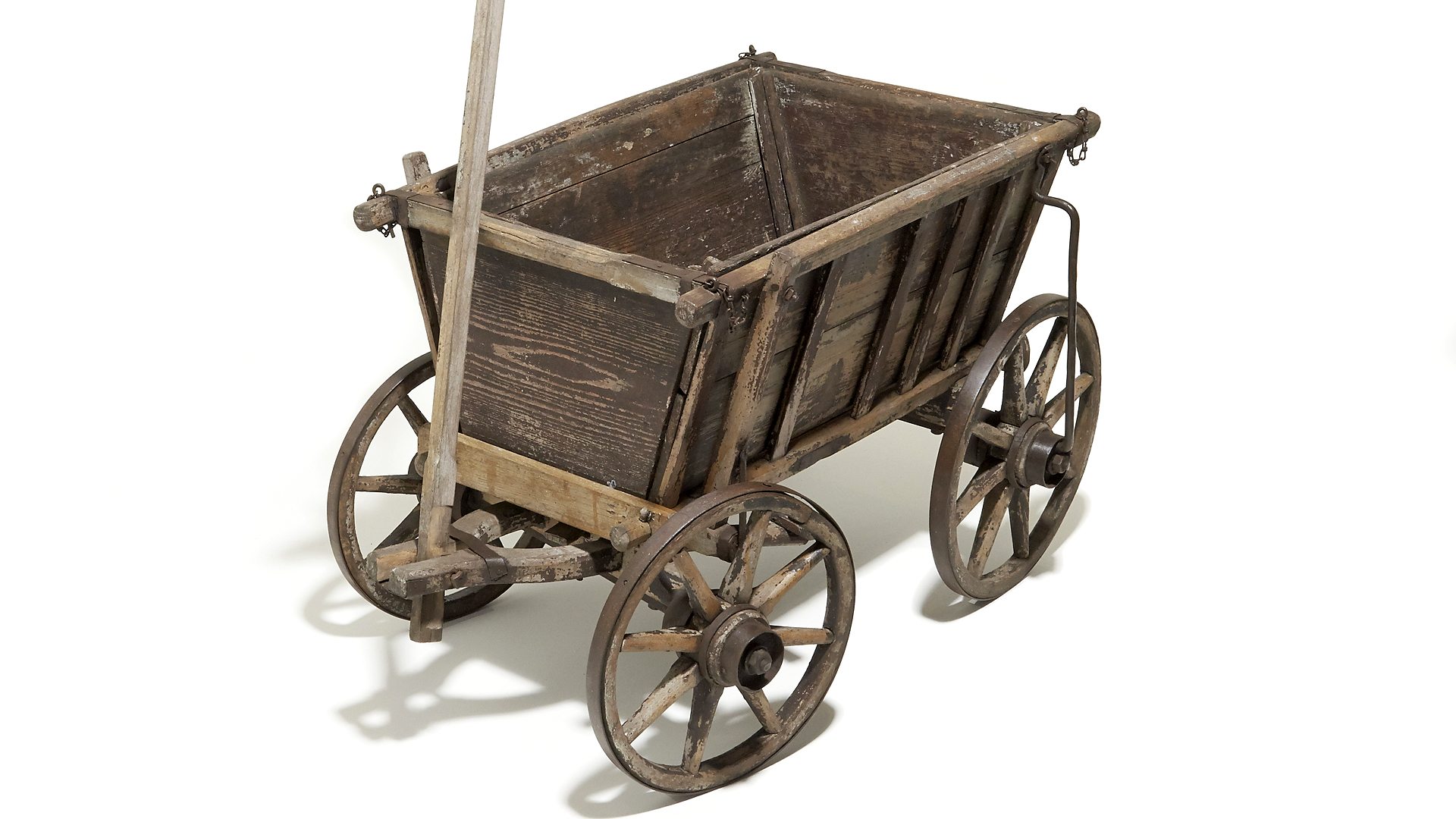
Our preparations for escape were complicated. The few belongings that we had gradually accumulated needed to be sent ahead in parcels. This was not officially allowed, but we had found one guard at the station who would turn a blind eye and post them. If he was not on duty, which was often the case, we just had to turn back home again with our wooden cart laden with parcels, and try our luck another day.

Just such a cart is an iconic image of the refugee exodus, displayed in museums like the excellent Forum of Contemporary History in Leipzig:
Finally we set off on the hazardous journey across the Harz mountains, by the same route that my father had taken. I was now 13. With the help of a guide, a woman who knew which route to take and was familiar with the schedules of the border guards, we made our way with rucksacks on our backs, my brother and I clutching our violins. At the time there was still movement in both directions, but since trains were rigorously searched at the border, a whole family travelling west would have aroused suspicion. So we got off one stop before the terminus and climbed down the railway embankment. Crouching at the bottom of it, we waited anxiously until the train set off again. It was already dark. Then started a long and difficult walk. Our nerves at breaking point, no-one spoke. We watched our footsteps, carefully avoiding the dry leaves on the ground. Occasionally there would be a rustle—our heartbeats racing, we all stopped and held our breath. But often it was just someone returning from the West, going in the opposite direction. The journey seemed endless, but at last we made it!

So after a trek of two days they once again found refuge, reunited with Hildi’s father in Detmold.

Given Hildi’s later immersion in Bach, her trek has an interesting parallel with Bach’s Long March from Thuringia to Lübeck in 1705 to seek his hero Buxtehude—in very different circumstances, and even further, over several months.

Meanwhile in rural China, the Li family Daoists, having mostly survived the Japanese occupation, were soon plunged into civil war and the turmoil and violence of “Liberation”—somehow continuing to provide ritual services for their local community throughout the whole period. All over the world convulsions continued in the wake of war, with over a million dying in the Partition of India.

Nearly four decades later, as we sat together in orchestras playing Bach and Handel, I had no inkling how very stressful Hildi’s early experiences were. In the next instalment we follow her from Westphalia to Zurich, and then on to London, as she embarks on a life of music; and we reflect further on refuge and memory.


[1] Sic: the metaphor is from archery, not fiddles, of course.
[2] Whatever the Daily Mail, or the Putrid Tang Emanating from the White House, may tell us. Among many documentaries on the current plight of refugees, the BBC series Exodus is remarkable.
[3] Cf. Hester Vaizey, Surviving Hitler’s war: family life in Germany, 1939–48.
[4] Savage continent: Europe in the aftermath of World War II, pp.xiii–xiv; I find this book a most instructive and sobering introduction to the period right across Europe. I can barely scratch the surface of the vast literature on the immediate post-war period. Other accessible books include Giles MacDonogh, After the Reich, and Frederick Taylor, Exorcizing Hitler—where the appalling situations in Silesia and Thuringia can also be pursued. Moving and detailed is Gitta Sereny, The German trauma.
[5] For the desperate conditions of the PoWs, see MacDonogh, ch.15; Taylor, pp.173–87; Lowe, ch.11.
[6] See also MacGregor, Germany: memories of a nation, ch.27.
[7] MacDonogh, pp.344–57; Taylor, chs. 10–12, and Epilogue (for the Soviet zone, see pp.323–31, 360–61).
Lieder

Apart from the Matthew Passion and Nina Hagen (yet more unlikely bedfellows), here are further compelling reasons to learn German. While I’ve never been drawn to the mainstream lieder scene, yet again I owe my enchantment by these song cycles to Boulez (cf. Mahler’s Rückert lieder, and Ravel’s Shéhérazade).

First Wagner—the Wesendonck lieder. Here’s Janet Baker with Reggie Goodall in 1971:

Anne Sofie von Otter is just as wonderful:

Then Berg, exploring a path opened up by his mentor Mahler. The Seven early songs (which I got to love at our 1971 NYO Prom)—here’s Jessye Norman with Boulez (with helpful Japanese subtitles):

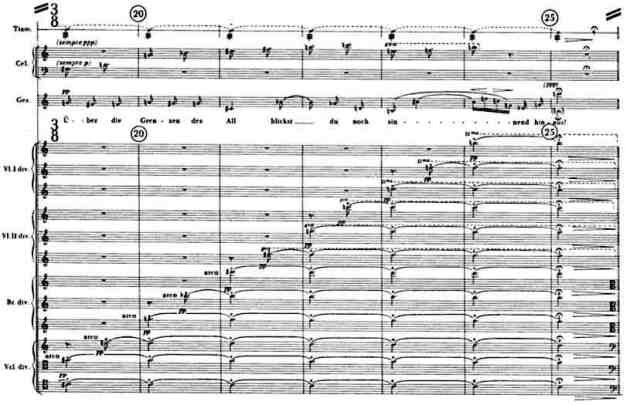
and his (five, nearly as early) Altenberg lieder—to picture-postcard texts (Ansichtskartentexte, another entry in our lexicon of German mouthfuls)—fin-de-siècle Viennese haiku? Here’s Margaret Price with Abbado in 1970:

The third song is haunting:

Über die Grenzen des All blicktest du sinnend hinaus
Hattest nie Sorge um Hof und Haus
Leben und Traum von Leben—plötzlich ist alles aus!
Über die Grenzen des All blicktest du sinnend hinaus

Berg

After the menacing whisper of “plötzlich ist alles aus!” (plötzlich is officially my favourite word), find me a singer who can diminuendo from pp up to that final top C—Nina Hagen, perhaps?!

See also Strauss’s Four last songs. A spellbinding recent addition to the canon is Hans Abrahamsen’s let me tell you, for the great Barbara Hannigan. Sgt Pepper and Abbey road also rank alongside these orchestral song-cycles.

Hidden histories

The current BBC Radio 4 series

hosted by the engaging Clarke Peters, introduces a treasury of recordings illuminating the social history of Europe.

The first series covers the period from 1900 to 1930—notably Black Europe, a richly-documented 44-CD set from Box Family Records.

From the series website:

Received wisdom has it that black popular music arrived in Europe with the Empire Windrush in 1948, but Clarke brings us black sounds recorded in Europe from as far back as 1900.

Programme 1: Focusing on early commercial discs made in the recording studios of London, Paris and Berlin, we hear from dozens of different performers, including African American travelling entertainers, traditional African musicians, black British classical composers and more.

Clarke discovers a huge variety of black music recorded in Europe at the start of the 20th century, including very early examples of blues harmonica, scat singing and stride piano. The programme also includes some of the earliest African music ever recorded, from Senegalese war songs captured at the Paris World Fair in 1900 to the music of a troupe of Congolese pygmies who toured Britain in 1905-07.

Programme 2: Clarke explores the music of black Europe at the time of the First World War. The sounds of what would become jazz start to emerge, including African American banjo bands who entertained London high society, and the military music of Harlem bandleader James Reese Europe which enthralled France. The programme also includes music by captured African Prisoners of War, recorded in camps across Germany.

Programme 3: Clarke explores the sounds of Zonophone records, a pioneering label that recorded a huge amount of early African popular music. Many of these discs were made in London for export to West Africa, including several Nigerian hymns recorded in 1922 by Fela Kuti’s grandfather. The programme also includes the sounds of African American jazz in 1920s Paris, especially the work of Josephine Baker, the world’s first black superstar.

For James Reese Europe and the Harlem Hellfighters, see also

and this short Channel 4 feature.

Series 2 and 3 are now available, taking the story through World War Two, the 60s, and the 70s—antecedents of what even then was still not called “world music”. These programmes too are full of gems, such as hot jazz in Weimar Berlin, calypso in Cardiff Bay; underground bands in Hitler’s Germany, black American trumpet stars in occupied Paris, Caribbean swing bands playing through the Blitz in London; and in the post-colonial era, on to Ambrose Campbell and his West African Rhythm Brothers, Sterling Bettancourt, Lord Kitchener, and the emergence of the Notting Hill Carnival sound; Ghanaian highlife, Congolese rumba from Brussels, Algerian chaabi in Paris, Surinamese jazz from Holland, the songs of Cape Verde—and black flamenco. To Name But A Few…

Leading us to the Shanghai jazz scene, here’s Sam Wooding’s Orchestra playing Shanghai shuffle in 1925 Berlin:

For Algerian chaabi, here’s Dahmane El Harrachi’s Ya rayah:

And here’s Ronald Snijders live:

All these diverse cultures have made up a major part of European social history over the last century. It’s a really ear-opening series, providing many leads to explore.

Bach and patronage

Following the riches of Bach on Radio 3 and my recent survey:

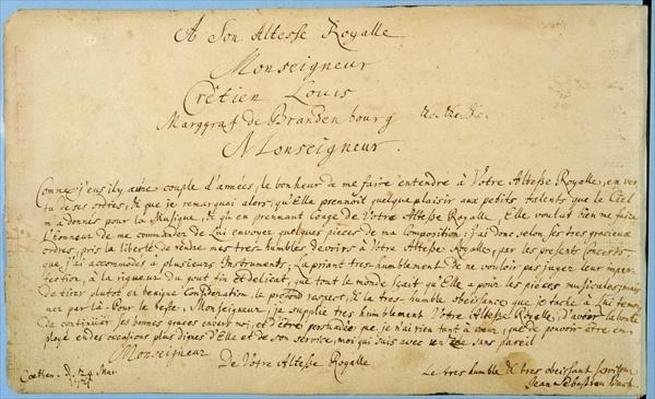
Bach’s letters to his patrons are a sad vignette on the sordid realities of working for them. Along with his unsolicited gift of the Brandenburg concertos to the Margrave of Brandenburg [“What does that even mean?”], he wrote this covering letter (in French, courtly language of the time), dated 24th March 1721:

As I had the good fortune a few years ago to be heard by Your Royal Highness, at Your Highness’s commands, and as I noticed then that Your Highness took some pleasure in the little talents which Heaven has given me for Music, and as in taking Leave of Your Royal Highness, Your Highness deigned to honour me with the command to send Your Highness some pieces of my Composition: I have in accordance with Your Highness’s most gracious orders taken the liberty of rendering my most humble duty to Your Royal Highness with the present Concertos, which I have adapted to several instruments; begging Your Highness most humbly not to judge their imperfection with the rigor of that discriminating and sensitive taste, which everyone knows Him to have for musical works, but rather to take into benign Consideration the profound respect and the most humble obedience which I thus attempt to show Him. For the rest, Sire, I beg Your Royal Highness very humbly to have the goodness to continue Your Highness’s greatest favours towards me, and to be assured that nothing is so close to my heart as the wish that I may be employed on occasions more worthy of Your Royal Highness and of Your Highness’s service—I who, without an equal in zeal, am, Sire, your Royal Highness’s most humble and obedient servant.

Sure, we have to read such a letter in the context of the day, but it’s hard to beat for brown-nosing. Servants indeed— to cite Dennis in Monty Python and the Holy Grail,

… exploiting the workers! By hanging on to outdated imperialist dogma which perpetuates the economic and social differences in our society… We’re living in a dictatorship! A self-perpetuating autocracy, in which the working classes…

Didn’t know we had a king. I thought we were an autonomous collective.

And there’s no evidence that the Margrave even wrote back. Pah! I hope Bach told him where to stick it. He might have well as sent the concertos to Tweety McTangerine.

Bach had been happy at Cöthen, where Prince Leopold was an exceptionally musical patron—Bach’s need to seek new employment has been blamed on the Prince’s “airhead” new wife (typical). With the Margrave deaf to his appeal, Bach was soon to find a permanent haven in Leipzig—and the rest is geography. Even there his struggles with patrons continued.

Thing is, despite all such routine tedious scramblings, Bach never stopped creating a wealth of music that stands as a rebuke to all mundane concerns.

And so in imperial China—right down to today, as a chain of fawning operates from grass-roots performers to regional cadres to central pundits. Only with less magical results.

I trust I shall have the honour to remain your faithful and humble servant

Dr S. Jones (available for weddings, bar mitzvahs, and screenings of my film Li Manshan: portrait of a folk Daoist)

The psychology of evil

Still thinking about fieldwork, I’ve cited an extreme instance of “participant observation” in the work of Germaine Tillion in Ravensbrück concentration camp, as well as the ethical quandaries of Sudhir Venkatesh in Gang leader for a day.

Among all the literature on the psychology of evil, as a chilling instance of fieldwork interviewing, Gitta Sereny held lengthy talks with Franz Stangl over three weeks in 1971, after he was belatedly sentenced to life imprisonment for co-responsibility in the murder of 900,000 people at the Sobibór and Treblinka extermination camps. [1] Stangl died of heart failure nineteen hours after Sereny’s last visit.

As she observes (The German trauma, pp.88–9),

I decided to find one perpetrator if possible less primitive and with at least a semblance of moral awareness, who, if approached not as a monster but as a human being, might be able to explain his own catastrophic moral failure. […] I found Stangl more complex, more open, serious and even sad than any of the others I had observed; the only man with such a horrific record who appeared to manifest a semblance of conscience.

Within the extraordinary circumstances of these prison interviews, Sereny’s account is a model of detailed and sensitive work, reflection, and even empathy; as she carefully elicits as much candour as can be expected, she meticulously documents both his self-delusion and her own feelings.

Also importantly, her interviews are founded on much research and personal authority—experience of the period in question, in-depth study of the material, and discussions with people who worked under Stangl, witnesses, and survivors. All such background is important for fieldworkers, enabling them to ask apposite and probing questions sensitively.

Equally sobering is Sereny’s discussion of her meetings with Albert Speer—which indeed he initiated after reading her book about Stangl. [2] She unpacks the different and complex feelings of the generations since the war, notably in “Children of the Reich” (including their early worries about right-wing sentiments in the east after reunification).

I can’t think of a close parallel for other societies lastingly afflicted by the ghosts of unspeakable evils—certainly not for China, where what little we know of the “catastrophic moral failure” under Maoism (which was very far from being limited to the “usual suspect” of the Cultural Revolution) tends to be through the accounts of with victims rather than perpetrators—and it’s just as important to explore the mass of cases along the spectrum between those extremes. And of course, whereas such exposés depend on free media, for China such first-person reflections might only ever be muffled at best—since despite a change of direction, the same Party remains in power. Anyway, Gitta Sereny’s interviews are a model.


[1] “Colloquy with a conscience”, in her brilliant book The German trauma; more detailed is her book Into that darkness.
[2] The German trauma, pp.266–85, based on another of her books, Albert Speer: his battle with truth.

Ute Lemper

In My Time I’ve heard a few divas live in concert (Jessye Norman, Renée Fleming)—indeed, I’ve accompanied some (Monserrat Caballé, Cecilia Bartoli). In this blog I also praise outstanding male singers like Michael Chance and Mark Padmore.

In Italian the term divo is occasionally used, but elsewhere there’s no male equivalent of the diva, or the related femme fatale; both terms reveal male anxiety—dangerous, damaged women meeting (and luring men to) a bad end (cf. Lulu). Male behaviour, more intrinsically fatal, is not advertised thus. The chanteuse is a similar archetype. And the skewed language continues with prima donna—as if male performers are never temperamental, self-important, and demanding (yeah right).

Susan McClary opened the way for later unpacking of such stereotypes in both opera and popular music, such as Lori Burns and Melisse Lafrance, Disruptive divas: feminism, identity and popular music (2001). And the use of these terms in English adds xenophobia to sexism—our impeccable moral virtue threatened by these loose foreign women (“They come over ‘ere, with their dramatic genius, and their perfect control of phrasing and diction…”).

Anyway, “that’s not important right now” (Airplane clip, suitably in a post on solfeggio!)—

I can’t think when I’ve been so entranced by a singer (that’s the word we’re looking for!) as hearing Ute Lemper in concert at the Cadogan Hall last week. I thought I could consign her to a comfortable old Weimar pigeonhole, but her music is endlessly enchanting. Never mind that I wasn’t quite convinced by this latest project based on Paolo Coelho, with a world music sextet—she keeps exploring. Her sheer physical presence is irresistible—as with Hélène Grimaud, it’s an intrinsic concomitant of her musical magic. Audiences hang on her every breath, every inflection of her slender wrist… I’d love to hear her in a little jazz club.

As with Billie Holiday or Amy Winehouse, the variety of dynamic, timbre, and vibrato that “popular” singers can command is all the more moving by being deeply personal. Once again, I rarely find perfect distinctive vocal artistry in the world of WAM. They’re all building on their respective traditions, but it’s harder for WAM singers, more burdened by formality, to convey such intimacy. Of course, Ute Lemper is also somewhat polished and controlled—less destructive than Billie and Amy; that may make her slightly less moving, but it also helps her stay alive. Her stage presence is breathtaking.

Much more to relish on her YouTube channel.

For a recent incarnation of the femme fatale, see here.

Critical reviews

I won’t have a word said against S-S-Simon Rattle.

But here’s one, by Alex Bruggemann (Die Welt am Sonntag, 2004), about a concert he gave with the Berlin Phil. Indeed, I found it posted with uncharitable glee on the notice board of the Chicago Symphony when we were doing a gig at Symphony Hall—our stay in Chicago another welcome opportunity to slope off to bars afterwards to hear some amazing blues.

I cite from the review not as an endorsement, you understand, but for the charm of the image:

While Rattle romps expressively on the podium, the Philharmonic musicians sometimes tend to play as inconsequentially as if they were a wife reaching to the fridge to get out a beer for her husband.

No pleasing some people. It was just a phase they were going through.

A more inadvertent critique was offered by a Radio 3 announcer introducing Brahms’s Tragic overture:

We don’t know which particular tragedy Brahms had in mind when he composed this overture. … But here it is, conducted by Richard Hickox.

Metamorphosen

R Strauss

The Aurora orchestra recently performed Richard Strauss’s Metamorphosen at the Proms—where, like the John Wilson orchestra, it has made an invigorating recent addition to their house bands. The piece is always a moving experience, not least thanks to its intimate chamber form, with eloquent elegiac solo strings.

(I wasn’t even going to mention their Eroica in the second half. But with the band standing, now playing from memory before a rapt Prom audience, it had all the electrifying directness of involvement that you get from a live jazz big band. As with the orchestra’s other memorized renditions, however inauthentic such a practice may be, this is the 21st century, and this is one way of communicating now.)

* * *

Strauss composed Metamorphosen during the closing months of World War Two, from August 1944 to April 1945—just as Nazi panic at imminent disaster was leading to ever-more inhuman violence. It was commissioned by Paul Sacher, to whom Strauss dedicated it.

Much I as love many of Richard Strauss’s works, in that simplistic binary trap of ours I find myself siding firmly with Mahler.

Alex Ross devotes the first chapter of The rest is noise to “The golden age: Strauss, Mahler, and the fin de siècle”. Both composers “released images of fragmentation and collapse”, yet whereas Strauss (“earthy, self-satisfied, more than a little cynical”) often seems sumptuous and glossy, Mahler was always heartfelt. Sure, I found it overwhelming to play Elektra (composed in 1909! Just as Mahler was being fêted in New York) in Dresden in 1980. And everyone knows the opening of Also sprach Zarathustrabut how many of us bask in the passage that immediately follows it, some of the most sumptuous string writing ever? Metamorphosen is among rather few of Strauss’s works where I can detect true sincerity. See also under La voix humaine.

* * *

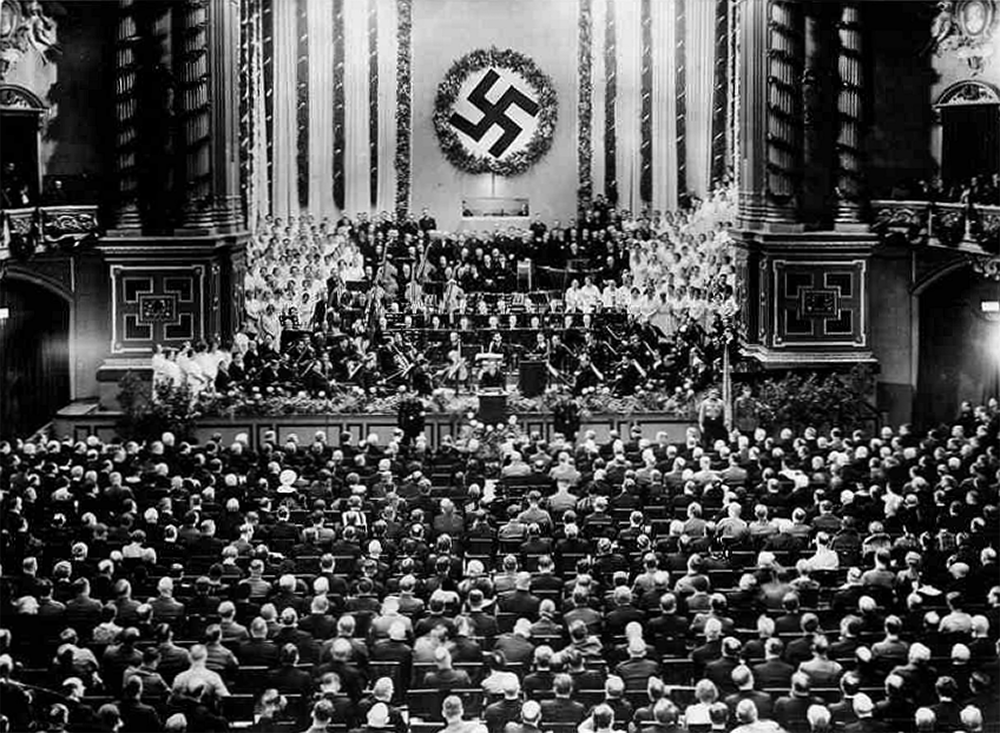
Reading through endless discussions of Strauss’s relationship with Nazism, I’m little the wiser. (For context, see Ross, pp.333–70).

Both Nazi official and anti-Nazi émigrés made the same complaint about Strauss—that he acted like “a total bystander”.

As Michael White observes,

As for Furtwängler and the others who performed under the swastika, there was an undoubted mixture of foolishness, delusion, opportunism and cowardice. You can say of all these people that they should have had more courage, more integrity, and been prepared to sacrifice careers, futures and maybe lives. But that’s a big ask. What would you or I have done? I like to think I’d have been brave, but I can only thank God that I’ve never had to find out.”

Strauss was four years younger than Mahler, but outlived him by thirty-eight years. Who knows how, or if, Mahler would have adapted to Nazism—having already been welcomed to New York from 1908, one imagines him seeking refuge there. He (rather than a host of imitators, or his estate) might have profited from the film-music boom for which he was too early, but it’s intriguing to wonder how his work might have developed over a further three decades or more.

* * *

In 1947, the year after the first performance of Metamorphosen, with Europe in ruins, the Berlin Phil recorded the threnody (“authentically”) under Furtwängler (just imagine):

For me it was another formative experience to perform it at Cambridge in 1974 under Charles Groves—in the same concert where we played the summery Mozart C major piano concerto.

As a late flowering of depth and intimacy, Metamorphosen belongs with the Four last songs. Here’s Kirsten Flagstad singing Beim Schlafengehen with Furtwängler and the Philharmonia in London in 1950—when the world, however deeply scarred, was being transfigured again:

For more on the Four last songs, see here; and for Heldenleben, here (and note); for a more recent transformation, here. Cf. Schoenberg’s Verkaerte nacht.

Bearing witness: If this is a woman

*For sequels, see my posts on Sachsenhausen and A life in secrets*

As this turns into a lengthy review, I ponder why I’ve been trying, in an amateurish way, to educate myself about the traumas of modern Europe—beyond the obvious answer, that we all must.

I guess it’s related to my studies of China, and my engagement with the lives of people like Li Manshan; a feeling of duty to report the sufferings of ordinary people I encounter in China—including not just their ritual life but their tribulations under Maoism, with famine, struggle meetings, and labour camps; and my growing awareness of the sufferings of Europeans over a similar period. I don’t want to spoil your holidays (or mine), but as we relish the cultures and scenery of these countries, we shouldn’t forget the ghosts that haunt the landscape.

Among the innumerable studies of the Nazi concentration camp system, Primo Levi is justly famed—actually, I find the sequel The truce just as disturbing as If this is a man, after the camp is finally liberated yet their Odyssey of suffering continues, homecoming ever receding. But I’ve also been deeply moved by

Helm’s account is based on amazingly thorough research and interviews with both victims and perpetrators—much of which was submerged until the end of the Cold War. Of course a historian’s account will give different, more holistic, perspectives from those of an individual inmate, but in a way I find Helm’s work even more moving than that of Levi. At 823 pages, it’s hideously readable—both balanced (whatever that might mean) and personal, in a way that ideologically-driven accounts such as those of Dikötter (for the degradations of Maoism in China) can’t achieve. Even the excellent index is harrowing.

I suppose I’m not alone in thinking of the whole catastrophe in terms of a few appalling place-names like Auschwitz and Belsen, but along with the focus on Ravensbrück, over the whole six years of its existence, we see how very extensive was the whole network of camps, subcamps, death camps, work camps, transports and marches, scarring the whole landscape.

At its height, Ravensbrück had a population of about 45,000 women; over the six years of its existence around 130,000 women passed through its gates, to be beaten, starved, worked to death, poisoned, executed and gassed.

The book opens with an arresting and complex image:

“The year is 1957. The doorbell of my flat is ringing,” writes Grete Buber-Neumann, a former Ravensbrück prisoner. I open the door. An old woman is standing before me, breathing heavily and missing teeth in the lower jaw. She babbles: “Don’t you know me any more? I am Johanna Langefeld, the former head guard at Ravensbrück.” The last time I had seen her was fourteen years ago in her office at the camp. I worked as her prisoner secretary… She would pray to God to stop the evil happening, but if a Jewish woman came into the office her face would fill with hatred…

So she sits at the table with me. She tells me she wishes she’d been born a man. She talks of Himmler, who she sometimes still calls “Reichsführer”. She talks for many hours, she gets lost in the different years, and tries to explain her behaviour. (1)

The book goes on to tell the stories of Langefeld, Buber-Neumann (who also had the terrible distinction of already having been incarcerated in a Russian gulag), and a tragic cast of inmates and their tormentors, with chapters focusing on personalities over the years.

Among them were political prisoners, Jehovah’s Witnesses, “asocials”, “useless mouths”, “idiots”, and (later) children; in this camp only around 10% were Jewish. Its shifting population was international, including Germans, Poles (the largest group), Gypsies, Russians, Czechs, French, Hungarians, Scandinavians, and Dutch, all transported there at various stages.

In April 1944 recent arrivals included evacuees from Majdanek, including more Red Army doctors and nurses, as well as 473 Gypsies transferred from Auschwitz. There were Italian partisans, Slovenians, Greeks, Spaniards, and Danes, as well as three Egyptians and seven Chinese. (419)

They were often in desperate straits even when they arrived.

Ravensbrück guards rowing on the Schwedtsee.

Helm also delves into the lives of guards, doctors, and Blockovas (prisoners—at first often criminals—coopted to carry out the day-to-day work of running the camp). The twice-daily Appell roll-call was an ordeal that regularly led to death, as did stays in the Revier “hospital”.

As she observes, the “asocials”, such as prostitutes (pp.56, 96–108, 417–19, and index), have gone largely undocumented:

Unlike the political women, they left no memoirs. Speaking out after the war would mean revealing the reason for imprisonment in the first place, and incurring more shame. […] The German associations set up after the war to help camp survivors were dominated by political prisoners. And whether they were based in the Communist East or in the West, these bodies saw no reason to help “asocial” survivors. (98)

Perhaps the most sickening story (how might one concoct a hierarchy of inhumanity?) concerns the 86 “rabbits” (mostly from a group of 195 women from Lidice near Prague, deported after the 1942 assassination of Heydrich and the punitive razing of the village), objects of unthinkable medical experiments. [1] But it’s also moving for the way in which the whole camp later rallied round to protect them from being murdered so that their terrible story could at least be told—miraculously, 63 of them survived. Again, Holm switches tellingly to the present day:

I found Zofia Kawińska in her tenth-floor flat overlooking the cranes of Gdansk shipyard. She was one of the second group of victims of Himmler’s sulphonamide experiments. A tiny, bent figure, she walks with difficulty, and has done since the war. I ask if she still suffers pain from the experiments. “A little,” she says, as she offers tea and biscuits.

She stoops to show the scars on the sides of her legs. “They put the bacteria in, and glass and bits of wood, and they waited.” She looks up and fixes me with deep brown eyes, as if to see if there is any chance that I understand. “But I didn’t suffer as much as some. Everyone in Poland came home with wounds.” (243–4)

Surviving “rabbits”, 1958.

The smuggled letters of the rabbits were among many acts of defiance.

In similar vein, Nikolaus Wachsmann, in KL: a history of the Nazi concentration camps (perhaps the most authoritative study of the whole system), refines the view of “prisoners as blank and apathetic automatons, drained of all free will”, recognizing the heroism of such agency, “however small and constrained”. But he makes an important caveat:

We must resist the temptation to make our encounter with the concentration camps more bearable by sanctifying the prisoners, imagining them as united, unsullied, and unbowed. For the most part, the prisoners’ story is not an uplifting account of the triumph of the human spirit, but a tale of degradation and despair.

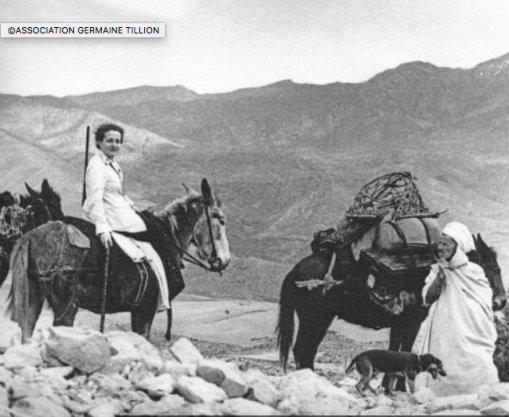
For anthropologists, the most extremely disturbing instance of participant observation is Germaine Tillion (1907–2008), an ethnologist who had done fieldwork in Algeria before being arrested while working for the French resistance. In impossible conditions she comprehensively documented the activities of the camp, somehow managing to hide her notebooks from the guards. After the war she continued her research on “the history of the de-civilisation of Europe”, and returned to her work on Algeria; her distinguished career was recognized by many awards.

Tillion

While in the camp Tillion even composed and staged an operetta Le Verfügbar aux Enfers, a spoof of Orpheus in the underworld, attempting to help prisoners “resist by laughing” (567). It has been revived since 2007—my post Operetta in extremis includes a complete performance from 2011.

As the camp population grew constantly with prisoners evacuated from camps in the path of the Soviet advance, the 959 French prisoners (known as the “vingt-sept mille” after their camp numbers) who joined Tillion from Paris in February 1944, “jeunes filles biens élevées”, were quite unprepared for what awaited them at Ravensbrück, and adapted badly. Quartered in the “slums” of the camp, soon they were more hated than the Poles; their health quickly failed. Another group of women arrived in August from Warsaw, obliterated after the uprising—reporting to their compatriots, “There is no Warsaw. There is nothing left.” Hungarian Jews were deported to Ravensbrück in October. Babies were soon starved to death.

As it becomes clear that the Nazis are in retreat, the final chapters are just as tense. Desperate to conceal their crimes, with order collapsing, their brutality becomes even more extreme and random. The reader wills the inmates to survive.

By the end of March [1945] the camp was “like a mysterious planet”, said Denise Dufournier, “where the macabre, the ridiculous and the grotesque rubbed shoulders in a fantastic irrational chaos.” Karolina Lanckorońska, watching the crematorium flames shooting higher every night, was reminded of the beginning of the Iliad. She was still giving lectures on Charlemagne and Gothic art as children in Block 27 played a game of selecting for the gas chamber. In the Red Army block the women were making red flags to hang out to welcome their liberators, while the painting gang had been sent to redecorate the maternity block, where, according to Zdenka’s lists, 135 more babies were born in March, of which 130 died. (616)

Despite the shocking complicity of the Red Cross in Geneva, the tireless, heroic work of young Norwegian student Wanda Hjort (1921–2017), using her status to visit the camp and establish contacts, at last achieves results as many prisoners scramble to be taken to safety in the White Buses, with the tense diplomatic negotiations of Folke Bernadotte, Swedish representative of the ICRC, with Himmler.

Wanda Hjort.

But while the buses were being bombed by the Allies, for the majority of women who remained in the camp to await rescue by the Soviet troops, “Liberation” was also horrifying, with widespread rapes perpetrated on women of all nationalities.

* * *

And so into the whole post-war period. Many survivors returning home found there was no home to return to. The Hamburg trials of 1946–8 (a sideshow to Nuremberg)

achieved a great deal. Within a short time the court […] established in the clearest terms the simple fact that everything about the camp was designed to kill. (706)

But the trials were soon followed by amnesia on both sides of the Iron Curtain—and ignominy for the valiant women in the USSR (pp.287–313, 710–11) and the GDR (339–58, 711–14) who had somehow survived only to descend into a new nightmare, now suspected of being traitors. And until 1950, camps like Buchenwald were adopted by the NKVD as gulags for their own prisoners, with many (not only former Nazis) dying in squalor (MacGregor, Germany, pp.468–72).

By 1948 the Allies had lost their appetite for punishing the Nazis and both the war crimes trials and the process of “de-Nazification”—whereby top Nazi supporters were brought to book and denied top jobs—were shut down. (707)

Wachsmann explores the issue in his fine Prologue:

Survivors … were not stunned into collective silence, as has often been said. On the contrary, a loud, polyphonic voice rose up after liberation. … During the first postwar years, a wave of memoirs hit Europe and beyond, mostly searing testimonies of individual suffering and survival.

But as he notes, popular interest soon waned:

Public memory of the camps was being marginalised by postwar reconstruction and diplomacy. With the front line of the Cold War cutting right through Germany, and turning the two new, opposing German states into strategic allies of the USSR and the United States, talk about Nazi crimes seemed impolitic. … Within ten years of liberation, the camps had been sidelined—the result not of survivors unable to speak, but of a wider audience unwilling to listen.

Though popular interest was rekindled to some extent in the 1960s and 70s, more detailed research only took off from the 1990s—with German scholars taking the lead.

By this stage you will be able to decide whether you can face watching this documentary:

* * *

So only now am I beginning to understand the apparent amnesia that took hold all over Europe during my youth—and which still persists in China for the Maoist era (and other more recent events that it’s prudent to bury). Levi explains it well. His If this is a man was published in 1947, but

fell into oblivion for many years: perhaps also because in all of Europe those were difficult times of mourning and reconstruction and the public did not want to return in memory to the painful years of the war that had just ended.

Republished in 1958, it then became exceptionally successful—although even in the 1970s, as Paul Bailey observes in an Afterword, “Primo Levi wasn’t so much forgotten in Britain as totally unknown.”

Not just Neil MacGregor’s “What would we have done?”, but just our capacity for evil, need to be kept at the forefront of our consciousness.  As MacGregor comments,

How did the great humanising traditions of German history—Dürer, Luther’s Bible, Bach, the Enlightenment, Goethe’s Faust, the Bauhaus, and much, much more—fail to avert this total ethical collapse? (473)

In a Postscript to If this is a man and The truce, Levi gives succinct replies to what have come to be called FAQ, like “Were there prisoners who escaped from the camps? How is it that there were no large-scale revolts?” and “How can the Nazis’ fanatical hatred of the Jews be explained?”.

On “ordinary Germans”, I already noted Hans Fallada’s novel Alone in Berlin (now also the subject of a film). Levi expands wisely on the topic “Did the Germans know what was happening?” Observing the authoritarian control of the media (not only in Germany, and not only then), he comments:

Under these conditions it becomes possible […] to erase great chunks of reality. […] However, it was not possible to hide the existence of the enormous concentration camp apparatus from the German people. What’s more, it was not (from the Nazi point of view) even desirable. Creating and maintaining an atmosphere of undefined terror in the country was part of the aims of Nazism. It was just as well for the people to know that opposing Hitler was extremely dangerous. In fact, hundreds of thousands of Germans were confined in the camps from the very first months of Nazism: Communists, Social Democrats, Liberals, Jews, Protestants, Catholics; the whole country knew it and knew that in the camps people were suffering and dying.

Nonetheless, it is true that the great mass of Germans remained unaware of the most atrocious details of what happened later on in the camps. […]

He goes on to cite Eugene Kogon’s Der SS staat:

Even many Gestapo functionaries did not know what was happening in the camps to which they were sending prisoners. The greater majority of the prisoners themselves had a very imprecise idea of how their camps functioned and of the methods employed there. […]

And yet there wasn’t even one German who did not know of the camps’ existence or who believed they were sanatoriums. There were very few Germans who did not have a relative or an acquaintance in a camp, or who did not know, at least, that such a one or such another had been sent to a camp. All the Germans had been witnesses to the multi-form anti-Semitic barbarity. Millions of them had been present—with indifference or with curiosity, with contempt or with downright malign joy—at the burning of synagogues or humiliation of Jews and Jewesses forced to kneel in the street mud. Many Germans knew from the foreign radio broadcasts, and a number had contact with prisoners who worked outside the camps. A good many Germans had had the experience of encountering miserable lines of prisoners in the streets or at the railroad stations. In a circular dated November 8, 1941, and addressed by the head of the police and the Security Services to all… Police officials and camp commandants, one reads: “In particular, it must be noted that during the transfers on foot, for example from the station to the camp, a considerable number of prisoners collapse along the way, fainting or dying from exhaustion… It is impossible to keep the population from knowing about such happenings.”

Not a single German could have been unaware that the prisons were full to overflowing, and that executions were taking place continually all over the country. Thousands of magistrates and police functionaries, lawyers, priests and social workers knew genetically that the situation was very grave. Many businessmen who dealt with the camp SS men as suppliers, the industrialists who asked the administrative and economic offices of the SS for slave-labourers, the clerks in these offices, all knew perfectly well that many of the big firms were exploiting slave labour. Quite a few workers performed their tasks near concentration camps or actually inside them. Various university professors collaborated with the medical research centres instituted by Himmler, and various State doctors and doctors connected with private institutes collaborated with the professional murderers. A good many members of military aviation had been transferred to SS jurisdiction and must have known what went on there. Many high-ranking army officers knew about the mass murders of Russian prisoners of war in the camps, and even more soldiers and member sof the Military Police must have now exactly what terrifying horrors were being perpetrated in the camps, the ghettos, the cities, and the countryside sof the occupied Eastern territories.

Levi adds:

In spite of the varied possibilities for information, most Germans didn’t know because they didn’t want to know. Because, indeed, they wanted not to know. It is certainly true that State terrorism is a very strong weapon, very difficult to resist. But it is also true that the German people, as a whole, did not even try to resist. In Hitler’s Germany a particular code was widespread: those who knew did not talk; those who did not know did not ask questions; those who did ask questions received no answers. In this way the typical German citizen won and defended his ignorance, which seemed to him sufficient justification of his adherence to Nazism. Shutting his mouth, his eyes and his ears, he built for himself the illusion of not knowing, hence not being an accomplice to the things taking place in front of his very door.

Turning to memory, Helm notes:

In the 1950s, as the Cold War began, Ravensbrück fell behind the Iron Curtain, which split survivors—east from west—and broke the history of the camp in two.

The abomination wasn’t the only part of the story that was being forgotten; so was the fight for survival.

Even in Britain, where we enjoyed the rare privilege of not enduring occupation, with all its risks and moral compromises, my parents’ generation—even if they hadn’t personally experienced appalling suffering in active service, or in POW and concentration camps—were all scarred by bombed-out buildings, separation and loss, maimings, food shortages, and terrible insecurity. So I shouldn’t wonder that they were relieved to live in peace, unwilling to inflict traumatic memories on children like me, unwittingly blessed to have been born after the war. But there were survivors all around us—like Maria Bielicka, whom Holm visited at her Earls Court flat in 2010:

She said she had rarely spoken of the camp before. When she first came to live in England after the war nobody believed what she had to say. “Nobody here even wanted to know about the camps.” Since then she has “got on with life”, working for Barclays Bank. (175)

How very much more understandable was this amnesia in an utterly devastated continental Europe. So bruised parents retreated to their well-tended gardens and shiny consumer goods, while their children complacently explored the counter-culture of the 60s. For those who cared, politics was about current problems, at home and in the third world. Meanwhile the nightmare continued in East Europe (and China, and the Soviet Union), as the past was buried and distorted even more mendaciously. Victims and tormentors had to coexist.

With all the vast documentation of mid-20th-century abominations that has eventually surfaced, it is hard to comprehend Steven Pinker’s detailed thesis in The better angels of our nature that violence has declined over millenia, and that the two world wars were but minor spikes in the grizzly statistics (see also his website, and FAQ). At least, it seems cruelly irrelevant; of course Pinker himself would be the first to encourage memory of modern trauma.

See also my posts on Sachsenhausen and Les Parisiennes; and for the first gulag in Soviet Russia, see here.

[1] See e.g. http://ahrp.org/ravensbruck-young-girls-subjected-to-grotesque-medical-atrocities/
http://www.elizabethwein.com/ravensbrueck-rabbits

Philosophers’ football

Philosophers

Having written about football (and here and there), elite/popular cultures, and Confucius, then just in case anyone isn’t familiar with this sketch, it’s another Python classic, full of brilliant lines:

From the commentary by Michael Palin:

Leibniz in goal, back four Kant, Hegel, Schopenhauer and Schelling, front-runners Schlegel, Wittgenstein, Nietzsche, and Heidegger, and the mid-field duo of Beckenbauer and Jaspers. Beckenbauer obviously a bit of a surprise there.

For the Greeks, “Chopper” Sophocles, and Aristotle, “very much the man in form”…

When Nietsche disputes the referee’s call, Confucius He Say “Name go in book”. Despite Marx coming on as a late substitute, Socrates scores a late winner, whereupon

Hegel is arguing that the reality is merely an a priori adjunct of non-naturalistic ethics, Kant via the categorical imperative is holding that ontologically it exists only in the imagination, and Marx is claiming it was offside.

As the wiki article eruditely observes, the linesmen St Augustine and St Thomas Aquinas were Roman African and Italian respectively. The article also describes a live replay in 2010.

Homage to Nina Hagen

Nina

I unfairly tucked away the mind-blowing Naturträne in a post setting forth from Viv Albertine and the Slits, but Nina Hagen richly deserves her own homage.

Rather like the leader of the free world shoving the prime minister of Montenegro aside in Brussels:

(The only logical explanation is that he somehow mistook the occasion for a beauty queen molestation contest with a prize of unlimited ketchup-drenched steaks),

Nina elbows the competition out of the way. In her case the competition includes Maria Callas, Kate Bush, Sid Vicious, and Lady Gaga. As one YouTube BTL comment observes, she could be Klaus Nomi’s sister.

Pre-punk, while still in the GDR, her early song Du hast den Farbfilm vergessen (1974) is nuanced:

As of November 2021, the song is enjoying renewed publicity as Angela Merkel chooses it for her farewell ceremony.

With all due respect to free healthcare, Nina Hagen is one of the great things to come out of the GDR—which she did, of course, inevitably. Even if the GDR “didn’t always have enough bananas” (my book, p.147), at least Honecker could pat himself on the back for inadvertently nurturing a superstar.

Whether or not you subscribe to Nina’s Weltanschauung, her vocal technique is, um, breathtaking. Here’s a live version of Naturträne:

Some more BTL comments:

This is what comes out when you stuff highly talented kids with best education and at one point they start to think for themselves.

Please, when I die I want to be reincarnated as her mic.

She gives Sid Vicious a run for his money in My way (this also from 1978):

And listen how she subverts Somewhere over the rainbow:

Good to see the Leipzig Big Band accompanying her instead of Bach for a change. I’m not sure I’m quite ready for her version of Erbarme Dich, though. OK, she belongs to a particular moment in time—but expressive culture always does, like Bach.

More useful socialist vocabulary

I’ve mentioned several distinctive terms in the vocabulary of former socialist countries, like China and the GDR. But still more usefully:

Lumumba

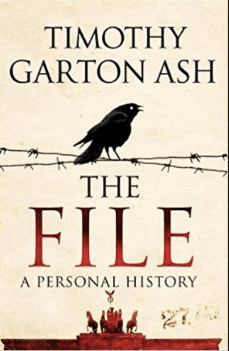
It’s good to learn that what is called caffé corretto in Italy (an espresso “corrected”, with grappa, or what the Chinese term with blunt accuracy dub “white spirit”) was known in Communist Albania as a Lumumba. (Garton Ash, The file, p.45). Well, you do need a snifter to get through all those Norman Wisdom films. (Cf. elsewhere in north Europe, where it is a somewhat different beverage.)

Cubalibre

This is rather in the spirit (sic) of the cubalibre[1] one of my favourite tipples in Spain as a change from my standard G&T. By contrast with the mealy-mouthed measures of English pubs (which should come with a microscope), both are notable because you are presented with a large tumbler into which the waiter pours an unlimited quantity of gin/rum/bacardi, leaving only a token amount of room for a casual dash of tonic/coke.

The cubalibre is quite familiar to our Spanish waiter, but I always enjoy the little ritual we go through whereby he looks enquiringly at the range of spirits behind the bar while I specify, with one of my few fluent phrases,

… con Ron, por favor!

Back in Blighty, the Spanish influence on my own domestic aperitifs is clear in my generous measures from the Azure Cloud Bottle—to which my address on the home page pays fitting homage. I ring the changes by buying the occasional bottle of Tanqueray, purely in homage to Amy.

In China, where the 1957 Anti-Rightist backlash following the Hundred Flowers movement was prompted in no small measure by the recent Hungarian uprising, the threat of liberal agitation was charmingly known as goulash deviationism. That sounds funny to us now, even if at the time it was a taint that could ruin people’s lives and destroy whole families.

The Lumumba never caught on in China—whyever would you want to dilute white spirit? But they did stage a rally to protest his killing in 1961:

[1] “Free Cuba”—descriptive or prescriptive?! Cf. the British tabloid headline
“Free Nelson Mandela”,
to which a reader wrote in,
“I dunno what a Nelson Mandela is, but if it’s free, can I have one please?”

And now we have this headline, which could do with a bit of punctuation:

Come on England

Lives under the GDR

*See also sequel here*

The experiences of Eastern European countries under state socialism, not to mention the Soviet Union and China, were all very different (see also Life behind the Iron Curtain: a roundup).

From a comfortable distance, looking at the GDR can seem voyeuristic, some kind of Stasi porn. But perhaps it’s more like “What would we have done?”—as Neil MacGregor asks in Germany: memories of a nation, full of insights on successive eras.

I guess I’m also trying to atone for my lack of curiosity as a touring muso on early trips to the GDR. In 1980 I played Elektra with Welsh National Opera in East Berlin and Dresden. With John Eliot Gardiner, in 1985 we did Israel in Egypt (see under Handel) in Halle, staying in Leipzig—apart from Michael Chance’s divine rendition of Thou shalt bring them in, my main memory is the whole orchestra and choir descending on Peters bookshop like locusts, to spend our over-generous Ostmark subsistence allowance (OK, unlike locusts) by buying up their entire stock of, ur, texts—sorry, I mean urtexts. In 1987 we did a memorable Matthew Passion in East Berlin (note also Hildi’s story).

My readings are also stimulated by my experience of China.

In Leipzig, I already mentioned the fine Forum of Contemporary History, and the Stasi Museum at the Runde Ecke is suitably disturbing. On the exceptional degree of surveillance under the Stasi, I can’t address the literature in German, but two books in English make useful introductions:

  • Anna Funder, Stasiland, a brilliant piece of writing,

and

File

Garton Ash notes how Stasi is chasing Hitler fast as “Germany’s best export product”:

Ironically, this worldwide identification of Germany with another version of evil is a result of democratic Germany’s own exemplary commitment to expose all the facts about its second twentieth-century dictatorship, not brushing anything under the carpet. (229)

In 1979, when many Western observers were downplaying or ignoring the Stasi, I felt impelled to insist: this is still a secret police state. Don’t forget the Stasi! In 2009, I want to say: yes, but East Germany was not only the Stasi. (230)

The opening up the Stasi records had enormous consequences:

You must imagine conversations like this taking place every evening, in kitchens and sitting-rooms all over Germany. Painful encounters, truth-telling, friendship-demolishing, life-haunting. (105)

The file ponders the wider problems of writing about people’s lives, and memory:

I must explore not just a file but a life: the life of the person I was then. This, in case you were wondering, is not the same as “my life”. What we call “my life” is but a constantly rewritten version of our own past. “My life” is the mental autobiography with which and by which we all live. What really happened is quite another matter. (20)

He notes

the sheer difficulty of reconstructing how you really thought and felt. How much easier to do it to other people! (37)

The very act of opening the door itself changes the buried artefacts, like an archaeologist letting in fresh air to a sealed Egyptian tomb. […] There is no way back now to your own earlier memory of that person, that event. (96)

Now the galling thing is to discover how much I have forgotten of my own life.
Even today, when I have this minute documentary record—the file, the diary, the letters—I can still only grope towards an imaginative reconstruction of that past me. For each individual self is built, like Renan’s nations, through this continuous remixing of memory and forgetting. But if I can’t even work out what I myself was like fifteen years ago, what chance have I of writing anyone else’s history? (221)

Indeed, my process of writing about people’s lives in China has made me unpack the blurred lines of my own story.

As Garton Ash comes face to face with the people who had informed on him, he experiences constant moral doubts.

As I leave I can see in her eyes that this will haunt her. Not, I think, because of the mere fact of collaboration—she was, after all, a communist in a communist state—but because working with the secret police, being down in the files as an informer, is low and mean. All this is such a far, far cry from the high ideals of that brave and proud Jewish girl who set out, a whole lifetime ago, to fight for a better world. And, of course, there will still be the lingering fear of exposure, if not through me then perhaps through someone else.

I now almost wish I had never confronted her. By what right, for what good purpose, did I deny an old lady, who had suffered so much, the grace of selective forgetting? (129)

He notes the irony in the careers of West German academics:

Cultured, liberal men in their thirties or forties, they are scrupulous pathologists of history, trained on the corpses of the Gestapo and SS. Theirs, too, is a peculiarly German story: to spend the first half of your life professionally analysing one German dictatorship, and the second half professionally analysing the next, while all the time living in a peaceful, prosperous German democracy. (196)

West Germans, who never themselves had to make the agonizing choices of those who live in a dictatorship, now sit in easy judgement, dismissing East Germany as a country of Stasi spies. […]
Certainly this operation has not torn East German society apart in the way some feared it would. In an agony of despair at being exposed as a Stasi collaborator, one Professor Heinz Brandt reportedly smashed to pieces his unique collection of garden gnomes, including, we are told, the only known specimen of a female gnome. Somehow a perfect image for the end of East Germany. (199)

Two schools of old wisdom face each other across the valley of the files. On one side, there is the old wisdom of the Jewish tradition: to remember is the secret of redemption. And that of George Santayana, so often quoted in relation to Nazism: those who forget the past are condemned to repeat it. On the other hand, there is the profound insight of the historian Ernest Renan that every nation is a community both of shared memory and of shared forgetting. (200)

He recognises the accident of birth:

I was just so lucky. Lucky in the country of my birth. Lucky in my privileged background, my parents, my education. Lucky in true friends like James and Werner. Lucky in my Juliet. Lucky in my choice of profession. Lucky, too, in my cause. For the Central European struggle against communism was a good cause. Born a few years earlier, and I might have been backing the Khmer Rouge against the Americans. Born in a poor family in Bad Kleinen, East Germany, and I might have been Lieutenant Wendt. […]
What you find here is less malice than human weakness, a vast anthology of human weakness. And when you talk to those involved, what you find is less deliberate dishonesty than our almost infinite capacity for self-deception.
If only I had met, on this search, a single clearly evil person. But they were all just weak, shaped by circumstance, self-deceiving; human, all too human. Yet the sum of all their actions was a great evil. It’s true what people often say: we, who have never faced these choices, can never know how we would have acted in their position, or would act in another dictatorship. So who are we to condemn? But equally: who are we to forgive? “Do not forgive,” writes the Polish poet Zbigniew Herbert,
Do not forgive, for truly it is not in your power to forgive
In the name of those who were betrayed at dawn.
These Stasi officers and informers had victims. Only their victims have the right to forgive. (223–4)

He notes people’s withdrawal into private lives:

Intelligent, well-educated, well-informed through watching Western television, they nonetheless devoted virtually all their energies to their private lives, and particularly to extending, decorating and maintaining their cottage on a small lake some half-an-hour’s drive from Berlin. […] My friend Andrea too, concentrated on private life, bringing up her small children in the charmed atmosphere of a run-down old villa on the very outskirts of Berlin. There were lazy afternoons in the garden, bicycle-rides, sailing and swimming in the lakes. (66)

The intersection of family and political history is well described in

a microcosm of modern Germany. I’m also most impressed by

  • Maxim Leo, Red Love (to which I devote a separate post)

—not least by the author’s amazing counter-cultural parents: compared to the lives of my own parents, theirs have been anything but drab. And then there’s

  • Hester Vaizey, Born in the GDR: living in the shadow of the Wall

To return to The file, Garton Ash observes the insidious use of language:

The process for which English has no word but German has two long ones: Geschichtsaufarbeitung and Vergangenheitsbewältigung. “Treating”, “working through”, “coming to terms with”, or even “overcoming” the past. The second round of German past-beating, refined through the experience of the first round, after Hitler. (194)

Another distinctive mouthful with echoes of China is Parteiüberprüfungsgesprach, “a ‘scrutinizing conversation’, a kind of confession for loyal comrades” (Red Love, p.212).

And after my citation of an over-generous definition of the Chinese term dundian, in German not just words but definitions can be expansive too. Abschöpfung is

laboriously defined in the 1985 Stasi dictionary as “systematic conduct of conversations for the targeted exploitation of the knowledge, information and possibilities of other persons for gaining information”. The nearest English equivalent, I suppose, is “pumping”. (108)

Garton Ash goes on to ponder the surveillance system of his own country:

The domestic spies in a free country live in this professional paradox: they infringe our liberties in order to protect them. But we have another paradox: we support the system by questioning it. That’s where I stand. (220)

And

Thirty years ago, when I went to live in East Germany, I was sure that I was travelling from a free country to an unfree one. I wanted my East German friends to enjoy more of what we had. Now they do. In fact, East Germans today have their individual privacy better protected by the state than we do in Britain. Precisely because German lawmakers and judges know what it was like to live in a Stasi state, and before that in a Nazi one, they have guarded these things more jealously than we, the British, who have taken them for granted. You value health most when you have been sick.
I say again: of course Britain is not a Stasi state. We have democratically elected representatives, independent judges and a free press, through whom and with whom these excesses can be rolled back. But if the Stasi now serves as a warning ghost, scaring us into action, it will have done some good after all. (232)

German fictional treatments of the period include

  • Christa Wolf, They divided the sky, and
  • Eugen Ruge, In times of fading light.

And then there are films like Barbara (2012)

and The lives of others, perceptively reviewed by Garton Ash.

Going back a little further, among innumerable portraits of ordinary German lives compromised, warped, under Nazism, I admire

  • Hans Fallada, Alone in Berlin.

Here’s a playlist of 65 English-language documentaries on the GDR:

not apparently including the 1970 BBC film Beyond the Wall, which you can still watch here. For subversive feature films made under the regime, see here; and for a documentary on WAM, here.

* * *

The nuance and detail of studies like those of Garton Ash contrast with Dikötter’s blunt and pitiless agenda in exposing the undeniable iniquities of the Maoist system.

While China and Germany were utterly different, parallels are explored by

  • Stephan Feuchtwang, After the event: the transmission of grievous loss in Germany, China and Taiwan,

and by Ian Johnson.

But for China, archives, and even memory, remain hard to access. For the Maoist era, the literature on the famine is growing—note especially Wu Wenguang’s memory project. Among fictional treatments, few films are as verismo as The blue kite and To live, or (for the last throes of Maoism) the films of Jia Zhangke. Chinese novels too tend towards either magical realism or over-dramatising.

For crime fiction from China and Germany, see here; for life-stories in the Soviet Union under Stalin, click here.

A major contribution to civilisation

It seems that, like the Bolton Choral Society in their own chosen métier, my goal of Encapsulating the Intricacies of the oeuvre of Flann O’Brien recedes ever further.

Ian Sansom reflected on his mixed success:

Imagine: you’re better than James Joyce; you end up like Miles Kington.

I take the point, but for many fellow-Flanneurs it may not seem germane. Myles’s oeuvre is Sue E. Generis (if he didn’t say that, then it must have been me), self-standing—which, allegedly, is more than he was.

How can I have been so remiss as to neglect Timothy O’Keefe’s edited volume Myles: Portraits of Brian O’Nolan (1973)? Fortunately, my old friend Rod (himself an honorable, nay upstanding, member of the Royal Society of Flannologists) has stepped into the unsavoury breach of my Stygian ignorance [Hope he wiped his feet afterwards—Ed.], drawing my attention to a fine reminiscence therein by Niall Sheridan:

His interest soon shifted to a suggestion of mine—the All-Purpose Opening Speech. This was to be one endless sentence, grammatically correct, and so devoid of meaning that it could be used on any conceivable occasion: inaugurating a President, consecrating a Cathedral, laying a foundation-stone, presenting an inscribed watch to a long-standing employee. This notion delighted him, and he decided it must be given to the world, translated into every known language. If nation could speak fluently to nation, without any risk of communicating anything, international tension would decline. The Speech would be a major contribution to civilisation, enabling any inarticulate lout who might lever himself into power to emerge (after a brief rehearsal) as a new Demosthenes.

I was to make the original draft in English. Denis Devlin was to undertake the translation in French and Brian himself would do the Irish and German versions.

I can remember only the opening portions of the Speech, which ran (still incomplete) to some 850 words:

“Unaccustomed as I am to public speaking, and reluctant as I am to parade my inability before such a critical and distinguished gathering, comprising—need I say—all that is best in the social, political, and intellectual life of our country, a country, I may add, which has played no inconsiderable part in the furthering of learning and culture, not to speak of religion, throughout all the lands of the known globe, where, although the principles inculcated in that learning and that culture have now become temporarily obfuscated in the pursuit of values as meretricious in seeming as they must prove inadequate in realisation, nevertheless, having regard to the ethnical and moral implications of the contemporary situation, etc, etc, etc.”

When the translations had been completed we had a reading in Devlin’s home. Any rubbish can be made to sound impressive in French, and Denis had produced a superb version, rhythmic, mellifluous and authoritative. It conveyed (to our delight and amazement) even less meaning than the original.

Brian (who delighted in the simplest sleight-of-hand) whipped a walrus moustache from his pocket, fixed it under his nose and read his Irish version, in a wickedly accurate impersonation of our Professor of Irish, Dr Douglas Hyde, later the first President of Ireland.

“What do you think of that?” he asked, looking from one to the other.

Denis told him that he admired his brio but deplored his occasional slurring of consonants. I told him that listening to his delivery was like wading through warm stirabout at one’s feet.

Undeterred by this mixed reception, Brian quickly replaced the walrus moustache with a toothbrush affair and poured out his German translation in imitation of Hitler at a Nuremberg rally. As he ground out the Teutonic gutturals, spitting and snarling in comic menace, he knew that he had made the hit of the evening.

Actually, if the speech wasn’t already in use then, it has since become entirely standard.

Talking of inarticulate louts levering themselves into power, this seems all the more necessary in our own fractured age.

And vis-à-vis my own Catechism of Chinese Cliché, must I now gird my loins for a Chinese version of their fine creation?

Trauma: music, art, objects

Norman Lebrecht has long laid bare the links of celebrated senior conductors (as well as Karajan…) to Nazism: it’s one subtext of his fine book The maestro myth.

I just read his review of Fritz Trümpi, The political orchestra: the Vienna and Berlin Philharmonics during the Third Reich.

The book actually takes the story through to our own times. As Lebrecht observes, neither orchestra emerges with any credit—indeed, it’s a shocking account.

For me, as a teenager in the National Youth Orchestra (of GB), another inspiring conductor (apart from Boulez) was Rudolf Schwarz (1905–94). Member of the Vienna Philharmonic in his youth, later inmate of Auschwitz and Belsen, after the liberation of the camps he eventually ended up in Bournemouth, remoulding the orchestra there. His Bruckner 7 with the NYO was wonderful—all the more intense with his laboured conducting style, partly the legacy of a broken shoulder-blade in Auschwitz. Never a superstar in the Karajan mould (which was why musicians appreciated him), he was a formative influence on the young Simon Rattle, my contemporary in the NYO.

Bruckner 7 is in the incandescent key of E major, just like the basic scale of the Li family Daoistsshengguan ensemble—I often think of it while I listen to the shengguan piercing the bright blue sky of rural north China (e.g. playlist, #4, with commentary here).

Meanwhile, as Rudi was being dragged through the camps, here’s Wilhelm Furtwängler conducting the Adagio with the Berlin Philharmonic in 1942. Like Philippe Sands’ choice of Bruno Walter conducting Mahler 9 in 1938— and just as with Daoist ritual—we have to personalise such seemingly disembodied works, and place them in time.

You can find a newly remastered version here. For Celibidache’s Bruckner 7, see here.

Furtwängler’s relationship with Nazism has been much debated. Generally reluctant to collaborate, he did what he could, even helping some Jews escape, and with close ties to the resistance. Yet inevitably people baulk at his participation in events like this Beethoven 9 for Hitler’s birthday, also in 1942:

Lebrecht sums up his legacy (The maestro myth, p.93):

In Furtwängler the Nazis retained an interpreter who performed German music with undiminished conviction while genocide was committed in his name. By opting to remain, he endowed the Nazis with cultural respectability at a  crucial moment in their ascent, and in wartime gave moral sustenance to their cause. In his confrontations with tyranny, Furtwängler proved a feeble adversary who was all too easily manoeuvred into outright collusion. The humanity he expressed in music was traduced and travestied by his paymasters. His legacy as a performer may well be among the most significant in the annals of conducting, but his conduct under political pressure compromised the very profession on which he wielded so formative an influence. [for Lebrecht’s more recent exposé, see here.]

Still, it’s easy for us to say that. Reflecting on the Nazi era from the perspective of our blessed safety from invasion and  agonising choices, Neil MacGregor poses the disturbing question “What would we have done?”. In his brilliant 2014 book Germany: memories of a nation (and no less enchanting are his podcasts—the perfect Radio 4 voice!), using both works of art and everyday material objects, he ponders how we can fit the great humanistic traditions of Germany into the same picture with Nazi barbarism. And having suffered throughout this whole period, people of Central and Eastern Europe would still have to continue making appalling moral choices for decades to come.

Apart from MacGregor’s astute discussions of earlier historical artefacts, one can’t help being drawn into those from more recent history—like the slogan (“to each what they are due”) above the camp gates of Buchenwald—just a few miles outside the Weimar of Goethe and Bach:

Bwald

MacGregor observes the noble lineage of words that had once signified an ideal of justice—the very words that Bach used as the title of a cantata in 1715 Weimar. Indeed, as a prelude to John Eliot Gardiner’s epoch-making Bach Cantata Pilgrimage all through 2000, I played a modest role in the Christmas oratorio at the Herderkirche in Weimar—here’s Part One. Next day we all visited Buchenwald.

I’m not sure we can derive any encouragement from MacGregor’s idea that the stylish lettering of those words above the gate (designed by an inmate, Communist and former Bauhaus student Franz Ehrlich) might be read by fellow inmates as a subtly subversive message that the SS would eventually get their just deserts. By the way, Ehrlich survived, also disturbingly, to become a Stasi informant under the GDR.

MacGregor gives a fine diachronic survey of Käthe Kollwitz’s work,

as well as the incarnations and migrations of Ernst Barlach’s Hovering angel (1926, cf. the 1966 GDR film The lost angel),

angel

along with reflections on Remembrance ceremonies.

But he also discusses movingly the “rubble women” (Trümmerfrauen) who rebuilt shattered Germany after the war, and objects such as a little hand-cart pulled by refugees from Eastern Pomerania in late 1945—now reminding us tellingly of the refugee crises of our own day.

The wonderful Forum of Contemporary History in Leipzig has a similar exhibit.

But to return to Trümpi’s book, this tale of two orchestras brings us, shamefully, right up to the lives of my generation and later. It was not until 2013 that the Vienna Philharmonic revoked the Ring of Honour it had bestowed on three leading figures in the Nazi genocide—including Richard Strauss’s patron Baldur von Schirach, who (also in 1942) described the deportation he oversaw of 65,000 Viennese Jews to the death camps as a “contribution to European culture”. Indeed, our feelings about those celebrated Viennese New Year’s concerts can’t help being stained by learning that it was Schirach who instigated them.

As an aside, these orchestras haven’t exactly been at the forefront of gender equality either. Competing hotly in the misogyny stakes with “Rear Admiral” Foley, Karl Böhm (a Great Maestro far more flawed than Furtwängler) is quoted as saying that “the Nazis aren’t that bad—they want to eliminate women from politics.” Digging himself into a deeper hole, he went on, “Of course, not all women are worthless—Rainer Maria Rilke [sic] wrote some good poems.”

And now there are new causes for anxiety, threatening all the liberal values that have been achieved so painfully over several centuries.

NB also posts on Ravensbrück, SachsenhausenMetamorphosen, A Nazi legacy, The Ratline, and Gitta Sereny; as well as posts on Maoism in China, starting here; see also under Life behind the Iron Curtain, as well as Aleppo: music and trauma.

The definitive transliteration

Svejk

I just can’t resist constructing a headline to incorporate some of my favourite Chinese transliterations (for more, see here, with thread):

帅克耍耍圣桑的兔子不拉屎
Shuaike shuashua Shengsangde tuzibulashi

or

Conquering General plays with the Rabbits-don’t-shit of Sage Mulberry

or, if you insist,

Švejk plays with the toothbrush of Saint-Saëns

What kind of language do you call that, ask the Plain People of Ireland. Beat that, China Daily.

In The good soldier Švejk, among several references to the toothbrush, try this:

Then she took out of the hamper three bottles of wine for the convalescent and two boxes of cigarettes. She set out everything elegantly on the empty bed next to Švejk’s, where she also put a beautifully bound book, Stories from the life of our Monarch, which had been written by the present meritorious chief editor of our official Czechoslovak Republic who doted on old Franz. Packets of chocolate with the same inscription, “Gott strafe England,” and again with pictures of the Austrian and German emperors, found their way to the bed. On the chocolate they were no longer clasping hands; each was acting on his own and turning his back to the other. There was a beautiful toothbrush with two rows of bristles and the inscription “Viribus unitis,” so that anyone who cleaned his teeth should remember Austria.

The latest research, however, suggests that Saint-Saëns (1835–1921) once carelessly left his toothbrush behind at his hotel while on tour in Prague—he was indeed a keen traveller, but his biographies are curiously silent about this incident. Later the Good Soldier came across it by chance while rummaging in a junk shop, and proceeded to toy with it.

Still, we cannot dismiss the possibility that the toothbrush may be employed here in its popular Slovakian metaphorical sense. In a comment suggestive of Molvania, Andrew Lawrence Roberts (From Good King Wenceslas to the Good Soldier Švejk: a dictionary of Czech popular culture) notes:

Slovácko is best-known for its traditional culture: distinctive national costumes are still occasionally worn, folk traditions like The Ride of the Kings [a major theme of Kundera’s The joke—SJ] still celebrated yearly. The largely rural residents of Slovácko are known as well for their love of slivovice, which they refer to as their morning toothbrush.

So have I been barking up the wrong tree? In this case, one wonders further: just what kind of liqueur was Saint-Saëns’ so-called “toothbrush”? In our headline, perhaps we may now interpret the verb shuashua “fooling around with” as referring to a tasting session—given Švejk’s Bacchic propensities, surely an epic event, at which Flann O’Brien would have been more than welcome.

Myles: a glowing paean, or The life of O’Brien

Flann

For a Parisian deviation, see here.

What’s all this fuss about Flann O’Brien, I hear you ask. (One perceptive tribute by Kevin McMahon is penned entirely in the form of a Mylesian pub conversation). [1] Padraig Colman, in a fine series of detailed tributes, sums him up dispassionately as “a morose drunk who led an uneventful life as a senior civil servant in Dublin”. For anyone not O’Fay with O’Brien (as the Great Man must have said somewhere?), here’s a little resumé, before you plunge into sundry other posts under the Myles tag.

Well, for one thing, as fellow Flanneurs will know, he was an astute observer of “Poor suffering Hugh Manity”, that’s why. He was a dedicated chronicler of the Hugh Mann condition—a common and distressing affliction. He had a keen ear for the conversation of The Plain People of Ireland, The Brother, and insufferable bores of any Ilk, whether pretentious or just trite. He had the Cut of their Jib, whatever that is. His intolerance of cant (and doubtless Kant) has brought him a cult following [Autospell running amok?—Ed.].

Apart from The Man Who Has Read It In Manuscript, another snowclone that is constantly on the lips of the aficionado is

The Man Who Spoke Irish At A Time When It Was Neither Profitable Nor Popular.

This meretricious character inevitably takes a bow in the Myles na Gopaleen Catechism of Cliché,

a unique compendium of all that is nauseating in contemporary writing. Compiled without regard to expense or the feelings of the public.

Of what was any deceased citizen you like to mention typical?
Of all that is best in Irish life.

Correct. With what qualities did he endear himself to all who knew him?
His charm of manner and unfailing kindness.

Yes. But with what particularly did he impress all those he came in contact with?
His sterling qualities of mind, loftiness of intellect and unswerving devotion to the national cause.

What article of his was always at the disposal of the national language?
His purse.

And what more abstract assistance was readily offered to those who sought it?
The fruit of his wide reading and profound erudition.

At what time did he speak Irish?
At a time when it was neither profitable nor popular.

With what cause did he never disguise the fact that his sympathies lay?
The cause of national independence.

And at what time?
At a time when lesser men were content with the rôle of time-server and sycophant.

What was he in his declining years?
Though frail of health, indefatigable in his exertions on behalf of his less fortunate fellow men.

Whom did he marry in 1879?
A Leitrim Lady.

And at what literary work was he engaged at the time of his death?
His monumental work on The Oghams of Tipperary.

And of what nature is his loss?
Well-nigh irreparable.

Looby describes Myles as

a postmodernist at a time when it was neither profitable nor popular,

and McMahon signs off with a flourish:

When did you start reading this stuff?
At a time when it was neither profitable nor popular.

(Go, and never darken my towels again—Rufus T. Firefly)

What with our Psalm, and our Sermon, I hereby declare our impertinent sequence of Trois petites liturgies quorate.

OK, watch this, now I’m going to make a subtle transition (and Myles would have relished the voiceover to Away from it all):

Gondolas, gondolas, gondolas. Everywhere… gondolas.
But there’s more to Venice than gondolas […]
We pause to reflect that despite its cathedrals,
its palaces, its bustling markets,
and its priceless legacy of renaissance art,
the one thing that Venice truly lacks—is leprechauns.
[scene changes] But there’s no shortage of leprechauns here:
Yes, Ireland, the emerald island…

Here we are again. Normal service resumed. A critic, and a critic of critics, Flann O’Brien discussed art, music, and theatre acutely—sometimes even more acutely than this:

Literary criticism
My grasp of what he wrote and meant
Was sometimes only five or six %.
The rest was only words and sound—
My reference is to Ezra £.

He would have enjoyed my Heifetz story too.

His Keats and Chapman series is full of shameless yet often arcane puns:

“My dear girl”, he said, “You have been living in F. Huehl’s pair o’dice.”
When she was gone he turned to Chapman.
“F. Huehl and his Monet are soon parted,” he observed.

Cf. this sequel.

Some more from Groucho:

“Sir, you try my patience!”
“I don’t mind if I do—you must come over and try mine sometime.”

For all his withering disdain for pretension, Myles’s essays are liberally sprinkled with French, German, and what Peter Cook, in a not-unMylesian sketch, called “The Latin”:

(or for surly purists, the full authentic urtext here).

Nor is the Catechism of Cliché limited to English. It becomes increasingly unhinged (as one does):

Quis custodiet ipsos custodes?
Mulieres eorum.

One for the Jesuit sinologist, methinks:

Noli me quidere?
Tang.

And, for the Indologist, no trawl through the Mylesian ouevre would be complete without

Ubi nemo mi lacessit (inquit Gandhi)?
In Poona.

In 2016, writing in The Irish Times (since Myles’s day, allegedly an organ otherwise less hilarious than The China Daily), Frank McNally did a rather good sequel on the elections. Indeed, it’s a fun game to play. One day, if you don’t watch your step, I may regale you with my very own Catechism of orchestral cliché. You have been warned.
[Oh all right then, if you insist—here you are. Now I’ve even penned a Catechism of Chinese cliché, and of Chinese music clichés. Is nothing sacred?]

On my visits to Germany I constantly giggle at Myles’s Buchhandlung service:

A visit that I paid to the house of a newly married friend the other day set me thinking. My friend is a man of great wealth and vulgarity. […] Whether he can read or not, I do not know, but some savage faculty of observation told him that most respectable and estimable people usually had a lot of books in their houses. So he bought several book-cases and paid some rascally middleman to stuff them with all manner of new books, some of them very costly volumes on the subject of French landscape painting.
I noticed on my visit that not one of them had ever been opened or touched, and remarked the fact.
“When I get settled down properly,” said the fool, “I’ll have to catch up on my reading.”
This is what set me thinking. Why would a wealthy person like this be put to the trouble of pretending to read at all? Why not [pay] a professional book-handler to go in and suitably maul his library for so-much per shelf? Such a person, if properly qualified, could make a fortune.

Tweety McTangerine take note…

And we haven’t even discussed At-swim-two-birds or The third policeman, Begob. Here one may even detect a certain affinity with Cold comfort farm. As Myles observed,

It goes without Synge that many of my writings are very fine indeed.

I can only deplore the paucity in his oeuvre of allusions to fieldwork reports on Daoist ritual. And vice versa. Still, it is pleasant to imagine the travails of the Chinese translator of Flann’s great works.

Flann O’Brien survived longer than Hašek, but drank himself to an early grave (“But it’s not even closing time yet!”, I hear him exclaim) in 1966—sadly not in time to reflect

If I had all the money I’ve spent on drink—I’d spend it on drink.

A Pint of Plain is Your Only Man

There are some nice radio and TV tributes online, like

and the only filmed interview with the Great Man, here. And even interviews with people who knew him, here.

One last time—Altogether Now:

At what time did he speak Irish?
At a time when it was neither profitable nor popular.
And of what nature is his loss?
Well-nigh irreparable.
So what capital adornment do I take off to him?
(It’s your turn.)


[1] Other discussions include https://vulpeslibris.wordpress.com/2011/04/06/the-best-of-myles-by-flann-obrien/ and Robert Looby at http://www.ricorso.net/rx/az-data/authors/o/OBrien_F/xtras/xtra5.htm. Note also the egregious Flann O’Brien society, with its weighty bibliography.

Clothes clothes clothes music music music boys boys boys

CMB

Under the rubric of delighting in all manifestations of the Terpsichorean muse, having just added a meretricious page on Gregorian chant, I now offer an equally piecemeal post on punk.

Further to Lives in jazz, Viv Albertine’s memoir

  • Clothes clothes clothes music music music boys boys boys [1]

(to give it its full title—her mum’s reproach to her as a teenager) is a beautiful inspiring book, full of sincere humanity and insight. We can draw a veil over the story of her messy “dalliance” (dunno why I’m suddenly coming over all Jane Austen) with Johnny Rotten. The account of her post-punk life is no less compelling than that of her time in The Slits, with their amazing singer Ari Up (RIP). Women, and sexism, in punk are justly favoured topics in musicology and glossies alike—more so, I note, than Daoist ritual (funny, that). For female punk band Vulpes in Madrid, see here.

slits

For Viv Albertine’s next book, see here.

I was sadly unaware of all these brilliant singers at the time, except (for some reason) for Nina HagenNaturträne (1978) has long been one of my favourite songs (see this playlist):

You can, and must, watch her singing it live on video too, but that recording is astounding. I was busy being a Boulez groupie… OK, there’s room for technique in punk too, but it’s not quite the point; I could presumably square that song with my snobby sensibilities long before I also learnt to rejoice in the Sex Pistols or the Ramones. Or Daoist ritual…

Just as much as the Matthew Passion, or Wozzeck, it makes want to learn German:

Natur am Abend, stille Stadt
Verknackste Seele, Tränen rennen
Das alles macht einen mächtig matt
Und ich tu’ einfach weiterflennen

We can save punk in China for another time—but again, it’s all part of the rich ethnographic tapestry. Not quite punk, but Cui Jian’s classic song Nothing to my name

prompted a fine complaint from Wang Zhen, veteran of the Long March:

“What do you mean, you’ve got nothing to your name? You’ve got the Communist Party haven’t you?”

Mutatis mutandis, Thatcher might have concurred.

[1] Pedantic note: most superior reviews abide by the title’s lack of punctuation.

Recognition

Talking of language-learning, I like this sequence in my old German phrasebook:

The chambermaid never comes when I ring.
Are you the chambermaid?

Maybe the scenario goes like this:

Englishman rings bell.
Woman in black uniform and white apron arrives.
Englishman shrugs; she leaves.
He rings again. Woman comes back.
Englishman shrugs; she leaves.
He rings again. Woman comes back.
Irked, he says to her, “The chambermaid never comes when I ring.”
She leaves again. He rings again. Woman comes back.
(He, with dawning realization) “Are you the chambermaid?”

For a worrying Turkish spinoff, click here.

Bach on film

Pasolini SMP

As part of my extensive coverage of Bach (roundup here), two feature films from the 1960s, despite their extreme contrast, are linked both by their intensity and by the way they don’t just accept but probe our own modern values:

and

  • The chronicle of Anna Magdelena Bach (Jean-Marie Straub and Danièle Huillet, 1968—with  Gustav Leonhardt as Bach!). YouTube links come and go; I try and keep an eye on them, but you can do your own YouTube searches if they disappear. Here’s the complete film:

I also found a version enriched by Japanese subtitles (like the Greek subtitles of Johnny the shoeshine guy), and here’s a colourised version of the opening sequence (more on which here):

Yesterday…

I have outlined the importance of the Song of the Skeleton in the rituals of both north and south China (In Search of the folk Daoists pp.233–4). It’s a common theme throughout the north—mainly as part of the yankou, both Daoist and Buddhist.

In Yanggao Daoist ritual (Daoist Priests of the Li family, pp.274–5), several hymns are related. The Mantra of the Skeleton (Kulou zhenyan 骷髏真言, more commonly known here by the melodic label Wailing to Sovereign Heaven, Ku huangtian 哭皇天) is prescribed, a cappella, for Opening Scriptures on the first afternoon of a funeral.

It’s a kind of catalogue aria, with seven long verses for the visits to the stations of purgatory over seven days. Its melodic material overlaps substantially with that of other hymns, beginning with the opening of the Diverse and Nameless melody (Daoist priests pp.267–8). The melismatic “Ah, Skeleton” (Kulou) refrain, and the coda in pseudo-Sanskrit (also in common with Diverse and Nameless), are not written here in the manual. My film (from 56’08”) shows the sixth verse:

Ah Skeleton! Skeleton!
On the sixth day he reaches Netherworld Souls Village
His sons not to be seen
Starving and parched, at his wits’ end,
Desperate to sup broth.

kulou-2kulou-1
From Li Qing’s hymn volume, 1980. The final folio on the left has the opening of Mantra to the Wailing Ghosts—my book p.266, also featured in the film, from 1.03.56).

* * *

For most such hymns one hardly expects an “emotional” response from audiences—in Yanggao, after all, it shares both melodic material and style with many others in the repertoire. But in his brilliant ethnographic studies of ritual practice in old Beijing, Chang Renchun notes how the renditions of two celebrated Buddhist monks moved their audiences to tears. Performative tears feature in many posts on this blog—links here.

Some common versions open:

昨日去荒郊玩游        Yesterday, seeking diversion roaming in the barren outskirts…

So talking of “Yesterday”, Paul McCartney heard his own version in a dream, like Aboriginal singers.

Yesterday

Though secular, it’s deeply moving. Here’s an early solo rendition, live (and Paul’s unaffected style is a major element of the song’s impact—no cover versions come close):

Here’s the remastered version from 2009:

As I observe in the introduction to my series on the great Beatles albums, analysis, while optional, can supplement our response; again it’s instructive to read Wilfred Mellers and Alan W. Pollack. Dating from the same period as A hard day’s night, Mellers considers Yesterday a “small miracle”:

Although the opening words tell us that yesterday his troubles seemed far away, the music in the second bar immediately enacts these troubles with a disquieting modulation from tonic, by way of the sharpened sixth, to the relative. The first bar, with its gentle sigh, seems separated, stranded, by the abrupt modulation; and although the troubles “return to stay” with a descent to the tonic, the anticipated modulation sharpwards is counteracted when the B♮is flattened to make an irresolute plagal cadence. […]

The immediate nostalgia of the song is without suspicion of sentimentality, and the corny accompaniment of string quartet can be employed, with validity, to reinforce the music’s frail bewilderment.

Yesterday quartet

George Martin’s manuscript for Yesterday, on display at Abbey road studios.

Pollack’s analysis is also insightful. And as he notes (also in my roundup), the opening uses a device here that Paul was to use regularly in some of his great songs: a declarative word, followed by a pause, and then rhythmically active ascent.

I can be quite confident about our own emotional responses to this song; less so about the responses of various types of Chinese mourners to the Skeleton, over time.