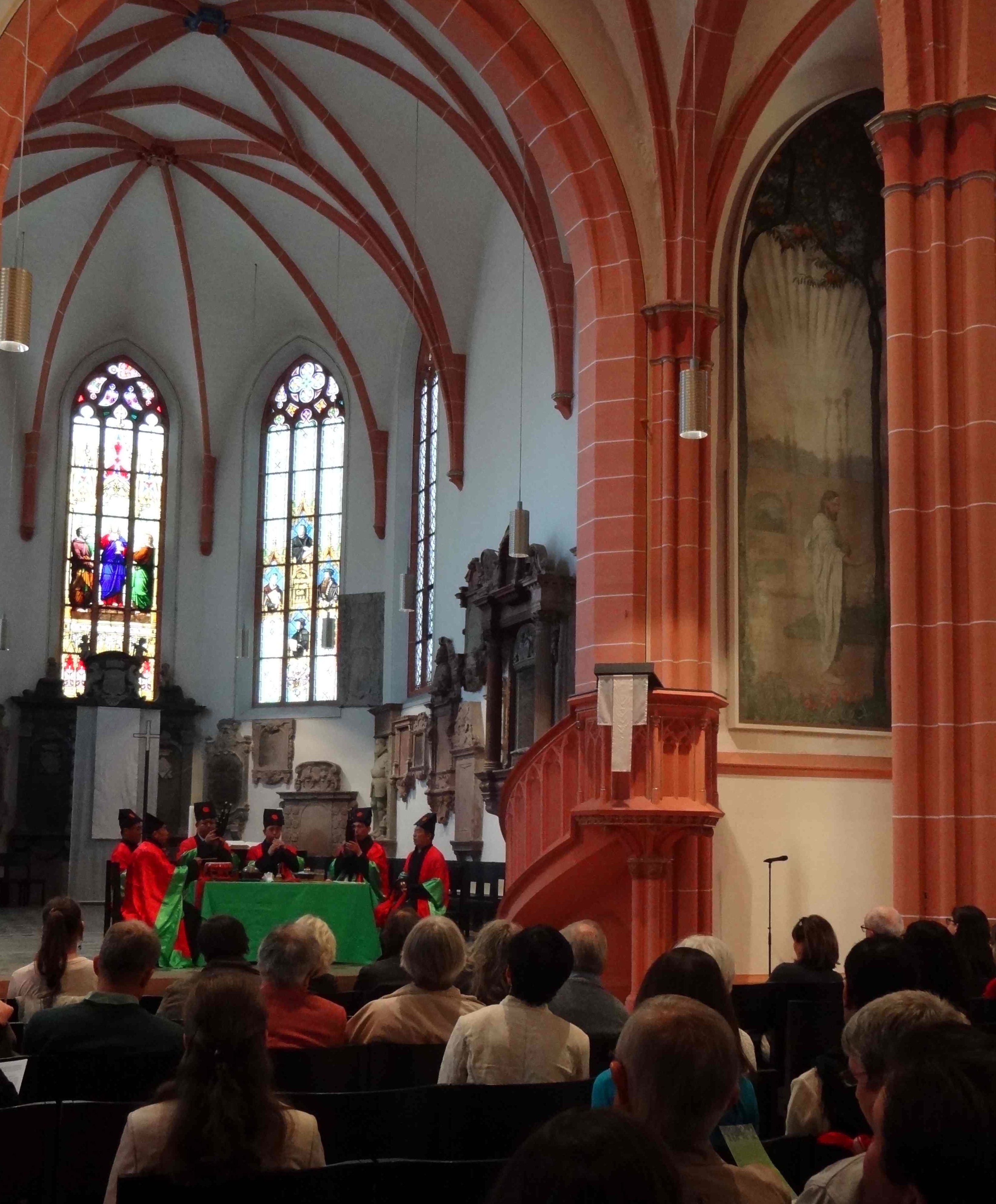
Cheremis, Chuvash—and Tibetans

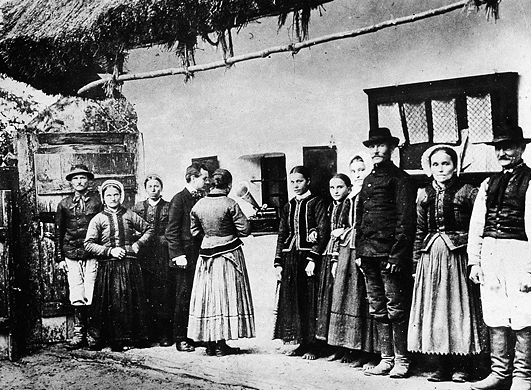
Photo: Cheremis “pagan” ritual singer H.H. Musztafa (then 69), June 1975.

Along with from the many Hungaroton LP box-sets of the musics of east Europe, another impressive 3-disc set that I brought back from Budapest is

collected and published by László Vikár (1929–2017) and linguist Gábor Bereczki. The set documents musical traditions of peoples in the “autonomous” republics around the eastern perimeter of the European part of the USSR, the central Volga and Urals—peoples about whom I know nothing, but feel we should know:

Mordvinians, Votyaks (Udmurt), Cheremis (Mari), and the Turkic-speaking Chuvash, Tatars, and Bashkirs.

USSR

Source: reddit.com.

Between 1958 and 1979 Vikár and Bereczki made four long summer fieldtrips to some 286 villages, accompanied by local scholars. With sound engineer Pál Sztanó they recorded life-cycle and calendrical items, both vocal and instrumental, including bridal dirges, funeral laments, dance tunes, and historical epics.

The recordings on this box set are part of a much larger archive. Some tracks appear on YouTube, such as

Note also this channel.

The 43-page booklet contains detailed notes, as well as maps, translations, photos, and some transcriptions.

notes 2

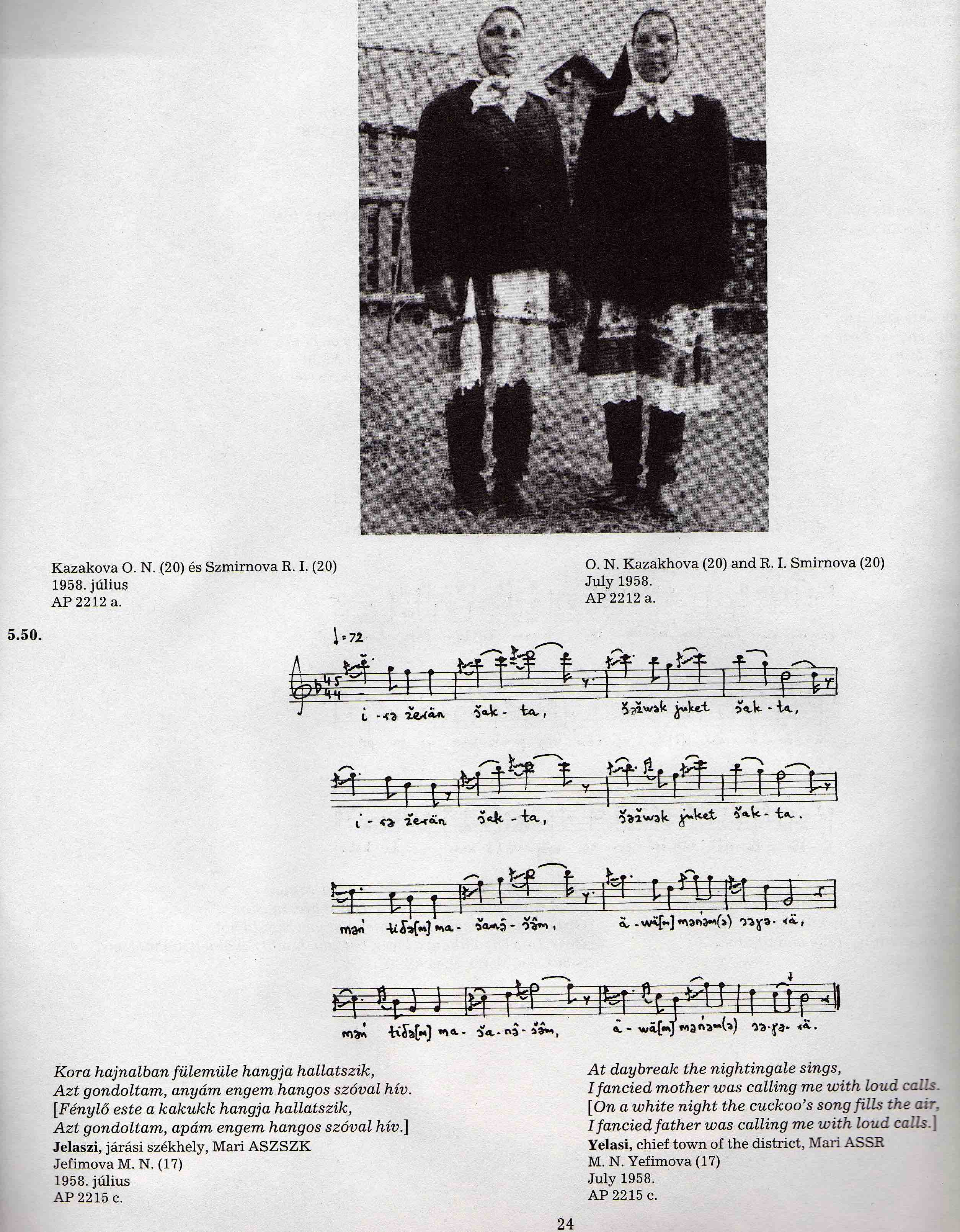
A page from the booklet, on Mari singing.

Bartók, Kodály, and Bence Szabolcsi had already shown an interest in these groups, mainly as part of their comparative musical paleography, classifying melodic types; Vikár was building on this tradition. [2]

Such early recordings were made on request, not—as ethnographers later also sought—while documenting the social events of which they are the core. So we meet the typical issue that often crops up in Chinese collections: were they performing items then still in use, or recalling them from an earlier social practice?

And of course these projects could barely hint at the painful recent histories of such peoples (cf. The whisperers). Music is never autonomous, but gives us a window into the study of changing local societies.

Indeed, it’s worth recalling what else was happening in those years. Notwithstanding the interest of early east European music scholars in “archaic layers”, these are not timeless idyllic communities; though by the 1970s they had weathered the worst of the years of repression under Stalin, they had been constantly starved, deported, subject to political whims, suffering under collectivization and the Great Purge (cf. Blind minstrels of Ukraine, under “Other minorities”). This too is a rich field of research—see e.g.

See also The Kazakh famine, and (still earlier) Hašek’s adventures in Soviet Tatarstan.

The task of modern ethnographers—just as for China—is to integrate socio-political histories with expressive cultures. In 1975 the moment had still not come to record the memoirs of “pagan” Mr Musztafa—and now it’s too late.

In addition to the Garland encyclopedia of world music, for more on early collecting, see under

  • Margarita Mazo, “Russia, the USSR and the Baltic states”, in Ethnomusicology: historical and regional studies (The New Grove handbooks in music, 1993), pp.197–211,

and in the same volume,

  • Theodore Levin, “Western central Asia and the Caucasus”, pp.300–305.

In the early years after the crushing of the 1956 Budapest uprising, one might wonder how smooth was the collaboration between Hungarian and Soviet scholars—only of course both would have suffered under the policies of their regimes.

* * *

1955

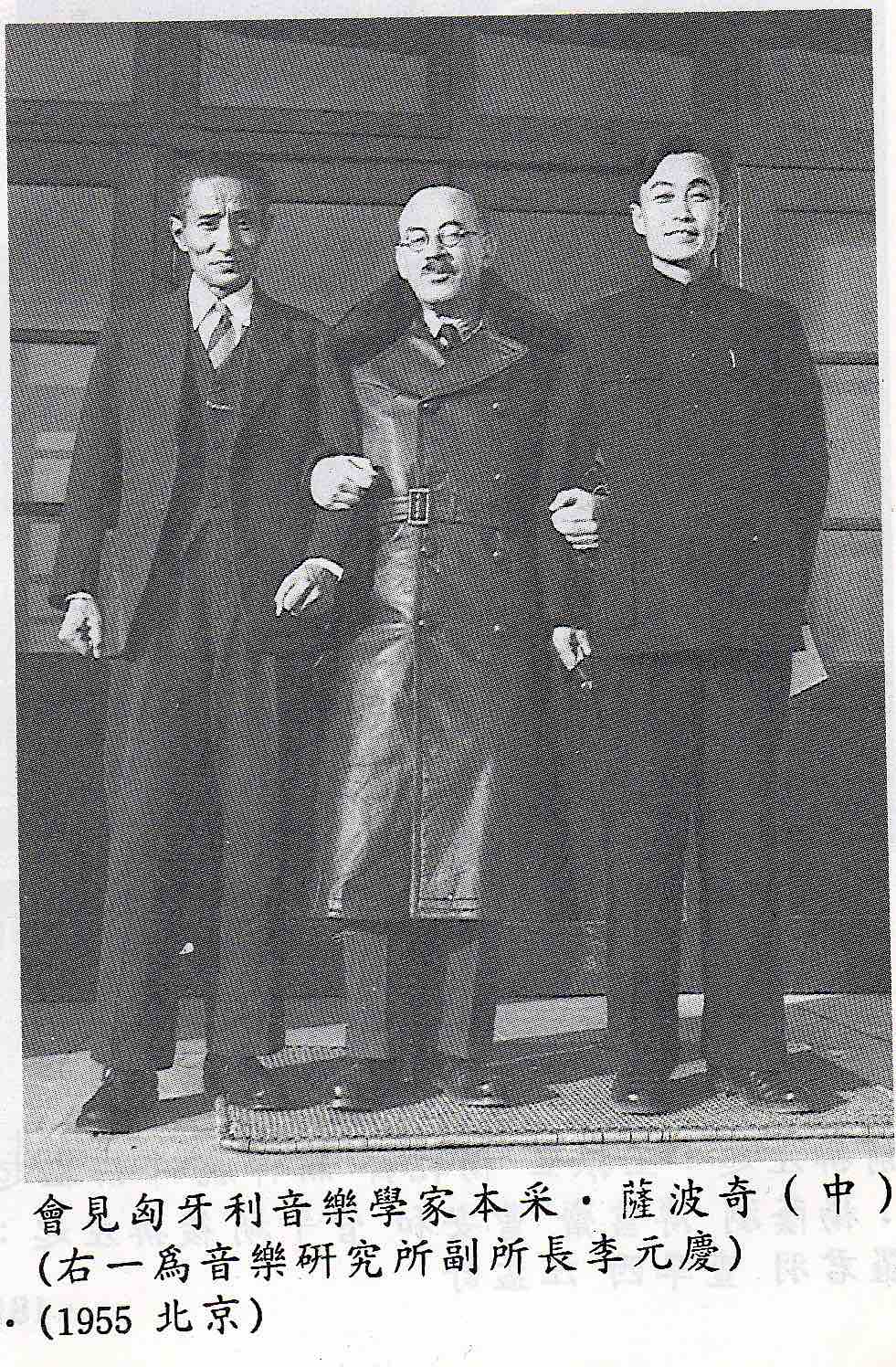
Left to right: Yang Yinliu, Bence Szabolcsi, Li Yuanqing, Beijing 1955.

Meanwhile in China, scholars were also documenting local traditions, for both the Han majority and the many ethnic groups—under testing conditions, and with a similar caution in broaching socio-political issues. By the 1950s, with a growing interest in early connections between Hungarian and Chinese musics, China was open to Hungarian musicology; Bence Szabolcsi visited the great Yang Yinliu in Beijing in 1955, on the eve of the Budapest uprising. And Yang Yinliu visited the USSR in 1957, just after his remarkable fieldtrip to Hunan—just before the Anti-Rightist campaign and Great Leap Backward led to untold suffering.

1957

Yang Yinliu (seated, right) on a visit to the USSR, 1957.

For Czech–Chinese exchanges over the period, see here.

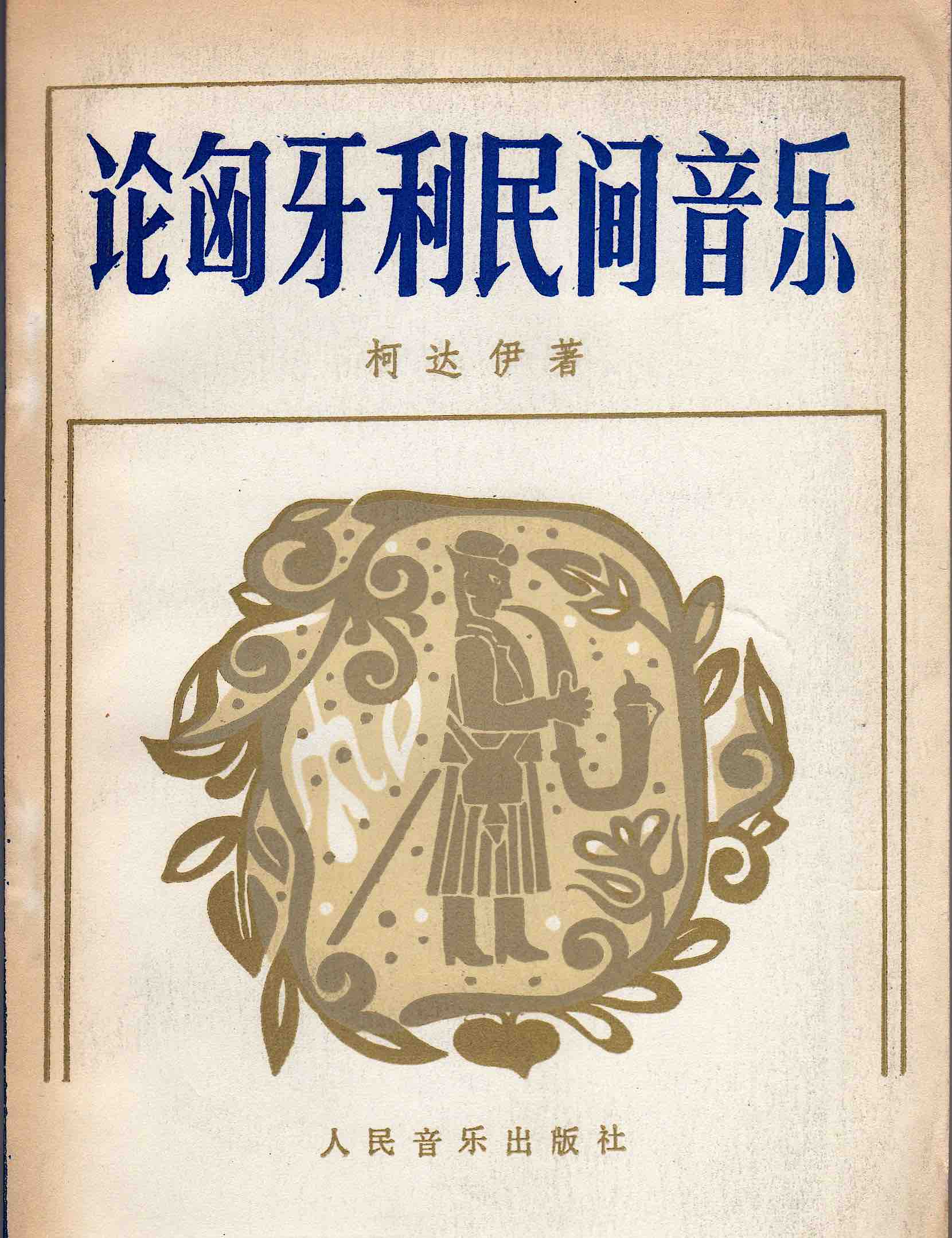
Kodály’s Folk music of Hungary, dating from 1935, was published in 1964 in a Chinese translation from the 1956 German edition—just as a brief lull after the Leap was destroyed by the Four Cleanups and Cultural Revolution.

Kodaly

In east Europe, the USSR, and Maoist China, the enthusiasm of ethnographic collectors of the day is admirable—even as their leaders were imprisoning them and manipulating the peoples they were studying. As William Noll observes, such studies need both to be interpreted in their historical framework and updated constantly, both by augmenting the earlier material and by documenting more recent change. Also in that post, note Noll’s comment that ethnographers of one cultural heritage commonly conduct fieldwork among peoples of a different cultural heritage—even if both groups live within the political boundaries of one state.

Left: Tibetan monks lay down their arms, 1959 (AFP/Getty.).
Right: Norbulingka, Lhasa 1966 (from Forbidden memoryessential reading).

A flagrant instance of circumspection is fieldwork by Chinese musicologists in Tibet in the 1950s, rosily portraying the region (like Xinjiang) as a happy land of singing and dancing—even in 1956 Lhasa, just as mass rebellions were breaking out all over Tibet against Chinese occupation. Two of the most distinguished, and well-meaning, Chinese scholars resumed their fieldwork upon the 1980s’ reforms, encouraging their Tibetan pupils; but the whole social-political backdrop remained taboo (see Labrang 1). See also Recent posts on Tibet.

Expressive culture is an illuminating window on society. How little we know about the world…


[1] The term Finno-Ugric seems somewhat dated, but see here for a more extensive list of peoples.

[2] An early curiosity among the ouevre of the great Bruno Nettl is his slim tome Cheremis musical styles (1960), part of a Cheremis project at Indiana. The Preface by Thomas Sebeok has a useful summary of interest among Hungarian and other scholars. But written from a distance, the monograph could still only be narrowly musical—free of ethnomusicology’s later concern for society and culture, in which Nettl has played such a major role; and the material that he assembles consists largely of transcriptions rather than recordings.

For Chuvash and Mordvins, note also the 1996 Auvidis CD Chants de la Volga: musique traditionnelle de Tchouvachie et Mordovie.

Auvidis

Trumpets, wind and brass bands

Trumpet chart

As this blog features a growing number of posts on trumpeters (both jazz and WAM), wind bands, and brass bands, here’s a handy list. I’ve awarded trumpet its own tag in the sidebar. My usual proviso: all these genres belong within changing social life!

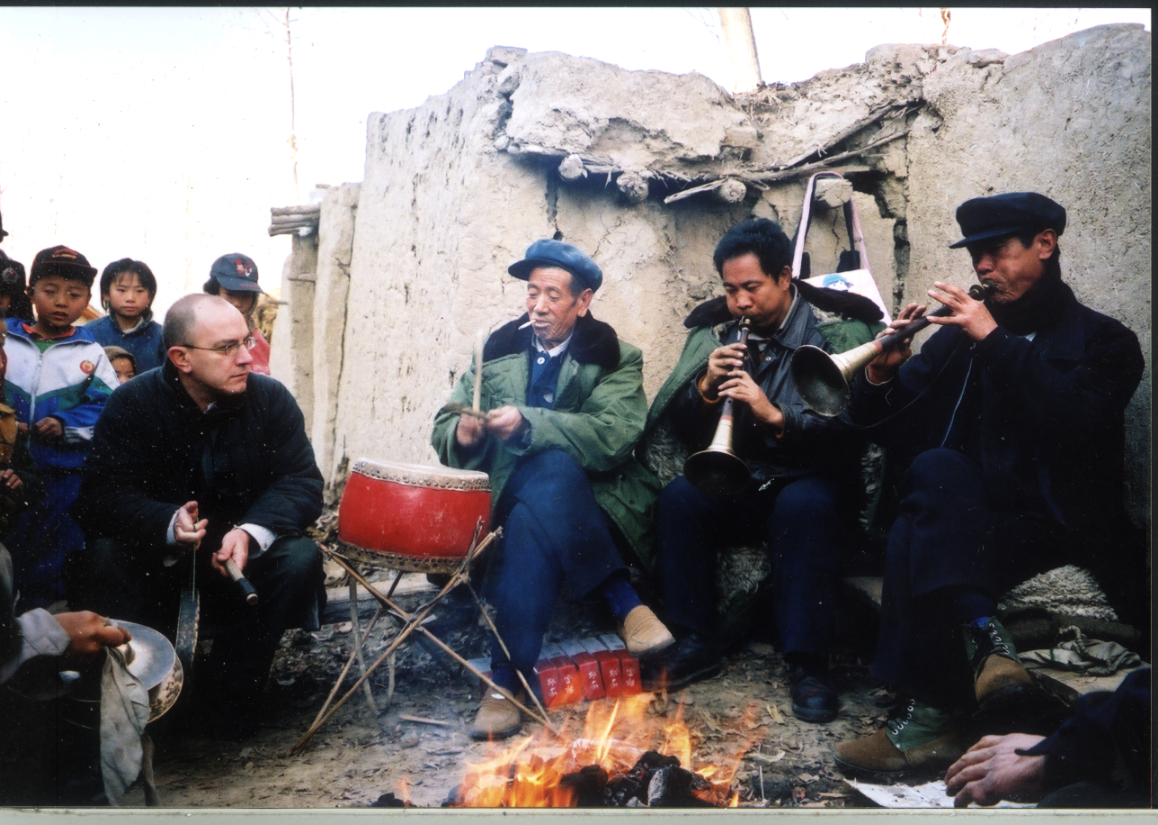
The list might begin with shawm bands (for links, click here)—I won’t try and index all the Chinese shengguan wind ensembles here, but they’re a constant theme of posts under Local ritual, for instance. Both types feature in the playlist in the sidebar, with commentary here.

Some great jazz trumpeters:

wind band

Also on jazz, starting from African musicians at European renaissance courts, is

Jumbo

WAM trumpeters featured include

  • John Wilbraham
  • enchanting versions of Handel‘s Eternal source of light divine by Alison Balsom, Wynton Marsalis, and David Blackadder (WOW).

For folk bands, see

  • the high trumpets punctuating ritual saeta songs in Andalucia, here and here
  • the trombita of the Hutsul people in the Carpathian highlands.

And whatever you do, don’t miss

  • the amazing wind and brass turbo-folk bands of east Europe!

fanfare

Performance: from Iran to Morocco

perf

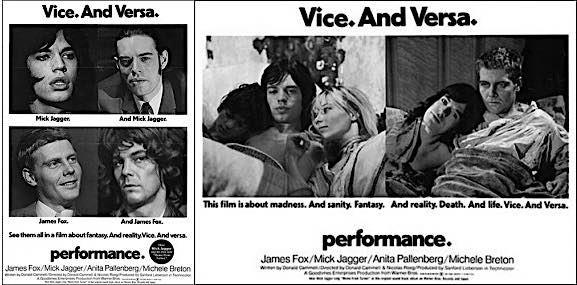
Another formative experience of frequenting late-night screenings at arthouse cinemas in the 1970s was the cult film Performance (Donald Cammell and Nicolas Roeg 1968/70). It remains totally mind-blowing.

trio

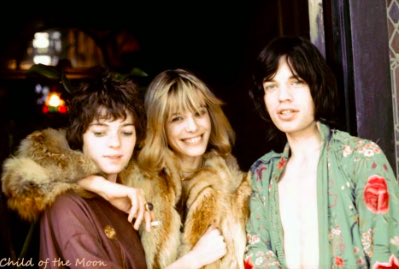
James Fox and Mick Jagger make mesmerising, disorienting presences, along with Anita Pallenberg (like Anouk Aimée, already a veteran of La dolce vita) and Michèle Breton. Watch the complete film here.

In an effective soundtrack, most brilliant use of music is the Iranian santur dulcimer accompanying the languid threesome of Jagger, Pallenburg, and Breton (from 43.17)—actually a most beautiful scene (and allegedly, um, method acting—I’m like, hello?), although it may not be quite the image that the Iranian Ministry of Culture envisages. Complementing the mood perfectly, it’s taken from a Nonesuch Explorer album played by Nasser Rastegar-Nejad.

On the somewhat remote chance that you would rather focus on the gradual unfolding of the melody without the distraction of watching the threesome, here’s his 1970 LP:

It’s also reminiscent of John Cage’s music for prepared piano. For more on Iran, see under west/central Asia, including Zithers of Iran and Turkey.

Left: Mick with Paul Bowles, 1989. Right: Brion Gysin and William Burroughs.

Of course Indian music was in the air by the 60s, and the spirit of experimentation also led to Brian Jones’s first trip in 1968 to the “Master Musicians of Jajouka” in the mountains of north Morocco. Early beneficiaries of the World Music craze long before the label had been invented, they were already playing for beat audiences in the 1950s, who were drawn by the likes of Brion Gysin and William Burroughs—and notably Paul Bowles, long-term resident of Tangier. Later, inevitably, schisms appeared in the village along with global fame. The wiki article, and this Songlines introduction, have useful links. If only this had led to wider appreciation of shawm music further afield…

Here’s the first of three parts from a 1989 Arena documentary, including Mick chatting with Paul Bowles:

Among many readings on Performance, as well as on the Stones in Morocco, Keith Richards’ autobiography Life is revealing, nay astounding. For the trail east, and Herat in the 70s, see here.

Nic Roeg died in November 2018—among tributes, this is very fine; see also under Bertolucci.

Mahler and the mouth-organ

*For an introduction to my whole series on Mahler, with links, click here!*

Abschied

More on the European taste for exotic orientalism (see Berlioz, Ravel, and, um, Granville Bantock).

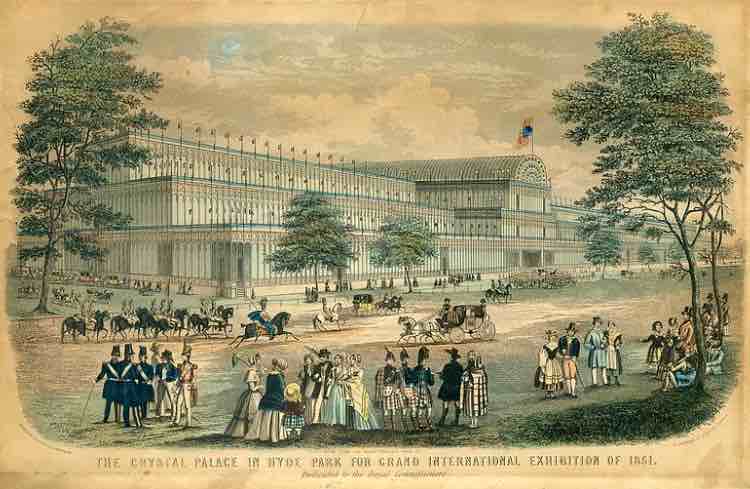
Stimulated by the 1851 Great Exhibition in London and the 1889 Exposition universelle in Paris, I was interested to read

Among composers she discusses are Purcell, Debussy, Puccini, and Stravinsky; but here I’d like to continue my series on Mahler by reflecting on his possible exposure to Chinese music. While the “imitations” of Tang poems by Hans Bethge that Mahler used for Das Lied von der Erde have been much discussed, Kang discusses the oboe lines of Der Abschied (see also here):

One can ponder whether Mahler may have heard the reedy timbre of the traditional and popular Chinese instrument called the sheng on the wax cylinders given to him by his friend Paul Hammerschlag. M. De La Grange gives an account of an event which may have strongly influenced the Chinese dimension in Das Lied:

During the last fortnight [of the summer of 1908] Mahler had a visit [at Toblach] from Paul Hammerschlag and his wife. Later, the banker recalled two memories of that summer, particularly one of a lively discussion during which, to his great surprise, Mahler suddenly threw up his table napkin so that all the guests could see that he had slashed it with his knife as it was on his knees. Another, more interesting, concerned some cylinders of Chinese music, recorded in China itself, that Paul Hammerschlag had bought in Vienna in a shop near the cathedral, and that he had given to Mahler at that time. This makes it quite certain that Mahler had not only read, but actually heard music from that far- off land before composing Das Lied.

There is no evidence with regard to what types of music the cylinders contained, and whether it was instrumental, percussive, or vocal music. And one can only speculate whether it was popular, celebratory, religious, or funeral-like.

57 shengguan trio

Indeed, I don’t know why Kang chooses the sheng mouth-organ here, rather than the guanzi oboe that accompanies it in north Chinese ritual; after all, Mahler didn’t feature the organum characteristic of the sheng. Still, it makes an equally intriguing speculation. Unfortunately, neither the shengguan ensemble nor the deafening shawm bands make likely candidates: several scholars have been studying early recordings of Chinese music, but most were vocal, with chamber ensemble of plucked and bowed strings. Had Mahler heard early recordings of the solo qin zither, such as those among the wax cylinders made by Herbert Müller in China between 1903 and 1913, that meditative sound-world might have appealed more to him.

Anyway, Kang goes on:

Traditional Chinese music tended to be categorized according to social function. Aside from the possible influence of the wax cylinders, there was also research being undertaken in Vienna on non-Western techniques (as in other major centres of musical creativity). This was no doubt as a result of current fashion, thinking, and growing academic interest in sinology and ethnomusicology as we have already witnessed in France in chapter 3. Guido Adler’s article “Uber Heterophonie” (1908) is a prime example of the fascination with and thinking about non-Western traditions that was common in Vienna at that time. Adler writes:

Although there is as yet a very incomplete, and largely unreliable body of exotic music extant, it is, nevertheless, possible—thanks to reliable material on music for several voices, whether vocal or instrumental—clearly to distinguish one kind of treatment that is essentially different from both homophony and polyphony. We may then sum up the main corpus of the kind of exotic music just referred to as follows: the voices begin in unison, in harmony or in octaves, only to separate from one another subsequently. The main theme is paraphrased and distorted, so that secondary and transitional melodies arise to join the main theme, now consonantly, now dissonantly. This paraphrasing and distorting, then, lead one to suppose that the instrumentalists and singers wanted to add something of their own, whether in individual deviatory sounds or merely in grace notes. But these deviations soon give the impression that the instrumentalist or singer has only unconsciously deviated from the right path, that the deviation is merely a coincidence, either because the performers have had a mental aberration or because they do not consider these middle sections worthy of their attention. As at the beginning, the voices then approach the end almost invariably in unison, or in a regular parallel movement. This kind of movement of several voices is the main branch, even the stem, of heterophony.

Bethge
Today Adler’s comments hardly stand up. Anyway, I wonder if anyone can now find further clues to those wax cylinders. Still, whatever sounds they captured, I doubt that they were the ethereal transcendent tones of Mahler’s imagination. However timeless anyone might suppose Chinese music to be, he was seeking neither to reproduce the Chinese music of his own time nor to recreate that of the Tang. So in all, any precise links with actual Chinese soundscapes remain elusive; like Bethge’s poems, his fantasy of the Mystic East is uppermost—which is fine by me.

All the same, how I wish I could have introduced Mahler, and Berlioz—not to mention Bach—to the exquisite shengguan ensemble of the Li family Daoists, who only managed to perform  in France and Germany long after they were gone.

Berlioz and the not-so-mystic East

1851

The unflattering views on Chinese music expressed by Berlioz have been much cited. He may have been an iconoclast within his own culture, but it would be asking too much to expect his horizons to transcend the limited aesthetics of his day.

In The Cambridge companion to Ravel, Robert Orledge cites Berlioz’s comments on hearing Chinese musicians at the Great Exhibition of the Works of Industry of All Nations in London in 1851—only a few years after the Opium Wars:

The melody, which was altogether grotesque and atrocious, finished on the tonic, like our most undistinguished sentimental songs [!]; it never moved out of the original tonality or mode. […] Nevertheless, the ludicrous melody was quite discernible, and one could have written it down in case of real need [!].

And as Orledge comments, his conclusion, after listening to a wider range of exotic musicians, was that

Chinese and Indian music would be similar to ours if it existed [WTF]; but that, musically speaking, these nations are still plunged in a state of benighted barbarianism and childish ignorance where only a few vague and feeble instincts are dimly discernible; that, moreover, the Orientals call music what we should style cacophony, and that for them, as for Macbeth’s witches, foul is fair.

Another passage has been translated thus:

As for the Chinaman’s voice, I have never heard anything so strange in my life—hideous snorts, and groans, very much like the sounds dogs make, when they wake up, stretch their paws and yawn with an effort.

musos

More sympathetic is this report from the Illustrated London News:

A PLEASING addition has been made to the Chinese Collection, consisting of a Chinese Lady, named Pwan-ye-Koo, with small lotus-feet only 2½ inches in length, a Chinese professor of music, his two children (a boy and a girl), the femme de chambre of the lady, and an interpreter. The children are gay, lively, and intelligent, the lady herself agreeable and interesting, and the gentleman civil and obliging. A Chinese concert forms part of the entertainment: the lady Pwan-ye-Koo singing a Chinese air or two, accompanied by the professor, who likewise treats the public with an exhibition of his vocal powers. The group is one that has much to commend it: it is picturesque and peculiar, and presents an image in high relief of the native manners of a Chinese family. The conduct of the domestic blended the humble and the familiar in a significant manner; and there was an air of freedom, and a sense of mutual obligation manifested in the whole party, calculated to make a favourable impression on the spectator.

They even had an audience with Queen Victoria at her summer retreat of Osborne House on the Isle of Wight.

Still, if we read the full passage, Berlioz did at least make an effort. Further to A French letter, here’s some more language practice [sections between asterisks translated above]:

A propos de cantatrice, j’ai enfin satisfait le désir que j’avais d’entendre la fameuse Chinoise, the small-footed lady (la dame au petit pied), comme l’appelaient les affiches et les réclames anglaises. L’intérêt de cette audition était pour moi dans la question relative aux divisions de la gamme et à la tonalité des Chinois. Je voulais savoir si, comme tant de gens l’on dit et écrit, elles sont différentes des nôtres. Or, d’après l’expérience assez concluante que je viens de faire, selon moi, il n’en est rien. Voici ce que j’ai entendu. La famille chinoise, composée de deux femmes, deux hommes et deux enfans, était assise immobile sur un petit théâtre dans le salon de la Chinese house, à Albert gate. La séance s’est ouverte par une chanson en dix ou douze couplets, chantée par le maître de musique, avec accompagnement d’un petit instrument à quatre cordes de métal, du genre de nos guitares, et dont il jouait avec un bout de cuir ou de bois, remplaçant le bec de plumes dont on se sert en Europe pour attaquer les cordes de la mandoline. Le manche de l’instrument est divisé en compartimens, marqués par des sillets de plus en plus rapprochés au fur et à mesure qu’ils se rapprochent de la caisse sonore, absolument comme le manche de nos guitares. L’un des derniers sillets, par l’inhabileté du facteur, a été mal posé, et donne un son un peu trop haut, toujours comme sur nos guitares quand elles sont mal faites. Mais cette division n’en produit pas moins des résultats entièrement conformes à ceux de notre gamme. Quant à l’union du chant et de l’accompagnement, elle est de telle nature, qu’on en doit conclure que ce Chinois-là du moins n’a pas la plus légère idée de l’harmonie. *L’air (grotesque et abominable de tout point) finit sur la tonique, ainsi que la plus vulgaire de nos romances, et ne module pas, c’est-à-dire (car ce mot est généralement mal compris des personnes qui ne savent pas la musique) ne sort pas de la tonalité ni du mode indiqués dès le commencement.* L’accompagnement consiste en un dessin rhythmique assez vif et toujours le même, exécuté par la mandoline, et qui s’accorde fort peu ou pas du tout avec les notes de la voix. Le plus atroce de la chose, c’est que la jeune femme (la [small-]footed lady), pour accroître le charme de cet étrange concert, et sans tenir compte le moins du monde de ce que fait entendre son savant maître, s’obstine à gratter avec ses ongles les cordes d’un autre instrument de la même nature, mais au manche plus long, sans jouer quoi que ce soit de mélodieux ou d’harmonieux. Elle imite ainsi un enfant qui, placé dans un salon où l’on exécute un morceau de musique, s’amuserait à frapper à tort et à travers sur le clavier d’un piano sans en savoir jouer. C’est, en un mot, une chanson accompagnée d’un petit charivari instrumental. Pour la voix du chanteur, rien d’aussi étrange n’avait encore frappé mon oreille: *figurez-vous des notes nasales, gutturales, gémissantes, hideuses, que je comparerai, sans trop d’exagération, aux sons que laissent échapper les chiens quand, après un long sommeil, ils bâillent avec effort en étendant leurs membres.* Néanmoins, la burlesque mélodie était fort perceptible, et je porterai un jour du papier réglé chez les Chinois pour la noter et en enrichir votre album. Telle était la première partie du concert.

A la seconde, les rôles ont été intervertis ; la jeune femme a chanté, et son maître l’a accompagnée sur la flûte. Cette fois l’accompagnement ne produisait aucune discordance; la flûte suivait la voix à l’unisson tout simplement. Cette flûte, à peu près semblable à la nôtre, n’en diffère que par sa plus grande longueur, par son bout supérieur qui reste ouvert, et par l’embouchure qui se trouve percée à peu près vers le milieu du tube, au lieu d’être située, comme chez nous, vers le haut de l’instrument. Du reste, le son en est assez doux, passablement juste, c’est-à-dire passablement faux, et l’exécutant n’a rien fait entendre qui n’appartînt entièrement au système tonal et à la gamme que nous employons. La jeune femme est douée d’une voix céleste, si on la compare à celle de son maître. C’est un mezzo soprano, assez semblable par le timbre au contralto d’un jeune garçon dont l’âge approche de l’adolescence et dont la voix va muer. Elle chante assez bien, toujours comparativement. On croit entendre une de nos cuisinières de province chantant: «Pierre! mon ami Pierre», en lavant sa vaisselle. Sa mélodie, dont la tonalité est bien déterminée, je le répète, et ne contient ni quarts ni demi-quarts de ton, mais les plus simples de nos successions diatoniques, est un peu moins extravagante que la romance du chanteur. C’est tellement tricornu néanmoins, d’un rhythme si insaisissable par son étrangeté, qu’elle me donnera sans doute beaucoup de peine à la fixer exactement sur le papier pour vous en faire hommage. Mais j’y mettrai le temps, et, en profitant bien des leçons que me donnera le chien d’un boulanger voisin de ma demeure, je veux, à mon retour à Paris, vous régaler d’un concert chinois de premier ordre. Bien entendu que je ne prends point cette exhibition pour un exemple de l’état réel du chant dans l’Empire Céleste, malgré la qualité de la jeune femme, qualité des plus excellentes, à en croire l’orateur directeur de la troupe, parlant passablement l’anglais. Les dames de qualité de Canton ou de Pékin, qui se contentent de chanter chez elles et ne viennent point chez nous se montrer en public pour un shilling, doivent, je le suppose, être supérieures à celle-ci presque autant que Mme la comtesse Rossi est supérieure à nos Esmeralda de carrefours.

D’autant plus que la jeune lady n’est peut-être point si small-footed qu’elle veut bien le faire croire, et que son pied, marque distinctive des femmes des hautes classes, pourrait bien être un pied naturel, très plébéien, à en juger par le soin qu’elle mettait à n’en laisser voir que la pointe.

Mais je penche fort à regarder cette épreuve comme décisive en ce qui concerne la division de la gamme et le sentiment de la tonalité chez les Orientaux. Je croirai, seulement quand je l’aurai entendu, que des êtres humains puissent, sur une gamme divisée par quarts de ton, produire autre chose que des gémissemens dignes des concerts nocturnes des chats amoureux. Les Arabes y sont parvenus, au dire de quelques savans; ils ont pour cet art inqualifiable une théorie complète. Je parie que les savans qui ont écrit ces belles choses ne savent rien de notre musique, ou du moins n’en ont qu’un sentiment confus et peu développé. Que la théorie des Arabes existe, cela est fort possible, mais elle n’ôte rien à l’horreur de ce qu’ils font en la mettant en pratique.

La musique des Indiens de l’Orient doit fort peu différer de celle des Chinois, si l’on en juge par les instrumens envoyés par l’Inde à l’Exposition universelle de Londres. Cette collection se compose, 10 d’un grand nombre de mandolines à quatre et à trois cordes, quelques unes même n’en ont qu’une; leur manche est divisé par des sillets comme chez les Chinois; les unes sont de petite dimension, d’autres ont une longueur démesurée; 2d’une multitude de gros et de petits tambours en forme de tonnelets, et dont le son ressemble à celui qu’on produit en frappant avec les doigts sur la calotte d’un chapeau; 30 d’un instrument à vent à anche double, de l’espèce de nos hautbois; 40 de flûtes traversières exactement semblables à celles du musicien chinois; 50 d’une trompette énorme et grossièrement exécutée sur un patron qui n’offre avec celui des trompettes européennes que d’insignifiantes différences; 60 de plusieurs petits instrumens à archet, dont le son aigre et faible doit rappeler les petits violons de sapin qu’on fait chez nous pour les enfans; 70 d’une espèce de tympanon dont les cordes tendues sur une longue caisse paraissent devoir être frappées par des baguettes; 80 d’une petite harpe à dix ou douze cordes, assez semblables aux harpes thébaines dont les bas-reliefs égyptiens nous ont fait connaître la forme, et enfin d’une grande roue chargée de gongs ou tamtams de petites dimensions, dont le bruit, quand elle est mise en mouvement, a le même charme que celui des gros grelots attachés sur le cou et la tête des chevaux de routiers. Je conclus, pour finir, que *les Chinois et les Indiens auraient une musique semblable à la nôtre, s’ils en avaient une; mais qu’ils sont encore à cet égard plongés dans les ténèbres les plus profondes de la barbarie ou dans une ignorance enfantine où se décèlent à peine quelques vagues et impuissans instincts.*

Hee Sing

Detail: Hee Sing.

Also part of the Great Exhibition was a Chinese junk moored on the Thames—occasion for the curious case of the “fake Chinese mandarin” Hee Sing, who appears in a painting depicting the retinue of the royal family. In Berlioz’s Les soirées de l’orchestre (21st evening, including a variant of the above) he was even more underwhelmed by the soirées musicales et dansantes given onboard by the sailors:

Maintenant écoutez, messieurs, la description des soirées musicales et dansantes que donnent les matelots chinois sur la jonque qu’ils ont amenée dans la Tamise; et croyez-moi si vous le pouvez.

Ici, après le premier mouvement d’horreur dont on ne peut se défendre, l’hilarité vous gagne, et il faut rire, mais rire à se tordre, à en perdre le sens. J’ai vu les dames anglaises finir par tomber pâmées sur le pont du navire céleste ; telle est la force irrésistible de cet art oriental. L’orchestre se compose d’un grand tam-tam, d’un petit tam-tam, d’une paire de cymbales, d’une espèce de calotte de bois ou de grande sébile placée sur un trépied et que l’on frappe avec deux baguettes, d’un instrument à vent assez semblable à une noix de coco, dans lequel on souffle tout simplement, et qui fait : Hou ! hou ! en hurlant ; et enfin d’un violon chinois. Mais quel violon ! C’est un tube de gros bambou long de six pouces, dans lequel est planté une tige de bois très-mince et long d’un pied et demi à peu près, de manière à figurer assez bien un marteau creux dont le manche serait fiché près de la tête du maillet au lieu de l’être au milieu de sa masse. Deux fines cordes de soie sont tendues, n’importe comment, du bout supérieur du manche à la tête du maillet. Entre ces deux cordes, légèrement tordues l’une sur l’autre, passent les crins d’un fabuleux archet qui est ainsi forcé, quand on le pousse ou le tire, de faire vibrer les deux cordes à la fois [sic]. Ces deux cordes sont discordantes entre elles, et le son qui en résulte est affreux. Néanmoins, le Paganini chinois, avec un sérieux digne du succès qu’il obtient, tenant son instrument appuyé sur le genou, emploie les doigts de la main gauche sur le haut de la double corde à en varier les intonations, ainsi que cela se pratique pour jouer du violoncelle, mais sans observer toutefois aucune division relative aux tons, demi-tons, ou à quelque intervalle que ce soit. Il produit ainsi une série continue de grincements, de miaulements faibles, qui donnent l’idée des vagissements de l’enfant nouveau-né d’une goule et d’un vampire.

Dans les tutti, le charivari des tam-tams, des cymbales, du violon et de la noix de coco est plus ou moins furieux, selon que l’homme à la sébile (qui du reste ferait un excellent timbalier), accélère ou ralentit le roulement de ses baguettes sur la calotte de bois. Quelquefois même, à un signe de ce virtuose remplissant à la fois les fonctions de chef d’orchestre, de timbalier et de chanteur, l’orchestre s’arrête un instant, et, après un court silence, frappe bien d’aplomb un seul coup. Le violon seul vagit toujours. Le chant passe successivement du chef d’orchestre à l’un de ses musiciens, en forme de dialogue; ces deux hommes employant la voix de tête, entremêlée de quelques notes de la voix de poitrine ou plutôt de la voix d’estomac, semblent réciter quelque légende célèbre de leur pays. Peut-être chantent-ils un hymne à leur dieu Bouddah, d’ont la statue aux quatorze bras orne l’intérieur de la grand’chambre du navire.

Je n’essaierai pas de vous dépeindre ces cris de chacal, ces râles d’agonisant, ces gloussements de dindon, au milieu lesquels malgré mon extrême attention, il ne m’a été possible de découvrir que quatre notes appréciables (ré, mi, si, sol). Je dirai seulement qu’il faut reconnaître la supériorité de la small-footed Lady et de son maître de musique. Evidemment les chanteurs de la maison chinoise sont des artistes, et ceux de la jonque ne sont que des mauvais amateurs. Quant à la danse de ces hommes étranges, elle est digne de leur musique. Jamais d’aussi hideuses contorsions n’avaient frappé mes regards. On croit voir une troupe de diables se tordant, grimaçant, bondissant, au sifflement de tous les reptiles, au mugissement de tous les monstres, au fracas métallique de tous les tridents et de toutes les chaudières de l’enfer… On me persuadera difficilement que le peuple chinois ne soit pas fou…
[For a fine English version, see Berlioz, translated Barzun, Evenings with the orchestra (Chicago, 1956/1999 edition), pp.246–250.]

Here the Illustrated London News acquits itself no better:

At the evening performance the queer old craft is lighted up with festoons of coloured lamps—a sort of miniature [missing] hall, and in the midst stands an open orchestra, in which four or five instrumentalists (“barbarians,” not Chinese) prepare the ear for the extraordinary combination of sounds which is to follow. Nothing can exceed the gravity of the “celestials,” as they take their position in the midst of the assembly on the main-deck, and proceed to fright the ear with gong and drum, and cymbal and agonizing cat-gut: the leader beating time with a stake upon a sort of tin saucepan-lid supported on three legs. Then the vocalization! The extraordinary squeaking duet, half plaintive, half comic, between the said leader (who is a sort of Costa and Mario rolled into one) and a younger aspirant in the background—what can possibly exceed its harrowing and ludicrous effect? Nothing except that impromptu feline discourse which we sometimes hear on house-tops at the dead of night.

The concert being concluded amidst the breathless silence of an astonished auditory, the war demonstrations and feats of arms then commence and these are certainly no less extraordinary than what has gone before. The first set consists of a set of grotesque posturing, in which the performers disport themselves severely one after the other, each succeeding one striving to outdo the other in the wildness and extravagance of his gesture—flying and leaping round the deck, thrusting out the arms right and left, threatening, retreating, &c. the musicians all the time keep up a terrific clang.

Next come a series of somewhat similar performances with long poles or lances, this scene closing with a set-to between two performers, which we have endeavored to embody in our engraving. Swords are also introduced and brandished about in the same manner, which, if intended to give any idea of the military science of the Chinese, shows them to be very far behind any other known nation in the world in that respect. One young hero, in the course of his “war demonstrations,” afforded great amusement every now and then, particularly after some very startling efforts at cut and thrust, by throwing himself down, and turning a somersault over his shield. When we left, the “barbarian” orchestra was about to strike up again, and dancing, it was said, was about to commence, but we did not wait for it.

For a recent French recreation, see here. Indeed, both the family and the junk had already appeared for P.T. Barnum’s Chinese museum: see Krystyn R. Moon, Yellowface: creating the Chinese in American popular music and performance, 1850s–1920s (2005), pp.62–6. For another portrait of the family, see here.
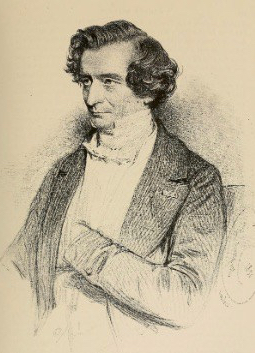
Berlioz 1851

Hector’s Napoleon impression always brought the house down.

Among composers, a broader view of musicking worldwide would have to wait for figures such as Debussy and Bartók. Still, even today views like those of Berlioz remain far from obsolete. So much for music as a universal language.

* * *

Ironically, in reviews by Berlioz’s contemporaries of his own new works he was hoist on his own petard—using rather similar vocabulary, as if taking revenge on behalf of the Chinese. Here are just a few among an embarras de richesse, cited in Slominsky‘s wonderful Lexicon of musical invective, pp.57–61:

His rare melodies are deprived of meter and rhythm; and his harmony, a bizare assemblage of sounds, not easily blended, does not always merit the name. I believe that what M. Berlioz writes does not belong to the art which I cusomarily regard as music, and I have the complete certainty that he lacks the prerequisites of this art.

Berlioz, musically speaking, is a lunatic; a classical composer only in Paris, the great city of quacks. His music is simply and undisguisedly nonsense.

M. Berlioz is utterly incapable of producing a complete phrase of any kind. When, on rare occasions, some glimpse of a tiune makes its appearance, it is cut off at the edges and twisted about in so unusual and unnatural a fashion as to give one the idea of a mangled and mutilated body, rather than a thing of fair proportions. Moreover, the little tune that seems to exist in M. Berlioz is of so decidely vulgar a character as to exclude the possibility of our supposing him possessed of a shadow of feeling.

I can compare Le Carneval romain by Berlioz to nothing but the caperings and gibberings of a big baboon, over-excited by a dose of alcoholic stimulus.

Dragging the icon to the trash, eh. For astounding Saint-Saëns on the violon chinois, click here.

See also Berlioz: a love scene. For Berlioz’s prophetic word-painting of a 1960s’ curry-house menu, cliquez ici; and for his evocation of furniture removal, ici. For Mahler’s vision of the mystic East, see here; and for Cantonese music in post-war London, here.

Haydn: 1795, 1927, 1973, 2018

trio

Just as I was immersing myself in Afghan singing, how nostalgic the other day to hear the limpid slow movement of Haydn’s G major piano trio on Private passions (for the first of several posts inspired by the series, see here).

Like the Adagio of the Schubert string quintet, it seems suspended beyond time. Of course, it’s not: as ever, we hear it with the successive patinas of our personal listening histories.

The trio is part of a set that Haydn composed in London, and the version that remains with me is that of Alfred Cortot, Jacques Thibaud, and Pablo Casals, recorded on 20th June 1927 at Queen’s Hall. I used to listen to it late at night (after closing time) with friends at Cambridge from 1973—just as Veronica and John were embarking on their Afghan journey, indeed; and as the Rito y geografía del cante flamenco series was being completed, and Li Manshan’s wife gave birth to their first daughter…

Today I wonder how we got into such early recordings, like the late Beethoven of the Busch quartet. They meant a lot to me—but I can’t quite say what: this was considerably before I became involved in early music, or began to care about changing performance styles. Indeed, in those days I was more interested in the politics of the Tang court than in the experiences of our more recent European forebears.

But now I think of the trio’s London audiences between the wars (my great-aunt Edith Miles was losing her hearing in 1927), and wartime audiences in Britain and Germany (doubtless the appalling Hans Frank loved the trio). The group had been working together since 1906; but Casals, a firm opponent of franquismo, later broke with Cortot for the latter’s collaboration with the Nazi occupation of France.

Cortot’s 1932 recording of the break in Brandenburg 5 is also great, but early renditions of baroque music may not always suit modern tastes, like Mengelberg’s 1939 Matthew passion.

Haydn dedicated the set of trios to Rebecca Schroeter, Scottish widow of an immigrant German musician (for a taste of late-18th-century mores, see here). So we might further try to imagine cosmopolitan London in 1795 (for “das Land ohne Musik“, see David Wyn Jones ed., Music in eighteenth-century Britainand for London concert life, here; cf. audiences of Tang-dynasty Chang’an, enriched by Central Asian musics—”They come over ‘ere…“).

I don’t know how to fill in the 19th-century lacuna, but despite all the vast social changes since 1795, maybe Haydn’s day isn’t so distant: we seem to have a photo of Mozart’s widow, and Casals was born in 1876.

Haydn’s trio is named after its “gypsy” finale all’ongarese, which we can enjoy without wondering too much about his exposure to folk music—it is what it is (cf. Norman Lebrecht’s ambitious claim for Mahler 4). From where we are in 2018, all three movements are delightful, but it’s the slow movement (in the lustrous key of E major, like Bruckner 7 and north Chinese ritual suites for wind ensemble!) that continues to enchant me. As the players lovingly pass the tunes around (the second one is even more spellbinding!) above pearly triplets, via Cortot’s simple translucent links, they explore them like tiny jewelled caskets, deep in meditation.

See also Haydn for football; and under In memoriam Fou Ts’ong.

Musicking worldwide: a new category!

Bartok 1907

WM

As I write more about musicking worldwide, I’ve upgraded the former world music tag to a new category in the sidebar, which allows me to make some rudimentary subheads—and do click on all the internal links too!

The rubric “world music” is a compromise. Of course, all these posts are about far more than mere “music”: they concern the cultures of local societies along with the soundscapes that animate them. The glossy commercial category of “World Music” (to which I am almost as resistant as to “heritage“) features only as an occasional irritant—though it does appear magnificently (under “drôle”) here.

Here’s a selection of some highlights, by subheads:

  • Under Asia, I have included some posts related to the Chinese soundscape (like Different values, and Festivals), but my myriad posts on the Li family Daoists (with subheads!) and other ritual groups (many linked here), as well as the qin, all have their own separate categories and tags. My major series on Indian music is collected here. Note this post on Afghan musicking.

AND it’s always worth basking in this playlist—while it could be yet more eclectic, it has a variety of gorgeous, plaintive, exuberant songs.

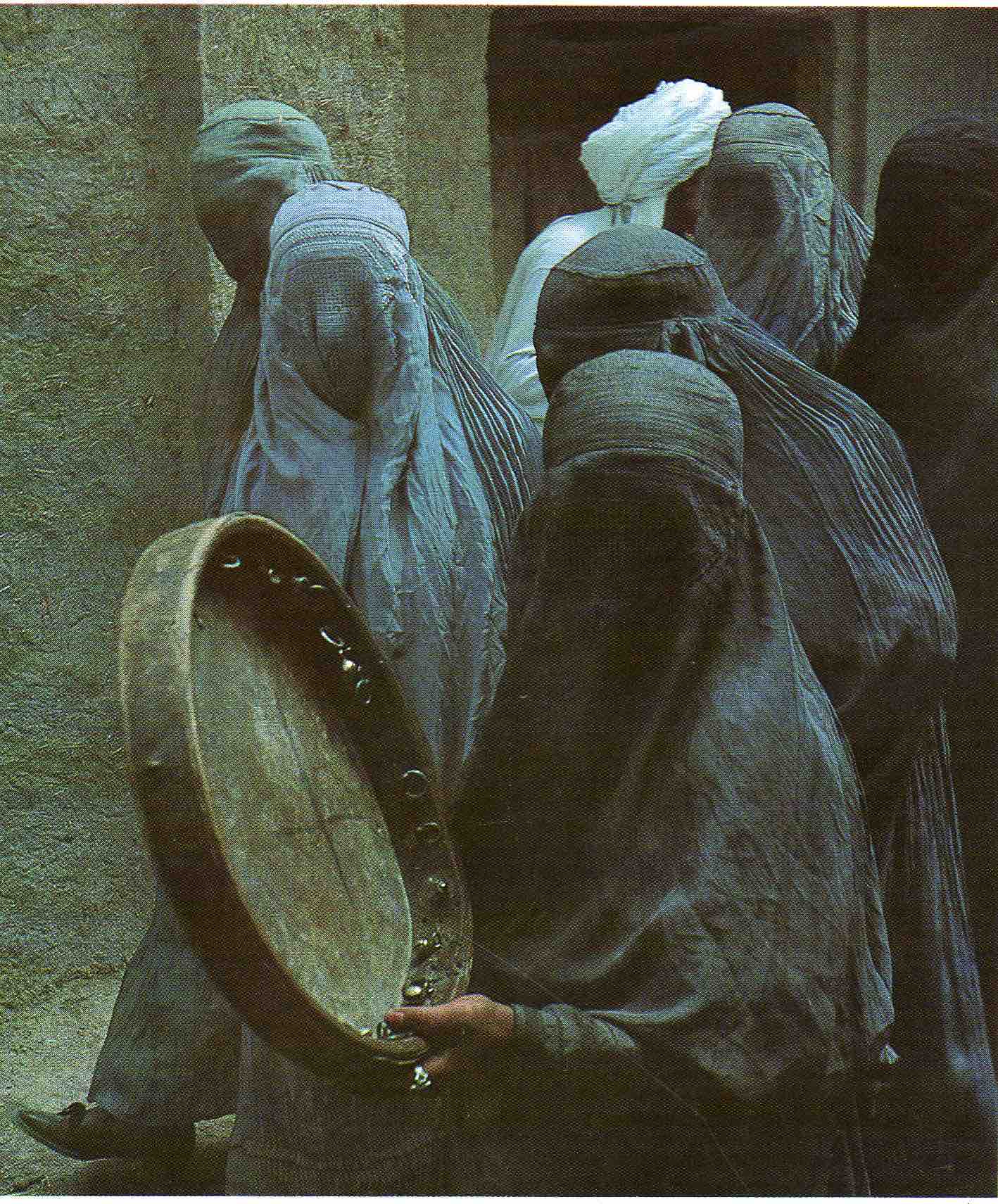
Three women of Herat

Women of Herat

The idea of “women in music” often suggests their starring roles in WAM (as in the T-shirt!) or Anglo-American popular music. But meanwhile gender has become one of the major topics in ethnomusicology (for some refs., see this post on women in flamenco; note also McClary).

Even in the more “classically” oriented confines of ethnomusicology, “women in music” may not immediately suggests the lives of female singers in Afghanistan.

  • Veronica Doubleday, Three women of Herat: a memoir of life, love and friendship in Afghanistan (1998; most recent reprint 2009)

is an engaging, deeply personal story of her time in Herat in the mid-1970s before the Russian invasion. It’s a good illustration of thinking outside the (music) box.

Herat

Gradually cutting through the curtain of purdah, she befriends three young women with different experiences:

  • The authoritative figure of Mariam, from a hereditary family of (male) musicians;
  • Mother of Nebi, whose maraz mental breakdown as a young mother, attributed to jinns, had prompted her to become a diviner (cf. China);
  • Shirin, negotiating the stigma of working as a professional entertainer (see also Veronica’s “Zainab Herawi: Finding acclaim in the conservative Islamic culture of Afghanistan” in Ruth Hellier (ed.), Women singers in global contexts: music, biography, identity (2013).

HeratAs Veronica enters their social world of domestic life and ritual celebrations, she learns to admire their warmth and strength. But her account is never sentimental, acknowledging their tribulations. She reflects cogently on her choice to adopt the veil while living among them; and in becoming a regular member of Shirin’s band and an accomplished singer, she gains direct experience of their tough life.

Veronica’s audio recordings from the period seem to have disappeared from YouTube, but these CDs are excellent:

Ever since those days in Herat, she has worked in partnership with John Baily, not only a fine exponent of the rubab plucked lute but a great maker (and theorist) of ethnographic films (see here), including

  • Amir: an Afghan refugee musician’s life in Peshawar, Pakistan (1986)
  • Lessons from Gulam: Asian music in Bradford (1986)
  • A Kabul music diary (2003)
  • Scenes of Afghan music: London, Kabul, Hamburg, Dublin (2007)
  • Ustad Rahim: Herat’s rubab maestro (2008)
  • Across the border: Afghan musicians exiled in Peshawar (2011).

Here’s a preview of Amir:

and Lessons from Gulam:

* * *

Veronica became a beautiful singer, moving both Afghan and other audiences deeply in more genteel concert settings. Here’s an early clip:

And more recently with John Baily:

Tracks on the CD Sweet nomad girl:

Three women of Herat is a model of participant observation, and an early instance of an ethnographic genre that has since flourished. Further to Veronica’s distressing original Epilogue, the 2009 reprint includes a new Preface and Postscript, giving valuable context on changes not only within Afghanistan but in Western perceptions.

She did manage to return to Herat in 1994 and 2004, just before and after the Taliban occupation; but after their initial visits in the 70s, long-term warfare in Afghanistan impelled John and Veronica to pursue their studies mainly among refugee and migrant communities—which was also to become a major theme of music ethnography.

For a sequel, click here.

Different values

I’ve written a series of posts on the various ways of playing Chinese fiddles:

And some related articles:

Much of my work revolves around trying to understand the mindsets of rural Chinese dwellers, as in that last post. Now I come to think of it, that’s almost an incidental definition of ethnography. But it’s not entirely a contrast between urban and rural: the difference between traditional style in literati and folk genres (both part of a long imperial tradition, and closely related) seems slight, whereas the modern conservatoire ethos—romantic and Westernized—is quite remote from both.

The term yijing 意境 has a rather more arty literate feel than the trendy English “mindset”, more like “aesthetic”, and in talking to educated urban Chinese I use it quite often to illustrate the issue. But—ironically illustrating the issue further—I don’t quite know how rural Chinese people might express it, though they have plenty of terms to describe different ways of performing within their own style.

Learning with the Hua band, 2001

Learning with the Hua band, 2001.

Indian singing at the BM

*For a roundup of posts on raga, with a general introduction, see here!*

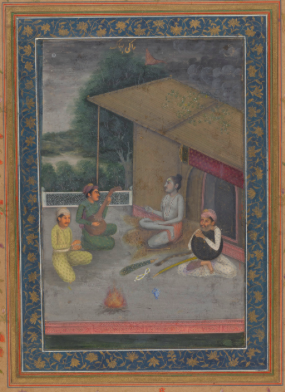
Bihag

Bihag, ragamala. Yale University Art Gallery.

After some time immersed in the rich harmonies of Mahler 10, it made a nice contrast for me to bask in the purity of monophonic Hindustani music in the Indian gallery of the British Museum. With the arhat at the other (Chinese) end of the gallery gazing on serenely from afar, Kaushiki Chakraborty sang with the lucidity and intensity characteristic of the style, accompanied by tabla and harmonium (the latter, alas, only intermittently suggestive of the bandoneon—call me old-fashioned, but you still can’t beat the sarangi).

She began with a khayal in the late-evening rāg Maru Bihag—whose relation with rāg Yaman (and Yaman Kalyan) is a subtlety to be explored by the aficionado. But even for the less attuned ear it’s worth homing in on the basic vocabulary of raga: the pitch relationships, always expounded most clearly in the opening alap.

To simplify absurdly the ascending and descending scales, and the choices of phrases within them, Ms Chakraborty’s version of the rāg featured Ni and Ma prominently, using an ascending scale of

Ni  Re  Ga  Ma  Dha  Ni

—feeding on the tension with the tonic drone of Sa, as in many ragas. The natural-fourth degree ma is introduced as a subsidiary theme (Ni Ga ma, or Sa ma, and Ga ma Ga), and later a sustained Pa also features. Here’s a version she sang in 2017:

Here’s a rendition by the great Nikhil Banerjee on sitar:

And for a version on shehnai, see Raga for winds.

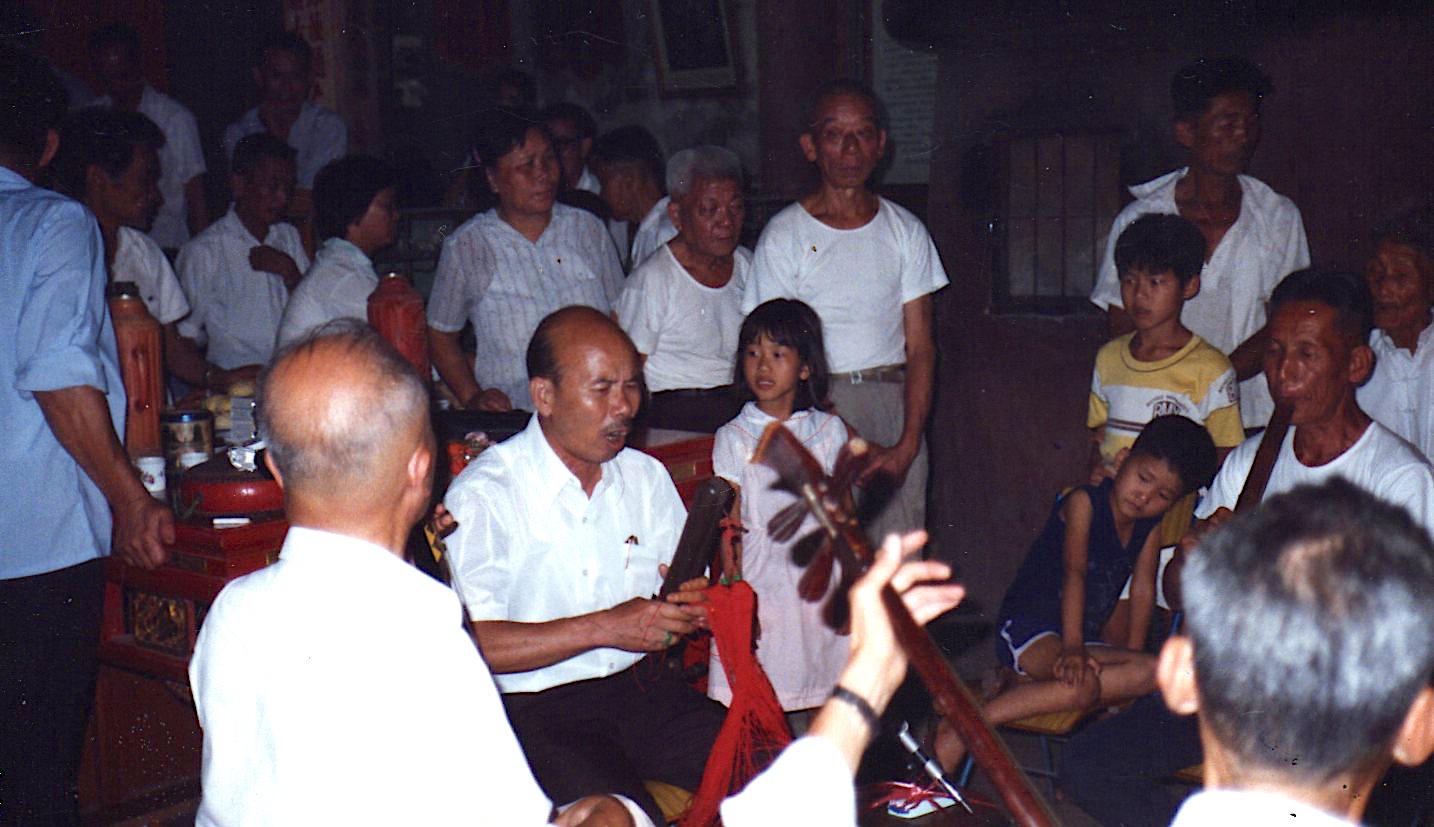
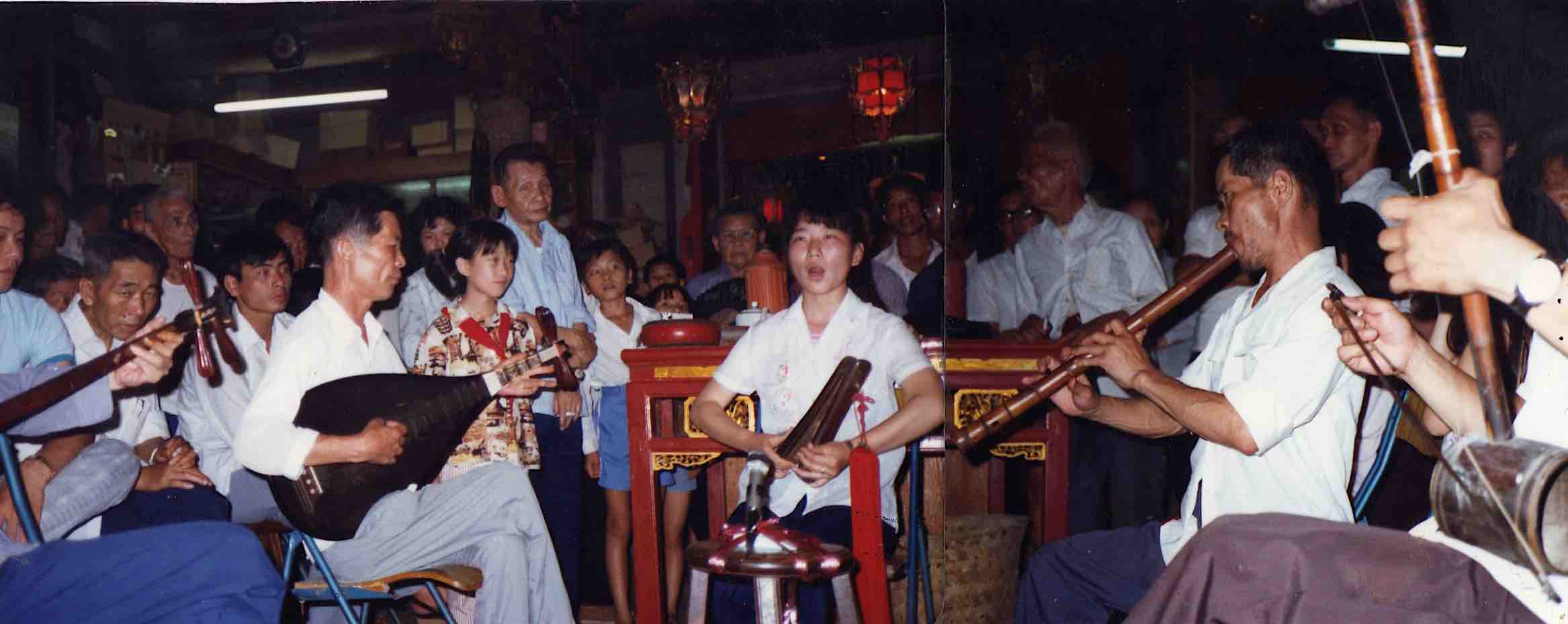
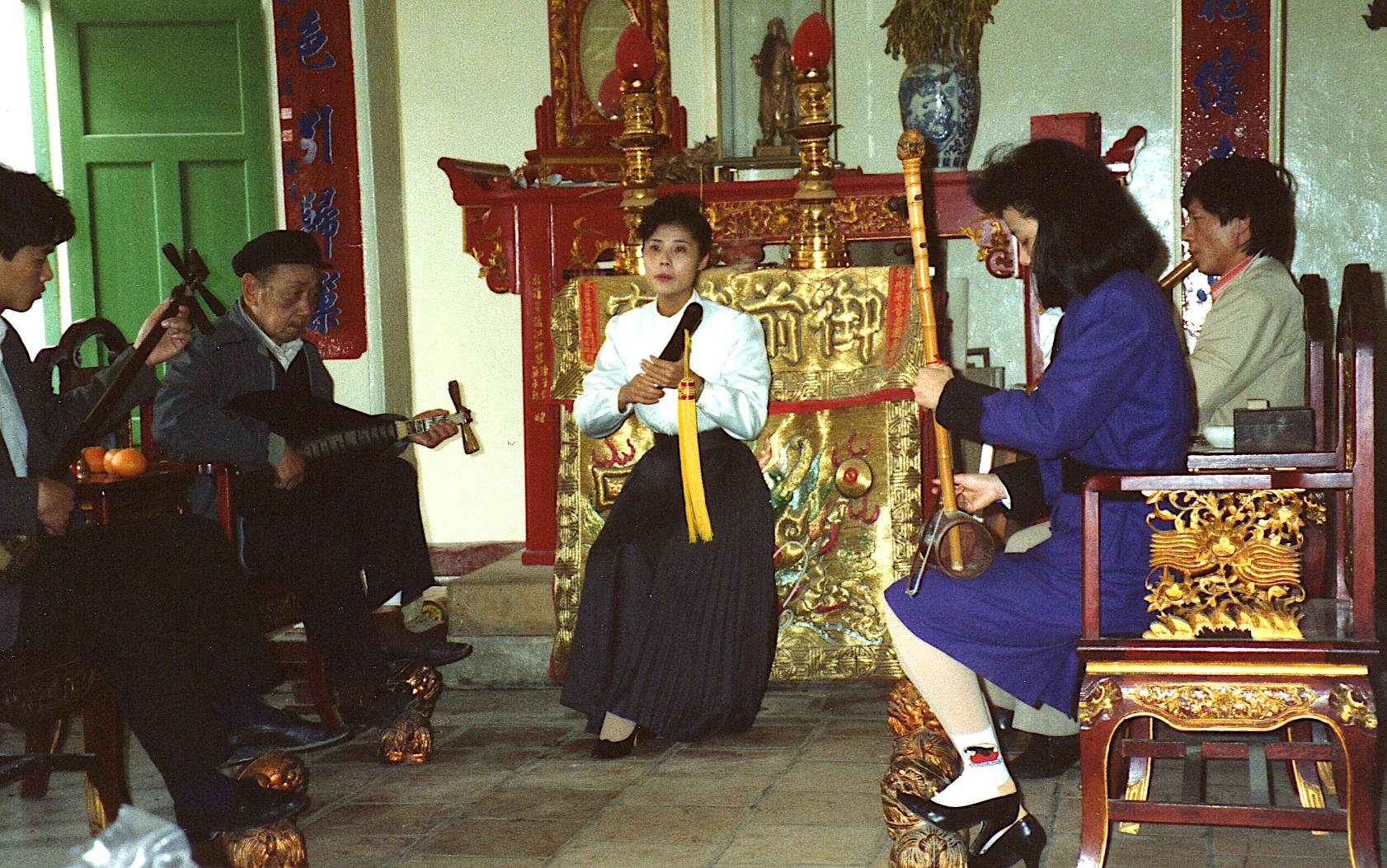
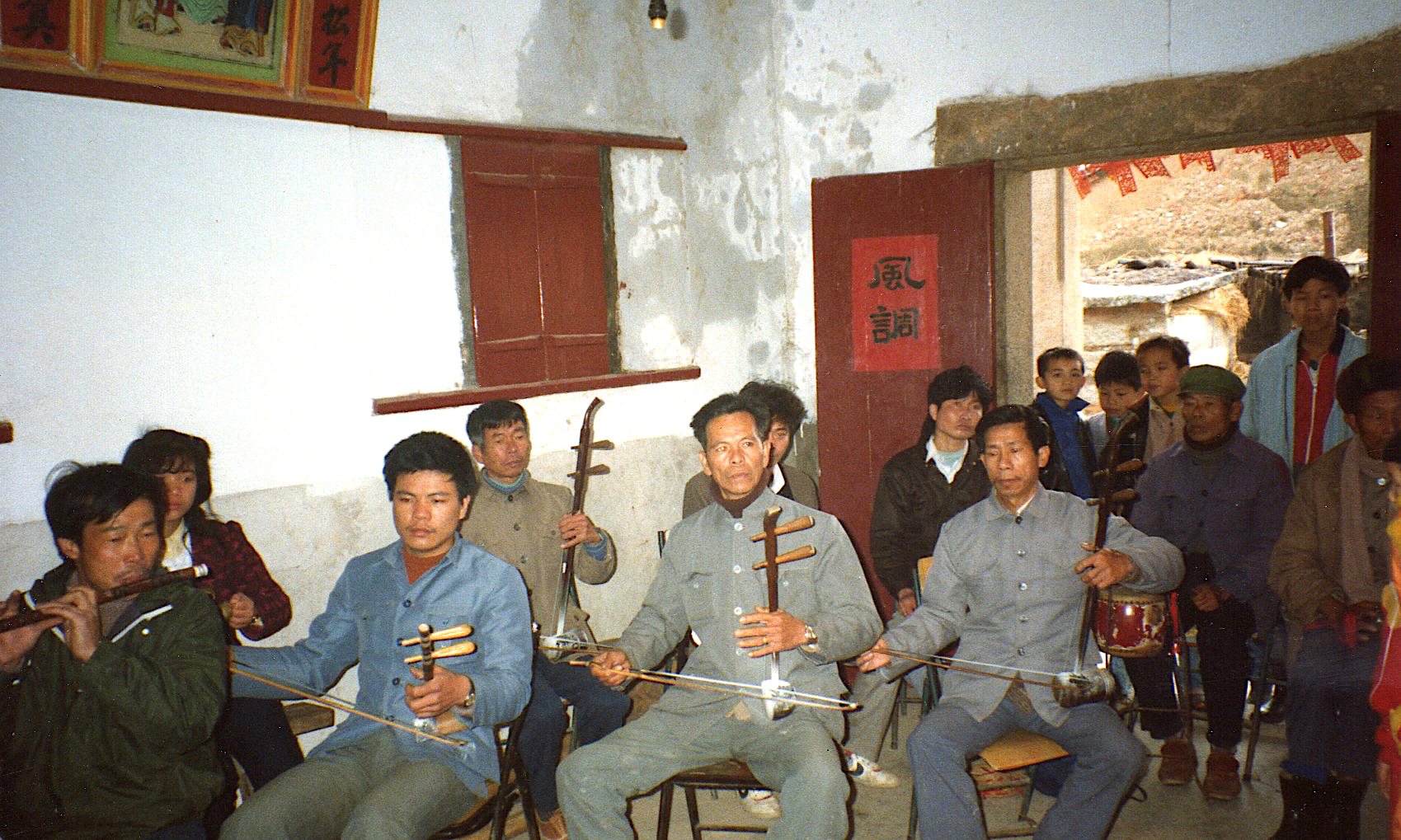
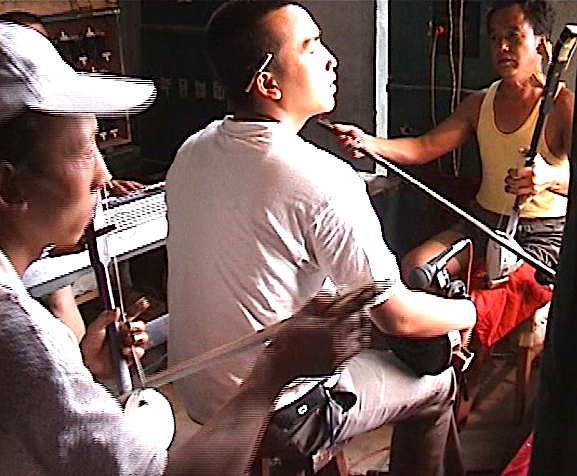
Hokkien culture: nanyin

Nanyin 1986

Nanyin, Quanzhou 1986.

In my little introduction to Chinese bowed fiddles, I mentioned the wonderful chamber genre nanyin 南音 (aka nanguan 南管), one of the most refined social activities in the Hokkien culture of south Fujian and Taiwan, complementing the riches of Daoist ritual there. The slow tempi, instrumentation, and the restrained passion of its singing style may remind us of the more plangent of medieval European ballads.

nanyin 86

Nanyin, Quanzhou 1986.

At some remove from research on performance genres in north China, this is a clear case of long-term and deep fieldwork from local scholars. I still find rather apposite my 1993 review of a wonderful Ocora CD-set of the Nansheng she group from Tainan (CHIME 7, pp.114–20), and chapter 14 of my book Folk music of China, where I gave a brief overview of the (then) state of the field. (Click here for one of several online tributes to Ts’ai Hsiao-yueh, leader of the Nansheng she group on the Ocora recordings.)

Apart from its reification for the concert stage, nanyin is deeply embedded in community life—amateur clubs, temple fairs, opera, puppetry, Daoist ritual—all within the special circumstances of rapprochement with overseas Hokkien communities, cross-strait diplomacy, and vast social and economic transformations.

Wonderful as nanyin is, alas the idea of “living fossils” has still not been erased—anyway, it’s far from alone in China in preserving an ancient tradition. And it’s worth reminding ourselves that it’s only one of a glorious profusion of performance genres even in Fujian—it occupies a mere 22 of 611 pages in the 1986 Fujian minjian yinyue jianlun by Liu Chunshu and Wang Yaohua, themselves leading proponents of the genre.

This UNESCO introduction is almost bearable, covering some of the main bases:

And among many online videos, this documentary also suggests the broader social and ritual context:

One little caveat: like a recent article on shadow puppetry (“How a bunch of Americans preserved a dying Chinese tradition”!), it’s worth registering the contributions of laowai without getting an inflated notion of their importance. Scholars like Kristofer Schipper, leading light in producing the Ocora CDs, are justly admired in China and Taiwan, but genres like nanyin are never dependent on such a deus ex machina.

Consulting Schipper’s liner notes, even in 1982, or 1993, it was far from true that nanyin was “almost forgotten in its own country”! As I commented, the statement “the positive reception of the European public led to regained esteem in China. Nan-kuan was authorised on the continent once more” is worthy of Tintin. Are we to believe that the 139 village nanguan societies in 1986 in the single county of Nan’an (to give just one example) were spurred into action by a single concert in Paris?! Folk activity (for nanyin and other genres) had even persisted throughout the years of Maoism. Meanwhile activity has continued to thrive, and research, already extensive by the early 1990s, has kept pace. A wealth of recordings is now available on CD and online. It’s exquisite music—do keep exploring!

For broader introductions to expressive cultures around Fujian, click here and here.

A brief guide to Chinese fiddles

Further to the delights of Indian and world fiddles, I write this partly as a reminder to myself, while I enjoy an unlikely renaissance in my playing of the “mellifluous” erhu fiddle (see also here).

For Chinese instrumental music, I’ve showed how the conservatoire solos are merely the tip of the iceberg. The great majority of instruments are played not solo but as part of ensembles, not on the concert platform but as part of social life. Bowed strings mainly accompany vocal music—the ritual genres that I study in north China are dominated by wind and percussion ensembles (the playlist in the sidebar, with commentary here, making a useful introduction).

So ironically, the four solo instruments (pipa, zheng, qin, and erhu) that dominate the popular image of “national music” are rather rare in the countryside. But even if it’s bowed fiddles (“friction chordophones”, ha) you’re after, don’t limit yourselves to the erhu. Much as I love fine renditions like this, there’s a wide range, to rank alongside all the variety of world fiddles.

One guide, mainly useful for historical sources on early fiddles (huqin, xiqin, and so on), is the 1999 book

  • Xiang Yang 项阳, Zhongguo gongxian yueqi shi 中国弓弦乐器史 [A history of Chinese bowed string instruments].

For illustrated introductions, see e.g. Zhongguo yueqi tujian 中国乐器图鉴, pp.236–73. For folk practice in modern times one should look to field reports on local traditions, setting forth from the Anthology of folk music of the Chinese peoples (for leads, see my book Folk music of China).

Suzhou Daoist Zhou Zufu on tiqin and banhu fiddles, UK 1994.

On a journey south, passing the tiqin of Kunqu and Daoist groups of south Jiangsu, regional traditions along the southeast coast have several types. The nanyin of south Fujian and the ensembles of Chaozhou (areas that are nearby yet culturally very different) use distinct fiddles (both written as erxian 二弦).

Wang Axin 1990

Nanyin ensemble, Wang Axin on erxian. Quanzhou 1990. My photo.

The exquisite Hokkien tradition of nanyin (nanguan) of south Fujian and Taiwan uses a core chamber ensemble of pipa and sanxian plucked lutes, xiao end-blown flute, and erxian fiddle—all regionally distinctive versions. The large repertoire of long slow sustained ballads somewhat resembles the last page of Mahler 9 elevated into a whole genre. The pipa and xiao are focal to the group, but the erxian is also amazing, demanding extraordinary bow control, full of inflection. For introductions to expressive cultures around Fujian, click here and here.

Putian 1990

Fiddles in Shiyin 十音 ensemble. Puxi village, Quanzhou 1990.

Chaozhou blind

Blind instrument-maker Cai Qiuzong (b.1947) on touxian, Dahao town, Shantou 1990.

Guangdong province has several other fiddle types, such as the yehu, and the Cantonese gaohu.

If strings are better known in south China, note that wind and percussion ensembles are just as common there. But northern fiddles are also varied, such as the banhu, huhu (some played with metal rings on the left finger, as in the photos below) and sihu, the Beijing-opera fiddle jinghu, and zhuihu and ruyigou in Henan and Shandong. What most of these fiddles have in common is a gritty timbre, quite far from the suave polished ideal of the conservatoire erhu.

WWQ 2001

yingxian 硬弦 fiddle from Xi’an puppet ensemble: Huang Yuying (b.1932), Xi’an 2001.

XJY 2003

Fiddles accompanying opera, Xujiayuan temple fair, Yanggao 2003. Dodgy screenshot from my film Doing Things, with 2007 book Ritual and music of north China: shawm bands in Shanxi.

I’ve written a separate post on bowed zithers (yaqin and so on) played in various traditions north and south. Not to mention all the diverse fiddles among the ethnic minorities— Mongolian morin khuur, Uyghur satar and ghijak, and so on.

Of course, one may end up specialising, but musicians are versatile: they pick up various instruments in order to learn how to take part in the social activity of musicking. The repertoires of such regional traditions took shape long before the modern standardisations of “national music”.

Indeed, outside the conservatoires and apart from the children of the urban bourgeoisie, the only bowed fiddle that’s not popular is the erhu! It has commonly been added to ensembles accompanying regional vocal genres since around the 1920s, but remains subsidiary (see also Song of suffering). As always, we should rejoice in regional diversity.

Zooming out, see here for an introduction to the sidebar tag fiddles.

Indian and world fiddles

*See also Ways of playing the violin*

The other day, just before my alarming rendition of Bach on the erhu, I went to an enthralling concert of Carnatic violin by the sisters M. Lalitha and M. Nandini at the Bhavan Centre in West London, a lively centre for the Indian community.

How mesmerizing Indian music can be, unfolding naturally with grace and fluency! Learning such oral traditions is aided by memorizing sargam solfeggio. Tuning the strings in open fifths (like G–D–g–d, often used in world fiddle styles— actually, here they commonly have five strings) lends the violin a wonderful sonority (cf. Keef’s excited epiphany).

The ideal in many cultures is for instruments of all kinds to imitate the voice—I love the way Wu Mei decorates the vocal liturgy of the Li band on the guanzi oboe, for instance. It was by chance that I ended up playing the violin in WAM, but we can all appreciate the link between the voice and bowed lutes (or should I say friction chordophones? No you bloody shouldn’tThe Plain People of Ireland) by extending our interests to other world genres. OK, for us WAM fiddlers embarking on Mahler 5 there may be no clear benefits to this, but why don’t we all learn the rudiments of Indian style and technique too? However rigorous a training in rag may be, it can’t be as arid and painful as ploughing through sodding Ševčík studies—it’s amazing we didn’t all give up.

The Bhavan audience was sadly thin on the ground, but it’s the magic of the rapport that counts. It reminds me of a Mozart Requiem tour of Italy with John Eliot Gardiner in the 1990s. For some reason we ended up doing a gig at a dingy cinema in the sleepy town of Terni on a Sunday afternoon, performing for a tiny audience that barely outnumbered the massed orchestral and choral forces. Nonetheless, with stellar singers like Barbara Bonney and Anne Sofie von Otter, it was one of our most moving performances.

At the risk of sounding like Away from it all (“the one thing that Venice truly lacks is leprechauns“), here’s a random but inspiring sample of some further riches of world fiddling—needless to say, it’s all about technique at the service of the music, which in turn stems from its social use…

Still with the exquisite gamak styles of India, here’s a Hindustani female dynasty (cf. Rāg Malkauns):

And then there’s the wonderful sarangi—click here, here, and here for the remarkable work of Nicolas Magriel.

I outline some of the diverse bowed lutes of China here; the erhu is the least traditional of them, but you must hear this astounding playing. See also here. For the distinctive Korean haegeum, click here.

Irish fiddling can be irresistible (for more from Liz Carroll, listen to Dear Old Erin’s Isle here):

Some unaccompanied Bach (on violin instead of cello, for a change):

And Transylvanian bands (see mainly here):

Poland has some fine fiddle traditions too—here’s Stanisław Klejnas, from a village near Łódź:

From Iran, here’s Mohammad Reza Lotfi on kamancheh:

Kamancha playing from Azerbaijan is amazing too. I used to have a clip here of an Azeri party—complete with mobile phones, naff yet tasteful accompaniment, and no fancy fakelore costumes. But it’s disappeared, so we’ll have to settle for a reified official concert version:

And here’s a stellar gathering of players, all with their own distinctive styles (with thanks to Jeffrey Werbock, himself a fine exponent of Azeri music):

Note also the lyra of Crete and the Pontic Greeks. And here’s a taksim on violin by Salih Baysal (1973):

For more violin taksim, click here. See also New sounds of Anatolia.

For the Uyghurs of Xinjiang, besides the ghijak, the soul of the muqam is the plangent long-necked satar (featured in a wonderful muqaddime prelude here), but they use “our” violin just as expressively too, as on this recording of Raq muqam—from a cassette by the renowned singer Abliz Shakir in the early 1990s:

Some of these genres are explored in the fine projects Growing into music and The music of Central Asia.

That’s just a start. I leave jazz fiddling to another post… For yet more, see fiddles tag in the sidebar, introduced here. For more concerts at the Bhavan, click here and here.

Ashiq: the last troubadour

*Distressing update*

After all these years when the common response to a comment on the Uyghurs of Xinjiang was “The WHAT of WHAT?”, their new-found global fame is yet more unfortunate. It’s hard to believe now that the screening of this film, less than two years ago, came at a time when the Uyghurs were little known, when films like this could still be made about groups that were still active, and still seemed relevant; when dedicated Uyghur scholars and performers still had room to maintain their culture. Following their pervasive silencing since then, among a host of fine articles on the appalling current situation in Xinjiang, see here, and here, including Rachel Harris’s comments on the disappearance of Sanubar Tursun. Among many articles on the distinguished ethnographer and film-maker Rahilä Dawut, another victim of the purge, is this. Click here for remarkable videos of Sufi Naqshbandi ritual among the Uyghurs. For more, see my roundup of posts on Uyghur culture.

I’ve left the review below as I first wrote it.

* * *

In my little list of ethnographic films, I mentioned Liu Xiangchen 刘湘晨, an outstanding film-maker based in Urumqi in Xinjiang. On Monday at SOAS, as part of a conference on Islamic soundscapes in China (itself part of an excellent project[1] he attended a screening of his Ashiq: the last troubadour (2010, 122 mins), one of several films by him on various ethnic groups in Xinjiang.

Filmed mainly between 2003 and 2007, Liu’s four-hour version of Ashiq was shown last year at the splendid Shanghai Centre for Ritual Music, with a detailed discussion (which, ominously, has since disappeared from the web).

Here’s an 8-minute trailer:

and the 2-hour version, with Chinese subtitles:

The “exotic” ethnic minorities are always a more popular research topic than the somewhat mundane Han Chinese; I would say, only I’d sound like the UKIPs, that the Han Chinese have become a minority in their own country—which would be just as absurd, given that, in the face of vast Han Chinese immigration to Xinjiang, it is precisely the Uyghurs who feel threatened. But I envy scholars of the minorities the stunning scenery, and the costumes—and if they no longer wear them, they’re used to being asked to put them on for the cameras.

I’m now a little confused about what ashiq actually means among the Uyghurs. Simply stated, they are Sufi mendicants who congregate at the shrines of Islamic saints. From the YouTube blurb:

Some ashiq are ironworkers, others are beggars, merchants, grave diggers, barbers, woman ashiq, Sheikh (the Islamic clergy) and so on.

As Rachel Harris notes, [2] the term may be a rather modern usage for people once more commonly known as dervishes or qalandar. It’s taxonomy again.

Liu described them as marginalised, a minority themselves, but it looks like a substantial phenomenon. And marginalisation is their very raison d’être: they thrive on flouting social norms (cf. Merriam). The subtitle “the last troubadour” seems unsuitable, not only since the use of a (largely secular) term like troubadour is hardly useful, but because the film doesn’t seem to show that they are dying out. Maybe they are, but it repeats a mantra chanted by anthropologists since early times, claiming to have discovered a pristine tradition that is endangered, rather than noting constant change.

For an outsider, the film, like that of De Martino in south Italy, may also shock. For the total novice, it will just amaze: didn’t the CCP destroy religion over sixty years ago—all the more in Xinjiang or Tibet? At least it shows what a huge task the CCP faces. Are we to celebrate the slow spread of state education and modernization?

The nomination of the ashiq for Intangible Cultural Heritage status is captioned early in the film without comment, though (like that of the Uyghur meshrep) [3] it will seem so very incongruous; perhaps it serves as a kind of amulet to protect the film from official criticism. As with the Han Chinese, a majority of genres selected for the ICH are grounded in ritual, impossible to reconcile with the state’s goals without destroying them—which may indeed be the idea. It is the duty of the ethnographer to reflect such micro-societies faithfully, like any other. It goes without saying that it is no use to regard them purely as “musical cultures” detached from their social roots.

The conceit of academic objectivity may make ethnographers seem to refrain from either celebration or criticism, yet at the same time (to return to De Martino), some may be shocked, pondering the link between religion and poverty—an obstacle to those social changes that can genuinely improve people’s lives, health, life-expectancy, and so on?

I gave an instance for the Han Chinese in my Shaanbei book (p.86):

Back in the county-town, returning to our hostel one evening, we switch on the TV to find a documentary about coal-mining accidents, which are reported nightly. There are some rather fine investigative programmes on TV these days, and one main theme of this one is how the response of the village Communist Party leadership, rather than considering improving safety measures, has been to give funds to construct a new village temple in the hope of divine protection. OK, in this case the programme happens to fit into an agenda of rationalism against superstition, a view we sometimes feel inclined to challenge, but tonight I can only go along with the presenter’s lament.

One doesn’t have to be a Maoist apparatchik to worry about this. Observers will draw their own conclusions.

Returning to the Uyghurs, the gender issue is sobering too. There’s one fine scene of a group of female ashiq, but as Rachel Harris (whose latest book revolves around women’s religious groups) pointed out at the screening, only a female film-maker could get proper access to such groups—like Rahilä Dawut (on whom see here).

The film suggests so many complex issues. It gives full coverage to songs, and texts, not just sonic icing on the cake. The ashiq aren’t big on cake, but some weed helps them commune.

Their basic accompaniment is the sapaye, paired sticks pierced with metal rings, played in a kind of stylized self-flagellation, notable in various degrees in both Islamic and Han Chinese ritual cultures (for one gory instance from Fujian, see Ken Dean’s film Bored in heaven).

The tear-stained faces of the ashiq as they sing may remind us that the expression of suffering is a quasi-universal feature of music-making. But it’s always culturally mediated, with differing implications; Rachel Harris again explores the significance of “performative tears” both for Uyghur and other cultures (for the Bach Passions, see here).

The sudden, startling, introduction of scenes from the bustling modern capital of Urumqi is effective. I didn’t pick up hints to change in the rural scene, which must be constantly occurring too, so the film may seem merely to suggest a contrast between (“backward”?) rural traditions and harsh urban commodification. But the structure works well, right down to the final scenes with a birth and a death, the latter in an extraordinary landscape.

I pen these thoughts as a mere outsider. Talking of which, one also wonders how all this relates to the old rejection of ethnographic outsiders, summarised by Nettl as “You will never understand our music”. But here, as with the late great Zhou Ji 周吉 (1943–2008), one of the consultants on the film, Uyghurs seem to have few reservations about certain Han Chinese (or Westerners, indeed) documenting their lives—as long as they are clearly in sympathy and willing to engage fully. Liu Xiangchen, though not himself Uyghur, was also advised by Dilmurat Omar of the Institute of Ethnology and Sociology at Xinjiang Normal University.


[1] I am grateful to Rachel Harris, estimable authority on Uyghur culture and music, for pointing me towards several sources. As usual, it goes without saying that I am entirely responsible for my interpretations here.
[2] “Theory and practice in contemporary Central Asian maqām traditions” (forthcoming).
[3] Note this important report. See also under Soundscapes of Uyghur Islam.

Rag Kafi Zila

*For a roundup of posts on raga, with a general introduction, click here!*

kafi

Kafi, ragamala:
“Holding a delightful rasna-flower and wearing a garland of flowers,
she is a beautiful lady who enjoys the fanning. She has a celestial voice.
Such is Kafi ragini, who enters fully into the exploits of a hero.”

From the late 60s, at a time when it was hardly possible to be amazed by the riches of Chinese traditional music, I was devoted to Indian music—which then meant mainly the solo “classical” traditions, as it mainly still does in the popular image.

If Heart of Glass reminded me fleetingly, impertinently, of rāg Marwa and Nikhil Banerjee, I still treasure his lyrical rendition of rāg Kafi Zila, which appeared magically on BBC Radio 3 in the early 1970s.

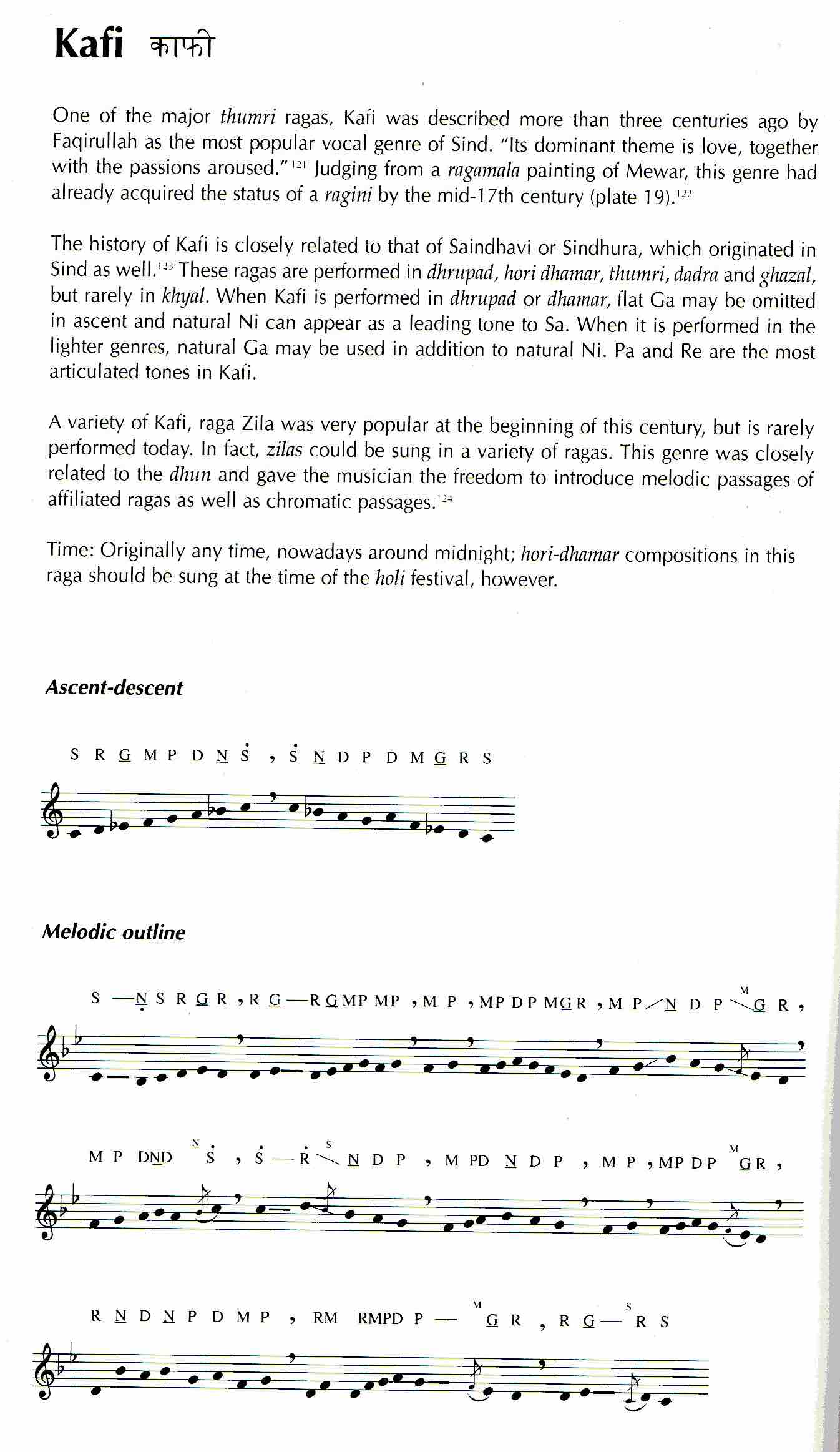
It’s an entrancing raga, for the second quarter of the night. Within its basic minor scale with flat 3rd and 7th, it sometimes features the major 3rd degree. Here’s the introduction to rāg Kafi in The raga guide:

Kafi RG 1

Kafi RG 2

The suave BBC announcer’s introduction (citing Alain Daniélou) remains etched in my heart:

Of shining whiteness,
Kafi, who inspires lust,
tenderly sits on the lap of her playmate in the royal palace.
Fond of parrots,
she is dressed in blue
and decked with jewels.
She is the image of sensuousness.
In the Lotus of my heart
I cherish her,
lovelier than Lakshmi
the goddess of Fortune.

Of course, as with Bach, I’m just reporting my own infatuation, which is merely a product of a particular place, social milieu, and time—far from the responses of indigenous audiences of various types.

Here’s one of several exquisite versions by Nikhil Banerjee, with Anindo Chaterjee on tabla:

And here he explores Mishra Kafi for over an hour:

Click here for a sarod version by Amjad Ali Khan.

Here’s a relatively light, but always entrancing, vocal rendition by the Dagar brothers:

As I observed here, training in Indian sargam solfeggio is a basic grounding in monophonic musics—far from a mere conceptual exercise, it draws us towards the heart of the music.

Heart of glass, and Rag Marwa

Heart of glass is yet another masterpiece from the late 70s—just after Naturträne.

Apart from its spacey vibe, there’s one detail of Debbie Harry’s song that Yer Average fan will experience instinctively, but the tedious analytical bent of the musicologist may home in on: the hallucinatory temporary modulation at the end of the third line (find/blind), fleetingly sketching a major triad on la—all the more ironic for the deflation expressed by the lyric.

That harmonic shift reminds me of rag Marwa, with its implied major scale on Dha/la (A major, one might say) over the Sa–Pa/do–so/C–G drone, the flat re (C♯) clashing with the tonic. Sure, Heart of glass hardly compares with the complexities of the ascending and descending scales of the raga, worked through over a long period, but hey.

Most transcendental are renditions in dhrupad style. Here’s Zia Mohiuddin Dagar on rudra vina, in his last year:

And Rahim Fahimuddin Dagar:

Nikhil Banerjee on sitar:

Here’s a sarangi version from Sultan Khan (compliments to the heading ‘Marwa’-lous!)):

For another rendition on sarangi by Ram Narayan, click here. For Amjad Ali Khan on sarod, see under Raga at the Proms; and for Hariprasad Chaurasia on bansuri, see Raga for winds.

For a roundup of my series on raga, with a general introduction, see here.

Festivals: the official—folk continuum

The upcoming CHIME conference in LA (29 March to 2 April), presided over by the excellent Helen Rees, looks like a fine event, though I can’t make it. The theme this time is festivals.

Gansu miaohui FKTemple procession, Xincheng, south Gansu, June 1997. [1]
Photo: Frank Kouwenhoven. © CHIME, all rights reserved.

Of course, festivals and pilgrimages all over the world are a major theme of ethnography: not just Uyghur meshreps and mazar, and Tibetan monastery festivals, but Indian melas, Sufi festivals, the Mediterranean (Andalucian fiestas, south Italy…), Moroccan ahouach, you name it. Bernard Lortat-Jacob’s 1994 book Musiques en fête is charmant, with wise and vivid words about Morocco, Sardinia, and Romania (¡¿BTW, why do French books put the list of contents at the back?! ¡¿Typical Gallic contrariness?!)

To adopt the metaphor of “the whole dragon” again, there is a long continuum between folk festivals, based on ritual (often calendrical) observances, and secular events for a largely urban audience.

So I too am going to link up diverse themes like temple fairs, ritual, famine, village names, Eurovision, and propaganda. It does make sense, though—trust me, I’m a doctor.

Traditional events in China`
Funeral rituals have been my main topic in China for thirty years, but of course it’s not easy to plan visits much in advance. The calendrical dates of temple fairs (often known as miaohui) may seem easier to anticipate. Again, scholars of religion tend to home in on their specifically religious elements, as in the great jiao Offering—though note Ken Dean’s fine film Bored in heaven. But like funerals they are multivalent, embracing all kinds of activity: ritual, opera, folk-song, pop, commerce, “hosting” and “red-hot sociality” (Chau!)…

Apart from my 2007 and 2009 books, names like Zhao Shiyu, Guo Yuhua, Wang Mingming, Yue Yongyi, Stephan FeuchtwangAdam Chau, and Wu Fan spring to mind. The knack is to detail both sacred and secular aspects of temple fairs.

But the dates of calendrical rituals, like temple fairs, may not be easily vouchsafed to the outsider either. The temple fairs on the Houshan mountains in Yixian county southwest of Beijing, mainly in the 3rd and 7th moons, are much less well known than those of Miaofengshan, but they also draw huge crowds, both local and from further afield.

To work all this out you have to spend time around the villages of Liujing and Matou in the foothills around Houshan, and then observe who goes where when and does what. Although Chinese villagers are a rich source of ritual and musical information (far more than any silent library), they often speak prescriptively rather than descriptively, telling us on what occasions a jiao Offering ritual should be performed, whether or not is has been performed since the 1940s. They don’t necessarily volunteer information on change, preferring (like some officials and scholars) to present their traditions as constant, eternal—even if contexts and repertoires have evidently changed in their lifetime. On our first visit to Liujing we rather assumed that villagers’ descriptions of ritual pilgrimages related to “the past”— but we soon found that they were very much alive.

The Songs-for-winds associations: propaganda and catastrophe
What got me “thinking” (I use the word loosely) about all this was that 1950 visit to Tianjin of the “Songs-for-winds” band from Ziwei village, in what later became Dingxian county.

The Central Conservatoire (as it was then) was then still based at Tianjin, of course. The work of Yang Yinliu and Cao Anhe on the Songs-for-winds may be considered a prelude to that on the more solemn ritual style of the Beijing temples that Yang undertook from 1952, a topic that was to expand vastly after 1986. But the Songs-for-winds groups, more popular than the ritual style that is my main focus, are worth a little detour here.

We should bear in mind that such wind ensembles were quite unfamiliar to southerners like Yang and Cao. Having invited the Ziwei band to the conservatoire, they recorded their repertoire on a Webster wire recorder. The band went back some six generations, and under the leadership of the celebrated Wang Chengkui, they had invited the great wind player Yang Yuanheng  to teach them in the winters of 1945 and 1946. Yang Yuanheng, a former Daoist priest in a little temple in Anping county, was himself appointed professor of guanzi oboe at the conservatoire in 1950. [2] Yang Yuanheng, like the Buddhist monk Haibo, was a major influence on many shengguan ritual associations in the area: we would hear their names from many village associations.

Yang and Cao’s monograph on the Ziwei band, published in 1952,  consists mainly of transcriptions, with little of the social detail that they covered for the Wuxi Daoists or Yang’s 1956 Hunan fieldtrip. Ziwei would go on to supply wind players to many state troupes for decades to come.

Langfang huahui 1991

Secular New Year’s huahui parade, Langfang city, 1991.

Xushui
Adapted from my Folk music of China (p.196):

During the 1958 Great Leap Forward (or Backward, as it’s known), Dingxian and particularly Xushui counties became model counties for the relentless drive to full communization. [3] At the height of the Leap back in August 1958, Chairman Mao visited communes there. In Dasigexiang district just southeast of Xushui county-town, Dasigezhuang village was now renamed the 4th August brigade. Notable for its revolutionary fervour at this time was the “Great Leap Forward Songs-for winds association” of Qianminzhuang brigade in Xushui, which performed for this visit.

The propaganda of the Leap makes a stark contrast with the grim realities of the period, with villages throughout the area suffering from crop failure, famine, and social disruption.

Our visit to Qianminzhuang in 1993 was the only time I’ve ever had a police escort—to take me there for a change, not to drag me away! Predictably, such an effusive welcome for me as a “foreign guest” indicated close supervision and censorship of our fieldwork.

QMZ band 1993

QMZ pose 1993

Striking a pose with the leaders, Qianminzhuang 1993

In 1995 we visited some of the senior musicians independently, with much more useful results.

Xushui’s favoured status did nothing to prevent many starving to death there in 1960—but just near Qianminzhuang, the Gaozhuang ritual association still managed to restart in 1961. Religion revived in China precisely at moments of political crisis such as the famines of 1960 and the Cultural Revolution, albeit with great difficulty. It may provide solace, or a focus for resistance—both against Maoism and later against the insecurities ensuing its demise.

The Gaozhuang ritual association was one of many in Xushui villages that used, and use, the older more solemn shengguan style. Ritual associations throughout the area commonly claim transmission from either Buddhist monks (heshangjing 和尚經) or Daoist priests (laodaojing 老道經)—the Gaozhuang association is Buddhist-transmitted. In another common taxonomy, the association divides into “front altar” (qiantan, the shengguan instrumental ensemble, and “rear altar” (houtan, vocal liturgy).

Despite its revolutionary image, Xushui county has remained a hotbed for religion, notably the cult of the sectarian creator goddess Wusheng laomu. Associations there commonly hang out ritual paintings, like the Ten Kings (Shiwang) or Water and Land (Shuilu) series, and they use “precious scrolls” and other ritual manuals. They too are within the catchment area of Houtu worship—they used to make the pilgrimage to Houshan. Even the revolutionary Qianminzhuang band told us that their former tradition was to recite the scriptures, performing only as a social duty for funerals, not for weddings. And certainly not to accompany mendacious parades to report a bumper harvest…

In 1994 the Gaozhuang association built an Ancestral Hall to Venerable Mother (Laomu citang), occupying about one mu, stylish and grand. It cost around 60,000 kuai to build; the stele lists 132 donors, who gave from 50 up to 3,000 kuai. The altar has Wusheng laomu in the centre, Wangmu niangniang and Songzi niangniang to the right, Cangu niangniang and Houtu niangniang to the left.

Gaozhuang citang

The village Party Secretary told us that sources of support included incense money from the Great Tent Association (Dapeng hui, a common term in the area for a ritual association) and from the temple, and money from fortune-telling and curing illness. He reflected, “A dozen or so women kept on coming to see me about building a temple. I had no choice—the brigade couldn’t refuse, so I gave them a plot of land. Believing in the gods and having a temple is no bad thing, it’s not as if you stop production if you believe in it!”

In all, the flamboyant (and readily secularized) Songs-for-winds style remains a common image of wind bands on the Hebei plain, but since all our fieldwork through the 1990s it is clear that ritual practice, with its more solemn shengguan instrumental style, is both older and more common. It is resilient too. This persistence of tradition, both in religious and musical practice, is all the more striking in such a once-revolutionary county as Xushui.

Mao was impressively modest about his limited success when he admitted to Nixon in 1972:

“I haven’t been able to change [China]—I’ve only been able to change a few places in the vicinity of Peking.”  [4]

But he wasn’t modest enough: in some ways even a county so near Beijing, such a focus of the revolution, has remained resistant to Maoist ideology, predating and outliving it. Still, disruption was severe. For more on Xushui, see here.

Official festivals in the 1950s
Meanwhile, the new government, in its own way, was promoting local culture through the medium of regional folk festivals (diaoyan, huiyan). First, local festivals were held to select representatives for major performances in the regional capitals. Some laicized priests were even assembled to perform as “troupes“, sometimes for the first time in many years—such as Baiyunshan Daoists (1955), Wudangshan Daoists (1956 and 1957), Wutaishan Buddhists (1958). For such performances, inevitably, their shengguan instrumental music was plucked out of its ritual context. I haven’t heard stories as distressing as the fate that befell kobzari blind minstrels in Ukraine when summoned for an official festival in the early 1930s; but folk ritual specialists were still anxious about performing for officials around 1980.

These festivals served partly as auditions for the state song-and-dance troupes then expanding all over China. Daoist and Buddhist ritual specialists had a deserved reputation as outstanding instrumentalists. Many, like our very own Li Qing (my book pp.113–25), were recruited as musicians to state troupes around 1958—and then sent home again as the state apparatus collapsed in 1962.

While such festivals stimulated the collection and documentation of folk music, we must balance this with the ongoing assaults on its traditional context. The background ( beginning from the 1940s) was campaigns against “feudal superstition”, terrifying public executions of sectarians, and the destruction of temple life.

The reform era
Urban festivals featuring rural groups—perhaps related to a conference—make a convenient recourse for busy academics into whose holidays they fit nicely. From the 1980s, the secular arts festivals of the Maoist era were remoulded into more glossy events. In 1990 the Li family Daoists took part in a festival of religious music in Beijing.

By the 21st century the new ideology was confirmed in the regular staged “living fossil” presentations of the Intangible Cultural Heritage. The latter project, with its whole bureaucratic workings, has now become a major research topic on its own, at the expense of studies of the local traditions that it is supposed to assist (my book pp.331–3). Note also the Qujiaying bandwagon.

I tend to steer clear of conferences, but in May 2016, as a pretext for going to hang out yet again with Li Manshan in Shanxi for a couple of weeks, I accepted an invitation to take part in a conference celebrating the 80th birthday of my esteemed teacher Yuan Jingfang in Beijing (for the resulting volume, see here).

It was a déjà-vu experience. Apart from a sequence of eulogies, the event also featured staged performances from three representatives of Yuan Jingfang’s long-term research areas: the Hanzhuang ritual association from Xiongxian in Hebei (near Xushui), the Zhihua temple group, and a ritual band from near Xi’an.

Hanzhuang 1993

Filming the Hanzhuang association in their ritual tent, 1993 (photo: Xue Yibing). Rear centre: two frames of ten-gong yunluo.

It made me feel my age, reminding me of all our visits to these very groups between 1986 and 2001. Taking time out of the conference to chat with the Hanzhuang group outside by the lake, we recalled their kindly association leader Xie Yongxiang 解永祥, father of the present leader, and another of those wise sheng masters. We had learned a lot from him in 1993 and 1995.

Xie Yongxiang 1995

Xie Yongxiang, 1995

But returning to the conference—the object of admiration, inevitably, was their “music”, detached from its enduring social context. I already missed hanging out with Li Manshan in the scripture hall.

All the glossy stage presentation has many Western parallels—flamenco on the Terry Wogan show, WOMAD, Songlines, prizes, urbane discourse explaining its “cultural value” to outsiders… The fancy costumes and dry ice of many Chinese events are reminiscent of Eurovision; they may seem like a Disneyland version of the Chinese heritage.

That photo comes from a recent ICH “performance” of the Baiyunshan Daoists, no less.

Now, I adore opportunities to present the Li family Daoist band on the concert platform (see e.g. this post and a whole related series of vignettes from May 2017), but while it is of course a compromise, we take care not to tart them up—we can hardly do otherwise, so solemn is their demeanour. The ambience and acoustic of churches makes a fine setting,  the Daoists’ sheng mouth-organs filling the Peterskirche in Heidelberg on our 2013 tour (cf. Buildings and music):

Hberg 2012

The Li family Daoist band in concert, Heidelberg April 2013.

Still, their regular “rice-bowl”—day in, day out—is always performing funerals for their local, not global, clientele.

What is dodgy is when people begin mistaking the staged events for the Real Thing, or some kind of ideal. Urbanites may do so, but villagers know better. Of course those staged events are themselves a legitimate, and popular, object of scholarly analysis. But I worry that it creates a fait accompli, like the way that in old-school WAM musicology the Great Composers were the main story (as deconstructed by McClary, Small, Nettl)—“this is what we find, so it must reflect the real picture, and so this is the object of study”. As always, “modern” secular performance doesn’t replace traditional activity: they co-exist.

The CHIME conference in LA will doubtless turn up many instances of what I’m struggling not to call “contested negotiation”. Anyway, staged events can give us a lead, rather like using the photos in the Anthology, otherwise flawed, to draw us towards folk activity.

For thoughts on the theme of the 2021 CHIME conference, see here.


[1] For more, see Frank Kouwenhoven, “Love songs and temple festivals in northwest China: musical laughter in the face of adversity”, in Frank Kouwenhoven and James Kippen eds., Music, dance and the art of seduction.
[2] For this whole section, see my Folk music of China, pp.48–52, 195–203; “Chinese ritual music under Mao and Deng”, British Journal of Ethnomusicology 8 (1999): 27–66; “Reading between the lines: reflections on the massive Anthology of folk music of the Chinese peoples”, Ethnomusicology 47.3 (2003): 287–337. See also my In search of the folk Daoists of north China, pp.166–7, 183–4, 188–90.
[3] As correctives to all the Xushui propaganda, see e.g. the brilliant works of Friedman, Pickowicz, and Selden, Chinese village, socialist state and Revolution, resistance, and reform in village China—describing a commune not far from Xushui. Note Chinese village, socialist state, pp.215–20; Dikötter, Mao’s great famine, pp.40, 47–9, 68–70; and estimable analysis online in Chinese, e.g. http://mjlsh.usc.cuhk.edu.hk/book.aspx?cid=6&tid=184&pid=2269. For the model commune of Greater Quanshan in Shanxi, precursor of Dazhai, and temporary “home” to the Li family Daoists, see my Daoist priests of the Li family, pp.122–3, and here, under “Famine in China”.
[4] Also reported by Henry Kissinger in Newsweek, 3rd March 1997, p.31.

The meaninglessness of ritual

Staal

The work of Frits Staal on Indian ritual contains much from which scholars of Daoist ritual (not least I) might benefit, confronting issues that I encounter in working with Li Manshan. Staal’s ideas about orthopraxy seem to go beyond the discussions following those of James Watson for China. There’s a lot more to Staal’s work than that, but this is a start.

In “The meaninglessness of ritual”[1] Staal eschewed “the dewy-eyed romanticism that is pernicious to any serious study of cultures and people.”

A widespread but erroneous assumption about ritual is that it consists in symbolic activities which refer to something else. It is characteristic of a ritual performance, however, that it is self-contained and self-absorbed. The performers are totally immersed in the proper execution of their complex tasks. Isolated in their sacred enclosure, they concentrate on correctness of act, recitation and chant. Their primary concern, if not obsession, is with rules. There are no symbolic meanings going through their minds when they are engaged in performing ritual.
Such absorption, by itself, does not show that ritual cannot have a symbolic meaning. However, also when we ask a brahmin explicitly why the rituals are performed, we never receive an answer which refers to symbolic activity. There are numerous different answers, such as: we do it because our ancestors did it; because we are eligible to do it; because it is good for society; because it is good; because it is our duty; because it is said to lead to immortality; because it leads to immortality. A visitor will furthermore observe that a person who has performed a Vedic ritual acquires social and religious status, which involves other benefits, some of them economic. Beyond such generalities one gets involved in individual case histories. Some boys have never been given much of a choice, and have been taught recitations and rites as a matter of fact; by the time they have mastered these, there is little else they are competent or motivated to do. Others are inspired by a spirit of competition. The majority would not be able to come up with an adequate answer to the question why they engage in ritual. But neither would I, if someone were to ask me why I am writing about it.
[…]
Most questions concerning ritual detail involve numerous complex rules, and no participant could provide an answer or elucidation with which he would himself be satisfied. Outsiders and bystanders may volunteer their ideas about religion and philosophy generally—without reference to any specific question. In most cases such people are Hindus who do not know anything about Vedic ritual. There is only one answer which the best and most reliable among the ritualists themselves give consistently and with more than average frequency: we act according to the rules because this is our tradition (parampara). The effective part of the answer seems to be: look and listen, these are our activities! To performing ritualists, rituals are to a large extent like dance, of which Isadora Duncan said: “If I could tell you what it meant there would be no point in dancing it.”
Ritual, then, is primarily activity. It is an activity governed by explicit rules. The important thing is what you do, not what you think, believe or say.

This echoes Catherine Bell’s comment that I cited in my post on Bach and Daoist ritual—for her masterly surveys of ritual studies, click here.

Here’s a trailer for Staal’s 1975 film on the Vedic fire ritual:

Poul Andersen offers caveats to Staal in a review of volumes on Shanghai Daoist ritual (Daniel Overmyer, Ethnography in China today, pp.263–83). He highlights the interpretations of the participants (including the liturgists themselves), which “in many ways influence the actual performance. They are relevant for the way in which performances take shape, develop, and are modified over time.” Such interpretations, while important, rarely offer a detailed critique, so such a view refines rather than refutes Staal’s point.

I pursue the theme under Navajo culture.


[1] Numen 26.1 (1979): 2–22. See also Ritual and mantras: rules without meaning (Motilal Banarsidass, 1996), and (source of my quote here) S.N.Balagangadhara, “Review of Staal’s Rules without meaning”, Cultural dynamics 4.1 (1991), pp.98–106.