Shadow puppets and Satie

shadows on road

Among a select group of films on rural life in China, little-known but brilliant is

  • Chinese shadows: the amazing world of shadow puppetry in rural northwest China (58 minutes, Pan Records, 2007).

Fruit of the collaboration between Frank Kouwenhoven and the late lamented Antoinet Schimmelpenninck of the CHIME foundation in Leiden, it evokes the changing lives of itinerant troupes in the poor villages of Huanxian county in east Gansu. Both in the scenes of villagers chatting and in their performances, you can feel the film-makers’ empathy with rural dwellers.

shadows guoguan

The puppeteers often perform as part of the Crossing the Passes (guoguan) ritual to protect children.  A similar ritual in Shaanbei is shown in my film Notes from the yellow earth (with my book Ritual and music of north China, vol.2: Shaanbei, p.37); see also my note for Daoists in Changwu in Shaanxi, not far away.

shadows band

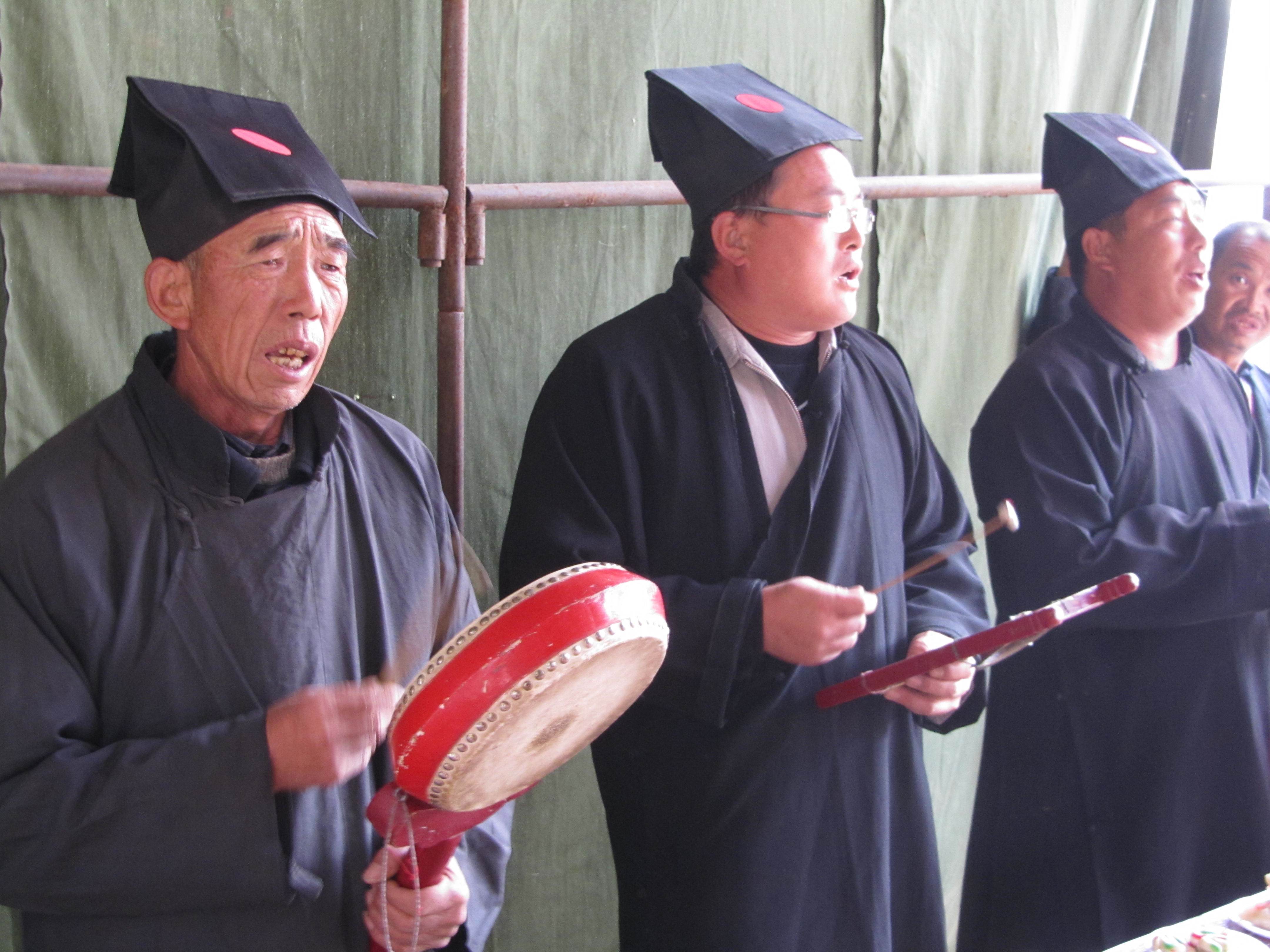
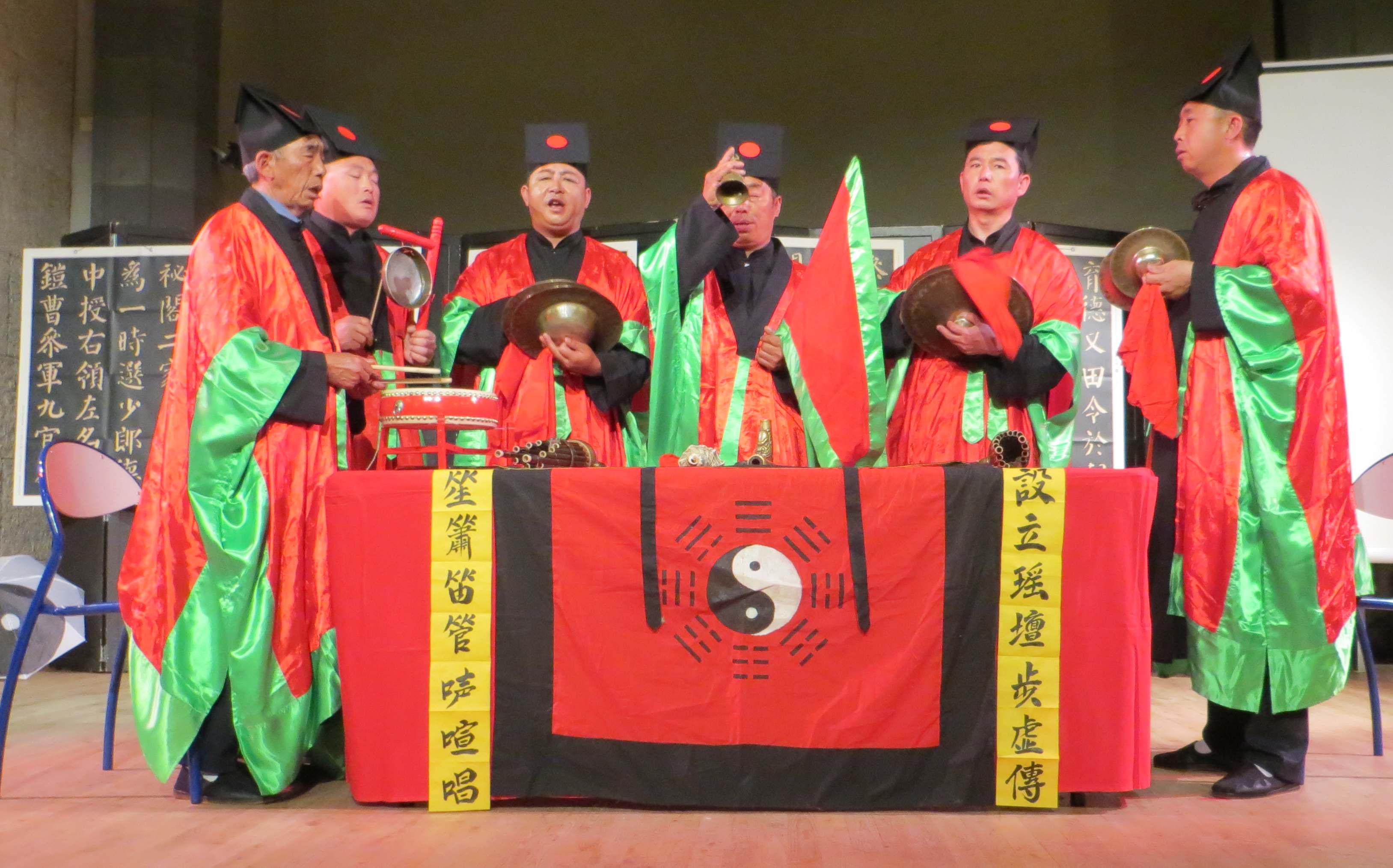
The sound-world of the puppeteers is remarkable, with gutsy percussion, fiddles, and shawms accompanying passionate vocals. [1] On the Chinese shadows soundtrack, piano music (Howells, Smetana, Janáček, and so on) makes a disorienting contrast with the guttural sounds of the Gansu singers and their earthy instrumental accompaniment. At first I had reservations about this choice, when we have so little opportunity to savour the sounds of village China—but I’ve come round to it as an effective personal reflection of the film-makers.

shadows 4
Image © Frank Kouwenhoven; all right reserved.

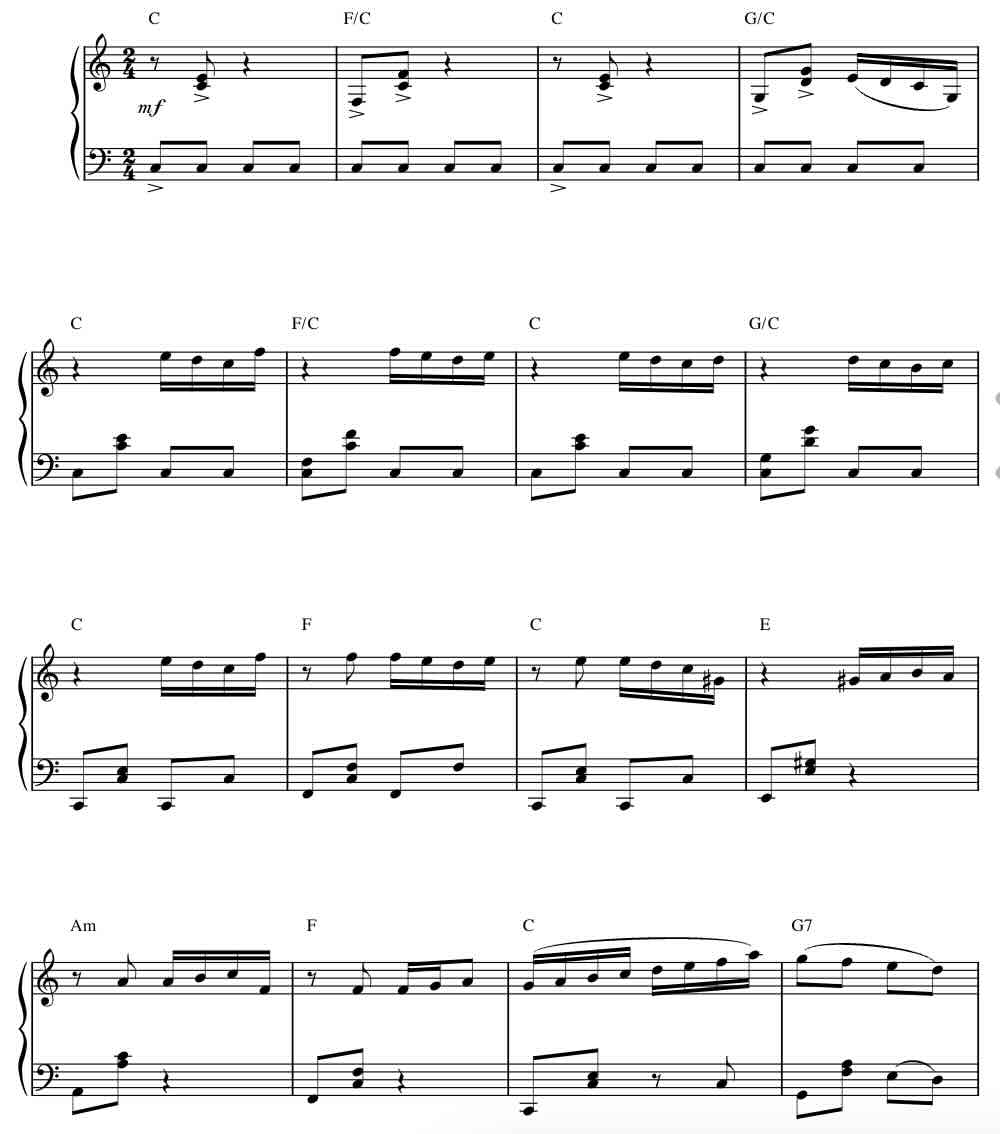
In similar mood, in Frank’s moving portrait film of Antoinet’s life, a tribute shown at her funeral, he used Satie’s fifth Gnossienne—less well-known than the others:


[1] Featured on the 2-CD set The beauty of Chinese opera, one of an excellent series of historical recordings from Wind Records. For a roundup of posts on Gansu, click here. See also under More films on ritual drama.

More French opera

Since I mentioned Messiaen’s extraordinary Saint François, another deeply serious French opera about religious devotion that I’ve only just registered (and am keen to see live) is Poulenc’s Dialogues des Carmélites (1956), with its chilling final scene where the nuns climb in turn to the guillotine while chanting the Salve regina.

Just in case we forget, China didn’t invent religious persecution… Unlike Messiaen, whose work seems oblivious of the secular world, Poulenc’s work inevitably evokes the more recent agonies of France, and Europe.

See also La voix humaine.

Ruin an Irish book in one letter

Following my glowing paean to the Great Man, as a belated tribute to the Flann O’Brien Society’s recent competition —and supplementing my efforts regarding Chinese and orchestral cliché (see also Myles tag)—I hereby submit my weighty ethnomusicological ethnography:

The catechism of Clichy: vocal liturgy in a Parisian suburb.

For further scholarly works that I haven’t really published, see here.

Hector moves furniture

I’ve written about the Symphonie fantastique before—not least the wonderful Rozhdestvensky’s solution to conducting the opening (by not conducting it).

Apart from Berlioz’s prophetic evocation of a 1960s’ curry-house, another respect in which he was well ahead of his time is in his meticulously verité depiction of an irritating upstairs neighbour giving furniture-moving lessons * at 3 o’clock in the morning, just as the drama of the 1st movement is unfolding—an unwelcome interruption to the Rêveries-Passions of its title. You know, one of those disturbances you can’t quite be bothered to get out of bed for to bang your broom on the ceiling.

This touching domestic scene is economically evoked with a random series of little grunts in the double basses (from 12.06 in the recording below) punctuating little wind phrases in the brief lull after the first throbbing climax is interrupted (to evoke Susan McClary):

Berlioz moves furniture

Apart from John Eliot Gardiner’s rapport magnifique with French music, and the venue formidable, site of the première, [Uh-oh, he’s off again—Ed.], I use this live 1991 performance, led by the fine Pete Hanson, for the meretricious reason that I played a typically bijou role in it:

The video has disappeared from YouTube—anyway, we don’t look quite so young now (interrupted rêveries and passions can take their toll).

For Berlioz on oriental music, see here.


* Could Sir Malcolm himself have been among the clients?

On visual culture

As with my remarks on punk and so on,

You think I know Fuck Nothing—but I know FUCK ALL!

Or to adapt it to the topic in hand,

You think I know Shag Nothing, but I know CHAGALL!

More genteel would be the old “I Don’t Know Much About Art, But I Know What I Like!” (groan from Myles). So, following Myles, I write this in the spirit of The Plain People of Ireland. As often, I’m seeking clues relevant to my own areas of study, making connections that can easily get buried beneath our individual specialities. Perhaps this post might be entitled Renaissance art for Dummies in the Field of Daoist Ritual Studies—not one of their bestsellers, I suspect.

Sassetta: St Francis giving his cloak to a poor soldier.

I first came across

  • Michael Baxandall, Painting and experience in fifteenth-century Italy: a primer in the social history of pictorial style (1st edition 1972)

while browsing Rod Conway Morris’s library in Venice, along with Horatio E. Brown’s splendidly-titled Some Venetian knockers.

It’s my kind of book, full of the practical detail of materials, technical skill, and patronage, as well as exploring changing perceptions. Quite short, and eminently readable, it gains much from having grown out of a series of lectures that he gave. It addresses issues that I hardly find in discussions of Chinese ritual and music (for any period), so I’d like to explore it at a certain length.

Baxandall opens by encapsulating, in plain and elegant language,** issues that, um, scholars of Daoist ritual (of all periods) should absorb:

A 15th-century painting is the deposit of a social relationship.
On one side there was the painter who made the picture, or at least supervised its making. On the other side there was somebody else who asked him to make it, provided funds for him to make it, reckoned on using it in some way or other. Both parties worked within institutions and conventions—commercial, religious, perceptual, in the widest sense social—that were different from ours and influenced the forms of what they together made.

He observes that

The picture trade was a very different thing from that in our own late romantic condition, in which painters paint what they think best and then look round for a buyer.

Exploring the mismatch between our concepts of “public” and “private”, he notes that

Private men’s commissions often had very public roles, often in public places. A more relevant distinction is between commissions controlled by large corporate institutions like the offices of cathedral works and commissions from individual men or small groups of people: collective or communal undertaking on the one hand, personal initiatives on the other. The painter was typically, though not invariably, employed by an individual or small group. […] In this he differed from the sculptor, who often worked for large commercial enterprises. (p.5)

He meshes all this with detailed technical discussion, like the use of ultramarine:

The exotic and dangerous character of ultramarine was a means of accent that we, for whom dark blue is probably no more striking than scarlet or vermilion, are likely to miss. (p.11)

Thus in the Sassetta painting above, the gown St Francis gives away is an ultramarine gown.

The contracts point to a sophistication about blues, a capacity to discriminate between one and another, with which our own culture does not equip us.

Baxandall notes change over the course of the Quattrocento:

While precious pigments become less prominent, a demand for pictorial skill becomes more so. […] It seems that clients were becoming less anxious to flaunt sheer opulence of material.

But he goes on:

It would be futile to account for this sort of development simply within the history of art. The diminishing role of gold in paintings is part of a general movement in western Europe at this time towards a kind of selective inhibition about display, and this show itself in many other kinds of behaviour too. It was just as conspicuous in the client’s clothes, for instance, which were abandoning gilt fabrics and gaudy hues for the restrained black of Burgundy. This was a fashion with elusive moral overtones.
[…]
The general shift away from gilt splendour must have had very complex and discrete sources indeed—a frightening social mobility with its problem of dissociating itself from the flashy new rich; the acute physical shortage of gold in the fifteenth century; a classical distaste for sensuous licence now seeping out from neo-Ciceronian humanism, reinforcing the more accessible sorts of Christian asceticism; in the case of dress, obscure technical reasons for the best quality of Dutch cloth being black anyway; above all, perhaps, the sheer rhythm of fashionable reaction. (pp.14–15)

To show how skill was becoming the natural alternative to precious pigment, and might now be understood as a conspicuous index of consumption, he returns to “the money of painting”—the costing of painting-materials, and frame, as against labour and skill.

You will no longer be surprised to learn that the Quattrocento division of labour between master and disciples (pp.19–23) reminds me of Daoist ritual specialists.

Baxandall goes on to note the differences in patrons’ demands for panel paintings and frescoes. He attempts to address the issue (even for the time of creation) of public response to painting:

The difficulty is that it is at any time eccentric to set down on paper a verbal response to the complex non-verbal stimulations paintings are designed to provide: the very fact of doing so must make a man untypical. (pp.24–5)

Aesthetic terms expressed in words are contingent, varying from age to age, and anyway elusive. Even with the vocabulary of such accounts, discussing that of a Milanese agent, Baxandall notes:

the problem of virile and sweet and air having different nuances for him than for us, but there is also the difficulty that he saw the pictures differently from us.

He goes on to explore different kinds of viewers’ own exercise of skill in appreciating a painting, with their different backgrounds:

… the equipment that the fifteenth-century painter’s public brought to complex visual stimulations like pictures. One is talking not about all fifteenth-century people, but about those whose response to works of art was important to the artist—the patronizing classes, one might say. […] The peasants and the urban poor play a very small part in the Renaissance culture that most interests us now, which may be deplorable but is a fact that must be accepted. […] So a certain profession, for instance, leads a man [sic—SJ] to discriminate particularly effectively in identifiable areas. (p.39)

Whatever [the painter’s] own specialized professional skills, he is himself a member of the society he works for and shares its visual experience and habit. (p.40)

And given that “most 15th-century pictures are religious pictures”, he asks in detail,

What is the religious function of religious pictures?

His answer, in brief, is that they were used “as respectively lucid, vivid and readily accessible stimuli to meditation on the Bible and the lives of Saints.” But he goes on to enquire:

What sort of painting would the religious public for pictures have found lucid, vividly memorable, and emotionally moving?
[…]
The fifteenth-century experience of a painting was not the painting we see now so much as a marriage between the painting and the beholder’s previous visualizing activity on the same matter. (pp.40–45)

Again he makes the crucial point:

15th-century pictorial development happened within fifteenth-century classes of emotional experience.

Alongside colour, he discusses the beholders’ appreciation of gesture and groupings, adducing dance and sacred drama.

It is doubtful if we have the right predispositions to see such refined innuendo at all spontaneously. (p.76)

And apart from their basic level of piety (largely lost to us today), many of the “patronizing classes” would have assessed the work partly through their knowledge of geometry and the harmonic series.

In Part III Baxandall attempts to sketch the “cognitive style” of the time, with the reservation that

A society’s visual practices are, in the nature of things, not all or even mostly represented in verbal records. (p.109)

Finally he reverses his main argument—that “the forms and styles of painting respond to social circumstances” (and so “noting bits of social convention that may sharpen our perception of the pictures”)—by suggesting that “the forms and styles of painting may sharpen our perception of the society” (p.151).

An old painting is the record of visual activity. One has to learn to read it, just as one has to learn to read a text from a different culture, even when one knows, in a limited sense, the language; both language and pictorial representations are conventional activities. […]

In sum,

Social history and art history are continuous, each offering necessary insights into the other.

Such reflections seem more sophisticated than the “autonomous”, timeless approaches still common in both WAM and Daoist ritual. To be fair, we are quite busy trying to document ritual sequences, hereditary titles, and so on—but the Renaissance scholars have just as much nitty-gritty to deal with too.

* * *

Carpaccio

Carpaccio: Baptism of the Selenites, c1504–7 (detail). San Giorgio degli Schiavoni, Venice.

(The painting features a shawm band that I’d love to hear! For Venice’s musical contacts with the East, see e.g. here).

Baxandall ends with a caveat:

One will not approach the paintings on the philistine level of the illustrated social history.

I don’t think he quite had in mind

  • Alexander Lee, The ugly renaissance: sex, greed, violence and depravity in an age of beauty (2014),

a less technical, more sociological book with a firm political agenda that some may find more appealing than others (cf. this review of Catherine Fletcher, The beauty and the terror: an alternative history of the Italian Renaissance (2020).

Poking around beneath the glamorous surface image of the Renaissance, seemingly “an age of beauty and brilliance populated by men and women of angelic perfection”, he observes:

If the Renaissance is to be understood, it is necessary to acknowledge not just the awe-inspiring idealism of its cultural artefacts but also the realities which its artists endeavoured to conceal or reconfigure.

Lee explores the brutal social universe in which artists were immersed. Like Baxandall, he explores the relationship between artist and his assistants and apprentices:

The relationship was naturally based on work, and hence could often be punctuated by squabbles, or even dismissal. Michelangelo continually had trouble with his assistants, and had to sack several for poor workmanship, laziness, or even—in one particular case—because the lad in question was “a stuck-up little turd”.

Given that patrons were as important as artists in shaping the form and direction of Renaissance art,

Rather than being seduced by the splendor of the works they commissioned, it is essential to uncover the world behind the paintings; a world that was populated not by the perfect mastery of colour and harmony that is usually associated with the Renaissance, but by ambition, greed, rape, and murder.

He shows the often dubious motives of patrons. They often valued a commission “for the contribution it could make to reshaping the image of often extremely disreputable men”. Such works “were intended more to conceal the brutality, corruption, and violence on which power and influence were based than to celebrate the culture and learning of art’s greatest consumers”.

Lee also seriously questions the image of the period as one of “discovery” of the wider world:

In their dealings with Jews, Muslims, black Africans, and the Americas, the people of the Renaissance were not only much less open towards different cultures than has commonly been supposed, but were willing to use fresh experiences and new currents of thought to justify and encourage prejudice, persecution, and exploitation at every level.

I suspect such angles may not go unchallenged, but I find it refreshing. And these unpackings again augment my comments on the “Golden Age nostalgia” of the heritage industry in China.

* * *
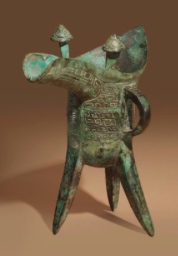
jue

China: jue libation vessel, Shang/Zhou dynasty.

Reception history has perhaps become a rather more established feature of visual culture (including the history of art) than for musical culture. The term “visual culture” itself reflects a more mature holistic approach, like that of “soundscape” for ritual music in China, and indeed the whole inclusive brief of ethnomusicology.

As I dip into Marcia Pointon’s History of art; a student’s handbook, she soon observes:

The meanings of the painting will be determined by where, how and by whom it is consumed.
[..]
Art historians are interested not only with objects with but with processes. […They] concern themselves with visual communication whatever its intended audiences or consumers.
[…]
Art historians investigate the origins, the connections between “high” and “low”, and the ways in which imagery such as this contributes to our understanding of a period of historical time, whether in the present or in the far distant past.

On one hand, as with music, we envy earlier viewers/audiences their familiarity with subjects/languages that we can no longer interpret easily, if at all. At the same time we have also lost the shock of the new.

We’re familiar with the idea of restoring old paintings to their original colours—negating their history?—but we can’t perform a similar operation on our eyes and minds. Doubtless there’s a vast scholarly literature on this, but one might be reluctant to remove the patina from Shang bronzes, restoring them to the condition of glossy new Italian kitchenware. For patina, see also Richard Taruskin’s comments on Gardiner’s Schumann.

Just as most people who experienced art in 15th-century “Italy” had access mainly to those works on public display in their particular city, so, long before CDs and youtube, Leipzig dwellers heard little music apart from Bach and the pieces by other composers that he selected, mostly within the Leipzig tradition. Some creators themselves might be so lucky as to travel, gaining a certain experience of other styles. And in both art forms, a majority of such work was contemporary—even the instruments that baroque musicians played were mostly modern.

To try and get to grips with what art and music meant at the time doesn’t make us able to experience it as did the “consumers” of the day—we can’t unsee Monet, TV, or skyscrapers any more than we can unhear Mahler and punk. And I hope our teeth are in a better state.

* * *

I also admire

  • Michael Jacobs, Everything is happening: journey into a painting (2015), [1]

on Velázquez’s Las Meninas (1656)—with chapters by his friend Ed Vulliamy added after Jacobs’ untimely death. As Vulliamy observes,

In this half-book, beyond a fragment, we have not only a typically Jacobs-esque narrative of his life with Velázquez—one of chance encounters, aperitifs, musings and restless autobiography—but also this manifesto for the liberation of how we look at painting. (p.146)

Jacobs does that thing that people always do in blurbs:

cutting a picaresque swathe

—and the picaro simile is fitting. Jacobs was constantly deploring the “sunless” world of academia. He documents the shift in art history that was then occurring widely in scholarship:

Many of the younger lecturers and researchers, conscious perhaps of the lingering popular image of their discipline as a precious and elitist pursuit, began adopting what rapidly became the prevailing art-historical methodology—a pseudo-Marxist one. People who might once have become connoisseurs in tweeds reinvented themselves as boiler-suited proselytisers dedicated to exposing in art revealing traces of the social conditions of a period, often resorting in the process to a hermetic prose peppered with terms I had first come across in Foucault, such as “discourses” and “the gaze”. (p.44)

Oh all right then, I’ll go for a hat-trick:

You think I know Fuck Nothing, but I know FOUCAULT!

(Note on pronunciation: whereas I can only hear “You think I know Fuck Nothing, but I know FUCK ALL!” in the caricature-Nazi accent of Karl Böhm, the above bon mot clearly belongs on the foam-specked lips of an angry young Alexei Sayle.)

By contrast with the treatments of Baxendall and Lee (themselves quite different), Jacobs’ approach is based on including “us”, the viewers, as agents in the picture—whatever his reservations, he was inspired by Foucault.

Proust, writing on Rembrandt, had spoken about paintings as being not just beautiful objects but also the thoughts they inspired in their viewers. [Svetlana] Alpers was cited as saying that “looking at a work in a museum and looking at other people looking at a work in a museum is like taking part in the life story of this work and contributing to it.”

Still, Jacobs ploughed his own furrow. As Paul Stirton recalls,

Michael always believed in the wonder of looking. Yes, there may be a profound message in a painting, but Michael didn’t want to dress it up in philosophical trappings. By all means approach a painting in a scholarly manner, but never lose the wonder. (pp.179–80)

In his book about artists’ colonies at the end of the nineteenth century, The good and simple life, he is scathing about how most painters wanting to live that life considered “the downtrodden country folk … as little more than quaint components of the rural scene. Their social conscience was as little stirred by them as by pipe-playing goatherds in the Roman Campagna.” At moments, though he is the antithesis of a “political” art critic, Michael’s writing reads like Walter Benjamin fresh from his Frankfurt School, but with a glass of Sangria in his hand. (p.182)

From both his own experience and Thomas Struth’s photos of the public response to Las Meninas over several days, Jacobs recalls

All the faces of the bored, the transfixed, the distracted, the deeply serious, the adults whose only concern was to get the perfect snap, the school children who were wondering when their ordeal would be over, the others who fooled around or diligently made notes, the few whose lives were being transformed. (pp.69–70)

So (suitably) like Monty Python’s Proust sketch, Jacobs never quite got as far as discussing the painting “itself”—not so much due to his death, as by virtue of his propensity to dwell on personal reminiscences on modern Spanish history and his own relationship with it and the painting.

He remarks wryly on the images of Spain current in his youth, reminding me of images of China, not to mention Away from it all. He recalls a train journey in the early years of Spain’s transition to democracy, when he was reading a book that

gave no hint of Spain’s repressive military regime, but instead referred to the country’s “growing agricultural and industrial prosperity” and to the “happy coexistence of the old and the new”.
The book’s role as a catalyst for my early, life-changing Spanish journeys was due entirely to its black-and-white photos, which neglected this supposedly modern and prosperous country in favour of basket-laden donkeys, adobe-walled farms, palm groves, sun-scorched white alleys and other such images that endowed Spain with a predominantly medieval and African look. Even Madrid, so regularly criticized by past travellers for its brash modernity, was made to seem more exotic and rural than any other western city I had seen. The sole street-scene was one of a large flock of sheep being herded in front of a neo-Baroque, cathedral-like post-office building popularly dubbed “Our Lady of the Post”. (p.60)

He discusses the fortunes of Las Meninas during the civil war, as well as more recent events:

… closed shops wherever you looked, restaurants offering “crisis menus”, daily protests, and graffiti and posters revealing grievances with everyone and everything, from the monarchy, to the banks, to the multinationals, to the European Community, to the politicians who made Spain the country with the the highest number of politicians per capita in Europe. (p.72)

And he describes the painting’s changing frames and settings:

The Sala Velázquez was like a shrine. […] On entering this inner sanctuary, people took off their hats, spoke in low voices, and tiptoed around so as not to destroy the atmosphere of worshipful solemnity. Every so often someone would be observed bursting into tears.
There were of course others visitors who disliked this room’s churchlike theatricality and the sentimentally nationalistic and mindless emotional reactions it inspired. (p.115)

So as it stands, Jacobs’ book is concerned more with reception history than with the society of the time of the creation of Las Meninas (though he explored this elsewhere, and doubtless had voluminous notes on the painting to supplement existing research). Background on the society of Velazquez’s day is provided mainly by Vulliamy’s fine Introduction. Evoking Lee, he notes that Seville, far from “the great Babylon of Spain, map of all nations”,

was also headquarters of the Inquisition. Indeed, the “Golden Age” which followed the unification of Spain in 1492 was accomplished, writes Michael Jacobs, “in a spirit of brutal fanaticism”, with the expulsion or enforced conversion of Andalucia’s many Moors and Jews. This dogmatism and what we would now call “ethnic cleansing” [here Vulliamy writes with traumatic personal experience in Bosnia] had a major and insidious demographic impact on the city, yet Seville remained characterized by “an architecture … of great contrasts”, wrote Michael, “for alongside the Muslim-inspired love of decorative arts richness is an inherently Spanish love of the austere”.

For a similar approach that sets forth from 17th-century Delft to go global, note Timothy Brook’s brilliant book Vermeer’s hat.

    * * *
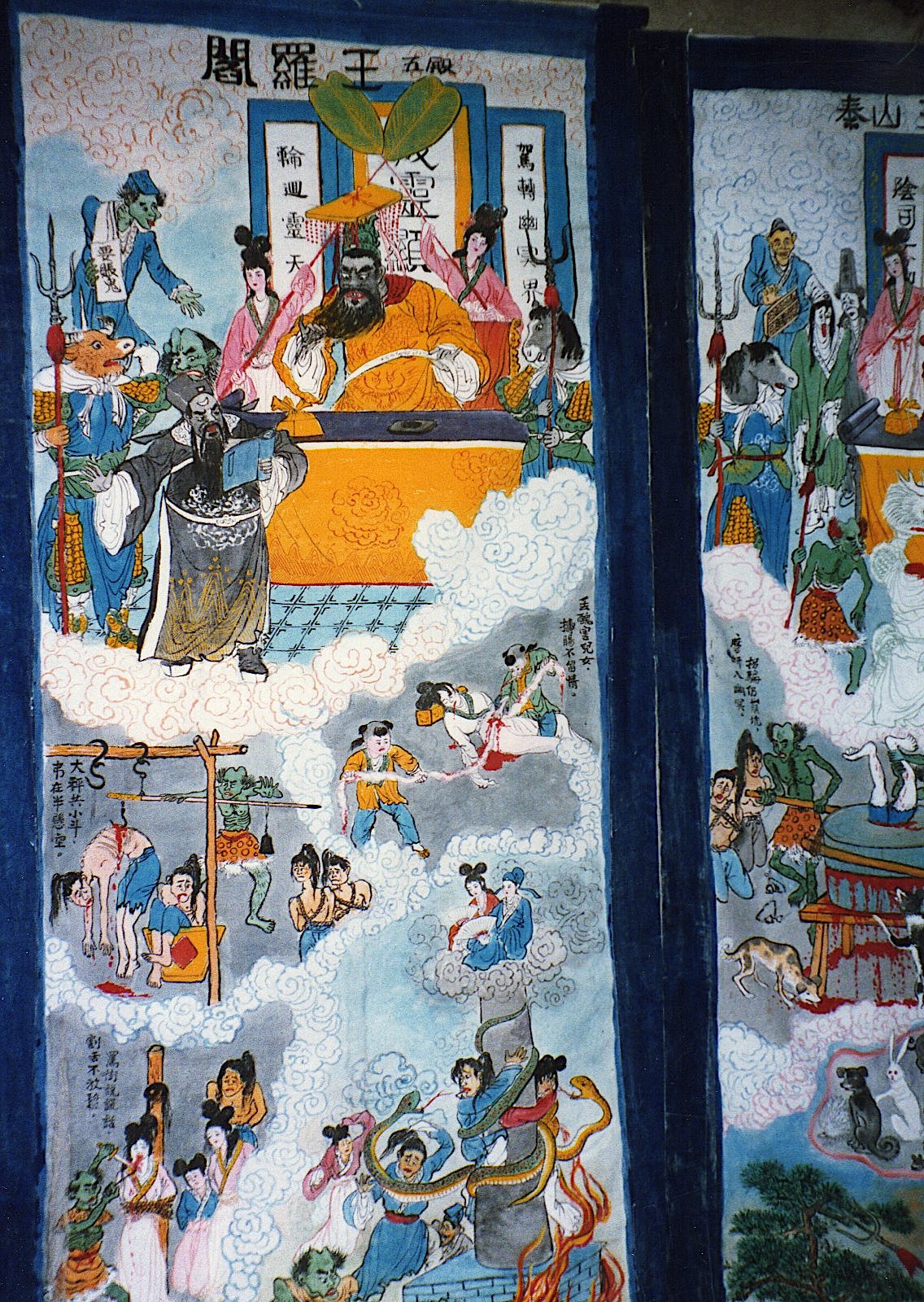
GL Ten Kings

Yama King painting from Ten Kings series, North Gaoluo 1990.

All these books incorporate ethnography and reception history far more than the fusty old reified appreciation of “autonomous” objets d’art. For China,

  • Craig Clunas, Art in China (1st edition 1997)

makes a useful, wide-ranging, and thoughtful introduction, exploring themes like genres, techniques, functions, patrons, markets, producers, class, and gender.

For instance, discussing a wooden sculpture of the female deity Guanyin from Shanxi carved c1200 CE, he describes its original multi-coloured decoration:

All this added to the immediacy of the image for worshippers, but it was covered over at some point, probably about 300–400 years later in the Ming dynasty (1368–1644), when it was painted gold in imitation of a gilded metal sculpture. Such an aesthetic change must have gone hand in hand with some change in the understanding of what a successful image ought to look like, a change at the level of both popular belief and the attitudes of religious professionals which is as yet hardly understood. (pp.56–7)

Whereas much scholarship remains based on artefacts in museums and galleries, fieldwork reveals a vast further repository of images still used in ritual practice. One thinks of the vast hoard of religious statuettes found in rural Hunan, subject of fine research.

And apart from statues and temple murals, ritual paintings depicting the Ten Kings and the punishments of the underworld—hung out for temple fairs and funerals—suggest comparisons with Christian equivalents in medieval and Renaissance art. And they too must have changed their meanings for audiences over recent centuries. At least, illiterate rural audiences would be affected rather deeply, and modern viewers may be underwhelmed now that they are saturated with horror films and video games. But we learn rather little about this from the scholarship; Daoist culture tends to be reified. Meanwhile, household ritual specialists have continued to perform Ten Kings scriptures for funerals.

It reminds me, challenged as I am in the field of visual culture, that ritual images through the ages also need unpacking—assessing changing meanings there too, including early sources for music iconography.

This has a lot to do with reception history. Such studies of visual culture may feed into our experience of Bach and all kinds of early and folk music. If even scholars of WAM and Renaissance painting feel it germane, then studies of Chinese musical cultures, and of Daoist ritual, shouldn’t lag behind.

* * *

But I’d like to end with some more populist vignettes (“Typical!”) on the meanings of art.

Among the numerous virtues of Alan Bennett is his accessible promotion of painting, found in Untold Stories (pp.453–514) [2]notably a talk he gave for the National Gallery, with the fine title “Going to the pictures”. These essays are also a passionate plea for culture to remain accessible, a rebuke to mercenary philistine governments.

He recalls an inauspicious early lecture he gave at Oxford on Richard II:

At the conclusion of this less than exciting paper I asked if there were any questions. There was an endless silence until finally one timid undergraduate at the back put up his hand.
“Could you tell me where you bought your shoes?”

 We’ve all been there. But his remarks on painting are priceless:

Somewhere in the National Gallery I’d like there to be a notice saying, “You don’t have to like everything”. When you’re appointed a trustee, the director, Neil MacGregor, takes you round on an introductory tour. Mine was at 9am, when I find it hard to look the milkman in the eye, let alone a Titian.

We were passing through the North Wing, I remember, and Neil was about to take me into one of the rooms when I said, “Oh, I don’t like Dutch pictures”, thereby seeming to dismiss Vermeer, De Hooch and indeed Rembrandt. And I saw a look of brief alarm pass over his face as if to say. “Who is this joker we’ve appointed?”

He cites his play A question of attribution, about (Michael Jacobs’ teacher) Anthony Blunt:

“What am I supposed to feel?” asks the policeman about going into the National Gallery.
“What do you feel?” asks Blunt.
“Baffled,” says Chubb, “and also knackered” … this last remark very much from the heart.
[… Blunt] tries to explain that the history of art shouldn’t be seen as simply a progress towards accurate or realistic reprentatation.
“Do we say Giotto isn’t a patch on Michelangelo because his figures are less lifelike?”
“Michelangelo?” says Chubb. “I don’t think his figures are lifelike frankly. The women aren’t. They’re just like men with tits. And the tits look as if they’ve been put on with an ice cream scoop. Has nobody pointed that out?”
“Not quite in those terms.”

In a *** passage AB blends hilarity with insight, evoking Baxandall:

In A question of attribution the Queen is made to have some doubts about paintings of the Annunciation.
“There are quite a lot of them,” says the Queen. “When we visited Florence we were taken round the art gallery there and well … I won’t say Annunciations were two a penny but they were certainly quite thick on the ground. And not all of them very convincing. My husband remarked that one of them looked to him like the messenger arriving from Littlewoods Pools. And that the Virgin was protesting that she had put a cross for no publicity.”
This last remark, though given to the Duke of Edinburgh, was actually another flag of distress, stemming from my unsuccessful attempts to assimilate and remember an article about the various positions of the Virgin’s hand, which are an elaborate semaphore of her feelings, a semaphore instantly understandable to contemporaries but, short of elaborate exposition, lost on us today. It’s a pretty out-of-the-way corner of art history but it leads me on to another question and another worry.
Floundering through some unreadable work on art history I’ve sometimes allowed myself the philistine thought that these elaborate expositions—gestures echoing other gestures, one picture calling up another and all underpinned with classical myth—that surely contemporaries could not have had all this at their fingertips or grasped by instinct what we can only attain by painstaking study and explication, and that this is pictures being given what’s been called “over meaning”. What made me repent, though, was when I started to think about my childhood and going to a different kind of pictures, the cinema.
When I was a boy we went to the pictures at least twice a week as most families did then, regardless of the merits of the film. I must have seen Citizen Kane when it came round for the first time, but with no thought that, apart from it being more boring, this was a different order of picture from George Formby, say, or Will Hay. And going to the pictures like this, unthinkingly, taking what was on offer week in week out was, I can see now, a sort of education, and induction into the subtle and complicated and not always conventional moral scheme that prevailed in the world of the cinema then, and which persisted with very little change until the early sixties.

Unpacking the complex attributes of two stock characters, he concludes:

The 20th-century audience had only to see a stock character on the screen to know instinctively what moral luggage he or she was carrying, the past they had, the future they could expect. And this was after, if one includes the silent films, not more than thirty years of going to the pictures. In the sixteenth century the audience or congregation would have been going to the pictures for 500 years at least, so how much more instinctive and instantaneous would their responses have been, how readily and unthinkingly they would have been able to decode their pictures—just as, as a not very precocious child of eight, I could decode mine.
And while it’s not yet true that the films of the thirties and forties would need decoding for a child of the present day, nevertheless that time may come; the period of settled morality and accepted beliefs which produced such films is as much over now as is the set of beliefs and assumptions that produced an allegory as complicated and difficult, for us at any rate, as Bronzino’s Allegory of Venus and Cupid.

For a similar case, see here.

* * *

Apart from any intrinsic merit this little tour of visual culture may have, for me it also suggests several angles barely explored for Daoist ritual.

OK then, just one last aperçu—this time from Kenneth Clark (thanks, Rod). On the contrast between reified art and social reception, here’s his typically urbane formulation in Civilization:

At some time in the 9th century one could have looked down the Seine and seen the prow of a Viking ship coming up the river. Looked at today in the British Museum, it is a powerful work of art; but to the mother of a family trying to settle down in her little hut, it would have seemed less agreeable.

On behalf of the splendid Craig ClunasI accept full responsibility for any inanities in this post.
If you all play your cards right, I promise not to do this kind of thing too often. Craig and any other art historians who have managed to read this far might care to exact revenge by writing Specious Flapdoodle
[famous 19th-century Baptist pastor—Ed.] about early music or Daoist ritual… 


** Not, may I just say, the kind of moronic homespun language used by one maniacal Führer about another: “smart cookie” or “total nut-job”? Roll over Cicero.

[1] Some stimulating reviews may be found herehere, and here.
[2] Online excerpts include http://www.independent.co.uk/life-style/i-know-what-i-like-but-im-not-sure-about-art-1620866.html and https://www.lrb.co.uk/v20/n07/alan-bennett/alan-bennett-chooses-four-paintings-for-schools.

Bearing witness: If this is a woman

*For sequels, see my posts on Sachsenhausen and A life in secrets*

As this turns into a lengthy review, I ponder why I’ve been trying, in an amateurish way, to educate myself about the traumas of modern Europe—beyond the obvious answer, that we all must.

I guess it’s related to my studies of China, and my engagement with the lives of people like Li Manshan; a feeling of duty to report the sufferings of ordinary people I encounter in China—including not just their ritual life but their tribulations under Maoism, with famine, struggle meetings, and labour camps; and my growing awareness of the sufferings of Europeans over a similar period. I don’t want to spoil your holidays (or mine), but as we relish the cultures and scenery of these countries, we shouldn’t forget the ghosts that haunt the landscape.

Among the innumerable studies of the Nazi concentration camp system, Primo Levi is justly famed—actually, I find the sequel The truce just as disturbing as If this is a man, after the camp is finally liberated yet their Odyssey of suffering continues, homecoming ever receding. But I’ve also been deeply moved by

Helm’s account is based on amazingly thorough research and interviews with both victims and perpetrators—much of which was submerged until the end of the Cold War. Of course a historian’s account will give different, more holistic, perspectives from those of an individual inmate, but in a way I find Helm’s work even more moving than that of Levi. At 823 pages, it’s hideously readable—both balanced (whatever that might mean) and personal, in a way that ideologically-driven accounts such as those of Dikötter (for the degradations of Maoism in China) can’t achieve. Even the excellent index is harrowing.

I suppose I’m not alone in thinking of the whole catastrophe in terms of a few appalling place-names like Auschwitz and Belsen, but along with the focus on Ravensbrück, over the whole six years of its existence, we see how very extensive was the whole network of camps, subcamps, death camps, work camps, transports and marches, scarring the whole landscape.

At its height, Ravensbrück had a population of about 45,000 women; over the six years of its existence around 130,000 women passed through its gates, to be beaten, starved, worked to death, poisoned, executed and gassed.

The book opens with an arresting and complex image:

“The year is 1957. The doorbell of my flat is ringing,” writes Grete Buber-Neumann, a former Ravensbrück prisoner. I open the door. An old woman is standing before me, breathing heavily and missing teeth in the lower jaw. She babbles: “Don’t you know me any more? I am Johanna Langefeld, the former head guard at Ravensbrück.” The last time I had seen her was fourteen years ago in her office at the camp. I worked as her prisoner secretary… She would pray to God to stop the evil happening, but if a Jewish woman came into the office her face would fill with hatred…

So she sits at the table with me. She tells me she wishes she’d been born a man. She talks of Himmler, who she sometimes still calls “Reichsführer”. She talks for many hours, she gets lost in the different years, and tries to explain her behaviour. (1)

The book goes on to tell the stories of Langefeld, Buber-Neumann (who also had the terrible distinction of already having been incarcerated in a Russian gulag), and a tragic cast of inmates and their tormentors, with chapters focusing on personalities over the years.

Among them were political prisoners, Jehovah’s Witnesses, “asocials”, “useless mouths”, “idiots”, and (later) children; in this camp only around 10% were Jewish. Its shifting population was international, including Germans, Poles (the largest group), Gypsies, Russians, Czechs, French, Hungarians, Scandinavians, and Dutch, all transported there at various stages.

In April 1944 recent arrivals included evacuees from Majdanek, including more Red Army doctors and nurses, as well as 473 Gypsies transferred from Auschwitz. There were Italian partisans, Slovenians, Greeks, Spaniards, and Danes, as well as three Egyptians and seven Chinese. (419)

They were often in desperate straits even when they arrived.

Ravensbrück guards rowing on the Schwedtsee.

Helm also delves into the lives of guards, doctors, and Blockovas (prisoners—at first often criminals—coopted to carry out the day-to-day work of running the camp). The twice-daily Appell roll-call was an ordeal that regularly led to death, as did stays in the Revier “hospital”.

As she observes, the “asocials”, such as prostitutes (pp.56, 96–108, 417–19, and index), have gone largely undocumented:

Unlike the political women, they left no memoirs. Speaking out after the war would mean revealing the reason for imprisonment in the first place, and incurring more shame. […] The German associations set up after the war to help camp survivors were dominated by political prisoners. And whether they were based in the Communist East or in the West, these bodies saw no reason to help “asocial” survivors. (98)

Perhaps the most sickening story (how might one concoct a hierarchy of inhumanity?) concerns the 86 “rabbits” (mostly from a group of 195 women from Lidice near Prague, deported after the 1942 assassination of Heydrich and the punitive razing of the village), objects of unthinkable medical experiments. [1] But it’s also moving for the way in which the whole camp later rallied round to protect them from being murdered so that their terrible story could at least be told—miraculously, 63 of them survived. Again, Holm switches tellingly to the present day:

I found Zofia Kawińska in her tenth-floor flat overlooking the cranes of Gdansk shipyard. She was one of the second group of victims of Himmler’s sulphonamide experiments. A tiny, bent figure, she walks with difficulty, and has done since the war. I ask if she still suffers pain from the experiments. “A little,” she says, as she offers tea and biscuits.

She stoops to show the scars on the sides of her legs. “They put the bacteria in, and glass and bits of wood, and they waited.” She looks up and fixes me with deep brown eyes, as if to see if there is any chance that I understand. “But I didn’t suffer as much as some. Everyone in Poland came home with wounds.” (243–4)

Surviving “rabbits”, 1958.

The smuggled letters of the rabbits were among many acts of defiance.

In similar vein, Nikolaus Wachsmann, in KL: a history of the Nazi concentration camps (perhaps the most authoritative study of the whole system), refines the view of “prisoners as blank and apathetic automatons, drained of all free will”, recognizing the heroism of such agency, “however small and constrained”. But he makes an important caveat:

We must resist the temptation to make our encounter with the concentration camps more bearable by sanctifying the prisoners, imagining them as united, unsullied, and unbowed. For the most part, the prisoners’ story is not an uplifting account of the triumph of the human spirit, but a tale of degradation and despair.

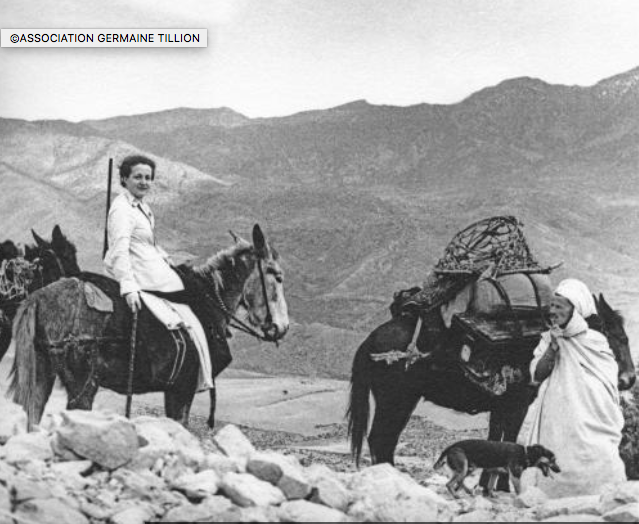
For anthropologists, the most extremely disturbing instance of participant observation is Germaine Tillion (1907–2008), an ethnologist who had done fieldwork in Algeria before being arrested while working for the French resistance. In impossible conditions she comprehensively documented the activities of the camp, somehow managing to hide her notebooks from the guards. After the war she continued her research on “the history of the de-civilisation of Europe”, and returned to her work on Algeria; her distinguished career was recognized by many awards.

Tillion

While in the camp Tillion even composed and staged an operetta Le Verfügbar aux Enfers, a spoof of Orpheus in the underworld, attempting to help prisoners “resist by laughing” (567). It has been revived since 2007—my post Operetta in extremis includes a complete performance from 2011.

As the camp population grew constantly with prisoners evacuated from camps in the path of the Soviet advance, the 959 French prisoners (known as the “vingt-sept mille” after their camp numbers) who joined Tillion from Paris in February 1944, “jeunes filles biens élevées”, were quite unprepared for what awaited them at Ravensbrück, and adapted badly. Quartered in the “slums” of the camp, soon they were more hated than the Poles; their health quickly failed. Another group of women arrived in August from Warsaw, obliterated after the uprising—reporting to their compatriots, “There is no Warsaw. There is nothing left.” Hungarian Jews were deported to Ravensbrück in October. Babies were soon starved to death.

As it becomes clear that the Nazis are in retreat, the final chapters are just as tense. Desperate to conceal their crimes, with order collapsing, their brutality becomes even more extreme and random. The reader wills the inmates to survive.

By the end of March [1945] the camp was “like a mysterious planet”, said Denise Dufournier, “where the macabre, the ridiculous and the grotesque rubbed shoulders in a fantastic irrational chaos.” Karolina Lanckorońska, watching the crematorium flames shooting higher every night, was reminded of the beginning of the Iliad. She was still giving lectures on Charlemagne and Gothic art as children in Block 27 played a game of selecting for the gas chamber. In the Red Army block the women were making red flags to hang out to welcome their liberators, while the painting gang had been sent to redecorate the maternity block, where, according to Zdenka’s lists, 135 more babies were born in March, of which 130 died. (616)

Despite the shocking complicity of the Red Cross in Geneva, the tireless, heroic work of young Norwegian student Wanda Hjort (1921–2017), using her status to visit the camp and establish contacts, at last achieves results as many prisoners scramble to be taken to safety in the White Buses, with the tense diplomatic negotiations of Folke Bernadotte, Swedish representative of the ICRC, with Himmler.

Wanda Hjort.

But while the buses were being bombed by the Allies, for the majority of women who remained in the camp to await rescue by the Soviet troops, “Liberation” was also horrifying, with widespread rapes perpetrated on women of all nationalities.

* * *

And so into the whole post-war period. Many survivors returning home found there was no home to return to. The Hamburg trials of 1946–8 (a sideshow to Nuremberg)

achieved a great deal. Within a short time the court […] established in the clearest terms the simple fact that everything about the camp was designed to kill. (706)

But the trials were soon followed by amnesia on both sides of the Iron Curtain—and ignominy for the valiant women in the USSR (pp.287–313, 710–11) and the GDR (339–58, 711–14) who had somehow survived only to descend into a new nightmare, now suspected of being traitors. And until 1950, camps like Buchenwald were adopted by the NKVD as gulags for their own prisoners, with many (not only former Nazis) dying in squalor (MacGregor, Germany, pp.468–72).

By 1948 the Allies had lost their appetite for punishing the Nazis and both the war crimes trials and the process of “de-Nazification”—whereby top Nazi supporters were brought to book and denied top jobs—were shut down. (707)

Wachsmann explores the issue in his fine Prologue:

Survivors … were not stunned into collective silence, as has often been said. On the contrary, a loud, polyphonic voice rose up after liberation. … During the first postwar years, a wave of memoirs hit Europe and beyond, mostly searing testimonies of individual suffering and survival.

But as he notes, popular interest soon waned:

Public memory of the camps was being marginalised by postwar reconstruction and diplomacy. With the front line of the Cold War cutting right through Germany, and turning the two new, opposing German states into strategic allies of the USSR and the United States, talk about Nazi crimes seemed impolitic. … Within ten years of liberation, the camps had been sidelined—the result not of survivors unable to speak, but of a wider audience unwilling to listen.

Though popular interest was rekindled to some extent in the 1960s and 70s, more detailed research only took off from the 1990s—with German scholars taking the lead.

By this stage you will be able to decide whether you can face watching this documentary:

* * *

So only now am I beginning to understand the apparent amnesia that took hold all over Europe during my youth—and which still persists in China for the Maoist era (and other more recent events that it’s prudent to bury). Levi explains it well. His If this is a man was published in 1947, but

fell into oblivion for many years: perhaps also because in all of Europe those were difficult times of mourning and reconstruction and the public did not want to return in memory to the painful years of the war that had just ended.

Republished in 1958, it then became exceptionally successful—although even in the 1970s, as Paul Bailey observes in an Afterword, “Primo Levi wasn’t so much forgotten in Britain as totally unknown.”

Not just Neil MacGregor’s “What would we have done?”, but just our capacity for evil, need to be kept at the forefront of our consciousness.  As MacGregor comments,

How did the great humanising traditions of German history—Dürer, Luther’s Bible, Bach, the Enlightenment, Goethe’s Faust, the Bauhaus, and much, much more—fail to avert this total ethical collapse? (473)

In a Postscript to If this is a man and The truce, Levi gives succinct replies to what have come to be called FAQ, like “Were there prisoners who escaped from the camps? How is it that there were no large-scale revolts?” and “How can the Nazis’ fanatical hatred of the Jews be explained?”.

On “ordinary Germans”, I already noted Hans Fallada’s novel Alone in Berlin (now also the subject of a film). Levi expands wisely on the topic “Did the Germans know what was happening?” Observing the authoritarian control of the media (not only in Germany, and not only then), he comments:

Under these conditions it becomes possible […] to erase great chunks of reality. […] However, it was not possible to hide the existence of the enormous concentration camp apparatus from the German people. What’s more, it was not (from the Nazi point of view) even desirable. Creating and maintaining an atmosphere of undefined terror in the country was part of the aims of Nazism. It was just as well for the people to know that opposing Hitler was extremely dangerous. In fact, hundreds of thousands of Germans were confined in the camps from the very first months of Nazism: Communists, Social Democrats, Liberals, Jews, Protestants, Catholics; the whole country knew it and knew that in the camps people were suffering and dying.

Nonetheless, it is true that the great mass of Germans remained unaware of the most atrocious details of what happened later on in the camps. […]

He goes on to cite Eugene Kogon’s Der SS staat:

Even many Gestapo functionaries did not know what was happening in the camps to which they were sending prisoners. The greater majority of the prisoners themselves had a very imprecise idea of how their camps functioned and of the methods employed there. […]

And yet there wasn’t even one German who did not know of the camps’ existence or who believed they were sanatoriums. There were very few Germans who did not have a relative or an acquaintance in a camp, or who did not know, at least, that such a one or such another had been sent to a camp. All the Germans had been witnesses to the multi-form anti-Semitic barbarity. Millions of them had been present—with indifference or with curiosity, with contempt or with downright malign joy—at the burning of synagogues or humiliation of Jews and Jewesses forced to kneel in the street mud. Many Germans knew from the foreign radio broadcasts, and a number had contact with prisoners who worked outside the camps. A good many Germans had had the experience of encountering miserable lines of prisoners in the streets or at the railroad stations. In a circular dated November 8, 1941, and addressed by the head of the police and the Security Services to all… Police officials and camp commandants, one reads: “In particular, it must be noted that during the transfers on foot, for example from the station to the camp, a considerable number of prisoners collapse along the way, fainting or dying from exhaustion… It is impossible to keep the population from knowing about such happenings.”

Not a single German could have been unaware that the prisons were full to overflowing, and that executions were taking place continually all over the country. Thousands of magistrates and police functionaries, lawyers, priests and social workers knew genetically that the situation was very grave. Many businessmen who dealt with the camp SS men as suppliers, the industrialists who asked the administrative and economic offices of the SS for slave-labourers, the clerks in these offices, all knew perfectly well that many of the big firms were exploiting slave labour. Quite a few workers performed their tasks near concentration camps or actually inside them. Various university professors collaborated with the medical research centres instituted by Himmler, and various State doctors and doctors connected with private institutes collaborated with the professional murderers. A good many members of military aviation had been transferred to SS jurisdiction and must have known what went on there. Many high-ranking army officers knew about the mass murders of Russian prisoners of war in the camps, and even more soldiers and member sof the Military Police must have now exactly what terrifying horrors were being perpetrated in the camps, the ghettos, the cities, and the countryside sof the occupied Eastern territories.

Levi adds:

In spite of the varied possibilities for information, most Germans didn’t know because they didn’t want to know. Because, indeed, they wanted not to know. It is certainly true that State terrorism is a very strong weapon, very difficult to resist. But it is also true that the German people, as a whole, did not even try to resist. In Hitler’s Germany a particular code was widespread: those who knew did not talk; those who did not know did not ask questions; those who did ask questions received no answers. In this way the typical German citizen won and defended his ignorance, which seemed to him sufficient justification of his adherence to Nazism. Shutting his mouth, his eyes and his ears, he built for himself the illusion of not knowing, hence not being an accomplice to the things taking place in front of his very door.

Turning to memory, Helm notes:

In the 1950s, as the Cold War began, Ravensbrück fell behind the Iron Curtain, which split survivors—east from west—and broke the history of the camp in two.

The abomination wasn’t the only part of the story that was being forgotten; so was the fight for survival.

Even in Britain, where we enjoyed the rare privilege of not enduring occupation, with all its risks and moral compromises, my parents’ generation—even if they hadn’t personally experienced appalling suffering in active service, or in POW and concentration camps—were all scarred by bombed-out buildings, separation and loss, maimings, food shortages, and terrible insecurity. So I shouldn’t wonder that they were relieved to live in peace, unwilling to inflict traumatic memories on children like me, unwittingly blessed to have been born after the war. But there were survivors all around us—like Maria Bielicka, whom Holm visited at her Earls Court flat in 2010:

She said she had rarely spoken of the camp before. When she first came to live in England after the war nobody believed what she had to say. “Nobody here even wanted to know about the camps.” Since then she has “got on with life”, working for Barclays Bank. (175)

How very much more understandable was this amnesia in an utterly devastated continental Europe. So bruised parents retreated to their well-tended gardens and shiny consumer goods, while their children complacently explored the counter-culture of the 60s. For those who cared, politics was about current problems, at home and in the third world. Meanwhile the nightmare continued in East Europe (and China, and the Soviet Union), as the past was buried and distorted even more mendaciously. Victims and tormentors had to coexist.

With all the vast documentation of mid-20th-century abominations that has eventually surfaced, it is hard to comprehend Steven Pinker’s detailed thesis in The better angels of our nature that violence has declined over millenia, and that the two world wars were but minor spikes in the grizzly statistics (see also his website, and FAQ). At least, it seems cruelly irrelevant; of course Pinker himself would be the first to encourage memory of modern trauma.

See also my posts on Sachsenhausen and Les Parisiennes; and for the first gulag in Soviet Russia, see here.

[1] See e.g. http://ahrp.org/ravensbruck-young-girls-subjected-to-grotesque-medical-atrocities/
http://www.elizabethwein.com/ravensbrueck-rabbits

French taunting

It’s been a while since we’ve had any French drôlerie (try A French letter, and the series on the Tang faqu). So it’s high time to remind ourselves of the classic scene from Monty Python and the Holy Grail:

Food for thought on the Brexit debate? And for aficionados of Chinese ritual, note the long trumpet near the opening.

For the taunts of cheerleaders at archery festivals in Bhutan, see here.

Liberté

laundromat

More Francophilia—another bijou from the années dorées:

Dang, the Mrs Premise and Mrs Conclusion sketch from Monty Python has just disappeared from YouTube, so for now I can only offer the script.

[Scene: a laundromat]

Well I personally think Jean-Paul’s masterwork is an allegory of man’s search for commitment.
No it isn’t.
Yes it is.
Isn’t.
‘Tis.
No it isn’t.
All right. We can soon settle this. We’ll ask him.
Do you know him?
Yes, we met on holiday last year.
In Ibeezer?
Yes. He was staying there with his wife and Mr. and Mr. Genet. Oh, I did get on well with Madam S. We were like that.
What was Jean-Paul like?
Well, you know, a bit moody. Yes, he didn’t join in the fun much. Just sat there thinking. Still, Mr Rotter caught him a few times with the whoopee cushion. (she demonstrates) Le Capitalisme et La Bourgeoisie ils sont la mimes chose… Oooh we did laugh.
Well, we’ll give a tinkle then.
Yes, all right. She said they were in the book. [shouts] Where’s the Paris telephone directory?
It’s on the drier.
No, no, that’s Budapest. Oh here we are, Sartre … Sartre.
[…]

Hello Mrs Sartre […] Madame S.—est-ce que Jean est chez vous? Oh merde. When will he be free? Oh pardon, Quand sera-t-il libre? Oooooh, hahahaha [to Mrs Conclusion] She says he’s spent the last sixty years trying to work that one out! [to Madame Sartre] Tres amusant, Madame S.

Worthy of the Abbé Fausse-Maigre’s The Higher common sense.

Real and Zidane

Zidane 2017

After my words of praise for Arsenal and Wenger, the victory of Real Madrid and the gorgeous Zidane in the Champion’s League was even more inspiring.

Sure, we should always remember the artistry of Barcelona and Messi (the latter all the more since he “looks like he works part-time on Saturdays in a video rental shop”).

And Zidane’s headbutt in the final of the 2006 World Cup remains iconic. After all, players like him must be so used to being wound up on the pitch, yet not rising to the bait. With just minutes to go before he could be fêted, canonized, his rash act seems like an even higher form of art, a worthy sacrifice—never mind mundane celebrity, he just had to do it, like in a bullfight. For a fantasy script to the, um, discussions leading up to it, see here.

More drôlerie

Following the succès de scandale of the Li family Daoists’ tour of France, and my inept flirtations with Franglais (consisting mainly of “enchanté”, “apéritif”, and “encore”), here’s a little story:

Sidney the Snail has done well for himself. He shuffles into a luxury car showroom and announces chirpily to the salesman:
“Morning! I’d like to buy an Aston Martin Rapide S, please.”
“Certainly sir,” goes the salesman, “and did you have any additional features in mind?”
“Well actually… Does it happen to come with a big letter S on the boot?”
“Um, no sir—but I’m sure for an extra consideration we could paint one on.”
“Money is no object, my dear fellow.”
“Very well sir. Um… might I make so bold as to enquire just why you wish to have a large letter S on the boot of your new sportscar?”
“Well you see… I’ve always dreamed about surging past all the traffic, and them going,
‘Wow—just look at that S CAR GO!’ ”

Alas, I can’t begin to think how to translate this for Li Manshan.

Landmarks

Reluctant as I am to play into the hands of the fatuous “Paul Nuttall and the UKIPs”, this local landmark in Bedford Park may seem to suggest that the continent, with its fancy foreign monuments like those of Pisa and indeed Paris, isn’t necessarily all it’s cracked up to be.

pillarbox

The leaning pillarbox* of Chiswick.

Left-leaning too, you note… Is this the kind of subversion that scares off a certain old friend of mine?!

Did you hear about Karl Marx’s vegetable garden?
It’s a Communist plot.

QMZ pose 1993

Identity parade: the usual suspects.


* For younger readers whose grasp of Old English is less than perfect, a “pillarbox” was an ancient device into which were inserted objects called “letters”, written on paper (often with a “pen”) and enclosed in an “envelope” with a “stamp” attached. By a mysterious alchemical process, the addressee would often receive such missives within the space of a mere few days.

Daoists and Confucians

Jpeg

On tour in France, spellbound yet again by the Li family Daoists’ performances under the august aegis of the Confucius Institute, who better to cite than the Grand Maître himself:

子在齊闻韶,三月不知肉味,曰: 不图為樂之至于斯也。
《論語·述而》

After Confucius heard the Shao music in the kingdom of Qi, he didn’t notice the taste of meat for three months.* He said, “I had no idea that music-making could reach such heights!”
Analects §7.14.

My comment, precisely 2,534 years later:

鐘注:小子在巴闻道亦是也!
Jones notes: Lil Ol’ Me feels the same on hearing the Way in Paris! [1]

I feel blessed to have found this subject—fieldwork, inspiration, ritual, laughter. And now to take a rocking sextet on tour, all at ease with each other, great mates.

For more from Confucius, see here.


* The Analects doesn’t appear to contain his later comment, “Stuff this for a lark, anyone fancy a burger?”


[1] 巴: short for Paris 巴黎, not 巴蜀 Sichuan. Or Bali, for that matter. Note how I replace Shao by Dao.

The whole long dragon 一条龙

To bring this little French tour to fruition has involved a lot of work. A long chain of people has made it possible, from the Cini people in Venice (2012) and Thomas Roetting in Leipzig (2013) to Adeline Herrou and Hélène Bloch at Nanterre, the brilliant Yan Lu of the Nanterre Confucius Institute, Kersten Zhang our able fixer in Beijing, the Clermont-Ferrand CI team, Nicolas Prevot, the Centre Mandapa, and Li Bin in Yanggao.

Indeed, the roots of our tours, and my whole project on the Li family, go right back to Chen Kexiu’s early research and the 1990 trip to Beijing led by Li Qing.

Again, with the Li band we riff on “Without the Communist Party there would be no new China”:

(me:) Without Chen Kexiu there would be no Steve-and-the-Li-band
(Li Bin:) Without Steve  there would be no Li band tours
(me:) Without the Li band there would be no Steve

As I observed (my book, p.339):

The audiences go wild, their faces rapt; I love the feeling of turning on audiences to this music that has enchanted me for so many years. Our hosts always latch onto how very special this tour is.

Yan Lu prepared one of the most detailed schedules I’ve ever had in four decades of orchestral touring. And I love it when we’ve done all possible preparation, and then just naturally come together in haste, improvising to make the little details work, carried along on a wave of enthusiasm.

The Daoists fit into it all and always put on an amazing show night after night, so that we and everyone, dazzled by their brilliance, see that it’s all been worthwhile.

Still, all this is merely an occasional interlude for them: their daily “rice-bowl” remains performing rituals for their local community in the Yanggao countryside.

The Li band in France: notes

It’s worth rounding off these vignettes of the Li family on tour with some of my daily notes, as a little contribution to the ethnography of one, um, caravanserai on the global bazaar—and also as a further illustration that Daoists are Real People, not mere Faceless Paragons of Ancient Wisdom.

18th May
After a long journey from Yanggao via Beijing, the Daoists reach our hotel at 7.30am. Alas, despite my blandishments at the desk, they have to wait all morning for their rooms to become available, but I catch up with them as they rest on sofas in the foyer, letting Li Manshan sleep in my little room.

I take Li Bin, Golden Noble, Erqing, and Wang Ding round the corner to Rue de Rome, helping spendthrift Li Bin buy a preliminary round of gifts for his guanxi network back home: he asks me to help him choose four bottles of olive oil and ten bottles of vin rouge. Confessing my ignorance, I try to muster a little bon goût. He wants to splash out on more posh bottles, but I choose vin pretty ordinaire, trying vainly to control his reckless spending. A friend of Erqing has even asked him to buy him a particular vintage of Château Lafite. I tell him to forget it. Still, imagine—twenty years ago the average annual income for a Yanggao peasant was still only around £100.

We do splash out on an adapter, though. This has become a touring ritual, since they never bring the ones we have bought on previous trips. They keep it busy with recharging their mobiles and i-pods.

At midday we go round the corner to Rue Budapest for Sichuan noodles. They drink Erguotou liquor. We chuckle over our Confucian hosts’ quirky arrangement over expenses: 20 kuai each per meal for them, a mere 15 kuai for me. This causes much mirth: do I get less because I’m too fat?! After lunch, and after a meeting with Teacher Wang, now abbreviated to “hold meeting” (kaihui), their rooms are available—three doubles (sociable types that they are, they wouldn’t even want singles).

It’s so great to be on tour with a brilliant sextet who have been doing rituals together for thirty years, and who are now in the rhythm of touring abroad too. Li Manshan is a wise laissez-faire (wuwei?!) leader, Li Bin an able fixer, Golden Noble and Wu Mei best mates, and Erqing and Wang Ding are cool too. We slot into our secret language, always laughing, dusting off old stories, devising new takes.

At 6pm our hosts Adeline Herrou and Yan Lu, with her assistant Alessandra, come to our hotel to guide us to the conference banquet. Arriving a bit late in a downpour, we are fortunately siphoned off to another quieter restaurant nearby so we can get to know our hosts in peace. Yan Lu is géniale, petite, full of joi de vivre. We give her our favourite ritual couplet written by Li Manshan, and local dried apricots from Yanggao. It’s been a long first day (and their travel from Yanggao itself took nearly 24 hours before that), but after taking the metro home, Li Manshan and I have our usual sweet chat outside the hotel.

19th May
We have a good breakfast; they eat plenty of everything, with lashings of coffee. I no longer have to help—they’re even experts with the egg-boiling contraption.

I end up in Golden Noble and Wu Mei’s room, where we have a nice chat. I mention the Wang family Daoists of Shuozhou just southwest of Yanggao. Wu Mei knows Wang Junxi’s guanzi-playing and likes it, having seen his videos online; he has appeared in a secular show with them, but there was nothing much for them to talk about!

Now that my film and book are out, we can relax without my constant pedantic questions. But I’m always in fieldwork mode—I just can’t help taking notes. Li Manshan tells me more about the Temple of the God Palace in the southeast of his village—site of the original settlement Dazhaizhai 大寨寨.

53 GN and WM amused cropped

Relaxing in the scripture hall between rituals, Golden Noble and Wu Mei amused by my notebook, 2011.

The Daoists busy themselves preparing for our first gig at the Nanterre conference: while Li Bin packs all the stuff to take, Golden Noble checks their sheng mouth-organs, Wu Mei works on his reeds. Their rooms are scattered with the debris of touring: shavers, battery chargers, mobiles, i-pods, cymbals, a solder (to tune their sheng), fags, pot noodles just in case, cigarette cartons, gifts of dried apricots…

We take the train to Nanterre, and after a canteen lunch the splendid Hélène Bloch takes us on a reccy of our pre-concert route to and through La ferme du bonheur circus on campus—it’s just like being back in Yanggao, as it really is a farm, with sheep, a peacock, and lovely laidback warm people. I dream of running away to join the circus; there’s a new release of La strada just out. The peacock displays for Li Manshan but not for me, a typical show of xenophilia (chongyang meiwai 崇洋媚外)!

edf

La ferme du bonheur. Photo: Hélène Bloch.

After my film screening, the Daoists are waiting outside to lead the audience through the campus to the farm, where we all take a tea-break, and then to the concert hall.

The hall is small, but the gig is amazing, as always. Our encore of the Mantra to the Three Generations, with me joining in, goes well.

Nanterre encore

As Ian Johnson observes in his book The souls of China (pp.37–40), the progression of the Li band to minor international celebrity has been a gradual process, from Chen Kexiu’s research to the 1990 Beijing festival, through to our foreign tours (cf. my book, ch.18).

For what it’s worth, such northern ritual styles do perhaps lend themselves better to the concert format than many southern Daoist groups, the entrancing wind ensemble supplementing the vocal liturgy and percussion.

We take the train back to our hotel, then go for supper. Li Manshan has given me two bottles of lethal Fenjiu white spirit from Shanxi, which we (all except him—he’s not a drinker) polish off with our meal. I’m TP again. I stagger back to my room to take stock, then around midnight Li Manshan knocks on my door for another “meeting” outside. First we gravitate to my bathroom for me to explain how the taps work, and he tells me his story about a Chinese guy who brought back the hotel soap as a present, and his mate says “Uurgh, this foreign white chocolate tastes disgusting!”.

We adjourn outside for more jokes, and fond reminiscences of Li Qing. As always, our most intimate moments are late at night, tranquil, alone together. These tours just get better and better. Yan Lu and all our hosts love this, and so do we.

My two rules for when the time has come to leave China:
1) when I begin to enjoy drinking baijiu white spirit;
2) when I begin to like Chinese pop.

In the old days such tours were inevitably accompanied by a gaggle of superfluous apparatchiks on a freebie trip abroad. Now the Daoists have their own private passports, and on tour I look after them on my own.

It’s also amazing how much Chinese food abroad has improved over the last couple of decades. “Long gone are the days when” we have to endure sweet-and-sour pork—though even that has a certain nostalgia for me. With a busy schedule, and several good Chinese restaurants on our doorstep, I feel no great need to educate the Daoists in the richesses of French cuisine.

20th May Saturday
By 5am I’m chatting with Li Manshan again outside the hotel over a fag. After a quick breakfast we all take the new line 14 to Gare de Lyon. Streetwise Erqing is useful on the metro, noticing our route, watching out for signs—I no longer need to marshall them so closely, but the spectre of losing a national treasure in New York in 2009 still haunts me.

SanskritWe’re in plenty of time for the 8.59 to Clermont-Ferrand—whose Chinese name Kelaimeng Feilang, preceded by Aofonie (Auvergne) reminds me of one of the Li band’s pseudo-Sanskrit codas, such as the one at the end of the hymn Diverse and Nameless!

I go off with Li Bin to buy lunch for the band to eat on the train.

The lunch-pack of Notre Dame

(How could I resist? Just in case you’re not familiar with this one, it’s the answer to “What’s wrapped in cellophane and goes DONG?”)

Wu Mei and Li Manshan soon nod off, the latter tapping out drum rhythms even in his sleep. Later as I try to photo him chatting with Golden Noble, he tries to mess up my photo with his smelly sock.

They get excited seeing a field. To me it’s just a field. Wisely, they’ve long given up asking me technical questions about European agriculture. Golden Noble and Wu Mei have a beautiful chat—relaxed, thoughtful.

Our train is late, but hey. Valérie Bey-Smith and Wu Yunfeng, our keen Confucian hosts, meet us on the platform. Clermont-Ferrand feels pleasantly remote and eccentric—a bit like one of those Hunan mountain towns (where I’ve never been, BTW). We make hasty preparations for the gig in the conservatoire. After intros from the Confucius Institute and the Chinese consul in Lyon, my talk goes fine, with Valérie translating for me. I’m getting better at this. The gig is great—the audience goes wild.

The concerts only last an hour, but the Daoists are soaked in sweat. Still, it’s no big deal compared to their long rituals in Yanggao. The two sheng players, little trumpeted, have to work especially hard. In the trick sequence, even the way Erqing stays still for Wu Mei to slot the bell of his curved trumpet onto the pipe and then at once starts twirling it, playing all the while, is virtuosic. Wu Mei sometimes gets in a bit of trouble balancing the cymbal on his head, or the false eyes (walnut shells) coming loose, which all adds to the excitement—I observe to him that such little hitches should be a deliberate part of his routine, so as to show the audience how difficult it is, and keep them on edge.

SONY DSC

SONY DSC

Nanterre. Photo: Nathalie Béchet.

CF congratulations

Congratulations from the Chinese Consulate General in Lyon.

I get the usual erroneous compliments from the Chinese about me “discovering” them, and about the Chinese not knowing their own culture. OK, urban educated Chinese may not (I’m no great authority on Morris dancing either), but there has long been a wealth of research from native scholars, which is ongoing; and The Plain People of Yanggao have always been perfectly clear about their local Daoist culture.

CF group

After a nice meal with our hosts and innocent young students, they take us for a little tour of town, but we’re all completely knackered, and soon retire to our quaint hotel—next to the Hotel Ravel, I note.

Valérie, like our other hosts, is understandably ému (not Emu, or Rod Hull).

21st May Sunday
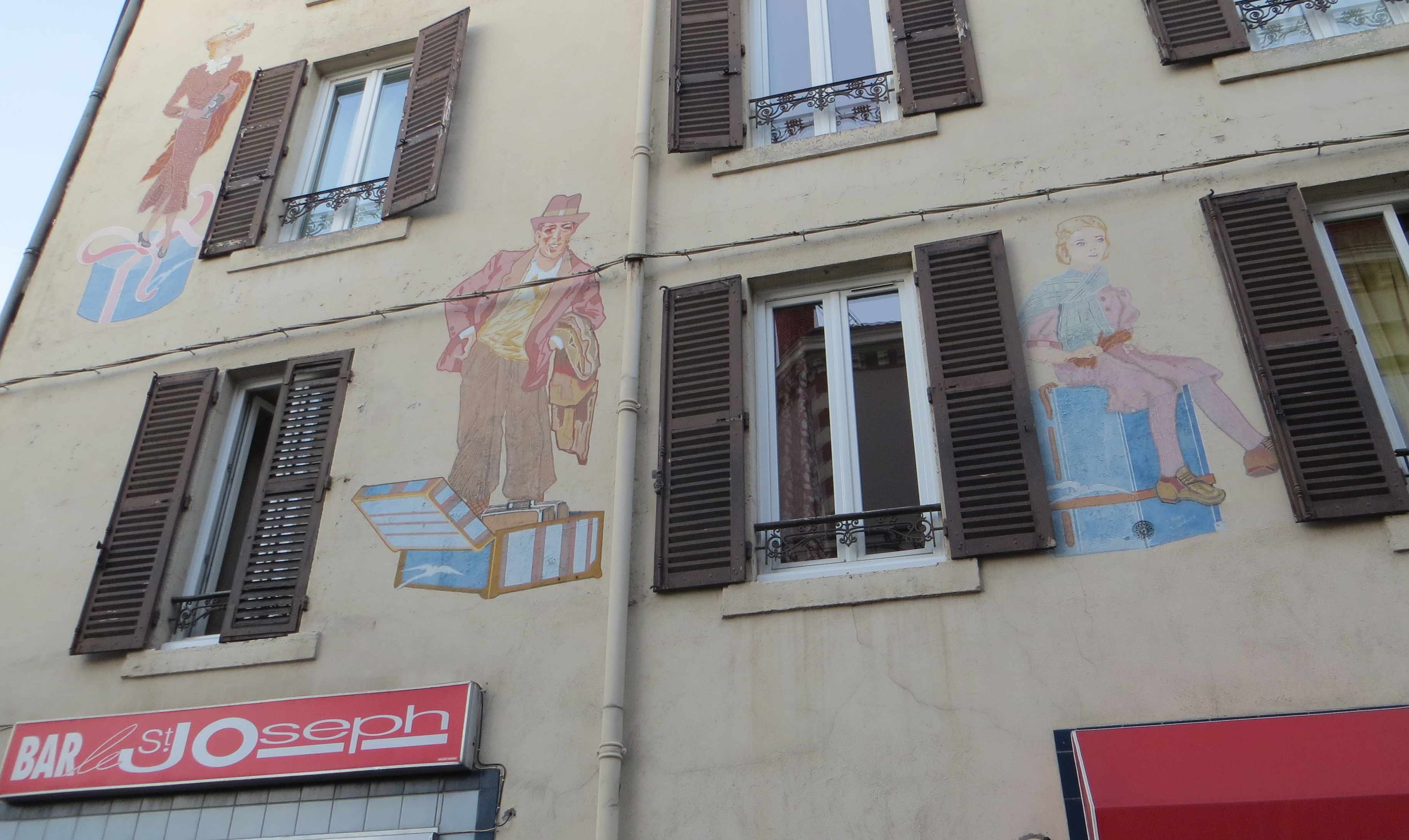
Up again by 5, I take a little stroll near our hotel with the band, admiring the market, and the murals on the wall next door.

murals CF.jpg

In a nearby square we find five little posts, correctly arranged for a bonsai Hoisting the Pennant ritual (my film, from 44.21) on a future fantasy visit of Li Manshan’s 5-year-old grandson and his schoolmates.

CF posts

Doing daily travel with a gig is tough—but like my former orchestral life, it incites camaraderie. Our previous tours have been less frantic, but this one is pleasantly condensed.

Jpeg

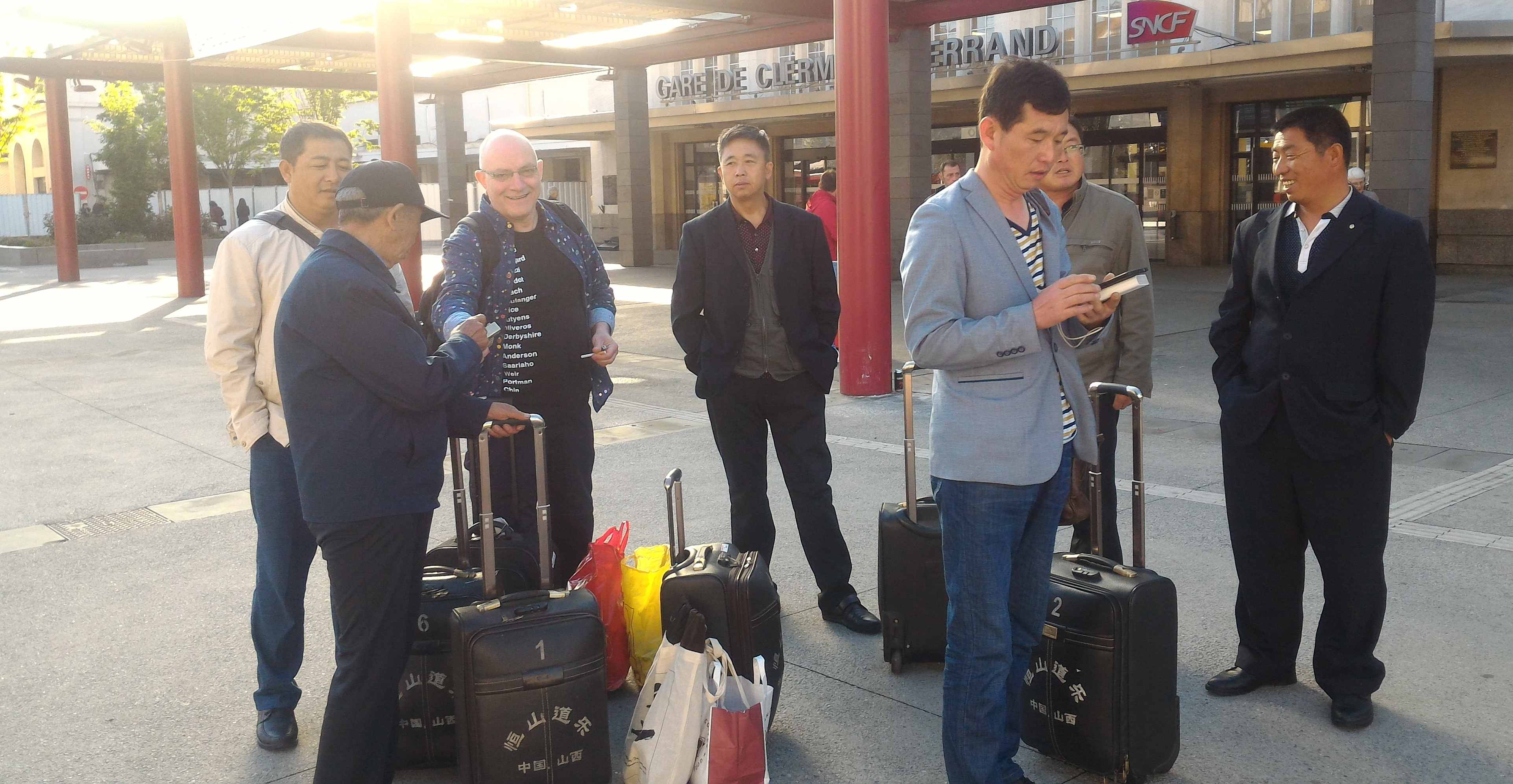
The touring life. Photo: Wu Yunfeng.

Valérie and Teacher Wu take us to the station, with thoughtful gifts of Gitanes (!) and food for the train. We were also happy to receive Clermont-Ferrand Confucius Institute umbrellas.

Jpeg

Valérie sees us off on the train.

The train ride is fun again. It’s much faster today, so we arrive early at midday, and take the metro to find the Centre Mandapa, a splendid venue for world music since 1978, led by the splendid Milena Salvini.

With Mandapa technician Milou we try out my film for a most successful screening; my intro goes well, and at the end Li Manshan and I take a bow. The Daoists love watching our film too.

It’s a lovely little area, so we have plenty of time to relax. They find the quirky antique emporium over the road. A succession of beggars ask us for fags, which they give gladly. Intriguingly, the Centre Mandapa is also right opposite the 1913 church of the Antoinist cult:

Deviation

The state stance on “heterodox cults”? My photo.

We set up the stage during a tea-break for the audience, then the Daoists do yet another amazing gig. Though it’s a small room, my fears that the concert will be deafening turn out to be unjustified—it’s a great acoustic. I join them again for the encore (playlist #3, with commentary here).

It’s always good to see friends at our concerts. Several Shanxi people introduce themselves, excited to find the band performing in France; and today fine scholars like Jacques Pimpaneau, Robin Ruizendaal, François Picard, and Nicolas Prevot come along too.

One cultural difference: after a gig, sure we all want to get away, but the Daoists only drink with food, not before or after (usually), whereas we WAM musos make a beeline for the pub as soon as we have taken our final bow.

Our secret language (“black talk” heihua) is as arcane as ever, with all our inside jokes. Recalling a filthy joke that Guicheng told at a hotel party in Leipzig (I can’t possibly tell you that one), I only have to say “Can you sew this up for me?” for Li Bin to burst out laughing. We giggle again at Tian Qing’s “Eat a young monk” joke.

22nd May
We have a free day at last before the Daoists’ evening flight home. Last night Old Lord Li had a bath, slept till 1am, watched TV, slept again, and got a call from a family in Pansi village to determine the date for a funeral, so he was up before 4. Meeting up at 5 yet again, I take him to the bar down the road, where Tweety McTangerine comes on TV—Li Manshan hasn’t even heard of him, how enviable! Back to my room together to read Yan Lu’s draft article on the Nanterre events.

Li Manshan calls the Pansi family again at 6am. It’s a village that he likes best, and they most trust him. Then we have a good breakfast.

We stroll down together past the Opéra to the amazing Chinese department of Galeries Lafayette, brilliantly rendered as Laofoye (“Old Buddha Elder”). Li Bin and Erqing buy loads of perfume (“Hey guys, how many lovers have you got?!”)

Laofoye

Later Li Manshan and I buy toys for his young grandson: a trumpet and maracas, to go with the, um, Ming-dynasty instruments I bought him before.

We store our luggage and go for lunch, washed down by Leffe. Old Lord Li is drumming with his chopsticks again. Delightful mood over lunch, as always—everyone chipping in with stories, jokes, reflections. Over delicious yuxiang qiezi, I ask Li Manshan if he has an aubergine tree. Often the subject turns to their hymns, as well as the Zouma suite (playlist #4, commentary here) and funky Yellow Dragon percussion piece, and the whole calibration of the trick sequence—how to improve them, tempi, and so on.

They rest on sofas at the hotel, and I film Li Manshan telling another sh-sh-sh-shikuaiqian joke.

Notre Dame

Later we take line 14 to Châtelet, and wander round the little islands. I choose different flavours of Bertillon ice-cream on Île de la Cité for them. After a little guided tour of Notre Dame, we return home for a quick supper of  noodles and beer before Adeline and Yan Lu arrive, Lu thoughtfully giving them posh French chocolates. I have to go off to catch the last train back to London, but their taxi for the airport arrives early, so I can wave them off after all, but it’s a hasty parting.

If it’s a quick hop back home to London for me, their journey was not so simple:

22nd: 23.20 flight from CDG to Beijing,
23rd: landing at 15.20, 21.40 train from Beijing station,
24th: arriving in Yanggao at 03.44! But both Li Manshan and Li Bin had to rush off almost immediately to attend to village clients (for Li Bin’s diary after returning, see here).

I’ve been out of love with Paris for a while; the romantic image is hard to square with its gritty realities (rather like China, perhaps?). But this trip with the Li band naturally made me fall in love with it again. In this supposedly homogenised age—as with other cities like Leipzig, VeniceSeville, or Lisbon—we must delight in Parisian culture too!

After Daoist music in France (and Italy, and Germany), try Andean music in Japan

As I write these notes up, Haitink conducting Mahler 9 comes on Radio 3, live from the Barbican; and then next evening, another live broadcast of Turangalîla! Perfect. I hear echoes of the Li family rituals in both: all the contrasts of monumental tutti and intimate chamber styles that we find in a Daoist ritual. But that’s just me… If only Messaien were still around to hear the Li family in Paris!

Posted at 5am to commemorate daily sessions with Old Lord Li.

Vignettes 6: Wang Ding

WD 2011

Wang Ding learns the ropes, 2011, flanked by Li Manshan and Golden Noble.

Over our various foreign tours since 2005, apart from the core group, we’ve used various people as the sixth member, and Li Manshan’s pupil Wang Ding (on vocals and gongs) fits in well.

Whereas before Liberation the sons of Daoists began learning from the age of six or seven, since the 1990s they only begin when in their 20s at least, whether they start from scratch or adapt from the background of gujiang shawm bands. Li Manshan laments that what few pupils he now has only take it up for the money—he considers them unreliable, perfunctory, jobsworths. In 2010 he took a pupil, a twenty-six-sui-old man, but by 2011 he wasn’t “coming out much.”

By then Li Manshan had another pupil who had been learning since earlier in 2011: bespectacled Wang Ding (b.1975), from nearby West Shuangzhai. He left school after junior secondary; by 2013 he had two children. Since West Shuangzhai has its own fine group of hereditary Daoists, he started learning with Yuan Lishan there, but he soon began to get more work with Li Manshan, so informally became his pupil.

Wang Ding takes the job quite diligently. He has a serious demeanour—almost too serious, the Daoists felt. I liked him, but at first Li Manshan didn’t rate him much. It’s not just a question of a talent for singing or instrumental music, or simply looking the part when taking one’s place before the coffin. Fitting in socially is also a major criterion—just as in a London orchestra (or any social group), personality counts.

Happily, by 2013 Wang Ding had grown in confidence. As he learned the ropes, Li Manshan wrote out some hymn texts for him, so he mastered the basic vocal repertoire. As of 2015 he had learned most hymns, and sings well, making a useful addition to the vocals; he sometimes plays the drum on procession, directs the kin for Transferring Offerings, and he decorates altars too. And now he is far more relaxed and sociable; Li Manshan has come to value his diligence and sense of humour, so he too has become one of the lads, and is now a regular member.

After all the complexity, intensity, and exuberance of the main programme, in France we giggle over my inspired idea for an encore in Germany four years ago: the dangdang gong player should come onstage all on his own and solemnly play a solo, one note per slow beat, taking a bow at the end. The audience might even buy it as a somber and austere meditation:

大音希声
The Great Music is sparse in sound

This was Wang Ding’s first trip outside China—indeed, outside Shanxi. It was great to have him in France, and I’m proud for him.

Vignettes 5: Erqing

Another essential member of the Li band’s foreign tours is Erqing (formal name Huang Shuangping, b.1978), a son of Li Qing’s oldest daughter, also based in Upper Liangyuan. He dropped out of school at the age of fifteen sui after only one year of junior secondary, and started learning with Li Qing the following year, along with Li Bin.

Physically he reminds me of Li Qing, with his rounded face and occasional wispy whiskers. Apart from singing, he is a fine sheng player, and he’s great on the large bo cymbals in Yellow Dragon. He can play the guanzi well too—he and Wu Mei make a fine team on large and small guanzi on the rare occasions when they use a group of seven Daoists.

Erqing and WM

Wu Mei and Erqing in ritual performance, 2009.

Performing with great dignity, Erqing would be a core member of the ritual band, but since 2004 he has mainly been doing temporary labor outside; his long-term absence is unfortunate.

If Wu Mei has been persuaded to remain, they couldn’t hang on to Erqing. Alone among the group, Erqing is widely travelled within China. He moved to the county-town in 2004, working as a driver. In 2005 he began finding temporary work outside—as labourer, electrician, driver, and so on, usually working in a team of around twenty Yanggao men. He has worked as far afield as Jiangsu and distant Fujian. He bought a flat in Yanggao town in 2010. He did a little time as a Daoist on visits home in 2012–13, but was mostly working outside, with stints in Inner Mongolia, Shaanbei, Ningxia, and Shandong. Thus he can speak passable standard Chinese when necessary.

Such labouring trips each last about a month. All the places are the same to him: they go to work on the building site, sleeping in grotty communal dormitories with around twenty men; at least they eat OK in restaurants. They just go there and do the gig and take the money. That’s life. From 2009 the Daoists’ fees were increasing modestly, but Erqing was already making at least 6,000 kuai a month, well over twice as much as he could make as a Daoist at home. Perhaps as he gets older he will return to the more modest earnings to be made from doing rituals back home.

He’s cool about taking time out, and says his fee for this tour will be a little more than he usually earns, so I don’t feel bad about insisting that he comes on tour.

When I ask Golden Noble and Wang Ding why they don’t go off to do laboring work, they say they lack the appropriate skills.

Now Erqing only keeps his hand in on his brief returns to Yanggao. But he’s still brilliant. I’m glad he’s making a good living, and maybe he will come back to ritual when he’s older. In Paris he was useful on the metro too. Along with Li Bin, he’s a bit of a foodie.

Vignettes 4: Wu Mei

I’ve already written a tribute to Wu Mei’s artistry.

WM Nanterre raincoat

Wu Mei improvises rainwear with a bin bag, Nanterre.

Wu Mei has become a local star, a true musician renowned for his amazing guanzi playing, just as outstanding as that of his seniors. He plays sheng (if he gets a chance) and percussion too, and sings the vocal liturgy.

WM on sheng 2013

Wu Mei on sheng, 2013.

Around 2009 he was often working as a welder in town, having learned the trade from his older brother. For this he received the princely sum of 120 kuai a day, as opposed to 80 kuai for two days working as a Daoist; his monthly earnings as a welder were more than twice what he could make as a Daoist. But during the busy winter season he was still working fifteen to twenty days a month as a Daoist, and seven or eight days a month in the summer. By 2011 he was happy to be working full-time as a Daoist again—not least because as a star attraction he was now able to command an extra half share more than the others.

I’ve described Wu Mei’s constant explorations on the guanzi. I love his new refinements in the exquisite Zouma suite (cf. audio playlist, track 4, from 2013), adding little bits of vibrato on some sultry low passages, like Billie Holiday.

He gets a standing ovation for his trick sequence, and so he should. This year I note a sweet new gesture—yes, it’s an ear trumpet:

WM tricks CF

Tricks, Clermont-Ferrand.

SONY DSC

Nanterre. Photo: Nathalie Béchet.

I’m pleased with myself for thinking of following the exuberance of the tricks with the total contrast of the solemn Invitation ritual, which we first added on our German tour in 2013.

Vignettes 3: Golden Noble

IMG_2253_2

Golden Noble at the soul hall, with conch and flag.

Another indispensable member of Li Manshan’s band is Golden Noble (Jingui, formal name Zhang Shiyu, b.1968).

He is son of Li Qing’s younger sister—so though he is twenty-two years Li Manshan’s junior, they are considered the same generation. Born and raised in Houying village just southwest, he began to learn ritual with Li Qing at the age of twenty-one sui in 1988 after graduating from senior secondary, biking over daily to Upper Liangyuan to study with Li Qing. He has become an outstanding ritual specialist, with a fine voice—his intimate solo recitation of the Invitation verses is so beautiful that Li Manshan always lets him do it. What concert audiences might not realize is that when not required for the vocals, he’s also a fine sheng player. I have come to value him very much.

Li Qing taught both Golden Noble and Li Bin to determine the date, and they decorate coffins too. Wu Mei, being unrelated, wasn’t taught all that solo business.

With his lively interest in ritual, Golden Noble recorded rare vocal items sung by senior Daoist Kang Ren not long before his death in 2010, and he has kept some precious additional notations of Li Qing that he copied (see under Thanking the Earth).

LMS JG on train

With Li Manshan on the train from Paris to Clermont-Ferrand, 2017.

In France he was good-natured as ever. On tour our concert version of the Invitation ritual is highly condensed; for village rituals, of the twenty verses of “Vowing with hearts at one we Invite” he generally chooses around five, and in concert only three. After the rather long first concert I joked with him that he had sung all twenty! I also noted that he sometimes only went up to top do, whereas usually he descends from a high mi—he’s not even aware of this, which shows how focused he is on delivering the text.

CF Invitation

Golden Noble leads the Invitation, Clermont-Ferrand.

Vignettes 2: Li Bin

Li Bin 2011

Li Bin on sheng, 2011.

Li Manshan’s son Li Bin (b.1977) seems like a typical entrepreneur in the religious market, but he’s a master of all five skills of the Daoist. Ian Johnson writes eloquently about him in his The souls of China.

Li Bin is gradually taking over the reins from his father. For our foreign tours he is our main link to get all the complex paperwork done, and I’m in constant contact with him online. He always answers my queries promptly, in between ritual segments.

Li Bin began learning with his grandfather Li Qing in 1993 after graduating from junior secondary. In awe of the wisdom of his elders, I tended to underestimate him; though seemingly rather concerned with the more mundane aspects of the business, he knows a lot, and his keen sense of humour hints at his acumen. He is not only an anchor on the sheng mouth-organ, but sometimes takes a turn on guanzi or drum, apart from the cymbals and vocal liturgy; he determines the date, decorates coffins and altars, and makes paper artefacts.

Since the 1990s the lineage has spread into the county-town as never before. Li Manshan’s younger brother Third Tiger was first to move to town, to take up a state job around 1990. Since 2006 he has been employed in the county anti-corruption unit, where, with his sincere intelligence, he has risen to high rank. He makes a good living, with several sidelines. But he loves the Daoist rituals, and can offer a lot of detail about the old masters. He even tells me he is keen to get back to ritual practice when he retires!

Since the 1990s it has become common among Daoists for the son to run a funeral shop in town while the seniors remain in the old village home. Of Li Peisen’s sons, Li Huan moved to town in the 1980s to determine the date from a base there; more recently his younger brother Li Hua, and his sons, have opened funeral shops in town as a base for their ritual band; in 2016 Li Hou followed suit. Li Bin moved with his family to the county-town in 2007, initially as a stepping-stone for his son to get a better education—seeing it as a route towards betterment, just as his forebears had done under successive regimes. He went on to buy a first-floor flat there, running a funeral shop with his wife on the ground floor. This is where I stay on my rare forays into town to take a shower and see old friends (in that order)—we call it “the five-star hotel,” as it is handsomely furnished. Li Bin has managed to buy urban registration for his son—that’s always the priority.

In 2010 Li Bin bought a little car for the princely sum of 48,000 kuai. On the bumpy village roads, any car will have a tough time. In 2013 he upgraded to a fine Nissan hatchback, and in nine months had already done 13,000 kilometres, almost all on local business. His car has a posh sound system and, for his rare excursions outside the vicinity, satnav. He did a hundred funerals in 2010, not including countless determining the date sessions, decorating about forty coffins, and all his work in the shop making funerary artefacts. In 2012–13 he did 118 funerals, including eight three-day ones; in the winter he had fifty days’ solid ritual work without a single day off. He knows that Li Manshan’s health is fragile and that he should help him work less as he gets older, but they often have to split into two bands, and don’t like to turn work down. For a diary of Li Bin’s ritual activities after returning from our French tour, see here; for his busy schedule even during the Coronavirus scare, here.

Li Bin has a firm grasp of all aspects of the Daoist arts, but developing his business seems uppermost in his mind, all the more so now that he is based in town. In Adam Chau’s phrase, he is a real “household entrepreneur in the religious market”. Though his earnings can’t compete with those for temporary manual labour, he does quite well (or he would do, if he didn’t spend it all). He has become used to a more comfortable life than those still left behind in the villages. Well connected, he enjoys eating out with a wide network of friends, not only gujiang, singers and members of the county opera troupe, but also cadres, teachers, and so on—a far cry from his father’s tranquil home life.

The diplomat of the group, he is the first port of call for visitors like Chinese and foreign journalists seeking soundbites. He can speak standard Chinese when required, and his “bilinguality” is even evident from the two different kinds of name-cards he distributes—one for his local clientele, one for his diplomatic contacts with visiting dignitaries.

The card he uses locally is headed “Ninth generation of yinyang in Upper Liangyuan,” whereas his diplomatic card reads “Hengshan Daoist music band, Shanxi.” He even uses his elegant given name Bin (“civil and martial”) on his local card, but the more colloquial Bing (“soldier”) on his diplomatic one. The local card reads “the whole chain of supplies for funerals,” with a list of services on the back; instead, the back of his diplomatic card lists their Intangible Cultural Heritage status and foreign tours.

Li Manshan and the others haven’t got a name-card. Neither have I. In a typical exchange one day, I ask him:
“You got a name-card, then?”
“Oh yeah!”
“Um… can you give me one?”
“Sure—whose do you want? I’ve got loads of ’em!”

Li Manshan does have to be a shrewd band boss, maintaining the livelihood of his group. He now goes off to work (rituals, determining the date, decorating coffins, and so on) with a smart shoulder bag bought for him by Li Bin, but he makes a less convincing businessman than his son. Whereas Li Manshan tots up the fees on the paper lining of a cigarette pack, Li Bin works them out on a calculator. Of course all this is a common generational contrast. Li Manshan’s demands on the material world are modest, and he remains firmly rooted in old village culture. He wouldn’t contemplate leaving the village or the land—it keeps him healthy and active, and he doesn’t like the bustle of town life. There’s not exactly a connection with being a Daoist (indeed, urban Daoists are more likely to excel, even without land), but it’s part of his personal discipline.

Remarkably, almost alone among all the rural Daoists whom I know, Li Bin has been devout since his youth. Among various Daoist artifacts that he has ordered from Longhushan (distant headquarters in south China of the Orthodox Unity branch of Daoism) for sale in his shop, he keeps a statuette there of Zhang Daoling, ancient founder of the Orthodox Unity branch. Every morning when getting up at home, and every night on his return, he lights incense before the statuette.

He is simply adapting to circumstances, as Daoists have always done throughout history—competition and syncretism with Buddhism, urbanization and the shift of economic power to the south in the medieval era, and so on.

On our foreign tours, whereas the village-based Daoists carefully hoard their fees, Li Bin spends with abandon on gifts for his guanxi network. In Paris, now dangerously armed with a credit card, he spent with abandon on gifts like vin rouge, olive oil, perfume, watches, and leather bags. To me it seems profligate, when he has a family to support—but I dare say such gifts are a calculated investment for him, consolidating his guanxi. By now he has built up a substantial power-base, and people trust him.

But now Li Bin could well be the last generation of Daoists in this fine lineage. And this is perfectly understandable. Would any of us want our sons to do this job? Many elements mitigate against youngsters taking it up—state education, migration, upward mobility, pop culture… Parents (including Daoists) naturally want their children to do well in school, find a secure well-paid job in town, and get urban registration—whereas working as a Daoist is a tough life, with long days in poor demoralized villages for a rather small fee. I’m not going to pontificate about perpetuating the illustrious ancient Chinese heritage, and nor should anyone else. [1]

See also Li Bin’s ritual diary.

[1] Much of this and related posts is adapted from my book.

Vignettes 1: Li Manshan

Li Manshan is as adorable as ever.

I was determined to get to CDG to meet the band off their Air France flight from Beijing, but it arrived early at 5.30am, so in the end I just had to wait for them at our hotel right by Gare Saint Lazare. We met up there at 7.30, Li Manshan giving me a big grin and a hug.

Now 72 sui, he is gradually giving way to his son Li Bin, only doing nearby rituals. But he still can’t turn down requests to go and determine the date, and he still decorates coffins. This process of handing over must always happen, but no-one ever describes it. Personalities within a ritual group, the transmission from father to son as the latter gradually takes over—all such detail is absent from both historical records and most fieldwork reports. If only we could document it in detail for ancient Daoist masters like Du Guangting.

Li Manshan has new headgear, now a more trendy baseball cap, not as sweet as his old one, but hey. He only takes it off, reluctantly, when we enter Notre Dame. He also has a new mobile, the same old make, but with a new ringtone that sounds like The magic roundabout, so another of my names for him is Zebedee—who would have liked the Daoist Pacing the Void. I miss Li Manshan’s old kitsch ringtone of The little wicker basket.

After his lovely gift to me of the old folding stool he made, I gave him a digested translation of The good soldier Švejk, a copy I must have bought in Beijing in the early 1990s. I inscribed it to him:

踏罡步斗的明星李老君
Old Lord Li, superstar Stepping the Cosmos and Pacing the Dipper

“Old Lord Li” references one of our favourite ritual couplets pasted up at the gateway of the scripture hall, hard to translate elegantly:

穩如泰山盤腿座
貫定乾坤李老君
Seated in lotus posture firm as Mount Tai,
Old Lord Li thoroughly resolves the male and female elements.

And Stepping the Cosmos and Pacing the Dipper are rituals in the family’s manual collection.

Old Lord Li is immediately hooked on Švejk. I knew it would be just his cuppa tea—the innocent common man muddling his way jovially through an irrational state machinery. He can’t put it down. Later, suitably, I also give him my old spare toothbrush to use, as he hasn’t brought one.

After catching up together and working out our day, I go off with Li Manshan for the first of many meetings with Teacher Wang, now abbreviated to “hold meeting” (kaihui).

How amazing to be on tour again with this brilliant sextet who have been doing rituals together for thirty years, and who are now in the rhythm of touring abroad too. We use our secret language, always laughing.

In the concerts, the others (like Wu Mei for his amazing tricks on the wind instruments, or Golden Noble with his solo recitation) may attract more attention, but Li Manshan is right at the heart of everything, drumming unerringly, singing intensely, subtly directing. Even the twisting route he improvises on the tiny stage as he leads the final Chase round the Five Quarters, unsheathing the “precious sword” to sketch talismans on the ground, is magisterial.

LMS on train to Nanterre

On the train to Nanterre.

Late at night we have our usual sweet chat outside the hotel. It’s been a long day, but they’re troopers.

Li Manshan is always tapping away on his fingers (even while sleeping on the train) or on his chopsticks as we wait for our meal to arrive.

LMS at Hotel Ravel

Clermont-Ferrand: two of my favourite masters.

Following a quick weekend flit to Clermont-Ferrand, after our last gig back in Paris he had a (rare) bath—the concerts are hot work, and they’re all bathed in sweat. He then slept till 1am, watched some TV, slept again, got a call from Pansi village to determine the date after a death, and was up by 4am.

We meet up in the foyer at 5am for fags outside, lovely. I take him to the bar down the road, full of workmen on the early shift, so I can have a café and orange juice as we chat with the Wenzhou people behind the bar. Trump comes on TV—Old Lord Li hasn’t even heard of him, how enviable. Back to my room together to read through a draft article by our wonderful Confucius Institute host Yan Lu that she has just sent me.

Li Manshan calls Pansi again at 6am with more guidance. It’s a village that he likes best, and they most trust him.

After our hectic schedule, we’re all glad to have a final day free for sightseeing and buying gifts. While his son spends a fortune, Li Manshan just wants to find a couple of toys for his young grandson.

LMS and WD

With his pupil Wang Ding.

A quick farewell hug, and they embark on their long journey back to Yanggao to resume their busy ritual routine. Hardly had they got back home when both Li Manshan and Li Bin had to rush off to separate villages to determine the date for more funerals, which is the start of another sequence of tasks for them over the next couple of weeks (for Li Bin’s diary after their return, see here).

See also The Li band in France: notes.

Depping with master singers

Just home from Paris after an unforgettable time with the Li family Daoists. It already seems like a dream.

Nanterre encore

Our encore, Centre Mandapa. Photo: Nicolas Prevot.

As an encore [English term—Ed. When in France say bis!] I joined in with the Li band, singing the Mantra to the Three Generations a cappella (audio playlist track 3, cf. 2001 version, track 2: commentary here).

For anyone fortunate enough to do fieldwork on Daoist ritual, I thought this might remind us of the benefits (indeed the very possibility) of participant observation; but it was also an opportunity for me to keep my hand in after a year apart from the Daoists. Having remoulded the proverb “Mr Li wearing Mr Zhang’s hat”, I enjoy refuting another popular one, “The monk from outside knows how to recite the scriptures” (wailaide heshang hui nianjing 外来的和尚会念经).

Long schooled by accompanying Mark Padmore and the Monteverdi Choir on my violin, I now have to set aside my instinct to invest words with meaning, instead trying to latch onto the lugubrious timbre of the voices of Li Manshan and Golden Noble, and Wu Mei’s guanzi. Li Manshan’s bushy eyebrows are a useful image here.

During rituals, when we sing a cappella hymns we stand in two rows of three, facing each other across the altar table. So usually I’m either playing small cymbals over the other side from Wu Mei, or playing gong at the other end. But this time I found myself standing right next to him and Golden Noble for the encore, with Li Bin (also brilliant) on my right, all of them subtly supporting me. I realised Wu Mei is not only one of the greatest wind players in the world and a brilliant player of the bo cymbals, but (like Li Manshan and Golden Noble) a fantastic singer too. Not just his nasal timbre and the projection of his voice, but the taste of his choices—where to inject extra volume and fervour, rise up high, or put in a tiny variation. Listening carefully to each other as always, dovetailing, with subtle “rules” about where to take a breath and where to sustain. There’s much more to their singing than meets the ear—the texts of the a cappella hymns are rendered with great intensity and concentration.

Over fags outside the hotel we had worked out an edited version of the Mantra, segueing smoothly from the end of the 1st verse directly into the coda of the 3rd verse. With a very subtle accelerando, its exuberant repeated final couplet begins from a high do the first time, soaring to an exuberant high mi on the repeat:

Vowing this evening to attend the ritual assembly,
Leading the deceased spirits to ascend upwards towards the Southern Palace!

We noted a nice pun, glossing “ritual assembly” (fahui) as “French concert” (Faguo yinyuehui)—the extra characters to be recited silently (monian), like a secret formula. Li Manshan congratulates me again on my silent recitation—”The only thing you’ve learned properly, Steve!”

In rituals back home they don’t always give their all, but on tour, wanting to put on a good show, they are magnificent. Standing in with the Li band—whether at a Paris concert or at a Yanggao funeral—is one of the great musical experiences of my life, “and I’ve had a few in my time I can tell you” (take your pick—Christmas Oratorio in Weimar, B Minor Mass in the Barbican after a tour of Japan, and so on…).

After all my tedious academic questions, being right in the middle of the action with these master Daoists (not “musicians”!) is overwhelming for me. Li Manshan, Golden Noble, and Wu Mei are right on my case. There are no passengers—Erqing and Wang Ding (Li Manshan’s pupil, a welcome new recruit to our touring band) are great too. Focusing on the vocal ensemble, surrounded by Li Manshan’s sparse and subtle drum patterns, the regular crotchet beat of the gong, and quavers on the bell, I also have to remember where to beat out the occasional syncopated cadences on the small cymbals with Li Manshan’s drum accents.

It reminds me of my occasional depping with them in Yanggao for funeral segments (my book, pp.325–6) when they’re one short—waiting on the substitutes’ bench. It also has a disturbing echo of my orchestral experience—that’s another depressingly familiar phone-call from orchestral fixers,

“Can you come and do a Messiah next Tuesday in Barnsley? I’ve tried everyone, we’re absolutely desperate!”

Thanks a lot…

Our chats turned to the singing of the revered older generation of Li Qing and his colleagues. Li Zengguang was admired as a vocal liturgist; Li Qing’s own voice declined somewhat with age. Some had fine voices but less mastery of the texts; other masters who knew all the texts perfectly were somewhat variable in intonation and vocal ability. Apart from their astounding instrumental ensemble, I doubt if there’s ever been a more brilliant vocal group than the present band under Li Manshan, working together almost daily for thirty years.

The Li family Daoists in France

Paris gig poster

First concert yesterday on our mini-tour of France, our fifth foreign trip since 2005. Not least, we haven’t seen each other for a year, so it’s great for us to catch up.

After a procession leading the audience through the circus ground on campus at Nanterre, the gig was unforgettable—profound and exhilarating. The audience went wild, and I’m proud for them. They’re right up there with Bird and Dizzy’s band; or with a senior string quartet who have been working together for decades, playing the Heilige Dankgesang on long tours, constantly delving deeper into the inner meaning.

Living the reclusive life that I do, this sudden lurch into serving as their minder, roadie, and stage manager is an invigorating shock to the system. They appreciate all my work—but since I always depend on them when I’m in Yanggao, it’s great for me to able to repay them a bit by looking after them for a change.

In my book (p.335) I wrote about our foreign tours:

Once we’re on the road, looking after the Daoists is an infinitely rewarding full-time job for me. Between sorting out daily logistics with our hosts, shepherding the Daoists round airports, stations, hotels, and restaurants, explaining how things work (showers, coffee machines, and so on), interpreting, helping them buy souvenirs, and keeping everyone in good spirits, I manage to find time to ask further questions about their life stories and rituals. Apart from working as their roadie, I enjoy being stage manager too. Li Manshan observes that they all want to do good concerts for my sake, so I won’t “lose face”; but they take pride in the gigs for themselves, irrespective of my pedantic concert professionalism. Elsewhere I note their high standards back home despite the careless attitudes of their village patrons, and here too they really care about adapting to the demands of a concert. We constantly discuss how to refine their stage presentation, and they get more polished at taking their final bows.

If course one of the insights in spending time in the ”natural habitat” of their home environment is to reveal their humanity. But touring, outside the narrow field laboratory, further helps me relate them to the hubbub of the global bazaar.

They’ve brought me a couple of bottles of Fenjiu “white spirit” from Shanxi, so after our gig we all polished them off over a convivial meal. At midnight Li Manshan knocked on my door and we ended up sharing loads more stories, “having a meeting with Teacher Wang”, and fondly recalling Li Qing, reflecting on this whole amazing story since my first visit in 1991.

Back in Paris tomorrow for our last gig at the Centre Mandapa—for anyone at all nearby, not to be missed!!!

Some Portuguese epigrams

For Nick—
i
f the reader finds this post a tad arcane, just wait till you see his WAM anagrams

Further to my little Lisbon jaunt, I’m always disappointed at my total lack of success when I try to busk it in Spanish by randomly adapting Italian—but it’s even more futile to further modify my crap Spanish into bacalhau (sorry, I mean cod) [1] Portuguese.

I soon dispensed with my old Portuguese phrase book (less entertaining, and less sinister, than Teach yourself Japanese)—its very opening phrase suggests a similar deep anxiety about even setting foot outside our own green and pleasant land:

There’s been an accident.

I flew TAP (Take a Parachute). Indeed, the flight prefix is further abbreviated by omitting the middle letter, so not for the only time, I found myself flying TP (Totally Pissed).

Aboard TAP flights, with impressive urbanity in the vein of Mots d’heures, the airline regales the traveller with a pithy and somewhat obscure epigram evoking the saudade of fado. It seems to recall a sad incident in the colourful past of an early Lisbon femme fatale, perhaps a widow of French patrician stock (even a refugee from the guillotine?):

Colete Salva-Vidas sob a Cadeira [2]

I’ve added capitals for clarity, but in order to preserve the ambiguity of the original I have refrained from supplying what seems to be a missing apostrophe—indeed, could it even be an exhortation?

Either way, it is far more evocative in Portuguese than in its prosaic English rendition

Life jacket under the seat.

Cf. Airplane:

Airplane is packed with little visual detail like that, requiring as much long-term revisiting as the Ring Cycle. Even the opening sequence is a too, er, deaf ‘orse.

And I’m keen to dally with Mme [sic] Salva-Vida’s [just as sic] enticing daughters

Rolagem, Descolagem, and (black sheep of the family) Aterragem,

also commemorated in TAP’s onboard annotations. Again, their names are so much less elegant in English:

Taxi, Takeoff, and Landing.

For a new addition to the family, Proxima Paragem, see here.

Just had one of those wacky dreams:

In Lisbon, invited implausibly to some suspiciously traditional social event with an old friend, we make our tortuous way there by means of a badly bombed Escher staircase. Arriving unscathed, I mingle suavely with the locals. Pleased with myself for managing to utter a grammatically convincing phase, I exclaim “Progresso!” “Si,” my Portuguese friend nods, “Esta Truro.”

How pitilessly my subconscious satirises my naïve aspirations to insider status.

For another dream, and a Portuguese limerick, see Ogonek and Til.


[1] Altogether Now: The Piece of Cod Which Passeth All Understanding.

[2] Cadeira: twinned with Madeira.

Li family French tour confirmed!

I’m delighted that the visit to France of the Li family Daoist band is now confirmed, so do please consult the Upcoming events in the sidebar, come along, and do tell all your friends!

The windmills of your mind

Windmills cover

While we’re on the wonderful melody, harmony, and orchestration of Michel Legrand, how about The windmills of your mind (apparently * inspired by the slow movement of Mozart’s Sinfonia concertante!)—here’s Legrand singing it himself in 1969, the rhythms always fluid:

And it loses nothing in English—I continue to be belatedly impressed at the good taste of Dusty Springfield (with English lyrics by the Bergmans, like You must believe in spring):

But though the lurch to the bombastic is only fleeting, I still prefer to maintain the tranquil mood of the original. Above the gorgeous shifting harmonies and suspensions, not only does the melody relish leaps of a 7th, but after the 3rd phrase each new incipit sets forth by falling a 7th from the previous cadence! Cf. the 7ths in Moon river.

Alas, a beautiful danced version has disappeared from YouTube.

For a recent version by Tom Jones, see under Sawdust in Tophane. Cf. Francis Lai; and for sequences, click here.


* We commonly read that The windmills of your mind is “borrowed” from the opening two phrases of the Mozart; but I can’t find a comment from Legrand himself recognising a conscious inspiration. Anyway, here it is—just as wonderful:

Cf. Mahler and Beauty and the Beast.

You must believe in spring

Cleo

After blithely adducing French film music for Bach’s Zerfließe, I’m reminded of You must believe in spring—for those tricky moments when you seek inspiration and the Resurrection of Our Lord doesn’t quite fit the bill.

Composed by Michel Legrand for Les demoiselles de Rochefort (1967), its English lyrics were then written by Alan and Marilyn Bergman. I just adore Cleo Laine’s 1974 version—all the more moving for being recorded live:

Tony Bennett and Bill Evans make a magical team too:

The song, those harmonies, made perfect material for Bill Evans—here’s an instrumental version from 1977, released after his death in 1980:
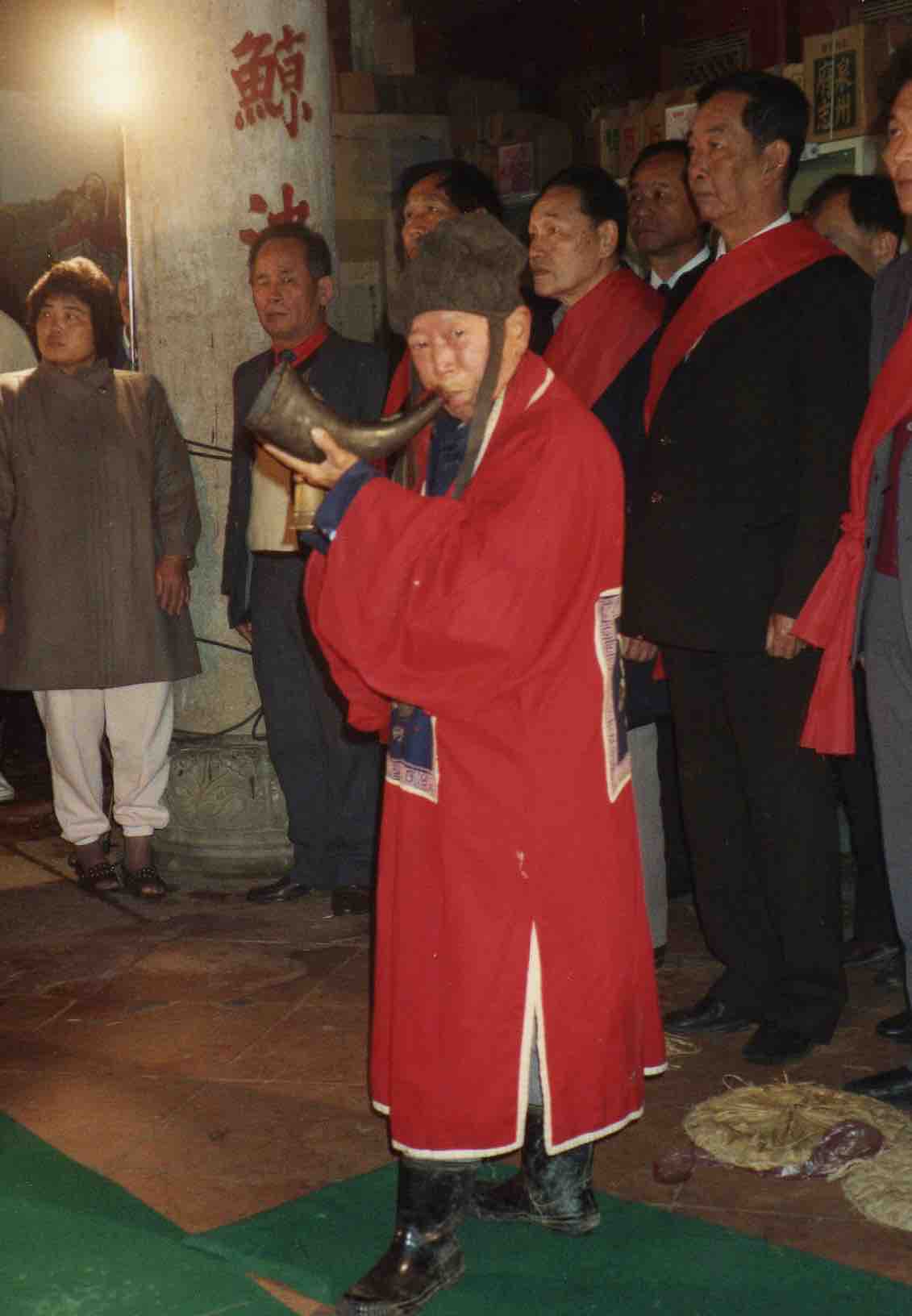
When lonely feelings chill
The meadows of your mind,
Just think if winter comes,
Can spring be far behind?

Beneath the deepest snows,
The secret of a rose
Is merely that it knows
You must believe in spring.

Just as a tree is sure
Its leaves will reappear;
It knows its emptiness
Is just the time of year.

The frozen mountain dreams
Of April’s melting streams,
How crystal clear it seems,
You must believe in spring.

You must believe in love
And trust it’s on its way,
Just as the sleeping rose
Awaits the kiss of May.

So in a world of snow,
Of things that come and go,
Where what you think you know,
You can’t be certain of,
You must believe in spring and love.

For another brilliant Michel Legrand song, see The windmills of your mind.

A major contribution to civilisation

It seems that, like the Bolton Choral Society in their own chosen métier, my goal of Encapsulating the Intricacies of the oeuvre of Flann O’Brien recedes ever further.

Ian Sansom reflected on his mixed success:

Imagine: you’re better than James Joyce; you end up like Miles Kington.

I take the point, but for many fellow-Flanneurs it may not seem germane. Myles’s oeuvre is Sue E. Generis (if he didn’t say that, then it must have been me), self-standing—which, allegedly, is more than he was.

How can I have been so remiss as to neglect Timothy O’Keefe’s edited volume Myles: Portraits of Brian O’Nolan (1973)? Fortunately, my old friend Rod (himself an honorable, nay upstanding, member of the Royal Society of Flannologists) has stepped into the unsavoury breach of my Stygian ignorance [Hope he wiped his feet afterwards—Ed.], drawing my attention to a fine reminiscence therein by Niall Sheridan:

His interest soon shifted to a suggestion of mine—the All-Purpose Opening Speech. This was to be one endless sentence, grammatically correct, and so devoid of meaning that it could be used on any conceivable occasion: inaugurating a President, consecrating a Cathedral, laying a foundation-stone, presenting an inscribed watch to a long-standing employee. This notion delighted him, and he decided it must be given to the world, translated into every known language. If nation could speak fluently to nation, without any risk of communicating anything, international tension would decline. The Speech would be a major contribution to civilisation, enabling any inarticulate lout who might lever himself into power to emerge (after a brief rehearsal) as a new Demosthenes.

I was to make the original draft in English. Denis Devlin was to undertake the translation in French and Brian himself would do the Irish and German versions.

I can remember only the opening portions of the Speech, which ran (still incomplete) to some 850 words:

“Unaccustomed as I am to public speaking, and reluctant as I am to parade my inability before such a critical and distinguished gathering, comprising—need I say—all that is best in the social, political, and intellectual life of our country, a country, I may add, which has played no inconsiderable part in the furthering of learning and culture, not to speak of religion, throughout all the lands of the known globe, where, although the principles inculcated in that learning and that culture have now become temporarily obfuscated in the pursuit of values as meretricious in seeming as they must prove inadequate in realisation, nevertheless, having regard to the ethnical and moral implications of the contemporary situation, etc, etc, etc.”

When the translations had been completed we had a reading in Devlin’s home. Any rubbish can be made to sound impressive in French, and Denis had produced a superb version, rhythmic, mellifluous and authoritative. It conveyed (to our delight and amazement) even less meaning than the original.

Brian (who delighted in the simplest sleight-of-hand) whipped a walrus moustache from his pocket, fixed it under his nose and read his Irish version, in a wickedly accurate impersonation of our Professor of Irish, Dr Douglas Hyde, later the first President of Ireland.

“What do you think of that?” he asked, looking from one to the other.

Denis told him that he admired his brio but deplored his occasional slurring of consonants. I told him that listening to his delivery was like wading through warm stirabout at one’s feet.

Undeterred by this mixed reception, Brian quickly replaced the walrus moustache with a toothbrush affair and poured out his German translation in imitation of Hitler at a Nuremberg rally. As he ground out the Teutonic gutturals, spitting and snarling in comic menace, he knew that he had made the hit of the evening.

Actually, if the speech wasn’t already in use then, it has since become entirely standard.

Talking of inarticulate louts levering themselves into power, this seems all the more necessary in our own fractured age.

And vis-à-vis my own Catechism of Chinese Cliché, must I now gird my loins for a Chinese version of their fine creation?

Humour: why?

Perhaps it’s time for a pensée, or apercu, about some of the seemingly incongruous juxtapositions on this blog.

I realize some of these jokes may try the patience of disgruntled readers who have come here, in all innocence, seeking insights into the Wisdom of the Ancient Sages or the Mastery (sic) of the Great Composers. And indeed vice versa: anyone here for laughs will be pretty cheesed off to have to plough through blow-by-blow accounts of Daoist ritual and Messiaen.

Humour has always played a major role in my rapport both with my colleagues and local subjects—but that’s not the card I’m going to play.

Rather, humour can serve to console, to resist, to create ludic connections. It’s no more universal than music—but just as in Daoist ritual (which not only uses language creatively but incorporates segments to entertain mere mortals), and just as in WAM (thinking, for instance, of Haydn and Mozart), humour reminds us of our humanity.

Anyway, I like it.

Jokes (again, like Daoist ritual) are created by people, they take on a life of their own, transmitted in different versions over time for changing audiences. And despite silent, empty, versions in print, they thrive on and evolve through live interaction in performance.

However (and once again, like ritual or music), I’m sure this can become less satisfying for the professional, churning out the same routine night after night for an unfamiliar audience. That’s why Stewart Lee is so great, and it’s what makes his book How I escaped my certain fate so thoughtful. But that’s not important right now.

Parks and recreation

Parks

More from the Terpsichorean muse:

Just as brilliant as Family guy and Soap is Parks and recreation, with the most joyous theme tune ever:

Parks theme

An innocent vamp, with its tiny yet prophetic throw-away ending, introduces the zany syncopated opening of the tune—Not A Lot of People Know This, but it reminds me of the climactic ending of Boléro, played a lot faster than the much-too-fast versions of lesser “maestros”:

Bolero syncop

This leads to crazy successive modulations à la Berlioz, and to the manic ascending scale and coy simplicity of the descending quarter notes that herald the recapitulation—how does it cover so much ground in 30”?! And this is the full version that doesn’t always get aired!

Ecstatic… And it perfectly suits the mood of the script—here are some great moments from the series:

Yet more Ravel: an update


Ravel

Along with the many entries under the Ravel tag, and I’ve been adding to the main page dedicated to him as well:

cliquez ici!

Besides great recordings of Shéhérazade, L’enfant et les sortilèges, the piano concertos (with Kind of blue as a bonus!), the Introduction and Allegro, and so on, you can now find Monteux’s classic 1955 Daphnis and Chloé, and a 1954 recording of the piano trio.

Gendered nouns

Creme caramel

In our little grammar revision, we’ve done nominal classifiers—so further to gender in French, here’s Lee Mack on the topic (watch from 2.17):

You can’t win with the French. I went to a French restaurant recently, I thought, ”I’ll make the effort, I’ll order in French.” When in Rome, do as the Romans do. Me dad taught me that just before he was jailed in Italy for killing 20,000 Christians. This waiter came in and I was trying to order the egg custard. And I said,

”Have you got… le creme d’oeuf?”

And this waiter went, ”It’s not le creme d’oeuf. ”It’s la creme d’oeuf. ”It’s feminine.”

I said, ”It’s not feminine, is it? It’s an egg custard. What do I need to know the sex of an egg custard for? I want to eat it—not fuck it.”

Don’t get me started on the feminine gender of ships

Yet more conducting

Berlioz opening

In the Rozhdestvensky film, I like his solution (from 22.29) to the perennial problem posed by the opening of the Symphonie fantastique:

“I simply invited them to begin”

and then let them get on with it.

Which reminds me, a noted baroque conductor (or “semi-conductor“, to use Norman Lebrecht’s term) was rehearsing the opening of a slow aria in the Matthew Passion. One of the wind players suggested he might try subdividing:

“Could you give us 7–8 into it?”

Conductor, indignantly: “I didn’t get where I am today by giving 7–8!”

“I didn’t get where I am today by…” soon became another musos’ snowclone.

And here’s Larson’s take on conducting.

Faqu tu 2, or tutu

At Cambridge, Paul Kratochvil was not alone in enjoying a bit of drôlerie.

Here’s another jeu d’esprit on the faqu 法曲, from a precious old letter that I just found from my teacher Denis Twitchett, sent (by post!) from Princeton in 1986. A tad more wacky than his magnum opus Financial administration under the T’ang dynasty, it deserves to take its place among his magisterial writings on Tang history:

Dear Steve,
Some further ruminations on that mysterious term faqu. I am reminded of the hypothesis (first adumbrated in my alas-as-yet-unfinished “Preliminary proleptical remarks proving beyond Reasonable Doubt that Li Bai [aka Patrick O’Leary] was the earliest Irish poet”) that faqu is a rough-and-ready transliteration of the greeting shouted at tax-collectors in the medieval Irish countryside, and also commonly exchanged by rival drivers of donkey carts involved traffic accidents. The etymology of its common form in Chinese is obscure; under the Liao dynasty a folk etymology suggested that it meant “May the Law twist [your private parts]!” It should not be confused with the alternative writing (found in non-Buddhist contexts) fa-k’iu 發具 (explained by Karlgren as “Get out your [ritual] implement!”). This is quite distinct from the forms fakefu 法可夫 or 伏軻䮛 (the latter writing mistranslated by Legge as “Kneel by the hubcap of the Prince Consort”), meaning, according to Admiral Ting (first Chinese to be trained in the Royal Navy), “Be on your way, Jack!”

“French pieces” were surely more normally written in Tang Chinese as faji 法伎 or more colloquially as fashi 法式 “French models”. The title of the well-known Song-dynasty work Yingzao fashi 營造法式 is now attached to a rather boring work on architecture which explains how to construct yourself a baroque dog-kennel without mod cons. This work, however, is clearly a forgery by a Ming author, horrified to the depths of his neo-Confucian sensibilities by the original contents of the book, originally a Song DIY handbook “Make yourself a French model”.

The French presence long predates the Tang, and surely explains Zhuangzi’s Frog in the Well (a fine metaphor for the petty self-interest of the French). This also explains the title of the Tang Li Wa zhuan 李蛙傳, “The story of Froggy Li [the French model]”, and how the word wa “frog” came to have its other meaning “lascivious” or wanton”.

A funky address

To follow Five easy pieces, a very different kind of oeuvre of that époque—less verité—is Jacques Rivette’s 1974 film Céline et Julie vont en bateau (here, on vimeo).

One abiding memory is my favourite address, where much of the “action” (if that’s the mot juste) takes place:

7 bis, rue du Nadir-aux-Pommes

I often used this a forwarding address.

What an age—Rafaelson, Bertolucci, Godard, Chabrol… (more here). At the time [historical note—Ed.], the way to see all these films was to do something called “going to the cinema”. Late-night Marx brothers films at the Arts Cinema were a rite de passage too…

In my imagination I tend to reduce my student years to the Tang dynasty, violin, and Adnams, forgetting how important (and how modern) my wider education was—film, art, literature. But the lacunas were remarkable too.

Meanwhile, Li Manshan and his fellow Daoists were languishing in silence and hunger (my book, p.133):

“We just sat around at home, but we could never feel at peace”—always fearing a knock at the door.

Period style

Picnic

Talking of authentic recordings, here’s the classic 1932 version of Pique-nique by Edouard Ibert (“Call me Ted”) (cf. Authorship):

With Val Rosing’s wonderful plummy voice, and great original, period instrumentation—menacing brass and xylophone, and zany woodblocks, like Cantonese jazz, I may be drawn to it by its heavy use of the pentatonic scale, but the final chorus is a definitive proclamation of those sober values that Made the British Empire “Great”, after the sinister bacchanalian debauchery of the sylvan outing…

See them gaily gad about
They love to play and shout
They never have any cares
At six o’clock their mummies and daddies will take them home to bed
Because they’re tired little teddy bears.

Cf. the reflections of Alan Bennett. And the pique-nique may remind us of Five go mad in Dorset, with lashings of ginger beer…

On a pedantic note, it’s Teddy bears’ picnic, with the apostrophe belonging after bears!

Yet more French letters

Female musicians, Tang Dynasty. Note konghou harpist, rear right.

Further evidence that my taste for drôlerie chinoise is far from recent: a spoof I wrote while helping Laurence Picken with his extraordinary research on Tang music—which I elaborated with another Cambridge mentor, the great Tang historian Denis Twitchett. The genre of faqu 法曲 (“dharma pieces”) has indeed been the (serious) object of scholarly attention. Reading this now, I find the fluency of my affectionate pastiche of academic style somewhat disturbing…

Informal communication with Dr T.H. Barrett [1] has suggested the possibility that faqu may actually mean “French pieces”. Study of a recently discovered and as-yet-untranscribed score from Dunhuang for “hand-wind instrument” (perhaps a kind of manually operated keyed chordophone) entitled Dunhuang shoufeng qinpu 敦煌手風琴譜 reveals a colophon dated 1st April 895 (lunar calendar) which contains references to a certain “Master Ma” (Mashi 馬師), or as we might say, “Chevalier”. The authenticity of this score is no longer in doubt. It includes many faqu, besides one title, Zhena legelede li’a 柘拿樂葛樂德篥阿, [2] evidently a transliteration from a language of the Western Regions (xiyu 西域), but otherwise unattested in Tang sources.

The contacts between the Tang court and the Western world are by now well documented. We find frequent references in Tang anecdotal sources to “strings of onions” (congchuan 蔥串), [3] often in connection with men with a certain type of moustache that became highly fashionable under the emperor Xuanzong, riding carts described as “self-propelling” (zixingche 自行車), [4] and clad in close-fitting garments with black and white stripes (a variant of the yinyang symbol?), as well as floppy caps known as beilei 鞞儡.

The French letter: a rejoinder
Further evidence of the Gallic influence on early Chinese musical culture is to be found in the ancient institution of the fashu 法書 (more recently faxin 法信) or “French letter”, a kind of prophylactic talisman deployed in ancient Chinese households in the hope of avoiding unfavorable consequences.

Traditionalists [5] might evoke the sacred power of music and the jiefa 節法 or “rhythm method”, [6] but more pragmatic counsel, favouring foreign and commercial expansion, and under the influence of Buddhist philosophy, gave rise to the “French letter”.

This popular device was available as early as the Tang dynasty in the form still to be found in temples today, the fawu liutong chu 法物流通處 or “Durex machine”. Although nowadays more innocuous material has replaced the original merchandise, the original meaning of “French thingies” (fawu) is clear. The phrase liutong is somewhat arcane: liu implies dissemination, and tong some kind of intercourse, so one might expect tongliu as an early form of resultative verb—thus, perhaps, “French thingies for penetration and ejaculation”.

Faqu tu
Yet another Gallic connection appears in the instrument fajue 法角 “French horn”, often supposed to refer to a kind of conch sounded in ritual. [7] Recent scholarship suggests that jue was often used metaphorically in the Tang, having once been associated with the debauchery of the notorious Zheng and Wei 鄭魏 kingdoms—the latter also known as “Wei-Hei”. Thus it had the connotation of “horny” or “lascivious” music, as in the term jueshi 爵士, once “gentleman of rank” but by the Tang, “jazz” or “jazzer”. The term dejue 得角 “obtain the horn” is also found in the Dunhuang MSS, apparently referring to a desire for imminent fulfillment; nor can this be limited to exclusively religious fervour.

The well-known notational technique of denoting rhythm by means of dots to the right-hand side of the note (again referring to the above jiefa “rhythm method”) is also found as early as the Dunhuang pipa score. Known as pangdian 旁點 “a bit on the side”, this practice is thought to have been inspired by the ancient French penchant for extra-curricular activities, or gewai shi 格外事.

Moreover, the ambiguity in Tang scores between jue 角 and yu 羽 modes (Aeolian and Dorian respectively, differing only in the sixth degree of the scale) may also be traced to the innovative cultural influence of the French. The term yu is in fact an abbreviation of yulong 羽龍 or “feathered dragon”, a mythical beast said to appear upon rendition of this mode (cf. Han Feizi), and this was soon formalized into what we now know as the “feather boa”, and used in the celebrated Huntuo 褌脫 or “Removing the Drawers” dance, itself remarkable for its ambiguity between jue and yu modes. Thus the apparel used in this ancient French ritual dance gave its name to the mode most often used to accompany it.

For a sequel, see here; and for more Tang drolerie, here. Click here for a roundup of posts on Tang culture.


[1] In the Aardvark and Climbing Boot, 14th October 1985. Just before closing time.
[2] For the reconstructed Tang pronunciation of this enigmatic title, see Karlgren, Grammata Serica Recensa. Can the resemblance to Je ne regrette rien be fortuitous?
[3] Alternatively, some commentators have construed this phrase as indicating the Congling 蔥嶺 range in Central Asia. Indeed, the recent excavation of a large hoard of 7th-century snail shells from this very region makes the siting of a French colony there highly plausible.
[4] Thought to refer to a mystical “journey of the spirit”: see H. Maspero, “Le voyage dans le monde intérieur et la difficulté de trouver un endroit pour le parking”, T’oung Pao 27 (1913), pp. 856–979. For a similar view of the spiritual propensities of this means of conveyance, see Flann O’Brien, The third policeman.
[5] On the conflict between rival factions under Xuanzong, see The Cambridge history of China, vol.3.
[6] See Jones, “Time gentlemen please: the bell as colotomic indicator in Chinese ritual music” (for further articles I haven’t really written, see here).
[7] Cf. the hujia 胡笳 “barbarian pipes”, another import from the Western regions. 2019 update: in an apparent nod to Goodness Gracious Me, it has recently been “proved” that the ancient Gauls came from Hunan—where Daoists still use both a conch and a curved ox-horn 牛角 (popularly known as kaluosa 咔螺薩, a more durable form of the French croissant) to great effect in their rituals. Indeed, will Chinese scholars now “prove” that Charlemagne 沙了蠻 was a Tang vassal?

1990 Daoist

Daoist priest, Quanzhou 1990.

Simile

Further to my remarks on Ravel (under WAM), the dreamlike last movement of Ravel’s Shéhérazade, “L’indifférent”, is clearly about an androgynous boy, as Roger Nichols (Ravel, pp.54–7) recognizes in a cogent discussion—though he gets a tad bogged down in discussing the gender of the singer/voyeur, as if it matters. You might think the title itself would offer a clue, but some translators couldn’t even countenance the androgynous boy, making it necessary to vandalize, coyly,

Tes yeux sont doux comme ceux d’une fille

into

Your eyes are soft like those of any girl.

Resting case
I mean, you wouldn’t say, “Your skin is wrinkly like that of an elephant” if you were talking to an elephant, now would you eh? I rest my case (left: me resting my case in Paris, 2017).

Simile can be silly (“What Am I Like? LOL“):

“Shall I compare thee to a summer’s day?”
“Naa,” [chewing gum], yer allright.”

Anyway, do listen to Shéhérazade in my post—and all the other enchanting ouevres there!

More French letters

Antin

I first read Mots d’heures: gousses, rames ages ago, but the opening of the first poem, with its erudite footnotes, still makes me giggle:

Un petit d’un petit [1]
S’etonne aux Halles. [2]

[1] The inevitable result of a child marriage.
[2] The subject of this epigrammatic poem is obviously from the provinces, since a native Parisian would take this famous old market for granted.

Cf. A French letter, and the “French pieces” of the Tang (faqu and faqu 2)…

Musical-joke-dating

I’m sure you know the Big Tune of the “March to the Scaffold” in Berlioz’s Symphonie Fantastique. Don’t you. Here’s S-Simon again, with the LSO in 2019:

Anyway, among all the spoof lyrics concocted by musicians to fit symphonic melodies, this is my favourite:

x

What makes it still more delightful (for the ethnographer, ahem) is that one can more or less date it to London in the late 1960s—the thrill of the new… *

For a datable viola joke about the Beatles, see here; for Berlioz on oriental music, here; and for a complete performance of the symphony, here.

Brits were still seduced by the allure of exotic cuisine in the 1990s, as parodied in the classic Goodness gracious me sketch (“What’s the blandest thing on the menu?'”).


* “Curry” appeared on the menu of a coffee house in the Haymarket as early as 1773. By the 1930s one could buy curry powder, poppadoms, and mango chutney in Portobello, and several Indian restaurants opened in Soho, as well as in Glasgow and Cambridge. By 1970 there were 2,000 Indian restaurants in Britain. See under Bloody foreigners.