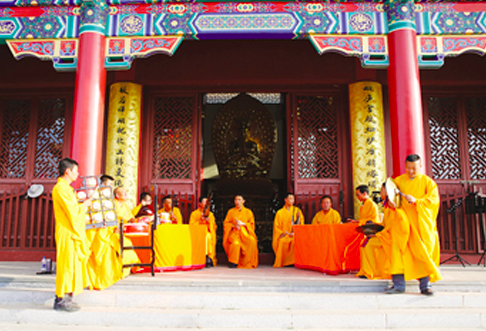
God images old and new, 1

*Click here for main page!*
(under Images: Li family in main menu)

ZQ mural

1 A village artisan
This is the first of two articles (sequel here) that together might be called

Uncle Xi and the Ten Kings of the Underworld.

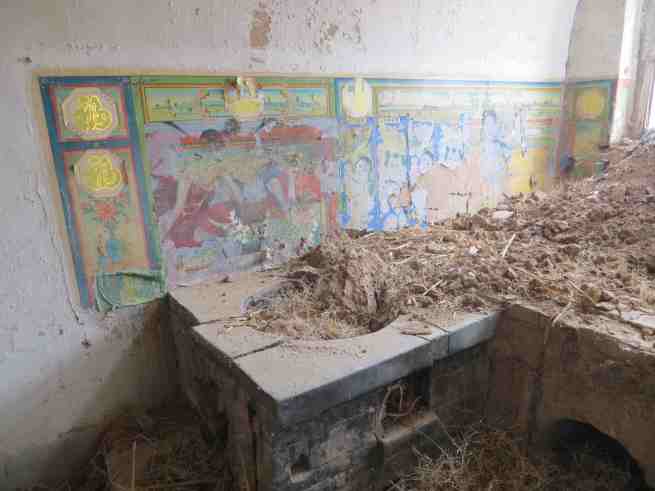
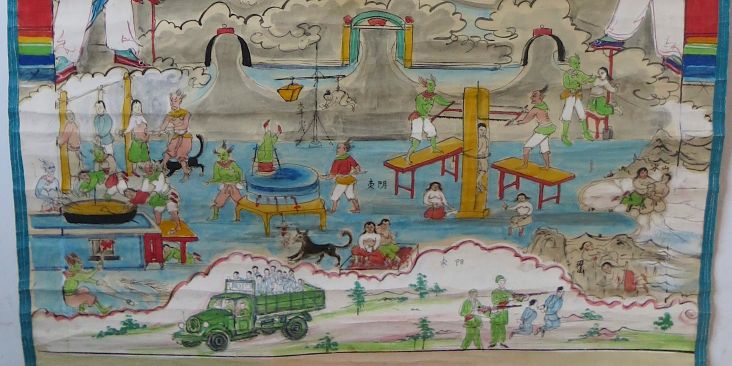
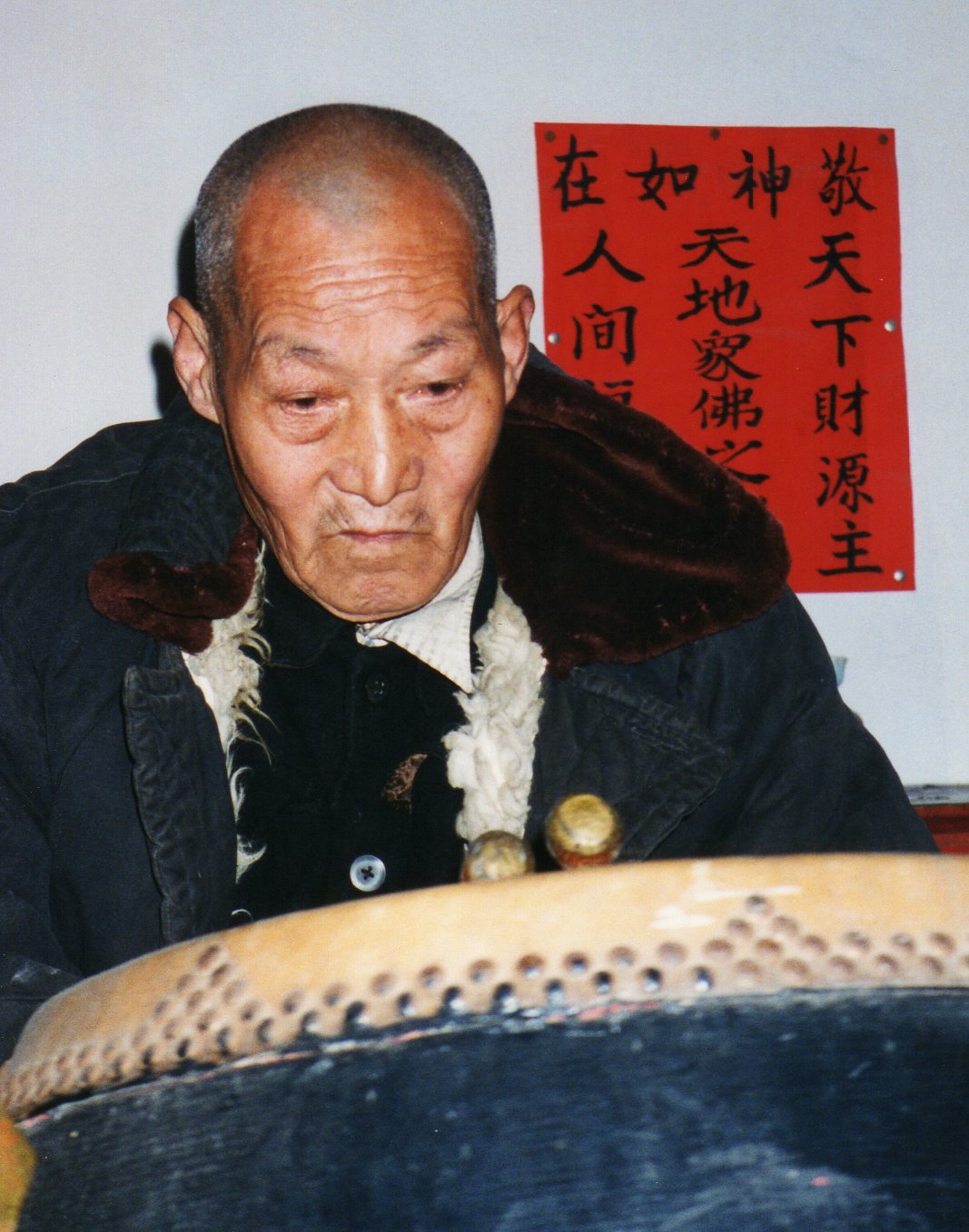
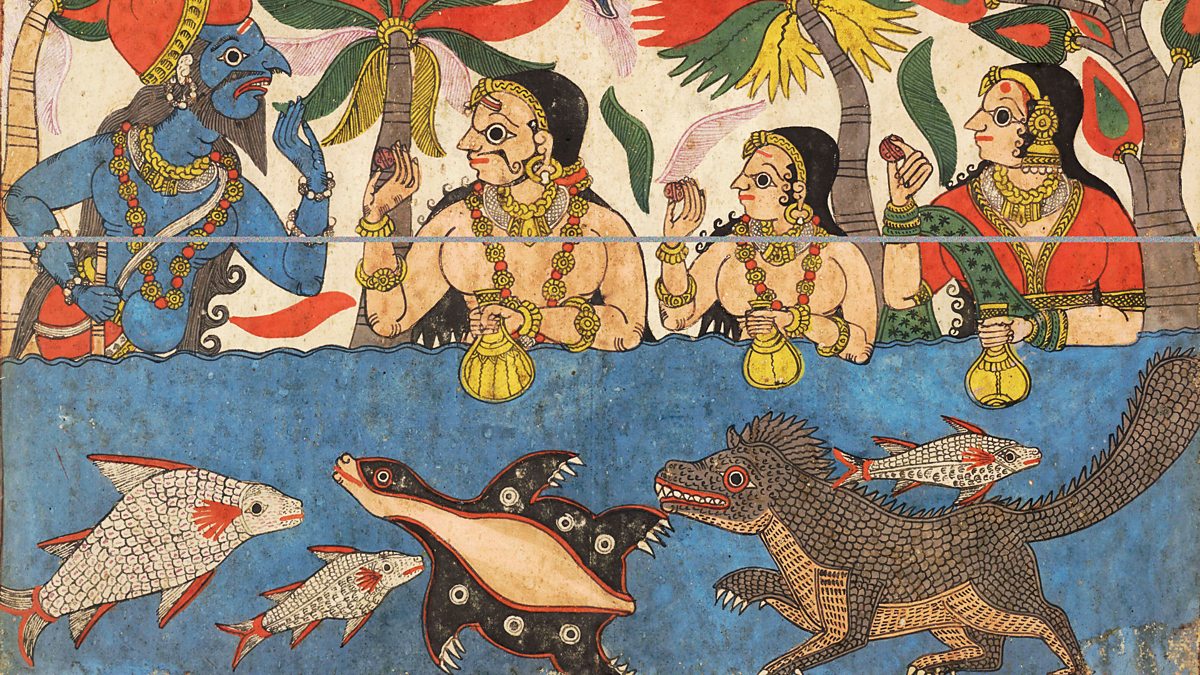
In both rural and urban China, paintings of the Ten Kings of the Underworld (Shiwang xiang, or Shidian Yanjun) were commonly displayed for funerals, and in some places they still are. In this article I introduce Artisan the Sixth, who painted a set of Ten Kings for the great Daoist Li Peisen; and I go in search of his kang murals.

LHJ 456 Kings detail

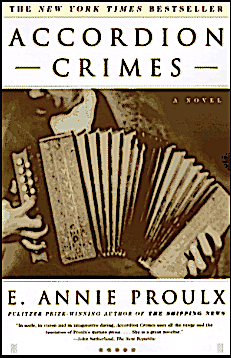
Accordion crimes

Proulx
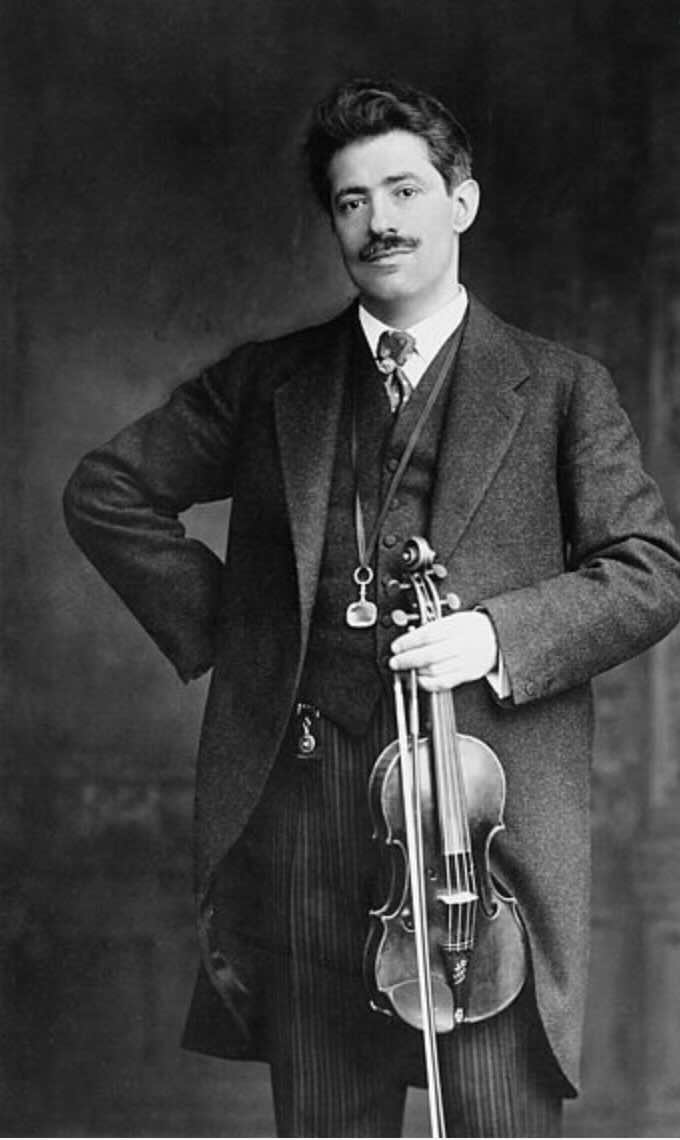
“Germans invented the accordion,” Beutle explained to Messermacher. “A thousand things they invented, but accordions most of all. Because Germans think, Germans have brains. There was this feller, a musician, a German violinist, he ends up playing in the court orchestra in Russia, not Catherine the Great but around that time, he plays the violin. But because he’s a German, Jesus Christ, he notices things, he notices when he hangs up his bow on a nail back in his room she also makes a nice little tone. From this he invents the nail violin, very beautiful tones, I have heard it. A circle of wood with nails sticking out, you run the bow on the nails and ooo aaa ooo aaa, a beautiful tune. One day this feller gets a strange thing from China, somebody gives it to him because interested in things he is—naturally, he is a German—and he sees a round bowl with some bamboo pipes sticking out, and on the bowl a mouthpiece. He blows on it. It’s a fine sound. This thing the Jesus Christ Chinese put reeds inside the pipes, same as in the accordion, little reeds stuck on one end with wax, the other end can vibrate like this.” He trembled his hand at Messermacher. “The German violin player learns the playing of this instrument, die liebliche Chinesenorgel, and from this he passes to other Germans the idea of the accordion—the free reed. That’s how it begins. Later comes the bellows.” (91–2)

By now readers of my blog will know how vital the sheng mouth-organ is to the ensemble accompanying north Chinese Daoist ritual—and I suppose it was the sheng that obscurely reminded me to read Annie Proulx’s miraculous 1996 novel Accordion crimes.

The book has long been popular with ethnomusicologists (e.g. this review), despite being a novel—or rather, near the fiction end of the spectrum from non-fiction to fiction; or near the readable end of the academic—engaging spectrum (cf. Bernard Lortat-Jacob’s Sardinian chronicles, another classic). Like ethnomusicologists, Proulx focuses on change and social function. In her Acknowledgements she lists an impressive array of sources, experts on their regional genres—it’s amazing that all her detailed research took only two years.

On an epic scale, in the tradition of the Great American Novel, Accordion crimes has all the rich detail of ethnographic thick description. Indeed, it’s timely that I should get round to reading it now, since it discusses the tribulations of poor, ill-fated immigrants. The human cast includes immigrant Italians, Germans, Poles, Irish, Mexicans, French, and Norwegians—all against a backdrop of xenophobia, misanthropy, brutality. Their sad, tough, gory, gruesome tales are connected by the history of an old two-row button accordion for over a century, with other roles played by

  • a club style accordion
  • a little one-row button accordion
  • a chromatic accordion
  • a piano accordion
  • a bandoneón (cf. Tango for Messi!!!)
  • a concertina
  • a Chemnitzer.

As I observed about that other ethno classic Lives in jazz, the book gives a perfect combo of music and social detail. Hooked on taxonomy, Proulx can never resist long lists; likely to be tedious in academic hands, hers never fail to enthral. While poetic, her language is never pompous.

The novel opens with compelling detail from 19th-century Sicily:

It was as if his eye were an ear and a crackle went through it each time he shot a look at the accordion. The instrument rested on the bench, lacquer gleaming like wet sap. Rivulets of light washed mother-of-pearl, the nineteen polished bone buttons, winked a pair of small oval mirrors rimmed in black paint, eyes seeking eyes, seeking the poisonous stare of anyone who possessed malocchio, eager to reflect the bitter glance at the glancer.

He had cut the grille with a jeweler’s saw from a sheet of brass, worked a design of peacocks and olive leaves. The hasps and escutcheons that fastened the bellows frames to the case ends, the brass screws, the zinc reed plate, the delicate axle, the reeds themselves, of steel, and the aged Circassian walnut for the case, he had purchased all of these. But he had made all the rest: the V-shaped wire springs with their curled eyes that lay under the keys and returned them to position in the wake of stamping fingers, the buttons, the palette rods. The trenched bellows, the leather valves and gaskets, the skived kid-skin gussets, the palette covers, all of these were from a kid whose throat he had cut, whose hide he had tanned with ash lime, brains and tallow. The bellows had eighteen folds. The wood parts, of obdurate walnut to resist damp and warpage, he had sewed and sanded and fitted, inhaling the mephitic dust. The case, once glued up, rested for six weeks before he proceeded. (17)

As the old accordion-maker arrives in New Orleans in search of fame and fortune,

In and out went Caramele through the scores of dives, tonks and jooks and barrelhouse joints that lined these streets, the accordion maker lurching after him through the musical din of drums and ringing banjos, shouters, pianos clinking away, squealing fiddles and trumpets and other brass snorting and wailing from every interior, and sometimes a string quartet sawing crazily. On the streets children watched and fought for discarded stogie butts, black street musicians and white played for coins, singing improvised songs of insult at those who failed to toss a whirling coin. (42–3)

In “Spider, Bite Me”, Abelardo recalls to his son Baby,

“The accordion was so natural, a little friend. Easy and small to carry, easy to play, and loud, and can play bass rhythm and melody. Just the accordion and nothing else and you’ve got a dance. It’s the best instrument for dancing in the world, the best for the human voice.”
[…] On the weekends [Baby] played for dances with Chris, mostly rancheras and polkas; they sang in the classic two-part harmony, primera y segunda. […] The dances were exhausting, the strain of playing and the lights, the sweat and heat and thirst, the noise like pouring rain.
[…] Though so many turned to the big-band sound and the strange hybrid fusion of jazz, rumba and swing, would rather listen to “Marijuana Boogie,” the Los Angeles Latin sound, than “La Barca del Oro”, there was an audience that liked their music, found value in it. These new ones, many of them veterans back from the Korean War, some of them university students, embraced conjunto, and this music was not for dancing but for listening. It had a meaning beyond itself. (173–4)

The changing tastes lead to a heated argument between Baby and his put-upon sister Félida (191–8):

She passed her arms through the huge straps. […] She stared at the ceiling, said, “por Chencho, Tomás, por Papá Abelardo,” then sang the heart-wrenching “Se fue mi amor,” which Carmen y Laura had recorded in the last year of the war.

Her bellows control technique was extraordinary, with dramatic swells and choking, sforzati explosive effects. She scratched and rubbed and struck the keys, ran the back of her nails across the folds of the bellows. The accordion gave the perfect illusion that a bajo sexto and a bass as well as a highly original percussion player supported the accordion, and from it came the melting harmony of the missing sister’s voice to twine and burn with the sweet, smoldering fire of Félida’s sad voice.

“Hitchhiking in a wheelchair” (199–276) is fascinating too, as Dolor makes a pilgrimage to Canada in search of old-time French music:

The music was stunningly brilliant, joyous with life and vigor. The dancers sprang over the floor and now and then they would draw back and give room to a step dancer whose rigid back, erect head and straight-hanging arms accentuated the clattering, tapping, rapping, knocking, flinging feet whose steps stuttered in and out of the music. He wished Wilf could hear the fiddler, the sound like a flock of birds, a flight of arrows striking all around him, from a growling, clenched-teeth mutter on the G and D strings to harmonic shrieks and stair-tumbling runs—Jean something, a taxi-driver from Montréal.

This leads to “Don’t Let a Dead Man Shake You by the Hand” (277–349) , where Proulx expounds on Cajun and zydeco in Louisiana; and “Hit Hard and Gone Down” on the Polish folk scene (351–426):

The Chez family from Pinsk lived across the street; later they changed their name to Chess, the two boys grew up to work in businesses, a junkyard, bars and nightclubs, finally making phonograph records featuring black singers moaning the blues, and by 1960 the good Polish neighborhood had turned black on all sides. (354)

“There’d always be somebody’s polka band—two violins, you know, the bass fiddle and the clarinet, no accordion at all, they’d just play all afternoon and we’d dance. No music pages, they play from their heads, they were geniuses. You know, the dancers used to sing out a line of a song, or not even sing it, just shout it like, and the musicians they had to catch it, know it and play it back in the same key. Oh, they were so good. Well, your grandfather, he sees after a while there is some money starting to come to the polka band players and there was all kinds of places that wanted polka bands—Polish Homes, the Polish Club, not the culture evening but the Saturday night dance, little dance halls all over the place, the union halls, bars and Polka Dot restaurant, the Polish League of War Veterans, a lot of restaurants, Polonia Hall—oh, there was plenty of polka dancing, and a lot of fun, and weddings, weddings, weddings, everybody was getting married and you gotta have polkas.” (371)

Hieronim’s wake was something, the last of its kind in the neighborhood, in the old, old Polish style, and nobody would have known how to do it except Old Man Bulas from the Polish Club… He was the leader of the singing and knew the hymns, scores of them all written down in his śpiewnik, a thick, handsome book wrapped in black cloth. (383)

This is soon followed by a memorable wedding:

He told his wife that it was necessary to balance the solemn death rites of Hieronim with as much of the old wesele style as possible… (385)

But again, tastes are changing (404–14). As promoter Mrs Grab warns Joey:

“We don’t want nothing weird or extreme, you know? There’s rules now, the association’s made rules. […] Only one song in Polish. Most people don’t understand it, but one song gives a nice ethnic flavor. That’s what we want to stress, ethnic flavor. Let me tell you something, Joey. Ethnic music is not that old-time stuff anymore. These days everybody is ethnic, might as well make money on it. […] They don’t want that mournful folk music sound no more or those complicated couple dances going into circles and weaving around and slapping their asses and crossing into the next lane. No more of that Kozaky na Stepie, Cossacks on the Steppe, stuff. Everything gets mixed up unless you got a Ph.D. in Polish clogging. It’s no fun.”

[…] The spare applause had hardly died down when a big guy jumped up, his thin long hair pasted to his sweating forehead, and began to shout at them.
“This is not Polish polka, not Polish music. I am a Pole from Poland and in Poland they would laugh at you as I do now—Ha! Ha!—for saying this garbage you play is Polish.”

Now the bandoneón and tango make an appearance, as Joey meets a migrant from Buenos Aires, who muses:

“Piazzolla, with his little zips like the plastic zipper of a cheap jacket, his plotted silences, the squealing like rubbing two balloons together. That is a serious, unsmiling, hard music; the faces of the dancers frown furiously; and his tempo, the beat is like climbing cement stairs in a skyscraper with fire behind the doors. And there is that quality of a paper comb that sets the sutures of the skull trembling. Those passionate swellings are musical hives…” (416–18, cf. Alexei Sayle).

“The Colors of Horses”, with Basque and Irish musics as well as Appaloosa horses playing a major role, is another too, er, deaf ‘orse. More fantastical lists:

…descendants of the ice-age horses painted on the cave walls of France, of the fabled horses of Ferghana, between the Syrdarya and the Amudarya rivers on the steppes of Central Asia in Uzbekistan, of Rakush, the spotted horse of the warrior hero Rustam, celebrated in Persian miniatures and in Firdousi’s epic poem the Shah Namah, of the Chinese Celestial Horses from the Extreme West, the Blood-Sweating horses, of the galloping mounts of the Mongol Horde and Attila the Hun, of the Andalusian horses of Spain shipped to Mexico for the conquistadors’ savage forays, of a shipload of spotted horses from the Trieste Lippizan herd landed on Vera Cruz around 1620, of the horses abandoned by the terrified Spaniards after the Pueblo revolt of sixty years later and traded north by an agricultural people more interested in sheep, to the Shoshone, Cayuse, Nez, Percé, Blackfeet, Blood, Arikara, Sioux, Cree, Crow, of the North American steppes known as the Great Plains, had been bred down to dog meat. (443–5)

The evocation of Irish song (483–5) is worthy of Ciaran Carson. Now we return to the original, battered old green accordion:

The silent reed suffered from a grain of rust jammed between the reed tongue and its vent, and this he eased out with a silk thread from his fly-tying box. The steel reeds were coated with islands of rust and he scraped at them with the blade of his knife but was afraid of lodging more fragments under the reed tongues. He cleaned the reeds with his toothbrush, blowing out the dust until he was dizzy.

He could see it needed everything—new bellows, new reed, new springs, reed plates reset, grille replaced, and more. But it had a wonderful voice, sonorous, plangent, shouting in grief to the mountain slope. (486)

The final section, “Back Home with Reattached Arms”, is moving too, with Norwegian immigrants making an appearance:

His own parents had been obsessed with the prescriptions of a book, The Emigrant’s Guide to Preserving Norwegian Culture, written by a homesick settler in Texas, a book that dwelt on the merits of the Norwegian language, twice-daily prayers, Norwegian hymns, clothes, food, and, after the fortune was made, return to the “elskede Nord” country. Daily they had sung “En Udvandrers Sang,” “O Norges Son” and others. His mother wished to live in a Norwegian community where land was owned in common by all. But Gunnar shouted for independence and his own land, purchased a mighty, star-spangled flag… (496)

 * * *

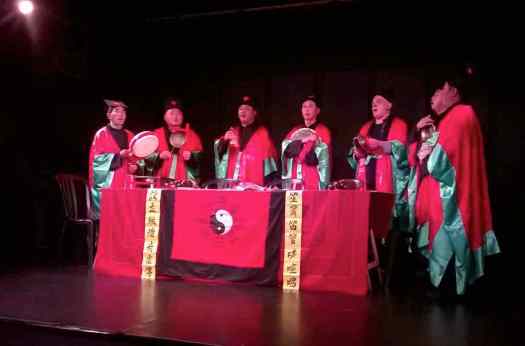
That discussion of the sheng, with which I opened, reminds me of the Li family Daoist band’s concerts in German churches in 2013, the two mouth-organs filling the building with a majestic sound just like Bach on a huge organ with all the stops out (my Daoist priests of the Li family, p.339).

For a general introduction to the accordion, see here. For yet another wacky illustration of the joys of organology, see the aerophones classified under Sachs-Hornbostel 412.232 here. And to explore these genres in more depth, note The Garland encyclopedia of world music: the United States and Canada (1998), Part 3 Section 2c.

Passages like this draw the reader towards archive recordings:

Abelardo had hundreds of records, his own recordings of the 1930s, a few with Decca, then with Stella, then with Bell, then Stella again. “In those days I sang in Spanish; those men with the record company said to me, ‘we can’t tell what you’re singing, so don’t sing anything dirty.’ So of course I sang all the filthy ones.”
[…] He had old recordings of Lydia Mendoza, of the great accordion players, the records of Bruno Villareal, half blind, a little tin cup wired to the side of his accordion, playing in 1928, “the first recording with the accordion as the star”, Pedro Rocha and Lupe Martínez, Los Hermanos San Miguel, dozens of Santiago Jiménez discs.
[…] He would make them listen to all those old labels: Okeh, Vocalion, Bluebird, Decca, Ideal, Falcon, Azteca, especially the Ideals made in the garage of Armando Marroquín up in Alice. (148–9)

Of course, like all those books about Daoist ritual, Accordion crimes misses a lot by being silent—it cries out for a good playlist. One is drawn back to the great 1952 Anthology of American Folk Music, and we can find further clues among articles in The Rough Guide to world music.

And let’s all explore YouTube—here’s a Polish tango from 1931:

See also Polish folk and jazz, A blind accordionist, Tango for Messi!, and under Bella ciao.

If we have to use words to evoke music, Accordion crimes is just the way to convey its messy exhilaration and flawed humanity.

New track on playlist!

Nanterre encore

外来的和尚不一定会念经

I described here how honoured I was to dep with the master singers of the Li family Daoists on our French tour last May. So I’ve just added our encore in Paris to the playlist (#3), with commentary here.

My Chinese caption for this (a variation on 外来的和尚会念经) means:

The monk from outside isn’t necessarily good at reciting the scriptures

Translating Daoist ritual texts

Zhaoqing screenshot

Dunno about anyone else, but I enjoy watching my film again in the company of an audience!

I can’t now imagine all the work that went into this. Apart from the filming itself, and working with Michele to do all the editing, it was good to match up Li Qing’s ritual texts to the hymn singing, and fun showing how the cymbal patterns work, captioning the guangcha mnemonics—first as Daoist percussion karaoke (from 24.03) and later as they whizz past in Yellow Dragon Thrice Transforms Its Body (from 1.11.07).

Translating all those ancient Daoist texts was no picnic, but they’re really beautiful—like the Invitation sequence at the edge of the village towards dusk, with Golden Noble’s solo rendition of the “Vowing with Hearts at One” verses:

Vowing with Hearts at One we Invite:
Emperors and lords of successive dynasties,
Empresses and concubines of epochs immemorial,
Bedecked in twelve-gemmed crowns,
Countenance outranking three thousand rouge-and-kohl belles.
All under heaven their remit, all under heaven their family,
Ultimately ascending.
Singing within the palace, dancing within the palace,
At the final moment they can only perish and fall.
Alas! Have you not heard?
Once astride the dragon of Yu they cannot return,
In vain to deploy the Pipes of Shao within the Department of Caverns,
Fluttering the shadows and echoes, imperceptibly approaching!

But once rendered in exquisite solo melody, such textual beauty is multiplied.

Note also that all these texts are conveyed at quite different tempi: the choral hymns before the coffin extremely slowly, the solo recitations in parlando style, the choral mantras at such speed that the subtitles can hardly keep up. This important aspect of ritual performance is rarely reflected in translations on the page.

Having consulted the exegeses of wise abbot Min Zhiting (no less) in the White Cloud Temple on the meaning of the hymns, I still had some doubts. I recall the months of email ping-pong with Li Bin as I sought his advice. The Li family never discuss the “meaning” of the texts, nor did their elders ever “explain” them as they were learning, so I was really impressed when Li Bin clarified points phrase by phrase. The process of singing them, molto adagio, almost daily over more than thirty years, does seem to give them the occasion to reflect on their meaning. Of course they’re not “educated” interpretations, but the Daoists do clearly have their own “understanding” of the texts they sing.

Another beautiful text in their manuals, for reciting, is the Shunzhi emperor’s meditation on impermanence.

xietu yiwen

I also relish the language of Thanking the Earth memorials (my book, ch.12). Soon after the revival of religious life following the collapse of the commune system, along with recopying the family ritual manuals, in 1981 Li Qing’s uncle Li Peisen (see here, and here) copied a memorial for a domestic Thanking the Earth ritual held by his father Li Tang in the late 1920, with its detailed genealogy.

At the Numinous Treasure Court of the Great Ritual it is hereby declared: upholding the Orthodox Unity Teachings, resident in that place named Upper Liangyuan village in the southeast district beyond the city gates of Yanggao county in Shanxi province; responding to heaven and rewarding the gods, beseeching blessings and fulfilling the vow, to avert calamity and assure well-being; I, Li Tang, with faithful heart, on this day do kowtow. […]
xietu yiwen detailReciting the auspicious texts of the Eleven Great Luminary stellar lords of the Sombre Capital of Upper Clarity, Li Tang and others, resident in the Central Kingdom, favored among mankind, invariably moved by the great virtue of Dragon Heaven, ever reliant on the Earth Court to engender thorough understanding of the high and the broad, repaying sincerity unretained. Hereby having augured the auspicious period, the Retreat is to be held as follows.
On this day we invite the Daoist acolytes to set up a Daoist arena for well-being in our courtyard over two whole days in the hall, kneeling and reciting the Diverse true scriptures and holy mantras for the Great Supreme, facing the Heavenly Worthies in homage; the precious litanies for the Great Ritual, Lighting Lanterns, and Bestowing Food, burning paper and presenting up offerings for the holy gods of the seven originals and the true lords of the nine thearchs.
Our wish is that the whole family will be tranquil, its members in well-being, livestock thriving, our fields fertile, relying entirely on the protection of holy benevolence in the lustre of our daily business.

There are some fine translations of such numinous ritual texts in the works of Ken Dean and John Lagerwey—and indeed in David Hawkes’s translation of The Dream of the Red Chamber.

Yet another village funeral

ZJYT lingtang
On my recent trip to Yanggao I spent most of my time at home with Li Manshan, making little trips to nearby villages with him or his son Li Bin. But of course I had to check out a funeral and catch up with the other Daoists, so Li Bin came to collect me to drive to Zhu Family Cavetop.

The village population, 749 “mouths” in 1990, has now declined to only a couple of hundred at most. By the time we arrive, the other Daoists have already Opened the Scriptures at the soul hall, singing the Hymn to the Three Treasures as prescribed. After Li Bin delivers the paper couplets and diaolian inscriptions, we go to the scripture hall, which today is conveniently the little room on the south side of the funeral family courtyard, right by the soul hall—so no need for the usual long procession.

I catch up with my old mates Golden Noble and Wu Mei, whom I haven’t seen since our French tour last May. Golden Noble has high blood pressure and is off the fags and booze; Wu Mei is sweet as ever. They check out my blog on their phones.

ZJYT jingtang

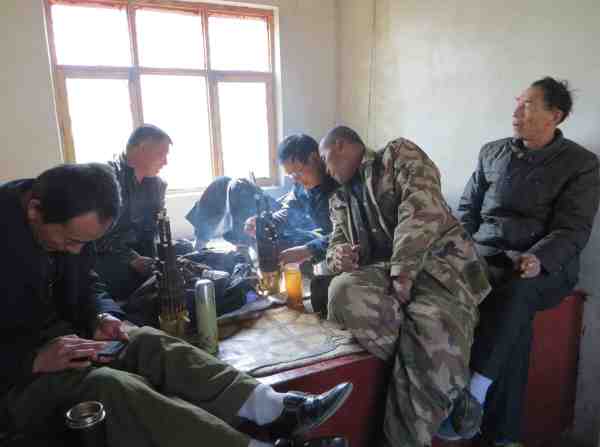
The cosy atmosphere of the scripture hall.

Li Sheng

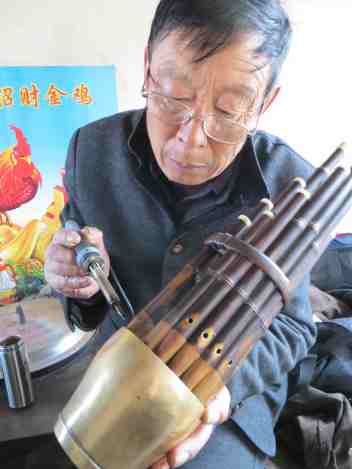
Li Sheng makes repairs to his sheng.

Li Sheng, another regular member of the band and a dedicated chain-smoker (my nickname for him is Fag Devil 烟鬼 Yangui—the gui in falling 4th tone!), is as hyper as ever. His manic energy reflects both in his quickfire dialect and in his fine sheng playing—he struggles to conform to the solemn immovable posture of the Daoists of which Li Bin is a master. He comes from a renowned gujiang shawm-band family from the nearby township of Shizitun. He didn’t know what year he was born; chatting in 2013, he only knew that he was 60 sui, so I translated that to 1954. He is twelve years younger than his brother, a wonderful cultured gujiang also called Li Bin. They learned with their distinguished blind father Li Zhonghe (1908–88), who was still playing in his eightieth year. Again, these two Li families have long been on good terms—the great Li Qing sometimes played in Li Zhonghe’s shawm band in the 1970s. Li Sheng’s older brother went off to work as a cadre in the mines in Datong around 1970, and Li Sheng did some work there too, as well as doing petty trade in Datong, returning around 2000. He has four daughters and one son.

To make up the numbers for the Daoist personnel today, Li Bin has booked two yinyang I haven’t met before, both from hereditary traditions. They’re nice, but turn out to be of somewhat limited abilities. While the gujiang shawm bands have a reputation for smoking dope, some Daoists do too, crushing annaka amphetamine pills into their cigarettes to give them energy (cf. my book, p.325). In the scripture hall my new mates use tinfoil to smoke annaka through a rolled-up 1-kuai note.

As I soon learn when I take a session on small cymbals, the new drummer “calls the beat” arbitrarily, so I keep getting confused about where to place the down-beat. This is just as irritating as an old Daoist I met a few years ago who kept beating out the syncopations on small cymbals, no matter whether we were anywhere near a cadence—”unruly” (bu guiju), as Li Manshan tuts.

The band makes up for the time saved on procession by playing “little pieces” and popular errentai melodies as they arrive at the soul hall. But no-one here cares anyway, and it’s the latest in a long line of funerals where they merely need to go through the motions, with the simplest ritual sequence possible. None of the kin, returning from the big cities for the funeral, kneels or kowtows. No-one pays attention to the Daoists even when they launch into a showy errentai sequence (except in the afternoon, when they even applaud).

Along with the kin we have a good communal lunch in the big tent set up outside, with disposable (yicixing) plastic crockery—I never miss an opportunity to use the expression yicixing (“one-off”), corpsing the Daoists. Meals at Yanggao funerals have improved as ritual practice has declined.

I take a siesta along with three other yinyang in a heap on the little kang brick-bed. The pop band on the truck outside starts up around 3pm, but there’s only a tiny audience even for this, and they soon drift off too. After the Daoists’ first visit of the afternoon, a group of travelling beggars shows up—the usual personnel, with head-mikes, an erhu, fan, and clappers.

ZJYT beggars

Funeral beggars.

ZJYT LB on daguan

Li Bin on large guanzi, flanked by Golden Noble (left) and Li Sheng.

For the Daoists’ second visit of the afternoon they only play a popular errentai medley. For the third session Li Bin (who usually plays sheng mouth-organ) leads the hymn Diverse and Nameless on large guanzi—good, in tune, with a fine new instrument he’s found. For a change Wu Mei plays drum, but he’s somewhat distracted by using his mobile at the same time… The beggars return, and then the Daoists play another errentai sequence. I’m bloody cold and less than riveted (as we say in the orchestral biz, “Of all the funerals I’ve attended in Yanggao… this is one of them”), so I get Li Bin to take me back to Upper Liangyuan before the Invitation ritual. As I get home Li Manshan and his wife are busy making paper artefacts together.

As Li Manshan observes at the end of my film,

Things ain’t what they used to be
今非昔比

Fashion notes

funeral pop better

Pop outside gateway for a village funeral, Yanggao 2018.

Two lists, just possibly somewhat partial, of what is In and what is Out in rural north China:

Things that are at no risk of going out of fashion:

  • hawking and spitting / emptying contents of nose onto the floor (cf. Some Chinese posters and pinups)
  • exchanging cigarettes
  • “leather” miniskirts
  • corruption
  • piles of stinking rubbish by the roadside
  • pollution
  • getting legless (for which there’s a nice Yanggao term, erjinban 二斤半)

(If Uncle Xi is as omnipotent as China-watchers suggest, then WTF?!)

Oh, and

  • Hymn to the Three Treasures as first sung hymn (Opening Scriptures) on arrival at the soul hall (my film, from 21.32).

Things that have gone out of fashion (cf. my book, Coda pp.357–61):

  • the Thanking the Earth ritual
  • funerary Communicating the Lanterns, Crossing the Bridges, yankou
  • shengguan suites for earth and temple scriptures
  • yunluo frame of ten pitched gongs, and dizi flute
  • reed-matting on the kang brick-bed (Plastic Rules OK)
  • Serving the People [remind me when that was In?]
  • pop music at funerals!!!

The latter came as a surprise to me. As you see in one of the most striking images of my film (from 30.32), whereas in the early 1980s villagers were glad to restore the “old rules”, by the 90s they were much more excited* by the pop bands performing on a truck outside the soul hall. Their acts soon became quite innovative. But over the last few years even the audience for pop has dwindled, as people can watch the Real Thing (sic) on their phones.

*In Li Manshan’s words: leqilaile 乐起来了!

A country bumpkin

dav

Photo: Wang Hui.

Just back in Beijing after a wonderful time with Li Manshan in Yanggao (more posts to follow when I find the time), I feel a bit like a newly-arrived migrant, a country bumpkin 土包子.

After a welcome shower and a change of clothes, I try to divest my accent of little vestiges of Yanggao dialect—remembering to say bucuo instead of kabulei (“fantastic”), and using the cosy third tone again instead of Yanggao’s handy substitution with the falling fourth tone. The poor villages of north Shanxi already seem like another world.

First film screening at Beijing Normal University yesterday seemed to go down well, convened by the brilliant Ju Xi, with some bright students making interesting comments. Even though Li Manshan went to great lengths on the voiceover to speak Yangpu “standard” Yanggao Chinese rather than tuhua dialect, I’m delighted when rather few of the urbane native audience find his voiceover comprehensible—so they too often have to follow my English subtitles.

Discussing how painful it is to edit a three-day funeral down to about 40 minutes (and hour-long concerts on tour), I comment “I’m even more radical than Chairman Mao”, which gets a laugh.

Neither in the countryside nor in Beijing do I yet detect much evidence of a cowed population living under the yoke of a sinister autocracy—but hey, I’ll learn…

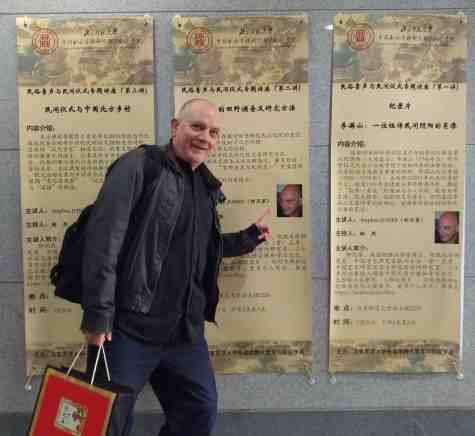
So I look forward to our further sessions at Beishida over the next week, as well as two more film screenings at People’s University and Peking University, chaired respectively by distinguished scholars Cao Xinyu and Wang Mingming—whose courses, instead, I should be attending:

Renda flyer lowres to use

Beida screening copyFurther screenings coming up in April and May in London and Berlin—will keep you posted.

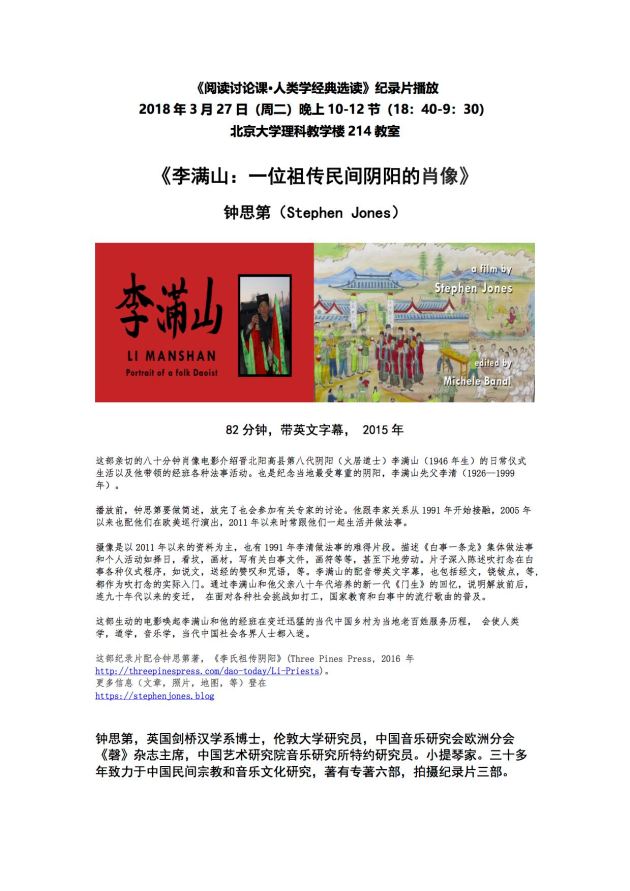
Upcoming film screenings in Beijing

film image

For anyone within spitting distance of Beijing (and I use the phrase advisedly), I’m screening my film there three times over the next week.

  • Wednesday 21st March: Beijing Normal University, 2pm
  • and twice on Tuesday 27th March: People’s University at 2pm, and
    Peking University at 6.40pm.

Details on Weixin, no doubt…

Here’s the flyer for the 21st March screening:

BSD film

The People’s University event:

Renda flyer lowres to use

and the same evening, at Peking University:Beida screening copy

Makes a change from Xi Jinping posters, eh.

A ghost village

This mini-series will be more edifying if you’re familiar with my film and book on the Li family Daoists—or perhaps it’ll lead you to them!

From my book (pp.310–11):

As young villagers abandon the stagnant countryside to seek laboring work in the towns, it is mainly the elderly who are left behind; younger people still stuck there seem listless and devoid of prospects. In the hills, some new villages have been built in rather better surroundings nearby, like Yang Pagoda and Sujiayao. Around 2009 half of the population of Renjiayao paid a one-off fee of 50,000 kuai to move to the new village of Xinhebu, built just south of the county-town as part of a state poverty-alleviation project; the new village has four hundred households, assembled from various poor villages. Now only a couple of dozen poor elderly people are left behind in Renjiayao. Most of the population of Gaojiayao have been relocated to Luotun, itself none too prosperous but at least on the plain. Just southeast of Upper Liangyuan, Shankoutou, always tiny, is nearly deserted now. Ghost villages are emerging. And meanwhile the plain villages too are depleted of young labour.

Soon after midnight on the day I land in Beijing, I take the night train to Yanggao. As I leave Beijing I also abandon the modern calendar: instead of Monday 12th March it is now 2nd moon 25th. The train is quite empty, and I doze fitfully on my bunk (for a fuller diary, see here).

Arriving at 5.36am, I get off at the sleep station along with five others. Li Manshan’s son Li Bin is there to meet me; the roads in the county-town have been mended, so at last the street before his funeral shop is passable. After stopping off to unload my gifts, he drives me to Upper Liangyuan to stay with his father. Driving along new roads smooth as a baby’s bottom, we pass the new elevated section of the train line—soon the journey from (and more importantly, to) Beijing will take a mere hundred minutes! Even the track from the main road to the village is improved since my last visit.

Li Manshan is now only doing funerals nearby—Li Bin has very much taken over, and he’s always worked off his feet. After taking me to Upper Liangyuan he has bowls to smash that morning in three villages—the solo ritual that poor families sometimes request instead of the usual lengthy liturgical sequence with the whole band.

As the sun rises, the wise and adorable Li Manshan comes out to greet me. I say hello to the family’s new doggie, occasionally let off its tether in the courtyard. After lighting the stove Old Lord Li soon has to zoom off on his motor-bike to Yangguantun to decorate a coffin (my book, pp.190–92). I stay home to try and sleep off my jet-lag, only waking up to be fed by his wife Yao Xiulian. Over baozi dumplings I ask a bit more about her background: born to a poor-peasant family in 1951, she was one of five kids. Unlike the illustrious Li Qing, who sent all his children to school, Yao Xiulian’s parents declined to let her and her sister attend, so she remained illiterate. The only city she’s ever visited is nearby Datong, where her daughter lives.

By the time I wake from my siesta Li Manshan is back and fast asleep. A neighbour drops by for a gossip; he wakes up and joins in. I get used again to the basics of country living, though after all these years I still find the local dialect really tough. I get online courtesy of his cool shepherd neighbour. We have a nice supper of noodles and then retire to the west room to chat till late.

Next morning we wake just before dawn. After a relaxed breakfast with Li Manshan and his wife, a guy shows up to ask him for a “determining the date” prescription (see my book, pp.185–9): it’s for “moving the earth”, so Li Manshan writes it on red paper.

We stroll over to the site of the old Zhenwu miao temple (see map), hoping naively to find a neglected stele like we did for the Fodian miao and Sanqing dian temples (my book, pp.46–9), but there’s nothing to see at all. The woman living opposite invites us in for a chat; she’s a Protestant, one of a tiny community that has sprung up in the village over the last few years. Hedging her bets, she has a Xi Jinping poster on the wall, next to her Christian calendar. Li Manshan is always affable, popular with everyone. It’s getting quite hot, so I leave my jumper at her place.

I’ve long wanted to visit Shankoutou (the kou pronounced kio in Yanggao dialect!), the next village south, 2 Chinese li (1 kilometre) distant—mainly because it’s so tiny. When I ask Li Manshan, “Is there a temple there?” he replies, “Every house is a temple!” I can’t think how to convey the wryness of this aperçu.

SKT walk

So we set off, first along a narrow track through a barren gulley, then emerging into open country, following Li Manshan’s internal Daoist satnav up and down to a frozen river. Fording it, we climb the slope up to a reception committee of nine free-roaming donkeys awaiting us.

SKT

Figures in the county gazetteer give a 1948 population of 63; according to our hosts, in 1970 there were 100 dwellers (under the people’s communes the village counted as the 9th brigade of Upper Liangyuan); back with the gazetteer, by 1990 there were still 75 villagers. Now only five aging families, eleven people, are still “left behind” here. But it’s hardly the mysterious ghost village I envisaged, and my only reward is the murals around the kang brick-bed in the house of a family that invites us in; they were painted in the late Cultural Revolution, which counts as “old” round here. They also have a Xi Jinping poster on their wall.

kang mural

Kang murals, 1973.

On the walk back we stay west of the river, the idyllic vista marred only by the cement factory, with its stink and pollution. Old Lord Li sets off over the fields he was given after the land division, which he now rents out. I call him a landlord, and he takes it in the spirit in which it was meant. Reaching Upper Liangyuan again we pass by the site of the Sanguan miao temple and Li Qing’s old house. As I collect my jumper from the Protestant woman I wish her a Happy Easter. Stopping off to chat with various friends, with the usual copious exchanges of cigarettes, we get home by midday.

Weather report from north Shanxi

courtyard in snow

Li Manshan’s courtyard.

OOH it’s snowing today in north Shanxi!

After a rather underwhelming funeral in Zhu Family Cavetop* village yesterday (on which more anon), this morning Li Bin has to do the burial with the band there and then go off on his own to “smash the bowl” in two other villages (see my book, pp.193–4). But the snow won’t deter him, not being a wimpy Englishman; Li Manshan has just zoomed off on his motor-bike to smash a bowl too.

Traipsing across the slippery courtyard to the latrine in the southwest of the courtyard is even more of an adventure than usual, and I “literally” (as the argot has it) freeze my arse off as I squat there, the wind biting into my buttocks (TMI—Ed.). At least there’s a little roof. And at least I can go back indoors—the family doggie is tethered in its kennel in the courtyard. Here dogs and cats are just animals, not sentimental anthropomorphic consolations.


*Zhujiayaotou: why the final “tou“? Most “cave” villages in Yanggao are just XXX Family Caves (Renjiayao, Sujiayao, Gaojiayao, and so on). This is yet another example of my fatuous etic questions to which Li Manshan gives short shrift…

A stopgap

mug

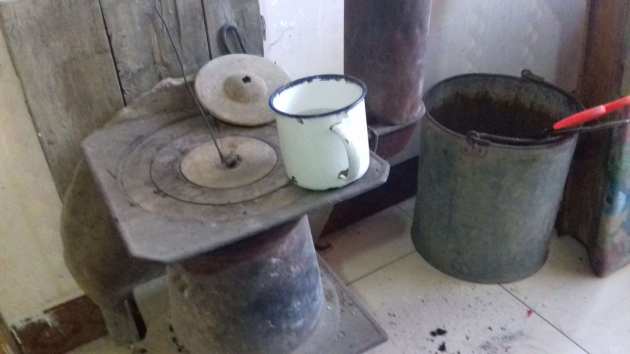
Stove, with Li Manshan’s precious mug.

Depending on your taste, you will either excuse my recent silence or find it a relief.

I’ve been busy preparing for a little trip to China, so I now find myself at home with the splendid Li Manshan in Upper Liangyuan village, catching up with him and the Daoists. It’s been nearly two years since my last visit, so I feel somewhat out of practice, though I saw them on our tour of France last May (see series under the archive for May 2017). Since publishing my film and book, it’s great to hang out with him, neither of us under such pressure to document the family history—though I can never stop taking notes, filling in some gaps and getting updates on their recent activities (for diary, see here).

In due course I’ll leap into action with a series of vignettes on everyday country life away from the hubbub of Beijing, but meanwhile, do check out my numerous posts on the Li family, Yanggao, and so on—such as Li Bin’s diary since they returned from France.

Back into the fray…

The notation of ritual sound

gongchepu

In articles on this site I often stress how soundscape is basic to ritual performance. In north China ritual specialists identify three types of organized ritual sound, “blowing, beating, and reciting” (chuidanian): melodic instrumental music, percussion, and vocal liturgy—in reverse order of importance, with vocal liturgy primary. Some groups accompany their vocal liturgy only with percussion, but where melodic instrumental music is performed, it is an essential component of ritual: “holy pieces” (shenqu), transcending language. Whereas vocal liturgy is not notated—most ritual manuals document only the texts, not the melodies to which they are sung—the outline of the melodic (and indeed percussion) instrumental music that punctuates and accompanies it is recorded in scores of gongche solfeggio. [1]

When the Qujiaying village ritual association, south of Beijing, was “discovered” in 1986 we already knew about the shengguan ensemble and its gongche scores (notably those of the Zhihua temple in Beijing) thanks to the ground-breaking work on Yang Yinliu in the early 1950s, later comprehensively studied by Yuan Jingfang. In our project on the Hebei plain, we soon broadened our attention to ritual manuals, but the shengguan wind ensemble and the scores of village ritual associations were always among our major concerns.

In the fine tradition of anthologies that Chinese musicologists do so well, the major new compendium

  • Zhongguo gongchepu jicheng 中国工尺谱集成 [1]

collects some of the most important scores of gongche solfeggio. It provides rich material on the continuity of early history with modern folk practice.

The anthology is based more on northern shengguan than on southern genres—the distinctive scores of nanyin in Fujian and Taiwan are already collected in many separate anthologies.

The compendium comprises ten volumes to date:

  • General (a fine introduction to historical variants of notation and metrical markers)
  • Beijing (2 vols)
  • Hebei (3 vols)
  • Shaanxi (2 vols, for the major repertoires of ritual groups around Xi’an)
  • Jiangsu (including major early Daoist scores)
  • Liaoning (including scores for both shengguan and the amazing shawm bands there)

The scores of Beijing temples, and those of the related village ritual associations on the Hebei plain just south, take pride of place. The detailed commentaries on the Hebei and Beijing material are the work of Zhang Zhentao, continuing the masterly chapter in his book Yinyuehui.

Hanzhuang XWJ

Most volumes further include useful tables of qupai labelled melodies.

Such scores also often contain precious prefaces bearing dates of transmission, as we saw in Xiongxian.

Hanzhuang xu 1

Gaoluo 1989

* * *

Of course, like the Daoist Canon, and like the ritual manuals of living groups, scores are merely silent artefacts. They should be combined with recordings of their transmitters, who have long experience of bringing them to life—first by decorating the skeletal notes of the score by singing in unison, and then in ritual performance, taking the instruments up to play them in heterophony suitable to the different instrument types. While some musicians learn mainly by ear, the score is an important repository representing the tradition.

But just in case you think the silent score is somehow equivalent to “the music”, then don’t just consult my transcription of Hesi pai under West An’gezhuang here (§2), but listen to the shengguan tracks on the playlist in the sidebar (including tracks 9 and 10, showing the progressive decorations)!

I should also add that notation is not a criterion for excellence. Many musicians, and ritual specialists, in the great and small traditions of the world don’t need it at all, and for others it is merely an aide-memoire, as in this case.

Indeed, this isn’t just an issue for music. This is not the place to discuss wider issues of oral and literate cultures, but this radical comment from Plato, no less, is suggestive:

This discovery of yours [writing] will create forgetfulness in the learners’ souls, because they will not use their memories; they will trust to the external written characters and not remember of themselves. The specific which you have discovered is an aid not to memory, but to reminiscence, and you give your disciples not truth, but only the semblance of truth; they will be hearers of many things but will remember nothing; they will appear to be omniscient but will generally know nothing; they will be tiresome company, having the show of wisdom without the reality.

As Paul Cooper comments,

I love that when Plato complains about the spread of the written word in 370 BC, he sounds like my granddad complaining about the internet.

Such issues are thoughtfully explored by ethnomusicologists—for leads, see the fine chapters of Ter Ellingson and Richard Widdess in Ethnomusicology: an introduction (The New Grove handbooks in music), and Bruno Nettl, The study of Ethnomusicology: thirty-three discussions, chs. 20 and 26. And for wise words on the history of notation in WAM, see here.

These gongche scores are a major aspect of the study of ritual. But that’s enough writing—wouldn’t want to offend Plato…

For a still more exhaustive compilation of Chinese notation, click here.


[1] See e.g.
http://news.xinhuanet.com/politics/2017-09/06/c_129697492.htm,
http://3g.china.com/act/culture/11171062/20170906/31301663.html,
http://news.takungpao.com/mainland/topnews/2017-09/3491181.html.

[2] I gave an overview of gongche notation in my Folk music of China (ch.7); cf. my article “Source and stream: early music and living traditions in China”, Early Music August 1996, pp.375–88. As ever, Yang Yinliu gave a masterly survey in his Gongchepu qianshuo 工尺谱浅说 (1962).

The art of the sheng repairer

GGZ Fan Huilai 93

Fan Huilai overhauling sheng, Xiongxian 1995.

An important theme in our fieldwork on ritual associations around the Hebei plain is that of the itinerant occupational sheng mouth-organ repairers (dianshengde 点笙的). They make cameo appearances in several pages on Local ritual, so here I’d like to collect some of the material. [1]

While I constantly stress vocal liturgy, the shengguan wind ensemble is also a major aspect of the ritual soundscape in north China. The role of the sheng in the ensemble is somewhat akin to that of the baroque continuo. Like a harpsichord before a Bach cantata, the sheng needs regular fine-tuning in advance of performance. The term diansheng (dotting the sheng) derives from the adding of a drop of wax to the reed to tune it, but includes general maintenance; played for long rituals, with their sound-chambers susceptible to moisture, wear-and-tear on the sheng is considerable. Musicians may tune individual instruments themselves, and any sheng player can do it after a fashion, but it is a difficult job to do well, and a well-tuned sheng section is an important aspect of a good ensemble. As with the work of the luthier worldwide, it is a slow and meticulous task (for a loving tribute to instruments and instrument-making in Irish music, see Last night’s fun).

Occupational Daoist bands in north China, like the Li family in Yanggao, tend to maintain their own sheng; with quite a small personnel, they rarely have more than four to tune. Players can all carry out basic repairs, and in between the many ritual visits to the soul hall over the day they busy themselves in the scripture hall making fine adjustments to tuning. This is among the many practical skills that Daoists have to learn. Still, Li Bin takes all the band’s sheng to fine maker Gao Yong once a year for a thorough overhaul.

On the Hebei plain, amateur village ritual associations tend to be much larger, often using as many as twenty sheng players—so occupational sheng-repairers are much in demand. Most associations invite a sheng-repairer to tune all their sheng systematically two or three times a year, or before their major outings, at least before the New Year rituals. The Zhaobeikou association had its sheng repaired at least three times a year, once “before the lake freezes over”, again before the New Year rituals, and also before the river lanterns ritual of the 7th moon. Some associations may be reluctant to spend money on inviting a repairer—although in some villages in the early reform era payment for this comes out of the funds of the village committee. Around 1995 it cost 5–10 yuan to tune one sheng; most associations had at least eight sheng to tune. Sheng-repairers were making a good living.

When a ritual association buys new sheng, musicians take them to be tuned (pin sheng 品笙) to the standard pitch of their own association, taking the che gong of their yunluo or tuning them to the lowest note of their dizi flute.

So apart from their vital musical services to the village ritual associations, the sheng tuners act as a unifying factor in communication, an informal rather than institutional link. Experienced observers of musical life over the whole area, they serve not only ritual associations but also shawm bands and opera troupes, and they know a lot more about local ensembles than any cultural cadre we have met. They often go on tour throughout the villages, but ensembles may also take their sheng to the craftsman’s home. Again, most craftsmen still come from long hereditary traditions.

Below I introduce some of the more renowned sheng-repairers and makers around the Hebei plain.

Bazhou, Xiongxian, Jinghai
Back in 1989 our very first clue to the ubiquity of ritual associations on the Hebei plain came from Bazhou county. Based in Xin’an town, the Qi family was among many lineages of sheng-repairers active around Beijing, Tianjin, and the countryside just south.

We met Qi Youzhi (b.1920), from a long line of sheng-repairers in his lineage. His grandfather Qi Baoshan had worked for the imperial palace lamas in Beijing. Before the fall of the Qing dynasty in 1911, Qi Youzhi’s father Qi Lanpu used to play sheng in the Tianqiao district of Beijing. Later, through contacts with palace eunuchs, he learnt to repair sheng, building a reputation with temple musicians. His older brother Qi Lanting and his oldest son Qi Youcai also took up the business, and they also repaired sheng in Tianjin.

qyz-1989

Qi Youzhi (right) with Xue Yibing, Xin’an 1989.

They used to go out to find work repairing sheng, making the rounds of all the Buddhist and Daoist temples and village associations. Twice a year Qi Youzhi used to go on a long trek by foot to Beijing with his uncle, staying in villages on the way and tuning sheng wherever there was work. After the 1949 Liberation, Qi Youzhi could no longer find work in Beijing, since priests were returning to lay life and temples were now largely inactive—but significantly there was still plenty of work repairing sheng for the village ritual associations. Indeed, this work continued until the Four Cleanups in 1964. By 1980 Qi Youzhi was 61 sui, and, despite the revival, gradually became less active.

Nearby in Gaoqiao village—whose Buddhist-transmitted ritual association is so outstanding (playlist track 8, and commentary)—the Shang family sheng factory is a long-established cottage industry. A local source claims that they too were repairing sheng for palace groups in Beijing as early as the Xianfeng era (1850–61), and that they made their first sheng in 1853. By the 1980s they were making sheng for the Hongsheng instrument factory in Beijing and Tianjin; by 1993 they had even started making shō for Japanese gagaku. In 1995 they were charging 140–180 yuan for a new sheng. The head Shang Xuezhi was often on tour, mending sheng for ritual associations (and also shawm bands and opera groups) over a wide area; he kept a three-volume list of his clients, wonderful evidence of the continuing vitality of the associations.

In Xiongxian county, another excellent sheng repairer was Fan Huilai, based in Gegezhuang (see photo above; below, some of his equipment). By 1993 he was visiting about sixty associations every year (including Catholic groups in Hejian county), charging 5 yuan to repair each sheng. As he pointed out, most associations had about eight sheng to repair, but some, like Quantou on the Baiyangdian lake, had as many as eighteen.

GGZ sheng stuff 2GGZ sheng stuff 1

Still in Xiongxian, there was a local saying: “from Nanjing to Beijing, the Shao family of Gaogezhuang are good at reparing sheng”. They came to Hanzhuang twice a year to repair the association’s sheng, tuning eight sheng for 100 yuan. Hanzhuang has a sheng said to be from 1929, with “made by Shao Guanghui” incised on one of the reeds; they had an even older one with a wooden bowl.

In Jinghai further east, Lesser Huangzhuang (also with its own ritual association) had an instrument factory specializing in sheng. They had been making sheng since before the Japanese occupation. In the 1950s the business was collectivized; in 1968, while assistant chief of the village revolutionary committee, Li restarted the workshop. Since the 1980s it had split into eight (!) household industries. One of their itinerant repairers was Tao Laicheng, who regularly visited the Zhangzhuang association in Bazhou, for instance.

E. Jiangcun sheng

Sheng parts, East Jiangcun, Renqiu county. Photo: Music Research Institute, 1993.

Xushui and Yixian
In my article on ritual associations of Xushui county I introduced Qingmiaoying, another village long famed throughout the region for its hereditary makers and repairers of sheng mouth-organs. Several groups in this western region of the plain have fine old sheng made by the Qingmiaoying craftsmen, and all spoke of them with respect. In fact, since the technique of instrument-making has suffered, old instruments may survive better than new ones, and their timbre is much valued by musicians.

E. Yuzhuang chui

The Altar of Accumulated Altruism, East Yuzhuang 1995.

In 1995 we found Yao Haijun (b. c1965) at Qingmiaoying. His great-grandfather Yao Leping died in the Cultural Revolution; he still ran a stall at the county-town market in the 1950s. Leping’s son Hongru (b. c1914), and grandsons Xinghua (b. c1930) and Xingli, also took up the trade. In Dingxing county nearby, the Yishangying association had some fine sheng made by Yao Jiqing in 1951. Yao Haijun was letting his 10-sui-old son watch while he repaired sheng, hoping he would take it up too.

Yao Haijun was charging a dozen or so yuan to tune one sheng. Associations were bringing him over a hundred sheng every year to tune; in the 12th moon someone came virtually every day. He tuned a lot of them for free, because of long-standing good guanxi with the associations, and he wasn’t mercenary.

Another sheng-repairer in Qingmiaoying, Wang Qinghe, had learned from Yao Leping, and lived to the age of over 100 sui. His son, known as Tiger Wang (Wang Laohu, over 60 sui in 1993), continued the business; the Gaoluo association used to go to him on occasion right until 1991.

Just north in Yixian county, Li Kungui, a member of one of the four ritual associations in Shenshizhuang, was a sheng repairer active within a smaller radius. His father also repaired sheng, having learnt from one Zhang Rui. Li Kungui also mended sheng for the village’s East association, but the West association has its own sheng-mender. In this case, Li has been responsible for a certain local standardization in pitch. The fixed pitch of the Upper Huanghao association used to be D, but he changed their pitch to E for them to match that of other groups in the area—such as East and West Baijian, as well as Lower Huanghao and Mawuzhuang.

A nice story illustrates musicians’ awareness of the dangers of sheng-repairers going on tour to other villages. Senior musician Fu Zhongren (c1898–1983) had a comprehensive knowledge of the repertoire of “holy pieces”, but realizing that Li Kungui used to go round other villages repairing sheng, he wouldn’t teach him too many pieces in case he taught them to other associations!

Further south
Before the Japanese invasion in 1937 a sheng-repairer called Du, from Dujiazhuang in Shenxian county quite far south, walked to Gaoluo every winter to tune sheng for all four ritual associations there. Villagers said the maker was called Du Furui. We also heard of him in Yixian county: near the Western tombs of the Qing emperors, cultural cadres had found some old sheng with “Dujiazhuang in Shenzhou” incised on them.

In Jingxian county still further southeast, another renowned sheng-making lineage was the Wang family from Yangzhuang, [2] which went back some five generations. They were versatile, making many other instruments too; and like other such cottage industries, they have moved with the times, supplying instruments for urban professional troupes.

Since they are itinerant, sheng-repairers may also transmit the paraliturgical music, either directly or by acting as intermediaries. Two early transmitters of the “southern” style of shengguan music in Xushui were sheng-repairers, the Daoist priest Wang Leyun (fl. 1860) and Feng Daya (fl. 1920s), both from further south.

I look forward to reading material on sheng-repairers in regions like south Hebei, where shengguan is also a major component of the rituals performed by household Daoists.

***

I have discussed sheng-repairers at some length, both to illustrate continuity with pre-Liberation traditions and to suggest the practical material basis behind ritual culture in local society. Though there are no longer stalls at town markets, village repairers still still do good business making the rounds of rural ritual ensembles, as well as maintaining their contacts with urban outlets and taking part in innovations in instrument design. Sheng-repairers, like the assistants in funeral shops, are likely to be a more useful source of local knowledge than cultural cadres.


[1] See Zhang Zhentao’s masterly study, Shengguan yinweide yuelüxue yanjiu [Temperamentology of sheng pipe positions] (Ji’nan: Shandong wenyi cbs, 2002). For north Shanxi, note also the work of Chen Kexiu and Jing Weigang. For sheng factories in a changing society, see e.g. http://www.onesheng.cn/news/102721.html.
[2] See e.g. Yu Xuehong 于学洪, “Shengwang shijia” 笙王世家, Yueqi 1984/5 and 1984/6.

Ritual groups of Jinghai

*Click here for main page!*
(under Hebei > Tianjin in main Menu)

YMK jing

Continuing our surveys of ritual associations on the Hebei plain,  the Jinghai region of Tianjin is an extremely fruitful area for fieldwork. Even by the 1990s Tianjin municipality (like Beijing) was largely rural, way beyond the city itself.

This article introduces two ritual groups in Jinghai, those of Lesser Huangzhuang and Yuanmengkou, both richly deserving more fieldwork than our team could manage in 1994 and 1995.  Through the latter we found a network of Heaven and Earth Teachings sectarian associations—continuing our acquaintance with sectarian groups (Laofomen, Hunyuan, Hongyang, and so on) elsewhere on the Hebei plain.

As ever, such research requires a blend of fieldwork, textual study, local history for both imperial and modern eras, and an understanding of folk religion and the ritual soundscape.

Ritual groups of Langfang

*Click here for main page!*
(under Hebei in main Menu)

S. Hancun 1993 heying

Here’s yet another article in my series on Daoist and Buddhist ritual groups on the Hebei plain south of Beijing, gradually filling in some of the gaps on the map.

I’ve noted the contrast between the occupational household Daoist bands of north Shanxi and the village-wide amateur ritual associations that are typical of the Hebei plain. Just southeast of the capital, on the way to BazhouLangfang municipality (formerly the county of Anci) is another lively area for ritual. Village associations here seem to feature elements of the ritual scene in suburban Beijing, with some occupational Daoist and Buddhist groups alongside the amateur associations that are common just further south and west. The Langfang region is also famed for its involvement in the 1900 Boxer uprisings.

These groups too had learned from temple clerics. Unlike the particular case we found in Daxing, most ritual associations here, as south and west on the plain, maintained the amateur tradition of “practising good” by performing rituals as a social duty without reward, though some were beginning to accept modest fees. As usual, such amateur groups were active mainly in the home village and a very small radius.

Ritual in The dream of the red chamber

Citing Cao Xueqin’s entrancing novel The story of the stone recently, I was reminded that among the many virtues of the epic tale is its detailed depiction of rituals in 18th-century Beijing[1]

A work of fiction it may be, but what I admire here is the ethnographic thick description—a model for modern fieldworkers. Prompting us to experience such rituals within the far wider context of social life and personal experience, the author not only evokes all the human detail of the family’s behaviour and emotional world, including the priests’ relations with their patrons, but depicts the whole physical setting and itemizes expenses.

Chapters 13 and 14 describe a 49-day observance for the funeral of the family matriarch, with several groups of ritual specialists performing. Chapter 13 gives the text of the placard—similar in style to those used in modern times. [2] In David Hawkes’s brilliant translation (for the whole passage, see vol.1, pp. 255–87):

He also instructed someone to invite an expert from the Board of Astronomy to select dates for the funeral and the ceremonies preceeding it. With the approval of this official it was decided that the lying in state should be for forty-nine days and that the notification of bereavement indicating the family’s readiness to receive official visits of condolence should be made in three days’ time.

這四十九日,單請一百單八眾禪僧在大廳上拜大悲懺,超度前亡後化諸魂,以免亡者之罪;另設一壇于天香樓上,是九十九位全真道士,打四十九日解冤洗業醮。然後停靈於會芳園中,靈前另外五十眾高僧,五十眾高道,對壇按七作好事。
A hundred and eight Buddhist monks were engaged to perform a Grand Misericordia for the salvation of all departed souls in the main reception hall of the mansion during these forty-nine days, while at the same time ninety-nine Taoist priests of the Quanzhen sect were to perform ceremonies of purification and absolution at a separate altar in the Celestial Fragrance pavilion. These arrangements having been made, the body was moved to a temporary shrine in another pavilion of the All-scents Garden. Fifty high-ranking Buddhist monks and fifty high-ranking Taoist priests took turns in chanting and intoning before it on every seventh day.
Inside the gateway, facing the street, a high staging was constructed on which Buddhist monks and Daoist priests sat on opposite sides of an altar intoning their sacred texts. In front of the staging was a notice on which was written in large characters:

[…]
WE,
The very Reverend Wan-xu, Co-President of the Board of Commissioners having authority over all monks and clergy of the Incorporeal, Ever-tranquil Church of the Lord Buddha,

and
the Venerable Ye-sheng, Co-President of the Board of Commissioners having authority over all priests and practitioners of the Primordial, All-unifying church of the Heavenly Tao,

HAVE,
with all due reverence and care, prepared offices for the salvation of all departed souls, supplicating Heaven and calling upon the name of the Lord Buddha

NOW,
earnestly praying and beseeching the Eighteen Guardians of the Sangha, the Warlike Guardians of the Law, and the Twelve Guardians of the Months mercifully to extend their holy compassion towards us, but terribly to blaze forth in divine majesty against the powers of evil, we do solemnly perform for nine and forty days the Great Mass for the purification, deliverance and salvation of all souls on land and on sea…

—and a great deal more on those lines which it would be tedious to repeat [Cao Xueqin’s comment, not mine!].

Chapter 14 goes on to list some of the major ritual segments and activities. The Buddhist Water and Land (shuilu 水陸) ritual included Opening the Quarters (kaifang 開方), Smashing the Hells (poyu 破狱), Transmitting the Lanterns (chuandeng 傳燈), Illuminating the Deceased (zhaowang 照亡), Opening the Golden Bridge (kai jinqiao 開金橋), and Leading the Panoplied Pennant (yin chuangfan 引幢幡. [3]

Daoists performed the Presenting the Memorial (shen biao 申表) ritual before the Three Pure Ones and the Jade Emperor; Chan Buddhist monks performed Ambulating Incense (xingxiang 行香), Flaming Mouth (yankou 焰口), and Worshipfully Presenting the Water Litanies (bai shuichan 拜水懺); and thirteen young Buddhist nuns recited mantras.

這日乃五七正五日上,那應佛僧正開方破獄,傳燈照亡,參閻君,拘都鬼,筵請地藏王,開金橋,引幢幡;那道士們正伏章申表,朝三清,叩玉帝;禪僧們行香,放焰口,拜水懺;又有十三眾尼僧,搭繡衣,靸紅鞋,在靈前默誦接引諸咒,十分熱鬧。

Rendering the fantastical vocabulary of Daoist ritual into English is always a challenge—also well met by Ken Dean and John Lagerwey. Again, Hawkes makes a brilliant attempt at this passage—with occasional elaborations, and a quite understandable, even attractive, “translation” of titles for ritual segments into specific actions (which, of course, they are!):

The Thirty-fifth had now arrived—an important day in the penitential cycle of seven times seven days preceding the funeral—and the monks in the main hall had reached a particularly dramatic part of their ceremonies. Having opened up a way for the imprisoned souls, the chief celebrant had succeeded by means of spells and incantations in breaking open the gates of hell. He had shone his light (a little hand-mirror) for the souls in darkness. He had confronted Yama, the Judge of the Dead. He had seized the demon torturers who resisted his progress. He had invoked Kṣitigarbha, the Saviour King, to aid him. He had raised up a golden bridge, and now, by means of a little flag which he held aloft in one hand, was conducting over it those souls from the very deepest pit of hell who still remained undelivered.

Meanwhile the ninety-nine Taoists in the Celestial Fragrance Pavilion were on their knees offering up a written petition to the Three Pure Ones and the Jade Emperor himself in his heavenly palace. Outside, on their high staging, with swinging of censers and scattering of little cakes for the hungry ghosts to feed on, Zen monks were performing the great Water Penitential. And in the shrine where the coffin stood, six young monks and six young nuns, magnificently attired in scarlet slippers and embroidered copes, sat before the spirit tablet quietly murmuring the dharani that would assist the soul of the dead woman on the most difficult part of its journey into the underworld. Everywhere there was a hum of activity.

That final comment “Everywhere there was a hum of activity” (re’nao “exciting”, “bustling”, lit. “hot and noisy”, cf. Chau, Miraculous response, pp.147–68) is ironic after the silent mantras of the nuns. BTW, I almost like the rendition of shifen as “everywhere”, but I’m still inclined to think it carries the modern colloquial sense of “really”—thus “it was really boisterous”.

Chapter 102 gives a detailed account of a one-day exorcism performed by forty-nine Daoist priests, with god paintings hung out, performing Ambulating Incense, Fetching Water (qushui 取水), Worshipfully Presenting the Memorial (baibiao 拜表) and Inviting the Sages (qingsheng 請聖) rituals, and reciting the Dongyuan jing 洞元經 scripture throughout the day. Three chief liturgists, donning seven-star hats, wielded precious swords, flags, and a whip, as a placard was displayed and exorcistic talismans depicted.

In chapters  28 and 29 (Hawkes vol.2, pp.41–92) the family commissions a three-day Daoist Offering for well-being (ping’an jiao 平安醮) at the Qingxu guan 清虚观 temple:

Aroma continued:
“Her Grace sent that Mr Xia of the Imperial Bedchamber yesterday with a hundred and twenty taels of silver to pay for a three-day Pro Viventibus by the Taoists of the Lunar Queen temple starting on the first of next month. There are to be plays performed as part of the Offering, and Mr Zhen and all the other gentlemen are to go there to offer incense. Oh, and Her Grace’s presents for the Double Fifth have arrived.”

This section offers far less detail on ritual, the opera being the main attraction. We tend to assume that in the Good Old Days people gladly respected the “rules” (guiju 規矩), but like that intriguing re’nao of chapter 14, there is clearly a long ancestry to the common lament since the 1980s that audiences care more about ostentation than correct ritual performance. The account uncannily reflects my observations at Yanggao funerals since 2001 (Daoist priests of the Li family, p.356):

Daoists still have to be invited, almost routinely; but by now they are used to not being appreciated. Since the 1990s no-one pays much attention when they arrive at the soul hall; only the kin reluctantly abandon their places watching the pop music outside the gate to go and kneel before the soul hall.

Imagine if Bach had taken that sabbatical in Beijing, then he might have had patrons like the Jia clan in The dream of the red chamber… They could hardly have appreciated Bach’s genius any less than the Margrave of Brandenburg (“what does that even mean?”).

JPM Daoist painting

Perfected Man Huang sends forth an official document recommending the deceased, c1700: Daoists presiding over the liandu funerary ritual of chapter 66 of the Jin ping mei. Nelson-Atkins Museum of Art, Kansas City; see Little and Eichman, Taoism and the arts of China, pp.192–3. Note typical northern shengguan ensemble of guanzi oboe, sheng mouth-organ, dizi flute, and yunluo gong-frame, with large cymbals nao and bo.

Earlier still, the Ming novel Jin ping mei offers just as wonderful ethnographic material for rather less elite social strata—set in Shandong, ostensibly in the 12th century, but clearly based on the milieu of the author’s own day. Here too are many vignettes on minor domestic rituals and major exorcistic and mortuary rituals, as well as on the lives of Daoist priests and Buddhist monks.

Of course, these are just two of the most celebrated works of Ming–Qing fiction wherein we can seek such depictions. Just as with contemporary fieldwork, my first thought is to situate such rituals in space and time, rather than giving generic accounts. Thus one would seek to understand the rituals of the Jin ping mei in the context of 16th-century Shandong, and those of The story of the stone in that of 18th-century Beijing—just as we should be clear if our accounts of modern rituals refer specifically to north Shanxi in the 1930s, west Fujian in the 1990s, and so on.

Despite monumental social transformations since imperial times, all the rituals described in these early novels are still performed today—always varying by region and circumstances. [4]

Still, I need hardly reiterate that both texts (novels, ritual manuals, field reports) and images (paintings, photos) are silent and immobile: what we really need is films—which are in short supply even for current ritual practice, and an even taller order for the imperial era (though dramatized adaptations of The story of the stone may be quite educative!). [5]

[1] Within the vast literature on Hongxue 红学 (“Redology”—Dream of the red chamber studies), there are many Chinese studies of its religious and indeed musical components, searchable on databases. A considerable body of research is also available for Jin ping mei.
[2] For a couple of examples in English (for different kinds of rituals), see Dean, Taoist ritual and popular cults of southeast China, pp.53–8, and my Daoist priests of the Li family, pp.230–31.
[3] For “panoplied pennant” in a funerary hymn, cf. my Daoist priests of the Li family, p.262, and film, from 24.39.
[4] For leads, see my In search of the folk Daoists of north China, and index.
[5] Perhaps I digress, but given the stylized acting culture of China, the “Star of Tomorrow” company’s recent nine-part TV version (beginning with the episode below), using child actors, has been highly praised for its naturalism and conviction—far from merely cute.

The resilience of tradition

Yongfu

From Ye Mingsheng 葉明生, Minxinan Yongfu Lüshanjiao chuandu yishi yanjiu
閩西南永福閭山教傳度儀式研究 (2017).

.

If you want to study Chinese culture, then China’s a good place to do it

Heritage” pundit Tian Qing has a good story for every occasion (such as this, and this). On the resilience of traditional culture under all kinds of assaults (notably in the hands of “obstinatezhizhuo 执着 peasants, as they’re often described) , he likes to cite Granny Liu’s epithet in chapter 6 of Cao Xueqin’s epic 18th-century novel The story of the stone (The dream of the red chamber):

瘦死的駱駝比馬大

—in Hawkes’s translation,

a starved camel is bigger than a fat horse.

It’s commonly used to show that families fallen on hard times will still manage better than the chronic poor. But in the wake of all the assaults from Maoism in the PRC—when “authentic” Chinese culture on the mainland was apparently a poor relative to the overseas communities where transmission was supposed to have been maintained untainted (notably Taiwan)—the maxim made an apt metaphor as field reports since the 1980s on local ritual began to reveal the sheer enormity of tradition. Of course, as with research on southeastern Daoist ritual on both sides of the strait, we should learn by collating all such material, as did Kristofer Schipper, Ken Dean, and John Lagerwey (see also Daoist ritual in north Taiwan).

Among many further instances are the rich material on baojuan “precious scrolls”, the ritual traditions of Qujiaying and Gaoluo just south of Beijing, and the ongoing project of Hannibal Taubes on temple murals in north China.

For representations of Tibetan culture within and outside the PRC, click here.

More East–West gurus

Watts

Besides Gary Snyder, another hero of mine in the 60s was Alan Watts (1915–73).

His 1972 autobiography In my own way is complemented by

  • Monica Furlong, Zen effects: the life of Alan Wattsand
  • David Stuart, Alan Watts: the rise and decline of the ordained shaman of the counterculture. [1]

Watts was blessed with extraordinary mentors throughout his youth. His accounts of drab suburbia in the early chapters of In my own way are worthy of Betjeman. In the distinguished British tradition of alienation,  he reflects on his early exposure to Christianity: “on the whole I am ashamed of this culture”, and “I could not make out why such pleasant people espoused such a fearsome and boring religion”. Yet while deploring the “asinine poems set to indifferent tunes”, “wretched bombastic, moralistic and maudlin nursery rhymes”, he goes on to appreciate their charm. He would have loved Dud’s Psalm.

And—long before Alan Bennett’s Sermon:

“the sermons of the clergy—bleated or sonorously boomed […]—conveyed nothing beyond the emotional energies of their funny voices, which all of us used to mock and mimic”. [2]

Still, he did well to note:

Strangely enough, young people in Japan have the same feeling about the atmosphere of their parents’ Buddhism—the atmosphere which is, to me, enchanting and magical with booming gong-bells and deep-throated and unintelligible sutrachanting. To them all this is kurai—a word which means deep, dark, dank musty, gloomy, and sad. (p.46; cf. pp.421–22)

Such dispassionate observation needs taking on board while observing Chinese rituals (cf. my post on Geertz).

Watts made trenchant comments on the “ritualized brutality” of British education and the teaching of history (“propaganda for the British Empire and the Protestant religion”). His view of schools and universities as “production lines turning out stereotyped personnel and consumers for the industrial machine” may be par for the anti-establishment course of the time, but In This Day and Age his mission to retune values is worth revisiting.

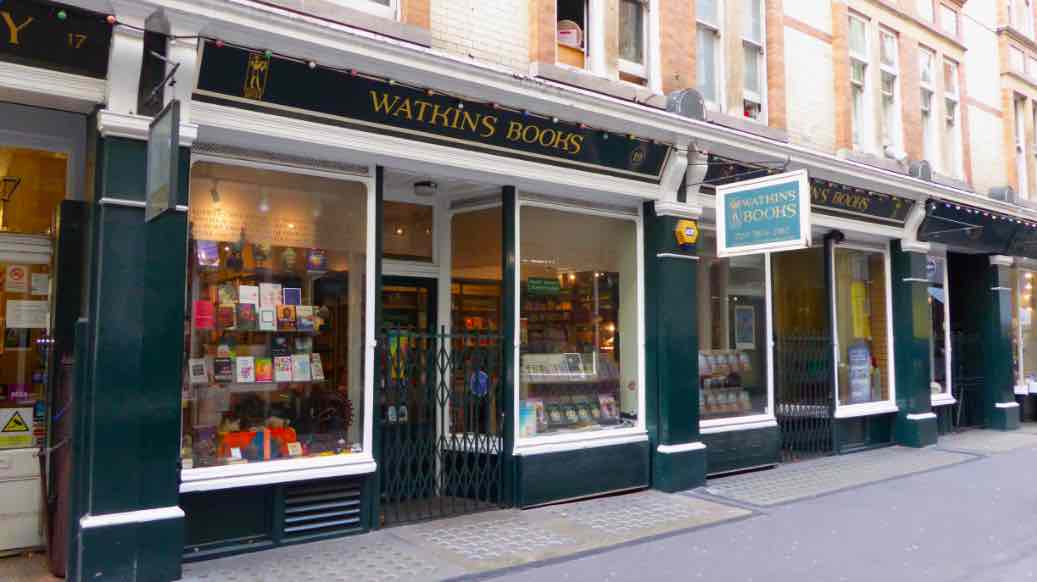
Railing against God and his [sic] role in Europe’s bloody history, he  had to escape, taking refuge in the more “amiable” tradition of Buddhism, seeking a mystical depth his guilt-ridden religious upbringing couldn’t offer. Through Christmas Humphreys he became immersed in the Zen of D.T. Suzuki. His early fascination with the Mystic East was nurtured both by his mother’s “oriental treasures” (he relished the clarity, transparency, and spaciousness of landscape paintings), and—plausibly—with Fu Manchu (for me it was The inn of the sixth happiness!). He got to know Nigel Watkins, whose bookshop he relished long before me (In my own way, pp.123–4)—aware that a lot of such literature was “superstitious trash”, he appreciated Watkins’s “perfect discrimination”. He wrote his first pamphlet, An outline of Zen Buddhism, while still a pupil at King’s School, Canterbury. Among many meetings with remarkable men [sic, as ever], he was first introduced to Krishnamurti in 1936. In 1937 he met Eleanor Everett, daughter of Ruth Fuller Everett (herself later married to the Zen priest Sokei-an Sasaki before his death in 1945); they married the following year, moving to the USA as war loomed.

Without any contradiction, Watts’s escape from the grey conformity of suburban Kent also made him “an unrepentant sensualist”. It’s all the more remarkable that he went on to train as an Episcopal priest, becoming ordained in 1945; at the time “it seemed to be the most appropriate context for doing what was in me to do, in Western society”. But unable to reconcile this “ill-fitting suit of clothes” with his inner beliefs, he withdrew from the church in 1950, and after a divorce he moved on to California. Of course, deploring missionary zeal, he was always free-floating—the ultimate trendy vicar, eagerly imbibing all the psychedelic trappings the burgeoning alternative scene had to offer from the prime position of his Cali refuge. Never one for institutions, he had an on-off relationship with academia, becoming what he called a “philosophical entertainer”—guru to the counterculture.

Watts’s 1957 book The way of Zen (1957) is a remarkable introduction to the whole subject. As he notes there:

During the past twenty years there has been an extraordinary growth of interest in Zen Buddhism.

So—just like sexual intercourse (on which he would also have much to say, based on avid participant observation—see e.g. Nature, Man and Woman [1958])—we clearly have to backdate the Western craze for Zen rather before 1963.

In parallel with Gary Snyder, Watts trod his own path, but his admiration for Snyder is clear, evinced in his writings such as the 1959 Beat Zen square Zen and Zen. And for all their discipline, they shared a delight in language and humour:

The task and delight of poetry is […] to eff the ineffable, to screw the inscrutable.

And he even relished Brazil’s balletic “gaieté d’esprit” in the 1970 World Cup! He also left a rich archive of audio recordings—many of them are on YouTube, even if some tip over into self-help or Thought for the day.

Also in England (and with a similar background in his Anglican church choir), the translator John Minford became hooked on Laozi, The Dharma bums, and later the work of van Gulik on the qin zither, as he recounts in this fine zeitgeist article. His early fascination with Chinese mysticism was less challenged than mine was to be, as I came to experience the spit-and-sawdust of folk Daoist ritual practice.

* * *

If the hippies were predated by the beats, then before them both came R.H. Blyth (1898–1964), who completed his Zen in English literature and oriental classics while interned in Japan in 1941. I’ve now devoted a separate post to him, here.

He wrote a whole further series of books on haiku, as well as on humour in Asian and English literature—main exhibit for the former being senryū, humorous counterpart to haiku. I’m not sure how much he would have enjoyed “the first English haiku”, not to mention this limerick.

Apart from Alan Watts, other devotees of Blyth’s work included Aldous Huxley, Henry Miller, and Christmas Humphreys (another challenging dinner party), all of whom I admired in turn. For Steinbeck’s and Salinger’s absorption in oriental mysticism, see here.

* * *

And before Blyth… there was Eugen Herrigel, whose 1948 book Zen in the art of archery was based on his studies in Japan in the 1920s! His later membership of the Nazi party is less advertised (see here); see also The Celibidache mystique.

Zen archer

Zen archer, Kyoto. ©Timothy Kraemer, on tour with English Concert, 1990s.

Apart from this whole fascination with Zen and Daoism, it was the Chinese characters provided in The way of Zen and Zen in English literature and oriental classics that led me to study Chinese at Cambridge, and eventually to read between the lines of dour field reports on local Chinese folk ritual, as well as seeking the unassuming wisdom of  Li Manshan. As I became involved with such grass-roots religious activity among poor rural Chinese communities, documenting their fortunes under Maoism, I came to feel rather less charitable towards traces of lofty New-Age hippy-style abstraction in studies of Chinese religion; but now that I revisit the work of such trail-blazing sages, I’m not just nostalgic, I sincerely find much to admire.


[1] Among many online sites, note http://www.alanwatts.com.

[2] He also had a fine line in limericks, often religious—work this one out, a footnote to the Salisbury (Sarum) rite (In my own way, p.67), rather in the vein of Myles’s tribute to Ezra £ (and there’s another early orientalist!):

There was a young fellow of Salisbury
A notorious halisbury-scalisbury
He went about Hampshire
Without any pampshire
Till the vicar compelled him to walisbury.

Hokkien culture: nanyin

Nanyin 1986

Nanyin, Quanzhou 1986.

In my little introduction to Chinese bowed fiddles, I mentioned the wonderful chamber genre nanyin 南音 (aka nanguan 南管), one of the most refined social activities in the Hokkien culture of south Fujian and Taiwan, complementing the riches of Daoist ritual there. The slow tempi, instrumentation, and the restrained passion of its singing style may remind us of the more plangent of medieval European ballads.

nanyin 86

Nanyin, Quanzhou 1986.

At some remove from research on performance genres in north China, this is a clear case of long-term and deep fieldwork from local scholars. I still find rather apposite my 1993 review of a wonderful Ocora CD-set of the Nansheng she group from Tainan (CHIME 7, pp.114–20), and chapter 14 of my book Folk music of China, where I gave a brief overview of the (then) state of the field. (Click here for one of several online tributes to Ts’ai Hsiao-yueh, leader of the Nansheng she group on the Ocora recordings.)

Apart from its reification for the concert stage, nanyin is deeply embedded in community life—amateur clubs, temple fairs, opera, puppetry, Daoist ritual—all within the special circumstances of rapprochement with overseas Hokkien communities, cross-strait diplomacy, and vast social and economic transformations.

Wonderful as nanyin is, alas the idea of “living fossils” has still not been erased—anyway, it’s far from alone in China in preserving an ancient tradition. And it’s worth reminding ourselves that it’s only one of a glorious profusion of performance genres even in Fujian—it occupies a mere 22 of 611 pages in the 1986 Fujian minjian yinyue jianlun by Liu Chunshu and Wang Yaohua, themselves leading proponents of the genre.

This UNESCO introduction is almost bearable, covering some of the main bases:

And among many online videos, this documentary also suggests the broader social and ritual context:

One little caveat: like a recent article on shadow puppetry (“How a bunch of Americans preserved a dying Chinese tradition”!), it’s worth registering the contributions of laowai without getting an inflated notion of their importance. Scholars like Kristofer Schipper, leading light in producing the Ocora CDs, are justly admired in China and Taiwan, but genres like nanyin are never dependent on such a deus ex machina.

Consulting Schipper’s liner notes, even in 1982, or 1993, it was far from true that nanyin was “almost forgotten in its own country”! As I commented, the statement “the positive reception of the European public led to regained esteem in China. Nan-kuan was authorised on the continent once more” is worthy of Tintin. Are we to believe that the 139 village nanguan societies in 1986 in the single county of Nan’an (to give just one example) were spurred into action by a single concert in Paris?! Folk activity (for nanyin and other genres) had even persisted throughout the years of Maoism. Meanwhile activity has continued to thrive, and research, already extensive by the early 1990s, has kept pace. A wealth of recordings is now available on CD and online. It’s exquisite music—do keep exploring!

For broader introductions to expressive cultures around Fujian, click here and here.

Ritual groups of Xushui

*Click here for main page!*
(under Hebei in main menu)

QMZ 1958

While ritual groups all around the Hebei plain survived Maoism to revive under the reform era since 1978, the county of Xushui makes a particularly intriguing case, notable both for its ephemeral fame with the razzmatazz of the 1958 Great Leap Forward and for its more long-lived ritual groups.

Despite its revolutionary image, Xushui county has remained a hotbed for religious activity, notably the cults of the sectarian creator-goddess Wusheng laomu and Auntie Silkworm Granny (Cangu nainai 蚕姑奶奶)—the latter a popular deity in this area, rarely featuring prominently elsewhere on the plain. Associations commonly display ritual paintings, like the Ten Kings and the Water and Land series, and perform vocal liturgy. They too are within the catchment area of Houtu worship—they used to make the rather distant pilgrimage to Houshan, though they more commonly visit the nearer Western Summit (Xiding 西頂) on Langyashan further southwest from Houshan. Again we found a rather complex overlap between the village-wide ritual associations, sects, and yinyuehui.

Further to my brief introduction in my post on Festivals, here I introduce some of the groups we visited from 1993 to 1996. Mao was impressively modest about his limited success when he admitted to Nixon in 1972: “I haven’t been able to change [China]—I’ve only been able to change a few places in the vicinity of Beijing.” But he wasn’t modest enough: in some ways even a county so near Beijing, such a focus of the revolution, has remained resistant to Maoist ideology, predating and outliving it.

The magic of the Zen bookshop

Watkins

Back in the Swinging Sixties, with my schooling in classics (alas, long before I might have learned from the wisdom of Mary Beard) and my growing immersion in the violin, the popular culture of the time virtually passed me by. But I found myself on the margins of hippiedom largely through regular visits to the oriental bookshops like Probsthains before the British Museum, and notably Watkins in Cecil court. Watkins was like our version of City Lights in San Francisco—to which I only got to make my first pilgrimage some three decades later.

HanshanApart from the usual suspects like the Bhagavad gita, Eliade, Castaneda, Jung, Krishnamurti, Blofeld, and The cloud of unknowing, this was the genesis of my initiation into Zen, courtesy of D.T. Suzuki, Christmas Humphreys, Alan Watts, Eugen Herrigel, R.H. Blyth, Gary Snyder, and so on—these were my bibles!

This was perhaps a not uncommon pattern for wannabe hippies, as well as future scholars of Asian culture. My own later ethnographic path, progressing by way of Tang history to documenting the tribulations of local society under Maoism and the mobiles and motor-bikes of household Daoists, may now seem almost a reproach to the lofty mysticism of those years. While I thus came to replace the romantic search for oriental spirituality (that still persists even in some areas of scholarship) with an approach more based on socio-political history and the lives of Chinese people, somehow the background of that quest also formed an enduring foundation.

Perhaps what I’m suggesting here is that a predilection for mysticism needn’t be a hindrance to more dispassionate ethnography…

See also Images of Zen.

Funerals in Hebei

*Click here for main page!*
(under Themes > Local ritual)

GL procession 95

Many descriptions of Chinese ritual sequences appear somewhat timeless, blurring variation and change. But generally I like to keep my accounts either descriptive, based on observed performances, or prescriptive, an ideal sequence recounted by elderly performers. Where I become familiar enough with the local scene I sometimes try to collate the two, as in this composite funeral sequence for one part of the Yixian–Laishui region south of Beijing.

Based on talks with senior ritual specialists there, it’s illuminated by attending (and taking part in) many funerals in this area over more than a decade. While we always seek to copy the diverse funeral manuals of each village, they can’t offer the kind of detail provided by observation of practice and the accounts of the ritual specialists themselves. In particular, my constant refrain: ritual is performance, and is expressed largely through sound—the items of vocal, percussion, and melodic instrumental music that permeate the sequence.

A gradual dilution of ritual practice has  undoubtedly occurred since the 1950s, but it’s never so simple as seeking to “restore” some notional ideal sequence from before Liberation on the basis of ritual manuals alone.

Daoist ritual in south China

Yongfu

From 2011 Hong Kong conference volume.

I go to some lengths to show how Daoist ritual and religious practice are important topics in the local cultures of north as well as south China (for a succinct encapsulation of the chasm, see here). But every time I feel I’m establishing some kind of parity for the north (heartland of ancient Chinese culture!), yet more research materializes to remind us just how amazing local ritual traditions are in the south—in terms of both the range and complexity of rituals performed, and the sheer volume of artefacts preserved there.

As I commented in Appendix 1 of my book Daoist priests of the Li family (where you can find further references),

With the noble exception of studies by Chinese music scholars from the 1930s, fieldwork on local Daoist ritual began in earnest in the 1960s with Kristofer Schipper’s groundbreaking studies in Taiwan. As mainland China began opening up in the 1980s, such work was able to expand first into Fujian and then further afield in south China—Jiangxi, Guangdong, Sichuan, Hunan, Zhejiang, and so on. Major projects (largely in Chinese), led by the indefatigable holy trinity of C.K. Wang, John Lagerwey, and latterly Lü Pengzhi, recruited local cultural workers who went on to develop considerable familiarity with the ritual specialists who were their subjects.

  • Wang, C.K. [Wang Ch’iu-kuei 王秋貴] ed., Minsu quyi congshu 民俗曲藝叢書. Taipei: Shi Ho-cheng Folk Culture Foundation, 86 vols (building on an extensive series of articles in the journal Minsu quyi).
    See also “The collecting and editing of Taoist ritual texts.” CHINOPERL Papers 23 (2000), pp.1–32, and Studies in Chinese ritual, theatre and folklore series: abstracts of the first sixty volumes (1997).
  • Wang, C.K. ed., Zhongguo chuantong keyiben huibian 中國傳統科儀本彙編 (Taipei: Xinwenfeng), 17 vols.

For useful reviews in English of the early projects, see

  • Daniel L. Overmyer, ed., with the assistance of Shin-Yi Chao, Ethnography in China today: a critical assessment of achievements and results (2002),

and for a fine overview of such work within the wider context of Daoist studies,

  • Vincent Goossaert, “L’histoire moderne du taoïsme: État des lieux et perspectives.” Études chinoises XXXII-2 (2013), pp.7–40.

These vast series continue to yield further discoveries. The latest project, from Xinwenfeng in Taiwan (long an industrious publisher of major works on Daoism) is initially (!) planned to comprise fifteen lengthy monographs:

The southern bias of Daoist studies has a long ancestry: from very early in Chinese history, southern Daoists have dominated the picture. The ritual vocabulary that I provide in my writings on north China is partly an attempt to rebalance a picture largely conditioned by southern Daoism (see also my In search of the folk Daoists, pp. 15–21, 211–213). As I note there,

It is rather as if our knowledge of Christianity in the whole of Europe were based almost entirely on Sicily and Puglia, with the odd footnote on the Vatican and Westminster Abbey. We may like what we find in those places, perhaps considering it more exalted, mystical, and ancient—but that is another issue. (For a similarly rash comparison between Taiwan and the PRC, see note here).

Still, the material here is overwhelming. So far three volumes (each consisting of around 1,500 pages!) have been published in this new series, on local Daoist altars in Jiangxi, Hunan, and Fujian respectively:

  • Dai Lihui 戴禮輝 and Lan Songyan 藍松炎, Jiangxi sheng Tonggu xian Qiping zhen Xianyingtan daojiao keyi 江西省銅鼓縣棋坪鎮顯應雷壇道教科儀 (2014)
  • Lü Yongsheng 呂永昇and Li Xinwu 李新吾, Shidao heyi: Xiangzhong Meishan Yangyuan Zhangtande keyi yu chuancheng 師道合一:湘中梅山楊源張壇的科儀與傳承 (2015) (for Hunan Daoism, see my overview here)
  • Ye Mingsheng 葉明生, Minxinan Yongfu Lüshanjiao chuandu yishi yanjiu 閩西南永福閭山教傳度儀式研究 (2017).

Ye Mingsheng is one of the most distinguished collaborators of the project, having worked for decades on Lüshan household Daoists of Fujian. This new publication focuses on ordination rituals in Yongfu in the southwest of the province. As John Lagerwey writes in his Abstract:

The present book begins with an investigation of the histories of the Daoist altars of four lineages […] in Yongfu. It systematically examines the origins of the local Lüshan school, the structures of their altars, and their rituals, manuscripts, talismans, and registers. It also describes in detail two actual Flag-Raising Transmissions in the years 1999 and 2011, discussing all aspects of the transmission ritual from a variety of disciplinary angles so as to provide students of religion with as complete an understanding as possible.

Volume 2 provides a wealth of ritual texts. Among the many photos is a substantial section in colour, including beautiful god paintings.

Yongfu picsStill, even photos of ritual practice remain silent and immobile. Given that ritual is noisy and vibrant, part of “red-hot” social performance, the whole project seems to cry out to be accompanied by films. Since the scholars working on these projects have rich archives of fieldwork videos, how very valuable it would be to accompany each topic with an edited film of, say, two or three hours, with voiceovers and/or captions.

As I observed here, all these series (like the “music-genre” system of Yuan Jingfang), while documenting particular rituals in detail, focus on the salvage of texts—at the expense of ethnographic study, performance practice, and social change (an approach deriving largely from the study of Daoist ritual in Taiwan). Now, faced by such a wealth of precious manuscripts it’s no simple task to incorporate the topic into wider discourses on a society in constant change. But many students of religion, for whom social and political changes over the past century are a major topic, may find that “variety of disciplinary angles” elusive. They may miss even succinct discussion of how local ritual traditions have been affected by such mundane issues as migration, successive political campaigns, and changing economic circumstances—all the more since the subject of this new volume is transmission, utilising field material from 1999 and 2011, through yet another period of change. [1]

Still, none of this detracts from the value of the project. This vast body of work on local ritual in south China continues to form the vanguard of Daoist ritual studies—essential material on Chinese religion.

For broad introductions to expressive cultures around Fujian—based on ritual—click here, including references to the fine writings and film of Ken Dean, one of few scholars of Daoist ritual to encompass modern social change; and Fujian: instrumental groups as a gateway to the study of ritual. See also Religious life in 1930s’ Fujian, and More films on ritual drama. And for a recent monograph in the series, click here.


[1] For basic biographical accounts of the Yongfu Daoists, see pp.79–103.

Sects in north China

Shanxi sect

In Chinese religious studies, fieldwork and historical study of texts should be complementary. While the changing ritual scene in rural north China over the past century has largely been left to musicologists, Cao Xinyu 曹新宇 (People’s University, Beijing) continues his fine work on the imperial ancestry of sectarian groups, setting forth from the seminal research of the great Li Shiyu, and studies like those of Ma Xisha and Han Bingfang (see here, in a useful site for Qing history)—all similarly utilizing fieldwork.

Sects are a poor cousin to research on more open forms of institutional religion, but—like spirit mediums—an important part of the picture. While I constantly stress the sectarian connections of ritual associations on the Hebei plain, as a counterbalance to the current secular image portrayed by the Intangible Cultural Heritage, highly worthy of study is Cao Xinyu’s recent book

This continues his voluminous work on the Way of Yellow Heaven, Minjian sizang Ming-Qing mimi shehui shiliao xiezhen: Huangtian dao juan 民間私藏明清秘密社會史料擷珍, 黃天道卷 (2013).

It’s high time to bring into contact the two strands of historical research and fieldwork on the modern fortunes of the bewildering variety of groups that we find around north China—such as Hunyuan, Hongyang, Huangtian dao, and Laofomen. This is a major task for fieldworkers, including music scholars. [1]


[1] For now I’ll leave you to compile your own lists for Western-language studies, such as Weller, Ownby, Overmyer, Palmer, ter Haar, DuBois, and so on—a valuable resource is the rubric in Philip Clart’s essential bibliography.

Ritual groups around the Baiyangdian lake

*click here for main article!*
(under Hebei in main menu)

Ritual groups around the Baiyangdian lake:
the Medicine King cult

Zhaobeikou lake

On the Hebei plain, just south of the Xiongxian region, the Baiyangdian lake, and the ritual catchment area of the pilgrimage to the Medicine King temple in Maozhou, form a somewhat distinct area for ritual practice. This is highly topical since it is now part of the vast plan to build a megapolis there, expanding Beijing and Tianjin southwards amidst profound social and ecological change.

This was the southern boundary of our project on the Hebei plain, where we had found so many complex liturgical sequences, ritual manuals, and grand shengguan instrumental suites with scores derived from the temples of old Beijing and Tianjin. Xiongxian turned out to be the heartland of the suites and scores, but around the lake just south, despite the lively Maozhou cult, the trail was becoming somewhat diluted—and I don’t believe this is merely because our visits predated more in-depth stays in the areas further north and west. Still, these associations were very much based in ritual and shengguan, and dated back to at least the 18th century.

This survey introduces ritual groups all around the lake, including villages of Anxin, Renqiu, and Gaoyang counties. The aquatic setting engenders plentiful rituals based on “releasing river [or lotus?] lanterns” (fang hedeng 放河/荷燈).

As ever, this article merely scratches the surface of our fieldnotes—themselves just a superficial survey of some village associations that came to our attention. There may be many more, and certainly were until the 1950s. Any one of these groups (and indeed the Maozhou temple) could, and should, form the subject of a detailed diachronic ethnography such as I did for Gaoluo.

Around the Baiyangdian lake we found further evidence for the connection not only with Buddhist monks and Daoist priests but also with the ritual and musical cultures of the Qing emperors in Beijing—a link that appears occasionally throught the Hebei plain, such as Yixian, and strongly suggested in Xiongxian just north.

Back in the mists of time, long before the internet, or even usable landlines—the 1990s—this ritual system still comprised the main cultural network of such regions. Having survived Maoism remarkably unscathed, there are complex reasons for the long-term decline of these associations—including not so much the recent urban development plan for the region, but migration, the whole commodification of society, and the secularizing pressures of the ICH. These notes are valuable for documenting local ritual life at a time when such transformations were still in their early days.

Guide to a year in blogging

LMS

After a year of frenzied blogging, here’s a seasonal retrospective guide to navigating a diverse ouevre—as much for my sake as as for yours. Meretricious and Happy New Year!

Call me a nerd [You’re a nerd—Ed.], but taxonomy and indexing are so funky… As you see from the (updated) homepage, the whole site began as an introduction to my work on the Li family Daoists, and my portrait film remains one the most enchanting presences there. The Li family has its own category in the sidebar, with a plethora of articles (not least a whole series on our French tour in May 2017, and an update on Li Bin’s diary).

Other pages in the top menu also tend to be rather substantial, with

Still in the top menu, MY BLOG contains all my myriad posts (“delighting in all manifestations of the Terpsichorean muse“), with helpful Categories and Tags in the sidebar, as well as a monthly archive there. Here are some of the more stimulating:

As you can see from this post alone, I just love doing internal links (in blue in the text). So whether you first came here for Daoist ritual, football (indeed, Daoist football), punk, Bach, modern China, or even just for the jokes, they’re all connected, so please do click away on the links!

Last but, um, not least, do click on the links to the relevant posts and pages in the photos in the sidebar.

Nuns of rural Hebei

*For main page, click here!*

Renqiu nun

In traditional China, ritual activity—indeed, public appearance altogether—appears to be male-dominated. But the role of women in religious life is significant—as worshippers, as members of amateur sects, and notably as spirit mediumsNuns hardly threatened the patrilineal traditions of ritual and instrumental music before the 1950s, but they make an interesting sub-plot.

Moving south from Beijing and Fangshan to Laishui county, this article goes on to gives vignettes (based on brief chats in 1994) on the ritual life of two elderly former nuns in a village in Renqiu county, near the Baiyangdian lake, half a century earlier. Such absorbing glimpses into the world of rural nuns before Liberation deserve including in our picture of local cultures.

The Long March, Bach and Daoist style

In 1705 the 20-year-old Johann Sebastian Bach set off from his home in Arnstadt to walk 250 miles to Lübeck, there to meet his hero, the composer and organist Dietrich Buxtehude.

Bach is compulsory Radio 3 listening over Christmas, and apart from yet another excursion on Composer of the week, Horatio Clare’s series Bach walks makes fine slow listening, taking the walk in five episodes, punctuated by musical snippets that seem all the more miraculous. And it stands in tranquil contrast to the hectic claustrophic life that he was to lead through the years of his greatest creativity in Leipzig.

What makes such a modern retracing of Bach’s steps so thoughtful is all the social detail that can be incorporated, along with Clare’s reflections on the present landscape. Bach had actually walked a similar distance when he was 15 to enroll in St. Michael’s School in Lüneburg

By now you won’t be surprised to learn that this reminds me of the Li family Daoists.

Early-18th-century Germany was more advanced in transportation than rural China in the 1930s, or even the 1980s. And by contrast with many more adventurous composers of the day, Bach spent most of his career employed in a rather small radius within Thuringia and Saxony.

From my Daoist priests of the Li family (pp.12–13):

Since ancient times, elite Daoists travelled widely over China to famous temples and religious mountains, seeking the wisdom of other sages and propagating new revelations. One such master was Kou Qianzhi (365–448), who served the court of the Northern Wei dynasty at their capital Pingcheng (modern Datong), and who is often wheeled out by scholars as an instance of the illustrious ancestry of Daoist ritual in north Shanxi. Still today, temple Daoist priests commonly spend periods “cloud wandering” around the main urban and mountain temples.

By contrast, household Daoists are active within a small radius (see map here). Even those who spent their youth as priests in temples before the 1949 Liberation did so only locally—like several boys in Upper Yinshan village in nearby Tianzhen county, who learned their ritual skills in a temple just further east. Occasionally the Li band is invited to do rituals further afield—just east in Hebei or north in Inner Mongolia. Li Qing and the elders used to walk for a whole day to do Thanking the Earth rituals for patrons in Inner Mongolia, because around eighty percent of the Han Chinese population there had migrated from Yanggao, some of whom were quite affluent. But the main area of their work is defined both by walking distances and by the availability of Daoists elsewhere—north around the county-town, west in Datong county, and east in Tianzhen. So even now, with motor-bikes and cars, most of their ritual business is still in the districts of Shizitun, Houying, Baideng, and Pansi. They work quite often just further south in the districts of Gucheng and Lower Shenyu, and sometimes in Dongxiaocun district and in the west of Tianzhen county. But they rarely perform rituals in west Yanggao, or further north in North Xutun district or around the county-town where other groups of Daoists are available.

(pp.154–5):

Until bicycles became generally available from around 1980, people had to walk everywhere, or go by ox-cart, equally slow. Li Manshan recalls wryly, “We didn’t even have Chinese carts (tuche), let alone foreign ones (yangche)!” Occasional visits to the county-town on foot took over three hours. Li Manshan went occasionally before the Cultural Revolution; he recalls walking there with his aunt in 1954 to watch the grand Offering Tribute (xiangong) parade on the 24th of the 6th moon, which was by then a purely secular event.

cart

Horse-cart on the way to Gaoluo, 1989.

For a funeral twenty-five Chinese li away, walking at roughly ten li an hour, the Daoists had to set off at 4am. The hill villages to the east were not so far, but the climb took longer—when Wu Mei was learning with Li Qing in the late 1980s it took him a whole hour to walk from his home in Renjiayao, only five li away. Most gigs might be in the nearby villages, but for longer journeys the more elderly Daoists might send their fitter younger sons and disciples. When the Daoists were invited for funerals a long walk away, there was no need to get the Lis to determine the date on the death, or decorate the coffin—there were men available locally for such tasks.

Until the 1980s when there was a death, the son would walk to Li Qing’s house to invite him to do the funeral—and was then quite likely to learn that he was doing a funeral in another village and to have to make another trek by foot there. From 1980 to 1990 he could make this search by bicycle, and then perhaps by motor-bike; since around 2002 he can just call up Li Manshan on his mobile.

I was amazed to read that bicycles were already common in some central Shanxi villages by the 1930s [1] —perhaps a hint of how much poorer Yanggao was than areas further south. In the countryside here, most people only began riding bicycles around 1978; before that only some village cadres had them. Li Qing rode a Red Flag bike from around 1981. With a bike costing around 150 kuai, and a Daoist earning 6 kuai per gig, or over 70 kuai a month, one bike cost at least two months’ earnings. In Baideng town, Daoist Wang Xin set up a little stall mending bicycles.

Actually, bicycles speeded up mobility only slightly; in the countryside there was still nothing quite resembling a road, the tracks being deeply rutted until transport arteries began to improve significantly since around 2003. And neither bicycles nor motor-bikes have significantly expanded their radius of activity; they continue to work mainly within a small area.

I also reflect on walking within a funeral (pp.27–8):

In order to allow for a suitably lengthy and imposing procession, the house chosen for the scripture hall should be at a considerable distance from the soul hall where the rituals are performed. Indeed, since the scripture hall is on average around half a kilometer away, they potentially have to walk—playing all the while—seven kilometres a day for the seven routine visits alone, let alone other processions from the scripture hall to the soul hall before leading the kin to the sites for the other public rituals, and again next day for the procession towards the grave. Apart from anything else, this is good exercise.

IMG_2794 - Version 2

Over the day the Daoists make seven processions from scripture hall to soul hall and back, as well as processions to the other ritual sites.

But once at a funeral in nearby Yangyuan county I was surprised to find the scripture hall very near the soul hall—and this turns out to be an older custom, so that the Daoists would be on hand to respond promptly for the many rituals once needed. Since the 1980s there is less need for this, and Li Manshan observes that the recent distance also serves to marginalize them. But it is also welcome so they can escape from the din of pop and get some peace.

[1] Harrison, The man awakened from dreams, p.156. Cf. Friedman, Pickowicz, and Selden, Revolution, reform, and resistance in village China, p.228; Harrison, The missionary’s curse, p.145.

Strictly north Shanxi Daoist ritual

Don’t get me wrong, I’m glued to Strictly come dancing every week. Oh yeah, I’ve got my finger on the pulse of popular culture all right [adjusts monocle, grappling ineptly with concept of the high-five]. I was mortified in 2015 when Georgia and Giovanni (aka Joe Varney) didn’t win:

Or indeed Alexandra in 2017… But hey, “It’s not winning but taking part”, eh [zzzzz].

And now the brilliant Stacey Dooley—who did win, YAY!!! (See also Moon river.) Here’s another Charleston. Now let’s all watch her fine documentaries.

The thing about Strictly is, as with Handel opera, or a Moroccan wedding, you just have to suspend your disbelief. The dancers don’t want to go home, but for some reason they do want to go to Blackpool, which is unlikely to feature even on the itinerary of perfectly innocent Russian tourists. Li Manshan hadn’t even heard of the Carnegie Hall, let alone Blackpool, but it’s clearly more appealing than doing a Messiah in Scunthorpe.

Sure, as Barbara Ellen notes in a fine reviewStrictly proved yet again

that it understood its own winning formula—drown the contestants in a vat of fake tan and what a cynic might term even faker bonhomie, and let the controversy and sequins fly. […] A sugar-rush of schmaltz combined with a brawl on the entertainment deck of a cruise ship…

But for me it’s classic BBC “educate, inform and entertain” stuff—inculcating diligence, expression, and appreciation of historical style (!), with the pros and the judges vouchsafing us little dollops of technical advice. For all the fatuous clichés of the competitive format (see also Alexei Sayle‘s pertinent critique), Strictly can be inspiring and deeply moving. So there. And for 2020, Bill Bailey reaffirms our belief!

Still, my question is this:

However were we all conned into thinking that a genre that seemed pathetically antiquated even in the early 1960s could possibly achieve such wild popular success in the 21st century?

This baffling device of prefixing an unlikely and outmoded format with an utterly random adverb gives me an idea whose time has surely come:

Strictly north Shanxi Daoist ritual

After all, Daoist bands have long been used to ritual competition, “facing platforms”. In my film (from 24.08) my use of karaoke captions for the percussion mnemonics makes an instructive innovation that draws us into a crucial element of ritual performance. And we’ve just had “The Reverend Richard Coles” on Strictly, so hey. My new programme concept has got everything from the original—a grand ritual arena, movement, costumes, music… And since, as Heidi Stephens notes in her drôle Guardian commentaries, what viewers really need is a Journey, what better than Pacing the Void?

Admittedly, even with a minimum of six ritual bands contesting, each performing a different ritual segment for each programme (Presenting Offerings, the InvitationBeholding the Lanterns, and so on), the weekly programme would require at least four hours—and the nocturnal yankou ritual alone takes longer than that. Still, BBC ratings will doubtless soar.

Coming up next—we’ve got Du Zhimin’s band all the way from Guangling, performing the Ambulating Incense ritual!!!

I’ll be delighted if the drôle Claudia Winkleman will host the new show. As to

THE JUDGES…,

the fragrant Darcey Bussell [surely an anagram, e.g. “Recall Debussy”—cf. Gran visits York and Maidstone] is always welcome. How can anyone be so elegant and savvy and still be English? Her only tiny flaw seems to be that she can’t get the hang of clapping (watch her as she applauds couples just voted off). And now that the great Li Manshan is ceding much of his ritual work to his son Li Bin, he seems the ideal choice as chair of the judges.

Some quotes from the panel:

Darcey [purring]: “Oh MY! I have to say, just make sure you grade that accelerando in Yellow Dragon Thrice Transforms its Body just a tiny bit more carefully.”

Bruno [does pirouette]: “Bellissimo! But you still need to work on your posture, dahlingg.”

Li Manshan [dragging on fag], in unison with Craig: “That was chaotic!”

And the scores are in

I look forward eagerly to discussions with the BBC. [1]

See also Fantasy Daoist ritual.

* * *

Another Daoist-ritual spin-off might be to adapt the brilliant “One song to the tune of another” from I’m sorry I haven’t a clue. One recent fave was Jan Ravens singing the words of I can’t get no satisfaction to the tune of Wouldn’t it be loverly—and click here for Barry Cryer with Anarchy in the UK to the tune of Singing in the Rain.

The Daoist version might go something like this:

 [Jack Dee, or indeed Li Manshan, lugubriously:] “Now I’d like you to sing words of The Song of the Skeleton to the tune of Diverse and Nameless are the Bitter Roots…”*

*Tedious footnote: at least in Yanggao vocal liturgy, these two items are in fact quite closely related (my book, pp.267–8, 274–5)—so less than suitable here. Scope for exploration, though.

Such impertinent fantasies, if not for purists, are at least more frankly ironic than the kitsch commodifications from the Intangible Cultural Heritage (see under “The reform era” here).

For Groucho and Anna Mahler, click here.


[1] Inexplicably, I still await a reply from the BBC  to my initial pitch, Strictly Albanian Dentistry—where peasants attired in colourful traditional costumes have just a week to learn a series of intricate procedures such as implants and root-canal treatments (cf. Alan Partridge). But following the public verdict on the moral morass of the Strictly dance/snog of shame—a quandary that will be mercifully obviated by Strictly north Chinese Daoist ritual—there’s (allegedly) a letter in the post from the Beeb about my new concept:

letter

For another money-spinner of mine, see here.

Ritual groups of Xiongxian, Hebei

*Click here for main page!*
(under Hebei in main menu)

GGZ xu 1

Through the 1990s, one of the most fruitful sites for our fieldwork project on the Hebei plain south of Beijing was the area around Xiongxian county, just south of Bazhou, and east of the regional capital Baoding. Recently this whole region has become the centre of a vast and radical new development project to expand metropolitan Beijing; but when we used to visit, it was still very much rural.

As throughout the region covered in this growing series on Hebei, most villages here had ritual associations until the 1950s, and we found many still active in the 1990s. But here we found less vocal liturgy than further north and west on the plain, with no foshihui groups reciting precious scrolls.

Instead, ritual services were now mainly represented by the “holy pieces” of the shengguan wind ensemble to “revere the gods”—here an exceptionally rich repertoire based on long suites related to those of the temples of old Beijing. Not all these groups were still performing, but there is rich material here, not only on the ethnography of local ritual in modern times, but for scholars of the late imperial period.

This is the latest in a series on ritual in Hebei that includes Houshan and the precious scrolls, suburban Beijing, and Bazhou.

Bazhou: an update!

Xin'an guanzi 1989

I’ve just updated my page on Bazhou, one of the most rewarding counties on the Hebei plain for the study of ritual groups, with some more photos and subtle edits…

To remind you, this is part of a major series under local ritual where I move from occupational household groups in north Shanxi to amateur (mostly village-wide) associations on the Hebei plain, and thence to some other regions of north China.

Just for the Hebei plain, the list (sub-menu under Themes > Local ritual in the top menu) also includes

All these fieldnotes relate to articles on temple ritual in old Beijing (including the Zhihua temple), and the village associations of Gaoluo and Qujiaying.

Ritual groups around Bazhou, Hebei

*Click here for main page!*
(under Hebei in main menu)

Xin'an Yingming drummer 1995

What a wonderful fieldsite we stumbled across in 1986, inspired by Yang Yinliu and Lin Zhongshu!

This is a new addition to a budding series on Daoist and Buddhist ritual groups on the Hebei plain south of Beijing. The elongated county of Bazhou lies just south of Langfang, Yongqing, and Gu’an. Rather as I did for the southern suburbs of Beijing, here I introduce two main ritual groups:

  • the Daoist tradition of Zhangzhuang village comes from a former Orthodox Unity temple;
  • the Gaoqiao village association nearby derives from a former Buddhist temple.

As we move south and east from Houshan, vocal liturgy tends to become subsidiary to the magnificent “holy pieces” of the classic shengguan wind ensemble deriving from the temples of old Beijing—notably the lengthy suites (daqu) whose most majestic form is to be found around Xiongxian county (major page here!).

And as this series of articles on local ritual expands from north Shanxi to Hebei, it’s becoming something of an alternative, grass-roots, history of 20th-century north China through successive social and political vicissitudes.

Useful ideas for Christmas

The time of year is rapidly approaching when you’re desperately racking your brains for a present for that difficult uncle who’s got everything—even Dame Kiri Sings the Sex Pistols’ Greatest Hits by Candlelight.

Well, look no further—my three former Ashgate books (two with DVDs) are out in paperback! (See also my Amazon list).

And to go with my film (a welcome change from Bambi), don’t forget Daoist priests of the Li family.

To cite The Messiah:

Thou art gone up on high; Thou hast led captivity captive, and received gifts for men

Giving Handel and his librettist Jennens** the benefit of the doubt for sexist language, don’t forget the brilliant T-shirt of female composers—”Breaks the ice at parties”, in the words of Monty Python (who did rather let themselves down* on gender equality).

Such seasonal gifts will make a welcome change from socks and after-shave, and can be enjoyed over a sherry in a party hat while blowing a paper horn—a relative of the vuvuzela, perhaps? Laurence Picken could have enlightened us. You can play the party game of identifying festive toy instruments under the Sachs-Hornbostel system (or play Spot the Difference with Daoist ritual paintings, like the Judgment Officers here). The paper horn also evokes the conch in Daoist ritual—indeed, it would make a suitable companion to these early Daoist instruments of the Li family.

horn

* “Let themselves down”: apart from the Proust sketch (from 2.14, notably the voiceover comment “golf’s not very popular round here”), there’s also the classic headmaster’s speech joke.

** Good to see Jennens slagging off Handel’s music, at least:

“I shall show you a collection I gave Handel, called Messiah, which I value highly. He has made a fine entertainment of it, though not near so good as he might and ought to have done. I have with great difficulty made him correct some of the grossest faults in the composition; but he retained his overture obstinately, in which there are some passages far unworthy of Handel, but much more unworthy of the Messiah.

YAY!—I mean Hallelujah. Praise be to the Lord—and the Three Pure Ones, the Empress Houtu, Bob Marley, Mrs Cratchit and The Ten Kinds of Orphan Souls [can someone check this please?—Ed.] and the Thunder Lord of Three-Five Chariot of Fire—the latter (“Lingguan smoking a posh foreign cigarette on a train journey through his spiritual domain”) a fine read, though I say it myself.

Ritual paintings of Li Peisen

***For main page, click here!***
(under Images: Li family, in main menu)

LPS 5

Until the 1950s, household Daoists in north Shanxi displayed paintings for funerary, temple, and other rituals—notably of the Ten Kings (cf. Hebei), as well as representations of deities worshipped during other funerary rituals like the Pardon. Such images are now rarely displayed, and I have found few in the collections of Daoist families. Many were casualties both of political campaigns and a more general impoverishment of ritual practice.

One exception to this (recent) paucity of images in north Shanxi is the array of paintings handed down by the great Daoist Li Peisen (1910–85) to his son Li Hua. Some he seems to have painted himself, perhaps in the 1940s; others appear to be rather older.

In the main article I reflect on the specific use of such paintings in space and over time, and their subsidiary role to the ritual soundscape.


Ronnie again

UPDATE: Cosmic Justice has at least temporarily proved itself amidst a troubled world—I wrote this in the early stages of the UK tournament, but now Ronnie’s won it yet again in another inspiring display!

Ronnie

With his natural grace, Ronnie O’Sullivan is often compared to Roger Federer, but he’s in a league of his own, transcending sport. If you haven’t watched his maximum break from 1997, then do—it’s not merely a world record that is likely to stand for all time, but a thing of exquisite fluent beauty, reminiscent of the nuanced touch of a great musician.

After the morose introspection of yesteryear, Ronnie has come through the early years of obsession and addiction (lessons here for the claustrophobic hothouse of WAM virtuosos), and he’s on great form these days, with a kind of earthy Daoist detachment.

I list my series on Ronnie here.

Ritual groups of suburban Beijing

***For main page, click here! ***
(under Hebei in main Menu)

N. Xinzhuang funeral 1

In the 1990s, ritual activity in the southern rural areas of the municipality of Beijing was patchy. While we found few ritual associations in the counties of Gu’an, Fangshan, and Zhuozhou south of the city, the groups in the suburban counties of Daxing and Tongxian, southeast of Beijing, were still actively providing ritual services.

Like other associations on the Hebei plain, these groups have ongoing ritual traditions, and clear links to Daoist priests and Buddhist monks. But these groups are distinguished by their proximity to Beijing, and by the fact that many groups acquired their ritual only in the 1950s, as laicized clerics sought to transmit their knowledge to villagers. Thus although they are not “old associations”, lacking the early history of most village groups that we found just further south on the plain, they clearly reflect temple traditions of ritual, relating to Beijing and Tianjin as well as to local networks. Again by contrast with most of the amateur village associations elsewhere on the Hebei plain, many of these groups don costumes for rituals, and accept fees.

This whole region was still largely rural when we made fieldwork trips there in the 1990s, but has since been absorbed into the ever-expanding urban sprawl of suburban Beijing—as indeed are villages further south on the plain, where we found many more ritual associations. In a physical and moral landscape that has changed constantly since the 1930s, restudies are always to be desired.

There are many such groups here, but in the article I focus on two:

  • The Lijiawu Daoist group, derived from the temple priests of Liangshanpo, and
  • the Buddhist-transmitted group of North Xinzhuang nearby.

This article also complements my various posts on Beijing temples and the transmissions south to villages like Qujiaying.

Ritual images: Gaoluo

***For new page, click here!***

GL Dizang

This first page under a new series on ritual images again concerns Gaoluo.

Apart from their ritual manuals and gongche solfeggio scores, all four ritual associations in North and South villages of Gaoluo have collections of images, including god paintings, diaogua hangings and donors’ lists, from various stages since the 19th century—displayed for calendrical rituals of the village community.

Ritual paintings of north China

***For main page, click here!***
(under Themes, in main Menu)

SGL old pantheon detail

For aficionados of visual culture:

The main focus of our fieldwork on the Hebei plain through the 1990s was the ritual performance of amateur village-wide associations there. But of course we also documented the material artefacts of these groups—including ritual manuals, gongche solfeggio scores for the shengguan wind ensemble, donors’ lists, and so on.

I now realize that by comparison with elite painting, temple murals, and so on, what we may call “folk art” is not so well represented—either in print publications or online. So this is a new sub-menu for ritual paintings of village groups, mainly from Hebei. I’ve already included some of them in various posts/pages, but now I’m adding many more (mostly from the period since the late 19th century, but also some painted since the 1980s).

Most of these images are displayed for calendrical rituals (notably the New Year) and/or for funerals—the Ten Kings images are used for both.

Of course, these material artefacts are a sub-theme; our main material consists of a rich archive of audio and video recordings of ritual performance. Contemplating such images in a museum is a last resort: they are the backdrop to the ritual soundscape of vocal liturgy and “holy pieces” of shengguan wind ensemble, and a representation of the changing spiritual life of local communities. As you digest these pages, you might even listen to the items of vocal liturgy and shengguan on the playlist in the sidebar, with commentary here).

Sacred river

Radio 3 doesn’t seem to be speaking to Radio 4.

Like Neil MacGregor’s thoughtful series on German history, his new BBC Radio 4 series Living with the gods is typically urbane and engaging. As he immediately disarms my reservations about material culture and museums, the series makes an accessible mission-statement for the anthropology of religion. And the BBC Radio 3 marathon Sacred River (see also the love-in on https://twitter.com/bbcradio3), the latest of many epic broadcasts, seems like a fine idea to complement it.

I’m most reluctant to cavil at my favourite radio station, and normally I’d be grateful for such a playlist of glorious music (cf. my paeans to the Proms). But it seems something of a retreat from the global perspective of MacGregor’s series. Whereas in Living with the gods he can discuss social contexts, with music examples making evocative soundbites, it’s proved less easy for a programme of “spiritual music” tailored to a Radio 3 audience to address world soundscapes within their regional societies.

Radio 3 is generally rather good on, um, world music (a tradition going right back to David Munrow), but here Neil MacGregor’s stimulating introduction is soon deflated, as one “masterpiece” of (let’s face it, Christian Europe) WAM choral music follows another. My own blog is full of Bach, Mahler, and Messaien—but in Sacred river, whereas one might wish for more challenging juxtapositions from around the world, here a mere five out of fifty tracks are devoted to other world genres (and that’s a generous count: OK, a bit of plainchant, but Ladysmith Black Mambazo? Trio da Kali with The Kronos quartet? Hey!), choices like the Pathétique symphony or the Allegri Miserere hardly open our ears to new horizons. It’s The Great Composers in a new costume. And though “music and ritual” is a rich topic in ethnomusicology, the site offers few links to further sources—even from its own output.

Inevitably, I think of the percussion coda Yellow Dragon Thrice Transforms Its Body of the Li family Daoists, that concludes their Transferring Offerings ritual. Of course neither this nor most other ritual traditions around the world might work on the radio on their own. But listeners deserve more than the Usual Suspects like qawwali, “Find your inner peace with the sound of Buddhist chant”, and “the oldest song in the world”. Sure, they might not necessarily conform to the hackneyed message of Peace and Love, that cramped ghetto from which Neil MacGregor rescues us. But if the Radio 3 team had half his imagination (as I write, he’s discussing royal power, sliding effortlessly from Zadok the priest to bronzes from Benin and China, with asides on Trump and Putin), they could have found more stimulating and offbeat tracks, even from their own archive—aboriginal dream songs, ritual shawm bands, Andalucian saeta, gospel, you name it. So Sacred river ends up undoing the fine work of Living with the gods. Do keep exploring Radio 3, which is full of creative programming—including—such as Late junctionWords and music, and notably The listening service.

Of course, what it needs is a TV series. Alas, since a little heyday in the 1980s there has been little appetite for informed anthropological documentaries on local cultural life—in which ritual features prominently.

Hey-ho. Just saying, like…

The Houtu precious scroll

*Click here for link to page!*
(again, under Themes > Local ritual in top menu)

Hot on the heels of my article on the Houshan Daoists, we need a rather more detailed account of the “precious scrolls” (baojuan 寶卷) [1] performed by amateur ritual groups on the Hebei plain.

The four ritual associations of South and North Gaoluo all have early copies of precious scrolls on several themes, but what they, and I, consider their most exquisite volume, the Houtu scroll, was copied only in 1943 (see my Plucking the winds).

While the Ten Kings scroll was commonly recited for funerals until the 1964 Four Cleanups campaign, the Houtu scroll was performed for calendrical rituals—notably the New Year and Houtu’s own festival around 3rd moon 15th, either on Houshan or in the home village (playlist, track 6, and commentary).

The whole point of these precious scrolls is that they are performed for rituals—they’re not musty tomes to be read silently in libraries. And their performance practice—in the hands of peasant ritual specialists—transpires to be rather complex. As I always say, one can hardly study ritual without focusing on how it sounds.

This article is based on my In search of the folk Daoists of north China, Appendix 3, which contains further refs.

HTJ image


The Houshan Daoists

*Click here to read page!*

So far, most of my pages on local ritual have described traditions in Shanxi. The province of Hebei, surrounding Beijing, may seem “too close to home”, lacking the romantic image of either the ethnic minorities or the barren northwest, but it is a remarkably fruitful site for fieldwork.

While the topic belongs with my pages on Gaoluo (under Other publications), I’ve put it under Local ritual, since it sets forth from the lives of Daoist priests.

You can find background on the Hebei plain south of Beijing by consulting the many sources in my introduction here, but one major site in our fieldwork on ritual life there was Houshan 后山, in Yixian county, centre of the cult to the female deity Houtu 后土, whose temple fair I’ve already outlined.

This sketch of the Complete Perfection Daoist priests of the temple there on the eve of the 1949 Liberation again illustrates their close connection with the ritual life of local villagers. In a (lavishly illustrated!) article I introduce the Houshan priests; the village ritual associations and sects nearby which continued their ritual tradition; the rich trove of “precious scrolls” in the region; and nearby temples to Houtu.

Pantheon, Liujing 1995

Cultural revolutions

17 troupe 1959

North Shanxi Arts Work Troupe, 1959. Li Qing front row, far right. His four years there (1958–62) were a brief interlude within a lifetime of ritual practice.

For some reason, I found Frank Dikötter’s book The Cultural Revolution far more rewarding than the two previous volumes in his popular trilogy on the Maoist era, The tragedy of Liberation and Mao’s great famine.

Ritual and religious life under Maoism
From the perspective of my own fieldwork on local ritual, there has been no single decade in history where culture has been independent of society— as observed by none other than Confucius and Chairman Mao (see the Coda to my book Plucking the winds), in what may seem like reproaches to the “living fossils” fallacy.  To be sure, Gaoluo villagers themselves failed to admit a connection between their ritual association and society:

“The association has nothing to do with politics”
“The association has nothing to do with the Boxers
“The association has nothing to do with the history of the revolution“.

But all the while they were providing rich material that contradicted their assumptions.

So I would hope that ritual studies can fit into our picture of social change. As I suggest in Appendix 1 of my recent book, scholars of Tang Daoism expect to relate it to the wider history of the period; so why would we who document local ritual groups, whose material derives largely from contemporary fieldwork, not also do so? However deep we probe, the social, economic, and political history of the past century is the air that ritual specialists and their patrons breathe—so what kind of air might scholars breathe by downplaying it?

By failing to study the nuances of the period through which we and our Daoist masters have lived, we ignore precisely the kind of material that historians of earlier periods would die for. Sometimes we fall back on facile clichés about the eternal nature of tradition until the 1940s, and the subsequent destruction of cultural practices (after 1937? 1949? 1966?). All, supposedly, before the untrammelled restoration since the 1980s ushered in an equally timeless and transcendent new Golden Age—unless urban migration and the new pop culture have rendered further study superfluous by destroying tradition further?!

And vice versa, work like this on the changing lives of local communities should also be a contribution to modern historiography—a convenient prism through which to view the “negotiation of identity” (a hoary cliché that I generally avoid!).

With some noble exceptions (such as ter Haar, Ruizendaal and Mueggler), religious life under Maoism is not the strong suit of scholars of religion, but I find it crucial. So I write this partly with a view to reminding those documenting folk ritual in China—and even those who do fieldwork mainly in order to reconstruct the culture of previous ages—that the whole Maoist era is an indispensable part of our background reading and enquiries in the field.

Religion features in many accounts mainly as protest against campaigns (for the 1950s, see The tragedy of Liberation, pp.196–206; Mao’s great famine, pp.227–8), but it’s also worth documenting the “obstinacy” of everyday practice (e.g. The Cultural Revolution, pp.294–6; see also the revival on the eve of the Cultural Revolution, pp.31–2). I belatedly note incidents in places where I did fieldwork innocently in the 1990s, such as the 1966 massacre in Daxing county outside Beijing (p.78).

Maoism
As Dikötter observes (p.119),

Many ordinary people had accepted liberation with a mixture of fear, hope, and resignation. There was widespread relief that the civil war had come to an end. The proclaimed values of the regime, including equality, justice and freedom, were genuinely appealing, and the Part tirelessly trumpeted the New Democracy, a slogan promising the inclusion of all but the most hardened enemies of the regime. Above all, the communists promised each disaffected group what it wanted most: land for the farmers, independence for all minorities, freedom for intellectuals, protection of private property for businessmen, higher living standards for the workers.

Classic studies of local life through the whole Maoist period, a model for detailed local fieldwork, are

  • Chan, Madsen, and Unger, Chen village under Mao and Deng (1992) (see also the works of Jonathan Unger, here) and
  • the two volume study by Friedman, Pickowicz, and Selden, Chinese village, socialist state (1991) and Revolution, resistance, and reform in village China (2005).

I think also of biographical accounts like Huang Shu-min, The spiral road (1989) and Peter Seybolt, Throwing the emperor from his horse (1996), as well as Jing Jun’s The temple of memories. But on the Maoist period perhaps the most important work of all is that of Guo Yuhua, with her detailed ethnography and critique of “Communist civilisation”.

As a counterbalance to such authors, I like to cite William Hinton (whose Through a glass darkly grinds a leftist axe against the latter), as well as Mobo Gao’s fine ethnography Gao village.

Short of expecting ourselves to read detailed scholarly accounts of the period, such works are important preparation. For our own local studies, apart from works in Western languages, the modern county gazetteers (xianzhi 县志) are an indispensible resource; and I’ve discussed documents on expressive culture here. Note also

  • Sebastian Veg (ed.), Popular memories of the Mao era: from critical debate to reassessing history (2019).

A lot has been written about the Cultural Revolution; the period often stands as a simple and misleading soundbite for the whole three decades of Maoism—indeed, ironically, as a shorthand for the first couple of years of extreme violence up to 1968. So since the details of the first seventeen years of the People’s Republic are less well known outside academia, Dikötter’s first two volumes should be more illuminating; in Mao’s great famine individual chapters focusing on topics like agriculture, women, and accidents are well chosen and revealing. But for all the undoubted iniquities that he gruellingly parades, I found the first two books inevitably impersonal, suggesting a lack of empathy that may seem merely to follow a wider pattern in foreign studies of simplistic Commie-bashing.

Dikötter’s study of the famine years around 1960 is part of a growing body of material from both foreign and (laudably) Chinese scholars, on a par with other state-engineered famines like that of Ukraine in the 1930s—as Anne Applebaum’s recent study reminds us. Basic sources include

  • Jasper Becker: Hungry ghosts: China’s secret famine (1996)
  • Yang Jisheng, Tombstone: the great Chinese famine, 1958–1962 (English translation 2012)
  • Wu Wenguang’s memory project
  • the works of Xun Zhou
  • Ralph A. Thaxton, Catastrophe and contention in rural China: Mao’s Great Leap Forward famine and the origins of righteous resistance in Da Fo village (2008)
  • Erik Mueggler, The age of wild ghosts: memory, violence and place in southwest China (2001)
  • websites such as China famine 1959–61, and
  • China Unofficial Archives.

See also under China: commemorating trauma, Gansu: connecting social trauma and expressive culture (and sequel), with comparative sources under Famine: Ukraine and China.

But the whole period preceding the Chinese “years of difficulty”, to adopt a bitter euphemism, was no picnic either.

The Cultural Revolution
Conversely, we already know more about the Cultural Revolution, but Dikötter explores and augments such material in a communicative way. The Cultural Revolution seems to me less plainly propagandistic. It’s not that the insanities he documents are any more flagrant; rather, perhaps, the account seems more personal. Dikötter effectively meshes central and local perspectives, while showing clearly how the period, often dismissed as a “ten-year disaster” was not one undifferentiated black hole. But as we break up the whole Maoist era into manageable chunks, they bleed into each other—a sadly apt metaphor.

Despite revolutionary fervour being whipped up among naïve youths, cynicism, boredom, and lethargy had set in as early as 1967 (p.165). Any idealism among those students sent down to the countryside to learn from the peasants was short-lived, as they encountered the sheer destitution there (ch.15). As I also learned in Yanggao, severe food shortages continued right until the 1980s.

In the countryside, as organisational chaos spread, market enterprise—which had previously revived in the wake of the famine—also persisted early in the Cultural Revolution; despite a re-imposition of collectivization in 1968, private initiatives were increasingly widespread (pp.225–8). By the “grey years” from 1971, private trade began to expand further. Still many regions were mired in desperate poverty, like Ziyang in south Shaanxi (pp.262–5).

Notwithstanding a late rearguard action (ch.23), Dikötter describes the “silent revolution” in the final years of the Cultural Revolution (chs.21–22) that continued the process of abandonment of the commune system which had come in waves ever since the early 60s. In Henan (pp.274–5) blockades to prevent the private sale of grain were easily evaded:

A weakened state was no longer any match for determined individuals who had honed their skills over many years of hardship. Villagers who had survived the horrors of Mao’s Great Famine were not about to be intimidated by a tax officer hanging about at a roadblock in a conspicuous uniform.

Urban migration, too (a crucial social factor under the 1980s’ reforms), began early. Dikötter even shows an early revival of traditional culture (opera, poetry, story-telling, and so on: p.276).

As in Eastern Europe and the Soviet Union, a hidden, underground, largely invisible society lived in the shadow of the former political system. (p.287)

Still, it’s always worth consulting Mobo Gao’s book Gao village, where with personal experience he gives a more positive, less adversarial picture of Maoism.

Anyway, when the commune system was officially dismantled from 1982, it was largely a fait accompli.

For the Cultural Revolution in Tibet, see here and here; and for a comparison with the Soviet Union under Stalin, see The whisperers.

A case-study
I discussed the whole Maoist era in some detail in both Plucking the winds and Daoist priests of the Li family. In the former, since Gaoluo village lies rather near Beijing and Baoding, the members of its ritual association, themselves active participants, were able to give a rather detailed account of factional warfare and people’s lives through the Cultural Revolution (Plucking the winds, ch.6). But here I’ll just give a few vignettes from my work on the Li family Daoists in Yanggao county of north Shanxi (from my book, ch.6)—who were less actively involved in wider events.

With hindsight, surveying the apparent thriving of religious activities today, the Cultural Revolution period—perhaps even Maoism as a whole—may seem like a blip; but both are crucial elements in the transformation of peoples’ mindsets under the more liberal religious landscape since the reforms of the 1980s.

Household Daoist families in Yanggao had continued performing their liturgy for funerals intermittently for the first fifteen years after Liberation, although the domestic ritual Thanking the Earth was rendered largely obsolete by escalating collectivization from 1953, and temple fairs were silenced.

The immediate precursor of the Cultural Revolution was the Four Cleanups campaign. In many areas of China, “superstitious” artefacts had already been taken off and destroyed in the 1940s as the Communists came to power, but in Yanggao villages Daoist families seem to have kept most of their old ritual manuals until the mid-1960s. Meanwhile Yanggao was still in the grip of ongoing natural disasters.

The Four Cleanups must have come as a real shock for kindly Li Qing; having weathered the tribulations of the early 1950s, and then landed a prestigious and secure job in Datong (see photo above), he was even more revered after his return in 1962, and able to practice his beloved ritual again. But so it went for innumerable victims of the “class struggle” system. After the respite of the early 1960s, the mood was now to be grim right until the Cultural Revolution broke out in 1966. Li Qing’s rich-peasant “hat,” though enforced as early as 1948, hadn’t had any great effect until now—not even disqualifying him from joining the prestigious arts-work troupe. But early in the Cultural Revolution he was again classified as a rich peasant.

The Smash the Four Olds campaign from 1966 was the culmination of two decades of measures to limit religious practice. At the same time, campaigns were sporadic.

Following a Four Cleanups re-inspection, late one night in 1966 Li Qing sneaked out to bury his most precious ritual manuals in the sorghum fields just east. Next day, to allay the suspicions of the Red Guards, he burned a large pile of other volumes in his courtyard—he had a large collection of printed volumes and almanacs, not necessarily ritual manuals.

The callow Red Guards paraded Li Qing a few times in a high white dunce’s hat with the characters “ox demon and snake spirit” written on it. But, just like hapless village cadres all over China who were now victimized too, the degree of punishment of so-called landlords and rich peasants depended a lot on their character and reputation. While privately retaining their sympathy for Li Qing, villagers had no choice but to go through the motions of “struggle meetings” dictated from above. Li Qing and his wife bore their sufferings with dignified silence throughout.

When Li Qing’s sensitive sheng mouth-organs were confiscated and deposited in the brigade office, kids messed around with them. Poor peasant Kang Ren was not under suspicion, so he managed to keep his sheng. But here no-one dared ask friends or family to help hide suspect items for them.

Meanwhile in Yang Pagoda, Li Peisen continued to weather the storm. The son of his wife’s younger sister was a Red Guard chief, so they discreetly agreed he would just take off a few scriptures for show—Li Peisen would have chosen decrepit or duplicate volumes that he considered less important.

Li Qing’s son Li Manshan, 21 sui in 1966, had gained an impression of the liturgy before his father left for Datong in 1958, and after he returned in 1962 he had nearly two years of relative freedom to continue learning. After the Four Cleanups campaign of late 1964, though there was no pressure on the children of bad elements to “draw the class line” from their fathers, he felt seriously depressed. At least he didn’t have to join the Red Guards—his status as son of a “black” family disqualified him. One day in 1966, just as the Cultural Revolution was breaking out, Li Manshan found himself in the county-town, and had his photo taken there. He hinted to me that it was virtually designed as a farewell to the world; exhausted by constant labor on the reservoir, with his family’s so-called “rich peasant” status boding ill as an ominous new campaign was brewing up, he could see no future.

In 1960, when Li Manshan was 15 sui, he had “studied Russian for two whole days” at school. Later, when the Red Guards found his notebook with a few Russian words written in it, they confiscated it and cursed him for being a spy. In many parts of China, the innocent possession of a mere scrap of supposedly reactionary material, or a careless comment, could condemn people to long spells in labor camp.

Whereas the neighbouring county of Tianzhen was described as more “barbaric”, the relative peace in Yanggao didn’t mean that Daoists there somehow had any latitude to keep practising. In some parts of rural China traditions were maintained more or less furtively even through the Cultural Revolution, but here the Daoists were forced into total inactivity from 1964 to 1978. Daoist arts went into hibernation. Li Qing’s family, with their black class label, suffered more than other Daoists, but everyone was pretty desperate.

Villagers weren’t becoming any less “superstitious”. Public rituals might be impossible, but there was still a clandestine demand for determining the date, under cover of darkness. For a daring couplet pasted up in the period to satirize the poverty of their conditions, see here.

In 1967 Li Manshan was among a group of Upper Liangyuan team members who had to walk to the commune seat of Greater Quanshan, in the hills to the west, to take part in one of a series of huge public criticism meetings of the disgraced Party Secretary of Yanggao county before his incarceration. By now this model commune had been eclipsed by Dazhai further south in Shanxi, but it still had to host visiting delegations and mass meetings. Ten thousand people from five communes attended the struggle session, all arriving on foot. Although Li Manshan was a “rich peasant,” he had no choice but to go, or else people would accuse him of being counter-revolutionary.

The Sojourn of Educated Youth

Shoulders unable to carry, hands unable to grasp, soft and sensitive skin…

Coming across this phrase in 2013 as I made inept attempts to help Li Manshan with the autumn harvest, I thought it might have been coined to parody my efforts. Rather, it is a standard expression used to describe the travails of urban “educated youth” in performing physical labour after being sent down from the cities to the countryside in the Cultural Revolution to “learn from the peasants.” The experience was a rude shock for such groups all over China; brought up in relatively comfortable urban schools to believe in the benefits of socialism, and often protected from understanding the tribulations of their own parents, they were now confronted not just by the harshness of physical labour, but by medieval poverty (see also my Shaanbei book, p.9).

From 1967, large groups of secondary school students were sent down to live in many Yanggao villages. Over thirty stayed in Upper Liangyuan for a year or so, but Li Manshan had no contact with them. A group from one Beijing school descended on Golden Noble’s village of Houying in 1967, then another batch the following year; most managed to leave around 1972. Golden Noble’s cousin married one of them in 1971, condemning her to rural life; desperate to escape, she eventually divorced him, getting back to Beijing around 1980.

These groups of students brought their musical and acting skills to some villages where they were based, performing revolutionary songs and model operas to dour bemused peasants. Li Manshan never heard them sing or play, but in nearby Shizitun Older Li Bin learned the modern system of cipher notation from educated youth billeted there.

Just when convulsions seemed to have eased, Li Qing’s rich-peasant status was re-imposed in the Cleanse the Class Ranks campaign of 1968. If there had been a certain basis for the original classification around 1949, by now—in a ravaged countryside where everyone was virtually destitute—the label caused his fellow villagers bitter mirth, who ribbed him, “Call yourself a rich peasant?!” After the chaotic first couple of years, things quietened down by around 1969, but there was always tension. As Li Manshan recalls, “We just sat around at home, but we could never feel at peace”—always fearing a knock at the door.

Life Goes On
Even then, life was not entirely about campaigns. Having had four children by 1954, Li Qing and his wife had been separated for four years while Li Qing was in the Datong troupe, but in 1967 they had a third daughter, and then in 1969 a third son, Li Yunshan (known as Third Tiger), twenty-three years Li Manshan’s junior. For the lovely little wooden folding stool that Li Manshan made in the late 1960s, see here.

Then, in the winter cold late in 1971, Li Manshan married, aged twenty-six sui. The new couple lived in Li Qing’s courtyard complex, part of which had been allocated to another family after land reform. In the Cultural Revolution Li Qing “bought” it back, but village cadres accused him of illegal trading, and confiscated it again. Anyway, from 1948 right through till 1980 their conditions were cramped. In 1972 Li Manshan had to spend another six months away laboring on the reservoir project, only returning for the autumn harvest. The couple’s oldest daughter was born in 1973. That year Li Qing and his wife took their youngest son Third Tiger, five sui, into town for a group photo—now nowhere to be found. Around that time Li Qing managed to get his mother’s ashes back from Inner Mongolia, reburying her with his father’s coffin in the family graves outside Upper Liangyuan—though without any ceremony, of course.

All this was around the time of the campaigns to Study Lei Feng and Criticize Lin Biao and Confucius. The latter, prompted by the mysterious 1971 death of Lin Biao in a plane crash in Mongolia, caused major convulsions in Party and army ranks, but Li Manshan has only the vaguest memories of these campaigns.

Whereas through the 1950s and 60s the Party had somehow managed to whip up enthusiasm for further campaigns despite constant abuses, by the 1970s people had thoroughly lost their appetite for the constantly changing directions of policy. Indeed, in Yanggao people were largely unaware of the machinations at the heart of the Party in distant Beijing.

I would gladly qualify all this gloom with reminders of the benefits of Maoism such as are offered by apologists like Bill Hinton and Mobo Gao. But I can find no-one in Yanggao who can think of any. There were some harbingers of reform, like a certain freeing up of markets in 1972. Education too was expanding again. A sporadic supply of electricity eventually reached villages like Upper Liangyuan by the mid-1970s. Before that people used kerosene lamps, but they slept soon after it got dark—except, of course, when there were rituals to perform. The electricity supply in the countryside remains unreliable.

By the 1970s the national population was increasing rapidly, but that of villages like Upper Liangyuan grew little. Under Maoism there was hardly any new house building in Yanggao; by the 1970s, over ninety percent of houses in the county had been built before 1937. By the mid-1970s a few villagers managed to buy watches; even by the end of the decade only a few cadres enjoyed the luxury of riding bicycles.

Traditional culture was still on hold. Without the benefit of hindsight, there was no end in sight to the depression of the commune system. And people—not just the Li family, but the whole population—were still seriously hungry.

* * *

For local Daoist ritual, I must stress that none of this obviates the need for the study of early textual history of ritual manuals, which should continue to play a major role. However, the life stories of Daoists (and all kinds of religious practitioners) are just as important for the modern era as for the imperial period—but with careful and sensitive fieldwork they are much more available. And they can not only clarify aspects of textual transmission, but also (more crucially?) illuminate the changing performance of ritual. So it seems to me that whether sinologists and ethnographers like it or not, our subject has to embrace both early and contemporary periods. At the same time, modern historians may even find our discussions of ritual life in living times to be of some relevance to wider histories.

Folk ritual: testing the waters

informal session

Informal session at Li Qing’s house, 1991. Left to right: Li Qing (sheng), his second son Yushan (yunluo), Liu Zhong (guanzi), Li Zengguang (drum), Kang Ren (sheng), Wu Mei.

As I observed, the recent confiscation of instruments in Pingyi county was only one aspect of the directive aimed at decimating funerary traditions there. It reminds me of an early incident during the revival of Daoist ritual in Yanggao (my book, ch.7; cf. my film), illustrating constant nuances in local relations as people explore ritual boundaries through changing times. So here’s a kind of prequel to my post on the Pingyi flapdoodle.

By 1979, as the commune system began to crumble, the great Li Qing (1926–99) and his colleagues in Upper Liangyuan, along with other Daoist groups in the county, were clandestinely performing Daoist rituals again, testing the waters. There was now demand again; as soon as villagers were once again able to stage proper funerals, they sought to invite Daoists. Seeing other households beginning to make money outside the collective, Li Qing would soon have realized this was a chance for him to feed his family too (they had been hungry throughout the Maoist era, not just around 1960). Most simply, Daoist ritual was in his blood: it was what the family had always done. A major stimulus for Li Qing’s band was the return in 1977 of his uncle Li Peisen (1910–85) from Yang Pagoda, where he had laid low throughout the Maoist period, preserving ritual instruments, costumes, paintings, and manuals.

Over a long period from 1979 to 1984 the Daoists performed for funerals at first furtively and gradually more openly. In those early days they didn’t stand directly in front of the coffin, just playing “little pieces” on the shengguan instruments without any vocal liturgy. And they wore their ordinary clothes; before 1981 a host wanting them to wear their ritual costumes had to pay danger money. As anxieties dwindled, they first donned their black costumes without hats, then the red costumes with hats.

One early occasion when they dared perform vocal liturgy, however clandestinely, was for the funeral of Li Peiye (another Daoist uncle of Li Qing) in the 2nd moon of 1980. Born in 1892, Li Peiye had learned Daoist ritual under the Qing dynasty, living just long enough to witness hope of a revival of tradition. Li Manshan recalls Li Yuanmao (1919–92), then with a long white beard) leading the reciting of the scriptures for the funeral.

Soon after Li Peiye’s funeral, a great burden was lifted for Li Qing. The county authorities sent official letters to all the village brigades listing the rehabilitation (pingfan) of people whose “black” class label of “rich peasant” was now to be removed. Li Qing was among thousands in Yanggao alone who were reprieved. The family no longer bore any stigma; at last there seemed some hope for both them and the wider society.

One of the first funerals for which the Daoists wore their full costumes was for Golden Noble’s grandmother in Houying in 1982. She died on the 6th of the 2nd moon, and the date of the burial was determined for the 19th.

But on the first day of the Houying rituals, someone returned from the county-town with the news that the Wangzhuang Daoists had been arrested while doing a funeral there. Senior Daoist Yan Mei—one of many Daoists who had served as brigade accountants under Maoism—was band boss; Liu Zhong (1930–96), soon to be a regular member of Li Qing’s band, was taking part. As luck would have it, the house where the funeral was held happened to be right opposite the police station. They managed to perform the rituals all day, but then two cops turned up, detained two of the Daoists, took mugshots, and confiscated their instruments.

As the liberalizations gathered pace, the incident soon became something of a local joke; people take such minor reverses in their stride. Naively, the Wangzhuang Daoists had supposed the climate to be relaxed enough now that Deng Xiaoping was in power—but surely they could have seen this coming. Things were indeed easing up in the countryside, and after a few weeks the Daoists reclaimed their instruments and got back to work, but official attitudes in the county-town were always more sensitive.

Even when I attended funerals in the town in 1991, it was still only possible to hire gujiang shawm bands there, not Daoists. Still today it remains rare for town-dwellers to use Daoists; and since there are groups nearer whom patrons can invite, the Li family seldom performs there. But ever since the revival, and all the more since around 2009, they and other groups in the area have been worked off their feet performing rituals throughout the villages—despite urban migration and the “left-behind” patrons’ preference for the glossy pop shows outside the gate of the soul hall.

Ever since those early days of the revival, I occasionally hear of transitory campaigns against mediums or sects, but funeral practice has remained largely untouched—so the “Keep Calm and Carry On” message still seems fair.

For the concurrent process of recopying the ritual manuals, and a caveat, see here. All this was before Li Qing managed to train his younger disciples who went on to form the core of Li Manshan’s ritual band—Golden Noble, Wu Mei, and his own grandson Li Bin.

Documenting religion in China

Gansu miaohui FK

Temple procession, Xincheng, south Gansu, June 1997. Photo: Frank Kouwenhoven. © CHIME, all rights reserved.

Ian Johnson’s recent book The souls of China is just as fine as its many reviews say. I’ve praised it in some detail in several posts (notably here and here), so here I’d like to discuss responses to it; my comments here also relate to my article on the brief of ethnography.

The religious revival in China since the late 1970s is hardly news: it has long been a major topic within the confines of academia. Scholars like Ken Dean have described local temple organizations as “China’s second government”. But by contrast with most studies within a narrow scholarly milieu, the great strength of Ian’s book is that he engagingly places religious practice within the changing context of Chinese society, blending the personal and the political with rare insights into the lives of Real People.

The souls of China has already been reviewed by some noted scholars of Chinese religion (such as here and here), but given that it laudably reaches out to a wider audience, some reviews have come from more general observers of contemporary China and the modern world. While this is clearly A Good Thing, amidst some fine reviews I find others that tend to somewhat misrepresent the book.

Preaching to the converted?
A comment in the publisher’s blurb gives me pause:

This entrancing and engaging book challenges the modern assumption that religion is a thing of the past; on the contrary, the dramatic resurgence of spirituality in China, after a century of violent persecution, suggests that it is an irrepressible force that may in some sense be essential to humanity.

Such an evangelical tendency may be Buddhist or Daoist (or indeed Islamic—Ian’s book wisely focuses on the Han Chinese), but it will often be Christian commentators who see the revival simply as “an astounding miracle”. Even less doctrinal readers may read The souls of China as a mere paean to “freedom” and some abstract “spirituality”—as if the Chinese revival represents some great victory for Western liberal values. This constitutes a handy stick with which to beat the Communist Party, quite lacking the nuance of Ian’s writing. Would pundits latch with such enthusiasm onto a notional (and unlikely) resurgence of religious faith in north Europe? It seems unlikely too that a study on the growth of atheism in China would be so enthusiastically received abroad.

To be sure, religious groups in China have often taken a stance against the regime, notably at times of extreme pressure, like collectivization, famine, and the Cultural Revolution—well, that just about covers the whole Maoist period. And more recently too, religion may indeed—in particular cases—act as an alternative sphere upholding moral values in public life, as is clear from Ian’s chapters on the Early Rain Christians of Chengdu.

His fieldwork sometimes blends with his own personal search for some kind of purpose—engaging in fine “participant observation” through involvement in meditational retreats and qigong (which indeed the CCP leadership first seized on with enthusiasm and then sought to suppress; note also Ian’s book Wild grass). But The souls of China manages to be both involved and dispassionate—covering a range of behaviours within what several scholars have called the “religious market”, with rich ethnographic detail on the diverse, messy, and inconvenient grass-roots situation.

Excesses
Religion can be a lucrative business. And—just like the Communist Party—it may sometimes serve as a cloak for highly reprehensible behaviour. The Party pounces on (and sometimes fabricates) instances of financial scams and sexual crimes among religious groups, although Party members themselves are renowned for such abuses. But they’re covered by the criminal code—even if it may be easier for Party members to escape the long arm of the law; so it makes no more sense to ban sectarian groups than it does to outlaw the CCP (now there’s a thought).

Religion may serve as spiritual inspiration, or to spur social action; but (as we can see in “democratic” societies like the USA or India) it can also be a socially conservative force—which is why in China (and Russia) the Party now co-opts its “traditional values”. During fieldwork in China, like De Martino in post-war Italy, I’ve sometimes been shocked at the delusions of religion, observing cripplingly poor rural familes unable to afford even basic healthcare yet spending vast amounts over New Year on a barrage of deafening and evanescent firecrackers. Or a vignette from my book on Shaanbei (p.86):

Back in the county-town, returning to our hostel one evening, we switch on the TV to find a documentary about coal-mining accidents, which are reported nightly. There are some rather fine investigative programmes on TV these days, and the main theme of this one is how the response of the village Communist Party leadership to the disaster, rather than considering improving safety measures, has been to give funds to construct a new village temple in the hope of divine protection. OK, in this case the programme happens to fit into an agenda of rationalism against superstition, a view we sometimes feel inclined to challenge, but tonight I can only go along with the presenter’s lament.

Only later did I put together further pieces of a grisly jigsaw. Under the tradition of posthumous marriage (minghun), revived in northwest China, within five years after the death of an unmarried male over the age of 15 sui, a suitable dead unmarried female is found. Indeed, shawm bands often perform, and a Daoist may officiate. The unnatural deaths of many men in unregulated mines were bad enough, but newspaper reports in 2007 revealed that women (often disabled, or from poorer provinces) were being murdered to cater for this market.

The souls of China does indeed document some of the less noble aspects of religious practice in China. Few commentators would regard the sectarian groups (including many Christian sects, indeed) like Eastern Lightning (ch.25, citing the work of Emily Dunn; cf. this update) as a paragon; some of them are no less weird and worrying than they are elsewhere in the world. We do indeed need to describe them, but not necessarily to praise them; Ian’s account is admirably balanced.

Christians

Catholic vespers

Gender-segregated Catholic Vespers  in a Hebei village house-church, 2001.

Permeating Plucking the Winds, my history of the ritual association of a Hebei village (see also Gaoluo tag), is the intriguing sub-theme of the underground Catholic community there. I note the complexities of their troubled relations with both the village association (whose conflict goes back to a massacre in the Boxer uprising) and the local state:

Their presence might be seen as somewhat akin to that of a Hindu temple in an English village, which has also created frictions.

One might both admire them for their obstinacy and worry at their intransigence.

Household Daoists
All this puts in perspective my work on the Li family Daoist band (as in my recent book and film). Ian’s splendid vignettes in The souls of China (cf. also his own video clips) focus on the life of Li Bin (b.1977), who is gradually taking over the leadership of the band from his wonderful father Li Manshan (b.1946); apart from all the material in my book and film, I’ve updated the story here, as well as explaining how unlikely it is that there will be a tenth generation of Daoists in the family.

Inasmuch as they are hereditary occupational ritual specialists, they don’t quite fit into the “faith” picture—although such groups are an ubiquitous part of the religious scene throughout China. They have been doing good business since the 1980s’ revival, and particularly since around 2009—not due to any resurgence of faith, but mainly, as Li Manshan sagely told me, because the demographic is such that it’s been a busy few years for funerals. Li Manshan still needs to choose the correct date and site for the burial; for the funeral proper, his band is invited more as a duty towards ancestral tradition (“the old rules” lao guiju) than as a sign of any resurgence of “spirituality”—funeral audiences now pay scant attention to their liturgy, only crowding round for the “red-hot sociality” of the (few) entertainment interludes over the day. When the kin are required to kneel and kowtow for the Daoists’ rituals at the “soul hall”, they are reluctant to drag themselves away from the pop routine outside the gate (do watch the eloquent vignette in my film, from 30.32!). Often I am the only audience for the magnificent vocal liturgy before the coffin.

But scholars of Daoism are unlikely to rejoice in this, since it’s “the wrong kind of Daoism”; nor does this quite fit into the kind of spiritual devotion sought by other foreign aficionados of religion. The current vibrancy of the band takes place amidst the depletion of the countryside and the discrediting of traditional rural values. I can see that Li Manshan’s services have considerable value for those “left behind” in such declining village communities, but that doesn’t mean that I wish to parade them as some kind of model for Chinese society.

Following Geertz, I described a “flawed funeral” I attended with the Li band:

The idea of a failed ritual tacitly accepts that the aim of the proceedings is to confirm and celebrate community solidarity—and indeed that there is such a thing. That Geertz and others don’t always find this may reflect on a supposed loss of such harmony under complex post-colonial (or whatever) social tensions; perhaps by contrast with an imagined earlier ideal age, a notion that we may obviously challenge too.

Funerals in China do indeed seem to me to represent something valuable, for both kin and community. But the family is subject to scrutiny; the event is an opportunity to confirm status within the family and community, but also a moment when underlying animosities may be entrenched. And this applies to other rituals too, like the vast territorial processions of southeast China. The conditions of the 20th century have doubtless created many dislocations in thinking; and we should recognize conflicts in imperial China, between classes and lineages, different aspirations, and so on.

What we might call the “hippy tendency” has a foothold in Daoist studies too, from Bill Porter’s intriguing work to more scholarly quests for the timeless wisdom of white-bearded temple-dwelling sages (and again, Ian well describes the solitary truth-seekers). The gritty realities of rural society, and household ritual specialists like Li Manshan, don’t quite mesh with such a picture. To use Ian’s book to “celebrate” religious faith ignores the serious social problems he notes, that such fervour won’t solve.

One can still be amazed at the vibrancy of temple festivals in areas like south Fujian or Gansu, but the religious “revival” of the last four decades has been taking place in the context of the depletion of the countryside and rapid urbanization, along with the pervasive spread of pop and consumer culture. So while many rural dwellers have used the liberalizations to reinvent their local traditions (not necessarily “faith”), those traditions are threatened by the migrations that liberalization also engendered. Ian covers both rural and urban pictures, but the “hope” of the faithful may reside more in the latter, with their wider online networks and more “modern” discursive modalities.

Let’s hear it for secular humanism
While freedom of religion may be a good principle, it’s not the same as extolling all its manifestations. Today, vapid materialism and blind faith in the supernatural are not the only choices; religion is not the only remedy for moral decay. As I observed in my book,

By comparison with the years of Maoism, people now have more decisions to make, choosing from a range of options. They may have rituals performed and seek consultations to determine the date and select auspicious sites, but they are not entirely fatalistic. They tend their fields, save money, gamble, watch TV, play video games online, eat out in restaurants, establish guanxi networks, set up businesses, deplore and exploit corruption. State education here may lag far behind the big cities, but it has become ever more important since the 1950s.

Whether or not people engage in meditation, prayer, or charitable projects for the common good, they can and do lead ethical lives, taking part in their communities and finding meaning without creating imaginary supernatural beings. It would take courage to argue with the long-term and ongoing humanist secularization of north Europe—a choice that has followed many centuries of violent religious persecution like that lamented in the blurb I cited above. People’s faith in imagined beings (Richard Dawkins’s “flying spaghetti monster”) needs to be documented, all over the world, but evangelism is best excluded—all the more on the part of romantic outsiders.

The purpose of ethnographies of religious practice, for any society, is not to Praise the Lord; scholarship like this shouldn’t be exploited by adherents of Western religious faith. Such faith is by no means universally admired—observers like Dawkins or Christopher Hitchens (whose work may be disputed, but can’t be dismissed as merely eccentric) might be shocked by any such revival of delusion and superstition.

I’d like to see a review of The souls of China from a committed secularist like the anthropologist Mobo Gao. In his fine book on his home village where he grew up, he comments approvingly on the hygiene and healthcare campaigns under Maoism that sought to lessen popular belief in mediums, noting the 1980s’ religious revival in measured tones (Gao village, pp.77–8, 89–90, 227–31). In similarly leftist vein, on William Hinton’s return to Longbow village, where he had documented the 1940s’ land reform in rich detail, he was disturbed by many social consequences of the 1980s’ liberalizations—not least the major Catholic revival there (see also his Through a glass darkly, pp.180–82, 209). While some anthropologists may dispute such views, they are valid and quite widely held—both in China and the West.

Many will feel that religious freedom is only a minor aspect of the freedoms that China needs—basic human rights, control over corruption, freedom of the press and the judiciary, and so on. Indeed, Ian is a leading observer of these movements, as is also clear in The souls of China. In some cases religion may contribute to such freedoms, but in others it is irrelevant or even obstructive. Given the diverse social problems of Chinese people today, it may seem whimsical to trust in gods to rescue them from adversity. And such issues are far from unique to China: the current persecution of atheism in Russia is worrying.

Ian’s book is exemplary in its rapport with religious practitioners, its ethnographic detail, and its involved yet dispassionate stance—that readers would do well to note.

Tambourin chinois

Kreisler 1913

In my teens, as a fiddler and budding aficionado of Chinese culture, I avidly practised Fritz Kreisler’s Tambourin chinois (1901). He is quoted as saying

I don’t mind telling you that I enjoyed very much writing my Tambourin Chinois. The idea for it came to me after a visit to the Chinese theater in San Francisco—not that the music there suggested any theme, but it gave me the impulse to write a free fantasy in the Chinese manner.

Before the 1903 earthquake, San Francisco was the centre of thriving Chinese communities, based on the culture of migrants from the Pearl River Delta.

Kreisler performed the piece on his tour of China in 1923, evoked in the Naxos liner notes:

The most exciting time for Kreisler was the spring of 1923, when he made his first tour of the Far East. Having travelled via the west coast of America, he and [his wife] Harriet arrived in Yokohama on 20 April with the German accompanist Michael Raucheisen—who usually worked with him in mainland Europe. He then made his way to Shanghai for his first recital on the 28th, followed by another. Then it was back to Japan for eight concerts in the Imperial Theatre, Tokyo. Only at this stage did he find that he was expected to play solely sonatas: the library of every music-loving European had to be ransacked for the necessary music. “Kreisler had, of course, not prepared for such an unusual situation”, Raucheisen recalled. “Imagine, eight different programmes! And yet, one—I repeat, one—rehearsal sufficed, and Kreisler played the sonatas which he had not had on his repertoire for many years, by heart, without a single flaw in memory.” Needless to say he slipped in a few of his popular short pieces. The travellers survived quite a severe earthquake before leaving for engagements in Yokohama, Kobe, Osaka, Nagoya and Kyoto, followed by more in Yokohama and Tokyo. The tour took them to Seoul in Korea, then via Mukden in South Manchuria to Peking and Tientsin in China. In that country they at first played only for Europeans; but two days before they were due to leave Peking, Kreisler was invited to become the first European artist to perform for the Chinese intelligentsia in the Celestial City itself: he played an unaccompanied Bach work, which had to be repeated, then a Beethoven sonata and finally a group of short pieces. After two more concerts in Shanghai, the party set out for Japan, en route for the United States, only to be tossed about for twelve hours by a typhoon; but Kreisler was so full of enthusiastic impressions of his Oriental sojourn that his friend John McCormack undertook a similar tour in 1926. Having suffered the rough side of the elements in the Far East, Kreisler experienced the equally stormy effects of the terrible inflation in Germany in the latter part of 1923; and he and Harriet made themselves responsible for feeding between 600 and 800 poverty-stricken Berlin children every day.

You can explore various brilliant later versions, but here’s Kreisler himself playing it in 1928: 

I used to relish getting my fingers round all the funky pentatonic runs and double-stops in fifths and fourths—and the whimsical middle section is great too.

Much as I admire Kreisler and Co., don’t miss Sun Huang‘s exquisite erhu playing—and do click on the link to Saint-Saens and the toothbrush

In those days, deprived as I was of “real” Chinese musical culture (as indeed were the Chinese, then—With All Due Respect to The Red Detachment of Women), chinoiserie was still attractive. It was to be a long time before I came across The Real Thing in rural China. OK, Tambourin chinois isn’t entirely similar to Li Manshan’s funky drumming in Yellow Dragon Thrice Transforms Its Body (coda to the Transferring Offerings ritual—my film, from 1.11.07), or the amazing tracks on the playlist in the sidebar. But I still like it…

LMS drumming

For more on drumming in Yanggao ritual, see here; and for an instance of the importance of drumming in south Jiangsu Daoism, here. For more chinoiserie, click here and here.

The Buddhists of Ekou, Shanxi

***Link to this page!***

In my post on our 1992 trip through north Shanxi I mentioned our brief visit to the household Buddhist ritual specialists of Ekou township in Daixian, near Wutaishan. The new page provides some further notes, which though sketchy may augment our understanding of ritual and society in the region.

Following the 1992 UK tour of the so-called “Wutaishan Buddhist music troupe”, I gained clues to the rituals of household Buddhist groups in central Shanxi, supplementing the list under the heading of Local ritual.

RL and CD.

Daoists of Xinzhou, Shanxi

***Link to this page!***

Continuing my series on local ritual traditions in north Shanxi, this new page is about the Daoists of Xinzhou. While this region is further south from the counties that I have introduced so far, and perhaps part of a somewhat different ritual zone, it seems worth including in my surveys the Complete Perfection household Daoists, from a former temple background, active near Xinzhou county-town. Differences (in ritual segments and vocabulary) between both Complete Perfection and Orthodox Unity Daoists elsewhere in Shanxi are largely based on geography.

Xinzhou 1992.1


Daoists of Hunyuan, Shanxi

***Link to this page!***

The connection of our Li family Daoists with the temple Daoism of Hengshan may be spurious, but household Daoists in Hunyuan county-town at the foot of the mountain have their own traditions. Our visits in 1992 and 2011 showed a considerable change over the intervening years.

For some time I have been finding the distinction between Orthodox Unity and Complete Perfection somewhat academic with regard to ritual practice. For what it’s worth, so far in north Shanxi I have found the distribution of the two branches roughly following county boundaries, with household Orthodox Unity Daoists in Yanggao and Datong counties, and Complete Perfection Daoists (also household, but more clearly derived from temple traditions) in Tianzhen, Guangling, and Shuozhou.

But the case of Hunyuan town is particular, and that of its most distinguished ritual specialist Jiao Lizhong even more so. It seems to be a case of recent conversion from a local household Orthodox Unity tradition to a national temple Complete Perfection one, but there is more to it than meets the eye (and ear).

Hunyuan yankou 1

Ritual traditions of Zuoyun, Shanxi

***Link to this page!***

Our material on ritual groups in north Shanxi relates mainly to the area east and south of Datong city. But Zuoyun county, just west, has potential—indeed, the whole area west of Datong would be worth exploring.

What little material we have so far suggests a Buddhist temple tradition, but it is too early to assess the scene around Zuoyun. Typically, the material focuses on a single temple, the Lengyan si, conveniently packaging its rituals merely as “temple music”. So my brief article becomes another critique of the cultural heritage flummery.

Where there are temple groups, I expect there to be household groups too; and where there are Buddhist bands, there are likely to be Daoist ones too.

Lengyan si