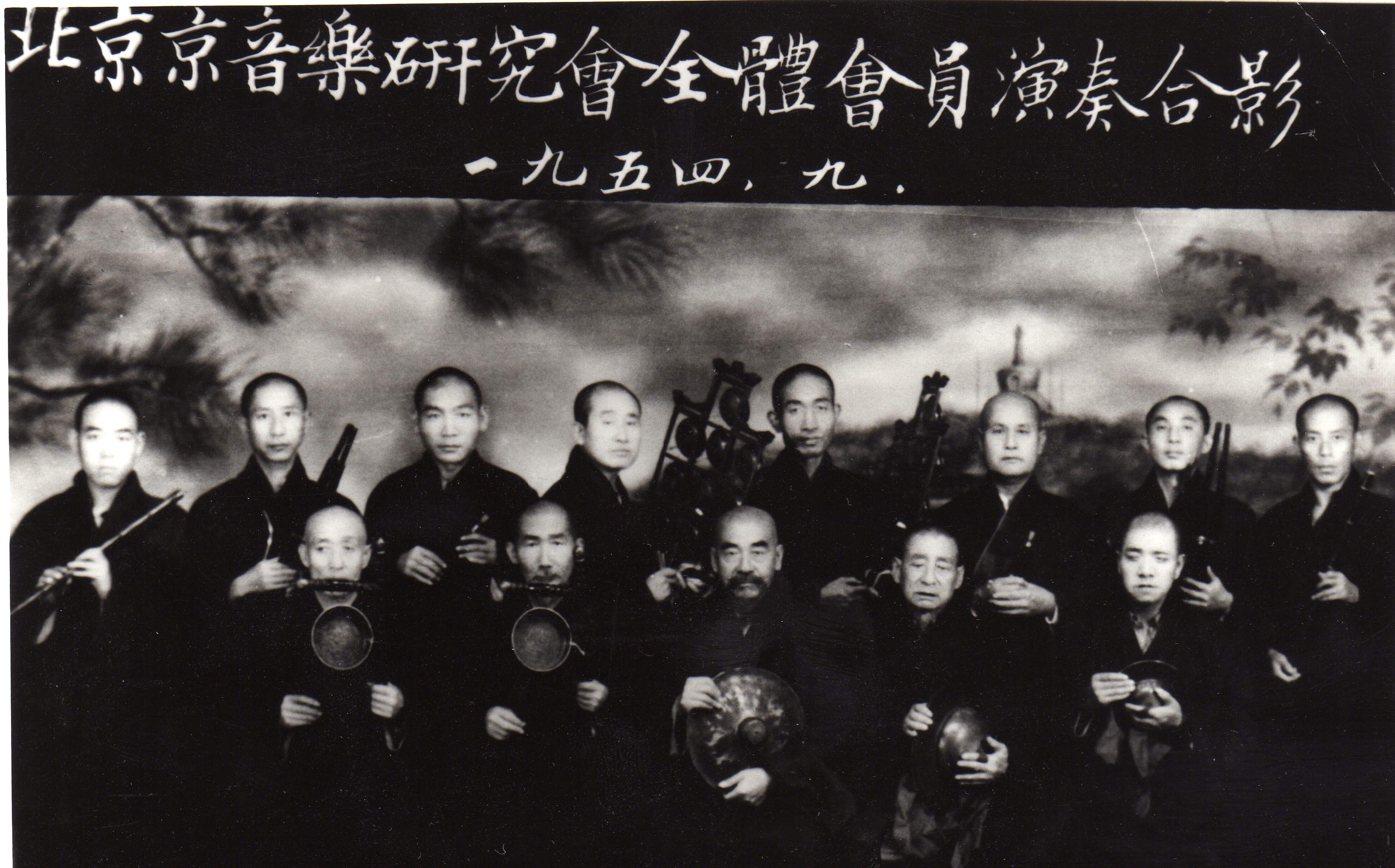
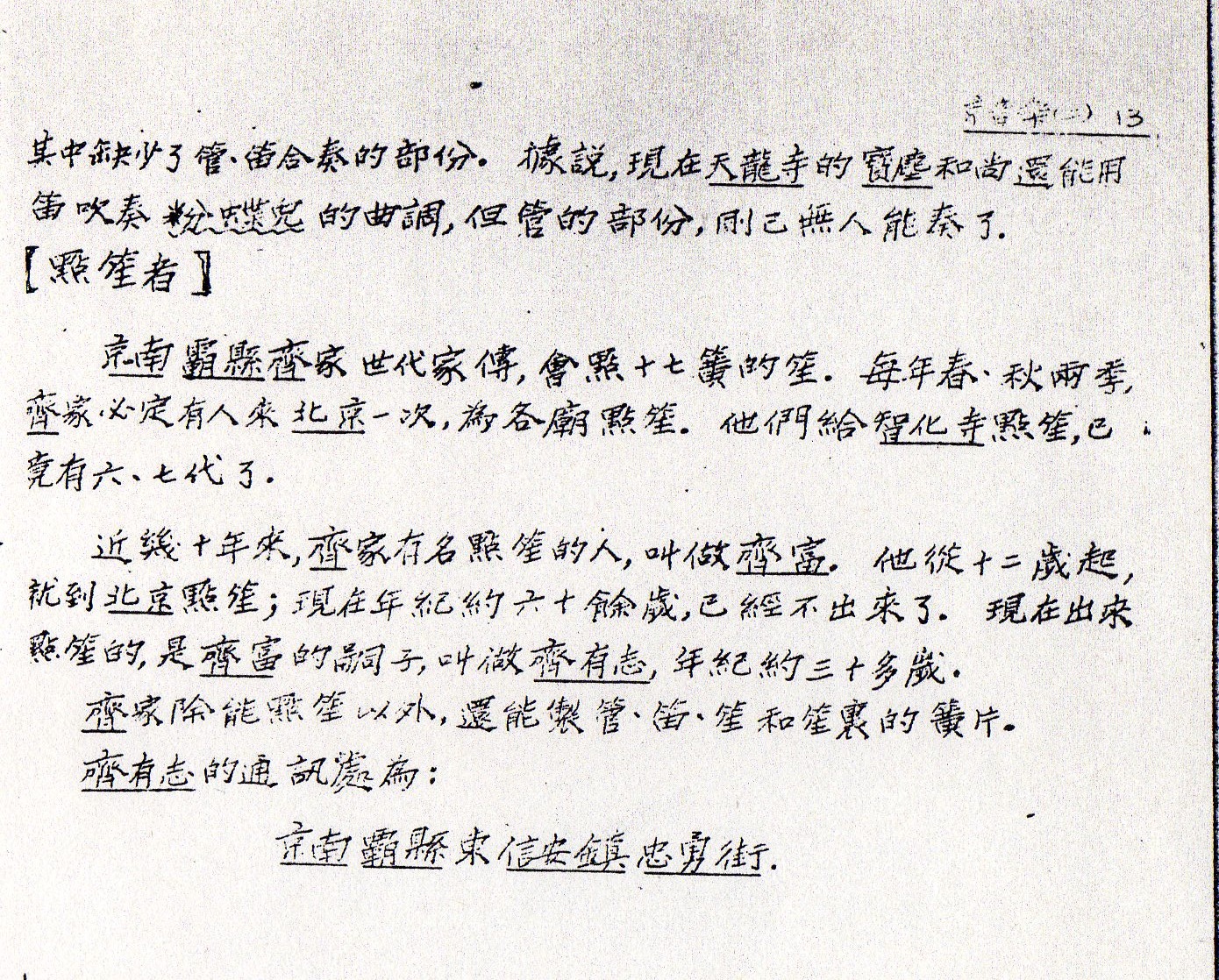
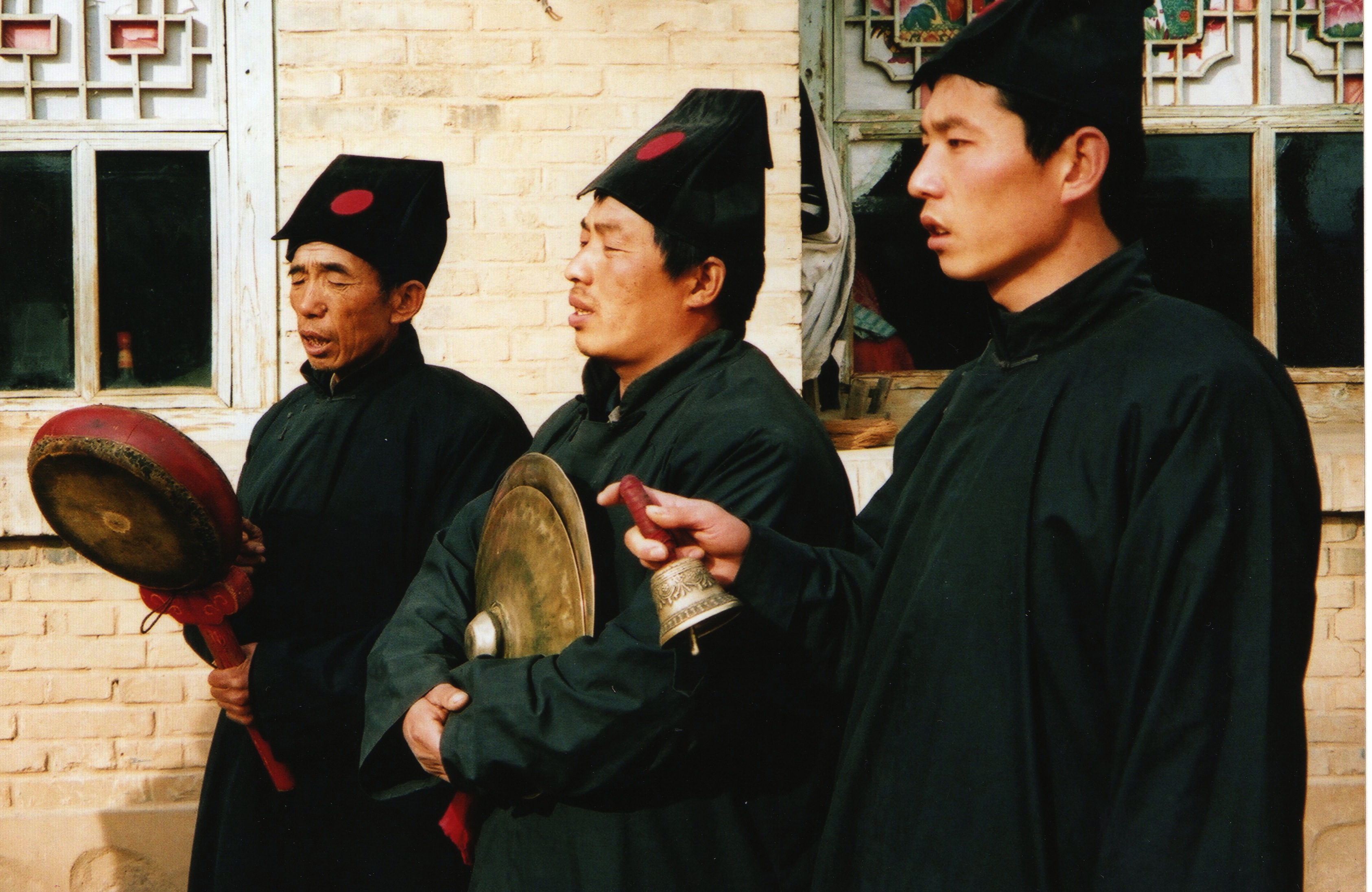
Rectifying names: an update

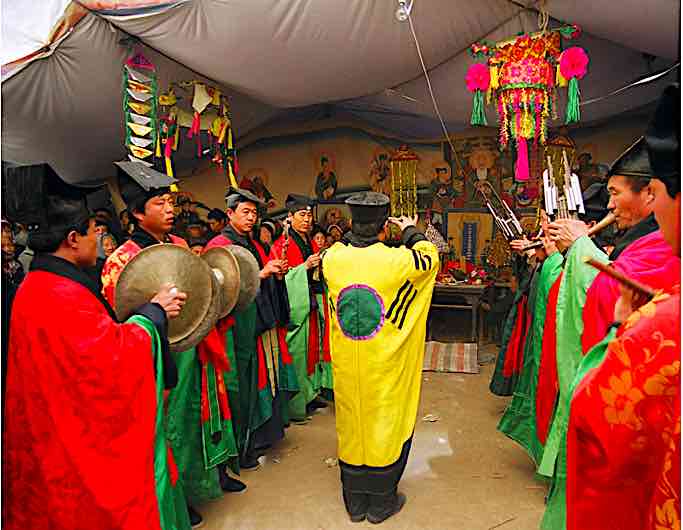
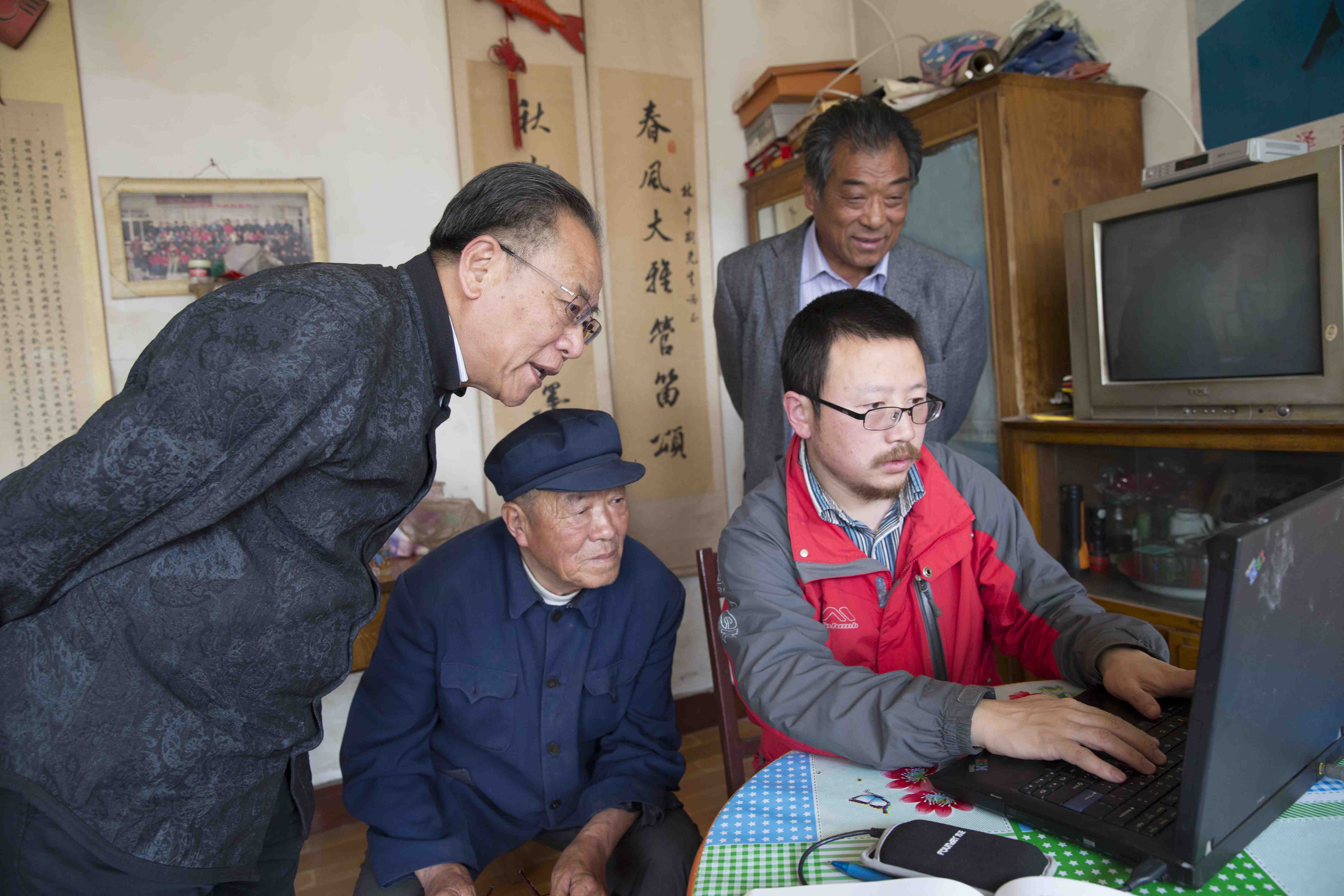
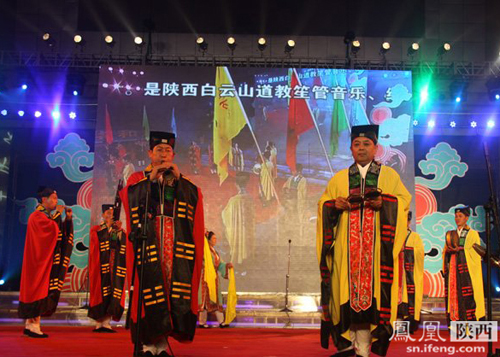
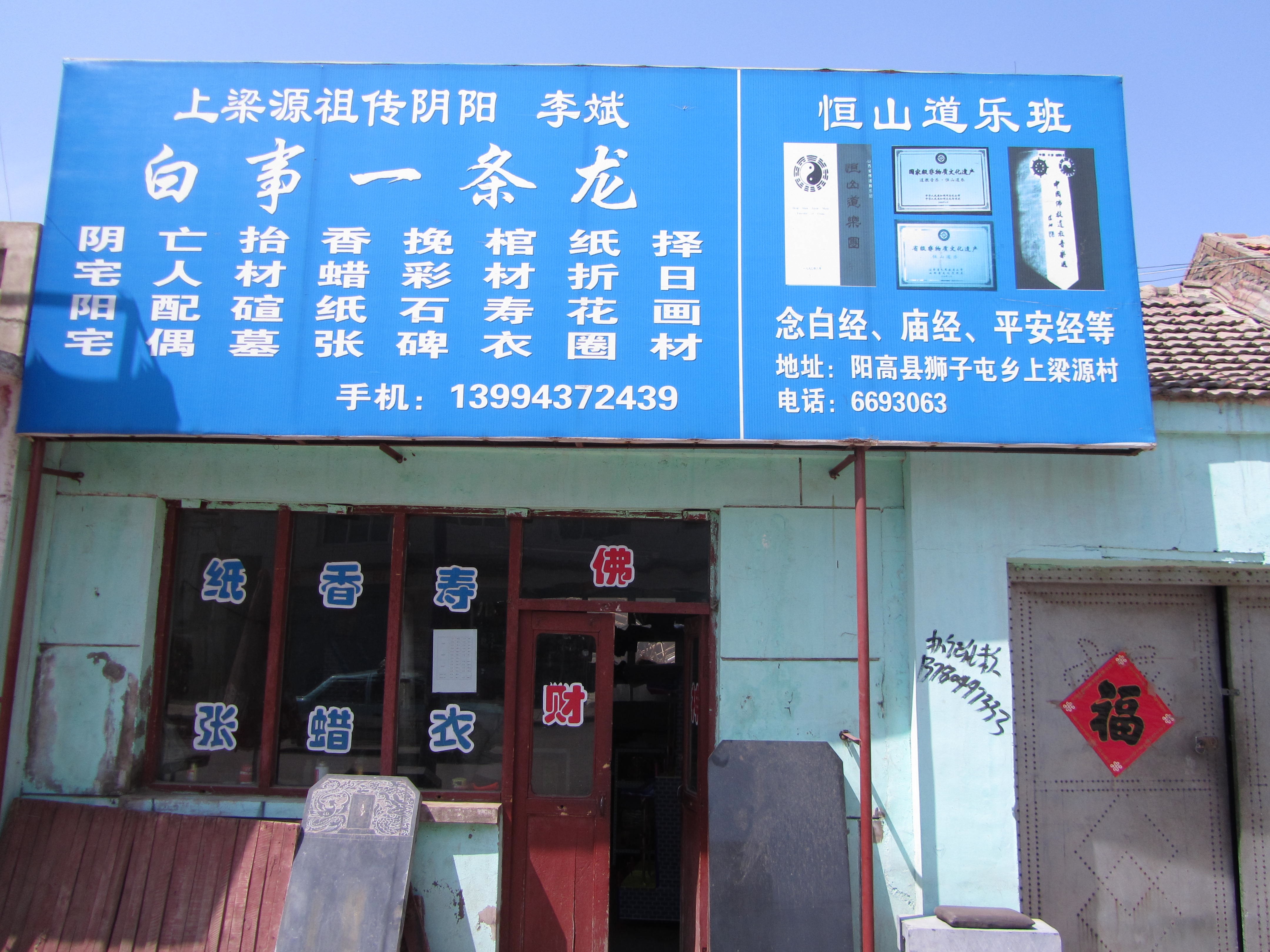
I’ve just made an update (click here) to my rant about the so-called “Hengshan [sic] Daoist Music [sic] Ensemble [sic]”, the inadvertently comic/tragic title with which the Li family Daoists have been lumbered in the Chinese media and the Intangible Cultural Heritage flummery.

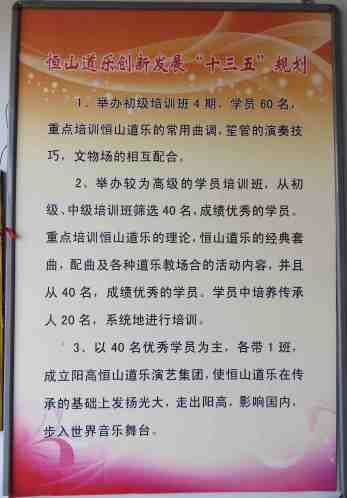
As a cautionary tale, I’ve now translated a poster (happily gathering dust) entitled “Thirteenth Five-Year Guideline for the Innovation and Development of Hengshan Daoist Music”—entirely alien to the culture to which Daoist ritual belongs.

HSDYT rules

Along with Edible, intangible, dodgy, a good starting point to explore my many posts querying the whole ICH system…

Funerals in Hebei

*Click here for main page!*
(under Themes > Local ritual)

GL procession 95

Many descriptions of Chinese ritual sequences appear somewhat timeless, blurring variation and change. But generally I like to keep my accounts either descriptive, based on observed performances, or prescriptive, an ideal sequence recounted by elderly performers. Where I become familiar enough with the local scene I sometimes try to collate the two, as in this composite funeral sequence for one part of the Yixian–Laishui region south of Beijing.

Based on talks with senior ritual specialists there, it’s illuminated by attending (and taking part in) many funerals in this area over more than a decade. While we always seek to copy the diverse funeral manuals of each village, they can’t offer the kind of detail provided by observation of practice and the accounts of the ritual specialists themselves. In particular, my constant refrain: ritual is performance, and is expressed largely through sound—the items of vocal, percussion, and melodic instrumental music that permeate the sequence.

A gradual dilution of ritual practice has  undoubtedly occurred since the 1950s, but it’s never so simple as seeking to “restore” some notional ideal sequence from before Liberation on the basis of ritual manuals alone.

Ritual groups around the Baiyangdian lake

*click here for main article!*
(under Hebei in main menu)

Ritual groups around the Baiyangdian lake:
the Medicine King cult

Zhaobeikou lake

On the Hebei plain, just south of the Xiongxian region, the Baiyangdian lake, and the ritual catchment area of the pilgrimage to the Medicine King temple in Maozhou, form a somewhat distinct area for ritual practice. This is highly topical since it is now part of the vast plan to build a megapolis there, expanding Beijing and Tianjin southwards amidst profound social and ecological change.

This was the southern boundary of our project on the Hebei plain, where we had found so many complex liturgical sequences, ritual manuals, and grand shengguan instrumental suites with scores derived from the temples of old Beijing and Tianjin. Xiongxian turned out to be the heartland of the suites and scores, but around the lake just south, despite the lively Maozhou cult, the trail was becoming somewhat diluted—and I don’t believe this is merely because our visits predated more in-depth stays in the areas further north and west. Still, these associations were very much based in ritual and shengguan, and dated back to at least the 18th century.

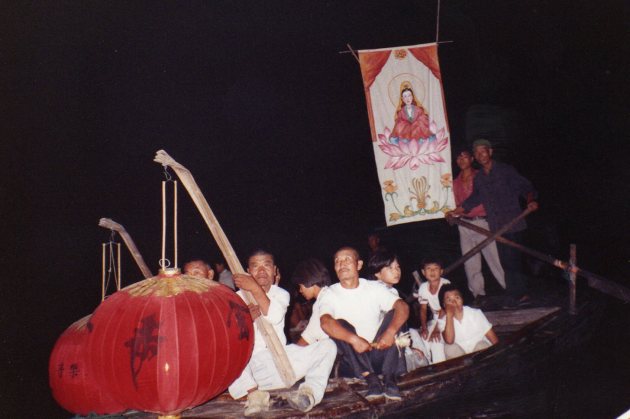
This survey introduces ritual groups all around the lake, including villages of Anxin, Renqiu, and Gaoyang counties. The aquatic setting engenders plentiful rituals based on “releasing river [or lotus?] lanterns” (fang hedeng 放河/荷燈).

As ever, this article merely scratches the surface of our fieldnotes—themselves just a superficial survey of some village associations that came to our attention. There may be many more, and certainly were until the 1950s. Any one of these groups (and indeed the Maozhou temple) could, and should, form the subject of a detailed diachronic ethnography such as I did for Gaoluo.

Around the Baiyangdian lake we found further evidence for the connection not only with Buddhist monks and Daoist priests but also with the ritual and musical cultures of the Qing emperors in Beijing—a link that appears occasionally throught the Hebei plain, such as Yixian, and strongly suggested in Xiongxian just north.

Back in the mists of time, long before the internet, or even usable landlines—the 1990s—this ritual system still comprised the main cultural network of such regions. Having survived Maoism remarkably unscathed, there are complex reasons for the long-term decline of these associations—including not so much the recent urban development plan for the region, but migration, the whole commodification of society, and the secularizing pressures of the ICH. These notes are valuable for documenting local ritual life at a time when such transformations were still in their early days.

Alexei Sayle

Alexei Sayle‘s memoir Stalin ate my homework, on his, um, unusual upbringing, is at once heartfelt, perceptive, and hilarious. And the sequel Thatcher stole my trousers* has insights on the alternative comedy scene, his early standup, and The Young ones.

Born in 1952 to idealistic left-wing atheist Jewish working-class parents—genial Joe and the brilliantly indiscreet Molly—he evokes the conditions of post-war Anfield with wry detail.

Though not universal, it was instinctual among a great many British Communists to be noisily unpatriotic. […] To my parents and their friends it was as if by cheering on the English football team, the cricket team, or Britain’s runners you were somehow revelling in slavery, the Amritsar Massacre, the suppression of the Irish, or the Opium Wars.

At primary school:

At break-time in the first week our teacher, Miss Wilson, said to the assembled class, “All right, class, now let’s bow our heads in prayer and thank God for this milk we’re drinking.” At which point I stood up and said, “No, Miss Wilson, I think you’ll find that the milk comes to us via the Milk Marketing Board, a public body set up in 1933 to control the production, pricing, and distribution of milk and other dairy products within the UK. It has nothing to do with the intervention of some questionable divine entity.”

Echoes of Irene Handl’s line in Morgan: a suitable case for treatment: “I mean, we brought you up to respect Lenin, Marx, Harry Pollitt…” (a line that I think is even funnier if you don’t know who Harry Pollitt was).

Profiting from [!] the free rail travel available to the family with his father’s position in the National Union of Railwaymen [sic], the family often took holidays abroad: “by the age of five I must have been the most travelled child in Anfield.” They soon began making trips behind the Iron curtain—At A Time When It Was Neither Profitable Nor Popular, I note. To pursue the latest results of my interest in east Europe, it’s these vignettes that I’d like to cite here.

For all his parent’s aspirations, Alexei casts a rather more detached view on their holidays. Of course, they could hardly imagine the tribulations of the working people with whom they identified, or even the apparatchiks who hosted them. But with his own background, he does more than merely getting a cheap laugh out of state socialism. These passages are interesting mainly for his own story, in which idealism and cynicism evolved hand in hand, a surreal training that would bear fruit in his later career.

Joe and Molly had taken the crushing of the 1956 Budapest uprising in their stride; welcoming it as a test of faith, they scorned British Communists who

didn’t understand that the march towards liberty, peace, and freedom couldn’t be held up by a load of people demanding liberty, peace, and freedom.

Enthralled by a visit to the Czechoslovak pavilion at the 1958 Brussels World Fair, with its marionettes, Magic Lantern Theatre, and colourful avant-garde design, in August 1959 visited the country for the first time. Somehow their trip begins at a campsite in the sleepy spa-town of Karlovy Vary. After an interlude at a union-owned miners’ sanitorium, the wheels of diplomacy click into gear and they are rescued by a fleet of black Tatra limousines which takes them on to Prague, where they are chaperoned lavishly.

Next year they organized a group of like-minded comrades for another visit. This time the authorities

had decided what the first delegation of British railwaymen to Czechoslovakia would like to see more than anything else were sights, locations, and exhibitis connected with the wartime assassination of Reinhard Heidrich, the butcher of Prague.

They were among early foreign visitors to see Lidice, scene of one of the most appalling Nazi massacres. On a brighter note, they were taken to the Švejk pub in Prague, and when they got back home his parents bought him a copy of Hašek’s novel. When he eventually read it aged 12 or 13, he

wondered if the Czech authorities knew what they were doing promoting with Švejk, letting a pub be opened in his name and selling cuddly toys in his likeness, since the message of the book, while it might have been anti-authoritarian, is certainly not one supportive of the ideals of socialist conformity.

Indeed, The good soldier Švejk soon became very popular in China, where its message must also have concerned the authorities.

Anyway, back in Anfield, by the age of eight Alexei was able to report proudly to an eager young vicar,

“I am a Comrade Cadet, Grade One, Young Pioneers, fourth battalion, based at Locomotive Factory Number One, town of Trutnow, People’s Republic of Czechoslovakia!”

And one already feels a hint of the irony that would later inhabit Alexei’s stage persona (see here), with a substantial ingredient of Švejk.

For their summer holidays in 1961 they visited Hungary, lavishly accommodated in a grand baroque hotel in keeping with their incongruous status as VIPs. On a trip to Lake Balaton Alexei discovers salad, in a passage that will strike a chord with those of our generation:

Back in Anfield we had thought with a certain amount of pride that on Sundays we had been eating salad, but really all we had been eating was lettuce and tomatoes in a bowl, sometimes with a hard-boiled egg on the top and no dressing except perhaps the industrial solvent known as “salad cream”. Now I saw what a salad really could be under socialism. There were red, green, and yellow peppers, corn on the cob, huge tomatoes stuffed with Russian salad, artichokes, celery, lentils, okra, and fresh herbs, all of them covered in rich oils or mayonnaise.

(For Nina Stibbe’s candid assessment of tarragon, see here.)

He accumulates yet more pennants and badges to accompany his hoard of Bohemian glass, dolls, and “folklorique woven things” that he didn’t know what to do with—

It was hard to stop people in Communist countries giving you things [an idea taken further by Elif Batuman].

In 1962 they took their third trip to Czechoslovakia, and in 1963 Joe led a delegation of railwaymen to Hungary. This time Alexei’s feelings are more conflicted:

Sadly, if you are beginning to feel unsettled about people’s motivation then visiting a country in which some six hundred thousand citizens were deported to Soviet labour camps after the Second World War, where they spoke a weird Finno-Ugric language completely unrelated to those around it, where there were great tensions between the various ethnic groupings, Hungarian, Romanian, and gypsy, and where a revolution had been brutally suppressed only seven years before, probably wasn’t a good idea.

Joe and Molly make elaborate preparations for a tour of the northwest by a dance troupe from Czechoslovakia, but it falls through. In summer 1966 they flew to Bulgaria under the auspices of that new bourgeois creation, a package holiday. Meeting some local teenagers in search of Beatles records, he realizes that

up until then we had only ever mixed with people who were part of the system, who were loyal to the party and its allied organizations. […] Clearly there were tensions, but you didn’t get to be a Communist without learning to ignore what was in front of your face.

With his affinity with both railways and Czechoslovakia, he was always going to love Closely observed trains (Jiří Menzel, 1966)—another of those films that also left a deep impression on my student years (can’t find it online at the mo, but do seek it out!).

For Pachelbel on rubber chicken, and Czech trains, click here; and for Alexei’s penchant for Polish cinema, here.

Following Kruschev’s reforms,

though slightly assuaged by the crushing of revolts in Hungary and East Germany, many in the West’s Communist movements were uneasy with this liberalisation. They didn’t like the idea of a Communist society allowing its citizens to express their opinions freely or have a choice of more than one type of hat. Yet they had nowhere to take their disaffection until the Sino-Soviet split offered these puritan characters a choice of an extra-dour kind of socialism more in keeping with their sententious inclinations.

So, going from frying-pan to fire in a remarkable lapse of judgement, Alexei became a Maoist. You can continue reading his later story for yourself, moving on to his perceptive account of his bohemian life at art school in London, his role in alternative comedy—and Molly’s blooming [see what I did there?] as a foul-mouthed lollipop lady. For more (not least his critique of ballroom dancing), see here.

So while Alexei didn’t get to play the Matthew passion or hang out with Li Manshan (though both are charming fantasies), I regard his upbringing, not to mention his later career, with a certain envy.

For other excellent memoirs in what can be a dodgy field, I think of George Melly and Arthur Smith. And this chat with Stewart Lee is a match made in heaven:

* Sinology could do with some titles like these (for a somewhat less appetising one, see under Jarring here).

Ritual groups of Xiongxian, Hebei

*Click here for main page!*
(under Hebei in main menu)

GGZ xu 1

Through the 1990s, one of the most fruitful sites for our fieldwork project on the Hebei plain south of Beijing was the area around Xiongxian county, just south of Bazhou, and east of the regional capital Baoding. Recently this whole region has become the centre of a vast and radical new development project to expand metropolitan Beijing; but when we used to visit, it was still very much rural.

As throughout the region covered in this growing series on Hebei, most villages here had ritual associations until the 1950s, and we found many still active in the 1990s. But here we found less vocal liturgy than further north and west on the plain, with no foshihui groups reciting precious scrolls.

Instead, ritual services were now mainly represented by the “holy pieces” of the shengguan wind ensemble to “revere the gods”—here an exceptionally rich repertoire based on long suites related to those of the temples of old Beijing. Not all these groups were still performing, but there is rich material here, not only on the ethnography of local ritual in modern times, but for scholars of the late imperial period.

This is the latest in a series on ritual in Hebei that includes Houshan and the precious scrolls, suburban Beijing, and Bazhou.

It’s that man again

More from the diaries of Alan Bennett. I’m filing this 2009 entry under heritage:

23 August. […] I’m glad I’m not a theatregoer living in Elsinore. All they must ever get are productions of Hamlet, while what they’re probably longing for is Move Over, Mrs Markham or Run For Your Wife.

His keen eye for footballers’ physiognomy is in evidence again (2010):

7 April. The open mouth of Frank Lampard, having scored a goal, is also the howl on the face of the damned man in Michelangelo’s The Last Judgement.

This entry depends on a certain cultural knowledge that might challenge translators:

5 July. A child in Settle is said to have asked what the Mafia was and his grandfather said, “It’s like the Settle Rotary Club, only with guns.”

And he often shows his political involvement. When a speech in favour of the NHS from his early play Getting on is well received, he is encouraged to go on:

25 July, Yorkshire. […] whereas nowadays the state is a dirty word, for my generation the state was a saviour, delivering us out of poverty and want (and provincial boredom) and putting us on the road to a better life; the state saved my father’s life, my mother’s sanity and my own life too. “So when I hear politicians taking about pushing back the boundaries of the state I think”—only I’ve forgotten what it is I think so I just say: “I think… bollocks.” This, too, goes down well, though I’d normally end a performance on a more elegiac note.

Background and heritage

Further to Alan Bennett’s thoughts on faux nostalgia, his diaries often reveal the contrast between his own insecurity, inherited from his modest background, and the innate confidence of his Oxbridge peers. From an entry describing his appearance at the Tony awards:

11 June, New York. I am then bundled through a back door and across the street to Rockefeller Plaza where a whole floor has been given over to the press. I’m thrust blinking onto a stage facing a battery of lights while questions come out of the darkness, the best of which is: “Do you think this award will kick-start your career?”

News of my lacklustre performance on this podium must have got round quickly because I’m then taken down a long corridor off which various TV and and radio shows have mikes and cameras and there is more humiliation. “Do you want him?” asks the PA at each doorway, the answer more often than not being “Nah”, so I only score about four brief interviews before I’m pushed through another door and find I’m suddenly back in the street in the rain and it’s more or less over.

Even his admiration for Neil MacGregor is tinged with a sense of inferiority:

26 November. I go part of the way back in a cab with Neil and I ask him about his job, which he revels in and which is not simply confined to the British Museum. He’s practically a cultural ambassador or an UNESCO representative, just back from the Sudan where he’s one of a group surveying the antiquities likely to be submerged by a new dam, currently being constructed on the Nile. The problems though are not simply to do with cultural artefacts and he talks of the villagers the dam will displace, who, although they have been told what is to happen and for whom alternative accommodation has been provided, have nevertheless no idea of which this being uprooted will mean. The human and antiquarian problems in Sudan are mirrored in Iraq where the Director of Antiquities, a Syrian Christian, single-handedly defended his museums against the depredations consequent on the invasion and the war. Now in the aftermath he has to ransom his two sons who have been kidnapped and despairing of such circumstances has left Iraq for Damascus, ultimately hoping to get to America. As Neil pours this out, the words tumbling out of him as they do I feel both inadequate and ill-informed and it’s perhaps as well he doesn’t travel all the way but gets out at St Pancras to go to the Museum—looking, as he always looks, absurdly young but, I would have thought, one of the most remarkable men of his generation.

Another anagram

Maidstone

Following the magnificent Gran visits York (my personal fave among the musical anagrams by the Monteverdi Choir et al.) and my own mélange of anagrams, here’s Angela Barnes:

I grew up in Maidstone. It’s no coincidence that an anagram of Maidstone is “I am stoned”. There’s nothing else to do. Just anagrams.

Reminiscent of the Great Plain in Molvania,

recently granted UNESCO World Heritage status as a “site of significant monotony”.

Officials without culture

*UPDATED!*

Strange—not to say fatuous—goings-on in Pingyi county in Shandong.

I generally give Short Shrift to horror stories in the Western media about new clampdowns on “superstitious practices” in China, finding that they rarely have any perceptible long-term effect at local level. Indeed, I have it on good authority that this latest instance of interference from local government is only a blip, going against the current tide in these more laissez-faire times—but it’s still rather interesting.

A fine article “The endangered sound of suona” by Fu Danni, on the Sixth Tone website, reports on the recent ban on shawm bands at funerals in Pingyi county. But the official directive looks far more disturbing than that—it’s just one aspect of a far more ambitious attempt to limit the length of life-cycle ceremonies and extravagant spending therein. The Pingyi measures even castigate the zacai decorations at the funeral altar as a “corrupt feudal practice”. Similar leftist campaigns, effectively seeking to deprive villagers of their traditional funerary observances, have occasionally been touted ever since traditional life-cycle events revived in the 1980s—a related article makes an ominous comparison with the “Destroy the Four Olds” campaign that accompanied the Cultural Revolution.

But there’s both more and less to this story than meets the eye. Campaigns aimed at enforcing frugality at life-cycle ceremonies have a long and mostly futile history, long before funeral strippers became a routine and salacious media topic (as a quick Google search will reveal). So it’s good to see twenty-one noted Chinese academics protesting at the fatuous recent official directive in a detailed open letter (Chinese text here). Note how adroitly it adopts the language of both Confucian and current CCP values—reminiscent of the recent online rebuffs to the Chinese FA over their attempt to ban Daoist ritual at a football match. The open letter has stimulated much online discussion, in which voices in support of the restrictions are largely drowned out.

Still, however isolated and fleeting such instances of local implementation may be, it’s remarkable that even in 2017 the Pingyi county government announced that it would confiscate musical instruments played at funerals. Sure, this kind of thing has happened occasionally since the 1980s’ revival; generally, as here, the musicians manage to get them back after a while.

Wang Ruiyong’s shawm band in Pingyi, suffering from the recent directive. From Sixth Tone article.

It may be that in Pingyi the shawm bands have unfairly taken the blame; some scholars too have reservations about “other, more vulgar, funeral practices” (like stripping, perhaps), though it’s unclear how a criterion for vulgarity might be policed, short of inculcating norms of public decency—for which cadres are not renowned.

Xingyuan 2011

Burning paper ritual money for the deceased before the coffin—village funeral, Yanggao 2011. My photo.

The article on the Pingyi nonsense observes the flagrant irony of the simultaneous [albeit formalistic and superficial, I should add!] brief of the cultural authorities to document such bands as part of the Intangible Cultural Heritage project—whose agenda has anyway never been exactly ethnographic. But by contrast with the project’s kitsch nostalgic dreams, shawm bands all over China are far from a bastion of tradition. They’re always innovative: for several decades, they have themselves been spontaneously adapting to the times by replacing their traditional repertoire with popular melodies and supplementing their instrumentation with trumpet, electronic keyboard, and drum-kit. You can read all about shawm bands in my post Walking Shrill, and in my books on Yanggao and Shaanbei (both with DVDs); there I documented the rapid substitution of the majestic old suite repertoires with pop music before my very eyes and ears. There are tracks on the playlist too, with notes here.

Were I just a tad cynical [surely not—Ed.], I might say that the Chinese are perfectly capable of diluting their own local traditions without government assistance. This cultural shift has been taking place ever since the early 1980s, as a result not of state interference but of changing popular tastes. And when the article comments that “most suona players have started to take on other jobs”, such as in factories and construction, this too is part of a much wider and longer trend, not some sudden response to the directive—as I noted for the Li family Daoists, the choice to abandon a hereditary tradition is complex.

Though the Sixth Tone article uses the nationally standard term suona for the shawm, it’s good to see the local term wulawa—one of many such names by which this most ubiquitous instrument is known (hence my adoption of the English term shawm, avoiding official vocabulary). And I was glad to see a reminder of the technique of blowing through a hollow reed into a basin of water—standard device for teaching circular breathing to young students.

The article doesn’t mention liturgical performance (such as household Daoists) at funerals, which generally alternates with that of the “secular” shawm bands, but it’s quite possible that there aren’t any ritual groups in this area. Anyway, hiring such bands is only a minor item in the total budget for the funeral family.

Keep calm and carry on

Meixian funeral
Back in 1990 I attended an impressive funeral in Meixian county-town in Guangdong province, with accomplished young xianghua household Buddhist ritual specialists presiding. Above the road outside (where they performed many of their rituals) was draped a slogan advertising a campaign against spirit mediums (cf. my unpublished article “Striking a happy medium”). Of course mediums and liturgical specialists (not to mention shawm bands) provide very different services, but one might suppose that there’s a risk that blanket directives may throw out the baby with the bathwater.slogan Meixian 1990So while there are complex issues at work here, the recent directive illustrates a common befuddled knee-jerk response from local government. If they’re so keen on harking back to Maoist values, they might instead consider a re-education campaign for cadres—it is they who now lead the way in “vulgarity” and “lack of culture”.

Still, I can’t quite join in the general moral outrage over the Pingyi campaign. While it is quite right for scholars (both Chinese and foreign) to protest, at the same time we shouldn’t overestimate the long-term effect of such fatuous official measures. Observers have been lamenting “cultural impoverishment” in China for many decades—indeed, further afield, nay worldwide, the call to “rescue endangered traditions” went out a nanosecond after the birth of anthropology. But change is a constant. As is clear from my recent film and book, since the 1980s’ revival—in both ritual and music—any dilution takes place not so much as a direct result of sporadic leftist campaigns, but under more pervasive socio-economic pressures (to be sure, related to wider political currents) such as urban migration, modern secular education, and the changing tastes of rural patrons as they aspire to the modernity of pop and media culture. Since these are trends with which few seekers of hallowed Chinese traditions tend to engage, the state may seem to make an easier scapegoat.

For a prequel to this story, see here.

Update
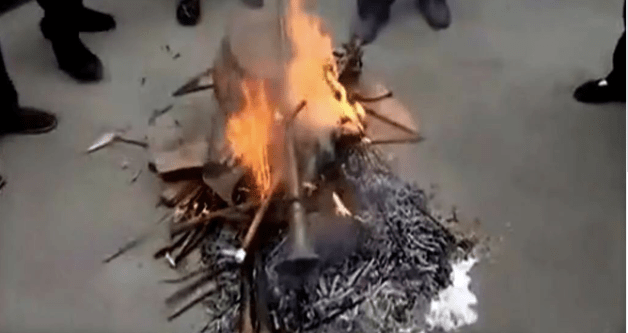
Local relations have only deteriorated following the interference of the radical cadres of Pingyi in funeral customs. An article on Chinese Twitter (no longer available) told how irate musicians have ceremoniously burned their instruments in protest. The only good news is that public criticism of the directive forbidding “extravagant” funeral observances is ever-more widespread, both from local villagers and from higher-ranking officials and pundits further afield—again adroitly (indeed convincingly) adducing “cultural heritage” and the good old Confucian values touted by Uncle Xi.

One old musician observed that neither the Allied forces suppressing the Boxers, nor the Japanese invaders, nor even the Four Cleanups campaign had ever managed to silence such bands:

“自打西太后还活着那会儿,咱家就吹;八国联军来了怎么样?照样没碍着,那帮蓝眼珠子都觉得咱这牛逼;后来小日本来了,在他们枪口底下,挺直了腰杆吹,也没人禁过;破四旧那会儿,打和尚烧庙,也都没碰过咱这喇叭。”

From London, or even Beijing, it’s hard to judge what’s going on. The focus on shawm bands still seems something of a red herring. As locals observe, “extravagance is something for people with money—what have the common people got to waste?” The shawm bands are not only inexpensive but utterly “secular”—and again, we’re not being told about the wider restrictions on funeral observances.

This still seems to me like an isolated blip—has anyone heard of serious instances anywhere else recently? It’s all the more curious when funeral customs continue to be observed grandly throughout China—see this recent report on a six-day Daoist funeral in Hunan.

The radical stance of the Pingyi cadres seems deranged. Usually such campaigns blow over (an apt metaphor), or at worst cadres adopt the age-old practice of “one eye open, one eye closed”, or “there’s a policy, but it isn’t implemented”; but here they haven’t backed down, and the musicians’ astute demonstration has gained widespread publicity.

burning shawms

For more background, see here; and for a related debate, here.

Further update
I can’t keep up with all such cases, but this one caught my eye.

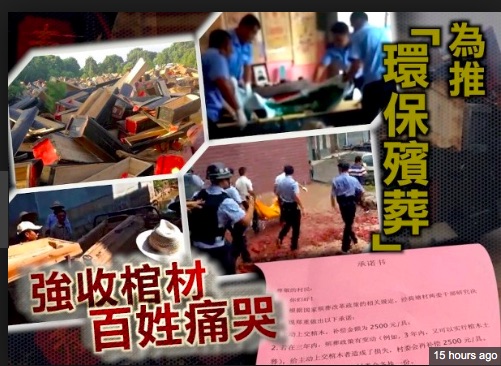
Chinese media (in English, see e.g. here, and this article with further background) are in uproar over a draconian policy in 2018 to destroy coffins in rural Jiangxi province—which one might suppose less vulnerable to radical directives. It’s a misguided attempt both to save land and to discourage extravagant burial rituals.

Jiangxi

Again, campaigns to enforce cremation have a long history, but have been largely ineffective outside the towns.

In this case the protest doesn’t even need righteous netizens—it’s led by the state-run media:

Chinese state media editorials on Monday slammed the policy as “barbaric and unpopular”. Articles in both People’s Daily and Guangming Daily urged the Jiangxi government to rethink its funeral reform.

“Is there any reason to carry out such a rough and even barbaric move?” the editorial in People’s Daily, the mouthpiece of China’s Communist Party, said. “Even if the funeral reforms are effectively carried out, the hearts of the people are hurt and [the administration’s] credibility is lost … [and] built-up resentment triggers instability.”

Even Jiangxi’s department of civil affairs issued a notice saying a number of county-level officials had taken “simplistic and extreme” actions that had “hurt the feelings” of local residents.

Again, it looks like a conflict between particular trigger-happy extremist local governments, with central authorities on the side of the local population.

None of these stories is so simple as blanket state repression: conflicting forces operate. For an even more recent update for Shanxi, see here.

Ritual traditions of Zuoyun, Shanxi

***Link to this page!***

Our material on ritual groups in north Shanxi relates mainly to the area east and south of Datong city. But Zuoyun county, just west, has potential—indeed, the whole area west of Datong would be worth exploring.

What little material we have so far suggests a Buddhist temple tradition, but it is too early to assess the scene around Zuoyun. Typically, the material focuses on a single temple, the Lengyan si, conveniently packaging its rituals merely as “temple music”. So my brief article becomes another critique of the cultural heritage flummery.

Where there are temple groups, I expect there to be household groups too; and where there are Buddhist bands, there are likely to be Daoist ones too.

Lengyan si


Buddhist ritual in south Shaanxi

***Link to this page!***

Most of my accounts of local ritual in north China (under “Li family Daoists” and “Hebei” in main menu) concern Daoist practice. This new page mainly concerns folk Buddhist ritual traditions transmitted by former temple monks around Yangxian county in south Shaanxi.

It’s even more sketchy than my introductions to some other areas that I haven’t visited, but again, as I continue to regret the superficiality of the ICH material, I’m hoping to entice people to go and do some serious research. I’ve also revised the introductory page on Buddhist ritual.

Yangxian nianjing

The brief of ethnography

Gaoluo 1989

Recently on Twitter, following a post on my work with the Gaoluo village ritual association, an urban Chinese worker sent me a succinct and intriguing reaction:

中国农村地方的风俗,我不喜欢!— I don’t like local Chinese rural customs!

Well, tough! 罗卜青菜各有所愛, chacun à son trou, “it’s a free country”… But actually it’s a valid point, highlighting an important issue.

Rural customs are what rural dwellers do; it’s hard to belittle the former without rejecting the latter. It’s not just a lack of tuanjie solidarity within the Labouring Masses, between the gong workers and the nong peasants; there has long been a more general alienation anyway among the urban educated. This feeling that Chinese tradition is “backward” dates back well before the 20th century, despite the efforts of Chinese folklorists since the 1920s to document the, um, heritage.

Today those older urbanites who endured banishment to impoverished villages under Maoism (like Kang Zhengguo, or the countless, and hapless, zhiqing educated youths from 1968) have good reason to feel ambivalent about rural culture (see also here).

Younger cityfolk may not have had to endure rural life like their elders. But steeped in pop music and video games, when they are dragged back to the poor countryside to attend the funeral of a grandparent, they too may find village customs irrevocably tainted by poverty and backwardness.

Moreover, apart from those duped by the media into regarding folk culture as a theme park, those younger cityfolk (not least those bravely seeking social justice) have been further alienated by rosy state cultural propaganda—quite understandably.

Of course, the arcane concerns of academia generally may not float their boat. Anyway, they’re unlikely to be excited by the links of some Daoist ritual to manuals from the Song dynasty.

But ethnographers don’t have to be misguided mouthpieces for official patriotism. It’s not about praising traditional culture—more about documenting it, complete with all the problems of rural life. Ethnography aims for the descriptive, not the prescriptive. I’ve already given some traumatic examples of participant observation in fieldwork—Germaine Tillion’s notes on her own incarceration in Ravensbrück concentration camp, and Sudir Venkatesh’s work among Chicago street gangs.

So it’s always worth documenting society, and history, without romanticizing it as some ideal “living fossil” of an illusory golden age. Along with any grandeur that pundits may impute to ritual in rural China, there belong power struggles, violence, the plight of women and blind outcast shawm players, and all kinds of tribulations under imperial, Maoist, and modern regimes. And while studying folk culture, it’s proper to note the alienation of younger urban dwellers from it, as I do. Indeed, I’m not naturally thrilled by Morris dancing—but when you get to know a little about it, you can see how it fits into the changing social culture of rural England.

However rapidly the Chinese rural population has been diminishing since the 1980s, documenting rural life is just as important as studying urbanites, of all classes—including the workers’ struggle and their expressive culture. We don’t have to “like” ♥ (grr) the songs of either those workers or household Daoists, but they all need documenting.

Descriptive ethnography doesn’t necessarily imply standing aside entirely from judgment. Now, as it happens I do indeed admire many aspects of village ritual, but that’s not the point. More adventurous fieldworkers (like De Martino) may seek to spell out some respects in which ritual is life-enhancing, offering consolation and cohesion; or, conversely, ways in which it serves to entrench delusion and conflict, or fortify irrational power. Or—quite likely—they may entertain both hypotheses at once. And both need to be tested, not assumed.

So to that underwhelmed Chinese worker on Twitter, I might say: as the great Tsinghua-university-based anthropologist Guo Yuhua can tell you, far from obstructing the quest for social justice, ethnography can be a contribution to it. Apart from urban workers, if anyone has been downtrodden, it’s the peasantry.

However much the official version may seek to reify and sanitize culture, yet factory workers, household Daoists, village cadres, spirit mediums, army recruits, sectarian groups, vagrants, and entrepreneurs are all part of the social spectrum, whose lives deserve to be documented.

All this reminds me of another gem from Nigel Barley. Arriving at his field site in rural Cameroon, he grapples with police bureaucracy (The innocent anthropologist, p.38):

The commandant turned out to be a huge Southerner of about six foot five. He summoned me into his office and inspected my documents minutely.  What was my reason for being here? […] He was clearly very unhappy as I tried to explain the essential nature of the anthropological endeavour. “But what’s it for?” he asked. Choosing between giving an impromptu version of the “Introduction to Anthropology” lecture course and something less full, I replied somewhat lamely, “It’s my job.”

Ritual and sport: the haka

haka

Since I am wont to make blithe analogies between the performances of ritual and sport, the pre-match haka of the All Black rugby team makes a fine illustration, also revealing the enduring depth of folk culture. In its constant adaptations, both in sporting and other ceremonial versions, it’s deeply impressive.

The wiki articles on the traditional and sporting versions make a useful introduction, and there are many fine YouTube clips.

As a Māori ritual war cry the haka was originally performed by warriors before a battle, proclaiming their strength and prowess in order to intimidate the opposition. But haka are also performed for diverse social functions: welcoming distinguished guests, funerals, weddings, or to acknowledge great achievements, and kapa haka performance groups are common in schools. Some haka are performed by women.

Its social use has become widespread. In 2012 soldiers from the Royal New Zealand Infantry Regiment performing a haka for fallen comrades killed in action in Afghanistan; and in 2015 hundreds of students performed a haka at the funeral of their high-school teacher in Palmerston, New Zealand:

In 2016, on the 15th anniversary of 9/11, New Zealand firefighters honoured the victims with a powerful haka.

And here’s a moving recent wedding haka:

In 2019 students performed a haka to commemorate the Christchurch shootings:

And the haka was performed for the Standing Rock protests of 2016 (link here if it doesn’t respond below):

https://www.youtube.com/watch?v=oCVg3Av6uRQHere

* * *

The New Zealand native football team first performed a haka against Surrey (!) on a UK tour in 1888. The All Blacks have performed it since 1905. After witnessing the haka in Paris in 1925, James Joyce adapted it in Finnegan’s wake. For the 1954 version at Twickenham and evolution in the wake of TV, see here. The sequence below begins with 1922 and 1925 renditions, passing swiftly over the comically inept low point of 1973, to the increasingly choreographed versions of recent years:

So it’s no “living fossil”, being subject to regular adaptation. In 2005, to great acclaim, as an alternative to the usual Ka mate the All Blacks, led by Tana Umaga, introduced the new haka Kapa o pango, modified by Derek Lardelli from the 1924 Ko niu tireni:

Its adaptation to the sporting event compares favourably with Chinese concert versions of ritual. However it’s done, it never descends to the kitsch of such adaptations—it’s always performed with great intensity and integrity, giving an impressive glimpse of a serious ritual world. The pride that they take in performing it with such practised commitment contrasts strangely with the casual way in which they sing the national anthem that precedes it—even the Brazilian anthem doesn’t inspire its footballers to such intensity.

As a spurious link to a fine story, I note that the team performed a kangaroo version in July 1903:

Tena koe, Kangaroo                 How are you, Kangaroo
Tupoto koe, Kangaroo!           You look out, Kangaroo!
Niu Tireni tenei haere nei       New Zealand is invading you
Au Au Aue a!                             Woe woe woe to you!

* * *

From the sublime to the ridiculous… Several YouTube wags have suggested suitable responses from opposing teams: a burst of Riverdance by the Irish team, or (from the English) the hop-skip-hand-behind-the-back routine in Morecambe and Wise’s Bring me sunshine.

Morris dancing might unsettle the All Blacks too (music added later; in memoriam George Butterworth, killed in the Great War):

The Intangible Cultural Heritage rears its ugly head again—perhaps the English team could emulate the Britannia Coconut Dancers of Bacup, a 150-year-old troupe of Lancastrian clog dancers.

Not quite à propos, and Don’t Try This at Home—or in the Matthew Passion:

As a further riposte to the haka, even I can’t quite imagine the Daoist “Steps of Yu” (Yubu 禹步), but how about the Sacrificial dance of The Rite of Spring, complete with Roerich’s costumes and Nijinsky’s choreography? That really might take the lead out of the All Black pencil.

But we should celebrate the deeply serious nature of folk culture, and the evolving transmission of performances like the haka.

See also this helpful guide to the rules of rugby.

Kulture


joke

As I snap remorselessy at the heels of the heritage shtick, my cavils revolve around the Chinese concept of mei(you) wenhua 没(有)文化 “lacking in culture”. It’s a cliché referring to people’s degree of modern state education. Even peasants deprecate themselves with the term, though it is precisely the riches of their quite separate culture that “educated” urban pundits purport to admire—before trying to shoehorn it into their own.

LB joke

Li Bin’s brilliant joke (keep watching after the final credits of my film) subtly satirizes the gulf between peasants and intellectuals. Here’s a fuller English version (my book, p.ix):

So there’s this Ph.D. student on a long-distance train journey, sitting in the same compartment as a peasant.

He’s dead bored, so to pass the time, he says to the peasant,

“I know, let’s play a game. We both ask each other one question. If you can’t answer my question, you have to give me 100 kuai; if I can’t answer yours, then I have to give you 200—because I have a Higher Level of Culture, don’t you know?”

The peasant goes, “Oh right—umm, OK then.”

The student says smugly, “You can start, because I have a Higher Level of Culture!” So the peasant thinks for a bit and asks,

“OK then, I got one—so…
What is the animal with three legs that flies in the sky?”

The student racks his brains. “Huh?? An animal with three legs that flies in the sky? Hey, there isn’t one, surely… Ahem… Crikey—you’ve got me there. OK, I give up, I guess I have to pay you 200 kuai.” He hands the cash over to the peasant.

The student, still bemused, goes on, “An animal with three legs that flies in the sky… Go on then, you tell me, what is this animal?”

The peasant scratches his head and goes,

“Hmm… nope, I dunno. OK then, I can’t answer your question either—here’s 100 kuai!”

LMS Rome

It’s even better in Yanggao dialect—Li Manshan tells it hilariously too.

As local traditions continue to be distorted, large areas of the world are in danger of being turned into a kitsch Disneyland theme park. A certain amount depends on the “level of culture” of state bureaucrats all along the chain; in China the central ICH authorities do indeed organize “training sessions” for regional cultural cadres, with limited success.

The whole system seems inherently flawed. Local, um, heritage bearers have their own ideas about what to do with their traditions—and given the dubious benefits and evident dangers of the state system, with its own “lack of culture”, people like me might hope they could be left alone to do so. But beguiled by the chimera of fame and fortune, locals—in China and elsewhere—are all too easily hijacked by the power of state machinery and tourism.

Yet more heritage flapdoodle: Hongtong

Hongtong 1
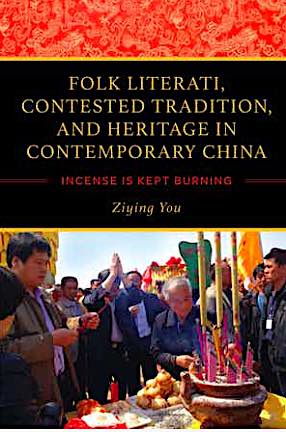
Further fodder for my distaste of the heritage shtick—thanks again to Helen Rees, my Word on the Street, I’ve been reading an interesting article by Ziying You,

  • “Shifting actors and power relations: contentious local responses to the safeguarding of Intangible Cultural Heritage in contemporary China”,
    Journal of folklore research 52.2/3 (2015).

And now she has published a book on the topic, which I look forward to reading:

Hongtong cover

Hongtong county, in south Shanxi, is always cropping up in studies of local culture in north China—notably since it was used as a huge migration transfer centre to areas further north and northeast that had been depopulated by the appalling dynastic warfare of the early Ming. Like many villages on the plain south of Beijing, Gaoluo, subject of my book Plucking the winds, is said to have been founded as a result of this migration; and Li Manshan’s lineage moved north to Yanggao just around this time. [1]

It’s a long time since we’ve featured The China Daily, so I’m delighted to cite a 2012 article here:

A step into Hongtong county in southern Shanxi province and I found myself transported into a land filled with fairy tales.

YAY! The paper hasn’t lost its old magic, then. It does provide a couple of charming pieces of folklore:

The Chinese term used today to mean “go to toilet” or jie shou is also linked to the legend.
The migrants had their hands tied behind their backs when they migrated. They were only allowed to untie their hands when they needed to relieve themselves. Jie shou, which literally means to untie the hands, gradually became the term used for “go to toilet”. The expression spread widely to the provinces where the Shanxi migrants were sent.

Another interesting tale on Hongtong involves a woman by the name of Su San in the Ming Dynasty, who became probably one of the most well-known prostitutes in Chinese history.
Su met young scholar Wang Jinglong at her brothel. The two fell in love and Wang stayed with Su for a whole year but was later chased out of the brothel because he ran out of money. Su was then sold to another man as concubine. She was framed for murdering the man, imprisoned and was sentenced to death.
Meanwhile, Wang who attempted the imperial examination, did well and was appointed governor of Shanxi. He heard about Su’s case and helped with the investigation to deliver her from death row.
The lovers eventually got married and as how all fairy tales end, they lived together happily ever after.
The story has been adapted as a Peking Opera play The Story of Su San (Yu Tang Chun) and became one of the best-known Peking Opera plays in China. Hongtong county where Su San was imprisoned became well-known through the play.
Although the original prison was severely damaged during the “cultural revolution” (1966-76), the present one restored in 1984 retains all its original features. For example, there is a cave used for dead bodies, and a well with very small mouth to prevent prisoners from jumping in to kill themselves.
Su San’s story has brought fame to the prison, making it a must-see in Hongtong. Today the site is renamed as “Su San Prison”, and her story is presented by a series of wax statues within the site.

Damn, I’m trying to write about the ICH here… Led astray by The China Daily“typical!”

Anyway, Ziying You’s article concerns Hongtong as the site of an enduring cult to the ancient sage-kings Yao and Shun, in which several villages form a she parish, with temple fairs and processions. [2] For ICH purposes it is nominated as Hongtong zouqin xisu “the custom of visiting sacred relatives in Hongtong” [3] — and yes, sure enough the term “living fossil” rears its ugly head again.
Hongtong procession
Though not currently on the UNESCO “Representative list” for the ICH, it has been inscribed on the provincial and then national lists since 2006. With typical official razzmatazz, local cultural cadres set up a “Hongtong Centre for the safeguarding of ICH”, niftily bypassing the temple committees which are the lifeblood of the whole tradition.

BTW, as at many such festivals, I see no signs here of liturgical sequences of ritual specialists—only large groups of gong-and-drum ensembles (which are also widespread in Shanxi).

By contrast with the alacrity of cadres,

For most ordinary people, ICH was a foreign term remote from their knowledge and discourse.
[…]
Those who were mobilized to assist in the ICH application expected to receive a large amount of money from the central government to do whatever they wished within their local communities.

Not only has this expectation been unfulfilled—the Yangxie temple committee spent a substantial amount in the extended process of preparing the application. Moreover, the Centre, jockeying for favour with ICH bodies higher up the chain, monopolizes as-yet elusive state funding. And while the local conflicts between the villages did not originate with the ICH application, they were exacerbated in the process. Anyway, the temple committees, true “bearers of the heritage”, have been disempowered.

The ICH project thus became a means for the local ICH centre to exploit the local population and harvest the profits from the state.

Citing Chiara de Cesari, the author comments:

UNESCO frequently ends up reinforcing the power and reach of the nation-state and its bureaucracy, which is contradictory to its own principle of involving local communities and “grassroots”.

Yet again, the ICH machinery appears not to be safeguarding local cultures so much as safeguarding itself.

My encounters over the years with groups earmarked for ICH status—such as the village ritual associations of Qujiaying and Gaoluo, as well as the Li family Daoists—only confirm such findings. But the juggernaut rolls on.

As I write, Haitink’s recent Prom is on the radio, with the Prague symphony. No Mozart balls, just boundless energy and creativity!


[1] For the migrations to Yanggao, see Jing Ziru’s article in Yanggao wenshi ziliao 阳高文史资料 2: 216–228 and 206.
[2] Note also Anning Jing, The Water God’s Temple of the Guangsheng Monastery: Cosmic Function of Art, Ritual, and Theater (Brill, 2001)—albeit more historical iconography than contemporary ritual ethnography.
[3] These photos are among many from http://photo.xinzhou.org/2010/0717/picture_1826.html

The heritage shtick

Just added a convenient new tag (in the sidebar) for “heritage”:

https://stephenjones.blog/tag/heritage/

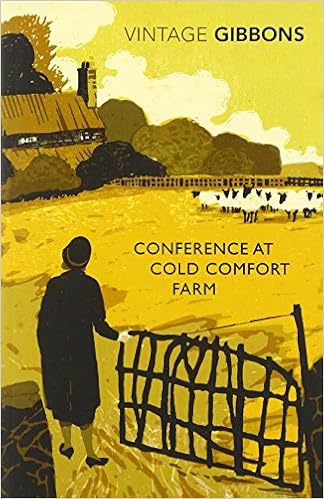
collating my observations on the troubling effects of the Intangible Cultural Heritage juggernaut on north Chinese ritual—also taking in Stella Gibbons, “Mediterranean diet”, the deep-fried Mars bar, and the Lake District…

I once attended a conference on the ICH at which a wry Chinese scholar asked, “So are we going to inscribe Spring Festival, then?!” I hereby nominate Breathing, indeed Life. Beat that.

Taxonomy eh—dontcha just love it.


More heritage flapdoodle

UNESCO is at it again.

https://www.theguardian.com/uk-news/2017/jul/09/lake-district-is-uks-first-national-park-to-win-world-heritage-status

Lakes fell.png

Now of course we all love the Lake District. But as usual, such recognition is considered as a triumph, willy-nilly. This quote is as bland and simplistic as any from a local Chinese cadre:

This decision will undoubtedly elevate the position of the Lake District internationally, boosting tourism and benefiting local communities and businesses.

The BTL comments provide salient contrary views, notably

http://www.monbiot.com/2017/05/19/fell-purpose/

And now

https://www.theguardian.com/commentisfree/2017/jul/11/lake-district-world-heritage-site-sheep

Ritual, food, and chastisement

Having just naively queried the choices of heritage pundits,  I am further reminded of my 2011 visit to Mount Athos by the difficulty of savouring one’s meal in a fado club while concentration is justly demanded on the saudade of the singing.

Attending matins—lasting several hours—in a monastery high above the sea is magical. We make our way to the chapel in darkness, finding the doorway by a tiny glint of candlelight in the inner sanctum beyond. Thuribles fragrant, icons glowing, elusive shadows of black-robed bearded monks flitting past. I find a place in a high narrow wooden stall, ornately designed to deny comfort.

To cite Leo Kanaris’ fine crime thriller Blood and Gold (pp.188–92):

It was all stage-managed for maximum effect: the light of truth scattering the night of ignorance, the Holy Fathers hovering in the shadows, their faces reflecting the candle’s rays, while Christ gazed down from the heavens. Beyond the walls of the church lay the world, unseen, unknown, an immense and incomprehensible universe.

As we stand/lean/doze in our stalls, the incense, lugubrious chanting and deep singing are intoxicating. After an eon the first shafts of sunlight begin to illuminate the scene, the mosaics on the dome beginning to shine down on us.

Athos ritual

Kanaris goes on:

Another candle was lit on the far side of the church and a second monk added his voice. The effect was dramatic. Suddenly there was a dialogue. The two melodies alternated, joined, drew apart, curled around each other like the tendrils of a vine (cf. Susan McClary on baroque trio sonatas). George was lulled into a state that resembled hallucination, where one sense entered his mind in the guise of another. Sound became colour. The smoke of incense, burning every day here for centuries, became his own memories. Past and present fused in a molten river of darkness and gilded flames.

For those who have witnessed Chinese temple rituals, attending an Orthodox ceremony will seem rather familiar—even down to the wooden semantron that calls people to prayer. The rhythmic swish of the thuribles may even remind us of the sepaye of the ashiq in Xinjiang. One might also compare scenes from Holy Week in Sardinia in Bernard Lortat-Jacob’s fine film.

* * *

Such a ritual also gives the motley crew of pilgrims a healthy appetite for a friendly reflective chat at the following meal in the trapeza refectory, over what one might expect to be a wealth of succulent local produce. Well, forget it—silence is rigorously imposed among the “diners”, while from a lectern a monk lugubriously intones a passage from the gospels; worse still, the food is both meagre and inexplicably inedible.

Athos trapeza

So the only “blessing” is that one has to wolf it all down in a considerable hurry—not so much Mediterranean “buon appetito” conviviality, delighting in the copious blessings of the earth that our Good Lord has bestowed; more a 1950s’ English embarrassment at this unfortunate necessity that confronts us.

Reminds me of

That was inedible muck. And there wasn’t enough of it.

I’m not knocking Athos. OK, it’s not exactly at the forefront of gender equality, but the rituals, architecture, ancient glowing icons, tranquillity, and stunning scenery all make for an unforgettable experience—and even the meals are indeed a reflection of the world-view that we go there to absorb. Just don’t expect an urbane refined dining experience, that’s all.

A suitable penance for the UNESCO committee that elected “Mediterranean diet” for Intangible Cultural Heritage status might be to consign them to Mount Athos for a few days. That’ll sort ’em out. They will come down from the mountain with a healthy (sic) appetite for a deep-fried Mars bar.

For recent political tensions, click here. See also under Ukraine: liturgy.

Edible, intangible, dodgy

*For a whole host of related posts, see heritage tag in sidebar,
and this roundup!*

Mars bar

One of the more entertaining excursions of UNESCO’s Intangible Cultural Heritage (ICH) project is in the field of cuisine, under whose august portals “Mediterranean diet” has been loftily inscribed.

Among many fun BTL comments there is one from a certain Nickov:

Might have a stab at protecting the Bristol Channel Diet:
Gregg’s pasties, white cider and chlamydia.

I also eagerly await an application from the Glasgow cultural authorities (whoever they might be) to, um, preserve the venerable deep-fried Mars bar. What of Spotted Dick, I hear you cry? For another caveat on Britain’s belated engagement with the UNESCO heritage bandwagon, click here. And I now note that Fray Bentos is not just a real place, but another UNESCO world heritage site! Recent additions to the list include outdoor chatting and the Berlin techno scene!

I was musing on all this during my recent trip to Lisbon, whose fine cuisine hardly fits into the Mediterranean gastronomic jigsaw.

While we’re on the topic of transmission, this important corrective doesn’t entirely confound the popular cliché that Bach‘s music fell out of use after his death. His sons, and their audiences, might not have taken kindly to being told to continue performing their father’s music—though doubtless ICH funding would have influenced their attitude.

Were one to be at all jocular (Surely not?Ed.), one could query many ancient cultural traditions. Where might UNESCO stand on * wife-beating? Or indeed FGM? And whatever happened to child chimney-sweeps? Witch-burning, a tradition eradicated in most parts of the world, is also seriously endangered. Molvania has nice comments on all this kind of flapdoodle.

Another controversial tradition is bullfighting, whose adoption by UNESCO has been much discussed (e.g. here). Bullfighting is common in southwest China too, by the way.

Thanks to Helen Rees (herself a great authority on the ICH) for alerting me to this article, succinctly broaching such issues:

  • Richard Kurin, “Safeguarding Intangible Cultural Heritage in the 2003 UNESCO Convention: a critical appraisal”, Museum 56.1 (2004), pp.66–77.

(pp.69–71:)

The definition, as given in the Convention, can encompass a broader range of activity than the framers assumed. Such cultural forms as rap music, Australian cricket, modern dance, post-modernist architectural knowledge, and karaoke bars all symbolize cultural communities (albeit not necessarily ethnically or regionally) and pass on their own traditions (though not usually genealogically). (69–71)

Not all intangible cultural heritage is recognised for the purposes of the Convention. To be recognised, intangible cultural heritage must be consistent with human rights, exhibit
the need for mutual respect between communities, and be sustainable. This is a very high and one might say unrealistic and imposing standard.

Understandably, UNESCO does not want to support or encourage practices inimical to human rights such as slavery, infanticide, or torture. Yet the standard is not without controversy. Is female genital mutilation a legitimate part of intangible cultural heritage to be recognized by the Convention or not? Is a religious tradition that includes Brahmins, but excludes non-Brahmins disqualified as intangible cultural heritage because of its discriminatory quality? Is a musical tradition where only men play instruments and only women sing inequitable, and thus contrary to human rights accords? Determining what is allowable or not as intangible cultural heritage under the Convention will be a difficult task.

Similarly problematic is the “mutual respect” clause in the Convention. Intangible cultural heritage is by definition something used for community self-definition. Many cultural communities though, define themselves in opposition or resistance to others. Their very identity as a people or community relies on their victory over or defeat by others. Their defining songs and tales may celebrate the glory of empire, victorious kings, religious conversion, or alternatively resistance to perceived injustice, martyrdom and defeat—not the mutual respect of peoples. The Convention’s standard is quite idealistic, seeing culture as generally hopeful and positive, born not of historical struggle and conflict but of a varied flowering of diverse cultural ways. Including the “mutual respect” standard can however disqualify much of the world’s traditional culture from coverage by the Convention.

Kurin goes on to query the problematic standard of “sustainability”:

The whole treaty is about safeguarding heritage thought to be endangered to some degree or other. The very fact that a tradition is endangered means that it is not sustainable in its current form or in its current context—hence the need for national or international intervention. Yet by definition a tradition to be recognized as intangible cultural heritage under the Convention and thus worthy of safeguarding, must itself also be sustainable. The provision, though well meaning, is confusing. Sustainability here is an ideal to be achieved, not an eligibility requirement for action.

(pp.73–5:)

Surely no one rationally envisions the Convention as safeguarding the transmission of intangible cultural heritage through such coercive forms as legally requiring the sons and daughters who practise a tradition to continue in their parents’ footsteps. No cultural treaty should ensure results through the denial of freedom promised under human-rights accords, with the opportunity for social, cultural, and economic mobility.

Culture changes and evolves. Practices of the past are discarded when they cease to be functionally useful or symbolically meaningful to a community. UNESCO and Member States need not guarantee through financial and symbolic rewards the survival of those customs and practices, beliefs and traditions that the community itself wants to discard. Nor should they encourage particularly harmful practices, or “freeze” cultural practices in the guise of preserving cultural diversity or defending against cultural globalization.

The Convention tends to reduce intangible cultural heritage to a list of largely expressive traditions, atomistically recognised and conceived. The actions it proposes miss the larger, holistic aspect of culture—the very characteristic that makes culture intangible. This is the intricate and complex web of meaningful social actions undertaken by individuals, groups, and institutions. Thousands of human cultures today face a myriad of challenges. Whether they survive or flourish depends upon so many things—the freedom and desire of culture bearers, an adequate environment, a sustaining economic system, a political context within which their very existence is at least tolerated. Actions to safeguard “tangibilized” inventoried items of cultural production are unlikely to safeguard adequately the larger, deeper, more diffuse intangible cultural patterns and contexts. Saving songs may not protect the ways of life of their singers, or the appreciation due by listeners. Far greater more holistic and systematic action is likely to be required.

Two recent books contain useful case-studies and references:

  • Michael Dylan Foster and Lisa Gilman (eds), UNESCO on the ground: local perspectives on Intangible Cultural Heritage (2015) (review here)
  • Christina Maags and Marina Svensson (eds), Chinese heritage in the making: experiences, negotiations and contestations (2018).

The Introduction to the latter gives some nuanced perspectives:

As several authors have pointed out, the adoption of the intangible heritage discourse means that many cultural practices, including religious rituals that were seen as “superstitious” practices in the past, are now celebrated as heritage. In this heritagization process many of them have been reconstructed and reinterpreted, and some have had their religious aspects downplayed or ignored. (18–19)

Heritage listings and management is not an innocent and non-political celebration of heritage and culture, but a selective process that leads to hierarchies and exclusion. It can furthermore be used as a tool of governance to control and manage tradition, cultural practices, and religion, and to steer people’s memories, sense of place, and identities in certain ways. Several scholars have pointed out that the use of culture and intangible cultural heritage can be a softer and less visible way of “rendering individuals governable”. The listing, reification, and celebration of certain cultural practices can thus be a tool of governance, especially when individuals and communities are excluded from decision-making but still come to internalize the validation of the selected practices and behaviours. In the context of China, ICH could be seen as a new form of governance and a way to control religious and ethnic communities in particular. (20)

The heritage boom in China is partly driven by the central state and by local governments that are motivated by both ideological and economic considerations. The top-down heritagization process has, however, given rise to new stakeholders who may have their own agendas and express different views. At the same time, the language of heritage has also opened up space for individual citizens and local communities to celebrate and safeguard their own traditions and local history. Individual citizens and communities are experiencing, performing, and documenting heritage in a more bottom-up way, sometimes outside of the state narrative, at the same time as many actors try to capitalize on the official heritage discourse in order to gain legitimacy for their own history and traditions. (28)

I’m sure theorists have been beavering away at unpacking the prescriptive assumption that all tradition must be “good”. Conversely, ethnography avoids prescription—I prefer to devote my energies to documenting the traditions themselves, as I find them, rather than awarding prizes on questionable aesthetic and theoretical grounds, or leading them down the tortuous path of state institutionalisation and commodification.

Meanwhile I find similar concerns expressed for flamencology:

Something is wrong with any interpretative method that reifies genres and objectifies abstractions to the point that events in the present are reduced to reflections of the past.

So I’m not alone in my reservations. See also e.g. this review of a volume on UNESCO on the ground:

  • Valdimar Tr. Hafstein, “Intangible Heritage as diagnosis, safeguarding as treatment”, Journal of Folklore Research 52.2–3 (2015),

with its opening

Patient: “What is it, Doctor?”
Doctor: “There’s no easy way to break this to you: you have heritage.”
Patient: “Heritage? Are you serious? What kind?”
Doctor: “Intangible. I’m sorry.”
Patient: “Intangible heritage… How bad is it?”
Doctor: “It is in urgent needs of safeguarding. It is already metacultural.”
Patient: “What’s the prognosis?”
Doctor: “Intangible heritage is chronic, I’m afraid.” […]

* * *

Here, and in the thoughtful analysis of Heritage movements by John Butt, there are many lessons for China, which are unlikely to be learned. In the south of Fujian province—alongside the extraordinary Hokkien traditions of Daoist ritual, processions with god statues borne aloft on sedans, and nanyin chamber ballads—vicious chronic inter-village feuds are a hallowed part of the local heritage.

In China at least, one must observe that the ICH is a state agency to trumpet the grandeur of ancient Chinese culture, rather than a dispassionate body supporting scholarly research; except in the most hackneyed of terms, it can hardly confront the most basic aspect of such cultures—their traumatic fortunes through successive upheavals since the 1940s. And where do spirit mediums (anchors in maintaining local ritual life, among both the ethnic minorities and the Han Chinese), cults, and sectarian groups stand here? Perhaps fortunately for them, they seem most unlikely to be offered the poisoned chalice of ICH status.

I’ve introduced Ka-ming Wu’s thoughtful analysis of heritage projects in Shaanbei here. While we always need to understand the involvement/intrusion of the state, I’m still concerned that all the attention that scholars (both Chinese and foreign) currently lavish on a state institution distracts them from studying local cultures themselves (of which ICH may or may not be a part). Even those who are sensitive to the flaws of the system may be driven by the agenda of studying it; even noting the way it may be utilized by local agents, it’s still the focus. In a short space of time, it has dominated the discourse. Contrast, for instance, the vast bibliography on ICH with the virtually non-existent studies of the numerous local Daoist lineages in Gansu province and their rituals in changing society. Look, here I am myself having to go on about ICH when I could be writing about the Daoists!

Conversely, the ICH has recently begun to play a significant role in many local cultures, and it is now likely to be included in the remit of fieldworkers. It has become significant among amateur ritual associations in Hebei (first of my main field sites), which otherwise were becoming partly moribund (though for enduring ritual functions, see here).

But fortunately even the Chinese state seems unable to transform local cultures into one big glossy Disneyland. Much ritual activity tends to be spared the double-edged sword of attention from party-state cultural initiatives.While the Li family Daoists in north Shanxi are nominally part of the ICH system (see in particular here), their livelihood and activities remain almost solely dependent on providing mortuary services for their local clients—for those who are still left behind in the villages, that is.

My concern is still that the ICH is neither so all-pervasive nor as malleable as some studies suggest.

If all this commodification and reification is a distressing distortion of Han Chinese cultures, it’s still worse for minority traditions such as those of the Tibetans and Uyghurs, for whom the political agenda to sinicise and tame is even clearer: for the former, note this article by Isabelle Henrion-Dourcy, and for the former, reports by Rachel Harris.

See also Musics lost and found.


* As in “Where do you stand on Donald Trump?” “On his windpipe.”

Wordplay with Daoists

Sometimes when I’m with the Li family Daoists I wear my SOAS T-shirt, which bears the name “SOAS, London University” in most of the Oriental and African languages taught there. The Chinese version, on the back, reads

伦大亚非学院         Lunda YaFei xueyuan,

Lunda being short for Lundun daxue (London University),* Yafei short for Yazhou (Asia) and Feizhou (African), and xueyuan meaning academy. One day in Italy the ever-lively Third Tiger, Li Manshan’s younger brother, frowning as he tried to interpret these six arcane characters, asked me,

What’s Lundaya feixueyuan supposed to mean?

We all burst out laughing, as usual. He was reading it not as three binomes (Lunda—YaFei—xueyuan), but as Lundaya—some weird transliteration of a foreign name, perhaps?—and feixueyuan, “anti-academy”. But his interpretation has stuck; it has a further resonance when adorning my own back, since with my championing of more earthy folk sounds I’m (ever-so-slightly simplistically) notorious for my anti-conservatoire stance… On my next visit to Yanggao I just had to bring a SOAS T-shirt to give him.

In similar vein (my book, pp.331—2), Li Manshan and I have a lot of fun with the name Intangible Cultural Heritage. The Chinese translation Feiwuzhi wenhua yichan is itself flagrantly at odds with, um, the Chinese heritage. I set the ball rolling by wilfully getting the name wrong, calling it Feiwenhua wuzhi yichan, “Anti-cultural materialistic heritage.” Li Manshan, now designated as a Transmitter of the ICH, takes up the riff: when I joke with him, “You’re an Intangible (feiwuzhi)!”, he comes back with: “Ha, I’m a Waste of Space (feiwu 废物), more like!” This becomes our regular name for the project.

For more T-shirts, see here—oh, and here. And for more wordplay with Daoists, here.

*Another regular sources of giggles on visits to rural latrines is the common re-formation of Lundun with the characters 轮蹲, “taking turns to squat”, further elaborated in our revision of Lundun dashiguan 伦敦大使馆 “London embassy” to  轮蹲大屎馆  or “Taking turns to squat in the big London shithouse”…

More vignettes from The souls of China

I’m still absorbing insights from Ian Johnson’s new book.

As he points out (16),

This is not the China we used to know. For decades, we have been used to thinking of China as a country where religion, faith, and values are marginal. Our images of Chinese people are overwhelmingly economic or political; of diligent workers in vast factories, nouveau riche flaunting their wealth, farmers toiling in polluted fields, or dissidents being locked up. When we do hear about Chinese people and faith, it is either about victims—Chinese Christians forced to worship underground—or exotic stories of wacky people walking backward in parks, hugging trees, or joining scary cults.

I would add: one might suppose that all the field reports on local ritual would help correct all this, but they bear little on the issue since they generally avert their gaze from modern society.

Apart from Ian’s chapters on the Miaofengshan pilgrims, the Li family Daoists, the Chengdu Christians, and so on, his fascinating outline of the Eastern Lightning sect (ch.25) calls out for further local fieldwork in its birthplace of rural Henan—none too easy to achieve.

Clearly discerning periods within the reform era since the 1980s, Ian is good on the recent state rebranding of “traditional culture”, the latest exploitation of religion at the hands of commercial interests (e.g. 229, 255, 257, 276–81), and the hijacking of the Clayman Zhang figurines (ch.27) by the “China dream” (358):

The government campaign, he said, is a misuse of culture. If China’s past and its beliefs are presented as static, they are more easily controlled.

In a passage on Miaofengshan (232–3) he gives a fine instance of “What they said and what they meant”, also a popular tradition in the West:

Just as the pilgrimage associations had their flags, the party had its slogans.

Printed on big red banners, they festooned the square:

PROMOTE CULTURAL VALUES, DEVELOP A CULTURAL INDUSTRY, INSPIRE THE VILLAGERS’ SPIRIT.

PROMOTE THE BEIJING PARTY CONGRESS’S SPIRIT, SPEED UP THE INTEGRATION OF XITIEYING WITH THE CITY.

Parsed, these two slogans meant

CREATE NEW VALUES BECAUSE NO-ONE BELIEVES IN COMMUNISM, MAKE MONEY OUT OF CULTURE, MAKE THIS POOR AREA FEEL LESS HOPELESS.

DO WHATEVER THE LATEST PARTY CONGRESS INSTRUCTS, TEAR DOWN XITIEYING AND MAKE IT ANOTHER SUBURB.

An announcer read out the names of the dignitaries present: the head of the Bejing Daoist association, a local representative of the Beijing Municipal Congress, various experts and officials, too numerous to list. Chief among them were representatives from the Intangible Cultural Heritage office. I thought back to the local official from my earlier trip here: it’s not religion; it’s culture. Worshipping a goddess is just culture. Repeat after me.

Such analysis of the nexus and dynamics of power is just the kind of thing historians of religion do for earlier periods like the Tang dynasty; yet it remains rare among supposed ethnographies of contemporary religious life—precisely the period for which we can collect detailed material.

Ritual life in south Hebei

Guangzong

A Daoist ritual in Guangzong county. Source no longer active, but others available such as this.

Separately from his new book, Ian Johnson has written a vivid article about Chasing the Yellow Demon, a community New Year’s ritual in Guyi village in the Handan region of south Hebei.

He updates work by David Johnson [no relation!]—whose own study was based on the work of local scholar Du Xuede 杜学德.

  • Ian Johnson, “Chasing the Yellow Demon”, in Journal of Asian Studies 2017, after
  • David Johnson, Spectacle and sacrifice: the ritual foundations of village life in north China (Harvard University Press, 2009), pp.92–143.
    For the latter, see reviews by Vincent Goossaert and Adam Chau, Journal of Asian Studies 70.3 (2011). See also
  • Daniel L. Overmyer [Ou Danian] and Fan Lizhu (eds), Huabei nongcun minjian wenhua yanjiu congshu: Handan diqu minsu jilu [Studies of the popular culture of north China villages: folklore records of the Handan region] (Tianjin guji chubanshe, 2006), including articles by Du Xuede.

Ian Johnson found that Chasing the Yellow Demon has lately become reified and commodified; he makes further fine comments on the Intangible Cultural Heritage flummery.

Most impressive is Yue Yongyi’s work on the Cangyanshan temple fair.

* * *

Yet the whole area of south Hebei also remains a major site for occupational household Daoists, not part of David Johnson’s purview—indeed, in finding village ritual largely independent of the practice of Buddhist and Daoist ritual specialists (whom he describes simply as clerical “elites”), he sets himself at odds with scholars of religious life in both north and south China.

In counties throughout the Xingtai and Handan regions, household Complete Perfection Daoists continue to perform impressive jiao Offering rituals for their communities. While we await a new volume in the Daojiao yishi congshu series from Luo Dan and Xu Tianji, see my In search of the folk Daoists of north China, pp.88–94, citing work by local scholars such as Pan Zhonglu 潘忠禄, and major works by Yuan Jingfang 袁静芳.

The Li family Daoists: further material

Ian Johnson’s fine new book The souls of China contains many evocative descriptions, not least of our very own Li family Daoists in Yanggao county. His accounts make a valuable supplement to my book and film.

I like his focus on the young Li Bin, forging an innovative path in the county-town while his father Li Manshan remains in the village. He gives further vignettes on “determining the date” (cf. my book pp.186–9). He describes the chain of events that led the Li family Daoists to wider fame—from Chen Kexiu and me to the inconsequential initiatives of the Intangible Cultural Heritage (cf. my book pp.174–9, 331–3, 341–2).

Left: Yuan Xiwen, 2013. My photo.
Right: Shi Shengbao with Li Manshan, 2018. Photo: Li Bin.

Ian gives a sympathetic account of a fine local ritual leader, Shi Shengbao in Yangguantun. But he got an unfortunate impression of the great Yuan Xiwen, distinguished temple leader in Lower Liangyuan (my book p.50, 240; film from 57.49). The guanxi involved in booking Daoists for the temple fair there may be complex, but both local people and Li Manshan himself respect him deeply.

Also most germane is Ian’s focus on the patrons, as well as on other performers, such as spirit mediums. I find myself having to speak up for the shawm bands again. His belittling of them is understandable, given the simple repertoire that they were performing by the time he found them. But a glance at my 2007 book and film reveals that their traditional repertoire was magnificent and complex right until the 21st century; even groups like that of Yang Ying (erstwhile Daoist with the Li band) still perform the old style with searing intensity.

Along with my own work and that of Wu Fan, this all adds to our picture of changing religious life in Yanggao.

Venice: daily life in a theme park

On brief trips to Venice, the dream of timeless aesthetic delight may override reflection on social change. My 2012 stay there with the Li band was largely untrammelled by such thoughts—partly because I was preoccupied with my daily tasks as minder, roadie, and stage manager. Like most visitors, I was just thrilled to be there, especially with them.

Some months later, staying with Li Manshan in his village, I go online to show his next-door neighbour some images of this magical place, unimaginable to Yanggao dwellers. As I reinforce the myth, the Li band’s visit there indeed seems like a miracle.

But Venice makes a notable example of the conflict between image and ethnography. Among the vast corpus of writings, Jan Morris’s Venice is a classic. I realise I should also seek writings by Venetians, or at least Italians, to supplement the outsider perspective. But here I’ll dip into Polly Coles’s book The politics of washing: real life in Venice (2013), which explores “the uneasy relationship between the Venice in which a few thousand people live out their daily lives and the Venice that is an impossibly beautiful stage set”.

It may seem like living in a museum, or a theme park. Most of the twenty million visitors each year are day-trippers. Over the past three decades the fixed population has dwindled from 120,000 to 55,000—fewer than a thousand years ago.

Yet despite the constant fall in population, real people also live here. One may dismiss their real lives as merely “hideous encounters with domestic necessity”, to cite Compton Mackenzie’s wonderful recollection of his meeting with Henry James. Beset by ordering washing machines and taking the kids to school, Polly Coles begins to feel guilty about the sheer quantity of art that she has not looked at since she became a resident. “The Venetian dream lasts only as long as you can keep it detached from reality and, most particularly, from the reality of modern Italy”. Finding a haberdashery shop shutting down, Polly Coles observes the ineluctable usurping of the variety of suppliers of daily needs by shops selling pizza, ice cream, glass, and masks—a monoculture in which “people are constantly re-enacting the same limited roles: as purveyors or consumers of the city as museum or playground”. “What kind of beauty is barren? Is dead beautiful?

gondola maker

Squiero at San Trovaso. My photo, 2012.

After a while one almost forgets “the inestimable privilege of a daily life without cars”. Greetings between friends are no less gentle, kind, and humorous than in any Italian town. Given that thousands of strangers are traipsing through their living room (literally) every day, I’m amazed how courteous and laidback Venetian dwellers are; one feels no more ripped off than elsewhere. While they are long accustomed to outsiders (they have no choice), perhaps it’s partly because one can never be in a hurry here—although residents and “infantilised” tourists can still be recognised from their pace, their whole body language. As Polly Coles observes, the shared necessity of walking lends an illusion of classlessness.

By contrast, she also comments well on the wider issue (in Italian, and other European languages) of choosing lei or tu, as opposed to the deceptively classless English “you” (pp.155–9). Meanwhile, the Venetian language (rather than dialect) seems cool, indeed zany (an English borrowing from Venetian), with lots of z and weird stuff going on (see also here). I like drio (“busy”). And do read Some Venetian greetings.

Not only are the sestieri like separate villages, but even recently I heard of a 100-year old woman who had only ventured twice as far as San Marco.

While Venice has long been celebrated as a racial and cultural melting-pot, Alexander Lee’s The ugly Renaissance can warn us against celebrating its multi-culturalism too naively. Polly Coles goes on to note the current ethnic contradictions, with its white tourists serviced by East European cleaners and African street vendors (163–70). She’s good on ritual too—like her dissection of Midnight Mass in San Marco during acqua alta, “neither hushed nor holy”, with a “general air of distraction” (pp.111–113). And Carnival: “somebody has organized an enormous party in your backyard but it’s not your party and you don’t know any of the guests”.

After my stay there with the Li band in April 2012, I went back that August to flat-sit on the Guidecca for friends, allowing me time both to reflect on Venice and continue writing my book.

home
From my diary:

Senses heightened, changing light—large drops of rain, clouds, sunset, gulls bobbing on the waves. Simple pleasures. How long might it be before one began taking for granted the panorama of churches and pastel palaces and windows and balconies and bridges? Even the street signs are delightful.

Guidecca

I emerge from a narrow vicolo into a broad campo. Many canals are as narrow as alleys too.

Just using the wooden shutters is a delight, with their little head of a man, like a chess piece, to hold them in place.

shutter
Where does all this arty sensibility get us? How does listening to Monteverdi in an elegant flat on the Giudecca differ from listening to Abba in a council flat on the North Circular with flying geese on the walls? The shared goal, presumably, is happiness.

Supposing some waggish sculptor decided to pre-empt the pigeons by designing a pigeon on top of Our Lord’s head at the apex of a church, would a pigeon come and perch on that too? How many pigeons would he have to sculpt on top of each other for the pigeons to decide, “Stuff this for a lark“? Or would it only be grist to their mill?

It comes as a relief to see some typical ugly modern buildings on the Giudecca, tucked away behind the elegant facade. The walk to my local supermarket, through miniature courtyards bedecked with flowers, has to be the most picturesque ever—but once inside, the standard produce of daily necessities brings a welcome semblance of normality.

From a certain distance on what passes as terra firma, the sight of passengers on a vaporetto evokes a silent search for truth, some mysterious voyage, a pact. I don’t think this comes entirely from Don’t Look Now. Of course it’s not quite like that for the passengers on the vaporetto (cf. Coles, pp.118–24).

Cruise liners have become common, another nail in the coffin. One morning as I emerge from the flat I have a surreal vision. Usually I’m blessed with a wonderful glimpse of the Zattere across the canal through the archway at the end of my narrow alleyway, but today all I can see is a gleaming white tower-block, seemingly constructed overnight, obliterating the pristine view, blocking out the sky “like a genetically reconstructed dinosaur that has escaped from Jurassic Park and is wreaking havoc in the world of human beings” (Coles). And it’s moving too—or is it the Giudecca moving?

If the wholehearted Chinese adoption of tourism is hardly an unmitigated blessing, the march of “progress” and “development” seems unstoppable—compounded by the commodifying agendas of cultural heritage projects. All this is one reason why even scholars of Daoism might pause before adding to the unchanging image of ancient grandeur, rather incorporating ethnography into their accounts.

Ashiq: the last troubadour

*Distressing update*

After all these years when the common response to a comment on the Uyghurs of Xinjiang was “The WHAT of WHAT?”, their new-found global fame is yet more unfortunate. It’s hard to believe now that the screening of this film, less than two years ago, came at a time when the Uyghurs were little known, when films like this could still be made about groups that were still active, and still seemed relevant; when dedicated Uyghur scholars and performers still had room to maintain their culture. Following their pervasive silencing since then, among a host of fine articles on the appalling current situation in Xinjiang, see here, and here, including Rachel Harris’s comments on the disappearance of Sanubar Tursun. Among many articles on the distinguished ethnographer and film-maker Rahilä Dawut, another victim of the purge, is this. Click here for remarkable videos of Sufi Naqshbandi ritual among the Uyghurs. For more, see my roundup of posts on Uyghur culture.

I’ve left the review below as I first wrote it.

* * *

In my little list of ethnographic films, I mentioned Liu Xiangchen 刘湘晨, an outstanding film-maker based in Urumqi in Xinjiang. On Monday at SOAS, as part of a conference on Islamic soundscapes in China (itself part of an excellent project[1] he attended a screening of his Ashiq: the last troubadour (2010, 122 mins), one of several films by him on various ethnic groups in Xinjiang.

Filmed mainly between 2003 and 2007, Liu’s four-hour version of Ashiq was shown last year at the splendid Shanghai Centre for Ritual Music, with a detailed discussion (which, ominously, has since disappeared from the web).

Here’s an 8-minute trailer:

and the 2-hour version, with Chinese subtitles:

The “exotic” ethnic minorities are always a more popular research topic than the somewhat mundane Han Chinese; I would say, only I’d sound like the UKIPs, that the Han Chinese have become a minority in their own country—which would be just as absurd, given that, in the face of vast Han Chinese immigration to Xinjiang, it is precisely the Uyghurs who feel threatened. But I envy scholars of the minorities the stunning scenery, and the costumes—and if they no longer wear them, they’re used to being asked to put them on for the cameras.

I’m now a little confused about what ashiq actually means among the Uyghurs. Simply stated, they are Sufi mendicants who congregate at the shrines of Islamic saints. From the YouTube blurb:

Some ashiq are ironworkers, others are beggars, merchants, grave diggers, barbers, woman ashiq, Sheikh (the Islamic clergy) and so on.

As Rachel Harris notes, [2] the term may be a rather modern usage for people once more commonly known as dervishes or qalandar. It’s taxonomy again.

Liu described them as marginalised, a minority themselves, but it looks like a substantial phenomenon. And marginalisation is their very raison d’être: they thrive on flouting social norms (cf. Merriam). The subtitle “the last troubadour” seems unsuitable, not only since the use of a (largely secular) term like troubadour is hardly useful, but because the film doesn’t seem to show that they are dying out. Maybe they are, but it repeats a mantra chanted by anthropologists since early times, claiming to have discovered a pristine tradition that is endangered, rather than noting constant change.

For an outsider, the film, like that of De Martino in south Italy, may also shock. For the total novice, it will just amaze: didn’t the CCP destroy religion over sixty years ago—all the more in Xinjiang or Tibet? At least it shows what a huge task the CCP faces. Are we to celebrate the slow spread of state education and modernization?

The nomination of the ashiq for Intangible Cultural Heritage status is captioned early in the film without comment, though (like that of the Uyghur meshrep) [3] it will seem so very incongruous; perhaps it serves as a kind of amulet to protect the film from official criticism. As with the Han Chinese, a majority of genres selected for the ICH are grounded in ritual, impossible to reconcile with the state’s goals without destroying them—which may indeed be the idea. It is the duty of the ethnographer to reflect such micro-societies faithfully, like any other. It goes without saying that it is no use to regard them purely as “musical cultures” detached from their social roots.

The conceit of academic objectivity may make ethnographers seem to refrain from either celebration or criticism, yet at the same time (to return to De Martino), some may be shocked, pondering the link between religion and poverty—an obstacle to those social changes that can genuinely improve people’s lives, health, life-expectancy, and so on?

I gave an instance for the Han Chinese in my Shaanbei book (p.86):

Back in the county-town, returning to our hostel one evening, we switch on the TV to find a documentary about coal-mining accidents, which are reported nightly. There are some rather fine investigative programmes on TV these days, and one main theme of this one is how the response of the village Communist Party leadership, rather than considering improving safety measures, has been to give funds to construct a new village temple in the hope of divine protection. OK, in this case the programme happens to fit into an agenda of rationalism against superstition, a view we sometimes feel inclined to challenge, but tonight I can only go along with the presenter’s lament.

One doesn’t have to be a Maoist apparatchik to worry about this. Observers will draw their own conclusions.

Returning to the Uyghurs, the gender issue is sobering too. There’s one fine scene of a group of female ashiq, but as Rachel Harris (whose latest book revolves around women’s religious groups) pointed out at the screening, only a female film-maker could get proper access to such groups—like Rahilä Dawut (on whom see here).

The film suggests so many complex issues. It gives full coverage to songs, and texts, not just sonic icing on the cake. The ashiq aren’t big on cake, but some weed helps them commune.

Their basic accompaniment is the sapaye, paired sticks pierced with metal rings, played in a kind of stylized self-flagellation, notable in various degrees in both Islamic and Han Chinese ritual cultures (for one gory instance from Fujian, see Ken Dean’s film Bored in heaven).

The tear-stained faces of the ashiq as they sing may remind us that the expression of suffering is a quasi-universal feature of music-making. But it’s always culturally mediated, with differing implications; Rachel Harris again explores the significance of “performative tears” both for Uyghur and other cultures (for the Bach Passions, see here).

The sudden, startling, introduction of scenes from the bustling modern capital of Urumqi is effective. I didn’t pick up hints to change in the rural scene, which must be constantly occurring too, so the film may seem merely to suggest a contrast between (“backward”?) rural traditions and harsh urban commodification. But the structure works well, right down to the final scenes with a birth and a death, the latter in an extraordinary landscape.

I pen these thoughts as a mere outsider. Talking of which, one also wonders how all this relates to the old rejection of ethnographic outsiders, summarised by Nettl as “You will never understand our music”. But here, as with the late great Zhou Ji 周吉 (1943–2008), one of the consultants on the film, Uyghurs seem to have few reservations about certain Han Chinese (or Westerners, indeed) documenting their lives—as long as they are clearly in sympathy and willing to engage fully. Liu Xiangchen, though not himself Uyghur, was also advised by Dilmurat Omar of the Institute of Ethnology and Sociology at Xinjiang Normal University.


[1] I am grateful to Rachel Harris, estimable authority on Uyghur culture and music, for pointing me towards several sources. As usual, it goes without saying that I am entirely responsible for my interpretations here.
[2] “Theory and practice in contemporary Central Asian maqām traditions” (forthcoming).
[3] Note this important report. See also under Soundscapes of Uyghur Islam.

Em creeps in with a pie

As I noted in Conference at Cold comfort farm (1949), Stella Gibbons predicted the whole Cultural Heritage flapdoodle. And again, long before Jo Brand, she was no less prescient about the comic potential of the pie.

She sends up much of the avant-garde—including (sic) Benjamin Britten, whose Peter Grimes had been premiered in 1945. Here she gives a resumé of Bob Flatte’s new opera The Flayed:

For the benefit of readers who are not familiar with the work of Flatte it may be remarked that The Flayed is typical of his latest and most powerful manner, and deals with the tragedy of two types named Stan Brusk and Em Wallow, living in a Bedfordshire village. Em is Stan’s girl, but he loses her to Bert Scarr when the latter comes to work in the local tanning factory. Stan Brusk is a sadist who derives pleasure from tanning hides and has twice been publicly reproved by the foreman for gloating while at work. In a powerful recitative and aria Stan defies the foreman, describes the pleasures of tanning, and at last falls down exhausted under a vat.

A series of sinuous themes follows, intended to represent the smells from the vat winding over his unconscious body. In the dinner-hour Em creeps in with a pie, which she does not know has been poisoned by the fumes from the vat. Bert Scarr then enters. He and Em sing a duet, in which Bert confesses that he has always had a secret craving to be flayed like one of the hides in the factory and Em expresses her horror and scorn of him. At last she falls under the vat on top of Stan, who recovers consciousness and misunderstands her action. Em, Stan, and Bert are then overcome by fumes from the vat, and dream they are in Hell.

The Weeping Skeleton’s song which follows has been said to refute, once and for all, the accusation that Flatte’s operas lack light relief. The song may not represent humour as it is generally understood, but to deny that the theme of four minor chords given out in glissando form by the first violin and repeated in fugue form by solo instruments one after the other until it ends abruptly on the drums is expressive of a rationalised and resigned humour (perhaps most akin to irony) is merely imperceptive.

Em recovers first and revives Bert with a piece of the pie. The foreman comes in accompanied by a chorus of Operatives and Tanners and accuses Bert of slacking. Bert, already poisoned, and driven by his neurosis, jumps into the vatful of skins and is suffocated. Em eats some pie and dies. Stan stabs the foreman with his penknife (a present from his mother on his seventh birthday, and symbolizing her neurotic hold over him) and the foreman dies. While Stan is singing the Flagellation Song and driving out the chorus of Operatives and Tanners with a whip, his mother, Widow Brusk, enters. After she has sung an aria in which she confesses that Stan is the illegitimate son of a taxidermist who seduced her in early youth, thus accounting for her son’s sadistic obsession, Stan symbolically attempts to skin her and they both become insane. The opera then ends. It was to represent English music at the International Music Festival the following year.

Which is as good an excuse as I need to play this:

Making a fine companion to Dud’n’Pete’s caveat on fieldwork.

Stella is stellar

5ce61-gibbons

In my somewhat implausible online egg-and-spoon race, Miss Stella Gibbons remains neck-and-neck with Li Manshan and Flann O’Brien.

I’ve finally got round to reading her little-trumpeted* sequel to Cold comfort farm, Conference at Cold comfort farm (1949).

(*Little Trumpeted could be one of her local rural names, like Howling and Mockuncle Hill. Bill Bryson is a clear heir to this niche fetish, with his predilection for [real] names like Seething, Wrangle, Nether Wallop, Thornton-le-Beans, Shellow Bowells, and so on.)

In Conference, written at a time when Britain was going through a revolution in the aftermath of devastating war, with social justice briefly in the air, and in certain circles also cultural innovation,  Flora revisits the farm some sixteen years after her earth-shattering initial stay, once again putting things to rights.

The book satirizes both the avant-garde and (some five decades in advance) all the Intangible Cultural Heritage flapdoodle—at a time, remember, when it was neither profitable nor popular (indeed, Stella’s mockery of pretence was akin to that of Myles). A few gems:

Hacke, with his sculptures Woman with Child and Woman with Wind.

And Messe: “Of course, I don’t put him within miles of Peccavi. I should put him somewhere between Pushe and Dashitoffski.”

There’s even a dodgy Oriental Sage.

Meanwhile, Reuben reports to the ever-sane Flora on the visit of a Mr Parker-Poke from Th’ Ministry :

“He—he did say as I were niver agricultoorally eddicated.”
“I am very sorry, Reuben.” Flora laid her hand upon her cousin’s for a moment. “No, you are not agriculturally educated; you only know how to make things grow.”

Shades of the Great Leap Backward?

*.* *

Who ever supposed Stella was a one-trick pony (and I didn’t say “filly”)? Never seduced by the blathering blandishments of Bloomsbury, Not For Nothing has she been Dubbed [sorry—there’s another one for the Catechism of Cliché, or Molvania] the Jane Austen of the 20th century.

And now there are all her other novels, long neglected, for us to read too.

Lin Zhongshu: a sequel

QZJ with LZS 2013 low-res

Qiao Jianzhong (left) and Lin Zhongshu (2nd left) documenting nearly three decades of tireless work in 2013.

Still thinking about Lin Zhongshu—further stimulated by chats this week with Chinese friends. Again, my overview of the Hebei ritual associations may come in handy.

However impressive, and amusing, his tenacity in buttonholing the leadership, the outpouring of grief at his loss among the Chinese musical community is remarkable. The Chinese have long surpassed us laowai in their filial piety.

Lin Zhongshu was just an ordinary poor peasant, and we met many other village ritual specialists and local leaders who were also determined to transmit their local ritual culture. By contrast with the actors in the better-known (and apparently better-preserved) ritual cultures of south China, we came to regard such “obstinacy” as a characteristic of the northern peasant, so little esteemed.

Similar tenacity is also etched on the face of Shanxi household Daoist Li Manshan. Small groups of occupational household Daoists are a rather different case from large amateur ritual groups like the Hebei associations. Whereas the latter perform as a duty mainly for their home village (only occasionally, and without reward), household Daoists like the Li band are in constant demand, eking a living for their families. But again, such unsung local heroes embody the “obstinacy” of peasants maintaining their ritual cultures all over north China.

Perhaps it represents, in part, an attempt to rebalance our whole view of China, dominated for so many centuries by the shift to the south. But aside from all the grandiloquent speeches and official meetings, all who met Lin Zhongshu (even otherwise-dispassionate academics) were moved by his determination.

His efforts in those early days were beset by residual anxiety that such activity might still be considered “feudal superstition”—as we saw in the comments of Liu Fu. Doggedly pursuing “the whole dragon” of official connections, Lin was now seeking to establish a role, a “value”, for folk culture, legitimizing his association within the official discourse—but the price was to marginalize its ritual functions.

My mentor Qiao Jianzhong, the very first to take Lin Zhongshu’s own passion to heart, maintained constant contact with him ever since that historic first visit to Qujiaying in 1986. This culminated in his 2014 book

  • Wang: yiwei laonong zai 28 nianjian shouhu yige minjian yueshede koutoushi 望:一位老农在28年间守护一个民间乐社的口述史 (Beijing: Zhongyang bianyi chubanshe, 2014),

a beautiful piece of meticulously documented oral history of three decades of striving, with Qiao’s own perceptive comments, all completed in a labour of love. [1] Even his catalogue of Lin’s huge archive is astounding. Apart from the details on the village association, I am impressed by Lin’s reminiscences of his experiences before the Cultural Revolution, and Qiao’s analysis. The training of a group of Qujiaying youngsters at the Zhihua temple in the 1990s, who went on to become the heirs to its shengguan tradition, is also described in detail with help from Hu Qingxue, leader of the temple group.

It’s not exactly narcissistic of me to quote one tiny exchange between Lin and Qiao; rather, it hints succinctly that their chats were not only detailed but also pleasingly informal.

[They’re recalling a 1995 conference for which I submitted an article. Knowing that I had also written for the New Grove Dictionary of Music and Musicians, Lin reflected,]

“Old Jonesy’s a stutterer!”
Qiao: “Old Jonesy’s a great bloke.”

Over the years our colleagues Xue Yibing and Zhang Zhentao also took part gladly in the developing topic. More recently Qi Yi, based at Hebei University in the provincial capital Shijiazhuang, has been no less energetic—I’ve posted on his new project on the Hebei associations, which is an expanded restudy of our own in the 1990s.

Many other eminent musicologists, such as Xiang Yang and Zhang Boyu, were also impressed by Lin Zhongshu’s efforts on behalf of his village culture. You couldn’t not be. He was an unstoppable juggernaut.

Perhaps the Hebei associations needed a figurehead. Qujiaying immediately dominated, and despite all the fieldwork we would soon do in other villages, it has maintained this position in the media throughout. Over the following years all the Great and the Good in Chinese culture were cajoled into making the trek to Qujiaying.

It may be seen as a model for the Intangible Cultural Heritage, but a more detached observer might regard it as a negative example. Just as the Zhihua temple monks came singly to represent a far more complex ritual scene in the Beijing temples of yore, this was unfortunate. While there was already less to explore in the traditional social contexts of Qujiaying than in almost any of the other villages, vestiges of such contexts were inevitable casualties of the new reified brand-marketing.

So virtually the only ethnographic study now possible there was the ethnography of official commodification. Even that would have been difficult at the time, since scholars weren’t invited there to stand back and make detached analyses—all were expected to play their own active role in the propaganda drama. Such events may seem like more glamorous recreations of the secular official festivals of the 1950s.

Only recently have the thoughtful reflections of Qiao Jianzhong and Zhang Zhentao provided this kind of picture. Zhang points out the “presence of the state” (guojia zaichang 国家在场), which has been a fine topic of Chinese anthropologists of religion at least since the volume edited by Guo Yuhua 郭于华, Yishi yu shehui bianqian 仪式与社会变迁. In This Day and Age, such analysis must replace the old “living fossil” clichés.

One thoughtful early article on Lin Zhongshu came from Xiao Mei萧梅, most distinguished of musical anthropologists in China:

  • “Shouwang qingshazhang” 守望青纱帐, Renmin yinyue 1997/7, reproduced in her book Tianye pingzong 田野萍踪 (Shanghai yinyuexueyuan chubanshe, 2004), pp.80–85. The book makes an instructive read altogether.

So for lionized groups like Qujiaying, and indeed later South Gaoluo, fame has come at a cost—both to them and us. With only finite energy available, research was distracted by all the ritualised visits, homages, and posed group photos. Not only did all this flummery take time, but it also tended to ossify concepts. And as Zhang Zhentao observes, one may react to the host of laudatory inscriptions on display there (at the forlorn “concert hall” that Lin somehow got built) rather as people do to the Wailing Wall—Wang Qinghe’s film also hints at this mood.

Lin Zhongshu’s only goal was the success of the association. He achieved widespread personal recognition belatedly in 2012 when—along with Ravi Shankar and Bruno Nettl, no less—he received the inaugural Taichi [sic] Traditional Music Award in Beijing. Perhaps he set no great store by it—he never had selfish motives in mind—but it can’t have been unwelcome; anyway, his peasant world-view never changed.

In recent years, younger recruits to the amateur associations are both drawn away from the tradition by migration, pop music, and so on, and are also eagerly availing themselves of new technology. There are several Weixin online groups on which they enthusiastically discuss their village traditions, doing all the things that the internet can do. Such connections were unimaginable to all of us until recently, but in the case of poor isolated north Chinese villages, where few even travelled further than a day’s walk away until the late 1980s, it is mind-blowing.

My own hippy resistance to grand formal occasions has long been an amusement and a headache for my dear colleagues, to whom I hereby kowtow in belated apology. Over the years I have managed (mostly) not to bite too fiercely the hand that feeds me, but really all I want to do is hang out with ritual specialists informally, and at funerals and temple fairs—and we’ve actually had great success in bypassing the vacuous platitudes of official encounters. It is to my own cost that I would have been more able to enjoy the company of Lin Zhongshu and others at Qujiaying if the village hadn’t become caught up so soon in the media circus.

One further hope of mine is that the study of the Hebei associations should be incorporated far more fully into that of ritual and religion. To be sure, even apart from the reified commodification of the media and Intangible Cultural Heritage, many such groups have indeed been moving further towards the secular end of the spectrum, but I still see them as part of a network of sectarian associations, so they deserve study way beyond the narrow confines of musicology. The topic should encompass the diachronic study of diverse kinds of religious activity, including recent change. [2]

[1] The brief notice in CHIME 20 (2015, p.208), though suitably enthusiastic, lacks any wider background—thus portraying Qujiaying, not untypically, as some unique miraculous phenomenon.
[2] E.g. for a broader coverage for Gu’an county (where Qujiaying is situated), we have a volume of articles by local scholar Zhao Fuxing, in Daniel L. Overmyer [Ou Danian] and Fan Lizhu (eds), Huabei nongcun minjian wenhua yanjiu congshu: Gu’an diqu minsu jilu [Studies of the popular culture of north China villages: folklore records of the Gu’an region] (Tianjin: Tianjin guji chubanshe, 2006).

Obituary of a determined village leader

movie-sound-of-laozu-by-wang-qingren-p1-mask9

From Wang Qingren’s film Sound of Laozu (2013).

Lin Zhongshu 林中树 (1940–2017), a great village leader deeply concerned, nay obsessed, with maintaining his local culture, died on 18th March, aged 78 sui.

Chinese chat-sites are already buzzing with substantial tributes (here and here), and over the coming weeks and months there will doubtless be many more. So here’s my own tribute—my thoughts here (albeit thirty years too late) may differ somewhat from the many hagiographies within China, but also derive from deep respect for him.

Right into the very end of the 20th century, Qujiaying 屈家营 village was an exceptionally  poor village in the exceptionally poor county of Gu’an, Hebei province—a short but bumpy trip south of Beijing, and a world away. It’s still nothing to write home about today. Lin Zhongshu was not himself active as a  performing member of the village’s amateur ritual association (another kind of Country music?), but he cared passionately about it. In the early 1980s, just as the liberal reforms were gradually kicking in, he became village chief, and it was entirely thanks to him that scholars became aware that there was far more to ritual culture around Beijing than the Zhihua temple.

Lin Zhongshu’s “obstinacy” (zhizhuo 执着) is legendary. He constantly besieged cultural officials and scholars in Beijing with phone-calls and visits right to the “head of the dragon”, not in the least deterred by the cultural gap. It was as if an unwashed and semi-literate chairman of the Surbiton village choral society just made up his mind to get on the phone to Roy Jenkins, or buttonhole Ted Heath, insisting that they make the journey to Surbiton to hear them performing in their grotty church hall. Actually, that’s easier to imagine.

And to the extent that Qujiaying became renowned not just among musicologists but throughout the Chinese and international media, Lin Zhongshu’s Herculean labours were fulfilled. A more subtle approach would  hardly have succeeded.

As we soon discovered, Qujiaying is one of hundreds of similar amateur village ritual associations in the region with a rich tradition of ritual performance—while their vocal liturgy seems to have long dormant, their shengguan wind ensemble, ritual percussion, and reciting of the gongche scores all amazed scholars, some time before we realized it was a widely shared heritage.

QJY 1987018

Brilliant Feng Wenci leading the magnificent percussion suite on bo cymbals, my first visit 1987. My photo.

The first, historic, visit of scholars to Qujijaying on 28th March 1986 soon became a new calendrical fixture for Qujiaying, annually celebrated with a gaggle of media pundits descending on the village. Thinking back, despite Xue Yibing and Wu Ben’s fine article, I realize the ethnography of ritual life was never on the agenda with Qujiaying; visitors came largely for an “autonomous” musical experience. But it was on my visit in 1987 that I met Xue Yibing, and with Qiao Jianzhong we hatched the scheme of a survey of ritual associations throughout the plain.

But from Wang Qinghe’s fine film (see below) we can also see that media exposure hasn’t succeeded in securing the future of the association. As with other ritual associations like that of Gaoluo, the problem was acute anyway. We advised Gaoluo against “going down the Qujiaying road” (and Lin Zhongshu really did have a road built to the village!), and his tireless initiatives (and later the Intangible Cultural Heritage project) haven’t managed to resolve the issues. But I didn’t have a better solution.

Admittedly, all the ensuing flummery—with grandiose speeches, romanticized fake-antique costumes, official funding way beyond the imagination of a poor Hebei village in the 1980s (not least the incongruous construction of a new “concert hall”), “living fossil” flapdoodle, and so on—inevitably distracted from the association’s declining role in the ritual life of local people, confirming the media reification of ritual cultures.

Meanwhile, back in the late 1980s, scholars soon became aware that beyond the Zhihua temple, and beyond Qujiaying, similar ritual associations were ubiquitous on the Hebei plain. On the whole background to our “discoveries”, apart from the various links here and in my other posts, I’ve just noticed this interesting discussion between Liu Fu, Zhang Zhentao, Qi Yi, and Yin Hubin.

We also soon learned that such identification with their ritual culture was quite standard among village leaders. We met many village cadres who not only led land reform and Maoist campaigns, but preserved and performed the ritual manuals of their village association, like Cai Fuxiang in Gaoluo. But no-one could compare with the obstinate ambition of Lin Zhongshu.

Authoritative figures like this, perceiving no contradiction between Maoism and the gods, were crucial to the maintenance of ritual culture through the commune system.

I was impressed to read young Chinese music students tweeting “yesterday Lin Zhongshu departed, today it’s Chuck Berry“. [1] Times they are a-changin—and they always have been, as any scholar of medieval Daoist ritual can tell you.

If “Without the Communist Party there would be no new China”, then without Lin Zhongshu there would be no project on the Hebei ritual associations, no new Chinese musicology. His departure is another milestone in their history.

Here are some photos from his funeral, taken by Qi Yi 齐易, who has diligently followed up our fieldwork on the Hebei associations.

1

2Led by Hu Qingxue, Qujiaying villagers, later trained in the Zhihua temple style, kowtowing before the soul hall at Lin Zhongshu’s funeral, and playing the classic sequence Jinzi jing, Wusheng fo, and Gandongshan.

9

The funeral placard

Sources
Material on Lin Zhongshu and Qujiaying is too plentiful to encapsulate here. Apart from the links above, and a plethora of journalistic articles, scholarly coverage began with a brief yet brilliant article by Xue Yibing 薛艺兵 and Wu Ben 吴奔,

  • 屈家营音乐会的调查与研究, Zhongguo yinyuexue 1987.2: 87–96,

with all the kinds of musical and social detail that we would later augment. For further sources, see my article here.

Qiao Jianzhong 乔建中, successor to Yang Yinliu as director of the Music Research Institute in Beijing and one of the great instigators of research on north Chinese music, documented Lin Zhongshu’s own account in

  • 望:一位老农在28年间守护一个民间乐社的口述史 (Beijing: Zhongyang bianyi chubanshe, 2014, reproduced in Qiao Jianzhong wenji 乔建中文, vol.7, 2023).

and Zhang Zhentao 张振涛 writes perceptively as ever in articles such as

  • 平原日暮——屈家营的故事, Zhongguo yinyuexue 2009.3.

His memorial to Lin Zhongshu has also just been posted by the Shanghai Centre for Ritual Music:

  • 他让乡村乐社走进国家乐史 ——祭林中树

Among many rather grandiloquent films, this leads to further links, while a more sober film by Wang Qingren 王清仁 (2013) is both fascinating and disturbing.

For a list of sources on the Zhihua temple and the current group, see here; and for a roundup of some posts under the Gaoluo tag, here.

[1] Actually, both died on 18th March, so perhaps it was a question of time zones. Anyway, this is no time for pedantry.

Festivals: the official—folk continuum

The upcoming CHIME conference in LA (29 March to 2 April), presided over by the excellent Helen Rees, looks like a fine event, though I can’t make it. The theme this time is festivals.

Gansu miaohui FKTemple procession, Xincheng, south Gansu, June 1997. [1]
Photo: Frank Kouwenhoven. © CHIME, all rights reserved.

Of course, festivals and pilgrimages all over the world are a major theme of ethnography: not just Uyghur meshreps and mazar, and Tibetan monastery festivals, but Indian melas, Sufi festivals, the Mediterranean (Andalucian fiestas, south Italy…), Moroccan ahouach, you name it. Bernard Lortat-Jacob’s 1994 book Musiques en fête is charmant, with wise and vivid words about Morocco, Sardinia, and Romania (¡¿BTW, why do French books put the list of contents at the back?! ¡¿Typical Gallic contrariness?!)

To adopt the metaphor of “the whole dragon” again, there is a long continuum between folk festivals, based on ritual (often calendrical) observances, and secular events for a largely urban audience.

So I too am going to link up diverse themes like temple fairs, ritual, famine, village names, Eurovision, and propaganda. It does make sense, though—trust me, I’m a doctor.

Traditional events in China`
Funeral rituals have been my main topic in China for thirty years, but of course it’s not easy to plan visits much in advance. The calendrical dates of temple fairs (often known as miaohui) may seem easier to anticipate. Again, scholars of religion tend to home in on their specifically religious elements, as in the great jiao Offering—though note Ken Dean’s fine film Bored in heaven. But like funerals they are multivalent, embracing all kinds of activity: ritual, opera, folk-song, pop, commerce, “hosting” and “red-hot sociality” (Chau!)…

Apart from my 2007 and 2009 books, names like Zhao Shiyu, Guo Yuhua, Wang Mingming, Yue Yongyi, Stephan FeuchtwangAdam Chau, and Wu Fan spring to mind. The knack is to detail both sacred and secular aspects of temple fairs.

But the dates of calendrical rituals, like temple fairs, may not be easily vouchsafed to the outsider either. The temple fairs on the Houshan mountains in Yixian county southwest of Beijing, mainly in the 3rd and 7th moons, are much less well known than those of Miaofengshan, but they also draw huge crowds, both local and from further afield.

To work all this out you have to spend time around the villages of Liujing and Matou in the foothills around Houshan, and then observe who goes where when and does what. Although Chinese villagers are a rich source of ritual and musical information (far more than any silent library), they often speak prescriptively rather than descriptively, telling us on what occasions a jiao Offering ritual should be performed, whether or not is has been performed since the 1940s. They don’t necessarily volunteer information on change, preferring (like some officials and scholars) to present their traditions as constant, eternal—even if contexts and repertoires have evidently changed in their lifetime. On our first visit to Liujing we rather assumed that villagers’ descriptions of ritual pilgrimages related to “the past”— but we soon found that they were very much alive.

The Songs-for-winds associations: propaganda and catastrophe
What got me “thinking” (I use the word loosely) about all this was that 1950 visit to Tianjin of the “Songs-for-winds” band from Ziwei village, in what later became Dingxian county.

The Central Conservatoire (as it was then) was then still based at Tianjin, of course. The work of Yang Yinliu and Cao Anhe on the Songs-for-winds may be considered a prelude to that on the more solemn ritual style of the Beijing temples that Yang undertook from 1952, a topic that was to expand vastly after 1986. But the Songs-for-winds groups, more popular than the ritual style that is my main focus, are worth a little detour here.

We should bear in mind that such wind ensembles were quite unfamiliar to southerners like Yang and Cao. Having invited the Ziwei band to the conservatoire, they recorded their repertoire on a Webster wire recorder. The band went back some six generations, and under the leadership of the celebrated Wang Chengkui, they had invited the great wind player Yang Yuanheng  to teach them in the winters of 1945 and 1946. Yang Yuanheng, a former Daoist priest in a little temple in Anping county, was himself appointed professor of guanzi oboe at the conservatoire in 1950. [2] Yang Yuanheng, like the Buddhist monk Haibo, was a major influence on many shengguan ritual associations in the area: we would hear their names from many village associations.

Yang and Cao’s monograph on the Ziwei band, published in 1952,  consists mainly of transcriptions, with little of the social detail that they covered for the Wuxi Daoists or Yang’s 1956 Hunan fieldtrip. Ziwei would go on to supply wind players to many state troupes for decades to come.

Langfang huahui 1991

Secular New Year’s huahui parade, Langfang city, 1991.

Xushui
Adapted from my Folk music of China (p.196):

During the 1958 Great Leap Forward (or Backward, as it’s known), Dingxian and particularly Xushui counties became model counties for the relentless drive to full communization. [3] At the height of the Leap back in August 1958, Chairman Mao visited communes there. In Dasigexiang district just southeast of Xushui county-town, Dasigezhuang village was now renamed the 4th August brigade. Notable for its revolutionary fervour at this time was the “Great Leap Forward Songs-for winds association” of Qianminzhuang brigade in Xushui, which performed for this visit.

The propaganda of the Leap makes a stark contrast with the grim realities of the period, with villages throughout the area suffering from crop failure, famine, and social disruption.

Our visit to Qianminzhuang in 1993 was the only time I’ve ever had a police escort—to take me there for a change, not to drag me away! Predictably, such an effusive welcome for me as a “foreign guest” indicated close supervision and censorship of our fieldwork.

QMZ band 1993

QMZ pose 1993

Striking a pose with the leaders, Qianminzhuang 1993

In 1995 we visited some of the senior musicians independently, with much more useful results.

Xushui’s favoured status did nothing to prevent many starving to death there in 1960—but just near Qianminzhuang, the Gaozhuang ritual association still managed to restart in 1961. Religion revived in China precisely at moments of political crisis such as the famines of 1960 and the Cultural Revolution, albeit with great difficulty. It may provide solace, or a focus for resistance—both against Maoism and later against the insecurities ensuing its demise.

The Gaozhuang ritual association was one of many in Xushui villages that used, and use, the older more solemn shengguan style. Ritual associations throughout the area commonly claim transmission from either Buddhist monks (heshangjing 和尚經) or Daoist priests (laodaojing 老道經)—the Gaozhuang association is Buddhist-transmitted. In another common taxonomy, the association divides into “front altar” (qiantan, the shengguan instrumental ensemble, and “rear altar” (houtan, vocal liturgy).

Despite its revolutionary image, Xushui county has remained a hotbed for religion, notably the cult of the sectarian creator goddess Wusheng laomu. Associations there commonly hang out ritual paintings, like the Ten Kings (Shiwang) or Water and Land (Shuilu) series, and they use “precious scrolls” and other ritual manuals. They too are within the catchment area of Houtu worship—they used to make the pilgrimage to Houshan. Even the revolutionary Qianminzhuang band told us that their former tradition was to recite the scriptures, performing only as a social duty for funerals, not for weddings. And certainly not to accompany mendacious parades to report a bumper harvest…

In 1994 the Gaozhuang association built an Ancestral Hall to Venerable Mother (Laomu citang), occupying about one mu, stylish and grand. It cost around 60,000 kuai to build; the stele lists 132 donors, who gave from 50 up to 3,000 kuai. The altar has Wusheng laomu in the centre, Wangmu niangniang and Songzi niangniang to the right, Cangu niangniang and Houtu niangniang to the left.
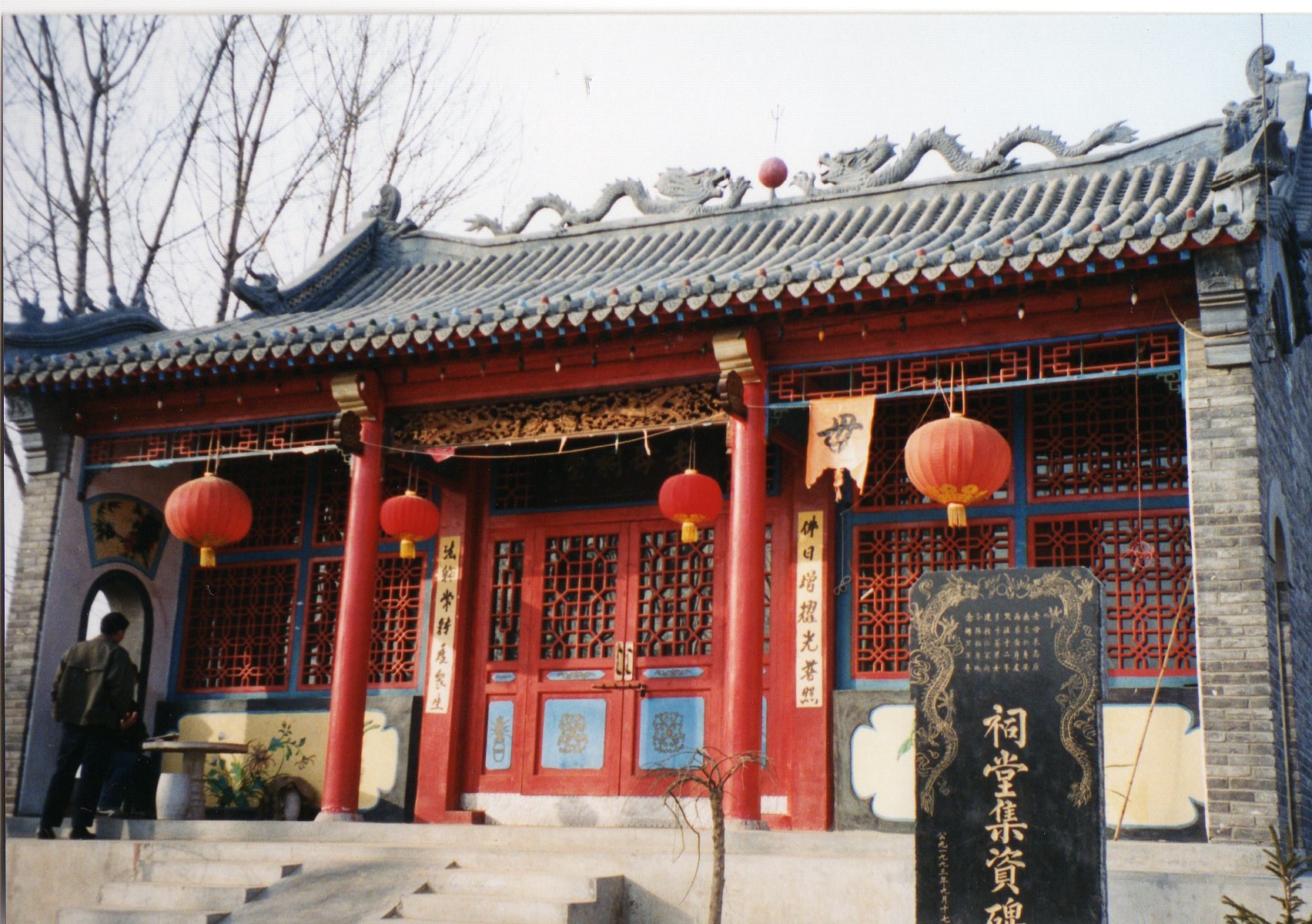
Gaozhuang citang

The village Party Secretary told us that sources of support included incense money from the Great Tent Association (Dapeng hui, a common term in the area for a ritual association) and from the temple, and money from fortune-telling and curing illness. He reflected, “A dozen or so women kept on coming to see me about building a temple. I had no choice—the brigade couldn’t refuse, so I gave them a plot of land. Believing in the gods and having a temple is no bad thing, it’s not as if you stop production if you believe in it!”

In all, the flamboyant (and readily secularized) Songs-for-winds style remains a common image of wind bands on the Hebei plain, but since all our fieldwork through the 1990s it is clear that ritual practice, with its more solemn shengguan instrumental style, is both older and more common. It is resilient too. This persistence of tradition, both in religious and musical practice, is all the more striking in such a once-revolutionary county as Xushui.

Mao was impressively modest about his limited success when he admitted to Nixon in 1972:

“I haven’t been able to change [China]—I’ve only been able to change a few places in the vicinity of Peking.”  [4]

But he wasn’t modest enough: in some ways even a county so near Beijing, such a focus of the revolution, has remained resistant to Maoist ideology, predating and outliving it. Still, disruption was severe. For more on Xushui, see here.

Official festivals in the 1950s
Meanwhile, the new government, in its own way, was promoting local culture through the medium of regional folk festivals (diaoyan, huiyan). First, local festivals were held to select representatives for major performances in the regional capitals. Some laicized priests were even assembled to perform as “troupes“, sometimes for the first time in many years—such as Baiyunshan Daoists (1955), Wudangshan Daoists (1956 and 1957), Wutaishan Buddhists (1958). For such performances, inevitably, their shengguan instrumental music was plucked out of its ritual context. I haven’t heard stories as distressing as the fate that befell kobzari blind minstrels in Ukraine when summoned for an official festival in the early 1930s; but folk ritual specialists were still anxious about performing for officials around 1980.

These festivals served partly as auditions for the state song-and-dance troupes then expanding all over China. Daoist and Buddhist ritual specialists had a deserved reputation as outstanding instrumentalists. Many, like our very own Li Qing (my book pp.113–25), were recruited as musicians to state troupes around 1958—and then sent home again as the state apparatus collapsed in 1962.

While such festivals stimulated the collection and documentation of folk music, we must balance this with the ongoing assaults on its traditional context. The background ( beginning from the 1940s) was campaigns against “feudal superstition”, terrifying public executions of sectarians, and the destruction of temple life.

The reform era
Urban festivals featuring rural groups—perhaps related to a conference—make a convenient recourse for busy academics into whose holidays they fit nicely. From the 1980s, the secular arts festivals of the Maoist era were remoulded into more glossy events. In 1990 the Li family Daoists took part in a festival of religious music in Beijing.

By the 21st century the new ideology was confirmed in the regular staged “living fossil” presentations of the Intangible Cultural Heritage. The latter project, with its whole bureaucratic workings, has now become a major research topic on its own, at the expense of studies of the local traditions that it is supposed to assist (my book pp.331–3). Note also the Qujiaying bandwagon.

I tend to steer clear of conferences, but in May 2016, as a pretext for going to hang out yet again with Li Manshan in Shanxi for a couple of weeks, I accepted an invitation to take part in a conference celebrating the 80th birthday of my esteemed teacher Yuan Jingfang in Beijing (for the resulting volume, see here).

It was a déjà-vu experience. Apart from a sequence of eulogies, the event also featured staged performances from three representatives of Yuan Jingfang’s long-term research areas: the Hanzhuang ritual association from Xiongxian in Hebei (near Xushui), the Zhihua temple group, and a ritual band from near Xi’an.

Hanzhuang 1993

Filming the Hanzhuang association in their ritual tent, 1993 (photo: Xue Yibing). Rear centre: two frames of ten-gong yunluo.

It made me feel my age, reminding me of all our visits to these very groups between 1986 and 2001. Taking time out of the conference to chat with the Hanzhuang group outside by the lake, we recalled their kindly association leader Xie Yongxiang 解永祥, father of the present leader, and another of those wise sheng masters. We had learned a lot from him in 1993 and 1995.
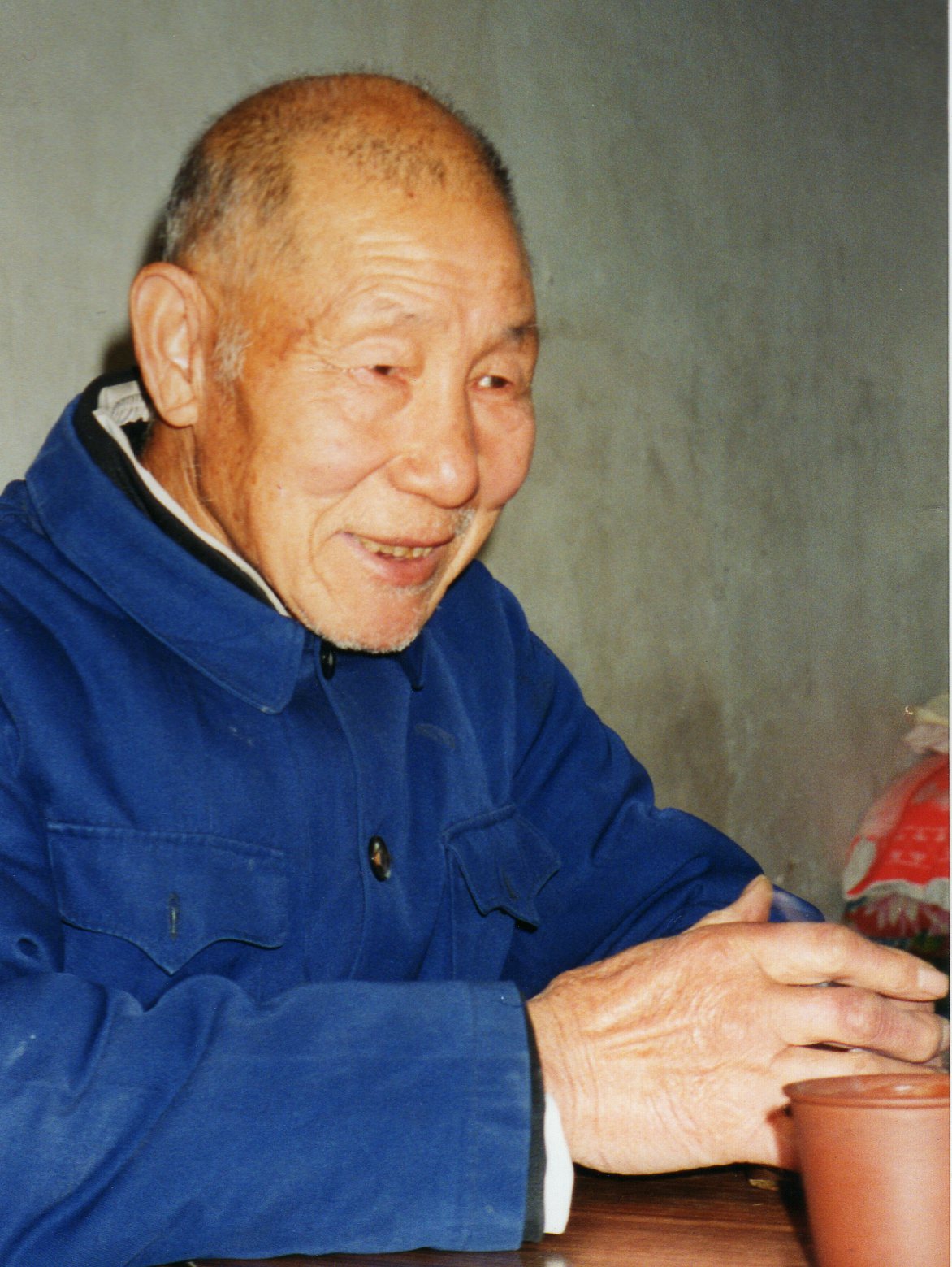
Xie Yongxiang 1995

Xie Yongxiang, 1995

But returning to the conference—the object of admiration, inevitably, was their “music”, detached from its enduring social context. I already missed hanging out with Li Manshan in the scripture hall.

All the glossy stage presentation has many Western parallels—flamenco on the Terry Wogan show, WOMAD, Songlines, prizes, urbane discourse explaining its “cultural value” to outsiders… The fancy costumes and dry ice of many Chinese events are reminiscent of Eurovision; they may seem like a Disneyland version of the Chinese heritage.

That photo comes from a recent ICH “performance” of the Baiyunshan Daoists, no less.

Now, I adore opportunities to present the Li family Daoist band on the concert platform (see e.g. this post and a whole related series of vignettes from May 2017), but while it is of course a compromise, we take care not to tart them up—we can hardly do otherwise, so solemn is their demeanour. The ambience and acoustic of churches makes a fine setting,  the Daoists’ sheng mouth-organs filling the Peterskirche in Heidelberg on our 2013 tour (cf. Buildings and music):
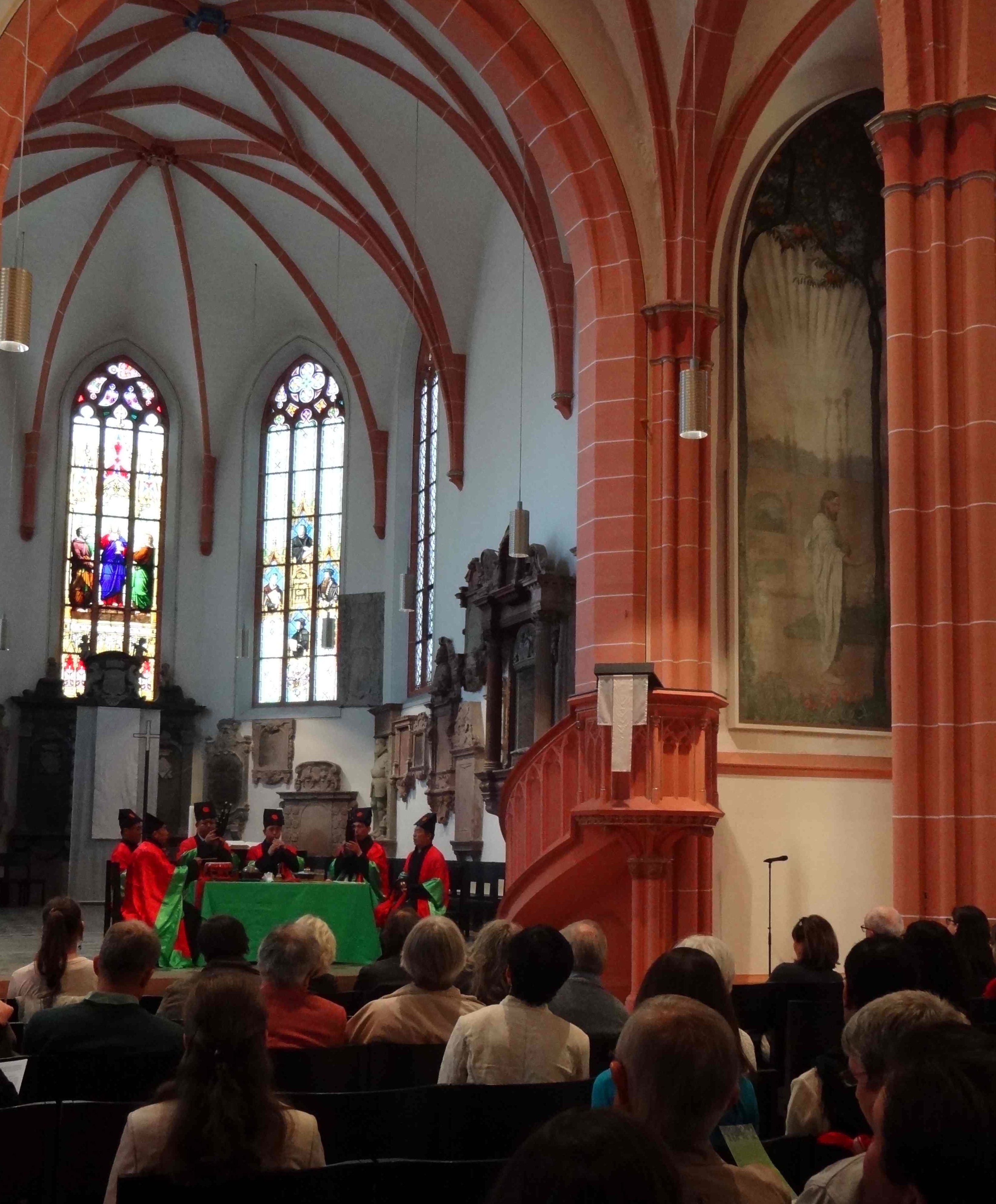
Hberg 2012

The Li family Daoist band in concert, Heidelberg April 2013.

Still, their regular “rice-bowl”—day in, day out—is always performing funerals for their local, not global, clientele.

What is dodgy is when people begin mistaking the staged events for the Real Thing, or some kind of ideal. Urbanites may do so, but villagers know better. Of course those staged events are themselves a legitimate, and popular, object of scholarly analysis. But I worry that it creates a fait accompli, like the way that in old-school WAM musicology the Great Composers were the main story (as deconstructed by McClary, Small, Nettl)—“this is what we find, so it must reflect the real picture, and so this is the object of study”. As always, “modern” secular performance doesn’t replace traditional activity: they co-exist.

The CHIME conference in LA will doubtless turn up many instances of what I’m struggling not to call “contested negotiation”. Anyway, staged events can give us a lead, rather like using the photos in the Anthology, otherwise flawed, to draw us towards folk activity.

For thoughts on the theme of the 2021 CHIME conference, see here.


[1] For more, see Frank Kouwenhoven, “Love songs and temple festivals in northwest China: musical laughter in the face of adversity”, in Frank Kouwenhoven and James Kippen eds., Music, dance and the art of seduction.
[2] For this whole section, see my Folk music of China, pp.48–52, 195–203; “Chinese ritual music under Mao and Deng”, British Journal of Ethnomusicology 8 (1999): 27–66; “Reading between the lines: reflections on the massive Anthology of folk music of the Chinese peoples”, Ethnomusicology 47.3 (2003): 287–337. See also my In search of the folk Daoists of north China, pp.166–7, 183–4, 188–90.
[3] As correctives to all the Xushui propaganda, see e.g. the brilliant works of Friedman, Pickowicz, and Selden, Chinese village, socialist state and Revolution, resistance, and reform in village China—describing a commune not far from Xushui. Note Chinese village, socialist state, pp.215–20; Dikötter, Mao’s great famine, pp.40, 47–9, 68–70; and estimable analysis online in Chinese, e.g. http://mjlsh.usc.cuhk.edu.hk/book.aspx?cid=6&tid=184&pid=2269. For the model commune of Greater Quanshan in Shanxi, precursor of Dazhai, and temporary “home” to the Li family Daoists, see my Daoist priests of the Li family, pp.122–3, and here, under “Famine in China”.
[4] Also reported by Henry Kissinger in Newsweek, 3rd March 1997, p.31.

Two local cultural workers

These notes are partly stimulated by Zhang Lili, currently writing her PhD in Beijing on my relationship with the village of South Gaoluo, subject of my book Plucking the Winds.

A useful idiomatic term evoking the whole spectrum, whether of guanxi contacts or the range of funeral services, is yitiaolong “the whole dragon” (indeed, this blog may itself be considered “the whole dragon”, making links between seemingly diverse topics).

Li Bin’s first funeral shop in town.

Li Bin’s funeral shop in Yanggao county-town, Shanxi.

So having praised Yang Yinliu, shining pinnacle of Chinese musicology, I want to pay tribute to two admirable local cultural workers at the opposite end of the dragon (cf. An unsung local hero) whose work has inspired us since 1989:

Liu Fu 刘阜 and Wang Zhanlong 王占.

Their only qualification was that they were local, and came to take pride in documenting their local traditions under the stimulus of the new directive from the Anthology of folk music of the Chinese peoples, the vast project that got under way from 1979 as China began to liberalize after the collapse of Maoism.

Let me adapt a passage from my article

  • “Reading between the lines: reflections on the massive Anthology of folk music of the Chinese peoples”, Ethnomusicology 47.3 (2003), pp.287–337 (for reading between the lines of a Chinese article on 1950s’ Tibet, see here).

Antoinet Schimmelpenninck described the process of collecting folk-song in Jiangsu in the early 1990s.

The collecting of folk-songs is one task, but by no means the only or primary task of the bureaus of culture. They carry out political propaganda, make posters about family planning or about the punishment of local criminals, organize dance parties, stage plays and children’s games for local entertainment, run libraries, and execute various administrative tasks which help the provincial government. […]
It is not, at present, one of the specific tasks of the Cultural Bureaus of the Wu area to collect folk-songs. I visited one wenhua zhan (village cultural post) which was mainly engaged in printing labels for jam jars and other consumer goods.

Censorship may operate throughout the process: first, self-censorship of performers (e.g. what kind of songs singers see fit to sing for fieldworkers), and then editorial adaptation of the material collected. In Baoding, one single region of Hebei province, where ritual associations have important traditions, such fieldwork as was done on “instrumental music” took place mainly from 1983 to 1985, but in only two or three of a dozen counties we have visited did we find knowledgable cadres who had done such work.

One of the most diligent of these was Liu Fu, of the Hall of Culture in Laishui county. He acted early on the Anthology directive, printing a mimeograph (4 pp. introduction, map, list of contents, 128 pp. transcriptions, 22 pp. field report, 8 pp. diagrams of instruments) on the county’s instrumental music as early as 1983, which was an important inspiration for my own work on ritual associations there. I don’t know if the regional editors ever forwarded Liu Fu’s work, but it was entirely omitted from the final provincial publication. The following passages of his “Field report” show some of the problems faced by local collectors, here partly relating to the sensitive and secret nature of ritual music:

The work of collecting folk instrumental music is not always smooth: we have met considerable difficulties. For instance, some elderly folk musicians had been struggled against during past campaigns for this [their music/ritual], and had been labelled as “black cliques” and “ox demons and snake spirits”, so they are still anxious. When they heard that we wanted to collect pieces of music, they suspected that it was once again “luring the snake out of its hole”, and so they refused to play for us.

Some associations are very conservative in their thinking, and are concerned that their distinctive pieces will be taken off and learnt by others—in their own words “something we begged for on our knees, we can’t just throw it out now we’re on our feet”, and so they make excuses not to play for us. Some associations take the opportunity to make economic demands. Some brigade [village] cadres think this work is meaningless, and are afraid it might have side-effects, and so are unwilling to co-operate with us. And so on.

Since these are ritual associations, by “side-effects” he apparently means that the collection may be seen as encouraging feudal superstition. Liu Fu continues:

To tackle this situation, every time we arrive in a place, we explain the document “On the collection and documenting of the Chinese folk musical heritage” from the Ministry of Culture and the Musicians’ Association, and the spirit of the directive from the relevant organs of the province and regions, and we discuss the great academic value of the repertory of the ritual associations in our county, and the great significance of the work of collecting, to make the cadres and musicians have a correct understanding; we then show them that they can play whatever they have to play, they must not leave it to later musicians, but do their best to make their own page in the Anthology of instrumental music.

Poor equipment for sound recording, copying, and photography was the norm. Liu Fu goes on to discuss the problems of recording:

Although there are said to be instructions and directives from the central, provincial, and local authorities for the work of collecting instrumental pieces, no-one has given us a scrap of money, and the expenses of the county Bureau of Culture are reduced year by year. Under present conditions, where they can only guarantee annual salaries, they can’t supply any more money to support the work apart from producing a minimal sum for buying necessary goods like tape and paper. Thus, all the associations have to perform for free. This requires us to record as much as possible in a short time.

I might add that any tapes were poorly annotated if at all, and haphazardly stored. One keen cadre I know in the same area had to use a single tape over and over, transcribing a piece in one village one evening and then re-recording music in another village the next day on top of the old recording. But at least he did some work! Of course there was a lot more that local scholars could have done, given time and money—like copying gongche scores and ritual manuals, filming rituals, documenting the histories of the associations, and giving detailed descriptions of ritual sequences, as we later aspired to do in our project around several nearby counties. But Chinese fieldworkers have now overtaken us.

Central funds barely reached down to grass-roots level, and cultural cadres did what they could. On one hand, they were indigenous to the musics they were documenting, but they were rarely able to afford the time or resources, even if they had the training, to make systematic reports. Still, some of the results are impressive.

Anyway, we knew that we might learn from local cultural officials how to find ritual groups. Besides, in those early days, when the memory of the commune system was still fresh, it was a necessary first stage to go through the chain of local officialdom. Sometimes, when our preliminary research in Beijing failed to suggest any knowledgeable local officials, we simply bypassed them. A couple of times we got our fingers burnt, but the most fruitful leads to ritual groups often came just by stopping to chat to any old melon-seller by the roadside—he would generally tell us where the grand rituals were held, and which villages were worth visiting.

There were actually two types of cultural officials: those inclined towards “cultural work”, and jobsworths. The latter, once we began visiting the villages regularly, realized that we didn’t constitute an excuse to hold another vast banquet; I was clearly not an eminent foreign professor but an ill-dressed and impecunious young researcher, so they soon left us to our own devices.

Times have changed, though: now the local Bureaus of Culture are staffed by administrators, not necessarily even local, with their smartphones and spreadsheets.

Liu Fu and Gaoluo
Further to A slender but magical clue, I’ve been recalling how we found the village of Gaoluo.

Liu Fu himself came from a Laishui village, East Mingyi, with its own tradition of vocal liturgy (including baojuan “precious scrolls”) and shengguan ensemble. After the 1986 “discovery” of the Qujiaying ritual association in nearby Gu’an county, he had already approached officials in Beijing to tell them that there were plenty of similar groups in his county alone, giving them a copy of his fine 1983 mimeograph and a tinny tape he had somehow made of a few of their shengguan pieces.

In Beijing Liu Fu also met my mentor Qiao Jianzhong, Yang Yinliu‘s successor as head of the Music Research Institute, who then made an exploratory trip to two other Laishui villages in 1988. It was this that prompted me and my friend Xue Yibing  (a bright musicologist from the distinguished Music Research Institute in Beijing) to visit Liu Fu in his bare dingy office in Laishui county-town as part of our first fieldwork survey in New Year in 1989.

After giving us an outline of the various ritual groups in the county, Liu Fu recommended Gaoluo, so we all sallied forth. Here I adapt from the Prelude of Plucking the Winds:

I first arrived in the village of South Gaoluo on a cold but bright winter’s afternoon, on the 14th day of the 1st moon in 1989, in the middle of the great New Year’s rituals then taking place in every village in China. This was one of many villages just south of Beijing where I was working with Xue Yibing in doing exploratory fieldwork on amateur ritual groups.

Escorted on that first visit by a well-meaning ganbu (“cadre”, as state officials are known in China) from the cultural bureau of the county-town, we made slow progress by jeep along the bumpy track to the village; though it is only nine kilometres from the dingy county-town of Laishui, the journey took over half an hour.

cart

An encounter on the way to Gaoluo, 1989.

First we went to the house of the then village chief Cai Ran, himself a vocal liturgist in the village ritual association, and had to spend over an hour in heated debate before we could cajole him into allowing us to trudge through the alleys to the ritual building a few hundred yards away, where the association was then performing before the god paintings at the altar (photo here).

cai-ran

Cai Ran, 1989.

diaogua

Diaogua hangings for the New Year’s rituals, 1989.

gl-beiwen

Donor’s list (1930) of the South Gaoluo association, New Year 1989.

At the time Cai Ran’s caution seemed to me excessive, since we were all clearly sympathetic, and the county cadre was taking responsibility, but in retrospect I felt rather embarrassed: maybe we should have respected his reluctance. Later, when I learned of the 1951 imprisonment of the Italian missionary Bishop Martina, apparently the last foreigner to visit the village, and as I experienced more often the sensitivity of “superstitious” practices in China, I understood his anxieties better. But later Cai Ran recalled that his hostility that day was not related to the revealing of secret rituals to foreigners, nor to fear of criticism from county cadres, but rather to the possible appropriation of his village’s ritual music by the cadre, whom he already suspected of handing on some pieces to the association in his own home village. After this strange introduction, we soon came to enjoy our sessions with Cai Ran: he has a wonderful informality, a great sense of humour, and is full of insight.

Later I liked to share with the villagers another amusing memory of that first afternoon. After finally persuading Cai Ran to escort us to the ritual building, and having gained the musicians’ approval to record and take photos (alas, I didn’t yet have a camcorder!), I had just set up my recording equipment when in walked a severe-looking policeman in uniform. Knowing the sensitivity of what the musicians were doing, and of what I was doing in watching them doing it, my heart sank: feeling irrationally as if I’d been caught in the act (fan cuowu “made a mistake”, as the eloquent Chinese expression goes), I prepared for further lengthy negotations. But the policeman, the splendid Shan Rongqing, back in the village for the New Year holiday, immediately picked up the large ritual cymbals and joined in with feeling. He later took part keenly in our studies of the village traditions; we often admired his musicianship on the ritual percussion, and later too on the “old fellow”, the bowed fiddle on which he accompanied the local opera.

srq

Shan Rongqing, 1989.

That day we felt lucky enough to have been allowed—eventually—to witness the association’s afternoon ritual, and since we had business in the county-town that night, we agreed to return the next day to talk with the members. That next day they were friendly, as always with such amateur associations; we recorded them “singing the score” of some of their shengguan pieces for us (cf. sidebar playlist, #9), and learned the bare bones of the New Year’s rituals and the history of the association—material which later, in view of all that we would gradually learn, came to look ludicrously sparse. And again we took our leave—the time still had not come for in-depth work, since we were only making a general survey.

Somehow, that first visit to South Gaoluo left us with a deep impression: the village seemed isolated (a view we later corrected) and its ritual life intense, with all the beautiful hangings decorating the temporary temple and the alleys outside. But it was not until the summer of 1993 that we were able to go back there. By now we were engaged on a four-year project to document village ritual associations throughout the area; but while we continued to collect basic data on other villages, we naturally felt the need to dig beneath the surface, not just to “gaze at flowers from horseback”. Gaoluo became a magnet for us, and over the following years we made many stays there, having a fantastic time as we learn more about the turbulent experiences of the village and its ritual performers throughout the 20th century.

Wang Zhanlong
The very next day after those first visits to South Gaoluo at New Year 1989, in the adjacent county of Yixian, home of the Western tombs of the Qing emperors, we visited the office of the Bureau of Culture to seek clues to local ritual associations. There we found the splendid and unassuming Wang Zhanlong. Like Liu Fu, he too relished the task of collecting material, riding his bicycle through poor villages with a crummy little tape recorder and a notebook. Wang promptly took us to Liujing village, also in the midst of their New Year’s rituals.

liujing

Xue Yibing documents pantheon, Liujing, New Year 1989.

This was the start of our studies of the Houshan pilgrimage and the cult of the goddess Houtu.

wzl-xyb

Wang Zhanlong and Xue Yibing, Houshan 7th-moon temple fair, 1993.

Houshan is just one of those numerous local mountain sites attended several times each year by vast throngs of pilgrims, ritual groups, spirit mediums, and beggars, yet (unlike Miaofengshan to the northwest of Beijing) it had never attracted the attention of outsiders.

houshan

Houshan temple fair, 7th moon 1993. Matou village ritual association (left) accompanies a spirit medium (front centre) and disciples (whom she has healed) for boat-burning ritual as they pray.

Right through the 1990s Wang Zhanlong made a wonderful sincere companion on our regular visits to Houshan and the ritual groups of Yixian county, always in sympathy with our project. Here we are in 1995 with erudite ritual specialist Li Yongshu in Baoquan village near Houshan, learning the details of the complex performance practice of the “precious scrolls” to Houtu, the Ten Kings, and so on.

Li Yongshu, Baoquan 1995

liujing-pantheon-1995

Pantheon, Liujing, hung out for rituals on the 1st day of the 3rd moon, 1995. Right: envelope with petition, to be burned in supplication to the goddess Houtu.

For an intrepid fieldworker in Liaoning, see here. See also surveys based on the Anthology for Fujian and Tianjin.

A slender but magical clue

zhs-1954

Former monks of Beijing, September 1954.

The whole topic of amateur ritual associations on the Beijing plain, and indeed north Chinese ritual, was first suggested by a 1953 monograph, slim yet astounding, by the great musicologists (and musicians) Yang Yinliu and Zha Fuxi on the shengguan music of recently-laicised Buddhist monks throughout the north and east of Beijing city, commonly associated with the famous Zhihua temple—just at a time when they found themselves in difficult circumstances after the radical social transformations around Liberation, suddenly deprived of their ritual livelihood. [1]

You can hear a haunting track from Yang’s 1953 recordings in the playlist in the sidebar, #14 (commentary here). For a roundup of posts on the Zhihua temple and related ritual activity, see here.

One of the most moving sections of the monograph [2] is a remarkably frank and perceptive letter that Zha Fuxi wrote to the former monks, dated 30/12/1952. As a qin master and scholar, his aesthetic world was remote from theirs, but he deeply valued their music, and quite understood how disgruntled they were.

While I realize that you are trying to pursue your livelihood on the basis of your knowledge of the new society, you will try to consign your repertoire to the cultural sphere… […]

But you bitterly regret that you shouldn’t have to sacrifice your youth of studying this music to the point of damaging your health and wasting your opportunities to study culture [sic]. You are particularly resentful that because you are uncultured [sic] you can’t express how these heritages of your elders in the temple—its two great arts of intangible music and material architecture—are worth preserving.

Zha goes on to itemise all the respects in which their music was such a valuable resource for musicology, partly seeking to bolster their self-esteem. He concludes by recognising how very tough their learning process was, and suggests patience, in the hope that

even if some people in the old society despised you, their moral character has been raised in the new society and they will gradually recognize you.

But of course he was unable to suggest how their position in the new society might be practically ameliorated; the ritual business of their youth would never be restored. Under Maoism both the monks and the scholars would suffer in various ways (for ritual artisans at the time, see here).

Fast-forward to the reform era since the 1980s. For two decades, whenever I returned to Beijing from the countryside, I would go and visit the former monks, notably the late lamented Benxing, and by the 1990s they were training a new generation—a group of teenage boys from Qujiaying village.

But they continued to feel resentful, despite social liberalizations and the ongoing efforts of well-meaning scholars and cultural officials to reinstate the prestige of their music, with frequent conferences and TV appearances, propaganda for the whole “living fossil” “cultural heritage” shtick. Media publicity was one thing, the reduction of their busy ritual “rice-bowl” since 1949 quite another. Today the new recruits are rather good; led by the bright Hu Qingxue, they even manage to do folk rituals as well as obligatory tourist “performances” of the shengguan music at the temple.

beijing-yankou

Former monks performing a funerary yankou ritual, Beijing suburbs 1993

This film features cameos from Hu Qingxue and our revered master Benxing, but also illustrates the current media style of presenting such culture…

* * *

Anyway, I digress. The 1953 monograph soon attained an iconic status in Chinese musicology, as indeed did Yang Yinliu and Zha Fuxi themselves. [3] But Beijing and the Zhihua temple are only the tip of the iceberg. In his monograph Yang Yinliu mentioned a hereditary sheng-repairer (dianshengde 點笙的) called Qi Youzhi, who used to mend and tune the instruments of the Zhihua temple. Thoughtfully, he even provided Qi’s address:

yyl-1953-address

South of the capital, Baxian county east, Xin’an town, Zhongyong street.

Thirty-six years later in 1989, with my brilliant fieldwork companion Xue Yibing I began a survey of ritual associations on the plain south of Beijing. Baxian county was to be on our route, so I copied the page—just on the off-chance that anyone there might still remember Qi Youzhi. Arriving in Xin’an town, as soon as we mentioned him, the members of the ritual association exclaimed, “Sure! We’ll go and get him for you!” He was still only 70 sui, a mere youngster by the standards of many ritual specialists we were now finding everywhere. Our chats with him yielded some interesting material on the transmission of shengguan music throughout the area.

QYZ 1989.jpg

Qi Youzhi (right) with Xue Yibing, Xin’an 1989.

The Qi family was among many lineages of sheng-repairers active around Beijing and the countryside just south. According to Yang Yinliu, Qi Youzhi was the sixth or seventh generation of sheng-repairers in his lineage—though he told us he was the fourth. His grandfather Qi Baoshan had worked for the imperial palace lamas in Beijing. Before the fall of the Qing dynasty in 1911, Qi Youzhi’s father Qi Lanpu used to play sheng in the Tianqiao district of Beijing. Later, through contacts with palace eunuchs, he learnt to repair sheng, building a reputation with temple musicians. His older brother Qi Lanting and his oldest son Qi Youcai also took up the business, and they also repaired sheng in Tianjin.

Qi Youzhi, Qi Lanpu’s second son, [4] was born in 1920. In 1929 he began to play sheng in the Shifan association in Xin’an town, and from 1931 until the Japanese invasion in 1937 he helped his older brother with his sheng business in Tianjin and Beijing. There he learned to make and repair sheng; they also made guanzi oboes, dizi flutes, and shawms (laba).

They used to go out to find work repairing sheng, making the rounds of all the Buddhist and Daoist temples. At the North Great Gate of Tianjin, Qi Youzhi recalled, the Buddhist monks at the “Buddhist temple” and the Daoist priests at the Chenghuang miao had many sheng. We asked him if nuns (called “juvenile monks”, youseng!) also played shengguan music; indeed, the Qi family used to tune sheng for the Taishan miao nunnery and the one in Xiaomalu (“Small road”). They used to go to tune sheng not only for the Tianjin and Beijing temples, but also throughout the villages, tuning and mending sheng for both types of ritual association, “northern” and “southern”—the latter also known by the fine terms qie 怯 (“rustic”) and kua 侉 (“with an outsider’s accent” or “bumpkin”); he maintained sheng for shawm bands too. But after the Japanese invasion in 1937 their activities were highly restricted.

Based in Xin’an in the mid-1940s the family resumed its work, apparently even through the 1946–7 civil war. Twice a year Qi Youzhi used to go on a long trek by foot to Beijing with his uncle, staying in villages on the way and tuning sheng wherever there was work. In Beijing, he recalled that temples like the Guandi miao in Sitiao, and the Guangji an at Chaoyangmenwai dongdaqiao, used the classic “capital” (“northern”) shengguan music. But the Baita si, Huguo si, and Longfu si temples seem to have been “rustic” or “southern” in style, since they included small shawms (laba) in their shengguan ensemble. This whole landscape of old Beijing has been destroyed gradually, and bulldozed most radically since the 1990s.

After the 1949 Liberation, Qi Youzhi could no longer find work in Beijing, since priests were returning to lay life and temples were now largely inactive—but significantly there was still plenty of work repairing sheng for the village ritual associations. Indeed, this work continued until the Four Cleanups in 1964. By 1980 Qi Youzhi was 61 sui, and, despite the revival, seems to have been much less active.

We went to see him again in 1993, between visits to two amazing village ritual associations near Xin’an: Gaoqiao (Buddhist—another sheng-making/repairing lineage; audio playlist track 8, and commentary) and Zhangzhuang (Daoist).

By then our team was joined by Zhang Zhentao, who has since published detailed work on the sheng and its history. Meanwhile Yuan Jingfang made detailed studies of the Zhihua temple style, further adding to the list of its clerical exponents.

Everywhere we went on the Hebei plain, we made a point of seeking out sheng-repairers—often they were themselves members of a ritual association, but anyway they always knew precisely where other groups were active in the area. We also valued sheng players, always most knowledgeable about scales and pitch systems—in Hebei, Shanxi, and throughout north China.

* * *

I still marvel at that miraculous thread which linked us so vividly to Yang Yinliu’s time with the Zhihua temple monks, and further back to the world of palace eunuchs and the ritual life of the Qing dynasty.


[1] Yang Yinliu (1953) Zhihuasi jing yinyue caifang jilu [Record of visits to the capital music of the Zhihua temple], 3 parts, Beijing: Zhongyang yinyuexueyuan Zhongguo gudai yinyue yanjiushi, mim., now available in his complete works. This post is based on my In search of the folk Daoists of north China, p.146. For Buddhist and Daoist ritual life in Beijing and Tianjin, see ibid., Appendix 1, whose citations include Vincent Goossaert’s splendid 2007 book The Taoists of Peking, 1800–1949. As I note in the Appendix (p.222), only five of the nineteen former monks assembled came from the Zhihua temple. On ritual life in old Beijing I must also mention the works of Chang Renchun 常人春; for many more links, click here.
[2] Part 2, pp.40–45, signed with his other name Zha Yiping.
[3] Cf. Tian Qing, “Shijimo huimou: Zhihua si yinyue yu Zhongguo yinyuexue” [A fin-de-siecle retrospective: the music of the Zhihua temple and Chinese musicology], Zhongyang yinyuexueyuan xuebao 1998/2: 38–45.
[4] As you see from the page from Yang Yinliu’s notes, he had learned that Qi Youzhi was adopted son of Qi Fu, another distinguished sheng-repairer. We didn’t clarify this—such family relations can be hard to elicit on a brief acquaintance.
[5] See In search of the folk Daoists, pp.145–55.

The life of the household Daoist

vocal trio 2001

Vocal trio, 2001: Li Manshan, Golden Noble, Li Bin.

Not so much

Don’t put your daughter on the stage, Mrs Worthington

as

Don’t put your son on the Daoist ritual arena, Mr Li.

Patrice Fava’s film Han Xin’s revenge, about the rituals of a group of household Daoists in rural Hunan, is very fine. The voiceover contains an intriguing line:

“Many young people choose to become Daoists.”

Whether in Hunan or elsewhere, today or when the film was made, I find this hard to believe—it seems a romantic notion.

As I observe in my book, Li Bin (b.1977) is the ninth generation of Daoists in the Li family, and could well be the last. Moving with his family to the county-town in 2007 was initially a stepping-stone for his son to get a better education—seeing it as a route towards betterment, just as his forebears had done under successive regimes.

Even if new recruits can now skimp on the training, Daoist fathers no longer want their sons to continue the tradition; there are now easier ways to make a better living, and people like pop music anyway. Fees are low, and the lifestyle, working long days and nights traipsing around backward demoralized villages, is tough and none too comfortable (see e.g. recent diaries of Li Bin and Li Manshan). Potential young recruits go away to seek urban laboring work or get a good education leading to a secure job in town, providing an escape from the countryside towards urban registration and higher wages. And this is what their parents (including Daoists) want for them.

In The souls of China (p.48) Ian Johnson puts it well (in a passage about Li Manshan’s “determining the date” activities):

… Their relief was palpable, but so was Old Mr Li’s exhaustion. It was a tiring life, always on call, staying in people’s homes, burying their dead, eating their banquets. The questions never stopped—an avalanche of new challenges and problems that were overwhelming these old villages.

So whereas Daoist ritual somehow managed to survive after Liberation in 1949, and to revive after the liberalizations from 1979, today, in a world turned competitive, where the villages themselves are depleted, working as a household Daoist offers no route to advancement. As the Daoists realize, official initiatives like the Intangible Cultural Heritage project are quite unable to solve these issues.

If there are indeed areas of China where recruits do still emerge to perform a more complex repertoire of rituals, it would be interesting to discern reasons for such variation.

All this is explored in my film too. After screenings I like to ask the audience,
“Would you let your sons take this up as a livelihood?”

This doesn’t amount to hand-wringing, however. Daoist ritual has adapted under all kinds of vicissitudes over the last century, as it always has done.

More fucking gondolas

MP

Another gratuitous spinoff from the Li band’s trip to Venice (cf. Scunthorpe and Venice, and indeed Venice: daily life in a theme park—oh, and Some Venetian greetings!):

A lesser-known gem of Monty Python is Away from it all, a ghastly travelogue with all the lovingly recreated stereotypes of John Cleese’s voiceover (Part Two should follow on):

… the one thing that Venice truly lacks—is leprechauns.

Bulgaria gets a candid assessment too:

Hard to believe, isn’t it, that these simple, happy folk are dedicated to the destruction of Western civilisation as we know it…

Eventually it’s exposed in the narrator’s increasingly deranged breakdown:

All this dashing about in search of Peace and Contentment—it doesn’t work! There’s no escaping yourself—how do you face the existential terror, the hopelessness, the dark corridors of one’s mind, the yawning, black, meaningless abyss they don’t tell you about in the brochures…

Several of us recall seeing this in the cinema as a trailer before The life of Brian.

You know whose fault it is? You lot—yes, you, you so-called cinema patrons! You sit there, stuffing your stupid faces with chocolate peanuts, gawping at these dreadful films… Well, why do you put up with them? You could stop them tomorrow if you had the guts to go to the manager and say, Why do you put this rubbish on?

For more travel clichés, see Molvania, and China–Italy: International Cultural Exchange zzzzz.

Another Czech mate

Hasek last photo

Further to my Czech mentor Paul Kratochvil:

Along with Flann O’Brien, high on the guest list for my fantasy dinner-party would be Jaroslav Hašek—”humorist, satirist, journalist, anarchist, hoaxer, truant, rebel, vagabond, play-actor, practical joker, bohemian (and Bohemian), alcoholic, traitor to the Czech legion, Bolshevik, and bigamist”.

Hašek’s The Good Soldier Švejk has long been popular in China. Cecil Parrott, its English translator, also wrote a biography of Hašek’s “bottle-strewn life”, The bad Bohemian. Former British Ambassador in Prague, Parrott effortlessly avoids betraying any sympathy with Hašek’s reprobate behaviour (see also Hašek’s adventures in Soviet Tatarstan). As he explans in the introduction to his translation:

His next escapade was to found a new political party called The Party of Moderate and Peaceful Progress within the Limits of the Law […] publicly debunking the monarchy, its institutions and its social and political system. Of course it was only another hoax, designed partly to satisfy Hašek’s innate thirst for exhibitionism and partly to bolster the finances of the pub where the election meetings were held.

Among his many japes, his short-lived editorship of the journal The Animal World was curtailed after he published articles about imaginary animals.

Dangerous herds of wild Scottish collies have recently become the terror of the population in Patagonia

Thoroughbred werewolves for sale

Newly discovered fossil of an antediluvian flea

And his hobbies combined:

Everyone who votes for us will receive as a gift a small pocket aquarium.

Svejk Chinese

Gratifyingly, The Good Soldier Švejk clearly appeals to Chinese sensibilities; it was translated, and the 1956–1957 Czech films were dubbed into Chinese:

Alexei Sayle wonders if the Czech regime knew what they were doing promoting Švejk, since its message hardly supports the ideals of socialist conformity. Though it became popular in many languages, I suspect there’s something about it that appeals in particular to Chinese people—an antidote to compulsory patriotism? The Chinese translator dutifully portrays it as a tirade against imperialism, but it surely spoke to The Common Man (Flann O’Brien’sThe Plain People of Ireland”) oppressed by the destructive irrationalities of a newer system…

The Chinese version of Švejk’s name (Shuaike 帅克) is perfect. It drives me to a little fantasy.

Terylene

In ch.18 of my book (p.342) I reflect on the Li band’s recent concert tours and Intangible Cultural Heritage status:

All this may sound like a typical story of adaptation to modern secular contexts. But it’s not. Let’s face it, the Li family is never going to become the next Buena Vista Social Club. Year in, year out, their livelihood remains performing for local rituals. Li Manshan’s recent nomination as Transmitter of the ICH brings him a modest extra income for now, but the Daoists continue to rely on doing funerals around their home base; their ICH status and foreign tours are only a minor element in their reputation, which is an accumulation of local charisma over many generations. They still lack disciples, either from their own or other families; and crucially, local patrons no longer pay much attention to the niceties of ritual practice.

It all reminds me of the elderly fiddle player in the Romanian village band Taraf de Haidouks, reflecting on his meteoric rise to global success on the world music scene:

A little fairy granted me my wish to be happy in old age. Now I have suits in terylene.

For more on adapting Daoist ritual for the concert stage, click here. For a populist fantasy, see Strictly north Chinese Daoist ritual. See also World music abolished!!! For Paris as pedagogical Mecca, see Nadia Boulanger, and Kristofer Schipper.