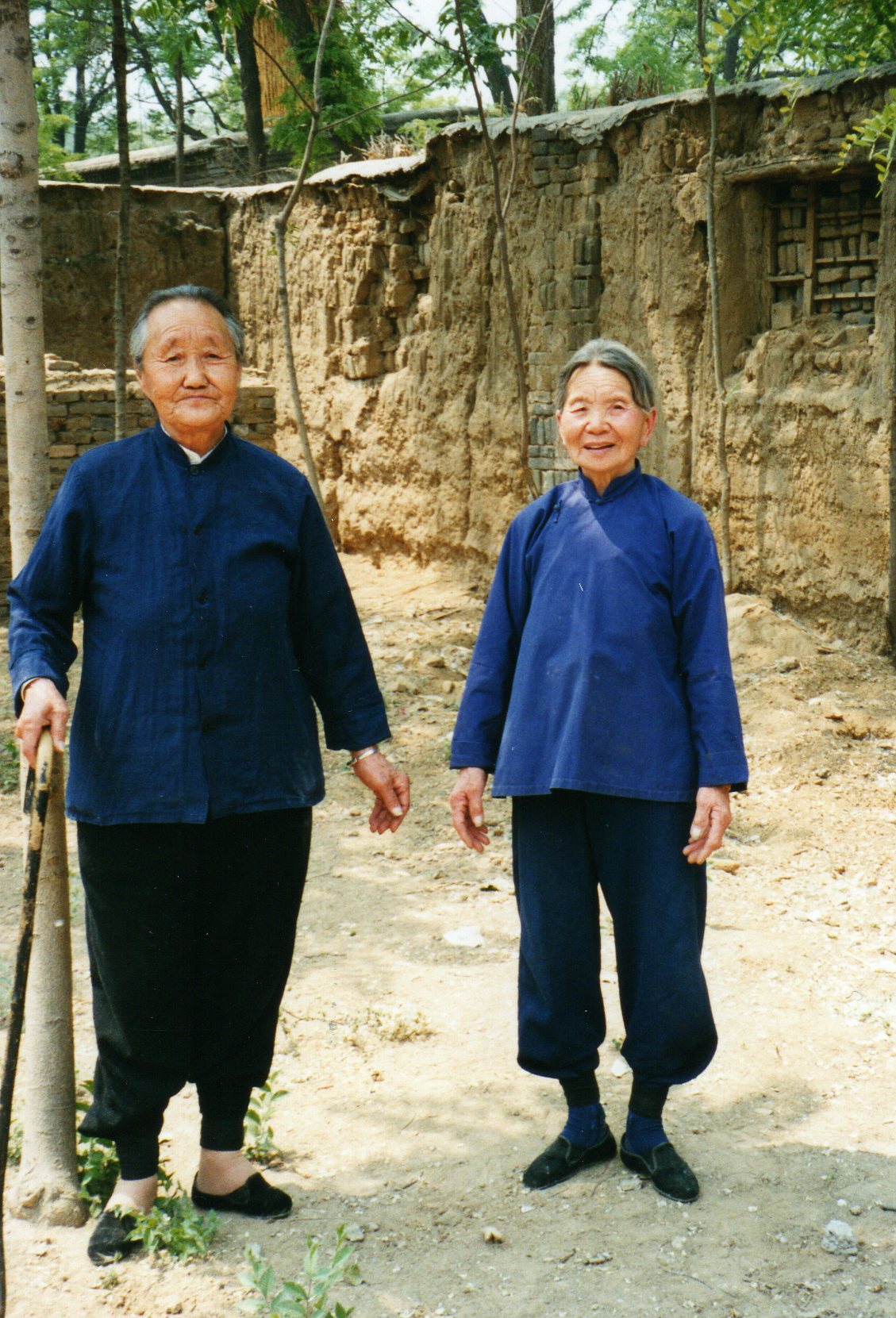
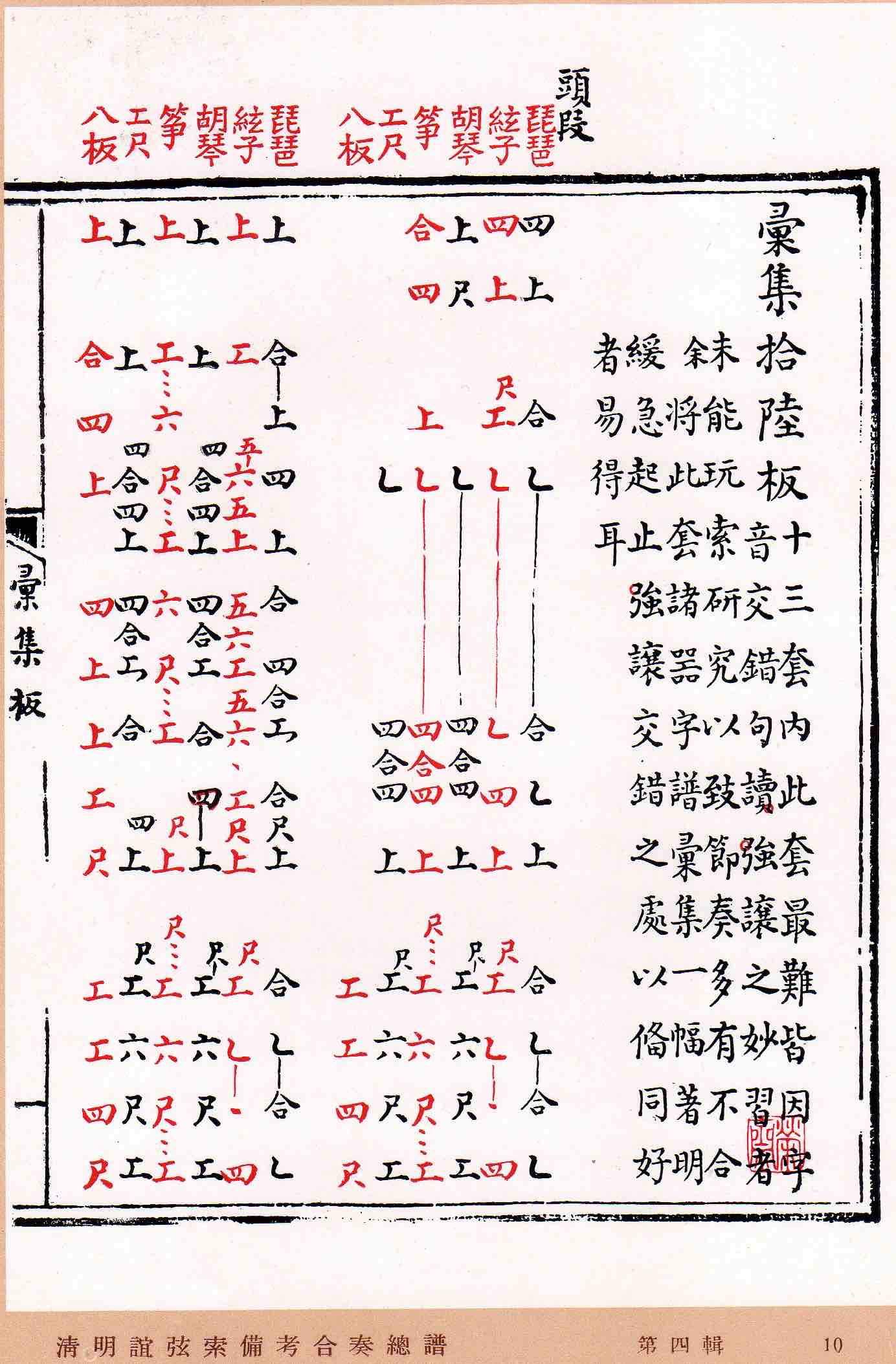
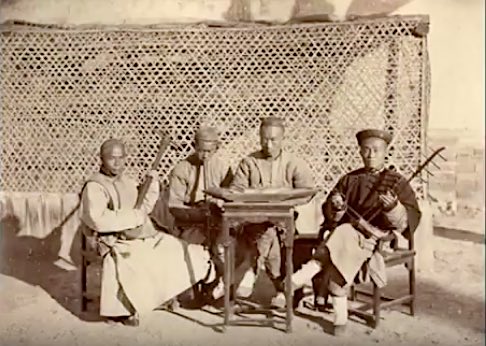
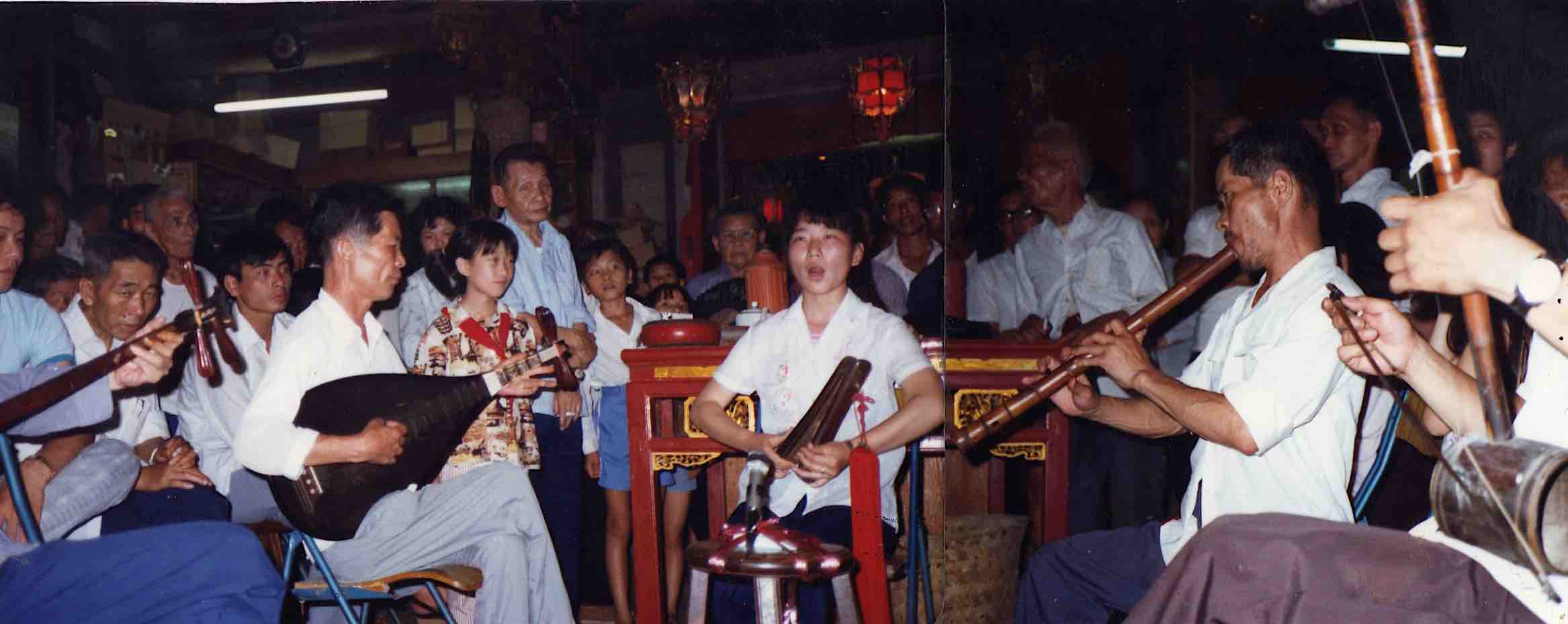
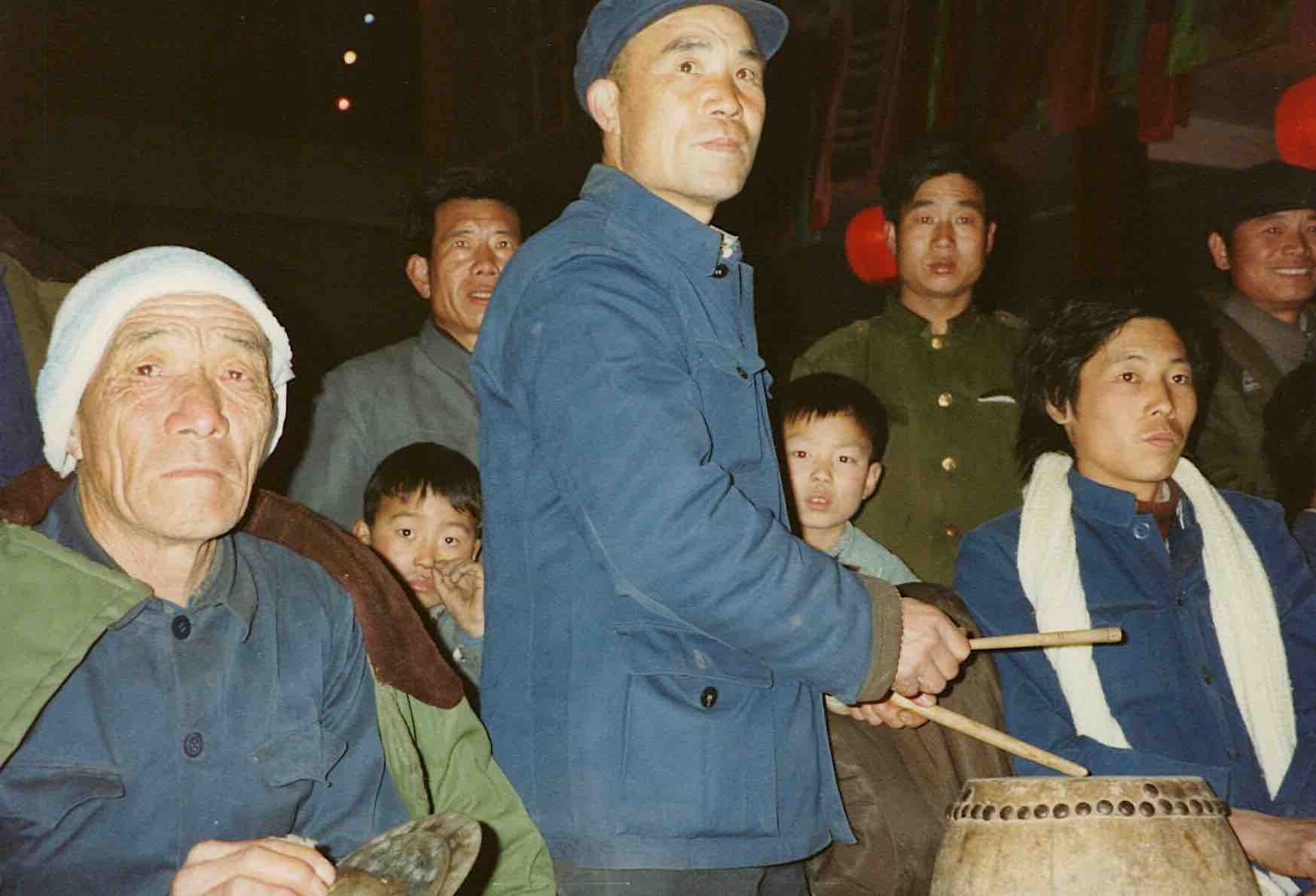
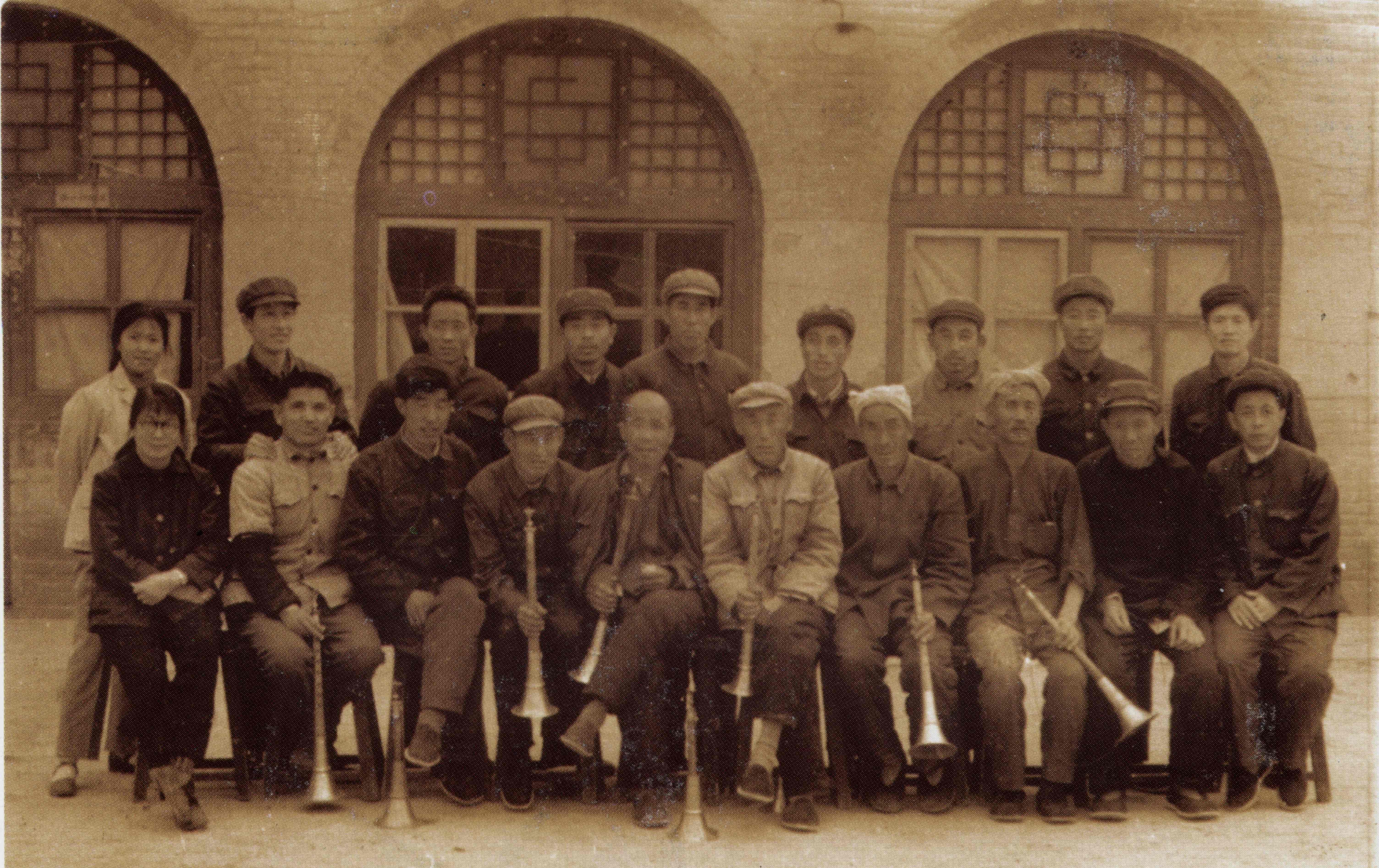
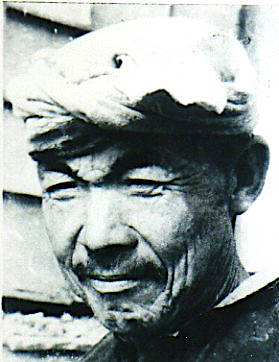
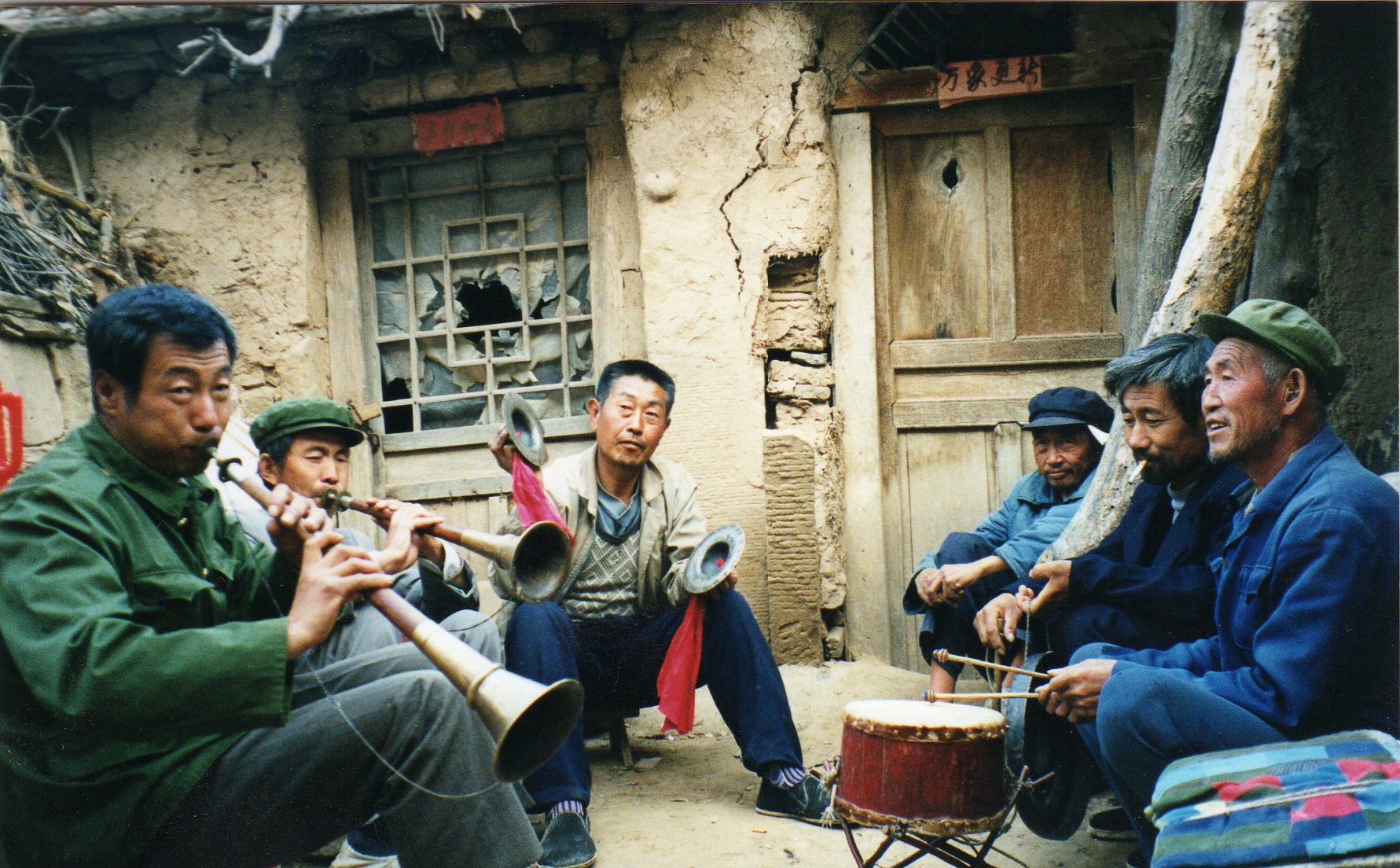
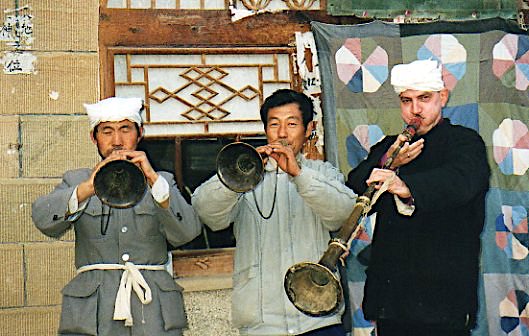
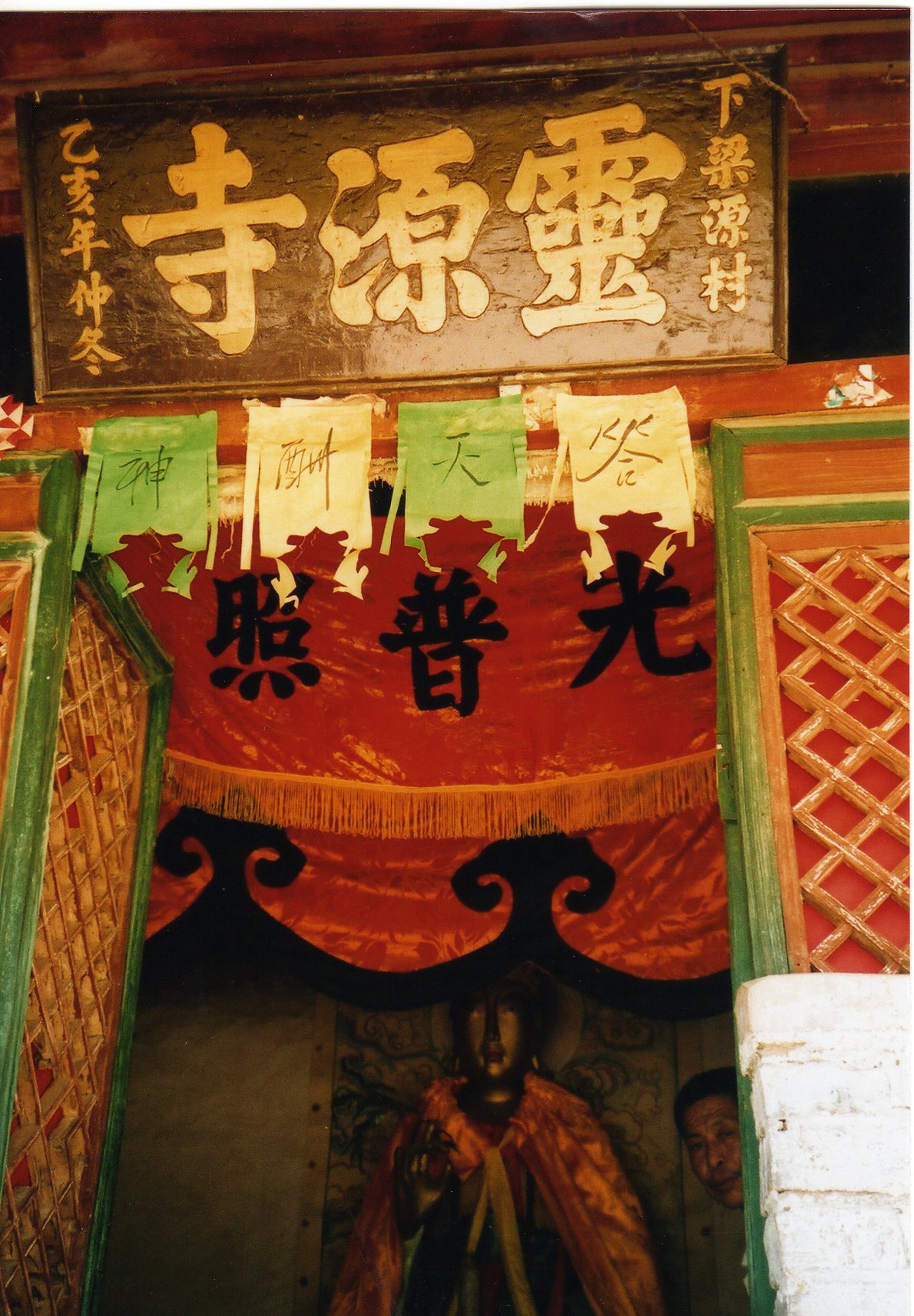
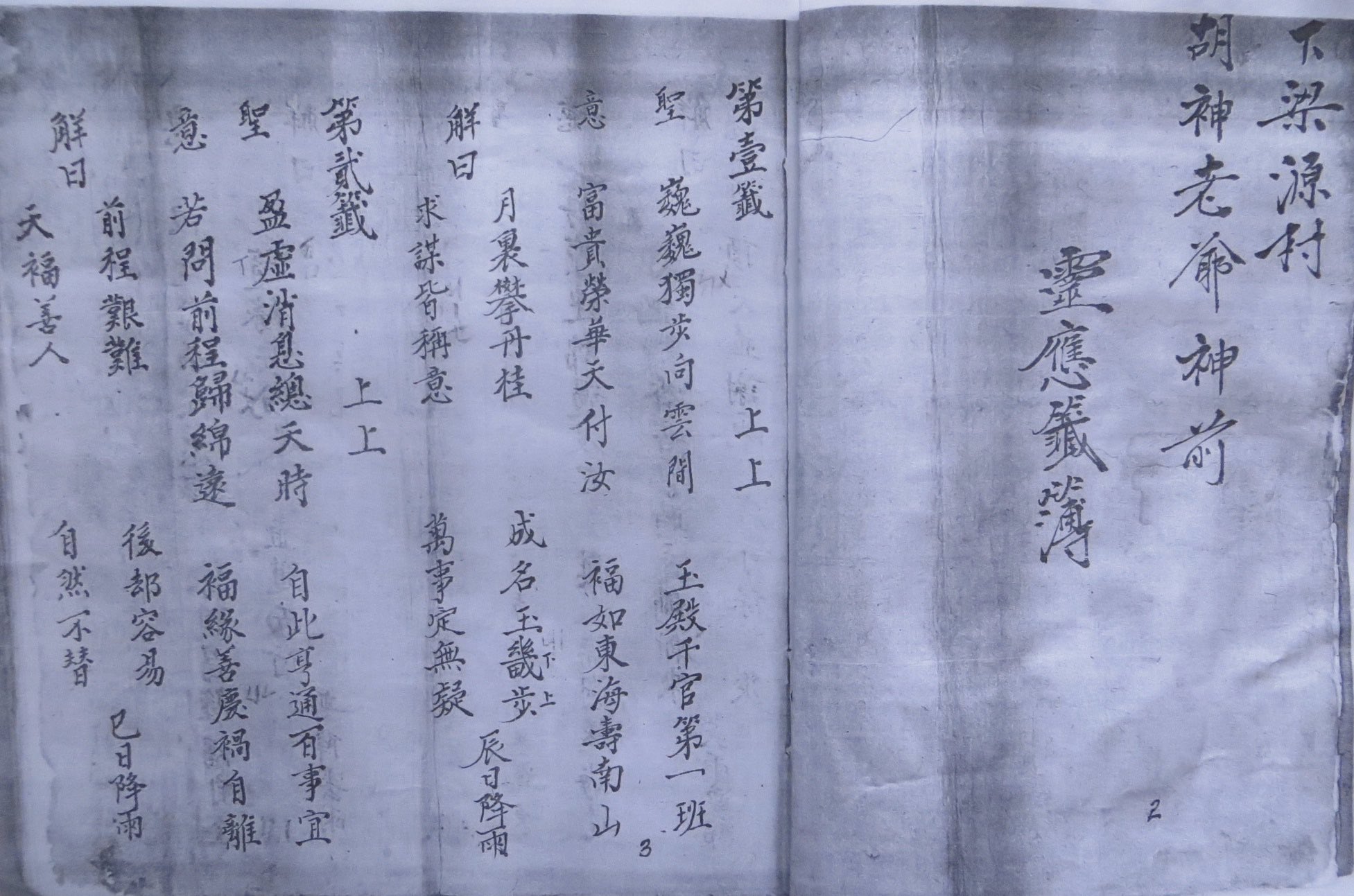
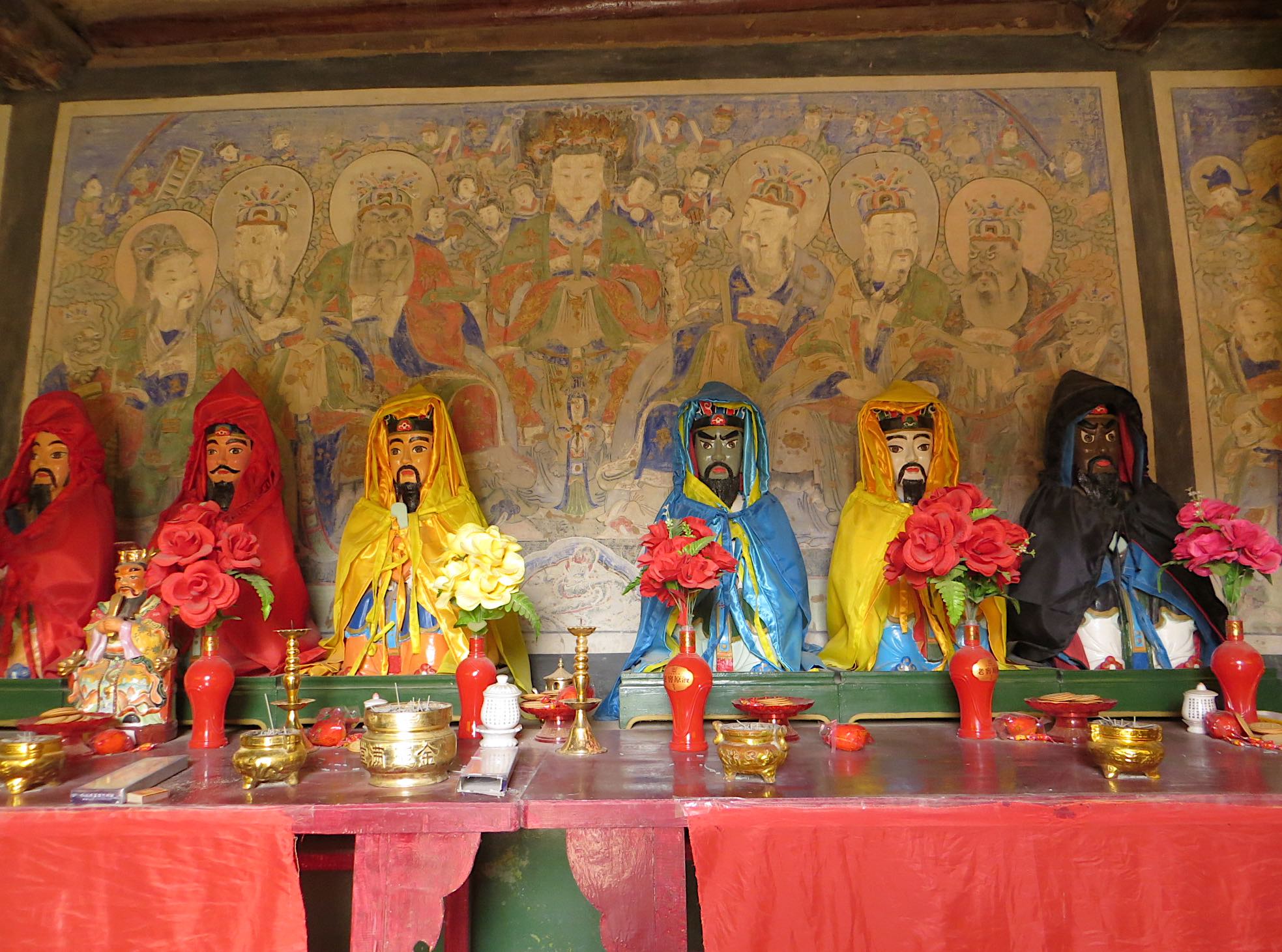
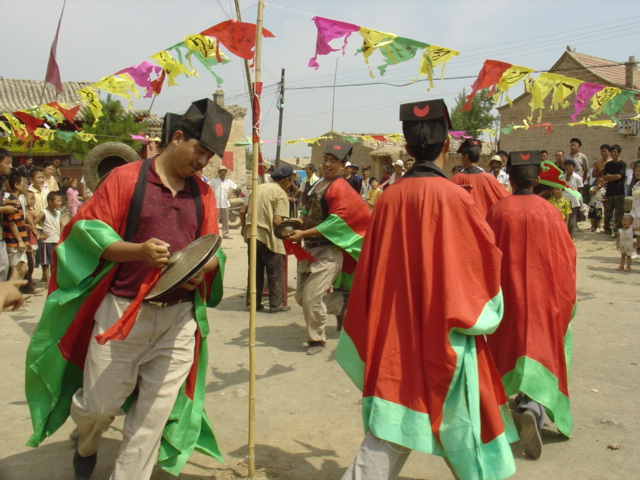
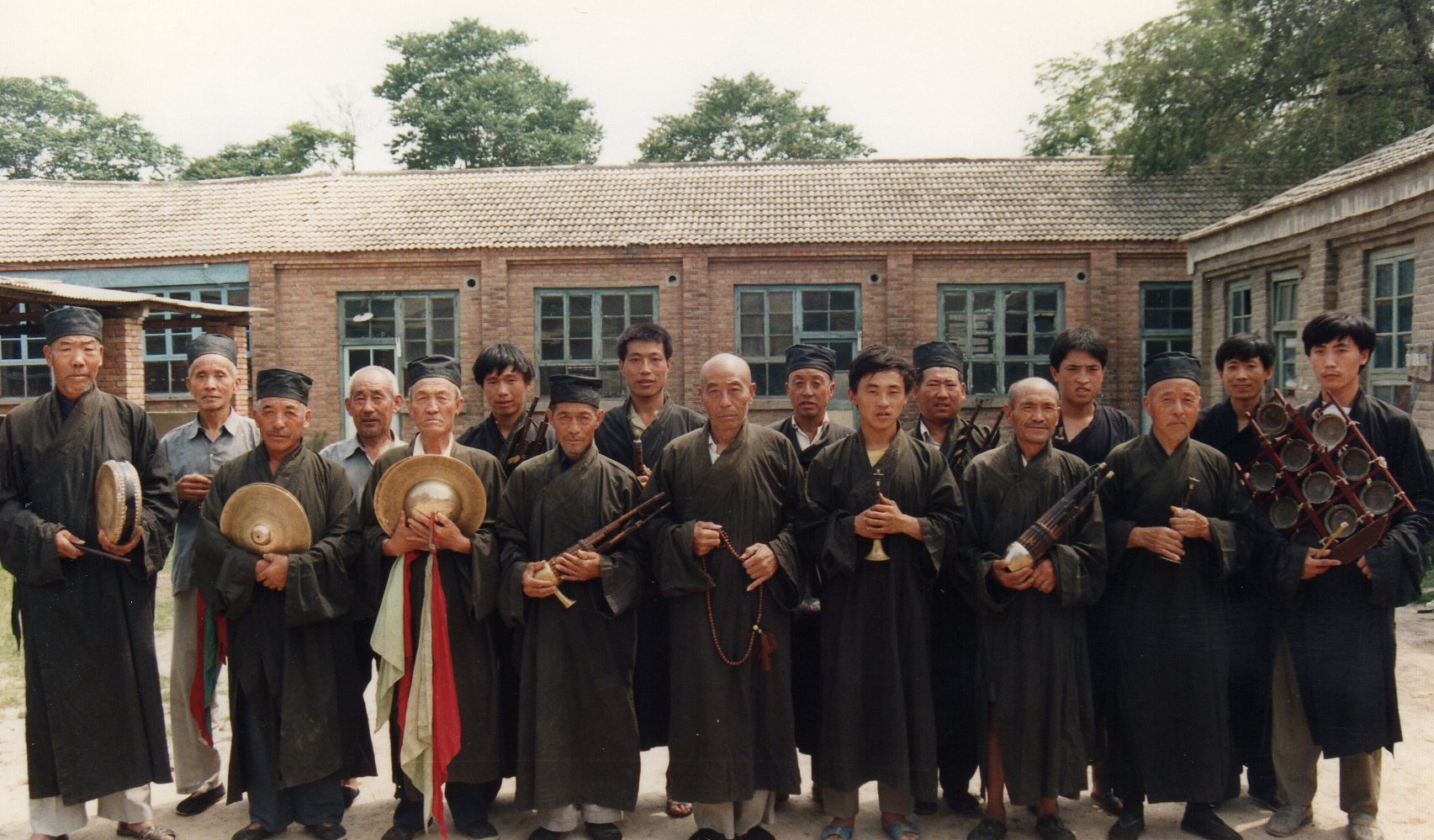
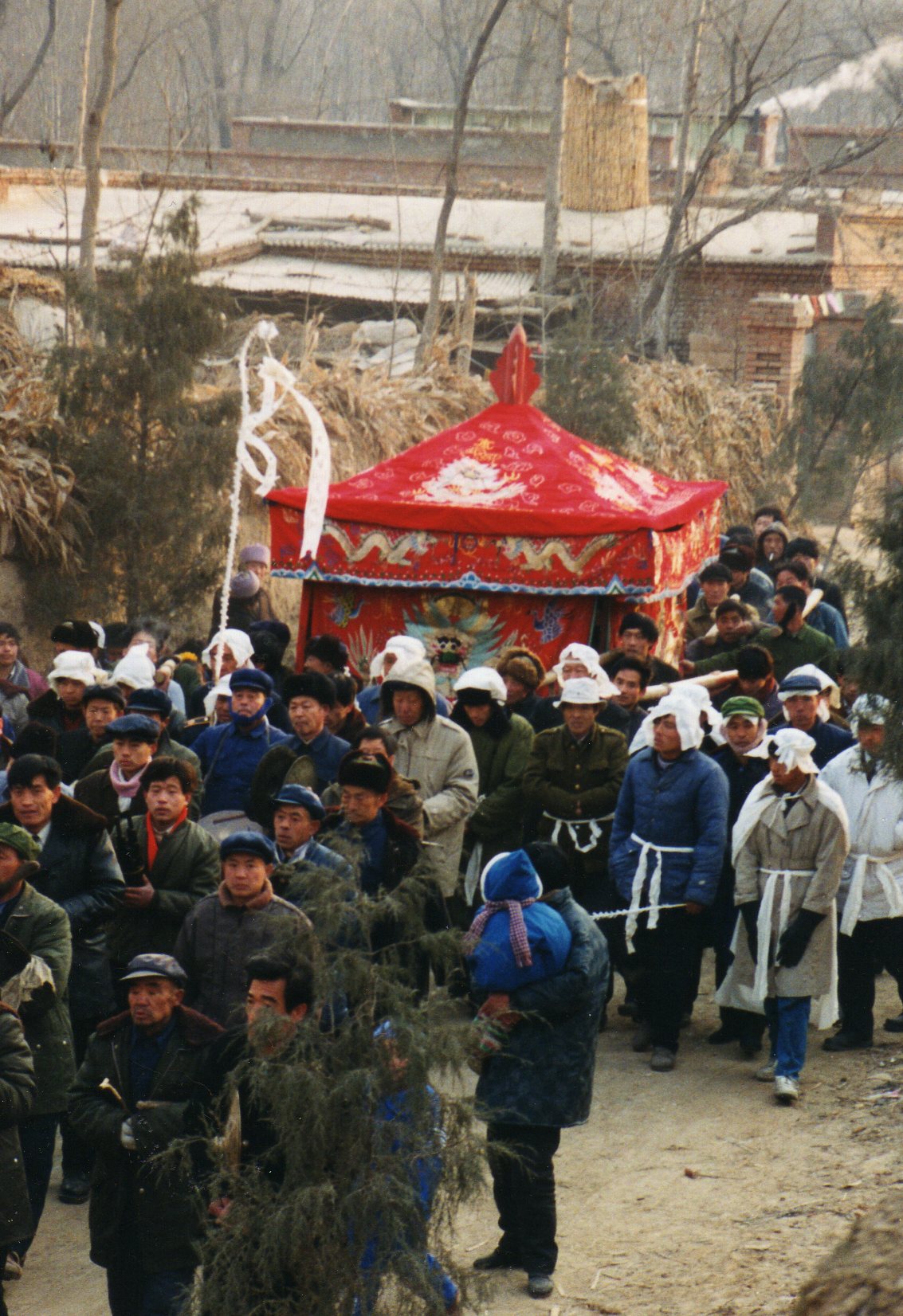
Gaoluo film: Chinese version!

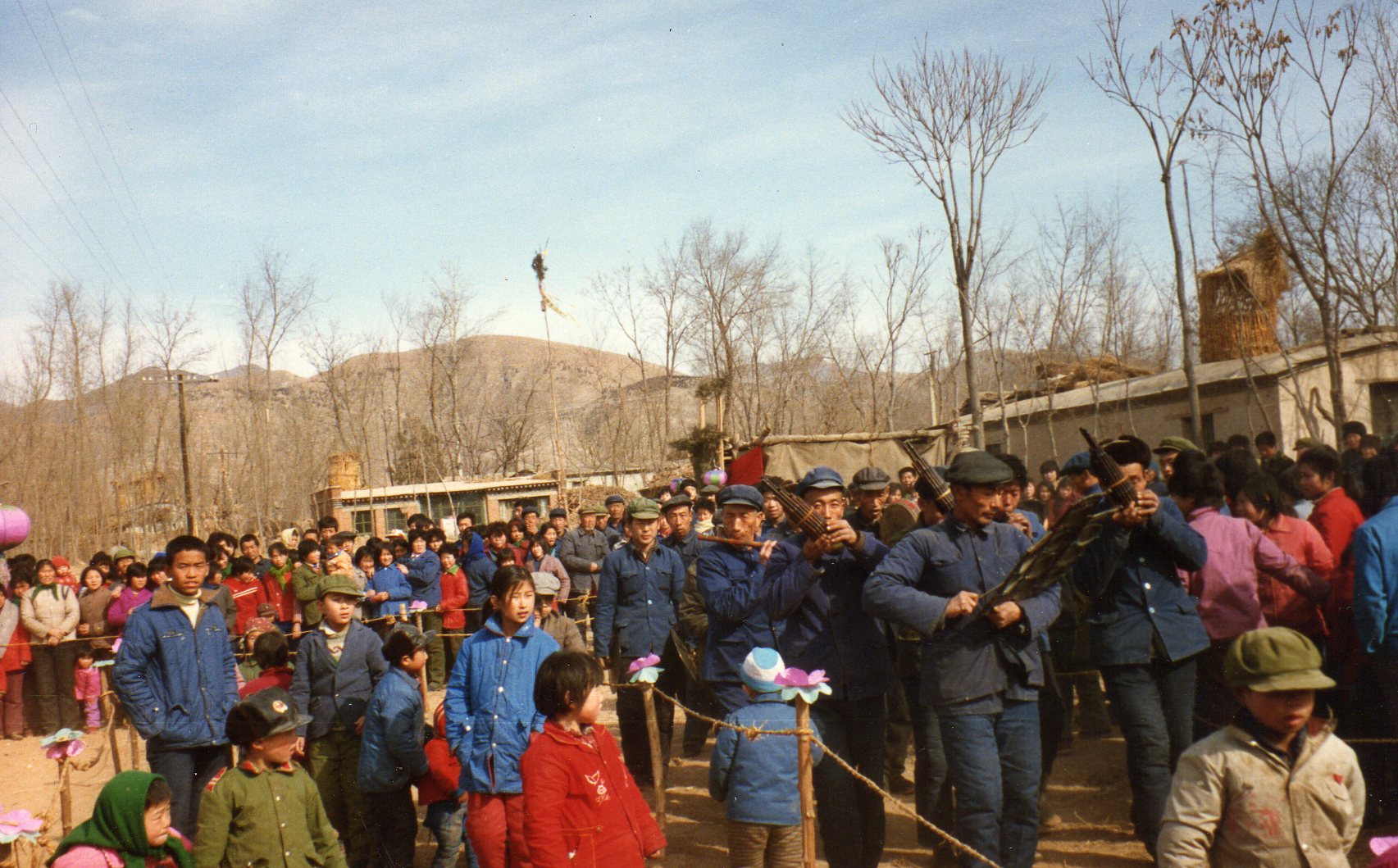
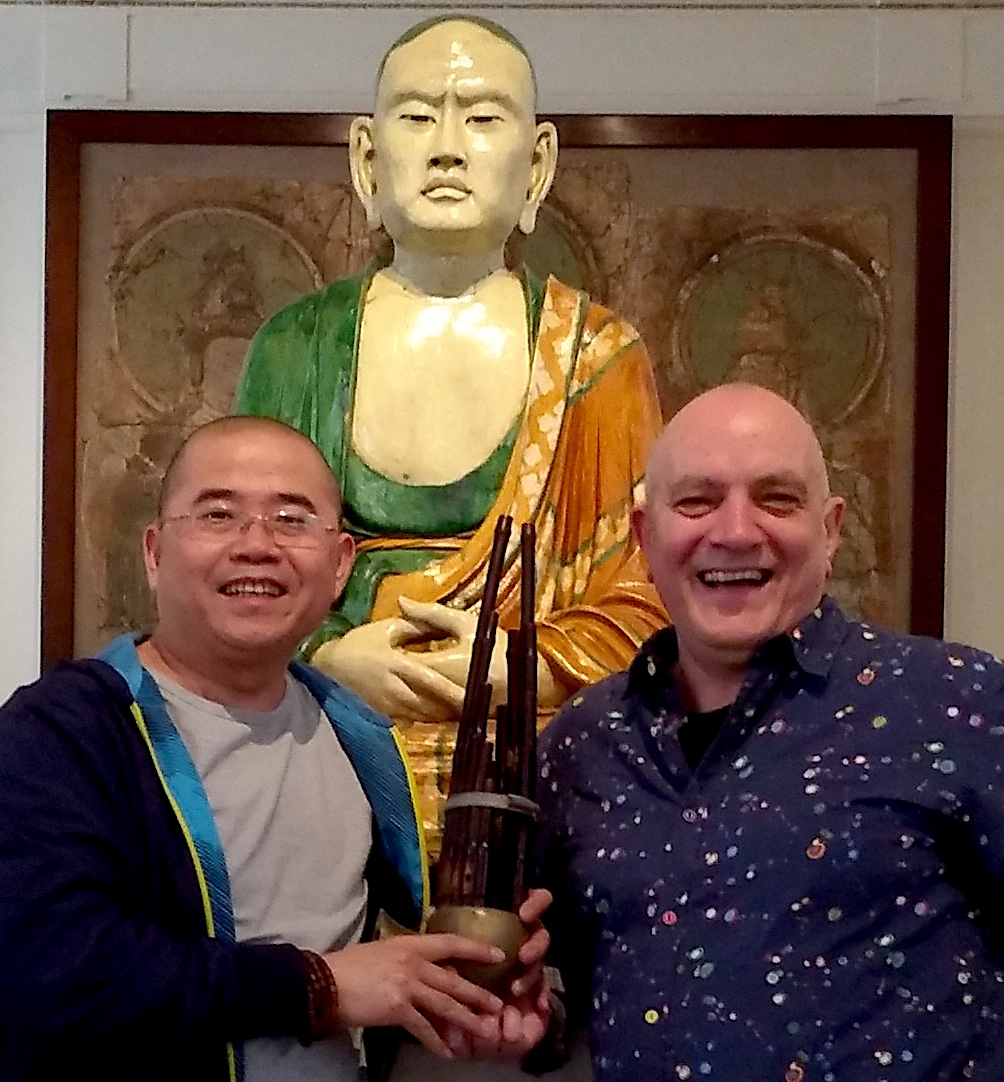
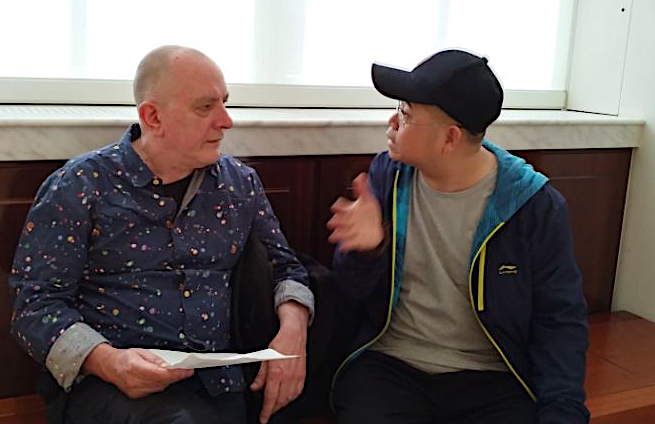
Following the online publication of my film on the 1995 New Year’s rituals in Gaoluo, a screening in the village itself prompted a version with Chinese subtitles, on which I worked with the diligent Feng Jun.

It is far from a literal translation of my English script—I was keen to adapt it to reflect the idiom and way of thinking of the Gaoluo villagers. So rather than the terminology of urban academia, we incorporated local vocabulary like lao guiju 老规矩 (“the old rules”: tradition), dangjia 当家 (“boss”), jiahuo 家伙 (percussion), wentan 文坛 (“civil altar”: vocal liturgy), and songjing 送经 (“escorting the scriptures”). In many ways I find it preferable to the English text—since the original English voiceovers are intact, it’s worth watching even for those not dependent on the translation.

The Chinese version is now available both (in China) on the CDTM website (follow this link) and on my YouTube channel (alongside the English version):

And do browse the posts under Gaoluo in the top Menu! Click here for thoughts arising from presenting the film at SOAS; here for an intriguing Chinese review; and here for a screening in Leiden along with my film on the Li family Daoists.

With many thanks to Wei Xiaoshi!

Gaoluo: some themes

Presenting my film on Gaoluo at SOAS the other day, and the following discussion, thoughtfully led by Rachel Harris and Feng Jun, prompted me to try and rework some of my thoughts.

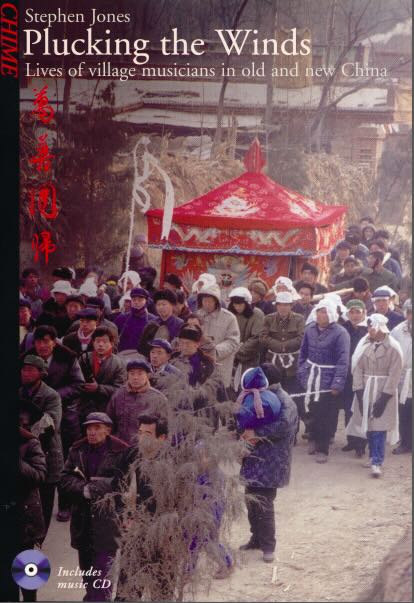
My book on Gaoluo was published in 2004, the result of frequent fieldtrips ever since 1989, and it’s full of detail on the lives of villagers through all the social and political upheavals of the 20th century. But I then moved onto other projects, and I only returned to the topic recently, to compile this film from my footage of the 1995 New Year’s rituals, which makes a nice succinct subject—and already a historical one, as I say in the film.

I see ethnography and film as essential complements to library work on imperial history (see here). This kind of subject, though vital to folk society, can’t be addressed only by reading old books in libraries. Actually, the topic hardly appears at all in old books—it’s only revealed by fieldwork. Until the 1950s almost every village in the region had an organisation like this; and many of them still do. While I eventually focused on this one village, we also did a survey of over a hundred village associations nearby (see e.g. under “Hebei” in the main menu, including this survey).

Religion
The whole topic of the Hebei ritual associations was only “discovered” by Chinese musicologists in 1986, and it has become a major theme within that discipline—but alas, not in religious studies. I think there are two main reasons for this.

First, terminology. These groups are now commonly known by the umbrella term yinyuehui, which seems to translate simply as “Music Associations”. But it’s confusing: in these villages the term yinyue refers very specifically to the melodic instrumental ensemble that accompanies the rituals of Buddhist and Daoist temples. That indeed was our initial interest, but it’s only one aspect of the associations’ ritual activities, their “instrumental department”, if you like. The term does have an authentic historical pedigree, but to us (both in the West and for urban-educated Chinese) it suggests an unfortunately secular image, like some kind of folk club for entertainment, which encourages Chinese attempts (both in the media and in academia) to downplay the pervasive role of religion (or “superstition”!) in folk society. So I obstinately insist on calling them ritual associations. Despite the gradual decline of vocal liturgy in the region, associations preserve many ritual manuals. And while the melodic instrumental repertoire now dominates, many groups regard these pieces as “scriptures”.

Apart from terminology, folk religion is a sensitive subject. There are some fine scholars in China, but they mainly write about earlier history and written texts, and are cautious about documenting events since 1949, or current activity; whereas we who study expressive culture incline more towards fieldwork. At least, scholars of religion could choose a few villages to clarify the transmission (whether “Buddhist” or “Daoist”) from early temple priests, and study early artefacts such as ritual manuals (not least the “precious scrolls”) and god paintings. While it may now be hard to establish a different image to that of the ICH (see below), the system has legitimised such associations, and they are not subject to the taint of “superstition”—even if scholars of religion may choose to exercise a certain discretion about the early sectarian connections that we documented.

These associations on the Hebei plain are devotional, priding themselves on providing ritual services for their home village without payment. Their ritual sequences are not very dense, but their purpose is to appease the gods. I again put them in the context of other manifestations of religious behaviour in China (such as sects, occupational groups of household Daoists, and spirit mediums). Like my film on the Li family Daoists (which I also encourage you to watch!), this film is set in the north; the soundscapes of the two films are similar, but their social contexts are rather different.

After the end of the main film, the Appendix gives some clues to the workings of the majestic percussion suite, ending with the most moving complete rendition. This is the most convincing illustration of the inadequacy of text, audio recordings, and photos, and it shows the villagers’ deep commitment to the tradition.

All this is a good illustration of how ethnomusicology is based on society and soundscape. Ritual in performance is always animated by sound, so soundscape should always be a major element in our study of ritual. Indeed, most local traditions of “Chinese music” depend on ritual—folk-song, opera, narrative-singing, and dance. One might compare the ritual groups in southwest China studied by Helen Rees, or “song festivals” in the northwest. In Uyghur culture, the pervasive role of Islam is masked by Party propaganda on muqam. The world music industry also remoulds “Sufi music” misleadingly to highlight instrumental music.

Conflict, and the 1949 barrier
Politics and social change are major themes of my book and this website. It’s always important to break through the 1949 barrier. We must take modern history seriously. The story always continues, from imperial and Republican times to the Maoist and reform eras, adapting to the changing times. People’s life stories and personalities make a revealing human window onto history and social change. Stories like those that I document—amidst campaigns, conflicts, famine, massacres, thefts—are airbrushed under the current Chinese regime.

Unlike small occupational household groups such as Daoists and shawm bands, these associations are public bodies, which the villages cadres have always played a major role in supporting.

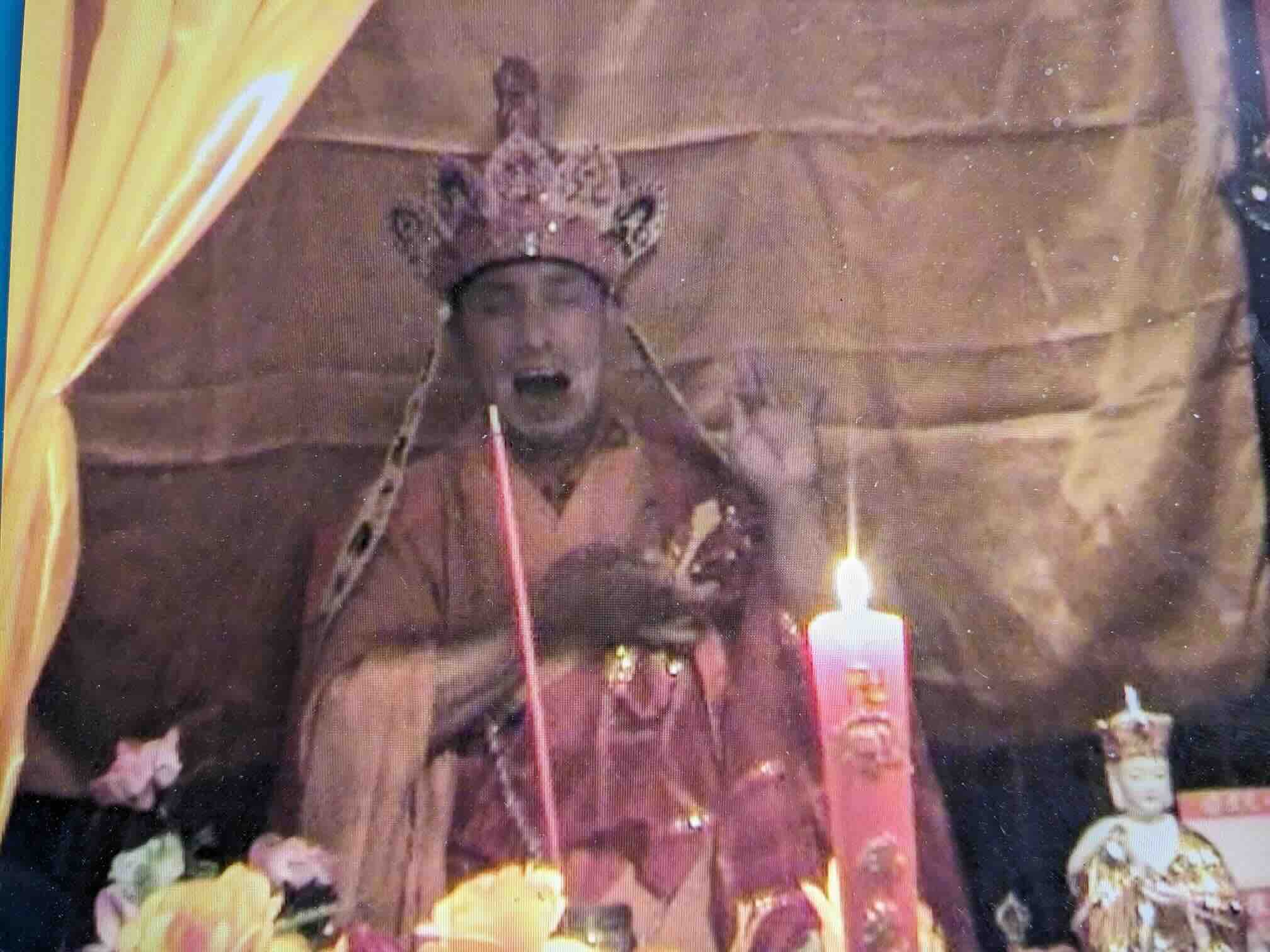
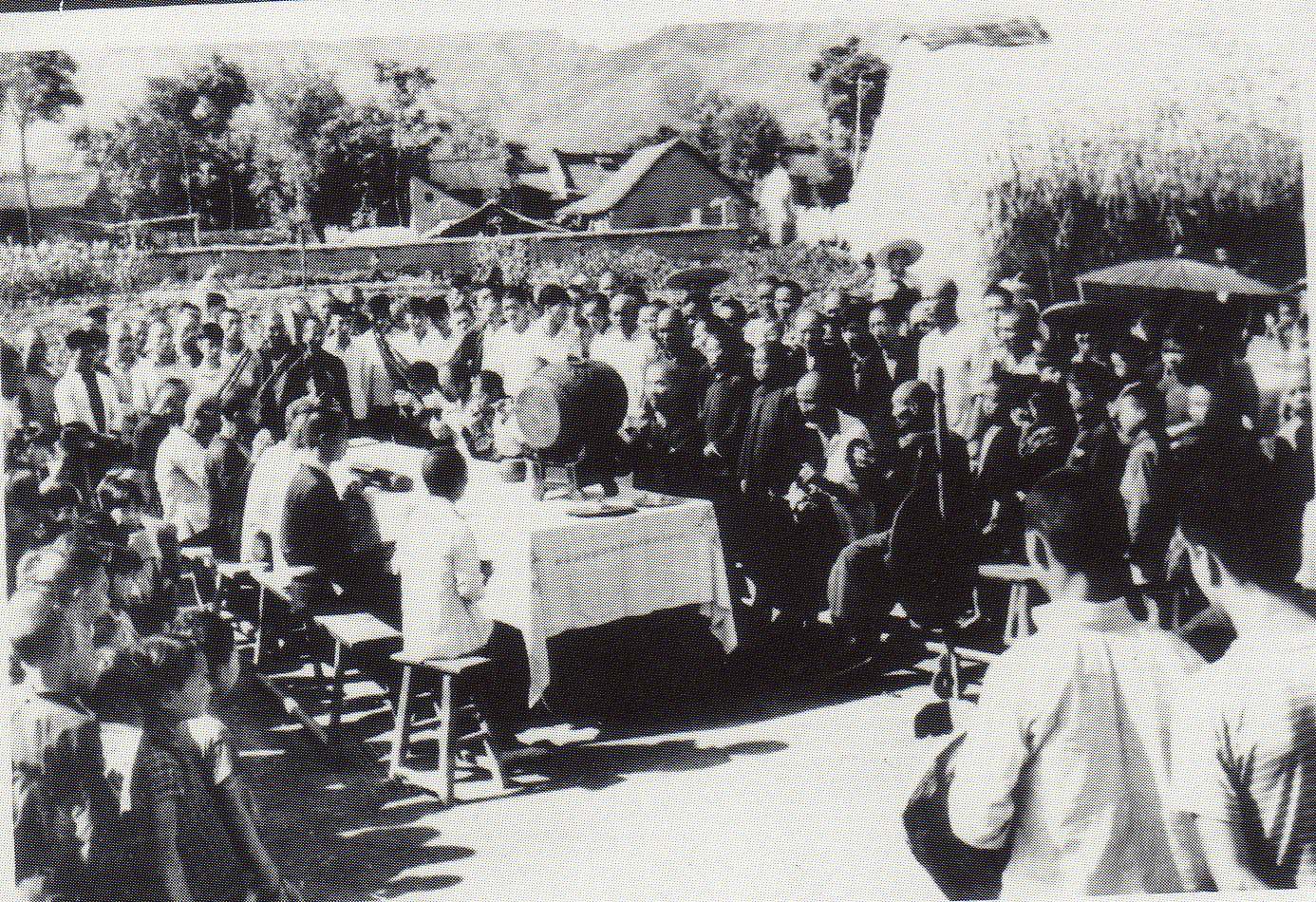
I’m always struck by this amazing image of a former monk training disciples in a nearby village in 1959 (see here, under North Xinzhuang), just as the devastating great famine was occurring—the famine is among crucial topics that can hardly be addressed in China.

Shadows in the field
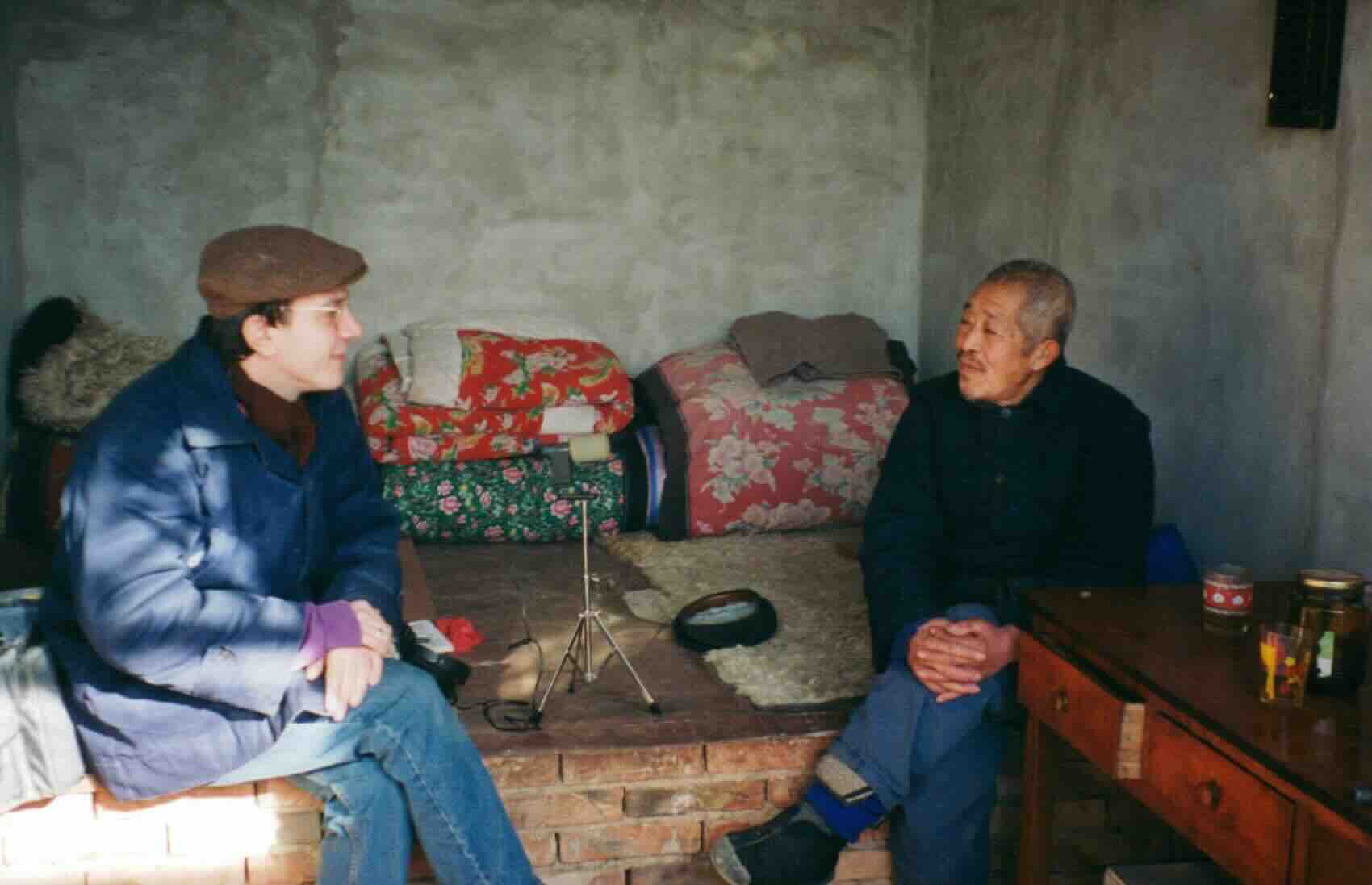
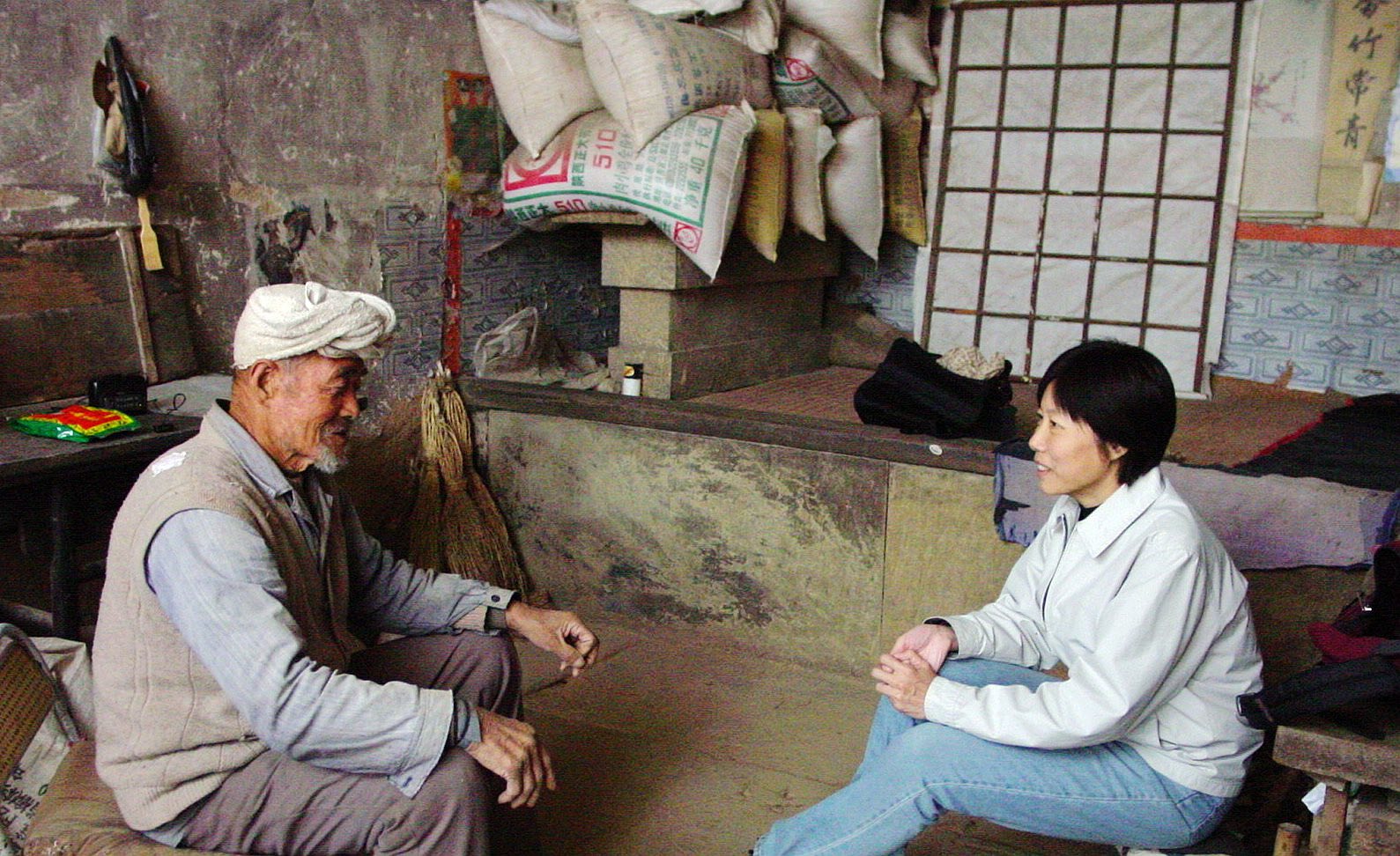
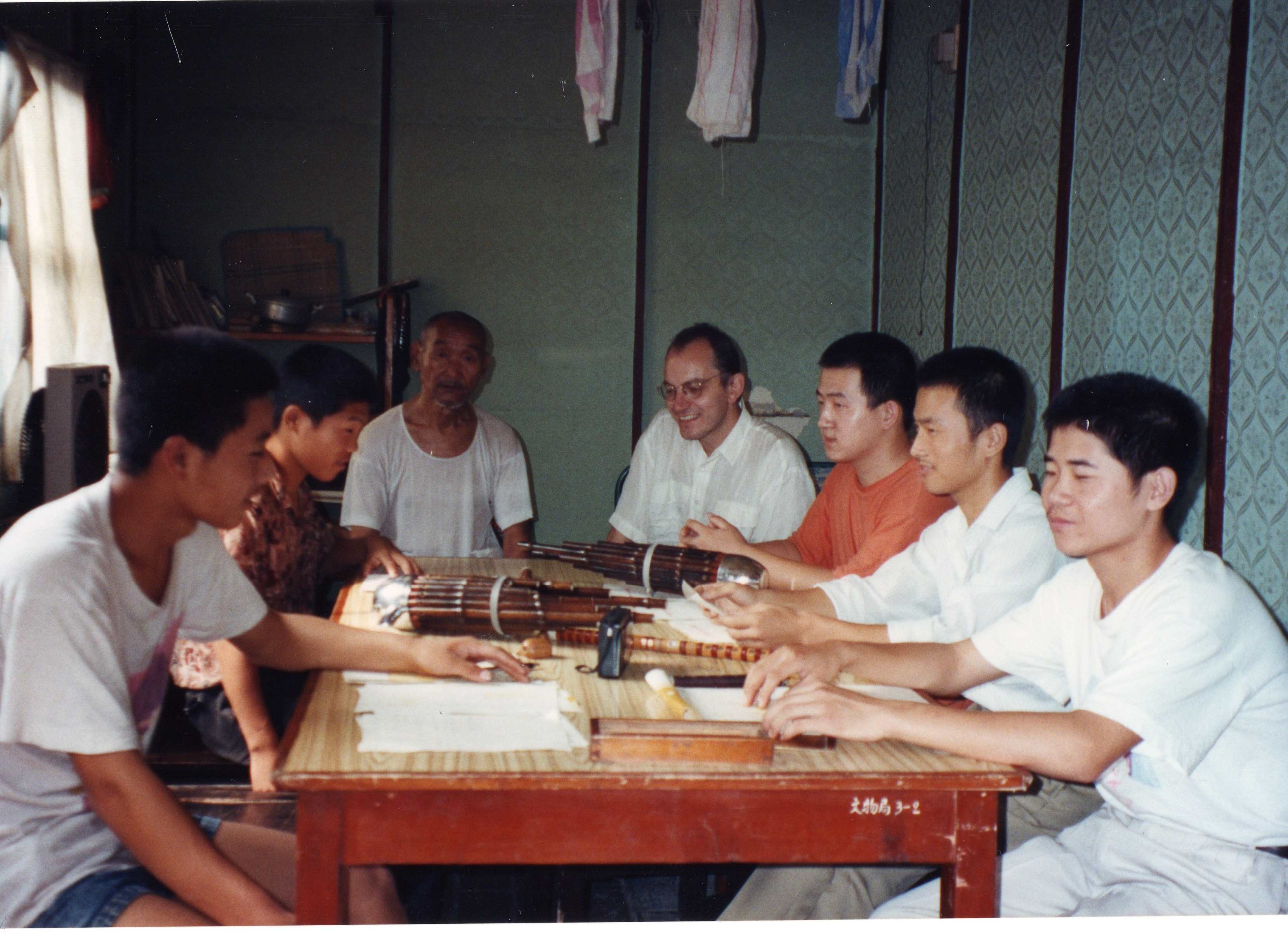
I could only offer superficial responses to Feng Jun’s salient query about how I positioned myself in relation to the people and events I was documenting. It’s a major theme of the book (and of a thesis in Chinese). I was most fortunate to have two excellent fieldwork companions from Beijing, who were totally on board with studying social and religious change. It’s most important to stay in the village, and to take part in their ritual life (neither of which is common for Chinese scholars). The villagers were open in replying to my questions, which Chinese scholars hardly asked.

I never thought of making films for the public domain; I filmed strictly for my own research purposes, and only realised later that some footage could be edited into watchable films. Our visits energised the Gaoluo association, while others were declining, but transmission was a constant anxiety of theirs, and a theme of our discussions. We can now see this as a precursor of the Intangible Cultural Heritage system.

The ICH
Since my last visit in 2003, a lot has happened in these villages. They’re no longer so poor. Crucial issues, everywhere, are migration, social media, state education, and the whole emptying of the countryside. And there’s no escaping the ICH system, which has influenced many such village groups. Many authors have described how the system commodifies, secularises, and reifies local traditions (see e.g. here). It’s state propaganda; most “research” under its auspices is superficial. While my film, and the book, inadvertently make a contrast with the celebratory approach enshrined by the ICH, I’m perturbed that Chinese viewers don’t seem to articulate this; they can’t read my book in Chinese, and anyway I’m not sure they would care to dwell on my different approach. With recent Chinese fieldwork dominated by the ICH, it is hard to gain a more in-depth picture.

Although the system uses “music” and “culture” as a smokescreen to downplay religious life, it works both ways; for the communities themselves, it helps protect them, legitimise them. With the tenuous survival of these groups under question ever since the 1980s’ reforms, joining the ICH made a tempting expedient for the association leaders. And faith endures, with villagers using the system to their own ends; the Gaoluo association still does funerals, and villagers still offer incense.

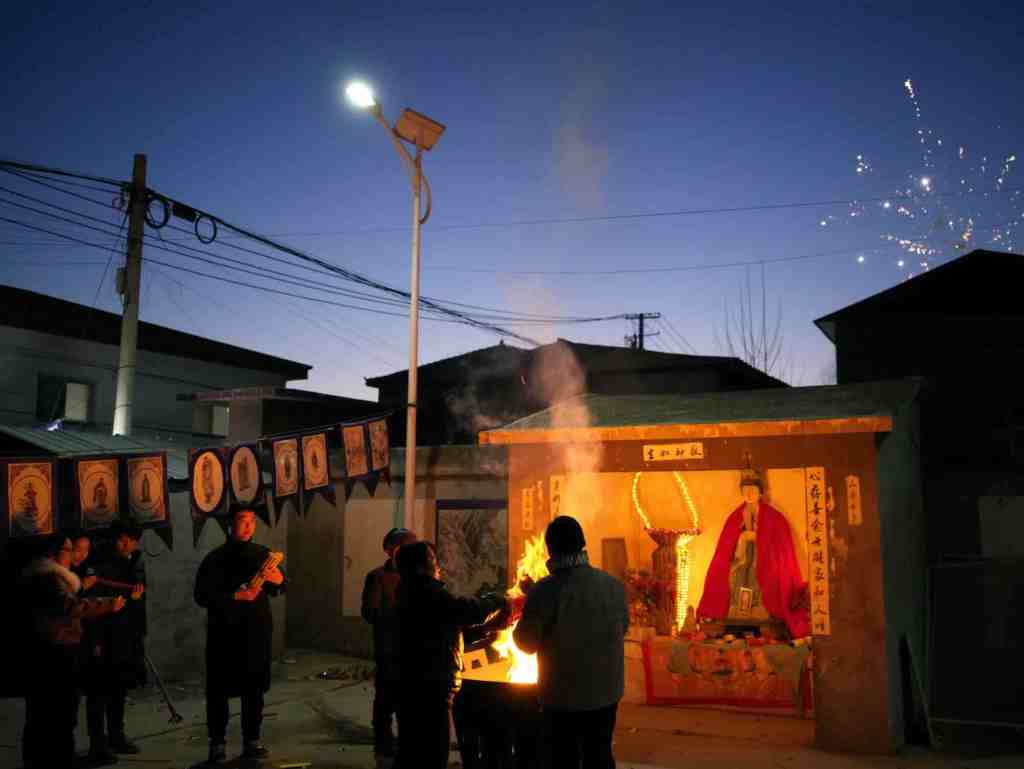
New Year in Gaoluo, 2025. Image: Wei Xiaoshi.

The village’s Catholic minority (whose brass band took part in a “demonstration” on 1st moon 15th in 1995, shown in the film) makes an intriguing sub-plot in the story. In this whole area the relationship between “Patriotic” and underground churches has long been opaque, and without a prolonged stay it would be hard to further our understanding of the shifting scene.

As with my work on the Li family Daoists, the combination of book, film, and website is most instructive.

Gaoluo film: another upcoming screening

My film on the 1995 New Year’s rituals in Gaoluo was shown recently in the village itself, and I went on to introduce it in Leiden. On the 20th May I’ll be presenting it at SOAS (details here)—I look forward to a lively discussion about folk religion, changing modern Chinese society, and perhaps even “music”…. For some themes arising from the screening, click here.

Donors’ lists 2: Gaoluo

Towards a dynamic approach to material artefacts in diachronic social context

Further to my previous post giving background on material support for amateur ritual associations on the Hebei plain, I now focus on Gaoluo village, whose four ritual associations all preserve a wealth of ritual artefacts. Here our prolonged fieldwork allows us to “break through the 1949 barrier” by incorporating the easily-neglected Maoist era into the wider picture both before the Communist victory and since the 1980s’ liberalisations.

Again, please excuse the considerable duplication with many of my previous writings on Gaoluo—in particular my book Plucking the winds, and on this site, my pages on Ritual images: Gaoluo and the village’s three other ritual associations. [1]

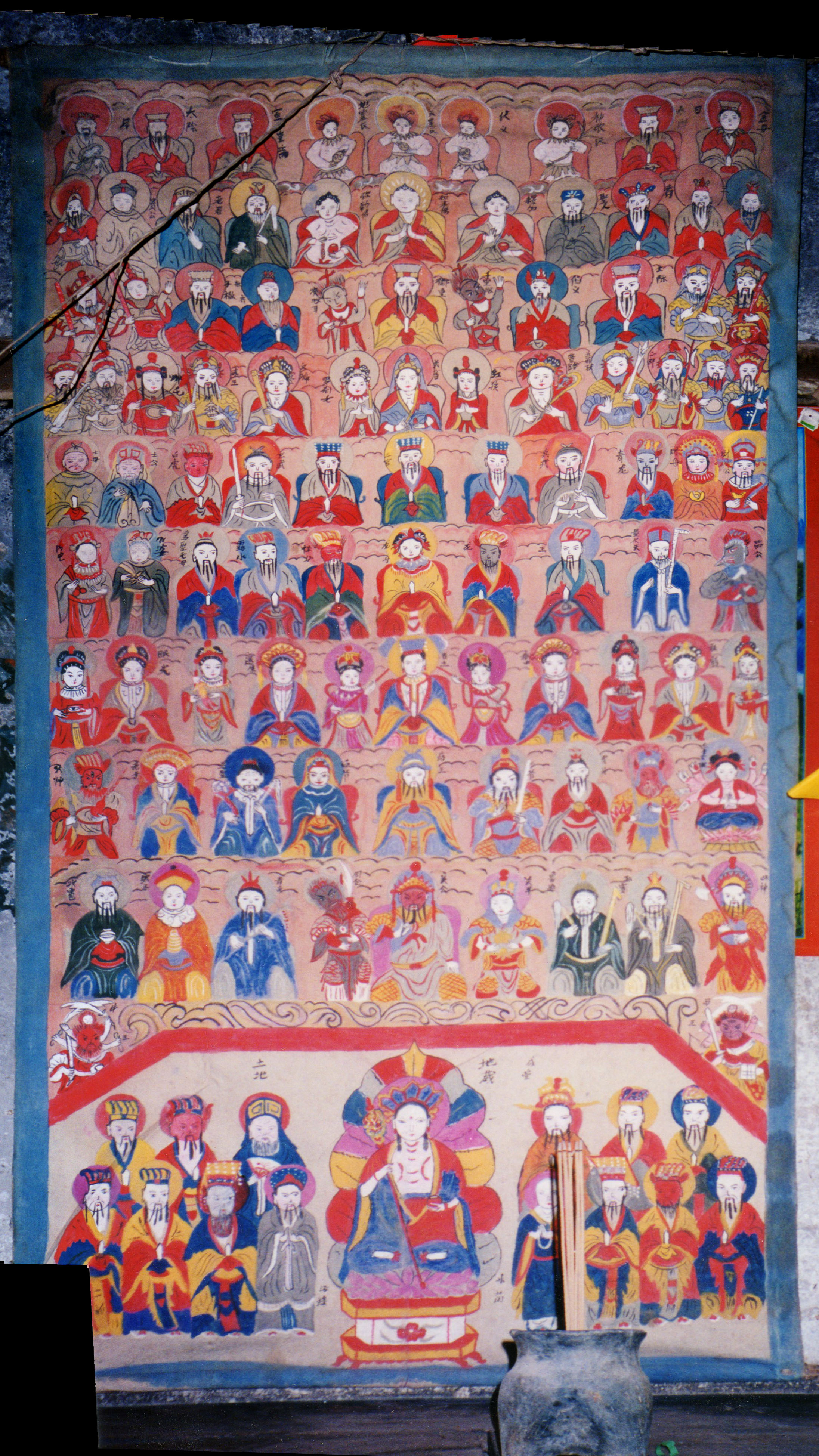
To remind you, both South and North villages have their own ritual association, now commonly known as Music Association (yinyuehui, yinyue referring to the “classical” style of paraliturgical melodic instrumental ensemble); and both villages have their own Guanyin Hall Association (or Eastern Lantern Association, dongdenghui), now known as Southern Music Association (nanyuehui, having adopted the more popular style of “Southern music”). But whereas the misleading term “music association” has since become standard in the region, note that neither the 1930 nor the 1990 lists of South Gaoluo use the term: both texts (like their 1983 gongche score) refer to “Southern Lantern Association” (nandenghui), the 1990 list glossing it as  “sacred society” (shenshe). So to stress yet again, this whole topic belongs firmly within the study of folk religion and society, far beyond “musicology”. Do watch my film on the 1995 New Year’s rituals in Gaoluo!

These two donors’ lists from 1930 and 1990 make striking exhibits, but the village’s other associations also suggest clues; having written about them separately, here I rework them into a diachronic account. 

A common stimulus for creating new donors’ lists is the expenditure of replacing ritual artefacts (ritual manuals, god paintings, instruments, and so on); besides recording the contributions of named villagers, many lists provide detailed public accounts.

The 1930s
For our main ritual association in South village, one such list, which we saw adorning the lantern tent for the 1995 New Year’s rituals, was said to date from the late 19th century, but alas it was so faded as to be totally illegible. Instead, most handsome of the ritual artefacts on display was the 1930 donors’ list—apparently the only surviving list from before Liberation that we have found in the region:

Now if we saw this list on the wall of a museum, it would have limited potential. But since the tradition endures, not only can we witness rituals, hearing the wind and percussion music and vocal liturgy before the gods; but further, the descendants of the people featured in the list were able to provide considerable detail, putting the initiative in the context of the Republican era in the region. To summarise my discussion in Plucking the winds and in Ritual images: Gaoluo, during 1930 both associations in South village undertook a refurbishment of their ritual apparatus—apparently prompted both by the brief restoration of peace in the area after many years of fierce fighting between warlords, and by competition with the renewed energy of the village Catholics.

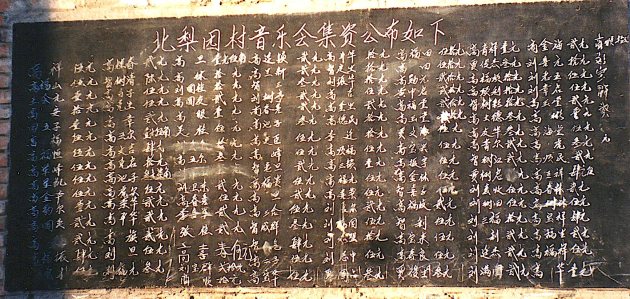
The 1930 list, entitled Wanshan tonggui (“The myriad charities return to the same source”), commemorates the commissioning of a major series of diaogua hangings from Painter Sun of Doujiazhuang village in Zhuozhou county just north. It records 92 heads of households, surely consisting of most of those then living in the southern half of South village which the association served, though some were doubtless too poverty-stricken to be able to afford even a minimal contribution. For all the beauty of the list, many (including all the womenfolk) were unable to read it.

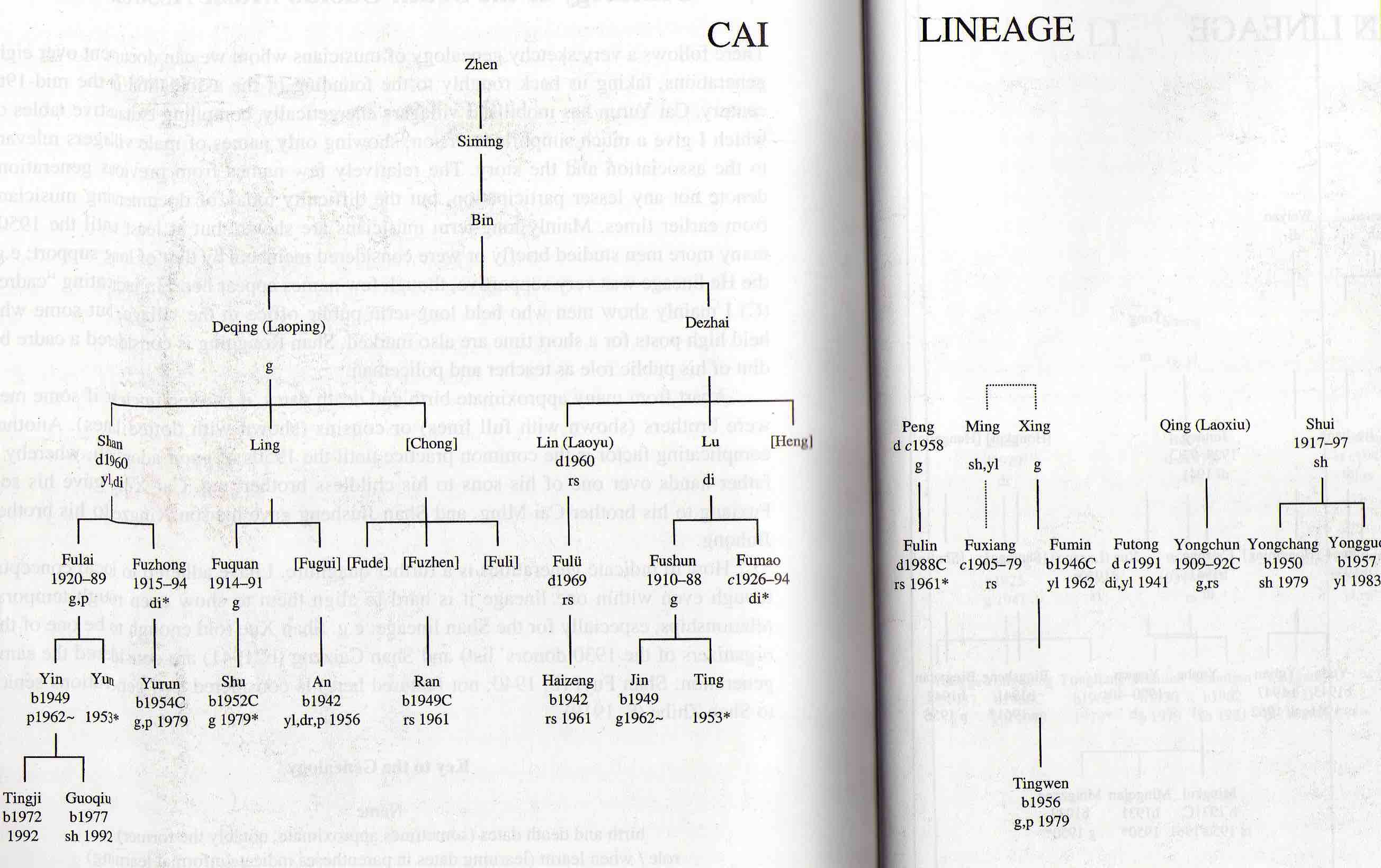
The donations, ranging from 6 yuan to 5 jiao, totalled 109.83 yuan; the cloth cost 24 yuan, the paintings 61.5 yuan, and other expenses amounted to 33.83 yuan, leaving debts of 9.5 yuan. Five “managers” of the association are named at the head of the list: Cai Lin, Cai Ze, Shan Xue, Shan Chang, and Shan Futian (sketches in Plucking the winds, p.54). As their descendants recalled in the 1990s, all were prominent figures in the village, some of whom were also active as ritual performers.

Later in 1930, in preparation for the following New Year’s rituals, the South village Guanyin Hall Association also made a donors’ list for the commissioning of twelve new ritual paintings, listing four “managers”, two “organisers”, and three “incense heads”. The paintings were again made by Master Sun; the 1990s’ members also say he made new diaogua hangings for their association. In the years before the 1937 Japanese invasion, one Wang Laoguo from South Gaoluo painted more diaogua for them.

Further suggesting the ritual revival of the time, the early Dizang precious scroll of the Guanyin Hall Association in North Gaoluo contains a section recopied in 1932 (the precious scrolls are introduced here, and for Hebei, here and here).

Under Maoism
In the decades after the 1949 Communist revolution, many village ritual associations gradually became less active or ceased entirely. However, a close look belies the common notion that ritual life was in abeyance right until the 1980s’ reforms. For this crucial and ever more elusive period, material artefacts serve only as an adjunct to the memories of villagers.

With the new regime in its infancy, peace gave rise to hope for local communities long traumatised by warfare. Even as the collective system escalated, Gaoluo’s new village administration managed to embrace its traditional associations. The production teams used to give a little grain or other goods to support whichever association lay within their patch. The political climate didn’t dampen faith in village ritual associations: they continued to perform funerals and observe the New Year’s rituals in their respective lantern tents. Between 1950 and 1964 several groups of young men were recruited to learn both the vocal liturgy and the instrumental music; new gongche scores of the latter were compiled.

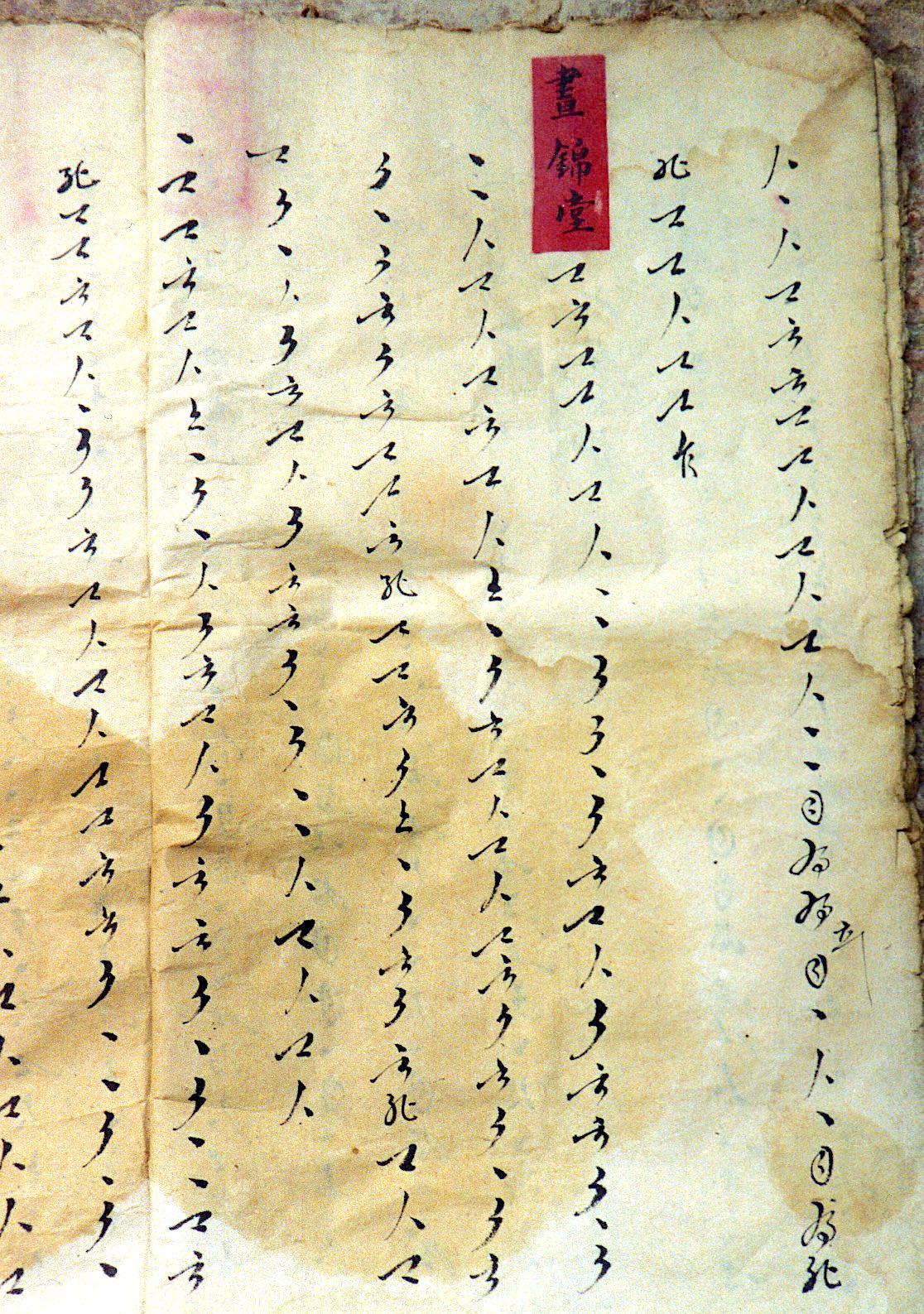
However, I doubt if the associations often dared hang out their ritual artefacts, and the atmosphere must have discouraged the making of donors’ lists. Our association didn’t make one between 1930 and 1990, but in 1952 the South village Guanyin Hall Association converted from their chaozi shawm-and-percussion music to the more popular style of “Southern music”. They invited the locally-renowned musician Hu Jinzhong from nearby West Yi’an village to teach them, giving him food and accommodation through the winter, but no fee, as ever. There was some official opposition to them learning the music, so the association sought no public donations; it still owned some land in the early 1950s, so it could buy instruments independently. Supporters merely “took care of a banquet” for the association, and no donors’ list was made.

The early 1960s
From 1961 to 1964, in the brief lull between the famine and the Four Cleanups campaign, ritual associations revived strongly throughout the Hebei plain, training youngsters in both the instrumental ensemble and the vocal liturgy. The latter tradition was in general decline on the plain, with the elders of the “civil altar” dying off. In Gaoluo, the vocal liturgy of South and North village Guanyin Hall Associations effectively came to an end with the deaths of Zhang Yi  in 1950 and Shan Yongcun around 1956. Only our South village ritual association had a group of keen teenagers who came forward in 1961 to study the vocal liturgy with senior masters. But elsewhere the shengguan instrumental ensemble increasingly came to represent the scriptures before the gods.

One might imagine the early 1960s’ revival prompting our association to compile a new donors’ list, but perhaps the leaders were wary of creating such a public pronouncement. However, in 1962 the South village Guanyin Hall Association used its 1930 list to add a new list of donors.

And in 1964 the Gaoluo village opera troupe, not inhibited by the taint of “superstition”, commemorated its revival in a donors’ list (composed by Shan Fuyi), with the 280 donors representing the great majority of households in North and South villages at the time. The list records the donation of c450 yuan in total.

For both the ritual associations and the opera troupe, the early 1960s were a cultural heyday such as they had not been able to enjoy since the early 1950s, reflecting the social recuperation after the famine afforded by a central withdrawal from extreme leftist policies. Little did they know that political extremism was once again to disrupt their lives still more severely; the optimism of their declarations was soon to look naive and hollow.

Since the 1980s’ reforms
In the Hebei villages, as throughout the whole of China, the last two decades of the 20th century were particular in that their associations were reviving after at least fifteen years of stagnation—and even those that had been active until the eve of the Cultural Revolution had practised somewhat furtively. Thus they needed to replace a considerable amount of their ritual equipment.

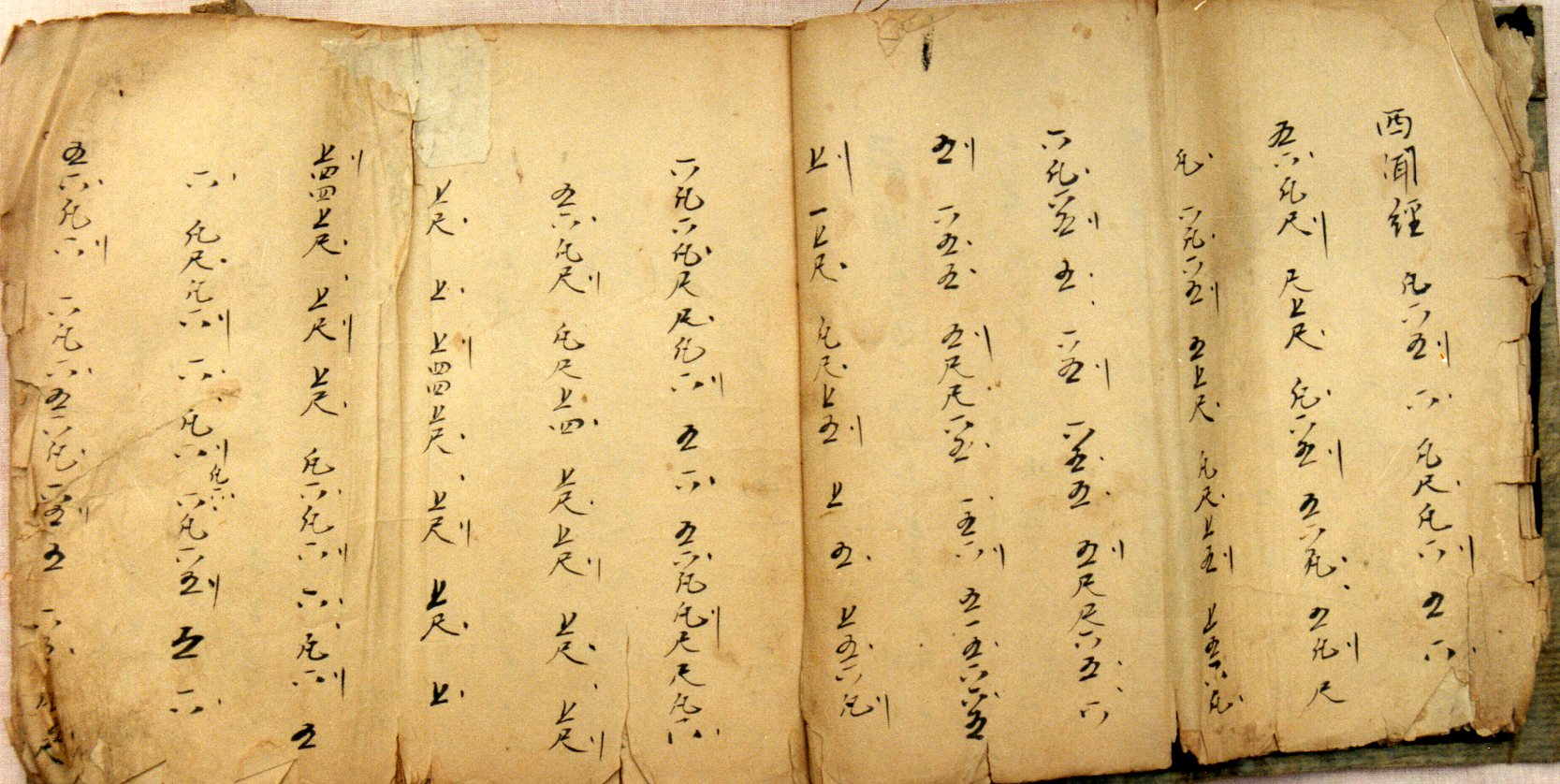
In Gaoluo after the liberalisations following the collapse of the commune system in the late 1970s, the village “brigade” (dadui) gave 100 yuan a year to all the village’s main associations, which our South village ritual association spent on getting its sheng mouth-organs tuned. In the early 1980s they commissioned a new ritual pantheon of Dizang and the underworld, and compiled a new gongche score, but they didn’t yet create a new donors’ list.

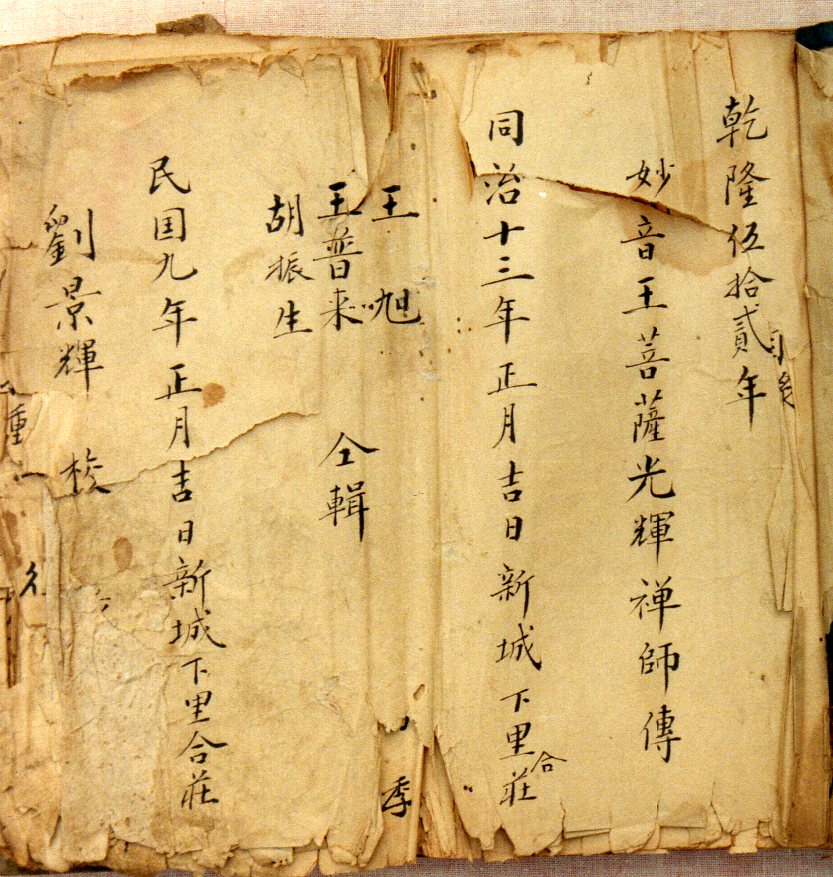
However, the North village Guanyin Hall Association had a donors’ list made as early as 1981, to commemorate their own revival, written in elegant classical Chinese (text copied in Zhang, Yinyuehui, pp.128–9). This association had a reputation for observing the ritual proprieties, and preserved splendid “precious scrolls” from the 18th century, but their fine tradition of reciting them was going into decline even before Liberation. The first historical material on the list consists of four names (“transmitters of the ritual business”) from the 1920s. Unusually, having originally been a temple-based ritual association based on reciting the scriptures, they had diversified by adopting secular genres, acquiring opera in the 1930s, reformed pingju opera in 1951, “Southern music” in the 1960s (learned from their sister association in South village), and lion dancing in 1981.

The 1990s
As the economic liberalisations gathered pace and communal consciousness was attenuated, many village associations that had revived found it hard to maintain activity. In Gaoluo the 1990s were distinctive for the renewed energy provided by our fieldwork (Plucking the winds, pp.189–205).

After our first visit over the New Year’s rituals in 1989, our association now resolved to refurbish their “public building”, which they had reclaimed from the village brigade after the collapse of the commune system. This initiative was led by the then village chief Cai Ran, himself a keen member of the “civil altar”. After writing enterprisingly but unsuccessfully to the Music Research Institute in Beijing to request funding for the project, they managed to be self-sufficient in realising the project, with villagers donating money and labour.

So in 1990 the leaders of our association invited Shan Fuyi to make a new donors’ list. His substantial text outlining the association’s history (see Ritual images: Gaoluo) makes clear that my visit was a stimulus for the project; still, it was written with no guarantee that outsiders would return.

The 1990 list names 270 heads of households. Still, villagers were becoming less conscientious about donating (see Women of Gaoluo, under “Rural sexism”).

From the 1930 and 1990 lists alone, we can hardly perceive change. The association still served the ritual needs of the villagers, and was still supported by most households in its catchment area. Without thick description from fieldwork and interviews, we might never know how ritual and social life were changing.

In the early 1990s there were several thefts of ritual artefacts in Gaoluo—but this served as a stimulus for the association to reclaim those that had been taken off by cultural authorities under Maoism.

The lantern tent of the South village ritual association, 1998,
with new and newly-copied donors’ lists.

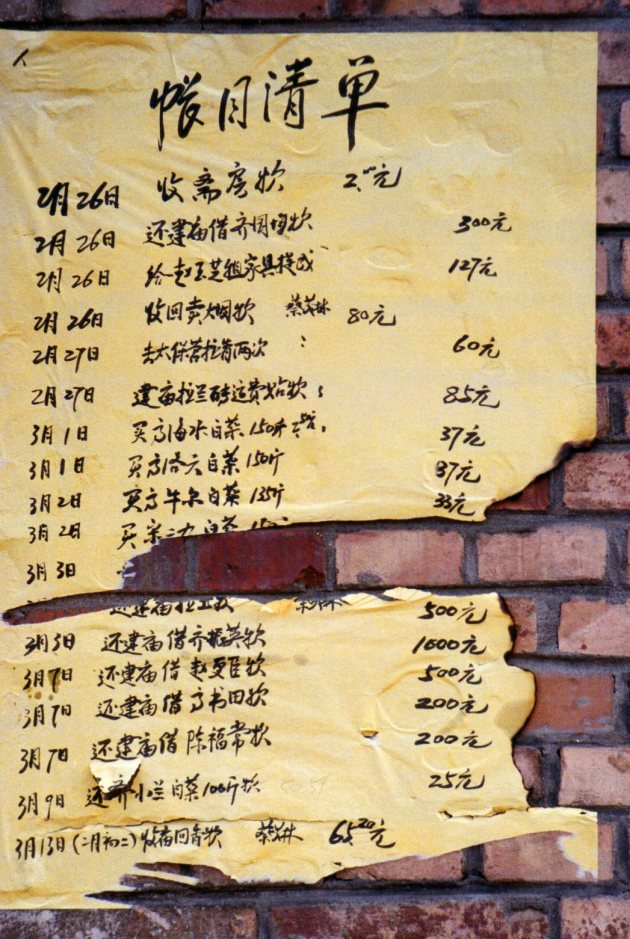
Our attention to the South village ritual association stimulated another competitive ritual flurry among the two villages’ other three ritual associations. For New Year 1990 the North village ritual association also had new ritual paintings made, of their own pantheon and the Ten Kings of the Underworld (for the donors’ list commemorating this initiative, see under Ritual images: Gaoluo). We also saw a more transient paper list of expenses from New Year 1992, pasted at the entrance to their ritual building, and already decrepit and hard to read by the following summer. They had received 690.47 yuan; they had incurred expenses such as buying coal, meat, vegetables, doufu, oil, salt, tea, firecrackers, tuning sheng, buying cloth bags for sheng, copying scores, and mounting ritual manuals and paintings—all conscientiously recorded. At New Year 1998 we saw their paper lists of income and expenses for the past year. Most of the association’s income had come from the hiring of crockery; donations had also been made when the association performed funerals (the rate being around 100 yuan). Some individuals had donated cash (one as much as 750 yuan), and the village committee had given 200 yuan. They had received 3,638.2 yuan (including 939.8 yuan brought forward from the previous year) and spent 2,992.2 yuan.

After the demise of the commune system, the South village Guanyin Hall must have revived along with the other associations by about 1980. Following our 1989 visit and the revamping of the ritual associations of North and South villages, they too had a surge of energy. For New Year 1992 they made a new donors’ list (image here) for the rebuilding of their humble ritual building, with this inscription:

The Eastern Lantern Association of South Gaoluo rebuilt its public building in 1992 AD under the People’s Republic of China, with the aid of the donors listed above. Total expenditure 2,984 yuan 4 jiao; 15 yuan surplus.

The list shows 215 household heads giving sums from 20 yuan to 2 yuan.

Conclusion
In all, community support for ritual life had not waned despite successive social upheavals. But new challenges were taking their toll: migration to the towns in search of work, state education, and popular media culture. Since my last visit in 2003, Gaoluo has continued to be transformed—notably by the arrival of the Intangible Cultural Heritage system, which I will address soon.

Static, silent material artefacts are most instructive when we can use them in conjunction with fieldwork and interview, helping us connect them to changing social life, filling in the gaps, learning more about practice and personalities over time. This is where the ethnographer has an advantage over the historian. I wish we had been able to find yet more detail—for instance on the 1950s: how funerals were changing, how calendrical rituals became less frequent, the decline of the vocal liturgy, and so on. We were lucky to be able to consult people who had taken part in the events commemorated in donors’ lists; but as time goes by, fewer villagers remain who can recall the early years of Maoism, let alone the “old society” before 1949.


[1] See the index of Plucking the winds, under “donations and donors’ lists”; Zhang Zhentao, Yinyuehui, pp.116–35, copies and discusses all the Gaoluo donors’ lists. On this site, note also the series of articles under the Gaoluo rubric of the main Menu.

Donors’ lists 1: Hebei

Stone, cloth, paper: economic support for village ritual associations

My new film on Gaoluo prompts me to revisit our fieldwork the ritual associations of the Hebei plain—a task further stimulated by the recent reification of these groups under the Intangible Cultural Heritage system. I now wish to outline economic support for such ritual organisations under the successive political regimes of modern times—”breaking through the 1949 barrier”.

First, in this post I expand on some themes from my survey of ritual associations on the Hebei plain; and in a sequel I focus on Gaoluo, where we found a wealth of ritual artefacts to accompany our prolonged fieldwork and discussions with villagers. Both essays are mere samples of the material we collected through the 1990s—please excuse the considerable overlap with many of my previous writings, both on the ritual associations and on Gaoluo. [1]

Introduction
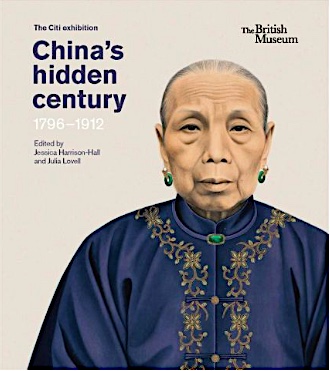
Living traditions of Chinese folk ritual provide a rich source of material artefacts dating back several centuries (cf. China’s hidden century). Still, they are mere snapshots of particular moments: one hopes to be able to augment them by fieldwork on observed ritual practice and the oral accounts of villagers throughout living memory.

In rural China, as everywhere, ritual and cultural life depends on moral and economic support from local communities. Patronage, in cash and in kind, depends on the nature and scale of the enterprise.  Occupational family-based groups such as household Daoists and shawm bands (as well as individual intermediaries like spirit mediums) are paid for a particular event such as a funeral, and have successfully adapted to changing patterns of social support in the post-reform era.

In the religious sphere, alongside local temples, the composite term huidaomen (used pejoratively by the Communist state—hui Association, dao “Way”, and men “Gate”) subsumes both ascriptive amateur village-wide devotional associations and voluntary sectarian groups. On the Hebei plain, the two broad categories overlapped (see e.g. our notes on Xiongxian and Xushui counties).

Priding themselves on not accepting payment, ascriptive ritual associations have long relied on recouping their expenses through donations from the village communities whose ritual needs they serve. But whereas support for voluntary sectarian (as well as Catholic) groups remains grounded in enduring faith, the ascriptive associations have faced a particular crisis in the new economic climate since the 1980s. 

Temples and temple fairs, ritual associations and the “public building”
Temples have always been an important focus of community life, and in many regions they remain so, such as in south China (Fujian, Jiangxi, Hunan, and so on) and the northwest—although much research there has focused on the imperial legacy rather than modern change.

On the Hebei plain, temples were ubiquitous until the 1950s. Village ritual associations learned from Buddhist or Daoist temple clerics, or from other nearby associations that had done so, at various times since the Ming dynasty; they existed mainly to serve the village temples. But in a long process over the 20th century, temples were destroyed or abandoned; rather few have been rebuilt since the 1980s’ liberalisations, and still fewer have any regular staff apart from a temple-keeper. So the main venue for the reduced calendrical rituals of such villages became the “public building” (guanfangzi: Zhang Zhentao,Yinyuehui, pp.181–204), an inconspicuous building only adorned with god paintings and other ritual artefacts, easily stored away, during calendrical rituals on behalf of the community. Besides the long-term decline of active temples in the region, this may suggest insecurity among village communities through political upheavals.

Villages that have restored their former temples are in a minority, but in such cases the refurbished temples seem to provide a greater focus, visited and tended more often, as in Gaozhuang (Xushui county) and two villages in Xiongxian county, Hanzhuang and Kaikou. Still, their annual ritual calendar remains quite sparse (see my survey, under “Ritual duties”).

Even once we recognise the importance of the “public building”, a major part of the duties of these associations is to supply funeral rituals at the homes of deceased villagers.

Donors’ lists
Alongside the wealth of material artefacts that we found among the Hebei village ritual associations (ritual paintings, ritual manuals, scores, and so on) are donors’ lists (beiwen 碑文), documenting support over the previous year, or for a major initiative. Displayed alongside the god paintings in the ritual building, they proclaim the associations’ support among their community for providing calendrical observances and funerals, symbolising the village’s sacred core. As Zhang Zhentao notes, local terms like beiwen and bushi 布施 (“donating”) remind us of the living connection of these groups with the tradition of supporting Buddhist and Daoist temples.

More ephemerally than the stone steles of temples, the donors’ lists of Hebei village ritual associations are commonly inscribed on cloth; but many are even more perishable, written on paper, pasted on the wall of the ritual building over the New Year’s rituals—when new donations (often in cigarettes and tea) are recorded daily. Thus they might never be documented unless some ethnographer happened to be there to take photos at the time.

Throughout China, paper documents are commonly pasted up announcing temple fairs, temple inaugurations, and particular rituals; some of these may record donors and amounts contributed. Even for weddings and funerals, scribes record gifts. The donors’ lists of the Hebei associations are rather different, recording the names of household heads—thereby establishing them as members of the association not just for particular rituals but throughout the year—and amounts contributed. Since these associations were responsible for performing rituals on behalf of the whole village, their leaders sought donations from virtually every household. Besides a few more affluent patrons, most families could only afford a token contribution.

While village ritual associations were inextricably linked to their local temples, there is no direct transition from the stone steles of the latter to the cloth and paper memorials of the former. Most associations must have made donors’ lists ever since their founding, generally in the Qing dynasty or even the Ming, but alas they don’t survive. Even if they did, we couldn’t make a simple comparison.

For those Hebei temples that have been rebuilt since the 1980s’ liberalisations, we found a rare instance of a stone inscription listing donations on the back of the 1993 stele for the inauguration of the Ancestral Hall to Venerable Mother (Laomu citang) in Gaozhuang, Xushui county—led by the village’s ritual association.

Whatever the material on which such lists are written, the Hebei associations are mostly village-wide public bodies, perhaps encouraging them to openly display both their expenditure and the names of their patrons. Still, many of these groups have sectarian ancestry, so I wonder if such lists have been documented among sectarian groups elsewhere in China—leads welcome.

Lists of expenses
Also often detailed on such lists is the expenditure of the association, justifying the leaders’ probity on behalf of their patrons. Expenses documented include replacing instruments or maintaining them (notably tuning and repairing sheng mouth-organs), commissioning new ritual paintings; buying other equipment (tables, pennants, incense, candles, lanterns, paper, food for banquets); “utility bills” for the ritual building or rehearsal venue (coal for rehearsals, oil for lanterns, electricity); and New Year’s expenses such as firecrackers. For example, again from Gaozhuang is a paper list of expenses from 1995:

Here’s a 1994 list of expenses from Kaikou village (Xiongxian county) for the revival of the temple and its association (Zhang, Yinyuehui, pp.140–43):

Beiwen with written histories
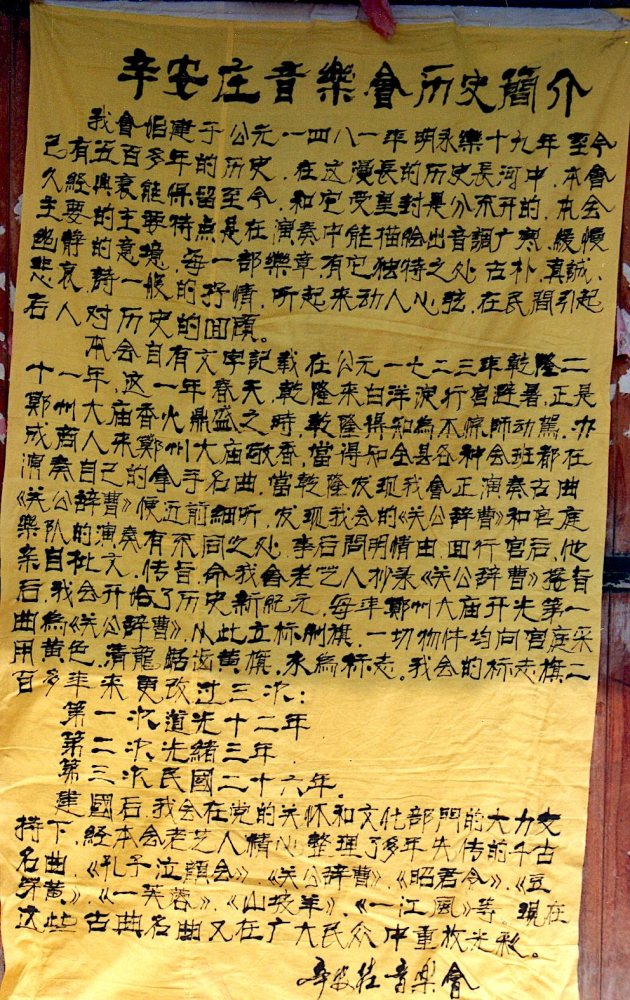
Rather as temple steles from imperial times might also document successive renovations, some donors’ lists include brief histories. Some associations even composed separate histories, such as a 1990 banner from Xin’anzhuang, Renqiu county:

Was this prompted by some interest from county cultural workers, I wonder? It clearly constituted some kind of public declaration; but the preludes of some gongche solfeggio scores of the paraliturgical melodic ensemble, whose readership was limited to the performers themselves, also contain brief histories of the association, like those of Longhua from 1963 and 1980 (for both Longhua and Xin’anzhuang, see under Ritual groups around the Baiyangdian lake).

Intriguingly, the instances that we documented were written since the 1949 revolution. Under state socialism, did political anxieties now prompt ritual associations to proclaim or justify their history, portraying the tradition as “culture”, downplaying religion? Re-reading the brief texts that head some donors’ lists, I find them diplomatic, distancing the associations from sectarian connections, claiming a place within the official discourse long before the Intangible Cultural Heritage. This seems to complement the innocuous appearance of the “public building”, the easily-concealed ritual artefacts, and indeed the growing prevalence of the shengguan instrumental ensemble over the vocal liturgy.

Still, such histories can make a useful starting point as we compile more detailed accounts from villagers’ oral recollections.

Some further examples
Apart from the Gaoluo associations (to be discussed in a separate post), Zhang Zhentao (Yinyuehui, pp.130–50) details donors’ lists from other village groups we visited on the Hebei plain. These include two 1992 paper lists from North Qiaotou in Yixian county (Zhang, Yinyuehui, pp.136–40; see my discussion here)—a donors’ list introduced by a text in praise of the association’s benevolent virtue:

and their list of expenses:

In Xushui county, on our visit to North Liyuan in 1995 we found donors listed on a blackboard:

Also under my page on Ritual groups of Xushui is material on the rebuilding of village temples in East Zhangfeng (§8) and Xiefangying (§9). Zhang Zhentao further documents lists from Zhaobeikou on the Baiyangdian lake, and Fuxin in Wen’an county.

Many of these groups were of sectarian ancestry—the North Qiaotou association derived from a Hunyuan sect, for instance. As I suggested above, perhaps this made their public proclamation of charitable virtue still more apposite, counteracting state suspicion of “superstition”.

Summary
Static, silent material artefacts only provide snapshots in the life of these groups. They are most instructive when we can use them in conjunction with fieldwork, helping us connect them to changing social life, filling in the gaps for the intervening periods, learning more about practice and personalities over time, using the frozen material evidence to prompt recollections from villagers, building up a picture of the longer term. This requires prolonged familiarity—as we gained in Gaoluo, subject of the following post.

And to repeat my point yet again, whereas the topic was discovered by musicologists, it belongs firmly within the study of folk religion and society. 


[1] For the Hebei ritual associations, see this survey, and many pages under the Gaoluo and Hebei rubrics of the main Menu. Besides my 2004 book Plucking the winds, as well as “Ritual music under Mao and Deng” and “Revival in crisis”, note in particular Zhang Zhentao’s 2002 book Yinyuehui: Jizhong xiangcun lisuzhongde guchuiyueshe 音乐会: 冀中乡村礼俗中的鼓吹乐社. Like his discussions of the “public building” and gongche scores (pp.181–204, 365–407), his chapter on donors’ lists (pp.115–80) is excellent; following perceptive discussions of particular lists, he analyses the material on pp.150–79, including the role of the local gentry in supporting ritual associations, and comparison with the opaque economics of the mercenary shawm bands.

Gaoluo film: village screening!

My new film on the 1995 New Year’s rituals in Gaoluo has recently been screened at a grand event (billed as a conference) in the village itself, thanks to the enterprise of Wei Xiaoshi (CDTM) in collaboration with Cai Yurun, who has long served both as leader of the ritual association and the village. A detailed review of the occasion has just appeared on the CDTM WeChat site (click here).

I’m delighted that my old fieldwork companion Xue Yibing could take part—we witnessed the New Year’s rituals in the village together for the first time in 1989, and his careful fieldnotes on Gaoluo and other villages over the next decade were invaluable (see mainly under Hebei in main Menu).

Gaoluo: our first visit to the Lantern Tent, New Year 1989.

Besides many of the villagers, delegations attended from a variety of musicological departments in Beijing, and from Hebei University. If only institutes of folk religious studies and sociology could be alerted to the significance of such ritual associations! But even if they were to venture beyond the safety of historical research into fieldwork on the condition of these groups since the 1940s, their ability to publish in China is ever more limited. 

One of my sessions with village litterateur Shan Fuyi, displayed on his daughter-in-law’s mobile.

I trust the film was well received, giving younger villagers an opportunity to glimpse their parents and grandparents in the days before the reified commodification inculcated by the Intangible Cultural Heritage began to influence their practices. With sonorous speeches inevitably the order of the day, the constraints of the occasion made me nostalgic for the informality of our fieldwork. The very setting, in a revamped Party Committee office, suggested how material conditions in the village have improved since my visits.

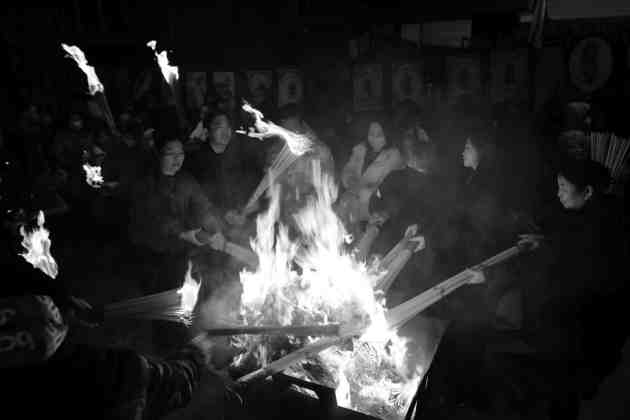
South Gaoluo New Year’s rituals, 2025. Images: Wei Xiaoshi.

Still, the religious context has not been lost: the New Year’s rituals still attract the village faithful, and the association still performs funerals for them. But the authoritative Cai Yurun voiced concerns that ICH support still can’t guarantee the future prospects of the association—in particular the vocal liturgy (which has been in a wider decline on the Hebei plain for many decades). It would take a further period of lengthy immersion in the villagers’ lives to learn their true perceptions (perhaps prompted by the film) on social and ritual change over these last thirty years. My film didn’t seem to prompt comments on how significantly the ethnographic perspective differs from the sanitised media approach typified by the ICH, but Zhang Zhentao has now published an intriguing review on this topic. Inevitably, whereas my book Plucking the winds stresses the constant tribulations of such villages under successive regimes, the prevailing congratulatory mood within China discourages such an approach.

Enbedded in the review of the event, the performance of the percussion suite in the courtyard, while still technically accomplished, inevitably lacks the spirit of the 1995 rendition before the gods. I doubt that this derives merely from the official secular context of the event; the total commitment of masters of yore like Cai An and Shan Rongqing seems to have been diluted.

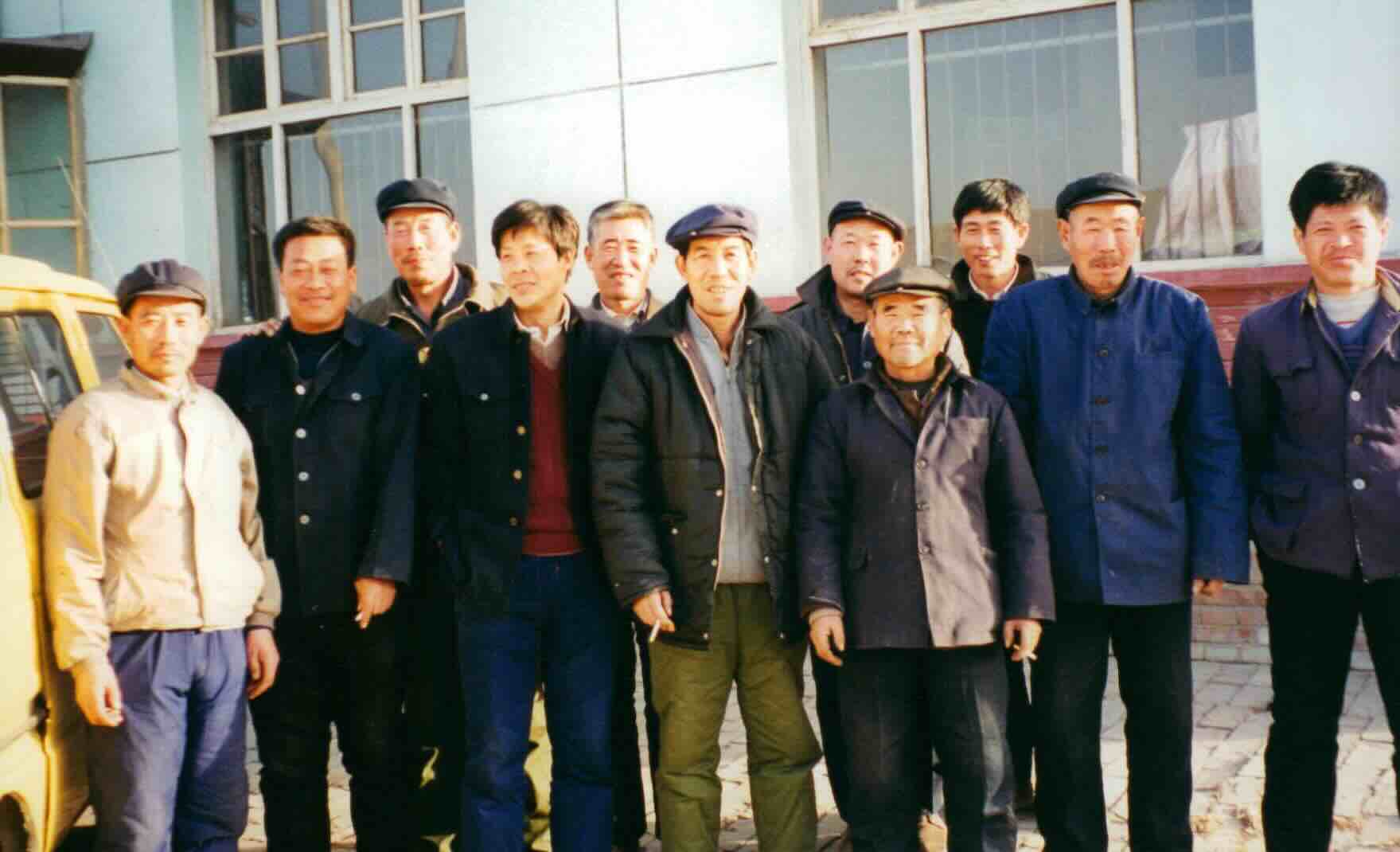
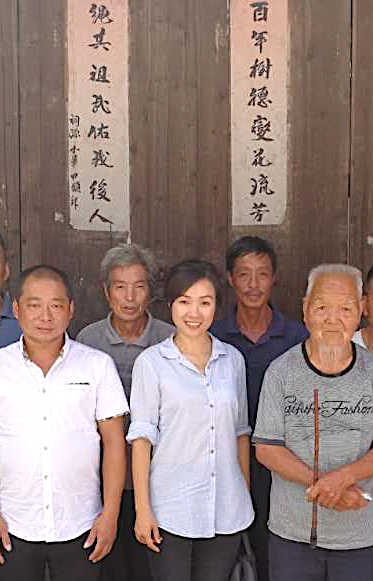
Above: the association with helpers, 1995
Below: members of the association with connference delegates, 2025.

The Chinese version of the film will soon be available both on my YouTube channel (alongside the English version) and (in China) on the CDTM website. And do browse the posts under Gaoluo in the top Menu!

Click here for recent screenings in Leiden of my films on the Li family Daoists and Gaoluo.

With many thanks to Wei Xiaoshi!

Presenting my films in Leiden

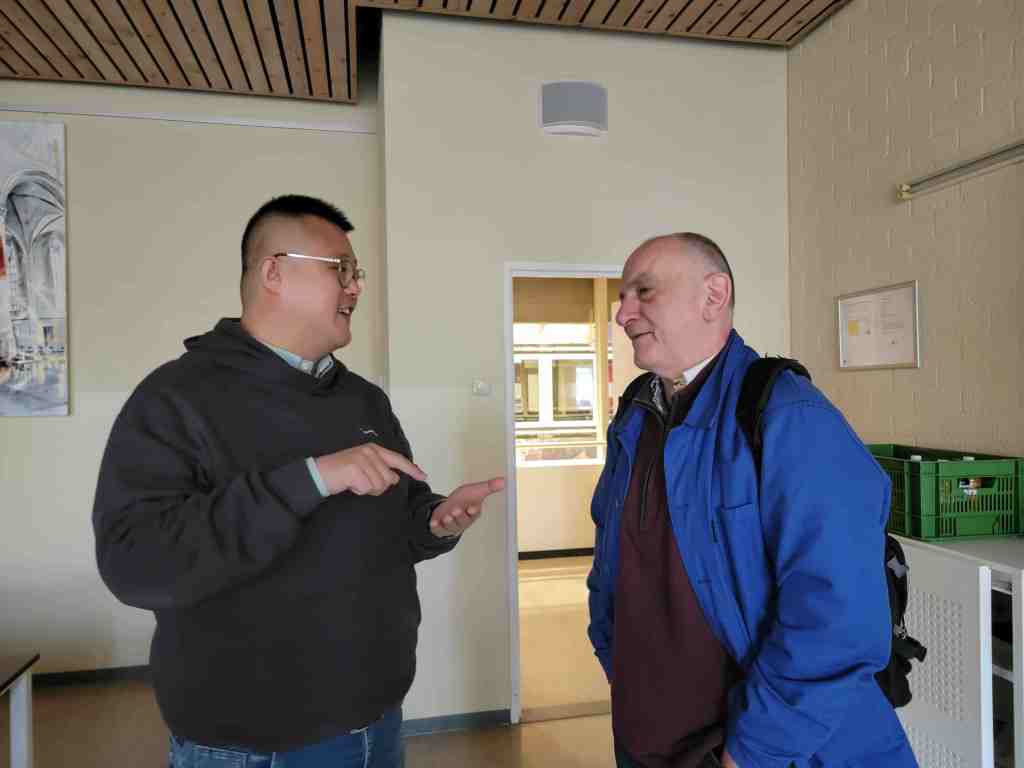
With Barend ter Haar (left) and Frank Kouwenhoven (right). Image: Yves Menheere.

Following the online publication of my recent film on the 1995 New Year’s rituals in Gaoluo, its public world premiere was at a grand event last week in the village itself. Shortly afterwards I visited Leiden University to present the film, as well as my portrait film on the Li family Daoists in Shanxi, as part of Yves Menheere‘s course on Chinese religion, and in collaboration with Frank Kouwenhoven of CHIME.

As I often stress (e.g. here), the study of both topics belongs firmly within the realm of religious studies, even if it has been dominated by Chinese musicologists. Sure enough, the distinguished sinologist Barend ter Haar graced us with lively comments, and I was delighted to see Tao Jin, formidable authority on Daoist ritual, on a visit from Beijing via Paris (see under Ritual life around Suzhou, and here).

With Tao Jin.

With both films concerning ritual life in north China, their subjects and soundscapes may appear somewhat similar, but the differences are significant (click here for differences in approach that emerge from studying with the two types of group). The Li family Daoists are

  • occupational, in a small group of five or six
  • active in a small radius around their home village; constantly busy, mainly for funerals,
  • with dense ritual sequences,

whereas Gaoluo is

  • among many amateur devotional associations, village-wide (cf. Xi’an, Yunnan, Jiangsu, and so on)
  • mostly serving the village itself, and not busy except at New Year,
  • its ritual sequences less dense.

My most focused fieldwork with the Li family Daoists was from 2011–18, with previous trips in 1991–2 and 2001–3; the film mainly shows footage from 2011 to 2015.  My fieldwork in Gaoluo took place from 1989 to 2003, the film footage showing three weeks in 1995.

While the impact of the Intangible Cultural Heritage on the Li family Daoists has been negligible (cf. here), in village ritual associations like Gaoluo it has been major—which makes the 1995 footage even more significant.

I look forward to introducing both films further to live audiences in the coming months. Meanwhile, do watch them online!

Not quite an update

I’m not exactly hibernating, but while I have various projects on the go, new posts are few and far between at the mo—so meanwhile do keep working through my previous ouevre:

Meanwhile, to follow this update on Nicolas Magriel’s voluminous sarangi site, he continues to add precious material… (see also under A garland of ragas).

I’m trying to abandon the iniquity of Twitter by moving to BlueSky, so do follow me there.

“Normal service will be resumed as soon as possible”

Gaoluo film: a Chinese review

GL CDTM review

A substantial Chinese review of my new film on the 1995 New Year’s rituals in Gaoluo has appeared on the WeChat public account of the CDTM 中国音网, headed by the enterprising Wei Xiaoshi

click here.

Following CDTM’s earlier review of my book on Gaoluo and its audio CD, access to the film within China should clarify my emphasis on the ritual function of such groups on the Hebei plain, over a decade before the Gaoluo ritual association came to fame as their image was remoulded by the Intangible Cultural Heritage.

Naturally, I hope the villagers themselves will be gratified to see vignettes of life in Gaoluo thirty years ago—many of them will hardly remember that era, and youngsters should be intrigued to see their grandfathers taking part in these rituals. As to scholars, it would also be good if the film finds an audience not only among musicologists but also in the fields of religion and folklore.

You can now watch the Chinese-subtitled version on my YouTube channel and here, and (in China) on CDTM (follow this link).

Chinese notation: a new anthology

dadianSource.

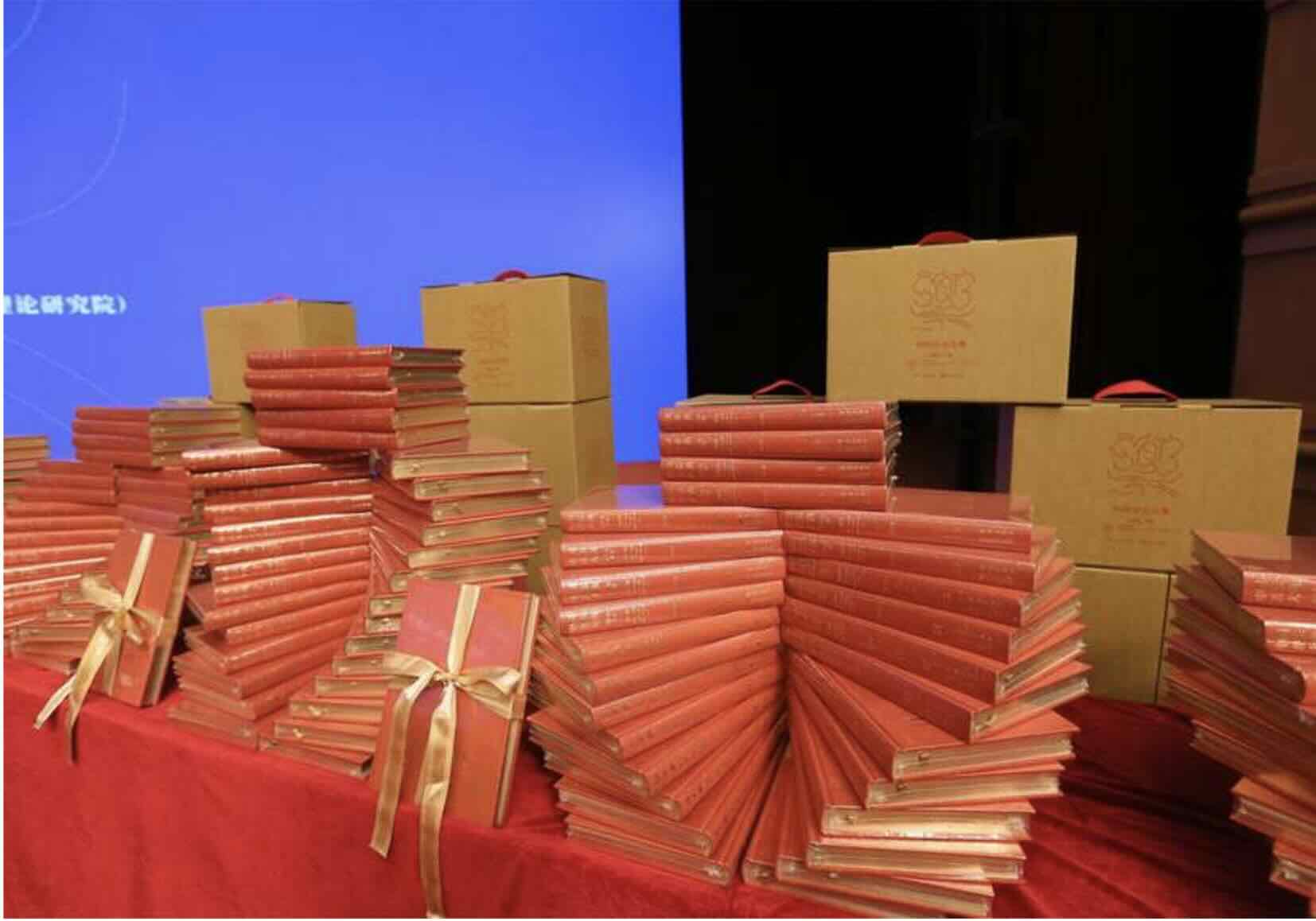
I learn of yet another massive compendium,

  • Zhongguo yinyue dadian 中国音乐大典 [Encyclopedia of Chinese music], general editor Wang Liguang 王黎光,

building on the achievements of previous eras—again testifying to China’s extraordinary energy and organisational power in producing encyclopedic reference works. It comprises four overarching rubrics:

  • Wenlun bian 文论编 texts
  • Tuxiang bian 图像编 iconography
  • Yinxiang bian 音响编 recordings (with volumes for xiqu 戏曲 opera and quyi 曲艺 narrative-singing published so far)
  • Yuepu bian 乐谱编 notations.

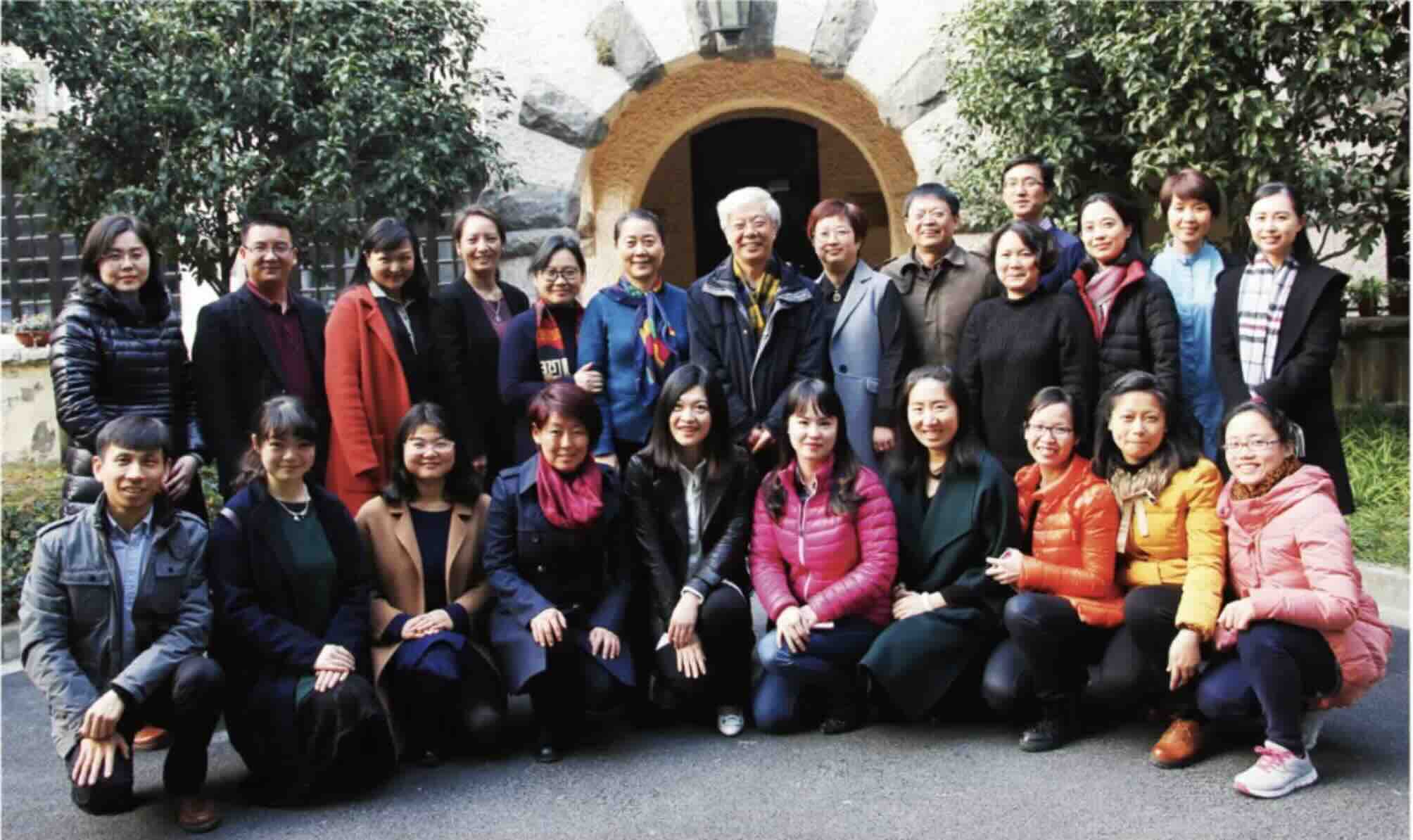
Here I’d just like to introduce the latter project, co-edited by my brilliant mentors Zhang Zhentao and Xiao Mei, whose astute reflections, posted recently on WeChat, I recommend. Zhang gives an authoritative survey of the growing recognition of the importance of notation as we refine our view of Chinese music sources, while Xiao adds details on the organising of such a huge compilation. It’s clearly a massive enterprise—not least in taxonomy, on which both scholars provide salient comments.

The project was initiated in 2017, soon assembling an accomplished team—many of whom were prompted to initiate separate research projects. Standards have risen since the days of the massive Anthology of folk music of the Chinese peoples.

Scores teamThe Yuepu bian team, 2017.

Zhang Zhentao pays tribute to the voluminous scholarship of Yang Yinliu (1899–1984), incomparable master of Chinese musicology, who led major projects before and after the 1949 Liberation; and the blossoming of research after the end of the Cultural Revolution, led by the Anthology. The Zhongguo gongchepu jicheng (Anthology of Chinese gongche scores, 2017), edited by Zhang Zhentao himself, was another major initiative.

On the basis of previous work, this new compendium adds more material from south China and ethnic minorities. It includes

  • scores found in canonical works from imperial times
  • among local folk traditions, gongche notations of melodic instrumental genres, as well as percussion. Notable among scores of folk melodic instrumental music are those of Xi’an guyue and the ritual associations of Hebei (supplementing Zhongguo gongchepu jicheng with some further material collected during Qi Yi’s Hebei project). Considerable new material for southern genres (hitherto somewhat under-represented apart from the exceptionally extensive scores of nanyin in south Fujian) includes the distinctive ersipu 二四谱 notation of the Chaozhou region, and scores of sizhu in south Jiangsu.
  • Han-Chinese folk-song, opera, and narrative-singing
  •  I’m curious to see how “religious music” is defined and categorised
  • the vast repository of qin zither tablatures.

Both scholars discuss the Uyghur muqam—in Xiao Mei’s essay, part of her astute reflections on issues in assembling scores of ethnic minorities, and in handling digital data classification.

While I heartily support the documenting of all these scores, Zhang and Xiao would be the first to concur that folk traditions, based on oral transmission, are far from dependent on them. The challenge is to incorporate notation into our understanding of the soundscapes of local communities and their transmission histories.

WAGZ scoreGongche score, West An’gezhuang village, Xiongxian, Hebei.

Of course, notation is silent: these scores provide the outline of melodies for musician-insiders whose realisations we can hardly imagine from the page. So among the other rubrics, the volumes cataloguing recordings will be crucial. What I await most eagerly—without holding my breath—is a project to make fieldtapes available, such as those that form the basis for the transcriptions of the Anthology of folk music of the Chinese peoples.

For some other compilations reflecting the blossoming of Chinese musicology, see my posts on Yang Yinliu (with a note on Huang Xiangpeng), Qiao Jianzhong, and Yuan Jingfang.

The Ghost Festival

SGL guiwangGhost King, South Gaoluo.

Today is the Ghost Festival in China, so I’ve been reflecting on calendrical rituals (further to my In search of the folk Daoists of north China, pp.7–8). Usually I draw attention to ritual days, but this seems to be one that I’m inclined to downplay.

XJY yankou 2003Yankou at Xujiayuan temple fair, north Shanxi 2003.

As one of the Three Primes (sanyuan 三元) over the annual calendar, the Ghost Festival (Guijie 鬼节, formally Yulanpen jie 盂兰盆节) on 7th moon 15th seems like a major event (see e.g. Stephen Teiser, The Ghost Festival in medieval China). On this evening, groups of temple clerics (both Daoist and Buddhist) still hold Flaming Mouth rituals (yankou, shishi) to exorcise the community, although they were surely performed more commonly before the pervasive impoverishment of temple life over the 20th century.

LQ yankou 1982Li Qing’s 1982 copy of the Li family Daoists’ shishi ritual manual.

There’s an extensive Chinese literature on this complex, lengthy Tantric ritual, but the Ghost Festival is far from its only context—besides other temple fairs over the annual cycle, it is (or was) routinely performed for funerals (see many posts under Local ritual).

Notwithstanding the importance of the Ghost King (Guiwang) and the Ten Kings of the Underworld (Shidian Yanjun) in village pantheons, in my experience of rural north China, 7th moon 15th is not (or is no longer?) a major day for rituals with liturgists presiding. Perhaps its liturgical importance varies by region; I’m not sure it depends on the community still having a viable temple, since ritual buildings can be re-activated for important ritual purposes. In my DVD Doing Things on ritual life in north Shanxi, §B5 has brief excerpts from a yankou performed by Buddhist monks for the “main day” of their village temple fair—which falls on 7th moon 3rd, not 15th.

Worshipping the ancestors, Xinzhou 7th moon 15th 1992.

What does endure is the custom of domestic offerings, burning paper at the ancestral graves, as we found in 1992 in Xinzhou on our trip through north Shanxi. Neither there nor in Yanggao is it a day to summon household Daoists to perform rituals.

zhaobeikou-lakeThe Zhaobeikou ritual association leads Releasing Lanterns ritual on Baiyangdian lake,
7th moon 15th, 1993.

For village associations on the Hebei plain, 7th moon 15th may have become less of a focus for communal observance over the 20th century. But the aquatic setting around the Baiyangdian lake (click here) prompts village ritual associations there to go on procession to “Release River [or Lotus?] Lanterns” (fang hedeng 放河/荷燈). Similar rituals are held in nearby counties such as Langfang. in Bazhou, the Zhangzhuang association, with its active group of liturgists, was one of few still performing yankou on the 15th. The association of Lesser Huangzhuang, Jinghai, performed Releasing God Lanterns (fang shendeng) on 1st moon 15th and Releasing Ghost Lanterns (fang guideng) on 7th moon 15th. Around Houshan, the major days to worship the goddess Houtu are 3rd moon 1st and 15th, but 7th moon 1st and 15th also attract many pilgrims.

So we may come across a range of exorcistic behaviour on 7th moon 15th: from burning paper at the ancestral graves, to processions Relasing the Lanterns, to full-scale yankou rituals.

As to the other days of the Three Primes, 1st moon 15th is the day around which the main annual rituals revolve (whereas only domestic offerings are made on New Year’s Day—e.g. Gaoluo); the ritual segments performed are exorcistic, like those for 7th moon 15th. But (again for north China) I haven’t heard of major communal observances for 10th moon 15th—leads welcome…

Anyway, the ritual days of the standard national calendar may arouse false hopes, requiring verification on the ground; once one gets down to the grassroots, other dates may require important calendrical rituals for local deities. In south China, even the major liturgical days of the 1st moon vary by locale. This is a significant fieldwork lesson: to see beneath the tip of the iceberg of temple practice and prescriptive history to digest folk observances at the grassroots (cf. Debunking “living fossils”).

Cf. Calendrical rituals, and for Bach and Saxony, The ritual calendar: cycles, seasons.

Folk ritual of Tianjin, and its soundscapes

The Anthology provides another gateway

Like Beijing nearby, the municipality of Tianjin encompasses a large region, much of it still rural. On ritual and its soundscapes there, my previous articles include

So at last I’ve been trying to digest the relevant volumes on instrumental music of the great Anthology of folk music of the Chinese peoples:

  • Zhongguo minzu minjian qiyuequ jicheng, Tianjin juan 中国民间器乐曲集成, 天津卷 (2008) (2 vols; 1,475 pages),

which as ever contain substantial material on ritual traditions. To remind you of my introduction to a similar recent survey for Fujian province in southeast China,

Ritual pervades all genres of folk expressive culture: in the Anthology, it is a major theme of the volumes for folk-song, narrative-singing, opera, and dance. In the instrumental music volumes, even genres that lack explicit liturgical content are also invariably performed for ceremonial occasions—but a further reason to consult them is that the specific rubric of “religious music” has been consigned there. I’ve described the flaws of the Anthology project in my

  • “Reading between the lines: reflections on the massive Anthology of folk music of the Chinese peoples”, Ethnomusicology 47.3 (2003), pp.287–337.

Apart from the Anthology‘s valuable Monographs for opera and narrative-singing and brief textual introductions to genres, its volumes consist mainly of transcriptions, of limited value without available recordings. Conceptually its classifications are rudimentary, but it opens up a world of local cultures.

Tianjin map

It’s important to grasp the geography of the large regions covered by such surveys (cf. Layers of fieldwork). At the time of compilation the greater Tianjin municipality comprised four suburban areas (east, west, south, north), five counties (Wuqing, Jinghai, Ninghe, Baodi, * Jixian), and three districts (Tanggu, Hangu, Dagang), all of which had distinctive local traditions.

Useful as always are sketches of some leading groups (pp.1327–39) and brief biographies (pp.1340–56), containing promising leads to further ritual associations and sects.

Volume 1 is entirely devoted to “drumming and blowing” (guchui yue 鼓吹乐). Here the rubric of “Songs-for-winds associations” (chuige hui 吹歌会) is misleading (see under Ritual groups of Xushui), compounded by the sub-categories of leading instrument (guanzi, suona, sheng, dizi). While many musicians are versatile on wind instruments, this masks the important distinction between occupational shawm bands and devotional ritual associations led by guanzi. However, there is some valuable historical information bearing on the “classical” style of amateur ritual groups (often known as “music associations” yinyuehui) serving ritual, such as the Tongshanhui 同善会 of Huanghuadian in Wuqing county (p.1336; brief mention here, under “Further leads”). Such groups were to become my main focus (see Menu, under Hebei and Gaoluo).

Xuande naoboNao and bo cymbals of the Tianxing dharma-drumming association,
inscribed Xuande reign, 5th year (1429). Besides museums,
folk performing groups preserve important evidence for
the material culture of imperial China (see China’s hidden century).

Shawm bands always occupy a substantial part of the Anthology coverage. Here the summary introduces traditions for all the municipality’s regions, notably in the north around Baodi and Jixian (pp.36–8, 41–2; groups pp.1338–9, biographies p.1343–4, 1355).

Tianjin Dayue

The “great music” of Tianjin.

Still under the heading of “drumming and blowing”, a separate rubric introduces the imposing “great music” (dayue 大乐, though here I seem to recall it should be pronounced daiyue) of the Tianjin region. These shawm bands, derived from the Qing court (cf. longchui and Pingtan paizhi in Fujian), were transmitted among the folk through the Republican era until the 1950s, mainly in urban districts but also in the suburbs; but later they became largely obsolete, so the Anthology fieldwork was largely a “salvage” project.

The impressive introduction (pp.599–610) refers to documents from the late Qing, including material on the “imperial assembly” (huanghui 皇会), supplementing that of the dharma-drumming associations), and details the use of the genre at weddings and funerals. Besides recordings made for the Anthology in the 1980s, the appetising transcriptions (pp.611–78) utilise early discs that I’m keen to hear—Pathé (Baidai) from 1908 and the 1920s, Shengli 胜利 from the 1930s. Cultural cadres recorded senior artists in the 1950s and even “in the mid-70s”. By the 1980s, surviving musicians were recorded for the Anthology, and took part in the Boxer movie Shenbian 神鞭 (Holy whip, 1986).

Tianjin shifanShifan band, 1930s.

Volume 2 opens with an introduction to the mixed ensemble shifan 十番 (text pp.679–701, transcriptions pp.702–875; further material on the late Qing societies Siru she 四如社 and Jiya she 集雅社 on pp.1327–8). Related to the better-known genres of south China, notably Jiangnan, shifan bands are also found in a few northern regions including Hebei (see my Folk music of China, pp.206–8). In Tianjin, where shifan was part of the thriving Kunqu scene before Liberation, the major figure in documenting the tradition was Liu Chuqing 刘楚青 (1909–99) (pp.1341–2), who used his youthful immersion in the culture to compile a major volume in 1987.

Notable among percussion ensembles (pp.876–1138) are the dharma-drumming associations (fagu hui 法鼓会), which my mentors at the Music Research Institute (MRI) in Beijing were excited to discover in 1986 and 1987 while attending major folk music festivals in Tianjin. These groups commonly subsumed a shengguan melodic ensemble—from the 1986 festival, listen to the MRI’s audio recording of the Pudong “music and dharma-drumming association” in Nanhe township, Xiqing district 西青南河镇普东音乐法鼓会. These events led us to the fieldwork of local scholars—notably Guo Zhongping 郭忠萍, author of the valuable overview in the Anthology (pp.876–97; transcriptions pp.898–1009; see also groups pp.1328–34 and biographies pp.1347, 1349), based on her more detailed early publication Fagu yishu chutan (1991). 

This section also introduces the percussion of “entertainment associations” (huahui 花会): “flying cymbals” (feicha 飞镲), stilt-walking (gaoqiao 高跷), dragon lanterns (longdeng 龙灯), and flower drum (huagu 花鼓).

“Religious music”
As always, despite my criticism of the term, this is a substantial category in the Anthology, subsuming some major traditions of Buddhist and Daoist ritual.

Tianjin templesJinmen baojia tu shuo (1846).

For major insiders’ accounts by temple clerics Zhang Xiuhua and Li Ciyou before and after the 1949 “Liberation”, see n.1 here, leading to Appendix 1 of my book In search of the folk Daoists of north China and the research of Vincent Goossaert.

Tianjin Daoists
Daoist band, Tianjin. Tell us more…

For “Buddhist music” (pp.1141–52) and “Daoist music” (pp.1274–9) the introductions can only serve as a starting point for more sophisticated fieldwork—like the transcriptions (pp.1153–1273 and 1280–1326 respectively). There are slim pickings here—although the section on Daoist temple music provides a remarkable vignette from 1972 (!) on a Pingju opera musician’s visit to Zhang Xiupei 张修培, elderly (former?) abbot of the Niangniang gong temple, to notate his singing for the purposes of “new creation”. This section also introduces Li Zhiyuan 李智远 (1894–1987) of the Lüzu tang and Tianhou gong temples; though laicized after “Liberation”, from 1985 he was able to support the renovation of the Lüzu tang. More promising are the rural areas, where there are always household Daoist bands to explore. The transcriptions end with three items of vocal liturgy from the Western suburbs (pp.1313–26): the popular “Twenty-four Pious Ones” (Ershisi xiao 二十四孝), the “Song of the Skeleton” (cf. the Li family band in north Shanxi), and Yangzhi jingshui 杨枝净水.

Xiangta laohui JCI

The accounts of many folk groups offer glimpses of the sectarian connection. In Yangliuqing township (known for its nianhua papercuts), the Incense Pagoda Old Association (Xiangta laohui 香塔老会, above) of 14th Street (which we visited all too briefly in 1989) had scriptures including Hunyuan Hongyang baodeng 混元弘陽寶燈 and Linfan jing 临凡經. Tracing their transmission back eleven generations to the Wanli era (1572–1620) of the Ming dynasty, they have remained active exceot for the hiatus of the Cultural Revolution. In the western suburbs the Tianxing dharma-drumming association (pp.1331–2) belonged to the Tiandimen sect, and groups in Dagang district (p.33) also derive from Tiandimen and Taishangmen sects.

For all its flaws, the Anthology remains a valuable resource; but as ever, the groups introduced there call for fieldwork from scholars of folk religion as well as musicologists.


* Rural Baodi is known to Beijing musicologists and other intellectuals for its “7th May Cadre Schools” (Wuqi ganxiao 五七干校), wretched sites of exile during the Cultural Revolution—for scholars of the Music Research Institute at Tuanbowa (Jinghai), scroll down here.

The changing ritual scene of Xiongxian

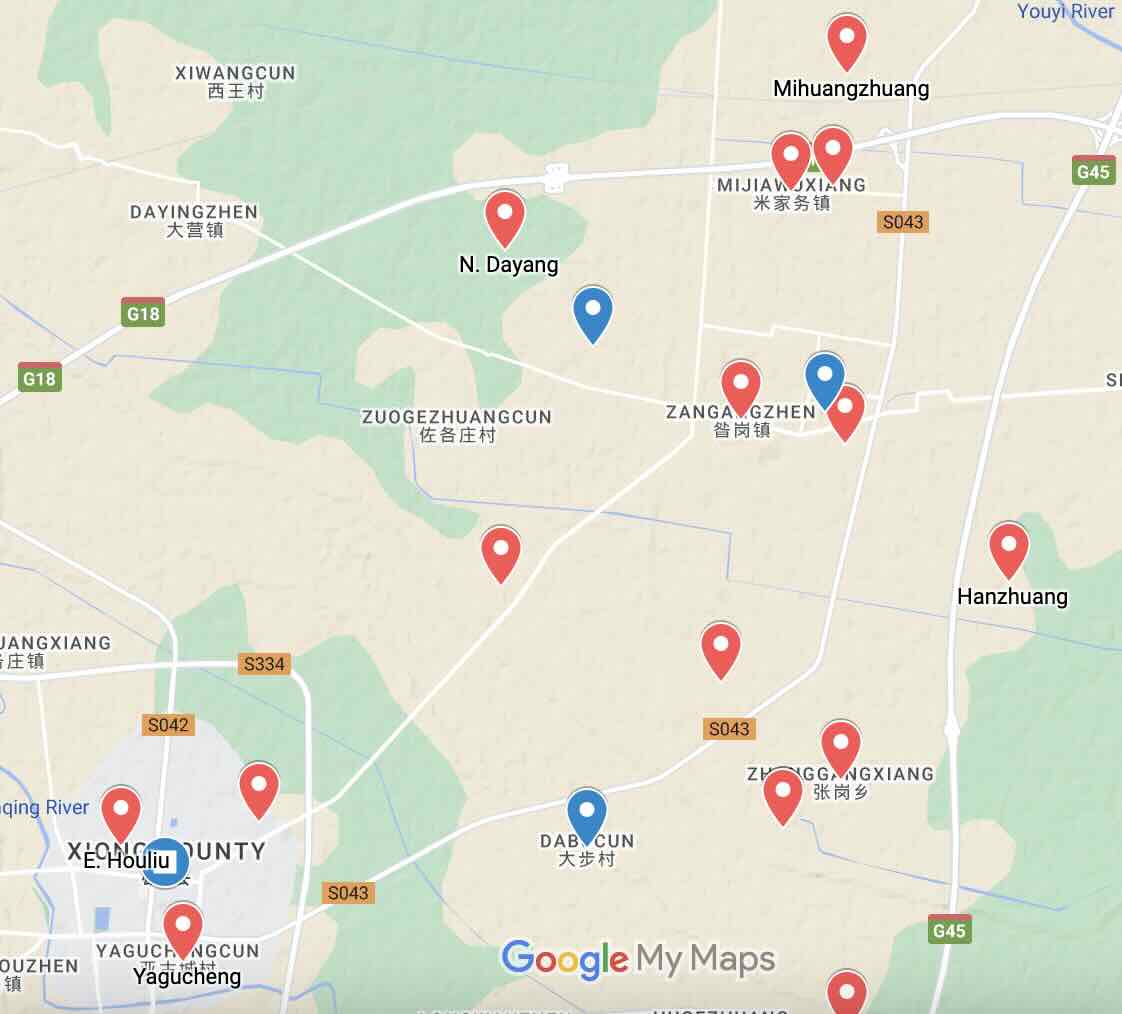
Our 1990s’ project on village ritual groups on the Hebei plain just south of Beijing (overview; fieldnotes listed in the Menu, under Hebei) revealed a wealth of evidence for sectarian activity. Our visits to Xiongxian county (click here, with map) focused on the ritual associations of Hanzhuang, Gegezhuang, and Kaikou villages, but on a “gazing at flowers from horseback” trip to the Mijiawu district in 1995 we could see that there was much to learn there too. I’m prompted to revisit our notes after reading a recent article in Sixth tone, subject of the second half of this post.

Xiongxian map detail

Of the five villages in Mijiawu, both East and West villages formerly had Great Temples (dasi 大寺). The Laofomen 老佛門 sectarians in North village had learned from the Buddhist monks of the Great North Temple in West village, who performed rituals among the folk. But the temple, and the monks’ instruments, were destroyed during the Japanese occupation.

Mihuangzhuang 1

At Mihuangzhuang the senior Cheng Wanxiang made an articulate guide to the history of the village ritual association (known by the confusing term yinyuehui 音樂會, “music association”—as well as my overview, note my comments on recent Chinese attention to my work on Gaoluo). The members were originally Laofomen sectarians. The repertoire of their shengguan wind ensemble music derives from three nearby villages: Mijiawu, Hanzhuang, and Bandong. After the end of the Cultural Revolution they restored around 1981, despite a lack of support from the village brigade and the disapproval of the county authorities. Cheng’s family were poor, but they forked out the money to buy sheng mouth-organs, so the others were moved to bring out their grain to buy a drum and other instruments. As he commented, “Village life is so monotonous—the association helps us handle (tiaojie 调节) life, but the brigade won’t support it. The association’s raison d’etre is to do good, and learn proper behaviour (xingshan 行善, xue guiju 学规矩).” Cheng Wanxiang himself went to invite his fellow villagers to study the music—ironic, as he notes, the teacher inviting the pupil! But still no-one cared to learn. Even so, in 1995 there were fifty or sixty households “in the association”.

Mihuangzhuang 2Some association members.

Like Xie Yongxiang in Hanzhuang, Cheng Wanxiang made some fine distinctions. The temple fair over three days around 3rd moon 15th was known as Granny Assembly (Nainai hui 奶奶會) or Favourable Incense Assembly (Shunxiang hui 顺香會), made up of old women. A tent was set up, with paintings of Wusheng laomu and “Granny” (Houtu) (see The Houshan Daoists), and the association helped out. Again, the purpose of the Favourable Incense Assembly was to “do good” (a common theme, as villagers denied “superstitious” elements), but they stopped activity in 1937. The association hadn’t made the pilgrimage to Houshan, but some of the old women had.

The Laofomen sect was also distinct. They cured illness by using tea-leaves and qigong, not incense. They too “did good”, not accepting gifts; there was no charge—they even fed members. Their main scriptures were Dafa jing 大法經 (for Presenting Offerings, shanggong 上供), “precious scrolls” to the God of Earth and the Ten Kings (Tudi juan 土地卷, Shiwang juan 十王卷), as well as the ubiquitous Incantation to Pu’an (Pu’an zhou 普庵咒). Some were “recited scriptures” (nianjing 念經), some “wind-music scriptures” (chuijing 吹經). They kept performing them after the Japanese invasion, but less well. So the yinyuehui also served the Laofomen. After Liberation the Laofomen was suppressed, but its members continued curing illness. Their scriptures were burned at the start of the Cultural Revolution.

* * *

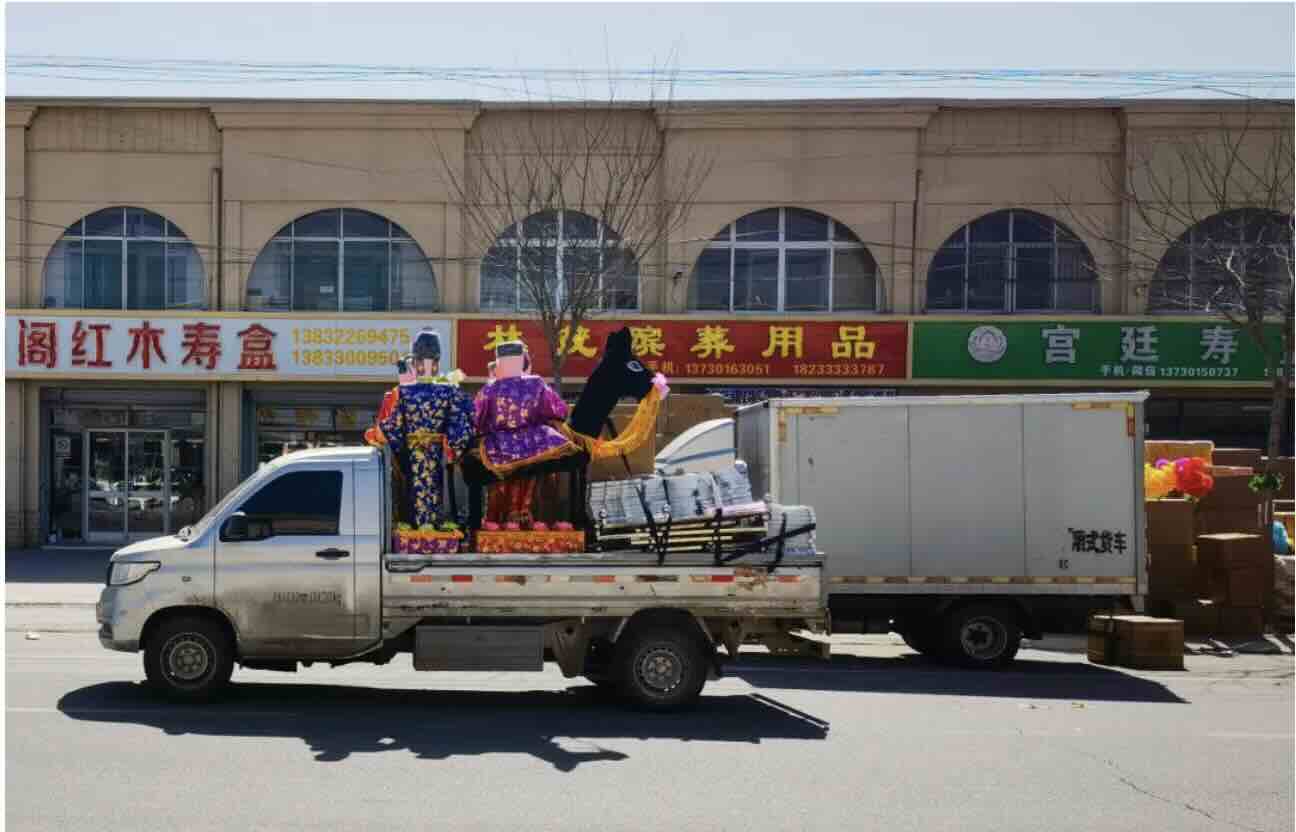
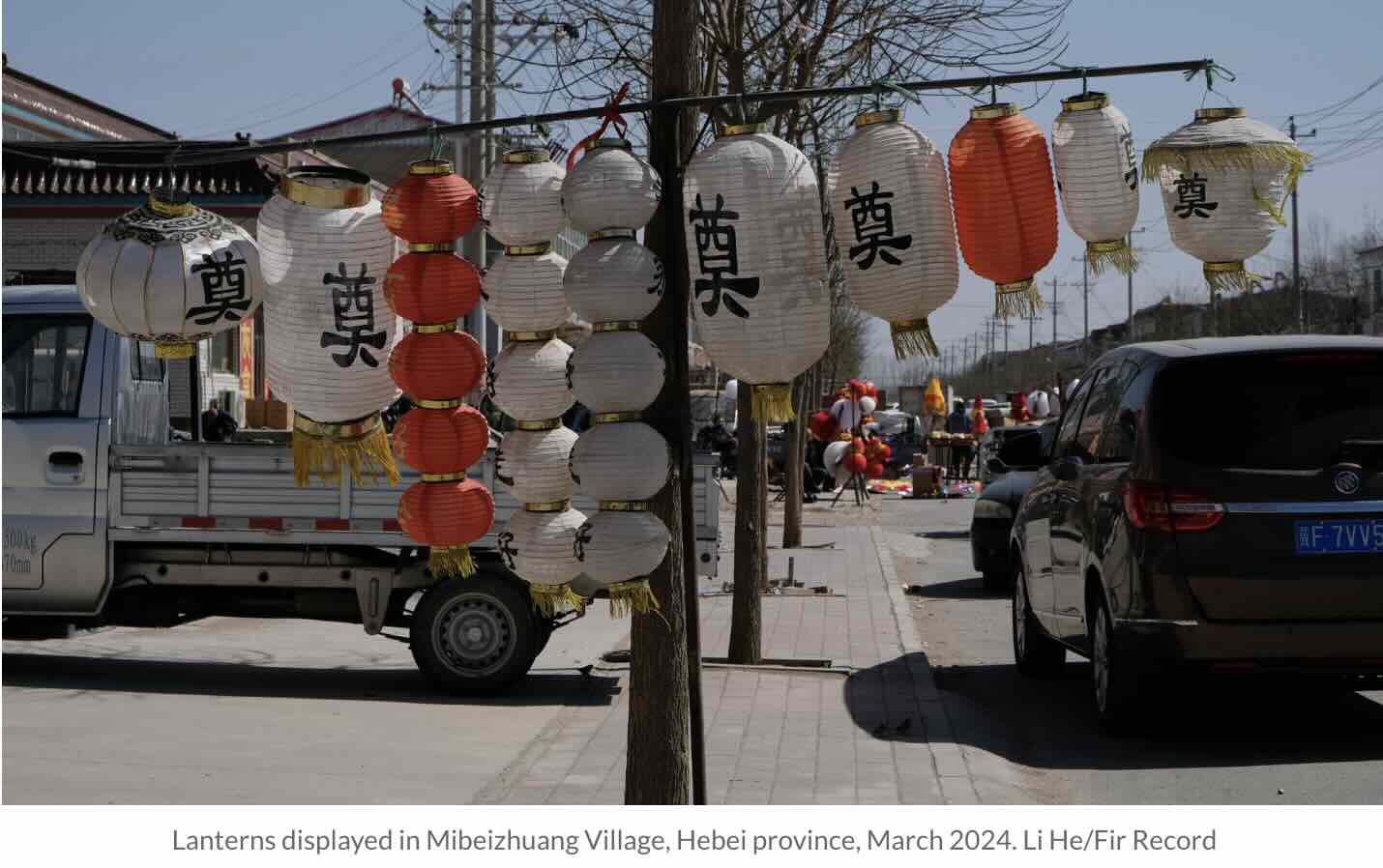
I’m reminded of these notes not only because since 2016, these villages are being swallowed up in the vast new XiongAn airport, but since Mibeizhuang is the subject of a recent article in Sixth tone about the village’s erstwhile thriving trade in funeral paraphernalia.

Welcome to the so-called “Wall Street of the underworld,” where businesses stock approximately 10,000 different types of goods, such as paper flowers, effigies, and elegiac couplets, for traditional Chinese funerals and memorial ceremonies.

Mibei shop

In villages, towns, and cities around China, individual familes (such as household Daoist Li Bin with his wife in Yanggao, north Shanxi) often open funeral shops, and some run thriving businesses. In Mibeizhuang the local memorial supply industry didn’t begin to take shape until around 2003.

Elderly residents credit this transformation to Yang Wenyuan, who at the time was Party secretary of Xiong County, where the village is located. He oversaw development of the main street, attracted suppliers and buyers, and helped organize the local workforce, dividing labor between production and sales.

I’m incredulous to read that Mibeizhuang “accounts for 90% of China’s funeral supplies market, recording an annual output of about 1 billion yuan ($137.94 million)”.

Forty-something Li and his wife used to sell donkey meat burgers in downtown Baoding, but they decided to return to their native village in 2014, renting a 60-square-metre space to open a one-stop supermarket offering “almost anything one might need in the afterlife.” The shelves are stocked with all kinds of paper products: beverages, vegetables, cell phones, televisions, cooking gas cylinders, electric-powered farm tricycles, and passports. The store also receives orders for custom-made products, such as full-size replica camouflaged tanks; luxury goods including Lamborghinis, Porsches, Mercedes, and Harley-Davidson motorcycles; and even a scaled-down three-story villa with a butler, maids, and a courtyard.

Mibeizhuang street

However, recently there has been a downturn in the market,

stemming from two major factors: policy and progress. In recent years, local authorities across the country, including in Baoding, have introduced “civilized memorial” regulations targeting the manufacture or sale of “feudal and superstitious” goods such as spirit money and other paper offerings. […]

In late March, local vendors received a text notification about the Baoding Civilized Memorial Initiative on their cell phones. Like similar policies rolled out by cities in Jiangsu, Shandong, Guizhou, Hunan, Shaanxi, and other provinces, the initiative aimed to prohibit the production and selling of “feudal and superstitious” memorial supplies. The penalties for violating these new regulations include steep fines and the confiscation of goods.

While this directive is having an impact on business, “there are too many traders, so it’s difficult to tackle everyone,” and people are quick to find ways to bend the rules. I’ve discussed the influence of official directives on local ritual cultures in posts on Shandong and Shanxi.

In addition, the emergence of new technologies is providing people with cheaper and more sustainable options for funeral and memorial ceremonies.

Anyway, after our notes on the history of sectarian activity in Xiongxian, I was intrigued to find this further update on the constantly shifting ritual scene there.

New film in the making: Gaoluo, New Year 1995

PTW cover

Our fieldwork through the 1990s documenting amateur ritual associations in villages on the Hebei plain bore fruit in my book Plucking the winds (2004), a diachronic ethnography of the village of Gaoluo in Laishui county, on which you can find many posts here. It’s recently been the subject of a new wave of attention in China.

The book comes with an audio CD—but its taken me all this time (Like, Hello?) to realise that from my video footage I could create a beautiful film devoted entirely to the 1995 New Year’s rituals around 1st moon 15th—my first extended stay in the village.

So I’m admiring the creative editing skills of the splendid Andrea Cavazzuti 老安, himself a fine film-maker. Long resident in Beijing (see this interview; for his photos from the early 80s, click here), and an old friend of the Li family Daoists in Shanxi, he’s currently spending time in Milan, so I’ve just spent a few intensive days with him there crafting a rough cut, while relishing the joys of Italy after a long absence.

It’s been inspiring to revisit the 1995 footage, nostalgic to recall the kindness and good humour of the villagers, and fascinating to collaborate in editing.

gl baihui 98

Alongside the “heat and bustle” (cf. Chau, Religion in China, pp.67–8) of the village’s four ritual associations exchanging New Year’s greetings as they parade to their respective “lantern tents” adorned with exquisite god images, are the shengguan wind ensemble, the “civil altar” (wentan 文壇) singing hymns (as well as the Houtu precious scroll)—and in particular the moving, exhilarating percussion suite, led by the great Cai An. It’s also moving to see senior masters like He Yi, Li Shutong, and Yan Wenyu, who maintained the village’s ritual life through the tribulations of Maoism. But ritual activities in Gaoluo already belong to another era…

UPDATE: you can now watch the film here, making a worthy companion to my portrait film on the Li family Daoists!

Precious scrolls: some background

Precious scrolls of village ritual associations near Houshan, Hebei:
left, “Demon-queller scroll”, Lijiafen;
right, “Ten Kings scroll”, Jijiagou.

My sideline in “precious scrolls” (baojuan 寶卷) [1] goes back to our 1990s’ field project on the central Hebei plain, when we were impressed to find a substantial treasure-trove of early editions in villages of Yixian and Laishui counties—and particularly to witness them still being performed by the liturgists of amateur ritual associations there (see under The Houshan Daoists and The Houtu precious scroll).

While the central Hebei plain, and the living performance of its early sectarian scriptures, remain my main focus in baojuan studies, after this recent note on the traditions of Gansu my wider interest has been further piqued by the latest in a succession of anthologies:

whose 50 volumes contain 150 precious scrolls, each with an introductory synopsis. They belong mainly to sectarian groups such as Wuwei 無為, Huangtian dao 黄天道, Xi Dacheng jiao 西大乘教, and Hongyang jiao 弘阳教 / Hunyuan jiao 混元教, many of which feature in our fieldnotes on Local ritual in Hebei (see e.g. Ritual groups of Jinghai).

baojuan cuibian

As instances of texts that we found in rural Hebei, vols. 24 and 25 comprise six editions of the “Demon-queller scroll”  Huguo youmin Fumo baojuan 護國佑民伏魔寶卷, performed until recently for mortuary rituals in villages around Houshan. Of early printed scrolls that we found in Gaoluo village, the “White Clothes scroll” Xiaoshi Baiyi Guanyin pusa song ying’er xiasheng baojuan 銷釋白衣觀音菩薩送嬰兒下生寶卷 is in vol.29, and the Fuguo zhenzhai lingying Zaowang baojuan 富國鎮宅靈應竈王寶卷 in vol.38 (cf. the Gaoluo editions, from 1745 and 1720 respectively). The compendium also includes the “Dizang scroll” 地藏王菩薩執掌幽冥寶卷 (vol.29) and “Ten Kings scroll” 泰山東嶽十王寶卷 (vol.30), preserved by nearby village ritual associations in early editions. In this region at least, the most commonly performed scrolls address the major preoccupations of Chinese villagers: birth (to Guanyin and Houtu), and death (to Demon-queller, Dizang, and the Ten Kings). 

* * *

I can’t keep up with the “baojuan fever” that has grown since the 1990s. These notes serve as much for my benefit than yours—rather, perhaps, we constantly seek to refine and clarify our earlier studies.

Baojuan is an umbrella term for a range of texts. Many scholars have considered baojuan more as “folk literature”, or as a textual window onto early sectarian religion, than as a living performance tradition. Pu Wenqi’s own long-term research set forth from studying sectarian (if not always “secret”) folk religion in north China—under the aegis of the great Li Shiyu 李世瑜 (1922–2010); and it was Li Shiyu who blazed a trail in unpacking structural elements of baojuan in ritual performance, which are among the many themes discussed by later specialists.

The research paths of scholars have depended largely on which among the diverse types of baojuan were prevalent in their own region and to which they had access (cf. “blind people groping at the elephant“). As a broad outline, the early “religious” style has mainly been found near Beijing, while later “folk” texts are common in east-central China and the northwest.

Actually, in my earlier posts (based on Plucking the winds, and Appendix 3 of In search of the folk Daoists of north China) I appear to have had a basic grasp of the place of the Hebei scrolls in baojuan studies. As I noted, “while scholarship on the precious scrolls has tended to be more historical and sinological than contemporary and ethnographic”, “the whole point of these precious scrolls is that they are performed for rituals—they’re not musty tomes to be read silently in libraries.” What struck me about the Hebei scrolls was that they belonged very much to the early “religious” type of baojuan, but were still part of a living tradition—most performers we met were liturgists within ascriptive village-wide ritual associations, which had sectarian connections within living memory. And we found the classic structure of early religious baojuan to which Li Shiyu drew attention in 1957: 24 chapters (pin or fen ), each incorporating ten-word form, qupai labeled melodies, and so on (see under The Houtu precious scroll).

Of course, just as baojuan only constitute only one small sub-head among the vast mass of Daoist and Buddhist scriptures, they were just one component of the manuals performed by the liturgists whom we visited (see A tribute to two vocal liturgists, Gaoluo: vocal liturgists, Funerals in Hebei). (And zooming out still further, as Adam Yuet Chau reminds us, we need to overcome the hegemony of discursive/scriptural texts, when so much of the meaning of religious activity in society is relational and non-literate!)

Background
Early advocates for the study of baojuan were Gu Jiegang from 1924, and Zheng Zhenduo 郑振铎, inspiring a succession of articles in the 1930s and 40s. In the first catalogue, published in 1951, Fu Xihua 傅惜华 listed 246 scrolls in Baojuan zonglu 宝卷总录—the same title that Li Shiyu used for his 1960 catalogue, listing 618 scrolls in 1,487 editions.

Since the 1980s, as baojuan came out into the open both in performance and research, scholars have reflected further on origins and classification. Two authoritative figures in baojuan studies are Pu Wenqi 濮文起 and Che Xilun 车锡伦. Following Che Xilun’s useful 2001 retrospective, his major book Zhongguo baojuan yanjiu 中国宝卷研究 (2009) contains both an overview and case studies. Similarly, alongside chapters on specific themes, Pu Wenqi and Li Yongping 李永平 eds., Baojuan yanjiu 宝卷研究 (2019), includes surveys by Pu Wenqi himself and by Wang Mingbo 王明博 and Li Guisheng 李贵生. In English, the detailed studies of Rostislav Berezkin on traditions of baojuan performance in south Jiangsu include useful introductions to the wider topic (cf. my Appendix under Ningxia).

Che Xilun has distinguished “religious baojuan” before the Kangxi reign (1662–1722) from later “folk baojuan”—with subdivisions: [2]

  • A) Before the Kangxi reign: “religious baojuan
    明正德 (1505–21) 以前“佛教世俗化宝卷”:
         “演释佛经”
         “讲唱因缘”
    正德后“民间宗教宝卷”:
         “宣讲教义”
         “讲唱故事”
  • B) After the Kangxi reign: “folk baojuan
    劝世文
    祝祷仪式
    讲唱故事”:
         “神道故事”
         “妇女修行故事”
         “民间传说故事<”
         “俗文学传统故事”
         “时事故事”
    “小卷”

Catalogues and anthologies
By the 1990s, catalogues were expanding significantly, such as

  • Che Xilun, Zhongguo baojuan zongmu 中国宝卷总目 (2000, after a 1998 Taiwan edition), listing 1,585 scrolls in over 5,000 editions.

Wide-ranging anthologies of the texts themselves were also published, such as

  • Wang Jianchuan 王见川 and Lin Wanchuan 林万传 (eds), Ming-Qing minjian zongjiao jingjuan wenxian 明清民间宗教经卷文献 (1991) (12 vols, 207 texts) and the 2006 sequel edited by Wang Jianchuan, Che Xilun, et al. (12 vols, 204 texts), mostly consisting of baojuan.
  • Zhang Xishun 张希舜 et al. (eds), Baojuan chuji 宝卷初集 (1994) (40 vols, 153 texts).
  • Zhongguo zongjiao lishi wenxian jicheng weiyuanhui 中国宗教历史文献集成编委会 (Pu Wenqi!) (ed.), Minjian baojuan 民间宝卷 (2005) (20 vols, 357 texts).

Ma baojuan

Ma Xisha 马西沙, another long-term scholar of folk sectarian religion, has also addressed baojuan, including the major anthology

  • Zhonghua zhenben baojuan 中华珍本宝卷 (2013) contains 30 vols, with 138 texts,

before Pu Wenqi’s recent collection with which I opened this survey.

Regional fieldwork and research
Much of the collection work has long consisted in editing baojuan held in libraries and private collections, but fieldwork became an increasingly important source of texts—often bringing further insights from observing living performance (in another useful overview, see §3 and §5 here).

There had been a few such projects under Maoism, in a period when both performance and research were becoming increasingly risky (cf. the work of Yang Yinliu and his colleagues at the Music Research Institute in Beijing). [3] But fieldwork could only begin in earnest with the liberal reform era since the 1980s. Around Tianjin and further afield, Li Shiyu resumed his work with alacrity—now with a keen disciple in Pu Wenqi.

baojuan Berezkin
From Rostislav Berezkin, “Scripture-telling (jiangjing) in the Zhangjiagang area
and the history of Chinese storytelling”
(2011).

South Jiangsu and Zhejiang became popular sites for fieldwork, with a particular focus on ritual groups around the Suzhou region, notably Jingjiang (see here, and n.1 here). Again, many texts were published, [4] and fieldwork encouraged scholars to observe actual performance practice—often in the context of zuohui 做会 religious gatherings. In English, after a 2001 article by Mark Bender on the Jingjiang tradition, Rostislav Berezkin has expanded the field in a series of detailed articles.

Another lively site for baojuan studies was the Hexi corridor of Gansu (here I cited this recent survey by Cheng Guojun 程国君). Local cultural workers such as Duan Ping 段平 and Fang Buhe 方步和 were early collectors. [5] The numinous ancient site of Dunhuang tempted some researchers to embroider a connection with early bianwen religious narratives there—a tendency (akin to the persistent “living fossil” shtick, and further mired in romantic fantasies of the Tang and Silk Road) that Che Xilun disputed in his 1999 article “Ming-Qing minjian zongjiao yu Gansude nianjuan he baojuan” 明清民间宗教与甘肃的念卷和宝卷. Nearby, baojuan traditions were also discovered in the Mani assemblies 嘛呢会 of largely Tibetan areas of eastern Qinghai (see e.g. Liu Yonghong 刘永红, Qinghai baojuan yanjiu 青海宝卷研究, 2013); see also under Ningxia.

The baojuan of south Jiangsu and Gansu, while numerous (and again based in ritual performance), are mostly in the later “folk” style, not so early as the early 24-chapter sectarian scrolls that we found on the Hebei plain. For north China, besides Pu Wenqi, other scholars paying attention to the latter kind of baojuan include Cao Xinyu, Yin Hubin 尹虎彬, and Liang Jingzhi 梁景之.

In the great Anthology of folk music of the Chinese peoples, baojuan falls within the scope of the relevant provincial volumes for narrative-singing: Zhongguo quyi yinyue jicheng 中国曲艺音乐集成, and particularly the historical material of Zhongguo quyi zhi 中国曲艺志 (see e.g. under Famine and expressive culture). Foreign scholars of baojuan include Daniel Overmyer (for north China), Rostislav Berezkin (south Jiangsu), Victor Mair and Wilt Idema (Gansu).

As always, silent library study cries out (sic) to be enriched by documenting the soundscape and bustle of ritual in social life (cf. More films). To complement the vast corpus of published texts, and textual studies of their ritual context, even a modest collection of audio/video recordings of baojuan in folk performance is most desirable (my usual caveat: I refer to field recordings, rather than the reified, sanitised staged versions of the Intangible Cultural Heritage project!). The CD with my 2004 book Plucking the winds has a paltry two audio tracks from the Houtu scroll (one of which features on the playlist on this blog, with commentary here—and I look forward to making a new documentary on the 1995 New Year’s rituals in Gaoluo!!!). And click here for a video clip from a ritual performance by a group in Shaoxing.


[1] Though I use the term “precious scrolls”, which has attained a certain niche currency, allow me to repeat Dan Overmyer’s observation (n.3 here) that baojuan is more properly rendered as “precious volumes”.

[2] I’m not sure how useful is Che Xilun’s further distinction between “literary” and “non-literary” baojuan (按照宝卷的内容和题材,又可将宝卷分为文学宝卷(包括各个时期讲唱故事的宝卷及民间宝卷中的小卷和部分祝祷仪式宝卷)、非文学宝卷(包括宗教宝卷中演释佛经”“宣讲教义的宝卷和民间宝卷中的劝世文及部分祝祷仪式宝卷)两大类。)

[3] In south Jiangsu, Jiangsu nanbu minjian xiqu shuochang yinyue ji 江苏南部民间戏曲说唱音乐集 (1955) was part of a project collecting material on opera and narrative-singing. And for Jiexiu in Shanxi, Zhang Han 张颔, Shanxi minjian liuchuande baojuan chaoben 山西民间流传的宝卷抄本 (1957) used material collected in 1946—see also Li Yu 李豫, Shanxi Jiexiu Zhanglan diqu baojuan wenxue diaocha baogao 山西介休张兰地区宝卷文学调查报告 (2010), and the chapter by Sun Hongliang 孙鸿亮 in Baojuan yanjiu.

[4] E.g. Zhongguo Heyang baojuan ji 中国河阳宝卷集 (2007); You Hong 尤红  et al. eds, Zhongguo Jingjiang baojuan 中国靖江宝卷 (2007); Lu Yongfeng 陆永峰 and Che Xilun 车锡伦 eds, Jingjiang baojuan yanjiu 靖江宝卷研究, 2008; Che Xilun ed., Zhongguo minjian baojuan wenxian jicheng, Jiangsu Wuxi juan 中国民间宝卷文献集成·江苏无锡卷 (2014, 15 vols).

[5] As in all walks of life, both performers and scholars bore the scars of Maoist campaigns. Following her tribulations around 1960 as one of the Spark protesters blowing the whistle on the famine, Tan Chanxue 谭禅雪 was based from 1982 to 1998 at the Dunhuang Research Institute, where as part of her studies of Dunhuang folklore she published articles on, and editions of, baojuan.

China’s hidden century

Following the flummery of the Coronation, I keep finding myself perplexed by the ways in which elites dominate images of society.

BM catalogue
Exhibition catalogue.

The new exhibition at the British Museum, China’s hidden century, is a splendid idea. If the Qing dynasty is a poor cousin of the Ming, the 19th century has suffered by comparison with the long and glorious early-Qing reigns of the Kangxi (1661–1722) and Qianlong (1736–95) emperors. So it’s a worthy mission to reinstate the period, “often defined—and dismissed—as an era of cultural decline”, amidst economic crisis, uprisings, and foreign invasion. The Opium Wars of the 1840s marked the beginning of a “century of humiliation”, the late Qing making one of several instances of hitherto thriving empires that now suffered in turn at the hands of foreign imperialism (cf. Pankaj Mishra on the wider context of Ottoman modernization, at end of this post).

Attending a preview of the BM exhibition, I’m reminded that museums and art galleries, and indeed libraries, depend largely on material that reflects the values of a tiny minority of urban educated people (mainly men). This approach was long standard for most societies, but it’s clearly one that more recent historians have been seeking to refine. And of course, like books, artefacts are silent and immobile. Now I don’t mean to give you another of my “What About the Workers?” rants; I quite understand the brief of museums, and the culture of elite minorities has a rightful place alongside those of other social groups. But as anthropologists and ethnomusicologists seek to engage fully with the “red and fiery” nature of performance in local society, the limitations of both museums and elites soon become apparent (see e.g. Society and soundscape, and What is serious music?!).

yyl-on-xiaoSo I’m grateful to the exhibition for stimulating me to revisit some of my own material from the field. In this I’m always in awe of the incomparable erudition of Yang Yinliu (1899–1984). Brought up in Wuxi during the final years of the Qing dynasty, Yang learned instruments from Daoist priests from the age of six, going on to join the refined Tianyun she society and to become a fine exponent of qin zither, pipa and sanxian plucked lutes, while supplementing his training with an education in Western culture.

In his research he had a rare grasp of both early and later imperial history, and at the helm of the Music Research Institute in Beijing after the 1949 “Liberation” he embodied continuity with Qing traditions of performance and scholarship, as well as directing major fieldwork projects.

Proverb
I’m used to people (often local officials, indeed) citing this saying to explain
the inability of Communist policies to penetrate the countryside (an instance here),
but of course its original usage referred to imperial society.

In her online essay, exhibition curator Jessica Harrison-Hall asks,

How did Chinese cultural creativity demonstrate resilience in the face of unprecedented levels of violence in the long 19th century?

In the countryside some ritual and other performing groups suffered interruptions from warfare. Around Jiangsu, the Taiping rebellion must have disrupted some groups; but rather few local traditions were affected by military conflict, and those that were, recovered quite soon. The ritual association of Hejiaying village just south of Xi’an was caught up in conflict soon after the outbreak of the Hui rebellion in 1862, with instruments and scores destroyed and performers killed. The association was only able to relearn much of its repertoire in 1915 from the nearby village of South Jixian; both groups are still active today. I’d like to learn more about reasons for this remarkably long period of inactivity—much longer, for instance, than that between the 1949 Communist takeover and the 1980s’ reforms.

Xi'an village festival, 1950s.

Xi’an village festival, 1950s.

Through the 19th century a major change in local societies was the arrival of Christian missionaries, vividly documented for Shanxi by Henrietta Harrison. By 1900, as the Qing regime went into terminal decline, tensions with traditional religious communities led to the Boxer uprising, when Catholics around Beijing and Tianjin were massacred (as in Gaoluo)—with village ritual associations supporting the Boxers against the Allied armies. Senior villagers whom we met in the 1990s had heard many stories about the events from their parents.

The exhibition has five main themes: court, military, artists, urban life, and “global Qing”. As the online introduction explains,

The show illuminates the lives of individuals—an empress, a dancer, a soldier, an artist, a housewife, a merchant and a diplomat.
Visitors will glimpse the textures of life in 19th-century China through art, fashion, newspapers, furniture—even soup ingredients. Many people not only survived but thrived in this tumultuous world. New art forms, such as photography and lithographic printing, flourished while technology and transport—the telegraph, electricity, railways—transformed society.

This makes sense as far as it goes; but while seeking to reach beyond the elite, whose culture is only the tip of the iceberg in any era, it can hardly address the poor rural areas where the vast majority of the population lived—so any attempt to broaden the topic rather depends on “going down” to the countryside. The evidence for material and expressive cultures may also invite significantly different perspectives. When Dr Harrison-Hall writes “Representing the millions of people who were not wealthy is a challenge as so little survives”, she refers to the material culture preserved in museums. Among the folk, local traditions of ritual and music that endured throughout the troubled 20th century go back multiple generations; many groups preserve early artefacts such as instruments, scores, ritual paintings, and pennants, but more importantly they transmit life-cycle and calendrical rituals that were being modified in ways that can rarely be glimpsed—even in the wealth of field reports for Hebei, Shanxi, and elsewhere in my series on Local ritual.

Niu JinhuaThis reflects another common difficulty: we often seek to document history through major, exceptional events, whereas for peasants customary life is more routine. And apart from artefacts, much of the history of this (or any) period lies in oral tradition—which doesn’t lend itself so well to exhibitions.

Nor do women play a greater role in the traditions I’m about to outline; while we regularly came across elderly women with bound feet, they had hardly been exposed to the public activities of the village with which we were concerned (for posts on gender in China and elsewhere, click here; right, women of Gaoluo).

Even the rubric of “Qing court music” is already broad.

Qinxue rumenFrom Qinxue rumen (1864), with the innovation of gongche solfeggio
added besides the tablature.

The elite solo art of the qin zither is a close ally of museums, having an intrinsic bond with calligraphy, painting, and poetry. Again, qin scholars tend to focus on tablatures from the Ming and early Qing, but John Thompson’s definitive site lists around fifty such volumes from the 19th century. Within this tiny coterie, collections like the 1864 Qinxue rumen 琴學入門 and the 1876 Tianwen’ge qinpu 天聞閣琴譜 must have been in more common circulation than were early manuscripts.

XSBK
Xiansuo beikao score, copied by Rong Zhai in 1814.

It’s also worth observing that there was constant interplay between folk and elite traditions. In Beijing the Manchu-Mongol court elite, such as prince Rong Zhai, were patrons of lowly blind itinerant street performers, with whom they performed a recreational chamber repertoire. For the 19th century we have names (and not much else) of musicians like the blind sanxian player Zhao Debi, and Wang Xianchen, a protégé of the empress Cixi.

XS early
“Musiciens Chinois. légation a Pékin”, Paul Champion, 1865/1866.

In 19th-century Shanghai, the paraliturgical instrumental ensemble of Daoist temples gave rise to the new secular style of silk-and-bamboo, with amateur clubs thriving right down to today. And we can even listen to recordings of music from the late Qing, such as those made by Berthold Laufer in Beijing and Shanghai. Even later releases (e.g. here) reflect an tradition that was unbroken from those times.

* * *

WTS monks and luohan
Former Buddhist monks from Wutaishan with the exquisite arhat at the British Museum, 1992.

As to local temples, again we tend to focus on early dates when they were founded rather than on their social life thereafter, with steles commemorating their periodic renovation. In the temple network of imperial Beijing, traditions of shengguan ensemble which served ritual were inter-related. The Zhihua temple, built in 1443 as the private temple of a Ming eunuch, is famed for not only for its architecture but for its shengguan music, for which we have a precious gongche score from 1694.

Here it’s worth clarifying a significant misapprehension. As with notations for other genres (for the qin zither, the Beijing entertainment repertoire, or the village ritual groups we meet below), the date of copying was always long after the pieces came into currency. Scores were not consulted during performance, but constituted a prestigious artefact for their custodians. So the 1694 score of the Zhihua temple was not “composed” then; moreover, through the 19th century, long after the temple had lost its imperial prestige, the musical monks (yiseng 藝僧) of a network of Beijing temples continued to exchange and recopy scores—an energy that we can only imagine (I eagerly await the publication of Ju Xi‘s research on the evolution of the temple, in the next volume of the major EFEO series Epigraphy and oral sources of Peking temples). Meanwhile, temples in not so distant towns like Chengde and Shenyang were also acquiring new ritual repertoires.

South of Beijing, most village ritual associations on the Hebei plain seem to have been attracted by the same myths as the elite, tracing their history back to the Kangxi and Qianlong eras, or even the Ming—mostly on the basis of long oral tradition or early artefacts. While fieldworkers tend to dismiss the Chinese scholarly fashion for seeking “living fossils” in local traditions, when we extend our enquiries beyond contemporary observation to the past, perhaps we too are guilty of focusing on such early clues, rather downplaying references to 19th-century reign-periods:

Jiaqing 1796–1820
Daoguang 1821–50
Xianfeng 1850­–61
Tongzhi 1862–74
Guangxu 1875–1908

Yet despite the successive upheavals of the 20th century, visiting such groups in the 1990s we gained an impression of remarkable continuity.

Miaoyin transmission 1920
Recopyings of shengguan scores transmitted by Miaoyin,
including Tongzhi 13th year (1874). Hanzhuang village, Xiongxian, 1920. Photo: 1993.

Mostly we have to imagine Buddhist and Daoist priests arriving in rural temples to invigorate village ritual associations. In villages around Xiongxian county, the Buddhist monk Miaoyin transmitted a magnificent repertoire of shengguan suites in 1787, whose gongche scores were periodically recopied over the following 150 years.

S. Shilipu yunluo
Base of yunluo gong-frame with a Guangxu-era date equivalent to 1903,
South Shilipu ritual association.

Around the Baiyangdian lake, members of the Buddhist-transmitted association of Greater Mazhuang recalled an account in their old scriptures that in the Xianfeng era (1850–61) an elderly monk called Runan, from the Xingfu si temple in Libao village in Mancheng, came here regularly for three years to teach them. Nearby in Xin’anzhuang, a 1990 history of the association lists three changes of pennant over the previous two centuries and more: Daoguang 12th year [1832], Guangxu 3rd year [1877], and Republic 26th year (1937).

Ritual artefacts, South Gaoluo:
left, dragon placard, Guangxu reign 1st year [1875] 3rd moon 15th day,
at the behest of ritual leaders Heng Yun and Shan Wenrong;
right, ritual curtain, 1892.

In the village of Gaoluo, my main fieldsite through the 1990s, a new temple built in 1844 proclaimed the identity of a separate south village. In 1875 a “dragon placard” asserted allegiance to the new emperor, and a ritual curtain from 1892 was still displayed in the lantern tent for the New Year’s rituals in the 1990s (see early history, and ritual images).

Among ritual associations in this region the popular “southern music” that competed with the “classical” shengguan instrumental ensemble is commonly dated to the early 20th century, but Qianminzhuang in Xushui county (later famed during the Great Leap Forward) was among several village associations said to have learned in the Xianfeng era (1850–61) when the Daoist priest Wang Leyun came from Nangong county to transmit the style.

Genealogy of the Li family Daoists, from Li Fu, first in the lineage to learn Daoist ritual
in the 18th century (see also Customs of naming).

Our perspectives change once we engage with living traditions. By the 1990s, when we met senior ritual specialists born around the 1920s, they could often list the names of their forebears back five or more generations. Even if we can rarely do more than document their names, they would naturally feel more of a connection with their grandfathers than with earlier ancestors. For Shanxi, I think of hereditary household Daoist traditions like that of the Li family Daoists in their home village of Upper Liangyuan; if only we could learn more about the life of Li Qing‘s great-grandfather Li Xianrong (c1851–1920s), some of whose ritual manuals the family still preserves.

Left: manual for Presenting the Memorial ritual, copied by Li Xianrong.
Right: Li Manshan discovers temple steles.

Temples continued to be restored throughout the late Qing. The village’s Temple of the God Palace (Fodian miao) fell into disuse after Liberation (see our film, from 08.25), but we found a stele composed  in Guangxu 6th year (1880), the year after the villagers completed a new bell tower and four priests’ rooms in gratitude for the end of a drought following a rain procession in Tongzhi 6th year (1867). But severe droughts again afflicted Shanxi from 1876 to 1879, so perhaps the stele further offered gratitude for this second recovery.

Another instance from Shanxi: we can trace the hereditary transmission of the Zhou lineage of Complete Perfection household Daoists in Shuozhou county. Of the third generation, probably active from the late 18th century, Zhou Laifeng was a temple Daoist, his younger brother Zhou Lailong a household Daoist.

Yuhuang miao ms

Their descendant Zhou Erdan showed us a manuscript Yuhuang shangdi beiji (above, probably copied by his uncle Zhou Fusheng), that reproduces an 1813 stele of the Yuhuang miao temple in Shuozhou town, mentioning the brothers’ fine calligraphy.

Tianjin huanghui tuFrom Qing-dynasty Tianjin Tianhou gong xinghui tu 天津天后宫行會圖.

Yet another instance of a tradition maintained through from the 18th to the 20th centuries is the “imperial assembly” of Tianjin, in this case among folk dharma-drumming associations.

* * *

Wanhe tang 1993
Wanhe tang musicians, 1993, heirs to an illustrious tradition.

As to local traditions of narrative singing and opera, the respective provincial monographs of the great Anthology of folk music of the Chinese peoples (Zhongguo quyi zhi, Zhongguo xiqu zhi) contain much evidence for both material artefacts and oral tradition (e.g n.2 here; further citations in posts under Chinoperl). Near Suzhou, the Wanhe tang Kunqu association was founded in the second half of the 19th century, performing largely for life-cycle ceremonies.

In Shaanbei, the Yulin “little pieces” are said to have been transmitted outside the regional court in the Daoguang era (1821–50) by Li Diankui and his son Li Fang—and the brief biographies throughout the volumes of the Anthology introduce many locally-renowned 19th-century performers. The style of the “little pieces” is thought to be influenced by opera troupes brought by Qing-dynasty regional governors from the Jiangnan region; some local scholars claim that it was based on the opera of Hunan, which may have been brought during the Tongzhi reign (1862–74) by a company attached to a division of Zuo Zongtang’s Hunan army on campaign in the region.

nanyin 86
Nanyin in Quanzhou, 1986.

Further evidence is to be found in the riches of Hokkien culture of south Fujian, such as the exquisite nanguan (nanyin) ballads—the study of which is again rooted in the search for early origins rather than its vibrant later life. Similarly, scholars of  Daoist ritual set their sights firmly on Tang and Song texts, but monographs on local household altars around south China also contain material on 19th century transmissions, including particularly rich collections of ritual paintings and manuals.

Huapencun 2Mural (detail), Shrine to Lord Guan, Huapen village, Yanqing, Beijing suburbs, ~1809.

And to return to rural north China, Hannibal Taubes’ extraordinary fieldwork reveals that painters of temple murals were just as creative through the 19th century as in earlier and later periods. As he notes,

Late Qing murals are characterised by strong use of blue and white. While all of the old themes continued to be painted, a variety of new types of painting appeared in this period, some of them seemingly unrelated to anything which had come before. Important new developments include: new genres of opera-stage murals, often incorporating Western architecture, figures, or text; paintings connected to the Yellow River Formation 黃河陣 ritual; and a large number of rather eccentric Buddhist murals commissioned by charismatic wandering monks.

* * *

Given its parameters, the BM exhibition is very fine; here I’ve just offered a few suggestive instances of the potential for documenting grass-roots history through local fieldwork. Much as we may hope to broaden the social base of our enquiries, it’s often hard to say much more than this: despite growing challenges, rural and urban ritual and performing groups, founded in the 18th century or earlier, maintained activity not only through the late Qing and Republican eras, but even after the 1949 “Liberation” and the convulsive campaigns of Maoism. Still, as the exhibition reminds us, it’s important to join up the dots between the late Ming/early Qing and the 20th century; and whether or not we spell it out, the late imperial period makes a constant backdrop to our fieldwork.

Click here for politicised criticisms of the exhibition by Chinese academics.

Breakdancing on the eve of Tiananmen

Ziwei 4

In 1950, soon after “Liberation”, the great Yang Yinliu and Cao Anhe invited a wind band from Ziwei village (in what later became Dingxian county, Hebei) to record in Tianjin, coining the term “Songs-for-winds” (chuige 吹歌), which soon became a standard—and misleading—image for wind bands in Hebei (click here). But they never managed to go to Ziwei, and Yang soon began work on the ritual music of the Zhihua temple in Beijing.

By the late 1980s, as fieldwork resumed after the hiatus of the Cultural Revolution, Yang Yinliu’s successors in Beijing were clarifying the “northern” and “southern” styles of wind ensemble serving amateur ritual associations on the Hebei plain. The “northern” music accompanying ritual referred to the solemn classical style of temple ensemble (led by small guanzi oboe), and this was to be our main focus in the villages. The more popular repertoire of the “southern” style (with large guanzi) sounded more secular, and was more readily recruited to political campaigns—but as we later learned, it too served funerals and temple fairs. Both styles had been used in the temples of Beijing, Tianjin, and the Hebei plain (see e.g. A slender but magical clue, and under Festivals) since the early in the 20th century.

Stimulated by the 1986 “discovery” of the Qujiaying village ritual association, I began working with the Music Research Institute in Beijing to document the similar groups all around the Hebei plain just south. Our fieldwork began to develop with a reccy over the New Year period in 1989, before the Tiananmen protests got under way.

Ziwei 3

By the early 1950s Ziwei was a large village with over a thousand households; by the time of our visit it had doubled. The origins of its wind ensemble were in the classical style. Even before Liberation they had been providing wind players for professional troupes in Beijing, Tianjin, and elsewhere in the region, and they kept doing so through the Cultural Revolution.

We accompanied them on a trip to perform for a wedding at a township in nearby Lixian county, and on our return to Ziwei we held a recording session. Whereas the membership of most ritual associations is male, here unmarried women also play the wind instruments. The association’s repertoire included breakdancing (piliwu 霹雳舞), recalling Taiji, and a pop singer—both highly serious in demeanour (cf. rebetiko). After decades of isolation, pop had spread from south China as the commune system disintegrated (see Platform), along with a major restoration of ritual life.

Langfang huahui 1991

We got another glimpse of the secular end of the continuum on a 1991 trip to Langfang city. And during our fieldwork around Xushui county in 1993 and 1995, where the temple connection was evident yet again, we found more material on the “southern” style. Some villages like Gaoluo had both northern and southern ritual associations.

QMZ 1958

The Qianminzhuang association, Xushui 1959.

Still, the southern style was always subsidiary, both in the villages and in our fieldwork—see our reports, county by county, under Local ritual.

Some Chinese posters and pinups

In 1993, as I plunged deeper into fieldwork on ritual associations in rural Hebei, while staying at a dingy hostel in Laishui county-town I was struck by this graphic public information poster from the local Public Security Bureau:

Poster LaishuiThis detail is particularly fine:

Poster Laishui detail
Caption:
Don’t casually drop cigarette-butts or rubbish, and don’t spit all over the place;
maintain cleanliness inside and outside the dwelling.

More precisely, and indecorously, I may add that tutan 吐痰 encompasses the staggeringly common habit of emptying one’s throat via the nose onto the ground, generally with a loud and dramatic flourish—a sound that accompanies some of my finest recordings of ritual performance. At the time it didn’t look as if campaigns against the tradition would have much effect.

Moving swiftly on, political posters have long been a popular topic, but travelling down to the countryside, some intrepid art historian might care to make a diachronic and regional survey of pinups adorning the otherwise bare homes of poor peasants since the 1980s’ reforms, which cheerfully rub shoulders with family photos, posters of Party leaders, and images of deities like Guanyin. I found this montage on the wall of a home in Gaoluo village around 1993:

Pinups Gaoluo

Pinups often make a drôle backdrop to our portraits of wise old folk musicians, like this 1995 image of vocal liturgist Li Yongshu in Yixian county nearby:

Li Yongshu, Baoquan 1995

Here’s a selection from Shaanbei, heartland of the Chinese revolution, in 1999:

All this by contrast with the god images that adorn the ritual building at New Year—Gaoluo again (see here, part of a series on Ritual paintings of north China):

Gaoluo 1989For more recent Uncle Xi pinups, and incentives to display them, see God images old and new, 2—sequel to an article that features murals adorning kang brick-beds dating from just after the reforms of the late 1970s.

ZQ meinv

The headscarf, emblem of the Chinese revolution

Images from 1968 (left) and 1980 (right); see here.

In north China the white cloth that male peasants tie around their heads became an emblem of the revolution. The custom long predated the 1949 Liberation, but was another casualty of the collapse of the commune system in the late 1970s.

While the headgear was common throughout the north Chinese countryside, it is often associated with Shaanbei, revolutionary base from the 1930s. In this 1981 group photo from Yulin, only a couple of shawm players were wearing them (see Walking shrill), outnumbered by the peaked caps which were a more modern image of the revolution:

1981 photo

In the hill village of Yangjiagou, here’s the shawm player Chang Bingyou (1916–98), father of our friend Older Brother:

Chang Daye

Though fashion moved slowly in the countryside, by the time I visited Shaanbei in 1999 headscarves were already rare. Here’s the Yangjiagou band at a funeral in 1999:

YJG band

So it was purely in a spirit of nostalgia that we took this photo with Older Brother and Chouxiao in 1999:

YJG trio

But some older people in the region were still wearing the headscarf—here’s a band from Linxian (across the river in Shanxi) at the Baiyunshan temple fair in 2001:

BYS shawm band

Here’s Guo Yuhua with the last Yangjiagou villager still wearing it in 2005:

GYH chat with last headscarfed man

In the countryside south of Beijing, headscarves were also rare in Gaoluo by the 1990s. The wonderful He Yi was virtually the only villager who still wore one:

In the depth of winter villagers often wore protective earflaps:

GL wentan

Vocal liturgists perform for funeral, South Gaoluo 1995.

In Gaoluo even I resorted to headgear, affecting an English proletarian flat ’at.

See also Funerary headgear.

* * *

Meanwhile, a world away from the Chinese revolution:

JEG

English Baroque Soloists rehearsal: see Barbed comments.

The fine line between irony and Looking a Complete Twat is lost on the repugnant Minister for the 18th Century, “eternally trapped in the ridiculous fancy-dress outfit that he once wore for a laugh at a school party” (oh, I said that):

RM

And speaking of Boris Piccaninny Watermelon Letterbox Johnson, here’s an instance of his characteristic gravitas:

BJ hat

Irony was also in full flow during the recent Opening of Parliament, with a crown worth billions of pounds, delivered in a gilded carriage, on display during a speech that neatly sidestepped the cost-of-living crisis (government advice: “Why not try earning more money?”):

Crown

As to clothing, one might note that men are not only free to choose for themselves, but that they are also kind enough to decide on behalf of women.

Well folks, I guess that’s just about it for tonight!

Spirit mediums in China: collected posts

Houshan medium

Spirit medium for the deity Houtu, Houshan temple fair 1993. My photo.

In a post on gender in Chinese religious life I suggested a bold, nay revolutionary, idea:

I wonder how long it might take for us to totally reverse our perspectives on “doing religion” in China—privileging oral, largely non-literate practices and relegating elite discourse (including the whole vast repository of early canonical texts) and temple-dwelling clerics to a subsidiary place?!

In contrast to the more literate manifestations of religious practice in China that dominate sinology, spirit mediums also play an important role in local society (note the useful bibliographies of Philip Clart and Barend ter Haar). The gender ratio varies by region, but in many areas female mediums dominate, serving not only as healers but as protagonists in religious life; for women in particular, becoming a medium gives them a social status that is otherwise unavailable. Their tutelary deities may be either male or female.

me-mot

Me-mot mediums in Guangxi. Photo: Xiao Mei.

This is to draw your attention to a new “mediums” tag in the sidebar. The main posts include

  • Lives of female mediums, introducing studies on Guangxi (XIao Mei) and Wenzhou (Mayfair Yang)—as well as our own work around Hebei and north Shanxi, on which I reflect further in the second post of my series on
  • Women of Yanggao.

And I’ve introduced studies on activity in

as well as

  • the self-mortifying mediums of Amdo (here, and in note here).

Under Maoism, whereas public forms of religious life were vulnerable to political campaigns, the more clandestine activities of mediums were tenacious—indeed, the social and psychological crises of the era ensured that they continued to emerge (see e.g. the work of Ng and Chau above). Still, distribution is patchy; in this post I discussed the decline in Gaoluo village.

For the rituals of mediums in Korea, click here. Further afield, see Taranta, poverty, and exorcism.

Roundup for 2021!

Emma Leylah

As I observed in my roundup for 2020, since part of my mission (whatever that is) is to vary the distribution of the diverse posts on this blog, keeping you guessing, this latest annual mélange is an occasion to group together some major themes from this past year. This is only a selection; for reasons of economy, I’ve tended to skip over some of the lighter items. You can also consult the tags and categories in the sidebar.

Some essential posts:

I’m going to emulate Stella Gibbons and award *** to some other *MUST READ!* posts too…

China: on the Li family Daoists, recent and older posts are collected in

and it’s always worth reminding you to watch our film

Elsewhere,

Tributes to three great sinologists:

The beleaguered cultures of the

  • Uyghurs (posts collected here) and
  • Tibetans (posts collected here), including

I’ve begun a growing series on Turkey (with a new tag for west/Central Asia):

Among this year’s additions to the jazz, pop, punk tags are

WAM:

Bach (added to the roundup A Bach retrospective):

as well as

On “world music” and anthropology:

On gender (category here, with basic subheads):

Germany:

Italy:

Britain (see also The English, home and abroad), and the USA:

More on stammering:

On a lighter note:

Even just for this last year, I realise there’s a lot to read there, but do click away on all the links! And I can’t resist reminding you of some of my earlier favourites, notably

Ma Yuan

A village pantheon: Liujing

liujing

Xue Yibing documenting the pantheon in the lantern tent
during our first visit to Liujing over New Year 1989.

Southwest of Beijing, just north of Yixian county-town, the main staging points en route to the Houshan mountain pilgrimage are the villages of Liujing and Matou, both of which have lively ritual associations.

Liujing pantheon huitou

The four leaders of the Liujing ritual association, 1995; left, Zhang Dejin.

Like other local communities throughout China, Liujing enthusiastically revived traditional religious observances in the wake of the Cultural Revolution—with liturgist Zhang Dejin (b. c1936) heading an energetic group of huitou association leaders.

Liujing maze 1989

Zhang Dejin (on yunluo gong-frame) leads the procession through the ritual maze,
New Year 1989.

We shouldn’t limit our attentions to the pantheons themselves; in the ritual tent they are surrounded by images of individual deities, and (for both calendrical rituals and funerals) such pantheons often appear with paintings of the Ten Kings of the Underworld (see e.g. Ritual images: Gaoluo, including a fine pantheon from 1930).

Liujing tent diagram 89

The New Year’s ritual tent, Liujing 1989. From Xue Yibing notes.

Top: paintings of
Tongtian jiaozhu—Dizang pusa—Pantheon—Houtu temporary palace—Taishang laojun;
“civil” and “martial” (melodic–percussion) tables for band on either side of altar table;
lower right: Ghost King painting.
(For another of Xue Yibing’s diagrams of ritual tents, see Ritual groups of Xiongxian, §1).

Liujing’s Ghost King painting is dated 1982, 12th moon 15th, so perhaps we can assume that the pantheon was painted around the same time, soon after the revival. The pantheon depicts 111 figures; while we can often identify the deities shown on such pantheons by consulting with senior villagers, in this case the painter has obligingly given many of them captions.

But such painters were not always highly literate; this one had only a basic grasp of Chinese characters, and not only are many of the captions miswritten but misattributions are common too. Older paintings from a more literate milieu may be desirable, such as those to be admired in museums and galleries; but they are removed from their social context—what is valuable here is that the image is part of a living local tradition (to be sure, ritual practice in south China may preserve a, um, higher level of culture).

Finding the pantheon on display in the ritual tent on our first visit to Liujing during the New Year’s rituals in 1989, Xue Yibing listed the gods depicted.

Liujing pantheon composite HT

My photos here are from the 3rd-moon Houtu festival in 1995. With the help of Hannibal Taubes (who also created the composite image above), we can characterise the main deities of each row:

  • 1: Ancient culture-heroes/ancestral progenitors, flanked by astral deities (sun, moon, and so on)
  • 2: Major deities of the three religions
  • 3: The Jade Emperor and his attendants
  • 4: Bodhisattvas: Avalokiteśvara (Guanyin) flanked by attendants; Mañjuśrī, and Samantabhadra, plus figures from popular Buddhist myth
  • 5: The Three Heavenly Officials, plus deities involved with geomancy, including the directional gods, gods of the earth, and of wealth
  • 6: Dragon Gods and other gods involved in precipitation.
    Here “Wusheng laomu” (3rd from left) may appear to be a miswritten form of 無生老母, the creator divinity in “White Lotus” sectarian worship, still common in this area (see again The Houshan Daoists). But since it’s quite common for an illiterate artist to draw the figures and someone else to come along and write the labels, Hannibal wonders if some of the minor characters have been mislabeled, as here; this deity is more likely to be another rain god. (I guess it would be too fanciful of me to suggest that Wusheng laomu, then perhaps still too sensitive a figure to be publicly proclaimed, is being smuggled in with an ingenious disguise?! We need to go back and ask!)

Liujing pantheon 4

6th row, centre: “Wusheng laomu”—miswritten, and bearded!

  • 7: Goddesses presiding over health: Houtu, and the Goddess of Taishan (Bixia yuanjun); the goddesses of fertility and eyesight, and so on
  • 8: The Medicine King and other deities
  • 9: Lord Guan, Zhou Cang, and Guan Ping (from the Romance of the Three Kingdoms), plus sundry other deities
  • 10: Deities of the underworld, centred around Dizang (Kṣitigarbha), flanked by the Yama Kings of the Ten Courts, as well as the City God and Earth God who report on the deeds of the living; guarded by Ox-head and Horse-face.

For comments on the pantheons of village ritual associations in the region, see Zhang Zhentao, Yinyuehui, pp.282–5 (his list for Liujing apparently documenting another pantheon from Liujing that I didn’t see).

The pantheon clearly serves as a spiritual focus during rituals. But while it seems fruitful to have a conspectus of the sacred world for such a village, my caveat about such work is that we can’t simply list these gods as some abstract quorum for religious faith. For worshippers, only the major figures among these gods are of great practical significance—and that perhaps applies as much to imperial times as to today. They are mainly concerned to gain the blessings of Houtu; they have recourse to deities like the major Daoist and Buddhist gods, along with Tudi, Songsheng, and Yanguang; but the others are bit-players. So I prefer to anchor our studies in religious practice. Perhaps the list best reflects the realm of spirit mediums, who occupy this world—see here (also with a vignette from Houshan), as well as the main post on Houshan, and under Women of Yanggao 2.

We didn’t ask, but I assume that the Liujing pantheon was based on the memory of an earlier painting, with village elders inviting the artist to depict the deities on the basis of their recollections. People’s allegiance and recourse to deities may change over history—in the case of spirit mediums, over a single generation; I wonder if we have any indications of this for one particular locale, with pantheons from different eras.

Of course, the study of Chinese religions is, um, a broad church: some scholars focus on ancient manuals, some approach the topic as anthropologists, while others attempt to combine ethnography and history. We are all “blind people groping at the elephant“. With my own perspective, the relation of such deities to rituals performed by the Hebei associations remains distant; while Houtu, Guanyin, Dizang, and so on are among the gods whose stories are recited in “precious scrolls” (see under The Houshan Daoists, and The Houtu scroll), few of the other deities depicted play any liturgical role. We shouldn’t allow our fascination with iconography [speak for yourself—Ed.] to detract from documenting people’s actual religious observances.

For elsewhere in north China, note Hannibal Taubes’s remarkable website, including the pantheons of spirit mediums in Wutai county, Shanxi (cf. my 1992 visit). Pantheons are among the extensive collection of Li Yuanguo 李遠國 in Sichuan (click here). See also Ritual paintings of north China.

With thanks to Hannibal Taubes

Bowed zithers, 1: Korea and China

ajaeng

Korea: the ajaeng.

Leading on from Dangak, I’ve been exploring the theme of bowed zithers in Korea and China.

Organology can be a stimulating topic (see e.g. here), illustrating the riches of human creativity. Under the Sachs-Hornbostel system [1] chordophones are classified as lutes, harps, and zithers; it considers playing techniques as well as construction (and while I think of it, do admire the gardon of Gyimes!—here, under “Hungary, Transylvania, Romania”). We find many types of zithers: bar, tube, raft, board, trough, frame. Bowed zithers are a minor but intriguing rubric.

zithers

Schematic chordophone types, from Hournon, “Organology”.

Still, organology tends to reify, whereas instruments should lead us to the genres in which they play a part, and to musicking in society. I can meet that challenge for China, but below my explorations for Korea are somewhat hampered by the fact that such clips as I’ve found on YouTube largely feature performances on the concert stage rather than folk activity.

Grove Zither 1

Grove Zither 2

From The New Grove dictionary of musical instruments, “Zither” entry.

East Asia is notable for its half-tube board zithers. In Korea, a striking component of the hyangak ensemble is the ajaeng bowed zither. The bow, now usually made of horsehair, is traditionally a rosined stick.

In the sanjo genre, Kim Il-Gu:

and in Kim’s style, Han Lim:

Kim Yong-seong:

Here’s Kim Young-Gil’s 2012 CD L’art du sanjo d’ajaeng (playlist):

The ajaeng is used in the sinawi genre, derived from shamanism:

Here’s the CD Korea: the art of sinawi (playlist):

Note also the bowed fiddle haegeum, whose Chinese characters 奚琴 attest to its early origin (see Xiang Yang 项阳, Zhongguo gongxian yueqi shi, 中国弓弦乐器史 [History of Chinese bowed string instruments, 1999] pp.174–83).

kut

Away from the concert stage, to complement the video footage of a shamanistic kut ritual in my previous post, in this 2001 film of a ssitkimgut post-death cleansing ritual from the southwestern island of Jindo (cf. Keith Howard) both ajaeng and haegeum are part of the accompanying ensemble (e.g. from 14.03):

See also Shamans in the two Koreas.

* * *

In China, if the variety of bowed lutes (fiddles) is rather little known, bowed zithers are fewer but also remarkably widespread. Following the 1992 Zhongguo yueqi tujian 中国乐器图鉴 (pp.262–4), Xiang Yang devotes chapter 4 of his book (see above) to them.

XY table 1

XY table 2

Bowed zithers in Chinese folk traditions, with alternative regional names.
Table, Xiang Yang pp.165–6.
Illustration from the Yueshu of Chen Yang (1101).

In early history, the zhu 筑 was a struck zither, long predating bowed lutes, as Laurence Picken noted in his “Early Chinese friction-chordophones”, The Galpin Society Journal 18 (1965); Xiang Yang discusses it further in his chapters 2–3.

Left: yaqin, Yixian in Hebei; right, yaqin, Pingdingshan, Henan.

In modern folk traditions, the yazheng 轧筝 or yaqin 轧琴 (here and here) accompanies some regional vocal genres, such as in Yixian county, Hebei (where it was part of the Shifan ensemble), the Handan region of south Hebei, Hejin county in south Shanxi, and the Pingdingshan region of Henan. For the cuoqin 挫琴 around Qingzhou in Shandong, and links with early bowed zithers, see here and here. Recently in China such instruments tend to attract Intangible Cultural Heritage flapdoodle, but hey. For the plucked zheng zither in Shandong, click here.

Left: wenzhen qin, Putian; right, yaqin, Hejin.

In Fujian, the Shiyin bayue ensemble of Putian includes the wenzhen qin 文枕琴.

This excerpt from Pingdingshan in Henan features the yaqin:

For the sequel on Alpine bowed zithers, click here. See also Zithers of Iran and Turkey


[1] See e.g. Geneviève Dournon’s chapter in Ethnomusicology: an introduction (The New Grove handbooks in music), pp. 276–7.

With thanks again to Simon Mills

Tianjin: a folk Buddhist group

*For main page, click here!*
(under Hebei in Menu)

Tianjin FYT 1989

Having written about the 1990s’ UK tours of ensembles from Wutaishan (Buddhist) and Suzhou (Daoist), my articles on dharma-drumming associations and sectarian groups around Tianjin now remind me to introduce a household Buddhist group based in the Southern suburbs there.

Tianjin FYT 1993.1

As tradition revived with the 1980s’ reforms, the group was guided by former temple monks, long laicised. I reflect on their 1993 UK tour and the resulting Nimbus CD Buddhist music of Tianjin.

Tianjin CD cover 1

Dharma-drumming associations of Tianjin

*For main page, click here!*

Tianjin huanghui tu

Yet another instance of the variety of ritual performance around Beijing, Tianjin, and Hebei

Just southeast of Beijing, the municipality of Tianjin is vast, with extensive suburban and rural regions. I’ve only made brief forays there (notably to sectarian groups around rural Jinghai), but it’s a remarkably rich area for fieldwork, both for ritual traditions and for various genres of narrative-singing.

In many villages in the Western and Southern suburbs, large “dharma-drumming associations” (fagu hui 法鼓會), perform for mortuary observances, calendrical rituals for the parish (she 社) temple fairs, and rain prayers; processions for popular entertainment, and formerly the grand ceremonies of the elite.

Tianjin is a major centre for maritime trade, so it has long been a rare northern outpost for the worship of the seafarers’ goddess Mazu, such a pervasive element in the cultures of south Fujian and Taiwan. 

Huanghui 2

Also known as the “Imperial assembly” (huanghui 皇會) since the patronage of the 18th-century Qianlong emperor, it is the subject of considerable research—not least on its heyday before Liberation, suddenly a legitimate topic after the 1980s’ reforms. Since 2005 it has become an object for the commodifying agenda of the Intangible Cultural Heritage, along with the dharma-drumming associations.

So do click here for the main page!

A stammering musical Bodhisattva?

Prelude to shengguan score, Hanzhuang village,
Xiongxian county, Hebei.

A Buddhist monk called Miaoyin 妙音, “Wondrous Tones”, is associated with transmissions of the grand shengguan suites that have punctuated the vocal liturgy of amateur village ritual associations around Xiongxian county in Hebei since the late 18th century (see also under Local ritual).

Hannibal Taubes, ever on the trail of recondite historical byways, leads me to Gadgadasvara, a minor-league figure among the great Bodhisattvas of Mahayana Buddhism. Since his name literally means “stammering tones”, even if he’s an imaginary being, he may appear to be a promising early Indian candidate to complement my list of great Chinese stammerers—and a musical one, to boot (see also stammering tag). But there are several strands to unravel here, both for ancient India and late-imperial China.

Gadgadasvara, as described in chapter 24 of the Lotus sutra (e.g. here and here),

emits rays of light from his topknot and between his eyebrows and illuminates the world of the Buddha Kamaladalavimalanakṣatrarājasaṃkusumitābhijña [Kevin for short—Ed. Try saying that with a speech impediment].
[…]
Gadgadasvara passes through many worlds, and his beautiful form is described. He arrives at Vulture’s Peak Mountain on the seven-jeweled platform and presents a necklace to Śākyamuni Buddha, inquiring after him on behalf of Buddha [Here we go again—Altogether now] Kamaladalavimalanakṣatrarājasaṃkusumitābhijña. *
(source here).

Gadgarasvara Nepal

Modern bronze image of Gadgadasvara, Nepal.

Svara is not just “sound” or “voice”, but the comprehensive system of musical pitches as represented by sargam solfeggio (see e.g. here). Sources do indeed allude obliquely to Gadgadasvara’s mastery of music:

In the worlds through which he passed, the land quaked in six ways, seven-jeweled lotus flowers rained everywhere, and hundreds of thousands of heavenly musical instruments sounded spontaneously without being played. 

Still, musical accomplishments play only a minor role in his transcendent CV:

According to T’ien-t’ai’s Words and Phrases of the Lotus Sutra, this bodhisattva is called Wonderful Sound because he propagates the Lotus Sutra throughout the ten directions with his wondrous voice. Among the many sutras, Bodhisattva Wonderful Sound appears only in the “Wonderful Sound” chapter of the Lotus Sutra.

And he doesn’t seem to be among the numerous cosmological deities who feature in the rich mythology of Indian music.

As to gadgada, the etymology of stammering, faltering, even sobbing, is clear. However, there seems to be no suggestion that the Bodhisattva was ever actually portrayed as a stammerer. Moreover, would any Indian, now or at any earlier point in history, be conscious of the etymology? Instead, the name has long been interpreted as “Wonderful Voice” or “Wonderful Sound”, and that is how it was rendered in Chinese.

So alas, Gadgadasvara is not an ancient mystical precursor of the characters listed here. In short, neither stammering not music make fruitful avenues to explore! Aww.

Conversely, Moses (like Marilyn Monroe) has been widely recognised as a stammerer, although the evidence is open to dispute (see e.g. here and here). The image on the left (from the latter article, p.169) shows the ancient hieroglyph for “stammer”!

* * *

From Lotus sutra scroll. Source: British Library.

In medieval Chinese translation, Gadgadasvara became Miaoyin 妙音 “Wondrous Tones”—which seems a faithful rendition of how the Sanskrit name has been understood.

After that inconsequential excursion to the ancient world of scripture-revelation, let’s return to our musical monk in Qing-dynasty Xiongxian county. It remains to be seen how distinctive it was for a monk to be given the name Miaoyin. For the double-character names chosen for Buddhist and Daoist clerics, either the first or second element was stable within each generation (cf. Customs of naming), and miao 妙 was often adopted for the first; the second character yin 音 seems less common than sheng 聲 (sound)—such as the cohort of young monks at the Guangji an temple in Beijing in the 1930s (see my In search of the folk Daoists of north China, p.223).

Anyway, even if Miaoyin received his early ritual training in Beijing before being deputed to staff a rural Hebei temple, such occupational “musical monks” (yiseng 藝僧) performing rituals around the old city were most unlikely to be familiar with the Lotus sutra, which is not among the ritual manuals that they performed—so our musical monk clearly wasn’t named after Gadgadasvara.

Still, while he would have been utterly remote from the abstruse concerns of ancient Buddhist cosmology, the prelude to the Hanzhuang score does indeed describe him as “Chan master Miaoyin, Wang ‘Bodhisattva’ Guanghui” (妙音王菩薩光輝禪師)—the honorific “Bodhisattva” suggesting his local reputation.

Anyway, do get to know the wondrous tones of the shengguan ritual suites attributed to Miaoyin, still being performed by ritual associations in Hebei villages (cf. ##8 and 14 of playlist in sidebar, and for the process from singing the oral gongche to instrumental performance, ## 9 and 10—with commentary here)!

Gongche solfeggio score, Hanzhuang: Hesi pai prelude to Qi Yan Hui suite.

Long story short: like “And did those feet in ancient time?“, my title seems to resemble those questions they ask you at airport check-in—to which you’re pretty sure the answers are going to be “No”, but you have to keep on your toes just in case.


* I don’t mean to labour the point à la Stewart Lee, but in search of wisdom, I find this helpful explanation:

The Sanskrit term Kamaladalavimalanakṣatrarājasaṃkusumitābhijña can be transliterated into English as Kamaladalavimalanaksatrarajasamkusumitabhijna or Kamaladalavimalanakshatrarajasamkusumitabhijna.

Thanks for that.

Photo gallery: updates

Now and then I add images to the Gallery that appears as you scroll wa-ay down in the sidebar. While selective, it serves partly to lead you to some of the posts and pages that I found interesting to write, supplementing the *MUST READ!* category.

Gallery 1

They’re very loosely grouped by theme, with the Li family Daoists and Hebei ritual associations at the top, followed by European cultures and politics; WAM, world music, and gender; and more personal posts further down.

So as you click on the images, do follow up by reading the posts to which they’re linked! Anyway, it’s another way of browsing. For a more recent (non-)update, click here.

Buddhist ritual of Chengde

*For main page, click here!*
(in Main menu > Hebei)

As part of my extensive series on local ritual, I’ve just added a page about an early salvage project on the shengguan wind ensemble of Buddhist temples in Chengde in northeast Hebei, summer retreat of the Qing emperors—where I made a little fieldtrip in 1987, with comments inspired by a passage from Bruce Jackson’s wonderful book Fieldwork.

Chengde 4

Temple murals: a new website

HT site

For aficionados of Chinese art and religion, following on from the fine website of Hannibal Taubes on north Chinese temple murals (see my post here), we now have a related (and ever evolving) site A Rosary of Walls (formerly called Temple Trash—the drôle title taken from the description of the murals by an unnamed professor!):

 http://twosmall.ipower.com/murals/

Both websites are vast, and still only a selection from the archive deriving from his fieldwork. It’s a Herculean (or in this case Hannibalesque) task, that invites us to reassess the whole history of Chinese religious art—commonly assumed to have entered terminal decline since the Ming dynasty. Unlike the many glossy compendia of early temple murals and architecture protected by the state, these murals come mainly from minor village temples, and often suffer from neglect and pillage. And given the southern focus of religious studies, the focus on north China (mainly for Hebei, Shanxi, and Shaanbei), is itself original.

Categories

Focusing on A Rosary of Walls, the wealth of images is meticulously documented. As Hannibal explains, the image scroll on the main page is in chronological order from c1500 to the present day, top to bottom. Click on the little squares to see the galleries. You can browse the images according to type by clicking on the “Categories and navigation” menu—select the dropdown menu for a quick-list of categories (deities, genres and topics, locations, venues, periods, and so on, all extensively subdivided), or scroll down for more info. The murals are shown in context, with details of temple architecture and village topography.

To give a few examples of the wealth of the new site: apart from the temple focus, some interesting galleries show images depicted since the 1949 founding of the PRC. Some living traditions of ritual paintings are also included (cf. my modest contributions on this blog under Ritual paintings), such as pantheon scrolls for spirit mediums (Shaanbei, and Wutai in Shanxi). Among many topics, the theme of Women in murals supplements the Goddesses listed under the Deity category.

Of course (as I would say), like ritual manuals, material culture is both silent and immobile: temples are not mere repositories of artefacts, but sites for social activity. All such documentation should complement studies on religious life in north China; and (as I would say) funerals too have remained vibrant occasions for ritual life.

Exploring these sites is an edifying, eye-opening pleasure.

For a CCTV documentary about Hannibal’s fieldwork, click here. See also his guest post A Daoist temple in California.

Customs of naming

LPS jiapu detail

Detail of Li family genealogy copied by Li Peisen, showing Li Xianrong’s generation, and his sons and grandsons.

Lineages in rural north China commonly (though not invariably) observe the custom of alternating single and double given-names by generation.

Most of my instances come from household Daoist lineages, which happen to be my main material. Whereas most of their fellow villagers were illiterate, and common families might not be aware of their forebears’ names beyond their grandfather, household Daoists were often part of a prestigious local gentry, and their rather stable hereditary transmission has preserved names over many generations.

The genealogy of the Li family in Upper Liangyuan village makes a clear instance. The tree below shows only the Daoists in the lineage (Daoist priests of the Li family, p.5). Thus Li Qing gave double names to his sons (like Li Manshan), while their own sons received single names (like Li Bin):

Li jiapu

Daoists in the Li lineage, from Li Fu, himself the 16th generation in the lineage.

Indeed, Li Bin has continued the tradition by naming his son Li Bingchang. You will have noticed that this is a firmly patriarchal tradition; though wives’ surnames are listed on such genealogies, daughters don’t appear at all, and until the 1950s their formal names were little used anyway. While the rule seems to be used more flexibly for daughters, they too sometimes follow the pattern, as with Li Bin’s feisty sister Li Min.

Moreover (Daoist priests, p.40), for the double names used every other generation, in one generation the constant element in the given names is the first character, while in their grandsons’ given names it is the second character. Thus the first character pei [1] is the constant in Li Peiye 培業, Li Peixing 培興, Li Peilong 培隆, but in the names of Li Peixing’s grandsons it is the second character shan that is constant: Manshan 滿山, Yushan 玉山, Yunshan 雲山. Brothers with single names receive related characters, like Tao 淘, Qing 清, and Hai 海, all with the water radical; or in that same generation, Tong 桐, Xiang 相, Huan 桓, and Hua 樺, all with the wood radical, like their grandfathers Shi 柘 and Tang 棠.

Among many fine artefacts that Li Peisen handed down to his son Li Hua (see also here) is his 1981 copy of a memorial for a domestic Thanking the Earth ritual dating back to around 1930. Li Peisen dated his copy “70th year of the Republic” (which we perhaps needn’t consider as an affront to the Communist regime), but he didn’t copy the date of the original memorial. The latter was written by his father Li Tang (c1879–c1931) along with a fine genealogy of his branch of the lineage; moreover, when Li Peisen copied it in 1981 he updated it with a list of more recent kin.

And at New Year 1989 Li Qing edited it for his own branch of the family, also as part of a Thanking the Earth memorial. These documents are evidence of the rather prosperous status of the Li lineage. For a start, only relatively well-off households would commission a Thanking the Earth ritual. But further, such genealogies are less common in north China than in the south; Li Manshan estimates that only 10 or 20% of lineages in the area would ever compile their own genealogy. A family commissioning a Thanking the Earth ritual would invariably list the previous three generations of ancestors, but it was less common to use the occasion to copy such an extensive genealogy, so we are lucky here.

And here’s the Wang lineage of Baideng township (Daoist priests, pp.78–9), descended from the stepson of Li Zengrong—and also Daoists:

Wang jiapu

This custom is common further afield in north Shanxi, as you can see from many posts under Local ritual. Still in Yanggao, here’s another Daoist lineage in Luowenzao township:

Li Fa 李發
Li Wanxiang 李萬祥
Li Tai 李泰
Li Jincai 李進财
Li Ke 李科
Li Deshan 李德山
Li Yuan 李元
Li Tianyun 李天雲

Li Yuan writing

Li Yuan writing funerary documents, 1992.

And the Zhang family Daoists in Jinjiazhuang:

Zhang Lianzhu 張連珠
Zhang Kui 張奎
Zhang Wenbing 張文炳
Zhang Bi 張弼
Zhang Deheng 張德恆
Zhang Mei 張美
Zhang Jincheng 張進成
Zhang Nan 張楠

Zhang Nan and LMS

Li Manshan with Zhang Nan, Jinjiazhuang 2018.

And just south in Yingxian county, here are seven generations of Longmen Daoists in the Zhao lineage:

Zhao Tianyu 赵天玉
Zhao Ming 赵明
Zhao Yongzhen 赵永珍, Zhao Yongbao 赵永宝
Zhao Zhong 赵仲, Zhao Xiu 赵秀, Zhao Cai 赵财, Zhao Rui 赵瑞
Zhao Guowen 赵国文 (son of Zhao Xiu)
Zhao Fu 赵富, Zhao Pu 赵普
Zhao Shiwei 赵世伟

On a practical fieldwork note, as soon as you manage to get to grips with these names, you realize that no-one really uses them. Instead they use nicknames like Golden Noble (Jingui) or Zhanbao, their “little names” (xiaoming)—itself an informal term for “breast name” (ruming). Li Manshan doesn’t even necessarily know the formal names of some of the Daoists from other lineages that he calls on as ritual deps. Actually, this discrepancy with “standard” names is entirely normal in social groups, as I noted in this post featuring the conductor Charles Mackerras (“Slasher”).

The Li family also used another naming system. Males of the same generation were given a double name whose second character was the same; for Li Qing and his siblings it was shun 順, for Li Manshan’s generation it was heng 衡. Thus Li Qing was known as Quanshun, while those who know Li Manshan well call him Manheng. His son Li Bin seems to be known as Li Bin, though even this is complicated; Li Manshan gave him the name Bin 斌 (the characters for “civil” and “martial” combined), but he often uses the name Bing 兵 “Soldier”—he’s not fussy. But most often they refer to each other by kinship terms, like “third maternal uncle”—their precision only useful if you happen to have a detailed genealogy in your head.

* * *

Meanwhile in Hebei province, we can see that the custom of alternating single and double names by generation was widely used in the various lineages of Gaoluo, stalwarts of the village ritual association (Plucking the winds, genealogies pp.357–61) such as the Cai lineage:

Cai

As with the Li family in Shanxi, the generational names often shared a stable element. For instance, the given names of Cai Yurun’s grandfather and his two brothers all had the “mountain” 山 component (Shan 山, Ling 岭, Chong 崇), while their cousins’ names incorporated the “rain” 雨 component (Lin 霖, Lu 露). Traditionally, families would often invite an educated villager to choose suitable characters for the name of the new-born, but by the 1950s the tradition was attenuated, with the parents themselves choosing the name less conscientiously.

The Fu generation there was crucial to the transmission of the ritual association under Maoism, with a whole cohort of distinguished performers. Apart from Cai Fuxiang, old revolutionary and vocal liturgist (like Cai Yongchun, also part of that generation), Cai Fuquan was the leading guanzi player, and Cai Fulai, Fuzhong, Fulü, Fushun, Fumao, Fulin, Fumin, and Futong were all keen members. It was their sons who were our own mentors through through the 1990s, like Cai An, Cai Ran, and Cai Yurun (the latter, son of Cai Fuzhong, being a curious exception to the naming system). Under both the Maoist and reform eras many of them served as village cadres even while supporting the ritual association.

Cai Fulu

A rare image from Gaoluo on the eve of the 1937 invasion:
left, vocal liturgist Cai Fulü; right, Catholic Shan Wenyi, brother-in-law of Woman Zhang.

Back in 1930, when Painter Sun visited Gaoluo to depict ritual images for the association, the Cai lineage had used the occasion to ask him to make a fine genealogy for them on cloth—and it seems to be the only one that has survived decades of turmoil. Somehow it was handed down to Cai Haizeng, third generation of vocal liturgists in his family following in the footsteps of his father Cai Fulü (another exception to the naming rule). When Haizeng hung it up for me to photograph in 1998, he insisted on preparing an altar table with incense, candles, fruit, tea, liquor, and cigarettes.

Cai 1930

Cai lineage genealogy, 1930.

Unlike the Cais, most branches of the Shan lineage simply used double given-names for every generation, but the case of Shan Zhihe (1919–2002), one of our most venerable mentors in Gaoluo, is interesting. His father Shan Futian (1882–1953) gave his two sons their “official names” Zhizhong and Zhihe after their coming of age with the “lesser capping” ceremony. He named them thus because his public baths in Hohhot were called Zhonghe 忠和 (Loyalty and Peace) baths; their names showed that the baths would one day belong to them. The zhi 之 element in their given names was an “empty character”, and so they were considered single names.

But by the 1940s the “old rules” were already being diluted here. The two sons of Shan Zhihe, Shan Ming and Shan Ling, who would eventually become ambiguous figures in the village’s ritual association, were born in Hohhot in 1942 and 1948. Though the custom of alternating single and double names by generation persisted in the Cai and He lineages more than with the Shans, by this time it was becoming more flexible. So when it came to the naming of his own sons, although Shan Zhihe’s own name was effectively, and properly, single, they too were given single names; it was actually their grandfather Shan Futian who made the decision. From the 1950s some families were beginning to adopt “revolutionary” names (see e.g. the wonderful photo of the Qiao family in Yulin, here); but in the Shan family the old tradition was losing ground irrespective of political control.

Here too, people had variant names. At least until the 1980s, after reaching the age of 50 sui, men adopted an “old” name (laohao 老號) beginning with the character “old” (lao). In principle, the new name should complement the original name, in a charming parallel with Cockney rhyming slang. Just as “apples” stands for “stairs” by way of “apples and pears”, so Shan Chang (eternal) took the “old” name Laole (old joy) by way of the binome changle (eternal joy). Cai Qing’s given name Qing (verdant) was associated with the phrase “verdant hills and abundant waters” (shanqing shuixiu) to create his “old” name Laoxiu.

Incidentally, villagers agree that as long as the characters for their given name reflect its pronunciation, it’s not important which characters are used—admittedly within a very narrow choice of two or three. This is evident in the association’s own donors’ lists, where different written versions of the same given name appear. And I must say it’s one of the few reliefs available to us in making fieldnotes.

* * *

While the alternation of single and double given-names is far from a universal rule in rural north China, I suppose it must have been common in the cities too—is it still so? And what of other regions, like south China, where lineage consciousness is more deeply embedded? Comments welcome!

Click here for compound surnames in Chinese and English.


[1] By the way, the pei character is 培, though they often use 丕 (officially pi) as a simplified character. They also often write a simplified character for zeng 增 in several Daoists’ names, with zhong 中 to the right of the earth radical; I haven’t found this in dictionaries.

Update on Hebei ritual

pic 2

Petitions burned for Hailstone Association ritual, Greater Yidian, Gu’an 2016.

As village ritual associations throughout the Hebei plain south of Beijing perform their rituals for 1st moon 15th, I’ve just been taking another cursory glance at recent online material from the team led by Qi Yi 齐易 doing fieldwork since 2015 around our old hunting ground (see this substantial general introduction; also here, a whole series of detailed articles under Local ritual, and the Gaoluo and Hebei tags). They have revisited many of the village ritual associations that our own team documented in the 1990s.

You can find links on both chuansong.me and qq.com (don’t blame me for the adverts), with a search under 土地与歌 or specific names of counties. I won’t try and give individual links to all this material, but I have updated a few of my articles accordingly. As I mentioned in my general introduction to the Hebei ritual associations, the project shares the flaws of the Intangible Cultural Heritage project, but it still provides some useful supplementary material.

Following their earlier focus on the ritual yinyuehui, the recent studies branch out into other genres in the region (including chaozi hui 吵子会, shifan 十番, and vocal genres), also potentially interesting.

Despite the rapid encroachment of urbanization and the whole heritage flapdoodle, from the videos of lively recent rituals (I’ve added links for Shixinzhuang in Gaobeidian, and the Hailstone Association of Greater Yidian in Gu’an) we can see that such assocations remain far from secularized.

The whole topic still offers much scope for scholars of local folk religion!

pic 1

3rd-moon Houtu festival, Shixinzhuang 2015.

Gaoluo: the decline of spirit mediums

liang deshan 95

Liang Deshan, 1995.

This a kind of footnote to my series on the enduring activities of spirit mediums.

On the Hebei plain in the 1990s, alongside the folk religion derived from Buddhism and Daoism practised by the ritual associations, spirit mediums, claiming to heal illness by means of divine possession or assistance, were also quite common in the Laishui–Yixian area, and throughout rural China.

Having encountered many local mediums on the Houshan mountain during the 3rd-moon pilgrimage (see here, and here), I thought there might be some in Gaoluo, but they seems to have become rare in this village since Liberation.

Sun Xiang, who died in the late 1950s, father of opera singer Sun Bowen, was a medium and folk healer, who used to perform exorcisms. He acted alone, not as part of any association or sect, and he never sang while doing exorcisms; he drew talismans and wielded the “seven-star precious sword”. Such was Sun Xiang’s reputation for averting evil and guaranteeing well-being that several parents used to ask him to be godfather (ganye) to their young children; he was even godfather to the eminently rational village historian Shan Fuyi. The mother of ritual performer Cai Futong was also a medium, but since her death in the early 1960s the village itself had no other mediums.

Nonetheless, some Gaoluo dwellers still had recourse to other locally respected shamans when there was a problem. Soon after the 1980s’ reforms, villagers planning to build on the site of the old opera stage had consulted a medium, who advised them not to do so—but they had ignored the advice.

In 1992 a whole tractor-load of sick people went to consult a medium from a village in nearby Dingxing. In 1993 some villagers again enlisted her help when they were building a house and accidentally buried a trowel in the wall—a taboo. By lighting incense she was able to reveal where it was buried (cf. Henan). Since then she had been arrested by the police, which had itself given rise to a new story in praise of her psychic gifts: there were long queues outside her door, but she said “I can’t cure you all today, the police are coming to arrest me!”, and sure enough ten minutes later there they were.

Elderly He Yi recalled that the ritual specialists of the ritual association used to recite scriptures for exorcisms, but they had to stop after the arrival of the 8th Route Army in the 1940s. Indeed, exorcisms are still performed by ritual associations in some nearby villages; healing illness, however, is more often the domain of more explicitly sectarian groups, as in Xiongxian.

In this region mediums are called by names like mingren, xiangxiang, or tiaodashenr, rather than the official and derogatory shenpo, wupo, and shenhan. For male exorcists like Sun Xiang, Gaoluo villagers used the term wushi 巫师, like “wizard”, but more commonly they spoke of zhuoyaode 捉妖的 “demon-catcher” or namo xiansheng 南無先生 “namo master”. Domestic exorcisms were called Pacifying the Dwelling (anzhai 安宅 or jingzhai 净宅), for when the “black turtle disturbs the dwelling” (wugui naozhai 乌龟闹宅).

Elsewhere, as you can see from my post on Yanggao, and from Adam Chau’s work in Shaanbei, mediums were by no means stamped out after 1949, even during the Cultural Revolution, though their activities were doubtless furtive; and they revived strongly in the 1980s.

In 1995 I visited Liang Deshan (b. c1915) in a village in nearby Yixian county. He turned out to be a close colleague of Older Sister Kang, whom we had met on Houshan: they were fellow devotees of the goddess Houtu. He too knew the story of Houtu rescuing a battalion during the Korean War.

A “rich peasant”, he had attended sishu private school. He knew all about the three yang kalpas and the sectarian creator goddess Wusheng laomu, and had copied several scriptures, including “precious scrolls” and a Longhua juan. But I suspect his interest in sectarian religion dated only since the reforms, and he seemed to operate alone. In 1993 he had copied a Baiyang baojuan 白陽寶卷, “revealed” to him by the Baiyang god (Baiyang fo). At my request he donned his ritual costume and posed with his “precious sword” and “five-god hat” (wufo guan). As ever, it would have taken more time with him to learn more about his ritual life, but it made a slender clue to the enduring activities of mediums in the area.

* * *

I can’t perceive why in many regions (including north Shanxi, notably the remarkable ever-thriving scene around Wutai county; Shaanbei; and even quite near Gaoluo) mediums are a major engine of local temple activity, but here they declined. Nor can we quite recreate an earlier picture when they might have played a more prominent role in ritual life. I now wonder if mediums are less common in villages that have active ritual associations, though I doubt if they are clear-cut alternatives.

Lives of female mediums

*For a roundup of posts under the mediums tag, click here!*

Here’s a companion to my post on female spirit mediums and sectarians in Yanggao.

As I observed there, alongside the more literate manifestations of religious practice in China, mediums also play an important role in local society. The gender ratio varies by region, but in many areas female mediums dominate, serving not only as healers but as protagonists in religious life. [1] For them in particular, becoming a medium gives them a social status that is otherwise unavailable. Their tutelary deities may be either male or female.

Mediums often acquire their power as a result of traumatic domestic and psychosocial crises—which the Maoist era provided in plenty. [2] Mediums we met came from a wide age-range: some began their careers under the commune system, others since the 1980s’ reforms.

me-mot

Me-mot spirit mediums, Guangxi. Photo: Xiao Mei.

Perhaps the most detailed research on spirit mediums in China comes from Xiao Mei 萧梅, with her study of me-mot mediums of the Zhuang people in Guangxi in southwest China—including a diary of one medium’s busy healing schedule over a month (a fruitful way of studying the lives of local ritual performers—cf. the diaries of household Daoists Li Manshan and his son Li Bin).

In this region, as Xiao Mei explains, [3]

Whether mediums are biologically male or female, when performing as mediums they adopt the role of female. But they all have experience of having encountered intractable calamity, either personal (such as incurable illness or mental disorder) or domestic (such as frequent illness or death in the family) [SJ: here Xiao Mei doesn’t consider socio-political aspects], and it is only through becoming a medium that they can be released from such calamities.

In Jingxi county the me-mot have a close relationship with household Daoist priests. The latter not only play a major role during the process of someone becoming a medium, but also need to collaborate with the medium in practising rituals for averting calamity and seeking blessing.

For the Wenzhou region of Zhejiang province, note

and her new book

  • Re-enchanting modernity: ritual economy and society in Wenzhou, China (2020).

* * *

But mediums are also very common among the Han Chinese in north China.

For Yanggao in north Shanxi, I’ve just added Wu Fan’s interesting notes from 2003 to my post on mediums there. That post also includes some material (including photos) from the Hebei plain—which is now even nearer Beijing than it was when we were doing fieldwork on ritual groups through the 1990s. In the course of our studies we met many mediums; on and around Houshan they often channeled the goddess Houtu (see also here).

Zhang Zhentao (Yinyuehui, pp.302–4) introduces some of them in his notes from 1995, offering rare glimpses into their activities during the Maoist era:

Liu Derong (b. c1941), from a village near Houshan, used the ritual name (faming 法名) Longding 隆定. As she told us, while giving birth in 1954 and 1961 she “went mad”, clambering up the walls, fearless; in a dream she saw Guanyin of the Southern Seas seated in lotus posture before a table on the kang brick-bed. She would levitate, only coming back to the ground when she called out to the deity. She began healing at the age of 31 sui, around 1971, and had by now healed over a thousand people, notably for gynaecological ailments. We heard her sing “ritual songs” (foge 佛歌) such as The Ten Lotus Leaves (Shiduo lianhua 十朵莲花).

We also chatted with Ren Xiuzhi (then in her 60s), who came from another village in Yixian county. She had begun to “fall ill” in her 20s, and began healing people when 42 sui—in the mid-1970s.

These accounts also suggest that there could be quite a long gestatory interval between the initiatory crisis and the consolidation of healing powers.

Dingxing HTM 1995

Houtu temple, Dingxing Northgate 1995.

Still in 1995, nearby at the Houtu temple (formally called Taining gong 泰宁宫) in Northgate of Dingxing county-town, we met the exceptionally renowned medium Chen Shiying (1907–98), [4] who was still in charge of the temple. Indeed, its popularity rested mainly in her reputation as a healer.

I have supplemented our notes with the 1994 biography (indeed, hagiography) displayed in the temple, which shows a rather distinctive path:

Chen Shiying bio

Unusually for a medium, she came from a successful literate family. This precious old photo of the Chen family is said to date from the 1930s:

Chen Shiying old pic

As always, I wonder what became of them all through the ensuing turbulent times.

After the early death of her husband, Chen Shiying contemplated suicide. But when she was 37 sui (1943) her husband appeared to her in a dream, telling her that her mission was to become a healer.

Chen Shiying continued her story for us. By the age of 46 sui (1952!) she had earned such merit that Houtu occupied her body, telling her that as she had no resting-place, Chen should collect funds to build a temple for her. With collectivization escalating, she now had to persuade the reluctant village authorities. As she tearfully threatened the village chief that she would die if he didn’t give permission, and that he would soon follow her, eventually he had no choice but to allocate a plot of land by the river. She told us that she practised as a medium throughout the Maoist era, including the Cultural Revolution, though “Granny” (Houtu) didn’t necessarily possess her body then.

Now one would clearly like to learn more about this whole period… When we visited the temple in 1995, Chen Shiying was still living there, healing a regular succession of patients there. A placard was displayed, reading “Holy physician, sacred practitioner” (Shenyi shengshou 神醫聖手). “Granny” had recently told her she also needed an opera stage before the temple, so she was now busy assembling funds to build one.

As Zhang Zhentao observes, the popularity of the cult to Houtu depends largely on the great faith that villagers place in the efficacity of both the mediums and the deity occupying them.

* * *

In Shaanbei, spirit mediums (both female and male) are also ubiquitous (see here).

Here, again, we find that the waxing and waning fates of temples (not always evident from written sources) may depend largely on the efficacity of their presiding medium. The intrepid Guo Yuhua (Minjian yishi yu shehui bianqian, pp.378–9) gives an interesting illustration of such change over a brief period—in this case referring to a male medium:

On a hill above Yangjiagou village the Lingguan temple (full name Heihu lingguan miao, to Efficacious Officer Black Dragon) was rebuilt in the early 1990s and rapidly became very popular, thanks to the renowned efficacity of its healing matong medium. Villagers throughout the area flocked to its temple fair on 7th moon 15th, making donations of several thousand yuan that financed the new god statues and the performance of a “holy opera” down in the village.

But suddenly in 1996 the temple revenue declined sharply, because the medium died. Villagers explained that the god had departed along with him. Then over the following New Year the temple mysteriously caught fire. burning the “god places”, an offerings table, the door, and windows.

At the same time the village’s Longwang miao and Pusa miao temples were enjoying a revival with their successful rain processions during the droughts of 1995 and 1997. So villagers soon transferred their loyalties. As the “rain opera” at the Longwang temple on 5th moon 15th became popular, the Lingguan temple accordingly moved the date of its own temple fair to combine with it. The villagers even moved the Lingguan god statue, responsible for healing, to the Pusa temple so that they could seek cures before it at the 4th moon 8th fair, and “hang the locket” there for their children—not part of the temple’s original functions.

With this in mind, a return visit to Chen Shiying’s temple in Hebei, since her death, would be interesting.

As Guo Yuhua notes, this is also an instance of the resilience of popular strategies, by contrast with state measures towards religion. Temples are not just timeless ancient vestiges of some ancient cultural heritage, but depend on people—both educated and illiterate, both male and female.

Lingguan miao 99

The Lingguan temple, now forlorn, Yangjiagou 1999. My photo.

* * *

The healing sessions of mediums, while now acting in tandem with (rather than in conflict with) more orthodox medical procedures, are clearly a significant and enduring aspect of folk healthcare. And in all these regions, mediums vocalise in various forms including singing: soundscape is always an important aspect of our ritual studies (see also here, and here).

While it is hard enough to unearth the history of household Daoists under the Maoist era, it’s even more so for the female mediums. Their domestic healing activities never drew much outside attention, so it seems likely that they discreetly maintained their activities under the commune system. But since women tend not to relate their stories to the public life of the society, and such mediums are often illiterate, it will take thoughtful work to explore this topic. Similarly, fieldworkers are unlikely to happen upon the initiatory crises that first trigger their possession, which might also make a revealing study.

For more on studying gender in Chinese religious life, see here.


[1] Note the bibliographies here and here. See also my “Gender and music in local communities”, in Rachel Harris, Rowan Pease and Shzr Ee Tan eds., Gender in Chinese music (2013), pp.32–4 and n.40, as well as the work of Mayfair Yang on the mediums of Wenzhou (here, n.2).

[2] For a fine ethnography of an Yi community in Yunnan, describing possession and exorcism as symptoms of (and strategies to handle) the violent traumas of both Maoist and reform eras, see Erik Mueggler, The age of wild ghosts: memory, violence and place in southwest China (2001). The blunt psychiatric perspective of Albert C. Gaw et al., “The clinical characteristics of possession disorder among 20 Chinese patients in the Hebei province of China”Psychiatric services 49.3 (1998) is now richly augmented by Emily Ng in a study of mediums in Henan

[3] Adapted from Xiao Mei, “Bodies, gender and worldviews: me-mot spirit mediums in the Jingxi region of Guangxi”, in Gender in Chinese music, pp.247–64. For more, see Xiao Mei, “Chang zai wulu shang” 唱在巫路上 [Singing on the journey of the medium], in Zhongguo minjian yishi yinyue yanjiu, Huanan juan 中国民间仪式音乐研究·华南卷) [Studies of Chinese folk ritual music, South China vols.], ed. Cao Benye (Shanghai: Shanghai yinyue xueyuan chubanshe, 2007, vol.2, pp.328–494; note also the amazing scenes on the DVD). On the initiatory crises, see p.438 ff.; for the diary, pp.455–7.

[4] For her birth-date, the biography gives a Guangxu year of Yiwei 乙未, equivalent to 1895, but then states that she was 88 sui in 1994 (indeed, in 1995 she told us she was 89 sui), so perhaps we should read the year as 丁未。

Rain rituals in north China

From Xiao Mei’s DVD footage of rain processions in Shaanbei.

In barren mountains barefoot males, stripped to the waist, adorned with head-dresses of willow branches, kneel in the dust to pray hoarsely to the Dragon Kings.

That’s the closing scene of Chen Kaige’s 1984 film Yellow Earth, evoking Shaanbei in 1939 (see also here). An iconic image, of course it’s romanticised, but it’s based on an enduring reality; while successive waves of social change have occurred, processions to pray for rain are still widely performed today

* * *

Images of the Dragon Kings in temple iconography are all the rage (see also my post on Elder Hu), but the practical purpose of veneration for such deities is expressed in performance—in this case, rituals to pray for rain.

Daniel Overmyer collects early sources on rain rituals in Chapter 1 of his Local religion in north China in the twentieth century. A slim tome by Dong Xiaoping and David Arkush also gives interesting clues for north China, including Gansu, Shanxi, Henan, and Hebei. [1]

Apart from calendrical rituals like temple fairs, the most important occasional observances are funerals—for which demand, of course, has remained constant. Another important ritual occasion until the 1950s was the ritual procession to pray for rain, held in the summer months—broadly to be subsumed under “rites of affliction” (see my In search of the folk Daoists of north China, p.9). On behalf of the whole community, it is organized by the village leadership.

The extreme weather of north China has long prompted processions to beseech the gods for rain. There is rarely any rain at all from September through to the following June; drought is common—although when it does rain in the summer, it is often torrential, and floods become a serious problem. So rain processions may be held in the summer during times of exceptional drought. But in many areas they may also be calendrical, part of temple fairs (see below), subsumed into Fetching Water (qushui) rituals there. [2]

Indeed, Fetching Water is a routine segment of funeral rituals; in such cases it commonly represents a more generalized prayer for well-being.

Here I’d like to pursue the story through Maoism and the reform era since the late 1970s. As with other areas of religious culture, we can’t simply assume that rain processions ceased after the Communists took power in the 1940s. We may question the official version that they became naturally obsolete after irrigation projects became efficient, but the general picture is that such public “superstitious” extra-village activities were severely restricted.

In some regions such processions restored from the 1980s along with the revival of tradition, but since such demonstrations require significant mobilization, as time went by they became less common. The close links between secular and sacred village leaderships had already been attenuated under Maoism; under the reforms urban migration and the loss of community cohesion, along with ever-diminishing reliance on agriculture, have had a major impact. Even so, the “sufferers” left behind still occasionally hold rain rituals.

These rituals are not liturgically complex. Texts to bring rain appear in the Daoist Canon, and local scholars in Tianshui (Gansu) have collected several rain scriptures, though sadly we have no notes on how, or if, they are performed (Dong and Arkush, Huabei minjian wenhua, pp.20–21). Indeed, rain-making, and the Dragon Kings, are just as much Buddhist as Daoist: there are texts in the Chanmen risong. Overmyer also describes clerics reciting scriptures. Some early sources mention jiao Offering rituals performed as part of the observances. However, in modern times rain ceremonies in north China seem rarely to involve Daoist or Buddhist clerics: even household ritual specialists play a minor role. In Hebei the shengguan ensemble of village ritual associations may perform “holy pieces”.

The Hebei plain
The case of the Hebei plain is rather exceptional, in that most villages had an amateur ascriptive public body for organizing rituals such as funerals and temple fairs, called yinyuehui and overlapping with various sectarian groups.

Our notes from many villages on the Hebei plain south of Beijing (links here; NB also Zhang Zhentao, Yinyuehui, pp.354–61, and Hebei tag) supplement Overmyer’s survey, showing how very common rain processions were before Liberation.

The letters of the Stimmatini Catholic priests from their parish of Yixian in the 1930s show the desperation caused by drought. Despite their faith in the miraculous appearance of the Madonna to protect the village of East Lücun, the priests mock the credulousness of the villagers. They often mention rain processions in Shannan village, in the southern part of Yixian county.

Rain ceremonies are held at a network of pilgrimage sites. These are often occasions when the associations go beyond the boundaries of the village, and establish or confirm links with other villages. As such, they have suffered with greater political control, since solidarity within the village may be threatened when worshippers leave the confines of the village. Thus the Xiaoniu Music Association continued to make the Houshan pilgrimage in the years leading up to the Cultural Revolution, but in a smaller group, and not daring to bring their association pennants with them. Part of the significance of the rain procession, musicians observed shrewdly in Gaoluo, was to demonstrate their adversity to the county authorities, in the hope of remission of taxes.

Rain prayers are most common in mountainous areas, but besides temples, wells and rivers are generally the goal. Most of this area is rather flat, but the mountains in northwest Laishui and Yixian seem to invite rain prayers.

As elsewhere, the main deities worshipped for rain here are the Dragon Kings (Longwang), Guandi (Laoye), and Erlangye, as in Qujiaying.

Gaoluo
My ethnography of Gaoluo village, in Laishui county, has some notes on rain rituals there (based on Plucking the winds, pp.93–4):

Since droughts were frequent and often disastrous, summer processions to pray for rain were a major part of villagers’ ceremonial life. By the 1950s rain processions in this area were rare, but not non-existent—some nearby villages even observed them in the early 1960s, as the pressures of campaigns and famine forced them to seek divine help. There are still occasional observances in this area today, but they are far less common than in more remote, barren mountainous regions like Shaanbei or Gansu, where they are regular and imposing. As Communist analysts would say, such “superstitions” persist largely where economic progress and ideological pressures have been ineffective. One nearby village which we visited in 1994 had just held a rain procession as a protest against the exorbitant water rates charged by the local authorities.

To pray for rain before Liberation, Gaoluo villagers once used to make a pilgrimage to Baiyutang in the mountains of Fangshan, quite distant, about 60 Chinese li (30 km) north, where they “fetched water” from a big gulley where turtles swam, taking a statue of the Dragon King. They filled a gourd with the water and took it back to the village. Venerable Shan Zhihe also recalled a rain pilgrimage to Xianggai village 10 li to the south, near which there was an auspicious well in the grounds of the Dragon Kings Temple. Someone from Bailu village had to come and take water from the well, since the Dragon Kings’ mother was said to come from there; she had married to Xianggai. Villagers could only take water from the well when there was a drought. They lowered a jar made from willow branches into the water, drawing it up with a pulley. They then emptied the water into a gulley nearby, from where it flowed into the Juma river towards Gaoluo.

Before 1932 young Shan Zhihe had himself gone twice on the procession to Xianggai, and had seen how efficacious it was: “it usually rained even before the water could reach the river. If it didn’t work the first time, it always rained the second time!” Our friends knew of the custom of putting a god statue out to make it suffer in the sun until it rained, which is commonly attested, but no-one recalled having to do so.

The statues taken by the villagers on these processions were of the Dragon Kings or Guangong (Laoye). The statues used for pilgrimages were smaller portable versions of the big clay ones in the temples, about a metre high, but not every village had them, and so rain-prayers were sometimes known as “stealing the statue” (touxiang), since they had to borrow one from a nearby village. Of course, it was a formal ritual procedure. They made a sedan for the statue out of willow-branches and carried it on poles. The ritual association would lead the procession; Cai Fuzhong, father of Party Secretary Cai Yurun, had fired the three-cartridge cracker-firer. The borrowing village would usually repaint the statue; egg-yolk, also used for the animation of god-statues, was used. Finally they returned it to the temple with great ceremony.

When the village men went to pray for rain, the ritual association decked out its “public building” with god paintings and incense. The men parading in front of the sedan sang “songs of rejoicing” (xige 喜歌)—a rare admission of any former folk-song tradition. The association would lead the procession; Cai Fuzhong, father of talented Yurun, fired the three-cartridge cracker-firer. Part of the significance of such processions, our friends observed shrewdly, was to demonstrate adversity to the county authorities, in the hope of remission of grain taxes; the Baiyutang procession actually stopped off at the county government yamen.

The second time Shan Zhihe went on the Xianggai procession was in 1930, when he was 12 sui and studying at the village private school, just before the Catholic church was built. Erudite Shan Fuyi recalled that the village’s last rain procession was in the summer of 1949 just after [the village] Liberation, when he was in 2nd grade at primary school. Though it was quite a small-scale occasion, the ritual association played. The villagers toured a statue of Laoye which they had “stolen” from Xiazhuang village just east of the river. After parading through North and South Gaoluo villages, they had the statue repainted, inviting a painter and ritual paper maker called Yang, from South Dawei; he repainted the statue in the ritual association’s “public building”. Some musicians even recalled a rain pilgrimage when Shan Ling was at secondary school, which must have been in the mid-1950s, when collectivization was already under way. That time, they claimed, they made the more distant procession to Baiyutang.

A similar ritual which soon became obsolete in Gaoluo was “setting out the river lanterns” (fang hedeng), an exorcistic ceremony still performed today by ritual associations on 7th moon 15th in several other parts of the region. Genial Shan Yude recalled seeing it in Gaoluo for the last time when he was 8 sui, around 1949. Lanterns were placed in a paper boat and in hollowed-out gourds to light the way for the souls of the drowned and avert flooding, while the association perfomed. The ritual may have been discontinued largely through official disapproval, though the river was anyway becoming more shallow.

Yixian county
Just west of Laishui county, in Liujing at the foot of Houshan, the guanshi assistants of the village’s four ritual associations go to a spring on Houshan called “water room” (shuifangzi) to offer incense and pray for rain. Menstruating women are forbidden to go, since they would offend the Dragon Kings and prevent rain falling. In 1985 the people made Dragon Kings and Dragon Mother statues. Around 1991 the four assistants were asked by the villagers to pray for rain; the cadres didn’t interfere, but the associations didn’t go because it would take too much arguing between the ritual representatives of the four villages.

Nearby in Baoquan, Li Yongshu (b. c1926) said they still performed rain ceremonies, burning incense and reciting scriptures—he said there was no special ritual manual, but the Ten Kings scroll was often used. They sang the Hymn to the Dragon Kings, inviting other gods like Laoye or even Houtu—the people decided which, depending on which they believe in. Li Yongshu had first prayed for rain when 17 or 18 sui (c1943), when five villages combined to take statues of the Dragon Kings and Laoye on tour.

Further south in Yixian, Shenshizhuang villagers used to go to the summit of Zijinguan, 100 li distant. They went in 1947, and again after the temples were destroyed in the Four Cleanups, around 1965. Then the brigade organized the ritual association to play on the pilgrimage; wearing hats made of willow branches, they took their own provisions, while locals provided firewood. They played any pieces, there was no fixed repertory. That very evening as they were walking home, it started to rain!

But most elderly villagers describing rain ceremonies remembered them only as a thing of their youth. Even Wei Guoliang in Matou described it thus. The last time his son’s wife recalled was in the 1950s. According to Wei, it was also called “catching the turtle” (zhua gui), just like an exorcism. There were two ritual sites on Houshan to seek water: Matou zhai and Taohua an. They used to go for three days, bearing aloft statues of the Dragon Kings, the ritual association playing in front. Daoist priests recited the Mantra to Mulang (Mulang zhou); Wei didn’t know what the Buddhist priests recited.

East Baijian village used to perform a rain ceremony called Offering for Hailstones (ji bingbao 祭冰雹). They went on procession to the Central Yi river to float lotus lanterns (or river lanterns?), with the ritual association accompanying. They still did it once after the Japanese invaded, but it became very rare thereafter. They had prayed for rain clandestinely in 1962 and even in 1964, by agreement with the village brigade, but they didn’t dare use the shengguan wind ensemble of the ritual association.

Remarkably, in the 7th moon of 1994 the East Baijian village men again prayed for rain, wearing headgear of willow branches and bearing aloft an image of Laoye. Unlike the clandestine observances of 1962 and 1964, this time the ritual association accompanied the procession with their shengguan. Despite the common official claim that irrigation has rendered such superstitious observances obsolete, this ceremony was precisely a kind of demonstration against the exorbitant water rates charged by the government. The authorities were charging the village 28,000 yuan for the irrigation of their land for only a dozen or so days—elders remembered when it only cost 300 yuan for a whole month! The villagers bore aloft an image of Laoye. So they still felt that they had to “rely on Heaven to eat” rather than on the government, or science.

Dingxing county
Zhang Mingxiang, former Daoist priest at the Donglin si temple in Dingxing county town, recalled their prayers for rain. The people bore aloft a statue of the Dragon King (Erlangye?), with a bell around its neck. They wore willow headdresses, went barefoot, even the county chief. There were wells at the Nanyin si and Longmu miao temples south of the town, one for praying for rain, the other for hailstone rituals. They took a bucket of water from the well, sprinkled it on the ground as they lit incense, set fire to an old gu tree, and recited the Zaotan shenzhou 早壇神咒 manual. If their prayers were answered, they staged an opera in the autumn. Here the last rain prayers were held in 1937–8—after that it became impossible because of the fighting.

Xiongxian and Renqiu counties
We found more clues to rain processions in the villages of Hanzhuang, Gegezhuang, Dabu, and Mihuangzhuang.

In Hanzhuang, Xie Yongxiang recalled rain ceremonies, which hadn’t been performed in the region since 1937—the last time was when Xie was 12 sui, his wife 15, the year they got married! For the first three days they took an image of Laoye (Guangong) outside the temple to expose it; after the third day the ritual association and the villagers, with willow branches on their heads, took it on a tour in a sedan. If it still hadn’t rained after nine days then they took the statue home. The ritual association played small pieces (lingqu 另曲), mainly three melodies given the acronym of Jin–Wu–Cui (Jinzi jing, Wusheng fo, and Cuizhulian).

Gegezhuang had last prayed for rain around 1945. They “beseeched Elder Wang”. The incense head (xiangtou, here the leader of the ritual association) was in charge. but the chaozi association played, not the ritual association. They went to the Yaowang miao temple, to beseech the three Wang Elders, of whom Liu Wangye (Yaowangye) was in charge. They took the Yaowang statue on a tour of the village—the last time was around 1945.

They had heard a story of nearby Dabu village praying for rain in the late Qing. There was not a cloud in the sky, but as soon as the incense head took the sword of fate (mingjian 命剑) of Yaowang and pointed it to the northeast, clouds appeared, and before long there was a downpour. But it fell only on the village; there was not a drop outside the village! In cases when it didn’t rain, they punished the incense head by locking him up for a few days.

Mihuangzhuang had a Yuwang miao temple (alas we omitted to clarify if this was Yu the ancient emperor or Yuhuang!). Two red poles, 5 or 6 metres long, were held horizontally, with a cover (mogai) hung from them. They brought out the statue of Guangong (Laoye) and placed it on the structure, parading to a large open space. People wore tabards. Everyone faced outwards in a circle, and the statue was paraded all round. Two people called “bridge-grabbers” stood on the poles, in the “eight-step zen position”, and while the carriers raced as fast as they could, they had to stand firm. There was no incense head—the organizer was just a senior villager. Again the percussion of the chaozi association, not the yinyuehui ritual association, performed.

Further south on the plain, North Hancun in the south of Renqiu county also went on a tour. Wherever the Dragon King Elder of a village was efficacious, they took it on tour around the villages, and the receiving villagers would provide refreshments of tea and snacks. The procession was accompanied by large drums, but no shengguan, and the nuns of the village didn’t take part. procession often went on for seven days, and if no rain, they extended it for three further days. There were “songs of rejoicing” for “red rituals” such as weddings and building a house—for which the village had a special singer.

Tianjin
We have a description of rain-prayers “in the past” in the greater Tianjin area, in which “dharma-drumming associations” (fagu hui 法鼓会) playing shengguan music took part. One would like an update.

Praying to Dragon King Elder, the procession was led by pennant-bearers. A gong was sounded to Open the Way; four men carried a statue of the dragon, one carried on his back a tortoise-shell made from a sieve, holding a large mace in each hand; another man pulled along a leech (representing the aquatic kingdom); and a man dressed as a leech wore a leather coat inside-out, his face painted red and black, wearing a “god hat” (foguan, known as mazi) made of paper, with a painting of Dragon King Elder on it, attached to the head with red string.

Immediately behind followed the incense bowl, and barefooted villagers. The Dharma-drumming association with their shengguan music brought up the rear (Guo writes “blowing”, not just percussion). As they proceeded, the musicians played the percussion item Changxingdianr, as someone shouted “Black dragon head, white dragon tail, day and night come to bring water”. When they reached the riverside all made kowtows, burned incense, chanted prayers, and the association played various melodies. Finally they threw the Dragon King statue into the river and dispersed, making their way home.

Shanxi
For north Shanxi, I have given some clues to former rain processions in Yanggao, home of the Li family Daoists[3] Going south, in Xinzhou before Liberation, “rain-thanksgiving” (xieyu) did require Daoist and Buddhist clerics. Rain ceremonies continued there after Liberation, and were still performed in the 1990s, though it is unclear if ritual specialists took part; we were even told of a village that held a rain procession in 1972, during the Cultural Revolution. Similarly, rain ceremonies persisted in the Wutai area after Liberation, and even took place on the quiet through the Cultural Revolution, continuing since.

Catholics in Shanxi also hold ceremonies for rain, like the Catholic village of Wujiazhuang, Xinzhou county, that we visited in 1992. Henrietta Harrison’s fine work on the Catholics of central Shanxi contains several instances. [4]

Daoists took part in rain prayers in the Liulin area of the Lüliang region in west Shanxi (Dong and Arkush, Huabei minjian wenhua, p.74), which belongs culturally with Shaanbei.

Shaanbei
In Shaanxi, pilgrimages to the mountains south of Xi’an in the sixth moon remain popular: see map here[5] But we have more detailed reports from Shaanbei, the northern part of the province. [6]

Rain processions in Shaanbei are commonly referred to as “shouldering the god sedan” (tai shenlou) or “shouldering the Dragon Kings” (tai Longwang). They mostly take place in the searing heat of the 6th moon. They are organized by a committee of senior male villagers, with all households contributing—except that the women are not allowed to observe. The route is thought to be determined by the gods: in one village they had to stop because the gods were leading them over a cliff.

As to soundscape, male villagers sing (or “shout”, as they say) in solo and choral response, the “rain master” playing gong, another villager playing drum, while shawm bands may play on arrival at ritual sites. Since many Dragon King temples are on remote hillsides, opera stages are often in the village; on return to the village an opera troupe is commonly invited to perform to thank the gods.

Notes from our 2001 visit to the Jiaxian opera troupe (my Ritual and music of north China, vol.2: Shaanbei, pp.17–19):

They take work all over the southern Yulin region. Sometimes (mainly in the winter) opera troupes are invited for weddings and funerals, costing around 1,000 yuan. But their main context is temple fairs from the 1st to the 8th moons, mainly in the six southern counties of the Yulin region—without temple fairs, as Li said, they would be out of business. They take part in over thirty temple fairs, large and small—most such contexts demand that they perform a series of items over three days. They also perform “three or five times a year” for villages holding rain prayers, from the 5th to the 7th moons.

Guo Yuhua‘s chapter on Yangjiagou in her Yishi yu shehui bianqian opens with an account of a rain ritual there. A chapter on Shaanbei rain rituals by Xiao Mei 萧梅,

  • “Huwu hujie qi ganlin: Xibei (Shaanbei) diqu qiyu yishi yu yinyue diaocha zongshu” [The buzz of praying for sweet rainfall: field survey on ritual and music of rain prayers in the northwest (Shaanbei) region], in Tsao Poon-yee [Cao Benye] (ed.), Zhongguo minjian yishi yinyue yanjiu, Xibei juan [Studies of Chinese folk ritual music, Northwest vol.] (Kunming: Yunnan renmin chubanshe, 2003, with DVD), pp.419­–88,

is enriched by two sequences on the accompanying DVD, filmed in 2000 at Longyangou and the Black Dragon Temple (for which Adam Chau‘s book Miraculous response is a must-read), and documented in her chapter. As ever, even a short film is worth hundreds of pages of silent, static textual accounts. Some screengrabs appear at the head of this article.

Xiao Mei begins her account like a traditional sinologist, with a useful survey of early historical sources, complementing those of Overmyer. But then she pursues the theme with a rare participant’s description, using an anthropologist’s eyes and ears. The only woman allowed to participate was a spirit medium (p.443).

And while you’re about it, do read Xiao Mei’s long article on spirit mediums in distant Guangxi (again with DVD), cited in n.4 here.

This documentary, filmed at a village in Hengshan county in 2005, is also worth watching.

Ningxia
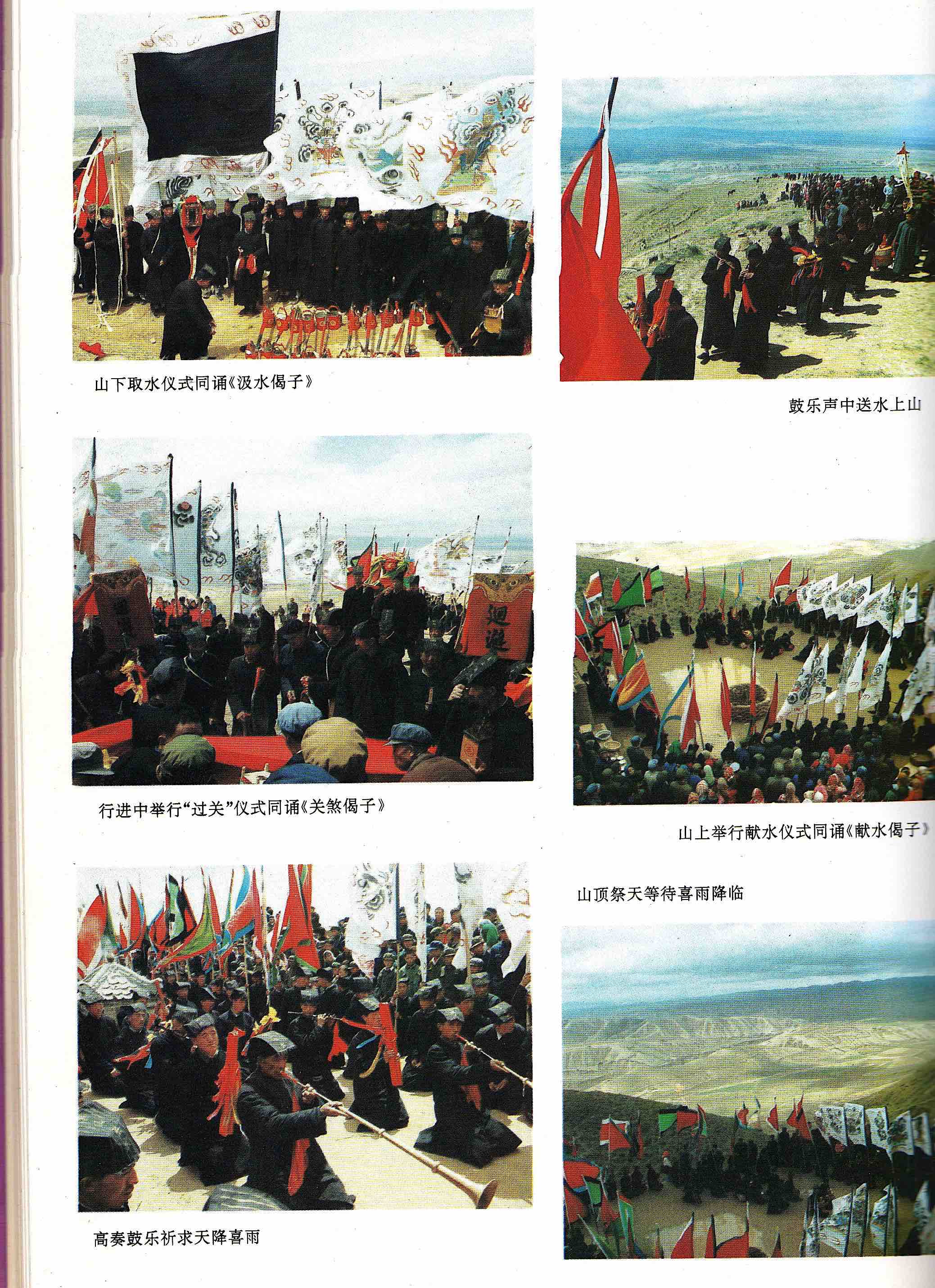
Lianhuashan

Several volumes of the Anthology gives further slim leads to rain ceremonies, such as that for Ningxia, which has photos of the qingmiao shuihui Green Shoots Water Assembly procession on Lianhuashan mountain in Tongxin county—grandest of a network of calendrical observances for rain, with its main day on 4th moon 15th. [7]

I may add that the photos in the Anthology often surpass the texts in suggesting promising leads—even if in this case they considerably predate the iniquities of the Intangible Cultural Heritage, this event was recreated and elaborated quite soon after the 1980s’ revival with involvement from cultural cadres.

* * *

These piecemeal instances merely hint at the ubiquity of rain rituals in north China before the 1950s. As ever, such rituals might be large or small in scale. But as with all aspects of religious behaviour, they have undergone a fundamental change, not just since the 1950s but under the reforms, with rural populations depleted and community cohesion attenuated. Still, those rituals that are still performed are not some exotic vestige of “heritage”, but a sign of ongoing suffering. Contemporary ethnographic accounts are not just a means of imagining the dry accounts of past rituals, but a major part of our understanding current society.


[1] Dong Xiaoping and David Arkush, Huabei minjian wenhua, pp.20–22, 72–5, 106–13. For further early sources, see articles by Zhang Zhentao and Xiao Mei in this post.
[2] E.g. Wu Fan, Yinyang, gujiang, ch.3; see also Yuan Li, “”Huabei diqu qiyu huodongzhong qushui yishi yanjiu” [The Fetching Water ritual in north Chinese rain ceremonies], Minzu yishu (Guangxi) 2001.2, pp.96–108 and 121. For Fetching Water in Yanggao funerals and temple fairs, see also my film, and the DVD with my Ritual and music of north China: shawm bands in Shanxi.
[3] See my Ritual and music of north China: shawm bands in Shanxi, pp.72–4; Wu Fan, Yinyang, gujiang, ch.3. Further leads for other areas of Shanxi are to be found in Wen Xing 文幸 and Xue Maixi 薛麦喜 (eds.), Shanxi minsu 山西民俗 (Taiyuan: Shanxi renmin cbs, 1991), pp.399–400. Cf. Wang Lifang 王丽芳,”Minzhong qiuyu xisude shengtai jingjixue sikao: yi Shanxi minjian qiuyu xisu weili” 民众求雨习俗的生态经济学思考——以山西民间求雨习俗为例, Shengchanli yanjiu 2006.6.
[4] E.g. The man awakened from dreams: one man’s life in a north China village, 1857–1942and The missionary’s curse, pp. 104–7.
[5] Tiny clues in Zhongguo minjian gequ jicheng, Shaanxi juan: text 920, transcriptions 926–7.
[6] For some sources, see my Ritual and music of north China, vol.2: Shaanbei, pp.22–3. Cf. Zhongguo minjian gequ jicheng, Shaanxi juan, text p.572, transcriptions (from Dingbian, Jiaxian, and Fugu) pp.606–8.
[7] Transcriptions, with texts, from Lianhuashan and Xiangshan, as well as Pingluo and Yinchuan, in Zhongguo minzu minjian qiyuequ jicheng, Ningxia juan, pp.713–46. See also Zhang Zongqi 张宗奇, Ningxia daojiao shi [History of Daoism in Ningxia] (Beijing: Zongjiao wenhua cbs, 2006), pp.210–11, 261–7. The term “water association” (shuihui) is quite common; though some such urban groups were more or less secular—local militia for protection against fire and robbers—in rural north China they were often associations for rain, as in the pilgrimages just south of Xi’an (for refs. see my In search of the folk Daoists, p.81). The term Green Shoots has only been attached since 1983.

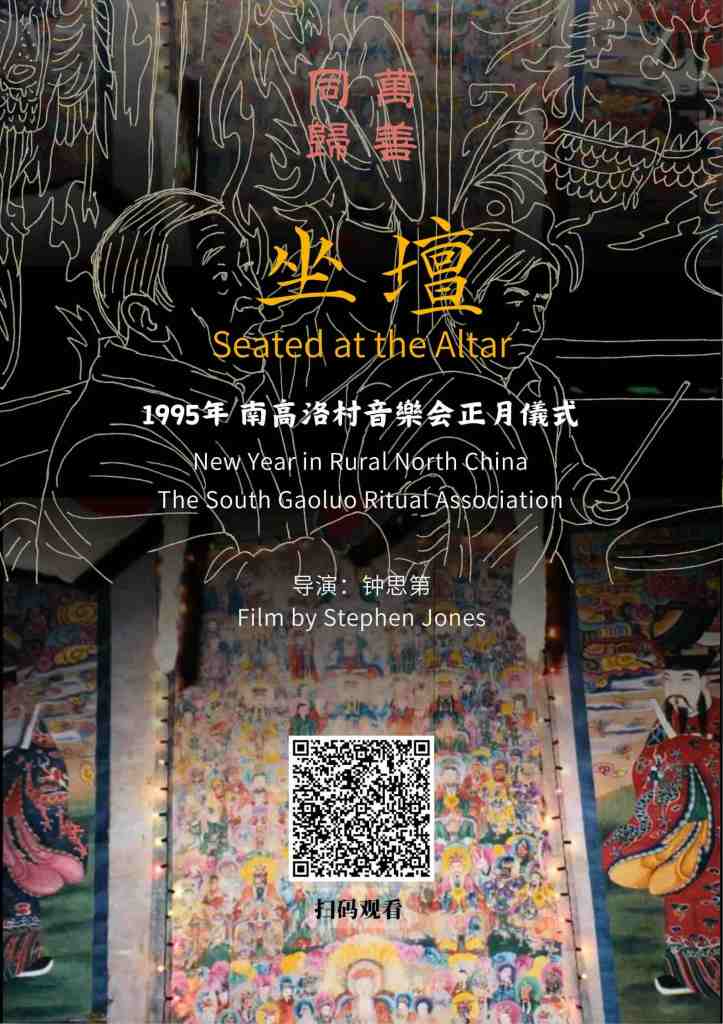
Notes from Beijing, 4: between cultures

Left: Dom (photo: SCMP). Right: Matt jamming at home.

The support network enjoyed by fieldworkers rarely intrudes into scholarly accounts, except as dry lists in the acknowledgements to musty tomes. So to follow my posts on recent encounters with Chinese scholars (Notes from Beijing, 1, 2, 3), here are some vignettes on expat life in Beijing—perhaps reminiscent of Nigel Barley’s remarks on the missionary veranda.

The laidback hospitality of Matt Forney has long been a delight whenever I return grubbily to Beijing from the countryside. This time, after my fruitful stay with the great Li Manshan (see a whole flurry of posts from March–April 2018, some linked here), amidst the unprecedented experience of an almost daily lecture schedule, I find expat life a jovial counterpoint to meeting inspiring Chinese teachers and students.

* * *

After a fond farewell with Master Li, I arrive at Beijing station at midnight to join a long taxi queue—rogue drivers touting for business all along the line. Maybe not so much has changed…

I miss Li Manshan and Yanggao already, and am tempted to get straight back on the train. But over the next few days I gradually acclimatize, coming on as “civilized”. I soon stop finding it weird when people say ni hao, xiexie, and zaijian (hello, thankyou, goodbye)—words never heard in rural China. And after acclimatizing to the lunar calendar, I’m back with “normal” dates, even days of the week and the concept of the “weekend”!

Settling in at Matt’s place, next morning I take a welcome shower and put my filthy clothes in the washing-machine. Matt’s wonderful lodger is film-maker Dominique Othenin-Girard, who, finding inspiration in China, has lived in Beijing since 2013. Their door is always open, and they also have the lovely Italians Gabriella and Nelly staying. It’s good to get back to the style and topics of conversations in English (bear in mind that in London I rarely have any company…), and I enjoy cranking up my crap Italian (hallucinante)—though since much of my energy still needs to be invested in Chinese, trying to switch between three languages is perhaps a challenge too far.

The donne italiane are much given to home cooking. Much as I relish meals with Li Manshan and his wife (noodles and baozi dumplings and steamed bread), breakfast of espresso with home-made crostaccia is a treat.

After my first film screening at Beishida, Ju Xi and her students take me to the campus bar round the corner. Already pleasantly pissed (“I drank a little beer”; cf. Some Portuguese epigrams), I take the subway home (so much more civilized these days) to a sumptuous Italian supper over copious wine and a political discussion: why is Italy so totally fucked, in a different way from the US and UK? At least we have been lately stimulated to resist: Italians seem somehow resigned to their fate.

I still find no evidence of a cowed population, either in Beijing or in the countryside. Xi Jinping seems an irrelevance, for both locals and expats. If there is little evidence of him on the street, I do pass an intriguing sign on my walk to the subway:

Pu'an Pharm lowres

The Song-dynasty Buddhist monk Pu’an is remembered throughout Hebei villages (and further afield) in the long pseudo-Sanskrit mantra Pu’an zhou 普庵咒 sung with shengguan accompaniment for exorcistic healing over the New Year’s rituals; so (allowing for typical folk variation of the second character) it seems suitable that a pharmacy should be named in his honour.

After my second Beishida show, on the walk home I pass a group of deaf-mutes signing in heated debate.

What should await me back home but a vision of pan-European elegance, the force of nature that is the multi-talented Miranda Vukasovic, having supper with the Italians and Dom—or rather holding court. Alongside his day-job, Matt is a brilliant old-time banjo player, and he used to play guitar in Miranda’s band. Miranda (like Dom, a roving soul) is a born performer—I can’t wait to see her on stage. She regales us with the long story of the impressive collection of gaily-coloured cazzotti—phallic bottle-openers—that she found in Bali (cf. Bhutan).

I can’t resist trying out my chat-up line “You’re almost as beautiful as Li Manshan!” Yeah I know, I’m such a smooth talker.

(For Li Manshan and Andy Capp, see here).

Preparing with casual expert rapidity, Miranda floats off to go clubbing, leaving me shell-shocked. Aargh, young people. But I can’t possibly expect her to share a stage, so I’ve written a separate homage to her.

Of course, there are cultural bazaars everywhere, but this gives me a glimpse of why people find Beijing such a lively scene these days—like Xi’an in the Tang dynasty?! Sure, there are always challenges—sponsors who are all mouth and no trousers, the arcane ways of bureaucracy, and so on. But beneath all the political flapdoodle there’s an energy here that I’m not sure is so easy to find in a depressed declining Europe (like I’d know). My ailing friend the cult novelist and musician Liu Sola—who should know—says there are a lot of funky people here too.

Another evening, Hannibal and Hannah come over for an aperitivo. Browsing the shelves at April Gourmet I’ve snapped up a bargain bottle of Bombay Sapphire (which features in my fantasy address at the foot of my homepage, with its Chinese name), served complete with Schweppes, ice and slice—”if a job’s worth doing…”.

Then we meet up with the splendid Andrea Cavazzuti at the Ganges; I have the opportunity to introduce him to Dom, a fellow film-maker. Andrea is a long-term resident of Beijing, and an old friend of the Li family Daoists; with Hannibal and Hannah we reflect on change in the Shanxi countryside. Back home we have a little party—my tipple this evening is a beer sandwich, with gin standing in for the bread.

Italian group

With Andrea, Gabriella, and Nelly. Photo: Domenique Othenin-Girard.

Never mind the tribulations of my fellow-students in Beijing in the 1970s—even in the 90s, when my Chinese friends were still terribly poor, such a lifestyle felt like an unwarranted luxury, a failure to Become at One with the Masses. But now that most of us have become poor foreign cousins to the locals (cf. fieldwork too)—and even Li Bin’s circle in Yanggao county-town have become conspicuous consumers—“long gone are the days when” [Molvania] one might feel ashamed at indulging in such expat decadence.

At the same time I’m always aware that I’m only passing through, and I respect the experience of long-term Beijing dwellers like Matt, Andrea, or the redoubtable Ian Johnson (another groupie of the Li family Daoists!).

At one film screening I’m received by a seriously cool Uyghur student, considerate and lovely. After setting up, we sit outside in the courtyard and we check out cool tracks on his tablet. He loves Billie, Amy, and punk—and he takes to heart Nowhere man:

I tell him how I used to play ghijak in London (we are elliptical with words), and we listen to intense muqaddime on satar.

After the film, and astute questions from the students, a bunch of us take cabs to a great upper-storey bar, mates of my new friend. Yet again I get pleasantly pissed, loving their chat—such a great scene here. Adept with their fancy phones, they insist on prepaying for a cab for me back to the hotel. Thankyou all for the inspiration, teachers and students!

Despite my culture-shock on returning from Yanggao, Beijing seems great—overlooking the “architecture”, obviously. But I still miss Li Manshan. He was getting a cold as I was leaving, so I call him up to see if he’s on the mend. I tell him his name is on everyone’s lips here; and I’m happy to report that I met a “Chinese bloke—big cheese” (see here, under 2nd moon 28th).

Next evening I take Matt for a curry, then more laughs with Dom and the Italians. The warmth of their interaction is precious.

Friday is Good Friday—better for us than for Jesus (I suppose that’s the whole point). After our round table at Beishida, we all go for an informal and boisterous meal. The splendid Cao Xinyu wonderfully insists on making a detour to take me home in a cab. My Beijing friends find my commitment to public transport an affectation; I get used to my erstwhile poor Chinese colleagues ferrying me round in cabs and their own gleaming posh cars, the like of which I never see among my friends in the UK.

Back home there’s yet another party going on (a juerga, if you like), to which I contribute Prosecco. I tell the Mantua joke for our Italian maestre della cucina. Matt gets in the groove with some blues, and Stones numbers; after a rendition of I’m a pheasant plucker, he sings an amazing I’ve been everywhere, along the lines of Johnny Cash (“tight but so loose”, as Matt observes)—Country, like flamenco, making another instance of “license to deviate from behavioural norms“:

—itself based on the Hank Snow version. So it’s a “catalogue aria” (here I go again)—as in Don Giovanni (immortalized by Michael Nyman!), or Chinese folk-songs—including ritual items like the Song of the Skeleton and the Twenty-four Pious Ones. So there.

Matt shares the true guitar aficionados’ love of open tuning, and we sing the praises of Keef.

Chez Matt cropped

Gabriella, Dom, Nelly, Matt.

International cultural exchange, eh. On my last day in Beijing my lighter runs out at the same time as my notebook—most satisfying. Then back to London for another dose of culture-shock.

China and Europe: local society and politics


My article on Guo Yuhua leads to several related posts on my blog—many collected under the Maoism tag in the sidebar.

For further alternative grass-roots accounts of Chinese society, see

For the troubled maintenance of local ritual life under changing regimes:

On recent conflicts between state and society, see e.g.

In Guo Yuhua’s interview with Ian Johnson she gives short shrift to the Intangible Cultural Heritage—as do I. Some tasters among the numerous posts under the heritage tag in the sidebar:

* * *

For Chinese parallels with authoritarian regimes in Europe, see e.g. my posts on


For another handy digest on a variety of topics, see here.

Notes from Beijing, 2

Further to my post on the Beishida ethnographers, and my seemingly underwhelming maxim that

If you want to study Chinese culture, China’s a good place to do it,

in between my lectures at Beishida in March I sallied forth (cf. Cheeseshop sketch) to show my film at People’s University and Peking University for two fine scholars from whom I also have much to learn: Cao Xinyu (left) and Wang Mingming.

Cao Xinyu
I’ve already mentioned Cao Xinyu 曹新宇 (b.1973) in a previous post (just updated). Professor of the Qing History Research Institute in the History department of People’s University (Renda), he’s a most supportive teacher—and for me he has the added cachet of being a scion of Yanggao, home of my Daoist master Li Manshan! Talking of Renda, I was happy to tell Cao Xinyu of Li Manshan’s ingenuous repunctuation of 中国人大代表 (here, under 2nd moon 28th).

Sectarian activity is an important aspect of the picture of religious life in China, both in imperial and modern times—indeed right now. Cao Xinyu combines detailed textual research on the imperial ancestry of sectarian groups and fieldwork on their modern fortunes. In addition to his series of books on sectarian history, notably the Way of Yellow Heaven, you can also read astute articles such as this survey.

1958 fanguan

In a salient reminder of Maoist history, we had lunch at the Russian restaurant “1958” on the People’s University campus, opened in 2013 (with how much irony, I can’t fathom) to commemorate the Russian experts then at the university—shortly before they were all expelled.

For a fine recent initiative of Cao Xinyu, see here.

Wang Mingming
Just up the road at Peking University is the eminent anthropologist Wang Mingming 王铭铭 (b.1962). [1] He’s a native of Quanzhou in Minnan (south Fujian), whose ever-vibrant ritual culture (temple fairs, Daoist ritualnanyin, and so on) has always informed his research.

From 1981 he studied archaeology in Xiamen University, going on to embrace anthropology as it was incorporated into the department there. He came to London in 1987 to study for a PhD in anthropology at SOAS; this was also the start of a long and fruitful collaboration with the great Stephan Feuchtwang. He returned to China in 1994 to make his base at Peking University, becoming a full professor there in 1997.

With Stephan he wrote the fine book Grassroots charisma: four local leaders in China (2002) on the linking of religion and politics in two villages in Quanzhou and north Taiwan. Wang’s historical anthropology of the city of Quanzhou, Empire and Local Worlds, was published in English in 2009.

His article on the Fazhugong festival makes an introduction to the tenor of his work:

  • “Lingyande ‘yichan’ ” 灵验的“遗产” [Efficacious “heritage”], in Guo Yuhua (ed.) Yishi yu shehui bianqian 仪式与社会变迁 [Ritual and social change] (Beijing: Shehuikexue wenxian cbs, 1999).

Like Guo Yuhua (his fellow anthropologist at Tsinghua next door), he combines detailed ethnography with a thorough grasp of theory. As Stephan writes:

Through numerous publications, books he has written, series he has edited, journals he has founded, and through his teaching of postgraduate and doctoral students, he has been dedicated to the re-formation of anthropology in China as an academic discipline, not as an aid to programs of development and of government, nor as simply an import from English-language social and cultural anthropology, but as an anthropology coming from China that can and does have something to say to a larger anthropology.

His theoretical mission to re-historicize anthropology over a long time-frame, and in a global context, may be seen in

  • “To learn from the ancestors or to borrow from the foreigners: China’s self-identity as a modern civilisation”, Critique of anthropology 34.4 (2014).

as well as

  • “Minzuzhi: yizhong guangyi renwen guanxixuede jieding” 民族志:一种广义人文关系学的界定 [Ethnography: a redefinition from the perspective of extended human relations], Xueshu yuekan 47.3 (2015).

Among his recent projects, he has directed analytical fieldwork on the ritual life of Hui’an county in Minnan:

  • Wang Mingming et al., “Dili yu shehui shiyezhongde minjian wenhua: Huidong Xiaozuo kaocha” 地理与社会视野中的民间文化——惠东小岞考察 [Folk culture from the viewpoint of geography and society: survey of Xiaozuo, east Hui’an], Minsu yanjiu 2017.2,

Wang’s diachronic approach has much to teach us (including scholars of ritual and music) about changing local societies through imperial, Maoist, and reform eras, not least on their relations with the state and “cultural” authorities. In utter contrast with the reified salvage-based “living fossil” flapdoodle of the “heritage” authorities, such study is based both on thorough fieldwork and on detailed research into sources since the late imperial era.

I can’t help noticing that Peking University has changed somewhat since my last sojourn there thirty-two years ago. In Wang Mingming’s interaction with his students he has a wonderful informal style; he clearly makes a fine fieldworker. Both he and Cao Xinyu encourage their students to think; at both events—and in the pub afterwards—I relished their lively exchanges.

[1] Many of Wang Mingming’s articles are collected on the aisixiang site here. For an English introduction, watch this 2008 interview with Alan Macfarlane, transcribed here; and Stephan Feuchtwang and Michael Rowlands, “Some Chinese directions in anthropology”, Anthropological quarterly 83.4 (2010).

Notes from Beijing, 1: some fine ethnographers

On my recent trip to China, I was having such a great time with Li Manshan in rural Yanggao [1] that I was somewhat reluctant to take the train back to Beijing—but thanks to encounters with some fine scholars (and home-made Italian cakes) I soon acclimatized. For me to observe

If you want to study Chinese culture, China’s a good place to do it,

may not be quite as fatuous as it sounds—given the hangover from the old image of Red Guards and the new one of a cultural desert watered only by Xi Jinping Thought, both perpetuated by Western sinologists.

I’ll outline the work of these scholars in turn, beginning with my main host, the ethnographer Ju Xi 鞠熙 (b.1981), of the Department of Anthropology and Ethnology at Beishida—or Beijing Normal University, as it is quaintly known (now, to invite me to talk at an Abnormal university, that I might understand). With great imagination, she invited me to show my film as part of a series of talks in which I could reflect on fieldwork and rural ritual amidst social change, focusing on my two long-term projects: the Li family Daoists and the ritual association of South Gaoluo.

Ju Xi group

Ju Xi with ritual leaders, Daohui village, Zhejiang 2017.

Quite apart from making an articulate and supportive moderator to my talks, Ju Xi’s own research is distinguished. With Marianne Bujard, she has long been involved in a major collaborative project with the EFEO in Paris (four of eleven volumes published so far! And a fifth here, new in 2020):

  • Epigraphy and oral sources of Peking temples: a social history of an imperial capital.

In addition to a succession of fine works on old Beijing like that of Susan Naquin, all this makes an important complement to research on its ritual life, including the Zhihua temple.

Ju Xi 1

Ju Xi’s wisdom was encapsulated at an unpromising one-day conference in March, which she transformed with a succinct and brilliant speech explaining the significance of local religion in current rural China—that should be compulsory reading for cultural pundits and cadres at all levels:

Criticizing the recent interpretations of “secularization” (compared with imperial China) and “revival” (compared with the Maoist era), both of which portray Chinese religion as somewhat isolated from society, Ju Xi observed that local religion is not merely a “spiritual creation” or “cultural heritage”—it’s a kind of cultural resource and social power which can play active roles in contemporary rural society.

She outlined the role of local religion in ecological conservation, building techniques, and handicraft taboos, and pointed out its tight social structure, close interpersonal and reciprocal relationships—a valuable resource for today’s poorly-organized rural society. She stressed the importance of temple fairs, pilgrimages, ancestor worship, ritual associations, and clan organizations, noting the “grassroots charisma” of ritual specialists. She explained local religion as practical strategy, and observes how peasants are now availing themselves of the mask of “intangible heritage” to express their own requirements and views, making local religion a new pivot of cultural identity.

Thus local religion should be seen as an important basis upon which the peasants can construct their social order, organize their social relationships, take part in social practices, and articulate their own life styles. It makes an essential pattern through which multiple actors in rural society can express their own requirements.

 Ju Xi’s students are most fortunate.

* * *

Beishida has a noble tradition of folklorists, including Dong Xiaoping 董晓萍 (b.1950), herself a pupil of the great Zhong Jingwen 钟敬文 (1903–2002). Among Dong Xiaoping’s books are

  • Tianye minsuzhi 田野民俗志 [Folklore ethnography] (Beijing Shifan daxue cbs, 2003),

and a slim but useful tome with David Arkush (欧达伟),

  • Huabei minjian wenhua 华北民间文化 [Folk culture of north China] (Hebei jiaoyu cbs, 1995).

In English Dong Xiaoping’s acuity may be admired in a short review in Overmyer, Ethnography in China today, pp.343–67.

* * *

CZA

Chen Zi’ai.

At Beishida I was also delighted to meet Chen Zi’ai 陈子艾 (b.1933), part of an illustrious generation of scholars whose academic careers might have been more fruitful but for the vagaries of Maoism. A native of Hunan, her experience of local Daoism there and in Jiangxi has left her with a deep impression. She is a contributor to the lengthy series of publications on Hunan Daoism edited by Alain Arrault.

In a lengthy and mesmerizing impromptu speech after my second presentation, Chen Zi’ai touched candidly on crucial aspects of research on religious behaviour in the PRC, observing the riches of the topic as a window on folk culture, by contrast with the incongruity of her generation’s ideological indoctrination; and the more recent benefits of Chinese–foreign collaboration on such projects.

* * *

Such research on folk religion and temple fairs builds on an influential volume edited by

  • Guo Yuhua 郭于华, Yishi yu shehui bianqian 仪式与社会变迁 [Ritual and social change] (2000),

and the work of Zhao Shiyu 赵世瑜, notably his 2002 book

  • Kuanghuan yu richang: Ming–Qing shiqide miaohui yu minjian wenhua 狂欢与日常——明清时期的庙会与民间文化 (2002).

Another Beishida scholar is Xiao Fang 萧放, co-editor with Zhang Bo 张勃 of another book discussing temple fairs around Beijing, including Miaofengshan:

  • Chengshi, wenben, shenghuo: Beijing suishi wenxian yu suishi jieri yanjiu 城市,文本,生活: 北京岁时文献与岁时节日研究 (Zhongguo shehui kexue cbs, 2017),

* * *

YYY

Yue Yongyi, 2002.

Yet another brilliant fieldworker and ethnographer at Beishida is Yue Yongyi 岳永逸 (b.1972), who has a prolific list of publications based on his fieldwork in rural Hebei.

His detailed work on the Miaofengshan temple fair

  • Zhongguo jieri zhi: Miaofengshan miaohui 中国节日志: 妙峰山庙会 (Beijing: Guangming ribao cbs, 2012)

complements the ongoing research of Ian Johnson. Like Ian, he too reflects on more recent changes, such as tourism and the Intangible Cultural Heritage[2]

Other Hebei temple fairs on which Yue Yongyi has published include two in Zhaoxian county—on the Dragon Placard Association (longpaihui) of Fanzhuang village: [3]

  • “Xiangcun miaohuide duochong xushi: dui Huabei Fanzhuang longpaihuide minsuxuezhuyi yanjiu” 乡村庙会的多重叙事: 对华北范庄龙牌会的民俗学主义研究 [Multivocal discourses in a rural temple fair: a folkloristic study of the Dragon Placard Association in Fanzhuang, north China], Minsu quyi 147 (2005), pp.101–60;
  • (with Cai Jiaqi 蔡加琪) “Miaohuide feiyihua, xuejie shuxie ji zhongguo minsuxue: longpaihui yanjiu sanshinian” 庙会的非遗化、学界书写及中国民俗学: 龙牌会研究三十年 [The heritage-ization of temple fairs, academic writing and Chinese ethnography: thirty years of research on the Dragon Placard Association], Minzu wenxue yanjiu 35 (2017.6), pp.36–52;

and on the temple fair to the Water temple goddess in Changxin village:

  • “Dui shenghuo kongjiande guishu yu chongzheng: Changxin Shuici niangniang miaohui” 对生活空间的规束与重整: 常新水祠娘娘庙会 [Restriction and regeneration of living space: the festival of the Water temple goddess in Changxin village], Minsu quyi 143 (2004).

Most notable is his detailed work on the temple fair of Cangyanshan in Jingxing county—which we may add to our bibliography on south Hebei:

  • Zhongguo jieri zhi: Cangyanshan miaohui 中国节日志: 苍岩山庙会 (Beijing: Guangming ribao cbs, 2016).

Like Yue’s book on Miaofengshan, it contains detailed subheadings on temples, gods, ritual associations and other performers, activities, and artefacts, with rich material on spirit mediums (xiangtou, cf. north Shanxi) as well as on the sectarian creator goddess Wusheng laomu (widely found in Hebei, e.g. in Xushui and Yixian counties) and (in the case of Cangyanshan) Third Princess (sanhuang gu 三黄姑).

WSLM

Wusheng laomu statue, Cangyanshan.

In English, note his

  • “The nation-state, the contract responsibility system, and the economy of temple incense: the politics and economics of a temple festival on a landscaped holy mountain”, Rural China 13 (2016), pp.240–87,

which also includes a useful bibliography. More general, but no less thoughtful, are his books

  • Xinghao: xiangtude luoji yu miaohui 行好: 乡土的逻辑与庙会 (Hangzhou: Zhejiang daxue cbs, 2014)
  • Chaoshan: miaohuide ju yu san, yingshechu minjiande shenghuo yu xinyang 朝山: 庙会的聚与散, 映射出民间的生活与信仰 (Beijing daxue cbs, 2017).
  • Jutou sanchi you shenming: manbu xiangye miaohui 举头三尺有神明——漫步乡野庙会 (Shandong wenyi cbs, 2018).

With his rich experience, Yue Yongyi made a fine discussant in our unlikely one-day panel at Beishida.

* * *

All these fieldsites provide rich material for ethnographers, even if they share a paucity of complex liturgical sequences such as those I generally find. My encounters with these scholars make a welcome change from the insidious infiltration of romanticized “living fossil” ICH flummery into music studies. Given the understandable dominance of research on religious activity in south China, they also form a community of scholars working on changing ritual life in north China (see also Goossaert article cited here).

While I entirely recognize the ongoing erosion of rights under the current regime, the current Chinese academic scene is far from emasculated. Fine scholars like these, undaunted, continue to seek the truth about modern history, at a great remove from the supposed brainwashing from Xi Jinping Thought trumpeted in the Chinese and foreign media. This theme continues in my following posts on the Beijing scene (here and here).

[1] See my series of posts starting on 14th March 2018, summarized here.

[2] Another recent book on the incense associations of Beijing is Zhang Qingren 张青仁, Xingxiang zouhui: Beijing xianghuide puxi yu shengtai 行香走会: 北京香会的谱系与生态 (Beijing: Zhongyang minzu daxue cbs, 2016).

[3] For earlier refs., see my In search of the folk Daoists of north China, p.8 n.14.

Three baldies and a mouth-organ

*UPDATED with links to posts on the Zhihua temple and related topics!*

dav

Early in 1986, only a couple of days after my first arrival in Beijing, hearing the former monks of the Zhihua temple 智化寺 on a cold but beautifully sunny winter’s day was an experience that changed my life—and their ritual soundscape still entrances me:

Musicologist He Changlin astutely took me to a Buddhist temple to ask a group of elderly former monks to play their shengguan music for us. That sound will always stay with me. The soulful guanzi, the darting dizi, the sturdy sheng, the halo of the yunluo piercing the bright Beijing sky above the green-and-yellow roof-tiles of the temple. […] It was only hearing the temple musicians that directed me irresistibly to living traditions. I began to neglect ancient history…
[adapted from my Plucking the winds, p.185]

While I go to great lengths to stress that the Zhihua temple is only the tip of the iceberg—for ritual life both within Beijing and all over north China—the soundscape of its shengguan remains a classic source. There are no “living fossils”, and the temple itself has long ceased to function as a ritual site; but the present group performs with majestic authority, led by Hu Qingxue, about whom I must write in more detail—he’s not only an amazing guanzi player, but a fine vocal liturgist, and he’s just as hooked on exploring ritual groups in the countryside as I am.

In the photo above, the reason our demeanour is somewhat less solemn than that of the transcendent arhat is because Hu Qingxue had just suggested the caption which forms the title of this post—and, incidentally, of my latest Hollywood blockbuster. * The old sheng mouth-organ was my gift to him: it had been a gift to me in the early 1990s from a village ritual association that no longer used it, and since he’s an avid hoarder and repairer of sheng, it surely belongs in his fantastic collection.

chat with HQX

There’s always so much to learn from Hu Qingxue.

It was delightful to present the group at the British Museum again on Monday. In our pre-concert discussion (with subtle prompting from Jessica Harrison-Hall, curator of the BM’s Chinese collection) I was glad to introduce the social background and wider ritual context, as well as research by a succession of fine Chinese scholars; and with the musicians, to illustrate how the skeletal notes of the gongche solfeggio score are progressively ornamented, first by singing the score in unison and then by taking up the instruments to further decorate that version in heterophony.

For someone who was brought up in a poor Hebei village, Hu Qingxue has learned to recopy the temple’s old scores rather finely:

Qingjiang yin score

Qingjiang yin, copied by Hu Qingxue.

Having learned from my tours with the Li family Daoists, I’ve now worked out a much-improved programme with the Zhihua temple too. While the shengguan ensemble is always most captivating for audiences, we now include all three elements in the ritual soundscape, chui-da-nian—in reverse order of importance: wind ensemble, percussion, and vocal liturgy.

Thus the programme began with Cymbals to Open the Altar (Kaitan bo 開壇鈸), featuring the hocketing alternation of the nao and bo large cymbals that you can explore in my film on Li Manshan. It continues with the vocal hymn Yangzhi jingshui 楊枝淨水 in praise of the Buddhas and Bodhisattvas, also used near the beginning of a ritual—here accompanied by the melodic instruments. Then they demonstrate the process of ornamenting the skeletal notes of the score with the melody Qingjiang yin 清江引 (see photo above). After the captivating suite Jin–Wu–Shan (Jinzi jing 金字經—Wusheng fo 五聲佛—Gandongshan 感動山!) and Haiqing na tian’e 海青拿天鵝, the programme ends by reminding us of the primacy of vocal liturgy, with the a cappella hymn Qingjing fashen fo 清靜法身佛, accompanied only by the percussion.

As I am wont to observe, the blend of timbres of the shengguan instrumentation is the most perfect combo ever, alongside the jazz quintet… And the free-tempo alap-like introductions are just magical.

This overlaps with my blogposts, but here’s the full version of my programme notes:

Music of the Zhihua temple
Stephen Jones

A world away from the modern conservatoire style that now dominates the media, this music belongs as a kind of aural filigree interlaced within the vocal liturgy and percussion of lengthy rituals for funerals and temple fairs among local communities. To experience it in the concert hall or museum is a compromise, of course. It is one of many genres still performed today in a continuous tradition since the Ming—several types of regional opera, the nanguan ballads of Fujian, the music of the ubiquitous rural shawm bands, the elite qin zither.

The Zhihua temple has become a byword for the melodic instrumental music used until the 1950s as part of rituals in Beijing—mainly funerals, notably the nocturnal yankou ritual to feed the hungry ghosts. The monks of many minor temples in the hutong alleys of north and east Beijing, both Buddhist and Daoist, were available to come together to perform this music.

Built as the private temple of the court eunuch Wang Zhen in 1443, the Zhihua temple is one of the only wooden structures from the Ming dynasty to remain intact in Beijing.  After Wang Zhen was executed in 1449, the monks became part of the ritual life of the wider community, with twenty-six generations down to the 1940s.

Since then the tradition has struggled to survive. After 1949 the monks were laicised, so by 1953 when the Zhihua temple music first gained its reputation among music scholars, with influential studies from the qin zither master Zha Fuxi and the great musicologist Yang Yinliu, the monks were no longer performing rituals. Through the 1980s, as ritual life was restoring throughout the countryside, and even in cities like Shanghai, scholars like Ling Haicheng and Yuan Jingfang began attempts to revive the Beijing style, collecting the surviving former monks together.

Though the style remains the most exquisite rendition of a widespread repertoire, it is now mainly further afield that we can hear it in its ritual context—in the countryside south of the capital among amateur associations that learnt from temple monks, and among household ritual groups all over north China. The present performers hail from the poor village of Qujiaying, whose ritual association was first discovered in 1986. They were recruited while in their teens to study in the Zhihua temple with the elderly former monks, notably Benxing (1923–2009). But worthy attempts by cultural cadres have proved unable to maintain the classic Beijing style without the firm ritual base of local community support that remains common elsewhere in China.

While the more elite temple rituals use only vocal liturgy accompanied by ritual percussion, melodic instrumental music has long been commonly added for rituals among the folk. Throughout north China this takes the form of the exquisite shengguan chamber ensemble, which coalesced around the Ming. The instruments play in heterophony, each decorating the bare bones of the nuclear melody differently; the plaintive guanzi oboe leads, the sheng mouth-organ maintaining a continuous wall of sound, decorated by the halo of the yunluo (ten pitched gongs mounted in a frame) and darting ornaments from the dizi flute.

The repertoire of classic labeled melodies, combined in strict sequences in lengthy suites, was also coming together in the Ming. Since then, a kind of solfeggio called gongche has been commonly used to notate the outlines of the melodies of instrumental ensembles. Scores from several Beijing temples, of which the earliest now preserved is the 1694 score of the Zhihua temple, use a rare antique script that resembles those known from Tang and Song sources. But the bare bones of the score give few clues to the magic of performance; having learnt to sing in unison an already highly ornamented version of the nuclear melody, the performers then further decorate it in mesmerising heterophony on the instruments. The style is exceptionally slow and solemn, the free-tempo preludes especially magical. But we have to imagine it as a decoration within the whole liturgy of the complex rituals that are still common elsewhere in China.

Further reading

  • Stephen Jones, Folk music of China: living instrumental traditions, Oxford: Clarendon Press, 1995 (paperback edition with CD, 1998).
  • Stephen Jones, Plucking the winds: lives of village musicians in old and new China, Leiden: CHIME Foundation, 2004 (with CD).
  • Stephen Jones, In search of the folk Daoists of north China, Aldershot: Ashgate, 2010 (Appendix 1).
  • Yuan Jingfang, Zhongguo fojiao jing yinyue yanjiu [The Buddhist capital music of China], Beijing: Zongjiao wenhua chubanshe, 2012.
  • Chang Renchun, Hongbai xishi: jiujing hunsang lisu [Wedding and funeral customs of old Beijing], Beijing: Beijing Yanshan chubanshe, 1993.

You can hear an excerpt from Yang Yinliu’s legendary 1953 recording on #14 in the audio gallery (scrolling way down in the sidebar), with commentary here.

Other articles on this site:

And for conceptual background,

On the Qujiaying connection:

leading onto the Hebei village associations and further afield (under Local ritual, including Ritual groups of suburban Beijing and Tianjin: a folk Buddhist group, as well as a whole series on Gaoluo village).

See also Ritual artisans in 1950s’ Beijing.

* * *

The Zhihua temple events were part of a fine ongoing series at the British Museum (see also here) that also included flamenco (cf. my series starting here), Indian music, Japanese gagaku, Stockhausen, Ligeti, Cage, and Strauss’s overwhelming Metamorphosen.

And what should await me on my return home than a live broadcast of Mahler 10 with S-Simon Rattle. Without this lying xenophobic government, London could be wonderful.


* Cf. the alternative title for my film on Li Manshan: Four funerals and a funeral.

The cult of Elder Hu

* Yet another in a series of vignettes (starting here) from my recent stay with the wonderful Li Manshan (for similar excursions, see here and here). *

Hutu statues

Altar to Great Lord Hudu, Lower Liangyuan temple 2018.

My time with Li Manshan last month also gave me the chance to renew my acquaintance with Elder Hu, most intriguing of local deities in the region.

Surveying “cultic buildings” just northeast of Yanggao in the troubled 1940s, the intrepid Belgian missionary Willem Grootaers drew attention to a local cult of the deity Hutu 胡突 or Hudu 胡都, aka Elder Hu (Hulaoye, Huye, Hushen 胡老爺, 胡爺, 胡神) or even Dragon Hu (Hulong 胡龍). His temples are often known as Hushen miao 胡神廟. See

  • Willem A. Grootaers, “The Hutu god of Wanch’üan, a problem of method in folklore”, Studia Serica VII (Chengdu, 1948), pp.41–53. [1]

Around the Xuanhua region Grootaers and his Chinese assistants found fourteen temples devoted to Elder Hu, as well as six more with tablets in the temples of other gods; as a lateral image in Dragon King temples he appeared sixteen times.

I have already published brief introductions to the cult in Yanggao. [2]

In south China one often find “cults,” in the common sense of groups (whether voluntary or ascriptive) devoted to a particular deified local territorial personage. Much work on southern Daoism is complemented by studies of such gods. One finds some cults in north China too, although they are more often to “national” deities. Such groups may or may not include ritual specialists performing complex sequences of ritual and liturgy.

But one important regional deity whom people in north Shanxi and northwest Hebei do worship is Elder Hu. Perhaps an ancient general, his proper name Hutu (or Hudu) may be Mongol. Closely related to the Dragon King deities, he too is thought to have power over rain and the elements. In Upper Liangyuan there was a statue of him in the Temple to the Three Pure Ones (my book, pp.46–9), but in Yanggao the main sites for his worship, still today, are the temples of Zhenmenbu (for recent images from Hannibal Taubes, see here), Xujiayuan, and Lower Liangyuan. Here I introduce the latter two.

Xujiayuan
The Xujiayuan temple (formally named Temple of Clear Clouds Qingyun si 清雲寺, though as usual it is commonly identified simply by the name of the village) is part of a network of early temples lining the border north of the county-town, just beneath the remains of the Great Wall. From our 2003 notes:

In the main temple the three god statues (from left to right) were Pineapple Tree King God (Boluoshuwang fo, responsible for water), Watery Heaven God (Shuitian fo, one of the Heavenly Officers tianguan), and Elder Hu (Hulaoye, responsible for rain, not water in general). On either side of Elder Hu were small dragon statuettes. There was also a portable statuette to Elder Hu to be taken on procession.

XJY 03 clothing statue 1

Clothing a god statue, Xujiayuan 7th-moon temple fair 2003.

The various local legends about Elder Hu are not consistent. Xujiayuan villagers said that his old home was Hujia village quite far further east in Tianzhen county (see map below), so the village always donates to the Xujiayuan temple fair (in 2003 they gave 300 yuan). According to the temple’s abbot Miaoyun, Elder Hu was an ancient general called Hutu; the common people erected a temple to him after he was wrongfully executed by an emperor and the climate went awry (xingfeng zuolang 興風作浪).

Several online sources on the temple claim that Elder Hu was a grand court official called Hu Tu 胡秃 [sic] in the Warring States period. Unjustly executed, his soul wouldn’t disperse, whereupon The Jade Emperor enfieoffed him as a god. In the early Tang dynasty, during natural disasters in the 6th year of the Zhenguan era (632 CE), Elder Hu rescued the populace by scattering buckwheat, and they built a temple to him in thanks.

Most village temples in the region are unstaffed, but the Xujiayuan temple had about eight resident Buddhist monks when we visited in 2003. The main day for the temple fair is 7th moon 3rd; it begins on the 1st and finishes on the 4th. This is a most vibrant event, with many stalls, and an opera troupe, shawm bands, and the temple’s own monks all performing an impressive nocturnal yankou ritual (see the DVD Doing Things with my book Ritual and music: shawm bands of Shanxi, §B5).

Another major ritual of Xujiayuan is the rain procession on 5th moon 18th, bearing aloft the statuette of Elder Hu. The temple is the centre of a parish (she 社) of twelve villages (still known as “brigades”—note the casual elision of imperial and Maoist vocabulary), although by 2003 it was mainly the four nearby village that were taking part actively. Elder Hu “deputes the dragons” (fenglong 封龍) to release rain.

Lower Liangyuan
Today on the plain southeast of Yanggao county-town, with no temples still standing in Upper Liangyuan, the most important temple in the area is in the sister village of Lower Liangyuan just north. Its formal name is Temple of Efficacious Source (Lingyuan si 靈源寺).

XLY 03 temple name

7th-moon temple fair 2003.

The survival of the temple is due in large measure to the sprightly Yuan Xiwen 袁喜文 (b.1934!), still blessed with a youthful spirit within the body of a fit 50-year-old.

Yuan Xiwen 2013

Yuan Xiwen, 2013.

Serving as a brigade accountant and cadre under Maoism, he did what he could to protect the temple, and led the revival of its temple fair upon the 1980s’ reforms. He has recently compiled a detailed genealogy of thirteen generations of the Yuan lineage (my film, from 57.46). Local society depends on men with such charisma.

The village has long had a larger population than Upper Liangyuan (1,120 in 1948, 1,805 in 1990, according to the county gazetteer), although since then it continues to suffer from the inevitable drift to the cities.

Back in 2013 we strolled over there to find Yuan Xiwen sitting in lotus posture on the kang in his bare house. He too told us a charming local legend about Elder Hu, detailed enough to have a certain authentic value:

Dragon Hu came from Jiaocheng village, southwest of Datong. [3] He held the post of looking after the cabinet official (geyuan 閣員) Wang Qiu 王囚 in Shandong province. Wang agreed to his request to return home for a visit to his old home. So Dragon Hu began the journey home, riding the clouds (jiayun 駕雲) from Shandong to Jiaocheng. Once he reached north Shanxi, he passed through “nine dragon mouths” (jiu longkou) in all.
[For villages marked * below I know of active temples today; the others remain to be explored. The legend doesn’t track his earlier progress from Shandong—however did we manage before satnav?!].

At Wayaokou (Tianzhen county) there was a heavy downpour; he rode on through Zhendagou 镇大沟 (?), Zhenmenbu*, and Xujiayuan*, where he rested his horse (yinma 飲馬). Continuing his journey south, he rested his horse again at Liujiaquan, then at Lower Liangyuan* at midday, then on to Tailiang 太梁 (?) [which, said Yuan Xiwen, still had a decrepit old temple to him], to Lower Shenjing (?), and one other village which escaped me.

Throughout Dragon Hu’s progress, all the places he passed through were beset by hailstones. The Heavenly God (Tianshen) was angry, and made him pay a forfeit. So Dragon Hu pinched three ears of wheat into the shape of a shuttle, creating what is now buckwheat…

There’s clearly a lot more fieldwork to be done here—but how exciting it may be for someone to pursue!

Towards a modern history of the temple
Yuan Xiwen recalled the village’s last rain procession, and temple fair, before Liberation. In the 7th moon of 1947 some three hundred villagers went on procession to the Xujiayuan temple, with big drums, gujiang shawm bands, and banners bearing the characters “Silence!” (sujing 肅靜), both there and back. From 1st to 3rd they stayed at Xujiayuan, returning on the 4th, holding their own temple fair from 5th to 7th.

The temple only had around a dozen mu of land; it was common land, not “owned”, and anyway there were no resident clerics, only one shabby temple keeper. This was surely typical—far from the great temple estates further south.

As collectivization escalated, the temple buildings were taken over by the Supply and Marketing Co-op (Gongxiao she 供销社). The god statues were taken away in 1956, to a little shrine in between the Lower and Upper villages; people still worshipped surreptitiously before them. The temple was only assaulted in 1966 at the opening of the Cultural Revolution; the murals were further damaged while it was used as a classroom. It was not until 1987 that Yuan Xiwen was able to lead the first temple fair there after the revival.

The modern religious history of this and other villages is closely related to the fates of sectarian groups. Though village temples were public sites, they made a natural base for sects like the Way of Yellow Heaven and the Way of Nine Palaces. [4] By the 1940s Lower Liangyuan was a hotbed of such groups. After the Yiguan dao sect was introduced to Yanggao in the 1940s, 200 of the 240 households in Lower Liangyuan are said to have belonged. While the villagers’ more public religious activities were somewhat separate, the sectarian persecutions of the early 1950s inevitably affected their spirits. Still, the sects survived underground until reviving along with more public ritual behaviour from the 1980s.

I should add that (as far as I know) there is no separate “cult” of sectarians worshipping Elder Hu, nor  any scriptures to him.

March 2018
Over the years I’ve often passed by the temple—for instance when the Treasuries are burned before it during funerals (my film, from 1.03.56). But it’s been ages since I took a close look at the interior, so Li Manshan calls up the wonderful Yuan Xiwen and we stroll over there. They’re in the middle of a meeting of the clansmen—his younger brother is there. I’d have learned more about the temple images if Yuan had come to the temple with us, but he’s too busy with his family. Later Li Manshan tells me the temple committee had recently lost the temple’s old divination list, [5] and how rumours flew around about an inside job—until they found it again.

XLY list main

Divination list, 1882 (Guangxu 8th year).

The villagers don’t seem to know of any surviving steles—though after our discoveries in the Upper village, there may still be room for exploration in nearby ditches.

The temple has belatedly been taken under the wings of the county Bureau of Cultural Preservation, and (judging from my 2003 photos) some of its old murals seem to have been retouched. Though they clearly date from the late Qing (not the Ming, as the temple minders airily claimed), their beauty is rare in Yanggao villages—by contrast with the amazing wealth of such murals in nearby Yuxian.

XLY 03 outside

The front complex during the 7th-moon temple fair, 2003.


XLY temple exterior

March 2018.

The interior complex
Inside the temple the main complex facing south onto the courtyard now has two rooms: a central hall to the Dragon Kings, and an east room to Elder Hu.

Rear block from courtyard

View of main rooms from courtyard.

The main altar of the central hall has statues of six dragon gods before a mural of the Jade Mother of the Five Dragons (Yulong shengmu 玉龍聖母):

Rear central room central gods

Central hall, 2018.


XLY Rear central mural 2003

Jade Mother of the Five Dragons, 2003.

On the rear wall, to the west and east of these central images, are further murals to the mythical emperors Yao, Shun, and Yu:

My 2003 photos of the above:

Further murals adorn the side walls—for the River God (heshen 河神) to the west, Efficacious Immortal (lingxian 靈仙) to the east (I think):

Rear hall central west wall

Central hall, mural on west side wall.

To the east of this central hall is the room to Hutu (photo at top of article). To one side of the main altar is a small portable statuette for processions, carried in a palanquin that rests by the west wall:

The side walls bear murals depicting the progress of Hutu through his domain:

Hutu west wall mural

Outside, to the west of the rear complex an old pillar capital survives (for much, much more, cf. Hannibal’s photos from nearby Hunyuan, and Yangyuan):

Rear block exterior west carving

The front complex
At the main entrance of the complex is a central room to Śakyamuni, flanked by his attendants Mañjuśrī (Wenshu) and Samantabhadra (Puxian). To its west is a room to Dizang and the Ten Kings:

Dizang statues

The west and east side walls bear Ten Kings murals repainted since the 1980s—here are two details:

Dizang west wall Kings

Dizang east wall murals

For even more recent images from Hannibal Taubes, see here.

* * *

But in the end I want to return to real human beings. As disembodied “cultural relics” these images may have no particular artistic merit; however numinous they may be, they’re still silent and static. In between the common fates of falling apart or becoming museums, temples are for living people, for interaction under changing social conditions; their gatherings are full of life, “hot and noisy“.

I can’t help thinking back to August 1992, my second visit to Li Manshan’s father the great Li Qing, when I even attended a funeral he led at Lower Liangyuan—alas, I had only just missed the village’s 7th-moon temple fair! Li Qing told me that two Daoist bands took part (later the temple committee only invited one). All his colleagues, with whom he had been performing rituals since the 1930s, would have taken part, like Li Yuanmao, Li Zengguang, Kang Ren, and so on.

After the 1980s’ revival I suspect they didn’t restore a fuller sequence of the jiao 醮 Offering, for whose segments Li Qing had recently recopied ritual manuals (I doubt they chanted any of the jing scriptures, for instance)—but still, their ritual programme may have been rather more complex than it later became (my book, pp.237–43). For Hoisting the Pennant, did they sing the hymn Yuyin 玉音 at the central pole? And how I would have loved to witness their Communicating the Lanterns; by the time I attended it at the temple fair in 2003, Li Qing was no more, and his pupils were less than familiar with the ritual.

XLY yangfan 03

7th-moon temple fair 2003, Hoisting the Pennant: the final chase. Front left, on nao cymbals: Erqing, shortly before he was lured away to become a migrant labourer. Photo: Wu Fan.

* * *

So this little introduction to Elder Hu gives you an idea of what we were up to before our brief yet charming encounter with the local constabulary on the walk home to the Upper village.


[1] Part of an extraordinary series that also includes

  • “Les Temples Villageois de la Region au Sud-est de Ta-t’ong (Chansi Nord), leurs Inscriptions et leur Histoire”, Folklore Studies 4 (Beijing 1945), pp.161–212.
  • with Li Shih-yü and Chang Chi-wen, “Temples and history of Wan-ch’üan (Chahar); the geographical method applied to folklore”, Monumenta Serica 13 (1948), pp.209–316 (for Hutu, see pp.272–274).
  • with Li Shih-yü and Chang Chi-wen, “Rural temples around Hsüan-Hua (South Chahar), their iconography and their history”, Folklore studies 10.1 (1951), pp.1–116.
  • with Li Shih-yü and Wang Fu-shih, The sanctuaries in a north-China city: a complete survey of the cultic buildings in the city of Hsuan-hua (Chahar) (Mélanges Chinois et Bouddhiques vol. 26), Bruxelles: Institut Belge des Hautes Études Chinoises, 1995 (for Hutu, see pp.7–9, 70­–73, 109–10).

[2] Ritual and music of north China: shawm bands in Shanxi, pp.73–84; Daoist priests of the Li family, pp.49–50; Wu Fan provides further detail (Yinyang, gujiang, pp.61–71, 150–59).

[3] Yuan Xiwen said it was in Shanyin county, which it isn’t now—but anyway, judging by the logic of the route, and the limited radius of the cult, not the county considerably further south.

[4] See Yanggao xianzhi, pp.610–15; Zhao Jiazhu, Zhongguo huidaomen shiliao jicheng, pp.159–62. The Yiguan dao was a particular scapegoat; though in some respects inquisitors were quite meticulous, I suspect the name served as an umbrella term, a rallying-call for persecution. The campaigns of the early 1950s are a growing theme of research.

[5] Cf. Wu Fan, Yinyang, gujiang, pp.280–85.

Zhihua temple group in London!

ZHS BM

Following the 2014 performance of the Zhihua temple group at the British Museum, I’m looking forward to their repeat visit this coming Monday! I’ve just added it to the events calendar in the sidebar.

In addition to the haunting shengguan wind ensemble, we’ve now incorporated vocal liturgy as well as percussion items with large cymbals into the programme, to give a flavour of the whole ritual soundscape.

Do try and come along, both to the concert and the chat beforehand. For more on the programme, and a list of sources, see here.

ZHS 1992

The Qujiaying recruits, and me, learning from former monk Benxing, summer 1992.


The notation of ritual sound

gongchepu

In articles on this site I often stress how soundscape is basic to ritual performance. In north China ritual specialists identify three types of organized ritual sound, “blowing, beating, and reciting” (chuidanian): melodic instrumental music, percussion, and vocal liturgy—in reverse order of importance, with vocal liturgy primary. Some groups accompany their vocal liturgy only with percussion, but where melodic instrumental music is performed, it is an essential component of ritual: “holy pieces” (shenqu), transcending language. Whereas vocal liturgy is not notated—most ritual manuals document only the texts, not the melodies to which they are sung—the outline of the melodic (and indeed percussion) instrumental music that punctuates and accompanies it is recorded in scores of gongche solfeggio. [1]

When the Qujiaying village ritual association, south of Beijing, was “discovered” in 1986 we already knew about the shengguan ensemble and its gongche scores (notably those of the Zhihua temple in Beijing) thanks to the ground-breaking work on Yang Yinliu in the early 1950s, later comprehensively studied by Yuan Jingfang. In our project on the Hebei plain, we soon broadened our attention to ritual manuals, but the shengguan wind ensemble and the scores of village ritual associations were always among our major concerns.

In the fine tradition of anthologies that Chinese musicologists do so well, the major new compendium

  • Zhongguo gongchepu jicheng 中国工尺谱集成 [1]

collects some of the most important scores of gongche solfeggio. It provides rich material on the continuity of early history with modern folk practice.

The anthology is based more on northern shengguan than on southern genres—the distinctive scores of nanyin in Fujian and Taiwan are already collected in many separate anthologies.

The compendium comprises ten volumes to date:

  • General (a fine introduction to historical variants of notation and metrical markers)
  • Beijing (2 vols)
  • Hebei (3 vols)
  • Shaanxi (2 vols, for the major repertoires of ritual groups around Xi’an)
  • Jiangsu (including major early Daoist scores)
  • Liaoning (including scores for both shengguan and the amazing shawm bands there)

The scores of Beijing temples, and those of the related village ritual associations on the Hebei plain just south, take pride of place. The detailed commentaries on the Hebei and Beijing material are the work of Zhang Zhentao, continuing the masterly chapter in his book Yinyuehui.

Hanzhuang XWJ

Most volumes further include useful tables of qupai labelled melodies.

Such scores also often contain precious prefaces bearing dates of transmission, as we saw in Xiongxian.

Hanzhuang xu 1

Gaoluo 1989

* * *

Of course, like the Daoist Canon, and like the ritual manuals of living groups, scores are merely silent artefacts. They should be combined with recordings of their transmitters, who have long experience of bringing them to life—first by decorating the skeletal notes of the score by singing in unison, and then in ritual performance, taking the instruments up to play them in heterophony suitable to the different instrument types. While some musicians learn mainly by ear, the score is an important repository representing the tradition.

But just in case you think the silent score is somehow equivalent to “the music”, then don’t just consult my transcription of Hesi pai under West An’gezhuang here (§2), but listen to the shengguan tracks on the playlist in the sidebar (including tracks 9 and 10, showing the progressive decorations)!

I should also add that notation is not a criterion for excellence. Many musicians, and ritual specialists, in the great and small traditions of the world don’t need it at all, and for others it is merely an aide-memoire, as in this case.

Indeed, this isn’t just an issue for music. This is not the place to discuss wider issues of oral and literate cultures, but this radical comment from Plato, no less, is suggestive:

This discovery of yours [writing] will create forgetfulness in the learners’ souls, because they will not use their memories; they will trust to the external written characters and not remember of themselves. The specific which you have discovered is an aid not to memory, but to reminiscence, and you give your disciples not truth, but only the semblance of truth; they will be hearers of many things but will remember nothing; they will appear to be omniscient but will generally know nothing; they will be tiresome company, having the show of wisdom without the reality.

As Paul Cooper comments,

I love that when Plato complains about the spread of the written word in 370 BC, he sounds like my granddad complaining about the internet.

Such issues are thoughtfully explored by ethnomusicologists—for leads, see the fine chapters of Ter Ellingson and Richard Widdess in Ethnomusicology: an introduction (The New Grove handbooks in music), and Bruno Nettl, The study of Ethnomusicology: thirty-three discussions, chs. 20 and 26. And for wise words on the history of notation in WAM, see here.

These gongche scores are a major aspect of the study of ritual. But that’s enough writing—wouldn’t want to offend Plato…

For a still more exhaustive compilation of Chinese notation, click here.


[1] See e.g.
http://news.xinhuanet.com/politics/2017-09/06/c_129697492.htm,
http://3g.china.com/act/culture/11171062/20170906/31301663.html,
http://news.takungpao.com/mainland/topnews/2017-09/3491181.html.

[2] I gave an overview of gongche notation in my Folk music of China (ch.7); cf. my article “Source and stream: early music and living traditions in China”, Early Music August 1996, pp.375–88. As ever, Yang Yinliu gave a masterly survey in his Gongchepu qianshuo 工尺谱浅说 (1962).

The art of the sheng repairer

GGZ Fan Huilai 93

Fan Huilai overhauling sheng, Xiongxian 1995.

An important theme in our fieldwork on ritual associations around the Hebei plain is that of the itinerant occupational sheng mouth-organ repairers (dianshengde 点笙的). They make cameo appearances in several pages on Local ritual, so here I’d like to collect some of the material. [1]

While I constantly stress vocal liturgy, the shengguan wind ensemble is also a major aspect of the ritual soundscape in north China. The role of the sheng in the ensemble is somewhat akin to that of the baroque continuo. Like a harpsichord before a Bach cantata, the sheng needs regular fine-tuning in advance of performance. The term diansheng (dotting the sheng) derives from the adding of a drop of wax to the reed to tune it, but includes general maintenance; played for long rituals, with their sound-chambers susceptible to moisture, wear-and-tear on the sheng is considerable. Musicians may tune individual instruments themselves, and any sheng player can do it after a fashion, but it is a difficult job to do well, and a well-tuned sheng section is an important aspect of a good ensemble. As with the work of the luthier worldwide, it is a slow and meticulous task (for a loving tribute to instruments and instrument-making in Irish music, see Last night’s fun).

Occupational Daoist bands in north China, like the Li family in Yanggao, tend to maintain their own sheng; with quite a small personnel, they rarely have more than four to tune. Players can all carry out basic repairs, and in between the many ritual visits to the soul hall over the day they busy themselves in the scripture hall making fine adjustments to tuning. This is among the many practical skills that Daoists have to learn. Still, Li Bin takes all the band’s sheng to fine maker Gao Yong once a year for a thorough overhaul.

On the Hebei plain, amateur village ritual associations tend to be much larger, often using as many as twenty sheng players—so occupational sheng-repairers are much in demand. Most associations invite a sheng-repairer to tune all their sheng systematically two or three times a year, or before their major outings, at least before the New Year rituals. The Zhaobeikou association had its sheng repaired at least three times a year, once “before the lake freezes over”, again before the New Year rituals, and also before the river lanterns ritual of the 7th moon. Some associations may be reluctant to spend money on inviting a repairer—although in some villages in the early reform era payment for this comes out of the funds of the village committee. Around 1995 it cost 5–10 yuan to tune one sheng; most associations had at least eight sheng to tune. Sheng-repairers were making a good living.

When a ritual association buys new sheng, musicians take them to be tuned (pin sheng 品笙) to the standard pitch of their own association, taking the che gong of their yunluo or tuning them to the lowest note of their dizi flute.

So apart from their vital musical services to the village ritual associations, the sheng tuners act as a unifying factor in communication, an informal rather than institutional link. Experienced observers of musical life over the whole area, they serve not only ritual associations but also shawm bands and opera troupes, and they know a lot more about local ensembles than any cultural cadre we have met. They often go on tour throughout the villages, but ensembles may also take their sheng to the craftsman’s home. Again, most craftsmen still come from long hereditary traditions.

Below I introduce some of the more renowned sheng-repairers and makers around the Hebei plain.

Bazhou, Xiongxian, Jinghai
Back in 1989 our very first clue to the ubiquity of ritual associations on the Hebei plain came from Bazhou county. Based in Xin’an town, the Qi family was among many lineages of sheng-repairers active around Beijing, Tianjin, and the countryside just south.

We met Qi Youzhi (b.1920), from a long line of sheng-repairers in his lineage. His grandfather Qi Baoshan had worked for the imperial palace lamas in Beijing. Before the fall of the Qing dynasty in 1911, Qi Youzhi’s father Qi Lanpu used to play sheng in the Tianqiao district of Beijing. Later, through contacts with palace eunuchs, he learnt to repair sheng, building a reputation with temple musicians. His older brother Qi Lanting and his oldest son Qi Youcai also took up the business, and they also repaired sheng in Tianjin.

qyz-1989

Qi Youzhi (right) with Xue Yibing, Xin’an 1989.

They used to go out to find work repairing sheng, making the rounds of all the Buddhist and Daoist temples and village associations. Twice a year Qi Youzhi used to go on a long trek by foot to Beijing with his uncle, staying in villages on the way and tuning sheng wherever there was work. After the 1949 Liberation, Qi Youzhi could no longer find work in Beijing, since priests were returning to lay life and temples were now largely inactive—but significantly there was still plenty of work repairing sheng for the village ritual associations. Indeed, this work continued until the Four Cleanups in 1964. By 1980 Qi Youzhi was 61 sui, and, despite the revival, gradually became less active.

Nearby in Gaoqiao village—whose Buddhist-transmitted ritual association is so outstanding (playlist track 8, and commentary)—the Shang family sheng factory is a long-established cottage industry. A local source claims that they too were repairing sheng for palace groups in Beijing as early as the Xianfeng era (1850–61), and that they made their first sheng in 1853. By the 1980s they were making sheng for the Hongsheng instrument factory in Beijing and Tianjin; by 1993 they had even started making shō for Japanese gagaku. In 1995 they were charging 140–180 yuan for a new sheng. The head Shang Xuezhi was often on tour, mending sheng for ritual associations (and also shawm bands and opera groups) over a wide area; he kept a three-volume list of his clients, wonderful evidence of the continuing vitality of the associations.

In Xiongxian county, another excellent sheng repairer was Fan Huilai, based in Gegezhuang (see photo above; below, some of his equipment). By 1993 he was visiting about sixty associations every year (including Catholic groups in Hejian county), charging 5 yuan to repair each sheng. As he pointed out, most associations had about eight sheng to repair, but some, like Quantou on the Baiyangdian lake, had as many as eighteen.

GGZ sheng stuff 2GGZ sheng stuff 1

Still in Xiongxian, there was a local saying: “from Nanjing to Beijing, the Shao family of Gaogezhuang are good at reparing sheng”. They came to Hanzhuang twice a year to repair the association’s sheng, tuning eight sheng for 100 yuan. Hanzhuang has a sheng said to be from 1929, with “made by Shao Guanghui” incised on one of the reeds; they had an even older one with a wooden bowl.

In Jinghai further east, Lesser Huangzhuang (also with its own ritual association) had an instrument factory specializing in sheng. They had been making sheng since before the Japanese occupation. In the 1950s the business was collectivized; in 1968, while assistant chief of the village revolutionary committee, Li restarted the workshop. Since the 1980s it had split into eight (!) household industries. One of their itinerant repairers was Tao Laicheng, who regularly visited the Zhangzhuang association in Bazhou, for instance.

E. Jiangcun sheng

Sheng parts, East Jiangcun, Renqiu county. Photo: Music Research Institute, 1993.

Xushui and Yixian
In my article on ritual associations of Xushui county I introduced Qingmiaoying, another village long famed throughout the region for its hereditary makers and repairers of sheng mouth-organs. Several groups in this western region of the plain have fine old sheng made by the Qingmiaoying craftsmen, and all spoke of them with respect. In fact, since the technique of instrument-making has suffered, old instruments may survive better than new ones, and their timbre is much valued by musicians.

E. Yuzhuang chui

The Altar of Accumulated Altruism, East Yuzhuang 1995.

In 1995 we found Yao Haijun (b. c1965) at Qingmiaoying. His great-grandfather Yao Leping died in the Cultural Revolution; he still ran a stall at the county-town market in the 1950s. Leping’s son Hongru (b. c1914), and grandsons Xinghua (b. c1930) and Xingli, also took up the trade. In Dingxing county nearby, the Yishangying association had some fine sheng made by Yao Jiqing in 1951. Yao Haijun was letting his 10-sui-old son watch while he repaired sheng, hoping he would take it up too.

Yao Haijun was charging a dozen or so yuan to tune one sheng. Associations were bringing him over a hundred sheng every year to tune; in the 12th moon someone came virtually every day. He tuned a lot of them for free, because of long-standing good guanxi with the associations, and he wasn’t mercenary.

Another sheng-repairer in Qingmiaoying, Wang Qinghe, had learned from Yao Leping, and lived to the age of over 100 sui. His son, known as Tiger Wang (Wang Laohu, over 60 sui in 1993), continued the business; the Gaoluo association used to go to him on occasion right until 1991.

Just north in Yixian county, Li Kungui, a member of one of the four ritual associations in Shenshizhuang, was a sheng repairer active within a smaller radius. His father also repaired sheng, having learnt from one Zhang Rui. Li Kungui also mended sheng for the village’s East association, but the West association has its own sheng-mender. In this case, Li has been responsible for a certain local standardization in pitch. The fixed pitch of the Upper Huanghao association used to be D, but he changed their pitch to E for them to match that of other groups in the area—such as East and West Baijian, as well as Lower Huanghao and Mawuzhuang.

A nice story illustrates musicians’ awareness of the dangers of sheng-repairers going on tour to other villages. Senior musician Fu Zhongren (c1898–1983) had a comprehensive knowledge of the repertoire of “holy pieces”, but realizing that Li Kungui used to go round other villages repairing sheng, he wouldn’t teach him too many pieces in case he taught them to other associations!

Further south
Before the Japanese invasion in 1937 a sheng-repairer called Du, from Dujiazhuang in Shenxian county quite far south, walked to Gaoluo every winter to tune sheng for all four ritual associations there. Villagers said the maker was called Du Furui. We also heard of him in Yixian county: near the Western tombs of the Qing emperors, cultural cadres had found some old sheng with “Dujiazhuang in Shenzhou” incised on them.

In Jingxian county still further southeast, another renowned sheng-making lineage was the Wang family from Yangzhuang, [2] which went back some five generations. They were versatile, making many other instruments too; and like other such cottage industries, they have moved with the times, supplying instruments for urban professional troupes.

Since they are itinerant, sheng-repairers may also transmit the paraliturgical music, either directly or by acting as intermediaries. Two early transmitters of the “southern” style of shengguan music in Xushui were sheng-repairers, the Daoist priest Wang Leyun (fl. 1860) and Feng Daya (fl. 1920s), both from further south.

I look forward to reading material on sheng-repairers in regions like south Hebei, where shengguan is also a major component of the rituals performed by household Daoists.

***

I have discussed sheng-repairers at some length, both to illustrate continuity with pre-Liberation traditions and to suggest the practical material basis behind ritual culture in local society. Though there are no longer stalls at town markets, village repairers still still do good business making the rounds of rural ritual ensembles, as well as maintaining their contacts with urban outlets and taking part in innovations in instrument design. Sheng-repairers, like the assistants in funeral shops, are likely to be a more useful source of local knowledge than cultural cadres.


[1] See Zhang Zhentao’s masterly study, Shengguan yinweide yuelüxue yanjiu [Temperamentology of sheng pipe positions] (Ji’nan: Shandong wenyi cbs, 2002). For north Shanxi, note also the work of Chen Kexiu and Jing Weigang. For sheng factories in a changing society, see e.g. http://www.onesheng.cn/news/102721.html.
[2] See e.g. Yu Xuehong 于学洪, “Shengwang shijia” 笙王世家, Yueqi 1984/5 and 1984/6.

A tribute to Li Wenru

Li Wenru

Li Wenru (1924–2016).

Many of us are nostalgic for the old days of the Music Research Institute (MRI) in Beijing, in the days when it was still at its original home in Dongzhimenwai—bare dingy corridors, peeling plaster and all.

As I pore over the substantial collection of ritual manuals and gongche scores that we found among village ritual associations in Hebei, I’m reminded of yet another MRI luminary. Through the 1950s, while a stellar team of great scholars like Yang Yinliu, Cao AnheZha Fuxi, and Yuan Quanyou were dedicating themselves to ground-breaking research, the MRI’s remarkable archive was maintained, indeed developed, by the kindly and unassuming Li Wenru 李文如. [1]

Li Wenru spent his youth helping his father in antiquarian bookshops in Liulichang. After the Communist Liberation, the MRI recruited him from 1953 to seek out and buy old musical scores—including precious early manuscripts for the qin zither—and to preserve, bind, and reproduce them. The treasures of the MRI archive owe much to his careful work. Ever reliable, he was much respected by the scholars there, and he remained loyal to them in periods when they were under a political cloud (for a 1965 photo, see here). Over more than four decades he also edited many catalogues and articles on Chinese music periodicals, notably his comprehensive Ershi shiji Zhongguo yinyue qikan bianmu huibian 二十世纪中国音乐期刊篇目汇编 (2005).

From 1986, as I visited my mentors at the MRI—Qiao JianzhongTian QingXue Yibing, Zhang Zhentao, all then still living in very modest circumstances—we would explore the library’s treasury of material on early and traditional music from all over China, in search of leads to local folk musical cultures. Even in the early 1990s the MRI was still poor, retaining the leisurely old-world atmosphere of the commune system.

Far from our modern equipment that allows us to take and store infinite photos, in my early years of fieldwork in rural China I had to bring several dozen films for my camera (not to mention all the audio and video tapes). On our project in Hebei, where possible I photographed ritual manuals and scores complete, but occasionally when we found lengthy fragile volumes that clearly deserved careful copying, we asked the association leaders if we could take them back to Beijing to photocopy. They were sometimes anxious about this—quite rightly, since several local cultural cadres had “borrowed” scores and never returned them.

YMK jing

Such texts, copied at various stages since the late 19th century, were often in precarious condition.  Though by then nearly 70, Li Wenru relished the tasks we gave him of preserving the Hebei manuscripts, painstakingly handling the damaged pages from his little room behind the library. Finally he would bind three copies—one for the MRI, one for me, and an extra copy for the home village when we returned the original to them.

scores

Just a few of the Hebei ritual manuals and scores bound by Li Wenru.

By 1993 the MRI had basic computers, so Li shifu could add a succinct printed preface by Zhang Zhentao or Xue Yibing.

ZZT xu

Zhang Zhentao’s preface to the Gaoqiao score.


Gaoqiao score

From my partial photos of the Gaoqiao score.

Many of the gongche scores in the major recent anthology Zhongguo gongchepu jicheng 中国工尺谱集成 passed through Li Wenru’s expert hands—the Hebei scores that we consigned to him appear in the three weighty volumes for that province.

With his modest and industrious demeanour, Li Wenru (like performer-turned-cadre Li Jin in Yanggao) was one of those unsung generous workers who managed to contribute to the new society despite the futile interruptions of Maoist campaigns. Quite separately from official slogans, such integrity was always much valued: local moral values endured.


[1] See e.g.
http://www.zgysyjy.org.cn/204/32044.htmlhttp://news.ifeng.com/gundong/detail_2014_03/27/35175677_0.shtml, and
http://chuansong.me/n/1391306852337

Ritual groups of Jinghai

*Click here for main page!*
(under Hebei > Tianjin in main Menu)

YMK jing

Continuing our surveys of ritual associations on the Hebei plain,  the Jinghai region of Tianjin is an extremely fruitful area for fieldwork. Even by the 1990s Tianjin municipality (like Beijing) was largely rural, way beyond the city itself.

This article introduces two ritual groups in Jinghai, those of Lesser Huangzhuang and Yuanmengkou, both richly deserving more fieldwork than our team could manage in 1994 and 1995.  Through the latter we found a network of Heaven and Earth Teachings sectarian associations—continuing our acquaintance with sectarian groups (Laofomen, Hunyuan, Hongyang, and so on) elsewhere on the Hebei plain.

As ever, such research requires a blend of fieldwork, textual study, local history for both imperial and modern eras, and an understanding of folk religion and the ritual soundscape.

Ritual groups of Langfang

*Click here for main page!*
(under Hebei in main Menu)

S. Hancun 1993 heying

Here’s yet another article in my series on Daoist and Buddhist ritual groups on the Hebei plain south of Beijing, gradually filling in some of the gaps on the map.

I’ve noted the contrast between the occupational household Daoist bands of north Shanxi and the village-wide amateur ritual associations that are typical of the Hebei plain. Just southeast of the capital, on the way to BazhouLangfang municipality (formerly the county of Anci) is another lively area for ritual. Village associations here seem to feature elements of the ritual scene in suburban Beijing, with some occupational Daoist and Buddhist groups alongside the amateur associations that are common just further south and west. The Langfang region is also famed for its involvement in the 1900 Boxer uprisings.

These groups too had learned from temple clerics. Unlike the particular case we found in Daxing, most ritual associations here, as south and west on the plain, maintained the amateur tradition of “practising good” by performing rituals as a social duty without reward, though some were beginning to accept modest fees. As usual, such amateur groups were active mainly in the home village and a very small radius.

Ritual groups of Xushui

*Click here for main page!*
(under Hebei in main menu)

QMZ 1958

While ritual groups all around the Hebei plain survived Maoism to revive under the reform era since 1978, the county of Xushui makes a particularly intriguing case, notable both for its ephemeral fame with the razzmatazz of the 1958 Great Leap Forward and for its more long-lived ritual groups.

Despite its revolutionary image, Xushui county has remained a hotbed for religious activity, notably the cults of the sectarian creator-goddess Wusheng laomu and Auntie Silkworm Granny (Cangu nainai 蚕姑奶奶)—the latter a popular deity in this area, rarely featuring prominently elsewhere on the plain. Associations commonly display ritual paintings, like the Ten Kings and the Water and Land series, and perform vocal liturgy. They too are within the catchment area of Houtu worship—they used to make the rather distant pilgrimage to Houshan, though they more commonly visit the nearer Western Summit (Xiding 西頂) on Langyashan further southwest from Houshan. Again we found a rather complex overlap between the village-wide ritual associations, sects, and yinyuehui.

Further to my brief introduction in my post on Festivals, here I introduce some of the groups we visited from 1993 to 1996. Mao was impressively modest about his limited success when he admitted to Nixon in 1972: “I haven’t been able to change [China]—I’ve only been able to change a few places in the vicinity of Beijing.” But he wasn’t modest enough: in some ways even a county so near Beijing, such a focus of the revolution, has remained resistant to Maoist ideology, predating and outliving it.

Funerals in Hebei

*Click here for main page!*
(under Themes > Local ritual)

GL procession 95

Many descriptions of Chinese ritual sequences appear somewhat timeless, blurring variation and change. But generally I like to keep my accounts either descriptive, based on observed performances, or prescriptive, an ideal sequence recounted by elderly performers. Where I become familiar enough with the local scene I sometimes try to collate the two, as in this composite funeral sequence for one part of the Yixian–Laishui region south of Beijing.

Based on talks with senior ritual specialists there, it’s illuminated by attending (and taking part in) many funerals in this area over more than a decade. While we always seek to copy the diverse funeral manuals of each village, they can’t offer the kind of detail provided by observation of practice and the accounts of the ritual specialists themselves. In particular, my constant refrain: ritual is performance, and is expressed largely through sound—the items of vocal, percussion, and melodic instrumental music that permeate the sequence.

A gradual dilution of ritual practice has  undoubtedly occurred since the 1950s, but it’s never so simple as seeking to “restore” some notional ideal sequence from before Liberation on the basis of ritual manuals alone.

Sects in north China

Shanxi sect

In Chinese religious studies, fieldwork and historical study of texts should be complementary. While the changing ritual scene in rural north China over the past century has largely been left to musicologists, Cao Xinyu 曹新宇 (People’s University, Beijing) continues his fine work on the imperial ancestry of sectarian groups, setting forth from the seminal research of the great Li Shiyu, and studies like those of Ma Xisha and Han Bingfang (see here, in a useful site for Qing history)—all similarly utilizing fieldwork.

Sects are a poor cousin to research on more open forms of institutional religion, but—like spirit mediums—an important part of the picture. While I constantly stress the sectarian connections of ritual associations on the Hebei plain, as a counterbalance to the current secular image portrayed by the Intangible Cultural Heritage, highly worthy of study is Cao Xinyu’s recent book

This continues his voluminous work on the Way of Yellow Heaven, Minjian sizang Ming-Qing mimi shehui shiliao xiezhen: Huangtian dao juan 民間私藏明清秘密社會史料擷珍, 黃天道卷 (2013).

It’s high time to bring into contact the two strands of historical research and fieldwork on the modern fortunes of the bewildering variety of groups that we find around north China—such as Hunyuan, Hongyang, Huangtian dao, and Laofomen. This is a major task for fieldworkers, including music scholars. [1]


[1] For now I’ll leave you to compile your own lists for Western-language studies, such as Weller, Ownby, Overmyer, Palmer, ter Haar, DuBois, and so on—a valuable resource is the rubric in Philip Clart’s essential bibliography.