A recent talk at the Orient-Institut in Istanbul, when Ara Dinkjian (son of the great Onnik) and Vahé Tachjian introduced early recordings of Armenian classics, led me to the impressive website
Houshamadyan: a project to reconstruct Ottoman Armenian town and village life.
With navigational aids, including useful context here, the site covers local Armenian communities and families on the eve of the 1915 genocide, largely through diasporic records— family histories and memoirs, images and recordings. The site is trilingual in English, Armenian, and Turkish—and the audience within Turkey seems to be significant, as explained in this review.
For a documentary introducing the musical world of Dinkjian father and son, click here.
For more of my dabblings in the cultures of west/Central Asia, click here. For another remarkable online archive, see Nicolas Magriel’s work on the sarangi. For diasporic communities in the USA, note Annie Proulx’s wonderful novel Accordion crimes. And for attempts to counteract state-induced amnesia in China and Tibet, see e.g. here.
The SOAS rebetiko reader: a selection of papers associated with the Hydra rebetiko conferences 2000-2020 and seminars held at the School of Oriental & African Studies, London (2025) (online here), edited by Ed Emery, tireless aficionado and organiser of rebetiko events.
A substantial English addition to the mainly Greek literature on the topic, it’s the fruit of several conferences over the years (notably the annual gatherings on the island of Hydra), and the creation of various bands.
Rebetes in Karaiskaki, Piraeus, 1933. Source: wiki.
The volume contains contributions from well-established academics and informed amateurs, with original source materials in translation, plentiful song lyrics, discographical notes and links to YouTube clips. Besides Istanbul and Athens, topics include the (mostly bygone) rebetiko cultures of Smyrna/Izmir, Saloniki, Crete, and the USA, along with the Jewish connection; BulentAksoy unearths Turkish lyrics in early recordings. Two chapters by Gail Holst-Warhaft (on world music and the orientalising of rebetika, and the nationalising of the amanes) sample her thoughtful work since Road to rebetika. Also intriguing are excerpts from the autobiographies of Rosa Eskenazi and Markos Vamvakaris, and chapters on the criminal underworld, addressing heroin, cocaine, and morphine in rebetiko song; coverage of the connection with Sufi tekke lodges; zeybekika dances with zurna shawms feature in articles by PanagiotisAgiakatsikas and Muammer Ketencoglu, and a field report from west Anatolia by Ali FuatAydin.
Zurnas play for zeybek dancing, Aydın 2006. Source.
On Sunday SOAS hosted a grand celebration of the life of the great ethnomusicologist David Hughes (1945–2025), who died in May. Among many notices online, see this by Rachel Harris and Hwee-san Tan; Frank Kouwenhoven wrote eloquently in the CHIME newsletter.
After embarking on a PhD in ethnomusicology at Michigan under William Malm, from 1977 David thrived on fieldwork in Japan, together with his wife Gina Barnes. In 1981 they came to Cambridge (England!) to further their research, and it was there that I first met him as we consulted Laurence Picken. David went on to teach Japanese and Southeast Asian music at SOAS, becoming Head of Music and building a vibrant performance culture in a wide range of genres (he covered some of these topics, engagingly as ever, in this playlist). So the SOAS event resembled a retrospective of three decades of world music at SOAS and in Britain, with many of David’s former students performing; apart from copious Japanese music, among other featured groups that David supported and inspired were lively renditions of Cuban music and gamelan. And videos of his own performances were on display at the reception.
David was a co-founder of the British Forum for Ethnomusicology, and offered wise perspectives as a member of the CHIME board. Along with his in-depth research on Japanese folk-song, he had an authoritative grasp of Japanese musical cultures, as shown in his co-editing of The Ashgate research companion to Japanese music and his chapter on Japan for The other classical musics; he received several awards in Japan for outstanding contributions to Anglo-Japanese understanding. His lively and informal presence offered a welcome antidote to the more traditional British style of academic presentation—as a jovial performer, he was the life and soul of the party, delighting in language, an inspiration to many students. As is the nature of such things, the one person who would most have relished the event could not be present. David is much missed.
The same journal soon elaborated on the theme of ritual under Communism in a useful special issue (11.1, 2002) edited by Rachel Harris and Barley Norton, entitled “Red ritual“. Predating the Intangible Cultural Heritage razzmattazz, which further thickens the plot, it includes chapters on carnival in the Peruvian Andes (Jonathan Ritter), god processions in Cuba (Katherine Hagedorn), spirit mediums of northern Vietnam (Norton), Uyghur mazar festivals (Harris, with Rahilä Dawut—cf. this roundup), mortuary rituals in Fujian, China (Hwee-San Tan), and the Jewish service in Communist Hungary (Judit Frigyesi).
In their cogent Introduction the editors outline approaches to ritual, the contexts and functions of “ritual music” (focusing on performance), as well as revivals and recycling. Since they mention Kundera’s polemic against the state “bastardisation” of folk culture, we might now add the movie Cold war (see Resisting fakelore). See also Shamans in the two Koreas, Madonna pilfrimage in Communist Poland; and note Maoism tag. With local ritual practices often perceived as a counter-hegemonic threat to the state and a vehicle for political resistance, such studies confirm “the failure of Communism’s modernising mission. Ritual music continues to play a central role in religious expression and has the capacity to enact social memory, to forge ethnic identities, and to both propagate and challenge political and nationalist ideologies”.
The maintenance of ritual practice under authoritarian regimes is a theme that continues to engage me. Still, I find myself ever more wary of the rubric “ritual music”. While soundscape is always a crucial element animating ritual, and some of the most apposite fieldwork on performance comes from ethnomusicology, I still wish that scholars of religion and society could naturally consider soundscape without it having to be pigeonholed under “musicology” (cf. Bigenho). If the study of ritual subsumed soundscape and society, then it would be unnecessary to create a separate niche for “ritual music”.
Instrumental lives: musical instruments, material culture, and social networks in East and Southeast Asia (2024),
edited by Helen Rees, professor of ethnomusicology at UCLA, who, besides her long-term work on ritual groups in southwest China, also edited the useful book Lives in Chinese music.
The chapters offer original perspectives, going far beyond dry organology, revealing “how musical instruments interact with their environments and societies”, and treating them as living organisms, with their own life cycles. Preceding Rees’s fine Introduction is an outstanding Foreword by Xiao Mei. Besides the book’s abundant further references, the publisher’s website has useful supplemental material, including audio, video, and photos.
The book is organised into three sections. The first explores the characteristics and social roles of various categories of instruments. Terauchi Nauko describes the aesthetics of silk versus synthetic strings for the Japanese koto zither (a debate highly relevant to modern Chinese history, but which I suspect is unlikely to resonate widely today outside academia). And Tyler Yamin contributes an admirable chapter on an extinct Balinese wooden clapper, “The cålåpitå past and the “dull edge” of extinction: a shaggy dog story of repatriation and refusal in Bali”. Splendidly, he ends by citing a venerable senior musician, to whom he presented a painstakingly-restored clapper, long obsolete in practice:
No thankyou. I don’t like it. Just take it back with you.
Section two includes yet another brilliant article on the elite qin zither by Bell Yung, tracing the life story of his own qin(“b.1640”, a fine characterisation) and its illustrious owners. And Jennifer Post introduces her fieldwork on end-blown flutes in rural western Mongolia.
By comparison to practice in local communities, instrument collections of museums and university music departments, removed from their natural habitat, may seem like a minor theme. But as Rees observes, the three essays of the final section “treat instrument collections not as mausoleums or specimen drawers for pinned butterflies but as dynamic entities that redirect their charges into new habitats and new social roles”. After essays on an exibition in Laos and the Thai instruments at UCLA, the volume ends with a splendid account by Rees herself of the role of Asian instruments in the founding of the UCLA collection.
For my own topic of folk ritual groups in north China one can see and feel the performers’ deep attachment to their wind instruments—like the beauty of older sheng mouth-organs, worn around the finger-holes, although they have a limited lifespan (see e.g. here and here). Some players have requested that their guanzi oboes should be buried with them.
While environmental concerns often feature, coverage of China, at least, might be further informed by the role of politics—not only campaigns but the general decline through the decades of Maoism, besides the determined resolve of communities to maintain their local traditions amidst the destruction and neglect of temples, ritual paintings, and other material artefacts. However, under the current regime even scholars outside the PRC are likely to show tact in discussing such topics.
Having not exactly been hibernating, I now find myself in what doesn’t merit the term of “sabbatical”. It’s partly that I’m beset by a lack of focus; while it’s good that I currently feel no need to inflict my ideas on others, it’d be nice if I had something to say. Still, this may come as a relief to some readers.
As to China, I remain intrigued by Zhang Zhentao’s review of my Gaoluo film. So far I haven’t found sources unpacking foreigners’ supposed proclivity for representing the “ugly” side of China, which is well worth refuting, seeming to imply that honest depiction of rural life is to be censored—but I welcome leads.
On my visits to Istanbul, while trips along the Bosphorus on the vapur ferry continue to delight, I’m ever more diffident about my random delvings into Turkish culture. One remarkable recent addition to the pleasures of the Kuzguncukmahalle is a little basement cafe where young Sufi singers and instrumentalists get together to practise the makam.
“Guying yu duju—Zhong Sidi jilupian ‘Zuotan: 1995 nian Nan Gaoluo cun yinyuehui zhengyue yishi’ yingping”, 孤映与独举——钟思第纪录片《坐坛:1995年南高洛村音乐会正月仪式》影评,Zhongguo yinyuexue 中国音乐学 2025.2.
No sooner had I surmised that Chinese audiences might not articulate the stark differences between my (inadvertently) ethnographic perspective and the sanitised, beautified portrayals from the Intangible Cultural Heritage (e.g. here; cf. Gaoluo film: a village screening), Zhang does precisely that.
The social context of Chinese folk musical cultures hardly appears on film. While I had blamed this on the ICH system since 2004, Zhang shows how deeply embedded is China’s history of romanticising and glamorising rural life. Despite Chinese scholars’ exposure to Western ethnography since the 1980s, his comments suggest that social realism has had little impact, and that the habit of self-censorship remains ingrained. I suppose the Party line is that while one may wish to film for one’s own research purposes, such scenes are not fit for public consumption: that we should draw a veil over poverty—over real life. In international visual anthropology the theoretical nuances of the film-maker’s “gaze” are much discussed, but this seems a particularly disturbing impasse.
Even Zhang Zhentao, who evokes village life in detail on the page, seems somewhat perplexed that we might want to display images of it. He finds the style of Seated at the altar consistent with that of my film on the Li family Daoists, and he might also have mentioned the DVDs with my two books on Ritual and music of north China. Playing devil’s advocate, he reiterates the simplistic notion that foreigners choose to depict China in ugly and shameful images, making the Chinese people “lose face”. He queries an apparent lack of “aesthetic” values (shenmei, where mei means “beauty”), adducing scenes from my films showing squalid streets and dwellings, shabby clothes, old women with bound feet, and the decaying architectural remnants of political campaigns. As he explains, such scenes are justified by the ethnographer’s search for “authenticity” and “realism”. *
To dispel China’s victim complex, it should suffice to watch documentaries filmed in India, Africa or Indonesia—and indeed on our own doorstep, such as De Martino’s films on taranta. But Zhang’s comments suggest that documentaries about other parts of the world have little influence in China.
As to fictionalised films, Zhang mentions the classic 1979 Abing biopic Erquan yingyue, as well as the movies of Zhang Yimou (and rather than the beautified images of Raise the red lantern, I much prefer the gritty realism of The story ofQiuju, or Jia Zhangke‘s depictions of small-town life). In between stand movies like Yellow earth or The old well (see here). While “underground” documentaries like those of Wang Bing, Ai Xiaoming, Hu Jie, and Jiang Nengjie, or the subaltern films of Xu Tong, boldly challenge the Party line, investigative Chinese TV documentaries show (or showed?) scenes of real village life, and brief unedited footage on Chinese websites and YouTube makes a useful resource. I wonder how Chinese audiences assess Sidney Gamble’s footage from 1920s’ Miaofengshan. Some non-Chinese scholars have issued documentaries on expressive and ritual culture in rural China, such as Chinese shadows, Bored in heaven, and the films of Jacques Pimpaneau (see this roundup). We might also adduce Ashiq: the last troubadour.
Politics: text and image It’s impressive that Zhang Zhentao broaches the issue of gaze, but he can hardly spell out another respect in which my perspective differs. My films complement my written texts—which though full of detail on the successive social and political upheavals of the 20th century (notably the Maoist era), attract little attention in China because few of them are accessible in Chinese (though see here and here). Politics is the elephant in the room, remaining taboo for music scholars within China; and among Chinese anthropologists too, few go so far as Guo Yuhua in documenting the ordeals of villagers under Maoism (see also here).
Text allows for more detail; film makes a more vivid impact. Whereas the film could only hint at the impact of political campaigns on ritual life in Gaoluo, in my book Plucking the winds I discussed this in some depth—such as the devastating national famine of 1959–61, of which very few images are available, by contrast with propaganda films on the supposed achievements of the Great Leap Forward.
Filming ritual and expressive culture In China, besides the official taboos on showing poverty and discussing politics, the study of religious ritual is largely confined to textual studies of pre-modern history.
Before the ICH (even during the Anthology era of the 1980s–90s), Chinese fieldworkers rarely had the wherewithal to film ritual activity; and even if they did so, such footage could hardly be published. I too filmed merely for my own research purposes, to enable me to document ritual activity in far greater detail than I could achieve through making notes, taking photos, and recording audio; my footage included all too few scenes of daily life, which significantly enhance a film.
Yangjiagou band, 1999
Shaanbei: scenes from Notes from the yellow earth.
My own films include scenes of lowly shawm bands at village funerals, a blind bard performing for a family blessing, beggars singing at a wedding, and a drunken folk-singing session in a poor peasant home. There is nothing sensationalist or demeaning about all this. If we seek to document rural Chinese communities and their expressive culture, how can we then ignore the conditions in which it takes place? Even if I could think how to sanitise, beautify, and idealise such scenes, it would never occur to me to do so. The social and historical setting matters, but is airbrushed in China. While I see the differences between my approach and that of the ICH, I have no intention of being controversial: I merely seek to document traditional ritual culture as best I can.
Gaoluo: ritual, “music”, and daily life In filming the New Year’s rituals in Gaoluo, my choices were limited, largely consisting not of any grand conceptual vision but of finding physical positions from which to frame the scene.
Knowing these villages so well, Zhang Zhentao seems both impressed and disturbed by my vignettes of daily life there—elderly people relaxing in the sunshine, Cai An at his general store, the family eating dumplings. Wearing their everyday clothes, villagers perform in simple peasant houses decorated only by pinups, or before the god paintings in their humble ritual buildings, with cigarette cartons and thermos flasks placed besides instruments on rickety wooden trestles—by contrast with the ICH format of presenting folk groups in fake-antique costumes performing on the concert stage or in tidy, arid government courtyards. Villagers smoke, they joke; they ride motor-bikes and use mobile phones. Social context is important; to censor the conditions of village life would be mendacious. It should go without saying that my films are made with the utmost respect for my village hosts, serving as a tribute to their resilience. **
“Music” Zhang Zhentao stresses the contributions that musicologists can make to ethnographic filming, but for me the challenge is the other way round. In reviewing Seated at the altar he focuses on the recitation of “precious scrolls” and the moving performance of the percussion suite—but I see these as inevitable components of documenting the entire ritual process. What I find significant is including scenes that may appeal more to ethnographers than to musicologists, such as (in Li Manshan) choosing the date and siting of the burial, the encoffinment, and informal scenes of the Daoists relaxing between rituals; or (in Seated at the altar) worshippers kowtowing and offering incense, or preparing the soul tablet for the deceased.
Zhang highlights the vocal liturgists’ renditions of the Houtu precious scroll before the gods in the lantern tent. Here he does well to observe that they had only been striving to recreate it in performance since 1993, at our behest; their efforts were less than ideal, and the future of the vocal liturgy still remains precarious. The recitation of the precious scrolls is most distinctive, but to me, just as crucial are the scenes that show their singing of the hymns that punctuate funerals and the New Year rituals, including The Incantation of Pu’an.
Similarly, while Zhang pays tribute to the visceral affective power of the percussion suite, I would also draw attention to the shorter percussion pieces that punctuate rituals. Still, the suite intoxicated me so much that over the years I missed no opportunity to film it during rituals, which taught me to find a suitable position and to zoom and pan at meaningful places. In China it would be unlikely to show the percussion suite within its actual function of ritual performance, but surely even Chinese audiences will find the result beautiful. True, in the Appendix that follows the final credits, our experiment with Cai An and Cai Yurun demonstrating the sections was one that might occur only to musicologists. ***
As to those final credits, Zhang notes the poignancy of the long list of performers, with their dates—many of them having died since the footage was filmed.
* * *
In sum, I simply fail to see how to evoke village ritual life, in either text or images, without providing social and historical context. Yet basic anthropological principles, that to us are self-evident, appear to struggle to gain acceptance in China—all the more under the current ICH regime. Because I’m so impressed by the work of my Chinese colleagues, I sometimes fail to register the constraints under which they operate.
Meanwhile at the Shanghai Centre for Ritual Music, Xiao Mei offers an impressive training in international approaches to ethnographic film-making, making me keen to see how they bridge the gulf—see my further reflections after my film won awards at the 4th Chinese Music Ethnographic Film Festival in Shanghai this July.
* And what if villagers actively prefer to be displayed in glamorous costumes on the concert stage?! So far I have no evidence that they are so allergic to displaying the conditions of their lives as are apparatchiks.
** Partly because I was reminded of the sad decline of revolutionary hero and vocal liturgist Cai Fuxiang, in the film’s funeral scene I included one tiny shot of the village’s only beggar at the time. I regret not chatting with him, because he would have added to our picture of village life, and our visit might have enhanced his self-esteem.
Cf. my sketch of the affable disabled ritual helper Yanjun in Yanggao, whose story I only gleaned at second hand (see under Yanggao: personalities).
In the film I allude to the Catholic minority in Gaoluo since the late 19th century, the 1900 massacre, and their re-evangelisation by Italian priests from the 1920s. Their continuing activity is a sensitive subject, but the scene of their brass band parading at New Year 1995 was so striking that it seemed acceptable to include it.
*** Cf. the complete shawm suite (with useful musical signposts in the voiceovers) at a 1992 funeral that forms the Appendix of my 2007 DVD Doing things.
Presenting my film on Gaoluo at SOAS the other day, and the following discussion, thoughtfully led by Rachel Harris and Feng Jun, prompted me to try and rework some of my thoughts.
My book on Gaoluo was published in 2004, the result of frequent fieldtrips ever since 1989, and it’s full of detail on the lives of villagers through all the social and political upheavals of the 20th century. But I then moved onto other projects, and I only returned to the topic recently, to compile this film from my footage of the 1995 New Year’s rituals, which makes a nice succinct subject—and already a historical one, as I say in the film.
I see ethnography and film as essential complements to library work on imperial history (see here). This kind of subject, though vital to folk society, can’t be addressed only by reading old books in libraries. Actually, the topic hardly appears at all in old books—it’s only revealed by fieldwork. Until the 1950s almost every village in the region had an organisation like this; and many of them still do. While I eventually focused on this one village, we also did a survey of over a hundred village associations nearby (see e.g. under “Hebei” in the main menu, including this survey).
Religion The whole topic of the Hebei ritual associations was only “discovered” by Chinese musicologists in 1986, and it has become a major theme within that discipline—but alas, not in religious studies. I think there are two main reasons for this.
First, terminology. These groups are now commonly known by the umbrella term yinyuehui, which seems to translate simply as “Music Associations”. But it’s confusing: in these villages the term yinyue refers very specifically to the melodic instrumental ensemble that accompanies the rituals of Buddhist and Daoist temples. That indeed was our initial interest, but it’s only one aspect of the associations’ ritual activities, their “instrumental department”, if you like. The term does have an authentic historical pedigree, but tous (both in the West and for urban-educated Chinese) it suggests an unfortunately secular image, like some kind of folk club for entertainment, which encourages Chinese attempts (both in the media and in academia) to downplay the pervasive role of religion (or “superstition”!) in folk society. So I obstinately insist on calling them ritual associations. Despite the gradual decline of vocal liturgy in the region, associations preserve many ritual manuals. And while the melodic instrumental repertoire now dominates, many groups regard these pieces as “scriptures”.
Apart from terminology, folk religion is a sensitive subject. There are some fine scholars in China, but they mainly write about earlier history and written texts, and are cautious about documenting events since 1949, or current activity; whereas we who study expressive culture incline more towards fieldwork. At least, scholars of religion could choose a few villages to clarify the transmission (whether “Buddhist” or “Daoist”) from early temple priests, and study early artefacts such as ritual manuals (not least the “precious scrolls”) and god paintings. While it may now be hard to establish a different image to that of the ICH (see below), the system has legitimised such associations, and they are not subject to the taint of “superstition”—even if scholars of religion may choose to exercise a certain discretion about the early sectarian connections that we documented.
These associations on the Hebei plain are devotional, priding themselves on providing ritual services for their home village without payment. Their ritual sequences are not very dense, but their purpose is to appease the gods. I again put them in the context of other manifestations of religious behaviour in China (such as sects, occupational groups of household Daoists, and spirit mediums). Like my film on the Li family Daoists (which I also encourage you to watch!), this film is set in the north; the soundscapes of the two films are similar, but their social contexts are rather different.
After the end of the main film, the Appendix gives some clues to the workings of the majestic percussion suite, ending with the most moving complete rendition. This is the most convincing illustration of the inadequacy of text, audio recordings, and photos, and it shows the villagers’ deep commitment to the tradition.
All this is a good illustration of how ethnomusicology is based on society and soundscape. Ritual in performance is always animated by sound, so soundscape should always be a major element in our study of ritual. Indeed, most local traditions of “Chinese music” depend on ritual—folk-song, opera, narrative-singing, and dance. One might compare the ritual groups in southwest China studied by Helen Rees, or “song festivals” in the northwest. In Uyghur culture, the pervasive role of Islam is masked by Party propaganda on muqam. The world music industry also remoulds “Sufi music” misleadingly to highlight instrumental music.
Conflict, and the 1949 barrier Politics and social change are major themes of my book and this website. It’s always important to break through the 1949 barrier. We must take modern history seriously. The story always continues, from imperial and Republican times to the Maoist and reform eras, adapting to the changing times. People’s life stories and personalities make a revealing human window onto history and social change. Stories like those that I document—amidst campaigns, conflicts, famine, massacres, thefts—are airbrushed under the current Chinese regime.
Unlike small occupational household groups such as Daoists and shawm bands, these associations are public bodies, which the villages cadres have always played a major role in supporting.
I’m always struck by this amazing image of a former monk training disciples in a nearby village in 1959 (see here, under North Xinzhuang), just as the devastating great famine was occurring—the famine is among crucial topics that can hardly be addressed in China.
Shadows in the field I could only offer superficial responses to Feng Jun’s salient query about how I positioned myself in relation to the people and events I was documenting. It’s a major theme of the book (and of a thesis in Chinese). I was most fortunate to have two excellent fieldwork companions from Beijing, who were totally on board with studying social and religious change. It’s most important to stay in the village, and to take part in their ritual life (neither of which is common for Chinese scholars). The villagers were open in replying to my questions, which Chinese scholars hardly asked.
I never thought of making films for the public domain; I filmed strictly for my own research purposes, and only realised later that some footage could be edited into watchable films. Our visits energised the Gaoluo association, while others were declining, but transmission was a constant anxiety of theirs, and a theme of our discussions. We can now see this as a precursor of the Intangible Cultural Heritage system.
The ICH Since my last visit in 2003, a lot has happened in these villages. They’re no longer so poor. Crucial issues, everywhere, are migration, social media, state education, and the whole emptying of the countryside. And there’s no escaping the ICH system, which has influenced many such village groups. Many authors have described how the system commodifies, secularises, and reifies local traditions (see e.g. here). It’s state propaganda; most “research” under its auspices is superficial. While my film, and the book, inadvertently make a contrast with the celebratory approach enshrined by the ICH, I’m perturbed that Chinese viewers don’t seem to articulate this; they can’t read my book in Chinese, and anyway I’m not sure they would care to dwell on my different approach. With recent Chinese fieldwork dominated by the ICH, it is hard to gain a more in-depth picture.
Although the system uses “music” and “culture” as a smokescreen to downplay religious life, it works both ways; for the communities themselves, it helps protect them, legitimise them. With the tenuous survival of these groups under question ever since the 1980s’ reforms, joining the ICH made a tempting expedient for the association leaders. And faith endures, with villagers using the system to their own ends; the Gaoluo association still does funerals, and villagers still offer incense.
The village’s Catholic minority (whose brass band took part in a “demonstration” on 1st moon 15th in 1995, shown in the film) makes an intriguing sub-plot in the story. In this whole area the relationship between “Patriotic” and underground churches has long been opaque, and without a prolonged stay it would be hard to further our understanding of the shifting scene.
As with my work on the Li family Daoists, the combination of book, film, and website is most instructive.
Towards a dynamic approach to material artefacts in diachronic social context
Further to my previous post giving background on material support for amateur ritual associations on the Hebei plain, I now focus on Gaoluo village, whose four ritual associations all preserve a wealth of ritual artefacts. Here our prolonged fieldwork allows us to “break through the 1949 barrier” by incorporating the easily-neglected Maoist era into the wider picture both before the Communist victory and since the 1980s’ liberalisations.
To remind you, both South and North villages have their own ritual association, now commonly known as Music Association (yinyuehui, yinyue referring to the “classical” style of paraliturgical melodic instrumental ensemble); and both villages have their own Guanyin Hall Association (or Eastern Lantern Association, dongdenghui), now known as Southern Music Association (nanyuehui, having adopted the more popular style of “Southern music”). But whereas the misleading term “music association” has since become standard in the region, note that neither the 1930 nor the 1990 lists of South Gaoluo use the term: both texts (like their 1983 gongche score) refer to “Southern Lantern Association” (nandenghui), the 1990 list glossing it as“sacred society” (shenshe). So to stress yet again, this whole topic belongs firmly within the study of folk religion and society, far beyond “musicology”. Do watch my film on the 1995 New Year’s rituals in Gaoluo!
These two donors’ lists from 1930 and 1990 make striking exhibits, but the village’s other associations also suggest clues; having written about them separately, here I rework them into a diachronic account.
A common stimulus for creating new donors’ lists is the expenditure of replacing ritual artefacts (ritual manuals, god paintings, instruments, and so on); besides recording the contributions of named villagers, many lists provide detailed public accounts.
The 1930s For our main ritual association in South village, one such list, which we saw adorning the lantern tent for the 1995 New Year’s rituals, was said to date from the late 19th century, but alas it was so faded as to be totally illegible. Instead, most handsome of the ritual artefacts on display was the 1930 donors’ list—apparently the only surviving list from before Liberation that we have found in the region:
Now if we saw this list on the wall of a museum, it would have limited potential. But since the tradition endures, not only can we witness rituals, hearing the wind and percussion music and vocal liturgy before the gods; but further, the descendants of the people featured in the list were able to provide considerable detail, putting the initiative in the context of the Republican era in the region. To summarise my discussion in Plucking the winds and in Ritual images: Gaoluo, during 1930 both associations in South village undertook a refurbishment of their ritual apparatus—apparently prompted both by the brief restoration of peace in the area after many years of fierce fighting between warlords, and by competition with the renewed energy of the village Catholics.
The 1930 list, entitled Wanshan tonggui (“The myriad charities return to the same source”), commemorates the commissioning of a major series of diaogua hangings from Painter Sun of Doujiazhuang village in Zhuozhou county just north. It records 92 heads of households, surely consisting of most of those then living in the southern half of South village which the association served, though some were doubtless too poverty-stricken to be able to afford even a minimal contribution. For all the beauty of the list, many (including all the womenfolk) were unable to read it.
The donations, ranging from 6 yuan to 5 jiao, totalled 109.83 yuan; the cloth cost 24 yuan, the paintings 61.5 yuan, and other expenses amounted to 33.83 yuan, leaving debts of 9.5 yuan. Five “managers” of the association are named at the head of the list: Cai Lin, Cai Ze, Shan Xue, Shan Chang, and Shan Futian (sketches in Plucking the winds, p.54). As their descendants recalled in the 1990s, all were prominent figures in the village, some of whom were also active as ritual performers.
Later in 1930, in preparation for the following New Year’s rituals, the South village Guanyin Hall Association also made a donors’ list for the commissioning of twelve new ritual paintings, listing four “managers”, two “organisers”, and three “incense heads”. The paintings were again made by Master Sun; the 1990s’ members also say he made new diaogua hangings for their association. In the years before the 1937 Japanese invasion, one Wang Laoguo from South Gaoluo painted more diaogua for them.
Further suggesting the ritual revival of the time, the early Dizang precious scroll of the Guanyin Hall Association in North Gaoluo contains a section recopied in 1932 (the precious scrolls are introduced here, and for Hebei, here and here).
Under Maoism In the decades after the 1949 Communist revolution, many village ritual associations gradually became less active or ceased entirely. However, a close look belies the common notion that ritual life was in abeyance right until the 1980s’ reforms. For this crucial and ever more elusive period, material artefacts serve only as an adjunct to the memories of villagers.
With the new regime in its infancy, peace gave rise to hope for local communities long traumatised by warfare. Even as the collective system escalated, Gaoluo’s new village administration managed to embrace its traditional associations. The production teams used to give a little grain or other goods to support whichever association lay within their patch. The political climate didn’t dampen faith in village ritual associations: they continued to perform funerals and observe the New Year’s rituals in their respective lantern tents. Between 1950 and 1964 several groups of young men were recruited to learn both the vocal liturgy and the instrumental music; new gongche scores of the latter were compiled.
However, I doubt if the associations often dared hang out their ritual artefacts, and the atmosphere must have discouraged the making of donors’ lists. Our association didn’t make one between 1930 and 1990, but in 1952 the South village Guanyin Hall Association converted from their chaozi shawm-and-percussion music to the more popular style of “Southern music”. They invited the locally-renowned musician Hu Jinzhong from nearby West Yi’an village to teach them, giving him food and accommodation through the winter, but no fee, as ever. There was some official opposition to them learning the music, so the association sought no public donations; it still owned some land in the early 1950s, so it could buy instruments independently. Supporters merely “took care of a banquet” for the association, and no donors’ list was made.
The early 1960s From 1961 to 1964, in the brief lull between the famine and the Four Cleanups campaign, ritual associations revived strongly throughout the Hebei plain, training youngsters in both the instrumental ensemble and the vocal liturgy. The latter tradition was in general decline on the plain, with the elders of the “civil altar” dying off. In Gaoluo, the vocal liturgy of South and North village Guanyin Hall Associations effectively came to an end with the deaths of Zhang Yi in 1950 and Shan Yongcun around 1956. Only our South village ritual association had a group of keen teenagers who came forward in 1961 to study the vocal liturgy with senior masters. But elsewhere the shengguan instrumental ensemble increasingly came to represent the scriptures before the gods.
One might imagine the early 1960s’ revival prompting our association to compile a new donors’ list, but perhaps the leaders were wary of creating such a public pronouncement. However, in 1962 the South village Guanyin Hall Association used its 1930 list to add a new list of donors.
And in 1964 the Gaoluo village opera troupe, not inhibited by the taint of “superstition”, commemorated its revival in a donors’ list (composed by Shan Fuyi), with the 280 donors representing the great majority of households in North and South villages at the time. The list records the donation of c450 yuan in total.
For both the ritual associations and the opera troupe, the early 1960s were a cultural heyday such as they had not been able to enjoy since the early 1950s, reflecting the social recuperation after the famine afforded by a central withdrawal from extreme leftist policies. Little did they know that political extremism was once again to disrupt their lives still more severely; the optimism of their declarations was soon to look naive and hollow.
Since the 1980s’ reforms In the Hebei villages, as throughout the whole of China, the last two decades of the 20th century were particular in that their associations were reviving after at least fifteen years of stagnation—and even those that had been active until the eve of the Cultural Revolution had practised somewhat furtively. Thus they needed to replace a considerable amount of their ritual equipment.
In Gaoluo after the liberalisations following the collapse of the commune system in the late 1970s, the village “brigade” (dadui) gave 100 yuan a year to all the village’s main associations, which our South village ritual association spent on getting its sheng mouth-organs tuned. In the early 1980s they commissioned a new ritual pantheon of Dizang and the underworld, and compiled a new gongche score, but they didn’t yet create a new donors’ list.
However, the North village Guanyin Hall Association had a donors’ list made as early as 1981, to commemorate their own revival, written in elegant classical Chinese (text copied in Zhang, Yinyuehui, pp.128–9). This association had a reputation for observing the ritual proprieties, and preserved splendid “precious scrolls” from the 18th century, but their fine tradition of reciting them was going into decline even before Liberation. The first historical material on the list consists of four names (“transmitters of the ritual business”) from the 1920s. Unusually, having originally been a temple-based ritual association based on reciting the scriptures, they had diversified by adopting secular genres, acquiring opera in the 1930s, reformed pingju opera in 1951, “Southern music” in the 1960s (learned from their sister association in South village), and lion dancing in 1981.
The 1990s As the economic liberalisations gathered pace and communal consciousness was attenuated, many village associations that had revived found it hard to maintain activity. In Gaoluo the 1990s were distinctive for the renewed energy provided by our fieldwork (Plucking the winds, pp.189–205).
After our first visit over the New Year’s rituals in 1989, our association now resolved to refurbish their “public building”, which they had reclaimed from the village brigade after the collapse of the commune system. This initiative was led by the then village chief Cai Ran, himself a keen member of the “civil altar”. After writing enterprisingly but unsuccessfully to the Music Research Institute in Beijing to request funding for the project, they managed to be self-sufficient in realising the project, with villagers donating money and labour.
So in 1990 the leaders of our association invited Shan Fuyi to make a new donors’ list. His substantial text outlining the association’s history (see Ritual images: Gaoluo) makes clear that my visit was a stimulus for the project; still, it was written with no guarantee that outsiders would return.
The 1990 list names 270 heads of households. Still, villagers were becoming less conscientious about donating (see Women of Gaoluo, under “Rural sexism”).
From the 1930 and 1990 lists alone, we can hardly perceive change. The association still served the ritual needs of the villagers, and was still supported by most households in its catchment area. Without thick description from fieldwork and interviews, we might never know how ritual and social life were changing.
In the early 1990s there were several thefts of ritual artefacts in Gaoluo—but this served as a stimulus for the association to reclaim those that had been taken off by cultural authorities under Maoism.
The lantern tent of the South village ritual association, 1998, with new and newly-copied donors’ lists.
Our attention to the South village ritual association stimulated another competitive ritual flurry among the two villages’ other three ritual associations. For New Year 1990 the North village ritual association also had new ritual paintings made, of their own pantheon and the Ten Kings of the Underworld (for the donors’ list commemorating this initiative, see under Ritual images: Gaoluo). We also saw a more transient paper list of expenses from New Year 1992, pasted at the entrance to their ritual building, and already decrepit and hard to read by the following summer. They had received 690.47 yuan; they had incurred expenses such as buying coal, meat, vegetables, doufu, oil, salt, tea, firecrackers, tuning sheng, buying cloth bags for sheng, copying scores, and mounting ritual manuals and paintings—all conscientiously recorded. At New Year 1998 we saw their paper lists of income and expenses for the past year. Most of the association’s income had come from the hiring of crockery; donations had also been made when the association performed funerals (the rate being around 100 yuan). Some individuals had donated cash (one as much as 750 yuan), and the village committee had given 200 yuan. They had received 3,638.2 yuan (including 939.8 yuan brought forward from the previous year) and spent 2,992.2 yuan.
After the demise of the commune system, the South village Guanyin Hall must have revived along with the other associations by about 1980. Following our 1989 visit and the revamping of the ritual associations of North and South villages, they too had a surge of energy. For New Year 1992 they made a new donors’ list (image here) for the rebuilding of their humble ritual building, with this inscription:
The Eastern Lantern Association of South Gaoluo rebuilt its public building in 1992 AD under the People’s Republic of China, with the aid of the donors listed above. Total expenditure 2,984 yuan 4 jiao; 15 yuan surplus.
The list shows 215 household heads giving sums from 20 yuan to 2 yuan.
Conclusion In all, community support for ritual life had not waned despite successive social upheavals. But new challenges were taking their toll: migration to the towns in search of work, state education, and popular media culture. Since my last visit in 2003, Gaoluo has continued to be transformed—notably by the arrival of the Intangible Cultural Heritage system, which I will address soon.
Static, silent material artefacts are most instructive when we can use them in conjunction with fieldwork and interview, helping us connect them to changing social life, filling in the gaps, learning more about practice and personalities over time. This is where the ethnographer has an advantage over the historian. I wish we had been able to find yet more detail—for instance on the 1950s: how funerals were changing, how calendrical rituals became less frequent, the decline of the vocal liturgy, and so on. We were lucky to be able to consult people who had taken part in the events commemorated in donors’ lists; but as time goes by, fewer villagers remain who can recall the early years of Maoism, let alone the “old society” before 1949.
[1] See the index of Plucking the winds, under “donations and donors’ lists”; Zhang Zhentao, Yinyuehui, pp.116–35, copies and discusses all the Gaoluo donors’ lists. On this site, note also the series of articles under the Gaoluo rubric of the main Menu.
Stone, cloth, paper: economic support for village ritual associations
My new film on Gaoluo prompts me to revisit our fieldwork the ritual associations of the Hebei plain—a task further stimulated by the recent reification of these groups under the Intangible Cultural Heritage system. I now wish to outline economic support for such ritual organisations under the successive political regimes of modern times—”breaking through the 1949 barrier”.
First, in this post I expand on some themes from my survey of ritual associations on the Hebei plain; and in a sequel I focus on Gaoluo, where we found a wealth of ritual artefacts to accompany our prolonged fieldwork and discussions with villagers. Both essays are mere samples of the material we collected through the 1990s—please excuse the considerable overlap with many of my previous writings, both on the ritual associations and on Gaoluo. [1]
Introduction Living traditions of Chinese folk ritual provide a rich source of material artefacts dating back several centuries (cf. China’s hidden century). Still, they are mere snapshots of particular moments: one hopes to be able to augment them by fieldwork on observed ritual practice and the oral accounts of villagers throughout living memory.
In rural China, as everywhere, ritual and cultural life depends on moral and economic support from local communities. Patronage, in cash and in kind, depends on the nature and scale of the enterprise.Occupational family-based groups such as household Daoists and shawm bands (as well as individual intermediaries like spirit mediums) are paid for a particular event such as a funeral, and have successfully adapted to changing patterns of social support in the post-reform era.
In the religious sphere, alongside local temples, the composite term huidaomen (used pejoratively by the Communist state—hui Association, dao “Way”, and men “Gate”) subsumes both ascriptiveamateurvillage-widedevotionalassociations and voluntarysectariangroups. On the Hebei plain, the two broad categories overlapped (see e.g. our notes on Xiongxian and Xushui counties).
Priding themselves on not accepting payment, ascriptive ritual associations have long relied on recouping their expenses through donations from the village communities whose ritual needs they serve. But whereas support for voluntary sectarian (as well as Catholic) groups remains grounded in enduring faith, the ascriptive associations have faced a particular crisis in the new economic climate since the 1980s.
Temples and temple fairs, ritual associations and the “public building” Temples have always been an important focus of community life, and in many regions they remain so, such as in south China (Fujian, Jiangxi, Hunan, and so on) and the northwest—although much research there has focused on the imperial legacy rather than modern change.
On the Hebei plain, temples were ubiquitous until the 1950s. Village ritual associations learned from Buddhist or Daoist temple clerics, or from other nearby associations that had done so, at various times since the Ming dynasty; they existed mainly to serve the village temples. But in a long process over the 20th century, temples were destroyed or abandoned; rather few have been rebuilt since the 1980s’ liberalisations, and still fewer have any regular staff apart from a temple-keeper. So the main venue for the reduced calendrical rituals of such villages became the “public building” (guanfangzi: Zhang Zhentao,Yinyuehui, pp.181–204), an inconspicuous building only adorned with god paintings and other ritual artefacts, easily stored away, during calendrical rituals on behalf of the community. Besides the long-term decline of active temples in the region, this may suggest insecurity among village communities through political upheavals.
Villages that have restored their former temples are in a minority, but in such cases the refurbished temples seem to provide a greater focus, visited and tended more often, as in Gaozhuang (Xushui county) and two villages in Xiongxian county, Hanzhuang and Kaikou. Still, their annual ritual calendar remains quite sparse (see my survey, under “Ritual duties”).
Even once we recognise the importance of the “public building”, a major part of the duties of these associations is to supply funeral rituals at the homes of deceased villagers.
Donors’ lists Alongside the wealth of material artefacts that we found among the Hebei village ritual associations (ritual paintings, ritual manuals, scores, and so on) are donors’ lists (beiwen碑文), documenting support over the previous year, or for a major initiative. Displayed alongside the god paintings in the ritual building, they proclaim the associations’ support among their community for providing calendrical observances and funerals, symbolising the village’s sacred core. As Zhang Zhentao notes, local terms like beiwen and bushi布施 (“donating”) remind us of the living connection of these groups with the tradition of supporting Buddhist and Daoist temples.
More ephemerally than the stone steles of temples, the donors’ lists of Hebei village ritual associations are commonly inscribed on cloth; but many are even more perishable, written on paper, pasted on the wall of the ritual building over the New Year’s rituals—when new donations (often in cigarettes and tea) are recorded daily. Thus they might never be documented unless some ethnographer happened to be there to take photos at the time.
Throughout China, paper documents are commonly pasted up announcing temple fairs, temple inaugurations, and particular rituals; some of these may record donors and amounts contributed. Even for weddings and funerals, scribes record gifts. The donors’ lists of the Hebei associations are rather different, recording the names of household heads—thereby establishing them as members of the association not just for particular rituals but throughout the year—and amounts contributed. Since these associations were responsible for performing rituals on behalf of the whole village, their leaders sought donations from virtually every household. Besides a few more affluent patrons, most families could only afford a token contribution.
While village ritual associations were inextricably linked to their local temples, there is no direct transition from the stone steles of the latter to the cloth and paper memorials of the former. Most associations must have made donors’ lists ever since their founding, generally in the Qing dynasty or even the Ming, but alas they don’t survive. Even if they did, we couldn’t make a simple comparison.
For those Hebei temples that have been rebuilt since the 1980s’ liberalisations, we found a rare instance of a stone inscription listing donations on the back of the 1993 stele for the inauguration of the Ancestral Hall to Venerable Mother (Laomu citang) in Gaozhuang, Xushui county—led by the village’s ritual association.
Whatever the material on which such lists are written, the Hebei associations are mostly village-wide public bodies, perhaps encouraging them to openly display both their expenditure and the names of their patrons. Still, many of these groups have sectarian ancestry, so I wonder if such lists have been documented among sectarian groups elsewhere in China—leads welcome.
Lists of expenses Also often detailed on such lists is the expenditure of the association, justifying the leaders’ probity on behalf of their patrons. Expenses documented include replacing instruments or maintaining them (notably tuning and repairing sheng mouth-organs), commissioning new ritual paintings; buying other equipment (tables, pennants, incense, candles, lanterns, paper, food for banquets); “utility bills” for the ritual building or rehearsal venue (coal for rehearsals, oil for lanterns, electricity); and New Year’s expenses such as firecrackers. For example, again from Gaozhuang is a paper list of expenses from 1995:
Here’s a 1994 list of expenses from Kaikou village (Xiongxian county) for the revival of the temple and its association (Zhang, Yinyuehui, pp.140–43):
Beiwen with written histories Rather as temple steles from imperial times might also document successive renovations, some donors’ lists include brief histories. Some associations even composed separate histories, such as a 1990 banner from Xin’anzhuang, Renqiu county:
Was this prompted by some interest from county cultural workers, I wonder? It clearly constituted some kind of public declaration; but the preludes of some gongche solfeggio scores of the paraliturgical melodic ensemble, whose readership was limited to the performers themselves, also contain brief histories of the association, like those of Longhua from 1963 and 1980 (for both Longhua and Xin’anzhuang, see under Ritual groups around the Baiyangdian lake).
Intriguingly, the instances that we documented were written since the 1949 revolution. Under state socialism, did political anxieties now prompt ritual associations to proclaim or justify their history, portraying the tradition as “culture”, downplaying religion? Re-reading the brief texts that head some donors’ lists, I find them diplomatic, distancing the associations from sectarian connections, claiming a place within the official discourse long before the Intangible Cultural Heritage. This seems to complement the innocuous appearance of the “public building”, the easily-concealed ritual artefacts, and indeed the growing prevalence of the shengguan instrumental ensemble over the vocal liturgy.
Still, such histories can make a useful starting point as we compile more detailed accounts from villagers’ oral recollections.
Some further examples Apart from the Gaoluo associations (to be discussed in a separate post), Zhang Zhentao (Yinyuehui, pp.130–50) details donors’ lists from other village groups we visited on the Hebei plain. These include two 1992 paper lists from North Qiaotou in Yixian county (Zhang, Yinyuehui, pp.136–40; see my discussion here)—a donors’ list introduced by a text in praise of the association’s benevolent virtue:
and their list of expenses:
In Xushui county, on our visit to North Liyuan in 1995 we found donors listed on a blackboard:
Also under my page on Ritual groups of Xushui is material on the rebuilding of village temples in East Zhangfeng (§8) and Xiefangying (§9). Zhang Zhentao further documents lists from Zhaobeikou on the Baiyangdian lake, and Fuxin in Wen’an county.
Many of these groups were of sectarian ancestry—the North Qiaotou association derived from a Hunyuan sect, for instance. As I suggested above, perhaps this made their public proclamation of charitable virtue still more apposite, counteracting state suspicion of “superstition”.
Summary Static, silent material artefacts only provide snapshots in the life of these groups. They are most instructive when we can use them in conjunction with fieldwork, helping us connect them to changing social life, filling in the gaps for the intervening periods, learning more about practice and personalities over time, using the frozen material evidence to prompt recollections from villagers, building up a picture of the longer term. This requires prolonged familiarity—as we gained in Gaoluo, subject of the following post.
And to repeat my point yet again, whereas the topic was discovered by musicologists, it belongs firmly within the study of folk religion and society.
[1] For the Hebei ritual associations, see this survey, and many pages under the Gaoluo and Hebei rubrics of the main Menu. Besides my 2004 book Plucking the winds, as well as “Ritual music under Mao and Deng” and “Revival in crisis”, note in particular Zhang Zhentao’s 2002 book Yinyuehui: Jizhong xiangcun lisuzhongde guchuiyueshe 音乐会: 冀中乡村礼俗中的鼓吹乐社. Like his discussions of the “public building” and gongche scores (pp.181–204, 365–407), his chapter on donors’ lists (pp.115–80) is excellent; following perceptive discussions of particular lists, he analyses the material on pp.150–79, including the role of the local gentry in supporting ritual associations, and comparison with the opaque economics of the mercenary shawm bands.
My new filmon the 1995 New Year’s rituals in Gaoluo has recently been screened at a grand event (billed as a conference) in the village itself, thanks to the enterprise of Wei Xiaoshi (CDTM) in collaboration with Cai Yurun, who has long served both as leader of the ritual association and the village. A detailed review of the occasion has just appeared on the CDTM WeChat site (click here).
I’m delighted that my old fieldwork companion Xue Yibing could take part—we witnessed the New Year’s rituals in the village together for the first time in 1989, and his careful fieldnotes on Gaoluo and other villages over the next decade were invaluable (see mainly under Hebei in main Menu).
Gaoluo: our first visit to the Lantern Tent, New Year 1989.
One of my sessions with village litterateur Shan Fuyi, displayed on his daughter-in-law’s mobile.
I trust the film was well received, giving younger villagers an opportunity to glimpse their parents and grandparents in the days before the reified commodification inculcated by the Intangible Cultural Heritage began to influence their practices. With sonorous speeches inevitably the order of the day, the constraints of the occasion made me nostalgic for the informality of our fieldwork. The very setting, in a revamped Party Committee office, suggested how material conditions in the village have improved since my visits.
South Gaoluo New Year’s rituals, 2025. Images: Wei Xiaoshi.
Still, the religious context has not been lost: the New Year’s rituals still attract the village faithful, and the association still performs funerals for them. But the authoritative Cai Yurun voiced concerns that ICH support still can’t guarantee the future prospects of the association—in particular the vocal liturgy (which has been in a wider decline on the Hebei plain for many decades). It would take a further period of lengthy immersion in the villagers’ lives to learn their true perceptions (perhaps prompted by the film) on social and ritual change over these last thirty years. My film didn’t seem to prompt comments on how significantly the ethnographic perspective differs from the sanitised media approach typified by the ICH, but Zhang Zhentao has now published an intriguing review on this topic. Inevitably, whereas my book Plucking the winds stresses the constant tribulations of such villages under successive regimes, the prevailing congratulatory mood within China discourages such an approach.
Enbedded in the review of the event, the performance of the percussion suite in the courtyard, while still technically accomplished, inevitably lacks the spirit of the 1995 rendition before the gods. I doubt that this derives merely from the official secular context of the event; the total commitment of masters of yore like Cai An and Shan Rongqing seems to have been diluted.
Above: the association with helpers, 1995 Below: members of the association with connference delegates, 2025.
The Chinese version of the film will soon be available both on my YouTube channel (alongside the English version) and (in China) on the CDTM website. And do browse the posts under Gaoluo in the top Menu!
Click here for recent screenings in Leiden of my films on the Li family Daoists and Gaoluo.
The depth of the art of dhrupad singing never fails to entrance me—from the Dagar lineage through to Uday Bhalwalkar, whom I was blessed to hear this weekend in a recital at the Bhavan Centre in west London.
Through the slow, lengthy exposition of the alap, one hangs on every inflection, all the nuances of timbre, as Udayji expounds the pitch relationships—eventful, constantly creative, with a richly calibrated structure. Without neglecting the changing social context, one is drawn back to Hazrat Inayat Khan‘s 1921 book The mysticism and sound ofmusic. The previous day Udayji led a workshop in which he reminded us of the power of singing as a spiritual discipline.
* * *
Perhaps through some imponderable quirk of algorithm, the only widely-viewed post in my raga series is Bhairav–Bhairavi. All the posts are worth consulting, but if any deserve promoting in particular, for me it has to be the one on Yaman Kalyan.
As I marvel at the variety of solo singing styles around the world, dhrupad has a unique aura. For me, Udayji ranks alongside Billie Holiday and Mark Padmore.
Under the current political regime in China, we may have doubts about the scope for in-depth field research; but in the sphere of musicology, grand compilations of previous work continue to proliferate impressively, such as a valuable recent publication from the Music Research Institute (MRI) of the Chinese Academy of Arts:
Zhongguo chuantong yinyue kaocha baogao中国传统音乐考察报告 [Field reports on traditional Chinese music] (ed. Zhongguo yishu yanjiuyan Yinyue yanjiusuo, 10 vols, 2022),
reproducing the MRI’s original fieldwork reports (mostly mimeographs) dating from the 1949 “Liberation” through to the eve of the 1966 Cultural Revolution. For each subject, lists of recordings made at the time are appended. For introductions to the compilation, see e.g. here and here.
Volume 1 is prefaced by an authoritative survey from the redoubtable Zhang Zhentao 张振涛. Scholars now delineate three periods in the modern history of Chinese music fieldwork: the Maoist decades, the Anthology (1980s–90s), and the Intangible Cultural Heritage (ICH) era since around 2004. As Zhang reflects, after the fieldwork for the Anthology and its publication, we didn’t know if we still needed to read these pre-Cultural Revolution “field reports” and what value they might have. The majority of these traditions were, and are, embedded in ritual life—which maintained activity, at least until the Great Leap Forward, and again in the brief interlude between the easing of the ensuing famine and the 1964 Four Cleanups. However, the bulk of these studies focuses on narrowly musical aspects, so clues to social ethnography are in short supply—over a period of great change. Interviews were often conducted during visits by folk groups to urban festivals. Nonetheless, I am as full of admiration as Zhang Zhentao for the achievements of these early scholars.
If the political climate under Maoism had dictated a cautious approach towards ritual, the Anthology era began to hint at a more mature approach to social ethnography; but under the ICH such study is again being hampered by a sanitised patriotic agenda.
In my early years from 1986 visiting the MRI archives in Zuojiazhuang—then still permeated with the atmosphere of Maoism (see under Qiao Jianzhong)—I was immensely fortunate to have access to such studies, photocopying flimsy mimeographs, and I have introduced some of them in earlier posts. They formed a basis for the Anthology fieldwork after the liberalisations of the 1980s. These volumes have long been somewhat hard to find, so I hope they will now be more accessible—as long as libraries outside China can afford to stock the compilation.
Contents, vol.1.
Yang Yinliu 1950.
Zhang again stresses the crucial leading role of Yang Yinliu. Vol.1 opens inevitably with his iconic A Bing quji (1979, based on their long acquaintance before Yang’s 1950 recordings), and his equally numinous studies of northern instrumental traditions: Ziwei village in Dingxian, Hebei (1952), the Zhihua temple (1953), and Xi’an guyue (1953). Vol.5 also includes a report, new to me, on “musical life” in the rural suburbs of Beijing (cf. here). Several studies address Shanxi, such as two reports from 1953—on folk-songs in Hequ, north Shanxi (vol.4), and yangge and huagu (vol. 5).
Hequ 1953Shiban, west Fujian 1962
Vol.1 ends with the 1956 national survey of the qin zither scene led by Zha Fuxi. Vol.3 is devoted entirely to the extensive 1956 Hunan survey led by Yang Yinliu, and vol. 6 includes his insider’s study of the paraliturgical instrumental ensemble music of Daoists in Wuxi, south Jiangsu. Li Quanmin’s report on his 1961–62 survey around Fujian (vol.7) laid a basis for later work there. Vol.4 features an essay on issues in collecting folk-song and instrumental music; vol.10 ends with the 1963 handbook Minjian yinyue caifang shouce 民间音乐采访手册.
Vol.2 is devoted to narrative-singing: danxian paiziqu, narrative-singing in Tianjin, bajiaogu in Liaocheng (Shandong), the liqu of Pu Songling (a rare historical departure), the qingqu of Yangzhou, and Henanquzi.
Studies of the ethnic minorites also punctuate the compilation—such as folk-songs of the Dong and Miao people in Guizhou, and Baisha xiyue in Yunnan (vol.4); the lusheng mouth-organ of the Miao (vol.6), and Mao Jizeng’s 1959 pamphlets on nangma and toshe in Tibet (vol.5). Vol.7 includes further reports from Yunnan, as well as Hainan, and from national events showcasing folk dance and amateur musical life among ethnic minorities. Vols 8 and 9 contain 1958 reports on minority arts festivals, and vol.10 reports on opera festivals—including interviews with performers that give clues to social change before and since “Liberation”.
The era came to an end by 1964 with the tense political climate that led to the Cultural Revolution, silencing both traditional culture and its study until after the reforms of the late 1970s.
As I ponder this disturbing image of the Haunted Pencil, as a solo effort he shouldn’t find it too challenging, but it calls to mind (OK, my mind) the learning process in Chinese folk ensembles.
Left, Li Qishan’s band, Shaanbei. Right, I accompany the Hua family band, funeral. Both images 2001.
Youngsters in a family shawm band begin with the gong, which merely marks the first beat of every bar as the tempo accelerates. This seems simple enough, but as the illustrious Yoyo Ma discovered at the 2002 Silk Road Festival in Washington DC, the novice still needs to acclimatise to the bewildering rhythmic patterns of drum and shawm, which subvert the regular duple metre:
Only somewhat harder to learn is the yunluo, a frame of ten pitched gongs that makes an exquisite part of the shengguan ensemble in ritual groups of north China. While it does involve learning the outline of the melody, it’s still considered the easiest instrument to learn—as a proverb in Hebei goes, “A thousand days for the guanzi, a hundred days for the sheng; you can learn the yunluo by the fifth watch”.
Gaoqiao village ritual association, Bazhou, Hebei 1993; one player on two frames of yunluo.
On 21–22 February, to mark the closing of the exhibition A Silk Road oasis: life in ancient Dunhuang, the British Library is to hold a two-day symposium (also livestreamed online)—full programme here.
Besides religion and art, literature and languages, topics among a wide range of fascinating papers include the Buddhist slave trade, medicine, costume, and everyday life. And to follow October’s concert curated by Wei Xiaoshi (cf. the British Museum event), he will elaborate on the multi-faceted musical life of Dunhuang.
I’m not exactly hibernating, but while I have various projects on the go, new posts are few and far between at the mo—so meanwhile do keep working through my previous ouevre:
The recent film on the 1995 New Year’s rituals in Gaoluo leads to a whole series on the village, rounded up in the Gaoluo Menu at the top, starting here.
And for context, the Hebei Menu contains many more fieldnotes, starting here.
Apart from my own films, my You Tube channel includes playlists leading you to particular themes on this blog outlined on the homepage—a selection including
The qin zither is exceptionally well represented online, but I rather like my succinct playlist
And much more—do spread the word!
Meanwhile, to follow this update on Nicolas Magriel’s voluminous sarangi site, he continues to add precious material… (see also under A garland of ragas).
I’m trying to abandon the iniquity of Twitter by moving to BlueSky, so do follow me there.
“Normal service will be resumed as soon as possible”
With general relevance to the conceptual confusion caused by “world music” marketing strategies, I highly recommend a review by Michael Frishkopf of The Rough Guide to Sufi music (Asian music 43.1, 2012, online here). It’s important background for several of my fumblings on the cultures of West/Central Asia, such as Bektashi/Alevi ritual (here, here) and the Naqshbandi order, and is instructive for traditions further afield—including China, where concepts like “religious music” and “Daoist music” may also confuse.
While praising the CD’s “wonderful collection of stellar performers and powerful performances”, Frishkopf trenchantly criticises its scant twelve pages of liner notes, “replete with misleading stereotypes, Orientalist-inflected, market-driven verbiage (alongside some outright errors)”.
First he addresses “world music”, itself a problematic category—an industry marketing label for musical performances from “elsewhere”, often combining elements (sonic, textual, or contextual) unfamiliar to Western listeners with others conveying reassuring familiarity (notably percussive grooves, or the timbres of Western popular music).
With the noble exception of labels aimed at the non-pecuniary goals of preservation, scholarship, or education, “the typical marketing strategy for this world music includes techniques for selection and description designed to maximise sales, not representational accuracy”.
In search of sales, most world music representations are biased—in both sound and description—to conform to the expectations for the world music idea, underscoring unfamiliarity by stressing features such as exoticism, ecstasy, trance, and spirituality, oſten emphasizing physical aspects (movement, dance, possession), and de-emphasising text in favour of the (supposedly) more transcultural power of musical sound.
On such compilations, the process of abridging original liner notes compounds rather than corrects representational errors. And “connections between different tracks typically cannot be intelligently described because such connections are not present anywhere in the source material; their interpretation requires knowledge of the broader musical scene that has already been omitted in the original re-presentation.” Moreover,
radically different kinds of world music—in this case Sufi music from field recordings, studio recordings, live performances from the world music circuit, fusions with scant existence outside of world music circles—are oſten juxtaposed without comment, simply because they were marketed under the same labels by the chosen source CDs. Some artists are widely known in their home country, others enjoy only local fame, while still others have built careers in world music and aren’t known back home (the essential elsewhere with which they are associated) at all. In the case of music identified as spiritual, some performers are recognised as religious authorities, while others are masters of music alone. Some performances are intended as spiritual utterances, while others have been denatured as a staged art.
Next Frishkopf turns to “Sufi music”, problematising both words (cf. Rectifying names):
First, one must consider the different perspectives on music (both as word and as phenomenon) and related concepts (e.g., sama’, spiritual audition; ghina’, singing) in Islam, and in Western discourse about Islam. In my opinion, the crux of this problem is not that the word music must never be used to describe the sounds of Islam—certainly the semantic scope of this English word is broad enough to encompass that which many cognates (e.g., Arabic musiqa) do not—but simply that this status, and discourse, must at least be discussed, and the etic use of the word music acknowledged. The present CD does not problematise the term at all.
Second, and perhaps more critically, is the slippery concept of Sufi, a word whose ethnocentricism is masked by its status as a legitimate Arabic word describing certain particularly pious Muslims of mystical inclination. Sufism, on the other hand, is an English neologism; the corresponding Arabic term is tasawwuf. In fact, as scholars such as Carl Ernst and William Chittick have recently observed, the current English sense of Sufism (like the terms Salafism and even Islam) has been shaped and promulgated by Orientalists, as a blanket term to designate diverse phenomena—from theosophy to voluntary religious associations (turuq), from ritual ecstasy to simple veneration (madih) of the Prophet Muhammad—throughout Muslim lands, in contrast to an imagined orthodoxy. Yet no single term covers such a vast range of phenomena in the languages of the Muslim majority regions, and indeed until the modern rise of Islamism, Muslim societies did not distinguish two spheres now known as Sufism and Islam; what is now called Sufism permeated rather than counterposed Islamic belief and practice. Sufi thus appears as a crypto-etic term. My point here is not that the term Sufi music should never be used, but rather that such a term (and its constituent parts) should be problematised, however briefly, considering its etic status and Orientalist genealogy, and (consequently) the ways it tends to mask difference.
He lists some examples on the CD. Whereas in most Muslim practice (Sufi or otherwise) language is foregrounded, in such packages instrumental music is stressed more than poetry.
In the cover statement “Islamic mystics harness the power of music”—sometimes true, though certainly not always—the sensory is transformed into the sensational, a technique for selling CDs. On page 3 of the notes booklet appears the phrase “hypnotic and trance-inducing”—an exemplary instance of world music marketing.
Following scholars of religion, Frischkopf queries the notes’ use of terms like “sects” and “orthodoxy”. And commenting on “the religious orthodox have tried to keep music out … but the Sufis have harnessed the power of music … and turned it to the service of God”,
this statement misleads in several directions at once. First, if music is taken in its broadest sense, even most Sufi writers tended to object to music in general and would approve of particular forms of chanting and—occasionally—instrumental performance only in carefully prescribed and regulated contexts. Second, if music is taken to include religious chanting, even the orthodox have always accepted certain kinds of music such as the cantillation of the Qur’an (tilawa), the call to prayer (adhan), and the recitation of religious poetry (inshad), provided that its themes remain within the bounds of religion, that the musical practices focus on text rather than emotion, and that men and women do not mingle.
Moving on to the second paragraph of the notes (!),
one finds further representations of Sufism through rituals and festivals that are described as exotic, dramatic, extreme, and ecstatic; a bodily spirituality reaching heights of bliss while radiating agony and death, evoking both Eros and Thanatos; ironic transfigurations of similar discourses today deployed—harshly—by so-called Muslim fundamentalists, the Salafiyya, for whom such features constitute adequate proof that Sufi ritual is a wholly illegitimate bid‘a (heresy; literally, innovation), having nothing to do with true Islam. Orientalist fantasies and fundamentalist critiques, both drawing on Sufi stereotypes, are thus unwittingly paired.
Frishkopf sums up:
All the artists and recordings presented here are aesthetically outstanding, though the relation of performers and performances to Sufism is quite variable. Most tracks appear to be concert or studio performances (oſten in international world music contexts) rather than field recordings, a limitation which could easily be excused if it were at least acknowledged. The selection is limited in range (so many regions and traditions have been omitted, while others are overrepresented), and biased toward instrumental music (though sung poetry nearly always prevails in Sufi contexts). Finally, the notes, which appear to rely entirely on texts drawn from source CDs (thus repeating and compounding their errors), suffer from serious inadequacies. Worse than unscholarly or error-prone, they are badly afflicted by overgeneralizations, unproblematized categories, essentialisations, and world music stereotyping, echoing Orientalist discourses, presenting misinformation, and failing to suggest important connections. Finally, understanding is severely curtailed by the absence of poetic translations. It is a rough guide to Sufi music, indeed.
His conclusion is almost comically tactful:
As a result, this album can only be recommended for teaching music, ethnomusicology, or Islamic cultures under two conditions: (1) if it is supplemented by additional readings and critical classroom discussions; or (2) if it is presented as an instance of the world music phenomenon, to be interrogated as such. For the listener, however, these tracks present a rich aesthetic experience, one that can easily be extended by recourse to the generally available source CDs, and beyond. For this service, and for highlighting the work of these remarkable musicians, the editors and publishers of The Rough Guide to Sufi music deserve commendation.
Frishkopf doesn’t interrogate a second edition (on 2 CDs) curated by William Dalrymple (cf. his film Sufi soul—see under From the holy mountain).
Frank Kouwenhoven always writes engagingly about Chinese music. In the recent CHIME Newsletter (38; subscribe here) he contributes several useful notices , which I’ll discuss separately (for now, see Temple festivals in Gansu).
He introduces new initiatives in Jiangnan sizhu, the silk-and bamboo ensemble music of teahouses in Shanghai and environs. I outlined the style here; since Witzleben’s classic 1985 ethnography, note also the Anthology fieldwork, and Qi Kun’s fine study. For Chinese updates, there is always much to learn on WeChat.
For at least a century, has been an aesthetic gulf between teahouse and conservatoire styles (see e.g. here, and here). As Frank explains,
the “academic” style of silk and bamboo playing at the conservatoire differs considerably from that of folk artists who play their music mostly in teahouses and at private homes: the conservatoire style is much more polished, less rough in its heterophony, and more rigid in its dependence on written scores. The near-absence of folk-style improvisations and the use of well-tempered (Western) tuning also make the conservatoire way of playing more arty, more “classical” in atmosphere.
There is also a gulf within the conservatoires, between “ethnomusicologists” and performers—the former (including foreign students) seeking to document folk traditions, the latter part of a more recent style modelled on the polished values of Western Art Music for the concert platform.
In 2023, at the behest of the brilliant music-anthropologist Xiao Mei, a project was initiated at the Shanghai Conservatoire introducing a more traditional style of Jiangnan sizhu to the curriculum. (I’m naively perturbed that such a modest undertaking should require funding “as an ICH-marked genre” from the Pudong Securities Asset Management Fund, the Shanghai Trust and the Aide Foundation.)
The students receive regular instruction from elderly musicians, participating in informal gatherings.
The only aspect in which the students are not yet on a par with their folk counterparts is that they never switch instruments. Many folk artists happen to be multi-instrumentalists, equally at home on lutes, fiddles, flutes, and perhaps even dulcimer or mouth-organ. They pick up a different instrument from time to time, to change perspective. But this would be too demanding for the conservatoire students, who already have a tough task, playing in traditional tuning, and on silk strings, and attempting to improvise. Very few professional musicians in China would readily accept such a challenge. […]
Notwithstanding the modest nature of the project, with just four students joining in, it may well mark the beginning of an important new trend in academia: to establish a closer rapport with tradition, to adhere more faithfully to historical aesthetics, and ultimately, to play more freely, and with more fun.
Meanwhile, Frank also reviews a recent studio album, with senior musicians of the Shanghai Changqiao Jiangnan Sizhu Ensemble joined by the young dizi-player Fan Linfeng. Trained in Shanghai (and a devotee of HIP early-music performance practice), Fan has formed her own Jiangnan sizhu group at the Central Conservatoire in Beijing, also inspired by the traditional style. For this repertoire it is easier to find recordings of conservatoire ensembles than of folk groups, but this one sounds rather different. Still, Frank’s review begins with suitable nostalgia:
How wonderful it was, the relaxed atmosphere of Shanghai teahouses in the early 1980s. Men, dressed in green or blue Mao suits, would chat away, smoke pipes, drink tea, and pay no more than casual attention to the group of musicians seated around a table in the corner, playing that easy-going, radiant ensemble music known as “silk and bamboo”: pleasing, mellifluous, joyful, an unmistakeable blend of nasal bamboo flute flourishes, plucked string sounds, hammered dulcimer, sonorous mouth-organ chords and small percussion. In those days musicians didn’t care whether you, as a visitor to the teahouse, listened or not, and the constant buzz of teahouse conversations formed a natural backdrop to the pieces, almost as if it were a part of the music.
This ambience can no longer be found in Shanghai, not quite in this way at least. Silk-and-bamboo still exists, but it has become serious business. Teahouses now tend to line up their chairs like in a concert hall, telling visitors to keep their mouths shut, pay proper attention to the music, and applaud at the end.
This may be largely true; anyway, I’d like to see a restudy of active clubs over this period of constant social change. Have informal gathering places over tea with a live musical background really been superceded? Are the pleasures of playing seated around a long table no longer valued?!
In another post I’ll introduce Frank’s comments on recent fieldwork in Gansu and Zhejiang.
At this time of year I like to rearrange the deckchairs on the Titanic by organising some of my more notable posts from the past year under particular themes. As ever, many belong under multiple tags, so below I make some whimsical choices.
Keeping company with my film on the Li family Daoists, most important is my *new film* on the 1995 New Year’s rituals in Gaoluo (Chinese review here). It also prompted me to devise a new Menu, and even a YouTube channel (with playlists reflecting my diverse tastes as well as my own films). For now I still resign myself to Twitter, but I’m posting on BlueSky too, so let’s all migrate there!
Homages to the genius of three friends who greatly inspired me:
You can find any posts I’ve neglected in the monthly Archive as you scroll waaay down in the sidebar. All this suggests that it would be a sensible New Year’s resolution for me to burden you with fewer of these ramblings—but first I plan a major series inspired by the Gaoluo film…
A substantial Chinese review of my new film on the 1995 New Year’s rituals in Gaoluo has appeared on the WeChat public account of the CDTM 中国音网, headed by the enterprising Wei Xiaoshi—
Following CDTM’s earlier review of my book on Gaoluo and its audio CD, access to the film within China should clarify my emphasis on the ritual function of such groups on the Hebei plain, over a decade before the Gaoluo ritual association came to fame as their image was remoulded by the Intangible Cultural Heritage.
Naturally, I hope the villagers themselves will be gratified to see vignettes of life in Gaoluo thirty years ago—many of them will hardly remember that era, and youngsters should be intrigued to see their grandfathers taking part in these rituals. As to scholars, it would also be good if the film finds an audience not only among musicologists but also in the fields of religion and folklore.
You can now watch the Chinese-subtitled version on my YouTube channel and here, and (in China) on CDTM (follow this link).
with a seasonal tinge— and fieldwork as resistance to fascism
Screenshot
Screenshot
Our image of Portuguese music is so dominated by fado (see here and here) that it’s easy to forget the abundance of folk traditions in rural communities there.
The archive (mostly filmed from 1971 to 1974) is on YouTube, as well as a playlist of excerpts. As in China, major themes are work songs (The Land! e.g. 50—not forgetting fishing), solo and a cappella singing, and church festivals; drums and fifes, bagpipes; stick-dances (e.g. 51, from São Martinho de Angueira) recall our much-maligned Morris dancing. Of particular note are the regions of Trás os Montes in the northeast, and the Alentejo. Here’s a compilation of religious music (45):
Mainly from the ritual repertoires, a few highlights:
In the Alentejo, the village of Venda holds the Festa da Santa Cruz (2–4) in Mayto celebrate spring (cf. Maggio in Tuscany, under Italy: folk musicking). This introduction refers to major studies by Morais and Fitas.
The group that goes down towards the crossroads is led by the Mordoma, dressed in white and carrying in her hands the Holy Cross, decorated with gold lent by the residents; the group that goes up to the meeting place is led by the Madanela, dressed in black and carrying in her hands a cloth with the face of Christ crowned with thorns. Both comprise a central female figure, two godmothers, four female singers with tambourines, and three male rifle-shooters. After the “meeting” of the Cross and the Cloth, they come together (beijo, “kiss”) to form a single group going up the village. Once at the Casinha da Cruz, Madanela and Mordoma present the Cross together. The next day, the Cross will leave the Casinha, remaining in the Mordoma’s house until the following year.
Nativity singers of Alpalhão (23–5); around Portalegre, Castelo Branco, Beja and Faro (30, 31), the cycle of Janeiras and Rios songs for the twelve days from Christmas to Epiphany, as well as the choral Oração das Almas in São Bento do Ameixial (9, 10).
The tamborileiros of Baixo Alentejo (17–22):
This documentary features a surreal viola (from 3.45):
Given the belated economic progress of the last half-century, I suppose this counts as salvage ethnomusicology—some of these traditions were already in decline, but others prove resilient amidst change (cf. Musics lost and found).
* * *
Some audio recordings of note include Musical traditions of Portugal(Smithsonian, 1988), and Tras-os-Montes: chants du Blé et cornemuses de berger (Ocora, 1978)—here’s a track:
* Someone must have pondered this, but I wonder how such fieldwork tangibly helps further the revolution. As in Yellow Earth, it might merely depress the visitor at the enormity of “backward” thinking—not least conservative religious values—among the people they hope to help. See also Taranta: poverty and orientalism.
The amazing Hua family shawm band 滑家鼓乐班 playing the suite Da Yanluo 大雁落 for a funeral, Zhuanlou village, Yanggao county, north Shanxi, August 1992 (here).
From the DVD Doing Things with my book Ritual and music of China: shawm bands in Shanxi (2007).
The Hua band’s repertoire (“Ming dynasty bebop”) is heard on the ear-scouring CD Walking Shrill (Pan Records, 2004). Note also this detailed comparison of shawm bands with the qin zither, and this piece in particular! For more on shawm bands in China, see Walking Shrill, and for shawm bands around the world, here.
Regent Hall, tucked away right by Oxford Circus, is said to be a promising venue for world music. Indeed, last Friday, straight after Pouyan Biglar’s fine performance at the British Museum Silk Roads event, I hurried off there to hear more art music of Iran, with Hossein Alizadeh and the Hamavayan Ensemble (samples on YouTube e.g. here and here).
The current octet is led by Alizadeh on tar, with Houshmand Ebadi (ney), Hossein’s son Saba Alizadeh (kamancheh), Parisa Pooladian (robab), Ali Boustan (setar), and Behnam Samani (percussion). After the concert at SOAS last month I was glad of another chance to hear the vocals of Mehdi Emami, dovetailing with female singer Zahre Gholipour.
Master musicians have long been subtly adapting the radifs and dastgahs of traditional Persian muqam. Hossein Alizadeh (b.1950) is a prominent star in this lineage, reaching out to wider audiences over several decades. Modern tastes for a rather larger ensemble leads to more polished arrangements; Call Me Old-Fashioned, but I prefer the intimacy of a smaller group.
Still, the musicians’ demeanour on stage is entirely without ostentation, and their programme for the current tour mostly eschews the more popular repertoire heard on some of their CDs. Such is Alizadeh’s reputation that the largely Iranian audience listened with reverence through all the long free-tempo sections—far from easy listening, and surely remote from their daily tastes in rock or rap, whether in Tehran or London. Not all migrant communities elsewhere in the world show such devotion to their own traditional music, but Iranians in exile doubtless feel a need for emblems of Persian culture. In a week when two harrowing new BBC documentaries on Iran became available, it is hard for outsiders like me to connect the cachet of this refined tradition with changing currents in modern society and the ongoing unrest.
Last Friday, following the British Library Dunhuang concert, in the latest stage on the Silk Road caravanserai the British Museum hosted a series of musical events, wisely curated by Rachel Harris in association with SOAS as part of the public programme supporting the BM Silk Roads exhibition until 23rd February.
Besides the current exhibition, I’m always amazed by the inexhaustible riches of the galleries. Three of them made the setting for the musicians, the ambience of the surrounding artefacts lending a more palatable, less formal atmosphere than the concert stage—albeit still remote from social life along the medieval Silk Roads. So while the tension between medieval and modern soundscapes can never be resolved, I found the whole experience more satisfying than the BL concert. On a gratuitous historical note, I muse idly that chairs are a feature of later eras…
The performances comprised
South Asian and Afghan pieces on sarod and rubab (close cousins) with William Rees Hofmann, setting forth from enchanting alap
Iranian classical dastgah with the outstanding Pouyan Biglar, in the Albukhary Gallery of the Islamic World. Here he is at SOAS earlier this year:
Funeral procession (detail), Afrasiab (modern Samarkand) murals South wall. Wiki.
Inspired by the 7th-century murals from the Sogdian Hall of the Ambassadors, the event opened in the Hotung Gallery, with its numinous arhat, featuring recreations of melodies from the medieval culture of Sogdiana, heard at the capital of the Tang court in Chang’an. Directing the SOAS silk-and-bamboo ensemble, Hwee-San Tan gave a cogent introduction to Laurence Picken‘s great project to recreate the Tang scores exported to Japan, where they were soon retarded and overladen with the bewilderingly gorgeous patina of sound heard in gagaku. This, the event’s only attempt at “recreating” the medieval soundscape, made a fitting venture—though having long defected from early Chinese music sources to groups serving living folk communities, I now feel bemused by the complex issues involved in trying to perform such repertoire. In the absence of recruiting Chinese folk musicians from venerable folk traditions such as Xi’an guyue, academic reconstructions tend to resort to the unsatisfactory compromise of silk-and bamboo ensemble style around south Jiangsu—among the most junior of Han-Chinese folk traditions. Inheriting Picken’s transnotations as we do (this was the only intrusion of music stands!), the result could only sound twee by comparison with the other living folk traditions on display. *
Context is everything: we may have become used to attending Afghan, Uyghur, and Persian musics in concert, but one can at least imagine them in a more personal social setting—whereas academic recreations, however worthy, seem doomed to the staid atmosphere of the concert hall, remote from that of medieval Sogdian wine bars.
Regarding the performers, as Rachel Harris observed, it’s a privilege to work in a city where such people share their gifts with us.
* Sogdians held influential positions at the Tang court. Their music and dance—and wine bars—were all the rage there, influencing elite society further afield in north China (note the research of Chinese scholars such as Ren Erbei; on a lighter note from the great Tang scholar Denis Twitchett, see here). Topics to ponder include the degree of sinification of Central Asian ensembles at the Tang court, and how they differed from those of the oasis towns further northwest (clues here).
Musicians on camel, Tang dynasty. National Museum of China, Beijing.
Perhaps the most ambitious attempts at reconstructing the Tang repertoire result from the research of Zhao Weiping 赵维平 in Shanghai (here and here, among several related items featured on David Badagnani’s YouTube channel—the drastic retardation of the pieces in gagaku is quaintly illustrated here and here). I still feel the way forward is to approach early notations in the light of the varied ways in which folk musicians of diverse regional traditions decorate their skeletal gongche scores. Even for a relatively recent tradition like the “suite-plucking” of Qing-dynasty Beijing, this recording of the great Pu Xuezhai is far more convincing than later conservatoire recreations.
If it’s hard to find suitable Chinese musicians to recreate the Central Asian component of the Tang repertoire, perhaps a more radical project might involve shashmaqom musicians, in similar vein to early-music specialists like Jordi Savall.
Still, I approve David Urrows‘ comment on recreations of music from a later era:
In my experiences in China studies, when it comes to music repertoire in the missions from the late 16th century onwards, most of what people write—and then perform—is 10% based on documentation, and 90% based on fantasy, resulting in a kind of musical chinoiserie of a New Age type. I don’t want to promote, much less add to this pile of pseudo-scholarly dreaming, pleasant as it is to listen to…
I wonder how the new Menu is going down… Under “Roundups” there you’ll also see Playlists. I’ve never even noticed that I have a YouTube channel, but now—with the stimulus of publishing my new film on Gaoluo there—I’ve begun the long process of creating new content.
In due course I’ll upload my other documentaries on Chinese ritual cultures. Meanwhile I’m gradually adding playlists to reflect some main topics of this site, so far including
This exercise might seem a tad nerdy, but I naively imagine the selection in the playlists may lead the listener [singular—Ed.] to the numerous posts in which I expand on them—hmm, I spend all my time going on about how silent immobile text isn’t enough, and I now find myself pointing out that film isn’t enough—No Pleasing Some People…
In my post on New British jazz I mentioned Yazz Ahmed (site; wiki), so I was glad to hear her quintet at the London Jazz Festival this Saturday.
“High priestess of psychedelic Arabic jazz” is an alluring tagline, but doesn’t do justice to such a serious composer. Grand Junction in Paddington, a former church, made a striking venue, suitable for the reflective mood of her work, its architecture compensating for the intimacy of many jazz venues.
With her British-Bahraini background, Yazz Ahmed reflects in interview on exploring her Arabic heritage, but not limited to an ethnic bubble, she creates her own voice. Focusing on collaboration, she plays an unassuming role on trumpet and flugelhorn, modulating timbres with the aid of a Kaoss pad, highlighting ensemble textures—besides drums and bass guitar, the quintet is enriched by vibes and bass clarinet, joined in the second half by vocalist Randolph Matthews.
Her studio album Polyhymnia (2019) is a six-movement suite devoted to “six women of exceptional qualities, role models with whom she felt a strong bond”: Rosa Parks, Malala Yousafzai, Ruby Bridges, Haaifa Al-Mansour, Barbara Thompson, and the Suffragettes (playlist):
And a foretaste of her forthcoming album A paradise in the hold:
In This Day and Age™, while it would be churlish to write off new creativity in Western Art Music, I find far more relevant all the activity going on beneath the broad umbrella of “jazz”—further enhanced in live performance by the major factor of atmosphere. I’ve explored the theme of “serious music” at length here.
For a wide range of classic and world jazz, see this extensive roundup. And you can work through the plethora of posts under the world music category in the sidebar, including not just China and India but flamenco, Turkish music, and much more…
Despite my lamentable lack of background in Turkish cultures, I have dabbled in Alevi ritual—on which scholarship is clearly thriving (for Istanbul, see here and here; for Anatolia, here). Last week I learned from a talk at the Orient-Institut in Istanbul, when Faruk Çalışkan (Istanbul Technical University) introduced his research, based on his recent PhD thesis.
His work focuses on the music of Alevi âşık minstrels with their bağlama plucked lute, who have a long history of performing songs separately from their role in accompanying the vocal hymns of the dede ritual leader at cem ceremonies, coming to wider fame through the recording industry (see e.g. articles by Thomas Korovinis and Ulaş Özdemir in Landscapes of music in Istanbul, and studies of bards such as Aşık Veysel and Neşet Ertaş).
Referring to concepts such as Actor-Network Theory, Çalışkan’s work is amply theorised. And as an experienced bağlama player, he gains much from participant observation, navigating between the roles of listener, performer, and scholar:
As a listener, he observes how differently âşıks are imagined; as a performer, he experiences how âşıks imagine themselves, their positions, roles, and legacies; and as a scholar, he observes the wide network of mainstream artists and folk music performers, including bağlama players and instrument makers.
While the music of the âşıks has been popularised since the days of cassettes, Çalışkan examines commercial and non-commercial recordings across various genres that circulated on digital platforms since the 2000s. The video market, with TikTok and Instagram, must also be substantial, as well as online forums.
This dynamic process involves a broad spectrum of actors—singers, bağlama players, collectors, archivists, and the music industry itself. By tracing these re-enactments and the roles of various human and non-human actors, his thesis reconsiders the circulation of âşık music in a kaleidoscopic manner and highlights its multidimensional presence and influence.
In his work he pays attention to the legacies of âşık Nesimi Çimen (1931–93, who died in the Sivas massacre) and âşık Mahzuni Şerif (1939–2002).
Âşık Mahzuni (left) and âşık Nesimi.
Their recordings can be found online—for âşık Mahzuni, e.g. this:
And âşık Nesimi:
I am reminded of my caveats in Unpacking “Daoist music”; rather than a separate topic to be outsourced to musicologists, soundscape should always be part of our studies of ritual and culture. But whereas “Daoist music” is a misleading concept imposed by outsiders, a distortion of the underlying ritual fabric of the whole Han-Chinese population, the Alevis are an embattled minority actively creating their own images. The song lyrics are clearly crucial. For China, perhaps a more apposite parallel might be daoqing 道情 narrative-singing, with its Daoist origins later absorbed into popular expressive culture, no longer limited to ritual.
Outsiders like me need to keep trying to grasp basic issues. While the bağlama is far from exclusive to the Alevis, they attribute a particular significance to it, setting forth from its ritual function. Similarly, the whole âşık phenomenon extends to non-Alevis (Kurdish, Turkish, and beyond)—besides subsuming a range of behaviour beyond “music”. * I also wonder about similar marketing ploys like “Sufi music” or “dervish music”.
Çalışkan continues to unpack definitions of “Alevi music”, a theme pondered by scholars such as Ulaş Özdemir and Ayhan Erol. As he suggests, for older generations the terms “Alevi” or “music” were largely redundant. But the recording industry has enhanced the identity and visibility of the Alevis—influential instances that Çalışkan cited include the 1980s’ Muhabbet albums and the work of Arif Sağ, the Kalan series Aleviler’e (see e.g. this playlist), and Kızılbaş albums with their theme of resistance. Still, Çalışkan reminded us of the evolving tradition of Alevi communities around Anatolia, and their whole social and cultural identity. So while “music” and its commodification are clearly important, we should bear in mind the over-arching topic. Yet another world into which I shouldn’t presume to venture…
Attempting to trace the origins and diffusion of a folk-song always amounts to detective work, as Bruno Nettl illustrates with typical clarity inChapter 8 of Ethnomusicology: thirty-three discussions, on tune-families (“The most indefatigable tourists of the world”).
The story of the “anti-fascist anthem” Bella ciao is relatively simple, but there is still much to unpick. The roots of the melody have been traced to French, Yiddish, or Dalmatian folk music. The oldest known recording (without lyrics) was made in 1919 by the Odesa-born klezmer accordionist Mishka Ziganoff:
More confusing is the fame of Bella ciao since the partisan resistance to Nazi occupation. A rival version of the song’s origin gained credence, claiming that it is based on the folk-song “Alla mattina appena alzata”—part of the mondina genre sung by female rice-weeders in north Italy, whose themes often lamented harsh working conditions and cruel padroni. Here’s a documentary from 2022 on the mondine in Cremona, with archive footage and sources listed in the final credits:
So here’s an evocative film of the influential group Nuovo Canzoniere Italiano at the 1964 Festival dei Due Mondi in Spoleto—with Giovanna Daffini, herself a former mondina:
Morrone’s article further debunks popular myths by describing the controversy concerning Daffini’s claim over the mondina version.
* * *
Whatever the song’s “original” function, as the Guardian article continues,
In the cold war era, Bella ciao, with its vaguely-defined enemy and stress on romance over ideology, became a more consensual anthem by which to remember the fight against fascism.
Apart from endless commercial versions (the wiki section on international covers is impressive), the song continues to be sung worldwide as a hymn of resistance to tyranny, such as at the 2013 Gezi Park protests in Istanbul; in Iran and Ukraine; and most recently, to oppose Viktor Orbán at the European Parliament.
I was sad to learn of the death of the distinguished Chinese musicologist Du Yaxiong 杜亚雄 (1945–2024). Here I reproduce an eloquent tribute in the recent CHIME news bulletin:
One of China’s finest and most prolific ethnomusicologists and music educators, Du Yaxiong (杜亚雄), has passed away from illness on 7 October, 2024. We mourn his loss, not only as a fine pioneer scholar in realms of Chinese and ethnic minority musical studies, also as a warmhearted and flamboyant personality, a committed promotor of traditional music, a gifted and infectious speaker at academic conferences (including several editions of CHIME), and an author of many important studies (more than twenty monographs and 200 articles were published in English, in Hungarian and in Chinese). He was a respected scholar and very inspiring colleague. Du also had a big heart for primary and secondary music education in China, and was very active in this field until his very final years, greatly inspiring young people in Hangzhou and publishing a landmark set of his own teaching materials in 2016.
Du Yaxiong grew up in Lanzhou in a family of doctors. He graduated from the Music Department of Northwest Normal University in 1965, and received a Master of Arts degree from Nanjing University of the Arts in 1981 under Gao Houyong, after which he joined the China Conservatory of Music in Beijing as a Professor of Music. Later he studied at the University of British Columbia in Canada and obtained a doctorate in philosophy.
His parents did not understand music, but they respected their son’s professional career choice. They had noticed very early on how much music affected their son: during his years in elementary school, Du won the first prize in a children’s singing competition, and also learned to play the bamboo flute. As a flutist he acquired a preliminary understanding of structural principles of folk music. He eventually gave up any idea of becoming a doctor, instead joining music classes at the Lanzhou Art College, where he also began to compose songs and piano pieces. Later (when that college merged into Northwest Normal University) he shifted his major to music education. A defining experience was his participation in a folk-song collection mission in the Hexi corridor in Gansu Province. It set him firmly on the trail of ethnomusicological research: from 1963 onwards, he recorded hundreds of Yugur folk songs and mimeographed them.
At the China Conservatory, Du Yaxiong served as the Head of the Department of Musicology for thirteen years, and he maintained close connections with this institution also afterwards. From 2003 he was active as a lecturer at various institutions in Hangzhou, first at Hangzhou Normal University, and from 2014 at the Hangzhou Greentown Yuhua School, where his music-educational projects left a deep impression.
Du conducted extensive fieldwork on traditional and folk music, not just in China, but in over ten countries. He served as a visiting professor at the Institute of Music of the Hungarian Academy of Sciences, the Victoria University of Wellington in New Zealand, the Institute of Folklore of Indiana University, and the School of Performing Arts of Youngstown University (Ohio) in the USA. In 1986, he was awarded the title of National Expert by China’s State Council for his outstanding achievements in teaching and research.
Among other things, Du explored at length the relationship between Chinese and Hungarian folk songs, and published a book on it in 1989: A Comparative Study of Chinese Folk Songs and Hungarian Folk Songs. The incentive for this went back all the way to 1963, when he began his long-time research on Uygur dialect songs in Gansu (he mastered the Uygur language to perfection) and found that it was not hard to detect the close relationships between local Uygur (Yugur) melodies and the Hungarian folk tunes collected and published by Bartók and Kodaly.
During his stay 1991-92 at the Institute of Folklore at Indiana University, he took the opportunity to study and collect Native American music. He was twice awarded the Rockefeller Foundation’s Bellagio Residency, in 1996 and in 2008, and it was in the USA that he completed two of his major publications, Traditional Chinese Music Theory (中国传统乐理教程) and Traditional Music Culture of Chinese Minorities (中国少数民族传统音乐文化). His range of research also included northern Chinese village rituals, music of the Silk Road, Hua’er folk songs of northwest China (about which he published in the CHIME journal), and analytical studies of Chinese pentatonic scales and a number of historical subjects.
We remember him for his excellent work and original mind, but also for his congenial smile and radiant presence in academic meetings. May he rest in peace.
[SJ:]
I made a few brief fieldtrips with Du Yaxiong to the countryside just south of Beijing in the 1990s, when he introduced me to the Buddhist-transmitted ritual association of North Xinzhuang (see under Ritual groups of suburban Beijing).
Early morning procession to the soul hall, North Xinzhuang 1995. Photo: Du Yaxiong.
I often chuckle over a story he told me about his student years, just as traditional music and scholarship were reviving after the downfall of the Gang of Four. The great Huang Xiangpeng was delivering an erudite lecture on the arcane systems of modes and scales documented in ancient sources. In conclusion he encouragingly commented, “In fact, I’m just using a very complicated language to describe something very simple!”, whereupon the young Du Yaxiong put up his hand and said, “Excuse me, Teacher Huang, but could you possibly use a very simple language to describe something very simple?!”.
Despite all its flaws, the vast Anthologyof folk music of the Chinese peoples remains an essential starting point to survey the ritual life and soundscapes of regional folk cultures. For the province of Henan, I’ve written posts on bards and spirit mediums; now, while bearing in mind the volumes on folk-song, narrative-singing, opera, and dance, I’ve been skimming the Anthology volumes on instrumental music, where much of the material on ceremonial and ritual life appears (cf. my surveys for Fujian, Liaoning, and Tianjin, as well as Two local cultural workers):
Though the great bulk of the volumes consists of musical transcriptions (never very helpful in the absence of available recordings), and the quality of the textual essays is even less satisfactory than in many of the other volumes, clues may be found in the terminology for regional genres and names of bands and musicians.
While the early history of musical cultures in Henan is reflected in a wealth of iconography and excavations (for which, see further Zhongguo yinyue wenwu daxi, Henan juan中国音乐文物大系, 河南卷, 1996), the main material is based on fieldwork on living traditions. Major themes in the modern transmission of local cultures, always suppressed in PRC historiography, are poverty and the memory of trauma (cf. Memory, music, society, and Sparks). But the Anthology rarely offers glimpses of this submerged history; in the narrative-singing volumes for Hunan province I found some passages bearing on the famine around 1960 (here, and here), but Henan suffered even more grievously, and looms large in studies of the national catastrophe. *
Shawm bands By now we are used to finding the Anthology‘s most substantial coverage devoted to “drumming and blowing” (guchui), referring to shawm bands serving life-cycle and calendrical ceremonies. After the general survey (pp.9–11), the introduction to these bands (pp.29–35) preceding the many transcriptions is brief and formulaic.
Bands are commonly known as xiangqiban响器班, and the shawm as dadi⼤笛, often supported by the related wind instruments xidi锡笛 and menzi闷⼦. Many bands have added the sheng mouth-organ since the 1930s.
The introduction confirms the lowly outcast status of the musicians in the “old society”. Locals distinguish those who only play shawm (qingshui清水) and those who also work as barbers (hunshui混水). In Zhoukou municipality alone, 300 bands were documented at the time of compilation.
In sections near the end of vol.2, following introductions to the Song family shawm band of Kaifeng (a kind of folk academy for the state troupes) and the shawm band of Shibukou in Lankao county (pp.1422–23), brief biographies (pp.1425–35) contain further clues. Many of these musicians came to the attention of collectors through being absorbed into the state troupes, but any of their lives would make an illuminating in-depth social study—incorporating the history of Maoism, the famine, and the 1980s’ reforms.
Guanzi player, Tianshan village, Longmen, Luoyang Xun ocarina player, Puyang Shang Yuanqing on shawm, Neixiang Shengguan players, Xinzheng.
Chuida in Neixiang county, and Bayin louzi of Zhoukou Sixian luogu, Shangcheng county Shipan, Yima municipality.
Also subsumed under the rubric of “drumming and blowing” are groups in central and northwestern Henan led by guanzi oboe or dizi flute: the shipan⼗盘 of the Luoyang–Sanmenxia region (named after its ten-gong yunluo, and akin to ritual shengguan ensembles just north); the amateur bayin hui⼋⾳会around Jiaozuo (with a more diverse instrumentation)and bayin louzi⼋⾳楼⼦ of Zhoukou municipality (named for their processional sedan), once patronised by Shanxi merchants.
Clues to the Shanxi origins of the Bayin louzi in Zhoukou.
String ensembles By comparison with wind bands, string ensembles (“xiansuo”) are rather under-represented in modern Chinese folk cultures (see e.g. Amateur musicking in urban Shaanbei; Musicking at the Qing court 1: suite plucking). In Henan the main genre isbantou pieces 板头曲 (pp.724–894), along with their zheng zither repertoire, largely collected around Zhengzhou (cf. The zheng zither in Shandong)—the instrumental component of the dadiao vocal tradition, based on 68-beat variants of the folk melody Baban.
Cao Dongfu.
Despite biographies of the celebrated zheng masters Wang Shengwu (1904–68), Ren Qingzhi (b.1924), Cao Dongfu (1898–1970) and his daughter Cao Guifen (b.1938), one gains little impression of the recent maintenance of this tradition.
Blowing and beating Without acquaintance of “blowing and beating” (chuida) pieces around the Funiushan and Dabieshan mountains, I’m unclear how they differ in style from the shawm bands discussed above. In Shangcheng county on the northern slopes of Dabieshan, mixed ensembles with strings and percussion (sixian luogu) are found. The famine around 1960 was particularly devastating in the Xinyang region; bands there, derived from shadow puppetry, are said to have “developed” greatly in the 1950s.
Festive percussion ensembles are introduced in a rather good article (pp.1061–66), including tongqi she铜器社 societies (cf. Xi’an) originally serving temple fairs (with 87 groups active in Xuchang municipality alone at the time of compilation), and the funerary jiagu架鼓 of Taiqian county, northeast Henan.
More solo pieces are identified than for most other provinces (pp.1197–1334), although most perhaps belong under ensemble and vocal categories: for dizi flute, regional types of bowed fiddles (zhuihu, zhuiqin, sihu, “soft-bow” jinghu), the rare bowed zitheryazheng, zheng plucked zither (related to the bantou tradition), and sanxian plucked lute.
“Religious music” Noting that the very concept of “religious music” is misleading, I often wish that local music collectors would engage with folk ritual practice—and scholars of religion with its soundscape. For regions such as Fujian, on whose local Daoist “altars” scholars have published detailed monographs, little can be learned from the sections on “religious music” in the Anthology; but for regions where serious scholarship is deficient, these sections at least promise some preliminary leads. Despite the long-term social impoverishment of communities in Henan, folk ritual practice there appears to maintain its vigour, yet the minimal Anthology fieldwork yielded disappointing results, and the topic still doesn’t seem to have attracted scholarly attention.
Transcriptions of Buddhist pieces, mostly instrumental, come from Yuanyang, Qixian, Minquan, Zhengyang, and Wuzhi counties, with only two vocal items (from Xinxiang municipality). This section strangely neglects the prominent Xiangguo si temple in Kaifeng, whose “music” was commodified even before the Intangible Cultural Heritage era, although the temple’s Republican-era gongche solfeggio score is reproduced in an Appendix (pp.1441–85). Daoist pieces are transcribed from Yanling, Xunxian, Pingyu, and Huaibin counties; the introduction (p.1378) also mentions a household Daoist group in Gegang district of Qixian county.
[Household?] Buddhist ritual specialists, Xinxiang municipality Buddhist monks, Lingshan si temple, Luoshan county Household Daoist presides over funeral, Tongbai county.
Hints of ritual life come in the guise of two brief biographies of wind players who were recognised at regional and provincial festivals in the 1950s:
Zhang Fusheng 张福生 (Daoist name Yongjing 永净, b.1918) came from a hereditary family of Daoists; he fled the 1942 famine along with his father and seven Daoist priests to make his home at the Guangfu si temple in Yanling county (p.1428).
Sun Hongde 孙洪德 (Buddhist name Longjiang 隆江, b.1927) came from a poor village in Minquan county; when he was young his mother gave him to the village’s Baiyun si temple, and later he moved with his master Canghai to the Tianxing si temple in Jiangang district of Shangqiu municipality (p.1430).
So far I have found few clues online to augment this paltry material, though a brief 2004 article on “Daoist music” in south Henan (where the officiants are commonly known as daoxian 道仙) is based on fieldwork with six “altars” (tan 坛) there. Further leads welcome!
* * *
A/V recordings of such folk traditions are hard to find online; some brief clips appear on douyin, e.g. “folk ritual from Xinyang” here. Perhaps still more than with local traditions of instrumental music further north and northwest, most of these genres are inseparable from folk-song, narrative-singing, and opera—as a reminder of the importance of vocal music, here’s a clip of “wailing for the soul” (kuling) for the third anniversary of the death:
In the Shaanbei revolutionary base area in the 1930s, cultural cadres struggled to valorise folk performing traditions that were so inextricable from the “feudal superstition” which the CCP was seeking to overthrow (see here). The long process of sanitising such traditions has now reached its nadir in the dumbing-down of the ICH. So, however unsatisfactory, the Anthology remains an essential starting point for fieldwork on local traditions of expressive culture in China, allowing us to adjust our perspective from the “national music” of the conservatoire style, through facile epithets (coined in the 1950s) standing for the music of a large region (Hebei chuige, Jiangnan sizhu, and so on), right down to grassroots fieldwork—town by town, village by village.
While the Henan volumes contain useful material on late imperial and Republican history, what we now need are detailed ethnographies for the whole period since the 1949 “Liberation”, as the social fabric of local communities served by such traditions struggled to survive political and economic assaults.
* For Henan, see e.g. Ralph Thaxton, Catastrophe and contention in rural China (2008), and Peter Seybolt, Throwing the emperor from his horse (1996). For more sources on the famine, see under Cultural revolutions.
As a cogent survey of the vast topic of ethnomusicology, I never tire of recommending Bruno Nettl’s magisterial survey. To keep up with the state of the field, at the forefront of journals (click here) is Ethnomusicology, under the aegis of SEM. I’m quite resistant to conferences, but browsing the programme for this year’s SEM virtual gathering from 17th to 26th October makes an update on the breadth of research, both daunting and inspiring.
The talks, panels, and films on a wealth of themes subsume much of the globe, including devotional music, jazz, gender, post-colonialism, festivals, the internet, violence and trauma, historical ethnomusicology, and research tools. Just a tiny selection to whet your appetite, inevitably reflecting my own tastes:
It’s only quite recently that I’ve started dipping my toes, or ears, into the vast ocean of maqam (see e.g. Iran: chamber music, Art music of Iran 3, and Shashmaqom). As part of the admirable Maqām Beyond Nation project, organised by SOAS and the Università Ca’ Foscari, Venezia, the Nasim-e Tarab ensemble of master musicians from Iran performed earlier this week at the Brunei Gallery, SOAS—last stop on a tour that also included concerts in Bologna, Venice, Bristol, Waunifor, and York.
Nasim-e Tarab (“The Breeze of Musical Enchantment”) is named after a Safavid musical treatise, compiled in Persian during the 16th century. The quintet is led by Saeid Kordmafi (santur), with Mehdi Emami (vocals), Siamak Jahangiri (ney), Hamid Ghanbari (percussion), and Saeid Nayebmohammadi (oud), all with illustrious pedigrees in Iran.
They performed a macro-suite consisting of four majles “sessions”, with metric cycles (of 6, 7, 8, 9, 10, 13 beats) punctuating lengthy, ecstatic free-tempo sections. Mehdi Emami (listen e.g. here, and here)—a pupil of Mohammad Reza Shadjarian and Mohammad-Reza Lotfi, no less—sang with dignity and passion, adorned by a halo of santur (cf. Zithers of Iran and Turkey) and ney flute.
The material was composed and arranged [terms I’d be curious to unpack—cf. improvisation] by Saeid Kordmafi, based on his long-term research on and practical involvement in creative practices and their historical interdependencies in the Middle/Near East and Central Asia, endeavouring to address classical Iranian music from a transnational and historically informed approach. As the blurb goes on to explain,
The ensemble is part of a dynamic aesthetic movement in contemporary Middle Eastern classical music which challenges the rigid (and heavily political) boundaries between national traditions, in favour of a cross-cultural approach to the musics of the region. This approach acknowledges how musical practices and musicians moved, varied, and influenced each other in the Middle and Near East as well as Central Asia for centuries.
Nasim-e Tarab comes from the heart of a troubled and war-ridden region with a simple yet powerful message that we have far more in common to celebrate than differences to fight over.
Here’s a brief preview:
While such music is still doubtless performed for festivities and gatherings of aficionados (see under my original post) alongside the more formal presentations of the academy, outsiders like me will happily settle for a suitably intimate concert venue. I relished the musicians’ rapport—part of the impact of this genre derives from the performers’ unaffected stage presence, eschewing the kitsch ethnic costumes that bedevil much “world music”. By contrast with China, I’m always impressed how the conservatoire system that has evolved throughout this region manages to nurture an integral, creative relationship with tradition.
Image: courtesy @soasconcerts and @mikeskelton.
Even if the bewildering modal nest of radif, dastgah, and gusheh remains opaque to me, the whole maqām tradition is entrancing, in all its transformations.
There I was, hoping to publish some thoughts today on our (or at least my) misapprehensions about images of Chan/Zen, I find it’s gonna have to wait a while before I add to the already vast mountain of writings on the topic. So meanwhile, for anyone desperate to be entertained (yeah right), I’ll just remind you of some diverse posts that I’ve been retweeting recently:
For the anniversary of German reunification, Red love
Grimaud graces London again!, highlighting the magical Gesangvoll finale of Beethoven’s piano sonata Op.109, in recordings by Neuhaus, Richter, Backhaus, Gould, and Brendel.
Shawm-and-percussion bands occupy a lowly but vital position in folk cultures around the world. Throughout rural China they are the major performers for life-cycle and calendrical rituals, as is clear from the monumental Anthology of folk music of the Chinese peoples. *
For folk expressive cultures, our evidence for change before the early 20th century is limited to the inspection of historical documents and iconography; for the whole modern period since the Republican era, our sources are hugely enriched by fieldwork. Continuity with the imperial heritage tended to be obscured by the political interventions of the Maoist era, but was revealed again by the massive revival of local traditions in the early reform period of the 1980s—documented in the Anthology and coinciding with my own fieldwork.
In two books (with DVDs) I introduced shawm bands of north Shanxi (2007) and Shaanbei (2009)—see under Other publications. In my survey Walking Shrill I outlined their lowly milieu: however indispensible,
shawm bands were always at the bottom of the social pile. Virtual outcasts, they were often illiterate, bachelors, opium smokers, begging in the slack season, associated with theft and violence.
For the period before and after the 1949 Liberation, some players were visually impaired, as shown in the rich material of the Anthology; while I still came across senior blind musicians during my own fieldwork in north Shanxi and Shaanbei through the 1990s, fewer remained active (similarly, sighted bards were encroaching on the livelihood of blind performers). But most sighted players still had a somewhat unsavoury reputation, partial to alcohol and amphetamines.
Coinciding with the revival, the Anthology fieldwork came at the most opportune time to document local traditions. But today’s society is already very different from that of the 1990s, with pervasive changes escalating . So I’m curious to learn how widely the outcast status of shawm bands still applies. We certainly can’t draw conclusions about the broad picture on the basis of the ideology of the urban troupes and conservatoires—the mere tip of a vast iceberg. Much of my work documents underlying rural customs that resist or circumvent such values—as they did even during the Maoist era. A different mode of state intrusion (or shall we say “presence”—e.g. Guo Yuhua ed., Yishi yu shehui bianqian) may now apply, but it’s never the whole story.
Chang Wenzhou’s big band at village funeral, Mizhi 2001.
I was not entirely oblivious to recent change. I described how shawm bands were turning to pop music, incorporating the “big band”, adding trumpet, sax, and drum-kit, in north Shanxi (2007, pp.30–38) and Shaanbei (2009, pp.149–53); and for the latter region I gave a vignette on the image presented by an urban troupe (pp.210–12, recast here). I have noted how the new wave of pop culture since the 1980s promised to be more successful in erasing tradition than political campaigns during the decades of Maoism.
* * *
Detailed ethnographic updates are scarce. At SOAS, Feng Jun has just completed a fine PhD thesis on paiziluo shawm bands in southeast Hubei—an instrumentation which, perhaps exceptionally, dispenses with drum in favour of gongs.
Left, paiziluo after dinner at funeral. Right, two paiziluo bands performing simultaneously in the ancestral temple. Images courtesy of Feng Jun.
Feng Jun discusses the role of these bands in funerals and ancestral ceremonies, which still require a largely traditional repertoire—whose modal variations she analyses in detail. But she also highlights weddings, which have long featured more innovative popular pieces (cf. my Shaanbei book, pp.188–9, and DVD §D2). Performers now “selectively appropriate diverse musical spectacles, particularly through the national Spring Festival Gala, and project their own re-imagining of these spectacles in the ceremonial spaces of village rituals.”
Left, brass band performing for village wedding. Right, dancing to the song Rela nüren (“Hot and spicy women”).
The increasing participation of women is another trend that I haven’t kept up with. I noted how shawm-playing men might encourage their daughters to take part in the family band, at least before marriage, since the 1980s; but in Hubei, with men often absent as migrant labourers in distant towns, married women now not only take part in paiziluo groups but form their own brass bands—another radical innovation. Feng Jun goes on to unpack the practical impact of the Intangible Cultural Heritage (ICH), now an unavoidable topic—where a plethora of detached academic analysis detailing its negative effects never manages to convey just how damaging it is.
In Hubei Feng Jun found no such prejudice against shawm-band musicians as has been documented in north China—which she explains by the greater lineage cohesion of southern society. This makes me wonder if their exclusion from mainstream society is less widespread than my material suggests. So we might consider two caveats referring to space and time: differing long-term regional customs, and recent social change. For the former, we might go back to other provincial volumes of the Anthology for more clues. As always, there will be regional variations, depending partly on the poverty and insularity of a locale. For the mid-20th century, I suspect my impression still holds good for the north and northwest, and for the Shandong–Henan region; perhaps less so as one goes further south.
And even in more backward areas, as the country has become more affluent and villages further depopulated by migration to the cities, peasants seek upward mobility through education while the influence of national trends expands greatly through social media. For some shawm families, other more reliable and salubrious livelihoods beckon; but those younger generations who still take up the trade of their elders tend to spruce up their former lowly image.
Musical change is perhaps more evident in public events (including temple fairs), that can be exploited by cultural authorities, than in domestic rituals such as funerals or the activities of spirit mediums. Household Daoists are also invited for funerals in southeast Hubei—their rituals doubtless also changing, if less obviously than those of the shawm bands.
All this is probably a question of emphasis: pop music was already part of the rural scene by the time the Anthology was being compiled, but was mentioned there only in passing. Innovations that I still considered minor only twenty years ago would now be a significant part of our description.
* * *
In Walking Shrill I outlined the minor presence of the suona in the conservatoire (cf. jazz, which has also gained admission to the academy since the Golden Age). Indeed, while the term suona is used in historical sources, it now belongs to the conservatoire, folk musicians preferring a variety of local terms; where they do adopt the word, it is itself a badge of modernity.
Though the shawm lacks the suave image of erhu, zheng, or pipa, it has long had a foot in the conservatoire door. Under Maoism since the 1950s, state-funded Arts Work Troupes featured suona solos by celebrated “folk artists” such as Ren Tongxiang (heard e.g. on the archive CD Xianguan chuanqi). After the 1949 Liberation, some shawm players from hereditary traditions became conservatoire teachers, training younger generations from similar backgrounds—like Liu Ying, who found his way from rural Anhui to join the Shanghai Conservatoire soon after the downfall of the Gang of Four in 1976. And far more than other instrumentalists in the conservatoire, Liu Ying’s pupils tended to come from a poor rural background, the Shandong–Henan region (see here, and here) remaining the heartland for such recruitment.
Even if rural musicians won’t necessarily make a lot more money in this new environment than they would back home (cf. Ivo Papazov—see here, under “Bulgaria, Macedonia”), they will naturally leap at any prospect of upward mobility. The troupes and conservatoires make a promising route to urban registration, an escape from a tough life (cf. The life of the household Daoist); still, they will never be able to absorb more than a minor intake.
As to the shawm band musicians who remain in the poor countryside serving life-cycle and calendrical ceremonies, their lives and livelihoods are changing. But thanks to the internet, the polished style of the conservatoire virtuosi is one strand among a range of new images to emulate.
Chinese scholars write academic theses on regional shawm-band traditions—although they are surely at a disadvantage under a system that still discourages the participant observation that is routine in Western ethnomusicology. So I suppose the idea of a PhD in suona studies, combining performance and writing, shouldn’t seem so comical to me. “China’s first suona Ph.D. is ready for her solo” is perhaps only a clickbait headline for the likes of me (cf. this more detailed article in Chinese).
A young Liu Wenwen performs with her parents. Source.
At the Shanghai Conservatoire, Liu Ying’s pupil Liu Wenwen (b.1990—no relation!) recently gained China’s first PhD in suona, for which she had to perform three solo recitals and write an original dissertation. Her father Liu Baobin is descended from a shawm lineage from southwest Shandong, and is said (here) to be a pupil of Ren Tongxiang; her mother Liu Hongmei comes from a long line of shawm players in Xuzhou in northwest Jiangsu. Unlike in the northwest, in the Shandong–Henan region the custom of absorbing female players into family bands appears to date back several decades. Practising from childhood under her parents’ guidance, Liu Wenwen began making journeys to Shanghai for lessons with Liu Ying, and by the age of 15 she enrolled at the conservatoire to study formally with him.
As household Daoist Li Qing found in north Shanxi when he escaped the worst of the famine by taking a job in the regional Arts Work Troupe, the conservatoire style consists largely of quaint “little pieces”, often using kaxi techniques to mimic bird-song. This repertoire never approaches the complex grandeur of traditional shawm suites (note Dissolving boundaries); and even when “little pieces” are a significant component of rural practice, they are performed (and creatively varied) within the context and rules of lengthy life-cycle and calendrical ceremonies.
In the troupes and conservatoires we also find change through different eras—not least in the spin put on the rural background. Under Maoism the suona soloists of the Arts Work Troupes fostered the image of peasants nobly toiling for the common cause, whereas publicity for today’s suave virtuosi deflects the political spin for a more glamorous image, with aspirational hype about “ascending to the hall of great elegance” (deng daya zhi tang) on the concert stage, trumpeting the success of modernisation. In both images the actual conditions of the countryside are irrelevant.
Left, village band performing for funeral, Shaanbei 1999. Right, Liu Wenwen accompanied by Tan Dun. Source.
In the case of Liu Wenwen, gender again plays a role in innovation. On the international stage, her playing has made another bandwagon for composer Tan Dun. The differing contexts entail adaptations in costume; the headscarf of the male peasant, emblem of the revolution, is now only paraded for kitsch staged performances and the ICH. **
It’s worryingly easy for the conservatoire tip of the iceberg—and the ICH—to obscure both local traditions and the pervasive changes taking place in the countryside, revealed in fieldwork like that of Feng Jun.
** I wrestled with this issue in presenting the Hua family shawm band on stage; after teething issues in Washington DC in 2002, I was able to opt for suits without ties, a cool look that doesn’t conflict too much with their casual local attire. The band may have been gratified by their brief residency at SOAS in 2005, but, free of pressure to glamorize their image or simplify their repertoire, it was very different to the long-term cultural shift embodied by players like Liu Ying and Liu Wenwen.
BTW, when visited by academics, peasants may initially appear impressed; once they discover that we’re totally hopeless at any useful, practical task, their respect may turn to consternation as our credentials prompt envy at our mystifying ability to cadge an “iron food-bowl”. This is an element in the Li family’s magnificent Joke, which follows the final credits of our film!
As you may have noticed, I feel drawn to blind musicians, in China and around the world—notably shawm players and bards. And my jottings on the wonderful Kuzguncuk mahalle of Istanbul have grown into a series (listed here, with more here). Ali Çoban makes a genial presence on the main street, perching unassumingly with his little barrow of knick-knacks. His Facebook page has a good short video; with Augusta we sometimes have a gentle chat over tea, learning a little about his story.
Ali was born blind in 1971, the oldest of five children from a village in Amasya in the Central Black Sea region. “An older friend bought me a bağlama [plucked lute] when I was young, realising my love and aptitude for music. I played well, learning songs by heart just by listening”. But he lacked the support to take it further.
When the family migrated from the village to Istanbul they moved into a run-down place in Esenyurt. Ali couldn’t leave the house for ten years—he felt like a prisoner. After his mother died in 1996, things became difficult between him and his father, but their relationship improved once he learned to be more independent by getting around with a stick. “Today I think his rejection was a good thing as it taught me to fend for myself and have some sort of a life. I’m in a much better position now than I would have been had my father taken care of me then.”
Ali met a blind woman called İnci at a summer camp in Balikesir. Herself a civil servant, she accepted when he told her that he wouldn’t be able to offer her an adequate standard of living. But after marrying in 2009 they lived together in her flat in Kuzguncuk.
Ali is not a practising Alevi, though he occasionally attended cem ceremonies at Karacaahmet. Still, the tenets of Alevism run deep, and eventually religious differences surfaced in his marriage with İnci. She came from a Sunni Muslim family, whereas for the Alevis the human dimension is always uppermost. While Ali stresses the duty to regard others charitably, perhaps he perceives a certain conflict between the noble ideal of Islamic prayer and the sometimes flawed ethical and political behaviour of mainstream society. He hasn’t directly experienced the discrimination that Alevis suffer, but by contrast with Turkey, he is impressed by the German Ministry of Education’s tolerance for Alevi teachings.
I ask how he feels about the call to prayer. “As Alevis we are not against the ezan—it’s just that some muezzin don’t perform it so well! Their level of training is important. Sometimes it’s really beautiful—not that I understand it because it’s in Arabic…” He likes our wise local imam Aydin Hoca and knows that he is well disposed towards him too even though he doesn’t attend the mosque.
Ali’s father eventually returned to the village, dying in 2019. The next year Ali and İnci separated. “It was a difficult period, but I’m thankful to be able to get about, and to be here.” He remains friends with İnci and they help each other when needed.
He tells us, “Never having seen colours, I can’t imagine or understand what they’re like. Everything comes via sound—even my dreams are like sound recordings.” As to his listening tastes, he admires the great bards of yesteryear such as Aşık Veysel and Neşet Ertaş (some tracks here), as well as Aşık Mahsuni Şerif (compilation). He loves the songs of Sezen Aksu and her protégées like Sertab Erener. He mentions the MFÖ band. Of course he knows of the blind accordionist Muammer Ketencoğlu and his radio programmes exploring Balkan music. Ali also enjoys foreign music, like Stevie Wonder, Michael Jackson, and the Beatles. In the video clip he tells how he was stimulated by the song Pes etme (“…never give up”).
Besides Ali’s meagre income from selling trinkets on the street, he receives a pittance from his father’s pension; he’s not in the best of health, and his siblings, all in different places, rarely visit. Still, he never offers a hard-luck story; indeed, he feels fortunate. However modest his apartment, “I love living in Kuzguncuk and wouldn’t want to leave.” He feels part of the mahalle community, and appreciates all the help provided by shopkeepers and others, feeding him or giving him a reduction. Sometimes locals even help him out with the rent.
Ali is a kindly soul. “I am so glad to be here, to be alive, and independent.” As he says in the film clip, “I seek spirituality, understanding, tolerance, and love”.
Two of my main themes are Bach and Mahler, and you recently made history by showing an impressive lack of interest in my post on the John Passion Prom with Masaaki Suzuki and the Bach Collegium Japan, even with its fantasy of a world-music version of the Passions! And readers (or rather, non-readers) have been even more underwhelmed by my post on S-Simon Rattle’s Mahler 6 Prom—my first ever totally-unread piece!!! I realise Western Art Music has a rather niche clientele, but WTAF!
Many subscribers to this site may be interested mainly in my China coverage, but other topics usually attract a certain attention too, such as Western Art Music, jazz, world music, film, and so on—as shown in this list of my most popular posts, pleasingly diverse:
Twitter (as I still like to call it) is now just as disappointing as a vehicle to spread glad tidings. I understand that it has become totally useless under deranged new management, and that people only go there to scroll for cute pics of cats and racist bigotry (ideally combined); but still, one would think that just a few readersmight be drawn to such posts by hashtags like #SimonRattle, @BRSO, #Mahler, #BBCRadio3, @bbcproms, #Bach, @MSuzukiBCJ, and #worldmusic. But far from it!!! Hey-ho…
While I’ve accumulated something of a library on her life and work, I’ve only just got round to reading a smattering of the vast literature—not exactly that I think it’s enough to “let the songs speak for themselves”, more that it’s become such a huge industry. Such books include
Donald Clarke, Wishing on the moon (1994)
Leslie Gourse (ed.), The Billie Holiday companion: seven decades of commentary (1997)
Farah Jasmine Griffin, In search of Billie Holiday: if you can’t be free, be a mystery (2001), an astute study with the benefits of a black woman’s perspective, unpacking “how we know what we think we know” about her—referring to sources such as Angela Davis, Blues legacies and black feminism
John Szwed*, Billie Holiday: the musician and the myth (2015) (review), which I’ll cite below
and of course the “autobiography” Lady sings the blues (1956), ghost-written by William Dufty (well covered by Griffin, pp.45–55, and in Szwed’s first two chapters; cf. this LRB review). The 1972 biopic (watch here), with Diana Ross as Billie, is even more fictitious; though much criticised, it’s all part of the myth-making (e.g. Szwed, pp.83–94, and wise words from Griffin, pp.56–64).
Billie is just as popular a subject on film. The BBC documentary The long night of Lady Day (John Jeremy, 1984) is highly regarded—although Griffin rightly balks at the entitled white male pundits, still controlling her (and yes, now I’m getting in on the act too…):
I can only apologise for adding to the endless attempts to encapsulate Billie’s genius—but at least there’s lots of great music coming up.
* * *
John Szwed writes:
Given her acknowledged stature as a musician, it is odd that many of the books on Holiday have only secondary interest in her music. But then again, maybe not so odd: music writing today is increasingly focused on lifestyles, as if the events of artists’ lives are enough to explain their music, and the songs they record are treated primarily as documents in support of a given biographer’s argument. […] Most biographers look for those moments in an individual’s life that unlock its secrets or at least sum it up, then weave a narrative that focuses on these moments and ignores or downplays those that don’t support their analysis. […]
My intention was not to deny or gainsay the tribulations and tragedy of her life, but to shift the focus to her art. The consistency and taste she brought to nearly every performance, even those when her body was failing her, display a discipline, an artist’s complete devotion to her work, and a refusal to surrender to the demands of an insatiable world.
Billie’s voice, dreamy but never sentimental, had a unique blend of vulnerability and toughness. Once the microphone became more widely available in 1933, Billie adapted to a more intimate way of using her voice. Her tempi (like those of jazz generally) were partly a function of context—recording, or live; and if the latter, then the position of the song in the programme, and her mood on the night, influenced by that of the audience. Still, even in her early years listeners found her slow tempi a challenge, and as she grew older she tended to sing more slowly, more innig, dwelling on the pain.
Some features of her distinctive style (which among her many imitators can sound like mannerisms):
The way she combined speech and song (far from the contrived sprechstimme of art music—see also Szwed, pp.161–3), bending notes, with pitches often indeterminate; **
Her timing—rhythms lagging behind the beat or just outside it (Szwed pp.156–9), floating freely around the band’s regular metre—and the spaces in between, like the ma of Japanese culture, or Miles;
Jazz musos have a fine sense of how and when to use vibrato (e.g. Miles again). Szwed cites Billie: “When I got into show business you had to have the shake. If you didn’t, you were dead… That big vibrato fits a few voices, but those that have it usually have it too much. I just don’t like it. You have to use it sparingly. You know, the hard thing is not to do that shake.” Her use of vibrato was carefully calibrated—Szwed notes how she would often set a single note in motion by increasing the width of vibrato just before moving on to the next note or phrase.
For every aspect of learning, style, and creativity, it’s always worth returning to Paul Berliner, Thinking in jazz, often cited in my series on jazz.
* * *
So here’s a second playlist to follow my first post—every song a true gem.
I’ll get by, 1937 (Szwed, pp.192–3), the breezy instrumentals belying Billie’s minimalist singing:
All of me, 1941:
Billie’s blues live at the Met in 1944—slower than her 1936 recording (Griffin, pp.134–8):
and 1956, again live at Carnegie Hall, with extreme contrasts:
Three recordings of My man, 1937 (Szwed, pp.249–50):
1948:
and 1952:
Very often her style evokes the Chinese concept “the Great Music is sparse in sound” (dayin xisheng大音希声, often applied to the qin zither)—such as the lapidary How am I to know?, 1944:
with the horns commenting softly on the action “like a Greek chorus” (Will Friedwald, in Gourse, p.126) (contrast Jack Leonard 1939, or Frank Sinatra 1940).
Also from 1944, and just as entrancing in its minimalism, is I’ll be seeing you (Szwed pp.238–40)—where her free-tempo meditation over the band’s slow pulse “almost seems as if she is treating each word as a separate phrase” (again, contrast Jo Stafford, Frank Sinatra, Bing Crosby):
The arrangement is by Eddie Haywood, whose noodlings on piano remind me of Messiaen. Possibly it would only occur to Deryck Cooke that the song’s opening phrases suggest the finale of Mahler 3!
Both songs are highly reminiscent of Embraceable you, featured in my first post on Billie. And yet another 1944 recording, for those stuck in the Casablanca groove—As time goes by.
Gloomy Sunday, 1941 (Szwed, pp.226–9):
I mentioned Strange fruit in my post on Nina Simone, with links to Billie’s 1939 recording and 1959 performance. While I debate whether to impertinently write more in a separate post, the song is much discussed—perhaps starting with Szwed and Griffin, not to mention David Margolick, Strange fruit: Billie Holiday and the biography of a song (2001).
Pundits feel a need to defend or lament the singing of Billie’s last few years. The string backings of Lady in satin (1958) divided fans (Szwed, pp.260–64); though some songs work better than others, her voice will still enchant those without doctrinal axes to grind. And always watch in awe that 1957 TV appearance!
* * *
Bandleaders like Teddy Wilson, Count Basie, and Artie Shaw, as well as a host of pianists and horn players, were unanimous in their deep admiration for Billie (besides Szwed, see Griffin, pp. 17–20). Her own appreciation of them is significant too, shown most movingly in the 1957 TV show. Much has been written about Billie’s deep bond with her musical soulmate Lester Young. Amidst all the myth-making, Griffin (pp.84–93) finds particular value in the recordings of 1955 rehearsals on Songs and conversations (playlist here; cf. Nat Hentoff, in Gourse, pp.108–10).
Szed cites Artie Shaw:
I gave her a record of Debussy’s L’après midi d’un faune. She could sing the whole thing, the top line: Da, da-da-da-da-da-dee***—she could do the whole thing. Didn’t have the range for it—but she had a very good ear.
and adds:
It must have meant as much to her as it did to him: she still had the recording until she died, and often played it for guests.
One afternoon, the harpsichordist Ralph Kirkpatrick invited her to his apartment (Szwed, pp.52–3):
While Billie put away the better part of a bottle of rum, I played Bach for her. Her face registered everything, and no manifestation of the music seemed to escape her… I could have used her like a precision instrument to monitor my performance of the G minor English suite simply by watching the subtle variations of expression on her face show me with an infinitely sensitive instrument to monitor what was coming off and what was not. Her own performances, heard through the haze of cigarette smoke in a nightclub, gave heartrending glimpses of a raw and bleeding sensibility condemned to exploitation on every side, unsustained by the protective bulwarks that education and privilege could have given her, and destined, as I knew from the day I first saw her, to end in the gutter.
Later, the two of them sat together at the keyboard. Since Billie could not read music, he played a piece through once, but only once, so she could sing it. “Holiday had the most extraordinary gift of phrasing that I’d ever heard in a singer”, he said. “Once she heard it, she knew exactly how the tune should go”.
Most jazz musicians have never relied on notation, but find it a useful tool to augment their oral/aural training; but for a singer like Billie it was a blessing to be unhampered by little black dots on the page, both in pitch and rhythm. And having internalised an original song, she would then constantly re-compose it (cf. Unpacking “improvisation”). Her finely-tuned ear is further evinced by Leonard Feather’s blindfold test, where Billie comments on twelve tracks by a variety of performers (Gourse, pp.57–62).
OK, I’ll keep listening, and I trust you will too. My Playlist of songs has some amazing tracks, but no-one, in any genre, can ever compare to Billie…
* Also the author of biographies of Miles Davis and Alan Lomax that I must read.
** I’m not inclined to make too much of Paul Bowles’s comment after hearing her 1946 Town Hall concert, describing her voice as “like modern Greek song, Balkan song, conto [cante!] jondo… Her vocalisation is actually nearer to north Africa than to west Africa”.
*** One too many “da”s has crept in there, but hey!
This summer, after yet another victory, Novak Djokovic paid homage to his daughter’s early steps learning the violin (video here!). This inspired me to survey the multiple ways of playing “our” Western violin, in Europe and around the world.
There are several issues in posture. How the instrument is positioned—roughly horizontally (on the shoulder or chest) or roughly vertically (on the thigh); and the bow hold. All of these are variable.
For over a century, the violin, along with the symphony orchestra, has been firmly established in urban middle-class milieus around the world (cf. Bach from Japan, and A Shanghai Prom). The Djokovices were more likely to choose the violin for their daughter, I concede, than the Serbian one-string gusle (featured here under “Bards”). But neither the violin that we now find in orchestras nor the way it’s played there is timeless; both are something of an anomaly, in both time and space.
Leaving aside the many other kinds of bowed fiddle (such as kemence and lira, or Indian sarangi, all commonly played on the leg), ways of playing the “Western violin” vary by period and region, class and context.
How musicians engage with their instrument depends largely on genre and style—the kind of music they play for what kind of activity. A technique that evolves within an oral tradition—among friends, blending in ensemble, or for social dancing—is likely to differ from formal conservatoire training with a view to “performing” on the concert stage. Musicians find ways of playing that seem conducive to the sound-ideal they seek, coming to feel at one with the instrument so that it becomes part of the body.
Detail from Hans Memling, Musician angels, c1480.
In Europe, following medieval bowed fiddles like rebec and vielle (amply represented in iconography), precursors of the “modern violin” began to emerge in the early baroque, a period of great flux in Western Art Music. Treatises by leading player-pedagogues of the day reveal a range of views whether the instrument should be positioned on the chest or collar-bone, or under the chin. Among a wealth of discussion in the wake of David Boyden’s 1965 classic The history of violin playing from its origins to 1761, this article by Richard Gwilt makes a thoughtful introduction, with a second part here. The Essential Vermeer site also has a useful overview.
Left, Michel Corrette, L’Ecole d’Orphée, 1738 Right, Leopold Mozart, Violinschule, 1756.
Change continued through the 19th century, with research taking a lead from Robin Stowell. As composers and venues kept posing greater challenges on players, the instrument and its technique kept changing, adding more apparatus—chin-rest, shoulder-rest, elongated fingerboard, and so on. The bow evolved, and eventually metal strings replaced gut and silk. *
* * *
In folk traditions, ways of playing the violin have changed less than in Western Art Music. In many parts of the world, living folk styles may adapt techniques from early indigenous fiddles, or preserve those of the period when the violin was first introduced, often via colonialism. Here’s a little selection of many regional variants (note Peter Cooke, “The violin—instrument of four continents”, in The Cambridge companion to the violin, 1992, and for both WAM and folk traditions, The New Grove dictionary of musical instruments).
String trio with cimbalom at the Meta táncház, Budapest 1993. My photo. Besides the fiddle, note the supporting kontra.
Folk styles have been resilient in Transylvania (see under Musical cultures of east Europe). Do watch this amazing clip (from Bernard Lortat-Jacob, Jacques Bouët and Speranţa Rădulescu, A tue-tête: chant et violon au pays de l’Oach, Roumanie). And allow me to remind you of this splendid way of sounding the strings:
Still in Transylvania, this clip from Gyimes also features the gardon—a most distinctive way of playing the cello!
In India(mainly in the southern Carnatic tradition) the violin is most exquisite both in posture and effect, players dispensing with the chair (cf. the qin zither) and seated on the floor, with the scroll resting on the right foot:
The violin’s rapid adoption in Iran along with Western solistic tendencies suggest to him a basic compatibility with Western music, whereas in India the violin was only slowly absorbed into a strong, viable musical tradition—a case of modernisation of instrumentation rather than westernisation of style.
In north Africa, such as Morocco (listen here), and west Asia, such as rural Turkey (listen here), the violin is often played on the leg, like their indigenous fiddles—and like some early European fiddles, as well as members of the viol family (intriguing explorations by Fretwork here).
Uyghur musicians, complementing the ghijak and satar, also sometimes play violin on the leg, though more commonly they play it on (or off) the shoulder:
Wedding band, Kashgar 1988. From booklet with 2-CD set Turkestan chinois/Xinjiang: musiques Ouïghoures. See under From the holy mountain.
In my original roundup I featured some fine Uyghur violin playing in this recording of Raq muqam:
The players’ sound-ideal will be the major factor, whatever instrument they choose.
* * *
At a tangent, ways of playing Chinese fiddles have not always been so standardised as with the erhu of the modern conservatoires.
* We take it for granted that the left hand stops the strings while the bow is held in the right hand. Charlie Chaplin was one of rather few left-handed violinists:
A still from Chaplin’s 1916 film The Vagabond. Source.
This year is the 300th anniversary of the Leipzig premiere of Bach’s John Passion. * After John Butt’s performance at the 2017 Proms (more links to the Passions here), I’ve just returned to hear it with Masaaki Suzuki (b.1954) directingthe Bach Collegium Japan, which he has led since 1990 (listen here—with an instructive interval talk thankfully replacing the interminable original sermon). Whereas performers these days know the work intimately, it must have been a serious challenge for Bach’s Leipzig forces (cf. this post); even to today’s listener it still sounds startingly modern—imagine how it must have sounded to the 1724 congregation!
Having studied with Ton Koopman in Amsterdam, Suzuki became a leading advocate for the early music movement in Japan. Joining several other complete recordings of the Bach cantatas (links here), his cycle with BCJ was completed in 2014. It’s most remiss of me not to have kept up, missing Suzuki’s previous visits to London, both with his own ensemble and as guest conductor of the Age of Enlightenment. Far from inscrutable, his style is dramatic, expressive, rather evoking that of Koopman, or perhaps Richard Egarr—both of whom direct from the keyboard, whereas Suzuki has gravitated to conducting from the podium, leaving the harpischord and organ to dedicated musicians (given which, he might go further and cede close control over the recitatives?).
Bold idea of the programme booklet: Edvard Munch’s Golgotha (1900), in which he represented himself as the Christ figure, with the foreground figures casted as the seven deadly sins. Source: wiki.
Benjamin Bruns was the Evangelist to Christian Immler’s imposing Jesus. The choir sounded fabulous, with twenty singers in an arc, including soloists who emerged for the arias. Carolyn Sampson (whom I used to accompany on Bach tours with The Sixteen) was exquisite in Zerfließe, mein Herze, as was Alexander Chance in the counter-tenor arias—succeeding his father Michael, whose singing, such as Erbarme dich, enriched our own performances with John Eliot Gardiner; excellent too were Yusuke Watanabe and Shimon Yoshida. Following HIP style, Suzuki favours small instrumental forces—wackily augmented by a towering contrabassoon (as in Bach’s fourth version); oboes and flutes, seated front stage on the right, were well highlighted.
Suzuki and BCJ have long experience of performing and recording Bach (watch a John Passion from 2000 here); their Proms visit this week was part of a European tour—it’s a highly seasoned, accomplished ensemble.
Nothing can compare to the awe of being plunged into the opening chorus, with throbbing, turbulent strings overlaid by anguished suspensions on oboes.
Returning to the Bach Passions regularly over a lifetime (referring, perhaps, to Gardiner’s Music in the Castle of Heaven) is an essential part of our self-cultivation.
* * *
In This Day and Age™ there’s nothing remarkable about a Japanese ensemble excelling in Bach; even if we can resist projecting orientalist fantasies (with Suzuki as Zen Sage-Mystic), their taste for Historically Informed Performance somehow seems quite appropriate. Perhaps no-one else will even think of gagaku, another genre that was imported, from Tang China—and then radically slowed down until it was no longer recognisable.
I’ve long had a fantasy of staging a world-music version of the Passions (cf. Bach, um, marches towards the world), held at a cosmic site like the Grand Canyon (cf. Messiaen). Amidst sand mandalas, the Dalai Lama with his own halo of deep-chanting Tibetan monks accompanied by their cymbals, drums, and booming long trumpets, as well as ethereal ondes martenot or theremin… Mark Padmore sharing the role of Evangelist with a searing cantejondo singer… Uyghur bowed satar and Persian ney flute as obbligato instruments for the arias, a gamelan to embellish the choruses, and the catharsis of an Alevisema… One day I’ll do a detailed programme, unfettered by funding or logistics.
A slightly less daunting project would be a Japanese staging of the Passions based on Noh drama. As continuo to the pilgrim/Evangelist visiting the site of an ancient mystery, the dialogue of the two drums, their eery kakegoe cries summoning the spiritual world… the Noh chorus both evoking the crowd and offering redemption… Augmented by the timbre of gagaku, magically transforming the wind music of the choruses and arias (Bach’s own timbre for Zerfließe is already not so distant—and with an archlute joining the continuo, the affinity would be even closer). While some Westerners have trained intensively in Noh, it’s more common, and must be easier, for Japanese musicians to learn to perform Bach (cf. Jazz in post-war Japan)—though it might be hard to find musicians who would be up to (or up for) the task.
At the heart of both these stagings will be Bach’s original music, devotedly illuminated by compatible traditions from around the world.
* After all this time, I still have reservations about my choice to imitate Bach’s original omission of the “St” before John Passion (Passio secundum Joannem) and MatthewPassion (Matthäus-Passion, or even Passio Domini nostri J.C. secundum Evangelistam Matthæum), with its apparent breezy familiarity—”The name’s Matthew, but call me Matt”). But Was ich geschrieben habe, das habe ich geschrieben, as Pilate observed pithily (a foretaste of “It’s what it is”, suggesting that Robert De Niro might be well cast for the role, albeit too late to join John Wayne as centurion for the crucifixion).
Lest anyone despair that my Chinese theme has recently been submerged beneath football and tennis…
Having studied the qin zither obsessively for my first few years after coming to China in 1986, I then defected—feeling not exactly unworthy but just too immersed in the utterly different world of folk ritual life in the poor countryside (see Taking it on the qin). So my posts on this elite solo tradition (see qin tag) are partly an attempt to atone for jumping ship. The qin being a genuine ivory tower, we might try and see the wood for the trees (make up your own metaphors—though “Swirls before pine” is unbeatable!).
John Thompson has never wavered in his devotion to the qin. The documentary
Music beyond sound: an American’s world of guqin (Lau Shing-hon, 2019) (watch here; introduction here, with links)
makes a useful introduction to his lifelong work. Interspersed with lengthy sequences in which he plays his reconstructions of Ming pieces at scenic spots in Hong Kong and Hangzhou (in the mode of the literati of Yore), he reflects on his early life, his later path, and the state of the qin (biography here). Subtitles are in both English and Chinese. It’s something of an illustrated lecture, with testimonials.
From a background in Western Art Music (WAM), John was drawn to early music, as well as popular music and jazz. After graduating in 1967 he was confronted with the draft, serving in Military Intelligence in Vietnam (cf. Bosch) for eighteen months and making trips around East Asia. Already educating himself on Chinese culture, he returned to the USA to attend graduate school in Asian Studies, studying Chinese language and discovering “world music” through ethnomusicology, learning the Japanese shamisen. In those early days before the vast revival of traditional Chinese culture around 1980, he was understandably underwhelmed by the bland diet of conservatoire dizi and erhu solos. Instead, through reading the seminal work of Robert van Gulik, The lore of the Chinese lute, he became fascinated with the highly literate, prescribed microcosm of the qin. *
For this his best option was Taiwan, where from 1974 to 1976 he studied with Sun Yu-ch’in (1915–90); he then studied with Sun’s accomplished pupil Tong Kin-woon and the veteran Tsar Deh-yun (1905–2007) ** in Hong Kong, where he made his home. While learning from the qin renaissance in mainland China before and after the Cultural Revolution, he has forged his own path performing and researching early tablatures; setting forth from reconstructing the 64 pieces in the 1425 Shenqi mipu (6-CD compendium with 72-page booklet, 2000), he avidly sought out other early tablatures (CD Music beyondsound, 1998).
This may seem like a niche within a niche, and it’s an even more solitary pursuit, but the search for early pieces vastly expands the small repertoire handed down from master to pupil. All this work gave rise to his remarkable website.
In the PRC since the 1960s the traditional silk strings of the qin were largely replaced by metal, though they persisted in Taiwan and Hong Kong, and there are some advocates on the mainland. In keeping with his taste for historical recreation, John is a fervent advocate of silk strings (see this typically exhaustive essay).
In Hong Kong he also served as Programme Adviser for the Festival of Asian Arts from 1980 to 1998. In 2001 he married Suzanne Smith and they moved to New Jersey. Alongside his ongoing research he continues to engage with the qin scene in mainland China, where his work is respected. In 2010 he was among fourteen masters invited to take part in a festival at the Zhejiang Museum to play qin zithers from the Tang dynasty (!!!) (click here; for a 2019 festival, here). Like other wise qin players, confronted by the performance ethos of the conservatoire and the Intangible Cultural Heritage, he valiantly proclaims the literati aesthetic of self-cultivation.
* * *
While silkqin.com contains a vast range of material, John remains devoted to recreating Ming tablatures (still, I find it refreshing to hear him explaining that in such an oral tradition, there was no need for tablature!). The site contains ample material on the changing modern practice of the qin, but the social context before, during, and since Maoism (suggested in my series on the qin zither under Maoism) is not his main theme. Clearly the quietism the film evokes (cf. the spiritual quest of Bill Porter) is remote from the “red and fiery” atmosphere of the folk festivities that I frequent, but the social bond of PRC qin gatherings is also largely absent.
In the Chinese media the dominance of elite imperial culture is stark; online there is a wealth of information on the qin, whereas material for far more common traditions (such as the rituals of spirit mediums) is elusive. While John’s comments on the differences between early WAM and “Chinese music” are thoughtful, the vast variety of the latter cannot be represented by the qin; his dedicated study of one aspect of an elite tradition hardly allows room to absorb the wider context.
Bruno Nettl has wise words on “you [foreigners] will never understand our music” (The study of ethnomusicology: thirty-three discussions, ch.11). Conversely, I’m tired of the old clichés “Why should a foreigner study Chinese culture?” and “The monk from outside knows how to recite the scriptures“. Within China there are plenty of “monks to recite the scriptures”; no-one there would ever suggest that the qin is only understood by foreigners. John is indeed exceptional in his long-term in-depth study, but further afield this kind of thing is common—as is clear from the careers of other foreign scholar-performers such as Ric Emmert for Japanese noh drama, Veronica Doubleday for Afghan singing, or Nicolas Magriel for the sarangi in India. ***
In the sinosphere, whereas scholars rarely engage in participant observation for folk music, for the qin performing and scholarship tend to go hand in hand. So alongside the majority of qin players who have been content to transmit the repertoire that they learned from their teachers are some distinguished masters who unearth and recreate early historical sources—such as Zha Fuxi, Yao Bingyan, Tong Kin-woon, Bell Yung, Dai XIaolian, and Lin Chen. John’s work as performer and scholar is a particularly intense instance of this historical focus, a niche in the wider movement of Historically Informed Performance (HIP: see e.g. Richard Taruskin, John Butt).
Qin fraternities are now thriving in mainland China, Taiwan, Hong Kong, and around the world. Senior figures on the Hong Kong scene include Tsar Teh-yun, Tong Kin-woon, Lau Chor-wah, and Bell Yung. Note also the work of Georges Goormaghtigh. The qin has long been a popular choice for foreign students to study in the PRC.
My usual point: given its tiny coterie of players, the qin is vastly over-represented in studies of Chinese music! But however niche, the qin is an essential aspect of literati culture through the imperial era, along with poetry, painting and calligraphy; and John Thompson’s work is an essential resource.
** See Bell Yung, The Last of China’s literati (2008), and the 2-CD set The art of qin music (ROI 2000 / AIMP 2014).
*** Note the contrasts between these four cultures, and approaches to them: Emmert working within the “isolated preservation” (Nettl) of noh, Doubleday as participant observer of an Afghan folk tradition soon to be decimated by warfare and fundamentalism, Magriel immersed in the changing social context of sarangi, and Thompson focusing on his own historical recreations of qin music.
A major theme of this site is the rich variety of regional folk expressive cultures, in China and around the world. Quite by chance, the compelling drama of Euro 24 has provided me with a wacky perspective to celebrate the wonders of folk cultures around Europe—at a time when all seems lost amidst supermarkets and ring roads, Brexit and the dangerous idiocies of far-right politicians.
Saka is a player you just love to see have these moments, to smile, to remind you […] that this is still at bottom a matter of play, joy, fun, and invention.
Screenshot
My three recent posts, all with wonderful playlists:
On a roll after my Euro 24 folk playlistsfor the 24 teams and then for the quarter-finals, here’s another niche selection of funky tracks for the semi-finals! Having covered some bagpipe traditions, I might have gone on to highlight shawms (suitably loud, and widespread), but this playlist (partly derived from previous posts, with some new material) is based on singing and fiddling.
Whatever your feelings about football, just in case you suppose this exercise is a frivolous diversion from weightier matters, it makes an instructive and inspiring reminder of the diversity of European cultures!
* * *
For Spain, for all its wealth of regional styles (e.g. Songs of Valencia and Festive soundscapes of the Rioja), one can never have enough flamenco (and the documentary series Rito y geografïa del cante is not to be missed!)—here are a few classics from my series.
If it’s folk traditions you’re after (Yeah right—Ed.), then how about
the world of fiddlers around the Dauphiné in the southeastern Hautes-Alpes, accomoanying the rigodon dance—here’s the CD France “Rigodon sauvage”—Alpes du Sud: Dauphiné (Ocora, 1995): *
* * *
England: more singing with fiddles (from this post on the doyens of the English folk scene)—
here’s Eliza Carthy and the Ratcatchers, with John Boden and John Spiers of Bellowhead:
Saka is a player you just love to see have these moments, to smile, to remind you […] that this is still at bottom a matter of play, joy, fun, and invention.
* * *
Now don’t get me wrong, I love the Dutch; I should really make an effort with their folk cultures, although recordings (mainly from Friesland) such as Jaap Kunst‘s 1956 LP seem less than enthralling (playlist here, or this clip from a 1963 disc, with images). I’m all for doorstep anthropology, but one can imagine Kunst finding Indonesia a more stimulating fieldsite, and I can see why Antoinet Schimmelpennick set off for China. Still, personal taste isn’t really the brief of the ethnographer.
All the same, in my self-appointed capacity as referee I’m going to overrule the Netherlands’ second-half goals and pretend Turkey won—because they have been the stars of the tournament, and it feels like they’ve been playing at home. So first,
an early Gastarbeiter song, again protesting racism:
Another reason for me to bend the rules is because Turkey has some amazing music. Whereas modern France is multicultural, my other choice for Turkey reflects a multicultural past:
The tracks from 1939, on the eve of war, were recorded by Roger Dévigne (1885–1965):
The 26th—telegram from the Vice-Chancellor: “Come back immediately”. Mr Jouan Nicola arrived at the same time as the telegram: “I’m here to help you dismantle your recording equipment” he told me. From outside came the continuous rumble of coaches leaving packed with soldiers called up. Off to the station. Long queues of soldiers called up from the mountains, each with his cardboard suitcase…
The more fanatical football supporter may wish to delve into the fine site violoneux.fr.
Detail of map showing distribution of fiddle traditions in France!
For a less voluminous introduction to regional styles, click here—citing an 1821 decree:
It is forbidden to all fiddlers or other instruments forming any gathering around [feasts], they could become responsible for the evil that would result and need to be arrested by order of the Mayor.
Such sources reflect on the long decline of the traditional context of social dance.
Not so much an impromptu pre-match party as a rigodon at Saint-Pierre-de-Méarotz, Isère, July 1908. Source (cf. the excellent title Le rigodon n’est pas un fromage!).
Another playlist in a series that football fans didn’t know they needed
Now that the twenty-four teams of Euro 24 have been reduced to eight, I hear you clamouring for a more focused playlist of bagpipe music to represent them (Yes, I am getting my hearing tested).
Among many sources on the history and distribution of bagpipes, the Essential Vermeer website has instructive material (here and here); and I set forth again from this list. As shown in my previous post, the distribution of instruments rarely aligns with either current or past national boundaries.
Around north Europe, with online clips dominated by medieval revivals, living folk traditions are harder to find.
England—here’s Kathryn Tickell on Northumbrian smallpipes:
France—Breton pipers:
As to
Switzerland (not Italy—whence I await more “Caporetto” headlines, to follow those for the 2002 and 2018 World Cup defeats). **
Germany
TheNetherlands (though Romania might have been more fruitful),
referring back to the Essential Vermeer site, there’s some fine material on peasant bagpipes as depicted by Peter Brueghel the Elder and Jan Steen; and we can seek further for modern vestiges under Dudelsack, Sackpfeife, Doedelzak, and so on.
There—just what you need to warm up for the quarter-finals eh…
* Sorry to go on, but this comment in the Guardian live-feed reminded me of my own football dream:
The first time Lamine Yamal joined the Spain squad, they left his boots behind. His and everyone else’s too. When the selección touched down in Tbilisi to face Georgia in September 2023, the trunk carrying part of their kit was still sitting at Barajas, forcing themto complete the evening session at the Boris Paichadze stadium in trainers, unable to strike the ball. The following night, they scored seven. On his debut, the Barcelona winger got the last of them, aged 16 years and 57 days, and the national team got a new beginning.
** Before England’s Great Escape from Slovakia, I was composing our own version of Caporetto, inspired by that popular classic from the Minister for the 18th Century:
Making headlines since 2017, their 2018 single School revolution (lyrics) was remixed on EP in 2022. From VoB’s YouTube channel, their 2023 album Retas (Guardian interview) includes tracks like What’s the Holy (Nobel) today?, God, allow me (please) to play music, and [NOT] PUBLIC PROPERTY. Here’s the playlist:
Warming up for Glastonbury (where they are understandably concerned about the weather and the food…), VoB played in London at Downstairs at the Dome—but it was sold out, so I wasn’t distracted from Euro 24—indeed, I would have felt like a tarantula on a slice of angel food cake, in Raymond Chandler‘s fine simile.
This makes quite a change from Éva Gauthier‘s genteel promotion of gamelan. Note also my roundups on punk (including Croatia, Spain, Iran, Beijing, and the GDR), gender, and West/Central Asia—Like I’d Know…
Like Beijing nearby, the municipality of Tianjin encompasses a large region, much of it still rural. On ritual and its soundscapes there, my previous articles include
which as ever contain substantial material on ritual traditions. To remind you of my introduction to a similar recent survey for Fujian province in southeast China,
Ritual pervades all genres of folk expressive culture: in the Anthology, it is a major theme of the volumes for folk-song, narrative-singing, opera, and dance. In the instrumental music volumes, even genres that lack explicit liturgical content are also invariably performed for ceremonial occasions—but a further reason to consult them is that the specific rubric of “religious music” has been consigned there. I’ve described the flaws of the Anthology project in my
“Reading between the lines: reflections on the massive Anthology of folk music of the Chinese peoples”, Ethnomusicology 47.3 (2003), pp.287–337.
Apart from the Anthology‘s valuable Monographs for opera and narrative-singing and brief textual introductions to genres, its volumes consist mainly of transcriptions, of limited value without available recordings. Conceptually its classifications are rudimentary, but it opens up a world of local cultures.
It’s important to grasp the geography of the large regions covered by such surveys (cf. Layers of fieldwork). At the time of compilation the greater Tianjin municipality comprised four suburban areas (east, west, south, north), five counties (Wuqing, Jinghai, Ninghe, Baodi, * Jixian), and three districts (Tanggu, Hangu, Dagang), all of which had distinctive local traditions.
Useful as always are sketches of some leading groups (pp.1327–39) and brief biographies (pp.1340–56), containing promising leads to further ritual associations and sects.
Volume 1 is entirely devoted to “drumming and blowing” (guchui yue 鼓吹乐). Here the rubric of “Songs-for-winds associations” (chuigehui吹歌会) is misleading (see under Ritual groups of Xushui), compounded by the sub-categories of leading instrument (guanzi, suona, sheng, dizi). While many musicians are versatile on wind instruments, this masks the important distinction between occupational shawm bands and devotional ritual associations led by guanzi. However, there is some valuable historical information bearing on the “classical” style of amateur ritual groups (often known as “music associations” yinyuehui) serving ritual, such as the Tongshanhui 同善会 of Huanghuadian in Wuqing county (p.1336; brief mention here, under “Further leads”). Such groups were to become my main focus (see Menu, under Hebei and Gaoluo).
Nao and bo cymbals of the Tianxing dharma-drumming association, inscribed Xuande reign, 5th year (1429). Besides museums, folk performing groups preserve important evidence for the material culture of imperial China (see China’s hidden century).
Shawm bands always occupy a substantial part of the Anthology coverage. Here the summary introduces traditions for all the municipality’s regions, notably in the north around Baodi and Jixian (pp.36–8, 41–2; groups pp.1338–9, biographies p.1343–4, 1355).
The “great music” of Tianjin.
Still under the heading of “drumming and blowing”, a separate rubric introduces the imposing “great music” (dayue大乐, though here I seem to recall it should be pronounced daiyue) of the Tianjin region. These shawm bands, derived from the Qing court (cf. longchui and Pingtan paizhi in Fujian), were transmitted among the folk through the Republican era until the 1950s, mainly in urban districts but also in the suburbs; but later they became largely obsolete, so the Anthology fieldwork was largely a “salvage” project.
The impressive introduction (pp.599–610) refers to documents from the late Qing, including material on the “imperial assembly” (huanghui皇会), supplementing that of the dharma-drumming associations), and details the use of the genre at weddings and funerals. Besides recordings made for the Anthology in the 1980s, the appetising transcriptions (pp.611–78) utilise early discs that I’m keen to hear—Pathé (Baidai) from 1908 and the 1920s, Shengli 胜利 from the 1930s. Cultural cadres recorded senior artists in the 1950s and even “in the mid-70s”. By the 1980s, surviving musicians were recorded for the Anthology, and took part in the Boxer movie Shenbian神鞭 (Holy whip, 1986).
Shifan band, 1930s.
Volume 2 opens with an introduction to the mixed ensemble shifan十番 (text pp.679–701, transcriptions pp.702–875; further material on the late Qing societies Siru she 四如社 and Jiya she 集雅社 on pp.1327–8). Related to the better-known genres of south China, notablyJiangnan, shifan bands are also found in a few northern regions including Hebei (see my Folkmusic of China, pp.206–8). In Tianjin, where shifan was part of the thriving Kunqu scene before Liberation, the major figure in documenting the tradition was Liu Chuqing 刘楚青 (1909–99) (pp.1341–2), who used his youthful immersion in the culture to compile a major volume in 1987.
Notable among percussion ensembles (pp.876–1138) arethe dharma-drumming associations (fagu hui法鼓会), which my mentors at the Music Research Institute (MRI) in Beijing were excited to discover in 1986 and 1987 while attending major folk music festivals in Tianjin. These groups commonly subsumed a shengguan melodic ensemble—from the 1986 festival, listen to the MRI’s audio recording of the Pudong “music and dharma-drumming association” in Nanhe township, Xiqing district 西青南河镇普东音乐法鼓会. These events led us to the fieldwork of local scholars—notably Guo Zhongping 郭忠萍, author of the valuable overview in the Anthology (pp.876–97; transcriptions pp.898–1009; see also groups pp.1328–34 and biographies pp.1347, 1349), based on her more detailed early publication Fagu yishuchutan (1991).
This section also introduces the percussion of “entertainment associations” (huahui花会): “flying cymbals” (feicha飞镲), stilt-walking (gaoqiao高跷), dragon lanterns (longdeng龙灯), and flower drum (huagu花鼓).
“Religious music” As always, despite my criticism of the term, this is a substantial category in the Anthology, subsuming some major traditions of Buddhist and Daoist ritual.
Jinmen baojia tu shuo (1846).
For major insiders’ accounts by temple clerics Zhang Xiuhua and Li Ciyou before and after the 1949 “Liberation”, see n.1 here, leading to Appendix 1 of my book In search of the folk Daoists of north China and the research of Vincent Goossaert.
Daoist band, Tianjin. Tell us more…
For “Buddhist music” (pp.1141–52) and “Daoist music” (pp.1274–9) the introductions can only serve as a starting point for more sophisticated fieldwork—like the transcriptions (pp.1153–1273 and 1280–1326 respectively). There are slim pickings here—although the section on Daoist temple music provides a remarkable vignette from 1972 (!) on a Pingju opera musician’s visit to Zhang Xiupei 张修培, elderly (former?) abbot of the Niangniang gong temple, to notate his singing for the purposes of “new creation”. This section also introduces Li Zhiyuan 李智远 (1894–1987) of the Lüzu tang and Tianhou gong temples; though laicized after “Liberation”, from 1985 he was able to support the renovation of the Lüzu tang. More promising are the rural areas, where there are always household Daoist bands to explore. The transcriptions end with three items of vocal liturgy from the Western suburbs (pp.1313–26): the popular “Twenty-four Pious Ones” (Ershisi xiao 二十四孝), the “Song of the Skeleton” (cf. the Li family band in north Shanxi), and Yangzhi jingshui 杨枝净水.
The accounts of many folk groups offer glimpses of the sectarian connection. In Yangliuqing township (known for its nianhua papercuts), the Incense Pagoda Old Association (Xiangta laohui 香塔老会, above) of 14th Street (which we visited all too briefly in 1989) had scriptures including Hunyuan Hongyang baodeng混元弘陽寶燈 and Linfan jing临凡經. Tracing their transmission back eleven generations to the Wanli era (1572–1620) of the Ming dynasty, they have remained active exceot for the hiatus of the Cultural Revolution. In the western suburbs the Tianxing dharma-drumming association (pp.1331–2) belonged to the Tiandimen sect, and groups in Dagang district (p.33) also derive from Tiandimen and Taishangmen sects.
For all its flaws, the Anthology remains a valuable resource; but as ever, the groups introduced there call for fieldwork from scholars of folk religion as well as musicologists.
* Rural Baodi is known to Beijing musicologists and other intellectuals for its “7th May Cadre Schools” (Wuqi ganxiao 五七干校), wretched sites of exile during the Cultural Revolution—for scholars of the Music Research Institute at Tuanbowa (Jinghai), scroll down here.
Maybe it’s just me, but just as everything else in Europe is falling apart, Euro 2024 seems an exceptionally exciting showcase for football, with a sense of passion accompanying some great matches and brilliant goals.
All—well, almost all—the twenty-four teams in the six groups have inspiring regional traditions of folk music, which (let’s face it) may not be uppermost in the thoughts of most fans. So before we bid farewell to some of the teams, here’s a niche alternative playlist, largely compiled from other posts on this blog.
Easy to sample, and exhilarating, are the traditions of east Europe and the Balkans:
Albania (Shqipëria!)
Croatia (Hrvatska!)
Serbia (Srbija)
Hungary (Magyarország!)
Romania (disappointly, România)
With long histories of discord, national allegiances often remain fractious—chronic enmities are still exposed in the fans’ behaviour at the Euros (see e.g. here). Boundaries having changed over the history of recording, here (based on this article) I will merely offer a few tracks that charm the ear, to encourage us to pursue the soundscape of the whole region:
The playlists for other nations pose a different kind of challenge:
Germany: to rescue us from clarinets, accordions, and lederhosen, apart from the uniquely numinous national anthem, click here for a rare tradition of bowed zither.
Austria: try this playlist for Roland Neuwirth with Extremschrammeln, Essig Und Öl.
Switzerland: excuse the cliché, but try cowbells and alpine horns (“Swiss health authorities advise public against watching oom-pah bands”)
England: Morris dancing might not spring to the mind of some fans…
Scotland: though perilously close to the “tartan and shortbread” image, pibroch is not to be sneezed at—besides the ubiquitous fiddle, the bagpipe (not so much a dark horse as a black sheep?) is among other instruments commonly played in most nations under consideration—see this list.
Ukraine: Mykhailo Tafiychuk on volynka bagpipe of the Hutsuls.
Members and helpers of the South Gaoluo ritual assocation, 1995.
This group photo, taken on the final day of the New Year’s rituals, is deeply nostalgic for me—but it makes a stark reminder of the male dominance of public performing in China.
Women in public performance:
left, Herat, 1970s
right, spirit medium, Houshan 1993.
Gender is one of the main themes in ethnomusicology (as in all Walks of Life…)—see a very basic sample of readings under this post in my flamenco series. I introduced gender issues in expressive culture and ritual in China here, including shawm bands, opera troupes, itinerant bards, and spirit mediums. The old public/domestic division of labour serves as a simple framework.
Much has been written on gender in the rarefied echelons of WAM: whereas female soloists have long been common, the male monopoly of conducting has only been broken in recent years. And as to the orchestral musicians…
Maybe we take this for granted in old videos, as I guess we did at the time, but now I’m shocked when I watch the amazing films of Bernstein’s Mahler. When he performed Mahler 2 with the LSO in 1973, the orchestra had only two women (the harpists, of course) among 102 players. By the time they recorded excerpts for Maestro around 2022, despite going to such lengths to achieve historical authenticity, they inexplicably used the players of today’s LSO, 45% of whom are women. The New York Phil admitted its first female section player in 1966; by 1992 it included 29 women.
The Berlin Phil began recruiting the occasional woman in 1982, but by 2003 there were only 14 female members out of 120 positions. The Vienna Phil made a token effort from 1997, but by 2013 still had only 6 women, and 17% by 2024. (For the disturbing Nazi histories of these two orchestras, click here.)
The great film-maker and novelist Klaus Voswinckel died recently in Munich on his 81st birthday. His life is commemorated in this obituary.
In his prose he “dances weightlessly between narrative, essay, poetry and sensual philosophy”. He created a wealth of vivid TV films, often with his wife Ulrike, portraying a wide range of musicians—such as The divine drummer: a journey to Ghana, Winterreise: Schubert in Siberia, Steve Reich: music in the words, and A step towards my longing: the composer Sofia Gubaidulina.
Dividing his time between Germany and Italy, Klaus would visit his accomplished daughter Esther and her family in Istanbul, where I was among a multitude inspired by his kindly, gentle soul and wise, good-humoured company. His heart was in Salento, whose popular culture he also documented on film. He was enchanted by taranta—a theme of his novel Tarantella oder Hölderlin tanzt, which I introduced here. So perhaps it’s suitable to send Klaus off with the passionate, intoxicating songs of his friend Enza Pagliara:
Carla Grissmann, Dinner of herbs: village life in Turkey in the1960s.
Her year-long stay in a rural hamlet east of Ankara in the late 1960s was curtailed when she was expelled from the village by tedious visa regulations, so she wrote up the story in frustration soon after returning to New York, but it was only published in 2001.
It’s another outsiders’ view of rural poverty that includes classics such as Christ stopped at Eboli, Let us now praise famous men, and so on (see under Taranta, poverty, and orientalism). Always partial to village studies since my time in Gaoluo, I might not have high hopes for the book as ethnography, since she arrived untrained, learning Turkish as she went along—and yet I concur with Maureen Freely and Paul Bowles that it’s most impressive. Anatolian villagers may not easily relate to a single and childless foreigner:
Through all the months I was at Uzak Köy there was hardly a flicker of curiosity about who I myself was, where I had come from, what I had done before or was thinking of doing next. That I had lived in many places, had worked for a magazine, a newspaper, had taught school meant nothing, except perhaps they could vaguely picture a mud schoolhouse similar to their somewhere in the world. What impressed them was that I was an only child, that I had never known my grandparents, that my mother and father lived separately in different countries and that I had no husband and no children. […] In their experience of life my own life was empty.
But while Grissmann’s natural ability to engage with the villagers recalls Bruce Jackson’s thoughts on rapport, her sojourn was not “doing fieldwork”, but living among people.
“People were in and out of each other’s houses from dawn until bedtime.”
She immerses herself in her companions’ challenging routine of cooking, cleaning, childbirth and childcare. “There was always music”—songs with saz, lullabies, the village story-teller, a wedding band, all part of social life, and the conviviality of sharing cigarettes. She obliges an old woman who wants her to record a song, weeping as she sang how one of her sons had killed the other “after that quarrel over nothing”.
On topics such as healthcare and education (and indeed, village latrines, or the dependency of the bride in her new home) I’m reminded of the basic concerns of people in rural China.
Although in the village, being able to read and write was of no great usefulness, it was nevertheless acknowledged that some form of non-religious education, at least for the boys, was of value. It gave them an advantage during their military service, and would always be a safeguard against being cheated by the outside world.
Grissmann sees the wider picture:
Turkey had come so far. Much of the population after the First World War had been lost through battle, disease, and starvation. No proper roads existed, only one railway from Istanbul with a few dead-end branches into Anatolia. Malaria and typhoid still broke out. There were no industries, no technicians or skilled workmen, in a country 90% illiterate, with no established government. The heaviest liability, however, of Ataturk’s derelict legacy from the Ottoman Empire was the great mass of benighted peasants, rooted in lethargy, living in remote poverty-stricken villages untouched by the outside world. Ataturk was determined to loosen the hold of Islam on the people, which he believed was the major obstacle to modernization, and to awaken a sense of Turkish national pride. He fought fiercely for the emancipation of women, denouncing the veil, giving them the right to vote and to divorce.
Still, living in the village, such initiatives seemed remote. Confronted by apathy and prejudice, the village schoolteacher had a daunting task:
On every side the teacher faces the wall of tradition, of the older generation. The masses of Turks obediently took off the fez, yet in their vast rural areas they are still bound to their mosque, fetishism, holy men, and superstitions. Women still cover their face. The men believe that women should indeed be veiled, that girls should not go to school, that sports and the radio are the intrigue of the devil. Illness is cured by words from the Koran, written out and folded into a little cloth bag and pinned on a shoulder, or by having the Imam blow on the diseased or ailing parts. The old men sit in rows fingering their beads and say that what their village needs is a new mosque, not a new road. An new mosque, not a new school.
When she offers money from friends in the USA to install basic amenities,
They only partially understood; they could not really visualize the source of this wealth in any tangible, significant way. It was providential, immense, incredible, and yet it remained simple. There was no embarrassment of gratitude.
As to Grissmann’s access to the outside world:
Sometimes a group of children, mute with importance, brought a letter at the crack of dawn, right up to my bed. Most of. these letters had been opened in a friendly way, which I didn’t mind at all. In one fashion or another, everything seemed to arrive, although I never divined any discernable postal system at work or the hand of an actual postman anywhere in the background.
She ponders the process of learning to communicate:
When you are learning a new language I think you inevitably use a great deal of pantomime and mimicry, and develop small speech idiosyncracies, much of which is inevitably expressed through the comic. Beyond the clownish aspect of this can lie true humour, and if you can genuinely share this most subtle and personal sensibility, I think you have won half the battle of human communication. Although the people in the village were extremely reserved in their speech and their manners, and did not seem to express themselves with gesture or emotion, they were an enthusiastic audience and instantly caught the slightest flicker of whimsy and the allusive point of any story. We built up between us a special way of teasing that never ceased to move me, even after endless repetition. Their teasing of me and each other was a warm human thing and seemed to me to be a part of wisdom, an open, guileless generosity of heart.
Dinner of herbs is a work of great empathy.
Carla Grissmann (1928–2011) led a colourful life. Turkey proved to be a stepping-stone from Morocco to her long-term base in Afghanistan. The 2016 Eland edition contains a vivid afterword by her lover John Hopkins.
* * *
This led me on a preliminary foray in search of further ethnographies of Anatolian life. Grissman mentions Mahmut Makal‘s trenchant A village in Anatolia (1954), as well as Yaşar Kemal’s 1955 novel Memed, my hawk. On Makal and later village websites, see this thesis, as well as wiki on the short-lived Village Institutes.
Following Brian Beeley (Rural Turkey: a bibliographic introduction, 1969, and his “Migration and modernisation in rural Turkey”, in Richard Lawless, ed., The Middle Eastern village: changing economic and social relations, 1987), note the work of Paul Stirling (here, with full text of Turkish village, and papers; he also edited the 1993 volume Culture and economy: changes in Turkish villages). This article introduces some other international anthropologists in the field in the late 1960s; here Chris Hann reviews works by Carol Delaney, Julie Marcus, June Starr, and (for urban arabesk) Martin Stokes. I trust there’s much more out there from Turkish ethnographers. My search continues for documentary films on rural Anatolia (cf. Everyday life in a Syrian village).


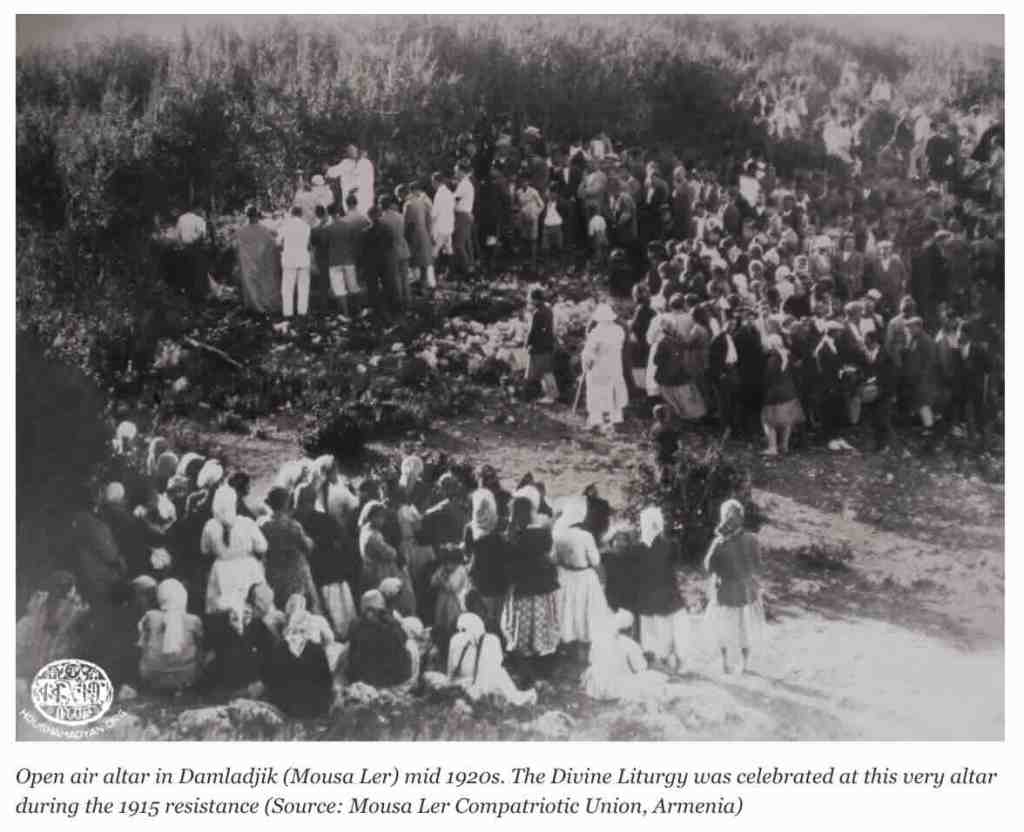
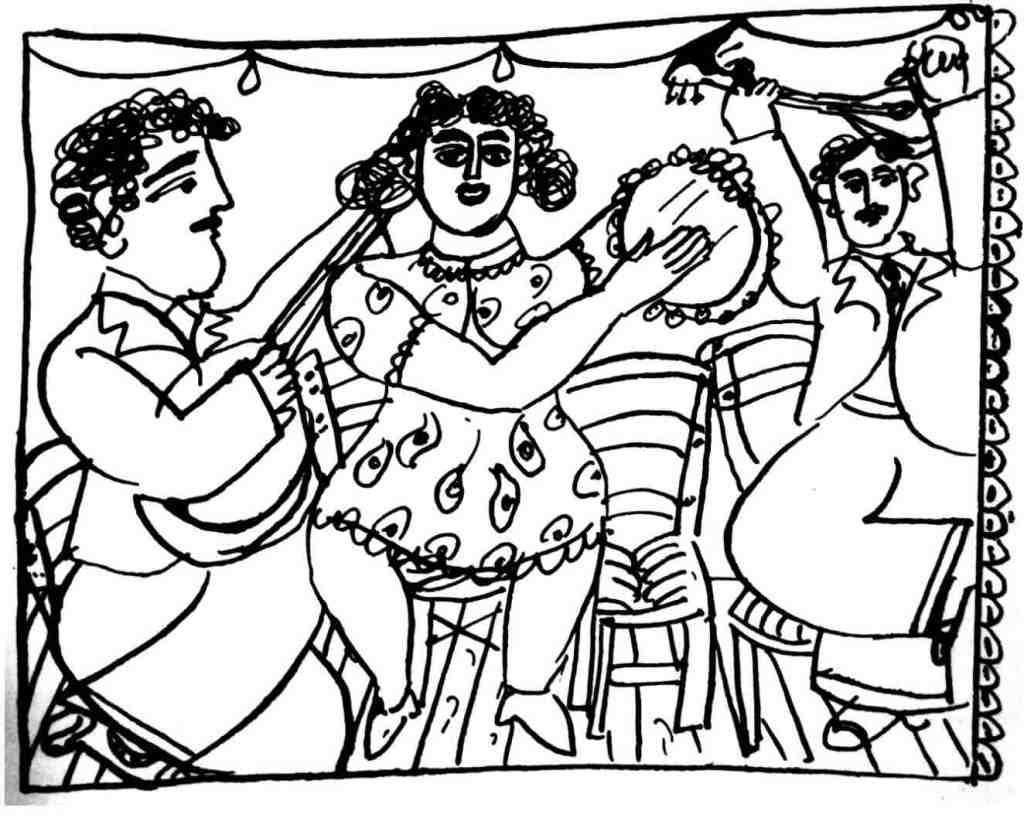
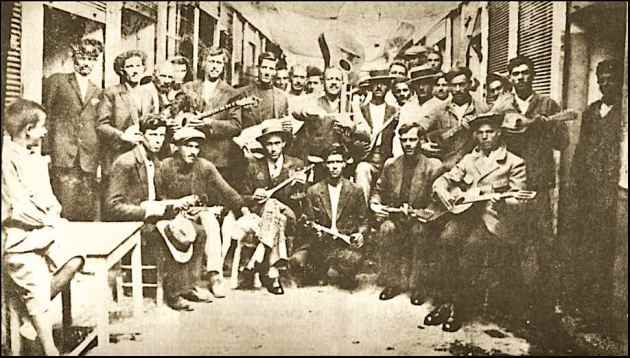
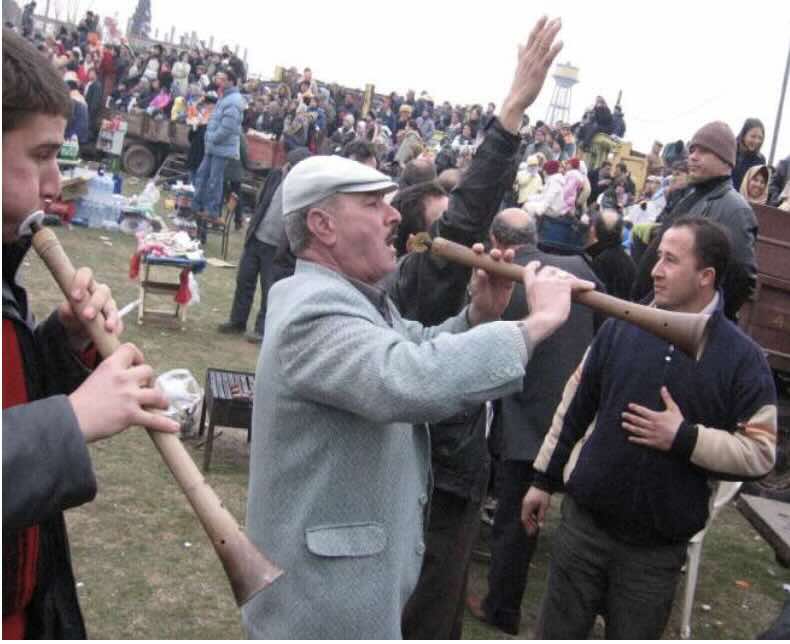

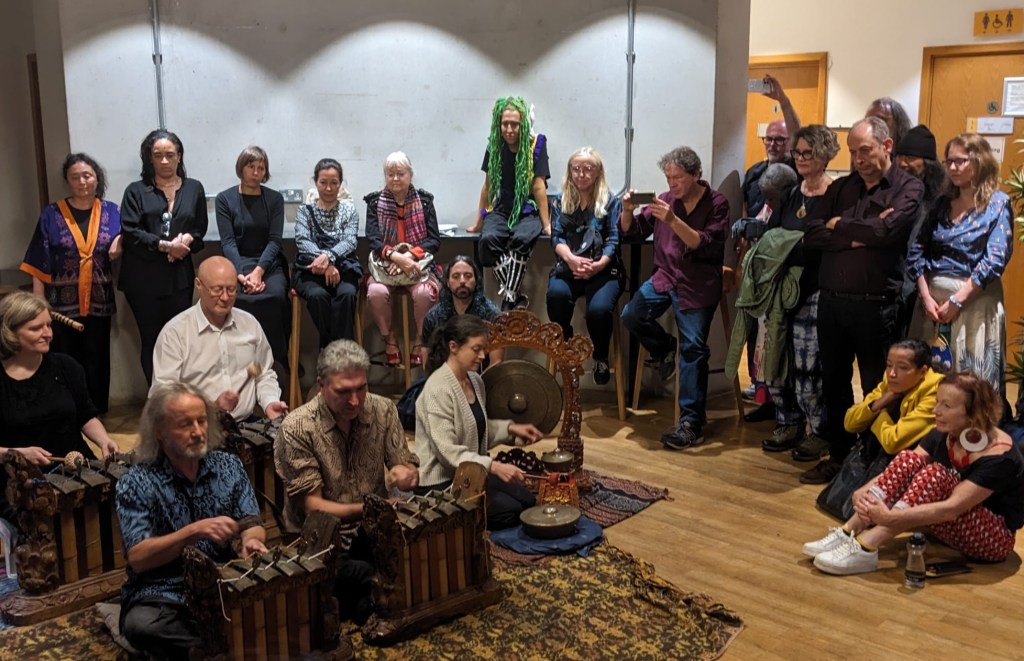


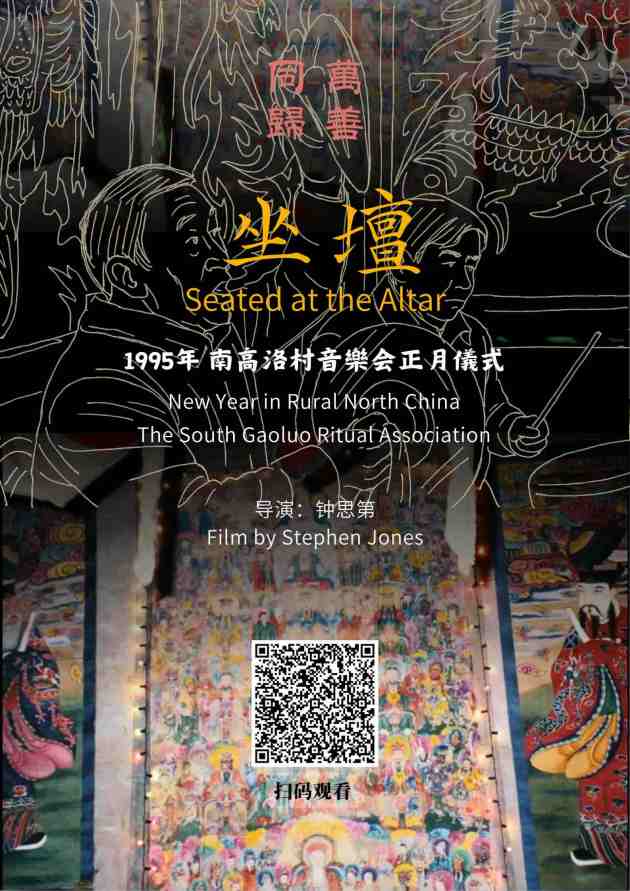

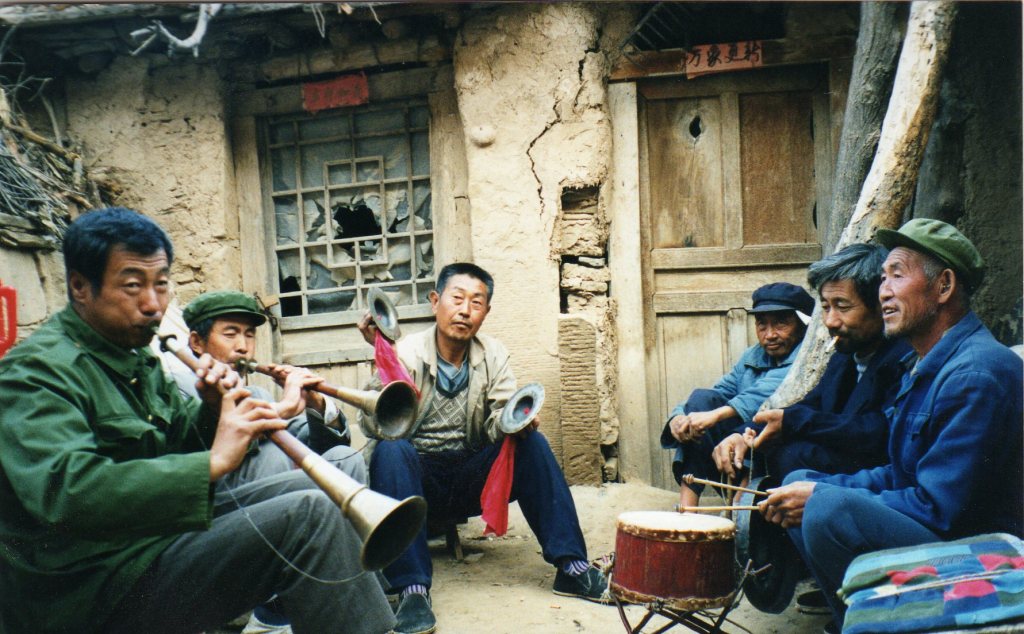


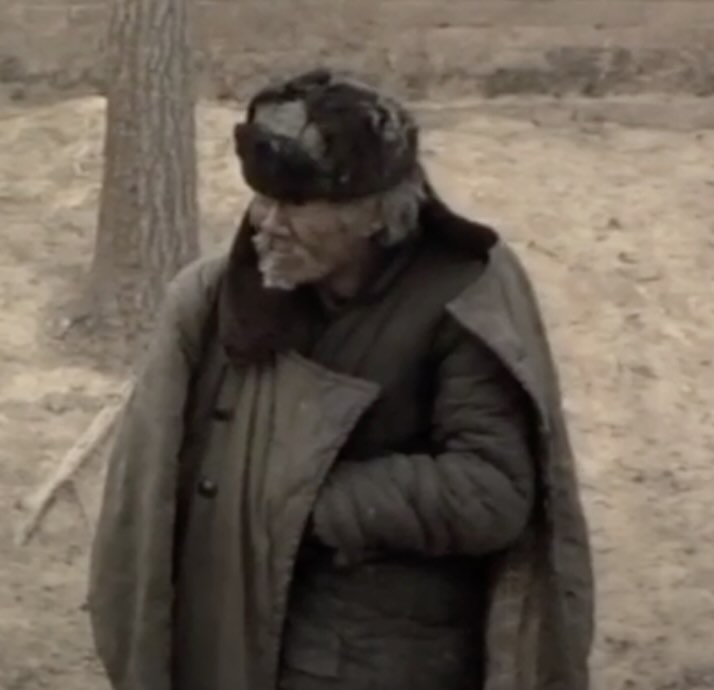

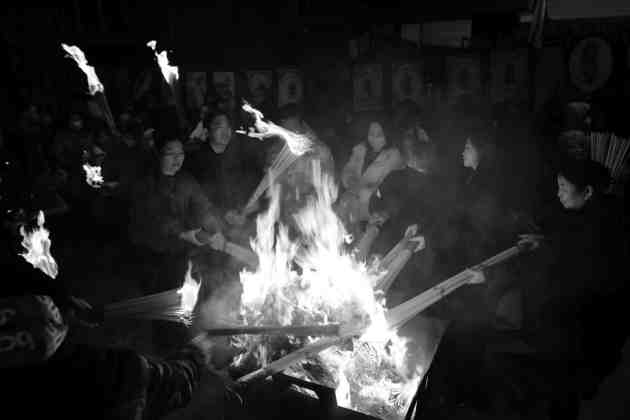


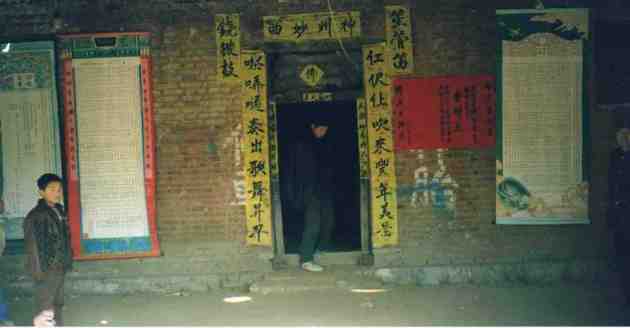
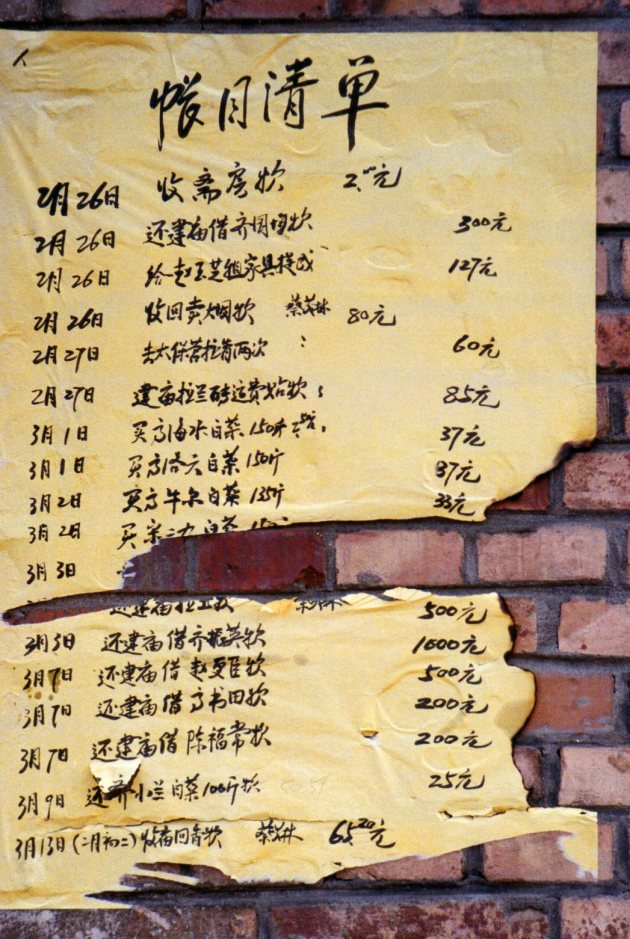

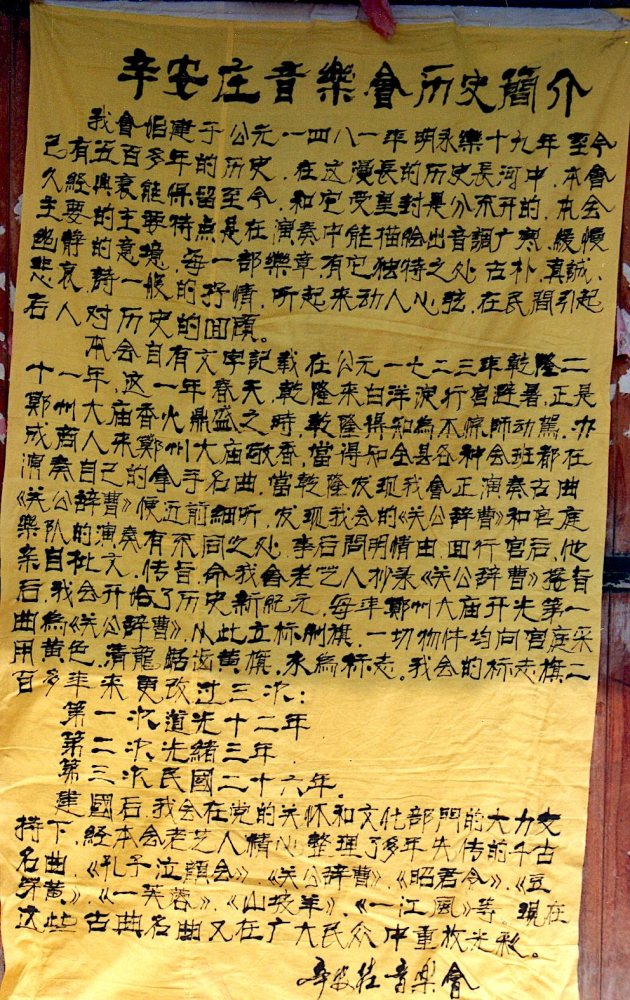


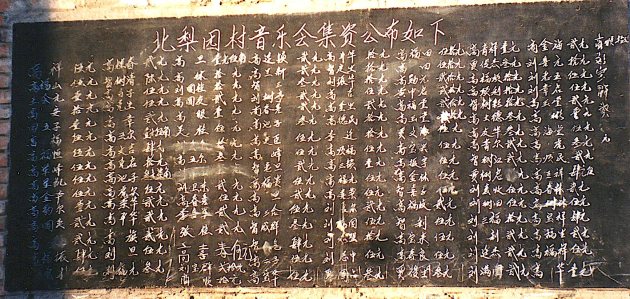


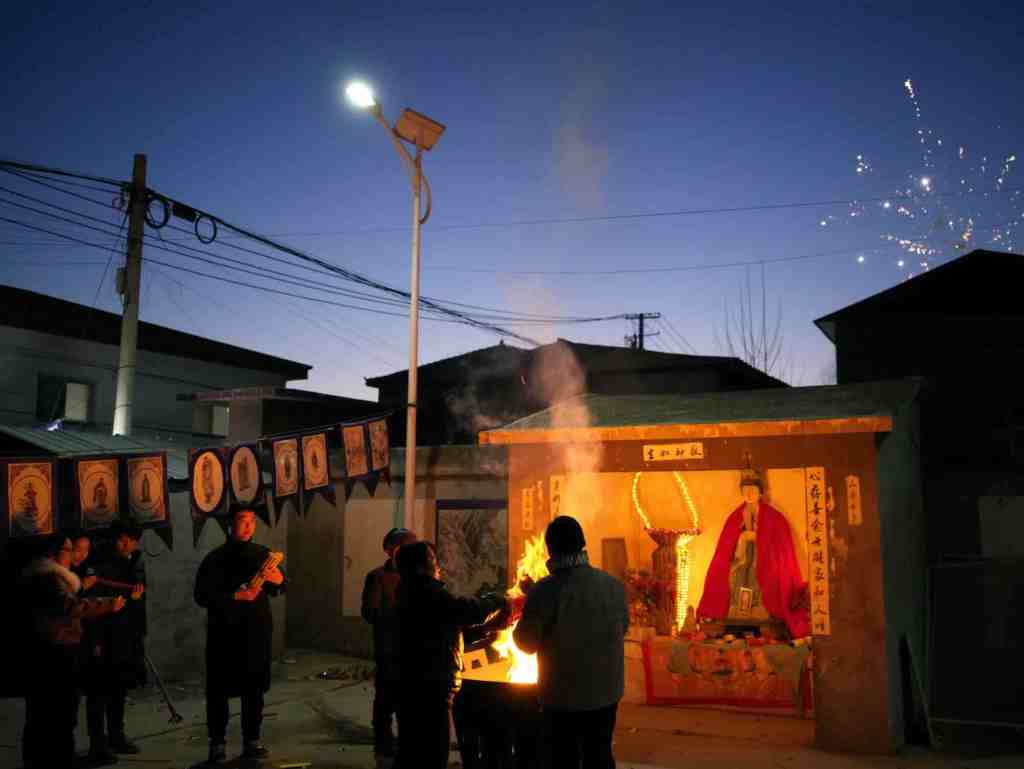


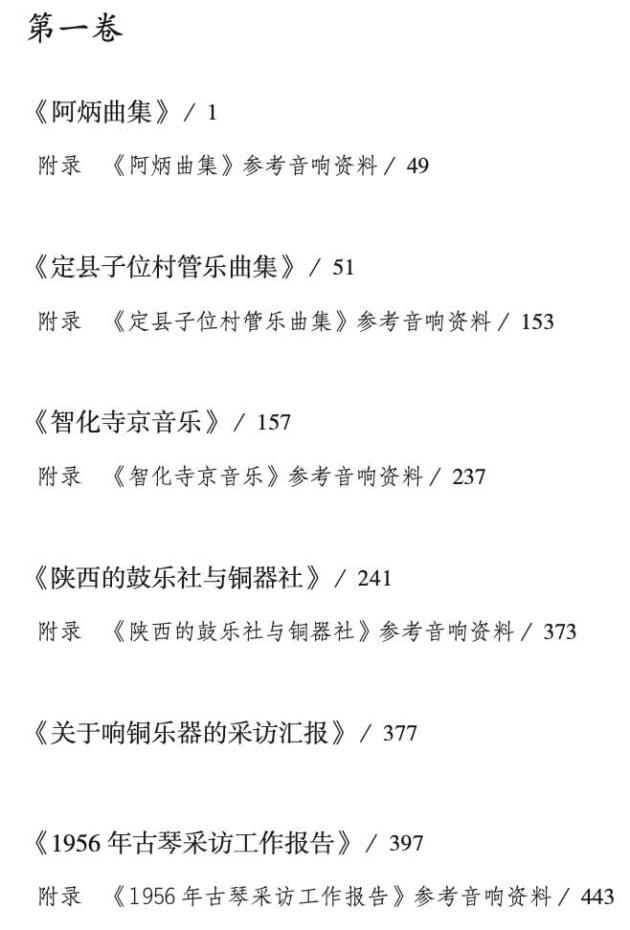


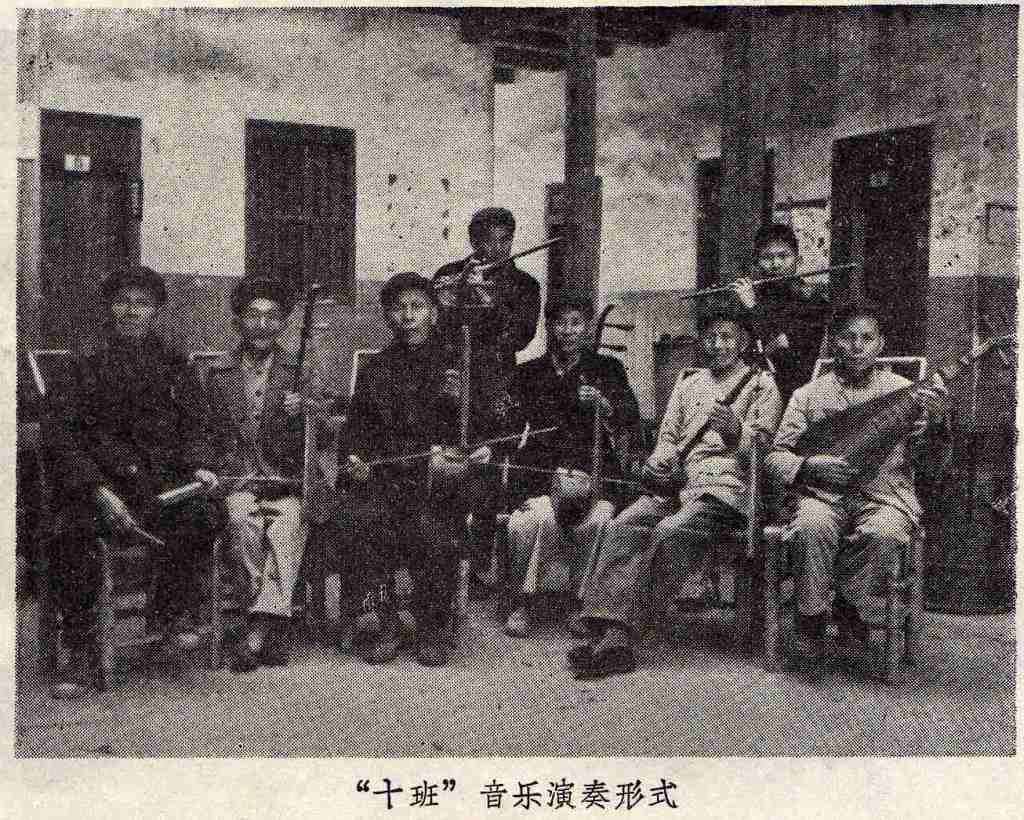

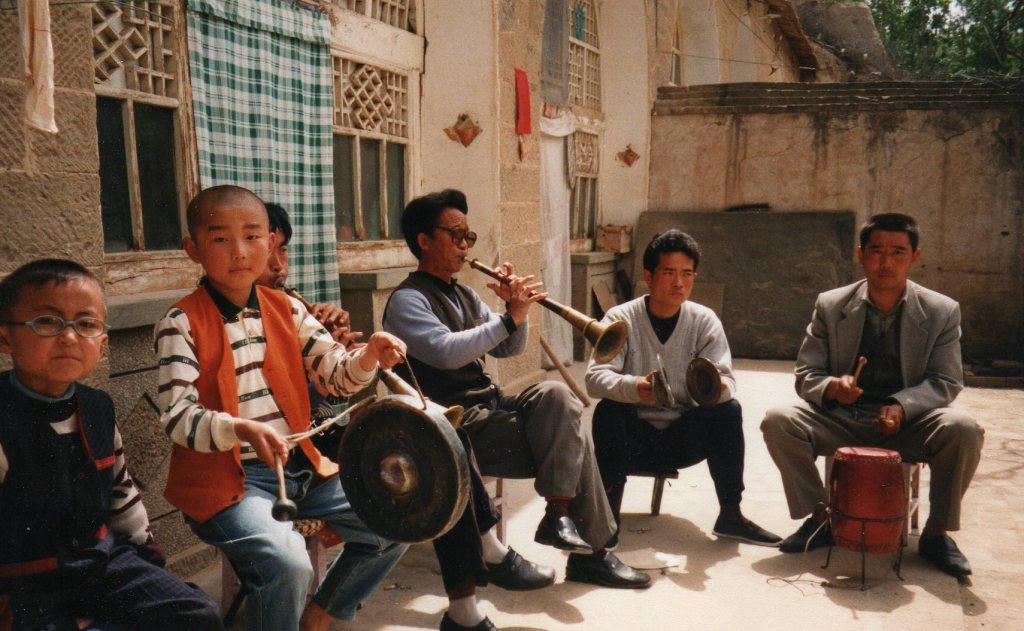

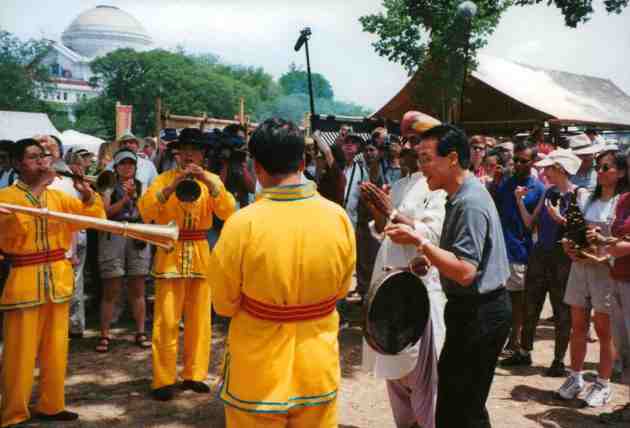
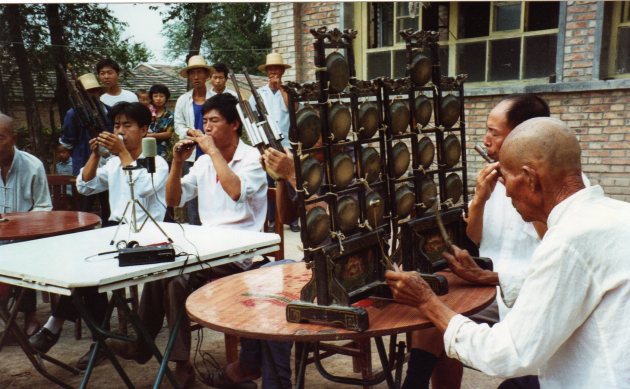


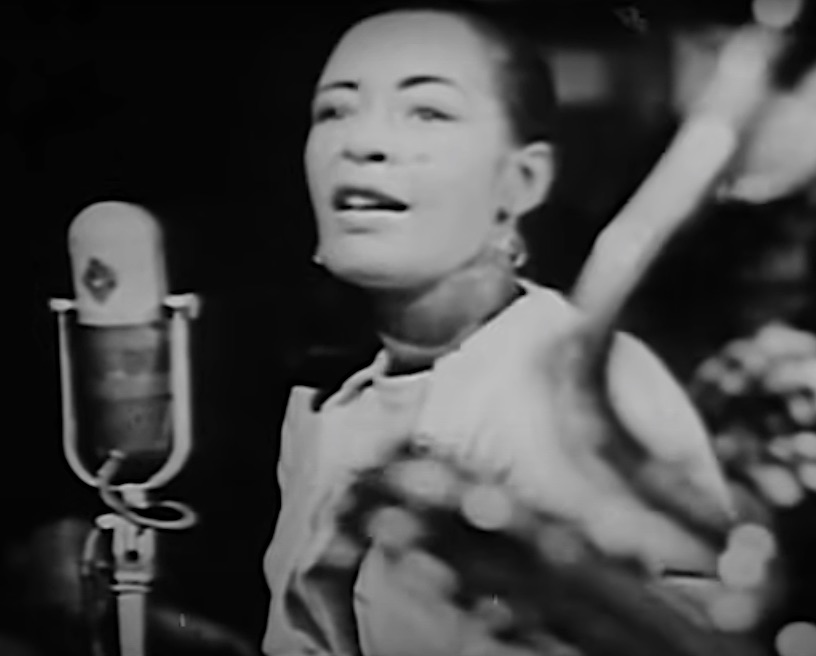


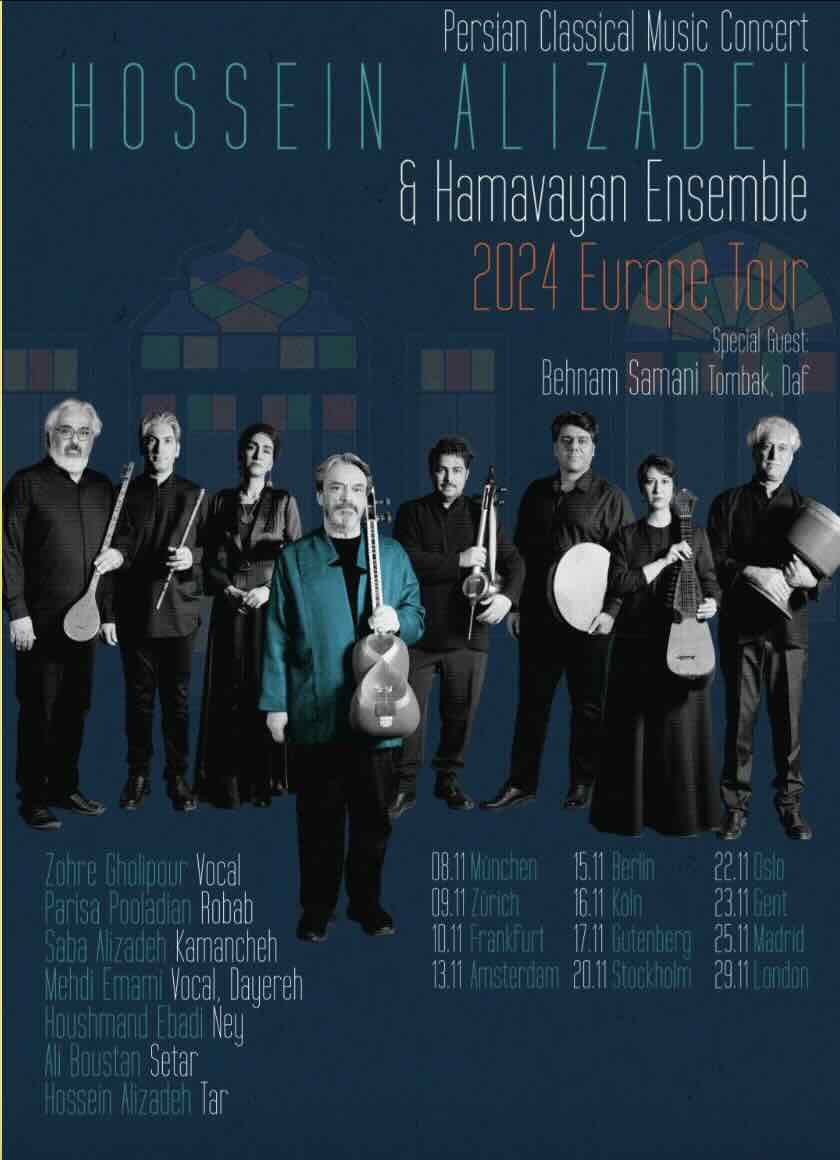


 Funeral procession (detail), Afrasiab (modern Samarkand) murals South wall.


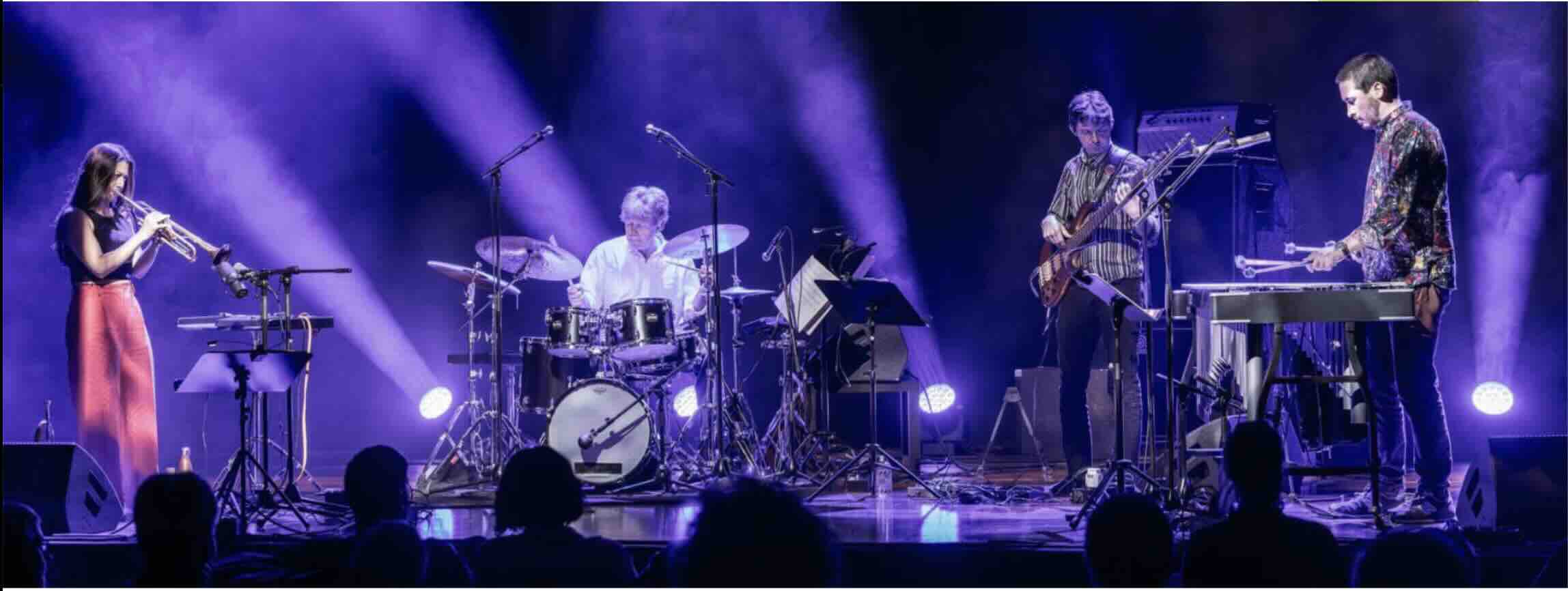




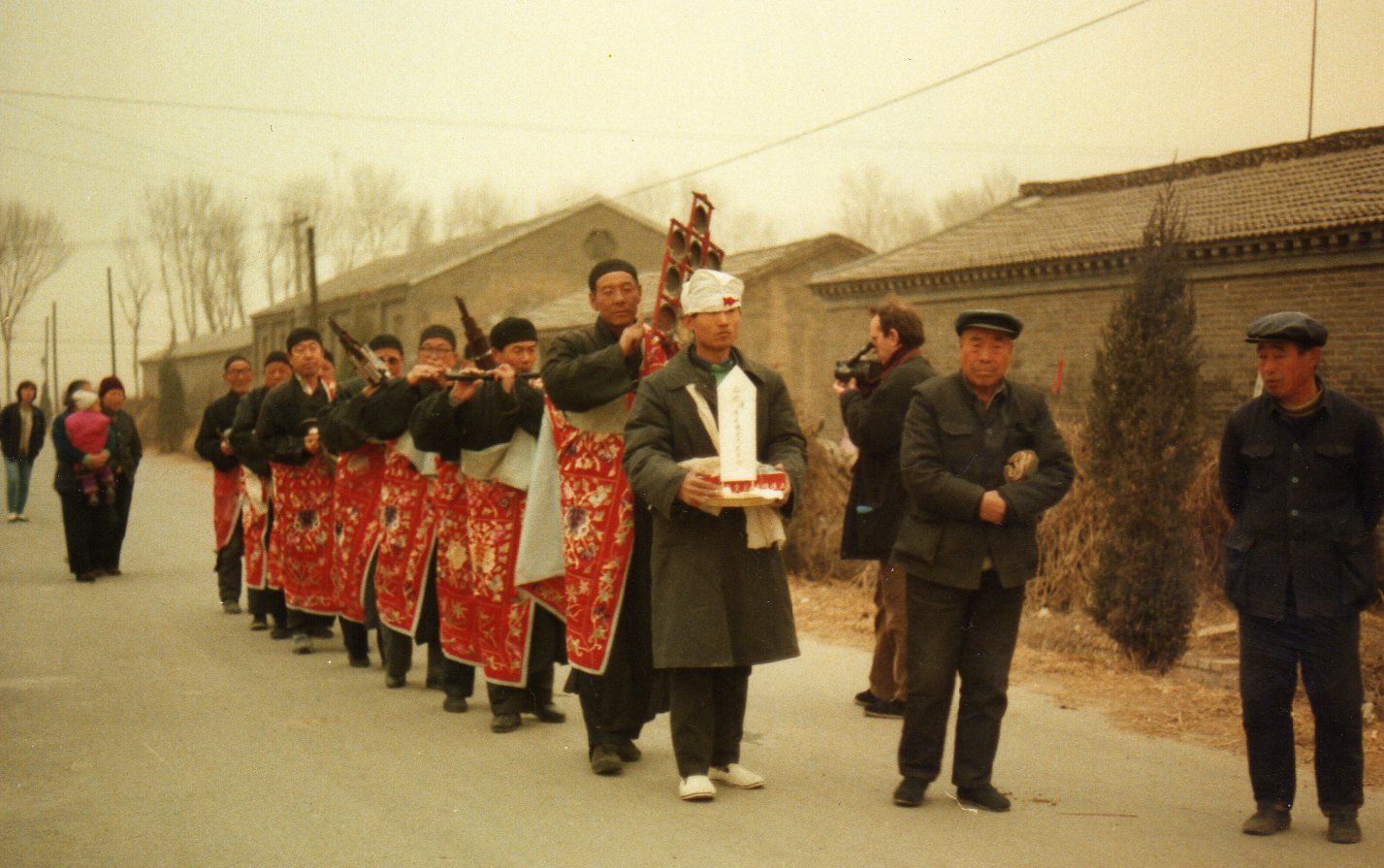 Early morning procession to the soul hall, North Xinzhuang 1995. Photo: Du Yaxiong.
 Henan municipalities.



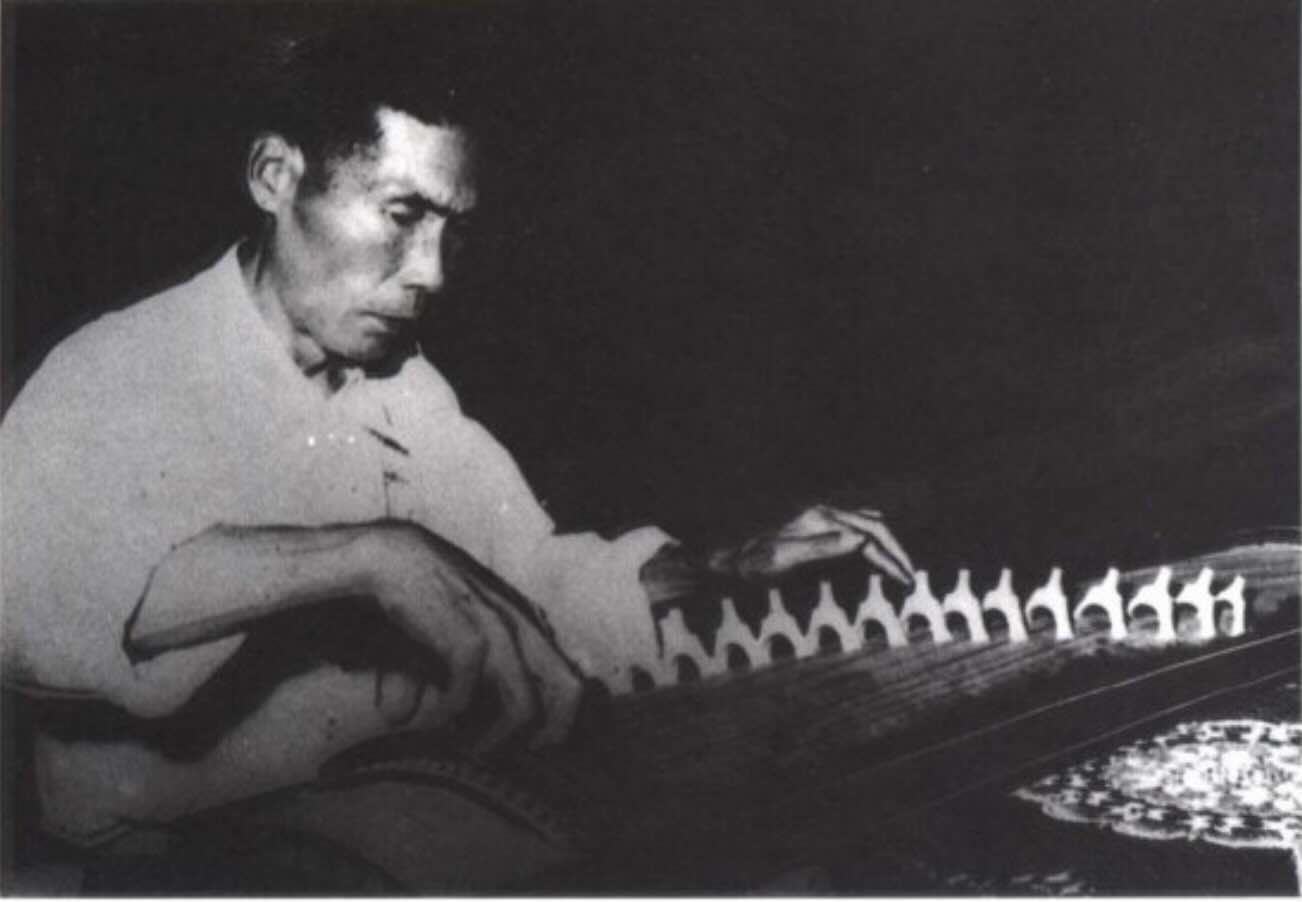
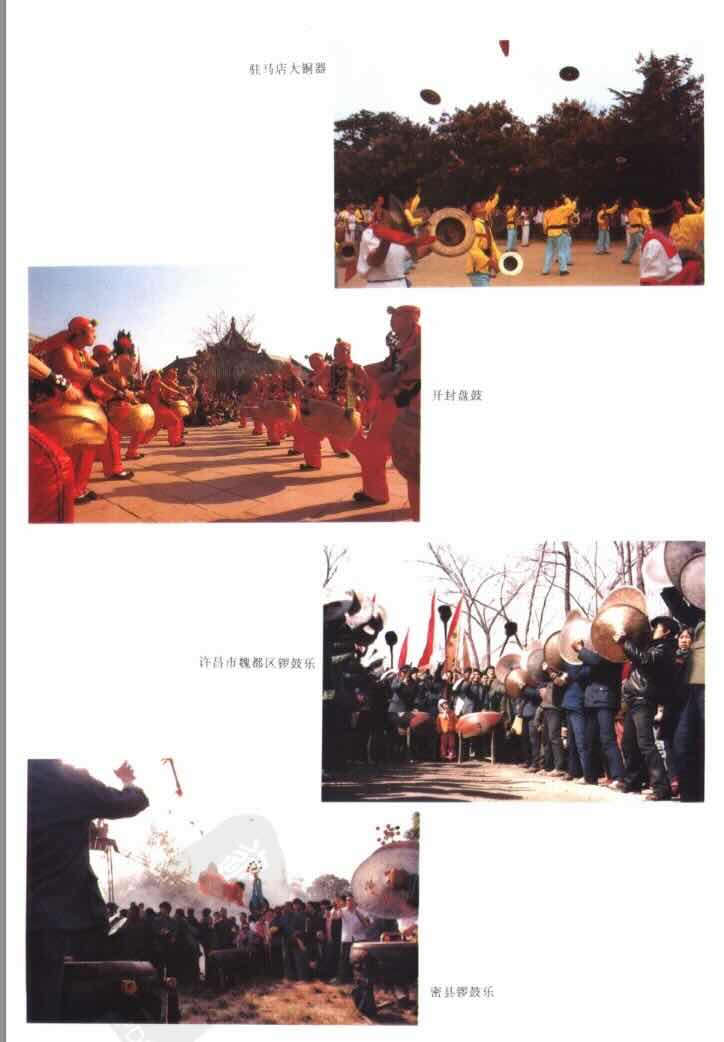


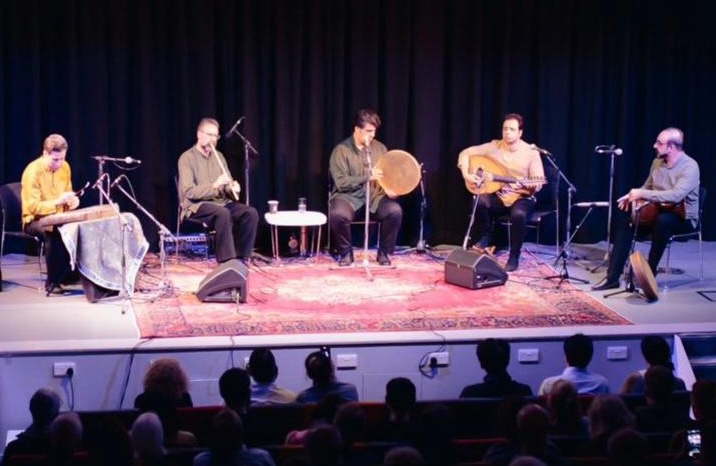


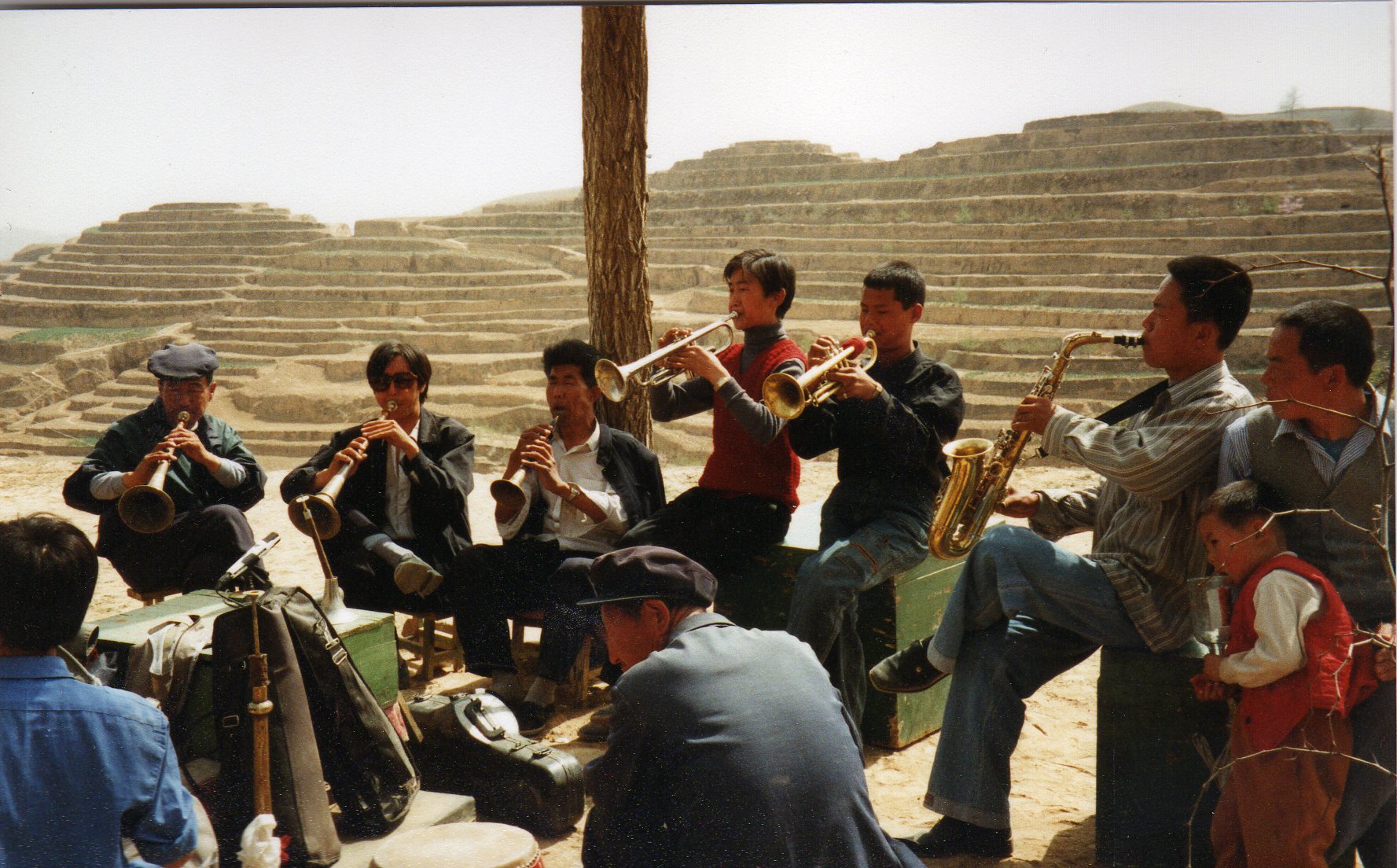 Chang Wenzhou’s big band at village funeral, Mizhi 2001.


 A young Liu Wenwen performs with her parents.





 Image: Paul Childs/Reuters.
  Leaving aside the many other kinds of bowed fiddle (such as kemence and


 String trio with cimbalom at the Meta táncház, Budapest 1993. My photo.


 “Unidentified fiddler” in the southern States. Source: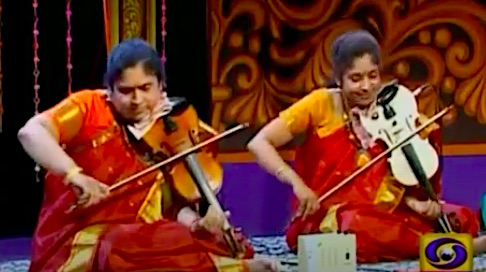


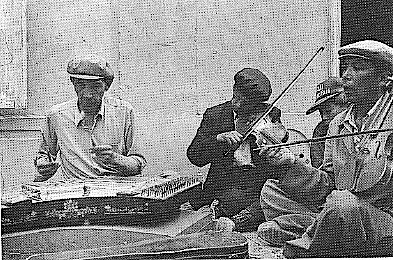
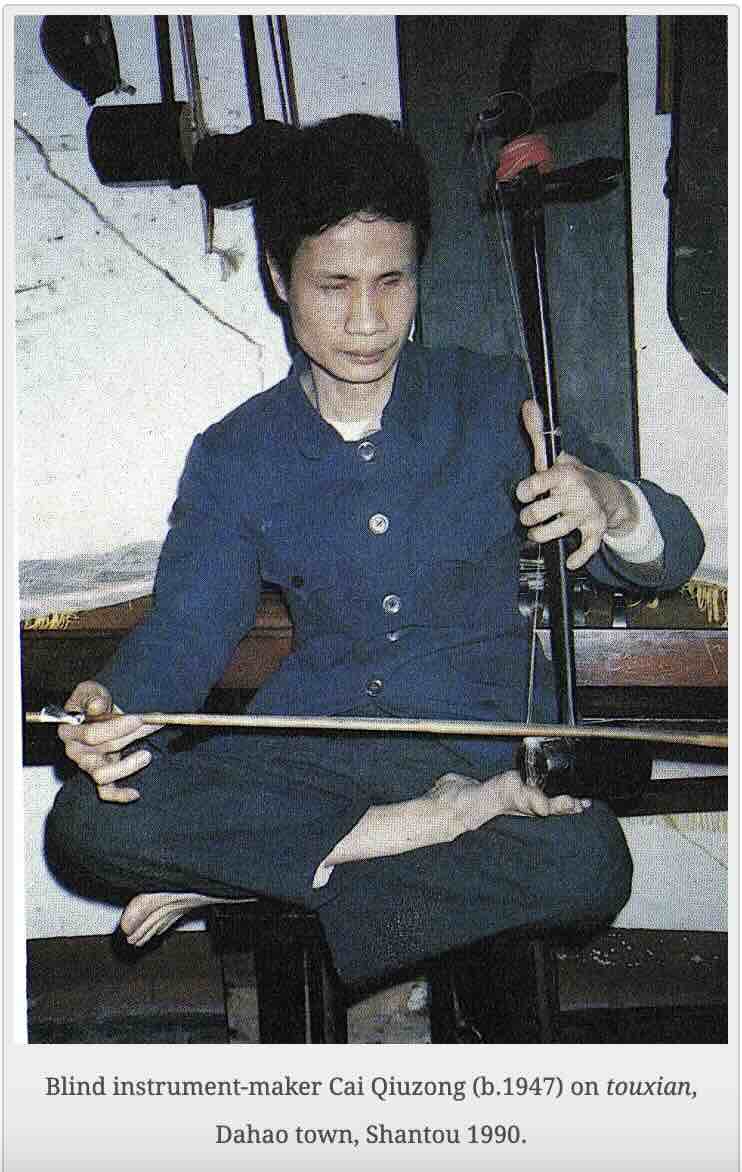

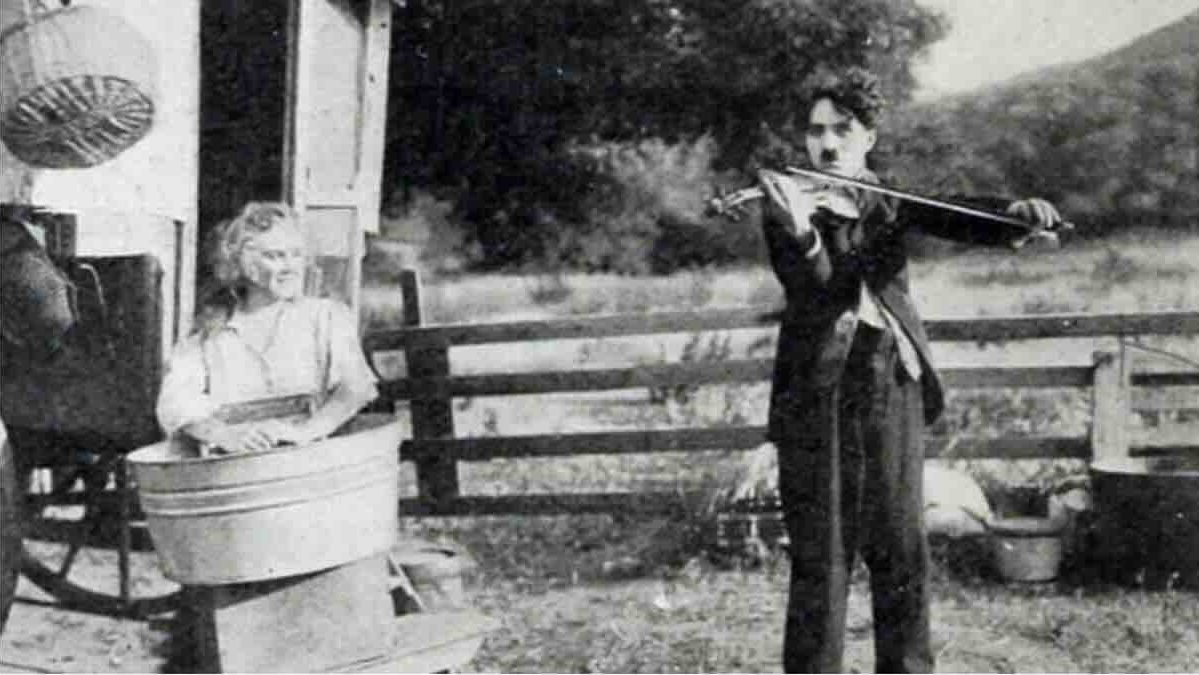
 ©BBC/Mark Allan. Source: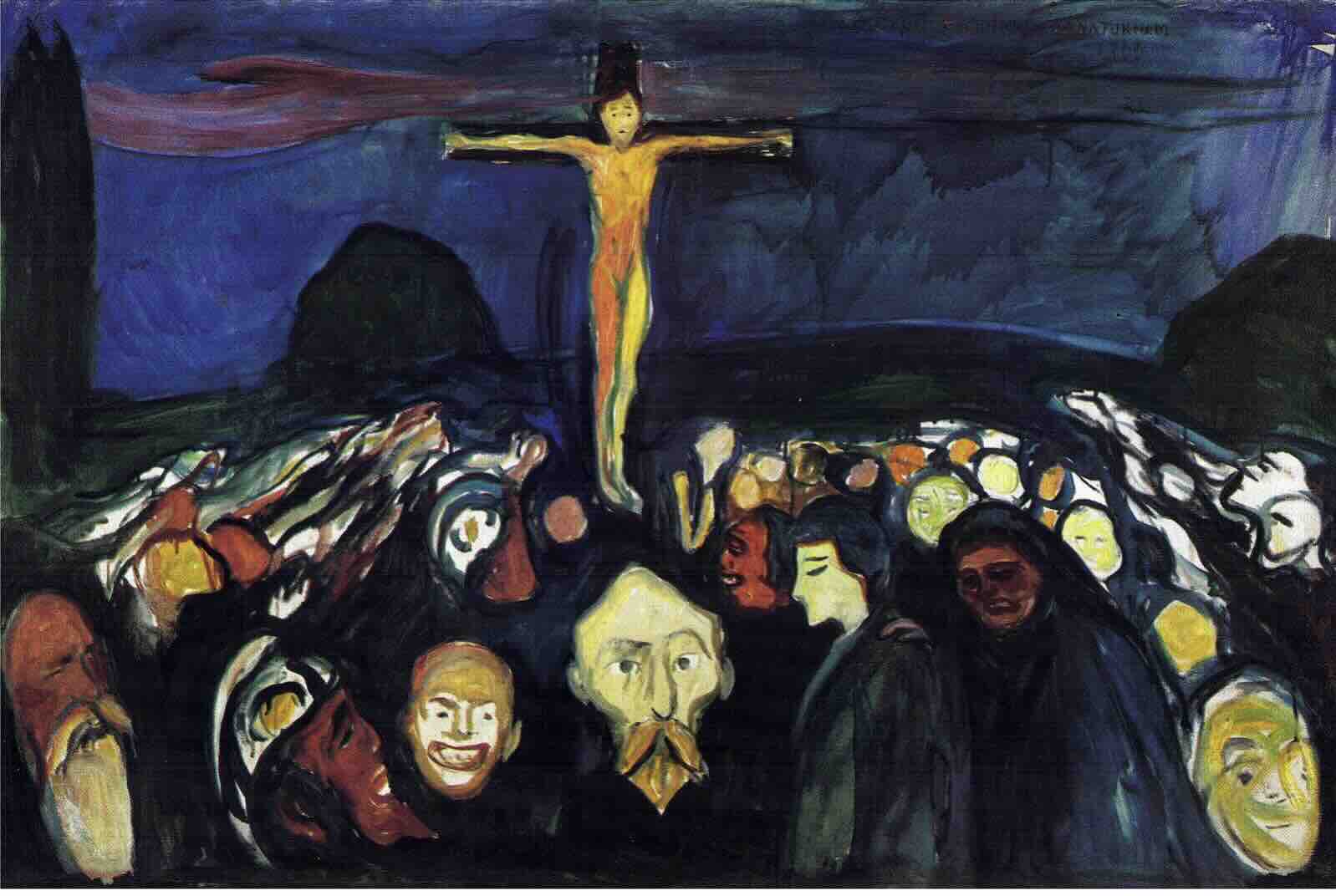
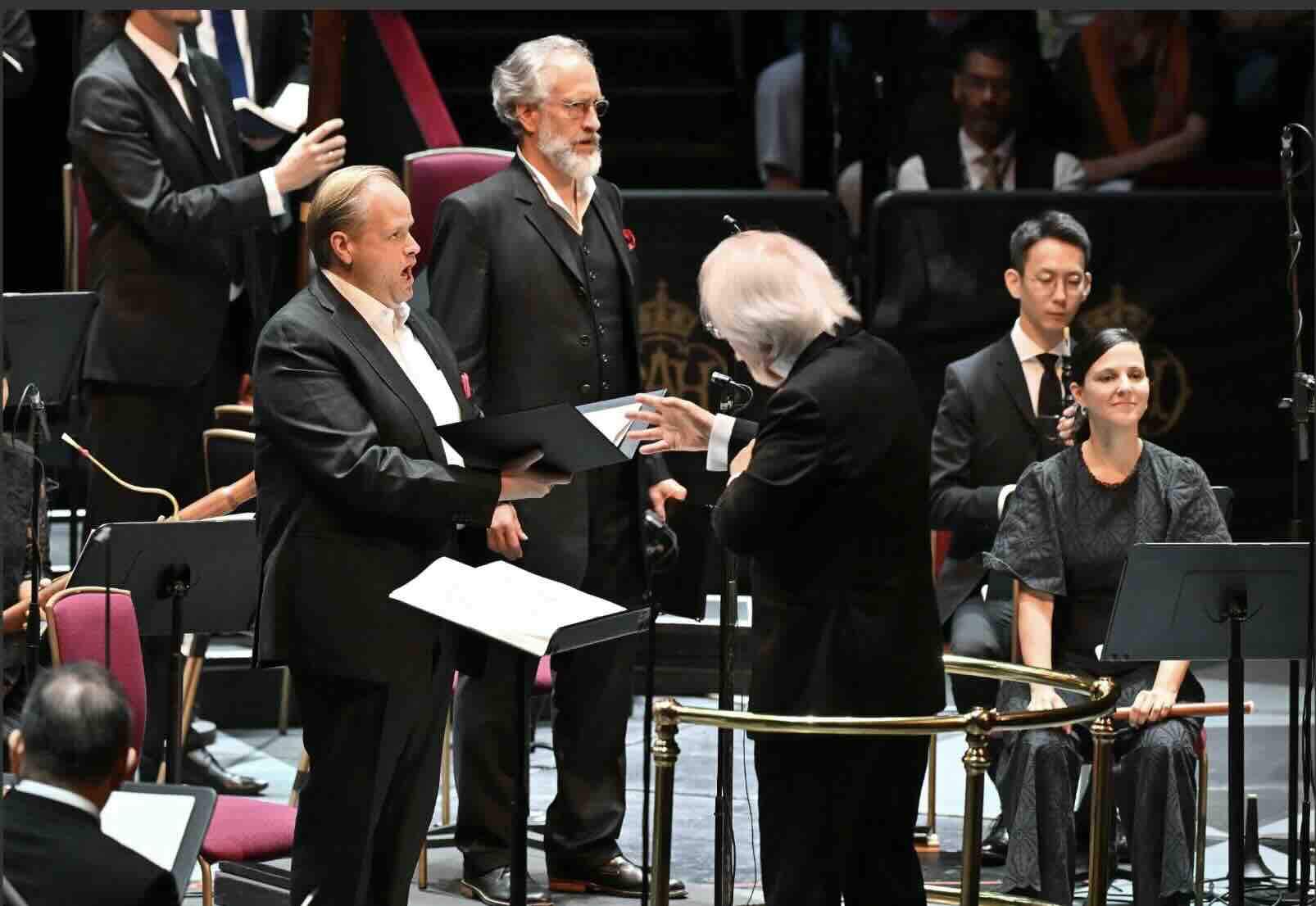 Benjamin Bruns, Christian Immler, Masaaki Suzuki.


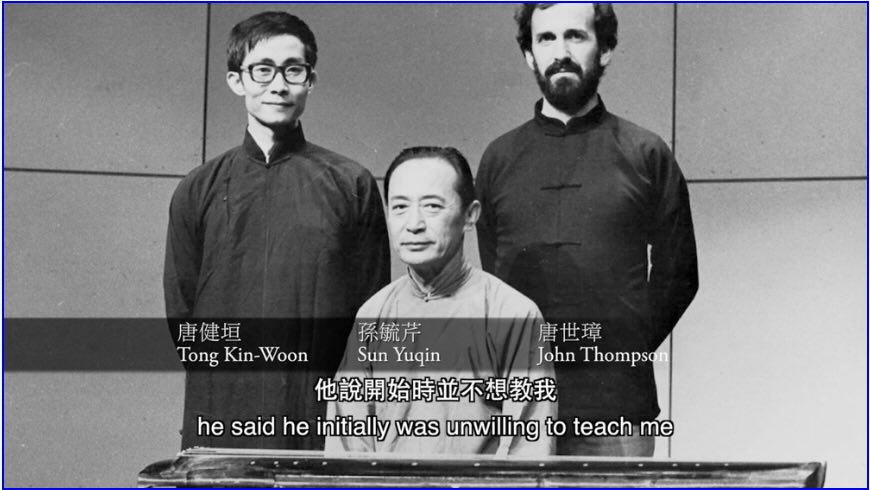
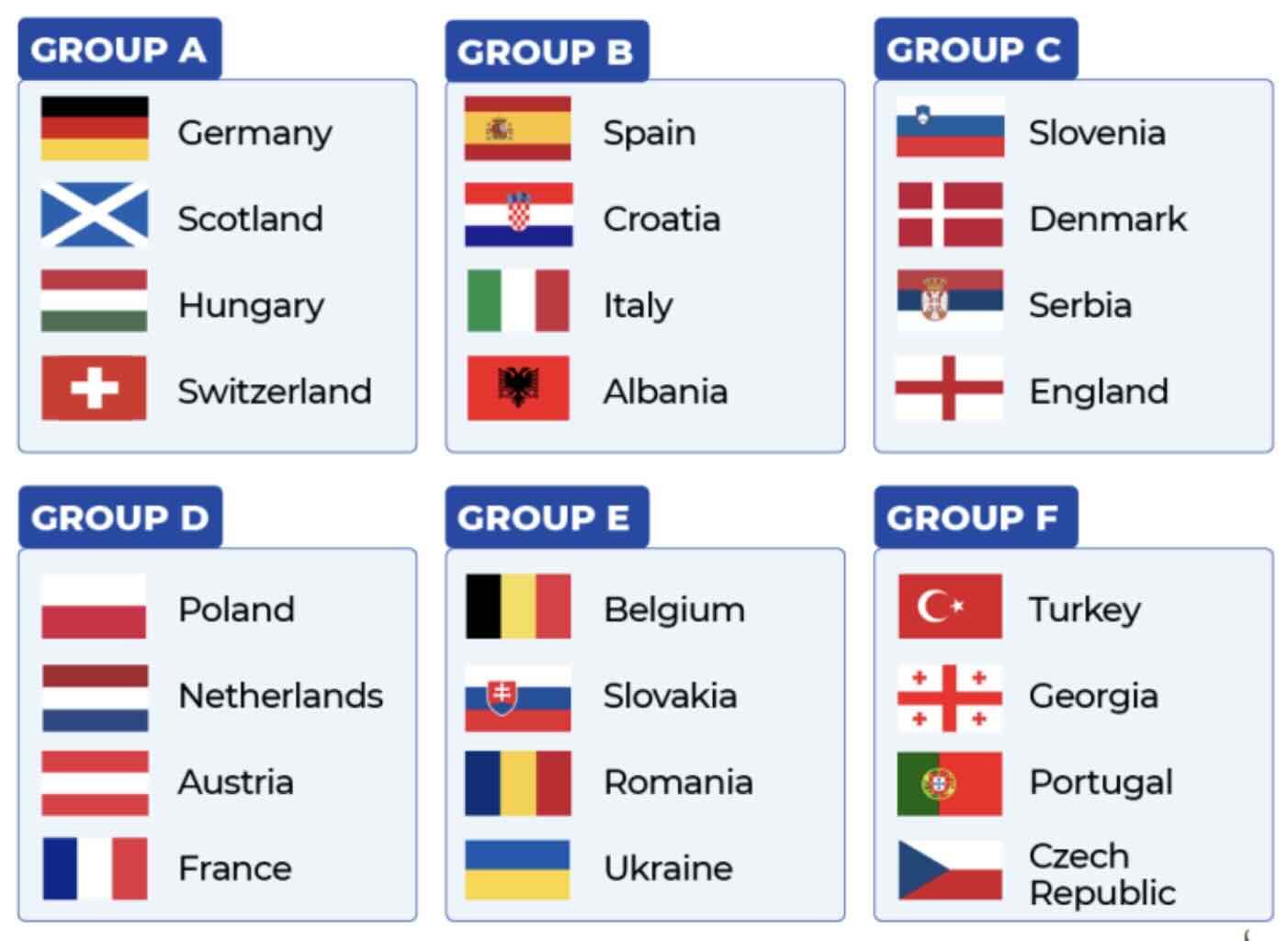


 As to France, even I might hesitate to try out


 Not so much an impromptu pre-match party as
 Grooving to the gaita. *
 “Just dig that funky tulum“

 ** Before England’s Great Escape from Slovakia, I was composing our own version of Caporetto, inspired by that popular classic from the


 Nao and bo cymbals of the Tianxing dharma-drumming association,
 Shifan band, 1930s.
 Jinmen baojia tu shuo (1846).

 Albanian zurna shawms with dauli drums, a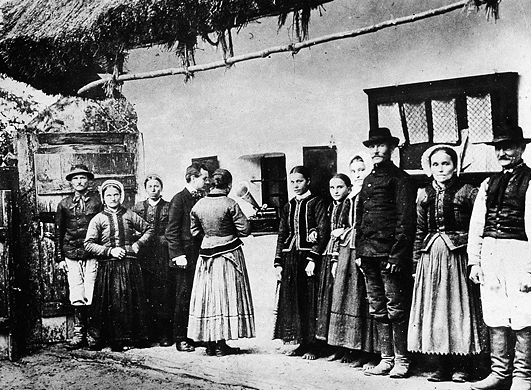
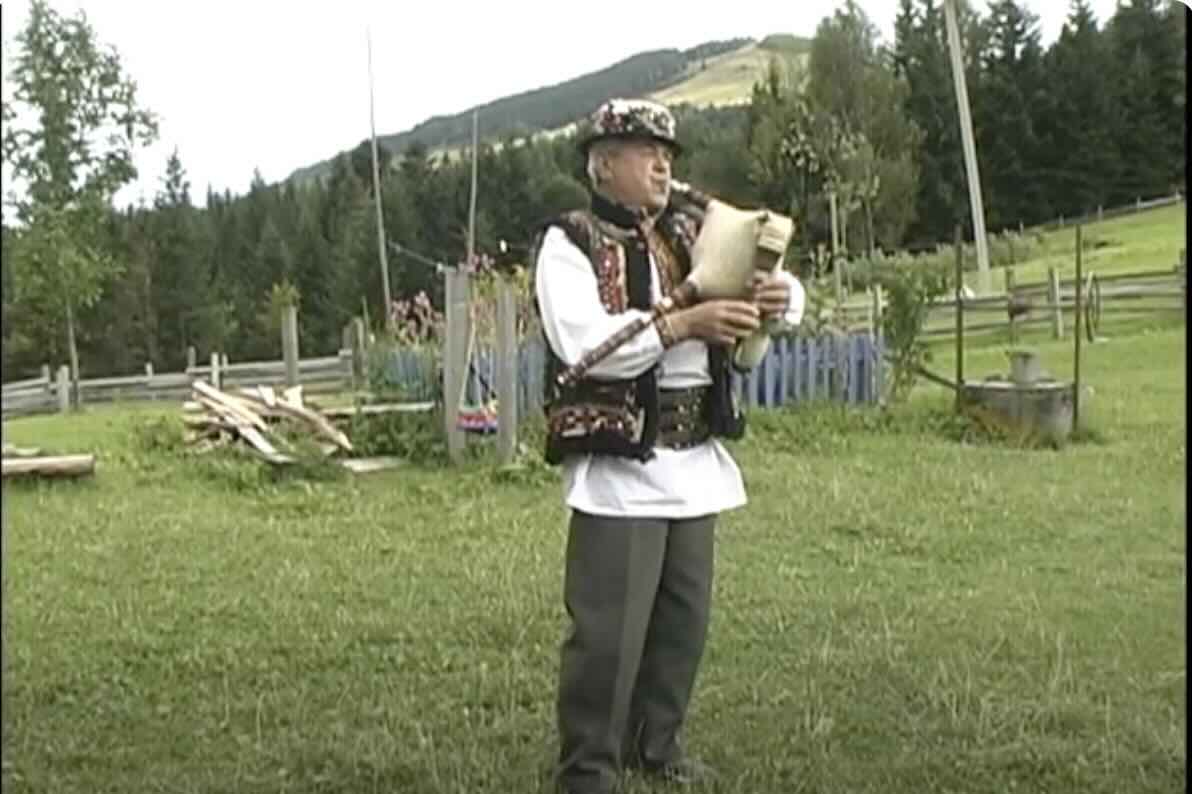 Ukraine: Mykhailo Tafiychuk on volynka bagpipe of the Hutsuls.


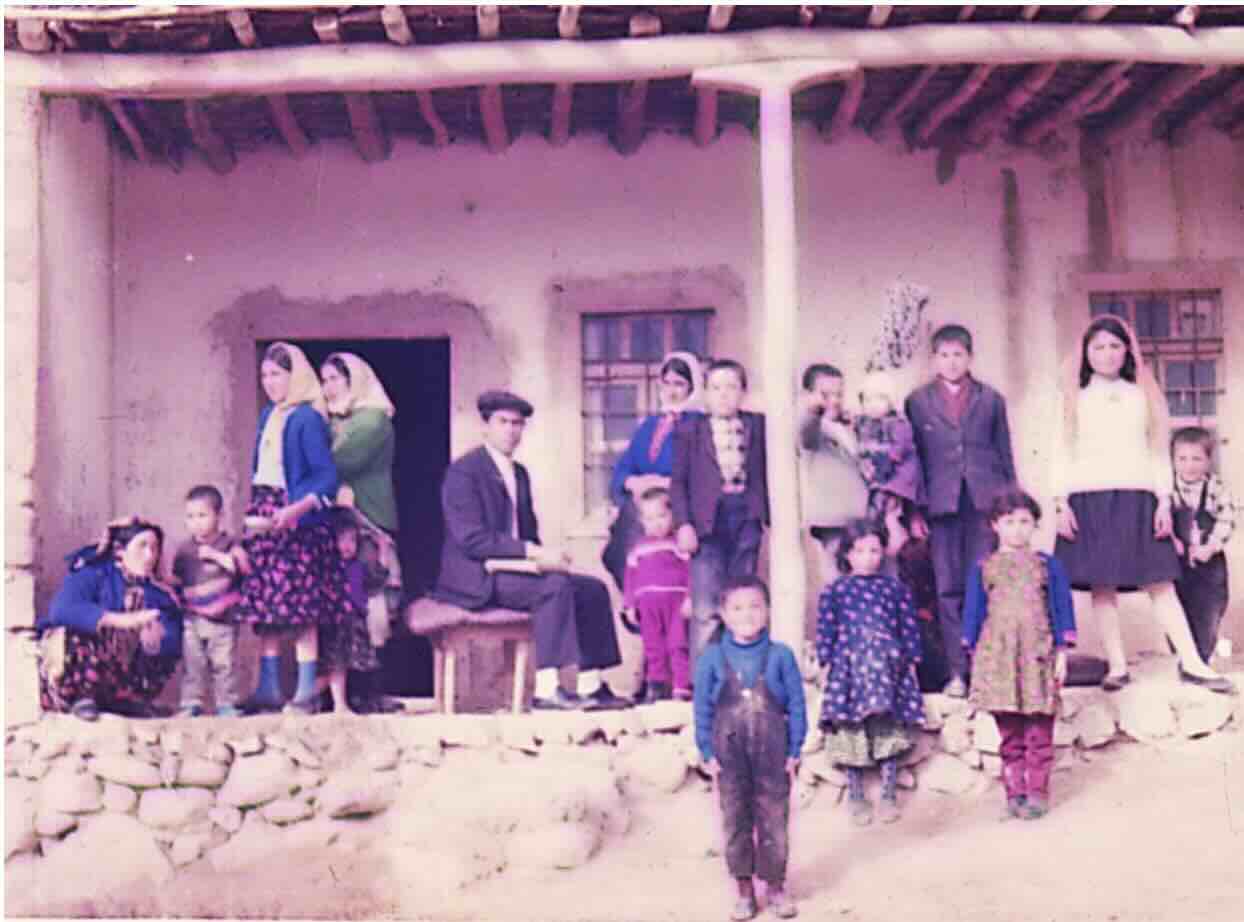 “People were in and out of each other’s houses from dawn until bedtime.”
 Stephen Jones: a blog

