Ritual groups around the Baiyangdian lake

*click here for main article!*
(under Hebei in main menu)

Ritual groups around the Baiyangdian lake:
the Medicine King cult

Zhaobeikou lake

On the Hebei plain, just south of the Xiongxian region, the Baiyangdian lake, and the ritual catchment area of the pilgrimage to the Medicine King temple in Maozhou, form a somewhat distinct area for ritual practice. This is highly topical since it is now part of the vast plan to build a megapolis there, expanding Beijing and Tianjin southwards amidst profound social and ecological change.

This was the southern boundary of our project on the Hebei plain, where we had found so many complex liturgical sequences, ritual manuals, and grand shengguan instrumental suites with scores derived from the temples of old Beijing and Tianjin. Xiongxian turned out to be the heartland of the suites and scores, but around the lake just south, despite the lively Maozhou cult, the trail was becoming somewhat diluted—and I don’t believe this is merely because our visits predated more in-depth stays in the areas further north and west. Still, these associations were very much based in ritual and shengguan, and dated back to at least the 18th century.

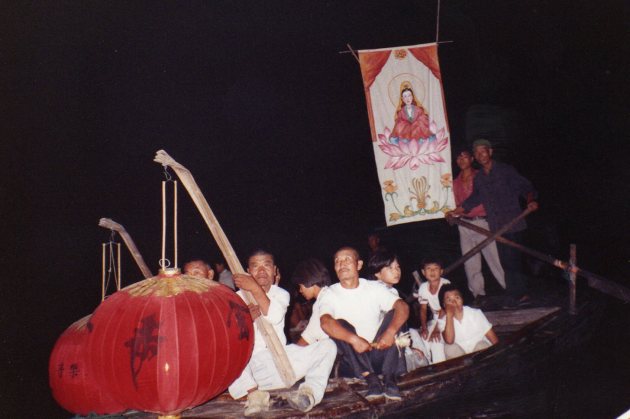
This survey introduces ritual groups all around the lake, including villages of Anxin, Renqiu, and Gaoyang counties. The aquatic setting engenders plentiful rituals based on “releasing river [or lotus?] lanterns” (fang hedeng 放河/荷燈).

As ever, this article merely scratches the surface of our fieldnotes—themselves just a superficial survey of some village associations that came to our attention. There may be many more, and certainly were until the 1950s. Any one of these groups (and indeed the Maozhou temple) could, and should, form the subject of a detailed diachronic ethnography such as I did for Gaoluo.

Around the Baiyangdian lake we found further evidence for the connection not only with Buddhist monks and Daoist priests but also with the ritual and musical cultures of the Qing emperors in Beijing—a link that appears occasionally throught the Hebei plain, such as Yixian, and strongly suggested in Xiongxian just north.

Back in the mists of time, long before the internet, or even usable landlines—the 1990s—this ritual system still comprised the main cultural network of such regions. Having survived Maoism remarkably unscathed, there are complex reasons for the long-term decline of these associations—including not so much the recent urban development plan for the region, but migration, the whole commodification of society, and the secularizing pressures of the ICH. These notes are valuable for documenting local ritual life at a time when such transformations were still in their early days.

Nuns of rural Hebei

*For main page, click here!*

Renqiu nun

In traditional China, ritual activity—indeed, public appearance altogether—appears to be male-dominated. But the role of women in religious life is significant—as worshippers, as members of amateur sects, and notably as spirit mediumsNuns hardly threatened the patrilineal traditions of ritual and instrumental music before the 1950s, but they make an interesting sub-plot.

Moving south from Beijing and Fangshan to Laishui county, this article goes on to gives vignettes (based on brief chats in 1994) on the ritual life of two elderly former nuns in a village in Renqiu county, near the Baiyangdian lake, half a century earlier. Such absorbing glimpses into the world of rural nuns before Liberation deserve including in our picture of local cultures.

Ritual groups of Xiongxian, Hebei

*Click here for main page!*
(under Hebei in main menu)

GGZ xu 1

Through the 1990s, one of the most fruitful sites for our fieldwork project on the Hebei plain south of Beijing was the area around Xiongxian county, just south of Bazhou, and east of the regional capital Baoding. Recently this whole region has become the centre of a vast and radical new development project to expand metropolitan Beijing; but when we used to visit, it was still very much rural.

As throughout the region covered in this growing series on Hebei, most villages here had ritual associations until the 1950s, and we found many still active in the 1990s. But here we found less vocal liturgy than further north and west on the plain, with no foshihui groups reciting precious scrolls.

Instead, ritual services were now mainly represented by the “holy pieces” of the shengguan wind ensemble to “revere the gods”—here an exceptionally rich repertoire based on long suites related to those of the temples of old Beijing. Not all these groups were still performing, but there is rich material here, not only on the ethnography of local ritual in modern times, but for scholars of the late imperial period.

This is the latest in a series on ritual in Hebei that includes Houshan and the precious scrolls, suburban Beijing, and Bazhou.

Bazhou: an update!

Xin'an guanzi 1989

I’ve just updated my page on Bazhou, one of the most rewarding counties on the Hebei plain for the study of ritual groups, with some more photos and subtle edits…

To remind you, this is part of a major series under local ritual where I move from occupational household groups in north Shanxi to amateur (mostly village-wide) associations on the Hebei plain, and thence to some other regions of north China.

Just for the Hebei plain, the list (sub-menu under Themes > Local ritual in the top menu) also includes

All these fieldnotes relate to articles on temple ritual in old Beijing (including the Zhihua temple), and the village associations of Gaoluo and Qujiaying.

Ritual groups around Bazhou, Hebei

*Click here for main page!*
(under Hebei in main menu)

Xin'an Yingming drummer 1995

What a wonderful fieldsite we stumbled across in 1986, inspired by Yang Yinliu and Lin Zhongshu!

This is a new addition to a budding series on Daoist and Buddhist ritual groups on the Hebei plain south of Beijing. The elongated county of Bazhou lies just south of Langfang, Yongqing, and Gu’an. Rather as I did for the southern suburbs of Beijing, here I introduce two main ritual groups:

  • the Daoist tradition of Zhangzhuang village comes from a former Orthodox Unity temple;
  • the Gaoqiao village association nearby derives from a former Buddhist temple.

As we move south and east from Houshan, vocal liturgy tends to become subsidiary to the magnificent “holy pieces” of the classic shengguan wind ensemble deriving from the temples of old Beijing—notably the lengthy suites (daqu) whose most majestic form is to be found around Xiongxian county (major page here!).

And as this series of articles on local ritual expands from north Shanxi to Hebei, it’s becoming something of an alternative, grass-roots, history of 20th-century north China through successive social and political vicissitudes.

Ritual groups of suburban Beijing

***For main page, click here! ***
(under Hebei in main Menu)

N. Xinzhuang funeral 1

In the 1990s, ritual activity in the southern rural areas of the municipality of Beijing was patchy. While we found few ritual associations in the counties of Gu’an, Fangshan, and Zhuozhou south of the city, the groups in the suburban counties of Daxing and Tongxian, southeast of Beijing, were still actively providing ritual services.

Like other associations on the Hebei plain, these groups have ongoing ritual traditions, and clear links to Daoist priests and Buddhist monks. But these groups are distinguished by their proximity to Beijing, and by the fact that many groups acquired their ritual only in the 1950s, as laicized clerics sought to transmit their knowledge to villagers. Thus although they are not “old associations”, lacking the early history of most village groups that we found just further south on the plain, they clearly reflect temple traditions of ritual, relating to Beijing and Tianjin as well as to local networks. Again by contrast with most of the amateur village associations elsewhere on the Hebei plain, many of these groups don costumes for rituals, and accept fees.

This whole region was still largely rural when we made fieldwork trips there in the 1990s, but has since been absorbed into the ever-expanding urban sprawl of suburban Beijing—as indeed are villages further south on the plain, where we found many more ritual associations. In a physical and moral landscape that has changed constantly since the 1930s, restudies are always to be desired.

There are many such groups here, but in the article I focus on two:

  • The Lijiawu Daoist group, derived from the temple priests of Liangshanpo, and
  • the Buddhist-transmitted group of North Xinzhuang nearby.

This article also complements my various posts on Beijing temples and the transmissions south to villages like Qujiaying.

Ritual images: Gaoluo

***For new page, click here!***

GL Dizang

This first page under a new series on ritual images again concerns Gaoluo.

Apart from their ritual manuals and gongche solfeggio scores, all four ritual associations in North and South villages of Gaoluo have collections of images, including god paintings, diaogua hangings and donors’ lists, from various stages since the 19th century—displayed for calendrical rituals of the village community.

Ritual paintings of north China

***For main page, click here!***
(under Themes, in main Menu)

SGL old pantheon detail

For aficionados of visual culture:

The main focus of our fieldwork on the Hebei plain through the 1990s was the ritual performance of amateur village-wide associations there. But of course we also documented the material artefacts of these groups—including ritual manuals, gongche solfeggio scores for the shengguan wind ensemble, donors’ lists, and so on.

I now realize that by comparison with elite painting, temple murals, and so on, what we may call “folk art” is not so well represented—either in print publications or online. So this is a new sub-menu for ritual paintings of village groups, mainly from Hebei. I’ve already included some of them in various posts/pages, but now I’m adding many more (mostly from the period since the late 19th century, but also some painted since the 1980s).

Most of these images are displayed for calendrical rituals (notably the New Year) and/or for funerals—the Ten Kings images are used for both.

Of course, these material artefacts are a sub-theme; our main material consists of a rich archive of audio and video recordings of ritual performance. Contemplating such images in a museum is a last resort: they are the backdrop to the ritual soundscape of vocal liturgy and “holy pieces” of shengguan wind ensemble, and a representation of the changing spiritual life of local communities. As you digest these pages, you might even listen to the items of vocal liturgy and shengguan on the playlist in the sidebar, with commentary here).

Women of Gaoluo

Woman Zhang

Woman Zhang at 90 sui, 1998.

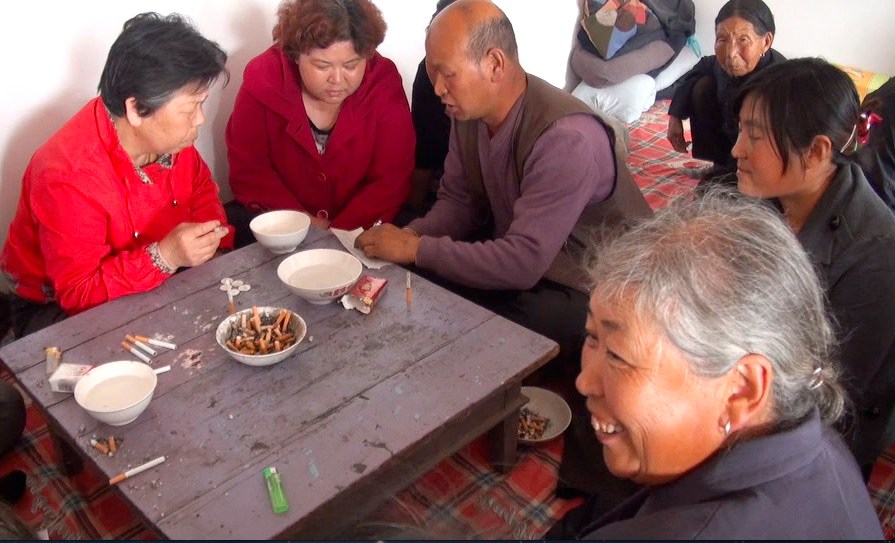
Chain-smoking cross-legged on the kang brick-bed with all the carefree abandon of the elderly, wielding her cigarettes with more relish than accuracy, Woman Zhang (Zhangshi nü 张氏女, b.1909) told us what she could about her life. As she said, entirely without feminist irony, “I had no [given] name until going to work [in 1958] in the Great Leap Forward—that’s when they gave me the name Yurong.”

Apart from the Li family Daoists (film, and book: also tag in sidebar), my other most in-depth ethnography concerns the ritual association of Gaoluo, just south of Beijing. On this blog I’ve written about two leading figures there, and the vocal liturgists, as well as their performance of “precious scrolls”—and also the village’s substantial minority of Catholics.

It may not have escaped the alert reader that much of my fieldwork is basically about the public activities of men. I made a partial attempt to redress the balance with three posts on Women of Yanggao (starting here). So here are some further notes on the status of women in rural China, setting forth from our chats with the characterful Woman Zhang in Gaoluo in 1998, and again based on vignettes from my book Plucking the winds (where you can find further detail).

Though 90 and illiterate, her mind is quite clear, and to my relief she speaks with a clear calm voice in a standard accent. Given her advanced age (she claims to remember the long pigtails still worn by men for a while after they ceased to be enforced with the fall of the Qing dynasty), our meeting should have been a fascinating glimpse into village history. But, in total contrast to the detailed day-by-day accounts of the cultured men Shan Zhihe and Shan Fuyi, I was taken aback by her ignorance of the momentous events which had convulsed the village. Of course, men can be muddled too; but this wasn’t muddle. We know a lot of men who are totally vague about dates, but at least they have participated in history, even when only trying to escape it or deplore it, and one can learn a lot. The problem was that she was not only uneducated and a woman, but had been widowed over fifty years earlier: she had simply played no part in the village’s public history. This itself was a salient lesson. We supplied the dates below: significantly, the only date she had ever heard of was 1960, the famine.

While nominally a Catholic, Woman Zhang “believes in everything”. Though she was only brought to Gaoluo from her home in a village in Dingxing just south in about 1930, she had heard stories about the famous Boxer massacre at Gaoluo in May 1900. Some of the Catholics took refuge in the Catholic stronghold of Anzhuang further south, while others fled to the Xishiku church in Beijing. Woman Zhang’s father-in-law Shan Zhong was the only survivor of his whole family from the Boxer massacre; two sons and a pregnant daughter had been slaughtered. Shan Zhong himself had gone to Dingxing town that day; on his way back he got as far as Wucun village just south of Gaoluo when he got wind of the massacre and fled, taking refuge in the Xishiku church in Beijing. After it became safe to return to Gaoluo, Shan Zhong remarried, taking a young wife.

1930 donors' list, South Gaoluo

1930 donors’ list.

By 1930 the village ritual association, sensing a need to compete with the revival of Catholic power, commissioned a new set of ornamental hangings for the New Year rituals (see here, under Ritual rivalry). Shan Zhong was by now an established leader of the village Catholics—but impressively, he was one of the most generous contributors whose names (all male, as heads of households) appear on the rival association’s handsome donors’ list.

That same year Woman Zhang, then 22 sui, was brought to Gaoluo to marry Shan Zhong’s 14-sui-old son Wenli, the youngest of their three sons. Later the Italian missionaries became popular partly because like the local spirit mediums they could cure illness, and Shan Zhong also gained quite a reputation as a healer. But he died only a year after Woman Zhang’s son was born, quite soon after the building of the church.

Soon after I married here, the Catholics used to try and get me to come to church, but my mother-in-law wouldn’t let me—I couldn’t just please myself when I went out, she’d beat me. They talked it over with the other Catholic wives. They took me to church, and after the service was over they took me home, so the mother-in-law didn’t beat me.

Through the growing fug of cigarette smoke, as we tried impertinently to help Woman Zhang direct some of her ash in the general direction of the floor, she went on: “They taught me eight scriptures [jing: hymns, I think, as often in folk parlance]—I couldn’t read them, I just learnt them by heart. Dunno what the words mean, though!”

Japanese warplanes bombed Laishui county-town at 8am on 17th September (the 13th of the 8th moon) 1937, and that same day Japanese troops first entered Gaoluo. Coming from the direction of Wucun to the south, they were just passing through; they had about fifty tanks, and were covered by aircraft. The troops entered the village before Woman Zhang could take her children to the church to hide; they passed by her house. In order to dissuade them from murdering them all and setting fire to the village, the village leaders went out to welcome them. Before the Japanese even entered the village, they shot dead a villager who rashly stuck his neck out to look, but after entering Gaoluo they harmed no-one, just asking for fresh water, eggs, and meat. The venerable Shan Zhihe, along with Cai Ming (a sheng-player in the ritual association who worked as a pig-slaughterer), was responsible for looking after them and giving them water—the Japanese made them drink some first to be sure it was not poisoned. Though they soon went on their way after a token search, Japanese cavalry and infantry passed through constantly for several days on their way to Baoding, and Gaoluo villagers had to look after them.

Woman Zhang was widowed during the War against Japan. Her husband, Catholic Shan Wenli, hoping to join up with the guerrilla army, had gone out with a big stash of opium to use as a “sub” for travel expenses, but it was soon stolen. Though he eventually managed to join the army, he was wounded first in one eye and then in the body. He was brought home to die, still only in his 30s. Woman Zhang went to kowtow to Cai Yantian, who by this time had been ordained as a priest by Bishop Martina, to ask him to come and give her husband the last rites.

In our talk we fast-forwarded to 1958 and the infamous campaign for making steel—most frenetic, exhausting, and pointless campaign of the Great Leap Forward, in which many households were deprived of precious equipment, even including woks and door-latches. Woman Zhang was enlisted, and since this was virtually the first time she had been allowed out of the house, she was now given a personal name—at the age of 50 sui. She told us with an incredulous cackle: “They wanted me to make steel out of woks!” She didn’t have a clue what that was all about, and none of us could enlighten her.

1960 was the worst year: villagers agreed it was just unbearable. Though the famine is generally known as “the three years of difficulty” (sannian kunnan shiqi), it is colloquially identified simply as “1960” (liulingnian). Everyone was still expected to report for work, but only able-bodied people could survive; less sturdy villagers soon got ill and started dying. Malnutrition was as serious as at any time in the hated old society. Woman Zhang remembers having to eat yam leaves to avoid starving to death. The village cadres were in the same boat—at best, they might have been able to sneak into the canteens after work to snatch an extra mouthful of snake-melon.

She perked up when we went on to seek her opinions on the Red Guards:

Oh yeah—what were they on about? I couldn’t make it out. I know they used to parade through the streets…

But some of their victims were her fellow Catholics.

Our time with Woman Zhang was both funny and sad. She had lived through so much over the last nine decades, but had little clue what had been going on. Over the following weeks, as winter turned to spring, I often saw her sitting outside “taking the breeze” at her gateway in the bright sunshine, looking curiously at passers-by and giving me a somewhat formal nod. Life too had passed her by, which maybe was not altogether a bad thing. Pretty bad, though: she had lost her husband young, and with or without him had led a semi-existence.

Still, she reckons life is much better than in the old society, and this is no expedient courtesy to a foreign guest. Blissfully oblivious of the continuing persecution of the Catholics and the general convulsions the society was subjected to, she was genuinely grateful both for Liberation and the reforms: “Now you can get to eat barley and white flour—years could pass in the old days without that stuff.” On the other hand, when we asked her provocatively, indeed rather desperately, whether she preferred the old or the new village cadres, she had absorbed enough of the cynical climate to retort: “They’re all rubbish, they just bully people, what is there to prefer?!”

Woman Zhang perhaps typified the belief of the older generation of women. Though a Catholic since she was young, she finds Jesus rather remote: “Who of us has actually seen Jesus?” But as to “Mountain Granny” (shanli nainai, a popular term for the local goddess Houtu), “How can you help believing in her? The village women used to buy incense and go on pilgrimage to burn incense on Houshan, so I went along too. Catholics aren’t supposed to burn incense, but I went on the quiet, they didn’t know. Yes, I believe in Granny.” As we saw, she went to Catholic services, but she also enjoys visiting the association’s lantern tent at New Year, and likes both the shengguan wind music and the percussion; she remembers hearing Cai Fuxiang recite the Houtu scroll, and though she didn’t understand it, she liked to listen to that too. Cases like hers confound those “tick one box only” surveys of “religious faith” in China.

Rural sexism
Local literatteur Shan Fuyi, as ever, had a nice story. In 1990 the leaders of the association were seeking donations from villagers to refurbish their ritual building. As it happened, South Gaoluo’s nouveau-riche entrepreneur Heng Yiyou was working away from the village when they called at his house, and his wife only had a paltry couple of kuai to hand. When Shan Fuyi, who was to write the donors’ list, asked her whose name he should write, she exclaimed sharply, “Write Heng Yiyou’s name of course—do I count as a person?!”, hitting the sexist nail on the head. Shan Fuyi did as she said, but soon realized they couldn’t put Boss Heng down for such a meagre amount. When he tracked Heng down, Heng now gave a further 100 yuan, besides four long bamboo poles from which to attach the association’s pennants. Luckily the donor’s list had a blank space at the top where Shan Fuyi could write up the extra donation, giving Boss Heng appropriate recognition.
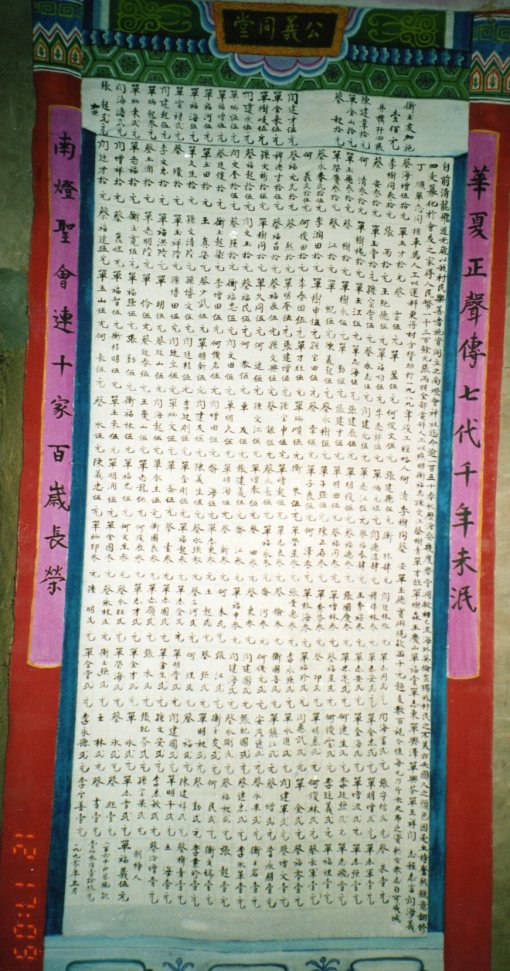
1990 beiwen

1990 donor’s list, by Shan Fuyi.

The trenchant remark of Boss Heng’s wife gives us a pretext to reflect on the status of women in village life. For the record, she’s called Li Shufen! As Shan Fuyi observes, people are not generally aware of women’s names unless they are close relatives.

Screenshot

In Gaoluo, although women are devout in taking part in the ritual activities which the ritual association serves, both spiritual and secular spheres continue to collude in excluding them from learning the ritual music. Their exclusion from the association reflects their exclusion from power and influence in village society as a whole, underlining the persistence of tradition and the limited scope of the revolution. Sexism, like irrational violence, is one aspect of tradition which one could understand the Communists hoping to overturn, but they were largely unsuccessful.

I must preface these comments by admitting that they are entirely impertinent: I have only added to the burdens of both women and men while in Gaoluo, feeling unable to offer any practical assistance, and never transcending my status as a guest. One of our most uncomfortable experiences in these villages is the helpless feeling of colluding in the macho tradition, all men in a group smoking and chatting while the women cook for us. At meal-times, they serve us while the men all sit around the table discussing the Important Things men talk about; the women then get to eat the cold left-overs, often outside in the courtyard, only after we vacate the table and they have served us with tea. Our entreaties for them to join us are laughed away. To be fair, this happens mainly when there are guests: normally the family eats together, though segregation is also sometimes observed.

Thinking of Shan Zhihe and his arranged marriage, or of Woman Zhang and Cai An’s mum with their bound feet, I can’t help observing that despite the continuing glaring inferiority of women’s social position today, there has been some progress—thanks to the enlightened Communist Party, as I joke with them. Young people at least choose their own partners now, and even if the women won’t share the meal they have prepared for the men, they all now have a certain amount in common, standing around making good-humoured jokes while the menfolk are chatting away over their booze and fags.

But progress has been painfully slow. After Liberation, obeying a central decree, the village Party branch dutifully elected a token female head of the new Women’s Association. Under the commune system, the vague idea was that she should implement gender equality and the female liberation campaign, but there was no specific programme, and the position was largely a sinecure. The only thing anyone could remember her organizing was International Woman’s Day on the 8th March, when the women were summoned to a meeting. After the birth-control policy began to be enforced strictly in the 1980s, that became her main duty, an onerous and invidious one, dependent largely on the orders of a male establishment.

While Party membership is the means to career progress, the Gaoluo Party branch, like most others, has made no efforts to “develop” bright young female applicants; as one cadre said, “It’s a waste of time, they’re going to leave the village sooner or later [to get married]”—exactly the reason given for denying women admission to the ritual association. Men join the Party with the prospect of becoming cadres. Women are caught in a neat Chinese Catch-22: they are not considered for Party membership because they are not going to become cadres, and because they are not going to become cadres, there’s no point in admitting them to the Party. As we saw, some girls began to attend school in the 1950s, but seldom progressed to higher grades.

Traditional morality has retained its stranglehold in many respects. There are simply no women in the village with any authority. Any woman seeking an active social role was, and is, likely to be cursed as a slut (“broken shoe”, poxie) by men and women alike. The only publicly active woman I heard of was the mother of formidable He Qing, a respected midwife. Until at least the 1960s, women were just not allowed out of the house, as Woman Zhang’s story reminded us. Women and men did not mix unless they were related. Even at the village opera in 1998, the audience consisted almost entirely of women and children; the few men who wanted to watch clambered onto the rooves or walls.
opera
It’s clearly not that men don’t like opera. Perhaps they are embarrassed to be seen among women and children? Gender segregation is still mutually agreed upon.

Only the new karaoke bar, where separate gangs of teenage boys and girls eye each other up, posturing before the video-CD screen is overthrowing traditional morality, much to their relief and the chagrin of the elders; such bars in the nearby towns are indeed notoriously equivalent to brothels. Hence also the traditional disdain for female opera singers, who display themselves outside the house in the company of men. The female singers in the new village opera group have to watch their step—their reputation is at stake.

Returning to the association rituals, apart from women’s active participation in worship, some major female deities are worshipped, notably the Bodhisattva Guanyin and fertility goddesses like the goddess Houtu. Although the associations are invited to perform for the funerals of men and women alike, it is the eldest son who kowtows to the male leader of the male association to invite it. Donors’ lists for New Year or for special donations for new ritual manuals, god paintings or instruments list the male head of the household. In the secular sphere, government campaigns have long attempted to raise the prestige of female children in China, with wall slogans protesting feebly that “daughters are also descendants”.

slogan
Yet female infanticide remains common; under siege from the draconian birth control policy, women and men alike attend association rituals to pray to Houtu to be granted a healthy son.

The continuing exclusion of women from the ritual associations is all the more disturbing since there is a certain crisis in transmission—not so much as a result of political campaigns culminating in the Cultural Revolution, but rather since the 1980s, as young men desert the villages in search of work, at the same time espousing the modernity of pop music. Meanwhile the potentially gifted daughters of fine musicians remain in the home village, at least until marriage. Yet there is no prospect of adaptation. Girls are neither offered nor do they seek a role in public ritual.

Niu Jinhua

Niu Jinhua (left) with Yan Wenyu‘s widow (among several Gaoluo women with bound feet), 1996.

Since women are such a silent group in our studies, in 1996 we finally had a chat with Niu Jinhua (b.1920), mother of our host maestro Cai An—with great difficulty, I may add, since she is rather deaf; her brilliant granddaughter helped us get through, acting as interpreter. Though women are not allowed to perform the vocal liturgy or the ritual shengguan wind music, they benefit from listening to it as much as men. Asked if she likes the music, she replied enthusiastically, “Oh yes! I’ve heard it all my life, I like to listen, you can’t get tired of it (bufan).” One often hears villagers use this expression about shengguan music, but her matter-of-fact statement will remain with me, summing up its enduring impact; other women we’ve asked also express active enthusiasm. Niu Jinhua goes on, “My old home [Zhangcuitai village, just further north] has a ritual association, just the same as the one here, same pieces, they recite the Buddha too, and hang out the god paintings at New Year.” Cai An chips in: “Yes, I went there when I was young—it’s very like our association.”

As we all smile quizzically, my friend Xue Yibing then asks Cai An’s mother ingenuously,
“Were there ever any women who learnt the music?!”
“Oh no!”, she cackles.
“Why not, then?!”
“It was Old Feudalism in them days, wannit, how could women take part?!”

While I wondered if the fact that women still don’t learn meant that we are still stuck with “Old Feudalism”, her comments sparked off a group discussion (which, for men, was quite observant) on the position of women in village life.

The men, while doing nothing about it, rather like their British counterparts, readily admit that women have a much harder time than men. Their explanation of the male monopoly on ritual is feeble: “The ritual performance of the associations is a business for Buddhist and Daoist priests; what with setting up the altar and burning the petitions, everyone kowtowing, it wouldn’t be convenient if there were women there.” Though I recall that nuns used to perform rituals and even play the shengguan wind music, the point is at least that men and women should be segregated—yet even all-female performing groups are rare in rural China. But after all, women constitute the majority of those offering incense and making vows during these rituals.

The male musicians go on, just a bit more plausibly, “Anyway, women just don’t have the time to study the music; their life is much more harsh, in the old days grinding flour, making shoes, mending clothes, cooking, looking after the kids, they were so busy. Men have nothing much to do except tilling the fields; especially in winter, they have time to learn the music.”

Indeed, men (both in Gaoluo and Beijing) think women’s liberation has gone too far. A familiar male lament is heard: “Nowadays the women even get their husbands to do the household chores!” To be sure, women can have quite a temper, and men commonly deplore their fate with the nice, if sexist, pun “I’ve got tracheitis”, tracheitis (qiguanyan) being homophonous with “hen-pecked” (“wife controls strictly”). One otherwise bright young village boy, back for New Year from his studies at college in Tianjin, couldn’t see what I was on about, claiming rather wistfully that men and women in Gaoluo were entirely equal—overlooking little details like the total absence of women in positions of responsibility, their failure to go on to higher education, their relegation to eating the cold leftovers after the men have taken their fill, and the fact that several Gaoluo wives have been bought. Moreover, since able-bodied men now migrate to the towns to seek work, women are left behind on their own not only to run the house and look after the elderly and young but also to tend the fields. Apart from that, they have a great life…

Though all this doesn’t exactly get to the roots of sexism, I’ve given a couple of vignettes. That’s how things were in Chinese villages in the 1990s; so much for gender equality under Maoism or the reforms. The closest we came to influencing women’s status in Gaoluo was that Cai An’s mum finally got used to being included in a round of cigarettes—hardly a great coup in favour of the global women’s movement.

All this began to change towards the late 1990s when rural girls began to move from secondary education to college in the towns and cities—but that’s another episode in the story.

The Houtu precious scroll

*Click here for link to page!*
(again, under Themes > Local ritual in top menu)

Hot on the heels of my article on the Houshan Daoists, we need a rather more detailed account of the “precious scrolls” (baojuan 寶卷) [1] performed by amateur ritual groups on the Hebei plain.

The four ritual associations of South and North Gaoluo all have early copies of precious scrolls on several themes, but what they, and I, consider their most exquisite volume, the Houtu scroll, was copied only in 1943 (see my Plucking the winds).

While the Ten Kings scroll was commonly recited for funerals until the 1964 Four Cleanups campaign, the Houtu scroll was performed for calendrical rituals—notably the New Year and Houtu’s own festival around 3rd moon 15th, either on Houshan or in the home village (playlist, track 6, and commentary).

The whole point of these precious scrolls is that they are performed for rituals—they’re not musty tomes to be read silently in libraries. And their performance practice—in the hands of peasant ritual specialists—transpires to be rather complex. As I always say, one can hardly study ritual without focusing on how it sounds.

This article is based on my In search of the folk Daoists of north China, Appendix 3, which contains further refs.

HTJ image


The Houshan Daoists

*Click here to read page!*

So far, most of my pages on local ritual have described traditions in Shanxi. The province of Hebei, surrounding Beijing, may seem “too close to home”, lacking the romantic image of either the ethnic minorities or the barren northwest, but it is a remarkably fruitful site for fieldwork.

While the topic belongs with my pages on Gaoluo (under Other publications), I’ve put it under Local ritual, since it sets forth from the lives of Daoist priests.

You can find background on the Hebei plain south of Beijing by consulting the many sources in my introduction here, but one major site in our fieldwork on ritual life there was Houshan 后山, in Yixian county, centre of the cult to the female deity Houtu 后土, whose temple fair I’ve already outlined.

This sketch of the Complete Perfection Daoist priests of the temple there on the eve of the 1949 Liberation again illustrates their close connection with the ritual life of local villagers. In a (lavishly illustrated!) article I introduce the Houshan priests; the village ritual associations and sects nearby which continued their ritual tradition; the rich trove of “precious scrolls” in the region; and nearby temples to Houtu.

Pantheon, Liujing 1995

Daoists of Tianzhen, Shanxi

***Link to this page!***

Click above for the latest in my surveys of household Daoist groups in north Shanxi, including Shuozhou and Guangling (not to mention Yanggao, main subject of this blog), as well as Changwu in Shaanxi. They’re now grouped in a sub-menu “Local ritual” under the “Themes” menu.

Here I outline the history and ritual practices of three families of Complete Perfection Daoists in Tianzhen county—a tradition derived from the Nanmen si temple in Huai’an just northeast.

Ning statuette


Interpreting pinyin

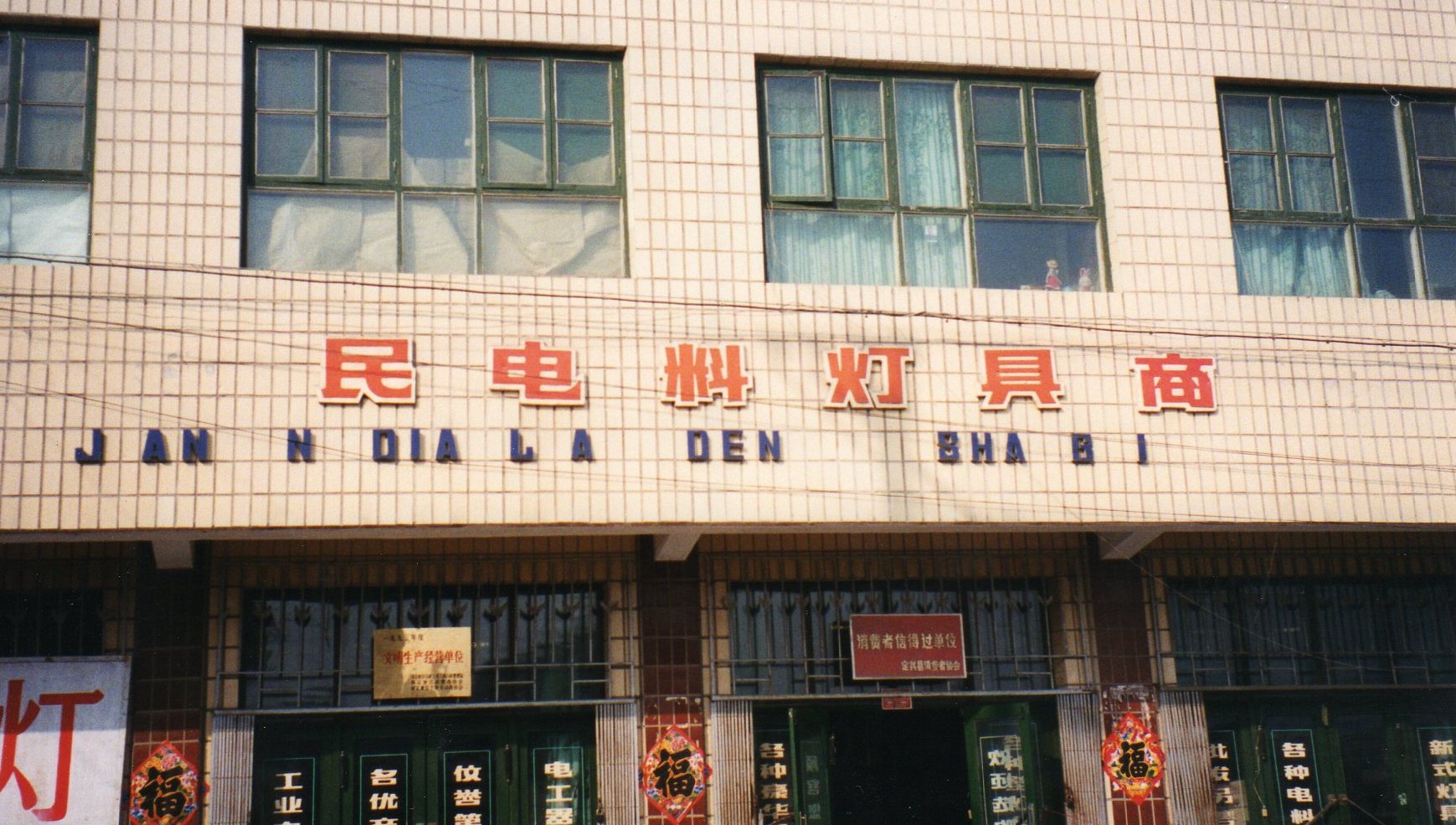
Shabi Dingxing 1995

Another irreverent exploration of the wonders of the Chinese language:

At least until it caught on as an input method for texting, the pinyin system of transliteration was slow to catch on in China, certainly in the countryside. I took this mystifying picture of a shopfront in Dingxing county (Hebei) in 1995, as a little interlude between hanging out with ritual specialists, filming rituals, and photographing—aww, you guessed it—ritual manuals.

It’s actually an electrical and lighting store—the relevance of this only transpires gradually, since such tenuous relations as the notional pinyin may bear to the Chinese characters above it are only intermittent and haphazard. On closer inspection, some of the letters (indeed, a couple of characters too) have dropped off (as in the classic “His R’s fell off”).

Interpreting ancient literature can be like that—I think, for instance, of the labours of Sir Harold Bailey in deciphering fragmentary medieval texts excavated from Khotan. So perhaps this is where a certain sinological training comes in handy. *

The cryptic motto begins to make more sense when we add speculative punctuation—evoking two aspiring young Cali actors (let’s dispense with “actresses“) embarking on a Bollywood-themed club night (a text alerting the paparazzi, perhaps):

Jan ‘n’ Dia—L.A. den “Bhabi!”

Or is it even an invitation to anagrams?

Dahlia nabbed ninja
A banal jihad binned
Albania Hadj bin-end

I should’ve gone to Specsavers, but as I pondered the sign in a desperate search for meaning, the reason I took the photo was that I misread the final word as SHABI, “fuckwit”—actually a very popular expression that is considerably less shocking in Chinese than its literal meaning of “stupid cunt”. Anyway, I still like to think that SHABI is what it says.

Upon mature [sic] reflection, I strongly suspect that was indeed closer to the effect they were aiming for. If we posit a missing final character dian 店, then the last two words would be SHANG DIAN (“shop”), but either they couldn’t tell the difference between their stock of S, B, and D letters, or they just didn’t have enough of them—you know, the old fridge-magnet dilemma. Anyway, with superfluous letters suitably discarded, it really could emerge triumphantly as SHABI.


While my suggestions for the fragment may be poetic, the erudite Victor Mair on Language Log has reconstructed the original text:

Dìngxìng xiàn jiànmín diànliào dēngjù shāngdiàn
定兴县建民电料灯具商店
Dingxing County Jianmin Electrical Materials and Lighting Store,

and he even found it at no.21 in this list!

Temple murals of north China

Temple ritual, Yuxian 2014. Photo: Hannibal Taubes.

Further–waay further—to my page on the Guangling DaoistsHannibal Taubes has a fine, ever-growing, website documenting his ongoing research project (worthy of further funding!) on the iconography of rural temples in north China, with wonderful photos of murals taken by him and his assistants.

One of his main sites is the Yuxian–Guangling–Yangyuan region on the border of Hebei and Shanxi. The project—reminiscent of that of Willem Grootaers in the 1940s—is another illustration of the hidden depths of ritual culture in north China, so long a poor cousin of the south.

Such work can be a valuable adjunct to fieldwork on ritual practice. I hesitate to look forward to Hannibal expanding his already vast project to ritual paintings, and incorporating temple steles too…

Material like this may be more fruitful for the study of deities than for actual ritual life. But just a couple of examples from the website that do suggest the latter, from village temples in Yuxian just southeast of Yanggao. This is from a Dragon King temple in Yuxian, perhaps dating from the late Qing:

full mural lowres

Photo: Hannibal Taubes, 2018.

Here are two details of the procession at the foot. Leading the way, as ever, is a shawm band—in uniform, which by the 20th century was discarded:

chuishou lowres

Photo: Hannibal Taubes, 2018.

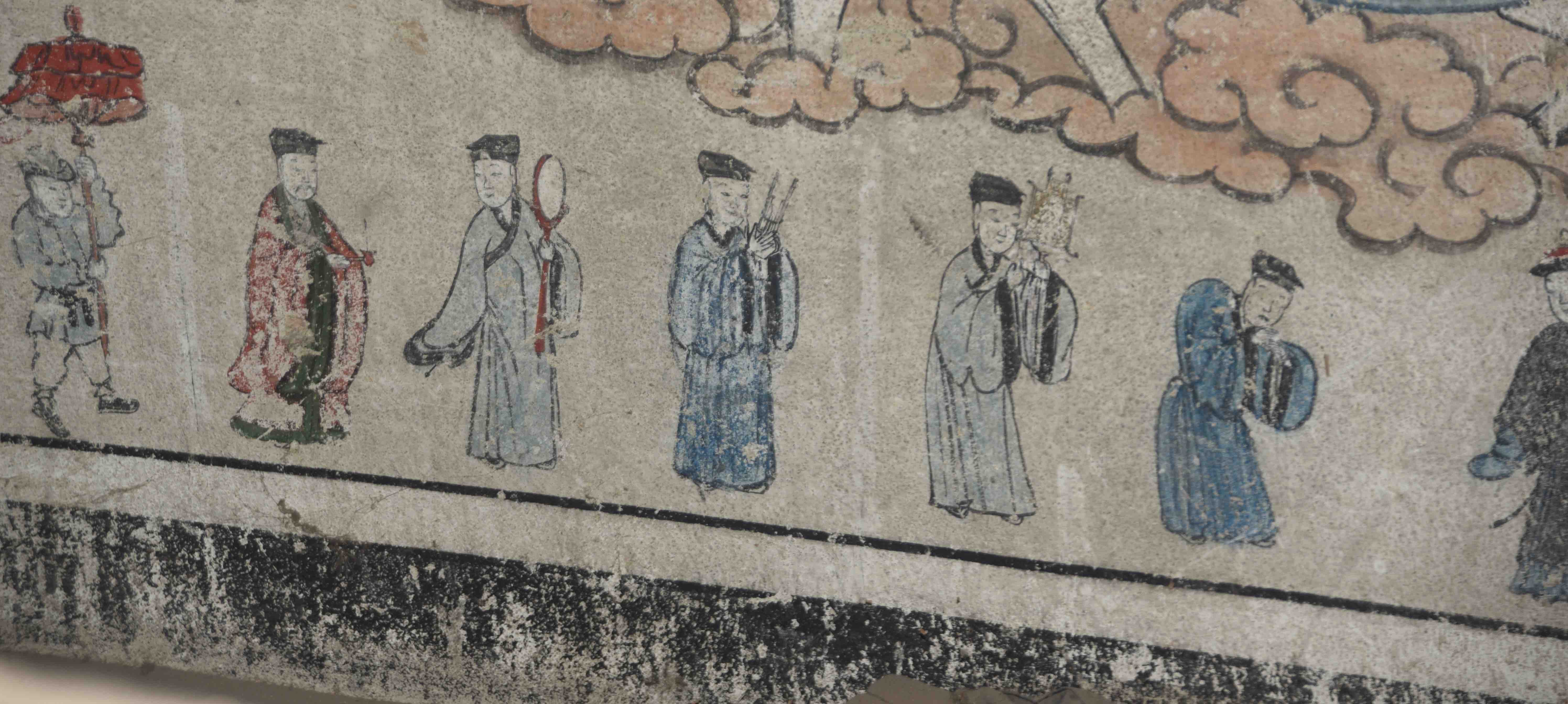
Bringing up the rear, on the left (after the temple helper bearing the ritual umbrella) it shows a Daoist band—with chief vocal liturgist, a drum master, and players of the sheng mouth-organ, yunluo frame of ten gongs (now quite rare in the area), and guanzi oboe. The outsider might easily fail to notice that the latter figure (far right) is playing the guanzi—but locals, experiencing the shengguan ensemble at their village rituals all their lives, will recognize it at once.

yinyang lowres

Photo: Hannibal Taubes, 2018.

I won’t quibble with the marching order—the drummer always leads the way, but hey.

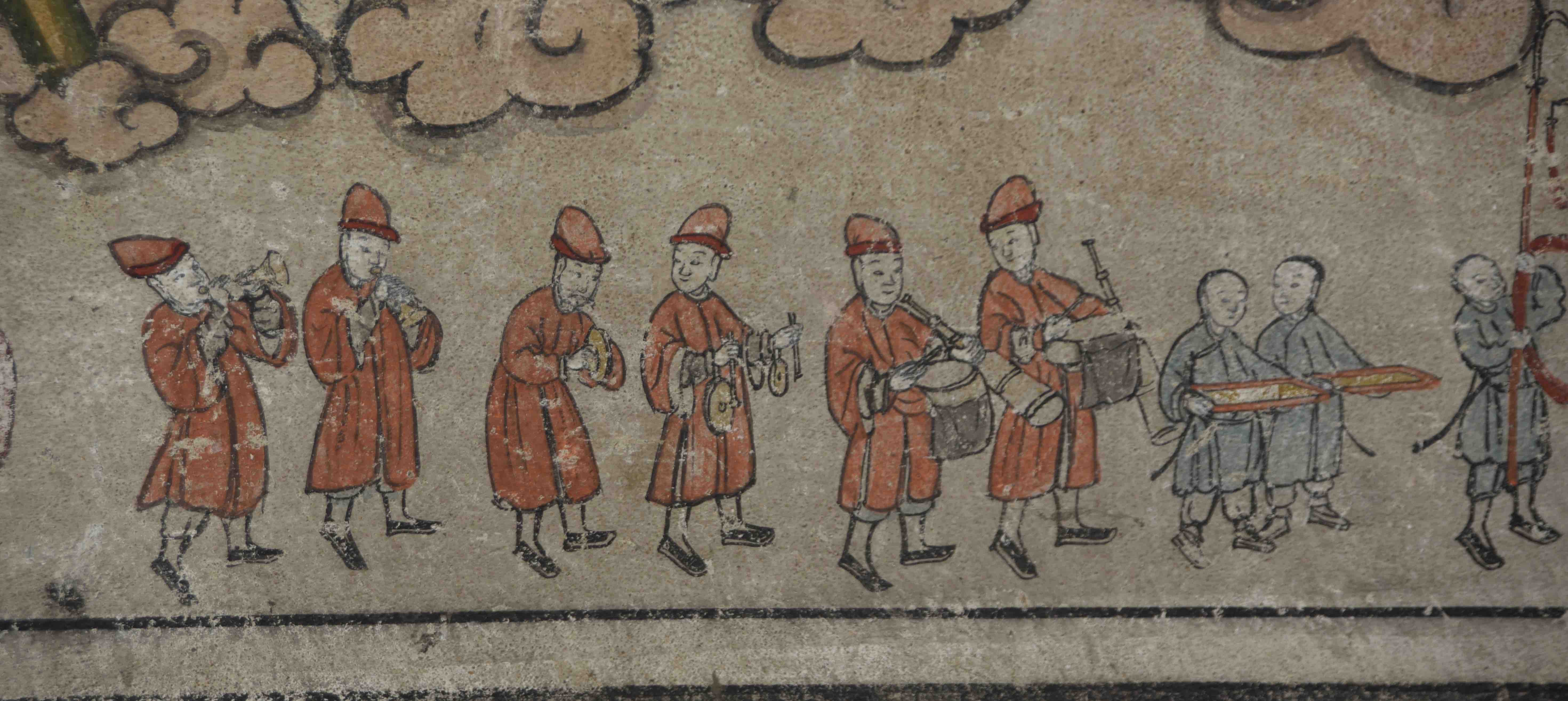
Below we see a similar quorum from another nearby Dragon King temple, dating from 1709. Here they wear the same red costumes as household Daoists today—as do the two trumpet players leading the way, though they should be from a separate shawm band…

Daoist procession

Photo: Hannibal Taubes.

As with any such iconography (one thinks of Renaissance depictions of angel musicians), we are confronted with the issue of how “realistic”, or how generic and idealized, such depictions may be as a portrayal of local ritual life at the time. This detail from my photo of a ritual painting by Li Qing’s Daoist uncle Li Peisen undoubtedly shows an authentic view of a 1940s’ ritual band (standing) such as the one that he himself led, with a group of seven—two guanzi, two sheng, yunluo (only three gongs?!), drum, and small cymbals:

painting-detail-cropped

The dizi flute, usually a member of the full shengguan ensemble, was perhaps less often used on procession—indeed, it’s largely fallen from use in this area since the 1990s. For the public ritual in the painting, the Daoists wear their red fayi costumes over their black dashan costumes, just as today. Interpreting such details is naturally informed by knowledge of the current scene.

Apart from another ambitious collaborative project on Shanxi temple murals, Hannibal is now further presenting his vast archive in a separate website, which I introduce here.

Of course art is a valuable adjunct to our studies of ritual and religious life, but with my own stress on performance I find myself frustrated that it’s static, two-dimensional, and silent. But whatever your angle on Chinese religion, Hannibal’s sites are fantastic new material, with rich potential. For his recent article on the use of perpectival painting, click here.

Diary of a household Daoist

LMS 1992

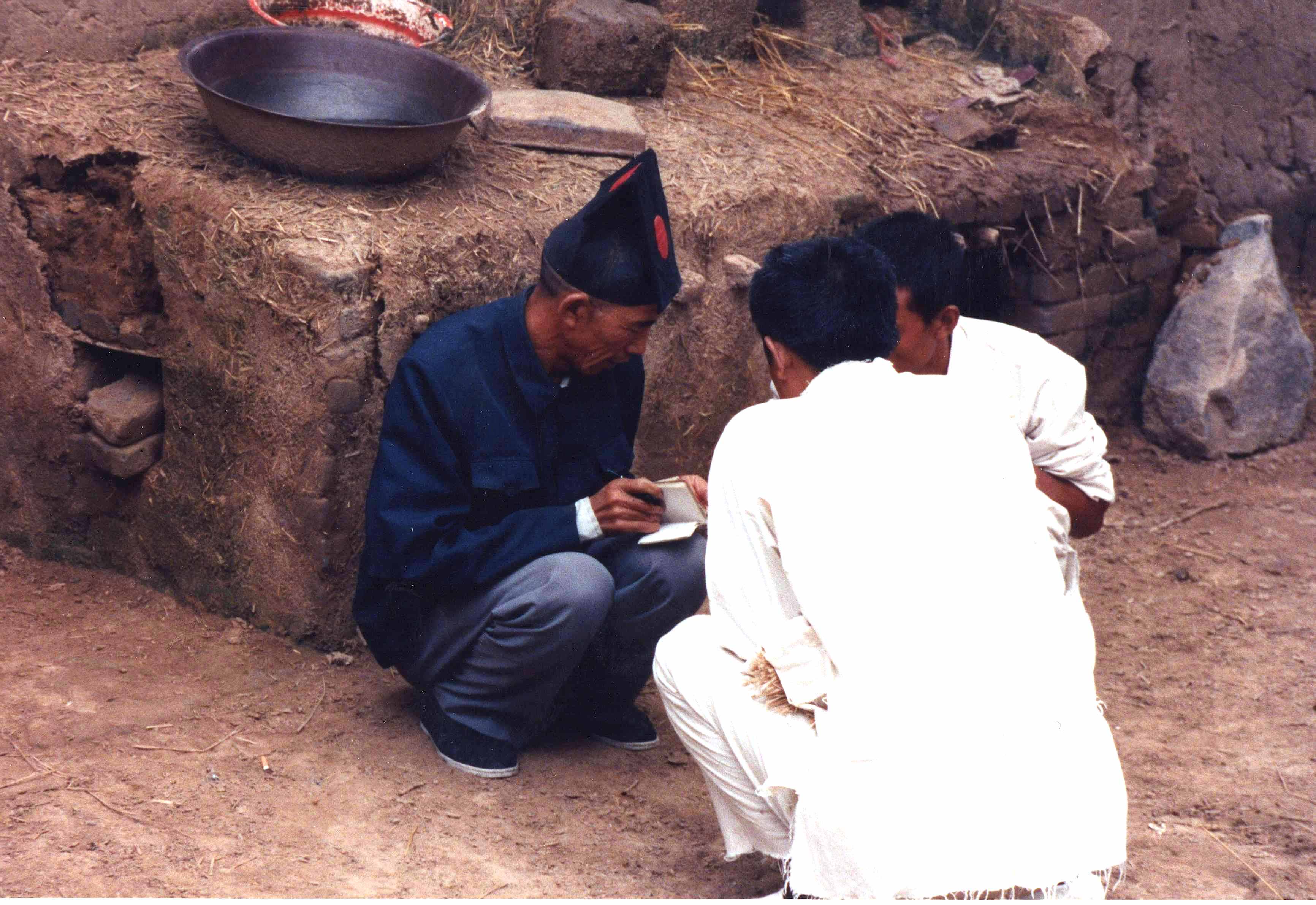
August 1992: In a brief break between ritual segments of a funeral led by Li Qing, his son Li Manshan consults with another family to determine the date for a future burial.

In my book (pp.18–21) I gave instances of the daily ritual schedules of household Daoists Li Manshan and his son Li Bin. They’re always so busy that Li Bin has only just found time to report back to me on what they’ve been up to recently. Apart from all the necessary research into the ancestry of ancient ritual texts, and so on, such diaries are an illuminating aspect of the ethnography of Daoist ritual practice. Apart from my film and book, Li Bin is also one of the protagonists of Ian Johnson’s The souls of China.

Li Manshan, now 72 sui, has recently been scaling down his activities a bit—mainly doing funerals in the immediate vicinity, and determinining the date. But since the band’s “triumphant return” (Kaixuan guilai 凯旋归来, on which more anon) from our mini-tour of France in May—and indeed throughout the previous months—Li Bin has hardly had a moment of free time. As he tells me,

The thing that’s the most hassle is when I get two or three concurrent funerals, having to arrange personnel and all the equipment. Each band needs suitable liturgists, wind players, percussionists, and someone to write the documents. And I have to make sure all the various sets of costumes and equipment are complete.

Until the 1950s their ritual work consisted of three types of “scriptures”: funerals, temple fairs, and (through the winter) Thanking the Earth rituals for individual families. The latter two types are now rare, so since the 1980s’ revival the vast majority of their business consists of funeral rituals and all the associated proprieties surrounding a death. But for reputable Daoists like Li Manshan and Li Bin, this alone can be a full-time occupation. In this area south of the county-town they are the most popular group performing such tasks, but there are others.

Before we look at Li Bin’s diary day by day, some more background. Funerals commonly last one and a half days. It’s very tiring work, performing from 7am to nearly midnight on the first day, with a whole series of long processions. As I say in my book,

Excuse the facile analogy with Western art music, but just the seven visits to the soul hall are like doing two motets and five cantatas over the course of the day—plus a few oratorios, and (previously, for temple fairs) six long symphonies.

For the wind players (like Li Bin) especially, accompanying the liturgy is tough physical work.

And on the following morning they make the lengthy burial procession from 8am to midday—as well as all the solo work of Li Manshan or Li Bin in exorcizing the house and checking the precise alignment of the coffin in the grave. Apart from singing the vocal liturgy, they have to double on the wind instruments and ritual percussion.

As I have also described (my book, ch.17), in addition to the two other core members Golden Noble and Wu Mei, Li Bin and Li Manshan need a pool of deps—some regular, others occasional—from the ranks of other local Daoist families and shawm bands. Using his smartphone, Li Bin has to keep a careful note of the fees he owes them; and he’s constantly driving round from village to village with his car packed with ritual equipment—ritual instruments and costumes, paper artefacts, mourning weeds for the kin, duilian and diaolian mottos to paste up at the soul hall and scripture hall, and so on.

Li Manshan prepares most of the mottos at home; he, Li Bin, or Golden Noble will also have to find moments during the funeral to write other ritual documents to be burned for particular ritual segments. At least recently they have deputed to the junior Daoists the lengthy and fiddly task of decorating (and later dismantling) the soul hall.

Usually the first day’s rituals come to a close around 11pm with Yellow Dragon Thrice Transforms Its Body (magnificent percussion coda to the Transferring Offerings ritual) and the Escorting Away the Orphan Souls segment (see my film, from 1.11.07), but sometimes the host asks them to do a lengthy Sitting through the Night sequence into the small hours (playlist, track 3—see my notes). Until quite recently the six Daoists routinely dossed down for the night in a row on the kang brick-bed of the “scripture hall” (making room for me too, a fond memory), but now with the improved road network, given the rather basic conditions of most scripture-hall hosts, they sometimes zoom off back home on their motor-bikes. If the funeral isn’t too far away, Li Bin often drives back to his home in town—not least in case he needs to bring more equipment for the burial next morning or his next stop thereafter. But each night on reaching home after a seventeen-hour day, he always remembers to light incense before the statuette of Zhang Daoling in his funeral shop.

Apart from determining the date for funerals, siting the grave and decorating coffins (also both lengthy processes), booking the band, and then performing the rituals—not to mention the daily business of running his funeral shop and making paper artefacts with his wife—Li Bin is always busy doing consultations to determine the date for weddings, construction work, journeys, and so on.

I have to field constant phone-calls every day. Sometimes I determine the date over the phone for “moving the earth” (dongtu 动土) for building work. Over the phone people can go on for ages about weddings or opening a new business—often when I’m right in the middle of some really busy arrangements. It’s a real hassle, but I can’t refuse…

Free-lance musos in London would be only too happy to have such a full diary, but it comes at a cost. As a freelancer myself, I’m glad he’s in work; he has bills to pay, but I hope he gets a bit of time off occasionally. We can well understand why Daoists don’t want their sons to continue in the family tradition.

Li Bin 2011

Li Bin (Li Manshan’s son, 9th generation) on sheng, 2011.

These notes cover the period from their flight home from Paris on 22nd May through to 8th August.

From the map below we can also see the rather typical radius of their ritual activity. Apart from the occasional funeral in Yanggao town, and a rare visit to Datong city, they work mostly in a small area in east-central Yanggao, around the Li family’s old home of Upper Liangyuan and Gucheng district just south. You can click on the place-names in the sidebar to see dates. For another map of the area (also indicating location of other Daoists groups now and before the 1950s) see here.

The Li band may cater to the mortuary needs of many of these individual villages a dozen or so times each year. And they have done so for several generations, with many trusted friends in places like Yangguantun, Pansi, Luotun, and so on.

May
22: we take 23.20 flight from CDG to Beijing;
23: landing at 15.20, 21.40 train from Beijing station.

  • 24: our train from Beijing arrives at Yanggao at 3.44am. At 4am [!] I drive down to Upper Liangyuan (dropping off Li Manshan at home) to help the Sun family prepare for funeral, then I drive back to town again to fetch equipment for them. I determine the date of the burial for 3rd June. 8am: to Shangzhuang to determine the date for a burial there (1st June).
  • 25: I decorate the coffin for Shangzhuang.
  • 26: I decorate the coffin for Upper Liangyuan, and site the grave.
  • 27–28: funeral at Upper Liangyuan for Zhao Xilin (date already determined before French tour).
  • 29: making paper artefacts, preparing for the Shangzhuang and Upper Liangyuan funerals.
  • 30–31: two concurrent funerals at South Luoyao and Pansi
  • 31–June 1: funeral at Shangzhuang.
    June
  • 1: after the Shangzhuang burial, to Houguantun to determine date for burial (12th June, a simple solo “smashing the bowl” ritual—see my book, pp.193–4).
  • 2–3: Upper Liangyuan funeral. After burial, back home to make more paper artefacts.
  • 4–5: funeral at Anzao.
  • 6: making paper artefacts.
  • 7–8: funeral at Zhaoshizhuang.
  • 9–11: three days free to make paper artefacts. Hardly any rest since we came back from France.
  • 12–13: two funerals, at Huiquanzi (in Yangyuan, Hebei) and Houguantun.
  • 15–16: funeral for Sun family in Upper Liangyuan (Li Manshan’s home village).
  • 20–21: two funerals, in Wangguantun and Yanggao county-town.
  • 22–23: funeral at Shizitun; 23 pm I determine the date in Luotun, for burial on 4th July.
  • 25–26: funeral in Lower Liangyuan.
  • 28–29: funeral at Shizitun; 29 pm I determine the date in Yangguantun, for another burial on 4th July.
    July
  • 1–2: funeral at Yousuoyao; I also determine the date in Houguantun, for burial on 8th July.
  • 3–4: funeral at Luotun. [4: burial at Yangguantun]
  • 7–8: two funerals, at Yangguantun and Houguantun. 8: after the burial at Yangguantun, another old person has died, so I go to determine the date—for 5th August.
  • 9: three families come to determine the date for their weddings.
  • 11–12: funeral in Datong
  • 14–15: concurrent funerals in Anzao and Zhanjiayao.
  • 16: coming-of-age party (yuansuo 圆锁) in town for friend’s son (cf. the scene of the party for Li Bin’s own son in my film, from 5.25).
  • 18: massive downpour in the northern hills; two killed as floods carry off a tractor [Li Manshan summoned to determine the date for a burial there].
  • 20–21: funeral at Upper Liangyuan.
  • 22–23: funeral in the county-town.
  • 27–28: funeral at Fantun (just east in Tianzhen).
    August
  • 2–3: funeral at Lower Niangcheng.
  • 4–5: funeral at Yangguantun.
  • 7–8: funeral at Sibaihu. On the afternoon of the 8th, after the burial, just northeast all around Jijiazhuang, Lanyubu, and South Xutun, extreme windstorm and hailstones destroyed cornfields; one family in Jijiazhuang lost 40 mu of peppers.

For Li Manshan’s ritual schedule for 2019, see here; and during the Coronovirus scare, here.


With thanks as ever to Li Bin and his son Li Bingchang
(also an Ariana Grande fan, I learn).

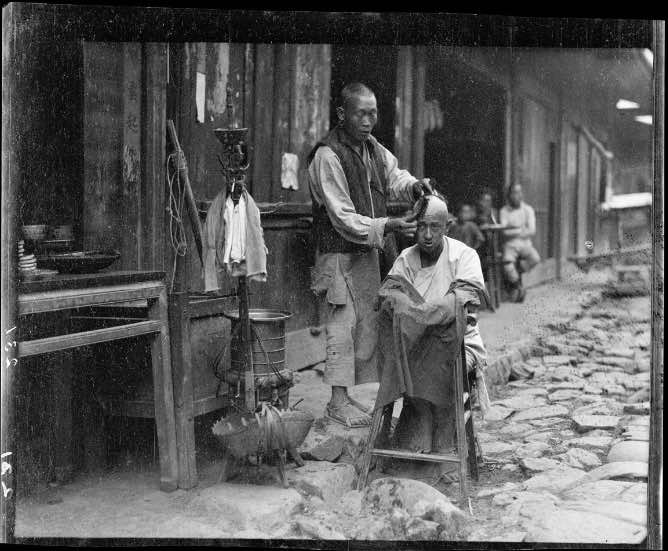
At the barbers

Barbers 1917

Notwithstanding the constant transformation of Chinese society, Sidney Gamble’s photo from around 1917–19 shows a scene that is still common in rural China today (for his remarkable collection, see here; and for the Miaofengshan pilgrimage, including Gamble’s early film footage, here. And for more fine historical images, see this site).

I was wont to have my head shaved even before I began doing fieldwork in China. But since the older generation of peasants in north China tend to do so (mainly for the sake of hygiene), I emulate them while I’m there.

Early in the course of my long-term work with the ritual association of Gaoluo, one demonstration of our developing relationship was my decision to have my hair cut in the village. From my Plucking the winds (pp.205–6):

Our visits through the hot summer of 1993 were our first since our initial one in 1989. Though now engaged on a general survey of many villages, we were increasingly drawn to Gaoluo, returning there frequently, and despite the recent theft, we spent many happy times together. We used to sit outside on low stools in the shade of He Qing’s courtyard, with Cai An, Li Shutong, and others gathering round for a chat and a smoke. This was the time when we appreciated the depth of He Qing’s knowledge. And our major musical discovery that summer was the vocal performance of the magnificent Houtu scroll (audio playlist, track 6, and my notes here].

GL haircut

He Junqi prepares to cut my hair. Left: our fine MRI driver Little Deng; behind him, in white, maestro He Qing.

I admired the closely cropped heads of many of the musicians, and tend to do without much hair in the summer myself. He Junqi (then 54), a regular visitor to He Qing’s house, son of the sweet elderly flautist He Yi, used to cut the musicians’ hair for them, so I asked him if he’d like to do mine. Everyone stood round having a good laugh, while He Junqi gave me the most meticulous haircut and shave of my life, scouring my scalp with local “White Cat” washing-powder.

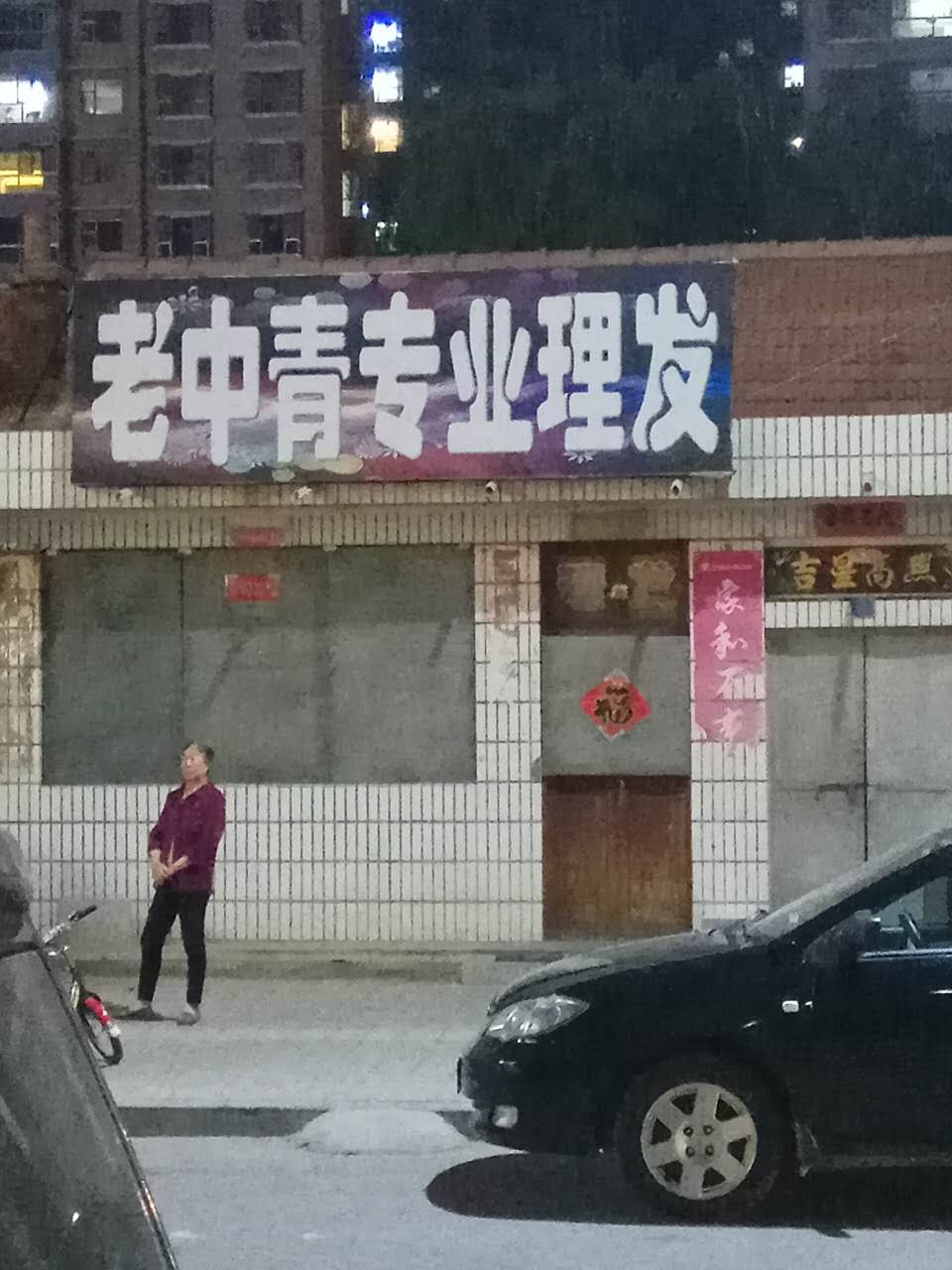
And since 2011, a regular haunt of mine on visits to Yanggao to hang out with Li Manshan and his Daoist band is the Barber for Old, Middle-aged and Young (Laozhongqing 老中青) in town, just round the corner from Li Bin’s funeral shop.

laozhongqing

Photo: Li Bin.

Since we all agree that I look years younger with my head shaved, we soon glossed the name as “Old Jonesy is younger” (Lao Zhong qing 老钟轻)—yet another in our series of merry puns

More Chinese wordplay, and a poem

or
What’s in a name?

My Chinese name Zhong Sidi 鍾思第 was given to me by the great Tang-music scholar Yin Falu 陰[阴]法鲁 (1915–2002) at my first supervision with him during my 1986 study-period at Peking University.

“Zhong” (Bell) approximates to my surname Jones; while itself a common surname, for me it has nice echoes of both ritual and music, evoking both Zhong Kui 鍾馗 the ugly drunken demon-queller (Ha!) and the woodcutter Zhong Ziqi 鍾子期, zhiyin soul-mate of qin zither master Bo Ya in the famous ancient story. And even Zhongli Quan 鍾離權, one of the Eight Immortals—a bit of a stretch, perhaps, since Zhongli is a rare double-surname (see here), but hey. Not to mention the huangzhong 黃鍾 and linzhong 林鍾 pitches of the ancient tonal system!
“Sidi” is short for “Sidifen”, a transliteration of “Stephen”. * Professor Yin chose the characters 思第, which in classical Chinese mean something like “mindful of advancement”—which is elegant but somewhat ironic, since I’ve always had enough of the hippy in me to mitigate against any worldly success (it never occurred to me that I might ever get a job, and sure enough I never did).

Without the bamboo radical at the top, the character di 弟 following the si would be a female name: “wanting a little brother”—one that peasants, disapppointed at having a daughter (yeah I know), do indeed sometimes adopt. And one cultural official in Yanggao, moved to write an article about my fieldwork there, somehow miswrote the character as 娣, with the female radical at the side. When I showed it to Li Manshan, we had another typical exchange:

Me: “WTF?! Doesn’t he know how to write my bloody name by now?”

Li Manshan (peering pensively at the character): “Maybe he thinks you’re a hermaphrodite…”

Anyway, as my interests soon transferred from early music history to living traditions of folk music (see here, and here), Yin Falu was remarkably tolerant of my frequent absences to go and hang out with peasants—as was Yuan Jingfang, my supervisor at the Central Conservatoire the following year. I’m also deeply grateful that Yin Falu introduced me early on to Tian Qing (then a lowly and impoverished research student!) and the Music Research Institute, beginning a fruitful long-term collaboration.

* * *

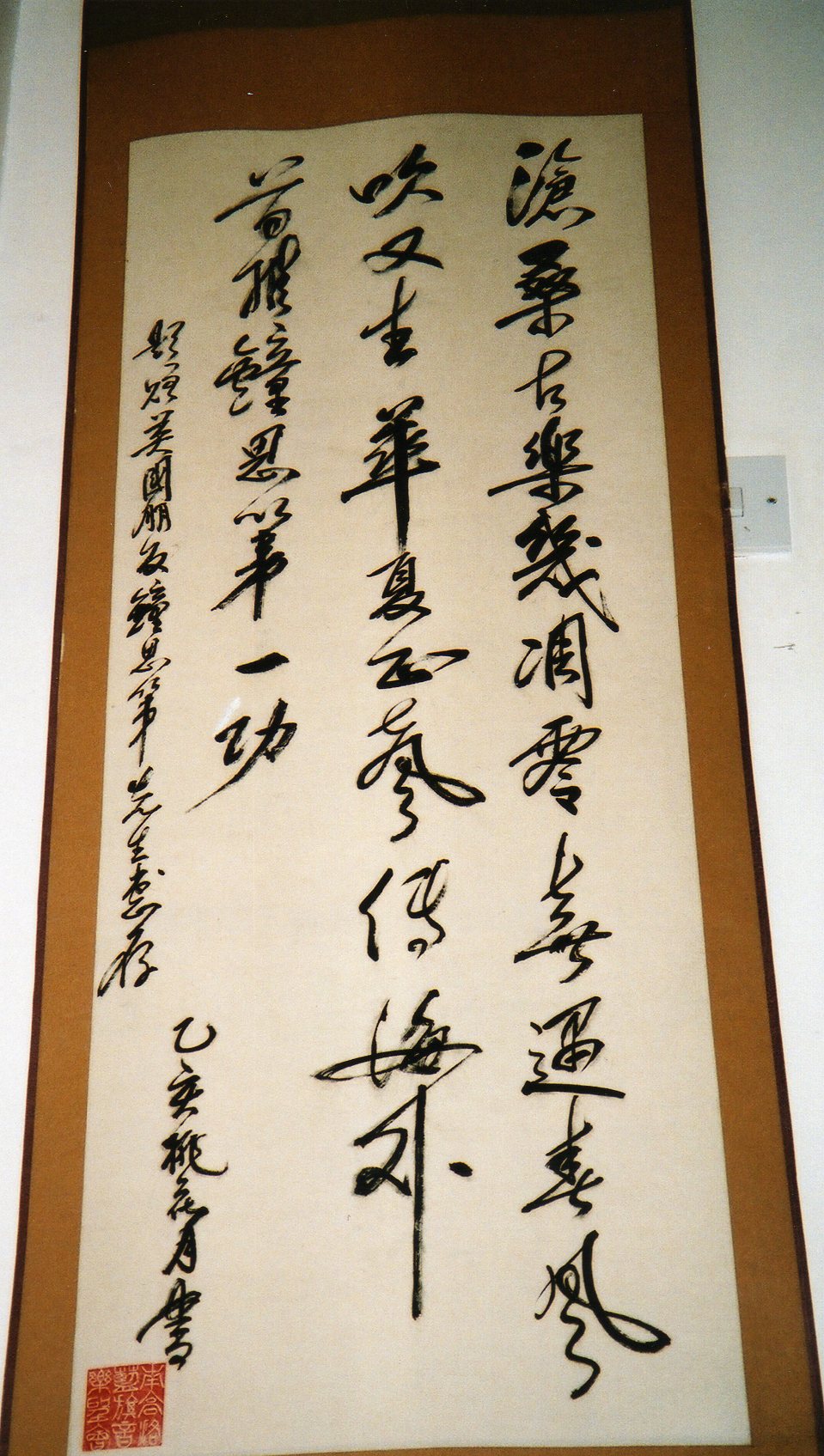
One of the most treasured gifts I’ve received is a scroll that the ritual association of South Gaoluo gave me in 1995 on the eve of my return to Europe (see my Plucking the winds, pp.236–8). They went to great trouble to have a piece of calligraphy made for me, which illustrates their ingenuity. First they “collectively” composed a poem, led by Cai Yurun and the urbane brothers Shan Ming and Shan Ling, most literate of the musicians. They then travelled to town to buy good-quality paper, went and found artistic Shan Fuyi (peasant xiucai litterateur, himself a great authority on the village’s history) at his work-unit and got him to do the calligraphy. To have the paper mounted, they then took the bus to Baoding, where they had a contact from Yongle village who had worked in the prestigious Rongbaozhai studio in Beijing. All this was a complex process, expressing their appreciation of our relationship.

GL scroll

The seven-word quatrain itself shows not only their literary flair but also their own perception of the significance of my fieldwork:

How rare the strains of ancient music
Gladly meeting the spring breeze, blowing is reborn
As the proper music of the ancient Chinese is transmitted beyond the seas
First to be praised is Stephen Jones

There are several charming puns here: in “blowing is reborn” (chui you sheng), “blowing” alludes to the breeze but also clearly to their wind music, and the “born” of “reborn” is homophonous with sheng 笙 the mouth-organ. The last line, impossible to translate, incorporates the device they had been seeking all along: the character di of my Chinese name Zhong Sidi is also an ordinal (as in diyi “first”, di’er “second”, and so on), so by playing with the caesura they managed to incorporate it into a meaningful phrase.

They couldn’t have thought of a better gift. I adore it, not for its flattery—foreigners in China are only too accustomed to receiving extravagant and groundless praise—but because they expressed their appreciation of our bond with such creative energy. In our everyday dealings, the musicians are all too used to me forestalling any incipient flattery by my favourite Chinese phrase, beng geiwo lai zheyitao 甭给我来这一套 “cut the crap”. This expression also comes in handy whenever someone is so sentimentally drunk that they, suddenly moved by the sheer fun of our fieldwork, rashly let out the awful Chinese cliché “international cultural exchange“.

My friends call me “Old Jonesy” (Laozhong 老钟), which is also a jocular way for Chinese people to refer to themselves (老中, for Zhongguo 中国 China) as opposed to laowai 老外 “foreigner”, even “Wog”. Laozhong then leads onto Naozhong 闹钟 “alarm clock”. (For nicknames in the music biz, see here.)

For Craig Clunas’s Chinese name, click here.


* Talking of transliterations of foreign names (see here and here), “Stephen” is conventionally rendered as 斯蒂芬. That last fen character is shared with Beethoven (Beiduofen 贝多芬), whose characters, following the brilliant (if controversial) gender analysis by Susan McClary, I like instead to render as 背多粪 “shouldering a load of shit”—“but that’s not important right now”.

Gaoluo: a restudy, and my role

Thankfully, I am rarely the object of interview—far more often the interviewer asking fatuous questions. I mentioned one such encounter where I failed in my task of giving snappy predictable answers, as well as Jack Body’s original take on my stammer.

Far more in-depth in nature is the new PhD thesis

  • Zhang Lili 张黎黎, Lun Zhong Sidide Nan Gaoluo yinyuehui yanjiu 论钟思第的南高洛音乐会研究 [On Stephen Jones’s research on the ritual association of South Gaoluo] (Beijing: Zhongguo yishu yanjiuyuan 中国艺术研究院 2017),

on my own relationship with the ritual association of South Gaoluo village, and my whole approach. Referring to my book

she consulted me over a long period with frequent and detailed emails, and it has been most stimulating for me to reflect on my fieldwork. Her thesis (supervised by the illustrious Tian Qing) is enriched by several visits to Gaoluo—allowing her to make what is effectively a restudy, updating my history of the village and its ritual practice in the light of their later adoption into the dreaded Intangible Cultural Heritage (ICH) razzmatazz, with all the problems that it entails.

She explores the association’s memories of my visits—prompting further reflections from me here, leading to this page suggesting my challenge to the official narrative. She also discussed our work on Gaoluo, indeed our whole project on the Hebei ritual associations, with my fellow-fieldworkers Xue Yibing and Zhang Zhentao—a fruitful collaboration that stimulated us all.

MYL played

Taking part in the New Year’s rituals, 1998.

And my work in Gaoluo (from 1989 to 2001) may be seen as a blueprint for my later in-depth study with the Li family Daoists (going back to 1991, but intensive since 2011). The subject of the former was an amateur village-wide group, whereas the latter are an extended occupational family of household Daoist ritual specialists—but the principles of thick description and participant observation remain similar.

On my own “method”, at first I can’t really see what the fuss is about: isn’t this what anthropologists do?! Even in China there are many fine ethnographers, such as Wang Mingming, Guo Yuhua, Jing Jun; and in music (apart from Xue Yibing and Zhang Zhentao), Xiao Mei, Qi Kun, Wu Fan, and so on. They’re much better equipped than me for such work.

But sure, two decades ago my approach was more detailed, and personal, than was then the norm in Chinese musicology. The anthropologists whose work I was myself only beginning to digest—even those fine Chinese scholars who were later to become leading figures—were still hardly known in China. I was educating myself by reading up on both modern social-political background for China and wider ethnomusicological studies (Plucking the winds, Appendix 1). By now, such an approach is less remarkable, but then I found myself somewhat ahead of the game in ethnography—certainly within Chinese musicology, where the “living fossilsflapdoodle has remained hard to erase. Another approach that I took for granted was participant observation—a routine expectation in ethnomusicology, but still virtually unknown either in Chinese musicology or in studies of Chinese ritual.

Anyway, it will be good to see Zhang Lili’s restudy of Gaoluo, with further illustrations of the perils of the ICH.

Ritual life around Xi’an

Xi'an miaohui lowres

A new page (under Themes in Menu) introduces changing ritual life around Xi’an, setting forth from my visits since 1986 and the work of the late great Li Shigen.

It accompanies the new track 11 on the audio playlist, with comments here.

As so often for north China, all the musicological studies are very desirable, but there should be far more to it than that. It can’t be left only to musicologists—it’s just as much a topic for historians, ethnographers, and scholars of religion.

Yet more heritage flapdoodle: Hongtong

Hongtong 1
Further fodder for my distaste of the heritage shtick—thanks again to Helen Rees, my Word on the Street, I’ve been reading an interesting article by Ziying You,

  • “Shifting actors and power relations: contentious local responses to the safeguarding of Intangible Cultural Heritage in contemporary China”,
    Journal of folklore research 52.2/3 (2015).

And now she has published a book on the topic, which I look forward to reading:

Hongtong cover

Hongtong county, in south Shanxi, is always cropping up in studies of local culture in north China—notably since it was used as a huge migration transfer centre to areas further north and northeast that had been depopulated by the appalling dynastic warfare of the early Ming. Like many villages on the plain south of Beijing, Gaoluo, subject of my book Plucking the winds, is said to have been founded as a result of this migration; and Li Manshan’s lineage moved north to Yanggao just around this time. [1]

It’s a long time since we’ve featured The China Daily, so I’m delighted to cite a 2012 article here:

A step into Hongtong county in southern Shanxi province and I found myself transported into a land filled with fairy tales.

YAY! The paper hasn’t lost its old magic, then. It does provide a couple of charming pieces of folklore:

The Chinese term used today to mean “go to toilet” or jie shou is also linked to the legend.
The migrants had their hands tied behind their backs when they migrated. They were only allowed to untie their hands when they needed to relieve themselves. Jie shou, which literally means to untie the hands, gradually became the term used for “go to toilet”. The expression spread widely to the provinces where the Shanxi migrants were sent.

Another interesting tale on Hongtong involves a woman by the name of Su San in the Ming Dynasty, who became probably one of the most well-known prostitutes in Chinese history.
Su met young scholar Wang Jinglong at her brothel. The two fell in love and Wang stayed with Su for a whole year but was later chased out of the brothel because he ran out of money. Su was then sold to another man as concubine. She was framed for murdering the man, imprisoned and was sentenced to death.
Meanwhile, Wang who attempted the imperial examination, did well and was appointed governor of Shanxi. He heard about Su’s case and helped with the investigation to deliver her from death row.
The lovers eventually got married and as how all fairy tales end, they lived together happily ever after.
The story has been adapted as a Peking Opera play The Story of Su San (Yu Tang Chun) and became one of the best-known Peking Opera plays in China. Hongtong county where Su San was imprisoned became well-known through the play.
Although the original prison was severely damaged during the “cultural revolution” (1966-76), the present one restored in 1984 retains all its original features. For example, there is a cave used for dead bodies, and a well with very small mouth to prevent prisoners from jumping in to kill themselves.
Su San’s story has brought fame to the prison, making it a must-see in Hongtong. Today the site is renamed as “Su San Prison”, and her story is presented by a series of wax statues within the site.

Damn, I’m trying to write about the ICH here… Led astray by The China Daily“typical!”

Anyway, Ziying You’s article concerns Hongtong as the site of an enduring cult to the ancient sage-kings Yao and Shun, in which several villages form a she parish, with temple fairs and processions. [2] For ICH purposes it is nominated as Hongtong zouqin xisu “the custom of visiting sacred relatives in Hongtong” [3] — and yes, sure enough the term “living fossil” rears its ugly head again.
Hongtong procession
Though not currently on the UNESCO “Representative list” for the ICH, it has been inscribed on the provincial and then national lists since 2006. With typical official razzmatazz, local cultural cadres set up a “Hongtong Centre for the safeguarding of ICH”, niftily bypassing the temple committees which are the lifeblood of the whole tradition.

BTW, as at many such festivals, I see no signs here of liturgical sequences of ritual specialists—only large groups of gong-and-drum ensembles (which are also widespread in Shanxi).

By contrast with the alacrity of cadres,

For most ordinary people, ICH was a foreign term remote from their knowledge and discourse.
[…]
Those who were mobilized to assist in the ICH application expected to receive a large amount of money from the central government to do whatever they wished within their local communities.

Not only has this expectation been unfulfilled—the Yangxie temple committee spent a substantial amount in the extended process of preparing the application. Moreover, the Centre, jockeying for favour with ICH bodies higher up the chain, monopolizes as-yet elusive state funding. And while the local conflicts between the villages did not originate with the ICH application, they were exacerbated in the process. Anyway, the temple committees, true “bearers of the heritage”, have been disempowered.

The ICH project thus became a means for the local ICH centre to exploit the local population and harvest the profits from the state.

Citing Chiara de Cesari, the author comments:

UNESCO frequently ends up reinforcing the power and reach of the nation-state and its bureaucracy, which is contradictory to its own principle of involving local communities and “grassroots”.

Yet again, the ICH machinery appears not to be safeguarding local cultures so much as safeguarding itself.

My encounters over the years with groups earmarked for ICH status—such as the village ritual associations of Qujiaying and Gaoluo, as well as the Li family Daoists—only confirm such findings. But the juggernaut rolls on.

As I write, Haitink’s recent Prom is on the radio, with the Prague symphony. No Mozart balls, just boundless energy and creativity!


[1] For the migrations to Yanggao, see Jing Ziru’s article in Yanggao wenshi ziliao 阳高文史资料 2: 216–228 and 206.
[2] Note also Anning Jing, The Water God’s Temple of the Guangsheng Monastery: Cosmic Function of Art, Ritual, and Theater (Brill, 2001)—albeit more historical iconography than contemporary ritual ethnography.
[3] These photos are among many from http://photo.xinzhou.org/2010/0717/picture_1826.html

Women of Yanggao 2/3: sectarians and mediums

The male domination of rural performance genres appears stark. [1] I’ll outline the overall context in my third article, but for now let’s focus on ritual.

As with most public roles, ritual specialists (such as household Daoists or members of ritual associations) are male—or so it may at first seem. The few exceptions to the male monopoly—nuns performing public liturgy, unmarried daughters taking part in their father’s shawm band—only prove the rule. However, the role of women in ritual transpires to be substantial.

Ritual and religion
Ritual, much of it religious, remains the main cultural engine of folk communities.

Again, male domination is apparent—temple committees, household Daoists, funerary officiants, yinyang, and fengshui masters. Women are often said to be unable to represent the community in communicating with the gods—their exclusion is starkly revealed in rain ceremonies, where, considered polluted and inauspicious, females are strictly forbidden even to witness the rituals. [2]

Yet ironically, it may transpire to be through religious behaviour—seemingly a bastion of male hegemony—that women’s power is most efficacious. [3]

Some major female deities are worshipped—notably the Bodhisattva Guanyin and a host of local “Our Lady” (niangniang), “Granny” (nainai), and “old mother” (laomu) or “holy mother” (shengmu) deities—often promising fertility (healthy male births!). Though women are neither part of temple committees nor heads of household for life-cycle rituals, they may comprise a majority of worshippers and patrons. It is perhaps at temple fairs that their role can be discerned most strongly: they are major agents in temple life.

Further, women may be strongly represented in local cults, in which their role as ritual specialists is only slowly becoming apparent. Sectarian and Christian groups may have a mixed membership, including performers of vocal liturgy.

But it is as spirit mediums that I suspect women most commonly subvert male power. Amazingly widespread, both among the ethnic minorities and the Han Chinese, they have begun to attract scholarly attention as a major element of folk religion; [4] and they invariably sing. Though there are male mediums, such as the self-mortifying mediums who skewer their cheeks and flagellate themselves in trance under the direction of Daoists at the temple fairs of south Fujian (Dean, Bored in heaven), in most areas female mediums seem to be in a considerable majority and may indeed possess local charisma. They often practise initially as healers for individuals, but this tends to overlap with public representation, as they instruct their clients (or their clients’ offspring) to donate to the temple of the god possessing them and organize group attendance at temple fairs, often involving ritual singing. This may be a significant area where women forge a public role for themselves, even taking a leading role (for more, see here).

Houshan medium

Medium praying to the female deity Empress Houtu, Houshan temple fair 1993.

Houshan disciples

Medium’s disciples, Houshan temple fair 1993.

Yanggao
In Yanggao, mediums (known here as “great immortals” daxian 大仙 or “masters” xiansheng 先生, irrespective of gender) are as common as everywhere else (cf. Ian Johnson, The souls of China, pp.238–43).

XLY mediums

Worshippers cluster round mediums in a sideroom at the new temple at Lower Liangyuan, 2011.

In 2003 we met Chang Xiuyun (b. c1956) in a village north of Yanggao county-town. Here I adapt Wu Fan’s original notes—which she made quite unprompted by her male teachers. As she observed, the account contains some contradictions; but it’s still a revealing story.

Now living in Yaozhuang nearby, she originally came from Ningxia. Illiterate, she has three children. People generally come to her when orthodox medicine has failed. She mainly helps people in her home village, seeing them on the hour, two each hour.

The position of medium and patient is determined individually by the immortal (xianjia 仙家) inhabiting the former, but generally she sits on the south side of the low table on the kang brick-bed, by the window, with the patient to the east. At her own home she has an altar to her immortal, who instructed her to use the room to the east for healing there, facing west onto the alley.

A glass of water is placed before the medium. Her immortal occupies her after “three sticks of incense”. Closing her eyes, she feels the pulse of her patient to determine the illness; then (the length of time is determined by seven or eight immortals conferring, usually for five minutes or so) she opens her eyes and begins to speak in a hoarse male voice.

In trance her voice is that of the immortal. In her regular life she neither speaks standard Chinese nor smokes. But through her, the immortal may speak in standard Chinese, and she smokes when her immortal occupies her. At first she would sweat and turn red, but after a year or so she got used to it.

She uses incense ash to heal them, a weekly course. She has to choose the ash herself—it won’t work if others do it. If the immortal can cure the illness, it only takes three days; the ash is just a further precaution. After the end of the session the patient has to return home to offer incense to the ghosts.

While in trance (so her older sister tells her) she sings pop songs and Shanxi bangzi opera melodies. Her own immortal, Li Huaming 李华明, came from Shijiazhuang, where there is a temple for him.

Her immortal once told her in a dream to write a placard (“god place” paiwei) for “Great General Peng Dehuai, Daoist immortal” (Daojia xianjia Peng Dehuai da jiangjun 道家仙家彭德怀大将军, Communist leader who became a thorn in the side of Chairman Mao following the Great Leap Backward) and to put a picture on the wall of him riding a horse. Being illiterate, she had to ask a literate villager (and a Buddhist) to write it for her. In that case she found herself singing songs from Hunan or Hubei, because Peng Dehuai came from the south.

She works on her own, and doesn’t take money, just telling her patients which temple to give money to if their illness is cured—if they don’t do so, they’ll be punished by illness again.

If the immortal can’t cure the patient, he will speak through Chang to tell the patient which hospital to go to—in Datong, Zhangjiakou, or even Beijing. If the illness is incurable, the immortal tells the patient’s companion to summon the children back to take care of them, accurately predicting the death date.

* * *

Some of the mediums also take part in the amateur sectarian groups which are also popular. Of many such groups on the eve of Liberation (commonly known here as “charitable friends” shanyou 善友), two which have outlasted Maoist campaigns are the Bright Association (Minghui) and the Yellow Association (Huanghui) (my book, pp.44–5)—both voluntary intra- and inter-village networks. Whereas the all-male Yellow Association—at least here in Yanggao—used shengguan melodic instrumental music as well as vocal liturgy and percussion, the mixed-gender Bright Association only accompanies its vocal liturgy with percussion.

Shanxi sect

Sectarian ritual, north Shanxi 2003.

Over a couple of freezing days in December 2003 I attended an impressive two-day ritual of a sect in north Shanxi (see my In search of the folk Daoists of north China, Appendix 3).

They performed precious scrolls (baojuan) in the classic 24-chapter format, that are unique to the sect and not featured in any catalogue or library. Though the sect was among those earmarked for suppression in the 1950s, they were now keen to gain official recognition, and enjoyed a good local reputation—thanks partly to the recognized moral integrity of their leader.

The ritual has been commissioned in fulfillment of a vow, by a woman who finally managed to have a child; not herself a member of the sect, she prepares and helps present the offerings but attends the ritual only sporadically. Over thirty people, both men and women, take part, of whom a dozen or so come from the village in whose temple the ritual is being held. This is not a public temple fair but a private ritual; the temple is only open to ordinary worshippers for temple fairs, and is not open to them now. Unlike ordinary worshippers, the sectarians are expected to observe the five precepts (wujie). For rituals they don yellow robes. Unlike the setting for the precious scrolls in central Hebei, where during the rare performances of the small group of liturgists a large “audience” mills around offering incense, smoking, chatting, and admiring the ritual paintings, here all the sectarians take part devoutly in the recitation, singing the texts and melodies with great gusto—they evidently perform them frequently. See also here; and for an update, here.

My third article on Women of Yanggao is here. And for recent work by Kang Xiaofei and Elena Valussi, click here.


[1] This introduction is largely based on my “Gender and music in local communities”, in Harris, Pease and Tan (eds), Gender in Chinese music, pp.26–40. See also Kang Xiaofei, “Women and the religious question in modern China”, in Goossaert, Kiely, and Lagerwey (eds), Modern Chinese religion II, albeit largely based on rather more literate sources.

[2] Note Xiao Mei 萧梅, “Huwu yujie qi ganlin: Xibei (Shaanbei) diqu qiyu yishi yu yinyue diaocha zongshu” 呼舞吁嗟祈甘霖: 西北 (陕北)地区祈雨仪式与音乐调查综述, in Zhongguo chuantong minjian yishi yinyue yanjiu, Xibei juan 中国传统民间仪式音乐研究·西北卷, ed. Cao Benye (Kunming: Yunnan renmin chubanshe, 2003, with DVD).

[3] See e.g. “Gender and music in local communities”, n.36.

[4] See ibid., n.40, and Xiao Mei’s chapter in the same volume, based on her lengthy article “Chang zai wulu shang” 唱在巫路上 [Singing on the journey of the medium], in Zhongguo chuantong minjian yishi yinyue yanjiu, Huanan juan 中国传统民间仪式音乐研究·华南卷 [Studies of Chinese folk ritual music, South China vols.],ed. Cao Benye (Shanghai: Shanghai yinyue xueyuan chubanshe, 2007, with DVD), vol.2, pp.328–494.

New paperback out!

screen-shot-2016-11-02-at-12-07-19

Just received the new paperback edition of my 2010 In search of the folk Daoists of north China, and very handsome it looks too. Which is the main thing…

Apart from addressing a vast area of ritual practice that has hitherto been neglected, I haven’t yet noticed scholars taking on board a basic point, that besides our usual image of household Orthodox Unity Daoists, household (not just temple-dwelling) Complete Perfection Daoists are also common.

Do rush online and buy it! LOL

Ritual life in south Hebei

Guangzong

A Daoist ritual in Guangzong county. Source no longer active, but others available such as this.

Separately from his new book, Ian Johnson has written a vivid article about Chasing the Yellow Demon, a community New Year’s ritual in Guyi village in the Handan region of south Hebei.

He updates work by David Johnson [no relation!]—whose own study was based on the work of local scholar Du Xuede 杜学德.

  • Ian Johnson, “Chasing the Yellow Demon”, in Journal of Asian Studies 2017, after
  • David Johnson, Spectacle and sacrifice: the ritual foundations of village life in north China (Harvard University Press, 2009), pp.92–143.
    For the latter, see reviews by Vincent Goossaert and Adam Chau, Journal of Asian Studies 70.3 (2011). See also
  • Daniel L. Overmyer [Ou Danian] and Fan Lizhu (eds), Huabei nongcun minjian wenhua yanjiu congshu: Handan diqu minsu jilu [Studies of the popular culture of north China villages: folklore records of the Handan region] (Tianjin guji chubanshe, 2006), including articles by Du Xuede.

Ian Johnson found that Chasing the Yellow Demon has lately become reified and commodified; he makes further fine comments on the Intangible Cultural Heritage flummery.

Most impressive is Yue Yongyi’s work on the Cangyanshan temple fair.

* * *

Yet the whole area of south Hebei also remains a major site for occupational household Daoists, not part of David Johnson’s purview—indeed, in finding village ritual largely independent of the practice of Buddhist and Daoist ritual specialists (whom he describes simply as clerical “elites”), he sets himself at odds with scholars of religious life in both north and south China.

In counties throughout the Xingtai and Handan regions, household Complete Perfection Daoists continue to perform impressive jiao Offering rituals for their communities. While we await a new volume in the Daojiao yishi congshu series from Luo Dan and Xu Tianji, see my In search of the folk Daoists of north China, pp.88–94, citing work by local scholars such as Pan Zhonglu 潘忠禄, and major works by Yuan Jingfang 袁静芳.

Temple fairs: Miaofengshan and Houshan

Further to my remarks on temple fairs and Houshan, one of Ian Johnson’s main topics in The souls of China is the pilgrimage to Miaofengshan just northwest of Beijing.

It’s been a popular subject ever since the early study of Gu Jiegang (a stammerer, I now learn!), published in 1928. The fine film-maker Patrice Fava has just made a handsome film about it too, for the Chinese Ministry of Culture—making an intriguing comparison with Ian’s own recent footage. Rather than idealizing the temple fair, Ian takes a more personal ethnographic approach, documenting the changing nuances of people’s lives.

How wonderful to see Sidney Gamble’s footage from 1927! Visitors to Miaofengshan in 1925 included not only Gamble with Li Jinghan but also Gu Jiegang’s team. Even then, despite the wealth of devotional performing associations (huahui, xianghui etc.), they found hardly any performance of complex liturgical sequences. Gu Jiegang’s list of 99 associations making the pilgrimage in 1925 contains only one yinyuehui ritual associationwhich he, like most educated urbanites, would have assumed to be an entertainment group; his list mainly consists of huahui and “incense associations” (xianghui), mostly voluntary pilgrim groups from Beijing.

Note the outstanding work of Yue Yongyi on Miaofengshan, Cangyanshan, and Fanzhuang.

* * *

A misleading image may arise of north Chinese religious life, whereby liturgical sequences performed by occupational ritual specialists and amateur sectarian associations are downplayed. By contrast, on the Hebei plain, the Houshan temple fair has many more ritual associations alongside the huahui. [1]

From my experience of ritual life around Beijing and on the plain to the south, the dominance of semi-secular “entertainment associations” at sites like Miaofengshan seems curious. I think, for instance, of the temple fairs on Houshan in Yixian county southwest of Beijing, so much less publicised in the media. Unlike on Miaofengshan and the other sacred mountain sites just north of Beijing, Bixia yuanjun is a minor deity in this region, which instead is dominated by the cult of Empress Houtu.

But the differences aren’t only their respective deities. The two major annual fairs of Houshan are also attended by vast throngs. Apart from the diverse huahui performing groups (martial arts, stilts, and so on) that one finds on Miaofengshan, amateur ritual associations from many villages throughout the area (our project through the 1990s) also make the pilgrimage. They perform devotional hymns to the patron goddess Houtu, as well as their solemn style of shengguan instrumental suites. The elders recall performing in full the “precious scroll” (baojuan) to Houtu—a lengthy process, though this may have lapsed on the mountain itself. But as I noted in Plucking the winds (p.363),

Despite considerable interest in village sects in imperial times and even until 1949, we find rather little on the observed performance of ritual. One scholar wrote laconically in 1948:

During the recitation of canons and divine rolls [viz. precious scrolls] musical instruments were probably used. In the country districts in North China there are still some similar organizations. They perform on musical instruments when they recite their canons.

Why write “were probably used” when he could have gone and observed them performing the scrolls?!

Houshan is also heavily patronised by spirit mediums, many of whom also have “precious scrolls” from which they perform devotional songs.

I note en passant that whereas the “tea-tents” on the route to Miaofengshan are precisely that, in the Xushui–DingxingXiongxian area south of Beijing the Tea tent association is often an alternative name for sectarian groups like Hunyuan and Hongyang associations; and they perform complex rituals with vocal liturgy and shengguan instrumental music.

The more popular, quasi-secular entertainment groups tend to influence our image of north Chinese religious activity; the cliché is that ritual life is far more complex in the south than in the north. I don’t dispute this (my Daoist priests of the Li family, pp.367–8)—some scholars of southern Chinese religion will ask “Where are all the grand jiao Offering rituals?” But we should bear in mind that in the north too, complex vocal liturgy, such as one finds further south in China, is widely performed by groups of occupational Daoist and Buddhist household ritual specialists and amateur ritual associations (see my In search of the folk Daoists of north China).

In other words, it’s another case of “customs differ every ten li” (shilidi butong su). Of course, whether or not we find complex ritual sequences, we still need to document all kinds of activity.

As I noted for Houshan and Baiyunshan, state departments compete with local interests for economic control of the substantial profits from such temple fairs.

* * *

There’s also a puzzle that I mentioned in In search of the folk Daoists. We know there were constant transmissions, in both directions, between Buddhist and Daoist temples in metropolitan Beijing and Tianjin (on the one hand), and (on the other) the myriad local temples and amateur sectarian ritual associations in the surrounding areas. But from our material so far it looks as if these exchanges were largely limited to the plain south, hardly in other directions—like northwest, in the case of Miaofengshan. I surmise that this is related to topography, trade links and transport. Northwest of Beijing the land is hilly and poor. The plain to the south, while also poor, was at least more accessible, and on trade hubs.

But there’s always more fieldwork to be done!

[1] For further sources, see my In search of the folk Daoists of north China, p.118 n.3.
[2] See ibid., p.8 n.14.

Calendrical rituals

Further to my thoughts on festivals, today is the focus of the round of Bach Passion performances, now a kind of secular pilgrimage very different from the original liturgical context—not just of Good Friday but of the whole calendar (note John Eliot Gardiner, Music in the castle of heaven, ch.9, “Cycles and seasons“). Different too are our ears, bodies, world-views, experiences, sanitation

Mark Padmore, incomparable Evangelist in the Passions, makes some thoughtful points here (cf. this article). Do watch his Matthew Passion as staged by Peter Sellars. And here he is in the John Passion (cf. Passion at the Proms)—how he sings und ging heraus und weinete bitterlich (from 33.48), and how Bach composed it, is miraculous:

Also in the John Passion is one of Bach’s most moving arias is Zerfließe, mein Herze:

Zerfließe, mein Herze, in Fluten der Zähren        Dissolve, my heart, in floods of tears
Dem Höchsten zu Ehren!                                         to honour the Almighty!
Erzähle der Welt und dem Himmel die Not:        Tell the world and heaven your distress:
Dein Jesus ist tot!                                                     your Jesus is dead!

More performative tears (see links here)—like north Chinese Daoist ritual, the aria is also accompanied by anguished wind ensemble, almost evoking (for modern ears) French film music.

While Protestants do their thing, let’s not forget Holy Week in Spain, with solemn hooded processions, soaring trumpets, and saeta devotional songs for the images of Christ and the Virgin (for more saeta, along with other moving cante jondo songs, see here):

Indeed, for me one of the benefits of being a touring muso was being able to combine both Bach Passions and flamenco. In southern Spain flamenco only tends to get going in the small hours, but concerts also begin at 10pm or later. So by the time we had played the final chorus of the Matthew Passion in Seville, there was plenty of time to stroll over the bridge to the wonderful Anselmas bar in Triana, downing a few G&Ts before the flamenco began to get in the groove.

Note also the liturgy of Castelsardo in Sardinia.

* * *

Meanwhile it’s a busy period in the Chinese ritual year calendar too. [1] On the Hebei plain, apart from everyone taking part in the lineage observances for the Qingming festival, Catholics are busy holding Masses and making pilgrimages—not least evading police road-blocks (see here, and for the Gaoluo Catholics, here). It is also the time of the 3rd-moon festival for the goddess Empress Houtu, when many villagers go on pilgrimage to the Houshan mountain temples to revere her.

Houshan disciples

The Houshan pilgrimage, which under the commune system had been observed only by a tenacious minority through the 1960s and 70s, began reviving in the 1980s; by the 1990s it was attracting around 100,000 pilgrims for its 3rd-moon temple fair. We met several village ritual associations on the mountain for the festival in 1995, though Gaoluo village no longer organizes a group; in recent years “people’s hearts are in discord”, as association leader He Qing lamented. In some places the Houtu festival has been revived within the village: for the 3rd-moon festival in 1996, for instance, we visited Shenshizhuang, south of Yixian county-town, whose four ritual associations all celebrate the Houtu festival in their separate ritual buildings in the village.

SSZ xihui 1996

Altar to Houtu, Shenshizhuang West association 1996.

Many villagers make the pilgrimage in small groups on their own initiative. Their vows are pledged to Houtu. One can climb to the Houshan temples to offer incense and pledge a vow, or just make it at home; the vow often used to include a promise to “look after a banquet” for the ritual association.

So the red flag which one often sees adorning truckloads of villagers in the 3rd moon now heralds a group of pilgrims rather than any political campaign—another sign of the changing times. But despite the lengthy impoverishment of ritual and faith, the power of Houtu is still strong: even in 1997 Gaoluo friends reminded me “Here we believe in the Empress Houtu, so a lot of people offer incense”.

* * *

For the dispassionate (sic) observer, some photos may distinctly suggest a stress on masochism in Easter observances around the world. Meanwhile on a visit to the Saudis, celebrated defenders of religious values, our Prime Minister gets herself embroiled in a futile dispute about Easter eggs with the notoriously subversive National Trust. Indeed, this “We’re not even allowed to celebrate our own culture any more” fatuity is itself becoming an annual ritual. Hey-ho.

For thoughts on our approaches to Morris dancing and local Chinese rituals, see here. See also The Annunciation in art and music.


[1] These notes are revised from my Plucking the winds.

A vast new “development”

Hanzhuang chui 93

Last year Ian Johnson described the staggeringly vast plan for the economic expansion of Beijing and Tianjin into Hebei, creating a megalopolis of 130 million people.

More recently, south of Beijing a new planned Special Economic Zone called Xiongan has been announced, enveloping the Hebei counties of Xiongxian and Anxin. On a par with Shenzhen and the Pudong New Area of Shanghai, it is projected to cover 2,000 sq km—nearly three times the size of New York.

This is the very area where our 1990s’ fieldwork revealed some of the most lively village ritual traditions, now described in my two major articles on Xiongxian and the Baiyangdian lake region.

The news is not just stimulating property developers and investors from all over, but most locals will inevitably be excited about the transformation this will bring to their economic circumstances. Not just 100 or 50 years ago, but when we were doing fieldwork there in the 1990s, it was a poor rural area.

Online, jokes were made about how Xiongan men were suddenly the most desirable in the country thanks to their newfound wealth.
One post that went viral on social media showed a man jauntily posing for the camera, purportedly advertising himself as marriage material.
“Xiongan New Area marriage notice: Male, 53 years old… has two acres of land in Xiongxian,” the caption read.

Like the district itself, this story will continue to grow. Spare a thought for local amateur ritual culture, already buffeted by successive waves of Maoism and capitalism. Recent coverage includes Ian Johnson’s visit, an article from Sixth Tone, and this from Andrew Stokols. See also The changing ritual scene of Xiongxian.

New paperback editions

After an interlude when my three Ashgate volumes (the first two being part of the fine SOAS Musicology series) suffered a prohibitive price-hike, in April they are being reissued by Taylor & Francis in affordable paperback editions. You can pre-order them here (under “Books”!)

The two Ritual and music books are all the more worth snapping up for their accompanying DVDs—the first makes useful background for my film on Li Manshan.

While I’m about it, details of my 2016 book Daoist priests of the Li family are here.

And you can order Plucking the winds, my riveting account of the South Gaoluo village ritual association and its history, here!

Sacred and secular

screen-shot-2016-11-02-at-12-02-28

Here I further explore my first post on Chinese shawm bands. This is going to be not so much a review of a review, but rather continuing reflections on taxonomy and the sacred—secular continuum.

In his 2012 review of my 2007 (!) book Ritual and Music in North China: Shawm Bands in Shanxi (BSOAS 75, pp.208–9), David Johnson (author of several fine works on north Chinese ritual) gives a good description of the book, but seems to think I shouldn’t have bothered writing it. I’ve done this kind of thing myself—wishing a book had been on another topic appealing to my own personal taste. But revealing his sinological agenda, he seems to suggest that only religious texts are important in social life—not even religious or ceremonial activity.

Some ethnographic projects attempt a rather broad overview of cultural life for their chosen fieldsite, as I went on to do in my 2009 book on Shaanbei. More common is to case the joint roughly in an introduction before focusing on one particular genre, like folk-song, or Daoists—or (as I said in my most recent book, p.363) hairdressing in Barnsley, street gangs in Chicago, shamans in Brazil, and so on.

Johnson observes that I am “deeply attached” to such rural music. Fair enough, but it’s not quite the point; “delighting in all manifestations of the Terpsichorean muse”, ethnographers are likely to find value in their chosen research topics, while seeking to be descriptive rather than prescriptive.

Johnson makes some interesting points about the role of shawm music in local cultures, but his deduction,

that Jones devotes an entire book to music that the villagers regard as little more than noise shows that it is really the music he is interested in, not its ritual or communal meaning,

is amply disproved throughout the book, and all my publications! Indeed, a closer reading of my pp.59 and 114 (that he cites) would show the necessity of understanding the shawm music in both its social context and musical detail. In general my work is far more focused on social change than on musical analysis, although I did go on to write a detailed analysis of the repertoire of the Hua family shawm band:

  • “Living early composition: an appreciation of Chinese shawm melody”, in Simon Mills (ed.), Analysing East Asian Music: patterns of rhythm and melody, Musiké vol.4 (Semar, 2010), 25–112 (with a sequel here),

My book that he reviewed did precisely what it said on the tin: I was describing ritual and music in Yanggao (funerals and temple fairs), with a focus on the shawm bands. Wu Fan later did this more thoroughly in Chinese. We were both aware that Yanggao people associate their ritual/ceremonial life with yinyang gujiang, Daoists and shawm bands: patrons require both.

So whilst I quite agree that “the Daoists are clearly the central actors in the rituals of Yanggao county”, it’s unfair to comment that I have “little to say about them”. Given that the focus of my book was the shawm bands, it already contained considerable material on the Daoists, on the basis of what I knew then, before I was able to devote a detailed study to them in turn—perhaps, again, not to Johnson’s sinological satisfaction.

It’s also a bit rich to accuse me of neglecting the Daoists when he never mentions them at all in his field sites of south Shanxi or south Hebei, which happen to be some of the richest for Daoist ritual life. But I won’t (quite) take him to task for ignoring it, since the focus of his research there was on other genres. And he reveals the paleographical blinkers of the sinologist by complaining that I hadn’t read any ritual manuals. Indeed, it’s true that, in Yanggao at least, I hadn’t—then. But nor have most of the practising Daoists there; like them, I focused on actual ritual practice. But all that’s neither here nor there; to repeat, my book wasn’t primarily about the Daoists: it was about the shawm bands!

You might as well criticise an ethnography of the Manchester Hacienda for not discussing Beethoven manuscripts and the history of the Hallé.

Otherwise, he almost had a point. Like all the Daoists in his fieldsites about whom he is silent, the Yanggao Daoists did indeed richly deserve a detailed study, and Johnson wasn’t to know that by the time his review came out (belatedly, in 2012) I was deeply engaged in precisely that work.

My two books on Shanxi (2007) and Shaanbei (2009), focusing on the shawm bands but also adducing other major genres, were indeed quite a lengthy interlude between my detailed studies of one village (2004) and then one household (2016).

And once I was able to devote my attentions to the Li family Daoists again, I made a point of first unearthing their ritual manuals (since they had no practical use for them, this meant cajoling Li Manshan into finding them, a long process over several visits); and then reading and exploring with him their relation with changing practice— their mismatch with rituals as performed. You (and Johnson) can read all about it in my recent book, and still more vividly, film.

For mature and generous pensées on recent works about religion in north China, including Johnson’s and mine, see the review essay by Vincent Goossaert,

As field reports on Daoist ritual in southeast China continue to amass, I’m all agog (a complete gog) to read studies of the innumerable local Daoist traditions of north China. These are the theme of my 2010 book In search of the folk Daoists of north China and many posts on this blog (notably those collected under Local ritual), but there is still much to explore.

Lin Zhongshu: a sequel

QZJ with LZS 2013 low-res

Qiao Jianzhong (left) and Lin Zhongshu (2nd left) documenting nearly three decades of tireless work in 2013.

Still thinking about Lin Zhongshu—further stimulated by chats this week with Chinese friends. Again, my overview of the Hebei ritual associations may come in handy.

However impressive, and amusing, his tenacity in buttonholing the leadership, the outpouring of grief at his loss among the Chinese musical community is remarkable. The Chinese have long surpassed us laowai in their filial piety.

Lin Zhongshu was just an ordinary poor peasant, and we met many other village ritual specialists and local leaders who were also determined to transmit their local ritual culture. By contrast with the actors in the better-known (and apparently better-preserved) ritual cultures of south China, we came to regard such “obstinacy” as a characteristic of the northern peasant, so little esteemed.

Similar tenacity is also etched on the face of Shanxi household Daoist Li Manshan. Small groups of occupational household Daoists are a rather different case from large amateur ritual groups like the Hebei associations. Whereas the latter perform as a duty mainly for their home village (only occasionally, and without reward), household Daoists like the Li band are in constant demand, eking a living for their families. But again, such unsung local heroes embody the “obstinacy” of peasants maintaining their ritual cultures all over north China.

Perhaps it represents, in part, an attempt to rebalance our whole view of China, dominated for so many centuries by the shift to the south. But aside from all the grandiloquent speeches and official meetings, all who met Lin Zhongshu (even otherwise-dispassionate academics) were moved by his determination.

His efforts in those early days were beset by residual anxiety that such activity might still be considered “feudal superstition”—as we saw in the comments of Liu Fu. Doggedly pursuing “the whole dragon” of official connections, Lin was now seeking to establish a role, a “value”, for folk culture, legitimizing his association within the official discourse—but the price was to marginalize its ritual functions.

My mentor Qiao Jianzhong, the very first to take Lin Zhongshu’s own passion to heart, maintained constant contact with him ever since that historic first visit to Qujiaying in 1986. This culminated in his 2014 book

  • Wang: yiwei laonong zai 28 nianjian shouhu yige minjian yueshede koutoushi 望:一位老农在28年间守护一个民间乐社的口述史 (Beijing: Zhongyang bianyi chubanshe, 2014),

a beautiful piece of meticulously documented oral history of three decades of striving, with Qiao’s own perceptive comments, all completed in a labour of love. [1] Even his catalogue of Lin’s huge archive is astounding. Apart from the details on the village association, I am impressed by Lin’s reminiscences of his experiences before the Cultural Revolution, and Qiao’s analysis. The training of a group of Qujiaying youngsters at the Zhihua temple in the 1990s, who went on to become the heirs to its shengguan tradition, is also described in detail with help from Hu Qingxue, leader of the temple group.

It’s not exactly narcissistic of me to quote one tiny exchange between Lin and Qiao; rather, it hints succinctly that their chats were not only detailed but also pleasingly informal.

[They’re recalling a 1995 conference for which I submitted an article. Knowing that I had also written for the New Grove Dictionary of Music and Musicians, Lin reflected,]

“Old Jonesy’s a stutterer!”
Qiao: “Old Jonesy’s a great bloke.”

Over the years our colleagues Xue Yibing and Zhang Zhentao also took part gladly in the developing topic. More recently Qi Yi, based at Hebei University in the provincial capital Shijiazhuang, has been no less energetic—I’ve posted on his new project on the Hebei associations, which is an expanded restudy of our own in the 1990s.

Many other eminent musicologists, such as Xiang Yang and Zhang Boyu, were also impressed by Lin Zhongshu’s efforts on behalf of his village culture. You couldn’t not be. He was an unstoppable juggernaut.

Perhaps the Hebei associations needed a figurehead. Qujiaying immediately dominated, and despite all the fieldwork we would soon do in other villages, it has maintained this position in the media throughout. Over the following years all the Great and the Good in Chinese culture were cajoled into making the trek to Qujiaying.

It may be seen as a model for the Intangible Cultural Heritage, but a more detached observer might regard it as a negative example. Just as the Zhihua temple monks came singly to represent a far more complex ritual scene in the Beijing temples of yore, this was unfortunate. While there was already less to explore in the traditional social contexts of Qujiaying than in almost any of the other villages, vestiges of such contexts were inevitable casualties of the new reified brand-marketing.

So virtually the only ethnographic study now possible there was the ethnography of official commodification. Even that would have been difficult at the time, since scholars weren’t invited there to stand back and make detached analyses—all were expected to play their own active role in the propaganda drama. Such events may seem like more glamorous recreations of the secular official festivals of the 1950s.

Only recently have the thoughtful reflections of Qiao Jianzhong and Zhang Zhentao provided this kind of picture. Zhang points out the “presence of the state” (guojia zaichang 国家在场), which has been a fine topic of Chinese anthropologists of religion at least since the volume edited by Guo Yuhua 郭于华, Yishi yu shehui bianqian 仪式与社会变迁. In This Day and Age, such analysis must replace the old “living fossil” clichés.

One thoughtful early article on Lin Zhongshu came from Xiao Mei萧梅, most distinguished of musical anthropologists in China:

  • “Shouwang qingshazhang” 守望青纱帐, Renmin yinyue 1997/7, reproduced in her book Tianye pingzong 田野萍踪 (Shanghai yinyuexueyuan chubanshe, 2004), pp.80–85. The book makes an instructive read altogether.

So for lionized groups like Qujiaying, and indeed later South Gaoluo, fame has come at a cost—both to them and us. With only finite energy available, research was distracted by all the ritualised visits, homages, and posed group photos. Not only did all this flummery take time, but it also tended to ossify concepts. And as Zhang Zhentao observes, one may react to the host of laudatory inscriptions on display there (at the forlorn “concert hall” that Lin somehow got built) rather as people do to the Wailing Wall—Wang Qinghe’s film also hints at this mood.

Lin Zhongshu’s only goal was the success of the association. He achieved widespread personal recognition belatedly in 2012 when—along with Ravi Shankar and Bruno Nettl, no less—he received the inaugural Taichi [sic] Traditional Music Award in Beijing. Perhaps he set no great store by it—he never had selfish motives in mind—but it can’t have been unwelcome; anyway, his peasant world-view never changed.

In recent years, younger recruits to the amateur associations are both drawn away from the tradition by migration, pop music, and so on, and are also eagerly availing themselves of new technology. There are several Weixin online groups on which they enthusiastically discuss their village traditions, doing all the things that the internet can do. Such connections were unimaginable to all of us until recently, but in the case of poor isolated north Chinese villages, where few even travelled further than a day’s walk away until the late 1980s, it is mind-blowing.

My own hippy resistance to grand formal occasions has long been an amusement and a headache for my dear colleagues, to whom I hereby kowtow in belated apology. Over the years I have managed (mostly) not to bite too fiercely the hand that feeds me, but really all I want to do is hang out with ritual specialists informally, and at funerals and temple fairs—and we’ve actually had great success in bypassing the vacuous platitudes of official encounters. It is to my own cost that I would have been more able to enjoy the company of Lin Zhongshu and others at Qujiaying if the village hadn’t become caught up so soon in the media circus.

One further hope of mine is that the study of the Hebei associations should be incorporated far more fully into that of ritual and religion. To be sure, even apart from the reified commodification of the media and Intangible Cultural Heritage, many such groups have indeed been moving further towards the secular end of the spectrum, but I still see them as part of a network of sectarian associations, so they deserve study way beyond the narrow confines of musicology. The topic should encompass the diachronic study of diverse kinds of religious activity, including recent change. [2]

[1] The brief notice in CHIME 20 (2015, p.208), though suitably enthusiastic, lacks any wider background—thus portraying Qujiaying, not untypically, as some unique miraculous phenomenon.
[2] E.g. for a broader coverage for Gu’an county (where Qujiaying is situated), we have a volume of articles by local scholar Zhao Fuxing, in Daniel L. Overmyer [Ou Danian] and Fan Lizhu (eds), Huabei nongcun minjian wenhua yanjiu congshu: Gu’an diqu minsu jilu [Studies of the popular culture of north China villages: folklore records of the Gu’an region] (Tianjin: Tianjin guji chubanshe, 2006).

Obituary of a determined village leader

movie-sound-of-laozu-by-wang-qingren-p1-mask9

From Wang Qingren’s film Sound of Laozu (2013).

Lin Zhongshu 林中树 (1940–2017), a great village leader deeply concerned, nay obsessed, with maintaining his local culture, died on 18th March, aged 78 sui.

Chinese chat-sites are already buzzing with substantial tributes (here and here), and over the coming weeks and months there will doubtless be many more. So here’s my own tribute—my thoughts here (albeit thirty years too late) may differ somewhat from the many hagiographies within China, but also derive from deep respect for him.

Right into the very end of the 20th century, Qujiaying 屈家营 village was an exceptionally  poor village in the exceptionally poor county of Gu’an, Hebei province—a short but bumpy trip south of Beijing, and a world away. It’s still nothing to write home about today. Lin Zhongshu was not himself active as a  performing member of the village’s amateur ritual association (another kind of Country music?), but he cared passionately about it. In the early 1980s, just as the liberal reforms were gradually kicking in, he became village chief, and it was entirely thanks to him that scholars became aware that there was far more to ritual culture around Beijing than the Zhihua temple.

Lin Zhongshu’s “obstinacy” (zhizhuo 执着) is legendary. He constantly besieged cultural officials and scholars in Beijing with phone-calls and visits right to the “head of the dragon”, not in the least deterred by the cultural gap. It was as if an unwashed and semi-literate chairman of the Surbiton village choral society just made up his mind to get on the phone to Roy Jenkins, or buttonhole Ted Heath, insisting that they make the journey to Surbiton to hear them performing in their grotty church hall. Actually, that’s easier to imagine.

And to the extent that Qujiaying became renowned not just among musicologists but throughout the Chinese and international media, Lin Zhongshu’s Herculean labours were fulfilled. A more subtle approach would  hardly have succeeded.

As we soon discovered, Qujiaying is one of hundreds of similar amateur village ritual associations in the region with a rich tradition of ritual performance—while their vocal liturgy seems to have long dormant, their shengguan wind ensemble, ritual percussion, and reciting of the gongche scores all amazed scholars, some time before we realized it was a widely shared heritage.

QJY 1987018

Brilliant Feng Wenci leading the magnificent percussion suite on bo cymbals, my first visit 1987. My photo.

The first, historic, visit of scholars to Qujijaying on 28th March 1986 soon became a new calendrical fixture for Qujiaying, annually celebrated with a gaggle of media pundits descending on the village. Thinking back, despite Xue Yibing and Wu Ben’s fine article, I realize the ethnography of ritual life was never on the agenda with Qujiaying; visitors came largely for an “autonomous” musical experience. But it was on my visit in 1987 that I met Xue Yibing, and with Qiao Jianzhong we hatched the scheme of a survey of ritual associations throughout the plain.

But from Wang Qinghe’s fine film (see below) we can also see that media exposure hasn’t succeeded in securing the future of the association. As with other ritual associations like that of Gaoluo, the problem was acute anyway. We advised Gaoluo against “going down the Qujiaying road” (and Lin Zhongshu really did have a road built to the village!), and his tireless initiatives (and later the Intangible Cultural Heritage project) haven’t managed to resolve the issues. But I didn’t have a better solution.

Admittedly, all the ensuing flummery—with grandiose speeches, romanticized fake-antique costumes, official funding way beyond the imagination of a poor Hebei village in the 1980s (not least the incongruous construction of a new “concert hall”), “living fossil” flapdoodle, and so on—inevitably distracted from the association’s declining role in the ritual life of local people, confirming the media reification of ritual cultures.

Meanwhile, back in the late 1980s, scholars soon became aware that beyond the Zhihua temple, and beyond Qujiaying, similar ritual associations were ubiquitous on the Hebei plain. On the whole background to our “discoveries”, apart from the various links here and in my other posts, I’ve just noticed this interesting discussion between Liu Fu, Zhang Zhentao, Qi Yi, and Yin Hubin.

We also soon learned that such identification with their ritual culture was quite standard among village leaders. We met many village cadres who not only led land reform and Maoist campaigns, but preserved and performed the ritual manuals of their village association, like Cai Fuxiang in Gaoluo. But no-one could compare with the obstinate ambition of Lin Zhongshu.

Authoritative figures like this, perceiving no contradiction between Maoism and the gods, were crucial to the maintenance of ritual culture through the commune system.

I was impressed to read young Chinese music students tweeting “yesterday Lin Zhongshu departed, today it’s Chuck Berry“. [1] Times they are a-changin—and they always have been, as any scholar of medieval Daoist ritual can tell you.

If “Without the Communist Party there would be no new China”, then without Lin Zhongshu there would be no project on the Hebei ritual associations, no new Chinese musicology. His departure is another milestone in their history.
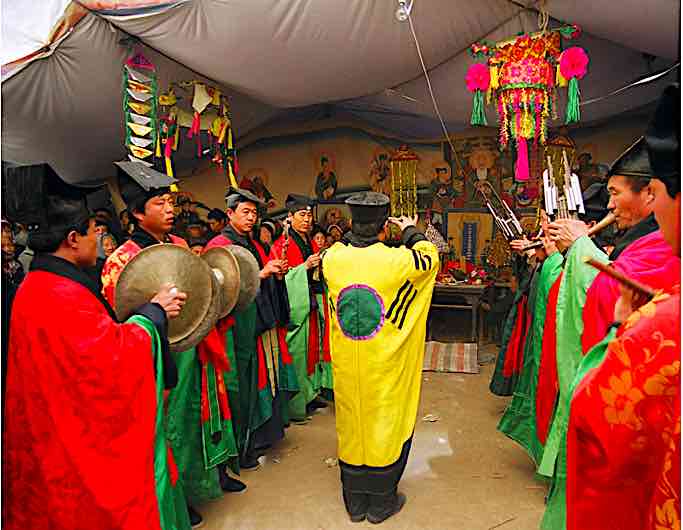
Here are some photos from his funeral, taken by Qi Yi 齐易, who has diligently followed up our fieldwork on the Hebei associations.

1

2Led by Hu Qingxue, Qujiaying villagers, later trained in the Zhihua temple style, kowtowing before the soul hall at Lin Zhongshu’s funeral, and playing the classic sequence Jinzi jing, Wusheng fo, and Gandongshan.

9

The funeral placard

Sources
Material on Lin Zhongshu and Qujiaying is too plentiful to encapsulate here. Apart from the links above, and a plethora of journalistic articles, scholarly coverage began with a brief yet brilliant article by Xue Yibing 薛艺兵 and Wu Ben 吴奔,

  • 屈家营音乐会的调查与研究, Zhongguo yinyuexue 1987.2: 87–96,

with all the kinds of musical and social detail that we would later augment. For further sources, see my article here.

Qiao Jianzhong 乔建中, successor to Yang Yinliu as director of the Music Research Institute in Beijing and one of the great instigators of research on north Chinese music, documented Lin Zhongshu’s own account in

  • 望:一位老农在28年间守护一个民间乐社的口述史 (Beijing: Zhongyang bianyi chubanshe, 2014, reproduced in Qiao Jianzhong wenji 乔建中文, vol.7, 2023).

and Zhang Zhentao 张振涛 writes perceptively as ever in articles such as

  • 平原日暮——屈家营的故事, Zhongguo yinyuexue 2009.3.

His memorial to Lin Zhongshu has also just been posted by the Shanghai Centre for Ritual Music:

  • 他让乡村乐社走进国家乐史 ——祭林中树

Among many rather grandiloquent films, this leads to further links, while a more sober film by Wang Qingren 王清仁 (2013) is both fascinating and disturbing.

For a list of sources on the Zhihua temple and the current group, see here; and for a roundup of some posts under the Gaoluo tag, here.

[1] Actually, both died on 18th March, so perhaps it was a question of time zones. Anyway, this is no time for pedantry.

The beauty of the mouth-organ

Li Qing on sheng, 1991.

This is a tribute not just to the sheng mouth-organ, but to the late great Daoist master Li Qing, and to the whole tradition of wind-playing and liturgy among Daoist bands in north Shanxi.

I have already compared the role of the sheng, accompanying the guanzi oboe in north Chinese ritual bands, to that of the keyboard for 18th-century kapellmeisters. And we’ve met sheng tuners and players in other posts. Meanwhile, for historical studies on the instrument, from ancient times right down to today, you can’t beat the works of Zhang Zhentao 张振涛, my old fieldwork companion. Here I approach the sheng not as a historian but as musician and ethnographer.

Apart from its exquisite noble tone, one of the beauties of the sheng is the way the monophonic notes of the melody are harmonized with fifths and octaves in a kind of organum (unlike the cluster chords of Japanese gagaku—surely “going too far“!).

Only now does it occur to me that the position of the pipes around the bowl, seemingly confusing yet brilliantly designed for practical convenience by some ancient genius, is a prototype (“Typical!“) for the layout of the alphabet on a typewriter or computer.

Sheng invariably have seventeen pipes, but the Zhihua temple in Beijing is one of few traditions where they all have sounding reeds; in most groups they have fourteen, or even eleven. The full complement was useful when they needed to play all four scales of the earlier repertoire, but today, now that they play in only two or three scales, fourteen suffice for most genres.

So the sheng of the Daoist bands in Yanggao, including the Li family, have fourteen sounding reeds. With their distinctive curved mouthpiece, evoking the sheng depicted in temple murals of the Ming dynasty, the instruments are made by the hereditary luthiers of the Gao family in nearby Gaoshantun village, friends of the Li family for many generations. Their sheng have the most exquisite sonorous tone—on our 2013 tour of Germany they filled churches like a huge organ.
sheng diagram
Source: Chen Yu, Jinbei minjian Daojiao keyi yinyue yanjiu ch.4.1.

Fingering
Home base is the various doso (he-che, in gongche solfeggio) pipes at the back, played with the third and fourth fingers of both hands (pipes 15, 14, 13, and 11 in the diagram), giving a nice full chord. The middle fingers of the right hand are hooked inside to give access to the inner holes of pipes 3 and 4 (re and mi). The Li band (and many others in north Shanxi) vary the usual position of the ti and its harmonising  fa ♯ (dafan 大凡 and gou 勾, pipes 5 and 6)—playing this distinctive chord (featured sparingly in melodies, as it’s not part of the pentatonic scale) with the two thumbs stopping adjacent holes right in front of the player’s face. It’s a great feeling.

As the fingers glide effortlessly from pipe to pipe, it’s really tactile to play, and utterly comfortable to listen to and watch. Sheng players are at ease with their instrument—none so much as the late great Li Qing. You can admire the fluent mastery of his disciples in my film too. With frequent use the pipes are soon gilded with a patina where the fingers have worn them down.

Li Bin 2011sheng closeup
Tuning
The sheng is a bugger to maintain, though. Like a harpsichord, it needs tuning regularly. Most players can do a rough tune whenever necessary. Whenever we return to the scripture hall between ritual visits to the soul hall, while Li Manshan busies himself writing the next set of documents for the upcoming ritual, Li Bin or Golden Noble try out the tuning of the various sheng at their disposal.

After going through the cycle of fifths and octaves, depending on his aural diagnosis Li Bin pulls any errant pipes individually out of the metal wind-chamber (“bowl”) in which they are held. Sounding the pipe by stopping its hole while blowing through the bottom, he then takes a droplet of hot red wax with his soldering iron and applies it carefully to the tiny metal tongue (the “free reed”) to “dot” (dian 點) it, or scrapes off a tiny sliver of wax. He replaces the pipe in the bowl and tries out the fifths and octaves again; then he makes sure the two sheng needed for the next ritual segment are in tune with each other too. It’s a long patient process. Still, at least once a year Li Bin takes all the group’s sheng to Gao Yong in Gaoshantun for a thorough overhaul.

47 wind instruments

The wind instruments, 2003.

The dizi flute has fallen out of use since then. The curved trumpet can be admired in “catching the tiger” in my film.

This kind of insider detail that I aspire to here is surpassed by Ciaran Carson in Last night’s fun.

Stamina, mastery, and virtue
For some rituals they may be playing continuously for nearly an hour. Since the sheng sounds while both blowing out and sucking in, the two players can, and must, maintain an uninterrupted wall of sound for the guanzi oboe to bounce off. Even while accompanying the shorter hymns of around 15 minutes, they use the brief percussion interludes between verses to empty the bowl of all their accumulated saliva onto the ground—and to empty their own noses and throats too. Playing the sheng, apparently so effortless, is a feat of stamina—the guanzi still more so. They have to play all day long, often till after midnight—both seated, standing, and on lengthy processions, outdoors through winter cold and sweltering summers; and they’re busy most days. It’s rather like doing seven cantatas and a few motets over a day, interspersed with three or four Mahler symphonies. Every day. All for little pay. No wonder they no longer want their sons to take up the trade.

Among all Li Qing’s disciples the standard of sheng playing is amazing. Li Bin is the anchor; Golden Noble, when he’s not on vocal duties, is dependable; Wu Mei, when he’s not enchanting everyone on the guanzi oboe, is also a fine sheng player; and Erqing, though often busy doing migrant labour outside the area, is fantastic too. Of the deps, Yang Ying (also a fine guanzi player) is great, as is Li Sheng, in his more folksy, restless way; and Daoists from other lineages who regularly dep with the Li band, like Yan Xuewen and Yuan Xuedong, are also accomplished.

But when they recall Li Qing’s style on the sheng, everyone—pupil or not—is in awe of him. Even urban professional musicians concurred: that was why he was selected for the state troupe in the regional city of Datong in 1958. An old colleague of his from their brief years there together recalled, “He was the greatest musician I ever met”. Li Qing played guanzi too, but spent most of his time leading from the drum, singing the vocal liturgy.

You don’t necessarily get to hear Daoists playing for their own satisfaction outside the context of performing ritual, but sitting in Li Qing’s house while he accompanied Liu Zhong’s guanzi on his sheng, I was in the company of true amateurs, master musicians.

informal session

Informal session at Li Qing’s house, 1991. Left to right: Li Qing (sheng), his second son Yushan (yunluo), Liu Zhong (guanzi), Li Zengguang (drum), Kang Ren (sheng), Wu Mei.

And there was another reason why everyone revered him—his gentle benevolent nature. Not all folk artists live up to their obligatory Communist image of selflessly “serving the people”—but Li Qing did. His local reputation was immense. His mastery of ritual complemented his musicianship and his kindly heart.

OK, I’d better say this again:

The Li band may be outstanding instrumentalists, but they’re not “Daoist musicians”! They’re yinyang—household Daoist ritual specialists.

However important the melodic instrumental music may be for the efficacy of their rituals, it’s always subsidiary to vocal liturgy and percussion. And the shengguan players perform those fluently as well: they’re all versatile. Not just the chief vocal liturgists Li Manshan and Golden Noble, but the others sing too. And they all regularly take turns on the various percussion instruments. That’s what it means to be a yinyang; that’s the main thing they know about doing ritual.

Spring

Spring, not String.

Discussing ritual activity around Houshan in Yixian county, I mentioned the fine ritual specialist Li Yongshu in Baoquan village. After my little detour in Festivals, here the word for “village” is cun.

And Baoquan means Panther Spring—“spring” as in wellspring, not as in

with all the coiled sexual energy of a panther about to spring,

applied satirically to John Major.

Another nice John Major quote comes from a BBC correspondent reporting on the Prime Minister’s visit to an Indian mela:

He brought a splash of grey to an otherwise colourful scene.

Festivals: the official—folk continuum

The upcoming CHIME conference in LA (29 March to 2 April), presided over by the excellent Helen Rees, looks like a fine event, though I can’t make it. The theme this time is festivals.

Gansu miaohui FKTemple procession, Xincheng, south Gansu, June 1997. [1]
Photo: Frank Kouwenhoven. © CHIME, all rights reserved.

Of course, festivals and pilgrimages all over the world are a major theme of ethnography: not just Uyghur meshreps and mazar, and Tibetan monastery festivals, but Indian melas, Sufi festivals, the Mediterranean (Andalucian fiestas, south Italy…), Moroccan ahouach, you name it. Bernard Lortat-Jacob’s 1994 book Musiques en fête is charmant, with wise and vivid words about Morocco, Sardinia, and Romania (¡¿BTW, why do French books put the list of contents at the back?! ¡¿Typical Gallic contrariness?!)

To adopt the metaphor of “the whole dragon” again, there is a long continuum between folk festivals, based on ritual (often calendrical) observances, and secular events for a largely urban audience.

So I too am going to link up diverse themes like temple fairs, ritual, famine, village names, Eurovision, and propaganda. It does make sense, though—trust me, I’m a doctor.

Traditional events in China`
Funeral rituals have been my main topic in China for thirty years, but of course it’s not easy to plan visits much in advance. The calendrical dates of temple fairs (often known as miaohui) may seem easier to anticipate. Again, scholars of religion tend to home in on their specifically religious elements, as in the great jiao Offering—though note Ken Dean’s fine film Bored in heaven. But like funerals they are multivalent, embracing all kinds of activity: ritual, opera, folk-song, pop, commerce, “hosting” and “red-hot sociality” (Chau!)…

Apart from my 2007 and 2009 books, names like Zhao Shiyu, Guo Yuhua, Wang Mingming, Yue Yongyi, Stephan FeuchtwangAdam Chau, and Wu Fan spring to mind. The knack is to detail both sacred and secular aspects of temple fairs.

But the dates of calendrical rituals, like temple fairs, may not be easily vouchsafed to the outsider either. The temple fairs on the Houshan mountains in Yixian county southwest of Beijing, mainly in the 3rd and 7th moons, are much less well known than those of Miaofengshan, but they also draw huge crowds, both local and from further afield.

To work all this out you have to spend time around the villages of Liujing and Matou in the foothills around Houshan, and then observe who goes where when and does what. Although Chinese villagers are a rich source of ritual and musical information (far more than any silent library), they often speak prescriptively rather than descriptively, telling us on what occasions a jiao Offering ritual should be performed, whether or not is has been performed since the 1940s. They don’t necessarily volunteer information on change, preferring (like some officials and scholars) to present their traditions as constant, eternal—even if contexts and repertoires have evidently changed in their lifetime. On our first visit to Liujing we rather assumed that villagers’ descriptions of ritual pilgrimages related to “the past”— but we soon found that they were very much alive.

The Songs-for-winds associations: propaganda and catastrophe
What got me “thinking” (I use the word loosely) about all this was that 1950 visit to Tianjin of the “Songs-for-winds” band from Ziwei village, in what later became Dingxian county.

The Central Conservatoire (as it was then) was then still based at Tianjin, of course. The work of Yang Yinliu and Cao Anhe on the Songs-for-winds may be considered a prelude to that on the more solemn ritual style of the Beijing temples that Yang undertook from 1952, a topic that was to expand vastly after 1986. But the Songs-for-winds groups, more popular than the ritual style that is my main focus, are worth a little detour here.

We should bear in mind that such wind ensembles were quite unfamiliar to southerners like Yang and Cao. Having invited the Ziwei band to the conservatoire, they recorded their repertoire on a Webster wire recorder. The band went back some six generations, and under the leadership of the celebrated Wang Chengkui, they had invited the great wind player Yang Yuanheng  to teach them in the winters of 1945 and 1946. Yang Yuanheng, a former Daoist priest in a little temple in Anping county, was himself appointed professor of guanzi oboe at the conservatoire in 1950. [2] Yang Yuanheng, like the Buddhist monk Haibo, was a major influence on many shengguan ritual associations in the area: we would hear their names from many village associations.

Yang and Cao’s monograph on the Ziwei band, published in 1952,  consists mainly of transcriptions, with little of the social detail that they covered for the Wuxi Daoists or Yang’s 1956 Hunan fieldtrip. Ziwei would go on to supply wind players to many state troupes for decades to come.

Langfang huahui 1991

Secular New Year’s huahui parade, Langfang city, 1991.

Xushui
Adapted from my Folk music of China (p.196):

During the 1958 Great Leap Forward (or Backward, as it’s known), Dingxian and particularly Xushui counties became model counties for the relentless drive to full communization. [3] At the height of the Leap back in August 1958, Chairman Mao visited communes there. In Dasigexiang district just southeast of Xushui county-town, Dasigezhuang village was now renamed the 4th August brigade. Notable for its revolutionary fervour at this time was the “Great Leap Forward Songs-for winds association” of Qianminzhuang brigade in Xushui, which performed for this visit.

The propaganda of the Leap makes a stark contrast with the grim realities of the period, with villages throughout the area suffering from crop failure, famine, and social disruption.

Our visit to Qianminzhuang in 1993 was the only time I’ve ever had a police escort—to take me there for a change, not to drag me away! Predictably, such an effusive welcome for me as a “foreign guest” indicated close supervision and censorship of our fieldwork.

QMZ band 1993

QMZ pose 1993

Striking a pose with the leaders, Qianminzhuang 1993

In 1995 we visited some of the senior musicians independently, with much more useful results.

Xushui’s favoured status did nothing to prevent many starving to death there in 1960—but just near Qianminzhuang, the Gaozhuang ritual association still managed to restart in 1961. Religion revived in China precisely at moments of political crisis such as the famines of 1960 and the Cultural Revolution, albeit with great difficulty. It may provide solace, or a focus for resistance—both against Maoism and later against the insecurities ensuing its demise.

The Gaozhuang ritual association was one of many in Xushui villages that used, and use, the older more solemn shengguan style. Ritual associations throughout the area commonly claim transmission from either Buddhist monks (heshangjing 和尚經) or Daoist priests (laodaojing 老道經)—the Gaozhuang association is Buddhist-transmitted. In another common taxonomy, the association divides into “front altar” (qiantan, the shengguan instrumental ensemble, and “rear altar” (houtan, vocal liturgy).

Despite its revolutionary image, Xushui county has remained a hotbed for religion, notably the cult of the sectarian creator goddess Wusheng laomu. Associations there commonly hang out ritual paintings, like the Ten Kings (Shiwang) or Water and Land (Shuilu) series, and they use “precious scrolls” and other ritual manuals. They too are within the catchment area of Houtu worship—they used to make the pilgrimage to Houshan. Even the revolutionary Qianminzhuang band told us that their former tradition was to recite the scriptures, performing only as a social duty for funerals, not for weddings. And certainly not to accompany mendacious parades to report a bumper harvest…

In 1994 the Gaozhuang association built an Ancestral Hall to Venerable Mother (Laomu citang), occupying about one mu, stylish and grand. It cost around 60,000 kuai to build; the stele lists 132 donors, who gave from 50 up to 3,000 kuai. The altar has Wusheng laomu in the centre, Wangmu niangniang and Songzi niangniang to the right, Cangu niangniang and Houtu niangniang to the left.

Gaozhuang citang

The village Party Secretary told us that sources of support included incense money from the Great Tent Association (Dapeng hui, a common term in the area for a ritual association) and from the temple, and money from fortune-telling and curing illness. He reflected, “A dozen or so women kept on coming to see me about building a temple. I had no choice—the brigade couldn’t refuse, so I gave them a plot of land. Believing in the gods and having a temple is no bad thing, it’s not as if you stop production if you believe in it!”

In all, the flamboyant (and readily secularized) Songs-for-winds style remains a common image of wind bands on the Hebei plain, but since all our fieldwork through the 1990s it is clear that ritual practice, with its more solemn shengguan instrumental style, is both older and more common. It is resilient too. This persistence of tradition, both in religious and musical practice, is all the more striking in such a once-revolutionary county as Xushui.

Mao was impressively modest about his limited success when he admitted to Nixon in 1972:

“I haven’t been able to change [China]—I’ve only been able to change a few places in the vicinity of Peking.”  [4]

But he wasn’t modest enough: in some ways even a county so near Beijing, such a focus of the revolution, has remained resistant to Maoist ideology, predating and outliving it. Still, disruption was severe. For more on Xushui, see here.

Official festivals in the 1950s
Meanwhile, the new government, in its own way, was promoting local culture through the medium of regional folk festivals (diaoyan, huiyan). First, local festivals were held to select representatives for major performances in the regional capitals. Some laicized priests were even assembled to perform as “troupes“, sometimes for the first time in many years—such as Baiyunshan Daoists (1955), Wudangshan Daoists (1956 and 1957), Wutaishan Buddhists (1958). For such performances, inevitably, their shengguan instrumental music was plucked out of its ritual context. I haven’t heard stories as distressing as the fate that befell kobzari blind minstrels in Ukraine when summoned for an official festival in the early 1930s; but folk ritual specialists were still anxious about performing for officials around 1980.

These festivals served partly as auditions for the state song-and-dance troupes then expanding all over China. Daoist and Buddhist ritual specialists had a deserved reputation as outstanding instrumentalists. Many, like our very own Li Qing (my book pp.113–25), were recruited as musicians to state troupes around 1958—and then sent home again as the state apparatus collapsed in 1962.

While such festivals stimulated the collection and documentation of folk music, we must balance this with the ongoing assaults on its traditional context. The background ( beginning from the 1940s) was campaigns against “feudal superstition”, terrifying public executions of sectarians, and the destruction of temple life.

The reform era
Urban festivals featuring rural groups—perhaps related to a conference—make a convenient recourse for busy academics into whose holidays they fit nicely. From the 1980s, the secular arts festivals of the Maoist era were remoulded into more glossy events. In 1990 the Li family Daoists took part in a festival of religious music in Beijing.

By the 21st century the new ideology was confirmed in the regular staged “living fossil” presentations of the Intangible Cultural Heritage. The latter project, with its whole bureaucratic workings, has now become a major research topic on its own, at the expense of studies of the local traditions that it is supposed to assist (my book pp.331–3). Note also the Qujiaying bandwagon.

I tend to steer clear of conferences, but in May 2016, as a pretext for going to hang out yet again with Li Manshan in Shanxi for a couple of weeks, I accepted an invitation to take part in a conference celebrating the 80th birthday of my esteemed teacher Yuan Jingfang in Beijing (for the resulting volume, see here).

It was a déjà-vu experience. Apart from a sequence of eulogies, the event also featured staged performances from three representatives of Yuan Jingfang’s long-term research areas: the Hanzhuang ritual association from Xiongxian in Hebei (near Xushui), the Zhihua temple group, and a ritual band from near Xi’an.

Hanzhuang 1993

Filming the Hanzhuang association in their ritual tent, 1993 (photo: Xue Yibing). Rear centre: two frames of ten-gong yunluo.

It made me feel my age, reminding me of all our visits to these very groups between 1986 and 2001. Taking time out of the conference to chat with the Hanzhuang group outside by the lake, we recalled their kindly association leader Xie Yongxiang 解永祥, father of the present leader, and another of those wise sheng masters. We had learned a lot from him in 1993 and 1995.

Xie Yongxiang 1995

Xie Yongxiang, 1995

But returning to the conference—the object of admiration, inevitably, was their “music”, detached from its enduring social context. I already missed hanging out with Li Manshan in the scripture hall.

All the glossy stage presentation has many Western parallels—flamenco on the Terry Wogan show, WOMAD, Songlines, prizes, urbane discourse explaining its “cultural value” to outsiders… The fancy costumes and dry ice of many Chinese events are reminiscent of Eurovision; they may seem like a Disneyland version of the Chinese heritage.

That photo comes from a recent ICH “performance” of the Baiyunshan Daoists, no less.

Now, I adore opportunities to present the Li family Daoist band on the concert platform (see e.g. this post and a whole related series of vignettes from May 2017), but while it is of course a compromise, we take care not to tart them up—we can hardly do otherwise, so solemn is their demeanour. The ambience and acoustic of churches makes a fine setting,  the Daoists’ sheng mouth-organs filling the Peterskirche in Heidelberg on our 2013 tour (cf. Buildings and music):

Hberg 2012

The Li family Daoist band in concert, Heidelberg April 2013.

Still, their regular “rice-bowl”—day in, day out—is always performing funerals for their local, not global, clientele.

What is dodgy is when people begin mistaking the staged events for the Real Thing, or some kind of ideal. Urbanites may do so, but villagers know better. Of course those staged events are themselves a legitimate, and popular, object of scholarly analysis. But I worry that it creates a fait accompli, like the way that in old-school WAM musicology the Great Composers were the main story (as deconstructed by McClary, Small, Nettl)—“this is what we find, so it must reflect the real picture, and so this is the object of study”. As always, “modern” secular performance doesn’t replace traditional activity: they co-exist.

The CHIME conference in LA will doubtless turn up many instances of what I’m struggling not to call “contested negotiation”. Anyway, staged events can give us a lead, rather like using the photos in the Anthology, otherwise flawed, to draw us towards folk activity.

For thoughts on the theme of the 2021 CHIME conference, see here.


[1] For more, see Frank Kouwenhoven, “Love songs and temple festivals in northwest China: musical laughter in the face of adversity”, in Frank Kouwenhoven and James Kippen eds., Music, dance and the art of seduction.
[2] For this whole section, see my Folk music of China, pp.48–52, 195–203; “Chinese ritual music under Mao and Deng”, British Journal of Ethnomusicology 8 (1999): 27–66; “Reading between the lines: reflections on the massive Anthology of folk music of the Chinese peoples”, Ethnomusicology 47.3 (2003): 287–337. See also my In search of the folk Daoists of north China, pp.166–7, 183–4, 188–90.
[3] As correctives to all the Xushui propaganda, see e.g. the brilliant works of Friedman, Pickowicz, and Selden, Chinese village, socialist state and Revolution, resistance, and reform in village China—describing a commune not far from Xushui. Note Chinese village, socialist state, pp.215–20; Dikötter, Mao’s great famine, pp.40, 47–9, 68–70; and estimable analysis online in Chinese, e.g. http://mjlsh.usc.cuhk.edu.hk/book.aspx?cid=6&tid=184&pid=2269. For the model commune of Greater Quanshan in Shanxi, precursor of Dazhai, and temporary “home” to the Li family Daoists, see my Daoist priests of the Li family, pp.122–3, and here, under “Famine in China”.
[4] Also reported by Henry Kissinger in Newsweek, 3rd March 1997, p.31.

Shanxi, summer 1992

Partly to remind myself that I don’t only do jokes, here are some more fieldnotes.

I’ve already noted the differences between our early fieldwork in the 1990s and conditions more recently. So I thought I’d give you a flavour of one of those earlier fieldtrips.

Over the hot summer of 1992, following hot on the heels of the Wutaishan Buddhist group’s visit to England, Xue Yibing and I made a three-week trek from Taiyuan northwards through Wutai, Xinzhou, Daixian, and Hunyuan, finding ritual activity all along the way, en route for another rendezvous with the great Li Qing in Yanggao. Our last stop was nearby Yangyuan county, just in Hebei.

Since our fruitful initial survey of ritual associations in Hebei over New Year in 1989, this was my fourth fieldtrip with Xue Yibing. Before we could return to the Hebei plain, and before I began to focus on particular villages and families, this was still only a partial survey of central and north Shanxi—for what became Chapter 12 of my book Folk music of China.

We had a van and a driver from the MRI at our disposal, and for parts of the trip we were accompanied by Shanxi scholars Jing Weigang and Wang Bin, whose local knowledge was valuable. We were mostly unencumbered by the need to “kowtow to the Gods of the Soil”, except when we knew there was a knowledgeable scholar—like the senior Liu Jianchang in Taiyuan, who was studying the Buddhist ritual music of the Wutaishan mountains through the 1950s whenever political conditions allowed. All along the way we found local traditions, differing significantly from each other. [1] Power cuts were frequent. And before motorways, our progress was often far from smooth; even on the main roads we generally found ourselves crawling along behind long lines of coal lorries.

stuck-in-mud

Dongye township
In central Shanxi, I had already visited central Wutaishan, so I was interested to explore the outlying areas. While we found many shawm bands (here called gufang 鼓房), our main interest was in ritual shengguan bands (here called xiangda 响打). Though they were rarely ritual specialists with vocal liturgy, some bands performed a fine repertoire of long suites related to the temples of Wutaishan and Beijing—the kind of groups found by the great Yang Yinliu in 1953, in whose steps we were now following.

dongye-chubin

Funeral procession, South Daxing, Dongye.

We spent time with one such band, led by Xu Yousheng in Dongye.

It soon became clear that this whole area was also a hotbed for female spirit mediums, including Xu Yousheng’s wife. These mediums did exorcistic rituals as a group, singing ritual songs a cappella. In this photo, at Xu Yousheng’s house near Dongye, his wife and her fellow medium pose before ritual paintings commissioned by him.

mediums

This page from Xue Yibing’s precious notebook lists the gods on the pantheon to the right in the photo.

xu-pantheon-xyb

In this detail, the “young soldier god” features because a medium had divined that he once saved the life of Xu’s son while he was in the army:

painting-detail

For more on such pantheons, see the remarkable website of Hannibal Taubes.

The Xinzhou region
In this large and mountainous region we found more household Daoists (this time of the Complete Perfection branch!), as well as a thriving community of Catholics who also used shengguan music to accompany their rituals.

christians-1992

The Ekou Buddhists
After digging our van out of the mud yet again, we reached Ekou township in Daixian county, in the northern foothills of Wutaishan. I was hoping to see Chengde, lovely former Buddhist monk whom I had hosted in England a few weeks earlier. But he was doing a temple fair some distance away—so we had a chat with his older brother, who provided us with useful detail on local ritual life there. This was one of rather few occupational household Buddhist groups that we found.

ekou-painting-1

Old pantheon at Chengde’s house.

Hunyuan
Arriving hot and sweaty in the (then) cosy little hill town of Hunyuan (at the foot of Hengshan, the northern marchmont of Daoism), we checked into a modest hostel. On the guest registration form, under “Level of Culture” (wenhua chengdu 文化程度) I wrote “None” (wu 无), as is my wont.

After a long drive and many days in scorching temperatures without running water, we were delighted to find that not only did our room have a bath, but that hot water was promised (typically “after 8pm”, which often means either “never” or “from 3.30 to 3.35 am”).

The bathroom wasn’t exactly hygienic, but hey, we weren’t fussy—ruxiang suisu, “when in Rome…”. Xue Yibing rashly took the plunge first, and he was just sinking into the water in ecstasy when the ceiling (exhausted by unprecedented strains on the plumbing above) promptly caved in, covering him in rusty debris (or is that the name of a Country singer?). Adopting what Nigel Barley calls “fieldwork mode”, we both burst out laughing. He came out a lot dirtier than he went in.

Next day we found no ritual activity at the Hengshan mountain temples, but in town we found yet another great family of household Daoists.

hunyuan-ritual

hunyuan-manual

Page from ritual manual: end of Fetching Water ritual and opening of Dispensing Food.

This group belonged to a lengthy Orthodox Unity lineage. By the time I went back to see them in 2011 with the wonderful Li Jin, significant changes had taken place in their practice (see fieldnotes here).

The north
After a brief visit to more Orthodox Unity household Daoists in Datong county, we reached Yanggao, where I was delighted to find Li Qing again, performing a funeral with his ritual band. He also managed a long session with us, providing detailed accounts of ritual sequences, augmenting my notes from the previous year.

After a brief and rather unedifying stop-off in Yangyuan county, we made our way back to Beijing. Upon my return, I once again (as usual) sought out former monks, before we set off once more for Liaoning in the northeast, finding majestic shawm bands there too…

* * *

Such early fieldtrips with Xue Yibing were an important training for us both, before we launched into more in-depth study of the Hebei ritual associations. I always treasure his notes, but however brief our visits on that Shanxi trip, the three hand-written volumes he copied out for me are full of wonderful ethnographic detail on folk religion.

Since 2011, having profited from collaborative fieldwork for twenty-five years, I have largely engaged with the Li family Daoists on my own, regaining a certain self-esteem—except for the occasional mishap


[1] For more detail on most of these sites, see my In search of the folk Daoists, pp.65–81; Chen Yu, Jinbei minjian Daojiao keyi yinyue yanjiu, pp.65–90 and passim. For a richly-illustrated overview of folk customs throughout Shanxi, see Wen Xing 文幸 and Xue Maixi 薛麦喜 (eds.), Shanxi minsu 山西民俗 (Taiyuan: Shanxi renmin cbs, 1991).

More on taxonomy

As with feminist punkvocal styles of the worldthe organology of the world’s instrumentarium, and indeed any other human activity, the taxonomies made by ordinary people are evident from their fine discriminations of nuance between pop genres that may seem arcane to the outsider—like acid house, drum and bass, grunge, indie, metal, Northern soul (“Naa, I’m not into the Manchester sound, guys”), rap, hip-hop, and even trainers, FFS  (don’t ask me…).

And just the same goes for rural dwellers’ perceptions of ceremonial genres and ritual activity in any single county of China: shawm bands, geomancers and spirit mediums (distinctions within the latter partly gender-based), [1] amateur sects, temple priests, occupational household ritual specialists, inner and outer altars, civil and martial altars, Buddhist Daoists and Daoist Buddhists (I kid you not), [2] “northern” and “southern” ritual wind bands around Beijing[3] opera troupes, singers, bards, beggars….

Taxonomy is not merely the preserve of the fusty academic; it’s part of what makes us all human.

Such perceptions can also arouse passionate and bitter disputes—never more so than between, and within, religions (if less so in China, notwithstanding imperial persecutions). But classification doesn’t have to equate with building walls. Whereas the brutish black-and-white (sic) xenophobia of a certain Tangerine fuckwit suggests that his sensibilities may not be so finely tuned, taxonomy can also reveal connections and build bridges.


[1] For just one region, see Adam Chau, Miraculous response, pp.54–8.
[2] See several reports in the Daojiao yishi congshu series, and Overmyer, Ethnography in China.
[3] See also my In search of the folk Daoists of north China, Appendix 1.

The changing nature of fieldwork in China

Further to various comments (collected here), over my three decades doing fieldwork in China the nature of the equipment we use, and fieldworkers themselves, have changed just as much as our objects of study and the rest of the population—of course just like anywhere else, and over earlier periods of ethnographic history.

Never mind all those wonderful fieldtrips of the 1950s; through the 1990s, when my trusty fieldwork companion Xue Yibing and I went on long fieldtrips together (Hebei, Shanxi, Liaoning, Fujian, Guangdong), I used to show up at Beijing train station with a heavy bag full of audio and video tapes, dozens of films for my camera, a bulky array of batteries and chargers, and even a few spare clothes; besides my heavy equipment bag with camera, camcorder, tape recorder, leads, and so on. As you do… And even that was very modest compared with the lists advised by some earnest ethnomusicologists, giving an inventory that would be the envy of British troops invading a third-world country—even Bruce Jackson gives a daunting list. All that is fine if you have an army of docile sherpas, but per-leez

Meanwhile Xue Yibing just brought a slim shoulder-bag containing only his little notebook, a biro, and a toothbrush. Out of all our combined equipment, it was his notebook that would turn out to be most precious.

Sometimes—not always—we managed to hire a clapped-out old minivan. To find ritual activity, we just had to “go down” to the villages and hope; not only were there no smartphones, very few villages even had a landline. As soon as we “went down”, we were cut off from all contact with the outside world.

Fast-forward to the last few years, and young Chinese fieldworkers take an array of high-class audio and video equipment, laptops, and smartphones, with which few foreign scholars of their age can now compete. Smartphones give fieldworkers instant access to all kinds of information—one could virtually do everything (including photos and recordings) with just a phone. They often drive fancy and robust cars, with GPS to help them navigate and find the villages. The road network is vastly improved; local tracks may still be pretty crap, but motorways have expanded a lot.

And among these young scholars, women are now in a clear majority—bright people like Qi Kun, Wu Fan, and Chen Yu were trained by female scholars of senior generations, like Yuan Jingfang in Beijing and now the brilliant Xiao Mei at Shanghai, ethnographer par excellence. Chinese students also now have some grounding in international ethnomusicology. Of course, one always seeks to do diachronic as well as synchronic work, and our own changing experiences are part of that.

Two local cultural workers

These notes are partly stimulated by Zhang Lili, currently writing her PhD in Beijing on my relationship with the village of South Gaoluo, subject of my book Plucking the Winds.

A useful idiomatic term evoking the whole spectrum, whether of guanxi contacts or the range of funeral services, is yitiaolong “the whole dragon” (indeed, this blog may itself be considered “the whole dragon”, making links between seemingly diverse topics).

Li Bin’s first funeral shop in town.

Li Bin’s funeral shop in Yanggao county-town, Shanxi.

So having praised Yang Yinliu, shining pinnacle of Chinese musicology, I want to pay tribute to two admirable local cultural workers at the opposite end of the dragon (cf. An unsung local hero) whose work has inspired us since 1989:

Liu Fu 刘阜 and Wang Zhanlong 王占.

Their only qualification was that they were local, and came to take pride in documenting their local traditions under the stimulus of the new directive from the Anthology of folk music of the Chinese peoples, the vast project that got under way from 1979 as China began to liberalize after the collapse of Maoism.

Let me adapt a passage from my article

  • “Reading between the lines: reflections on the massive Anthology of folk music of the Chinese peoples”, Ethnomusicology 47.3 (2003), pp.287–337 (for reading between the lines of a Chinese article on 1950s’ Tibet, see here).

Antoinet Schimmelpenninck described the process of collecting folk-song in Jiangsu in the early 1990s.

The collecting of folk-songs is one task, but by no means the only or primary task of the bureaus of culture. They carry out political propaganda, make posters about family planning or about the punishment of local criminals, organize dance parties, stage plays and children’s games for local entertainment, run libraries, and execute various administrative tasks which help the provincial government. […]
It is not, at present, one of the specific tasks of the Cultural Bureaus of the Wu area to collect folk-songs. I visited one wenhua zhan (village cultural post) which was mainly engaged in printing labels for jam jars and other consumer goods.

Censorship may operate throughout the process: first, self-censorship of performers (e.g. what kind of songs singers see fit to sing for fieldworkers), and then editorial adaptation of the material collected. In Baoding, one single region of Hebei province, where ritual associations have important traditions, such fieldwork as was done on “instrumental music” took place mainly from 1983 to 1985, but in only two or three of a dozen counties we have visited did we find knowledgable cadres who had done such work.

One of the most diligent of these was Liu Fu, of the Hall of Culture in Laishui county. He acted early on the Anthology directive, printing a mimeograph (4 pp. introduction, map, list of contents, 128 pp. transcriptions, 22 pp. field report, 8 pp. diagrams of instruments) on the county’s instrumental music as early as 1983, which was an important inspiration for my own work on ritual associations there. I don’t know if the regional editors ever forwarded Liu Fu’s work, but it was entirely omitted from the final provincial publication. The following passages of his “Field report” show some of the problems faced by local collectors, here partly relating to the sensitive and secret nature of ritual music:

The work of collecting folk instrumental music is not always smooth: we have met considerable difficulties. For instance, some elderly folk musicians had been struggled against during past campaigns for this [their music/ritual], and had been labelled as “black cliques” and “ox demons and snake spirits”, so they are still anxious. When they heard that we wanted to collect pieces of music, they suspected that it was once again “luring the snake out of its hole”, and so they refused to play for us.

Some associations are very conservative in their thinking, and are concerned that their distinctive pieces will be taken off and learnt by others—in their own words “something we begged for on our knees, we can’t just throw it out now we’re on our feet”, and so they make excuses not to play for us. Some associations take the opportunity to make economic demands. Some brigade [village] cadres think this work is meaningless, and are afraid it might have side-effects, and so are unwilling to co-operate with us. And so on.

Since these are ritual associations, by “side-effects” he apparently means that the collection may be seen as encouraging feudal superstition. Liu Fu continues:

To tackle this situation, every time we arrive in a place, we explain the document “On the collection and documenting of the Chinese folk musical heritage” from the Ministry of Culture and the Musicians’ Association, and the spirit of the directive from the relevant organs of the province and regions, and we discuss the great academic value of the repertory of the ritual associations in our county, and the great significance of the work of collecting, to make the cadres and musicians have a correct understanding; we then show them that they can play whatever they have to play, they must not leave it to later musicians, but do their best to make their own page in the Anthology of instrumental music.

Poor equipment for sound recording, copying, and photography was the norm. Liu Fu goes on to discuss the problems of recording:

Although there are said to be instructions and directives from the central, provincial, and local authorities for the work of collecting instrumental pieces, no-one has given us a scrap of money, and the expenses of the county Bureau of Culture are reduced year by year. Under present conditions, where they can only guarantee annual salaries, they can’t supply any more money to support the work apart from producing a minimal sum for buying necessary goods like tape and paper. Thus, all the associations have to perform for free. This requires us to record as much as possible in a short time.

I might add that any tapes were poorly annotated if at all, and haphazardly stored. One keen cadre I know in the same area had to use a single tape over and over, transcribing a piece in one village one evening and then re-recording music in another village the next day on top of the old recording. But at least he did some work! Of course there was a lot more that local scholars could have done, given time and money—like copying gongche scores and ritual manuals, filming rituals, documenting the histories of the associations, and giving detailed descriptions of ritual sequences, as we later aspired to do in our project around several nearby counties. But Chinese fieldworkers have now overtaken us.

Central funds barely reached down to grass-roots level, and cultural cadres did what they could. On one hand, they were indigenous to the musics they were documenting, but they were rarely able to afford the time or resources, even if they had the training, to make systematic reports. Still, some of the results are impressive.

Anyway, we knew that we might learn from local cultural officials how to find ritual groups. Besides, in those early days, when the memory of the commune system was still fresh, it was a necessary first stage to go through the chain of local officialdom. Sometimes, when our preliminary research in Beijing failed to suggest any knowledgeable local officials, we simply bypassed them. A couple of times we got our fingers burnt, but the most fruitful leads to ritual groups often came just by stopping to chat to any old melon-seller by the roadside—he would generally tell us where the grand rituals were held, and which villages were worth visiting.

There were actually two types of cultural officials: those inclined towards “cultural work”, and jobsworths. The latter, once we began visiting the villages regularly, realized that we didn’t constitute an excuse to hold another vast banquet; I was clearly not an eminent foreign professor but an ill-dressed and impecunious young researcher, so they soon left us to our own devices.

Times have changed, though: now the local Bureaus of Culture are staffed by administrators, not necessarily even local, with their smartphones and spreadsheets.

Liu Fu and Gaoluo
Further to A slender but magical clue, I’ve been recalling how we found the village of Gaoluo.

Liu Fu himself came from a Laishui village, East Mingyi, with its own tradition of vocal liturgy (including baojuan “precious scrolls”) and shengguan ensemble. After the 1986 “discovery” of the Qujiaying ritual association in nearby Gu’an county, he had already approached officials in Beijing to tell them that there were plenty of similar groups in his county alone, giving them a copy of his fine 1983 mimeograph and a tinny tape he had somehow made of a few of their shengguan pieces.

In Beijing Liu Fu also met my mentor Qiao Jianzhong, Yang Yinliu‘s successor as head of the Music Research Institute, who then made an exploratory trip to two other Laishui villages in 1988. It was this that prompted me and my friend Xue Yibing  (a bright musicologist from the distinguished Music Research Institute in Beijing) to visit Liu Fu in his bare dingy office in Laishui county-town as part of our first fieldwork survey in New Year in 1989.

After giving us an outline of the various ritual groups in the county, Liu Fu recommended Gaoluo, so we all sallied forth. Here I adapt from the Prelude of Plucking the Winds:

I first arrived in the village of South Gaoluo on a cold but bright winter’s afternoon, on the 14th day of the 1st moon in 1989, in the middle of the great New Year’s rituals then taking place in every village in China. This was one of many villages just south of Beijing where I was working with Xue Yibing in doing exploratory fieldwork on amateur ritual groups.

Escorted on that first visit by a well-meaning ganbu (“cadre”, as state officials are known in China) from the cultural bureau of the county-town, we made slow progress by jeep along the bumpy track to the village; though it is only nine kilometres from the dingy county-town of Laishui, the journey took over half an hour.

cart

An encounter on the way to Gaoluo, 1989.

First we went to the house of the then village chief Cai Ran, himself a vocal liturgist in the village ritual association, and had to spend over an hour in heated debate before we could cajole him into allowing us to trudge through the alleys to the ritual building a few hundred yards away, where the association was then performing before the god paintings at the altar (photo here).

cai-ran

Cai Ran, 1989.

diaogua

Diaogua hangings for the New Year’s rituals, 1989.

gl-beiwen

Donor’s list (1930) of the South Gaoluo association, New Year 1989.

At the time Cai Ran’s caution seemed to me excessive, since we were all clearly sympathetic, and the county cadre was taking responsibility, but in retrospect I felt rather embarrassed: maybe we should have respected his reluctance. Later, when I learned of the 1951 imprisonment of the Italian missionary Bishop Martina, apparently the last foreigner to visit the village, and as I experienced more often the sensitivity of “superstitious” practices in China, I understood his anxieties better. But later Cai Ran recalled that his hostility that day was not related to the revealing of secret rituals to foreigners, nor to fear of criticism from county cadres, but rather to the possible appropriation of his village’s ritual music by the cadre, whom he already suspected of handing on some pieces to the association in his own home village. After this strange introduction, we soon came to enjoy our sessions with Cai Ran: he has a wonderful informality, a great sense of humour, and is full of insight.

Later I liked to share with the villagers another amusing memory of that first afternoon. After finally persuading Cai Ran to escort us to the ritual building, and having gained the musicians’ approval to record and take photos (alas, I didn’t yet have a camcorder!), I had just set up my recording equipment when in walked a severe-looking policeman in uniform. Knowing the sensitivity of what the musicians were doing, and of what I was doing in watching them doing it, my heart sank: feeling irrationally as if I’d been caught in the act (fan cuowu “made a mistake”, as the eloquent Chinese expression goes), I prepared for further lengthy negotations. But the policeman, the splendid Shan Rongqing, back in the village for the New Year holiday, immediately picked up the large ritual cymbals and joined in with feeling. He later took part keenly in our studies of the village traditions; we often admired his musicianship on the ritual percussion, and later too on the “old fellow”, the bowed fiddle on which he accompanied the local opera.

srq

Shan Rongqing, 1989.

That day we felt lucky enough to have been allowed—eventually—to witness the association’s afternoon ritual, and since we had business in the county-town that night, we agreed to return the next day to talk with the members. That next day they were friendly, as always with such amateur associations; we recorded them “singing the score” of some of their shengguan pieces for us (cf. sidebar playlist, #9), and learned the bare bones of the New Year’s rituals and the history of the association—material which later, in view of all that we would gradually learn, came to look ludicrously sparse. And again we took our leave—the time still had not come for in-depth work, since we were only making a general survey.

Somehow, that first visit to South Gaoluo left us with a deep impression: the village seemed isolated (a view we later corrected) and its ritual life intense, with all the beautiful hangings decorating the temporary temple and the alleys outside. But it was not until the summer of 1993 that we were able to go back there. By now we were engaged on a four-year project to document village ritual associations throughout the area; but while we continued to collect basic data on other villages, we naturally felt the need to dig beneath the surface, not just to “gaze at flowers from horseback”. Gaoluo became a magnet for us, and over the following years we made many stays there, having a fantastic time as we learn more about the turbulent experiences of the village and its ritual performers throughout the 20th century.

Wang Zhanlong
The very next day after those first visits to South Gaoluo at New Year 1989, in the adjacent county of Yixian, home of the Western tombs of the Qing emperors, we visited the office of the Bureau of Culture to seek clues to local ritual associations. There we found the splendid and unassuming Wang Zhanlong. Like Liu Fu, he too relished the task of collecting material, riding his bicycle through poor villages with a crummy little tape recorder and a notebook. Wang promptly took us to Liujing village, also in the midst of their New Year’s rituals.

liujing

Xue Yibing documents pantheon, Liujing, New Year 1989.

This was the start of our studies of the Houshan pilgrimage and the cult of the goddess Houtu.

wzl-xyb

Wang Zhanlong and Xue Yibing, Houshan 7th-moon temple fair, 1993.

Houshan is just one of those numerous local mountain sites attended several times each year by vast throngs of pilgrims, ritual groups, spirit mediums, and beggars, yet (unlike Miaofengshan to the northwest of Beijing) it had never attracted the attention of outsiders.

houshan

Houshan temple fair, 7th moon 1993. Matou village ritual association (left) accompanies a spirit medium (front centre) and disciples (whom she has healed) for boat-burning ritual as they pray.

Right through the 1990s Wang Zhanlong made a wonderful sincere companion on our regular visits to Houshan and the ritual groups of Yixian county, always in sympathy with our project. Here we are in 1995 with erudite ritual specialist Li Yongshu in Baoquan village near Houshan, learning the details of the complex performance practice of the “precious scrolls” to Houtu, the Ten Kings, and so on.

Li Yongshu, Baoquan 1995

liujing-pantheon-1995

Pantheon, Liujing, hung out for rituals on the 1st day of the 3rd moon, 1995. Right: envelope with petition, to be burned in supplication to the goddess Houtu.

For an intrepid fieldworker in Liaoning, see here. See also surveys based on the Anthology for Fujian and Tianjin.

A tribute to Yang Yinliu

yyl-on-xiao

Yang Yinliu, 1950.

Since I mentioned Yang Yinliu’s groundbreaking work on the Zhihua temple, he too richly deserves a tribute. Indeed, since soundscape is such a basic aspect of Chinese culture, his work should form a basic training for us all.

Yang Yinliu 楊蔭瀏 / 杨荫浏 (1899–1984) is often described in mediaspeak as “the Chinese Bartók”, but Bartók should rather be described as “the Hungarian Yang Yinliu”. A fine musician and fieldworker, erudite historian, and incidentally a Protestant, Yang’s whole oeuvre was remarkable.

Brought up in the final years of the Qing dynasty in the milieu of the Daoist instrumental music and the refined Kunqu vocal dramas of the Wuxi area near Shanghai, Yang was a fine exponent of qin zither, pipa and sanxian plucked lutes, and the ethereal falsetto singing of Kunqu (I haven’t yet found my copy of the precious recording from the 1920s found recently in Berlin). He learned instruments from Daoist priests (including Abing) from the age of six, joining the elite Tianyun she society.

YYLIn Wuxi, under the tuition of the American missionary Louise Strong Hammond, he studied English and Western music theory. He also became an active Christian. He went on to gain a cosmopolitan education in Shanghai, attending St John’s University from 1923. After returning to Wuxi in 1926, he was married in 1928, becoming a professor at Yenching University in Beijing in 1936. Offered a job in the USA heading a Chinese music institute there, he commented, “I can do nothing if I leave Chinese soil, where Chinese music lives.”
After the Japanese occupation in 1937, and through the troubled 1940s, not inclined to join the Communist base area in Yan’an, Yang moved from Nanjing to posts in Kunming and Chongqing, always continuing his research.

The Wuxi Daoists
Yang and his cousin Cao Anhe returned regularly to Wuxi, where they were engaged in a long-term project studying the music of the local Daoists. Of their two major books on the theme, their work on Shifan gu was first published in 1957, Yang’s on Shifan luogu not until 1980 (cf. the shifan of Tianjin and Hebei).

In some respects Yang seems like a traditional historical musicologist rather than an ethnographer; but he was well aware of complex social issues. This passage on the position of Daoists in Wuxi society illustrates his sophisticated interest in ethnography and ritual practice, besides his more traditional “musicological” concerns: [1]

In the past [?!], Buddhists in south Jiangsu divided into two types, Chan school (chanmen) and Auxiliary school (fumen).

Those of the Chan school were completely vegetarian, and didn’t have families. They only used percussion like woodblock, bowl, nao and bo cymbals, and tonggu drum to punctuate their vocal liturgy; they didn’t play any melodic instrumental pieces. They never took part in production, living in their temples, some of which had large estates.

The Auxiliary school ate meat and had families. Few in number, they lived scattered in the villages, taking part in agriculture and only reciting the scriptures and litanies as an auxiliary occupation. Among the Buddhists, they are the only ones who play the fanyin [melodic instrumental repertoire] and [separate] percussion items.

Among the Daoists, the Complete Perfection (Quanzhen) school (belonging to the Qingchengshan style of Sichuan) were similar to the Buddhist Chan school, not using separate percussion items or silk-and-bamboo instruments. Those who played the fanyin and separate percussion items mostly belonged to the Zhang Heavenly Masters school of Longhushan in Jiangxi.

Among the latter group, there was a further clear class distinction. A minority of abbots possessed ritual titles of the Zhang Heavenly Masters, like “Master who Guard the Way” (daoweishi) or “Ritual Master” (fashi), and mostly owned land. They didn’t take part in production. They interacted with landlords and the bourgeoisie in the cities and villages, taking ritual work and contacting and hiring the common village Daoists to take part in major rituals (daochang fashi).

These common Daoists mostly took part in agricultural production, being hired ad hoc: performing for rituals was an auxiliary occupation for them. In both agriculture and Daoism, they were an exploited class. These common Daoists—even the indispensable drummers and flute players, with their excellent musical technique—only got a tiny wage for a whole day’s work.

Conversely, the “Masters who Guard the Way” and “Ritual Masters”, having only taken responsibility for quite brief ritual segments of a few hours like Issuing the Talismans (fafu), Reporting the Memorial (zoubiao), and Flaming Mouth (yankou), claimed a reward many times higher than that of the others. Those who played music were mostly the common semi-peasant Daoists; very few of the “Masters who Guard the Way” and “Ritual Masters” could do so. This shows that in the past it was agricultural life that produced and developed music.

Never mind the diplomatic PC spin (for “reading between the lines”, see my article cited under Hunan below), Yang had already observed the important distinctions common to local ritual cultures all over China, long before the major projects on local Daoist ritual since the 1980s. [2]

sfg-50s

sflg-1950s

Shifan gu and Shifan luogu, c1962.

Nearby, the Daoist rituals of Suzhou were also thoroughly documented in an amazing 1956 project. Following such early work, major studies of the Daoist rituals of Suzhou, Wuxi, and Shanghai have been made since the 1990s. [3]

The Music Research Institute
After the 1949 “Liberation” Yang’s erudition was much needed. Managing to adapt to the new Communist regime, he was appointed director of the newly-formed National Music Research Institute of the Central Conservatory of Music (predecessor of the Music Research Institute [MRI] of the Chinese Academy of Arts), beginning a golden age for research there. Under his committed guidance they accumulated a large archive of field recordings and traditional notations.

A qin player himself, he was closely involved with all his eminent colleagues’ research on qin (see my series on The qin zither under Maoism, starting here).

The golden age of the MRI, 1954;
right to left Guan Pinghu, Yang Yinliu, Pu XuezhaiZha Fuxi, Li Yuanqing.
.

In due course the MRI was given a new building (typically, soon dilapidated) in Dongzhimenwai in the northeast of the city. Even in the 1980s, when it became my home base between field trips, its bare dingy corridors were animated by the spirits of the old masters. The new compound, further out in Huixinxijie, is less characterful.

yang-and-cao-best

Yang Yinliu and Cao Anhe at the MRI, 1961.

Both before and after Liberation, until the early 1960s, in collaboration with other fine scholars—notably his cousin and lifelong companion Cao Anhe (1905-2004)—Yang managed both to perform remarkable research on a range of living traditions and to compile major collections and transcriptions of traditional notation. Just as important was his monumental history, first in draft from 1944, covering with unique erudition the whole of Chinese music history, and elite as well as folk genres, albeit couched in the language of its time.

His most renowned recording—on another trip home to Wuxi in summer 1950—of pipa and erhu solos by the blind beggar Abing, is perhaps his least interesting. Abing was once among the Daoists whose company Yang kept in his youth, but the 1950 recording was a casual event, on a day off from working with the Daoists who were his main focus.

His work on the Zhihua temple followed on from his 1952 monograph (with Cao Anhe) of the “Songs for Winds” band from Ziwei village in Hebei during their 1950 visit to Tianjin—a band still active when Xue Yibing and I visited them from 1989. In summer 1953 Yang made an important visit to Xi’an to investigate the music (and scores) of local ritual groups; and he drew attention to the ritual music of Shanxi, notably the Buddhist mountains of Wutaishan—also later to become major scholarly themes in China. [4] With Cao Anhe and Jian Qihua he also took part in a project to transnotate a rare score of the “suite plucking” repertoire of old Beijing. For more evidence of his good taste, see here.

Hunan, 1956
Along with his historical research, Yang Yinliu did all kinds of fieldwork. Just as remarkable as his studies with the Wuxi Daoists was a major fieldwork trip he led to Hunan province in 1956, amidst escalating collectivisation. There Yang Yinliu headed a team documenting all kinds of ceremonial music-making, notably ritual and customary musics. Despite the politically correct language of the published volume, they seem to have taken what they found. The resulting “Report on a survey of the musics of Hunan” (Hunan yinyue pucha baogao, 1960) has 618 pages, besides separate mimeographs on Confucian and Buddhist ritual. I’ve written about it at greater length here.

This, the first general survey of all the genres of a given area, was an influential blueprint for later regional surveys from the 1980s, notably the Anthology of folk music of the Chinese peoples, on which see my

  • “Reading between the lines: reflections on the massive Anthology of folk music of the Chinese peoples”, Ethnomusicology 47.3 (2003), pp.287–337.

The energy of those times at the MRI, in the midst of increasing political control, was remarkable. Also wide-ranging was an early fieldtrip to Fujian for two and a half months in the winter of 1961–62, led by Li Quanmin, and published in 1963. [5]

In 1962 Yang Yinliu published a masterly overview of Chinese notation in his Gongchepu qianshuo 工尺谱浅说.

All this extraordinary work was carried out under the most taxing conditions. Worse was to come: academics and peasants alike, as representatives of the “Four Olds”, suffered grievously after the Four Cleanups campaigns began in 1963. In May 1965—after the end of the campaigns, when over thirty MRI employees had undergone Socialist Education in Chang’an county, Shaanxi—they celebrated their temporary freedom with a visit to Huashan:

Huashan 1965

In the row behind, fifth from left is the trusty Li Wenru (for whom, see here). Source: Yang Yinliu jinian wenji.

As the Cultural Revolution broke out, even in the Hebei village camp where Yang and others were sent for “re-education” he furtively continued research, including studies (along with Huang Xiangpeng, another distinguished colleague) of the 1972 excavation of the Han tombs at Mawangdui (see e.g. Micic, p.104). During this period Yang’s colleagues members of the elite qin fraternity were also given permission to continue their studies.

“How to assess religious music”
Within the confines of the day, Yang Yinliu paid just as much attention to “literati” and “religious” culture as to more popular genres (pace Joseph Lam). Indeed, Yang was perhaps predisposed to studying early music history; and it wasn’t so much post-Liberation ideology that drew him to popular living genres, but his own training in performance (Kunqu, Daoists and so on).

In the useful article

he discusses Yang’s own article “Ruhe duidai woguode zongjiao yinyue” 如何对待我国的宗教音乐 [How to treat religious music], Wenhui bao 1961.3 (also reproduced in the 2013 Yang Yinliu jinian wenji), written just as a very brief lull in extreme leftist policies followed the climb-down after the terrible famine.

Meanwhile scholars had been discussing the classification of genres; their framework was enshrined in the 1964 Minzu yinyue gailun [Survey of Chinese music]. Despite the separate and subsidiary place of “religious music”, they were aware that ritual practice pervaded all genres of rural performance. Indeed, Yang seems to have been the first to use the term “ritual music” (yishi yinyue ) in China. [1] From 1959 he also spent many years revising his masterwork Zhongguo gudai yinyue shi gao [Draft history of Chinese music], which was finally published in 1981. Covering literati, palace, folk, and religious traditions required him to take great care over how to couch his language.

So in his 1961 article he was subtly, and boldly, justifying the very need to study ritual traditions, using the language of class struggle while attempting to refine it. It will hardly satisfy modern anthropologists of religion; indeed, it makes a rather severe test of our ability to interpret writings of the time. Of course, in the 1950s the tenets of ethnomusicology were still far from common even in the West. Yang’s use of language shows the hoops that scholars had to jump through in order to get on with documenting the diverse genres.

After the downfall of the Gang of Four in 1976 and the demise of the commune system, Yang Yinliu finally saw his great history formally published, and cultural and academic life restored. Though he lived long enough to witness the revival of tradition, he could hardly have imagined how widespread it would become, and how important the study of ritual and its soundscape was to be. How he would have delighted in the renewed energy of the Anthology and later fieldwork projects! His interests may have been more directed towards the “salvage” of genres common in his own youth and throughout imperial history, but I think he would have understood the value of documenting their fortunes since Liberation, even if that was still to remain a sensitive subject.

YYL CDs

The Protestant hymns of Yang Yinliu
Unlike Bartók, Yang wasn’t also a composer. Except

As a coda to this little tribute, the 2-CD set from Wind Records ends with a touching hymn that Yang wrote in 1934, a simple harmonization of the qin piece Yangguan sandie:

I was most moved to hear the Beijing Protestant Church Choir sing it at a memorial concert for Yang in November 1999. His Christian background has long been recognized, but only with the liberalizations since his death did it become possible in China to admit, sotto voce, that he remained a Christian all his life. This makes his hymns all the more moving, especially bearing in mind all the silent tribulations since the 1940s of Chinese Christians, along with artists, intellectuals, and peasants.

* * *

Along with my Chinese friends, some of whom were his pupils, I can’t help feeling a deep nostalgia for the golden days of the MRI. Yang Yinliu’s combination of encyclopedic knowledge and musicianship are likely to remain unmatched. If only my other great mentor, Laurence Picken, had been able to confer with him!

Like many ethnomusicologists, I no longer want to be limited by the narrow association with “music”, but while Yang Yinliu’s writings are wide-ranging as well as profound, his focus on “music” was also admirable.

Finally, two suitable quotes from a junior colleague of Yang and a pupil, who were also to become my mentors:

Yang Yinliu was a large tree full of lush leaves and branches reaching high into the sky. I can only caress each branch and leaf with my hands.Yang was a bridge between the ancient and the modern, Chinese and foreign. I’m still walking along that bridge that Yang built.   —Huang Xiangpeng [6]

Through him, Chinese music history was freed from the shackles of the text, allowing the music and the musicians to take centre stage.   —Qiao Jianzhong

hxp-qjz

With two distinguished successors of Yang Yinliu at the MRI, 1989: Huang Xiangpeng (left) and Qiao Jianzhong.

Alas, I arrived in Beijing in 1986 a couple of years too late to pay homage to Yang Yinliu in person. But his spirit animates us all.

See also An anthology of Chinese fieldwork reports.

Selected resources

  • Zhongguo gudai yinyue shi gao [Draft history of ancient Chinese music] (Beijing, 1981)
  • Yang Yinliu yinyue lunwen xuanji [Selected articles by Yang Yinliu on music] (Shanghai, 1986)
  • Qiao Jianzhong and Mao Jizeng, eds.: Zhongguo yinyuexue yidai zongshi Yang Yinliu (jinian ji) [Yang Yinliu, master of Chinese musicology, commemorative collection] (Taipei, 1992)
  • Chuancheng: Yang Yinliu bainian danchen jinian zhuanji/Heritage: in memory of a Chinese music master Yang Yinliu (2-CD set, Wind Records, 2000) [with detailed booklet]
  • Yang Yinliu quanji [Complete works of Yang Yinliu] (13 vols, Jiangsu wenyi chubanshe, 2009)
  • Yang Yinliu jinian wenji [Collected articles commemorating Yang Yinliu] (Beijing, 2013)
  • Han Kuo-huang, “Three Chinese musicologists: Yang Yinliu, Yin Falu, Li Chunyi”, Ethnomusicology 24.3 (1980), pp.483–529
  • Stephen Jones, “Yang Yinliu”, in The new Grove dictionary of music and musicians (2001)
  • Peter Micic, “Gathering a nation’s music: a life of Yang Yinliu”, in Lives in Chinese music, ed. Helen Rees (University of Illinois Press, 2009), pp.91–116. Note also references.

[1] Sunan chuidaqu, 1957 edition, pp.11–12. This passage was cut from the 1982 edition. There may be a story to tell here: perhaps such material was still more sensitive when they revised the text around 1980 than it had been even in 1957.

[2] See also Meng Fanyu 孟凡玉, “Lun Yang Yinliude yishi yinyue yanjiu” 论杨荫浏的仪式音乐研究, Yinyue yishu 2017.6.

[3] For a simple introduction to the musical and ritual culture of south Jiangsu, see my Folk music of China, pp.246–8.

[4] Ibid., pp.195–202 and 213–45.

[5] Cf. ibid. pp.286–321.

[6] Cited in Peter Micic, “Gathering a nation’s music”, pp.105–106. For Huang Xiangpeng, see e.g. Micic’s article “Value is proven in the fire”; Huang Xiangpeng jinian wenji 黄翔鹏纪念文集 (2018); Zhang Zhentao 张振涛, “Yinyuexuejia Huang Xiangpeng he tade yishu rensheng”” 音乐学家黄翔鹏和他的学术人生.

.

A slender but magical clue

zhs-1954

Former monks of Beijing, September 1954.

The whole topic of amateur ritual associations on the Beijing plain, and indeed north Chinese ritual, was first suggested by a 1953 monograph, slim yet astounding, by the great musicologists (and musicians) Yang Yinliu and Zha Fuxi on the shengguan music of recently-laicised Buddhist monks throughout the north and east of Beijing city, commonly associated with the famous Zhihua temple—just at a time when they found themselves in difficult circumstances after the radical social transformations around Liberation, suddenly deprived of their ritual livelihood. [1]

You can hear a haunting track from Yang’s 1953 recordings in the playlist in the sidebar, #14 (commentary here). For a roundup of posts on the Zhihua temple and related ritual activity, see here.

One of the most moving sections of the monograph [2] is a remarkably frank and perceptive letter that Zha Fuxi wrote to the former monks, dated 30/12/1952. As a qin master and scholar, his aesthetic world was remote from theirs, but he deeply valued their music, and quite understood how disgruntled they were.

While I realize that you are trying to pursue your livelihood on the basis of your knowledge of the new society, you will try to consign your repertoire to the cultural sphere… […]

But you bitterly regret that you shouldn’t have to sacrifice your youth of studying this music to the point of damaging your health and wasting your opportunities to study culture [sic]. You are particularly resentful that because you are uncultured [sic] you can’t express how these heritages of your elders in the temple—its two great arts of intangible music and material architecture—are worth preserving.

Zha goes on to itemise all the respects in which their music was such a valuable resource for musicology, partly seeking to bolster their self-esteem. He concludes by recognising how very tough their learning process was, and suggests patience, in the hope that

even if some people in the old society despised you, their moral character has been raised in the new society and they will gradually recognize you.

But of course he was unable to suggest how their position in the new society might be practically ameliorated; the ritual business of their youth would never be restored. Under Maoism both the monks and the scholars would suffer in various ways (for ritual artisans at the time, see here).

Fast-forward to the reform era since the 1980s. For two decades, whenever I returned to Beijing from the countryside, I would go and visit the former monks, notably the late lamented Benxing, and by the 1990s they were training a new generation—a group of teenage boys from Qujiaying village.

But they continued to feel resentful, despite social liberalizations and the ongoing efforts of well-meaning scholars and cultural officials to reinstate the prestige of their music, with frequent conferences and TV appearances, propaganda for the whole “living fossil” “cultural heritage” shtick. Media publicity was one thing, the reduction of their busy ritual “rice-bowl” since 1949 quite another. Today the new recruits are rather good; led by the bright Hu Qingxue, they even manage to do folk rituals as well as obligatory tourist “performances” of the shengguan music at the temple.

beijing-yankou

Former monks performing a funerary yankou ritual, Beijing suburbs 1993

This film features cameos from Hu Qingxue and our revered master Benxing, but also illustrates the current media style of presenting such culture…

* * *

Anyway, I digress. The 1953 monograph soon attained an iconic status in Chinese musicology, as indeed did Yang Yinliu and Zha Fuxi themselves. [3] But Beijing and the Zhihua temple are only the tip of the iceberg. In his monograph Yang Yinliu mentioned a hereditary sheng-repairer (dianshengde 點笙的) called Qi Youzhi, who used to mend and tune the instruments of the Zhihua temple. Thoughtfully, he even provided Qi’s address:

yyl-1953-address

South of the capital, Baxian county east, Xin’an town, Zhongyong street.

Thirty-six years later in 1989, with my brilliant fieldwork companion Xue Yibing I began a survey of ritual associations on the plain south of Beijing. Baxian county was to be on our route, so I copied the page—just on the off-chance that anyone there might still remember Qi Youzhi. Arriving in Xin’an town, as soon as we mentioned him, the members of the ritual association exclaimed, “Sure! We’ll go and get him for you!” He was still only 70 sui, a mere youngster by the standards of many ritual specialists we were now finding everywhere. Our chats with him yielded some interesting material on the transmission of shengguan music throughout the area.

QYZ 1989.jpg

Qi Youzhi (right) with Xue Yibing, Xin’an 1989.

The Qi family was among many lineages of sheng-repairers active around Beijing and the countryside just south. According to Yang Yinliu, Qi Youzhi was the sixth or seventh generation of sheng-repairers in his lineage—though he told us he was the fourth. His grandfather Qi Baoshan had worked for the imperial palace lamas in Beijing. Before the fall of the Qing dynasty in 1911, Qi Youzhi’s father Qi Lanpu used to play sheng in the Tianqiao district of Beijing. Later, through contacts with palace eunuchs, he learnt to repair sheng, building a reputation with temple musicians. His older brother Qi Lanting and his oldest son Qi Youcai also took up the business, and they also repaired sheng in Tianjin.

Qi Youzhi, Qi Lanpu’s second son, [4] was born in 1920. In 1929 he began to play sheng in the Shifan association in Xin’an town, and from 1931 until the Japanese invasion in 1937 he helped his older brother with his sheng business in Tianjin and Beijing. There he learned to make and repair sheng; they also made guanzi oboes, dizi flutes, and shawms (laba).

They used to go out to find work repairing sheng, making the rounds of all the Buddhist and Daoist temples. At the North Great Gate of Tianjin, Qi Youzhi recalled, the Buddhist monks at the “Buddhist temple” and the Daoist priests at the Chenghuang miao had many sheng. We asked him if nuns (called “juvenile monks”, youseng!) also played shengguan music; indeed, the Qi family used to tune sheng for the Taishan miao nunnery and the one in Xiaomalu (“Small road”). They used to go to tune sheng not only for the Tianjin and Beijing temples, but also throughout the villages, tuning and mending sheng for both types of ritual association, “northern” and “southern”—the latter also known by the fine terms qie 怯 (“rustic”) and kua 侉 (“with an outsider’s accent” or “bumpkin”); he maintained sheng for shawm bands too. But after the Japanese invasion in 1937 their activities were highly restricted.

Based in Xin’an in the mid-1940s the family resumed its work, apparently even through the 1946–7 civil war. Twice a year Qi Youzhi used to go on a long trek by foot to Beijing with his uncle, staying in villages on the way and tuning sheng wherever there was work. In Beijing, he recalled that temples like the Guandi miao in Sitiao, and the Guangji an at Chaoyangmenwai dongdaqiao, used the classic “capital” (“northern”) shengguan music. But the Baita si, Huguo si, and Longfu si temples seem to have been “rustic” or “southern” in style, since they included small shawms (laba) in their shengguan ensemble. This whole landscape of old Beijing has been destroyed gradually, and bulldozed most radically since the 1990s.

After the 1949 Liberation, Qi Youzhi could no longer find work in Beijing, since priests were returning to lay life and temples were now largely inactive—but significantly there was still plenty of work repairing sheng for the village ritual associations. Indeed, this work continued until the Four Cleanups in 1964. By 1980 Qi Youzhi was 61 sui, and, despite the revival, seems to have been much less active.

We went to see him again in 1993, between visits to two amazing village ritual associations near Xin’an: Gaoqiao (Buddhist—another sheng-making/repairing lineage; audio playlist track 8, and commentary) and Zhangzhuang (Daoist).

By then our team was joined by Zhang Zhentao, who has since published detailed work on the sheng and its history. Meanwhile Yuan Jingfang made detailed studies of the Zhihua temple style, further adding to the list of its clerical exponents.

Everywhere we went on the Hebei plain, we made a point of seeking out sheng-repairers—often they were themselves members of a ritual association, but anyway they always knew precisely where other groups were active in the area. We also valued sheng players, always most knowledgeable about scales and pitch systems—in Hebei, Shanxi, and throughout north China.

* * *

I still marvel at that miraculous thread which linked us so vividly to Yang Yinliu’s time with the Zhihua temple monks, and further back to the world of palace eunuchs and the ritual life of the Qing dynasty.


[1] Yang Yinliu (1953) Zhihuasi jing yinyue caifang jilu [Record of visits to the capital music of the Zhihua temple], 3 parts, Beijing: Zhongyang yinyuexueyuan Zhongguo gudai yinyue yanjiushi, mim., now available in his complete works. This post is based on my In search of the folk Daoists of north China, p.146. For Buddhist and Daoist ritual life in Beijing and Tianjin, see ibid., Appendix 1, whose citations include Vincent Goossaert’s splendid 2007 book The Taoists of Peking, 1800–1949. As I note in the Appendix (p.222), only five of the nineteen former monks assembled came from the Zhihua temple. On ritual life in old Beijing I must also mention the works of Chang Renchun 常人春; for many more links, click here.
[2] Part 2, pp.40–45, signed with his other name Zha Yiping.
[3] Cf. Tian Qing, “Shijimo huimou: Zhihua si yinyue yu Zhongguo yinyuexue” [A fin-de-siecle retrospective: the music of the Zhihua temple and Chinese musicology], Zhongyang yinyuexueyuan xuebao 1998/2: 38–45.
[4] As you see from the page from Yang Yinliu’s notes, he had learned that Qi Youzhi was adopted son of Qi Fu, another distinguished sheng-repairer. We didn’t clarify this—such family relations can be hard to elicit on a brief acquaintance.
[5] See In search of the folk Daoists, pp.145–55.

More on Hebei

I’ve been revisiting my account of the amateur ritual association of South Gaoluo, my field-base through the 1990s, and I’ve just added a page (click here) on two major characters in the association. Now I’ve also given a roundup of posts on the village.

dengpeng

The New Year’s rituals 1989, our first visit

In my sojourns with the Li family Daoists in Yanggao I am mainly chatting with one extended family, seemingly detached from politics—not even on my early visits in 1991 and 1992 did we ever have any contact with local cadres. The headquarters of the village “brigade” have long stood derelict. Indeed, the experience of household Daoists—as freelancers, like shawm bands or carpenters—was different from that of peasants tied to the land, and they largely felt at a distance from the efforts of the leadership to rebuild society, more concerned for their own livelihood, always straining to gain some independence from the production teams. Moreover, Li Qing’s family was among the “black elements” in the village, suffering discrimination. Even if I had spent more time with the senior generation, I suspect their experiences of Maoism would have been similar: though inevitably deeply affected by political vicissitudes, they had little investment in the public affairs of the village.

By contrast, through the 1990s our team from the Music Research Institute in Beijing was doing a survey of villages on the plain south of Beijing, documenting amateur village ritual associations. These groups perform vocal liturgy, ritual percussion, and haunting shengguan wind music, mainly within their own village for funerals and calendrical festivals for the gods, so they are basically supported by the whole village.

While doing “hit-and-run” missions to several dozen villages in the area, I was increasingly attracted to one, South Gaoluo. Apart from the well-preserved condition of all aspects of the association’s ritual practice, I was drawn by the musicians’ personalities, and I ended up doing a detailed study on the fortunes of the village and its ritual association through the 20th century. What I tried, and failed, to write was a kind of cross between The Archers, Wild swans, and Philharmonia.

As I compiled the history of the association, several sources helped me to put its ritual and social culture in political context. There, many of the members of the association held positions of authority under all three periods of 20th-century history, so we naturally talked with the village leadership. With their detailed knowledge of the modern history of the village, several senior men, past and present cadres, were able to offer clear accounts of major events in the area and to connect them to the village’s ritual association.

But in both cases (occupational household Daoists and village-wide amateur ritual associations) the complexities of local relations can have a deep influence on ritual practice. Perceived cultural capital also changes. As with my work on the Li family Daoists, dry timeless disembodied lists of ritual sequences and vocal and instrumental items are far from adequate. What is fascinating is the interaction of personal biographies, the whole social and political environment, with changing ritual practice.

So on the new page I illustrate all this with the stories of two outstanding members of the South Gaoluo association, Cai Fuxiang (c1905–79) and Cai An (1942­–2012). In the official discourse, Cai Fuxiang would merit a polite footnote as an “old revolutionary” who preserved the ritual manuals and the performance of the vocal liturgy under Maoism; whereas the great Cai An might hardly feature at all. For more on the liturgists, click here.

Writing English: the etic view

Further to It’s the only language they understand, we often cite another quote from a Hebei village. Watching me writing in English in my notebook, a  peasant described what I was doing as

二十几个字来回倒

It’s not easy to translate nicely—something like

messing around with a couple of dozen letters

Or even

arbitrarily jumbling up a couple of dozen letters.

This is clearly a common sentiment among those unfamiliar with the process—it always gets a laugh. Cf. a local cultural cadre’s noble attempt to render the name of my orchestral fixer in a message (here).

53 GN and WM amused cropped

Relaxing in the scripture hall between rituals, Golden Noble and Wu Mei amused by my notebook.

Actually, my notes would be pretty incomprehensible to most English people too, with all my personal acronyms, abbreviations, and pinyin—like

LMS: HL at end of ZX; + for FS, on shang fatai.

which tells me (and only me):

Li Manshan says: the percussion item Yellow Dragon Thrice Transforms Its Body (Huanglong san zhuanshen) is played at the end of the Transferring Offerings (zhuanxian) ritual, and also for the Pardon (fangshe), on ascending the ritual platform.

I often marvel when fieldworkers quote from their apparently perfectly formulated notebooks, full of theoretical reflections. Gregory Barz (Shadows in the Field, p.45–62) explores this issue well. For me, an idiolect of shorthand is vital—in the middle of chasing round trying to keep up with Li Manshan, offering round cigarettes in a noisy crowded room, snatched moments between ritual segments to document what I’ve just learned, and further seeking his guidance…

Some harmless run-ins

Even in my early days of fieldwork, accompanied as I was by trusty colleagues from the Music Research Institute in Beijing, the cops rarely took much interest in me.

In one county south of Beijing the local constabulary reluctantly decided not to throw me out, allowing me to continue innocently “collecting folk pieces” with the stern warning

“Do not investigate anything not within your sphere”

—which I later adopted as the title for the Coda of Plucking the Winds[1]

Grateful though I am to them, with their own undoubted experience of local society, for attempting to help me define a workable scope for my studies, Confucian and Maoist thought alike support a basic tenet of ethnomusicology, that musical culture is intimately related to the society which nourishes it:

Music! Music! Is it nothing but the sound of bells and drums?—Confucius

There is no such thing as art that is detached from or independent of politics—Mao Zedong

However, it was not the moment for me to offer them a lecture on the principles of ethnography (cf. Nigel Barley in Cameroon, and Some notes on Deutschland 89).

* * *

Whenever practicable, I stay in the villages with my local hosts. When I do have to stay in a town, there is usually a cheap hostel available where no-one cares much about regulations. On another occasion in the early 1990s, arriving in a little town, I spent the day with my Chinese colleague visiting a couple of fine ritual associations, recording them and chatting affably. That evening we settled into a wonderful clean hostel, recommended by our musician friends and costing about 40p a day, and next day after more excellent fieldwork we were having a cheap lunch of noodles when the cops arrived.

Brusquely telling me I wasn’t allowed to stay in accommodation not earmarked for foreigners, they whisked us off by car to the county-town, without even allowing us to finish our noodles. Blimey, I didn’t expect the Spanish Inquisition… Deposited at the police station, the machinery of local bureaucracy swung into action; the county mayor was summoned back from Tianjin, and a private meeting was held for several hours while they decided what to do with me (“Should get away with crucifixion—first offence”). The main purpose of this exercise was surely to give the massed officials an excuse for a vast banquet.

Meanwhile the young cop guarding me happened to be keen to learn some English, so I obligingly helped him pronounce some choice phrases like “Fuck” and “Bunch of wankers” (which, naturally, I explained as meaning “How do you do” and “Welcome to our country”), which I made him repeat in loud and confident tones till they echoed across the courtyard. A visit to the loo revealed a huge pile of ancient turds that had surely been accumulating—like Chinese culture, indeed—since the Ming dynasty.

The meeting broke up in time for them to all go off for their banquet, and the police chief came in with severe demeanour to explain that they had no choice but to expel me from the county forthwith. Not that I wanted to share the banquet—in fact the very threat of a banquet with them would have been enough to hasten my departure—but having not eaten since my noodle lunch was interrupted, I was getting a tad hungry, and the prospect of driving a distance before looking for a transport caff was not enticing. Not to mention the fact that the hostel we had been expelled from was comfortable, the town was charming, the food fine, and the music promising.

The police chief went on to explain that they were responsible for my safety: local hostels might be unsafe, and I could be robbed—or worse. That, he claimed, was why I should always stay in the county-town where the outrageously-over-priced high-class hotels apparently catered to my needs and guaranteed my safety.

I was quick to point out that this was far from the case: whereas in the countryside we are always looked after by wonderful hosts, and indeed the town hostel was a model of civilized hospitality, I knew from occasional stays in fancy urban hotels that they are hotbeds of vice—with drug deals and gambling rings, ladies of the night phoning to offer relaxing massage, you name it. Surely they wouldn’t wish to consign me to such dens of iniquity? As the police chief assured me this was not the case on his beat, I congratulated him sarcastically for being in charge of the only town in China free of such vices, and took my leave. “Welcome to our country”.

Back in Beijing, the story was lovingly retold at the Institute, boosting my street-cred (cf. this incident).


[1] For Chinese translation, see “Qiewu jinxing zhishenshiwaide yanjiu” 切勿进行置身事外的研究 [Do not investigate anything not within your sphere], Zhongguo yinyuexue  2005/3.

More on Hebei

Further to my introduction to The Hebei plain: village associations, and remarks in Hebei: new discoveries,

the work of Yin Hubin 尹虎彬 is highly relevant, such as

  • “Hebei minjian biaoyan baojuan yu yishi yujing yanjiu”
    河北民间表演宝卷与仪式语境研究, Minzu wenxue yanjiu 2004.3,

and his 2015 book

  • Hebei minjian Houtu dizhi chongbai 河北民间后土地祇崇拜

This research supplements my outline of the Houtu cult in Part Three of In search of the folk Daoists of north China—illustrated on this blog by pages on the Houshan Daoists and the Houtu scroll.

Another scholar continuing the fine work of Li Shiyu, Pu Wenqi, Ma Xisha and others on sectarian religion is Cao Xinyu 曹新宇.

Hebei: new discoveries

In the recent, ongoing, fieldwork project continuing our work on the Hebei ritual associations, led by the energetic Qi Yi 齐易, most welcome for me so far is new material on Hubenyi 虎贲驿 village (see e.g. here).

htj-2htj-1

In Plucking the Winds (pp.90–92) I told how the beautiful surviving copy of the Houtu scroll of Gaoluo village was copied by Ma Xiantu, a cultured teacher and sectarian from Hubenyi village just further northeast. Then teaching in Beijing, he first borrowed the old copy of the scroll from South Gaoluo “to supplement the deficiency of my village’s Hongyang Holy Association”. His brother-in-law, South Gaoluo villager Shan Hongfu, was also staying in Beijing, and watched Ma Xiantu copying the scroll; he then bought more paper and asked Ma to make another copy for South Gaoluo. So Ma Xiantu copied it every day after school. He started copying the scroll in the 6th moon of 1942, and completed it in the 1st moon of 1943, finally adding the punctuation in red while he visited South Gaoluo to hand it over formally to the Association for the New Year’s rituals.

The 2015 fieldwork at Hubenyi, though not mentioning Ma Xiantu or the Houtu scroll, revealed further Hongyang scriptures, including an old copy of the Hunyuanjiao Hongyang zhonghua baojing 混元教弘陽中華寶經. Qi Yi and Song Yingtao 荣英涛 have collected basic data, so with bated breath I await a study from scholars of folk sectarian religion, for whom this whole area should be such a rich field… And who will supplement our work on the foshihui 佛事會 ritual associations around Yixian county?

For Hunyuan and Hongyang sects in the region, see my In Search of the folk Daoists of north China, Part Three.

It’s the only language they understand

In the early 1990s, arriving with my long-suffering friend and colleague Xue Yibing in a typically bare and grimy office of the Bureau of Culture in a county south of Beijing, we settle down to courtesies with the Bureau Chief, to clear our way to go down to the villages. I launch into my routine again—delighted to be in this fine county, heard so much about your wonderful music, blah-blah, most grateful for your support, international cultural exchange blah-blah.

The Bureau Chief is looking even more nonplussed by all these pathetic clichés than one would expect, and eventually, as I flounder around searching for yet more sonorous bullshit with which to impress him, Xue Yibing interjects,

“Do you understand what he’s saying, Bureau Chief?”

He replies earnestly,

“Well, if Mr Jones could speak Chinese, I might understand a bit!”

OK, my accent may not be perfect, but really! Xue diplomatically explains,

“Mr Jones doesn’t speak Chinese so well…”, which prompts me to joke with him,

“My Chinese is a lot better than your bloody English, mate—wodya mean, motherfucker?”

Needless to say, these choice expressions come out in perfect Chinese readily understood by all. The assembled cronies are bemused.

This story soon became part of our Fieldworkers’ joke manual (cf. Writing English: the etic view), and has even been immortalised, if somewhat modified, in a little article I published in a Chinese conference volume. [1]

* * *

Gao Liwang 1993

My confidence was restored soon after, when we visited an old-people’s home where we were told a fine former Daoist priest was living. We find him, and are soon chatting in the sunny courtyard with a crowd of lovely old geezers assembled. They haven’t had such fun since the Red Star Chairman Mao Thought Propaganda Troupe arrived to perform classic hits like We are little screws in the revolutionary machine and Thrust into the Enemy Rear. As I explain to the old Daoist,

“Old Wang in your home village told us we might find you here, he said you used to do some great rituals…”,

one old guy bursts out,

“Hey, this is amazing—their language is the same as ours!”

His ears were more finely tuned than those of the Bureau chief.

Cf. China: writing in the air; for challenges to communication in “English”, click here.


[1] “Cong ‘Jiaru Zhong xiansheng neng shuo Hanyu dehua’ shuoqi”  从《假如钟先生能说汉语的话》说起, in Qiao Jianzhong 乔建中 and Xue Yibing 薛艺兵 eds., Minjian guchuiyue yanjiu 民间鼓吹乐研究 (Shandong youyi cbs, 1999), pp.407–13.