New issue of Minsu quyi

MSQY cover

It’s always worth consulting the Taiwan series Minsu quyi (Journal of Chinese Ritual, Theatre, and Folklore”, introduced here). I look forward to reading the two volumes (2023, vols. 221 and 222) of

Indeed, Overmyer would have been much pleased by these studies.

Part One, with an Introduction by Chao Shin-yi and Wang Chien-chuan, has articles on spirit writing and sects in Taiwan, south Jiangsu, and Yunnan. Part Two comprises articles by

  • John Lagerwey on the history and customs of an Anhui village, focused on its chief temples, ancestor halls, and festivals—in particular, fengshui
  • Wu Xiaojie and Liu Yun, exploring Pu’an beliefs in anlong xietu (Retaining the Dragons and Thanking Earth) rituals
  • Chen Minghua on the Luo sect and the Green Gang (Qingbang)
  • Nikolas Broy on the Taiwanese longhuapai initiation festival and zhaijiao vegetarian sects
  • Xu Tianji and Luo Dan on the sectarian scriptures of ritual experts in southeast Hebei
  • Wang Yao on the pantheon emerging from the cult of the General of the Five Paths (Wudao jiangjun 五道將軍) in Hongtong, Shanxi
  • Ma Zhujun on gender, intimacy, and deity-human relationships in “precious scrolls” about the Lady of Mount Tai in north China, with a focus on gender.

For a survey of ritual and musical traditions in Taiwan, and some background on how their modern histories vary from those of the mainland, click here. Many of my own field reports on local ritual in rural north China are collected here.

Fujian: instrumental groups as a gateway to the study of ritual

contents

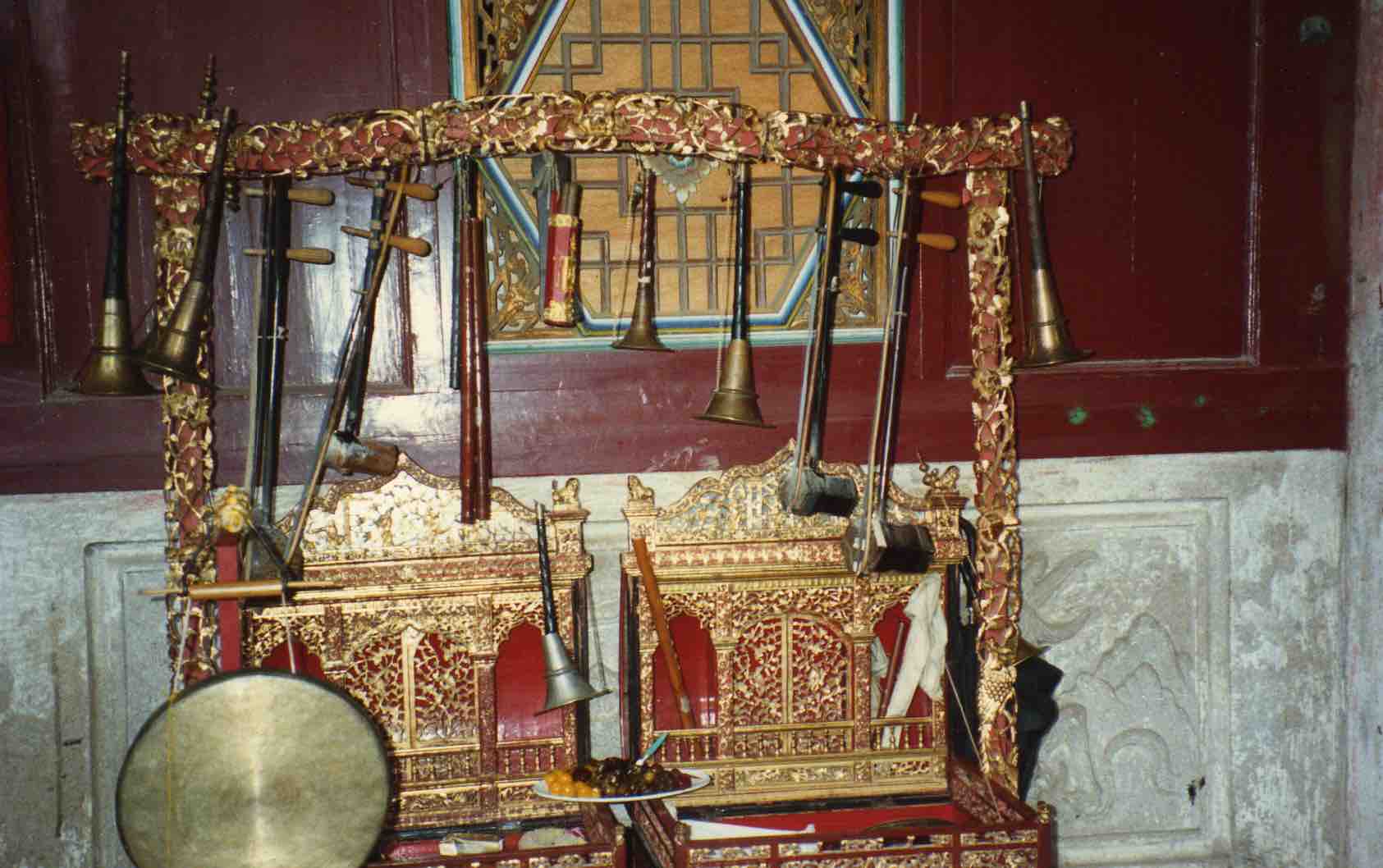
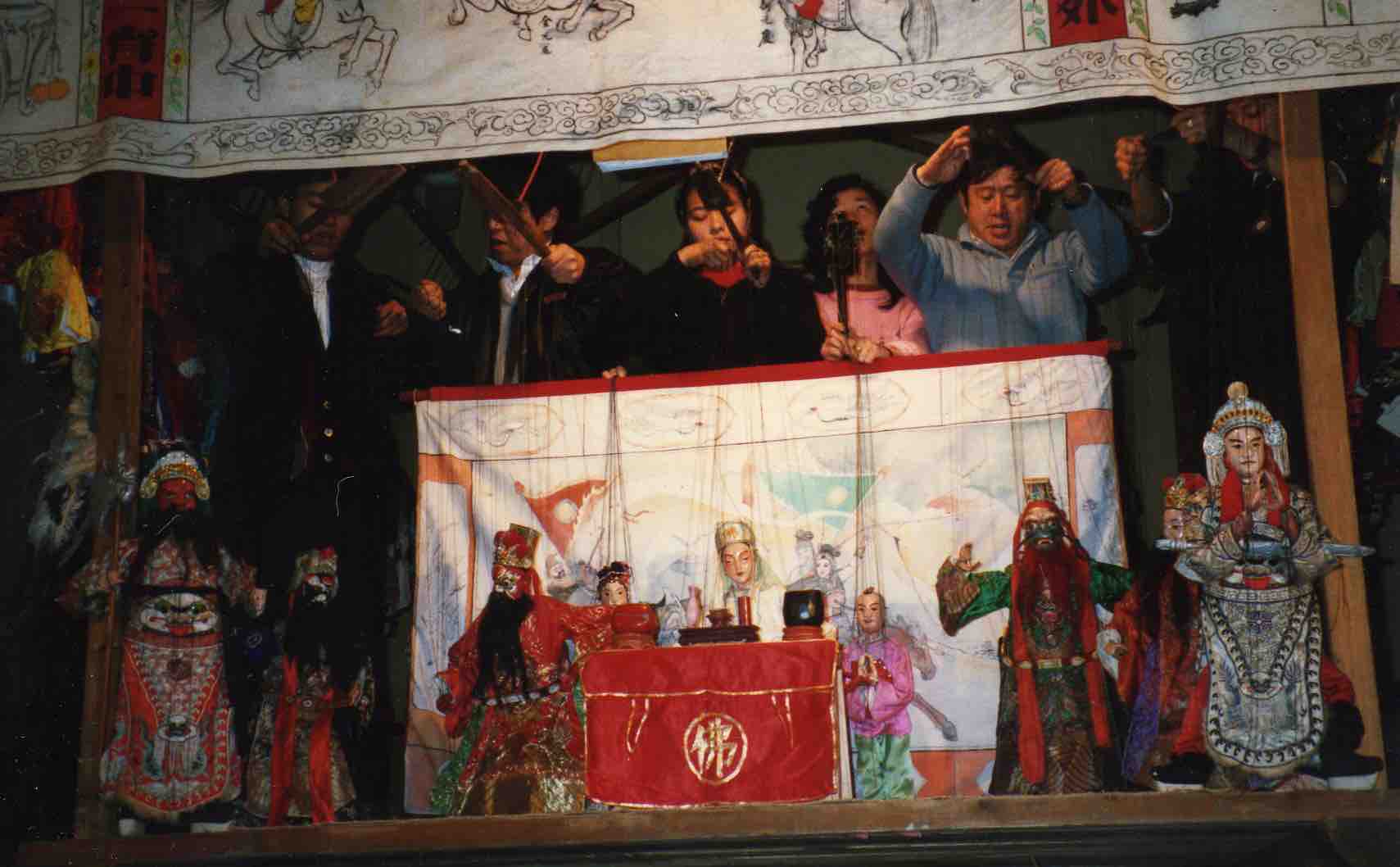
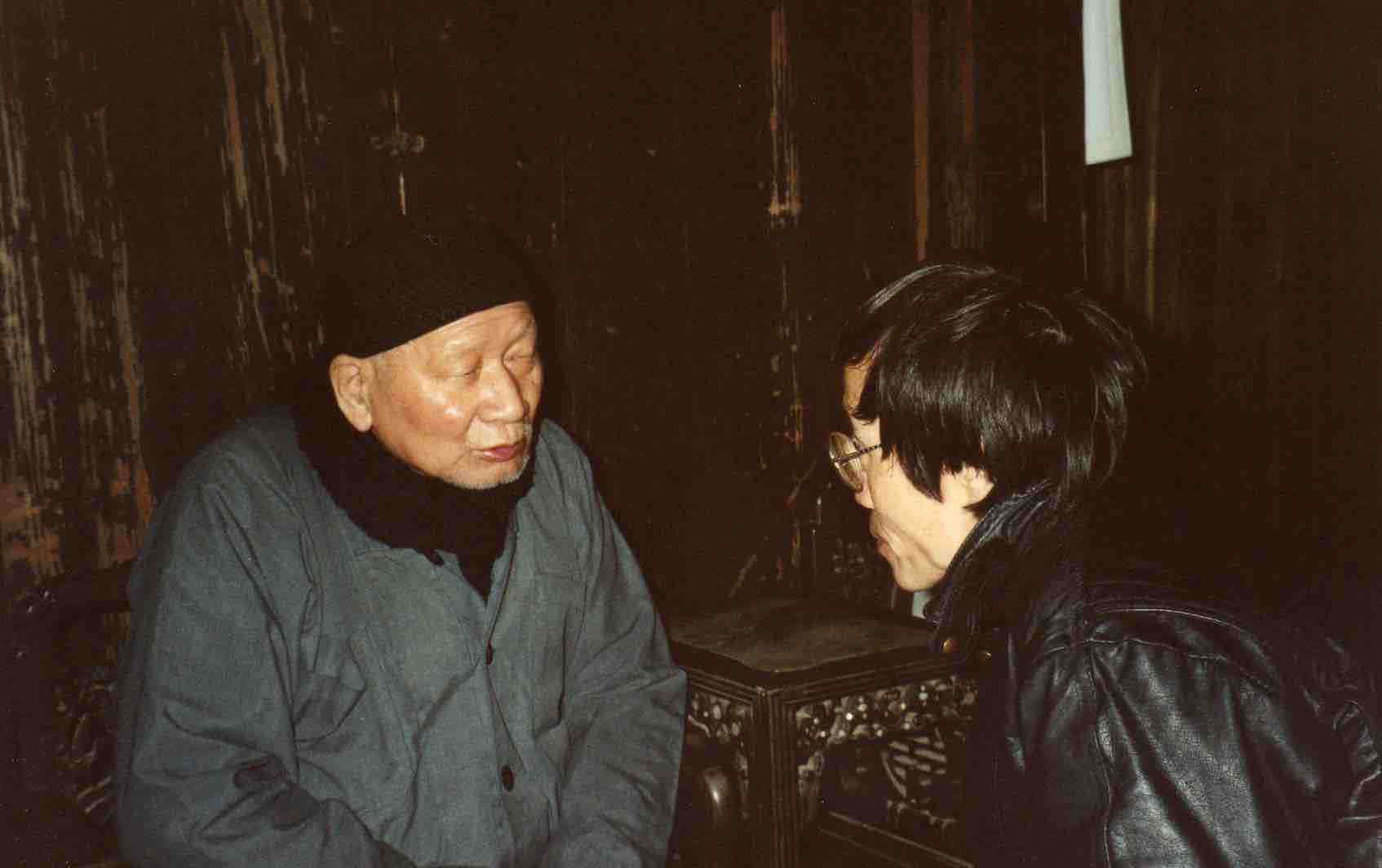
Fujian province in southeast China is one of the most vibrant areas to explore folk and ritual expressive cultures, which its local scholars have been particularly avid in documenting. Its traditions—always rooted in life-cycle and calendrical ceremonies—are known to outsiders largely through the Minnan region in the south of the province, particularly the treasury of nanyin ballads [1]—not least because much of the culture of the island of Taiwan across the strait derives from its Hokkien migrants (click here).

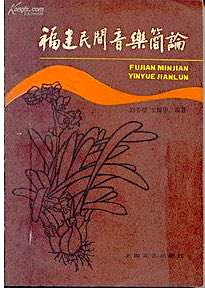
The visits of my early fieldwork years were inevitably superficial, “gazing at flowers from horseback” 走马观花. For background, Li Quanmin’s 1961 field report—during a lull between Maoist campaigns—was already based on collections by local cultural workers. After the hiatus of the Cultural Revolution, Fujian minjian yinyue jianlun 福建民间音乐简论 (1986) by Liu Chunshu 刘春曙 and Wang Yaohua 王耀华 made a worthy survey for the early reform era, including both vocal and instrumental genres.

Meanwhile the compilation of the monumental Anthology of folk music of the Chinese peoples was under way; and it’s taken me all this time to get round to browsing the 2,775 pages (!) of the two instrumental music volumes for Fujian,

  • Zhongguo minjian qiyuequ jicheng, Fujian juan 中国民间器乐曲集成, 福建卷 (2001),
    again with the experienced Wang Yaohua as editor-in-chief.

Ritual pervades all genres of folk expressive culture: in the Anthology, it is a major theme of the volumes for folk-song, narrative-singing, opera, and dance. In the instrumental music volumes, even genres that lack explicit liturgical content are also invariably performed for ceremonial occasions—but a further reason to consult them is that the specific rubric of “religious music” has been consigned there. I’ve described the flaws of the Anthology project in my

  • “Reading between the lines: reflections on the massive Anthology of folk music of the Chinese peoples”, Ethnomusicology 47.3 (2003), pp.287–337.

Apart from the Anthology‘s valuable Monographs for opera and narrative-singing and brief textual introductions to genres, its volumes consist mainly of transcriptions, of limited value without available recordings. Conceptually its classifications are rudimentary, but it opens up a world of local cultures.

For Fujian, whereas nanyin is amply documented on CD and film, most other genres are unique to the province and hardly known outside their own locale. So I find these volumes a revelation, opening up many perspectives (particularly for the late imperial and Republican eras) and making one of the most impressive introductions to the riches of expressive culture in China. It confirms my observations about the resilience of tradition in the PRC—for all the cultural riches of Taiwan, they are dwarfed even by the single province of Fujian, despite the traumas of three decades of Maoism there.

* * *

The main rubrics adopted for the instrumental volumes of the Anthology (a rough-and-ready national framework, based on the classification developed since the 1950s and later elaborated by Yuan Jingfang) are:

  • “compound” (zonghexing 综合性, referring mainly to a substantial vocal component)
  • “silk-and-bamboo” sizhu 丝竹
  • “drumming and blowing” guchui 鼓吹
  • “blowing and beating” chuida 吹打, with a more diverse instrumentation than guchui
  • percussion bands luogu 锣鼓
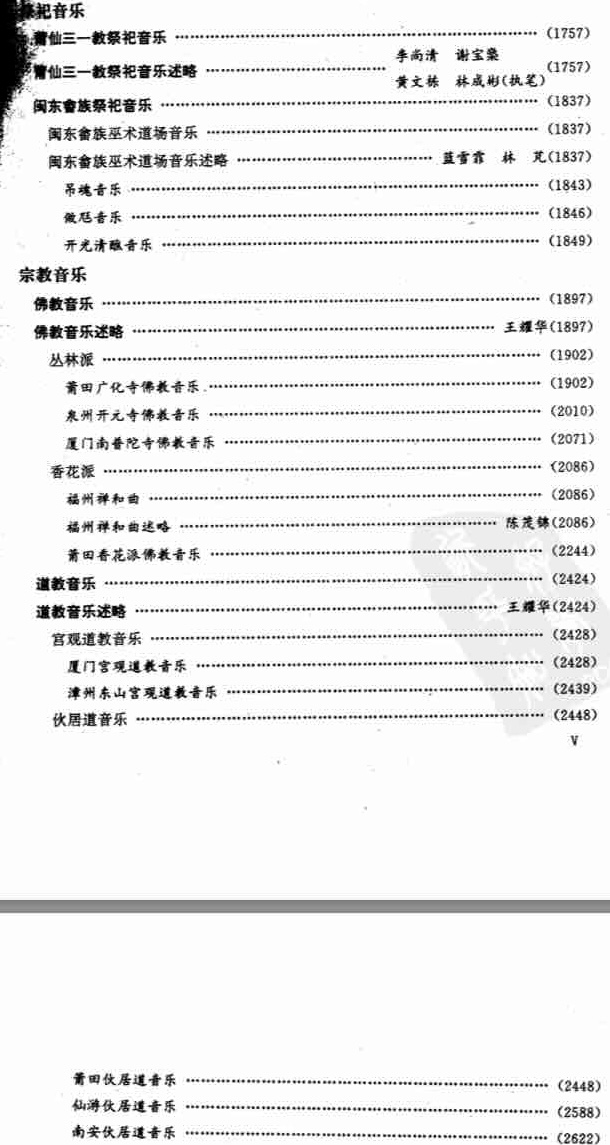
  • “sacrificial music” jisi yinyue 祭祀音乐 and “religious music” zongjiao yinyue 宗教音乐(Buddhist, Daoist, both temple and household—the latter covered far more comprehensively in separate projects by Chinese and foreign scholars).

Besides all the articles introducing particular local traditions, brief yet instructive sections are appended with histories of some notable groups (pp.2687–99) and biographies of performers (pp.2700–19), sampled below.

As throughout China, social performance is dominated by ensembles (see e.g. Liaoning), some occupational, others amateur. By contrast with the “conservatoire style”, instrumental solos play a very minor role in folk practice—here represented only by pieces for the zheng zither around Zhao’an and Yunxiao (pp.1683–1754), just east of Chaozhou in east Guangdong—another enclave for zheng solo repertoires.

* * *

Even for the Quanzhou region of south Fujian, while nanyin 南音 is a main focus, it is only part of a diverse scene. Nanyin has become a significant cultural element in the rapprochement between Fujian and Hokkien communities overseas. With so much research elsewhere, the Anthology section (pp.31–46, transcriptions pp.37–354) may not detain us long, though we should also consult other volumes, notably those for narrative-singing—both “music” (Zhongguo quyi yinyue jicheng, Fujian juan 中国曲艺音乐集成, 福建卷, pp.45–1102!) and the monograph (Zhongguo quyi zhi, Fujian juan 中国曲艺志, 福建卷).

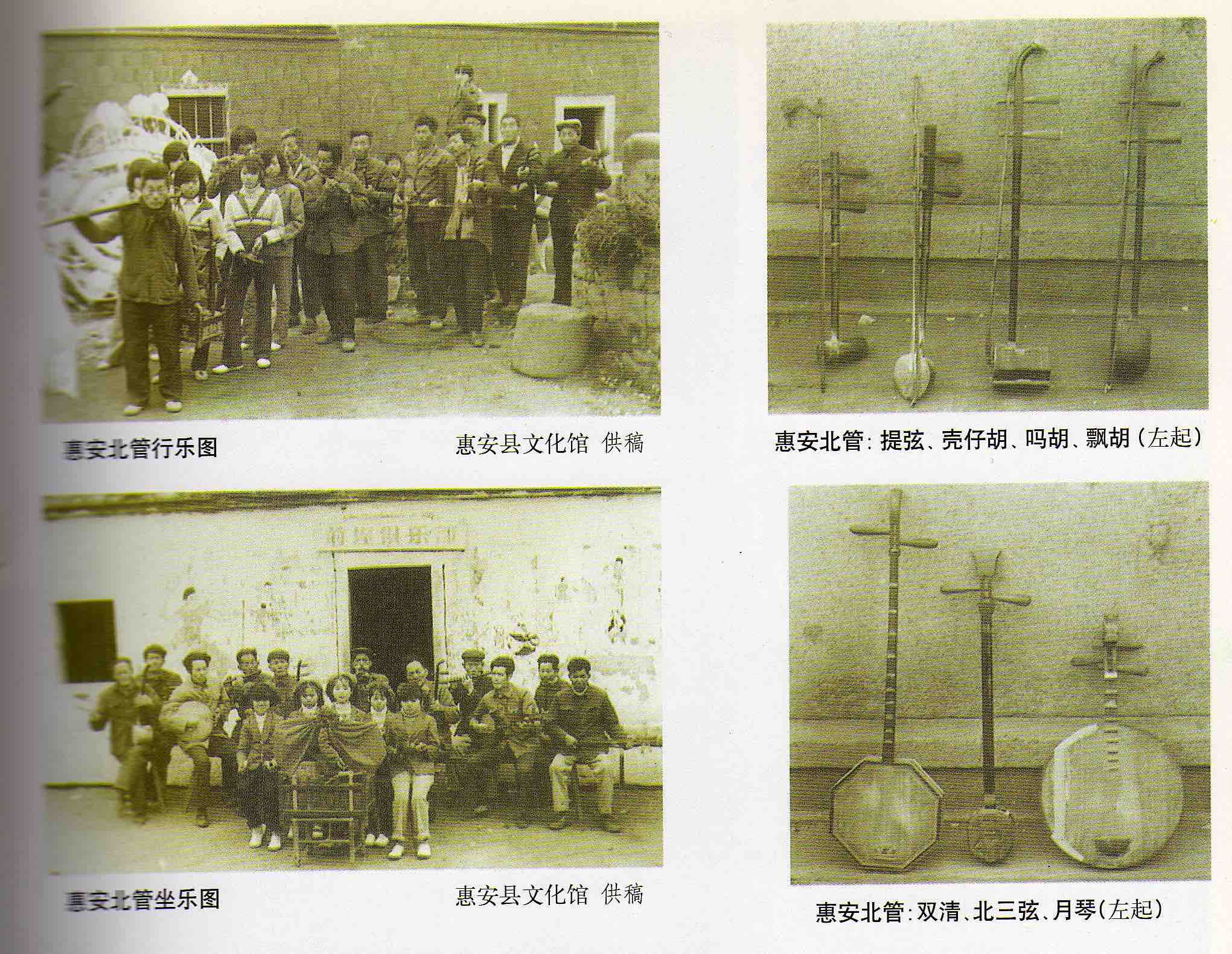
Beiguan 北管 is a major genre in Taiwan (see again here), but in Fujian (where it is particular to Hui’an county near Quanzhou) it has a far less extensive repertoire (pp.355–60, transcriptions pp.361–97; biographies 2716–18).

Local traditions under “silk-and-bamboo” (a rubric as unwieldy as the others) include

  • shiyin 十音 of the Pu–Xian region (Putian and Xianyou) (aka shiyin bayue 十音八乐, with the added format of shawms and percussion: for video clip, see under Walking shrill)
  • guyue” 古乐 of Zhao’an in the southern Zhangzhou region, related to Chaozhou ensemble music and the zheng zither repertoire
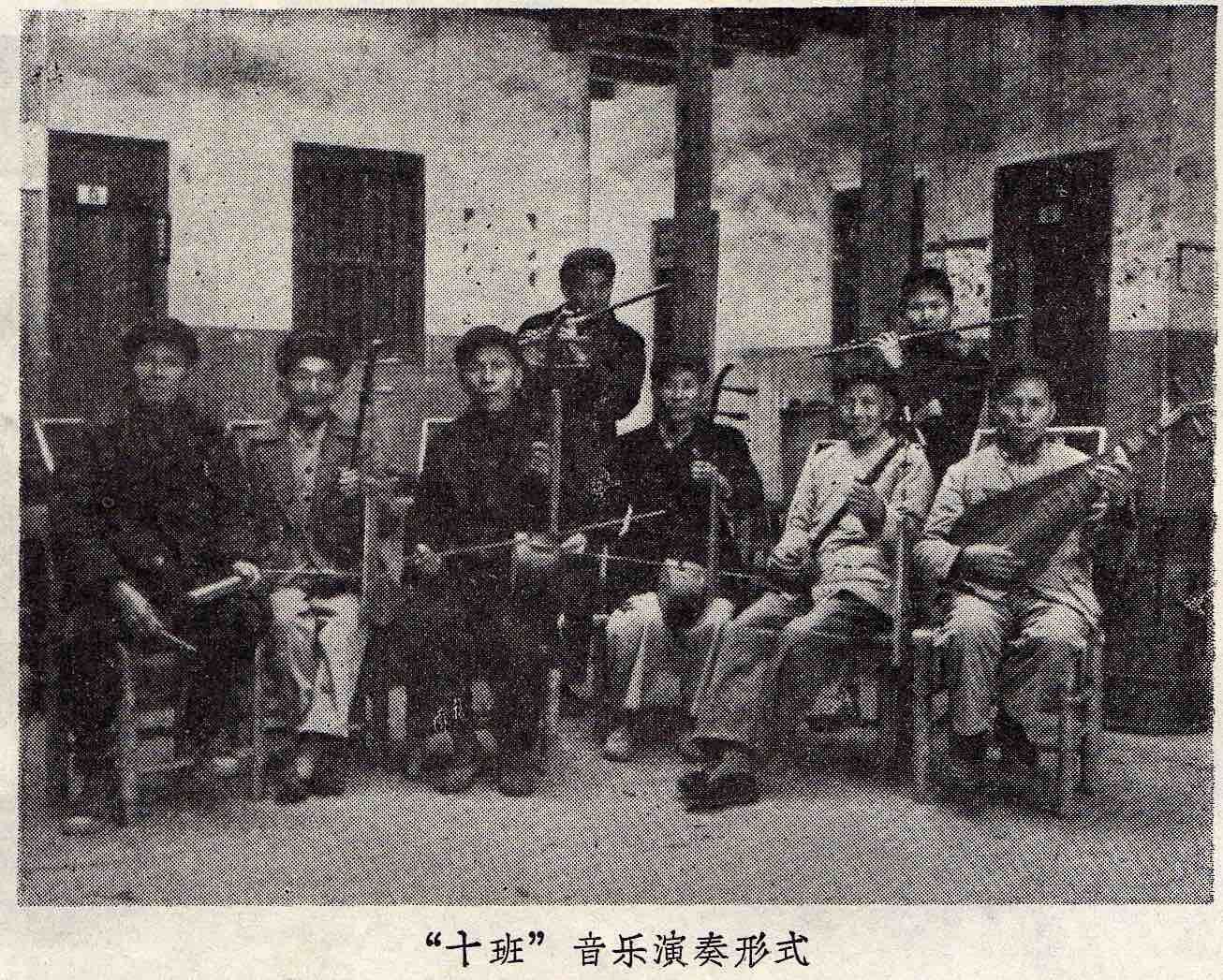
  • shiban 十班 groups around west Fujian.

Anxi da guchui
“Greater guchui” procession in Anxi.

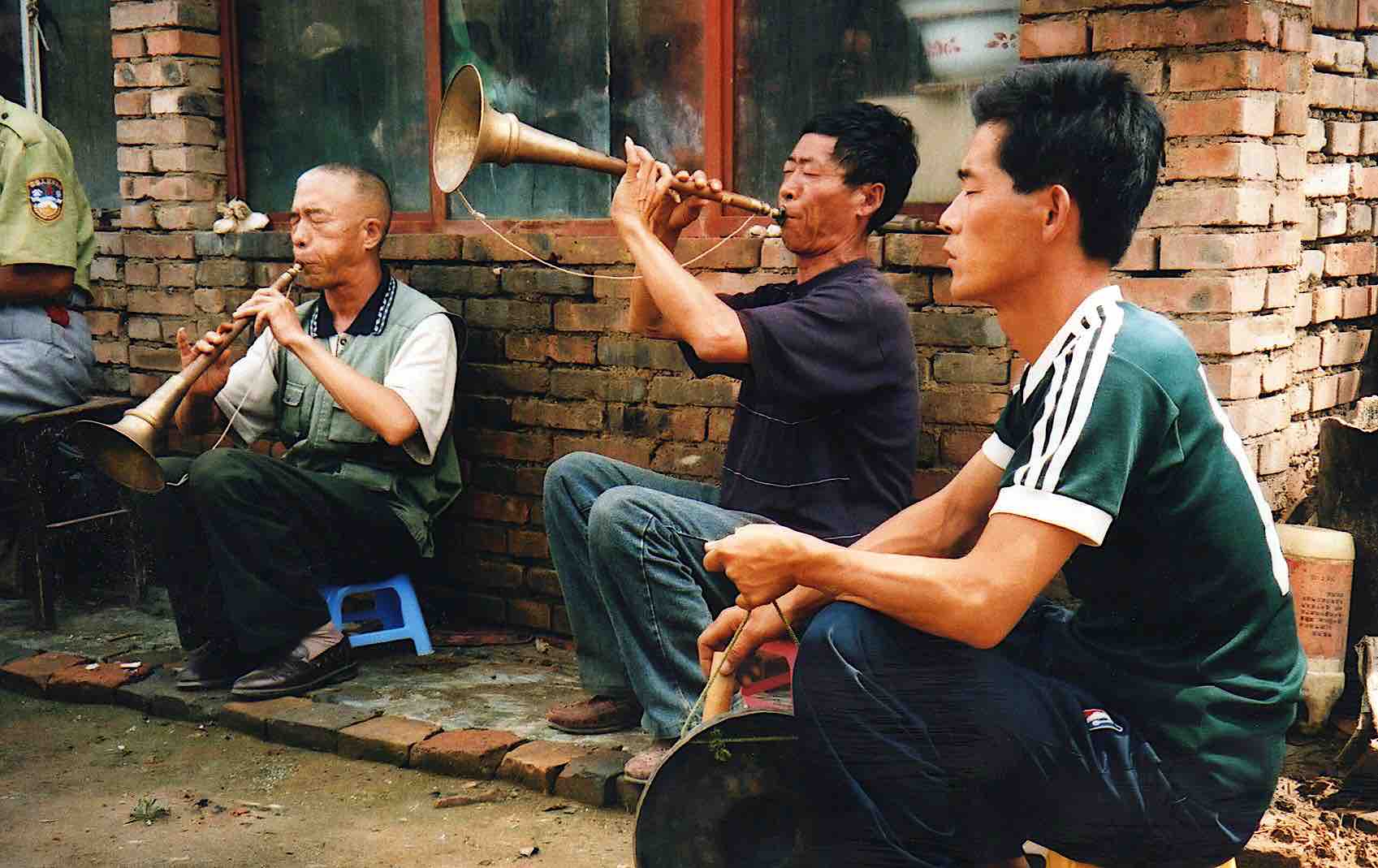
Shawm-and-percussion bands, again serving life-cycle and calendrical observances, are ubiquitous throughout China, including all regions of Fujian—though they are hardly known outside local communities. Under the heading of “guchui” are introductions to

  • Ningde in northeast Fujian (for a shawm band in Xiapu, see also pp.2696–8).
  • around Fuzhou, Annan chi 安南伬 (and introduction to a renowned band in Linpu village, pp.2691–2)
  • in Fuqing south of Fuzhou, jin guchui 金鼓吹
  • “lesser guchui” of Xianyou and “greater guchui” of the Pu–Xian region.

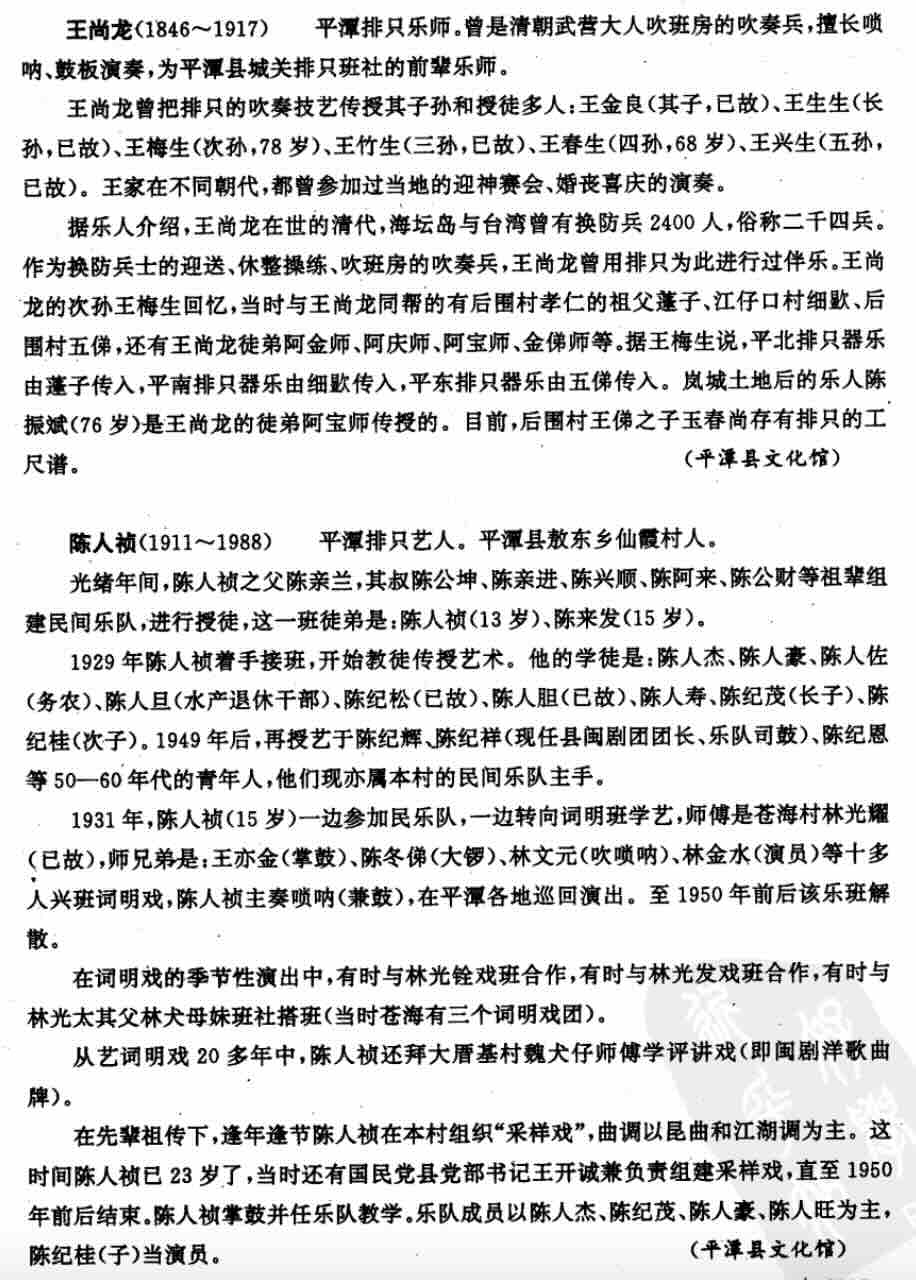
Pingtan paizhi biosBiographies of Pingtan paizhi master Wang Shanglong and Chen Renzhen.

Since imperial times, shawm bands were often transmitted through regional military garrisons, such as

  • longchui 龙吹 around Quanzhou (text pp.784–5, transcriptions pp.786–96), introduced in my Folk music of China pp.312–18, CD #12 (in the sidebar on this blog, audio gallery #15, with commentary here), and another instance is
  • paizhi of Pingtan island 平潭排只 (text pp.663–4, transcriptions pp.665–708; biographies of Wang Shanglong [1846–1917] and Chen Renzhen 陈人祯 [1911–88] p.2707, with a brief introduction to the latter’s band on p.2695).

(cf. the daiyue shawm bands of old Tianjin).

Changtai Qinghe guanThe Qinghe guan society in Changtai.

For south Fujian, further sections document

  • shiyin 十音 around Quanzhou (Folk music of China, pp.318–20)
  • naoting 闹厅 of Yongchun (cf. film footage of Yongchun migrants to Malaysia, here)
  • shawm bands in Anxi and Xiamen
  • for Changtai near Zhangzhou, greater guchui and lesser bayin—introducing the Qinghe guan 清和馆 society, whose masters trained over fifty groups in the vicinity.

Raoping chui

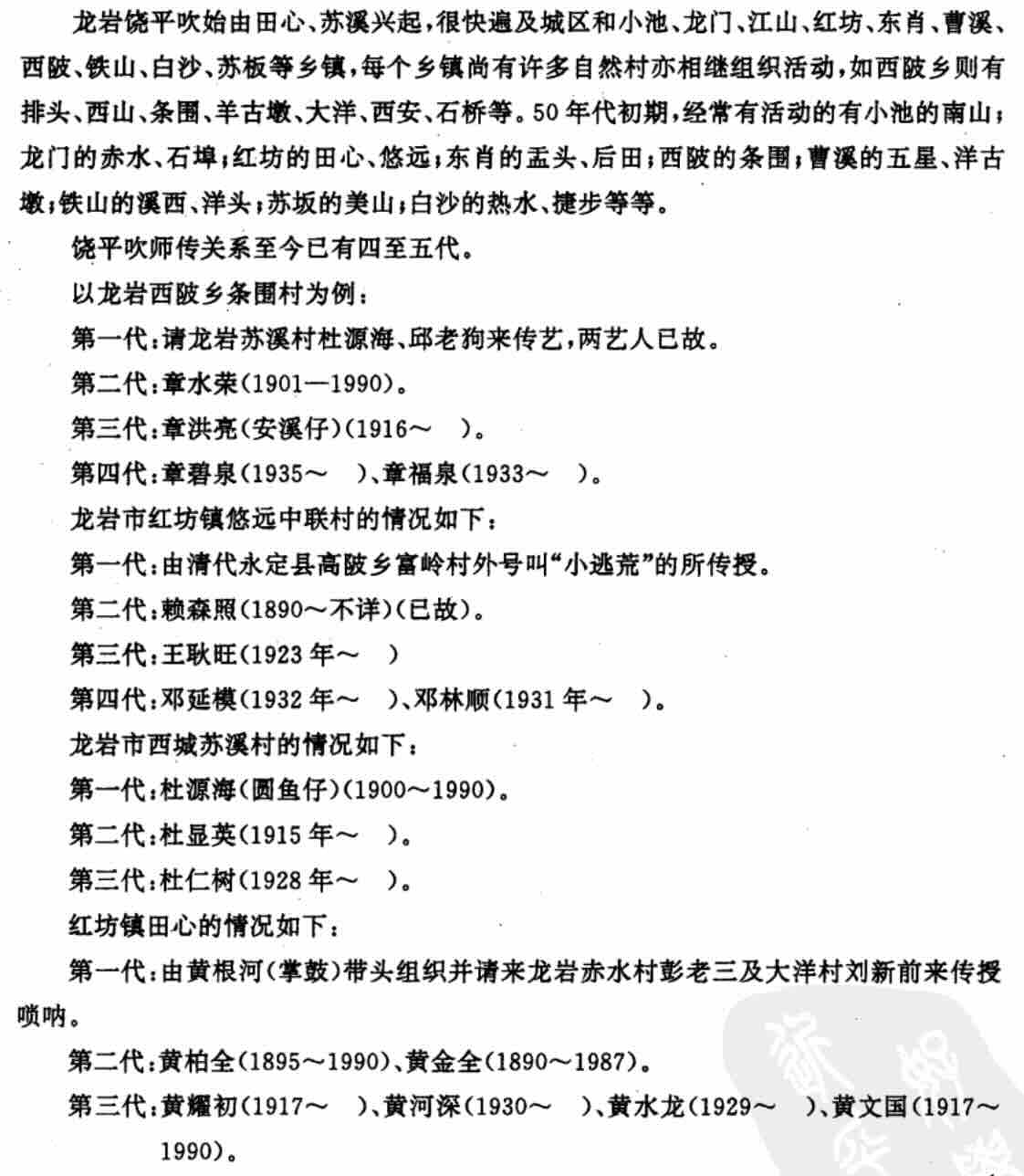
Transmission of Raoping chui in rural Longyan, p.931.

  • Around west Fujian:
    • Raoping chui 平吹 of Longyan (and introduction to a village band pp.2695–6)
    • shifan diao 十番调 of Yongding
    • wuyin 五音 of Shanghang
    • and genres in Wuping, Liancheng, and Changting.
  • In central Fujian, bands in counties of Sanming municipality.
  • In the north, shawm bands in counties of Nanping municipality
  • In the east (opening vol.2), shawm bands of the She minority 畲族 around Xiapu, Fu’an, Ningde, and Yong’an.

“Blowing and beating”
Under the rubric of chuida (a more diverse instrumentation than the “guchui” shawm bands):

  • around the provincial capital Fuzhou, shifan 十番 (for various groups in the region, see also pp.2692–4)
  • shijin 拾锦 of Fuding, and genres in Fu’an and Gutian
  • in the Zhangzhou region, Siping luogu 四平锣鼓 of Nanjing 南靖 county (see also p.2696).
  • in north Fujian, Shifan luogu 十番锣鼓  [2] of Wuyishan, and groups in Pucheng.

Percussion ensembles include

  • taiping gu 平鼓 around Fuzhou, and
  • goutou 沟头 of Fuqing
  • jin guluo 金鼓锣 of Zhouning further north
  • genres in the south and west of the province.

Ritual
As we saw, while all genres of expressive culture are pervaded by ritual, in the Anthology the major rubric of “religious music” has been allotted to the instrumental music volumes. Though the articles of the lengthy section for Fujian (pp.1757—2683) fall far short of detailed monographs elsewhere (e.g. the Daojiao yishi congshu series for household Daoists), they constitute subsidiary references that may yet offer further clues (for early film footage, see Religious life in 1930s’ Fujian).

Ningde mediums
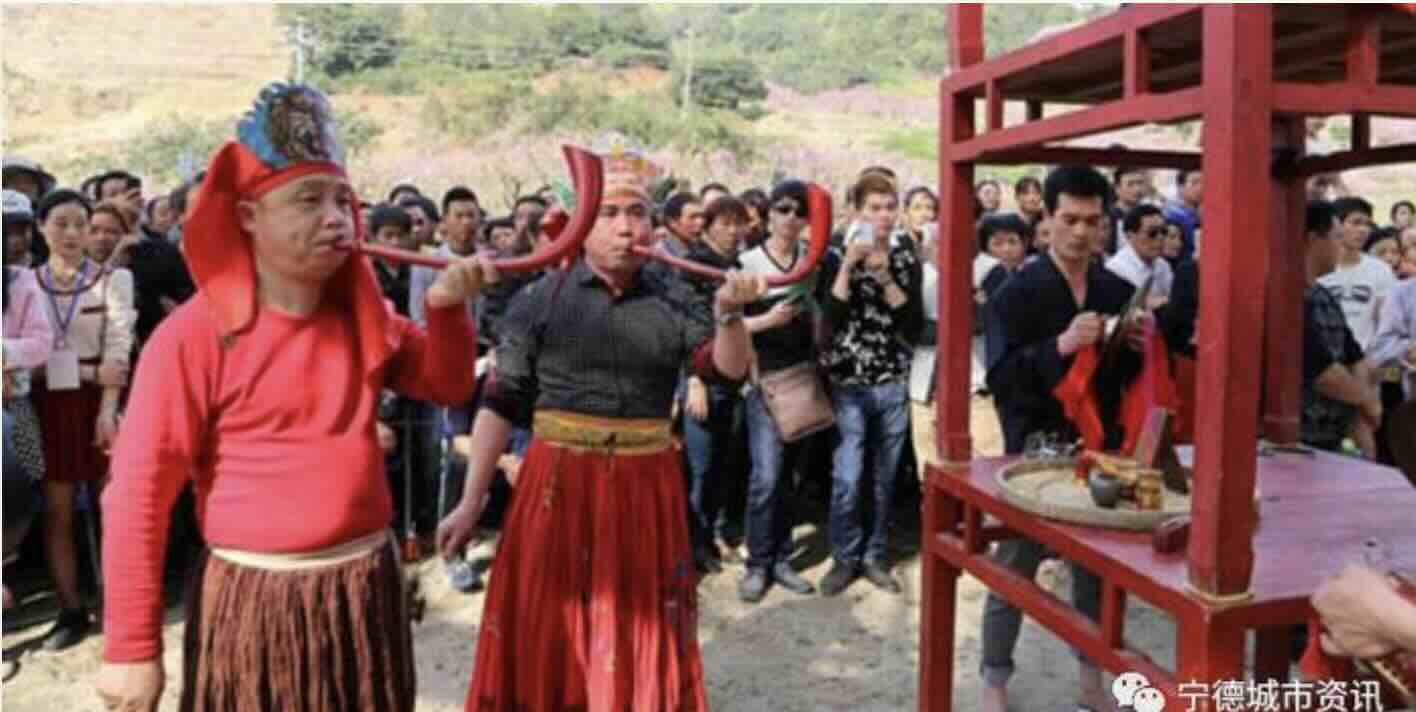
Exorcists, She minority. Source.

In the constant struggle with taxonomy (note the thoughtful studies of Catherine Bell), the editors’ ritual categories are unsatisfactory—in folk practice, even the terms “Buddhist” and “Daoist” are porous, as is clear from several volumes of the Daojiao yishi congshu. Before the listings of temple and household Buddhist and Daoist genres under “religious music”, they have inserted a section on “sacrificial music”, comprising

  • “Three in One” (Sanyi jiao 三一教) groups in the Pu–Xian region (see also biography of Liu Maoyuan 刘茂源, b.1916, pp.2710–11)—note Kenneth Dean, The Lord of the Three in One: the spread of a cult in southeast China (1998)
  • for the She minority around Ningde and Fu’an, a rather detailed article with the misleading title “music of mediumistic rituals” wushu daochang yinyue 巫术道场音乐 (pp.1837–42, liturgical texts with scores 1843–93; also biography of sixth-generation master Zhong Fuxing 钟福星 [b.1930], p.2718). Known here as wangshi 尫师 (an interesting character, wang), such ritual specialists are Daoist exorcists in the Lüshan or Maoshan tradition, presiding over the complex liturgical sequences of jiao Offering and mortuary rituals (cf. this 2017 article), just like their Han Chinese counterparts elsewhere in the province (below under “religious music” > Daoist > household)—as distinct from the self-mortifying spirit mediums who also play a significant role in Fujian rituals (see e.g. Dean’s splendid film Bored in heaven).

Fuzhou chanhe
Chanhe ritual, Fuzhou.

For both simplicity and clarity, these sections might rather have been subsumed under the single rubric of “religious music”—which includes

Buddhist:

  • liturgy of temple monks: Guanghua si temple in Putian, Kaiyuan si in Quanzhou, and Nan Putuo si in Xiamen
  • household ritual specialists:
    • chanhe 禅和 amateur ritual societies in Fuzhou (introduced en passant in my Folk music of China, pp.295–6)—another substantial section (see also biography of Xie Guiming 谢桂铭, b.1913, p.2709)
    • xianghua 香花 household priests in Putian (cf. Meixian in east Guangdong).

Putian DaoistsHousehold Daoist rituals, Putian.

Daoist:

  • liturgy of temple priests: Xiamen and Zhangzhou
  • household ritual groups in Putian, Xianyou, and Nan’an (for the latter, see also biography of Daoist Li Shi 李湿 [b.1932], pp.2712–13)—the scores useful, at least, for liturgical texts. Again, these sections will merely supplement detailed studies by scholars of religion.

Nan'an ritualSegments of mortuary rituals, Nan’an (again, cf. Ken Dean).

* * *

Even limiting our scope to instrumental music, it takes considerable conceptual adjustment to broaden our view of the musical culture of Fujian from nanyin to a multiplicity of groups such as shawm bands and ritual specialists. Unsatisfactory as the Anthology may be, beyond merely documenting “pieces” it reminds us that the lifeblood of all these traditions is social—and ritual—practice. Many individual genres are doubtless the subject of articles in Chinese journals since the publication of the Anthology, and one could make a base in any one county, indeed any one village, combining a wealth of material by observing life-cycle and calendrical activities. Meanwhile, even before consulting several thousand further pages of the Anthology for vocal and dance genres, these volumes provide valuable clues to the local ceremonial cultures of Fujian, the life stories of its transmitters, and social change, making a gateway to our studies of ritual life.

For a survey of folk traditions around the Tianjin municipality, again based on the Anthology, see here.


[1] This is a common reductive view. In surveying Chinese expressive culture, we must always beware merely regarding south Jiangsu as silk-and-bamboo, Hebei as songs-for-winds, Shanxi as “eight great suites”, and ethnic minorities as “good at singing and dancing”—just as we may reduce Spain to flamenco, Indonesia to gamelan, and so on.

[2] Shifan 十番 is a rather common term for instrumental ensembles in both south and north China, the best-known traditions being the Shifan gu 十番鼓 and Shifan luogu 十番锣鼓 of south Jiangsu, authoritatively studied by the great Yang Yinliu before and after Liberation.

Narrative-singing in Chinese society: a roundup

ZJYT beggars
Itinerant beggars performing for funeral, north Shanxi 2018. My photo.

In vocal traditions of Chinese expressive culture (as I keep harping, or drumming, on), the neat pigeon-holes of folk-song, narrative-singing, and opera disguise a continuum from solo singing though to fully-staged genres with larger forces, all oscillating between a range of points along the ceremonial–entertainment continuum—see my

  • “Reading between the lines: reflections on the massive Anthology of folk music of the Chinese peoples”, Ethnomusicology 47.3 (2003), pp.287–337, e.g. §4.4.

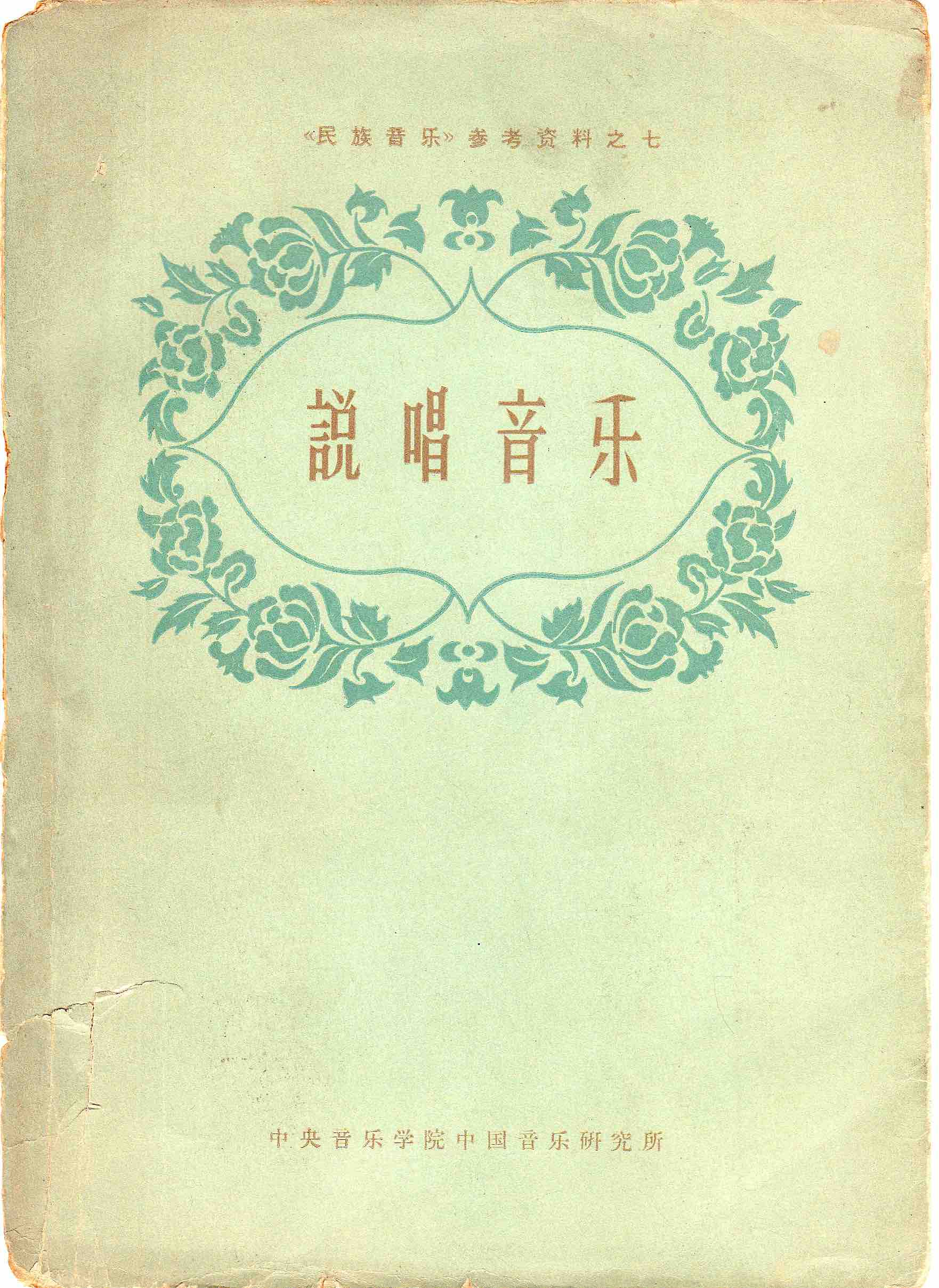
Within the Anthology, one often needs to consult all three rubrics: folk-song, narrative-singing, and opera—and indeed dance. Along with my focus on ritual traditions and instrumental ensembles, narrative-singing (aka “story-telling”) is often relevant to my studies. So I’ve recently added a tag in the sidebar for shuoshu 说书 (aka shuochang 说唱, or in official parlance quyi 曲艺)—I’ll try and keep updating this roundup.

Another issue of taxonomy in the Anthology: whereas “religious music” is largely consigned to the instrumental music volumes, some ritual groups accompanying their vocal liturgy only with percussion are found within the narrative-singing volumes, such as the household Daoists of Changwu in Shaanxi. Also classified somewhat uncomfortably under “narrative-singing” is the substantial theme of

  • “precious scrolls” (baojuan)—surveyed here, with links to Hebei, Gansu, and south Jiangsu.

baojuan Berezkin

From Rostislav Berezkin, “Scripture-telling (jiangjing) in the Zhangjiagang area
and the history of Chinese storytelling”
 (2011).

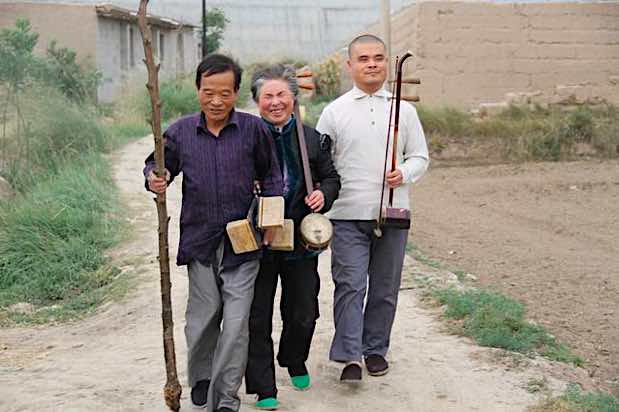
Of course, rather than being constrained by narrow categories, we need to place the variety of expressive cultures in social context. Studies of “narrative-singing” often highlight the refined urban entertainment of urban stages and teahouses, with a largely sinological, literary approach to late imperial history—itself a worthy topic—tending to reify performances that are in fact animated by a strong element of improvisation. And as with folk-singing, opera, and indeed instrumental music, this may distract us somewhat from the ethnography of changing modern society. In rural China, ritual contexts are strong; much story-telling takes place in the context of temple fairs and domestic blessings. The rural perspective is significant across all genres, but I find it particularly salient in coverage of narrative-singing. It may also remind us of the importance of povertyItinerant blind performers are prominent.

Salutary instances include these two posts on Shanxi:

  • Xu Tong: subaltern lives, featuring the documentary Cut out the eyes.
  • Here I introduce Liu Hongqing’s harrowing exposé of the lives of poor peasant families in the Taihangshan mountains, based on a blindmens’ “propaganda troupe”.

Other regions featured on this site, in more or less depth, include

Shaanbei:

and under Chinese film classics of the early reform era, Old well and Life on a string.

Gansu:

Beijing and Tianjin:

Henan:

Moving further south,

Hunan:

South Fujian and Taiwan:

Hong Kong and the Pearl River Delta:

Note also

and under Chinoperl. CHIME 21 (2019) is a collection of article on narrative-singing.

* * *

Further afield, see e.g.

Navigational tools coming in handy, I’ve added this post to my Roundup of roundups!

Music–ritual cultures of Taiwan

Music is not a thing at all but an activity, something that people do

Christopher Small, Musicking

Through the Maoist decades after the 1949 Communist takeover, while the society of mainland China was constantly beset by a succession of iconoclastic traumas, the Republic of China on the island of Taiwan was considered a bastion for the maintenance of traditional Chinese culture.

What I suspect hasn’t always been clarified is that Taiwan cannot embody that culture as a whole: naturally, its heritage largely reflects the traditions of the particular regions from which they were descended on the southeastern mainland—and it was that, until the 1980s, which was the only peep-hole through which we could view the enormity of Chinese culture. *

But then, as “reform and opening” swept the PRC, ritual and other folk performance activity—that outsiders could only assume to have been extinguished there after the Communist takeover of 1949—began reviving on a vast scale, along with an array of central and regional scholars keen to resume fieldwork and research. And at the forefront of discoveries was the region of south Fujian, just across the strait from Taiwan (see e.g. C.K. Wang, Kristofer Schipper, Ken Dean, John Lagerwey). As fieldwork expanded to other parts of the southeast (see Daoist ritual in south China), it soon became clear that there was a vast repository of local traditions of ritual and expressive culture to document all over China (see The resilience of tradition)—if not eclipsing the reputation of Taiwan’s heritage, then at least putting it into perspective. The research of Taiwanese scholars was now able to inspire fieldwork on the mainland.

Still, the main genres of Taiwan have rather little bearing on the kind of ritual traditions that were coming to light in the north Chinese countryside, or even in east-central China; indeed, they only represent a small selection from the diverse range of genres around Fujian, as becomes clear by consulting the volumes of the monumental Anthology (for now, see here, with a further post to follow).

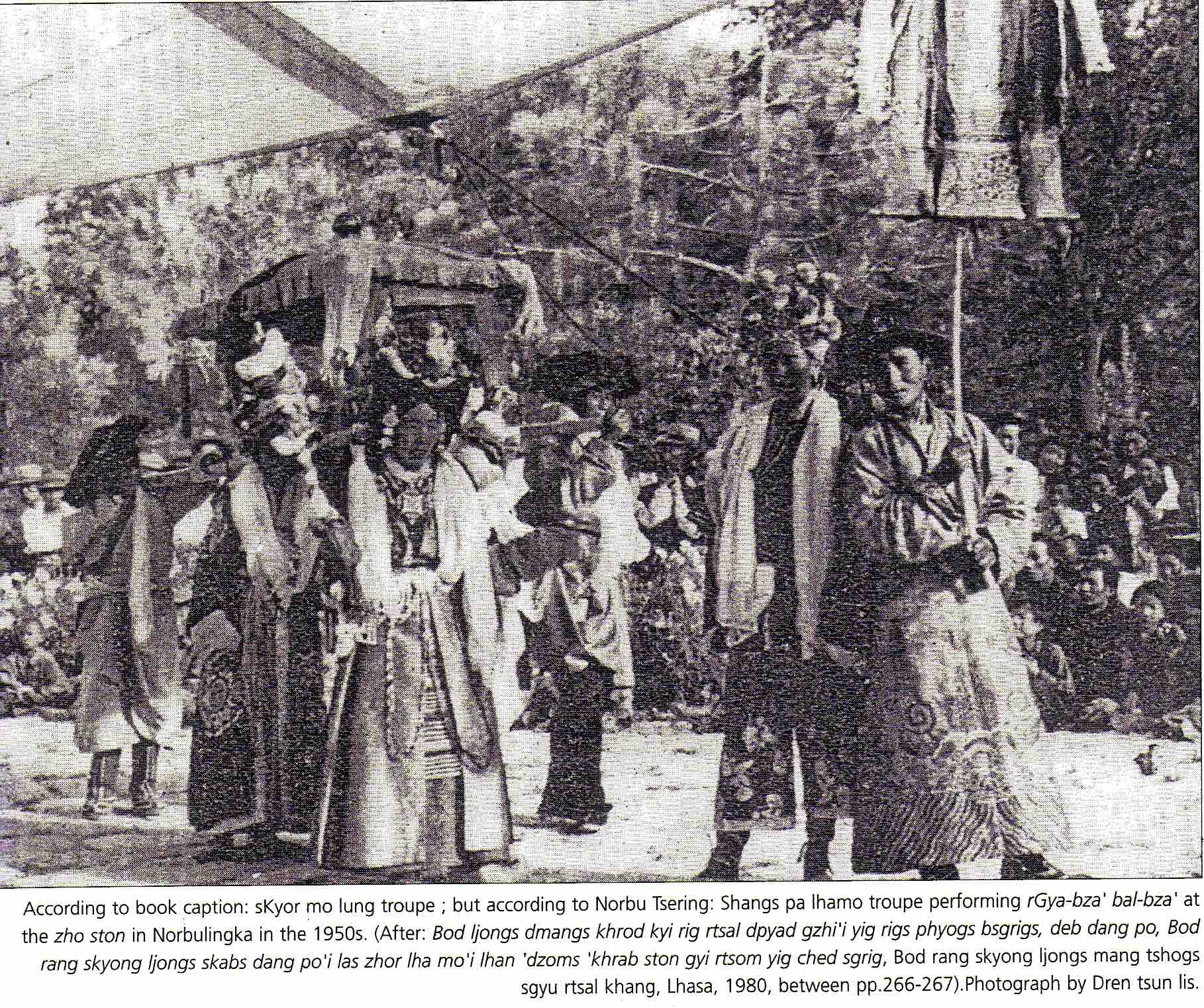
I also think of the transformation of Tibetan studies. After 1950, exile communities (led by TIPA in Dharamsala—see e.g. Zlos-gar, 1986) had been considered as the sole heirs to the culture of Tibet; but by the 1990s scholars began shifting towards the mature ethnographic assessment of its vicissitudes under the Chinese yoke (under Recent posts on Tibet, see e.g. Labrang 1). In her wise article “Easier in exile?, Isabelle Henrion-Dourcy ponders the different challenges of doing fieldwork among Tibetans in Lhasa and Dharamsala (see The enchanting world of Tibetan opera).

* * *

Taiwan
Besides the small minority of aboriginal groups (c2%), the main populations of Taiwan are Hoklo (Holo, c70%), Hokkien speakers originating from the Quanzhou and Zhangzhou regions of south Fujian; and Hakka (c15%), descended from the mainland regions of east Guangdong and west Fujian (click here and here for the expressive cultures of both groups). Refugees from elsewhere in China fleeing to Taiwan in the 1940s also brought some staged vocal genres with them.

With Taiwanese society subject to far fewer traumatic social upheavals than on the mainland, cultural forms were certainly better maintained there. But as in any modern society, there are no “living fossils”: besides the island’s complex colonial legacy, performers and patrons have to negotiate the incursions of modernity and popular media (see Society and soundscape, notably the work of Bruno Nettl).

Since the clampdown in the PRC under Xi Jinping, perspectives regarding the mainland and Taiwan are modifying (see The Queen Mother of the West); having myself been busy studying the maintenance of local ritual cultures in the PRC, it’s high time for me to re-assess my approach. So as sometimes happens on this blog (e.g. Precious scrolls, and even A jazz medley), this basic overview of music–ritual traditions is as much for my benefit as yours…

Surveys
In English, starting points include articles in The New Grove Dictionary of music and musicians, The Garland encyclopedia of world music (Wang Ying-fen pp.423–9, Hsu Tsang-houei pp.523–9), Wang Ying-fen in The Rough Guide to world music, Europe, Asia & Pacific (3rd edition, 2009), and even wiki.

At the forefront of studies of traditional music in Taiwan was Hsu Tsang-houei 許常惠 (1929–2001), who gravitated from WAM-style composition to fieldwork on folk traditions. ** Among his surveys are Taiwan yinyue shi chugao 台灣音樂史初稿 (1991, I think) and (with Cheng Shui-cheng) Musique de Taiwan (1992). See also Lü Ch’ui-k’uan 呂錘寬, Taiwan chuantong yinyue gailun 台灣傳統音樂概論 (2005, 2007), in two volumes on vocal and instrumental music.

Genres
Among the most popular topics are nanguan and Daoist ritual—both, since the 1980s, informed by fieldwork on either side of the strait. Amateur nanguan 南管 music societies, performing exquisite chamber ballads for calendrical and life-cycle ceremonies, have long been deeply embedded in community life (see this post). Nanguan is the subject of much research, both in Fujian and Taiwan. Wang Ying-fen has published extensively on the Taiwan scene in both Chinese and English—I particularly admire her articles on the risks inherent in state promotion of nanguan (such as this), worthy contributions to studies of the thorny issue of heritage.

Temple fairs, with vibrant processions, remain a major part of life in Taiwan. Regional traditions of Daoist ritual (for the north, click here) are the focus of generations of Taiwanese and foreign scholars. For the former, alongside many distinguished scholars, Lü Ch’ui-k’uan 呂錘寬 has paid notable attention to ritual soundscape (e.g. Daojiao yishi yu yinyue 道教儀式與音樂, 1994). Another major theme in ritual studies is the worship of the female deity Mazu, widespread both in Taiwan and around the southeastern coast of the mainland.

The composite genre of beiguan 北管 (good wiki page here, with links) is again performed mainly for calendrical and life-cycle ceremonies, largely by occupational groups; while closely related to vocal drama, it’s best known for its loud outdoor shawm-and-percussion bands. Here’s a short documentary about the master Qiu Huorong 邱火榮 (b.1937):

Most flexible of popular operatic forms is gua-a-hi (gezai xi 歌仔戲). And more popular in Taiwan than shadow puppets and marionettes, glove-puppetry (budai xi 布袋戲) has adapted to changing times; the former tradition was transmitted by masters such as Li Tianlu 李天祿 (1910–98), whose early life is evoked in Hou Hsiao-hsien’s 1993 film The puppetmaster.

Narrative-singing is best known through Chen Da 陳達 (1905–81) on the Hengchun peninsula. He was “discovered” in 1967 by Hsu Tsang-houei and Shih Wei-liang 史惟亮 as part of their fieldwork for the Folk-song Collection movement, forerunner of several state-sponsored organs in Taiwan. Here’s Shih Wei-liang’s recording from 1971:

In the north of the island, the blind female singer Yang Xiuqing 楊秀卿 (b.1934) is also renowned.

(As in the PRC, please excuse me if I fall into the old Songlines trap of giving undue attention to “star performers”—whereas in-depth ethnography soon uncovers the myriad unsung bearers of tradition, such as Vincent Goossaert’s “ordinary Daoists”, or rank-and-file members of festive groups.)

Like beiguan, the Hakka bayin 八音 ensemble is dominated by shawms and percussion. Here’s the CD Taiwan: mountain songs and bayin instrumental music (Inedit, 2006; as playlist):

As in mainland China, the vocal polyphony of minority peoples (notably Amis, Bunun, Tsou, Paiwan, Rukai—around 2% of Taiwan’s population) has attracted much attention, with many recordings issued of aboriginal singing, such as Polyphonies vocales des Aborigènes de Taiwan (Inedit, 1989):

and Taiwan: music of the Aboriginal tribes (Jecklin, 1991) (playlist):

As in mainland China, while such traditions struggle to remain relevant in a modernising society, national cultural bodies have adopted particular genres as symbols of identity. Expressive culture has made a major component in the rapprochement between the PRC and overseas Chinese communities. Wind Records in Taipei issued a succession of CDs of mainland genres in conjunction with the Music Research Institute in Beijing, notably an important series of archive recordings (folk-song, narrative-singing, opera, and instrumental music, as well as minority polyphony), and of the qin zither. The journal Minsu quyi, with its detailed studies (mostly in Chinese) on ritual, theatre, and folklore, also expanded its scope from Taiwan to the mainland.

* * *

Growing political tensions encourage us to pay renewed attention to Taiwan, and to support beleaguered democracy. While it’s fruitful to study the genres introduced above on both sides of the strait, the island remains a conducive environment for both performance and research. Now I’m keen to see someone with fieldwork experience in both societies, such as C.K. Wang, Wang Ying-fen, Ken Dean, or Adam Yuet Chau, expounding the different trajectories of the diverse traditions there, and the challenges that they face.


* Now, none of these comparisons quite work, but…
While it’d be far too parochial to imagine the Isle of Wight as a refuge from a radical government in mainland UK, perhaps we might visualise Cuba becoming a liberal sanctuary from a Gilead-style fundamentalist north America (see The handmaid’s tale)—or even Sicily as the sole isolated outpost for tradition while mainland Europe languishes in the grip of authoritarian regimes.

In chapter 10 of In search of the folk Daoists of north China I made a similarly rash comparison, seeking to incorporate north China into our overview of Daoist ritual (cf. this post, again):

It is rather as if our knowledge of Christianity in the whole of Europe were based almost entirely on Sicily and Puglia, with the odd footnote on the Vatican and Westminster Abbey. We may like what we find in those places, perhaps considering it more exalted, mystical, and ancient—but that is another issue.

Without at all playing into the greasy hands of PRC propaganda, one might consider Taiwan (culturally, not politically, since it is clearly an independent nation! Cf. China has always been part of…) as just one among over thirty provinces of China, all of whose forms of expressive culture are dominated by long-established local folk traditions while also featuring some “national” genres and styles from other regions.

** If Yang Yinliu wasn’t the Chinese Bartók, then Hsu Tsang-houei wasn’t the Taiwanese Yang Yinliu (whereas Bill Evans was the Bill Evans of jazz).

Tibet: ritual singing in an Amdo community

*Part of my education in the travails of modern Tibet*

Shepa cover

  • Bendi Tso, Marnyi Gyatso, Naljor Tsering, Mark Turin, and members of the Choné Tibetan community, Shépa: The Tibetan oral tradition in Choné (2023)
    (free access here).

Shépa (bshad pa) * is an encyclopaedic repertoire of antiphonal songs performed by ritual specialists and prestigious elders of the Choné people (Co ne pa), a Tibetan subgroup in the Luchu river valley of Kenlho (Kan lho; in Chinese, Gannan 甘南) Tibetan Autonomous Prefecture of Gansu province in northwest China. The region straddles both the Tibetan regions of Amdo and Kham and the Chinese provinces of Sichuan and Gansu, bordering territory managed by the great monastery of Labrang (cf. this post, including further readings on Amdo, and sequel).

Shépa “encapsulates the evolution of Tibetan civilisation through time and serves as a repository of the cultural, religious, and historical knowledge of the Choné people”. As the authors explain, Choné history is profoundly shaped both by intricate interactions with close neighbours (Han, Hui, and Monguor) and by distant political and religious centres. From creation myths to Bon and Buddhist cosmologies and wedding songs, shépa engages with and draws on elements of religious traditions, historical legacies, and deep-seated cultural memories.

“A collaboration with and between members of the local community, including narrators, monks, and scholars”, with its trilingual format (in English, Tibetan, and Chinese) the book’s 778 pages become less daunting.

Bendi Tso’s preface opens with a promising vignette, in what has become a classic juxtaposition (for Chinese instances, see e.g. my film Li Manshan, from 30.32 and 1.07.34):

Leaning against the living room window the night before Sangye Men’s wedding, I felt as if I was straddling two worlds, separated by a thin pane of glass. In the yard, Sangye Men’s friends formed a circle and took it in turns to sing and dance, accompanied by a giant stereo speaker and a rotating rainbow globe light. Their playlist ranged from Tibetan ballads to Chinese songs, and from the traditional Tibetan lute (sgra snyan) to nightclub music. When Arabian Night started, a popular dance song appreciated by younger generations, the guests turned up the volume as high as it would go, swaying their bodies to the music and showing their enjoyment.

Right across the window and inside a living room, four elders were sitting on tsatap (tsha thab / rdza rdo), a raised clay platform where people eat and sleep, drinking Tibetan spirits (bod rag). The flickering rays of the rainbow globe danced on their faces. Occasionally looking out of the window, the elders continued intermittent conversations while singing Shépa. I wondered whether they were able to catch each other’s words on account of the loud noise emanating from the speaker next door.

The co-authored Introduction (pp.1–64 in the English version) gives a nuanced definition of shépa, which has been considered as “poetic recitals”, “speeches”, “oral literature” or “oral tradition”—a combination of verse and prose in recitation and song. In their broad understanding, it is “an umbrella category including all local oral performances that have survived to the present”, on a spectrum from religious to secular. They discuss the relation of shépa to other oral traditions both in Choné and in the wider Tibetan and Himalayan cultural spheres.

The authors introduce ritual specialists (cf. Tibet: some folk ritual performers):

Almost every Choné village had an anyé bonpo (a myes bon po) household belonging to a lay Bon priest or an anyé gompa (a myes sgom pa) household of a lay Nyingma practitioner, who would be in charge of performing rituals for individuals and community before the 1950s. Nowadays, ever fewer villages have these priests.

As they surely know, this leap in time begs some basic questions. Again:

Leu (le’u / lhe’u), who appear in Shépa, are a type of anyé bonpo. In Choné, Leu are crucial figures who conduct the protection ritual (srung) during the marriage ceremony. Over the past decades, ever fewer households of anyé bonpo have been in a position to transmit their heritage and duties to the next generation. Based on our current research, there remain only a handful of anyé bonpo, and no leu, in Choné.

The emblem of the anyé bonpo’s ritual expertise is the anyé zhidak (a myes gzhi bdag), “a built-in wooden cabinet designed for storing arrows (mda’) that represent lineage, fortune, and fertility, located beside the main pillar in the living room”.

Among the main performance contexts are wedding ceremonies, as well as horse racing and arrow shooting over New Year (cf. Bhutan). Weddings have “changed significantly over recent decades”, but we are not offered details on the process. Other material on change also begs questions:

These days, almost all of the critical moments in the lives of Choné people now involve Geluk monks and lamas, from naming newborn children to blessing newlyweds to performing funeral rituals. Since the 18th century, the majority of Choné people have become Geluk followers. Major festivals, fairs, and pilgrimage dates in the local calendar are arranged according to the religious schedule of Choné Monastery and its branches. In recent years, with village ritual specialists ageing and passing away, villagers offer their non-Buddhist ritual texts to Geluk monks and ask them to perform rituals that were once conducted solely by anyé bonpo and anyé gompa. Monks usually conduct these rituals with some Buddhist modifications.

I applaud the intent of this study. Salvage projects can be valuable to document a kind of maximum repertoire, and the authors’ diligence in recording the community elders is commendable. But after that promising opening vignette, we are never told if shépa has taken on a new life, perhaps modified in new popular forms, beyond the reified stagings of the Intangible Cultural Heritage—whose many problems they recognise:

In recent years, “traditional” ways to learn and perform Shépa have undergone rapid transformation in the Choné Tibetan community. The transmission of Shépa is increasingly privatised and its performance is becoming standardised in response to the inscription of this oral tradition into the Kenlho Prefectural-level register of the Intangible Cultural Heritage in 2016. The performative setting and standards for what constitutes a “good” performer are fast changing, and this process has also been accompanied by a reconceptualisation of what Shépa was, is, and will be.

The remaining seven sections of the Introduction document texts—myths, ** and wedding songs—without any further social-political analysis of changes in wedding customs and New Year’s observances over the previous decades. The book has no index.

* * *

Outside the PRC, the field of Tibetan studies has made immense progress in recognising the legacy of the Maoist era, and the ongoing consequences of Chinese occupation—with research both from Tibetans based abroad (such as Tsering Shakya, and the High Peaks Pure Earth team) and from Western scholars (under my roundup of posts on Tibet, see e.g. Conflicting memories, When the iron bird flies). Among fine ethnographers in the field of customary life and expressive culture (note this bibliography) are Charlene Makley, Isabelle Henrion-Dourcy, Katia Buffetrille, Gerald Roche, Anna Morcom, and Timothy Thurston (see also Keila Diehl’s Echoes of Dharamsala); the monographs of the Asian Highland Perspectives series were compiled by trained local fieldworkers.

Such research hardly features among the Shépa authors’ references. The book provides useful material on early history (migration, the Choné kings, Bon, Buddhist sects, warfare), but is entirely silent about social and political change since the 1950 Chinese occupation. So this is the last episode in their historical overview:

From the mid-19th century, the Luchu valley suffered several regional wars. The Choné people were at that point the largest Tibetan group ruled by the Choné kings. Time and again, they were either conscripted into the king’s militia to suppress insurgents for the Qing and the Republic of China (1912–49) or slaughtered by insurgents. Throughout this period, the Choné people suffered serious depopulation. Most Tibetan villages on the northern bank of the Luchu River were destroyed in warfare. To collect tax and recruit militiamen, the kings leased destroyed, bankrupted or empty [sic] households to Chinese migrants who had narrowly escaped with their lives from social unrest and natural catastrophes in neighbouring areas. This resulted in a steady inflow of Chinese migrants into Choné. By 1949, the Choné people had already become a minority within an ever-growing Chinese population.

The authors state their goal:

We hope that this book may serve as an entry point for the Choné Tibetan community in support of their goal of Shépa revitalisation and at the same time uplift their linguistic heritage and cultural dignity.

This is laudable, yet while they are well aware of “the socio-cultural dilemma facing all Choné people over the past several decades”, political constraints hamper their analysis. Cultural impoverishment in communities like these is not simply a function of some generalised modernisation; it is also indivisible from political history since the 1950s.

Of course we always have to read between the lines of PRC publications (see e.g. under Cultural Revolutions, and my two recent posts on opera and narrative-singing among Han Chinese communities in Gansu during the famine). The book’s four named authors are all based outside the PRC, and (like Amdo dwellers) doubtless have insights on the radical changes in society following the Chinese invasion in 1950, the devastation of communities as political campaigns escalated from 1956, and the new transformations since the 1980s. Even within the PRC, perspectives on the traumatic history of Tibetans (indeed, particularly Amdowa) under Maoism—and since—have not always been entirely off-limits.

But the period since 2015, when the authors were carrying out their own fieldwork, has been marked by intensified state surveillance amidst a severe deterioration in Tibetan–Chinese relations, with serious conflicts which they also pass over in silence, such as the 2008 unrest (e.g. here, under 15th June) and 2015 self-immolations (cf. Eat the Buddha). Their reluctance to broach such issues doubtless follows in part from their noble decision to involve as co-authors “the members of the Choné Tibetan community”; and the authors themselves, even while based outside the PRC, may not feel secure enough to avoid self-censorship. So my caveats are critical not of them, but of the extent of the climate of fear beyond the PRC.

Given that the book’s whole subject is cultural transmission, for which the era of Maoist extremism was a crucial period, I find it disturbing that discretion has obliged the authors to exclude all but the vaguest of allusions to it. Other topics left unexplored include migration, state education, and the vast influence of pop and mass media. Thus their account of “history” comes to an abrupt halt in 1950. While one must respect their decision, it limits the book’s value. I still wonder if there might be a way of giving some tactful clues to the painful maintenance of shépa; otherwise there’s a glaring lacuna, risking the kind of reified, timeless, rosy portrayals that are de rigueur in the Intangible Cultural Heritage mission.

Since the authors quite rightly esteem the elders of the community such as Grandfathers Meng Tusktor and Zhang Gyatso, * one wants to know more about the vicissitudes of their lives—through the late 1950s’ uprisings, the famine, the Cultural Revolution; did they manage to continue singing shépa in the early 1950s, the late 50s, even the 60s? Were any of them recruited to the new song-and-dance troupes funded by the Chinese state—and what was happening to the traditional contexts for shépa in local communities? Have performers and audiences expressed any opinions about all this?

And of course, apart from silent, immobile texts, we also need accessible audio/video recordings (see e.g. Amdo rituals: early and recent films)—something eminently realisable with online publishing.

Despite such lacunae, there is substantial material here for historians of (pre-1950) Amdo; with its trilingual format, it is designed to serve the Choné community, under the conditions in which they find themselves.


* On the minefield of Tibetan and Amdo transliteration, see Robbie Barnett’s introduction to Conflicting Memories.

** Including the bird-like deity Khyung, and Rübel (Cosmic Tortoise, a name just begging to be taken up by a Choné rock band—cf. the Croatian metal combo Teddy Bear Autopsy).

Precious scrolls: some background

Precious scrolls of village ritual associations near Houshan, Hebei:
left, “Demon-queller scroll”, Lijiafen;
right, “Ten Kings scroll”, Jijiagou.

My sideline in “precious scrolls” (baojuan 寶卷) [1] goes back to our 1990s’ field project on the central Hebei plain, when we were impressed to find a substantial treasure-trove of early editions in villages of Yixian and Laishui counties—and particularly to witness them still being performed by the liturgists of amateur ritual associations there (see under The Houshan Daoists and The Houtu precious scroll).

While the central Hebei plain, and the living performance of its early sectarian scriptures, remain my main focus in baojuan studies, after this recent note on the traditions of Gansu my wider interest has been further piqued by the latest in a succession of anthologies:

whose 50 volumes contain 150 precious scrolls, each with an introductory synopsis. They belong mainly to sectarian groups such as Wuwei 無為, Huangtian dao 黄天道, Xi Dacheng jiao 西大乘教, and Hongyang jiao 弘阳教 / Hunyuan jiao 混元教, many of which feature in our fieldnotes on Local ritual in Hebei (see e.g. Ritual groups of Jinghai).

baojuan cuibian

As instances of texts that we found in rural Hebei, vols. 24 and 25 comprise six editions of the “Demon-queller scroll”  Huguo youmin Fumo baojuan 護國佑民伏魔寶卷, performed until recently for mortuary rituals in villages around Houshan. Of early printed scrolls that we found in Gaoluo village, the “White Clothes scroll” Xiaoshi Baiyi Guanyin pusa song ying’er xiasheng baojuan 銷釋白衣觀音菩薩送嬰兒下生寶卷 is in vol.29, and the Fuguo zhenzhai lingying Zaowang baojuan 富國鎮宅靈應竈王寶卷 in vol.38 (cf. the Gaoluo editions, from 1745 and 1720 respectively). The compendium also includes the “Dizang scroll” 地藏王菩薩執掌幽冥寶卷 (vol.29) and “Ten Kings scroll” 泰山東嶽十王寶卷 (vol.30), preserved by nearby village ritual associations in early editions. In this region at least, the most commonly performed scrolls address the major preoccupations of Chinese villagers: birth (to Guanyin and Houtu), and death (to Demon-queller, Dizang, and the Ten Kings). 

* * *

I can’t keep up with the “baojuan fever” that has grown since the 1990s. These notes serve as much for my benefit than yours—rather, perhaps, we constantly seek to refine and clarify our earlier studies.

Baojuan is an umbrella term for a range of texts. Many scholars have considered baojuan more as “folk literature”, or as a textual window onto early sectarian religion, than as a living performance tradition. Pu Wenqi’s own long-term research set forth from studying sectarian (if not always “secret”) folk religion in north China—under the aegis of the great Li Shiyu 李世瑜 (1922–2010); and it was Li Shiyu who blazed a trail in unpacking structural elements of baojuan in ritual performance, which are among the many themes discussed by later specialists.

The research paths of scholars have depended largely on which among the diverse types of baojuan were prevalent in their own region and to which they had access (cf. “blind people groping at the elephant“). As a broad outline, the early “religious” style has mainly been found near Beijing, while later “folk” texts are common in east-central China and the northwest.

Actually, in my earlier posts (based on Plucking the winds, and Appendix 3 of In search of the folk Daoists of north China) I appear to have had a basic grasp of the place of the Hebei scrolls in baojuan studies. As I noted, “while scholarship on the precious scrolls has tended to be more historical and sinological than contemporary and ethnographic”, “the whole point of these precious scrolls is that they are performed for rituals—they’re not musty tomes to be read silently in libraries.” What struck me about the Hebei scrolls was that they belonged very much to the early “religious” type of baojuan, but were still part of a living tradition—most performers we met were liturgists within ascriptive village-wide ritual associations, which had sectarian connections within living memory. And we found the classic structure of early religious baojuan to which Li Shiyu drew attention in 1957: 24 chapters (pin or fen ), each incorporating ten-word form, qupai labeled melodies, and so on (see under The Houtu precious scroll).

Of course, just as baojuan only constitute only one small sub-head among the vast mass of Daoist and Buddhist scriptures, they were just one component of the manuals performed by the liturgists whom we visited (see A tribute to two vocal liturgists, Gaoluo: vocal liturgists, Funerals in Hebei). (And zooming out still further, as Adam Yuet Chau reminds us, we need to overcome the hegemony of discursive/scriptural texts, when so much of the meaning of religious activity in society is relational and non-literate!)

Background
Early advocates for the study of baojuan were Gu Jiegang from 1924, and Zheng Zhenduo 郑振铎, inspiring a succession of articles in the 1930s and 40s. In the first catalogue, published in 1951, Fu Xihua 傅惜华 listed 246 scrolls in Baojuan zonglu 宝卷总录—the same title that Li Shiyu used for his 1960 catalogue, listing 618 scrolls in 1,487 editions.

Since the 1980s, as baojuan came out into the open both in performance and research, scholars have reflected further on origins and classification. Two authoritative figures in baojuan studies are Pu Wenqi 濮文起 and Che Xilun 车锡伦. Following Che Xilun’s useful 2001 retrospective, his major book Zhongguo baojuan yanjiu 中国宝卷研究 (2009) contains both an overview and case studies. Similarly, alongside chapters on specific themes, Pu Wenqi and Li Yongping 李永平 eds., Baojuan yanjiu 宝卷研究 (2019), includes surveys by Pu Wenqi himself and by Wang Mingbo 王明博 and Li Guisheng 李贵生. In English, the detailed studies of Rostislav Berezkin on traditions of baojuan performance in south Jiangsu include useful introductions to the wider topic (cf. my Appendix under Ningxia).

Che Xilun has distinguished “religious baojuan” before the Kangxi reign (1662–1722) from later “folk baojuan”—with subdivisions: [2]

  • A) Before the Kangxi reign: “religious baojuan
    明正德 (1505–21) 以前“佛教世俗化宝卷”:
         “演释佛经”
         “讲唱因缘”
    正德后“民间宗教宝卷”:
         “宣讲教义”
         “讲唱故事”
  • B) After the Kangxi reign: “folk baojuan
    劝世文
    祝祷仪式
    讲唱故事”:
         “神道故事”
         “妇女修行故事”
         “民间传说故事<”
         “俗文学传统故事”
         “时事故事”
    “小卷”

Catalogues and anthologies
By the 1990s, catalogues were expanding significantly, such as

  • Che Xilun, Zhongguo baojuan zongmu 中国宝卷总目 (2000, after a 1998 Taiwan edition), listing 1,585 scrolls in over 5,000 editions.

Wide-ranging anthologies of the texts themselves were also published, such as

  • Wang Jianchuan 王见川 and Lin Wanchuan 林万传 (eds), Ming-Qing minjian zongjiao jingjuan wenxian 明清民间宗教经卷文献 (1991) (12 vols, 207 texts) and the 2006 sequel edited by Wang Jianchuan, Che Xilun, et al. (12 vols, 204 texts), mostly consisting of baojuan.
  • Zhang Xishun 张希舜 et al. (eds), Baojuan chuji 宝卷初集 (1994) (40 vols, 153 texts).
  • Zhongguo zongjiao lishi wenxian jicheng weiyuanhui 中国宗教历史文献集成编委会 (Pu Wenqi!) (ed.), Minjian baojuan 民间宝卷 (2005) (20 vols, 357 texts).

Ma baojuan

Ma Xisha 马西沙, another long-term scholar of folk sectarian religion, has also addressed baojuan, including the major anthology

  • Zhonghua zhenben baojuan 中华珍本宝卷 (2013) contains 30 vols, with 138 texts,

before Pu Wenqi’s recent collection with which I opened this survey.

Regional fieldwork and research
Much of the collection work has long consisted in editing baojuan held in libraries and private collections, but fieldwork became an increasingly important source of texts—often bringing further insights from observing living performance (in another useful overview, see §3 and §5 here).

There had been a few such projects under Maoism, in a period when both performance and research were becoming increasingly risky (cf. the work of Yang Yinliu and his colleagues at the Music Research Institute in Beijing). [3] But fieldwork could only begin in earnest with the liberal reform era since the 1980s. Around Tianjin and further afield, Li Shiyu resumed his work with alacrity—now with a keen disciple in Pu Wenqi.

baojuan Berezkin
From Rostislav Berezkin, “Scripture-telling (jiangjing) in the Zhangjiagang area
and the history of Chinese storytelling”
(2011).

South Jiangsu and Zhejiang became popular sites for fieldwork, with a particular focus on ritual groups around the Suzhou region, notably Jingjiang (see here, and n.1 here). Again, many texts were published, [4] and fieldwork encouraged scholars to observe actual performance practice—often in the context of zuohui 做会 religious gatherings. In English, after a 2001 article by Mark Bender on the Jingjiang tradition, Rostislav Berezkin has expanded the field in a series of detailed articles.

Another lively site for baojuan studies was the Hexi corridor of Gansu (here I cited this recent survey by Cheng Guojun 程国君). Local cultural workers such as Duan Ping 段平 and Fang Buhe 方步和 were early collectors. [5] The numinous ancient site of Dunhuang tempted some researchers to embroider a connection with early bianwen religious narratives there—a tendency (akin to the persistent “living fossil” shtick, and further mired in romantic fantasies of the Tang and Silk Road) that Che Xilun disputed in his 1999 article “Ming-Qing minjian zongjiao yu Gansude nianjuan he baojuan” 明清民间宗教与甘肃的念卷和宝卷. Nearby, baojuan traditions were also discovered in the Mani assemblies 嘛呢会 of largely Tibetan areas of eastern Qinghai (see e.g. Liu Yonghong 刘永红, Qinghai baojuan yanjiu 青海宝卷研究, 2013); see also under Ningxia.

The baojuan of south Jiangsu and Gansu, while numerous (and again based in ritual performance), are mostly in the later “folk” style, not so early as the early 24-chapter sectarian scrolls that we found on the Hebei plain. For north China, besides Pu Wenqi, other scholars paying attention to the latter kind of baojuan include Cao Xinyu, Yin Hubin 尹虎彬, and Liang Jingzhi 梁景之.

In the great Anthology of folk music of the Chinese peoples, baojuan falls within the scope of the relevant provincial volumes for narrative-singing: Zhongguo quyi yinyue jicheng 中国曲艺音乐集成, and particularly the historical material of Zhongguo quyi zhi 中国曲艺志 (see e.g. under Famine and expressive culture). Foreign scholars of baojuan include Daniel Overmyer (for north China), Rostislav Berezkin (south Jiangsu), Victor Mair and Wilt Idema (Gansu).

As always, silent library study cries out (sic) to be enriched by documenting the soundscape and bustle of ritual in social life (cf. More films). To complement the vast corpus of published texts, and textual studies of their ritual context, even a modest collection of audio/video recordings of baojuan in folk performance is most desirable (my usual caveat: I refer to field recordings, rather than the reified, sanitised staged versions of the Intangible Cultural Heritage project!). The CD with my 2004 book Plucking the winds has a paltry two audio tracks from the Houtu scroll (one of which features on the playlist on this blog, with commentary here—and I look forward to making a new documentary on the 1995 New Year’s rituals in Gaoluo!!!). And click here for a video clip from a ritual performance by a group in Shaoxing.


[1] Though I use the term “precious scrolls”, which has attained a certain niche currency, allow me to repeat Dan Overmyer’s observation (n.3 here) that baojuan is more properly rendered as “precious volumes”.

[2] I’m not sure how useful is Che Xilun’s further distinction between “literary” and “non-literary” baojuan (按照宝卷的内容和题材,又可将宝卷分为文学宝卷(包括各个时期讲唱故事的宝卷及民间宝卷中的小卷和部分祝祷仪式宝卷)、非文学宝卷(包括宗教宝卷中演释佛经”“宣讲教义的宝卷和民间宝卷中的劝世文及部分祝祷仪式宝卷)两大类。)

[3] In south Jiangsu, Jiangsu nanbu minjian xiqu shuochang yinyue ji 江苏南部民间戏曲说唱音乐集 (1955) was part of a project collecting material on opera and narrative-singing. And for Jiexiu in Shanxi, Zhang Han 张颔, Shanxi minjian liuchuande baojuan chaoben 山西民间流传的宝卷抄本 (1957) used material collected in 1946—see also Li Yu 李豫, Shanxi Jiexiu Zhanglan diqu baojuan wenxue diaocha baogao 山西介休张兰地区宝卷文学调查报告 (2010), and the chapter by Sun Hongliang 孙鸿亮 in Baojuan yanjiu.

[4] E.g. Zhongguo Heyang baojuan ji 中国河阳宝卷集 (2007); You Hong 尤红  et al. eds, Zhongguo Jingjiang baojuan 中国靖江宝卷 (2007); Lu Yongfeng 陆永峰 and Che Xilun 车锡伦 eds, Jingjiang baojuan yanjiu 靖江宝卷研究, 2008; Che Xilun ed., Zhongguo minjian baojuan wenxian jicheng, Jiangsu Wuxi juan 中国民间宝卷文献集成·江苏无锡卷 (2014, 15 vols).

[5] As in all walks of life, both performers and scholars bore the scars of Maoist campaigns. Following her tribulations around 1960 as one of the Spark protesters blowing the whistle on the famine, Tan Chanxue 谭禅雪 was based from 1982 to 1998 at the Dunhuang Research Institute, where as part of her studies of Dunhuang folklore she published articles on, and editions of, baojuan.

A blind bard in Hong Kong

Dou Wun cover

Bell Yung has already issued a fine series of CDs, recorded in 1975–6, that make an impressive anthology of the repertoire of the blind bard Dou Wun 杜焕 (1910–79) in Hong Kong (click here). Now he has published a detailed book, in Chinese, on the topic:

Rong Hongzeng 榮鸿曾 [Bell Yung] with Wu Ruiqing 吴瑞卿 [Sonia Ng], Xiangjiang chuanqi: yidai gushi Du Huan 香江傳奇:一代瞽師杜焕 [Tales from Fragrant River: the blind master Dou Wun] (2023, with CD).

In English, note Bell’s eloquent article

and now also his

  • “A humble blind singer’s autobiographical song: oral creation facing a Hong Kong teahouse audience”, Ethnomusicology 67.2 (2023).

As to the book, the nine chapters of Part One introduce successive social, economic, and political changes of Hong Kong; the genre of naamyam 南音 as part of a rich tradition of performed oral literature, with constant improvisation; musical and textual analysis of naamyam, as well as baan’ngaan 板眼 and lungzau 龍舟. In chapters 7 and 8 Sonia Ng gives useful roundups of Dou Wun’s comments on his fluctuating experiences amidst changing Hong Kong society, illustrating another subaltern milieu.

The Fulong teahouse, 1975.

With Hong Kong constantly modernising, the tradition was virtually defunct by the 1970s, so this was already very much a salvage project. Even finding a suitably conducive ambience, venue, and audience to record Dou Wun’s performances was a challenge. After a poor childhood in Guangzhou, he had arrived in Hong Kong in 1926; from the teahouses and brothels of his early years there (despite the 1935 prohibition of the latter, he managed to sing at illegal venues until 1952), and beset by family tragedies, he had mainly “sold his singing” on the streets, besides a regular radio slot from 1955 to 1970. So by 1975, Dou had hardly performed in teahouses for over twenty years; Bell did well to arrange thrice-weekly sessions at the Fu Long teahouse in Sheung Wan district, the stories punctuated by the chirping of caged songbirds brought by its clientele (pp.34–43) (contrast the sterile, empty venues where PRC fieldworkers have mostly recorded).

Part Two (pp.184–237) provides the complete text of Du Huan’s precious six-hour sung autobiographical tale, heard on the 6-disc CD set Blind Dou Wun remembers his past: 50 years of singing naamyam in Hong Kong, and Part Three (pp.239–355) the texts of other items in his repertoire—also featured on the CDs.

Biography is an important component of anthropology and ethnomusicology (for China, see e.g. Helen Rees ed., Lives in Chinese music; cf. my own work on Gaoluo and the Li family Daoists). Yet it’s an unattainable goal to “become as one” with the people on whom we impose (see e.g. here). In personal reflections, Bell has expressed a certain regret that he couldn’t take the project further, entering more fully into Dou Wun’s life; their interaction, and Bell’s material, was largely based on the recording sessions and brief chats at the teahouse. The reader might also like more detail on Dou Wun’s use of the zheng plucked zither (cf. its use to accompany narrative-singing in Shandong).

While it works well as a self-contained project about one artist, one is curious to learn more about the whole performing culture of which Dou Wun was part, not only in Hong Kong but over in the PRC, in Guangzhou and around the Pearl River Delta. There, a starting point might be the narrative-singing volumes of the great Anthology for Guangdong province—for instance, on naamyam, see Zhongguo quyi yinyue jicheng, Guangdong juan 中国曲艺音乐集成, 广东卷, pp.422–66, with brief biographies (including Dou Wun!) on pp.467–9; and under a variety of rubrics, Zhongguo quyi zhi, Guangdong juan 中国曲艺志, 广东卷 (at a mere 470 pages, surely among the Anthology‘s shortest volumes!).

See also my roundup of posts on narrative-singing and on blind musicians in China and elsewhere.

Gansu: a sequel

This complements Gansu: connecting social trauma and expressive culture (which includes links to my other posts on Gansu)—as well as my post on a young bard during Covid. *

Seeking clues in the monumental Anthology of folk music of the Chinese peoples, in my first post I cited the Monograph on Opera for Gansu; here I address the Monograph on Narrative-singing (Zhongguo quyi zhi, Gansu juan 中国曲艺志,甘肃卷)—with less than satisfactory results.

In studying Chinese expressive culture, the neat categories of folk-song, narrative-singing, and opera are porous, and best understood as a continuum, from solo singing through small-scale dramatic storytelling to fully-staged drama—onto which we might also map the spectrums of ceremonial–entertainment and amateur–occupational (see also my roundup of posts on narrative-singing).

I introduced the Anthology at length in

  • “Reading between the lines: reflections on the massive Anthology of folk music of the Chinese peoples”, Ethnomusicology 47.3 (2003), pp.287–337.

As I outlined in my review (NB §4.8), whereas much of the other volumes is dominated by musical transcriptions whose value it is hard to assess in the absence of recordings, the monographs on narrative-singing and opera contain some of the richest material for the imperial and modern histories of a wide variety of folk genres.

Across all volumes of the Anthology, the abilities and enthusiasm of collectors and editors varied widely by province (see e.g. Hebei, Liaoning). Of course the general tone of PRC publications is sanitised, but whereas some volumes of the monographs afford glimpses of the social trauma that people suffered under Maoism, my high hopes of the Gansu narrative-singing volume were deflated; there’s a remarkable lack of references to the single defining period in people’s lives, the famine and political terror of the late 1950s.

To understand such variations in coverage and tone, one would have to learn about political conditions in Gansu cultural departments over the period it was compiled—the allegiances of officials and their stance towards the Maoist era. The opera monograph (which alludes only a little more frankly to political traumas of Maoism, as you see from my previous post) was published in 1995, and the volume on narrative-singing music (Zhongguo quyi yinyue jicheng, Gansu juan 中国曲艺音乐集成, 甘肃卷) in 1998. However, the work for the narrative-singing monograph was fruitlessly protracted. It began in 1986; a draft was produced by 1996, but the work was interrupted from 1997 to 2003, and not until 2005 was a final version completed, its 855 pages published at last in 2008 (see Afterword, pp.827–8). Still, the text appears to contain no dates since 1985. From here I can’t assess the balance of lethargy and controversy in the long delay, but one suspects that political ghosts from the early reform era still lurked—even before the more thorough clampdown on expression under XI Jinping.

* * *

Gansu QYZ 15

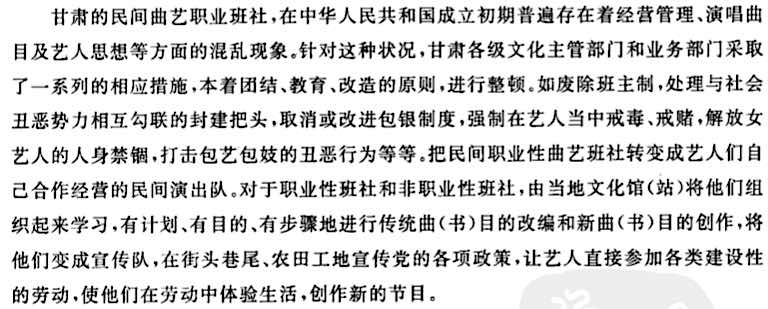
On early 1950s’ attempts to “reform” the old occupational troupes (Overview, p.15)—
one of numerous passages requiring us to read between the lines.

The Overview (pp.3–21) outlines historical periods from early imperial times right through to the 1980s’ reform era. The style of the section on the early years of the PRC is bland, falling entirely within the boundaries of acceptable CCP historiography. Upon Liberation, cultural officials made efforts to register and control the mass of locally active groups (notably “narrative-singing festive bands and itinerant artists” quyi shehuodui yu liusan yiren 曲艺社火与流散).

During the campaign to Eliminate Feudal Superstition, some ancient genres and traditional items ceased to be performed. In the struggle against Anti-Rightists, some artists and narrative-singing workers were classified as Anti-Rightist elements and suffered politically. These abnormal phenomena were not corrected until 1962. (p.18)

As elsewhere (e.g. Gaoluo in Hebei, such as here, under “The 1961–64 restoration”) there was indeed a brief lull in the early 60s between extreme leftist campaigns, but any “correction” was highly precarious. Most glaringly, this section avoids any mention of the famine.

Official sources have long been more able to make limited acknowledgement of the casualties of the Cultural Revolution than of the preceding fifteen years of Maoist campaigns. Still in standard terms, the Overview goes on to describe the assault on traditional culture and its representatives from 1966—the closure of teahouses, the banishing of cultural workers to the countryside, the destruction of a wealth of material collected since Liberation, and some cases of victimisation and murder.

In particular regions, the phenomenon appeared of people being paraded, sentenced, and even persecuted to death for secretly performing, secretly watching, secretly narrating, or secretly listening to traditional narrative-singing.

At least this suggests that there were plenty of people indulging in such illicit activities—indeed, they must have been commonly taking such risks ever since the mid-1950s. An instance, again from the Cultural Revolution: like errentai performer Guo Youshan in Inner Mongolia (see Xu Tong‘s film Cut out the eyes), in the section on Liangzhou xianxiao (p.73, see below) we learn that the blind performer Zhang Tianmao 张天茂 (b.1935) was struggled for “singing in secret” (touchang 偷唱). (Zhang survived to become a celebrity of the genre in his 80s, lauded for the reified Intangible Cultural Heritage (ICH) project (see e.g. here), performing on stage and issuing many CDs. Such reversals of fortune were commonplace throughout the society).

Rather than documenting the escalating desperation throughout society as collectivisation and the commune system were enforced, CCP historiographers have always found it far more comfortable to toe the line by latching onto the firm dates of prestigious official events. As in the opera monograph, the “Major events” section (pp.25–52) documents the grand official festivals, with new troupes performing new items throughout the whole period—when the only major events that could have mattered to people were constant hunger and threat of arrest. By contrast with the revealing material in the Appendices of the Hunan (and Henan, n.1 there) volumes, I learn little from the few documents between 1956 and 1962 from the Gansu Bureau of Culture (pp.815–20).

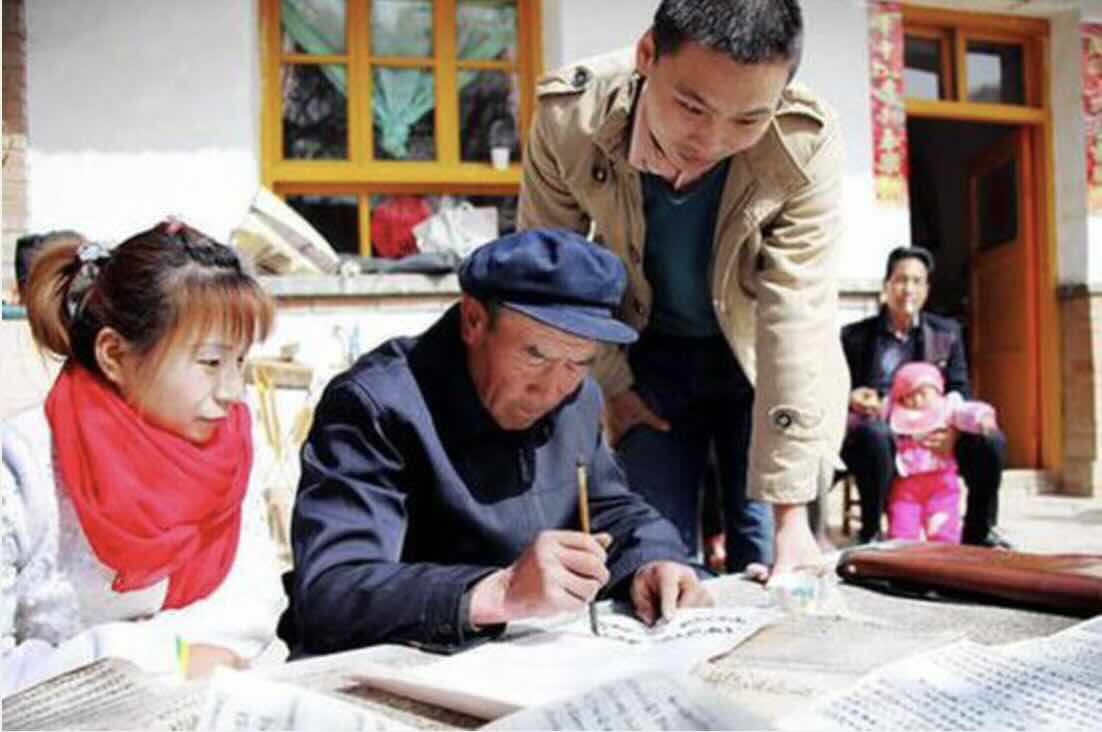
Gansu baojuan
Dai Xingwei, transmitter of the Hexi baojuan tradition, copying a scroll. Source.

A major context for rural narrative-singing, obscured by the propaganda of state modernisation, is ritual. Gansu is among the main regions where “precious scrolls” (baojuan 宝卷) are still performed (see e.g. recent studies by Li Guisheng 李贵生 and Wang Mingbo 王明博, Cheng Guojun 程国君, and Liu Yonghong 刘永红; see also under Ningxia; cf. Hebei). Known in Gansu as “reciting scrolls” nianjuan 念卷 (pp.67–70, 625–6) or “morality tales” shanshu 善书, since 2006 these genres have been reified for the ICH project, resulting in the publication of many early manuscripts (see e.g. this survey by Cheng Guojun 程国君; for largely literary perspectives in English, see the work of Victor Mair and Wilt Idema)—while avoiding references to the traumas of their senior transmitters.

Similarly religious in content and context are the “virtuous and filial” xianxiao 贤孝 genres,  notably “Hezhou xianxiao” (pp.95–7) around Linxia, and “Liangzhou xianxiao” (pp.71–3) around Wuwei (such official names, coined since the 1950s, are generally misleading—e.g. Xi’an guyue, Jiangnan sizhu, Hebei chuige). Meanwhile “religious music” was cannily redefined as instrumental ensemble music for performance on stage.

The Monograph proclaims the CCP cultural authorities’ attempts to reform and “develop” the ritual genres of Gansu, but as fieldwork in Shaanbei shows, such efforts were sporadic, and traditional contexts obstinate.  Many such genres were dominated by blind performers. In 1984 a national musical contest for blind artists was held in Beijing (p.73).

Gansu QYZ 84

A passage on “singing fengshui” (chang fengshui 唱风水) around Qingyang in east Gansu (pp.83–5) provides a tiny clue to the surreptitious survival of ritual:

After the founding of the PRC, since large-scale activities like jiao Offerings, rain prayers, and temple rituals came under suspicion for their colouring of feudal superstitious activities, they went underground (xiaosheng yinji 消声隐迹). But small-scale activities organised by household heads, like mortuary rituals (祭祀亡灵), pacifying the dwelling and house-building (anzhai jianfang 安宅建房), still persisted. Whoever suffered a death in the family, whether rich or poor, they would invite a fengshui master to sing a few sections of scripture. […] The reward was agreed in advance by both sides.

(“Rewards” were always a matter of negotation; at such horrific times, performers would have been desperate for any kind of remuneration. Peasant families in Tianzhen, north Shanxi, still managed to invite Daoists in the “years of difficulty”—but even the village cadres came to lift the coffin just so they could get some free gao paste to eat.)

One even wonders how a solo genre like “telling of spring” (shuo chun 说春) (pp.122–4), auspicious New Year’s songs apparently sung by itinerant beggars, could have fared during times of extreme adversity. In these monographs, other useful sections bearing on traditional activity include “Performing customs” (yanchu xisu) (pp.622–34) and “Anecdotes and legends” (Tiewen chuanshuo) (pp.641–61).

Zhang Huixian

Even the Biographies (pp.777–807) contain slim pickings. We can only imagine the tribulations of performers like Zhang Huixian (1892–1970, above), one of few female baojuan performers, based in a village in Jingchuan county (p.790).

But no-one was safe—neither poor itinerant peasant performers nor the officially-recognised representatives of the state troupes; neither obstinate traditionalists nor enthusiastic Party reformers. Wen Bingheng 文炳恒 (1913–58, p.801), organiser of folk performing groups in Heshui county, took part keenly in CCP cultural projects before and after the 1949 “Liberation”.  But during the Three Antis (sanfan) campaign of 1951, in blowing the whistle on the corruption of “a certain cadre” he was erroneously classed as a counter-revolutionary element; in 1958 he was sentenced to death.

A different kind of danger: Yang Wensheng 杨文生 (1933–58, pp.806–7), performer of xiangsheng skits with the PLA, was “martyred” in the south Gansu region during a campaign against “bandits”—presumably referring to Tibetan insurgents (among my posts on Tibet, see e.g. here) (we’re not told about Tibetans who perished under the Chinese onslaught).

Of course the biographies can only be selective, featuring just some of those whom the collectors and editors identified as leading bearers of tradition; the mass of lowly performers in the countryside remain largely unsung. Despite the vast loss of life around 1960, death dates at the time are not prominent in the biographies—though one feels almost as bad for those who survived the horrors of Maoism.

* * *

I still regard the Anthology as an essential basic source to open doors onto the depth of folk expressive culture in China. Besides the wealth of data on early history in the monographs, I suppose it’s stating the obvious to observe that for more rewarding material on the Maoist era we would have to seek out unofficial memoirs (see Ian Johnson’s excellent recent book Sparks), which are in short supply.

Alas, it’s already getting late to rectify the glaring omissions of official sources by doing fieldwork. One might decide to write a biography of one folk performer, or document one genre over a defined period; documenting the transformations of the scene since the 1980s’ reforms would make a valuable project in itself. We might even find a senior artist, perhaps born in the 1940s, to offer clear recollections of the late 1950s. Even as the Maoist era recedes, the famine and the whole political climate of the time will always be the elephant in the room.

* * *

* Related posts include China: commemorating traumaGuo Yuhua, and China: memory music, society; more broadly, cf. links under Society and soundscape.

Gansu: connecting social trauma and expressive culture

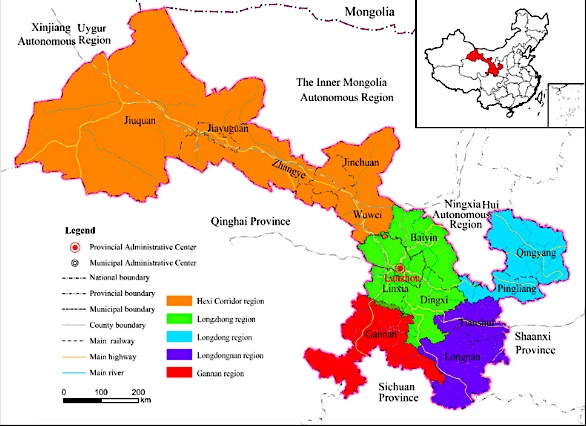
Gansu map
Gansu: regions. Source.

The province of Gansu was chronically poor even before the horrifying abuses its people suffered under Maoism, culminating in (but not limited to) the Great Famine from 1959 to 1961. Nor should we forget the non-Chinese ethnic inhabitants of the region, who were targeted just as brutally through the period—see under Recent posts on Tibet, notably for Amdo (e.g. Labrang, here and here).

I was again reminded of Gansu by Ian Johnson’s fine book Sparks, highlighting a brave group of students in Tianshui denouncing the heartless, mendacious Party during the 1960 famine. Here I’ll reiterate themes that I began to explore in China: memory. music, and society, the Maoist labour-camp system, Famine and expressive culture, and Cultural Revolutions.

Many documents on Gansu are to be found in Yang Jisheng’s definitive exposé Tombstone, as well as the China famine 1959–1961 site. Before the studies of Frank Dikötter (Mao’s great famine) and Xun Zhou, Jasper Becker already gave a useful introduction to the disaster in Gansu in his 1996 book Hungry ghosts.

The Hexi corridor, leading deeper into the oasis towns of Central Asia, is perhaps most widely known by the early Buddhist cave complex of Dunhuang, projecting a proud image of the glories of ancient Chinese culture. So again Ian Johnson does well to remind us of the memoirs of Gao Ertai, revealing bitter political turmoil there in the 1960s.

Qingshui Daoists

Looking again at this undated image (in the “Instrumental music” [sic] volumes of the Anthology) from the Qingshui Bureau of Culture (“Welcoming Water ritual of Huashan Daoists” 清水道教华山派科仪中的“迎水”), I surmise it was taken in the 1980s.

I’ve long felt that Gansu was a major lacuna in coverage of household Daoist ritual. I’ve noted recent developments in Wuwei (Another Daoist debate), and in Jingyuan county northeast of Lanzhou (Maoist worship in Gansu). Counties where some of the most active Daoist groups are based, such as Zhangye, Jingtai, and Tongwei, are among those where the famine was particularly severe (for the famine in Tongwei, see e.g. Dikötter pp.307–9).

Gansu Daoists https://stephenjones.blog/2018/09/15/mao-worship/

More images from the “instrumental music” volumes of the Anthology for Gansu:
Daoists of the Daode guan temple, Zhangye county;
Cao Jixiang’s Daoist band performing the Ten Offerings ritual, Jingtai county;
Cao Jixiang’s band seated.

However, most scholars of Daoism still gravitate to the image of imperial grandeur, focusing on manuscripts with ancient ancestry rather than documenting transmission history since the mid-20th century, or people’s lives. But whether we’re interested in Daoist ritual before 1949 or before the Song dynasty, the condition in which we find it today is permeated by the bitter experiences of its practitioners and patrons since the 1950s.

The range of expressive culture in Gansu—folk-song, narrative-singing, opera, shawm bands, and so on, embodies the sound of suffering. Vignettes on some genres include

For Gansu in recent Chinese movies, see

In such extreme conditions of social disintegration, it seems most unlikely that anyone could muster any energy to perform, either for ceremonial or entertainment—but even in extremis (indeed, particularly in extremis), villagers resorted to their religious traditions, staging rituals to alleviate adversity and to resist collectivisation (note The temple of memories); and (as in Hunan and Hebei) refugee groups banded into itinerant folk performing troupes in a desperate bid to survive. Not just local archives, but some published county gazetteers (like that of Yanggao in north Shanxi), give impressively frank accounts of the famine years.

Gansu famine
Source.

The great Anthology of folk music of the Chinese peoples may be flawed, but if used selectively it can yield useful material—particularly the Monographs on Opera and Narrative-singing (as I explain in my extensive review of the whole project, cited here). The Appendices of the Narrative-singing Monograph for Hunan reproduce concerned documents from regional Cultural Bureaus over the period, providing startling evidence of social disruption. I discuss the equivalent volume for Gansu in a separate post, but the Opera Monograph (Zhongguo xiqu zhi, Gansu juan 中国戏曲志, 甘肃卷 [1995]) doesn’t include such documents. The introductory Overview, under “Opera in Gansu since the founding of the PRC” (pp.25–34) has terse hints at the crisis.

Right from the 1949 “Liberation”, Gansu was part of the national drive to “rescue” the rich heritage of regional genres, led by the new cultural units set up at county, regional and provincial levels (for brief accounts of a plethora of state-funded and amateur groups, note pp.436–524) . But from 1957, Party “rectification” was infecting such institutions, and the ensuing Anti-rightist campaign was bitter and destructive. Even as society collapsed further with the 1958 Great Leap, leading to the famine, opera workers were regimented to create new dramas reflecting the agenda of high socialism.

The 1959 “celebrations” around the 10th anniversary of the founding of the PRC featured new items from eleven genres—not just qinqiang and Peking opera, but regional folk styles like shadow-puppetry of south Gansu 陇南影子腔, qingshui quzi 清水曲子, Yulei huadeng xi 玉垒花灯戏, Wuwei xianxiao 武威贤孝, and daoqing from east Gansu 陇东道情. The latter was now adapted into the staged form Longju 陇剧, with a newly-formed state troupe embarking on a prestigious national tour. But

From 1960, Gansu suffered a succession of natural disasters [sic], and opera work went into crisis; with a great increase in the proportion of sick and injured, many opera troupes were unable to maintain regular activity.  Some troupes used the pretext of touring to go to Xinjiang in search of food.

Again, fleeing to the northwest was a common measure—indeed, at the time, many Uyghurs were taking refuge even further northwest in the USSR (cf. the long migration of the Dungan people).

By 1962, in a common pattern throughout China, many county-level troupes were laid off, and many artists migrated or changed trades. At the same time (cf. Hunan),

some opera troupes and informal folk opera groups used the opportunity to perform bad and forbidden operas such as Shazi bao 杀子报 and Da shangdiao 大上吊, and in some regions harmful customs (louxi 陋习) from the past like “exorcising the stage” (datai 打台, jitai 祭台, pp.594–5), and singing holy dramas (chang shenxi 唱神戏) were revived, creating an adverse social influence. After the general improvement over the whole province from 1963, this was corrected [sic].

The “chronicle of major events” for 1959 to 1964 (pp.70–75), supplemented by lists of official opera festivals for those years (pp.684–98), has a typical list of glamorous official events, giving no hint of the unfolding disaster. As ever, we have to read between the lines. With a basic awareness of the disastrous social climate, even the roster of official festivals over the period makes disturbing reading. Those chosen for the state performing troupes were in a small minority of folk artists throughout the countryside. Life in the urban troupes might provide them with a tenuous lifeline as long as they were still able to function, but institutions were becoming ever more vulnerable: with political campaigns targeting “rightists” and anyone who dared speak out, they too lived in a climate of fear. One can only imagine that even the state performers would have been severely malnourished, at the risk of being sent to labour camp, while their families back in the countryside were starving (cf. household Daoist Li Qing in north Shanxi).

Gansu page

Even before the imminent casualties of the early Cultural Revolution, death rates around 1960 among folk performers would have been just as high as among the general population. Although I don’t find such dates prominent among the biographies of celebrated artists in either the Opera Monograph or other volumes for Gansu, among the countless lives cut short there are doubtless tragic stories to be told—like those of (p.674, above) qinqiang performers Xin Xing’an (1930–59), who died after being “struggled” at the height of the Anti-rightist campaign, and Chen Huiying (1930–61), portrayed as working herself to death in the spirit of self-sacrifice.

* * *

Like Henan and Anhui, Gansu was an extreme case, but most of the senior performers I was meeting in other regions from 1986 to 2018 shared similar experiences that were none too simple to elicit. The adjacent region of Shaanbei, with its barren loess hills, shares a history of poverty and famine, not least under Maoism: among posts listed here, note the work of Guo Yuhua.

The famine, and the whole Maoist era, are major themes in my own work on the Gaoluo village ritual association and the Li family Daoists, and in our fieldwork in Hebei and Shanxi (see under Local ritual). There’s always a complex story to be told, as in this extraordinary 1959 image of former Buddhist monk Daguang with his young ritual disciples in North Xinzhuang village in the Beijing suburbs—at the height of the Great Leap and the famine:

North Xinzhuang 1959

China’s hidden century

Following the flummery of the Coronation, I keep finding myself perplexed by the ways in which elites dominate images of society.

BM catalogue
Exhibition catalogue.

The new exhibition at the British Museum, China’s hidden century, is a splendid idea. If the Qing dynasty is a poor cousin of the Ming, the 19th century has suffered by comparison with the long and glorious early-Qing reigns of the Kangxi (1661–1722) and Qianlong (1736–95) emperors. So it’s a worthy mission to reinstate the period, “often defined—and dismissed—as an era of cultural decline”, amidst economic crisis, uprisings, and foreign invasion. The Opium Wars of the 1840s marked the beginning of a “century of humiliation”, the late Qing making one of several instances of hitherto thriving empires that now suffered in turn at the hands of foreign imperialism (cf. Pankaj Mishra on the wider context of Ottoman modernization, at end of this post).

Attending a preview of the BM exhibition, I’m reminded that museums and art galleries, and indeed libraries, depend largely on material that reflects the values of a tiny minority of urban educated people (mainly men). This approach was long standard for most societies, but it’s clearly one that more recent historians have been seeking to refine. And of course, like books, artefacts are silent and immobile. Now I don’t mean to give you another of my “What About the Workers?” rants; I quite understand the brief of museums, and the culture of elite minorities has a rightful place alongside those of other social groups. But as anthropologists and ethnomusicologists seek to engage fully with the “red and fiery” nature of performance in local society, the limitations of both museums and elites soon become apparent (see e.g. Society and soundscape, and What is serious music?!).

yyl-on-xiaoSo I’m grateful to the exhibition for stimulating me to revisit some of my own material from the field. In this I’m always in awe of the incomparable erudition of Yang Yinliu (1899–1984). Brought up in Wuxi during the final years of the Qing dynasty, Yang learned instruments from Daoist priests from the age of six, going on to join the refined Tianyun she society and to become a fine exponent of qin zither, pipa and sanxian plucked lutes, while supplementing his training with an education in Western culture.

In his research he had a rare grasp of both early and later imperial history, and at the helm of the Music Research Institute in Beijing after the 1949 “Liberation” he embodied continuity with Qing traditions of performance and scholarship, as well as directing major fieldwork projects.

Proverb
I’m used to people (often local officials, indeed) citing this saying to explain
the inability of Communist policies to penetrate the countryside (an instance here),
but of course its original usage referred to imperial society.

In her online essay, exhibition curator Jessica Harrison-Hall asks,

How did Chinese cultural creativity demonstrate resilience in the face of unprecedented levels of violence in the long 19th century?

In the countryside some ritual and other performing groups suffered interruptions from warfare. Around Jiangsu, the Taiping rebellion must have disrupted some groups; but rather few local traditions were affected by military conflict, and those that were, recovered quite soon. The ritual association of Hejiaying village just south of Xi’an was caught up in conflict soon after the outbreak of the Hui rebellion in 1862, with instruments and scores destroyed and performers killed. The association was only able to relearn much of its repertoire in 1915 from the nearby village of South Jixian; both groups are still active today. I’d like to learn more about reasons for this remarkably long period of inactivity—much longer, for instance, than that between the 1949 Communist takeover and the 1980s’ reforms.

Xi'an village festival, 1950s.

Xi’an village festival, 1950s.

Through the 19th century a major change in local societies was the arrival of Christian missionaries, vividly documented for Shanxi by Henrietta Harrison. By 1900, as the Qing regime went into terminal decline, tensions with traditional religious communities led to the Boxer uprising, when Catholics around Beijing and Tianjin were massacred (as in Gaoluo)—with village ritual associations supporting the Boxers against the Allied armies. Senior villagers whom we met in the 1990s had heard many stories about the events from their parents.

The exhibition has five main themes: court, military, artists, urban life, and “global Qing”. As the online introduction explains,

The show illuminates the lives of individuals—an empress, a dancer, a soldier, an artist, a housewife, a merchant and a diplomat.
Visitors will glimpse the textures of life in 19th-century China through art, fashion, newspapers, furniture—even soup ingredients. Many people not only survived but thrived in this tumultuous world. New art forms, such as photography and lithographic printing, flourished while technology and transport—the telegraph, electricity, railways—transformed society.

This makes sense as far as it goes; but while seeking to reach beyond the elite, whose culture is only the tip of the iceberg in any era, it can hardly address the poor rural areas where the vast majority of the population lived—so any attempt to broaden the topic rather depends on “going down” to the countryside. The evidence for material and expressive cultures may also invite significantly different perspectives. When Dr Harrison-Hall writes “Representing the millions of people who were not wealthy is a challenge as so little survives”, she refers to the material culture preserved in museums. Among the folk, local traditions of ritual and music that endured throughout the troubled 20th century go back multiple generations; many groups preserve early artefacts such as instruments, scores, ritual paintings, and pennants, but more importantly they transmit life-cycle and calendrical rituals that were being modified in ways that can rarely be glimpsed—even in the wealth of field reports for Hebei, Shanxi, and elsewhere in my series on Local ritual.

Niu JinhuaThis reflects another common difficulty: we often seek to document history through major, exceptional events, whereas for peasants customary life is more routine. And apart from artefacts, much of the history of this (or any) period lies in oral tradition—which doesn’t lend itself so well to exhibitions.

Nor do women play a greater role in the traditions I’m about to outline; while we regularly came across elderly women with bound feet, they had hardly been exposed to the public activities of the village with which we were concerned (for posts on gender in China and elsewhere, click here; right, women of Gaoluo).

Even the rubric of “Qing court music” is already broad.

Qinxue rumenFrom Qinxue rumen (1864), with the innovation of gongche solfeggio
added besides the tablature.

The elite solo art of the qin zither is a close ally of museums, having an intrinsic bond with calligraphy, painting, and poetry. Again, qin scholars tend to focus on tablatures from the Ming and early Qing, but John Thompson’s definitive site lists around fifty such volumes from the 19th century. Within this tiny coterie, collections like the 1864 Qinxue rumen 琴學入門 and the 1876 Tianwen’ge qinpu 天聞閣琴譜 must have been in more common circulation than were early manuscripts.

XSBK
Xiansuo beikao score, copied by Rong Zhai in 1814.

It’s also worth observing that there was constant interplay between folk and elite traditions. In Beijing the Manchu-Mongol court elite, such as prince Rong Zhai, were patrons of lowly blind itinerant street performers, with whom they performed a recreational chamber repertoire. For the 19th century we have names (and not much else) of musicians like the blind sanxian player Zhao Debi, and Wang Xianchen, a protégé of the empress Cixi.

XS early
“Musiciens Chinois. légation a Pékin”, Paul Champion, 1865/1866.

In 19th-century Shanghai, the paraliturgical instrumental ensemble of Daoist temples gave rise to the new secular style of silk-and-bamboo, with amateur clubs thriving right down to today. And we can even listen to recordings of music from the late Qing, such as those made by Berthold Laufer in Beijing and Shanghai. Even later releases (e.g. here) reflect an tradition that was unbroken from those times.

* * *

WTS monks and luohan
Former Buddhist monks from Wutaishan with the exquisite arhat at the British Museum, 1992.

As to local temples, again we tend to focus on early dates when they were founded rather than on their social life thereafter, with steles commemorating their periodic renovation. In the temple network of imperial Beijing, traditions of shengguan ensemble which served ritual were inter-related. The Zhihua temple, built in 1443 as the private temple of a Ming eunuch, is famed for not only for its architecture but for its shengguan music, for which we have a precious gongche score from 1694.

Here it’s worth clarifying a significant misapprehension. As with notations for other genres (for the qin zither, the Beijing entertainment repertoire, or the village ritual groups we meet below), the date of copying was always long after the pieces came into currency. Scores were not consulted during performance, but constituted a prestigious artefact for their custodians. So the 1694 score of the Zhihua temple was not “composed” then; moreover, through the 19th century, long after the temple had lost its imperial prestige, the musical monks (yiseng 藝僧) of a network of Beijing temples continued to exchange and recopy scores—an energy that we can only imagine (I eagerly await the publication of Ju Xi‘s research on the evolution of the temple, in the next volume of the major EFEO series Epigraphy and oral sources of Peking temples). Meanwhile, temples in not so distant towns like Chengde and Shenyang were also acquiring new ritual repertoires.

South of Beijing, most village ritual associations on the Hebei plain seem to have been attracted by the same myths as the elite, tracing their history back to the Kangxi and Qianlong eras, or even the Ming—mostly on the basis of long oral tradition or early artefacts. While fieldworkers tend to dismiss the Chinese scholarly fashion for seeking “living fossils” in local traditions, when we extend our enquiries beyond contemporary observation to the past, perhaps we too are guilty of focusing on such early clues, rather downplaying references to 19th-century reign-periods:

Jiaqing 1796–1820
Daoguang 1821–50
Xianfeng 1850­–61
Tongzhi 1862–74
Guangxu 1875–1908

Yet despite the successive upheavals of the 20th century, visiting such groups in the 1990s we gained an impression of remarkable continuity.

Miaoyin transmission 1920
Recopyings of shengguan scores transmitted by Miaoyin,
including Tongzhi 13th year (1874). Hanzhuang village, Xiongxian, 1920. Photo: 1993.

Mostly we have to imagine Buddhist and Daoist priests arriving in rural temples to invigorate village ritual associations. In villages around Xiongxian county, the Buddhist monk Miaoyin transmitted a magnificent repertoire of shengguan suites in 1787, whose gongche scores were periodically recopied over the following 150 years.

S. Shilipu yunluo
Base of yunluo gong-frame with a Guangxu-era date equivalent to 1903,
South Shilipu ritual association.

Around the Baiyangdian lake, members of the Buddhist-transmitted association of Greater Mazhuang recalled an account in their old scriptures that in the Xianfeng era (1850–61) an elderly monk called Runan, from the Xingfu si temple in Libao village in Mancheng, came here regularly for three years to teach them. Nearby in Xin’anzhuang, a 1990 history of the association lists three changes of pennant over the previous two centuries and more: Daoguang 12th year [1832], Guangxu 3rd year [1877], and Republic 26th year (1937).

Ritual artefacts, South Gaoluo:
left, dragon placard, Guangxu reign 1st year [1875] 3rd moon 15th day,
at the behest of ritual leaders Heng Yun and Shan Wenrong;
right, ritual curtain, 1892.

In the village of Gaoluo, my main fieldsite through the 1990s, a new temple built in 1844 proclaimed the identity of a separate south village. In 1875 a “dragon placard” asserted allegiance to the new emperor, and a ritual curtain from 1892 was still displayed in the lantern tent for the New Year’s rituals in the 1990s (see early history, and ritual images).

Among ritual associations in this region the popular “southern music” that competed with the “classical” shengguan instrumental ensemble is commonly dated to the early 20th century, but Qianminzhuang in Xushui county (later famed during the Great Leap Forward) was among several village associations said to have learned in the Xianfeng era (1850–61) when the Daoist priest Wang Leyun came from Nangong county to transmit the style.

Genealogy of the Li family Daoists, from Li Fu, first in the lineage to learn Daoist ritual
in the 18th century (see also Customs of naming).

Our perspectives change once we engage with living traditions. By the 1990s, when we met senior ritual specialists born around the 1920s, they could often list the names of their forebears back five or more generations. Even if we can rarely do more than document their names, they would naturally feel more of a connection with their grandfathers than with earlier ancestors. For Shanxi, I think of hereditary household Daoist traditions like that of the Li family Daoists in their home village of Upper Liangyuan; if only we could learn more about the life of Li Qing‘s great-grandfather Li Xianrong (c1851–1920s), some of whose ritual manuals the family still preserves.

Left: manual for Presenting the Memorial ritual, copied by Li Xianrong.
Right: Li Manshan discovers temple steles.

Temples continued to be restored throughout the late Qing. The village’s Temple of the God Palace (Fodian miao) fell into disuse after Liberation (see our film, from 08.25), but we found a stele composed  in Guangxu 6th year (1880), the year after the villagers completed a new bell tower and four priests’ rooms in gratitude for the end of a drought following a rain procession in Tongzhi 6th year (1867). But severe droughts again afflicted Shanxi from 1876 to 1879, so perhaps the stele further offered gratitude for this second recovery.

Another instance from Shanxi: we can trace the hereditary transmission of the Zhou lineage of Complete Perfection household Daoists in Shuozhou county. Of the third generation, probably active from the late 18th century, Zhou Laifeng was a temple Daoist, his younger brother Zhou Lailong a household Daoist.

Yuhuang miao ms

Their descendant Zhou Erdan showed us a manuscript Yuhuang shangdi beiji (above, probably copied by his uncle Zhou Fusheng), that reproduces an 1813 stele of the Yuhuang miao temple in Shuozhou town, mentioning the brothers’ fine calligraphy.

Tianjin huanghui tuFrom Qing-dynasty Tianjin Tianhou gong xinghui tu 天津天后宫行會圖.

Yet another instance of a tradition maintained through from the 18th to the 20th centuries is the “imperial assembly” of Tianjin, in this case among folk dharma-drumming associations.

* * *

Wanhe tang 1993
Wanhe tang musicians, 1993, heirs to an illustrious tradition.

As to local traditions of narrative singing and opera, the respective provincial monographs of the great Anthology of folk music of the Chinese peoples (Zhongguo quyi zhi, Zhongguo xiqu zhi) contain much evidence for both material artefacts and oral tradition (e.g n.2 here; further citations in posts under Chinoperl). Near Suzhou, the Wanhe tang Kunqu association was founded in the second half of the 19th century, performing largely for life-cycle ceremonies.

In Shaanbei, the Yulin “little pieces” are said to have been transmitted outside the regional court in the Daoguang era (1821–50) by Li Diankui and his son Li Fang—and the brief biographies throughout the volumes of the Anthology introduce many locally-renowned 19th-century performers. The style of the “little pieces” is thought to be influenced by opera troupes brought by Qing-dynasty regional governors from the Jiangnan region; some local scholars claim that it was based on the opera of Hunan, which may have been brought during the Tongzhi reign (1862–74) by a company attached to a division of Zuo Zongtang’s Hunan army on campaign in the region.

nanyin 86
Nanyin in Quanzhou, 1986.

Further evidence is to be found in the riches of Hokkien culture of south Fujian, such as the exquisite nanguan (nanyin) ballads—the study of which is again rooted in the search for early origins rather than its vibrant later life. Similarly, scholars of  Daoist ritual set their sights firmly on Tang and Song texts, but monographs on local household altars around south China also contain material on 19th century transmissions, including particularly rich collections of ritual paintings and manuals.

Huapencun 2Mural (detail), Shrine to Lord Guan, Huapen village, Yanqing, Beijing suburbs, ~1809.

And to return to rural north China, Hannibal Taubes’ extraordinary fieldwork reveals that painters of temple murals were just as creative through the 19th century as in earlier and later periods. As he notes,

Late Qing murals are characterised by strong use of blue and white. While all of the old themes continued to be painted, a variety of new types of painting appeared in this period, some of them seemingly unrelated to anything which had come before. Important new developments include: new genres of opera-stage murals, often incorporating Western architecture, figures, or text; paintings connected to the Yellow River Formation 黃河陣 ritual; and a large number of rather eccentric Buddhist murals commissioned by charismatic wandering monks.

* * *

Given its parameters, the BM exhibition is very fine; here I’ve just offered a few suggestive instances of the potential for documenting grass-roots history through local fieldwork. Much as we may hope to broaden the social base of our enquiries, it’s often hard to say much more than this: despite growing challenges, rural and urban ritual and performing groups, founded in the 18th century or earlier, maintained activity not only through the late Qing and Republican eras, but even after the 1949 “Liberation” and the convulsive campaigns of Maoism. Still, as the exhibition reminds us, it’s important to join up the dots between the late Ming/early Qing and the 20th century; and whether or not we spell it out, the late imperial period makes a constant backdrop to our fieldwork.

Click here for politicised criticisms of the exhibition by Chinese academics.

Bards of Henan

Journalists in search of a soundbite sometimes claim rashly to have discovered “the last” exponent of some precious ancient genre; even ethnomusicologists may be prone to this faux pas (e.g. Balkan bards; the lama mani of Tibet; cf. Ishi, “the last wild Indian”). [1] There may be some cases of this, but it seems to misinterpret constant change in folk cultures.

I was reminded of the hallowed clickbait by a recent article on zhuizi shu 坠子书 narrative-singing of Henan province in central China. Despite the title “The last blind folk storytellers”, it’s an interesting piece. As it points out, narrative-singing, along with fortune-telling and massage, remains the most reliable means for blindmen to make a living, a traditional form of “poverty alleviation” not just in Henan but throughout China (e.g. Shaanbei, and note Liu Hongqing’s book on blind bards in Shanxi, which makes an even more harrowing version of the story told in the article on Henan).

The blind female performer Zheng Yurong 郑玉荣 (b.1985) was taken in by a poor couple after being abandoned as a baby. She took up zhuizi shu in the hope of making a living after losing both her foster-parents when she was young. As I learn from a 2022 article, after befriending another blind performer in 2011, they felt such an affinity that, utterly unlikely as it sounds, DNA tests determined that he was in fact her younger brother—though he too had been abandoned, his foster parents had survived to bring him up well. As Zheng Yurong made a name for herself, they sought their birth parents through the auspices of Zhengzhou TV, but without success. She had gone on to marry her accompanist Feng Guoying 冯国营 (43), also blind, and they raised two sighted children in a flat provided by the government in Lushan county-town.

Henan zhuizi couple

Some of their many filmed excerpts:
https://k.sina.com.cn/article_1920998331_m72801bbb02000ls6q.html?from=photo#/
https://v.qq.com/x/cover/mzc00100hcb0laa/b0712lx0z0i.html
https://haokan.baidu.com/v?pd=wisenatural&vid=10090594473931209072
https://v.qq.com/x/page/d0862hzw51q.html

Blind performers are no longer considered so auspicious—and then came Covid. Faced by rising household bills and the cost of their children’s education, Feng has had to take up fortune-telling again, from a rented flat.

The economic climate since the 1980s’ reforms has certainly affected the livelihoods of folk performers. Still, unlike narrative-singing in regions such as Shaanbei, zhuizi shu as never been limited to blind people (for posts on blind musicians in China and elsewhere, click here). And none of this justifies portraying them as “the last” bearers of the tradition. It feeds into the widespread yet powerless laments of well-meaning pundits about the decline of traditional culture—laments that, again, have a long history.

* * *

Henan has long been poor; but the most desperate famine there came in the “three years of hardship” following the Great Leap Backward. In recent decades the province has been hard hit by the HIV/AIDS scandal (see.e.g. here, and here).

I’ve mentioned Henan in posts on the zheng plucked zither (cf. the yaqin bowed zither) and spirit mediums (including refs. in n.3). Without the benefit of fieldwork, I thought I’d seek a basic acquaintance with the zhuizi shu, equipped with the great Anthology (click here, leading to my review “Reading between the lines”), whose monographs on narrative-singing Zhongguo quyi zhi 中国曲艺志, province by province, are among the most impressive of the whole vast project—further complemented by the Zhongguo quyi yinyue jicheng 中国曲艺音乐集成 volumes on narrative-singing music (for the folk-song volumes, see also here).

Henan

Despite the poverty of the region, one of the most notable survivals of its literati heritage is to be found in its folk narrative-singing. As shown in the Henan volume (1995), the genre known as zhuizi shu (named for its distinctive bowed fiddle zhuizi) is just one of thirty-five genres of narrative-singing identified around the province, including guzi qu 鼓子曲, dadiao quzi 大调曲子, sanxian shu 三弦书, pingshu 评书, dagu shu 大鼓书, daoqing 道情, shanshu 善书 morality tales (pp.93–4), and lianhualao 莲花落.

As always with these monographs, one has to piece together material distributed around various rubrics. The framework for zhuizi shu is presented in a brief overview (pp.65–70), which packs in some impressive historical documentation, supplemented by sections on performance contexts (pp.373–4) and venues (pp.456–497). Defined by the zhuizi fiddle, it emerged in the 19th century on the basis of other genres, notably sanxian shu and daoqing, spreading from Kaifeng to the southwest of the province and beyond. In its early days stories were delivered by one or two itinerant performers, invited for the redeeming of vows huanyuan shu 还原书, a common context in Henan (pp.498–9) and elsewhere, and for temple fairs (again, cf. Shaanbei).

Traditionally a solo male performer accompanied his own singing on fiddle, but by the early 20th century the roles of fiddle player (waikou 外口) and vocalist (likou 里口) were sometimes separate, and soon afterwards female vocalists began to emerge on the little stages of tea-houses, with simple props. By the 1920s (in a typical process) some groups featured both male and female vocalists, emulating the style of “little opera”, further enshrined by professional troupes after the 1949 Liberation.

The genre was performed as far afield as Tianjin and Beijing. The first recordings seems to date from 1928, and by the 1930s several companies were issuing 78s; click here for one of several recordings online of the influential singer Qiao Qingxiu 乔清秀 (1910–44). Another section of the Anthology volume documenting various types of organisation features zhuizi shu groups active in the Republican era: those of Wang Yulan 王玉兰, Lu Yuancheng 鲁元臣, Liu Weiran 刘蔚然, and the Fan 范 family (pp.418–20).

But it is rare for new styles to simply replace the old (note the wise words of Bruno Nettl): the itinerant, unstaged format persisted in the countryside. As the Anthology notes, while the state troupes came to be dominated by short excerpts from female vocalists, in the countryside itinerant male artists prevailed for much longer, performing lengthy stories (whose plots, related to other genres of narrative-singing and opera, are outlined in a separate section, pp.128–200). I’d be keen to document the enduring activities of story-tellers performing for poor rural families redeeming vows, and at temple fairs (you know me…).

Majie shuhui
The New Year’s narrative-singing at the Horse Street festival in Baofeng county.

Before we consult the Zhongguo quyi yinyue jicheng, the Zhongguo quyi zhi has a succinct outline of musical features (pp.205–21), identifying melodic and metrical aspects of eastern, western, and northern styles, with transcriptions.

As well as a detailed chronology for genres, the material I enriched by biographies of celebrated zhuizi shu performers. [2] It introduces a wealth of studies over the decades preceding publication, such as the 1951 book Henan zhuizi shu (quyi zhi, p.531) by Zhang Changgong 张长弓 (1905–54; quyi zhi, pp.638–9), as well as official documents (pp.665–701) for imperial, republican, and Communist eras—the latter in particular offering illuminating vignettes on social change (cf. Hunan).

* * *

More recently, click here for lengthy footage from Baofeng county from 2022, and here for a documentary on the life of Xia Lingshan 夏玲珊, reflecting changing styles of presentation. And here’s a busker. For the same genre in nearby Shandong, there is film footage online of blindman Guo Yongzhang 郭永章 (b.1945), such as: [3]

Long before the Intangible Cultural Heritage sank its fangs into zhuizi shu, performance on the concert stage has become common—as usual, supplementing rather than replacing traditional folk contexts.

Even if we can’t refine the picture through our own fieldwork, the Anthology confounds the simplistic, reified image of the whole range of Chinese performance arts, showing the wealth of activity before, during, and since Maoism—supplemented by articles suggesting the precarious survival of poor families through all three periods. For instrumental and ritual traditions in Henan, click here.


[1] Ishi’s songs were wisely studied by Bruno Nettl in “The songs of Ishi: musical style of the Yahi Indians” (1965).

[2] Including (I’ve marked female performers—who emerged only later—with *):
Liu Weiran (1878–1956), Li Mingyi (1888–1979), Gao Liankui (1889–1956), Zhang Zhikun (1889–1975), Liu Zhongtang (1890–1955), Zhao Yanxiang (1891–1963), Chen Yongqing (1891–1971), Chen Zhikui (1893–1939), Hou Wenming (1894–1942), Zhang Hongyu (1894–­1947), Zhao Cuiting* (1897–1960), Gao Xuebin (1898–1945), Meng Zhifa (1899–1974), Fan Mingyan (1898–1980), Cheng Liyan (1900–1975), Li Zhibang (1901–83), Bi Liduan (1903–43), Zhu Yuanli (1907–76), Wang Gancheng (1908–60), Zhang Quanyou (1909–77), Zhang Yuqing (1914–79), Zhang Xiushan (1914–69), Wang Shuangqi (1914–85), Chen Fuzeng (1917–85), Liu Mingzhi* (1920–77), Zhao Yuqin* (1921–81), Zhao Yuanxiu (1923–84), and Ma Yanqiu* (1933–77).
And that’s just the more celebrated names for whom the edited publication found space…

[3] For more footage of Guo Yongzhang, see e.g.
https://www.youtube.com/watch?v=0cKCCsFUPHg
https://www.youtube.com/watch?v=_NmBB64RPwg

The street players

Gushu yiren promo

Another addition to our list of Chinese film classics of the early reform era:

Between The horse thief (1986) and The blue kite (1993), Tian Zhuangzhuang‘s movie Gushu yiren 鼓书艺人 (“The drum singers” or “The street players”) was released in 1987. It’s adapted from the last novel of Lao She—written in New York in 1948–49 before he made the fateful decision to return to serve the Chinese revolution (for Mr Ma and son, click here).

Gushu yiren still

The movie is set during the War of Resistance against Japan in the urban metropolis of Chongqing, where the Beijing drum-singer Fang Baoqing has sought refuge from the invaders with his family and opens a thriving tea-house with Tang Shaoye, another refugee story-teller. When Baoqing’s dream of setting up a school to ameliorate the lowly status of performers is shattered by a Japanese bombing raid, he sets up a little tea-house in the suburbs. There, as he makes friends with the progressive writer Mengliang, Baoqing and his daughter Xiulian soon do well from performing Anti-Japanese stories.

Gushu yiren still 1

But devastated by the loss of his “older brother”, Baoqing wants to give up his project. Mengliang encourages him to send Xiulian to school, but with her lowly background she is driven out by her well-to-do schoolmates. Xiulian, abused, abducted, and then abandoned by a ruffian entrusted to look after her, returns pregnant. As victory over the Japanese is declared, the film ends with the distressed family setting sail to an uncertain future (as did Lao She).

Here’s the film—sorry, no subtitles:

By comparison with Tian Zhuangzhuang’s other work (in particular The blue kite [1993], a most outstanding film) and that of other members of the “fifth generation” (cf. composers), I find The street players somewhat conventional and melodramatic. Under my post on Chinese film classics, far more creative and realistic is To live (Zhang Yimou, 1994), which sets forth from the travails of a shadow-puppet troupe in Beijing during the civil war; and for a (more magical than realist) movie on a rural bard, see Life on a string. For narrative-singing in Beijing and Tianjin, click here and here.

Rulan Chao Pian: an exhibition

Rulan 1

The Harvard Library has a new bilingual exhibition (until the end of August) on the life and work of Rulan Chao Pian 卞趙如蘭(1922–2013; here, and wiki), with rare books, original field recordings, and other material from her research and teaching.

Rulan 1941 Cambridge

1941, Cambridge, Mass. Source.

Daughter of the linguist Yuen Ren Chao, Rulan Chao Pian was a leading scholar of the performing arts and music history of China, teaching at Harvard from 1947 until her retirement in 1992. She was one of the founders of CHINOPERL. In 1974 she became the first Chinese American woman professor at Harvard. Soon after mainland China opened up with the liberalisations of the late 1970s she was active in researching and lecturing there, while spreading word abroad of the revival in performance traditions and scholarship.

Rulan 2

In her bibliography, note the wealth of articles on Peking opera and narrative-singing. On early history, her 1969 book Sonq dynasty musical sources and their interpretation explored material that was already being interpreted by scholars like Yang Yinliu in China and Laurence Picken in England. See also the festschrift Themes and variations: essays in honor of Rulan Chao Pian, ed. Bell Yung and Joseph Lam (1994).

Chinese ritual, theatre, and folklore

MSQY

One of the most valuable resources on local Chinese ritual is Minsu quyi 民俗曲藝 (“Journal of Chinese ritual, theatre, and folklore”), published since 1980 by the Shih Ho-cheng Foundation in Taiwan (see this introduction by Paul Katz).

At first the reports concerned local traditions around Taiwan itself (cf. this post), but as the liberalisations in the PRC gained pace, ritual practice revived spectacularly there, and local cultural workers (as well as overseas scholars such as Kristofer Schipper, John Lagerwey, and Ken Dean) were able to do detailed fieldwork on the mainland. So from 1991 this major expansion in geographical scope was reflected in the journal’s coverage—although the project’s origins led to a focus on south China (Fujian, Jiangxi, Hunan, and so on), with rather occasional excursions to the north. The leading light was C.K. Wang, who began early in recruiting local scholars to such research, becoming editor-in-chief of the journal in 1989. Many issues were devoted to particular themes, such as Nuo masked drama, Mulian operas, and Hakka musicking.

MSQYCS

The publisher soon began supplementing the journal with over eighty extended monographs (Minsu quyi congshu 民俗曲藝叢書), again mainly on local traditions in Fujian, Jiangxi, Hunan, Guizhou, Sichuan, and Zhejiang. This in turn led to a major separate series on household Daoist altars, the Daojiao yishi congshu 道教儀式叢書 (see here).

Under new editors, since 2002 the journal has continued to publish major articles. The website has detailed tables of contents, and useful sidebar tags.

Chinoperl

Cperl site

CHINOPERL, a US-based association for the study of oral and performing traditions of China, was founded in 1969 by a distinguished group including Yuen Ren Chao, Harold Shadick, and Cyril Birch; notable figures such as Rulan Chao Pian and Kate Stevens continued the initiative.

Cperl

The main focus of CHINOPERL is regional traditions of narrative-singing (shuoshu 说书, shuochang 说唱, quyi 曲艺) and drama, both staged and unstaged. The recently-revised website contains a contents list for back issues of the journal, with articles by scholars such as Wilt Idema, Victor Mair, Bell Yung, David Johnson, Mark Bender, and Vibeke Børdahl.

Whereas CHINOPERL tends to stress historical and textual research, coverage of narrative-singing on my own site takes a more ethnographic approach, highlighting ritual, poverty, and itinerant blind performers—posts on local traditions are listed here.

Note the valuable CD-set Shuochang: the ultimate art of Chinese storytelling under Archive Chinese recordings. And of course there’s a wealth of sites in Chinese, which I won’t even attempt to survey now… See also CHIME: Chinese music studies in a changing China.

Tibet: some folk ritual performers

Ngagmo female ritual group, Rebkong (Amdo), c2009. Source here.

For the Tibetan peoples, both before the Chinese occupation—or the uprisings from 1956—and under the reform era since the 1980s, our popular image of religious life is dominated by “institutional” monastic activity. Even genres like lhamo opera, nangma-töshe, and grand local folk communal rituals seem more widely known than the diverse types of folk ritual performers.

To remind ourselves of Isabelle Henrion-Dourcy’s pertinent comment,

any attempt at (re)presenting Tibetan culture today is inseparable from an implicit ideological and political commentary on the situation of Tibet, through history and at present. 

Taxonomy
Emic and etic ways of slicing the cake of expressive cultures vary; and for Tibet they vary both within and between Tibetan, Chinese, and Western approaches. As in many cultures, a simple dichotomy like sacred–secular will only confuse, even if we take it as a continuum. Catherine Bell reflects wisely on the variety of “ritual specialists” within world cultures in Ritual theory, ritual practice, pp.130–40. But again, such an etic umbrella term often seems inadequate for Tibet.

One would include the male ngagpa and female ngagmo self-cultivational groups of Tantric practitioners (see e.g. the work of Nicolas Sihlé, such as this article; wiki, and here; photo above). Further, with religion such a pervasive element in the daily life of Tibetan people, there’s no simple way of encapsulating the variety of performers, family groups and individuals, occupational, often itinerant—such as spirit mediums and diviners, mendicants and beggars (for the latter in pre-occupation Lhasa, see e.g. Part Two here, under “Professional and spiritual beggars”). Moreover, the trite rubric of “song-and-dance” subsumes calendrical rituals with communal, largely ascriptive participation (see e.g. here). [1] Indeed, since the 1950s, and still now, lay performers may be less closely surveilled than the major monasteries such as Labrang (for which see here and here).

A variety of such genres is described in the 2006 book (in Chinese) Zangzu shuochang yishu [Narrative-singing arts of the Tibetan people] by Suolang Ciren 索朗次仁 [Sonam Tsering], (cf. this page).

As with Han Chinese traditions, some of these genres are described as obsolete, and appear to belong to “salvage” fieldwork. Having so often heard this claim from Chinese cultural cadres anxious about revealing “superstitious” activities in their domain, I am reluctant to take it as gospel. It is hard to assess the current picture from published material in Chinese and Tibetan. On one hand PRC scholars may take mediated, secular performances on the concert platform as evidence of the continuing life of tradition; on the other, their access enables them to document local genres. But of course change is always a factor. As with some Han Chinese traditions, folk activity may be continued by other means, and I suspect that lengthy immersion in a given area may still reveal neglected life in such genres. At the same time, few of these groups quite resemble the household ritual specialists who are my main theme in local Han Chinese communities.

In exile, while some genres of the former elite were maintained, and the monasteries have long been the main scholarly focus, many folk ritual genres hardly feature in representations of Tibetan expressive culture such as the 1986 Zlos-gar. However, some of the folk performers who made their way into exile sought to continue activity there.

Moreover, one would seek to consider groups among Tibetan communities such as those of Sikkim, Bhutan, and Ladakh, from where some of the most interesting material derives. As with other “marginal survivals”, always bearing in mind that these are local traditions, it can be tempting to regard such manifestations as suggestive of culture within old Tibet (cf. “When the rites are lost, seek throughout the countryside”).

* * *

Among all these genres, by far the most popular area of research is the Gesar epic (see here, n.2, and here). Though it is often treated as a reified genre of oral literature, and since the 1980s has also been performed on the secular stage, the solo performers (both the “inspired” bards who received the text through spiritual revelation in trance after a psychological crisis, and those who learned by listening to other bards) continued to play a role in the domestic rituals of their local communities after the 1980s’ reforms, despite the encroachment of pop and media culture.

But as in south Asia and China, there was (and is) a variety of performers. So here I will illustrate the difficulties of simple classification with brief introductions to lama mani, drekar, and ralpa.

Lama mani
The itinerant solo folk storytellers lama mani enact religious tales with the aid of thangka paintings. It may be more suitable to regard them as educators. [2]

lama mani old 1

An important source for the wider historical context around China and south Asia is

  • Victor Mair, Painting and performance: Chinese picture recitation and its Indian genesis (1989).

For the TAR, the lama mani feature in Zangzu shuochang yishu; see also this introduction. Around Lhasa, this 2014 article portrays “Chilie” [Thinley / ‘Phrin las] (b. c1940), typically, as “the last lama mani”.

Brought up in a village of Nagarze county in the Lhoka region of southeast TAR, both of his parents had performed lama mani, and he learned with them from young, along with his three older sisters; here one would wish to fill in the gaps in his biography for the Maoist decades. Even recently, his status as a Transmitter of the Intangible Cultural Heritage hadn’t brought him security: in 2014, performing on the street in the Barkhor, he was moved on by the police.

Thinley performing in Lhasa, 2014.

Some lama mani have also been active in exile—note

Here’s a documentary by Tsering Rithar Sherpa on transmitting the art of lama mani in Nepal:

And 10-minute footage of lama mani there:

For a project on the artefacts of lama mani, including thangkas and scripts, click here.

Drekar
Drekar oldAlso belonging within this diverse rubric are the drekar (in Chinese, zhega 折嘎: see this useful page), mendicant masked buffoons reciting auspicious verses for New Year and weddings (cf. Chinese beggars, such as in Shaanbei).

Again, the drekar have been described as obsolete, both within and beyond the PRC. A brief recorded excerpt (from since the 1980s’ reforms!) can be heard in #2 of CD 6 in Mao Jizeng’s anthology Xizang yinyue jishi. Whereas it was clearly recited on request, Woeser filmed this even briefer video during a street performance, suggesting that there may still be potential for fieldwork:

Ralpa
Until the 1950s the ralpa or relpa (in Chinese, reba 热巴), mostly from the Kham region in origin, were family-based, low-class, itinerant performers, using narration, singing, dancing, acrobatics, and small plays, based on the life of Milarepa.

Ralpa dancers, Dengchen, Chamdo. Source here.

But the sense in which ralpa is now commonly promoted is as a communal dance festivity in the villages of Kham—subject of a book by Gonpo Gyaltsen (1928–2020), himself a former ralpa from the Dechen region there: in Chinese, Oumi Jiacan 欧米加参, Xuecheng reba 雪域热巴 (1998), Tibetan translation Gangs-ljongs ral-pa (2017).

Today this form too may be largely obsolete (see e.g. this useful survey), even as it has become a victim of commodified dance arrangements and the Intangible Cultural Heritage.

* * *

Under Chinese occupation and modernity some of these genres have doubtless suffered more than others; but we should include them all within our picture of the varied religious behaviours in local Tibetan societies—even as many fine scholars, quite legitimately, turn their attention to the pop soundscape. And of course more revealing ethnographies could be compiled on how individual, family, or devotional groups of lay participants dovetail in local societies with monasteries, communal ritual activities, and so on [3]over time: as usual, we might hope to seek threads of continuity in 1950s’ activity.

For more posts under my coverage of Tibet, see e.g. Expressive cultures of the Himalayas, Women in Tibetan expressive culture, and Ritual singing in an Amdo community.

With thanks as ever to Isabelle Henrion-Dourcy


[1] Sources for such genres appear rather piecemeal. Some feature in §III of the New Grove article on Tibet, and in the bibliographies of Isabelle Henrion-Dourcy (for Western-language sources) and Sangye Dondhup (for Tibetan and Chinese items); but Isabelle surveys much of the material in chapter 3 of her magnum opus Le théâtre ache lhamo, with references including some notes by early Western Tibetologists (such as Tucci and Stein), and for the post-reform era, studies by Tibetan and Chinese scholars, again mostly brief.

For Tibetan communities within the PRC, among the Anthology volumes (for the Tibetan Autonomous Region [TAR], Qinghai, Gansu, Sichuan, and Yunnan, in Chinese), those on narrative-singing (and perhaps on folk-song, and dance) should give further leads.

At a tangent, YouTube has a range of interesting material under “Tibetan wedding”, like this 2013 ceremony from a village in Qinghai, with some fine singing. This might lead us to the chang ma beer servers in old and new Tibet.

[2] Among references to lama mani in Le théâtre ache lhamo (n.1 above), two discuss the drama Padma ‘od-‘bar (also popular in lhamo, like many items here): Anne-Marie Blondeau’s chapter in Zlos-gar (referring mainly to the relation of paintings and text), and a 2012 booklet (in Tibetan) with three CDs, for the Intangible Cultural Heritage.

[3] For a mendicant singer in early 20th century Amdo, with pertinent details on present-day performers, see this article by Gerald Roche.

How *not* to describe 1950s’ Tibet

“There is singing everywhere in Tibet”

Discuss

gunsTibetan monks laying down their arms, 1959. AFP/Getty.

In my first post on Labrang, recalling the debate over how to represent Tibetan music in the New Grove dictionary, I mentioned a succinct, nay flimsy, article by

  • Mao Jizeng 毛繼增, “Xizang wuchu bushi ge: minzu yinyue caifang zhaji” 西藏無处不是歌——民族音乐採訪札記 [There is singing everywhere in Tibet: fieldnotes on national music], Renmin yinyue 1959.5, pp.8–11 (!).

—a strong candidate for the award of Most Ironic Title Ever. [1]

* * *

Mao Jizeng’s brief article resulted from a ten-month stay in Lhasa that he made from 1956 to early 1957. He was part of a team chosen to do a field survey in Tibet, led by the distinguished Tibetologist Li Youyi 李有义 (1912–2015); Mao Jizeng (b.1932) had just been assigned to the Music Research Institute (MRI) in Beijing after graduating from Chengdu.

The team clearly set out from Beijing with the intention of covering a wide area of central Tibet (then just in the process of becoming the “Tibetan Autonomous Region”, TAR). Unrest was already common in Amdo and Kham, and the political situation there would soon deteriorate severely in the TAR; but even in 1956, as Mao Jizeng recalled in a 2007 interview, Tibetan–Chinese relations were so tense that they had to remain in Lhasa, unable to get out into the countryside. One member of the team was so scared that he soon returned to Beijing; Mao Jizeng, being young, “didn’t know what fear was”—but he still got hold of a revolver for protection, which doesn’t suggest total faith in the warm welcome of Tibetans for their Chinese friends.

Anyway, for Mao Jizeng, “everywhere” in Tibet could only mean Lhasa. However, I learn here that Li Youyi did manage to travel farther afield with a separate team of Tibetan and Chinese fieldworkers (perhaps with military back-up?); and despite incurring political criticism in the summer of 1957, he continued doing field studies in TAR and Kham right until 1961, though not on music.

At the time, Chinese music scholars knew virtually nothing of Tibetan musical cultures—or even of Han-Chinese regional traditions of such as those of Fujian. That was the point of these 1950s’ field surveys, which would later blossom with the Anthology. But even as a musical ethnography of 1956 Lhasa, Mao Jizeng’s article is seriously flawed; it could only provide a few preliminary clues.

Those field surveys among the Han Chinese were given useful clues by the local Bureaus of Culture. But although Li Youyi was bringing an official team from Beijing, it’s not clear if there was any cultural work-unit to host them in Lhasa. Such cultural initiatives as there were in Tibetan areas at the time took place under the auspices of the military Arts-work Troupes—hardly a promising start. So Mao Jizeng may have been left to his own devices. Indeed, while in my early days of fieldwork I learned a lot from home-grown cultural workers, as time went by their successors were more interested in platitudinous banquets than in local culture, and it was preferable to bypass them in favour of grassroots sources. Still, Mao Jizeng would doubtless have been quite happy working within the state system.

The MRI had entrusted him with one of their three Japanese-imported recording machines, but batteries were an intractable problem. Billeted in the Communications Office, he could hardly engage meaningfully with Lhasa folk.

Now, I’m full of admiration for all the brave efforts of music fieldworkers in Maoist China to convey useful material on traditional culture despite political pressure—but this is not one of them. In a mere four pages Mao Jizeng managed to pen a tragicomic classic in the annals of the dutiful mouthing of propaganda, obediently parroting the whole gamut of Chinese music clichés. We might regard it under the Chinese rubric of “negative teaching material” (fanmian jiaocai 反面教材).

At the same time, I try not to judge his article too harshly: we should put ourselves in his shoes (cf. feature films like The blue kite, and indeed Neil MacGregor’s question “What would we have done?”).

Han Chinese scholars, not to mention peasants, were already quite familiar with the effects of escalating collectivisation upon their own society; there too, fewer people had the time or energy to sing or observe traditional ritual proprieties. But conditions in Lhasa must have alarmed the team that arrived there in 1956. Worthy as fieldwork projects were, they could only gloss over the social upheavals of the time.

At the head of the Music Research Institute in Beijing, Yang Yinliu, his distinguished reputation based on seniority and massive erudition, had earned a certain latitude for his studies of traditional music. While paying lip-service to the political ideology of the day—elevating the music of the working masses at the expense of the exploiting classes, and purporting to decry “feudal superstition”—he somehow managed to devote just as much attention to “literati” and “religious” culture as to more popular, secular genres.

After all, ethnomusicology was only in its infancy even in the West; and despite some fine fieldwork by Chinese folklorists before the 1949 revolution, the concepts of anthropology were still barely known—still less as it might apply to musicking. David McAllester’s pioneering 1954 monograph on the Navajo makes an interesting comparison, free of glib defences of the policies of his compatriots who had usurped their land.

Of course, in reading any scholarship, one always has to bear in mind the conditions of the time—particularly when we consult documents from Maoist China (as we must). They often provide revealing details, as I’ve noted for the history of collectivisation and famine in the Yanggao county gazetteer and sources for Hunan. We have to learn to “read between the lines” (cf. my Anthology review).

The main audience for such articles was urban, educated Han Chinese, who would know no better, and were willing or constrained to go along with the pretence. Their perspectives grate only with modern readers, certainly those outside China who are equipped with more information about conditions in the PRC under Maoism than was then available. [2]

The political background
Here, while consulting Robbie Barnett’s course on modern Tibet, we should turn to the masterly, balanced

  • Tsering Sakya, The dragon in the land of snows: a history of modern Tibet since 1947 (1999), chapters 5–7. [3]

In a nutshell, from 1956 the lives of Tibetans deteriorated through to the major 1959 rebellion and the Dalai Lama’s escape into exile; then by 1961 a brief respite led to still more appalling calamities after 1964.

Lhasa 1956

Source here.

For the first few years after the 1950 Chinese occupation, traditional life remained relatively intact. But the forming of the Preparatory Committee for the Autonomous Region of Tibet (PCART) in 1955 made Tibetans anxious that the noose was to be pulled more tightly. For central Tibet, Chairman Mao was adopting a more gradualist policy than with the Han Chinese, proceeding more cautiously with collectivisation. But in 1955 “democratic reforms”, land reform, and mutual aid groups began to be implemented in Kham and Amdo, and armed uprisings soon erupted there, prelude to the major rebellion of 1959. The Chinese responded by bombing monasteries.

Even as refugees were arriving in Lhasa from Kham and Amdo with tales of Chinese violence and assaults on religion, the city also saw an influx of Chinese labourers, troops, and cadres; anti-Chinese feeling grew. But both Tibetan and Chinese officials strove to isolate central Tibet from the unrest, and Khampa refugees found themselves unwelcome in Lhasa.

Still, opposition to Chinese rule grew in central Tibet. During the Monlam New Year’s rituals of 1956, wall posters appeared in Lhasa denouncing the Chinese and saying that they should return to China. By the end of March 1956—when Mao Jizeng must have been in Lhasa—the atmosphere there was tense.

In November, as the Western press were equating the revolts in Kham with the Budapest uprising, the Dalai Lama managed to visit India. Amidst complex diplomatic considerations (which Shakya explains with typical clarity), he eventually agreed to return to Lhasa in March 1957. There, despite the Chinese promise to postpone radical reform, he learned that the situation in Tibet had deteriorated further.

In mainland China, large-scale public rituals had already become virtually unfeasible. But in July 1957 a sumptuous Golden Throne ritual was held in Lhasa for the long life of the Dalai Lama—providing a focus for the pan-Tibetan resistance movement. And from summer 1958 to February 1959—even as monastic life was being purged in Amdo and Kham—the Dalai Lama “graduated” in Buddhist philosophy with his lengthy geshe examinations, in an opulent succession of ceremonies and processions apparently unmarred by Chinese presence:

The Khampa resistance continued, with little support from Lhasa. But events culminated at the Monlam rituals in March 1959. Amidst popular fears that the Dalai Lama (then 25) would be abducted by the Chinese, he fled to India—where he still remains in exile. Meanwhile further revolts occurred in Lhasa and further afield. Their suppression was the end of both active resistance within Tibet and the attempt to forge a co-existence between “Buddhist Tibet and Communist China”.

In 1962 the 10th Panchen Lama presented his “70,000 character petition” to Zhou Enlai. It was a major document exposing the devastation of Tibetan life wrought by Chinese rule—and the reason why he was then imprisoned for the next fifteen years. For more on Amdo and the Panchen Lamas, see here.

With whatever degree of preparation, ethnographers always walk into complex societies. Such was the maelstrom into which Mao Jizeng unwittingly plunged in search of happy Tibetan singing and dancing. While one can hardly expect to find it reflected in his work, it makes essential context for our studies.

MJZ title

The 1959 article
Whereas monastic Buddhism has long dominated Western research on Tibet, Mao Jizeng passed swiftly over the soundscape of the monasteries. Unrest was brewing, particularly in Kham (see e.g. here), but rituals were still held in the populous monasteries in and around Lhasa, with the revered Dalai Lama still in residence; indeed, even after his escape into exile amidst the 1959 rebellion, the monasteries were still busy in 1964, as we see in Gallery 1 of Woeser’s Forbidden memory. Despite the sensitive status of “religious music”, Yang Yinliu would have been keen to study this major aspect of the culture. But while Mao Jizeng mentions elsewhere that he attended a “large-scale” ritual at the Jokhang in 1957, the monasteries seem to have been largely outside his scope.

Dutifully praising the long history of fraternal bonds between Tibetans and Chinese, Mao Jizeng toes the Party line in his brief historical outlines of various genres. He inevitably alludes to the marriage alliance with Tang-dynasty Princess Wencheng, exhibit no.1 in China’s flimsy historical claim to sovereignty over Tibet, citing the lha-mo opera telling her story, Gyasa Balsa. But while lha-mo remained popular in Lhasa until 1959—and it’s always an enchanting spectacle—that’s his only brief reference to it; he doesn’t mention attending any performances or meeting any of the musicians. [4]

lha-mo

Lhamo opera at the Norbulingka. 1950s. Source: Isabelle Henrion-Dourcy (ed.), The singing mask (2001).

And these happy smiling ethnic minorities, they just can’t stop singing and dancing, eh! [5] Mao Jizeng tells how he often witnessed street gatherings with young and old singing and dancing together. And he was told a story about a Tibetan work team conscripted to build a new Lhasa airport in 1954, getting together every evening after work to sing and dance till late at night. In order “to look after their health and make sure they got enough sleep” [Yeah, right], the Chinese foremen stepped in to forbid such parties, whereupon the labourers’ mood, and their work, deteriorated; their overlords had no choice but to give way. [6]

How one would like to hear the Tibetan side of the story. Indeed, Tsering Sakya (The dragon in the land of snows, p. 136) gives a vignette from the same period:

In an attempt to reduce their expenditure, the Chinese began to ask people working on road construction to take a reduction in their pay. The Tibetan workers were urged that they should give their labour free as a contribution to the “construction of the Motherland”. Barshi, a Tibetan government official, remembered that when the people refused to accept a cut in their wages, the Chinese started to lecture them, saying that in the new Tibet everything was owned by the people, and that the wealth of the state was inseparable from the wealth of the people.

One intriguing genre that Mao Jizeng might have found suitable to record was khrom-‘gyu-r’gzhas, satirical songs lampooning prominent officials in the Old Society; but alas he doesn’t mention them. I don’t dare surmise that such songs might have been adapted to satirise their new Chinese masters. [7]

Tsering Shakya cites a more blunt street song popular in Lhasa after the Dalai Lama’s return from India in 1957:

We would rather have the Dalai Lama than Mao Tse-tung
We would rather have the Kashag than the PCART
We would rather have Buddhism than Communism
We would rather have Ten sung Mag mu [the Tibetan army] than the PLA
We would rather use our own wooden bowls than Chinese mugs. 

Nangma–töshe
What Mao Jizeng did manage to study was the popular instrumental, song, and dance forms nangma and töshe, for festive entertainment—then still largely associated with elite patronage, and in decline but still not purged. Around the 1920s, in addition to the “art music” style of nangma, Lhasa musicians began adapting töshe (stod-gzhas) from dance-songs of western Tibet (“Western songs”, as Geoffrey Samuel calls them).

nangma 1956

Open-air performance of nangma, 1956.

Though Mao Jizeng might appear to have been largely engaging in “salvage” work, the photo above shows that he also witnessed some social activity. Among the performers of nangma-töshe were Tibetan Hui Muslims—including the senior master “Amaire” 阿麦惹 (Amir?), whom Mao describes as recalling the largest repertoire of nangma pieces. But he doesn’t mention meeting Zholkhang Sonam Dargye (1922–2007), who having taken part in the Nangma’i skyid sdug association, the most renowned of such groups, went on to write authoritatively on nangma-töshe from 1980. In an instructive 2004 interview (in Chinese) Zholkhang recalls senior musicians in the group—including the leader, celebrated blind performer Ajo Namgyel (1894–1942). [8]

Left: nangma, 1940s. Right: Ajo Namgyel. Source here.

Zholkhang provides some brief details for Amir. His grandfather had been a sedan-bearer in Tibet for a Chinese official from Sichuan, and Amir himself had a Chinese name, Ma Baoshan 馬寶山. A farrier by trade, he was an accomplished instrumentalist, and had served as organiser for the Nangma’i skyid sdug association.

But rather than instructing Mao Jizeng himself, Amir introduced him to the distinguished aristocrat and litterateur Horkhang Sonam Palbar 霍康·索朗边巴 (1919–95), a patron of nangma-töshe who was to be his main informant for the genre. As Mao describes in a tribute to Horkhang, for over three months he regularly visited him at his house near the Barkhor, studying with him in the mornings before taking lunch with his family. Even in the 1990s, some Chinese collectors still clung to the dubious habit of interviewing and recording folk musicians by summoning them to cultural offices (cf. my 1987 trip to Chengde), but that probably wasn’t practicable over an extended period.

And here (inspired by the likes of Mao Jizeng to bring “class consciousness” into the discussion!) I’m pretty sure we can read between the lines again; considerations of “face” must have come into play on both sides. Amir would have made an ideal informant on nangma-töshe; but he was a common “folk artist”, perhaps living in a humble dwelling in a poor quarter—unsuitable, even dangerous, for a Chinese scholar to frequent. Whether or not he considered himself unsuitable to represent Tibetan culture to a Chinese visitor, the annual round of festivities that had long kept the musicians busy must have shrunk after 1950, and their livelihood was doubtless suffering. Like others in that milieu, Amir may have been finding it hard to adapt to the new regime, perhaps worried about the consequences of regular contact with a Chinese scholar, or simply reluctant. For Mao Jizeng to have spent more time in the folk milieu would only have exposed him to inconvenient truths that he couldn’t, and wouldn’t, document.

Conversely, Horkhang was prestigious, despite his aristocratic background. Elsewhere I learn that as a prominent official under the old Tibetan administration, he had studied English with the Tibet-based diplomat Hugh Richardson (for whose photos of the old society, see under Tibet album). Horkhang was captured by the PLA in 1950 during the battle of Chamdo (or as Mao Jizeng puts it, “the Liberation of Chamdo”). After the occupation he accommodated to Chinese rule, “turning over a new leaf” by necessity; like many former aristocrats whose status under the new regime was vulnerable, he was soon given high-sounding official titles in Lhasa, through which the Chinese sought to mask their own domination.

Horkhang’s house would have been comfortable; he still had servants. Moreover, he didn’t drink, whereas the nangma-töshe musicians had a taste for the chang beer that was supplied at parties where they performed. And it would be easier for Mao Jizeng to communicate with Horkhang than with a semi-literate folk musician. While Mao must have had help with interpreting, perhaps Horkhang had already picked up some Chinese in the course of his official duties; anyway, Mao claims that his own spoken Tibetan improved over the course of these sessions.

So in all, while Horkhang was a patron rather than a musician (cf. the mehfil aficionados of Indian raga, and narrative-singing in old Beijing), he seemed a more suitable informant for the Chinese guest. While we should indeed document the perspectives of patrons and aficionados, it should only be a supplement to working with musicians themselves. But the ideology of “becoming at one with the masses” only went so far. Given the obligatory stress on the music of the labouring classes, it may seem ironic that Mao Jizeng’s main topic was a genre patronised by the old aristocrats, and that he chose to study it with one of them rather than with a lowly “folk artist”. He justifies his studies by observing his mentor’s warm relations with the common folk. He doesn’t say, but perhaps Amir and other musicians also took part in some sessions at Horkhang’s house—in which case it would have made an ideal setting.

By contrast with the distinctive soundscapes of the monasteries and lha-mo opera, nangma’s heterophony of flute, plucked and bowed strings, and hammer dulcimer, however “authentic”, often sounds disconcertingly like Chinese silk-and-bamboo, as you can hear in this playlist— sadly not annotated, but apparently containing tracks both from exile and within the PRC:

Indeed, as with the dodar ceremonial ensemble of Amdo monasteries, the Chinese influence goes back to the 18th century. This doubtless enhanced its appeal for Mao Jizeng; and like silk-and-bamboo, it was to make nangmatöshe a suitable basis for the state song-and-dance troupes. Woeser gives short shrift to modern incarnations of nangma in her wonderful story Garpon-la’s offerings (n.9 below).

So Horkhang Sonam Palbar was Mao Jizeng’s main source for the two slim volumes that he also published in 1959,

  • Xizang gudian gewu: nangma 西藏古典歌舞——囊玛 [Tibetan classical song and dance: nangma]
  • Xizang minjian gewu: duixie 西藏民间歌舞——堆谢 [Tibetan folk song and dance: töshe].

Even the enlightened Music Research Institute was anxious about publishing Mao’s afterword acknowledging a Tibetan aristocrat.

According to Mao Jizeng’s 2007 tribute, Horkhang told him that he survived the Cultural Revolution relatively unscathed. This fiction may result both from people’s general reluctance to remember trauma and from the limitations of their relationship—we learn a very different story from Woeser’s Forbidden memory.

Horkang 1966Horkhang Sonam Palbar (centre) paraded with his wife and father-in-law at a thamzing struggle-session, August 1966. Forbidden memory, fig.80.

As Woeser explains, the Red Guards dressed him in a fur coat and hat that they found in his home, to denote his official rank in the former Tibetan government and his “dream of restoring the feudal serf system”.

Woeser goes on to describe how among the “crimes” of which Horkhang was accused was his friendship with the famous writer and scholar Gendun Chöphel (1903–51). Horkhang had helped him through times of adversity, and before Gendun Chöphel died he entrusted many of his manuscripts to Horkhang; these were now confiscated and destroyed by the activists. Still, after the end of the Cultural Revolution, Horkhang assembled what he could find of Gendun Chöphel’s work, eventually publishing a three-volume set of his writings that became an authoritative work.

“Palace music”
By contrast with the entertainment music of nangma-töshe, in his 1959 article Mao Jizeng also gives a brief introduction to gar, the ceremonial “palace music” of the Dalai Lama. Indeed, having worked on the genre “in some depth” in the winter of 1956–57, he compiled a third monograph on it, but realised it was too sensitive a topic for publication, and it was lost during the Cultural Revolution.

Gar seems to have been in decline even before the Chinese occupation, though details on its life through the 1940s and 50s are elusive. The little section in Mao Jizeng’s article is characteristically headed “The dark system is a stumbling block to the development of music”; his main purpose here is to decry the former feudal society’s cruel exploitation of the teenage boys who served as dancers—actually an interesting angle, however tendentious Mao’s approach.

MJZ CD 5

Mao Jizeng, liner notes for CD 5 of Xizang yinyue jishi (n.9 below).
Right, gar dancers, 1950s, provenance unclear.

The main instrumental ensemble for gar consisted of loud shawms and kettle-drums, of Ladakhi origin (cf. related bands in XinjiangIran, and India)—formerly, at least, with the halo of a mkhar-rnga bcu-pa frame of ten pitched gongs (cf. Chinese yunluo). [9] A brief scene (from 5.50) of this silent footage from 1945 shows the gong frame on procession with two shawms:

But a subsidiary chamber instrumentation, closer to that of nangma, included the rgyud-mang dulcimer—and as a gift from the MRI, Mao Jizeng presented the musicians with a Chinese yangqin, which must have made an unwieldy part of Mao Jizeng’s luggage on the arduous journey.

He doesn’t cite a source for this section, so it’s unclear who the musicians he consulted were; the Dalai Lama, whom they served, was still in Lhasa, and by 1956 the performers were still at liberty. But following the 1959 rebellion, when the Dalai Lama had to flee, they were deported en masse to the Gormo “reform through labour” camp at Golmud in Qinghai, over a thousand kilometres distant—part of a network of such camps in the vast, desolate region (cf. China: commemorating trauma). There they were to spend over twenty years; conscripted to work on constructing the new railway and highway, singing and dancing can hardly have been part of their regime.

Mao Jizeng ends his 1959 article with a brief section on “New developments since the Peaceful Liberation [sic] of Tibet”—the formation of professional troupes, and the creation of new folk-songs in praise of Chairman Mao; also, of course, themes worthy of study. Encapsulating the fatuity of Chinese propaganda, his final formulaic paragraph is just the kind of flapdoodle we have to wade through:

With the defeat of the former local Tibetan government and the reactionary upper-class elements, traitors to their country, the great mountain weighing down on the hearts of the Tibetan people was overturned, providing more profitable conditions for the development of their ethnic music. The way ahead for Tibetan music is limitlessly broad. It will shine radiantly forth in the ranks of the music of the Chinese nationalities.

To paraphrase the immortal words of Mandy Rice-Davies only a few years later, “He would say that, wouldn’t he?”. Selflessly, I have read Mao Jizeng’s article so that you won’t have to.

Back in Beijing, and the reform era
Mao Jizeng may have largely ignored the fraught social conditions of the time, but one has to admire his persistence in remaining in Lhasa for ten months. Even by the 1990s, Chinese fieldworkers, and most foreign scholars, still tended to find brief “hit-and-run” missions more practicable, albeit over an extended period (cf. here).

Between 1956, when Mao Jizeng set off for Tibet, and the publication of his report in 1959, the political climate deteriorated severely in Beijing too. From 1957, music scholars were among countless intellectuals and cadres demoted or imprisoned during the Anti-Rightist campaign, not to be rehabilitated until the late 1970s; and the 1958 Great Leap Backward soon led to severe famine and destruction. Chinese people had to deal with their own devastating sufferings, without worrying about distant Tibet.

Even so, in 1960 Yang Yinliu managed to publish the Hunan survey that he had led, also in 1956; its 618 pages (as well as a separate study on the Confucian ritual!) make a stark contrast with the paltry material resulting from the hampered Tibetan expedition. * I wonder if his original fieldnotes have survived.

Disturbingly, the misleading clichés of Mao Jizeng’s article still continue to recur in more recent PRC scholarship. There, forty years since liberalisation, no frank reflections on the conditions of fieldwork among minority peoples in the 1950s seem to have been published—and amidst ever-tighter limits on academic freedom, such work is becoming even less likely.

Nonetheless, along with the widespread revival of tradition in the 1980s, more extensive study developed. For the major Anthology project Tibetan and Chinese cultural workers were no longer so cautious about documenting elite and religious genres. They now collected much material—with hefty volumes for TAR, Gansu, Qinghai, Sichuan, and Yunnan on folk-song, opera, narrative-singing, instrumental music, and dance. For the historian, the monographs on opera and narrative-singing (xiqu zhi 戏曲志, quyi zhi 曲艺志) are particularly useful. As with Han Chinese traditions, much of this research focused on the cultures that had been impoverished under Maoism, rather than the process of impoverishment.

From early in the 1980s, in both Dharamsala and Lhasa, gar court music was recreated under the guidance of Pa-sangs Don-grub (1918–98), the last gar-dpon master to have served under a ruling Dalai Lama in Tibet (and like Horkhang, a pupil of Gendun Chöphel), as well as the former gar-pa dancer Rigdzin Dorje. In Dharamsala it began to serve the ceremonies of the Dalai Lama again, whereas in Lhasa it was performed only in concert.

gar-dpon

The gar-dpon, 1980s. Photo: Willie Robson.

Though we don’t know how many inmates of the Gormo camp survived, Pa-sangs Don-grub was at last able to return to Lhasa by 1982, literally scarred by two decades of hard labour. The precise timeline seems unclear, but in Woeser’s plausible interpretation, he only overcame his reluctance to accept the Chinese request for him to lead a revival of the genre when, in a brief rapprochement, he was given the opportunity to pay homage to his revered former master the Dalai Lama in Dharamsala through training performers at TIPA—and only on the Dalai Lama’s advice did he return to Lhasa to teach it there too.

The 1980s’ revival of gar. Photos: Willie Robson.

In July 1987, while I was still seeking folk ritual bands in China, the enterprising Willie Robson (with whom I later worked to bring a Buddhist group from Wutaishan to the UK) put together the Music from the Royal Courts festival at the South Bank for BBC Radio 3—a grand enterprise the like of which would hardly be possible to organise today. It included groups from Africa and India, Ottoman and Thai music, the Heike biwa epic from Japan, nanguan from Taiwan, Uyghur muqam, the Chinese qin zither—and, remarkably, a combined group from Lhasa, performing both gar and nangma-töshe.

Pasangs Don-grub

Pa-sangs Don-grub, early 1980s; from the Chinese version of Woeser’s story.

Moved by Pa-sangs Don-grub’s 1985 book in her father’s collection, Woeser encapsulates our task in reading PRC documents:

Even a short introduction in a book can reveal a lot of information. This was the case with Songs and dances for offerings, with its brief introduction to the 14th Dalai Lama’s eleven-member dance troupe. After a few pages, only bits of information about the troupe emerged, such as the number of members and their ages. There wasn’t a lot, but at the time it probably wasn’t safe to write much more. The introduction seemed to be quite ordinary, even mediocre. Nevertheless, much information was hidden between the lines. These nuances could only be understood by another Tibetan, who would discern from just a glance what was really being said, what happened when and where. Many Tibetan readers experienced the hardship and torment the troupe endured before they had at last survived the disasters in their lives. Anyone who hasn’t experienced similar torments will find it hard to read between the lines of the writing and know what the men went through. That’s why a narrator like me is needed, who is at some distance from the incidents but is sympathetic to their reality and able to retell the story.

Also in the 1980s, Mao Jizeng’s former mentor Horkhang Sonam Palbar, having endured his own tribulations in the Cultural Revolution, was once again showered with high-ranking official titles in the Chinese apparatus—in a common pattern, serving as “décor for the state and as mouthpieces for its policies”, as Woeser observes in Forbidden memory.

Meanwhile, from 1983 Mao Jizeng was finally able to visit regions of the TAR that were out of bounds to him in 1956; and after the convulsive events of the 60s and 70s, on his trips to Lhasa he was able to meet up again with Horkhang.

Horkang 1987Horkhang Sonam Palbar leading a study team to a village of the Lhoba minority people,
Mainling county, southeast TAR 1987 (cf. here, n.1).

Blissfully oblivious to all the evidence, Mao Jizeng still constantly parroted the cliché of the warm fraternal feelings between Han Chinese and Tibetans, and his own rapport with the latter, including Horkhang (for more subtle views on rapport, see the excellent Bruce Jackson; and here I develop Nigel Barley’s characterisation of the fieldworker as “harmless idiot” into “harmful idiot”).

In his 2003 tribute to Horkhang, Mao tells a story that inadvertently suggests a less rosy picture—revealing both Tibetan resentment and the insidious hierarchical power dynamics among Tibetans in their dealings with the Chinese:

In Lhasa in 1988—during yet another period of serious unrest, by the way—Mao Jizeng was having problems mustering the recalcitrant Shöl Tibetan Opera Troupe to perform Sukyi Nima for him to record. Rather shooting himself in the foot, he even lists some of their excuses: some actors hadn’t showed up, the troupe was out of money, they couldn’t find the drum… * It was only when the illustrious Horkhang stepped in to cajole them that they finally had to play ball.

And widespread unrest has continued in Tibetan areas. In 2009 the popular Amdo singer Tashi Dondhup was sentenced to fifteen months’ imprisonment after distributing songs critical of the occupation—notably 1958–2008, evoking two terrifying periods. Many other Tibetan singers have been imprisoned since 2012. [10]

* * *

As William Noll observes, the whole history of ethnomusicology abounds with scholars who come from a society that oppresses the culture in question; and around the world there are plenty of accounts of fieldwork projects that fell short of their ambition. The limitations of Mao Jizeng’s ten-month sojourn in the tense, turbulent Lhasa of 1956, and even his inability to reflect on the issues involved, may not be such an exceptional case.

As another kind of outsider, only able to read Chinese and English but not Tibetan sources, such are the slender clues that I can offer. Note also Tibet: conflicting memories, Forbidden memory, and Lhasa: streets with memories.

So much for “There is singing everywhere in Tibet”. Meretricious (and a Happy New Monlam).


With thanks to Robbie Barnett

[1] Since the present or past tense is not necessarily specified in Chinese, one might almost be tempted to read it as “There was singing everywhere in Tibet [until we barged in and broke it all up]”—or perhaps as an optative, like “Britannia rule the waves”?!).

[2] By the way, “singing” is a very broad, um, church. Both singing and dancing on stage are only the tip of the iceberg; they lead us to folk festivities, notably calendrical and life-cycle rituals. Though “revolutionary songs” were an obligatory component of Chinese collecting throughout the PRC (if anyone remembers songs of resistance sung by the Tibetan rebels from 1956, people certainly weren’t going to sing them for Chinese fieldworkers—who anyway wouldn’t want, or dare, to listen), their main interest was the traditional soundscape (cf. Bards of Shaanbei, under “Research and images”). Tibetan and Chinese pop music only came to play a major part in the Tibetan soundscape after the 1980s’ reforms.

Even today in a (Chinese) region like Shaanbei, famed for its folk-songs, it would be misleading to claim that singing is everywhere, harking back to the romantic image of Yellow earth. Sure, folk-songs are still heard quite often there, but often in rowdy restaurants rather than by shepherds on picturesque hillsides (cf. One belt, one road).

[3] For yet more detail, see Melvyn Goldstein’s multi-volume A history of modern Tibet—for this period, vol.3: The storm clouds descend, 1955–1957 and vol.4: In the eye of the storm, 1957–1959. There’s also extensive research unpacking the representation of ethnic minorities in the PRC, from Dru Gladney and Stevan Harrell and onwards. For the changing physical and mental landscape of Lhasa, note Robert Barnett’s sophisticated book Lhasa: streets with memory (2006).

[4] Naturally, Mao Jizeng rendered Tibetan terms in Chinese characters, just as Western visitors devised systems to render it in their alphabet. Later, as the variants of the Wylie system became standard for international publications, Chinese transcription was acknowledged to be inadequate—though it still works for the Chinese… I’ve tried to give Wylie versions of Mao Jizeng’s Chinese terms.

[5] For Tibetan folk-song, see §9 of Isabelle Henrion-Dourcy’s Western-language bibliography—including this detailed ethnography of a family in Amdo, yet another impressive publication from Kevin Stuart’s team; Sangye Dondhup’s list for sources in Chinese and Tibetan; and the folk-song volumes of the Anthology.

[6] The first such project is usually dated to 1956; even then, the airport didn’t become operational until 1965. Perhaps the 1954 labourers, too exhausted by singing and dancing, and too demoralised at being forbidden to do so, were unable to complete the job?

[7] See Melvyn Goldstein, “Lhasa street songs: political and social satire in traditional Tibet”, Tibet journal 7.1–2 (1982), based on material collected among exile communities. For Sitting Bull’s ingenious speech in Sioux for assembled white dignitaries, cursing them with impunity, see n.1 here.

[8] For nangmatöshe, see the bibliographies cited in n.5 above, as well as the Anthology for TAR. For the work of Geoffrey Samuel, apart from his chapter in Jamyang Norbu (ed.), Zlos-gar (1986), see “Songs of Lhasa”, Ethnomusicology 20.3 (1976)—including an Appendix referring to fifteen 78s recorded in Lhasa between 1943 and 1945 by the British Mission under Sir Basil Gould, which one would love to compare with later versions!

The writings of Zholkhang Sonam Dargye (Zhol-khang bSod-nams Dar-rgyas) feature in Sangye Dondhup’s list of Tibetan sources; he is included among the biographical entries for Tibetan musicians in the New Grove dictionary (handily assembled here; main article on Tibetan music here). For the role of female performers before 1959, see the fine article Isabelle Henrion-Dourcy, “Women in the performing arts: portraits of six contemporary singers”, pp.204–207.

In search of Ajo Namgyel, I found the fascinating article by Jamyang Norbu “The Lhasa Ripper“, on the “dark underbelly” of pre-occupation Lhasa: crime, prostitution, beggars. For nangma bars since the 1990s, see e.g. Anna Morcom, Unity and discord: music and politics in contemporary Tibet (TIN, 2004), and her “Modernity, power, and the reconstruction of dance in post-1950s Tibet”Journal of the International Association of Tibetan Studies 3 (2007).

[9] A useful introduction to gar before the occupation, and then from exile, is Jamyang Norbu with Tashi Dhondup, “A preliminary study of gar, the court dance and music of Tibet”, in Zlos-gar. See also Mark Trewin, “On the history and origin of ‘gar’: the court ceremonial music of Tibet”, CHIME 8 (1995). As well as the entry for Pa-sangs Don-grub in the New Grove (with a list of his publications), do read Woeser‘s story “Garpon La’s offerings“, Manoa 24.2 (2012). Dates given for the gar-pa Rigdzin Dorje differ: 1915–83 apud Zlos-gar, 1927–84 according to Grove. The mkhar-rnga bcu-pa gong-frame is mentioned in the Zlos-gar chapter and the Grove section on gar.

Within TAR the fortunes of gar are documented in the Anthology; and Mao Jizeng’s six-CD anthology of Tibetan music in TAR, Xizang yinyue jishi 西藏音樂紀實 (Wind Records, 1994), recorded since the 1980s, features both nangma-töshe (CDs 3 and 5) and gar (CD 5, ##3–4), despite the nugatory liner notes; see Mireille Helffer’s review. In the absence of Mao Jizeng’s monograph, all I can find of his notes on gar is on pp.38–42 of this trite overview of Tibetan music.

[10] For another thoughtful article by Woeser, exploring the shifting sands of prohibited “reactionary songs” and the challenge of keeping track of subtle allusions, see here.


* In another age, he might have returned with gifts emblazoned “My mate went to Lhasa and all I got was this lousy T-shirt”.

** Impertinently, this reminds me of both the Monty Python cheeseshop sketch and various instances of musos’ deviant behaviour (notably this, and even Revenge at the Prague opera).

Narrative singing in the Pearl River delta

Bell with Dou Wun

Blind singer Dou Wun (right) with Bell Yung, c1975.

I rarely presume to cover south China, but further to my series on blind performers such as bards, a counterpart to the fine work of Bell Yung 榮鴻曾 on the elite qin zither is his study of folk narrative-singing from the Hong Kong region—notably naamyam 南音, [1] as well as the related styles of baan’ngaan 板眼, lungzau 龍舟, and yue’ou 粵謳.

Bell Yung has produced eight CD sets of naamyam songs, mainly his 1975 recordings of the blind singer Dou Wun 杜煥 (1910-1979) accompanying himself on zheng zither. Each set includes a booklet of essays and the complete song texts.

The first CD set was recorded live in 1975 at the Fu Long teahouse in Hong Kong. The second set, Blind Dou Wun remembers his past: 50 years of singing naamyam in Hong Kong, is remarkable for consisting of a six-hour autobiographical song created at Bell Yung’s request. As he comments, it is both ordinary in its story of “displacement, alienation, trials, and triumphs” and extraordinary in that he was the last surviving professional singer of an important genre; and it gives a folk perspective on a turbulent period of Hong Kong’s history.

CD 5 The Blind Musician Dou Wun Offers Auspicious Songs for Festive Occasions contains songs from old Hong Kong, Macau, and Guangzhou, sung for calendrical festivals, opening of a business, and private family celebrations such as birthdays and weddings—including The Eight Immortals’ Birthday Greeting and The Heavenly Official Bestows Blessings.

CD-set 6 The Birth of Guanyin, Goddess of Mercy, with three discs, contains songs that Dou Wun sang for Guanyin’s birthday celebrations on 3rd moon 19th.

For more, the instructive article

  • Bell Yung, “Voices of Hong Kong: the reconstruction of a performance in a teahouse”, Critical zone 3 (2009)

has thoughtful reflections on the history and cultural identity of Hong Kong, as well as Bell’s own early background growing up there after the family fled from the Communists in 1948, still largely estranged from Cantonese culture. As Dou Wun’s stories seemed increasingly out of step with the glossy skyscrapers, pop music, and the modern educational system, he was discovered by intellectuals who realised his art was precious but did not quite understand it, and his performing venues moved from opium dens, brothels, and teahouses to concert stages and colleges.

In 2004 Bell also issued a fine documentary, A blind singer’s story: 50 years of life and work in Hong Kong.

Note also Bell Yung’s recent book with Sonia Ng on the life and art of Dou Wun.

For the Cantonese diaspora in the USA, note

  • Bell Yung, Uncle Ng Comes to America: Chinese narrative songs of immigration and love (2013),

a translation of six Toisan (Taishan) muk’yu 木魚 songs sung by Uncle Ng (Ng Sheung Chi, 1910–2002), with four introductory essays, audio recordings, and a documentary. And for temples of early emigrants from the region to California, click here and here.

For fine recordings of Italian immigrants in 1960s’ America, including zampogna and ciaramella in New York, click here! Cf. Accordion crimes. For Cantonese music in London, see here.

Bell introduces the folk music and local culture of Hong Kong in this lecture:

In Chinese, for the sheer variety of local narrative-singing traditions all around China, a good starting point is the vast Anthology of folk music of the Chinese peoples 中国民族民间音乐集成, province by province, under the separate headings of Zhongguo quyi zhi 中国曲艺志 and Zhongguo quyi yinyue jicheng 中国曲艺音乐集成. See also my roundup of posts on narrative-singing.


[1] Not to be confused with the Hokkien nanyin in south Fujian, or other genres around south China that use the term!

Coronavirus 2: songs from Gansu, and blind bards

ZGS vid

To follow blind bard Liu Hongquan’s song mourning Li Wenliang, thanks to Alex Davey and others on Twitter I note some great new satirical songs about Coronavirus by the enterprising Gansu folk-singer Zhang Gasong 张尕怂 (b.1989).

His own song about Li Wenliang appeared only very briefly on Weibo (see his regular posts there at weibo.com/zhangdabenshi). Another one, criticising a range of responses to the crisis, with incisive visuals, was also soon deleted from Chinese social media. Here’s a playlist:

And he created this song to cheer up his granny by satirising his unexpectedly lengthy sojourn upon returning home for New Year —a common predicament:

Musically the gutsy style, with funky sanxian lute, is reminiscent of the blind bards of Shaanbei—like Liu Hongquan’s song, the “northwest wind” makes an incisive medium.

On Zhang Gasong there’s a lengthy article in Chinese, with a clip from the documentary Huanghe gayao 黄河尕谣. What’s more, I find that he’s a fellow-stammerer (among posts under the stammering tag, note Great Chinese stammerers)! Here’s the trailer to Stammering ballad (Zhang Nan, 2018):

Brought up in a poor village of Baiyin municipality beset by frequent drought, he relished the huar song festivals at temple fairs; he managed to attend college, but found himself drawn back to his local culture, becoming a collector as he studied with noted folk performers.

Zhang Gasong studying Liangzhou xianxiao with Zang Shande (left) and blind female singer Feng Lanfang (right).

A busy touring schedule has brought him celebrity—though he finds the idea of “touring” (xunyan 巡演) poncey: “it’s pretty much like being an itinerant singer”. As his horizons have expanded, he’s absorbed new pop styles; yet he’s aware of the dangers of losing himself in the urban jungle, and as he astutely comments, he doesn’t like to be forced into representing a contrast between rural and urban China.

Here’s his song “Tell the truth”:


Appendix

Zhang Gasong’s work in collecting the local song cultures of Gansu, with its complex ethnic tapestry, is part of a long tradition dating back to the Maoist era. As ever, it’s worth consulting the folk-song and narrative-singing volumes of the Anthology:

  • Zhongguo minjian gequ jicheng, Gansu juan 中国民间歌曲集成, 甘肃卷 (1994)
  • Zhongguo quyi zhi, Gansu juan 中国曲艺志, 甘肃卷 (2008) (see here)
  • Zhongguo quyi yinyue jicheng, Gansu juan 中国曲艺音乐集成, 甘肃卷 (1998)
  • Zhongguo xiqu zhi, Gansu juan 中国戏曲志, 甘肃卷 (1995) (see here)
  • Zhongguo xiqu yinyue jicheng, Gansu juan 中国戏曲音乐集成, 甘肃卷 (2006).
Feng Lanfang

Feng Lanfang (centre).

Just one instance: Zhang Gasong visited Wang Yue 王月 (b. c1936; see also here), Zang Shande 臧善德 (b.1945), and female performer Feng Lanfang 冯兰芳 (b.1965) to study melodies from the Liangzhou xianxiao 凉州贤孝 (“virtuous and filial songs of Liangzhou”) genre, popular around the region of Wuwei. Belonging under the wide umbrella of morality songs “exhorting virtue“ quanshan 劝善, widespread in China, its history and structure are outlined in the Gansu narrative-singing volume. [1] Like so many genres around China (such as Zuoquan in Shanxi), it is mainly performed by itinerant blind singers for life-cycle and calendrical observances.

Research was carried out under Maoism, with official attempts to reform “superstitious” content of limited effect. Activity resumed more openly in the 1980s, coinciding with the Anthology fieldwork. In recent years Liangzhou xianxiao has been espoused by the Intangible Cultural Heritage project, with considerable media coverage—while (here I go again) substituting reified festivals on urban stages for serious ethnographic fieldwork on its life in a changing society.

Some of the great perfomers whom Zhang Gasong visited may be found in online videos; here’s Feng Lanfang, incorporating topical themes into her morality tales (cf. Bards of Shaanbei, under “Old and new stories”): [2]

For a roundup of posts on Gansu, click here. For some archive recordings of huar songs and narrative-singing from the northwest, note the CDs here; and for a recent project from Naxos, Folk music of China, vol. 1: folk songs of Qinghai and Gansu. See also my roundup of posts on narratvie-singing. Yet more instances of the remarkable resilience of Chinese tradition through successive modern crises…


[1] Zhongguo quyi yinyue jicheng, Gansu juan: introduction pp.636–40, transcriptions 641–92, biographies 693–4. More recently, see e.g. Li Wulian 李武莲 ed., Liangzhou xianxiao jingxuan 凉州贤孝精选 (2011).

[2] As I’m sure you’ll notice, the final instrumental melody (from 16.54) was mistakenly uploaded at high speed!

Blind shawm players of Yanggao

Liuru

Liuru, 2003.

*Part of a series on blind musicians in China and elsewhere!*

To follow my post on the secret language of blind shawm players in north Shanxi, here I’d like to expand my article on shawm bands in China to introduce further some of those from whom I learned in Yanggao county—based on my book

  • Music and ritual of north China: shawm bands in Shanxi (2007)
    (which, need I add, is available in paperback, with its fine DVD complementing my film on Li Manshan! See also here).

As you read this, do also listen to the amazingly complex, visceral suites that the Yanggao shawm bands (here known as gujiang 鼓匠) performed for folk ceremonial through turbulent times right until the 21st century (Dissolving boundaries, and ##5 and 11 of the Playlist in the sidebar, with commentary here).

* * *

As throughout the world, blind musicians in China have been much praised, from the ancient Master Kuang to the Daoist beggar Abing; but their real lives are far from such hagiography. By contrast with Shaanbei, or indeed further south in Shanxi, (see n.2 here), where blind boys might find a livelihood either through solo narrative-singing or by taking part in shawm bands (again, for Shaanbei, see here, under “Expressive culture”), in north Shanxi the latter made a more common career path.

The gujiang bands of Yanggao county commonly included blind players. By 1958 Yanggao town had three bands, one led by blindman Song Chengxin (c1921–76), a disciple of Chen Gang in Anjiaxiang lane. But town players were reluctant to accept disciples from outside their own family, and two of the blind players we met sought their apprenticeship in nearby Xiejiatun village.

1991 funeral

Blind shawm players, Greater Antan village funeral 1991.

I found blind shawm players among a group at a village funeral in 1991, and there were still three distinguished blind gujiang in Yanggao town in 2003. But by then, along with slight but significant improvements in healthcare, there were now fewer younger blind men and thus fewer blind gujiang. Although the senior Erhur and Yin San still managed to lead bands by dint of their seniority and support network, other blind gujiang were less able to keep up with the times, and it was becoming a less likely profession for blind boys.

Liuru
By 2003, the most senior gujiang in the county-town, Li Liuru (c1931–2007, known simply by his given name Liuru; photo above), was pitiable. His eyes went bad when he was 4 sui. His poor family was always on the move, renting rooms. He “did nothing” at home till “learning gujiang” around 18 sui (c1948), but he really liked listening to gujiang before he took it up. He learned with the band in Xiejiatun village just north of the town, a distinguished group whose most famous player in modern times was Yu Fucai (c1925–68). Liuru studied as an apprentice in the Xiejiatun band for three years, and then did another three years for free (“studying three years, repaying three years”), as tradition prescribed; when there wasn’t much business, he played for other bands too, but Yu Fucai’s band was most in demand.

Liuru stopped playing in the Great Leap Forward “because the officials wouldn’t let us play”, and he apparently then played little until after the Cultural Revolution. He only played the lower part, and was not regarded as an outstanding gujiang. Liuru had four brothers and sisters, but they were “all useless”, and the family had no contact. He did manage to find a wife, though, when he was almost 30—also blind, she was a water-seller. The fate of blind girls was even more pitiable: their only hope was begging, and their life expectancy was even shorter than that of blind men.

Erhur
Another young blindman who apprenticed himself to Yu Fucai was Erhur (real name Wang Hui, b.1946). A wonderful man, he has a deep knowledge of the “old rules” and an exceptional love for music: his face becomes a pool of adoration when he recites the gongche solfeggio outlines of the old suites.

Erhur 2003

Erhur, 2003.

Like Liuru, Erhur’s family lived in Yanggao town. He went blind at the age of 3 sui. When he was 12 sui his mother took him to a hospital in Datong; realizing his sight couldn’t be cured, he resolved to seek a way of making a living. They then bought a dizi flute for 36 fen at a Datong stationery shop (there were no instrument shops then). “It took me ages to get a note out of it, but once I did, I didn’t dare take it from my lips,” he recalled. “I played anything I heard, popular folk-song melodies like Anbanshang kaihua.”

Neighbours knew Erhur played well, so one New Year the neighbourhood committee asked him to represent them for a secular county festival. He was a bit apprehensive, but played. There were also an erhu player and a banhu player who played a version of the popular folk-song Wuge fang yang 五哥放羊. He tried to play along with them but found he couldn’t. The erhu player explained it was all to do with tuning! Still, he won a prize of 20 jin of frozen radishes, then worth the princely sum of 2.5 kuai.

This strengthened Erhur‘s resolve to take up music, so he bought a rudimentary erhu in Yanggao town, made from a tin and a stick, costing 4 mao. He soon picked it up, and began getting the hang of scales. He still wanted to learn more instruments. Around 1959, when he was 14 sui, he bought a decrepit sheng mouth-organ for 10 kuai. After taking it home and piecing it together, he began practising “small pieces” like Shifan. All this, remember, at the height of the Great Leap Forward and famine, which were not part of Erhur’s account.

Erhur first spent some time learning with a gujiang called Siban (surname Zhang) in Jinjiazhuang village—for whose band the renowned yinyang household Daoist Liu Zhong also played occasionally when ritual business was sparse during the Cultural Revolution. But after hearing Yu Fucai’s band doing a funeral in town, Erhur asked his parents if he could switch over to Yu as “disciple transferring to another household” (guomen tudi). By this time Yu Fucai was the “main beam” (zhengliang 正梁) of the Yu family band in Xiejiatun village. His fee to take a disciple was 100 kuai a year. Erhur lived at Yu’s house around twenty days a month—the learning process naturally involves taking on the whole gujiang lifestyle. Masters had no way of teaching, pupils just picked it up as they went along; Erhur could only hear his master playing when they performed for ceremonials. He learned along with his master’s oldest son; they got along well at first, but then when Erhur learned faster, the son was always getting criticized, so their relationship deteriorated. Every morning the son was reluctant to get out of bed and go with Erhur into the fields to practise; while Erhur practised, the son would go and look for firewood to make a fire to keep warm.

Yu Fucai’s gujiang father was a hard case, always conning, robbing, and beating people up. He spent some time in prison and eventually, in the 1940s, got his head smashed in with a hammer. Before Liberation gujiang were commonly given opium to smoke by the host family to help them play better. But Erhur knew that addiction was a danger—he had heard of gujiang who had to sell their roof-beams or demolish their outhouse in order to get a fix. Yu Fucai himself had been locked up in an opium-prevention cell for a year soon after Liberation, still only in his teens, and by the time Erhur was studying with him, opium was hard to come by.

As collectivization began to be implemented from 1954, many Yanggao people took refuge further north. Two of Yu Fucai’s uncles fled to Shangdu in Inner Mongolia, and there are still many craftsmen from Yanggao around Hohhot and Baotou.

Yu Fucai had eight children, a heavy responsibility. Erhur had to ask him to recite the gongche solfeggio in the evenings after he got back from the fields. In the mornings after he had practised, he would do chores for his master like milling, fetching water, and ploughing. There were so many mouths to feed that all the flour you milled in a morning was only enough for one meal. In 2003 three of Yu Fucai’s sons, as well as a nephew, were still active as gujiang in Xiejiatun.

Erhur 2003.2

Session at Xiejiatun, 2003.

If all was not all sweetness and light in the Hua family band, gujiang relations in Xiejiatun sound still more fraught. Several gujiang from Xiejiatun apprenticed themselves to the Hua family: one Erxianr (surname Xie) from Xiejiatun got into a feud with the Yu family, so he made a point of antagonizing them by going over to Hua Fa as “disciple crossing the gate”. Another blindman, Duan Guanming (b. c1927, known as Liuzhi “Six fingers” as he had an extra finger on one hand), also came from Xiejiatun, but got on better with Hua Yinshan than with the Yu family—we found him playing in Hua Yinshan’s band in 1991.

DGM1

Duan Guanming on woodblock, 1991.

Erhur came back to the county-town when he was 18 sui (c1963) to set up his own band, taking disciples. Hua Yinshan didn’t mention this, but in his teens he sometimes played for Erhur’s band these next couple of years; he only played sheng at first, but was beginning to get the hang of the shawm too. There was also a great player in Erhur’s band called Little Jinxi (surnamed Wang), from nearby Qingshunbu. For the operatic pieces played in the afternoon of funerals, he used to play two kouqin whistles at once, making a big sound that drew the crowds. He died on the eve of the Cultural Revolution aged only 41 sui, coughing up blood in the middle of playing—an alarmingly common and prestigious way for shawm players to die.

Yin San
Meanwhile, another blindman was “learning gujiang” in the town. Like Erhur, Yin San (b. c1947) played dizi flute when young. He began learning shawm from 16 sui (c1962) with the blind town gujiang Song Chengxin. Yin San also studied at some stage with a gujiang in Wangguantun township, learning the gongche solfeggio of the shawm pieces from him—which he later forgot.

6 LR,YS

Yin San (right) with Liuru, 2003.

Yin San and Erhur both had town registration, and were blind, so they did not have to apply for leave of absence from any production-team or hand over any money to them, unlike village-registered gujiang. Moreover, their ceremonial activities were tolerated more readily by cadres; blindmen could put all their energies into being gujiang, so they could do well. Yin San recalled that in the early 1960s a band got around 5 kuai for an afternoon, 8 kuai for playing all day, 10 kuai including the burial procession next morning. Erhur claimed that while most bands could earn about 12 kuai a day, his own band was so admired that he could charge 22 kuai. In fact payments were only calculated in terms of cash, they were still paid in food: peanuts or gao paste, 1 jin or half a jin each per day—Yu Fucai’s hemp sack was tough from the oil.

But even sighted village bands could still get permission from their production-team to go out on business. The Xiejiatun band earned a dozen kuai a day then, of which they had to give the commune 1.5 kuai each day they were away, in return for one whole work-point each. The band boss Yu Fucai took 15 shares of the fee plus 10 shares for providing the instruments, while everyone else got 10 shares. Yu only used one or two musicians from outside his own family, so it was worth it. Doing funerals they got to eat out for free too, and didn’t have to till the communal fields all the time, so it was a better life than being a peasant.

Still, I can’t quite build a consistent picture from such accounts of gujiang business before the Cultural Revolution. They articulated no clear distinction between the various periods from 1949 to 1966, though I surmise that business must have been easier before collectivization around 1954, and again briefly during the lull in campaigns from around 1961 to 1964. Yin San claimed rosily, “Before the Cultural Revolution business was even better than today, around twenty days a month—there weren’t so many gujiang then, so there was more work to go round.” But he only took part in the life from the early 1960s.

Conversely, Liuru, who was trying to make a living through the 1950s, said times were tough. Erhur pointed out that there was less business under Maoism than either before Liberation or since the 1980s reforms, because people had less money; one death provided no more than three days’ work in all, whereas earlier and later, taking into account all the subsidiary observances before and after the funeral proper, it might provide up to ten days’ work. He reckoned that in the 1950s, bands might go out on business seven or eight times a month, or “every three days or so”.

They agreed that despite all the famine deaths around 1960, there wasn’t so much business then—if people had any money at all, they’d buy something to eat, not invite gujiang. Liuru recalled that for funerals during the famine years, people could only put out a couple of mantou bread rolls on the altar table before the coffin; whenever there was a death, work-teams turned up to prevent gujiang playing and stop the family burning paper spirit-money, on pain of a fine. Indeed, in Yanggao the famine continued until at least 1965, and people were hungry right into the late 1970s. Still, I think we have to assume a slight and temporary improvement in people’s lives in the early 1960s when Erhur and Yin San set up in business.

The Hua band
In Yangjiabu village just north of the county-town, Hua Fa (1917–87), father of Yinshan and Jinshan, was much admired as a gujiang. His nickname was “Heavenly dragon” (Tianlong); soon he was simply known as “Great gujiang” (Da gujiang). He was also known as “Sighted Fifth brother” (Zhengyan wugar) or “False Fifth brother” (Jia wugar), by contrast with another famous blind gujiang in Zhenmenbu village just further east called “Blind Fifth brother” (Xia wugar, surnamed Xue) or “True Fifth brother” (Zhen wugar)—“true” and “false” alluding to the fictional character Monkey. There was no love lost between rival bands: “True Fifth brother” was murdered by a rival gujiang while they were performing for a funeral in the 1940s.

Hua Yinshan’s second uncle Hua Yi, known as “Second gujiang” (Er gujiang), also smoked opium. Their drummer was a blind man—Hua Fa was also a fine drummer. The celebrated gujiang Little Jinxi, from nearby Qingshunbu, sometimes played for Hua Fa band as well as for Erhur. The Hua band had a long-standing feud with the Xiejiatun band, though some Xiejiatun men preferred to come over to Hua Fa’s band, like blindman Duan Guanming, long a regular recruit. Another disciple of Hua Fa was known as “Second Dragon” (Erlong), from Yaozhuang village just east.

Duan Guanming accompanying Hua Yinshan in trick repertoire, 1991:
note Yinshan’s cloistered daughter.

Hua Yinshan claimed he became the “main beam” of the family band on large shawm from the age of 17 sui (c1964). He had heard the classic suites in the family band for many years, but had apparently only just begun playing them on large shawm.

Hua Yinshan was also working with several other bands in this period, with his father’s blessing, as the family needed all the work they could find. He spent some time in the bands of blindmen Erhur and Yin San, both based in the county-town, playing the lower part on shawm, as well as the sheng mouth-organ and the drum. As we saw, Erhur was a disciple of Yu Fucai’s band in Xiejiatun; the Yu band had a long-standing feud with the Hua band, but there was always some interplay.

Apart from the county-town and the villages of Yangjiabu and Xiejiatun, nearby Guanjiabu was the base of another fine gujiang band. The senior gujiang Shi Youtang (d. c1998) had a blind disciple called Shi Zhenfu, a distant relative of his (though their surnames were different Shi characters); he was known as Errenr “Two people”! Both led bands into the 1980s. Another blindman from Guanjiabu, called Yinhur (surname Li), became a disciple of Hua Fa.

Hua Yinshan told me the story of his father’s no.1 large shawms. In the 1940s a blindman called Chanxi in Guanjiabu wanted to buy a pair of shawms. An itinerant shawm maker called Wang Lianguo had moved from Yuxian in Hebei to Chenjiabu, near Yangjiabu. He went to Chanxi’s house to sell him a pair of shawms—this would have been around 1945, when Hua Fa was in his early 30s, between the births of Jinshan and Yinshan. But Chanxi didn’t know how to choose them, so he asked Hua Fa to help him. After Chanxi died, he left the wooden bodies of his shawms to his daughter, who later sold them to Yinshan.

Over twenty-six days in 1989, as part of their work for the Anthology, the Yanggao Bureau of Culture used their limited equipment to make a whole series of precious cassette recordings of the most distinguished shawm bands, including those of the Hua family, Shi Ming in Wangguantun, and Yang Deshan (father of Yang Ying) in Gucheng, as well as the bands of Xiejiatun, Guanjiabu, Luowenzao township, Qingshunbu, and Greater Antan (see my Ritual and music of north China: shawm bands in Shanxi, p.49).

Li Zhonghe
South of the county-town in Shizitun township, yet another celebrated blind gujiang was based in Yaozhuang village. Li Zhonghe (1908–88), known as Second Kid (Erwa 二娃), went blind at the age of 5 or 6 after an itinerant doctor tried to cure his ailing eyes by putting eggshell over them. Li Zhonghe learnt sheng and shawm from 15 sui, sometimes making up a band with an outstanding gujiang called Wantai (surnamed Cui) from Zhouguantun village nearby. Li had two younger colleagues (shidi) in his village, the brothers Fan Liang and Fan Gao.

Around 1952, after the death of Li Zhonghe’s first wife, he married a widow who already had a son and daughter. The son Li Bin (b.1945, not the same as his namesake, Li Manshan’s son!) played percussion in his stepfather’s band from around 1955, and began learning sheng and shawm, as well as gongche solfeggio, with him about four years later. Li Bin claimed his stepfather’s band didn’t stop playing through the Great Leap Forward or the ensuing famine.

Since the reforms
The collapse of the commune system from the late 1970s allowed an impressive revival of tradition (for the Daoists, see e.g. here). But by 2003 the scene was changing further. Erhur was still leading a band, having readily taken pop on board. He and his wife made a handsome couple, and had a lovely clean household in town—though their son, who managed to enter the police force despite (or by dint of?) a dubious reputation, was a worry. Erhur claimed to be able to perform the three suites that we couldn’t track down; but he was later reluctant to recite or perform them for us, perhaps worrying about my relationship with his rival Hua Yinshan.

Yin San, also married, was getting 90 kuai a month from the government disability benefit, and still led a band, usually playing cymbals. Of his two pupils, the younger had been with him for eight years. They could play the few traditional pieces still required for rituals, and Yin San felt no need to transmit the ones that weren’t. After his fine drummer Ling Dawenr (b. c1924) retired, Hua Jinshan had no competition.

Liuru hadn’t played since around 1988. Now he reckoned that only sighted people could do business (chixiang 吃香, a common term for popularity)—no-one wanted blind people any more. Erhur and Yin San were still doing well by adapting; they were a bit younger, more enterprising, and had more of a reputation as musicians. But he was right that in a cut-throat pop market, blindmen were no longer able to hold their own as gujiang without a solid support network.

The decrepit little shack where we found Liuru living in 2003 had been his “base area” for over thirty years; he bought it with the little money that remained when his parents died. His registration was at Xibei village commune, from whom he got 60 kuai a month benefit; as an urban resident his wife (also blind) got 90 kuai. Since giving up the shawm in 1990 Liuru had survived by begging the left-overs from restaurants, but led a pitiful life. He had no contact with his brothers and sisters, and just before we met him his wife had “gone crazy” and he had seen fit to lock her in an outhouse.

Such is the disturbing fate of a lovely senior musician who could still recite the gongche solfeggio of the eight suites more fluently than any other gujiang in the area. Listening to him as he sat cross-legged on the kang brick-bed which takes up most of the space in his pathetic little room, his eyes vacant yet placid as he spoke with dignity and insight of his days as gujiang, would be an upsetting experience for the most hardened fieldworker.

Li Zhonghe’s stepson Li Bin is an exceptional case. Unusually for a gujiang family, Li Bin did quite well in school. Though intermittently active as gujiang through the early years of the Cultural Revolution, around 1970 he went off to work in the coal mines of Datong city, becoming a cadre there, only resuming gujiang business again when he retired in 1996.

Li Zhonghe had taken up as a gujiang again after the reforms, and was still playing right until his death in 1988. He had a blind disciple (younger brother of talented young yinyang Wu Mei) who showed great promise as a gujiang, but he had only been learning for a few months when Li Zhonghe died. Li Bin now wanted to complete his stepfather’s mission in helping him learn, but the disciple soon decided against becoming a gujiang. However, Li Bin soon found another promising disciple.

By 2003 Li Bin had handed over the leadership of the band to Yu He (Quanmin, b. c1960) who played drum and yangqin; he only took up the business after being demobbed from the army in 1984. So the band was now based at Yu He’s home of Fanjiatun village nearby in Tianzhen county. Yu He’s son Chunbo (known as Bobo, like Hua Yinshan’s grandson; b. c1987) became Li Bin’s only pupil, learning since 2001. Li Bin could afford to be choosy; his criterion for accepting a pupil was that they have to be “of good character” (renpin)—an unlikely demand for a gujiang. After leaving primary school, Bobo “wasn’t interested in anything”, so his dad took him along with the band to show him how tough it was making a living; but Bobo fell in love with the life and became a brilliant musician. Though he mainly played pop, Li Bin also taught him pieces from the traditional repertory.

Da Li Bin 2003

Li Bin (left) with Wu Fan, 2003.

Li Bin is at a certain remove from the tradition, far more educated than most gujiang, and quite articulate. Living in Yanggao county-town, his house is comfortable, and the family is quite well-off. His wife became a Protestant around 1993; Li Bin was still at the mines, and she had a tough time having to look after their three children all alone, with no-one to talk to. Li Bin (not himself a believer) sometimes set Protestant lyrics to pop songs for her to use in church. Sincere and curious to study local traditions, he made a rather ideal co-fieldworker.

We saw how gujiang, outcasts in the “old society”, have gradually become rather more assimilated into society, first by being forced into a sedentary agricultural life under the communes, and then by the equality brought by earning power since the reforms. Along with their outcast status before Maoism came a lack of education or upward mobility. Among gujiang families, Li Bin was exceptional in doing relatively well at school, and even more so in finding a job as a cadre. Still more surprising is that having apparently escaped from the lowly life, he then chose to return to it after retirement. In his case, apart from supplementing his pension and giving him something to do, he feels a genuine enthusiasm for the music he learnt from his stepfather in his youth, only tempered now by its rapid loss under the assault of pop music.

Meanwhile Li Bin has been painstakingly making emic transcriptions of his father’s repertoire (both the suites and the many “little pieces” also formerly required for particular ritual segments), writing a 126-page score with parallel gongche solfeggio and cipher notation. While scholars (myself included) have transcribed the Yanggao shawm suites, this is a unique labour of love from a performer.

Very few gujiang could graduate to the world of urban troupes (for Shi Ming’s brief sojourn in Datong, see here), and while most sons of gujiang were now inclined to seek a more respectable profession, other poor village boys might still see it as a better option than tilling the fields—all the more now that learning pop music is less demanding than the traditional training. Today gujiang bands are often in the age-range of 15 to 45. Their main repertory is pop, besides Jinju and Errentai opera pieces and a dwindling repertory of traditional shawm pieces still required to maintain a façade of ceremonial propriety.

Li Sheng

Li Sheng, 2018.

The two Li families (those of Li Zhonghe and the Li family Daoists) have long been on good terms. The great Li Qing sometimes played in Li Zhonghe’s shawm band in the 1970s, when Daoist ritual was on hold. Li Bin’s younger stepbrother Li Sheng (b.1954) learnt suona and sheng from his early 20s upon the revival, spending some years as disciple of Hua Yinshan. He did some petty trade in Datong, as well as doing, returning around 2000. Gradually he gravitated to playing sheng with the Li family Daoists; he has long been a regular member of Li Manshan’s band.

I introduced Zhang Quan, a rather younger semi-blind gujiang in Pansi village whom I’m always happy to see, in these vignettes of the diverse personalities from whom we learned in Yanggao.

* * *

In some other parts of north China (like the Northeast, or Shandong) shawm bands have long and prestigious hereditary traditions, but here, as in Shaanbei, few bands can trace their history back more than three generations—though their classic suite repertoire is more ancient. Note that rather few gujiang live to old age; until the 1950s many were blind, smoked opium, and died young, and it is still quite unusual to find gujiang still playing in their 60s; anyway, opium-smoking blindmen from a despised caste found it hard to set up a family. By the early 21st century senior gujiang were still happy to take disciples, but as it is a low-status occupation they didn’t necessarily encourage their own sons to learn, hoping they would get an education and a proper job instead. If this is true today, there was less choice in the past, with education even rarer and job opportunities fewer.

While sighted players also deserve recognition as gujiang, and suffered from similar discrimination, blindmen formed the core of many Yanggao bands right until the 1990s. Since then they have become less common, along with the whole rich culture of shawm bands in north Shanxi.

But I still cherish the memory of these blind shawm players—outcasts who embodied the wealth of traditional folk culture that somehow survived down to the eve of the 21st century, dovetailing with the rituals of the household Daoists. With their deep experience of the “old rules” of ceremonial, far from the abstruse erudition of the literati who dominate sinology, they were among the main transmitters of imperial Chinese culture, who should be esteemed.

Archive Chinese recordings

One essential resource for studying—and teaching—Chinese culture is an excellent series from Wind Records 風潮公司 (Taipei), based on archive recordings of the Music Research Institute (MRI) in Beijing, coordinated by its director Qiao Jianzhong. With many tracks made amidst the constant campaigns of the first fifteen years of the PRC before the Cultural Revolution, the series is the most authoritative overview of Chinese music on disc.

Four 2-CD sets (with booklets in Chinese) are devoted in turn to folk-song, narrative-singing, opera, and instrumental music:

  • Tudi yu ge 土地與歌 [English title Songs of the land in China: labor songs and love songs] (1996).
    Far from the kitsch arrangements that flood the market, these tracks—many recorded in the 1950s—are mostly unaccompanied, with work songs, songs of boatmen and foresters, love songs, wedding laments, passionate huar from Qinghai, and shan’ge from Shaanbei. Also featured are recordings from Hunan, Hubei, Guizhou, Sichuan, and Yunnan.
  • Shibaduan quyi 十八段曲藝 [Shuochang: the ultimate art of Chinese storytelling] (1998).
    This collection of early recordings of narrative-singing includes drum-singing from Beijing and Tianjin, tanci from Suzhou, and less well-known examples from Henan, Gansu, Qinghai, Hubei, and Guangxi. See also my roundup of posts on narrative-singing.
  • Jinye lai changxi 今夜來唱戲 [The beauty of Chinese opera] (1998).
    An overview of regional dramatic traditions, including not only Kunqu and Beijing opera (with Yu Zhenfei, Mei Lanfang, and others), but tracks from Hunan, Sichuan, northern “clapper” operas, as well as yangge opera and searing puppet drama from Shaanxi.
  • Xianguan chuanqi 弦管傳奇 [Special collection of contemporary Chinese musicians] (1996).
    This set focuses on solo instruments, with some of the great masters from the 1950s, including qin and zheng zithers (Zhao Yuzhai, Gao Zicheng, Luo Jiuxiang), pipa plucked lute, and various fiddles. But there are also ensemble tracks led by dizi flute and suona shawm (from southwest Shandong), and guanzi oboe (Yang Yuanheng). The set ends with a drum section from the Shifan gu repertoire played in 1962 by the great Daoist master Zhu Qinfu.
    Some of these tracks are included in my 2-CD compilation for AIMP, again collaborating with the MRI:

The series highlights the sterling work of the MRI under the great Yang Yinliu—to whom Wind Records also dedicated a 2-CD set. Of course audio recordings alone can’t encompass the complexities of changing social life, but basic familiarity with soundscape should be an essential aspect of our education in Chinese culture.

For a further CD-set in the series, see here; for more discography, see my article in The Rough Guide to world music; for films on rural and ritual life in China, click here; and for precious recordings from 1901–2, here. In the sidebar, note also my playlist, with commentary here; and see this YouTube playlist.

Fujian, 1961 and onwards

LQM shiban

Shiban ensemble, west Fujian 1962.

I’ve already introduced important early fieldwork projects after “Liberation” under the auspices of the Music Research Institute in Beijing, led by the great Yang Yinliu. Such work continued even after the chaos caused by the Great Leap Backward.

In late 1961, soon after the publication of Yang’s major survey for Hunan (and as the Morris dancing revival continued in England!) Li Quanmin 李佺民 (1924–83), who had already taken part in the 1953 survey of folk-song in northwest Shanxi, was dispatched to the far south on a trip to Fujian province, whose vibrant folk cultures were still quite unknown to Beijing scholars. [1]

  • Fujian minjian yinyue: caifang baogao 福建民间音乐采: 访报告 [Folk music of Fujian: field report] (Zhongyang yinyuexueyuan Zhongguo yinyue yanjiusuo, 1963, mimeograph, 155 pp.)

LQM cover

Yang Yinliu’s 1956 work in Hunan had utilised both his own team from Beijing and regional cadres, considering a broad range of genres, pervaded by ritual. But Li Quanmin arrived alone in Fujian, and travelled only in the company of the young regional music scholars Liu Chunshu 刘春曙 and Wang Yaohua 王耀华 (who went on to become leading authorities on the musics of Fujian), so this project was less ambitious. In their survey from 12th November 1961 to 28th January 1962 they conducted both overviews for particular counties and interviews on specific genres. Their fieldnotes are reproduced more or less as they were taken at the time.

Even today, outsiders’ impressions of the musical cultures of Fujian may largely be based on the glorious nanyin chamber ensembles of Hokkien communities around Quanzhou and Xiamen, but the report was the first to provide a window on the huge variety of expressive cultures throughout the province. Indeed, while the history, music, language, and ethnography of nanyin alone are a topic for several lifetimes, the 1986 survey Fujian minjian yinyue jianlun can only spare 22 of its 611 pages for the topic!

The cultures of Fujian may profitably be studied alongside those of the diaspora (notably Taiwan); while these have preserved many traditional features that were under attack on the mainland, the resilience of tradition in the PRC is remarkable.

They began by meeting representatives of official state troupes in cultural offices, noting studies by local scholars, and going on to assemble performers to make recordings. They focused on vocal and instrumental chamber ensembles; while, as everywhere, such groups mainly served life-cycle and calendrical rituals, the social contexts receive limited attention. The team got glimpses of the riches of local opera, but merely noted the researches of regional scholars—who, indeed, had been busy collecting material ever since the 1949 Liberation.

Though ritual connections are constantly apparent, the report gives only brief mentions of temple and household ritual specialists. The activities of household Daoists are only mentioned in passing; only since the 1980s have detailed monographs shown what a major feature of life they are throughout the region—indeed, this was the first region that scholars began to study once they were able to expand their studies from Taiwan to the mainland across the strait.

I’ve already noted the need to oscillate between wider generic surveys for a whole province or region (“gazing at flowers from horseback” 走马观花) and more detailed reports on one county, village, or family (see also under Local ritual).

As yet more political campaigns unfolded after the brief lull following the disasters of the Leap, this was to be among one of the last fieldwork projects until work resumed in earnest from the late 1970s.

Part One of Li Quanmin’s report contains reports from the southeast coastal region of the province. In Xiamen they visited the great nanyin expert Ji Jingmou 纪经畝 (1899–1986, or 1901–87), [2] recording him leading the Jinfeng group 金風南樂團.

Just west in Zhangzhou, after gaining brief introductions to jin’ge 錦歌 and shiba yin 十八音 (cf. the shiyin bayue 十音八樂 of Putian), they give a rather more detailed account of nanci 南詞 and the related instrumental shiquan qiang 十全腔. The occupational groups performing nanci were known as tangban 堂班, performing items like The Heavenly Officer Bestows Blessings (Tianguan cifu 天官賜福) before a painting of Heavenly Master Zhang; the genre seems to have spread from Jiangxi.

For the wider Longxi region around Zhangzhou, Liu Chunshu gave them an overview of various genres, including Songs to Wash the Gods (xifo ge 洗佛歌), presented as a superstitious genre from “the past”, sung during the first five moons by itinerant duos, one with a god image on his back; [3] dragon-boat songs in praise of Qu Yuan, noting ritual connections; and musics deriving from Chaozhou just south.

In Quanzhou they gained a further outline of nanyin (on which there was already a substantial amount of local research), as well as briefer impressions of shiyin (for a photo from my 1990 trip see here); they mention the Assault on the Citadel ritual drama (dacheng xi 打城戲) [4] and itinerant sijin ban 四錦班 bands of blind female singers. They also studied the venerable “casket winds” (longchui) shawm bands (on which more below)—I’ve now added one of Li Quanmin’s 1961 recordings to the playlist in the sidebar (#15), with commentary here.

casket

The longchui casket, Tianhou gong temple, Quanzhou 1990. My photo.

In Quanzhou they also talked with the Buddhist monk Miaolian 妙蓮 (see below), making notes on his master the renowned Hongyi 弘一 (Li Shutong李叔同, 1880–1942), an authority on ritual music, and visiting the Kaiyuan si temple.

In Putian and Xianyou—another highly distinctive cultural sub-region—they learned of shiyin bayue 十音八樂, related to the local opera—itself a rich ancient tradition most worthy of study. Folk-song genres included shan’ge 山歌, itinerant lige 俚歌, and “singing the nine lotuses” (jiulian chang 九蓮唱). Li Quanmin reproduces a local draft for the new Putian county gazetteer, which includes a section on “ritual music” (fashi yinyue), outlining Buddhist and Daoist groups.

A clue now led them to make a detour to the poor Badu region of Ningde, north of Fuzhou, to record the two-part folk-songs of the She 畲 minority there—just one of the regions where they dwell through Fujian and adjoining provinces. Li Quanmin lent his recordings of the songs to the provincial Broadcasting Station in Fuzhou for copying—who promptly lost them.

The whole of Part Two is dedicated to the largely Hakka cultures of southwest Fujian further inland. Even their studies around this region involved lengthy journeys. Incidentally, this is yet another region where household Daoists still have impressive traditions.

Here the team focused on the shiban 十班 (in some areas known as shifan 十番) and jingban 靜班 groups. They soon discovered the complexities of local terminology. Mostly amateur groups, with a core of stringed instruments, they are often based on local drama; but usually there is also a strong link with occupational shawm bands and percussion groups.

In the Longyan region the jingban were related to Raoping chui 饒平吹 shawm bands, named after the region further south in Guangdong. Moving west from the regional seat, in Shanghang they noted the effects of historical migrations. In Liancheng they learned from Luo Xuehong, head of the county song-and-dance opera troupe, an erstwhile accompanist of Buddhist and Daoist ritual specialists and marionette bands—reminding us that state troupes were then full of such experienced “old artists”.

They continued their studies of the jingban in Changting—where they also gain a tantalizing clue to the furen jiao 夫人教 (or “singing Haiqing” 唱海青) exorcistic ritual performed by household Daoists to protect children (cf. guoguan). In north China Haiqing 海青 is a common subject of ritual shengguan wind ensemble pieces, but it has been assumed to be a bird of prey; however, material from Fujian shows that he is a deity there: Thunder Haiqing (Lei Haiqing) is a manifestation of Tiandu yuanshuai 天都元帥.

Still in Changting, they gained further material on shiban groups, visiting Dapu 大浦commune to learn of the temple fair to the Great God of the Five Valleys (Wugu dashen 五谷大神). Returning to Longyan they continued to explore the relation between the jingban and shiban groups. Hearing of the lively scene in Kanshi town in Yongding, based on its temple fairs, they moved on there. Back in Longyan again, they ended their trip with a visit to a jingban group in Dongxiao commune.

Throughout the trip, in addition to occupational performers, they met amateurs— factory and manual workers, traders, and peasants—whose livelihoods had been in flux for several decades. But alas, what we can’t expect from such sources is discussion of the changing society (though see here, and for more revealing official sources, here). Fujian was far from immune from the famine, [5] with migrants fleeing in all directions—though the report discreetly refrains some such topics. A desultory sentence on the itinerant singers of lige claims:

Before Liberation most people weren’t keen on singing it [?!], but after the Great Leap Forward in 1958 the government esteemed it and [sic] used it for propaganda.

But in contrast to propaganda, this is just the kind of folk activity that was reviving among migrants in the desperation following the disasters of the Leap.

Since the 1980s
While Li Quanmin’s survey is less impressive than Yang Yinliu’s earlier report on Hunan, it laid a groundwork for later studies of Fujian. After the interruption through the Cultural Revolution, the liberalisations of the late 1970s allowed fieldwork to resume on a large scale, largely under the auspices of the national Anthology project—for whose fruits in documenting instrumental ensembles and “religious music”, click here.

Even before the publication of the Anthology, a single-volume survey appeared by two provincial scholars who had accompanied Li Quanmin in 1961–62:

  • Liu Chunshu 刘春曙 and Wang Yaohua 王耀华, Fujian minjian yinyue jianlun 福建民间音乐简论 (1986).

FJ book

Its 611 pages not only give more informed accounts of the genres introduced in the 1963 survey, but provide more extensive coverage of a wider range of regional genres, including the lesser-known north of the province. The volume adopts the overall classification that had been developed from the 1950s, now enshrined in the Anthology—and as ever, most of them are strongly interconnected:

  • folk-song (with a wider coverage of the She minority, pp.199–­229)
  • narrative-singing (nanyin appears here, alongside genres such as jin’ge, nanci, and beiguan)
  • opera, including Minju, Gezai xi, Pu–Xian xi, Liyuan xi, Gaojia xi, marionettes, and shadow puppets
  • instrumental music: various shifan and shiban genres, longchui, and so on.
Liu and Wang shiban route

A helpful map of the transmission of shiban.

There is no separate section for “religious music” [sic], but some “religious songs” are briefly introduced (pp.144–63), and ritual genres pervade all the categories.

On a very different note, Wang and Liu end with an introduction to the Fujian tradition of the qin zither, which had also formed part of Zha Fuxi’s national survey in 1956.

Fieldtrips, 1986 and 1990
On my first stay in China in 1986, after exploratory trips to Wutaishan, Xi’an, and Shanghai, I visited Fujian, gaining a preliminary glimpse of nanguan and learning much from Ken Dean, then based in Xiamen. Ken was among the first scholars to cross the strait from Taiwan to the mainland to study local Daoist ritual traditions, and his detailed early field reports are most inspiring (see here; cf. Daoist ritual in north Taiwan):

  • “Two Taoist jiao observed in Zhangzhou”, Cahiers d’Extrême-Asie 2 (1986), pp.191–209
  • “Funerals in Fujian”, Cahiers d’Extrême-Asie 4 (1988), pp.19–78
  • “Taoism in southern Fujian: field notes, fall, 1985”, in Tsao Ben-yeh and Daniel Law (eds.), Taoist rituals and music of today (1989), pp.74–87.

Ken’s fieldwork led to major monographs:

  • Taoist ritual and popular cults of southeast China (1993)
  • Ritual alliances of the Putian plain (2 volumes, 2009)

and most illuminating of all, his vivid 2010 film

  • Bored in heaven, on ritual activity in Putian (for differences between his approach and more text-based Daoist scholarship, click here).

With Ken I attended a nocturnal ritual in a Quanzhou temple, with marionettes (on which, note Robin Ruizendaal’s wonderful 2006 book Marionette theatre in Quanzhou—with rare coverage of the fortunes of such groups under Maoism):

Marionettes for nocturnal ritual, Quanzhou 1986. Photos in this section are all by me.

And I visited the beautiful county of Hui’an on the coast:

Hui’an 1986: left, nuns; right, the distinctively-clothed women of Hui’an.

After my first serious survey of ritual associations on the Hebei plain in 1989 with my trusty colleague Xue Yibing, he accompanied me on my return to Fujian in early 1990, moving north from fieldwork around Guangdong on a reccy for what became chapters 14 and 15 of Folk music of China. Xue Yibing’s careful notes were as precious as ever. Like Li Quanmin, we often began by visiting local experts; but we also sought out local ritual practice, such as temple fairs—and by contrast with most regions of north China, such activity was ubiquitous despite all the traumas of the intervening twenty-eight years.

In Quanzhou city we spent wonderful time with nanyin groups, and learned more about longchui, still magnificent, with the versatile ritual accompanist Wang Wenqin 王文钦 (then 66 sui) and shawm master Huang Tiancong 黃天從 (67 sui, son of Huang Qingquan who led the 1961 recording) as our guides. In Puxi village nearby we found shiyin (see photo here), and in Hui’an we visited one of many groups performing beiguan—a major genre in Taiwan.

As always, folk ritual is the engine for expressive culture, and a variety of such groups assemble for a wealth of temple fairs. In many communities around Fujian the extraordinary ritual revival was stimulated by funding from the overseas diaspora.

At the Tianhou gong 天后宮 temple in Quanzhou city we attended a vibrant Dotting the Eyes (dianyan 點眼) inauguration ritual for the goddess Mazu—with pilgrim groups from all around the surrounding area as well as Taiwan (including palanquins holding god statuettes, shiyin bands and a Gezai xi drama group), a Daoist presiding, ritual marionettes inside and outside the temple, along with magnificent nanyin and longchui.

Above: (left) ritual marionettes; (right) a Daoist officiates.
Below: longchui led by Wang Wenqin on foot-drum and Zhuang Yongchang on shawm.

Later the longchui performers invited us to a gongde funeral at which they alternated with three household Daoists performing a Bloody Bowl (xuepen 血盆) ritual, as well as a lively Western brass band. And the distinguished marionette troupe performed moving excerpts from Mulian 目連 ritual drama for us: [6]

puppet at grave

puppets group

Having recently found the sheng-tuner Qi Youzhi in a town south of Beijing thanks to Yang Yinliu’s precious 1953 clue, we now visited the Buddhist monk Miaolian, whom Li Quanmin had visited in 1961. Now 78 sui, he was still at the Kaiyuan si temple; indeed, he had even remained there throughout the Cultural Revolution, when he was among a staff of over twenty resident monks.

Miaolian and XYB

Miaolian with Xue Yibing, 1990.

We ended our visit in Fuzhou, gaining further clues to the chanhe 禪和 (doutang 斗堂) style of folk ritual (see Zhongguo minzu minjian qiyuequ jicheng, Fujian juan, pp.2086–2243).

As for Li Quanmin previously, the trip merely allowed us to gasp at the enormity of the expressive cultures of Fujian. As I began focusing on north China, I was increasingly aware that local ritual activity must be a major topic there too.

Meanwhile the anthropologist Wang Mingming was doing detailed work on the history and ethnography of the culture of the Quanzhou region.

The Anthology
And meanwhile the monumental Anthology was being compiled, with volumes for folk-song, narrative-singing, opera, instrumental music, and dance each weighing in at between one and two thousand pages—and as usual, the published material is only a small part of that collected. To be sure, much of this consists of transcriptions (which anyway are of limited use if we can’t hear the recordings), but even the textual introductions (as well as the vocal texts, often orally transmitted) offer valuable leads.

Coverage of nanyin, the subject of a vast wealth of separate research, is distributed through the volumes on narrative-singing, instrumental music, and indeed opera. The Fujian folk-song volumes are among the most impressive in that category; the songs of the She minority are covered at some length (pp.1240–1412).

JC shawms

Shawm bands of Changtai county, and (lower left) of Putian county.

In the instrumental music volumes, besides the string ensembles much of the coverage yet again describes shawm and percussion bands. As ever, we find leads to genres that are still largely unknown outside their vicinity. And of course any single county has several hundred villages, all with their ritual and entertainment performance traditions. In 1986, for instance, at least 139 village nanguan societies were active in the single county of Nan’an.

beiguan JC

Beiguan, Hui’an county.

While the coverage of “sacrificial” and “religious” musics (pp.1757–2683) has now been eclipsed by the detailed projects on household Daoists led by scholars based in Taiwan and Hong Kong, the Anthology offers some leads. After a very brief introduction, we find transcriptions of items from the rituals of household Daoists in Putian, Xianyou, and Nan’an counties (pp.1757–1836, 2448–2683). Also introduced are xianghua 香花  household Buddhists of Fuzhou and Putian (pp.2086–2423); and the She minority feature again (pp.1836–93).

For all its flaws, the Anthology is a remarkable and unprecedented achievement.

* * *

Although field research since the 1980s has taken the study of the diverse sub-cultures of Fujian to a new level, it’s important to note the energy of the years before the Cultural Revolution. Indeed, apart from the riches of its performance traditions, Fujian has long had a deep tradition of local scholarship.

Of course, in the context of the pre-Cultural Revolution period, brief visits inevitably focused on reified “genres” rather than on documenting social activity. And “hit-and-run” trips by fieldworkers from Beijing or London can never compare to the long-term immersion of local scholars, like Wu Shizhong for nanyin, or Ye Mingsheng for Daoist ritual. Ye’s account of one single ritual performed by one group of Lüshan Daoists (even while hardly addressing their lives or ritual vicissitudes since the 1940s) occupies a hefty 1,418 pages!

As always, expressive culture—based on ritual—makes an important prism on the changing social lives of local communities.

See also Religious life in 1930s’ Fujian.


[1] See my Folk music of China, ch.14, with extensive refs. up to the mid-1990s; to attempt an update would be a major task. I have fallen back on pinyin, rather than attempting to render terms in local languages.

[2] See Zhongguo minzu minjian qiyuequ jicheng, Fujian juan 中国民族民间器乐曲集成,福建卷, pp.2703–4.

[3] Cf. Fujian minjian yinyue jianlun, pp.130–­36.

[4] For some refs., see my Folk music of China, p.293 n.17.

[5] For the Quanzhou region, see e.g. Stephan Feuchtwang, After the event: the transmission of grievous loss in Germany, China and Taiwan (2011), ch.4.

[6] Among a wealth of research on Mulian drama, see David Johnson (ed.), Ritual opera, operatic ritual: “Mulian rescues his mother” in Chinese popular culture (1989).

Famine and expressive culture

Glimpses of the early 1960s’ cultural revival in response to desperation

Liu Shaoqi visits Hunan, 1961.

The disastrous consequences of the Great Leap Backward have been documented by several scholars. But between 1961 and 1965, as the CCP retreated briefly from extreme policies in a brief lull before the Four Cleanups campaign, traditional (incuding ritual) culture revived significantly throughout the countryside. I’ve documented this fleeting revival for my main fieldsites in Hebei (Plucking the winds, ch.5) and Shanxi (Daoist priests of the Li family, ch.5), and it often features in my accounts of local ritual—note also the Maoism tag.

Apart from talking with people who can recall the period, documents by the provincial Bureaus of Culture from the late 1950s–early 1960s make an unlikely but fruitful source. While they are prescriptive decrees calling for further suppression of a gamut of “superstitious” activities, they thereby show how prevalent such practices were becoming—precisely in response to the desperation of the Leap.

Hunan
Here I’ll focus on the province of Hunan, to complement my post on Yang Yinliu’s 1956 survey. [1]

Mao Zedong, Peng Dehuai, and Liu Shaoqi were all natives of Hunan. On 11th May 1959 Liu wrote to Chairman Mao after spending a month investigating the region of his birth:

According to comrades from the provincial Party committee, 40% of all houses in Hunan have been destroyed. Besides this there is also a portion that has been appropriated by state organs, enterprises, communes, and brigades.

On a visit to Mao’s home village in Shaoshan before the fateful Lushan conference of summer 1959, the Chairman himself had hinted at a partial retreat from the more radical policies of the Leap. Peng Dehuai went on to confront him at the fateful Lushan conference of summer 1959:

When Peng had gone back to his home in Xiangtan, he found abuse and suffering everywhere, from farmers forced to practice close cropping to cadres tearing down houses in the iron and steel campaign. Visiting a retirement home and a kindergarten, he saw nothing but misery, the children in rags and the elderly crouched on bamboo mats in the freezing winter. Even after his visit he continued receiving letters from his home town about widespread starvation.

Becker notes that in the anti-Peng hysteria that followed the conference, Hua Guofeng personally supervised the brutal persecution of Peng’s family who lived in the Xiangtan region. Provincial leader Zhou Xiaozhou, who had tried to blunt the impact of extreme leftist policies, was purged, and the madness only escalated.

Dikötter observes:

The number of people per room in Hunan doubled during the years of the Great Leap Forward, as entire families crowded into a single room the size of a wardrobe—despite the space created by the loss of several million to starvation.

Ambitious yet misguided irrigation and land reclamation projects further depleted the environment. People were beaten to death in 82 out of 86 counties and cities. As investigating teams dispatched to the countryside reported:

In Daoxian county many thousands perished in 1960, but only 90% of the deaths could be attributed to disease and starvation. […] Having reviewed all the evidence, the team concluded that 10% had been buried alive, clubbed to death or otherwise killed by Party members or militia. In Shimen county, some 13,500 died in 1960, of whom 12% were “beaten or driven to their deaths”.

Dikötter cites reports from 1961:

In Yuanling county, testicles were beaten, soles of feet were branded, and noses were stuffed with hot peppers. Ears were nailed against the wall. In the Liuyang region, iron wires were used to chain farmers.

Liu Shaoqi returned to Hunan in 1961 in a widely-reported trip (online, see e.g. here):

Determined to avoid the large retinue of bodyguards and local officials that inevitably came with every visit from a top dignitary, Liu set off on 2nd April 1961 from Changsha, travelling in two jeeps in the company of his wife and a few close assistants, bowl and chopsticks tucked away in light luggage, ready for a Spartan regime in the countryside. Soon the convoy came across a sign announcing a giant pig farm. On closer inspection, it turned out that the farm consisted of no more than a dozen scrawny hogs foraging in the mud. Liu decided to spend the night in the fodder store, and his assistants combed the place in vain for some rice straw to soften the plank beds. Liu noted that even the human excrement piled up for fertilizer consisted of nothing but rough fibre, another telltale sign of widespread want. Nearby a few children in rags were digging for wild herbs.

Liu Shaoqi’s fears were confirmed over the following weeks, however difficult it was to get wary farmers to tell the truth. In one village where he stopped on his way home, he found that the number of deaths had been covered up by local leaders, while an official report drew a picture of everyday life which had nothing to do with the destitution Liu saw on the ground. He clashed with the local boss, who tried to steer the team away from speaking with villagers. He tracked down a cadre who had been dismissed as a rightist in 1959: Duan Shicheng spoke up, explaining how the brigade had earned a red flag during the Great Leap Forward. To protect their privileged status, Duan explained, local leaders had systematically persecuted anybody who dared to voice a dissenting view. In 1960 a meager crop of 360 tonnes of grain was talked up to 600 tonnes. After requisitions villagers were left with a paltry 180 kilos, out of which seed and fodder had to be taken, leaving a handful of rice a day.

In his home village Tanzichong, friends and relatives were less reluctant to speak out. They denied that there had been a drought the year before, blaming cadres instead for the food shortages. “Man-made disasters are the main reason, not natural calamities.” In the canteen cooking utensils, dirty bowls and chopsticks were tossed in a pile on the floor. A few asparagus leaves were the only vegetable available, to be prepared without cooking oil. Liu was shaken by what he saw. A few days later, he apologized to his fellow villagers in a mass meeting: “I haven’t returned home for nearly forty years. I really wanted to come home for a visit. Now I have seen how bitter your lives are. We have not done our jobs well, and we beg for your pardon.” That very evening the canteen was dissolved on Liu’s orders.

A committed party man, Liu Shaoqi was genuinely shocked by the disastrous state in which he found his home village. He had dedicated his every waking moment to the party, only to find that it had brought widespread abuse, destitution, and starvation to the people he was meant to serve.

Becker also describes Liu Shaoqi’s visit to Hunan:

In the Hengyang district “nearly an entire production team had died of hunger, and there was no one left with the strength to bury the bodies. These were still lying scattered about in the fields from which they had been trying to pull enough to stay alive.” Yet when Liu Shaoqi and his wife, Wang Guangmei, visited Hunan to see for themselves, local leaders went to extraordinary lengths to try and deceive them. Along the road leading to Liu’s home town of Ningxiang, starving peasants had torn the bark off the trees to eat, so officials plastered the tree trunks with mud and straw to conceal the scars. […] Liu only managed to discover the truth in the village where he had been born, Ku Mu Chong, when some villagers dared to tell him that twenty of their number had starved to death, including a nephew of Liu’s, and that a dozen more had fled.

Expressive culture
With all this in mind, it may seem almost perverse to turn our attention to expressive culture. Doubtless in some areas upon the 1949 Liberation, traditional culture was virtually stamped out, quite abruptly, only reviving after the collapse of the commune system from the late 1970s. Even where traditional genres survived relatively unscathed in the early 1950s (in 1956 Yang Yinliu’s team found rich material on his fine fieldtrip to Hunan, and his report contains no hint of the impending disaster), one might suppose that they would have declined further as collectivization intensified. We might doubt the ability of performance genres to survive through the famine following the 1958 Leap. Indeed, in many regions, irrespective of any official prohibitions, it may seem inconceivable that people could even have the strength to observe traditional cultural practices (see e.g. here, under “Religion and culture”).

On the contrary, it seems that it was precisely the desperation of the times that prompted (on the economic front) a revival of folk performing groups and (in the sphere of belief) a renewed emphasis on traditional ritual. With no food or shelter in their home villages, people resorted to extreme measures. Migration was a traditional response to adversity; Hunan peasants often crossed the border into Hubei (cf. the flight of Yanggao dwellers to Inner Mongolia: Daoist priests of the Li family, pp.120–21).

For the condition of folk performance activity in the early 1960s, apart from talking with people who recall the period, official documents in the Appendices of several of the provincial volumes of the monographs on opera and narrative-singing in the Anthology make an unlikely but revealing source, containing documents from imperial, Republican, and Maoist times, often relating to prohibitions (for all three periods!). [2] Often they inadvertently reveal “negative material” in discussing the desperate revival of folk and ritual groups from the late 1950s, reminding us that even through all the traumas of campaigns and collectivization, traditional genres “obstinately“, however tenuously, kept active.

A series of detailed documents from the Hunan Bureau of Culture between 1957 and 1965 gives a remarkably frank impression of a far-from-stable socialist society. [3]

A document from September 1961 innocuously prescribes a systematic project on the province’s rich heritage of local opera, specifically calling for impartial documentation irrespective of “feudal” and “superstitious” elements. Doubtless they benefitted from the model established by Yang Yinliu on his 1956 fieldwork. A lengthier document from March 1962 explicitly includes the diverse genres of narrative-singing in the project.

By October the Bureau of Culture was discussing the registration of “folk professional scattered artists” (minjian zhiye lingsan yiren 民间职业零散艺人) that they had initiated in 1957. They note the recent growth of such performers along with state cutbacks and the arrival of migrant groups; some belonged to the “five black categories”, performing “unhealthy” items.

With new campaigns for Socialist Education, the tide was turning: by April 1963, prompted by a central decree from Beijing, the Bureau of Culture issued a ban on the performance of “ghost operas”, which had grown “in the last couple of years”. For rural and urban Hunan they describe an increase of funeral elegies and rituals, offering incense and worshipping the Buddha, constructing temples, and inviting opera groups for rituals to invite the gods and redeem vows, [4] all encouraging the spread of anti-revolutionary elements and reactionary sects (fandong huidaomen).

A draft discussion from 1964 elaborates further on how to register folk performers, mentioning over 12,000 rural scattered semi-professional artists (performing opera, shadow-puppetry, marionettes, and narrative-singing), some of whose groups “have become hiding places for class enemies, their programmes mostly spreading feudal superstition and capitalism.”

Despite (or because of) the rising tide of political campaigns, a lengthy supplement from August 1965 reveals continuing issues:

wenjian 1
wenjian 2
wenjian 3
wenjian 4

Under “Severe situation” (pp.622–3), problems are listed under five headings, all with detailed examples:

  • Performing bad [feudalistic, superstitious, capitalistic] programmes, long prohibited but still rife, “poisoning people’s thinking”. This was a problem among the state troupes as well as folk groups: from the founding in November 1963 of the No.2 Marionette Troupe in Xinshao county to September 1964, 84 of their 103 performances were deemed “superstitious”.
  • People abandoning production to take up itinerant performance. Of 96 shadow-puppet artists in one district, 21 took it up before Liberation, 17 from Liberation to 1958, but 58 since 1958—and those taking it up since Liberation were mostly strong young men, badly needed to help agriculture recover from the disasters of the years of hardship. In Lixian county, [5] the senior yugu performer Cheng Dengyun’s oldest son (33) was a production-team chief, his second son (28) team accountant, his third son a strong worker, but from 1961 they all took up yugu and abandoned production.

Left: daoqing/yugu performers in Hengyang municipality, 1956.
Right: yugu, undated photo from Zhongguo quyi zhi, Hunan juan.

Yugu 渔鼓, related to daoqing 道情 and shadow-puppetry, is one of the most widespread genres of narrative-singing around Hunan and nearby provinces, using a distinctive drum made from a bamboo tube. The separate Anthology item on the genre introduces the early and later history of yugu, giving useful leads for the various regional styles. [6] But the 1964 document valuably supplements the largely official picture of yugu modernizing under the avuncular guidance of the Party. Online, besides more glossy official versions, you can find some excerpts from recent funerary performances, like this from Qidong county.

  • Exorbitant charges. In a case from 1963, two shadow-puppeteers from a commune in Hengnan county performed an opera to redeem a vow; apart from a ticket price [??] of 6 yuan, they also demanded a dou of “holy rice” and 2 jin of oil; at the end they gave a commune cadre a statue of the deity Guanyin and demanded a further 2 yuan as a donation.
  • Taking disciples, exploitative hiring practices—again showing the persistence of pre-revolutionary traditions.
  • Harbouring bad elements and carrying out anti-revolutionary activities; examples are given of puppeteers performing anti-Communist propaganda.

For local religious life over the Maoist era I haven’t yet sought documents from the Bureau of Religious Affairs, or indeed the archives of the Public Security Bureau, but one might expect revealing results there too.

Such coverage may be exceptional: for instance, the Monographs for Gansu are less revealing (see here, and here).

* * *

Having endured yet more traumas in the Cultural Revolution, such genres, mostly based on ritual practice, revived spectacularly after the collapse of the commune system in the late 1970s. But we can now see that the revival was not some miraculous atavistic re-imagining after three decades of silence: it took up a thread that had never been erased. Indeed, there was even a certain very limited activity through the Cultural Revolution decade. Equally, the wealth of research since the 1980s didn’t spring from a vacuum: it built on the brave work of scholars under Maoism.

Studies of expressive culture under Maoism are often narrowly based on central policy towards “the arts”. Candid documents like those discussed here reveal not only regional policy but—more interestingly—the real situation on the ground, even if they were seeking to “correct” it. Thus the Party refutes its own simplistic narrative that “feudal superstition” was abruptly suppressed after Liberation—a claim that is rarely challenged even by scholars outside China .

So the study of Maoism, expressive culture, and people’s lives should go hand in hand.

For more recent social issues in rural Hunan, click here; for famines in China and Ukraine, here. Cf. Gansu: connecting social trauma and expressive culture.


[1] The material here is based on Jasper Becker, Hungry ghosts and Dikötter, Mao’s great famine, consulting the indexes under Hunan. The famine in some provinces, notably Henan, was considerably worse: I won’t attempt to summarize the abundant material here, but again it is described by Becker, Dikötter, et al. For refs. to Henan folk opera troupes begging during the famine, see Zhongguo quyi zhi, Henan juan, pp.735–40. For the great famines of Ukraine and China, see here.

[2] Zhongguo xiqu zhi 中国戏曲志 and Zhongguo quyi zhi 中国曲艺志; cf. pp.329–30 of my “Reading between the lines: reflections on the massive Anthology of folk music of the Chinese peoples”, Ethnomusicology 47.3 (2003). For a recent discussion of sources on Maoism, see Sebastian Veg (ed.), Popular memories of the Mao era: from critical debate to reassessing history (2019).

[3] For all the rich material on local household Daoist ritual in Hunan, I would love to read more accounts of their activities under Maoism.

[4] Zhongguo quyi zhi, Hunan juan, pp.614–25.

[5] Confession: in “Reading between the lines” I miswrote this place-name—I have no culture!

[6] Zhongguo quyi zhi, Hunan juan, pp. 67–74; for its music, see pp.275–300, and Zhongguo quyi yinyue jicheng, Hunan juan.

A 1956 fieldtrip to Hunan

zuo getang

Wedding laments “seated in the song hall”, Jiahe county, Hunan 1956.

Over seventy-four days in the summer of 1956, less than three years after the fieldtrip to Hequ in Shanxi, the great Yang Yinliu led a team of eighteen colleagues from the Chinese Music Research Institute to south China on an ambitious survey of the diverse performance genres throughout the Hunan countryside, aided by members of the provincial Bureau of Culture and its local branches. This resulted in the remarkable book

  • Hunan yinyue pucha baogao 湖南音乐普查报告 [Report on a survey of the musics of Hunan] (Beijing: Yinyue chubanshe, 1960, 618 pp.).

cover

The original is none too easy to find—my own precious copy was presented by my splendid mentor Tian Qing. A 2011 reprint appears to be substantially re-edited, with some more recent material from the 1980s’ Anthology.

Meanwhile the Music Research Institute was working on the Minzu yinyue gailun [Survey of Chinese music, published in 1964], establishing a classification of genres and sub-genres that has endured since, with minor variants. But despite some studies on individual topics, never before in Chinese history had the sheer variety of folk genres in a given region been documented; such projects laid the groundwork for the Anthology.

If it’s impressive that the team undertook such fieldwork in 1956—even as collectivization was becoming ever more coercive, and on the eve of the 1957 rectification campaign—it’s just as remarkable that the volume was published in the desperate times of 1960, just as tens of million Chinese were starving to death.

The chapters are each subdivided by Han Chinese and “brotherly” [sic] ethnic minorities (Miao, Yao, Dong, Tujia, and so on), somewhat diluting the coverage of the latter.

map

Of course the volume bears the mark of its time; but “reading between the lines”, the material is precious. The collectors sometime mentions institutional changes since Liberation, but despite occasional outbursts of PC language, it’s abundantly clear that what they were seeking was traditional—and ritual—practice, and they always seek historical clues.

Though they didn’t often coincide with folk performance events, they visited a wide range of groups, making audio recordings and providing a wealth of vocal texts and transcriptions. Indeed, the published volume is only a selection from the material collected. Yang Yinliu introduced the project and its methods in a 1957 article, reprinted in Yang Yinliu yinyue lunwen xuanji 杨荫浏音乐论文选集, pp.262–75.

Even the texture of the paper evokes the character of the times!

The chapter on song opens unpromisingly with revolutionary songs—an inevitable nod to the political context (for more, see Hequ 1953). More accurately, the theme here is not just the Communist revolution but earlier social disturbances, notably the Taiping rebellion which had devastated the whole region. As to the revolutionary songs, of course they were, and are, part of the soundscape, and need to be documented—sadly, it is now hard to do the same for the anti-revolutionary songs that were also part of the “heritage”.

kids

Children’s songs.

Having paid lip-service to PC, the collectors go on to document “work songs“, “mountain songs”, “little ditties”, and the songs of women and children. Some of their precious recordings of work songs are included in the 2-CD set Tudi yu ge 土地与歌 [English title Songs of the land in China: labor songs and love songs], ed. Qiao Jianzhong (Taipei: Wind Records, 1996).

zan tudi

Singing the god of the soil, Han Chinese performer in Dong minority region of Xinhuang, west Hunan.

Customary (fengsu) musics are classified under calendrical and non-calendrical subheads. Many have ritual components: the former include songs to the god of the soil, pilgrimage songs, rain rituals, and 7th-moon rituals to the orphan souls. The non-calendrical items were mainly performed for weddings and funerals; texts of laments for both are provided—among the rich material here is extensive coverage of female ritual specialists “seated in the song hall” (zuo getang, see photo above), with dancing.

zhuma

Bamboo-horse, Yizhang county, south Hunan.

The seemingly unpromising rubric of song-and-dance is again based in ritual, with local variants of “flower-drum” (huagu), “flower lantern” (huadeng), and “bamboo horse” (zhuma) groups. A brief item on the zanggu 藏鼓 of Cili county, already rare by the 1940s, opens a window on the redemption of vows in conjunction with spirit mediums.

sixian, Wugang county, 1956 and 1980s.

For narrative-singing, apart from various regional types of yugu, daoqing, tanci, pingshu, lianhualao, and sixian, the team also unearthed interesting genres like the widely-distributed public declamations of the Sacred Edict (sheng yu 聖諭: cf. here, under Gegezhuang; cf. Zhongguo quyi zhi, Hunan juan, p.101).

The team could only provide a brief overview of the riches of regional opera, such as huagu xi (brief excerpts on CD2 of Jinye lai changxi [The beauty of Chinese opera], Taipei: Wind Records), marionettes and shadow-puppets, and nuoxi masked ritual drama.

Under instrumental music, after an introduction to individual instruments, the main topics (as in most regions of China) are shawm bands (xiangfang 響房, gufang 鼓房) and percussion groups—again serving life-cycle and calendrical rituals.

Ritual
Though ritual pervades all the sections, in view of the political climate separate coverage of more explicitly religious and ritual music is relegated to appendices—with an obligatory defence on the “significance” of studying the topic.

Here Yang Yinliu outlines Buddhist and Daoist temple and household groups (the latter under the heading of yingjiao 應教); the songs of spirit mediums (shijiao 師教, wujiao 巫教)—who, he notes, were ubiquitous; and folk Confucian practices.

zhou

Zhou incantations sung by Yinlian.

Under Buddhist temple music Yang considers the daily services and the major Flaming Mouth (yankou) and Water and Land (shuilu) rituals. For the latter, he already mimeographed a separate report after his return to Beijing in 1956. It’s based on the style of the Tianning si temple in Changzhou as learned by Yinlian 隱蓮 (then 52 sui)—a northern monk who after widespread “cloud roaming” was then working as a Chinese doctor in a lay Buddhist community in Shuangfeng county of Hunan.

A second Appendix, on the Confucian sacrifice at Liuyang, was mimeographed separately, and I discuss it in another post.

The whole volume attests to Yang Yinliu’s awareness of the importance of all kinds of ritual practice. As I’ve been writing this, I’ve updated my tribute to him, to reflect his studies of the ritual soundscape in a bit more detail.

The 1980s: ambitious new projects
Once political conditions allowed, a huge revival of traditional culture took place across Hunan, as throughout China, and fieldwork resumed uner the auspices of the monumental Anthology. Some of the genres uncovered by the 1956 fieldwork may have been unable to revive, but (as with all the provincial volumes) the editors could now elaborate on the genres that Yang and his colleagues had only been able to outline, with each broad genre (folk-song, narrative-singing, opera, instrumental music, dance) covering a couple of thousand pages. Apart from all the coverage of ritual genres under other volumes, in the instrumental music volumes the sections on “religious music” alone cover over 400 pages.

JC1

Folk ritual groups, Hunan.

In another post I’ve discussed the complementary tasks of making regional surveys and in-depth studies of a particular locale (for which, apart from my work on Gaoluo village and the Li family Daoists, see e.g. my reports under local ritual). Of course, all of the individual genres under these broad headings merit detailed studies—indeed, some of them have been the subject of monographs since the 1990s.

Despite Yang Yinliu’s background studying with the Daoists of his home city Wuxi, at the time he could only devote very limited attention to Daoist ritual in Hunan. Only after the 1980s’ liberalizations did it become possible to initiate major projects on local household “altars” of Daoist ritual in Hunan and elsewhere in south China. Though they mainly stress “salvage” rather than the changing fortunes of local ritual life since the 1930s, they provide a level of detail that most Chinese musicologists can hardly imagine.

JC2

Whereas the 1956 survey was partly documenting the riches of local culture on the eve of Liberation, the Anthology was seeking to record both the 1980s’ revival and earlier history, without quite spelling out the diachronic story. More recently, reification has only become more severe with the Intangible Cultural Heritage project.

* * *

Traditional local cultures may have begun a long decline soon after Liberation—indeed, even before, in wartorn regions under CCP control. But even after collectivization intensified from 1956, ritual and other genres somehow kept active—I take the story onto the mid-60s here. It’s yet another reminder that “a starved camel is bigger than a fat horse”, to cite The dream of the red chamber.

I can’t help thinking that under the CCP, for all that local traditions were attenuated and scholarship circumscribed, both somehow persisted more “obstinately” than in the Soviet bloc. Of course, surveys like the Hunan volume are far from the cultural ethnography of a changing society; still, the point is not to reify tradition but to read scholarship, of any period, within the context of its own time.

Meanwhile Yang’s colleague Zha Fuxi was making a survey of qin zither players around the country—a tiny but much-studied elite. And in the winter of 1961–62 Li Quanmin led a similar trip to Fujian province. Beijing scholars embarked on many such trips in the fifteen years between Liberation and the Four Cleanups, laying the groundwork for more ambitious projects after the 1980s’ liberalizations.

So to repeat my reminder: Chinese culture doesn’t reside merely in silent immobile old books in libraries… See also Social issues in rural Hunan.

A Czech couple in 1950s’ Tianqiao

Věna Hrdličková, Zdeněk Hrdlička,
and narrative-singing in 1950s’ Beijing

with qi baishi

Věna Hrdličková and Zdeněk Hrdlička with Qi Baishi, Beijing 1952.

This article is based on material kindly provided by Lucie Olivová (former student of Věna Hrdličková) and the couple’s grandson Zdeněk.

My brief mention of narrative-singing in 1950s’ Beijing leads me to a remarkable Czech couple, and thence to the Prague sinologists, prompting me to consider the work of Chinese and Czechoslovak scholars—and their tribulations.

The Prague sinologistsPrusek
The Prague school of sinology became widely admired for its achievements in the realms of modern and traditional Chinese literature, linguistics, history, and philosophy. It was led by the great Jaroslav Průšek (1906–80), who became head of the Institute of East Asian Studies at Charles University.

Do read Marián Gálik’s useful introduction to their work up to the demise of state socialism. [1] It both attests to their remarkable energy and gives glimpses of careers and lives (both Czech and Chinese) frustrated by political currents—among countless instances, we might compare the vicissitudes of the great Ming scholar Wang Shixiang.

Věna Hrdličková and Zdeněk Hrdlička
For Věna Hrdličková (1925–2016) and her husband Zdeněk Hrdlička (1919–99), useful introductions are

  • Lucie Olivová, “Chinese and Japanese storytelling: selected topical bibliography of the works of Věna Hrdličková and Zdeněk Hrdlička”, CHINOPERL papers 25 (2004), pp.87–97 [2]
  • Vibeke Børdahl, “In memory of Věna Hrdličková, 1925–2016”, CHINOPERL papers 35.1 (2016), pp.83–8 (here).

Among their own articles are

  • Zdeněk Hrdlička, “Old Chinese ballads to the accompaniment of the big drum,”Archiv orientální 25.1 (1957), pp. 83–145
  • Věna and Zdeněk Hrdlička, “Lianhua lao and its traditions”, in Vibeke Børdahl (ed.), The eternal storyteller: oral literature in modern China (1999), pp.71–7.

I am also most grateful to the Hrdlickas’ grandson Zdeněk for sharing further material—including a draft translation (awaiting publication) of an eloquent series of interviews in Czech with Věna by Ivana Bakešová (Czech Chinese Society, Prague, 2016). Below, apart from direct citations (indented), I have collated and adapted text from all these sources.

Early years
Under the Nazi occupation, universities were closed and most Czech books were forbidden. Věna came from a schoolmaster’s family, whose classroom was a hut with an earthen floor. Teachers now had to say Heil Hitler! as they entered the classroom—though, as Věna recalled, they did it carelessly, just waving their hand at most.

Managing to avoid being sent to work in Germany, at high school Věna studied English, when most schools were teaching French and German. Meanwhile she attended dance school—where she met her future husband Zdeněk. His father, a widowed railwayman, was also a bandmaster.

The couple became interested in China—Věna inspired by early poetry, Zdeněk with a view to contemporary prospects. They discovered that they could study Chinese with Průšek at the Oriental Institute. In 1945 Zdeněk, together with other colleagues, founded the journal Nový Orient [New Orient]—still being published.

In 1946, at Průšek’s recommendation, they received scholarships from the Ministry of Education to study in the USA. They travelled by train to Paris, where a sailors’ strike compelled them to spend a month, and then took the ship to New York. Since term hadn’t yet begun, they used the interlude to get married. They spent two years studying in the USA (Věna at Radcliffe College, Cambridge, Zdeněk at Harvard), attending lectures and seminars by John Fairbank, Edwin Reischauer, and others. Following the war, Harvard was now favouring modern spoken Chinese above classical studies.

In 1948 they returned to Europe by ship from Québec. Back in Czechoslovakia the Communists, under Soviet domination, were tightening their grip. As I remind myself, Prague was still recovering from the trauma of long Nazi occupation, the devastation caused in the 1945 uprising and Soviet “liberation”, and the ensuing expulsions of (and vengeance upon) the German population. [3]

As Czech universities reopened, the couple enrolled in Sinology and Religious Studies at Charles University; Věna also studied Japanese. Zdeněk graduated in 1949 with a thesis on the Daoist concept of immortality; the next year Věna graduated with her thesis on the author Ki no Tsurayuki in Heian Japan.

1950s’ China
Meanwhile in 1949 the People’s Republic of China was founded. That year a Chinese Peace Delegation visited Czechoslovakia, led by Guo Moruo, soon to be president of the Chinese Academy of Sciences; Zdeněk was chosen to attend. From 1950 he was employed at the Oriental Department of the Ministry of Information and Culture, and that winter the couple joined the first Czechoslovak cultural delegation to the PRC, led by Průšek.

They took the Trans-Siberian train, stopping off in Moscow for a couple of days. There Věna recalled the perils of crossing chaotic roads with crazy drivers, and admired the palatial metro system. And then they took the train through Siberia. In the dining carriage, as Švejk connoisseurs they shared their enthusiasm with an elderly gentleman. After spending the night in a little hotel at the border in Manzhouli, they changed to a Chinese train. Průšek, cracking sunflower seeds, was full of expectation. They arrived in Beijing in beautiful sunny weather, the sky clear above the glistening rooftops of the Forbidden City near the embassy. Their affable hosts had new winter coats made for them.

Still, returning to Beijing after an absence of around ten years, Průšek was disappointed, exclaiming “This is not the China I knew.” And while Prague in the late 1940s, recovering from war, must have been devastated, Věna’s strongest initial impression of Beijing was the poverty. When they arrived in the winter cold, she stood through the night at her window in the Beijing Hotel watching rickshaws trudging through the snow. She was also shocked by the lines of blind people walking the streets. She admired the Chinese for the speed with which they were able to fall asleep, no matter where they were. But as she became acquainted with the society, she appreciated the urge of the Chinese to improve their conditions.

In 1951 Zdeněk was appointed the first Czechoslovak cultural attaché to the PRC. Wanting to live among the Chinese rather than in an expat bubble, they rented a modest siheyuan courtyard house, living beside poor neigbours in Zhong Shicao hutong alley just west of the Zhihua temple—just as Yang Yinliu and his colleagues were discovering the Beijing temple traditions there.

Lao Zui lowres

With Lao Zui. Photo: courtesy of Zdeněk Junior.

Their cook Lao Zui served as a general fixer for them, finding them books and arranging for a lianhualao troupe to perform at their house. Their first son, also called Zdeněk, was born in Beijing in 1952; their teacher (a Manchu) gave him the Chinese name Huasheng 华生 “born in China”, soon adapted by their nanny to Huashengmi (Peanut). Their second son Stanislav was born in 1957.

During a period of remarkably good relations between the two countries, the couple got to know leading cultural figures—including academician Guo Moruo, painters Qi Baishi and Xu Beihong, Slavic scholar Ge Baoquan 戈宝权 (1913–2000), authors Mao Dun, Ding Ling, and Lao She, Indeed, Lao She had also been studying in the USA, but had made the fateful decision to return to the New China out of patriotic idealism.

As their secretary the Hrdličkas were happy to find Yang Leyun 杨乐云 (1919-2009). Among her later translations into Chinese were the works of Bohumil Hrabal—another Czech author hardly suited to state socialism.

By contrast with most pampered Western academics, the couple had in common with Chinese scholars a legacy of occupation and a tacit awareness of the constraints of the new society.

During their mission they negotiated an official gift of Chinese books to the Oriental Institute, which became the core of the Lu Xun Library in Prague, and the purchase of Chinese antiquities for the National Gallery.

Meanwhile in 1953 a Czechoslovak team was filming a documentary about the construction of the Sichuan–Tibet highway—including rare glimpses of a landscape of daily Tibetan life and traditional ritual that was soon to be erased. Premiered in 1955, the film won awards at the film festivals in Venice and Karlovy Vary. It was screened in Czechoslovak cinemas in 1956, but it was later banned by the Communist authorities, right until its recent rediscovery and showing in Prague.

After the 1949 “Liberation” these early years of the PRC were a relatively optimistic period, before collectivization and campaigns intensified. By contrast with residents from the Western bloc, [4] not renowned for their devotion to Chinese expressive culture, the Hrdlička couple were exceptionally interested in the performing arts, immersing themselves in the narrative-singing scene.

Narrative-singing in early 1950s’ Beijing
Sinology has traditionally been concerned mainly with silent written texts, and remains so in many branches of the field. As Věna later recalled, they were now drawn to oral performance culture because with some 80% of the population illiterate, it was largely thus that they transmitted their history and culture. They were also aware that oral traditions would be threatened by the modern media.

In China there was little ethnographic discussion of the changing conditions of narrative-singing between the 1940s and the Cultural Revolution, but the couple provide some glimpses. Following in the footsteps of Průšek in the 1930s, they often visited the Tianqiao quarter. In an article published in 1968 Věna evoked their explorations:

The T’ien-ch’iao, Peking’s Heavenly Bridge, was one of the most colourful places of this kind, where not only storytellers but also other entertainers regularly competed for attention. Despite its exalted name, it was an unpretentious marketplace with simple earthen arenas, small crude huts and humble teahouses, but it offered much enjoyment for modest sums. We spent there many unforgettable hours enthralled by the mastery of puppeteers, the deftness of magicians, the incredible skill of acrobats, and of course the art of the storytellers. They often commented on our presence with improvised verses, which, though not complimentary, were witty and never really offensive. Eventually, when we became more familiar with fairly frequent attendance, they treated us in the same way as they did the Chinese in their audiences.
[…]
We used to invite itinerant storytellers and ballad-singers to our residence in Peking. Though their dress made it obvious that they were poor, their professional pride gave them great dignity. After singing, they were served tea. They then would bow and leave quietly. Some of them in time became our friends, divulging the secrets of their art and helping us to collect handwritten and printed texts of various forms of shuo-shu.

In their article on lianhua lao they recalled:

In the early 1950s we had occasion to watch a group performing caichang lianhua lao in the Tianqiao market, while we were studying shuochang in the field. Thus we made their acquaintance and they consented to give us a performance in our home, in a typical hutong [lane], Zhongshi caor in the eastern part of the capital. These performers from the marketplace presented their act in the courtyard, surrounded by a wall. In addition to the principal of the troupe, Wang Pingtan, there were two women singers, a comic actor, and a musician [on sanxian]; they were typical folk performers, and obviously of low social standing. They had not yet been brought under the aegis of any of the professional organizations then being set up to reform the narrative arts by purging their repertoire of elements of feudalism, as the phrase was, and replacing this with texts that could serve political ends, and help in the struggle against illiteracy, corruption, or for equality of the sexes.

Of course, despite the formation of such troupes, only a few performers were ever recruited to this cause, and only sporadically—as we can see in my notes from Shaanbei. In the cities (such as Yulin), change would have been caused as much by the evolving control of public space as by political elements.

Lianhualao

Teahouse in Tianqiao, 1987. My photos.

After I began working in China from 1986, I only dabbled in the narrative-singing scene in Beijing. Whereas many amateur clubs remained active after reviving, the Tianqiao scene enjoyed but a brief revival in the 80s before the area was irretrievably glamourized. Though narrative-singing moved to more salubrious fake-antique venues, some charming amateur clubs have persisted.

Prague and Japan
Their time in China was interrupted when Zdeněk was recalled to Prague in 1954, where he now taught Asian history at Charles University. When they returned to Prague, Věna completed her doctoral thesis on storytelling, based on her fieldwork in China. She defended it in 1959.

The 1956 revolts in Hungary and Poland had ramifications in China—where the short-lived Hundred Flowers movement soon led to the Anti-Rightist campaign, condemning many to tragic fates. Meanwhile Hungarian and Chinese musicologists met in Beijing.

When the Czechoslovak diplomatic mission in Tokyo reopened belatedly in 1957, Zdeněk was appointed chargé d’affaires there (1957–61), later serving as Extraordinary and Plenipotentiary Ambassador (1964–69). They decided to live in a Japanese-style house.

They were on good terms with the Soviet ambassador Nikolai Fedorenko (1912–2000), “an elegant, handsome man” with a wealth of international experience, who served as Soviet representative at the UN from 1963 to 1968. Over at the American embassy were their former teachers John Fairbank and Serge Elisséeff.

They could only take the boys to Tokyo under the condition that they would attend Russian school, but when circumstances became a bit more relaxed they transferred them to Japanese school, where they were taught in Japanese in the mornings and in English in the afternoons; the children were happy there, and apart from speaking Czech at home and learning Russian they became fluent in Japanese and English. Their grandchildren too followed in the family footsteps.

Despite the intensive workload in these posts, the couple continued to pursue their cultural interests enthusiastically. Věna continued to explore folk story-telling. Each tea-house had a banner saying which story-teller was going to perform that day. They were pleasantly surprised to find small story-telling theatres in the Ueno quarter, including one for rakugo 落語. They were enchanted by Japanese folk ceramics, travelling throughout Japan to collect them, and later presenting them in exhibitions and writings. They studied the tea ceremony, cuisine, gardens and bonsai.

I note superfluously that during their interlude in Prague they do not seem to have met the young Alexei Sayle, later himself to become a folk storyteller…

The Prague Spring and “normalization”
Amidst diverse global revolutions, the couple was spared the Cultural Revolution in China. Their old acquaintance the great author Lao She, himself an aficionado of narrative-singing, was hounded to death in 1966.

But in August 1968 the Prague Spring was brutally crushed when the Warsaw Pact armies occupied Czechoslovakia. The family were on holiday in Prague. It was night-time, and still jet-lagged, they didn’t hear the airplanes with their transports of tanks—they were only woken by the sound of someone shouting: “The Russians have invaded!” Věna thought it was nonsense until she switched on the radio. Zdeněk immediately set off for the Ministry of Foreign Affairs, where a lot of employees had already gathered, moving to safety some documents that might be of potential interest to the invaders.

He was ordered to return immediately to Japan. Not knowing what was awaiting them, or even if they would ever be able to return, they only took bare necessities in their rucksacks. A friend drove them to the Austrian border, and they flew Swiss Air to Tokyo. At the airport they were met by embassy employees and Japanese reporters; Zdeněk made it clear that the country had been brutally invaded. The newspapers published photographs of him and Dubček. The Czechoslovak flag was flown at half-staff on the embassy building.

As Věna recalled, the Japanese were supportive, but diplomats behaved according to their political affiliations; among the east Europeans, only the Romanians could offer any support. At first, embassy employees unequivocally condemned the occupation, but then gradually things became blurred. As it became clear how the situation was going to evolve, some started distancing themselves.

The couple’s postings to China and Japan evoke the career of Robert van Gulik, who served in China before the Communist takeover, going on to successive postings in Japan. Of course, they moved in different circles: the only contacts between diplomats of the Western and Soviet allies occurred at formal receptions. Still, in Tokyo the couple did indeed meet van Gulik. His third posting there from 1965 had to be interrupted in June 1967 so he could return to the Netherlands for medical treatment, where he died in September. But after the Prague coup the following year van Gulik’s son Pieter sent Zdeněk this letter of sympathy:

Gulik letter lowres

Courtesy of Zdeněk Junior.

Meanwhile, with murky realpolitik, the Chinese leadership also denounced the Soviet-led intervention—ironically, given their support for the quelling of the 1956 Budapest uprising (not to mention later events in Beijing).

Jan Palach’s self-immolation in 1969 predated the common resort of Tibetans protesting occupation.

The couple remained in Tokyo for around a year, but they took recall as a matter of course; they knew what awaited them, and never considered emigration. As soon as they arrived back in Prague, Zdeněk was sacked from the ministry. He briefly became research fellow at the Oriental Institute, but during the so-called “period of normalization” [5] that followed the repression he lost his new post—he wasn’t even admitted to the Oriental Institute library.

While his was a high-profile demotion, he was not alone: as Gálik shows, several other Czech sinologists, including the great Průšek, were expelled from the Academy of Sciences, and the Party, over these years. No-one was immune, neither academics nor ordinary workers.

The Hrdličkas had to go to some lengths to secure the children’s progress in education, with help from their neighbour Jiří Marek (1914–94), author of the script for the 1968 TV series Sinful people of the city of Prague. Věna was pressured into taking early retirement, and Zdeněk too received a small allowance. They took their fate stoically.

Wine-Press Manor
In 1976 Zdeněk and Věna retreated into idyllic rural seclusion—emulating principled ancient Chinese literati like the poet Tao Yuanming (never an option, alas, for their counterparts in Maoist China). In the tiny village of Brzánky on the river Elbe the couple cultivated their Wine-Press Manor (Na Lisu); visitors delighted in the magical atmosphere there, discussing poetry and the arts in the garden over wine with their hosts.

Their bucolic retreat, though dilapidated, had a large plot of land. Without electricity, they had no fridge, but they did have a cold cellar. They grew garlic, kept bees, harvested fruit, and made their own wine—which though ordinaire, they relished because of the work and joy that went into it. In a way it was a beautiful life, giving them time to read and study. Věna later reflected wryly that by depriving them of employment the regime improved their health.

They liked to have guests, such as the renowned art historian František Dvořák with his wife Nataša, and their friends like the artists Jan Zrzavý (1890-1977) and Kamil Lhoták (1812-1990). Denied passports, the couple weren’t allowed to travel abroad; but over the years their foreign friends managed to visit them at the cottage. They maintained contacts with Russian friends who had denounced the occupation. In April 1989 their old friend Ge Baoquan visited them there:

with GBQ lowres

Photo courtesy of Zdeněk Junior.

Through the oppressive years of Soviet occupation, Věna managed to keep her post of lecturer at the Department of Asian and African studies of Charles University—still, she was only belatedly awarded the full dozent professorial qualification in 1990. In the Department she mainly taught Chinese literature, training a number of students—including Lucie Olivová. Věna’s textbooks The history of Chinese classical literature, vol.1 (1980), and An introduction to sinology (with Jaromír Vochala, 1985) are still valued.

Most of the studies that Věna and Zdeněk wrote jointly during the 1970s and 80s could only be published under her name. A couple of journals were bold enough to publish his papers, but Nový Orient, the popular journal for Asia—which Zdeněk had created—remained closed to him.

Meanwhile, of course, many of their friends, both at home and in China, were punished in many ways from the mid-50s until the early 80s. Both peoples had suffered under wartime occupation and had to adapt to one-party rule; both had seen brief liberalizations ruthlessly crushed.

A certain rehabilitation came when Zdeněk, with other enthusiasts, was able to found the first ever Bonsai club in Prague, which later became the Prague Bonsai Society. They published a quarterly newsletter from 1981; from 1990 it became a journal in successive incarnations. As well as organizing activities, exhibitions, and lectures, here it was possible for Zdeněk to publish. The couple designed several Chinese and Japanese gardens in Czechoslovakia, receiving a gold medal for the design of a Japanese garden at the Flora Olomouc Exhibition in 1983.

Since 1989

Vena 2004

Věna in China, 2004.

After the Velvet revolution of 1989, new freedoms opened a sudden range of possibilities. The couple once again traveled to the USA, Japan, and China.

In the new Czech Republic, they participated in the re-establishment of the Czech-Chinese Society and the Czech-Japanese Society. They organized projects such as an exhibition of paintings by Qi Baishi at the National Gallery at Prague, and the publications of miscellanies, including the often-reprinted Èajová zastavení [Tea stations] (Prague, 1997). Věna published literary translations of contemporary Chinese novels, and Chinese and Japanese folk tales, which appeared in splendid Czech and foreign editions. She translated over a hundred films, mainly from Japanese, for Czech TV and other distributors. She was much decorated.

So at last they were able to publish under their own names. After working together at the tranquil cottage, the couple published the popular book Emperor Shenzong’s China (Čína císaře Šen-cunga) and books about Japanese and Chinese gardens.

Zdeněk’s sudden death in March 1999 came as a painful shock to all his friends and acquaintances; however, Věna continued her activities and research with commitment and perseverance.

Chinese studies of narrative-singing
After 1949, although the Hrdlička couple explored the narrative-singing scene on their own initiative rather than in collaboration with Chinese scholars, the latter too were busy studying and promoting the diverse genres along the middle of the vocal spectrum from folk-song to opera.

Of course, the big cities were only the tip of the iceberg. Later studies tended to focus on the Jiangnan region, but genres still common around Beijing and Tianjin include Jingyun dagu 京韻大鼓, Meihua dagu 梅花大鼓, and Xihe dagu 西河大鼓. Yang Yinliu himself began studying the danxian 单弦 melodies of Beijing as early as 1950, soon after arriving there.
Shuochang yinyue

For a nationwide inventory, see

  • Shuochang yinyue 说唱音乐 (ed. Zhongyang yinyuexueyuan Zhongguo yinyue yanjiusuo, 1961).

While its 589 pages consist almost entirely of transcriptions, it includes a useful bibliography. Many festivals were also held through the 1950s.

1958

National festival of narrative-singing, August 1958.

1954Above: danxian performer Rong Jianchen (front, 4th from left) with disciples, 1954.
Below: Founding of drum-singing guild, Tianqiao, 1940s.
Source: Zhongguo quyi yinyue jicheng, Beijing juan.

LHLLarge-format lianhualao led by Rong Jianchen and Wang Wanfang (6th and 5th from right), 1950s.
Source: Zhongguo quyi yinyue jicheng, Beijing juan.

Though the work of the Chinese scholars was constrained and reified, it laid the foundations for later studies, notably the Anthology—for which note the provincial volumes of both the Zhongguo quyi zhi 中国曲艺志 and the Zhongguo quyi yinyue jicheng 中国曲艺音乐集成—see my “Reading between the lines: reflections on the massive Anthology of folk music of the Chinese peoples”, Ethnomusicology 47.3 (2003).

JYDGJingyun dagu masters. Above: Liu Baoquan, 1920s. Middle: left, Liu Baoquan, 1936; right, Bai Yunpeng. Below: Bai Fengming.
Source: Zhongguo quyi yinyue jicheng, Beijing juan.

Ma Zengfen Xihe daguMa Zengfen 馬增芬 performing Xihe dagu, 1950s.
Source: Zhongguo quyi zhi, Beijing juan.

Some fine archive recordings are included in the 2-CD set

  • Shibaduan quyi 十八段曲藝 [English title Shuochang: the ultimate art of Chinese storytelling] (1998).

Many clips are also available online, from both before and after Liberation, such as these items from Liu Baoquan, Luo Yusheng, and Bai Yunpeng.

Meanwhile it became apparent that alongside entertainment genres, the ritual component of narrative-singing was also widespread and important in local cultures throughout China (see this roundup). The Czech couple’s explorations could hardly extend to the countryside—even just a few hours south of Beijing, narrative-singers continued to perform through the 1950s, alongside ritual groups.

Back in Czechoslovakia, ethnographic study of regional folk traditions was also circumscribed after the Communist takeover—as earlier in Ukraine.

* * *

In what may sometimes appear as a Western-dominated field, all this serves as a reminder of the wider world of scholarship and the international situation in the years following the revolutions of the late 1940s, as well as the achievements and vicissitudes of scholars and artists both in China and in Soviet-dominated countries.

With many thanks to Lucie Olivová and Zdeněk the younger! 

[1] The list of twenty-two scholars includes my own mentor Paul Kratochvil; note also Dana Kalvodová (1928-2003), scholar of Chinese opera.

[2] Lucie Olivová, Věna Hrdličková–Zdeněk Hrdlička: A list of published works and oral presentations 1945/46–2002 (Prague: Oriental Institute, 2002, bilingual) lists almost a thousand bibliographical entries under headings including storytelling, Chinese and Japanese gardens, Japanese pottery, and Chinese literature.

[3] See e.g. Keith Lowe, Savage continent: Europe in the aftermath of World War II, pp. 126–35; for background on the early Communist period, see Anne Applebaum, Iron curtain: the crushing of eastern Europe.

[4] from journalists like Edgar Snow and Agnes Smedley to politically-engaged residents like the Hintons and the Crooks: see Beverley Hooper, Foreigners under Mao: Western lives in China, 1949–1976 (2016).

[5] As I write this, I’m reading Christopher Hitchens’ remarkable memoir Hitch-22, where he describes it as “one of the most casually ugly phrases of the whole 20th century”—but then, if anyone is equipped to demolish such insidious language, it’s the Czechs themselves.

Amateur musicking in urban Shaanbei

The “little pieces” of Yulin

ylsq 1

Source: Huo Xianggui, Yulin xiaoqu ji. Right, top: the “study group”, 1980.

In modern China we can find plenty of exceptions to the simple dichotomy between rural ritual and urban entertainment, but it’s a useful framework. I’ve written a series of posts on ritual activity around the Shaanbei countryside (starting with this, recently-updated), but here I enter the regional capital Yulin to outline a recreational form of vocal music with ensemble, now moribund.

In chapter 12 of my 2009 book Ritual and music of north China, volume 2: Shaanbei (where you can find further leads) I gave an overview of musical activity in Yulin—far short of the thorough treatment of Ruth Finnegan’s 1989 book The hidden musicians, for, um, Milton Keynes.

Once again, as the Maoist era recedes, it still makes an important yet little-explored bridge between earlier history and the reform era.

The regional capital of Yulin
The bustling county-towns, commercial hubs dotted around the barren landscape of Shaanbei, already represent a more modern environment than the chronically poor villages and little district townships remote from the main transport arteries. But entering Yulin, the capital city of the region, one feels frankly in a different world, even if traces of tradition remain.

Yulin, a likely starting point for forays into the countryside, lies towards the far north of Shaanxi province. From the west and north the desert is creeping up year by year. Access was difficult until very recently. The main road going south towards Yan’an, and eventually the provincial capital Xi’an still further south, has been improved since the 1990s; and even by 2000 it was a 20-plus-hour bus ride east to Beijing. A train runs from Shenmu, not far northeast of Yulin, east to Datong in Shanxi province; by 2002 direct train routes all the way from Beijing to Yulin, and from Yulin south to Xi’an, were promised. By 2005 there was a direct flight from Beijing, “Opening up the West” still further.

The city has something of the feel of the wild-west frontier. Main Street (Dagai) retains its old-world charm, though in the evenings bikers rev up at the crossroads. There are four funeral shops along Main Street alone. There are also several bookshops, none of any distinction, and many shops selling CDs and cassettes; even a Buddhist shop selling CDs and cassettes as well as statuettes, incense, scriptures, and so on. Second Street (Ergai) is a kind of Wangfujing or Oxford Street, with pop music blaring from the sound-systems of shops. Away from the centre, the urban sprawl contains both new tower-blocks and rows of single-storey dwellings in traditional cave format. Even the old city walls remain. Coal bricks are piled up in courtyards to protect against the winter cold.

By the 1990s traditional musical activity in the city seemed much impoverished. Yet weddings, funerals, and temple fairs are held here too, all requiring live music. Few of the Yulin city temples have been restored to their former opulence. Vocal liturgy is still performed in the temples, but shengguan instrumental ensemble, once a feature of Yulin funeral ritual, has not been heard since the monks were laicized in the 1950s.

twins

Mother with twin daughters, Yulin 2001.

The state-funded Yulin Region Arts-Work Troupe and several opera troupes perform Qinqiang opera, as usual mainly for temple fairs. Towards the secular end of the continuum, the Yulin Folk Arts Troupe performs conservatoire-style arrangements of local singing and dancing.

In 2001 genial cadre in the troupe had a few young erhu pupils, to whom he taught the standard modern national repertory. There was a School of Arts (Yixiao), teaching national styles of singing and dancing. Yangge dance parades were held by work-units, including schools. But with pop music now dominating the soundscape, karaoke, TV, and VCD-players were doubtless city dwellers’ main exposure to music.

Before Liberation, funerals in Yulin, as in Beijing and other northern cities, were often accompanied not only by shawm bands (chuishou; see here, and for Shaanbei also here), but by temple priests, both Buddhist and Daoist. Shawm bands continued activity in Yulin city under Maoism, but since the 1980s’ reforms their activities have expanded; by 2001 there were at least eight bands, all migrants from the countryside.

But their extrovert style seems to hide a lack of discipline. Young shawm-band boss Feng Xiaoping observed, “Yulin is without order (mei guiju). Yulin people can’t appreciate the shawm—they don’t react even when we play well, and if we play badly, no-one ridicules us.” Both here and in the countryside, in the new undiscriminating get-rich-quick climate, ceremonial ostentation is rampant, while the “old rules” go into further decline.

The Yulin “little pieces”
Throughout China, many rural genres with long traditions have managed to outlive Maoism, thanks largely to the continuing demand for ceremonial. In the Shaanbei countryside, folk opera troupes, itinerant blind bards, shawm bands, folk-singers, and spirit mediums managed to weather political campaigns before reviving more openly in the 1980s for life-cycle and calendrical ceremonies. Even in Yulin city, there is demand for occupational chuishou.

The city also had a distinctive amateur vocal music with instrumental ensemble. Like many genres in world music, it barely had a name; like many genres in China, if people needed to call it anything, they might mention “little pieces” (xiaoquzi), “playing little pieces” (shua xiaoqu), or “playing silk strings” (shua sixian). The official title Yulin xiaoqu was casually given in 1958. [1]

As a relatively literate genre, its popularity was largely limited to the city—unlike small-scale vocal and instrumental groups like errentai or daoqing, widely performed throughout the countryside. We saw how the literate elite patronized the music of the lowly chuishou, employing them as a ritual duty. But the Yulin elite supported the “little pieces” as amateur recreation, and might even perform. The elite outside Yulin city, though thin on the ground, sometimes performed it too; in Yangjiagou village, landlord stronghold until the 1940s, young members of landlord families sometimes got together to play string and wind instruments. But in Yulin city by the 20th century, its main clientele was among ordinary citizens, and its main performers were male manual workers.

Imperial and Republican periods
As often with folk traditions, early evidence is inconclusive. By the 15th century regional governors were often posted from the distant Jiangnan–Zhejiang region of east China, and brief passages from the 1670s show musical activity at the Yulin court. Indeed, from the presence of many southern titles in various Shaanxi narrative-singing repertories, and indeed throughout China, one should not underestimate the wider influence of Jiangnan culture in imperial times. Among the themes of the Yulin songs (mainly love and city life), Jiangnan scenery also features; musically too, traces of Jiangnan style may be heard, although the dominance of the so mode appears to be a local modification. Another theory (also said to be supported by musical similarities) is that the style was based on the opera of distant Hunan, which may have been brought to Yulin in the Tongzhi reign-period (1862–74) by a company attached to a division of Zuo Zongtang’s Hunan army on campaign in the region.

The music is said to have been transmitted outside the regional court in the Daoguang era (1821–50) by Li Diankui and his son Li Fang. Oral tradition names musicians since the late 19th century. More pieces were composed in the early 20th century, and pieces arranged by the literatus Wang Jishi. Later Zhu Xiaoyi (1905–88) was a respected musician; a carpenter, he was also a luthier, making zheng zithers, yangqin dulcimers, sanxian plucked lutes, and erhu fiddles, which he sold as far afield as Shanxi and Inner Mongolia.

luo and wang 2001

With Luo Xinmin (left) and Wang Qing, 2001.

Musicians were amateur, and male—mainly artisans (silverworkers, watchmakers, tanners, woodworkers, plasterers, cobblers), as well as doctors and dentists. Apart from getting together for fun, musicians were also invited to perform for life-cycle ceremonies. In 2001 I met musicians Luo Xinmin (b.1925) and Wang Qing (b.1954). Luo recalled:

In the 1940s we took part in weddings, longevity celebrations (for which the piece Rejoice in a Thousand Autumns [Xi qianqiu] was prescribed), and first-full-moon celebrations for babies. We played seated on the host’s kang brick-bed—the chuishou played in the courtyard outside. We played mainly in the evenings, the chuishou mainly in the daytime.

Some children of landlord families might play music similar to the little pieces, on pipa plucked lute or bowed fiddle (as in Yangjiagou), but in Yulin the landlords and merchants didn’t maintain a regular band for the little pieces, though they might have a few instruments for people to play; they just invited musicians when they held a ceremonial.

Sources barely discuss the fortunes of the music during the troubled 1930s and 1940s. It is said—compulsorily—to have suffered in the War against Japan and the civil war, but Luo recalled:

The War of Liberation didn’t affect us—people from the Red and White areas got along quite well, going back and forth.

A popular venue was run by one Wang Yunxiang at the Qingxing silver furnace, by the old Drum Tower.

After Liberation
Typically, the sources stress the Party’s avuncular concern for the Yulin little pieces. Along with state organization came research and control—as an urban genre it was quite susceptible to official supervision.

Still, folk activity continued alongside official initiatives until the Cultural Revolution. Memories of old musicians suggest that in this case the “new life” compulsorily claimed for all genres after Liberation was not so fanciful:

After Liberation there was even more activity than before. In the evenings, because there was no electricity, and no other entertainment, people liked to get together.

Qiao family 1962

The Qiao family, Yulin 1962, during a lull between campaigns. Left to right (brackets denote seniority), rear: Jianren 建人 (3), Lifang 麗芳 (5), Jianzhong 建中 (1, b.1941), Jianguo 建國 (2), Jianmin 建民 (4); front: Jianfu 建府 (9), Lanfang 蘭芳 (7), Rui 銳 (father), Jianping 建平 (12), Liu Caiqiu 劉彩秋 (mother), Jianzheng 建政 (6), Jiangong 建功 (10), Jiancheng 建成 (11).(the missing eighth sibling was given at birth to a cousin of their mother). As you will notice, the second characters of the first eight sons’ names (after the constant jian 建 “construction”) spell out 中國人民政府功成 “China People’s Government is accomplished”; the ping 平 character of the ninth name suggesting that had yet another son followed, he would have been called An 安, to make the binome ping’an “well-being”—thus wishing “Well-being to the accomplishing of the China People’s Government”! Photo: courtesy Qiao Jianzhong. For a more traditional custom of generational naming, see here.

I chatted with the musicians about our mutual friend Qiao Jianzhong, a Yulin native who had become director of the Music Research Institute in Beijing, and whose encouragement had led me to Shaanbei. The oldest of nine brothers and three sisters brought up in an old house in Main Street, his parents were typical of the city folk who enjoyed the little pieces.

Especially in summer evenings, a lot of people came to listen, they could understand the words—Qiao Jianzhong’s mother used to say “This is much better than a film!” Mostly they invited us by treating us to tea and cakes (chayebing).

In the 1950s we were active in the common hall (jiti tingtang) by the Bell Tower in the city centre. The silverworkers’ shop next door to the Qiao family’s house in Main Street was a venue—instruments were available to play there for anyone who came along. And there was an old Chinese doctor called Lin Maosen [1903–68] who loved to sing—he often invited people to his house to play in the [early] 1960s.

If such recreational activity remained common, the life-cycle celebrations at which they had also participated before Liberation were now drastically reduced.

As to the official side, in 1950 a study group was organized in the Yulin workers’ club, and musicians met three evenings a week, training over forty performers—now including women for the first time. The genre gained a wider profile as musicians took part in festivals and won awards at provincial and national level from 1953 to 1960.

ylxq 3

Top: Beijing 1957 (left to right, Ran Jixian, Wu Chunlan, Hu Futang, Wang Ziying, Bai Baojin). Middle: preparing for Xi’an festival in 1953. Lower: Hu Yingjie and Wu Chunlan, 1979. Source: Yulin xiaoqu (1994).

ylxq 4

Top: female singers consult Hu Yingjie (date unclear). Middle: filming “Music of the Western Regions”, with Hu Yingjie. Lower: filming “Gazing at the Great Wall”. Source: Yulin xiaoqu (1994).

The life of the music through this period, both official and amateur, depended on a group of admired senior musicians. [2] Zhang Yunting (1900–64), a leather worker, was a fine sanxian player as well as singer. From 1950 he was the main teacher for the study group in the Yulin workers’ club. He won awards at festivals in 1956, 1957, and 1960, and recorded for provincial radio. In 1962 fieldworkers from the Shaanxi volume of the folk-song Anthology visited him. Bai Baojin (1914–83) was a tileworker; a zheng player, he also played jinghu and erhu fiddles, as well as singing. He too took part in the festivals of the 1950s.

Hu Yingjie (b.1921 or 1923) was an admired singer. A manual worker, he later worked for the post office.

In the 1950s some young women were recruited to sing, but most gave up after they got married. Most celebrated was Wu Chunlan (b.1930), a senior-secondary graduate, who learnt with Zhang Yunting in the first group after Liberation. Taking part in official festivals from 1953, she went on to win an award in a 1957 national exhibition.

Two vocal styles have been identified, mainly distinguished by enunciation: the Back street (Houjie) style of Zhang Yunting and Wen Ziyi (1911–68), later only represented by Wu Chunlan, and the Front street (Qianjie) style of Lin Maosen and Hu Yingjie.

Through the Cultural Revolution both folk and official contexts were basically silenced. There were occasional sessions on the quiet; once in the early 1970s, a general from the Lanzhou military region came and insisted on hearing the “little pieces”, so the musicians were assembled at the Hall of Culture, the gate was locked, and they performed for him in secret.

ylxq 5

Top row: Wang Jisan, Wang Ziying, Wen Ziyi, Bai Baojin.
Middle row: Lin Maosen, Zhang Yunting, Hu Futang, Ran Jixian.
Lower row: Zhu Xiaoyi, Li Xinghua, Hu Yingjie, Wu Chunlan.
Source: Yulin xiaoqu (1994).

Here as ever, expressive culture is about people’s lives through turbulent social change, about which musicking can offer us a revealing window; but the story needs supplementing. As collectivization was raging in the poor villages, how did artisans and manual workers in a regional city weather successive campaigns (on which the sources are scrupulously taciturn)? Of course, they weren’t vulnerable like “superstitious” ritual practitioners, but how were public and private spaces, and expressive culture, influenced by the changing economic fortunes of urban dwellers? [3] This issue is also relevant to 1950s’ Beijing.

Since the reforms
Official patronage resumed after the end of the Cultural Revolution, but if folk activity revived, it was short-lived; by the 1980s there was little folk counterweight to official modernization.

As early as 1976 a conference on the “little pieces” was organized by the Yulin Hall of Arts for the Masses and the Hall of Culture. In 1977 a team from the Music Research Institute in Beijing came to record. In 1979 a group took part in the folk arts festival for the Yulin region, they recorded for provincial radio, and in 1982 they performed in Beijing. The music was featured in TV documentaries such as “Music of the Western Regions” (Xibu zhi yue) for Shaanxi TV and the CCTV “Gazing at the Great Wall” (Wang changcheng); a Taiwanese TV station broadcasted a programme on the music. An arrangement of the piece Fang fengzheng 放风筝 became part of the touring repertory of the glossy Yulin Folk Arts Troupe.

In 1986, as work on the Anthology progressed, another “study group” was formed to document texts and study the history of the genre, resulting in a useful 1994 volume. A performing group was officially set up, organizing rehearsals twice a week and cultivating new performers—including ten female singers. Hu Yingjie, who had retired in 1980, was a leading member, and even sat on the Yulin city political committee.

Ironically, this period of revival, like that after Liberation, is hailed as another triumph for the Party’s avuncular concern for folk music. But however well-meaning these efforts, since the 1980s there has been virtually no folk activity, and the genre was now performed mainly for visiting dignitaries. Some senior instrumentalists remained, but they rarely got together as there were few singers in the old tradition—and younger people, now mesmerized by pop music, were reluctant to take part.

The polished arrangements of the fewer and shorter pieces played by the official group were increasingly remote from the traditional soundworld. Though the repertory had long been expanding, it was largely after Liberation that pieces were incorporated from other genres, even from outside Shaanbei. As the old vocal dadiao (see below) were rarely performed, and changes were made in instrumentation and technique, the genre was diluted. Luo and Wang found the troupe arrangements incongruous: “The Folk Arts Troupe plays it, but the flavour is all wrong.”

In 2000, students from the composition department of the distant Wuhan conservatoire came for a study-trip. By 2006, keen elderly amateurs in the research association for the little pieces told participants at the CHIME conference at Yulin that they still met informally. Though playing occasionally for life-cycle rituals and temple fairs, they now did so to scrape funds together for the group, and had to meet the tastes of audiences for other less “refined” vocal genres, further diluting the genre. They were gloomy for the future.

The kiss of death
As with other official attempts to “improve” traditional music in China, the change of context from regular amateur entertainment to sporadic cultural showcase on the concert platform naturally led to changes in style. Instruments, technique, and structure were all modified.

Through the 1950s, despite official involvement, instruments had stayed largely immune from modernization. The basic traditional instrumentation is yangqin dulcimer, zheng plucked zither, pipa and sanxian plucked lutes, and jinghu bowed fiddle; the singer beats time by striking a ceramic bowl with chopsticks. Until the 1970s all the melodic instruments were small local versions; apart from the yangqin, the strings were made of silk.

ylxq 2

Left, lower rows: Zhang Yunting, Wang Ziying, Wen Ziyi; Hu Futang, Ran Jixian, Bai Baojin. Right: yangqin, pipa, yueqin, zheng; and Zhu Xiaoyi playing a zheng that he made . Source: Huo Xianggui, Yulin xiaoqu ji.

The yangqin dulcimer was a small instrument with fourteen metal strings, known as “ten-note instrument” (shiyin qin) after its main ten pitches. The pipa plucked lute had four xiang frets and thirteen pin frets. Musicians only used three fingers to stop the strings, sounded by false nails of eagle’s wing-bone. Wang Qing recalled a more simple playing style: his father Wang Ziying, a great pipa player, used few finger-rolls (lunzhi). The sanxian plucked lute was quite large, tuned to the pitches so, la, and mi, and played in only first position, the strings sounded one at a time. Again, Luo and Wang lamented that later the common sanxian used for northern drum-singing was adopted, and that younger conservatoire-trained players used a more virtuosic, “less rhythmical” style.

The zheng zither is often portrayed as a kind of folk equivalent of the qin, but like the pipa it too is quite rare in north (and even south) China. In the 1980s some provincial scholars became excited about reviving the Shaanxi (Qin) style of zheng (秦箏); a “Qin zheng” society was founded in the provincial capital Xi’an (see Sun Zhuo, The Chinese zheng zither: contemporary transformations, ch.4).

The Yulin zheng was perhaps the most convincing candidate. It was a small instrument with fourteen silk strings. A fifteenth string made of ox tendon, tuned very low, was only used as an effect for the piece Jiangjun ling to add to the percussive feel, but later as the piece fell from the repertory they didn’t put the string on any more. Luo and Wang recalled that they still used silk strings for the 1979 Shaanxi Radio recording, and in 1980 the zheng teacher Zhou Yanjia, on a visit from the Xi’an conservatory, encouraged them not to change; but in 1982 the decision was taken—by whom, one wonders?—to adopt a standard national conservatoire zheng with twenty-one metal strings.

False nails, again traditionally of eagle’s wing-bone, were used to pluck the zheng strings. Luo and Wang wistfully contrasted the traditional style with that of the recent official version:

Their playing techniques are different from ours. Our zheng uses no “flowery fingerings” (huazhi)—originally the right-hand glissandos (guluzi, guolengzi) were very innocent (danchun).

Luo Xinmin showed us his old zheng, made before Liberation. It has gongche solfeggio names for the strings on the bridge. The older generation sung gongche but didn’t write it down; Luo had learnt the modern system of cipher notation, but knew the gongche names, like the string tunings.

From the Republican period, erhu fiddle and yueqin plucked lute were often added to the ensemble. But since the 1970s, under official influence—again typically—further instruments were added like dizi flute and, to boost the bass, dihu cello and zhongruan plucked lute, as well as the zhonghu alto fiddle. Call me old-fashioned, but the modern plucked bass in Chinese music is unutterably naff. Also since the 1970s, the traditional instruments themselves were modernized; as well as the zheng, “national” standard versions of the yangqin, pipa, and sanxian were adopted; even the erhu rendered the traditional jinghu marginal.

As to structure, phrases are short and four-square, with instrumental guomen interludes. Before Liberation, in a session of three or four hours, the instrumental ensemble usually played a few pieces before the singing began. [4] Short vocal items in simple strophic form (xiaodiao, “little melodies”, known as yizidiao 一字調) followed, and then, after a break, longer vocal sequences (dadiao, “large melodies”). Dadiao may be either sequences of melodies, or the same melody varied in many verses—or both together. Some melodies may be sung to different texts. Most pieces are sung by one singer, but dadiao may include some duet singing and recitation.

The dadiao are most complex—and, according to elderly musicians, best to listen to. Local scholar Huo Xianggui recorded all the dadiao from 1980 to 1982. By the 1990s, Hu Yingjie was the only one who still knew the dadiao, and he was in his autumn years. The official programme of the Folk Arts Troupe was largely limited to the shorter xiaodiao—the only style the women were taught.

If recordings of the shawm bands are quite hard to track down, at least one still hears them performing for ceremonial. How I hope Huo Xianggui’s precious early recordings of the “little pieces” and other genres will be made available! Online the closest I can find to the traditional Yulin style is something like this.

So for all the riches of musical life in rural Shaanbei, it seemed to me that there was precious little left to study here. It was always instructive to consult ebullient Yulin cultural pundit Meng Haiping—I’ve already cited his comments on the general cultural decline (here, under “The reform era”). He felt the Folk Arts Troupe had basically preserved the regional style at first; but later, finding its “development” unsatisfactory, he rarely went along. As he observed,

If you try to force a cultural form to destruction, you can’t; but some people try to protect it and end up loving it to death.

I still don’t quite understand the dynamics of official involvement. In the 1980s several senior musicians remained, and officials like Huo Xianggui and Meng Haiping clearly had their hearts in the right place. Somewhere along the line, people fall prey to the insidious conformism of modernization and “improvement”. Recently, in Beijing at least, there have been several voices resisting this trend, but they came too late for the Yulin little pieces. The dwindling scene today seems dominated by staged heritage performances on demand, remote from tradition. The Intangible Cultural Heritage project constantly wrings its hands over the crisis of such genres, touting the Party’s embrace while both compounding the problem and refusing to engage with the complex factors involved in the decline.

* * *

In Yulin city after Liberation, the “little pieces” were maintained by amateur enthusiasts even as official efforts were made to publicize and “develop” the music. After the end of the Cultural Revolution, as folk activity failed to revive, official control distorted the traditional features of the music, and by the 1990s it was moribund. So whereas I often discredit “salvage“, and in my work on rural ritual genres I’m keen to document all periods right down to today, in a case like this nostalgia (albeit for Republican and Maoist societies rather than the Tang and Song!) may play a larger role.

Again I’d stress that the main stories in Shaanbei, as throughout China, are to be told in the innumerable poor villages. The ability of cadres to “control” the Yulin little pieces in the regional capital, and the decline of the folk base there, contrast with the independence of the genres in the surrounding countryside.

But again in Yulin we find the conundrum that I broached in my post on the “suite plucking” of old Beijing. Whereas amateur activity in chamber genres along the southeastern coast (e.g. Shanghai, and south Fujian) has remained strong through the reform period, with a spectrum of traditional and official styles, genres like the Yulin little pieces effectively died out.

I surmise that in Yulin since the 1980s, the base of senior amateurs was simply too small to resist the official pressures of modernization. Musicians can typically be found to participate in the official modernizing agenda, but here it’s hard to find anyone who believes it a success.

In both ritual and music studies, received images are misleading. In ritual studies, south China dominates the field, but it’s just as important in the north; in musicology, the apparent dichotomy between southern entertainment and northern ritual groups also needs refining.

Of course, the varied local conditions we find throughout China today are obscure heritages from imperial times, complex amalgams of factors such as ecology, economy, lineage customs, and historical migration, further complicated by local histories in Republican, Maoist, and reform eras (local politics and personalities, Japanese occupation, radical Communist leadership, local protectionism, and so on). It is hard as yet to explain these variations, and we need a far more detailed body of work.

[1] Note Yulin xiaoqu, special edition of Yulin wenshi ziliao vol. 13 (1994), and Huo Xianggui, Yulin xiaoqu ji [Collected Yulin little pieces] (Xi’an: Shaanxi lüyou chubanshe, 2005).
See also the Anthology: (under narrative-singing) Zhongguo quyi yinyue jicheng, Shaanxi juan (1995), pp.607–15, 758–9, transcriptions 616–757; (under folk-song) Zhongguo minjian gequ jicheng, Shaanxi juan (1994), pp.421–2, 464–81; (under instrumental music) Zhongguo minzu minjian qiyuequ jicheng, Shaanxi juan (1992), pp.858–9, 878–83, 899–905.
The genre is not to be confused with the rural errentai music of nearby Fugu and Shenmu, also casually named Yulin xiaoqu since 1953, popularized by Ding Xicai: see Ritual and music of north China, volume 2: Shaanbei, p.17 n.31.

[2] For brief biographies, see Huo Xianggui, Yulin xiaoqu ji, pp.311–18.

[3] A starting point might be the Yulin county gazetteer; perhaps studies like 高雨露,近现代榆林城市文化空间形态演变研究 (西安建筑科技大学) are relevant.

[4] For full scores, see Zhongguo minzu minjian qiyuequ jicheng, Shaanxi juan, pp.899–905; Zhongguo quyi yinyue jicheng, Shaanxi juan, pp.614, 639–44; Huo Xianggui, Yulin xiaoqu ji, pp.269–94. Some pieces may be played solo by zheng, yangqin, or pipa.

Musicking at the Qing court 1: suite plucking

On the folk–art continuum in culture

XS early

“Musiciens Chinois. légation a Pékin”, Paul Champion, 1865/1866, with sanxian plucked lute, xiao end-blown flute, yangqin dulcimer, and sihu fiddle.

Inspired in 2017 by Stephan Feuchtwang’s 80th birthday to essay a fantasia on Bach at the court of the Qianlong emperor, I’ve been meaning to give a little introduction to the court music of the Qing dynasty (for another vignette, see here).

First we need to unpack the wafty term “court music”, subsuming all kinds of activities (for an early study from the Forbidden City, see e.g. Wan Yi and Huang Haitao, Qingdai gongting yinyue, 1985; see also the succinct introduction in Yang Yinliu, Zhongguo gudai yinyue shi gao, pp.1005–1009). It includes the large-scale yayue, ceremonial groups of both Inner and Outer courts, Daoist, Buddhist, and shamanistic observances, various genres of opera—and recreational chamber ensembles for life-cycle celebrations.

Most of the groups that I study in rural China serve the ritual needs of their local communities—whether occupational or (as in the case of sectarian associations) devotional. Amateur musicking for recreation or entertainment is less common. Even vocal genres like opera and narrative-singing are often occupational, largely serving ritual; but we do find some recreational groups, mainly in urban areas. And even here, the ceremonial–entertainment dichotomy is not clear-cut: recreational genres too were often performed for life-cycle and calendrical ceremonies.

Suite plucking
After Liberation, cultural cadres gave misleading names to many folk genres (cf. here, and for the “songs-for-winds”, here). The recreational chamber repertoire known since the 1950s as the “thirteen suites for strings” (xiansuo shisan tao 弦索十三套) was simply known as “suite plucking” (tantao 彈套). [1]

Often valorised by a narrow association with the Manchu court elite, it turns out to belong to a wider circle of folk activity (and here we may detect echoes of the hype surrounding the Zhihua temple). Indeed, it’s not useful to draw a clear line between folk and elite musical cultures in China—for a detailed instance, see this comparison of a qin piece and a shawm suite.

The social and cultural life of the late Qing is a rich topic, little explored in relation to these suites. I learn much from a 2013 article by Zhang Weidong 张卫东, stalwart of the amateur narrative-singing clubs around Beijing. Among many sources, he cites Jin Shoushen 金受申, Lao Beijingde shenghuo 老北京的生活—just the fascinating kind of social detail also found in the work of Chang Renchun on the customary and ritual life of old Beijing.

As part of his broad cultural education Aisin Gioro Yuhuan 爱新觉罗毓峘 (1930–2003), descendant of the Qing imperial family, learned the sanxian plucked lute from the age of 8 in Japanese-occupied Beijing with the former palace eunuch Luo Defu 羅德福, and later with blind musicians Wang Xianchen 王宪臣 and Zhang Songshan 张松山. He expanded on this background in several interviews, including articles in Renmin yinyue 1988.9 and 1990.6. For my visit to him, see here.

Like most musicking in China and worldwide, the genre wasn’t dependent on notation: indeed, it was largely an oral tradition. And again it illustrates the continuum between folk and art musics: it now tends to be associated with the Manchu–Mongolian nobility, but they learned this repertoire as patrons of lowly blind itinerant street performers (menxianr 門先 or gumu 瞽目) whom they invited to their mansions. Blind musicians are important in local social life, such as shawm players and bards (and, further afield, in Ukraine—formerly), and the menxianr were major players in the Beijing narrative-singing scene.

menxianr

Illustration from the “72 trades of old Beijing”.

In the mid-19th century [2] a blind sanxian player called Zhao Debi 趙德壁 was renowned for his rendition of the suites. His pupil Yue Fengting 岳鳳亭 was an influential transmitter of the repertoire. And Wang Xianchen, a protegé of the empress Cixi, served the inner court.

Instruments included the plucked lutes sanxian and pipa; a bowed lute tiqin or sihu; and the zheng zither—which, despite its rippling ubiquity in the conservatoires, is rarely used in folk ensembles in north or even south China. A xiao end-blown flute, dizi transverse flute, or small sheng mouth-organ might also take part, but were already less often used by the early 20th century.

Scores
In the early 19th century the Mongolian nobleman Rong Zhai (Ming Yi 明誼) learned the repertoire along with four other princes (gong 公), and in 1814 he compiled a gongche score in his Xiansuo beikao 弦索備考.

By the 1940s, this and several related scores kept in private hands had reached Beijing music scholars (cf. this post), Later Cao Anhe thickened the plot with a discussion of these versions, including forgeries, showing the importance of textual research:

  • Cao Anhe, “Xiansuo shisan tao paishengchulaide jizhong wei yuepu” 弦索十三套派生出来的几种伪乐谱, Wenyi yanjiu 1981.4.

This resulted in yet another project from the brilliant Music Research Institute (MRI) in Beijing under the aegis of Yang Yinliu, largely consisting of transnotations. It was first published in three slim volumes in 1955 and 1962, and then reprinted in 1985:

  • Cao Anhe 曹安和 and Jian Qihua 简其华 (eds.), Xiansuo shisan tao 弦索十三套.

Yet again I marvel at the energy and discrimination of the Beijing scholars before and after Liberation, also including Wang Shixiang, the great painter and qin player Pu Xuezhai雪齋 (1893–1966, another scion of the Aixin Gioro imperial family—see below), and Ling Qizhen 凌其阵. [3]

In 1963 Aisin Gioro Yuhuan was invited to teach at the Beijing conservatoires, but this was soon interrupted by the outbreak of the Cultural Revolution (cf. Daoist drum master Zhu Qinfu: my Folk music of China, pp.255–6). By 1985 he had hardly played sanxian for over thirty years, but he now worked closely with Tan Longjian to recreate the style of the Xiansuo beikao suites. She went on to publish separately the results of their work on the sanxian parts:

  • Tan Longjian 谈龙建, Qing gu gongwangfu yinyue: Aisin Gioro Yuhuan sanxian chuanpu 清故恭王府音乐: 爱新觉罗·毓峘三弦传谱 (1988), with a useful introduction by Yuan Jingfang 袁静芳.

Rong Zhai had given individual parts for each instrument, spelling out their heterophony. By contrast, when melodies of instrumental ensembles were notated, it was invariably in a single gongche skeletal outline, with the realizations on particular instruments left to the taste and experience of the musicians. This was evidently so for these suites too: the score was an isolated instance of documentation in what remained an oral tradition.

In one case Rong Zhai even gave a “full score” with all the parts aligned—perhaps a unique instance in traditional notation:

XSBK

Xiansuo beikao, opening of Shiliuban. From Zhongguo yinyueshi cankao tupian, vol.4 (1955).

Still, as in all traditions of musicking around the world, performance requires practical experience of learning with a master; and this applies even when notation is available.

The suites consist of sequences of melodies, though titles within the suites are not always given. The repertoire overlaps with that of shengguan ritual wind ensembles such as Haiqing 海青 and Pu’an zhou 普安咒, widely performed both in the temples of old Beijing and among amateur ritual associations in the countryside nearby and further afield. It was on these rural groups, still active, that I came to focus; and here too, I learned that one’s field of study must be far broader than “instrumental music“.

Changing society
As I often note for ritual studies too, scholars tend to favour reified documents, at the expense of changing social context.

Well before the Communist revolution of 1949, the social system had been changing along with the demise of the imperial system in 1911. But when musicologists began transnotating the suites in the early 1950s, there were still some musicians who recalled playing them—like Aisin Gioro Yuhuan, indeed. How I wish Yang Yinliu and his colleagues had managed to record them then, like their 1953 Zhihua temple recordings (sidebar playlist #14, with commentary here). According to Cao Anhe (1981) the MRI did indeed record four or five suites played by the great blind sanxian player Wang Xianchen (for whom, see again Zhang Weidong’s article). By 1950 Wang must have been at least 80 years old, but alas these recordings appear to have been lost. I’ll save another surviving recording for further below.

QYDWhat did persist in Beijing, both before and since the Cultural Revolution, was the amateur narrative-singing scene—a must for any aficionados of The dream of the red chamber, by the way. Some instrumental pieces are still played there as preludes or interludes, but the suite repertoire didn’t survive. Anyway, it’s another of the pleasures of Beijing musical life, less well publicized than the indie/punk scene there.

In the 1990s, between fieldtrips in Hebei, I enjoyed visits to a little hutong in Xinjiekou for the weekly gatherings at the house of the late great Qian Yadong 钱亚东 (right, in 1995—then aged 85!).

Jixian chengyun

Sihu, pipa and sanxian players (the latter blind—long rare at such gatherings) at Qian Yadong’s house, 1995.

For the narrative-singing scene in early 1950s’ Beijing, the vicissitudes of Czech and Chinese scholars and artists, and the 1980s’ Anthology, see here.

Belated recordings
With the renewed vigour of the 1980s, the Central Conservatoire in Beijing organized students to perform the suites on the basis of the 1950s’ transnotations, consulting Aisin Gioro Yuhuan and Cao Anhe.

I’ve given some instances of the aesthetic gulf between folk and conservatoire, and here’s another. While well-intentioned, these reified conservatoire recordings can hardly capture the more traditional mood of the earlier masters. Of course, young conservatoire students were not only learning from prescriptive modern notation, but belonged to another aesthetic world to that of the itinerant blind performers and the Qing nobility—and even to that of their own conservatoire teachers, many of whom (including masters like Yang Yinliu, Cao Anhe, Yang Dajun, Cao Zheng) had been brought up in a traditional aesthetic. Even the instruments, and their strings, would have been different.

You can find the conservatoire recordings in a YouTube playlist from David Badagnani (note also the Chinese documentary to which he refers):

So just like my own humble rendition of Bach on the erhu,

After intensive research on Qing-dynasty performance practice, I can now say with some certainty that…  it wouldn’t have sounded like this.

We can get more of a flavour of a convincing style for “suite plucking” from early recordings of narrative-singing in old Beijing. And thanks to Yuan Jingfang I learn of a 1950s’ recording of (a variant of) the “plucking suites” piece Hehuan ling 合歡令 on sanxian by none other than Pu Xuezhai (see above)! Indeed, whereas Pu quite correctly regarded the qin as merely part of the whole “qin, chess, calligraphy, and painting” amateur literati culture, he seems to have been more adept as a sanxian player. Gratifyingly, the recording has been reissued:

* * *

Such genres in China, largely performed by amateurs for entertainment, are commonly grouped under the umbrella term of “silk-and-bamboo” (sizhu). Some are mainly for instrumental ensemble (as in Shanghai or Chaozhou); in others (such as the nanyin of south Fujian) the ensemble mainly accompanies a solo singer, and genres may be classified under narrative-singing. They are often linked to a literate elite background, later becoming popular among ordinary people.

These groups have survived well along the southeastern coast. Nanyin continues to enjoy wide popularity, not just in the main urban centres like Quanzhou and Xiamen but throughout the surrounding countryside. Some genres are nationally renowned, and a common topic of music scholars; but my reading of the fine ethnographic reports around the region suggests that they are only a minor part of expressive culture there—with Daoists and mediums, opera troupes and puppeteers, shawm bands and percussion ensembles dominating the rich ritual culture of the area. Many more genres, little-known outside their catchment area, can be found in the instrumental and narrative-singing volumes, by province, of the Anthology (see e.g. the “silk-strings” of Wugang in Hunan, mentioned in my “Reading between the lines”, pp.327–8, and also recently the object of heritagification).

In the north, most string ensembles with substantial separate repertoires seem to have declined since the 1950s, suffering from a decline in both recreational activities and patronage. As for the south, I introduced some groups briefly in my Folk music of China, and again you can pursue them further in the Anthology—such as in Chengde northeast of Beijing; various types of Shifan 十番 ensemble; Henan bantou 板頭 and Shandong peng baban 碰八板 repertoires. See also my post on the “little pieces” of Yulin city—amateur groups that survived Maoism but became moribund since the reforms, with the kiss of death bestowed by the reforming zeal of cultural officials.

The question remains, why amateur folk activity in those chamber genres along the southeastern coast has remained strong through the Maoist and reform eras, with a spectrum of traditional and official styles, whereas in the north most amateur string ensembles seem to have become musical casualties of the revolution.

* * *

So while a narrow musicological approach tends to encourage reification, the study of “suite plucking” should lead us to the cultures of late imperial Beijing, both folk and elite; and to the voluminous sources on the whole history of vocal music.

What such research doesn’t spell out is that entertainment has moved on: the social milieu in which the plucking suites were performed before 1911 has long ceased to exist. The current Beijing elites no longer play along with itinerant blind musicians! Of course, the 1980s’ project on the suites was not seeking to reinvigorate them as a form of social life; they came to form part of the nostalgic re-imagining of the imperial past, quite removed from society. So this yet again confirms my reservations about recreating early music for genres whose performing traditions have been lost. As with any musicking worldwide (including WAM, such as Bach or Haydn), we need to study changing performance practice in social context, and reception history.

Ritual activity, however, persists in China. The rosy reification of imperial culture may distract us from the ethnography of groups that have remained active through the tribulations of the 20th century, and from the enduring importance of living soundscapes as part of changing social activity.

Lastly, even where we can distinguish between folk and elite cultures, there is nothing “superior” about the latter, either in China or elsewhere (see What is serious music?!, and for China, Dissolving boundaries)!


[1] Here I’ve expanded modestly on my brief introduction in Folk music of China, pp.208–12. For rich material on vocal and instrumental groups in the late imperial period, note Yang Yinliu, Zhongguo gudai yinyue shi gao, vol.2.

[2] Cao Anhe and Jian Qihua give Qianlong–Jiaqing eras, but Zhang Weidong’s later dates of Daoguang–Xianfeng (1820–61) seem more reliable.

[3] Ling Qizhen (1911–84) was a qin player, originally from Shanghai, later professor at the Shenyang Conservatoire, where he founded the Liaoning qin research association. For his useful 1958 article on “Buddhist music” in Shenyang, see here.

Folk and temple ritual in Ningxia

*For main page, click here!*

NX Daoist

Continuing my series on local ritual in north China, the province of Ningxia, between Shaanbei and Gansu, looks to have lively traditions of Daoist and Buddhist ritual, both temple-based and household.

Of course Ningxia is better known for its Hui Muslim population—and the recent clampdowns. But Han Chinese make up around two thirds of the inhabitants, and their Buddhist and Daoist ritual activity is widespread, with a long history. One scholar has estimated that there are over thirty thousand household Daoists active there!

With no personal experience of fieldwork there, my little introduction is based on limited secondary sources, merely suggesting the kind of spadework one should do before venturing into the field. I set forth from the instrumental volume of the Anthology of folk music of the Chinese peoples, itself resulting from fieldwork in the late 1980s to early 90s. As usual, while I dispute the very concept of “religious music”, I’m grateful for all the clues there.

Still using the Anthology, I also add a note on “Buddhist precious scrolls” and “Daoist morality tales” performed by devotional sectarian groups in Gansu.


Bards of Shaanbei

In my summary of Guo Yuhua’s fantastic book on a Shaanbei village, I mentioned the blind bard Li Huaiqiang. The complex fortunes of these bards under Maoism and since the reforms require a nuanced approach, and deserve a separate post. [1]

As I edit my old material from around 2000, I’m aware that fieldwork is always of its time. I haven’t sought to update it, but the period since then will also have seen rapid change—which I discuss further below in my review of a more recent book.
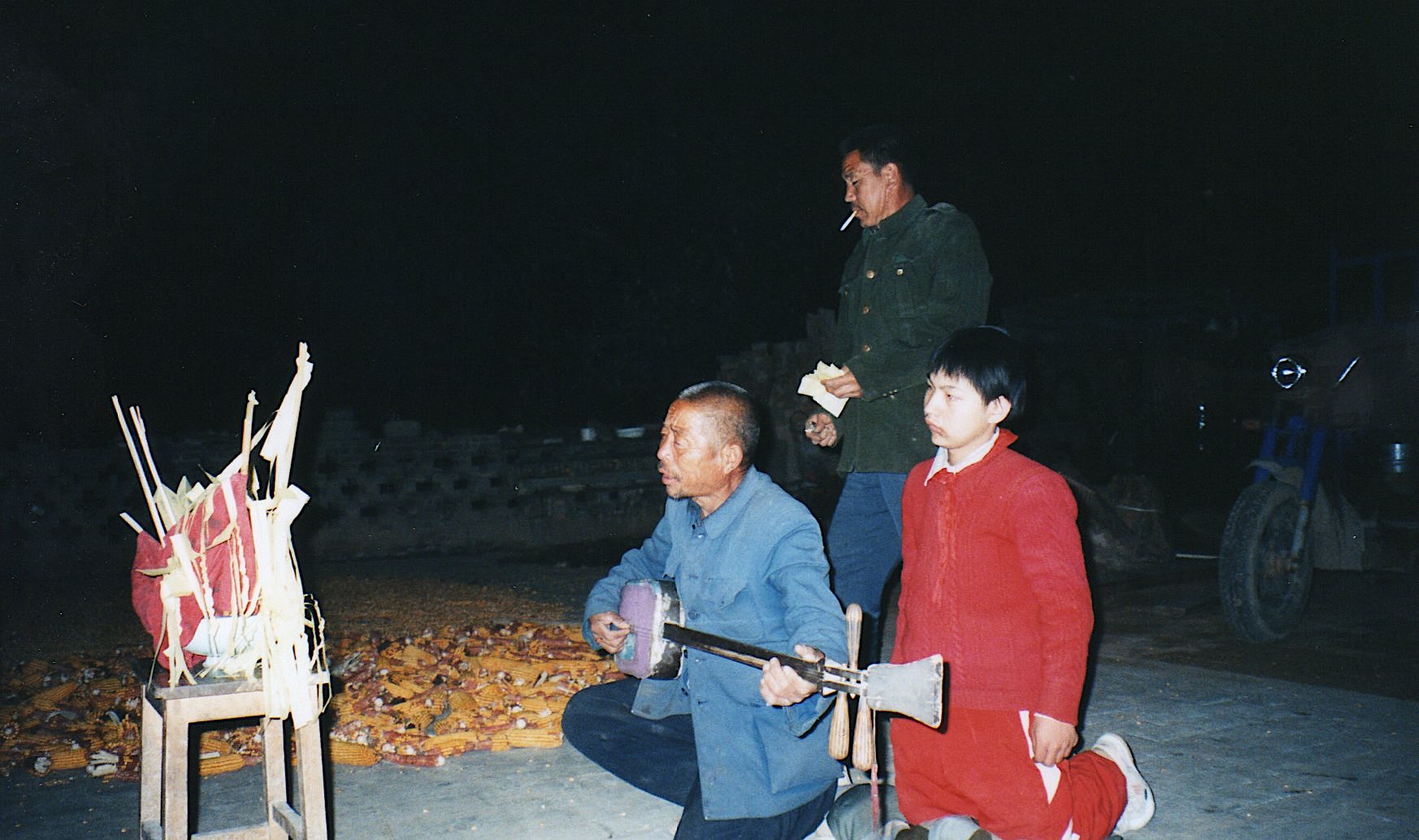
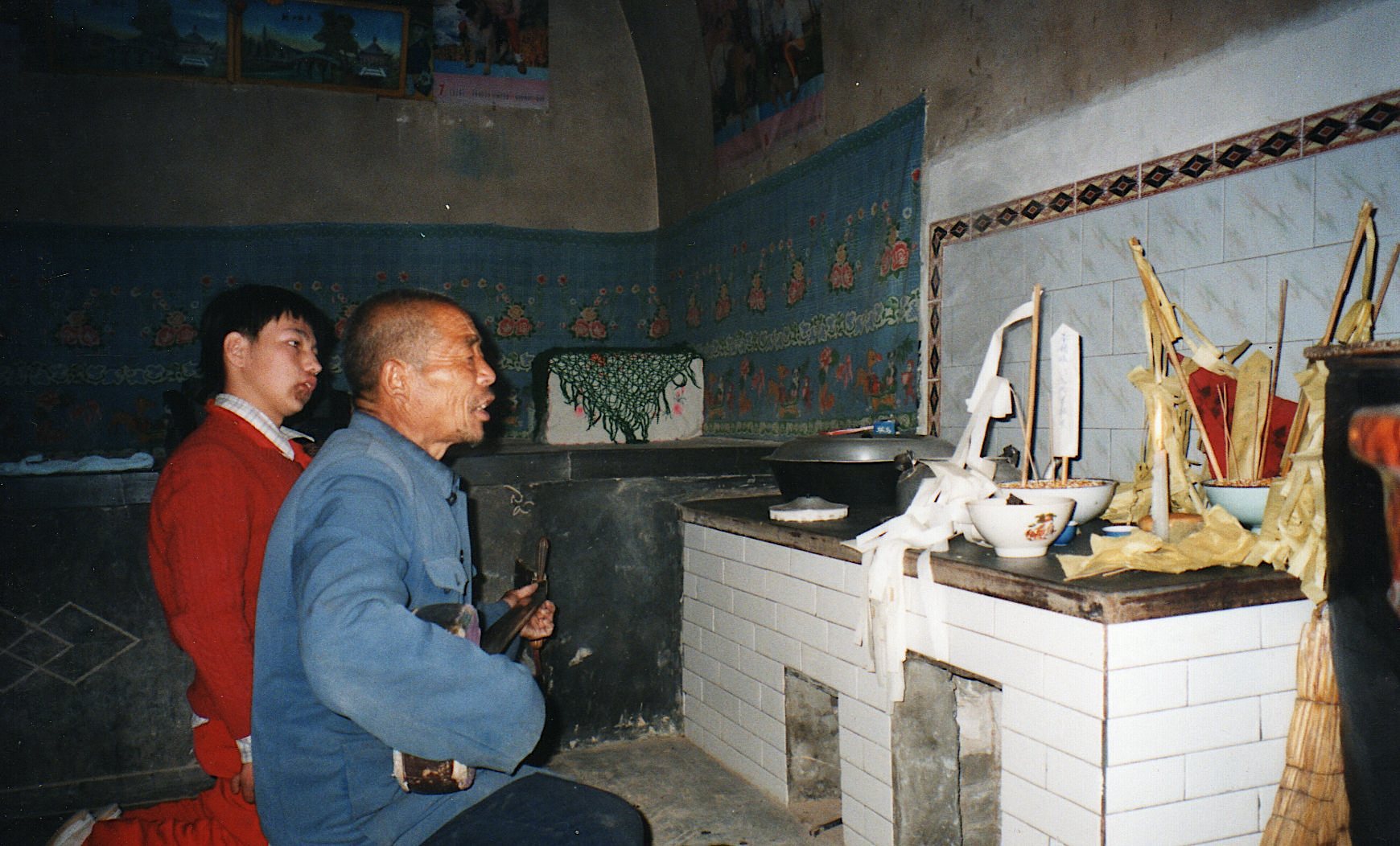
LWJ in courtyard

LWJ shuoshu

Sighted bard Li Wenjin performs a “story for well-being” to protect the son of the host family, first inviting the gods in the courtyard and then narrating a sequence of stories before the altar inside the cave-dwelling.
See DVD §C4 with my Ritual and music of north China, volume 2: Shaanbei,
and pp.83–4 there).
Photos: Guo Yuhua, 1999.

Introduction
In Shaanbei, as in much of rural China, while many blind men earn a living by taking up the shawm (on which see my post on Guo Yuhua, and here, as well as this post on north Shanxi), others have also long served as protectors of children, acting as godfathers and healers, and telling fortunes—as well as singing “stories for well-being”, accompanying themselves on a plucked lute and clappers, a kind of one-man band. They are itinerant, going by foot over quite a wide area.

Though in decline since the 1960s, the bards appear to have adapted rather little in context or sound. Under the Maoist collectives, some spent brief periods being taught new stories in the county-town “propaganda teams”, but this hardly affected their repertory or performing contexts. Since the 1990s, the popularity of the genre has been further threatened by the media of TV and pop music; and little bands now increasingly supplement the solo performers.

Social background
Blind bards also tell fortunes, cure illness, and act as godfathers—occasions when they do not necessarily perform stories. As godfathers they perform ceremonies protecting children (including hanging the locket, the annual Crossing the Passes ceremony at temple fairs, and opening the locket). These ceremonies have doubtless become rather less common since the 1950s, though neither campaigns against superstition nor any gradual improvement in healthcare entirely explain this.

Li Huaiqiang, in his 70s, had hung the locket for three or four hundred children; Guo Xingyu, in his 50s, for “over 290”.

Like geomancers and mediums, the blindman performs healing in a ritual called Settling the Earth or Settling the Earth God. For this he recites incantations and depicts talismans, but does not perform stories.

These occupations were a lifeline for males only: the fate of blind females was pitiable.

Occupations for blind men in Shaanbei

  • begging (yaofan 要饭)
  • playing in a shawm band (guyue 鼓乐, chuishou 吹手)
  • telling fortunes (suangua 算卦)
  • exorcism / healing (antushen 安土神, zhibing 治病)
  • hanging the locket (baosuo 抱锁, daisuo 带锁), opening the locket (kaisuo 开锁), Crossing the Passes (guoguan 过关)
  • narrative-singing (shuoshu 说书).

Contexts for narrative-singing

  • Stories for vows (yuanshu 愿书), to fulfil a verbal vow (huankouyuan 还口愿):
    household (jiashu 家书), for well-being (ping’an shu 平安书)
    temple fairs (huishu 会书: miaohui 庙会)
    parish (sheshu 社书)
  • less common: weddings (hongshi 红事), moving into a new cave-dwelling (nuanyao 暖窑), going off to the army (canjun 参军), official meetings (jiguan 机关).

Ritual equipment, stories, and music
For the narrative-singing contexts, the bard performs before a small temporary altar. Inscriptions for the gods and family, rectangular paper “god places” with a triangular head, mounted on gaoliang stalks, as well as changqing yellow paper streamers, are inserted into one or two rectangular bowls filled with grains of millet or corn. Before the altar are placed a lit candle, small bowls to hold incense and burn paper offerings, and offerings such as dough shapes, biscuits, dates, fruit, peanuts, cigarettes, and cups of liquor.

The altar is placed on the family stove or on a table; for the rituals to invite the gods and escort them away at the beginning and end of stories for well-being, it is placed on a table in the courtyard outside. Li Huaiqiang, though blind, prepared the changqing streamers himself; someone sighted and literate has to be found to write the inscriptions. Incense and paper are burnt before the altar periodically throughout the performance.

The bard takes with him a red cloth bearing the titles of a pantheon of gods. When not in use it is rolled up and kept in the bard’s bag. The cloth is unfurled and placed upright behind the altar, supported by two sticks inserted into a sleeve at either end of the cloth.

Cloth pantheons:
(left) Li Huaiqiang, 1999;
(right) Xu Wengong, 2001 (for a list of these gods, see Zhang Zhentao, Shengman shanmen, p.356).

Stories overlap with opera plots, relating historical tales of love, official success, solving of crimes, famous battles, and righteous protest—all familiar in Chinese fiction since the Ming dynasty, and often referring to still earlier times. Like opera, these stories have long been a dominant form for poor people to learn of history, legend, and morality, only being challenged by schooling since the 1950s. Schooling even now is quite elementary, though TV and pop music are doubtless replacing traditional stories for entertainment.

Indeed, bards’ stories are like a cheaper, more portable version of opera that can be brought into the home to bring good fortune to the family. Like opera (and indeed TV soap opera), stories may be performed in sections at successive sittings—commonly three episodes (huihui).

Bards improvise phrases on the basis of a well-known story—as He Guangwu observed: “We respond to the changes on the spur of the moment (suiji yingbian 随机应变), the lyrics aren’t fixed and dead (dingsi 定死).”

The solo performer accompanies himself on a plucked lute and usually two percussion instruments attached to his left leg and right hand. He may rest his right foot on a low stool, and drapes a towel over his shoulder to wipe sweat from his face. The plucked lute is either unfretted three-stringed sanxian (known as xianzi) or the fretted four-stringed pipa; the sanxian is most common, the use of pipa declining drastically in this area since the 1980s.

This rare form of pipa (see below), held less vertically than the “modern” pipa, and played with a plectrum, was a major discovery, reminding scholars of the Tang dynasty pipa. As was the trend through the 1980s, they were keen to conjure up “living fossils” and evoke the glories of ancient dynasties, but they mustered less publicity for this supposed relic of the Tang pipa than did scholars of nanyin in southeast China.

Han Qixiang and the training sessions
As with many other genres in China, the national reputation of narrative-singing in Shaanbei rests largely on one performer who came to the attention of cultural cadres and was cultivated by them. Han Qixiang (1915–89), dubbed “China’s Homer” but redder than red. The Party’s model blind bard in Shaanbei during the Yan’an period.
Han Qixiang

from http://www.confucianism.com.cn/html/minsu/15021455.html

In my book I outline his career, trying to read between the lines of hagiographic Chinese accounts on the basis of the 1993 article

  • Chang-tai Hung, “Reeducating a Blind Storyteller: Han Qixiang and the Chinese Communist Storytelling Campaign”, Modern China 19.4 (1993).

From 1945, Party ideologues went to some lengths to reform storytelling with a network of training sessions. After the national “Liberation” of 1949, every county government throughout China set up an arts-work troupe, which soon metamorphosed into an opera troupe; some county authorities further set up a narrative-singing artists’ propaganda team (shuoshu yiren xuanchuandui). These narrative-singing teams were less permanent (and much less costly) than the opera troupes; they held training sessions before dividing into smaller teams to go off on tour round the villages. Bards were lodged together, sometimes for a few months but often for just a few days, and even if they could remember the new stories, they remained reluctant to perform them once they went on the road.

Apart from Han Qixiang, another blind performer mentioned in the 1940s as creator of new stories is Shi Weijun (b.1924), who organized training sessions for bards around Suide county. Blind bard Guo Xingyu (see below), himself no simple official mouthpiece, hinted that Shi Weijun found it hard to adapt to official demands after Liberation. “But then he gave up—he didn’t even want his wages, he lost his standing, and went off on his own to tell stories.” He was clearly reluctant to take part in official events.

We can discount the rosy official image, but even the candid local scholar Meng Haiping recalls the period before the Cultural Revolution as a golden age for the blind bards, with county Halls of Culture organizing them into teams and issuing permits, so that district and village leaders had to receive them, hosting and feeding them—an unprecedented and welcome way to guarantee their “food-bowl”.

Conversely, if the state now acted as the bards’ patron, their richer patrons had disappeared, and their poorer ones were becoming wary of inviting them; temple fairs and “superstition” were under threat. Many bards were not recruited to the teams or were unwilling to join, and even those who did take part did so only intermittently. Although those not registered in the teams were not given permits, they still managed to perform, relying on the old contexts such as “stories for well-being” and godfather duties. But the climate was changing: as the power of campaigns sunk into people’s consciousness, they would have been increasingly nervous of inviting bards openly.

Even those bards who did spend periods in the official teams learning new stories continued to earn their living from more or less “feudal superstitious” contexts. You couldn’t perform new items for hanging the locket, or as stories for well-being.

Party ideologues admired popular oral literature; while deploring its links with superstition, they were unsuccessful in seeking to break such links. The new stories were often based on novellas or opera scripts, and composed with the “guidance” of cadres. As Hung points out, it was hardly a collaboration between peasants and intellectuals—it was never in doubt who was in charge.

It’s hard to assess is how the new stories were received. Even clues in the unremitting hagiography unwittingly give glimpses of constant conflict and difficulties. Han Qixiang composed a new story called “We can’t withdraw from the collective” (Buneng tuishe) (how very true!), reportedly converting peasants who were opposed to collectivism. Having heard that in some Zichang villages women were reluctant to work in the fields, and men reluctant to tolerate them doing so, he composed pieces exhorting them and praising female labour heroes. During the famine of 1959–60 he performed “Turning over a new leaf” (see link in Comment § below) for peasants disgruntled with the paltry goods available on New Year’s Eve, supposedly enlightening them as to how much their lives had improved since the bad old society. Yeah right…

Still, Han Qixiang was a fine performer; even when he told new stories, he would naturally vary them every time, like bards worldwide, and he retained the colourful local vocabulary of bards throughout the area. One cannot merely assess his stories from the page, without being able to witness his performances and those of other bards of the day. Bards I met were less impressed by his technique or creativity than by his good fortune in meeting the right people at the right time and getting onto the government payroll.

So whereas Han Qixiang appears to have been a model “folk artist” propounding Party policies with conviction, most bards in Shaanbei have continued to eke out a living from their traditional exorcistic “stories for well-being”, both under Maoism and since the reforms.

Immortal Li
Among the characters in Guo Yuhua’s book on Jicun is the village’s blind bard Li Huaiqiang (1922–2000, known in the village as “Immortal Li”, Li xian); as ever, my notes benefit from her rapport with him. Visiting his cave-dwelling in 1999, she introduced us and we all sat ourselves down on his kang brick-bed; having explored my facial contours with his hands, he gently held my hand throughout our chat.
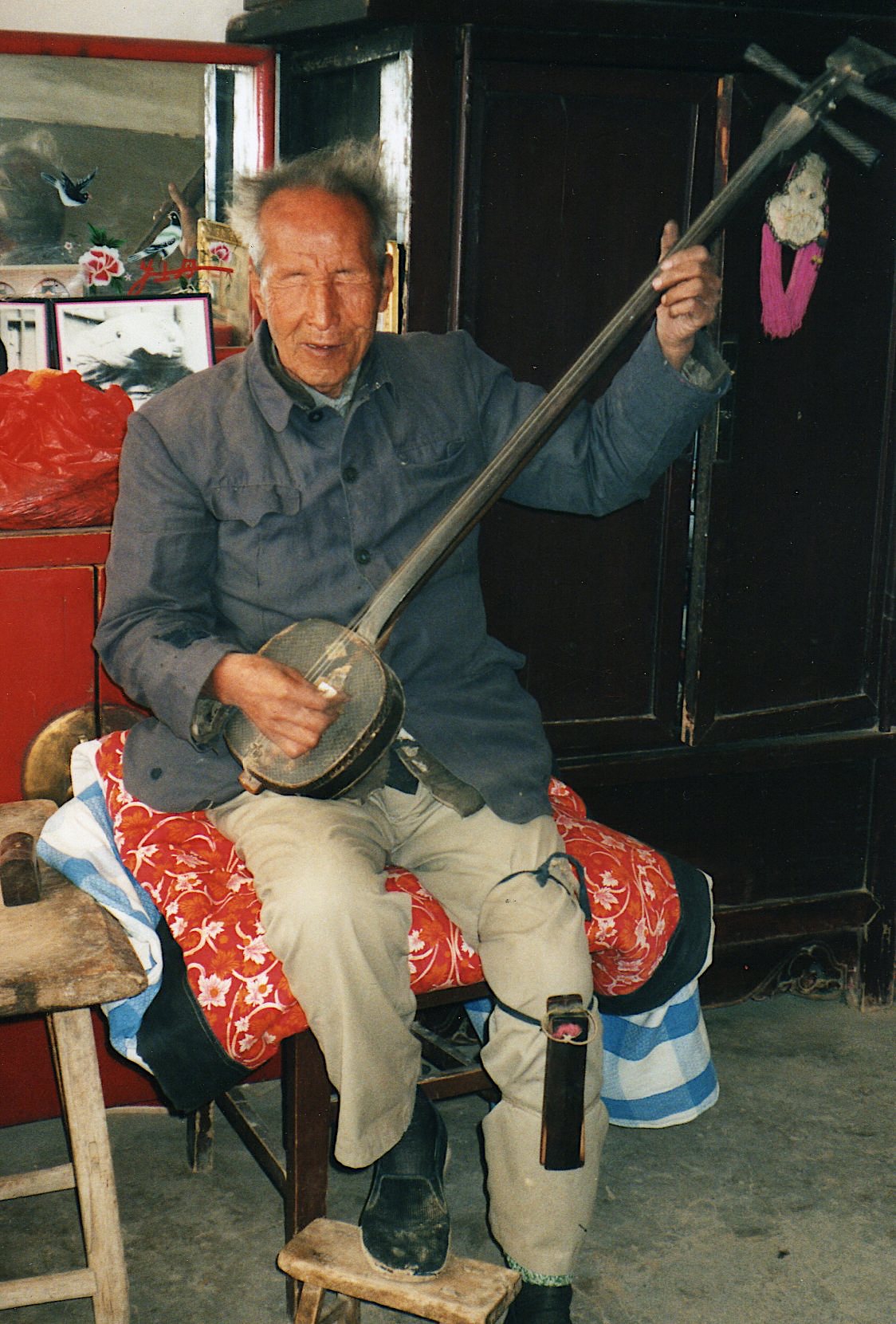
LHQ shuoshu

Li Huaiqiang was among the great majority of bards (and audiences) not amenable to the new stories. Under Maoism, though he gained a house and a family, his livelihood was reduced; since the reforms of the 1980s he suffered both from the decline in popularity of the art and his own dwindling skills.

Li Huaiqiang was born to a poor family of hired labourers working for the village landlords. Such poor families couldn’t afford to send their children to school, and he attended “winter school” for a mere few days. He lost his sight completely by the age of 10 sui. When he was 15 or 16 sui (c1936–7) his father took him to a blind bard to “learn up the arts” of narrative-singing, “history”, fortune-telling, and healing. Learning stories phrase by phrase was time-consuming and expensive—his father had to scrape the fees together. Li contrasts that ruefully with the ease of young upstarts today who can learn just by listening to tapes.

Li began “going out of the door” to earn a living before he was 18 sui, practising both healing and narrative-singing. He was often in demand to cure illness: when someone’s child was seriously ill, Li could give acupuncture and Chinese medicine. When adults had some irregular illness (xiebing), some bad karma, for which orthodox medicine was no use, he’d find them some special herbs.

Since Yangjiagou was still a landlord stronghold, in the early days Li often performed stories all four seasons of the year for the landlords in the village itself. Such performances—like longevity celebrations, or for the first full moon of newly-born children—often lasted seven or eight days. The landlords had a shrine to the god of wealth in their houses—before it bards would tell their stories, and Buddhist monks would recite their scriptures.

Ritual has always remained paramount for bards like Li. “Poor people (shoukuren) worship the Dragon King Elder (Longwangye), stockbreeders worship Horse King Elder (Mawangye), people in business worship God of Prosperity Elder (Caishenye). When people make vows they invite us to tell stories, that’s how we make our living.” Since vows were often fulfilled in the 1st and 2nd moons, bards were most busy then.

By the 1940s, Li’s itinerant business was taking him—by foot—all over Shaanbei. Recalling the old temple fairs, he mentioned the two most famous, still very active now: “I used to go to Baiyunshan for over twenty years, I even went once after the end of the Cultural Revolution. I used to go every year, there were kids there that I’d hung the locket for.” Li performed for the small temple fairs in his home village too, notably the 4th-moon fair at the Pusa miao temple. The temple fairs in the neighbouring hamlet of Sigou were planned best, and were popular; people liked listening to narrative-singing there.

Li Huaiqiang’s early visits south to the Yan’an region, in 1938 or 1939, were part of his routine itinerant business. He told stories around Hengshan and Bao’an (Zhidan) counties too. “No-one controlled what stories you told then, you could narrate what you liked.”

In 1943, after the Suide–Mizhi area was taken over by the Communists, Li found himself unable to make a living there, and went off to Yinchuan in Ningxia and nearby Xichuan. The Nationalist officials loved listening to stories—bards were invited to their quarters. They could travel freely then—only later, when the Communist–Nationalist collaboration ended, did the roads become impassable.

Still, his assessment of the Red and White areas was ingenuous. “It was just the same under the Communists and the Nationalists. Under the Nationalists it was easy to earn money, people liked to listen to stories. After the Communists took control over people, not allowing superstition, at least there was provision for us disabled people, there was relief. So things were the same.” But he did remark, “In the end the Communists came along and broke all the temple fairs up, so there was nothing left.”

I wonder how many bards chose to seek a living in either the Red or White Areas. Evidently old stories did not suddenly vanish throughout the Yan’an countryside. The Yulin region was a seesaw area between the two sides, and most local leaders would, as yet, be broad-minded about traditional forms. We can’t judge, but it is worth challenging the propaganda. And having blithely equated “new stories” with items supporting the Communists, I wonder if bards in the Nationalist areas performed new stories opposing the Communists.

Li Huaiqiang dismissed our queries about the officially-organized groups—he had only the vaguest recollection of this experience. It might have remained an exciting moment in his life distinguished by its uniqueness—but apparently hadn’t. Li went on:

From 1945 they summoned all the blind bards to meetings—they weren’t allowed to sing old stories any more, they had to sing new ones. I studied them and then forgot them all—well, I basically didn’t study them! When you go out [on business], the common people don’t listen to that stuff! New stories aren’t good to listen to—people don’t like listening to new stories, they like old ones! I could never forget the old stories I learned when I was young, though. I can tell twenty or thirty stories. When you went out in the old days there was business, you could count on it—who’d have thought it would all come to an end?

He knew of Han Qixiang but didn’t hear him perform or meet him. “That Han Qixiang, he got onto the official payroll. Oh yes, people in our business all know about Han Qixiang. In the Yan’an period people reformed it into new stories, but they didn’t control us lot who narrated old stories, we just went off round the countryside narrating on our own.” He knew that some performers sang for political meetings, but didn’t admit to doing so himself.

Li Huaiqiang was lucky to find a wife:

I was 24 when I got married [c1946]. They came to take conscripts—people stuck to their old habits, no-one wanted to go off, but they forced them. But us blind people, we couldn’t go off to the army, no-one wanted us—that’s how I got a wife. People were afraid of joining the army, both sides were taking people off, no-one dared go, as soon as you went off you’d get killed. If it was today I couldn’t get married—now it’s hard enough for sighted men to find a wife.

During land reform there were meetings all the time. The Communist Party controlled people, eliminating superstition. When they wanted to hold a meeting they first summoned a bard to narrate a [new] section, so everyone turned up—then the bard sang the old stories that people liked.

This was a common theme, of great significance for our understanding of the Maoist period. The bard would attract people to turn up for tedious political meetings, and satisfy the demands of political expediency by performing a brief political item first, before the fun began. Scholar Meng Haiping recalled: “Both old and new stories were heard then. Until 1956, they began with a short section with new content, then moved onto the old stories like ‘The story of five women reviving the Tang’ (Wunü xing Tang zhuan).”

Li Huaiqiang originally lived in a miserable cave-dwelling made of earth, but after land reform, he was helped to “buy” a comfortable cave-dwelling right at the top of the village from the former landlords, which had been servants’ quarters. The landlords also had to “sell” him their precious sanxian banjo, which he bought for one dan of grain.

If in that sense Li was able to profit from the overthrow of the landlords, he soon suffered from their demise. “We were allowed to narrate stories in the early days after Liberation, but people’s consciousness was raised, people had studied a lot of books.” I didn’t care to argue with him there, so he went on, “They said narrative-singing was boring, so there was a lot less of it—it got less all of a sudden with the collectives [from the mid-1950s]. People like us just tilled the fields, told fortunes, we could just about get by, the state gave us relief. We couldn’t just die off—some people were given relief, some were put in old people’s homes, some with skills could go out and heal illness and tell fortunes.” And he was still taking large numbers of godchildren, whose parents’ regular little gifts always presented a lifeline.

If Li Huaiqiang was unaware of it, the Mizhi county authorities were attempting to organize bards. Gao Zhiqiang, former chief of the county Hall of Culture, recalled, “The county first set up a narrative-singing team in the early 1950s, organizing over twenty blind bards, training them all together to sing new stories. The Hall of Culture issued them with performance permits, which meant that the district and village authorities had to host them—that resolved blind men’s problem of livelihood.” But the teams never controlled blindmen for long.

Li Huaiqiang, who had never belonged to a team or performed in a group, still relied on a minimal handout from the village government to survive; with his wife and five children, times were desperate. “In the Cultural Revolution they didn’t invite us bards any more, it just stopped. But people like us still went out—mostly to tell fortunes, not so much to narrate stories.” And he sometimes sneaked out to hang the locket for children in exchange for “a couple of little coins”. Li was soon branded an “ox demon and snake spirit”, accused of feudal superstition. They took his manual off and burned it; they took his sanxian banjo away too, but he got it back after half a year. “Pesky kids, coming to our houses to get us to hand things over—if you did, then you were let off, if you didn’t then they paraded you through the streets.” Li was only paraded once. The only time he could recall when the authorities regulated narrative-singing was in the year of rebellion (zaofan) of the Cultural Revolution, when all the brigades had to organize blind bards into narrative-singing teams to go round and make propaganda, the county Hall of Culture taking a cut.

The reform era
In Shaanbei, as elsewhere in China, as the commune system began to be dismantled from the early 1980s, traditional culture revived more openly. Bards had been active throughout the commune period, both in and out of the new teams; if the old contexts and stories had never died out, after the “rotting of the collectives” there was no longer such need for collusion or duplicity. As Li Huaiqiang recalled, “As soon as Mao Zedong died, they stopped controlling us bards.” But like other traditional performers, they were soon competing with new economic pressures, TV and pop music taking their toll: where Maoism had failed to marginalize tradition, capitalism looked like succeeding.

Despite his privations under Maoism, he warmed to the theme:

Society’s different now, people have “turned over a new leaf”, reforms and all that—too much reform, it’s all gone too far…

Ebullient local pundit Meng Haiping had a perceptive comment:

In those days [under the communes] they tried to destroy traditional culture, but couldn’t; now they don’t control it any more, but it gradually declines anyway. 1984 to 1990 was the best period. Ever since the great wave of economics started, culture has been dying out.

The agenda of the cultural authorities hardly changed, even if state policy would never again be so “hard”: they still sought to teach the bards new stories to spread education about party policies, and they still aspired to both “controlling” and “looking after” the bards—ambivalent meanings of the term guan 管.

By the late 1990s Li Huaiqiang, quite frail in his old age, was less active as a bard. Lucky enough to have found a wife during times of war, Li has two sons and three daughters; but the family has remained poor, and the sons have been unable to find wives. In 1999 Li performed for the 4th-moon temple fair in his village, and he still did the occasional story for well-being for families fulfilling vows. But he told us: “I’m almost without business these days, 80% of my work is gone. Most temple fairs don’t have narrative-singing any more. These days people read books a lot [surely he overestimates this!]—the state doesn’t control it any more, people just don’t want to be away from work. They’ve got TV and recordings too now.” He used to perform for audiences of 80 or 90 people, but now it’s only for around 20 or 30, mostly elderly. “I can’t keep up.” This didn’t apply generally to narrative-singing in the whole area, but to Li in particular—elderly, frail, and no longer a gifted performer.

In the exceptional conditions of Yangjiagou, the occasional visit from Japanese tourist groups, Chinese and foreign scholars, and visitors to the memorial hall to Chairman Mao’s 1947 sojourn, allowed Immortal Li to supplement his meagre income: “They always get me to perform when someone comes.” But his main income still came from his godchildren, as it had done under Maoism. While we were in the village, one of his godchildren’s children was getting married, and when he paid a visit he was given 20 kuai; when he left they gave him mantou steamed buns, and later they gave him some clothing.
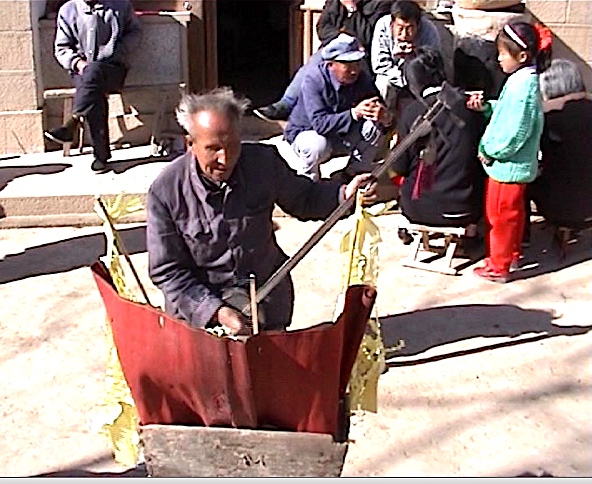
LHQ qingshen

We took him to the cave-dwelling of our host Older Brother, the sweet blind shawm player, to perform a “story for well-being” for the family, as usual inviting the gods outside in the courtyard before telling a story indoors. Though his skills were in decline, it was a memorable occasion.

Li Huaiqiang died in July 2000, falling from a narrow mountain path while on his way to another village to hang a locket. Since his death, other itinerant bards occasionally stop off to perform in the village.

He Guangwu
He Guangwu (b. c1932) is a semi-blind bard from a village west of the river, south of Mizhi town. He began to lose his sight when 15 sui (c1946), so a couple of years later he began “learning the arts” with a master from Zizhou county, mastering a dozen traditional stories—although this was supposedly a climactic period for the new stories, the old stories were being transmitted as if nothing had changed.

He married when 21 sui. Their families arranged the match; his betrothed lived in a village only two li away, but they wouldn’t let her see him, and she only discovered his disability at their wedding. Now she jokes about it and is evidently happy that the family is relatively prosperous with many great-grandchildren; we didn’t like to press her on how it had seemed then.

He had taken part in training sessions in 1955 and 1964, but his concept of his livelihood barely took official contexts into account.

His family has done well since the reforms. He is active over a small area, proudly claiming to be well known within a radius of 20 li (10 kilometres), and he hasn’t taken any disciples. But he is busy. “People still invite me, and I still go. For temple fairs, or if a donkey isn’t eating its fodder, or if a family member is on a long journey, you must invite a ‘story for well-being’; and I tell stories for opening the locket, weddings, moving into a new cave-dwelling, and sons going off to the army.” He is also busy telling fortunes and healing.

HGW and me 2001

With He Guangwu, 2001. Photo: Zhang Zhentao.

In 2001 we found He Guangwu at a small temple fair at Jijiashigou, near his home village. He had agreed to tell fortunes for a family there to help them overcome adversity, and hadn’t brought his sanxian. He agreed to tell a story for us back at his home if we took him back to the temple fair later.

Tian Zhizi
We also visited Tian Zhizi (b. c1933) at his son’s home in a little town south of Zizhou on the road to Suide. He had belonged to the Zizhou team, and also studied in the Suide team. “My eyes were no good from young—I began studying narrative-singing in 1944. My master was Wang Jialai from Zizhou county. When I learned I lived at his house—his fee was 3 dan of grain per year, and I learned for three years.” Through the War of Resistance and the War of Liberation—precisely the period when the new stories were supposedly in the ascendant—Tian supported himself by curing illness, reciting incantations, and depicting talismans.

I began telling stories in 1951, and in 1952 became chief of the Zizhou blind people’s propaganda team, which had been formed the previous year. I was chief of the team for three years; it had over 60 members. Between 1952 to 1956 I studied new stories at the Jiuzhenguan hall in Suide.

Their boss was Shang Airen, an influential cultural official in Shaanbei. Despite my suspicions, Tian recalled,

In the 1950s the peasants loved hearing new stories. The main ones I learned were “The outstanding troupe member”, “Zhang Yulan takes part in the election”, “Opposing shamans”, “The tobacco pouch”, “Mother Gui makes shoes for the army”, and “Wang Piqin takes the southern road”.

Still, through the 1950s and 60s, while the bards from the team sometimes went on tour in small groups, Tian usually went round on his own. When he was 28 sui (c1960), Tian married a girl from the same town—which he claimed was “free love’” not arranged. In 1962 he spent a period working in Yan’an with none other than Han Qixiang, earning 36 kuai a month. Later he resigned and returned home, still making a living as an itinerant bard, also telling fortunes, hanging and opening lockets—by 2001 he had over 200 godchildren.

He went on, “I have 28 disciples in all, eight in Wubu, four in Yulin, two in Shenmu, also in Yan’an, Ansai, and Bao’an [Zhidan]. I took some disciples while I was at Yan’an in 1962, others stayed at my house to learn.”

Unusually, the Cultural Revolution was a significant period of activity for blind bards, who continued to perform both in their traditional contexts and in the state groups. The latter now had a new lease of life as “Blind artists’ Mao Zedong Thought propaganda teams”. In Mizhi county, the Hall of Culture organized a dozen bards into one such team, touring villages, mines, and schools—villages without electricity, mines where accidents were routine, schools with few tables or chairs, and the whole population constantly hungry and demoralized, if you will forgive me for reminding you.

“In 1972 I was mainly taking disciples in Wubu, ‘cos the Wubu Hall of Culture invited me to come to train members for their propaganda team.” Though it was ever harder for bards to perform without the sanction of the teams, popular taste still appeared to require an escape from the relentless revolutionary diet. Tian Zhizi had claimed that the new stories were popular in the 1950s, but “from 1967 [traditional] narrative-singing was forbidden—by that time people preferred old stories, or at least they didn’t like new ones, so we bards told some old ones in the villages on the quiet.”

Other bards also told us that while they couldn’t hang the locket openly during the Cultural Revolution, for those who needed it they still did it, and they still performed in secret in the villages—the people liked to listen and protected them. Geomancers were also still furtively active.

Ironically, perhaps the worst case of penalization was revolutionary Han Qixiang himself, inactive and subject to public criticism throughout the period. As late as 1976, just as the Gang of Four was about to be arrested, he was summoned to perform in Xi’an and criticized, though by late 1977 he was well back on the road to rehabilitation, taking part again in official meetings.

Guo Xingyu
A younger blind bard more able than many to move with the times is Guo Xingyu (b.1951), with whom I spent some time in 2001. His case is quite exceptional among bards I have met, following political trends astutely while continuing to take godchildren and cure illness.

Brought up in a poor Suide village, Guo Xingyu was blind from young. He studied narrative-singing and fortune-telling for ten moons with Wang Jinkao from the age of 12 sui (c1962). He started going out on business when about 16 sui, on the eve of the Cultural Revolution. “When I was young I enjoyed learning everything from my master, curing illness, depicting talismans and chanting mantras”.

When I was just starting out we mainly told old stories, though in public contexts we told bits of new stories. New ones I liked telling, before and during the Cultural Revolution, were “Fuss over an abortion”, “Eliminating transactional marriages”, “The great immortal who eats ghosts”, “Eliminating superstition”, and “The tale of the city youth returning to the countryside”.

In 1968 Guo Xingyu joined the Suide county blind peoples’ propaganda team, which had several dozen bards, divided into three or four sub-groups:

In the 60s we were issued with narrative-singing permits; we had to hand over part of our income to the Hall of Culture as “public assets”—the state also took a certain amount of training expenses, but later that stopped. In the 60s and 70s the whole county probably had about 70 or 80 bards—about 40 or 50 didn’t enter the training bands, they had to tell stories on the quiet.

Guo Xingyu even took part in official festivals in Suide, Yulin, and Xi’an; he was praised by the venerable Han Qixiang. He appeared a model bard in the new mould—little would one think that all the while he was performing stories for well-being and healing.

From 1972 I was head of the blind men’s propaganda team organized by the Suide Hall of Culture. I entered the Party in 1975, and from 1978 I was political instructor of the team. In the 1980s I composed some new propaganda-type stories on the basis of the political needs of the time, mainly things like advertising the spirit of the Party’s 12th and 14th Plenary, and birth control, like “Fuss over an abortion” and “Marrying Late”.

By 2001 the team was moribund. Guo and his (sighted) wife were dividing their time between his home village and an apartment in the suburbs of Suide town. He had rarely performed as a bard since getting heart disease around 1991; now his main livelihood was curing illness by depicting talismans and chanting incantations, and hanging and opening lockets. Relying on his traditional magic, he legitimized it with a fashionably scientific-sounding defence: “magic power is rational (fali you daoli)”.

Guo Xingyu took us to see his blind master Wang Jinkao at his village home south of Suide town (DVD §C3).

WJK, GXY heying

With (right to left) Wang Jinkao, Guo Xingyu, and Wang’s son, 2001. Photo: Tian Yaonong.

Wang (known as Niur, b. c1930) married a sighted girl in 1947; they have three sons and a daughter, all peasants in the village. Wang accompanied himself on pipa rather than sanxian. When Guo Xingyu studied with him around 1962 he was running a kind of blind school in Qingjian; he learned in a group of five or six blind boys, whose parents had to pay fees. He was one of few bards still using pipa rather than sanxian.

Wang Jinkao had had minimal contact with the new ethos: he could tell new stories like “Wang Gui and Li Xiangxiang”, but if he had ever taken part in training sessions or belonged to the county team, no-one cared to remember.

As we saw, bards mostly worked solo; even when they assembled for temple fairs and New Year’s festivities, they performed in sequence, not together. But under Maoism, bards were sometimes organized into small groups to perform for non-ritual contexts.

Still, both new contexts and musical innovations remained a minor feature even through the years of Maoism, and after the “rotting of the collectives”, tradition became yet more dominant. Some new stories were still performed—on the birth-control policy, the reform and open-door policy, the private enterprise system. Some county authorities continued their efforts to organize blind performers, even trying entry by ticket. But as prices rose and more modern entertainments became popular, they resorted to more viable money-making ventures like setting up halls for video games, or classes teaching electronic keyboards.

By the 1990s the propaganda teams were virtually defunct. As one cultural cadre told us: “Later the bards didn’t want people to control them, and we didn’t have enough money anyway, so we gave up.”

Blind and sighted bards
Though Han Qixiang mentioned competition between blind and sighted bards when he was learning in the 1930s, narrative-singing in Shaanbei was largely a monopoly of blindmen, and only since the eve of the Cultural Revolution has the taboo against sighted performers been seriously challenged.

By around 2000 it was a fait accompli for sighted men to muscle in on the trade. There were fewer blind people anyway, since health has improved (though still appalling); and they could now receive modest disability benefits, or migrate in search of work as masseurs.

Nor do sighted men fear going blind any longer if they take it up. Half of Tian Zhizi’s 28 disciples were sighted—presumably those he taught since the 1970s. Although one elderly bard commented that the new disabled allowance for blind people makes them lazy, blind performers who are still active rather resented the encroachment on their “food-bowl”. “Originally sighted people weren’t allowed to tell stories—if you’re sighted you can do anything [else].” Now not only can sighted people learn, but they can even learn from tapes, saving them money but depriving senior blind bards of teaching fees.

Scholar Meng Haiping pointed out: “In the old days, bards’ social status was low; now for everyone all that counts is money, social status no longer comes into it.” This was certainly true for trendy young chuishou shawm-band musicians in the towns, but less obvious for the bards. Unlike the chuishou, bards have not spruced up their image so ambitiously, and remain quite modestly paid; nor have they yet availed themselves of the mobile-phone revolution that has occurred since about 1998. Whereas chuishou often ride motor-bikes, bards (even sighted ones) mostly go on foot.

Guo Xingyu:

Now there are sighted bards everywhere—many senior-secondary graduates, not wanting a hard life, go and tell stories. In Zizhou, Hengshan, and Yulin there are a lot of sighted bards, and there are some in Mizhi and Jiaxian too. Now there are fewer than thirty blind bards in Suide, but there are more sighted ones. They began appearing in the 1980s or 1990s, they drove the blind ones away; the blind ones were very angry about it—but the sighted ones had permits too.

He went on darkly,

Now how did that come about, then? Perhaps by bribery. Now blind artists are in great difficulties. There are more of them west of the river, but quite a few of the old artists have died; east of the river their skills aren’t quite so good.

Li Wenjin
I met sighted bard Li Wenjin (b. c1943) with Guo Yuhua in 1999 when he performed informally for staff at the office of the Black Dragon temple (on which see Adam Chau’s fine book Miraculous response), as a kind of advertisement for his arrival in the area. He comes from a village in Zizhou county. Soon after Liberation, in the early 1950s, he studied for three winters in the evenings in the “school for sweeping away illiteracy”. His parents died early, but he only began studying narrative-singing in the early 1980s, with the old blind bard in his village. His master could never find a wife: “when the five organs are incomplete, no-one will follow you”—though most of our blind mentors were exceptions. There was a libretto (benben) that he could follow—even blind performers sometimes owned a libretto. Li Wenjin was active over quite a wide area. He usually sings with his eyes closed—in imitation of blind bards?

LWJ and GYH

Guo Yuhua and temple organizers listen to Li Wenjin, Black Dragon Temple 1999.

A couple of days after meeting him at the temple where we were staying, we bumped into him on our way back there, and he invited us along to hear a “story for well-being” that evening for a family in the nearby village (see photos at head of this post).

Xu Wengong
We met another sighted bard at the White Cloud Mountain temple fair in 2001. Xu Wengong (b. c1948), from a village in Qingjian county, began learning at 17 sui [c1964] from an uncle, so the taboo was perhaps being broken down even then. He has never taken part in any county-organized teams, or learned new stories. During the Cultural Revolution he was protected by villagers as he went round performing and hanging lockets on the quiet.

Many pilgrims attend the temple fair under the auspices of a dozen or so regional associations, each with particular allegiances among the many temple gods, sponsoring different daily rituals. Apart from the daily performances of opera, bards perform in a less public and commercial arrangement that is also typical of Shaanbei temple fairs. One evening we visit the cave of the Zizhou, Qingjian, and Ansai association where Xu Wengong was performing.

He comes to this fair every year as part of this pilgrim association, in order to fulfil a vow. “My father was a model labourer, and was head of this association”—note this typically casual link between Communist and traditional authority. “He came here to take part in the rituals and made a vow, because I’d had stomach disease for twelve years, and sure enough I got better. So I’ve been coming here to fulfil the vow every year since the temple restored, to revere the great god Zhenwu; I come here to avert calamity.” Some other bards also come to the temple fair not to make money but to fulfil vows.

There is no need to “invite the gods”, since they are already present, but on the left of the cave, as you stoop to enter, is an altar behind which the bard’s red cloth pantheon is displayed (see photo above). Individual pilgrims periodically burn paper and kowtow before it. Xu Wengong performs opposite the altar, the pilgrims sitting on mats at the rear of the cave, listening intently. They consist mostly of men over 50, but even those over 60 were brought up largely under Maoism. Yet such senior men entirely represent tradition; ritual associations like this surely represent a kind of passive alternative to government control.

Baiyunshan pilgrims 2001

XWG BYS 2001

Xu Wengong, Baiyunshan 2001

Old and new stories
Despite the propaganda surrounding Han Qixiang, not only does no-one value new stories now, but few recall them being popular even under Maoism. He Guangwu recalled, “In those days, usually we’d tell a section of a new story first and then tell an old one.” Other bards like Li Huaiqiang had no time for new stories at all. He had heard “Smashing superstition” on tape at a villager’s house, but “people don’t like it, it’s not good to listen to—you can’t sing stories like that for families, only for big meetings where tickets are on sale!” He Guangwu had learned “Opposing shamans” in the training session in the 1950s, but he too commented wryly, “You can’t tell that story nowadays—that’d be blasphemy!”

Even if the popularity of new stories was highly limited, and the subjects remained traditional, Li Huaiqiang pointed out that the bards’ language had been evolving along with the language of society generally. A certain change of style, reflecting the times, had evidently left him behind.

In the old days you sang of “Lady” or “Mistress” (furen, xiaojie), now it’s “missus” (poyi); in the old days it was “setting up as a family” (chengjia), nowadays it’s “the couple have got together”, “they held hands as they walked”, “they kissed”—it’s so lacking in culture! Old people won’t listen to that stuff, in the old days it was real cultured, now it just ain’t the same. But you have to adapt yer language to the times, eh?

So why should people apparently prefer stories about events many centuries earlier to ones about their society now? Local scholar Meng Haiping explained the ability of the old stories to survive under Maoism:

Traditional stories propound truth, goodness, beauty, and filial piety (zhenshanmeixiao 真善美孝)—that is China’s traditional morality, the Party doesn’t oppose that, and doesn’t suppress it.

Though there is ample evidence to show that they did oppose it, deliberately, regarding it under headings such as “bourgeois morality”, Meng was still making a fair point—because the Party he refers to is that on the ground, where continuity is more evident in local practice than the rupture often advocated by central theory.

Having complained about the coarsening of the bards’ language, Li Huaiqiang went on to lament the changing times:

In the old days bards used to wear a robe, and a hat with a pigtail. Nowadays it’s all simplified. Then it was wagai hats, sitting at a high table; now you don’t get changed, and just sit on a stool, it’s much simpler. And the gods used to be more efficacious, they were dead efficacious—if you didn’t follow them you could die. Once someone’s son died, and the parents made a vow to beg him to come back to life, so I obeyed the gods, and he really did come back to life.

So why didn’t the new stories become popular? Sure, villagers might be conservative and escapist in their tastes, finding stories of emperors and concubines, scholars and maids, generals and outlaws more attractive than propaganda. But the new stories might have been entertaining and meaningful in the contexts of the 1940s too. The irony was that the whole purpose of the new stories since the 1940s was to address current issues of great importance to the peasantry: namely tackling endemic social problems inherited from the old society.

But problems that might be arising under the new society were not now to be publicly aired. I would surmise that villagers might have been open to new stories, but were disillusioned by their glib political correctness, their failure to reflect complex new realities. The new stories were surely rarely heard in the villages apart from at mass meetings by which people were anyway alienated. If villagers were still able to host a performer to sing to invite the gods to heal their livestock, the new stories were inappropriate. In the early period of the 1940s, they might have had considerable novelty, and even helped people confront genuine problems, like forced marriages, opium, landlord exploitation. But maybe the themes didn’t keep pace with the problems: by the 1950s their perceived problems included campaigns, collectivization, irrational directives, and thus the new items seemed false, like the propaganda itself.

Still, as we saw, the stories Han Qixiang performed on his tours in the late 1950s were often semi-improvised according to the events unfolding in the village. That is, problems such as reactionary thinking among the peasants could be ridiculed; perhaps even bourgeois thinking of local leaders; but central policy could hardly be questioned.
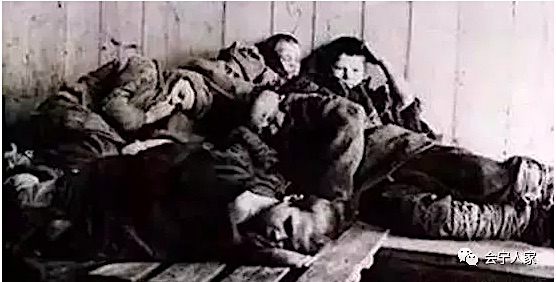
As to issues topical since the reforms of the 1980s, several performers mentioned stories about the birth-control policy—that is, supporting it; given its massive unpopularity, has anyone dared sing stories opposing it? If no stories have arisen dedicated to sensitive issues such as official corruption, they are doubtless subtly aired in passing, if not as flagrantly as the fictional balladeer in Mo Yan’s visceral 1988 novel The Garlic Ballads (p.73):

A prefecture head who exterminates clans,
A county administrator who wipes out families;
No lighthearted banter from the mouths of power:
You tell us to plant garlic, and that’s what we do—
So what right have you not to buy our harvest?

Since the government mounts regular poster campaigns warning of sexually transmitted diseases, even if it was slow to admit to the danger of AIDS, I wonder if the bards could now be enlisted to tell stories warning of such perils. It seems unlikely. For a hard-hitting song from blind singer Zhou Yunpeng in Beijing, see here; and for songs on the Coronavirus, click here and here.

At any rate, one can only be impressed by the adaptability and creativity of storytellers, and whatever the constraints on public speaking both under the communes and since the reforms, they must always rely to some extent on keeping their audience entertained with topical remarks which will strike a chord.

Note that it was the texts that the Party cadres sought to reform—the traditional melodic and rhythmic elements were not an object of their attention.

Research and images
By the 1980s, while local scholars did most of the work by contacting the bards through the urban teams, rather than accompanying them on tour, they were now concerned to document ritual aspects of the performance. People’s mind-sets had become much more free than under Maoism—one local scholar who recorded bards for the Anthology was not going to be hoodwinked into toeing the Party line by recording new stories:

When I recorded them, I chose anything about Heaven, Earth and Man, and rejected everything about the Party, Chairman Mao, and Socialism!

One might see this as a political bias in itself, but I would view it as a shrewd correction of any tendency the bards might have to play safe by performing a politically-correct piece for a government representative.

Since Shaanbei is often featured romantically in the national media as a revolutionary base, brief sanitized glimpses of Shaanbei folk culture are occasionally broadcast. The standard images are yangge dancing or a cheesey folk-singer, but in 2001 I saw a young sighted man do a passable imitation of a Shaanbei bard on a national CCTV chat-show featuring the cult Shaanxi novelist Jia Pingwa.

Avant-garde Chinese artists have presented a less revolutionary image of Shaanbei. One fine antidote to Han Qixiang is the blind bard in the novella Life on a string (Ming ruo qinxian) by Shi Tiesheng (b.1951), one of many “educated youth” rusticated to a village near Yan’an in 1969 (see my Shaanbei book, pp.8–11, 76–7). This 1985 story mystically evokes the life of an itinerant blind bard and his young blind disciple:

The old man believes that when he has broken one thousand strings, he can open up his sanxian and find a prescription inside which will restore his sight. When he finally does so, the piece of paper inside is blank.

The story was made into a film by Chen Kaige (1991), director of the brilliant Yellow Earth, also showing the gulf between the harsh realities of rural life and the Party’s ideals.

Such avant-garde creations, with their mystical minimalism, are more popular outside than inside China. While far from ethnography, they at least offer an imaginative alternative to the revolutionary idealism of official sources.

You can find many video clips of Shaanbei bards online (on Chinese sites and even YouTube), most but not all in a commodified style. This one, while close to the traditional setting, is clearly specially staged. In recent years Cao Bozhi 曹伯植 has published prolifically on musical aspects of the genre.

* * *

Now I also learn much from

  • Ka-ming Wu, Reinventing Chinese tradition: the cultural politics of late socialism (University of Illinois Press, 2015).

Though Wu immersed herself the lives of her village hosts, she also engaged more with officialdom than I did. She was introduced to bards through the propaganda teams, which look to be more important in her region of the Shaanbei field site than in mine. So whereas bards that I met—even those who had spent periods in the training teams—found the new initiatives evanescent, she tends to take the institutional level as primary, although local variation may also play a part.

For instance, her subheading to Chapter 3 “Propaganda storytelling turned into spiritual service” puts the cart before the horse—when the latter has such a long history, and the former remains only one aspect of their activities. Following blind bard Master Xu around for a month, she gives some excellent vignettes.

She found that

He had transformed his performance into a series of clandestine religious activities and religious performances.

But this was precisely how the blindmen had always earned their living throughout history! A similar slip is

Northern Shaanxi storytelling was originally designed as part of a government-sponsored cultural enrichment mission to poverty-stricken rural areas. (104)

 In Chapter 4 Wu valuably describes danwei work-unit performances, which I hadn’t found. She shows bards’ (not always successful) search for performances in such danwei; indeed, even when a bard goes on a solo tour of the countryside she suggests a rather formal arrangement with the village leadership. Conversely, the nearest to this that any bards I met got to was when Li Wenjin announced his arrival in the area to the Black Dragon Temple temple committee—whereupon word soon spread, and household patrons came forward.

Again she shows how bards tend to open with a brief modern propaganda item (no longer based on class politics, as she notes) before launching into a more popular traditional story.

She gives some valuable translations of lyrics, both traditional and modern. Further to my comments above on stories about topical issues, she translates a remarkable item “Quality Control System Spread to Millions” warning against fake consumer goods, performed at a factory; and the 2008 “Alleviate Earthquake Disaster, Look Forward to the Olympics, Increase Productivity” for a staff appreciation event.

While she notes that such national and government messages were overshadowed by the traditional stories that followed them, she reminds us to pay attention to the mutual interpenetration and agenda contestation among the local state, danwei, and folk cultural practitioners.

She finds that storytelling

neither resists nor colludes with the state; nor does it cater to urban tourism or consumption.

And she observes acutely:

Instead of attributing the spiritual revival to a simple return to the storytelling tradition from before the 1940s, I relate it to the huge movement of labor, objects, and emotions between the rural and urban areas.
[…]
My point is not that northern Shaanxi folk storytelling has revived because of depressing rural economic conditions. Rather, I wish to emphasize that the revival of storytelling practice becomes one of the rare social and communal occasions for rural villagers to get together where they can openly discuss all kinds of major rural developmental contradictions: lack of elderly care, split households, and youth who find no career development in remote rural hometowns and who encounter much difficulty surviving in cities.
In short, folk storytelling occasions are valuable not so much because villagers are getting more religious or that the practice is a time-honored heritage. Rather, folk storytelling has become what Megan Moodie called “platforms for articulation”, where local citizens draw traditional cultural resources to discuss pressing concerns of split households among left-behind elderly and young wives in remote communities in a translocal age. (101–102)

 Despite these areas for discussion, when she writes so perceptively such variations in focus are welcome.

Conclusion
Despite the substantial material published on Communist reforms of narrative-singing, and ethnomusicologists’ eager search for change and modernization, it was hard while observing daily life in Shaanbei around 2000 to credit the Party’s reform programme with much long- (or even short-) term influence.

As Guo Yuhua observes, people remained loyal to their traditional concept of local village culture rather than to the state. Though state-funded troupes are undoubtedly an aspect of overall activity, this point appears to be of wide relevance for ritual activity and expressive culture in the Chinese countryside today, and for our understanding of modern China.

If the bards are now threatened by the recent spread of TV and pop music, they are still in demand for their “stories for well-being” as well as for their healing skills. While they do assemble for public rituals like temple fairs and New Year, they mostly perform solo. From the 1940s, a disjuncture emerged between the secular political performances of the official teams and the rituals of the solo bards. Narrative-singing has perhaps become a lesser aspect of the blindmen’s activities than their godfather and healing duties. Indeed, since sighted bards do not necessarily learn the healing arts of blind men, a potential divorce also looms between narrative-singing and healing—all the more since people can now learn stories by listening to commercial tapes.

My point is not to belittle official efforts, either in the cultural or political spheres. But we should avoid basing our assessments either on the new stories of Han Qixiang or on a simple revival or reinvention since around 1980. As Ju Xi comments, criticizing the recent interpretations of “secularization” (compared with imperial China) and “revival” (compared with the Maoist era), both of which portray Chinese religion as somewhat isolated from society, local religion is not merely a “spiritual creation” or “cultural heritage”—it’s a cultural resource and social power which can play active roles in contemporary rural society.

The Party never managed to “eliminate superstition”, but complex social and economic changes continued to affect ritual life and expressive culture both under Maoism and since the reforms. Studying their changing fortunes in such a society requires a nuanced approach.

Click here for a trailer for the documentary Shujiang (Cao Jianbiao 曹建标, 2019). See also Bards of Henan, and my roundup of posts on narrative-singing.

.


[1] This article is based on Part Two of my book Ritual and music of north China, volume 2: Shaanbei, (where you can find further refs. and characters)—note §C of the accompanying DVD. See also my “Turning a blind ear: bards of Shaanbei”, CHINOPERL 27 (2007); and Zhang Zhentao, Shengman shanmen 声漫山门, pp.353–79. I use the term “bard” for convenience, and to hint at their broader ritual duties.