Scunthorpe and Venice

Further to my reminiscences of The Li band in Italy (and my book pp.334–7),

We board another train to carfree and carefree Venice, where we have four wonderful days. We are staying—virtually alone—at the splendid hostel on the tranquil Isola San Giorgio, home of the majestic Cini Foundation, gazing across the water at San Marco. In the evening we take the vaporetto for our first meal at the excellent trattoria Il Giardinetto. This sure beats doing a Messiah in Scunthorpe for a jolly good tea, as we London musos say.

In the spirit of the sinological footnote, the precise version goes like this:

A fixer calls us up and goes, “Hi—can you come and do a Messiah next Monday night in Scunthorpe? There’s no fee, but there’ll be a jolly good tea.”

(Cf. the more tempting message I received in a Shanxi village in 1991.) For more on Venice, see here. Oh, and here. Not forgetting Monty Python’s sublime guide. For unlikely place-names to find in the index of a book on Daoist ritual, see here. And here I surmise that the wisdom of Nadia Boulanger might not have been in quite such demand had she been based in Scunthorpe.

For a tennis parallel, click here.

Wisdom of the elders

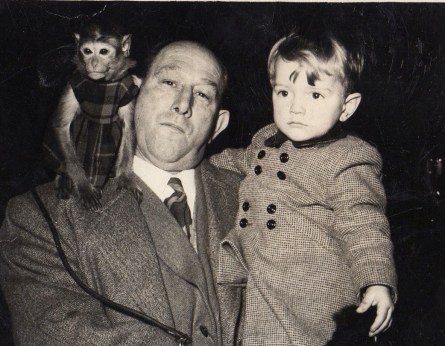
granddad

My maternal grandfather used to say,

“If we had some bacon, we could have bacon and eggs. If we had some eggs.”

Having assumed this was his own invention, I now find that this goes back at least to Groucho, and perhaps to World War I. And bacon and eggs was only becoming an item around then, thanks to Freud’s nephew Edward Bernays (see here, and here, as well as The Full English).

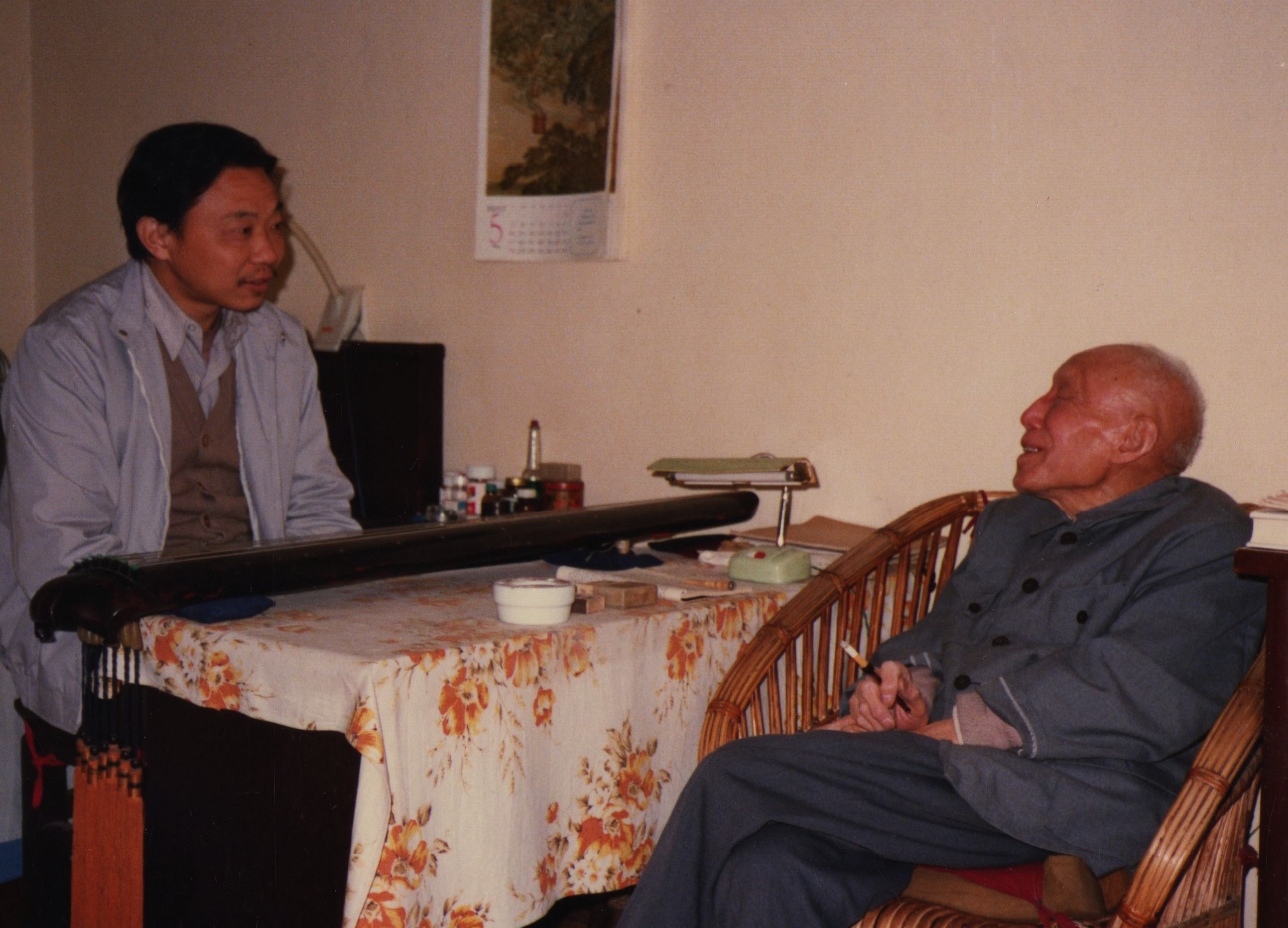
Li Manshan likes my granddad’s line, identifying the sentiment with his memories of privation. Indeed, the photo above would have been taken in the late 1950s, just when Yanggao people were starving.

Eating lions

The English language may have a propensity for wordplay (cf. Headline punning, and Myles), but you can’t beat Chinese. This poem (“The story of Mr Shi eating lions”), composed in the 1930s by Yuen Ren Chao (Zhao Yuanren), plays solely on different meanings of characters pronounced shi:

施氏食狮史
石室诗士施氏,嗜狮,誓食十狮。施氏时时适市视狮。十时,适十狮市。是时,适施氏适市。
施氏视十狮,恃矢势,使是十狮逝世。氏拾是十狮尸,适石室。石室湿,施氏使侍拭石室。
石室拭,施氏始试食十狮尸。食时,始识十狮实十石狮尸。试释是事。

For what it’s worth, you can read about the Li family’s shishi Bestowing Food ritual in my book

For further wonderful wordplay from the Li family, see here.

Man having trouble with umbrella

As proof that the British have no need of some spurious independence from Europe, I burst out laughing every single time I see the sign for roadworks, famously known as

Man having trouble with umbrella

screen-shot-2017-01-17-at-09-46-37

Somehow the continental version of the sign is subtly different, rendering the joke less comprehensible. Up Yours, Delors, as the tabloids would say.

For more umbrellas, see here.

A music critic

estampies

Talking of free-tempo preludes

Many years ago (indeed, “more years ago than I care to remember”—a new entry in Flann O’Brien‘s Catechism of Cliché), we were in a London church, recording some exquisite medieval instrumental pieces called estampies. They are said to have spread through Europe by way of the Crusades, and have been recorded by worthier musicians than me, often with Middle Eastern style in mind. I was on rebec (“What does that even mean?”).

Right in the middle of a take, an irate elderly janitor burst in to subject us to a withering tirade, exclaiming:

“Are you gonna give it a rest? It just goes on and on. I mean, it’s not as if there’s any MERIT in it…”

We decided against inviting him to write the liner notes for the CD.

For other scathing reviews, see here and here.

Bach, alap, and driving in Birmingham

WAGZ score

Hesi prelude and opening of Qi Yan Hui suite: score showing melodic outline in gongche solfeggio, West An’gezhuang village, Xiongxian county, Hebei.

It was Yoyo Ma who put me onto playing the Preludes of Bach cello suites as a kind of alap. Actually, that’s how he introduced the Allemande, the second movement of the sixth suite, playing it al fresco as thanks for our group of helpers at the amazing Smithsonian Festival of the Silk Road in 2002, which he was curating.

As I come to adapt the Bach cello suites for violin, I consider how to play the opening two movements of the sixth suite on their own. Should I play the Allemande first, as a kind of alap? Or else take Bach’s opening movement with majesty rather than virtuosity, at an exploratory rather than hectic pace, as a kind of prelude to the alap of the Allemande… Either way can work.

Prelude and Allemande, 6th cello suite, manuscript of Anna Magdalena Bach.

For wise words on, not to say wonderful renditions of, the cello suites, we can turn to Steven Isserlis (click here for the CD set). Here he is playing the fifth suite (the Prelude here unambiguously meditative, like both the later Allemande and Sarabande):

For another Bach Allemande that seems to suit an alap-esque style, see here.

My brilliant friend Paola Zannoni likens the bariolage of the Prelude to the marranzanu Sicilian jew’s harp. The sixth suite, of course [sic—Ed.], was written for a five-string cello, but—in the current spirit of austerity—I make do with four.

While learning Bach (or indeed shengguan ritual melodies), one has to take care not to take a wrong turning. Like driving in Birmingham, if you take a false exit then you can find yourself going round in circles for hours.

Brum

Anyway, free-tempo movements (known as sanban 散板 in educated Chinese) are more commonly associated with solo genres like folk-song and qin—unlikely bedfellows. Apart from alap, one thinks of Middle Eastern taksim (see here, here, and here) and the Uyghur muqaddime (the singing of the latter ideally accompanied by the wonderful satar long-necked bowed lute). In these genres, the term “free-tempo” isn’t precise, since they do indeed have a underlying pulse.

Slow ensemble preludes called pai’r are also an exquisite feature of the lengthy suites of Buddhist and Daoist ritual shengguan ensembles. As with shengguan suites altogether, the pai’r in Hebei (see e.g. here, under West An’gezhuang) are best heard with a small ensemble, like the fantastic group of Gaoqiao village in Bazhou (audio playlist #8, from Plucking the Winds, CD #14—see commentary; this movement actually follows the opening pai’r, but itself opens with its own lengthy sanban prelude), where the heterophony of the four melodic instrument types can be best appreciated.

Such preludes are also a feature of ritual suites around Xi’an. But they are strangely absent from the suites of Daoist ritual repertoires in north Shanxi like those of the Li family—which are otherwise clearly related to the suites of old Beijing, still played in Hebei.

And don’t miss Aretha’s extraordinary alap to Amazing Grace! And the exquisite expositions of dhrupad!!!

Private Passions

Radio 3’s Private Passions is always insightful. The edition with Philippe Sands (here) shows that he too “delights in all manifestations of the Terpsichorean muse”(see Muzak)—Leonard Cohen, Michael Chance singing Erbarme Dich

(see also herehere, and here—and for an Arabian version, here), Bruno Walter conducting Mahler 9 (here, and here) in 1938, and Let’s pretend we’re bunny rabbits. Actually, the latter isn’t such a kitsch choice as its title suggests, but hey.

My posts A Nazi legacy and The Ratline introduce Sands’s harrowing film and books.

Get out of my garden

Here’s a typically tenuous connection with ritual. On the subject of transmission, this piece from Stewart Lee is rewarding as ever:

—as well as his still more thoughtful reflections in How I escaped my certain fate, pp.136–42, 169–76. One of the many delights of this masterpiece is the way that scholarly footnotes often take over, like Flann O’Brien‘s arcane annotations on de Selby in The third policeman.

Some harmless run-ins

Even in my early days of fieldwork, accompanied as I was by trusty colleagues from the Music Research Institute in Beijing, the cops rarely took much interest in me.

In one county south of Beijing the local constabulary reluctantly decided not to throw me out, allowing me to continue innocently “collecting folk pieces” with the stern warning

“Do not investigate anything not within your sphere”

—which I later adopted as the title for the Coda of Plucking the Winds[1]

Grateful though I am to them, with their own undoubted experience of local society, for attempting to help me define a workable scope for my studies, Confucian and Maoist thought alike support a basic tenet of ethnomusicology, that musical culture is intimately related to the society which nourishes it:

Music! Music! Is it nothing but the sound of bells and drums?—Confucius

There is no such thing as art that is detached from or independent of politics—Mao Zedong

However, it was not the moment for me to offer them a lecture on the principles of ethnography (cf. Nigel Barley in Cameroon, and Some notes on Deutschland 89).

* * *

Whenever practicable, I stay in the villages with my local hosts. When I do have to stay in a town, there is usually a cheap hostel available where no-one cares much about regulations. On another occasion in the early 1990s, arriving in a little town, I spent the day with my Chinese colleague visiting a couple of fine ritual associations, recording them and chatting affably. That evening we settled into a wonderful clean hostel, recommended by our musician friends and costing about 40p a day, and next day after more excellent fieldwork we were having a cheap lunch of noodles when the cops arrived.

Brusquely telling me I wasn’t allowed to stay in accommodation not earmarked for foreigners, they whisked us off by car to the county-town, without even allowing us to finish our noodles. Blimey, I didn’t expect the Spanish Inquisition… Deposited at the police station, the machinery of local bureaucracy swung into action; the county mayor was summoned back from Tianjin, and a private meeting was held for several hours while they decided what to do with me (“Should get away with crucifixion—first offence”). The main purpose of this exercise was surely to give the massed officials an excuse for a vast banquet.

Meanwhile the young cop guarding me happened to be keen to learn some English, so I obligingly helped him pronounce some choice phrases like “Fuck” and “Bunch of wankers” (which, naturally, I explained as meaning “How do you do” and “Welcome to our country”), which I made him repeat in loud and confident tones till they echoed across the courtyard. A visit to the loo revealed a huge pile of ancient turds that had surely been accumulating—like Chinese culture, indeed—since the Ming dynasty.

The meeting broke up in time for them to all go off for their banquet, and the police chief came in with severe demeanour to explain that they had no choice but to expel me from the county forthwith. Not that I wanted to share the banquet—in fact the very threat of a banquet with them would have been enough to hasten my departure—but having not eaten since my noodle lunch was interrupted, I was getting a tad hungry, and the prospect of driving a distance before looking for a transport caff was not enticing. Not to mention the fact that the hostel we had been expelled from was comfortable, the town was charming, the food fine, and the music promising.

The police chief went on to explain that they were responsible for my safety: local hostels might be unsafe, and I could be robbed—or worse. That, he claimed, was why I should always stay in the county-town where the outrageously-over-priced high-class hotels apparently catered to my needs and guaranteed my safety.

I was quick to point out that this was far from the case: whereas in the countryside we are always looked after by wonderful hosts, and indeed the town hostel was a model of civilized hospitality, I knew from occasional stays in fancy urban hotels that they are hotbeds of vice—with drug deals and gambling rings, ladies of the night phoning to offer relaxing massage, you name it. Surely they wouldn’t wish to consign me to such dens of iniquity? As the police chief assured me this was not the case on his beat, I congratulated him sarcastically for being in charge of the only town in China free of such vices, and took my leave. “Welcome to our country”.

Back in Beijing, the story was lovingly retold at the Institute, boosting my street-cred (cf. this incident).


[1] For Chinese translation, see “Qiewu jinxing zhishenshiwaide yanjiu” 切勿进行置身事外的研究 [Do not investigate anything not within your sphere], Zhongguo yinyuexue  2005/3.

Headline punning

Since I often seem to find myself citing drôle headlines, Kate Fox again has some fine observations on the subject (Watching the English, p.225):

It seems to me that the English love of words—and particularly the universal nature of this passion, which transcends all class barriers—is most perfectly demonstrated not by the erudite wit of the broadsheet columnists, brilliant though they are, but by the journalists and sub-editors who write the headlines in the tabloids. Take a random selection of English tabloids and flip through them: you will soon notice that almost every other headline involves some kind of play on words—a pun, a double meaning, a deliberate jokey misspelling, a literary or historical reference, a clever neologism, an ironic put-down, a cunning rhyme or amusing alliteration, and so on.

Yes, many of the puns are dreadful; much of the humour is laboured, vulgar, or childish; the sexual innuendo is overdone; and the relentlessness of the wordplay can become wearing after a while. You may find yourself longing for a headline that simply gives you the gist of the story, without trying to be funny or clever. But the sheer ingenuity and linguistic playfulness must be admired, and all this compulsive punning, rhyming, and joking is uniquely and gloriously English. Other countries may have “quality” newspapers at least as learned and well written as ours, but no other national press can rival the manic wordplay of English tabloid headlines. So there we are: something to be proud of.

And it’s not just the tabloids: even the Grauniad is not above

Nineteen Eighty-Phwoar:
the truth about George Orwell’s romantic “arrangements”

although they would doubtless lay claim to a more post-modern sense of irony than the red-tops bother with.

I’ve made a roundup of the headlines tag here. And there’s more harmless fun for all the family under the China Daily tag.

More on Hebei

Further to my introduction to The Hebei plain: village associations, and remarks in Hebei: new discoveries,

the work of Yin Hubin 尹虎彬 is highly relevant, such as

  • “Hebei minjian biaoyan baojuan yu yishi yujing yanjiu”
    河北民间表演宝卷与仪式语境研究, Minzu wenxue yanjiu 2004.3,

and his 2015 book

  • Hebei minjian Houtu dizhi chongbai 河北民间后土地祇崇拜

This research supplements my outline of the Houtu cult in Part Three of In search of the folk Daoists of north China—illustrated on this blog by pages on the Houshan Daoists and the Houtu scroll.

Another scholar continuing the fine work of Li Shiyu, Pu Wenqi, Ma Xisha and others on sectarian religion is Cao Xinyu 曹新宇.

Social survey

China’s prostitutes were better-trusted than its politicians and scientists, according to a 2009 online survey published by Insight China magazine. The survey found that 7.9% of respondents considered sex workers to be trustworthy, placing them third behind farmers and religious workers. “A list like this is at the same time surprising and embarrassing,” said an editorial in the state-run China Daily.

Politicians were far down the list, closer to scientists and teachers. Insight China polled 3,376 Chinese citizens in June and July this year. “The sex workers’ unexpected prominence on this list of honour… is indeed unusual,” said the China Daily editorial. “At least [the scientists and officials] have not slid into the least credible category which consists of real estate developers, secretaries, agents, entertainers and directors”, the editorial said. Soldiers came in fourth place.

For an elaborate story linking the Sex-Workers’ Association and the Journalists’ Association, see here.

Quotes as sarcasm

At the exit of my local park a glossy new sign has appeared, with a message written in quotes:

“Thankyou for visiting Ealing parks”

It’s not so much the sentiment itself that I mind, but the quotes. It makes it look like they’re being sarcastic—as if it should continue,

dropping your litter all over the place and generally behaving like chavs—“Thankyou very much”.

Remembering an old friend 憶故人

That’s the title of one of the most soulful, and popular, pieces in the qin zither repertoire—unusually, not documented until 1937.

lyr

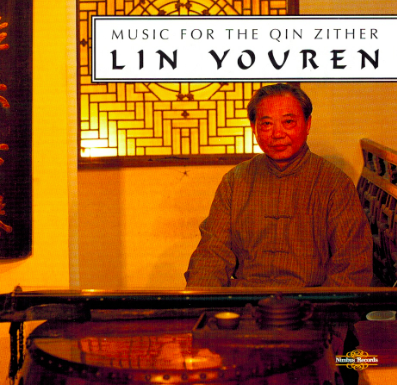
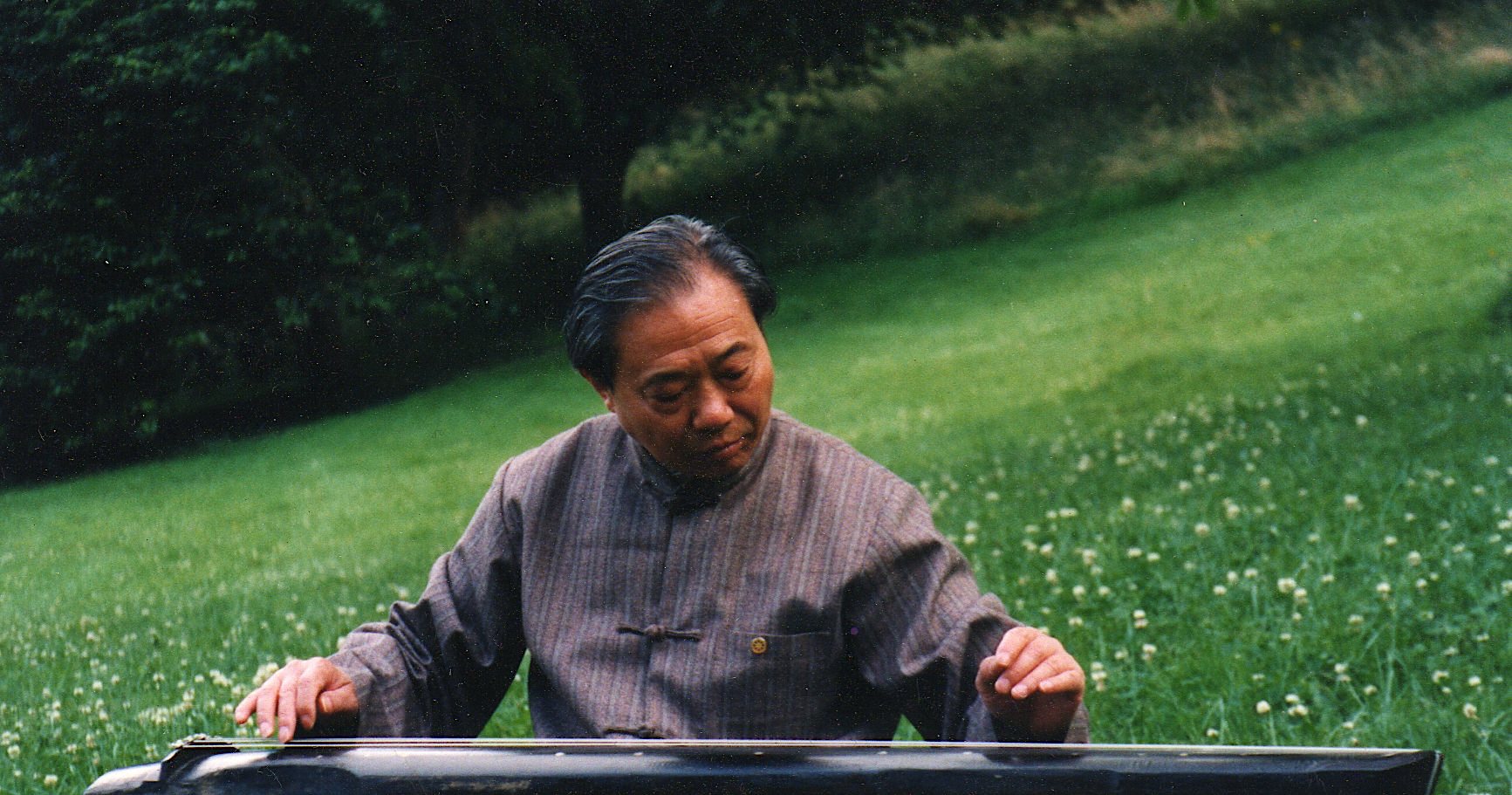
You can find tributes to my mentor Lin Youren (1938–2013) online, including the delightful

included in the fine article

So here I’ll just add a few of my own memories of Lin Youren.screen-shot-2016-12-30-at-12-20-31

Excerpts from my liner notes with the CD:

Lin Youren is a true eccentric. [Here I’m thinking of the Seven Sages of the Bamboo Grove]. His story contains intriguing contrasts, since he learned and taught the qin under the conservatory system, but came to find the juxtaposition incongruous, quietly subverting it from within. […]

His preferred way of playing is alone with a few friends—and, in another ancient tradition of the qin player, a bottle or two of Shaoxing wine. […]

If his playing roams the clouds of Daoist selflessness, his conversation is quirky, cryptic and full of puns.

The CD is very fine—here’s the opening track, “Evening song of the drunken fisherman” (Zuiyu chang wan 醉漁唱晚):

One unusual feature is its inclusion of his “Improvisation for Michael Owen”. More from the notes:

I’m not sure you really want to know this, but the musical germ of this fantasia was the singing of exhilarated English fans in my local pub after we relished Michael Owen’s superb goal against Argentina in the 1998 World Cup. Lin found the famous football song reminiscent of the singing of Miao tribespeople in southwest China (“Not a lot of people know that”, I mused as we emerged from the pub), but by the time we got to the recording session he had wholly internalized it for the intimacy of the qin.

Actually, since Lin Youren was staying with me, he tried it out for the first time as soon as we got back from the pub. A couple of days later we took the train for the recording session at Nimbus’s fine studio near Monmouth. To help him feel at home we plied him with Shaoxing wine; and he felt it would further help the vibe if I sat with him as he played, so he would have a real, and empathetic, audience. He improvised for much longer than the version on the CD, which is edited down—not quite to his satisfaction. Still, this CD was his favourite among all his recordings.

LYR in field

At Nimbus, 1998.

lyr-and-zzq

With qin master Zhang Ziqian, 1987.

lyr-and-wzj

Qin gathering, 1987. With beard is Suzhou qin master Wu Zhaoji.

For the Beijing qin scene, see here, and my series on the fortunes of the qin under Maoism; for my own mixed feelings about the qinhere. For a meretricious speculation on the rudra vina in India, see n.2 here. See also the qin tag.

Mind your language 2

One of my pronouncements, on the ceremonial music of Xi’an, was magnificently misquoted. Concerned that Chinese scholars had concentrated on rather flimsy and circumstantial historical links at the expense of detailed recent fieldwork, when so many living regional traditions remain under-researched, I had written:

It is ironic that a virtually defunct ritual genre should be among the most studied genres of Chinese instrumental music.

This sentence was too convoluted for one Chinese scholar, who proudly cited me to justify the study of the music:

Dr Stephen Jones has said that it should be among the most studied genres of Chinese instrumental music.

Ha! or Pah!

Watching the English

Fox

If it’s pop armchair ethnography you want (and why not, sometimes?), then

  • Kate Fox, Watching the English: the hidden rules of English behaviour

is brilliant.

To be impeccably English, […] one must appear self-conscious, ill-at-ease, stiff, awkward, and above all, embarrassed. Hesitation, dithering and ineptness are, surprising as it may seem, correct behaviour. (41)

And her insights into the “Typical!” rule (pp.199–200, 303–305) and funerals (pp.374–8)… Her final list of English traits (pp.400–414) includes Social dis-ease and Reflexes such as Humour, Moderation, Hypocrisy, Eeyorishness, Fair play, and Modesty.  I’ve also cited her remarks on headline punning. Click here for her comments on funerals.

And say what you like about Bill Bryson, but he too has some fine insights into the British (Notes from a small island, pp.68–9):

It has long seemed to me unfortunate—and I’m taking the global view here—that such an important experiment in social organization was left to the Russians when the British would have done it so much better. All those things that are necessary to the successful implementation of a rigorous socialist system are, after all, second nature to the British. For a start, they like going without. They are great at pulling together, particularly in the face of adversity, for a perceived common good. They will queue patiently for indefinite periods and accept with rare fortitude the impositioning of rationing, bland diets and sudden inconvenient shortages of staple goods, as anyone who has ever looked for bread at a supermarket on a Saturday afternoon will know. They are comfortable with faceless bureaucracies and, as Mrs Thatcher proved, tolerant of dictatorships. They will wait uncomplainingly for years for an operation or the delivery of a household appliance. They have a natural gift for making excellent jokes about authority without seriously challenging it, and they derive universal satisfaction from the sight of the rich and powerful brought low. Most of those over the age of twenty-five already dress like East Germans. The conditions, in a word, are right.

On a related tack (pp.98–9):

And the British are so easy to please. It is the most extraordinary thing. They actually like their pleasures small. […] They are the only people in the world who think of jam and currants as thrilling constituents of a pudding or cake. Offer them something genuinely tempting—a slice of gâteau or a choice of chocolates from a box—and they will nearly always hesitate and begin to worry that it’s unwarranted and excessive, as if any pleasure beyond a very modest threshold is vaguely unseemly.

“Oh, I shouldn’t really,” they say.

“Oh, go on,” you prod encouragingly.

“Well, just a small one then,” they say and dartingly take a small one, and then get a look as if they have just done something terribly devilish. All this is completely alien to the American mind. To an American the whole purpose of living, the one constant confirmation of continued existence, is to cram as much sensual pleasure into one’s mouth more or less continuously. Gratification, instant and lavish, is a birthright.

And on puddings:

It’s a funny thing about English diners. They’ll let you dazzle them with piddly duxelles of this and fussy little noisettes of that, but don’t fuck with their puddings, which is my thinking exactly.

For further comments on being English, see this roundup. Such observation should be part of fieldwork in more far-flung societies too.

In the past

From my book (pp.33–4):

We have to learn to latch onto troublesome terms like “in the past” (guoqu) or “originally” (yuanxian). I’m getting better at leaping in and asking, “You mean in the 1980s? Or before the Cultural Revolution?” or even more precisely, “Before the 1964 Four Cleanups, or before Li Qing went to Datong in 1958? Or before Liberation?” Even the seemingly mechanical task of eliciting dates requires imagination. Though not necessarily clear on dates, they may recall how old they were the last time they performed such and such a ritual, or we may ask questions like “Was Li Peisen still alive?” or “Before your first son was born?”

One day, admiring the trendy outfit that Li Manshan’s second daughter Li Min has bought for her young son, I observe, “Funny, in the past one never had to worry about fashion for kids’ clothing, either in China or England!” She has an astute come-back:
“How do you mean, ‘in the past’?!”
Me: “Ha—that’s what I’m always asking your dad!”
Hoist on my own petard.

Like her dad, she is perceptive and humorous—for more, see here.

New definitions

lu
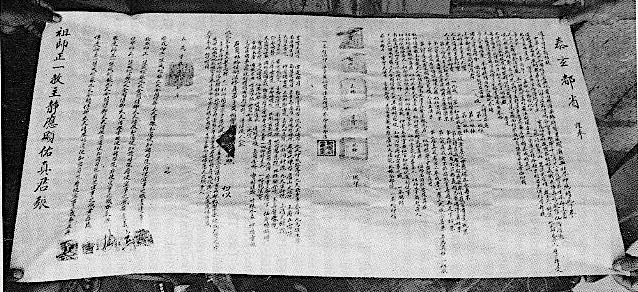
Daoist ordination certificate, Putian.
Source: Kenneth Dean, Taoist ritual and popular cults of southeast China.

In the spirit of I’m sorry I haven’t a clue

Further to Speaking from the heart, where I noted the somewhat elaborate definition of the term dundian, here’s another fine definition—ironically, from the Chinese-Chinese dictionary of my Daoist master Li Manshan, no less, which we consulted when I mentioned the term lu , Daoist “registers” (lengthy hereditary titles bestowing the authority to conduct rituals), unfamiliar to him (my translation):

a superstitious thing that Daoists use to trick people

Hmm. Li Manshan shrugs, and we both giggle.

Speaking from the heart

Further notes on fieldwork
A tribute to Antoinet Schimmelpenninck (1962–2012)

 revised version of a talk I gave at the CHIME conference in Leiden, 2012
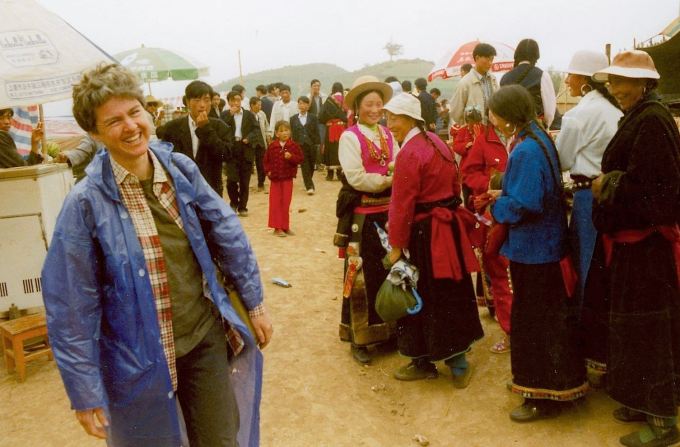
ant

Amdo-Tibetan area, south Gansu, 2001 (photo: Frank Kouwenhoven).

I never did any fieldwork with Antoinet, but I admired and envied her natural engagement with musicians and with people altogether.

I won’t portray her as some kind of Lei Feng, so this can also be a kind of homage to, and reflection on, fieldwork itself. And I will discuss her alone, whereas of course she and her partner Frank Kouwenhoven, dynamic leaders of CHIME in Leiden, made an indivisible team.

Almost anything can be fieldwork, such as talking to your mum, or your kids, or going clubbing—although we’re perhaps unlikely to undertake all three at the same time. But I refer here to spending time with Chinese musicians in the countryside, which requires a rather different set of skills from hanging out with rock musicians in Beijing, for instance.

Fieldwork by the Chinese on their local musical traditions, in a sense that we can recognize, goes back to at least the 1920s. But when we laowai began to join in in the 1980s, it was exciting to get some glimpses of local folk traditions. We can see that sense of discovering a “well-kept secret” right from Antoinet’s articles in early issues of CHIME[1]

All these years later, I suspect local traditions are still largely a well-kept secret, and that may not be an entirely bad thing. But fieldwork by the Chinese has also thrived since the 1980s; plenty of Chinese are doing great work. In those early days, Chinese fieldwork was rather mechanical: the main object was to collect material in the form of musical pieces, conceived of as rather fixed and somewhat detached from changing social context. Antoinet was at the forefront of broadening the subject; the title of her book, Chinese folk songs and folk singers, is significant. This inclusion of the performers in the frame has borne fruit in Chinese and foreign work.

as-book-cover

Among general skills, we might list

  • preparation (finding available material, maps, preparing questions, etc.)
  • linguistic competence (how I envied her ability to communicate, and latch onto regional dialect)
  • musicality (and “participant observation”; routine for us, rare among Chinese scholars)
  • back home: analysis/reflection; sinology and ethnomusicogical/anthropological theory

In addition to my citings of Bruce Jackson and Nigel Barley (Fieldwork, under Themes), further reflections include:

  • Helen Myers in Ethnomusicology: historical and regional studies (New Grove Handbooks on Music)
  • Barz and Cooley, Shadows in the field
  • Lortat-Jacob, Sardinian Chronicles
  • Don Kulick and Margaret Willson (eds.), Taboo: sex, identity and erotic subjectivity in anthropological fieldwork.

As to what is ponderously known as “participant observation”, musicians tend to react well to other musicians—it shows a willingness to engage, and also helps us think up useful questions.

As to what we do after fieldwork: Antoinet was well grounded in ethnomusicological readings, but she was never controlled by theory, she used it critically to illuminate points, as one should. Scholarship is not always like that! Her book really is an amazing achievement. She not only broadened the subject, she made it more profound.

Rapport
A lot has been written about personal interaction in fieldwork. I like Bruce Jackson’s book very much. We all have different personalities; some of us may seem more outgoing than others. It’s an unfair accident of birth, upbringing, and all that. Musicians will be more forthcoming with people they feel comfortable with—like Antoinet. Of course fieldwork manuals talk about good guanxi, but it’s more. We respect people that we talk to, but we also aspire to some sort of equality; we hope to be neither obsequious nor superior. On the agenda here are sociability, informality, amateurism, humanity/fun/enthusiasm/empathy, and humour—all without naivety or romanticism!

We do naturally adapt our behaviour to different situations. I’m much more sociable in China than in England. Antoinet, it seems to me, never needed to adapt, she was just always naturally gregarious and sparkling.

Age is an interesting factor: I guess it’s good to be old or experienced enough to be taken seriously, but intelligence and sincerity are appreciated, and it’s also good to be young enough, at least at heart, not to seem too important! Antoinet was always self-effacing, companiable.

I do bear in mind Nigel Barley’s warning (The innocent anthropologist, p.56):

Much nonsense has been written, by people who should know better, about the anthropologist being “accepted”. It is sometimes suggested that an alien people will somehow come to view the visitor of distinct race and culture as in every way similar to the locals. This is, alas, unlikely. The best one can probably hope for is to be viewed as a harmless idiot who brings certain advantages to this village.

By the way, I’m not a harmless idiot, I often feel like a harmful idiot: I hope it’s a coincidence that everywhere I go, the local traditions go down the drain…

Our ways of repaying all this hospitality are variable, depending on our means and inclinations. One may send photos and videos, and organise tours; Chinese colleagues have gone so far as to install running water, or find urban jobs for relatives.

I note some some handy Maoist clichés linking fieldwork and Communist ideals:

  • chiku 吃苦 “eating bitterness”
  • santong 三同 “the three togethers” (eating, living, and labouring together. Hah!)
  • dundian 蹲点 (“squat”; more generously defined in my dictionary as “stay at a selected grass-roots unit to help improve its work and gain firsthand experience for guiding overall work”. How long is this dictionary?!)
  • gen qunzhong dacheng yipian 跟群众打成一片 “becoming at one with the masses”
  • bu na qunzhong yizhenyixian 不拿群众一针一线 “not taking a single needle or thread from the masses”

My point here is to get over the empty formalism of such slogans and see through to the sincere humanity that once inspired them.

These thoughts on empathy aren’t something we can do much about, but it’s interesting to reflect on the topic. Obviously enthusiasm isn’t enough; on its own it can be quite irritating!

I guess we all use teamwork to some extent, and Antoinet was good at finding, and supporting, good regional and local scholars to work with. I have always relied heavily on my Beijing colleagues to make notes, at least until circumstance and greater familiarity lend me the confidence to spend time with musicians on my own.

Group fieldwork is good up to a point. It depends partly on one’s means, but the group perhaps shouldn’t be too large. I like the informality and flexibility of working alone, but it is a bit much to take photos and videos and make notes and distribute fags all at once.

 Of course Antoinet was interested in all kinds of music-making, but she was among few laowai who did much work outside the main urban areas. Her two main fieldwork areas were very different: in south Jiangsu she found herself mainly doing a salvage project, but in Gansu she found a ritual scene that is very much alive.

As to time-frame, she and Frank mainly made repeated visits over time, and as I did for Plucking the Winds or my work with the Li family. Talking of Plucking the Winds, I’ve never had such a perceptive meticulous and patient editor as Antoinet.

Obviously, a brief interview with a stranger is likely to yield less interesting or reliable results than long-term acquaintance. But I do take on board the notion of stranger value. On one hand (Jackson, Fieldwork, pp.69–70, after Goldstein),

The collector who comes from afar and will disappear again will be able to collect materials and information which might not be divulged to one who has a long-term residence in the same area.

On the other hand, there’s the whole “You will never understand this music” thing (Nettl, The study of ethnomusicology, ch.11, brilliant as ever).

And then, who is an insider? What of urban Chinese? How might an urban-educated male Fujianese get along with female spirit mediums in rural Shanxi, and so on?! There are several complex subjects for discussion here.

Talking of etic questioning, here’s another vignette from the Li band’s 2012 tour of Italy (my book p.336):

Third Tiger is as curious as ever, always asking weird “etic” questions like “Why are Italian number-plates smaller at the front than at the back?” Bemused, I later ask several Italian friends, who have never noticed either. It strikes me that this is probably just the kind of abstruse question that we fieldworkers ask all the time, and I’m sure my enquiries in Yanggao sound just as fatuous. I must cite Nigel Barley (The innocent anthropologist, p.82)—and note the car link:

They missed out the essential piece of information that made things comprehensible. No one told me that the village was where the Master of the Earth, the man who controlled the fertility of all plants, lived, and that consequently various parts of the ceremony would be different from elsewhere. This was fair enough; some things are too obvious to mention. If we were explaining to a Dowayo how to drive a car, we should tell him all sorts of things about gears and road signs before mentioning that one tried not to hit other cars.

By the way, I was the victim of a flawed fieldwork interview some years ago. A Korean student, whom I knew fairly well, was doing an MA on ethnomusicology in London, and had to do an interview. She knew I was both a violinist and did fieldwork on Chinese music, so she came over to my place with a list of questions all prepared. Her English wasn’t great—like, even worse than my Chinese. OK, her project demanded quite a short interview.

She began with “Who is your favorite composer?” and I went, “Well, music is more about context, mood, not compositions, and anyway I don’t listen to so much WAM these days, and most music in the world we don’t really know of a “composer”… OK, if you insist, then Bach.” She went, “Thankyou. What was the best concert you ever done?” so I observed that we don’t do so many memorable concerts over a year, and that great music-making doesn’t only happen in concerts. “Being an orchestral musician can be frustrating, one’s teenage idealism tends to get beaten down, getting a plane, then five minutes in the hotel before a long rehearsal with a boring conductor, no time to eat properly… You could ask me, what was the most wonderful musical experience I have had—it wouldn’t necessarily be playing with an orchestra…” In response to this cri de coeur, she went on, “Thankyou. What is the difference between the Western violin and the Chinese violin?” Aargh. I mean, anyone would want to follow up on all that I had just said, right? But her rigid questionnaire was in control.

So is that what I have been doing in China all these years—misunderstanding, ignoring leads, and following up with my own stupid blinkered questions?!

One hopes to find questions that will get people talking at length (so avoid questions that invite simple Yes/No answers!); but there was I blabbering on, and all she wanted was short snappy answers!

I’m still very attached to the detailed notes of my Chinese colleagues. One can’t record everything on audio or video, and even if we could, it would leave unclear how many characters should be written. I used to use video mainly to film ritual—I only began to record informal situations later. Antoinet was great at bypassing formality.

They recorded all kinds of things as well as formal singing sessions, and sure they had the means to do that, as well as recruiting helpers and so on.

A questionnaire is essential, [2] but it must always be flexible, following their flow, always thinking of new questions, how to express them suitably, and listening. All of which Antoinet was brilliant at.

For me fieldwork is a constant discovery of how inaccurate and superficial my previous notes were. Antoinet and Frank’s enquiring spirit can be seen in these reflections that Frank later sent me:

We had no such thing as a “method”—in general we did tend to visit singers more than one time, preferably many times, in order to ask them the same questions repeatedly, and to let them sing the same songs more than once, with intervals of days, weeks, months or even years in-between. That was only possible with individual songs, of course, not with spontaneous dialogue songs, which we got acquainted with mainly in Gansu.

I think we learned most from what people told us spontaneously, about their own lives, in personal conversations, which were not strictly private conversations. People are nearly always in a space together with others. But group interviews (group chats, rather) were good, people felt at ease, they were not “attacked” by us, they were simply chatting…

Basically, in our fieldwork, we were always out to discover what we were not aware of yet. That is a hard task. And I think we kept discovering that we had not yet asked the right questions, had not investigated the right topics yet… Even now do I realize that I should go back… Maybe this is only the natural, classic, condition for fieldworkers: you return home with an idea of how things might be, you end up with an hypothesis, you suddenly stumble upon a new hypothesis which sheds new light on the situation, but then you have to go back again to test it, and the work starts all over again… A never-ending process, also because the questions you ask are nearly always bigger than the time and resources you have, and you need to address your problems piecemeal… We often wished we were five hundred people!


By the way, do watch their beautiful film Chinese shadows: the amazing world of shadow puppetry in rural northwest China (Pan, 2007).

In short, fieldwork may be an unending amount of work, but it’s endless inspiration too: and one works better when inspired. So I hope we can keep Antoinet’s spirit alive by emulating her humanity, enthusiasm, and critical intelligence.

For a recent volume on doing fieldwork in China, see here. And note the folk-song research of Qiao Jianzhong.


[1] Or for Daoist ritual, see e.g. the early fieldwork of Kenneth Dean.

[2] For her sample questionnaire for southern Jiangsu, see Chinese folk songs and folk singers, pp.395–6. Cf. McAllester’s questionnaire for the Navajo.

Strauss (R.) and Elvis

Wild

David Lynch always amazes (for Twin Peaks, click here), but the final sequence of Wild at heart (1990) is gorgeous. Morphing, almost seamlessly, from the Four Last Songs of Richard Strauss to Elvis, it makes both works seem even more intense; and then Love me tender (really sung by Nicholas Cage!) is filmed in one long take, the camera coiling amorously around him and Laura Dern (cf. Susan McClary on the baroque trio sonata).

Worth celebrating genius—all the more in the USA these days, where the list of artists deemed “overrated” by the arbiter of cultural taste will be growing… (written in 2017)

Li Manshan film: new version

Michele has just uploaded a new version of the film, with only tiny imperceptible changes. Spot the difference…

The main change is removing the out-take at the Temple of the God Palace (8’24” ff.).

We walked over there just after sunrise to go and record, when there wouldn’t be too much background noise. As it turned out, the cooing of birds was deafening—delightful as it was on my headphones, Michele managed to keep it under control when editing later. Li Manshan was going to do a little spoken intro recalling the temple, and since we were joined by a nice villager who also recalled the temple fondly, I thought it’d be nice to get him to stand just out of view of my camcorder so Li Manshan could have an interlocutor. It worked out fine, but their opening exchange made us all burst out laughing:

Li Manshan [confidently explaining the setup to his mate]: So we’re gonna have a natter!
[begins spiel]: In the past this Temple of the God Palace…
[Mate interrupts]: If it hadn’t been demolished, it’d be a tourist spot now!
[Li Manshan has drôle thought]:  … What, you mean you demolished it?!

We tried including this exchange in the film, with a suitable pause while we composed ourselves for Take 2, but it doesn’t quite work unless you were there…

The meaninglessness of ritual

Staal

The work of Frits Staal on Indian ritual contains much from which scholars of Daoist ritual (not least I) might benefit, confronting issues that I encounter in working with Li Manshan. Staal’s ideas about orthopraxy seem to go beyond the discussions following those of James Watson for China. There’s a lot more to Staal’s work than that, but this is a start.

In “The meaninglessness of ritual”[1] Staal eschewed “the dewy-eyed romanticism that is pernicious to any serious study of cultures and people.”

A widespread but erroneous assumption about ritual is that it consists in symbolic activities which refer to something else. It is characteristic of a ritual performance, however, that it is self-contained and self-absorbed. The performers are totally immersed in the proper execution of their complex tasks. Isolated in their sacred enclosure, they concentrate on correctness of act, recitation and chant. Their primary concern, if not obsession, is with rules. There are no symbolic meanings going through their minds when they are engaged in performing ritual.
Such absorption, by itself, does not show that ritual cannot have a symbolic meaning. However, also when we ask a brahmin explicitly why the rituals are performed, we never receive an answer which refers to symbolic activity. There are numerous different answers, such as: we do it because our ancestors did it; because we are eligible to do it; because it is good for society; because it is good; because it is our duty; because it is said to lead to immortality; because it leads to immortality. A visitor will furthermore observe that a person who has performed a Vedic ritual acquires social and religious status, which involves other benefits, some of them economic. Beyond such generalities one gets involved in individual case histories. Some boys have never been given much of a choice, and have been taught recitations and rites as a matter of fact; by the time they have mastered these, there is little else they are competent or motivated to do. Others are inspired by a spirit of competition. The majority would not be able to come up with an adequate answer to the question why they engage in ritual. But neither would I, if someone were to ask me why I am writing about it.
[…]
Most questions concerning ritual detail involve numerous complex rules, and no participant could provide an answer or elucidation with which he would himself be satisfied. Outsiders and bystanders may volunteer their ideas about religion and philosophy generally—without reference to any specific question. In most cases such people are Hindus who do not know anything about Vedic ritual. There is only one answer which the best and most reliable among the ritualists themselves give consistently and with more than average frequency: we act according to the rules because this is our tradition (parampara). The effective part of the answer seems to be: look and listen, these are our activities! To performing ritualists, rituals are to a large extent like dance, of which Isadora Duncan said: “If I could tell you what it meant there would be no point in dancing it.”
Ritual, then, is primarily activity. It is an activity governed by explicit rules. The important thing is what you do, not what you think, believe or say.

This echoes Catherine Bell’s comment that I cited in my post on Bach and Daoist ritual—for her masterly surveys of ritual studies, click here.

Here’s a trailer for Staal’s 1975 film on the Vedic fire ritual:

Poul Andersen offers caveats to Staal in a review of volumes on Shanghai Daoist ritual (Daniel Overmyer, Ethnography in China today, pp.263–83). He highlights the interpretations of the participants (including the liturgists themselves), which “in many ways influence the actual performance. They are relevant for the way in which performances take shape, develop, and are modified over time.” Such interpretations, while important, rarely offer a detailed critique, so such a view refines rather than refutes Staal’s point.

I pursue the theme under Navajo culture.


[1] Numen 26.1 (1979): 2–22. See also Ritual and mantras: rules without meaning (Motilal Banarsidass, 1996), and (source of my quote here) S.N.Balagangadhara, “Review of Staal’s Rules without meaning”, Cultural dynamics 4.1 (1991), pp.98–106.

Men behaving badly: Freud and Mahler. And Alma

*For an introduction to my whole series on Mahler, with links, click here!*

Alma

Mahler’s only meeting with Freud was their famous consultation in Leiden in 1910, when Mahler’s marriage and health were in crisis. [1] The day after Mahler’s funeral in May 1911, Freud sent the bill to his executor—“unabashedly” or “somewhat tactlessly”, I read online. “Somewhat”??

I hope Mahler’s widow Alma told Freud where he could stuff it.

* * *

There’s so much online about Alma studies and “the Alma problem” that I hesitate to enter the fray. Even Mahler’s notorious enjoinder to her, before their marriage, turns out to be controversial: [2]

[Alma writing:]
. . . we had our first major conflict. I once wrote more briefly than usual, explaining that I still had to work on a composition, and Mahler was outraged. Nothing in the world was to mean more to me than writing to him; he considered the marriage [on more or less equal terms] of Robert and Clara Schumann “ridiculous,” for instance. He sent me a long letter with the demand that I instantly give up my music and live for his alone . . . I cried all night . . . [but he then] moderated his demands.

Norman Lebrecht [3] attempts to mount a hopeless rearguard action for the defence, brushing aside feminist accusations. Citing Mahler:

In your letter you write of “your music” and “my” music. Forgive me but I cannot remain silent. On this point, my Alma, we must set things straight and I mean right now, before we meet again. Let me speak in general terms. A husband and wife who are both composers: how do you envisage that? Such a strange relationship between rivals: do you have any idea how ridiculous it would appear, can you imagine the loss of self-respect it would later cause us both? If, at a time when you should be attending your household duties or fetching me something I urgently needed, or if as you wrote you wish to relieve me of life’s trivia—if at such a moment you were befallen by “inspiration”—what then?
Don’t get me wrong! I don’t want you to believe that I take that philistine view of marital relationships which sees a woman as some sort of diversion, with additional duties as her husband’s housekeeper. Surely you wouldn’t expect me to feel or think that way? But one thing is certain: if we are to be happy together, you will have to be “as I need you”—not my colleague, but my wife!

Lebrecht comments, his adulation for Mahler (which I entirely share; I like his writings too, otherwise) rather complicating his vision:

He goes on to say such blustery things as “you have only one profession: to make me happy”, and “this makes me suffer just as much as you”, affording future feminists all the ammunition they need to depict Mahler as a brute and Alma as his victim. Starting with a tendentious biography by the French politician Françoise Giroud, Alma and her thwarted creativity will be cited as an admonitory case history in the future academic study of “feminist aesthetics” [SJ: fine use of scare-quotes!]. Mahler, however, is not asserting male dominance. He specifically denounces “Nietsche’s utterly false and brazenly arrogant theories of masculine supremacy”, assuring her that he is not seeking a submissive wife. On the contrary, he loves her combative nature. [SJ: “Don’t you just love a filly with a bit of spirit?” Pah] What he seeks to avoid is a professional rivalry that might offer his enemies a chink of vulnerability. There can only be one composer in this marriage. If there were two, his work might be vaunted at his expense and he might be attacked for promoting, or suppressing, it. If both composed, both would lose and the marriage would fail.
These are not unreasonable considerations, given the disparity of their achievements. Mahler is a famous composer. Alma has written ninety-five songs, piano pieces and sketches, none of them published or performed. She is not, by any reckoning, a professional composer, nor is she convinced that this is what she was born to do. He does not forbid her to compose. What he demands is that she should not compete.

Sure, we should interpret phenomena (like Daoist ritual!) within the social context of their time. But Mahler’s values can’t somehow be validated by belittling feminism.

Mahler’s aim is to negotiate a pre-nuptial accord with a young woman who is headstrong [SJ: another classic sexist term], desirable [sic], and by her own account, superficial [sic]. His final demand is that she
surrender yourself to me unconditionally, make every detail of your future life completely dependent on my needs, in return you must wish for nothing but my love. And what that is, Alma, I cannot tell you—I have already spoken too much about it. But let me tell you just this: for someone I love the way I would love you if you were to become my wife, I can forfeit all my life and all my happiness.
Taking Mahler at his word—in a letter that is not revealed until 1995, by which time feminist prejudices are set in stone—he offers to “forfeit all my life” for Alma.

Given the previous history, how does that letter challenge those “feminist prejudices”? How does his airy claim that he would “forfeit all my life” override his demand “Surrender yourself to me unconditionally“?

Some kind of defence may be worth presenting, but it surely deserves short shrift by now. Lebrecht seems to dig an even larger hole in which he can join Mahler—a concept that might interest Freud (as long as he got paid…).

All this may just have to remind us that great (male) artists don’t necessarily behave in an enlightened way. Don’t let it put you off Mahler’s amazing music…

And fortunately Alma’s songs are being performed too. For her daughter Anna, see here.


[1] Lebrecht, Why Mahler?, pp.207–13. For a rare and unilluminating interview with Alma in 1960, click here.
[2] https://www.newcriterion.com/articles.cfm/The-other-Mahler-7126. Source not cited; not the same as Alma Mahler, Gustav Mahler: memories and letters, p.22.
[3] Why Mahler?, pp.128–30.

Imagining early religious culture

feet

A passage from Alan Bennett’s 1981 diaries again reminds us of the perils of imagining early ritual/musical culture with our modern ears (see Bach, under WAM)—or feet:

I wear a pair of flip-flop sandals, the sort with a sole and one strap across—the biblical type, I suppose. When I was a boy and read of Jesus washing the feet of the disciples, I thought of their feet as like my own in 1943, sweating in grey Utility socks and encased in heavy black shoes with stuck-on rubber soles. Consequently I regarded Jesus’s gesture as far more self-sacrificing, more heroic, than it actually was. After twelve pairs of such feet, I thought, the Crucifixion would have been a pushover.

For a sequel, see here.

Ask my father

*Part of my series on Irish music!*

Ennis

Peter Kennedy (fiddle), Marie Slocombe, and Séamus Ennis (Uillean pipes).

Another passage from Last Night’s fun that reminds me of Chinese music is Carson’s brilliant discussion (pp.7–13) of the naming of tunes, what the Chinese call qupai 曲牌 “melodic labels”:

A: What do you call that?
B: Ask my father.
A: “Ask my father”?

I can only hope we haven’t made such a mistake in documenting folk qupai. Indeed, I could well have asked Li Manshan’s son that very question (cf. the joke at the end of our film)…

Here’s the great Séamus Ennis playing Ask my father:

This story of his bears on the subject too:

For Scottish pibroch, click here.

More early music

*Part of my series on Irish music!*

LNF

In Irish music I already cited some fine quotes from Cieran Carson’s Last night’s fun bearing on the mania for soulless competitions, including the tale of the three fiddlers. The final passage in this section is remarkable (p.98):

I find among these people commendable diligence only on musical instruments, on which they are incomparably more skilled than any nation I have seen. Their style is not, as on the British instruments to which we are accustomed, deliberate and solemn but quick and lively; nevertheless the sound is smooth and pleasant.

It is remarkable that, with such rapid fingerwork, the musical rhythm is maintained and that, by unfailingly disciplined art, the integrity of the tune is fully preserved through the ornate rhythms and the profusely intricate polyphony… They introduce and leave the rhythmic motifs so subtly, they play the tinkling sounds on the thinner strings above the sustained sounds of the thicker strings so freely, they take such secret delight and caress [the strings] so sensuously, that the greatest part of their art seems to lie in veiling it, as if “that which is concealed is bettered— art revealed is art shamed”. Thus it happens that those things which bring private and ineffable delight to people of subtle appreciation and sharp discernment, burden rather than delight the ears of those who, and in spite of looking do not see and in spite of hearing do not understand; to unwilling listeners, fastidious things appear tedious and have a confused and disordered sound.

That passage might seem like a fine description of Irish music today—but it was written in 1185, by Giraldus Cambrensis in Topographia Hiberniae!

Generally (my Daoist priests of the Li family, p.291),

I wage a tireless campaign against the Chinese scholarly trend to make ambitious links between ancient citations and living folk practice, but here is one case where I totally support it. Comparable to the centrality of the keyboard for 18th-century kapellmeisters, the sheng master was the grand director of courtly ritual music right from the Zhou dynasty around the 6th century BCE, with an unmatched understanding of scales and pitches, a custom that has persisted throughout imperial history right down to today. Of all the wise sheng masters we have met in north Chinese villages, Li Qing was among the most outstanding.

Doubtless Irish music has changed in many ways since the 12th century, and that passage is just general enough to allow us to discern parallels that may not add up to so much—but still, it’s impressive.

Transliteration

Talking of Chinese versions of foreign names, I like

  • Andeli Poliwen 安德利珀利文: André Previn
  • Qielibidaqi 切利比達奇 Celibidache
  • Futewan’gele 福特萬格勒 Furtwängler
  • Laweier 拉威尔: Ravel
  • Chake Beili 查克贝里 (pronounced Charcur Bailey): Chuck Berry
  • Ao Shaliwen (Ao as in “Ow!”) 奥沙利文: O’Sullivan
  • Fuluoyide 弗洛伊德 is a generous expansion of Freud into four syllables.

I also like

Tintin Tibet cover

Not to mention the Chinese transliteration of the word toothbrush:

  • tuzibulashi—“rabbits don’t shit”, which inspired me to this fine headline.

For my Chinese name, and that of Beethoven, see here.

Another Czech mate

Hasek last photo

Further to my Czech mentor Paul Kratochvil:

Along with Flann O’Brien, high on the guest list for my fantasy dinner-party would be Jaroslav Hašek—”humorist, satirist, journalist, anarchist, hoaxer, truant, rebel, vagabond, play-actor, practical joker, bohemian (and Bohemian), alcoholic, traitor to the Czech legion, Bolshevik, and bigamist”.

Hašek’s The Good Soldier Švejk has long been popular in China. Cecil Parrott, its English translator, also wrote a biography of Hašek’s “bottle-strewn life”, The bad Bohemian. Former British Ambassador in Prague, Parrott effortlessly avoids betraying any sympathy with Hašek’s reprobate behaviour (see also Hašek’s adventures in Soviet Tatarstan). As he explans in the introduction to his translation:

His next escapade was to found a new political party called The Party of Moderate and Peaceful Progress within the Limits of the Law […] publicly debunking the monarchy, its institutions and its social and political system. Of course it was only another hoax, designed partly to satisfy Hašek’s innate thirst for exhibitionism and partly to bolster the finances of the pub where the election meetings were held.

Among his many japes, his short-lived editorship of the journal The Animal World was curtailed after he published articles about imaginary animals.

Dangerous herds of wild Scottish collies have recently become the terror of the population in Patagonia

Thoroughbred werewolves for sale

Newly discovered fossil of an antediluvian flea

And his hobbies combined:

Everyone who votes for us will receive as a gift a small pocket aquarium.

Svejk Chinese

Gratifyingly, The Good Soldier Švejk clearly appeals to Chinese sensibilities; it was translated, and the 1956–1957 Czech films were dubbed into Chinese:

Alexei Sayle wonders if the Czech regime knew what they were doing promoting Švejk, since its message hardly supports the ideals of socialist conformity. Though it became popular in many languages, I suspect there’s something about it that appeals in particular to Chinese people—an antidote to compulsory patriotism? The Chinese translator dutifully portrays it as a tirade against imperialism, but it surely spoke to The Common Man (Flann O’Brien’sThe Plain People of Ireland”) oppressed by the destructive irrationalities of a newer system…

The Chinese version of Švejk’s name (Shuaike 帅克) is perfect. It drives me to a little fantasy.

Voices and instruments

In my book (p.261) I glibly compared the Li band’s hymns to the arias in the Bach Passions, “where action and drama are suspended while we contemplate the deep meaning of a scene.” In most elite Daoist and Buddhist temples, liturgy is accompanied only by percussion, not melodic instrumental music. Many of the Li band’s hymns are sung thus, a cappella—including those used to Open Scriptures in the morning and afternoon.

Whereas Chinese studies of northern Daoist and Buddhist “music” often focus almost entirely on shengguan melodic instrumental music, in my book (ch.16) I try to put it within the ritual context. But does the shengguan accompaniment (notably the constant variations of the guanzi) express what the vocal text is unable to embody?

As usual, this is not a close parallel, but one thinks of Erbarme Dich:

“Language is not essential to this moment, or even adequate to it. A verbal penitence is expressed by the alto voice, but the violin expresses a more universal distress.” (Gardiner p. 422, citing Naomi Cumming).

But remember, I find nothing akin to word-painting in the Li band’s vocal repertoire (my book p.277):

I can find no matching of melody to textual content. There is nothing akin to word-painting, no illumination of the meaning of the text through music. Vocal liturgy is capable of arousing emotion, as for instance it should do in the Song of the Skeleton (see Yesterday…), but this is achieved through the general style of delivery rather than the specific text-setting. In musical style the Song of the Skeleton is no different from other hymns, and even its desolate text is not comprehensible when sung.

So expression is conveyed mainly through timbre. The more I listen to Li Manshan and Golden Noble, the more impressive I find the mournful nasal quality of their voices; I can sing some hymns, but can’t emulate this. They have utterly absorbed the meaning of the texts into their voices. And when the shengguan accompanies, Wu Mei complements them perfectly on guanzi, managing to combine a deeply mournful tone with an almost playful way of weaving in and out of the melodic line, ducking and diving, sometimes soaring. The singers recognize that a good guanzi player is a great help to them in rendering the text.

Anyway, both the decorations of a Daoist on guanzi and Bach’s oboe lines are spellbinding—an intrinsic part of the realization of the text. So I both demote and stress the shengguan accompaniment.

Beyond the transition of the Passions from liturgical to concert performances, the staged versions of recent years can also be compelling (for us):

And we’re already in tears (along with Peter) from the recitative of the Evangelist that introduces it. The shuowen introits of the Daoist also introduce arias…

Those of a sensitive disposition may wish to avoid reading my Textual scholarship, OMG.

More French letters

Antin

I first read Mots d’heures: gousses, rames ages ago, but the opening of the first poem, with its erudite footnotes, still makes me giggle:

Un petit d’un petit [1]
S’etonne aux Halles. [2]

[1] The inevitable result of a child marriage.
[2] The subject of this epigrammatic poem is obviously from the provinces, since a native Parisian would take this famous old market for granted.

Cf. A French letter, and the “French pieces” of the Tang (faqu and faqu 2)…

Living in the past

Past

In the mid-1980s a story did the rounds at the Central Conservatoire in Beijing, about a group of students sent to do fieldwork in a remote part of southwest China. In one village the peasants seemed not to have heard of Chairman Mao, and when asked “So who’s in charge, then?”, they hesitantly replied “Um… is it called Great Ming dynasty?” They hadn’t even heard of the Qing.

Of course this sounds apocryphal, a kind of Shangri-La story. Generally, however backward the conditions of places we visit, the scars of Maoism are evident. But I’m not sure we can dismiss it entirely…

It was formative fieldtrips like this, evoked in Liu Sola‘s 1985 novella In search of the king of singers 寻找歌王, that inspired the new generation of avant-garde composers like Qu Xiaosong, Tan Dun, and Guo Wenjing.

Reading Avedis Hadjian’s amazing book Hidden nation, I find a similar case:

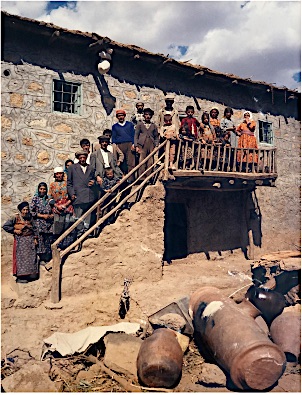
Living in tne past Armenians

The residents of an Armenian village in Sasun, in a photo taken by the photographer Shiraz during a pioneering journey in 1973. Such was their isolation that they asked Shiraz to advise “the Armenian king that there are still Armenians in Sasun.” However, the last Armenian monarch, Levon V of the Kingdom of Cilicia, had been dethroned in 1375 by Mamluk invaders.

Such stories are extreme instances of the Chinese proverb “The mountains are high, the emperor is distant“.

Mozart balls

Alma Deutscher

Source here.

Amidst all the hype surrounding Alma Deutscher, she is the only one talking sense:

I love Mozart very much, he’s probably my favourite composer, but I don’t really like it when people call me “Little Miss Mozart” because I don’t like being called “little”. I’m very big, and secondly, if I just wrote everything Mozart wrote again it would be boring.

Another one for the T-shirt of female composers… And further mature proto-feminist wisdom.

A flat miner

That, of course, is the punchline to

What do you get if you drop a piano down a mine shaft?

Chords

Among classical musos this is a popular story, whose own punch-line often crops up in rehearsals:

A burly murderer, sentenced to life, is doing his Grade V Music Theory in prison. The well-meaning Associated Board examiner (a perfect part for Michael Palin, surely – not that he exactly needs the work) shows up, and goes through all the exam questions nervously in a little room, seated at the piano with the prisoner standing at his side.

It’s all going rather well till they get to the last question, where the candidate has to identify chords. The examiner says pleasantly,
“Now I’m just going to play you a chord—and I’d like you, if you would be so kind, to tell me if it’s a major or a minor triad!”

and plays a major triad with an encouraging smile. The prisoner looks at him dourly and grunts,
“It’s minor”.

The examiner smiles nervously and says,
“Now I’ll just play it again and see what you think…”
Prisoner goes “It’s minor”.
Examiner, with ever more desperate encouragement: “Ah yes, very good… now I’m just going to play it One More Time, and this time I’d like you to pay attention to that teeny little note in the middle—see whether you find it a little on the low side, or is it, perhaps, rather, um, somewhat high, and bright, and happy…?”

The prisoner walks over to the piano, puts his huge gnarled hand on the examiner’s puny corduroyed shoulder, and says slowly and severely,

“I Think You’ll Find—it’s MINOR!”

Often in rehearsal when there is discussion of the appropriate continuo chord in a figured bass line, we all snowclone in chorus, “I Think You’ll Find—it’s MINOR!”

For F hashtag minor, see link here; and for a music lesson from Bill Bailey, here. For more interview stories, click here.

The shock of the new

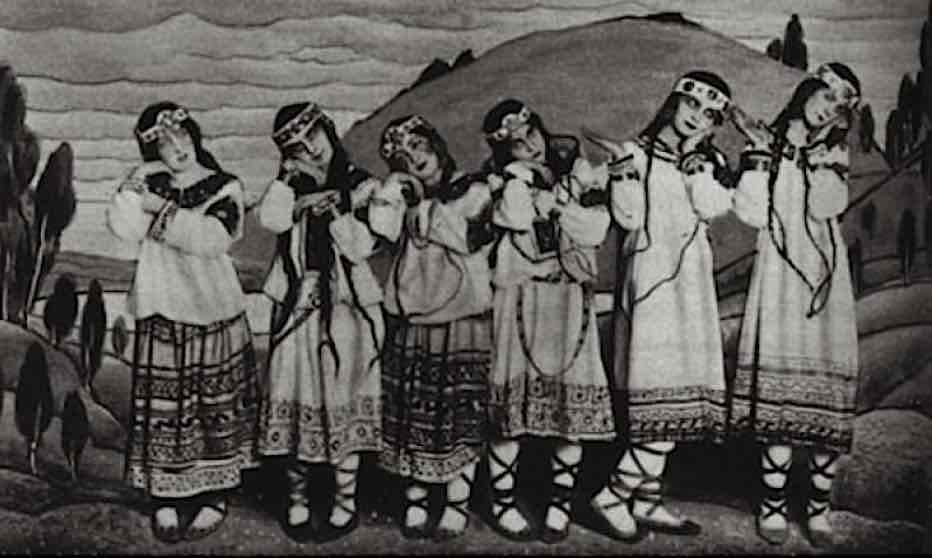
Rite“Knock-kneed and long-braided Lolitas”, 1913.
“When they cocked their heads against their hands, someone yelled, ‘Get a dentist!’
and someone else yelled back, ‘Get two dentists!’ ” (cited
here).

Though The Rite of Spring has become standard, a classic, since the 1970s, it remains overwhelming today, whether or not you’re familiar with it. Playing it in 1970 with the National Youth Orchestra, conducted by Boulez, was one of the great experiences of my life (see also here). For a 2022 Rite at the Proms, click here.

Never mind that it’s the kind of imagining of “pagan rites” that academically I would dispute—it’s a world away from the cultural pundits’ romanticised view of folk culture! (For a “pagan” ritual performer among the Cheremis, click here; and for the New Year rituals of Gaoluo in China, here; cf. the Hutsul people of west Ukraine).

Among endless discussions, Tom Service gives a succinct introduction. Alex Ross (The rest is noise, p.57) nicely (sic) compares the “riot” at the 1913 première with the release of the Sex Pistols’ Anarchy in the UK.  Gertrude Stein’s detailed account of the event is curious:

We could hear nothing. One literally could not, throughout the whole performance, hear the sound of music.

Curious, as she wasn’t actually at the premiere (supposing that she had lived long enough not to actually attend the premiere of The sound of music either, she might have said, “One literally could not hear the rite of spring.”)

I’ve cited Richard Taruskin’s fine expression “lite Rite”—“Is nothing Sacred?”, as Keats and Chapman might say. In his stimulating article on Bartok and Stravinsky (The danger of music, pp.133–7; see also pp.421–4), he observes Bartok’s identification of The Rite’s “folk” elements that Stravinsky later disowned:

Even the origin of the rough-grained, brittle and jerky musical structure backed by ostinatos, which is so completely different from any structural proceeding of the past, may be sought in the short-breathed Russian peasant motives.

Alex Ross is also very much on The Rite’s case. In a crowded field, his comments in The rest is noise are very fine, with vivid context in his chapter “Dance of the earth” (pp.80–129), citing Taruskin’s definitive 1996 book Stravinsky and the Russian traditions.

I take Taruskin’s point that the darker energies of The Rite have been “resisted, rejected, repressed”, but even in the most polished performance it’s both exhilarating and disturbing.

Swan Lake it ain’t. Remember, at the 1913 Paris premiere the ballet was just as shocking as the music. You can see a reconstruction of Nijinsky’s own choreography here, and the recreation (from 25.40) following this documentary gives an impression:

Pina Bausch’s version is amazing:

For an intense series of posts on the ballet, see here. Note also Israel Galván’s flamenco-tinged solo version.

And here’s an attractive quandary:

Stravinsky once joked that the dauntingly high-register bassoon solo which opens the piece should be transposed up every year to stop players getting complacent about it. He wanted the effort to register.

But “it’s complicated”—see also here (and note the ritual wind instrument connection). I’m not sure about the dudka, but if it’s really related to the Armenian duduk, then there’s a link to the guanzi of north Chinese ritual bands! There’s a wealth of discussion of that opening solo in bassoon blogs.

Not only do concert-goers “share intimate and personal cultural moments with strangers”, but they have to keep still; the Rite is one of many pieces where this should be an impossible demand. And another where conducting without a score yields fruit:

If Stravinsky really said that Karajan’s version

sounded like someone driving through the jungle in a Mercedes with the windows up,

then good for him.

And then there’s the “original instrument” debate—the “lite Rite”, as Richard Taruskin called it:

This version for organ, far from silly, is just awe-inspiring:

A harpsichord rendition has also appeared on YouTube. Jazz tributes include the Bad Plus arrangement:

In her recent exploration of The Rite, Gillian Moore also observes:

My feelings of creeping feminist unease in writing a book on a ballet about the sacrifice of a young woman created by three men were at least partly relieved when I came across the Russian folk metal band Arkona and their frontwoman Masha Scream.

On a lighter note, here I imagine the Danse sacrale as a suitable riposte to the haka.

BTW, Ravel’s Daphnis and Chloe, less revolutionary but no less captivating, must have suffered by its proximity.

An unwitting put-down

Leinsdorf

For WAM buffs, a story about Erich Leinsdorf, conducting Mahler with the Boston Symphony in the 1970s:

Driving along the freeway on his way into town for the concert in Symphony Hall, Leinsdorf has cut it a bit fine, so he puts his foot down, and sure enough the cops pull him over.

He’s getting really late now, so he blurts out,

“Look officer, you gotta let me go, I’m a real famous conductor, I gotta go and conduct the Boston Symphony, they’re counting on me—my name’s Erich Leinsdorf!”

The cop (chewing gum languorously) looks at him skeptically and goes,

“I don’t care who you are, bud—you could be Arthur Fiedler for all I care!”

Bach on film

Pasolini SMP

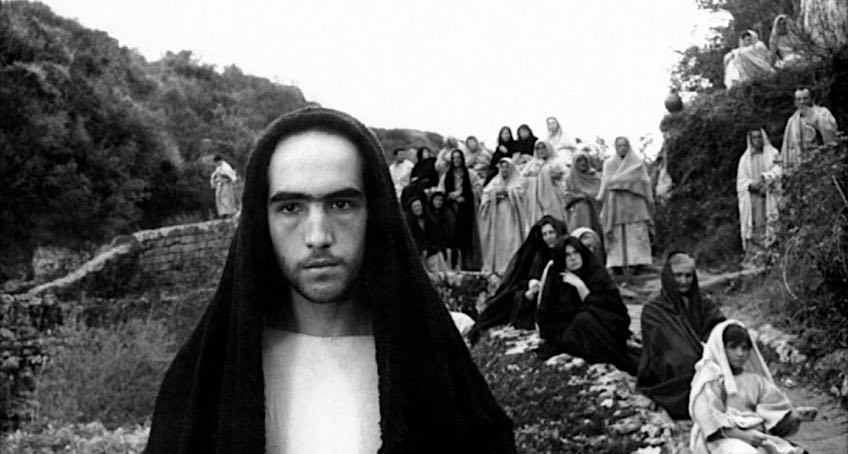
As part of my extensive coverage of Bach (roundup here), two feature films from the 1960s, despite their extreme contrast, are linked both by their intensity and by the way they don’t just accept but probe our own modern values:

and

  • The chronicle of Anna Magdelena Bach (Jean-Marie Straub and Danièle Huillet, 1968—with  Gustav Leonhardt as Bach!). YouTube links come and go; I try and keep an eye on them, but you can do your own YouTube searches if they disappear. Here’s the complete film:

I also found a version enriched by Japanese subtitles (like the Greek subtitles of Johnny the shoeshine guy), and here’s a colourised version of the opening sequence (more on which here):

Hammer and Tickle

Hammer and tickle

What a great title—adopted by several works on Communist humour, just as Broken down by age and sex is popular among statisticians.

Ben Lewis’s Hammer and Tickle: a history of Communism told through Communist jokes [1] has many fine jokes, like this (p.214):

The government of the Union of Soviet Socialist Republics has announced with great regret that, following a long illness and without regaining consciousness, the General Secretary of the Central Committee of the Communist Party and the President of the highest Soviet, Comrade Leonid Brezhnev, has resumed his governmental duties.

I’m not sure if this one is in there, but it’s had a new lease of life following Twunt’s latest rant:

A man was arrested for writing “Khrushchev is a moron” on a fence, and given 15 years in prison: 1 year for vandalism, and 14 years for disclosing state secrets.

Courtesy of Homeland, I’ve just noticed the fine metaphor for relations between the communist state and its employees:

We pretend to work, you pretend to pay us.

But Lewis is surely wrong that “For whatever reason the same phenomenon didn’t exist in the same way in South East Asia or China.” The Chinese have more such jokes than anyone, and it’s high time we had a volume of them in English: for starters, click here. One could compile a thick volume just of Li Peng jokes (preliminary offerings here and here).

Cf. More Hammer and tickle, and Big red joke book.

[1] See also e.g. Christie Davies, Political ridicule and humour under socialism.

Yesterday…

I have outlined the importance of the Song of the Skeleton in the rituals of both north and south China (In Search of the folk Daoists pp.233–4). It’s a common theme throughout the north—mainly as part of the yankou, both Daoist and Buddhist.

In Yanggao Daoist ritual (Daoist Priests of the Li family, pp.274–5), several hymns are related. The Mantra of the Skeleton (Kulou zhenyan 骷髏真言, more commonly known here by the melodic label Wailing to Sovereign Heaven, Ku huangtian 哭皇天) is prescribed, a cappella, for Opening Scriptures on the first afternoon of a funeral.

It’s a kind of catalogue aria, with seven long verses for the visits to the stations of purgatory over seven days. Its melodic material overlaps substantially with that of other hymns, beginning with the opening of the Diverse and Nameless melody (Daoist priests pp.267–8). The melismatic “Ah, Skeleton” (Kulou) refrain, and the coda in pseudo-Sanskrit (also in common with Diverse and Nameless), are not written here in the manual. My film (from 56’08”) shows the sixth verse:

Ah Skeleton! Skeleton!
On the sixth day he reaches Netherworld Souls Village
His sons not to be seen
Starving and parched, at his wits’ end,
Desperate to sup broth.

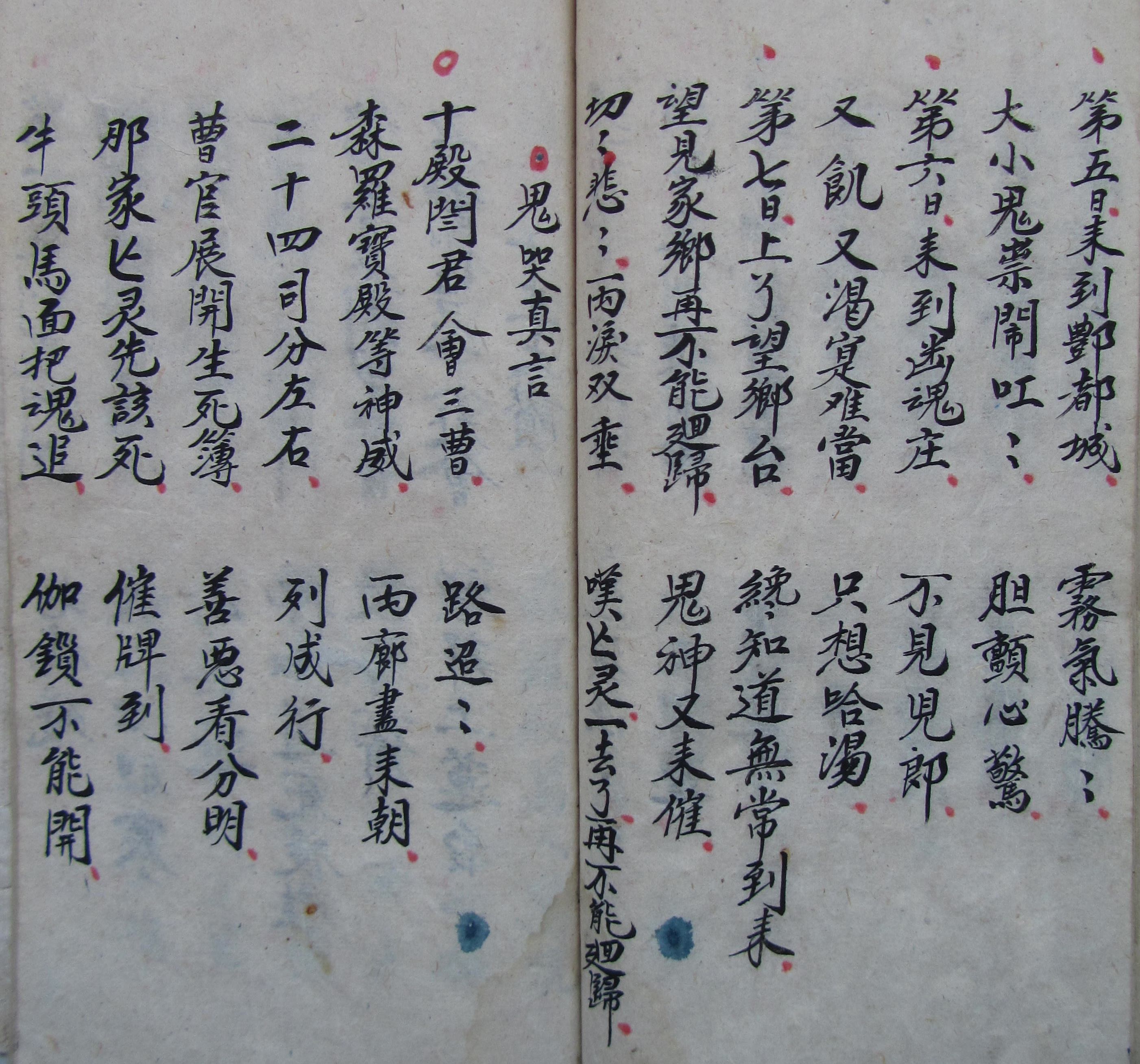
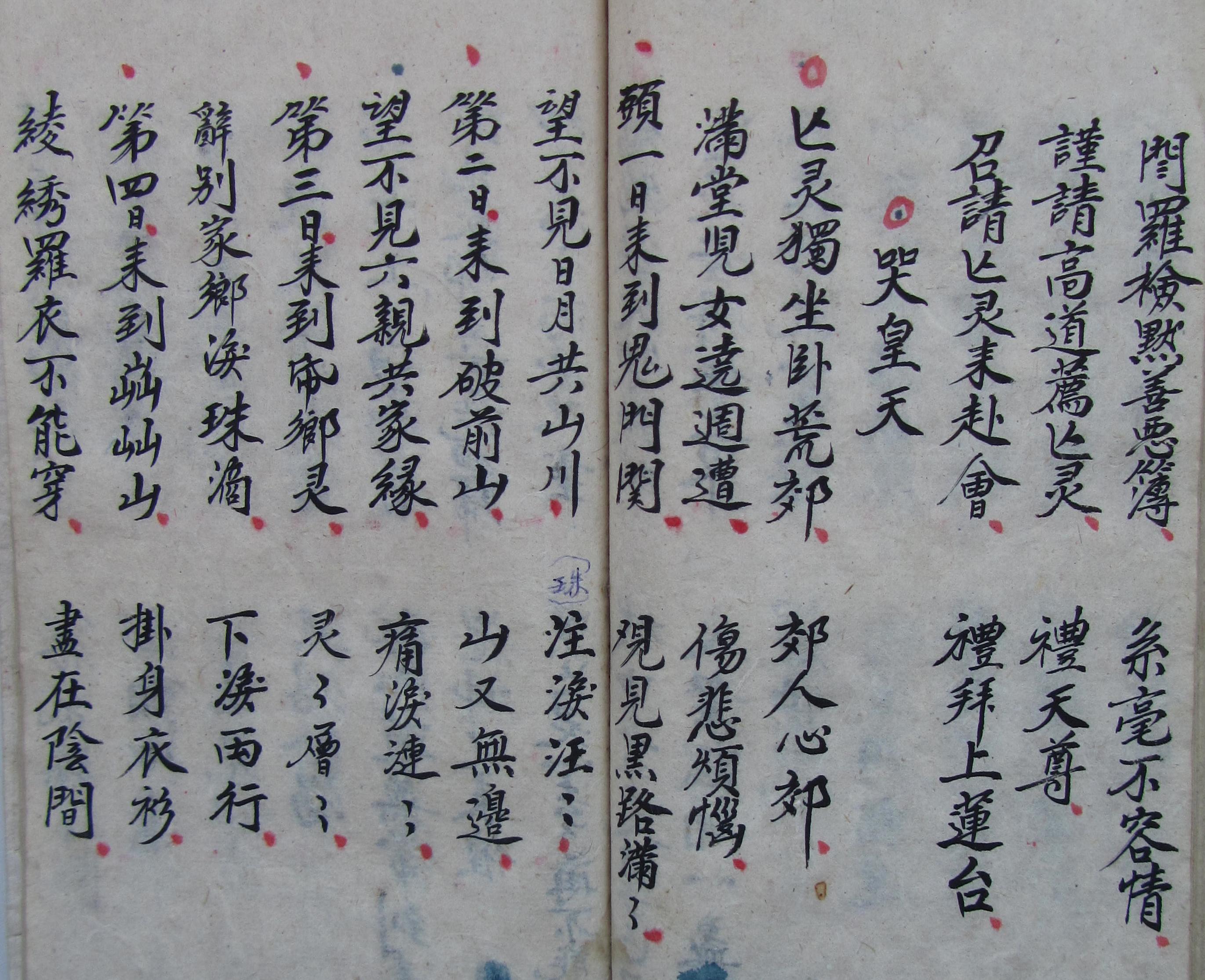
kulou-2kulou-1
From Li Qing’s hymn volume, 1980. The final folio on the left has the opening of Mantra to the Wailing Ghosts—my book p.266, also featured in the film, from 1.03.56).

* * *

For most such hymns one hardly expects an “emotional” response from audiences—in Yanggao, after all, it shares both melodic material and style with many others in the repertoire. But in his brilliant ethnographic studies of ritual practice in old Beijing, Chang Renchun notes how the renditions of two celebrated Buddhist monks moved their audiences to tears. Performative tears feature in many posts on this blog—links here.

Some common versions open:

昨日去荒郊玩游        Yesterday, seeking diversion roaming in the barren outskirts…

So talking of “Yesterday”, Paul McCartney heard his own version in a dream, like Aboriginal singers.

Yesterday

Though secular, it’s deeply moving. Here’s an early solo rendition, live (and Paul’s unaffected style is a major element of the song’s impact—no cover versions come close):

Here’s the remastered version from 2009:

As I observe in the introduction to my series on the great Beatles albums, analysis, while optional, can supplement our response; again it’s instructive to read Wilfred Mellers and Alan W. Pollack. Dating from the same period as A hard day’s night, Mellers considers Yesterday a “small miracle”:

Although the opening words tell us that yesterday his troubles seemed far away, the music in the second bar immediately enacts these troubles with a disquieting modulation from tonic, by way of the sharpened sixth, to the relative. The first bar, with its gentle sigh, seems separated, stranded, by the abrupt modulation; and although the troubles “return to stay” with a descent to the tonic, the anticipated modulation sharpwards is counteracted when the B♮is flattened to make an irresolute plagal cadence. […]

The immediate nostalgia of the song is without suspicion of sentimentality, and the corny accompaniment of string quartet can be employed, with validity, to reinforce the music’s frail bewilderment.

Yesterday quartet

George Martin’s manuscript for Yesterday, on display at Abbey road studios.

Pollack’s analysis is also insightful. And as he notes (also in my roundup), the opening uses a device here that Paul was to use regularly in some of his great songs: a declarative word, followed by a pause, and then rhythmically active ascent.

I can be quite confident about our own emotional responses to this song; less so about the responses of various types of Chinese mourners to the Skeleton, over time.

More social commentary

This is another ever-popular story in our fieldwork joke manual:

Taking his donkey with him, a peasant goes into the county-town to do some business in the county government headquarters. Leaving the donkey in the compound courtyard, he goes in.

When he emerges he finds that the donkey has eaten up all the plants in the courtyard, so he storms up to it and bursts out,

“So you think you’re some kind of national apparatchik, eh—cadging a meal wherever you go?!”

In the original Chinese that last phrase is typically blunt and effective:
走到哪儿吃到哪儿。

Hebei: new discoveries

In the recent, ongoing, fieldwork project continuing our work on the Hebei ritual associations, led by the energetic Qi Yi 齐易, most welcome for me so far is new material on Hubenyi 虎贲驿 village (see e.g. here).

htj-2htj-1

In Plucking the Winds (pp.90–92) I told how the beautiful surviving copy of the Houtu scroll of Gaoluo village was copied by Ma Xiantu, a cultured teacher and sectarian from Hubenyi village just further northeast. Then teaching in Beijing, he first borrowed the old copy of the scroll from South Gaoluo “to supplement the deficiency of my village’s Hongyang Holy Association”. His brother-in-law, South Gaoluo villager Shan Hongfu, was also staying in Beijing, and watched Ma Xiantu copying the scroll; he then bought more paper and asked Ma to make another copy for South Gaoluo. So Ma Xiantu copied it every day after school. He started copying the scroll in the 6th moon of 1942, and completed it in the 1st moon of 1943, finally adding the punctuation in red while he visited South Gaoluo to hand it over formally to the Association for the New Year’s rituals.

The 2015 fieldwork at Hubenyi, though not mentioning Ma Xiantu or the Houtu scroll, revealed further Hongyang scriptures, including an old copy of the Hunyuanjiao Hongyang zhonghua baojing 混元教弘陽中華寶經. Qi Yi and Song Yingtao 荣英涛 have collected basic data, so with bated breath I await a study from scholars of folk sectarian religion, for whom this whole area should be such a rich field… And who will supplement our work on the foshihui 佛事會 ritual associations around Yixian county?

For Hunyuan and Hongyang sects in the region, see my In Search of the folk Daoists of north China, Part Three.

Appeasement

Milne

A 1983 entry from Alan Bennett’s diaries:

Recording The House at Pooh Corner for Radio 4. One story ends,

“Tigger is all right, really” said Piglet lazily. “Of course he is,” said Christopher Robin. “Everybody is really,” said Pooh.

The true voice of England in the thirties.

Cf. AB’s comment on Jan Palach.

And an entry from 1986:

Read Winnie the Pooh to an audience of children at the Tricycle Theatre, Kilburn. Many have never been in a theatre before. I battle against the crying of babies and the shouts of toddlers and ened up screaming and shouting myself hoarse. It is Winnie the Pooh as read by Dr Goebbels.

For A.A. Milne himself reading from Winnie the Pooh, click here. For international perspectives, click here; and for another evocative early recording, here.

Ecstasy and drudge

Leeds
Source.

Alan Bennett (him again) recalls his early music education attending concerts at Leeds Town Hall—making an ethnographic point that is as valid for Daoist ritual as for WAM (Untold Stories p.412):

So it is not just music that I learn, sitting on those harsh benches, Saturday by Saturday. Music in the concert hall is also a moral education, and watching the musicians at close quarters, I realize that it is not just ecstasy and inspiration but that there is drudge to it too. Sometimes, the players would be on the same tram coming home, and I see that they are just like everybody else—shabby, in dirty raincoats and sometimes with tab ends in their mouths, ordinary people who, half an hour ago, were artists and agents of the sublime.

See also Mozart in the jungle, The Commitments, and cf. The purgatory of the tennis circuit.

An unsung local hero

li-jin-2013

I mentioned the splendid Li Jin 李金 briefly in my book (p.20):

I also made a couple of brief trips doing a reccy of Daoists in the nearby counties, assisted by my saintlike old friend Li Jin, bright young scholar Liu Yan, and feisty Driver Ma, all delightful company. No-one will ever accept any reward for all their work as my amanuensis. Elif Batuman’s fine adage about her time in Samarkand rings true: “We were either trying not to give money to people who were trying to take it, or trying to give money to people who were trying to refuse it.”

Pufo tang

Li Jin (right), with Jiao Lizhong (centre) and driver (and polymath!) Ma Hongqi,
Hunyuan county-town 2011.

Li Jin is indeed a treasure. I only realized quite recently that he was once a celebrated performer—but it’s his infinitely generous sincerity that strikes all who meet him. In this he resembles the great Li Qing, but his story differs in that the Li family Daoists always strived to keep under the radar, maintaining their independence from official control, whereas Li Jin’s life has been shaped more directly by the vicissitudes of the Party. In many ways his story is unexceptional, but while my accounts of Yanggao generally concern folk more than state, [1] it reminds us of the presence of the latter—and the presence of Good People within it.

A year older than Li Manshan (but not related to the Li family Daoists), Li Jin was born in 1945 in the poor village of East Shahe just southwest of Tianzhen county-town. He had two older brothers, and at first his family thought to give him away to a close friend, a childless local doctor, but in the end they kept him. Their grandfather was the patriarch. He had gradually accumulated over 30 mou of land, and with the three brothers helping in the fields, their life was quite comfortable until “Liberation”. In the land reform of 1947–48 they were classified as middle peasants (cf. my book pp.95–9); in the 1964 Four Cleanups campaign they were stigmatized as “rich peasants”, and only rehabilitated in 1982—not unlike the Li family Daoists.

When a basic primary school system was established, Li Jin went to school in the converted Dragon King temple. He recalls the fine opera stage opposite it, where an opera troupe would perform for the gods on the 18th of the 6th moon. The stage remained intact—young Li Jin himself remembers performing the item “Playing the flower drum” (Da huagu 打花鼓) there when he was 10 sui.

By the time he graduated from six years of primary school he was a favourite of the teacher. He became prominent in school performances; what he calls his “silly look” was popular. In 1959 he passed the exam to enter secondary school in Tianzhen county-town—no easy feat. It was life-changing for him. On his very first day there, he was thrilled by the flag-raising ceremony in the school’s huge exercise ground. He began learning Russian enthusiastically, dreaming of becoming a translator. But he was soon chosen to do an audition in Yanggao county for a new state-run troupe that was to perform the popular skittish local duet “little opera” errentai.

So in the 2nd moon of 1960, when only 16 sui, he was chosen to join the new county folk opera troupe (Yanggao xianzhi p.468). This, indeed, was soon after Li Qing was chosen for the regional arts-work troupe in Datong (my book pp.113–118), and at the height of the famine.

Later Li Jin heard that he had nearly got the county mayor into trouble. None other than Jing Ziru, head of the Bureau of Culture and the (only) brilliant local historian of Yanggao (my book p.50), told him that at his audition, the mayor had taken exception to his two “wolf-teeth”, but the others pointed out they could be taken out—indeed, in 1962 he had them extracted by a quack dentist while they were performing in Zuoyun county. Rather him than me.

Li Jin soon went on to become a celebrated performer. The troupe’s expenses were to be footed by all the people’s communes in the county, so it was ponderously named Shanxi sheng Yanggao xian renmin gongshe lianshe minjian gejutuan 阳高县人民公社联社民间歌舞团. If there was a sign at the gate of the compound, it must have collapsed under the weight of its own lettering

Li Jin remembers those early days in the troupe fondly, with its twelve performers and six musicians. Of course it was a terribly tough time, but the troupe was doing well, and led a somewhat less tenuous existence than the common folk, “like being in kindergarten”. Still, he only earned 18 kuai a month.

The leadership praised their first hastily-rehearsed programmes of Da jinqian 打金钱, Zou xikou 走西口, Gua hongdeng 挂红灯, and Gusao tiaocai 姑嫂挑菜. At first Li Jin was chosen to specialize in the handsome sheng roles, but with his “silly look” he found it too much of a challenge, and he soon gravitated to the chou clown role.

li-jin-1-low-res

The character is meant to make people laugh, but once he made himself corpse. Playing the role of a clown county official, one day he got the words wrong and couldn’t help bursting out laughing. The troupe leaders gave him a kicking backstage but he still couldn’t stop laughing. At the next meeting he was criticized and his 3 mao supplement for the day was withheld. This is the kind of story that musos delight in.

They were on tour all year round. I was surprised to learn that tickets were for sale—so they had to try and control villagers without tickets trying to sneak a look, no simple task.

li-jin-2-low-res

Following the mood of the times, the troupe soon began performing modern items instead of their original classical stories, so Li Jin’s clown roles were now mainly “negative” characters like spies or traitors, not the more sympathetic (or at least neutral) roles of old. Despite the troupe’s popularity with audiences, and Li Jin’s own reputation, in the Lesser Four Cleanups campaign of 1963 they were banished to the countryside for “tempering through manual labour” (laodong duanlian). As the campaign intensified, they were active in Tianzhen county as a Four Cleanups work troupe. At first Li Jin was excluded from taking part in such “battle teams” (zhandoudui) by his bad class background, but soon the order came down that everyone had to join in, so for the next two years he was part of a group of a dozen or so “Red Flag warriors”.

By 1967 a new directive descended on them, warning them that their performances since the formation of the troupe, glorifying “ox demons and snake spirits, scholars and beauties”, contradicted the agenda of the Party. The leadership decided to amalgamate the troupe with the county’s other opera troupe (for the classical opera Jinju), at the same time reducing the personnel. By 1968 even this new combined troupe was abolished. Li Jin was assigned to work as a cook. His wife was sent to work in a troupe in Xinzhou, rather far south—so even his family was being broken up. He’s grateful that she managed to return after some time.

In 1970 the county established a Mao Zedong Thought Propaganda Team. All the recruits had to do was to be able to hum a few phrases and not be too ugly, and they were in. But the authorities soon realized the standard wouldn’t do, and had recourse to the disgraced former troupe members. So Li Jin now found himself taking part in simple cheerleading performances, trapped in “a bottleneck of monotony”. But they did raise standards, and their performances enjoyed a certain popularity.

The scene changed quickly from 1976, with more traditional genres regaining a position among modern styles. In 1979 the county “folk opera troupe” (minjian gejutuan, later called Errentai jutuan) was restored, with both new and old styles reflected. Supported by the county leadership, their reputation again spread. Li Jin, still only in his mid-30s, got back to work conscientiously, going on to become Director of the troupe. In 1988, as “popular voting” came into vogue, he stepped down after a close-fought election.

In 1989 he moved to the county Bureau of Culture, a radical change in work style—and a challenge upon which he embarked with typical enthusiasm. He was glad to broaden his experience of local culture. Since then, privately-run errentai groups have bloomed in the countryside, taking a major role at weddings and funerals. I don’t suppose Li Jin is always impressed by the pop style that now dominates there, but he is proud of playing a role in the recognition of the Li family Daoists and the Hua family shawm band in the Intangible Cultural Heritage roster. Despite my reservations about the ICH, I can appreciate his satisfaction.

In a climate since the 1990s whereby most cadres seem to spend their time staggering around pissed from one state-funded banquet to the next, [2] Li Jin seemed to be the only one who ever got any real work done. And he at once understood that I was there to work too, inconspicuously doing all he could to help me—like biking through the snow to convey an obscure foreign message on my first trip.

In recent years, while staying with Li Manshan and following him round funerals, I make occasional visits back to the town for a shower and a nice quiet informal meal with Li Jin. Since his retirement, though not in great health, he has returned to his beloved errentai, taking place in regular amateur meetings.

He is affable and generous with everyone, and accepts people (even me) as he finds them—embodying the noble virtues that the system often trampled on. He has always believed in humanity, social justice, and the aims of the Party.

* * *

This is the kind of life that books like those of Dikötter, single-mindedly focused on tragedy, cannot reflect. Whereas the more focused ethnography of Friedman, Pickowicz, and Selden is also unflinching, it is based on fieldwork, and so can’t help showing a certain empathy. But more general trawls through the archives like those of Dikötter can only be partial, another kind of propaganda. One can hardly challenge his details—indeed, the tragedy lies precisely in the way that sincerity was repressed, and it does need documenting—but one needs a more nuanced, perspective.

My account may make Li Jin sound a little like one of those selfless cadres of yore, by contrast with the self-serving crew that holds sway today. But there really were, and are, people like that… See also Yanggao personalities.

There is nothing like a quiet chat over a simple bowl of noodles with Li Manshan and Li Jin.


[1] In my 2004 book on the Gaoluo ritual association, one finds a closer relationship between folk consciousness and local cadres.

[2] Though in my book (p.314) I note recent sumptuary laws, and a jolly good thing too.

Art and architecture

Palin cover

From Michael Palin’s 1995 diaries:

Another Irishman is helping Mr Brown paint his house: “You wouldn’t think he’d painted the Sistine Chapel, now, would you?” says Mr Brown to Helen. The other man, young, thick-set, dark hair, florid face, protests from the top of the ladder: “Paint it? I built it.”

Recitation

In 1980, when Li Qing began recopying the family ritual manuals as Daoist activity gradually revived, the very first manual that he copied was the hymn volume of funerary texts.

Within this volume, Li Manshan loves, and identifies with, the beautiful long meditation on impermanence titled Kangxi yun—actually attributed to Kangxi’s father the Shunzhi emperor (1638–61), and Buddhist in language. The standard version is known by names such as as Poem on returning to the mountains (Guishan shi 歸山詩), Poem on entering the clergy (Chujia shi 出家詩), or Gātha in praise of the sangha (Zanseng jie 贊僧偈).

The Li family’s ritual manuals are largely superfluous to their ritual practice today: those rituals that are still required they perform from memory. The Kangxi yun is one of many texts in the manuals that are no longer performed; and the Daoists never read the manuals as silent literature. But as I began to go through them with Li Manshan, I found that he was most taken by the poem. It shows how drawn he is to the retreat from worldly cares; household Daoists don’t necessarily evince this, and you might not notice this contemplative aspect of his character.

Li Manshan says parts of it were formerly performed as a shuowen 說文 solo introit within particular ritual segments. He has a distant memory of hearing the Daoists reciting it for a temple ritual when he was 8 or 9 sui, around 1953–54, but he only began taking note of it when he came across it in his father’s hymn volume in the 1980s.

Indeed, it is among several rather long texts grouped together in the hymn volume that could be used thus; but there are no longer any suitable ritual segments in which to recite them. The shorter solo introits still used, like those for Presenting Offerings, are now mostly recited by Golden Noble.

shanggong

From my film: a shuowen introit from the shanggong ritual.

I’ve long wondered how, and when, this long poem found its way into the ritual manuals and ritual practice of the Yanggao Daoists. We discussed this further during my stay with Li Manshan in 2018 (under “Pacing the Void”).

* * *

For readers less than fluent in classical Chinese (of whom I hope there are many!), below I offer a very rough translation (for the challenges of translating the Li family texts, see here). I can’t find an English rendition of Shunzhi’s standard text (anyone?), but here I use the variant in the Li family manuals, only resorting to the original where sense requires. But often Li Qing’s variants seem no less elegant than the original, and sometimes I even find them preferable.

When we have a more widely-distributed “classical” source with which to compare the ritual texts of household Daoists (as is often the case), one often finds minor discrepancies. Many manuals (including most of those of the Li family) were recopied from memory in the 1980s, so a certain amount of variation was likely. However, while sometimes the Daoists might remember how to recite or sing a phrase or character but not how to write it, in general Li Qing’s manuals are remarkably accurate. Moreover, it’s also likely that variants had entered into the ritual manuals of household Daoists long before that. So it’s hard to tell when and how the variant of this poem arose.

The poem is not just about the emptiness of worldy cares, but refers to Shunzhi’s own struggle between his responsibilities as emperor and his personal inclination to Buddhist transcendence:

The forest of temples throughout the empire offers sustenance like a mountain
Everywhere the monastic bowl depends on the lord to provide.
There is no value in yellow gold and white jade
Only to don [1] the monastic cassock is difficult.
I, as great lord of the land of mountains and rivers
Am concerned for the nation and the people, serving to deflect their troubles.
One hundred years, thirty-six thousand days [2]
For a monk, don’t amount to [3] half a day’s rest.
Confusion on arrival, bewilderment on departure [4]
Travelling in vain for a while among men.
Better not to arrive and not to depart
With neither pleasure nor pain.
Before I was born, who was I?
Who was I at the hour of birth?
I only became an adult after I grew up
And once eyes are closed in the void, then who am I?
In this world the only good is to enter the clergy
With pure heart and peaceful mind, who is to know?
The mouth having taken its fill of eating harmonious flavours
One can always wear restitched robes from cast-offs.
The five lakes and four seas make a superior guest
Roaming free in the God Palace, lodging at will.
Do not call it easy to attain the dharma by becoming a monk
Let us talk only of the various bodhi of bygone ages.
I, as great lord of the land of mountains and rivers [5]
Seek the body of Crop Founder descended to earth.
Bright as is the cassock of the Western Quarter
Why has it descended upon the imperial family?
Just because at first my recitation was deficient
I had to exchange my purple cassock for a humble new robe.
For eighteen years I have been dreaming—
When can I rest from the great task of mountains and rivers?
Today, clapping my hands, I return to the mountains
How can I be expected to control the thousand, myriad autumns?

I’ve largely refrained from adding the Teutonic scholarly footnotes that the text suggests, but:

[1] Using the original 披肩.
[2] Chinese poetry has a lot of lines like this, and they read better in Chinese!
[3] Using the original不及.
[4] Referring to life and death, of course—but please feel free to provide your own joke about the airline of your choice.
[5] Here Li Qing repeats the earlier phrase, whereas the original couplet has “Even without being a true luohan, one also dons the triple vestments of Sakyamuni.” The following couplets of Li Qing’s version depart further from the original, and my translation is even more approximate.