Echoes of the past 1

Echoes of the past: refuge and memory, 1

Train refugess 1945

Refugees, 1945.

Hildburg Williams is a long-serving and popular violinist in London chamber and early-music orchestras, who has latterly added a major string to her bow [1] by becoming a distinguished German-language coach for singers in opera, lieder, and oratorio repertoires.

I’ve known Hildi since 1982, when we were playing a Handel opera in Lyon with the English Baroque Soloists under John Eliot Gardiner. Though I worked with her on and off for the next eighteen years (mostly in EBS), somehow we never managed to have a proper chat. As is the way with orchestral life, we moved in different circles, different groups going off in search of restaurants, and she was rarely to be seen in the bars that my mates frequented after gigs.

So I knew nothing of Hildi’s early years, fleeing twice from war and trauma; or the tale of her sister, who stayed behind in the German Democratic Republic (GDR). Their stories are just a drop in the ocean of the continent-wide migrations in the period immediately following World War Two, not to mention more recent ones from farther afield—many such accounts have been published. But only very recently have I realized how important it is to tell the stories of such “migrants”; and this also bears on the post-traumatic amnesia that took hold not only on both sides of the German divide, but throughout Europe (including the UK)—and indeed China. All these lives are precious. [2]

After a couple of long sessions together, and some background reading, I produced a preliminary draft. Meanwhile, as Hildi was stimulated to reflect further on her life, more and more memories came to the surface, prompting her to give a more comprehensive account of her life—for her own sake, not merely at my behest. This, the first of two instalments, is my own adaptation of her story.

Chatting belatedly with Hildi has made an intriguing contrast with my main experience of fieldwork since 1986—making notes while hanging out with chain-smoking Chinese peasants between ritual segments at funerals. But the principle is rather similar: to document and empathize with people’s experiences through troubled times. Still, whereas in China my clear outsider-status somehow makes such talks quite smooth (though note my comments on “stranger value”), in this case, being somewhat closer I sometimes feel more impertinent. So it reminds me that we foreign fieldworkers intrude too blithely into the personal lives of our subjects—a privilege that is hardly earned.

Thankyou, Hildi—and a belated happy 80th birthday! Having boldly offered Stephan Feuchtwang some Bach for his own 80th, this tribute will at least be less aurally challenging.

Early years: Silesia
Hildburg was born in November 1937, the youngest of three siblings, in the town of Weißwasser in the Sorbian enclave of Upper Lausitz, east of Dresden—right by what is now the Polish border. The family ancestry can be traced back to Lower Silesia—her grandparents and parents originally lived in Bunzlau (now Bolesławiec, in Poland).

Both of Hildi’s elder siblings were born there, but by the time she was born the family had moved west to Weißwasser, where her father had been appointed as Rektor, school headmaster.

Hildi’s mother was also a teacher, but had to resign when she got married, as was the ruling in those days. However, when the war broke out she was reinstated. A young woman lived with the family, looking after the children.

Germans had made up the great majority in Silesia for many centuries. Weißwasser was just west of the Oder–Neiße line, which was to remain German even after 1945.

Through the 1930s the Jewish populations of such communities were ever more vulnerable. When Hildi was barely a year old, anti-semitic violence escalated with Kristallnacht; near Weißwasser, the Jewish population of Görlitz was among those targeted. In October 1939 a camp just south of Görlitz, originally for Hitler Youth, was modified into a PoW camp and began to receive inmates. Indeed, it was at this very camp that Messiaen, captured at Verdun in 1940, was interned—soon to compose and perform his amazing Quatuor pour la fin du temps there, as if untouched by human society.

By 1939 Hildi’s father was in his forties; in August, as the war started, he was called up by the Wehrmacht, going on to serve in the army administration in Poland, Russia, and France. Hildi reflects:

I can only remember one short visit when he was on leave. Apart from this, I only knew him from photographs and his letters home, which would often include little paragraphs to us children, with some drawings. [3]

But after the war he hardly talked about his experiences, so Hildi knows very little of this period in his life.

When she began attending school in 1943, her mother was her first teacher there (“a fact she enjoyed more than I”)—Hildi remembers addressing her in the third person like all the other pupils in class, anxious to fit in and not be treated differently from her classmates.

Up to the summer of 1943 the family spent the holidays at Hildi’s grandparents’ home in a little village just outside Bunzlau—they owned the former village school, with its large garden and a wooded area known as The Park. For the children it was an idyllic setting.

First flight
As we chat over coffee and cake in Hildi’s gemütlich little house in north London, I struggle to imagine the utter devastation of Germany by that time, evoking the most appalling images we have seen from Syria in recent years—and refugees then were just as vulnerable as Syrians today, desperately trying to survive by fleeing. Keith Lowe tellingly sums up the devastation of post-war Europe: [4]

Imagine a world without institutions. It is a world where border between countries seem to have been dissolved, leaving a single, endless landscape over which people travel in search for communities that no longer exist. There are no governments any more, on either a national scale or even a local one. There are no schools or universities, no libraries or archives, no access to any information whatsoever. There is no cinema or theatre, and certainly no television. The radio occasionally works, but the signal is distant, and almost always in a foreign language. No one has seen a newspaper for weeks. There are no railways or motor vehicles, no telephones or telegrams, no post office, no communication at all except what is passed through word of mouth.

There are no banks, but that is no great hardship since money no longer has any worth. There are no shops, because no one has anything to sell. The great factories and businesses that used to exist have all been destroyed or dismantled, as have most of the other buildings. There are no tools, save what can be dug out of the rubble. There is no food.

Law and order are virtually non-existent, because there is no police force and no judiciary. In some areas there no longer seems to be any clear sense or what is right and what is wrong. People help themselves to whatever they want without regard to ownership—indeed, the sense of ownership itself has largely disappeared. Goods belong only to those who are strong enough to hold onto them, and those who are willing to guard them with their lives. Men with weapons roam the streets, taking what they want and threatening anyone who gets in their way. Women of all classes and ages prostitute themselves for food and protection. There is no shame. There is no morality. There is only survival.

For modern generations it is difficult to imagine such a world existing outside the imaginations of Hollywood script-writers. However, there are still hundreds of thousands of people alive today who experienced exactly these conditions—not in far-flung corners of the globe, but at the heart of what has for many decades been considered one of the most stable and developed regions on earth.

By 1945, Silesia was ever more lawless. As German defeat was imminent, and with zones of occupation constantly shifting, the American and British inmates of the Görlitz PoW camp were marched westward in advance of the Soviet offensive.

On 17th January 1945 what was left of Warsaw was “liberated”; Krakow and Lodz soon followed. Budapest fell to the Soviet forces on 13th February; and as they were closing in on Berlin, Dresden was obliterated by RAF bombs on 13th–15th February.
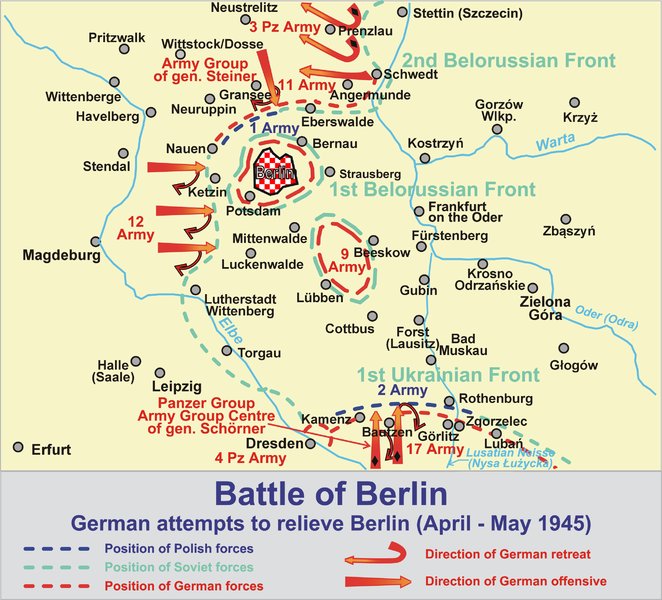
There was still desperate fighting (see also here) around the Silesian region in April. The 1st Ukrainian Front captured Forst on the 18th. As Hildi recalls:

I remember our last days in Weißwasser vividly—the food shortages, the frequent air raids, the sound of fighting, the endless treks of refugees fleeing westward passing along our street. Every night my mother would take a family in to give them food and a bed before they continued their journey the next morning. The raids intensified daily and on the 13th February the light from the burning Dresden was clearly visible. As the fighting drew nearer, we could hear the bombardments coming from Forst just north.

During these anxious days there was a young woman briefly lodging in the flat who was betrothed to a German lieutenant. He told her she should urge Hildi’s mother to leave. The last military train going west was due on the 19th February from Hoyerswerda, 7 kilometres from Weißwasser. So along with a throng of desperate people (mainly women, children, and the elderly, since most men were either dead or away fighting), they now fled their home. Hildi, then seven, vividly remembers the chaos, with refugees panicking as they fled in all directions.

The most essential items were hastily packed, and I still remember gratefully that I was allowed to take both my beloved dolls. The lieutenant sent his orderly with an open lorry for us to catch the train—which turned out to be already overcrowded with hardly any room. My sister was precariously perched on top of several suitcases, resting her feet on the handle of a pram.

The train eventually left the next morning, but even on the night before there was an air-raid. Some people panicked and fled, but luckily the train was not hit. The journey was agonizingly slow, with the train frequently grinding to a halt. At some stations it was possible to get some soup and a hot drink, but these were dangerous moments, as nobody knew how long these stops would last and people were afraid the train might set off without them.

Planning to get to the small town of Kahla, near Jena in Thuringia, to stay with the family of an uncle, Hildi’s family finally climbed out of the military train in Zwickau, embarking on several complicated train changes. Again the carriages were packed with huge numbers of other refugees and luggage, so sometimes people could only get off the train by clambering out of a window. It was snowing and the ground was covered with dirty slush.

Thuringia, 1945: brief US occupation
When after three days they at last reached their destination, Hildi’s aunt gave them the use of one room in her flat, with the children sleeping in a little attic room. But even here they found that far from being safe, escalating air raids meant spending anxious hours in the cellar huddled together with the other occupants of the house.

Communication was sporadic: there were disruptions everywhere, with large sections of the railway lines destroyed (at the end of the bombardment only 650 of 8,000 miles of track were operating), and so any letters that made it through were long delayed. With millions on the move, tracing the whereabouts of family and friends proved arduous.

The family did at least have a little radio, and Hildi was delighted when a broadcast of a classical concert came on. Meanwhile, news broadcasts were less instructive than rumours of the allied troops’ advance, which created great anxiety.

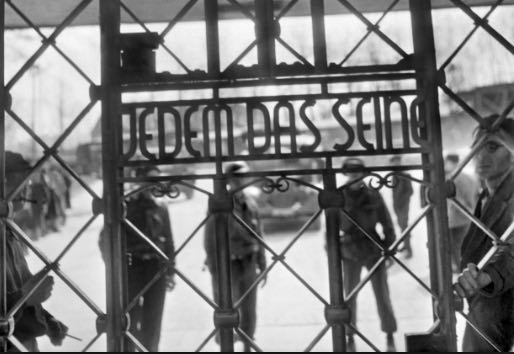
American forces began occupying the province of Thuringia from 1st April; Patton’s forces entered Buchenwald on the 11th (for my post on Ravensbrück, see here).

Dresden in ruins.

On 20th April the Russians reached Berlin. As agreed by Roosevelt, Churchill, and Stalin as early as 1944, and confirmed at the Yalta conference in February 1945, the defeated Germany (including Berlin) was to be divided into four zones of Allied occupation. Thuringia was to belong to the Soviet zone, but the Americans arrived there first before the fighting ended. Hildi’s family had no inkling of all this until later.

In Kahla, the situation deteriorated dramatically early in April, just after Easter, with frequent air raids. In a last-ditch effort, the German forces blew up the bridge over the river Saale. Warplanes were flying low over the town, with bombs exploding alarmingly close.

We seemed to spend most of our time in the cellar, anxiously listening and waiting for the all-clear signal, and then, climbing upstairs again, being thankful that, for now at least, we had been spared.

Then the day came when, with a roar of heavy motorcars and tanks, the Americans announced their arrival. Cautiously peeping through the windows, we saw the whole street full of cars and jeeps, which were constantly washed and polished.

The GIs went from house to house to find accommodation for their people. Nearly all the houses in our street had to be evacuated, but ours was spared. When the GIs came to investigate it was lunchtime, and our large family was sitting around the kitchen table—my mother, my aunt, my grandparents (who had recently arrived from Silesia by trek), and we children. When one man in uniform asked: “How many children?”, my mother answered in English “Five”, whereupon they left.

We mainly stayed indoors—there was a curfew in place, and at first only two hours were allowed daily for people to try and get provisions from shops, where there were long queues. On 2nd May ration cards were introduced, and the electricity supply seemed to be becoming more stable, but sadly, one day our radio was confiscated. From now on we could only get snippets of news while queueing for food. News of Hitler’s suicide on 1st May, and the signing of the act of surrender on the 7th, was anxiously passed around. We children picked up the atmosphere of doom and desolation.

Hildi recalls the GIs:

It was the first time in my life I saw a black person. I had heard that these were the people who were kind to children and were known to give them sweets and chocolate. So one day I plucked up my courage and gingerly approached one of them, uttering my first English words—“Have you chocolate?” I had never tasted chocolate—whenever I asked about it I would always get the answer: “When the war will be over”, to which I would wearily reply: “This is always your excuse!” Now the war really was over, this seemed to be the moment—but the soldier, somewhat bewildered, just shook his head.

At first the officials of the American Military Government were under strict orders to treat the defeated population with stern discipline. Rations began to shrink, often to under 1,000 calories per day. My mother lost so much weight that one day she was blown over by a gust of wind, spilling the precious thin broth she had just acquired from the butcher after queueing for ages. The black market flourished, but as refugees neither my mother nor my grandparents had anything of value to offer. Food shortage was a constant problem, but somehow they managed to put something on the table.

Under Soviet occupation, 1945–49
However, Thuringia was only to be very briefly within the US zone; in a deal unbeknown to locals, as the Allies had agreed with the Soviets for part of Berlin, the American troops began withdrawing on 1st July, ceding it to the Soviet forces—precisely those that Hildi’s family had fled from the east to evade.

 Then on 2nd July, without forewarning—almost overnight—the scene changed. The US jeeps disappeared, followed by an eerie, foreboding silence; and finally, as we all peeked anxiously through a small gap under the closed jalousie, Russian pony-driven carts arrived. What a change from the smart vehicles of the Americans! What a shock! What would become of us now?
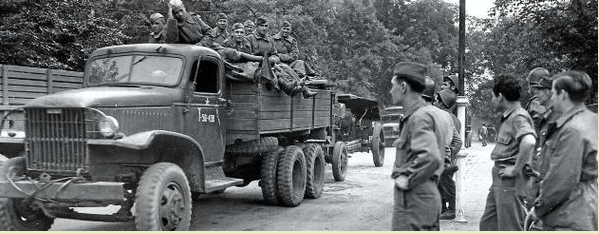
US Russian handover 1945

Russian troops passing GIs into Weimar, 4th July 1945.

For the time being, having only just escaped the east with such difficulty, Hildi’s family stayed put. They were now to live under the Russian regime until 1948, when the administration began to transfer to what in 1949 became the GDR.

Still, Hildi’s family had done well to flee early from the east. Over three million people had fled west before the organized expulsions began, mainly driven by fear of the advancing Soviet Army; and another three million Germans were expelled in 1946 and 1947. For many, the formal end of the war was not an end to their suffering but a beginning; vast numbers died in the process.

As a post on armaments in the Kahla region comments,

The population’s fear of retaliation at the hands of the incoming Red Army resulted in a gigantic wave of German refugees. […] All through May, the American military witnessed the panicked streams of refugees heading west. In addition, there were masses of people from further east fleeing before the advancing Soviet troops.

Hildi reflects on my impertinent queries asking if they now considered taking flight from the Russians once again in July 1945:

In July 1945 the whole of Germany was in total chaos. Everyone was solely occupied with survival—there was no time for reflection, still less for coming to terms with the past. While travel was still possible, not only were journeys arduous and complicated, with the rail network still in disarray, but where should we go?

The housing situation was dire. Apart from the millions of refugees from the East, there were all the survivors of the bombings, now homeless, who had to find a roof over their heads as most cities lay in ruins. One couldn’t just turn up anywhere—one had to know someone who could guarantee at least some sort of accommodation. My mother’s youngest sister lived in the northwest, but she only had one room for herself—though she became an important point of contact for our entire family, at a time when so many people were desperately trying to locate their loved ones and friends, or simply to find out if they were still alive.

Above all, in 1945, apart from the zones of occupation, one was not yet conscious of a divide within Germany into “East” and “West”. The whole of Germany faced the same chaos of devastation, having to deal with the aftermath of war. Mountains of rubble had to be cleared—a task mainly performed by women, since their men were either still prisoners of war or too old and infirm to take part. [6] Everyone was living from one day to the next. With our large family including aged grandparents, there was no hope of resettlement in the near future. Besides, there was no indication then that life was any easier anywhere else.

Were we worried? I am sure the adults were. Were we safe? I think, on the whole, we were. Following the departure of the American forces, the Soviet soldiers were now on strict orders to behave accordingly, and were severely punished, often beaten, when they transgressed. Fraternization was strictly forbidden—there was a definite “them” and “us”. The hegemony of the occupying forces was never in question.

Considering the widespread punitive measures against Germans in these first few years after the war, and many horror stories, they were relatively unscathed. But as Hildi observes, hunger was still a constant companion, especially for city dwellers. In the villages, in the early days before farms were confiscated by the state, there was still enough produce; townspeople brought anything they could find of any value to exchange for food. It was said that the only thing missing at the farms were the Persian carpets in the cowshed!

Although we were given ration cards, the shops did not have enough supply, so wherever there happened to be a queue people would join, even if it was unclear what was for sale.

I remember our excursions to pick mushrooms in the woods nearby. We became quite knowledgeable about them. At home we would clean and slice them, threading the slices on a pieces of string to dry for the winter. We did that with apples too. Eventually we were given a small plot of garden, and my grandfather worked hard growing vegetables and salad. As living standards improved in the Allied zone, the highlights were occasional food parcels from relatives there with essential provisions—and to our delight they would sometimes even reveal a chocolate!

My older sister, now 17, helped enormously, working for a farmer in a village 7 kilometres away—not only could she now get enough to eat, but we had one less mouth to feed. On many weekends she would walk this long distance, carrying back as much food as she could manage.

After the harvest the townspeople were allowed to glean the fields. They would all line up at the edge of the field and only after the farmer had raked it over thoroughly was the sign given to enter. The stalks were gathered like a bunch of flowers before the heads were cut into a sack. Back home my grandfather would beat the sack until the husks separated, then blow them away carefully until he had just the grains in his palm. They were worth their weight in gold; some would be ground in an old coffee grinder to make porridge, and if there were enough then the local mill would exchange them for flour, a welcome supplement.

Occasionally slices of bark and pieces of wood were available from the local sawmill, which we piled up high on our rickety wooden cart. My grandfather then used an axe or a saw to cut them for our stove and wrought-iron oven. He also built a rabbit hut. We children loved these cuddly animals, and got quite upset whenever one suddenly went missing—my grandfather made sure we were not around when he sacrificed it for the pot.

Women had to be inventive with their dishes. I remember a brownish bread spread, ambitiously called Leberwurst, made from a flour mixture and spiced with marjoram, as well as Schlagsahne (whipped cream) made from whey, a thin greenish liquid that was available for free at the local dairy. For some time these recipes were carefully stored in a box, but, thankfully, never used later on! We children could not be choosy— we ate everything.

For cooking we had enormous pots in the kitchen, as the food lacked the necessary substance. Later they were adopted for boiling the washing.

Looking back now it seems amazing how we adapted to the deprivations of our daily life. Power cuts were frequent, and with candles in short supply we just stuck a piece of resin-wood into an earth-filled flowerpot and set it alight—a sooty affair! At other times we just sat in the dark and sang.

In 1945 Hildi’s father had been captured and interned in a PoW camp; [5] by June he was able to rejoin his family in Kahla. He must have known that his wife would try to get them away from Weißwasser, but with no means of telephoning, and only a sporadic postal service, Hildi doesn’t know how he found out where they had escaped to.

As Hildi’s father approached, pushing a bicycle, she was standing at the gate; recognizing him as he called out her name, she was so excited to see him that she jumped up to greet him and chipped a corner out of one of her front teeth.

Now at last we were a real family! My father immediately applied for a job. At a time when numerous factories were dismantled and their machinery taken away, he was lucky to find a job at the still-functioning sawmill. For a man who had never had done any physical work in his life, this was hard for him. There was no other footwear but heavy wooden clogs, and my mother spent hours sewing patches onto his torn gloves.

My brother and I spent the summer holidays of 1946 with our former help and her family in a village near Bautzen, east of Dresden. For my parents this was a godsend, since they could be sure we would be properly fed there; for us children it meant an exciting long train journey and a wonderful time in the country. But the journey confronted us with images that remain ingrained in my memory even today. Passing through Leipzig we witnessed with horror the devastation on both sides of the track—ruins everywhere, eerie monuments of gruesome battles, tall buildings sliced through the middle, with the occasional lone piece of furniture precariously balancing on the edge.

Leipzig devastated.

Just opposite their house was a school that served as a barracks; during this time another building was used for some teaching. So Hildi’s grandfather (himself a former teacher) gave her additional lessons, with daily reciting of maths tables. When the troops finally moved out, the barracks became a school again, which Hildi now attended. Among the subjects there was Russian, which she learned reluctantly. But she was much keener on learning the violin, taking lessons along with her brother from elderly local musician Emil Wittig—Hildi’s brother became his star pupil, and to this day she still treasures a copy of the Kreutzer violin studies with a dedication to him from their teacher.

If their radio hadn’t been confiscated, Hildi would have loved to hear broadcasts of the classics with conductors like Furtwängler. Here he is in 1948, rehearsing Brahms 4 in London—where his visits were still sensitive, since though acquitted of collaboration late in 1946 it would still be some time before he was entirely rehabilitated abroad:

Like Chinese people, Hildi’s father never discussed his war experiences—which, apart from perhaps being politically uncomfortable, must have been deeply traumatic.

Although we children seemed to find our own way through this period of deprivation, we could not help picking up the general atmosphere of resignation, uncertainty, and fear. Outside the home people did not engage in conversation before making sure no-one was nearby who could possibly listen. At school it was not uncommon for a teacher to use children as tools to gain vital information from them about their elders’ opinions. My brother and I were instructed never to mention any sensitive topics we might have heard at home.

By October 1949 Hildi’s family found themselves part of the new German Democratic Republic (GDR).

Apart from the major trials of the worst culprits, de-nazification [7] was pursued patchily even in the first couple of years after the war, as the occupiers soon discovered it was both impracticable and undesirable; in the Allied zones, reconstruction took priority over principles as Cold War loomed. People heard about the war-crimes trials, but they were little discussed, and never part of the school curriculum.

Discretion became still more important when in 1949 Hildi’s father planned to cross the border to Westphalia in the British zone, hoping to find a new life in the West so the family could join him eventually. His parents-in-law had already made the journey earlier without too many problems, since “old people” were considered not just unproductive but a burden on the state.

Sure enough, after a long trek northwest Hildi’s father managed to reach Detmold, where he was offered the use of a hut in a large garden belonging to a friend of a friend. At once he found work as a gardener, later getting an office job with the British authorities.

With the de-nazification process now inevitably something of a formality, it was formally abolished in 1951 with the ponderously-named Entnazifierungsslußgesetz law (expanding my acquaintance with German polysyllables). Meanwhile, senior German conductors jumped through the requisite hoops as the new authorities pored over their careers under Hitler. The search for culprits still continues even today, but there was no call for repentance, and nothing resembling Truth and Reconciliation—either here or later in China.

In Kahla, Hildi’s mother was questioned twice about her husband’s whereabouts by two officials knocking on the door. She simply replied, “He has abandoned us. I have no idea where he is.”

Second flight
In March 1950 Hildi, with her mother and brother, managed to flee the new GDR to join her father. But this time her sister made the choice to stay behind. Her life had changed for the better in 1947, when she was accepted for the pedagogic school for mathematics and natural science in Gera, east of Kahla. In what Hildi observes was a strange way of beginning one’s studies, all the students had to take part in clearing the Thuringian forest, sawing and stacking felled tree trunks—at least they were allowed to take some wood home.

By 1948 Hildi’s sister had a diploma, and soon found a teaching post. She realized her qualifications would count for nothing in the Allied zones, and she couldn’t face having to retrain; and besides, she had fallen in love with her future husband. The family parting was difficult.

After the trauma of their original flight as part of a mass exodus west in 1945, this second journey posed different challenges.

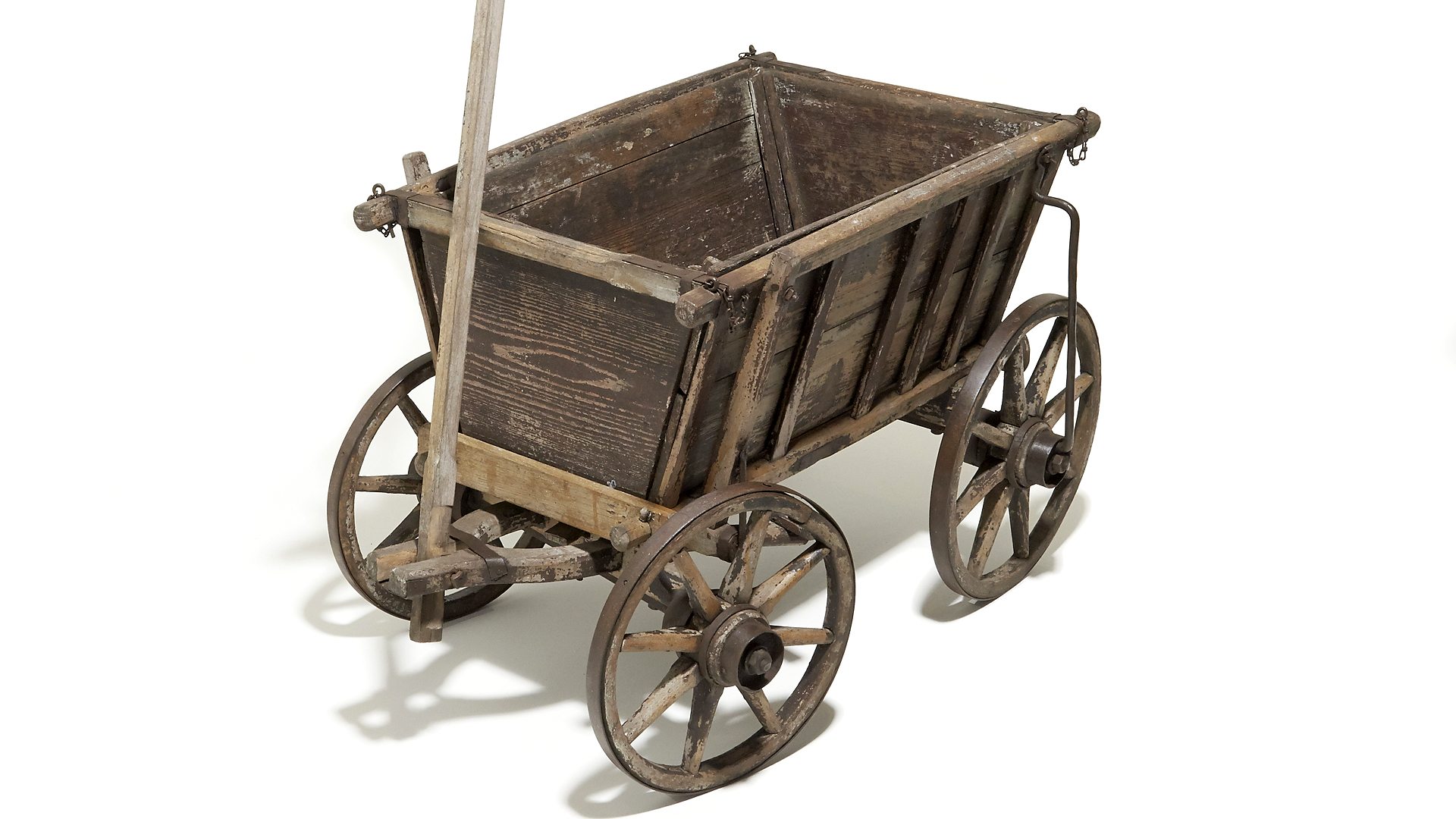
Our preparations for escape were complicated. The few belongings that we had gradually accumulated needed to be sent ahead in parcels. This was not officially allowed, but we had found one guard at the station who would turn a blind eye and post them. If he was not on duty, which was often the case, we just had to turn back home again with our wooden cart laden with parcels, and try our luck another day.

Just such a cart is an iconic image of the refugee exodus, displayed in museums like the excellent Forum of Contemporary History in Leipzig:
Finally we set off on the hazardous journey across the Harz mountains, by the same route that my father had taken. I was now 13. With the help of a guide, a woman who knew which route to take and was familiar with the schedules of the border guards, we made our way with rucksacks on our backs, my brother and I clutching our violins. At the time there was still movement in both directions, but since trains were rigorously searched at the border, a whole family travelling west would have aroused suspicion. So we got off one stop before the terminus and climbed down the railway embankment. Crouching at the bottom of it, we waited anxiously until the train set off again. It was already dark. Then started a long and difficult walk. Our nerves at breaking point, no-one spoke. We watched our footsteps, carefully avoiding the dry leaves on the ground. Occasionally there would be a rustle—our heartbeats racing, we all stopped and held our breath. But often it was just someone returning from the West, going in the opposite direction. The journey seemed endless, but at last we made it!

So after a trek of two days they once again found refuge, reunited with Hildi’s father in Detmold.

Given Hildi’s later immersion in Bach, her trek has an interesting parallel with Bach’s Long March from Thuringia to Lübeck in 1705 to seek his hero Buxtehude—in very different circumstances, and even further, over several months.

Meanwhile in rural China, the Li family Daoists, having mostly survived the Japanese occupation, were soon plunged into civil war and the turmoil and violence of “Liberation”—somehow continuing to provide ritual services for their local community throughout the whole period. All over the world convulsions continued in the wake of war, with over a million dying in the Partition of India.

Nearly four decades later, as we sat together in orchestras playing Bach and Handel, I had no inkling how very stressful Hildi’s early experiences were. In the next instalment we follow her from Westphalia to Zurich, and then on to London, as she embarks on a life of music; and we reflect further on refuge and memory.


[1] Sic: the metaphor is from archery, not fiddles, of course.
[2] Whatever the Daily Mail, or the Putrid Tang Emanating from the White House, may tell us. Among many documentaries on the current plight of refugees, the BBC series Exodus is remarkable.
[3] Cf. Hester Vaizey, Surviving Hitler’s war: family life in Germany, 1939–48.
[4] Savage continent: Europe in the aftermath of World War II, pp.xiii–xiv; I find this book a most instructive and sobering introduction to the period right across Europe. I can barely scratch the surface of the vast literature on the immediate post-war period. Other accessible books include Giles MacDonogh, After the Reich, and Frederick Taylor, Exorcizing Hitler—where the appalling situations in Silesia and Thuringia can also be pursued. Moving and detailed is Gitta Sereny, The German trauma.
[5] For the desperate conditions of the PoWs, see MacDonogh, ch.15; Taylor, pp.173–87; Lowe, ch.11.
[6] See also MacGregor, Germany: memories of a nation, ch.27.
[7] MacDonogh, pp.344–57; Taylor, chs. 10–12, and Epilogue (for the Soviet zone, see pp.323–31, 360–61).
A stunning keyboard break

The work of Susan McClaryboth for its ideas and its lively language, has prompted such a major “disciplinary explosion” in musicology, with her iconic book Feminine endings. Her ideas, “received as radical—even outrageous—within musicology, only brought to music studies the kind of projects that had long since become standard fare in most other areas of the humanities” (p.ix).

McClary’s work shouldn’t be reduced to soundbites, but alongside astute gender-based discussions of a broad range of music from Monteverdi to Madonna, Carmen to Laurie Anderson, many passages have both inspired and shocked—her detailed unpackings of patriarchal assumptions, such as on Beethoven (“assaultive pelvic pounding… and sexual violence “), or the “erotic friction” of Italian trio sonatas (“two equal voices rub up against each other, pressing into dissonances that resolve only into yet other knots, reaching satiety only at conclusions”—an interactive texture that was later displaced).

Meanwhile, listening again to Brandenburg 5 recently after my post on Bach’s fawning letter to the concerto’s churlish recipient, I was reminded of one of McClary’s most famous accounts, from her 1987 article “The blasphemy of talking politics during Bach year”.

Somehow I long took for granted Bach’s “frenzied” harpsichord solo near the end of the 1st movement—McClary observes how our senses are dulled by familiarity with later romantic concertos (and anyway we fiddlers tend to think it’s none of our business—we know our place, which is precisely McClary’s argument). So I’d like to run through the way she unpacks it; whatever you think, she’s always stimulating (see also this post).

She begins by summarizing important background, her constant theme:

At the very moment that music was beginning to be produced for a mass bourgeois audience, that audience sought to legitimize its artifacts by grounding them in the “certainty” of another, presumably more absolute realm—rather than in terms of its own social tastes and values.
[…]
From very early times up to and including the present, there has been a strain of Western culture that accounts for music in non-social, implicitly metaphysical terms. But parallel with that strain (and also from earliest times) is another which regards music as essentially a human, socially-grounded, socially altered construct. Most polemical battles in the history of music theory and criticism involve the irreconcilable confrontation of these two positions.

Inspired by Attali’s book Noise, McClary seeks “the tension between order (indeed, competing claims to legitimate order) and deviation —if not outright violence…” Reminding us of harmonic music’s underlying assumptions of goal-attainment (“playing with (teasing and postponing, gratifying) the expectation of imminent closure”), she plunges into the 1st movement of Brandenburg 5.

She notes the rise of the concerto form, where “the soloist is an virtuosic individualist who flaunts the collectivity of the large ensemble”. […] “It begins as if it is going to be a concerto for solo flute and violin, but it soon becomes clear that “there is a darkhorse competitor for the role of soloist: the harpsichord”. Its normal “service role” at the time seems self-effacing, but “the harpsichordist is often a Svengali or puppet master who works the strings from behind the keyboard. Here s/he “creates a ‘Revenge of the continuo player’: the harpsichord begins in its rightful, traditional, supporting norm-articulating role but then gradually emerges to shove everyone else […] out of the way for one of the most outlandish displays in music history.”

The harpsichord, which first serves as continuo support, then begins to compete with the soloists for attention, and finally overthrows the other forces in a kind of hijacking of the piece. […] The ritornello seems to know how to deal with the more well-behaved soloists, how to appropriate, absorb, and contain their energy.” But Bach now “composes the parts of the ensemble, flute, and violin to make it appear that their piece has been violently derailed. They drop out inconclusively, one after another, exactly in the way an orchestra would do if one of its members started making up a new piece in the middle of a performance. Their parts no longer make sense. They fall silent in the face of this affront from the ensemble’s lackey, and all expectations for orderly reconciliation and harmonic closure are suspended.
[…]
It unleashes elements of chaos, irrationality, and noise until finally it blurs almost entirely the sense of key, meter, and form upon which 18th century style depends.

McClary concludes provocatively:

 The usual nice, tight fit between the social norm, as represented by the convention of concerto procedure, and specific content is here highly problematized. Certainly social order and freedom are possible, but apparently only so long as the individuals in question—like the sweet-tempered flute and violin—abide by the rules and permit themselves to be appropriated. What happens when a genuine deviant (and one from the ensemble’s service staff yet!) declares itself a genius unrestrained by convention, and takes over? We readily identify with the self-appointed protagonist’s adventure (its storming of the Bastille, if you will), and at the same time fear for what might happen as a result of the suspension of traditional authority. […] The possibility of virtual social overthrow, and the violence implied by such overthrow, is suggested in the movement, and the reconciliation of individual and social hierarchy at the end— while welcome—may seem largely motivated by convention. To pull this dramatization back within the limits of self-contained structure and order may seem to avoid the dilemma, but it does so at the expense of silencing the piece. For Bach is here enacting the exhilaration as well as the risks of upward mobility, the simultaneous desire for and resistance of concession to social harmony.

McClary’s work is akin to ethnomusicology (“If I can no longer privilege any one tradition, I find myself perpetually in awe of the countless ways societies have devised for articulating their most basic beliefs through the medium of sound”), and its class and gender implications cry out to be applied to Chinese musical cultures (I made a preliminary and rather unsuccessful attempt in my “Living early composition: an appreciation of Chinese shawm melody”).

With Bach’s solo, it’s easy to think “that’s just how it goes”, but whatever your “class standpoint” (阶级立场), if you listen to it afresh, every few bars you think, WTF??? I know the analogy with jazz can be overdone, but even jazz solos, however virtuosic, also generally fit within fixed (and democratic?) parameters—except when someone like Coltrane goes off on an interminable fantasy. In its wackiness Bach’s solo reminds me of a pianist like Hiromi—or a Hendrix guitar solo.

It makes a suitably awe-inspiring opening to The chronicle of Anna Magdalena Bach, all the more exhilarating in Gustav Leonhardt’s restrained rendition—here’s a colorized version:

For my own meretricious speculations on socio-political elements in the reversal of colours on the piano keyboard, see Black and white.

* * *

And now for something completely different: Glenn Gould, 1962—don’t worry about the rest of it, just listen from 8.06ish:

Reception history and performance practice are always intriguing. Little is known of any performances in Bach’s lifetime, but it looks as if the concerto may not have been played again, at least in public, until 1853. Like Rudolf Serkin’s 1935 recording with the Busch Chamber Players, Alfred Cortot’s 1932 version (still on piano) is more genteel than manic:

And here’s Furtwängler in 1950 (cadenza from 8.54ish)—praised by Richard Taruskin, no less:

But performances only became more common with the harpsichord revival of the mid-20th century. So now, despite a rearguard action to rehabilitate the Golden Age before HIP (see Alternative Bach, and Playing with history), modern ears may find such early versions heavy going.

Richard Egarr always offers wacky insights (from 6.30ish):

Having blown everyone away, the harpsichordist gives a little signal of the return to normality (“relents and politely (ironically?) permits the ensemble to re-enter”) so that they can pick themselves off the floor to come in with the ritornello that innocently began the whole trip.

I like to think of the cadenza as just one instance of an improvisation that Bach chose to notate, illustrating the kind of fantasies in which the player might care to indulge, like Messe de la Pentacôte or Rhapsody in blue.

Sure, one can’t really cheer aloud at every manic new turn, but I still think the only possible reaction of both band and audience, whether now or in Bach’s lifetime, would be akin to that of Billie Holiday as she exults in the succession of amazing solos her band offer up to her.

Bach and patronage

Following the riches of Bach on Radio 3 and my recent survey:

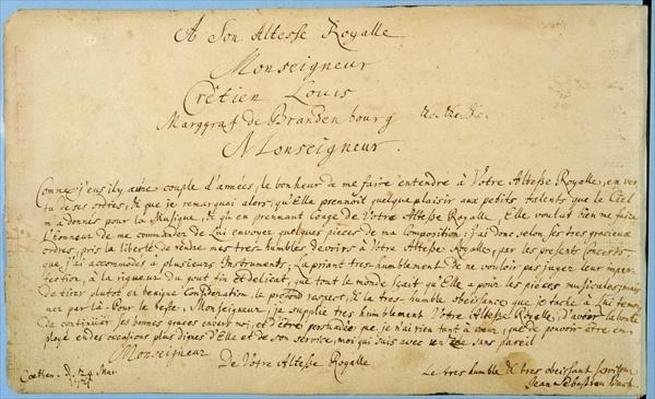
Bach’s letters to his patrons are a sad vignette on the sordid realities of working for them. Along with his unsolicited gift of the Brandenburg concertos to the Margrave of Brandenburg [“What does that even mean?”], he wrote this covering letter (in French, courtly language of the time), dated 24th March 1721:

As I had the good fortune a few years ago to be heard by Your Royal Highness, at Your Highness’s commands, and as I noticed then that Your Highness took some pleasure in the little talents which Heaven has given me for Music, and as in taking Leave of Your Royal Highness, Your Highness deigned to honour me with the command to send Your Highness some pieces of my Composition: I have in accordance with Your Highness’s most gracious orders taken the liberty of rendering my most humble duty to Your Royal Highness with the present Concertos, which I have adapted to several instruments; begging Your Highness most humbly not to judge their imperfection with the rigor of that discriminating and sensitive taste, which everyone knows Him to have for musical works, but rather to take into benign Consideration the profound respect and the most humble obedience which I thus attempt to show Him. For the rest, Sire, I beg Your Royal Highness very humbly to have the goodness to continue Your Highness’s greatest favours towards me, and to be assured that nothing is so close to my heart as the wish that I may be employed on occasions more worthy of Your Royal Highness and of Your Highness’s service—I who, without an equal in zeal, am, Sire, your Royal Highness’s most humble and obedient servant.

Sure, we have to read such a letter in the context of the day, but it’s hard to beat for brown-nosing. Servants indeed— to cite Dennis in Monty Python and the Holy Grail,

… exploiting the workers! By hanging on to outdated imperialist dogma which perpetuates the economic and social differences in our society… We’re living in a dictatorship! A self-perpetuating autocracy, in which the working classes…

Didn’t know we had a king. I thought we were an autonomous collective.

And there’s no evidence that the Margrave even wrote back. Pah! I hope Bach told him where to stick it. He might have well as sent the concertos to Tweety McTangerine.

Bach had been happy at Cöthen, where Prince Leopold was an exceptionally musical patron—Bach’s need to seek new employment has been blamed on the Prince’s “airhead” new wife (typical). With the Margrave deaf to his appeal, Bach was soon to find a permanent haven in Leipzig—and the rest is geography. Even there his struggles with patrons continued.

Thing is, despite all such routine tedious scramblings, Bach never stopped creating a wealth of music that stands as a rebuke to all mundane concerns.

And so in imperial China—right down to today, as a chain of fawning operates from grass-roots performers to regional cadres to central pundits. Only with less magical results.

I trust I shall have the honour to remain your faithful and humble servant

Dr S. Jones (available for weddings, bar mitzvahs, and screenings of my film Li Manshan: portrait of a folk Daoist)

A Bach retrospective

Some might say that the only good thing about Christmas is that one can bask in BachWhatever your reasons for exploring this blog, I can’t help regarding his music as an essential basis of our cultural experience!

Apart from all the musical riches to be found elsewhere online (not lest Radio 3, like here), I’m revisiting my blogposts, so here are some highlights from the extensive Bach tag in the sidebar—mediated by my, um, eccentric take:

But as with Indian raga or Daoist vocal liturgy and shengguan suites, Bach’s ouevre is an inexhaustible treasury… For us now, I mean—not that’s it’s “universal” or “eternal”…

The Long March, Bach and Daoist style

In 1705 the 20-year-old Johann Sebastian Bach set off from his home in Arnstadt to walk 250 miles to Lübeck, there to meet his hero, the composer and organist Dietrich Buxtehude.

Bach is compulsory Radio 3 listening over Christmas, and apart from yet another excursion on Composer of the week, Horatio Clare’s series Bach walks makes fine slow listening, taking the walk in five episodes, punctuated by musical snippets that seem all the more miraculous. And it stands in tranquil contrast to the hectic claustrophic life that he was to lead through the years of his greatest creativity in Leipzig.

What makes such a modern retracing of Bach’s steps so thoughtful is all the social detail that can be incorporated, along with Clare’s reflections on the present landscape. Bach had actually walked a similar distance when he was 15 to enroll in St. Michael’s School in Lüneburg

By now you won’t be surprised to learn that this reminds me of the Li family Daoists.

Early-18th-century Germany was more advanced in transportation than rural China in the 1930s, or even the 1980s. And by contrast with many more adventurous composers of the day, Bach spent most of his career employed in a rather small radius within Thuringia and Saxony.

From my Daoist priests of the Li family (pp.12–13):

Since ancient times, elite Daoists travelled widely over China to famous temples and religious mountains, seeking the wisdom of other sages and propagating new revelations. One such master was Kou Qianzhi (365–448), who served the court of the Northern Wei dynasty at their capital Pingcheng (modern Datong), and who is often wheeled out by scholars as an instance of the illustrious ancestry of Daoist ritual in north Shanxi. Still today, temple Daoist priests commonly spend periods “cloud wandering” around the main urban and mountain temples.

By contrast, household Daoists are active within a small radius (see map here). Even those who spent their youth as priests in temples before the 1949 Liberation did so only locally—like several boys in Upper Yinshan village in nearby Tianzhen county, who learned their ritual skills in a temple just further east. Occasionally the Li band is invited to do rituals further afield—just east in Hebei or north in Inner Mongolia. Li Qing and the elders used to walk for a whole day to do Thanking the Earth rituals for patrons in Inner Mongolia, because around eighty percent of the Han Chinese population there had migrated from Yanggao, some of whom were quite affluent. But the main area of their work is defined both by walking distances and by the availability of Daoists elsewhere—north around the county-town, west in Datong county, and east in Tianzhen. So even now, with motor-bikes and cars, most of their ritual business is still in the districts of Shizitun, Houying, Baideng, and Pansi. They work quite often just further south in the districts of Gucheng and Lower Shenyu, and sometimes in Dongxiaocun district and in the west of Tianzhen county. But they rarely perform rituals in west Yanggao, or further north in North Xutun district or around the county-town where other groups of Daoists are available.

(pp.154–5):

Until bicycles became generally available from around 1980, people had to walk everywhere, or go by ox-cart, equally slow. Li Manshan recalls wryly, “We didn’t even have Chinese carts (tuche), let alone foreign ones (yangche)!” Occasional visits to the county-town on foot took over three hours. Li Manshan went occasionally before the Cultural Revolution; he recalls walking there with his aunt in 1954 to watch the grand Offering Tribute (xiangong) parade on the 24th of the 6th moon, which was by then a purely secular event.

cart

Horse-cart on the way to Gaoluo, 1989.

For a funeral twenty-five Chinese li away, walking at roughly ten li an hour, the Daoists had to set off at 4am. The hill villages to the east were not so far, but the climb took longer—when Wu Mei was learning with Li Qing in the late 1980s it took him a whole hour to walk from his home in Renjiayao, only five li away. Most gigs might be in the nearby villages, but for longer journeys the more elderly Daoists might send their fitter younger sons and disciples. When the Daoists were invited for funerals a long walk away, there was no need to get the Lis to determine the date on the death, or decorate the coffin—there were men available locally for such tasks.

Until the 1980s when there was a death, the son would walk to Li Qing’s house to invite him to do the funeral—and was then quite likely to learn that he was doing a funeral in another village and to have to make another trek by foot there. From 1980 to 1990 he could make this search by bicycle, and then perhaps by motor-bike; since around 2002 he can just call up Li Manshan on his mobile.

I was amazed to read that bicycles were already common in some central Shanxi villages by the 1930s [1] —perhaps a hint of how much poorer Yanggao was than areas further south. In the countryside here, most people only began riding bicycles around 1978; before that only some village cadres had them. Li Qing rode a Red Flag bike from around 1981. With a bike costing around 150 kuai, and a Daoist earning 6 kuai per gig, or over 70 kuai a month, one bike cost at least two months’ earnings. In Baideng town, Daoist Wang Xin set up a little stall mending bicycles.

Actually, bicycles speeded up mobility only slightly; in the countryside there was still nothing quite resembling a road, the tracks being deeply rutted until transport arteries began to improve significantly since around 2003. And neither bicycles nor motor-bikes have significantly expanded their radius of activity; they continue to work mainly within a small area.

I also reflect on walking within a funeral (pp.27–8):

In order to allow for a suitably lengthy and imposing procession, the house chosen for the scripture hall should be at a considerable distance from the soul hall where the rituals are performed. Indeed, since the scripture hall is on average around half a kilometer away, they potentially have to walk—playing all the while—seven kilometres a day for the seven routine visits alone, let alone other processions from the scripture hall to the soul hall before leading the kin to the sites for the other public rituals, and again next day for the procession towards the grave. Apart from anything else, this is good exercise.

IMG_2794 - Version 2

Over the day the Daoists make seven processions from scripture hall to soul hall and back, as well as processions to the other ritual sites.

But once at a funeral in nearby Yangyuan county I was surprised to find the scripture hall very near the soul hall—and this turns out to be an older custom, so that the Daoists would be on hand to respond promptly for the many rituals once needed. Since the 1980s there is less need for this, and Li Manshan observes that the recent distance also serves to marginalize them. But it is also welcome so they can escape from the din of pop and get some peace.

[1] Harrison, The man awakened from dreams, p.156. Cf. Friedman, Pickowicz, and Selden, Revolution, reform, and resistance in village China, p.228; Harrison, The missionary’s curse, p.145.

Recording and editing

After our rendition of The Feuchtwang Variations à la chinoise at Stephan’s party—which surprised us as much as the guests, even without kazoo—we wanted to make a separate recording, but we had few illusions about how it could turn out. However modest our remit (it would be too ambitious to try and edit within movements, and we didn’t do too many takes), even the minimal editing that Rowan undertook was still a time-consuming process.

Typical exchange during rehearsal:

Me: Can you give me a lovely lingering arpeggio on that first chord, like a theorbo?
Rowan: No.

For me, it recalls all those orchestral recording sessions through the 80s and 90s—with section leaders crowding into the box to make notes and report back, doing endless retakes of a single chord, with the editor then taking months to compile a version that was a total fabrication. Of course, live recordings are far more satisfactory, if we can wean ourselves off glossy perfection—even then, we tended to do a couple of patching sessions after the concert.

It also reminds me of a comment from—you guessed it—Alan Bennett, in his 1990 diaries, on working with the Delme string quartet in recording the soundtrack for his Proust film:

27 June. […] Striking about the musicians is their total absence of self-importance. They play a passage, listen to it back, then give each other notes, and run over sections again. George Fenton, who is coordinating the music, also chips in, but he’s a musician. David H., the director, chips in, but he isn’t a musician, just knows what atmosphere he wants at various points in the film. In the finish even I chip in, just because I know what I like. The musicians nod and listen, try out a few bars here and there, then settle down and have another go. Now one could never do this with actors. No actor would tolerate a fellow performer who ventured to comment on what he or she was doing—comment of that sort coming solely from the director, and even then it has to be carefully packaged and seasoned with plenty of love and appreciation.  Whereas these players, all of them first-class, seem happy to listen to the views of anyone if it results in them doing a better job.
[…] The readiness of players in a string quartet to absorb criticism from their colleagues has been noted by doctors, and the BMA video was made to be shown to businessmen as a model for them to emulate. Perhaps it should be shown to Mrs Thatcher.

Such humility is a trait that musicians might not recognise in themselves; anyway, AB was lucky to work with a quartet, as orchestral recording sessions are (inevitably) far more hierarchical, with a clear pecking order (giving rise to maestro-baiting). Still, the contrast with actors (and politicians) rings true.

The Feuchtwang Variations

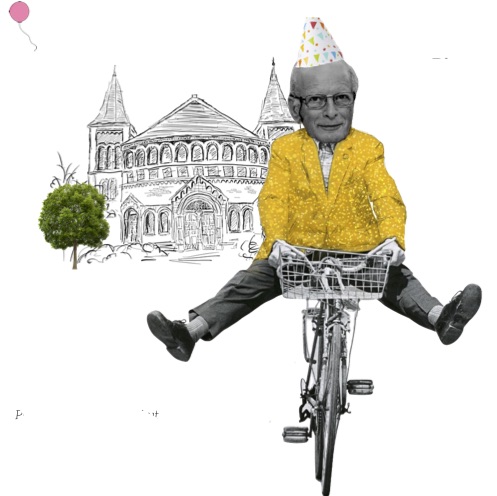
The wise and infinitely supportive Stephan Feuchtwang continues to inspire generations of anthropologists in China and worldwide (see also here) with his work on Chinese popular religion. He has just celebrated his 80th birthday—and so do we all!

Stephan's invitation edited

Design: Lotte van Hulst.

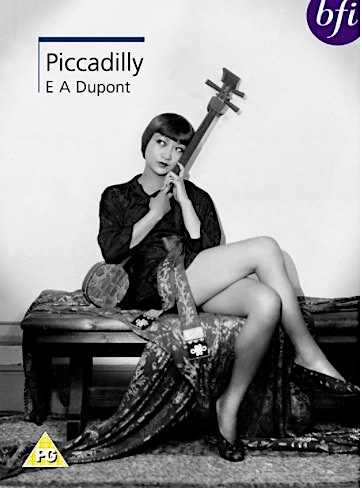
For the party at the Tabernacle (a great venue, and, um, marker of the changing territorial identities of West London religious life!) his wonderful family played some popular and moving musical items, with the assembled guests on kazoos (anyone have a funky collective noun for kazoos in English, or measure word in Chinese?). And following my little foray into a world-music version of Bach earlier this year, we did a warmup act as a heartfelt tribute to Stephan, essaying a little medley from the Goldberg Variations—with me on erhu (one of many types of Chinese fiddles) and Rowan Pease (unsung Lucy Worsley of East Asian popular culture, currently embroiled in the China Quarterly struggle for academic freedom) on sanxian banjo (or should I say friction chordophone and plucked lute?) [Nah, give it a restThe Plain People of Ireland].

Wong

Not Rowan, not playing the sanxian.

That makes a total of five strings—and all without a safety net. Since Bach never wrote for either piano or sax (shades of WWJD), if his music can sound great (to us) on those instruments, then why not erhu and sanxian, eh. We haven’t tried adding a kazoo yet, though. As I said in my intro:

Just imagine that the Italian missionaries, like Pedrini, [1] at the court of the Qianlong emperor in 18th-century Beijing had invited Bach for a sabbatical—and indeed Stephan, although that was perhaps a little before even his time… So we’re going to essay a little medley from what should now be known as The Feuchtwang Variations[2]

Since among Stephan’s many talents he is also a viola player (“Not a Lot of People Know That”), I can avail myself of a couple of the muso’s classic excuses:

It was in tune when I bought it…
and
I didn’t really study any place, I just sort of… picked it up… [for how I picked up the erhu, see under the fascinating story of Ray Man]

[studiously] After intensive research on the performance practice of both Leipzig and Beijing in the 1740s, I can now say with some certainty that…  it wouldn’t have sounded like this.
[Cf. John Wilbraham’s remark.]

If you enjoy this half as much as we do, then we will have enjoyed it twice as much as you.

See also Song of suffering.

Framed by the Aria (itself infinitely enchanting—molten, ethereal, suspended in time), we played the first variation (blimey), then numbers 18 and 25—a perfect selection, eh. Short of recording daily until Steph’s 90th birthday, we’re never going to play it to our satisfaction (editing this is a similar challenge to editing one of my voiceovers), so meanwhile here’s an almost-recognizable attempt, just to give you a flavour—It’s the Thought that Counts. Just think yourselves lucky we didn’t do the repeats. Take It Away (and don’t bring it back):

Stephen Jones (erhu), Rowan Pease (sanxian, vocals).
Recorded in Maidenhead, 14th November 2017.

“They said it couldn’t be done”—and they were right! (Cf. Bob Monkhouse).

Just to make our chinoiserie version sound a little less banal, try the opening of the Aria on Lego harpischord, and Pachelbel’s Canon on rubber chicken—differently charming…

Li Qishan band 2001
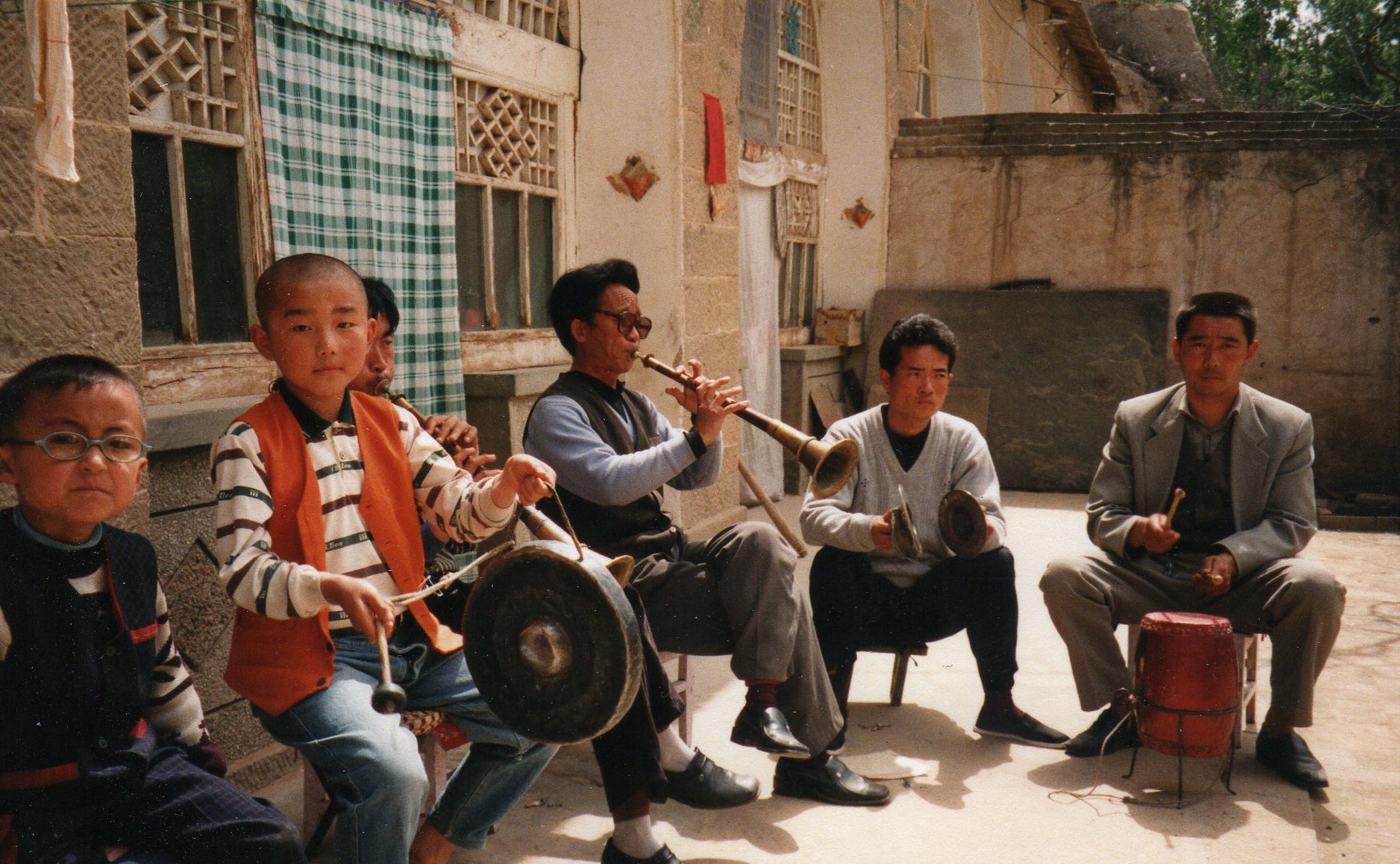
Li Qishan’s family shawm band, Shaanbei 2001.

Never having played the Goldberg Variations on a keyboard, I (like millions of others) am deeply familiar with it through recordings—notably that of the iconic Glenn Gould, of course. So at the age of 286 I’m almost in the position of a young player in a Chinese family shawm band, who begins to play the melodies on shawm after many years of aural experience (and let’s just be grateful I didn’t do an arrangement for large Shaanbei shawms—yet). Similarly, I hardly needed to consult Bach’s notation, except out of curiosity. At the same time, anyone playing the piece is inevitably conditioned by the experience of hearing Glenn Gould’s version.

We played the medley in F rather than G—less as a result of all my erudite research into 1740s’ pitch standards (not), but just because I like a lower tuning on the erhu.

Bach party

Blending with invisible singers to left of picture. Stephan in red on left. Photo: Cordelia Pegge.

For the ecstatic Variation 18 we recruited a backing band consisting of Stephan’s daughters Rachel and Anna, along with Harriet Evans (outstanding scholar of the status of women in China). I arranged some personal lyrics, often in a kind of verbal hocket, incorporating (in stave 3) anthropology (with a little jest on the challenge, for some of us, of mastering the abstruse nature of Stephan’s theory!), (in stave 4) his dear wife Miranda, and his love of cycling:

Goldberg Var 18 in G

For the recording, without vocal backup, Rowan and I take the upper parts wordlessly, in more ethereal vein. Do feel free to sing along with a partner of your choice (cf. the karaoke versions of Daoist ritual percussion in my film, from 24.09).

And then the slow and intense minor-key Variation 25 is just amazing. Here Rowan’s singing supplies further harmonic intensity, evoking Glenn Gould’s own occasional inadvertent vocals. [3] And with the sustained sound of the erhu, and all my one-finger chromatic slides (1st finger on the way up, 4th finger on the way down), it sounds even better—or rather, it could do in the right hands. Not unlike a Chinese ondes martenot—trad keyboards just can’t compete with the vocal quality of bowed instruments.

And OMG, how about this (for the theremin, click here):

Sure, our version goes a tad faster—again, not resulting from any holier-than-thou baroque authenticity, but because it helps the whole harmonic logic.

Among many fine harpsichord versions, here’s Scott Ross:

Returning briefly to the modern piano—Bach was of course performing and composing modern music, and maybe what appeals to me in Joanna MacGregor’s version is that it seems tastefully rooted in her whole experience of our own contemporary piano sounds. Here’s the hallucinatory final repeat of the Aria:

Still, Bach is amazing on tuned percussion too, like this:

It can also sound wonderful as a string trio:

And now I’m keen to hear Rachel Podger’s new arrangement with Chad Kelly:

For Uri Caine’s stuttering variation, see here.

All this wealth of divine music I offer in tribute to the great Professor Feuchtwang!

[1] For missionaries at the Qing court, see here. “They come over ‘ere, with their fancy harpsichords…”
[2] Maybe I can concoct a couple of Chinese musicians in 1740s’ Leipzig from the Bach archives. If north African wind players were active at European courts of the day, then why not… International cultural exchange, eh. Note also Bach and Daoist ritual—not least Li Manshan’s classic remark.
[3] This encomium could come in handy for Rowan’s CV: “Less irritating than Glenn Gould”—Dr S. Jones.

New Bach for fiddlers!

Mama’s got a brand new bag yeah
She’s gonna groove it the whole night long baby

I’ve noted instrumental versatility in Bach’s day, and my own delight in playing the cello suites on violin (see also here, and here)—when some of the solo violin suites and partitas are either over-familiar or lastingly and ridiculously unplayable, unless you’re Andrew Manze or Rachel Podger. Which I’m not.

While Bach didn’t specify the solo instrument for the Benedictus of the B minor mass, it’s more often played on flute than on violin. Anyway, I’m thrilled to find a new Bach solo piece to play on violin—the exquisite flute partita, whose original function (despite the usual splendid musicological sleuthing—good old watermarks, eh!) seems unclear (like I care). Its opening Allemande [note to self: blimey, “Allemande seems to subsume a range of styles?] seems rather similar to the final movement of the A minor violin sonata, which I’ve been playing with varying degrees of ineptitude for fifty years. Whereas some pieces have a lasting association with the ideals of our teenage years, novelty can also go a long way: never mind ridding ourselves of the patina of romantic performance practice, it’s hard enough divesting myself of my own personal history of playing Bach as a teenager.

So up to now, whenever I need a preludial solo in A minor (and let’s face it, who doesn’t, sometimes?), then I love playing the opening of the second cello suite—which comes out in A minor on the fiddle. I even played it for my father’s funeral, which was virtually the only thing I ever did for him [bit late—Ed.].

Such instrumental borrowings would have been routine in Bach’s time, but I haven’t heard any fiddlers trying it out. As to the flute partita, a baroque instrument trumps the usual virtuosity of modern flautists:

I like this performance on recorder, with additional Prelude and Gigue:

This version on archlute has an introspection quite typical of the Allemande:

That’s how I like it—emboldened by the Feuchtwang variations, I’m learning it on erhu, whose timbre is also suitably other-worldly. * Meanwhile, I keep practising it on violin.

* Subject to usual Terms and Conditions. Management accepts no responsibility etc. Intonation, rhythm, string-crossings not included etc.

Bach and the oboe

My love of the oboe is related partly to immersing myself in Wu Mei‘s exquisite decorations on the guanzi, dovetailing with the vocal liturgy of Daoist ritual (my film, and playlist)—as well as in the ear-scouring shawm bands of north China and other double-reed traditions around the world. But it’s also to do with my long experience of playing Bach Passions and cantatas.

In Bach’s Leipzig, as in 1940s’ Yanggao, the standard of wind playing must have been high. But as usual, accustomed as we are to wallowing in soupy French film music, we may hear such music with ears different from those of Leipzig congregations. For them, the wider soundscape was the civic stadtpfeifer bands. As in China, such wind bands were first used in the army, and later also by courts, playing for ceremonies, processions, weddings and funerals, and so on.

Again like north Chinese ritual specialists, Bach’s oboists had to play several types, each suitable for different keys; and they doubled on other instruments such as violin. Bach’s long-serving oboist Johann Caspar Gleditsch must have been a fine player (for John Eliot Gardiner’s ambitious connections with world shawms, see under The ritual calendar).

Not forgetting the oboe and violin concerto, here’s a little playlist (full list here):

Wo zwei und drei versammlet from Cantata 42 Am abend aber desselbigen Sabbats:

And the end of the Christmas oratorio, second video from 59.06 (do listen to the following quartet too, and right to the end!).

Quia respexit from the Magnificat:

But alongside such melodic genius, I also love the sustained unison notes of the two oboes in the Suscepit Israel of the Magnificat:

Going to hear Bach every Sunday in church must have been like the Duke Ellington band having a 27-year residency at Ronnie Scott’s. And the congregation rarely heard the same piece twice—kind of “one-off performance”, as the Chinese might say. For more, see under The ritual calendar: cycles and seasons.

Mein Gott

I’ve already offered one Crucifixion joke, and you can find more online. The devout may wish to look away now.

Musos often tell this one, a true story about a performance of the Matthew Passion in Bristol, and an extreme instance of corpsing. I’ll refrain from naming the performers, though I do rather feel they deserve to be immortalised rather than crucified (not a choice vouchsafed to Our Lord).

As the Jesus du jour (fortunately this was a scratch gig) wailed an anguished cry to his Father:

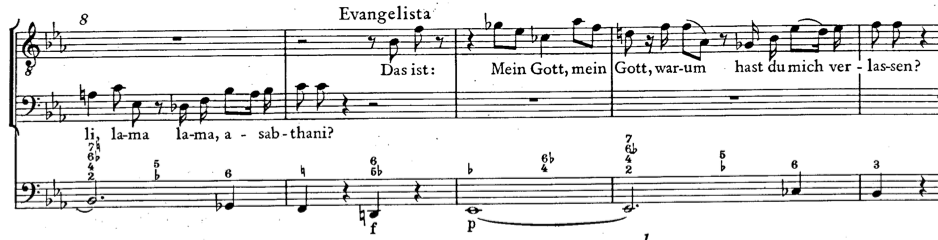
Eli, Eli, lama asabthani?

on declaiming the first cry of “Eli“, he spontaneously essayed an extra dramatic flourish by giving a resounding stamp with his foot. Finding the effect rather pleasing, he followed it up with another stamp on the second “Eli“.

This already had the other soloists, seated nearby, struggling to hold it together— it was even funnier considering that Jesus, up there on the cross, wasn’t exactly in a position to stamp his foot. But when it came to the evangelist’s turn to translate Jesus’s words (That is: “My God, my God, why have you forsaken me?”) to the same melody, for scrupulous accuracy of live reportage what else could he do except stamp again in his two equivalent cries of “Mein Gott“? The performers now totally lost it.
Lama 1

Lama 2

It strikes me that this may be even funnier the more deeply we engage with the anguish of the scene.

For good (or bad) measure, an encore of Always look on the bright side of life seems appropriate:

Note also Jesus of Benfica. For more cognitive dissonance, see A deflated pupil, and Mahler swings!.

At such moments, it behoves me to stress that the Bach Passions are among the great monuments of Western civilisation…

Passion at the Proms

Of course the Bach Passions are a regular subject of imaginative modern re-creations (Jonathan Miller, Sellars–Rattle, ENO, and so on); but the climax of the Proms Reformation Day on Sunday, John Butt’s version of the John Passion, in a certain liturgical context, was special. Note also his book Playing with history.

Like Daoist ritual (see many posts on this blog, including my starter page on Bach!), Passions in Thuringia for Good Friday vespers varied regionally, and evolved. Of course we now attend them in “concerts”. The Albert Hall in 2017 is clearly not the Nikolaikirche in 1739—although the audience/congregation was apparently of a similar size. But having read Taruskin, and Butt’s own astute views on the HIP movement, surely we can welcome such renditions; it’s a stimulating way for us (“miserable sinners”) to experience the work anew.

Bach revised the John Passion several times; Butt recreated an “ideal” sequence based on the 1739 version (which was never actually performed!), directing with an unaffected schoolmasterly air that indeed evoked Bach the Cantor himself (cf. Robert Levin’s incarnation of Mozart).

As in Bach’s Leipzig, both parts of the Passion opened and closed with organ music and sung chorales. By contrast with the concert version (finely evoked by John Eliot Gardiner, Music in the castle of heaven, p.343), when the orchestra plunged into the anguished dissonances of the first chorus of Bach’s music, it makes you think how a congregation still unaccustomed to their new Cantor’s style, yet unprepared (though not quite—see Gardiner, pp.347–9) for the constant flow of extraordinary creativity that they were to enjoy for the next twenty-seven years, must have thought (in 18th-century Thuringian), “WTF?!” (cf. The ritual calendar).

The focal point of the Good Friday Vespers in Leipzig was actually the long sermon in between the two parts of the Passion music, which at the Albert Hall was thankfully replaced by an interval (glass of wine, ice-cream…). I wonder if a talk by someone like Malala might be a suitable further exploration—since many in the audience will experience the Passion deeply despite being less than devout religiously.

Do listen to John Butt’s remarks in the interval of the TV broadcast too (from 53.10)—and I like the analogy of Richard Coles (nay, “the Reverend Richard Coles”—clever choice of presenter, BBC!) with the mass singing at Cardiff Arms Park (more ritual and sport).

Given the rowdy behaviour of Leipzig congregations in Bach’s day, perhaps the Prom audience should have been a tad less attentive?! After we had all joined in singing the chorale O lamb of God, applause at the interval felt a bit weird, but it was entirely natural as a novel response to the life-affirming ending—after the beautiful motet Ecce quomodo moritur by Jacobus Handl (1550–91!), a blessing and response, Bach’s own organ chorale prelude Nun danket alle Gott, and a final rousing rendition of Now thank we all our God from the whole hall (a tune, suitably, that most members of the “audience” would know), accompanied by organ at exhilarating full throttle—all confirming joy at atonement.

By comparison, the great Passion performances of recent decades may seem more immaculate and micro-managed (“Chanel No.5″), but they remain deeply moving—like Gardiner’s version (also from the Proms, with the superlative Mark Padmore (note this roundup). But this performance had a Lutheran simplicity that was differently moving.

Butt also notes “the different levels of singing cultivated in the church and school environments of Bach’s time,” from basic to more advanced pupils and indeed the congregation (again, cf. Butt’s interval remarks), so that the liturgy accommodated the whole community:

What we hear in concert performance is only the tip of a much larger iceberg, a culture of singing and participation that can only be fleetingly evoked in a modern performance.

This reminds me of the different levels of accomplishment within (you guessed it) a Daoist ritual group:

This dilution of personnel is a recent change, but before 1949 too, Daoist groups might recruit some extra percussionists who would gradually pick up the basic of the vocal liturgy. The substantial group of Li Qing’s senior colleagues from the 1930s didn’t come from his own family, but they had all trained from young with his uncles, and went on to become fine Daoists. In Beijing before 1949 some Daoist and Buddhist priests specialized more in the vocal liturgy, others mainly in the melodic instruments, and some village men spent time serving the temples there mainly as instrumentalists. Thus there have long been different levels of expertise, both between groups and within a single group. In the imperial era one imagines that some groups in larger towns, serving wealthy patrons regularly, might have more abstruse knowledge than poor village bands. But even within a single group—in the courts and elite temples as well as rural household groups like the Li family—there would have been a variety of accomplishments. Both temple and household groups often included a young boy just starting out on the gong, still unfamiliar with the ritual texts. (my book, pp.324–5).

Again like a Daoist ritual, the recreated Passion also features different styles of old and new music, not such an evident feature of the usual concert version. And it reminds me rather of the Li family Daoists’ concert performances of excerpts from their lengthy funeral rituals, uprooted from their liturgical context—remember, the Li band gave wonderful performances in Leipzig in 2013.

In John Butt’s John Passion at least we get an impression, in a secular concert setting, of the power of Bach’s contribution to Good Friday Vespers.

For the 2024 Prom performance of Suzuki and BCJ, click here.

A Swedish psalm

Real group

Following my thoughts on musical complexity, and the taxonomy of singing:

While I rejoice in the intensity and economical language of much popular music, generally I’m underwhelmed by the upright Victorian simplicity of Christian hymns—although of course Bach’s chorales are in another league.

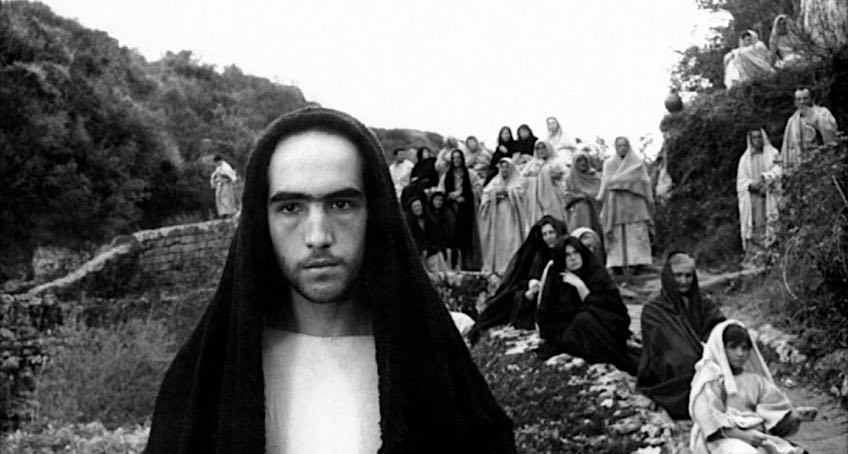
The Swedish psalm Härlig Är Jorden, sung a cappella, is Complete Perfection, Pure Simplicity:

PsalmGlorious is the Earth
Glorious is the Earth, glorious is God’s heaven,
Beautiful is the pilgrimage of souls
Through the fair kingdoms of the Earth
We go to paradise with song

 Ages come, ages go
Generation follows generation
Never is the sound from Heaven silenced
Of the soul’s glad pilgrim-song

 The angels sang it first for shepherds of the land
Beautifully it rang out from soul to soul
People, rejoice, the Saviour has come
The Lord bids peace upon the Earth

BTW, notwithstanding the critiques of Alan Lomax’s ambitious Cantometrics project, this does seem to illustrate one of his notable insights:

that sexually restrictive and highly punitive societies correlated with degree of vocal tension. The tendency to sing together in groups, tonal cohesiveness, and the likelihood of polyphonic singing were all associated with fewer restrictions on women. Multipart singing occurs in societies where the sexes have a complementary relationship.

The Real Group sings the psalm divinely, but it can be just as moving in less polished amateur versions. This is nothing to do with our recent British penchant for Scandi noir. Of course, not being Swedish, I can’t assess what layers of association it may have for various strata of Swedish society today. For me, the Festival of Nine Lessons and Carols from King’s, another likely image of religious purity (and another of those changing traditions à la Hobsbawm), is highly conflicted—Dudley Moore expressed this well, if not entirely reverently. I doubt if all young Russian liberals are so entranced by Orthodox liturgy as I was on Mount Athos.

So as with Bach, there is no “correct” way to experience a piece like this: it will vary by class, time, region, and so on.

While we’re relishing the singing of The Real Group, I can never resist a bit of Bill Evans—led by Margareta Bengtson:

Click here for another brilliant song from the Real Group.

Taruskin on early music

***Link to this page!***

I’ve finally got round to reading the great Richard Taruskin properly. Among his wide-ranging themes, in this page (under WAM in Menu), I discuss his seminal comments on early music, informed by my own humble experiences of the scene.

As he links it with modernism, placing it firmly within the context of our contemporary culture, this is no mere niche topic, it’s profound, essential reading on culture in modern society— and with maestro-baiting galore!

Even if one disagreed with every word of the book, the writing is always a joy to read.

Bach and Stravinsky

Useless musicological sleuthing of the day…

I like to think that I discovered this—on tour in Spain with the Sixteen, early 1990s:

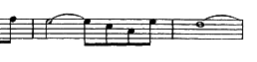
The numinous opening bassoon solo of The Rite of Spring, rather than deriving from a folk melody on the elusive dudka, may instead be borrowed ingeniously from the Matthew Passion, 1st violin part in the 2nd orchestra (no.43, not long before Erbarme Dich):

Bach:Stravinsky

with Stravinsky varying Bach’s pitch and rhythms to his taste. Amidst the fray of the crowd scene, investing the phrase with inexplicable care, I always chuckle to myself, “Not a lot of people know that…” [Weirdo—Ed.].

Proms of yore: the Bach double

AM&RP

Great Proms of our time: how wonderful to have been part of the AAM Prom in 2004, with Rachel Podger and Andrew Manze, the yin and yang of baroque violin, playing the Bach double. Alas, I now find it’s disappeared from YouTube, but here’s their 1996 recording:

It’s a piece that has constantly been rediscovered by audiences over my lifetime. For my generation, brought up on Oistrakh and Menuhin (1958—canonical then, now sounding so joyless as to be hard to take), more recent HIP renditions, no less heartfelt, have given it a new lease of life.

For the 1929 recording by Arnold and Alma Rosé, click here.

I knew Menuhin’s jazz duets with Grappelli, but not the latter’s 1937 Paris recording of the Bach with Eddie South—accompanied by Django Reinhardt! Alas, it’s just the first movement:

See also under Reception history.

A Bach mondegreen

WAM musos tend to pick up a smattering of what Peter Cook called The Latin. So in the spirit of Myles, we may interpret the fifth movement of the B Minor Mass thus:

Algernon was starving and scared as the van carrying gravy mix called round. The incident has been immortalized in many a baroque Mass:

Ate, in terror, Paxo minibus

Actually, like Un petit d’un petit, that’s a soramimi, not a mondegreen. Cf. Gandhi in Mary Poppins (I know, the italics don’t really make that sound any better.) For Sick transit, Gloria, Monday, see here.

Anyway, from ridiculous to sublime—a flippant pretext to extol the glories of Bach:

Et in terra

Not a lot of people know that Bach had a dog called Potentia. Hence the movement in the Magnificat:

Fetch it, Potentiam!

And this is perhaps a suitable place for “most highly flavoured gravy”, a favourite remoulding of “most highly favoured lady” from The angel Gabriel by choristers Down the Ages—see here, with a link to Joseph Needham and Cambridge.

See also Comely scone. You can follow all this up with the mountweazel

Bach and swimming

As I learn more Bach on the erhuswimming always helps me. I’m just learning to internalize putting my clasped fingers into the water more horizontally, beginning the back-pull more immediately and maintaining the power.

When I get home, I take up the erhu, calibrating my motor-movements—string crossings, changing positions, breathing—in the service of my sound-ideal. Still sounds a bit rubbish, but hey. Practice makes perfect.

Edible, intangible, dodgy

*For a whole host of related posts, see heritage tag in sidebar,
and this roundup!*

Mars bar

One of the more entertaining excursions of UNESCO’s Intangible Cultural Heritage (ICH) project is in the field of cuisine, under whose august portals “Mediterranean diet” has been loftily inscribed.

Among many fun BTL comments there is one from a certain Nickov:

Might have a stab at protecting the Bristol Channel Diet:
Gregg’s pasties, white cider and chlamydia.

I also eagerly await an application from the Glasgow cultural authorities (whoever they might be) to, um, preserve the venerable deep-fried Mars bar. What of Spotted Dick, I hear you cry? For another caveat on Britain’s belated engagement with the UNESCO heritage bandwagon, click here. And I now note that Fray Bentos is not just a real place, but another UNESCO world heritage site! Recent additions to the list include outdoor chatting and the Berlin techno scene!

I was musing on all this during my recent trip to Lisbon, whose fine cuisine hardly fits into the Mediterranean gastronomic jigsaw.

While we’re on the topic of transmission, this important corrective doesn’t entirely confound the popular cliché that Bach‘s music fell out of use after his death. His sons, and their audiences, might not have taken kindly to being told to continue performing their father’s music—though doubtless ICH funding would have influenced their attitude.

Were one to be at all jocular (Surely not?Ed.), one could query many ancient cultural traditions. Where might UNESCO stand on * wife-beating? Or indeed FGM? And whatever happened to child chimney-sweeps? Witch-burning, a tradition eradicated in most parts of the world, is also seriously endangered. Molvania has nice comments on all this kind of flapdoodle.

Another controversial tradition is bullfighting, whose adoption by UNESCO has been much discussed (e.g. here). Bullfighting is common in southwest China too, by the way.

Thanks to Helen Rees (herself a great authority on the ICH) for alerting me to this article, succinctly broaching such issues:

  • Richard Kurin, “Safeguarding Intangible Cultural Heritage in the 2003 UNESCO Convention: a critical appraisal”, Museum 56.1 (2004), pp.66–77.

(pp.69–71:)

The definition, as given in the Convention, can encompass a broader range of activity than the framers assumed. Such cultural forms as rap music, Australian cricket, modern dance, post-modernist architectural knowledge, and karaoke bars all symbolize cultural communities (albeit not necessarily ethnically or regionally) and pass on their own traditions (though not usually genealogically). (69–71)

Not all intangible cultural heritage is recognised for the purposes of the Convention. To be recognised, intangible cultural heritage must be consistent with human rights, exhibit
the need for mutual respect between communities, and be sustainable. This is a very high and one might say unrealistic and imposing standard.

Understandably, UNESCO does not want to support or encourage practices inimical to human rights such as slavery, infanticide, or torture. Yet the standard is not without controversy. Is female genital mutilation a legitimate part of intangible cultural heritage to be recognized by the Convention or not? Is a religious tradition that includes Brahmins, but excludes non-Brahmins disqualified as intangible cultural heritage because of its discriminatory quality? Is a musical tradition where only men play instruments and only women sing inequitable, and thus contrary to human rights accords? Determining what is allowable or not as intangible cultural heritage under the Convention will be a difficult task.

Similarly problematic is the “mutual respect” clause in the Convention. Intangible cultural heritage is by definition something used for community self-definition. Many cultural communities though, define themselves in opposition or resistance to others. Their very identity as a people or community relies on their victory over or defeat by others. Their defining songs and tales may celebrate the glory of empire, victorious kings, religious conversion, or alternatively resistance to perceived injustice, martyrdom and defeat—not the mutual respect of peoples. The Convention’s standard is quite idealistic, seeing culture as generally hopeful and positive, born not of historical struggle and conflict but of a varied flowering of diverse cultural ways. Including the “mutual respect” standard can however disqualify much of the world’s traditional culture from coverage by the Convention.

Kurin goes on to query the problematic standard of “sustainability”:

The whole treaty is about safeguarding heritage thought to be endangered to some degree or other. The very fact that a tradition is endangered means that it is not sustainable in its current form or in its current context—hence the need for national or international intervention. Yet by definition a tradition to be recognized as intangible cultural heritage under the Convention and thus worthy of safeguarding, must itself also be sustainable. The provision, though well meaning, is confusing. Sustainability here is an ideal to be achieved, not an eligibility requirement for action.

(pp.73–5:)

Surely no one rationally envisions the Convention as safeguarding the transmission of intangible cultural heritage through such coercive forms as legally requiring the sons and daughters who practise a tradition to continue in their parents’ footsteps. No cultural treaty should ensure results through the denial of freedom promised under human-rights accords, with the opportunity for social, cultural, and economic mobility.

Culture changes and evolves. Practices of the past are discarded when they cease to be functionally useful or symbolically meaningful to a community. UNESCO and Member States need not guarantee through financial and symbolic rewards the survival of those customs and practices, beliefs and traditions that the community itself wants to discard. Nor should they encourage particularly harmful practices, or “freeze” cultural practices in the guise of preserving cultural diversity or defending against cultural globalization.

The Convention tends to reduce intangible cultural heritage to a list of largely expressive traditions, atomistically recognised and conceived. The actions it proposes miss the larger, holistic aspect of culture—the very characteristic that makes culture intangible. This is the intricate and complex web of meaningful social actions undertaken by individuals, groups, and institutions. Thousands of human cultures today face a myriad of challenges. Whether they survive or flourish depends upon so many things—the freedom and desire of culture bearers, an adequate environment, a sustaining economic system, a political context within which their very existence is at least tolerated. Actions to safeguard “tangibilized” inventoried items of cultural production are unlikely to safeguard adequately the larger, deeper, more diffuse intangible cultural patterns and contexts. Saving songs may not protect the ways of life of their singers, or the appreciation due by listeners. Far greater more holistic and systematic action is likely to be required.

Two recent books contain useful case-studies and references:

  • Michael Dylan Foster and Lisa Gilman (eds), UNESCO on the ground: local perspectives on Intangible Cultural Heritage (2015) (review here)
  • Christina Maags and Marina Svensson (eds), Chinese heritage in the making: experiences, negotiations and contestations (2018).

The Introduction to the latter gives some nuanced perspectives:

As several authors have pointed out, the adoption of the intangible heritage discourse means that many cultural practices, including religious rituals that were seen as “superstitious” practices in the past, are now celebrated as heritage. In this heritagization process many of them have been reconstructed and reinterpreted, and some have had their religious aspects downplayed or ignored. (18–19)

Heritage listings and management is not an innocent and non-political celebration of heritage and culture, but a selective process that leads to hierarchies and exclusion. It can furthermore be used as a tool of governance to control and manage tradition, cultural practices, and religion, and to steer people’s memories, sense of place, and identities in certain ways. Several scholars have pointed out that the use of culture and intangible cultural heritage can be a softer and less visible way of “rendering individuals governable”. The listing, reification, and celebration of certain cultural practices can thus be a tool of governance, especially when individuals and communities are excluded from decision-making but still come to internalize the validation of the selected practices and behaviours. In the context of China, ICH could be seen as a new form of governance and a way to control religious and ethnic communities in particular. (20)

The heritage boom in China is partly driven by the central state and by local governments that are motivated by both ideological and economic considerations. The top-down heritagization process has, however, given rise to new stakeholders who may have their own agendas and express different views. At the same time, the language of heritage has also opened up space for individual citizens and local communities to celebrate and safeguard their own traditions and local history. Individual citizens and communities are experiencing, performing, and documenting heritage in a more bottom-up way, sometimes outside of the state narrative, at the same time as many actors try to capitalize on the official heritage discourse in order to gain legitimacy for their own history and traditions. (28)

I’m sure theorists have been beavering away at unpacking the prescriptive assumption that all tradition must be “good”. Conversely, ethnography avoids prescription—I prefer to devote my energies to documenting the traditions themselves, as I find them, rather than awarding prizes on questionable aesthetic and theoretical grounds, or leading them down the tortuous path of state institutionalisation and commodification.

Meanwhile I find similar concerns expressed for flamencology:

Something is wrong with any interpretative method that reifies genres and objectifies abstractions to the point that events in the present are reduced to reflections of the past.

So I’m not alone in my reservations. See also e.g. this review of a volume on UNESCO on the ground:

  • Valdimar Tr. Hafstein, “Intangible Heritage as diagnosis, safeguarding as treatment”, Journal of Folklore Research 52.2–3 (2015),

with its opening

Patient: “What is it, Doctor?”
Doctor: “There’s no easy way to break this to you: you have heritage.”
Patient: “Heritage? Are you serious? What kind?”
Doctor: “Intangible. I’m sorry.”
Patient: “Intangible heritage… How bad is it?”
Doctor: “It is in urgent needs of safeguarding. It is already metacultural.”
Patient: “What’s the prognosis?”
Doctor: “Intangible heritage is chronic, I’m afraid.” […]

* * *

Here, and in the thoughtful analysis of Heritage movements by John Butt, there are many lessons for China, which are unlikely to be learned. In the south of Fujian province—alongside the extraordinary Hokkien traditions of Daoist ritual, processions with god statues borne aloft on sedans, and nanyin chamber ballads—vicious chronic inter-village feuds are a hallowed part of the local heritage.

In China at least, one must observe that the ICH is a state agency to trumpet the grandeur of ancient Chinese culture, rather than a dispassionate body supporting scholarly research; except in the most hackneyed of terms, it can hardly confront the most basic aspect of such cultures—their traumatic fortunes through successive upheavals since the 1940s. And where do spirit mediums (anchors in maintaining local ritual life, among both the ethnic minorities and the Han Chinese), cults, and sectarian groups stand here? Perhaps fortunately for them, they seem most unlikely to be offered the poisoned chalice of ICH status.

I’ve introduced Ka-ming Wu’s thoughtful analysis of heritage projects in Shaanbei here. While we always need to understand the involvement/intrusion of the state, I’m still concerned that all the attention that scholars (both Chinese and foreign) currently lavish on a state institution distracts them from studying local cultures themselves (of which ICH may or may not be a part). Even those who are sensitive to the flaws of the system may be driven by the agenda of studying it; even noting the way it may be utilized by local agents, it’s still the focus. In a short space of time, it has dominated the discourse. Contrast, for instance, the vast bibliography on ICH with the virtually non-existent studies of the numerous local Daoist lineages in Gansu province and their rituals in changing society. Look, here I am myself having to go on about ICH when I could be writing about the Daoists!

Conversely, the ICH has recently begun to play a significant role in many local cultures, and it is now likely to be included in the remit of fieldworkers. It has become significant among amateur ritual associations in Hebei (first of my main field sites), which otherwise were becoming partly moribund (though for enduring ritual functions, see here).

But fortunately even the Chinese state seems unable to transform local cultures into one big glossy Disneyland. Much ritual activity tends to be spared the double-edged sword of attention from party-state cultural initiatives.While the Li family Daoists in north Shanxi are nominally part of the ICH system (see in particular here), their livelihood and activities remain almost solely dependent on providing mortuary services for their local clients—for those who are still left behind in the villages, that is.

My concern is still that the ICH is neither so all-pervasive nor as malleable as some studies suggest.

If all this commodification and reification is a distressing distortion of Han Chinese cultures, it’s still worse for minority traditions such as those of the Tibetans and Uyghurs, for whom the political agenda to sinicise and tame is even clearer: for the former, note this article by Isabelle Henrion-Dourcy, and for the former, reports by Rachel Harris.

See also Musics lost and found.


* As in “Where do you stand on Donald Trump?” “On his windpipe.”

Peccable musical sensibilities

I guess we should be grateful—nothing focuses the mind like having a vindictive sulky misogynistic illiterate baby as Philistine-in-chief in the White House. Some of his advisers were concerned that withdrawing from the climate agreement “might damage his credibility”. Where have they been?

Sure, we have worse things to worry about than his highly peccable aesthetic sensibilities, but they evidently developed early. In “his” 1987 book The Art of the Deal, Trump wrote:

In the second grade I actually gave a teacher a black eye—I punched my music teacher because I didn’t think he knew anything about music and I almost got expelled.

I’d love to know more about this music teacher—just how little is it possible to know about music? Can it be that the young boy’s ire was caused by the inexplicable absence from the syllabus of the late Beethoven string quartets, which as we all know would later form his core listening?

But unseriously though folks, this is a fine spoof. I particularly love

bachs-goldberg-variations-1457709453

stravinskys-rite-of-spring-1457709448

barbers-adagio-for-strings-1457709451.jpg

Such is Trumpolini’s classical erudition that he should appreciate this fugue by “W.T.F. Bach” (lesser-known brother of P.D.Q.)—a must for your local choir:

Like Dudley Moore’s psalm, what makes this so brilliant is the incongruity between the juxtaposition of text and the solemn musical pastiche of baroque grandeur.

And if you think translating medieval Daoist texts is difficult, spare a thought for interpreters, trying to make sense of Tweety’s mangling of the English language. At least culona inchiavabile can be transformed into something even more evocative.

Back in Blighty, I see Bumbling Boris (aka Boris Piccaninny Watermelon Letterbox Cake Disaster Weightloss Haircut Bullshit Wall-Spaffer Johnson) has escaped again, leaping back into the fray by welcoming a kindred spirit to Britain with more blithe inanities—but he’s got The Latin, so that’s all right then. Imagine Conservative Central Office:
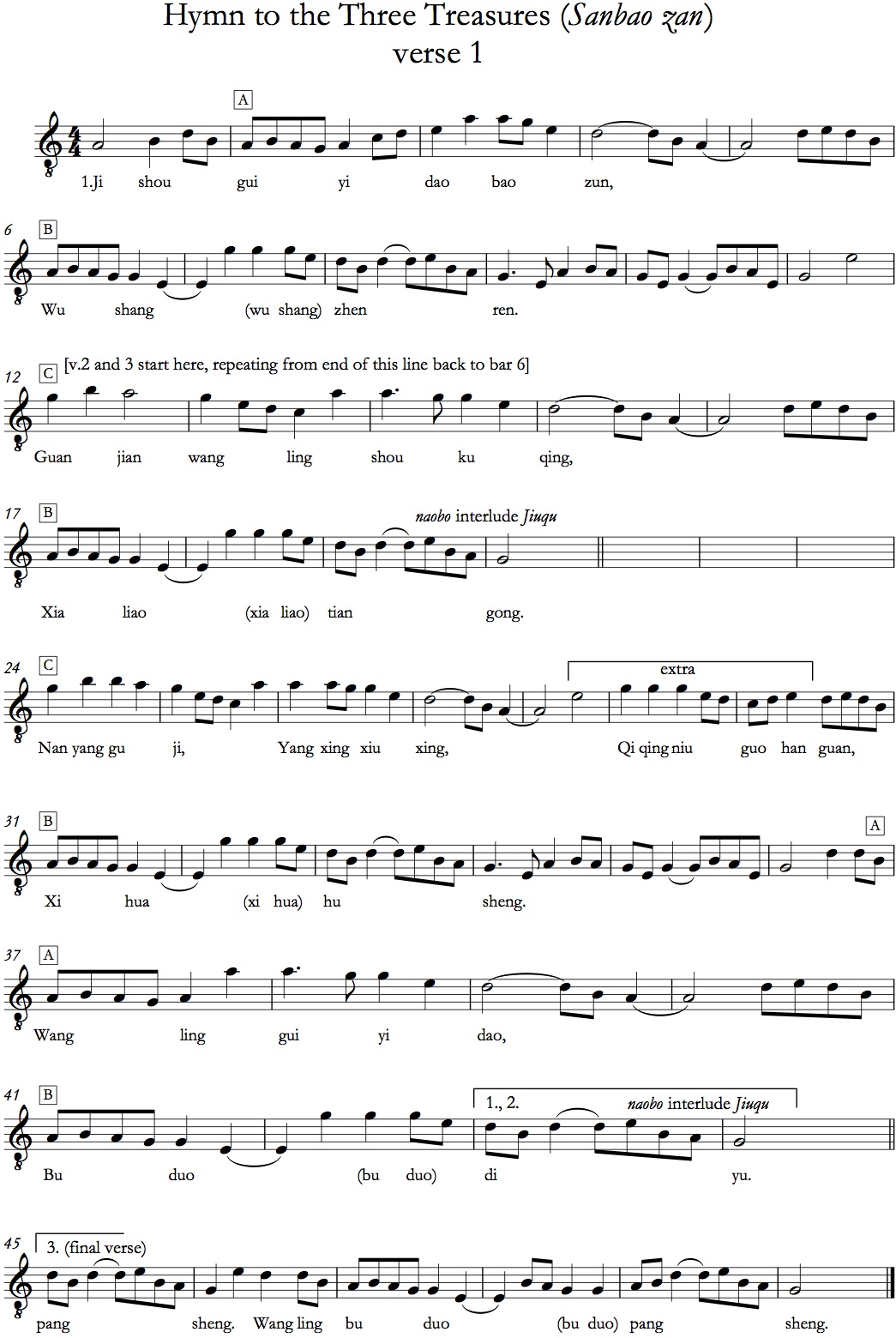
“How did he get out? I thought we packed him off to Bongo-Bongo Land!” (for which, see the excellent Afua Hirsch, and wiki).

Homage to Nina Hagen

Nina

I unfairly tucked away the mind-blowing Naturträne in a post setting forth from Viv Albertine and the Slits, but Nina Hagen richly deserves her own homage.

Rather like the leader of the free world shoving the prime minister of Montenegro aside in Brussels:

(The only logical explanation is that he somehow mistook the occasion for a beauty queen molestation contest with a prize of unlimited ketchup-drenched steaks),

Nina elbows the competition out of the way. In her case the competition includes Maria Callas, Kate Bush, Sid Vicious, and Lady Gaga. As one YouTube BTL comment observes, she could be Klaus Nomi’s sister.

Pre-punk, while still in the GDR, her early song Du hast den Farbfilm vergessen (1974) is nuanced:

As of November 2021, the song is enjoying renewed publicity as Angela Merkel chooses it for her farewell ceremony.

With all due respect to free healthcare, Nina Hagen is one of the great things to come out of the GDR—which she did, of course, inevitably. Even if the GDR “didn’t always have enough bananas” (my book, p.147), at least Honecker could pat himself on the back for inadvertently nurturing a superstar.

Whether or not you subscribe to Nina’s Weltanschauung, her vocal technique is, um, breathtaking. Here’s a live version of Naturträne:

Some more BTL comments:

This is what comes out when you stuff highly talented kids with best education and at one point they start to think for themselves.

Please, when I die I want to be reincarnated as her mic.

She gives Sid Vicious a run for his money in My way (this also from 1978):

And listen how she subverts Somewhere over the rainbow:

Good to see the Leipzig Big Band accompanying her instead of Bach for a change. I’m not sure I’m quite ready for her version of Erbarme Dich, though. OK, she belongs to a particular moment in time—but expressive culture always does, like Bach.

Indian and world fiddles

*See also Ways of playing the violin*

The other day, just before my alarming rendition of Bach on the erhu, I went to an enthralling concert of Carnatic violin by the sisters M. Lalitha and M. Nandini at the Bhavan Centre in West London, a lively centre for the Indian community.

How mesmerizing Indian music can be, unfolding naturally with grace and fluency! Learning such oral traditions is aided by memorizing sargam solfeggio. Tuning the strings in open fifths (like G–D–g–d, often used in world fiddle styles— actually, here they commonly have five strings) lends the violin a wonderful sonority (cf. Keef’s excited epiphany).

The ideal in many cultures is for instruments of all kinds to imitate the voice—I love the way Wu Mei decorates the vocal liturgy of the Li band on the guanzi oboe, for instance. It was by chance that I ended up playing the violin in WAM, but we can all appreciate the link between the voice and bowed lutes (or should I say friction chordophones? No you bloody shouldn’tThe Plain People of Ireland) by extending our interests to other world genres. OK, for us WAM fiddlers embarking on Mahler 5 there may be no clear benefits to this, but why don’t we all learn the rudiments of Indian style and technique too? However rigorous a training in rag may be, it can’t be as arid and painful as ploughing through sodding Ševčík studies—it’s amazing we didn’t all give up.

The Bhavan audience was sadly thin on the ground, but it’s the magic of the rapport that counts. It reminds me of a Mozart Requiem tour of Italy with John Eliot Gardiner in the 1990s. For some reason we ended up doing a gig at a dingy cinema in the sleepy town of Terni on a Sunday afternoon, performing for a tiny audience that barely outnumbered the massed orchestral and choral forces. Nonetheless, with stellar singers like Barbara Bonney and Anne Sofie von Otter, it was one of our most moving performances.

At the risk of sounding like Away from it all (“the one thing that Venice truly lacks is leprechauns“), here’s a random but inspiring sample of some further riches of world fiddling—needless to say, it’s all about technique at the service of the music, which in turn stems from its social use…

Still with the exquisite gamak styles of India, here’s a Hindustani female dynasty (cf. Rāg Malkauns):

And then there’s the wonderful sarangi—click here, here, and here for the remarkable work of Nicolas Magriel.

I outline some of the diverse bowed lutes of China here; the erhu is the least traditional of them, but you must hear this astounding playing. See also here. For the distinctive Korean haegeum, click here.

Irish fiddling can be irresistible (for more from Liz Carroll, listen to Dear Old Erin’s Isle here):

Some unaccompanied Bach (on violin instead of cello, for a change):

And Transylvanian bands (see mainly here):

Poland has some fine fiddle traditions too—here’s Stanisław Klejnas, from a village near Łódź:

From Iran, here’s Mohammad Reza Lotfi on kamancheh:

Kamancha playing from Azerbaijan is amazing too. I used to have a clip here of an Azeri party—complete with mobile phones, naff yet tasteful accompaniment, and no fancy fakelore costumes. But it’s disappeared, so we’ll have to settle for a reified official concert version:

And here’s a stellar gathering of players, all with their own distinctive styles (with thanks to Jeffrey Werbock, himself a fine exponent of Azeri music):

Note also the lyra of Crete and the Pontic Greeks. And here’s a taksim on violin by Salih Baysal (1973):

For more violin taksim, click here. See also New sounds of Anatolia.

For the Uyghurs of Xinjiang, besides the ghijak, the soul of the muqam is the plangent long-necked satar (featured in a wonderful muqaddime prelude here), but they use “our” violin just as expressively too, as on this recording of Raq muqam—from a cassette by the renowned singer Abliz Shakir in the early 1990s:

Some of these genres are explored in the fine projects Growing into music and The music of Central Asia.

That’s just a start. I leave jazz fiddling to another post… For yet more, see fiddles tag in the sidebar, introduced here. For more concerts at the Bhavan, click here and here.

Strings and voices

SMP Miller

The Matthew Passion, staged.

My splendid neighbours Fiz and Mike just held a great 50th-wedding anniversary party. Otherwise gifted with fine taste, they inexplicably cajoled me into giving the guests a burst on the erhu Chinese fiddle—oblivious to my plea that its plaintive timbre really needs to be experienced at the hands of someone who can actually, like, play the instrument. After all, like Bernard Bresslaw in The Ladykillers,

I just sort of… picked it up.

Judiciously waiting until everyone was suitably inebriated, after a rousing (and apparently not entirely unrecognizable) erhu rendition of Jerusalem à la chinois (mercifully brief—my friends have suffered enough), I boldly attempted not to entirely mangle Bach’s so-called Air on the G string.

Bach on erhu and saz

At short notice I secured the estimable services of another neighbour, Martyn—possibly the leading exponent of the Turkish saz in the whole of Bedford Park (sic)—who sensitively provided the bass line. Without regard to expense or the feelings of the public, we stretched to nine strings between us—four and a half each, three of them doubled (“Go figure”). As if it didn’t represent enough of a challenge, I rashly tried further to fill in the texture with the occasional juicy bit of counterpoint by “singing” (I use the word loosely). So I now admire fiddlers who manage to sing at the same time (actually, I shouldn’t be too hard on myself—perhaps it’s not so common to hear fiddlers singing counterpoint as they play).

For a sequel, click here.

A World Music version of Bach is an Idea whose Time has Come, if not necessarily the intonation. We didn’t so much play the Air as hint at it, an esquisse in roughly drawn lines. Thankfully, no audible trace survives of our rendition (“Case for prosecution collapses due to lack of evidence”)—nor, for that matter, of the ear-scouring Chinese wind-band version that our shawm band had played for a friend’s wedding during our, um, heyday. But undaunted, I did later record some Bach on the erhu.

The Bach Air is another instance of music that we can only hear with our own modern ears (also here)—imbued by the old cigar ad, and its whole ubiquity in popular culture. But in performance (OK, in the right hands…) it can hardly fail to move—eighteen bars of intense perfection.

Like Christopher Small (Musicking—essential reading), I now greatly value playing in an informal setting for people I know. In post-industrial societies this has inevitably been diluted by the exigencies of concert economics, with the irony of coming together to share “intimate and personal cultural moments with strangers” (George Lipsitz, cited in Musickingp.39).

Still, the Air always moves me by association with memorable concert renditions in which I’ve taken part over the years—like in Windsor Chapel once on my birthday (as part of the Bach 3rd suite, all the more moving in between exhilarating trumpets and ecstatic fast jazzy string noodling), and as an encore in Budapest with Trevor Pinnock.

And here’s a version on the ethereal theremin (among the early experiments of hYrtis, a work in progress…):

It can be beautiful as an a cappella setting too:

Like the Mahler Adagietto, another media staple that transcends its hijacking by popular culture is the Barber Adagio, equally moving in string quartet and orchestral versions, as well as this ethereal choral arrangement:

Although the Agnus Dei text was added later to fit the melody, it gives me a pretext to play Bach’s version from the B minor mass, sung again by the divine Michael Chance—more vocal and instrumental intertwining:

Just as divine as the Barber is Lux Aeterna, a choral version of Elgar’s Nimrod:

For more a cappella singing, click here; and for Indian and world fiddles, here.

Calendrical rituals

Further to my thoughts on festivals, today is the focus of the round of Bach Passion performances, now a kind of secular pilgrimage very different from the original liturgical context—not just of Good Friday but of the whole calendar (note John Eliot Gardiner, Music in the castle of heaven, ch.9, “Cycles and seasons“). Different too are our ears, bodies, world-views, experiences, sanitation

Mark Padmore, incomparable Evangelist in the Passions, makes some thoughtful points here (cf. this article). Do watch his Matthew Passion as staged by Peter Sellars. And here he is in the John Passion (cf. Passion at the Proms)—how he sings und ging heraus und weinete bitterlich (from 33.48), and how Bach composed it, is miraculous:

Also in the John Passion is one of Bach’s most moving arias is Zerfließe, mein Herze:

Zerfließe, mein Herze, in Fluten der Zähren        Dissolve, my heart, in floods of tears
Dem Höchsten zu Ehren!                                         to honour the Almighty!
Erzähle der Welt und dem Himmel die Not:        Tell the world and heaven your distress:
Dein Jesus ist tot!                                                     your Jesus is dead!

More performative tears (see links here)—like north Chinese Daoist ritual, the aria is also accompanied by anguished wind ensemble, almost evoking (for modern ears) French film music.

While Protestants do their thing, let’s not forget Holy Week in Spain, with solemn hooded processions, soaring trumpets, and saeta devotional songs for the images of Christ and the Virgin (for more saeta, along with other moving cante jondo songs, see here):

Indeed, for me one of the benefits of being a touring muso was being able to combine both Bach Passions and flamenco. In southern Spain flamenco only tends to get going in the small hours, but concerts also begin at 10pm or later. So by the time we had played the final chorus of the Matthew Passion in Seville, there was plenty of time to stroll over the bridge to the wonderful Anselmas bar in Triana, downing a few G&Ts before the flamenco began to get in the groove.

Note also the liturgy of Castelsardo in Sardinia.

* * *

Meanwhile it’s a busy period in the Chinese ritual year calendar too. [1] On the Hebei plain, apart from everyone taking part in the lineage observances for the Qingming festival, Catholics are busy holding Masses and making pilgrimages—not least evading police road-blocks (see here, and for the Gaoluo Catholics, here). It is also the time of the 3rd-moon festival for the goddess Empress Houtu, when many villagers go on pilgrimage to the Houshan mountain temples to revere her.

Houshan disciples

The Houshan pilgrimage, which under the commune system had been observed only by a tenacious minority through the 1960s and 70s, began reviving in the 1980s; by the 1990s it was attracting around 100,000 pilgrims for its 3rd-moon temple fair. We met several village ritual associations on the mountain for the festival in 1995, though Gaoluo village no longer organizes a group; in recent years “people’s hearts are in discord”, as association leader He Qing lamented. In some places the Houtu festival has been revived within the village: for the 3rd-moon festival in 1996, for instance, we visited Shenshizhuang, south of Yixian county-town, whose four ritual associations all celebrate the Houtu festival in their separate ritual buildings in the village.

SSZ xihui 1996

Altar to Houtu, Shenshizhuang West association 1996.

Many villagers make the pilgrimage in small groups on their own initiative. Their vows are pledged to Houtu. One can climb to the Houshan temples to offer incense and pledge a vow, or just make it at home; the vow often used to include a promise to “look after a banquet” for the ritual association.

So the red flag which one often sees adorning truckloads of villagers in the 3rd moon now heralds a group of pilgrims rather than any political campaign—another sign of the changing times. But despite the lengthy impoverishment of ritual and faith, the power of Houtu is still strong: even in 1997 Gaoluo friends reminded me “Here we believe in the Empress Houtu, so a lot of people offer incense”.

* * *

For the dispassionate (sic) observer, some photos may distinctly suggest a stress on masochism in Easter observances around the world. Meanwhile on a visit to the Saudis, celebrated defenders of religious values, our Prime Minister gets herself embroiled in a futile dispute about Easter eggs with the notoriously subversive National Trust. Indeed, this “We’re not even allowed to celebrate our own culture any more” fatuity is itself becoming an annual ritual. Hey-ho.

For thoughts on our approaches to Morris dancing and local Chinese rituals, see here. See also The Annunciation in art and music.


[1] These notes are revised from my Plucking the winds.

Trauma: music, art, objects

Norman Lebrecht has long laid bare the links of celebrated senior conductors (as well as Karajan…) to Nazism: it’s one subtext of his fine book The maestro myth.

I just read his review of Fritz Trümpi, The political orchestra: the Vienna and Berlin Philharmonics during the Third Reich.

The book actually takes the story through to our own times. As Lebrecht observes, neither orchestra emerges with any credit—indeed, it’s a shocking account.

For me, as a teenager in the National Youth Orchestra (of GB), another inspiring conductor (apart from Boulez) was Rudolf Schwarz (1905–94). Member of the Vienna Philharmonic in his youth, later inmate of Auschwitz and Belsen, after the liberation of the camps he eventually ended up in Bournemouth, remoulding the orchestra there. His Bruckner 7 with the NYO was wonderful—all the more intense with his laboured conducting style, partly the legacy of a broken shoulder-blade in Auschwitz. Never a superstar in the Karajan mould (which was why musicians appreciated him), he was a formative influence on the young Simon Rattle, my contemporary in the NYO.

Bruckner 7 is in the incandescent key of E major, just like the basic scale of the Li family Daoistsshengguan ensemble—I often think of it while I listen to the shengguan piercing the bright blue sky of rural north China (e.g. playlist, #4, with commentary here).

Meanwhile, as Rudi was being dragged through the camps, here’s Wilhelm Furtwängler conducting the Adagio with the Berlin Philharmonic in 1942. Like Philippe Sands’ choice of Bruno Walter conducting Mahler 9 in 1938— and just as with Daoist ritual—we have to personalise such seemingly disembodied works, and place them in time.

You can find a newly remastered version here. For Celibidache’s Bruckner 7, see here.

Furtwängler’s relationship with Nazism has been much debated. Generally reluctant to collaborate, he did what he could, even helping some Jews escape, and with close ties to the resistance. Yet inevitably people baulk at his participation in events like this Beethoven 9 for Hitler’s birthday, also in 1942:

Lebrecht sums up his legacy (The maestro myth, p.93):

In Furtwängler the Nazis retained an interpreter who performed German music with undiminished conviction while genocide was committed in his name. By opting to remain, he endowed the Nazis with cultural respectability at a  crucial moment in their ascent, and in wartime gave moral sustenance to their cause. In his confrontations with tyranny, Furtwängler proved a feeble adversary who was all too easily manoeuvred into outright collusion. The humanity he expressed in music was traduced and travestied by his paymasters. His legacy as a performer may well be among the most significant in the annals of conducting, but his conduct under political pressure compromised the very profession on which he wielded so formative an influence. [for Lebrecht’s more recent exposé, see here.]

Still, it’s easy for us to say that. Reflecting on the Nazi era from the perspective of our blessed safety from invasion and  agonising choices, Neil MacGregor poses the disturbing question “What would we have done?”. In his brilliant 2014 book Germany: memories of a nation (and no less enchanting are his podcasts—the perfect Radio 4 voice!), using both works of art and everyday material objects, he ponders how we can fit the great humanistic traditions of Germany into the same picture with Nazi barbarism. And having suffered throughout this whole period, people of Central and Eastern Europe would still have to continue making appalling moral choices for decades to come.

Apart from MacGregor’s astute discussions of earlier historical artefacts, one can’t help being drawn into those from more recent history—like the slogan (“to each what they are due”) above the camp gates of Buchenwald—just a few miles outside the Weimar of Goethe and Bach:

Bwald

MacGregor observes the noble lineage of words that had once signified an ideal of justice—the very words that Bach used as the title of a cantata in 1715 Weimar. Indeed, as a prelude to John Eliot Gardiner’s epoch-making Bach Cantata Pilgrimage all through 2000, I played a modest role in the Christmas oratorio at the Herderkirche in Weimar—here’s Part One. Next day we all visited Buchenwald.

I’m not sure we can derive any encouragement from MacGregor’s idea that the stylish lettering of those words above the gate (designed by an inmate, Communist and former Bauhaus student Franz Ehrlich) might be read by fellow inmates as a subtly subversive message that the SS would eventually get their just deserts. By the way, Ehrlich survived, also disturbingly, to become a Stasi informant under the GDR.

MacGregor gives a fine diachronic survey of Käthe Kollwitz’s work,

as well as the incarnations and migrations of Ernst Barlach’s Hovering angel (1926, cf. the 1966 GDR film The lost angel),

angel

along with reflections on Remembrance ceremonies.

But he also discusses movingly the “rubble women” (Trümmerfrauen) who rebuilt shattered Germany after the war, and objects such as a little hand-cart pulled by refugees from Eastern Pomerania in late 1945—now reminding us tellingly of the refugee crises of our own day.

The wonderful Forum of Contemporary History in Leipzig has a similar exhibit.

But to return to Trümpi’s book, this tale of two orchestras brings us, shamefully, right up to the lives of my generation and later. It was not until 2013 that the Vienna Philharmonic revoked the Ring of Honour it had bestowed on three leading figures in the Nazi genocide—including Richard Strauss’s patron Baldur von Schirach, who (also in 1942) described the deportation he oversaw of 65,000 Viennese Jews to the death camps as a “contribution to European culture”. Indeed, our feelings about those celebrated Viennese New Year’s concerts can’t help being stained by learning that it was Schirach who instigated them.

As an aside, these orchestras haven’t exactly been at the forefront of gender equality either. Competing hotly in the misogyny stakes with “Rear Admiral” Foley, Karl Böhm (a Great Maestro far more flawed than Furtwängler) is quoted as saying that “the Nazis aren’t that bad—they want to eliminate women from politics.” Digging himself into a deeper hole, he went on, “Of course, not all women are worthless—Rainer Maria Rilke [sic] wrote some good poems.”

And now there are new causes for anxiety, threatening all the liberal values that have been achieved so painfully over several centuries.

NB also posts on Ravensbrück, SachsenhausenMetamorphosen, A Nazi legacy, The Ratline, and Gitta Sereny; as well as posts on Maoism in China, starting here; see also under Life behind the Iron Curtain, as well as Aleppo: music and trauma.

Yet more conducting

Berlioz opening

In the Rozhdestvensky film, I like his solution (from 22.29) to the perennial problem posed by the opening of the Symphonie fantastique:

“I simply invited them to begin”

and then let them get on with it.

Which reminds me, a noted baroque conductor (or “semi-conductor“, to use Norman Lebrecht’s term) was rehearsing the opening of a slow aria in the Matthew Passion. One of the wind players suggested he might try subdividing:

“Could you give us 7–8 into it?”

Conductor, indignantly: “I didn’t get where I am today by giving 7–8!”

“I didn’t get where I am today by…” soon became another musos’ snowclone.

And here’s Larson’s take on conducting.

Catching the tiger, Wu Mei, oboes and cymbals

This Larson cartoon reminds me of the “catching the tiger” tricks of the Li band—a rare moment of secular entertainment within the liturgical sequence.

In my film (from 42.52), Wu Mei’s tricks are charming (see also §B8 on the DVD with my 2007 book)—interesting also to compare (from 51.22) the more leisurely 1991 version of his predecessor Wang Chang.

Wu Mei [1] (b.1970; film from 53.52; see also this vignette), known as Zhanbao 占宝, is one of the great wind players in world music. Of course he does everything—also singing the liturgy, playing the large cymbals for a cappella sequences, and occasionally giving another Daoist a turn on the guanzi while he plays sheng mouth-organ. He’s a Daoist, not a “musician”, yet his musical genius is indispensable to the success of the Li band.

He was the fourth of five children from a poor family—his blind younger brother spent some time learning the shawm, and their father was an old friend of Li Qing. Wu Mei was at once enchanted by the sound of the funeral ritual, and there and then he went up to Li Qing and asked him if he could become his disciple. He went to live with him for the first year, and then commuted by walking an hour from his village, five li away.

Wu Mei recalls that the first time he played guanzi for a ritual was for a funeral at Lower Liangyuan in 1990, during his third year, playing small guanzi along with the aged Li Yuanmao on large guanzi. This might remind us of young, pre-punk, Nigel Kennedy in duet with venerable Yehudi Menuhin. But Wu Mei doesn’t remember much about it—they just got on with it; anyway, the seniors were satisfied with his playing.

When the hymns are accompanied by shengguan, a good guanzi player makes all the difference. Like Li Yuanmao or Li Tong in the old days, Wu Mei is not just totally reliable, he is inspired, helping the other Daoists to sing to the best of their ability, complementing them perfectly—managing to combine a deeply mournful tone with an almost playful way of weaving in and out of the melodic line, ducking and diving, sometimes soaring. The singers recognize that a good guanzi player is a great help to them in rendering the text.

Wu Mei soon became a local star. With his radiant innocence, he is on another planet, floating in the clouds above this world of dust. Here there is no empty display; he is a vessel, a puppet for the gods, like Bach. On guanzi—and not just in slow hymns but even in the zany “catching the tiger”—he has none of the posturing of the virtuoso. And not even just when he is actually playing: it is delightful when he takes a little break in the instrumental suite or the popular errentai sequence, doodling a little phrase reflectively on the guanzi before plunging back into the fray.

WM zhuo laohu

Concert performance in Rome, 2012

He is always devising new decorations, like renaissance divisions—experimenting, seeking new ways of making transitions. The others are attuned to all this as they accompany him. While the decorations of the older generation remained within strict confines, Li Manshan and Golden Noble observe that in recent years Wu Mei has been experimenting beyond the “rules”. To me, there was always an element of playfulness even in the slow solemn style (like Liu Zhong, although he wasn’t so admired); and if this is modernizing, then I’m cool with it. When I suggest to Li Manshan that Wu Mei’s ornaments are still serious and spiritual, he defers to my musical ears—but obviously he is a master musician with way more experience of the style. Perhaps the way to see it is as an innovation that began with Liu Zhong and has culminated in Wu Mei—it’s amazing, even if not strictly kosher. Bach would have adored Wu Mei’s guanzi playing.

YD

The way he plays the large bo cymbals is childlike and adorable too; you can sense how utterly comfortable he is as a musician. Again he has a particularly charming way of decorating the patterns, tastefully testing his partner’s creativity and probing the possibilities. The most exhilarating, and by far the longest, cymbal piece is Yellow Dragon Thrice Transforms Its Body, now played only as a coda for Transferring Offerings (for which, apart from the edited version in my film [from 1.11.07], you can enjoy a fantastic complete concert rendition in the 2014 DVD), but also prescribed upon ascending the platform in the Pardon (film from 50.31). Wu Mei and Yang Ying can’t help showing their delight in it, whereas Erqing and Li Bin maintain their serious demeanour. This is the only percussion piece that ever attracts an audience, and even applause. Local or urban, Chinese or foreign, no-one remains unmoved by this exhilarating piece.


[1] These comments are edited from my book.

Ravel et al.

Further to my Ravel page (under WAM):

Tanita Tikaram (where has she been all my life?), for her wonderful Private Passions, chose Michelangeli’s version, also very fine, of the slow movement of Ravel’s Piano Concerto.

Apart from Bach (including the amazing Lalo Schifrin) she featured the slow movement of Mozart’s A major piano concerto, with the ill-fated Clara Haskil.

Bach, alap, and driving in Birmingham

WAGZ score

Hesi prelude and opening of Qi Yan Hui suite: score showing melodic outline in gongche solfeggio, West An’gezhuang village, Xiongxian county, Hebei.

It was Yoyo Ma who put me onto playing the Preludes of Bach cello suites as a kind of alap. Actually, that’s how he introduced the Allemande, the second movement of the sixth suite, playing it al fresco as thanks for our group of helpers at the amazing Smithsonian Festival of the Silk Road in 2002, which he was curating.

As I come to adapt the Bach cello suites for violin, I consider how to play the opening two movements of the sixth suite on their own. Should I play the Allemande first, as a kind of alap? Or else take Bach’s opening movement with majesty rather than virtuosity, at an exploratory rather than hectic pace, as a kind of prelude to the alap of the Allemande… Either way can work.

Prelude and Allemande, 6th cello suite, manuscript of Anna Magdalena Bach.

For wise words on, not to say wonderful renditions of, the cello suites, we can turn to Steven Isserlis (click here for the CD set). Here he is playing the fifth suite (the Prelude here unambiguously meditative, like both the later Allemande and Sarabande):

For another Bach Allemande that seems to suit an alap-esque style, see here.

My brilliant friend Paola Zannoni likens the bariolage of the Prelude to the marranzanu Sicilian jew’s harp. The sixth suite, of course [sic—Ed.], was written for a five-string cello, but—in the current spirit of austerity—I make do with four.

While learning Bach (or indeed shengguan ritual melodies), one has to take care not to take a wrong turning. Like driving in Birmingham, if you take a false exit then you can find yourself going round in circles for hours.

Brum

Anyway, free-tempo movements (known as sanban 散板 in educated Chinese) are more commonly associated with solo genres like folk-song and qin—unlikely bedfellows. Apart from alap, one thinks of Middle Eastern taksim (see here, here, and here) and the Uyghur muqaddime (the singing of the latter ideally accompanied by the wonderful satar long-necked bowed lute). In these genres, the term “free-tempo” isn’t precise, since they do indeed have a underlying pulse.

Slow ensemble preludes called pai’r are also an exquisite feature of the lengthy suites of Buddhist and Daoist ritual shengguan ensembles. As with shengguan suites altogether, the pai’r in Hebei (see e.g. here, under West An’gezhuang) are best heard with a small ensemble, like the fantastic group of Gaoqiao village in Bazhou (audio playlist #8, from Plucking the Winds, CD #14—see commentary; this movement actually follows the opening pai’r, but itself opens with its own lengthy sanban prelude), where the heterophony of the four melodic instrument types can be best appreciated.

Such preludes are also a feature of ritual suites around Xi’an. But they are strangely absent from the suites of Daoist ritual repertoires in north Shanxi like those of the Li family—which are otherwise clearly related to the suites of old Beijing, still played in Hebei.

And don’t miss Aretha’s extraordinary alap to Amazing Grace! And the exquisite expositions of dhrupad!!!

Private Passions

Radio 3’s Private Passions is always insightful. The edition with Philippe Sands (here) shows that he too “delights in all manifestations of the Terpsichorean muse”(see Muzak)—Leonard Cohen, Michael Chance singing Erbarme Dich

(see also herehere, and here—and for an Arabian version, here), Bruno Walter conducting Mahler 9 (here, and here) in 1938, and Let’s pretend we’re bunny rabbits. Actually, the latter isn’t such a kitsch choice as its title suggests, but hey.

My posts A Nazi legacy and The Ratline introduce Sands’s harrowing film and books.

Voices and instruments

In my book (p.261) I glibly compared the Li band’s hymns to the arias in the Bach Passions, “where action and drama are suspended while we contemplate the deep meaning of a scene.” In most elite Daoist and Buddhist temples, liturgy is accompanied only by percussion, not melodic instrumental music. Many of the Li band’s hymns are sung thus, a cappella—including those used to Open Scriptures in the morning and afternoon.

Whereas Chinese studies of northern Daoist and Buddhist “music” often focus almost entirely on shengguan melodic instrumental music, in my book (ch.16) I try to put it within the ritual context. But does the shengguan accompaniment (notably the constant variations of the guanzi) express what the vocal text is unable to embody?

As usual, this is not a close parallel, but one thinks of Erbarme Dich:

“Language is not essential to this moment, or even adequate to it. A verbal penitence is expressed by the alto voice, but the violin expresses a more universal distress.” (Gardiner p. 422, citing Naomi Cumming).

But remember, I find nothing akin to word-painting in the Li band’s vocal repertoire (my book p.277):

I can find no matching of melody to textual content. There is nothing akin to word-painting, no illumination of the meaning of the text through music. Vocal liturgy is capable of arousing emotion, as for instance it should do in the Song of the Skeleton (see Yesterday…), but this is achieved through the general style of delivery rather than the specific text-setting. In musical style the Song of the Skeleton is no different from other hymns, and even its desolate text is not comprehensible when sung.

So expression is conveyed mainly through timbre. The more I listen to Li Manshan and Golden Noble, the more impressive I find the mournful nasal quality of their voices; I can sing some hymns, but can’t emulate this. They have utterly absorbed the meaning of the texts into their voices. And when the shengguan accompanies, Wu Mei complements them perfectly on guanzi, managing to combine a deeply mournful tone with an almost playful way of weaving in and out of the melodic line, ducking and diving, sometimes soaring. The singers recognize that a good guanzi player is a great help to them in rendering the text.

Anyway, both the decorations of a Daoist on guanzi and Bach’s oboe lines are spellbinding—an intrinsic part of the realization of the text. So I both demote and stress the shengguan accompaniment.

Beyond the transition of the Passions from liturgical to concert performances, the staged versions of recent years can also be compelling (for us):

And we’re already in tears (along with Peter) from the recitative of the Evangelist that introduces it. The shuowen introits of the Daoist also introduce arias…

Those of a sensitive disposition may wish to avoid reading my Textual scholarship, OMG.

Bach on film

Pasolini SMP

As part of my extensive coverage of Bach (roundup here), two feature films from the 1960s, despite their extreme contrast, are linked both by their intensity and by the way they don’t just accept but probe our own modern values:

and

  • The chronicle of Anna Magdelena Bach (Jean-Marie Straub and Danièle Huillet, 1968—with  Gustav Leonhardt as Bach!). YouTube links come and go; I try and keep an eye on them, but you can do your own YouTube searches if they disappear. Here’s the complete film:

I also found a version enriched by Japanese subtitles (like the Greek subtitles of Johnny the shoeshine guy), and here’s a colourised version of the opening sequence (more on which here):

Yesterday…

I have outlined the importance of the Song of the Skeleton in the rituals of both north and south China (In Search of the folk Daoists pp.233–4). It’s a common theme throughout the north—mainly as part of the yankou, both Daoist and Buddhist.

In Yanggao Daoist ritual (Daoist Priests of the Li family, pp.274–5), several hymns are related. The Mantra of the Skeleton (Kulou zhenyan 骷髏真言, more commonly known here by the melodic label Wailing to Sovereign Heaven, Ku huangtian 哭皇天) is prescribed, a cappella, for Opening Scriptures on the first afternoon of a funeral.

It’s a kind of catalogue aria, with seven long verses for the visits to the stations of purgatory over seven days. Its melodic material overlaps substantially with that of other hymns, beginning with the opening of the Diverse and Nameless melody (Daoist priests pp.267–8). The melismatic “Ah, Skeleton” (Kulou) refrain, and the coda in pseudo-Sanskrit (also in common with Diverse and Nameless), are not written here in the manual. My film (from 56’08”) shows the sixth verse:

Ah Skeleton! Skeleton!
On the sixth day he reaches Netherworld Souls Village
His sons not to be seen
Starving and parched, at his wits’ end,
Desperate to sup broth.

kulou-2kulou-1
From Li Qing’s hymn volume, 1980. The final folio on the left has the opening of Mantra to the Wailing Ghosts—my book p.266, also featured in the film, from 1.03.56).

* * *

For most such hymns one hardly expects an “emotional” response from audiences—in Yanggao, after all, it shares both melodic material and style with many others in the repertoire. But in his brilliant ethnographic studies of ritual practice in old Beijing, Chang Renchun notes how the renditions of two celebrated Buddhist monks moved their audiences to tears. Performative tears feature in many posts on this blog—links here.

Some common versions open:

昨日去荒郊玩游        Yesterday, seeking diversion roaming in the barren outskirts…

So talking of “Yesterday”, Paul McCartney heard his own version in a dream, like Aboriginal singers.

Yesterday

Though secular, it’s deeply moving. Here’s an early solo rendition, live (and Paul’s unaffected style is a major element of the song’s impact—no cover versions come close):

Here’s the remastered version from 2009:

As I observe in the introduction to my series on the great Beatles albums, analysis, while optional, can supplement our response; again it’s instructive to read Wilfred Mellers and Alan W. Pollack. Dating from the same period as A hard day’s night, Mellers considers Yesterday a “small miracle”:

Although the opening words tell us that yesterday his troubles seemed far away, the music in the second bar immediately enacts these troubles with a disquieting modulation from tonic, by way of the sharpened sixth, to the relative. The first bar, with its gentle sigh, seems separated, stranded, by the abrupt modulation; and although the troubles “return to stay” with a descent to the tonic, the anticipated modulation sharpwards is counteracted when the B♮is flattened to make an irresolute plagal cadence. […]

The immediate nostalgia of the song is without suspicion of sentimentality, and the corny accompaniment of string quartet can be employed, with validity, to reinforce the music’s frail bewilderment.

Yesterday quartet

George Martin’s manuscript for Yesterday, on display at Abbey road studios.

Pollack’s analysis is also insightful. And as he notes (also in my roundup), the opening uses a device here that Paul was to use regularly in some of his great songs: a declarative word, followed by a pause, and then rhythmically active ascent.

I can be quite confident about our own emotional responses to this song; less so about the responses of various types of Chinese mourners to the Skeleton, over time.

Laozi

Household Daoists tend to know about performance, not doctrine. I focus on practical knowledge—right down to which cymbal patterns to use as interludes for which hymns, and when to use them, or not. What the Li family don’t know, or do, is things like secret cosmic visualizations.

They don’t necessarily know how to write the texts, or if they do so (for me) they may write some characters a bit approximately because they already know how to recite them.

They know nothing of Laozi’s Daode jing, so central to Western images of Daoism. When I quote the pithy, nay gnomic, opening two lines to Li Manshan and his son Li Bin:

道可道非常道    The way you can follow is not the eternal way;
名可名非常名    The name you can name is not the eternal name.

they don’t quite get it, and I have to translate it into colloquial Chinese for them! Hmm…

We have a bit of fun playing with feichang, which in modern Chinese is “very”, rather than the classical “not eternal”. Actually, in their local dialect they don’t use feichang at all, though of course they know it. In Yanggao the usual way of saying “very” is just ke 可, pronounced ka—thus “dao kedao feichang dao” might seem to be “The way is soooo waylike, I mean it’s just amazingly waylike”…

Still, Daoists like Li Manshan will have picked up a broad understanding of the texts they sing every day, even if they have never been taught their “meaning”. They know Laozi not as the author of the Daode jing but as a god.

As I wrestled with translating the Hymn to the Three Treasures (Sanbao zan), used for Opening Scriptures in the morning (Daoist priests of the Li family, pp.262–3, and film from 22.01), Li Manshan explained it to me.

sanbao-zan-2-in-1-cropped

Hymn to the Three Treasures, from Li Qing’s hymn volume, 1980.

sanbao-zan-best

The subject of the first verse to the dao, “We bow in homage to the worthy of the dao treasure, Perfected One without Superior” (Jishou guiyi daobaozun, Wushang zhenren) is Laozi himself, so it is he who is the subject of the remainder of the verse: “He descended from the heavenly palace” (xialiao tiangong) refers to Laozi descending from the heavenly palace after beholding the sufferings of the deceased spirit (guanjian wangling shou kuqing)—it’s all about Laozi! So you see, Li Manshan does get the texts…

As for any ritual tradition, where does the “meaning” reside, when texts are unintelligible to their audience? When we translate and explain ritual texts, we are radically altering them as experienced by their audience. True, the performers, the priests, certainly “understand” them, to various degrees, if not in the same way as scholars translating them. I don’t suggest limiting ourselves to the consideration of how people experience rituals, but that should surely be a major part of our studies. Experience lies beyond textual exegesis, consisting largely in sound and vision.

I am reminded of Byron Rogers on an American version of the New Testament (Me: the authorized biography, p.268):

Pilate: “You the King of the Jews?”
“You said it.” said Christ.

There’s another one for the Matthew Passion (cf. Textual scholarship, OMG). “What is truth?”, indeed…

Mercifully, there is no movement to translate the ancient texts of Daoist ritual into colloquial modern Chinese. Of course, for northern Daoist ritual a modern translation wouldn’t make the texts any more intelligible anyway, given the slow tempo and melisma.

Laozi does appear in one of our favourite couplets for the scripture hall (see Recopying ritual manuals, under “The couplet volume”; cf. my book pp.194–5—not easily translated!):

穩如太山盤腿座     Seated in lotus posture firm as Mount Tai,
貫定乾坤李老君     Old Lord Li thoroughly resolves male and female aspects.

For a basic roundup of posts on the Li family Daoists, see here.

Textual scholarship, OMG

One often finds oneself consulting quoteinvestigator.com. Doesn’t one.

Like “Meretricious and a Happy New Year”, or “She ran the gamut of emotions from A to B”. This is the kind of meticulous historical work that one expects from the scholarship of Daoist ritual texts.

“OMG” isn’t there, but appears to date from at least 1917 (OMG!)—recalling the brilliant Armstrong and Miller sketches (playlist):

And that’s kinda like a commentary on what we do when we listen to Bach (qv): we can’t help hearing the cadences of our own experience of life in the scenarios of the past. And shit like that. Innit though.

In the Bach Passions, textspeak could generally work for the choral crowd scenes, but actually “Erbarme Dich, OMG” fits worryingly well too:

erbarme-dich

Or

He has risen from the dead, YAY!”

YAY being a more economical version of Hallelujah…

Maybe I’m onto something. Let’s hope not.