Mahler at this year’s Proms!

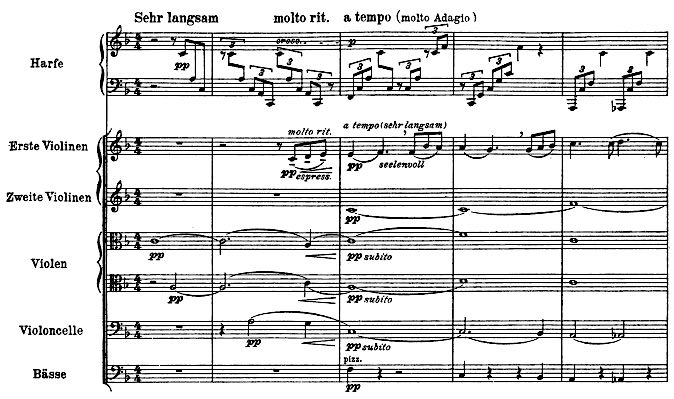
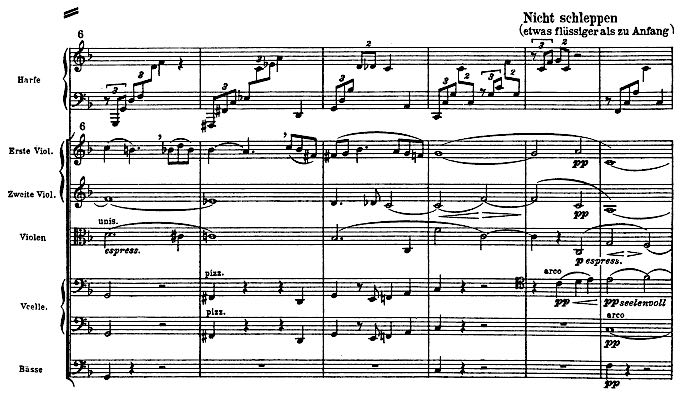
By way of reminding you of my series on the great Gustav Mahler, some brief comments on the three symphonies of his performed at this year’s Proms, while I consult Norman Lebrecht’s handy guide Why Mahler?, marvelling at Mahler’s busy conducting schedule amidst the tribulations of his personal life.

Mahler 2 https://stephenjones.blog/2020/10/18/mahler-2/

Nothing can be so overwhelming as the 2nd symphony, which I heard on what was once called the radio. I find it hard to imagine how Mahler could have written anything after this. As to the 3rd, after the middle movements (akin to those of the 7th), the radiant finale dominates one’s image of the piece.

Hearing a live performance of the 5th is just as moving. The mellifluous Concertgebouw orchstra was conducted by Klaus Mäkelä (for the Concertgebouw’s Mahler 9 in 2022, click here)—it is televised on iPlayer.

I muse on the ravishing slow movements of this period in Mahler’s life: that of the 3rd as the culmination of the symphony, the Adagietto of the 5th all the more effective within the context of the whole; no less moving are those of the 4th and 6th (the latter, to my taste, still best placed third in the order of movements).

My Mahler series includes performances and recordings of his seminal works by some of the great interpreters. See also The art of conducting.

Proms: Ravel and Stravinsky

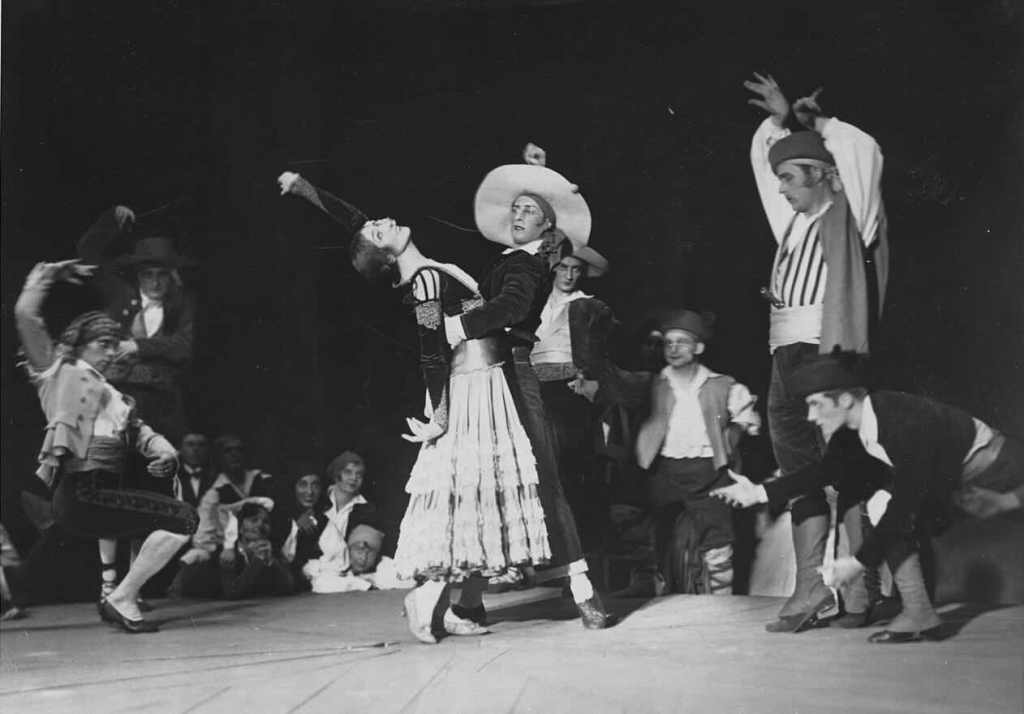
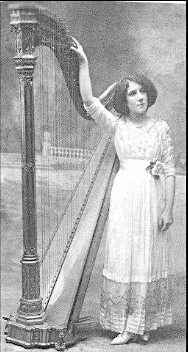
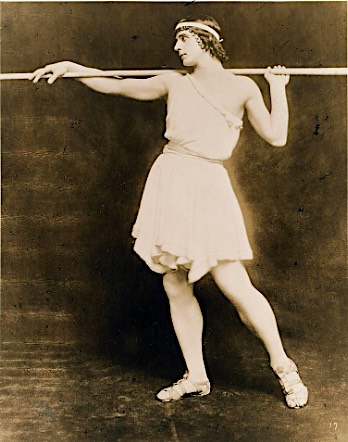
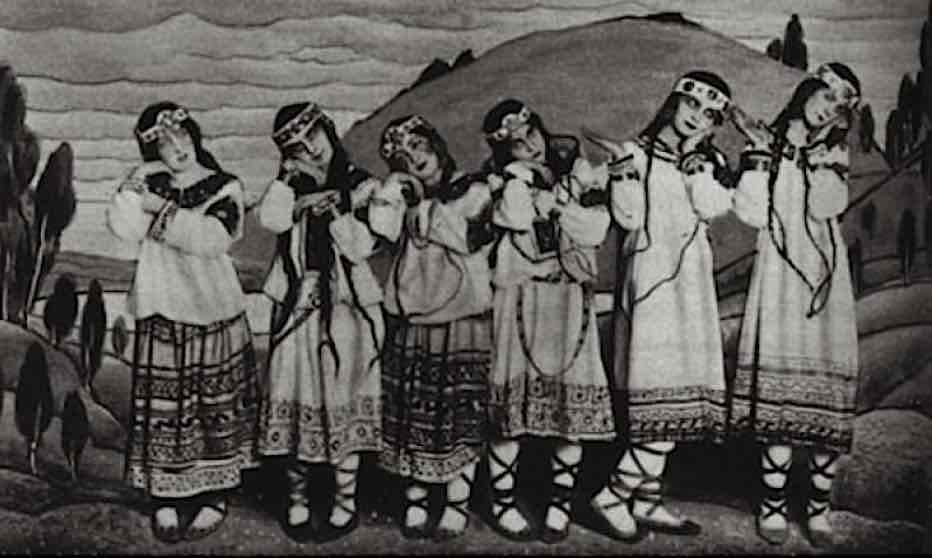
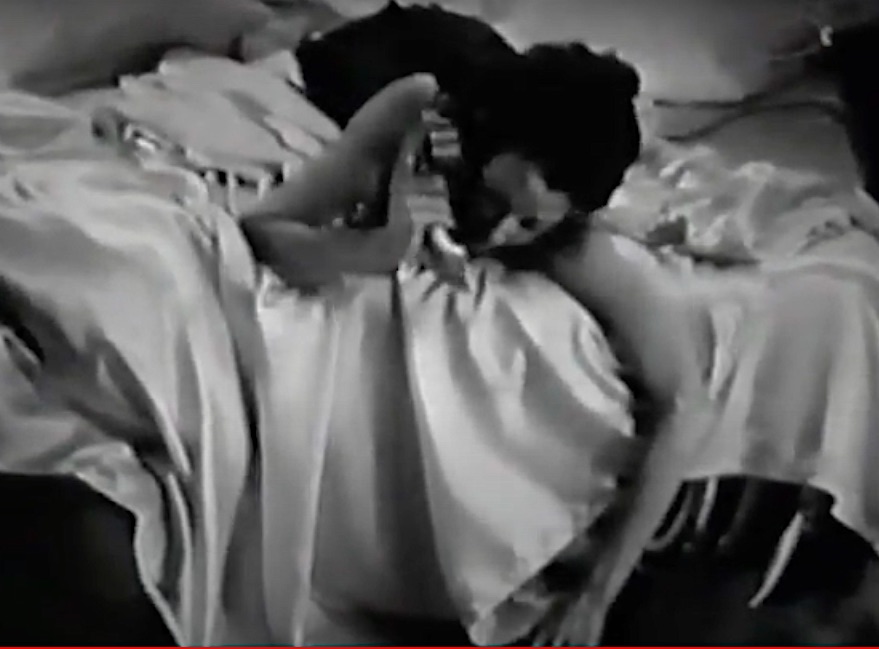
Ida Rubenstein leading the original 1928 production of Boléro. Source.

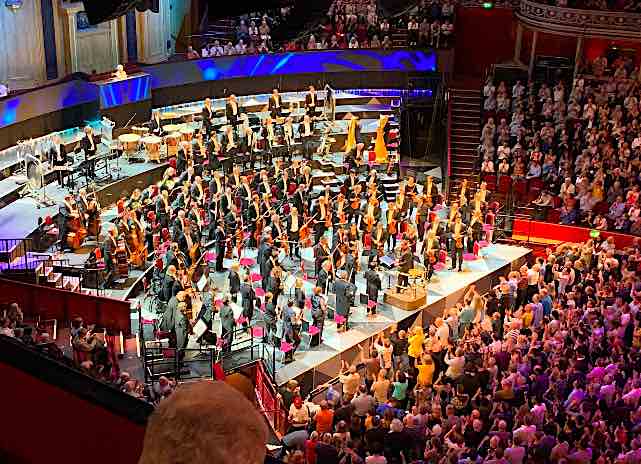
Ravel’s Boléro and Stravinsky’s The Rite of Spring have become concert “classics”, but they are challenging in very different ways. It was exhilarating to hear both in the same Prom the other day.

For The Rite, I refer you to various posts, starting with my own epiphany under Boulez in The shock of the new. By comparison, Boléro (also composed for a ballet) may merely seem like easy listening, but the concept is just as original, with our ears kept engaged by the rhythmic fluidity of both segments of the melody * over one long, relentless crescendo. I’m reminded of Roger Nichols’ characterisation, quoted in my page on Ravel:

the repetitive obsession that opens out on to notions of death, madness, destruction, and annihilation, as if the composer had had an apocalyptic vision of the end of the world.

Of course listeners will respond in different ways. Even if such a message is merely latent, Boléro can and should be a somewhat unsettling experience.

Again, note my Ravel page, along with posts under Ravel, Stravinsky, and Proms tags. See also Perfect Pitch, and posts on minimalism.


* Another party game: the two sections of the melody are deceptively simple, so one might suppose that after hearing so many repetitions, we would be able to reproduce it quite accurately from memory, even after a single hearing—and most of us have heard the piece many times. It becomes more achievable if we intentionally set out to memorise it (and for some it may help to consult notation), but even then it may still be a challenge—the first half of the opening section alone may prove surprisingly difficult to reproduce by heart. After Hašek, my usual prize of a small pocket aquarium

Of course, it’s not to be compared with memorising a Brahms concerto, but its apparent simplicity, with virtually no harmonic props, make it all the more intriguing as an exercise. Cf. Conducting from memory, and On “learning the wrong music”.

Mahler festival!!!

I’ve sung the praises of the music of Gustav Mahler in a series of posts, rounded up here. For anyone within reach of Amsterdam, the Concertgebouw’s current Mahler festival is a blessing: details here and here, with useful links. The comprehensive concert series includes all the symphonies in sequence, performed by some outstanding world orchestras and conductors, with many related events, including the songs with piano.

Boulez, Benjamin, Brahms

On Thursday at the Barbican I heard the LSO celebrate S-Simon Rattle’s 70th birthday.

The concert opened with Éclat by the great composer-conductor Pierre Boulez, marking the centenary of his birth. As Rattle observes here, Boulez was a seminal influence on our generation. While Éclat (1964–5) may not be everyone’s idea of a jaunty little overture, it’s exquisite, basking in the sonorities of fifteen instruments in two groups (piano, vibraphone, xylophone, harp, cimbalom, guitar, mandolin, tubular bells, timpani; and alto flute, cor anglais [“english horn”, as Boulez liked to call it], trumpet, trombone, viola, cello). As Jo Buckley comments in the programme notes,

It is as though we were examining an exquisite cut-glass bowl, glittering in its beauty and complexity, that is dropped and shattered into thousands of pieces. Some of these shards catch and sustain the light, others glint briefly as you pass them, but the whole itself is never restored.

Boulez 1958

For Rattle it’s “one of Boulez’s seminal pieces, […] where you not only conduct, but you almost compose as you go along. It’s a piece you can only do with a group of musicians who really trust you, and vice versa.” In this 2016 Prom he conducted the Berlin Phil:

Here’s Boulez conducting the work:

Maybe this is intrinsic to the impersonal atmosphere of the concert hall, but much as I love the textures, I miss the human interaction of “improvisation”.

When Boulez conducted Éclat in Leningrad in 1967, “the audience had never heard anything like it before and demanded an instant encore. ‘It was packed,’ says Lilian [Hochhauser], ‘they were hanging off the balconies’. ”

Rattle Hannigan

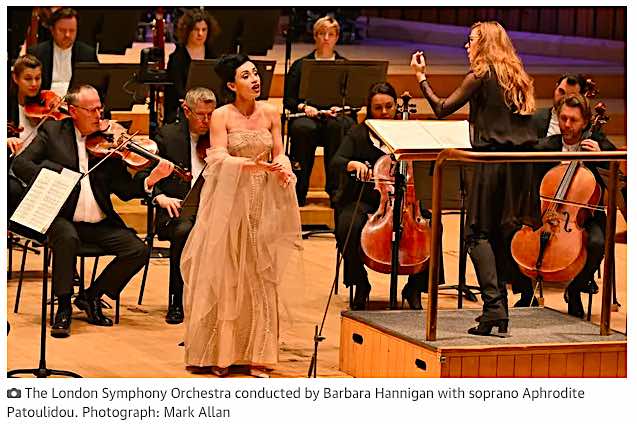
Then we heard the world premiere of George Benjamin’s Interludes and Aria, from his opera Lessons and Love and Violence (2018), a gift for Rattle’s birthday. In this coherent suite of seven brief movements, dramatic and unsettling, the central aria was sung by the imperious, magnificent Barbara Hannigan—how blessed are composers to have such an interpreter! Here she sings the aria in the opera itself:

For previous collaborations between Hannigan and Rattle, click here and here.

Having willingly eaten our greens, we earned a pudding. Brahms 4 may be familiar, but it’s always irresistible, right from the sigh of the descending third that opens the piece, on which Hugh Maguire dwelled lovingly as he coached us in the NYO.

Brahms 4

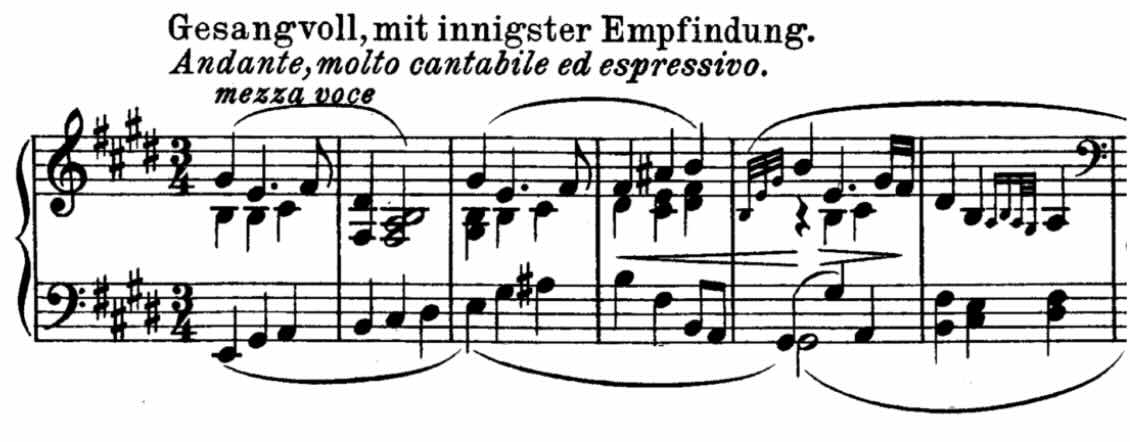
The gorgeous slow movement is among my exhibits in the incandescent key of E major.

S-Simon conducted the symphony from memory, always an immersive experience. And as with composer-conductors such as Mahler, Boulez, and Salonen, there’s something special about hearing classics performed by specialists in contemporary music. In his Lexicon of music invective Nicolas Slonimsky reminds us that it can take time for new music to be appreciated: critics of the day found Brahms 4 “intolerably dull”, with “a profuse lack of ideas”. So there.

For a less driven version of Brahms 4, try the iconic Furtwängler (1948). Cf. Carlos Kleiber (1996)—here, with an amazing Brahms 2 as well!!!

More Brahms e.g. here and here.

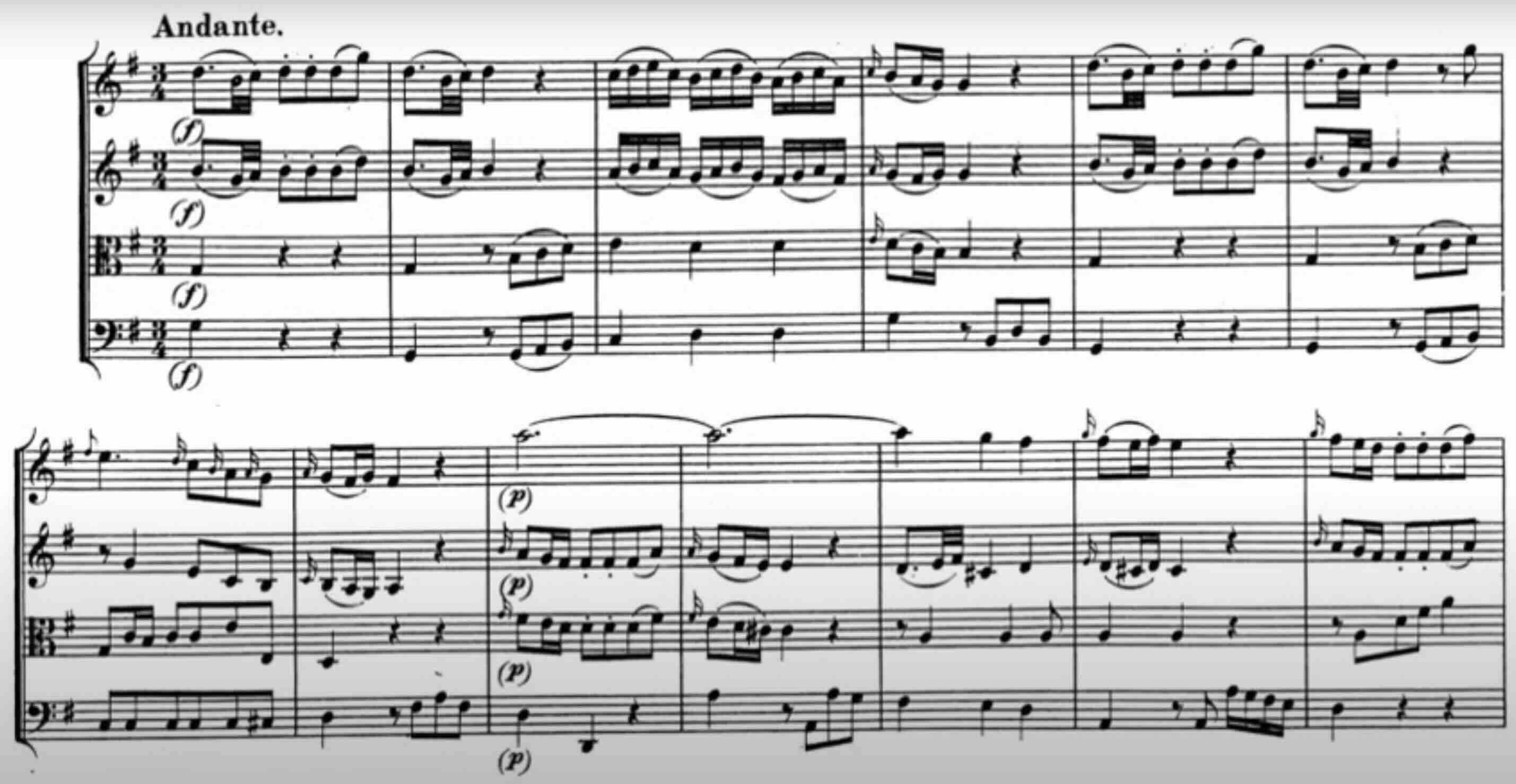
A radiant Mozart Andante!

Screenshot

Even while I’m immersed in the Gaoluo New Year’s rituals and Persian chamber music, the luminous slow movement of Mozart’s D major Divertimento suddenly comes to mind—here’s the Amsterdam Baroque Orchestra with Ton Koopman, always a good choice: *

Written in Salzburg when Mozart was 16, doubtless still basking in his recent tours of Italy, it’s just as delightful to play as to listen to. For me it recalls a US tour twenty-some years ago with Andrew Manze (not the same tour as when he incapacitated me with the Finnish loo story, I think)—wholefood supermarkets on the highway, small-town bookstores, blues bars. Whatever the mundane challenges of negotiating airports, motels, and Life, this oasis of radiant tranquillity was always there to revive our spirits. Gems like this remind us to just Be in the Moment, embodying the effortless grace of sprezzatura and wuwei [Another Pseuds’ Corner entry, bravo!Ed.] [Oh come on, gimme a break—SJ], in a way that no-one but Mozart can do (cf. the moving scene in Amadeus)—remote from Beethoven’s bludgeonings.

Good to add to my Mozart series—now also with a playlist on my YouTube channel!


* For their Bach, see e.g. here and here.

Mahler 2 with MTT!

*Yet another post in my Mahler series!*

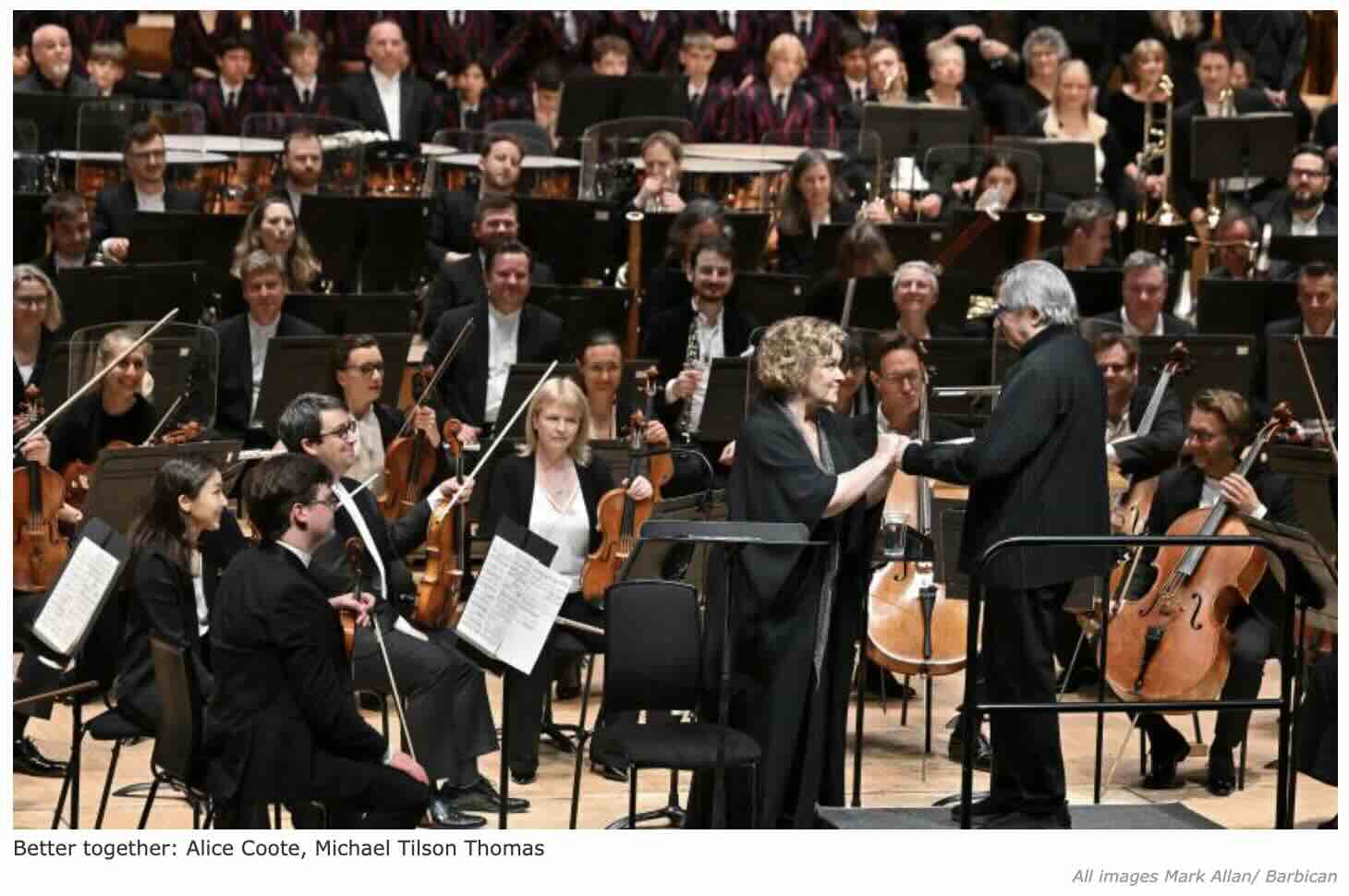
To follow Mahler 3 with Michael Tilson Thomas and the LSO earlier this year, I just heard them giving the first of two performances of the 2nd symphony (main post here) at the Barbican.

Screenshot

© LSO | Mark Allan. Source.

While Mahler 2 in concert cannot fail to be overwhelming, on Sunday its power was conveyed as much by the fervent communal devotion of performers and audience as by the elderly, frail conductor. As this review of the 3rd symphony in May commented, MTT “more or less held it all together… signalling a few entries and giving some directions. That, however, was the full extent of his input, a distant cry from his earlier years where he would have been athletically bouncing around and being criticised by some for his micro-management.”

M2 before choir

The orchestra must have risen gladly to the challenge of having to negotiate so much of the detail. The singers were also fine—Alice Coote in a rapt Urlicht, joined for the monumental finale by Siobhan Stagg and the London Symphony Chorus. As others have noted, the standing ovation was not so much for this concert as a homage to MTT’s lifelong music-making.

* * *

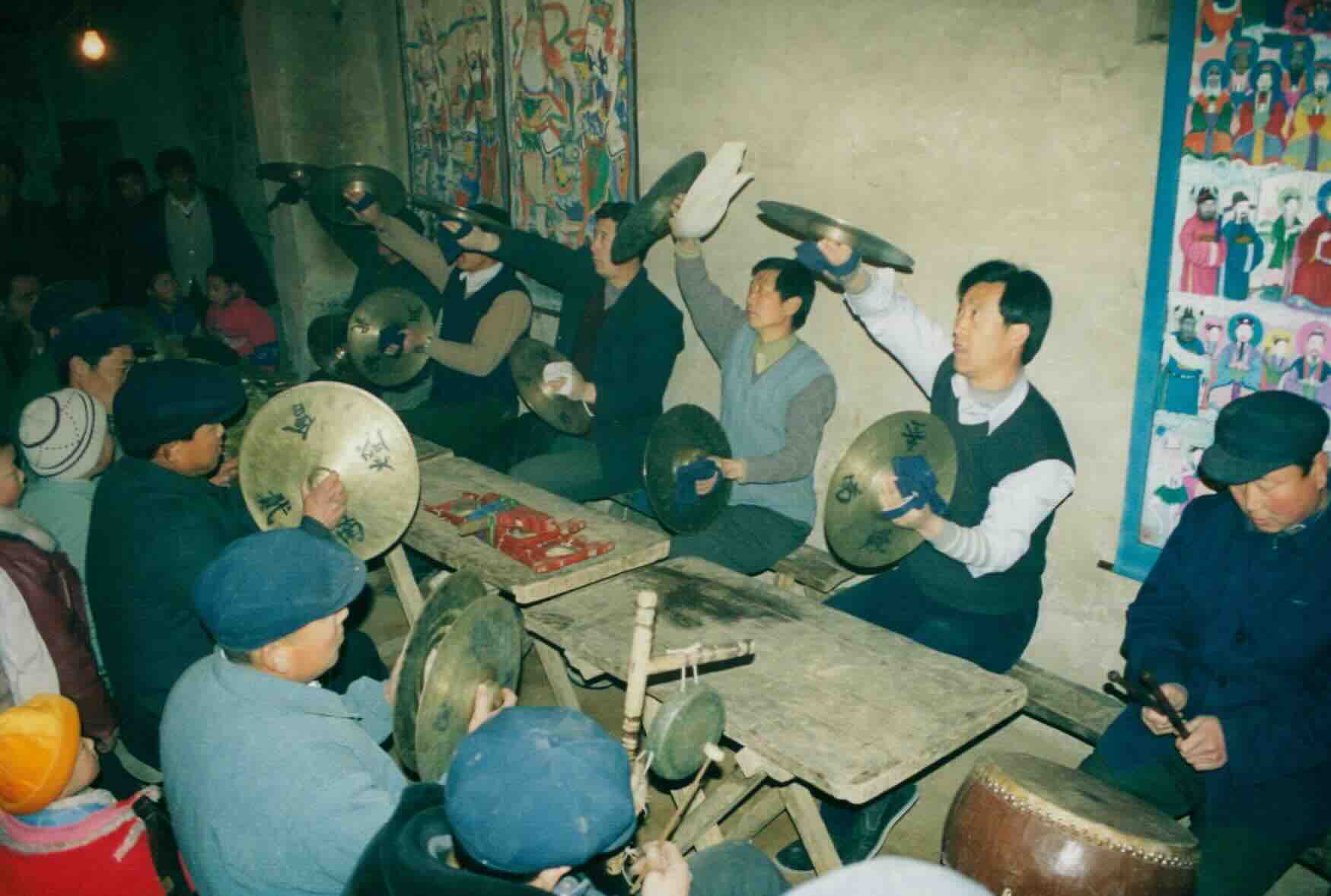
Immersed as I am in another round of editing my new film on the New Year’s rituals in the poor village of Gaoluo, the symphony made an extreme contrast, even if both rituals are in service of the divine. *

For Bernstein and Mahler, see Maestro.


* Another entry in my Martian ethnography (see e.g. here):

As I suggested in Plucking the winds, whereas cymbal players in WAM feel impelled to milk the rare climactic moments when they are required, in Gaoluo the great percussion suite, with all its solemn and balletic complexity, demands stamina, skill, and memory.

GL FDZ

Berlioz: a love scene

Berlioz Romeo

If you’ve recovered from the fiddlers of the Dauphiné, my main passions in French music are for Ravel and Messiaen, not forgetting Rameau and Debussy, Michel Legrand, Françoise Hardy, and Barbara Pravi. But Berlioz makes guest appearances on this site too:

Berlioz CD

And I just recalled the pleasures of playing Berlioz’s “dramatic symphony” Roméo et Juliette with John Eliot Gardiner in 1995. Here he conducts it complete at the 2016 Proms—long after my time:

The Scène d’amour is enchanting—I’m also attached to Esa-Pekka Salonen, as much for his wise and forensic conducting as for the wonderful story of his interview for the LA Phil job, so here’s a 2023 concert:

While our EBS repertoire with Gardiner revolved around Bach, Handel, and Mozart, pieces of later early music that I enjoyed playing with him and the ORR include the Brahms German Requiem and Verdi’s Four sacred pieces.

A German requiem

How we respond to any music has a lot to do with the associations of our personal reception history.

The Brahms German Requiem (Ein deutsches Requiem, nach Worten der heiligen Schrift, 1865–68)—humanist rather than Christian—was one of the first major choral works that I got to know, playing it quite regularly around suburban London with amateur orchestras and choral societies while I was at school (just as I first performed the Bach Passions, far from the HIP performances of my later “career”).

Finnegan 245

From Ruth Finnegan, The hidden musicians (1989).

I went on to play the German Requiem at Cambridge—where a group of us liked to stagger back from the pub to be amazed by Barenboim’s 1972 LP, with the LPO and the Edinburgh Festival Chorus, Edith Mathis and Dietrich Fischer-Dieskau:

concluding here (followed by the Vier Ernste Gesänge): *

By the time I was playing professionally in London, the Requiem had (sadly) become a rather routine experience, with (happily) minimal rehearsal (cf. Ecstasy and drudge), a bread-and-butter gig akin to doing a Messiah in Scunthorpe.

I write this post because until quite recently I felt twice removed from such works—after all those years in the early music business, with the further distraction of becoming immersed in Chinese fieldwork, I might expect to have grown out of such romantic warhorses. But somehow early bonds remain deep.

* * *

Klemperer’s 1961 recording is widely praised, with the Philharmonia Chorus and Orchestra, Elisabeth Schwarzkopf and Dietrich Fischer-Dieskau:

After this recording of Mengelberg’s 1940 concert (with the Concertgebouw and Amsterdam Toonkunst Choir, Jo Vincent and Max Kloos), here’s Furtwängler in 1948, with the Stockholm Phil and Chorus, Kerstin Lindberg-Torlind and Bernhard Sönnerstedt:

and Celibidache, live in 1981 with the Munich Phil and Choir, Arleen Auger and Franz Gerihsen:

In 1984 Tennstedt made two recordings with the LPO and Choir—a studio recording with Jessye Norman and Jorma Hynninen:

and a live performance from the Proms, with Lucia Popp and Thomas Allen:

As the early music movement became flavour of the month (see here), musos like me, who had washed up on the shores of baroque music as a refuge from the stormy seas of symphony orchestras, again found themselves playing some of the same pieces from the mainstream repertoire—now re-invigorated by a notional cachet of “authenticity”.

Brahms Requiem JEG

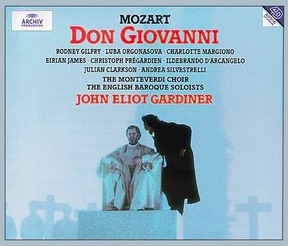
I was glad to revisit the German requiem for John Eliot Gardiner’s first recording of the work in 1990, with the ORR and the unmatchable Monteverdi Choir, Charlotte Margiono and Rodney Gilfry:

For Gardiner’s second recording (with Katharine Fuge and Matthew Brook, recorded in 2007–08), click here.

Assessing the balance between intense and ponderous will be subjective, depending on one’s own reception history and degree of veneration for particular maestros (note The art of conducting). Now, I’m keen on slow tempi, emphasised by most conductors here; but I find the choices of Furtwängler or Barenboim far more convincing than those of Celibidache—though FWIW, among the singers, I am moved by Celi’s team of Arleen Auger and Franz Gerihsen.

Anyway, it’s taken me all this time to feel blessed (selig) by the soul of Brahms. **

Among a wide range of scholarship, see e.g. chapter 5 “Performance issues in A German Requiem” of Performing Brahms: early evidence of performance style, cited in Brahms, tempo and timbre. See also Hélène Grimaud‘s renditions of the piano concertos; Der englische grußand *don’t miss* Kleiber’s Brahms 2!!! Try also the Mozart Requiem, and Funeral music. For other forays into later early music, cf. Berlioz’s Symphonie fantastique and Roméo et Juliette, the Four sacred pieces of Verdi, and even The Rite of Spring.


* which sounds more, well, serious, than “Four serious songs” (cf. Richard Strauss, here and here). Cf. What is serious music?!.

** It’s always worth consulting Slonimsky’s Lexicon of musical invective for withering reviews of the day. George Bernard Shaw in 1892:

Brahms’s Requiem has not the true funeral relish: it is so execrably and ponderously dull that the very flattest of funerals would seem like a ballet, or at least a danse macabre, after it.

Philip Hale in 1900:

Page after page of his Requiem is saturated with indigo woe, and the consolatory words are set to music that is too often dull with unutterable dullness.

Cf. More musical criticism.

Another Mahler 6 at the Proms!!!

*Yet another post in my Mahler series!*

Rattle Prom 2Source.

At last season’s Proms S-Simon Rattle conducted a moving Mahler 9 for his final concert as Musical Director of the LSO. Since leaving the UK for Germany, he has become chief conductor of the Bavarian Radio Symphony Orchestra. Last week in the first of two visits to this year’s Proms they played Bruckner 4 and a UK premiere by Thomas Adès. The next evening I went to hear them in Mahler 6 (listen on BBC Radio 3).

Rattle Mahler 6 CDI wrote about the symphony here, after a performance at the 2017 Proms, and featuring recordings by Mitropoulos, Barbirolli, Bernstein, Tennstedt, and Abbado.

The Bavarian orchestra is just as deeply immersed in Mahler as S-Simon, having regularly performed the symphonies over many decades (from the cycle with Kubelik, here‘s the 6th, from 1966) and in recent years with Mariss Jansons and Daniel Harding. S-Simon has been touring it with the Bavarians this year (on You Tube, their recent live recording starts here—finding the other movements there is more of a challenge).

After the first movement, with its juxtaposition of prophetic jackboots (cf. Mahler 10), “yearning” Alma theme, and Elysian cowbells, for the two central movements S-Simon (like most conductors) favours Mahler’s revised movement order, with the wonderful Andante second; but I still feel there are sound musical reasons for placing it third, as explained in my original post. And then the immense, tragic finale, with its extraordinary hallucinogenic opening. In his revision Mahler removed the controversial third hammer-blow:

Mahler 6 MSSource (cf. here).

I always feel that S-Simon’s rapport with his players—and audiences—is much enhanced by his conducting from memory. The Bavarian players sound wonderful, like every orchestra he conducts.

Rattle Prom 1

I ran out of superlatives for Mahler long ago—do keep consulting my roundup!

* * *

Some other Proms that I relished this season:

For previous years, scroll through the Proms tag; and it’s always worth browsing the Proms Performance Archive. See also The art of conducting.

French music at the Proms

French PromStéphane Denève accompanying Laurence Kilsby in Lil Boulanger’s Vieille prière bouddhique.
Via Twitter.

Always enthralled by French music, at the Proms earlier this week (following the Orchestre de Paris playing Berlioz, Debussy, and Stravinsky) I went to hear Stéphane Denève conducting the BBC Symphony Orchestra and Chorus in a programme of Lili Boulanger, Fauré, and Ravel, with vocal solos by Golda Schultz, Laurence Kilsby, and Jacques Imbrailo (listen on BBC Radio 3).

Lili B

Despite her sadly short life, the music of Lili Boulanger (1893–1918) has grown in reputation—her name now ranking alongside that of her sister, the influential pedagogue Nadia. The concert opened with Lili’s Pie Jesu, dictated on her deathbed to Nadia (whose 1968 recording with Bernadette Greevy and the BBC Symphony Orchestra can be heard here).

Boulanger was a pupil of Fauré, and her Pie Jesu made an apt bridge to his Requiem, at whose heart is a setting of the same text. The Requiem is so over-exposed that it deserves to be heard with fresh ears. A subjective comment: whereas for some works like the Brahms German Requiem I can overrride my youthful experience of accompanying amateur choral societies, in this case I still can’t fully engage, even if I can now appreciate Fauré’s originality.

More from both composers after the interval: Fauré’s Pelléas et Mélisande, a popular theme for composers of the day—notably Debussy, Schoenberg, and Sibelius. Then came Lili Boulanger’s Vieille prière bouddhique, with tenor and choir * singing a text translated from Pali—a “prière quotidienne pour tout l’univers” whose goal is as distant now as it was in 1917. Dominated by a somewhat portentous tritone interval, it adds to our list of fin-de-siècle orientalism.

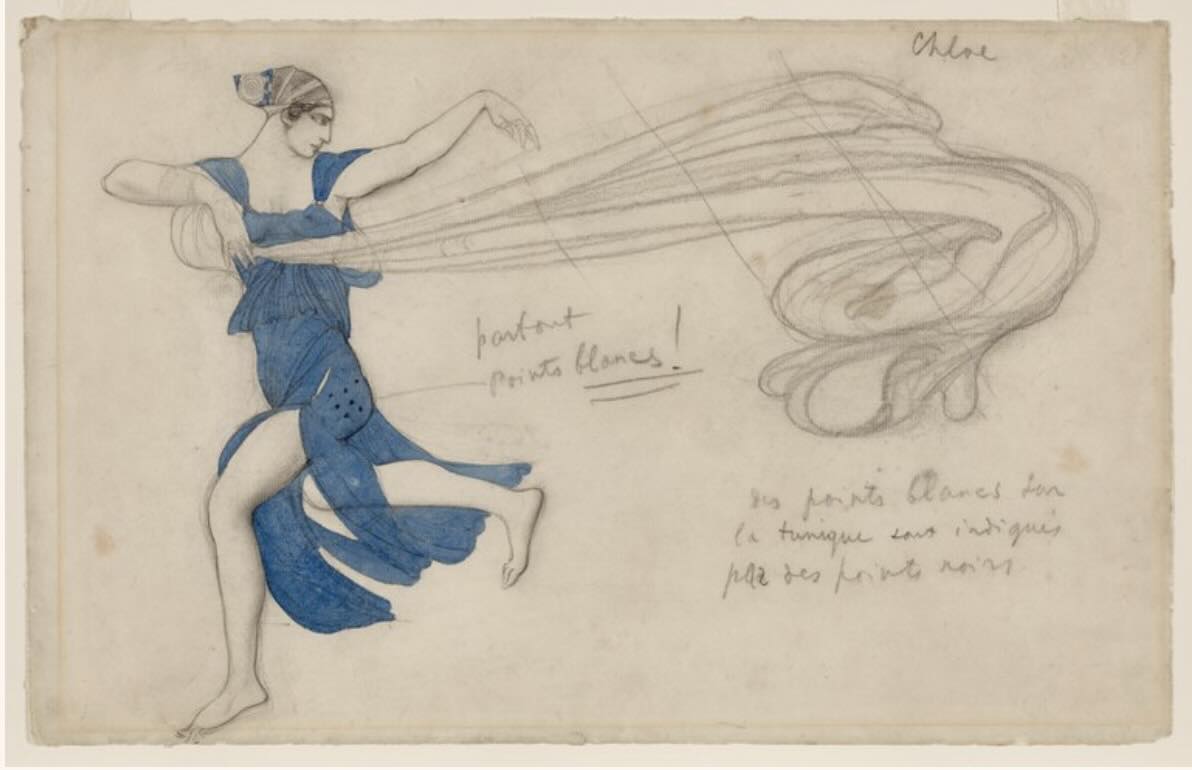
Chloe design

Léon Bakst, costume design for Tamara Karsavina as Chloé, 1912. Source

Just predating both the Boulanger pieces, Ravel’s Daphnis and Chloé (see my main page on Ravel) is exquisite. Ideally it should be heard in the complete version, but the 2nd suite makes a popular concert finale (here it was enhanced by wordless choir, usually considered too extravagant). The opening is always enchanting—I like this story (anyone have an original source?):

Ravel, when asked how it was that his famous musical evocation of sunrise had been penned by someone who never got up before 10.30am, replied, reasonably enough, “I used my imagination”.

To follow the flute solos of Pelléas and the Prière, Daphnis and Chloé is a glorious showcase for the woodwind, with Stéphane Denève at last free to conduct with balletic nuance and bacchanal abandon.

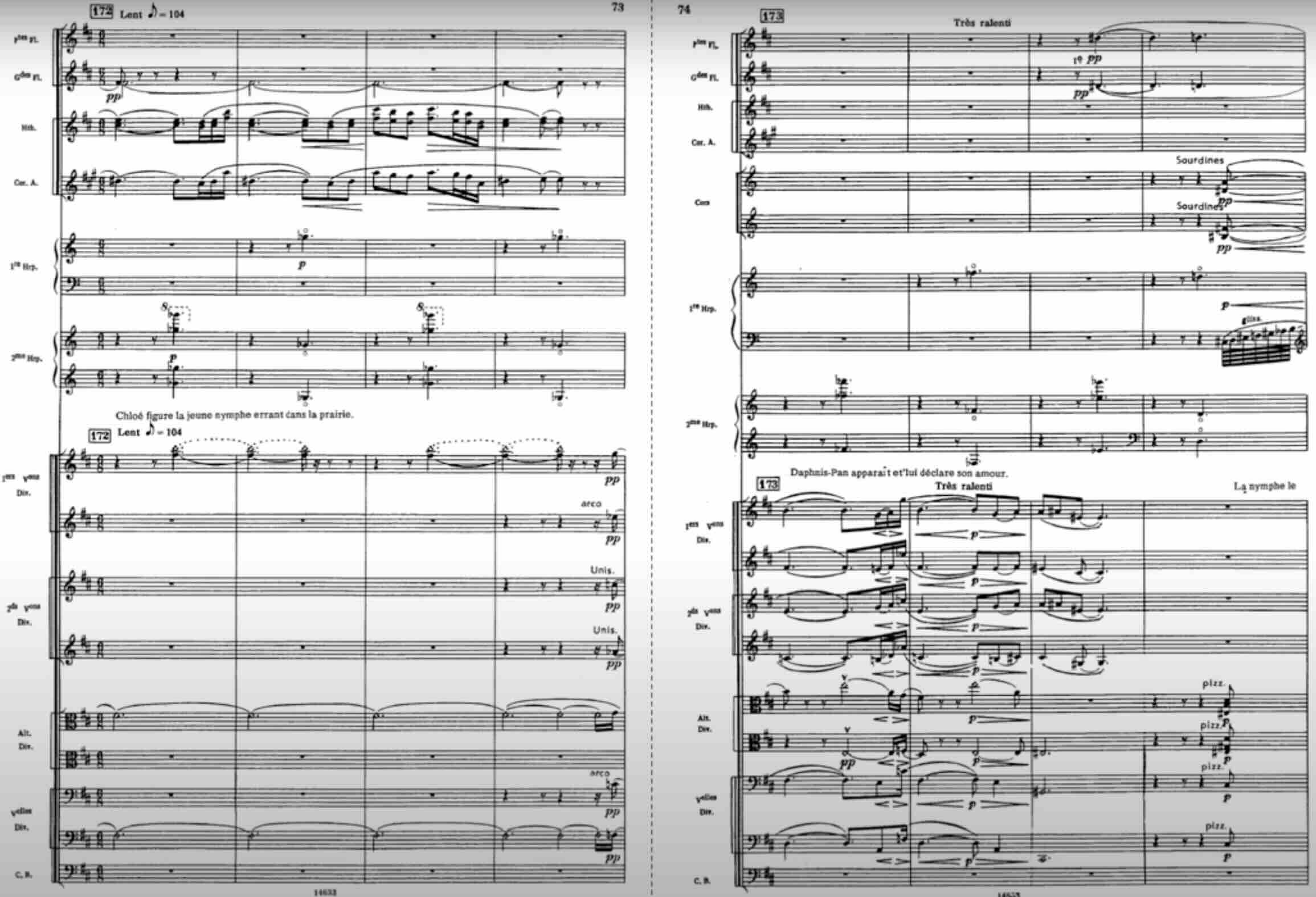
Screenshot

A most exquisite passage—from 5.43 in S-Simon Rattle’s live performance with the LSO here.


* The late lamented Nicolas Robertson was part of the Monteverdi Choir for John Eliot Gardiner’s 1999 recording, inspiring him to create one of his most moving anagram tales—192 anagrams of Lili Boulanger that he wove into yet another fantastical plot (the title Nubile gorilla an anagram that vies with Gran visits York for Igor Stravinsky!).

Bach from Japan

with a not entirely meretricious fantasy on world-music Passions…

Suzuki Prom 2©BBC/Mark Allan. Source: Artsdesk review.

This year is the 300th anniversary of the Leipzig premiere of Bach’s John Passion. * After John Butt’s performance at the 2017 Proms (more links to the Passions here), I’ve just returned to hear it with Masaaki Suzuki (b.1954) directing the Bach Collegium Japan, which he has led since 1990 (listen here—with an instructive interval talk thankfully replacing the interminable original sermon). Whereas performers these days know the work intimately, it must have been a serious challenge for Bach’s Leipzig forces (cf. this post); even to today’s listener it still sounds startingly modern—imagine how it must have sounded to the 1724 congregation!

Having studied with Ton Koopman in Amsterdam, Suzuki became a leading advocate for the early music movement in Japan. Joining several other complete recordings of the Bach cantatas (links here), his cycle with BCJ was completed in 2014. It’s most remiss of me not to have kept up, missing Suzuki’s previous visits to London, both with his own ensemble and as guest conductor of the Age of Enlightenment. Far from inscrutable, his style is dramatic, expressive, rather evoking that of Koopman, or perhaps Richard Egarr—both of whom direct from the keyboard, whereas Suzuki has gravitated to conducting from the podium, leaving the harpischord and organ to dedicated musicians (given which, he might go further and cede close control over the recitatives?).

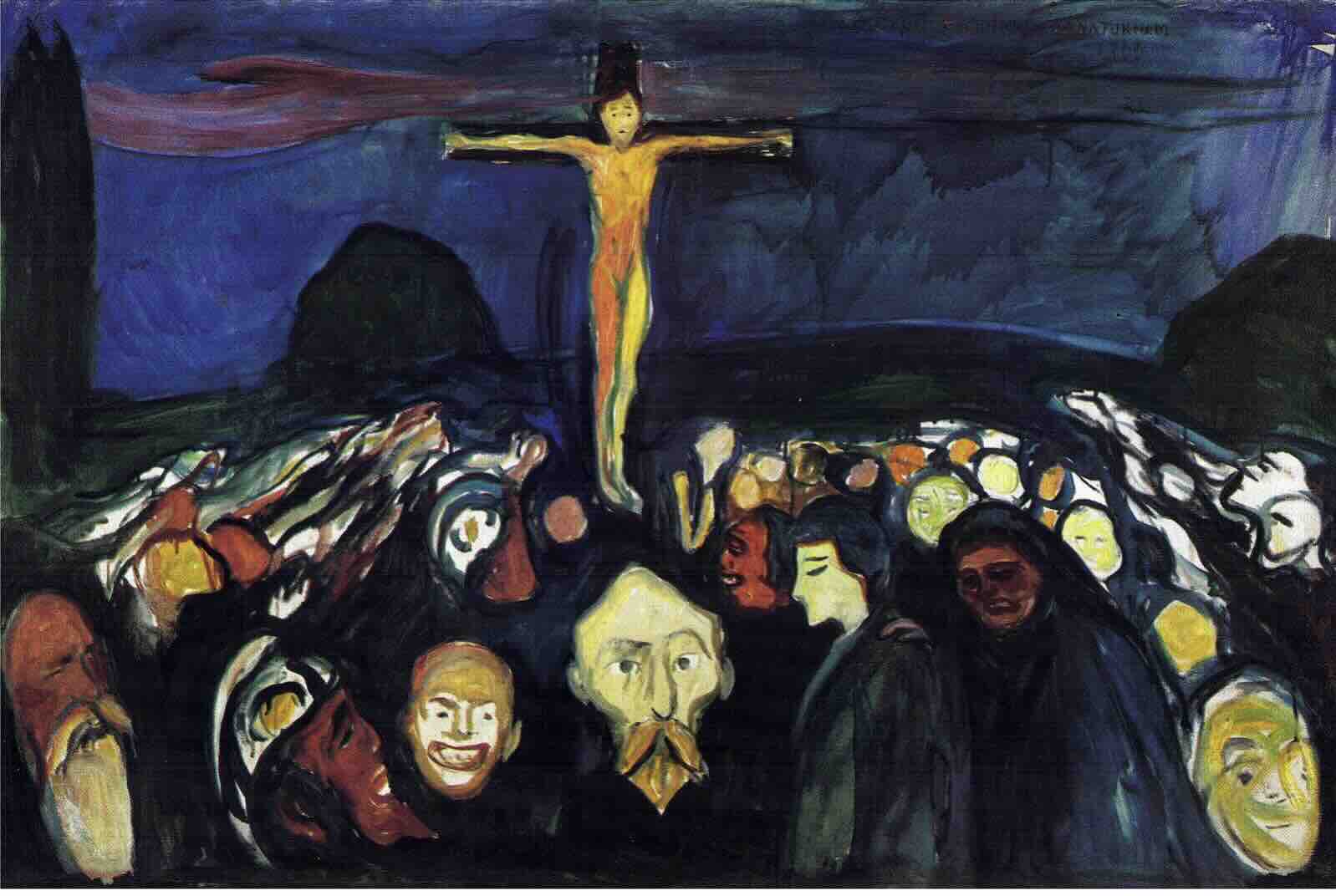
Munch Golgotha

Bold idea of the programme booklet: Edvard Munch’s Golgotha (1900),
in which he represented himself as the Christ figure,
with the foreground figures casted as the seven deadly sins. Source: wiki.

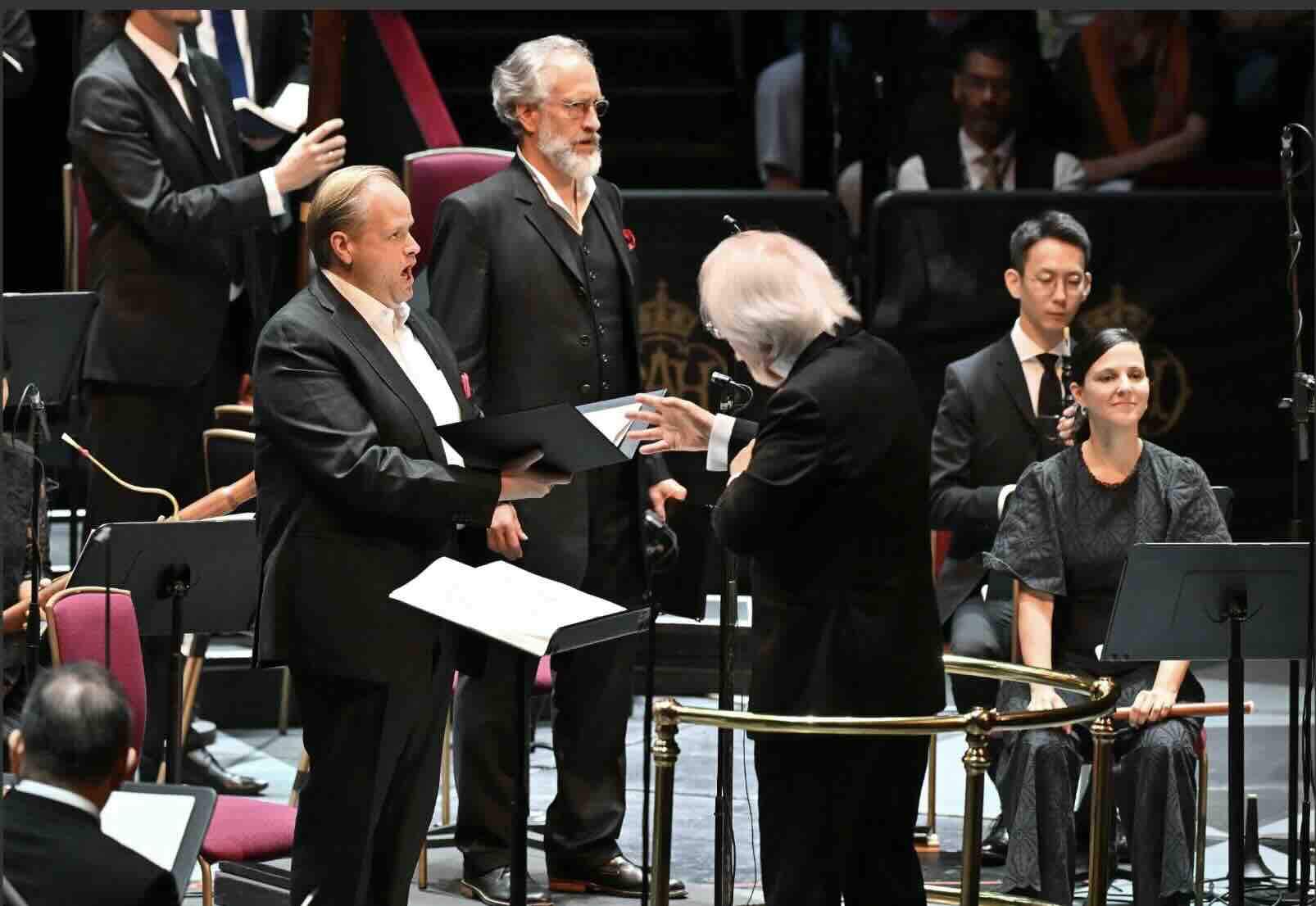
Benjamin Bruns was the Evangelist to Christian Immler’s imposing Jesus. The choir sounded fabulous, with twenty singers in an arc, including soloists who emerged for the arias. Carolyn Sampson (whom I used to accompany on Bach tours with The Sixteen) was exquisite in Zerfließe, mein Herze, as was Alexander Chance in the counter-tenor arias—succeeding his father Michael, whose singing, such as Erbarme dich, enriched our own performances with John Eliot Gardiner; excellent too were Yusuke Watanabe and Shimon Yoshida. Following HIP style, Suzuki favours small instrumental forces—wackily augmented by a towering contrabassoon (as in Bach’s fourth version); oboes and flutes, seated front stage on the right, were well highlighted.

Suzuki PromBenjamin Bruns, Christian Immler, Masaaki Suzuki.
©BBC/Mark Allan. Source: Bachtrack review (with the fine heading “Promenading on Golgotha”).

Suzuki and BCJ  have long experience of performing and recording Bach (watch a John Passion from 2000 here); their Proms visit this week was part of a European tour—it’s a highly seasoned, accomplished ensemble.

Nothing can compare to the awe of being plunged into the opening chorus, with throbbing, turbulent strings overlaid by anguished suspensions on oboes.

John MS

Returning to the Bach Passions regularly over a lifetime (referring, perhaps, to Gardiner’s Music in the Castle of Heaven) is an essential part of our self-cultivation.

* * *

In This Day and Age™ there’s nothing remarkable about a Japanese ensemble excelling in Bach; even if we can resist projecting orientalist fantasies (with Suzuki as Zen Sage-Mystic), their taste for Historically Informed Performance somehow seems quite appropriate. Perhaps no-one else will even think of gagaku, another genre that was imported, from Tang China—and then radically slowed down until it was no longer recognisable.

I’ve long had a fantasy of staging a world-music version of the Passions (cf. Bach, um, marches towards the world), held at a cosmic site like the Grand Canyon (cf. Messiaen). Amidst sand mandalas, the Dalai Lama with his own halo of deep-chanting Tibetan monks accompanied by their cymbals, drums, and booming long trumpets, as well as ethereal ondes martenot or theremin… Mark Padmore sharing the role of Evangelist with a searing cante jondo singer… Uyghur bowed satar and Persian ney flute as obbligato instruments for the arias, a gamelan to embellish the choruses, and the catharsis of an Alevi sema… One day I’ll do a detailed programme, unfettered by funding or logistics.

A slightly less daunting project would be a Japanese staging of the Passions based on Noh drama. As continuo to the pilgrim/Evangelist visiting the site of an ancient mystery, the dialogue of the two drums, their eery kakegoe cries summoning the spiritual world… the Noh chorus both evoking the crowd and offering redemption… Augmented by the timbre of gagaku, magically transforming the wind music of the choruses and arias (Bach’s own timbre for Zerfließe is already not so distant—and with an archlute joining the continuo, the affinity would be even closer). While some Westerners have trained intensively in Noh, it’s more common, and must be easier, for Japanese musicians to learn to perform Bach (cf. Jazz in post-war Japan)—though it might be hard to find musicians who would be up to (or up for) the task.

At the heart of both these stagings will be Bach’s original music, devotedly illuminated by compatible traditions from around the world.

See also under my roundup of posts on Japanese culture—including some spellbinding Bach on a mile-long xylophone in an empty forest!


* After all this time, I still have reservations about my choice to imitate Bach’s original omission of the “St” before John Passion (Passio secundum Joannem) and Matthew Passion (Matthäus-Passion, or even Passio Domini nostri J.C. secundum Evangelistam Matthæum), with its apparent breezy familiarity—”The name’s Matthew, but call me Matt”). But Was ich geschrieben habe, das habe ich geschrieben, as Pilate observed pithily (a foretaste of “It’s what it is”, suggesting that Robert De Niro might be well cast for the role, albeit too late to join John Wayne as centurion for the crucifixion).

Selected readings on WAM

BTW, I suspect a WordPress glitch may have failed to notify email subscribers of
my recent post on Nicolas Slonimsky’s wonderful memoir Perfect pitch
and it’s Jolly Good, just saying…

I’ve just revised my introductory page on Western Art Music, with the addition of an off-piste selection of general writings that I find stimulating.

It extends from works within the field itself (Taruskin, Ross, Slonimsky, McClary, Butt, Lebrecht) to the broader perspectives of ethnomusicology (Becker, Small, Nettl) and ethnography (Finnegan, Cottrell, Tindall, Warnock).

Another Turangalîla at the Proms!

Prom Messiaen

Photo: Chris Christodoulo. Source.

One should never miss a live performance of Messiaen’s ecstatic Turangalîla-symphonie!!!

My Messiaen page has links to many posts on Messiaen, and a tribute to Turangalîla—with the NYO’s 2012 Prom performance, and some hilariously uncomprehending reviews of the 1949 premiere (“Dorothy Lamour in a sarong […] Hindu Hillbillies”, “straight from the Hollywood cornfields”).

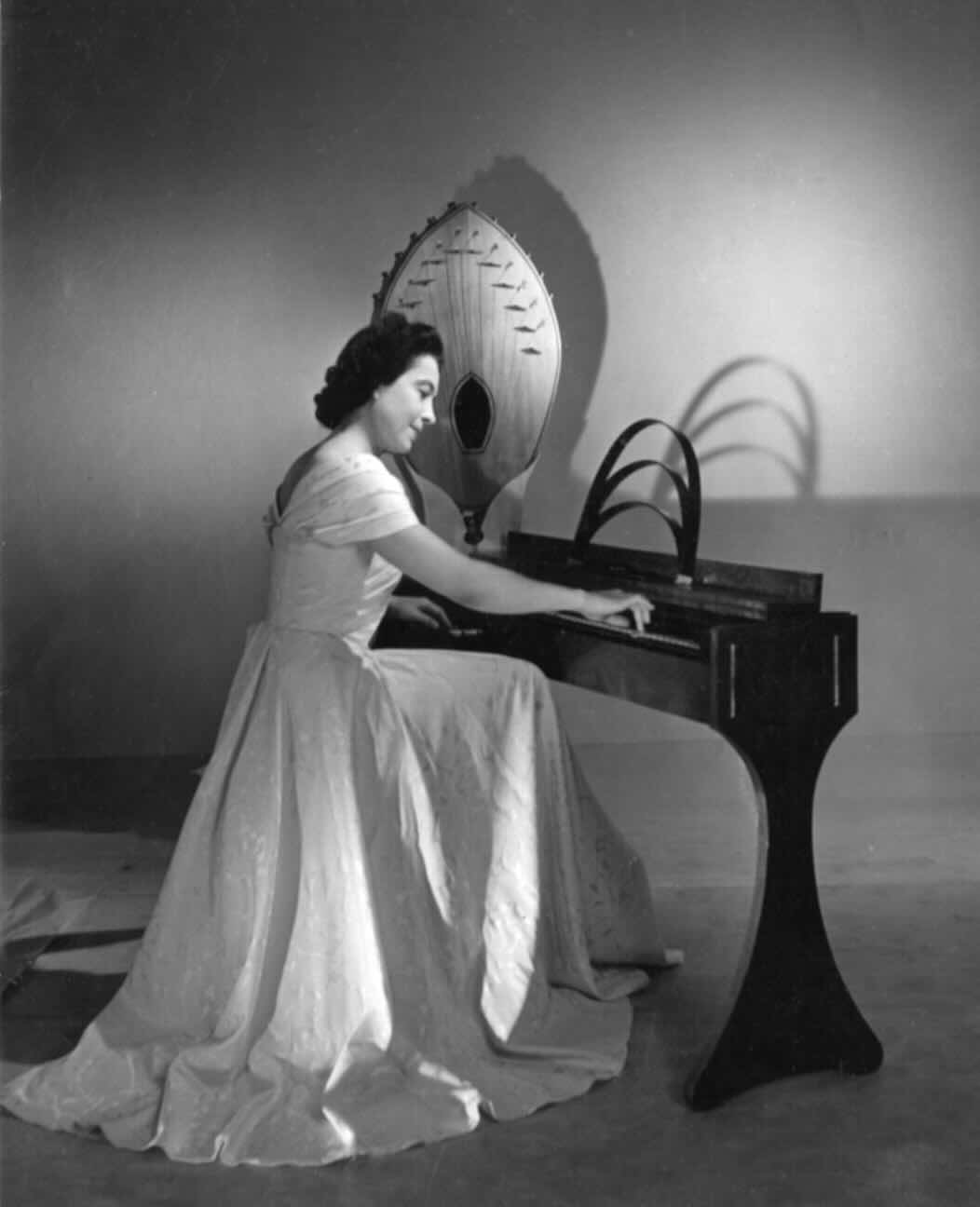
ondes

Ginette Martinot, who gave the premiere of Turangalîla. Source.

Last week at the Proms it was directed by the enterprising Nicholas Collon, with the BBC Philharmonic (British orchestras dominating so far; European and US bands can wait till later in the season). Cynthia Millar, veteran of the ethereal ondes martenot, added yet another radiant performance of a piece she has played around 200 times, including several Proms since 1986—for players limited to such a small repertoire, * Messiaen is a blessed gift (see Millar’s tribute to Jeanne Loriod). Steven Osborne relished Messiaen’s unique piano writing, with a niche backing-group of celesta and glockenspiel right behind him. I’m always entranced by the hushed coda that concludes the 4th movement, before the exhilarating Joie du sang des étoiles. Sensuous orchestral timbres abound.

Tlila 6

Source.

While experiencing Turangalîla live is extraordinary, for balance it’s worth listening on BBC Sounds, and it’s on iPlayer too. At the Proms it was first heard in 1969, with Musica Reservata performing Renaissance music in the first half (surely I was there, so why isn’t it indelibly etched in my memory?!). This time the prelude was the world premiere of Anna Clyne’s The gorgeous nothings, with the seven-piece a cappella Swingles, amplified, joining the orchestra—reminding me to acquaint myself with the poetry and reclusive life of Emily Dickinson. For a groovy encore (Erica Jeal asks pertinently “Is it bad etiquette to give an encore that upstages the main work?”) the Swingles launched into their joyous arrangement of the Bulgarian dance piece Bučimiš (studio version here; its metre is 2+2+2+2+3+2+2, BTW—see Taco taco taco burrito!). An encore after Turangalîla seems inconceivable—but in 2012 the NYO found a perfect one—Anna Meredith’s Handsfree!

Fans of the ondes martenot will want to hear the theremin too! Many more a cappella gems here; more Bulgarian folk under Musical cultures of east Europe.

Other recent Proms treats include Ravel‘s delightful piano concerto (with Ives’s Three places in New England), and Gershwin’s Rhapsody in blue (Steven Osborne again).


* This site mentions 1,200 works (!), although the core concert repertoire consists of pieces by a mere 27 composers.

Ondes octet

Perfect Pitch

Perfect pitch cover

I’ve often cited Nicolas Slonimsky’s brilliant Lexicon of musical invective. So I enjoyed reading his fascinating memoir

  • Perfect Pitch,
    in a revised third edition from 2023, ably edited by his daughter Electra Slonimsky Yourke.

Written with wit and wisdom at the age of 94, and first published in 1988, it’s a captivating blend of substance and gossip, packed with wonderful anecdotes—a Who’s Who of figures that seemed to matter at the time, part of a niche zeitgeist.

Nicolas Slonimsky (1894–1995) (fine website, with A/V; books, including Writings on music, 4 vols., 2005; wiki) was “a typical product of the Russian intelligentsia”—in the early chapters he gives a detailed account of his Russian family history and political turmoil. Already by 1912 his early musical facility led him to describe himself as a “failed wunderkind”.

In autumn 1918 he left St Petersburg. After stays in Kiev and Yalta, in 1920 he reached Constantinople (pp.85–90), where he found many musicians among the throng of Russian refugees. Lodging with a Greek family, he accompanied Russian dancers, and played for restaurants and silent movies. He composed Obsolete foxtrot and Danse du faux Orient, later included in his Minitudes. After following a girlfriend, a Russian dancer, to Sofia, by late 1921 he arrived in Paris—also inundated by Russian emigrés. There he worked for Serge Koussevitzky for the first time, who introduced him to Stravinsky in Biarritz. Koussevitzky, sorely challenged by irregular time signatures, * asked him to rebar The Rite of Spring for him. Despite moving in cultured circles, Koussevitzky (like Tennstedt later) was not a great reader.

Slonimsky was impressed by Nikolai Obukhov, a “religious fanatic” who made a living as a bricklayer. Inspired by Scriabin, and an unlikely protégé of Ravel, his magnum opus Le livre de vie for voices, orchestras, and two pianos (Preface here) contained “moaning, groaning, screaming, shrieking, and hissing”. He dreamed of “having his music performed in an open-air amphitheatre, perhaps in the Himalayas or some other exotic place”. He developed the croix sonore, a prototype of the theremin.

In 1923 Slonimsky docked in New York, travelling on a Nansen passport, “an abomination of desolation, the mark of Cain, the red spot of a pariah”. He soon found work as opera coach for the new Eastman School of Music in Rochester, at the invitation of Vladimir Rosing. He now confronted the challenge of learning English. Indeed, the book is full of gleeful comments on language learning. Taking advertising slogans as his textbook, Slonimsky’s arrangements (particularly Children cry for Castoria!) became popular. America seemed a fairy-tale land. At Eastman he found a kindred soul in author Paul Horgan.

In 1924 Koussevitzky replaced Pierre Monteux as conductor of the Symphony Orchestra (whose musicians were mainly German, French, and Russian), and the following year he invited Slonimsky to become his secretary (feeling more like a “serf”). Koussevitzky was in awe of Rachmaninoff’s genius, and despite his withering assessments of rival conductors, he did promote Mitropoulos and Bernstein; he was dismissive of Arthur Fiedler’s Boston Pops (cf. the splendid Erich Leinsdorf story). Much as he valued Slonimsky’s talents, his insecurity meant that his young protégé always had to tread carefully, and in 1927 they parted company.

Still, he now enjoyed a “meteoric” conducting career. With no illusions about his rudimentary technique, he founded the Chamber Orchestra of Boston, promoting contemporary composers—notably Henry Cowell, Edgard Varèse, and Charles Ives. After a performance of a work by Cowell, they rejoiced in the headline “”Uses egg to show off piano”. Slonimsky introduced Aaron Copland to George Gershwin. After Cowell introduced Slonimsky to Charles Ives, they became close.

Cowell Ives 1952
Henry Cowell with Charles Ives, 1952.

Slonimsky was full of praise for Ives:

I learned to admire the nobility of his thought, his total lack of selfishness, and his faith in the inherent goodness of mankind. […] He inveighed mightily against self-inflated mediocrity, in politics and art alike. The most disparaging word in his vocabulary was “nice”. To him, it signified smugness, self-satisfaction, lack of imagination. He removed himself from the ephemeral concerns of the world at large. He never read newspapers. He did not own a radio or a phonograph, and he rarely if ever attended concerts.

In 1931 (the year he gained US citizenship), Slonimsky gave the première of Ives’s Three places in New England in New York. Promoting the work with passion, in Perfect pitch he waxes lyrical about its genius.
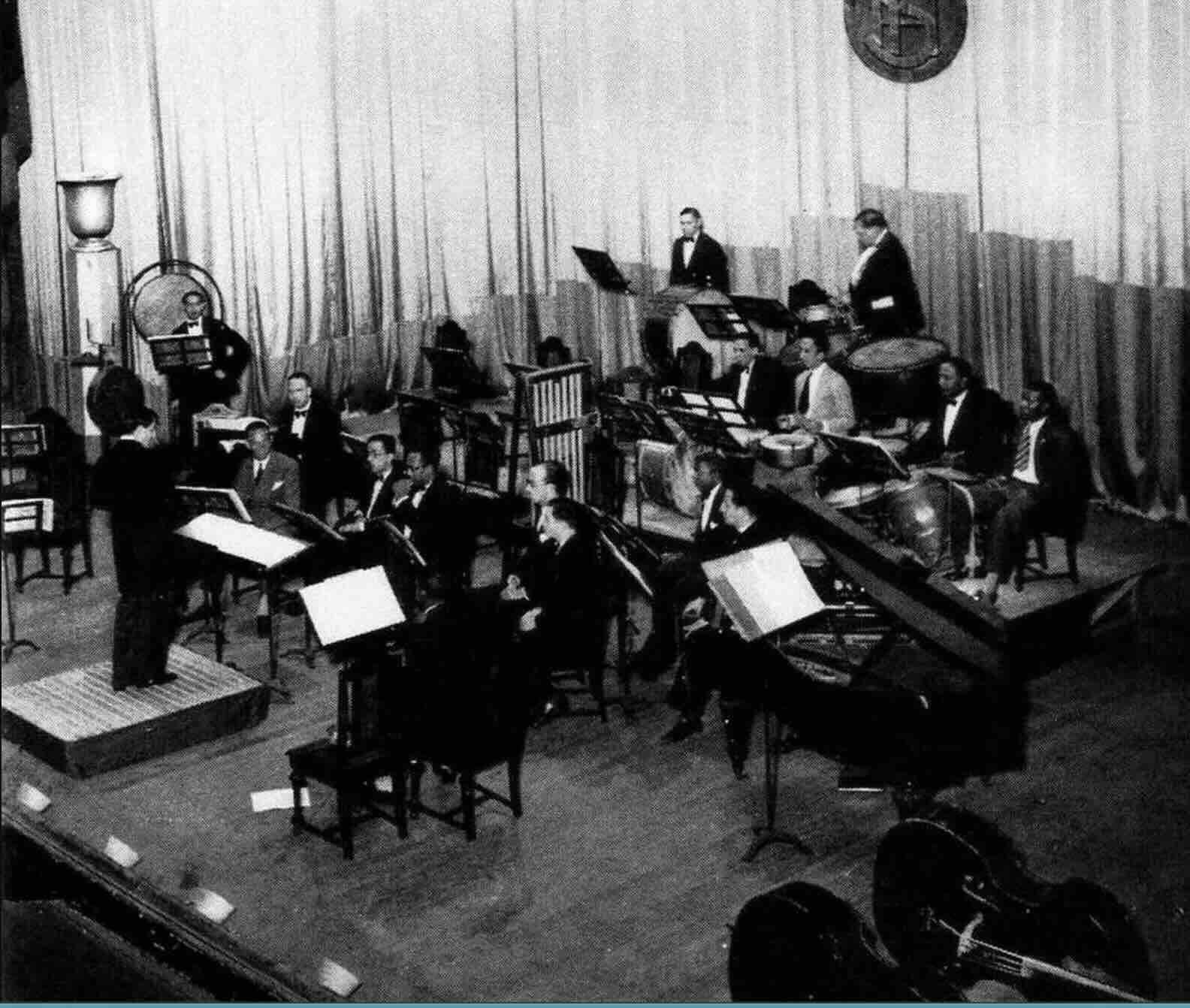
Slonimsky in HavanaSlonimsky conducting Varèse’s Ionisation in Havana.

He was invited to conduct in Havana, his first experience of modern Cuban music. He conducted revelatory concerts in Paris, sponsored by Ives, encouraged by Varèse. There too he married Dorothy Adlow.
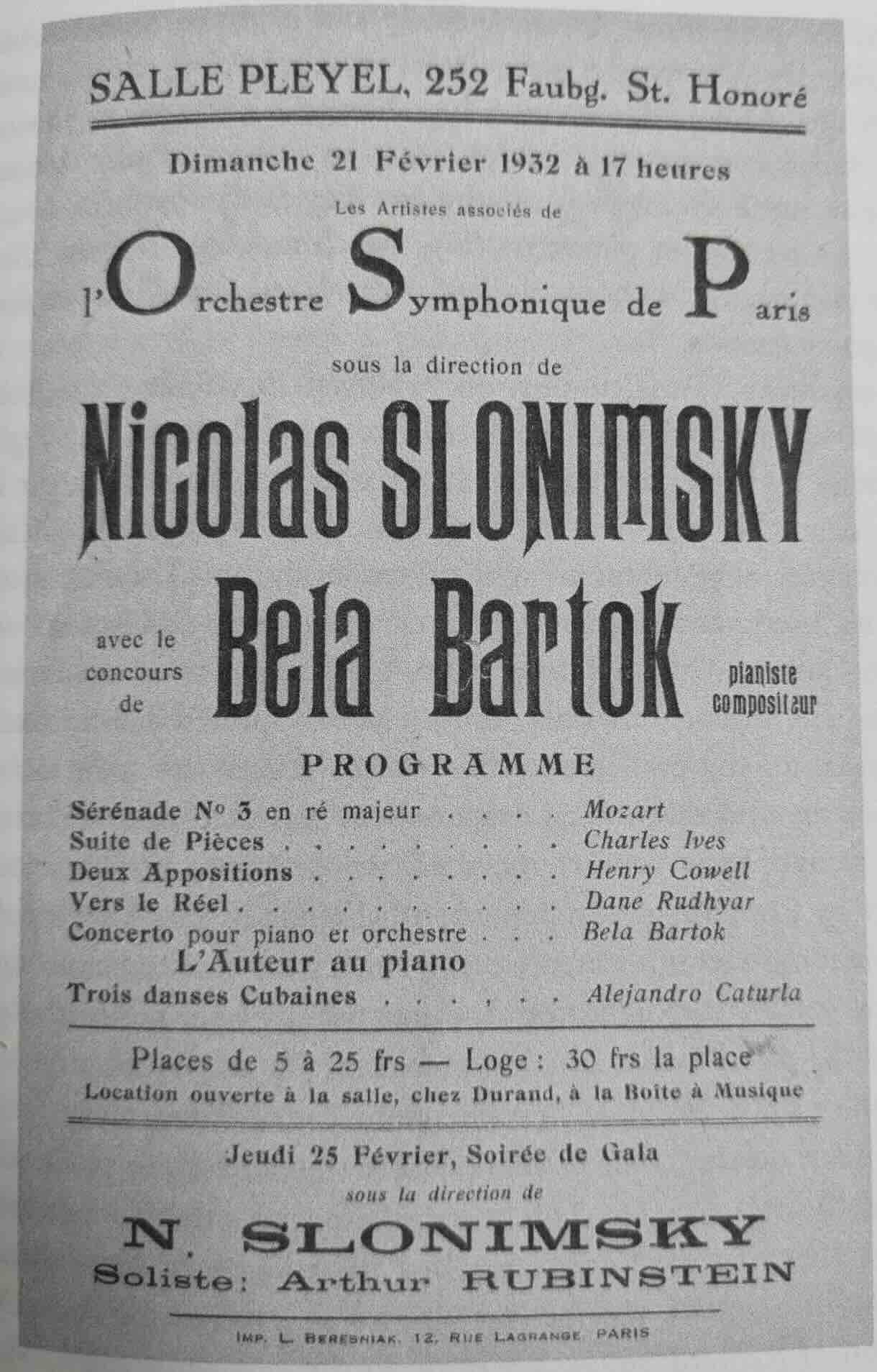
Slonimsky Bartok 1932

He returned to Europe for more concerts in 1932—with Bartók giving the Paris premiere of his 1st piano concerto, and Rubinstein playing Brahms’s 2nd piano concerto!!! In Berlin (in the nick of time before the grip of Nazism) he conducted the Berlin Phil in a modern programme including Three places in New England and Varèse’s Arcana. He repeated the programme in Budapest.

He reflects on this ephemeral phase of his career:

The art of conducting is paradoxical, for its skills range from the mechanical to the inspirational. A conductor can be a semaphore endowed with artificial intelligence, or an illuminating spirit of music. The derisive assertion that “anyone can conduct” is literally true: musicians will play no matter how meaningless or incoherent the gestures of a baton wielder may be. In this respect, conductors stand apart from other performers. A violinist, even a beginner, must be able to play on pitch with a reasonable degree of proficiency. A pianist must have enough technical skill to get through a piece with a minimum of wrong notes. But a conductor is exempt from such obligations. He does not have to play; he orders others to play for him.

This leads him to some wonderful stories about badly-behaved conductors (cf. Viola jokes and maestro-baiting); Toscanini, Klemperer—and this story, evoking the unwelcome posturings of many a later maestro:

Mengelberg once apostrophised his first cello player with a long diatribe expounding the spiritual significance of a certain passage. “Your soul in distress yearns for salvation,”, he recited. “Your unhappiness mounts with every passing moment. You must pray for surcease of sorrow!” “Oh, you mean mezzo forte,” the cellist interrupted impatiently.

I’m eternally grateful to Slonimsky for relating some classic Ormandy maxims (now joyously expanded here by members of the Philadelphia orchestra)—OK then, just a couple:

Suddenly I was in the right tempo, but it wasn’t.

Who is sitting in that empty chair?

In “Disaster in Hollywood” he tells how his first appearance with the LA Phil in 1932 ended in tears. When the programmes for his eight-week season at the Hollywood Bowl in the summer of 1933 proved far too challenging for the “moneyed dowagers”, his conducting career came to an inglorious end. He takes consolation in the later admission of the works that he championed to the pantheon (cf. the fine story of Salonen’s interview for the LA Phil!). Meanwhile in New York he conducted, and recorded, Varèse’s revolutionary Ionisation.
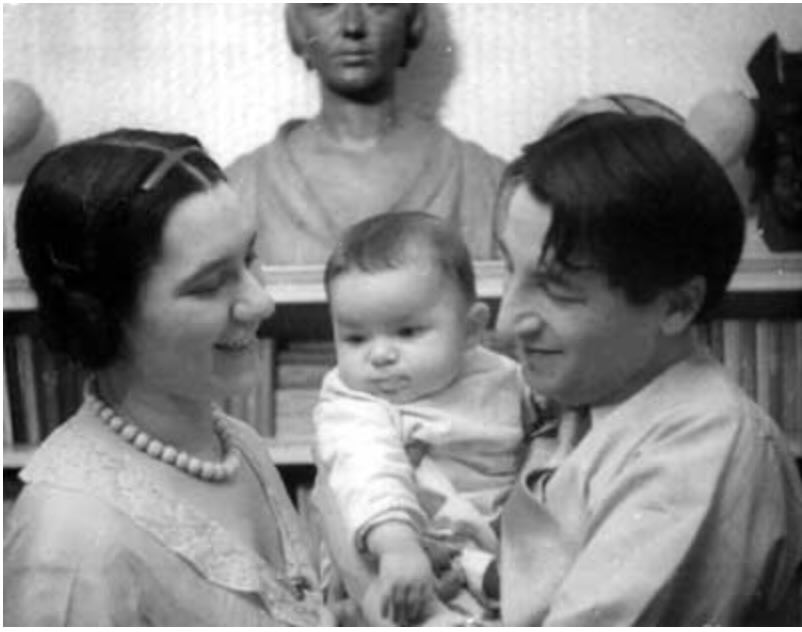
with Electra

With typical linguistic flourishes, he devotes a proud chapter to the birth of his daughter Electra, editor of the volume. He rearranged a limerick:

There was a young woman named Hatch
Who was fond of the music of Batch
It isn’t so fussy
As that of Debussy
Sit down, I’ll play you a snatch.

He would have enjoyed these limericks, and one by Alan Watts, n.2 here.

“Like gaseous remnants of a shattered comet lost in an erratic orbit”, occasional conducting engagements still came his way. In “Lofty baton to lowly pen” he recalls his transition to musical lexicography. He met fellow Russian emigrés Léon Theremin (whose life was to take a very different course) and the iconoclastic theoretician Joseph Schillinger. As Slonimsky compiled his book Music since 1900 (1937!), he became interested in the savage reception of new music, leading to his brilliant Lexicon of musical invective.

Still, he was never tied to his desk. His appetite whetted by his trips to Cuba, in “Exotic journeys” he recalls his 1941–42 tour of Brazil (hearing Villa Lobos’s tales of his Amazonian adventures), Argentina, Chile, Peru, Ecuador, Columbia, Panama, Costa Rica, Nicaragua, Guatemala, and Mexico. His book Music of Latin America was published in 1945.

Returning to Boston, he was plunged into family duties. In 1947 he published Thesaurus of scales and melodic patterns.

In 1935, armed with a US passport, he returned to his birthplace, now called Leningrad, visiting long-lost relatives. He reflects on the death of his mother in 1944, and the life of his aunt Isabelle Vengerova (1877–1956), who became a legendary piano teacher in the States.

After the war, with Russia in vogue in the USA, Slonimsky enjoyed revising his proficiency in his mother tongue, updating old manuals to teach students and taking on work as translator. While he was largely free of McCarthyite suspicion of sympathising with Communism, back in the USSR his brother Michael was at far greater risk for being suspected of opposing it (for Soviet life, note The whisperers).

Dissatisfied with previous compendia and nerdily meticulous, he found a new mission in updating Baker’s biographical dictionary of musicians. He was proud of his 1960 article “The weather at Mozart’s funeral”. In 1956 he achieved unprecedented celebrity through appearing on the quiz show The big surprise.

In “The future of my past” he describes another trip to the USSR and the Soviet bloc in 1962–63, funded by the State Department—an Appendix to the third edition provides a detailed account. He visited Poland, Czechoslovakia, Hungary, Romania, Yugoslavia, Bulgaria, as well as Greece and Israel.  On his meetings with musicians, he was inspired by the energy of Ukrainian and Georgian composers.

His diary is punctuated by his curiosity about language, starting in Moscow:

To my Americanised ears, the new Soviet language sounded almost theatrical in its emphasis, deliberate articulation, and expressive caesuras. I also noticed a proliferation of diminutives….

In Prague he learned the vowel-less tongue-twister Strc prst skrz krk:

I used this phrase as the supposed title of a choral work by the mythical Czech composer Krsto Zyžik, whom I invented and whose name I was tempted (I ultimately desisted) to include as the last entry in my edition of Baker’s.

But soon after his return to Boston his wife Dorothy had a heart attack, which was to be fatal. Bereft after her death in January 1964, he welcomed the offer of a post at distant UCLA. He composed musical limericks for his students’ benefit, but was not always impressed by their aptitude, citing gems from their essays such as “A piano quintet is a piece for five pianos”.

After two seasons he reached compulsory retirement age, but he was never going to go quietly. In LA he enjoyed a wide social circle. Besides many “flaky” composer friends was John Cage, now a guru (Slonimsky cites Pravda: “His music demoralises the listeners by its neurotic drive and by so doing depresses the proletarian urge to rise en masse against capitalism and imperialism”!).

With John Cage, and Frank Zappa.

Back in LA, he made friends with Frank Zappa, who invited him to play at his gig.

Dancing Zappa, wild audience, and befuddled me: I felt like an intruder in a mad scene from Alice in Wonderland. I had reached my Age of Absurdity.

Meanwhile with perestroika in the Soviet Union, Slonimsky was becoming quite a celebrity there too, making several more visits and admiring composers’ creativity in new idioms.

* * *

Far more than a mere entertainer, Slonimsky was a major figure in promoting new music. With his eclectic tastes, I can’t help thinking that he would have enjoyed gravitating to ethnomusicology, questioning the wider meanings of “musician” or “composer” (see e.g. Nettl); but he was deeply rooted in the WAM styles of Russian classics and the American avant-garde. Still, within the world of WAM literature it makes a most fascinating memoir.

For some reason it fills me with joy to learn that a Japanese translation of Lexicon of musical invective has been published.


* Even 5/8 was too much for Koussevitzky:

He had a tendency to stretch out the last beat, counting “one, two, three, four, five, uh”. This ‘uh” constituted the sixth beat, reducing Stravinsky’s spasmodic rhythms to the regular heartbeat. When I pointed this out to him, he became quite upset. It was just a luftpause, he said. The insertion of an “air pause” reduced the passage to a nice waltz time, making it very comfortable to play for the violin section, who bore the brunt of the syncopation, but wrecking Stravinsky’s asymmetric rhythms.

To be fair, Koussevitzky did manage to conduct the 5/4 Danse générale of Ravel’s Daphnis and Chloé (1942 recording here; he first conducted it in 1928).

Mahler, Brahms, Schoenberg

Prom MahlerSource: review.

Just days after the Zemlinsky and Schoenberg Prom, I went back to the Albert Hall for another course of late Romanticism, with the talented Ryan Wigglesworth conducting the BBC Scottish Symphony Orchestra (listen on BBC Sounds).

I don’t think I ever played Brahms 3 (make what you will of that uncertainty…). Well-received at the time, but now perhaps the least popular of his symphonies (I can’t miss any opportunity to remind you of Kleiber‘s Brahms 2!), it always deserves a re-hearing. l’ve been getting to know it better by listening to some classic recordings—

Bruno Walter and the Vienna Phil, 1936:

Furtwängler with the Berlin Phil, 1949:

Abbado fifty years later, again with the Berlin Phil (still largely a woman-free zone):

Then we heard Schoenberg’s tone-poem Verklaerte Nacht (1899) (wiki, and here), in the string orchestra version that he later arranged from his string sextet. The latter was premiered by the augmented Rosé quartet—here are members of the Ensemble Intercontemporain with Boulez, c1985:

And this is Mitropoulos with the strings of the Vienna Phil in 1958:

The Prom ended with Mahler’s Kindertotenlieder (1904, to texts by Rückert), movingly sung by Alice Coote. Here’s her recording from 2017 (along with the Rückert Lieder):

And here’s Janet Baker’s classic recording with Barbirolli, 1969 (cf. their Nuits d’été):

* * *

Back at the Prom, a more conventional sequence might have opened with Verklaerte nacht followed by the Mahler songs, with the Brahms symphony as a traditional second half; but the chronological order made a lot of sense, intensifying Mahler’s prophetic, tragic vision. All three pieces end quietly. I still don’t quite get a sense of coherence from Brahms 3, but it’s growing on me—Wigglesworth conducted it without the score, bringing out its chamber music elements. Despite its portentous opening, and hints that the finale might become grandiose, it’s largely elegiac, its middle movements unassuming yet affecting.

The second half was full-on in its intensity. Verklaerte nacht is a major work, long predating Strauss’s Metamorphosen; “filled with crepuscular angst” (as the BBC website has it), the writing especially favours the violas (always good to hear). BTW, and FWIW, the ever-stimulating Richard Taruskin (The danger of music, pp.325–6) doesn’t buy Schoenberg’s resort to extolling “pure” music in his attempt to deflect the misogyny of Richard Dehmel’s poem (“an immanently sinful modern Eve forgiven and redeemed by a godlike magnanimous man”). Finally, Alice Coote’s dramatised grief was perfect for the Kindertotenlieder (for her Mahler 3 with Michael Tilson Thomas earlier this year, click here). For me, the brief coda to the final song doesn’t suddenly sweep aside the anguish of the cycle—it seems more spooky than serene.

Ryan Wigglesworth’s serious, sincere musicking seems to convey a feeling of trust, free of the dubious trend for the flashy wizzkids who have replaced the dour, autocratic maestros of Yore. The composer-conductor combo doesn’t always yield results, but when it does it’s deeply satisfying, as with Salonen, Boulez—and clearly Mahler. But now that I observe the WAM scene as a mere outsider, I’m no longer privy to the more salient assessments of the musicians themselves.

For all my immersion in “world music” and its diverse social contexts, having been Promming since the 1960s, I always find it a blessing that concerts like this generate such attention and enthusiasm—nightly over nearly two months.

Proms: Zemlinsky and Schoenberg

Zemlinsky concert 1905

For my first Prom this season, I went to hear Ryan Bancroft directing the BBC National Orchestra of Wales in Zemlinsky’s Die Seejungfrau and Schoenberg’s Pelléas und Melisande, premiered at the same concert in 1905. Having already written about both works, I was glad to hear them live.

In my youth, besides Ravel‘s Daphnis and Chloé, Schoenberg’s Pelléas left a deep impression on me, attending rehearsals and concerts in the fluid hands of Boulez; with his choices there was always a sense of discovery. At this week’s Prom I could only summon up fleeting glimpses of that magic, but (within the niche of ominous late-Romantic angst) Pelléas is perhaps rather more accessible, so it probably made sense to open the concert with it, building the audience’s attention for Die Seejungfrau after the interval. But either order could work. Ryan Bancroft, brought up in LA, directed fluently—like Boulez, conveying the music with his hands rather than a baton.

Prom BancroftSource.

You can hear the concert on BBC Sounds for the next two months. A sumptuous fin-de-siècle opening to the season, then—the previous evening Mark Elder conducted Mahler 5 in his Proms farewell to the Hallé after 25 years with them (available on BBC iPlayer). Even if Mahler towers over just about everyone (do consult my series!), it’s always rewarding to explore the work of his contemporaries and disciples, and to immerse ourselves in the whole culture of early-20th-century Vienna. Though the hall was less than packed, how wonderful that Prom-goers devote such attention and enthusiasm to the less familiar aspects of the symphonic repertoire.

Just a few days later came another fine late-Romantic Prom.

Curse of the Ninth

*Latest in my Mahler series!*

Curse

Ever since the very first episode in 2014, the BBC TV comic-noir series Inside No.9 (website; wiki) has been consistently brilliant. Written by and starring Steve Pemberton and Reece Sheersmith, it features cameos from a succession of fine actors. The plot twists are ingenious, the mood sinister and enigmatic.

The penultimate episode of the ninth (and final!) series (watch here) takes its title from the Curse of the Ninth, attributed to Mahler’s fruitless efforts to trick fate. Typically macabre, it’s “an Edwardian chiller in which a talented piano-tuner is forced to confront the power of a centuries-old curse by the owners and servants of a large country house.” As the drama unfolds, we hear well-chosen excerpts from the 1st movement of Mahler 9.

Curse 2

The wiki article on the curse gives instances of composers unable to complete their 10th symphony—but also lists counterexamples of others who did manage to do so. So there.

* * *

No.9

A random selection of (nine!) other stimulating episodes from Inside No.9:

The very final episode Plodding on is ingenious…

In memoriam Klaus Voswinckel

Klaus

The great film-maker and novelist Klaus Voswinckel died recently in Munich on his 81st birthday. His life is commemorated in this obituary.

In his prose he “dances weightlessly between narrative, essay, poetry and sensual philosophy”. He created a wealth of vivid TV films, often with his wife Ulrike, portraying a wide range of musicians—such as The divine drummer: a journey to Ghana, Winterreise: Schubert in Siberia, Steve Reich: music in the words, and A step towards my longing: the composer Sofia Gubaidulina.

Dividing his time between Germany and Italy, Klaus would visit his accomplished daughter Esther and her family in Istanbul, where I was among a multitude inspired by his kindly, gentle soul and wise, good-humoured company. His heart was in Salento, whose popular culture he also documented on film. He was enchanted by taranta—a theme of his novel Tarantella oder Hölderlin tanzt, which I introduced here. So perhaps it’s suitable to send Klaus off with the passionate, intoxicating songs of his friend Enza Pagliara:

Mahler 3 with MTT

*Part of my series on Mahler, introduced here!*

MTT Barbican

I’ve celebrated Mahler 3 in an earlier post, featuring great recordings by Bernstein, Tennstedt, Abbado and others. Last week, just after coming back from Milan and Erlangen, immersed in my fieldwork videos of Chinese village ritual, I went along to the Barbican to relish another overwhelming rendition of the symphony, with the LSO conducted by Michael Tilson Thomas (website; wiki) in the second of two performances.

Music Director Laureate of the San Francisco Symphony and Conductor Laureate of the LSO, at the age of 80 MTT is severely ill with brain cancer (see under the Slipped Disc website). Musicking is always about context—and Mahler 3 is always a moving experience. Just as the Mahler concerts of Tennstedt and Abbado were all the more deeply affecting in their later years, the aura of last week’s concerts was intensified by MTT’s frailty, sidelining any suspicions of West-Coast suavity. As this review of the first concert comments,

Programme notes for Mahler’s monumental symphonies will often blithely chat about the works’ epic struggle between life and death, creation and destruction, joy and dread. In a comfy hall with a slick orchestra and a polished maestro, all of that can feel abstract and remote. Not last night at the Barbican.

MTT was a protégé of Bernstein, following in his footsteps. This story, from an article that also includes a chat between MTT and James Brown, is relevant:

Thomas had the opportunity to get to know another great musician, Leonard Bernstein, after winning the Koussevitzky Prize, which is awarded to outstanding student conductors. Bernstein came to a performance of Mahler’s 5th symphony that Thomas was conducting early in his career. After the concert, Thomas recalls asking Bernstein what he thought of the performance, and he replied, “What did I think of it? I think that when you really have made up your mind what it means to you, and what you intend to do about it, it won’t matter to you what I think or anybody else thinks.”

In 2012 MTT pondered his own bond with Mahler and the challenges of conducting the symphonies:

He explores Mahler’s origins and legacy in two documentaries, accessed here and here (part of a series on the, um, Great Composers).

Here he is in the final movements of the 3rd symphony with the Verbier Festival Orchestra in 2016:

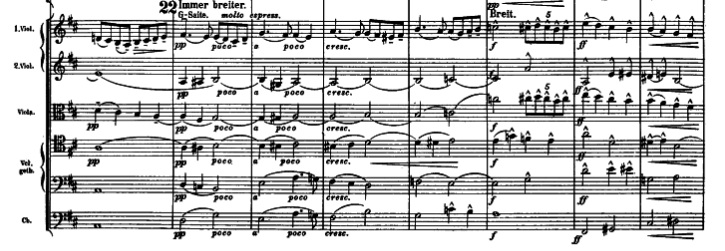
As often with Mahler, I tend to focus on the incandescent finale (those quintuplets!!!)—but you have to experience the whole, um, Journey. As with the 2nd symphony, the first movement is monumental too, and as in the 7th symphony, some passages of “sonic goulash” (MTT’s fine term) recall Ives—whose music Mahler used to conduct (see e.g. here). The middle movements also encapsulate Mahler’s world, and Alice Coote’s singing of Nietsche’s text in the fourth movement was intensely moving (cf. her Kindertotenlieder). The LSO was brilliant as ever, with outstanding brass solos—in what must have been an exceptionally demanding concert. MTT, the LSO, and the audience all pulled together to celebrate Life… It’d be most interesting to learn how the players felt about the concerts.

Mahler 3

See also Mahler 2 with MTT!.

* * *

MTT

I can’t resist mentioning MTT’s From the diary of Anne Frank—both to complement Mahler’s Jewish identity and for some of the most radiant images of MTT with Audrey Hepburn:

Maestro: Bernstein and Mahler

Maestro

Infatuated as I am with Mahler (series here), my posts on his symphonies inevitably include performances by Leonard Bernstein (see under The art of conducting). So I just had to watch Maestro (Bradley Cooper, 2023: in cinemas and on Netflix).

Movies about musicians are notoriously prone to faux pas (for some TV clichés, see e.g. Philharmonia, and Endeavour). Bernstein’s passion as a communicator brought an unprecedented popularity to WAM that it could never again achieve; Maestro is admirable for bringing him (if not his musical genius) to a wide modern audience.

Norman Lebrecht shrewdly observes Bernstein’s place in the roster of Great Conductors (The maestro myth pp.180–87, 192–5, and, confounding the myth that he rescued Mahler’s music from obscurity in Vienna, 198–205). Heart on sleeve, OTT, Lenny was an archetype for his era—by contrast with the austere Maestros of Yore, or indeed the benign, banal middle-managers and Early Music semi-conductors of later years.

As to Maestro, Alex Ross comments in the New Yorker:

Because Bernstein’s career unfolds in the background of his marriage, the film is relieved of the dreary trudge of the conventional bio-pic, which checks off famous moments, positions them against historical landmarks (the Cold War, the Beatles, the Kennedy assassinations). […]
By and large, Maestro benefits from what it leaves out. Some viewers have complained that such major achievements as On the Town, West Side Story, and the Young People’s Concerts are mentioned only in passing. But Bernstein’s life was so stuffed with incident that nodding to each one would have drained the movie of momentum. One omission, though, left me perplexed: the studious avoidance of Bernstein’s radical-tending politics.

The roles of Lenny (Bradley Cooper himself) and his wife Felicia (Carey Mulligan) are brilliantly played, with all the tortuous public/private psychologies of their relationship. But indeed, the film omits their considerable social activism through a period of change; Cooper had intended to include the notorious “radical chic” 1970 party, but (as he explains in this podcast) he found it would have detracted from his main theme. So the screenplay invariably chooses the personal over the political. And I agree with other reviews that lament the wider avoidance of social history (e.g. another New Yorker article; myscena.org; The critic)—a tasteful script wouldn’t have to make such scenes into a “dreary trudge” at all.

* * *

Moreover, as a Guardian review comments,

What there is very little of is music. We barely see him conduct, we hear only snatches of his own compositions, and there are frustratingly few glimpses of his passion for communicating—through performance and education—the wonders and riches of classical music.

Mahler 1907

Bernstein’s own music does play a considerable role, without quite engaging us. But the most regrettable casualty is Mahler. Despite a scene that I’ll discuss below, the movie never broaches Lenny’s deep passion for his fellow conductor-composer—he must have seen himself as a reincarnation. In Lebrecht’s words (The maestro myth, p.185; cf. Why Mahler?, pp.239–41 and passim), Mahler was

a visionary who fought against humanity’s rush to self-destruction. “Ours is a century of death and Mahler is its musical prophet” [see e.g. my fanciful programme for the 10th symphony], he proclaimed, seeking to find himself a similar role.

Apart from the moving evidence of his performances, Lenny missed no opportunity to promote Mahler’s vision, and irrespective of the movie, it’s well worth returning to his extraordinary lectures on the topic. * Without hijacking the film’s main theme, one longs for a mention of Mahler’s name, or an image—although I quite see the risks of composing a line like “Oh Felicia, what would I do without you and Mahler?”!

Lenny and Mahler

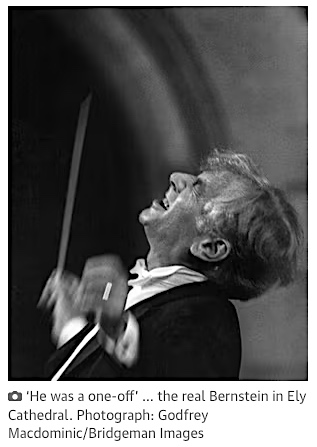
Lenny ElyWe get to hear some of the Adagietto, though it’s such a staple of movie soundtracks that for many viewers it may sound merely like generic film music rather than the work of Lenny’s alter ego. Then the long scene of the monumental ending of the 2nd symphony at Ely Cathedral in 1973 is the perfect choice, and it should be overwhelming. But if the uninitiated don’t know what it represents (for Lenny and, well, for Western civilisation!), then again one might just think it’s some random piece of dramatic romantic music; or if you love Mahler as deeply as Lenny did, then you’ll be shocked at how the lack of context largely deprives it of impact—the scene’s main point seems to be his reunion with Felicia in a make-up kiss as he comes off stage.

Cooper, having learned assiduously to impersonate Lenny’s conducting for the Ely Cathedral scene under the guidance of Yannick Nézet-Séguin, looks admirably impressive on the podium—but it’s also a salient lesson in how impossible it is to mimic the art of an experienced conductor. The Guardian review cited above has details of how the scene was filmed, with comments from members of the LSO:

Every detail of the 1973 performance was painstakingly reproduced, from where each player sat (“more squashed than we generally are today!”), to the mocked-up programmes, even though these were never in shot.

Players who wore glasses were asked to provide prescriptions so they could be given new ones in old-style frames—and they were all asked to let their hair grow. “Most of the guys had been asked to grow beards,” says Duckworth, “and those with very short hair had been asked not to cut it.”

And (WTAF) despite going to such lengths to achieve historical authenticity, the film used the players of today’s LSO, 45% of whom are women—whereas the 1973 LSO had only two women (the harpists) among 102 players. Is this, finally, PC gone mad?!

Despite these cavils, I admire the way Bradley Cooper has brought Bernstein’s personality to a wider audience. Perhaps it’s too much to hope that Maestro might also turn on a new generation to Mahler.


* After his 1960 talk at the televised Young People’s Concerts (wiki; complete list on YouTube here—weekly audiences for his broadcasts estimated at ten million!), more illuminating is “The unanswered question” in his 1973 lectures at Harvard:

Late in “The 20th century crisis”, from 1.37.58:

And a 1985 essay:

DO go back to Humphrey Burton’s wonderful films of Bernstein’s performances of the symphonies… Burton also filmed him rehearsing—and commenting on—the 5th, the 9th (“Four ways to say Farewell”), and Das Lied von Der Erde with the Vienna Phil (1971–72):

Kali Malone

Kali Malone

Another reason to rejoice in the pipe organ, besides Bach and Messiaen (see also French organ improvisation!), is Kali Malone (website; wiki; YouTube topic; interview).

Raised in Denver, since 2012 she’s been based in Stockholm, fertile soil for her experiments. The extreme austerity of her ouevre, using electronic technology to the full, somehow gains rave reviews far beyond the organ cabal; I find it a weird and wonderful cause for celebration that there are tribes for this kind of thing. As with much minimalism, my need to listen to all her work may be partly because I keep wondering if something is ever going to happen, or if I will notice it happening while still semi-conscious—or perhaps rather it’s that I want to rise to the challenge of internalising her time-frame. This music makes Noh drama (links here) seem positively action-packed.

Organ dirges 2016–2017:

Cast of mind (2018), with wind and brass (as playlist):

On organ, The sacrificial code (2019) (as playlist):

Living torch album (2022), which one might hardly notice is “an organ-free zone”:

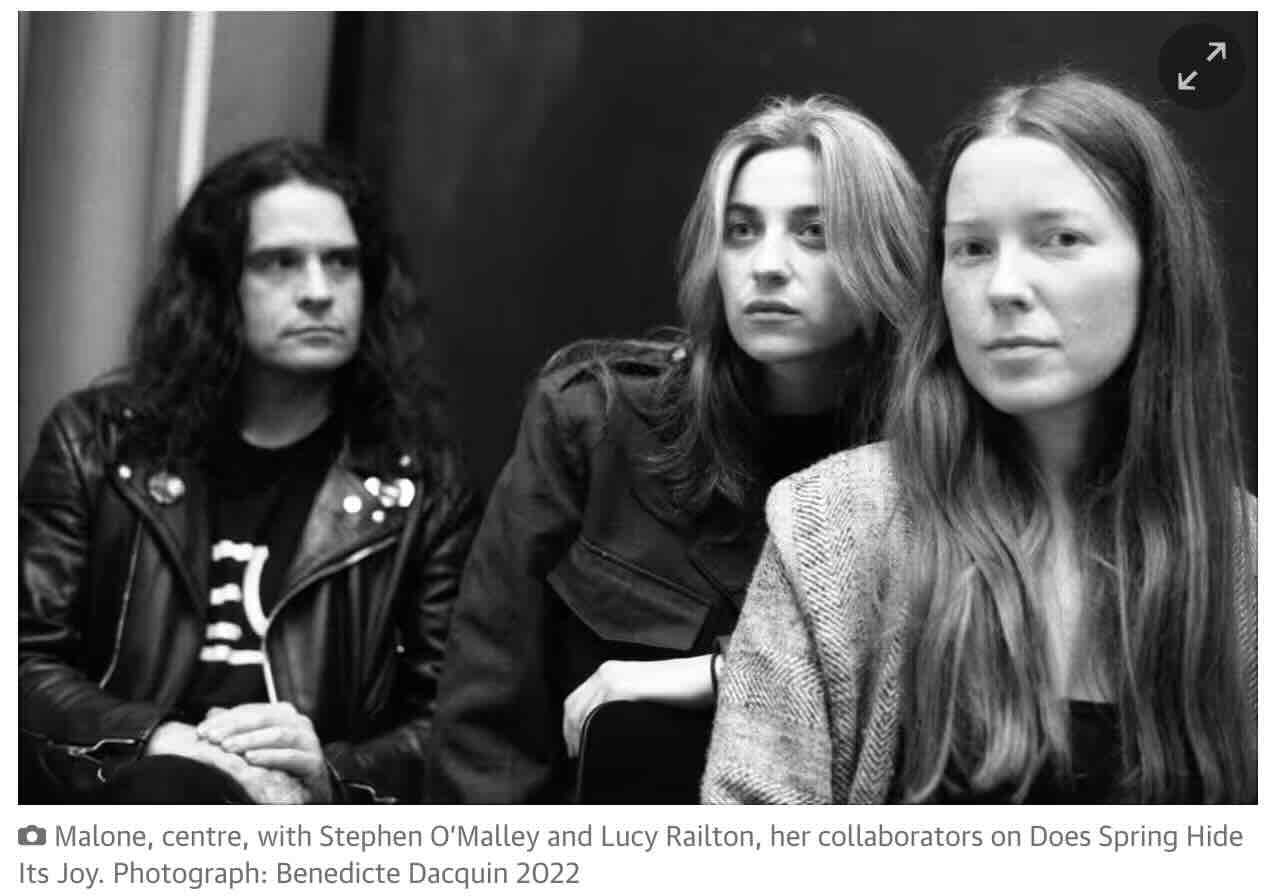
On Does spring hide its joy * (2020/2023), Malone plays sine-wave oscillators, with Stephen O’Malley on guitar and Lucy Railton on cello—another album that has achieved remarkable popularity in this age of fragmented attention:

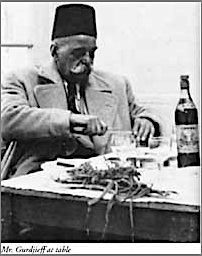
The three variations span over 300 minutes—still more compelling, With All Due Respect, than the interminable ramblings of George Gurdjieff on harmonium.

Malone Spring

Her latest album is All life long (2024), again incorporating hieratic vocals and brass (playlist):

In his review, Alex Petridis splendidly describes Malone’s interviews as

very much the place to go if you’re interested in the cultural contexts of 15th-century meantone organ tuning…

Her partner Stephen O’Malley plays guitar in SUNN O))) (listen e.g. here), a band that blends doom metal, drone, black metal, dark ambient, and noise rock (more taxonomy!), their style “characterised by slow tempos, distorted guitars, lack of rhythm and melody, and alternative tunings” (YAY).

In the best possible way, this music “really messiaens with your head”—you might need to take an occasional break… I think we can safely discount rumours (again in my head) of a collaboration with Katherine Jenkins for a Christmas album of catchy hits from the shows.

For earlier, and more eventful, avant-garde soundscapes, see e.g. Meredith Monk. See also The right kind of spirituality?.


* I wonder if this a kind of rhetorical non-question, perhaps to be completed by HELLO.

More musical chinoiserie

Bantock 1
Source.

The going was tough for the members of the BBC Symphony Orchestra in the years following the regime of William Glock. A rigorous, ear-scouring diet of avant-garde music was leavened only occasionally by returns to the core symphonic repertoire, as well as dutiful lip service to the “cowpat” school of early-20th-century English composers—although I recall being impressed by Arnold Bax’s Tintagel.

Following Berlioz’s distaste for the music of the not-so-mystic East, I’ve touched on musical chinoiserie in posts such as Mahler and the mouth-organ. Among other composers whose work Angela Kang discusses in her 2011 thesis are Purcell, Gluck, Roussel, Puccini, Debussy, and Stravinsky—see also Ravel, and this article on the American composer Charles Griffes (more here). Cf. Lili Boulanger’s Vielle prière bouddhique, and Kreisler’s Tambourin chinois.

Granville Bantock (1868–1946) was one of the English composers whose work we must have played, somewhat casually, in the BBC SO. I’ve only recently clocked his 32 Chinese songs, a substantial series that he wrote from 1918 to 1920, inspired by the exotic East—Arabia, Japan, Egypt, India, and Persia (note also his vast suite Omar Khayyám) (see also here).

Bantock Persia
Great designs, eh? Well done, Breitkopf & Härtel…

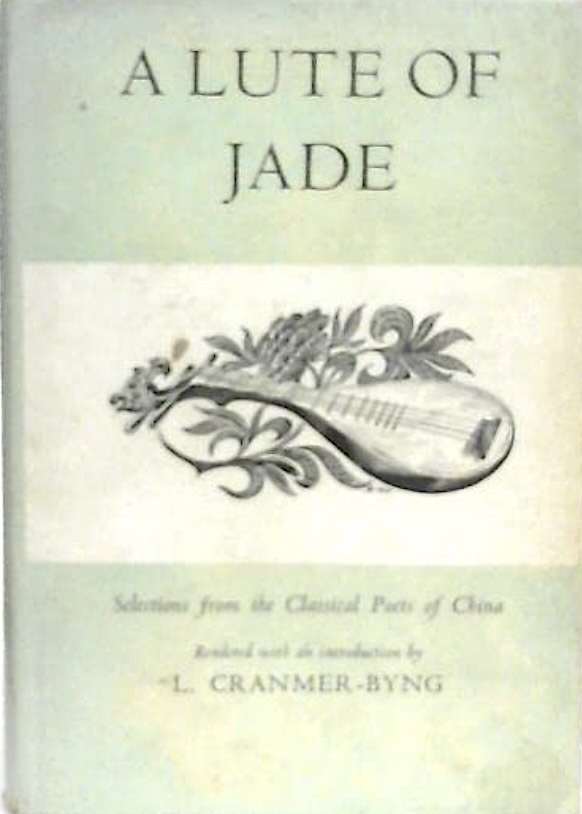
Lute of jadeThe first cycle of Five songs from the Chinese poets (score) set English texts by Bantock’s friend the euphoniously-named Launcelot Cranmer Byng, after Tang poems by Zhang Zhihe, Du Fu, Li Bai, Tong Hanqing, and Sikong Tu. All but one appear in A lute of jade (1909)—one of the first collections of Chinese poetry that I bought (probably from Watkins) while still at school. The cycle was arranged for string quartet in 1933 as In a Chinese mirror. According to this post, some of the lyrics of Songs of China were written by Bantock’s wife Helen.
From the second set (score), here’s John McCormack singing a version of a text by the Tang poet Cen Shen in 1927:

* * *

Bantock also composed Chinese-inspired works on a larger canvas. Besides Choral suite from the Chinese (1914, again to texts by Cranmer Byng), I note the orchestral Four Chinese landscapes (1936)—the latter mostly directed by Walter Collins in 1946:

To the modern ear, such sketches are no more enticing than the works of Chinese composers trained in the WAM idiom such as Xian Xinghai, Nie Er and He Luting (a focus for much ideological wrangling in China over the following decades). But “it is what it is“: Bantock and others were part of a lasting European fascination with the Mystic East (see e.g. More East–West gurus), as yet largely uninformed by later fieldwork in the folk cultures of a vast region.

For later Eastern-inspired works, see e.g. Messiaen, and the ambivalent reaction of Toru Takemitsu to Japanese tradition. For the great Bruno Nettl‘s taxonomy of responses to the growing hegemony of Western musics in developing societies, click here. For Tang poetry, see under A Tang mélange.

Messiaen Nativité live!!!

Nativité score

I’ve written about the nine meditations of Messiaen’s monumental organ work La nativité du Seigneur (1935), but only last week did I hear it live, played by Roger Sayer (replacing Samuel Ali) at St John’s Smith Square, * making the building resound (like the mouth-organs of the Li family Daoists in Heidelberg…). Organ recitals may not lend themselves to rapport (that of Vingt regards sur l’enfant Jésus on piano being more conducive), but after a break from Messiaen, it’s always astounding to enter his unique sound-world again.

To encourage you to bask in this amazing piece, here’s the glorious finale, Dieu parmi nous:

And don’t miss the remarkable film of Messiaen himself at the organ of Saint-Trinité (under French organ improvisation!). My Messiaen series begins with a post on the mind-blowing Turangalîla, where you can find links to more of his most cosmic masterpieces. Along with Bach, Mahler, and Ravel, Messiaen remains my deepest engagement with Western Art Music…


SJSS* St John’s Smith Square has happy memories for me, both of memorable concerts (Bach Passions…) and recording sessions (Mozart piano concertos…). In My Day the posh restaurant in the crypt made a comical contrast with the ludicrously cramped backstage facilities, never designed to accommodate an orchestra and choir—an issue I doubt if the recent revamp can have solved.

Dating from 1728, the church was gutted by fire after a bombing raid in 1941. It was eventually restored as a concert hall in 1969. Deconsecrated, it’s not quite a church, but has more atmosphere than a concert hall (see Buildings and music).


In memory of Nicolas Robertson

Nick 1
Source.

Alas, Nicolas Robertson died in Lisbon earlier this month, after many years of chronic illness.

A fine tenor (“cheap at the price”, as we would say), after his early years in Cambridge Nick became a long-term member of early-music groups such as the Monteverdi Choir, the Tallis Scholars, and the Sixteen. As a Bach scholar, he worked assiduously in assisting John Eliot Gardiner‘s research, and I pray that Nick’s own studies of Bach may yet see the light of day.

Nick 2Mozart with the Monteverdi Choir in Barcelona, 1991:
Nick back row, centre.

Notwithstanding his bookish demeanour, the touring life gave him ample opportunity to sample the richesses of continental beverages; a denizen of sleazy bars in every port, he was an unlikely pinball wizard. Marrying his soulmate Lidia in 2003, they lived together in Lisbon. At the end of 2008 Nick declared himself bankrupt (“one of the best things I ever did, as well as a fascinating experience”). I suppose he never recovered from losing first their house (in a fire, 2009) and then Lidia (to cancer, 2013). He died on her birthday.

Softly spoken, even reserved, Nick’s conversation was erudite, arcane, and hilarious, making him a somewhat unusual drinking buddy. A devotee of Oulipo and Perec, he delighted in language (or rather, languages). The gnomic tales that he concocted out of anagrams provided by fellow choristers on tour (mostly composers’ names, like Gran visits York [Igor Stravinsky] or Nubile gorilla [Lili Boulanger], and Mozart operas, like Noon? Gad–vini! [Don Giovanni], are just extraordinary—a kind of Esperanto fiction, creating spiralling worlds of fantasy. I was honoured to post a series of these tales on my blog. Nick’s meticulous system of indents, single and double quotes, long and short dashes, italics, and so on offers the reader crucial clues to the possible meaning of the arcane text, so typesetting was fiendishly complicated—Lear (Bacon), aka Barcelona, is a good example—and our correspondence about such minutiae provided us with hours of harmless nerdy fun. I’ve listed the tales here, and they’re among the treasures of this site. Now I really must edit some of the remaining stories, “compiled without regard to expense or the feelings of the public”, in the words of our inspiration Flann O’Brien.

As a keen football aficionado, another ongoing project in which Nick delighted was collecting drôle headlines about Jesus (“Jesus is very happy with his eleven”, and so on).

I didn’t actually spend much time with him on tour. For reasons that may be apparent by now, I have only a hazy recollection of our encounters in said hostelries. During the Paris legs of our annual Mozart opera tours in the 1990s he took up residence in the little dive next to the Châtelet, which boasted one of his favourite pinball machines; after concerts in Lisbon, I knew he was just the guide for the tiny holes in the wall where you could hear amateur fado singers, away from the pomp of the fancy restaurants; and, unlike most of the choir (alas), he was always up for flamenco bars in Andalucia.

After decades of quiet Bacchic indulgence, eventually his taste for the grape caught up with him. Already ailing seriously the last time we met in Lisbon, he remained fascinating company. His emails were a constant source of abstruse giggles.

See also this tribute from his colleague Richard Savage; more on Nick’s Facebook page.

We both chortled over this line from Vivien Stanshall:

If I had all the money I’ve spent on drink… I’d spend it on drink

—and I think Nick might have approved of it as a suitable epitaph.

Mahler 9 at the Proms!!!

Rattle Mahler 9

At the Proms last week, to follow Mahler’s 3rd and 7th symphonies, S-Simon Rattle marked his final concert as Musical Director of the LSO with the 9th.

Do watch it on BBC4!!!
(radio broadcast here).

I wrote about the 9th symphony in my Mahler series soon after observing his climactic use of quintuplets, “struggling to emerge from the stone”; I reflected here on a Barbican performance last year with Daniel Harding and the Concertgebouw. The chamber arrangement, far from a mere curiosity, is also most affecting.

Mahler 9 has inhabited me since my teens, even when I wasn’t actually listening to it. How amazing to get hold of tickets—”of all the performances I’ve heard in my life,” that was one of them—no really, it’s always overwhelming, but nothing could be so as Rattle bidding farewell to London with this symphony, the LSO in fabulous form. Yet again, conducting from memory made the occasion even more intense. The Prommers extended the silence of the long final Abschied.

* * *

S-Simon began the concert with Poulenc’s challenging Figure humaine, an a cappella hymn to Liberté from occupied France to texts by Paul Éluard. It was brilliantly sung by the BBC Singers, who gave the first performance in 1945. Rattle began another Mahler concert with the piece in April this year, in solidarity with protests over the philistine government’s threat to axe the choir—his speech then is well worth reading.

Bach at the Proms!

Bach Prom

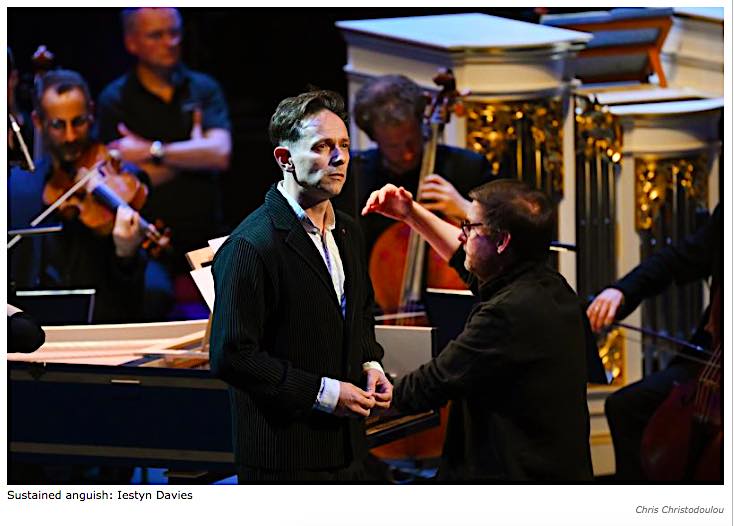
Back from Istanbul in time for the “late-night” * Bach Prom with Iestyn Davies and the English Concert directed by Kristian Bezuidenhout from the harpsichord.

Listen here!!!

Between the typical Proms fare of monumental romantic symphonies, the Royal Albert Hall also make a wonderful setting to tune in to the more intimate sound-world of early music—even Bach’s suites for unaccompanied violin and cello have featured in the large hall.

The ensemble projects a classy image, with Iestyn Davies occupying his own niche in the counter-tenor superstar gallery carved by singers such as Alfred Deller, Michael Chance, and Andreas Scholl. Kristian Bezuidenhout, a versatile early keyboard specialist, is clearly supportive of the band’s creativity. The upper strings stood to play, adding another layer of communicative energy.

I’m always fascinated to imagine the original Leipzig congregation, steeped in Lutheranism—Bach’s new music must have amazed them every week. By contrast, today our sound-world is infinitely more diverse (and secular), subsuming Mahler, film music, rock, and ringtones; and the way we rejoice in Bach is quite different too.

The programme notes cite an 1898 review of a Bach Prom, praising music that was probably “new for the very large majority of those present, for it is doubtful if it had ever been played before in the metropolis”.

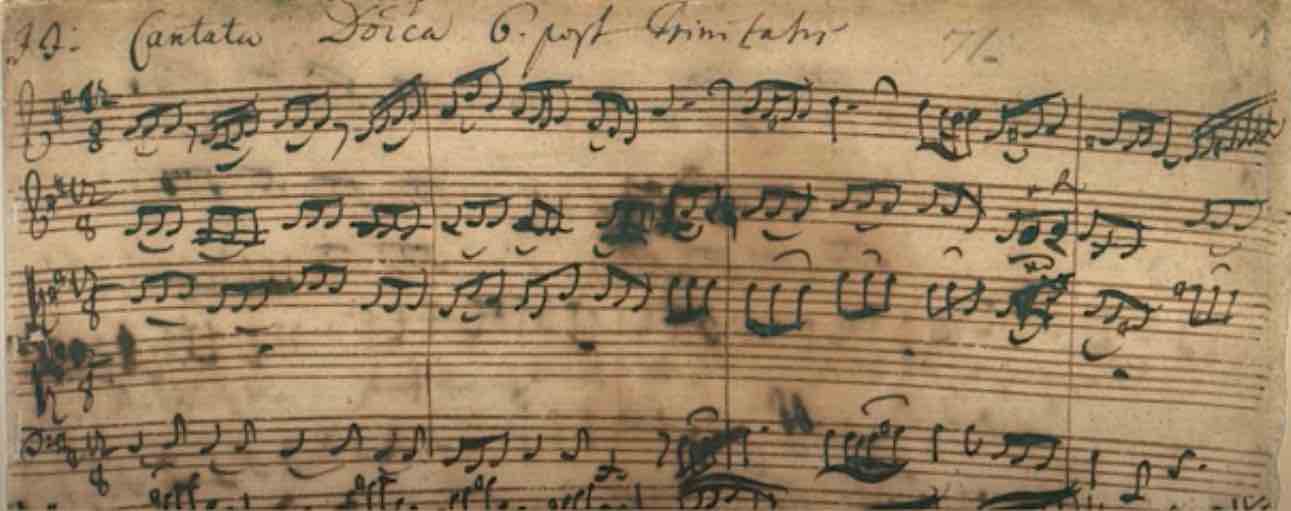
The intensity of the occasion was enhanced by Davies singing without a score—Bach’s own counter-tenor (clearly outstanding, though we don’t know who he was) must have used one, having only got hold of it a few days earlier, with the copyist’s ink barely dry. The music was entirely new to performers and audience—and they would be lucky if they ever heard it again, whereas today both performers and audience can also listen to a range of recordings. Tom Foster relished Bach’s solo organ writing, while oboes enriched the string sound.

The group played two cantatas first performed in Leipzig in 1726:

  • Cantata 170, Vergnügte Ruh, beliebte Seelenlust (Bach cantatas site, and wiki), for the sixth Sunday after Trinity (for those of us who keep track of seasonal rituals), “longing for a virtuous death as a release from the world’s swarming violence and death”.

BWV 170 score

The cantata plunges us right into a magical world—John Eliot Gardiner’s thoughts on Bach are always insightful (notes here):

The opening aria is pure enchantment, a warm, luxuriant dance in 6/8 [?!] in D. You can almost feel Bach’s benign smile hovering over this music, an evocation of Himmelseintracht, “the harmony of heaven”. One of those ineffable Bach melodies that lodges itself in one’s aural memory, it takes a whole bar to get going but once launched, seems as though it will never stop (actually it is only eight bars long, but the effect is never-ending). Yet this expansive melody given to oboe d’amore and first violin acquires its beauty and its mood of pastoral serenity only as a consequence of its harmonic underpinning. The gently lapping quavers in the lower strings are slurred in threes, suggestive of “bow vibrato”, or what the French referred to as balancement, while the downward-tending bass line sounds as if it might be the first statement of a “ground”—in other words, the beginning of a pattern that will repeat itself as though in a loop. Well, it does recur, but not strictly or altogether predictably. With Lehms’ text in front of him, Bach is searching for ways to insist on spiritual peace as the goal of life, and for patterns that will allow him to make passing references to sin and physical frailty.

Here Gardiner accompanies Michael Chance in the first and final arias:

The slow aria Wie jammern mich doch die verkehrten Herzen with organ, is another miracle—the lack of continuo “symbolic of the lack of direction in the lives of those who ignore the word of God”. The violins and violas play a middle-register line in in unison—Gardiner again:

This special texture, known as bassettchen, is one that we have encountered on a number of occasions this year when Bach decides that a special mood needs to be created and removes the traditional support of basso continuo. He uses it symbolically in reference to Jesus (someone not requiring “support”), protecting the faithful from the consequences of sin (as in Aus Liebe, the soprano aria from the St Matthew Passion), and at the other extreme to serial offenders, as in that other marvellous soprano aria, Wir zittern und wanken from BWV105, or (as here) to those “perverted hearts” who have (literally) lost the ground under their feet in their rejection of God. The aria is written from the standpoint of a passive witness to the “Satanic scheming” of the backsliders as they “rejoice in revenge and hate”, so that one can sense the observing singer’s anxiety in the fragmented rhythm of the bassettchen line. 

Here’s the complete cantata with Gustav Leonhardt and Paul Esswood in 1985:

Just as astounding is

  • Cantata 35, Geist und Seele wird verwirret (“Spirit and soul become confused”: Bach cantatas site, and wiki), for the twelfth Sunday after Trinity, six weeks later!

healing deaf
Léonard Gaultier, Christ healing a deaf man (1579).
National Gallery of Art, Washington DC.

In two parts, to be performed before and after the sermon, the Gospel for the day was St Mark’s account of Jesus curing a deaf mute (cf. my stammering series—where’s Jesus when you need him, eh?). Again with obbligato organ and oboes, the cantata expresses both the “sorrow-laden yoke of pain” and a sense of celebration. Here’s Gardiner during the 2000 Bach Cantata Pilgrimage (notes here):

Between the two cantatas, the third Brandenburg concerto was exhilarating—like the Duke Ellington band, as I keep saying. How ungrateful was Bach’s patron!

All Bach cantatas are miraculous—for more, see The ritual calendar, and other posts in my Bach series; see also Bach and the oboe. For meretricious, woke, yet fascinating speculations on the colour scheme of early keyboards, see Black and white.


* In the sense of befuddled octogenarians nodding off over a cup of Ovaltine. I mean, 10.15 is a perfectly normal starting time for a regular evening concert in Andalucia

Grimaud graces London again!

HB London 2023Source.

Following my tribute to the miraculous Hélène Grimaud, it’s high time to rejoice again in her entrancing presence. She performs in London far too infrequently; a concert in June 2020 having been cancelled during Covid, the last time I heard her in person was in 2015 when she played her Water programme. So I couldn’t miss her Barbican recital last week, playing a programme of Beethoven, Brahms, and Bach-Busoni * in the midst of a tour of Germany and France.

Beethoven Op.109

I generally go to some lengths to avoid Beethoven, my wariness confirmed by Susan McClary. I grew up on his late string quartets, but I hardly know the piano sonatas, so Op.109 (1820) came as a revelation. While its improvisatory quality clearly suits Grimaud, to me the manic contrasts of the first two movements often sound like an ADHD diagnosis; but the final movement, with its variations on a tranquil, intense theme (Gesangvoll, mit innigster Empfindung—in the incandescent key of E major, to boot), is a real apotheosis. Here’s her 1999 recording of the movement:

She has a particular affinity with Brahms, and continued with the “private musings” of his late works from 1892–93 (for some reason I’ve always thought of Brahms as mid-century, but the symphonies are from the 1870s and 1880s, and he knew Mahler). First the Three intermezzi, “lullabies in all but name”:

And then after an interval, the Seven fantasias, a contrasting series of intermezzos and capriccios—the fifth movement particularly haunting for me:

In 1877 Brahms had adapted Bach’s monumental solo violin Chaconne (featured here) for piano (left hand—cf. Ravel!). Instead, Grimaud segued from the Seven fantasias into Busoni’s 1893 arrangement of the Chaconne, which I mentioned under Alternative Bach. Here she plays it live in 2001:

Lastly as encores for the rapturous audience she played Rachmaninoff and Silvestrov—the latter part of her latest project.

Averse as I am to the whole mystique of “Pianism”, Hélène Grimaud joins a cohort of celestial musicians of yore for whom the piano is merely a vessel; ** she vanishes deep inside the music, leading us with her. While she’s a devotee of rubato, her playing is unadorned and serious, eschewing mere virtuosity, never glamorising the music. The mood set by her languid stroll on and off stage (gliding, dreamy but not casual—roaming the clouds), once seated at the piano she plays for herself, as if we are but eavesdroppers. To hear her is one of life’s great blessings.

* * *

Irreverent musings on Beethoven are linked in my post on the 7th symphony. For more Brahms: Kleiber’s astounding performance of the 2nd symphony, Celibidache with the St Anthony variations, and reflections on HIP interpretations. My many posts on Bach are rounded up here.


* FWIW, soon after reflecting on the BM “China’s hidden century” exhibition, I note the programme spans the Jiaqing to Guangxu reigns—But That’s Not Important Right Now

** Returning to the Beethoven sonata, I was keen to hear the interpretations of two of Grimaud’s own idols, Glenn Gould (Vienna, 1957) and Sviatoslav Richter (Leipzig, 1963). Now I’m also in awe of the 1950 recording by Wilhelm Backhaus; and the same year in Moscow, the recording of Richter’s teacher Heinrich Neuhaus (one of few who observes the Andante marking of the finale’s theme) has an authentic feel. Going back to 1927 is a piano roll of Alfred Cortot. Without getting too nerdy about HIP, one can’t help wondering about the changing sound of the piano itself—here’s Ronald Brautigam on fortepiano. Oh all right then, let’s admire Alfred Brendel live in 1995.

salon 1915
Posted in Kuzguncuk,
where Beethoven resounded at the kösk of Abdülmecid in 1915.

Making music again

Here’s a sequel to Better than ever: more Bach.

In my current liminal state while my house is being renovated, apart from enjoying my local library, I’ve got back to playing Bach on the violin. One hopes it’ll be like riding a bicycle, and so it turns out (wobbly). Among several fine musos’ excuses, most apt is

It was in tune when I bought it!

All I need is the Bach cello suites; indeed, maybe they’re all we need in Life… I’m less tempted to return to the violin suites—apart from memories of struggling over them through my teens, they’re just harder! OK, one day I’ll get back to the Chaconne.

First stage is to refresh my memory. The cello and alto clefs are mostly under my fingers by now, though it can be a bit like driving in Birmingham, going round in circles till I find the right exit—so with my sheet music currently buried in boxes I occasionally resort to online scores.

Bach cello 6

I’m playing my modern violin at the moment, tuned down a tone, with a gut “E” string. I use my baroque bow occasionally, but it doesn’t feel quite right with the modern violin. A good rosin discipline makes all the difference HELLO, although it’s not so frequently applied as chalk in snooker

I continue developing an arcane system of bowings, often designing slurs (and fingerings too) to reflect conjunct melodic movement, particularly semitone intervals. This varies according to my mood, as it should do, but I like to have a template. Arpeggiated passages are good practice for string crossings. And then, after all the nitty-gritty, it has to sound natural and organic… As opposed to writing or listening, what’s great about expressing such nuance is that it’s more of an immersive physical process than a mental exercise, potentially like the riaz of north Indian raga (see Neuman, chapter 2).

Bach cello 1

* * *

Apart from the cello suites, I’m also relearning the A minor flute Allemande. I greatly admire the hieratic feel of David Tayler’s metronomic lute version, allowing the note permutations to speak for themselves; but working out bowings and fingerings on the violin, this is the kind of thing that I’m internalising, without having to annotate it like this:

Bach annotated

or

Bach flute 2

This may seem a bit, um, fiddly, even Irish—so having worked out these patterns, I try not to let them get in the way.

I will go on to adapt the Bach-Siloti prelude (cf. the Bach-Busoni Chaconne), though I think it may be more stimulating on the erhu, inspired by the divisions of south Chinese instrumental ensembles

Anyway, it feels great to Become One with the instrument again [Again?—Ed.], getting it in tune, and indeed with myself. During the interval from playing I’ve been absorbing a lot of music of all kinds—more Bach, kemenche, dhrupad (which I’d love to learn to sing, but that seems too ambitious), and so on. Still, I find myself hampered by my classical upbringing, feeling little need to rework Bach’s old notes into my own—far from a young sax player, who might have a similar reverence for Coltrane but will always create something new. Indeed, Bach improvised on Bach, and so do organists today. Me, I’m just trying to remember how to play the violin…

See also The Feuchtwang variations, and my roundup of posts on Bach.

Man in hat sits on chair

JPM Daoist
Daoist ritual in the Jin ping mei: click here.

Like the Great Plague and the Cultural Revolution, the Coronation is history, whether we like it or not. My flimsy excuse for adding to the endless discussions is that it reminded me of China—the role of Daoist and Buddhist ritual in propping up the status quo, and the way that peasants too buy into the “imperial metaphor” (see also Catherine Bell on ritual, including state ritual). I can be mildly impressed by the opulence of grand Chinese or Ottoman ceremonies, but being English I have more of a right to query the validity of our own.

The Anglican Church—another irrelevance to a growing segment of the population—plays a major role in “legitimising” the charade of the Divine Right. Yet again Monty Python and the Holy Grail comes to mind:

I didn’t know we ’ad a king—I thought we were an autonomous collective.

Awed deference is only to be expected from the BBC, toeing the Party line, but even on Channel 4 interviewees mustered platitudes, with Cathy Newman making a futile effort to feed them with alternative viewpoints. Nor could one expect usually sensible critics of irrational power like Justin Welby to demur. “Defender of all faiths” my arse. The only clue to God’s feelings on the matter came from the way it rained on the parade.

Still, nothing can detract from the sheer exhilaration of Zadok the Priest—tastefully reworked by Andrew Lloyd Webber in a benign gesture of inclusivity:

Zak the Used-Car Dealer and Nat the Bruiser (know wot I’m sayin’, right) bigged up Solly King of Da Hood, YO

Meanwhile chez the Guardian-reading tofu-eating wokerati (and I confess to making a vegetarian mapo tofu the other day—soon to be grounds for detainment without trial), some articles played it safe (“Immaculately rehearsed, touching, and Shakespearean”, or this on ritual). Compared to 1953, ritual elements are well detailed here, with an outline here of economic differences and similarities (growth and living standards; quality of life; housing; technology; public finances).

1953

Coming back for more after the Queen’s funeral, many of the riff-raff, or “subjects” (including young and poor people) may have found the display of privilege utterly irrelevant, but others took time away from their “rather gratifying” food banks (apud The Haunted Pencil) to play their own dress-up with hats and bunting—Bread and Circuses.

After all, since Brexit we’re all rolling in money, eh? But the royals aren’t exactly short of a few bob—benefit claimants with the brass neck to go on about “service”. Service my arse. Bending over backwards to feign balance, another Guardian piece concluded

Whether multimillion-pound salaries and disdain for difficult questions can really unite and represent the values of a modern democracy remains to be seen.

Um, no it doesn’t. James Butler in the LRB saw right through the display. Yet among those whom the status quo benefits and harms, some support it, some resist; apathy too seems to cross class borders—I’d like to see figures broken down (“by age and sex”).

Taking the conservative viewpoint as read, I append a selection of further Guardian articles below. * One can always rely on Marina Hyde (losing it at “doubtless the world’s most important spoon”) and John Crace. And this teenage perspective is rather fine. There’s been ample coverage of “Commonwealth” perspectives too, such as Stephen Marche, Afua Hirsch, and David Olusoga, as well as Yasmin Poole on Channel 4.

Of course irony is a modern virtue, or vice, but when we study the grandeur of imperial Chinese ritual we rarely consider the perspectives of the lowly tofu-seller. In the words of Alan Bennett’s clergyman, Stuff This For A Lark. Private eye summed up my feelings:


* https://www.theguardian.com/uk-news/2023/may/06/it-was-ludicrous-but-also-magnificent-the-coronation-stirred-every-emotion
https://www.theguardian.com/commentisfree/2023/may/07/protesters-in-handcuffs-and-nonstop-bling-this-coronation-has-been-an-embarrassment
https://www.theguardian.com/uk-news/2023/may/06/the-coronation-latest-instalment-of-britains-longest-running-costume-drama-is-a-bit-of-a-damp-squib
https://www.theguardian.com/uk-news/2023/may/05/coronation-extravaganza-sits-badly-in-todays-britain
https://www.theguardian.com/commentisfree/2023/may/08/coronation-desperate-nation-rotten-system
https://www.theguardian.com/commentisfree/2023/may/06/royal-occasions-not-really-about-royals-we-love-our-own-reactions

The honky-tonk nun

Emahoy 1

To accompany my post on Ethio-jazz, the whimsical piano music of Emahoy Tsegué-Maryam Guèbrou (1923–2023) made another great coup for Buda Musique producer Francis Falceto in the CD series Éthiopiques. Vol. 21 (2006) opens with the enchanting sounds of The homeless wanderer (playlist):

In 2017 Kate Molleson visited Emahoy to make an engaging BBC radio programme, The honky-tonk nun. Below I also cite obituaries in the Guardian, Songlines, The New Yorker, and the BBC, as well as wiki and a biography on her Foundation’s website.

From Addis Ababa’s upper classes, she was immersed in Ethiopian traditional song, then trained in classical violin and piano, embraced early jazz, and later took holy orders. […]

Emahoy 2
Source.

Her father, the European-educated diplomat and former vice-president of Ethiopia, Kentiba Gebru Desta, was 78 years old when she was born, making her possibly the only person on the planet alive in 2023 with a parent born in 1845. The young Guèbrou was a glamorous society girl, educated at a Swiss boarding school and fluent in several languages. She had piano and violin lessons at a classical conservatoire in Cairo (learning under the Polish violinist Alexander Kontorowicz), immersing herself in the music of Bach, Beethoven, Brahms, and Schumann. On her return to Addis Ababa, she started to write her own compositions, and assisted Kontorowicz when he led the Emperor Haile Selassie’s Imperial Guard Band (she recalls playing the Emperor some solo piano pieces and singing him a ballad in Italian).

Following Mussolini’s invasion of Abyssinia, Emahoy spent time in confinement with her family on an island near Sardinia (cf. this post). In 1948 she was offered a scholarship at the Royal Academy of Music in London, but for some reason she couldn’t take up the offer. Depressed and apparently disillusioned, she abandoned high society life to take holy orders, going to live barefoot at an austere convent on the holy mountain of Gishen Mariam north of Addis Ababa.

There she stayed for a decade before returning to Addis to live with her mother, when she started playing the piano again; her recordings between 1963 and the mid-70s have become the basis for her canon. She remained in Ethiopia after the 1974 coup, but was increasingly involved in charity projects with the Ethiopian Orthodox church in Jerusalem, where after her mother’s death in 1984 she lived in a convent for the rest of her life.

In the words of John Lewis, her compositions are a “curious fusion of fin de siècle parlour piano, gospel, ragtime, Ethiopian folk music, and the choral traditions of the country’s Orthodox church… pitched somewhere between Keith Jarrett, Erik Satie, Scott Joplin, and Professor Longhair”, using

a series of pentatonic scales, or kignits [useful intro here], which are the building blocks of all Ethiopian music, from its ancient liturgical chants to its folk songs and funky pop music. These five-note scales are similar but musicologically quite distinct from Arabic maqams or Indian modes. They have names like the anchihoye, the tizita and the bati, and most have major and minor-key variations (some, like the ambassel, don’t have a minor or major third at all, and so have a wonderfully ambiguous, open-ended feel). Guèbrou’s piano playing manipulated these modes to draw us in and hypnotise us, like a snake charmer with a pungi.

I’m keen to see the long-awaited documentary Labyrinth of belonging. And as of 2024, thanks to Mississippi Records we can admire the homely vibe of Emahoy’s singing too:

Mahler and Messiaen!!!

After her recent concert of Bach, Berg, Haydn, and Vivier, Barbara Hannigan returned to the Barbican with the LSO in another exquisite programme juxtaposing two of the Great Composers of our age.

Messiaen’s L’ascension, his first major work for orchestra, * introduces his unique sound-world, opening with hieratic brass chords (E major!!!), closing with ecstatic sustained string writing—another addition to my Messiaen series (starting here).

Majesté du Christ demandant sa gloire à son Père
Alléluias sereins d’une âme qui désire le ciel 
Alléluia sur la trompette, alléluia sur la cymbale
Prière du Christ montant vers son Père.

Klimt

In my Mahler series I’ve already written about the 4th symphony at some length, featuring performances by Mengelberg, Walter, Barbirolli, Bernstein, Tilson Thomas, and Abbado. OK, I go on a lot about Indian raga and jazz and all that, but to hear Mahler symphonies live is always overwhelming. I admired Ms Hannigan’s dramatic taste, always cultivating the feel of chamber music, and the divine slow movement of the 4th was every bit as spellbinding as it should be:


As it ebbed away, blending magically into the instrumental intro of the finale, Aphrodite Patoulidou walked on stage to sing—the kind of attention to detail that makes a difference— adopting just the right tone, neither too soprano-like nor a parody of childlike innocence, the final verse in a hushed E major.

The concert (on BBC Sounds until mid-April) made a moving chapter in Ms Hannigan’s relationship with the LSO.


* He also made a version for organ—here’s his own performance (cf. La nativité du Seigneur, and French organ improvisation). Two drôle BTL comments there:

I think the key signatures are just for show…

Messi

WTF…

Bach, Haydn, Berg, Vivier

Hannigan Vivier
Source: review.

Barbara Hannigan’s concerts with the LSO are always stimulating (for more, see under Conducting: a roundup).

Their programme at the Barbican last week (notes here) was intense right from the start, with Berio’s hieratic Contrapunctus XIX, an arrangement of the final unfinished work in Bach’s Art of fugue, completed with an enigmatic B-A-C-H chord. Then came Berg’s violin concerto (1935), mourning the death of 18-year-old Manon Gropius, daughter of Alma Mahler—with another homage to Bach. Having been entranced by the piece through my teens, I was glad to hear it again, played by Veronika Eberle. Though this was the only piece requiring larger forces, the way she blended with the orchestral sonorities reflected the whole intimacy of the concert, reminiscent of chamber music.

BH Haydn
Image: Mark Allen, via @londonsymphony.

After what is known as an “interval”, * Haydn’s Trauersinfonie, more Sturm und Drang than sombre, was delightful. Symphony orchestras venturing back into Early Music can sound ponderous and drab, but scaled down, in the hands of a tasteful director, they’re perfectly capable of bringing such works to life. Not an obvious choice, the symphony is full of the light and shade highlighted in the rest of the programme, and juxtaposing it with new works, Hannigan and the LSO reminded us of Haydn’s creative originality. The oboes and horns shone, the strings with some fine pianissimos between bursts of manic, angular noodling (1st and 2nd violins seated antiphonall, YAY!); and the Adagio (in E major!) was radiant (I couldn’t help imagining Haydn beating Henry Mancini to it with a minor-key variation on the Pink Panther theme).

And so to a most original finale: Lonely child (1980) (see e.g. here and here) by the Canadian Claude Vivier (1948–83) (wiki, and here)—yet another composer whose sound-world was enriched by gamelan (cf. Debussy, Eichheim, McPhee). Without knowing of his traumatic, short life, his text may seem more dreamlike and reassuring, with its “great beams of colour”, stars, magicians, sumptuous palaces, and mauve monks. But Vivier’s music is “forever grasping at a place of security and eternity that is just beyond reach”, in the words of Jo Kirkbride’s programme notes. Hearing it live, I felt a certain remote Arctic chill—suggesting a link with Hans Abrahamsen’s let me tell you, already a modern classic thanks to Hannigan.

Lonely child was first sung by Marie-Danielle Parent, for whom Vivier wrote it. Whereas Hannigan often combines singing and conducting, here she accompanied the evocatively singing of Aphrodite Patoulidou—here they are in 2019:

They soon followed with a ravishing programme of Mahler and Messiaen!!!


* At this point my keyboard was hijacked again by a Martian ethnographer, whose note I append here:

Interval: an interruption in the proceedings that appears to be widely accepted by the participants, when they take leave of the ritual building to partake further in the ingestion of mind-altering substances.

Cf. ethnomusicological approaches to Western Art Music such as those of Christopher Small and Bruno Nettl.

Holding Don Giovanni accountable

My allusion to La ci darem la mano (in Sentimentality in music) reminded me belatedly to catch up on the extensive body of material on the problematic nature of Mozart’s Don Giovanni, from which I cite a mere selection.

DG

As I performed the opera in the pit since the 1970s—effectively “one of the servants”—it hardly seemed my place to reflect on its messages. One likes to think that audiences are more aware since #MeToo, but in my memory of earlier performances, I suspect that many people enjoyed the dramatic frisson and some jolly good tunes without agonising too much over the issues involved—Harmless Fun for All the Family? Among the well-heeled Covent Garden audiences demurely sipping their interval champagne are doubtless victims and perpetrators of sexual violence, yet such a venue may not seem a promising constituency for feminist views.

While the views of Mozart and his librettist Da Ponte are among those considered in the articles I cite below, they (like me) are more concerned with the opera’s later reception history.

Music has the power to conceal as well as to illuminate dramatic agendas; as Roger Kamien noted, “Mozart’s music has made a sinner seem very attractive”—this article, reflecting the mood since #MeToo, incorporates some musical analysis. In this post I relished the aria Protegga il guisto cielo while hardly delving into its message and context.

Writing in 2022, Hannah Szabó notes that E.T.A. Hoffmann’s 1813 story praises the opera, treating the protagonist as a venerable force:

the baritone playing Don Giovanni boasts a “powerful, majestic figure” with a “masculinely beautiful” face that stands out in the provincial town where the performance takes place. […]
Women, once they have met his gaze, can no longer part with him, and, spellbound by his uncanny power, must ineluctably achieve their own ruin. […]
A tyrannical king, he towers above the “puny specimens of humanity whose feeble dreams and plans”—Zerlina’s marriage, Donna Anna’s chastity, Donna Elvira’s infatuation—“he hijacks solely for the sake of his own pleasure”. In comparison, the harem of women he surrounds himself with are reduced to “factory-produced mannequins”, soulless clones who can only be animated by his ever-shifting presence. Among this “vulgar rabble,” Don Giovanni ascends to near-divinity.

This was an enduring view. Joseph Kerman portrayed Don Giovanni as “a romantic hero, a scorner of vulgar morality, and a supreme individualist”. In her fine 2017 article “Holding Don Giovanni accountable”, Kristi Brown-Montesano expresses shock at William Mann’s 1977 misogynistic portrayal of Donna Anna; she finds his position widely echoed in the critical reception of Don Giovanni at the time, heavily skewed in favour of the libertine aristocrat (she makes an apt comparison with James Bond).

Commentators and directors have idealised Mozart’s wilful, seductive, and violent protagonist, crediting him with virtues (unflagging bravery, triumphant self-determination, revolutionary resistance to oppressive societal power, and sensual idealism) that are, at best, only equivocally suggested in the original libretto. […]
The female characters are judged largely in terms of charm and receptiveness to the Don’s don’t-say-no sexual advances. […]
Fast forward 170 years later and you find conductor James Conlon rhapsodising that all three female characters have experienced a sexual metamorphosis, compliments of Don Giovanni: “their erotic impulses awakened, magnified, and irrevocably changed by their encounter with this mythical seducer”.

But meanings change. Liane Curtis published two articles in 2000: “Don Giovanni: let’s call a rapist a rapist” and “The sexual politics of teaching Mozart’s “Don Giovanni”. Szabó notes Catherine Clément’s 1979 book Opera, or the undoing of women, “reframing Don Giovanni as an exploration of the ways that gendered power oppresses men and women alike”. As well as the violated noblewomen, Zerlina’s aria Batti, batti,

the most famous invitation to domestic violence in the genre of opera, * reveals a woman of the lowest social class employing the only tool available to her, that of her “feminine” sexuality—”feminine” in the traditional sense of completely submissive. “Beat me, beat me, dear Masetto, beat your poor Zerlina. I will stand here like an innocent lamb and take your blows,” she sings, a frightening stance to take on the first day of her marriage.

As with La ci darem, it was long possible to delight in the apparent romanticism of the aria:

Brown-Montesano again:

Yes, Don Giovanni comes from a different time. But this is a poor excuse for partitioning opera/art from contemporary ethical values, forever justifying behaviour that—in any age—is predatory and exploitative. Does the work benefit from this protection? Do we?

She ends thus:

If we really care about opera’s continued relevance, then everyone who loves the art form—directors, conductors, singers, critics, educators, audiences—must acknowledge the connection between what we applaud on stage and what we permit in the workplace, school, home. Because Donna Elvira could tell you, the “Catalogue Aria” is not so funny when your name, or the name of someone you love, is on the list.

Don Giovanni finally meets his downfall not at the hands of wronged women but through divine vengeance. Necessarily, modern productions invariably reflect changing perceptions regarding gender violence, all the more since #MeToo—providing reviewers much food for thought. Here are some thoughts from the director of the 2023 Glyndebourne production.

Susan McClary was a pioneer in unpacking the sexism of Western Art Music. For Michael Nyman’s scintillating instrumental take on the Catalogue aria, click here. On a purely linguistic note, do read Nicolas Robertson’s brilliant anagram tale on Don Giovanni (Noon? Gad—vini!).


* Cf. this interesting discussion on the song Delilah at sporting events, covering a range of issues.

Debussy: flute, viola, harp

In these superfluous polarities that we set up, I can’t help favouring Mozart over Haydn, and Mahler over Bruckner/Richard Strauss. Similarly, I’m so enthralled by Ravel that encounters with Debussy make a more occasional pleasure for me.

Laskine

One of Debussy’s most alluring works is the late Trio for flute, viola, and harp (1915; see e.g. this introduction). Having heard it a lot in my 20s, I’m just as enchanted now.

The instrumentation is one of those magical combos that was just waiting to be invented, like the shengguan ensemble of north Chinese ritual groups (e.g. sidebar Playlist #8), the classic bebop line-up with sax and trumpet, or the banana-and-peanut-butter sandwich.

Lily Laskine (left) and Marcel Moyse recorded it with Eugène Ginot in 1927 (first movement here); in this 1938 recording the viola player was Alice Merckel:

I still wonder if Noor Inayat Khan played it during her student years in Paris.

Evanescent, melancholy, and whimsical, fleeting vistas emerge and dissolve like Rouen cathedral in the mist. I relish the fleeting chinoiserie, and hints of Mahler’s Abschied at the end of the first movement, with a 7th on flute and harp hanging in the air over the harp’s major triad. And at the very end of the piece, the quirky extra chord never fails to delight me—it’s as if having spent so long gliding around in a sensuous, elusive sea of chromaticism, the performers are so surprised to find themselves actually landing on a chirpy conclusive cadence that they think they might as well confirm it for us with a final flourish.

The very end of the first and last movements.

I like this in-the-round performance at the Pierre Boulez Saal in Berlin, with Emmanuel Pahud, Yulia Deyneka, and Aline Khouri, from 2018:

And talking of Boulez, for the influence of this instrumentation on his sound-world, listen to Le marteau sans maître.

For Debussy and gamelan, see Java to jazz. The Debussy Trio is a star exhibit in the chamber repertoire for harp, along with Ravel’s Introduction and Allegro (under my main Ravel page) and Caplet’s Masque of the Red Death. For more Debussy, Clair de lune is worth experiencing anew. For more Ravel chamber music, apart from the piano trio (also under Ravel), see Méfiez vous des blancs.

* * *

A BTL comment somewhere there led me to this mysterious quotation from Goethe (cf. Cite not Faust):

Blasen ist nicht floten, ihr musst die Finger bewegen

To blow is not to play on the flute; you must move the fingers

—or he might just as well have said

To move the fingers is not to play on the flute; you must blow.

Either way, it’s small wonder that Goethe wasn’t in great demand as a music teacher (cf. Stewart Lee on the British Book Cover Awards; for another post dragging a German icon to the trash, see Beethoven’s melodic gift, yeah right). A more radical maxim would have been

Don’t just do something, stand there

(which I still think should have been coined by Miles Davis), or a Zen koan on the silent shakuhachi in an empty forest.

A whiter shade of pale

Whiter shade

In 1967, just as I was beginning to dip my toes in oriental mysticism,  and just after Jimi Hendrix landed from Outer Space, Procul Harum’s debut single A whiter shade of pale became an iconic track of the Summer of Love, along with Sgt Pepper. It’s another of those pieces that slips too easily into legend, filed away without reliving its originality (click here, under “The ultimate tango cliché”; cf. Reception history).

My fusty musical tastes then being largely conditioned by the violin, I suppose I responded to the song’s classicism, although Bach didn’t mean much more to me then than he did for most fans of the song. Along with the trippy lyrics, the blending of the Hammond organ (cf. Booker T. Jones in Memphis) with the blues/soul/rock vocal style is perfect:

We skipped the light fandango
turned cartwheels ‘cross the floor
I was feeling kinda seasick
but the crowd called out for more
The room was humming harder
as the ceiling flew away
When we called out for another drink
the waiter brought a tray.

And so it was that later
as the miller told his tale
that her face, at first just ghostly,
turned a whiter shade of pale.

She said, There is no reason
and the truth is plain to see
But I wandered through my playing cards
and would not let her be
one of sixteen vestal virgins
who were leaving for the coast
and although my eyes were open
they might have just as well’ve been close.

This 1967 film (banned from the BBC) captures the zeitgeist:

A whiter shade of pale is the subject of a programme in the BBC radio Soul music series. With its walking bass, it’s commonly supposed to be inspired by Bach, in particular the Air, but the connection is more generic. Other similarities seem oblique, like the organ prelude O Mensch, bewein’ dein’ Sünde groß, or the opening Sinfonia of Bach’s 1729 Leipzig cantata Ich steh mit einem Fuß im Grabe (sadly not written for the BBC sitcom):

A more recent comparison is When a man loves a woman, sung by the splendidly-named Percy Sledge (1966):

While generally recreations of original versions are to be welcomed, I seem to regard A whiter shade of pale as sacrosanct, like Beatles songs, so I’m not susceptible to Annie Lennox’s cover. There’s a nice cameo in The commitments:

Meanwhile in 1967, great songs were still coming out of Detroit amidst social upheaval. Among other good years for music, try 1707!

Molly Drake

Cate DID

Desert Island Discs constantly reveals the personal meanings of music in our lives. Cate Blanchett’s thoughtful recent selection included Mahler 5, featured in her new movie Tár, in which she plays a conductor—despite rave reviews (see under Endeavour), I look forward to watching it with a certain trepidation, since Western Art Music seldom comes off lightly at the hands of directors (cf. Philharmonia). Anyway, her choice of the second movement (with Abbado, to boot!) was most discerning.

I have to admit that I’ve never warmed to the voice of Kathleen Ferrier, although I’m a devoted fan of Janet Baker. The series generally suggests Christopher Small’s plea to recognise the value of all kinds of musicking, not merely the “prestigious” (cf. What is serious music?!), and guests often include a track of amateur, domestic musicking that evokes intense memories or associations.

Molly Drake

Cate introduces Molly Drake (1915–93; playlist), observing: “So private, she was making music inside her home, for herself really… she gives me quiet courage.” Her choice is The little weaver bird:

Pundits have made a link between Molly’s “melancholy meditations on the fragility of happiness” and those of her son Nick.

Cate Blanchett’s final disc was Count Basie’s mantric, hypnotic rendition of Neil Hefti’s Lil Darlin’ (another gift from Tár):

Right at the end Basie slips in a little quote from In my solitude.

I’m even more infatuated by this version by the wonderful Sant Andreu jazz band (cf. here, and sequel):

Those hieratic wind chords remind me (and probably only me) of Messiaen.

Some recent *MUST READ* posts

Cetegories

The *MUST READ* category in the sidebar directs you to some of my more worthwhile posts whose topics deserve to be savoured and shared.

Here’s a selection from recent entries, on a variety of themes:

  • The sceptical feminist, Janet Radcliffe Richards’ 1980 masterpiece, argued with dispassionate philosophical clarity, and still highly relevant despite some period features
  • Some Kurdish bards: politics, gender, and heritagification—epic tales of love and war, plangent kilam laments, with some fine recordings, archive and recent
  • Ogonek and Til—for fans of language, tennis, and fado! Wacky diacritics and nasal vowels in Polish and Portuguese—with matching limericks, and a bonus entry for Gran visits York….

  • Bach in an empty forest: a mesmerising mile-long xylophone in a Japanese forest, the wonders of a Bach cantata, Myra Hess’s wartime National Gallery concerts, and Takemitsu’s early alienation from Japanese musical traditions
  • Dream a little dream: interesting as it is to listen to earlier and later renditions, Cass Elliott’s 1968 version is enthralling—with the most radiant modulation ever!

  • The kiosk in Turkey and Europe: late-Ottoman mansions in Istanbul—the ancien régime, a haunted house, women’s changing status under the Republic, and shanty-town migrants; followed by some European kiosks, with cameos from The fast show and The third man
  • Mahler: a roundup!!! The definitive voice of our age—the symphonies, as well as chamber versions, and piano rolls; quintuplets and major 7ths; Alma and Anna
  • Ray Man, pioneer of Chinese musicking in London: social and musical change in the UK, Hong Kong, and mainland China—with homages to the Cantonese music scene and the early days of Ronnie Scott’s in Gerard street.

I’ve grouped these posts in the form 3+2+3, in the hope of encouraging you to revisit my post on aksak additive metres!

For an earlier list, click here.

Beethoven’s melodic gift—yeah right

Beethoven wasn’t big on tunes; but melody wasn’t really the point.

In some ways we might see him as a precursor of minimalism. Too young to know any better, I immersed myself in his music through my teens; but later I tended to steer clear of his music, with honourable exceptions like the late quartets (and now the late E major piano sonata). For the thoughtful Susan McClary, he’s the supreme perpetrator of sexual violence in music.

To be fair, the 7th symphony is exhilarating, both to play and to listen to—DO bask in Carlos Kleiber‘s performance! As I comment in a note there, it seems unlikely that Wagner’s authority for calling the symphony “the apotheosis of the dance” was based on years as a regular on the Bayreuth clubbing scene.

The 1st movement eventually gets going with a wacky motif (the mot juste) on flutes:

B7 flute
My idea of a tune, by L. Beethoven *
(aka “A stack of poppadoms”—cf. Berlioz)—
not to be confused with Taco taco taco burrito or Papa papa papa papa papapa

Beethoven clearly reckons he’s onto something here, as he wastes no opportunity to repeat it, sometimes even on a different note (YAY! And again, yes I know that’s the point…). In the coda, after the bass section treats us to ten more bars of it, against a deep pedal point on E they start grinding away on a chromatic motif (now using all of three notes—I say, steady on!) (cf. Unpromising chromaticisms, and Night and day), like a dog with a bone:

B7 ostinato

OK, this whole build-up is glorious…

Even in the slow movement, Beethoven holds out against giving us a Proper Tune (Viola Grade 8—cf. Viola jokes and maestro-baiting):

B7 slow

The Plain People of Ireland: Begob—this composing lark, it’s a doddle

The finale is obsessive too—without venturing too far into the art of conducting, Kleiber is exhilarating, highlighting its mechanical drive without making it seem too brutal. It opens with more minimalism from the hapless basses:

B7 finale

The violin, um, theme that it accompanies does have a lot of notes (progress), but unless conductors go to considerable lengths to adjust the balance, Beethoven’s instrumentation often drowns out the melody with manic off-beat sforzandi:

B7 finale violin

More unlikely chromaticism from the basses (another pedal point in the service of an exhilarating climax):

B7 finale bass 2

The symphony, built around ostinati, might be considered a response to the mechanization of the Industrial Revolution—returning to Wagner and clubbing, maybe it’s the apotheosis of the techno garage trance dance. But for a really funky ostinato, how about Herbie Hancock?

I must confess that my musical examples above are no more successful in encapsulating Beethoven’s genius than were the Bolton Choral Society in summarising Proust

I’m very fond of the story about the opening bar of Beethoven’s violin concerto; just as drôle are his Wimbledon debut (“the second tune, which Beethoven said on his arrest was ‘just a harmless bit of fun’…”) and Creative tribulations. And do listen to PDQ Bach’s stimulating take on the 1st movement of the 5th symphony!

For an enchanting antidote, see Dream a little dream


* On a technical note, this rhythm can easily slip from

B7 rhythm right
into

B7 rhythm wrong

Even with experienced orchestras this can catch on quite often; it’d be interesting to listen out for how often this happens in performances and recordings.

Mahler: a roundup!!!

Mahler 1907

Mahler is such an important figure on this blog (and indeed in “Western civilisation”!) * that I thought I should offer a roundup of posts—my The art of conducting links to many of these, but it’s always good to remind ourselves of his astounding body of work.

Mahler cartoon

Note the definitive four-volume study by Henry-Louis de La Grange—and online, his series here, with essays on all the symphonies (cf. conductors’ ideas). Norman Lebrecht, Why Mahler? (2010) is engaging and instructive. For recording guides, see here.

I began writing about Mahler with a post musing on performance practice, vibrato, and Daoism, and went on to offer reflections on the individual symphonies, all overwhelming in their different ways—with plentiful A/V embeds of some of the great interpreters like Bruno Walter, Bernstein, Tennstedt, Abbado, and Rattle:

Urlicht from the 2nd, and the Adagio of the 4th.

Here’s my detailed “programme” for the apocalyptic passage in the first movement of the 10th, with the “Scream”:

Now I don’t generally go in for this kind of thing, but after my recent visit to Sachsenhausen one might hear that short episode (under two minutes) as a graphic condensed soundscape foretelling the torments of Europe from c1930 to 1945—like deathbed episodes flashing past (timings as on the 1980 audio recording):

  • 16.15 the descent into hell begins
  • 16.44 rise of Nazism
  • 17.06 brief moment of false hope (Weimar cabaret): desperate “Maybe we’ll be all right”
  • 17.25 Kristallnacht; invasions of Poland and Russia
  • 17.37 the concentration camp system
  • 17.50 the horrors of the camps are finally revealed.

Mahler 10 scream

And most essential is the heart-rending song

Amidst all the pain and ecstasy of his searing vision, Mahler incorporates the sounds of popular, folk, and world musics.

Other posts of note include

Ending of the 9th, and Anna.

Of no consequence whatsoever is Mahan Esfahani’s mystifying incomprehension


* The quotes there alluding, you gather, to the much-cited but elusive Gandhi story: when asked “What do you think of Western civilisation?”, he is said to have replied, “I think it would be a good idea”.

Mahler 7 at the Proms

*For an introduction to my whole series on Mahler, with links, click here!*

Mahler 1908
Mahler (left) with Bruno Walter, Prague 1908.
Source: Mahler, Year 1908, with many more images.

As a self-confessed Mahler fanatic, I’ve always been somewhat underwhelmed by the 7th symphony (see e.g. here, and wiki)—and it transpires I’m not alone. I’ve finally got to know it better with the prospect of hearing the stellar lineup of Kirill Petrenko and the Berlin Phil performing it live at the Proms (listen here).

Prom BPO

Mahler wrote the symphony in 1904–05, premiering it in Prague in 1908, over which period his family and professional problems had taken a serious turn for the worse.

Here’s a rather impressive review of the British premiere in 1913, led by Henry Wood—I like

It looked as if the audience had derived some pleasure from the performance, though they felt not sure whether they were right in enjoying it. [cf. Woody Allen’s “wrong kind of orgasm”.]

The opening movement is most substantial, after the opening melody on Tenorhorn with its unsettling tritone. Of course, Mahler thrives on extreme contrasts, but somehow I still find the symphony too disjointed; the collage sometimes reminds me of Ives. More intimate sections are all too fleeting, like that building from the bucolic passage (from 9.11 in Abbado’s performance below) and near the ending (from 17.01), before the climax of the coda—which I also find rather a challenge.

Between the more grandiose outer movements, the two pieces of nachtmusik are themselves punctuated by a spooky scherzo, foreshadowing Ravel’s La valse (“a surreal nightmarish vision of a decaying society through a broken kaleidoscope”)—and featuring an fffff pizzicato in the cellos and basses!

The first nachtmusik is “grotesque, with friendly intentions”, according to wiki; the second, andante amoroso, is more intimate and human, with a transcendent ending—before the blazing, brash finale, which Michael Kennedy described as “a vigorous life-asserting pageant of Mahlerian blatancy”. Without Mahler’s typical extended passages of intense soul-searching, the final victory doesn’t seem sufficiently hard-won.

In this symphony the kitsch that is such a distinctive, poignant part of Mahler’s sound world rarely moves me. Even his use of cowbells doesn’t add up to much after the transcendental (if ambivalent) mood they impart in the 6th symphony. Mahler’s palette also makes use of guitar and mandolin—another suitable outlet for the Music Minus One franchise?

My struggle with the 7th may be partly to do with my personal history of getting to know the symphonies, but critics have long pondered its flaws; even if it has some impressive defenders, it it is famously difficult to make cohere.

As to recordings (see e.g. here and here, as well as Norman Lebrecht, Why Mahler? pp.267–8), I’ve chosen some outstanding live performances. Abbado and the Lucerne Festival Orchestra always make an exceptional team—here they are in 2005:

Of course, that’s rivalled by earlier performances—like Bernstein with the unrepentantly all-male Vienna Phil in 1974:

This 1993 concert by Tennstedt and the London Phil was his last recording:

and here’s S-Simon Rattle with the Berlin Phil in 1999:

Back at the Proms, the Berlin Phil sounded fabulous (for the orchestra’s early history, click here, and here). But even hearing it live, much as I relish the building blocks, I must admit I still don’t really get the piece—it feels as if the pieces of the jigsaw don’t quite fit together. Still, it’s Mahler, and the standing ovation was richly deserved (see this rave review).

This season also features the 1st and 4th symphonies—as well as S-Simon conducting the 2nd, the event of the season. I will always enjoy hearing the 7th live, but it’s also a reminder to immerse ourselves in the miracles of the 2nd and 3rd, the 9th and 10th, the 5th and 6th, the 1st and 4th, as well as Das Lied von der Erde

The NYO Prom, 2022: Ravel and Gershwin

NYO Prom 2022

The annual visit of the National Youth Orchestra to the Proms is always a great event. This year, conducted by Andrew Gourlay, their programme included Ravel and Gershwin—listen here (also to be shown on BBC TV on 19th August).

Fokine 1910
Michel Fokine in Daphnis and Chloé, c1910. Source: wiki.

The week after Ravel’s piano concerto, Daphnis and Chloé was ravishing as ever, brilliantly played—even if I wanted rather more fantasy, bringing out its balletic, gestural, impromptu, sensual qualities, as my rose-tinted hearing-aid recalls Boulez conducting it in the 1970s…

In the first half, after Danny Elfman’s Wunderkammer, Simone Dinnerstein played George Gershwin’s Rhapsody in blue, always a pleasure. As an encore they played a Gershwin arrangement by Trish Clowes, conducted by NYO percussionist Sophie Stevenson (her jaunty hat not recalling the headwear of the Albert Hall audiences of yesteryear).

hats Albert Hall 1908Source.

Alex Ross (The rest is noise, pp.155–63) has some salient perspectives on Gershwin. The premiere of Rhapsody in blue, “with one foot in the kitchen, one in the salon”, was part of the mission “to give jazz a quasi-classical respectability” (cf. What is serious music?!, and Joining the elite musical club).

The wiki article on the piece has intriguing detail. Gershwin first wrote it in 1924 for a concert at the Aeolian Hall in New York entitled “An experiment in modern music” (cf. Java to jazz), whose purpose was “to be purely educational”. Conceiving it as “a sort of musical kaleidoscope of America, of our vast melting pot, of our unduplicated national pep, of our metropolitan madness”, he played the solo piano part himself, with the score for Paul Whiteman’s jazz band arranged by Ferde Grofé. Gershwin partially improvised, and only committed the piano part to paper after the performance (cf. Messiaen).

Lawrence Gilman’s review of the premiere is included in Slonimsky’s wonderful Lexicon of musical invective:

I weep over the lifelessness of its melody and harmony, so derivative, so stale, so inexpressive.

Like the audience, other critics were more enthusiastic, one commenting that the piece had “made an honest woman out of jazz” (oh, so jazz is female is it, like ships? Pah!). On an incongruous note, the concert ended with Elgar’s Pomp and circumstance March No.1.

Further to the piano rolls of Mahler and Debussy, here’s a gorgeous (if very fast) recording of Gershwin’s own piano roll from 1925 fused with the Columbia Jazz Band directed by Michael Tilson Thomas in 1976:

Amidst all the jazzy glitz, crowning the piece (from 8.22 on the recording above) is one of the All-Time Great Tunes, * worthy of Rachmaninoff—in sumptuous E major, to boot!

By the time Grofé made the orchestral arrangement in 1942, jazz hardly needed the veneer of respectability, although it did go on to acquire a quasi-classical status.

Gershwin poster

Rhapsody in blue soon became the soundscape of New York (for well-off white people, I guess that means). Some musicians still had reservations about it, like Constant Lambert: “neither good jazz nor good Liszt”. Leonard Bernstein’s comments have been seen as criticism, but read more like an insight into the intrinsic nature of jazz, countering reification:

Rhapsody in Blue is not a real composition in the sense that whatever happens in it must seem inevitable, or even pretty inevitable. You can cut out parts of it without affecting the whole in any way except to make it shorter. You can remove any of these stuck-together sections and the piece still goes on as bravely as before. You can even interchange these sections with one another and no harm done. You can make cuts within a section, or add new cadenzas, or play it with any combination of instruments or on the piano alone; it can be a five-minute piece or a six-minute piece or a twelve-minute piece. And in fact all these things are being done to it every day. It’s still the Rhapsody in Blue.

It’s mainly become a frozen vehicle for WAM pianists rather than jazzers, but here’s a refreshing 1995 recording with Marcus Roberts:

For more on the narrow path that WAM has trodden, see On “learning the wrong music”.

Among composers who were reluctant to inflict their learning on such a genius as Gershwin were Nadia Boulanger, Ravel, Schoenberg—and Alban Berg, who remarked wisely:

“Mr Gershwin, music is music.”

* * *

Oh well—in the end the NYO Prom was still, um, an orchestral concert. Maybe I was still in world-music mode after immersing myself in the Pontic lyra and Rajasthani bards, so I had to get used again to the whole complex regimentation of the orchestral machine, and found myself struck by the vast investment of aspirational parents (instruments, lessons, giving lifts to local venues…).

For some of the NYO’s previous Proms, click here, here, and here. Listen here for Barbara Hannigan singing Gershwin. See also many posts under A jazz medley, and Society and soundscape.


* With my usual qualifications—remembering (of course) to include in our remit Hildegard von Bingen, fado, the preludes of north Chinese ritual wind ensembles, kilam laments of Kurdish bards, and so on.

Another Proms Rite

RiteNot the new European champions defending a corner (another Spot the Ball competition),
but Nijinsky’s “knock-kneed and long-braided Lolitas”, 1913.

Hot on the heels of the amazing women’s football on Sunday, it was great to return again to the Proms, to hear the engaging Martyn Brabbins conducting the BBC Symphony Orchestra in a fine programme (listen here) culminating in Stravinsky’s ever-astounding The Rite of Spring.

BrabbinsPhoto: BBC.

The overture, Harrison Birtwistle’s Sonance Severance 2000, far from The pirates of Penzance, was challenging but mercifully brief. Then young Tom Borrow played the exquisite Ravel piano concerto—the perfect piece for a summer night at the Proms. I was even able to forgive him for not being Hélène Grimaud. After a rather measured first movement (with more rubato than Ravel might have wished), thankfully he didn’t take the Adagio assai quite as slowly as in this 2019 performance (assai is generally interpreted as “very”, but some composers used it as “rather”; I don’t know how Ravel meant it, but an excessively ponderous interpretation doesn’t seem to work for a piece of such classical elegance). As an encore he treated us to Debussy’s Feux d’Artifice.

Borrow

Before the interval the orchestra played the stimulating Jonchaies (“reed-beds”, 1977) of Iannis Xenakis (see also this obituary). Pierre Boulez described Xenakis as having a “fantastic brain—absolutely no ear”, but Jonchaies is full of fantastical sonorities.  I’m really pleased to have heard it. Here’s a recording:

The choice was apt: its primordial soundscape is somewhat reminiscent of Stravinsky’s The Rite of Spring, which followed after the interval. Though long part of the mainstream orchestral repertoire, The Rite never loses its power to amaze (see The shock of the new, and the NYO’s 2017 Prom). Just imagine hearing it for the first time, or indeed playing it as a teenager…

Gurdjieff and the Truth Seekers

Gurdjieff 1

As I absorbed the hippy zeitgeist of the 60s with regular forays to Watkins bookshop, Zen, Daoism, Gary Snyder, Alan Watts, and Krishnamurti were all grist to my mill. Also part of this scene were Castaneda and Gurdjieff; but I was immune to them both at the time—and apparently I still am.

Anyway, I thought I should catch up with George Gurdjieff (c1877–1949; among various Foundations, see e.g. the websites of the Gurdjieff Heritage Society and the Gurdjieff Legacy Foundation).

Of Armenian and Greek descent, he was brought up in the multi-ethnic society of Kars (“a remote and very boring town”) in the Transcaucasus. His father was a carpenter and amateur ashokh (ashik) bard. In early adulthood George travelled widely around Central Asia, Egypt, Iran, and India, seeking out dervishes, fakirs, and monastic sects.

By 1912 Gurdjieff was back in Moscow, where he conceived his ballet The struggle of the magicians (1914). He soon took pupils such as Peter Ouspensky and Thomas de Hartmann. After the Russian revolution he returned to his family home of Alexandropol, moving on to Tbilisi and Istanbul (where he attended the sema ritual of the “whirling dervishes”). He set up an Institute for the Harmonious Development of Man at Avon south of Paris, as well as visiting Berlin and London. After a car accident he began visiting the USA, raising funds and attracting followers. From 1936 he was based in Paris, where he remained through the war.

Gurdjieff cover

Meetings with remarkable men is the second book in Gurdjieff’s trilogy All and everything. He began writing it in 1927, revising it over many years; in English translation it was first published in 1963. It relates his intrepid expeditions with the “Community of Truth Seekers” before 1912, with a series of adventures in places such as Tabriz, Ferghana, Tashkent, Bukhara, Kashgar, Thebes, Babylon, India, and Siberia; whether he visited Tibet, perhaps as a Russian secret agent, looks dubious (see here, and here).

I find the book somewhat curious. While autobiographical in outline, its characters appear more symbolic than factual; it’s full of drôle anecdotes, short on ethnography. He recalls his father taking him to contests of ashokh bards in Van, Karabakh, and Subatan. He soon became attracted to a discursive, metaphysical mode of enquiry, and to the Wisdom of the Ancients.

And rather than the itinerant bards and folk dervishes of Sufi tradition, Gurdjieff’s main subjects are from a literate urban milieu, such as Father Borsh, dean of the Kars Military Cathedral; Bogachevsky, or Father Evlissi, assistant to the abbot of the chief monastery of the Essene brotherhood, who later became a monk in Russia, Turkey, Mount Athos, and Jerusalem; and the Russian prince Yuri Lubovedsky. He even introduces a remarkable woman: Vitvitskaya, Polish by birth, had been rescued from “white slavery” by the prince, and she became interested in his ideas, and took part in the team’s expeditions. After learning the piano, she began to explore the psychic dimensions of music, but died early.

Another companion on Gurdjieff’s travels was Soloviev. With an introduction from a dervish to the enigmatic Sarmoung brotherhood, they embarked on an expedition to find the brotherhood’s secret monastery “somewhere in the heart of Asia”. There, apparently, they witnessed the “sacred dances” of the priestesses. This whole passage is among several of Gurdjieff’s tall tales that stretch credibility.

While Gurdjieff’s colleagues were interested in the occult, exploring hypnosis, fakirism, and séances, they ended up pursuing academic or scientific careers.

Much of the account is devoted to supernatural phenomena that seemed to defy rational explanation—such as an encounter with the “devil-worshipping” Yazidis, and efficacious rain prayers performed by an archimandrite from Antioch. Such experiences draw him further to the study of ancient esoteric literature. As they go in search of the Aïsor minority, he notes in passing the political turmoil among Turkish, Persian, and Russian Armenians.

Gurdjieff 2

To finance his explorations Gurdjieff engaged in various money-making enterprises—as repairman, tourist guide, shoe-shiner, and so on. In one of such ventures Gurdjieff learns how to make bric-a-brac, “all the rubbish with which it was at one time fashionable to decorate tables, chest of drawers, and special what-nots”. He notes the trade in relics, made by Aïsor household priests.

He mentions expeditions in search of monastic communities and dervishes without telling us anything much about them; they appear rather as exotic extras in an Indiana Jones movie. He bemoans European ignorance of Asia, yet this kind of mumbo-jumbo does little to dispel it. The book often reminds me of the brilliant spoof The ascent of Rum Doodle.

This is neither here nor there, but in my teens, fascinated by mysticisms farther east, I wouldn’t have been receptive to all this. Now, though I have become more enamoured of Sufism, and I (somewhat) admire Gurdjieff’s mystical quest, I am still resistant to his habit of re-dressing contemplative lifestyles as abstruse philosophy. This isn’t entirely fair of me: as at Zen or Christian communities, in his Institute for the Harmonious Development of Man he was much concerned to embody his teachings in a whole way of living, such as manual labour. And of course, he was a product of his time, as we all are—we have to bear in mind that his travels took place before 1912.

Music
Gurdjieff’s music makes a rather minor theme. His best-known works were composed for piano in the 1920s, in collaboration with the Ukrainian composer Thomas de Hartmann.

movements
Source.

This substantial ouevre, often associated with his “movements”, or sacred dances, is influenced by Caucasian and Central Asian folk and religious music and Russian Orthodox liturgy. Among many works on YouTube, here’s Musics of sayyids and dervishes:

and Meditation:

Of course, composers like Bartók commonly adapted folk material. But not all Gurdjieff fans will be led to the original Sufi sources of his inspiration.

If some of the piano pieces can sound rather twee, falling foul of the harmonic straitjacket (try the two “Tibetan” pieces at 37.54 and 57.26 on the Meditations album!), Gurdjieff’s improvisations at the harmonium, perhaps better suited to his style, are monochromatically meditative. Recordings of the latter were made in his Paris apartment in the last two years of his life:

Don’t get me wrong, I’m all for lengthy musical meditations, and the extreme affective contrasts of WAM are perhaps exceptional; but the over six hours’ worth (!) of recordings here will appeal only to the mystical masochist. Of course, one shouldn’t hear such improvisations divorced from the context of his soirées—better still, I suggest, would be not to hear them at all.

It’s also curious to think that Gurdjieff was based in Paris, where Messiaen discovered his own unique style of Catholic mysticism in which monumental works for piano and organ played a major role. Of course, the two men were totally different: for Messiaen, like Bach, music was the whole vast edifice within which he devoted himself to the service of God, and it entrances audiences irrespective of their faith—whereas Gurdjieff’s music will appeal mainly as a byway to adherents of his philosophy.

* * *

Peter Brook’s 1979 film version of Meetings with remarkable men, while bold, is inevitably rather English; perhaps more in tune with Gurdjieff’s mystical vision are the extraordinary fantasies of Sergei Parajanov. As to latter-day quests for gurus, try the travel writings of William Dalrymple, such as In Xanadu, From the holy mountain, and Nine lives.

A sultry flute duet

Mozart flutes

Aha—with that title I will perhaps manage to offend both flute and clarinet aficionados at once! I’ll try and redeem myself.

The Mozart clarinet quintet appears in my post on Hugh Maguire, and the clarinet concerto is just as sublime. To complement Andrew Marriner’s exquisite solo in the slow movement of Rachmaninoff’s 2nd symphony with Rozhdestvensky, here he is with the Adagio of the Mozart concerto:

The Rondo finale (below) is full of wonderful chiaroscuro contrasts—solemnity (3.17), and pathos (4.40) with slapstick interludes. But my inspiration for this post is a tiny passage in between (just seven bars, from 4.01, beginning breezily enough at 3.45) that has always entranced me: languid, sultry flutes sustaining hushed low chords, joined by bassoons; upper strings chugging, even chirping; while the clarinet does a little “bad cop­–good cop” routine in low and high registers:

More to relish there: the violins leading into the passage with staccato quavers, taking over from the clarinet’s legato sign-off; and the way the bassoons fill out the flute chords by joining in a bar later:

(clarinet part “in A”, you gather, sounding a minor 3rd lower than written)Mozart

BTW, without going on about original instruments, it’s good to hear the bass notes that Mozart conceived restored on basset clarinet (played here by Tony Pay).

* * *

Under my Mozart medley, you can find many instance of his wonderful writing for winds—not least in the operas and piano concertos. For another telling orchestral detail, try the famous low tuba entry in Mahler 1!
As to numinous flute solos, besides Debussy’s Prélude à l’aprés-midi d’un Faune, I think of La flûte enchantée in Ravel’s Shéhérazade, and the finale of Mahler 10 … Looking further afield, Chinese mouth-organs and Irish flutes has a link to a fine Irish flute and fiddle duet. And OK then, the classic Beijing temple style of shengguan ritual ensemble features what I have blithely called flute “arabesques” (audio gallery §14, in sidebar, with commentary here).

Mahler swings!

Adagietto 1

Adagietto 2

I yield to no-one in my veneration for Mahler 5, some great renditions of which I’ve provided here—irreverently introduced by a version of the symphony’s opening trumpet solo on rubber chicken…

In distressingly similar vein, I’ve just had a vision of how Mahler might have revised the sublime Adagietto had he lived through to the 1930s (as he should have done) to arrange it as a catchy up-tempo number for a New York swing band, with blaring horn section (led, perhaps, by Buck Clayton) and zany syncopations, largely dispensing with the sentimental appoggiaturas.

So here’s my preliminary draft of the melody on horns, leaving you to fill in the boogie-woogie bass-line, drum-kit, and funky sax harmonies—it works even better with the hushed original opening bar and a half:

Adagietto swing

Actually, Mahler’s choice of key works well for jazz winds, making one suspect that the original was just a preliminary sketch—after all, if you’re writing a slow love song for strings, whoever would plump for F major rather than E major or F♯ major?!

As to tempo, one might regard the two versions of the Adagietto as the opposite of what happened to the music of the Tang court after it was exported to Japan, where it began a long process of retardation.

Resting caseThe big-band arrangement would also suit a turbo-charged Balkan brass band like Fanfare Ciocârlia. I can’t take responsibility for my wayward visions, but I realise WAM purists (bless) may be alarmed. Conversely, composers from Bach to Mahler did often creatively recycle their previous work. Bach has inspired a wealth of jazz and world arrangements; and folk and popular musics were intrinsic elements in Mahler’s sound world (see e.g. under the 4th symphony). I rest my case.

As I observed with reference to the musician’s fantasy of performing Always look on the bright side of life as encore to the Matthew Passion, we come to accept such cognitive dissonance. Or at least I do.

Not merely as an attempt to redeem myself, now we must go back to Mahler’s original version—within the context of the whole glorious symphony. I’m also constantly amazed at the second movement, its turbulent trauma punctuated by the hushed cello recitative.

You can find links to my series on Mahler here—extending to chamber arrangements and Mahler’s own piano rolls. Among many movies that incorporate the Adagietto, do watch Tampopo! And here’s a roundup of my series on jazz. For the “Ming-dynasty bebop” of the Hua family shawm band in China, with A/V and analysis, click here.

La voix humaine

BH LVH

Back home from Istanbul, my ears still buzzing with Bektashi–Alevi ritual and the call to prayer, I went along to the Barbican to be astounded yet again at the innovative genius of Barbara Hannigan with the LSO (programme notes here).

They opened with Richard Strauss’s searing Metamorphosen, composed at the end of World War Two—all the more moving on a day when war came to Europe again. Dispensing with Denis Guéguin’s pre-recorded video montage (shown in the 2021 concert below), Ms Hannigan left the hushed lower strings to open the piece by themselves—an effective device (cf. Noddy and Hector). It’s a threnody that deserves to be the intense focus of any programme, yet tends to suffer as a kind of overture.

After barely a pause to reset the stage, Hannigan’s brief, mind-bending spoken introduction on screen prepares us for Francis Poulenc’s “brief and devastating” tragédie-lyrique opera La voix humaine (1958), in which she embodies the abandoned and distraught “Elle” on the phone to her former lover.

This is the latest of several versions she has been working on since 2015; through Clemens Malinowski’s live video projection (subtitled in English) we find Elle caught in her own fantasy, directing the orchestra. Following on from her signature incarnation of Lulu, Hannigan observes:

Elle has been a significant role for me as my career has evolved, and we now see an Elle who sings, an Elle who conducts. The theme of transformation runs throughout the programme on many levels, as we confront issues such as ageing, deterioration, decadence, loss, and disintegration. I had always thought that Elle’s forays into fantasy, delusion, and control made La voix humaine a highly possible sing-conduct performance.

Poulenc completed the opera soon after Poulenc’s Dialogue des Carmélites. Based on the 1928 play by Cocteau, it was composed for Denise Duval *—Poulenc worked closely with them both on the piece.

Duval Voix

Here’s Duval in a 1970 film of the opera, using her 1959 audio recording (first of four parts):

Barbara Hannigan is the most mesmerising physical presence on stage. As she sings she cues the orchestra with demented nodding, pummelling them with clenched fists—a far cry from the austere male maestros of yesteryear. Though some reviewers (e.g. here and here) found the interpretation narcissistic, her standing ovation was well deserved.

This is her 2021 performance of the programme with the Orchestre Philharmonique de Radio France:


* Although Poulenc wrote the opera for Duval, Jessica Duchen’s programme notes cite a drôle story about Callas, the ultimate diva:

Another spur for the piece may have been an incident at La Scala, Milan, when, at a performance with some friends in January 1956, Poulenc watched Maria Callas taking a curtain call. He recalled: “As the last notes faded beneath thunderous applause, Callas violently pushed the splendid Mario [del Monaco] into the corner of the wings and advanced by herself into the middle of the stage. At which point one of my dear friends, my publisher [Henri Dugardin], who was sitting next to me, said: “You should write an opera just for her—that way, she wouldn’t be such a nuisance.”

Doof doof

Doof Doof

I was tickled by a recent headline in OK! magazine:

OK

There’s the ultimate DOOF DOOF:

What if EastEnders isn’t real?? Like, if they’re all… acting??

Confession: I’ve never been able to interpret the doof doofs. How do we hear the rhythm—how would you beat time to it? Or is it a free-tempo prelude? I guess most EastEnders fans don’t talk in such fancy terms, so such online talk as I’ve seen is limited to a fatuous debate over how many doof doofs there are (nine, obvs), irrespective of rhythm. More to the point, can people keep a regular beat to it?

We have an Urtext of Simon May’s melody from 1985. The synth drums were added to the opening in 1994, in a version that remained in use until 2009, when he rescored the theme tune to include a stronger drum beat and additional percussion. But I haven’t seen a score for the doof doofs. Because one’s ears (rightly) want it to be a 4/4 bar, like the following melody, somehow I’ve always heard the first three drumbeats as a triplet:

Doof triplets

That’s close—but a more accurate rendition, as I am reliably informed by a talented drummer, is

Doof

That opening syncopation, even before a tempo has been established, must confuse other listeners besides me. Still, EastEnders addicts evidently take it in their stride, like Aretha fans with the triple-time insert in the chorus of I say a little prayer, or Turkish dancers with aksak limping metre—or, now I come to think of it, music lovers everywhere…

The opening of Beethoven 5 may sound to the casual listener like a triplet upbeat—as PDQ Bach observes in his illuminating commentary, “I don’t know if it’s slow or fast, cos it keeps stopping, folks… doesn’t seem to be able to get off the ground” (NB also Creative tribulations).

A comparison that springs to mind (OK, my mind) is the luopu motif that opens and closes the hymns of the Li family Daoists (see my Daoist priests of the Li family, p.280; examples in our film, e.g. 1.01.56). In this post the motif is mainly a pretext to tell a story about the singularly unimaginative opening of the Beethoven violin concerto on timpani—which would be much enlivened by replacing it with the Doof Doof.

Most rhythmically satisfying of all is the Pearl and Dean theme tune!

Bach’s Epiphany

Bach composed the six cantatas of his Christmas Oratorio to be performed on six separate feast days, starting with the birth of Jesus on Christmas Day, the final instalment on Epiphany on 6th January—which is today! We can relish the whole cycle in John Eliot Gardiner’s performance at Weimar at the start of the Bach cantata pilgrimage.

In Part Six, The Adoration of the Magi, I’ve been thinking of the exquisite aria Nur ein Wink von seinen Händen. Here’s an earlier performance from 1987, with Nancy Argenta:

For the musician, the inner parts are captivating to play.

Nur ein Wink

Nur ein Wink text

And then the whole final sequence is astounding, with the tenor aria accompanied by oboes d’amore, with the following recitative by the vocal quartet, leading to the final chorale with vertiginous trumpet!!!

Xmas quartetFor more Epiphany cantatas, click here; and for the bluegrass fiddling at the opening of the Journey of the Magi, here. See also A Bach retrospective.

Roundup for 2021!

Emma Leylah

As I observed in my roundup for 2020, since part of my mission (whatever that is) is to vary the distribution of the diverse posts on this blog, keeping you guessing, this latest annual mélange is an occasion to group together some major themes from this past year. This is only a selection; for reasons of economy, I’ve tended to skip over some of the lighter items. You can also consult the tags and categories in the sidebar.

Some essential posts:

I’m going to emulate Stella Gibbons and award *** to some other *MUST READ!* posts too…

China: on the Li family Daoists, recent and older posts are collected in

and it’s always worth reminding you to watch our film

Elsewhere,

Tributes to three great sinologists:

The beleaguered cultures of the

  • Uyghurs (posts collected here) and
  • Tibetans (posts collected here), including

I’ve begun a growing series on Turkey (with a new tag for west/Central Asia):

Among this year’s additions to the jazz, pop, punk tags are

WAM:

Bach (added to the roundup A Bach retrospective):

as well as

On “world music” and anthropology:

On gender (category here, with basic subheads):

Germany:

Italy:

Britain (see also The English, home and abroad), and the USA:

More on stammering:

On a lighter note:

Even just for this last year, I realise there’s a lot to read there, but do click away on all the links! And I can’t resist reminding you of some of my earlier favourites, notably

Ma Yuan

Not such a white Christmas: Balthasar

Bosch

Picture yourself in a boat on a river, with tangerine trees and marmalade skies

Talking of colour, in north Europe we no longer get so much snow, but our Christmas really is very white—celebrated by nativities with white people in fancy dress, based on stories by the genteel British names Matthew, Mark, Luke, and John. Welcome as is the growing presence in our schools of children from the Middle East, who could imagine that is just where all this took place?

And even once we recognise this, the tableau still isn’t monocultural—as illustrated by the story of the Three Magi. As wiki observes,

The single biblical account in Matthew simply presents an event at an unspecified point after Christ’s birth in which an unnumbered party of unnamed “wise men” (μάγοιmágoi) visits him in a house (οἰκίανoikian), not a stable, with only “his mother” mentioned as present.

In early sources the term magus refers to Persian sorcerers/astrologers; the three were first named as Balthasar, Caspar, and Melchior in a Greek manuscript from 500CE.

Jonathan Jones describes their changing representations in art. Although the Venerable Bede described Balthasar as black in the 8th century, very few images depicted him thus before 1400; but in the Renaissance, representations proliferated along with growing awareness of other races then being subjugated, serving to illustrate Christianity’s powers of conversion.

Durer
Dürer, The Adoration of the Magi, 1504.

Another article refers to the research of Paul Kaplan, Cord Whitaker, and Kristen Collins with Bryan Keene. As Geraldine Heng noted:

The topos of blackness becomes in Europe a reflexive gesture denoting the exotic and the foreign. […] By this time, courts, kings, and nobles played with blackness for purposes of spectacle in performances of masques, pageantry, processions, and balls.

This leads to a discussion of the use of blackface in Epiphany and Three Kings’ Day parades (cf. the Bacup Morris dancers).

Of course, we can’t expect historical authenticity from religion. Acculturation is subject to constant change. Religious art too reflects changing perceptions and agendas.

Cf. the widespread image of the Black Madonna. See also Esther Chadwick’s review of the collection Black in Rembrandt’s time, focusing on the Afro-Atlantic community in Amsterdam.

Turning to 1730s’ Leipzig, among the constant wonders of Bach’s Christmas oratorio, The Journey of the Magi (Part Five) opens with an exhilarating chorus in which the fiddles get as close to bluegrass noodling as you can in early music—as if the Magis’ stellar Satnav had whimsically chosen a route to Bethlehem via Appalachia:

Part Six goes on to portray The Adoration of the Magi.

Messiaen‘s depictions of the story are also wondrous. On a lighter note, my post on The Three Wise Men of Daoist ritual studies includes a cameo from Monty Python (“We were led by a star!” “Led by a bottle, more like!”). For the unpromising chromaticisms of I’m dreaming of a white Christmas, click here.