Further to my remarks on Ravel (under WAM), the dreamlike last movement of Ravel’s Shéhérazade, “L’indifférent”, is clearly about an androgynous boy, as Roger Nichols (Ravel, pp.54–7) recognizes in a cogent discussion—though he gets a tad bogged down in discussing the gender of the singer/voyeur, as if it matters. You might think the title itself would offer a clue, but some translators couldn’t even countenance the androgynous boy, making it necessary to vandalize, coyly,
Tes yeux sont doux comme ceux d’une fille
into
Your eyes are soft like those of any girl.
I mean, you wouldn’t say, “Your skin is wrinkly like that of an elephant” if you were talking to an elephant, now would you eh? I rest my case (left: me resting my case in Paris, 2017).
We board another train to carfree and carefree Venice, where we have four wonderful days. We are staying—virtually alone—at the splendid hostel on the tranquil Isola San Giorgio, home of the majestic Cini Foundation, gazing across the water at San Marco. In the evening we take the vaporetto for our first meal at the excellent trattoria Il Giardinetto. This sure beats doing a Messiah in Scunthorpe for a jolly good tea, as we London musos say.
In the spirit of the sinological footnote, the precise version goes like this:
A fixer calls us up and goes, “Hi—can you come and do a Messiah next Monday night in Scunthorpe? There’s no fee, but there’ll be a jolly good tea.”
(Cf. the more tempting message I received in a Shanxi village in 1991.) For more on Venice, see here. Oh, and here. Not forgetting Monty Python’s sublime guide. For unlikely place-names to find in the index of a book on Daoist ritual, see here. And here I surmise that the wisdom of Nadia Boulanger might not have been in quite such demand had she been based in Scunthorpe.
Many years ago (indeed, “more years ago than I care to remember”—a new entry in Flann O’Brien‘s Catechism of Cliché), we were in a London church, recording some exquisite medieval instrumental pieces called estampies. They are said to have spread through Europe by way of the Crusades, and have been recorded by worthier musicians than me, often with Middle Eastern style in mind. I was on rebec (“What does that even mean?”).
Right in the middle of a take, an irate elderly janitor burst in to subject us to a withering tirade, exclaiming:
“Are you gonna give it a rest? It just goes on and on. I mean, it’s not as if there’s any MERIT in it…”
We decided against inviting him to write the liner notes for the CD.
Hesi prelude and opening of Qi Yan Hui suite: score showing melodic outline in gongche solfeggio, West An’gezhuang village, Xiongxian county, Hebei.
It was Yoyo Ma who put me onto playing the Preludes of Bach cello suites as a kind of alap. Actually, that’s how he introduced the Allemande, the second movement of the sixth suite, playing it al fresco as thanks for our group of helpers at the amazing Smithsonian Festival of the Silk Road in 2002, which he was curating.
As I come to adapt the Bach cello suites for violin, I consider how to play the opening two movements of the sixth suite on their own. Should I play the Allemande first, as a kind of alap? Or else take Bach’s opening movement with majesty rather than virtuosity, at an exploratory rather than hectic pace, as a kind of prelude to the alap of the Allemande… Either way can work.
For wise words on, not to say wonderful renditions of, the cello suites, we can turn to Steven Isserlis (click here for the CD set). Here he is playing the fifth suite (the Prelude here unambiguously meditative, like both the later Allemande and Sarabande):
For another Bach Allemande that seems to suit an alap-esque style, see here.
My brilliant friend Paola Zannoni likens the bariolage of the Prelude to the marranzanu Sicilian jew’s harp. The sixth suite, of course [sic—Ed.], was written for a five-string cello, but—in the current spirit of austerity—I make do with four.
While learning Bach (or indeed shengguan ritual melodies), one has to take care not to take a wrong turning. Like driving in Birmingham, if you take a false exit then you can find yourself going round in circles for hours.
Anyway, free-tempo movements (known as sanban 散板 in educated Chinese) are more commonly associated with solo genres like folk-song and qin—unlikely bedfellows. Apart from alap, one thinks of Middle Eastern taksim (see here, here, and here) and the Uyghur muqaddime (the singing of the latter ideally accompanied by the wonderful satar long-necked bowed lute). In these genres, the term “free-tempo” isn’t precise, since they do indeed have a underlying pulse.
Slow ensemble preludes called pai’r are also an exquisite feature of the lengthy suites of Buddhist and Daoist ritual shengguan ensembles. As with shengguan suites altogether, the pai’r in Hebei (see e.g. here, under West An’gezhuang) are best heard with a small ensemble, like the fantastic group of Gaoqiao village in Bazhou (audio playlist #8, from Plucking the Winds, CD #14—see commentary; this movement actually follows the opening pai’r, but itself opens with its own lengthy sanban prelude), where the heterophony of the four melodic instrument types can be best appreciated.
Such preludes are also a feature of ritual suites around Xi’an. But they are strangely absent from the suites of Daoist ritual repertoires in north Shanxi like those of the Li family—which are otherwise clearly related to the suites of old Beijing, still played in Hebei.
And don’t miss Aretha’s extraordinary alap to Amazing Grace! And the exquisite expositions of dhrupad!!!
Radio 3’s Private Passions is always insightful. The edition with Philippe Sands (here) shows that he too “delights in all manifestations of the Terpsichorean muse”(see Muzak)—Leonard Cohen, Michael Chance singing Erbarme Dich
(see also here, here, and here—and for an Arabian version, here),Bruno Walter conducting Mahler 9 (here, and here) in 1938, and Let’s pretend we’re bunny rabbits. Actually, the latter isn’t such a kitsch choice as its title suggests, but hey.
David Lynch always amazes (for Twin Peaks, click here), but the final sequence of Wild at heart (1990) is gorgeous. Morphing, almost seamlessly, from the Four Last Songs of Richard Strauss to Elvis, it makes both works seem even more intense; and then Love me tender (really sung by Nicholas Cage!) is filmed in one long take, the camera coiling amorously around him and Laura Dern (cf. Susan McClary on the baroque trio sonata).
Worth celebrating genius—all the more in the USA these days, where the list of artists deemed “overrated” by the arbiter of cultural taste will be growing… (written in 2017)
*For an introduction to my whole series on Mahler, with links, click here!*
Mahler’s only meeting with Freud was their famous consultation in Leiden in 1910, when Mahler’s marriage and health were in crisis. [1] The day after Mahler’s funeral in May 1911, Freud sent the bill to his executor—“unabashedly” or “somewhat tactlessly”, I read online. “Somewhat”??
I hope Mahler’s widow Alma told Freud where he could stuff it.
* * *
There’s so much online about Alma studies and “the Alma problem” that I hesitate to enter the fray. Even Mahler’s notorious enjoinder to her, before their marriage, turns out to be controversial: [2]
[Alma writing:] . . . we had our first major conflict. I once wrote more briefly than usual, explaining that I still had to work on a composition, and Mahler was outraged. Nothing in the world was to mean more to me than writing to him; he considered the marriage [on more or less equal terms] of Robert and Clara Schumann “ridiculous,” for instance. He sent me a long letter with the demand that I instantly give up my music and live for his alone . . . I cried all night . . . [but he then] moderated his demands.
Norman Lebrecht [3] attempts to mount a hopeless rearguard action for the defence, brushing aside feminist accusations. Citing Mahler:
In your letter you write of “your music” and “my” music. Forgive me but I cannot remain silent. On this point, my Alma, we must set things straight and I mean right now, before we meet again. Let me speak in general terms. A husband and wife who are both composers: how do you envisage that? Such a strange relationship between rivals: do you have any idea how ridiculous it would appear, can you imagine the loss of self-respect it would later cause us both? If, at a time when you should be attending your household duties or fetching me something I urgently needed, or if as you wrote you wish to relieve me of life’s trivia—if at such a moment you were befallen by “inspiration”—what then? Don’t get me wrong! I don’t want you to believe that I take that philistine view of marital relationships which sees a woman as some sort of diversion, with additional duties as her husband’s housekeeper. Surely you wouldn’t expect me to feel or think that way? But one thing is certain: if we are to be happy together, you will have to be “as I need you”—not my colleague, but my wife!
Lebrecht comments, his adulation for Mahler (which I entirely share; I like his writings too, otherwise) rather complicating his vision:
He goes on to say such blustery things as “you have only one profession: to make me happy”, and “this makes me suffer just as much as you”, affording future feminists all the ammunition they need to depict Mahler as a brute and Alma as his victim. Starting with a tendentious biography by the French politician Françoise Giroud, Alma and her thwarted creativity will be cited as an admonitory case history in the future academic study of “feminist aesthetics” [SJ: fine use of scare-quotes!]. Mahler, however, is not asserting male dominance. He specifically denounces “Nietsche’s utterly false and brazenly arrogant theories of masculine supremacy”, assuring her that he is not seeking a submissive wife. On the contrary, he loves her combative nature. [SJ: “Don’t you just love a filly with a bit of spirit?” Pah] What he seeks to avoid is a professional rivalry that might offer his enemies a chink of vulnerability. There can only be one composer in this marriage. If there were two, his work might be vaunted at his expense and he might be attacked for promoting, or suppressing, it. If both composed, both would lose and the marriage would fail. These are not unreasonable considerations, given the disparity of their achievements. Mahler is a famous composer. Alma has written ninety-five songs, piano pieces and sketches, none of them published or performed. She is not, by any reckoning, a professional composer, nor is she convinced that this is what she was born to do. He does not forbid her to compose. What he demands is that she should not compete.
Sure, we should interpret phenomena (like Daoist ritual!) within the social context of their time. But Mahler’s values can’t somehow be validated by belittling feminism.
Mahler’s aim is to negotiate a pre-nuptial accord with a young woman who is headstrong [SJ: another classic sexist term], desirable [sic], and by her own account, superficial [sic]. His final demand is that she surrender yourself to me unconditionally, make every detail of your future life completely dependent on my needs, in return you must wish for nothing but my love. And what that is, Alma, I cannot tell you—I have already spoken too much about it. But let me tell you just this: for someone I love the way I would love you if you were to become my wife, I can forfeit all my life and all my happiness. Taking Mahler at his word—in a letter that is not revealed until 1995, by which time feminist prejudices are set in stone—he offers to “forfeit all my life” for Alma.
Given the previous history, how does that letter challenge those “feminist prejudices”? How does his airy claim that he would “forfeit all my life” override his demand “Surrender yourself to me unconditionally“?
Some kind of defence may be worth presenting, but it surely deserves short shrift by now. Lebrecht seems to dig an even larger hole in which he can join Mahler—a concept that might interest Freud (as long as he got paid…).
All this may just have to remind us that great (male) artists don’t necessarily behave in an enlightened way. Don’t let it put you off Mahler’s amazing music…
And fortunately Alma’s songs are being performed too. For her daughter Anna, see here.
In Irish musicI already cited some fine quotes from Cieran Carson’s Last night’s fun bearing on the mania for soulless competitions, including the tale of the three fiddlers. The final passage in this section is remarkable (p.98):
I find among these people commendable diligence only on musical instruments, on which they are incomparably more skilled than any nation I have seen. Their style is not, as on the British instruments to which we are accustomed, deliberate and solemn but quick and lively; nevertheless the sound is smooth and pleasant.
It is remarkable that, with such rapid fingerwork, the musical rhythm is maintained and that, by unfailingly disciplined art, the integrity of the tune is fully preserved through the ornate rhythms and the profusely intricate polyphony… They introduce and leave the rhythmic motifs so subtly, they play the tinkling sounds on the thinner strings above the sustained sounds of the thicker strings so freely, they take such secret delight and caress [the strings] so sensuously, that the greatest part of their art seems to lie in veiling it, as if “that which is concealed is bettered— art revealed is art shamed”. Thus it happens that those things which bring private and ineffable delight to people of subtle appreciation and sharp discernment, burden rather than delight the ears of those who, and in spite of looking do not see and in spite of hearing do not understand; to unwilling listeners, fastidious things appear tedious and have a confused and disordered sound.
That passage might seem like a fine description of Irish music today—but it was written in 1185, by Giraldus Cambrensis in Topographia Hiberniae!
I wage a tireless campaign against the Chinese scholarly trend to make ambitious links between ancient citations and living folk practice, but here is one case where I totally support it. Comparable to the centrality of the keyboard for 18th-century kapellmeisters, the sheng master was the grand director of courtly ritual music right from the Zhou dynasty around the 6th century BCE, with an unmatched understanding of scales and pitches, a custom that has persisted throughout imperial history right down to today. Of all the wise sheng masters we have met in north Chinese villages, Li Qing was among the most outstanding.
Doubtless Irish music has changed in many ways since the 12th century, and that passage is just general enough to allow us to discern parallels that may not add up to so much—but still, it’s impressive.
In my book (p.261) I glibly compared the Li band’s hymns to the arias in the Bach Passions, “where action and drama are suspended while we contemplate the deep meaning of a scene.” In most elite Daoist and Buddhist temples, liturgy is accompanied only by percussion, not melodic instrumental music. Many of the Li band’s hymns are sung thus, a cappella—including those used to Open Scriptures in the morning and afternoon.
Whereas Chinese studies of northern Daoist and Buddhist “music” often focus almost entirely on shengguan melodic instrumental music, in my book (ch.16) I try to put it within the ritual context. But does the shengguan accompaniment (notably the constant variations of the guanzi) express what the vocal text is unable to embody?
As usual, this is not a close parallel, but one thinks of Erbarme Dich:
“Language is not essential to this moment, or even adequate to it. A verbal penitence is expressed by the alto voice, but the violin expresses a more universal distress.” (Gardiner p. 422, citing Naomi Cumming).
But remember, I find nothing akin to word-painting in the Li band’s vocal repertoire (my book p.277):
I can find no matching of melody to textual content. There is nothing akin to word-painting, no illumination of the meaning of the text through music. Vocal liturgy is capable of arousing emotion, as for instance it should do in the Song of the Skeleton (see Yesterday…), but this is achieved through the general style of delivery rather than the specific text-setting. In musical style the Song of the Skeleton is no different from other hymns, and even its desolate text is not comprehensible when sung.
So expression is conveyed mainly through timbre. The more I listen to Li Manshan and Golden Noble, the more impressive I find the mournful nasal quality of their voices; I can sing some hymns, but can’t emulate this. They have utterly absorbed the meaning of the texts into their voices. And when the shengguan accompanies, Wu Mei complements them perfectly on guanzi, managing to combine a deeply mournful tone with an almost playful way of weaving in and out of the melodic line, ducking and diving, sometimes soaring. The singers recognize that a good guanzi player is a great help to them in rendering the text.
Anyway, both the decorations of a Daoist on guanzi and Bach’s oboe lines are spellbinding—an intrinsic part of the realization of the text. So I both demote and stress the shengguan accompaniment.
Beyond the transition of the Passions from liturgical to concert performances, the staged versions of recent years can also be compelling (for us):
And we’re already in tears (along with Peter) from the recitative of the Evangelist that introduces it. The shuowen introits of the Daoist also introduce arias…
Amidst all the hype surrounding Alma Deutscher, she is the only one talking sense:
I love Mozart very much, he’s probably my favourite composer, but I don’t really like it when people call me “Little Miss Mozart” because I don’t like being called “little”. I’m very big, and secondly, if I just wrote everything Mozart wrote again it would be boring.
What do you get if you drop a piano down a mine shaft?
Among classical musos this is a popular story, whose own punch-line often crops up in rehearsals:
A burly murderer, sentenced to life, is doing his Grade V Music Theory in prison. The well-meaning Associated Board examiner (a perfect part for Michael Palin, surely – not that he exactly needs the work) shows up, and goes through all the exam questions nervously in a little room, seated at the piano with the prisoner standing at his side.
It’s all going rather well till they get to the last question, where the candidate has to identify chords. The examiner says pleasantly,
“Now I’m just going to play you a chord—and I’d like you, if you would be so kind, to tell me if it’s a major or a minor triad!”
and plays a major triad with an encouraging smile. The prisoner looks at him dourly and grunts,
“It’s minor”.
The examiner smiles nervously and says,
“Now I’ll just play it again and see what you think…”
Prisoner goes “It’s minor”.
Examiner, with ever more desperate encouragement: “Ah yes, very good… now I’m just going to play it One More Time, and this time I’d like you to pay attention to that teeny little note in the middle—see whether you find it a little on the low side, or is it, perhaps, rather, um, somewhat high, and bright, and happy…?”
The prisoner walks over to the piano, puts his huge gnarled hand on the examiner’s puny corduroyed shoulder, and says slowly and severely,
“I Think You’ll Find—it’s MINOR!”
Often in rehearsal when there is discussion of the appropriate continuo chord in a figured bass line, we all snowclone in chorus, “I Think You’ll Find—it’s MINOR!”
For F hashtag minor, see link here; and for a music lesson from Bill Bailey, here. For more interview stories, click here.
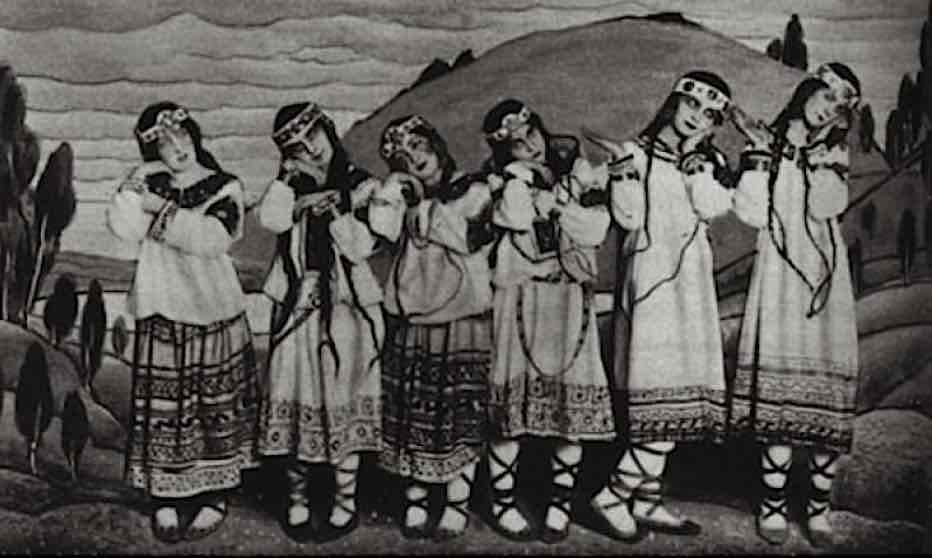
“Knock-kneed and long-braided Lolitas”, 1913. “When they cocked their heads against their hands, someone yelled, ‘Get a dentist!’
and someone else yelled back, ‘Get two dentists!’ ” (cited here).
Though The Rite of Spring has become standard, a classic, since the 1970s, it remains overwhelming today, whether or not you’re familiar with it. Playing it in 1970 with the National Youth Orchestra, conducted by Boulez, was one of the great experiences of my life (see also here). For a 2022 Rite at the Proms, click here.
Among endless discussions, Tom Service gives a succinct introduction. Alex Ross (The rest is noise, p.57) nicely (sic) compares the “riot” at the 1913 première with the release of the Sex Pistols’ Anarchy in the UK. Gertrude Stein’s detailed account of the event is curious:
We could hear nothing. One literally could not, throughout the whole performance, hear the sound of music.
Curious, as she wasn’t actually at the premiere (supposing that she had lived long enough not to actually attend the premiere of The sound of music either, she might have said, “One literally could not hear the rite of spring.”)
I’ve cited Richard Taruskin’s fine expression “lite Rite”—“Is nothing Sacred?”, as Keats and Chapman might say. In his stimulating article on Bartok and Stravinsky (The danger of music, pp.133–7; see also pp.421–4), he observes Bartok’s identification of The Rite’s “folk” elements that Stravinsky later disowned:
Even the origin of the rough-grained, brittle and jerky musical structure backed by ostinatos, which is so completely different from any structural proceeding of the past, may be sought in the short-breathed Russian peasant motives.
Alex Ross is also very much on The Rite’s case. In a crowded field, his comments in The rest is noise are very fine, with vivid context in his chapter “Dance of the earth” (pp.80–129), citing Taruskin’s definitive 1996 book Stravinsky and the Russian traditions.
I take Taruskin’s point that the darker energies of The Rite have been “resisted, rejected, repressed”, but even in the most polished performance it’s both exhilarating and disturbing.
Swan Lake it ain’t. Remember, at the 1913 Paris premiere the ballet was just as shocking as the music. You can see a reconstruction of Nijinsky’s own choreography here, and the recreation (from 25.40) following this documentary gives an impression:
Stravinsky once joked that the dauntingly high-register bassoon solo which opens the piece should be transposed up every year to stop players getting complacent about it. He wanted the effort to register.
But “it’s complicated”—see also here (and note the ritual wind instrument connection). I’m not sure about the dudka, but if it’s really related to the Armenian duduk, then there’s a link to the guanzi of north Chinese ritual bands! There’s a wealth of discussion of that opening solo in bassoon blogs.
sounded like someone driving through the jungle in a Mercedes with the windows up,
then good for him.
And then there’s the “original instrument” debate—the “lite Rite”, as Richard Taruskin called it:
This version for organ, far from silly, is just awe-inspiring:
A harpsichord rendition has also appeared on YouTube. Jazz tributes include the Bad Plus arrangement:
In her recent exploration of The Rite, Gillian Moore also observes:
My feelings of creeping feminist unease in writing a book on a ballet about the sacrifice of a young woman created by three men were at least partly relieved when I came across the Russian folk metal band Arkona and their frontwoman Masha Scream.
On a lighter note, here I imagine the Danse sacrale as a suitable riposte to the haka.
BTW, Ravel’sDaphnis and Chloe, less revolutionary but no less captivating, must have suffered by its proximity.
For WAM buffs, a story about Erich Leinsdorf, conducting Mahler with the Boston Symphony in the 1970s:
Driving along the freeway on his way into town for the concert in Symphony Hall, Leinsdorf has cut it a bit fine, so he puts his foot down, and sure enough the cops pull him over.
He’s getting really late now, so he blurts out,
“Look officer, you gotta let me go, I’m a real famous conductor, I gotta go and conduct the Boston Symphony, they’re counting on me—my name’s Erich Leinsdorf!”
The cop (chewing gum languorously) looks at him skeptically and goes,
“I don’t care who you are, bud—you could be Arthur Fiedler for all I care!”
As part of my extensive coverage of Bach (roundup here), two feature films from the 1960s, despite their extreme contrast, are linked both by their intensity and by the way they don’t just accept but probe our own modern values:
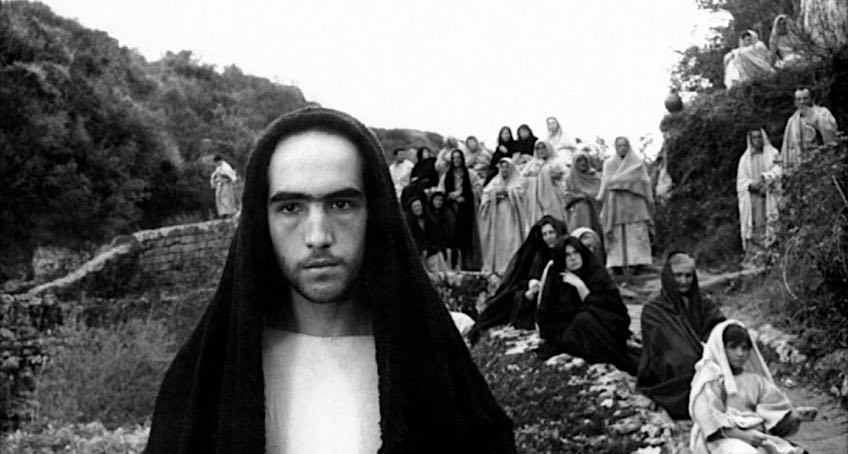
Pasolini’s The gospel according to StMatthew (1964) (featuring Bach among a range of music)—filmed in south Italy, largely with amateur actors:
and
The chronicle of Anna Magdelena Bach(Jean-Marie Straub and Danièle Huillet, 1968—with Gustav Leonhardt as Bach!). YouTube links come and go; I try and keep an eye on them, but you can do your own YouTube searches if they disappear. Here’s the complete film:
I also found a version enriched by Japanese subtitles (like the Greek subtitles of Johnny the shoeshine guy), and here’s a colourised version of the opening sequence (more on which here):
I have outlined the importance of the Song of the Skeleton in the rituals of both north and south China (In Search of the folk Daoists pp.233–4). It’s a common theme throughout the north—mainly as part of the yankou, both Daoist and Buddhist.
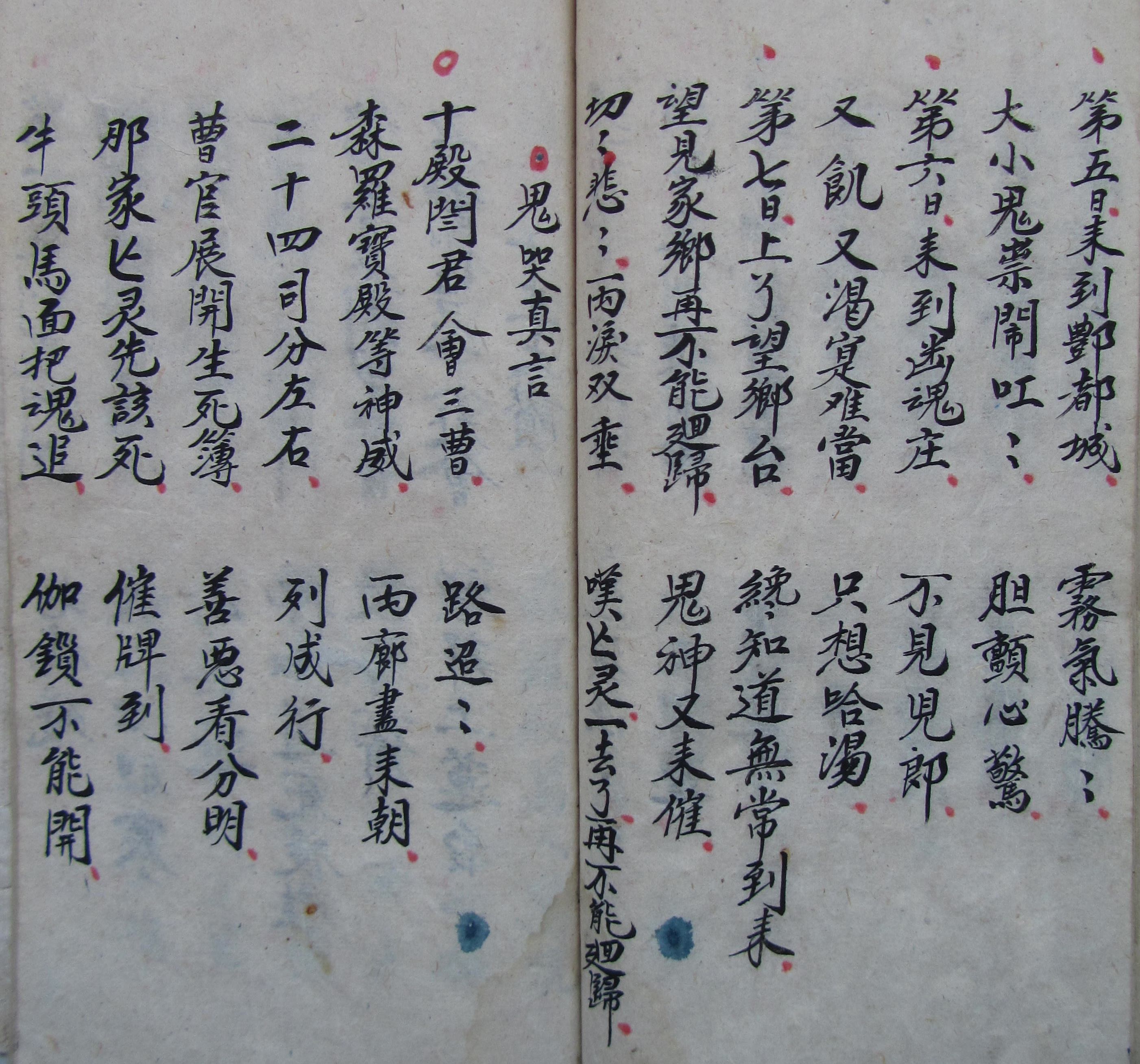
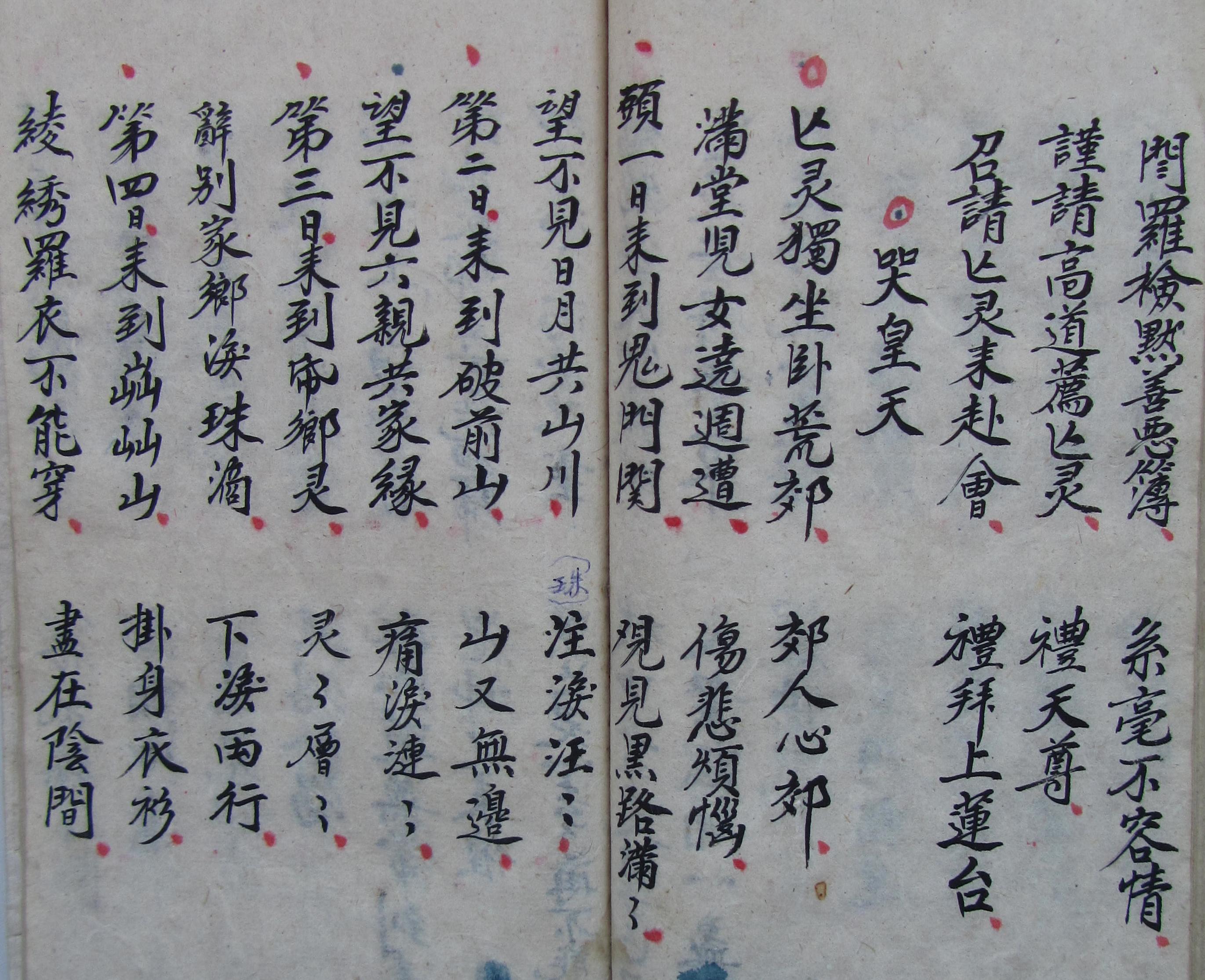
In Yanggao Daoist ritual (Daoist Priests of the Li family, pp.274–5), several hymns are related. The Mantra of the Skeleton (Kulou zhenyan 骷髏真言, more commonly known here by the melodic label Wailing to Sovereign Heaven, Ku huangtian 哭皇天) is prescribed, a cappella, for Opening Scriptures on the first afternoon of a funeral.
It’s a kind of catalogue aria, with seven long verses for the visits to the stations of purgatory over seven days. Its melodic material overlaps substantially with that of other hymns, beginning with the opening of the Diverse and Nameless melody (Daoist priests pp.267–8). The melismatic “Ah, Skeleton” (Kulou) refrain, and the coda in pseudo-Sanskrit (also in common with Diverse and Nameless), are not written here in the manual. My film (from 56’08”) shows the sixth verse:
Ah Skeleton! Skeleton! On the sixth day he reaches Netherworld Souls Village His sons not to be seen Starving and parched, at his wits’ end, Desperate to sup broth.
From Li Qing’s hymn volume, 1980. The final folio on the left has the opening of Mantra to the Wailing Ghosts—my book p.266, also featured in the film, from 1.03.56).
* * *
For most such hymns one hardly expects an “emotional” response from audiences—in Yanggao, after all, it shares both melodic material and style with many others in the repertoire. But in his brilliant ethnographic studies of ritual practice in old Beijing, Chang Renchun notes how the renditions of two celebrated Buddhist monks moved their audiences to tears. Performative tears feature in many posts on this blog—links here.
Some common versions open:
昨日去荒郊玩游 Yesterday, seeking diversion roaming in the barren outskirts…
So talking of “Yesterday”, Paul McCartney heard his own version in a dream, like Aboriginal singers.
Though secular, it’s deeply moving. Here’s an early solo rendition, live (and Paul’s unaffected style is a major element of the song’s impact—no cover versions come close):
Here’s the remastered version from 2009:
As I observe in the introduction to my series on the great Beatles albums, analysis, while optional, can supplement our response; again it’s instructive to read Wilfred Mellers and Alan W. Pollack. Dating from the same period as A hard day’s night, Mellers considers Yesterday a “small miracle”:
Although the opening words tell us that yesterday his troubles seemed far away, the music in the second bar immediately enacts these troubles with a disquieting modulation from tonic, by way of the sharpened sixth, to the relative. The first bar, with its gentle sigh, seems separated, stranded, by the abrupt modulation; and although the troubles “return to stay” with a descent to the tonic, the anticipated modulation sharpwards is counteracted when the B♮is flattened to make an irresolute plagal cadence. […]
The immediate nostalgia of the song is without suspicion of sentimentality, and the corny accompaniment of string quartet can be employed, with validity, to reinforce the music’s frail bewilderment.
George Martin’s manuscript for Yesterday, on display at Abbey road studios.
Pollack’s analysis is also insightful. And as he notes (also in my roundup), the opening uses a device here that Paul was to use regularly in some of his great songs: a declarative word, followed by a pause, and then rhythmically active ascent.
I can be quite confident about our own emotional responses to this song; less so about the responses of various types of Chinese mourners to the Skeleton, over time.
Alan Bennett(him again) recalls his early music education attending concerts at Leeds Town Hall—making an ethnographic point that is as valid for Daoist ritual as for WAM(Untold Stories p.412):
So it is not just music that I learn, sitting on those harsh benches, Saturday by Saturday. Music in the concert hall is also a moral education, and watching the musicians at close quarters, I realize that it is not just ecstasy and inspiration but that there is drudge to it too. Sometimes, the players would be on the same tram coming home, and I see that they are just like everybody else—shabby, in dirty raincoats and sometimes with tab ends in their mouths, ordinary people who, half an hour ago, were artists and agents of the sublime.
An aspiring singer on a TV talent show decided to perform Doh a deer, and rashly decided to go out, too literally, on a high note:
Which reminds me—the traditional gongche notation for the melodic skeleton of ritual shengguan ensemble translates nicely into solfeggio (and indeed into modern Chinese cipher notation)…
Da Zouma score, written for me by Li Qing, 1992 (playlist #4, commentary here).
“But that’s not important right now”. I allude, of course, to Airplane:
The Chinese gongche system, like those of Europe and India, is heptatonic:
cipher notation: 1 2 3 4 5 6 7 solfeggio: do re mi fa so la si Indian sargam: Sa Re Ga Ma Pa Dha Ni
gongche: he si yi shang che gong fan,
with liu and wu as upper octave notes for he/do and si/re respectively (taking the older system with he, rather than shang, as do! Call Me Old-fashioned).
For those who can’t fathom the British propensity for punning, the only line of Doh a Deer that makes any sense is La, a note to follow so—precisely the only line where the author reveals a touching fallibility. Such literal audiences would be happier if it were all like that:
… Re, a note to follow do Mi, a note to follow re Fa, a note to follow mi and so on…
It only remains to overhaul the opening line. The original version “La, a note to follow so—if you’re moving upwards in conjunct motion that is” was overruled as too pedantic, of course.
Another fun exercise is to sing the phrases in reverse order, descending instead of ascending from Doh:
Doh, a deer… Ti, a drink with jam and bread La, a note to follow ti! So, a needle pulling thread etc.
Given how well we know the song, it seems a bit weird how crap we Brits are at solfeggio. Another fun game would be to try singing the whole thing only in solfeggio:
Do, re mi, do mi do mi, Re, mi fafa mire fa
and so on.
Then we can use the tune to familiarise ourselves with Indian and Chinese solfeggio:
Sa, Re Ga, Sa Ga Sa Ga,
Re, Ga MaMa GaRe Ma…
he, siyi, heyiheyi, si, yishangshangyisishang…
We can also sing the song to the many scales of Indian raga in turn, with their varying flat or sharp pitches (note my series, introduced here)—a simple example: in rāg Yaman, try singing a sharp fourth for fa, a long long way to run…
Alas, a fascinating medley of versions in French, German, Italian, Spanish (x3), Japanese, and Persian has just disappeared from YouTube. Let me know if you find it!
For a brilliant pun on the Mary Poppins song, see here. And for “do, a note to follow mi“, click here.
Further to the Sermon, many of us wrestle, in a benign kind of fashion, with Anglicanism. Here’s Dudley Moore again:
Fine as this is in the original “authentic” version of the creator (not Creator), it is also great as harmonised a cappella by a choir on the bus while on tour.
Musos always play this game on tour, but I’m sure it’s common in many walks of life.
On tour in Italy, for instance, we all come back from lunch in our different groups, outdoing each other with stories of an amazing find:
Little trattoria in a tiny backstreet, not even a sign on the door, only locals in there, no menu, they just give you what they’re having, five courses, home-made pasta… Toothless old lady dressed in black treading the grapes… And you know, it was incredibly cheap… And then she invited us to her granddaughter’s wedding, and there was this fantastic band playing zampogna and piffero…
I’d love to know who the conductor was in this story.
A guest conductor is rehearsing for a concert with a London orchestra. He soon stops them in mid-flow to address the timpani player: “Sir, you sound like someone slapping a pillow with a flaccid penis!”
Coming back to rehearse the band next morning, the conductor makes a speech: “Ladies and gentlemen, you must forgive me for my behaviour yesterday, I was unpardonably rude… Nonetheless, I went back to my hotel last night, and I tried it—and I WAS RIGHT!”
In my book (p.280) I observed a subtlety of Yanggao Daoist ritual that may elude us:
Novices soon pick up the short pattern in rhythmic unison on drum, small cymbals and yunluo that opens and closes every item of liturgy, an accelerando followed by three beats ending with a damped sound. This is known as luopu (“cadential pattern”) and it turns out that the number of beats is fixed, 7 plus 4—unless the guanzi player needs a bit more time to prepare his reed!
Much less impressive is Beethoven’s take on this, the four soft quarter-note beats that open his violin concerto (less creative than the EastEnders Doof Doof). The quote from my book is itself just a prelude to the popular story of a famous conductor rehearsing his orchestra in the concerto. Though he was notorious for nit-picking, one might suppose that at least here the band would get up a bit of a head of steam before he started correcting them. But no, sure enough he brings them to a halt even before the oboe can come in.
Turning to the bemused timpanist, he says,
“Can you play that with a little more… magic?”
The timpanist looks back at him sullenly, beats out the four notes again, and goes,
“Abra-ca-fucking-dabra”.
* * *
In Daoist ritual there’s nothing quite akin to “rehearsal”, but during a ritual Li Manshan maintains standards by the subtlest of facial gestures, with a little glare if the ensemble is less than perfect. As I learn, I benefit from such hints.
Like “Meretricious and a Happy New Year”, or “She ran the gamut of emotions from A to B”. This is the kind of meticulous historical work that one expects from the scholarship of Daoist ritual texts.
“OMG” isn’t there, but appears to date from at least 1917 (OMG!)—recalling the brilliant Armstrong and Miller sketches (playlist):
And that’s kinda like a commentary on what we do when we listen to Bach (qv): we can’t help hearing the cadences of our own experience of life in the scenarios of the past. And shit like that. Innit though.
In the Bach Passions, textspeak could generally work for the choral crowd scenes, but actually “Erbarme Dich, OMG” fits worryingly well too:
Or
“He has risen from the dead, YAY!”
YAY being a more economical version of Hallelujah…
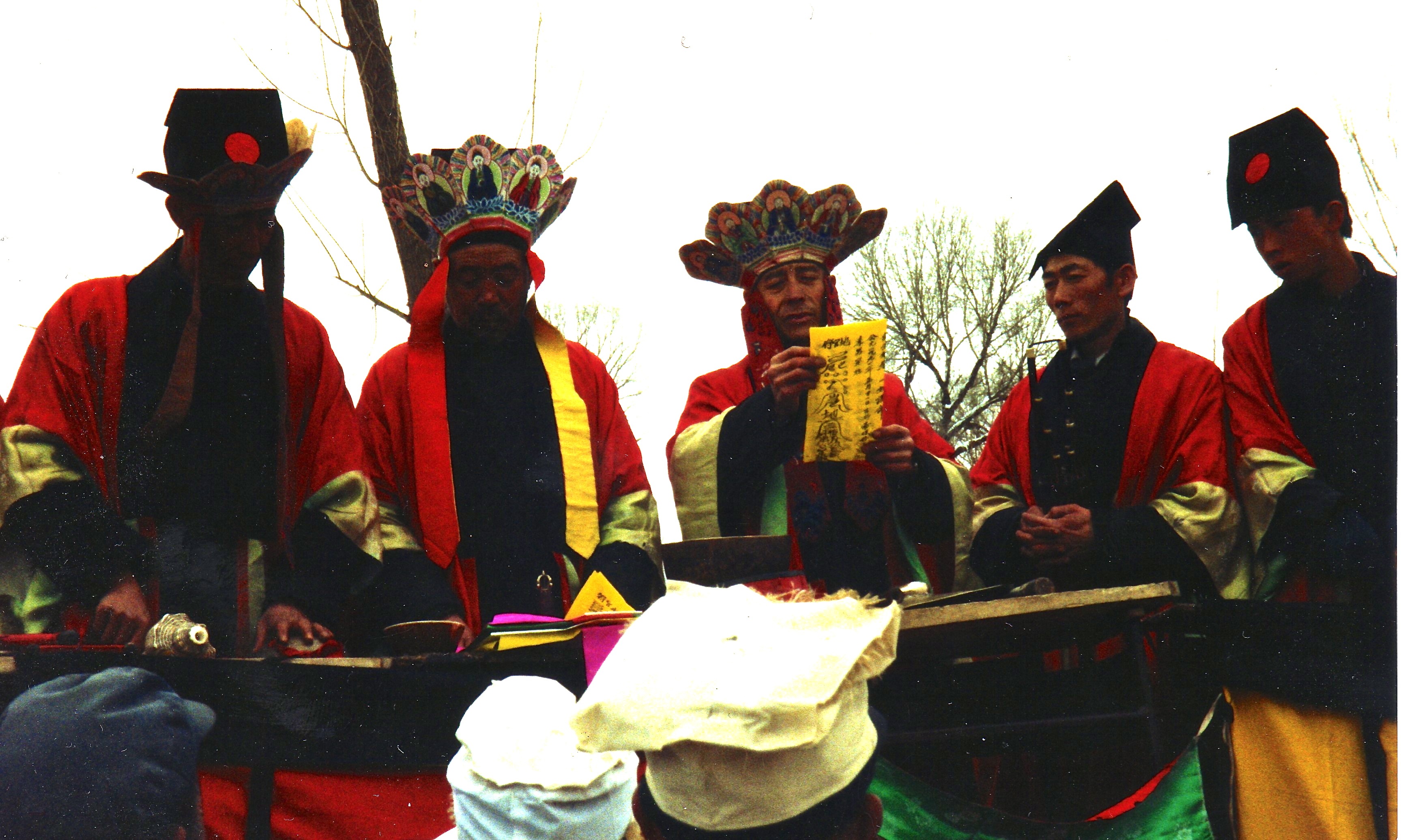
The Pardon ritual led by Li Qing (2nd from left), Yanggao 1991 (my film, from 48.34).
As a change from my literary party game, here’s an arcane spinoff from the game of picking a fantasy world football team, or chamber orchestra.
Let’s choose our all-time most amazing group of Daoist ritual specialists, including both liturgists and instrumentalists. Of course, the list of candidates is endless, so I’d seek to refine the search by selecting those known mainly for their ritual performance, rather than for compiling vast compendia of manuals.
Thus the list could include early luminaries like Kou Qianzhi 寇謙之 (365–448) (who might speak a dialect similar to that of Li Qing, except that they lived over 1500 years apart), Tao Hongjing 陶弘景 (456–536), and Du Guangting 杜光庭 (850–933) (see their entries under Fabrizio Pregadio ed., Encyclopaedia of Taoism).
Churlishly fast-forwarding a millenium, among modern Daoists we could include Chen Rongsheng 陳榮盛 (1927–2014) from Tainan, [1]Zhang Minggui 張明貴 (1931–2016) of the White Cloud Temple in Shaanbei, and our very own Li Qing 李清 (1926–99); among a host of great drum masters one might recruit An Laixu 安来緖 (1895–1977) from Xi’an and Zhou Zufu周祖馥 (1915–97) from Suzhou.
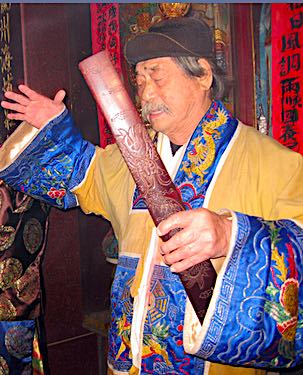
Above: left, Kou Qianzhi; right, Tao Hongjing; below: left, Zhang Minggui; right, An Laixu.
For once, we can leave historical change to one side: it remains to be seen how effective Pelé and Messi would be together as a forward line-up, or Saint Cecilia and Bach (in the orchestra, or indeed in the football team; cf. the Monty Python Philosophers’ football). A more basic difference is that—more than football or the WAM canon—the performance of Daoist ritual is always specific to a small locality. Even if their ritual manuals may have a lot in common, household Daoists from different places can hardly work together. Never mind Daoists from Shanghai, Fujian, and Hunan; even within north Shanxi, the whole ritual performance of the Li family in Yanggao is significantly different from that of groups in Hunyuan or Shuozhou counties very nearby.
[1] Until quite recently, much of our knowledge of modern Daoist ritual (despite its great diversity) was based on the tradition of Chen Rongsheng, meticulously documented by Kristofer Schipper and John Lagerwey. Here’s a tribute, with precious clips of Master Chen’s ritual practice:
Links to lengthier ritual sequences here. Alas, Michael Saso’s early clips of his Master Chuang no longer seem to be in the public domain.
On the Li family Daoists’ 2013 tour of Germany I suggested an extra item in our evolving concert programme, an a cappella sequence based on the Invitation ritual performed at the edge of the village (my book p.339; film, from 58.14; playlist #1, with commentary here).
At first they were reluctant: while they have no qualms about performing ritual items on stage, they worried that performing an item so explicitly funerary might be unsuitable. I pointed out that some of the greatest music in the concert tradition of Western Art Music is for the dead.
Apart from various requiems (Mozart, Brahms…), one of the pieces I used to reassure them that funeral music was quite familiar to Western audiences was Buxtehude’s Klaglied. Though a recording by the wondrous Michael Chance has just disappeared from YouTube (BRING IT BACK AT ONCE!!!), Andreas Scholl’s version is also great:
Not that the Daoists were remotely impressed by it—by contrast with Steven Feld’s influential experiments in finding which kinds of alien musics might strike a chord among the Kaluli (Sound and sentiment). They enjoyed our trip to the Bach museum in Leipzig not so much for the music as to get a glimpse of the life of a European ritual specialist; and when I showed them the EBS video of the Christmas oratorio they were mainly amused to see me in tails. I can’t even turn them on to jazz.
Occasionally some well-meaning urbanites have rashly suggested I bring my violin to play along with the Daoists, or even arrange their music for orchestra—but to their credit, the Li band have the taste never to do so.
I’m sure you know the Big Tune of the “March to the Scaffold” in Berlioz’s Symphonie Fantastique. Don’t you. Here’s S-Simon again, with the LSO in 2019:
Anyway, among all the spoof lyrics concocted by musicians to fit symphonic melodies, this is my favourite:
What makes it still more delightful (for the ethnographer, ahem) is that one can more or less date it to London in the late 1960s—the thrill of the new… *
For a datable viola joke about the Beatles, see here; for Berlioz on oriental music, here; and for a complete performance of the symphony, here.
Brits were still seduced by the allure of exotic cuisine in the 1990s, as parodied in the classic Goodness gracious me sketch (“What’s the blandest thing on the menu?'”).
* “Curry” appeared on the menu of a coffee house in the Haymarket as early as 1773. By the 1930s one could buy curry powder, poppadoms, and mango chutney in Portobello, and several Indian restaurants opened in Soho, as well as in Glasgow and Cambridge. By 1970 there were 2,000 Indian restaurants in Britain. See under Bloody foreigners.
From Alan Bennett’s 1996 diaries, on his early musical upbringing:
“I also bought a record of Schubert’s Unfinished Symphony, doubly unfinished in this case as I only got one record out of a set of three, so it wasn’t until years later that I found out how it officially didn’t finish.”
Generally I don’t rate drôle ads much, but this is apposite:
Reading of the long sermon that separated Parts One and Two of the Matthew Passion in Bach’s Leipzig performances, people of my generation will find it hard not to reference Alan Bennett’s classic skit:
Which just goes to show how very different our world is from that of Leipzig audiences in the 1720s…
The language, with the clergyman gamely reaching out to his flock with expressions like “Stuff this for a lark”, was so quaint as to amuse even the 1950s’ audience, then my generation in the 1970s, and still now (cf. Reception history).
In his 2014 sermon at King’s College Cambridge, AB reflects:
Like all parodies it was born out of affection and familiarity and the Anglican services that were in my bones, and there is symmetry here as the first sermon I preached on a professional stage was in Cambridge fifty odd years ago across the road at the Arts Theatre in the revue Beyond the Fringe. It was on the text, “My brother Esau is an hairy man but I am a smooth man”. That sermon apart I have never formally preached since until this morning and here I am again in Cambridge.
And with his defence of education for all, it’s a highly political sermon.
For Confucius and other boring prophets, see here.
Applicants for the post of principal conductor of the LA Phil were asked to submit a list of works they’d like to conduct in their first season. Esa-Pekka Salonen’s list was full of pieces by challenging contemporary composers. At the interview, the chair of the board looked severely over his application, turned to him and said,
“I don’t quite know how to put this to you, Mr Salonen, but… here at the Phil, we prefer our composers… dead.”
This may still apply to a considerable extent within the echelons of WAM; yet ironically, when those dead composers were alive, the core repertoire was contemporary: baroque and romantic audiences came along expecting to hear new music.
For China too, as I show in Appendix 1 of my book Daoist priests of the Li family, I attempt not a normative reconstruction of some timeless ancient wisdom, but a descriptive account of ritual life within changing modern society. See Debunking “living fossils”.
For the great maestro Salonen, see also here and here. For more interview stories, click here.
In this photo, the woman on the far left is often claimed to be Mozart’s widow Constanze (1762–1842), just imagine (see here)… Or is it? For doubts, see wiki.
Many would like to believe it. If it is her, then it will be one of the most surprising things you will ever see. OK, it was taken in 1840, when Wolfgang was long gone. Few wives outlived their husbands. Given the harshness of the times, she hardly looks 78.
As Sean Munger comments, Constanze became the Yoko Ono of the 19th century. Wiki also cites the Grove dictionary:
Early 20th-century scholarship severely criticized her as unintelligent, unmusical and even unfaithful, and as a neglectful and unworthy wife to Mozart. Such assessments (still current) were based on no good evidence, were tainted with anti-feminism and were probably wrong on all counts.
* * *
If only we had photos of the Li family Daoists (and their wives) from the late imperial era… Even the photo of Li Peisen and his wife from the 1940s is rare enough. Indeed, in a world where female members of a family are taken for granted at best, people remembered her as exceptionally able and intelligent too.
Allegedly, a lunchtime recital by two fine UK musicians was advertised thus (read it aloud…):
Shades there of “Bach’s Organ Works” too. BTW, in a “proper” index to this blog, more detailed than the sidebar tags, it would give me great pleasure to include Bolton among several numinous place-names in the index to my largely Daoist ouevre:
In the Scunthorpe entry, the page-reference under Messiah is genuine (in my Daoist priests of the Li family); I’ve imagined the others, since (intriguingly) they add to the drôlerie. Do click on the links!
The violinist David Martin led a string quartet which they imaginatively decided to call The Martin String Quartet. Once after a gig for a regional music society, he received a letter of thanks that opened
Dear Mr String, …
Another music society story:
An up-and-coming young tenor was to give a recital for a music society. Time was short, so he phoned the club secretary to read out his programme for printing. It included the item Could I but express in song. Perusing the programme when he arrived, he found the title
Kodály, Buttocks pressing song.
which does indeed have a somewhat plausible folk cachet.
There I was on tour in Ireland, playing Mozart’s first opera Apollo and Hyacinthus, which enjoys the added blessing of being short, so we could go on to sessions in local pubs. One night in the pub after a gig across the border in Armagh, an old codger got chatting to me, and told me of his father Jimmy.
Notionally a shopkeeper, Jimmy gave little thought to the business, instead spending all his time in his back room with his mates playing old tunes and getting pleasantly pissed. They were all pretty rubbish, but had a great time, scraping away ineptly on their fiddles. One day in a break Jimmy switches on the wireless to hear a solemn announcement:
“It is with deep regret that we announce the death of the celebrated concert violinist Mr Jascha Heifetz.”
One of the guys looks at him with a tear in his eye and sighs,
“Bejaysus, Jimmy, there ain’t many of us left.”
I wish I’d been able to tell my teacher Hugh Maguire that one. For more stories about Irish music, see the great Cieran Carson; and for Paul Bowles’s story about Yehudi “Monahan”, click here. My posts on Irish music are rounded up here.
In his brilliant Last Night’s Fun, Ciaran Carson devotes a chapter (“The standard”, pp.91–8) to the mania for soulless competitions—a caveat for Chinese pundits too. A few instances:
Deirdre was once asked to adjudicate the fiddle competition in the County — Fleadh. Unfortunately, the event attracted no entrants; but the competition had to happen and a winner be selected. It so happened that a Mr X, generally regarded as the best fiddle-player in the area, might well have gone in for it; however, he couldn’t be got out of the pub, except for the official free high-tea that it was his duty to attend. Deirdre was dispatched to the tea-room above the hall, and managed to inveigle Mr X into playing the requisite reel, jig, and slow air, in between the soup, the salad sandwiches, and the jelly trifle. He was then presented with an enormous trophy, much to his surprise.
And
I was once present at a singing competition in the town of —, in the province of —. The adjudicators were the well-known singers Mr Y and Mr Z. The venue was the local Temperance Hall. The competition started rather late, as the adjudicators found it difficult to leave the nearby pub. They eventually arrived with a brown paper bag which they discreetly shared under the trestle table. At the finale, everyone was awarded medals. The adjudicators sang a duet. Everyone was happy. Everyone felt well-adjudicated.
Another story, from the 1908 Freeman’s Journal:
“Our country musicians are possessed of the talent of music and have in their minds the beautiful in it, but they cannot reproduce them, for they lach the technical means of doing so.” Applause. “Were they reasonably educated they would produce a race of musicians worthy of our history. Again, we had those who believed that Irish music should be rendered in scales of unusual construction. [SJ: shades of de Selby?!] Many scales existed in ancient times, but, alas, those who could teach us have gone. Because a singer or player, through lack of technical means, sang or played with a total disregard of any correctness of intonation, that did not qualify them to claim that they were using a scale of unusual construction. The majority of them did not adhere to the accepted musical scale, not that they used any other form of scale, but that their ear being totally untrained, they involuntarily produced a music not in any one scale, but in an infinity of scales of impossible construction.” Laughter and applause.
Mr Darley then gave his violin recital of Irish airs.
Most delightful is Carson’s citation of a fine story from Mick Hoy—a caveat to reverse musical snobbery:
There were these three fiddlers once upon a time.
And they were in for this competition
And the first one came up
and he was dressed in a dress-suit
and he had a dicky-bow and bib on him.
And the fiddle-case was made out of crocodile skin.
And when he brought out the fiddle,
what was it, but a Stradivarius.
And he started to play,
and beGod, he was desperate.
And the second fiddler came up
and he was wearing a nice Burton’s suit
and a matching handkerchief and tie
and socks with clocks on them.
And he had a nice wooden case
and not a bad fiddle in it,
so he got it out and started to play,
and beGod, he was desperate.
And the third fiddler came up
and the elbows was out of his jacket
and the toes peeping from his shoes,
and the fiddle-case was tied with bits of wire
and when he brought out the fiddle,
there was more strings on the fiddle
than there was on the bow.
And he started to play.
And beGod, he was desperate too.
Backstage at the Royal Festival Hall around 1980 I recall this public information poster. Heading a map of the Thames, showing areas of London at risk of flooding, was the stern question
In that selfless spirit of social involvement that makes musicians’ life so enriching, someone soon added a reply:
One evening after doing the Monteverdi Vespers, or should I say Vespas [No you should not—Ed.] in St Johns’ Smith Square I had to get somewhere else in a hurry, so I jumped into a taxi.
The driver goes, “So wot you bin up to then?”
Me: “Um, been playing this amazing piece by Monteverdi, it’s, um, like, old stuff—like early music, you know?”
“Oh right—you mean like Frank Ifield an’ that?”
Me: “Er, yeah, that’s the kinda thing…”
* * *
“But you know”, as Alan Bennett’s sermon goes, “he put me in mind of the kind of question I feel I should be asking you here tonight”: what is early music, and is it closing time yet?
For another detached review of early music, see here (among many stories under the humour subhead of the WAM category). And here’s a comment from Larson.



























 Stephen Jones: a blog
