A stunning keyboard break

The work of Susan McClaryboth for its ideas and its lively language, has prompted such a major “disciplinary explosion” in musicology, with her iconic book Feminine endings. Her ideas, “received as radical—even outrageous—within musicology, only brought to music studies the kind of projects that had long since become standard fare in most other areas of the humanities” (p.ix).

McClary’s work shouldn’t be reduced to soundbites, but alongside astute gender-based discussions of a broad range of music from Monteverdi to Madonna, Carmen to Laurie Anderson, many passages have both inspired and shocked—her detailed unpackings of patriarchal assumptions, such as on Beethoven (“assaultive pelvic pounding… and sexual violence “), or the “erotic friction” of Italian trio sonatas (“two equal voices rub up against each other, pressing into dissonances that resolve only into yet other knots, reaching satiety only at conclusions”—an interactive texture that was later displaced).

Meanwhile, listening again to Brandenburg 5 recently after my post on Bach’s fawning letter to the concerto’s churlish recipient, I was reminded of one of McClary’s most famous accounts, from her 1987 article “The blasphemy of talking politics during Bach year”.

Somehow I long took for granted Bach’s “frenzied” harpsichord solo near the end of the 1st movement—McClary observes how our senses are dulled by familiarity with later romantic concertos (and anyway we fiddlers tend to think it’s none of our business—we know our place, which is precisely McClary’s argument). So I’d like to run through the way she unpacks it; whatever you think, she’s always stimulating (see also this post).

She begins by summarizing important background, her constant theme:

At the very moment that music was beginning to be produced for a mass bourgeois audience, that audience sought to legitimize its artifacts by grounding them in the “certainty” of another, presumably more absolute realm—rather than in terms of its own social tastes and values.
[…]
From very early times up to and including the present, there has been a strain of Western culture that accounts for music in non-social, implicitly metaphysical terms. But parallel with that strain (and also from earliest times) is another which regards music as essentially a human, socially-grounded, socially altered construct. Most polemical battles in the history of music theory and criticism involve the irreconcilable confrontation of these two positions.

Inspired by Attali’s book Noise, McClary seeks “the tension between order (indeed, competing claims to legitimate order) and deviation —if not outright violence…” Reminding us of harmonic music’s underlying assumptions of goal-attainment (“playing with (teasing and postponing, gratifying) the expectation of imminent closure”), she plunges into the 1st movement of Brandenburg 5.

She notes the rise of the concerto form, where “the soloist is an virtuosic individualist who flaunts the collectivity of the large ensemble”. […] “It begins as if it is going to be a concerto for solo flute and violin, but it soon becomes clear that “there is a darkhorse competitor for the role of soloist: the harpsichord”. Its normal “service role” at the time seems self-effacing, but “the harpsichordist is often a Svengali or puppet master who works the strings from behind the keyboard. Here s/he “creates a ‘Revenge of the continuo player’: the harpsichord begins in its rightful, traditional, supporting norm-articulating role but then gradually emerges to shove everyone else […] out of the way for one of the most outlandish displays in music history.”

The harpsichord, which first serves as continuo support, then begins to compete with the soloists for attention, and finally overthrows the other forces in a kind of hijacking of the piece. […] The ritornello seems to know how to deal with the more well-behaved soloists, how to appropriate, absorb, and contain their energy.” But Bach now “composes the parts of the ensemble, flute, and violin to make it appear that their piece has been violently derailed. They drop out inconclusively, one after another, exactly in the way an orchestra would do if one of its members started making up a new piece in the middle of a performance. Their parts no longer make sense. They fall silent in the face of this affront from the ensemble’s lackey, and all expectations for orderly reconciliation and harmonic closure are suspended.
[…]
It unleashes elements of chaos, irrationality, and noise until finally it blurs almost entirely the sense of key, meter, and form upon which 18th century style depends.

McClary concludes provocatively:

 The usual nice, tight fit between the social norm, as represented by the convention of concerto procedure, and specific content is here highly problematized. Certainly social order and freedom are possible, but apparently only so long as the individuals in question—like the sweet-tempered flute and violin—abide by the rules and permit themselves to be appropriated. What happens when a genuine deviant (and one from the ensemble’s service staff yet!) declares itself a genius unrestrained by convention, and takes over? We readily identify with the self-appointed protagonist’s adventure (its storming of the Bastille, if you will), and at the same time fear for what might happen as a result of the suspension of traditional authority. […] The possibility of virtual social overthrow, and the violence implied by such overthrow, is suggested in the movement, and the reconciliation of individual and social hierarchy at the end— while welcome—may seem largely motivated by convention. To pull this dramatization back within the limits of self-contained structure and order may seem to avoid the dilemma, but it does so at the expense of silencing the piece. For Bach is here enacting the exhilaration as well as the risks of upward mobility, the simultaneous desire for and resistance of concession to social harmony.

McClary’s work is akin to ethnomusicology (“If I can no longer privilege any one tradition, I find myself perpetually in awe of the countless ways societies have devised for articulating their most basic beliefs through the medium of sound”), and its class and gender implications cry out to be applied to Chinese musical cultures (I made a preliminary and rather unsuccessful attempt in my “Living early composition: an appreciation of Chinese shawm melody”).

With Bach’s solo, it’s easy to think “that’s just how it goes”, but whatever your “class standpoint” (阶级立场), if you listen to it afresh, every few bars you think, WTF??? I know the analogy with jazz can be overdone, but even jazz solos, however virtuosic, also generally fit within fixed (and democratic?) parameters—except when someone like Coltrane goes off on an interminable fantasy. In its wackiness Bach’s solo reminds me of a pianist like Hiromi—or a Hendrix guitar solo.

It makes a suitably awe-inspiring opening to The chronicle of Anna Magdalena Bach, all the more exhilarating in Gustav Leonhardt’s restrained rendition—here’s a colorized version:

For my own meretricious speculations on socio-political elements in the reversal of colours on the piano keyboard, see Black and white.

* * *

And now for something completely different: Glenn Gould, 1962—don’t worry about the rest of it, just listen from 8.06ish:

Reception history and performance practice are always intriguing. Little is known of any performances in Bach’s lifetime, but it looks as if the concerto may not have been played again, at least in public, until 1853. Like Rudolf Serkin’s 1935 recording with the Busch Chamber Players, Alfred Cortot’s 1932 version (still on piano) is more genteel than manic:

And here’s Furtwängler in 1950 (cadenza from 8.54ish)—praised by Richard Taruskin, no less:

But performances only became more common with the harpsichord revival of the mid-20th century. So now, despite a rearguard action to rehabilitate the Golden Age before HIP (see Alternative Bach, and Playing with history), modern ears may find such early versions heavy going.

Richard Egarr always offers wacky insights (from 6.30ish):

Having blown everyone away, the harpsichordist gives a little signal of the return to normality (“relents and politely (ironically?) permits the ensemble to re-enter”) so that they can pick themselves off the floor to come in with the ritornello that innocently began the whole trip.

I like to think of the cadenza as just one instance of an improvisation that Bach chose to notate, illustrating the kind of fantasies in which the player might care to indulge, like Messe de la Pentacôte or Rhapsody in blue.

Sure, one can’t really cheer aloud at every manic new turn, but I still think the only possible reaction of both band and audience, whether now or in Bach’s lifetime, would be akin to that of Billie Holiday as she exults in the succession of amazing solos her band offer up to her.

They come over ’ere…

Central Asian musicians, Tang dynasty.

Here’s a companion piece to my post on foreigners during the Cultural Revolution, where I acknowledged my anachronistic use of the epithet laowai 老外.

I read that indeed the term didn’t become common until the 1980s—just in time to greet me on my late arrival (for some words that Shakespeare may not have invented, see here). The Chinese wiki article on laowai makes a useful succinct introduction, explaining its interplay of respect and xenophobia. I’m still curious to learn how the winning combo of lao and wai suddenly caught on. A detailed forum on the nuances of this and related terms has been initiated by the erudite Victor Mair, so here I’ll just add a few personal reflections.

A still more blunt term is dabizi 大鼻子 “big nose”; foreigners in China have to get used to frequent appraisals of their physiognomy, but as an autonym, at least, the term can be drôle. I’m also fond of the more quaintly retro yang guizi 洋鬼子 (“foreign devil”), which a senior Taiwanese mentor—and, crucially, friend!—likes to call me. As ever, such terms are context-sensitive; they may even confirm guanxi (“You’re my mate—we can take the piss together”).

At a tangent, in Shaanbei a fine shawm-band leader is widely known as Jiekazi “The Stammerer”—in rural China, attitudes towards stammering are both less po-faced and less courteous.

Craig and Ming

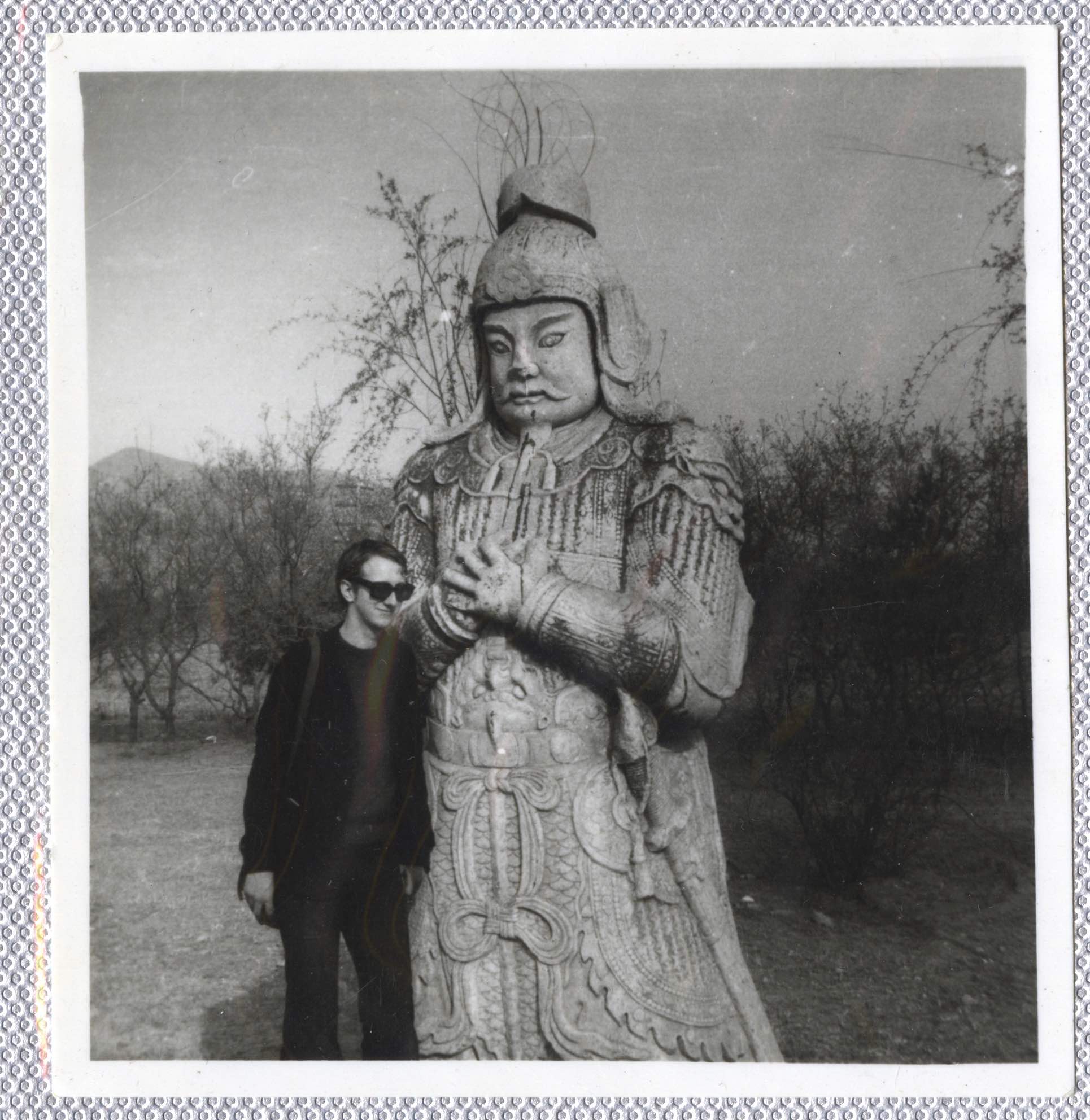
Waiguoren!” (not yet “Laowai!”). Craig Clunas, Ming tombs 1975.

Staying with China (derogatory terms for foreigners are of course a rich topic worldwide), apart from the various historical terms (hu 胡, fan 番, yi 夷, man 蠻, and so on—mostly with a strong suggestion of “barbarian”), I’m now curious to learn how the Labouring Masses of the Tang dynasty would have hailed the substantial number of laowai on the streets of 8th-century Xi’an in the popular argot of the day.

We may now regard the Tang as the first great world-music boom (cf. Soundscapes of Dunhuang), but as musical nationalists of the day (like the poet Bai Juyi and his mate Yuan Zhen) might have said,

“They come over ’ere, with their fancy bili and pipa…”

Or their Qing-dynasty counterparts (so does building walls work, then? Eh??):

“They come over ’ere, with their fancy erhu and suona and yangqin…”

OK, I made those up, but this is a genuine Tang quote (adding impertinent male judgment on female attire to the heady xenophobic mix): [1]

Our women are acting like foreigners’ wives, studying foreign make-up;
Entertainers present foreign sounds, servants to foreign music!

Straight out of the Daily Mail, that. With the current surge in “patriotism”, a new campaign to purge corrupting foreign influence from the Chinese instrumentarium would be left mainly with the xun ocarina and the sheng mouth-organ—which might fail to excite even Uncle Xi. It’s ironic that after successive waves, it was the Model Operas of the Cultural Revolution that were largely responsible for a renewed vogue for the instruments of the Western Art Music tradition.

Closer to home (yet equally apposite), a classic rebuke to xenophobia is the great Stewart Lee’s UKIP routine (“Bloody Huguenots, Coming Over Here—doubting trans-substantiation, with their famed ability to weave little jerkins out of lace…”). And to supplement his fantasy chat down the UKIP pub:

“Apparently the guitar is descended from the oud—that’s bloody Moorish, mate! What’s wrong with Morris dancing, that’s wot I say!”

[Inconvenient footnote: an inconclusive etymology suggests that “Morris” is itself derived from “Moorish”…]

As simplistic nationalist agendas rear their ugly orange heads yet again, it’s always worth unpacking language. See also A fine riposte, and Das Land ohne Musik.

For the “Golden Age” of the Tang, Chinese scholars might learn from 17th-century Holland.


[1] See e.g. Suzanne E. Cahill, “Our women are acting like foreigners’ wives! Western influences of Tang dynasty women’s fashion”, in Steele and Major (eds), China chic: East meets West. Among many works, see also Marc S. Abramson (ed.), Ethnic identity in Tang China. The works of Edward Schafer (notably The golden peaches of Samarkand and The vermilion bird, written at a time when such study was neither profitable nor popular) have long been an inspiration for those studying Central Asian culture in the Tang.

World music: a new tag

I sniff at the trendy commercial usage of the term “world music”, but at least it’s a shorthand for all the musical cultures of the world. So I’ve now added a new tag in the sidebar for world music, collating various dilettante excursions into the musical cultures of India, Ireland, the Mediterranean, the Uyghurs, and so on. Doubtless more to come…

cascais-singer

Dona Rosa, Cascais 1993.


Ethnography: Geertz, Nettl

One of the most influential and inspiring ethnographers is Clifford Geertz (1926–2006).

Two seminal articles based on his fieldwork in Indonesia are illustrative—both instances of his blending of theory with his signature “thick description” (shenmiao 深描). They should also be compulsory reading for Chinese fieldworkers. Most basically, they are dynamic interpretations.

Geertz describes a ritual “which failed to function properly”—a funeral for a young boy, held in a small town in eastern Central Java, revolving around a slametan communal feast, with all its attendant psychological and social tensions. But the article is so good that a summary can’t possibly suffice: just read it!

Early in his article he explains, in a passage highly relevant to our studies of Daoist ritual:

As has been noted by several writers […], the emphasis on systems in balance, on social homeostasis, and on timeless structural pictures, leads to a bias in favor of “well-integrated” societies in a stable equilibrium and to a tendency to emphasize the functional aspects of a people’s social usages and customs rather than their disfunctional implications. In analyses of religion this static, ahistorical approach has led to a somewhat over-conservative view of the role of ritual and belief in social life.

His reflections are based on a detailed case study:

A young boy, about ten years of age, who was living with his uncle and aunt, died very suddenly but his death, instead of being followed by the usual hurried, subdued, yet methodically efficient Javanese funeral ceremony and burial routine, brought on an extended period of pronounced social strain and severe psychological tension. The complex of beliefs and rituals which had for generations brought countless Javanese safely through the difficult post-mortem period suddenly failed to work with its accustomed effectiveness. To understand why it failed demands knowledge and understanding of a whole range of social and cultural changes which have taken place in Java since the first decades of this century. This disrupted funeral was in fact but a microcosmic example of the broader conflicts, structural dissolutions, and attempted reintegrations which, in one form or another, are characteristic of contemporary Indonesian society.

In principle, through the slametan (“a quiet, undramatic little ritual”) the spirits are appeased and neighborhood solidarity is strengthened. But

in all but the most isolated parts of Java, both the simple territorial basis of village social integration and the syncretic basis of its cultural homogeneity have been progressively undermined over the past fifty years. Population growth, urbanization, monetization, occupational differentiation, and the like, have combined to weaken the traditional ties of peasant social structure; and the winds of doctrine which have accompanied the appearance of these structural changes have disturbed the simple uniformity of religious belief and practice characteristic of an earlier period. The rise of nationalism, Marxism, and Islamic reform as ideologies, which resulted in part from the increasing complexity of Javanese society, has affected not only the large cities where these creeds first appeared and have always had their greatest strength, but has had a heavy impact on the smaller towns and villages as well. In fact, much of recent Javanese social change is perhaps most aptly characterized as a shift from a situation in which the primary integrative ties between individuals (or between families) are phrased in terms of geographical proximity to one in which they are phrased in terms of ideological like-mindedness.

Such tensions increased sharply during the year Geertz was in the field.

It seemed as if the ritual were tearing the society apart rather than integrating it, were disorganizing personalities rather than healing them.

Geertz queries the functionalist explanations of social disintegration or cultural demoralization—that rapid and disruptive social change are reflected in a disintegrated culture, with the broken society of the kampong mirrored in the broken slametan of the funeral ritual, cultural decay leading to social fragmentation; or that the loss of a vigorous folk tradition weakened the moral ties between individuals.

But as he goes on,

It seems to me that there are two things wrong with this argument […]: it identifies social (or cultural) conflict with social (or cultural) disintegration; it denies independent roles to both culture and social structure, regarding one of the two as a mere epiphenomenon of the other. Religion here is somehow the center and source of stress, not merely the reflection of stress elsewhere in the society.

He warns:

We cannot attribute the failure of the ritual to secularization, to a growth in skepticism, or to a disinterest in the traditional “saving beliefs,” any more than we can attribute it to anomie.
We must rather, I think, ascribe it to a discontinuity between the form of integration existing in the social structural (“causal-functional”) dimension and the form of integration existing in the cultural (“logico-meaningful”) dimension—a discontinuity which leads not to social and cultural disintegration, but to social and cultural conflict. In more concrete, if somewhat aphoristic terms, the difficulty lies in the fact that socially kampong people are urbanites, while culturally they are still folk.
[…]
Thus when an occasion arises demanding sacralisation—a life-cycle transition, a holiday, a serious illness—the religious form which must be employed acts not with but against the grain of social equilibrium. The slametan ignores those recently devised mechanisms of social insulation which in daily life keep group conflict within fixed bounds, as it also ignores the newly evolved patterns of social integration among opposed groups which balance contradictory tensions in a reasonably effective fashion. People are pressed into an intimacy they would as soon avoid; where the incongruity between the social assumptions of the ritual (“we are all culturally homogeneous peasants together”) and what is in fact the case (“we are several different kinds of people who must perforce live together despite our serious value disagreements”) leads to a deep uneasiness of which Paidjan’s funeral was but an extreme example. In the kampong, the holding of a slametan increasingly serves to remind people that the neighborhood bonds they are strengthening through a dramatic enactment are no longer the bonds which most emphatically hold them together. These latter are ideological, class, occupation, and political bonds, divergent ties which are no longer adequately summed up in territorial relationships.

In sum, Geertz deduces an incongruity between the cultural framework of meaning and the patterning of social interaction, due to the persistence in an urban environment of a religious symbol system adjusted to peasant social structure.

The driving forces in social change can be clearly formulated only by a more dynamic form of functionalist theory, one which takes into account the fact that man’s need to live in a world to which he can attribute some significance, whose essential import he feels he can grasp, often diverges from his concurrent need to maintain a functioning social organism. A diffuse concept of culture as “learned behavior,” a static view of social structure as an equilibrated pattern of interaction, and a stated or unstated assumption that the two must somehow (save in “disorganized” situations) be simple mirror images of one another, is rather too primitive a conceptual apparatus with which to attack such problems as those raised by Paidjan’s unfortunate but instructive funeral.

This is the kind of integration of thick description with theory to which we should all aspire.

* * *

The other article I’d like to recommend here is Geertz’s

  • “Deep Play: Notes on the Balinese Cockfight” (1972: ch.15 of The interpretation of cultures).

Along with a critical discussion, you can view the article here (a useful site). It contains much thoughtful analysis of the place of cock-fighting in Balinese society, but here I”d just like to cite his description of his own relationship with the village —which again remind me strongly of my experience in China.

Early in April of 1958, my wife and I arrived, malarial and diffident, in a Balinese village we intended, as anthropologists, to study. A small place, about five hundred people, and relatively remote, it was its own world. We were intruders, professional ones, and the villagers dealt with us as Balinese seem always to deal with people not part of their life who yet press themselves upon them: as though we were not there. For them, and to a degree for ourselves, we were nonpersons, specters, invisible men.

They moved into an extended family compound, and were soon ignored by most of the village population. But

The indifference, of course, was studied; the villagers were watching every move we made and they had an enormous amount of quite accurate information about who we were and what we were going to be doing. But they acted as if we simply did not exist, which, in fact, as this behavior was designed to inform us, we did not, or anyway not yet.

Ten days or so after their arrival, a large cockfight was held in the public square to raise money for a new school. Most such fights were illegal—with echoes of Chinese values, they were regarded as “primitive,” “backward,” “unprogressive,” and generally unbecoming an ambitious nation. For several reasons the villagers supposed that they could hold this fight without attracting the attention of the law.

But they were wrong. Soon a truck full of policemen armed with machine guns roared up, with villagers scattering in all directions. Geertz and his wife followed suit, following another fugitive as he ducked into a compound—his own, it turned out.

As the three of us came tumbling into the courtyard, his wife, who had apparently been through this sort of thing before, whipped out a table, a tablecloth, three chairs, and three cups of tea, and we all, without any explicit communication whatsoever, sat down, commenced to sip tea, and sought to compose ourselves.

A policeman soon arrived.

Seeing my wife and I, “White Men”, there in the yard, the policeman performed a classic double take. When he found his voice again he asked, approximately, what in the devil did we think we were doing there. Our host of five minutes leaped instantly to our defense, producing an impassioned description of who and what we were, so detailed and so accurate that it was my turn, having barely communicated with a living human being save my landlord and the village chief for more than a week, to be astonished. We had a perfect right to be there, he said, looking the Javanese upstart in the eye. We were American professors; the government had cleared us; we were there to study culture; we were going to write a book to tell Americans about Bali. And we had all been there drinking tea and talking about cultural matters all afternoon and did not know anything about any cockfight.
[…]
The next morning the village was a completely different world for us. Not only were we no longer invisible, we were suddenly the center of all attention, the object of a great outpouring of warmth, interest, and, most especially, amusement. Everyone in the village knew we had fled like everyone else. They asked us about it again and again (I must have told the story, small detail by small detail, fifty times by the end of the day), gently, affectionately, but quite insistently teasing us: “Why didn’t you just stand there and tell the police who you were?” “Why didn’t you just say you were only watching and not betting?” “Were you really afraid of those little guns?” As always, kinesthetically minded and, even when fleeing for their lives (or, as happened eight years later, surrendering them), the world’s most poised people, they gleefully mimicked, also over and over again, our graceless style of running and what they claimed were our panic-stricken facial expressions. But above all, everyone was extremely pleased and even more surprised that we had not simply “pulled out our papers” (they knew about those too) and asserted our Distinguished Visitor status, but had instead demonstrated our solidarity with what were now our covillagers. (What we had actually demonstrated was our cowardice, but there is fellowship in that too.) Even the Brahmana priest, an old, grave, half-way-to-Heaven type who because of its associations with the underworld would never be involved, even distantly, in a cockfight, and was difficult to approach even to other Balinese, had us called into his courtyard to ask us about what had happened, chuckling happily at the sheer extraordinariness of it all.
In Bali, to be teased is to be accepted. It was the turning point so far as our relationship to the community was concerned, and we were quite literally “in.” The whole village opened up to us, probably more than it ever would have otherwise (I might actually never have gotten to that priest and our accidental host became one of my best informants), and certainly very much faster. Getting caught, or almost caught, in a vice raid [SJ: cf. my own run-ins with the Chinese constabulary] is perhaps not a very generalizable recipe for achieving that mysterious necessity of anthropological field work, rapport, but for me it worked very well. It led to a sudden and unusually complete acceptance into a society extremely difficult for outsiders to penetrate. It gave me the kind of immediate, inside view grasp of an aspect of “peasant mentality” that anthropologists not fortunate enough to flee headlong with their subjects from armed authorities normally do not get. And, perhaps most important of all, for the other things might have come in other ways, it put me very quickly on to a combination emotional explosion, status war, and philosophical drama of central significance to the society whose inner nature I desired to understand. By the time I left I had spent about as much time looking into cockfights as into witchcraft, irrigation, caste, or marriage.

On the Li family Daoists, there are modest echoes of Geertz’s approach under “A flawed funeral” in ch.19 of my book, introduced in this post. Note also Catherine Bell’s fine survey of the history of ritual studies. For musics of Indonesia, see Java to jazz.

* * *

Meanwhile next door in ethnomusicology, Bruno Nettl (always a pleasure to read—for a roundup of posts, see here) has outlined types of musical change in his magisterial

  • The study of ethnomusicology: thirty-three discussions, ch.19, pp.272–93.

This outline has since been constantly refined, and of course after Geertz’s level of detail it may seem simple. But in brief Nettl suggests a rudimentary four basic types (or levels) of change, with stimulating examples:

1) Substitution: a population that shares and maintains one musical system abandons it for another—an extreme case for which Nettl actually finds no instances.

2) Radical change in a system of music whose new form can definitively still be traced in some way to the old.

3) Gradual, normal change: “any musical system is likely to contain, or require, a certain amount of change as part of its essential character. Most societies expect of their artists a minimum of innovation, and some demand a great deal.” But he goes on to suggest the lesser degrees of change expected in folk societies. “An absolutely static musical culture is actually inconceivable”.

4) Allowable variation: “For musical artifacts such as songs, or in song types, groups, repertories, a certain amount of allowable individual variation may not even be perceived as change.”

As he notes, “all societies may experience all four types of change, but probably to varying degrees”. For those societies where change seems slight, he suggests he goes on to suggest various possible reasons, such as simple technology; societies where musical and social systems have achieved a certain equilibrium; those genres within a culture which resist change—notably religion. Similarly, he notes cultures where change is rapid and dramatic.

This embryonic taxonomy complements his next section, “Adaptation, preservation, survival”, mainly concerning responses to the growing hegemony of Western musics of all kinds, and again with instances. Here he considers three main headings:

1) Abandonment (again, rare)

2) Impoverishment or reduction: diminishing repertories, replacement of instruments, standardization, and so on; in social behaviour, adoption of Western habits like concerts, applause, and so on.

3) Isolated preservation: “relegation to a museum”—particularly relevant to the whole heritage debate. This comment hits the nail on the head:

The desire is to preserve this older music without change, to give it a kind of stability that in fact it probably did not experience in the past, and to do this at the expense of permitting it to function as a major musical outlet for the population.

Again, all this should be essential reading for anyone working on Daoist ritual.

* * *

Apart from heavier scholarly tomes, I may also adduce another book by Nigel Barley, Dancing on the grave—a diverting exploration of the local meanings of mortuary rituals worldwide.

A Swedish psalm

Real group

Following my thoughts on musical complexity, and the taxonomy of singing:

While I rejoice in the intensity and economical language of much popular music, generally I’m underwhelmed by the upright Victorian simplicity of Christian hymns—although of course Bach’s chorales are in another league.

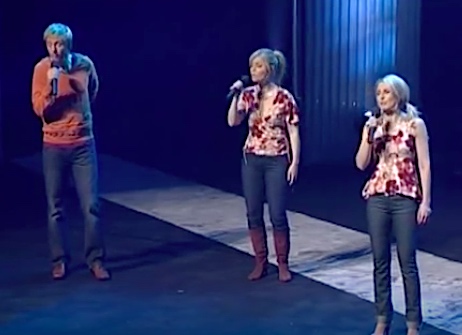
The Swedish psalm Härlig Är Jorden, sung a cappella, is Complete Perfection, Pure Simplicity:

PsalmGlorious is the Earth
Glorious is the Earth, glorious is God’s heaven,
Beautiful is the pilgrimage of souls
Through the fair kingdoms of the Earth
We go to paradise with song

 Ages come, ages go
Generation follows generation
Never is the sound from Heaven silenced
Of the soul’s glad pilgrim-song

 The angels sang it first for shepherds of the land
Beautifully it rang out from soul to soul
People, rejoice, the Saviour has come
The Lord bids peace upon the Earth

BTW, notwithstanding the critiques of Alan Lomax’s ambitious Cantometrics project, this does seem to illustrate one of his notable insights:

that sexually restrictive and highly punitive societies correlated with degree of vocal tension. The tendency to sing together in groups, tonal cohesiveness, and the likelihood of polyphonic singing were all associated with fewer restrictions on women. Multipart singing occurs in societies where the sexes have a complementary relationship.

The Real Group sings the psalm divinely, but it can be just as moving in less polished amateur versions. This is nothing to do with our recent British penchant for Scandi noir. Of course, not being Swedish, I can’t assess what layers of association it may have for various strata of Swedish society today. For me, the Festival of Nine Lessons and Carols from King’s, another likely image of religious purity (and another of those changing traditions à la Hobsbawm), is highly conflicted—Dudley Moore expressed this well, if not entirely reverently. I doubt if all young Russian liberals are so entranced by Orthodox liturgy as I was on Mount Athos.

So as with Bach, there is no “correct” way to experience a piece like this: it will vary by class, time, region, and so on.

While we’re relishing the singing of The Real Group, I can never resist a bit of Bill Evans—led by Margareta Bengtson:

Click here for another brilliant song from the Real Group.

In memory of Natasha

Natasha 2

This week is the fourth anniversary of the loss of my friend Natasha at the age of 34—younger than Mozart, and just less than two years after Amy Winehouse’s death.

Unable to do anything at all for months after, I thought I’d better not cancel my planned stay with Li Manshan in September, and indeed he and the other Daoists were understanding, easing me back to life. The Li family had themselves suffered a family tragedy at just the same time. The funeral rituals they perform are always moving, but now, as the sounds of shengguan blending with the vocal liturgy soared above the kowtowing kin, I felt their grief more personally.

Natasha left barely a trace on the world apart from her wonderful kids. I dearly want to write a book on her, but since I now find I know nothing about her, this tribute will have to suffice.

Natasha smile

“Troubled genius” doesn’t do Natasha justice. She deeply touched all who met her; irresistible, she could be impossible. She was the incarnation of Elena Ferrante’s Lila.

Her wild and prodigious early life was spent in Ternopil in west Ukraine. She made her home in London aged 18. Painter and composer, with her icons and Tarot, electronica, Bach, and Arvo Pärt, earth mother and sophisticated cook, femme fatale with her look of heroin chic, chunky jewelry and slinky outfits, finally holding down a mundane job for the sake of surviving as a single mum after teaching and playing in a rock band, childlike and severe, intoxicating and intoxicated, insatiable and hallucinatory, her thirst for knowledge reflected in her multi-coloured notebooks full of sketches and musings, she was on another planet. Hearing TurangalîlaragaMozart, or Naturträne through her ears, deep in her soul, was overwhelmingly intense.

Natasha painting

Natasha’s paintings were both radiant and disturbed—her later works were yet darker. Klimt and Schiele would have lapped her up (and she them). It wasn’t easy for her inhabiting a world of Parajanov:

We were supposed to be going to Mahler 5 at the Proms when she had her first heart attack. This is a perfect version of her song, with Magdalena Kožená and Claudio Abbado:


Thriving on impermanence, that I get. But Natasha, you have to keep living…

More Messiaen

Yay! Messiaen was BBC Radio 3’s Composer of the week!

http://www.bbc.co.uk/programmes/p058n84d

With its biographical vignettes, the series is always a good way to explore pieces that may have escaped us. I tend to immerse myself in the works for orchestra, piano, and organ, but how wonderful is his vocal writing—like Harawi, Cinq rechants, or indeed the ravishing Poèmes pour Mi (a fine complement to Berlioz’s Nuits d’été and Ravel’s Shéhérazade). Good to hear Messiaen’s last work too, Concert à quatre.

His Catholic faith was, um, catholic—he made a natural mentor for the budding world music movement. Apart from his beloved birdsong, both his music and teaching were permeated with genres like raga, gamelan, and gagaku. If only I could have introduced him to the Li family Daoist band in Paris!

Notre Dame

For yet more Messiaen, see here.

Ritual, food, and chastisement

Having just naively queried the choices of heritage pundits,  I am further reminded of my 2011 visit to Mount Athos by the difficulty of savouring one’s meal in a fado club while concentration is justly demanded on the saudade of the singing.

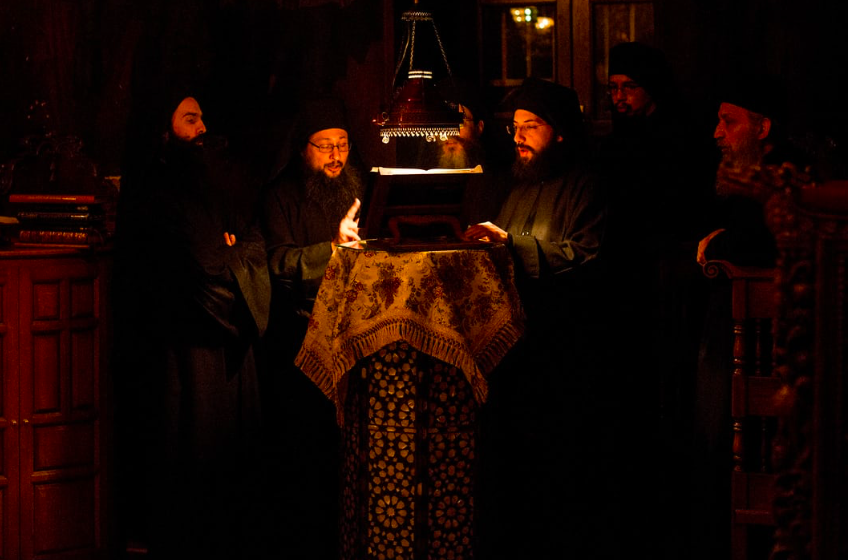
Attending matins—lasting several hours—in a monastery high above the sea is magical. We make our way to the chapel in darkness, finding the doorway by a tiny glint of candlelight in the inner sanctum beyond. Thuribles fragrant, icons glowing, elusive shadows of black-robed bearded monks flitting past. I find a place in a high narrow wooden stall, ornately designed to deny comfort.

To cite Leo Kanaris’ fine crime thriller Blood and Gold (pp.188–92):

It was all stage-managed for maximum effect: the light of truth scattering the night of ignorance, the Holy Fathers hovering in the shadows, their faces reflecting the candle’s rays, while Christ gazed down from the heavens. Beyond the walls of the church lay the world, unseen, unknown, an immense and incomprehensible universe.

As we stand/lean/doze in our stalls, the incense, lugubrious chanting and deep singing are intoxicating. After an eon the first shafts of sunlight begin to illuminate the scene, the mosaics on the dome beginning to shine down on us.

Athos ritual

Kanaris goes on:

Another candle was lit on the far side of the church and a second monk added his voice. The effect was dramatic. Suddenly there was a dialogue. The two melodies alternated, joined, drew apart, curled around each other like the tendrils of a vine (cf. Susan McClary on baroque trio sonatas). George was lulled into a state that resembled hallucination, where one sense entered his mind in the guise of another. Sound became colour. The smoke of incense, burning every day here for centuries, became his own memories. Past and present fused in a molten river of darkness and gilded flames.

For those who have witnessed Chinese temple rituals, attending an Orthodox ceremony will seem rather familiar—even down to the wooden semantron that calls people to prayer. The rhythmic swish of the thuribles may even remind us of the sepaye of the ashiq in Xinjiang. One might also compare scenes from Holy Week in Sardinia in Bernard Lortat-Jacob’s fine film.

* * *

Such a ritual also gives the motley crew of pilgrims a healthy appetite for a friendly reflective chat at the following meal in the trapeza refectory, over what one might expect to be a wealth of succulent local produce. Well, forget it—silence is rigorously imposed among the “diners”, while from a lectern a monk lugubriously intones a passage from the gospels; worse still, the food is both meagre and inexplicably inedible.

Athos trapeza

So the only “blessing” is that one has to wolf it all down in a considerable hurry—not so much Mediterranean “buon appetito” conviviality, delighting in the copious blessings of the earth that our Good Lord has bestowed; more a 1950s’ English embarrassment at this unfortunate necessity that confronts us.

Reminds me of

That was inedible muck. And there wasn’t enough of it.

I’m not knocking Athos. OK, it’s not exactly at the forefront of gender equality, but the rituals, architecture, ancient glowing icons, tranquillity, and stunning scenery all make for an unforgettable experience—and even the meals are indeed a reflection of the world-view that we go there to absorb. Just don’t expect an urbane refined dining experience, that’s all.

A suitable penance for the UNESCO committee that elected “Mediterranean diet” for Intangible Cultural Heritage status might be to consign them to Mount Athos for a few days. That’ll sort ’em out. They will come down from the mountain with a healthy (sic) appetite for a deep-fried Mars bar.

For recent political tensions, click here. See also under Ukraine: liturgy.

Singers of the world?

Occasionally I accidentally view snippets of both The voice and Cardiff young singer of the world. Both feature remarkable singers—within their respective genres and social milieux. My reservations merely concern the blinkered media hype, with all its competitive ethos (for Alexei Sayle and others on contests, see here).* They jump through the hoops, displaying just the right degrees of individuality, gauging the prevailing ethos within their respective social and temporal fanbase. Image is is a major aspect of both events.

Bartok 1907

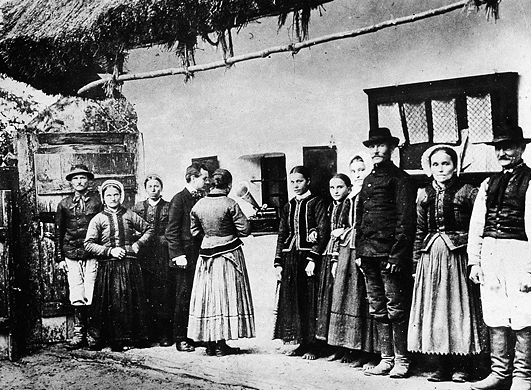
Béla Bartók recording Slovak folk singers, 1907.

And of course neither contest, and neither genre, reflects the diverse riches of “singers of the world”— even for the current scene, let alone earlier histories. For a more rigorous attempt to document the riches of world singing, see here.

It’s not that I really expect Romanian wedding laments, praise singing from Rajasthan, or the songs of Chinese spirit mediums to feature prominently in popular TV viewing (for an intriguing case in Ukraine, click here); but even the impasse between those two contrasting contemporary Western genres is glaring. Neither can be regarded as intrinsically superior. For yet more, see here.

* Another fatuous Bible quote:

The race is not to the swift.

Who’s going to break the news to Usain Bolt?

Three studies of ethnic culture (not)

More perks of orchestral touring: Noh theatre in Japan, 1992,
not long after fieldwork in Shanxi.

Three monographs on ethnic religion and culture that I haven’t yet seen—or even written:

  • On campaigns against popular shamans:

Striking a happy medium.

  • On the stagecraft of Japanese drama (Altogether now):

There’s no business like Noh business.

(For a rather more serious treatment, see here.)

And having added an acronym for British Art Music to the one for Western Art Music, how about the “classical” traditions of the Maghreb?

  • On the well-attested debt of the Western classical tradition (notably British music) to the nuba art music of the Maghreb, with reference to the antiquated sexist ideology perpetuated therein:

WAM, BAM, thankyou MAM.

  • This one has already been done, but in similar vein is my venture into sociology:

From WAGs to witches: the demonisation of celebrity girlfriends.

Just remind me again, what is music?!


Hardly was the ink dry (or whatever we should call it nowadays) on my comment

It’s worth replacing the vague term Western music with Western Art Music (WAM), if that’s what we mean; and observing how European folk traditions are an equally precious part of our heritage. “Music” can be a misleading little word: just as there’s more to music in Shanghai than its opera house—such as amateur silk-and-bamboo clubs or temple fairs in Pudong—so music in Lisbon is more than the Teatro Nacional de São Carlos. Symphony orchestras and erhu solos are but the tiny shiny tip of the iceberg.

than I perused the BBC4 schedule to find:

The Birth of British music
The legacy of Austrian composer Josef Haydn in Britain.

Hmm. Discuss (with the aid of Bruno Nettl; cf. Das Land ohne Musik).

Of course, it’s just an amusing casualty of knocking up a snappy publicity blurb. And to be fair, it’s the third in a series that runs from Purcell and Handel (sic) through Haydn (sic) and Mendelssohn (sic­—well that’s quite a lot of sic). I’m not blaming anyone—making programmes about four WAM composers who lived or spent some time in Britain is cool by me (cf. They come over ‘ere…).

Still, it combines two common misapprehensions—about history and about class. Much as I love Purcell, I’m sure the engaging presenter Charles Hazlewood is perfectly aware that even British ART music (BAM!) goes back a little before that. This isn’t my forte, but never mind Tallis, Byrd, Lawes, and so on (whatever would Francis Baines have said?!)—how about the medieval mystery plays and early manuscripts, or musicking at the time of Boudicca?!

And anyway, if we’re talking about “British music”, there’s that social ellipsis again—how about broadside ballads, singing and fiddling in tavern culture, early wind bands, and so on?

This casual use of language is just as bad as the (still more common) other extreme, which is to date the origins of British music from Lonnie Donegan or Frank Ifield.

I’m sure it’s a great series on those four composers. “British Art Music from the 17th to 19th centuries” doesn’t make quite such a snappy title.

Conversely, here’s another misleading title, this time from the Guardian:

The 20 best music documentaries.

There are some great films in this list (including Amy and, at No.1, In bed with Madonna), but it’ll be disappointing for those expecting to find coverage of WAM, flamenco, musicking in Sardinia or India, and so on. Again, the title The 20 best documentaries on Anglo-American pop doubtless struck them as pedantic.

Just saying, like…

In similar vein, see Old and new musics.

Jottings from Lisbon

Just home from Lisbon, where I screened my film for a select and rather posh CHIME conference. How good to have a few days to enjoy cobbled streets, tiles, and little wood-lined trams—authentically scattered, as everywhere, among decrepit building sites.

Back in the 1990s, annual working holidays in Lisbon (as well as Parma, Ludwigsburg, Amsterdam, Paris, and London—happy days) were a regular gig while we were doing Mozart operas with John Eliot Gardiner.

On the same principle as seeking out flamenco in Seville after the Matthew Passion, it was always good to go in search of fado in Lisbon after our concerts there. Fado can be great, as long as we don’t expect it to be flamenco—this is a bit like relationships altogether (tutti, bemused: “This is a bit like relationships”.)

The old-style fado bars, holes in the wall, have become ever more elusive, long outnumbered by glossy tourist restaurants. As ever, a good sign is the lack of a sign.

fado

Fado singing, 1993. My photo.

We found a good little fado dive this time too, rather by chance. And then on our last night our fine hosts kindly took us to the Boteco da Fa in the Alfama, a classy joint that nonetheless has a great atmosphere—it’s just a little room that can pack in around fifty aficionados. We heard Sandra Correia (for a 2022 feature, click here)

and Augusto Ramos:

The quintessential saudade (“missingness”!), a first cousin of the duende of cante jondo in flamenco (and see several other nice intercultural equivalents under that saudade link), was much in evidence.

Both singers are well-known performers in “concert”, and in a club like this the atmosphere is quite formal (the rather good food can only be a brief diversion between—not even during!—sets), but Augusto also doubles as a waiter there, and they’re pouring their hearts out just a few feet away from you.

Focusing as I was on the intensity of the singing, it took me a while to realise how great the two pluckers were too— Luis Guerreiro, the leading guitarra player, totally at ease, always exploring patterns and harmonies, his riffs even featuring the occasional soupçon of  Django.

pluckers

Brilliant fado pluckers. Photo: Xiao Mei.

Being in Lisbon, we were able to express our appreciation with warm applause—I read that

According to tradition, to applaud fado in Lisbon you clap your hands, while in Coimbra one coughs as if clearing one’s throat.

Could Coimbra have been a British colony?!

Our group from the conference included the brilliant Xiao Mei and two young Chinese conservatoire performers. I relish this recent rapport, this new sense of equality. Xiao Mei, most enlightened among Chinese musicologists, is always in fieldwork mode, lapping it all up, as were the younger musos, recording on their posh smartphones and chatting in breaks with the musos. A wonderful evening— Chinese Twitter will be abuzz with it, and that’s just so inspiring…

fado group

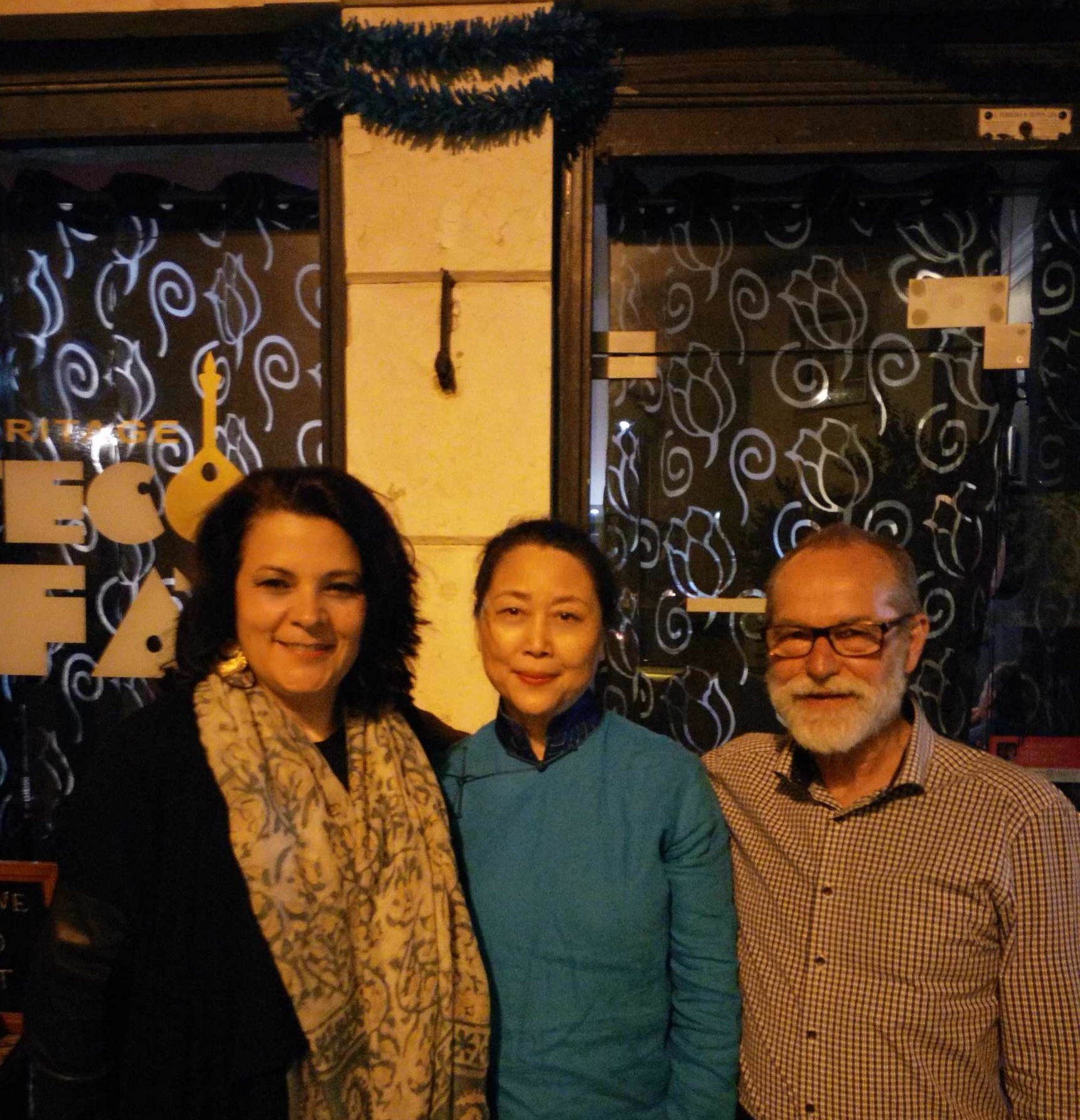
Sandra Correia, Xiao Mei, and Enio Souza, dynamic conference organizer.

In a small way, all this reminds us all why it’s worth replacing the vague term Western music with Western Art Music, if that’s what we mean; and observing how European folk traditions are an equally precious part of our heritage. “Music” can be such a misleading little word: just as there’s more to music in Shanghai than its opera house—such as amateur silk-and-bamboo clubs or temple fairs in Pudong—so music in Lisbon is more than the Teatro Nacional de São Carlos. Symphony orchestras and erhu solos are but the tiny shiny tip of the iceberg (cf. here, and my post on folk musicking in Italy).

Nor would any visit to Lisbon be complete without a serious overdose of nata:

nata

Whereas the English custard pie is only good for slapstick. Typical

* * *

Meanwhile at our conference on Chinese music, it’s always good to hear Xiao Mei introducing her work on spirit mediums and trance, with her amazing videos of rituals among the ethnic minorities within the PRC.

Since the conference was held at the Centro Científico e Cultural de Macau, the music of Macau was one theme. With typical impertinence I suggested that studies of music-making in Macau might be inspired by Ruth Finnegan’s seminal book The hidden musicians, exploring all the diverse kinds of musical activity in Milton Keynes, whose population is less than half of that of the Chinese metropolis. Macau’s cultural life outside official institutions remains to be explored—for instance, no-one has yet made the connection with the household and temple Daoists there. [1]

* * *

Back in May 1993, Lisbon was among several wonderful venues for our series of performances of Le nozze di Figaro:

That’s a live concert recording at the Queen Elizabeth Hall after we returned to London. Soon after that I returned to Hebei for my second visit to Gaoluo and further survey of village ritual associations.

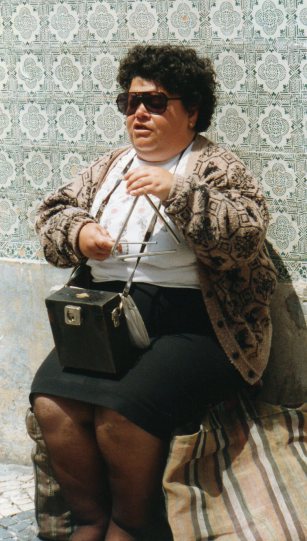
On a free day between Figaro shows, I visited the resort of Cascais, a pleasant excursion just west along the coast. On the street I came across a blind busker called Rosa, then 36, from Almada just across the river. She accompanied her songs on the triangle, occasionally checking the lyrics in Braille.

Cascais singer

Rosa, 1993. My photo.

I assumed she was just another blind beggar who never comes much to anyone’s attention, unless you count me. So imagine my surprise, today, when none other than Xiao Mei saw my photo and told me that Rosa (now “Dona Rosa“, with a backing band) had come to give concerts in China! And sure enough, she’s now become a star on the world music circuit, having been “discovered” (not by me—I kept her to myself) but since 1999 and more widely since 2004.

How was I to know?! Can I indeed claim to have discovered her, like Yang Yinliu discovered Abing?! Hardly, since I’ve sat on the fruits of my casual fieldwork for 24 years. I am reminded of the occasional blind bard from Shaanbei who materialises, bemused, on glossy Chinese TV extravaganzas.

Here’s one of several YouTube clips of Dona Rosa:

As usual, the exigencies of the world music big band distract from the atmosphere of her solo singing. Try this instead—from a concert at New Year 2008 in the Concertgebouw, no less:

Still, from a BTL comment by fjcnunes I also learn:

It’s sad and lamentable that this great lady is still begging on the street of Rua Augusta, Lisbon. This was the case in June 2014, when I saw her there and took a picture with her. In her words, she gets paid “next to nothing” to play in Portugal and is forced to play on the streets to make a living. Probably the promoters and organizers get the lion’s share of the revenues from her concerts. I wonder if the same would have been allowed to happen to Cesária Évora? If you happen to travel to Lisbon, Portugal, please pass by Rua Augusta and purchase one of her CDs, directly from her. At least you’ll know where the money’s going.

* * *

Anyway, that chance find in Cascais was typical of the kind of superficial yet rewarding little jaunts one can fit in as a touring muso—like flamenco in Seville, dance houses in Budapest, tralallero choirs in Genova, and so on.

The Alentejo region is famed for its folk choral singing. I haven’t caught it live yet, but it’s evidently a rich tradition.

In Cascais I also enjoyed the parade for voluntary fireman’s day.

firemen

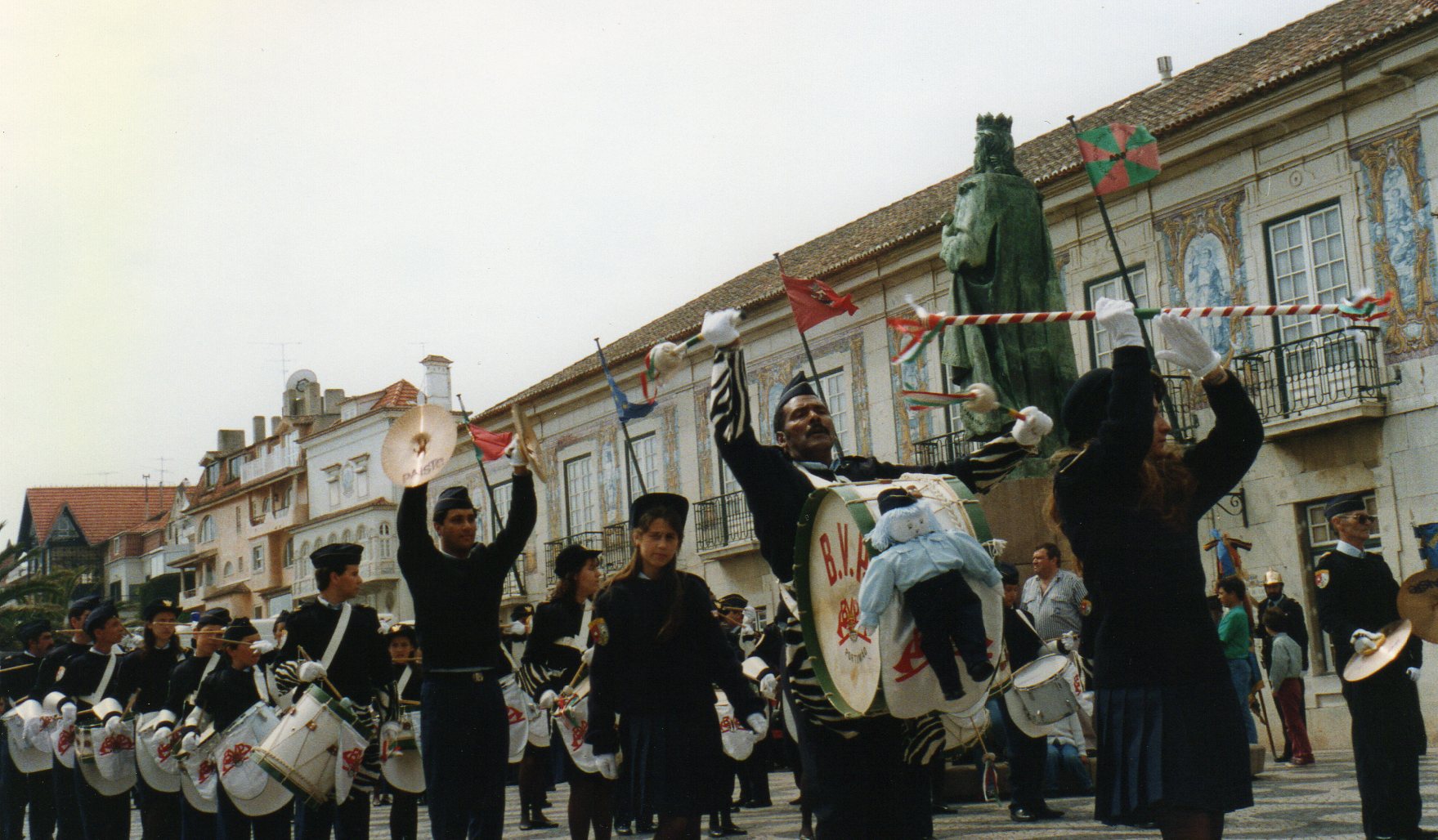
Parade for voluntary fireman’s day, May 1993. My photo.

All this belongs to my recurring theme of delighting in all manifestations of the Terpsichorean muse. In the present climate, we must relish our cultural diversity all the more. And yes, that does include Mexican migrants and Syrian refugees. All those Brits who find themselves (not) with an extra 350 million squid a year to spend might lavish a bit of it on educating themselves about the traditions of their newly-alien neighbours.

For sequels on Lisbon, click here and here. Note also Portugal: folk traditions.

[1] See e.g. http://www.macaotaoist.org/澳門道教科儀音樂/http://www.baike.com/wiki/澳门道教科仪音乐,
http://www.chinataoism.org/showtopic.php?id=1005; for a major community ritual for the 2003 SARS epidemic, see http://www.cciv.cityu.edu.hk/macau/3/2.php.

Indian and world fiddles

*See also Ways of playing the violin*

The other day, just before my alarming rendition of Bach on the erhu, I went to an enthralling concert of Carnatic violin by the sisters M. Lalitha and M. Nandini at the Bhavan Centre in West London, a lively centre for the Indian community.

How mesmerizing Indian music can be, unfolding naturally with grace and fluency! Learning such oral traditions is aided by memorizing sargam solfeggio. Tuning the strings in open fifths (like G–D–g–d, often used in world fiddle styles— actually, here they commonly have five strings) lends the violin a wonderful sonority (cf. Keef’s excited epiphany).

The ideal in many cultures is for instruments of all kinds to imitate the voice—I love the way Wu Mei decorates the vocal liturgy of the Li band on the guanzi oboe, for instance. It was by chance that I ended up playing the violin in WAM, but we can all appreciate the link between the voice and bowed lutes (or should I say friction chordophones? No you bloody shouldn’tThe Plain People of Ireland) by extending our interests to other world genres. OK, for us WAM fiddlers embarking on Mahler 5 there may be no clear benefits to this, but why don’t we all learn the rudiments of Indian style and technique too? However rigorous a training in rag may be, it can’t be as arid and painful as ploughing through sodding Ševčík studies—it’s amazing we didn’t all give up.

The Bhavan audience was sadly thin on the ground, but it’s the magic of the rapport that counts. It reminds me of a Mozart Requiem tour of Italy with John Eliot Gardiner in the 1990s. For some reason we ended up doing a gig at a dingy cinema in the sleepy town of Terni on a Sunday afternoon, performing for a tiny audience that barely outnumbered the massed orchestral and choral forces. Nonetheless, with stellar singers like Barbara Bonney and Anne Sofie von Otter, it was one of our most moving performances.

At the risk of sounding like Away from it all (“the one thing that Venice truly lacks is leprechauns“), here’s a random but inspiring sample of some further riches of world fiddling—needless to say, it’s all about technique at the service of the music, which in turn stems from its social use…

Still with the exquisite gamak styles of India, here’s a Hindustani female dynasty (cf. Rāg Malkauns):

And then there’s the wonderful sarangi—click here, here, and here for the remarkable work of Nicolas Magriel.

I outline some of the diverse bowed lutes of China here; the erhu is the least traditional of them, but you must hear this astounding playing. See also here. For the distinctive Korean haegeum, click here.

Irish fiddling can be irresistible (for more from Liz Carroll, listen to Dear Old Erin’s Isle here):

Some unaccompanied Bach (on violin instead of cello, for a change):

And Transylvanian bands (see mainly here):

Poland has some fine fiddle traditions too—here’s Stanisław Klejnas, from a village near Łódź:

From Iran, here’s Mohammad Reza Lotfi on kamancheh:

Kamancha playing from Azerbaijan is amazing too. I used to have a clip here of an Azeri party—complete with mobile phones, naff yet tasteful accompaniment, and no fancy fakelore costumes. But it’s disappeared, so we’ll have to settle for a reified official concert version:

And here’s a stellar gathering of players, all with their own distinctive styles (with thanks to Jeffrey Werbock, himself a fine exponent of Azeri music):

Note also the lyra of Crete and the Pontic Greeks. And here’s a taksim on violin by Salih Baysal (1973):

For more violin taksim, click here. See also New sounds of Anatolia.

For the Uyghurs of Xinjiang, besides the ghijak, the soul of the muqam is the plangent long-necked satar (featured in a wonderful muqaddime prelude here), but they use “our” violin just as expressively too, as on this recording of Raq muqam—from a cassette by the renowned singer Abliz Shakir in the early 1990s:

Some of these genres are explored in the fine projects Growing into music and The music of Central Asia.

That’s just a start. I leave jazz fiddling to another post… For yet more, see fiddles tag in the sidebar, introduced here. For more concerts at the Bhavan, click here and here.

Corpsing: Inuit culture and Haydn

A much-discussed piece of “salvage ethnography” is the film Nanook of the North (Robert J. Flaherty, 1922):

For his 1926 film Moana, see here.

More recent is a highly praised film from Zacharias Kunuk, Atanarjuat: the fast runner (2001)—click here for a trailer. It enacts an ancient legend while lavishing great anthropological care in evoking early Inuit culture.

But Nanook of the North is to some extent a fictional creation too, blurring the lines between documentary and drama. It is an early case-study in a substantial discourse in the ethics of visual anthropology that leads on to Jean Rouch, representations of the Yanomami, and so on.

As to vocal styles, in katajjaq throat-singing (e.g. Voices of the World, CD 1 §12), the duet is considered to come to an end when one of the singers laughs, loses her breath, or breaks concentration (LOL).

Hard to imagine a performance of such charm at certain other recent swearing-in ceremonies…

Now I’d like to seek ethnographies of changing life in Inuit communities since the time of Nanook (preferably not containing the words “traditional way of life” or “vanishing culture”—“but that’s not important right now“). This is a lively topic in ethnomusicology—there are many studies to add to my reading list, such as Maija M. Lutz, The effects of acculturation on Eskimo music of Cumberland peninsula (1978), Beverley Cavanagh, Music of the Netsilik Eskimo: a study of stability and change (1982), and studies of throat singing by Nicole Beaudry and others—as an introduction to the detailed work of Beaudry, note her thoughtful reflections in Shadows in the field. See also First Nations: trauma and soundscape.

Here’s a trailer for the short film Throat song (2013), in which a young Inuk woman, lost in a community that has been tragically separated from its past, begins to connect with other victims of violence in her community, and seeks to reclaim her voice:

Throat singing also inspires a lively experimental scene, with singers such as Tanya Tagaq.

* * *

Corpsing is one of the pleasures of musical life in WAM too—we’ve all done gigs like that. I can’t suggest here the numerous ways in which fiddle players try to corpse their desk partners by a tiny little gesture of resignation at the repeat of a minuet, or a fake sforzando attack on a pianissimo entry.

Generally “the show must go on”, but once, the Allegri string quartet were performing the intimate, intense slow movement of a Haydn quartet when the viola player let out an extended and voluble fart.* The leader giggled sotto voce, and as the mirth spread (even to the miscreant, who’s generally the first to keep a straight bat) all four of them were soon so helpless with laughter that they just couldn’t keep going, and had to leave the stage to compose themselves.

To be sure, this is at a certain remove from Inuit culture. In the latter, as if you haven’t worked this out already, corpsing is intrinsic to the performance event; in WAM, it’s an illicit part of the muso’s “deviant behaviour“. For corpsing in the crucifixion scene of the Matthew Passion, click here; and for the suave Charlotte Green on BBC radio, here.


* I’m reminded of the old Punch cartoon:

Host (to guest who has just perpetrated an embarrassing histrionic effect) “Gad sir, you’ve farted in front of my wife”.

Guest, with air of studied nonchalance, “Oh, I’m most frightfully sorry, I didn’t realise it was her turn.”

Ashiq: the last troubadour

*Distressing update*

After all these years when the common response to a comment on the Uyghurs of Xinjiang was “The WHAT of WHAT?”, their new-found global fame is yet more unfortunate. It’s hard to believe now that the screening of this film, less than two years ago, came at a time when the Uyghurs were little known, when films like this could still be made about groups that were still active, and still seemed relevant; when dedicated Uyghur scholars and performers still had room to maintain their culture. Following their pervasive silencing since then, among a host of fine articles on the appalling current situation in Xinjiang, see here, and here, including Rachel Harris’s comments on the disappearance of Sanubar Tursun. Among many articles on the distinguished ethnographer and film-maker Rahilä Dawut, another victim of the purge, is this. Click here for remarkable videos of Sufi Naqshbandi ritual among the Uyghurs. For more, see my roundup of posts on Uyghur culture.

I’ve left the review below as I first wrote it.

* * *

In my little list of ethnographic films, I mentioned Liu Xiangchen 刘湘晨, an outstanding film-maker based in Urumqi in Xinjiang. On Monday at SOAS, as part of a conference on Islamic soundscapes in China (itself part of an excellent project[1] he attended a screening of his Ashiq: the last troubadour (2010, 122 mins), one of several films by him on various ethnic groups in Xinjiang.

Filmed mainly between 2003 and 2007, Liu’s four-hour version of Ashiq was shown last year at the splendid Shanghai Centre for Ritual Music, with a detailed discussion (which, ominously, has since disappeared from the web).

Here’s an 8-minute trailer:

and the 2-hour version, with Chinese subtitles:

The “exotic” ethnic minorities are always a more popular research topic than the somewhat mundane Han Chinese; I would say, only I’d sound like the UKIPs, that the Han Chinese have become a minority in their own country—which would be just as absurd, given that, in the face of vast Han Chinese immigration to Xinjiang, it is precisely the Uyghurs who feel threatened. But I envy scholars of the minorities the stunning scenery, and the costumes—and if they no longer wear them, they’re used to being asked to put them on for the cameras.

I’m now a little confused about what ashiq actually means among the Uyghurs. Simply stated, they are Sufi mendicants who congregate at the shrines of Islamic saints. From the YouTube blurb:

Some ashiq are ironworkers, others are beggars, merchants, grave diggers, barbers, woman ashiq, Sheikh (the Islamic clergy) and so on.

As Rachel Harris notes, [2] the term may be a rather modern usage for people once more commonly known as dervishes or qalandar. It’s taxonomy again.

Liu described them as marginalised, a minority themselves, but it looks like a substantial phenomenon. And marginalisation is their very raison d’être: they thrive on flouting social norms (cf. Merriam). The subtitle “the last troubadour” seems unsuitable, not only since the use of a (largely secular) term like troubadour is hardly useful, but because the film doesn’t seem to show that they are dying out. Maybe they are, but it repeats a mantra chanted by anthropologists since early times, claiming to have discovered a pristine tradition that is endangered, rather than noting constant change.

For an outsider, the film, like that of De Martino in south Italy, may also shock. For the total novice, it will just amaze: didn’t the CCP destroy religion over sixty years ago—all the more in Xinjiang or Tibet? At least it shows what a huge task the CCP faces. Are we to celebrate the slow spread of state education and modernization?

The nomination of the ashiq for Intangible Cultural Heritage status is captioned early in the film without comment, though (like that of the Uyghur meshrep) [3] it will seem so very incongruous; perhaps it serves as a kind of amulet to protect the film from official criticism. As with the Han Chinese, a majority of genres selected for the ICH are grounded in ritual, impossible to reconcile with the state’s goals without destroying them—which may indeed be the idea. It is the duty of the ethnographer to reflect such micro-societies faithfully, like any other. It goes without saying that it is no use to regard them purely as “musical cultures” detached from their social roots.

The conceit of academic objectivity may make ethnographers seem to refrain from either celebration or criticism, yet at the same time (to return to De Martino), some may be shocked, pondering the link between religion and poverty—an obstacle to those social changes that can genuinely improve people’s lives, health, life-expectancy, and so on?

I gave an instance for the Han Chinese in my Shaanbei book (p.86):

Back in the county-town, returning to our hostel one evening, we switch on the TV to find a documentary about coal-mining accidents, which are reported nightly. There are some rather fine investigative programmes on TV these days, and one main theme of this one is how the response of the village Communist Party leadership, rather than considering improving safety measures, has been to give funds to construct a new village temple in the hope of divine protection. OK, in this case the programme happens to fit into an agenda of rationalism against superstition, a view we sometimes feel inclined to challenge, but tonight I can only go along with the presenter’s lament.

One doesn’t have to be a Maoist apparatchik to worry about this. Observers will draw their own conclusions.

Returning to the Uyghurs, the gender issue is sobering too. There’s one fine scene of a group of female ashiq, but as Rachel Harris (whose latest book revolves around women’s religious groups) pointed out at the screening, only a female film-maker could get proper access to such groups—like Rahilä Dawut (on whom see here).

The film suggests so many complex issues. It gives full coverage to songs, and texts, not just sonic icing on the cake. The ashiq aren’t big on cake, but some weed helps them commune.

Their basic accompaniment is the sapaye, paired sticks pierced with metal rings, played in a kind of stylized self-flagellation, notable in various degrees in both Islamic and Han Chinese ritual cultures (for one gory instance from Fujian, see Ken Dean’s film Bored in heaven).

The tear-stained faces of the ashiq as they sing may remind us that the expression of suffering is a quasi-universal feature of music-making. But it’s always culturally mediated, with differing implications; Rachel Harris again explores the significance of “performative tears” both for Uyghur and other cultures (for the Bach Passions, see here).

The sudden, startling, introduction of scenes from the bustling modern capital of Urumqi is effective. I didn’t pick up hints to change in the rural scene, which must be constantly occurring too, so the film may seem merely to suggest a contrast between (“backward”?) rural traditions and harsh urban commodification. But the structure works well, right down to the final scenes with a birth and a death, the latter in an extraordinary landscape.

I pen these thoughts as a mere outsider. Talking of which, one also wonders how all this relates to the old rejection of ethnographic outsiders, summarised by Nettl as “You will never understand our music”. But here, as with the late great Zhou Ji 周吉 (1943–2008), one of the consultants on the film, Uyghurs seem to have few reservations about certain Han Chinese (or Westerners, indeed) documenting their lives—as long as they are clearly in sympathy and willing to engage fully. Liu Xiangchen, though not himself Uyghur, was also advised by Dilmurat Omar of the Institute of Ethnology and Sociology at Xinjiang Normal University.


[1] I am grateful to Rachel Harris, estimable authority on Uyghur culture and music, for pointing me towards several sources. As usual, it goes without saying that I am entirely responsible for my interpretations here.
[2] “Theory and practice in contemporary Central Asian maqām traditions” (forthcoming).
[3] Note this important report. See also under Soundscapes of Uyghur Islam.

Rag Kafi Zila

*For a roundup of posts on raga, with a general introduction, click here!*

kafi

Kafi, ragamala:
“Holding a delightful rasna-flower and wearing a garland of flowers,
she is a beautiful lady who enjoys the fanning. She has a celestial voice.
Such is Kafi ragini, who enters fully into the exploits of a hero.”

From the late 60s, at a time when it was hardly possible to be amazed by the riches of Chinese traditional music, I was devoted to Indian music—which then meant mainly the solo “classical” traditions, as it mainly still does in the popular image.

If Heart of Glass reminded me fleetingly, impertinently, of rāg Marwa and Nikhil Banerjee, I still treasure his lyrical rendition of rāg Kafi Zila, which appeared magically on BBC Radio 3 in the early 1970s.

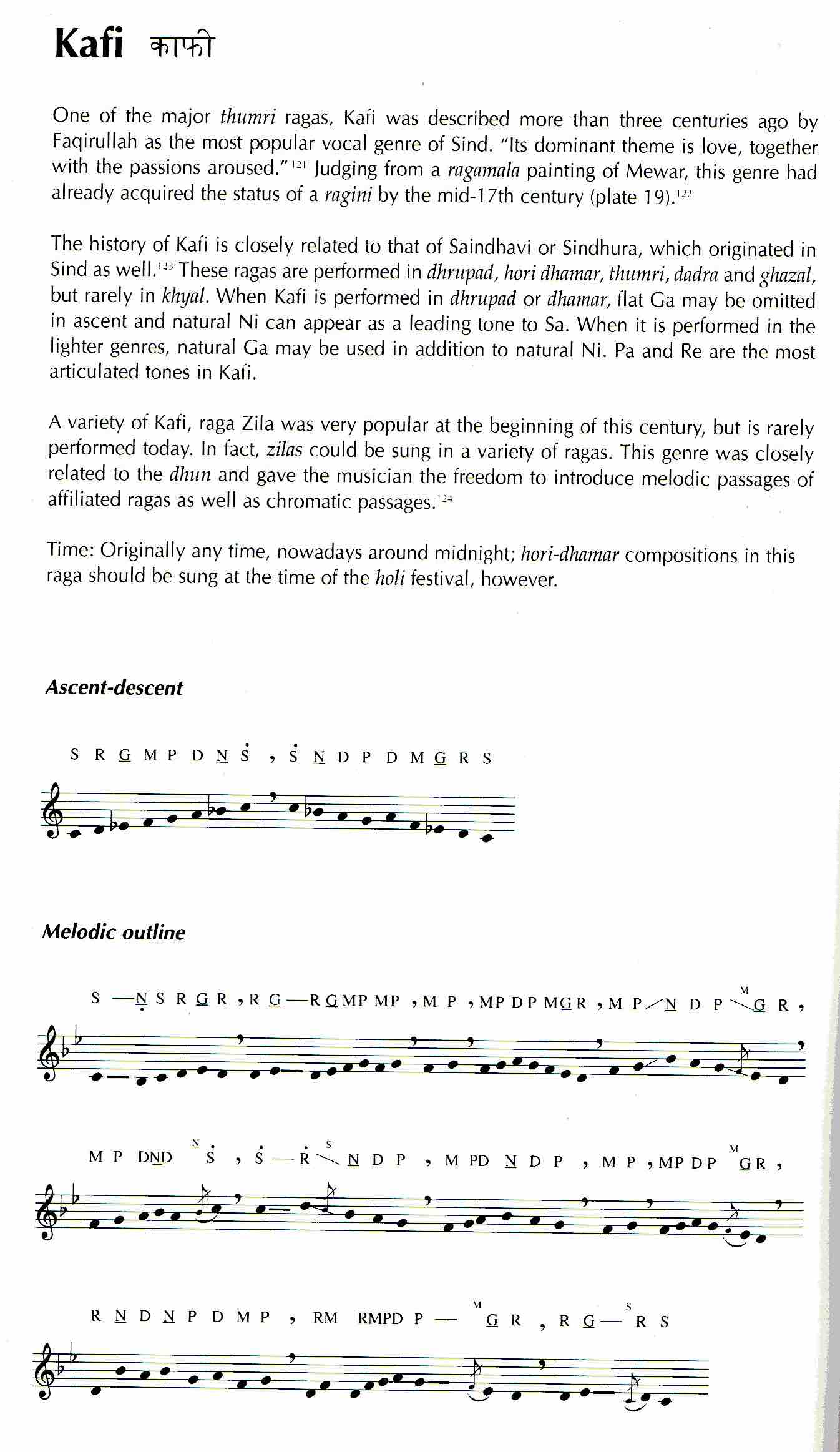
It’s an entrancing raga, for the second quarter of the night. Within its basic minor scale with flat 3rd and 7th, it sometimes features the major 3rd degree. Here’s the introduction to rāg Kafi in The raga guide:

Kafi RG 1

Kafi RG 2

The suave BBC announcer’s introduction (citing Alain Daniélou) remains etched in my heart:

Of shining whiteness,
Kafi, who inspires lust,
tenderly sits on the lap of her playmate in the royal palace.
Fond of parrots,
she is dressed in blue
and decked with jewels.
She is the image of sensuousness.
In the Lotus of my heart
I cherish her,
lovelier than Lakshmi
the goddess of Fortune.

Of course, as with Bach, I’m just reporting my own infatuation, which is merely a product of a particular place, social milieu, and time—far from the responses of indigenous audiences of various types.

Here’s one of several exquisite versions by Nikhil Banerjee, with Anindo Chaterjee on tabla:

And here he explores Mishra Kafi for over an hour:

Click here for a sarod version by Amjad Ali Khan.

Here’s a relatively light, but always entrancing, vocal rendition by the Dagar brothers:

As I observed here, training in Indian sargam solfeggio is a basic grounding in monophonic musics—far from a mere conceptual exercise, it draws us towards the heart of the music.

Heart of glass, and Rag Marwa

Heart of glass is yet another masterpiece from the late 70s—just after Naturträne.

Apart from its spacey vibe, there’s one detail of Debbie Harry’s song that Yer Average fan will experience instinctively, but the tedious analytical bent of the musicologist may home in on: the hallucinatory temporary modulation at the end of the third line (find/blind), fleetingly sketching a major triad on la—all the more ironic for the deflation expressed by the lyric.

That harmonic shift reminds me of rag Marwa, with its implied major scale on Dha/la (A major, one might say) over the Sa–Pa/do–so/C–G drone, the flat re (C♯) clashing with the tonic. Sure, Heart of glass hardly compares with the complexities of the ascending and descending scales of the raga, worked through over a long period, but hey.

Most transcendental are renditions in dhrupad style. Here’s Zia Mohiuddin Dagar on rudra vina, in his last year:

And Rahim Fahimuddin Dagar:

Nikhil Banerjee on sitar:

Here’s a sarangi version from Sultan Khan (compliments to the heading ‘Marwa’-lous!)):

For another rendition on sarangi by Ram Narayan, click here. For Amjad Ali Khan on sarod, see under Raga at the Proms; and for Hariprasad Chaurasia on bansuri, see Raga for winds.

For a roundup of my series on raga, with a general introduction, see here.

The iceberg

For Chinese culture (ritual, music) I always use the image of the iceberg—

to contrast the tiny little chunk that protrudes above the water (the conservatoire concert solos, and so on) with the vast unseen mass of popular culture below the surface—like temple fairs, shawm bands, household Daoists, spirit mediums

Of course it applies widely to world cultures (cf. Italy). Even under the umbrella of WAM, there’s a fluid canon changing over time, with many outer rings; socially too, it’s not just the professional symphony orchestras. And Indian music is far more than sitar solos.

As to Daoism, it’s far more than the Daoist Canon and the White Cloud Temple; and far more than wise southeastern Daoists doing their mystical sublimation in the course of a jiao Offering. And Daoist ritual—over China, north China, Shanxi, north Shanxi, and even in the north-eastern central area of Yanggao county, is far more than the Li band!

Speech therapists too consider “the iceberg of fear“.

Festivals: the official—folk continuum

The upcoming CHIME conference in LA (29 March to 2 April), presided over by the excellent Helen Rees, looks like a fine event, though I can’t make it. The theme this time is festivals.

Gansu miaohui FKTemple procession, Xincheng, south Gansu, June 1997. [1]
Photo: Frank Kouwenhoven. © CHIME, all rights reserved.

Of course, festivals and pilgrimages all over the world are a major theme of ethnography: not just Uyghur meshreps and mazar, and Tibetan monastery festivals, but Indian melas, Sufi festivals, the Mediterranean (Andalucian fiestas, south Italy…), Moroccan ahouach, you name it. Bernard Lortat-Jacob’s 1994 book Musiques en fête is charmant, with wise and vivid words about Morocco, Sardinia, and Romania (¡¿BTW, why do French books put the list of contents at the back?! ¡¿Typical Gallic contrariness?!)

To adopt the metaphor of “the whole dragon” again, there is a long continuum between folk festivals, based on ritual (often calendrical) observances, and secular events for a largely urban audience.

So I too am going to link up diverse themes like temple fairs, ritual, famine, village names, Eurovision, and propaganda. It does make sense, though—trust me, I’m a doctor.

Traditional events in China`
Funeral rituals have been my main topic in China for thirty years, but of course it’s not easy to plan visits much in advance. The calendrical dates of temple fairs (often known as miaohui) may seem easier to anticipate. Again, scholars of religion tend to home in on their specifically religious elements, as in the great jiao Offering—though note Ken Dean’s fine film Bored in heaven. But like funerals they are multivalent, embracing all kinds of activity: ritual, opera, folk-song, pop, commerce, “hosting” and “red-hot sociality” (Chau!)…

Apart from my 2007 and 2009 books, names like Zhao Shiyu, Guo Yuhua, Wang Mingming, Yue Yongyi, Stephan FeuchtwangAdam Chau, and Wu Fan spring to mind. The knack is to detail both sacred and secular aspects of temple fairs.

But the dates of calendrical rituals, like temple fairs, may not be easily vouchsafed to the outsider either. The temple fairs on the Houshan mountains in Yixian county southwest of Beijing, mainly in the 3rd and 7th moons, are much less well known than those of Miaofengshan, but they also draw huge crowds, both local and from further afield.

To work all this out you have to spend time around the villages of Liujing and Matou in the foothills around Houshan, and then observe who goes where when and does what. Although Chinese villagers are a rich source of ritual and musical information (far more than any silent library), they often speak prescriptively rather than descriptively, telling us on what occasions a jiao Offering ritual should be performed, whether or not is has been performed since the 1940s. They don’t necessarily volunteer information on change, preferring (like some officials and scholars) to present their traditions as constant, eternal—even if contexts and repertoires have evidently changed in their lifetime. On our first visit to Liujing we rather assumed that villagers’ descriptions of ritual pilgrimages related to “the past”— but we soon found that they were very much alive.

The Songs-for-winds associations: propaganda and catastrophe
What got me “thinking” (I use the word loosely) about all this was that 1950 visit to Tianjin of the “Songs-for-winds” band from Ziwei village, in what later became Dingxian county.

The Central Conservatoire (as it was then) was then still based at Tianjin, of course. The work of Yang Yinliu and Cao Anhe on the Songs-for-winds may be considered a prelude to that on the more solemn ritual style of the Beijing temples that Yang undertook from 1952, a topic that was to expand vastly after 1986. But the Songs-for-winds groups, more popular than the ritual style that is my main focus, are worth a little detour here.

We should bear in mind that such wind ensembles were quite unfamiliar to southerners like Yang and Cao. Having invited the Ziwei band to the conservatoire, they recorded their repertoire on a Webster wire recorder. The band went back some six generations, and under the leadership of the celebrated Wang Chengkui, they had invited the great wind player Yang Yuanheng  to teach them in the winters of 1945 and 1946. Yang Yuanheng, a former Daoist priest in a little temple in Anping county, was himself appointed professor of guanzi oboe at the conservatoire in 1950. [2] Yang Yuanheng, like the Buddhist monk Haibo, was a major influence on many shengguan ritual associations in the area: we would hear their names from many village associations.

Yang and Cao’s monograph on the Ziwei band, published in 1952,  consists mainly of transcriptions, with little of the social detail that they covered for the Wuxi Daoists or Yang’s 1956 Hunan fieldtrip. Ziwei would go on to supply wind players to many state troupes for decades to come.

Langfang huahui 1991

Secular New Year’s huahui parade, Langfang city, 1991.

Xushui
Adapted from my Folk music of China (p.196):

During the 1958 Great Leap Forward (or Backward, as it’s known), Dingxian and particularly Xushui counties became model counties for the relentless drive to full communization. [3] At the height of the Leap back in August 1958, Chairman Mao visited communes there. In Dasigexiang district just southeast of Xushui county-town, Dasigezhuang village was now renamed the 4th August brigade. Notable for its revolutionary fervour at this time was the “Great Leap Forward Songs-for winds association” of Qianminzhuang brigade in Xushui, which performed for this visit.

The propaganda of the Leap makes a stark contrast with the grim realities of the period, with villages throughout the area suffering from crop failure, famine, and social disruption.

Our visit to Qianminzhuang in 1993 was the only time I’ve ever had a police escort—to take me there for a change, not to drag me away! Predictably, such an effusive welcome for me as a “foreign guest” indicated close supervision and censorship of our fieldwork.

QMZ band 1993

QMZ pose 1993

Striking a pose with the leaders, Qianminzhuang 1993

In 1995 we visited some of the senior musicians independently, with much more useful results.

Xushui’s favoured status did nothing to prevent many starving to death there in 1960—but just near Qianminzhuang, the Gaozhuang ritual association still managed to restart in 1961. Religion revived in China precisely at moments of political crisis such as the famines of 1960 and the Cultural Revolution, albeit with great difficulty. It may provide solace, or a focus for resistance—both against Maoism and later against the insecurities ensuing its demise.

The Gaozhuang ritual association was one of many in Xushui villages that used, and use, the older more solemn shengguan style. Ritual associations throughout the area commonly claim transmission from either Buddhist monks (heshangjing 和尚經) or Daoist priests (laodaojing 老道經)—the Gaozhuang association is Buddhist-transmitted. In another common taxonomy, the association divides into “front altar” (qiantan, the shengguan instrumental ensemble, and “rear altar” (houtan, vocal liturgy).

Despite its revolutionary image, Xushui county has remained a hotbed for religion, notably the cult of the sectarian creator goddess Wusheng laomu. Associations there commonly hang out ritual paintings, like the Ten Kings (Shiwang) or Water and Land (Shuilu) series, and they use “precious scrolls” and other ritual manuals. They too are within the catchment area of Houtu worship—they used to make the pilgrimage to Houshan. Even the revolutionary Qianminzhuang band told us that their former tradition was to recite the scriptures, performing only as a social duty for funerals, not for weddings. And certainly not to accompany mendacious parades to report a bumper harvest…

In 1994 the Gaozhuang association built an Ancestral Hall to Venerable Mother (Laomu citang), occupying about one mu, stylish and grand. It cost around 60,000 kuai to build; the stele lists 132 donors, who gave from 50 up to 3,000 kuai. The altar has Wusheng laomu in the centre, Wangmu niangniang and Songzi niangniang to the right, Cangu niangniang and Houtu niangniang to the left.

Gaozhuang citang

The village Party Secretary told us that sources of support included incense money from the Great Tent Association (Dapeng hui, a common term in the area for a ritual association) and from the temple, and money from fortune-telling and curing illness. He reflected, “A dozen or so women kept on coming to see me about building a temple. I had no choice—the brigade couldn’t refuse, so I gave them a plot of land. Believing in the gods and having a temple is no bad thing, it’s not as if you stop production if you believe in it!”

In all, the flamboyant (and readily secularized) Songs-for-winds style remains a common image of wind bands on the Hebei plain, but since all our fieldwork through the 1990s it is clear that ritual practice, with its more solemn shengguan instrumental style, is both older and more common. It is resilient too. This persistence of tradition, both in religious and musical practice, is all the more striking in such a once-revolutionary county as Xushui.

Mao was impressively modest about his limited success when he admitted to Nixon in 1972:

“I haven’t been able to change [China]—I’ve only been able to change a few places in the vicinity of Peking.”  [4]

But he wasn’t modest enough: in some ways even a county so near Beijing, such a focus of the revolution, has remained resistant to Maoist ideology, predating and outliving it. Still, disruption was severe. For more on Xushui, see here.

Official festivals in the 1950s
Meanwhile, the new government, in its own way, was promoting local culture through the medium of regional folk festivals (diaoyan, huiyan). First, local festivals were held to select representatives for major performances in the regional capitals. Some laicized priests were even assembled to perform as “troupes“, sometimes for the first time in many years—such as Baiyunshan Daoists (1955), Wudangshan Daoists (1956 and 1957), Wutaishan Buddhists (1958). For such performances, inevitably, their shengguan instrumental music was plucked out of its ritual context. I haven’t heard stories as distressing as the fate that befell kobzari blind minstrels in Ukraine when summoned for an official festival in the early 1930s; but folk ritual specialists were still anxious about performing for officials around 1980.

These festivals served partly as auditions for the state song-and-dance troupes then expanding all over China. Daoist and Buddhist ritual specialists had a deserved reputation as outstanding instrumentalists. Many, like our very own Li Qing (my book pp.113–25), were recruited as musicians to state troupes around 1958—and then sent home again as the state apparatus collapsed in 1962.

While such festivals stimulated the collection and documentation of folk music, we must balance this with the ongoing assaults on its traditional context. The background ( beginning from the 1940s) was campaigns against “feudal superstition”, terrifying public executions of sectarians, and the destruction of temple life.

The reform era
Urban festivals featuring rural groups—perhaps related to a conference—make a convenient recourse for busy academics into whose holidays they fit nicely. From the 1980s, the secular arts festivals of the Maoist era were remoulded into more glossy events. In 1990 the Li family Daoists took part in a festival of religious music in Beijing.

By the 21st century the new ideology was confirmed in the regular staged “living fossil” presentations of the Intangible Cultural Heritage. The latter project, with its whole bureaucratic workings, has now become a major research topic on its own, at the expense of studies of the local traditions that it is supposed to assist (my book pp.331–3). Note also the Qujiaying bandwagon.

I tend to steer clear of conferences, but in May 2016, as a pretext for going to hang out yet again with Li Manshan in Shanxi for a couple of weeks, I accepted an invitation to take part in a conference celebrating the 80th birthday of my esteemed teacher Yuan Jingfang in Beijing (for the resulting volume, see here).

It was a déjà-vu experience. Apart from a sequence of eulogies, the event also featured staged performances from three representatives of Yuan Jingfang’s long-term research areas: the Hanzhuang ritual association from Xiongxian in Hebei (near Xushui), the Zhihua temple group, and a ritual band from near Xi’an.

Hanzhuang 1993

Filming the Hanzhuang association in their ritual tent, 1993 (photo: Xue Yibing). Rear centre: two frames of ten-gong yunluo.

It made me feel my age, reminding me of all our visits to these very groups between 1986 and 2001. Taking time out of the conference to chat with the Hanzhuang group outside by the lake, we recalled their kindly association leader Xie Yongxiang 解永祥, father of the present leader, and another of those wise sheng masters. We had learned a lot from him in 1993 and 1995.

Xie Yongxiang 1995

Xie Yongxiang, 1995

But returning to the conference—the object of admiration, inevitably, was their “music”, detached from its enduring social context. I already missed hanging out with Li Manshan in the scripture hall.

All the glossy stage presentation has many Western parallels—flamenco on the Terry Wogan show, WOMAD, Songlines, prizes, urbane discourse explaining its “cultural value” to outsiders… The fancy costumes and dry ice of many Chinese events are reminiscent of Eurovision; they may seem like a Disneyland version of the Chinese heritage.

That photo comes from a recent ICH “performance” of the Baiyunshan Daoists, no less.

Now, I adore opportunities to present the Li family Daoist band on the concert platform (see e.g. this post and a whole related series of vignettes from May 2017), but while it is of course a compromise, we take care not to tart them up—we can hardly do otherwise, so solemn is their demeanour. The ambience and acoustic of churches makes a fine setting,  the Daoists’ sheng mouth-organs filling the Peterskirche in Heidelberg on our 2013 tour (cf. Buildings and music):

Hberg 2012

The Li family Daoist band in concert, Heidelberg April 2013.

Still, their regular “rice-bowl”—day in, day out—is always performing funerals for their local, not global, clientele.

What is dodgy is when people begin mistaking the staged events for the Real Thing, or some kind of ideal. Urbanites may do so, but villagers know better. Of course those staged events are themselves a legitimate, and popular, object of scholarly analysis. But I worry that it creates a fait accompli, like the way that in old-school WAM musicology the Great Composers were the main story (as deconstructed by McClary, Small, Nettl)—“this is what we find, so it must reflect the real picture, and so this is the object of study”. As always, “modern” secular performance doesn’t replace traditional activity: they co-exist.

The CHIME conference in LA will doubtless turn up many instances of what I’m struggling not to call “contested negotiation”. Anyway, staged events can give us a lead, rather like using the photos in the Anthology, otherwise flawed, to draw us towards folk activity.

For thoughts on the theme of the 2021 CHIME conference, see here.


[1] For more, see Frank Kouwenhoven, “Love songs and temple festivals in northwest China: musical laughter in the face of adversity”, in Frank Kouwenhoven and James Kippen eds., Music, dance and the art of seduction.
[2] For this whole section, see my Folk music of China, pp.48–52, 195–203; “Chinese ritual music under Mao and Deng”, British Journal of Ethnomusicology 8 (1999): 27–66; “Reading between the lines: reflections on the massive Anthology of folk music of the Chinese peoples”, Ethnomusicology 47.3 (2003): 287–337. See also my In search of the folk Daoists of north China, pp.166–7, 183–4, 188–90.
[3] As correctives to all the Xushui propaganda, see e.g. the brilliant works of Friedman, Pickowicz, and Selden, Chinese village, socialist state and Revolution, resistance, and reform in village China—describing a commune not far from Xushui. Note Chinese village, socialist state, pp.215–20; Dikötter, Mao’s great famine, pp.40, 47–9, 68–70; and estimable analysis online in Chinese, e.g. http://mjlsh.usc.cuhk.edu.hk/book.aspx?cid=6&tid=184&pid=2269. For the model commune of Greater Quanshan in Shanxi, precursor of Dazhai, and temporary “home” to the Li family Daoists, see my Daoist priests of the Li family, pp.122–3, and here, under “Famine in China”.
[4] Also reported by Henry Kissinger in Newsweek, 3rd March 1997, p.31.

Orthodoxy

More from Private passions:

The Serbian/British author Vesna Goldsworthy describes herself as an “orthodox agnostic”—another good entry in the catalogue of religious affiliations.

Wonderful playlist, too. From here it is not too far to Kapka Kassabova’s Border: tales from the edge of Europe on Radio 4’s Book of the week.

After a wealth of gorgeous Slavic music Goldsworthy ends (by contrast) with Purcell’s ineffable When I am laid in earth, with Lorraine Hunt Lieberson. Here’s one of many other fine versions online (old and new):

Taranta, poverty, and orientalism

taranta

Watching the 1959 footage of healing sessions for possessed women in south Italy by Ernesto De Martino and Diego Carpitella, one may feel almost voyeuristic (Part One, and Two).

Below I cite a review by Stephen Bennetts (Weekend Australian, Review section, 28–29 January 2006) of

  • Ernesto De Martino, The land of remorse: a study of Southern Italian tarantism (pdf of original Italian edition here).

First published in 1961, The Land of Remorse is a classic of anthropological detective work. Was this bizarre phenomenon really caused by the bite of the tarantula, or was it instead a mere “superstitious relic”, or a localised form of psychosis prevalent among illiterate Southern Italian peasants? Almost sixty years ago, in 1959, a group of scholars arrived in the small town of Galatina to unravel the riddle. They comprised a historian of religion (De Martino), neuropsychiatrist, toxicologist, psychologist, anthropologist, ethnomusicologist, social worker and photographer.

It soon became clear that the research team was documenting the last vestiges of the cult, which by now had retreated to an isolated pocket of peasant society in Salento, the stiletto heel of Southern Italy. Tarantism still persisted in its classical form in the music and dance therapy sessions conducted in the home, whilst the partly Christianised form of the cult, amputated of its musical and dance component, continued in the grotesque and histrionic displays at the Chapel of St Paul, as possessed tarantati arrived for the feast day of Saint Paul to ask the saint for healing.

In De Martino’s analysis, the mythology of the taranta and the catharsis of the possession state provide a framework in which personal psychological tensions common throughout Southern Italian peasant society could be publicly dramatised. Private sufferings caused by unhappy love, bereavement, sexual frustration, or subaltern social status were transfigured into annually recurring possession states which were culturally determined, rather than being the result of a real spider bite. The ritualised healing through dance and music provided victims with psychological closure and reintegration back into the community, at least until the summer of the following year.

[According to one Salentine authority, the last episode of tarantism involving actual possession took place in 1993, but the last living practitioner died in 2000. Yet “tarantism” has recently taken on another curious form. The current Southern Italian folk revival and associated pizzica dance craze incorporate a grab bag of different impulses: re-emergent Southern regionalism, the reevaluation of a peasant past which is now distant enough for young Southern Italians to romanticise rather than feel ashamed of, and a rejection by the Italian anti-globalisation movement of the television-fixated “cultural homogenization” of Berlusconian Italy. De Martino’s book has now achieved cult status beyond the academy; go to many folk concerts in Southern Italy today and you will find it on sale alongside tambourines, castanets and other accoutrements of the recently exhumed Southern Italian past. In a process which has been aptly described as “proletarian exoticisation”, De Martino’s plain female peasant tarantate have given way in contemporary reworkings of the theme to video clips featuring dissociated but picturesque young beauties writhing to the latest tarantella folk hit. Within the current Salentine folk revival, De Martino functions as a kind of symbolic fetish, validating an isolated area of Southern Italy which almost nobody had heard of until the “rediscovery” of tarantism and tarantella ten years ago suddenly put Salento on the map.]

Along with more detached ethnographic observations, one easily discerns severe social problems here—not least poverty, and not just the role of the church. Urban Chinese observing rural Chinese ritual may be beset by similar, prescriptive, responses—which will be secondary for foreign fieldworkers, more entranced by the persistence, perhaps exoticism, of religious practice there. That’s partly why study of the practices of “primitive” ethnic minorities are so fashionable.

De Martino’s work, though focused on religion, makes a successor to Carlo Levi’s 1945 book Christ stopped at Eboli, and even James Agee’s 1941 Let us now praise famous men, with the photos by Walker Evans. Accounts like these are a world away from the idealizing of peasant communities often implied in Chinese cultural studies. But both types have their own agendas. Meanwhile, brave Chinese journalists have blazed a trail, with village surveys like those for Anhui, and a substantial body of work on the famines around 1960.

We may contrast the anthropology/ethnography of religion with pious insiders’ views of religion. Of course a participant or “believer’s” own account will be important material. But if in the description the ethnographer promotes her own “belief”, that is dangerous: more like propaganda. Empathy is to be desired, evangelism to be avoided. Good histories of Christianity or Islam are unlikely to come from the standpoint of proponents for such beliefs.

So what is, or should be, the anthropologist’s view on religion? While showing how it works in the society, one doesn’t have to promote it as entirely beneficial there, or to that of other societies. Of course our picture is blurred by the quest for ancient oriental wisdom, which may even follow on from hippy mysticism. It is remarkable how commonly this still plays a role in studies of Daoism.

Some scholars make a case for the superiority of Daoism as a world view, over other religions and other world views. Not only is this not the job of the ethnographer, but it may flaw the whole research enterprise. What we learn from such accounts is what a Western scholar, of a particular upbringing and taste, thinks about Daoism; not what Daoism in society is like.

To repeat, it is different to develop a certain empathy with one’s subjects than to come from a standpoint of evangelical zeal. In the course of an ethnographic relationship one will doubtless begin to explain their mindset, their backstory, and so on. But the study of Daoists is mainly to be done with the same kind of anthropological curiosity that one would bring to the study of any other group, such as Party cadres or sex workers (funny how those two random examples seem to make suitable bedfellows. I didn’t say that).

Participant observation brings many benefits. In the case of religion, to participate fully in the life of Daoists will certainly confer insights—but there is no single type of Daoist, and even participation is only one aspect of the duties of the scholar. One should observe not only how religious activities inspire local patrons, or bring social cohesion, but how people may ignore or oppose them. I’m not even arguing with evangelism, necessarily; just that it blurs proper scholarship.

Study of oriental religion risks exoticizing. Even if the scholar avoids the trap of “Just look at this rare ritual I’ve stumbled across/gained unique access to”, rituals may yet be portrayed as “special”, ancient, mystical, and so on—whether they are or not, and downplaying their routine nature. This kind of social behaviour is normal. The visitor may stumble (once) across something supposedly rare, but more likely it will be repeated again and again—always adapting over time.

Note also this documentary from 1952, with funeral laments from Lucania:

and the 1958 sequel Magia Lucana:

See also Healing with violin in the heel of Italy; for more recent pizzica, click here and here; for Sardinia, here. I’ve also outlined work on folk musicking around Italy. For the festa of the Madonna of Mount Carmel in East Harlem, New York, click here. Cf. Portugal: folk traditions.

More organology

Erqing and WM

Household Daoists Wu Mei and Erqing on guanzi oboes. From my film.

After my little outline of vocal styles, to be further amazed at the infinite creativity of human beings, do check out the Sachs–Hornbostel (or should I say Hornbostel–Sachs?) system of classifying musical instruments.

Also fine, with instructive illustrations, is

  • Geneviève Dournon, “Organology”, in Helen Myers (ed.) Ethnomusicology: an introduction (The new Grove handbooks in music), pp.245–300.

Based on the Dewey system, and constantly subject to fine-tuning, it may seem a tad hardcore, but we’re still allowed to use the common terminology (flutes, drums, and so on)—all this just helps when we need more precise definitions. It may be old hat to ethnomusicologists, who continue to deepen the topic in study groups, but it’s worth adding to the armoury of, um, scholars of ritual… Taxonomy, after all, is among their basic concerns—from zhai (“fasts” or “retreats”) and jiao (“offerings”) to yin mortuary rituals and yang rituals to bless the living (also equivalent to “white” and “red” rituals), and the Li family’s tripartite classification of funerary, earth, and temple scriptures (baijing, tujing, miaojing) (see my Daoist priests of the Li family, p.25).

BTW, the double-reed guanzi, leading instrument in the ensemble accompanying north Chinese ritual, is a descendant of the ancient bili 篳篥, a pre-Tang immigrant from the “Western regions“—though perhaps not France. It is related to the Armenian duduk, which is so much better known (“Innit, though”, nodded The Plain People of Ireland). Sachs-Hornbostel distinguishes cylindrical and conical bores (zzz)—though that is a complex issue, explored by Jeremy Montagu; but it doesn’t seem very instructive about the difference between oboes like the guanzi and duduk (with lipped reed, overblowing at the twelfth) and shawms (with reed enclosed in the mouth, overblowing at the octave), which is so crucial in north China.

For further useless facts about Chinese instruments, see here. And for another candidate for the Sachs–Hornbostel system, here.

Voices of the world

Voix du monde

For those coming to Daoist ritual from a sinological background (as is likely)—and for those who recognize that if we are going to study ritual, that involves performance, which in turn involves sound—here’s a quick crash course. Indeed, it comes in handy for anyone—particularly for those whose concept of music and singing is based on either WAM or pop (see e.g. here and here).

Among all the ethnomusicological surveys of vocal music, the 3-CD set

  • Les voix du monde: une anthologie des expressions vocales
    (CNRS/Musée de l’Homme, 1996),

with its detailed booklet, makes a precious introduction. A wide range of styles of vocal production is covered here:

  • Techniques
    Calls, cries, and clamours
    Voice and breath
    Spoken, declaimed, sung
    Compass and register
    Colours and timbres
    Disguised voices
    Ornamentation
    Voices and musical instruments
    Employ [sic] of harmonics
  • Polyphonies
    Heterophony
    Echoes and overlapping
    Drones and ostinato
    Parallel, oblique or contrary motion
    Chords
    Counterpoint and combined techniques.

Apart from a veritable smorgasbord [sorry, been writing too many blurbs] of amazing audio tracks from all over the world, the booklet contains valuable notes, a glossary, and tables such as “Different forms of polyphony” in graphic form:

Voix Polyphony

Here are the CDs:

For ethnic polyphony in China, see here.

Then all we need is to digest

  • Bell Yung “The nature of Chinese ritual sound“, in Yung, Rawski and Watson eds., Harmony and counterpoint: ritual music in Chinese context, pp.13–31

and we’re all set to enter the fray…

Bach, alap, and driving in Birmingham

WAGZ score

Hesi prelude and opening of Qi Yan Hui suite: score showing melodic outline in gongche solfeggio, West An’gezhuang village, Xiongxian county, Hebei.

It was Yoyo Ma who put me onto playing the Preludes of Bach cello suites as a kind of alap. Actually, that’s how he introduced the Allemande, the second movement of the sixth suite, playing it al fresco as thanks for our group of helpers at the amazing Smithsonian Festival of the Silk Road in 2002, which he was curating.

As I come to adapt the Bach cello suites for violin, I consider how to play the opening two movements of the sixth suite on their own. Should I play the Allemande first, as a kind of alap? Or else take Bach’s opening movement with majesty rather than virtuosity, at an exploratory rather than hectic pace, as a kind of prelude to the alap of the Allemande… Either way can work.

Prelude and Allemande, 6th cello suite, manuscript of Anna Magdalena Bach.

For wise words on, not to say wonderful renditions of, the cello suites, we can turn to Steven Isserlis (click here for the CD set). Here he is playing the fifth suite (the Prelude here unambiguously meditative, like both the later Allemande and Sarabande):

For another Bach Allemande that seems to suit an alap-esque style, see here.

My brilliant friend Paola Zannoni likens the bariolage of the Prelude to the marranzanu Sicilian jew’s harp. The sixth suite, of course [sic—Ed.], was written for a five-string cello, but—in the current spirit of austerity—I make do with four.

While learning Bach (or indeed shengguan ritual melodies), one has to take care not to take a wrong turning. Like driving in Birmingham, if you take a false exit then you can find yourself going round in circles for hours.

Brum

Anyway, free-tempo movements (known as sanban 散板 in educated Chinese) are more commonly associated with solo genres like folk-song and qin—unlikely bedfellows. Apart from alap, one thinks of Middle Eastern taksim (see here, here, and here) and the Uyghur muqaddime (the singing of the latter ideally accompanied by the wonderful satar long-necked bowed lute). In these genres, the term “free-tempo” isn’t precise, since they do indeed have a underlying pulse.

Slow ensemble preludes called pai’r are also an exquisite feature of the lengthy suites of Buddhist and Daoist ritual shengguan ensembles. As with shengguan suites altogether, the pai’r in Hebei (see e.g. here, under West An’gezhuang) are best heard with a small ensemble, like the fantastic group of Gaoqiao village in Bazhou (audio playlist #8, from Plucking the Winds, CD #14—see commentary; this movement actually follows the opening pai’r, but itself opens with its own lengthy sanban prelude), where the heterophony of the four melodic instrument types can be best appreciated.

Such preludes are also a feature of ritual suites around Xi’an. But they are strangely absent from the suites of Daoist ritual repertoires in north Shanxi like those of the Li family—which are otherwise clearly related to the suites of old Beijing, still played in Hebei.

And don’t miss Aretha’s extraordinary alap to Amazing Grace! And the exquisite expositions of dhrupad!!!

The meaninglessness of ritual

Staal

The work of Frits Staal on Indian ritual contains much from which scholars of Daoist ritual (not least I) might benefit, confronting issues that I encounter in working with Li Manshan. Staal’s ideas about orthopraxy seem to go beyond the discussions following those of James Watson for China. There’s a lot more to Staal’s work than that, but this is a start.

In “The meaninglessness of ritual”[1] Staal eschewed “the dewy-eyed romanticism that is pernicious to any serious study of cultures and people.”

A widespread but erroneous assumption about ritual is that it consists in symbolic activities which refer to something else. It is characteristic of a ritual performance, however, that it is self-contained and self-absorbed. The performers are totally immersed in the proper execution of their complex tasks. Isolated in their sacred enclosure, they concentrate on correctness of act, recitation and chant. Their primary concern, if not obsession, is with rules. There are no symbolic meanings going through their minds when they are engaged in performing ritual.
Such absorption, by itself, does not show that ritual cannot have a symbolic meaning. However, also when we ask a brahmin explicitly why the rituals are performed, we never receive an answer which refers to symbolic activity. There are numerous different answers, such as: we do it because our ancestors did it; because we are eligible to do it; because it is good for society; because it is good; because it is our duty; because it is said to lead to immortality; because it leads to immortality. A visitor will furthermore observe that a person who has performed a Vedic ritual acquires social and religious status, which involves other benefits, some of them economic. Beyond such generalities one gets involved in individual case histories. Some boys have never been given much of a choice, and have been taught recitations and rites as a matter of fact; by the time they have mastered these, there is little else they are competent or motivated to do. Others are inspired by a spirit of competition. The majority would not be able to come up with an adequate answer to the question why they engage in ritual. But neither would I, if someone were to ask me why I am writing about it.
[…]
Most questions concerning ritual detail involve numerous complex rules, and no participant could provide an answer or elucidation with which he would himself be satisfied. Outsiders and bystanders may volunteer their ideas about religion and philosophy generally—without reference to any specific question. In most cases such people are Hindus who do not know anything about Vedic ritual. There is only one answer which the best and most reliable among the ritualists themselves give consistently and with more than average frequency: we act according to the rules because this is our tradition (parampara). The effective part of the answer seems to be: look and listen, these are our activities! To performing ritualists, rituals are to a large extent like dance, of which Isadora Duncan said: “If I could tell you what it meant there would be no point in dancing it.”
Ritual, then, is primarily activity. It is an activity governed by explicit rules. The important thing is what you do, not what you think, believe or say.

This echoes Catherine Bell’s comment that I cited in my post on Bach and Daoist ritual—for her masterly surveys of ritual studies, click here.

Here’s a trailer for Staal’s 1975 film on the Vedic fire ritual:

Poul Andersen offers caveats to Staal in a review of volumes on Shanghai Daoist ritual (Daniel Overmyer, Ethnography in China today, pp.263–83). He highlights the interpretations of the participants (including the liturgists themselves), which “in many ways influence the actual performance. They are relevant for the way in which performances take shape, develop, and are modified over time.” Such interpretations, while important, rarely offer a detailed critique, so such a view refines rather than refutes Staal’s point.

I pursue the theme under Navajo culture.


[1] Numen 26.1 (1979): 2–22. See also Ritual and mantras: rules without meaning (Motilal Banarsidass, 1996), and (source of my quote here) S.N.Balagangadhara, “Review of Staal’s Rules without meaning”, Cultural dynamics 4.1 (1991), pp.98–106.

More early music

*Part of my series on Irish music!*

LNF

In Irish music I already cited some fine quotes from Cieran Carson’s Last night’s fun bearing on the mania for soulless competitions, including the tale of the three fiddlers. The final passage in this section is remarkable (p.98):

I find among these people commendable diligence only on musical instruments, on which they are incomparably more skilled than any nation I have seen. Their style is not, as on the British instruments to which we are accustomed, deliberate and solemn but quick and lively; nevertheless the sound is smooth and pleasant.

It is remarkable that, with such rapid fingerwork, the musical rhythm is maintained and that, by unfailingly disciplined art, the integrity of the tune is fully preserved through the ornate rhythms and the profusely intricate polyphony… They introduce and leave the rhythmic motifs so subtly, they play the tinkling sounds on the thinner strings above the sustained sounds of the thicker strings so freely, they take such secret delight and caress [the strings] so sensuously, that the greatest part of their art seems to lie in veiling it, as if “that which is concealed is bettered— art revealed is art shamed”. Thus it happens that those things which bring private and ineffable delight to people of subtle appreciation and sharp discernment, burden rather than delight the ears of those who, and in spite of looking do not see and in spite of hearing do not understand; to unwilling listeners, fastidious things appear tedious and have a confused and disordered sound.

That passage might seem like a fine description of Irish music today—but it was written in 1185, by Giraldus Cambrensis in Topographia Hiberniae!

Generally (my Daoist priests of the Li family, p.291),

I wage a tireless campaign against the Chinese scholarly trend to make ambitious links between ancient citations and living folk practice, but here is one case where I totally support it. Comparable to the centrality of the keyboard for 18th-century kapellmeisters, the sheng master was the grand director of courtly ritual music right from the Zhou dynasty around the 6th century BCE, with an unmatched understanding of scales and pitches, a custom that has persisted throughout imperial history right down to today. Of all the wise sheng masters we have met in north Chinese villages, Li Qing was among the most outstanding.

Doubtless Irish music has changed in many ways since the 12th century, and that passage is just general enough to allow us to discern parallels that may not add up to so much—but still, it’s impressive.

Another Czech mate

Hasek last photo

Further to my Czech mentor Paul Kratochvil:

Along with Flann O’Brien, high on the guest list for my fantasy dinner-party would be Jaroslav Hašek—”humorist, satirist, journalist, anarchist, hoaxer, truant, rebel, vagabond, play-actor, practical joker, bohemian (and Bohemian), alcoholic, traitor to the Czech legion, Bolshevik, and bigamist”.

Hašek’s The Good Soldier Švejk has long been popular in China. Cecil Parrott, its English translator, also wrote a biography of Hašek’s “bottle-strewn life”, The bad Bohemian. Former British Ambassador in Prague, Parrott effortlessly avoids betraying any sympathy with Hašek’s reprobate behaviour (see also Hašek’s adventures in Soviet Tatarstan). As he explans in the introduction to his translation:

His next escapade was to found a new political party called The Party of Moderate and Peaceful Progress within the Limits of the Law […] publicly debunking the monarchy, its institutions and its social and political system. Of course it was only another hoax, designed partly to satisfy Hašek’s innate thirst for exhibitionism and partly to bolster the finances of the pub where the election meetings were held.

Among his many japes, his short-lived editorship of the journal The Animal World was curtailed after he published articles about imaginary animals.

Dangerous herds of wild Scottish collies have recently become the terror of the population in Patagonia

Thoroughbred werewolves for sale

Newly discovered fossil of an antediluvian flea

And his hobbies combined:

Everyone who votes for us will receive as a gift a small pocket aquarium.

Svejk Chinese

Gratifyingly, The Good Soldier Švejk clearly appeals to Chinese sensibilities; it was translated, and the 1956–1957 Czech films were dubbed into Chinese:

Alexei Sayle wonders if the Czech regime knew what they were doing promoting Švejk, since its message hardly supports the ideals of socialist conformity. Though it became popular in many languages, I suspect there’s something about it that appeals in particular to Chinese people—an antidote to compulsory patriotism? The Chinese translator dutifully portrays it as a tirade against imperialism, but it surely spoke to The Common Man (Flann O’Brien’sThe Plain People of Ireland”) oppressed by the destructive irrationalities of a newer system…

The Chinese version of Švejk’s name (Shuaike 帅克) is perfect. It drives me to a little fantasy.

Terylene

In ch.18 of my book (p.342) I reflect on the Li band’s recent concert tours and Intangible Cultural Heritage status:

All this may sound like a typical story of adaptation to modern secular contexts. But it’s not. Let’s face it, the Li family is never going to become the next Buena Vista Social Club. Year in, year out, their livelihood remains performing for local rituals. Li Manshan’s recent nomination as Transmitter of the ICH brings him a modest extra income for now, but the Daoists continue to rely on doing funerals around their home base; their ICH status and foreign tours are only a minor element in their reputation, which is an accumulation of local charisma over many generations. They still lack disciples, either from their own or other families; and crucially, local patrons no longer pay much attention to the niceties of ritual practice.

It all reminds me of the elderly fiddle player in the Romanian village band Taraf de Haidouks, reflecting on his meteoric rise to global success on the world music scene:

A little fairy granted me my wish to be happy in old age. Now I have suits in terylene.

For more on adapting Daoist ritual for the concert stage, click here. For a populist fantasy, see Strictly north Chinese Daoist ritual. See also World music abolished!!! For Paris as pedagogical Mecca, see Nadia Boulanger, and Kristofer Schipper.

Muzak

Ethnomusicologists, aspiring to some pseudo-scientific objectivity, tend to put their tastes on hold—for like John Cleese in the cheeseshop sketch, we “delight in all manifestations of the Terpsichorean muse”.

The live version is also very fine:

Football songs, Bulgarian wedding laments, ice-cream-van jingles, Demis Roussos, world accordion conventions, even Beethoven, all are grist to our mill.

My esteemed colleague Helen Rees, in a fine outline of the Chinese soundscape, wrote:

Doorbells play Muzak when pressed.

I like that—I play Muzak when pressed too. For more on the doorbell, press here.

And here‘s a sequel on ice-cream vans and garbage trucks!