South Jiangsu: beyond silk-and-bamboo

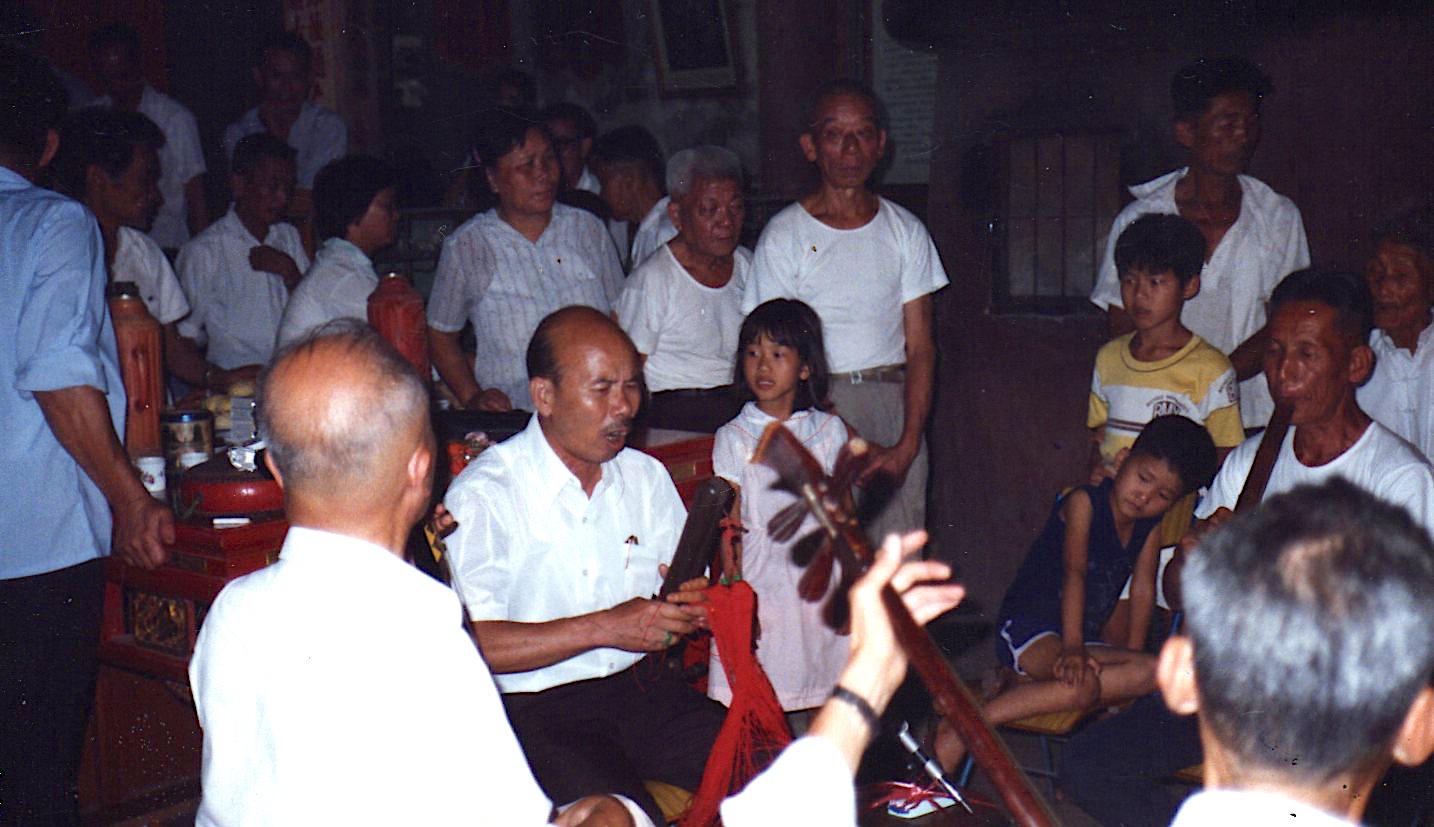
Laoximen 2001

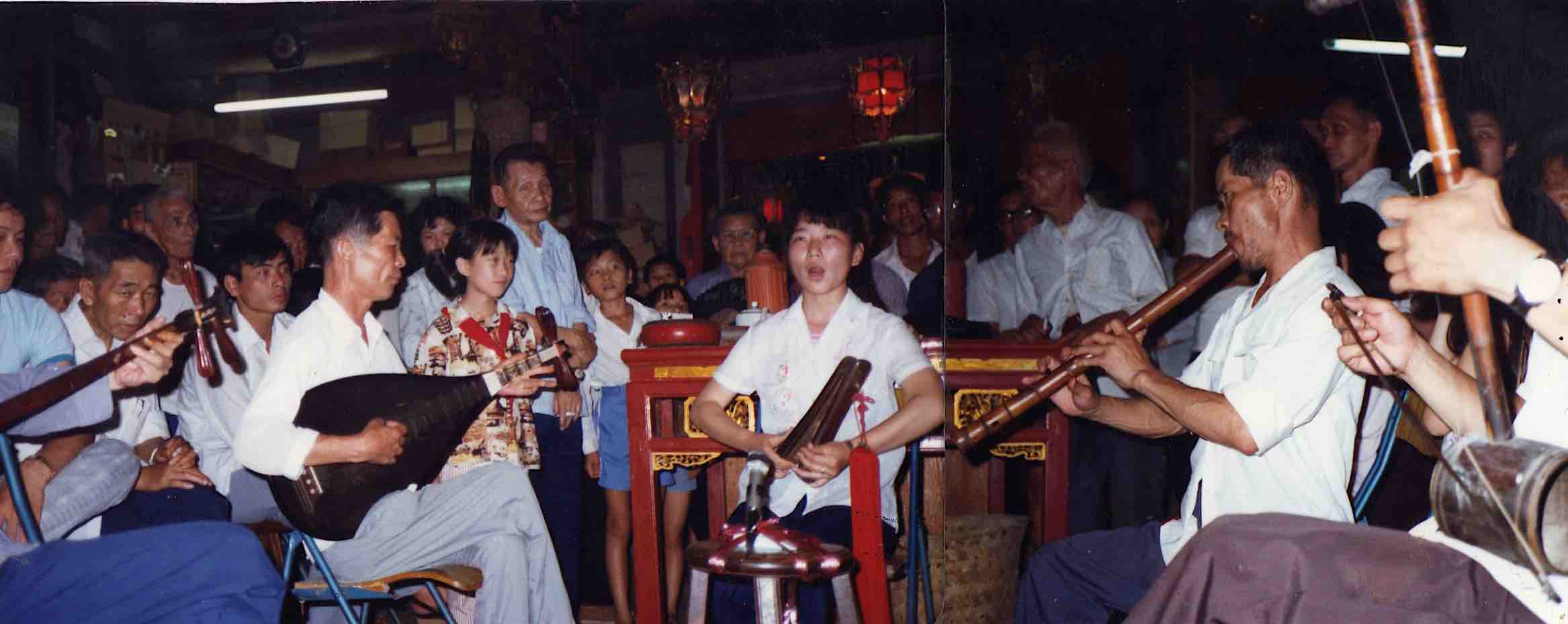
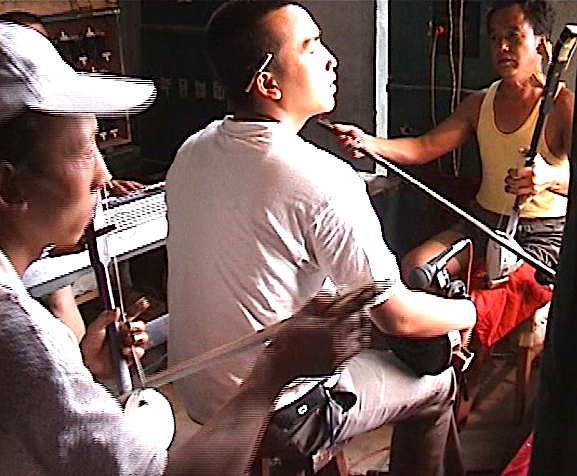
Qinglian street club, Old Westgate, Shanghai 2001. My photo.

The Jiangnan sizhu (“silk-and-bamboo of south Jiangsu”) instrumental ensemble has become a reified image of secular Chinese entertainment music. It’s played not only by polished professionals on stage, but by amateur groups in teahouses and leisure centres around Shanghai and the whole vicinity (for amateur chamber ensembles elsewhere, cf. suite-plucking in old Beijing, the Yulin “little pieces”, nanyin, and so on). Shanghai is a hospitable cosmopolitan urban centre, and these clubs are a popular haunt of foreign music students there.

The title was formalized only in the 1950s—one of many instances of the official renaming of genres at the time, such as Xi’an guyue or Xiansuo shisantao. Yet however one may dispute reification, Jiangnan sizhu is indeed “a thing”. Over a long period since the early 20th century we can observe a continuum from life-cycle and calendrical performances, through the amateur clubs, to professional staged performances.

In Chapter 13 of my book Folk music of China I began to put silk-and-bamboo in the wider context of musicking around south Jiangsu (Suzhou, Wuxi, Nanjing, Changshu, Yangzhou, and so on—all large regions each containing several hundred villages!). And I outlined the background of regional opera, narrative-singing, and all kinds of ritual practice, including the Shifan ensembles that accompany Daoist ritual. Indeed, Daoist ritual around Shanghai and south Jiangsu is a vast topic subsidiary only to local traditions in southeast China.

So apart from their use as entertainment in the amateur clubs, the various types of sizhu have a firm basis in life-cycle and calendrical rituals.

Folk-singing in the region is easily overlooked, but fortunately we have a wonderful detailed study by Antoinet Schimmelpenninck, who also saw the wider picture. She refers to ritual styles like xuanjuan 宣卷 performed by devotional sectarian groups, common throughout south Jiangsu. [1]

As Chinese genres go, compared with many traditions in both north and south China Jiangnan sizhu is rather youthful. As commonly with folk groups, the musicians sit around a table, an inevitable casualty of stage performance. They often take turns on various instruments over the course of an afternoon session. The personnel remains predominantly male.

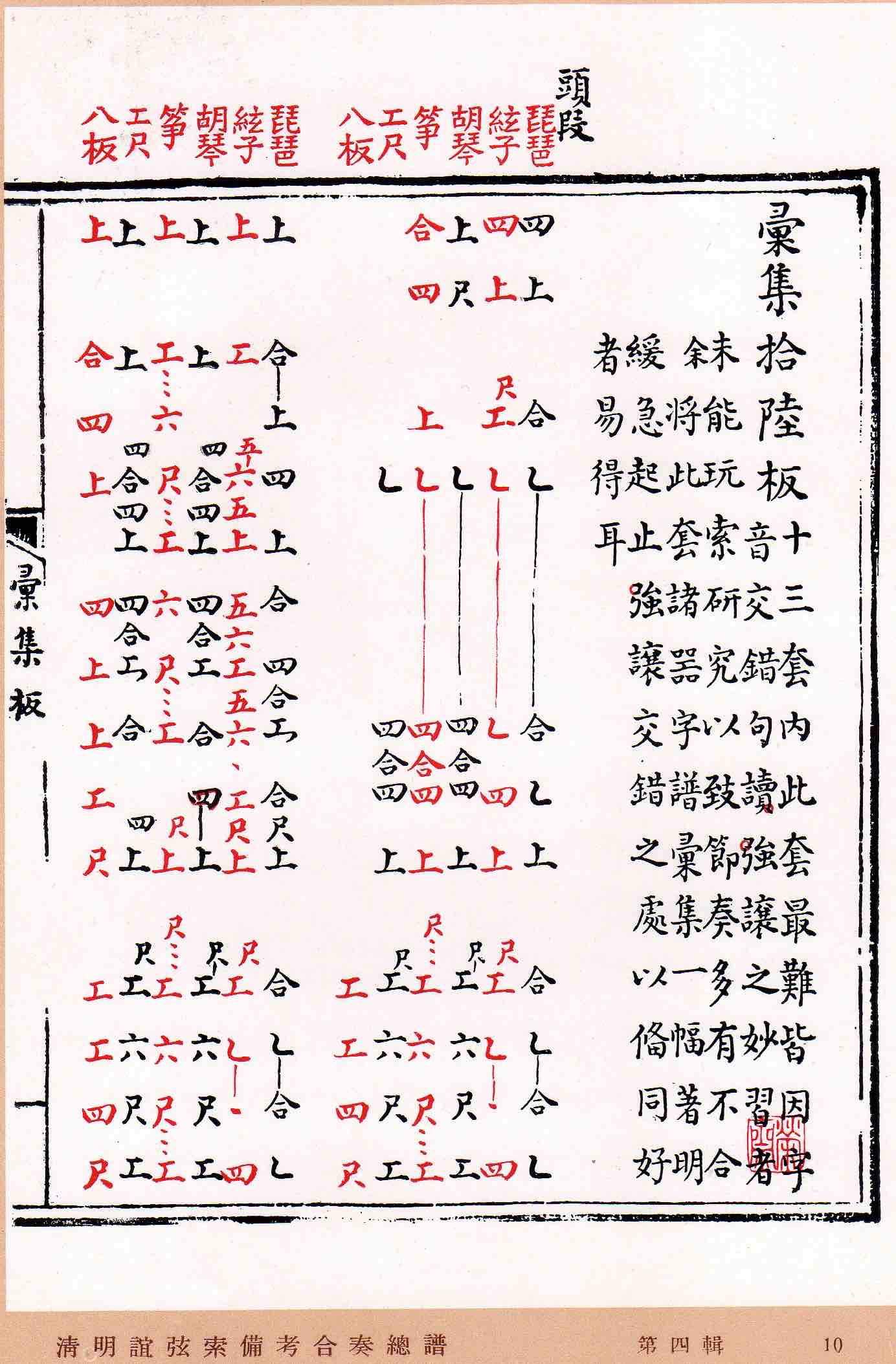
Chinese studies have favoured “music” over social context, and most publications on Jiangnan sizhu are based on the “eight great pieces” (for a simple introduction, see my Folk music of China, pp.275–82). While the repertoire is not so reified as this canonization may lead us to suppose, in the teahouses of central Shanghai it remains rather limited. But local variants of the repertoire abound, as shown by the definitive 1985 collection of transcriptions (770 pages!) by Gan Tao 甘涛. As always, we should regard it not as a reified repertoire, but as a regional form of musicking, a social activity (and since the ambience and sound-world of the amateur clubs may be reminiscent of Irish pub sessions, do enjoy my posts on Cieran Carson!).

See also this modest update.

Interlude: laowai
By the 1980s the Jiangnan sizhu repertoire was already the subject of analysis from scholars like Ye Dong, Li Minxiong, and Yuan Jingfang. Meanwhile, as China opened up again after the end of the Cultural Revolution, Larry Witzleben spent extended periods based at the Shanghai Conservatoire from 1981 to 1985, resulting in the brilliant early monograph

  • J. Lawrence Witzleben, “Silk and bamboo” music in Shanghai: the Jiangnan sizhu instrumental ensemble tradition (1995),

still one of the most accomplished ethnographies of a local Chinese tradition.

With chapters on the historical background and intergenre relationships, instruments, repertory, form, variation, texture, and aesthetics, perhaps the most innovative section is Chapter 2, a nuanced ethnography of the scene from 1981 to 1985, including relations with the professional music world.

Silk-and-bamboo soon earned a significant place in Western scholarship, and images of Chinese music, also thanks to the writings of Alan Thrasher, albeit concerned more with musical structures than with ethnography.

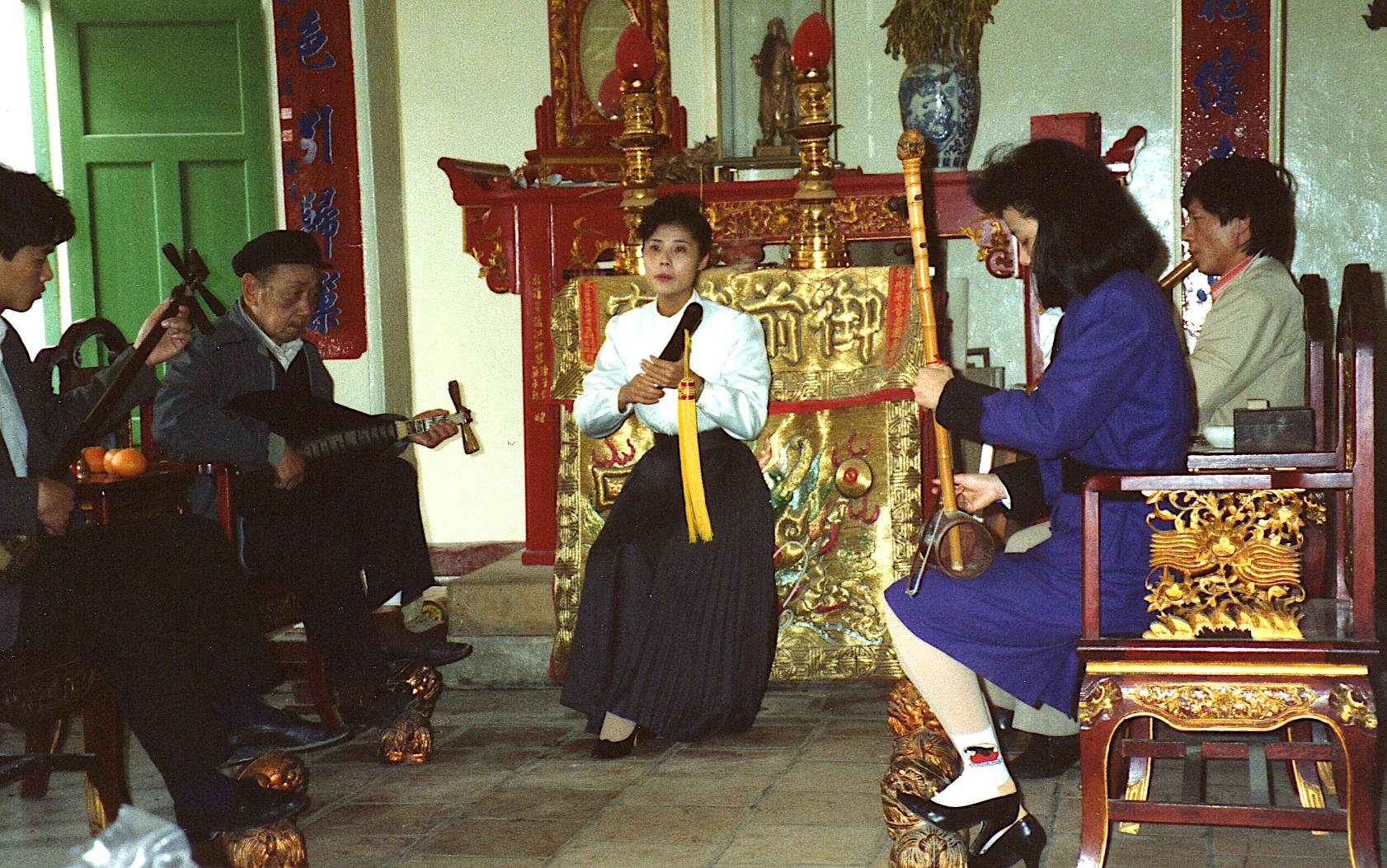
Silk-and-bamboo clubs, Shanghai 1987. My photos.

In 1986 and 1987, based in Beijing, I used to decamp to Shanghai occasionally, taking what was then a very long train ride. According to my own apocryphal story, my main incentive was that the showers of the foreign students’ dorms there had a rather reliable supply of hot water, still rare in my student accommodation in Beijing. Anyway, even though I was already entranced by northern ritual culture, it gave me an opportunity to take part in some of the many amateur silk-and-bamboo clubs on erhu fiddle—and also to hang out with the wonderful qin-player Lin Youren and acquaint myself with the thriving Daoist ritual scene.

For foreign students, participant observation was both instructive and pleasurable. As laowai, we were more keen on visiting the teahouses than our Chinese fellow-students, who naturally focused on the polished versions of their conservatoire teachers.

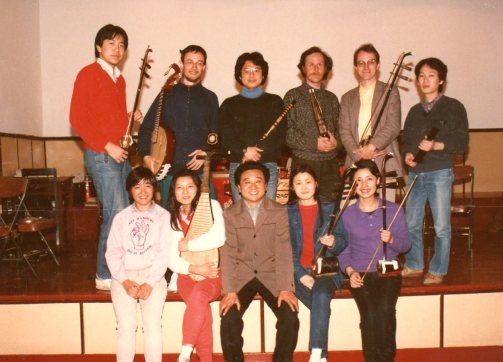
In 1987 I was roped into a Jiangnan sizhu contest at the conservatoire, joining a mixed group of Chinese and foreign students—the latter including François Picard, Fred Lau, and Tony Wheeler (back row, to my right). In the front row, on the far right is Ma Xiaohui 马晓晖, who went on to a career as erhu virtuoso, and at the centre is Zhou Zhongkang 周仲康, the conservatoire teacher assigned to oversee our efforts—our programme included his luogu sizhu composition Qing:

contest 87

The competitive format was hardly my favoured method of engaging with silk-and-bamboo, but it was an interesting experience. Alongside the conservatoire-style ensembles taking part, there were also some fine senior amateur groups. As cute foreign pets we inevitably won a prize, but our sound ideal, however flawed in execution, was modelled on folk practice rather than the more polished version of the professionals. Soon after, Helen Rees also became a regular participant at Shanghai teahouse sessions, while embarking on her fine studies of ritual music in southwest China.

Thinking back, guided by mentors at the Music Research Institute and Yuan Jingfang, my Beijing base propelled me towards ritual in the countryside more inevitably than might have been the case if I had been studying in Shanghai. Rural ritual is plentiful throughout south Jiangsu too, but somehow there is more to encourage one to tarry in cosmopolitan Shanghai without venturing out to the villages and townships.

Zhang Zhengming, 2001: left, with Zhou Hao at the Xuhui club;
right, with his wife—their 1952 wedding photo in the background.

On a visit in 2001 I spent a week in Shanghai, with the wonderful Zhang Zhengming 张徵明 (b.1925) guiding me to a different club every afternoon. It was good to see the renowned erhu master Zhou Hao, then 77, taking part keenly in the amateur groups, naturally modifying his polished style to the ambience; later in a one-to-one session he gave me a fine demonstration of the difference between “folk” and “conservatoire” styles.

diary

I was happy to be able to invite a group led by Zhang Zhengming to the 2005 Amsterdam China festival, as I scurried around hosting the Hua family shawm band and the Li family Daoists from Yanggao.

Again, there’s a continuum: official staged presentations are part of the whole fabric of silk-and-bamboo. This playlist from Jan Chmelarčík includes his videos from the amateur clubs in 2006 and 2007, showing a variety of contexts and styles:

The silk-and-bamboo scene plays a major role in Ruard Absaroka’s thesis Hidden musicians and public musicking in Shanghai, very much informed by anthropological theory. [2]

The wider context: the Anthology
It’s so easy to find activity in central Shanghai that one might not be tempted to explore the suburbs and further afield. But by the 1980s, research was also expanding significantly with the great Anthology:

  • Zhongguo minzu minjian qiyuequ, Shanghai juan 中国民族民间器乐曲, 上海卷 (1993),

edited by the knowledgeable Li Minxiong.

Local collectors documented the wider region in the suburbs of Shanghai, with its twelve municipalities and ten counties. Apart from transcriptions, the collectors also described folk activity, with useful textual introductions as well as biographies and introductions to major groups.

Again it’s worth noting the overall Anthology coverage for Shanghai. After an opening section on solo music (pp.19–234) devoted mainly to pipa solos, there are three main rubrics: sizhu (235–930), chuida (932–1268), and “religious music” (1273–1594). There follow brief biographies and accounts of folk groups (1595–1638, illustrated descriptions of instruments (1639–58), and lengthy appendices, mainly gongche scores (1661–2087).

It may seem impressive that even by 2001 over thirty sizhu groups were still meeting amidst the glossy modernity of central Shanghai. But for the whole region, Li Minxiong gives a figure of 428 groups (!) since the early 20th century; as he explains in his introduction (JC pp.241–63), over two hundred were active on the eve of Liberation.

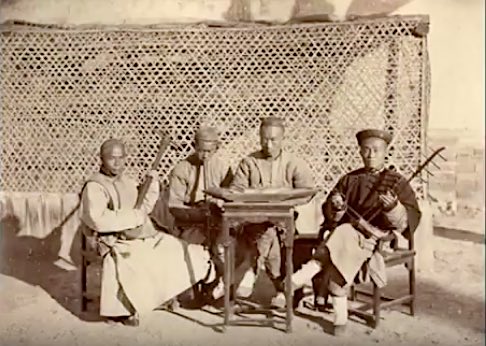
Following the May Fourth movement of 1919, many groups adopted the term “national music” in their titles. Indeed, such groups were the precursors of the whole “conservatoire style” that later came to represent the official image of Chinese music. The Anthology describes celebrated groups from the Republican era.
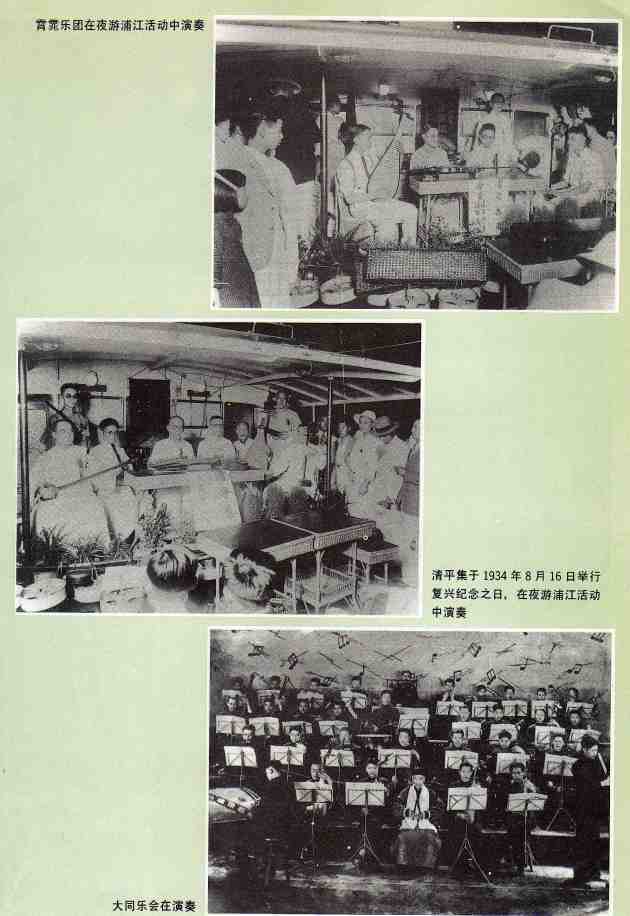
JC1

Top: Xiadiao music ensemble; middle: Qingping gathering, 1934; below: Datong music association (note music stands!). Source: Zhongguo minzu minjian qiyuequ jicheng, Shanghai juan.
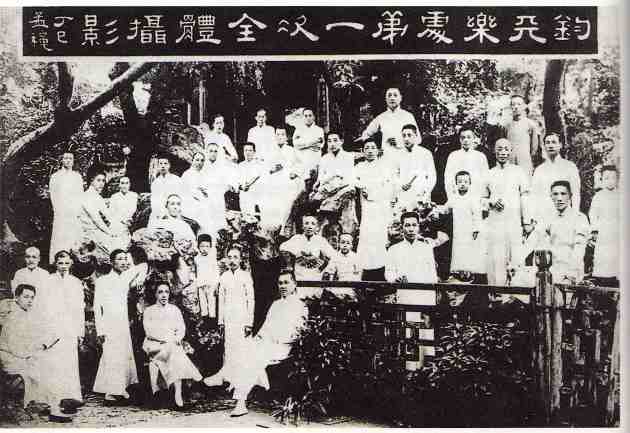
Juntian

Juntian gathering, 1917, Source: Qi Kun, Jiangnan sizhu.

After the 1949 Liberation, master musicians from the “old society” lent continuity, such as Jin Zuli, Sun Yude, Li Tingsong, Wei Zhongle, Chen Yonglu, and Lin Shicheng (for more, see Anthology, pp.1595–1722). At the same time they were responsible for certain innovations resulting from adapting the style to the concert platform. Commercial recordings were already quite common, but the carefully prescribed arrangements of Lu Chunling’s quartet with Ma Shenglong, Zhou Hao, and Zhou Hui became influential. Here’s a cassette (remember them?) of them from 1982, after the hiatus of the Cultural Revolution:

LCL

As collectivization and campaigns escalated, some folk groups had difficulty maintaining activity; but, as everywhere, the liberalizations following the collapse of the commune system in the late 1970s brought a revival. In 1980 over seven hundred performers took part in a grand performance at the Shanghai conservatoire, with groups coming from Shanghai, Suzhou, Wuxi, Nanjing, and Hangzhou. But as Shanghai was transformed again, amateur clubs have somehow remained active.

Related genres
But apart from the public image of sizhu, the Anthology valuably introduces bands in the surrounding suburban regions, often serving life-cycle and calendrical rituals—in Nanhui, Fengxian, Chuansha, Jiading, Shanghai county, Baoshan, Qingpu, Songjiang, Jinshan, and Chongming island.
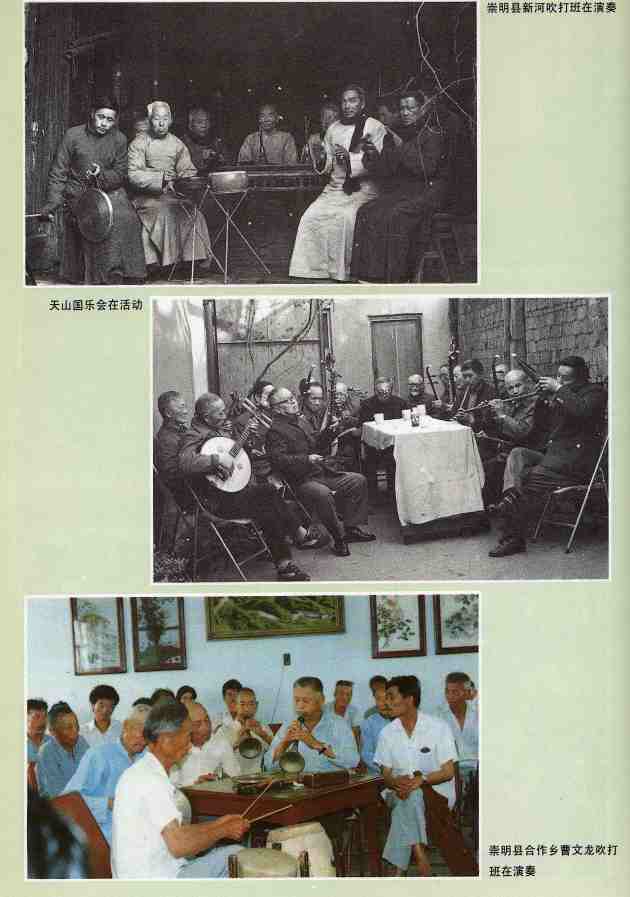
JC2

Undated Anthology photos: above and below: chuida bands, Chongming; middle: the Tianshan national music association.

So this involves expanding our explorations in terms of both geography and genre. While sizhu is the main theme, the plot thickens when we include related instrumental genres hardly broached by foreign scholars based in metropolitan Shanghai: the “pure tones bands” (qingyin ban 清音班) and the former tangming 堂名 groups (see also n.3 below).

Moreover, the latter are also related to the occupational “blowing and beating” bands (chuidaban 吹打班) based on shawms and percussion—another main rubric of the Anthology (see introduction, pp.932–45). Among 184 such bands for which collectors found evidence, Li Minxiong gives sketches of rural groups in Chuansha, Baoshan, Qingpu, and Jiading, all with several generations of transmission. This section also contains material on local ritual, including weddings, funerals, and longevity celebrations (qingshou 庆寿), as well as calendrical and religious rituals.

A fine case-study: Nanhui
Qi Kun 齐琨, with a firm background in music anthropology, has produced some fine ethnographic work, notably her book on the qingyin 清音 groups of Nanhui county in the southeastern suburbs [2]—itself an extensive area, with 26 districts (amalgamated in 2001 into 14 townships) and 347 villages:

  • Lishidi chanshi: Shanghai Nanhui sizhuyue qingyinde chuancheng yu bianqian yanjiu 历史地阐释: 上海南汇丝竹乐清音的传承与变迁研究 (2007).

Starting from around 1850 when such groups became common in Nanhui, she uses local gazetteers, interviews with senior performers, and fieldnotes from attendance at rituals and secular performances. She often cites the Nanhui draft for the Anthology, which looks to be among the more detailed local contributions to the Shanghai volumes.

She introduces various related genres in Nanhui, including Daoist groups [3] and their former “household kin” (menjuan 门眷) catchment-area system, occupational chuida bands, Buddhist groups, opera, and the Pudong style of pipa plucked lute.

Qi Kun musters impressive material on bands and activity in the late Qing and the Republican era (itself a period of significant change), with sections on temple fairs, weddings, and funerals.

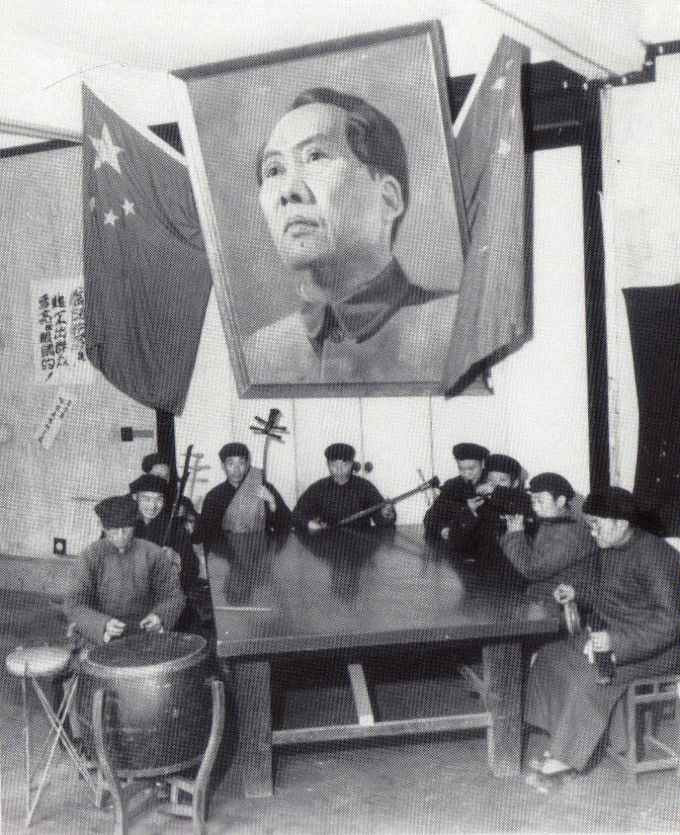
After the Communist victory of 1949, state-sanctioned performances of Jiangnan sizhu on stage became more common alongside traditional contexts, but as always I’m keen to learn more about folk activity during the decades of Maoism, the crucial transitional period from the “old society” to the consumer culture of the reform era (cf. Yulin).

The Anthology notes in passing some basic elements in the decline of many groups over the period as a result of the state’s pervasive social remoulding, such as migration, army service, collectivization, and campaigns against superstition. But ever alert to change, Qi Kun has a detailed chapter on the Maoist era in Nanhui. She illustrates the severe reduction of the diverse local social contexts that were the basis for expressive culture before Liberation—the rich network of temple fairs, weddings and funerals. Many qingyin performers were absorbed into a scene now based on entertainment rather than ceremonial; as elsewhere, many fine folk musicians were recruited to the new state-funded opera troupes and amateur “art-work troupes”. Qi Kun notes the place of qingyin in state-sponsored events like political meetings and sending off army recruits.

However, there was a certain continuity, and amateur qingyin activity persisted. Qi Kun gives instances from nine districts. She notes the more-or-less undisturbed observance of life-cycle rituals in the early 1950s, with lengthy processions; some groups even persisted performing for these contexts into the early 1960s.

The fortunes of musicians depended largely on their “class status”, but irrespective of this many were reduced to poverty. But there were ironies—as one performer commented:

People like Wen Zhengxiu who served as Daoist priests weren’t persecuted. Almost all of those Daoists smoked opium, so they had virtually no possessions at home, they could never become wealthy. So after Liberation they were classed as poor peasants. Instead it was honest people like us, who had toiled over several generations to accumulate family property, who were targets of punishment.

Such people now became the core of many qingyin groups.

Amidst the traumas of the Cultural Revolution, Qi Kun goes on to describe the maintenance of the qingyin style (if not its former context) in the Mao Zedong Thought propaganda troupes. Some troupes even used the traditional sizhu repertoire, like Xingjie, to accompany political processions.

And even now a certain amount of furtive recreational activity continued (again, cf. Yulin)—behind closed doors, some troupe members even sometimes dared invite former “landlords” and “rich peasants” to play the traditional repertoire along with them. Performers recall both the cruelty and the nuances of the period. Many of the troupe members became core elements in the revival of tradition from the late 1970s—for which, of course, the main factor was the amazing resurgence of ritual practice. Indeed, a modest revival was already under way before the overthrow of the Gang of Four in 1976.

qingyin JC

Qingyin bands in Fengxian, Jiading, and Baoshan. Source: Anthology.

In Chapter 4 Qi Kun takes the story on into the consumer age. After detailing the gradual revival (cf. my own notes on that of the Li family Daoists in Shanxi), she surveys a scene that is still more diverse than that before 1949, with recreational groups (now under semi-official leadership, with some even adopting the title “folk music band” minyuedui 民乐队!) now able to meet regularly, overlapping with occupational bands performing for customary observances. She gives a fine diary of the varied public activities of the Zhuqiao qingyin band from 1994 to 2003, as well as detailed notes on a 2002 wedding and on the grandest of ten funerals that she attended in 2004. Indeed, while such groups traditionally performed for weddings, their participation in funerals is a recent innovation.

funeral

Still, even with the revival, fewer performers are active than before 1949. Qi Kun also illustrates changes in ritual practice over the period with graphic tables. Here she compares figures for qingyin bands active around Nanhui in 1937–49 and in 2004, by district:

QK 326

For all periods, Qi Kun constantly notes the interaction of social, economic, political, and musical change—if only Chinese musicology would learn from such an approach, rather than banging on about heritage and living fossils!

mixin

Wall advertisement for the Tongxin qingyin band, Nanhui c2004. Source: Qi Kun, Jiangnan sizhu (2009).

The advertisement above reads:

Exclusive service for wedding and funerals: destroy superstition and be frugal—stylish and trendy.

I don’t know if this was a disingenuous response to a temporary campaign, but the social mood of the time was not exactly keen on destroying superstition or enacting frugality. Discuss

And suburban regions like Nanhui are anything but a rural backwater: they are inextricably tied to the global economic market of Shanghai. But exploring the environs always reveals a diverse picture.

That’s quite enough for one sitting—but zooming out still further, the instrumental volumes of the Anthology for Jiangsu province give an impression of such bands throughout the province:

  • Zhongguo minzu minjian qiyuequ, Jiangsu juan 中国民族民间器乐曲, 江苏卷 (1998).

Again its main rubrics are chuida, sizhu, and “religious music”.

And just south lies Zhejiang province… Aiyaa.

* * *

Shanghai silk-and-bamboo makes a comfortable repertoire that is too easily reified and detached from the wider society. Much as I have enjoyed visiting the Shanghai teahouses, there’s so much more to study, not only in the suburbs but all around south Jiangsu, where entertainment genres are always subsidiary to ritual! And the cast of ritual performers, here as elsewhere, is still more varied: Daoist ritual specialists, spirit mediums (very important in local society), devotional sectarian groups, and so on.

Like Beijing, Tianjin, Chongqing, and other municipalities, Shanghai is a vast region, the riches of whose expressive culture can hardly be encapsulated by simple labels. As usual, we have to look beyond the reified canons of idealized, “representative” “genres” (the Zhihua temple, the “eight great suites” of Shanxi, the Uyghur twelve muqam, and so on) and plunge into the complex world of changing local social activities.

[1] Among considerable research on xuanjuan, see e.g. articles in Dayin 大音 vols. 3, 4 and 5; Zhongguo quyi zhi, Jiangsu juan 中国曲艺志, 江苏卷; Qian Tiemin 钱铁民 (on Wuxi) in Zhongguo minjian yishi yinyue yanjiu, Huadong juan 中国民间仪式音乐研究, 华东卷 (2007) vol.1; Qiu Huiying 丘慧瑩, “Jiangsu Changshu Baimao diqu xuanjuan huodong diaocha baogao” 江蘇常熟白茆地區宣卷活動調查報告, Minsu quyi 169 (2010), pp.183–247; Li Shu-ju 李淑如, “Zhangjiagang diqu jianwang fahui yishi yu xuanjuan diaocha baogao” 張家港地區薦亡法會儀式與宣卷調查報告, Minsu quyi 204 (2019.6), pp.197–250. In English, see Mark Bender, “A description of ‘jiangjing’ (telling scriptures) services in Jingjiang, China”, Asian folklore studies 60 (2001), and ongoing work from Rostislav Berezkin, such as this, and an article with Vincent Goossaert.

[2] For a flavour [sic] of his recent musings, see “Timbre, taste and epistemic tasks: a cross-cultural perspective on atmosphere and vagueness”, in Friedlind Riedel and Juha Torvinen (eds), Music as atmosphere: collective feelings and affective sounds (2019), which sets forth from timbre and atmosphere in Shanghai silk-and-bamboo. While I like the title, and am happy to add the splendid acronym WEIRD (coined to describe “western, educated, industrialized, rich, and democratic” ethnocentrism) to my list, I may not be alone in finding some of his erudite theoretical discussion a tad arcane. That’s academia for you!

[3] Qi Kun also has related articles in Zhongguo minjian yishi yinyue yanjiu, Huadong juan (with film footage on the DVD), and the Dayin series (n.1 above).

[4] For Daoist ritual in Nanhui, see Zhu Jianming 朱建明 and Tan Jingde 谈敬德, Shanghai Nanhui xian Zhengyi pai daotan yu Dongyue miao keyiben huibian 上海南汇县正一派道坛与东岳庙科仪本汇编 (2006), and Zhu Jianming and Tan Jingde, Shanghai Nanhui xian Laogang xiang nongjia duqiao yishi yu qiao wenhua 上海南汇县老港乡农家渡桥仪式与桥文化 (1996); in Jiading and Chuansha counties, Zhu Jianming, Tan Jingde, and Chen Zhengsheng 陈正生, Shanghai jiaoqu daojiao jiqi yinyue yanjiu 上海郊区道教及其音乐研究 (2001; for the tangming groups, note pp.29–48); and in Shanghai county, Zhu Jianming, Shanghai xian Shengtang daoyuan jiqi taiping gongjiao kaocha jishi 上海县圣堂道院及其公醮考察纪实 (1993). See also a thoughtful review by Poul Andersen in Daniel Overmyer, Ethnography in China today, pp.263–83.

Archive Chinese recordings

One essential resource for studying—and teaching—Chinese culture is an excellent series from Wind Records 風潮公司 (Taipei), based on archive recordings of the Music Research Institute (MRI) in Beijing, coordinated by its director Qiao Jianzhong. With many tracks made amidst the constant campaigns of the first fifteen years of the PRC before the Cultural Revolution, the series is the most authoritative overview of Chinese music on disc.

Four 2-CD sets (with booklets in Chinese) are devoted in turn to folk-song, narrative-singing, opera, and instrumental music:

  • Tudi yu ge 土地與歌 [English title Songs of the land in China: labor songs and love songs] (1996).
    Far from the kitsch arrangements that flood the market, these tracks—many recorded in the 1950s—are mostly unaccompanied, with work songs, songs of boatmen and foresters, love songs, wedding laments, passionate huar from Qinghai, and shan’ge from Shaanbei. Also featured are recordings from Hunan, Hubei, Guizhou, Sichuan, and Yunnan.
  • Shibaduan quyi 十八段曲藝 [Shuochang: the ultimate art of Chinese storytelling] (1998).
    This collection of early recordings of narrative-singing includes drum-singing from Beijing and Tianjin, tanci from Suzhou, and less well-known examples from Henan, Gansu, Qinghai, Hubei, and Guangxi. See also my roundup of posts on narrative-singing.
  • Jinye lai changxi 今夜來唱戲 [The beauty of Chinese opera] (1998).
    An overview of regional dramatic traditions, including not only Kunqu and Beijing opera (with Yu Zhenfei, Mei Lanfang, and others), but tracks from Hunan, Sichuan, northern “clapper” operas, as well as yangge opera and searing puppet drama from Shaanxi.
  • Xianguan chuanqi 弦管傳奇 [Special collection of contemporary Chinese musicians] (1996).
    This set focuses on solo instruments, with some of the great masters from the 1950s, including qin and zheng zithers (Zhao Yuzhai, Gao Zicheng, Luo Jiuxiang), pipa plucked lute, and various fiddles. But there are also ensemble tracks led by dizi flute and suona shawm (from southwest Shandong), and guanzi oboe (Yang Yuanheng). The set ends with a drum section from the Shifan gu repertoire played in 1962 by the great Daoist master Zhu Qinfu.
    Some of these tracks are included in my 2-CD compilation for AIMP, again collaborating with the MRI:

The series highlights the sterling work of the MRI under the great Yang Yinliu—to whom Wind Records also dedicated a 2-CD set. Of course audio recordings alone can’t encompass the complexities of changing social life, but basic familiarity with soundscape should be an essential aspect of our education in Chinese culture.

For a further CD-set in the series, see here; for more discography, see my article in The Rough Guide to world music; for films on rural and ritual life in China, click here; and for precious recordings from 1901–2, here. In the sidebar, note also my playlist, with commentary here; and see this YouTube playlist.

Fujian, 1961 and onwards

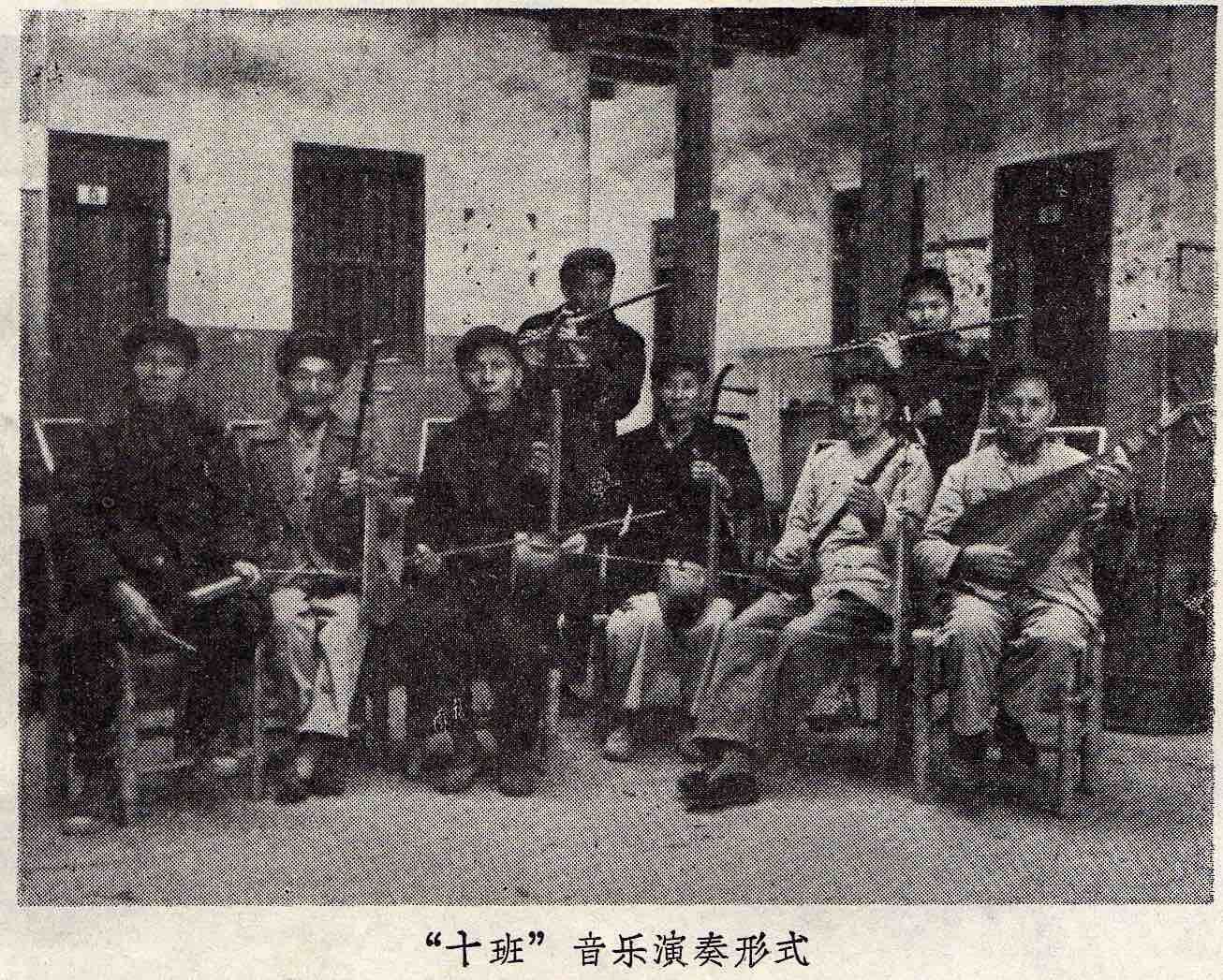
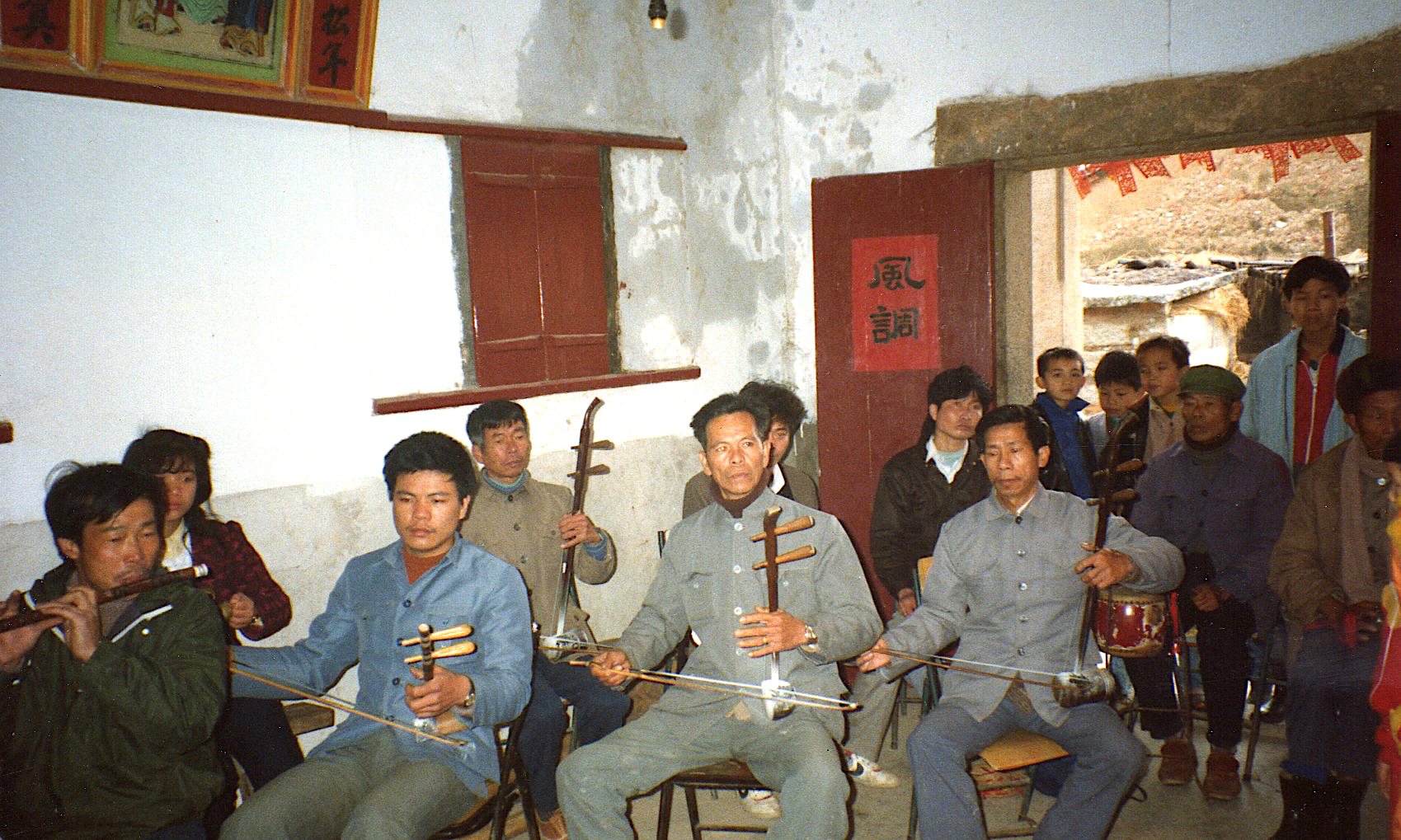
LQM shiban

Shiban ensemble, west Fujian 1962.

I’ve already introduced important early fieldwork projects after “Liberation” under the auspices of the Music Research Institute in Beijing, led by the great Yang Yinliu. Such work continued even after the chaos caused by the Great Leap Backward.

In late 1961, soon after the publication of Yang’s major survey for Hunan (and as the Morris dancing revival continued in England!) Li Quanmin 李佺民 (1924–83), who had already taken part in the 1953 survey of folk-song in northwest Shanxi, was dispatched to the far south on a trip to Fujian province, whose vibrant folk cultures were still quite unknown to Beijing scholars. [1]

  • Fujian minjian yinyue: caifang baogao 福建民间音乐采: 访报告 [Folk music of Fujian: field report] (Zhongyang yinyuexueyuan Zhongguo yinyue yanjiusuo, 1963, mimeograph, 155 pp.)

LQM cover

Yang Yinliu’s 1956 work in Hunan had utilised both his own team from Beijing and regional cadres, considering a broad range of genres, pervaded by ritual. But Li Quanmin arrived alone in Fujian, and travelled only in the company of the young regional music scholars Liu Chunshu 刘春曙 and Wang Yaohua 王耀华 (who went on to become leading authorities on the musics of Fujian), so this project was less ambitious. In their survey from 12th November 1961 to 28th January 1962 they conducted both overviews for particular counties and interviews on specific genres. Their fieldnotes are reproduced more or less as they were taken at the time.

Even today, outsiders’ impressions of the musical cultures of Fujian may largely be based on the glorious nanyin chamber ensembles of Hokkien communities around Quanzhou and Xiamen, but the report was the first to provide a window on the huge variety of expressive cultures throughout the province. Indeed, while the history, music, language, and ethnography of nanyin alone are a topic for several lifetimes, the 1986 survey Fujian minjian yinyue jianlun can only spare 22 of its 611 pages for the topic!

The cultures of Fujian may profitably be studied alongside those of the diaspora (notably Taiwan); while these have preserved many traditional features that were under attack on the mainland, the resilience of tradition in the PRC is remarkable.

They began by meeting representatives of official state troupes in cultural offices, noting studies by local scholars, and going on to assemble performers to make recordings. They focused on vocal and instrumental chamber ensembles; while, as everywhere, such groups mainly served life-cycle and calendrical rituals, the social contexts receive limited attention. The team got glimpses of the riches of local opera, but merely noted the researches of regional scholars—who, indeed, had been busy collecting material ever since the 1949 Liberation.

Though ritual connections are constantly apparent, the report gives only brief mentions of temple and household ritual specialists. The activities of household Daoists are only mentioned in passing; only since the 1980s have detailed monographs shown what a major feature of life they are throughout the region—indeed, this was the first region that scholars began to study once they were able to expand their studies from Taiwan to the mainland across the strait.

I’ve already noted the need to oscillate between wider generic surveys for a whole province or region (“gazing at flowers from horseback” 走马观花) and more detailed reports on one county, village, or family (see also under Local ritual).

As yet more political campaigns unfolded after the brief lull following the disasters of the Leap, this was to be among one of the last fieldwork projects until work resumed in earnest from the late 1970s.

Part One of Li Quanmin’s report contains reports from the southeast coastal region of the province. In Xiamen they visited the great nanyin expert Ji Jingmou 纪经畝 (1899–1986, or 1901–87), [2] recording him leading the Jinfeng group 金風南樂團.

Just west in Zhangzhou, after gaining brief introductions to jin’ge 錦歌 and shiba yin 十八音 (cf. the shiyin bayue 十音八樂 of Putian), they give a rather more detailed account of nanci 南詞 and the related instrumental shiquan qiang 十全腔. The occupational groups performing nanci were known as tangban 堂班, performing items like The Heavenly Officer Bestows Blessings (Tianguan cifu 天官賜福) before a painting of Heavenly Master Zhang; the genre seems to have spread from Jiangxi.

For the wider Longxi region around Zhangzhou, Liu Chunshu gave them an overview of various genres, including Songs to Wash the Gods (xifo ge 洗佛歌), presented as a superstitious genre from “the past”, sung during the first five moons by itinerant duos, one with a god image on his back; [3] dragon-boat songs in praise of Qu Yuan, noting ritual connections; and musics deriving from Chaozhou just south.

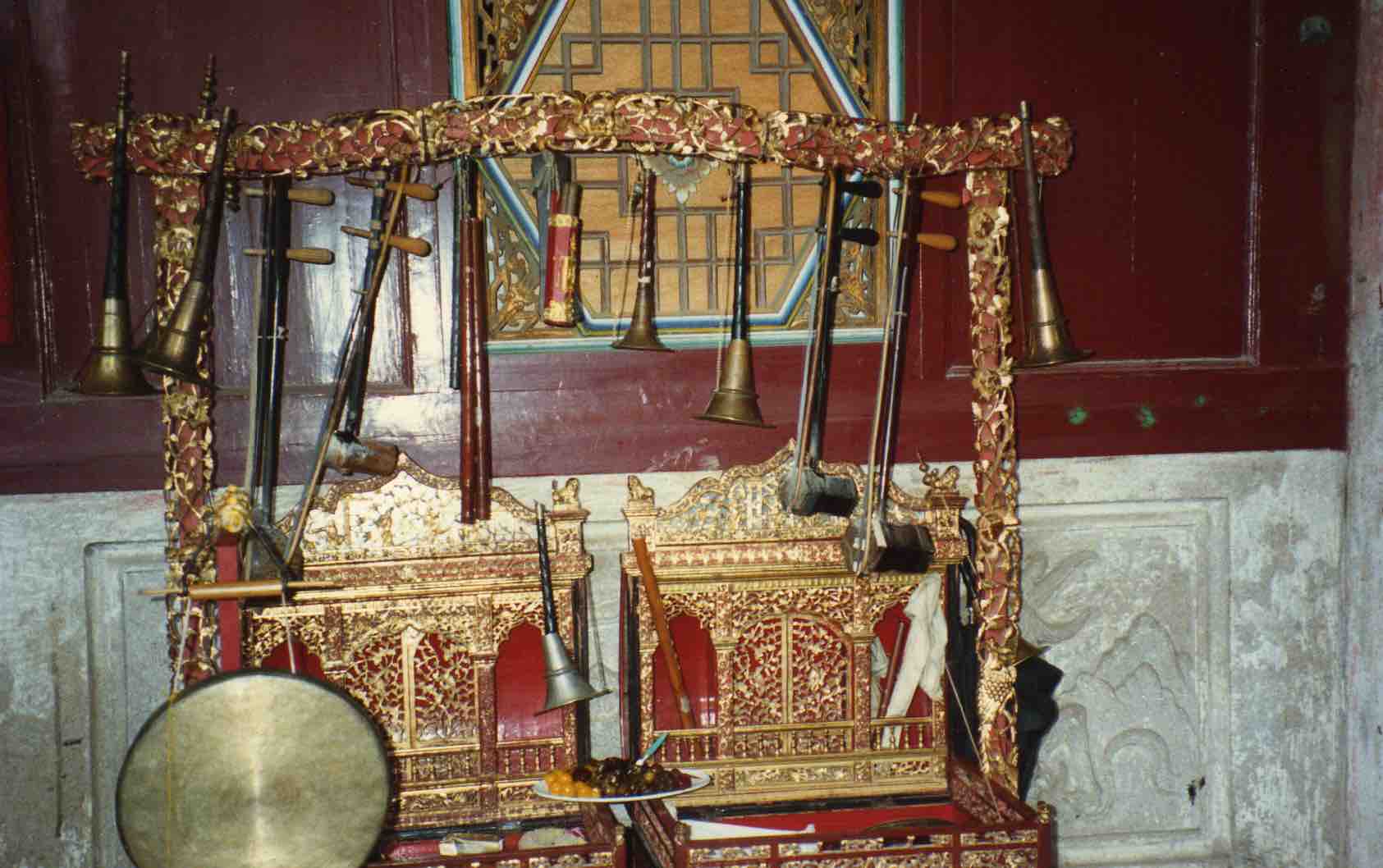
In Quanzhou they gained a further outline of nanyin (on which there was already a substantial amount of local research), as well as briefer impressions of shiyin (for a photo from my 1990 trip see here); they mention the Assault on the Citadel ritual drama (dacheng xi 打城戲) [4] and itinerant sijin ban 四錦班 bands of blind female singers. They also studied the venerable “casket winds” (longchui) shawm bands (on which more below)—I’ve now added one of Li Quanmin’s 1961 recordings to the playlist in the sidebar (#15), with commentary here.

casket

The longchui casket, Tianhou gong temple, Quanzhou 1990. My photo.

In Quanzhou they also talked with the Buddhist monk Miaolian 妙蓮 (see below), making notes on his master the renowned Hongyi 弘一 (Li Shutong李叔同, 1880–1942), an authority on ritual music, and visiting the Kaiyuan si temple.

In Putian and Xianyou—another highly distinctive cultural sub-region—they learned of shiyin bayue 十音八樂, related to the local opera—itself a rich ancient tradition most worthy of study. Folk-song genres included shan’ge 山歌, itinerant lige 俚歌, and “singing the nine lotuses” (jiulian chang 九蓮唱). Li Quanmin reproduces a local draft for the new Putian county gazetteer, which includes a section on “ritual music” (fashi yinyue), outlining Buddhist and Daoist groups.

A clue now led them to make a detour to the poor Badu region of Ningde, north of Fuzhou, to record the two-part folk-songs of the She 畲 minority there—just one of the regions where they dwell through Fujian and adjoining provinces. Li Quanmin lent his recordings of the songs to the provincial Broadcasting Station in Fuzhou for copying—who promptly lost them.

The whole of Part Two is dedicated to the largely Hakka cultures of southwest Fujian further inland. Even their studies around this region involved lengthy journeys. Incidentally, this is yet another region where household Daoists still have impressive traditions.

Here the team focused on the shiban 十班 (in some areas known as shifan 十番) and jingban 靜班 groups. They soon discovered the complexities of local terminology. Mostly amateur groups, with a core of stringed instruments, they are often based on local drama; but usually there is also a strong link with occupational shawm bands and percussion groups.

In the Longyan region the jingban were related to Raoping chui 饒平吹 shawm bands, named after the region further south in Guangdong. Moving west from the regional seat, in Shanghang they noted the effects of historical migrations. In Liancheng they learned from Luo Xuehong, head of the county song-and-dance opera troupe, an erstwhile accompanist of Buddhist and Daoist ritual specialists and marionette bands—reminding us that state troupes were then full of such experienced “old artists”.

They continued their studies of the jingban in Changting—where they also gain a tantalizing clue to the furen jiao 夫人教 (or “singing Haiqing” 唱海青) exorcistic ritual performed by household Daoists to protect children (cf. guoguan). In north China Haiqing 海青 is a common subject of ritual shengguan wind ensemble pieces, but it has been assumed to be a bird of prey; however, material from Fujian shows that he is a deity there: Thunder Haiqing (Lei Haiqing) is a manifestation of Tiandu yuanshuai 天都元帥.

Still in Changting, they gained further material on shiban groups, visiting Dapu 大浦commune to learn of the temple fair to the Great God of the Five Valleys (Wugu dashen 五谷大神). Returning to Longyan they continued to explore the relation between the jingban and shiban groups. Hearing of the lively scene in Kanshi town in Yongding, based on its temple fairs, they moved on there. Back in Longyan again, they ended their trip with a visit to a jingban group in Dongxiao commune.

Throughout the trip, in addition to occupational performers, they met amateurs— factory and manual workers, traders, and peasants—whose livelihoods had been in flux for several decades. But alas, what we can’t expect from such sources is discussion of the changing society (though see here, and for more revealing official sources, here). Fujian was far from immune from the famine, [5] with migrants fleeing in all directions—though the report discreetly refrains some such topics. A desultory sentence on the itinerant singers of lige claims:

Before Liberation most people weren’t keen on singing it [?!], but after the Great Leap Forward in 1958 the government esteemed it and [sic] used it for propaganda.

But in contrast to propaganda, this is just the kind of folk activity that was reviving among migrants in the desperation following the disasters of the Leap.

Since the 1980s
While Li Quanmin’s survey is less impressive than Yang Yinliu’s earlier report on Hunan, it laid a groundwork for later studies of Fujian. After the interruption through the Cultural Revolution, the liberalisations of the late 1970s allowed fieldwork to resume on a large scale, largely under the auspices of the national Anthology project—for whose fruits in documenting instrumental ensembles and “religious music”, click here.

Even before the publication of the Anthology, a single-volume survey appeared by two provincial scholars who had accompanied Li Quanmin in 1961–62:

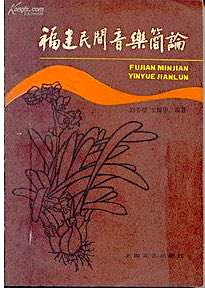
  • Liu Chunshu 刘春曙 and Wang Yaohua 王耀华, Fujian minjian yinyue jianlun 福建民间音乐简论 (1986).

FJ book

Its 611 pages not only give more informed accounts of the genres introduced in the 1963 survey, but provide more extensive coverage of a wider range of regional genres, including the lesser-known north of the province. The volume adopts the overall classification that had been developed from the 1950s, now enshrined in the Anthology—and as ever, most of them are strongly interconnected:

  • folk-song (with a wider coverage of the She minority, pp.199–­229)
  • narrative-singing (nanyin appears here, alongside genres such as jin’ge, nanci, and beiguan)
  • opera, including Minju, Gezai xi, Pu–Xian xi, Liyuan xi, Gaojia xi, marionettes, and shadow puppets
  • instrumental music: various shifan and shiban genres, longchui, and so on.
Liu and Wang shiban route

A helpful map of the transmission of shiban.

There is no separate section for “religious music” [sic], but some “religious songs” are briefly introduced (pp.144–63), and ritual genres pervade all the categories.

On a very different note, Wang and Liu end with an introduction to the Fujian tradition of the qin zither, which had also formed part of Zha Fuxi’s national survey in 1956.

Fieldtrips, 1986 and 1990
On my first stay in China in 1986, after exploratory trips to Wutaishan, Xi’an, and Shanghai, I visited Fujian, gaining a preliminary glimpse of nanguan and learning much from Ken Dean, then based in Xiamen. Ken was among the first scholars to cross the strait from Taiwan to the mainland to study local Daoist ritual traditions, and his detailed early field reports are most inspiring (see here; cf. Daoist ritual in north Taiwan):

  • “Two Taoist jiao observed in Zhangzhou”, Cahiers d’Extrême-Asie 2 (1986), pp.191–209
  • “Funerals in Fujian”, Cahiers d’Extrême-Asie 4 (1988), pp.19–78
  • “Taoism in southern Fujian: field notes, fall, 1985”, in Tsao Ben-yeh and Daniel Law (eds.), Taoist rituals and music of today (1989), pp.74–87.

Ken’s fieldwork led to major monographs:

  • Taoist ritual and popular cults of southeast China (1993)
  • Ritual alliances of the Putian plain (2 volumes, 2009)

and most illuminating of all, his vivid 2010 film

  • Bored in heaven, on ritual activity in Putian (for differences between his approach and more text-based Daoist scholarship, click here).

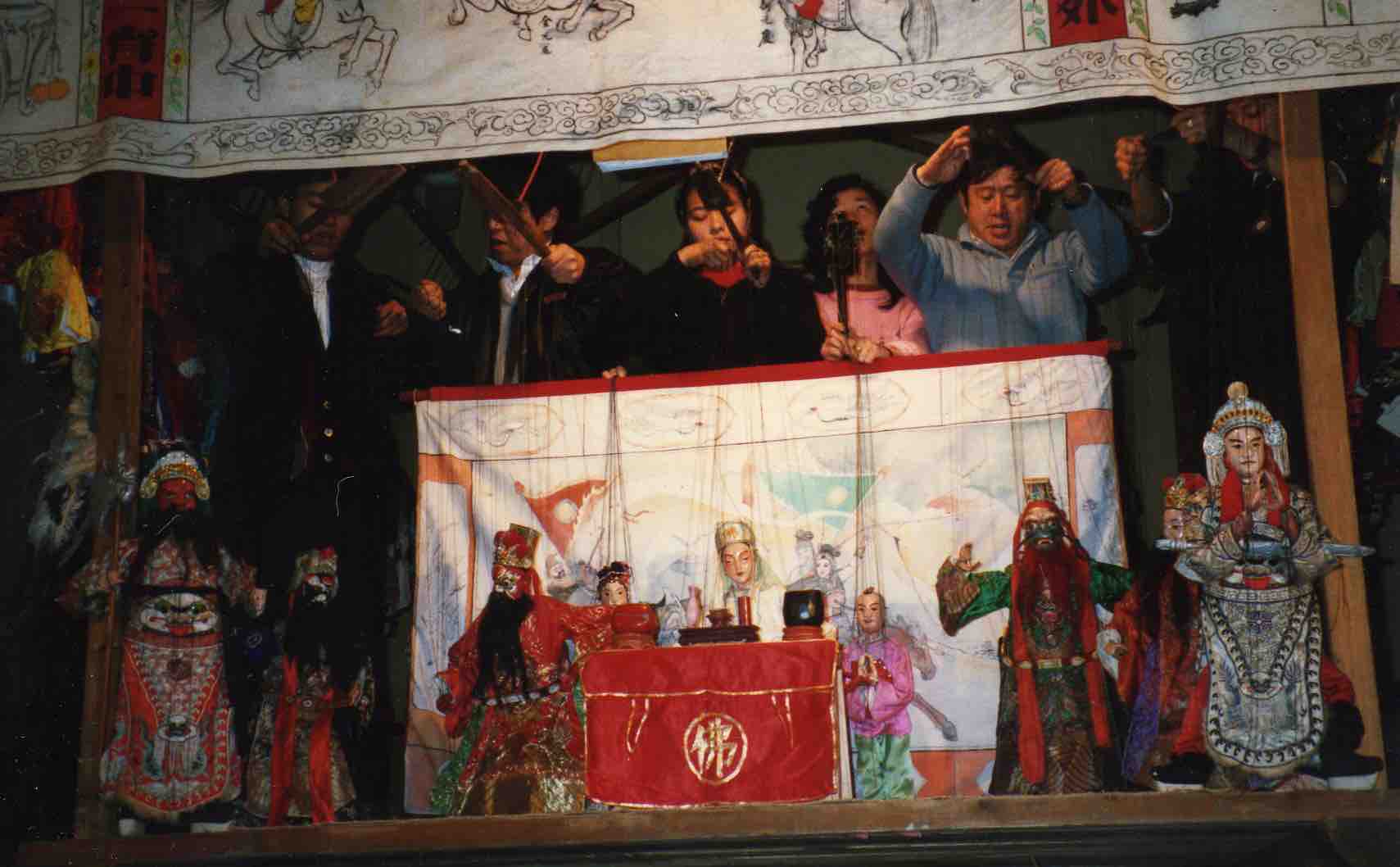
With Ken I attended a nocturnal ritual in a Quanzhou temple, with marionettes (on which, note Robin Ruizendaal’s wonderful 2006 book Marionette theatre in Quanzhou—with rare coverage of the fortunes of such groups under Maoism):

Marionettes for nocturnal ritual, Quanzhou 1986. Photos in this section are all by me.

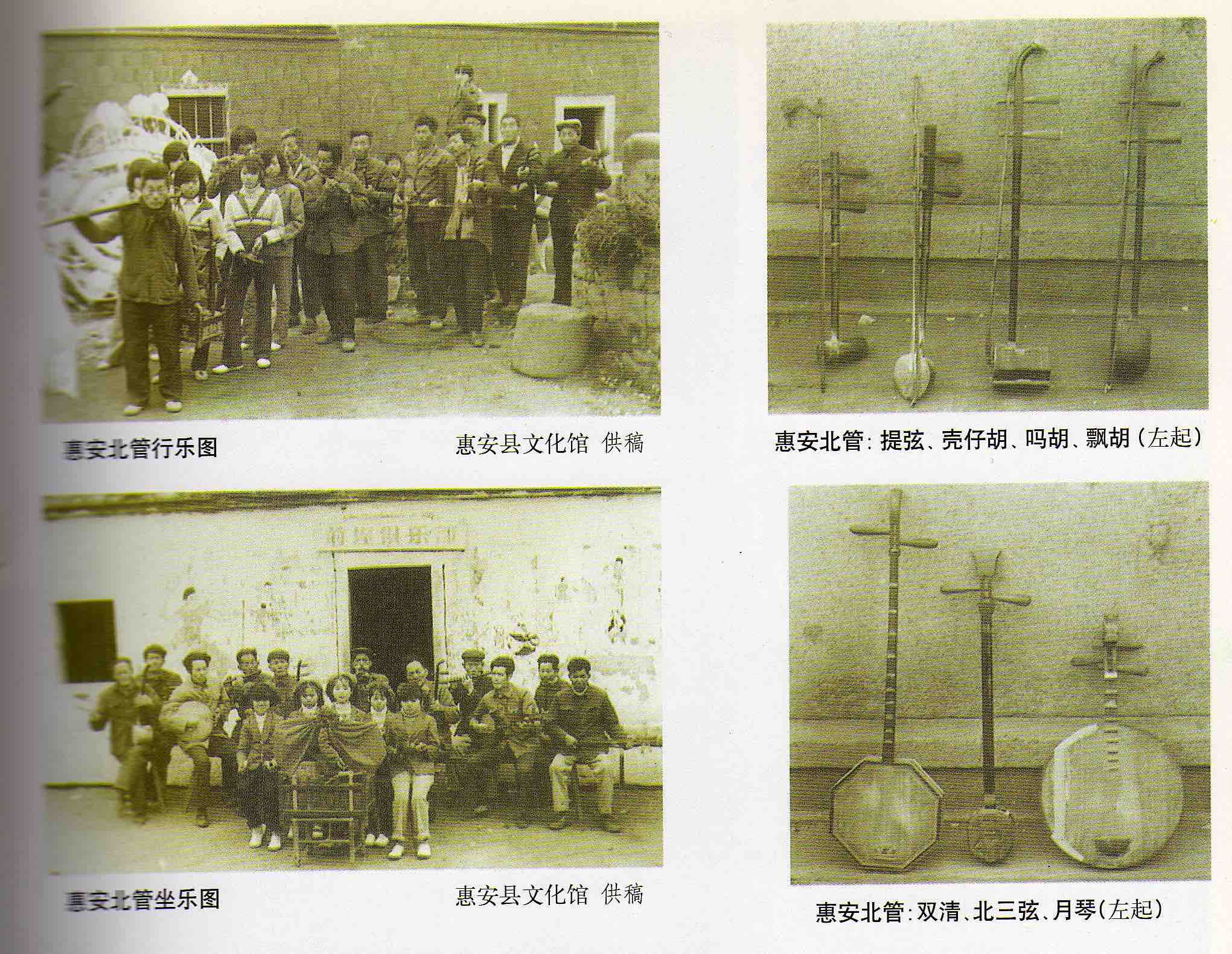
And I visited the beautiful county of Hui’an on the coast:

Hui’an 1986: left, nuns; right, the distinctively-clothed women of Hui’an.

After my first serious survey of ritual associations on the Hebei plain in 1989 with my trusty colleague Xue Yibing, he accompanied me on my return to Fujian in early 1990, moving north from fieldwork around Guangdong on a reccy for what became chapters 14 and 15 of Folk music of China. Xue Yibing’s careful notes were as precious as ever. Like Li Quanmin, we often began by visiting local experts; but we also sought out local ritual practice, such as temple fairs—and by contrast with most regions of north China, such activity was ubiquitous despite all the traumas of the intervening twenty-eight years.

In Quanzhou city we spent wonderful time with nanyin groups, and learned more about longchui, still magnificent, with the versatile ritual accompanist Wang Wenqin 王文钦 (then 66 sui) and shawm master Huang Tiancong 黃天從 (67 sui, son of Huang Qingquan who led the 1961 recording) as our guides. In Puxi village nearby we found shiyin (see photo here), and in Hui’an we visited one of many groups performing beiguan—a major genre in Taiwan.

As always, folk ritual is the engine for expressive culture, and a variety of such groups assemble for a wealth of temple fairs. In many communities around Fujian the extraordinary ritual revival was stimulated by funding from the overseas diaspora.

At the Tianhou gong 天后宮 temple in Quanzhou city we attended a vibrant Dotting the Eyes (dianyan 點眼) inauguration ritual for the goddess Mazu—with pilgrim groups from all around the surrounding area as well as Taiwan (including palanquins holding god statuettes, shiyin bands and a Gezai xi drama group), a Daoist presiding, ritual marionettes inside and outside the temple, along with magnificent nanyin and longchui.

Above: (left) ritual marionettes; (right) a Daoist officiates.
Below: longchui led by Wang Wenqin on foot-drum and Zhuang Yongchang on shawm.

Later the longchui performers invited us to a gongde funeral at which they alternated with three household Daoists performing a Bloody Bowl (xuepen 血盆) ritual, as well as a lively Western brass band. And the distinguished marionette troupe performed moving excerpts from Mulian 目連 ritual drama for us: [6]

puppet at grave

puppets group

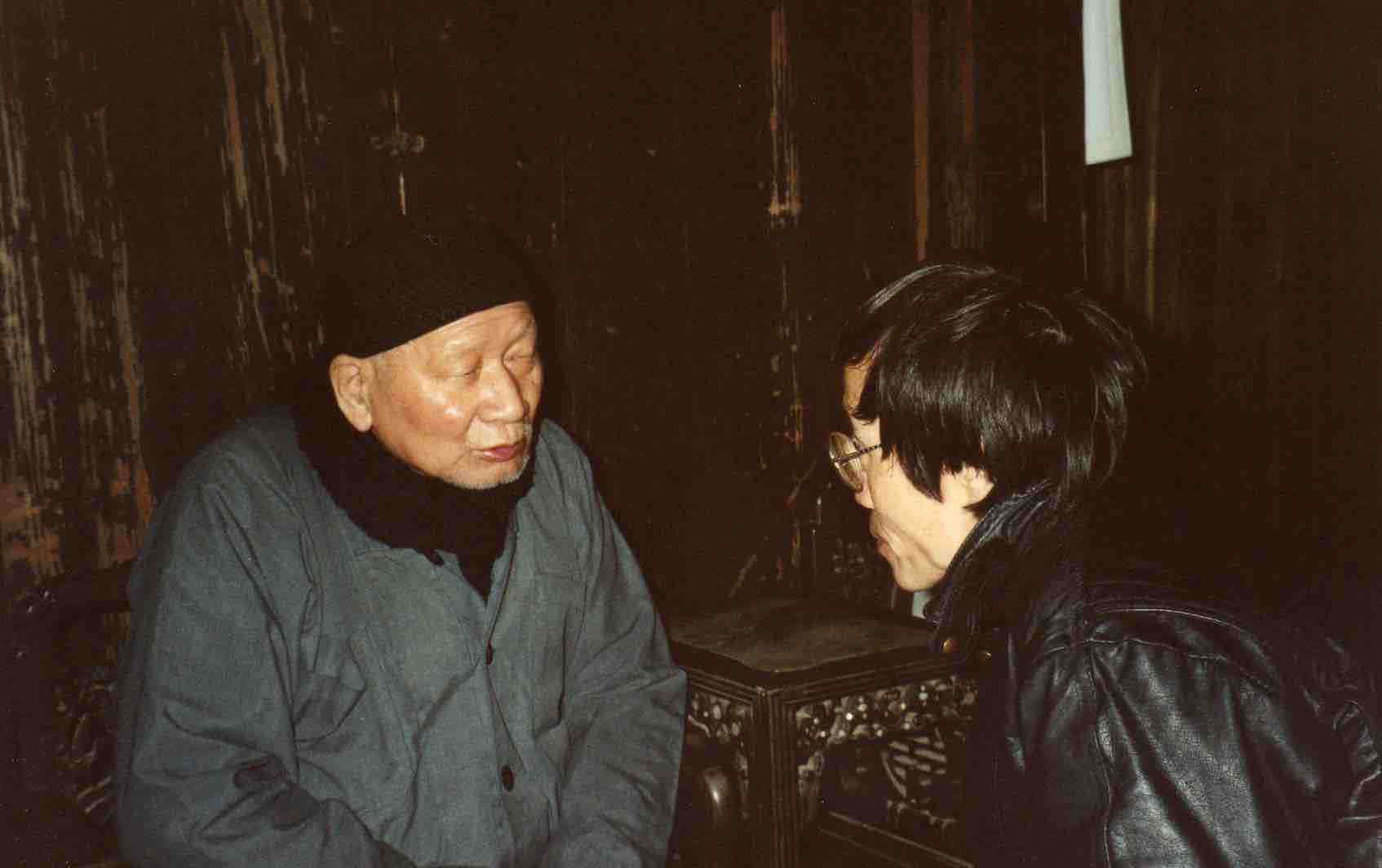
Having recently found the sheng-tuner Qi Youzhi in a town south of Beijing thanks to Yang Yinliu’s precious 1953 clue, we now visited the Buddhist monk Miaolian, whom Li Quanmin had visited in 1961. Now 78 sui, he was still at the Kaiyuan si temple; indeed, he had even remained there throughout the Cultural Revolution, when he was among a staff of over twenty resident monks.

Miaolian and XYB

Miaolian with Xue Yibing, 1990.

We ended our visit in Fuzhou, gaining further clues to the chanhe 禪和 (doutang 斗堂) style of folk ritual (see Zhongguo minzu minjian qiyuequ jicheng, Fujian juan, pp.2086–2243).

As for Li Quanmin previously, the trip merely allowed us to gasp at the enormity of the expressive cultures of Fujian. As I began focusing on north China, I was increasingly aware that local ritual activity must be a major topic there too.

Meanwhile the anthropologist Wang Mingming was doing detailed work on the history and ethnography of the culture of the Quanzhou region.

The Anthology
And meanwhile the monumental Anthology was being compiled, with volumes for folk-song, narrative-singing, opera, instrumental music, and dance each weighing in at between one and two thousand pages—and as usual, the published material is only a small part of that collected. To be sure, much of this consists of transcriptions (which anyway are of limited use if we can’t hear the recordings), but even the textual introductions (as well as the vocal texts, often orally transmitted) offer valuable leads.

Coverage of nanyin, the subject of a vast wealth of separate research, is distributed through the volumes on narrative-singing, instrumental music, and indeed opera. The Fujian folk-song volumes are among the most impressive in that category; the songs of the She minority are covered at some length (pp.1240–1412).

JC shawms

Shawm bands of Changtai county, and (lower left) of Putian county.

In the instrumental music volumes, besides the string ensembles much of the coverage yet again describes shawm and percussion bands. As ever, we find leads to genres that are still largely unknown outside their vicinity. And of course any single county has several hundred villages, all with their ritual and entertainment performance traditions. In 1986, for instance, at least 139 village nanguan societies were active in the single county of Nan’an.

beiguan JC

Beiguan, Hui’an county.

While the coverage of “sacrificial” and “religious” musics (pp.1757–2683) has now been eclipsed by the detailed projects on household Daoists led by scholars based in Taiwan and Hong Kong, the Anthology offers some leads. After a very brief introduction, we find transcriptions of items from the rituals of household Daoists in Putian, Xianyou, and Nan’an counties (pp.1757–1836, 2448–2683). Also introduced are xianghua 香花  household Buddhists of Fuzhou and Putian (pp.2086–2423); and the She minority feature again (pp.1836–93).

For all its flaws, the Anthology is a remarkable and unprecedented achievement.

* * *

Although field research since the 1980s has taken the study of the diverse sub-cultures of Fujian to a new level, it’s important to note the energy of the years before the Cultural Revolution. Indeed, apart from the riches of its performance traditions, Fujian has long had a deep tradition of local scholarship.

Of course, in the context of the pre-Cultural Revolution period, brief visits inevitably focused on reified “genres” rather than on documenting social activity. And “hit-and-run” trips by fieldworkers from Beijing or London can never compare to the long-term immersion of local scholars, like Wu Shizhong for nanyin, or Ye Mingsheng for Daoist ritual. Ye’s account of one single ritual performed by one group of Lüshan Daoists (even while hardly addressing their lives or ritual vicissitudes since the 1940s) occupies a hefty 1,418 pages!

As always, expressive culture—based on ritual—makes an important prism on the changing social lives of local communities.

See also Religious life in 1930s’ Fujian.


[1] See my Folk music of China, ch.14, with extensive refs. up to the mid-1990s; to attempt an update would be a major task. I have fallen back on pinyin, rather than attempting to render terms in local languages.

[2] See Zhongguo minzu minjian qiyuequ jicheng, Fujian juan 中国民族民间器乐曲集成,福建卷, pp.2703–4.

[3] Cf. Fujian minjian yinyue jianlun, pp.130–­36.

[4] For some refs., see my Folk music of China, p.293 n.17.

[5] For the Quanzhou region, see e.g. Stephan Feuchtwang, After the event: the transmission of grievous loss in Germany, China and Taiwan (2011), ch.4.

[6] Among a wealth of research on Mulian drama, see David Johnson (ed.), Ritual opera, operatic ritual: “Mulian rescues his mother” in Chinese popular culture (1989).

The Confucian ritual in Hunan

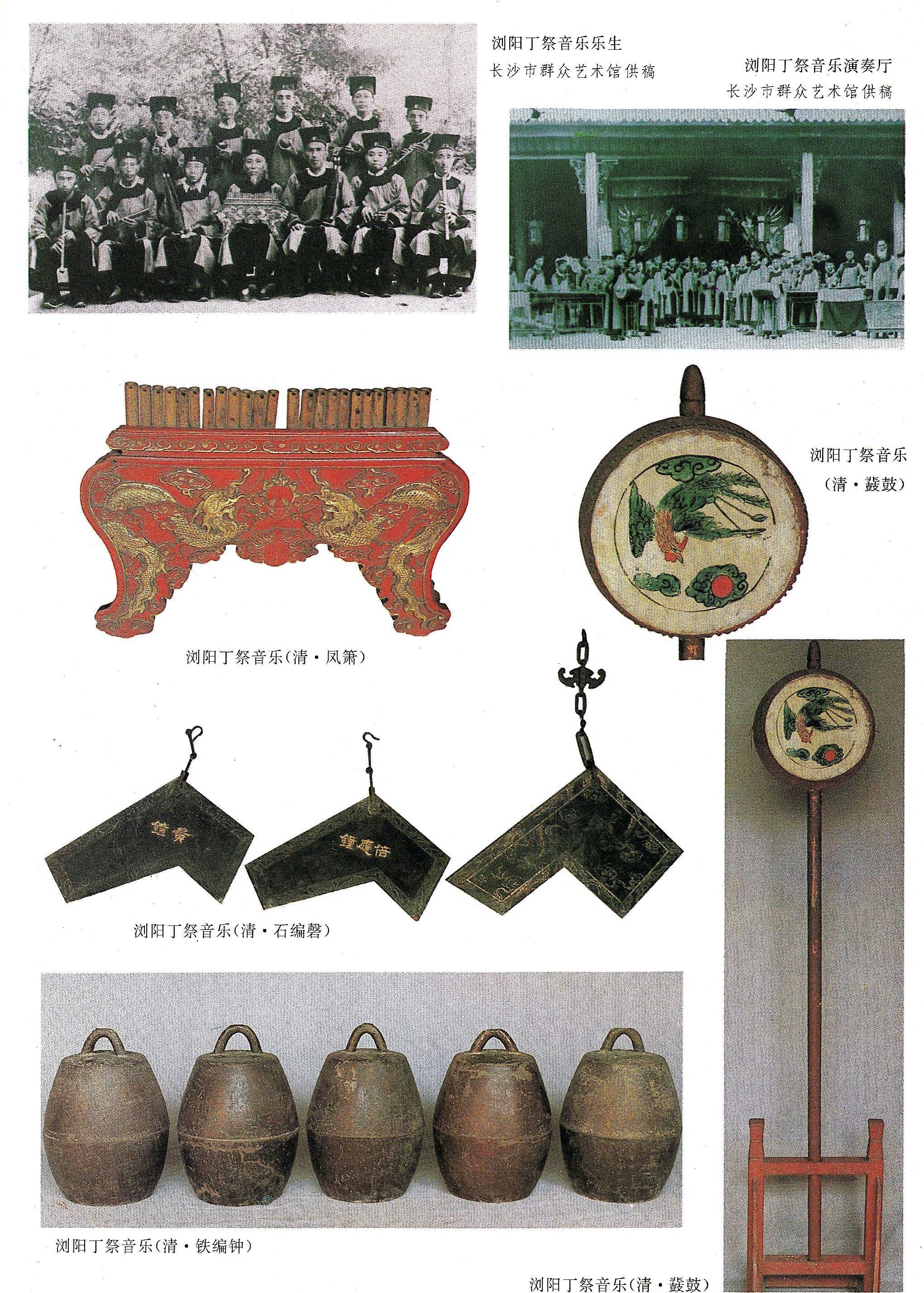
LY JC

Source: Zhongguo minzu minjian qiyuequ jicheng, Hunan juan.

One subject of Yang Yinliu‘s 1956 ambitious survey of the diverse performing genres in Hunan province was the large-scale Confucian ritual sacrifice of Liuyang, east of Changsha. Appendix 2 of his report,

  • Kongfu dingji yinyue 孔府丁祭音乐 (1958, 78 pp.)

was discreetly tucked away in a separate mimeograph; I haven’t yet tracked down the original, but its material is included in the 2011 reprint of Yang’s Hunan volume, and cited in the Anthology section. [1]

Perspectives
There are all kinds of themes to unpack here. First, a confession: my own reluctance to study the topic is flawed. Cultures routinely exclude certain soundscapes from their concept of “music”, but ethnomusicology counsels a far more inclusive view. Indeed, for China I’m keen to include the songs of spirit mediums, work hollers, and vocal liturgy within our brief. I have no argument with studying elite culture, even if in most societies, including China (both historically and today), it only represents a tiny tip of the iceberg (for imperial culture, see here; and for similar reservations about the qin zither, here).

I keep stressing that our focus shouldn’t be some reified concept of “music”, but expressive culture within society; and the topic of the Confucian rituals may lead all too easily to the glorification of some notional Golden Age of Ancient Sages. So I’m wary of “recreations” claiming to preserve or salvage such glories. Such a mindset may even distract us from other forms of musicking that are far more deeply embedded in social life.

Still, like the performance of modern CCP propaganda, the Confucian sacrifice is a political subject, which of course we have to study. So it may be irrelevant that it seems to exclude most features that I (or the Chinese) can perceive as “musical”, and that (unlike folk ritual) it seems remote from the lives of ordinary people. Ritual often seems austere—we might adduce the hymns or the fast chanted scriptures of household Daoists like the Li family—but expertise, human energy, social interaction, are usually evident in performance.

The origins of the Confucian sacrifices are in the numinous ancient music of Shao, whose wonders made Confucius himself oblivious to the taste of meat, if only for three months. But I’m going to start with the Tang—not because I wish to recreate its glories, but precisely because I don’t.

Now I don’t applaud the xenophobia and moralistic snobbery of the Tang poets Bai Juyi and his friend Yuan Zhen, as society struggled to recover from the cataclysm of the An Lushan rebellion (see here, n.2). Bai’s poems like “The Standing Orchestra” and “Chime-stones from Huayuan” (which I might rename “Just Can’t Get the Staff, Nowadays”) rest on a flawed nostalgic idealization of the Wisdom of the Ancient Sages; but, with ethnographic candour, they also reveal the ineptitude of the yayue Confucian ceremonial performers of his day.

Several studies have been made of these poems, but they were a theme that my teacher the great Tang scholar Denis Twitchett approached with relish (as you may see from our irreverent correspondence on the faqu, here and here; see also my own spoof Tang poems). So below I’ve adapted his (apparently unpublished) translations from a draft that he sent me, retaining the sometimes E.J. Thribb-like character of Bai Juyi’s original, and refraining from adding the Teutonic footnotes that every phrase invites (as parodied by Flann O’Brien’s commentaries on de Selby):

The Standing Orchestra
Drums and fifes of the Standing Orchestra blare out
Dancers perform the two-bladed sword-dance, jugglers toss the seven balls
Slender maidens walk the tightrope, quivering with long pole
Among the orchestras of the Court of Sacrifices is a rigid hierarchy
Those in the upper hall sit, those in the lower hall stand
In the upper hall the mouth-organ songs of the Seated Orchestra are pure
In the lower hall the drum and fife of the Standing Orchestra resound
At the sound of a single note from the mouth-organ songs, everyone inclines their ears
But if drum and fife were to play ten thousand pieces, no-one would listen
The Standing Orchestra is base, the Seated Orchestra noble
Once rejected, a member of the Seated Orchestra joins the Standing Orchestra
Playing drum and mouth-organ to accompany circus acts
But once a member of the Standing Orchestra is rejected, where can he find a job?
First he is sent to the suspended bells and chimes to play the ritual music
The ritual music has fallen so far out of fashion
That incapable dolts like you are ordered to perform the gong and zhi modes
When at the urban sacrifice we pray to the Earth Lord at the circular altar
The claim takes this music to move the spirits of Heaven and Earth!
Hoping to make the Phoenix come and the hundred beasts dance
Is just like driving your carriage north, hoping to arrive in Chu!*
The musicians are all incompetent fools—how can I adequately describe them?
And you, the Three Ministers of the Court of Sacrifice, whatever sort of men are you?

Chime-stones from Huayuan
Chime-stones from Huayuan, chime-stones from Huayuan
Men of old didn’t listen, but men of today listen
Sonorous stones from the banks of the Si river, sonorous stones from the banks of the Si river
Men of today don’t play them, but men of old played them
How is it that men of old and men of today are so different?
Which instruments are used and which rejected depends on the musicians
Although the musicians have ears like a wall, if they’re unable to distinguish Pure from Muddy sounds then they might as well be deaf!
When the pupils of the Pear Garden adjust the temperament
They only know the new sounds, they are ignorant of the old
Of old it was said of the fouqing chime-stones from the banks of the Si
That their sound moved the listener to thoughts of those serving and risking their lives in distant places
But when once the sound of the Huayuan chime-stones had been heard at the palace
The prince’s heart straightaway forgot his subjects guarding the frontiers
And sure enough, when the barbarian brigand rose up from Yan
Few of the generals were willing to die in defence of the borders
If once one understands how music and the state of government are intertwined
How can one simply listen to the clashing and clanging of these instruments?
“Xiang, the player of the stone-chimes, withdrew to his island in the sea”, leaving never to return
And now kids from the Chang’an market-place have become Master Musicians!
Who is there to truly understand the difference between Pure and Muddy sounds
Between the chime-stones from Huayuan and the sonorous stones from the banks of the Si?

So Bai Juyi is contrasting the expertise of the Seated Orchestra with the ineptitude of the ritual musicians, but “It’s Complicated”. The two genres serve entirely separate functions, with different demands. Technical virtuosity doesn’t correlate with efficacity: a lullaby serves its purpose perfectly, whereas the years of discipline that go into mastering a Paganini Caprice hardly go beyond mere technique. And some of the finest musicians in the world come from the “market-place”… Of course, recruiting practices may have changed from Tang to Ming, but I doubt if evidence is available to suggest that later ritual musicians were of a higher standard—they hardly needed to be. Bai Juyi’s argument doesn’t invalidate the performance, but it does rather, um, chime with my own reservations about studying it.

“But that’s enough about me”. Yang Yinliu, with his historical erudition and concern for “literati music”, “palace music”, and indeed “feudal superstition” and the culture of the “exploiting classes”, was doubtless more interested in the Confucian ritual than I am. Whereas I can see the “value” of exploring the topic but prefer to focus elsewhere, for Yang and his colleagues it formed part of the rich topic of archaeology and early historical sources on which they also worked tirelessly.

The wider context
A useful introduction, for the Ming, is

  • Joseph Lam, State sacrifices and music in Ming China: orthodoxy, creativity, and expressiveness (1998).

He stresses those features, even if the latter two may seem rather remote from many people’s understanding of the topic. For dance, see also

The stimulating article

  • Sébastien Billioud and Joël Thoraval, “Lijiao: The return of ceremonies honouring Confucius in mainland China”, China perspectives 2009.4.

mainly concerns Qufu in Shandong (birthplace of Confucius, and site of the most renowned rituals) and the rehabilitation of Confucius since the 1980s.

Confucian sacrifices were performed widely throughout the empire until the collapse of the imperial system in 1911. They are not only documented in the national dynastic histories but also (at the expense of folk traditions!) often occupy an unreasonable amount of space in imperial county gazetteers, compiled according to a template. The topic, burdened by abstruse theory and false nostalgia, may seem largely to belong to the rarefied confines of early sinology. However, as always, it is no timeless “living fossil”, but was constantly remoulded and re-invented throughout the imperial era right down to today.

Through the Republican era the rituals declined. After the 1949 Communist victory they were promoted by the Nationalist regime on Taiwan, but on the mainland they fell silent—apart from a few initiatives from cultural authorities.

In late imperial times the rituals must have been common elsewhere in Hunan too (the Anthology mentions mid-19th-century accounts in the Yongzhou and Jiahe county gazetteers), but it is those of Liuyang that came to achieve national celebrity. So here I’d like to introduce the fortunes of the rituals there over their life-span of a century, from the 1840s to the 1940s.

Liuyang [2]
Confucian sacrifices may have been performed in Liuyang since ancient times, but we only find firm evidence from 1829, when the local jiansheng 監生 official Qiu Zhilu 邱之稑 (1781–1839) was commissioned to begin a lengthy investigation of how to perform the rituals, with funding to establish a Bureau for Rites and Music (Liyue ju 禮樂局). His research was based not only on early compendia (including Han sources and the Qing Lülü zhengyi) but also on a visit to Qufu.

Qiu Zhilu then had to decide on the pitch standard (itself a thorny historical issue); choose the vast instrumentarium and repertoire (indeed, he is credited with incorporating folk elements, revising the system of one note per beat, and expanding the scale); and rehearse the singers, instrumentalists, and dancers. He documented the results of his research in a series of volumes.

Though Qiu Zhilu died in 1839, the rituals he had designed were first performed in the early 1840s. Every three years over sixty youths over the age of 12 sui within the town—“from decent families” shenjia qingbai 身家清白, an assessment that would have been abruptly reversed after the 1949 Liberation!) [3]—were recruited, training for a month before the 2nd- and 8th-moon rituals.

(An aside: I can’t help comparing this to the hereditary training of shawm-band musicians in Hunan and throughout China, who would begin playing percussion in the family band from around 6 sui, moving on to shawm in their early teens, and learning daily through constant participation in life-cycle and calendrical rituals. And that is where real creativity is to be found: for more on elite and folk cultures, with a detailed analysis of a qin piece and a shawm-band suite, see here. But as in the Tang, the efficacity of the Confucian ritual depended not on the performers but on the “arrangers”…)

The Qing statesman Zeng Guofan (1811–72), himself a native of Hunan, sent envoys to Liuyang to attend the ritual, recommending it to the emperor. After the collapse of the imperial system in 1911, the Bureau was still maintained, though only the 8th-moon sacrifice was now held. Wannabe emperor Yuan Shikai (1859–1916) sent envoys, who reported it to be superior to the Qufu ritual; envoys from there and other regions of the country (including Heilongjiang, Yunnan, and Xinjiang) came to study. Apparently the genre even appeared in a feature film made in the early Republican era.

Liuyang 2
Liuyang 1

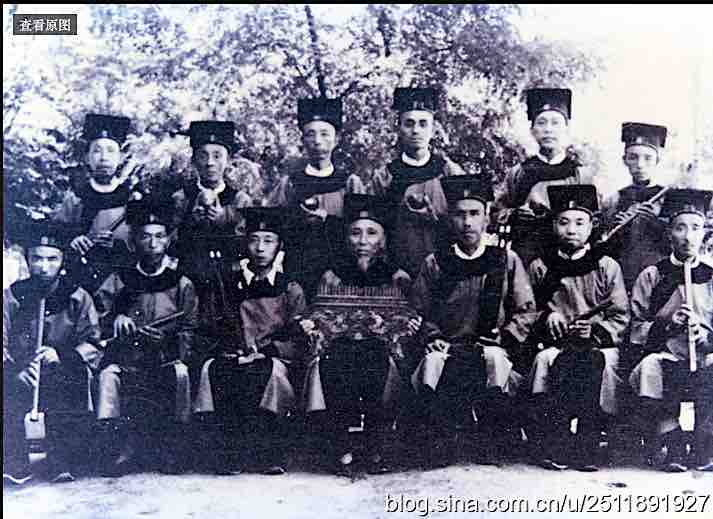
These photos of the Liuyang performers appear quite widely online, but I can’t find dates—can anyone provide them? The first seems to date from before Liberation; I surmise that the second was taken when Yang Yinliu took them to record in Changsha in 1956. [4]

As ever, I’m struck by both how much has survived and how much has been destroyed, and by the maxim “when the rites are lost, seek throughout the countryside”.

The 8th-moon ritual was held in 1937 with an ever-dwindling personnel. After Liuyang was occupied by the Japanese, activity was interrupted in 1944. [5] After Japan was defeated, the temple grounds were taken over by the Nationalist administration and a local newspaper. By the time of an October 1945 performance in the temporary provincial capital Leiyang, following social upheavals, instruments had been damaged and the (recent) tradition much reduced. In 1946 the senior Liu Puxian 劉蒲仙 led a ritual with over a hundred performers, still only a pale reflection of the previous quorum. The last ritual performance took place on 28th September 1948.

After the Communist victory, in 1951 the Liuyang Bureau of Culture retrieved the entire collection of over 350 instruments as well as the textual material, holding an exhibition; from 1953 they were stored in the Hunan provincial museum in Changsha, and some newly-reproduced instruments were made.

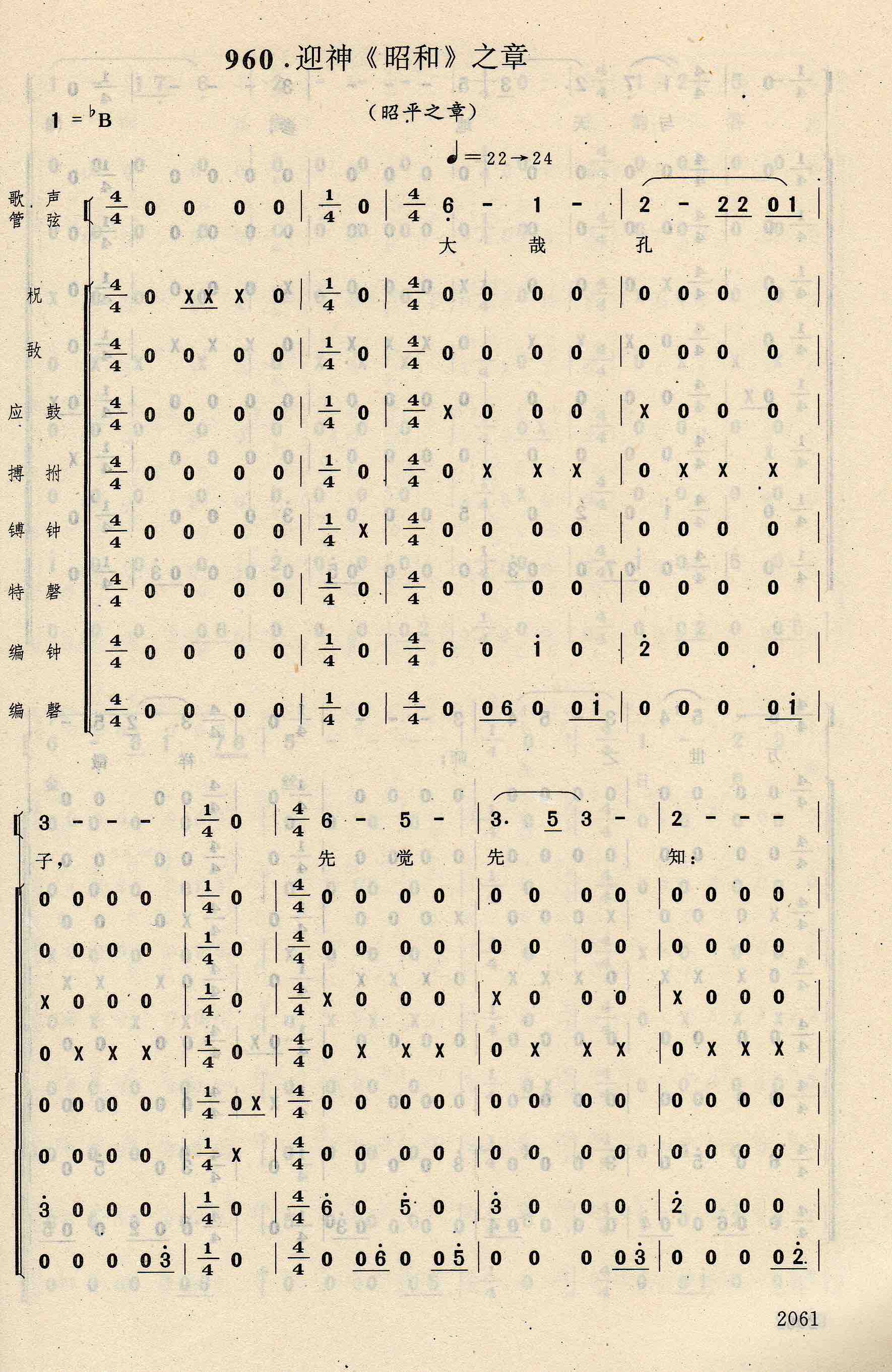
Such was the backdrop to Yang Yinliu’s 1956 visit. He now assembled a dozen of the senior performers to go to Changsha, recording some of the main hymns with a motley assemblage of instruments whose pitches no longer matched (a topic that he explored eruditely in his monograph). The Anthology reprints Yang’s own transcriptions of these recordings.

LY JC score

Zhaohe (Zhaoping) hymn to welcome the gods (opening), documented by Yang Yinliu. Source: Anthology.

Hunan was hit by the famine that followed the Great Leap Backward, but in 1962, in a brief lull between campaigns, the Hunan cultural authorities organized another project on the ritual. The instruments were even briefly returned to Liuyang; new performers were trained, and further recordings made. Ever since then the instruments have been kept at the Changsha museum. Meanwhile similar research was ongoing in Qufu.

From the 1980s, the resumption of research (now for the monumental Anthology) coincided with a progressive rehabilitation of Confucius and Confucianism. Indeed, Yang Yinliu’s 1956 work in Liuyang formed an important basis for the glitzy 1980s’ recreation of the most renowned Confucian ritual at Qufu, with which it had long-standing links. In recent years—inevitably—the Liuyang cult has been taken up by the Intangible Cultural Heritage (see here), although, as with many such projects, any tradition has long disappeared. The only remaining source was Qiu Shaoqiu 邱少求 (b. 1931), who had spent nearly ten years performing intermittently after training from the age of 9.

LY JC diagram

Reconstructed diagram showing deployment of instruments. Source: Anthology.

* * *

So once again, we have to unpack the thorny question “What is music?”. As Confucius himself observed,

Music! Music! Is it nothing but the sound of bells and drums?

Always remote from the lives of ordinary people, and performed only intermittently, the Liuyang ritual was a very minor aspect of musicking in Hunan; but it’s one that may attract sinological historians. To be sure, like folk musicking, it was in a constant process of change; and a certain creativity was involved—though far from the kind universal to most expressive culture in China and elsewhere.

With Chinese and foreign scholars alike still keen to imagine “living fossils”, such as the ritual traditions of Beijing, Xi’an, and south Fujian, reification is a dangerous theme throughout traditional culture.

Irrespective of my own ambivalence about the topic, Yang Yinliu’s work, even amidst pressure to downplay elite culture, shows his dedication to all aspects of performance and the historical background. At the same time, he wasn’t alone in studying the Liuyang ritual: the Hunan cultural authorities made efforts to document it throughout the first fifteen years after Liberation.


* Satnav on the blink again—Ed.


[1] Zhongguo minzu minjian qiyuequ jicheng, Hunan juan 中国民族民间器乐曲集成, 湖南卷, pp.2049–57, 2137, 2141, 2179–80, transcriptions 2060–85. See also Yang’s 1958 article “Kongmiao dingji yinyuede chubu yanjiu“, reprinted in Yang Yinliu yinyue lunwen xuanji 杨荫浏音乐论文选集 (1986), pp.276–97.

[2] For Liuyang, online sources I have consulted include http://blog.sina.com.cn/s/blog_95b86dd70102xhke.html
http://blog.sina.com.cn/s/blog_95b86dd70102xhqr.html
http://www.feiyicheng.com/cms/index.php?act=article&op=article_detail&article_id=2186
http://www.hnmuseum.com/zh-hans/zuixintuijie/浏阳古乐编吕钟
http://www.lyyzedu.com/Item/6021.aspx
In the Anthology, note the biography of Qiu Zhilu (p.2137) and the item on the Bureau of Rites and Music (p.2141).
See also Yu Yizhi 喻意志 and Zhang Yu 章瑜, “Liuyang jikong yinyue chutan” 浏阳祭孔音乐初探, Tianjin yinyuexueyuan xuebao 2008.2. As ever, several details remain to be clarified.
In English, an early mention of Yang Yinliu’s work on the Liuyang rituals is Rulan Chao Pian, Sonq dynasty musical sources and their interpretation (1967), pp.94–6.

[3] Having observed that many of the CCP leaders came from Hunan, I note that Liuyang was the birthplace of Hu Yaobang (1915–89), who would not have made a suitable recruit…

[4] This site, with 52 pages, contains a rich archive of visual images from Hunan, and leads to further sources showing the depth of both literati and popular culture there.

[5] An instance of my problems interpreting the material: I surmise that it continued until then even under Japanese occupation. One would like more detail on the whole period from 1937 to 1949—but please, if you go to Hunan, do look beyond the Confucian ritual!


Famine and expressive culture

Glimpses of the early 1960s’ cultural revival in response to desperation

Liu Shaoqi visits Hunan, 1961.

The disastrous consequences of the Great Leap Backward have been documented by several scholars. But between 1961 and 1965, as the CCP retreated briefly from extreme policies in a brief lull before the Four Cleanups campaign, traditional (incuding ritual) culture revived significantly throughout the countryside. I’ve documented this fleeting revival for my main fieldsites in Hebei (Plucking the winds, ch.5) and Shanxi (Daoist priests of the Li family, ch.5), and it often features in my accounts of local ritual—note also the Maoism tag.

Apart from talking with people who can recall the period, documents by the provincial Bureaus of Culture from the late 1950s–early 1960s make an unlikely but fruitful source. While they are prescriptive decrees calling for further suppression of a gamut of “superstitious” activities, they thereby show how prevalent such practices were becoming—precisely in response to the desperation of the Leap.

Hunan
Here I’ll focus on the province of Hunan, to complement my post on Yang Yinliu’s 1956 survey. [1]

Mao Zedong, Peng Dehuai, and Liu Shaoqi were all natives of Hunan. On 11th May 1959 Liu wrote to Chairman Mao after spending a month investigating the region of his birth:

According to comrades from the provincial Party committee, 40% of all houses in Hunan have been destroyed. Besides this there is also a portion that has been appropriated by state organs, enterprises, communes, and brigades.

On a visit to Mao’s home village in Shaoshan before the fateful Lushan conference of summer 1959, the Chairman himself had hinted at a partial retreat from the more radical policies of the Leap. Peng Dehuai went on to confront him at the fateful Lushan conference of summer 1959:

When Peng had gone back to his home in Xiangtan, he found abuse and suffering everywhere, from farmers forced to practice close cropping to cadres tearing down houses in the iron and steel campaign. Visiting a retirement home and a kindergarten, he saw nothing but misery, the children in rags and the elderly crouched on bamboo mats in the freezing winter. Even after his visit he continued receiving letters from his home town about widespread starvation.

Becker notes that in the anti-Peng hysteria that followed the conference, Hua Guofeng personally supervised the brutal persecution of Peng’s family who lived in the Xiangtan region. Provincial leader Zhou Xiaozhou, who had tried to blunt the impact of extreme leftist policies, was purged, and the madness only escalated.

Dikötter observes:

The number of people per room in Hunan doubled during the years of the Great Leap Forward, as entire families crowded into a single room the size of a wardrobe—despite the space created by the loss of several million to starvation.

Ambitious yet misguided irrigation and land reclamation projects further depleted the environment. People were beaten to death in 82 out of 86 counties and cities. As investigating teams dispatched to the countryside reported:

In Daoxian county many thousands perished in 1960, but only 90% of the deaths could be attributed to disease and starvation. […] Having reviewed all the evidence, the team concluded that 10% had been buried alive, clubbed to death or otherwise killed by Party members or militia. In Shimen county, some 13,500 died in 1960, of whom 12% were “beaten or driven to their deaths”.

Dikötter cites reports from 1961:

In Yuanling county, testicles were beaten, soles of feet were branded, and noses were stuffed with hot peppers. Ears were nailed against the wall. In the Liuyang region, iron wires were used to chain farmers.

Liu Shaoqi returned to Hunan in 1961 in a widely-reported trip (online, see e.g. here):

Determined to avoid the large retinue of bodyguards and local officials that inevitably came with every visit from a top dignitary, Liu set off on 2nd April 1961 from Changsha, travelling in two jeeps in the company of his wife and a few close assistants, bowl and chopsticks tucked away in light luggage, ready for a Spartan regime in the countryside. Soon the convoy came across a sign announcing a giant pig farm. On closer inspection, it turned out that the farm consisted of no more than a dozen scrawny hogs foraging in the mud. Liu decided to spend the night in the fodder store, and his assistants combed the place in vain for some rice straw to soften the plank beds. Liu noted that even the human excrement piled up for fertilizer consisted of nothing but rough fibre, another telltale sign of widespread want. Nearby a few children in rags were digging for wild herbs.

Liu Shaoqi’s fears were confirmed over the following weeks, however difficult it was to get wary farmers to tell the truth. In one village where he stopped on his way home, he found that the number of deaths had been covered up by local leaders, while an official report drew a picture of everyday life which had nothing to do with the destitution Liu saw on the ground. He clashed with the local boss, who tried to steer the team away from speaking with villagers. He tracked down a cadre who had been dismissed as a rightist in 1959: Duan Shicheng spoke up, explaining how the brigade had earned a red flag during the Great Leap Forward. To protect their privileged status, Duan explained, local leaders had systematically persecuted anybody who dared to voice a dissenting view. In 1960 a meager crop of 360 tonnes of grain was talked up to 600 tonnes. After requisitions villagers were left with a paltry 180 kilos, out of which seed and fodder had to be taken, leaving a handful of rice a day.

In his home village Tanzichong, friends and relatives were less reluctant to speak out. They denied that there had been a drought the year before, blaming cadres instead for the food shortages. “Man-made disasters are the main reason, not natural calamities.” In the canteen cooking utensils, dirty bowls and chopsticks were tossed in a pile on the floor. A few asparagus leaves were the only vegetable available, to be prepared without cooking oil. Liu was shaken by what he saw. A few days later, he apologized to his fellow villagers in a mass meeting: “I haven’t returned home for nearly forty years. I really wanted to come home for a visit. Now I have seen how bitter your lives are. We have not done our jobs well, and we beg for your pardon.” That very evening the canteen was dissolved on Liu’s orders.

A committed party man, Liu Shaoqi was genuinely shocked by the disastrous state in which he found his home village. He had dedicated his every waking moment to the party, only to find that it had brought widespread abuse, destitution, and starvation to the people he was meant to serve.

Becker also describes Liu Shaoqi’s visit to Hunan:

In the Hengyang district “nearly an entire production team had died of hunger, and there was no one left with the strength to bury the bodies. These were still lying scattered about in the fields from which they had been trying to pull enough to stay alive.” Yet when Liu Shaoqi and his wife, Wang Guangmei, visited Hunan to see for themselves, local leaders went to extraordinary lengths to try and deceive them. Along the road leading to Liu’s home town of Ningxiang, starving peasants had torn the bark off the trees to eat, so officials plastered the tree trunks with mud and straw to conceal the scars. […] Liu only managed to discover the truth in the village where he had been born, Ku Mu Chong, when some villagers dared to tell him that twenty of their number had starved to death, including a nephew of Liu’s, and that a dozen more had fled.

Expressive culture
With all this in mind, it may seem almost perverse to turn our attention to expressive culture. Doubtless in some areas upon the 1949 Liberation, traditional culture was virtually stamped out, quite abruptly, only reviving after the collapse of the commune system from the late 1970s. Even where traditional genres survived relatively unscathed in the early 1950s (in 1956 Yang Yinliu’s team found rich material on his fine fieldtrip to Hunan, and his report contains no hint of the impending disaster), one might suppose that they would have declined further as collectivization intensified. We might doubt the ability of performance genres to survive through the famine following the 1958 Leap. Indeed, in many regions, irrespective of any official prohibitions, it may seem inconceivable that people could even have the strength to observe traditional cultural practices (see e.g. here, under “Religion and culture”).

On the contrary, it seems that it was precisely the desperation of the times that prompted (on the economic front) a revival of folk performing groups and (in the sphere of belief) a renewed emphasis on traditional ritual. With no food or shelter in their home villages, people resorted to extreme measures. Migration was a traditional response to adversity; Hunan peasants often crossed the border into Hubei (cf. the flight of Yanggao dwellers to Inner Mongolia: Daoist priests of the Li family, pp.120–21).

For the condition of folk performance activity in the early 1960s, apart from talking with people who recall the period, official documents in the Appendices of several of the provincial volumes of the monographs on opera and narrative-singing in the Anthology make an unlikely but revealing source, containing documents from imperial, Republican, and Maoist times, often relating to prohibitions (for all three periods!). [2] Often they inadvertently reveal “negative material” in discussing the desperate revival of folk and ritual groups from the late 1950s, reminding us that even through all the traumas of campaigns and collectivization, traditional genres “obstinately“, however tenuously, kept active.

A series of detailed documents from the Hunan Bureau of Culture between 1957 and 1965 gives a remarkably frank impression of a far-from-stable socialist society. [3]

A document from September 1961 innocuously prescribes a systematic project on the province’s rich heritage of local opera, specifically calling for impartial documentation irrespective of “feudal” and “superstitious” elements. Doubtless they benefitted from the model established by Yang Yinliu on his 1956 fieldwork. A lengthier document from March 1962 explicitly includes the diverse genres of narrative-singing in the project.

By October the Bureau of Culture was discussing the registration of “folk professional scattered artists” (minjian zhiye lingsan yiren 民间职业零散艺人) that they had initiated in 1957. They note the recent growth of such performers along with state cutbacks and the arrival of migrant groups; some belonged to the “five black categories”, performing “unhealthy” items.

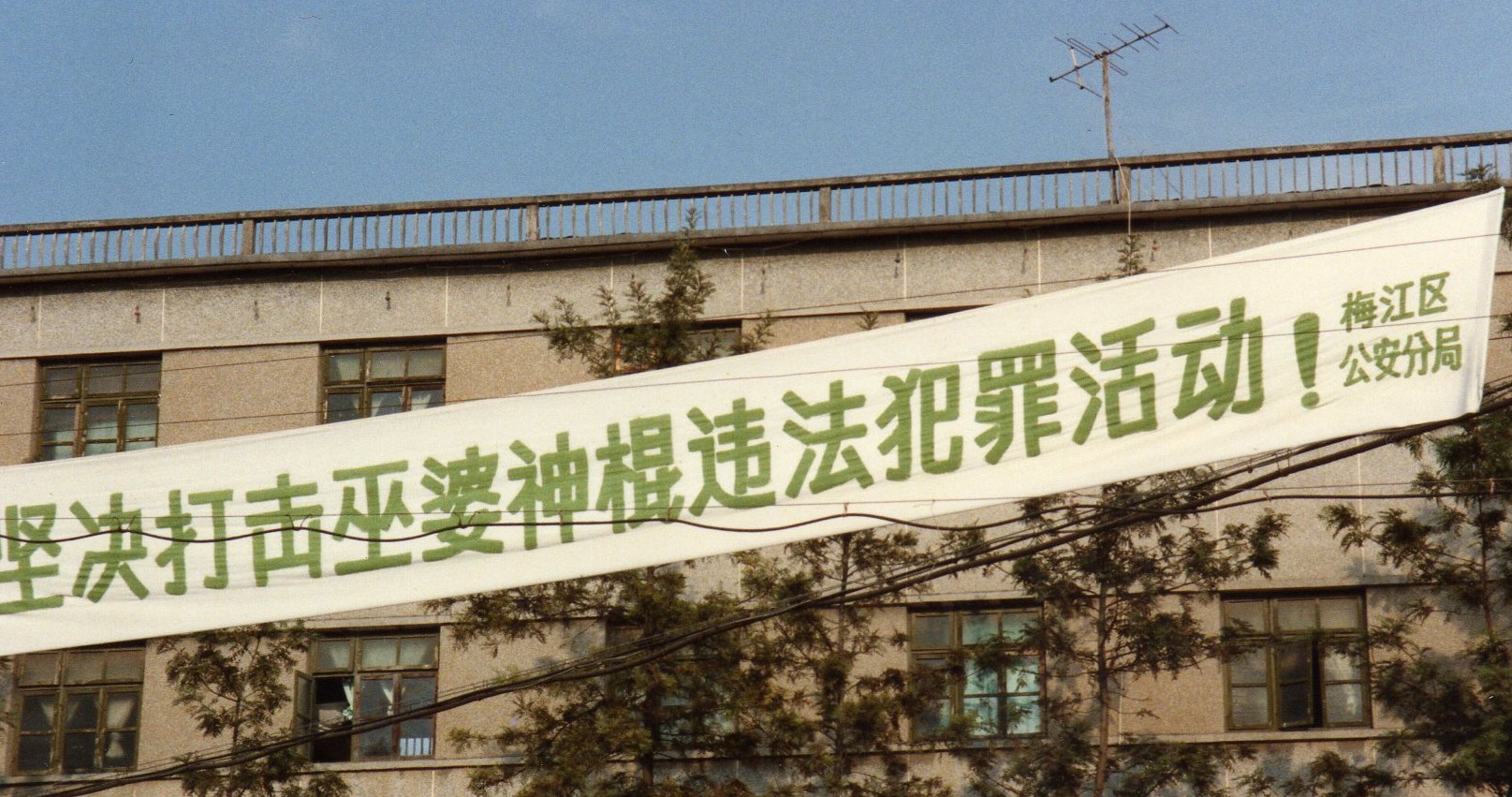
With new campaigns for Socialist Education, the tide was turning: by April 1963, prompted by a central decree from Beijing, the Bureau of Culture issued a ban on the performance of “ghost operas”, which had grown “in the last couple of years”. For rural and urban Hunan they describe an increase of funeral elegies and rituals, offering incense and worshipping the Buddha, constructing temples, and inviting opera groups for rituals to invite the gods and redeem vows, [4] all encouraging the spread of anti-revolutionary elements and reactionary sects (fandong huidaomen).

A draft discussion from 1964 elaborates further on how to register folk performers, mentioning over 12,000 rural scattered semi-professional artists (performing opera, shadow-puppetry, marionettes, and narrative-singing), some of whose groups “have become hiding places for class enemies, their programmes mostly spreading feudal superstition and capitalism.”

Despite (or because of) the rising tide of political campaigns, a lengthy supplement from August 1965 reveals continuing issues:

wenjian 1
wenjian 2
wenjian 3
wenjian 4

Under “Severe situation” (pp.622–3), problems are listed under five headings, all with detailed examples:

  • Performing bad [feudalistic, superstitious, capitalistic] programmes, long prohibited but still rife, “poisoning people’s thinking”. This was a problem among the state troupes as well as folk groups: from the founding in November 1963 of the No.2 Marionette Troupe in Xinshao county to September 1964, 84 of their 103 performances were deemed “superstitious”.
  • People abandoning production to take up itinerant performance. Of 96 shadow-puppet artists in one district, 21 took it up before Liberation, 17 from Liberation to 1958, but 58 since 1958—and those taking it up since Liberation were mostly strong young men, badly needed to help agriculture recover from the disasters of the years of hardship. In Lixian county, [5] the senior yugu performer Cheng Dengyun’s oldest son (33) was a production-team chief, his second son (28) team accountant, his third son a strong worker, but from 1961 they all took up yugu and abandoned production.

Left: daoqing/yugu performers in Hengyang municipality, 1956.
Right: yugu, undated photo from Zhongguo quyi zhi, Hunan juan.

Yugu 渔鼓, related to daoqing 道情 and shadow-puppetry, is one of the most widespread genres of narrative-singing around Hunan and nearby provinces, using a distinctive drum made from a bamboo tube. The separate Anthology item on the genre introduces the early and later history of yugu, giving useful leads for the various regional styles. [6] But the 1964 document valuably supplements the largely official picture of yugu modernizing under the avuncular guidance of the Party. Online, besides more glossy official versions, you can find some excerpts from recent funerary performances, like this from Qidong county.
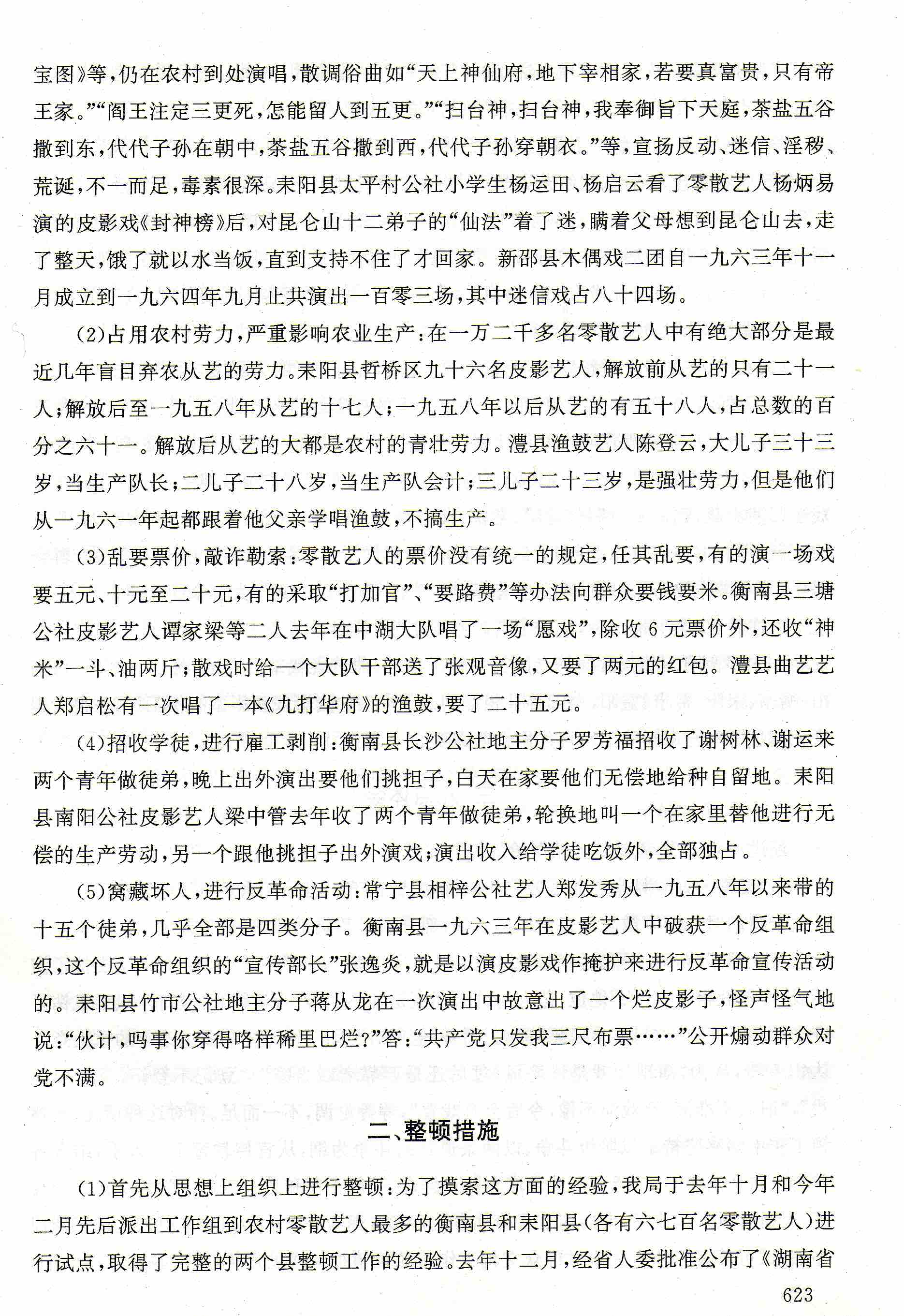
  • Exorbitant charges. In a case from 1963, two shadow-puppeteers from a commune in Hengnan county performed an opera to redeem a vow; apart from a ticket price [??] of 6 yuan, they also demanded a dou of “holy rice” and 2 jin of oil; at the end they gave a commune cadre a statue of the deity Guanyin and demanded a further 2 yuan as a donation.
  • Taking disciples, exploitative hiring practices—again showing the persistence of pre-revolutionary traditions.
  • Harbouring bad elements and carrying out anti-revolutionary activities; examples are given of puppeteers performing anti-Communist propaganda.

For local religious life over the Maoist era I haven’t yet sought documents from the Bureau of Religious Affairs, or indeed the archives of the Public Security Bureau, but one might expect revealing results there too.

Such coverage may be exceptional: for instance, the Monographs for Gansu are less revealing (see here, and here).

* * *

Having endured yet more traumas in the Cultural Revolution, such genres, mostly based on ritual practice, revived spectacularly after the collapse of the commune system in the late 1970s. But we can now see that the revival was not some miraculous atavistic re-imagining after three decades of silence: it took up a thread that had never been erased. Indeed, there was even a certain very limited activity through the Cultural Revolution decade. Equally, the wealth of research since the 1980s didn’t spring from a vacuum: it built on the brave work of scholars under Maoism.

Studies of expressive culture under Maoism are often narrowly based on central policy towards “the arts”. Candid documents like those discussed here reveal not only regional policy but—more interestingly—the real situation on the ground, even if they were seeking to “correct” it. Thus the Party refutes its own simplistic narrative that “feudal superstition” was abruptly suppressed after Liberation—a claim that is rarely challenged even by scholars outside China .

So the study of Maoism, expressive culture, and people’s lives should go hand in hand.

For more recent social issues in rural Hunan, click here; for famines in China and Ukraine, here. Cf. Gansu: connecting social trauma and expressive culture.


[1] The material here is based on Jasper Becker, Hungry ghosts and Dikötter, Mao’s great famine, consulting the indexes under Hunan. The famine in some provinces, notably Henan, was considerably worse: I won’t attempt to summarize the abundant material here, but again it is described by Becker, Dikötter, et al. For refs. to Henan folk opera troupes begging during the famine, see Zhongguo quyi zhi, Henan juan, pp.735–40. For the great famines of Ukraine and China, see here.

[2] Zhongguo xiqu zhi 中国戏曲志 and Zhongguo quyi zhi 中国曲艺志; cf. pp.329–30 of my “Reading between the lines: reflections on the massive Anthology of folk music of the Chinese peoples”, Ethnomusicology 47.3 (2003). For a recent discussion of sources on Maoism, see Sebastian Veg (ed.), Popular memories of the Mao era: from critical debate to reassessing history (2019).

[3] For all the rich material on local household Daoist ritual in Hunan, I would love to read more accounts of their activities under Maoism.

[4] Zhongguo quyi zhi, Hunan juan, pp.614–25.

[5] Confession: in “Reading between the lines” I miswrote this place-name—I have no culture!

[6] Zhongguo quyi zhi, Hunan juan, pp. 67–74; for its music, see pp.275–300, and Zhongguo quyi yinyue jicheng, Hunan juan.

An American musician in 1920s’ China

The great Yang Yinliu (1899–1984) (whose work is essential for an understanding of Chinese culture!) was brought up in the city of Wuxi amidst an environment of Kunqu, qin, and Daoist ritual.

In August 1921, the composer and violinist Henry Eichheim (爱希汉, 1870–1942), with his wife and daughter, made a journey to Wuxi to visit the great Wu Wanqing 吴畹卿 (1847–1927), leader of the prestigious Tianyun she 天韻社 Kunqu society, which dated back to the late Ming. Wu now arranged a series of seven private evening concerts for Eichheim. [1]

Apart from the main programme of unstaged Kunqu, the hosts performed solos for qin and pipa, “silk-and-bamboo” ensemble pieces—and Shifan gu and Shifan luogu, staple instrumental components of the local Daoists’ ritual repertoire, which Yang Yinliu was later to document in two definitive monographs. (Note how I avoided the dangerous term “Daoist music” there!) [2]

Shifan gu and Shifan luogu under the more monitored conditions of Maoism.

The concerts ended with Eichheim himself playing a selection of WAM violin pieces accompanied by his wife on piano—I can’t find a list of items, but I like to imagine that they included Kreisler’s Tambourin chinois (1910).

YYL

Yang Yinliu, undated early photo. Source: Yang Yinliu jinian wenji.

Among the musicians that Wu Wanqing assembled was his pupil Yang Yinliu, still only 22. Already a pupil of the American missionary Louise Strong Hammond, he now served as translator for Eichheim.

After trips to Japan, Korea, and India, Eichheim returned alone to a snowy Wuxi in December that year to hear more Shifan luogu. As Yang recalled,

I asked why he wanted to hear shi-fan-luo-gu again. He said that in the intervening months he had travelled to many countries, but this is the music that impressed him the most.

They played from 2 to 7.30pm, before Yang took Eichheim to the train station to rejoin his wife and daughter in India.

Later he also made trips to Indonesia. He was among many composers inspired by the soundscape of the Mystic East, including Ravel and Colin McPhee (but not Berlioz; see also Java to jazz)—though the influence of gamelan in his works, such as his symphonic variations Bali (1931), is not always audible.

Eichheim’s instrument collection is now housed at USCB. I wonder if any further records, such as photographs, survive of his visits to Wuxi. If only there were recordings! Perhaps it would be too much to expect Yang Yinliu to have taken him to film the rituals of the Daoists…

For Eichheim in Japan, click here.


[1] See my Folk music of China, p.248 (amidst an introduction to the Shifan genres, pp.252–69), and Peter Micic, “Gathering a nation’s music”, p.96, both based on Yang Yinliu, Shifan luogu (1980), pp.233–4. In my post on Yang I cited his earlier volume with Cao Anhe on Shifan gu. For the Tianyun she, see also Zhongguo xiqu zhi, Jiangsu juan 中国戏曲志, 江苏卷 p.726. Note also my lengthy review “Images of Abing”, British Journal of Ethnomusicology 6 (1997). For more on Eichheim, see Anthony Sheppard, Extreme exoticism: Japan in the American musical imagination (2019), ch.3.

[2] Despite my aversion to the term “Daoist music”, two volumes by Qian Tieming 錢鐵明 et al., Wuxi daojiao keyi yinyue yanjiu 無錫道教科儀音樂研究 (Taipei: Xinwenfeng, 1999) are substantial. Still, there is a wealth of research on Daoist ritual around the Jiangnan region that doesn’t pluck soundscape out of its ritual context—notably in recent years from Tao Jin 陶金 in Suzhou, Shanghai, and so on: note Roundup of posts on south Jiangsu.

A 1956 fieldtrip to Hunan

zuo getang

Wedding laments “seated in the song hall”, Jiahe county, Hunan 1956.

Over seventy-four days in the summer of 1956, less than three years after the fieldtrip to Hequ in Shanxi, the great Yang Yinliu led a team of eighteen colleagues from the Chinese Music Research Institute to south China on an ambitious survey of the diverse performance genres throughout the Hunan countryside, aided by members of the provincial Bureau of Culture and its local branches. This resulted in the remarkable book

  • Hunan yinyue pucha baogao 湖南音乐普查报告 [Report on a survey of the musics of Hunan] (Beijing: Yinyue chubanshe, 1960, 618 pp.).

cover

The original is none too easy to find—my own precious copy was presented by my splendid mentor Tian Qing. A 2011 reprint appears to be substantially re-edited, with some more recent material from the 1980s’ Anthology.

Meanwhile the Music Research Institute was working on the Minzu yinyue gailun [Survey of Chinese music, published in 1964], establishing a classification of genres and sub-genres that has endured since, with minor variants. But despite some studies on individual topics, never before in Chinese history had the sheer variety of folk genres in a given region been documented; such projects laid the groundwork for the Anthology.

If it’s impressive that the team undertook such fieldwork in 1956—even as collectivization was becoming ever more coercive, and on the eve of the 1957 rectification campaign—it’s just as remarkable that the volume was published in the desperate times of 1960, just as tens of million Chinese were starving to death.

The chapters are each subdivided by Han Chinese and “brotherly” [sic] ethnic minorities (Miao, Yao, Dong, Tujia, and so on), somewhat diluting the coverage of the latter.

map

Of course the volume bears the mark of its time; but “reading between the lines”, the material is precious. The collectors sometime mentions institutional changes since Liberation, but despite occasional outbursts of PC language, it’s abundantly clear that what they were seeking was traditional—and ritual—practice, and they always seek historical clues.

Though they didn’t often coincide with folk performance events, they visited a wide range of groups, making audio recordings and providing a wealth of vocal texts and transcriptions. Indeed, the published volume is only a selection from the material collected. Yang Yinliu introduced the project and its methods in a 1957 article, reprinted in Yang Yinliu yinyue lunwen xuanji 杨荫浏音乐论文选集, pp.262–75.

Even the texture of the paper evokes the character of the times!

The chapter on song opens unpromisingly with revolutionary songs—an inevitable nod to the political context (for more, see Hequ 1953). More accurately, the theme here is not just the Communist revolution but earlier social disturbances, notably the Taiping rebellion which had devastated the whole region. As to the revolutionary songs, of course they were, and are, part of the soundscape, and need to be documented—sadly, it is now hard to do the same for the anti-revolutionary songs that were also part of the “heritage”.

kids

Children’s songs.

Having paid lip-service to PC, the collectors go on to document “work songs“, “mountain songs”, “little ditties”, and the songs of women and children. Some of their precious recordings of work songs are included in the 2-CD set Tudi yu ge 土地与歌 [English title Songs of the land in China: labor songs and love songs], ed. Qiao Jianzhong (Taipei: Wind Records, 1996).

zan tudi

Singing the god of the soil, Han Chinese performer in Dong minority region of Xinhuang, west Hunan.

Customary (fengsu) musics are classified under calendrical and non-calendrical subheads. Many have ritual components: the former include songs to the god of the soil, pilgrimage songs, rain rituals, and 7th-moon rituals to the orphan souls. The non-calendrical items were mainly performed for weddings and funerals; texts of laments for both are provided—among the rich material here is extensive coverage of female ritual specialists “seated in the song hall” (zuo getang, see photo above), with dancing.

zhuma

Bamboo-horse, Yizhang county, south Hunan.

The seemingly unpromising rubric of song-and-dance is again based in ritual, with local variants of “flower-drum” (huagu), “flower lantern” (huadeng), and “bamboo horse” (zhuma) groups. A brief item on the zanggu 藏鼓 of Cili county, already rare by the 1940s, opens a window on the redemption of vows in conjunction with spirit mediums.

sixian, Wugang county, 1956 and 1980s.

For narrative-singing, apart from various regional types of yugu, daoqing, tanci, pingshu, lianhualao, and sixian, the team also unearthed interesting genres like the widely-distributed public declamations of the Sacred Edict (sheng yu 聖諭: cf. here, under Gegezhuang; cf. Zhongguo quyi zhi, Hunan juan, p.101).

The team could only provide a brief overview of the riches of regional opera, such as huagu xi (brief excerpts on CD2 of Jinye lai changxi [The beauty of Chinese opera], Taipei: Wind Records), marionettes and shadow-puppets, and nuoxi masked ritual drama.

Under instrumental music, after an introduction to individual instruments, the main topics (as in most regions of China) are shawm bands (xiangfang 響房, gufang 鼓房) and percussion groups—again serving life-cycle and calendrical rituals.

Ritual
Though ritual pervades all the sections, in view of the political climate separate coverage of more explicitly religious and ritual music is relegated to appendices—with an obligatory defence on the “significance” of studying the topic.

Here Yang Yinliu outlines Buddhist and Daoist temple and household groups (the latter under the heading of yingjiao 應教); the songs of spirit mediums (shijiao 師教, wujiao 巫教)—who, he notes, were ubiquitous; and folk Confucian practices.

zhou

Zhou incantations sung by Yinlian.

Under Buddhist temple music Yang considers the daily services and the major Flaming Mouth (yankou) and Water and Land (shuilu) rituals. For the latter, he already mimeographed a separate report after his return to Beijing in 1956. It’s based on the style of the Tianning si temple in Changzhou as learned by Yinlian 隱蓮 (then 52 sui)—a northern monk who after widespread “cloud roaming” was then working as a Chinese doctor in a lay Buddhist community in Shuangfeng county of Hunan.

A second Appendix, on the Confucian sacrifice at Liuyang, was mimeographed separately, and I discuss it in another post.

The whole volume attests to Yang Yinliu’s awareness of the importance of all kinds of ritual practice. As I’ve been writing this, I’ve updated my tribute to him, to reflect his studies of the ritual soundscape in a bit more detail.

The 1980s: ambitious new projects
Once political conditions allowed, a huge revival of traditional culture took place across Hunan, as throughout China, and fieldwork resumed uner the auspices of the monumental Anthology. Some of the genres uncovered by the 1956 fieldwork may have been unable to revive, but (as with all the provincial volumes) the editors could now elaborate on the genres that Yang and his colleagues had only been able to outline, with each broad genre (folk-song, narrative-singing, opera, instrumental music, dance) covering a couple of thousand pages. Apart from all the coverage of ritual genres under other volumes, in the instrumental music volumes the sections on “religious music” alone cover over 400 pages.

JC1

Folk ritual groups, Hunan.

In another post I’ve discussed the complementary tasks of making regional surveys and in-depth studies of a particular locale (for which, apart from my work on Gaoluo village and the Li family Daoists, see e.g. my reports under local ritual). Of course, all of the individual genres under these broad headings merit detailed studies—indeed, some of them have been the subject of monographs since the 1990s.

Despite Yang Yinliu’s background studying with the Daoists of his home city Wuxi, at the time he could only devote very limited attention to Daoist ritual in Hunan. Only after the 1980s’ liberalizations did it become possible to initiate major projects on local household “altars” of Daoist ritual in Hunan and elsewhere in south China. Though they mainly stress “salvage” rather than the changing fortunes of local ritual life since the 1930s, they provide a level of detail that most Chinese musicologists can hardly imagine.

JC2

Whereas the 1956 survey was partly documenting the riches of local culture on the eve of Liberation, the Anthology was seeking to record both the 1980s’ revival and earlier history, without quite spelling out the diachronic story. More recently, reification has only become more severe with the Intangible Cultural Heritage project.

* * *

Traditional local cultures may have begun a long decline soon after Liberation—indeed, even before, in wartorn regions under CCP control. But even after collectivization intensified from 1956, ritual and other genres somehow kept active—I take the story onto the mid-60s here. It’s yet another reminder that “a starved camel is bigger than a fat horse”, to cite The dream of the red chamber.

I can’t help thinking that under the CCP, for all that local traditions were attenuated and scholarship circumscribed, both somehow persisted more “obstinately” than in the Soviet bloc. Of course, surveys like the Hunan volume are far from the cultural ethnography of a changing society; still, the point is not to reify tradition but to read scholarship, of any period, within the context of its own time.

Meanwhile Yang’s colleague Zha Fuxi was making a survey of qin zither players around the country—a tiny but much-studied elite. And in the winter of 1961–62 Li Quanmin led a similar trip to Fujian province. Beijing scholars embarked on many such trips in the fifteen years between Liberation and the Four Cleanups, laying the groundwork for more ambitious projects after the 1980s’ liberalizations.

So to repeat my reminder: Chinese culture doesn’t reside merely in silent immobile old books in libraries… See also Social issues in rural Hunan.

The folk–conservatoire gulf

Yang Yinliu 1950

Yang Yinliu, 1950.

I just remembered a wise quote from the great Yang Yinliu. First, some useful background (“Typical!”).

Further to my post on Different values, the gap that has opened up between the sound ideals of traditional and conservatoire musicians is a regular theme of this blog (see e.g. many posts on “heritage” rounded up here). Indeed, I already discussed it in chapter 3 of my first book Folk music of China (1995/1998). It may be a spectrum, but it often seems like a chasm.

In the Republican era, in the face of the apparently wholesale victory of Western civilisation and technology over the “backward” Chinese heritage, along with the influx of a range of Western genres patriotic Chinese sought with modernizing zeal to create an “improved” “national music”, learning from the West while searching for valuable elements in their own tradition. This, of course, was a common reaction in many cultures around the world, as explored by Bruno Nettl.

Some rejected the old “feudal” culture completely; another response was a self-conscious musical antiquarianism, with educated Chinese establishing patriotic groups for the preservation of the “classical” heritage. This not only perpetuated the abstractions of early Confucian music theorists, but also left a legacy that has now been enshrined in the romantic staged reifications of the Intangible Cultural Heritage project.

Indeed, in the Chinese and foreign media this has come to stand for traditional music, despite the continuing vigour of a vast wealth of rural genres.

Early uses of the term “national music” (guoyue) were found among the literati of what were still regional groups, as in Chaozhou and Hakka groups and around Shanghai. What became a “conservatoire style” was based to a large extent on the Shanghai style.

Meanwhile inland in Shaanbei at the CCP base of wartime Yan’an, a debate was also waged between “foreign” and “indigenous” (yang 洋 and tu 土) approaches; the latter was always going to dominate, but Communist cadres often found the raw folk material that confronted them “feudal and superstitious”. I noted the dilemma of cultural cadres in “managing” poor blind bards there under Maoism; and for gender perspectives on “superstition”, see here.

The ambiguity, not to say confusion, of the Party line on traditional culture was expressed by Wang Chun, mentor of the author Zhao Shuli. He criticized both opera and narrative-singing, lamenting the close links between folk music and “superstition”. This established a tendency to treat music as autonomous, divorced from context.

Of course, all this was based on social conditions. At local level, despite the assaults on former patrons, the expressive culture of many rural societies remained based in ritual, whose values were little influenced by the secularizing trends of the cities. As you can see from my post on Festivals, what developed was a range of performance along a continuum.

17 troupe 1959

North Shanxi Arts Work Troupe, 1959. Li Qing front row, far right. His four years there (1958–62) were a brief interlude within a lifetime of ritual practice.

The new state-funded institutions (opera troupes, arts-work troupes, conservatoires, and so on) didn’t replace the traditional groups (like ritual associations, shawm bands, amateur clubs), but supplemented them. Musicians from folk backgrounds recruited to the official troupes found themselves having to compromise (see e.g. my Daoist priests of the Li family, pp.113–18). Some adapted more than others. Regional characteristics were gradually diluted in an attempt to forge a “national” synthesis (see e.g. The zheng zither in Shandong).

sfg-50s

Daoist Shifan gu, c1962.

Right, here’s what I was going to offer you:

The great Yang Yinliu, whose encyclopedic erudition on Chinese music history was enriched by being brought up among traditional musicians (Kunqu, Daoist ritual, the qin zither), was well aware of the stylistic conflict. In an article on instrumental music, first published in Renmin yinyue in 1953—not long after Liberation, and just as he was studying the shengguan music of the Zhihua temple—he touched on several sensitive topics including “temple music” and “palace music”, already under criticism from rigid ideologues on simplistic class grounds—carefully couching his defence in the new politicized language. He went on to observe tellingly (cited in my Folk music of China, p.51):

Once in Wuxi there was a technically brilliant and enthusiastic comrade directing a group of twelve folk artists who were thoroughly versed in performing the local wind-and-percussion music. He announced his opinions to them about the “improvement” [of the music] considering the peasants’ music too long (around half an hour), and that it would only be right if the pieces were abbreviated so that the whole suite lasted about five minutes; further, the peasants’ percussion music was too complex, with too many decorations; the workers only liked simple pieces, and they should eliminate all the decorations on the drum and other percussion instruments. The result was that the folk musicians began to feel doubtful, and their interest dwindled. They felt that after abbreviating the pieces, not only would it be difficult for them to make the transitions, but the transmission of the pieces would be endangered if the greater part of them were cut; and completely to eliminate all the decorations was simply to make them regress to the stage of beginners.

In such official contexts at least, uncomprehending apparatchiks wielded power over helpless folk musicians. I went on to comment:

As Yang wisely points out, “these opinions of the folk musicians cannot be neglected”, but the same patronizing attitude towards folk musicians and audiences alike remains endemic today.

Again, this relates partly to context: the apparatchiks were seeking to adapt folk music for short breezy staged performances, whereas in ritual life, musicking unfolds gradually over events lasting a couple of days.

Still, irrespective of the new institutions and the platitudes of Party pundits, folk activity persisted, resistant to Party ideology. And Yang, with his able colleagues at the Music Research Institute, just kept on researching living genres (both folk and elite), and their imperial history, right until the Four Cleanups campaign of 1964. But the sound ideals of folk and conservatoire musicians continued to diverge starkly, as we found with the 1980s’ recreations of the “suite plucking” of old Beijing.

More than Bartók, Yang Yinliu was also concerned with documenting the changing society in which music functions. As suggested in my post on him (such as his account of Daoism in Wuxi and his 1956 report from Hunan), he was attuned to issues that were soon to become basic to ethnomusicology—even if such study was still limited under Maoism, and (with honourable exceptions) remains so today under stultifying heritage propaganda.

See also under Walking shrill (with sequel), and Resisting fakelore. For more nuanced approaches to the conservatoire in Central Asia, click here.

Musicking at the Qing court 1: suite plucking

On the folk–art continuum in culture

XS early

“Musiciens Chinois. légation a Pékin”, Paul Champion, 1865/1866, with sanxian plucked lute, xiao end-blown flute, yangqin dulcimer, and sihu fiddle.

Inspired in 2017 by Stephan Feuchtwang’s 80th birthday to essay a fantasia on Bach at the court of the Qianlong emperor, I’ve been meaning to give a little introduction to the court music of the Qing dynasty (for another vignette, see here).

First we need to unpack the wafty term “court music”, subsuming all kinds of activities (for an early study from the Forbidden City, see e.g. Wan Yi and Huang Haitao, Qingdai gongting yinyue, 1985; see also the succinct introduction in Yang Yinliu, Zhongguo gudai yinyue shi gao, pp.1005–1009). It includes the large-scale yayue, ceremonial groups of both Inner and Outer courts, Daoist, Buddhist, and shamanistic observances, various genres of opera—and recreational chamber ensembles for life-cycle celebrations.
Most of the groups that I study in rural China serve the ritual needs of their local communities—whether occupational or (as in the case of sectarian associations) devotional. Amateur musicking for recreation or entertainment is less common. Even vocal genres like opera and narrative-singing are often occupational, largely serving ritual; but we do find some recreational groups, mainly in urban areas. And even here, the ceremonial–entertainment dichotomy is not clear-cut: recreational genres too were often performed for life-cycle and calendrical ceremonies.

Suite plucking
After Liberation, cultural cadres gave misleading names to many folk genres (cf. here, and for the “songs-for-winds”, here). The recreational chamber repertoire known since the 1950s as the “thirteen suites for strings” (xiansuo shisan tao 弦索十三套) was simply known as “suite plucking” (tantao 彈套). [1]

Often valorised by a narrow association with the Manchu court elite, it turns out to belong to a wider circle of folk activity (and here we may detect echoes of the hype surrounding the Zhihua temple). Indeed, it’s not useful to draw a clear line between folk and elite musical cultures in China—for a detailed instance, see this comparison of a qin piece and a shawm suite.

The social and cultural life of the late Qing is a rich topic, little explored in relation to these suites. I learn much from a 2013 article by Zhang Weidong 张卫东, stalwart of the amateur narrative-singing clubs around Beijing. Among many sources, he cites Jin Shoushen 金受申, Lao Beijingde shenghuo 老北京的生活—just the fascinating kind of social detail also found in the work of Chang Renchun on the customary and ritual life of old Beijing.

As part of his broad cultural education Aisin Gioro Yuhuan 爱新觉罗毓峘 (1930–2003), descendant of the Qing imperial family, learned the sanxian plucked lute from the age of 8 in Japanese-occupied Beijing with the former palace eunuch Luo Defu 羅德福, and later with blind musicians Wang Xianchen 王宪臣 and Zhang Songshan 张松山. He expanded on this background in several interviews, including articles in Renmin yinyue 1988.9 and 1990.6. For my visit to him, see here.

Like most musicking in China and worldwide, the genre wasn’t dependent on notation: indeed, it was largely an oral tradition. And again it illustrates the continuum between folk and art musics: it now tends to be associated with the Manchu–Mongolian nobility, but they learned this repertoire as patrons of lowly blind itinerant street performers (menxianr 門先 or gumu 瞽目) whom they invited to their mansions. Blind musicians are important in local social life, such as shawm players and bards (and, further afield, in Ukraine—formerly), and the menxianr were major players in the Beijing narrative-singing scene.

menxianr

Illustration from the “72 trades of old Beijing”.

In the mid-19th century [2] a blind sanxian player called Zhao Debi 趙德壁 was renowned for his rendition of the suites. His pupil Yue Fengting 岳鳳亭 was an influential transmitter of the repertoire. And Wang Xianchen, a protegé of the empress Cixi, served the inner court.

Instruments included the plucked lutes sanxian and pipa; a bowed lute tiqin or sihu; and the zheng zither—which, despite its rippling ubiquity in the conservatoires, is rarely used in folk ensembles in north or even south China. A xiao end-blown flute, dizi transverse flute, or small sheng mouth-organ might also take part, but were already less often used by the early 20th century.

Scores
In the early 19th century the Mongolian nobleman Rong Zhai (Ming Yi 明誼) learned the repertoire along with four other princes (gong 公), and in 1814 he compiled a gongche score in his Xiansuo beikao 弦索備考.

By the 1940s, this and several related scores kept in private hands had reached Beijing music scholars (cf. this post), Later Cao Anhe thickened the plot with a discussion of these versions, including forgeries, showing the importance of textual research:

  • Cao Anhe, “Xiansuo shisan tao paishengchulaide jizhong wei yuepu” 弦索十三套派生出来的几种伪乐谱, Wenyi yanjiu 1981.4.

This resulted in yet another project from the brilliant Music Research Institute (MRI) in Beijing under the aegis of Yang Yinliu, largely consisting of transnotations. It was first published in three slim volumes in 1955 and 1962, and then reprinted in 1985:

  • Cao Anhe 曹安和 and Jian Qihua 简其华 (eds.), Xiansuo shisan tao 弦索十三套.

Yet again I marvel at the energy and discrimination of the Beijing scholars before and after Liberation, also including Wang Shixiang, the great painter and qin player Pu Xuezhai雪齋 (1893–1966, another scion of the Aixin Gioro imperial family—see below), and Ling Qizhen 凌其阵. [3]

In 1963 Aisin Gioro Yuhuan was invited to teach at the Beijing conservatoires, but this was soon interrupted by the outbreak of the Cultural Revolution (cf. Daoist drum master Zhu Qinfu: my Folk music of China, pp.255–6). By 1985 he had hardly played sanxian for over thirty years, but he now worked closely with Tan Longjian to recreate the style of the Xiansuo beikao suites. She went on to publish separately the results of their work on the sanxian parts:

  • Tan Longjian 谈龙建, Qing gu gongwangfu yinyue: Aisin Gioro Yuhuan sanxian chuanpu 清故恭王府音乐: 爱新觉罗·毓峘三弦传谱 (1988), with a useful introduction by Yuan Jingfang 袁静芳.

Rong Zhai had given individual parts for each instrument, spelling out their heterophony. By contrast, when melodies of instrumental ensembles were notated, it was invariably in a single gongche skeletal outline, with the realizations on particular instruments left to the taste and experience of the musicians. This was evidently so for these suites too: the score was an isolated instance of documentation in what remained an oral tradition.

In one case Rong Zhai even gave a “full score” with all the parts aligned—perhaps a unique instance in traditional notation:

XSBK

Xiansuo beikao, opening of Shiliuban. From Zhongguo yinyueshi cankao tupian, vol.4 (1955).

Still, as in all traditions of musicking around the world, performance requires practical experience of learning with a master; and this applies even when notation is available.

The suites consist of sequences of melodies, though titles within the suites are not always given. The repertoire overlaps with that of shengguan ritual wind ensembles such as Haiqing 海青 and Pu’an zhou 普安咒, widely performed both in the temples of old Beijing and among amateur ritual associations in the countryside nearby and further afield. It was on these rural groups, still active, that I came to focus; and here too, I learned that one’s field of study must be far broader than “instrumental music“.

Changing society
As I often note for ritual studies too, scholars tend to favour reified documents, at the expense of changing social context.

Well before the Communist revolution of 1949, the social system had been changing along with the demise of the imperial system in 1911. But when musicologists began transnotating the suites in the early 1950s, there were still some musicians who recalled playing them—like Aisin Gioro Yuhuan, indeed. How I wish Yang Yinliu and his colleagues had managed to record them then, like their 1953 Zhihua temple recordings (sidebar playlist #14, with commentary here). According to Cao Anhe (1981) the MRI did indeed record four or five suites played by the great blind sanxian player Wang Xianchen (for whom, see again Zhang Weidong’s article). By 1950 Wang must have been at least 80 years old, but alas these recordings appear to have been lost. I’ll save another surviving recording for further below.

QYDWhat did persist in Beijing, both before and since the Cultural Revolution, was the amateur narrative-singing scene—a must for any aficionados of The dream of the red chamber, by the way. Some instrumental pieces are still played there as preludes or interludes, but the suite repertoire didn’t survive. Anyway, it’s another of the pleasures of Beijing musical life, less well publicized than the indie/punk scene there.

In the 1990s, between fieldtrips in Hebei, I enjoyed visits to a little hutong in Xinjiekou for the weekly gatherings at the house of the late great Qian Yadong 钱亚东 (right, in 1995—then aged 85!).

Jixian chengyun

Sihu, pipa and sanxian players (the latter blind—long rare at such gatherings) at Qian Yadong’s house, 1995.

For the narrative-singing scene in early 1950s’ Beijing, the vicissitudes of Czech and Chinese scholars and artists, and the 1980s’ Anthology, see here.

Belated recordings
With the renewed vigour of the 1980s, the Central Conservatoire in Beijing organized students to perform the suites on the basis of the 1950s’ transnotations, consulting Aisin Gioro Yuhuan and Cao Anhe.

I’ve given some instances of the aesthetic gulf between folk and conservatoire, and here’s another. While well-intentioned, these reified conservatoire recordings can hardly capture the more traditional mood of the earlier masters. Of course, young conservatoire students were not only learning from prescriptive modern notation, but belonged to another aesthetic world to that of the itinerant blind performers and the Qing nobility—and even to that of their own conservatoire teachers, many of whom (including masters like Yang Yinliu, Cao Anhe, Yang Dajun, Cao Zheng) had been brought up in a traditional aesthetic. Even the instruments, and their strings, would have been different.

You can find the conservatoire recordings in a YouTube playlist from David Badagnani (note also the Chinese documentary to which he refers):

So just like my own humble rendition of Bach on the erhu,

After intensive research on Qing-dynasty performance practice, I can now say with some certainty that…  it wouldn’t have sounded like this.

We can get more of a flavour of a convincing style for “suite plucking” from early recordings of narrative-singing in old Beijing. And thanks to Yuan Jingfang I learn of a 1950s’ recording of (a variant of) the “plucking suites” piece Hehuan ling 合歡令 on sanxian by none other than Pu Xuezhai (see above)! Indeed, whereas Pu quite correctly regarded the qin as merely part of the whole “qin, chess, calligraphy, and painting” amateur literati culture, he seems to have been more adept as a sanxian player. Gratifyingly, the recording has been reissued:

* * *

Such genres in China, largely performed by amateurs for entertainment, are commonly grouped under the umbrella term of “silk-and-bamboo” (sizhu). Some are mainly for instrumental ensemble (as in Shanghai or Chaozhou); in others (such as the nanyin of south Fujian) the ensemble mainly accompanies a solo singer, and genres may be classified under narrative-singing. They are often linked to a literate elite background, later becoming popular among ordinary people.

These groups have survived well along the southeastern coast. Nanyin continues to enjoy wide popularity, not just in the main urban centres like Quanzhou and Xiamen but throughout the surrounding countryside. Some genres are nationally renowned, and a common topic of music scholars; but my reading of the fine ethnographic reports around the region suggests that they are only a minor part of expressive culture there—with Daoists and mediums, opera troupes and puppeteers, shawm bands and percussion ensembles dominating the rich ritual culture of the area. Many more genres, little-known outside their catchment area, can be found in the instrumental and narrative-singing volumes, by province, of the Anthology (see e.g. the “silk-strings” of Wugang in Hunan, mentioned in my “Reading between the lines”, pp.327–8, and also recently the object of heritagification).

In the north, most string ensembles with substantial separate repertoires seem to have declined since the 1950s, suffering from a decline in both recreational activities and patronage. As for the south, I introduced some groups briefly in my Folk music of China, and again you can pursue them further in the Anthology—such as in Chengde northeast of Beijing; various types of Shifan 十番 ensemble; Henan bantou 板頭 and Shandong peng baban 碰八板 repertoires. See also my post on the “little pieces” of Yulin city—amateur groups that survived Maoism but became moribund since the reforms, with the kiss of death bestowed by the reforming zeal of cultural officials.

The question remains, why amateur folk activity in those chamber genres along the southeastern coast has remained strong through the Maoist and reform eras, with a spectrum of traditional and official styles, whereas in the north most amateur string ensembles seem to have become musical casualties of the revolution.

* * *

So while a narrow musicological approach tends to encourage reification, the study of “suite plucking” should lead us to the cultures of late imperial Beijing, both folk and elite; and to the voluminous sources on the whole history of vocal music.

What such research doesn’t spell out is that entertainment has moved on: the social milieu in which the plucking suites were performed before 1911 has long ceased to exist. The current Beijing elites no longer play along with itinerant blind musicians! Of course, the 1980s’ project on the suites was not seeking to reinvigorate them as a form of social life; they came to form part of the nostalgic re-imagining of the imperial past, quite removed from society. So this yet again confirms my reservations about recreating early music for genres whose performing traditions have been lost. As with any musicking worldwide (including WAM, such as Bach or Haydn), we need to study changing performance practice in social context, and reception history.

Ritual activity, however, persists in China. The rosy reification of imperial culture may distract us from the ethnography of groups that have remained active through the tribulations of the 20th century, and from the enduring importance of living soundscapes as part of changing social activity.

Lastly, even where we can distinguish between folk and elite cultures, there is nothing “superior” about the latter, either in China or elsewhere (see What is serious music?!, and for China, Dissolving boundaries)!


[1] Here I’ve expanded modestly on my brief introduction in Folk music of China, pp.208–12. For rich material on vocal and instrumental groups in the late imperial period, note Yang Yinliu, Zhongguo gudai yinyue shi gao, vol.2.

[2] Cao Anhe and Jian Qihua give Qianlong–Jiaqing eras, but Zhang Weidong’s later dates of Daoguang–Xianfeng (1820–61) seem more reliable.

[3] Ling Qizhen (1911–84) was a qin player, originally from Shanghai, later professor at the Shenyang Conservatoire, where he founded the Liaoning qin research association. For his useful 1958 article on “Buddhist music” in Shenyang, see here.

Guide to another year’s blogging


Struggling to encompass all this? I know I am. While we inevitably specialize in particular topics, it’s important to build bridges. I guess it’s that time of year when another guide to my diverse posts may come in handy—this is worth reading in conjunction with the homepage and my roundup this time last year.

I’ve added more entries to many of the sidebar categories and tags mentioned in that summary. I’ve now subheaded many of the categories; it’d be useful for the tags too, but it seems I can’t do that on my current WP plan. Of course, many of these headings overlap—fruitfully.

Notably, I keep updating and refecting on my film and book on the Li family Daoists. I wrote a whole series resulting from my March trip to Yanggao (helpfully collected here) and Beijing (starting here, also including the indie/punk scene). Other 2018 posts on the Li family include Yanggao personalities and Recopying ritual manuals (a sequel to Testing the waters).

To accompany the visit of the Zhihua temple group to the British Museum in April, I also did a roundup of sources on the temple in the wider context of ritual in Beijing and further afield, including several posts on this site.

I’ve posted some more introductions to Local ritual, including

Gender (now also with basic subheads) is a constant theme, including female spirit mediums—to follow the series on women of Yanggao, starting here. Or nearer home, Moon river, complementing Ute Lemper.

Sinologists—indeed aficionados of the qin, crime fiction, and erotica—may also like my post on Robert van Gulik (and note the link to Bunnios!).

I’ve added a few more categories and tags, notably

The film tag is developing, with a side order of soundtracks—for some links, see here.

I’ve given basic subheads to the language category (note this post on censorship), which also contains much drôlerie in both English and Chinese. Issues with speech and fluency (see stammering tag) continue to concern me, such as

Following Daoist football, the sport tag is worth consulting, such as The haka, and a series on the genius of Ronnie.

Some posts are instructively linked in chains:

More favourites may be found in the *MUST READ* category. Among other drôlerie, try this updated post, one of several on indexing and taxonomy; and more from the great Philomena Cunk.

Most satisfying is this collection of great songs—still not as eclectic as it might become:

Do keep exploring the sidebar categories and tags!


New tag: south China

FWIW, some more housekeeping.

I’ve just added a new tag to the sidebar, for south China, in addition to the “south China” subhead of the ritual category! This also picks up various posts on Hakka and Hokkien soundscapes.

My main topic is north China, to which (apart from its subhead under the ritual category; see also under Local ritual) I also give tags for Beijing, Hebei, Gaoluo, Shanxi (other) (supplementing the extensive category Li family), and Shaanbei. Ah, the joys of indexing

Lives of female mediums

*For a roundup of posts under the mediums tag, click here!*

Here’s a companion to my post on female spirit mediums and sectarians in Yanggao.

As I observed there, alongside the more literate manifestations of religious practice in China, mediums also play an important role in local society. The gender ratio varies by region, but in many areas female mediums dominate, serving not only as healers but as protagonists in religious life. [1] For them in particular, becoming a medium gives them a social status that is otherwise unavailable. Their tutelary deities may be either male or female.

Mediums often acquire their power as a result of traumatic domestic and psychosocial crises—which the Maoist era provided in plenty. [2] Mediums we met came from a wide age-range: some began their careers under the commune system, others since the 1980s’ reforms.

me-mot

Me-mot spirit mediums, Guangxi. Photo: Xiao Mei.

Perhaps the most detailed research on spirit mediums in China comes from Xiao Mei 萧梅, with her study of me-mot mediums of the Zhuang people in Guangxi in southwest China—including a diary of one medium’s busy healing schedule over a month (a fruitful way of studying the lives of local ritual performers—cf. the diaries of household Daoists Li Manshan and his son Li Bin).

In this region, as Xiao Mei explains, [3]

Whether mediums are biologically male or female, when performing as mediums they adopt the role of female. But they all have experience of having encountered intractable calamity, either personal (such as incurable illness or mental disorder) or domestic (such as frequent illness or death in the family) [SJ: here Xiao Mei doesn’t consider socio-political aspects], and it is only through becoming a medium that they can be released from such calamities.

In Jingxi county the me-mot have a close relationship with household Daoist priests. The latter not only play a major role during the process of someone becoming a medium, but also need to collaborate with the medium in practising rituals for averting calamity and seeking blessing.

For the Wenzhou region of Zhejiang province, note

and her new book

  • Re-enchanting modernity: ritual economy and society in Wenzhou, China (2020).

* * *

But mediums are also very common among the Han Chinese in north China.

For Yanggao in north Shanxi, I’ve just added Wu Fan’s interesting notes from 2003 to my post on mediums there. That post also includes some material (including photos) from the Hebei plain—which is now even nearer Beijing than it was when we were doing fieldwork on ritual groups through the 1990s. In the course of our studies we met many mediums; on and around Houshan they often channeled the goddess Houtu (see also here).

Zhang Zhentao (Yinyuehui, pp.302–4) introduces some of them in his notes from 1995, offering rare glimpses into their activities during the Maoist era:

Liu Derong (b. c1941), from a village near Houshan, used the ritual name (faming 法名) Longding 隆定. As she told us, while giving birth in 1954 and 1961 she “went mad”, clambering up the walls, fearless; in a dream she saw Guanyin of the Southern Seas seated in lotus posture before a table on the kang brick-bed. She would levitate, only coming back to the ground when she called out to the deity. She began healing at the age of 31 sui, around 1971, and had by now healed over a thousand people, notably for gynaecological ailments. We heard her sing “ritual songs” (foge 佛歌) such as The Ten Lotus Leaves (Shiduo lianhua 十朵莲花).

We also chatted with Ren Xiuzhi (then in her 60s), who came from another village in Yixian county. She had begun to “fall ill” in her 20s, and began healing people when 42 sui—in the mid-1970s.

These accounts also suggest that there could be quite a long gestatory interval between the initiatory crisis and the consolidation of healing powers.

Dingxing HTM 1995

Houtu temple, Dingxing Northgate 1995.

Still in 1995, nearby at the Houtu temple (formally called Taining gong 泰宁宫) in Northgate of Dingxing county-town, we met the exceptionally renowned medium Chen Shiying (1907–98), [4] who was still in charge of the temple. Indeed, its popularity rested mainly in her reputation as a healer.

I have supplemented our notes with the 1994 biography (indeed, hagiography) displayed in the temple, which shows a rather distinctive path:

Chen Shiying bio

Unusually for a medium, she came from a successful literate family. This precious old photo of the Chen family is said to date from the 1930s:

Chen Shiying old pic

As always, I wonder what became of them all through the ensuing turbulent times.

After the early death of her husband, Chen Shiying contemplated suicide. But when she was 37 sui (1943) her husband appeared to her in a dream, telling her that her mission was to become a healer.

Chen Shiying continued her story for us. By the age of 46 sui (1952!) she had earned such merit that Houtu occupied her body, telling her that as she had no resting-place, Chen should collect funds to build a temple for her. With collectivization escalating, she now had to persuade the reluctant village authorities. As she tearfully threatened the village chief that she would die if he didn’t give permission, and that he would soon follow her, eventually he had no choice but to allocate a plot of land by the river. She told us that she practised as a medium throughout the Maoist era, including the Cultural Revolution, though “Granny” (Houtu) didn’t necessarily possess her body then.

Now one would clearly like to learn more about this whole period… When we visited the temple in 1995, Chen Shiying was still living there, healing a regular succession of patients there. A placard was displayed, reading “Holy physician, sacred practitioner” (Shenyi shengshou 神醫聖手). “Granny” had recently told her she also needed an opera stage before the temple, so she was now busy assembling funds to build one.

As Zhang Zhentao observes, the popularity of the cult to Houtu depends largely on the great faith that villagers place in the efficacity of both the mediums and the deity occupying them.

* * *

In Shaanbei, spirit mediums (both female and male) are also ubiquitous (see here).

Here, again, we find that the waxing and waning fates of temples (not always evident from written sources) may depend largely on the efficacity of their presiding medium. The intrepid Guo Yuhua (Minjian yishi yu shehui bianqian, pp.378–9) gives an interesting illustration of such change over a brief period—in this case referring to a male medium:

On a hill above Yangjiagou village the Lingguan temple (full name Heihu lingguan miao, to Efficacious Officer Black Dragon) was rebuilt in the early 1990s and rapidly became very popular, thanks to the renowned efficacity of its healing matong medium. Villagers throughout the area flocked to its temple fair on 7th moon 15th, making donations of several thousand yuan that financed the new god statues and the performance of a “holy opera” down in the village.

But suddenly in 1996 the temple revenue declined sharply, because the medium died. Villagers explained that the god had departed along with him. Then over the following New Year the temple mysteriously caught fire. burning the “god places”, an offerings table, the door, and windows.

At the same time the village’s Longwang miao and Pusa miao temples were enjoying a revival with their successful rain processions during the droughts of 1995 and 1997. So villagers soon transferred their loyalties. As the “rain opera” at the Longwang temple on 5th moon 15th became popular, the Lingguan temple accordingly moved the date of its own temple fair to combine with it. The villagers even moved the Lingguan god statue, responsible for healing, to the Pusa temple so that they could seek cures before it at the 4th moon 8th fair, and “hang the locket” there for their children—not part of the temple’s original functions.

With this in mind, a return visit to Chen Shiying’s temple in Hebei, since her death, would be interesting.

As Guo Yuhua notes, this is also an instance of the resilience of popular strategies, by contrast with state measures towards religion. Temples are not just timeless ancient vestiges of some ancient cultural heritage, but depend on people—both educated and illiterate, both male and female.

Lingguan miao 99

The Lingguan temple, now forlorn, Yangjiagou 1999. My photo.

* * *

The healing sessions of mediums, while now acting in tandem with (rather than in conflict with) more orthodox medical procedures, are clearly a significant and enduring aspect of folk healthcare. And in all these regions, mediums vocalise in various forms including singing: soundscape is always an important aspect of our ritual studies (see also here, and here).

While it is hard enough to unearth the history of household Daoists under the Maoist era, it’s even more so for the female mediums. Their domestic healing activities never drew much outside attention, so it seems likely that they discreetly maintained their activities under the commune system. But since women tend not to relate their stories to the public life of the society, and such mediums are often illiterate, it will take thoughtful work to explore this topic. Similarly, fieldworkers are unlikely to happen upon the initiatory crises that first trigger their possession, which might also make a revealing study.

For more on studying gender in Chinese religious life, see here.


[1] Note the bibliographies here and here. See also my “Gender and music in local communities”, in Rachel Harris, Rowan Pease and Shzr Ee Tan eds., Gender in Chinese music (2013), pp.32–4 and n.40, as well as the work of Mayfair Yang on the mediums of Wenzhou (here, n.2).

[2] For a fine ethnography of an Yi community in Yunnan, describing possession and exorcism as symptoms of (and strategies to handle) the violent traumas of both Maoist and reform eras, see Erik Mueggler, The age of wild ghosts: memory, violence and place in southwest China (2001). The blunt psychiatric perspective of Albert C. Gaw et al., “The clinical characteristics of possession disorder among 20 Chinese patients in the Hebei province of China”Psychiatric services 49.3 (1998) is now richly augmented by Emily Ng in a study of mediums in Henan

[3] Adapted from Xiao Mei, “Bodies, gender and worldviews: me-mot spirit mediums in the Jingxi region of Guangxi”, in Gender in Chinese music, pp.247–64. For more, see Xiao Mei, “Chang zai wulu shang” 唱在巫路上 [Singing on the journey of the medium], in Zhongguo minjian yishi yinyue yanjiu, Huanan juan 中国民间仪式音乐研究·华南卷) [Studies of Chinese folk ritual music, South China vols.], ed. Cao Benye (Shanghai: Shanghai yinyue xueyuan chubanshe, 2007, vol.2, pp.328–494; note also the amazing scenes on the DVD). On the initiatory crises, see p.438 ff.; for the diary, pp.455–7.

[4] For her birth-date, the biography gives a Guangxu year of Yiwei 乙未, equivalent to 1895, but then states that she was 88 sui in 1994 (indeed, in 1995 she told us she was 89 sui), so perhaps we should read the year as 丁未。

Layers of fieldwork

SLY map - Version 2

Map of Upper Liangyuan village, Li Manshan 2012, showing former temples and the houses of Daoists.

As you may notice in my series of reports on local ritual, fieldwork often oscillates between various geographical levels, all mutually beneficial—zooming in with thick description, or out to sketch the wider picture.

Dong Xiaoping reflected on this issue in a thoughtful review of field reports on west Fujian (in Overmyer, Ethnography in China today, pp.347–50), commenting again on the old “unity and diversity” theme in Chinese culture.

We need a balance between “making a base” (dundian) and “surveys” (pucha). My two detailed long-term projects on Gaoluo village and the Li family Daoists have both benefitted from surveys of the wider regional culture of which they are part.

Thus, in my writings as in the wider literature, one can find studies of

My posts on local ritual illustrate all this with many maps. The more we zoom in, the more satisfying the results; but the broader picture is necessary too.

Hokkien culture: nanyin

Nanyin 1986

Nanyin, Quanzhou 1986.

In my little introduction to Chinese bowed fiddles, I mentioned the wonderful chamber genre nanyin 南音 (aka nanguan 南管), one of the most refined social activities in the Hokkien culture of south Fujian and Taiwan, complementing the riches of Daoist ritual there. The slow tempi, instrumentation, and the restrained passion of its singing style may remind us of the more plangent of medieval European ballads.

nanyin 86

Nanyin, Quanzhou 1986.

At some remove from research on performance genres in north China, this is a clear case of long-term and deep fieldwork from local scholars. I still find rather apposite my 1993 review of a wonderful Ocora CD-set of the Nansheng she group from Tainan (CHIME 7, pp.114–20), and chapter 14 of my book Folk music of China, where I gave a brief overview of the (then) state of the field. (Click here for one of several online tributes to Ts’ai Hsiao-yueh, leader of the Nansheng she group on the Ocora recordings.)

Apart from its reification for the concert stage, nanyin is deeply embedded in community life—amateur clubs, temple fairs, opera, puppetry, Daoist ritual—all within the special circumstances of rapprochement with overseas Hokkien communities, cross-strait diplomacy, and vast social and economic transformations.

Wonderful as nanyin is, alas the idea of “living fossils” has still not been erased—anyway, it’s far from alone in China in preserving an ancient tradition. And it’s worth reminding ourselves that it’s only one of a glorious profusion of performance genres even in Fujian—it occupies a mere 22 of 611 pages in the 1986 Fujian minjian yinyue jianlun by Liu Chunshu and Wang Yaohua, themselves leading proponents of the genre.

This UNESCO introduction is almost bearable, covering some of the main bases:

And among many online videos, this documentary also suggests the broader social and ritual context:

One little caveat: like a recent article on shadow puppetry (“How a bunch of Americans preserved a dying Chinese tradition”!), it’s worth registering the contributions of laowai without getting an inflated notion of their importance. Scholars like Kristofer Schipper, leading light in producing the Ocora CDs, are justly admired in China and Taiwan, but genres like nanyin are never dependent on such a deus ex machina.

Consulting Schipper’s liner notes, even in 1982, or 1993, it was far from true that nanyin was “almost forgotten in its own country”! As I commented, the statement “the positive reception of the European public led to regained esteem in China. Nan-kuan was authorised on the continent once more” is worthy of Tintin. Are we to believe that the 139 village nanguan societies in 1986 in the single county of Nan’an (to give just one example) were spurred into action by a single concert in Paris?! Folk activity (for nanyin and other genres) had even persisted throughout the years of Maoism. Meanwhile activity has continued to thrive, and research, already extensive by the early 1990s, has kept pace. A wealth of recordings is now available on CD and online. It’s exquisite music—do keep exploring!

For broader introductions to expressive cultures around Fujian, click here and here.

Daoist ritual in south China

Yongfu

From 2011 Hong Kong conference volume.

I go to some lengths to show how Daoist ritual and religious practice are important topics in the local cultures of north as well as south China (for a succinct encapsulation of the chasm, see here). But every time I feel I’m establishing some kind of parity for the north (heartland of ancient Chinese culture!), yet more research materializes to remind us just how amazing local ritual traditions are in the south—in terms of both the range and complexity of rituals performed, and the sheer volume of artefacts preserved there.

As I commented in Appendix 1 of my book Daoist priests of the Li family (where you can find further references),

With the noble exception of studies by Chinese music scholars from the 1930s, fieldwork on local Daoist ritual began in earnest in the 1960s with Kristofer Schipper’s groundbreaking studies in Taiwan. As mainland China began opening up in the 1980s, such work was able to expand first into Fujian and then further afield in south China—Jiangxi, Guangdong, Sichuan, Hunan, Zhejiang, and so on. Major projects (largely in Chinese), led by the indefatigable holy trinity of C.K. Wang, John Lagerwey, and latterly Lü Pengzhi, recruited local cultural workers who went on to develop considerable familiarity with the ritual specialists who were their subjects.

  • Wang, C.K. [Wang Ch’iu-kuei 王秋貴] ed., Minsu quyi congshu 民俗曲藝叢書. Taipei: Shi Ho-cheng Folk Culture Foundation, 86 vols (building on an extensive series of articles in the journal Minsu quyi).
    See also “The collecting and editing of Taoist ritual texts.” CHINOPERL Papers 23 (2000), pp.1–32, and Studies in Chinese ritual, theatre and folklore series: abstracts of the first sixty volumes (1997).
  • Wang, C.K. ed., Zhongguo chuantong keyiben huibian 中國傳統科儀本彙編 (Taipei: Xinwenfeng), 17 vols.

For useful reviews in English of the early projects, see

  • Daniel L. Overmyer, ed., with the assistance of Shin-Yi Chao, Ethnography in China today: a critical assessment of achievements and results (2002),

and for a fine overview of such work within the wider context of Daoist studies,

  • Vincent Goossaert, “L’histoire moderne du taoïsme: État des lieux et perspectives.” Études chinoises XXXII-2 (2013), pp.7–40.

These vast series continue to yield further discoveries. The latest project, from Xinwenfeng in Taiwan (long an industrious publisher of major works on Daoism) is initially (!) planned to comprise fifteen lengthy monographs:

The southern bias of Daoist studies has a long ancestry: from very early in Chinese history, southern Daoists have dominated the picture. The ritual vocabulary that I provide in my writings on north China is partly an attempt to rebalance a picture largely conditioned by southern Daoism (see also my In search of the folk Daoists, pp. 15–21, 211–213). As I note there,

It is rather as if our knowledge of Christianity in the whole of Europe were based almost entirely on Sicily and Puglia, with the odd footnote on the Vatican and Westminster Abbey. We may like what we find in those places, perhaps considering it more exalted, mystical, and ancient—but that is another issue. (For a similarly rash comparison between Taiwan and the PRC, see note here).

Still, the material here is overwhelming. So far three volumes (each consisting of around 1,500 pages!) have been published in this new series, on local Daoist altars in Jiangxi, Hunan, and Fujian respectively:

  • Dai Lihui 戴禮輝 and Lan Songyan 藍松炎, Jiangxi sheng Tonggu xian Qiping zhen Xianyingtan daojiao keyi 江西省銅鼓縣棋坪鎮顯應雷壇道教科儀 (2014)
  • Lü Yongsheng 呂永昇and Li Xinwu 李新吾, Shidao heyi: Xiangzhong Meishan Yangyuan Zhangtande keyi yu chuancheng 師道合一:湘中梅山楊源張壇的科儀與傳承 (2015) (for Hunan Daoism, see my overview here)
  • Ye Mingsheng 葉明生, Minxinan Yongfu Lüshanjiao chuandu yishi yanjiu 閩西南永福閭山教傳度儀式研究 (2017).

Ye Mingsheng is one of the most distinguished collaborators of the project, having worked for decades on Lüshan household Daoists of Fujian. This new publication focuses on ordination rituals in Yongfu in the southwest of the province. As John Lagerwey writes in his Abstract:

The present book begins with an investigation of the histories of the Daoist altars of four lineages […] in Yongfu. It systematically examines the origins of the local Lüshan school, the structures of their altars, and their rituals, manuscripts, talismans, and registers. It also describes in detail two actual Flag-Raising Transmissions in the years 1999 and 2011, discussing all aspects of the transmission ritual from a variety of disciplinary angles so as to provide students of religion with as complete an understanding as possible.

Volume 2 provides a wealth of ritual texts. Among the many photos is a substantial section in colour, including beautiful god paintings.

Yongfu picsStill, even photos of ritual practice remain silent and immobile. Given that ritual is noisy and vibrant, part of “red-hot” social performance, the whole project seems to cry out to be accompanied by films. Since the scholars working on these projects have rich archives of fieldwork videos, how very valuable it would be to accompany each topic with an edited film of, say, two or three hours, with voiceovers and/or captions.

As I observed here, all these series (like the “music-genre” system of Yuan Jingfang), while documenting particular rituals in detail, focus on the salvage of texts—at the expense of ethnographic study, performance practice, and social change (an approach deriving largely from the study of Daoist ritual in Taiwan). Now, faced by such a wealth of precious manuscripts it’s no simple task to incorporate the topic into wider discourses on a society in constant change. But many students of religion, for whom social and political changes over the past century are a major topic, may find that “variety of disciplinary angles” elusive. They may miss even succinct discussion of how local ritual traditions have been affected by such mundane issues as migration, successive political campaigns, and changing economic circumstances—all the more since the subject of this new volume is transmission, utilising field material from 1999 and 2011, through yet another period of change. [1]

Still, none of this detracts from the value of the project. This vast body of work on local ritual in south China continues to form the vanguard of Daoist ritual studies—essential material on Chinese religion.

For broad introductions to expressive cultures around Fujian—based on ritual—click here, including references to the fine writings and film of Ken Dean, one of few scholars of Daoist ritual to encompass modern social change; and Fujian: instrumental groups as a gateway to the study of ritual. See also Religious life in 1930s’ Fujian, and More films on ritual drama. And for a recent monograph in the series, click here.


[1] For basic biographical accounts of the Yongfu Daoists, see pp.79–103.

A brief guide to Chinese fiddles

Further to the delights of Indian and world fiddles, I write this partly as a reminder to myself, while I enjoy an unlikely renaissance in my playing of the “mellifluous” erhu fiddle (see also here).

For Chinese instrumental music, I’ve showed how the conservatoire solos are merely the tip of the iceberg. The great majority of instruments are played not solo but as part of ensembles, not on the concert platform but as part of social life. Bowed strings mainly accompany vocal music—the ritual genres that I study in north China are dominated by wind and percussion ensembles (the playlist in the sidebar, with commentary here, making a useful introduction).

So ironically, the four solo instruments (pipa, zheng, qin, and erhu) that dominate the popular image of “national music” are rather rare in the countryside. But even if it’s bowed fiddles (“friction chordophones”, ha) you’re after, don’t limit yourselves to the erhu. Much as I love fine renditions like this, there’s a wide range, to rank alongside all the variety of world fiddles.

One guide, mainly useful for historical sources on early fiddles (huqin, xiqin, and so on), is the 1999 book

  • Xiang Yang 项阳, Zhongguo gongxian yueqi shi 中国弓弦乐器史 [A history of Chinese bowed string instruments].

For illustrated introductions, see e.g. Zhongguo yueqi tujian 中国乐器图鉴, pp.236–73. For folk practice in modern times one should look to field reports on local traditions, setting forth from the Anthology of folk music of the Chinese peoples (for leads, see my book Folk music of China).

Suzhou Daoist Zhou Zufu on tiqin and banhu fiddles, UK 1994.

On a journey south, passing the tiqin of Kunqu and Daoist groups of south Jiangsu, regional traditions along the southeast coast have several types. The nanyin of south Fujian and the ensembles of Chaozhou (areas that are nearby yet culturally very different) use distinct fiddles (both written as erxian 二弦).

Wang Axin 1990

Nanyin ensemble, Wang Axin on erxian. Quanzhou 1990. My photo.

The exquisite Hokkien tradition of nanyin (nanguan) of south Fujian and Taiwan uses a core chamber ensemble of pipa and sanxian plucked lutes, xiao end-blown flute, and erxian fiddle—all regionally distinctive versions. The large repertoire of long slow sustained ballads somewhat resembles the last page of Mahler 9 elevated into a whole genre. The pipa and xiao are focal to the group, but the erxian is also amazing, demanding extraordinary bow control, full of inflection. For introductions to expressive cultures around Fujian, click here and here.

Putian 1990

Fiddles in Shiyin 十音 ensemble. Puxi village, Quanzhou 1990.

Chaozhou blind

Blind instrument-maker Cai Qiuzong (b.1947) on touxian, Dahao town, Shantou 1990.

Guangdong province has several other fiddle types, such as the yehu, and the Cantonese gaohu.

If strings are better known in south China, note that wind and percussion ensembles are just as common there. But northern fiddles are also varied, such as the banhu, huhu (some played with metal rings on the left finger, as in the photos below) and sihu, the Beijing-opera fiddle jinghu, and zhuihu and ruyigou in Henan and Shandong. What most of these fiddles have in common is a gritty timbre, quite far from the suave polished ideal of the conservatoire erhu.

WWQ 2001

yingxian 硬弦 fiddle from Xi’an puppet ensemble: Huang Yuying (b.1932), Xi’an 2001.

XJY 2003

Fiddles accompanying opera, Xujiayuan temple fair, Yanggao 2003. Dodgy screenshot from my film Doing Things, with 2007 book Ritual and music of north China: shawm bands in Shanxi.

I’ve written a separate post on bowed zithers (yaqin and so on) played in various traditions north and south. Not to mention all the diverse fiddles among the ethnic minorities— Mongolian morin khuur, Uyghur satar and ghijak, and so on.

Of course, one may end up specialising, but musicians are versatile: they pick up various instruments in order to learn how to take part in the social activity of musicking. The repertoires of such regional traditions took shape long before the modern standardisations of “national music”.

Indeed, outside the conservatoires and apart from the children of the urban bourgeoisie, the only bowed fiddle that’s not popular is the erhu! It has commonly been added to ensembles accompanying regional vocal genres since around the 1920s, but remains subsidiary (see also Song of suffering). As always, we should rejoice in regional diversity.

Zooming out, see here for an introduction to the sidebar tag fiddles.

Officials without culture

*UPDATED!*

Strange—not to say fatuous—goings-on in Pingyi county in Shandong.

I generally give Short Shrift to horror stories in the Western media about new clampdowns on “superstitious practices” in China, finding that they rarely have any perceptible long-term effect at local level. Indeed, I have it on good authority that this latest instance of interference from local government is only a blip, going against the current tide in these more laissez-faire times—but it’s still rather interesting.

A fine article “The endangered sound of suona” by Fu Danni, on the Sixth Tone website, reports on the recent ban on shawm bands at funerals in Pingyi county. But the official directive looks far more disturbing than that—it’s just one aspect of a far more ambitious attempt to limit the length of life-cycle ceremonies and extravagant spending therein. The Pingyi measures even castigate the zacai decorations at the funeral altar as a “corrupt feudal practice”. Similar leftist campaigns, effectively seeking to deprive villagers of their traditional funerary observances, have occasionally been touted ever since traditional life-cycle events revived in the 1980s—a related article makes an ominous comparison with the “Destroy the Four Olds” campaign that accompanied the Cultural Revolution.

But there’s both more and less to this story than meets the eye. Campaigns aimed at enforcing frugality at life-cycle ceremonies have a long and mostly futile history, long before funeral strippers became a routine and salacious media topic (as a quick Google search will reveal). So it’s good to see twenty-one noted Chinese academics protesting at the fatuous recent official directive in a detailed open letter (Chinese text here). Note how adroitly it adopts the language of both Confucian and current CCP values—reminiscent of the recent online rebuffs to the Chinese FA over their attempt to ban Daoist ritual at a football match. The open letter has stimulated much online discussion, in which voices in support of the restrictions are largely drowned out.

Still, however isolated and fleeting such instances of local implementation may be, it’s remarkable that even in 2017 the Pingyi county government announced that it would confiscate musical instruments played at funerals. Sure, this kind of thing has happened occasionally since the 1980s’ revival; generally, as here, the musicians manage to get them back after a while.

Wang Ruiyong’s shawm band in Pingyi, suffering from the recent directive. From Sixth Tone article.

It may be that in Pingyi the shawm bands have unfairly taken the blame; some scholars too have reservations about “other, more vulgar, funeral practices” (like stripping, perhaps), though it’s unclear how a criterion for vulgarity might be policed, short of inculcating norms of public decency—for which cadres are not renowned.

Xingyuan 2011

Burning paper ritual money for the deceased before the coffin—village funeral, Yanggao 2011. My photo.

The article on the Pingyi nonsense observes the flagrant irony of the simultaneous [albeit formalistic and superficial, I should add!] brief of the cultural authorities to document such bands as part of the Intangible Cultural Heritage project—whose agenda has anyway never been exactly ethnographic. But by contrast with the project’s kitsch nostalgic dreams, shawm bands all over China are far from a bastion of tradition. They’re always innovative: for several decades, they have themselves been spontaneously adapting to the times by replacing their traditional repertoire with popular melodies and supplementing their instrumentation with trumpet, electronic keyboard, and drum-kit. You can read all about shawm bands in my post Walking Shrill, and in my books on Yanggao and Shaanbei (both with DVDs); there I documented the rapid substitution of the majestic old suite repertoires with pop music before my very eyes and ears. There are tracks on the playlist too, with notes here.

Were I just a tad cynical [surely not—Ed.], I might say that the Chinese are perfectly capable of diluting their own local traditions without government assistance. This cultural shift has been taking place ever since the early 1980s, as a result not of state interference but of changing popular tastes. And when the article comments that “most suona players have started to take on other jobs”, such as in factories and construction, this too is part of a much wider and longer trend, not some sudden response to the directive—as I noted for the Li family Daoists, the choice to abandon a hereditary tradition is complex.

Though the Sixth Tone article uses the nationally standard term suona for the shawm, it’s good to see the local term wulawa—one of many such names by which this most ubiquitous instrument is known (hence my adoption of the English term shawm, avoiding official vocabulary). And I was glad to see a reminder of the technique of blowing through a hollow reed into a basin of water—standard device for teaching circular breathing to young students.

The article doesn’t mention liturgical performance (such as household Daoists) at funerals, which generally alternates with that of the “secular” shawm bands, but it’s quite possible that there aren’t any ritual groups in this area. Anyway, hiring such bands is only a minor item in the total budget for the funeral family.

Keep calm and carry on

Meixian funeral
Back in 1990 I attended an impressive funeral in Meixian county-town in Guangdong province, with accomplished young xianghua household Buddhist ritual specialists presiding. Above the road outside (where they performed many of their rituals) was draped a slogan advertising a campaign against spirit mediums (cf. my unpublished article “Striking a happy medium”). Of course mediums and liturgical specialists (not to mention shawm bands) provide very different services, but one might suppose that there’s a risk that blanket directives may throw out the baby with the bathwater.slogan Meixian 1990So while there are complex issues at work here, the recent directive illustrates a common befuddled knee-jerk response from local government. If they’re so keen on harking back to Maoist values, they might instead consider a re-education campaign for cadres—it is they who now lead the way in “vulgarity” and “lack of culture”.

Still, I can’t quite join in the general moral outrage over the Pingyi campaign. While it is quite right for scholars (both Chinese and foreign) to protest, at the same time we shouldn’t overestimate the long-term effect of such fatuous official measures. Observers have been lamenting “cultural impoverishment” in China for many decades—indeed, further afield, nay worldwide, the call to “rescue endangered traditions” went out a nanosecond after the birth of anthropology. But change is a constant. As is clear from my recent film and book, since the 1980s’ revival—in both ritual and music—any dilution takes place not so much as a direct result of sporadic leftist campaigns, but under more pervasive socio-economic pressures (to be sure, related to wider political currents) such as urban migration, modern secular education, and the changing tastes of rural patrons as they aspire to the modernity of pop and media culture. Since these are trends with which few seekers of hallowed Chinese traditions tend to engage, the state may seem to make an easier scapegoat.

For a prequel to this story, see here.

Update
Local relations have only deteriorated following the interference of the radical cadres of Pingyi in funeral customs. An article on Chinese Twitter (no longer available) told how irate musicians have ceremoniously burned their instruments in protest. The only good news is that public criticism of the directive forbidding “extravagant” funeral observances is ever-more widespread, both from local villagers and from higher-ranking officials and pundits further afield—again adroitly (indeed convincingly) adducing “cultural heritage” and the good old Confucian values touted by Uncle Xi.

One old musician observed that neither the Allied forces suppressing the Boxers, nor the Japanese invaders, nor even the Four Cleanups campaign had ever managed to silence such bands:

“自打西太后还活着那会儿,咱家就吹;八国联军来了怎么样?照样没碍着,那帮蓝眼珠子都觉得咱这牛逼;后来小日本来了,在他们枪口底下,挺直了腰杆吹,也没人禁过;破四旧那会儿,打和尚烧庙,也都没碰过咱这喇叭。”

From London, or even Beijing, it’s hard to judge what’s going on. The focus on shawm bands still seems something of a red herring. As locals observe, “extravagance is something for people with money—what have the common people got to waste?” The shawm bands are not only inexpensive but utterly “secular”—and again, we’re not being told about the wider restrictions on funeral observances.

This still seems to me like an isolated blip—has anyone heard of serious instances anywhere else recently? It’s all the more curious when funeral customs continue to be observed grandly throughout China—see this recent report on a six-day Daoist funeral in Hunan.

The radical stance of the Pingyi cadres seems deranged. Usually such campaigns blow over (an apt metaphor), or at worst cadres adopt the age-old practice of “one eye open, one eye closed”, or “there’s a policy, but it isn’t implemented”; but here they haven’t backed down, and the musicians’ astute demonstration has gained widespread publicity.

burning shawms

For more background, see here; and for a related debate, here.

Further update
I can’t keep up with all such cases, but this one caught my eye.

Chinese media (in English, see e.g. here, and this article with further background) are in uproar over a draconian policy in 2018 to destroy coffins in rural Jiangxi province—which one might suppose less vulnerable to radical directives. It’s a misguided attempt both to save land and to discourage extravagant burial rituals.

Jiangxi

Again, campaigns to enforce cremation have a long history, but have been largely ineffective outside the towns.

In this case the protest doesn’t even need righteous netizens—it’s led by the state-run media:

Chinese state media editorials on Monday slammed the policy as “barbaric and unpopular”. Articles in both People’s Daily and Guangming Daily urged the Jiangxi government to rethink its funeral reform.

“Is there any reason to carry out such a rough and even barbaric move?” the editorial in People’s Daily, the mouthpiece of China’s Communist Party, said. “Even if the funeral reforms are effectively carried out, the hearts of the people are hurt and [the administration’s] credibility is lost … [and] built-up resentment triggers instability.”

Even Jiangxi’s department of civil affairs issued a notice saying a number of county-level officials had taken “simplistic and extreme” actions that had “hurt the feelings” of local residents.

Again, it looks like a conflict between particular trigger-happy extremist local governments, with central authorities on the side of the local population.

None of these stories is so simple as blanket state repression: conflicting forces operate. For an even more recent update for Shanxi, see here.

Daoist ritual in Hunan

Hunan 1

Yangyuan village, central Hunan: above, ritual in action; below, god images.
From Shidao heyi (see below).

Hunan 2Along with regions like Fujian, Jiangxi, and south Jiangsu, Hunan province is among the hotspots for research on Daoist ritual—which, as elsewhere, is part of a whole range of mutually related ritual and paraliturgical activity, including Buddhist ritual specialists, spirit mediums, and so on.

Any such province represents a vast area, for which it is hard to encapsulate all the individual reports on particular villages or Daoist “altars”. As ever, most such studies, setting forth from sinological historiography, focus on documenting ancient ritual texts and artefacts; less common is detailed ethnography on how ritual life adapts in a constantly changing society—so we learn a lot more about ritual manuals and titles than about migration and motor-bikes. So this vast body of research, that should be of such significance for the anthropology of religion, still seems an autonomous zone fated to remain adrift from wider fields of enquiry,

Much of the scholarship on Hunan has received generous long-term funding from the Chiang Ching-kuo Foundation in Taiwan, with early results published in Minsu quyi.

Outsiders like me may feel in need of an overview. Alain Arrault has edited a useful volume of articles:

  • Interdisciplinary studies on the central region of Hunan, Cahiers d’Extrême-Asie 19 (2010)

including thoughtful overviews from him and Georges Favraud, including discussions of the thorny issue of “Meishan culture”. Another major topic is statuary, on which there is detailed research by Alain and others (see e.g. here and here).

With Chen Zi’ai 陈子艾, Alain Arrault is co-editor of a substantial related collection derived from a 2006 conference,

  • Xiangzhong zongjiao yu xiangtu shehui 湘中宗教与乡土社会, still awaiting publication.

Another grand maître of Hunan Daoist studies is Patrice Fava: besides his many books and articles, among his films is Han Xin’s revenge (vignette in China: writing in the air; cf. More films on ritual drama).

Chen Demei

Chen Demei, protagonist of Han Xin’s revenge.

One of the most fruitful sites has been Yangyuan village in Lengshuijiang municipality. Apart from the fine work of Mark Meulenbeld, Lü Yongsheng 呂永昇 and Li Xinwu 李新吾 have published major works:

  • Shidao heyi: Xiangzhong Meishan Yangyuan Zhangtande keyi yu chuancheng 師道合一:湘中梅山楊源張壇的科儀與傳承, Daojiao yishi congshu (Taipei: Xinwenfeng, 2015), and
  • Jiazhu yu dizhu: Xiangzhong xiangcunde daojiao yishi yu keyi <家主>與<地主>——湘中鄉村的道教儀式與科儀 (Hong Kong: Keji daxue Huanan yanjiu zhongxin, 2015).

Further volumes are planned in the Daojiao yishi congshu series on the Daoism of the Yao people in Lanshan (on which note also the work of Zhao Shufeng 赵书峰)—the ethnic minorities in the western areas of Hunan also having rich ritual traditions. See e.g. the work of Paul Katz:

and now his impressive book

  • Religion, ethnicity, and gender in western Hunan during the modern era: the Dao among the Miao? (2022)

Among David Mozina‘s publications are

See also Ritual and masked drama in Hunan.

Under the rubric of ethnomusicology—which should no longer be considered as a separate topic!—are more ethnographic articles by scholars like Qi Kun 齊琨, such as

  • “Xianghuo shenghuo: guanyu Hunan Lengshuijiangshi Jinzhuxiang Yangyuancun shijiao yu daojiao zhiyizhede diaocha” 香火生活: 關於湖南冷水江市金竹山鄉楊源村師教與道教執儀者的調查, Zhongguo yinyuexue 2014.3: 75–85.

and ongoing work by Wu Fan.

A distinct topic is Hengshan in eastern Hunan (the southern Hengshan, not the northern one that has caused such confusion for the Li family Daoists!). Georges Favraud does detailed work on monastic Daoists there. But while the image of Hengshan and its deity is widespread throughout Hunan, its priests have little or no contact with the rituals of the household Daoists elsewhere in the province.

What I’d still like to see is a summary of all this fine work for the non-specialist, addressing groupings of ritual styles among all these bands—and incorporating them within the complex social context of all the periods in which they and their patrons have lived since 1900. For a wide-ranging 1956 survey of expressive culture in Hunan, see here; and for material on the ritual revival of the early 1960s, here; see also Social issues in rural Hunan.

* * *

Meanwhile, as I often observe, studies of Daoist ritual in north China still lag far behind. If only we had such detail for provinces like Gansu, surely one of the most rewarding areas for such research (for preliminary clues, see my In search of the folk Daoists of north China, ch.6, and here).


A tribute to Yang Yinliu

yyl-on-xiao

Yang Yinliu, 1950.

Since I mentioned Yang Yinliu’s groundbreaking work on the Zhihua temple, he too richly deserves a tribute. Indeed, since soundscape is such a basic aspect of Chinese culture, his work should form a basic training for us all.

Yang Yinliu 楊蔭瀏 / 杨荫浏 (1899–1984) is often described in mediaspeak as “the Chinese Bartók”, but Bartók should rather be described as “the Hungarian Yang Yinliu”. A fine musician and fieldworker, erudite historian, and incidentally a Protestant, Yang’s whole oeuvre was remarkable.

Brought up in the final years of the Qing dynasty in the milieu of the Daoist instrumental music and the refined Kunqu vocal dramas of the Wuxi area near Shanghai, Yang was a fine exponent of qin zither, pipa and sanxian plucked lutes, and the ethereal falsetto singing of Kunqu (I haven’t yet found my copy of the precious recording from the 1920s found recently in Berlin). He learned instruments from Daoist priests (including Abing) from the age of six, joining the elite Tianyun she society.

YYLIn Wuxi, under the tuition of the American missionary Louise Strong Hammond, he studied English and Western music theory. He also became an active Christian. He went on to gain a cosmopolitan education in Shanghai, attending St John’s University from 1923. After returning to Wuxi in 1926, he was married in 1928, becoming a professor at Yenching University in Beijing in 1936. Offered a job in the USA heading a Chinese music institute there, he commented, “I can do nothing if I leave Chinese soil, where Chinese music lives.”

After the Japanese occupation in 1937, and through the troubled 1940s, not inclined to join the Communist base area in Yan’an, Yang moved from Nanjing to posts in Kunming and Chongqing, always continuing his research.

The Wuxi Daoists
Yang and his cousin Cao Anhe returned regularly to Wuxi, where they were engaged in a long-term project studying the music of the local Daoists. Of their two major books on the theme, their work on Shifan gu was first published in 1957, Yang’s on Shifan luogu not until 1980 (cf. the shifan of Tianjin and Hebei).

In some respects Yang seems like a traditional historical musicologist rather than an ethnographer; but he was well aware of complex social issues. This passage on the position of Daoists in Wuxi society illustrates his sophisticated interest in ethnography and ritual practice, besides his more traditional “musicological” concerns: [1]

In the past [?!], Buddhists in south Jiangsu divided into two types, Chan school (chanmen) and Auxiliary school (fumen).

Those of the Chan school were completely vegetarian, and didn’t have families. They only used percussion like woodblock, bowl, nao and bo cymbals, and tonggu drum to punctuate their vocal liturgy; they didn’t play any melodic instrumental pieces. They never took part in production, living in their temples, some of which had large estates.

The Auxiliary school ate meat and had families. Few in number, they lived scattered in the villages, taking part in agriculture and only reciting the scriptures and litanies as an auxiliary occupation. Among the Buddhists, they are the only ones who play the fanyin [melodic instrumental repertoire] and [separate] percussion items.

Among the Daoists, the Complete Perfection (Quanzhen) school (belonging to the Qingchengshan style of Sichuan) were similar to the Buddhist Chan school, not using separate percussion items or silk-and-bamboo instruments. Those who played the fanyin and separate percussion items mostly belonged to the Zhang Heavenly Masters school of Longhushan in Jiangxi.

Among the latter group, there was a further clear class distinction. A minority of abbots possessed ritual titles of the Zhang Heavenly Masters, like “Master who Guard the Way” (daoweishi) or “Ritual Master” (fashi), and mostly owned land. They didn’t take part in production. They interacted with landlords and the bourgeoisie in the cities and villages, taking ritual work and contacting and hiring the common village Daoists to take part in major rituals (daochang fashi).

These common Daoists mostly took part in agricultural production, being hired ad hoc: performing for rituals was an auxiliary occupation for them. In both agriculture and Daoism, they were an exploited class. These common Daoists—even the indispensable drummers and flute players, with their excellent musical technique—only got a tiny wage for a whole day’s work.

Conversely, the “Masters who Guard the Way” and “Ritual Masters”, having only taken responsibility for quite brief ritual segments of a few hours like Issuing the Talismans (fafu), Reporting the Memorial (zoubiao), and Flaming Mouth (yankou), claimed a reward many times higher than that of the others. Those who played music were mostly the common semi-peasant Daoists; very few of the “Masters who Guard the Way” and “Ritual Masters” could do so. This shows that in the past it was agricultural life that produced and developed music.

Never mind the diplomatic PC spin (for “reading between the lines”, see my article cited under Hunan below), Yang had already observed the important distinctions common to local ritual cultures all over China, long before the major projects on local Daoist ritual since the 1980s. [2]

sfg-50s

sflg-1950s

Shifan gu and Shifan luogu, c1962.

Nearby, the Daoist rituals of Suzhou were also thoroughly documented in an amazing 1956 project. Following such early work, major studies of the Daoist rituals of Suzhou, Wuxi, and Shanghai have been made since the 1990s. [3]

The Music Research Institute
After the 1949 “Liberation” Yang’s erudition was much needed. Managing to adapt to the new Communist regime, he was appointed director of the newly-formed National Music Research Institute of the Central Conservatory of Music (predecessor of the Music Research Institute [MRI] of the Chinese Academy of Arts), beginning a golden age for research there. Under his committed guidance they accumulated a large archive of field recordings and traditional notations.

A qin player himself, he was closely involved with all his eminent colleagues’ research on qin (see my series on The qin zither under Maoism, starting here).

The golden age of the MRI, 1954;
right to left Guan Pinghu, Yang Yinliu, Pu XuezhaiZha Fuxi, Li Yuanqing.
.

In due course the MRI was given a new building (typically, soon dilapidated) in Dongzhimenwai in the northeast of the city. Even in the 1980s, when it became my home base between field trips, its bare dingy corridors were animated by the spirits of the old masters. The new compound, further out in Huixinxijie, is less characterful.

yang-and-cao-best

Yang Yinliu and Cao Anhe at the MRI, 1961.

Both before and after Liberation, until the early 1960s, in collaboration with other fine scholars—notably his cousin and lifelong companion Cao Anhe (1905-2004)—Yang managed both to perform remarkable research on a range of living traditions and to compile major collections and transcriptions of traditional notation. Just as important was his monumental history, first in draft from 1944, covering with unique erudition the whole of Chinese music history, and elite as well as folk genres, albeit couched in the language of its time.

His most renowned recording—on another trip home to Wuxi in summer 1950—of pipa and erhu solos by the blind beggar Abing, is perhaps his least interesting. Abing was once among the Daoists whose company Yang kept in his youth, but the 1950 recording was a casual event, on a day off from working with the Daoists who were his main focus.

His work on the Zhihua temple followed on from his 1952 monograph (with Cao Anhe) of the “Songs for Winds” band from Ziwei village in Hebei during their 1950 visit to Tianjin—a band still active when Xue Yibing and I visited them from 1989. In summer 1953 Yang made an important visit to Xi’an to investigate the music (and scores) of local ritual groups; and he drew attention to the ritual music of Shanxi, notably the Buddhist mountains of Wutaishan—also later to become major scholarly themes in China. [4] With Cao Anhe and Jian Qihua he also took part in a project to transnotate a rare score of the “suite plucking” repertoire of old Beijing. For more evidence of his good taste, see here.

Hunan, 1956
Along with his historical research, Yang Yinliu did all kinds of fieldwork. Just as remarkable as his studies with the Wuxi Daoists was a major fieldwork trip he led to Hunan province in 1956, amidst escalating collectivisation. There Yang Yinliu headed a team documenting all kinds of ceremonial music-making, notably ritual and customary musics. Despite the politically correct language of the published volume, they seem to have taken what they found. The resulting “Report on a survey of the musics of Hunan” (Hunan yinyue pucha baogao, 1960) has 618 pages, besides separate mimeographs on Confucian and Buddhist ritual. I’ve written about it at greater length here.

This, the first general survey of all the genres of a given area, was an influential blueprint for later regional surveys from the 1980s, notably the Anthology of folk music of the Chinese peoples, on which see my

  • “Reading between the lines: reflections on the massive Anthology of folk music of the Chinese peoples”, Ethnomusicology 47.3 (2003), pp.287–337.

The energy of those times at the MRI, in the midst of increasing political control, was remarkable. Also wide-ranging was an early fieldtrip to Fujian for two and a half months in the winter of 1961–62, led by Li Quanmin, and published in 1963. [5]

In 1962 Yang Yinliu published a masterly overview of Chinese notation in his Gongchepu qianshuo 工尺谱浅说.

All this extraordinary work was carried out under the most taxing conditions. Worse was to come: academics and peasants alike, as representatives of the “Four Olds”, suffered grievously after the Four Cleanups campaigns began in 1963. In May 1965—after the end of the campaigns, when over thirty MRI employees had undergone Socialist Education in Chang’an county, Shaanxi—they celebrated their temporary freedom with a visit to Huashan:

Huashan 1965

In the row behind, fifth from left is the trusty Li Wenru (for whom, see here). Source: Yang Yinliu jinian wenji.

As the Cultural Revolution broke out, even in the Hebei village camp where Yang and others were sent for “re-education” he furtively continued research, including studies (along with Huang Xiangpeng, another distinguished colleague) of the 1972 excavation of the Han tombs at Mawangdui (see e.g. Micic, p.104). During this period Yang’s colleagues members of the elite qin fraternity were also given permission to continue their studies.

“How to assess religious music”
Within the confines of the day, Yang Yinliu paid just as much attention to “literati” and “religious” culture as to more popular genres (pace Joseph Lam). Indeed, Yang was perhaps predisposed to studying early music history; and it wasn’t so much post-Liberation ideology that drew him to popular living genres, but his own training in performance (Kunqu, Daoists and so on).

In the useful article

he discusses Yang’s own article “Ruhe duidai woguode zongjiao yinyue” 如何对待我国的宗教音乐 [How to treat religious music], Wenhui bao 1961.3 (also reproduced in the 2013 Yang Yinliu jinian wenji), written just as a very brief lull in extreme leftist policies followed the climb-down after the terrible famine.

Meanwhile scholars had been discussing the classification of genres; their framework was enshrined in the 1964 Minzu yinyue gailun [Survey of Chinese music]. Despite the separate and subsidiary place of “religious music”, they were aware that ritual practice pervaded all genres of rural performance. Indeed, Yang seems to have been the first to use the term “ritual music” (yishi yinyue ) in China. [1] From 1959 he also spent many years revising his masterwork Zhongguo gudai yinyue shi gao [Draft history of Chinese music], which was finally published in 1981. Covering literati, palace, folk, and religious traditions required him to take great care over how to couch his language.

So in his 1961 article he was subtly, and boldly, justifying the very need to study ritual traditions, using the language of class struggle while attempting to refine it. It will hardly satisfy modern anthropologists of religion; indeed, it makes a rather severe test of our ability to interpret writings of the time. Of course, in the 1950s the tenets of ethnomusicology were still far from common even in the West. Yang’s use of language shows the hoops that scholars had to jump through in order to get on with documenting the diverse genres.

After the downfall of the Gang of Four in 1976 and the demise of the commune system, Yang Yinliu finally saw his great history formally published, and cultural and academic life restored. Though he lived long enough to witness the revival of tradition, he could hardly have imagined how widespread it would become, and how important the study of ritual and its soundscape was to be. How he would have delighted in the renewed energy of the Anthology and later fieldwork projects! His interests may have been more directed towards the “salvage” of genres common in his own youth and throughout imperial history, but I think he would have understood the value of documenting their fortunes since Liberation, even if that was still to remain a sensitive subject.

YYL CDs

The Protestant hymns of Yang Yinliu
Unlike Bartók, Yang wasn’t also a composer. Except

As a coda to this little tribute, the 2-CD set from Wind Records ends with a touching hymn that Yang wrote in 1934, a simple harmonization of the qin piece Yangguan sandie:

I was most moved to hear the Beijing Protestant Church Choir sing it at a memorial concert for Yang in November 1999. His Christian background has long been recognized, but only with the liberalizations since his death did it become possible in China to admit, sotto voce, that he remained a Christian all his life. This makes his hymns all the more moving, especially bearing in mind all the silent tribulations since the 1940s of Chinese Christians, along with artists, intellectuals, and peasants.

* * *

Along with my Chinese friends, some of whom were his pupils, I can’t help feeling a deep nostalgia for the golden days of the MRI. Yang Yinliu’s combination of encyclopedic knowledge and musicianship are likely to remain unmatched. If only my other great mentor, Laurence Picken, had been able to confer with him!

Like many ethnomusicologists, I no longer want to be limited by the narrow association with “music”, but while Yang Yinliu’s writings are wide-ranging as well as profound, his focus on “music” was also admirable.

Finally, two suitable quotes from a junior colleague of Yang and a pupil, who were also to become my mentors:

Yang Yinliu was a large tree full of lush leaves and branches reaching high into the sky. I can only caress each branch and leaf with my hands.Yang was a bridge between the ancient and the modern, Chinese and foreign. I’m still walking along that bridge that Yang built.   —Huang Xiangpeng [6]

Through him, Chinese music history was freed from the shackles of the text, allowing the music and the musicians to take centre stage.   —Qiao Jianzhong
hxp-qjz

With two distinguished successors of Yang Yinliu at the MRI, 1989: Huang Xiangpeng (left) and Qiao Jianzhong.

Alas, I arrived in Beijing in 1986 a couple of years too late to pay homage to Yang Yinliu in person. But his spirit animates us all.

See also An anthology of Chinese fieldwork reports.

Selected resources

  • Zhongguo gudai yinyue shi gao [Draft history of ancient Chinese music] (Beijing, 1981)
  • Yang Yinliu yinyue lunwen xuanji [Selected articles by Yang Yinliu on music] (Shanghai, 1986)
  • Qiao Jianzhong and Mao Jizeng, eds.: Zhongguo yinyuexue yidai zongshi Yang Yinliu (jinian ji) [Yang Yinliu, master of Chinese musicology, commemorative collection] (Taipei, 1992)
  • Chuancheng: Yang Yinliu bainian danchen jinian zhuanji/Heritage: in memory of a Chinese music master Yang Yinliu (2-CD set, Wind Records, 2000) [with detailed booklet]
  • Yang Yinliu quanji [Complete works of Yang Yinliu] (13 vols, Jiangsu wenyi chubanshe, 2009)
  • Yang Yinliu jinian wenji [Collected articles commemorating Yang Yinliu] (Beijing, 2013)
  • Han Kuo-huang, “Three Chinese musicologists: Yang Yinliu, Yin Falu, Li Chunyi”, Ethnomusicology 24.3 (1980), pp.483–529
  • Stephen Jones, “Yang Yinliu”, in The new Grove dictionary of music and musicians (2001)
  • Peter Micic, “Gathering a nation’s music: a life of Yang Yinliu”, in Lives in Chinese music, ed. Helen Rees (University of Illinois Press, 2009), pp.91–116. Note also references.

[1] Sunan chuidaqu, 1957 edition, pp.11–12. This passage was cut from the 1982 edition. There may be a story to tell here: perhaps such material was still more sensitive when they revised the text around 1980 than it had been even in 1957.

[2] See also Meng Fanyu 孟凡玉, “Lun Yang Yinliude yishi yinyue yanjiu” 论杨荫浏的仪式音乐研究, Yinyue yishu 2017.6.

[3] For a simple introduction to the musical and ritual culture of south Jiangsu, see my Folk music of China, pp.246–8.

[4] Ibid., pp.195–202 and 213–45.

[5] Cf. ibid. pp.286–321.

[6] Cited in Peter Micic, “Gathering a nation’s music”, pp.105–106. For Huang Xiangpeng, see e.g. Micic’s article “Value is proven in the fire”; Huang Xiangpeng jinian wenji 黄翔鹏纪念文集 (2018); Zhang Zhentao 张振涛, “Yinyuexuejia Huang Xiangpeng he tade yishu rensheng”” 音乐学家黄翔鹏和他的学术人生.

.

The Three Wise Men

congshu

Fieldwork reports on local Daoist ritual continue to amass. Note the growing series Daojiao yishi congshu 道教儀式叢書.

In my book I described the main instigators of this impressive movement—C.K. Wang, John Lagerwey, and Lü Pengzhi—as a “holy trinity”. Then I thought maybe that should be the Three Pure Ones (Sanqing 三清)—but actually (since they are not so much objects of veneration as witnesses to marvels), a better metaphor might be the Three Wise Men:

“…Creeping around a cow shed at two o’clock in the morning? Doesn’t sound very wise to me…”
“We were led by a star!”
“Led by a bottle, more like!”

(Sorry, can’t help it…)

Now I’m wondering if they had a list, perhaps from Fortnum and Mason—how embarrassing if they’d all brought myrrh. “Sorry, your choice is already taken, please choose gold”.

For related irreverence, see Jesus jokes.

Feudal headdress, liberal belly

Hui'an women 86

Women of Hui’an, 1986. My photo.

One of the delights of returning to Beijing after a stint in the countryside is catching up on the news. Our resident publication the English-language China Daily is full of gems, and it’s gratifying to find that my colleagues there don’t stint on documenting folklore:

The dress of Fujian women on show is also interesting. Perhaps most eye-catching is that of the women of the coastal Hui’an county. They adorn their hair with several combs or bows and wrap their heads in colourful scarves, sometimes topped with broad-brimmed hats made of bamboo strips or rice straw. Their coats, primarily black or blue, decorated with embroidery, are purposely short to reveal a bit of the midsection; the trousers, by contrast, are oversized and baggy. So there is a local saying: “Feudal headdress, liberal belly; thrifty coat, extravagant trousers”.

Catchy, eh…

For more on Hui’an, see here.