The latter came as a surprise to me. As you see in one of the most striking images of my film (from 30.32), whereas in the early 1980s villagers were glad to restore the “old rules”, by the 90s they were much more excited* by the pop bands performing on a truck outside the soul hall. Their acts soon became quite innovative. But over the last few years even the audience for pop has dwindled, as people can watch the Real Thing (sic) on their phones.
Just back in Beijing after a wonderful time with Li Manshan in Yanggao (more posts to follow when I find the time), I feel a bit like a newly-arrived migrant, a country bumpkin 土包子.
After a welcome shower and a change of clothes, I try to divest my accent of little vestiges of Yanggao dialect—remembering to say bucuo instead of kabulei(“fantastic”), and using the cosy third tone again instead of Yanggao’s handy substitution with the falling fourth tone. The poor villages of north Shanxi already seem like another world.
First film screening at Beijing Normal University yesterday seemed to go down well, convened by the brilliant Ju Xi, with some bright students making interesting comments. Even though Li Manshan went to great lengths on the voiceover to speak Yangpu “standard” Yanggao Chinese rather than tuhua dialect, I’m delighted when rather few of the urbane native audience find his voiceover comprehensible—so they too often have to follow my English subtitles.
Discussing how painful it is to edit a three-day funeral down to about 40 minutes (and hour-long concerts on tour), I comment “I’m even more radical than Chairman Mao”, which gets a laugh.
Neither in the countryside nor in Beijing do I yet detect much evidence of a cowed population living under the yoke of a sinister autocracy—but hey, I’ll learn…
So I look forward to our further sessions at Beishida over the next week, as well as two more film screenings at People’s University and Peking University, chaired respectively by distinguished scholars Cao Xinyu and Wang Mingming—whose courses, instead, I should be attending:
Further screenings coming up in April and May in London and Berlin—will keep you posted.
This mini-series will be more edifying if you’re familiar with my film and book on the Li family Daoists—or perhaps it’ll lead you to them!
From my book (pp.310–11):
As young villagers abandon the stagnant countryside to seek laboring work in the towns, it is mainly the elderly who are left behind; younger people still stuck there seem listless and devoid of prospects. In the hills, some new villages have been built in rather better surroundings nearby, like Yang Pagoda and Sujiayao. Around 2009 half of the population of Renjiayao paid a one-off fee of 50,000 kuai to move to the new village of Xinhebu, built just south of the county-town as part of a state poverty-alleviation project; the new village has four hundred households, assembled from various poor villages. Now only a couple of dozen poor elderly people are left behind in Renjiayao. Most of the population of Gaojiayao have been relocated to Luotun, itself none too prosperous but at least on the plain. Just southeast of Upper Liangyuan, Shankoutou, always tiny, is nearly deserted now. Ghost villages are emerging. And meanwhile the plain villages too are depleted of young labour.
Soon after midnight on the day I land in Beijing, I take the night train to Yanggao. As I leave Beijing I also abandon the modern calendar: instead of Monday 12th March it is now 2nd moon 25th. The train is quite empty, and I doze fitfully on my bunk (for a fuller diary, see here).
Arriving at 5.36am, I get off at the sleep station along with five others. Li Manshan’s son Li Bin is there to meet me; the roads in the county-town have been mended, so at last the street before his funeral shop is passable. After stopping off to unload my gifts, he drives me to Upper Liangyuan to stay with his father. Driving along new roads smooth as a baby’s bottom, we pass the new elevated section of the train line—soon the journey from (and more importantly, to) Beijing will take a mere hundred minutes! Even the track from the main road to the village is improved since my last visit.
Li Manshan is now only doing funerals nearby—Li Bin has very much taken over, and he’s always worked off his feet. After taking me to Upper Liangyuan he has bowls to smash that morning in three villages—the solo ritual that poor families sometimes request instead of the usual lengthy liturgical sequence with the whole band.
As the sun rises, the wise and adorable Li Manshan comes out to greet me. I say hello to the family’s new doggie, occasionally let off its tether in the courtyard. After lighting the stove Old Lord Li soon has to zoom off on his motor-bike to Yangguantun to decorate a coffin (my book, pp.190–92). I stay home to try and sleep off my jet-lag, only waking up to be fed by his wife Yao Xiulian. Over baozi dumplings I ask a bit more about her background: born to a poor-peasant family in 1951, she was one of five kids. Unlike the illustrious Li Qing, who sent all his children to school, Yao Xiulian’s parents declined to let her and her sister attend, so she remained illiterate. The only city she’s ever visited is nearby Datong, where her daughter lives.
By the time I wake from my siesta Li Manshan is back and fast asleep. A neighbour drops by for a gossip; he wakes up and joins in. I get used again to the basics of country living, though after all these years I still find the local dialect really tough. I get online courtesy of his cool shepherd neighbour. We have a nice supper of noodles and then retire to the west room to chat till late.
Next morning we wake just before dawn. After a relaxed breakfast with Li Manshan and his wife, a guy shows up to ask him for a “determining the date” prescription (see my book, pp.185–9): it’s for “moving the earth”, so Li Manshan writes it on red paper.
We stroll over to the site of the old Zhenwu miao temple (see map), hoping naively to find a neglected stele like we did for the Fodian miao and Sanqing dian temples (my book, pp.46–9), but there’s nothing to see at all. The woman living opposite invites us in for a chat; she’s a Protestant, one of a tiny community that has sprung up in the village over the last few years. Hedging her bets, she has a Xi Jinping poster on the wall, next to her Christian calendar. Li Manshan is always affable, popular with everyone. It’s getting quite hot, so I leave my jumper at her place.
I’ve long wanted to visit Shankoutou (the kou pronounced kio in Yanggao dialect!), the next village south, 2 Chinese li (1 kilometre) distant—mainly because it’s so tiny. When I ask Li Manshan, “Is there a temple there?” he replies, “Every house is a temple!” I can’t think how to convey the wryness of this aperçu.
So we set off, first along a narrow track through a barren gulley, then emerging into open country, following Li Manshan’s internal Daoist satnav up and down to a frozen river. Fording it, we climb the slope up to a reception committee of nine free-roaming donkeys awaiting us.
Figures in the county gazetteer give a 1948 population of 63; according to our hosts, in 1970 there were 100 dwellers (under the people’s communes the village counted as the 9th brigade of Upper Liangyuan); back with the gazetteer, by 1990 there were still 75 villagers. Now only five aging families, eleven people, are still “left behind” here. But it’s hardly the mysterious ghost village I envisaged, and my only reward is the murals around the kang brick-bed in the house of a family that invites us in; they were painted in the late Cultural Revolution, which counts as “old” round here. They also have a Xi Jinping poster on their wall.
Kang murals, 1973.
On the walk back we stay west of the river, the idyllic vista marred only by the cement factory, with its stink and pollution. Old Lord Li sets off over the fields he was given after the land division, which he now rents out. I call him a landlord, and he takes it in the spirit in which it was meant. Reaching Upper Liangyuan again we pass by the site of the Sanguan miao temple and Li Qing’s old house. As I collect my jumper from the Protestant woman I wish her a Happy Easter. Stopping off to chat with various friends, with the usual copious exchanges of cigarettes, we get home by midday.
After a rather underwhelming funeral in Zhu Family Cavetop* village yesterday (on which more anon), this morning Li Bin has to do the burial with the band there and then go off on his own to “smash the bowl” in two other villages (see my book, pp.193–4). But the snow won’t deter him, not being a wimpy Englishman; Li Manshan has just zoomed off on his motor-bike to smash a bowl too.
Traipsing across the slippery courtyard to the latrine in the southwest of the courtyard is even more of an adventure than usual, and I “literally” (as the argot has it) freeze my arse off as I squat there, the wind biting into my buttocks (TMI—Ed.). At least there’s a little roof. And at least I can go back indoors—the family doggie is tethered in its kennel in the courtyard. Here dogs and cats are just animals, not sentimental anthropomorphic consolations.
*Zhujiayaotou: why the final “tou“? Most “cave” villages in Yanggao are just XXX Family Caves (Renjiayao, Sujiayao, Gaojiayao, and so on). This is yet another example of my fatuous etic questions to which Li Manshan gives short shrift…
Depending on your taste, you will either excuse my recent silence or find it a relief.
I’ve been busy preparing for a little trip to China, so I now find myself at home with the splendid Li Manshan in Upper Liangyuan village, catching up with him and the Daoists. It’s been nearly two years since my last visit, so I feel somewhat out of practice, though I saw them on our tour of France last May (see series under the archive for May 2017). Since publishing my film and book, it’s great to hang out with him, neither of us under such pressure to document the family history—though I can never stop taking notes, filling in some gaps and getting updates on their recent activities (for diary, see here).
In due course I’ll leap into action with a series of vignettes on everyday country life away from the hubbub of Beijing, but meanwhile, do check out my numerous posts on the Li family, Yanggao, and so on—such as Li Bin’s diary since they returned from France.
An important theme in our fieldwork on ritual associations around the Hebei plain is that of the itinerant occupational sheng mouth-organ repairers (dianshengde 点笙的). They make cameo appearances in several pages on Local ritual, so here I’d like to collect some of the material. [1]
While I constantly stress vocal liturgy, the shengguan wind ensemble is also a major aspect of the ritual soundscape in north China. The role of the sheng in the ensemble is somewhat akin to that of the baroque continuo. Like a harpsichord before a Bach cantata, the sheng needs regular fine-tuning in advance of performance. The term diansheng (dotting the sheng) derives from the adding of a drop of wax to the reed to tune it, but includes general maintenance; played for long rituals, with their sound-chambers susceptible to moisture, wear-and-tear on the sheng is considerable. Musicians may tune individual instruments themselves, and any sheng player can do it after a fashion, but it is a difficult job to do well, and a well-tuned sheng section is an important aspect of a good ensemble. As with the work of the luthier worldwide, it is a slow and meticulous task (for a loving tribute to instruments and instrument-making in Irish music, see Last night’s fun).
Occupational Daoist bands in north China, like the Li family in Yanggao, tend to maintain their own sheng; with quite a small personnel, they rarely have more than four to tune. Players can all carry out basic repairs, and in between the many ritual visits to the soul hall over the day they busy themselves in the scripture hall making fine adjustments to tuning. This is among the many practical skills that Daoists have to learn. Still, Li Bin takes all the band’s sheng to fine maker Gao Yong once a year for a thorough overhaul.
On the Hebei plain, amateur village ritual associations tend to be much larger, often using as many as twenty sheng players—so occupational sheng-repairers are much in demand. Most associations invite a sheng-repairer to tune all their sheng systematically two or three times a year, or before their major outings, at least before the New Year rituals. The Zhaobeikou association had its sheng repaired at least three times a year, once “before the lake freezes over”, again before the New Year rituals, and also before the river lanterns ritual of the 7th moon. Some associations may be reluctant to spend money on inviting a repairer—although in some villages in the early reform era payment for this comes out of the funds of the village committee. Around 1995 it cost 5–10 yuan to tune one sheng; most associations had at least eight sheng to tune. Sheng-repairers were making a good living.
When a ritual association buys new sheng, musicians take them to be tuned (pinsheng 品笙) to the standard pitch of their own association, taking the che gong of their yunluo or tuning them to the lowest note of their dizi flute.
So apart from their vital musical services to the village ritual associations, the sheng tuners act as a unifying factor in communication, an informal rather than institutional link. Experienced observers of musical life over the whole area, they serve not only ritual associations but also shawm bands and opera troupes, and they know a lot more about local ensembles than any cultural cadre we have met. They often go on tour throughout the villages, but ensembles may also take their sheng to the craftsman’s home. Again, most craftsmen still come from long hereditary traditions.
Below I introduce some of the more renowned sheng-repairers and makers around the Hebei plain.
Bazhou, Xiongxian, Jinghai Back in 1989 our very first clue to the ubiquity of ritual associations on the Hebei plain came from Bazhou county. Based in Xin’an town, the Qi family was among many lineages of sheng-repairers active around Beijing, Tianjin, and the countryside just south.
We met Qi Youzhi (b.1920), from a long line of sheng-repairers in his lineage. His grandfather Qi Baoshan had worked for the imperial palace lamas in Beijing. Before the fall of the Qing dynasty in 1911, Qi Youzhi’s father Qi Lanpu used to play sheng in the Tianqiao district of Beijing. Later, through contacts with palace eunuchs, he learnt to repair sheng, building a reputation with temple musicians. His older brother Qi Lanting and his oldest son Qi Youcai also took up the business, and they also repaired sheng in Tianjin.
Qi Youzhi (right) with Xue Yibing, Xin’an 1989.
They used to go out to find work repairing sheng, making the rounds of all the Buddhist and Daoist temples and village associations. Twice a year Qi Youzhi used to go on a long trek by foot to Beijing with his uncle, staying in villages on the way and tuning sheng wherever there was work. After the 1949 Liberation, Qi Youzhi could no longer find work in Beijing, since priests were returning to lay life and temples were now largely inactive—but significantly there was still plenty of work repairing sheng for the village ritual associations. Indeed, this work continued until the Four Cleanups in 1964. By 1980 Qi Youzhi was 61 sui, and, despite the revival, gradually became less active.
Nearby in Gaoqiao village—whose Buddhist-transmitted ritual association is so outstanding (playlist track 8, and commentary)—the Shang familysheng factory is a long-established cottage industry. A local source claims that they too were repairing sheng for palace groups in Beijing as early as the Xianfeng era (1850–61), and that they made their first sheng in 1853. By the 1980s they were making sheng for the Hongsheng instrument factory in Beijing and Tianjin; by 1993 they had even started making shō for Japanese gagaku. In 1995 they were charging 140–180 yuan for a new sheng. The head Shang Xuezhi was often on tour, mending sheng for ritual associations (and also shawm bands and opera groups) over a wide area; he kept a three-volume list of his clients, wonderful evidence of the continuing vitality of the associations.
In Xiongxiancounty, another excellent sheng repairer was Fan Huilai, based in Gegezhuang (see photo above; below, some of his equipment). By 1993 he was visiting about sixty associations every year (including Catholic groups in Hejian county), charging 5 yuan to repair each sheng. As he pointed out, most associations had about eight sheng to repair, but some, like Quantou on the Baiyangdian lake, had as many as eighteen.
Still in Xiongxian, there was a local saying: “from Nanjing to Beijing, the Shao family of Gaogezhuang are good at reparing sheng”. They came to Hanzhuang twice a year to repair the association’s sheng, tuning eight sheng for 100 yuan. Hanzhuang has a sheng said to be from 1929, with “made by Shao Guanghui” incised on one of the reeds; they had an even older one with a wooden bowl.
In Jinghai further east, Lesser Huangzhuang (also with its own ritual association) had an instrument factory specializing in sheng. They had been making sheng since before the Japanese occupation. In the 1950s the business was collectivized; in 1968, while assistant chief of the village revolutionary committee, Li restarted the workshop. Since the 1980s it had split into eight (!) household industries. One of their itinerant repairers was Tao Laicheng, who regularly visited the Zhangzhuang association in Bazhou, for instance.
Sheng parts, East Jiangcun, Renqiu county. Photo: Music Research Institute, 1993.
Xushui and Yixian In my article on ritual associations of Xushui county I introduced Qingmiaoying, another village long famed throughout the region for its hereditary makers and repairers of sheng mouth-organs. Several groups in this western region of the plain have fine old sheng made by the Qingmiaoying craftsmen, and all spoke of them with respect. In fact, since the technique of instrument-making has suffered, old instruments may survive better than new ones, and their timbre is much valued by musicians.
The Altar of Accumulated Altruism, East Yuzhuang 1995.
In 1995 we found Yao Haijun (b. c1965) at Qingmiaoying. His great-grandfather Yao Leping died in the Cultural Revolution; he still ran a stall at the county-town market in the 1950s. Leping’s son Hongru (b. c1914), and grandsons Xinghua (b. c1930) and Xingli, also took up the trade. In Dingxing county nearby, the Yishangying association had some fine sheng made by Yao Jiqing in 1951. Yao Haijun was letting his 10-sui-old son watch while he repaired sheng, hoping he would take it up too.
Yao Haijun was charging a dozen or so yuan to tune one sheng. Associations were bringing him over a hundred sheng every year to tune; in the 12th moon someone came virtually every day. He tuned a lot of them for free, because of long-standing good guanxi with the associations, and he wasn’t mercenary.
Another sheng-repairer in Qingmiaoying, Wang Qinghe, had learned from Yao Leping, and lived to the age of over 100 sui. His son, known as Tiger Wang (Wang Laohu, over 60 sui in 1993), continued the business; the Gaoluo association used to go to him on occasion right until 1991.
Just north in Yixian county, Li Kungui, a member of one of the four ritual associations in Shenshizhuang, was a sheng repairer active within a smaller radius. His father also repaired sheng, having learnt from one Zhang Rui. Li Kungui also mended sheng for the village’s East association, but the West association has its own sheng-mender. In this case, Li has been responsible for a certain local standardization in pitch. The fixed pitch of the Upper Huanghao association used to be D, but he changed their pitch to E for them to match that of other groups in the area—such as East and West Baijian, as well as Lower Huanghao and Mawuzhuang.
A nice story illustrates musicians’ awareness of the dangers of sheng-repairers going on tour to other villages. Senior musician Fu Zhongren (c1898–1983) had a comprehensive knowledge of the repertoire of “holy pieces”, but realizing that Li Kungui used to go round other villages repairing sheng, he wouldn’t teach him too many pieces in case he taught them to other associations!
Further south Before the Japanese invasion in 1937 a sheng-repairer called Du, from Dujiazhuang in Shenxian county quite far south, walked to Gaoluo every winter to tune sheng for all four ritual associations there. Villagers said the maker was called Du Furui. We also heard of him in Yixian county: near the Western tombs of the Qing emperors, cultural cadres had found some old sheng with “Dujiazhuang in Shenzhou” incised on them.
In Jingxian county still further southeast, another renowned sheng-making lineage was the Wang family from Yangzhuang, [2] which went back some five generations. They were versatile, making many other instruments too; and like other such cottage industries, they have moved with the times, supplying instruments for urban professional troupes.
Since they are itinerant, sheng-repairers may also transmit the paraliturgical music, either directly or by acting as intermediaries. Two early transmitters of the “southern” style of shengguan music in Xushui were sheng-repairers, the Daoist priest Wang Leyun (fl. 1860) and Feng Daya (fl. 1920s), both from further south.
I look forward to reading material on sheng-repairers in regions like south Hebei, where shengguan is also a major component of the rituals performed by household Daoists.
***
I have discussed sheng-repairers at some length, both to illustrate continuity with pre-Liberation traditions and to suggest the practical material basis behind ritual culture in local society. Though there are no longer stalls at town markets, village repairers still still do good business making the rounds of rural ritual ensembles, as well as maintaining their contacts with urban outlets and taking part in innovations in instrument design. Sheng-repairers, like the assistants in funeral shops, are likely to be a more useful source of local knowledge than cultural cadres.
[1] See Zhang Zhentao’s masterly study, Shengguan yinweide yuelüxue yanjiu [Temperamentology of sheng pipe positions] (Ji’nan: Shandong wenyi cbs, 2002). For north Shanxi, note also the work of Chen Kexiu and Jing Weigang. For sheng factories in a changing society, see e.g. http://www.onesheng.cn/news/102721.html. [2] See e.g. Yu Xuehong 于学洪, “Shengwang shijia” 笙王世家, Yueqi 1984/5 and 1984/6.
After twice fleeing danger, by 1950 Hildi’s family had arrived in Detmold, in the British zone of occupation, where they found a more secure home as society slowly rebuilt.
Westphalia In both Russian and Allied zones after the war, many prisoners were still held in squalid conditions, often in former concentration camps. At Minden just north of Detmold there was a British-run displaced persons’ camp, [1] which by the time Hildi arrived had become a British army base.
For a whole year Hildi’s family lived in a garden hut belonging to a friend, which had previously served to accommodate two other refugee families. The authorities, who had to find adequate housing for all of them, threatened to nail the door shut to put an end to this.
But in spite of the cramped conditions, living in freedom, enjoying the garden with its bench and table under the opulent cherry tree, listening to the chirping birds hopping on the roof of the hut—all this seemed bliss. In the morning the postman would shout from the bottom of the garden: “Dornröschen, wach auf!” [Sleeping Beauty, awake!]. Inside the hut there were three bunk beds on top of each other with not much room to manoeuvre; my father slept on a narrow bench under the window, but occasionally there would even be a place for a visitor on a field bed, with just a head peering out from underneath the table! A special treat for Sunday was one of the delicious loaves baked with yeast and full of juicy raisins.
We had lovely Sunday walks in the Teutoburger forest, taking picnic lunches. On Christmas Eve 1950, as my parents prepared for a festive celebration, decorating a tiny Christmas tree in a flower pot, my brother and I walked down the snow-covered street looking into the lit-up windows. Some of the houses were occupied by British families. Since their decorations were rather different from most German ones, we wondered if perhaps these colourful garlands meant some kind of carnival?
As the schooling system was different from that in the GDR, Hildi had to jump two classes to start her high-school education. In most subjects this didn’t seem to be a problem, but although her mother had tried to prepare her, she didn’t find English so easy at first—especially as she had to tackle the second language French as well. It was music classes that gave Hildi most pleasure, above all her violin lessons with Erwin Kershbaumer.
The following spring they were moved into a flat on a newly-built housing estate, which felt something of a luxury. They now had to find some furniture. When a professor from the local music academy, who was leaving to take up the position of Thomaskantor in Leipzig, posted an advertisement offering a table, six chairs, and a small sideboard of solid oak, Hildi’s mother agreed to the sale at once.
With money still very tight, both parents gave private lessons, often walking long distances to nearby villages to coach children who had difficulties at school. Still, given their lucky escapes, Hildi remembers it as a happy time:
We were content and made do with what we could afford without feeling deprived, although people around us seemed to be better off, and the choice in the shops was plentiful and perhaps tempting.
[This is neither here nor there, but I note that similar comments have been made by people recalling life in the GDR! People’s modern sense of entitlement to instant gratification was still some way off.]
Only later in my life did I fully appreciate the sacrifices my parents made in order to provide us with a good education and comfortable life. As long as my brother and I were studying they never took a holiday, and even afterwards they were there for the whole family whenever financial help was needed.
In August 1951 they all travelled back to Thuringia to attend the wedding of Hildi’s sister. This would be the last time they were all able to go together: by 1952 the GDR had closed its borders. Until 1963, when Hildi’s father became a pensioner, only she and her mother were able to make occasional visits—his profession in education made him immediately suspect to the authorities, so he felt it would be unwise to go.
Heimat In 1951 Hildi’s father, with his pre-war experience as Rektor, was appointed headmaster of a school just further north in Minden. Whatever their wartime backgrounds, qualified employees were desperately needed in the new Germany.
During the 1952 summer holidays, Hildi and her mother went to join him. Hildi’s brother stayed at boarding school in Detmold to finish his last year before the final high-school examination. Hildi, now 15, attended the high school for girls in Minden. By this time she was also a promising violinist.
Their flat in Minden was again a newly-built one, and Hildi was delighted to have a little room to herself for the first time. Another excitement was to acquire a second-hand piano, on which she immediately tried out some tunes with a few fingers—having just joined a local choir, she liked attempting the Hallelujah chorus. Quite soon a piano teacher was found and she began learning properly.
In 1950 the GDR had signed documents officially recognizing the Oder–Neiße border as permanent boundary between Germany and Poland, a gesture which in 1970 was followed by the western part of Germany at the Treaty of Warsaw, signed by the West German chancellor Willy Brandt. For the older generation of refugees from the east, like Hildi’s parents and grandparents, this meant a conclusive end to their hopes for a return to their Heimat. At the time such refugees made up about a quarter of the population of the GDR—who had to keep quiet about their past (socialism looks forward, not back, as Hildi observes!). They were officially called “resettlers” (Umsiedler); “expulsion” (Vertreibung) was now to be known as “evacuation” (Aussiedlung).
Traditional Silesian costume.
While the complexities of Silesia’s ethnic history were being erased under the GDR and Polish regimes, Hildi´s parents, uprooted from their “Heimat” to Minden, and living with the realization that there was never to be a return, joined the local Silesian Association (Schlesier Verein), [2] where they found friends amongst people who shared a similar past, exchanging cherished memories, reciting poems in dialect and singing. Once a year there would be a festive occasion when everyone dressed up in traditional costume. [3] Such Heimat-Nostalgie was common—though their own nostalgia was not for Weißwasser but their ancestral home further east in Silesia, now part of Communist Poland. [4]
At the time Hildi was busy growing up, finding her own friends and activities. While her parents took comfort from celebrating the past, for her all this was slightly embarrassing and sentimental. Looking back now, she realizes her lack of enthusiasm for the family’s Silesian heritage must have disappointed her parents, but they never pushed her.
Studying and teaching Hildi was firmly rooted in the present, looking to the future and enjoying her fortnightly trips back to Detmold at weekends for violin lessons, staying with her teacher.
When the British left in 1955, the houses they had occupied in Minden became vacant, and the British cinema closed, but people hardly noticed any change.
After matriculating in March 1957 Hildi began her studies at the NWD Musikademie in Detmold, resolving to become a teacher of music and German. Her brother was just finishing his studies in art and German.
Hildi was full of enthusiasm, not just working hard but enjoying her time with friends. She received a monthly allowance from her parents, and if she ever overspent her friends would share their second helping at the Mensa. Still, by the end of each term they had generally lost weight, and were looking forward to proper meals at home. In April 1960 Hildi graduated in German, and in July she qualified as a music teacher.
For the summer of 1961 I was awarded a scholarship for the Wagner Festival in Bayreuth. I was given two tickets, one for Parsifal and one for The flying dutchman. As my violin professor was in the orchestra he managed to sneak me into the covered pit for a performance of Tannhäuser, conducted by Sawallisch, where I perched amongst the musicians of the first violin and could briefly stand up when they were not playing. This gave me the occasional glimpse of my idol Dietrich Fischer-Dieskau as Wolfram, Victoria de los Angeles as Elisabeth, and Wolfgang Windgassen in the title-role. The production of the Béjart Ballet in the Venusberg Scene and the first black Venus, the fabulous Grace Bumbry, caused quite a stir in the press. I was also able to get into the dress rehearsal of Die Meistersinger. This was my introduction into the world of opera, in which I would be involved myself at a much later stage of my life.
My first employment was at a primary school in a small town a short bus ride from Detmold. This first year in my teaching career proved to be demanding, as I had to cover all the subjects and do a lot of reading—sometimes I was just a few pages ahead of my pupils! Every lesson had to be prepared in writing, available for the supervisor who appeared, unannounced, on a number of occasions.
I was waiting for a position teaching music and German to become available in Lemgo nearby, which was to become vacant in 1961. There I was the first and only music teacher of the school, and I now had a modest budget to buy the necessary equipment. I promptly bought six violins and music stands and started teaching my violin pupils in the afternoons. This was the humble beginning of a little school orchestra later on. I also formed a small choir to perform for special occasions. In the beginning these were always a bit stressful for me, as I felt responsible for each of my singers and could not be sure how they would react under pressure. In my teaching I was always very careful not to have any “favourite” pupils in my class. When we prepared a play for parents’ day I was just guiding the children. The children wrote the play, they decided who should get the individual parts, they made the costumes, and as there were a number not directly involved in the play, I made sure they had other duties and thereby did not feel left out.
In the early days of the GDR Hildi’s sister (now married with two small children) could visit occasionally—always without her husband. Hildi’s parents regularly sent food parcels; their finances still stretched, her mother resumed teaching.
It was a terrible shock when the Berlin Wall (“Anti-Fascist Protection Rampart”) was built in August 1961. As it happened, just beforehand Hildi’s sister managed to visit her family in Minden, with her little boy and a daughter still not one year old. Of course they wanted her to stay—but despite the GDR’s escalating problems, they understood her decision to return again to her husband and home.
From now on, visits from East to West were only granted under exceptional circumstances. It became increasingly difficult for Hildi’s family to visit her sister too: after filling in elaborate forms, they faced uncomfortable checks at the border, with guards watching on both sides of the train, Kalashnikovs poised. Visitors were invited to attend the political “welcome meetings” to extol the praises of the GDR; though not compulsory, any absence would have been noted down. Hildi’s mother had returned from a previous visit seething and debilitated; later, afraid that her mother would be unable to sit through the propaganda without exploding, Hildi’s sister discouraged her from going.
1963–66: Zurich and the world In 1963 Hildi’s life took yet another new course.By now the violin was playing an increasingly important role in her life. She pursued her studies further by continuing her lessons with Prof. Otto Schad at the Akademie in Detmold, and she enjoyed the chamber-music tuition with Prof. Günther Weißenhorn. She received her violin-teaching diploma at Münster in May 1962, and began getting occasional engagements for concerts.
Inheriting an attraction to Switzerland from her mother, she now boarded her first aeroplane (alone and terrified) to audition for the Zurich Chamber Orchestra. Wanting to keep it a secret, she took a flight from Hanover directly after school finished on a Saturday. After the audition on Sunday she took the sleeper back home, and went straight back to work at her school. The following week she received a letter offering her the Zurich job. She was overjoyed, but now she had to break the news to her parents, and (right in the middle of term) to the headmaster of the school where she was teaching. But of course they were pleased for her, even if they assumed she would come back one day.
However, saying farewell to my class was more difficult and caused quite a few tears from my pupils. I was deeply touched by their affection. They had prepared a moving little ceremony for me, presenting a booklet in which they had recorded in writing, accompanied by some photos, events in the course of our time together. At the end each of the girls gave me a beautiful pink rose before they waved me off and ran after the bus which finally parted us. When they were all out of sight and I sat holding my huge bunch of thirty-six roses, I too felt sad, realizing how much I had enjoyed my teaching. Little did I know then that much much later on I would indeed return to this profession when coaching singers in the performance of German repertoire.
Although the pay was low and Swiss prices high, these three years with the orchestra were a happy time for Hildi, unimaginable after the hardships of her early years of refugee displacement.
I loved the playing, and I am still grateful that I had the privilege of rehearsing with many world-famous soloists in the rather small room in the villa of the founder and conductor Edmund de Stoutz. In this intimate environment we experienced these wonderful musicians in a way that is hardly possible on the big stage—they were so close, this was chamber music at its very best! There would be Yehudi Menuhin and his sisters Hepzhibah and Yalta, Zino Francescatti, Nathan Milstein, André Gertler, Erica Morini, Maurice Gendron, Pierre Fournier, Gaspar Cassadó and many others—forever treasured encounters!
I bought a really good violin and studied with Ulrich Lehmann in Bern. Apart from concerts in Switzerland, I loved going on tour to places like Italy and the USA. Touring was a great way of visiting places I might otherwise never have seen.
My first trip to Venice was unforgettable. The orchestra had a tradition that every newcomer would be taken blindfolded to the middle of Piazza San Marco—as the scarf was removed, imagine the breathtaking impact of finding myself surrounded by all the stunning architectural beauty!
Also unforgettable was my first tour of the USA, with forty-nine concerts, travelling for two months by Greyhound bus through the eastern states! We did not get any subsistence (meals were pre-ordered for the whole group), and we shared rooms—but I loved it. However a shocking experience for us all was to be confronted with the rigid segregation of blacks in the southern states. Seeing signs: “No blacks admitted!” in many public places gave us a guilty and very uncomfortable feeling. One saw blacks working in the kitchen, but none inside the restaurant. Only when we played in Atlanta did we notice black people in the audience.
In November 1963 news of the assassination of JFK spread like wildfire during the interval of our concert in the Tonhalle in Zurich. We were stunned—only a few months earlier he had been the focus of international news when he made his famous speech in Berlin. As soon as the concert ended we rushed off to the Bahnhofsplatz to join the throng of people staring in shock and disbelief at the news bulletin projected on a screen high up on a building. On our US tour the following April we visited Kennedy’s grave and the Eternal Flame at the Arlington Cemetery.
I was very conscious of the fact that I was privileged to experience this freedom while my sister’s family in the East was living under severe travel restrictions. To let them take part in my excursions, at least visually, I sent them as many picture postcards as I could, which they collected and have kept to this day.
Meanwhile in Germany, Christmas 1963 marked a temporary pause in the complete segregation of East and West Berlin: West Berliners could now get a 24-hour visa to visit relatives in the East. Of course it was a one-way deal, and the concession only lasted for eighteen days, but still it gave a glimmer of hope to all those families had been forced to live apart. As a sign of solidarity Hildi’s family always put a candle on the window-sill on Christmas Eve.
1966–68: from Hanover to London Much as Hildi loved working with the Zurich Chamber Orchestra, after three years she began to feel it was time for a change. Wanting to experience the big romantic sound of a symphony orchestra, in late summer 1966 she applied for positions in various German orchestras. Meanwhile in Zurich she did some freelancing with the Radio Orchestra, where she met her future husband, viola player Andrew Williams, who had just finished his studies with Max Rostal in Bern.
While Hildi waited to find out which direction her life would take, she returned to Germany, taking further lessons with her teacher Otto Schad in Detmold. In January 1967 she started work with the Niedersächsisches Symphonieorchester in Hanover—experience that stood her in good stead for her later career.
In 1968 Hildi married Andrew and they came to live in London—this time a willing migration for her. Her parents were happy to come and see her there, and they had a wonderful holiday in Scotland while she was performing there with Scottish Opera.
With her basic English learned at school in Germany, she often sank into bed exhausted from trying to communicate. Her ear now attuned to the nuances of German and English, she appreciates my bemusement at some of the mouthfuls cited here, but observes:
The English ear can be quite overwhelmed by all the composite nouns of German, like Brückenbauingeneuranwärter, “engineer apprentice for building bridges”! Of course, it sounds absurd out of context; but German poetry also has some exquisite creations that touch me every time I hear them, such as Richard Strauss’s Morgen:
… inmitten dieser sonnenatmenden (sun-breathing) zu dem Strand, dem weiten wogenblauen (wave-blue).
Sometimes I would try and invent such words in English, only to be told, “You can’t say that—it’s not in the dictionary!”
Hildi continued her studies of the violin with Manny Hurwitz, but having to make connections all over again, freelancing in London was hard for her at first. For the first year, as a German citizen Hildi was unable to join the Musicians’ Union. So after marrying she applied for British citizenship—seemingly a sensible step, since she had made London her home. She didn’t realize at the time that German didn’t accept dual nationality, which later caused her considerable problems. In Hildi’s poetically succinct evocation,
Sitting in an office among the clatter of typewriters, swearing allegiance to the Queen, I lost the nationality of my birth.
As to freelancing, the immediate problem was that Hildi’s musical training on the continent was very different. Since most continental orchestras have plenty of rehearsal time to get familiar with a work, she found herself ill-equipped with the sight-reading skills of British musicians, who might not even know what was on the programme before they showed up for the one rehearsal on the day of the concert. Further, the freelance scene depended largely on introductions and recommendations. Lacking such connections, she was a foreigner who hadn’t studied in Britain.
So Hildi made a slow start. Her account will strike a chord with many an early-career freelancer:
My first engagements were mainly out-of-town dates. I remember playing in stunning but freezing cathedrals, welcoming the breaks when I could cup my cold hands around a warming mug of tea served with home-baked goodies provided by dedicated elderly ladies. Sometimes I ventured out with my new friends in search of some affordable sustenance. Money was always tight. Andrew had bought a new viola, so from each payslip a deduction was made to pay for it in instalments. We were also saving up to buy a home. Between us we managed on £10 a week for housekeeping. Sometimes my parents would help out, but in those days the exchange rate was low—11 Deutschmarks to the pound!
We can’t erase memories of the “No Irish, no blacks, no dogs” posters of the day (Enoch Powell delivered his “Rivers of blood” speech in 1968), but there was also an enduring undercurrent of anti-German sentiment, both in the media and in society. Hildi was shocked when a well-meaning colleague took her aside and said, “Don’t tell anyone you’re German! Pretend you’re Swiss.” And in a fatuous tradition marginalized until the sinister rise of “the UKIPs”, even her new neighbours told her, “Go back to your Cologne, or wherever you come from”—their relationship remained frosty throughout her first decade in London. Since living in Swizerland had felt no different from being in Germany, such remarks felt hurtful. After the caricatures of British comedy, latterly—with Germany’s image improving constantly (I suspect the Apollonian Joachim Löw‘s rebranding of the national football team may be an element)—the legacy of such racism now resides mainly in odious tabloid headlines.
Of course, it is quite understandable that having endured such hardships as a result of standing against Hitler, many British people would feel long-lasting animosity—but as time went by, the personal consequences were unsettling. Since Hildi was still not two years old at the outbreak of the war, she gradually came to feel that she shouldn’t have to go on bearing the taint of being German; she hoped to be taken as an individual, to be judged by how she conducted herself and related to people.
Indeed, this was soon the case in the musical world where Hildi now found herself. As time went on she began to find work with leading chamber groups like the English Chamber Orchestra and John Eliot Gardiner’s Monteverdi Orchestra; other formative experiences were playing for Kent Opera, the London Classical Players, and the Academy of Ancient Music. She sometimes came across Hugh Maguire, who was soon to teach me
This was the swinging sixties—Beatles, Stones, Hendrix… Even the more staid classical music scene was still seasoned by dalliances with pop—the session scene was burgeoning, with Hildi’s colleagues playing in the string quartet accompanying Yesterday and She’s leaving home.
In 1969 Hildi was also playing in the run of the musical Anne of Green Gables, doubling on violin and viola. As the music became grindingly familiar, some players in the pit replaced the score on their stand with a magazine; during the dialogues Hildi managed to read through the whole of War and peace and Anna Karenina. (Blair Tindall’s fine book on the New York freelancing scene also encompasses life in the pit.)
Meanwhile I was a teenager in suburban London, playing violin and surreptitiously listening to the Beatles on my little transistor radio.
While refugees played a major role in British cultural life, a painful blanket of silence reigned. There was no sharing of reflections. Of course, those orchestras also contained a substantial quorum of Jewish refugee musicians, who had endured far worse sufferings than Hildi’s family; later their children were also among our colleagues.
So throughout the post-war period, in all walks of life (service, industry, the arts, including music), refugees were ubiquitous yet unacknowledged. Survivors of the war, both victors and vanquished, were relieved to tend their begonias, go shopping, and bring up their families without raking up the past.
Still, within Germany, films like Wir Wunderkinder (1958) and Die Brücke (1959) were hotly discussed, especially among the younger generation. Among myriad discussions, conflicting moods among Germans in the early 1960s are movingly evoked by Gitta Sereny. [5]
Life in the GDR Meanwhile, the life of Hildi’s sister was taking a very different course. [6] She and her husband were teachers. Their lives under the GDR remained private; this isn’t the place to try and fill in the gaps, so I can only imagine her story through the prism of major events.
After the trials that immediately followed the war, West Germany as yet largely preferred to bury the ghosts of the recent past. In the GDR, despite some more perfunctory show-trials, there was still less soul-searching: the topic of its citizens’ relationship with Nazism was even more verboten.
My mother and I visited my sister at least once a year, mainly during the summer holidays. In the early years one would be confronted with red banners everywhere as soon as one reached the border—self-congratulatory slogans praising the achievements of the State, the fulfilment of the Five-Year Plan, and exhortations to strive hard for the socialist ideal. Photos of individual workers were displayed on a board in front of the factory, with captions giving their names and accomplishments. As time went on, fewer of these displays were evident.
In June 1953 there was widespread unrest. The Soviet invasion of Hungary in 1956 added to people’s moral dilemmas. Hearing of these upheavals on the radio, Hildi was disturbed by the crushing of popular dissent while worrying for her sister. By 1968 the GDR authorities decided to destroy the ancient Paulinerkirche in Leipzig, where Bach had directed services. On 4th April the university choir performed the Matthew Passion there. But the church’s heavy student traffic was causing suspicion, and on 30th May, “the darkest day in the history of the city”, it was dynamited “to make way for a redevelopment of the university”; many of the protestors against the blasting operation were to spend years in prison. Similar protests accompanied the demolition of the Garrison Church in Potsdam.
Destruction of the Paulinerkirche, 4th April 1968.
At this very moment, the Prague spring and its repression by Soviet tanks were also causing difficult moral decisions in the GDR.
By the 1960s, along with the nationalizing of industrial and trade sectors, most land had been expropriated into collective farms called Landwirtschaftliche Produktiongenossenschaften, mercifully known as LPG. Dispossessed farmers would often find themselves laboring on their own land. A rigid work-to-rule atttitude came to prevail. Schools were often recruited at harvest time to help out “in solidarity with the workers to further the socialist ideal”. A friend told Hildi how on one such mission they had to gather potatoes after the plough had dug them up. By 5pm there was only one row left to gather, and the children were perfectly prepared to finish the job—but the order came to down tools, so they had to return the next day.
A distinct lack of individual commitment was evident. Reminding me of China, Hildi notes how the lack of a product in a shop would be acknowledged by a bored shrug from the assistant. Shopping was a lottery. Whenever word got round that an unusual item was in stock, it would sell out fast—even if it was of no particular use at the time, people snapped it up “just in case”.
For those who could afford to pay a bit more, there were Exquisit shops with higher-priced clothing and shoes, and Delikat shops for more “luxury” foodstuffs—mostly made in the GDR, but not generally available. In December 1962 Intershops were introduced, state-run stores stocked with goods from West Germany and elsewhere. Mainly intended for foreign tourists, they only accepted hard currency, at first mainly West German marks. For Hildi and her mother it was a welcome opportunity to purchase items that couldn’t easily be posted—including Nutella, which remains her sister’s favourite spread to this day.
Still, just as in China, it’s unsatisfactory to describe people’s lives solely in terms of deprivation, repression, or national crises, confrontation, and compromise; alongside “Stasiland” paranoia, one wants to reflect the normality of life under a paternalistic welfare state. Housing, and basic provisions like bread, potatoes, and milk, were cheap.
While the more adventurous GDR youth had long managed to gain clandestine access to popular culture from the West, by the late sixties the leadership was reluctantly allowing society to open up, and alternative underground scenes began to thrive—under close scrutiny. Nina Hagen (b.1955), who continued the anti-establishment stance of her mother and stepfather, eventually left for the West in 1976.
When their father lay dying in 1981, Hildi’s sister, restricted to a single visit, could come only for the funeral.
The world of early music Back in London, Hildi was shocked whenever there were reports of GDR citizens being shot trying to escape. In her freelance work, Hildi had begun working for John Eliot Gardiner in his Monteverdi Orchestra from 1968. She was in the vanguard of his pivotal move to early instruments in 1977, going on to play in his new English Baroque Soloists—as she still does today. In a Guardian report on the extraordinary 2000 Bach Cantata Pilgrimage that was just unfolding, we find:
Hildburg Williams, a German violinist, was among those who made the leap with Gardiner in 1977. Gardiner had realised, after a particular performance of Rameau that year, that he simply couldn’t get the colour he wanted from modern instruments. So for a short time the orchestra used baroque bows on modern instruments. “We all struggled a bit,” she says, “and John Eliot soon realised that this halfway approach was unsatisfactory.” So, the following year, Gardiner switched to period instruments. Several regular players refused to follow him, and the split effectively led to the creation of the English Baroque Soloists, Gardiner’s instrumentalists ever since. Williams, though, remembers it as the most exciting time of her career: “The instruments and bows dictated a complete rethink of playing technique. It became possible to achieve absolute clarity in texture, to articulate, to speak with the instrument.”
As I suggested, Richard Taruskin thus seems to do something of a disservice to the genuine explorations of the time—as does Norman Lebrecht, in a soundbite that bears no scrutiny at all:
The early music movement has won an elective majority in the market place. The cult has claimed the centreground, homeopathy has defeated the BMA.
Hildi also features (along with Pete Hanson) in video reflections by members of John Eliot’s Orchestre Révolutionnaire et Romantique.
After her divorce in 1974, Hildi fended for herself, developing impressive DIY skills. As she gained in confidence she gradually came to feel less alien. In Paris she met the diplomat, Francophile, musician, and translator John Sidgwick, who became a soulmate, joining her in London when he retired from the British Embassy in 1984. They married in 1999.
With her vivacious personality and utter integrity, Hildi has always been a popular musician. In 1985 we did Israel in Egypt with John Eliot at the Handel Festival in Halle, and in 1987 we performed the Matthew Passion in East Berlin. For me, these trips (one on the eve of my first six-month stay in China in 1986, the other just after my second) made a niche variation on our tours to Spain, Japan, or wherever; it didn’t occur to me how deeply personal they were for Hildi. But it was wonderful for her to see her sister and family again.
A slight easing of travel restrictions for GDR citizens had taken place in 1982. More usefully, a GDR regulation that people over 60 could visit relatives in the West enabled Hildi’s sister to join their mother for a holiday in London in 1988—though her children were kept behind. Still no-one had any inkling of the imminent convulsion.
But by the autumn of 1989, following Gorbachev’s dramatic rolling back of restrictions—and, in Beijing, the abortive Tiananmen protests of the summer—unrest was suddenly rife throughout Eastern Europe. Hildi’s niece was working in Leipzig for the celebrated music publishers Peters—which we had all raided for scores on our 1985 and 1987 visits (I heard a story about Karajan’s visit to the shop: casting an eye over the stock, he simply declared, “I’ll take the lot.”).
By September Hildi’s sister was anxious whenever her daughter joined the growing crowds of demonstrators setting off every Monday in peaceful protest marches from the Nikolaikirche, where Bach had directed his John Passion. The conductor Kurt Masur joined the demonstrations, going on to play a leading role. As the Wall fell on the 9th November—almost as suddenly as it had been built in 1961—Hildi watched the TV broadcasts in London with excitement.
Since 1989 The fall of the Wall was momentous, allowing long-separated families to be reunited. It’s easy to celebrate “freedom”, but we should at least hint at the complexity of people’s feelings in the East. People now “just wanted a life”, as Hildi observes. Hildi’s sister and her husband didn’t want to enquire about their Stasi files—and nor does Hildi, who must have one too.
But as throughout East Europe and Russia, people now had to adapt to harsh and bewildering new economic realities. In China too, the dismantling of the commune system from the late 70s had led to great uncertainty; Li Manshan’s Daoist band were now thriving once again, though it was still to be over a decade before life became significantly more bearable.
After unification Hildi’s niece lost her job at Peters. Their precious stock was destroyed when its partner in Frankfurt decided it should be pulped: they couldn’t even sell it off cheaply.
The building of a modern church on the site of the Paulinerkirche, dynamited in 1968, was now on the agenda, and in 2009 the first service was held in the imaginative new buildings. Leipzig is now full of thoughtful commemorations of its troubled GDR past.
In 2000 Hildi and I were part of the pool of musicians taking part in weekly concerts throughout the year for John Eliot Gardiner’s extraordinary Bach Cantata Pilgrimage. While I was naively relishing the music, Hildi’s enjoyment would have been mixed with her personal history. She reflects with a certain irony how the poverty of the GDR had enabled towns there to preserve dilapidated old architecture that was being dismantled with abandon in West Germany (although it has been observed that in the East they compensated by ravaging the environment).
By 1994 Hildi’s life was taking a new course, as she found herself in demand as a German language coach for singers. She has gone on to work mainly at Covent Garden, Welsh National Opera, the Royal College of Music, and the Royal Academy of Music. She dearly loves this work, combining her early teaching experience (in the family tradition) with her later career as orchestral musician—even if she sometimes has to bring into play the skills of diplomacy that she has honed in playing for conductors.
Hildi (right), with Bach and John Eliot, Leipzig 2015.
As Hildi tells me the story of the 2015 return to Leipzig of the famous 1748 painting of Bach by Elias Gottlob Haussmann, she clearly takes it to heart. The portrait had itself been on a lengthy odyssey (see also here)—from Leipzig to Berlin, Hamburg, Breslau (Wroclaw), London, Fontmell Magna, Princeton. Its final return to Leipzig in 2015 was a kind of homecoming for Hildi too. Bach’s generation, of course, also had to live in the shadow of the devastating trauma of the Thirty Years’ War.
Walter Jenke, whose Jewish family had bought the portrait in a curiosity shop in Breslau in the early 19th century, fled Germany for England in 1936. Remarkably, to protect it from air raids, he kept it at the Dorset country home of his friends the Gardiners; so John Eliot grew up with it, as he describes in his wonderful book on Bach.
But after the war, Jenke had to sell the portrait at auction in 1951, when it was bought by the American philanthropist William Scheide. It then hung in his living room for over sixty years. When he died, aged 100, in 2014, he bequeathed it to the Bach Archive in Leipzig, where it now welcomes visitors. It was fitting that Hildi took part in the Leipzig ceremony in 2015 with John Eliot and assembled luminaries.
Meanwhile she continued playing violin right until Covid—here she is in November 2022 at a celebration in honour of her long career with the English Baroque Soloists:
Photo: Sarah Bealby-Wright.
* * *
Before making her home in London, Hildi lived under the Reich, the American Military Government, the Soviets, the GDR, the British zone of occupied Germany, and the Federal Republic.
Just recently, “hopping mad over Brexit”, Hildi—with great difficulty—has managed to reclaim her German nationality alongside her British passport.
Meanwhile in Germany, a vast and laudable reckoning has taken place for both the Nazi and GDR periods. For all the valiant attempts there to reckon for the past, the vast majority preferred to forget; but all our diverse societies continue to bear the scars of trauma. Indeed, such scars form an essential part of my fieldwork on ritual groups in rural China—and while I have documented the story of Li Manshan’s family with him in a certain detail, writing this account with Hildi reminds me that we always need to evoke Chinese lives more profoundly.
Like many, growing up absorbed with everyday problems amidst social reconstruction, Hildi later came to reflect, learning more and finding her own way of digesting and coming to terms with her country’s history. The pain of the mid-20th century is unimaginable to our pampered later generations; yet it needs to be remembered. Merely to survive was some kind of blessing—as evoked in Chinese films; and aware of her sister’s constrained situation, Hildi was moved by German films like The lives of others.
So the point is not that Hildi’s story is exceptional. Rather, whether we’re aware of it or not, we’re all surrounded by such memories—in an office, on the bus next to us, or me naively sharing a desk with Hildi in the violin section of an orchestra. And with refugees—and their contributions—ever more common, we urgently need to take them to heart. So this whole story is not just about Hildi’s early life, but about our whole relationship with our past, present, and future—in Germany, Britain, and worldwide.
[1] MacDonogh, p.413. Hildi notes that the connection of Minden with the House of Hanover and the British crown has made it a popular theme of British history books. [2] For such groups, also known as “clubs for the Silesian homeland” (Schlesischer Heimat Bund), see e.g. Andrew Demshuk, The lost German East: forced migration and the politics of memory, 1945–1970 (Cambridge UP, 2012); Gregor Feindt, “From ‘flight and expulsion’ to migration: contextualizing German victims of forced migration”. For the ongoing conflicts over Upper Silesia, see e.g. this recent article. For narratives from Germans in Silesia, see also Johannes Kaps ed., The tragedy of Silesia 1945–46. Stephan Feuchtwang (a refugee from Berlin, later to become a masterly anthropologist of China), reflects on “the transmission of grievous loss in Germany, China and Taiwan” with pertinent comments on Heimat, in After the event, p.157, 172, 196–8, 201–4. [3] While kitsch traditionalist sentimentality was less politically manipulated in the West than behind the Iron Curtain, a related feeling of manipulation and alienation is brilliantly dissected in Milan Kundera’s The joke. [4] Echoes of an uncomfortable past have persisted. Another native of Weißwasser, Werner Schubert (85 in 2010) had served in the Wehrmacht, and went on to become a teacher. After retiring, he learned that the notorious SS commander Rudolf Lange, responsible for the mass murder of Jews in Latvia, came from his hometown. Schubert then set about exposing Lange’s biography, naming other local Nazi criminals. [5]The German trauma, pp.59–86. [6] In my post on the GDR I listed a few basic sources, not least Maxim Leo’s Red Love, a detailed and moving account of three generations in one family; and (for lives of those born under the regime) Hester Vaizey, Born in the GDR. For subversive behaviour, clothing, jokes, and so on, see also Anne Applebaum, Iron Curtain, ch.17. For the whole period in China, see here.
Hildburg Williams is a long-serving and popular violinist in London chamber and early-music orchestras, who has latterly added a major string to her bow [1] by becoming a distinguished German-language coach for singers in opera, lieder, and oratorio repertoires.
I’ve known Hildi since 1982, when we were playing a Handel opera in Lyon with the English Baroque Soloists under John Eliot Gardiner. Though I worked with her on and off for the next eighteen years (mostly in EBS), somehow we never managed to have a proper chat. As is the way with orchestral life, we moved in different circles, different groups going off in search of restaurants, and she was rarely to be seen in the bars that my mates frequented after gigs.
So I knew nothing of Hildi’s early years, fleeing twice from war and trauma; or the tale of her sister, who stayed behind in the German Democratic Republic (GDR). Their stories are just a drop in the ocean of the continent-wide migrations in the period immediately following World War Two, not to mention more recent ones from farther afield—many such accounts have been published. But only very recently have I realized how important it is to tell the stories of such “migrants”; and this also bears on the post-traumatic amnesia that took hold not only on both sides of the German divide, but throughout Europe (including the UK)—and indeed China. All these lives are precious. [2]
After a couple of long sessions together, and some background reading, I produced a preliminary draft. Meanwhile, as Hildi was stimulated to reflect further on her life, more and more memories came to the surface, prompting her to give a more comprehensive account of her life—for her own sake, not merely at my behest. This, the first of two instalments, is my own adaptation of her story.
Chatting belatedly with Hildi has made an intriguing contrast with my main experience of fieldwork since 1986—making notes while hanging out with chain-smoking Chinese peasants between ritual segments at funerals. But the principle is rather similar: to document and empathize with people’s experiences through troubled times. Still, whereas in China my clear outsider-status somehow makes such talks quite smooth (though note my comments on “stranger value”), in this case, being somewhat closer I sometimes feel more impertinent. So it reminds me that we foreign fieldworkers intrude too blithely into the personal lives of our subjects—a privilege that is hardly earned.
Thankyou, Hildi—and a belated happy 80th birthday! Having boldly offered Stephan Feuchtwang some Bach for his own 80th, this tribute will at least be less aurally challenging.
Early years: Silesia Hildburg was born in November 1937, the youngest of three siblings, in the town of Weißwasser in the Sorbian enclave of Upper Lausitz, east of Dresden—right by what is now the Polish border. The family ancestry can be traced back to Lower Silesia—her grandparents and parents originally lived in Bunzlau (now Bolesławiec, in Poland).
Both of Hildi’s elder siblings were born there, but by the time she was born the family had moved west to Weißwasser, where her father had been appointed as Rektor, school headmaster.
Hildi’s mother was also a teacher, but had to resign when she got married, as was the ruling in those days. However, when the war broke out she was reinstated. A young woman lived with the family, looking after the children.
Germans had made up the great majority in Silesia for many centuries. Weißwasser was just west of the Oder–Neiße line, which was to remain German even after 1945.
Through the 1930s the Jewish populations of such communities were ever more vulnerable. When Hildi was barely a year old, anti-semitic violence escalated with Kristallnacht; near Weißwasser, the Jewish population of Görlitz was among those targeted. In October 1939 a camp just south of Görlitz, originally for Hitler Youth, was modified into a PoW camp and began to receive inmates. Indeed, it was at this very camp that Messiaen, captured at Verdun in 1940, was interned—soon to compose and perform his amazing Quatuor pour la fin du temps there, as if untouched by human society.
By 1939 Hildi’s father was in his forties; in August, as the war started, he was called up by the Wehrmacht, going on to serve in the army administration in Poland, Russia, and France. Hildi reflects:
I can only remember one short visit when he was on leave. Apart from this, I only knew him from photographs and his letters home, which would often include little paragraphs to us children, with some drawings. [3]
But after the war he hardly talked about his experiences, so Hildi knows very little of this period in his life.
When she began attending school in 1943, her mother was her first teacher there (“a fact she enjoyed more than I”)—Hildi remembers addressing her in the third person like all the other pupils in class, anxious to fit in and not be treated differently from her classmates.
Up to the summer of 1943 the family spent the holidays at Hildi’s grandparents’ home in a little village just outside Bunzlau—they owned the former village school, with its large garden and a wooded area known as The Park. For the children it was an idyllic setting.
First flight As we chat over coffee and cake in Hildi’s gemütlich little house in north London, I struggle to imagine the utter devastation of Germany by that time, evoking the most appalling images we have seen from Syria in recent years—and refugees then were just as vulnerable as Syrians today, desperately trying to survive by fleeing. Keith Lowe tellingly sums up the devastation of post-war Europe: [4]
Imagine a world without institutions. It is a world where border between countries seem to have been dissolved, leaving a single, endless landscape over which people travel in search for communities that no longer exist. There are no governments any more, on either a national scale or even a local one. There are no schools or universities, no libraries or archives, no access to any information whatsoever. There is no cinema or theatre, and certainly no television. The radio occasionally works, but the signal is distant, and almost always in a foreign language. No one has seen a newspaper for weeks. There are no railways or motor vehicles, no telephones or telegrams, no post office, no communication at all except what is passed through word of mouth.
There are no banks, but that is no great hardship since money no longer has any worth. There are no shops, because no one has anything to sell. The great factories and businesses that used to exist have all been destroyed or dismantled, as have most of the other buildings. There are no tools, save what can be dug out of the rubble. There is no food.
Law and order are virtually non-existent, because there is no police force and no judiciary. In some areas there no longer seems to be any clear sense or what is right and what is wrong. People help themselves to whatever they want without regard to ownership—indeed, the sense of ownership itself has largely disappeared. Goods belong only to those who are strong enough to hold onto them, and those who are willing to guard them with their lives. Men with weapons roam the streets, taking what they want and threatening anyone who gets in their way. Women of all classes and ages prostitute themselves for food and protection. There is no shame. There is no morality. There is only survival.
For modern generations it is difficult to imagine such a world existing outside the imaginations of Hollywood script-writers. However, there are still hundreds of thousands of people alive today who experienced exactly these conditions—not in far-flung corners of the globe, but at the heart of what has for many decades been considered one of the most stable and developed regions on earth.
By 1945, Silesia was ever more lawless. As German defeat was imminent, and with zones of occupation constantly shifting, the American and British inmates of the Görlitz PoW camp were marched westward in advance of the Soviet offensive.
On 17th January 1945 what was left of Warsaw was “liberated”; Krakow and Lodz soon followed. Budapest fell to the Soviet forces on 13th February; and as they were closing in on Berlin, Dresden was obliterated by RAF bombs on 13th–15th February.
There was still desperate fighting (see also here) around the Silesian region in April. The 1st Ukrainian Front captured Forst on the 18th. As Hildi recalls:
I remember our last days in Weißwasser vividly—the food shortages, the frequent air raids, the sound of fighting, the endless treks of refugees fleeing westward passing along our street. Every night my mother would take a family in to give them food and a bed before they continued their journey the next morning. The raids intensified daily and on the 13th February the light from the burning Dresden was clearly visible. As the fighting drew nearer, we could hear the bombardments coming from Forst just north.
During these anxious days there was a young woman briefly lodging in the flat who was betrothed to a German lieutenant. He told her she should urge Hildi’s mother to leave. The last military train going west was due on the 19th February from Hoyerswerda, 7 kilometres from Weißwasser. So along with a throng of desperate people (mainly women, children, and the elderly, since most men were either dead or away fighting), they now fled their home. Hildi, then seven, vividly remembers the chaos, with refugees panicking as they fled in all directions.
The most essential items were hastily packed, and I still remember gratefully that I was allowed to take both my beloved dolls. The lieutenant sent his orderly with an open lorry for us to catch the train—which turned out to be already overcrowded with hardly any room. My sister was precariously perched on top of several suitcases, resting her feet on the handle of a pram.
The train eventually left the next morning, but even on the night before there was an air-raid. Some people panicked and fled, but luckily the train was not hit. The journey was agonizingly slow, with the train frequently grinding to a halt. At some stations it was possible to get some soup and a hot drink, but these were dangerous moments, as nobody knew how long these stops would last and people were afraid the train might set off without them.
Planning to get to the small town of Kahla, near Jena in Thuringia, to stay with the family of an uncle, Hildi’s family finally climbed out of the military train in Zwickau, embarking on several complicated train changes. Again the carriages were packed with huge numbers of other refugees and luggage, so sometimes people could only get off the train by clambering out of a window. It was snowing and the ground was covered with dirty slush.
Thuringia, 1945: brief US occupation When after three days they at last reached their destination, Hildi’s aunt gave them the use of one room in her flat, with the children sleeping in a little attic room. But even here they found that far from being safe, escalating air raids meant spending anxious hours in the cellar huddled together with the other occupants of the house.
Communication was sporadic: there were disruptions everywhere, with large sections of the railway lines destroyed (at the end of the bombardment only 650 of 8,000 miles of track were operating), and so any letters that made it through were long delayed. With millions on the move, tracing the whereabouts of family and friends proved arduous.
The family did at least have a little radio, and Hildi was delighted when a broadcast of a classical concert came on. Meanwhile, news broadcasts were less instructive than rumours of the allied troops’ advance, which created great anxiety.
American forces began occupying the province of Thuringia from 1st April; Patton’s forces entered Buchenwald on the 11th (for my post on Ravensbrück, see here).
Dresden in ruins.
On 20th April the Russians reached Berlin. As agreed by Roosevelt, Churchill, and Stalin as early as 1944, and confirmed at the Yalta conference in February 1945, the defeated Germany (including Berlin) was to be divided into four zones of Allied occupation. Thuringia was to belong to the Soviet zone, but the Americans arrived there first before the fighting ended. Hildi’s family had no inkling of all this until later.
In Kahla, the situation deteriorated dramatically early in April, just after Easter, with frequent air raids. In a last-ditch effort, the German forces blew up the bridge over the river Saale. Warplanes were flying low over the town, with bombs exploding alarmingly close.
We seemed to spend most of our time in the cellar, anxiously listening and waiting for the all-clear signal, and then, climbing upstairs again, being thankful that, for now at least, we had been spared.
Then the day came when, with a roar of heavy motorcars and tanks, the Americans announced their arrival. Cautiously peeping through the windows, we saw the whole street full of cars and jeeps, which were constantly washed and polished.
The GIs went from house to house to find accommodation for their people. Nearly all the houses in our street had to be evacuated, but ours was spared. When the GIs came to investigate it was lunchtime, and our large family was sitting around the kitchen table—my mother, my aunt, my grandparents (who had recently arrived from Silesia by trek), and we children. When one man in uniform asked: “How many children?”, my mother answered in English “Five”, whereupon they left.
We mainly stayed indoors—there was a curfew in place, and at first only two hours were allowed daily for people to try and get provisions from shops, where there were long queues. On 2nd May ration cards were introduced, and the electricity supply seemed to be becoming more stable, but sadly, one day our radio was confiscated. From now on we could only get snippets of news while queueing for food. News of Hitler’s suicide on 1st May, and the signing of the act of surrender on the 7th, was anxiously passed around. We children picked up the atmosphere of doom and desolation.
Hildi recalls the GIs:
It was the first time in my life I saw a black person. I had heard that these were the people who were kind to children and were known to give them sweets and chocolate. So one day I plucked up my courage and gingerly approached one of them, uttering my first English words—“Have you chocolate?” I had never tasted chocolate—whenever I asked about it I would always get the answer: “When the war will be over”, to which I would wearily reply: “This is always your excuse!” Now the war really was over, this seemed to be the moment—but the soldier, somewhat bewildered, just shook his head.
At first the officials of the American Military Government were under strict orders to treat the defeated population with stern discipline. Rations began to shrink, often to under 1,000 calories per day. My mother lost so much weight that one day she was blown over by a gust of wind, spilling the precious thin broth she had just acquired from the butcher after queueing for ages. The black market flourished, but as refugees neither my mother nor my grandparents had anything of value to offer. Food shortage was a constant problem, but somehow they managed to put something on the table.
Under Soviet occupation, 1945–49 However, Thuringia was only to be very briefly within the US zone; in a deal unbeknown to locals, as the Allies had agreed with the Soviets for part of Berlin, the American troops began withdrawing on 1st July, ceding it to the Soviet forces—precisely those that Hildi’s family had fled from the east to evade.
Then on 2nd July, without forewarning—almost overnight—the scene changed. The US jeeps disappeared, followed by an eerie, foreboding silence; and finally, as we all peeked anxiously through a small gap under the closed jalousie, Russian pony-driven carts arrived. What a change from the smart vehicles of the Americans! What a shock! What would become of us now?
Russian troops passing GIs into Weimar, 4th July 1945.
For the time being, having only just escaped the east with such difficulty, Hildi’s family stayed put. They were now to live under the Russian regime until 1948, when the administration began to transfer to what in 1949 became the GDR.
Still, Hildi’s family had done well to flee early from the east. Over three million people had fled west before the organized expulsions began, mainly driven by fear of the advancing Soviet Army; and another three million Germans were expelled in 1946 and 1947. For many, the formal end of the war was not an end to their suffering but a beginning; vast numbers died in the process.
As a post on armaments in the Kahla region comments,
The population’s fear of retaliation at the hands of the incoming Red Army resulted in a gigantic wave of German refugees. […] All through May, the American military witnessed the panicked streams of refugees heading west. In addition, there were masses of people from further east fleeing before the advancing Soviet troops.
Hildi reflects on my impertinent queries asking if they now considered taking flight from the Russians once again in July 1945:
In July 1945 the whole of Germany was in total chaos. Everyone was solely occupied with survival—there was no time for reflection, still less for coming to terms with the past. While travel was still possible, not only were journeys arduous and complicated, with the rail network still in disarray, but where should we go?
The housing situation was dire. Apart from the millions of refugees from the East, there were all the survivors of the bombings, now homeless, who had to find a roof over their heads as most cities lay in ruins. One couldn’t just turn up anywhere—one had to know someone who could guarantee at least some sort of accommodation. My mother’s youngest sister lived in the northwest, but she only had one room for herself—though she became an important point of contact for our entire family, at a time when so many people were desperately trying to locate their loved ones and friends, or simply to find out if they were still alive.
Above all, in 1945, apart from the zones of occupation, one was not yet conscious of a divide within Germany into “East” and “West”. The whole of Germany faced the same chaos of devastation, having to deal with the aftermath of war. Mountains of rubble had to be cleared—a task mainly performed by women, since their men were either still prisoners of war or too old and infirm to take part. [6] Everyone was living from one day to the next. With our large family including aged grandparents, there was no hope of resettlement in the near future. Besides, there was no indication then that life was any easier anywhere else.
Were we worried? I am sure the adults were. Were we safe? I think, on the whole, we were. Following the departure of the American forces, the Soviet soldiers were now on strict orders to behave accordingly, and were severely punished, often beaten, when they transgressed. Fraternization was strictly forbidden—there was a definite “them” and “us”. The hegemony of the occupying forces was never in question.
Considering the widespread punitive measures against Germans in these first few years after the war, and many horror stories, they were relatively unscathed. But as Hildi observes, hunger was still a constant companion, especially for city dwellers. In the villages, in the early days before farms were confiscated by the state, there was still enough produce; townspeople brought anything they could find of any value to exchange for food. It was said that the only thing missing at the farms were the Persian carpets in the cowshed!
Although we were given ration cards, the shops did not have enough supply, so wherever there happened to be a queue people would join, even if it was unclear what was for sale.
I remember our excursions to pick mushrooms in the woods nearby. We became quite knowledgeable about them. At home we would clean and slice them, threading the slices on a pieces of string to dry for the winter. We did that with apples too. Eventually we were given a small plot of garden, and my grandfather worked hard growing vegetables and salad. As living standards improved in the Allied zone, the highlights were occasional food parcels from relatives there with essential provisions—and to our delight they would sometimes even reveal a chocolate!
My older sister, now 17, helped enormously, working for a farmer in a village 7 kilometres away—not only could she now get enough to eat, but we had one less mouth to feed. On many weekends she would walk this long distance, carrying back as much food as she could manage.
After the harvest the townspeople were allowed to glean the fields. They would all line up at the edge of the field and only after the farmer had raked it over thoroughly was the sign given to enter. The stalks were gathered like a bunch of flowers before the heads were cut into a sack. Back home my grandfather would beat the sack until the husks separated, then blow them away carefully until he had just the grains in his palm. They were worth their weight in gold; some would be ground in an old coffee grinder to make porridge, and if there were enough then the local mill would exchange them for flour, a welcome supplement.
Occasionally slices of bark and pieces of wood were available from the local sawmill, which we piled up high on our rickety wooden cart. My grandfather then used an axe or a saw to cut them for our stove and wrought-iron oven. He also built a rabbit hut. We children loved these cuddly animals, and got quite upset whenever one suddenly went missing—my grandfather made sure we were not around when he sacrificed it for the pot.
Women had to be inventive with their dishes. I remember a brownish bread spread, ambitiously called Leberwurst, made from a flour mixture and spiced with marjoram, as well as Schlagsahne (whipped cream) made from whey, a thin greenish liquid that was available for free at the local dairy. For some time these recipes were carefully stored in a box, but, thankfully, never used later on! We children could not be choosy— we ate everything.
For cooking we had enormous pots in the kitchen, as the food lacked the necessary substance. Later they were adopted for boiling the washing.
Looking back now it seems amazing how we adapted to the deprivations of our daily life. Power cuts were frequent, and with candles in short supply we just stuck a piece of resin-wood into an earth-filled flowerpot and set it alight—a sooty affair! At other times we just sat in the dark and sang.
In 1945 Hildi’s father had been captured and interned in a PoW camp; [5] by June he was able to rejoin his family in Kahla. He must have known that his wife would try to get them away from Weißwasser, but with no means of telephoning, and only a sporadic postal service, Hildi doesn’t know how he found out where they had escaped to.
As Hildi’s father approached, pushing a bicycle, she was standing at the gate; recognizing him as he called out her name, she was so excited to see him that she jumped up to greet him and chipped a corner out of one of her front teeth.
Now at last we were a real family! My father immediately applied for a job. At a time when numerous factories were dismantled and their machinery taken away, he was lucky to find a job at the still-functioning sawmill. For a man who had never had done any physical work in his life, this was hard for him. There was no other footwear but heavy wooden clogs, and my mother spent hours sewing patches onto his torn gloves.
My brother and I spent the summer holidays of 1946 with our former help and her family in a village near Bautzen, east of Dresden. For my parents this was a godsend, since they could be sure we would be properly fed there; for us children it meant an exciting long train journey and a wonderful time in the country. But the journey confronted us with images that remain ingrained in my memory even today. Passing through Leipzig we witnessed with horror the devastation on both sides of the track—ruins everywhere, eerie monuments of gruesome battles, tall buildings sliced through the middle, with the occasional lone piece of furniture precariously balancing on the edge.
Leipzig devastated.
Just opposite their house was a school that served as a barracks; during this time another building was used for some teaching. So Hildi’s grandfather (himself a former teacher) gave her additional lessons, with daily reciting of maths tables. When the troops finally moved out, the barracks became a school again, which Hildi now attended. Among the subjects there was Russian, which she learned reluctantly. But she was much keener on learning the violin, taking lessons along with her brother from elderly local musician Emil Wittig—Hildi’s brother became his star pupil, and to this day she still treasures a copy of the Kreutzer violin studies with a dedication to him from their teacher.
If their radio hadn’t been confiscated, Hildi would have loved to hear broadcasts of the classics with conductors like Furtwängler. Here he is in 1948, rehearsing Brahms 4 in London—where his visits were still sensitive, since though acquitted of collaboration late in 1946 it would still be some time before he was entirely rehabilitated abroad:
Like Chinese people, Hildi’s father never discussed his war experiences—which, apart from perhaps being politically uncomfortable, must have been deeply traumatic.
Although we children seemed to find our own way through this period of deprivation, we could not help picking up the general atmosphere of resignation, uncertainty, and fear. Outside the home people did not engage in conversation before making sure no-one was nearby who could possibly listen. At school it was not uncommon for a teacher to use children as tools to gain vital information from them about their elders’ opinions. My brother and I were instructed never to mention any sensitive topics we might have heard at home.
By October 1949 Hildi’s family found themselves part of the new German Democratic Republic (GDR).
Apart from the major trials of the worst culprits, de-nazification[7] was pursued patchily even in the first couple of years after the war, as the occupiers soon discovered it was both impracticable and undesirable; in the Allied zones, reconstruction took priority over principles as Cold War loomed. People heard about the war-crimes trials, but they were little discussed, and never part of the school curriculum.
Discretion became still more important when in 1949 Hildi’s father planned to cross the border to Westphalia in the British zone, hoping to find a new life in the West so the family could join him eventually. His parents-in-law had already made the journey earlier without too many problems, since “old people” were considered not just unproductive but a burden on the state.
Sure enough, after a long trek northwest Hildi’s father managed to reach Detmold, where he was offered the use of a hut in a large garden belonging to a friend of a friend. At once he found work as a gardener, later getting an office job with the British authorities.
With the de-nazification process now inevitably something of a formality, it was formally abolished in 1951 with the ponderously-named Entnazifierungsslußgesetz law (expanding my acquaintance with German polysyllables). Meanwhile, senior German conductors jumped through the requisite hoops as the new authorities pored over their careers under Hitler. The search for culprits still continues even today, but there was no call for repentance, and nothing resembling Truth and Reconciliation—either here or later in China.
In Kahla, Hildi’s mother was questioned twice about her husband’s whereabouts by two officials knocking on the door. She simply replied, “He has abandoned us. I have no idea where he is.”
Second flight
In March 1950 Hildi, with her mother and brother, managed to flee the new GDR to join her father. But this time her sister made the choice to stay behind. Her life had changed for the better in 1947, when she was accepted for the pedagogic school for mathematics and natural science in Gera, east of Kahla. In what Hildi observes was a strange way of beginning one’s studies, all the students had to take part in clearing the Thuringian forest, sawing and stacking felled tree trunks—at least they were allowed to take some wood home.
By 1948 Hildi’s sister had a diploma, and soon found a teaching post. She realized her qualifications would count for nothing in the Allied zones, and she couldn’t face having to retrain; and besides, she had fallen in love with her future husband. The family parting was difficult.
After the trauma of their original flight as part of a mass exodus west in 1945, this second journey posed different challenges.
Our preparations for escape were complicated. The few belongings that we had gradually accumulated needed to be sent ahead in parcels. This was not officially allowed, but we had found one guard at the station who would turn a blind eye and post them. If he was not on duty, which was often the case, we just had to turn back home again with our wooden cart laden with parcels, and try our luck another day.
Finally we set off on the hazardous journey across the Harz mountains, by the same route that my father had taken. I was now 13. With the help of a guide, a woman who knew which route to take and was familiar with the schedules of the border guards, we made our way with rucksacks on our backs, my brother and I clutching our violins. At the time there was still movement in both directions, but since trains were rigorously searched at the border, a whole family travelling west would have aroused suspicion. So we got off one stop before the terminus and climbed down the railway embankment. Crouching at the bottom of it, we waited anxiously until the train set off again. It was already dark. Then started a long and difficult walk. Our nerves at breaking point, no-one spoke. We watched our footsteps, carefully avoiding the dry leaves on the ground. Occasionally there would be a rustle—our heartbeats racing, we all stopped and held our breath. But often it was just someone returning from the West, going in the opposite direction. The journey seemed endless, but at last we made it!
So after a trek of two days they once again found refuge, reunited with Hildi’s father in Detmold.
Given Hildi’s later immersion in Bach, her trek has an interesting parallel with Bach’s Long March from Thuringia to Lübeck in 1705 to seek his hero Buxtehude—in very different circumstances, and even further, over several months.
Meanwhile in rural China, the Li family Daoists, having mostly survived the Japanese occupation, were soon plunged into civil war and the turmoil and violence of “Liberation”—somehow continuing to provide ritual services for their local community throughout the whole period. All over the world convulsions continued in the wake of war, with over a million dying in the Partition of India.
Nearly four decades later, as we sat together in orchestras playing Bach and Handel, I had no inkling how very stressful Hildi’s early experiences were. In the next instalment we follow her from Westphalia to Zurich, and then on to London, as she embarks on a life of music; and we reflect further on refuge and memory.
[1]Sic: the metaphor is from archery, not fiddles, of course. [2] Whatever the Daily Mail, or the Putrid Tang Emanating from the White House, may tell us. Among many documentaries on the current plight of refugees, the BBC series Exodus is remarkable. [3] Cf. Hester Vaizey, Surviving Hitler’s war: family life in Germany, 1939–48. [4]Savage continent: Europe in the aftermath of World War II, pp.xiii–xiv; I find this book a most instructive and sobering introduction to the period right across Europe. I can barely scratch the surface of the vast literature on the immediate post-war period. Other accessible books include Giles MacDonogh, After the Reich, and Frederick Taylor, Exorcizing Hitler—where the appalling situations in Silesia and Thuringia can also be pursued. Moving and detailed is Gitta Sereny, The German trauma. [5] For the desperate conditions of the PoWs, see MacDonogh, ch.15; Taylor, pp.173–87; Lowe, ch.11. [6] See also MacGregor, Germany: memories of a nation, ch.27. [7] MacDonogh, pp.344–57; Taylor, chs. 10–12, and Epilogue (for the Soviet zone, see pp.323–31, 360–61).
Citing Cao Xueqin’s entrancing novel The story of the stone recently, I was reminded that among the many virtues of the epic tale is its detailed depiction of rituals in 18th-century Beijing. [1]
A work of fiction it may be, but what I admire here is the ethnographic thick description—a model for modern fieldworkers. Prompting us to experience such rituals within the far wider context of social life and personal experience, the author not only evokes all the human detail of the family’s behaviour and emotional world, including the priests’ relations with their patrons, but depicts the whole physical setting and itemizes expenses.
Chapters 13 and 14 describe a 49-day observance for the funeral of the family matriarch, with several groups of ritual specialists performing. Chapter 13 gives the text of the placard—similar in style to those used in modern times. [2] In David Hawkes’s brilliant translation (for the whole passage, see vol.1, pp. 255–87):
He also instructed someone to invite an expert from the Board of Astronomy to select dates for the funeral and the ceremonies preceeding it. With the approval of this official it was decided that the lying in state should be for forty-nine days and that the notification of bereavement indicating the family’s readiness to receive official visits of condolence should be made in three days’ time.
這四十九日,單請一百單八眾禪僧在大廳上拜大悲懺,超度前亡後化諸魂,以免亡者之罪;另設一壇于天香樓上,是九十九位全真道士,打四十九日解冤洗業醮。然後停靈於會芳園中,靈前另外五十眾高僧,五十眾高道,對壇按七作好事。
A hundred and eight Buddhist monks were engaged to perform a Grand Misericordia for the salvation of all departed souls in the main reception hall of the mansion during these forty-nine days, while at the same time ninety-nine Taoist priests of the Quanzhen sect were to perform ceremonies of purification and absolution at a separate altar in the Celestial Fragrance pavilion. These arrangements having been made, the body was moved to a temporary shrine in another pavilion of the All-scents Garden. Fifty high-ranking Buddhist monks and fifty high-ranking Taoist priests took turns in chanting and intoning before it on every seventh day.
Inside the gateway, facing the street, a high staging was constructed on which Buddhist monks and Daoist priests sat on opposite sides of an altar intoning their sacred texts. In front of the staging was a notice on which was written in large characters:
[…]
WE,
The very Reverend Wan-xu, Co-President of the Board of Commissioners having authority over all monks and clergy of the Incorporeal, Ever-tranquil Church of the Lord Buddha,
and
the Venerable Ye-sheng, Co-President of the Board of Commissioners having authority over all priests and practitioners of the Primordial, All-unifying church of the Heavenly Tao,
HAVE,
with all due reverence and care, prepared offices for the salvation of all departed souls, supplicating Heaven and calling upon the name of the Lord Buddha…
NOW,
earnestly praying and beseeching the Eighteen Guardians of the Sangha, the Warlike Guardians of the Law, and the Twelve Guardians of the Months mercifully to extend their holy compassion towards us, but terribly to blaze forth in divine majesty against the powers of evil, we do solemnly perform for nine and forty days the Great Mass for the purification, deliverance and salvation of all souls on land and on sea…
—and a great deal more on those lines which it would be tedious to repeat [Cao Xueqin’s comment, not mine!].
Chapter 14 goes on to list some of the major ritual segments and activities. The Buddhist Water and Land (shuilu 水陸) ritual included Opening the Quarters (kaifang 開方), Smashing the Hells (poyu 破狱), Transmitting the Lanterns (chuandeng 傳燈), Illuminating the Deceased (zhaowang 照亡), Opening the Golden Bridge (kai jinqiao 開金橋), and Leading the Panoplied Pennant (yin chuangfan 引幢幡. [3]
Daoists performed the Presenting the Memorial (shen biao 申表) ritual before the Three Pure Ones and the Jade Emperor; Chan Buddhist monks performed Ambulating Incense (xingxiang 行香), Flaming Mouth (yankou焰口), and Worshipfully Presenting the Water Litanies (bai shuichan 拜水懺); and thirteen young Buddhist nuns recited mantras.
Rendering the fantastical vocabulary of Daoist ritual into English is always a challenge—also well met by Ken Dean and John Lagerwey. Again, Hawkes makes a brilliant attempt at this passage—with occasional elaborations, and a quite understandable, even attractive, “translation” of titles for ritual segments into specific actions (which, of course, they are!):
The Thirty-fifth had now arrived—an important day in the penitential cycle of seven times seven days preceding the funeral—and the monks in the main hall had reached a particularly dramatic part of their ceremonies. Having opened up a way for the imprisoned souls, the chief celebrant had succeeded by means of spells and incantations in breaking open the gates of hell. He had shone his light (a little hand-mirror) for the souls in darkness. He had confronted Yama, the Judge of the Dead. He had seized the demon torturers who resisted his progress. He had invoked Kṣitigarbha, the Saviour King, to aid him. He had raised up a golden bridge, and now, by means of a little flag which he held aloft in one hand, was conducting over it those souls from the very deepest pit of hell who still remained undelivered.
Meanwhile the ninety-nine Taoists in the Celestial Fragrance Pavilion were on their knees offering up a written petition to the Three Pure Ones and the Jade Emperor himself in his heavenly palace. Outside, on their high staging, with swinging of censers and scattering of little cakes for the hungry ghosts to feed on, Zen monks were performing the great Water Penitential. And in the shrine where the coffin stood, six young monks and six young nuns, magnificently attired in scarlet slippers and embroidered copes, sat before the spirit tablet quietly murmuring the dharani that would assist the soul of the dead woman on the most difficult part of its journey into the underworld. Everywhere there was a hum of activity.
That final comment “Everywhere there was a hum of activity” (re’nao “exciting”, “bustling”, lit. “hot and noisy”, cf. Chau, Miraculous response, pp.147–68) is ironic after the silent mantras of the nuns. BTW, I almost like the rendition of shifen as “everywhere”, but I’m still inclined to think it carries the modern colloquial sense of “really”—thus “it was really boisterous”.
Chapter 102 gives a detailed account of a one-day exorcism performed by forty-nine Daoist priests, with god paintings hung out, performing Ambulating Incense, Fetching Water (qushui 取水), Worshipfully Presenting the Memorial (baibiao 拜表) and Inviting the Sages (qingsheng 請聖) rituals, and reciting the Dongyuan jing 洞元經 scripture throughout the day. Three chief liturgists, donning seven-star hats, wielded precious swords, flags, and a whip, as a placard was displayed and exorcistic talismans depicted.
In chapters 28 and 29 (Hawkes vol.2, pp.41–92) the family commissions a three-day Daoist Offering for well-being (ping’an jiao 平安醮) at the Qingxu guan 清虚观 temple:
Aroma continued:
“Her Grace sent that Mr Xia of the Imperial Bedchamber yesterday with a hundred and twenty taels of silver to pay for a three-day Pro Viventibus by the Taoists of the Lunar Queen temple starting on the first of next month. There are to be plays performed as part of the Offering, and Mr Zhen and all the other gentlemen are to go there to offer incense. Oh, and Her Grace’s presents for the Double Fifth have arrived.”
This section offers far less detail on ritual, the opera being the main attraction. We tend to assume that in the Good Old Days people gladly respected the “rules” (guiju 規矩), but like that intriguing re’nao of chapter 14, there is clearly a long ancestry to the common lament since the 1980s that audiences care more about ostentation than correct ritual performance. The account uncannily reflects my observations at Yanggao funerals since 2001 (Daoist priests of the Li family, p.356):
Daoists still have to be invited, almost routinely; but by now they are used to not being appreciated. Since the 1990s no-one pays much attention when they arrive at the soul hall; only the kin reluctantly abandon their places watching the pop music outside the gate to go and kneel before the soul hall.
Perfected Man Huang sends forth an official document recommending the deceased, c1700: Daoists presiding over the liandu funerary ritual of chapter 66 of the Jin ping mei. Nelson-Atkins Museum of Art, Kansas City; see Little and Eichman, Taoism and the arts of China, pp.192–3. Note typical northern shengguan ensemble of guanzi oboe, sheng mouth-organ, dizi flute, and yunluo gong-frame, with large cymbals nao and bo.
Earlier still, the Ming novel Jin ping meioffers just as wonderful ethnographic material for rather less elite social strata—set in Shandong, ostensibly in the 12th century, but clearly based on the milieu of the author’s own day. Here too are many vignettes on minor domestic rituals and major exorcistic and mortuary rituals, as well as on the lives of Daoist priests and Buddhist monks.
Of course, these are just two of the most celebrated works of Ming–Qing fiction wherein we can seek such depictions. Just as with contemporary fieldwork, my first thought is to situate such rituals in space and time, rather than giving generic accounts. Thus one would seek to understand the rituals of the Jin ping mei in the context of 16th-century Shandong, and those of The story of the stone in that of 18th-century Beijing—just as we should be clear if our accounts of modern rituals refer specifically to north Shanxi in the 1930s, west Fujian in the 1990s, and so on.
Despite monumental social transformations since imperial times, all the rituals described in these early novels are still performed today—always varying by region and circumstances.[4]
Still, I need hardly reiterate that both texts (novels, ritual manuals, field reports) and images (paintings, photos) are silent and immobile: what we really need is films—which are in short supply even for current ritual practice, and an even taller order for the imperial era (though dramatized adaptations of The story of the stone may be quite educative!). [5]
[1] Within the vast literature on Hongxue 红学 (“Redology”—Dream of the red chamber studies), there are many Chinese studies of its religious and indeed musical components, searchable on databases. A considerable body of research is also available for Jin ping mei. [2] For a couple of examples in English (for different kinds of rituals), see Dean, Taoist ritual and popular cults of southeast China, pp.53–8, and my Daoist priests of the Li family, pp.230–31. [3] For “panoplied pennant” in a funerary hymn, cf. my Daoist priests of the Li family, p.262, and film, from 24.39. [4] For leads, see my In search of the folk Daoists of north China, and index. [5] Perhaps I digress, but given the stylized acting culture of China, the “Star of Tomorrow” company’s recent nine-part TV version (beginning with the episode below), using child actors, has been highly praised for its naturalism and conviction—far from merely cute.
*Click here for main page!* (under Themes > Local ritual)
Many descriptions of Chinese ritual sequences appear somewhat timeless, blurring variation and change. But generally I like to keep my accounts either descriptive, based on observed performances, or prescriptive, an ideal sequence recounted by elderly performers. Where I become familiar enough with the local scene I sometimes try to collate the two, as in this composite funeral sequence for one part of the Yixian–Laishui region south of Beijing.
Based on talks with senior ritual specialists there, it’s illuminated by attending (and taking part in) many funerals in this area over more than a decade. While we always seek to copy the diverse funeral manuals of each village, they can’t offer the kind of detail provided by observation of practice and the accounts of the ritual specialists themselves. In particular, my constant refrain: ritual is performance, and is expressed largely through sound—the items of vocal, percussion, and melodic instrumental music that permeate the sequence.
A gradual dilution of ritual practice has undoubtedly occurred since the 1950s, but it’s never so simple as seeking to “restore” some notional ideal sequence from before Liberation on the basis of ritual manuals alone.
After a year of frenzied blogging, here’s a seasonal retrospective guide to navigating a diverse ouevre—as much for my sake as as for yours. Meretricious and Happy New Year!
Call me a nerd [You’re a nerd—Ed.], but taxonomy and indexing are so funky… As you see from the (updated) homepage, the whole site began as an introduction to my work on the Li family Daoists, and my portrait film remains one the most enchanting presences there. The Li family has its own category in the sidebar, with a plethora of articles (not least a whole series on our French tour in May 2017, and an update on Li Bin’s diary).
Other pages in the top menu also tend to be rather substantial, with
a series of lengthy articles under Local ritual (mostly based on previous work, but elaborated here with maps and many colour photos)—mainly on north Shanxi, Hebei, and Shaanxi; see also tags like Beijing, Hebei, Gaoluo, Shanxi (other), Shaanbei, Buddhism. Articles on Gaoluo appear both under the Other publications menu and as blogposts (e.g Women of Gaoluo). Many other posts are related too, such as this on nuns of Hebei.
And do relish the playlist in the sidebar, with commentary here.
As you can see from this post alone, I just love doing internal links (in blue in the text). So whether you first came here for Daoist ritual, football (indeed, Daoist football), punk, Bach, modern China, or even just for the jokes, they’re all connected, so pleasedo click away on the links!
Last but, um, not least, do click on the links to the relevant posts and pages in the photos in the sidebar.
In 1705 the 20-year-old Johann Sebastian Bach set off from his home in Arnstadt to walk 250 miles to Lübeck, there to meet his hero, the composer and organist Dietrich Buxtehude.
Bach is compulsory Radio 3 listening over Christmas, and apart from yet another excursion on Composer of the week, Horatio Clare’s series Bach walks makes fine slow listening, taking the walk in five episodes, punctuated by musical snippets that seem all the more miraculous. And it stands in tranquil contrast to the hectic claustrophic life that he was to lead through the years of his greatest creativity in Leipzig.
What makes such a modern retracing of Bach’s steps so thoughtful is all the social detail that can be incorporated, along with Clare’s reflections on the present landscape. Bach had actually walked a similar distance when he was 15 to enroll in St. Michael’s School in Lüneburg.
By now you won’t be surprised to learn that this reminds me of the Li family Daoists.
Early-18th-century Germany was more advanced in transportation than rural China in the 1930s, or even the 1980s. And by contrast with many more adventurous composers of the day, Bach spent most of his career employed in a rather small radius within Thuringia and Saxony.
Since ancient times, elite Daoists travelled widely over China to famous temples and religious mountains, seeking the wisdom of other sages and propagating new revelations. One such master was Kou Qianzhi (365–448), who served the court of the Northern Wei dynasty at their capital Pingcheng (modern Datong), and who is often wheeled out by scholars as an instance of the illustrious ancestry of Daoist ritual in north Shanxi. Still today, temple Daoist priests commonly spend periods “cloud wandering” around the main urban and mountain temples.
By contrast, household Daoists are active within a small radius (see map here). Even those who spent their youth as priests in temples before the 1949 Liberation did so only locally—like several boys in Upper Yinshan village in nearby Tianzhen county, who learned their ritual skills in a temple just further east. Occasionally the Li band is invited to do rituals further afield—just east in Hebei or north in Inner Mongolia. Li Qing and the elders used to walk for a whole day to do Thanking the Earth rituals for patrons in Inner Mongolia, because around eighty percent of the Han Chinese population there had migrated from Yanggao, some of whom were quite affluent. But the main area of their work is defined both by walking distances and by the availability of Daoists elsewhere—north around the county-town, west in Datong county, and east in Tianzhen. So even now, with motor-bikes and cars, most of their ritual business is still in the districts of Shizitun, Houying, Baideng, and Pansi. They work quite often just further south in the districts of Gucheng and Lower Shenyu, and sometimes in Dongxiaocun district and in the west of Tianzhen county. But they rarely perform rituals in west Yanggao, or further north in North Xutun district or around the county-town where other groups of Daoists are available.
(pp.154–5):
Until bicycles became generally available from around 1980, people had to walk everywhere, or go by ox-cart, equally slow. Li Manshan recalls wryly, “We didn’t even have Chinese carts (tuche), let alone foreign ones (yangche)!” Occasional visits to the county-town on foot took over three hours. Li Manshan went occasionally before the Cultural Revolution; he recalls walking there with his aunt in 1954 to watch the grand Offering Tribute (xiangong) parade on the 24th of the 6th moon, which was by then a purely secular event.
Horse-cart on the way to Gaoluo, 1989.
For a funeral twenty-five Chinese li away, walking at roughly ten li an hour, the Daoists had to set off at 4am. The hill villages to the east were not so far, but the climb took longer—when Wu Mei was learning with Li Qing in the late 1980s it took him a whole hour to walk from his home in Renjiayao, only five li away. Most gigs might be in the nearby villages, but for longer journeys the more elderly Daoists might send their fitter younger sons and disciples. When the Daoists were invited for funerals a long walk away, there was no need to get the Lis to determine the date on the death, or decorate the coffin—there were men available locally for such tasks.
Until the 1980s when there was a death, the son would walk to Li Qing’s house to invite him to do the funeral—and was then quite likely to learn that he was doing a funeral in another village and to have to make another trek by foot there. From 1980 to 1990 he could make this search by bicycle, and then perhaps by motor-bike; since around 2002 he can just call up Li Manshan on his mobile.
I was amazed to read that bicycles were already common in some central Shanxi villages by the 1930s [1] —perhaps a hint of how much poorer Yanggao was than areas further south. In the countryside here, most people only began riding bicycles around 1978; before that only some village cadres had them. Li Qing rode a Red Flag bike from around 1981. With a bike costing around 150 kuai, and a Daoist earning 6 kuai per gig, or over 70 kuai a month, one bike cost at least two months’ earnings. In Baideng town, Daoist Wang Xin set up a little stall mending bicycles.
Actually, bicycles speeded up mobility only slightly; in the countryside there was still nothing quite resembling a road, the tracks being deeply rutted until transport arteries began to improve significantly since around 2003. And neither bicycles nor motor-bikes have significantly expanded their radius of activity; they continue to work mainly within a small area.
I also reflect on walking within a funeral (pp.27–8):
In order to allow for a suitably lengthy and imposing procession, the house chosen for the scripture hall should be at a considerable distance from the soul hall where the rituals are performed. Indeed, since the scripture hall is on average around half a kilometer away, they potentially have to walk—playing all the while—seven kilometres a day for the seven routine visits alone, let alone other processions from the scripture hall to the soul hall before leading the kin to the sites for the other public rituals, and again next day for the procession towards the grave. Apart from anything else, this is good exercise.
Over the day the Daoists make seven processions from scripture hall to soul hall and back, as well as processions to the other ritual sites.
But once at a funeral in nearby Yangyuan county I was surprised to find the scripture hall very near the soul hall—and this turns out to be an older custom, so that the Daoists would be on hand to respond promptly for the many rituals once needed. Since the 1980s there is less need for this, and Li Manshan observes that the recent distance also serves to marginalize them. But it is also welcome so they can escape from the din of pop and get some peace.
[1] Harrison, The man awakened from dreams, p.156. Cf. Friedman, Pickowicz, and Selden, Revolution, reform, and resistance in village China, p.228; Harrison, The missionary’s curse, p.145.
Don’t get me wrong, I’m glued to Strictly come dancing every week. Oh yeah, I’ve got my finger on the pulse of popular culture all right [adjusts monocle, grappling ineptly with concept of the high-five]. I was mortified in 2015 when Georgia and Giovanni (aka Joe Varney) didn’t win:
Or indeed Alexandra in 2017… But hey, “It’s not winning but taking part”, eh [zzzzz].
And now the brilliant Stacey Dooley—who did win, YAY!!! (See also Moon river.) Here’s another Charleston. Now let’s all watch her fine documentaries.
The thing about Strictly is, as with Handel opera, or a Moroccan wedding, you just have to suspend your disbelief. The dancers don’t want to go home, but for some reason they do want to go to Blackpool, which is unlikely to feature even on the itinerary of perfectly innocent Russian tourists. Li Manshan hadn’t even heard of the Carnegie Hall, let alone Blackpool, but it’s clearly more appealing than doing a Messiah in Scunthorpe.
Sure, as Barbara Ellen notes in a fine review, Strictly proved yet again
that it understood its own winning formula—drown the contestants in a vat of fake tan and what a cynic might term even faker bonhomie, and let the controversy and sequins fly. […] A sugar-rush of schmaltz combined with a brawl on the entertainment deck of a cruise ship…
But for me it’s classic BBC “educate, inform and entertain” stuff—inculcating diligence, expression, and appreciation of historical style (!), with the pros and the judges vouchsafing us little dollops of technical advice. For all the fatuous clichés of the competitive format (see also Alexei Sayle‘s pertinent critique), Strictly can be inspiring and deeply moving. So there. And for 2020, Bill Bailey reaffirms our belief!
Still, my question is this:
However were we all conned into thinking that a genre that seemed pathetically antiquated even in the early 1960s could possibly achieve such wild popular success in the 21st century?
This baffling device of prefixing an unlikely and outmoded format with an utterly random adverb gives me an idea whose time has surely come:
Strictly north Shanxi Daoist ritual
After all, Daoist bands have long been used to ritual competition, “facing platforms”. In my film (from 24.08) my use of karaoke captions for the percussion mnemonics makes an instructive innovation that draws us into a crucial element of ritual performance. And we’ve just had “The Reverend Richard Coles” on Strictly, so hey. My new programme concept has got everything from the original—a grand ritual arena, movement, costumes, music… And since, as Heidi Stephens notes in her drôle Guardian commentaries, what viewers really need is a Journey, what better than Pacing the Void?
Admittedly, even with a minimum of six ritual bands contesting, each performing a different ritual segment for each programme (Presenting Offerings, the Invitation, Beholding the Lanterns, and so on), the weekly programme would require at least four hours—and the nocturnal yankou ritual alone takes longer than that. Still, BBC ratings will doubtless soar.
Coming up next—we’ve got Du Zhimin’s band all the way from Guangling, performing the Ambulating Incense ritual!!!
I’ll be delighted if the drôle Claudia Winkleman will host the new show. As to
the fragrant Darcey Bussell [surely an anagram, e.g. “Recall Debussy”—cf. Gran visits York and Maidstone] is always welcome. How can anyone be so elegant and savvy and still be English? Her only tiny flaw seems to be that she can’t get the hang of clapping (watch her as she applauds couples just voted off). And now that the great Li Manshan is ceding much of his ritual work to his son Li Bin, he seems the ideal choice as chair of the judges.
*Tedious footnote: at least in Yanggao vocal liturgy, these two items are in fact quite closely related (my book, pp.267–8, 274–5)—so less than suitable here. Scope for exploration, though.
Such impertinent fantasies, if not for purists, are at least more frankly ironic than the kitsch commodifications from the Intangible Cultural Heritage (see under “The reform era” here).
For Groucho and Anna Mahler, click here.
[1] Inexplicably, I still await a reply from the BBC to my initial pitch, Strictly Albanian Dentistry—where peasants attired in colourful traditional costumes have just a week to learn a series of intricate procedures such as implants and root-canal treatments (cf. Alan Partridge). But following the public verdict on the moral morass of the Strictly dance/snog of shame—a quandary that will be mercifully obviated by Strictly north Chinese Daoist ritual—there’s (allegedly) a letter in the post from the Beeb about my new concept:
***For main page, click here!*** (under Images: Li family, in main menu)
Until the 1950s, household Daoists in north Shanxi displayed paintings for funerary, temple, and other rituals—notably of the Ten Kings (cf. Hebei), as well as representations of deities worshipped during other funerary rituals like the Pardon. Such images are now rarely displayed, and I have found few in the collections of Daoist families. Many were casualties both of political campaigns and a more general impoverishment of ritual practice.
One exception to this (recent) paucity of images in north Shanxi is the array of paintings handed down by the great Daoist Li Peisen (1910–85) to his son Li Hua. Some he seems to have painted himself, perhaps in the 1940s; others appear to be rather older.
In the main article I reflect on the specific use of such paintings in space and over time, and their subsidiary role to the ritual soundscape.
Like Neil MacGregor’s thoughtful series on German history, his new BBC Radio 4 series Living with the godsis typically urbane and engaging. As he immediately disarms my reservations about material culture and museums, the series makes an accessible mission-statement for the anthropology of religion. And the BBC Radio 3 marathon Sacred River(see also the love-in on https://twitter.com/bbcradio3), the latest of many epic broadcasts, seems like a fine idea to complement it.
I’m most reluctant to cavil at my favourite radio station, and normally I’d be grateful for such a playlist of glorious music (cf. my paeans to the Proms). But it seems something of a retreat from the global perspective of MacGregor’s series. Whereas in Living with the gods he can discuss social contexts, with music examples making evocative soundbites, it’s proved less easy for a programme of “spiritual music” tailored to a Radio 3 audience to address world soundscapes within their regional societies.
Radio 3 is generally rather good on, um, world music (a tradition going right back to David Munrow), but here Neil MacGregor’s stimulating introduction is soon deflated, as one “masterpiece” of (let’s face it, Christian Europe) WAM choral music follows another. My own blog is full of Bach, Mahler, and Messaien—but in Sacred river, whereas one might wish for more challenging juxtapositions from around the world, here a mere five out of fifty tracks are devoted to other world genres (and that’s a generous count: OK, a bit of plainchant, but Ladysmith Black Mambazo? Trio da Kali with The Kronos quartet? Hey!), choices like the Pathétique symphony or the Allegri Miserere hardly open our ears to new horizons. It’s The Great Composers in a new costume. And though “music and ritual” is a rich topic in ethnomusicology, the site offers few links to further sources—even from its own output.
Inevitably, I think of the percussion coda Yellow Dragon Thrice Transforms Its Body of the Li family Daoists, that concludes their Transferring Offerings ritual. Of course neither this nor most other ritual traditions around the world might work on the radio on their own. But listeners deserve more than the Usual Suspects like qawwali, “Find your inner peace with the sound of Buddhist chant”, and “the oldest song in the world”. Sure, they might not necessarily conform to the hackneyed message of Peace and Love, that cramped ghetto from which Neil MacGregor rescues us. But if the Radio 3 team had half his imagination (as I write, he’s discussing royal power, sliding effortlessly from Zadok the priest to bronzes from Benin and China, with asides on Trump and Putin), they could have found more stimulating and offbeat tracks, even from their own archive—aboriginal dream songs, ritual shawm bands, Andalucian saeta, gospel, you name it. So Sacred river ends up undoing the fine work of Living with the gods. Do keep exploring Radio 3, which is full of creative programming—including—such as Late junction, Words and music, and notably The listening service.
Of course, what it needs is a TV series. Alas, since a little heyday in the 1980s there has been little appetite for informed anthropological documentaries on local cultural life—in which ritual features prominently.
Pace Robert Hanks and indeed the great man himself, one can never have too much of Alan Bennett.
From his 2008 diaries, more perceptive ethnography of both orchestral musicians and audiences (cf. here and here), about a TV broadcast of the West-Eastern Divan Orchestra from the Proms:
… one of the cameras fascinated with a particular woodwind player who has a good deal to do, but who in turn obviously fancies the flautist who’s next but one. So at the end of his own contribution he’ll often half-turn in order to pass the tune or whatever to this flautist, and she is equally attentive during his solos. There’s a cellist with a cheeky face who plainly makes jokes, a bear of a violinist who throw himself about a lot, and next to him the child violinist with a face made tragic by concentration. It’s hard to conceive how such a small figure copes with the great winds of Brahms, though he’s more composed about it than his hairy and demonstrative neighbour.
It’s moving, too, of course because of the moral stance of the orchestra, though the players are by now probably bored or at least matter-of-fact about this ethical burden. But with similar experience in the theatre (including I hope The History Boys), one longs to stay with them once the performance is over and they disperse. Who looks after the child, I wonder, whom does the cheeky cellist sleep with and are the flautist and the woodwind player as close as their performances suggest? So there’s sadness too in being excluded from all this and longing, just as there is coming away from the theatre or for some people, I imagine, the football stadium.
Competing with the lofty claim of detached spiritual contemplation of the work in hand, such observation is a universal yet little-documented feature of attending public performances—just the kind of detail that ethnomusicologists might seek, and that the “absolute music” wing of WAM scholars would eschew.
My work with the Li family Daoists is full of such detail, both for their funeral practice at home—such as Golden Noble corpsing the others while reciting the Invitation memorial, or the reluctance of the kin to pay attention to the liturgy of the Daoists they still feel obliged to hire—and for their concerts on tour (such as this, and this). But even in the 1990s I had apparently read enough Geertz, Barley, and so on to pay attention to the behaviour of the Gaoluo villagers—like this passage (Plucking the winds, pp.304–5):
After supper on the 15th, the “temple” courtyard is packed. Apart from South Gaoluo villagers, some have also come from the North village and elsewhere. Many have come to offer incense, but many also just for the fun. Boisterous children are chasing around letting off firecrackers, both outside and inside the “temple”. Five sticks of incense are considered “a bundle” (yifeng).
As to ordinary villagers, though there are more women than men offering incense, quite few of the people are elderly: young and middle-aged women and young men seem to be more active in this. Many pray silently to the goddess Houtu for a healthy son, or for the health of their aged parents; more generally, people pray for good luck and prosperity. One couple were offering incense for the safety of the husband, who is a driver—even for the most diehard atheist, recourse to divine help is particularly tempting on Chinese roads. The atmosphere is highly jocular as people enter the courtyard. As they go to offer incense and kowtow they look embarrassed, but then when they are actually doing it they become extremely serious. Then as they get up and dust down their trousers, they look all embarrassed again, and, avoiding meeting the gaze of all the onlookers, they leave the area, often going into the “temple”.
Of course, Geertz, Barley, and indeed Bennett may do it better, but as with WAM, such social ethnography is quite rare in (both Chinese and foreign) studies of Daoist ritual, which are more concerned with recreating the abstract deep structure of medieval texts and ritual sequences. And similarly, it’s not one or the other—both angles are desirable.
* * *
Later in 2008 AB notes a comment on the distressingly populist Classic FM radio:
Elgar’s Nimrod conducted by John Eliot Gardiner. It doesn’t get much better than that. Or does it? Give us a call.
North Shanxi Arts Work Troupe, 1959. Li Qing front row, far right. His four years there (1958–62) were a brief interlude within a lifetime of ritual practice.
For some reason, I found Frank Dikötter’s book The Cultural Revolution far more rewarding than the two previous volumes in his popular trilogy on the Maoist era, The tragedy of Liberation and Mao’s great famine.
Ritual and religious life under Maoism From the perspective of my own fieldwork on local ritual, there has been no single decade in history where culture has been independent of society— as observed by none other than Confucius and Chairman Mao (see the Coda to my book Plucking the winds), in what may seem like reproaches to the “living fossils” fallacy. To be sure, Gaoluo villagers themselves failed to admit a connection between their ritual association and society:
“The association has nothing to do with politics”
“The association has nothing to do with the Boxers”
“The association has nothing to do with the history of the revolution“.
But all the while they were providing rich material that contradicted their assumptions.
So I would hope that ritual studies can fit into our picture of social change. As I suggest in Appendix 1 of my recent book, scholars of Tang Daoism expect to relate it to the wider history of the period; so why would we who document local ritual groups, whose material derives largely from contemporary fieldwork, not also do so? However deep we probe, the social, economic, and political history of the past century is the air that ritual specialists and their patrons breathe—so what kind of air might scholars breathe by downplaying it?
By failing to study the nuances of the period through which we and our Daoist masters have lived, we ignore precisely the kind of material that historians of earlier periods would die for. Sometimes we fall back on facile clichés about the eternal nature of tradition until the 1940s, and the subsequent destruction of cultural practices (after 1937? 1949? 1966?). All, supposedly, before the untrammelled restoration since the 1980s ushered in an equally timeless and transcendent new Golden Age—unless urban migration and the new pop culture have rendered further study superfluous by destroying tradition further?!
And vice versa, work like this on the changing lives of local communities should also be a contribution to modern historiography—a convenient prism through which to view the “negotiation of identity” (a hoary cliché that I generally avoid!).
With some noble exceptions (such as ter Haar, Ruizendaal and Mueggler), religious life under Maoism is not the strong suit of scholars of religion, but I find it crucial. So I write this partly with a view to reminding those documenting folk ritual in China—and even those who do fieldwork mainly in order to reconstruct the culture of previous ages—that the whole Maoist era is an indispensable part of our background reading and enquiries in the field.
Religion features in many accounts mainly as protest against campaigns (for the 1950s, see The tragedy of Liberation, pp.196–206; Mao’s great famine, pp.227–8), but it’s also worth documenting the “obstinacy” of everyday practice (e.g. The Cultural Revolution, pp.294–6; see also the revival on the eve of the Cultural Revolution, pp.31–2). I belatedly note incidents in places where I did fieldwork innocently in the 1990s, such as the 1966 massacre in Daxing county outside Beijing (p.78).
Maoism As Dikötter observes (p.119),
Many ordinary people had accepted liberation with a mixture of fear, hope, and resignation. There was widespread relief that the civil war had come to an end. The proclaimed values of the regime, including equality, justice and freedom, were genuinely appealing, and the Part tirelessly trumpeted the New Democracy, a slogan promising the inclusion of all but the most hardened enemies of the regime. Above all, the communists promised each disaffected group what it wanted most: land for the farmers, independence for all minorities, freedom for intellectuals, protection of private property for businessmen, higher living standards for the workers.
Classic studies of local life through the whole Maoist period, a model for detailed local fieldwork, are
Chan, Madsen, and Unger, Chen village under Mao and Deng (1992) (see also the works of Jonathan Unger, here) and
the two volume study by Friedman, Pickowicz, and Selden, Chinese village, socialist state (1991) and Revolution, resistance, and reform in village China (2005).
I think also of biographical accounts like Huang Shu-min, The spiral road (1989) and Peter Seybolt, Throwing the emperor from his horse (1996), as well as Jing Jun’s The temple of memories. But on the Maoist period perhaps the most important work of all is that of Guo Yuhua, with her detailed ethnography and critique of “Communist civilisation”.
As a counterbalance to such authors, I like to cite William Hinton (whose Through a glass darkly grinds a leftist axe against the latter), as well as Mobo Gao’s fine ethnography Gao village.
Short of expecting ourselves to read detailed scholarly accounts of the period, such works are important preparation. For our own local studies, apart from works in Western languages, the modern county gazetteers (xianzhi 县志) are an indispensible resource; and I’ve discussed documents on expressive culture here. Note also
Sebastian Veg (ed.), Popular memories of the Mao era: from critical debate to reassessing history (2019).
A lot has been written about the Cultural Revolution; the period often stands as a simple and misleading soundbite for the whole three decades of Maoism—indeed, ironically, as a shorthand for the first couple of years of extreme violence up to 1968. So since the details of the first seventeen years of the People’s Republic are less well known outside academia, Dikötter’s first two volumes should be more illuminating; in Mao’s great famine individual chapters focusing on topics like agriculture, women, and accidents are well chosen and revealing. But for all the undoubted iniquities that he gruellingly parades, I found the first two books inevitably impersonal, suggesting a lack of empathy that may seem merely to follow a wider pattern in foreign studies of simplistic Commie-bashing.
Dikötter’s study of the famine years around 1960 is part of a growing body of material from both foreign and (laudably) Chinese scholars, on a par with other state-engineered famines like that of Ukraine in the 1930s—as Anne Applebaum’s recent study reminds us. Basic sources include
Ralph A. Thaxton, Catastrophe and contention in rural China: Mao’s Great Leap Forward famine and the origins of righteous resistance in Da Fo village (2008)
Erik Mueggler, The age of wild ghosts: memory, violence and place in southwest China (2001)
But the whole period preceding the Chinese “years of difficulty”, to adopt a bitter euphemism, was no picnic either.
The Cultural Revolution Conversely, we already know more about the Cultural Revolution, but Dikötter explores and augments such material in a communicative way. The Cultural Revolution seems to me less plainly propagandistic. It’s not that the insanities he documents are any more flagrant; rather, perhaps, the account seems more personal. Dikötter effectively meshes central and local perspectives, while showing clearly how the period, often dismissed as a “ten-year disaster” was not one undifferentiated black hole. But as we break up the whole Maoist era into manageable chunks, they bleed into each other—a sadly apt metaphor.
Despite revolutionary fervour being whipped up among naïve youths, cynicism, boredom, and lethargy had set in as early as 1967 (p.165). Any idealism among those students sent down to the countryside to learn from the peasants was short-lived, as they encountered the sheer destitution there (ch.15). As I also learned in Yanggao, severe food shortages continued right until the 1980s.
In the countryside, as organisational chaos spread, market enterprise—which had previously revived in the wake of the famine—also persisted early in the Cultural Revolution; despite a re-imposition of collectivization in 1968, private initiatives were increasingly widespread (pp.225–8). By the “grey years” from 1971, private trade began to expand further. Still many regions were mired in desperate poverty, like Ziyang in south Shaanxi (pp.262–5).
Notwithstanding a late rearguard action (ch.23), Dikötter describes the “silent revolution” in the final years of the Cultural Revolution (chs.21–22) that continued the process of abandonment of the commune system which had come in waves ever since the early 60s. In Henan (pp.274–5) blockades to prevent the private sale of grain were easily evaded:
A weakened state was no longer any match for determined individuals who had honed their skills over many years of hardship. Villagers who had survived the horrors of Mao’s Great Famine were not about to be intimidated by a tax officer hanging about at a roadblock in a conspicuous uniform.
Urban migration, too (a crucial social factor under the 1980s’ reforms), began early. Dikötter even shows an early revival of traditional culture (opera, poetry, story-telling, and so on: p.276).
As in Eastern Europe and the Soviet Union, a hidden, underground, largely invisible society lived in the shadow of the former political system. (p.287)
Still, it’s always worth consulting Mobo Gao’s book Gao village, where with personal experience he gives a more positive, less adversarial picture of Maoism.
Anyway, when the commune system was officially dismantled from 1982, it was largely a fait accompli.
For the Cultural Revolution in Tibet, see here and here; and for a comparison with the Soviet Union under Stalin, see The whisperers.
A case-study I discussed the whole Maoist era in some detail in both Plucking the winds and Daoist priests of the Li family. In the former, since Gaoluo village lies rather near Beijing and Baoding, the members of its ritual association, themselves active participants, were able to give a rather detailed account of factional warfare and people’s lives through the Cultural Revolution (Plucking the winds, ch.6). But here I’ll just give a few vignettes from my work on the Li family Daoists in Yanggao county of north Shanxi (from my book, ch.6)—who were less actively involved in wider events.
With hindsight, surveying the apparent thriving of religious activities today, the Cultural Revolution period—perhaps even Maoism as a whole—may seem like a blip; but both are crucial elements in the transformation of peoples’ mindsets under the more liberal religious landscape since the reforms of the 1980s.
Household Daoist families in Yanggao had continued performing their liturgy for funerals intermittently for the first fifteen years after Liberation, although the domestic ritual Thanking the Earth was rendered largely obsolete by escalating collectivization from 1953, and temple fairs were silenced.
The immediate precursor of the Cultural Revolution was the Four Cleanups campaign. In many areas of China, “superstitious” artefacts had already been taken off and destroyed in the 1940s as the Communists came to power, but in Yanggao villages Daoist families seem to have kept most of their old ritual manuals until the mid-1960s. Meanwhile Yanggao was still in the grip of ongoing natural disasters.
The Four Cleanups must have come as a real shock for kindly Li Qing; having weathered the tribulations of the early 1950s, and then landed a prestigious and secure job in Datong (see photo above), he was even more revered after his return in 1962, and able to practice his beloved ritual again. But so it went for innumerable victims of the “class struggle” system. After the respite of the early 1960s, the mood was now to be grim right until the Cultural Revolution broke out in 1966. Li Qing’s rich-peasant “hat,” though enforced as early as 1948, hadn’t had any great effect until now—not even disqualifying him from joining the prestigious arts-work troupe. But early in the Cultural Revolution he was again classified as a rich peasant.
The Smash the Four Olds campaign from 1966 was the culmination of two decades of measures to limit religious practice. At the same time, campaigns were sporadic.
Following a Four Cleanups re-inspection, late one night in 1966 Li Qing sneaked out to bury his most precious ritual manuals in the sorghum fields just east. Next day, to allay the suspicions of the Red Guards, he burned a large pile of other volumes in his courtyard—he had a large collection of printed volumes and almanacs, not necessarily ritual manuals.
The callow Red Guards paraded Li Qing a few times in a high white dunce’s hat with the characters “ox demon and snake spirit” written on it. But, just like hapless village cadres all over China who were now victimized too, the degree of punishment of so-called landlords and rich peasants depended a lot on their character and reputation. While privately retaining their sympathy for Li Qing, villagers had no choice but to go through the motions of “struggle meetings” dictated from above. Li Qing and his wife bore their sufferings with dignified silence throughout.
When Li Qing’s sensitive sheng mouth-organs were confiscated and deposited in the brigade office, kids messed around with them. Poor peasant Kang Ren was not under suspicion, so he managed to keep his sheng. But here no-one dared ask friends or family to help hide suspect items for them.
Meanwhile in Yang Pagoda, Li Peisen continued to weather the storm. The son of his wife’s younger sister was a Red Guard chief, so they discreetly agreed he would just take off a few scriptures for show—Li Peisen would have chosen decrepit or duplicate volumes that he considered less important.
Li Qing’s son Li Manshan, 21 sui in 1966, had gained an impression of the liturgy before his father left for Datong in 1958, and after he returned in 1962 he had nearly two years of relative freedom to continue learning. After the Four Cleanups campaign of late 1964, though there was no pressure on the children of bad elements to “draw the class line” from their fathers, he felt seriously depressed. At least he didn’t have to join the Red Guards—his status as son of a “black” family disqualified him. One day in 1966, just as the Cultural Revolution was breaking out, Li Manshan found himself in the county-town, and had his photo taken there. He hinted to me that it was virtually designed as a farewell to the world; exhausted by constant labor on the reservoir, with his family’s so-called “rich peasant” status boding ill as an ominous new campaign was brewing up, he could see no future.
In 1960, when Li Manshan was 15 sui, he had “studied Russian for two whole days” at school. Later, when the Red Guards found his notebook with a few Russian words written in it, they confiscated it and cursed him for being a spy. In many parts of China, the innocent possession of a mere scrap of supposedly reactionary material, or a careless comment, could condemn people to long spells in labor camp.
Whereas the neighbouring county of Tianzhen was described as more “barbaric”, the relative peace in Yanggao didn’t mean that Daoists there somehow had any latitude to keep practising. In some parts of rural China traditions were maintained more or less furtively even through the Cultural Revolution, but here the Daoists were forced into total inactivity from 1964 to 1978. Daoist arts went into hibernation. Li Qing’s family, with their black class label, suffered more than other Daoists, but everyone was pretty desperate.
Villagers weren’t becoming any less “superstitious”. Public rituals might be impossible, but there was still a clandestine demand for determining the date, under cover of darkness. For a daring couplet pasted up in the period to satirize the poverty of their conditions, see here.
In 1967 Li Manshan was among a group of Upper Liangyuan team members who had to walk to the commune seat of Greater Quanshan, in the hills to the west, to take part in one of a series of huge public criticism meetings of the disgraced Party Secretary of Yanggao county before his incarceration. By now this model commune had been eclipsed by Dazhai further south in Shanxi, but it still had to host visiting delegations and mass meetings. Ten thousand people from five communes attended the struggle session, all arriving on foot. Although Li Manshan was a “rich peasant,” he had no choice but to go, or else people would accuse him of being counter-revolutionary.
The Sojourn of Educated Youth
Shoulders unable to carry, hands unable to grasp, soft and sensitive skin…
Coming across this phrase in 2013 as I made inept attempts to help Li Manshan with the autumn harvest, I thought it might have been coined to parody my efforts. Rather, it is a standard expression used to describe the travails of urban “educated youth” in performing physical labour after being sent down from the cities to the countryside in the Cultural Revolution to “learn from the peasants.” The experience was a rude shock for such groups all over China; brought up in relatively comfortable urban schools to believe in the benefits of socialism, and often protected from understanding the tribulations of their own parents, they were now confronted not just by the harshness of physical labour, but by medieval poverty (see also my Shaanbei book, p.9).
From 1967, large groups of secondary school students were sent down to live in many Yanggao villages. Over thirty stayed in Upper Liangyuan for a year or so, but Li Manshan had no contact with them. A group from one Beijing school descended on Golden Noble’s village of Houying in 1967, then another batch the following year; most managed to leave around 1972. Golden Noble’s cousin married one of them in 1971, condemning her to rural life; desperate to escape, she eventually divorced him, getting back to Beijing around 1980.
These groups of students brought their musical and acting skills to some villages where they were based, performing revolutionary songs and model operas to dour bemused peasants. Li Manshan never heard them sing or play, but in nearby Shizitun Older Li Bin learned the modern system of cipher notation from educated youth billeted there.
Just when convulsions seemed to have eased, Li Qing’s rich-peasant status was re-imposed in the Cleanse the Class Ranks campaign of 1968. If there had been a certain basis for the original classification around 1949, by now—in a ravaged countryside where everyone was virtually destitute—the label caused his fellow villagers bitter mirth, who ribbed him, “Call yourself a rich peasant?!” After the chaotic first couple of years, things quietened down by around 1969, but there was always tension. As Li Manshan recalls, “We just sat around at home, but we could never feel at peace”—always fearing a knock at the door.
Life Goes On Even then, life was not entirely about campaigns. Having had four children by 1954, Li Qing and his wife had been separated for four years while Li Qing was in the Datong troupe, but in 1967 they had a third daughter, and then in 1969 a third son, Li Yunshan (known as Third Tiger), twenty-three years Li Manshan’s junior. For the lovely little wooden folding stool that Li Manshan made in the late 1960s, see here.
Then, in the winter cold late in 1971, Li Manshan married, aged twenty-six sui. The new couple lived in Li Qing’s courtyard complex, part of which had been allocated to another family after land reform. In the Cultural Revolution Li Qing “bought” it back, but village cadres accused him of illegal trading, and confiscated it again. Anyway, from 1948 right through till 1980 their conditions were cramped. In 1972 Li Manshan had to spend another six months away laboring on the reservoir project, only returning for the autumn harvest. The couple’s oldest daughter was born in 1973. That year Li Qing and his wife took their youngest son Third Tiger, five sui, into town for a group photo—now nowhere to be found. Around that time Li Qing managed to get his mother’s ashes back from Inner Mongolia, reburying her with his father’s coffin in the family graves outside Upper Liangyuan—though without any ceremony, of course.
All this was around the time of the campaigns to Study Lei Feng and Criticize Lin Biao and Confucius. The latter, prompted by the mysterious 1971 death of Lin Biao in a plane crash in Mongolia, caused major convulsions in Party and army ranks, but Li Manshan has only the vaguest memories of these campaigns.
Whereas through the 1950s and 60s the Party had somehow managed to whip up enthusiasm for further campaigns despite constant abuses, by the 1970s people had thoroughly lost their appetite for the constantly changing directions of policy. Indeed, in Yanggao people were largely unaware of the machinations at the heart of the Party in distant Beijing.
I would gladly qualify all this gloom with reminders of the benefits of Maoism such as are offered by apologists like Bill Hinton and Mobo Gao. But I can find no-one in Yanggao who can think of any. There were some harbingers of reform, like a certain freeing up of markets in 1972. Education too was expanding again. A sporadic supply of electricity eventually reached villages like Upper Liangyuan by the mid-1970s. Before that people used kerosene lamps, but they slept soon after it got dark—except, of course, when there were rituals to perform. The electricity supply in the countryside remains unreliable.
By the 1970s the national population was increasing rapidly, but that of villages like Upper Liangyuan grew little. Under Maoism there was hardly any new house building in Yanggao; by the 1970s, over ninety percent of houses in the county had been built before 1937. By the mid-1970s a few villagers managed to buy watches; even by the end of the decade only a few cadres enjoyed the luxury of riding bicycles.
Traditional culture was still on hold. Without the benefit of hindsight, there was no end in sight to the depression of the commune system. And people—not just the Li family, but the whole population—were still seriously hungry.
* * *
For local Daoist ritual, I must stress that none of this obviates the need for the study of early textual history of ritual manuals, which should continue to play a major role. However, the life stories of Daoists (and all kinds of religious practitioners) are just as important for the modern era as for the imperial period—but with careful and sensitive fieldwork they are much more available. And they can not only clarify aspects of textual transmission, but also (more crucially?) illuminate the changing performance of ritual. So it seems to me that whether sinologists and ethnographers like it or not, our subject has to embrace both early and contemporary periods. At the same time, modern historians may even find our discussions of ritual life in living times to be of some relevance to wider histories.
Informal session at Li Qing’s house, 1991. Left to right: Li Qing (sheng), his second son Yushan (yunluo), Liu Zhong (guanzi), Li Zengguang (drum), Kang Ren (sheng), Wu Mei.
As I observed, the recent confiscation of instruments in Pingyi county was only one aspect of the directive aimed at decimating funerary traditions there. It reminds me of an early incident during the revival of Daoist ritual in Yanggao (my book, ch.7; cf. my film), illustrating constant nuances in local relations as people explore ritual boundaries through changing times. So here’s a kind of prequel to my post on the Pingyi flapdoodle.
By 1979, as the commune system began to crumble, the great Li Qing (1926–99) and his colleagues in Upper Liangyuan, along with other Daoist groups in the county, were clandestinely performing Daoist rituals again, testing the waters. There was now demand again; as soon as villagers were once again able to stage proper funerals, they sought to invite Daoists. Seeing other households beginning to make money outside the collective, Li Qing would soon have realized this was a chance for him to feed his family too (they had been hungry throughout the Maoist era, not just around 1960). Most simply, Daoist ritual was in his blood: it was what the family had always done. A major stimulus for Li Qing’s band was the return in 1977 of his uncle Li Peisen (1910–85) from Yang Pagoda, where he had laid low throughout the Maoist period, preserving ritual instruments, costumes, paintings, and manuals.
Over a long period from 1979 to 1984 the Daoists performed for funerals at first furtively and gradually more openly. In those early days they didn’t stand directly in front of the coffin, just playing “little pieces” on the shengguan instruments without any vocal liturgy. And they wore their ordinary clothes; before 1981 a host wanting them to wear their ritual costumes had to pay danger money. As anxieties dwindled, they first donned their black costumes without hats, then the red costumes with hats.
One early occasion when they dared perform vocal liturgy, however clandestinely, was for the funeral of Li Peiye (another Daoist uncle of Li Qing) in the 2nd moon of 1980. Born in 1892, Li Peiye had learned Daoist ritual under the Qing dynasty, living just long enough to witness hope of a revival of tradition. Li Manshan recalls Li Yuanmao (1919–92), then with a long white beard) leading the reciting of the scriptures for the funeral.
Soon after Li Peiye’s funeral, a great burden was lifted for Li Qing. The county authorities sent official letters to all the village brigades listing the rehabilitation (pingfan) of people whose “black” class label of “rich peasant” was now to be removed. Li Qing was among thousands in Yanggao alone who were reprieved. The family no longer bore any stigma; at last there seemed some hope for both them and the wider society.
One of the first funerals for which the Daoists wore their full costumes was for Golden Noble’s grandmother in Houying in 1982. She died on the 6th of the 2nd moon, and the date of the burial was determined for the 19th.
But on the first day of the Houying rituals, someone returned from the county-town with the news that the Wangzhuang Daoists had been arrested while doing a funeral there. Senior Daoist Yan Mei—one of many Daoists who had served as brigade accountants under Maoism—was band boss; Liu Zhong (1930–96), soon to be a regular member of Li Qing’s band, was taking part. As luck would have it, the house where the funeral was held happened to be right opposite the police station. They managed to perform the rituals all day, but then two cops turned up, detained two of the Daoists, took mugshots, and confiscated their instruments.
As the liberalizations gathered pace, the incident soon became something of a local joke; people take such minor reverses in their stride. Naively, the Wangzhuang Daoists had supposed the climate to be relaxed enough now that Deng Xiaoping was in power—but surely they could have seen this coming. Things were indeed easing up in the countryside, and after a few weeks the Daoists reclaimed their instruments and got back to work, but official attitudes in the county-town were always more sensitive.
Even when I attended funerals in the town in 1991, it was still only possible to hire gujiangshawm bands there, not Daoists. Still today it remains rare for town-dwellers to use Daoists; and since there are groups nearer whom patrons can invite, the Li family seldom performs there. But ever since the revival, and all the more since around 2009, they and other groups in the area have been worked off their feet performing rituals throughout the villages—despite urban migration and the “left-behind” patrons’ preference for the glossy pop shows outside the gate of the soul hall.
Ever since those early days of the revival, I occasionally hear of transitory campaigns against mediums or sects, but funeral practice has remained largely untouched—so the “Keep Calm and Carry On” message still seems fair.
For the concurrent process of recopying the ritual manuals, and a caveat, see here. All this was before Li Qing managed to train his younger disciples who went on to form the core of Li Manshan’s ritual band—Golden Noble, Wu Mei, and his own grandson Li Bin.
Ian Johnson’s recent book The souls of Chinais just as fine as its many reviews say. I’ve praised it in some detail in several posts (notably here and here), so here I’d like to discuss responses to it; my comments here also relate to my article on the brief of ethnography.
The religious revival in China since the late 1970s is hardly news: it has long been a major topic within the confines of academia. Scholars like Ken Dean have described local temple organizations as “China’s second government”. But by contrast with most studies within a narrow scholarly milieu, the great strength of Ian’s book is that he engagingly places religious practice within the changing context of Chinese society, blending the personal and the political with rare insights into the lives of Real People.
The souls of China has already been reviewed by some noted scholars of Chinese religion (such as here and here), but given that it laudably reaches out to a wider audience, some reviews have come from more general observers of contemporary China and the modern world. While this is clearly A Good Thing, amidst some fine reviews I find others that tend to somewhat misrepresent the book.
Preaching to the converted? A comment in the publisher’s blurb gives me pause:
This entrancing and engaging book challenges the modern assumption that religion is a thing of the past; on the contrary, the dramatic resurgence of spirituality in China, after a century of violent persecution, suggests that it is an irrepressible force that may in some sense be essential to humanity.
Such an evangelical tendency may be Buddhist or Daoist (or indeed Islamic—Ian’s book wisely focuses on the Han Chinese), but it will often be Christian commentators who see the revival simply as “an astounding miracle”. Even less doctrinal readers may read The souls of China as a mere paean to “freedom” and some abstract “spirituality”—as if the Chinese revival represents some great victory for Western liberal values. This constitutes a handy stick with which to beat the Communist Party, quite lacking the nuance of Ian’s writing. Would pundits latch with such enthusiasm onto a notional (and unlikely) resurgence of religious faith in north Europe? It seems unlikely too that a study on the growth of atheism in China would be so enthusiastically received abroad.
To be sure, religious groups in China have often taken a stance against the regime, notably at times of extreme pressure, like collectivization, famine, and the Cultural Revolution—well, that just about covers the whole Maoist period. And more recently too, religion may indeed—in particular cases—act as an alternative sphere upholding moral values in public life, as is clear from Ian’s chapters on the Early Rain Christians of Chengdu.
His fieldwork sometimes blends with his own personal search for some kind of purpose—engaging in fine “participant observation” through involvement in meditational retreats and qigong (which indeed the CCP leadership first seized on with enthusiasm and then sought to suppress; note also Ian’s book Wild grass). But The souls of China manages to be both involved and dispassionate—covering a range of behaviours within what several scholars have called the “religious market”, with rich ethnographic detail on the diverse, messy, and inconvenient grass-roots situation.
Excesses Religion can be a lucrative business. And—just like the Communist Party—it may sometimes serve as a cloak for highly reprehensible behaviour. The Party pounces on (and sometimes fabricates) instances of financial scams and sexual crimes among religious groups, although Party members themselves are renowned for such abuses. But they’re covered by the criminal code—even if it may be easier for Party members to escape the long arm of the law; so it makes no more sense to ban sectarian groups than it does to outlaw the CCP (now there’s a thought).
Religion may serve as spiritual inspiration, or to spur social action; but (as we can see in “democratic” societies like the USA or India) it can also be a socially conservative force—which is why in China (and Russia) the Party now co-opts its “traditional values”. During fieldwork in China, like De Martino in post-war Italy, I’ve sometimes been shocked at the delusions of religion, observing cripplingly poor rural familes unable to afford even basic healthcare yet spending vast amounts over New Year on a barrage of deafening and evanescent firecrackers. Or a vignette from my book on Shaanbei (p.86):
Back in the county-town, returning to our hostel one evening, we switch on the TV to find a documentary about coal-mining accidents, which are reported nightly. There are some rather fine investigative programmes on TV these days, and the main theme of this one is how the response of the village Communist Party leadership to the disaster, rather than considering improving safety measures, has been to give funds to construct a new village temple in the hope of divine protection. OK, in this case the programme happens to fit into an agenda of rationalism against superstition, a view we sometimes feel inclined to challenge, but tonight I can only go along with the presenter’s lament.
Only later did I put together further pieces of a grisly jigsaw. Under the tradition of posthumous marriage (minghun), revived in northwest China, within five years after the death of an unmarried male over the age of 15 sui, a suitable dead unmarried female is found. Indeed, shawm bands often perform, and a Daoist may officiate. The unnatural deaths of many men in unregulated mines were bad enough, but newspaper reports in 2007 revealed that women (often disabled, or from poorer provinces) were being murdered to cater for this market.
The souls of China does indeed document some of the less noble aspects of religious practice in China. Few commentators would regard the sectarian groups (including many Christian sects, indeed) like Eastern Lightning (ch.25, citing the work of Emily Dunn; cf. this update) as a paragon; some of them are no less weird and worrying than they are elsewhere in the world. We do indeed need to describe them, but not necessarily to praise them; Ian’s account is admirably balanced.
Christians
Gender-segregated Catholic Vespers in a Hebei village house-church, 2001.
Permeating Plucking the Winds, my history of the ritual association of a Hebei village (see also Gaoluo tag), is the intriguing sub-theme of the underground Catholic community there. I note the complexities of their troubled relations with both the village association (whose conflict goes back to a massacre in the Boxer uprising) and the local state:
Their presence might be seen as somewhat akin to that of a Hindu temple in an English village, which has also created frictions.
One might both admire them for their obstinacy and worry at their intransigence.
Household Daoists All this puts in perspective my work on the Li family Daoist band (as in my recent book and film). Ian’s splendid vignettes in The souls of China (cf. also his own video clips) focus on the life of Li Bin (b.1977), who is gradually taking over the leadership of the band from his wonderful father Li Manshan (b.1946); apart from all the material in my book and film, I’ve updated the story here, as well as explaining how unlikely it is that there will be a tenth generation of Daoists in the family.
Inasmuch as they are hereditary occupational ritual specialists, they don’t quite fit into the “faith” picture—although such groups are an ubiquitous part of the religious scene throughout China. They have been doing good business since the 1980s’ revival, and particularly since around 2009—not due to any resurgence of faith, but mainly, as Li Manshan sagely told me, because the demographic is such that it’s been a busy few years for funerals. Li Manshan still needs to choose the correct date and site for the burial; for the funeral proper, his band is invited more as a duty towards ancestral tradition (“the old rules” lao guiju) than as a sign of any resurgence of “spirituality”—funeral audiences now pay scant attention to their liturgy, only crowding round for the “red-hot sociality” of the (few) entertainment interludes over the day. When the kin are required to kneel and kowtow for the Daoists’ rituals at the “soul hall”, they are reluctant to drag themselves away from the pop routine outside the gate (do watch the eloquent vignette in my film, from 30.32!). Often I am the only audience for the magnificent vocal liturgy before the coffin.
But scholars of Daoism are unlikely to rejoice in this, since it’s “the wrong kind of Daoism”; nor does this quite fit into the kind of spiritual devotion sought by other foreign aficionados of religion. The current vibrancy of the band takes place amidst the depletion of the countryside and the discrediting of traditional rural values. I can see that Li Manshan’s services have considerable value for those “left behind” in such declining village communities, but that doesn’t mean that I wish to parade them as some kind of model for Chinese society.
The idea of a failed ritual tacitly accepts that the aim of the proceedings is to confirm and celebrate community solidarity—and indeed that there is such a thing. That Geertz and others don’t always find this may reflect on a supposed loss of such harmony under complex post-colonial (or whatever) social tensions; perhaps by contrast with an imagined earlier ideal age, a notion that we may obviously challenge too.
Funerals in China do indeed seem to me to represent something valuable, for both kin and community. But the family is subject to scrutiny; the event is an opportunity to confirm status within the family and community, but also a moment when underlying animosities may be entrenched. And this applies to other rituals too, like the vast territorial processions of southeast China. The conditions of the 20th century have doubtless created many dislocations in thinking; and we should recognize conflicts in imperial China, between classes and lineages, different aspirations, and so on.
What we might call the “hippy tendency” has a foothold in Daoist studies too, from Bill Porter’s intriguing work to more scholarly quests for the timeless wisdom of white-bearded temple-dwelling sages (and again, Ian well describes the solitary truth-seekers). The gritty realities of rural society, and household ritual specialists like Li Manshan, don’t quite mesh with such a picture. To use Ian’s book to “celebrate” religious faith ignores the serious social problems he notes, that such fervour won’t solve.
One can still be amazed at the vibrancy of temple festivals in areas like south Fujian or Gansu, but the religious “revival” of the last four decades has been taking place in the context of the depletion of the countryside and rapid urbanization, along with the pervasive spread of pop and consumer culture. So while many rural dwellers have used the liberalizations to reinvent their local traditions (not necessarily “faith”), those traditions are threatened by the migrations that liberalization also engendered. Ian covers both rural and urban pictures, but the “hope” of the faithful may reside more in the latter, with their wider online networks and more “modern” discursive modalities.
Let’s hear it for secular humanism While freedom of religion may be a good principle, it’s not the same as extolling all its manifestations. Today, vapid materialism and blind faith in the supernatural are not the only choices; religion is not the only remedy for moral decay. As I observed in my book,
By comparison with the years of Maoism, people now have more decisions to make, choosing from a range of options. They may have rituals performed and seek consultations to determine the date and select auspicious sites, but they are not entirely fatalistic. They tend their fields, save money, gamble, watch TV, play video games online, eat out in restaurants, establish guanxi networks, set up businesses, deplore and exploit corruption. State education here may lag far behind the big cities, but it has become ever more important since the 1950s.
Whether or not people engage in meditation, prayer, or charitable projects for the common good, they can and do lead ethical lives, taking part in their communities and finding meaning without creating imaginary supernatural beings. It would take courage to argue with the long-term and ongoing humanist secularization of north Europe—a choice that has followed many centuries of violent religious persecution like that lamented in the blurb I cited above. People’s faith in imagined beings (Richard Dawkins’s “flying spaghetti monster”) needs to be documented, all over the world, but evangelism is best excluded—all the more on the part of romantic outsiders.
The purpose of ethnographies of religious practice, for any society, is not to Praise the Lord; scholarship like this shouldn’t be exploited by adherents of Western religious faith. Such faith is by no means universally admired—observers like Dawkins or Christopher Hitchens (whose work may be disputed, but can’t be dismissed as merely eccentric) might be shocked by any such revival of delusion and superstition.
I’d like to see a review of The souls of China from a committed secularist like the anthropologist Mobo Gao. In his fine book on his home village where he grew up, he comments approvingly on the hygiene and healthcare campaigns under Maoism that sought to lessen popular belief in mediums, noting the 1980s’ religious revival in measured tones (Gao village, pp.77–8, 89–90, 227–31). In similarly leftist vein, on William Hinton’s return to Longbow village, where he had documented the 1940s’ land reform in rich detail, he was disturbed by many social consequences of the 1980s’ liberalizations—not least the major Catholic revival there (see also his Through a glass darkly, pp.180–82, 209). While some anthropologists may dispute such views, they are valid and quite widely held—both in China and the West.
Many will feel that religious freedom is only a minor aspect of the freedoms that China needs—basic human rights, control over corruption, freedom of the press and the judiciary, and so on. Indeed, Ian is a leading observer of these movements, as is also clear in The souls of China. In some cases religion may contribute to such freedoms, but in others it is irrelevant or even obstructive. Given the diverse social problems of Chinese people today, it may seem whimsical to trust in gods to rescue them from adversity. And such issues are far from unique to China: the current persecution of atheism in Russia is worrying.
Ian’s book is exemplary in its rapport with religious practitioners, its ethnographic detail, and its involved yet dispassionate stance—that readers would do well to note.
In my teens, as a fiddler and budding aficionado of Chinese culture, I avidly practised Fritz Kreisler’sTambourin chinois (1901). He is quoted as saying
I don’t mind telling you that I enjoyed very much writing my Tambourin Chinois. The idea for it came to me after a visit to the Chinese theater in San Francisco—not that the music there suggested any theme, but it gave me the impulse to write a free fantasy in the Chinese manner.
Before the 1903 earthquake, San Francisco was the centre of thriving Chinese communities, based on the culture of migrants from the Pearl River Delta.
Kreisler performed the piece on his tour of China in 1923, evoked in the Naxos liner notes:
The most exciting time for Kreisler was the spring of 1923, when he made his first tour of the Far East. Having travelled via the west coast of America, he and [his wife] Harriet arrived in Yokohama on 20 April with the German accompanist Michael Raucheisen—who usually worked with him in mainland Europe. He then made his way to Shanghai for his first recital on the 28th, followed by another. Then it was back to Japan for eight concerts in the Imperial Theatre, Tokyo. Only at this stage did he find that he was expected to play solely sonatas: the library of every music-loving European had to be ransacked for the necessary music. “Kreisler had, of course, not prepared for such an unusual situation”, Raucheisen recalled. “Imagine, eight different programmes! And yet, one—I repeat, one—rehearsal sufficed, and Kreisler played the sonatas which he had not had on his repertoire for many years, by heart, without a single flaw in memory.” Needless to say he slipped in a few of his popular short pieces. The travellers survived quite a severe earthquake before leaving for engagements in Yokohama, Kobe, Osaka, Nagoya and Kyoto, followed by more in Yokohama and Tokyo. The tour took them to Seoul in Korea, then via Mukden in South Manchuria to Peking and Tientsin in China. In that country they at first played only for Europeans; but two days before they were due to leave Peking, Kreisler was invited to become the first European artist to perform for the Chinese intelligentsia in the Celestial City itself: he played an unaccompanied Bach work, which had to be repeated, then a Beethoven sonata and finally a group of short pieces. After two more concerts in Shanghai, the party set out for Japan, en route for the United States, only to be tossed about for twelve hours by a typhoon; but Kreisler was so full of enthusiastic impressions of his Oriental sojourn that his friend John McCormack undertook a similar tour in 1926. Having suffered the rough side of the elements in the Far East, Kreisler experienced the equally stormy effects of the terrible inflation in Germany in the latter part of 1923; and he and Harriet made themselves responsible for feeding between 600 and 800 poverty-stricken Berlin children every day.
You can explore various brilliant later versions, but here’s Kreisler himself playing it in 1928:
I used to relish getting my fingers round all the funky pentatonic runs and double-stops in fifths and fourths—and the whimsical middle section is great too.
In those days, deprived as I was of “real” Chinese musical culture (as indeed were the Chinese, then—With All Due Respect to The Red Detachment of Women), chinoiserie was still attractive. It was to be a long time before I came across The Real Thing in rural China. OK, Tambourin chinois isn’t entirely similar to Li Manshan’s funky drumming in Yellow Dragon Thrice Transforms Its Body (coda to the Transferring Offerings ritual—my film, from 1.11.07), or the amazing tracks on the playlist in the sidebar. But I still like it…
For more on drumming in Yanggao ritual, see here; and for an instance of the importance of drumming in south Jiangsu Daoism, here. For more chinoiserie, click here and here.
Talking of media voices, how David Tennant must delight in doing his deadpan voiceovers for BBC TV’s brilliant spoof W1A, successor to the equally fine Twenty Twelve.
… the Department of Culture, Media, And Also For Some Reason Sport…
which cracks me up every time he says it, even in the more subtle version
Department of Culture, Media, And Also Sport.
He slips in gems like
Reaction on social media has been almost universally divided.
The choice of theme tune is perfect too.
Further to my paltry comments on filming techniques, I did the voiceovers for my first two films (DVDs with my books Ritual and music of north China) myself, much to the amusement of my friends—who, used to my imp–p-pediment, couldn’t imagine a budget vast enough to allow for all the editing. In the end I recorded both voiceovers over a single morning, doing only a few retakes, and it didn’t take the editors too long (cf. Porky Pig).
Still, for my portrait film about Li Manshan, it was much more personal for him to do the voiceovers himself, with English subtitles. After lengthy discussion of the script, we eventually recorded them deep in the night at his home—Chinese villages can be noisy places, with dogs barking, donkeys braying, and tractors making those tractor noises…
My love of the oboe is related partly to immersing myself in Wu Mei‘s exquisite decorations on the guanzi, dovetailing with the vocal liturgy of Daoist ritual (my film, and playlist)—as well as in the ear-scouring shawm bands of north China and other double-reed traditions around the world. But it’s also to do with my long experience of playing Bach Passions and cantatas.
In Bach’s Leipzig, as in 1940s’ Yanggao, the standard of wind playing must have been high. But as usual, accustomed as we are to wallowing in soupy French film music, we may hear such music with ears different from those of Leipzig congregations. For them, the wider soundscape was the civic stadtpfeifer bands. As in China, such wind bands were first used in the army, and later also by courts, playing for ceremonies, processions, weddings and funerals, and so on.
Again like north Chinese ritual specialists, Bach’s oboists had to play several types, each suitable for different keys; and they doubled on other instruments such as violin. Bach’s long-serving oboist Johann Caspar Gleditsch must have been a fine player (for John Eliot Gardiner’s ambitious connections with world shawms, see under The ritual calendar).
Not forgetting the oboe and violin concerto, here’s a little playlist (full list here):
Wo zwei und drei versammlet from Cantata 42 Am abend aber desselbigen Sabbats:
And the end of the Christmas oratorio, second video from 59.06 (do listen to the following quartet too, and right to the end!).
Quia respexit from the Magnificat:
But alongside such melodic genius, I also love the sustained unison notes of the two oboes in the Suscepit Israel of the Magnificat:
Going to hear Bach every Sunday in church must have been like the Duke Ellington band having a 27-year residency at Ronnie Scott’s. And the congregation rarely heard the same piece twice—kind of “one-off performance”, as the Chinese might say. For more, see under The ritual calendar: cycles and seasons.
Following my pages on local Daoist traditions scattered around north Shanxi (Shuozhou, Tianzhen,Guangling, and Datong county!), I return to my base of Yanggao.
From my film and book on the Li family Daoists of Upper Liangyuan (and indeed throughout this site) you can already see that Yanggao is a hive of Daoist activity. Until the 1950s over twenty Daoist groups performed ritual around Yanggao; this page gives brief sketches of three more lineages with a long Daoist history, who are also still active today.
Click above for the latest in my surveys of household Daoist groups in north Shanxi, including Shuozhou and Guangling (not to mention Yanggao, main subject of this blog), as well as Changwu in Shaanxi. They’re now grouped in a sub-menu “Local ritual” under the “Themes” menu.
Here I outline the history and ritual practices of three families of Complete Perfection Daoists in Tianzhen county—a tradition derived from the Nanmen si temple in Huai’an just northeast.
With my youthful (1963) awareness of popular culture then submerged beneath Beethoven and—imminently—Euripides, I was devoted to the Beatles but little else in the field. Summer holiday (the wiki entry is unusually frugal—I’m looking for an in-depth musicological analysis, guys) became an embodiment of fatuous kitsch almost as soon as it emerged from Cliff’s immaculate lips. Still, it was pretty much inescapable, even for me.
Seeking a more global comparison, if you google “music 1963”, you only get pop music. Typical! So I’ll just offer Messiaen‘s Couleurs de la Cité Céleste. Hmm. I’ll leave you to imagine new songs emerging from Lagos, or Jakarta.
OMG, I’ve just realized that my mother (who didn’t exactly have her finger on the pulse of popular culture)* must have taken me to Cliff’s film soon after it came out in 1963! However could she have done that—surely I couldn’t have begged her to take me? That would be hard to live down—a skeleton in my closet such as Bachelor Boy Cliff may or may not have.
Now I hear it again—actually listening—it’s fascinating. Those irritating catchy syncopations that Cliff seems makes a token effort to rescue from cliché, the casual triplet on “sea is”, the instrumentation (great little instrumental opening, later used insistently as an interlude, worthy of Chinese shawm bands!), the classic upward shift in key. There is some serious, um, craftspersonship going on here.
After post-war drabness, that 60s’ spirit of optimism that most of the really brilliant bands, including the Beatles, were soon to undermine… Summer holiday is a major document in the social history of the day—and one that still means a lot to many people.
*Talking of the Beatles, in my book on the Li family Daoists I describe our 2009 Carnegie Hall gig:
The Daoists know nothing of the Carnegie Hall, and have to take it on trust that it’s a big deal. As my mum said of the Beatles, “Well I’ve never heard of them—they can’t be famous!”
On the Li family Daoists’ 2012 sojourn in Venice in 2012 we were guests of the Fondazione Cini, staying virtually alone on the tranquil little island of Isola San Giorgio, just across from bustling San Marco.
Chatting with our Cini hosts, the fragrant Chiara and Sabrina, they told me that when Venetians come across each other by chance they like to exclaim
“Fatalità!” (pronounced “Fataità!”)—“Fate!”
A quaint English equivalent might be “Fancy bumping into you!”
Fatalità! Venetian dwellers with the Li band, or “Selling the Daode jing at the door of Confucius” 在孔子門前賣道德經。
I gather “Fatalità!” is more commonly an interjection, as when telling a story (“And what should happen but…”) or (in reacting) “Fancy that!”. It can also be a humorous way of accepting fate, almost like the English “Typical!” or “That’s life!”.
Without regard to expense or the feelings of the public, the erudite Rod Conway Morris, himself a long-term chronicler of Venetian mores, has obligingly ferreted out a little discussion by Sandro Mattiazzi (Veneziani: Figli del Leone Alata, 2002), with pleasantly arcane examples of a quarrel between gondoliers and a dispute during the war with the Turks, both defused by the timely exclamation.
Fatalità is chance [caso], the fortuitous event that is yet the result of a necessity great or small, and is typical of the Venetian mentality. […] Don’t despair if you can’t find the way to your hotel, or if you’ve left your bag on top of some well. Chance, which has aided the Venetians for almost two thousand years, will surely come to your aid. Fatalità means that by randomly following another tourist you will arrive at your lost hotel, where perhaps you will find your bag on the porter’s desk. [my translation]
“Fate!” recalls fado, or (as I explained to Li Manshan) the Chinese ming 命… Those terms aren’t part of any such greeting, though in classical Chinese chen 臣 equates with the hackneyed “Ciao!”—itself borrowed from Venetian, and cognate with slave and Slav (for an erudite discussion, see here). Or the English “your humble servant”, mercifully abbreviated from “I trust I shall have the honour to remain your humble servant”, which is of course the correct form of address for foreigners to employ when staggering out of an East End pub at closing time.
Following an arcane exchange in The Times (“Have these people got no Holmes to go to?”—Myles. Mind you, I can’t talk) wherein it is established that Gautier’s Tra la, tra la, la-la-laire is not in fact a reference to the call of the inevitable ubiquitous gondolier, Rod observed in a letter (whose date of 1st April 2016 he assures me is merely coincidental—remember, the word “gullible” doesn’t appear in the OED):
The traditional gondolier’s cry (especially when rounding blind corners in canals) is “O-i!” This is also sometimes used by the inhabitants of the city as a jocular greeting.
I respectfully submit, m’Lud, that had they gone on to use the honorific form of address, the greeting might have become “O-i vo-i!”, evoking Venice’s Jewish heritage (I’ll spare you my fantasy reconstruction of the temporal and spatial vowel-shift). And given the city’s Turkish connection, I’m also still hoping Rod will further unearth the greeting “Ey-up!“—which, in turn, became the correct form of address when entering a kebab shop in Barnsley (cf. my haiku on Morris dancing). The joys of multiculturalism…
Inspired by Rod’s stimulating review, if you read in the gazette of the imbroglio over an arsenal of contraband artichokes; and if you’ve ever been quarantined after zany scampi and pistachio marzipan in the ghetto, or worn sequined pantaloons to a regatta—actually, even if you haven’t, which (let’s face it) is more likely—then you should tip your imaginary hat to the Venetian language. For a borrowing from Turkish, see The kiosk in Turkey and Europe; for Indian influences, see Tickety-boo.
August 1992: In a brief break between ritual segments of a funeral led by Li Qing, his son Li Manshan consults with another family to determine the date for a future burial.
In my book (pp.18–21) I gave instances of the daily ritual schedules of household Daoists Li Manshan and his son Li Bin. They’re always so busy that Li Bin has only just found time to report back to me on what they’ve been up to recently. Apart from all the necessary research into the ancestry of ancient ritual texts, and so on, such diaries are an illuminating aspect of the ethnography of Daoist ritual practice. Apart from my film and book, Li Bin is also one of the protagonists of Ian Johnson’s The souls of China.
Li Manshan, now 72 sui, has recently been scaling down his activities a bit—mainly doing funerals in the immediate vicinity, and determinining the date. But since the band’s “triumphant return” (Kaixuan guilai 凯旋归来, on which more anon) from our mini-tour of France in May—and indeed throughout the previous months—Li Bin has hardly had a moment of free time. As he tells me,
The thing that’s the most hassle is when I get two or three concurrent funerals, having to arrange personnel and all the equipment. Each band needs suitable liturgists, wind players, percussionists, and someone to write the documents. And I have to make sure all the various sets of costumes and equipment are complete.
Until the 1950s their ritual work consisted of three types of “scriptures”: funerals, temple fairs, and (through the winter) Thanking the Earth rituals for individual families. The latter two types are now rare, so since the 1980s’ revival the vast majority of their business consists of funeral rituals and all the associated proprieties surrounding a death. But for reputable Daoists like Li Manshan and Li Bin, this alone can be a full-time occupation. In this area south of the county-town they are the most popular group performing such tasks, but there are others.
Before we look at Li Bin’s diary day by day, some more background. Funerals commonly last one and a half days. It’s very tiring work, performing from 7am to nearly midnight on the first day, with a whole series of long processions. As I say in my book,
Excuse the facile analogy with Western art music, but just the seven visits to the soul hall are like doing two motets and five cantatas over the course of the day—plus a few oratorios, and (previously, for temple fairs) six long symphonies.
For the wind players (like Li Bin) especially, accompanying the liturgy is tough physical work.
And on the following morning they make the lengthy burial procession from 8am to midday—as well as all the solo work of Li Manshan or Li Bin in exorcizing the house and checking the precise alignment of the coffin in the grave. Apart from singing the vocal liturgy, they have to double on the wind instruments and ritual percussion.
As I have also described (my book, ch.17), in addition to the two other core members Golden Noble and Wu Mei, Li Bin and Li Manshan need a pool of deps—some regular, others occasional—from the ranks of other local Daoist families and shawm bands. Using his smartphone, Li Bin has to keep a careful note of the fees he owes them; and he’s constantly driving round from village to village with his car packed with ritual equipment—ritual instruments and costumes, paper artefacts, mourning weeds for the kin, duilian and diaolian mottos to paste up at the soul hall and scripture hall, and so on.
Li Manshan prepares most of the mottos at home; he, Li Bin, or Golden Noble will also have to find moments during the funeral to write other ritual documents to be burned for particular ritual segments. At least recently they have deputed to the junior Daoists the lengthy and fiddly task of decorating (and later dismantling) the soul hall.
Usually the first day’s rituals come to a close around 11pm with Yellow Dragon Thrice Transforms Its Body (magnificent percussion coda to the Transferring Offerings ritual) and the Escorting Away the Orphan Souls segment (see my film, from 1.11.07), but sometimes the host asks them to do a lengthy Sitting through the Night sequence into the small hours (playlist, track 3—see my notes). Until quite recently the six Daoists routinely dossed down for the night in a row on the kang brick-bed of the “scripture hall” (making room for me too, a fond memory), but now with the improved road network, given the rather basic conditions of most scripture-hall hosts, they sometimes zoom off back home on their motor-bikes. If the funeral isn’t too far away, Li Bin often drives back to his home in town—not least in case he needs to bring more equipment for the burial next morning or his next stop thereafter. But each night on reaching home after a seventeen-hour day, he always remembers to light incense before the statuette of Zhang Daoling in his funeral shop.
Apart from determining the date for funerals, siting the grave and decorating coffins (also both lengthy processes), booking the band, and then performing the rituals—not to mention the daily business of running his funeral shop and making paper artefacts with his wife—Li Bin is always busy doing consultations to determine the date for weddings, construction work, journeys, and so on.
I have to field constant phone-calls every day. Sometimes I determine the date over the phone for “moving the earth” (dongtu 动土) for building work. Over the phone people can go on for ages about weddings or opening a new business—often when I’m right in the middle of some really busy arrangements. It’s a real hassle, but I can’t refuse…
Li Bin (Li Manshan’s son, 9th generation) on sheng, 2011.
These notes cover the period from their flight home from Paris on 22nd May through to 8th August.
From the map below we can also see the rather typical radius of their ritual activity. Apart from the occasional funeral in Yanggao town, and a rare visit to Datong city, they work mostly in a small area in east-central Yanggao, around the Li family’s old home of Upper Liangyuan and Gucheng district just south. You can click on the place-names in the sidebar to see dates. For another map of the area (also indicating location of other Daoists groups now and before the 1950s) see here.
The Li band may cater to the mortuary needs of many of these individual villages a dozen or so times each year. And they have done so for several generations, with many trusted friends in places like Yangguantun, Pansi, Luotun, and so on.
May
22: we take 23.20 flight from CDG to Beijing; 23: landing at 15.20, 21.40 train from Beijing station.
24: our train from Beijing arrives at Yanggao at 3.44am. At 4am [!] I drive down to Upper Liangyuan (dropping off Li Manshan at home) to help the Sun family prepare for funeral, then I drive back to town again to fetch equipment for them. I determine the date of the burial for 3rd June. 8am: to Shangzhuang to determine the date for a burial there (1st June).
25: I decorate the coffin for Shangzhuang.
26: I decorate the coffin for Upper Liangyuan, and site the grave.
27–28: funeral at Upper Liangyuan for Zhao Xilin (date already determined before French tour).
29: making paper artefacts, preparing for the Shangzhuang and Upper Liangyuan funerals.
30–31: two concurrent funerals at South Luoyao and Pansi
31–June 1: funeral at Shangzhuang. June
1: after the Shangzhuang burial, to Houguantun to determine date for burial (12th June, a simple solo “smashing the bowl” ritual—see my book, pp.193–4).
2–3: Upper Liangyuan funeral. After burial, back home to make more paper artefacts.
4–5: funeral at Anzao.
6: making paper artefacts.
7–8: funeral at Zhaoshizhuang.
9–11: three days free to make paper artefacts. Hardly any rest since we came back from France.
12–13: two funerals, at Huiquanzi (in Yangyuan, Hebei) and Houguantun.
15–16: funeral for Sun family in Upper Liangyuan (Li Manshan’s home village).
20–21: two funerals, in Wangguantun and Yanggao county-town.
22–23: funeral at Shizitun; 23 pm I determine the date in Luotun, for burial on 4th July.
25–26: funeral in Lower Liangyuan.
28–29: funeral at Shizitun; 29 pm I determine the date in Yangguantun, for another burial on 4th July. July
1–2: funeral at Yousuoyao; I also determine the date in Houguantun, for burial on 8th July.
3–4: funeral at Luotun. [4: burial at Yangguantun]
7–8: two funerals, at Yangguantun and Houguantun. 8: after the burial at Yangguantun, another old person has died, so I go to determine the date—for 5th August.
9: three families come to determine the date for their weddings.
11–12: funeral in Datong
14–15: concurrent funerals in Anzao and Zhanjiayao.
16: coming-of-age party (yuansuo 圆锁) in town for friend’s son (cf. the scene of the party for Li Bin’s own son in my film, from 5.25).
18: massive downpour in the northern hills; two killed as floods carry off a tractor [Li Manshan summoned to determine the date for a burial there].
20–21: funeral at Upper Liangyuan.
22–23: funeral in the county-town.
27–28: funeral at Fantun (just east in Tianzhen). August
2–3: funeral at Lower Niangcheng.
4–5: funeral at Yangguantun.
7–8: funeral at Sibaihu. On the afternoon of the 8th, after the burial, just northeast all around Jijiazhuang, Lanyubu, and South Xutun, extreme windstorm and hailstones destroyed cornfields; one family in Jijiazhuang lost 40 mu of peppers.
For Li Manshan’s ritual schedule for 2019, see here; and during the Coronovirus scare, here.
With thanks as ever to Li Bin and his son Li Bingchang
(also an Ariana Grande fan, I learn).
Notwithstanding the constant transformation of Chinese society, Sidney Gamble’s photo from around 1917–19 shows a scene that is still common in rural China today (for his remarkable collection, see here; and for the Miaofengshan pilgrimage, including Gamble’s early film footage, here. And for more fine historical images, see this site).
I was wont to have my head shaved even before I began doing fieldwork in China. But since the older generation of peasants in north China tend to do so (mainly for the sake of hygiene), I emulate them while I’m there.
Early in the course of my long-term work with the ritual association of Gaoluo, one demonstration of our developing relationship was my decision to have my hair cut in the village. From my Plucking the winds(pp.205–6):
Our visits through the hot summer of 1993 were our first since our initial one in 1989. Though now engaged on a general survey of many villages, we were increasingly drawn to Gaoluo, returning there frequently, and despite the recent theft, we spent many happy times together. We used to sit outside on low stools in the shade of He Qing’s courtyard, with Cai An, Li Shutong, and others gathering round for a chat and a smoke. This was the time when we appreciated the depth of He Qing’s knowledge. And our major musical discovery that summer was the vocal performance of the magnificent Houtu scroll (audio playlist, track 6, and my notes here].
He Junqi prepares to cut my hair. Left: our fine MRI driver Little Deng; behind him, in white, maestro He Qing.
I admired the closely cropped heads of many of the musicians, and tend to do without much hair in the summer myself. He Junqi (then 54), a regular visitor to He Qing’s house, son of the sweet elderly flautist He Yi, used to cut the musicians’ hair for them, so I asked him if he’d like to do mine. Everyone stood round having a good laugh, while He Junqi gave me the most meticulous haircut and shave of my life, scouring my scalp with local “White Cat” washing-powder.
And since 2011, a regular haunt of mine on visits to Yanggao to hang out with Li Manshan and his Daoist band is the Barber for Old, Middle-aged and Young (Laozhongqing 老中青) in town, just round the corner from Li Bin’s funeral shop.
Photo: Li Bin.
Since we all agree that I look years younger with my head shaved, we soon glossed the name as “Old Jonesy is younger” (Lao Zhong qing 老钟轻)—yet another in our series of merry puns…
It’s been a while since we heard from Alan Bennett.
His 1988 diaries describe a visit to Russia in the company of writers like (sic) Timothy Mo and Sue Townsend, arranged by the Great Britain-USSR Society (yet more “international cultural exchange”):
I am disturbed to find Melvyn Bragg working in the hotel as a doorman. He pretends not to recognise me.
To Massenet’s Werther at the Bolshoi. It is an indifferent production, the scenery and sets almost Music Hall, but the house is packed and Nina and Galina, our guides, say that this is the first time for years they have managed to get a ticket, which makes us all feel worse for not enjoying it. Someone who is enjoying it is Melvyn Bragg, this time in the back row of the chorus.
…
Another visit to the Bolshoi, this time for an evening of ballet excerpts. […] By now I am unsurprised to find Melvyn is in the ballet as well as the opera, and he even takes a curtain call, accompanied, as ballet calls are the world over, by a deadly hail of tulips.
This is brilliantly observed, working perfectly for our images both of Bragg and of the various scenarios in which he appears.
Talking of lookalikes, à laPrivate eye, my friend Hugh observes that Li Manshan is a dead ringer for Andy Capp.
Might they perhaps be related? I think we should be told.
Thankfully, I am rarely the object of interview—far more often the interviewer asking fatuous questions. I mentioned one such encounter where I failed in my task of giving snappy predictable answers, as well as Jack Body’s original take on my stammer.
Far more in-depth in nature is the new PhD thesis
Zhang Lili 张黎黎, Lun Zhong Sidide Nan Gaoluo yinyuehui yanjiu 论钟思第的南高洛音乐会研究 [On Stephen Jones’s research on the ritual association of South Gaoluo] (Beijing: Zhongguo yishu yanjiuyuan 中国艺术研究院 2017),
on my own relationship with the ritual association of South Gaoluo village, and my whole approach. Referring to my book
Plucking the winds: lives of village musicians in old and new China (CHIME, 2004),
she consulted me over a long period with frequent and detailed emails, and it has been most stimulating for me to reflect on my fieldwork. Her thesis (supervised by the illustrious Tian Qing) is enriched by several visits to Gaoluo—allowing her to make what is effectively a restudy, updating my history of the village and its ritual practice in the light of their later adoption into the dreaded Intangible Cultural Heritage (ICH) razzmatazz, with all the problems that it entails.
She explores the association’s memories of my visits—prompting further reflections from me here, leading to this page suggesting my challenge to the official narrative. She also discussed our work on Gaoluo, indeed our whole project on the Hebei ritual associations, with my fellow-fieldworkers Xue Yibing and Zhang Zhentao—a fruitful collaboration that stimulated us all.
Taking part in the New Year’s rituals, 1998.
And my work in Gaoluo (from 1989 to 2001) may be seen as a blueprint for my later in-depth study with the Li family Daoists (going back to 1991, but intensive since 2011). The subject of the former was an amateur village-wide group, whereas the latter are an extended occupational family of household Daoist ritual specialists—but the principles of thick description and participant observation remain similar.
On my own “method”, at first I can’t really see what the fuss is about: isn’t this what anthropologists do?! Even in China there are many fine ethnographers, such as Wang Mingming, Guo Yuhua, Jing Jun; and in music (apart from Xue Yibing and Zhang Zhentao), Xiao Mei, Qi Kun, Wu Fan, and so on. They’re much better equipped than me for such work.
But sure, two decades ago my approach was more detailed, and personal, than was then the norm in Chinese musicology. The anthropologists whose work I was myself only beginning to digest—even those fine Chinese scholars who were later to become leading figures—were still hardly known in China. I was educating myself by reading up on both modern social-political background for China and wider ethnomusicological studies (Plucking the winds, Appendix 1). By now, such an approach is less remarkable, but then I found myself somewhat ahead of the game in ethnography—certainly within Chinese musicology, where the “living fossils” flapdoodle has remained hard to erase. Another approach that I took for granted was participant observation—a routine expectation in ethnomusicology, but still virtually unknown either in Chinese musicology or in studies of Chinese ritual.
Anyway, it will be good to see Zhang Lili’s restudy of Gaoluo, with further illustrations of the perils of the ICH.
I’ve just added a few more photos to the gallery in the sidebar, as is my wont. And now I’ve linked them to particular posts/pages so you can follow them up. Like so:
As I snap remorselessy at the heels of the heritage shtick, my cavils revolve around the Chinese concept of mei(you) wenhua 没(有)文化 “lacking in culture”. It’s a cliché referring to people’s degree of modern state education. Even peasants deprecate themselves with the term, though it is precisely the riches of their quite separate culture that “educated” urban pundits purport to admire—before trying to shoehorn it into their own.
Li Bin’s brilliant joke (keep watching after the final credits of my film) subtly satirizes the gulf between peasants and intellectuals. Here’s a fuller English version (my book, p.ix):
So there’s this Ph.D. student on a long-distance train journey, sitting in the same compartment as a peasant.
He’s dead bored, so to pass the time, he says to the peasant,
“I know, let’s play a game. We both ask each other one question. If you can’t answer my question, you have to give me 100 kuai; if I can’t answer yours, then I have to give you 200—because I have a Higher Level of Culture, don’t you know?”
The peasant goes, “Oh right—umm, OK then.”
The student says smugly, “You can start, because I have a Higher Level of Culture!” So the peasant thinks for a bit and asks,
“OK then, I got one—so…
What is the animal with three legs that flies in the sky?”
The student racks his brains. “Huh?? An animal with three legs that flies in the sky? Hey, there isn’t one, surely… Ahem… Crikey—you’ve got me there. OK, I give up, I guess I have to pay you 200 kuai.” He hands the cash over to the peasant.
The student, still bemused, goes on, “An animal with three legs that flies in the sky… Go on then, you tell me, what is this animal?”
The peasant scratches his head and goes,
“Hmm… nope, I dunno. OK then, I can’t answer your question either—here’s 100 kuai!”
It’s even better in Yanggao dialect—Li Manshan tells it hilariously too.
As local traditions continue to be distorted, large areas of the world are in danger of being turned into a kitsch Disneyland theme park. A certain amount depends on the “level of culture” of state bureaucrats all along the chain; in China the central ICH authorities do indeed organize “training sessions” for regional cultural cadres, with limited success.
The whole system seems inherently flawed. Local, um, heritage bearers have their own ideas about what to do with their traditions—and given the dubious benefits and evident dangers of the state system, with its own “lack of culture”, people like me might hope they could be left alone to do so. But beguiled by the chimera of fame and fortune, locals—in China and elsewhere—are all too easily hijacked by the power of state machinery and tourism.
Further fodder for my distaste of the heritage shtick—thanks again to Helen Rees, my Word on the Street, I’ve been reading an interesting article by Ziying You,
“Shifting actors and power relations: contentious local responses to the safeguarding of Intangible Cultural Heritage in contemporary China”, Journal of folklore research 52.2/3 (2015).
And now she has published a book on the topic, which I look forward to reading:
Hongtong county, in south Shanxi, is always cropping up in studies of local culture in north China—notably since it was used as a huge migration transfer centre to areas further north and northeast that had been depopulated by the appalling dynastic warfare of the early Ming. Like many villages on the plain south of Beijing, Gaoluo, subject of my book Plucking the winds, is said to have been founded as a result of this migration; and Li Manshan’s lineage moved north to Yanggao just around this time. [1]
It’s a long time since we’ve featured The China Daily, so I’m delighted to cite a 2012 article here:
A step into Hongtong county in southern Shanxi province and I found myself transported into a land filled with fairy tales.
YAY! The paper hasn’t lost its old magic, then. It does provide a couple of charming pieces of folklore:
The Chinese term used today to mean “go to toilet” or jie shou is also linked to the legend.
The migrants had their hands tied behind their backs when they migrated. They were only allowed to untie their hands when they needed to relieve themselves. Jie shou, which literally means to untie the hands, gradually became the term used for “go to toilet”. The expression spread widely to the provinces where the Shanxi migrants were sent.
Another interesting tale on Hongtong involves a woman by the name of Su San in the Ming Dynasty, who became probably one of the most well-known prostitutes in Chinese history.
Su met young scholar Wang Jinglong at her brothel. The two fell in love and Wang stayed with Su for a whole year but was later chased out of the brothel because he ran out of money. Su was then sold to another man as concubine. She was framed for murdering the man, imprisoned and was sentenced to death.
Meanwhile, Wang who attempted the imperial examination, did well and was appointed governor of Shanxi. He heard about Su’s case and helped with the investigation to deliver her from death row.
The lovers eventually got married and as how all fairy tales end, they lived together happily ever after.
The story has been adapted as a Peking Opera play The Story of Su San (Yu Tang Chun) and became one of the best-known Peking Opera plays in China. Hongtong county where Su San was imprisoned became well-known through the play.
Although the original prison was severely damaged during the “cultural revolution” (1966-76), the present one restored in 1984 retains all its original features. For example, there is a cave used for dead bodies, and a well with very small mouth to prevent prisoners from jumping in to kill themselves.
Su San’s story has brought fame to the prison, making it a must-see in Hongtong. Today the site is renamed as “Su San Prison”, and her story is presented by a series of wax statues within the site.
Damn, I’m trying to write about the ICH here… Led astray by The China Daily—“typical!”
Anyway, Ziying You’s article concerns Hongtong as the site of an enduring cult to the ancient sage-kings Yao and Shun, in which several villages form a she parish, with temple fairs and processions. [2] For ICH purposes it is nominated as Hongtong zouqin xisu “the custom of visiting sacred relatives in Hongtong” [3] — and yes, sure enough the term “living fossil” rears its ugly head again.
Though not currently on the UNESCO “Representative list” for the ICH, it has been inscribed on the provincial and then national lists since 2006. With typical official razzmatazz, local cultural cadres set up a “Hongtong Centre for the safeguarding of ICH”, niftily bypassing the temple committees which are the lifeblood of the whole tradition.
BTW, as at many such festivals, I see no signs here of liturgical sequences of ritual specialists—only large groups of gong-and-drum ensembles (which are also widespread in Shanxi).
By contrast with the alacrity of cadres,
For most ordinary people, ICH was a foreign term remote from their knowledge and discourse. […] Those who were mobilized to assist in the ICH application expected to receive a large amount of money from the central government to do whatever they wished within their local communities.
Not only has this expectation been unfulfilled—the Yangxie temple committee spent a substantial amount in the extended process of preparing the application. Moreover, the Centre, jockeying for favour with ICH bodies higher up the chain, monopolizes as-yet elusive state funding. And while the local conflicts between the villages did not originate with the ICH application, they were exacerbated in the process. Anyway, the temple committees, true “bearers of the heritage”, have been disempowered.
The ICH project thus became a means for the local ICH centre to exploit the local population and harvest the profits from the state.
Citing Chiara de Cesari, the author comments:
UNESCO frequently ends up reinforcing the power and reach of the nation-state and its bureaucracy, which is contradictory to its own principle of involving local communities and “grassroots”.
Yet again, the ICH machinery appears not to be safeguarding local cultures so much as safeguarding itself.
My encounters over the years with groups earmarked for ICH status—such as the village ritual associations of Qujiaying and Gaoluo, as well as the Li family Daoists—only confirm such findings. But the juggernaut rolls on.
As I write, Haitink’s recent Prom is on the radio, with the Prague symphony. No Mozart balls, just boundless energy and creativity!
Following my Wimbledon post, what a treat to admire Jo Konta, mature and focused (and object of patriotism—confused, in some less enlightened quarters). Only the stately Venus was worthy to vanquish her, and in the final the sunny Garbine Muguruza made a suitably classy victor in turn.
And then there’s the sublime Roger Federer, magisterial and fluent like Li Qing or Ronnie—utterly different as they are away from the ritual arena.
Just remind me who said women’s tennis (read: sport) was boring? More on the perennial sexism debate here.
This week is the fourth anniversary of the loss of my friend Natasha at the age of 34—younger than Mozart, and just less than two years after Amy Winehouse’s death.
Unable to do anything at all for months after, I thought I’d better not cancel my planned stay with Li Manshan in September, and indeed he and the other Daoists were understanding, easing me back to life. The Li family had themselves suffered a family tragedy at just the same time. The funeral rituals they perform are always moving, but now, as the sounds of shengguan blending with the vocal liturgy soared above the kowtowing kin, I felt their grief more personally.
Natasha left barely a trace on the world apart from her wonderful kids. I dearly want to write a book on her, but since I now find I know nothing about her, this tribute will have to suffice.
“Troubled genius” doesn’t do Natasha justice. She deeply touched all who met her; irresistible, she could be impossible. She was the incarnation of Elena Ferrante’s Lila.
Her wild and prodigious early life was spent in Ternopil in west Ukraine. She made her home in London aged 18. Painter and composer, with her icons and Tarot, electronica, Bach, and Arvo Pärt, earth mother and sophisticated cook, femme fatale with her look of heroin chic, chunky jewelry and slinky outfits, finally holding down a mundane job for the sake of surviving as a single mum after teaching and playing in a rock band, childlike and severe, intoxicating and intoxicated, insatiable and hallucinatory, her thirst for knowledge reflected in her multi-coloured notebooks full of sketches and musings, she was on another planet. Hearing Turangalîla, raga, Mozart, or Naturtränethrough her ears, deep in her soul, was overwhelmingly intense.
Natasha’s paintings were both radiant and disturbed—her later works were yet darker. Klimt and Schiele would have lapped her up (and she them). It wasn’t easy for her inhabiting a world of Parajanov:
We were supposed to be going to Mahler 5 at the Proms when she had her first heart attack. This is a perfect version of her song, with Magdalena Kožená and Claudio Abbado:
Thriving on impermanence, that I get. But Natasha, you have to keep living…
With its biographical vignettes, the series is always a good way to explore pieces that may have escaped us. I tend to immerse myself in the works for orchestra, piano, and organ, but how wonderful is his vocal writing—like Harawi, Cinq rechants, or indeed the ravishing Poèmes pour Mi (a fine complement to Berlioz’s Nuits d’été and Ravel’s Shéhérazade). Good to hear Messiaen’s last work too, Concert à quatre.
His Catholic faith was, um, catholic—he made a natural mentor for the budding world music movement. Apart from his beloved birdsong, both his music and teaching were permeated with genres like raga, gamelan, and gagaku. If only I could have introduced him to the Li family Daoist band in Paris!
collating my observations on the troubling effects of the Intangible Cultural Heritage juggernaut on north Chinese ritual—also taking in Stella Gibbons, “Mediterranean diet”, the deep-fried Mars bar, and the Lake District…
I once attended a conference on the ICH at which a wry Chinese scholar asked, “So are we going to inscribe Spring Festival, then?!” I hereby nominate Breathing, indeed Life. Beat that.
I began exploring the false dichotomy between Orthodox Unity (Zhengyi) and Complete Perfection (Quanzhen) branches in my book In search of the folk Daoists of north China(note especially pp.17–18). Now that we have more instances, let’s revisit the scene.
In areas of north China for which I have information (see In search of the folk Daoists of north China), household Daoists may nominally belong to either Orthodox Unity or Complete Perfection branches. But such simplistic pigeonholing may distract us from the details of their ritual practice.
In their rituals and ritual manuals I can discern no significant distinction. When the Complete Perfection branch evolved in the 12th century, its priests (both temple and household) took over Orthodox Unity ritual practice: as John Lagerwey once observed to me, “that was the only show in town”. And while a distinct Complete Perfection literature did evolve (see my book, pp.203–207), their ritual practice never developed into a separate corpus of Complete Perfection ritual texts.
That explains why such an august Complete Perfection temple priest as Min Zhiting (see above) was constantly citing Orthodox Unity ritual manuals from the Daoist Canon; and why the best mainstream source for the manuals of the Orthodox Unity Li family household priests in Yanggao is the repertoire of modern “Complete Perfection” temple practice like the Xuanmen risong.
On the evidence to hand, household Complete Perfection Daoists seem rather more likely to recall their place in their particular lineage poem. They may have a clearer family tradition of earlier ancestors having spent time as temple priests. But household Orthodox Unity priests may also possess both these features. Of course the histories of such groups need documenting, but when we come to performance (which, after all, is the heart of ritual) it may be less germane.
And in some places now—since around 2000—the picture is further confused by a certain “centripetal” tendency. With wider access (such as the internet), some groups that have always been Orthodox Unity may be exploring ways of “legitimizing” themselves by seeking manuals from prestigious central sites like the White Cloud Temple in Beijing, and having costumes and hats made which make them appear to be Complete Perfection Daoists. They may even reform their “local” ritual practice by adopting elements from the “national” White Cloud Temple.
The scene is further obfuscated by a tendency among some scholars (both local and central) to assume that if a group is household-based, then they must be Orthodox Unity—a problem I have already queried. We really must debunk this assumption. In my recent posts, the Changwu Daoists turn out to belong to the Huashan branch of Complete Perfection, and the Guangling Daoists appear to come from a Longmen tradition. Actually, this is not so clear-cut—even non-Quanzhen priests might adopt Longmen titles (note sources by Vincent Goossaert cited in my In search of the folk Daoists of north China, p.18 n.34).
So while the ritual texts and ritual sequences of the two notional branches are rather similar, what always makes local traditions distinctive is the way in which the texts are performed.
Vocal trio, 2001: Li Manshan, Golden Noble, Li Bin.
Even here there’s another erroneous cliché that needs debunking. Generations of scholars of Daoist music have parroted the notion that in style the “music” of Orthodox Unity (conceived narrowly as “household” or folk) Daoists is more popular and lively, whereas that of Complete Perfection (again, conceived narrowly as austere monastic) Daoists is solemn, slow and restrained. It derives entirely from an unfounded theory about household and temple practice. We only need to watch my film about the Li family band to realize this simply won’t do. Orthodox Unity Daoists, their basic style (exemplified by the zantan hymns that permeate all their rituals) is extremely slow and solemn—but as you can hear, it is indeed punctuated by exhilarating moments. The style of (household!) Complete Perfection Daoists is certainly no more “solemn”. Both branches may use melodic shengguan instrumental ensemble—and if anything, that of the Orthodox Unity groups tends to be more slow and solemn.
Indeed, when I showed Li Manshan my videos of funeral segments by the Complete Perfection Daoists in Shuozhou, he found their performance “chaotic” (luan). Orthodox Unity groups in Yanggao like that of Li Manshan pride themselves on the “order” (guiju) of their performance.
My only ongoing note on this is that several household Complete Perfection groups (such as in Shuozhou and Guangling) may have preserved the element of fast tutti a cappella recitation of the jing scriptures better than in some Orthodox Unity traditions like those of Yanggao. But that doesn’t bear on the false stylistic dichotomy. Like Life, It’s Complicated… We always need to expand our database and use our critical faculties.
Following my articles on the household Daoists of Shuozhou and Changwu, I’ve now added another page to the “Themes” menu, on a group in Guangling, north Shanxi.
Apart from my work on the Li family Daoists of Yanggao, Chen Yu 陈瑜 led me towards other Daoist ritual groups in north Shanxi. We had leads to most other counties in the region, but Guangling was a blank area on our map of Daoist ritual activity. So Chen Yu’s visit there in May 2015 made a valuable addition to our surveys.
The guanzi oboe, leader of the shengguan melodic ensemble that accompanies temple and folk liturgy throughout north China, also has a foothold in the conservatoires—though it is far less popular a solo instrument there than the erhu or pipa. Just as I noted for the suona shawm, there is quite a gulf between folk and conservatoire versions of the guanzi.
Back in 1987, my official “unit” for my second half-year stint in China was the Central Conservatoire in Beijing. My main supervisor there was the great Yuan Jingfang, who (resigning herself to my frequent excursions to the countryside) managed to teach me a lot about the instrumental ensemble music on which she is the leading expert (see e.g. my notes from Chengde). My first book Folk Music of Chinawas in large part a result of my studies with her.
While I already realised that folk ritual and instruments were to be learned through constant ritual experience rather than in the arid setting of the classroom, I thought I’d better show willing by taking the odd lesson from the guanzi master Hu Zhihou, himself a pupil of the great Hebei Daoist master Yang Yuanheng in the 1950s.
Turning up for lessons every Monday morning at 8am, the warm-up breathing exercise Teacher Hu set me was to smoke a couple of cigarettes with him. This was a real challenge for me, since at the ripe old age of 33 I had still only succeeded in training myself in the consumption of alcohol—absorbing that aspect of my violin teacher Hugh Maguire’s education but not his cavalier smoking habit.
Even my exploratory first fieldtrips to the countryside in 1986 were conducted without the social lubricant of sharing cigarettes. I was now becoming a fully-fledged yanjiusheng (研究生 “research student”, or 烟酒生 “scholar of fags and booze”)
So, egged on Teacher Hu, I obediently puffed away in the classroom before spluttering into the guanzi, failing to make much progress in coaxing more than a weedy squawk out of the poor instrument. Fiddling around with reeds and working out fingerings certainly stood me in good stead for my later (passive) immersion in the world of folk guanzi playing, but I can hardly claim to have made the most of his wisdom.
When in 2013 I brought the Li family Daoist band to Beijing to give a recital at my alma mater, I was delighted to find Hu Zhihou in the audience.
He had always been a keen student of folk guanzi playing. While I was “studying” with him, he was leading the suave conservatoire version of the Zhihua temple repertoire—albeit rather distant from the haunting original style. And like Yuan Jingfang, he had made an early fieldtrip to Yanggao, where he admired the playing of Liu Zhong in Li Qing’s Daoist band—we were all spellbound by Liu Zhong then, in the days before it transpired that there were other Daoist guanzi players there who were even more respected.
So now I was delighted that Hu Zhihou could relish the brilliant playing of Wu Mei. As I introduced them after the concert, I observed boldly:
“Teacher Hu, I must admit that you never managed to teach me the guanzi! But one thing you did teach me really well, for which I am eternally grateful, is smoking!”
Sure, it’s possible to do fieldwork in rural China without it (I generally refrain from drinking “white spirit” there, for instance, so I don’t completely go native), but the conviviality of the exchange of cigarettes may seem a necessary temporary expedient—a sacrifice for our art.
After an interlude when my three Ashgate volumes (the first two being part of the fine SOAS Musicology series) suffered a prohibitive price-hike, they are now reissued by Taylor & Francis/Routledge in affordable paperback editions. You can order them here (under “Books”!).
The two Ritual and music books are all the more worth snapping up for their accompanying DVDs—the first making useful background for my film on Li Manshan.
While I’m about it, details of my 2016 book Daoist priests of the Li family are here.
In China, as in most societies, public performance—of all kinds, including ritual—is still largely a male monopoly. In the course of thirty years of documenting ritual groups in the countryside, it has been distressingly possible for me not to meet any women at all; from local cadres to temple committees, from shawm bands to ritual specialists, public roles remain largely monopolized by men. As until very recently in the Vienna Phil, women are invisible. Their absence from our accounts of household Daoist ritual is understandable, yet partial.
It’s not easy for male fieldworkers to engage with rural women. In Yanggao the potential for such study was suggested by the easy rapport (with both genders) of female scholar Wu Fan, whose fine book Yinyang, gujiangled the way in incorporating women into the picture of Yanggao ritual life.
So in this first of three posts I’ll introduce Li Qing’s wife Xue Yumei, Li Peisen’s wife Yang Qinghua, Li Manshan’s wife Yao Xiulian and their second daughter Li Min, as well as Li Bin’s wife Jin Hua. I give the formal names of women in an egalitarian spirit that is quite misplaced—married women’s formal names are hardly heard.
That I can provide such little sketches is thanks to the wonderful hospitality of Li Manshan’s family since 2011.
* * *
In the “old society” (as in Europe until quite recently) women had many children, of whom rather few might survive. Childbirth was itself dangerous for the mother; many Daoists took successive wives after the early deaths of previous partners. In education, attending sishu private school was costly; only a tiny minority of the more affluent villagers could afford to send their sons to school. In Yanggao until the 1950s only very few males were literate—but no females were.
In 1953, at the same time as he was beginning to learn Daoist ritual with his brilliant father Li Qing, Li Manshan, aged 8 sui, also began attending school, then still in the decrepit Palace of the Three Pure Ones. The village of Upper Liangyuan set up a lower primary school, for years one to four. This was the official requisite age to attend lower primary after Liberation, but he was one of few children in the village who went so young—most of his classmates were four or five years older. Impressively, girls now began to attend too, though boys outnumbered them by two to one. In Year One there were around forty pupils, but as they dropped out after failing exams, by Year Four Li Manshan was in a class of only a dozen. Still, the school had around a hundred pupils in all, the beginnings of a modern education system.
If rural girls seldom advanced far in education under Maoism, they made rapid progress since the 1990s. An utterly unscientific survey among the grandchildren at Yanggao funerals suggests that girls are now going on to tertiary education at least as much as boys.
Xue Yumei From 2013 I finally paid visits to Li Qing’s wonderful widow Xue Yumei (1925–2016; see my film, from 36.46).
Early in 1945, with Yanggao still under Japanese occupation, Li Qing was married, at the age of 20 sui. His bride Xue Yumei, one year older (brides were commonly a year or two older than grooms) came from a common family in Houguantun just west. As usual until at least the 1970s, they were introduced by a matchmaker. Like all village girls, she was illiterate; she had bound feet, again like all girls before the 1930s when warlord Yan Xishan’s campaign had some influence in Shanxi. But she was tall, with poise—a local beauty.
The wedding was one of the last grand events of the old society. Wearing a “python costume” (mangpao) with phoenix headgear, the bride was carried in a sedan—by then, sedan weddings were none too common.
The new couple’s first child, our very own Li Manshan, was born in the first moon of 1946. They went on to have three more sons and three daughters: the second son, Yushan (b.1954) later also become a Daoist. They had another son in 1956, but as Li Qing’s wife had no more milk, after three days they had to give him away to a family living opposite; and then having done so, they had no money to buy him back (he now lives in town, and does well—they sometimes see him). After long years of separation and trauma, the couple would have two more children—the youngest son Yunshan (Third Tiger, b.1969) training as a Daoist too. Xue Yumei had to labour in the production team too, despite her bound feet and the burden of childcare—not alleviated (in Yanggao at least) by notional crèches.
Traditionally only sons, not daughters, learn to perform ritual. Like most Daoists, indeed like most rural Chinese, Li Manshan doesn’t approve of girls learning. In recent years, a few Daoists in the area just northeast of the county-town have taught their daughters, but it remains a curiosity, and they never continue after marriage (Wu Fan, Yinyang gujiang, pp.262–7). Li Manshan’s own second daughter Li Min (see below) is highly intelligent, and graduated from senior secondary—not such a common feat in rural Yanggao. She appreciates the Daoist rituals, but it was inconceivable that she might learn.
During the Cultural Revolution she and Li Qing bore their sufferings with dignity. On his deathbed in 1999, recalling their tribulations under Maoism, he was wise and benevolent as ever, enjoining his children: “After I die, you mustn’t curse the village cadres or bear grudges!” When in 2015 I went with Third Tiger and Li Bin to visit Li Qing’s widow in her 90th year, she was clearly still moved to remind them of his entreaty, her own moral compass shining through.
In her old age, like many of the older generation, she preferred to stay on the land, living on a farm estate that Third Tiger runs in the rural southern suburb of town, where his staff could look after her. Though hard of hearing, she chatted with Li Bin as she sat outside on the ground, trimming green vegetables.
Alas I never observed Xue Yumei’s activities in support of Li Qing, but Yang Qinghua, wife of his Daoist uncle Li Peisen (also known as Li Peisheng, 1910–85) was a respected local personality (for more, see my book, and film from 38.44).
Li Peisen had served as village chief under the Japanese occupation. Like his Daoist cousins, he owned surplus land. But in 1947, towards the end of the civil war, perhaps realizing land reform was imminent, he quietly moved his family to his wife’s natal village of Yang Pagoda in the hills just south, taking his sets of ritual instruments and costumes, as well as two trunks full of scriptures handed down in his branch of the lineage.
Moving to the wife’s village was quite a common expedient when her family lacked male relatives. But more significantly, people from “black” families tended to encounter less scrutiny outside their home village. The family of Li Peisen’s wife were well-off and well connected; both he and his wife are remembered as highly intelligent. Their move was clearly an astute way of sidestepping any investigations into his background—his economic standing, and his connections with the vilified Japanese and Nationalists. Yang Pagoda might make a safer base from which to survey the lie of the land under the new regime—the potential sensitivity of practicing ritual would have been a minor issue.
Anyway, Li Peisen wasted no time in displaying his political correctness. Amazingly, he now gains an honorable mention in the county gazetteer. In March 1949—just as family members back in Upper Liangyuan were being stigmatized with a “rich peasant” label—he was the very first in the whole county to organize a mutual aid co-op, consisting of three households. This is the only tiny glimpse of him in the official account, but with his prior experience as village chief in Upper Liangyuan, and as one of very few literate villagers, he went on to serve as brigade accountant in Yang Pagoda right until the Four Cleanups campaign in 1964 (for a 1965 outbreak of smallpox, see here). And meanwhile, when conditions allowed, he continued to lead a Daoist band. His wife helped him organize his schedule. Li Peisen’s move to this tranquil village, and his wife’s careful assertion of local status, were to play a major role in enabling the lineage to preserve its Daoist traditions.
In 2014 the couple’s children erected a stele to their parents.
Yao Xiulian It took me quite a long time to appreciate Li Manshan’s wife Yao Xiulian (b.1951). Even if we managed to understand each other’s dialects, she wasn’t used to conversing with a foreigner, and I couldn’t break the ice.
They were married in the winter cold late in 1971, when he was 26 sui, she 21 sui, with Li Manshan’s family and the whole society under a cloud. Still bearing the hat of “rich peasant,” he had little choice of bride, despite Li Qing’s repute. Li Manshan’s uncle Li Tao lived in Yaozhuang further north, and his bride came from there. She came from a poor-peasant family, and neither she nor her elder sister attended school, but over the years she has gradually picked up a few characters like their names. It was a very simple wedding—in this period even the shawm bands were only able to accompany life-cycle rituals in the more remote hill villages. Li Manshan remains eternally grateful to an uncle who came from Inner Mongolia for his wedding with a sack of white flour to make the prized gao paste for the wedding meal. The new couple lived in Li Qing’s courtyard complex, part of which had been allocated to another family after land reform.
Staying with them since 2011, I came to admire her unassuming hosting skills— not just with me, but her natural rapport with both female and male guests who constantly arrived for a “determining the date” prescription with Li Manshan—putting them at ease, exchanging local gossip, sympathetic. Though not a smoker, she is always ready to offer a cigarette to male visitors.
Yao Xiulian mending Daoist hats, 2015.
While not in great health, she washes and mends the Daoists’ costumes, and helps out with making the paper artefacts for funerals too. Without making a fuss over me, she worked out what kind of food I like, and prepared a range of delicious meals for the family. We eat meat sparingly; the basis is noodles and mostly home-grown vegetables—potatoes, beans, mushrooms, greens, as well as fresh eggs and succulent tomatoes. Actually, Li Manshan is on the road so much that his wife’s cooking duties are usually modest—though his patriarchal background obliges him to disparage her cooking, even with me (I resist the temptation to ask him, “Why don’t you cook for me, then?”).
Li Min
Li Min with Baobao, 2013.
Apart from Li Bin (Daoist son of Li Manshan and his wife), their three daughters are all highly intelligent too. In growing to appreciate Li Manshan’s wife, their second daughter Li Min (b.1975) (see here, and here) served as a bridge when she brought her young son to stay with us, in an astute move to make my visits more pleasurable for all; she not only interpreted for us, but at informal family meals I relished their thoughtful and humorous exchanges.
Jin Hua
Li Bin’s affable wife Jin Hua is an equal partner in running their busy funeral shop in town. With Li Bin constantly away doing prescriptions, decorating coffins, performing rituals, and networking, she is often left to fend alone with the shop; this is a largely female-driven cottage industry. Along with her own chain of female supporters, they provide all the paper artefacts that will escort the deceased to heaven—houses, carts, treasuries, floral decorations, wreaths, “banner to lead the soul”, and so on. Though these artefacts are less elaborate than in south China, the whole process of making them is complex and skillful. I keep them company as they make the two treasuries, using sunflower stalks to make the frames.
As Jin Hua observes, it takes two people a whole day to make the two treasuries, but only one minute to burn them to ashes. I ask her why patrons still demand such complex structures that will go up in smoke, when they are otherwise so lukewarm about ritual. She explains astutely that the hosts have money and can afford to pay people to spend the time making them—but they themselves can’t be bothered to do all the work that is involved in organizing long complex rituals.
* * *
I’m aware that so far we have mainly found such women assuming domestic and supportive tasks, but their contributions should not be neglected. And in the following two posts (here and here) we will observe women taking more independent roles. For the status of women in Gaoluo, see here.
Wu Fan has not only become a brilliant fieldworker, but (sure, this would be related) has a lively mind, with an inexhaustible supply of jokes. Setting off from some casual phrase in conversation, she links stories up in a long chain. Her book is a valuable companion to my publications on Yanggao—as a prelude to one of her classic lines, here I adapt part of my Introduction to it:
When my trusted long-standing fieldwork companion Zhang Zhentao brought along a young female student on our 2003 trip to Yanggao, I was none too pleased. I had a tried-and-tested routine of fieldwork with Zhang, and was afraid that Wu Fan’s lack of experience would get in the way. Coming from a comfortable urban background, she confesses that the conditions of rural Shanxi were a bit of a shock.
But she soon proved well able to endure the tribulations of fieldwork. After a few days staying at the bustling Xujiayuan temple fair—trudging through the mud, trying to handle complicated guanxi among the gujiang shawm bands, chasing around taking in all the diverse festive behaviour while finding time to talk to all kinds of people, after late nights recording the yankou ritual, sleep interrupted by bits of roof falling on our heads and huge moths practising their kamikaze bombing routine on us helpless victims on the kang brick-bed—she was in her element. Shock and novelty give way to familiarity, and soon she was feeling at ease.
It had been a bold move for her to abandon the security of a good job in Wuhan to embark on the dubious rewards of ethnomusicology—I hope she doesn’t regret it! If her background of “Western food” in a large city didn’t prepare her for fieldwork, her experience working in TV did perhaps give her one advantage: she has a natural ease when talking with people, making friends, earning respect, crucial skills that aren’t so easy to learn from a manual on fieldwork technique. Her rapport with people comes into its own when she visits poor blind musicians. Like her elder teachers, she really cares about these disadvantaged people. Apart from all the hard grind, it’s useful if fieldwork can also be fun, and moving. With her, it is—but it never stops her from analysing objectively.
I have always been immensely fortunate in my Chinese fieldwork colleagues, but before my very eyes Wu Fan transformed from a timid pupil into someone whom I could trust to ask all the questions on my mind, and more—to the point that I quickly became even more superfluous than usual, and I now feel I can look forward to an early retirement. Rolling her eyes every time she realized I was about to try and interrupt the natural flow of conversation to suggest an avenue that she already had on her agenda—all in good time, Zhong laoshi… Behind a demure exterior lurks a ferocious intellectual appetite.
I won’t dwell on the difficulties faced by a female fieldworker in a male-dominated society: the scholarly field looks increasingly dominated by women, and Wu Fan has some astute comments on gender issues. One of my most precious videos is of her comical early attempts to forge a bond with a group of tough young gujiang by perching insecurely behind their drum-kit to accompany them in a pop music medley—a sobering instance of participant observation for our times.
If we ever get round to making any useful general observations about Chinese culture, or even north Chinese ritual culture, it will need an awareness of all the local historical, economic, political, and personal factors that make up the experiences of millions of overlapping communities, and will require a whole new army of scholars with Wu Fan’s determination and aptitude.
So on that first trip of hers to Yanggao in 2003, there we were with the Li band at the Lower Liangyuan temple fair, filming the whole sequence of rituals throughout the day and taking the opportunity between them to seek Li Manshan’s wisdom. It had been a long day, but now we were looking forward to the evening Communicating the Lanterns (guandeng 觀燈) ritual. The writing of this term varies: in many ritual manuals it appears as “Closing the Lanterns” (guandeng 關燈)—which in colloquial Chinese means “switch off the light”.
After supper we all retired to the scripture hall to rest, as Li Manshan prepared while Golden Noble adjusted the tuning of their sheng and Wu Mei checked his reeds. We were all tired, but as time went by there was still no sign when the ritual might begin.
Li Manshan’s son Li Bin, always most solicitous for his visitors, asked Wu Fan:
“Aren’t you tired? Wouldn’t you like to go back and get some sleep?”
Wu Fan came out with the classic line, punning on the double meaning of guandeng:
“你不关灯,我怎么睡觉?!”
“How can I get to sleep if you don’t switch out the light?!”
County gazetteers are often a useful source for local dialect. Source: Yanggao xianzhi 阳高县志 (1993).
Among themselves, the Li family Daoists chat (guada 呱嗒) in Yanggao dialect, which is quite tough to understand, in pronunciation, tones, and vocabulary. From my book Daoist priests of the Li family:
Most north Chinese dialects are supposed to be close enough to standard Chinese, but some people from Beijing find Yanggao peasants nearly as hard to understand as I do. Li Manshan sometimes makes an effort to speak with me in something he imagines to resemble standard Chinese (as on his voiceovers for our film), but he generally forgets, which is both flattering and frustrating; and their chat among themselves is largely impenetrable. Weirdly, the only subject on which we can communicate reliably is the titles of obscure medieval ritual sequences and hymns.
Several pronunciations fox my Beijing friends, let alone me. Shi and si, and zhi and zi, are hard to distinguish. Huang sounds like hong, and guang like gong; hou sounds like khio, hao like hou, and yao like you or yu; guo and shuo become gua and shua; li and lai are both close to lei. Baishi (funeral) becomes beisi. Several pronunciations remind me of my time in Shaanbei: hei becomes he, he becomes ha, and hai becomes hei; bai and bei are sometimes closer to bie. As in Hunan, an initial N often becomes L; so “rich peasant” (funong) is fulong. The often-used term kabulei (“fantastic”) would be kebulai 可不赖 in standard Chinese [you can hear bulei in Xu Tong‘s harrowing documentary Cut out the eyes]. I like duohuir (“When?”), more classically economical than the cumbersome standard shenme shihou.
One feature of Yanggao dialect that does strike me is how the descending fourth tone is used with abandon, notably in place of the low dipping third tone, as in hashui (drinking water), pijiu (beer), fanguanr (restaurant), or ritual terms like dagu (playing drum) and xietu (Thanking the Earth)—all with a heavy accent on the final falling syllable. With my notoriously poor grasp of the tones, this becomes something of a relief to me: if in doubt, use the fourth tone!
One more instance: fazhan (develop): I hadn’t noticed this, since it’s not the kind of word peasants use much, but there’s a nice instance in Cut out the eyes, at 16.34.
So on behalf of “cultured” outsiders (see this joke), my Daoist friends sometimes make an effort to speak the Yanggao version of putonghua Standard Chinese, whose acronym is Yangpu 阳普. It doesn’t bear much more resemblance to the standard language than my own crap Chinese—which by the same process I acronymise to Lunpu 伦普, short for Lundunputonghua (London Standard Chinese). When meeting Confucius Institutes, I boldly seek to upgrade this to Lunyu 論語, “The Confucian Analects”. Hey ho.
For the secret language of blind shawm players around Yanggao, see here.
On tour in France, spellbound yet again by the Li family Daoists’ performances under the august aegis of the Confucius Institute, who better to cite than the Grand Maître himself:
子在齊闻韶,三月不知肉味,曰: 不图為樂之至于斯也。
《論語·述而》
After Confucius heard the Shao music in the kingdom of Qi, he didn’t notice the taste of meat for three months.* He said, “I had no idea that music-making could reach such heights!”
Analects §7.14.
My comment, precisely 2,534 years later:
鐘注:小子在巴闻道亦是也!
Jones notes: Lil Ol’ Me feels the same on hearing the Way in Paris! [1]
I feel blessed to have found this subject—fieldwork, inspiration, ritual, laughter. And now to take a rocking sextet on tour, all at ease with each other, great mates.
To bring this little French tour to fruition has involved a lot of work. A long chain of people has made it possible, from the Cini people in Venice (2012) and Thomas Roetting in Leipzig (2013) to Adeline Herrou and Hélène Bloch at Nanterre, the brilliant Yan Lu of the Nanterre Confucius Institute, Kersten Zhang our able fixer in Beijing, the Clermont-Ferrand CI team, Nicolas Prevot, the Centre Mandapa, and Li Bin in Yanggao.
Indeed, the roots of our tours, and my whole project on the Li family, go right back to Chen Kexiu’s early research and the 1990 trip to Beijing led by Li Qing.
Again, with the Li band we riff on “Without the Communist Party there would be no new China”:
(me:) Without Chen Kexiu there would be no Steve-and-the-Li-band
(Li Bin:) Without Steve there would be no Li band tours
(me:) Without the Li band there would be no Steve
The audiences go wild, their faces rapt; I love the feeling of turning on audiences to this music that has enchanted me for so many years. Our hosts always latch onto how very special this tour is.
Yan Lu prepared one of the most detailed schedules I’ve ever had in four decades of orchestral touring. And I love it when we’ve done all possible preparation, and then just naturally come together in haste, improvising to make the little details work, carried along on a wave of enthusiasm.
The Daoists fit into it all and always put on an amazing show night after night, so that we and everyone, dazzled by their brilliance, see that it’s all been worthwhile.
Still, all this is merely an occasional interlude for them: their daily “rice-bowl” remains performing rituals for their local community in the Yanggao countryside.
It’s worth rounding off these vignettes of the Li family on tour with some of my daily notes, as a little contribution to the ethnography of one, um, caravanserai on the global bazaar—and also as a further illustration that Daoists are Real People, not mere Faceless Paragons of Ancient Wisdom.
18th May After a long journey from Yanggao via Beijing, the Daoists reach our hotel at 7.30am. Alas, despite my blandishments at the desk, they have to wait all morning for their rooms to become available, but I catch up with them as they rest on sofas in the foyer, letting Li Manshan sleep in my little room.
I take Li Bin, Golden Noble, Erqing, and Wang Ding round the corner to Rue de Rome, helping spendthrift Li Bin buy a preliminary round of gifts for his guanxi network back home: he asks me to help him choose four bottles of olive oil and ten bottles of vin rouge. Confessing my ignorance, I try to muster a little bon goût. He wants to splash out on more posh bottles, but I choose vin pretty ordinaire, trying vainly to control his reckless spending. A friend of Erqing has even asked him to buy him a particular vintage of Château Lafite. I tell him to forget it. Still, imagine—twenty years ago the average annual income for a Yanggao peasant was still only around £100.
We do splash out on an adapter, though. This has become a touring ritual, since they never bring the ones we have bought on previous trips. They keep it busy with recharging their mobiles and i-pods.
At midday we go round the corner to Rue Budapest for Sichuan noodles. They drink Erguotou liquor. We chuckle over our Confucian hosts’ quirky arrangement over expenses: 20 kuai each per meal for them, a mere 15 kuai for me. This causes much mirth: do I get less because I’m too fat?! After lunch, and after a meeting with Teacher Wang, now abbreviated to “hold meeting” (kaihui), their rooms are available—three doubles (sociable types that they are, they wouldn’t even want singles).
It’s so great to be on tour with a brilliant sextet who have been doing rituals together for thirty years, and who are now in the rhythm of touring abroad too. Li Manshan is a wise laissez-faire (wuwei?!) leader, Li Bin an able fixer, Golden Noble and Wu Mei best mates, and Erqing and Wang Ding are cool too. We slot into our secret language, always laughing, dusting off old stories, devising new takes.
At 6pm our hosts Adeline Herrou and Yan Lu, with her assistant Alessandra, come to our hotel to guide us to the conference banquet. Arriving a bit late in a downpour, we are fortunately siphoned off to another quieter restaurant nearby so we can get to know our hosts in peace. Yan Lu is géniale, petite, full of joi de vivre. We give her our favourite ritual couplet written by Li Manshan, and local dried apricots from Yanggao. It’s been a long first day (and their travel from Yanggao itself took nearly 24 hours before that), but after taking the metro home, Li Manshan and I have our usual sweet chat outside the hotel.
19th May We have a good breakfast; they eat plenty of everything, with lashings of coffee. I no longer have to help—they’re even experts with the egg-boiling contraption.
I end up in Golden Noble and Wu Mei’s room, where we have a nice chat. I mention the Wang family Daoists of Shuozhou just southwest of Yanggao. Wu Mei knows Wang Junxi’s guanzi-playing and likes it, having seen his videos online; he has appeared in a secular show with them, but there was nothing much for them to talk about!
Now that my film and book are out, we can relax without my constant pedantic questions. But I’m always in fieldwork mode—I just can’t help taking notes. Li Manshan tells me more about the Temple of the God Palace in the southeast of his village—site of the original settlement Dazhaizhai 大寨寨.
Relaxing in the scripture hall between rituals, Golden Noble and Wu Mei amused by my notebook, 2011.
The Daoists busy themselves preparing for our first gig at the Nanterre conference: while Li Bin packs all the stuff to take, Golden Noble checks their sheng mouth-organs, Wu Mei works on his reeds. Their rooms are scattered with the debris of touring: shavers, battery chargers, mobiles, i-pods, cymbals, a solder (to tune their sheng), fags, pot noodles just in case, cigarette cartons, gifts of dried apricots…
We take the train to Nanterre, and after a canteen lunch the splendid Hélène Bloch takes us on a reccy of our pre-concert route to and through La ferme du bonheur circus on campus—it’s just like being back in Yanggao, as it really is a farm, with sheep, a peacock, and lovely laidback warm people. I dream of running away to join the circus; there’s a new release of La strada just out. The peacock displays for Li Manshan but not for me, a typical show of xenophilia (chongyang meiwai 崇洋媚外)!
La ferme du bonheur. Photo: Hélène Bloch.
After my film screening, the Daoists are waiting outside to lead the audience through the campus to the farm, where we all take a tea-break, and then to the concert hall.
The hall is small, but the gig is amazing, as always. Our encore of the Mantra to the Three Generations, with me joining in, goes well.
For what it’s worth, such northern ritual styles do perhaps lend themselves better to the concert format than many southern Daoist groups, the entrancing wind ensemble supplementing the vocal liturgy and percussion.
We take the train back to our hotel, then go for supper. Li Manshan has given me two bottles of lethal Fenjiu white spirit from Shanxi, which we (all except him—he’s not a drinker) polish off with our meal. I’m TP again. I stagger back to my room to take stock, then around midnight Li Manshan knocks on my door for another “meeting” outside. First we gravitate to my bathroom for me to explain how the taps work, and he tells me his story about a Chinese guy who brought back the hotel soap as a present, and his mate says “Uurgh, this foreign white chocolate tastes disgusting!”.
We adjourn outside for more jokes, and fond reminiscences of Li Qing. As always, our most intimate moments are late at night, tranquil, alone together. These tours just get better and better. Yan Lu and all our hosts love this, and so do we.
My two rules for when the time has come to leave China:
1) when I begin to enjoy drinking baijiu white spirit;
2) when I begin to like Chinese pop.
In the old days such tours were inevitably accompanied by a gaggle of superfluous apparatchiks on a freebie trip abroad. Now the Daoists have their own private passports, and on tour I look after them on my own.
It’s also amazing how much Chinese food abroad has improved over the last couple of decades. “Long gone are the days when” we have to endure sweet-and-sour pork—though even that has a certain nostalgia for me. With a busy schedule, and several good Chinese restaurants on our doorstep, I feel no great need to educate the Daoists in the richesses of French cuisine.
20th May Saturday By 5am I’m chatting with Li Manshan again outside the hotel over a fag. After a quick breakfast we all take the new line 14 to Gare de Lyon. Streetwise Erqing is useful on the metro, noticing our route, watching out for signs—I no longer need to marshall them so closely, but the spectre of losing a national treasure in New York in 2009 still haunts me.
We’re in plenty of time for the 8.59 to Clermont-Ferrand—whose Chinese nameKelaimeng Feilang, preceded by Aofonie (Auvergne) reminds me of one of the Li band’s pseudo-Sanskrit codas, such as the one at the end of the hymn Diverse and Nameless!
I go off with Li Bin to buy lunch for the band to eat on the train.
The lunch-pack of Notre Dame
(How could I resist? Just in case you’re not familiar with this one, it’s the answer to “What’s wrapped in cellophane and goes DONG?”)
Wu Mei and Li Manshan soon nod off, the latter tapping out drum rhythms even in his sleep. Later as I try to photo him chatting with Golden Noble, he tries to mess up my photo with his smelly sock.
They get excited seeing a field. To me it’s just a field. Wisely, they’ve long given up asking me technical questions about European agriculture. Golden Noble and Wu Mei have a beautiful chat—relaxed, thoughtful.
Our train is late, but hey. Valérie Bey-Smith and Wu Yunfeng, our keen Confucian hosts, meet us on the platform. Clermont-Ferrand feels pleasantly remote and eccentric—a bit like one of those Hunan mountain towns (where I’ve never been, BTW). We make hasty preparations for the gig in the conservatoire. After intros from the Confucius Institute and the Chinese consul in Lyon, my talk goes fine, with Valérie translating for me. I’m getting better at this. The gig is great—the audience goes wild.
The concerts only last an hour, but the Daoists are soaked in sweat. Still, it’s no big deal compared to their long rituals in Yanggao. The two sheng players, little trumpeted, have to work especially hard. In the trick sequence, even the way Erqing stays still for Wu Mei to slot the bell of his curved trumpet onto the pipe and then at once starts twirling it, playing all the while, is virtuosic. Wu Mei sometimes gets in a bit of trouble balancing the cymbal on his head, or the false eyes (walnut shells) coming loose, which all adds to the excitement—I observe to him that such little hitches should be a deliberate part of his routine, so as to show the audience how difficult it is, and keep them on edge.
Nanterre. Photo: Nathalie Béchet.
Congratulations from the Chinese Consulate General in Lyon.
I get the usual erroneous compliments from the Chinese about me “discovering” them, and about the Chinese not knowing their own culture. OK, urban educated Chinese may not (I’m no great authority on Morris dancing either), but there has long been a wealth of research from native scholars, which is ongoing; and The Plain People of Yanggao have always been perfectly clear about their local Daoist culture.
After a nice meal with our hosts and innocent young students, they take us for a little tour of town, but we’re all completely knackered, and soon retire to our quaint hotel—next to the Hotel Ravel, I note.
Valérie, like our other hosts, is understandably ému (not Emu, or Rod Hull).
21st May Sunday Up again by 5, I take a little stroll near our hotel with the band, admiring the market, and the murals on the wall next door.
In a nearby square we find five little posts, correctly arranged for a bonsai Hoisting the Pennant ritual (my film, from 44.21) on a future fantasy visit of Li Manshan’s 5-year-old grandson and his schoolmates.
Doing daily travel with a gig is tough—but like my former orchestral life, it incites camaraderie. Our previous tours have been less frantic, but this one is pleasantly condensed.
The touring life. Photo: Wu Yunfeng.
Valérie and Teacher Wu take us to the station, with thoughtful gifts of Gitanes (!) and food for the train. We were also happy to receive Clermont-Ferrand Confucius Institute umbrellas.
Valérie sees us off on the train.
The train ride is fun again. It’s much faster today, so we arrive early at midday, and take the metro to find the Centre Mandapa, a splendid venue for world music since 1978, led by the splendid Milena Salvini.
With Mandapa technician Milou we try out my film for a most successful screening; my intro goes well, and at the end Li Manshan and I take a bow. The Daoists love watching our film too.
It’s a lovely little area, so we have plenty of time to relax. They find the quirky antique emporium over the road. A succession of beggars ask us for fags, which they give gladly. Intriguingly, the Centre Mandapa is also right opposite the 1913 church of the Antoinist cult:
The state stance on “heterodox cults”? My photo.
We set up the stage during a tea-break for the audience, then the Daoists do yet another amazing gig. Though it’s a small room, my fears that the concert will be deafening turn out to be unjustified—it’s a great acoustic. I join them again for the encore (playlist #3, with commentary here).
It’s always good to see friends at our concerts. Several Shanxi people introduce themselves, excited to find the band performing in France; and today fine scholars like Jacques Pimpaneau, Robin Ruizendaal, François Picard, and Nicolas Prevot come along too.
One cultural difference: after a gig, sure we all want to get away, but the Daoists only drink with food, not before or after (usually), whereas we WAM musos make a beeline for the pub as soon as we have taken our final bow.
Our secret language (“black talk” heihua) is as arcane as ever, with all our inside jokes. Recalling a filthy joke that Guicheng told at a hotel party in Leipzig (I can’t possibly tell you that one), I only have to say “Can you sew this up for me?” for Li Bin to burst out laughing. We giggle again at Tian Qing’s “Eat a young monk” joke.
22nd May We have a free day at last before the Daoists’ evening flight home. Last night Old Lord Li had a bath, slept till 1am, watched TV, slept again, and got a call from a family in Pansi village to determine the date for a funeral, so he was up before 4. Meeting up at 5 yet again, I take him to the bar down the road, where Tweety McTangerine comes on TV—Li Manshan hasn’t even heard of him, how enviable! Back to my room together to read Yan Lu’s draft article on the Nanterre events.
Li Manshan calls the Pansi family again at 6am. It’s a village that he likes best, and they most trust him. Then we have a good breakfast.
We stroll down together past the Opéra to the amazing Chinese department of Galeries Lafayette, brilliantly rendered as Laofoye (“Old Buddha Elder”). Li Bin and Erqing buy loads of perfume (“Hey guys, how many lovers have you got?!”)
Later Li Manshan and I buy toys for his young grandson: a trumpet and maracas, to go with the, um, Ming-dynasty instruments I bought him before.
We store our luggage and go for lunch, washed down by Leffe. Old Lord Li is drumming with his chopsticks again. Delightful mood over lunch, as always—everyone chipping in with stories, jokes, reflections. Over delicious yuxiang qiezi, I ask Li Manshan if he has an aubergine tree. Often the subject turns to their hymns, as well as the Zouma suite (playlist #4, commentary here) and funky Yellow Dragon percussion piece, and the whole calibration of the trick sequence—how to improve them, tempi, and so on.
Later we take line 14 to Châtelet, and wander round the little islands. I choose different flavours of Bertillon ice-cream on Île de la Cité for them. After a little guided tour of Notre Dame, we return home for a quick supper of noodles and beer before Adeline and Yan Lu arrive, Lu thoughtfully giving them posh French chocolates. I have to go off to catch the last train back to London, but their taxi for the airport arrives early, so I can wave them off after all, but it’s a hasty parting.
If it’s a quick hop back home to London for me, their journey was not so simple:
22nd: 23.20 flight from CDG to Beijing,
23rd: landing at 15.20, 21.40 train from Beijing station,
24th: arriving in Yanggao at 03.44! But both Li Manshan and Li Bin had to rush off almost immediately to attend to village clients (for Li Bin’s diary after returning, see here).
I’ve been out of love with Paris for a while; the romantic image is hard to square with its gritty realities (rather like China, perhaps?). But this trip with the Li band naturally made me fall in love with it again. In this supposedly homogenised age—as with other cities like Leipzig, Venice, Seville, or Lisbon—we must delight in Parisian culture too!
As I write these notes up, Haitink conducting Mahler 9 comes on Radio 3, live from the Barbican; and then next evening, another live broadcast of Turangalîla! Perfect. I hear echoes of the Li family rituals in both: all the contrasts of monumental tutti and intimate chamber styles that we find in a Daoist ritual. But that’s just me… If only Messaien were still around to hear the Li family in Paris!
Posted at 5am to commemorate daily sessions with Old Lord Li.


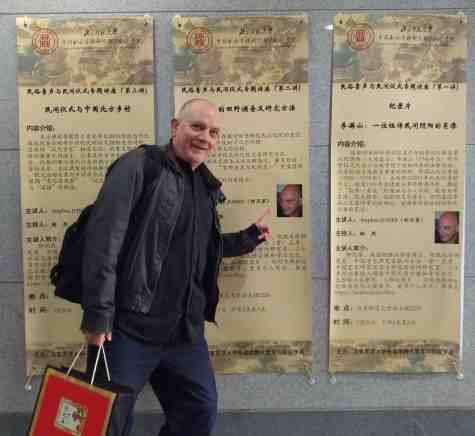

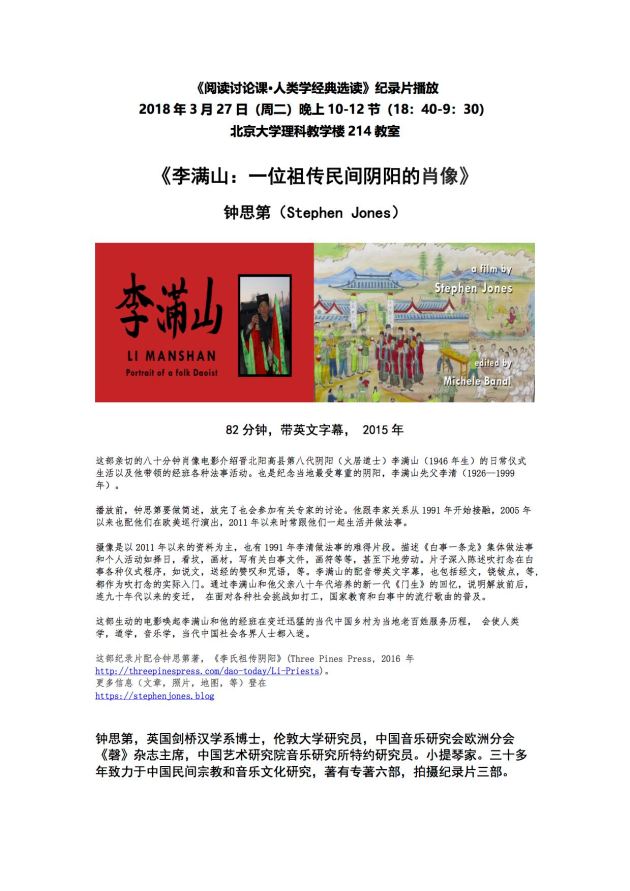 Further screenings coming up in April and May in London and Berlin—will keep you posted.





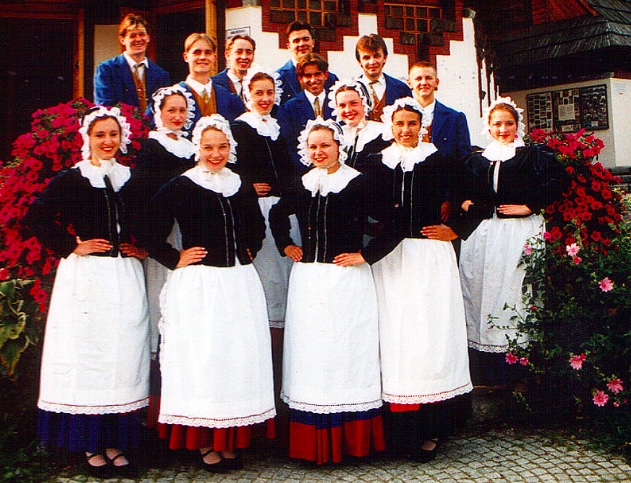


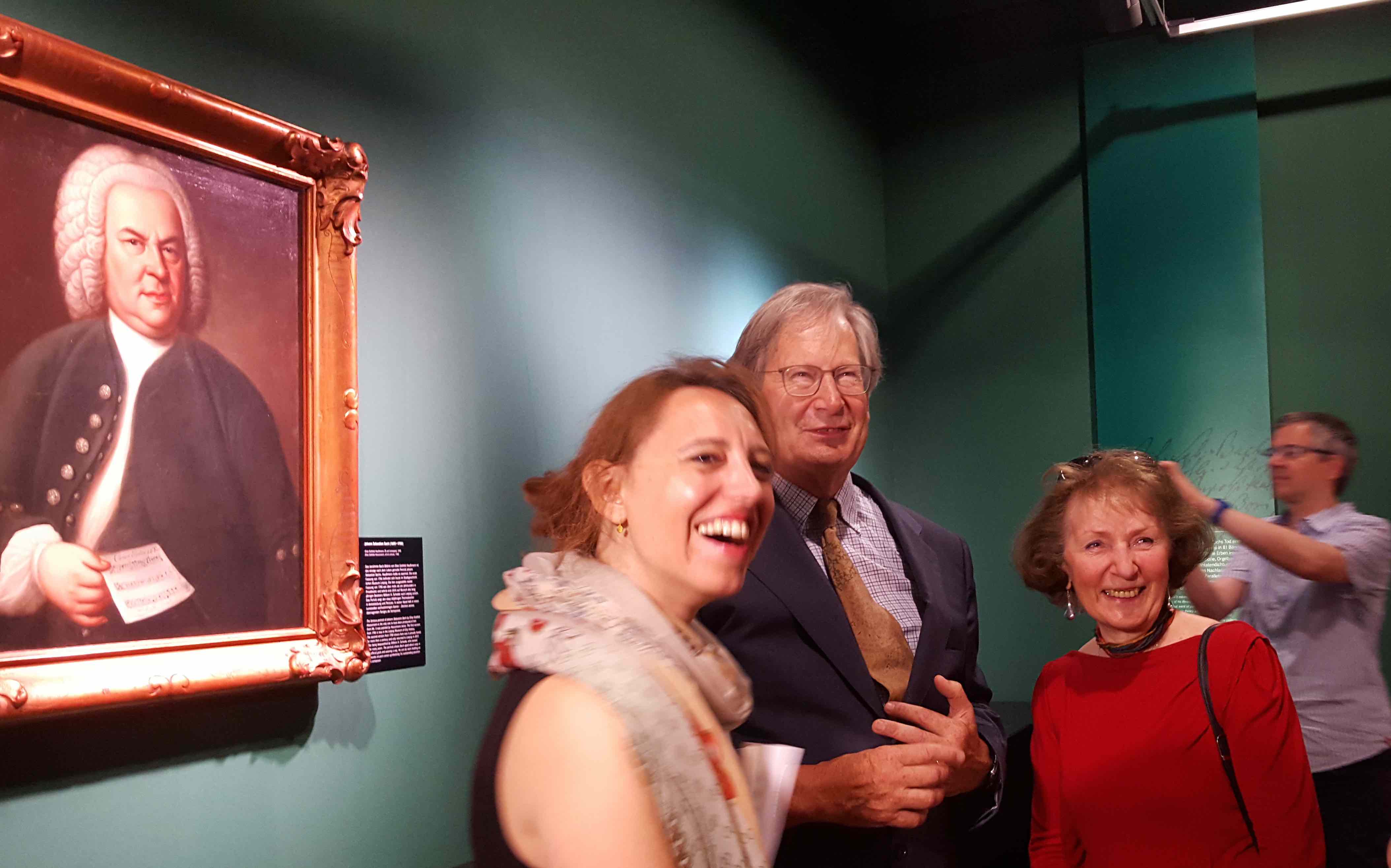


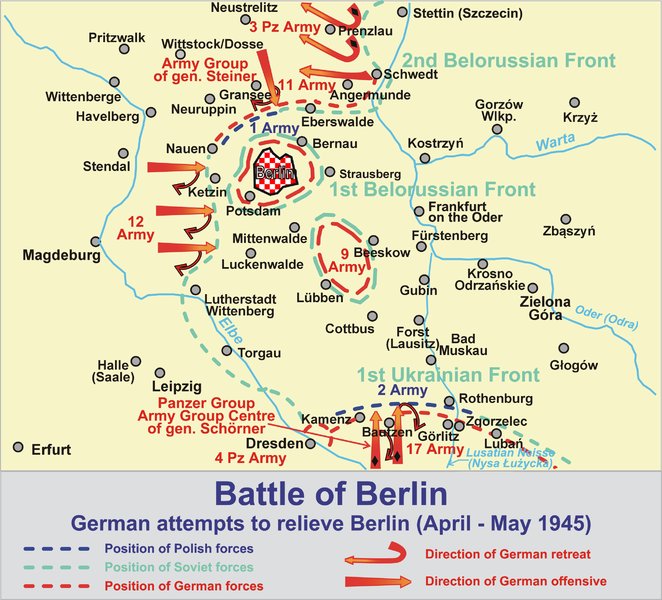



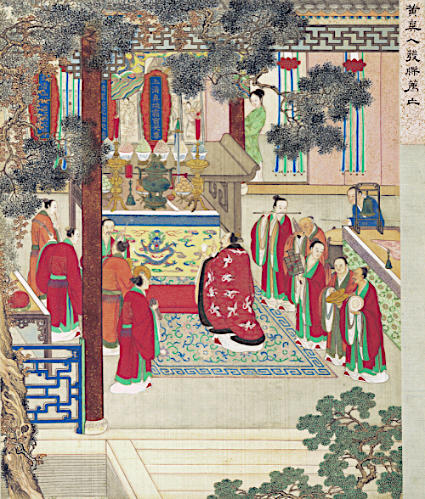
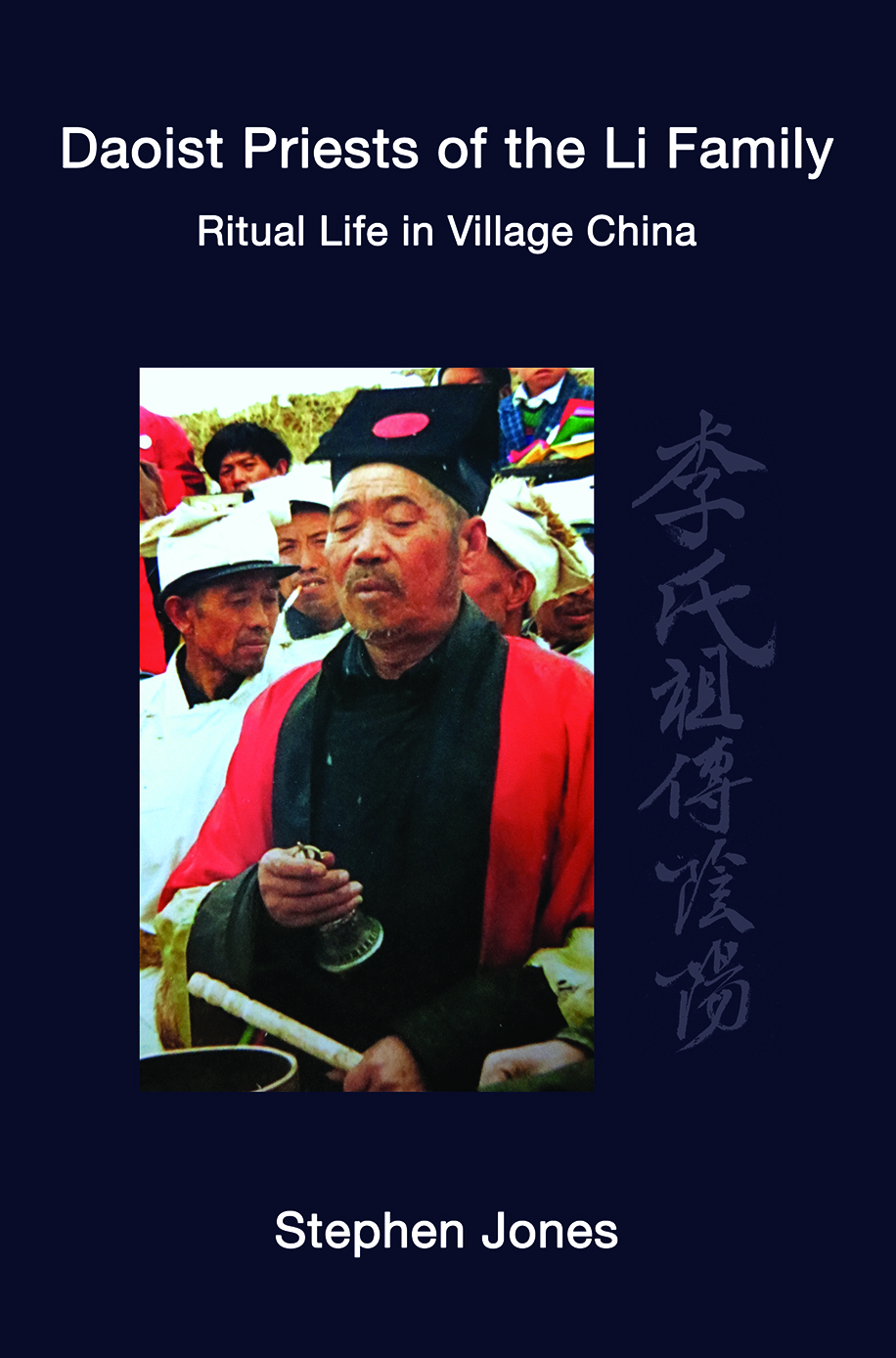
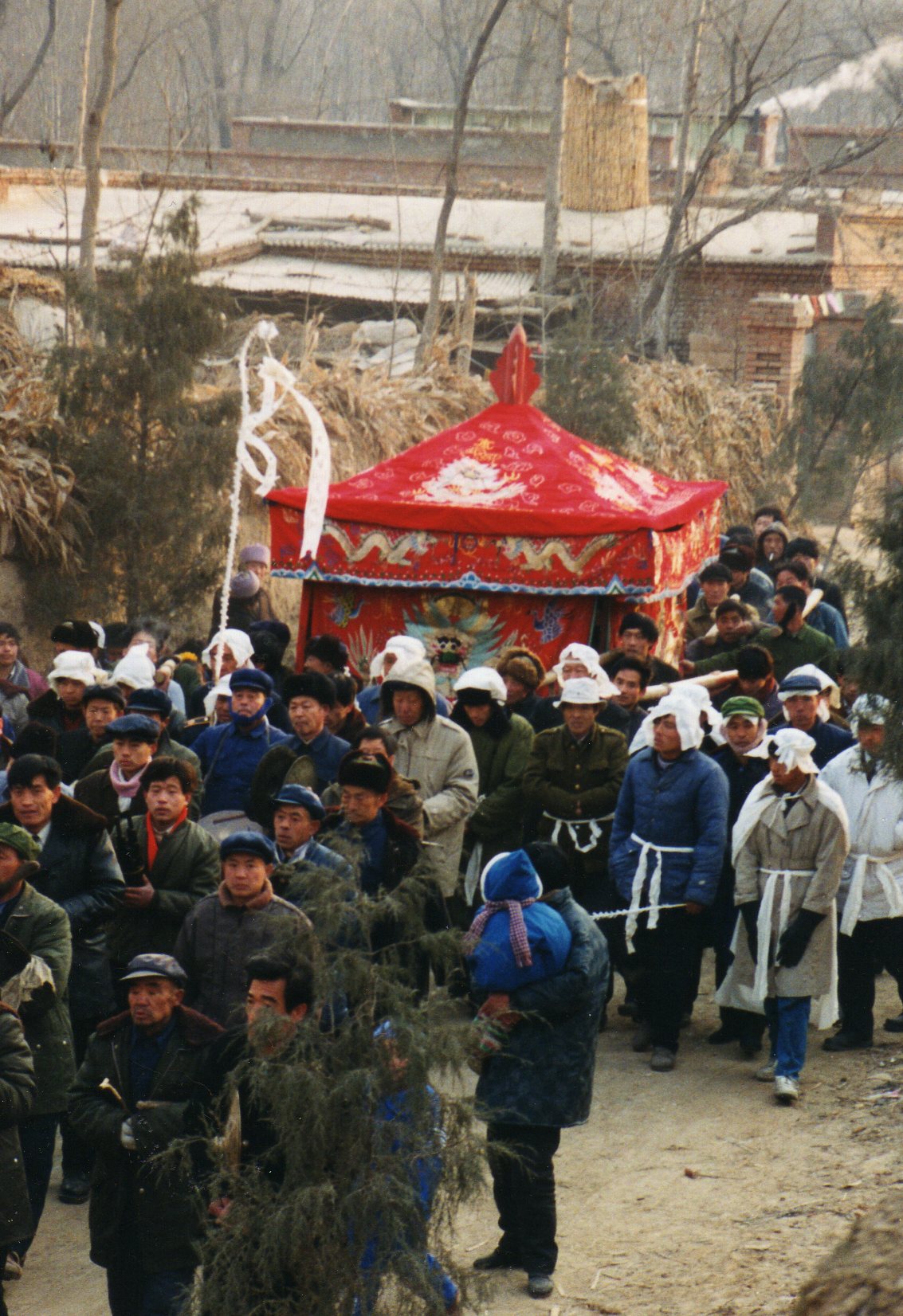

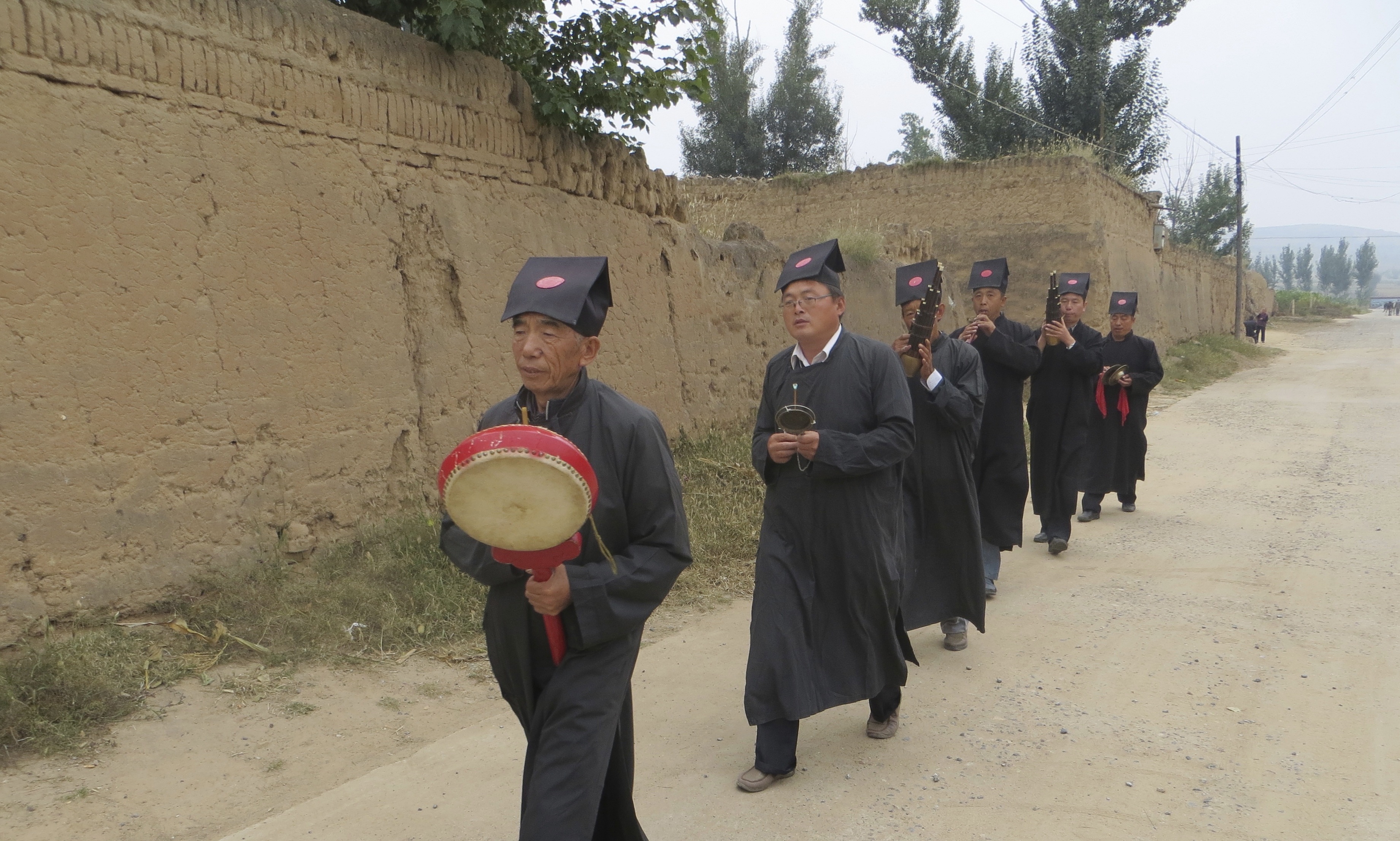



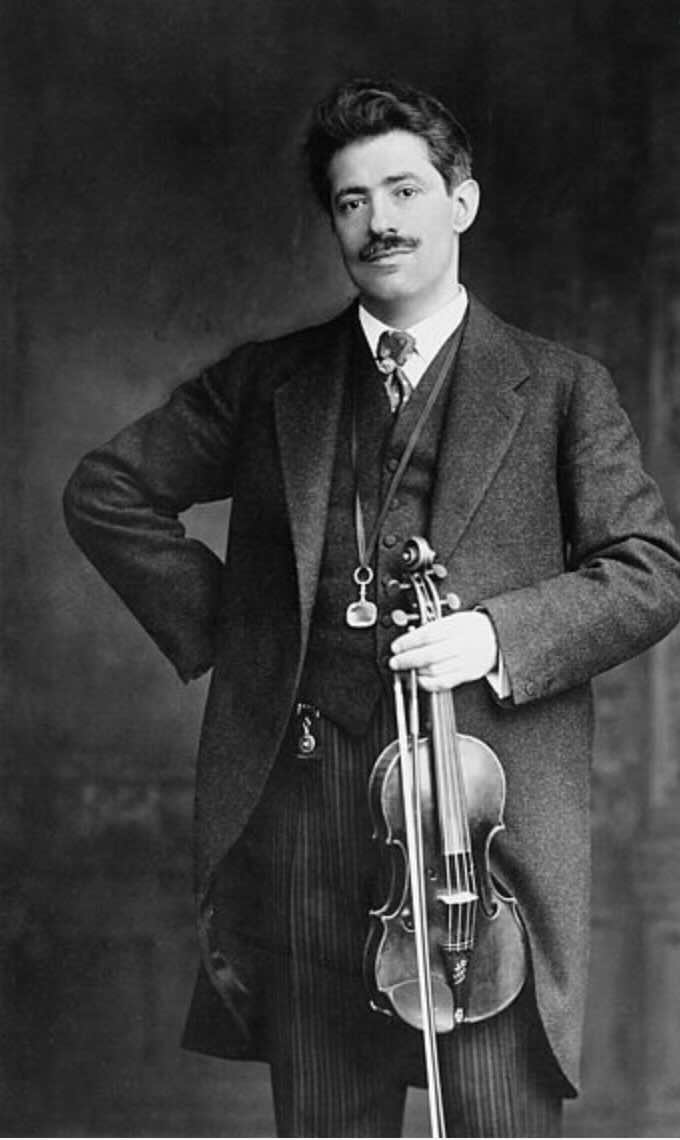
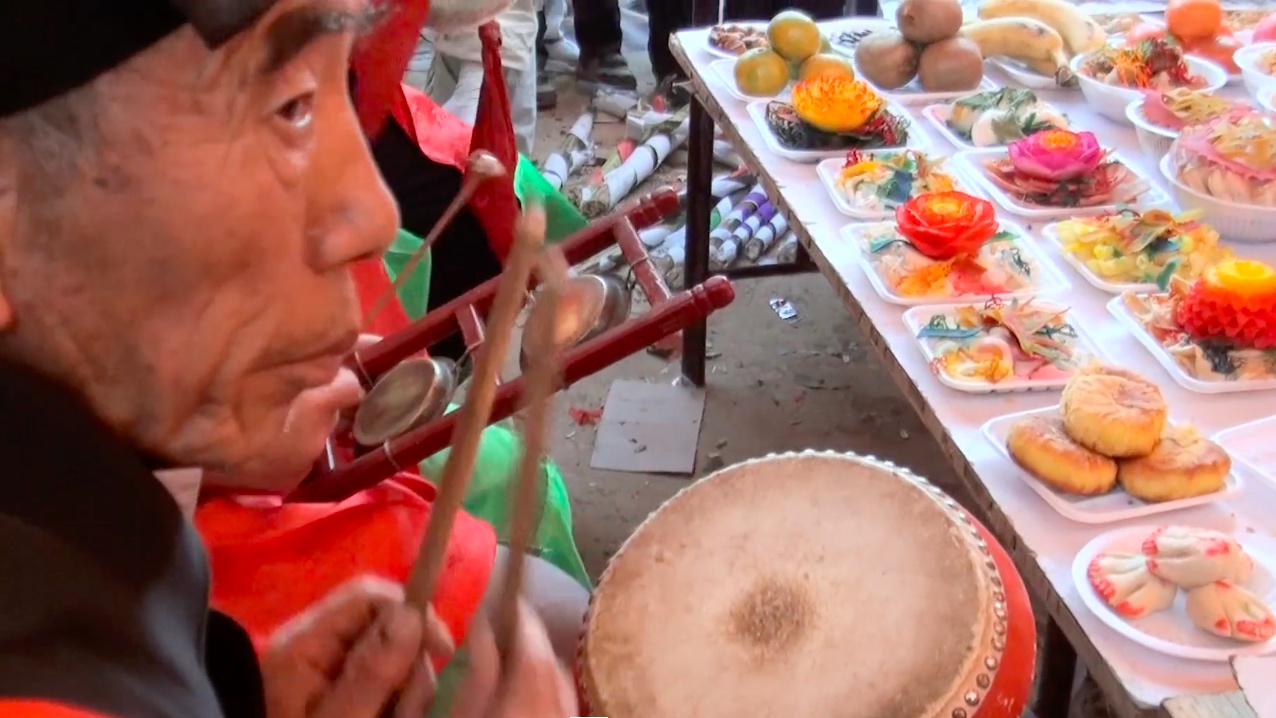

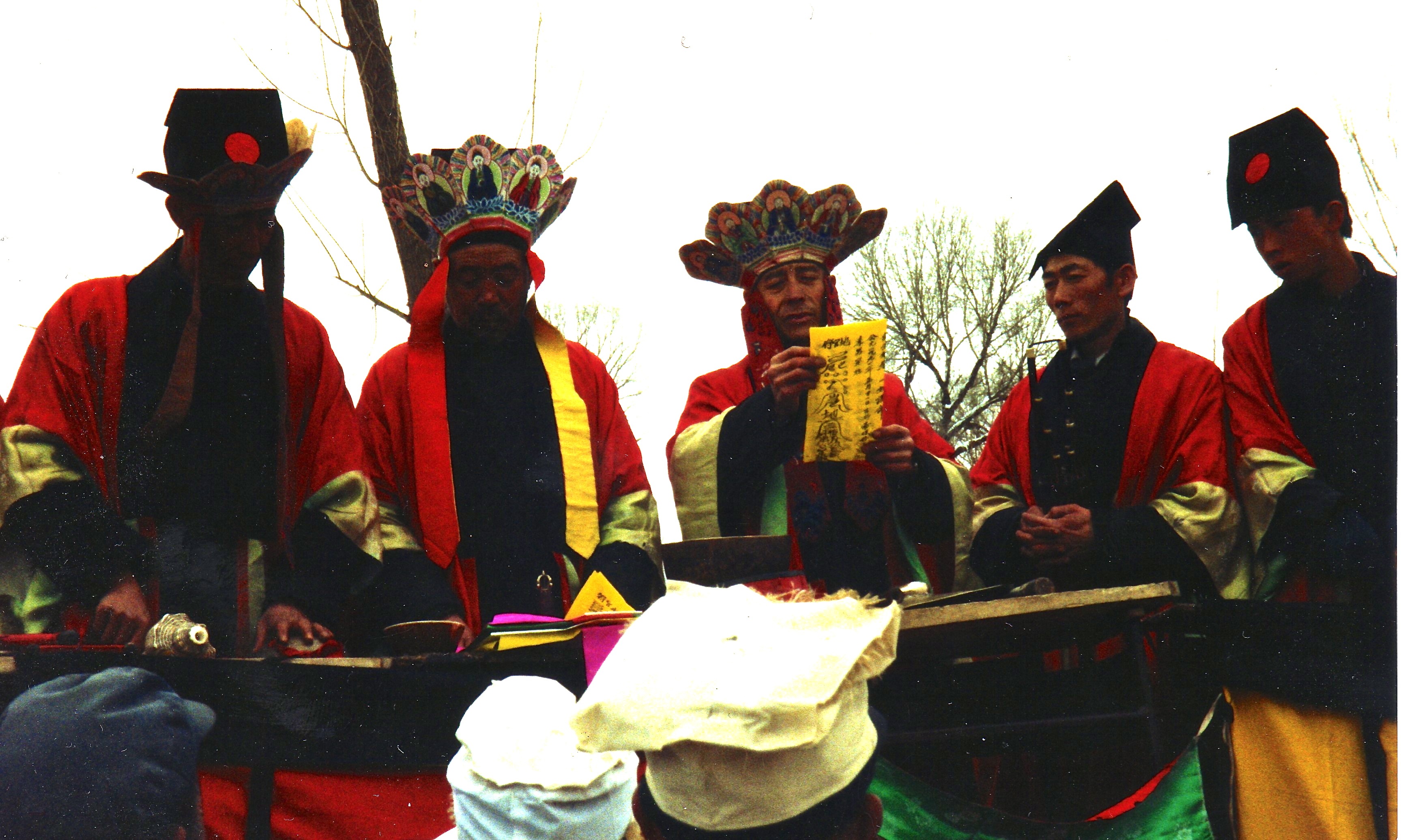

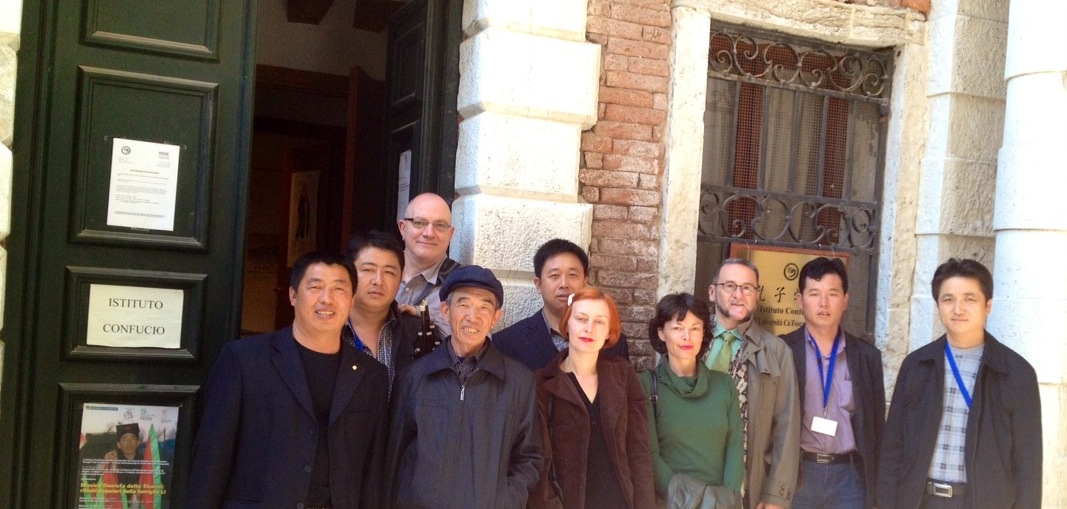
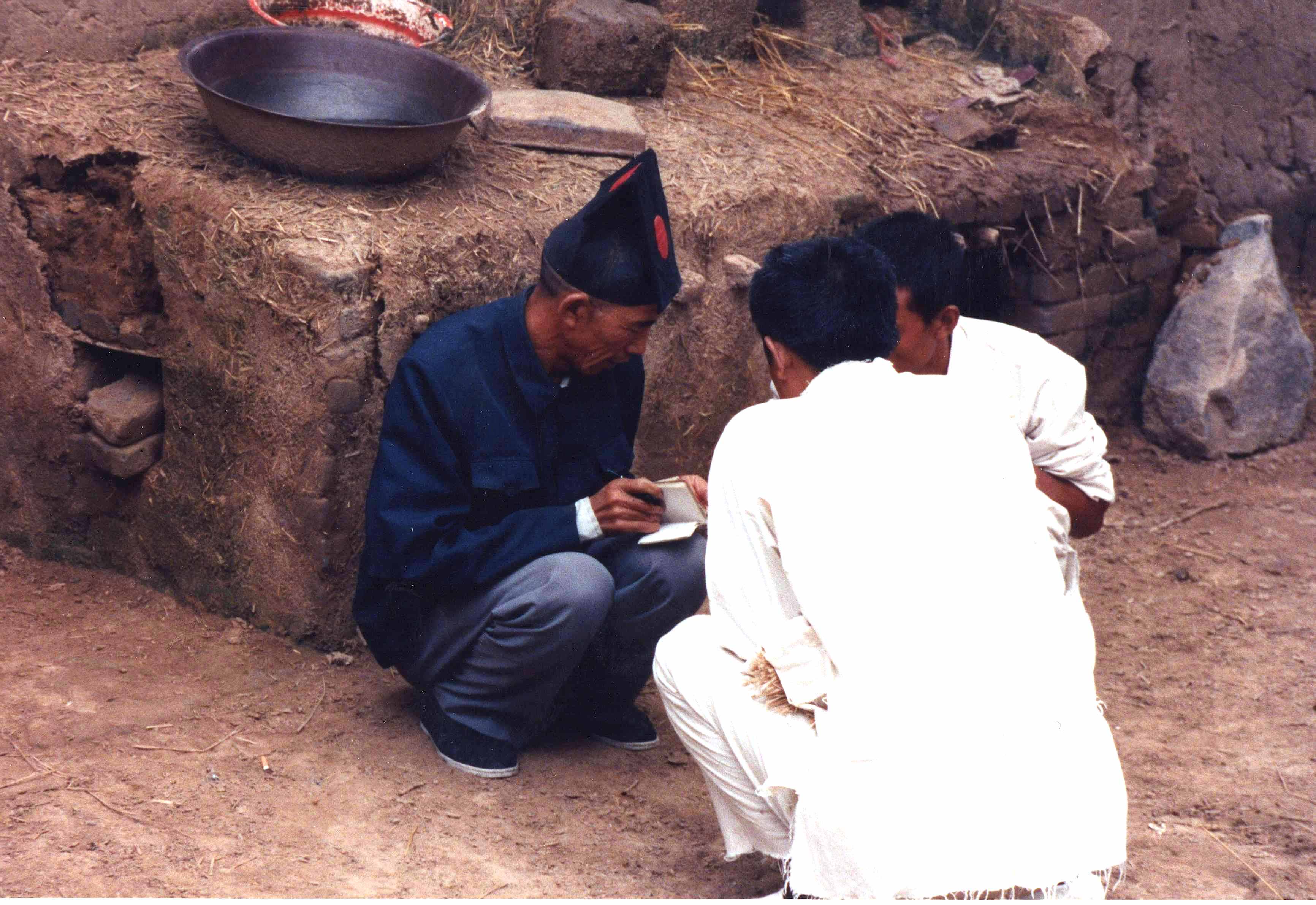

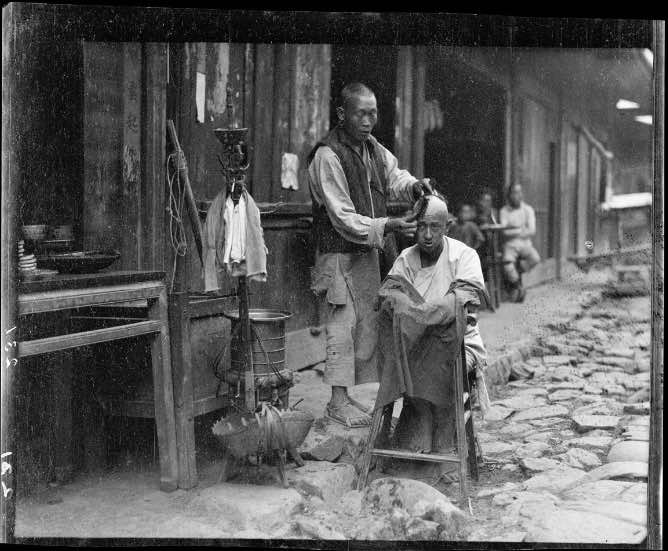



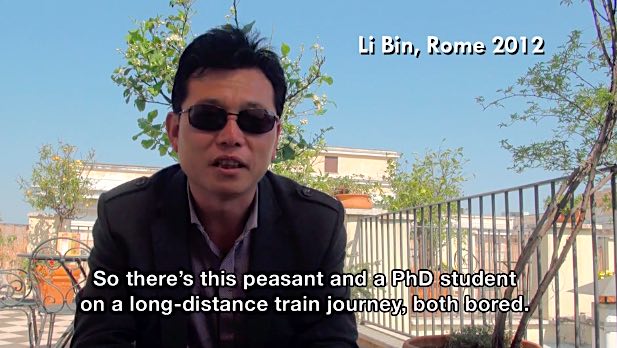


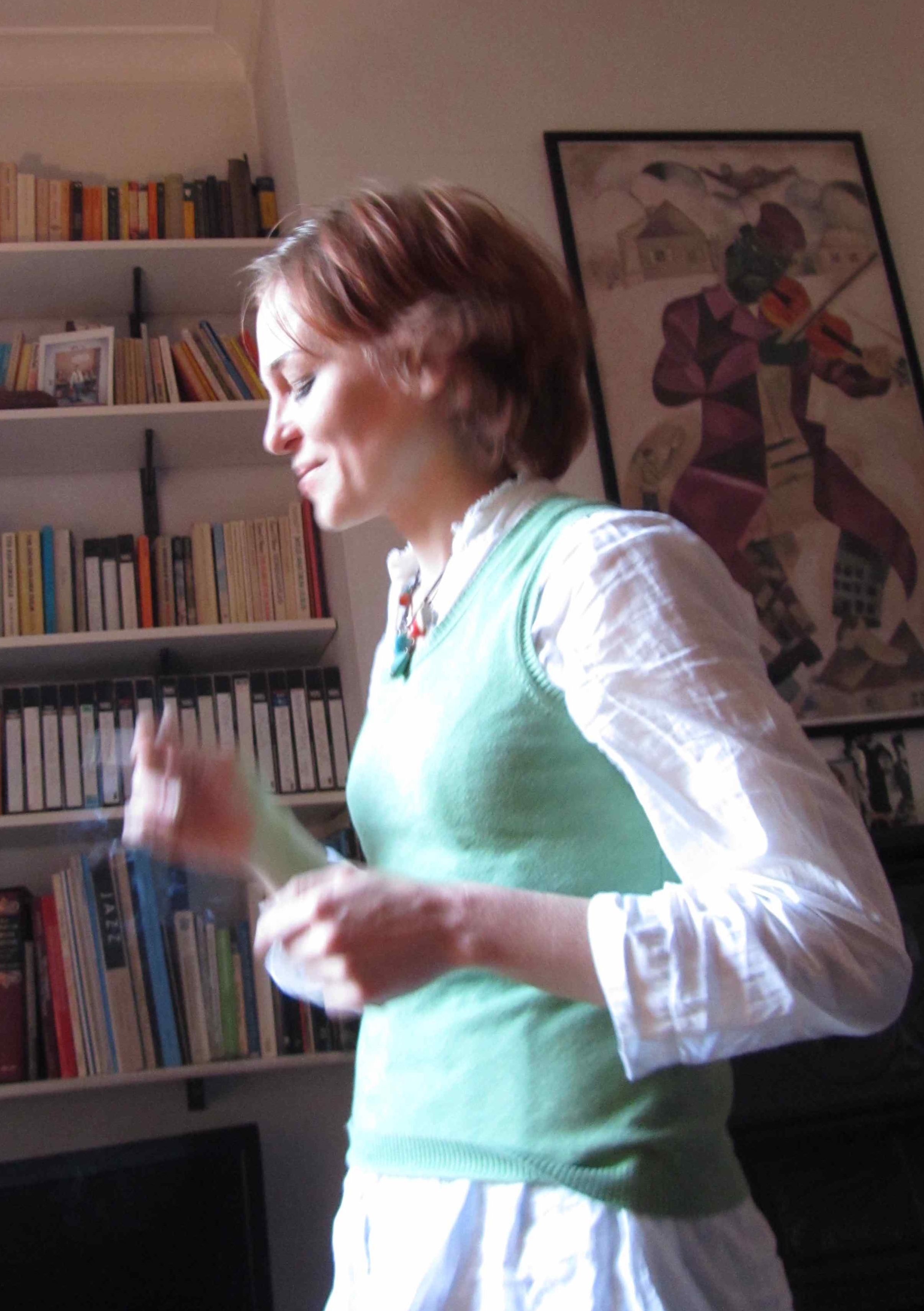


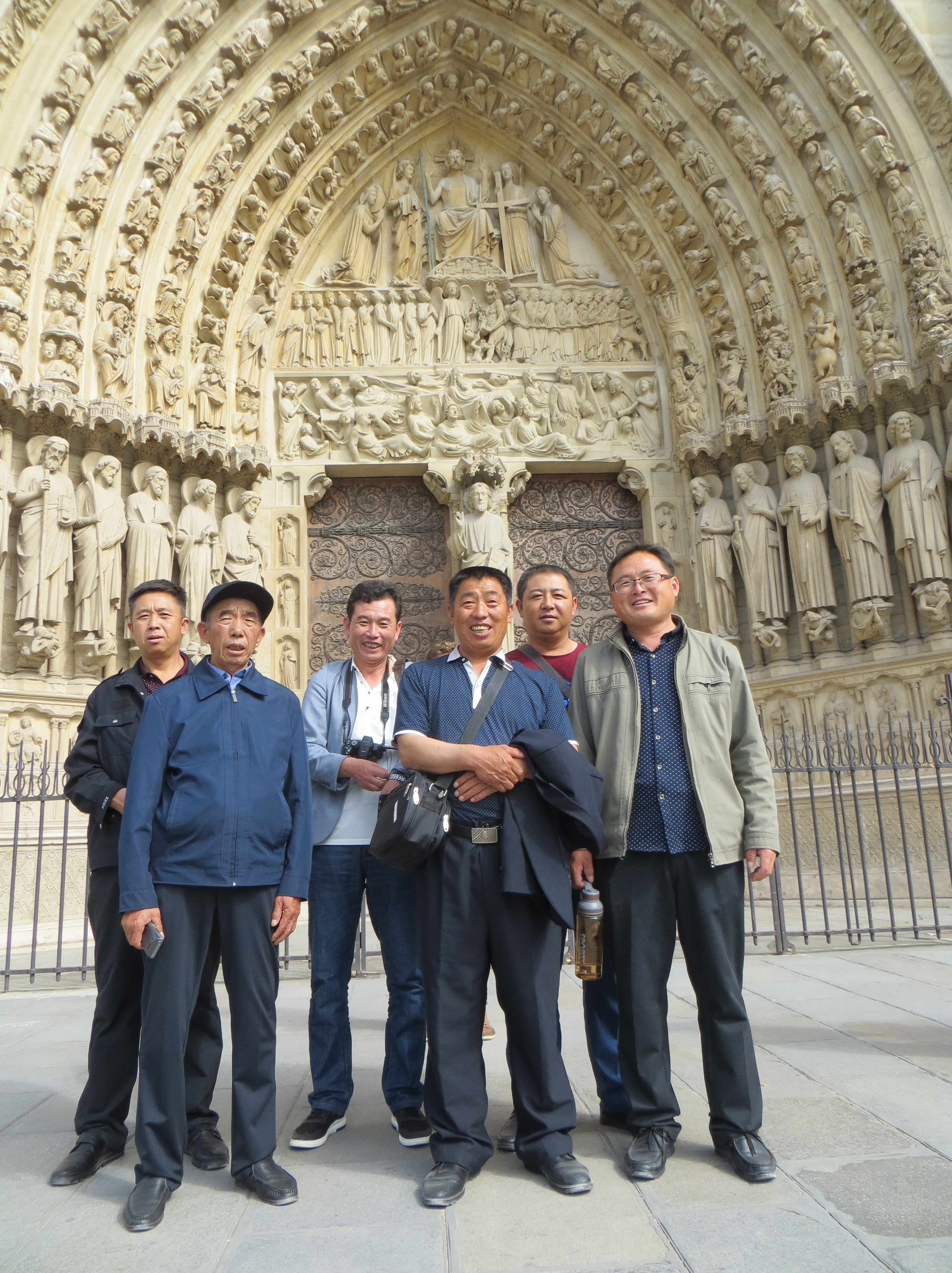
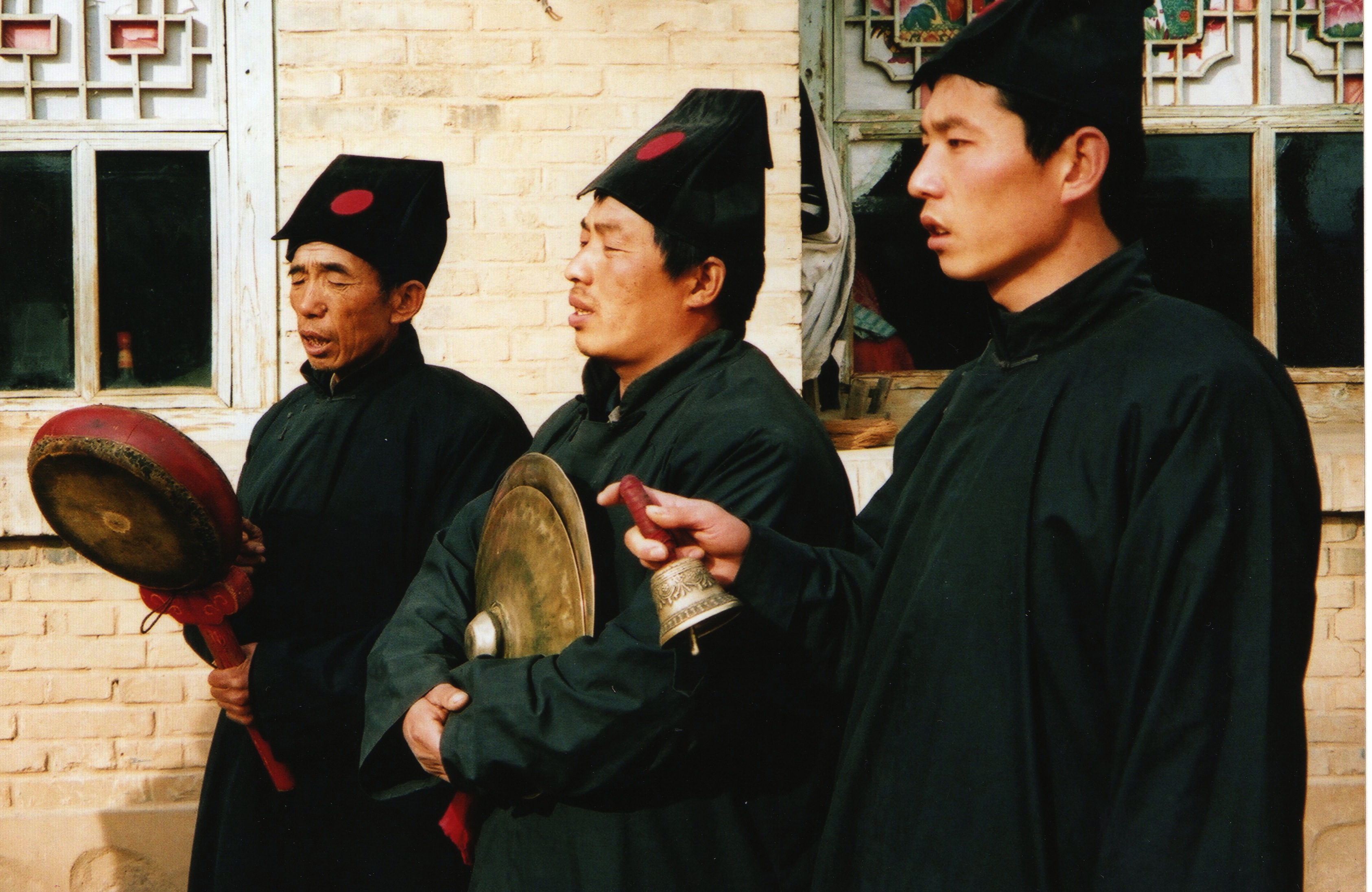

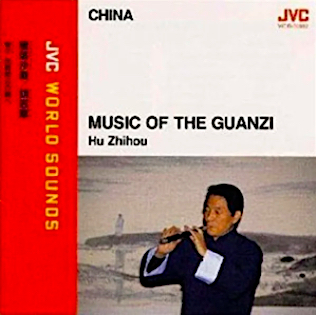


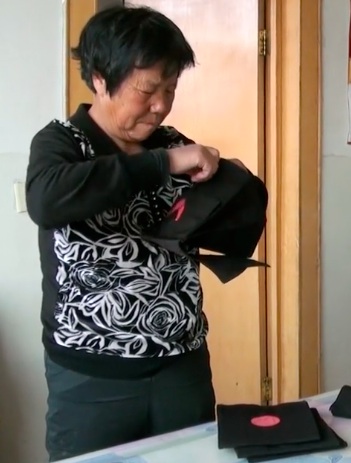
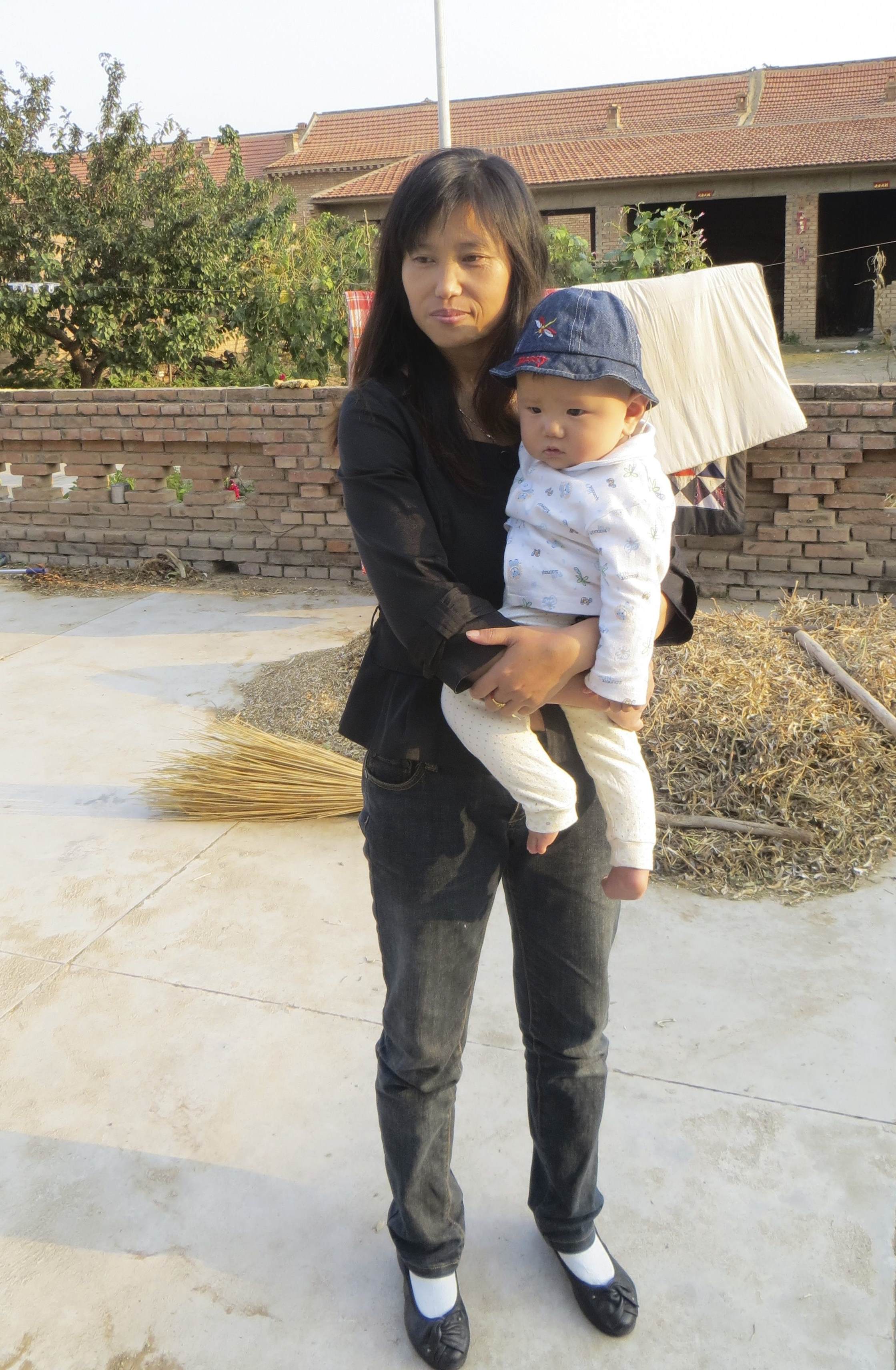
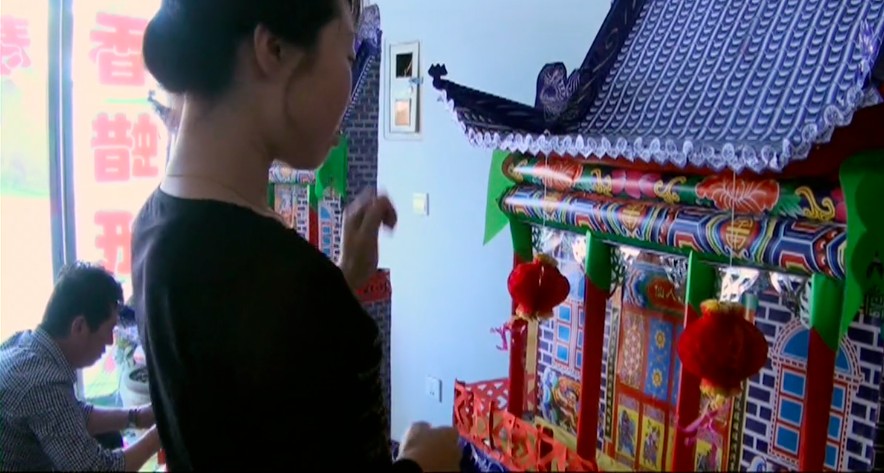


 We’re in plenty of time for the 8.59 to Clermont-Ferrand—whose



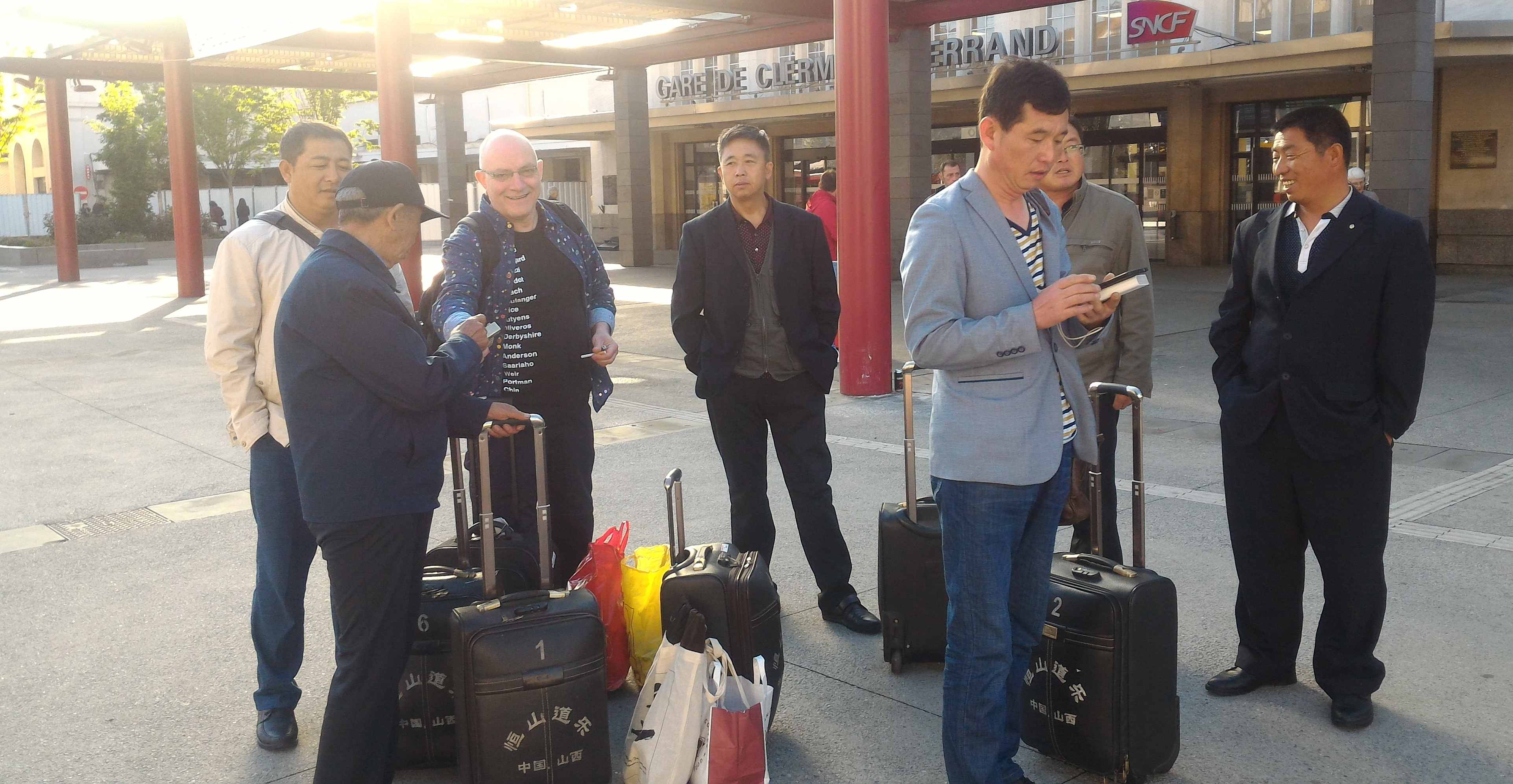



 Stephen Jones: a blog