Perhaps it’s time for a pensée, or apercu, about some of the seemingly incongruous juxtapositions on this blog.
I realize some of these jokes may try the patience of disgruntled readers who have come here, in all innocence, seeking insights into the Wisdom of the Ancient Sages or the Mastery (sic) of the Great Composers. And indeed vice versa: anyone here for laughs will be pretty cheesed off to have to plough through blow-by-blow accounts of Daoist ritual and Messiaen.
Humour has always played a major role in my rapport both with my colleagues and local subjects—but that’s not the card I’m going to play.
Rather, humour can serve to console, to resist, to create ludic connections. It’s no more universal than music—but just as in Daoist ritual (which not only uses language creatively but incorporates segments to entertain mere mortals), and just as in WAM (thinking, for instance, of Haydn and Mozart), humour reminds us of our humanity.
Anyway, I like it.
Jokes (again, like Daoist ritual) are created by people, they take on a life of their own, transmitted in different versions over time for changing audiences. And despite silent, empty, versions in print, they thrive on and evolve through live interaction in performance.
However (and once again, like ritual or music), I’m sure this can become less satisfying for the professional, churning out the same routine night after night for an unfamiliar audience. That’s why Stewart Lee is so great, and it’s what makes his book How I escaped my certain fate so thoughtful. But that’s not important right now.
À proposorchestral humour, Stewart Lee does a typically labyrinthine riff giving the old sardine joke his signature going-over:
Loath as I am to spoil the fun, in the WAM biz where people used to employ me, this story is famously attributed to the master-percussionist and all-round piss-artist Gary Kettel.
A hooliganesque Cockney, Gary was What They Call “a breath of fresh air” in the staid orchestral scene. During Boulez’s années dorées at the helm of the BBC Symphony Orchestra, conducting many challenging works, he much admired Gary’s musicianship, and they formed a charming and unlikely bond (see this story).
The version of the sardine joke handed down to posterity in the orchestral biz (which beyond Gary’s own recollections has some further effective, if fanciful, detail) goes like this:
Once (this must have been in the mid-70s) he was on tour in South America with the London Sinfonietta, doing the, um, challenging Eight Songs for a Mad King.
So Gary’s at this fancy British Council reception after the gig in Buenos Aires or somewhere, getting quietly pissed in a corner on his own, and this posh bird comes up to him and goes,
“I say, I don’t believe we’ve been introduced—weren’t you playing in the concert? I did so enjoy your delightful rendition of that charming work!” [that’s a nice touch, by the way, if you know the piece, “but that’s not important right now”].
“Do please remind me,” she goes on, “what was it you were playing?”
“Oh, I fool around a bit on the drums, luv,” goes Gary—”So wot you doin’ ‘ere then?”
“I’m here with my husband.” she replies loftily.
Gary goes on, chummily, “An’ wot does your old man do then, darlin’?”
“My husband’s in oil!” she exclaims, proudly.
Gary goes, “What is he, a fuckin’ sardine?”
I like the details here. And the punchline is a good instance of the importance of the word “fuckin’ ”—not least for rhythm and euphony. The story also reflects musos’ own delight in “deviating from behavioural norms”.
Keen as I am on the ancestry of texts (my book ch.11), just as one does in exploring the relation and transmission of Daoist texts (well, I say “one”…), I wonder: Gary’s not sure, but could he have heard it from Tom O’Connor, or did they both get it from someone else, and so on (zzz)?
The Tom O’Connor version is less personal and less funny—which is precisely what makes it a suitable victim for Stew to mangle, a banal ground-bass lying prone for his endless florid divisions, a Goldberg variations from hell…
For further detail, see How I escaped my certain fate, pp.257–69—by now tuned into the De Selby footnotes in The third policeman, (and here), you will find further verbose and erudite annotations there too.
For another reception story, see here, on George Brown, pissed at a reception in Peru.
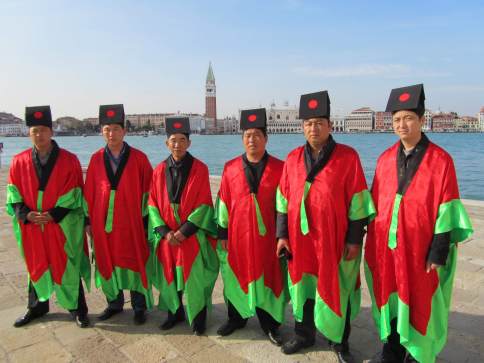
Following the Li family Daoists‘ 2012 tour of Italy, praise within China came in a report published online in the regional capital Datong. Written in bold red characters in the style of a report on a bumper harvest in the Great Leap Forward, here’s an excerpt:
What kind of response did they evince in their audience? Would it have been sullen and apathetic, by any chance? No. It was warm and enthusiastic, Begob.
What did the performances achieve? They consolidated the friendship between the Chinese and Italian Peoples.
Surely they did more than consolidate it? OK, they developed it too.
And what was the art of Chinese Daoist culture able to do where? Be magnified 弘扬 and promoted 宣传 in a foreign country.
Just in a foreign country? Oh all right then, you win—on the soil of a foreign country.
So what did the performances receive from the Italian people? A good assessment and high praise.
And what did the tour do for the entire group? Um, it encouraged and stimulated their trust and determination to revive our Chinese Daoism.
So since their return, what are they now doing? They are gradually perfecting and elevating their art.
Is that all?
[grits teeth] They are developing and strengthening it too. Do give it a rest.
The report also contains a resounding clarion call:
This is the pride of us Chinese People! The pride of the Chinese Nationality! It is the pride of us Shanxi people! The pride of Datong people! More precisely, it is the pride of our 300,000 People of Yanggao!
I’m not entirely taking the piss. A report like that, however comical and cliché-ridden it may seem, evinces genuine feelings. Even if such terms are alien to peasants like Li Manshan, some people do use them, and most can; and it’s a useful skill for us outsiders to deploy them in suitable contexts.
Also, such coverage subtly, um, Consolidates the reputation of the Li family and Daoist ritual in north Shanxi. What it doesn’t do is make local patrons and audiences value their rituals as much as pop music.
BTW, the article is quite right to observe that “More precisely, it is the pride of our 300,000 People of Yanggao”. Still, it uses the duplicitous Chinese media title for the Li band, “Hengshan Daoist Music Troupe”—which I take to the cleaners here.
A complex and costly new legal ruling (or here) vindicates us nerdy language pedants. It’s brought devotees of the numinous Oxford comma out of the woodwork again.
To show the risks of eschewing the Oxford comma, here’s another party game—you can make up your own lists from the template:
I’d like to thank my parents, Mother Teresa and the Pope
I love my parents, Lady Gaga and Humpty Dumpty
I dedicate this book to my parents, Martin Amis and JK Rowling
I have been inspired by my parents, Donald Trump and Barbara Cartland
I owe a profound debt to my parents, Beyoncé and Stephen Fry
Planet Ustinov—Monday, C4, 8pm. By train, plane and sedan chair, Peter Ustinov retraces a journey made by Mark Twain a century ago. The highlights of his global tour include encounters with Nelson Mandela, an 800-year-old demigod and a dildo collector.
See? Punctuation rules OK. Or is that Punctuation rules, OK?
Always on the case with calendrical rituals (and as a change from Myles), I now offer a couple of apposite Irish jokes to celebrate St Patrick’s Day—one about animal husbandry, the other on religion:
Two farmers chatting: “My cow fell down a hole—I had to shoot it.” “Did you shoot it in the hole?” “No, in the head.”
O’Malley is leaving his favourite bar when he gets run over by a bus. He gets to the gates of heaven and St. Peter tells him he can’t enter unless he passes a test. But he decides to go easy on him. “What’s got five fingers and is made of black leather?” he asks. O’Malley scratches his head, thinks hard and finally gives up. “It’s a glove,” says St. Peter. “Let’s try again—What’s got ten fingers and is made of black leather?” O’Malley is stumped again. After pacing round in a circle and scratching his head, he gives up. “Why it’s two gloves.” says St. Peter, amazed. “Don’t you see—ten fingers, black leather…” But being in a generous mood, he decides to give O’Malley one more chance, so he lobs him an easier one: “Who is the patron saint of Ireland?’ he asks. “Now let me see now,” says O’Malley. “Would that be three gloves?”
As I swapped stories and cigarettes at home with Li Manshan, I did a a Chinese version of that one, substituting “Who is in charge of (dangjia 当家) the Chinese Communist Party?” for the last question.
Sorry to sound my age, but I may as well weigh in on the plague of HRT (High Rising Terminal), AQI (as we Brits call it in tribute to our Ozzie friends), or even uptalk.
I’m not recommending the confident tones of Military Man, but it sounds so needy??? Like I’m really insecure??? I’m like, maybe you’re an extra-terrestrial alien who doesn’t understand plain English??? Or like I’m just talking bollocks???
It may literally [there’s another one] enter the written language, as in this comment on an article about Barbara Pravi at Roland Garros:
I’m a tennis and Eurovision fan? I was so happy today?
The gender element is important too. Robin Lakoff, in her important book Language and women’s place (1975??? Sorry, that’s not HRT, it’s just surprise that she logged it so early??? Anyway, the 2004 edition has new annotations. Falling tone. So there.) argued that women were socialized to talk in ways that lacked power, authority, and confidence. Her account of “women’s language” interprets HRT as a gendered speech style which both reflects and reproduces its users’ subordinate social status—uncertainty, hesitancy, and indecisiveness.
According to Sharyn Collins, uptalk has also become more popular because of our dwindling attention span. She believes that the rising tones we so often hear in snatches of conversation are in fact people striving to divert their companion’s attention away from their mobile phone. “People are checking as they speak to make sure you’re paying attention,” she says.
* * *
Meanwhile, in standard Chinese, the second ascending tone is one of four that help distinguish one character from another. But in Yanggao, home of the Li family Daoists, it’s not easily heard—siding with us old fogeys??? (Oops, there I go again). Adapted from my book, p.23:
One feature of Yanggao dialect that does strike my cloth ears is how the descending fourth tone is used with abandon, notably in place of the low dipping third tone, as in hashui (drink water: ha not he, note), pijiu (beer), fanguanr (restaurant), or ritual terms like dagu (playing drum) and xietu (Thanking the Earth)—all with a heavy accent on the final falling syllable, not the standard low dipping tone. With my notoriously poor grasp of the tones, this becomes something of a relief to me: if in doubt, use the fourth tone!
Yanggao peasants call a spade a spade. Not “a spade???”
Among the Daoists, apart from Li Manshan, most obstinate in clinging onto his dialect is Wu Mei; his voice is as characterful as his guanzi-playing. The Daoists loved it when I mimicked his question in Milan in 2012, when we were taking the train to Rome. In his version of “Does Milan have an airport?”, the feijichang of “airport” comes out with the final chang descending conclusively. On my trip to Beijing with the Daoists, they do their best to adapt, but I’m reluctant to abandon the dialectal terms I’ve picked up, to the consternation of my urban friends.
Conversely, around Laishui and Yixian counties on the Hebei plain, the descending fourth tone of standard Chinese sounds like an exaggerated third tone, falling and then rising, as in the words si temple and hui association, both often quaintly melodic rather than conclusive—an echo of HRT???
We must resist HRT??? It’s like really irritating???
Stewart Lee always hits the nail (here, the xenophobes) on the head. Discussing the perils of moving to the countryside, he observes:
In London, if your pub becomes a BNP pub you can easily go to another one. But in a village where there is only one pub you have to make the best of it and try and join in the conversation.
“Evening.”
“Oh, hello. Er… Hated any new races lately?”
“Yes, Polynesians, actually. And blacks as usual, obviously. Yourself?”
“Oh, you know, just the Jews mainly. You know me.”
Creative writing footnote: the “Yourself?” is finely observed, astutely capturing the chummy Faragesque language.
Hot on the heels of The check-up, maybe this is a reverse variation on the “pull back and reveal”, only with the joke on the subject, not the object (or something—how would I know, I just do fieldwork on Daoist ritual):
A medium is holding a séance. With a group of genteel clients assembled around her table, lights dimmed, she begins, softly,
“Now everyone—before we begin, I just want to ask you, has anyone here ever seen a ghost?”
They all bow their heads in silence, but one geeky chap sticks his hand up and goes perkily,
“I have!”
They look curiously at him. He goes on,
“And—what’s more—I’ve fucked one!”
Incredulous, the medium asks him,
“What? You mean… you’ve… fucked a ghost?”
Disconcerted, he pauses. Then, nonchalantly:
“Sorry—I thought you said goat…”
Having suggested suitable T-shirts to go with the book and the film, I just have to cite the wonderful Bridget Christieagain.
In summer 2016 Theresa May came in for what footballers call “a bit of stick”—never so trenchantly as here (from Christie’s A book for her, also excerpted here):
I’m not entirely sure about women wearing a “This is what a feminist looks like” T-shirt. Or men, for that matter. It’s overstating the case a bit, isn’t it? It’s like wearing a T-shirt with “I am not a racist” on it. It makes me suspicious. I assume that most people’s default setting is feminist, until they do or say something that makes me think otherwise. If I went bowling with a friend, for example, and they took their coat off to reveal an “I am not a racist” T-shirt underneath, I don’t think I’d feel relieved at all. On the contrary, it would make me very on edge. I’d spend the whole night worried I was bowling with an ironic racist.
A few years ago, because Tory feminists were in the papers all the time, talking about Tory feminism, it made me think about what Tory feminism was, which fed into the standup in my show War Donkey in Edinburgh in the summer of 2012. This is how it went:
I’ve been trying to work out what a Tory feminist is, because I keep seeing photographs of female Tory MPs in the newspapers, wearing T-shirts with “This is what a feminist looks like” on them. What, like a T-shirt? How can a T-shirt look like a feminist? A T-shirt looks like a T-shirt, doesn’t it? It should say, “This is what a T-shirt with ‘This is what a feminist looks like’ written on it looks like”.
That’s what it says on the front, anyway, of the Tory feminists’ T-shirts that they’re all wearing now. And on the back it says, “Not really, I’m a Tory, you gullible dick”.
Then underneath that it says, “I axed the health in pregnancy grant. I closed Sure Start centres.’”That one’s got a smiley face next to it. “I cut child benefit and slashed tax credits. I shut down shelters for battered wives and children. I cut rape counselling and legal aid.” Winking face.
“I cut funding for CCTV cameras and street lighting, making women much more vulnerable. I closed down all 23 specialist domestic violence courts. I cut benefits for disabled children.” Sad face with sunglasses on. “I tried to amend the abortion act so that women receive one-to-one abortion counselling from the pope before they go ahead with it.” Winking face with tongue out. The back is much longer than the front, by the way. It’s a tailcoat, basically. They’re wearing tailcoats.
Comedians’ autobiographies are not always edifying, but Arthur Smith’s memoir My name is Daphne Fairfax is a lovely warm and thoughtful book—not least for his account of his father.
The doctor says: “Well, I’m afraid you’re going to have to stop masturbating.”
“Oh no,” says the man. “Why?”
“Because,” says the doctor, “I’m trying to examine you.”
This is another instance of what is known (ironically, in this case) as the “pull back and reveal”, where you (zzz) describe something and then reveal that the situation is not what people would expect. Stewart Lee gives it a typically thorough going-over (How I escaped my certain fate, p.196–7).
As threatened, here is my very own niche sequel to the Myles na Gopaleen Catechism of Cliché—another penetrating piece of WAM ethnography, if I may say so.
On what descending act of flagellation will you see me? The downbeat.
And not long afterwards, at what reduplicated den of refreshment? The double bar [“Sounds like my kind of place”, nods Myles.]
On the reasonable assumption that the imbibing of a certain liquid refreshment will be de rigueur there, what is your only man? A pint of Plain. [I don’t mind if I do.]
Meanwhile, for the classicist (manqué or otherwise), another (“real”) entry from the Catechism of Cliché:
Quando timeo Danaos?
Et dona ferentes.
The enticing Dona Ferentes, along with Timothy Danaos, also play a cameo role in At-swim-two-birds, where they are the two Greek lawyers at the trial of Dermot Trellis [any relation to Ivy?—Ed.] for authorial autocracy . Non-nationals?!
A glowing paean from one Führer to another—Tweety McTangerine (yes, the Mango Trumpolini himself) on another Great Helmsman:
You have to give him credit. How many young guys—he was like 26 or 25 when his father died—take over these tough generals, and all of a sudden… he goes in, he takes over, he’s the boss… It’s incredible. He wiped out the uncle, he wiped out this one, that one. This guy doesn’t play games.
That’s how it’s often cited, but in the interests of scrupulous balance, the fuller transcript puts it in context:
If you look at North Korea—this guy, he’s like a maniac, OK? And you have to give him credit. How many young guys—he was like 26 or 25 when his father died—take over these tough generals, and all of a sudden—you know, it’s pretty amazing when you think of it. How does he do that? Even though it is a culture and it’s a cultural thing, he goes in, he takes over, and he’s the boss… It’s incredible. He wiped out the uncle, he wiped out this one, that one. I mean, this guy doesn’t play games. And we can’t play games with him. Because he really does have missiles. And he really does have nukes.
“It is a culture and it’s a cultural thing” (like the KKK and NRA, eh?)—there, who says he doesn’t do eloquent anthropological refection? Eat your heart out, Bourdieu. This guy, he’s like a maniac, OK?
This photo reminds me of a classic story, perhaps originally from the USSR, but widely shared in this Chinese adaptation (Fieldworkers’ joke manual no.23). Diplomatic as ever, I shall cunningly disguise the identity of the butt of the joke, notoriously dim, by calling him Lee Beng.
Deng Xiaoping, Jiang Zemin, and Lee Beng are taking a flight together with a group of schoolkids when the plane develops a fault and begins an alarming descent.
There are only three parachutes on board, so Deng Xiaoping grabs one, straps it on his back, and loftily declaring “The People need me!” he leaps out; soon his parachute unfurls and he glides down to earth. Jiang Zemin follows suit.
Lee Beng gets the idea, so he too grabs a bundle, straps it on his back, and exclaiming “The People need me!” he throws himself out after them.
One of the schoolkids looks down as he hurtles earthwards and cries out, “Waah! Uncle Lee’s got my satchel!”
Coming back to the leaders who inspired this post, one can but dream.
1 October, London. I mend a puncture on my bike. I get pleasure out of being able to do simple, practical jobs—mending a fuse, changing a wheel, jump-starting the car—because these are not accomplishments generally associated with a temperament like mine. I tend to put sexual intercourse in this category too.
A couple of years ago my washing machine broke down. I called out an engineer, a friendly Caribbean bloke who busied himself taking it to pieces, hooking it up to his fancy gauges, machine parts and tools all over my kitchen.
I left him to it for a while, and on coming back I asked him, in typical poncey Oxbridge language,
“So, um, have you reached a preliminary diagnosis of the problem that seems to confront us here?!”
“I ‘ave indeed, sir,” he replied affably, “It’s completely fucked!”
At school, among many inspirational teachers with whom I was blessed, one of my music teachers explained the ABA form of da capo arias in the baroque like this:
It’s like someone going,
I went into the garden today and picked an apple. God it was delicious. I went into the garden today and picked an apple.
Even much later, when I learned that in HIP renditions the da capo A section might be boldly varied on the repeat—like
I went into the garden today, falala, and picked an apple, falala,
Discussing ritual activity around Houshan in Yixian county, I mentioned the fine ritual specialist Li Yongshu in Baoquan village. After my little detour in Festivals, here the word for “village” is cun.
And Baoquan means Panther Spring—“spring” as in wellspring, not as in
with all the coiled sexual energy of a panther about to spring,
applied satirically to John Major.
Another nice John Major quote comes from a BBC correspondent reporting on the Prime Minister’s visit to an Indian mela:
He brought a splash of grey to an otherwise colourful scene.
This 1983 diary entry by Alan Bennett (Writing home, p.127) bears both on professional tact and the insecurity of the freelance artist:
3 March, Yorkshire. I take a version of a script down to Settle to be photocopied. The man in charge of the machine watches the sheets come through. “Glancing at this,” he says, “I see you dabble in playwriting.” While this about sums it up, I find myself resenting him for noticing what goes through his machine at all. Photocopying is a job in which one is required to see and not see, the delicacy demanded not different from that in medicine. It’s as if a nurse were to say: “I see, watching you undress, that your legs are nothing to write home about.”
Further to cross-pond differences in pronunciation and interpretation, David Sedaris observes (citing someone else, he claims, but whom?):
In America, if your next-door neighbor has a Rolls-Royce, you want one too. In England, if your neighbor has a Rolls-Royce, you want him to die in a fiery accident.
In the wonderful song Jerusalem, rather like those questions they ask you at the airport check-in desk, you think all the answers are going to be “No”, but you have to keep on your toes (sic, see below) just in case.
Great that it’s tipped for our new national anthem, to replace the meretricious God save the Queen (although the version here is fine)—but we have to take care not to “leave it unattended at any time” in case it gets hijacked by “Paul Nuttall and the UKIPs”.
Mind you (and talking of keeping on your toes), if I had an anthem like this (Wow! Italian opera at its most intoxicating! 1831-ish, see here)
I was in Washington DC with the amazing Hua family shawm band in 2002 when Brazil won the World Cup (click here). We all crowded into the hotel bar early in the morning to cheer them on, suitably lubricated with A Pint of Plain—It’s Your Only Man.
Confirming Kate Fox’s anthropological observation that the creative love of wordplay evinced by our tabloid headlines is one of rather few things of which the British can be proud, here’s one spotted today (about a table-tennis player involved in an altercation, you understand):
Ping-Pong Ding-Dong
Actually, a quick search online shows that this has quite a history. Once freed of the petty constraint of describing an actual event (which has seldom held the tabloids back), it can even expand into the headline reporting a fight with a giant ape at a table-tennis club karaoke night:
Wonderful playlist, too. From here it is not too far to Kapka Kassabova’s Border: tales from the edge of Europe on Radio 4’s Book of the week.
After a wealth of gorgeous Slavic music Goldsworthy ends (by contrast) with Purcell’s ineffable When I am laid in earth, with Lorraine Hunt Lieberson. Here’s one of many other fine versions online (old and new):
But far from it—like The third policeman, all this flummery is inevitably fated to continue ad infinitum.
I note that A Pint Of Plain Is Your Only Man [A POPIYOM? Not a poppadom, anyway—Ed.] is also a topic for dogged doggerel in At-swim-two-birds (pp.77–80):
When things go wrong and will not come right, Though you do the best you can, When life looks black as the hour of night— A PINT OF PLAIN IS YOUR ONLY MAN.
By God there’s a lilt in that, said Lamont.
Very good, said Furriskey. Very nice.
I’m telling you it’s the business, said Shannahan. Listen now.
When money’s tight and is hard to get And your horse has also ran, When all you have is a heap of debt— A PINT OF PLAIN IS YOUR ONLY MAN.
When health is bad and your heart feels strange, And your face is pale and wan, When doctors say that you need a change, A PINT OF PLAIN IS YOUR ONLY MAN.
[…] When food is scarce and your larder bare, And no rashers grease your pan, When hunger grows as your meals are rare— A PINT OF PLAIN IS YOUR ONLY MAN.
[…]
If he knew nothing else, he knew how to write a pome. A pint of plain is your only man.
[…]
Excuse me for a second, interposed Shanahan in an urgent manner, I’ve got a verse in my head. Wait now.
What!
Listen, man. Listen to this before it’s lost.
When stags appear on the mountain high, With flanks the colour of bran, When a badger bold can say good-bye, A PINT OF PLAIN IS YOUR ONLY MAN!
So this young music scholar goes for an interview at Cardiff University Music Department for the job of junior lecturer.
One of the board asks him, “Would you care to share your thoughts on the late Beethoven quartets with us?”
“Oh yeah, cool”, he replies eagerly. “You gotta love all those riffs on the sax! And their drummer was amazing.”
“I see… And, um…, how about Bartók?”
“Well, you can’t beat the way he works in all that stuff from reggae.”
“Um, thankyou very much… I don’t think we have any more questions…”
“Well in that case, my lovelies,” the candidate goes on, “Maybe we can knock it on the head then—I’ll just be in time to catch the 16.38 to London.”
After he hurries off, the board consults. The chair asks the others,
“So what did we all think, gentlemen?”
“Well I thought he was absolutely splendid—he could be the one! How about you?”
“Hmm, I’m not so sure. There’s something about him that doesn’t seem quite right…”, he frowns. “…You see—there is no 16.38 to London…”
Having just shown that I don’t only do jokes, Stewart Leedoes occasionally do some, and it must be mortifying for him to find them cited in online soundbites, callously plucked out of their labyrinthine context—like this:
My granddad always said, “You should never judge a book by its cover”… And it’s for that reason that he lost his job as chair of the British Book Cover Awards panel.
Partly to remind myself that I don’t only do jokes, here are some more fieldnotes.
I’ve already noted the differences between our early fieldwork in the 1990s and conditions more recently. So I thought I’d give you a flavour of one of those earlier fieldtrips.
Over the hot summer of 1992, following hot on the heels of the Wutaishan Buddhist group’s visit to England, Xue Yibing and I made a three-week trek from Taiyuan northwards through Wutai, Xinzhou, Daixian, and Hunyuan, finding ritual activity all along the way, en route for another rendezvous with the great Li Qing in Yanggao. Our last stop was nearby Yangyuan county, just in Hebei.
Since our fruitful initial survey of ritual associations in Hebei over New Year in 1989, this was my fourth fieldtrip with Xue Yibing. Before we could return to the Hebei plain, and before I began to focus on particular villages and families, this was still only a partial survey of central and north Shanxi—for what became Chapter 12 of my book Folk music of China.
We had a van and a driver from the MRI at our disposal, and for parts of the trip we were accompanied by Shanxi scholars Jing Weigang and Wang Bin, whose local knowledge was valuable. We were mostly unencumbered by the need to “kowtow to the Gods of the Soil”, except when we knew there was a knowledgeable scholar—like the senior Liu Jianchang in Taiyuan, who was studying the Buddhist ritual music of the Wutaishan mountains through the 1950s whenever political conditions allowed. All along the way we found local traditions, differing significantly from each other. [1] Power cuts were frequent. And before motorways, our progress was often far from smooth; even on the main roads we generally found ourselves crawling along behind long lines of coal lorries.
Dongye township In central Shanxi, I had already visited central Wutaishan, so I was interested to explore the outlying areas. While we found many shawm bands (here called gufang 鼓房), our main interest was in ritual shengguan bands (here called xiangda 响打). Though they were rarely ritual specialists with vocal liturgy, some bands performed a fine repertoire of long suites related to the temples of Wutaishan and Beijing—the kind of groups found by the great Yang Yinliu in 1953, in whose steps we were now following.
Funeral procession, South Daxing, Dongye.
We spent time with one such band, led by Xu Yousheng in Dongye.
It soon became clear that this whole area was also a hotbed for female spirit mediums, including Xu Yousheng’s wife. These mediums did exorcistic rituals as a group, singing ritual songs a cappella. In this photo, at Xu Yousheng’s house near Dongye, his wife and her fellow medium pose before ritual paintings commissioned by him.
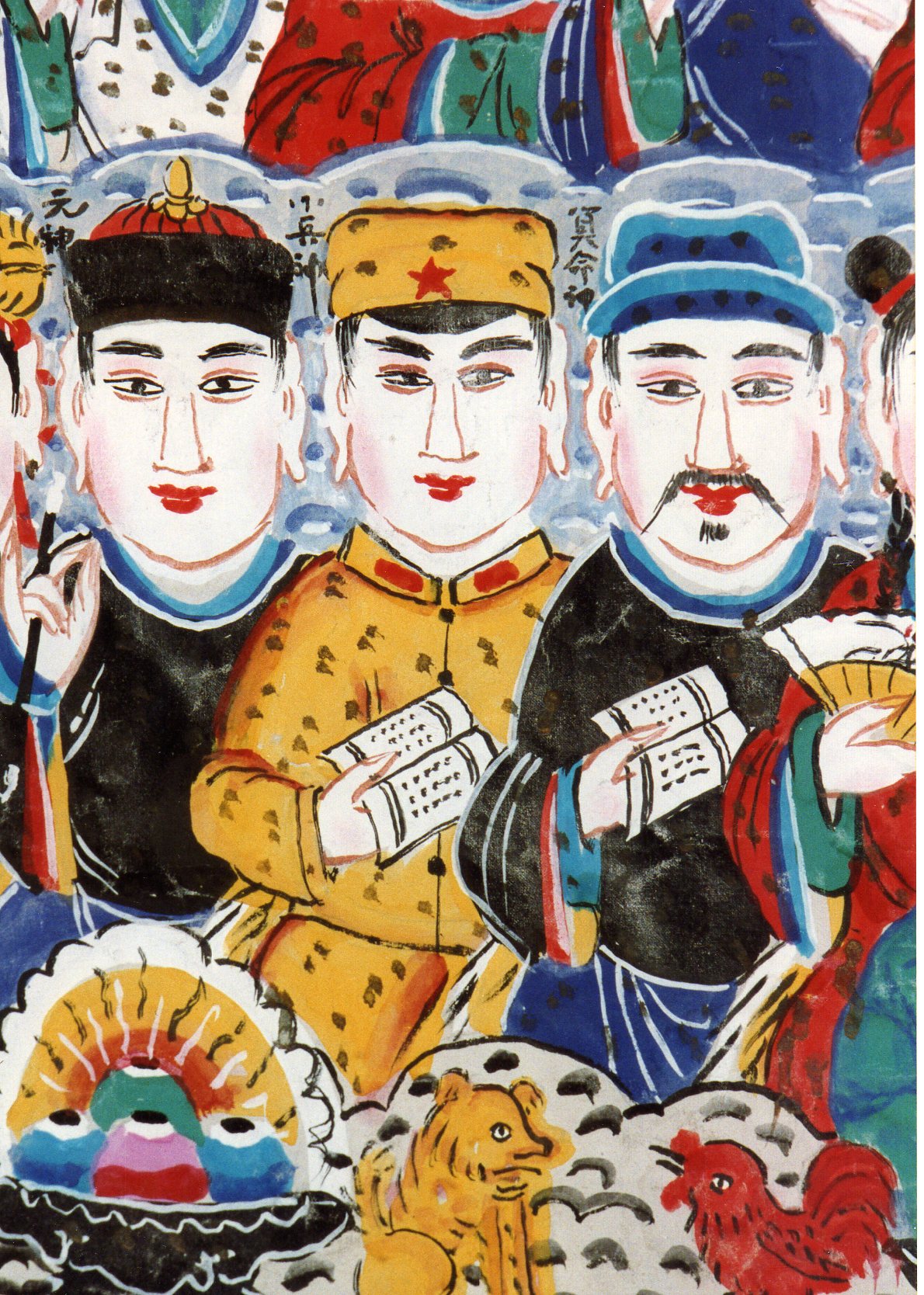
This page from Xue Yibing’s precious notebook lists the gods on the pantheon to the right in the photo.
In this detail, the “young soldier god” features because a medium had divined that he once saved the life of Xu’s son while he was in the army:
For more on such pantheons, see the remarkable website of Hannibal Taubes.
The Xinzhou region In this large and mountainous region we found more household Daoists (this time of the Complete Perfection branch!), as well as a thriving community of Catholics who also used shengguan music to accompany their rituals.
The Ekou Buddhists After digging our van out of the mud yet again, we reached Ekou township in Daixian county, in the northern foothills of Wutaishan. I was hoping to see Chengde, lovely former Buddhist monk whom I had hosted in England a few weeks earlier. But he was doing a temple fair some distance away—so we had a chat with his older brother, who provided us with useful detail on local ritual life there. This was one of rather few occupational household Buddhist groups that we found.
Old pantheon at Chengde’s house.
Hunyuan Arriving hot and sweaty in the (then) cosy little hill town of Hunyuan (at the foot of Hengshan, the northern marchmont of Daoism), we checked into a modest hostel. On the guest registration form, under “Level of Culture” (wenhua chengdu 文化程度) I wrote “None” (wu 无), as is my wont.
After a long drive and many days in scorching temperatures without running water, we were delighted to find that not only did our room have a bath, but that hot water was promised (typically “after 8pm”, which often means either “never” or “from 3.30 to 3.35 am”).
The bathroom wasn’t exactly hygienic, but hey, we weren’t fussy—ruxiang suisu, “when in Rome…”. Xue Yibing rashly took the plunge first, and he was just sinking into the water in ecstasy when the ceiling (exhausted by unprecedented strains on the plumbing above) promptly caved in, covering him in rusty debris (or is that the name of a Country singer?). Adopting what Nigel Barley calls “fieldwork mode”, we both burst out laughing. He came out a lot dirtier than he went in.
Next day we found no ritual activity at the Hengshan mountain temples, but in town we found yet another great family of household Daoists.
Page from ritual manual: end of Fetching Water ritual and opening of Dispensing Food.
This group belonged to a lengthy Orthodox Unity lineage. By the time I went back to see them in 2011 with the wonderful Li Jin, significant changes had taken place in their practice (see fieldnotes here).
The north After a brief visit to more Orthodox Unity household Daoists in Datong county, we reached Yanggao, where I was delighted to find Li Qing again, performing a funeral with his ritual band. He also managed a long session with us, providing detailed accounts of ritual sequences, augmenting my notes from the previous year.
After a brief and rather unedifying stop-off in Yangyuan county, we made our way back to Beijing. Upon my return, I once again (as usual) sought out former monks, before we set off once more for Liaoning in the northeast, finding majestic shawm bands there too…
* * *
Such early fieldtrips with Xue Yibing were an important training for us both, before we launched into more in-depth study of the Hebei ritual associations. I always treasure his notes, but however brief our visits on that Shanxi trip, the three hand-written volumes he copied out for me are full of wonderful ethnographic detail on folk religion.
Since 2011, having profited from collaborative fieldwork for twenty-five years, I have largely engaged with the Li family Daoists on my own, regaining a certain self-esteem—except for the occasional mishap…
[1] For more detail on most of these sites, see my In search of the folk Daoists, pp.65–81; Chen Yu, Jinbei minjian Daojiao keyi yinyue yanjiu, pp.65–90 and passim. For a richly-illustrated overview of folk customs throughout Shanxi, see Wen Xing 文幸 and Xue Maixi 薛麦喜 (eds.), Shanxi minsu 山西民俗 (Taiyuan: Shanxi renmin cbs, 1991).
Long ago in summer 1989 he organised a wonderful festival of “religious music” to take place in Beijing, but it inevitably had to be postponed. With him now “indisposed” for a couple of years, his colleagues at the Music Research Institute managed to reschedule the festival for the following summer—among the many Daoist and Buddhist groups taking part was our very own Li family band of household Daoists, led by the great Li Qing.
By 1992 Tian Qing was rehabilitated, but still under a certain scrutiny. One of the groups in the 1990 festival was the “Wutaishan Buddhist Music Troupe”, consisting of (former) Buddhist monks trained at the Wutaishan mountain temples and nearby. (For “Buddhist music”, and “troupes”, see here and here.)
In collaboration with Tian Qing I was now working with BBC Radio 3 to invite the group to perform for the splendid Spirit of the Earth festival on the South Bank in London.
Time was getting short, and the BBC urgently needed the monks’ names in order to get their work permits. So Tian Qing innocently sent me the list by telegram, with no comment—just their eight poetic Buddhist names, that together make no obvious literal sense:
了滿了充雲枝雲瑞任亮成德玄平玄貴 Liaoman Liaochong Yunzhi Yunrui Renliang Chengde Xuanping Xuangui or Final and complete final and ample cloudy branches cloudy and auspicious trusty and bright accomplished virtue profound equality profound nobility
We later learned that the Chinese authorities spent months trying to decipher this cryptic message to a foreigner, convinced it was some counter-revolutionary code.
The UK tour was great, though, and Tian Qing soon went on to become a distinguished leader and cultural pundit. So that’s all right then.
Alan Bennett (for it is he) reflects on his transition from earnest young Oxford historian to star of Beyond the fringe:
I wasn’t getting any better at [teaching], though the celebrity of the revue to some degree compensated my pupils for the shortcomings of the tuition. This period came to an end in 1962, when the show went to Broadway, thus putting an end to my dwindling hopes of being a historian. The rest, one might say, pompously, is history. Except that in my case the opposite was true. What it had been was history. What it was to be was not history at all.
Yang Ying (right) and Li Bin (left) accompany Wu Mei before the coffin, 2011.
A popular dep in Li Manshan’s band is Yang Ying, who studied briefly with Li Qing not long before his stroke in 1996, but as boss of a busy shawm band has to juggle his ritual work (my book pp.319–21).
Since household Daoists like this are known here as yinyang, and since (like the “non-national” Euripides, to cite Myles yet again) Yang is partial to “smoking substances”, one day while we were all relaxing in the scripture hall I composed a suitable epithet for him, on a par with my headline for Švejk and Saint-Saëns:
阴阳杨英饮洋烟 Yinyang Yang Ying yin yangyan
The yinyang Yang Ying smokes foreign tobacco with a water-pipe.
Note: 饮 “drinks” is a little obscure (“eats” chi 吃 is more idiomatic, but that doesn’t work, of course), but evidently refers to a water-pipe. We’re always joking about “foreign tobacco“, which has long suggested opium.
For some excellent German tongue-twisters, click here.
Then she took out of the hamper three bottles of wine for the convalescent and two boxes of cigarettes. She set out everything elegantly on the empty bed next to Švejk’s, where she also put a beautifully bound book, Stories from the life of our Monarch, which had been written by the present meritorious chief editor of our official Czechoslovak Republic who doted on old Franz. Packets of chocolate with the same inscription, “Gott strafe England,” and again with pictures of the Austrian and German emperors, found their way to the bed. On the chocolate they were no longer clasping hands; each was acting on his own and turning his back to the other. There was a beautiful toothbrush with two rows of bristles and the inscription “Viribus unitis,” so that anyone who cleaned his teeth should remember Austria.
The latest research, however, suggests that Saint-Saëns (1835–1921) once carelessly left his toothbrush behind at his hotel while on tour in Prague—he was indeed a keen traveller, but his biographies are curiously silent about this incident. Later the Good Soldier came across it by chance while rummaging in a junk shop, and proceeded to toy with it.
Still, we cannot dismiss the possibility that the toothbrush may be employed here in its popular Slovakian metaphorical sense. In a comment suggestive of Molvania, Andrew Lawrence Roberts (From Good King Wenceslas to the Good Soldier Švejk: a dictionary of Czech popular culture) notes:
Slovácko is best-known for its traditional culture: distinctive national costumes are still occasionally worn, folk traditions like The Ride of the Kings [a major theme of Kundera’s The joke—SJ] still celebrated yearly. The largely rural residents of Slovácko are known as well for their love of slivovice, which they refer to as their morning toothbrush.
So have I been barking up the wrong tree? In this case, one wonders further: just what kind of liqueur was Saint-Saëns’ so-called “toothbrush”? In our headline, perhaps we may now interpret the verb shuashua “fooling around with” as referring to a tasting session—given Švejk’s Bacchic propensities, surely an epic event, at which Flann O’Brien would have been more than welcome.
Whereas we Brits tend to say “Who is that?”, across the pond they are more likely to ask, “Who is this?”. It has been observed that when British people hear the latter greeting, they tend to wait—expecting them to do an impression.
Long hooked on the gritty folk intensity of rural Chinese music-making, I’ve never had much time for the suave polished solos of the conservatoire virtuosos (pipa lute, zheng zither, erhu fiddle…) that dominate the media. In rural China, instrumental solos are virtually non-existent: ceremonial life is dominated by ensembles, often for wind and percussion—such as the searing shawm bands.
And if there’s one thing that Gets my Goat more than erhu solos, it’s erhu solo arrangements of WAM classics. So this isn’t the kind of thing you might expect me to say—but this has to be the greatest ever rendition of a piece that I wrestled with on the fiddle through my teens:
That’s a truncated adaptation, of course (even with Sun Huang’s technique, some of the violin arpeggio stuff just won’t translate). Here she is later, playing a fuller version—still heavily arranged:
Seriously though, this is jaw-dropping stuff. OK, it’s part of the whole conservatoire shtick of extreme emoting (yet more distressing when they play “traditional” Chinese solos), and similarly virtuosic techniques are all too abundant in China. But just compare the versions of Heifetz or any other hallowed violin maestro on YouTube—no-one has ever remotely approached that depth of expression and mastery (it’s hard enough with four strings, let alone two). Both Sun Huang’s left-hand technique (like qigong, utterly internalised within the body, all in the service of the music) and the engagement of her bow with the strings, by turns mellifluous and gritty, are beyond belief.
BTW, as with Švejk(Shuaike 帅克),here we have another fine Chinese transliteration of a foreign name—Saint-Saëns is perhaps flattered by the rendition Shengsang 圣桑 “Sage Mulberry”. It sounds like one of those pre-historic deities. So in another post I just have to posit a link between the two great sibilant sages.
In the first video, note how Sun Huang is deluged beneath an avalanche of cuddly toys at the end. Quite right too. Before we begin agonising over sexist infantilising, if Heifetz had ever managed to play the piece even half as well, he would have deserved a similar bombardment.
From the sublime to the ridiculous, here you can listen to my own rendition of Bach on the erhu, and speculate on musical life at the 18th-century Beijing court. For my baptism on the erhu, click here. For other types of Chinese fiddles, see here.
What’s all this fuss about Flann O’Brien, I hear you ask. (One perceptive tribute by Kevin McMahon is penned entirely in the form of a Mylesian pub conversation). [1]Padraig Colman, in a fine series of detailed tributes, sums him up dispassionately as “a morose drunk who led an uneventful life as a senior civil servant in Dublin”. For anyone not O’Fay with O’Brien (as the Great Man must have said somewhere?), here’s a little resumé, before you plunge into sundry other posts under the Myles tag.
Well, for one thing, as fellow Flanneurs will know, he was an astute observer of “Poor suffering Hugh Manity”, that’s why. He was a dedicated chronicler of the Hugh Mann condition—a common and distressing affliction. He had a keen ear for the conversation of The Plain People of Ireland, The Brother, and insufferable bores of any Ilk, whether pretentious or just trite. He had the Cut of their Jib, whatever that is. His intolerance of cant (and doubtless Kant) has brought him a cult following [Autospell running amok?—Ed.].
Apart from The Man Who Has Read It In Manuscript, another snowclone that is constantly on the lips of the aficionado is
The Man Who Spoke Irish At A Time When It Was Neither Profitable Nor Popular.
This meretricious character inevitably takes a bow in the Myles na Gopaleen Catechism of Cliché,
a unique compendium of all that is nauseating in contemporary writing. Compiled without regard to expense or the feelings of the public.
Of what was any deceased citizen you like to mention typical? Of all that is best in Irish life.
Correct. With what qualities did he endear himself to all who knew him? His charm of manner and unfailing kindness.
Yes. But with what particularly did he impress all those he came in contact with? His sterling qualities of mind, loftiness of intellect and unswerving devotion to the national cause.
What article of his was always at the disposal of the national language? His purse.
And what more abstract assistance was readily offered to those who sought it? The fruit of his wide reading and profound erudition.
At what time did he speak Irish? At a time when it was neither profitable nor popular.
With what cause did he never disguise the fact that his sympathies lay? The cause of national independence.
And at what time? At a time when lesser men were content with the rôle of time-server and sycophant.
What was he in his declining years? Though frail of health, indefatigable in his exertions on behalf of his less fortunate fellow men.
Whom did he marry in 1879? A Leitrim Lady.
And at what literary work was he engaged at the time of his death? His monumental work on The Oghams of Tipperary.
And of what nature is his loss? Well-nigh irreparable.
OK, watch this, now I’m going to make a subtle transition (and Myles would have relished the voiceover to Away from it all):
Gondolas, gondolas, gondolas. Everywhere… gondolas. But there’s more to Venice than gondolas […] We pause to reflect that despite its cathedrals, its palaces, its bustling markets, and its priceless legacy of renaissance art, the one thing that Venice truly lacks—is leprechauns. [scene changes] But there’s no shortage of leprechauns here: Yes, Ireland, the emerald island…
Here we are again. Normal service resumed. A critic, and a critic of critics, Flann O’Brien discussed art, music, and theatre acutely—sometimes even more acutely than this:
Literary criticism My grasp of what he wrote and meant Was sometimes only five or six %. The rest was only words and sound— My reference is to Ezra £.
His Keats and Chapman series is full of shameless yet often arcane puns:
“My dear girl”, he said, “You have been living in F. Huehl’s pair o’dice.” When she was gone he turned to Chapman. “F. Huehl and his Monet are soon parted,” he observed.
“Sir, you try my patience!” “I don’t mind if I do—you must come over and try mine sometime.”
For all his withering disdain for pretension, Myles’s essays are liberally sprinkled with French, German, and what Peter Cook, in a not-unMylesian sketch, called “The Latin”:
(or for surly purists, the full authentic urtext here).
Nor is the Catechism of Cliché limited to English. It becomes increasingly unhinged (as one does):
In 2016, writing in The Irish Times (since Myles’s day, allegedly an organ otherwise less hilarious than The China Daily), Frank McNally did a rather good sequel on the elections. Indeed, it’s a fun game to play. One day, if you don’t watch your step, I may regale you with my very own Catechism of orchestral cliché. You have been warned. [Oh all right then, if you insist—here you are. Now I’ve even penned a Catechism of Chinese cliché, and of Chinese music clichés. Is nothing sacred?]
On my visits to Germany I constantly giggle at Myles’s Buchhandlung service:
A visit that I paid to the house of a newly married friend the other day set me thinking. My friend is a man of great wealth and vulgarity. […] Whether he can read or not, I do not know, but some savage faculty of observation told him that most respectable and estimable people usually had a lot of books in their houses. So he bought several book-cases and paid some rascally middleman to stuff them with all manner of new books, some of them very costly volumes on the subject of French landscape painting. I noticed on my visit that not one of them had ever been opened or touched, and remarked the fact. “When I get settled down properly,” said the fool, “I’ll have to catch up on my reading.” This is what set me thinking. Why would a wealthy person like this be put to the trouble of pretending to read at all? Why not [pay] a professional book-handler to go in and suitably maul his library for so-much per shelf? Such a person, if properly qualified, could make a fortune.
And we haven’t even discussed At-swim-two-birds or The third policeman, Begob. Here one may even detect a certain affinity with Cold comfort farm. As Myles observed,
It goes without Synge that many of my writings are very fine indeed.
I can only deplore the paucity in his oeuvre of allusions to fieldwork reports on Daoist ritual. And vice versa. Still, it is pleasant to imagine the travails of the Chinese translator of Flann’s great works.
Flann O’Brien survived longer than Hašek, but drank himself to an early grave (“But it’s not even closing time yet!”, I hear him exclaim) in 1966—sadly not in time to reflect
At what time did he speak Irish? At a time when it was neither profitable nor popular. And of what nature is his loss? Well-nigh irreparable. So what capital adornment do I take off to him? (It’s your turn.)
Minister of Finance: “Here is the Treasury Department’s report, sir. I hope you’ll find it clear.”
Rufus T. Firefly: “Clear? Huh! Why, a four-year-old child could understand this report. [to secretary] Run out and find me a four-year-old child, I can’t make head or tail of it.”
Note: Either Firefly or Tweety is a caricature. The more far-fetched one is quite capable of writing his own gags, better than we could ever dream up. And to what avail are our easy jibes?
À proposRavel’s Piano concerto for the left hand: two-handed pianists soon got in on the act, though how to occupy the spare hand must take some thought. In This Day and Age one imagines young pianists saying,
“You know what’s so great about the concerto? You can text your mates while you’re playing it!”
Alternatively one could wear a boxing glove on the right hand, or a glove puppet, making suitably cute gestures to reflect the changing moods.
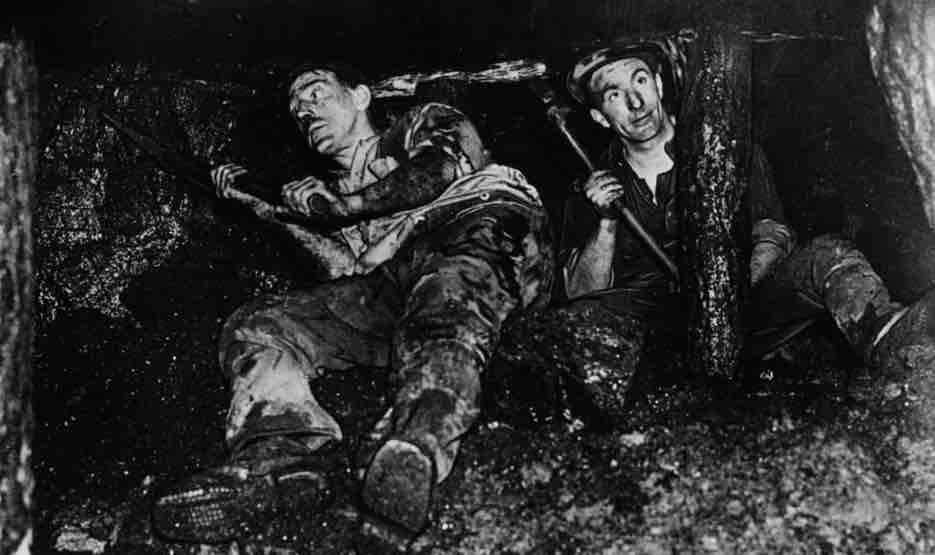
In Certain Quarters such behaviour might go down like a one-legged man at an arse-kicking party.
Conversely, watching people texting with two thumbs, I think of the mbira.
While we’re on deficiencies in the limb department, apart from the one-legged men in The third policeman, this classic audition springs to mind (Tarzan, “A role that is traditionally associated with…”):
During the [1963] run of Beyond the fringe in New York, Dudley Moore and I took refuge from a storm in the Hotel Pierre, where we were spotted by an assistant manager. Saying that there had been a spate of thefts from rooms recently, he asked us to leave. A small argument ensued, in the course of which an old man and his wife stumped past, whereupon the assistant manager left off abusing us in order to bow. It was Stravinsky. We were then thrown out. I have never set foot in the Pierre since, fearing I might still be taken for a petty thief. Dudley Moore, I imagine, goes in there with impunity; the assistant manager may even bow to him now while throwing someone else out. Me still, possibly.
And then (2010):
I tell John Bird the story of Dudley Moore and me seeing Stravinsky and his wife Vera in the Hotel Pierre in New York in 1963, saying how the name Vera has always seemed to me to humanise Stravinsky. “Not so much as Stockhausen,” says John. “His wife’s name was Doris.”
Gender
Now, I’m not so humourless that I can’t see how Vera and Doris (“wives”) are funnier than Igor and Karlheinz (“Great Composers”). Noting that the English have been making light of Storm Doris this week, this brings me to hurricanes.
In the USA, for many years hurricanes bore only female names. The male meteorological community found female names
appropriate for such unpredictable and dangerous phenomena.
Pah! In the 1970s the growing numbers of female meteorologists began to object, and since 1978 onwards male and female names have alternated (Yay!). Nor are they expected to suggest menace, like characters in a horror movie. Fleur or Katrina might be femme fatales, but Tammy and Bob are homely, and Nigel nerdy.
However, in the US people may prepare differently for storms depending whether they bear a male or female name. Hurricanes with female names cause significantly more deaths—apparently (by contrast with that idea of “female menace”) because people perceive them as less threatening, leading to less preparedness and thus causing more damage. You can’t win…
BTW, please can we stop making out that countries and ships are feminine?! Otherwise we’re lucky in English not to have to worry our pretty little heads about gendering nouns…
The “case for the defence” shoots itself in the foot most messily in a breathtakingly Neanderthal essay “Why We Call a Ship a She” from “Rear Admiral” Francis D. Foley—apparently the Benny Hill of the US Navy. This is just a sample:
There can be a great deal of bustle about her as well as a gang of men on deck, particularly if she is slim-waisted, well-stacked, and has an inviting superstructure.
And FFS, it dates from 1998! If it came from 1698 I might reluctantly, um, consider it within the cultural context of the day; but this is indeed the cultural context that afflicts the USA at the moment. Too bad Foley is no longer with us—he would be a shoo-in for the post of Gender Equality Adviser in the new US administration. But amazingly there are plenty more where he came from, eager to fall on their flaccid pork swords before the Amazon hordes of the “liberal media”…
“No sensa humor, these wimmin…” Never mind Bridget Christie—even Foley’s junior contemporary Stella Gibbons would have given him a piece of her dainty mind.
This is a battle that is important to pursue, like “actress”, “chairman”, and “ballerina” (see Words and women)—however much the “PC gone mad” cabal may splutter.
For me, that Parks and recreation theme is right up there with Pete Moore’s 1968 classic Asteroid, or should I say the Pearl and Dean intro—a relic of bygone days when people went to a dark place called “the cinema”. (In the pre-mobile age, they couldn’t even say “I’m in a dark place at the moment”.)
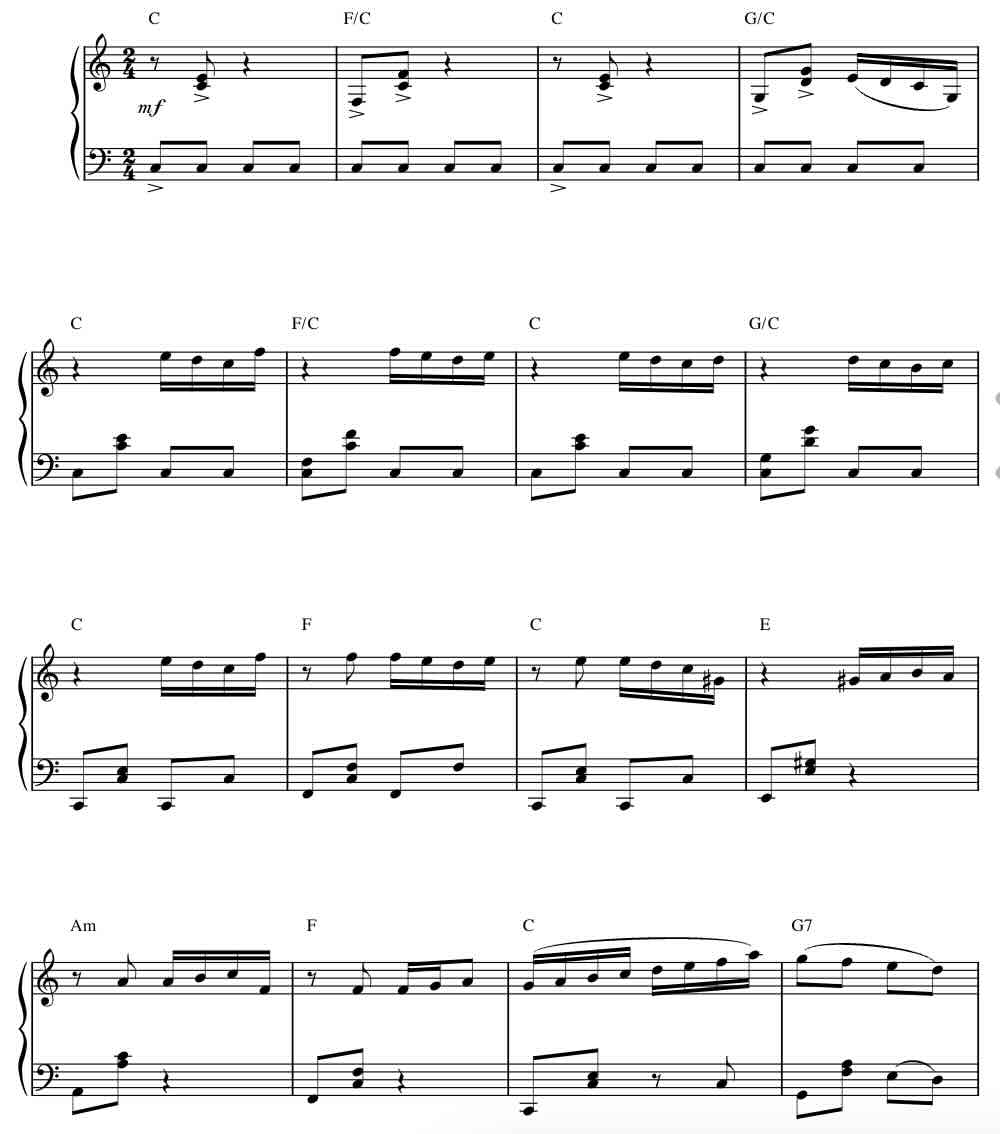
Asteroid belongs well just after the style so effectively parodied at the opening of Monty Python’s Away from it all. And it shows that we too can learn additive rhythms—in this case, 3+3+2. We might set the repeated ambiguous ascending opening phrase to “I’ve got rhythm”.
If historical musicology is your bag, you can compare various versions over time—from the classic
through the 90s’ version, to the 2006 creation. The latter (at all of 2’16”) seems positively Wagnerian in its expansiveness; with our attention-span long conditioned to a quick burst, it takes some getting used to.
I note online comments on the BBC news report on the story:
This appears to reference something in British culture.
and This Pearl and Dean thing seems pretty trivial and obscure to me.
O tempora! O mores! (You can read this as a football result: “Tempora nil—Mores nil.)
Now, Call Me Old-Fashioned [What, again?—Ed.], but the original has an authentic feel that is hard to recapture.
It’s tempting to use the piece as a prelude segueing right into the WAM classic of your choice—like the opening of the John Passion, the slow movement of the Schubert string quintet, or the Adagietto of Mahler 5.
Anyway, ritual efficacy does not necessarily correlate with duration. Ha.
Just as brilliant as Family guyandSoapis Parks and recreation, with the most joyous theme tune ever:
An innocent vamp, with its tiny yet prophetic throw-away ending, introduces the zany syncopated opening of the tune—Not A Lot of People Know This, but it reminds me of the climactic ending of Boléro, played a lot faster than the much-too-fast versions of lesser “maestros”:
This leads to crazy successive modulations à la Berlioz, and to the manic ascending scale and coy simplicity of the descending quarter notes that herald the recapitulation—how does it cover so much ground in 30”?! And this is the full version that doesn’t always get aired!
Ecstatic… And it perfectly suits the mood of the script—here are some great moments from the series:
As I noted in my book (p.366), while in many ways my work on the Li family Daoists has rather little in common with the numerous Chinese field reports on local Daoist ritual, one feature (blessing or curse) that it shares with them is its economy with theory.
Theoretical reflections on Chinese ritual come largely from Western scholars—though they speak mostly not to such disciplines as performance studies or visual anthropology but to the realm of the sinological historian. To be sure, such discussions may be instructive, such as Helen Siu’s theory of ritual fragmentation, or the recurring discussions following from James Watson’s ideas on orthopraxy or the Wolf–Freedman–Weller debate on unity and diversity in Chinese culture.
Theoretical discussion, “like cunnilingus, is dark and lonely work, but someone’s got to do it”—to cite Joseph Heller on tending sheep (in England the bon mot is usually applied to coal-mining). Don’t get me wrong, when done well it can yield great rewards (and Heller’s analogy still applies).
For thoughtful integration of theory with ethnographic detail, one thinks of Clifford Geertz, or (closer to my field) Adam Chau, and Rachel Harris. And indeed Catherine Bell, whose two fine books Ritual theory, ritual practice and Ritual: perspectives and dimensions provide a useful overview of the gamut of polysyllables—phenomenological, redemptive hegemony, and so on—and how useful they may be. Allegedly.
BTW, I like to think of “Bourdieu’s habitus” as a tiny sylvan dwelling, made out of twigs, where elves live; and I imagine him in a little red pointy cap, poking his head out.
Again, such terms (like local, emic ones) can be instructive, as long as they are thoughtfully adopted and adapted. Anyway, anthropologists should hope both to “do things” (fieldwork) and to theorise; but (as with religion) some excel at, or prefer, one or the other. And I guess they themselves will identify “ludic” qualities to their own language.
In the introductions of earnest PhD theses the homages to Foucault, Bourdieu, Gramsci, and so on, often seem like an obligatory kowtow to the God of the Soil (拜土地爺). We also liked to use this expression in our early days of fieldwork, when courtesy visits to the local officialdom were a sensible precaution before “going down” [sic] to the villages.
* * *
As a forfeit for such polysyllabic obfuscations, I hereby decree that henceforth, whenever scholars wish to introduce any abstruse theoretical perspective (“negotiation of identity”, “dialectic of objectification and incorporation”, and so on), they should have to add a line from Wei Hui’s 2001 novel Shanghai Baby (“a story of love, sex, and self-discovery”. Grrr), a trail-blazer in the budding, nay pert, genre of Chinese chick-lit:
… she moaned, as he nimbly slipped off her CK panties. [1]
That’ll learn ‘em. Apart from the exotic foreign brand-flaunting, I may add that just for extra racist value—the potent Other—her lover is German. Anyway, you get the gist—it makes Jackie Collins look like Wittgenstein, and the Chinese people may justly be offended that the book wasn’t shortlisted for the Bad Sex Awards.
As a litmus test of our noble conceptual terms, we might try translating them for our peasant friends, or The Plain People of Ireland. Their bemused expressions may remind us of the limitations of such theories, rather than discrediting them.
Not unlike the order of spoken binomes, temple placards can be confusing to read. Written horizontally, they usually read from right to left; but sometimes, as when an emperor bestows a placard on a temple, they may read from left to right. This can even be an issue in reading secular slogans, which now almost always read from left to right.
A distinguished elderly Buddhist monk from mainland China was visiting Taiwan. Above a little restaurant opposite the temple that was hosting him, he was alarmed to see a sign:
EAT A YOUNG MONK
It took him a while to work out that hopefully it might read in the other direction:
Here’s another true story, that Andrew Manze told me at Chicago airport on a 2003 US tour, rendering me helpless throughout the flight and well into the rehearsal:
A renowned Swedish avant-garde trombone soloist (hmm—take your pick) is doing a concerto in Helsinki. He arrives at his hotel the day before the gig, and when he goes for a pee in his bathroom, the loo doesn’t flush. Same happens again after the rehearsal, so he thinks, I must tell them at reception to get it fixed. But he doesn’t get round to it.
Next morning the loo flushes OK, so he thinks no more of it. But just before going off to the gig, he has a spectacular pre-concert dump, and sure enough the loo again fails to flush. As he’s leaving his room to set out for the concert hall, all dressed up in his penguin suit, he notices a chambermaid outside. So he gestures to her to follow him into his bathroom, points theatrically to the massive turd floating unrepentantly in the bowl, summons up one of his few words of Finnish: “LOOK!”, and pushes the handle as if to flush it.
Just when you thought these jokes couldn’t get any more niche, here’s one from the so-called Xinjiang Autonomous Region in west China, where ethnic tensions are intense. The indigenous Uyghurs (who are Muslim) and the immigrant Han Chinese are often at loggerheads; there’s also a milder minority population of Hui Chinese Muslims, who wear a distinctive white cloth cap. After one recent wave of ethnic violence, this story did the rounds:
A young Hui guy in Urumqi is desperate. “What am I supposed to do? If I wear my cap, I get beaten up by the Chinese. If I take it off, I get beaten up by the Uyghurs!”
For a distressing update on the situation in Xinjiang, see here.
in the category cloud of the sidebar, I’m toying with a ***star-rating (now called *MUST READ!*)—not so much to help you separate the wheat from the chaff, but rather in homage to the great Stella Gibbons(1902–89), who wrote in her Foreword to Cold comfort farm:
And it is only because I have in mind all those thousands of persons not unlike myself, who work in the vulgar and meaningless bustle of offices, shops, and homes, and who are not always sure whether a sentence is Literature or whether it is just sheer flapdoodle, that I have adopted the method perfected by the late Herr Baedeker, and firmly marked what I consider the finer passages with one, two or three stars. In such a manner did the good man deal with cathedrals, hotels, and paintings by men of genius. There seems no reason why it should not be applied to passages in novels.
The “Loam-and-lovechild” style that Gibbons parodied is perhaps a cousin of what Elisabeth Lutyens—there, another fine female composer—christened the “cowpat school” of English music (“folky-wolky melodies on the cor anglais”, and so on). Here’s a *** passage from Cold comfort farm:
***His huge body, rude as a wind-tortured thorn, was printed darkly against the thin mild flame of the declining winter sun that throbbed like a sallow lemon on the westering lip of Mockuncle Hill, and sent its pale, sharp rays into the kitchen through the open door. The brittle air, on which the fans of the trees were etched like ageing skeletons, seemed thronged by the invisible ghosts of a million dead summers. The cold beat in glassy waves against the eyelids of anyone who happened to be out in it. High up, a few chalky clouds doubtfully wavered in the pale sky that curved over against the rim of the Downs like a vast inverted pot-de-chambre. Huddled in the hollow like an exhausted brute, the frosted roofs of Howling, crisp and purple as broccoli leaves, were like beasts about to spring.
Miss Stella Gibbons published Cold comfort farm in 1932. What a genius. The sequel is also brilliant, not least for her opera parody.
























 Stephen Jones: a blog