As I noted in my first post on Chet Baker, among the innumerable delights of Paul Berliner’s book Thinking in jazzis his exploration of trumpet styles and links between them.
Miraculously, we can explore most of these players on YouTube—here’s Fats Navarro (1923–50, yet another distressingly short life—see list here), at the Royal Roost in 1948:
It’s gratifying that Anthropology is not only a discipline that embraces jazz, but (thanks to Charlie Parker) a real living piece:
Cf.
Lady Bird:
Casbah, again with Tadd Dameron, and Rae Pearl (Harrison) singing:
And savour Guilty, a rare male-voice ballad featuring Earl Coleman:
From his last gig, with Bird on 30th June 1950—a week before Fats died:
The treasures of YouTube are inexhaustible, but as a change, the 4-CD set The Fats Navarro story is instructively annotated, like other gems in the Proper Records series—and it ends with two further searing tracks from that last session.
James Gavin, Deep in a dream: the long night of Chet Baker, [1]
which goes well with Bruce Weber’s remarkable film Let’s get lost (for the making of which, do read Deep in a dream, pp.328–42).
Born in 1929, Chet somehow managed to live to the ripe old age of 58—this quote seems tailor-made for him:
If I’d known I was going to live this long, I’d have taken better care of myself!
(Like Daoist ritual texts, this has been diversely attributed—to Eubie Blake, Mae West, Adolph Zukor, and so on.)
We don’t expect any artist to be a paragon of moral virtue—and in jazz, there were few angels. The “straight” WAM scene also had its bad boys—not least, trumpeters.
Before we get onto Chet’s iconic slow ballads, I like his early bebop playing:
And here he is with Charlie Parker in 1952:
I often wish someone would do a study of the styles of Chinese shawm players or Daoist guanzi masters like that of Paul Berliner on instrumentalists in Thinking in jazz. He cites John McNeil’s impressive genealogy (more taxonomy!) of jazz trumpeters (p.137): But whereas most of the jazz greats (Billie, Bird, Miles, Trane, Bill Evans, and so on), through their similar struggles with addiction, were constantly learning, honing their craft, Chet seems to have been gifted with his dreamy cool style very early, and then traded on his angelic image (largely for substances) for the rest of his surprisingly long life, settling for melancholy—without the constant explorations of the other great jazzers.
Donald Byrd, 1959.
Still, taken individually, ignoring the degradation of Chet’s life, his songs are captivating. Apart from his trumpet playing, Chet is one of few male jazz singers I can relate to (that’s my own weakness—the late great Amy Winehouse was devoted to Tony Bennett, for instance); maybe what distinguishes his singing is the way he dispenses with masculine bravado. But the critics are divided: while Chet’s followers revered him as a god, regarding his solos as “models of heartfelt expression, as graceful as a poem”, others were less enchanted, describing him as “a singing corpse”, “a withered goat”, “a hollow-cheeked, toothless, mumbling, all but brain-dead relic”, and “a drug-ravaged ghost” (Deep in a dream, p.5).
But let’s just forget the film, and the book, and wallow. These songs almost add up to a potted biography in themselves:
As with My favorite things, everyone has their favourite versions of My funny Valentine, but this one (live from Turin in 1959 [1] —at the height of Chet’s celebrity in Italy, and just as his substance-abuse was rocketing) is heart-rending:
Another lesson from jazzers in how to use vibrato: I fall in love too easily. And let’s hear it for Lars Gullin on sax…
This next recording (evidently achieved through some editorial sleight-of-hand) contrasts with Bille Holiday’s You’re my thrill—which Chet also sang:
For a sequel, with a yet more informed playlist, see here. Alone together, Chet’s album with Bill Evans, is featured here.
[1] I also look forward to reading Jeroen de Valk, Chet Baker: his life and music. [2] Short of undertaking a global survey, 1959 is widely known as the year of Kind of blue; and in China, for the escalation of famine—still not widely enough known.
In My Time I’ve heard a few divas live in concert (Jessye Norman, Renée Fleming)—indeed, I’ve accompanied some (Monserrat Caballé, Cecilia Bartoli). In this blog I also praise outstanding male singers like Michael Chance and Mark Padmore.
In Italian the term divo is occasionally used, but elsewhere there’s no male equivalent of the diva, or the related femme fatale; both terms reveal male anxiety—dangerous, damaged women meeting (and luring men to) a bad end (cf. Lulu). Male behaviour, more intrinsically fatal, is not advertised thus. The chanteuseis a similar archetype. And the skewed language continues with prima donna—as if male performers are never temperamental, self-important, and demanding (yeah right).
Susan McClary opened the way for later unpacking of such stereotypes in both opera and popular music, such as Lori Burns and Melisse Lafrance, Disruptive divas: feminism, identity and popular music (2001). And the use of these terms in English adds xenophobia to sexism—our impeccable moral virtue threatened by these loose foreign women (“They come over ‘ere, with their dramatic genius, and their perfect control of phrasing and diction…”).
Anyway, “that’s not important right now” (Airplaneclip, suitably in a post on solfeggio!)—
I can’t think when I’ve been so entranced by a singer (that’s the word we’re looking for!) as hearing Ute Lemperin concert at the Cadogan Hall last week. I thought I could consign her to a comfortable old Weimar pigeonhole, but her music is endlessly enchanting. Never mind that I wasn’t quite convinced by this latest project based on Paolo Coelho, with a world music sextet—she keeps exploring. Her sheer physical presence is irresistible—as with Hélène Grimaud, it’s an intrinsic concomitant of her musical magic. Audiences hang on her every breath, every inflection of her slender wrist… I’d love to hear her in a little jazz club.
As with Billie Holiday or Amy Winehouse, the variety of dynamic, timbre, and vibrato that “popular” singers can command is all the more moving by being deeply personal. Once again, I rarely find perfect distinctive vocal artistry in the world of WAM. They’re all building on their respective traditions, but it’s harder for WAM singers, more burdened by formality, to convey such intimacy. Of course, Ute Lemper is also somewhat polished and controlled—less destructive than Billie and Amy; that may make her slightly less moving, but it also helps her stay alive. Her stage presence is breathtaking.
including the horrifying Scream from Mahler’s 10th symphony (above); The Rite of Spring; and an exploration of the minimalist style through Terry Riley’s In C. Making connections between them, Ivan Hewitt and his discussants provide fine social context, to boot—”harmony as a reflection of history”.
I’ve always understood harmonic language more by instinct and experience than by theory. I trust plenty of other orchestral musos are more erudite about chords and harmony, but it is jazzers who are most deeply imbued in the language—and not just the keyboard players.
While I rejoice in the intensity and economical language of much popular music, generally I’m underwhelmed by the upright Victorian simplicity of Christian hymns—although of course Bach’s chorales are in another league.
Glorious is the Earth Glorious is the Earth, glorious is God’s heaven, Beautiful is the pilgrimage of souls Through the fair kingdoms of the Earth We go to paradise with song
Ages come, ages go Generation follows generation Never is the sound from Heaven silenced Of the soul’s glad pilgrim-song
The angels sang it first for shepherds of the land Beautifully it rang out from soul to soul People, rejoice, the Saviour has come The Lord bids peace upon the Earth
BTW, notwithstanding the critiques of Alan Lomax’s ambitious Cantometrics project, this does seem to illustrate one of his notable insights:
that sexually restrictive and highly punitive societies correlated with degree of vocal tension. The tendency to sing together in groups, tonal cohesiveness, and the likelihood of polyphonic singing were all associated with fewer restrictions on women. Multipart singing occurs in societies where the sexes have a complementary relationship.
The Real Group sings the psalm divinely, but it can be just as moving in less polished amateur versions. This is nothing to do with our recent British penchant for Scandi noir. Of course, not being Swedish, I can’t assess what layers of association it may have for various strata of Swedish society today. For me, the Festival of Nine Lessons and Carols from King’s, another likely image of religious purity (and another of those changing traditions à la Hobsbawm), is highly conflicted—Dudley Moore expressed this well, if not entirely reverently. I doubt if all young Russian liberals are so entranced by Orthodox liturgy as I was on Mount Athos.
So as with Bach, there is no “correct” way to experience a piece like this: it will vary by class, time, region, and so on.
While we’re relishing the singing of The Real Group, I can never resist a bit of Bill Evans—led by Margareta Bengtson:
Click here for another brilliant song from the Real Group.
Great Proms of our time: how wonderful to have been part of the AAM Prom in 2004, with Rachel Podger and Andrew Manze, the yin and yang of baroque violin, playing the Bach double. Alas, I now find it’s disappeared from YouTube, but here’s their 1996 recording:
It’s a piece that has constantly been rediscovered by audiences over my lifetime. For my generation, brought up on Oistrakh and Menuhin (1958—canonical then, now sounding so joyless as to be hard to take), more recent HIP renditions, no less heartfelt, have given it a new lease of life.
For the 1929 recording by Arnold and Alma Rosé, click here.
I knew Menuhin’s jazz duets with Grappelli, but not the latter’s 1937 Paris recording of the Bach with Eddie South—accompanied by Django Reinhardt! Alas, it’s just the first movement:
Sure, for me to write about Amy is rather like a football journalist pontificating on ballet. But she was one singer I was entranced by at the time, rather than decades too late—her music forming a soundtrack while I was getting to grips with the rituals of the Li family Daoists. I continue to listen to her songs in awe. Here’s You know I’m no good, live from the Shepherd’s Bush Empire in 2007:
I cheated myself, Like I knew I would, I told you I was trouble, You know that I’m no good
The comparison with Billie Holiday is inevitable. Rather as Billie isn’t considered a blues singer (astounding exception here!), Amy isn’t necessarily associated with jazz. Pop, like WAM (at leastsince the 19th century!), is at the narrow end of the spectrum of variation in world music (instances of the broader end perhaps including Indian raga or Aboriginal dream songs)—whereas Amy sang with the freedom of a jazz instrumentalist. Listening to all her different versions of the same song with the aid of YouTube, no matter how strung-out she was, you can hear how she couldn’t help exploring constantly: she couldn’t bear to sing anything the same way twice. So I guess the commercial pressure to churn out the same old standards “note-perfect” contributed to her decline.
Back to black is one of the all-time great songs: *
Sifting through different versions of her songs is instructive (more so, for instance, than comparing recordings of Zerfließe). The whole album is a masterpiece. This BBC film by Jeremy Marre in the Classic albums series is a fascinating insight into the process of creation and recording—great contributions from producers Mark Ronson and Salaam Remi, instrumentalists and friends, with Amy always a moving presence.
For all the craft that went into perfecting the studio album, Mark Ronson comments,
Sometimes I’d even go to her shows and I found it a little maddening, cos I was like, “We worked so hard and these are the songs and people wanna hear it this way, but everything is slightly improvisational. She would never sing a melody the same way twice, because it’s almost like, “Why would you do that? I already did it that way.”
She was at her best (and this may be a universal truth) in small-scale informal sessions.
Please excuse the BBC bias here (“Typical!“), but her 2007 session for them makes a good compromise, where she is on her best behaviour yet comfortable in the personal setting of Porchester Hall, with her home crowd.
A definitive film is Asif Kapadia’s Amy (2015). A programme in the Soul music series on Radio 4 also shows how much she moved people.
I’d love to be reincarnated as one of her seriously hot backing singers, though this seems unlikely. I would have settled for her staying alive, and happy.
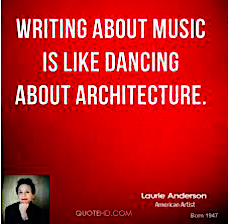
This succinct critique by no means invalidates musicology (if it does, then Uh-oh), but I’m fond of the expression
With All Due Respect to Laurie Anderson, and indeed to Steve Martin, Frank Zappa, Elvis Costello, Miles Davis, Thelonius Monk, * and Clara Schumann (now that’d be some jam session: cf. my fantasy dinner party), its many variations have been widely attributed. It’s anothersnowclone going back in sentiment to the Mists of Time (well, 1918), as in this fine piece of detective work (cf. wiki).
* Whose wife Nellie Smith allegedly nicknamed him “Melodious Thunk”.
The labyrinthine crime novels of Michael Connelly are brilliant—set in LA, packed with gritty procedural, historical, and psychological detail, with their protagonist Harry (short, indeed, for Hieronymus) Bosch.
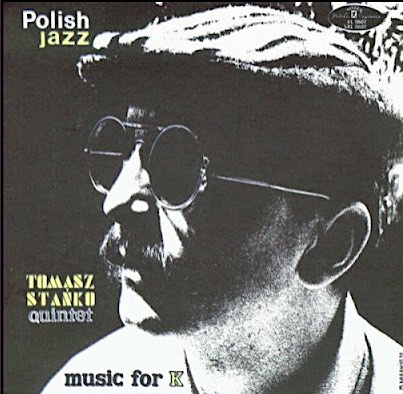
A tangential delight permeating the series is Bosch’s fine taste in jazz. Continuing my trumpet theme, it was through Nine Dragons (a murky Triad case) that I learned of Tomasz Stańko (1942–2018), “the Polish Miles Davis”.
To remind us of the jazz scene under state socialism (see e.g. Pickham and Ritter, Jazz behind the Iron curtain), here’s his 1970 album Music for K:
and First song live in 1976:
WOW… His ballads are great too:
His musical collaborations, with the likes of Krzysztof Komeda (notably in the 60s) and Cecil Taylor (from 1984), were fruitful. For more Stańko (notably the amazing 1965 album Astigmatic), see under Polish jazz, then and now; as well as the 2023 LJF tribute. See also Harry Bosch’s takes on Frank Morgan and Art Pepper.
Brass players enjoy, even flaunt, their hooligan image (more “licence to deviate from behavioural norms”)—or at least, UK brass players in a befuddled heyday from the 1960s to the 1990s, still an ongoing hangover today.
Becoming a musician (or indeed a household Daoist) is about far more than “learning the dots”; aspiring musicians also look to the lifestyles of their role models. The intoxicant du jour changes—Chinese shawm players have moved from opium to amphetamines, for instance. But both in jazz and WAM, many musos have learned to their cost that adopting the, um, recreational pastimes of Charlie Parker or John Wilbraham doesn’t necessarily help them play the way their heroes did.
The trumpeter John Wilbraham (“Jumbo”) was legendary. This is a beautiful site well worth exploring—an insider’s ethnography. I came across him when he was trumpet tutor for the NYO, and later in the BBC Symphony Orchestra.
There are also some fine stories on this site, not least about two of my most admired conductors (more maestro-baiting):
“The one thing we do know about Bach for certain, is that he didn’t want it to sound fucking awful!”
—John Wilbraham to John Eliot Gardiner.
(a succinct critique of the Early Music movement?), and
“If I’d wanted to play in front of a clown, I’d have joined the fucking circus.”
—John Wilbraham (Jumbo) on Gennadi Rozhdestvensky (Noddy)
Learning to perform—in any tradition!—requires endless hours of practice (again, it’s the stories about jazzers, rather than WAM musos, that inspire me here). There’s another famous story, which strangely I haven’t yet found among all the online anecdotes:
Before Mahler 5 at the Proms, a music critic was having a drink in the 99, favoured hostelry of Prom-goers. He watched in amazement as Jumbo downed pint after pint, and then picked up his trumpet case to stagger off to the gig. Expecting the worst, the critic took his place in the audience. The symphony opens with a scary exposed trumpet solo, and is challenging throughout. Jumbo played the whole piece perfectly.
After the concert the critic returns to the pub, to find Jumbo already propped up at the bar, more pints lined up. He walks up to him and says,
“You must excuse me, Mr Wilbraham, but may I ask how you manage to play so perfectly when you’re pissed?”
“It’sh perfectly simple,” Jumbo smiles back at him conspiratorially, “I practice pissed!”
As if my musical life hasn’t been stimulating enough lately, BBC Radio 4’s fine series Soul music recently broadcast a lovely programme (here) about My favorite things—one of the great jazz standards, a seemingly saccharine song whose complex harmonies have provided inspiration for musos, um, down the ages.
Coltrane’s versions are justly renowned, like this, live in 1961:
First concert yesterday on our mini-tour of France, our fifth foreign trip since 2005. Not least, we haven’t seen each other for a year, so it’s great for us to catch up.
After a procession leading the audience through the circus ground on campus at Nanterre, the gig was unforgettable—profound and exhilarating. The audience went wild, and I’m proud for them. They’re right up there with Bird and Dizzy’s band; or with a senior string quartet who have been working together for decades, playing the Heilige Dankgesang on long tours, constantly delving deeper into the inner meaning.
Living the reclusive life that I do, this sudden lurch into serving as their minder, roadie, and stage manager is an invigorating shock to the system. They appreciate all my work—but since I always depend on them when I’m in Yanggao, it’s great for me to able to repay them a bit by looking after them for a change.
In my book (p.335) I wrote about our foreign tours:
Once we’re on the road, looking after the Daoists is an infinitely rewarding full-time job for me. Between sorting out daily logistics with our hosts, shepherding the Daoists round airports, stations, hotels, and restaurants, explaining how things work (showers, coffee machines, and so on), interpreting, helping them buy souvenirs, and keeping everyone in good spirits, I manage to find time to ask further questions about their life stories and rituals. Apart from working as their roadie, I enjoy being stage manager too. Li Manshan observes that they all want to do good concerts for my sake, so I won’t “lose face”; but they take pride in the gigs for themselves, irrespective of my pedantic concert professionalism. Elsewhere I note their high standards back home despite the careless attitudes of their village patrons, and here too they really care about adapting to the demands of a concert. We constantly discuss how to refine their stage presentation, and they get more polished at taking their final bows.
If course one of the insights in spending time in the ”natural habitat” of their home environment is to reveal their humanity. But touring, outside the narrow field laboratory, further helps me relate them to the hubbub of the global bazaar.
They’ve brought me a couple of bottles of Fenjiu “white spirit” from Shanxi, so after our gig we all polished them off over a convivial meal. At midnight Li Manshan knocked on my door and we ended up sharing loads more stories, “having a meeting with Teacher Wang”, and fondly recalling Li Qing, reflecting on this whole amazing story since my first visit in 1991.
Back in Paris tomorrow for our last gig at the Centre Mandapa—for anyone at all nearby, not to be missed!!!
While we’re on the wonderful melody, harmony, and orchestration of Michel Legrand, how about The windmills of your mind (apparently * inspired by the slow movement of Mozart’s Sinfonia concertante!)—here’s Legrand singing it himself in 1969, the rhythms always fluid:
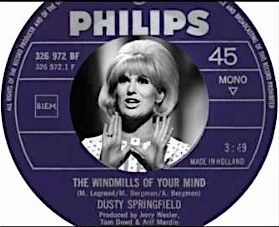
And it loses nothing in English—I continue to be belatedly impressed at the good taste of Dusty Springfield (with English lyrics by the Bergmans, like You must believe in spring):
But though the lurch to the bombastic is only fleeting, I still prefer to maintain the tranquil mood of the original. Above the gorgeous shifting harmonies and suspensions, not only does the melody relish leaps of a 7th, but after the 3rd phrase each new incipit sets forth by falling a 7th from the previous cadence! Cf. the 7ths in Moon river.
Alas, a beautiful danced version has disappeared from YouTube.
* We commonly read that The windmills of your mind is “borrowed” from the opening two phrases of the Mozart; but I can’t find a comment from Legrand himself recognising a conscious inspiration. Anyway, here it is—just as wonderful:
After blithely adducing French film music for Bach’s Zerfließe, I’m reminded of You must believe in spring—for those tricky moments when you seek inspiration and the Resurrection of Our Lord doesn’t quite fit the bill.
Composed by Michel Legrand for Les demoiselles de Rochefort (1967), its English lyrics were then written by Alan and Marilyn Bergman. I just adore Cleo Laine’s 1974 version—all the more moving for being recorded live:
Tony Bennett and Bill Evans make a magical team too:
The song, those harmonies, made perfect material for Bill Evans—here’s an instrumental version from 1977, released after his death in 1980:
When lonely feelings chill The meadows of your mind, Just think if winter comes, Can spring be far behind?
Beneath the deepest snows, The secret of a rose Is merely that it knows You must believe in spring.
Just as a tree is sure Its leaves will reappear; It knows its emptiness Is just the time of year.
The frozen mountain dreams Of April’s melting streams, How crystal clear it seems, You must believe in spring.
You must believe in love And trust it’s on its way, Just as the sleeping rose Awaits the kiss of May.
So in a world of snow, Of things that come and go, Where what you think you know, You can’t be certain of, You must believe in spring and love.
Still giggling at Stella’s resumé of The Flayed, I must just return to celebrating the original Cold comfort farm.
You might think it would be one of those books that could only be spoilt by being Made Flesh (or at least celluloid, or whatever they use these days, with their new-fangled ungodly ways). But the 1995 TV film is highly regarded, and at a tender age, having recently read the book, I found the 1968 serialization most drôle—such as Alastair Sim as Amos, perfect:
“Ye know, doan’t ye, what it feels like when ye burn yer hand in takin’ a cake out of the oven or wi’a match when ye’re lightin’ one of they godless cigarettes? Ay. It stings wi’ a fearful pain, doan’t it? And ye run away to clap a bit o’ butter on it to take the pain away. Ah, but” (an impressive pause) “there’ll be no butter in hell!”
Then there’s the herd of Jersey cows—Graceless, Aimless, Feckless, and Pointless; and Aunt Ada Doom’s regular use of the dilapidated Milk Producers’ Weekly Bulletin and Cowkeepers’ Guide to smite anyone within reach.
The book also exemplifies the clash of urban and rural cultures that is a major theme of anthropology, not least for China. The Li family Daoists sum it up brilliantly in their joke after the final credits of my film.
Flora takes on the project of Meriam the hired wench, in labour yet again:
And carefully, in cool phrases, Flora explained exactly to Meriam how to forestall the disastrous effect of too much sukebind and too many long summer evenings upon the female system.
Meriam listened, with eyes widening and widening.
“ ‘Tes wickedness! ‘Tes flying in the face of nature!” she burst out fearfully at last.
“Nonsense!” said Flora. “Nature is all very well in her place, but she must not be allowed to make things untidy.”
Meriam’s mother (wife of Agony Beetle, no less) has a plan for her daughter’s growing brood:
“Come another four years and I can begin makin’ use of them.”
“How?” asked Flora. […]
“Train the four of them up into one of them jazz-bands. […] So that’s why I’m bringing them up right, on plenty of milk, and seein’ they get to bed early. They’ll need all their strength if they ‘ave to sit up till the cows come ‘ome playing in them night-clubs.”
Lastly, statuesque sullen ravaged Judith:
I am a used husk… a rind… a skin.
Fragrant Flora’s own personal bible, The Higher common sense by the Abbé Fausse-Maigre, isn’t always up to the challenge posed by the Starkadders. (BTW, one wonders if the Abbé lived at 7 bis, rue du Nadir-aux-Pommes.)
Judith gives a classic rebuke to Flora’s gentle probing:
“By the way, I adore my bedroom, but do you think I could have the curtains washed? I believe they are red; and I should so like to make sure.”
Judith had sunk into a reverie.
“Curtains?” she asked, vacantly, lifting her magnificent head. “Child, child, it is many years since such trifles broke across the web of my solitude.”
Following my naïve reflections on the general plan for filming, here are a few hallowed film techniques that Get my Goat:
1) The Ken Burns effect. Don’t get me wrong, his series on jazz is like (sorry) the greatest documentary series ever??? But zooming in slowly to focus on the eyes of a photo is such an insistent habit—bludgeoning the viewer into sharing a profound experience of which the object is innocent.
My brilliant editor Michele Banal (or Michele trivial as he is now known) has educated me in the value of movement in showing photos, but he’s obligingly worked round my wish to keep it subtle and avoid such sentimentalizing.
2) Closeups of hands. In a similar vein, lingering shots of the interviewee’s hands are to be avoided. It may be a desperate measure to paper over a dodgy edit, but again it corrals us all into a conspiracy of profundity. Gnarled, clasped in anguish, elegantly manicured, or not, they’re just hands.
3) Slow-mo. I mean, what’s the point? Sure, used subtly it can sometimes be a useful way round a dodgy bit of filming, but why would we want to see people doing stuff at the wrong speed?
3) Filming while moving backwards as the subject walks towards you. It’s a cliché of many movies, often satirized in the standard corridor scene. Watching most dramas I am quite able to suspend my disbelief, but here I keep thinking, “Hey, how can they not have noticed that there’s this film crew moving backwards in front of them?”
No less irritating is the documentary presenter walking into shot, addressing some earnest words to camera, and then floating off again reflectively. Again, this is well satirized.
Shawm-and-percussion bands play a major role in folk ceremonial around the world, notably in the Islamic world and Europe (see this roundup, as well as this sample playlist). In China, male shawm bands are byfar the most common form of instrumental music, performing mainly for life-cycle and calendrical rituals—in extreme contrast to the media image of glamorous female soloists on the concert platform.
Bands are widely known as “drum music bands” (guyueban 鼓乐班), the players as “blowers-and-drummers” (chuigushou 吹鼓手) or just “blowers”. In north Shanxi they are called “drum artisans” (gujiang 鼓匠). There they alternate with household Daoists, and often go on procession together. But overall they are more ubiquitous and indispensable at funerals and temple fairs than groups of ritual specialists.
To give you an idea of just how common these bands are in China, take the Anthology volumes on instrumental music for Liaoning province. No solo pieces are documented, nor any pieces for strings; instead the coverage comprises four wind ensemble genres:
the music of the shawm bands (guyue 鼓乐);
shengguan 笙管 pieces (here a subsidiary repertoire of the shawm bands)
yangge 秧歌 pieces (again played mainly by the shawm bands); and
“religious music” (sic), with subheads for Buddhist and Daoist music, including vocal liturgy, percussion, and shengguan pieces.
This overview for one single province contains 1,491 pages, of which 1,113 pages are devoted to the shawm bands—and as ever, the material published on them was only a tiny proportion of that collected.
That’s an outline for one whole province. In 2001, within the single county of Mizhi in Shaanbei, a local band boss estimated that there were 138 bands working at least part-time there. Again, contrast the qin, with its tiny elite coterie of players, and its vast media presence.
It’s the majestic timbre, heterophony, and complex repertoire of long suites of northern bands, played on XXL shawms, that appeals to me particularly. While my main focus has always been Daoist and Buddhist ritual, its vocal liturgy accompanied by shengguan ensemble, I realised I had to give serious attention to the shawm bands too. So from 1999 to 2005 I took some lengthy time out to document them. My two books Ritual and music of north Chinaare largely about such bands, in north Shanxi and Shaanbei respectively; both include DVDs. [1]
Status and disability Shawm bands were always at the bottom of the social pile. Virtual outcasts, they were often illiterate, bachelors, opium smokers, begging in the slack season, associated with theft and violence. Freelance like household Daoists and carpenters, they had difficulty adapting to the straightjacket of the commune system, but revived by the 1980s.
At least until recently, shawm players often had some disability, notably visual. In north Shanxi, in Yanggao town alone, blindmen Liuru (c1931–2007), Erhur (b.1946), and Yin San (b.c1947), were all fine players and delightful people (for more on blind shawm players in Yanggao, see here; for posts on blind musicians, here).
Liuru (left) and Yin San, 2003.
In China and much of the world, blind musicians are thought to have special musical gifts. Erhur learned, and loves to sing, the gongche solfeggio, but pointed out playfully, “Only a stupid musician needs notation”! Take that, qin players (see also here)!
Erhur, 2003.
Elderly Liuru, living in pitiful conditions, was also devoted to the gongche of the suites.
Liuru’s shack in Yanggao county-town, 2003.
I also met several stammering shawm players. Like the fraternity of one-legged men in The third policeman, as a stammerer myself I naturally identified with fellow sufferers like Yuanr, the young shawm band boss in Zhenquan township, Shaanbei—bluntly known as “The Stammerer” (Jiekazi). When I introduced myself he thought I was taking the piss. Both his colleagues and mine had a terrible time trying to conceal their mirth once we got ch-ch-chatting. Imagine the number of tapes you’d need to record the interviews.
Blind boys also often become itinerant bards. For Shaanbei, see here; for a harrowing tale of blind bards in Zuoquan, Shanxi, here; and for blind bards in Gansu, and great songs on the Coronavirus by stammering folk-singer Zhang Gasong, here.
North Shanxi I studied the Hua family shawm band in Yanggao county (also home of the Li family Daoists) on and off from 1991 to 2005. Over the years I got to know many other bands in Yanggao too; since 2011 it’s been a pleasure to continue meeting them at funerals. Yang Ying, a regular dep for Li Manshan’s Daoist band, is also the leader of his own family shawm band, one of the finest in the area. Shi Ming, Li Qing’s friend from their days in the regional troupe, led a great band in Wangguantun just west.
Shi Ming’s band, Wangguantun 2001.
The Hua band played magnificently, despite being totally dysfunctional as a family. Led by two senior brothers on shawm and drum who were barely on speaking terms, they played in perfect ensemble, with complex heterophonic melody, and meticulously graded tempi. I still admire their artistry as much as I admire the Li family Daoists.
We did some great tours together (Washington DC, Holland, England), and made the most spectacular CD, Walking shrill, that should be part of everyone’s collection—go on, order it, it’ll blow your head off! Otherwise, there’s this playlist:
While we’re about it, I wrote a long detailed analysis:
“Living early composition: an appreciation of Chinese shawm melody”, in Simon Mills ed., Analysing East Asian music: patterns of rhythm and melody, Musiké vol.4 (Semar, 2010), pp.25–112.
Only slightly less complex is this intriguing excursion—and there are two tracks (#5 and 11) on the audio playlist in the sidebar, with commentary here. See also these notes on our first visit.
Here the classic style consists of long suites for large shawms. But since soon after I began visiting (“Typical!”), as my books show, such majestic music has largely become a casualty of the “big band” pop style adding trumpet, sax, electronic keyboard, and drum-kit. Hey ho.
Shaanbei
Chang Wenzhou’s big band at village funeral, Mizhi 2001.
Further west, the barren loess hills of Shaanbei (see under “Elsewhere” in main Menu), heartland of the revolution, are renowned inter alia for their shawm bands (chuishou). We met many bands there.
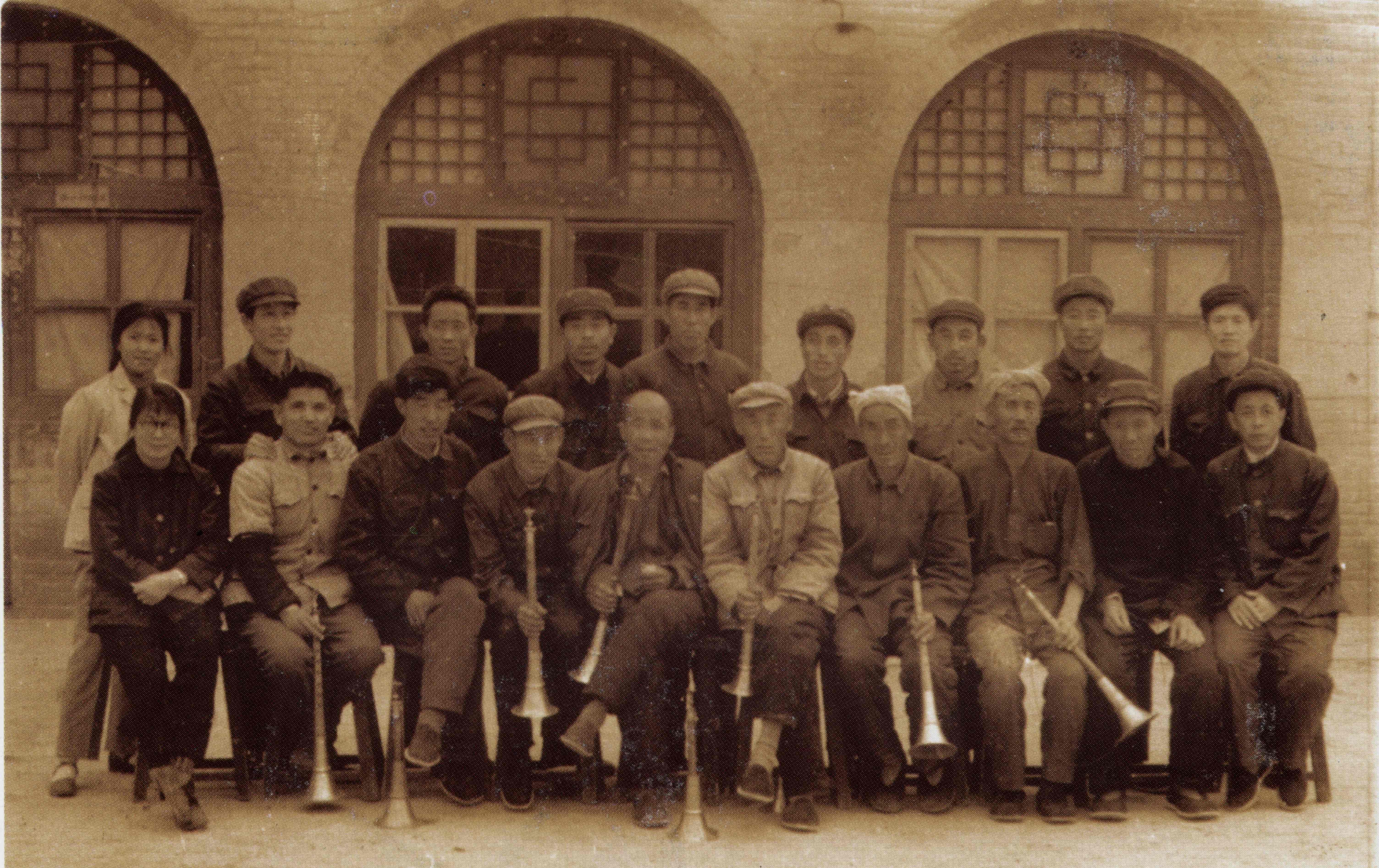
Shawm players from Mizhi county, assembled for a regional festival in 1981.
Scholar Huo Xianggui, who began collecting Shaanbei shawm music as early as 1971 (!), had regular contacts with some of the great players, including Jin Wenhua, Hao Yongfa, and Chang Wenzhou. In another a revealing story about status, revealing the chuishous’ own sense of inferiority, he tells of an incident with the great shawm player Li Daniu—a poor illiterate opium-addicted bachelor. The Party hoped to cultivate Li’s talent by recruiting him for a state troupe, but he found it hard to adapt. One morning Huo invited Li Daniu to his room, and wanted to take him out for breakfast, but Li wouldn’t go. As Huo was about to go off to get food to bring back, Li insisted on squatting outside to wait for him, with the room locked; only half-joking, he said, “How am I supposed to explain if something in your room goes missing?”
By the 1990s, most distinguished of shawm players in the area was Chang Wenzhou, also a fine luthier, though he could be almost as difficult as the Hua brothers. Li Qishan’s rival band was also very fine.
By contrast to the mercenary atmosphere in Mizhi county-town, I enjoyed my time in the hill village of Yangjiagou with the lowly and unsung village band there. Of no great technical distinction, they merely supplemented their livelihood by doing occasional funerals. The two leading shawm players there, Chouxiao and “Older Brother” (on the left of the photo), semi-blind, were delightful unassuming people.
The Yangjiagou band playing for a village funeral there, 1999.
The 1999 funeral sequence from Yangjiagou is one of the highlights (§B) of my DVD Notes from the yellow earth, that comes with my 2009 book.
The northeast As a kind of footnote, both to this post and to my account of our 1992 fieldwork, in summer 1992, just after our trip to Shanxi, we visited southern Liaoning province to seek shawm bands there.
Northeast China is also renowned for its majestic bands with large shawms. [2] The editor of the Anthologyfor Liaoning (see above), Yang Jiusheng 杨久盛, had a rare grasp of the material—like his fine colleague in Jilin province, Li Laizhang 李来璋.
Through Yang Jiusheng we found a wonderful young scholar in Panjin county called Li Runzhong 李润中. He was himself son of a fine shawm player—so he had already done rather well for himself. Besides making the usual transcriptions from his recordings, he had diligently collected rich material on social contexts (including photos, maps, and diagrams), and written brief biographies of some of the leading shawm band players and ritual specialists in the county. Locally published in several thick volumes, his work, like the music of his county, is likely to remain unknown.
This was a period when the Anthology was in full swing, but it was also an insecure time after the chipped “iron rice-bowl” of the commune era. Under Maoism people, in their villages and secure work-units, knew they were screwed; now they had to go out and fend for themselves, and would probably still get screwed. But Li Runzhong, like our friends in Hebei, was passionate about doing the fieldwork.
A vast archive of precious recordings for the Anthology languishes unpublished. Perhaps it was then that I realised someone would have to document this major aspect of Chinese musical life for outsiders.
Liu Yongqing (b.1922) at funeral, Liaoyang city, 1992: #6 in Audio gallery, with commentary here.
Here are two pages of images from the Anthology volume on Jilin province:
Further south many bands play a rather light repertoire, though there are some fine genres. Fujian province, not commonly associated with shawm bands, is full of them, as shown in the Anthology coverage—such as the longchui 笼吹 of south Fujian (#15 on playlist in sidebar, with commentary here); the Shiyin bayue 十音八乐 of Putian, better known for its “civil” ensemble with strings, also has a ceremonial repertoire for shawms:
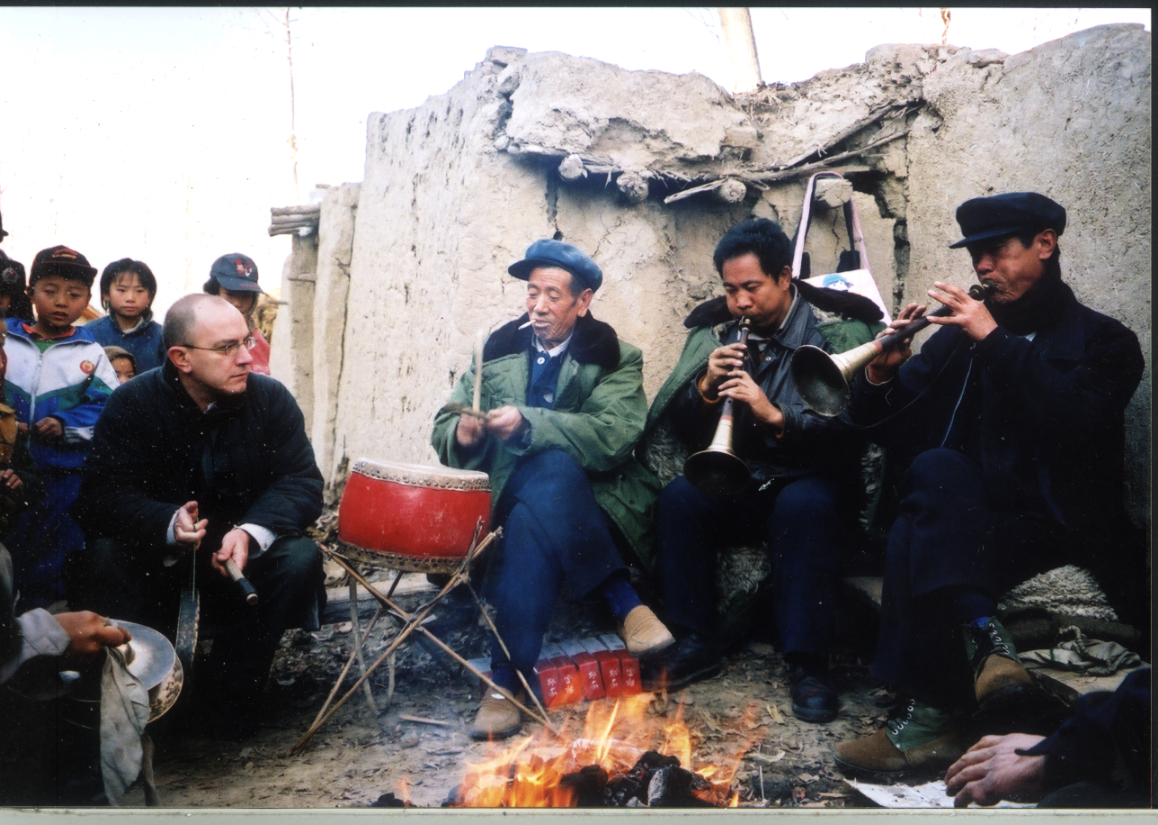
Technique Using circular breathing, the two shawms play continuously in heterophony, often an octave or two apart. Home base (cf. the sheng) is the lowest note, do in the basic scale; the upper player often “walks shrill” with soaring and searing high notes. With drum, cymbals, and gong thwacking away too, the sound is deafening even from a hundred metres away, but sitting in the band is a serious yet intoxicating challenge to the ears.
Our SOAS shawm band Now from the sublime to the ridiculous.
Having taken part occasionally, and sketchily, in the ritual associations of Hebei on yunluo gong-frame and even sheng, I eventually took the plunge with the shawm too. Shawm music is much harder to learn than either the ritual shengguan ensemble of the Daoists or their vocal liturgy; the instrument itself is a challenge (certainly for a baroque violinist…), and the wild improvised decorations can only be learned through prolonged exposure from young. But hey—I knew it would help me get a handle, however rubbish I was.
I accompany Hua band for funeral, Wangzhuang village 2001. Photo: Chen Kexiu.
At first I didn’t try taking part with the Hua band, but when I got to Shaanbei in 1999 I thought I might have a go on the shawm. Chang Wenzhou showed me the ropes, and I tried a few pieces out with Dage and Chouxiao in Yangjiagou.
With Feng Xiaoping’s band, Yulin 2001.
In 2001, after more fieldwork in Shaanbei with my Beijing colleagues, I spent some time alone in Yulin, the regional capital. Putting aside my scruples about such a culturally inappropriate context, I went for daily “lessons” several times a week, one-to-one with a younger folk player, Feng Xiaoping. He got his band together for an informal “graduation concert” in his courtyard for bemused neighbours (well, they didn’t have much choice). After getting through a little suite I was completely knackered. The place names used at the dentist sprung to mind. As in Teach yourself Japanese, I drank a little beer.
In Yanggao with the Hua band in 2003, I mainly stuck to cymbals or gong—like their sons do from aged six!
In 1999 I had come down from the mountain, like Moses (also a stammerer, I note), with a whole set of instruments made by Chang Wenzhou. At SOAS I now had a little coterie of like-minded ethnos: Rachel Harris, Simon Mills, Manuel Jimenez, and Morgan Davies, all fine musicians, experts in their own various genres (Uyghur, Korean, Indonesian, Indian), and great mates. So, just for fun and our own instruction, we boldly decided to have a go at learning a few pieces. This is not like learning the erhu in a conservatoire—they are wild complex long semi-improvised pieces.
We made enough progress to give the occasional gig for suitably uncritical audiences—at CHIME conferences in Venice and Sheffield (not Scunthorpe), at SOAS, and even on procession (aha!) at the Lord Mayor’s Parade. We strung a few pieces together in little suites, and had a lot of fun.
Later I also bought a set of instruments in Yanggao (like “the music itself”, they vary from region to region—it’s no good playing Shanxi repertoire on Shaanbei shawms, or vice versa!). We all loved the Hua band’s wild repertoire, but it was considerably more daunting than that of Shaanbei. Still, I had all my recordings and videos, and I was making transcriptions anyway, which served as a useful crutch—another compromise, since picking it up entirely by ear would have been a challenge too far for us. Rachel, Simon, and I took turns on the two shawms, and since the drum is always an anchor, we relied heavily on the intuitive brilliance of Manuel Jimenez.
Then in 2005 I managed to get the Hua band invited for a tour of England. My old friend Bureau Chief Li, from the Datong regional Bureau of Culture, who had acted as “group leader” on the band’s 2002 DC trip, came along for the ride again.
Bureau Chief Li has always been most tolerant, nay supportive, of my fascination for folk culture—like a bemused dad baffled by his son’s obsession with Aston Villa. On the National Mall in DC, taking one look at all the performance tents set up for a mind-blowing array of groups from all over the Silk Road, he exclaimed, “Hey Steve, you bring us all this way and they’re supposed to play for another bloody temple fair?!” In England our most delightful gig was in Portesham Village Hall in Devon, home to a great jazz series. This time Bureau Chief Li chuckled, “WTF?! You’ve gone and done it again, Steve—this time you’ve got us a gig in the sodding village brigade headquarters!”
Anyway, during this visit, SOAS impressively invited the Hua band for a brief residency. We solemnly assembled daily in a little recording studio in SOAS and took turns joining in with the band on all the various instruments. One evening Morgan and I took a couple of the youngsters to a blues bar—though no strangers to the considerable vices of Yanggao town, they seemed a little nonplussed.
Now that we’re dispersed to the far corners of the globe, or at least of England, we’re all deeply nostalgic about those years. It’s not that we did it at all well—it could sound excruciating—but we learnt a lot, and it was the perfect way to work up a thirst for a good session in the nearby art-deco bar of the Tavistock Hotel, not least in memory of hosting the Hua band there in 2005.
Alas, the Hua band has since gone the way of many “blower-and-drummer” families. Drummer Hua Jinshan survived a stroke onstage in Amsterdam later in 2005. Falling ill there doubtless saved his life: if it had happened back home in Yanggao, it would have been curtains. As he recovered in hospital, I could only obey his pleas to wheel him daily to the courtyard for sneaky fag along with a motley crew of inmates. But his younger brother Hua Yinshan died of cancer, and Wuge, Yinshan’s son, was stabbed to death in an unsavoury brawl.
My usual rant (For a similar one, see here; see also this). If you’ve heard me go on about this before, then go and pour yourself a large G&T.
None of what we tried at SOAS could possibly happen in a Chinese conservatoire. Sure, plenty of folk musicians have become professors there, but once enshrined in the big city they have to develop a more, um, “scientific”, more breezy repertoire. No-one there would dream of learning long suites of up to an hour, in the style of local folk genres, or emulating a bunch of peasants.
The brief of anthropologists/ethnomusicologists is to study people in all levels of society, and to show that all kinds of music-making are valid aspects of social activity, local cultures, in constant flux. Different genres have different aesthetics, all based on social practice.
So we mustn’t assume that state education is the norm. Among all the kinds of music in the world, WAM is rather exceptional, in its notation-based classroom training system and its domination by “concerts”. But that’s the ethos of the conservatoire. All kinds of musicians learn in different ways.
Vocal music too is rarely dependent on the state educational system. In England, aspiring bluespeople, like Mick and Keef, learned their art in art schools. Jazz was only seriously institutionalized from the 1980s, though school bands were always an influence. Elsewhere traditional music may be adopted in similar fashion: there are schools for flamenco, Irish music, muqam, and so on, but often they change the flavour of folk style—and anyway they only represent a miniscule tip of the iceberg.
My old friend Matt Forney, long-term Beijing resident whose towels I have often darkened in between my trips to the countryside, is a fine old-time banjo player. How do spirit mediums in Guangxi, or indeed punks in Beijing, learn? Such folk performers have no need of notation, training classes, WAM theory, and so on. It may be a continuum, but we shouldn’t confuse one for the other.
As to instrumental music: solos are rare in China, as you can see from the Anthology. Solos for erhu, pipa, and zheng are neither a norm nor an ideal. Notable aspects of traditional music-making include oral transmission, versatility, flexibility, and not performed for “concerts”. Folk instrumental music remains male-dominated, whereas since the 1980s the conservatoires have become dominated by women.
So look at these differences between local shawm bands and conservatoire suona soloists: different society, different values, different aims, different music. Even the names of the instruments are different: the urban term suona (found in historical sources) is rarely heard in rural China: instead they use a variety of local names, like weirwa, wazi, or laba. That’s why I fall back on the English word shawm.
Shawm bands (chuigushou 吹鼓手, guyueban 鼓乐班)
suona soloists
By far the most common form of instrumental music in China.
Not so numerous, even in conservatoires.
Weddings and funerals.
Concerts on stage; film sessions.
(formerly) Family training, from young; largely oral training, in course of rituals. Some blind or disabled; they may beg in the off season. Partial to liquor and drugs.
Even if from a rural background, they now learn with a “teacher” in the conservatoire. Notation plays a role. Upwardly mobile!
(formerly) Long complex suites derived from imperial tradition.
Short simple pieces derived from 20th-century modern urban values.
The upwardly-mobile conservatoire suona soloist will never aspire to the social context of the blowers-and-drummers. The most one can hope is precisely what does happen: maybe the former will pick up a few techniques from the latter.
Learning in a classroom, whether in China or elsewhere, is very different from the participant observation of the ethnographer. This difference is clear in China, where the former is done in conservatoires, the latter not at all.
If we learn shawm pieces, we’re unlikely to do it for the same reasons that a young boy in a shawm band family does; his reasons are not the ideal for us—we don’t want their lives. The rural bands may be occupational, but it’s not the kind of professionalism to which conservatoire musicians aspire. Suona soloists in conservatoires learn with a view to doing concerts on stage, or making money in pop/film studio sessions, not doing weddings and funerals.
I should stress again that notation may be a badge of elites, but is not so common either in China or elsewhere, nor is it a criterion for superiority! Notation is not at all important as a learning tool in China or elsewhere, though it may be a totem/fetish for those seeking to establish a “canon”. Of course it may be a useful tool for our analyses…
Yang Der-ruey’s study of a Daoist training school in Shanghai (anyway an exceptional case: most Daoists learn through hereditary family training in the course of rituals) shows the school’s break with tradition, and its irrelevance once they begin working in the real world, collaborating with temple patrons and spirit mediums. Even for amateur genres like Shanghai silk-and-bamboo, the point of learning isn’t to win prizes or even to “perform” in stage “concerts”; it’s a social activity, not to be judged by conservatoire standards.
The kinds of music promoted in conservatoires are very selective: mainly solos that can be taught, with precise scores, one-to-one, like a Brahms concerto or a Chopin étude. The flexibility of traditional ensembles, folk-singers, or a spirit medium, is not required here. But this gives people a very narrow picture of what Chinese music is about, both musically, socially, and historically. One may attempt to create a “canon”, but within the whole field of Chinese or world music it will be no more significant than that of WAM. Such a discourse may even play into a dangerous nationalistic, patriotic, narrative.
In China some examples of the chasm between folk and conservatoire aesthetics are the rare attempts by conservatoire musicians to render traditional music; in failing to subscribe to its aesthetic, they entirely lack the “flavour” that makes it effective, as with their polished stage renditions of the shengguan music of the Zhihua temple, or silk-and-bamboo: meticulously rehearsed from fixed parts, with graded dynamics, and so on.
In general, though, conservatoire musicians neither want to nor could learn local folk traditions. They learn a fixed version of “the dots”, overlooking style, and entirely removed from the social context that nurtures it. They may consider this superior, “improved”, more “scientific”. The musical style of rural shawm bands is also ridiculously difficult—but the point is that there’s no reason at all why conservatoire students would want to learn long shawm suites like this.
In sum, the conservatoires do what they do, and that’s fine. It’s just that as ethnomusicologists we seek to offer a broader soundscape and a broader social range. And anyway, for a sensitive musician, the intensity and grandeur of the folk style will be far more rewarding than those cute little conservatoire pieces.
So after all this discussion of urban (and urbane) concert performance, we should return to the rural ceremonial setting by watching the Hua band playing their hearts out at a funeral—see my lengthy analysis here.
[1]See also my Folk music of China, ch.10, and the CD with the 1998 papreback edition, as well as the 2-CD set China: folk instrumental traditions. In Chinese, my colleague Zhang Zhentao has also written well on them. Cf. my “Men behaving badly: shawm bands of north China”, in Gender in Chinese Music, pp.112–26. [2] See my Folk music of China, ch.10, and §4 of the CD. Note also two CDs from François Picard: Chine, Hautbois du Nord-Est, musiques de la première lune, and Chine, Hautbois du Nord-Est, la bande de la famille Li (Buda, Musique du Monde, 1995).
While I was writing with affection and awe on the shengmouth-organ, I recalled that Ciaran Carson has a similar passion for the tactile minutiae of Irish flutes and their human custodians (Last night’s fun, “Hard to fill”, pp.49–57). Each chapter takes the title of a tune, and (like life, and like jokes!) each tune leads into another.
A few excerpts to give a flavour:
He picks up the foot-joint and prises out the little brass pins which hold the C♯ key in place; he turns it over, and there, under the touch of the key, are the initials “A.L.”, the hidden mark of Alexander Little who spent some time with D’Almaine and later set up shop on his own at 24 Chenies Street (1847–54) and then at 35 Devonshire Street (1854–73). This is a six-keyed flute of Jamaican cocus-wood, weathered to a rich dark chocolate brown with oxblood striations glinting under the immediate surface. […] We are in Sam’s workshop at 1 Exchange Place, Belfast. Exchange Place is, in Belfast parlance, an “entry”: a narrow lane between two streets, a backwater or a short-cut, a deviation from the beaten path. Exchange Place is an entry: we talk and breathe in an exhalation, a many-layered scent of shellac, beeswax, raw and boiled linseed oil, tallow, almond oil, aromatic blackwood shavings, nitric acid and ammonia. I believe you can smell the blue steel blades and boxwood handles of the antique tools: gravers, gouges, chisels, pliers, diamond files and flat files, pincers, chasers. You pick one up and feel its oily-sharp edge with grainy specks of sawdust on it. […] And this is not to speak of the unspeakable archaeological layers of things strewn and assembled on every available surface in the workshop: pins, papers, screws, tobacco tins and and coffee jars, thread, waxed paper, empty bobbins, walrus, tusks, billiard balls, sealing-wax and string, envelopes, cigar-boxes, empty glasses, tannin-encrusted teacups, bus tickets, knives, a bottle of Angostura bitters, a drawing-plate, a bicycle repair-kit, two old trade tin trays (Ross’s Mineral Waters and Buckfast Tonic Wine) with rusted pocks in them, bills, invoices, a blue tin of Vaseline, Christmas cards and postcards, a blowtorch, fluxes, solders, coils of silver wire, brass tubing, wine corks, an old cardboard advertisement for Bassett’s Liquorice Allsorts, brass plate, a Swiss Army knife, dust, unaccountable detritus and filings of long-gone operations, a Bo-Peep matchbox which rattles with brass thumb-tacks when you pick it up, washers, drill-bits, oil-cans, tea-pots, files, gimlets, scissors, a copy of the Irish News from last year, a shrivelled chip, Kirby grips, bulldog clips, Jubilee clips and paper-clips, a square damp packet of Saxa salt, Blu-Tack, bits of putty, sealing-wax, a little paper packet of cigarette-lighter flints, a candle stub, a Zippo lighter, cotton-wool, a sticky tin of Tate & Lyle’s Golden Syrup, wisps of steel wool, and the blue glint of methylated spirits shivering in a glass square-shouldered glass-stoppered bottle against a stained, scarred patch of the workbench; on a window-sill, three little tinker-made tin inkwell-shaped receptacles with milled brass screwtops, containing pumice, tripoli and rouge, each bearing the original early Victorian price of three shillings (3/-).
Click here for Pakie Duignan in duet with fiddler Peter Fitzpatrick.
And Last night’s fun is just as wonderful on performance practice. I’ve linked Chinese and Irish musics before; for a change from the usual comparison with silk-and-bamboo (for both social context and heterophonic sound-world), Carson’s recollection of Pakie Duignan reminds me of Daoist guanzi-player Wu Mei:
His way of breathing was a joy: it had economy and grace and power; his management of time was perfect. He had the time to hit whatever note it was that came next, then to extend the breath into the next phrase like a sudden almost-visible extension of the room, as if this phrase had yearned to be united with its predecessor, and now they were together. Then he’d cut the end of that phrase and wander off into the split chink of a twilight zone, momentarily. Normal business would resume some time, but in this instant he had gone down steps he’d never seen till then, that led down to a dark harbour where water clucked against the boats and rocks and a constellation could be seen reflected.
Astounding—go on, read the chapter, and the whole book!
Like Carson’s fantasy on the role of the Irish breakfast in musical life (“Boil the Breakfast early”, pp.15–21), that’s just the kind of loving detail, mutatis mutandis, that we need for China, and Chinese ritual.
As with the syncopated cadential pattern in the hymns of the Li family Daoists, we need to evoke all the practical insider’s detail and the embedding of ritual with daily lives—not just grandiose theory and ancient mysticism. If we’re going to write about music—and ritual—at all, then along with Berliner’s Thinking in jazz, Carson’s book is a paragon. For more, see my series on Irish music!
Besides great recordings of Shéhérazade, L’enfant et les sortilèges, the piano concertos (with Kind of blue as a bonus!), the Introduction and Allegro, and so on, you can now find Monteux’s classic 1955 Daphnis and Chloé, and a 1954 recording of the piano trio.
A marriage guidance counsellor is having a tough time at a session with a couple reluctant to make any effort—sullenly refusing to speak to each other, only addressing their bitter comments through the counsellor.
So he whips out his double bass and starts playing a convoluted jazz solo. At once the couple strike up an animated conversation.
Intrepid early-and later-music bass player Pete McCarthy told me this one on a long coach ride on a US tour, c2001.
Clothes clothes clothes music music music boys boys boys [1]
(to give it its full title—her mum’s reproach to her as a teenager)is a beautiful inspiring book, full of sincere humanity and insight. We can draw a veil over the story of her messy “dalliance” (dunno why I’m suddenly coming over all Jane Austen) with Johnny Rotten. The account of her post-punk life is no less compelling than that of her time in The Slits, with their amazing singer Ari Up (RIP). Women, and sexism, in punk are justly favoured topics in musicology and glossies alike—more so, I note, than Daoist ritual (funny, that). For female punk band Vulpes in Madrid, see here.
I was sadly unaware of all these brilliant singers at the time, except (for some reason) for Nina Hagen—Naturträne (1978) has long been one of my favourite songs (see this playlist):
You can, and must, watch her singing it live on video too, but that recording is astounding. I was busy being a Boulez groupie… OK, there’s room for technique in punk too, but it’s not quite the point; I could presumably square that song with my snobby sensibilities long before I also learnt to rejoice in the Sex Pistols or the Ramones. Or Daoist ritual…
Just as much as the Matthew Passion, or Wozzeck, it makes want to learn German:
Natur am Abend, stille Stadt Verknackste Seele, Tränen rennen Das alles macht einen mächtig matt Und ich tu’ einfach weiterflennen
We can save punk in China for another time—but again, it’s all part of the rich ethnographic tapestry. Not quite punk, but Cui Jian’s classic song Nothing to my name
prompted a fine complaint from Wang Zhen, veteran of the Long March:
“What do you mean, you’ve got nothing to your name? You’ve got the Communist Party haven’t you?”
Mutatis mutandis, Thatcher might have concurred.
[1]Pedantic note: most superior reviews abide by the title’s lack of punctuation.
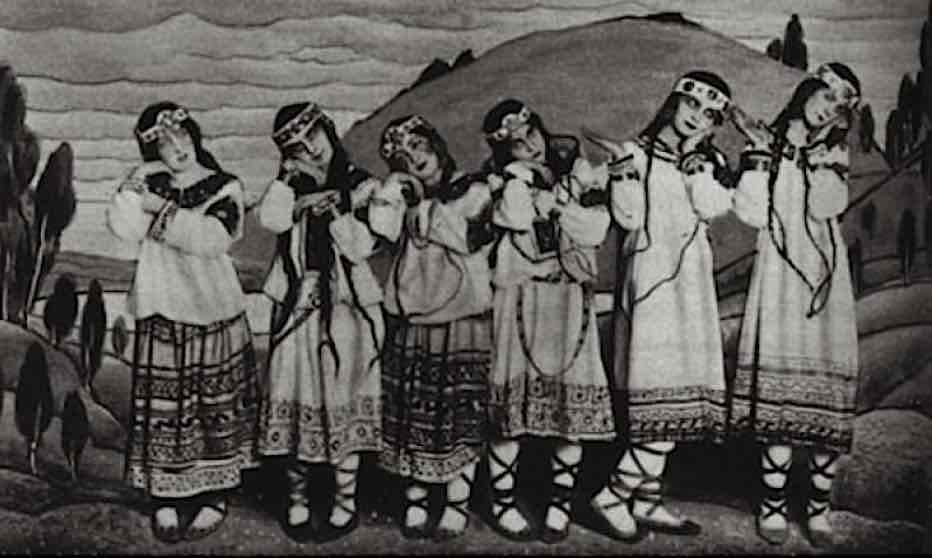
“Knock-kneed and long-braided Lolitas”, 1913. “When they cocked their heads against their hands, someone yelled, ‘Get a dentist!’
and someone else yelled back, ‘Get two dentists!’ ” (cited here).
Though The Rite of Spring has become standard, a classic, since the 1970s, it remains overwhelming today, whether or not you’re familiar with it. Playing it in 1970 with the National Youth Orchestra, conducted by Boulez, was one of the great experiences of my life (see also here). For a 2022 Rite at the Proms, click here.
Among endless discussions, Tom Service gives a succinct introduction. Alex Ross (The rest is noise, p.57) nicely (sic) compares the “riot” at the 1913 première with the release of the Sex Pistols’ Anarchy in the UK. Gertrude Stein’s detailed account of the event is curious:
We could hear nothing. One literally could not, throughout the whole performance, hear the sound of music.
Curious, as she wasn’t actually at the premiere (supposing that she had lived long enough not to actually attend the premiere of The sound of music either, she might have said, “One literally could not hear the rite of spring.”)
I’ve cited Richard Taruskin’s fine expression “lite Rite”—“Is nothing Sacred?”, as Keats and Chapman might say. In his stimulating article on Bartok and Stravinsky (The danger of music, pp.133–7; see also pp.421–4), he observes Bartok’s identification of The Rite’s “folk” elements that Stravinsky later disowned:
Even the origin of the rough-grained, brittle and jerky musical structure backed by ostinatos, which is so completely different from any structural proceeding of the past, may be sought in the short-breathed Russian peasant motives.
Alex Ross is also very much on The Rite’s case. In a crowded field, his comments in The rest is noise are very fine, with vivid context in his chapter “Dance of the earth” (pp.80–129), citing Taruskin’s definitive 1996 book Stravinsky and the Russian traditions.
I take Taruskin’s point that the darker energies of The Rite have been “resisted, rejected, repressed”, but even in the most polished performance it’s both exhilarating and disturbing.
Swan Lake it ain’t. Remember, at the 1913 Paris premiere the ballet was just as shocking as the music. You can see a reconstruction of Nijinsky’s own choreography here, and the recreation (from 25.40) following this documentary gives an impression:
Stravinsky once joked that the dauntingly high-register bassoon solo which opens the piece should be transposed up every year to stop players getting complacent about it. He wanted the effort to register.
But “it’s complicated”—see also here (and note the ritual wind instrument connection). I’m not sure about the dudka, but if it’s really related to the Armenian duduk, then there’s a link to the guanzi of north Chinese ritual bands! There’s a wealth of discussion of that opening solo in bassoon blogs.
sounded like someone driving through the jungle in a Mercedes with the windows up,
then good for him.
And then there’s the “original instrument” debate—the “lite Rite”, as Richard Taruskin called it:
This version for organ, far from silly, is just awe-inspiring:
A harpsichord rendition has also appeared on YouTube. Jazz tributes include the Bad Plus arrangement:
In her recent exploration of The Rite, Gillian Moore also observes:
My feelings of creeping feminist unease in writing a book on a ballet about the sacrifice of a young woman created by three men were at least partly relieved when I came across the Russian folk metal band Arkona and their frontwoman Masha Scream.
On a lighter note, here I imagine the Danse sacrale as a suitable riposte to the haka.
BTW, Ravel’sDaphnis and Chloe, less revolutionary but no less captivating, must have suffered by its proximity.
*First essay in what has become a remarkably extensive series on jazz!*
Billie Holiday‘s 1957 TV appearance must be among the most moving videos ever, with Billie in rapture, showing the depth of the rapport between great musicians—don’t miss the final trumpet solo from Roy Eldridge! (For the making of the film, see here, with a link to another YouTube video; among discussions, I admire the Coda of Farah Jasmine Griffin, In search of Billie Holiday.)
For my personal Billie Holiday playlists, see here and here, the latter referring to some of the myriad books on her…
Apart from the experience of listening, jazz biographies are just as captivating as jazz photos. If only I could bring the Li family Daoists to life with such detail as we find in books like
Ross Russell, Bird lives (for a fine review of three more books on Charlie Parker, interrogating the whole genre of jazz biographies, click here)
In books like this, it’s not just the social and personal detail that impresses, but the technical aspects of their constant musical strivings—the musos’ obsession with chords, timbre, and so on. From Charlie Parker’s use of the Rico number five reed (Russell pp.10–13) to Keith Richards‘ sheer exhilaration at discovering the open five-string tuning (in Life p.270ff.), no less captivating than the many gaudy experiences throughout the book.
We could compile lists of similar excursions in world music, but jazz leads the way…
Here’s a fun party game. When reading Life, be sure to read it in Keef’s voice—his inclusive conspiratorial chuckle is one of the great primeval sounds of nature.
Conversely, Miles’s autobiography should be read in the voice of the Queen, Brian Sewell, Jacob Wee-Smug [aka The Haunted Pencil]—or (for yet older readers…) the presenter of Listen with Mother. If serialised on Radio 4, it could be called Listen with Motherfucker. For a related story from Istanbul trumpeter Muvaffak “Maffy” Falay, see Jazz in Turkey.





 Glorious is the Earth







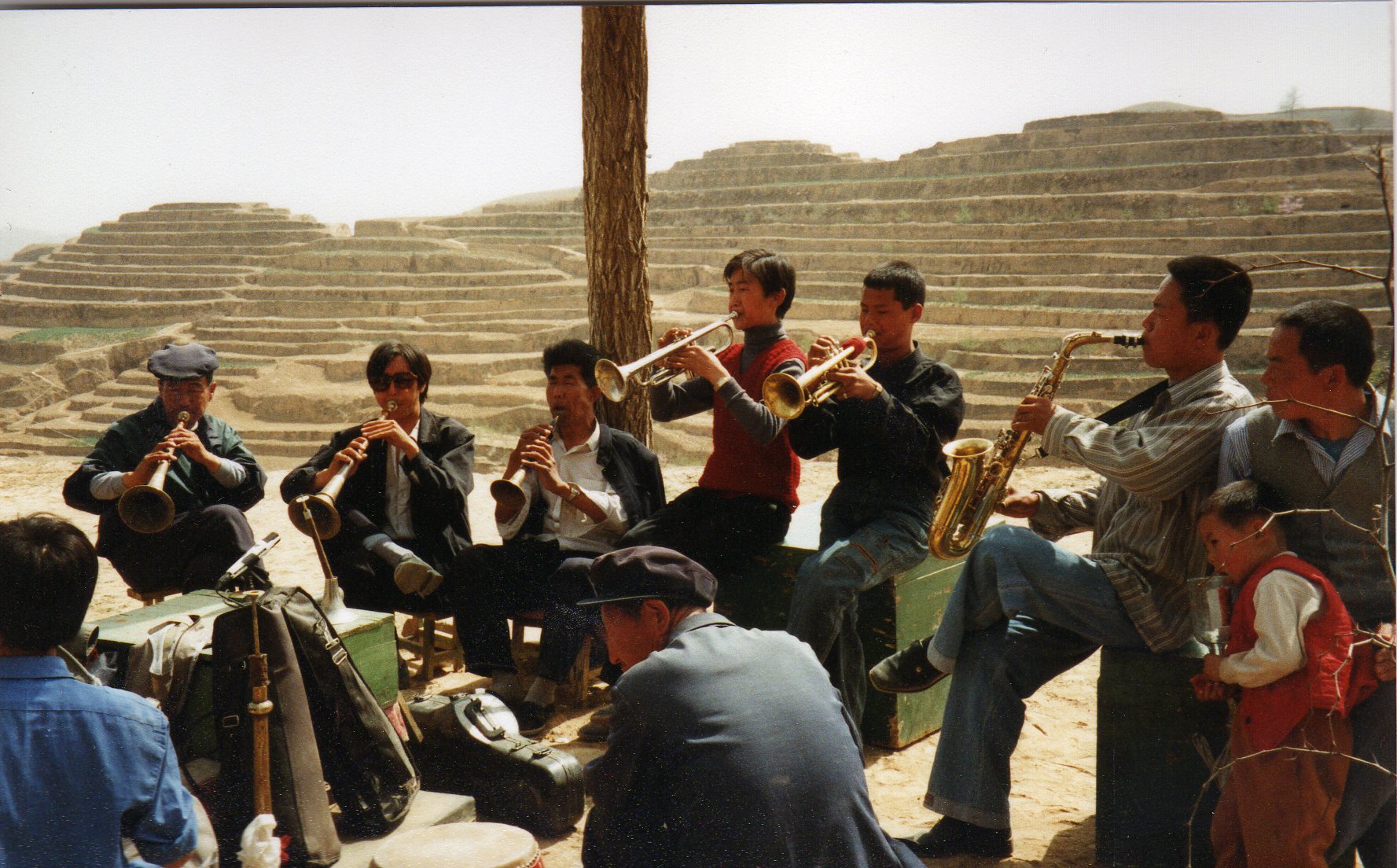
 Shawm players from Mizhi county, assembled for a regional festival in 1981.








 Stephen Jones: a blog