Bards of Shaanbei

In my summary of Guo Yuhua’s fantastic book on a Shaanbei village, I mentioned the blind bard Li Huaiqiang. The complex fortunes of these bards under Maoism and since the reforms require a nuanced approach, and deserve a separate post. [1]

As I edit my old material from around 2000, I’m aware that fieldwork is always of its time. I haven’t sought to update it, but the period since then will also have seen rapid change—which I discuss further below in my review of a more recent book.
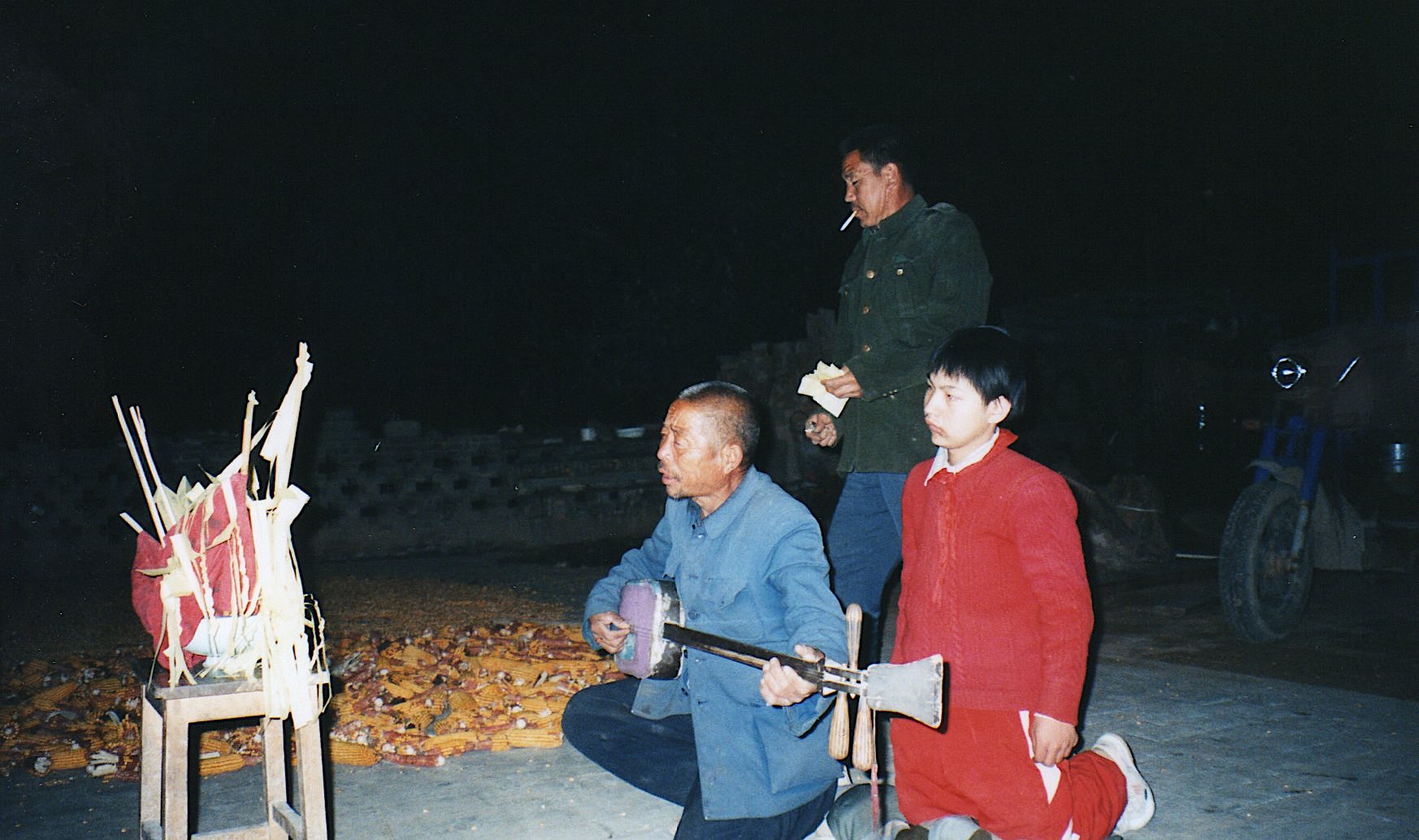
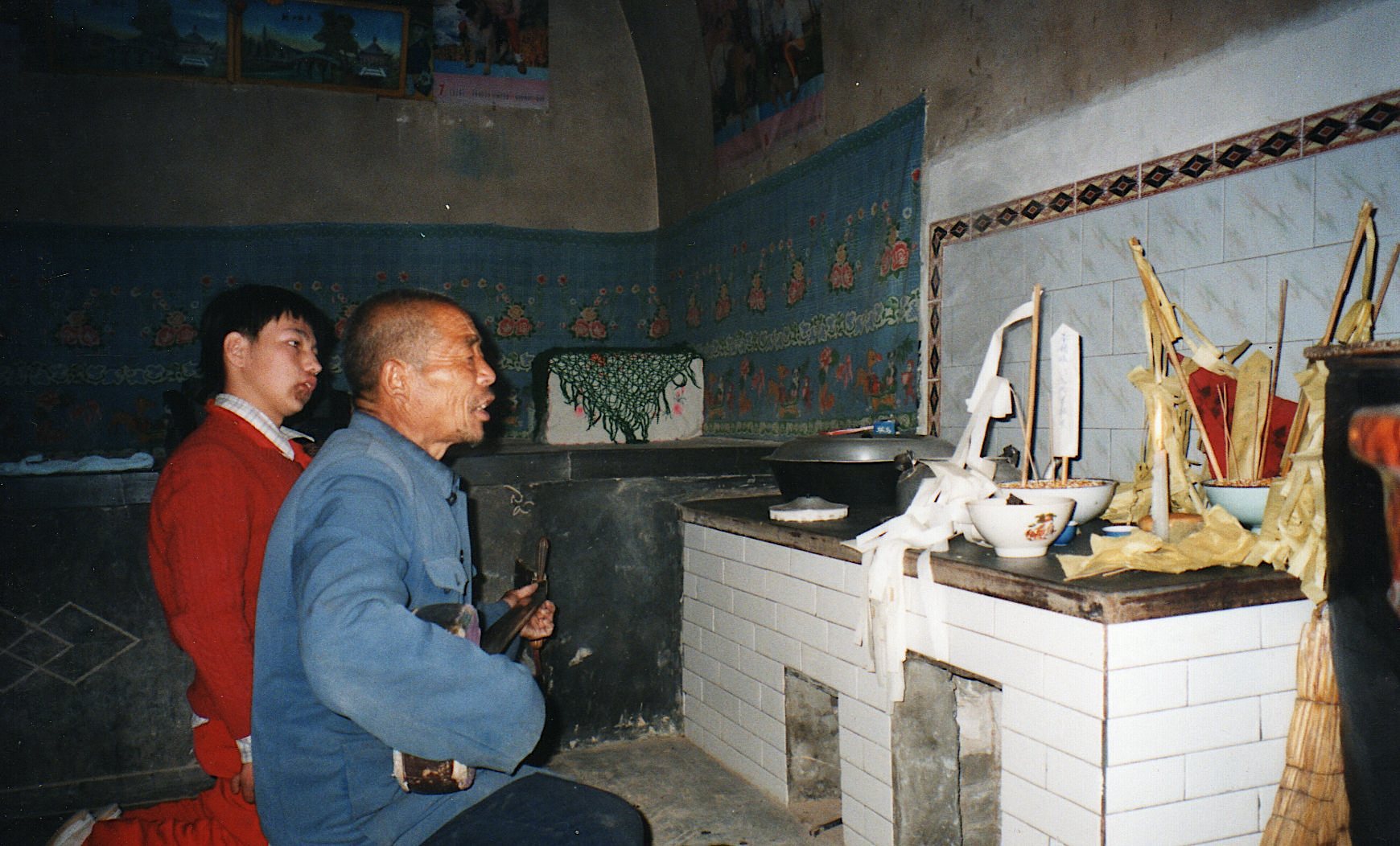
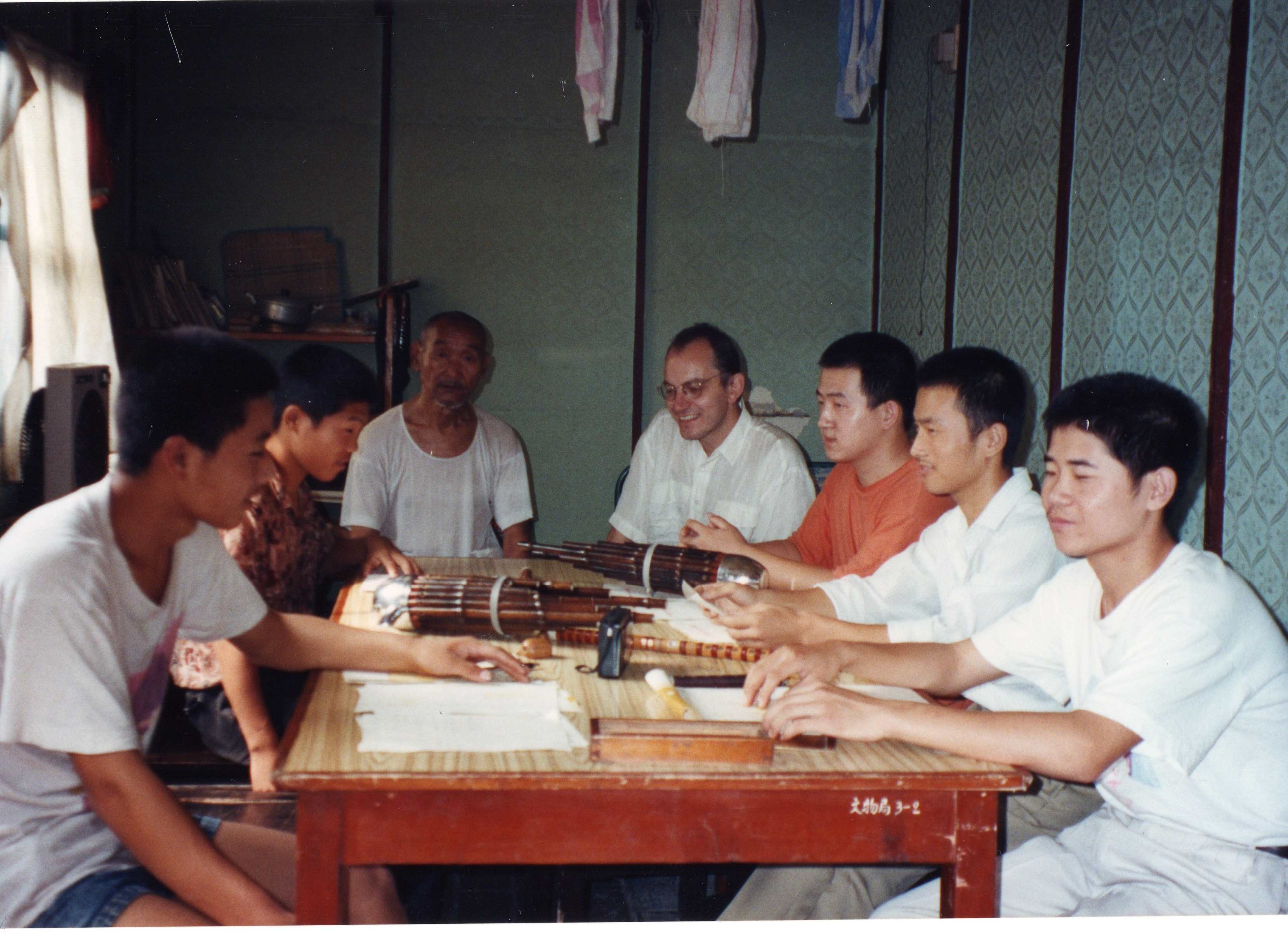
LWJ in courtyard

LWJ shuoshu

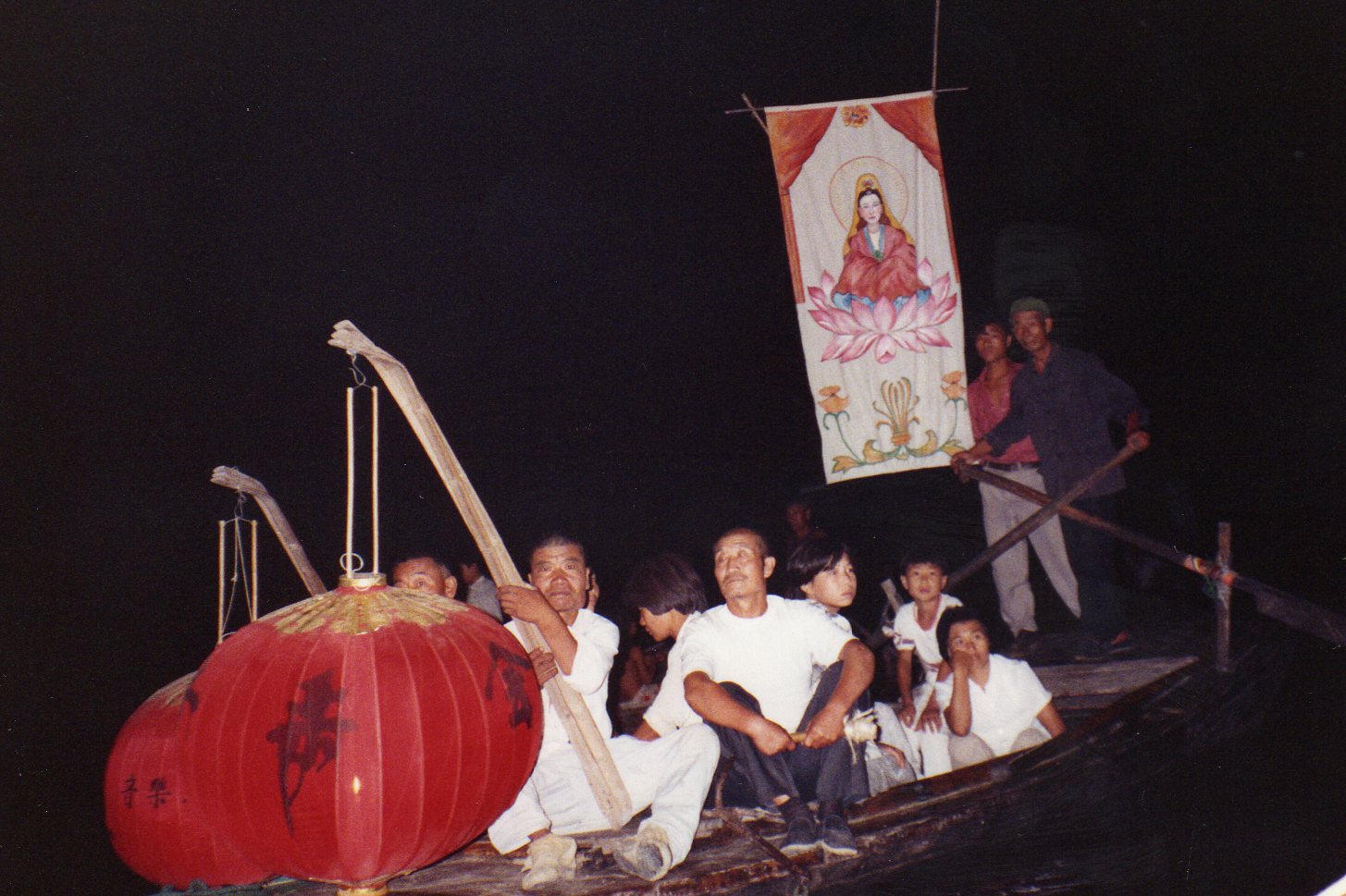
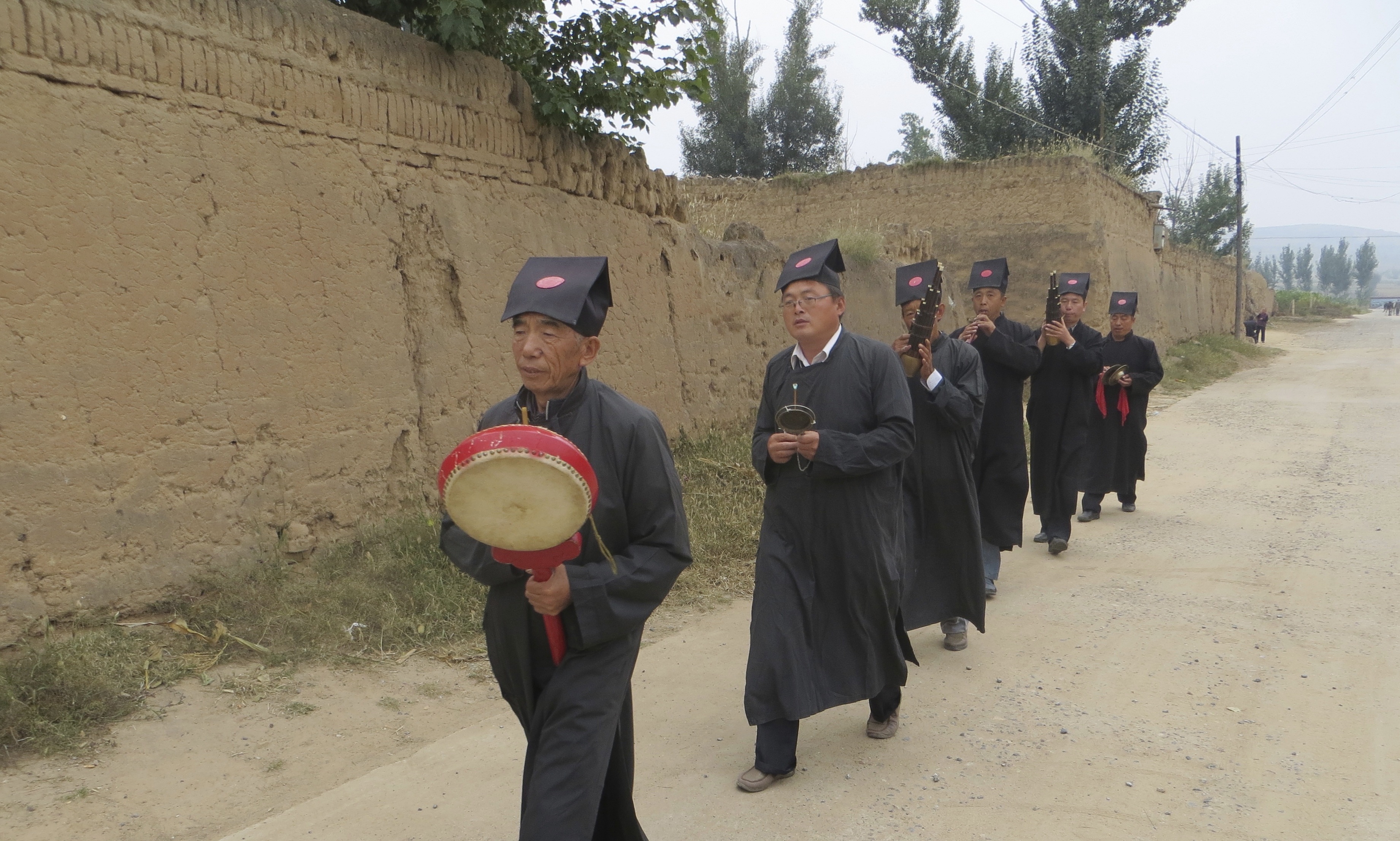
Sighted bard Li Wenjin performs a “story for well-being” to protect the son of the host family, first inviting the gods in the courtyard and then narrating a sequence of stories before the altar inside the cave-dwelling.
See DVD §C4 with my Ritual and music of north China, volume 2: Shaanbei,
and pp.83–4 there).
Photos: Guo Yuhua, 1999.

Introduction
In Shaanbei, as in much of rural China, while many blind men earn a living by taking up the shawm (on which see my post on Guo Yuhua, and here, as well as this post on north Shanxi), others have also long served as protectors of children, acting as godfathers and healers, and telling fortunes—as well as singing “stories for well-being”, accompanying themselves on a plucked lute and clappers, a kind of one-man band. They are itinerant, going by foot over quite a wide area.

Though in decline since the 1960s, the bards appear to have adapted rather little in context or sound. Under the Maoist collectives, some spent brief periods being taught new stories in the county-town “propaganda teams”, but this hardly affected their repertory or performing contexts. Since the 1990s, the popularity of the genre has been further threatened by the media of TV and pop music; and little bands now increasingly supplement the solo performers.

Social background
Blind bards also tell fortunes, cure illness, and act as godfathers—occasions when they do not necessarily perform stories. As godfathers they perform ceremonies protecting children (including hanging the locket, the annual Crossing the Passes ceremony at temple fairs, and opening the locket). These ceremonies have doubtless become rather less common since the 1950s, though neither campaigns against superstition nor any gradual improvement in healthcare entirely explain this.

Li Huaiqiang, in his 70s, had hung the locket for three or four hundred children; Guo Xingyu, in his 50s, for “over 290”.

Like geomancers and mediums, the blindman performs healing in a ritual called Settling the Earth or Settling the Earth God. For this he recites incantations and depicts talismans, but does not perform stories.

These occupations were a lifeline for males only: the fate of blind females was pitiable.

Occupations for blind men in Shaanbei

  • begging (yaofan 要饭)
  • playing in a shawm band (guyue 鼓乐, chuishou 吹手)
  • telling fortunes (suangua 算卦)
  • exorcism / healing (antushen 安土神, zhibing 治病)
  • hanging the locket (baosuo 抱锁, daisuo 带锁), opening the locket (kaisuo 开锁), Crossing the Passes (guoguan 过关)
  • narrative-singing (shuoshu 说书).

Contexts for narrative-singing

  • Stories for vows (yuanshu 愿书), to fulfil a verbal vow (huankouyuan 还口愿):
    household (jiashu 家书), for well-being (ping’an shu 平安书)
    temple fairs (huishu 会书: miaohui 庙会)
    parish (sheshu 社书)
  • less common: weddings (hongshi 红事), moving into a new cave-dwelling (nuanyao 暖窑), going off to the army (canjun 参军), official meetings (jiguan 机关).

Ritual equipment, stories, and music
For the narrative-singing contexts, the bard performs before a small temporary altar. Inscriptions for the gods and family, rectangular paper “god places” with a triangular head, mounted on gaoliang stalks, as well as changqing yellow paper streamers, are inserted into one or two rectangular bowls filled with grains of millet or corn. Before the altar are placed a lit candle, small bowls to hold incense and burn paper offerings, and offerings such as dough shapes, biscuits, dates, fruit, peanuts, cigarettes, and cups of liquor.

The altar is placed on the family stove or on a table; for the rituals to invite the gods and escort them away at the beginning and end of stories for well-being, it is placed on a table in the courtyard outside. Li Huaiqiang, though blind, prepared the changqing streamers himself; someone sighted and literate has to be found to write the inscriptions. Incense and paper are burnt before the altar periodically throughout the performance.

The bard takes with him a red cloth bearing the titles of a pantheon of gods. When not in use it is rolled up and kept in the bard’s bag. The cloth is unfurled and placed upright behind the altar, supported by two sticks inserted into a sleeve at either end of the cloth.

Cloth pantheons:
(left) Li Huaiqiang, 1999;
(right) Xu Wengong, 2001 (for a list of these gods, see Zhang Zhentao, Shengman shanmen, p.356).

Stories overlap with opera plots, relating historical tales of love, official success, solving of crimes, famous battles, and righteous protest—all familiar in Chinese fiction since the Ming dynasty, and often referring to still earlier times. Like opera, these stories have long been a dominant form for poor people to learn of history, legend, and morality, only being challenged by schooling since the 1950s. Schooling even now is quite elementary, though TV and pop music are doubtless replacing traditional stories for entertainment.

Indeed, bards’ stories are like a cheaper, more portable version of opera that can be brought into the home to bring good fortune to the family. Like opera (and indeed TV soap opera), stories may be performed in sections at successive sittings—commonly three episodes (huihui).

Bards improvise phrases on the basis of a well-known story—as He Guangwu observed: “We respond to the changes on the spur of the moment (suiji yingbian 随机应变), the lyrics aren’t fixed and dead (dingsi 定死).”

The solo performer accompanies himself on a plucked lute and usually two percussion instruments attached to his left leg and right hand. He may rest his right foot on a low stool, and drapes a towel over his shoulder to wipe sweat from his face. The plucked lute is either unfretted three-stringed sanxian (known as xianzi) or the fretted four-stringed pipa; the sanxian is most common, the use of pipa declining drastically in this area since the 1980s.

This rare form of pipa (see below), held less vertically than the “modern” pipa, and played with a plectrum, was a major discovery, reminding scholars of the Tang dynasty pipa. As was the trend through the 1980s, they were keen to conjure up “living fossils” and evoke the glories of ancient dynasties, but they mustered less publicity for this supposed relic of the Tang pipa than did scholars of nanyin in southeast China.

Han Qixiang and the training sessions
As with many other genres in China, the national reputation of narrative-singing in Shaanbei rests largely on one performer who came to the attention of cultural cadres and was cultivated by them. Han Qixiang (1915–89), dubbed “China’s Homer” but redder than red. The Party’s model blind bard in Shaanbei during the Yan’an period.
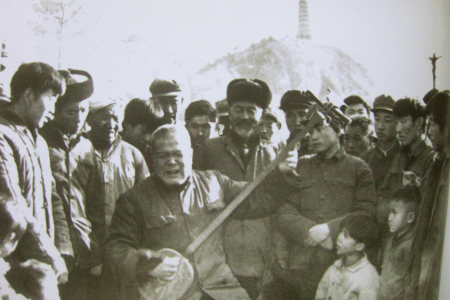
Han Qixiang

from http://www.confucianism.com.cn/html/minsu/15021455.html

In my book I outline his career, trying to read between the lines of hagiographic Chinese accounts on the basis of the 1993 article

  • Chang-tai Hung, “Reeducating a Blind Storyteller: Han Qixiang and the Chinese Communist Storytelling Campaign”, Modern China 19.4 (1993).

From 1945, Party ideologues went to some lengths to reform storytelling with a network of training sessions. After the national “Liberation” of 1949, every county government throughout China set up an arts-work troupe, which soon metamorphosed into an opera troupe; some county authorities further set up a narrative-singing artists’ propaganda team (shuoshu yiren xuanchuandui). These narrative-singing teams were less permanent (and much less costly) than the opera troupes; they held training sessions before dividing into smaller teams to go off on tour round the villages. Bards were lodged together, sometimes for a few months but often for just a few days, and even if they could remember the new stories, they remained reluctant to perform them once they went on the road.

Apart from Han Qixiang, another blind performer mentioned in the 1940s as creator of new stories is Shi Weijun (b.1924), who organized training sessions for bards around Suide county. Blind bard Guo Xingyu (see below), himself no simple official mouthpiece, hinted that Shi Weijun found it hard to adapt to official demands after Liberation. “But then he gave up—he didn’t even want his wages, he lost his standing, and went off on his own to tell stories.” He was clearly reluctant to take part in official events.

We can discount the rosy official image, but even the candid local scholar Meng Haiping recalls the period before the Cultural Revolution as a golden age for the blind bards, with county Halls of Culture organizing them into teams and issuing permits, so that district and village leaders had to receive them, hosting and feeding them—an unprecedented and welcome way to guarantee their “food-bowl”.

Conversely, if the state now acted as the bards’ patron, their richer patrons had disappeared, and their poorer ones were becoming wary of inviting them; temple fairs and “superstition” were under threat. Many bards were not recruited to the teams or were unwilling to join, and even those who did take part did so only intermittently. Although those not registered in the teams were not given permits, they still managed to perform, relying on the old contexts such as “stories for well-being” and godfather duties. But the climate was changing: as the power of campaigns sunk into people’s consciousness, they would have been increasingly nervous of inviting bards openly.

Even those bards who did spend periods in the official teams learning new stories continued to earn their living from more or less “feudal superstitious” contexts. You couldn’t perform new items for hanging the locket, or as stories for well-being.

Party ideologues admired popular oral literature; while deploring its links with superstition, they were unsuccessful in seeking to break such links. The new stories were often based on novellas or opera scripts, and composed with the “guidance” of cadres. As Hung points out, it was hardly a collaboration between peasants and intellectuals—it was never in doubt who was in charge.

It’s hard to assess is how the new stories were received. Even clues in the unremitting hagiography unwittingly give glimpses of constant conflict and difficulties. Han Qixiang composed a new story called “We can’t withdraw from the collective” (Buneng tuishe) (how very true!), reportedly converting peasants who were opposed to collectivism. Having heard that in some Zichang villages women were reluctant to work in the fields, and men reluctant to tolerate them doing so, he composed pieces exhorting them and praising female labour heroes. During the famine of 1959–60 he performed “Turning over a new leaf” (see link in Comment § below) for peasants disgruntled with the paltry goods available on New Year’s Eve, supposedly enlightening them as to how much their lives had improved since the bad old society. Yeah right…

Still, Han Qixiang was a fine performer; even when he told new stories, he would naturally vary them every time, like bards worldwide, and he retained the colourful local vocabulary of bards throughout the area. One cannot merely assess his stories from the page, without being able to witness his performances and those of other bards of the day. Bards I met were less impressed by his technique or creativity than by his good fortune in meeting the right people at the right time and getting onto the government payroll.

So whereas Han Qixiang appears to have been a model “folk artist” propounding Party policies with conviction, most bards in Shaanbei have continued to eke out a living from their traditional exorcistic “stories for well-being”, both under Maoism and since the reforms.

Immortal Li
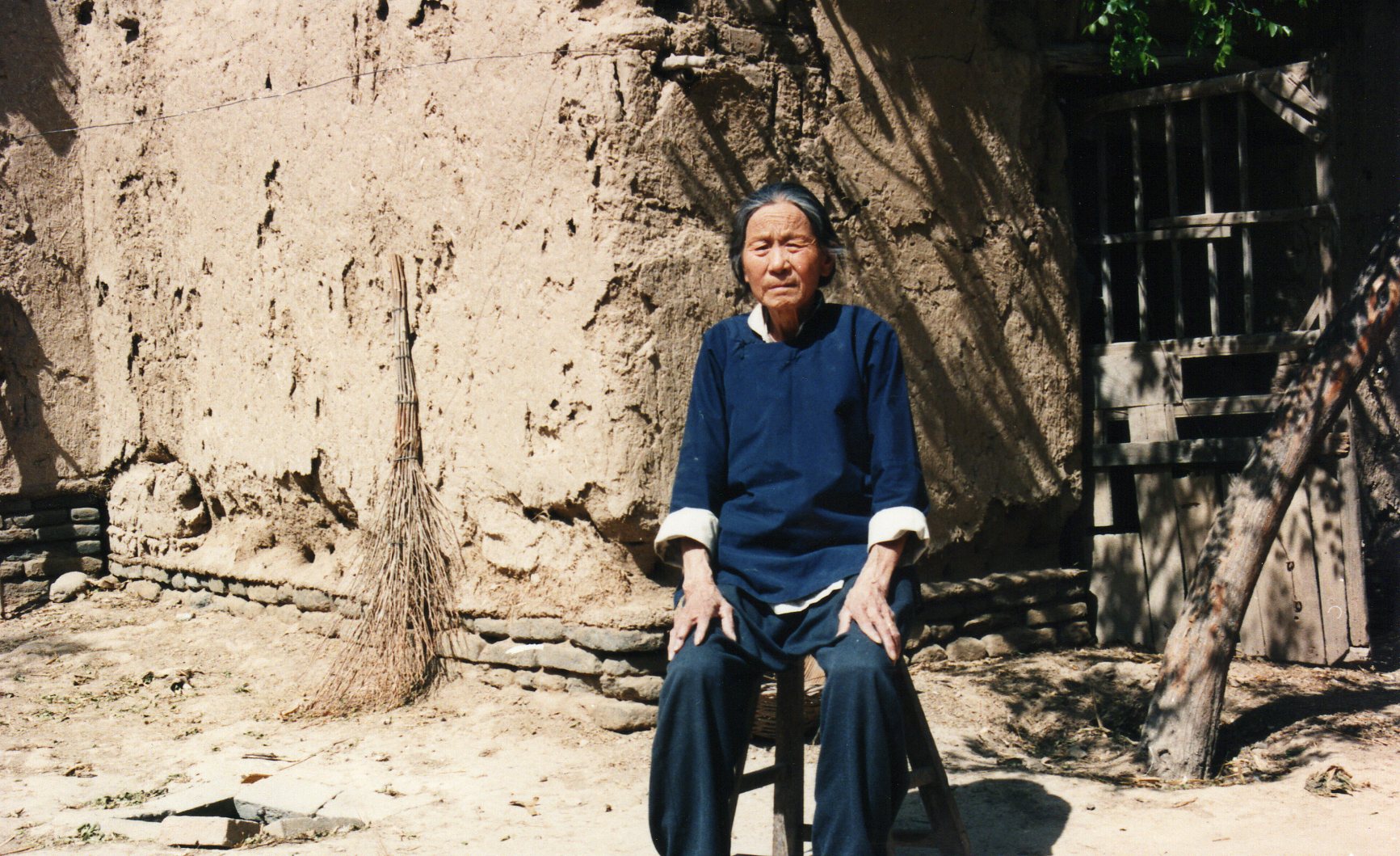
Among the characters in Guo Yuhua’s book on Jicun is the village’s blind bard Li Huaiqiang (1922–2000, known in the village as “Immortal Li”, Li xian); as ever, my notes benefit from her rapport with him. Visiting his cave-dwelling in 1999, she introduced us and we all sat ourselves down on his kang brick-bed; having explored my facial contours with his hands, he gently held my hand throughout our chat.
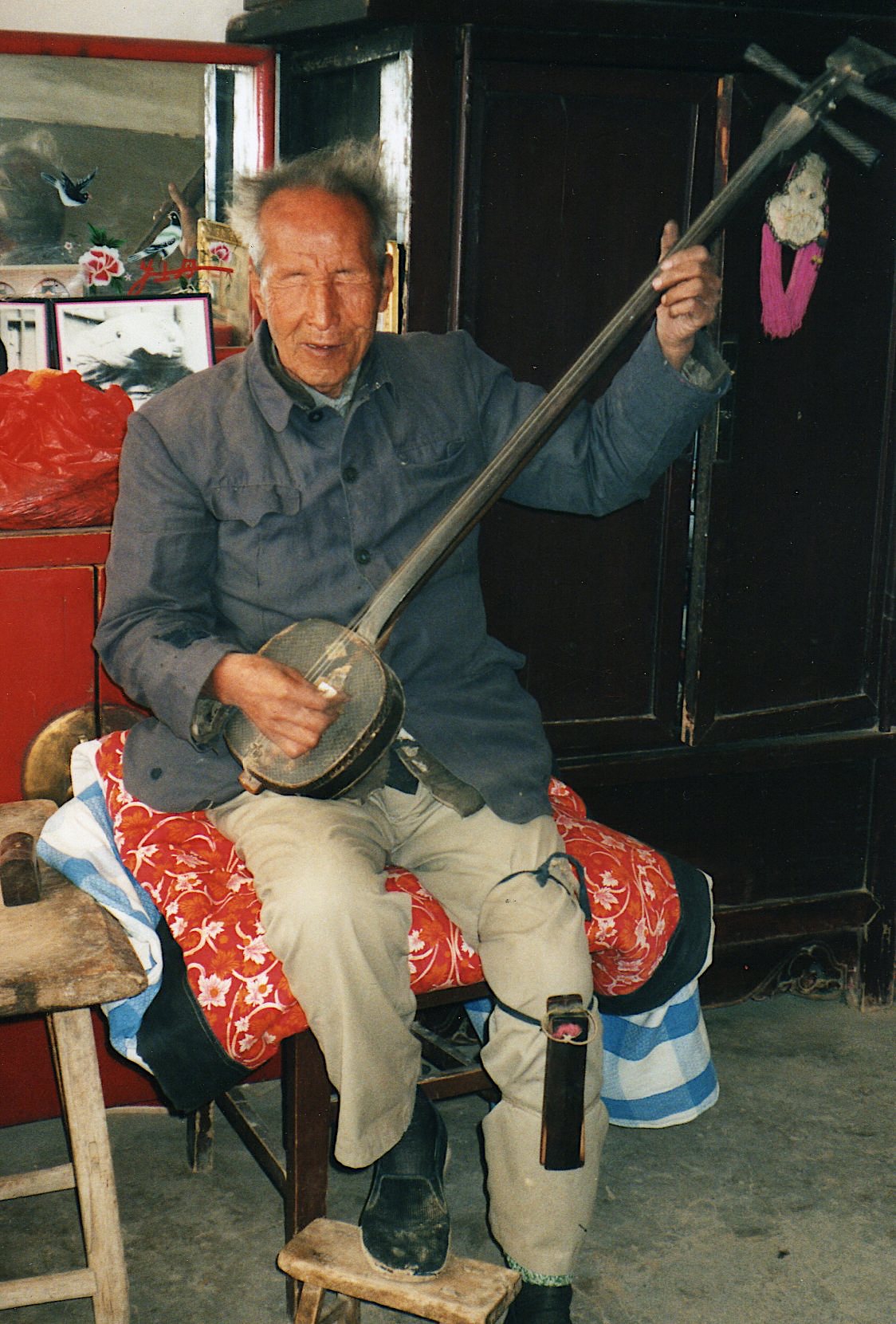
LHQ shuoshu

Li Huaiqiang was among the great majority of bards (and audiences) not amenable to the new stories. Under Maoism, though he gained a house and a family, his livelihood was reduced; since the reforms of the 1980s he suffered both from the decline in popularity of the art and his own dwindling skills.

Li Huaiqiang was born to a poor family of hired labourers working for the village landlords. Such poor families couldn’t afford to send their children to school, and he attended “winter school” for a mere few days. He lost his sight completely by the age of 10 sui. When he was 15 or 16 sui (c1936–7) his father took him to a blind bard to “learn up the arts” of narrative-singing, “history”, fortune-telling, and healing. Learning stories phrase by phrase was time-consuming and expensive—his father had to scrape the fees together. Li contrasts that ruefully with the ease of young upstarts today who can learn just by listening to tapes.

Li began “going out of the door” to earn a living before he was 18 sui, practising both healing and narrative-singing. He was often in demand to cure illness: when someone’s child was seriously ill, Li could give acupuncture and Chinese medicine. When adults had some irregular illness (xiebing), some bad karma, for which orthodox medicine was no use, he’d find them some special herbs.

Since Yangjiagou was still a landlord stronghold, in the early days Li often performed stories all four seasons of the year for the landlords in the village itself. Such performances—like longevity celebrations, or for the first full moon of newly-born children—often lasted seven or eight days. The landlords had a shrine to the god of wealth in their houses—before it bards would tell their stories, and Buddhist monks would recite their scriptures.

Ritual has always remained paramount for bards like Li. “Poor people (shoukuren) worship the Dragon King Elder (Longwangye), stockbreeders worship Horse King Elder (Mawangye), people in business worship God of Prosperity Elder (Caishenye). When people make vows they invite us to tell stories, that’s how we make our living.” Since vows were often fulfilled in the 1st and 2nd moons, bards were most busy then.

By the 1940s, Li’s itinerant business was taking him—by foot—all over Shaanbei. Recalling the old temple fairs, he mentioned the two most famous, still very active now: “I used to go to Baiyunshan for over twenty years, I even went once after the end of the Cultural Revolution. I used to go every year, there were kids there that I’d hung the locket for.” Li performed for the small temple fairs in his home village too, notably the 4th-moon fair at the Pusa miao temple. The temple fairs in the neighbouring hamlet of Sigou were planned best, and were popular; people liked listening to narrative-singing there.

Li Huaiqiang’s early visits south to the Yan’an region, in 1938 or 1939, were part of his routine itinerant business. He told stories around Hengshan and Bao’an (Zhidan) counties too. “No-one controlled what stories you told then, you could narrate what you liked.”

In 1943, after the Suide–Mizhi area was taken over by the Communists, Li found himself unable to make a living there, and went off to Yinchuan in Ningxia and nearby Xichuan. The Nationalist officials loved listening to stories—bards were invited to their quarters. They could travel freely then—only later, when the Communist–Nationalist collaboration ended, did the roads become impassable.

Still, his assessment of the Red and White areas was ingenuous. “It was just the same under the Communists and the Nationalists. Under the Nationalists it was easy to earn money, people liked to listen to stories. After the Communists took control over people, not allowing superstition, at least there was provision for us disabled people, there was relief. So things were the same.” But he did remark, “In the end the Communists came along and broke all the temple fairs up, so there was nothing left.”

I wonder how many bards chose to seek a living in either the Red or White Areas. Evidently old stories did not suddenly vanish throughout the Yan’an countryside. The Yulin region was a seesaw area between the two sides, and most local leaders would, as yet, be broad-minded about traditional forms. We can’t judge, but it is worth challenging the propaganda. And having blithely equated “new stories” with items supporting the Communists, I wonder if bards in the Nationalist areas performed new stories opposing the Communists.

Li Huaiqiang dismissed our queries about the officially-organized groups—he had only the vaguest recollection of this experience. It might have remained an exciting moment in his life distinguished by its uniqueness—but apparently hadn’t. Li went on:

From 1945 they summoned all the blind bards to meetings—they weren’t allowed to sing old stories any more, they had to sing new ones. I studied them and then forgot them all—well, I basically didn’t study them! When you go out [on business], the common people don’t listen to that stuff! New stories aren’t good to listen to—people don’t like listening to new stories, they like old ones! I could never forget the old stories I learned when I was young, though. I can tell twenty or thirty stories. When you went out in the old days there was business, you could count on it—who’d have thought it would all come to an end?

He knew of Han Qixiang but didn’t hear him perform or meet him. “That Han Qixiang, he got onto the official payroll. Oh yes, people in our business all know about Han Qixiang. In the Yan’an period people reformed it into new stories, but they didn’t control us lot who narrated old stories, we just went off round the countryside narrating on our own.” He knew that some performers sang for political meetings, but didn’t admit to doing so himself.

Li Huaiqiang was lucky to find a wife:

I was 24 when I got married [c1946]. They came to take conscripts—people stuck to their old habits, no-one wanted to go off, but they forced them. But us blind people, we couldn’t go off to the army, no-one wanted us—that’s how I got a wife. People were afraid of joining the army, both sides were taking people off, no-one dared go, as soon as you went off you’d get killed. If it was today I couldn’t get married—now it’s hard enough for sighted men to find a wife.

During land reform there were meetings all the time. The Communist Party controlled people, eliminating superstition. When they wanted to hold a meeting they first summoned a bard to narrate a [new] section, so everyone turned up—then the bard sang the old stories that people liked.

This was a common theme, of great significance for our understanding of the Maoist period. The bard would attract people to turn up for tedious political meetings, and satisfy the demands of political expediency by performing a brief political item first, before the fun began. Scholar Meng Haiping recalled: “Both old and new stories were heard then. Until 1956, they began with a short section with new content, then moved onto the old stories like ‘The story of five women reviving the Tang’ (Wunü xing Tang zhuan).”

Li Huaiqiang originally lived in a miserable cave-dwelling made of earth, but after land reform, he was helped to “buy” a comfortable cave-dwelling right at the top of the village from the former landlords, which had been servants’ quarters. The landlords also had to “sell” him their precious sanxian banjo, which he bought for one dan of grain.

If in that sense Li was able to profit from the overthrow of the landlords, he soon suffered from their demise. “We were allowed to narrate stories in the early days after Liberation, but people’s consciousness was raised, people had studied a lot of books.” I didn’t care to argue with him there, so he went on, “They said narrative-singing was boring, so there was a lot less of it—it got less all of a sudden with the collectives [from the mid-1950s]. People like us just tilled the fields, told fortunes, we could just about get by, the state gave us relief. We couldn’t just die off—some people were given relief, some were put in old people’s homes, some with skills could go out and heal illness and tell fortunes.” And he was still taking large numbers of godchildren, whose parents’ regular little gifts always presented a lifeline.

If Li Huaiqiang was unaware of it, the Mizhi county authorities were attempting to organize bards. Gao Zhiqiang, former chief of the county Hall of Culture, recalled, “The county first set up a narrative-singing team in the early 1950s, organizing over twenty blind bards, training them all together to sing new stories. The Hall of Culture issued them with performance permits, which meant that the district and village authorities had to host them—that resolved blind men’s problem of livelihood.” But the teams never controlled blindmen for long.

Li Huaiqiang, who had never belonged to a team or performed in a group, still relied on a minimal handout from the village government to survive; with his wife and five children, times were desperate. “In the Cultural Revolution they didn’t invite us bards any more, it just stopped. But people like us still went out—mostly to tell fortunes, not so much to narrate stories.” And he sometimes sneaked out to hang the locket for children in exchange for “a couple of little coins”. Li was soon branded an “ox demon and snake spirit”, accused of feudal superstition. They took his manual off and burned it; they took his sanxian banjo away too, but he got it back after half a year. “Pesky kids, coming to our houses to get us to hand things over—if you did, then you were let off, if you didn’t then they paraded you through the streets.” Li was only paraded once. The only time he could recall when the authorities regulated narrative-singing was in the year of rebellion (zaofan) of the Cultural Revolution, when all the brigades had to organize blind bards into narrative-singing teams to go round and make propaganda, the county Hall of Culture taking a cut.

The reform era
In Shaanbei, as elsewhere in China, as the commune system began to be dismantled from the early 1980s, traditional culture revived more openly. Bards had been active throughout the commune period, both in and out of the new teams; if the old contexts and stories had never died out, after the “rotting of the collectives” there was no longer such need for collusion or duplicity. As Li Huaiqiang recalled, “As soon as Mao Zedong died, they stopped controlling us bards.” But like other traditional performers, they were soon competing with new economic pressures, TV and pop music taking their toll: where Maoism had failed to marginalize tradition, capitalism looked like succeeding.

Despite his privations under Maoism, he warmed to the theme:

Society’s different now, people have “turned over a new leaf”, reforms and all that—too much reform, it’s all gone too far…

Ebullient local pundit Meng Haiping had a perceptive comment:

In those days [under the communes] they tried to destroy traditional culture, but couldn’t; now they don’t control it any more, but it gradually declines anyway. 1984 to 1990 was the best period. Ever since the great wave of economics started, culture has been dying out.

The agenda of the cultural authorities hardly changed, even if state policy would never again be so “hard”: they still sought to teach the bards new stories to spread education about party policies, and they still aspired to both “controlling” and “looking after” the bards—ambivalent meanings of the term guan 管.

By the late 1990s Li Huaiqiang, quite frail in his old age, was less active as a bard. Lucky enough to have found a wife during times of war, Li has two sons and three daughters; but the family has remained poor, and the sons have been unable to find wives. In 1999 Li performed for the 4th-moon temple fair in his village, and he still did the occasional story for well-being for families fulfilling vows. But he told us: “I’m almost without business these days, 80% of my work is gone. Most temple fairs don’t have narrative-singing any more. These days people read books a lot [surely he overestimates this!]—the state doesn’t control it any more, people just don’t want to be away from work. They’ve got TV and recordings too now.” He used to perform for audiences of 80 or 90 people, but now it’s only for around 20 or 30, mostly elderly. “I can’t keep up.” This didn’t apply generally to narrative-singing in the whole area, but to Li in particular—elderly, frail, and no longer a gifted performer.

In the exceptional conditions of Yangjiagou, the occasional visit from Japanese tourist groups, Chinese and foreign scholars, and visitors to the memorial hall to Chairman Mao’s 1947 sojourn, allowed Immortal Li to supplement his meagre income: “They always get me to perform when someone comes.” But his main income still came from his godchildren, as it had done under Maoism. While we were in the village, one of his godchildren’s children was getting married, and when he paid a visit he was given 20 kuai; when he left they gave him mantou steamed buns, and later they gave him some clothing.
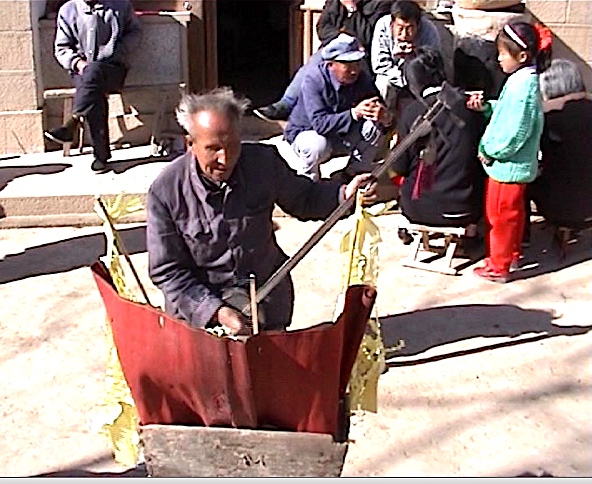
LHQ qingshen

We took him to the cave-dwelling of our host Older Brother, the sweet blind shawm player, to perform a “story for well-being” for the family, as usual inviting the gods outside in the courtyard before telling a story indoors. Though his skills were in decline, it was a memorable occasion.

Li Huaiqiang died in July 2000, falling from a narrow mountain path while on his way to another village to hang a locket. Since his death, other itinerant bards occasionally stop off to perform in the village.

He Guangwu
He Guangwu (b. c1932) is a semi-blind bard from a village west of the river, south of Mizhi town. He began to lose his sight when 15 sui (c1946), so a couple of years later he began “learning the arts” with a master from Zizhou county, mastering a dozen traditional stories—although this was supposedly a climactic period for the new stories, the old stories were being transmitted as if nothing had changed.

He married when 21 sui. Their families arranged the match; his betrothed lived in a village only two li away, but they wouldn’t let her see him, and she only discovered his disability at their wedding. Now she jokes about it and is evidently happy that the family is relatively prosperous with many great-grandchildren; we didn’t like to press her on how it had seemed then.

He had taken part in training sessions in 1955 and 1964, but his concept of his livelihood barely took official contexts into account.

His family has done well since the reforms. He is active over a small area, proudly claiming to be well known within a radius of 20 li (10 kilometres), and he hasn’t taken any disciples. But he is busy. “People still invite me, and I still go. For temple fairs, or if a donkey isn’t eating its fodder, or if a family member is on a long journey, you must invite a ‘story for well-being’; and I tell stories for opening the locket, weddings, moving into a new cave-dwelling, and sons going off to the army.” He is also busy telling fortunes and healing.

HGW and me 2001

With He Guangwu, 2001. Photo: Zhang Zhentao.

In 2001 we found He Guangwu at a small temple fair at Jijiashigou, near his home village. He had agreed to tell fortunes for a family there to help them overcome adversity, and hadn’t brought his sanxian. He agreed to tell a story for us back at his home if we took him back to the temple fair later.

Tian Zhizi
We also visited Tian Zhizi (b. c1933) at his son’s home in a little town south of Zizhou on the road to Suide. He had belonged to the Zizhou team, and also studied in the Suide team. “My eyes were no good from young—I began studying narrative-singing in 1944. My master was Wang Jialai from Zizhou county. When I learned I lived at his house—his fee was 3 dan of grain per year, and I learned for three years.” Through the War of Resistance and the War of Liberation—precisely the period when the new stories were supposedly in the ascendant—Tian supported himself by curing illness, reciting incantations, and depicting talismans.

I began telling stories in 1951, and in 1952 became chief of the Zizhou blind people’s propaganda team, which had been formed the previous year. I was chief of the team for three years; it had over 60 members. Between 1952 to 1956 I studied new stories at the Jiuzhenguan hall in Suide.

Their boss was Shang Airen, an influential cultural official in Shaanbei. Despite my suspicions, Tian recalled,

In the 1950s the peasants loved hearing new stories. The main ones I learned were “The outstanding troupe member”, “Zhang Yulan takes part in the election”, “Opposing shamans”, “The tobacco pouch”, “Mother Gui makes shoes for the army”, and “Wang Piqin takes the southern road”.

Still, through the 1950s and 60s, while the bards from the team sometimes went on tour in small groups, Tian usually went round on his own. When he was 28 sui (c1960), Tian married a girl from the same town—which he claimed was “free love’” not arranged. In 1962 he spent a period working in Yan’an with none other than Han Qixiang, earning 36 kuai a month. Later he resigned and returned home, still making a living as an itinerant bard, also telling fortunes, hanging and opening lockets—by 2001 he had over 200 godchildren.

He went on, “I have 28 disciples in all, eight in Wubu, four in Yulin, two in Shenmu, also in Yan’an, Ansai, and Bao’an [Zhidan]. I took some disciples while I was at Yan’an in 1962, others stayed at my house to learn.”

Unusually, the Cultural Revolution was a significant period of activity for blind bards, who continued to perform both in their traditional contexts and in the state groups. The latter now had a new lease of life as “Blind artists’ Mao Zedong Thought propaganda teams”. In Mizhi county, the Hall of Culture organized a dozen bards into one such team, touring villages, mines, and schools—villages without electricity, mines where accidents were routine, schools with few tables or chairs, and the whole population constantly hungry and demoralized, if you will forgive me for reminding you.

“In 1972 I was mainly taking disciples in Wubu, ‘cos the Wubu Hall of Culture invited me to come to train members for their propaganda team.” Though it was ever harder for bards to perform without the sanction of the teams, popular taste still appeared to require an escape from the relentless revolutionary diet. Tian Zhizi had claimed that the new stories were popular in the 1950s, but “from 1967 [traditional] narrative-singing was forbidden—by that time people preferred old stories, or at least they didn’t like new ones, so we bards told some old ones in the villages on the quiet.”

Other bards also told us that while they couldn’t hang the locket openly during the Cultural Revolution, for those who needed it they still did it, and they still performed in secret in the villages—the people liked to listen and protected them. Geomancers were also still furtively active.

Ironically, perhaps the worst case of penalization was revolutionary Han Qixiang himself, inactive and subject to public criticism throughout the period. As late as 1976, just as the Gang of Four was about to be arrested, he was summoned to perform in Xi’an and criticized, though by late 1977 he was well back on the road to rehabilitation, taking part again in official meetings.

Guo Xingyu
A younger blind bard more able than many to move with the times is Guo Xingyu (b.1951), with whom I spent some time in 2001. His case is quite exceptional among bards I have met, following political trends astutely while continuing to take godchildren and cure illness.

Brought up in a poor Suide village, Guo Xingyu was blind from young. He studied narrative-singing and fortune-telling for ten moons with Wang Jinkao from the age of 12 sui (c1962). He started going out on business when about 16 sui, on the eve of the Cultural Revolution. “When I was young I enjoyed learning everything from my master, curing illness, depicting talismans and chanting mantras”.

When I was just starting out we mainly told old stories, though in public contexts we told bits of new stories. New ones I liked telling, before and during the Cultural Revolution, were “Fuss over an abortion”, “Eliminating transactional marriages”, “The great immortal who eats ghosts”, “Eliminating superstition”, and “The tale of the city youth returning to the countryside”.

In 1968 Guo Xingyu joined the Suide county blind peoples’ propaganda team, which had several dozen bards, divided into three or four sub-groups:

In the 60s we were issued with narrative-singing permits; we had to hand over part of our income to the Hall of Culture as “public assets”—the state also took a certain amount of training expenses, but later that stopped. In the 60s and 70s the whole county probably had about 70 or 80 bards—about 40 or 50 didn’t enter the training bands, they had to tell stories on the quiet.

Guo Xingyu even took part in official festivals in Suide, Yulin, and Xi’an; he was praised by the venerable Han Qixiang. He appeared a model bard in the new mould—little would one think that all the while he was performing stories for well-being and healing.

From 1972 I was head of the blind men’s propaganda team organized by the Suide Hall of Culture. I entered the Party in 1975, and from 1978 I was political instructor of the team. In the 1980s I composed some new propaganda-type stories on the basis of the political needs of the time, mainly things like advertising the spirit of the Party’s 12th and 14th Plenary, and birth control, like “Fuss over an abortion” and “Marrying Late”.

By 2001 the team was moribund. Guo and his (sighted) wife were dividing their time between his home village and an apartment in the suburbs of Suide town. He had rarely performed as a bard since getting heart disease around 1991; now his main livelihood was curing illness by depicting talismans and chanting incantations, and hanging and opening lockets. Relying on his traditional magic, he legitimized it with a fashionably scientific-sounding defence: “magic power is rational (fali you daoli)”.

Guo Xingyu took us to see his blind master Wang Jinkao at his village home south of Suide town (DVD §C3).

WJK, GXY heying

With (right to left) Wang Jinkao, Guo Xingyu, and Wang’s son, 2001. Photo: Tian Yaonong.

Wang (known as Niur, b. c1930) married a sighted girl in 1947; they have three sons and a daughter, all peasants in the village. Wang accompanied himself on pipa rather than sanxian. When Guo Xingyu studied with him around 1962 he was running a kind of blind school in Qingjian; he learned in a group of five or six blind boys, whose parents had to pay fees. He was one of few bards still using pipa rather than sanxian.

Wang Jinkao had had minimal contact with the new ethos: he could tell new stories like “Wang Gui and Li Xiangxiang”, but if he had ever taken part in training sessions or belonged to the county team, no-one cared to remember.

As we saw, bards mostly worked solo; even when they assembled for temple fairs and New Year’s festivities, they performed in sequence, not together. But under Maoism, bards were sometimes organized into small groups to perform for non-ritual contexts.

Still, both new contexts and musical innovations remained a minor feature even through the years of Maoism, and after the “rotting of the collectives”, tradition became yet more dominant. Some new stories were still performed—on the birth-control policy, the reform and open-door policy, the private enterprise system. Some county authorities continued their efforts to organize blind performers, even trying entry by ticket. But as prices rose and more modern entertainments became popular, they resorted to more viable money-making ventures like setting up halls for video games, or classes teaching electronic keyboards.

By the 1990s the propaganda teams were virtually defunct. As one cultural cadre told us: “Later the bards didn’t want people to control them, and we didn’t have enough money anyway, so we gave up.”

Blind and sighted bards
Though Han Qixiang mentioned competition between blind and sighted bards when he was learning in the 1930s, narrative-singing in Shaanbei was largely a monopoly of blindmen, and only since the eve of the Cultural Revolution has the taboo against sighted performers been seriously challenged.

By around 2000 it was a fait accompli for sighted men to muscle in on the trade. There were fewer blind people anyway, since health has improved (though still appalling); and they could now receive modest disability benefits, or migrate in search of work as masseurs.

Nor do sighted men fear going blind any longer if they take it up. Half of Tian Zhizi’s 28 disciples were sighted—presumably those he taught since the 1970s. Although one elderly bard commented that the new disabled allowance for blind people makes them lazy, blind performers who are still active rather resented the encroachment on their “food-bowl”. “Originally sighted people weren’t allowed to tell stories—if you’re sighted you can do anything [else].” Now not only can sighted people learn, but they can even learn from tapes, saving them money but depriving senior blind bards of teaching fees.

Scholar Meng Haiping pointed out: “In the old days, bards’ social status was low; now for everyone all that counts is money, social status no longer comes into it.” This was certainly true for trendy young chuishou shawm-band musicians in the towns, but less obvious for the bards. Unlike the chuishou, bards have not spruced up their image so ambitiously, and remain quite modestly paid; nor have they yet availed themselves of the mobile-phone revolution that has occurred since about 1998. Whereas chuishou often ride motor-bikes, bards (even sighted ones) mostly go on foot.

Guo Xingyu:

Now there are sighted bards everywhere—many senior-secondary graduates, not wanting a hard life, go and tell stories. In Zizhou, Hengshan, and Yulin there are a lot of sighted bards, and there are some in Mizhi and Jiaxian too. Now there are fewer than thirty blind bards in Suide, but there are more sighted ones. They began appearing in the 1980s or 1990s, they drove the blind ones away; the blind ones were very angry about it—but the sighted ones had permits too.

He went on darkly,

Now how did that come about, then? Perhaps by bribery. Now blind artists are in great difficulties. There are more of them west of the river, but quite a few of the old artists have died; east of the river their skills aren’t quite so good.

Li Wenjin
I met sighted bard Li Wenjin (b. c1943) with Guo Yuhua in 1999 when he performed informally for staff at the office of the Black Dragon temple (on which see Adam Chau’s fine book Miraculous response), as a kind of advertisement for his arrival in the area. He comes from a village in Zizhou county. Soon after Liberation, in the early 1950s, he studied for three winters in the evenings in the “school for sweeping away illiteracy”. His parents died early, but he only began studying narrative-singing in the early 1980s, with the old blind bard in his village. His master could never find a wife: “when the five organs are incomplete, no-one will follow you”—though most of our blind mentors were exceptions. There was a libretto (benben) that he could follow—even blind performers sometimes owned a libretto. Li Wenjin was active over quite a wide area. He usually sings with his eyes closed—in imitation of blind bards?

LWJ and GYH

Guo Yuhua and temple organizers listen to Li Wenjin, Black Dragon Temple 1999.

A couple of days after meeting him at the temple where we were staying, we bumped into him on our way back there, and he invited us along to hear a “story for well-being” that evening for a family in the nearby village (see photos at head of this post).

Xu Wengong
We met another sighted bard at the White Cloud Mountain temple fair in 2001. Xu Wengong (b. c1948), from a village in Qingjian county, began learning at 17 sui [c1964] from an uncle, so the taboo was perhaps being broken down even then. He has never taken part in any county-organized teams, or learned new stories. During the Cultural Revolution he was protected by villagers as he went round performing and hanging lockets on the quiet.

Many pilgrims attend the temple fair under the auspices of a dozen or so regional associations, each with particular allegiances among the many temple gods, sponsoring different daily rituals. Apart from the daily performances of opera, bards perform in a less public and commercial arrangement that is also typical of Shaanbei temple fairs. One evening we visit the cave of the Zizhou, Qingjian, and Ansai association where Xu Wengong was performing.

He comes to this fair every year as part of this pilgrim association, in order to fulfil a vow. “My father was a model labourer, and was head of this association”—note this typically casual link between Communist and traditional authority. “He came here to take part in the rituals and made a vow, because I’d had stomach disease for twelve years, and sure enough I got better. So I’ve been coming here to fulfil the vow every year since the temple restored, to revere the great god Zhenwu; I come here to avert calamity.” Some other bards also come to the temple fair not to make money but to fulfil vows.

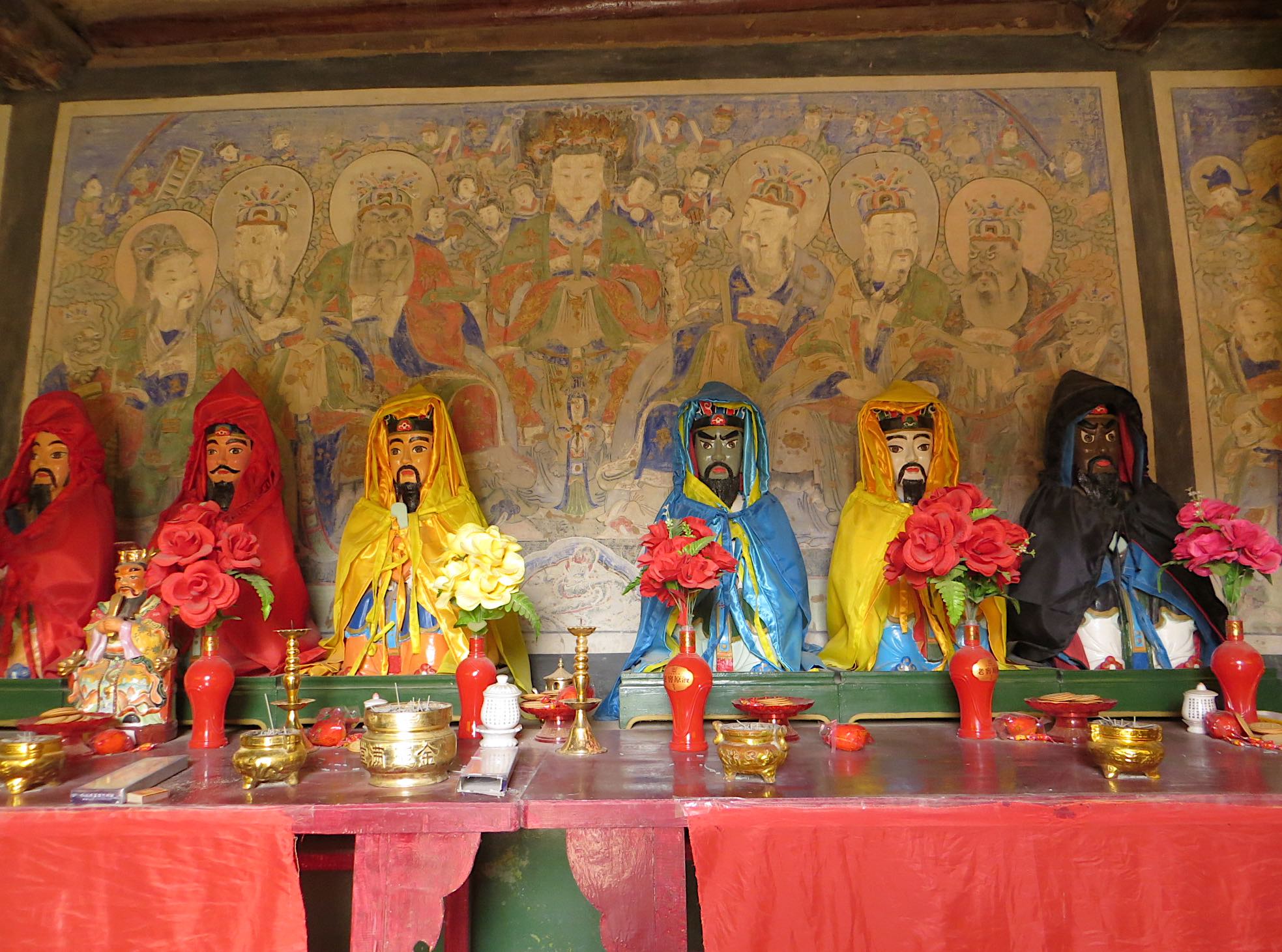
There is no need to “invite the gods”, since they are already present, but on the left of the cave, as you stoop to enter, is an altar behind which the bard’s red cloth pantheon is displayed (see photo above). Individual pilgrims periodically burn paper and kowtow before it. Xu Wengong performs opposite the altar, the pilgrims sitting on mats at the rear of the cave, listening intently. They consist mostly of men over 50, but even those over 60 were brought up largely under Maoism. Yet such senior men entirely represent tradition; ritual associations like this surely represent a kind of passive alternative to government control.

Baiyunshan pilgrims 2001

XWG BYS 2001

Xu Wengong, Baiyunshan 2001

Old and new stories
Despite the propaganda surrounding Han Qixiang, not only does no-one value new stories now, but few recall them being popular even under Maoism. He Guangwu recalled, “In those days, usually we’d tell a section of a new story first and then tell an old one.” Other bards like Li Huaiqiang had no time for new stories at all. He had heard “Smashing superstition” on tape at a villager’s house, but “people don’t like it, it’s not good to listen to—you can’t sing stories like that for families, only for big meetings where tickets are on sale!” He Guangwu had learned “Opposing shamans” in the training session in the 1950s, but he too commented wryly, “You can’t tell that story nowadays—that’d be blasphemy!”

Even if the popularity of new stories was highly limited, and the subjects remained traditional, Li Huaiqiang pointed out that the bards’ language had been evolving along with the language of society generally. A certain change of style, reflecting the times, had evidently left him behind.

In the old days you sang of “Lady” or “Mistress” (furen, xiaojie), now it’s “missus” (poyi); in the old days it was “setting up as a family” (chengjia), nowadays it’s “the couple have got together”, “they held hands as they walked”, “they kissed”—it’s so lacking in culture! Old people won’t listen to that stuff, in the old days it was real cultured, now it just ain’t the same. But you have to adapt yer language to the times, eh?

So why should people apparently prefer stories about events many centuries earlier to ones about their society now? Local scholar Meng Haiping explained the ability of the old stories to survive under Maoism:

Traditional stories propound truth, goodness, beauty, and filial piety (zhenshanmeixiao 真善美孝)—that is China’s traditional morality, the Party doesn’t oppose that, and doesn’t suppress it.

Though there is ample evidence to show that they did oppose it, deliberately, regarding it under headings such as “bourgeois morality”, Meng was still making a fair point—because the Party he refers to is that on the ground, where continuity is more evident in local practice than the rupture often advocated by central theory.

Having complained about the coarsening of the bards’ language, Li Huaiqiang went on to lament the changing times:

In the old days bards used to wear a robe, and a hat with a pigtail. Nowadays it’s all simplified. Then it was wagai hats, sitting at a high table; now you don’t get changed, and just sit on a stool, it’s much simpler. And the gods used to be more efficacious, they were dead efficacious—if you didn’t follow them you could die. Once someone’s son died, and the parents made a vow to beg him to come back to life, so I obeyed the gods, and he really did come back to life.

So why didn’t the new stories become popular? Sure, villagers might be conservative and escapist in their tastes, finding stories of emperors and concubines, scholars and maids, generals and outlaws more attractive than propaganda. But the new stories might have been entertaining and meaningful in the contexts of the 1940s too. The irony was that the whole purpose of the new stories since the 1940s was to address current issues of great importance to the peasantry: namely tackling endemic social problems inherited from the old society.

But problems that might be arising under the new society were not now to be publicly aired. I would surmise that villagers might have been open to new stories, but were disillusioned by their glib political correctness, their failure to reflect complex new realities. The new stories were surely rarely heard in the villages apart from at mass meetings by which people were anyway alienated. If villagers were still able to host a performer to sing to invite the gods to heal their livestock, the new stories were inappropriate. In the early period of the 1940s, they might have had considerable novelty, and even helped people confront genuine problems, like forced marriages, opium, landlord exploitation. But maybe the themes didn’t keep pace with the problems: by the 1950s their perceived problems included campaigns, collectivization, irrational directives, and thus the new items seemed false, like the propaganda itself.

Still, as we saw, the stories Han Qixiang performed on his tours in the late 1950s were often semi-improvised according to the events unfolding in the village. That is, problems such as reactionary thinking among the peasants could be ridiculed; perhaps even bourgeois thinking of local leaders; but central policy could hardly be questioned.

As to issues topical since the reforms of the 1980s, several performers mentioned stories about the birth-control policy—that is, supporting it; given its massive unpopularity, has anyone dared sing stories opposing it? If no stories have arisen dedicated to sensitive issues such as official corruption, they are doubtless subtly aired in passing, if not as flagrantly as the fictional balladeer in Mo Yan’s visceral 1988 novel The Garlic Ballads (p.73):

A prefecture head who exterminates clans,
A county administrator who wipes out families;
No lighthearted banter from the mouths of power:
You tell us to plant garlic, and that’s what we do—
So what right have you not to buy our harvest?

Since the government mounts regular poster campaigns warning of sexually transmitted diseases, even if it was slow to admit to the danger of AIDS, I wonder if the bards could now be enlisted to tell stories warning of such perils. It seems unlikely. For a hard-hitting song from blind singer Zhou Yunpeng in Beijing, see here; and for songs on the Coronavirus, click here and here.

At any rate, one can only be impressed by the adaptability and creativity of storytellers, and whatever the constraints on public speaking both under the communes and since the reforms, they must always rely to some extent on keeping their audience entertained with topical remarks which will strike a chord.

Note that it was the texts that the Party cadres sought to reform—the traditional melodic and rhythmic elements were not an object of their attention.

Research and images
By the 1980s, while local scholars did most of the work by contacting the bards through the urban teams, rather than accompanying them on tour, they were now concerned to document ritual aspects of the performance. People’s mind-sets had become much more free than under Maoism—one local scholar who recorded bards for the Anthology was not going to be hoodwinked into toeing the Party line by recording new stories:

When I recorded them, I chose anything about Heaven, Earth and Man, and rejected everything about the Party, Chairman Mao, and Socialism!

One might see this as a political bias in itself, but I would view it as a shrewd correction of any tendency the bards might have to play safe by performing a politically-correct piece for a government representative.

Since Shaanbei is often featured romantically in the national media as a revolutionary base, brief sanitized glimpses of Shaanbei folk culture are occasionally broadcast. The standard images are yangge dancing or a cheesey folk-singer, but in 2001 I saw a young sighted man do a passable imitation of a Shaanbei bard on a national CCTV chat-show featuring the cult Shaanxi novelist Jia Pingwa.

Avant-garde Chinese artists have presented a less revolutionary image of Shaanbei. One fine antidote to Han Qixiang is the blind bard in the novella Life on a string (Ming ruo qinxian) by Shi Tiesheng (b.1951), one of many “educated youth” rusticated to a village near Yan’an in 1969 (see my Shaanbei book, pp.8–11, 76–7). This 1985 story mystically evokes the life of an itinerant blind bard and his young blind disciple:

The old man believes that when he has broken one thousand strings, he can open up his sanxian and find a prescription inside which will restore his sight. When he finally does so, the piece of paper inside is blank.

The story was made into a film by Chen Kaige (1991), director of the brilliant Yellow Earth, also showing the gulf between the harsh realities of rural life and the Party’s ideals.

Such avant-garde creations, with their mystical minimalism, are more popular outside than inside China. While far from ethnography, they at least offer an imaginative alternative to the revolutionary idealism of official sources.

You can find many video clips of Shaanbei bards online (on Chinese sites and even YouTube), most but not all in a commodified style. This one, while close to the traditional setting, is clearly specially staged. In recent years Cao Bozhi 曹伯植 has published prolifically on musical aspects of the genre.

* * *

Now I also learn much from

  • Ka-ming Wu, Reinventing Chinese tradition: the cultural politics of late socialism (University of Illinois Press, 2015).

Though Wu immersed herself the lives of her village hosts, she also engaged more with officialdom than I did. She was introduced to bards through the propaganda teams, which look to be more important in her region of the Shaanbei field site than in mine. So whereas bards that I met—even those who had spent periods in the training teams—found the new initiatives evanescent, she tends to take the institutional level as primary, although local variation may also play a part.

For instance, her subheading to Chapter 3 “Propaganda storytelling turned into spiritual service” puts the cart before the horse—when the latter has such a long history, and the former remains only one aspect of their activities. Following blind bard Master Xu around for a month, she gives some excellent vignettes.

She found that

He had transformed his performance into a series of clandestine religious activities and religious performances.

But this was precisely how the blindmen had always earned their living throughout history! A similar slip is

Northern Shaanxi storytelling was originally designed as part of a government-sponsored cultural enrichment mission to poverty-stricken rural areas. (104)

 In Chapter 4 Wu valuably describes danwei work-unit performances, which I hadn’t found. She shows bards’ (not always successful) search for performances in such danwei; indeed, even when a bard goes on a solo tour of the countryside she suggests a rather formal arrangement with the village leadership. Conversely, the nearest to this that any bards I met got to was when Li Wenjin announced his arrival in the area to the Black Dragon Temple temple committee—whereupon word soon spread, and household patrons came forward.

Again she shows how bards tend to open with a brief modern propaganda item (no longer based on class politics, as she notes) before launching into a more popular traditional story.

She gives some valuable translations of lyrics, both traditional and modern. Further to my comments above on stories about topical issues, she translates a remarkable item “Quality Control System Spread to Millions” warning against fake consumer goods, performed at a factory; and the 2008 “Alleviate Earthquake Disaster, Look Forward to the Olympics, Increase Productivity” for a staff appreciation event.

While she notes that such national and government messages were overshadowed by the traditional stories that followed them, she reminds us to pay attention to the mutual interpenetration and agenda contestation among the local state, danwei, and folk cultural practitioners.

She finds that storytelling

neither resists nor colludes with the state; nor does it cater to urban tourism or consumption.

And she observes acutely:

Instead of attributing the spiritual revival to a simple return to the storytelling tradition from before the 1940s, I relate it to the huge movement of labor, objects, and emotions between the rural and urban areas.
[…]
My point is not that northern Shaanxi folk storytelling has revived because of depressing rural economic conditions. Rather, I wish to emphasize that the revival of storytelling practice becomes one of the rare social and communal occasions for rural villagers to get together where they can openly discuss all kinds of major rural developmental contradictions: lack of elderly care, split households, and youth who find no career development in remote rural hometowns and who encounter much difficulty surviving in cities.
In short, folk storytelling occasions are valuable not so much because villagers are getting more religious or that the practice is a time-honored heritage. Rather, folk storytelling has become what Megan Moodie called “platforms for articulation”, where local citizens draw traditional cultural resources to discuss pressing concerns of split households among left-behind elderly and young wives in remote communities in a translocal age. (101–102)

 Despite these areas for discussion, when she writes so perceptively such variations in focus are welcome.

Conclusion
Despite the substantial material published on Communist reforms of narrative-singing, and ethnomusicologists’ eager search for change and modernization, it was hard while observing daily life in Shaanbei around 2000 to credit the Party’s reform programme with much long- (or even short-) term influence.

As Guo Yuhua observes, people remained loyal to their traditional concept of local village culture rather than to the state. Though state-funded troupes are undoubtedly an aspect of overall activity, this point appears to be of wide relevance for ritual activity and expressive culture in the Chinese countryside today, and for our understanding of modern China.

If the bards are now threatened by the recent spread of TV and pop music, they are still in demand for their “stories for well-being” as well as for their healing skills. While they do assemble for public rituals like temple fairs and New Year, they mostly perform solo. From the 1940s, a disjuncture emerged between the secular political performances of the official teams and the rituals of the solo bards. Narrative-singing has perhaps become a lesser aspect of the blindmen’s activities than their godfather and healing duties. Indeed, since sighted bards do not necessarily learn the healing arts of blind men, a potential divorce also looms between narrative-singing and healing—all the more since people can now learn stories by listening to commercial tapes.

My point is not to belittle official efforts, either in the cultural or political spheres. But we should avoid basing our assessments either on the new stories of Han Qixiang or on a simple revival or reinvention since around 1980. As Ju Xi comments, criticizing the recent interpretations of “secularization” (compared with imperial China) and “revival” (compared with the Maoist era), both of which portray Chinese religion as somewhat isolated from society, local religion is not merely a “spiritual creation” or “cultural heritage”—it’s a cultural resource and social power which can play active roles in contemporary rural society.

The Party never managed to “eliminate superstition”, but complex social and economic changes continued to affect ritual life and expressive culture both under Maoism and since the reforms. Studying their changing fortunes in such a society requires a nuanced approach.

Click here for a trailer for the documentary Shujiang (Cao Jianbiao 曹建标, 2019). See also Bards of Henan, and my roundup of posts on narrative-singing.

.


[1] This article is based on Part Two of my book Ritual and music of north China, volume 2: Shaanbei, (where you can find further refs. and characters)—note §C of the accompanying DVD. See also my “Turning a blind ear: bards of Shaanbei”, CHINOPERL 27 (2007); and Zhang Zhentao, Shengman shanmen 声漫山门, pp.353–79. I use the term “bard” for convenience, and to hint at their broader ritual duties.

China and Europe: local society and politics


My article on Guo Yuhua leads to several related posts on my blog—many collected under the Maoism tag in the sidebar.

For further alternative grass-roots accounts of Chinese society, see

For the troubled maintenance of local ritual life under changing regimes:

On recent conflicts between state and society, see e.g.

In Guo Yuhua’s interview with Ian Johnson she gives short shrift to the Intangible Cultural Heritage—as do I. Some tasters among the numerous posts under the heritage tag in the sidebar:

* * *

For Chinese parallels with authoritarian regimes in Europe, see e.g. my posts on


For another handy digest on a variety of topics, see here.

Notes from Beijing, 2

Further to my post on the Beishida ethnographers, and my seemingly underwhelming maxim that

If you want to study Chinese culture, China’s a good place to do it,

in between my lectures at Beishida in March I sallied forth (cf. Cheeseshop sketch) to show my film at People’s University and Peking University for two fine scholars from whom I also have much to learn: Cao Xinyu (left) and Wang Mingming.

Cao Xinyu
I’ve already mentioned Cao Xinyu 曹新宇 (b.1973) in a previous post (just updated). Professor of the Qing History Research Institute in the History department of People’s University (Renda), he’s a most supportive teacher—and for me he has the added cachet of being a scion of Yanggao, home of my Daoist master Li Manshan! Talking of Renda, I was happy to tell Cao Xinyu of Li Manshan’s ingenuous repunctuation of 中国人大代表 (here, under 2nd moon 28th).

Sectarian activity is an important aspect of the picture of religious life in China, both in imperial and modern times—indeed right now. Cao Xinyu combines detailed textual research on the imperial ancestry of sectarian groups and fieldwork on their modern fortunes. In addition to his series of books on sectarian history, notably the Way of Yellow Heaven, you can also read astute articles such as this survey.

1958 fanguan

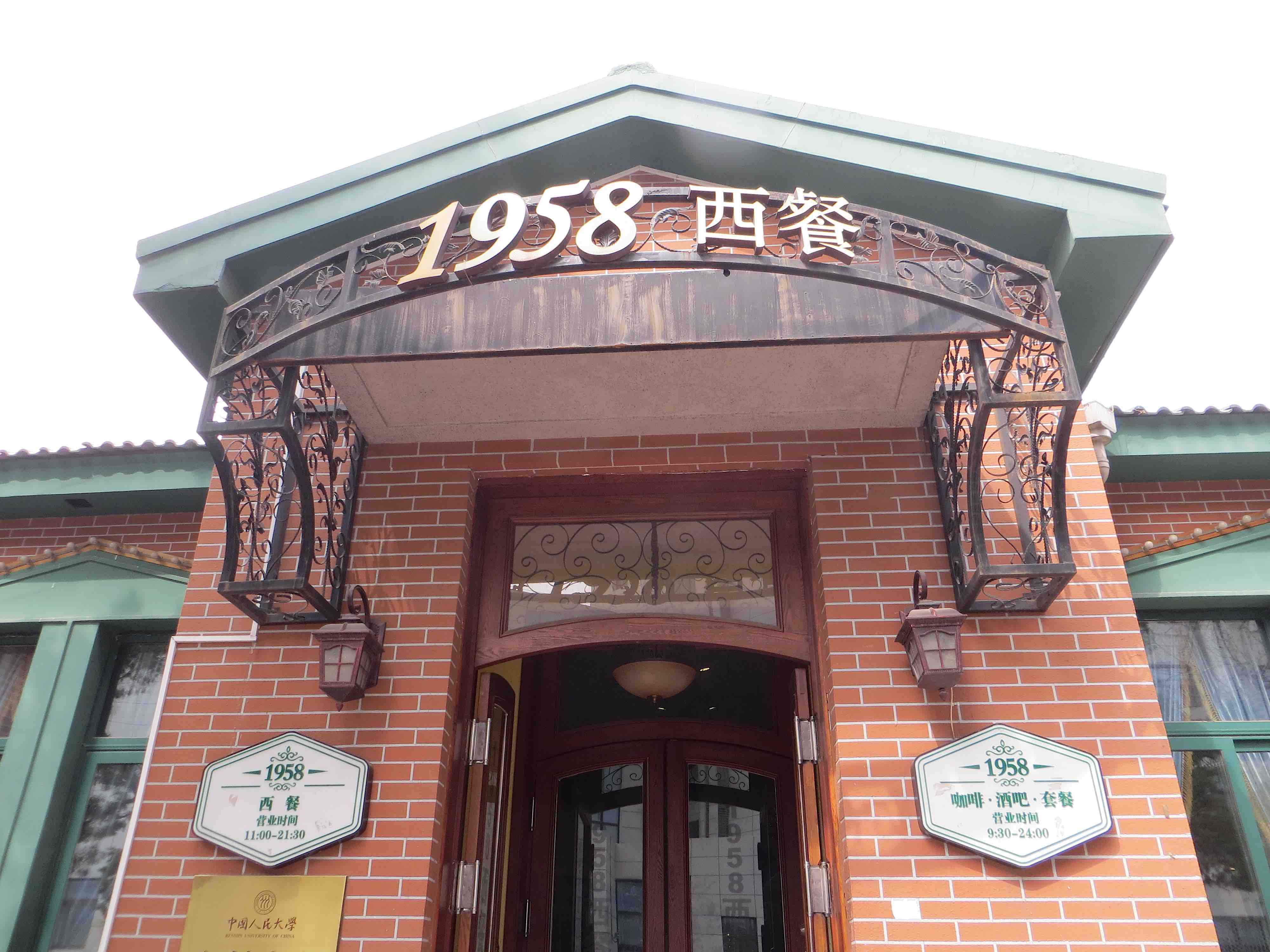
In a salient reminder of Maoist history, we had lunch at the Russian restaurant “1958” on the People’s University campus, opened in 2013 (with how much irony, I can’t fathom) to commemorate the Russian experts then at the university—shortly before they were all expelled.

For a fine recent initiative of Cao Xinyu, see here.

Wang Mingming
Just up the road at Peking University is the eminent anthropologist Wang Mingming 王铭铭 (b.1962). [1] He’s a native of Quanzhou in Minnan (south Fujian), whose ever-vibrant ritual culture (temple fairs, Daoist ritualnanyin, and so on) has always informed his research.

From 1981 he studied archaeology in Xiamen University, going on to embrace anthropology as it was incorporated into the department there. He came to London in 1987 to study for a PhD in anthropology at SOAS; this was also the start of a long and fruitful collaboration with the great Stephan Feuchtwang. He returned to China in 1994 to make his base at Peking University, becoming a full professor there in 1997.

With Stephan he wrote the fine book Grassroots charisma: four local leaders in China (2002) on the linking of religion and politics in two villages in Quanzhou and north Taiwan. Wang’s historical anthropology of the city of Quanzhou, Empire and Local Worlds, was published in English in 2009.

His article on the Fazhugong festival makes an introduction to the tenor of his work:

  • “Lingyande ‘yichan’ ” 灵验的“遗产” [Efficacious “heritage”], in Guo Yuhua (ed.) Yishi yu shehui bianqian 仪式与社会变迁 [Ritual and social change] (Beijing: Shehuikexue wenxian cbs, 1999).

Like Guo Yuhua (his fellow anthropologist at Tsinghua next door), he combines detailed ethnography with a thorough grasp of theory. As Stephan writes:

Through numerous publications, books he has written, series he has edited, journals he has founded, and through his teaching of postgraduate and doctoral students, he has been dedicated to the re-formation of anthropology in China as an academic discipline, not as an aid to programs of development and of government, nor as simply an import from English-language social and cultural anthropology, but as an anthropology coming from China that can and does have something to say to a larger anthropology.

His theoretical mission to re-historicize anthropology over a long time-frame, and in a global context, may be seen in

  • “To learn from the ancestors or to borrow from the foreigners: China’s self-identity as a modern civilisation”, Critique of anthropology 34.4 (2014).

as well as

  • “Minzuzhi: yizhong guangyi renwen guanxixuede jieding” 民族志:一种广义人文关系学的界定 [Ethnography: a redefinition from the perspective of extended human relations], Xueshu yuekan 47.3 (2015).

Among his recent projects, he has directed analytical fieldwork on the ritual life of Hui’an county in Minnan:

  • Wang Mingming et al., “Dili yu shehui shiyezhongde minjian wenhua: Huidong Xiaozuo kaocha” 地理与社会视野中的民间文化——惠东小岞考察 [Folk culture from the viewpoint of geography and society: survey of Xiaozuo, east Hui’an], Minsu yanjiu 2017.2,

Wang’s diachronic approach has much to teach us (including scholars of ritual and music) about changing local societies through imperial, Maoist, and reform eras, not least on their relations with the state and “cultural” authorities. In utter contrast with the reified salvage-based “living fossil” flapdoodle of the “heritage” authorities, such study is based both on thorough fieldwork and on detailed research into sources since the late imperial era.

I can’t help noticing that Peking University has changed somewhat since my last sojourn there thirty-two years ago. In Wang Mingming’s interaction with his students he has a wonderful informal style; he clearly makes a fine fieldworker. Both he and Cao Xinyu encourage their students to think; at both events—and in the pub afterwards—I relished their lively exchanges.

[1] Many of Wang Mingming’s articles are collected on the aisixiang site here. For an English introduction, watch this 2008 interview with Alan Macfarlane, transcribed here; and Stephan Feuchtwang and Michael Rowlands, “Some Chinese directions in anthropology”, Anthropological quarterly 83.4 (2010).

China: commemorating trauma

Ditch

Just as I was lamenting the lack of public acknowledgement of the crimes of Maoism—by comparison with countries where regime change has enabled such necessary commemoration (see e.g. my posts on Ravensbrück, SachsenhausenHildiGitta Sereny, the work of Philippe Sands, the GDR, and the Salazar regime)—the new Wang Bing 王兵 documentary Dead souls, just shown at Cannes, is a timely reminder of his brave work and that of other documentarists and journalists, not to mention their interviewees, survivors of the late-1950s’ labour-camp system and the kin of its victims (see also this interview). Comparisons with the Soviet Gulag are inevitable (e.g. Kolyma, Solovki, The whisperers).

Case-studies of the system can be found both in factual reports and in novels by authors such as Zhang Xianliang and Yan Lianke. Research on the notorious Jiabiangou camp in Gansu has an estimable history (note also Sparks). Wang Bing’s project goes back to meeting He Fengming in 1995 (herself a Gansu camp survivor), whose husband died at Jiabiangou—resulting in Wang’s 2007 film Fengming: a Chinese memoir (here, with Spanish and Italian subtitles; also interview), shown at Cannes that year. From 2003 Zhao Xu 赵旭 began publishing his research on Jiabiangou, Fengxue Jiabiangou 风雪夹边沟. From 1997 Yang Xianhui 杨显惠 was visiting former inmates, and in 2003 he published his collection Woman From Shanghai: tales of survival from a Chinese labor camp (English translation 2009). As Wang Bing began dramatizing these stories in a narrative film, he met more survivors from Jiabiangou, and The ditch was premiered in 2010—a deeply distressing watch (here with French subtitles):

And then, even before Wang’s latest documentary was released, the great activist film-maker Ai Xiaoming 艾晓明 (b.1953, another Beishida alumna later based in Guangzhou: following Ian Johnson’s interview, note his important book Sparks; for another interview, click here) filmed her six-hour Jiabiangou elegy: life and death of the rightists (2017)—in five parts, starting here:

The interviewees note the general desperation of the inmates’ families and the local population, themselves struggling to find anything edible. Yang Jisheng, whose book Tombstone is an important source on the great famine of the time, points out the political background in Gansu (for the famine and Wu Wenguang’s Memory project, click here; for the works of Frank Dikötter, here).

Wang Bing’s Dead souls is even longer, at 496 minutes—here are three clips:

* * *

That latter excerpt leads me to a subsidiary point about ritual and ritual soundscape, about suffering, and people’s lives—and in this case the suffering that we can, and must, document is that of the Maoist years.

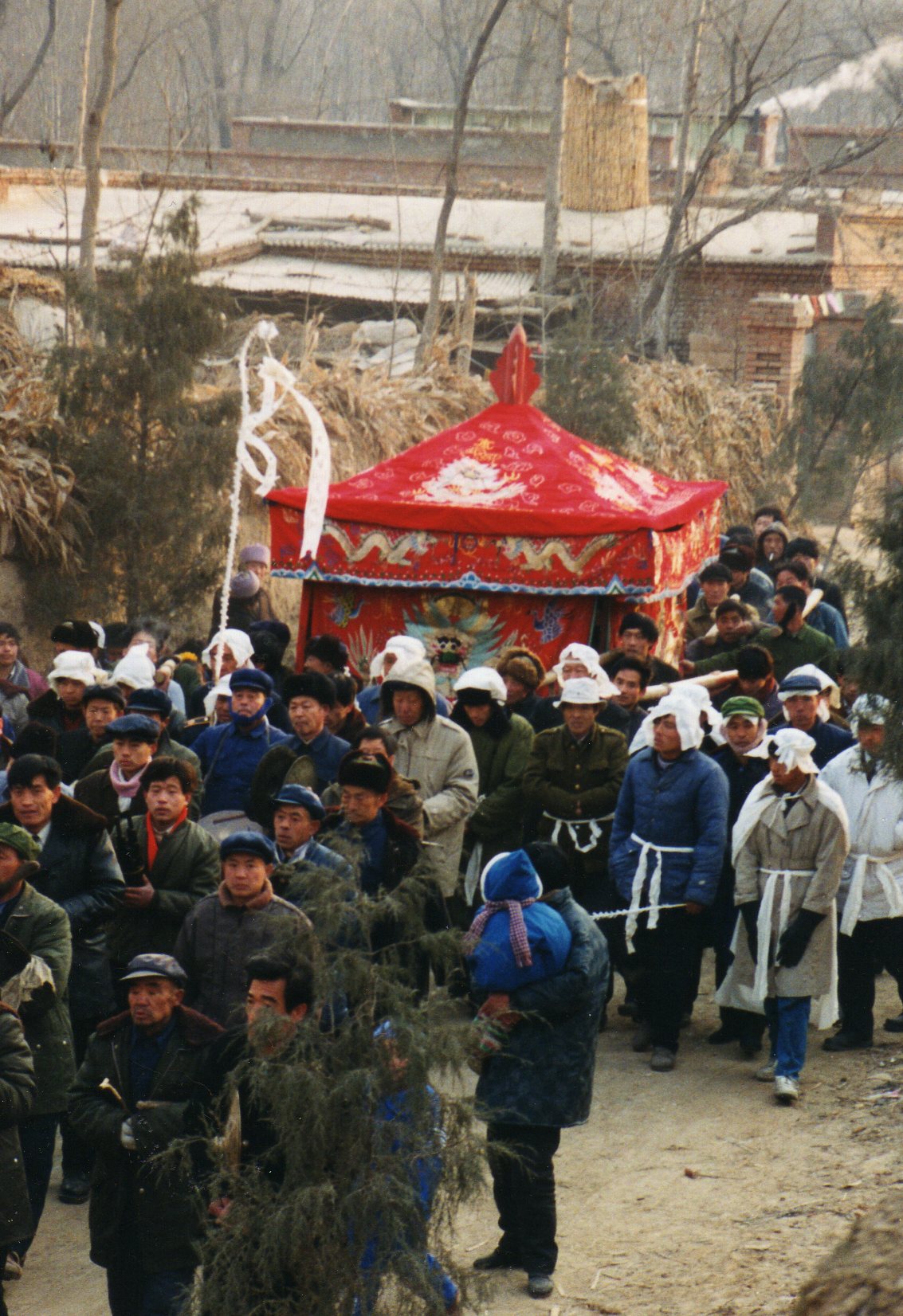
My film Notes from the yellow earth (DVD with Ritual and music of north China, vol.2: Shaanbei) contains a lengthy sequence (§B) from a similar funeral—filmed in a village which indeed has its own traumatic memories. One might hear the playing of such shawm bands as merely “mournful”—indeed, that’s why younger urban dwellers are reluctant to hear them, associating the sound with death. And of course the style and repertoire of these bands took shape long before Maoism, based on earlier historical suffering. But we can only hear “early music” with our own modern ears

Yangjiagou band, 1999

So in the context of Wang Bing’s film the bleakness of the soundscape really hits home, suggesting how very visceral is the way that the style evokes the trauma of ruined lives and painful memory—slow, with wailing timbre and the “blue” scale of jiadiao, the two shawms in stark unison occasionally splintering into octave heterophony. For similarly anguished shawm playing, cf. playlist, tracks 5 and 6 (commentary here). For anyone still struggling, despite my best efforts, to comprehend the relevance of shawm bands, Wang Bing’s scene should be compulsory viewing. Similarly, since I often note the importance of Daoist ritual in Gansu, the camps there might form one aspect of our accounts of ritual life there.

As I noted in my post on the famine, this is just the kind of memory that the rosy patriotic nostalgia and reifications of the Intangible Cultural Heritage project are designed to erase.

* * *

As a recent review notes:

It’s not as if the prisoners had been caught red-handed in plotting the downfall of the Chinese Communist Party. Nearly all of the interviewees insist they are loyal, patriotic party members, with some saying they were indicted for a small critical comment against a supervisor or splashing tears on a portrait of Mao. One interviewee recalls hearing how leading cadres were sending people off to “re-education” by random, just to prove Mao’s view that 5 percent of society is composed of “bad elements.”

Amidst a shameful wall of official silence, both Ai Xiaoming and Wang Bing, along with their interviewees, were subjected to harrassment while filming. It may seem nugatory to observe that technically the editing and structuring of their films is highly accomplished.

And these are just a few of many hundred such camps, with their countless victims. No less harrowing is a film by Xie Yihui 谢贻卉 on juvenile labourers in a Sichuan camp:

The independent film-making of Ai Xiaoming and Hu Jie plays a major role in Ian Johnson’s recent book Sparks.

* * *

The simultaneous national famine is the subject of a growing body of research—here’s an impressive documentary:

Like “the German soul”, suffering in China isn’t timeless: it is embodied in the lives and deaths of real people in real time. People dying since I began fieldwork in the 1980s all had traumatic histories; at the grave their memories, and those of their families, are covered over merely in dry earth, ritual specialists only performing a token exorcism that doesn’t obviate the need for a deeper accommodation with the past.

Arguments for maintaining the stability of the state, avoiding chaos, are paltry compared to the duty to commemorate, to learn from history—for Europe, UK, anywhere in the world. Just a couple of examples: the destruction of the Summer Palace by British troops, and the 1937 Nanjing massacre. We should all owe loyalty to truth, to people; in China it’s an ethical duty, not least in the tradition of filial piety.

And all this may remind us how important it is to seek beyond the sanitized representation of “Chinese folk music”, or indeed Daoist ritual, both in China and abroad. The people shown in these documentaries are just those who anyone doing research in China will encounter—whether working on social or cultural life (for a classic ethnography of commemorating Maoism through the fortunes of a Confucian temple in Gansu, see here). The stories of suffering, however distressing, need telling (cf. Memory, music, and society).


Notes from Beijing, 1: some fine ethnographers

On my recent trip to China, I was having such a great time with Li Manshan in rural Yanggao [1] that I was somewhat reluctant to take the train back to Beijing—but thanks to encounters with some fine scholars (and home-made Italian cakes) I soon acclimatized. For me to observe

If you want to study Chinese culture, China’s a good place to do it,

may not be quite as fatuous as it sounds—given the hangover from the old image of Red Guards and the new one of a cultural desert watered only by Xi Jinping Thought, both perpetuated by Western sinologists.

I’ll outline the work of these scholars in turn, beginning with my main host, the ethnographer Ju Xi 鞠熙 (b.1981), of the Department of Anthropology and Ethnology at Beishida—or Beijing Normal University, as it is quaintly known (now, to invite me to talk at an Abnormal university, that I might understand). With great imagination, she invited me to show my film as part of a series of talks in which I could reflect on fieldwork and rural ritual amidst social change, focusing on my two long-term projects: the Li family Daoists and the ritual association of South Gaoluo.

Ju Xi group

Ju Xi with ritual leaders, Daohui village, Zhejiang 2017.

Quite apart from making an articulate and supportive moderator to my talks, Ju Xi’s own research is distinguished. With Marianne Bujard, she has long been involved in a major collaborative project with the EFEO in Paris (four of eleven volumes published so far! And a fifth here, new in 2020):

  • Epigraphy and oral sources of Peking temples: a social history of an imperial capital.

In addition to a succession of fine works on old Beijing like that of Susan Naquin, all this makes an important complement to research on its ritual life, including the Zhihua temple.

Ju Xi 1

Ju Xi’s wisdom was encapsulated at an unpromising one-day conference in March, which she transformed with a succinct and brilliant speech explaining the significance of local religion in current rural China—that should be compulsory reading for cultural pundits and cadres at all levels:

Criticizing the recent interpretations of “secularization” (compared with imperial China) and “revival” (compared with the Maoist era), both of which portray Chinese religion as somewhat isolated from society, Ju Xi observed that local religion is not merely a “spiritual creation” or “cultural heritage”—it’s a kind of cultural resource and social power which can play active roles in contemporary rural society.

She outlined the role of local religion in ecological conservation, building techniques, and handicraft taboos, and pointed out its tight social structure, close interpersonal and reciprocal relationships—a valuable resource for today’s poorly-organized rural society. She stressed the importance of temple fairs, pilgrimages, ancestor worship, ritual associations, and clan organizations, noting the “grassroots charisma” of ritual specialists. She explained local religion as practical strategy, and observes how peasants are now availing themselves of the mask of “intangible heritage” to express their own requirements and views, making local religion a new pivot of cultural identity.

Thus local religion should be seen as an important basis upon which the peasants can construct their social order, organize their social relationships, take part in social practices, and articulate their own life styles. It makes an essential pattern through which multiple actors in rural society can express their own requirements.

 Ju Xi’s students are most fortunate.

* * *

Beishida has a noble tradition of folklorists, including Dong Xiaoping 董晓萍 (b.1950), herself a pupil of the great Zhong Jingwen 钟敬文 (1903–2002). Among Dong Xiaoping’s books are

  • Tianye minsuzhi 田野民俗志 [Folklore ethnography] (Beijing Shifan daxue cbs, 2003),

and a slim but useful tome with David Arkush (欧达伟),

  • Huabei minjian wenhua 华北民间文化 [Folk culture of north China] (Hebei jiaoyu cbs, 1995).

In English Dong Xiaoping’s acuity may be admired in a short review in Overmyer, Ethnography in China today, pp.343–67.

* * *

CZA

Chen Zi’ai.

At Beishida I was also delighted to meet Chen Zi’ai 陈子艾 (b.1933), part of an illustrious generation of scholars whose academic careers might have been more fruitful but for the vagaries of Maoism. A native of Hunan, her experience of local Daoism there and in Jiangxi has left her with a deep impression. She is a contributor to the lengthy series of publications on Hunan Daoism edited by Alain Arrault.

In a lengthy and mesmerizing impromptu speech after my second presentation, Chen Zi’ai touched candidly on crucial aspects of research on religious behaviour in the PRC, observing the riches of the topic as a window on folk culture, by contrast with the incongruity of her generation’s ideological indoctrination; and the more recent benefits of Chinese–foreign collaboration on such projects.

* * *

Such research on folk religion and temple fairs builds on an influential volume edited by

  • Guo Yuhua 郭于华, Yishi yu shehui bianqian 仪式与社会变迁 [Ritual and social change] (2000),

and the work of Zhao Shiyu 赵世瑜, notably his 2002 book

  • Kuanghuan yu richang: Ming–Qing shiqide miaohui yu minjian wenhua 狂欢与日常——明清时期的庙会与民间文化 (2002).

Another Beishida scholar is Xiao Fang 萧放, co-editor with Zhang Bo 张勃 of another book discussing temple fairs around Beijing, including Miaofengshan:

  • Chengshi, wenben, shenghuo: Beijing suishi wenxian yu suishi jieri yanjiu 城市,文本,生活: 北京岁时文献与岁时节日研究 (Zhongguo shehui kexue cbs, 2017),

* * *

YYY

Yue Yongyi, 2002.

Yet another brilliant fieldworker and ethnographer at Beishida is Yue Yongyi 岳永逸 (b.1972), who has a prolific list of publications based on his fieldwork in rural Hebei.

His detailed work on the Miaofengshan temple fair

  • Zhongguo jieri zhi: Miaofengshan miaohui 中国节日志: 妙峰山庙会 (Beijing: Guangming ribao cbs, 2012)

complements the ongoing research of Ian Johnson. Like Ian, he too reflects on more recent changes, such as tourism and the Intangible Cultural Heritage[2]

Other Hebei temple fairs on which Yue Yongyi has published include two in Zhaoxian county—on the Dragon Placard Association (longpaihui) of Fanzhuang village: [3]

  • “Xiangcun miaohuide duochong xushi: dui Huabei Fanzhuang longpaihuide minsuxuezhuyi yanjiu” 乡村庙会的多重叙事: 对华北范庄龙牌会的民俗学主义研究 [Multivocal discourses in a rural temple fair: a folkloristic study of the Dragon Placard Association in Fanzhuang, north China], Minsu quyi 147 (2005), pp.101–60;
  • (with Cai Jiaqi 蔡加琪) “Miaohuide feiyihua, xuejie shuxie ji zhongguo minsuxue: longpaihui yanjiu sanshinian” 庙会的非遗化、学界书写及中国民俗学: 龙牌会研究三十年 [The heritage-ization of temple fairs, academic writing and Chinese ethnography: thirty years of research on the Dragon Placard Association], Minzu wenxue yanjiu 35 (2017.6), pp.36–52;

and on the temple fair to the Water temple goddess in Changxin village:

  • “Dui shenghuo kongjiande guishu yu chongzheng: Changxin Shuici niangniang miaohui” 对生活空间的规束与重整: 常新水祠娘娘庙会 [Restriction and regeneration of living space: the festival of the Water temple goddess in Changxin village], Minsu quyi 143 (2004).

Most notable is his detailed work on the temple fair of Cangyanshan in Jingxing county—which we may add to our bibliography on south Hebei:

  • Zhongguo jieri zhi: Cangyanshan miaohui 中国节日志: 苍岩山庙会 (Beijing: Guangming ribao cbs, 2016).

Like Yue’s book on Miaofengshan, it contains detailed subheadings on temples, gods, ritual associations and other performers, activities, and artefacts, with rich material on spirit mediums (xiangtou, cf. north Shanxi) as well as on the sectarian creator goddess Wusheng laomu (widely found in Hebei, e.g. in Xushui and Yixian counties) and (in the case of Cangyanshan) Third Princess (sanhuang gu 三黄姑).

WSLM

Wusheng laomu statue, Cangyanshan.

In English, note his

  • “The nation-state, the contract responsibility system, and the economy of temple incense: the politics and economics of a temple festival on a landscaped holy mountain”, Rural China 13 (2016), pp.240–87,

which also includes a useful bibliography. More general, but no less thoughtful, are his books

  • Xinghao: xiangtude luoji yu miaohui 行好: 乡土的逻辑与庙会 (Hangzhou: Zhejiang daxue cbs, 2014)
  • Chaoshan: miaohuide ju yu san, yingshechu minjiande shenghuo yu xinyang 朝山: 庙会的聚与散, 映射出民间的生活与信仰 (Beijing daxue cbs, 2017).
  • Jutou sanchi you shenming: manbu xiangye miaohui 举头三尺有神明——漫步乡野庙会 (Shandong wenyi cbs, 2018).

With his rich experience, Yue Yongyi made a fine discussant in our unlikely one-day panel at Beishida.

* * *

All these fieldsites provide rich material for ethnographers, even if they share a paucity of complex liturgical sequences such as those I generally find. My encounters with these scholars make a welcome change from the insidious infiltration of romanticized “living fossil” ICH flummery into music studies. Given the understandable dominance of research on religious activity in south China, they also form a community of scholars working on changing ritual life in north China (see also Goossaert article cited here).

While I entirely recognize the ongoing erosion of rights under the current regime, the current Chinese academic scene is far from emasculated. Fine scholars like these, undaunted, continue to seek the truth about modern history, at a great remove from the supposed brainwashing from Xi Jinping Thought trumpeted in the Chinese and foreign media. This theme continues in my following posts on the Beijing scene (here and here).

[1] See my series of posts starting on 14th March 2018, summarized here.

[2] Another recent book on the incense associations of Beijing is Zhang Qingren 张青仁, Xingxiang zouhui: Beijing xianghuide puxi yu shengtai 行香走会: 北京香会的谱系与生态 (Beijing: Zhongyang minzu daxue cbs, 2016).

[3] For earlier refs., see my In search of the folk Daoists of north China, p.8 n.14.

Another Daoist debate

Gansu ritual

Following the Daoist ritual to bless a football team, another intriguing debate has just arisen on the place of Daoist ritual in society under a notionally secular and atheist regime. [1]

In Minqin county in the north of Wuwei municipality in Gansu province, an exorcistic Daoist ritual was performed recently at the inauguration of the construction site of an experimental thorium reactor of the Shanghai Institute of Applied Physics, part of the Chinese Academy of Sciences. Though the ritual was commissioned by the local construction team, two employees from the institute were promptly sacked and placed under CCP investigation for having failed to stop the contractors, thus “deviating from the scientific spirit”.

Rituals for “moving the earth” are commonly performed all over China. This one was conducted by a single local priest depicting talismans and burning yellow paper memorials, as a sheep was slaughtered (lingsheng 领牲). In the brief video, at some distance one can see an altar table, around which a shawm band stands to play.

Some may be content to seize on the story to demonize the CCP (which is fair enough, as far as it goes). But again, just as with the Daoist ritual for the football match, what is more notable is the intelligent rebuttals of the po-faced official stance that are already appearing online and in the media—if not yet on a par with the protests that greeted the Pingyi funeral clampdown. Most authoritative essays come from the brilliant Tao Jin, and on WeChat here; doubtless there will be more. A critique from a leading Daoist priest, marred by introducing a confused angle of indigenous and foreign religions, has evaporated from the void.

So it’s another storm in a teacup. Local rituals are performed all over China (including, magnificently, Shanghai). The problem here was merely that the CCP shouldn’t be seen to be promoting “superstition”—so it’s a healthy sign that the online community rallies round to observe that by the CCP’s own terms it’s no longer considered as such, and to stress the depth of “Daoist culture” that the Party itself now propounds. The authorities’ kneejerk reaction can only entrench people’s “belief” in the laws on religious freedom. The popular message is clearly: don’t mess with the Traditional Culture of the Chinese Peoples!

It’s also a reminder that Gansu must be one of the most fertile sites for research on household Daoist ritual!

[1] See this from Sixth tone, with a brief video clip (why on earth (sic) did someone deem the video footage acceptable but not the original audio?!); and a follow-up expounding the issues clearly:

I also fear that Taoist conservatives—the kind who head up the country’s religious associations—will grow tired of reacting to public suspicion with openness and warmth, and will instead try to defend Taoism from a purely nationalist standpoint. As China’s sole homegrown religion, Taoism is fertile ground to be claimed by hyper-patriotic revivalists of traditional Chinese culture. It is essential that Taoists remain level-headed and oppose radical and exclusionary political attitudes.

For other comments, see e.g. herehere, and here.

Three baldies and a mouth-organ

*UPDATED with links to posts on the Zhihua temple and related topics!*

dav

Early in 1986, only a couple of days after my first arrival in Beijing, hearing the former monks of the Zhihua temple 智化寺 on a cold but beautifully sunny winter’s day was an experience that changed my life—and their ritual soundscape still entrances me:

Musicologist He Changlin astutely took me to a Buddhist temple to ask a group of elderly former monks to play their shengguan music for us. That sound will always stay with me. The soulful guanzi, the darting dizi, the sturdy sheng, the halo of the yunluo piercing the bright Beijing sky above the green-and-yellow roof-tiles of the temple. […] It was only hearing the temple musicians that directed me irresistibly to living traditions. I began to neglect ancient history…
[adapted from my Plucking the winds, p.185]

While I go to great lengths to stress that the Zhihua temple is only the tip of the iceberg—for ritual life both within Beijing and all over north China—the soundscape of its shengguan remains a classic source. There are no “living fossils”, and the temple itself has long ceased to function as a ritual site; but the present group performs with majestic authority, led by Hu Qingxue, about whom I must write in more detail—he’s not only an amazing guanzi player, but a fine vocal liturgist, and he’s just as hooked on exploring ritual groups in the countryside as I am.

In the photo above, the reason our demeanour is somewhat less solemn than that of the transcendent arhat is because Hu Qingxue had just suggested the caption which forms the title of this post—and, incidentally, of my latest Hollywood blockbuster. * The old sheng mouth-organ was my gift to him: it had been a gift to me in the early 1990s from a village ritual association that no longer used it, and since he’s an avid hoarder and repairer of sheng, it surely belongs in his fantastic collection.

chat with HQX

There’s always so much to learn from Hu Qingxue.

It was delightful to present the group at the British Museum again on Monday. In our pre-concert discussion (with subtle prompting from Jessica Harrison-Hall, curator of the BM’s Chinese collection) I was glad to introduce the social background and wider ritual context, as well as research by a succession of fine Chinese scholars; and with the musicians, to illustrate how the skeletal notes of the gongche solfeggio score are progressively ornamented, first by singing the score in unison and then by taking up the instruments to further decorate that version in heterophony.

For someone who was brought up in a poor Hebei village, Hu Qingxue has learned to recopy the temple’s old scores rather finely:

Qingjiang yin score

Qingjiang yin, copied by Hu Qingxue.

Having learned from my tours with the Li family Daoists, I’ve now worked out a much-improved programme with the Zhihua temple too. While the shengguan ensemble is always most captivating for audiences, we now include all three elements in the ritual soundscape, chui-da-nian—in reverse order of importance: wind ensemble, percussion, and vocal liturgy.

Thus the programme began with Cymbals to Open the Altar (Kaitan bo 開壇鈸), featuring the hocketing alternation of the nao and bo large cymbals that you can explore in my film on Li Manshan. It continues with the vocal hymn Yangzhi jingshui 楊枝淨水 in praise of the Buddhas and Bodhisattvas, also used near the beginning of a ritual—here accompanied by the melodic instruments. Then they demonstrate the process of ornamenting the skeletal notes of the score with the melody Qingjiang yin 清江引 (see photo above). After the captivating suite Jin–Wu–Shan (Jinzi jing 金字經—Wusheng fo 五聲佛—Gandongshan 感動山!) and Haiqing na tian’e 海青拿天鵝, the programme ends by reminding us of the primacy of vocal liturgy, with the a cappella hymn Qingjing fashen fo 清靜法身佛, accompanied only by the percussion.

As I am wont to observe, the blend of timbres of the shengguan instrumentation is the most perfect combo ever, alongside the jazz quintet… And the free-tempo alap-like introductions are just magical.

This overlaps with my blogposts, but here’s the full version of my programme notes:

Music of the Zhihua temple
Stephen Jones

A world away from the modern conservatoire style that now dominates the media, this music belongs as a kind of aural filigree interlaced within the vocal liturgy and percussion of lengthy rituals for funerals and temple fairs among local communities. To experience it in the concert hall or museum is a compromise, of course. It is one of many genres still performed today in a continuous tradition since the Ming—several types of regional opera, the nanguan ballads of Fujian, the music of the ubiquitous rural shawm bands, the elite qin zither.

The Zhihua temple has become a byword for the melodic instrumental music used until the 1950s as part of rituals in Beijing—mainly funerals, notably the nocturnal yankou ritual to feed the hungry ghosts. The monks of many minor temples in the hutong alleys of north and east Beijing, both Buddhist and Daoist, were available to come together to perform this music.

Built as the private temple of the court eunuch Wang Zhen in 1443, the Zhihua temple is one of the only wooden structures from the Ming dynasty to remain intact in Beijing.  After Wang Zhen was executed in 1449, the monks became part of the ritual life of the wider community, with twenty-six generations down to the 1940s.

Since then the tradition has struggled to survive. After 1949 the monks were laicised, so by 1953 when the Zhihua temple music first gained its reputation among music scholars, with influential studies from the qin zither master Zha Fuxi and the great musicologist Yang Yinliu, the monks were no longer performing rituals. Through the 1980s, as ritual life was restoring throughout the countryside, and even in cities like Shanghai, scholars like Ling Haicheng and Yuan Jingfang began attempts to revive the Beijing style, collecting the surviving former monks together.

Though the style remains the most exquisite rendition of a widespread repertoire, it is now mainly further afield that we can hear it in its ritual context—in the countryside south of the capital among amateur associations that learnt from temple monks, and among household ritual groups all over north China. The present performers hail from the poor village of Qujiaying, whose ritual association was first discovered in 1986. They were recruited while in their teens to study in the Zhihua temple with the elderly former monks, notably Benxing (1923–2009). But worthy attempts by cultural cadres have proved unable to maintain the classic Beijing style without the firm ritual base of local community support that remains common elsewhere in China.

While the more elite temple rituals use only vocal liturgy accompanied by ritual percussion, melodic instrumental music has long been commonly added for rituals among the folk. Throughout north China this takes the form of the exquisite shengguan chamber ensemble, which coalesced around the Ming. The instruments play in heterophony, each decorating the bare bones of the nuclear melody differently; the plaintive guanzi oboe leads, the sheng mouth-organ maintaining a continuous wall of sound, decorated by the halo of the yunluo (ten pitched gongs mounted in a frame) and darting ornaments from the dizi flute.

The repertoire of classic labeled melodies, combined in strict sequences in lengthy suites, was also coming together in the Ming. Since then, a kind of solfeggio called gongche has been commonly used to notate the outlines of the melodies of instrumental ensembles. Scores from several Beijing temples, of which the earliest now preserved is the 1694 score of the Zhihua temple, use a rare antique script that resembles those known from Tang and Song sources. But the bare bones of the score give few clues to the magic of performance; having learnt to sing in unison an already highly ornamented version of the nuclear melody, the performers then further decorate it in mesmerising heterophony on the instruments. The style is exceptionally slow and solemn, the free-tempo preludes especially magical. But we have to imagine it as a decoration within the whole liturgy of the complex rituals that are still common elsewhere in China.

Further reading

  • Stephen Jones, Folk music of China: living instrumental traditions, Oxford: Clarendon Press, 1995 (paperback edition with CD, 1998).
  • Stephen Jones, Plucking the winds: lives of village musicians in old and new China, Leiden: CHIME Foundation, 2004 (with CD).
  • Stephen Jones, In search of the folk Daoists of north China, Aldershot: Ashgate, 2010 (Appendix 1).
  • Yuan Jingfang, Zhongguo fojiao jing yinyue yanjiu [The Buddhist capital music of China], Beijing: Zongjiao wenhua chubanshe, 2012.
  • Chang Renchun, Hongbai xishi: jiujing hunsang lisu [Wedding and funeral customs of old Beijing], Beijing: Beijing Yanshan chubanshe, 1993.

You can hear an excerpt from Yang Yinliu’s legendary 1953 recording on #14 in the audio gallery (scrolling way down in the sidebar), with commentary here.

Other articles on this site:

And for conceptual background,

On the Qujiaying connection:

leading onto the Hebei village associations and further afield (under Local ritual, including Ritual groups of suburban Beijing and Tianjin: a folk Buddhist group, as well as a whole series on Gaoluo village).

See also Ritual artisans in 1950s’ Beijing.

* * *

The Zhihua temple events were part of a fine ongoing series at the British Museum (see also here) that also included flamenco (cf. my series starting here), Indian music, Japanese gagaku, Stockhausen, Ligeti, Cage, and Strauss’s overwhelming Metamorphosen.

And what should await me on my return home than a live broadcast of Mahler 10 with S-Simon Rattle. Without this lying xenophobic government, London could be wonderful.


* Cf. the alternative title for my film on Li Manshan: Four funerals and a funeral.

The cult of Elder Hu

* Yet another in a series of vignettes (starting here) from my recent stay with the wonderful Li Manshan (for similar excursions, see here and here). *

Hutu statues

Altar to Great Lord Hudu, Lower Liangyuan temple 2018.

My time with Li Manshan last month also gave me the chance to renew my acquaintance with Elder Hu, most intriguing of local deities in the region.

Surveying “cultic buildings” just northeast of Yanggao in the troubled 1940s, the intrepid Belgian missionary Willem Grootaers drew attention to a local cult of the deity Hutu 胡突 or Hudu 胡都, aka Elder Hu (Hulaoye, Huye, Hushen 胡老爺, 胡爺, 胡神) or even Dragon Hu (Hulong 胡龍). His temples are often known as Hushen miao 胡神廟. See

  • Willem A. Grootaers, “The Hutu god of Wanch’üan, a problem of method in folklore”, Studia Serica VII (Chengdu, 1948), pp.41–53. [1]

Around the Xuanhua region Grootaers and his Chinese assistants found fourteen temples devoted to Elder Hu, as well as six more with tablets in the temples of other gods; as a lateral image in Dragon King temples he appeared sixteen times.

I have already published brief introductions to the cult in Yanggao. [2]

In south China one often find “cults,” in the common sense of groups (whether voluntary or ascriptive) devoted to a particular deified local territorial personage. Much work on southern Daoism is complemented by studies of such gods. One finds some cults in north China too, although they are more often to “national” deities. Such groups may or may not include ritual specialists performing complex sequences of ritual and liturgy.

But one important regional deity whom people in north Shanxi and northwest Hebei do worship is Elder Hu. Perhaps an ancient general, his proper name Hutu (or Hudu) may be Mongol. Closely related to the Dragon King deities, he too is thought to have power over rain and the elements. In Upper Liangyuan there was a statue of him in the Temple to the Three Pure Ones (my book, pp.46–9), but in Yanggao the main sites for his worship, still today, are the temples of Zhenmenbu (for recent images from Hannibal Taubes, see here), Xujiayuan, and Lower Liangyuan. Here I introduce the latter two.

Xujiayuan
The Xujiayuan temple (formally named Temple of Clear Clouds Qingyun si 清雲寺, though as usual it is commonly identified simply by the name of the village) is part of a network of early temples lining the border north of the county-town, just beneath the remains of the Great Wall. From our 2003 notes:

In the main temple the three god statues (from left to right) were Pineapple Tree King God (Boluoshuwang fo, responsible for water), Watery Heaven God (Shuitian fo, one of the Heavenly Officers tianguan), and Elder Hu (Hulaoye, responsible for rain, not water in general). On either side of Elder Hu were small dragon statuettes. There was also a portable statuette to Elder Hu to be taken on procession.

XJY 03 clothing statue 1

Clothing a god statue, Xujiayuan 7th-moon temple fair 2003.

The various local legends about Elder Hu are not consistent. Xujiayuan villagers said that his old home was Hujia village quite far further east in Tianzhen county (see map below), so the village always donates to the Xujiayuan temple fair (in 2003 they gave 300 yuan). According to the temple’s abbot Miaoyun, Elder Hu was an ancient general called Hutu; the common people erected a temple to him after he was wrongfully executed by an emperor and the climate went awry (xingfeng zuolang 興風作浪).

Several online sources on the temple claim that Elder Hu was a grand court official called Hu Tu 胡秃 [sic] in the Warring States period. Unjustly executed, his soul wouldn’t disperse, whereupon The Jade Emperor enfieoffed him as a god. In the early Tang dynasty, during natural disasters in the 6th year of the Zhenguan era (632 CE), Elder Hu rescued the populace by scattering buckwheat, and they built a temple to him in thanks.

Most village temples in the region are unstaffed, but the Xujiayuan temple had about eight resident Buddhist monks when we visited in 2003. The main day for the temple fair is 7th moon 3rd; it begins on the 1st and finishes on the 4th. This is a most vibrant event, with many stalls, and an opera troupe, shawm bands, and the temple’s own monks all performing an impressive nocturnal yankou ritual (see the DVD Doing Things with my book Ritual and music: shawm bands of Shanxi, §B5).

Another major ritual of Xujiayuan is the rain procession on 5th moon 18th, bearing aloft the statuette of Elder Hu. The temple is the centre of a parish (she 社) of twelve villages (still known as “brigades”—note the casual elision of imperial and Maoist vocabulary), although by 2003 it was mainly the four nearby village that were taking part actively. Elder Hu “deputes the dragons” (fenglong 封龍) to release rain.

Lower Liangyuan
Today on the plain southeast of Yanggao county-town, with no temples still standing in Upper Liangyuan, the most important temple in the area is in the sister village of Lower Liangyuan just north. Its formal name is Temple of Efficacious Source (Lingyuan si 靈源寺).

XLY 03 temple name

7th-moon temple fair 2003.

The survival of the temple is due in large measure to the sprightly Yuan Xiwen 袁喜文 (b.1934!), still blessed with a youthful spirit within the body of a fit 50-year-old.

Yuan Xiwen 2013

Yuan Xiwen, 2013.

Serving as a brigade accountant and cadre under Maoism, he did what he could to protect the temple, and led the revival of its temple fair upon the 1980s’ reforms. He has recently compiled a detailed genealogy of thirteen generations of the Yuan lineage (my film, from 57.46). Local society depends on men with such charisma.

The village has long had a larger population than Upper Liangyuan (1,120 in 1948, 1,805 in 1990, according to the county gazetteer), although since then it continues to suffer from the inevitable drift to the cities.

Back in 2013 we strolled over there to find Yuan Xiwen sitting in lotus posture on the kang in his bare house. He too told us a charming local legend about Elder Hu, detailed enough to have a certain authentic value:

Dragon Hu came from Jiaocheng village, southwest of Datong. [3] He held the post of looking after the cabinet official (geyuan 閣員) Wang Qiu 王囚 in Shandong province. Wang agreed to his request to return home for a visit to his old home. So Dragon Hu began the journey home, riding the clouds (jiayun 駕雲) from Shandong to Jiaocheng. Once he reached north Shanxi, he passed through “nine dragon mouths” (jiu longkou) in all.
[For villages marked * below I know of active temples today; the others remain to be explored. The legend doesn’t track his earlier progress from Shandong—however did we manage before satnav?!].

At Wayaokou (Tianzhen county) there was a heavy downpour; he rode on through Zhendagou 镇大沟 (?), Zhenmenbu*, and Xujiayuan*, where he rested his horse (yinma 飲馬). Continuing his journey south, he rested his horse again at Liujiaquan, then at Lower Liangyuan* at midday, then on to Tailiang 太梁 (?) [which, said Yuan Xiwen, still had a decrepit old temple to him], to Lower Shenjing (?), and one other village which escaped me.

Throughout Dragon Hu’s progress, all the places he passed through were beset by hailstones. The Heavenly God (Tianshen) was angry, and made him pay a forfeit. So Dragon Hu pinched three ears of wheat into the shape of a shuttle, creating what is now buckwheat…

There’s clearly a lot more fieldwork to be done here—but how exciting it may be for someone to pursue!

Towards a modern history of the temple
Yuan Xiwen recalled the village’s last rain procession, and temple fair, before Liberation. In the 7th moon of 1947 some three hundred villagers went on procession to the Xujiayuan temple, with big drums, gujiang shawm bands, and banners bearing the characters “Silence!” (sujing 肅靜), both there and back. From 1st to 3rd they stayed at Xujiayuan, returning on the 4th, holding their own temple fair from 5th to 7th.

The temple only had around a dozen mu of land; it was common land, not “owned”, and anyway there were no resident clerics, only one shabby temple keeper. This was surely typical—far from the great temple estates further south.

As collectivization escalated, the temple buildings were taken over by the Supply and Marketing Co-op (Gongxiao she 供销社). The god statues were taken away in 1956, to a little shrine in between the Lower and Upper villages; people still worshipped surreptitiously before them. The temple was only assaulted in 1966 at the opening of the Cultural Revolution; the murals were further damaged while it was used as a classroom. It was not until 1987 that Yuan Xiwen was able to lead the first temple fair there after the revival.

The modern religious history of this and other villages is closely related to the fates of sectarian groups. Though village temples were public sites, they made a natural base for sects like the Way of Yellow Heaven and the Way of Nine Palaces. [4] By the 1940s Lower Liangyuan was a hotbed of such groups. After the Yiguan dao sect was introduced to Yanggao in the 1940s, 200 of the 240 households in Lower Liangyuan are said to have belonged. While the villagers’ more public religious activities were somewhat separate, the sectarian persecutions of the early 1950s inevitably affected their spirits. Still, the sects survived underground until reviving along with more public ritual behaviour from the 1980s.

I should add that (as far as I know) there is no separate “cult” of sectarians worshipping Elder Hu, nor  any scriptures to him.

March 2018
Over the years I’ve often passed by the temple—for instance when the Treasuries are burned before it during funerals (my film, from 1.03.56). But it’s been ages since I took a close look at the interior, so Li Manshan calls up the wonderful Yuan Xiwen and we stroll over there. They’re in the middle of a meeting of the clansmen—his younger brother is there. I’d have learned more about the temple images if Yuan had come to the temple with us, but he’s too busy with his family. Later Li Manshan tells me the temple committee had recently lost the temple’s old divination list, [5] and how rumours flew around about an inside job—until they found it again.

XLY list main

Divination list, 1882 (Guangxu 8th year).

The villagers don’t seem to know of any surviving steles—though after our discoveries in the Upper village, there may still be room for exploration in nearby ditches.

The temple has belatedly been taken under the wings of the county Bureau of Cultural Preservation, and (judging from my 2003 photos) some of its old murals seem to have been retouched. Though they clearly date from the late Qing (not the Ming, as the temple minders airily claimed), their beauty is rare in Yanggao villages—by contrast with the amazing wealth of such murals in nearby Yuxian.

XLY 03 outside

The front complex during the 7th-moon temple fair, 2003.


XLY temple exterior

March 2018.

The interior complex
Inside the temple the main complex facing south onto the courtyard now has two rooms: a central hall to the Dragon Kings, and an east room to Elder Hu.

Rear block from courtyard

View of main rooms from courtyard.

The main altar of the central hall has statues of six dragon gods before a mural of the Jade Mother of the Five Dragons (Yulong shengmu 玉龍聖母):

Rear central room central gods

Central hall, 2018.


XLY Rear central mural 2003

Jade Mother of the Five Dragons, 2003.

On the rear wall, to the west and east of these central images, are further murals to the mythical emperors Yao, Shun, and Yu:

My 2003 photos of the above:

Further murals adorn the side walls—for the River God (heshen 河神) to the west, Efficacious Immortal (lingxian 靈仙) to the east (I think):

Rear hall central west wall

Central hall, mural on west side wall.

To the east of this central hall is the room to Hutu (photo at top of article). To one side of the main altar is a small portable statuette for processions, carried in a palanquin that rests by the west wall:

The side walls bear murals depicting the progress of Hutu through his domain:

Hutu west wall mural

Outside, to the west of the rear complex an old pillar capital survives (for much, much more, cf. Hannibal’s photos from nearby Hunyuan, and Yangyuan):

Rear block exterior west carving

The front complex
At the main entrance of the complex is a central room to Śakyamuni, flanked by his attendants Mañjuśrī (Wenshu) and Samantabhadra (Puxian). To its west is a room to Dizang and the Ten Kings:

Dizang statues

The west and east side walls bear Ten Kings murals repainted since the 1980s—here are two details:

Dizang west wall Kings

Dizang east wall murals

For even more recent images from Hannibal Taubes, see here.

* * *

But in the end I want to return to real human beings. As disembodied “cultural relics” these images may have no particular artistic merit; however numinous they may be, they’re still silent and static. In between the common fates of falling apart or becoming museums, temples are for living people, for interaction under changing social conditions; their gatherings are full of life, “hot and noisy“.

I can’t help thinking back to August 1992, my second visit to Li Manshan’s father the great Li Qing, when I even attended a funeral he led at Lower Liangyuan—alas, I had only just missed the village’s 7th-moon temple fair! Li Qing told me that two Daoist bands took part (later the temple committee only invited one). All his colleagues, with whom he had been performing rituals since the 1930s, would have taken part, like Li Yuanmao, Li Zengguang, Kang Ren, and so on.

After the 1980s’ revival I suspect they didn’t restore a fuller sequence of the jiao 醮 Offering, for whose segments Li Qing had recently recopied ritual manuals (I doubt they chanted any of the jing scriptures, for instance)—but still, their ritual programme may have been rather more complex than it later became (my book, pp.237–43). For Hoisting the Pennant, did they sing the hymn Yuyin 玉音 at the central pole? And how I would have loved to witness their Communicating the Lanterns; by the time I attended it at the temple fair in 2003, Li Qing was no more, and his pupils were less than familiar with the ritual.

XLY yangfan 03

7th-moon temple fair 2003, Hoisting the Pennant: the final chase. Front left, on nao cymbals: Erqing, shortly before he was lured away to become a migrant labourer. Photo: Wu Fan.

* * *

So this little introduction to Elder Hu gives you an idea of what we were up to before our brief yet charming encounter with the local constabulary on the walk home to the Upper village.


[1] Part of an extraordinary series that also includes

  • “Les Temples Villageois de la Region au Sud-est de Ta-t’ong (Chansi Nord), leurs Inscriptions et leur Histoire”, Folklore Studies 4 (Beijing 1945), pp.161–212.
  • with Li Shih-yü and Chang Chi-wen, “Temples and history of Wan-ch’üan (Chahar); the geographical method applied to folklore”, Monumenta Serica 13 (1948), pp.209–316 (for Hutu, see pp.272–274).
  • with Li Shih-yü and Chang Chi-wen, “Rural temples around Hsüan-Hua (South Chahar), their iconography and their history”, Folklore studies 10.1 (1951), pp.1–116.
  • with Li Shih-yü and Wang Fu-shih, The sanctuaries in a north-China city: a complete survey of the cultic buildings in the city of Hsuan-hua (Chahar) (Mélanges Chinois et Bouddhiques vol. 26), Bruxelles: Institut Belge des Hautes Études Chinoises, 1995 (for Hutu, see pp.7–9, 70­–73, 109–10).

[2] Ritual and music of north China: shawm bands in Shanxi, pp.73–84; Daoist priests of the Li family, pp.49–50; Wu Fan provides further detail (Yinyang, gujiang, pp.61–71, 150–59).

[3] Yuan Xiwen said it was in Shanyin county, which it isn’t now—but anyway, judging by the logic of the route, and the limited radius of the cult, not the county considerably further south.

[4] See Yanggao xianzhi, pp.610–15; Zhao Jiazhu, Zhongguo huidaomen shiliao jicheng, pp.159–62. The Yiguan dao was a particular scapegoat; though in some respects inquisitors were quite meticulous, I suspect the name served as an umbrella term, a rallying-call for persecution. The campaigns of the early 1950s are a growing theme of research.

[5] Cf. Wu Fan, Yinyang, gujiang, pp.280–85.

Zhihua temple group in London!

ZHS BM

Following the 2014 performance of the Zhihua temple group at the British Museum, I’m looking forward to their repeat visit this coming Monday! I’ve just added it to the events calendar in the sidebar.

In addition to the haunting shengguan wind ensemble, we’ve now incorporated vocal liturgy as well as percussion items with large cymbals into the programme, to give a flavour of the whole ritual soundscape.

Do try and come along, both to the concert and the chat beforehand. For more on the programme, and a list of sources, see here.

ZHS 1992

The Qujiaying recruits, and me, learning from former monk Benxing, summer 1992.


At home with a master Daoist

As weird holidays go, this is pretty weird…

To supplement my various articles on particular themes (a ghost village, a funeral, the murals of Artisan the Sixth, Elder Hu, In search of temples, and so on), this diary records the more domestic side of my recent trip chez Li Manshan—like my notes on our French tour last May, the kind of thing one hardly finds in inscrutable accounts of hallowed Daoist ritual.

As I land in Beijing, pausing only to catch up with my wonderful hosts Matt and Dom and to buy a SIM card, I take the midnight train to Yanggao—smashing my personal best time for Fastest Ever Escape From Beijing. You may like to begin by reading my updated description of my first couple of days there.

Catching up
Despite improved transport and smartphones, progress seems superficial. This is still another world from the skyscrapers and Party congresses touted by the international media. Like anywhere else in the world, indeed. And it’s hard to see evidence of greater repression—people are well used to it.

Li Manshan’s home village of Upper Liangyuan still has some over six hundred dwellers, which counts as a lot round here; but it seems forlorn, stagnant. It’s ever clearer that the rural population is “left behind”—elderly people sitting outside awaiting their turn. Litter remains an intractable problem, blighting what might almost be an idyllic landscape.

Having been worked off his feet for many years, now that Li Manshan is in his 70s he’s giving way to Li Bin, who’s busier than ever. Li Bin has three funerals to do today, one a solo attendance at the grave (“smashing the bowl”, “without scriptures”) for a Catholic family, who still need the procedures for the date and siting of the burial. On the 17th (or rather the 2nd, chu’er—I soon get used to the lunar calendar) he has to smash two more bowls.

So now Li Manshan only works nearby—decorating coffins, doing grave-sitings and visits to determine the date for burials, as well as the occasional funeral. Soon after I arrive he zooms off on his motor-bike to Yangguantun to decorate a coffin. I’m happy to try and sleep off my journey from London.

doggie

Visitors are always announced by a barking dog, like a doorbell. The Lis have a new doggie, rarely off its tether by its kennel in the courtyard. It’s frozen. When I tell Li Manshan’s wife (busy making funerary headgear) about our poncey UK winter gilets for dogs, she shrugs, “He’s fine, he’s got fur ain’t ‘e?!”

LMS wife sewing

Li Manshan’s (only) disciple Wang Ding returns from a funeral to unload the decorations for the soul hall, now improved and more convenient. Renting out this equipment to funeral families is another source of income for Li Manshan. Giving Wang Ding a hand, I tell him I wrote a little post about him after our little French tour last year; he hasn’t got internet, so he will look at my blog at Golden Noble’s place. He can speak pretty good Yangpu, but even after all these years I find their dialect as tough as ever.

I hardly bother to wear my glasses any more—like clarinetist Jack Brymer, who when rehearsing a contemporary piece would wear his for the first five minutes, and then only keep them on if he thought it was worth it…

The domestic routine
Li Manshan’s first tasks on rising are to fold the bedding, take out the chamber pot, fetch kindling for the kitchen stove and our little stove in the west room, and boil water. He does his bit with the housework: sweeping, mopping, stoking the stove, preparing water—though he leaves most of the cooking to his wife. The little coal stove is cute and effective, but mafan. At last I learn that the central foyer is called tangdi 堂地. Both living rooms are equipped with a low wooden table, actually rather handsome but covered in plastic, to place on the kang, used for meals and writing. Plastic rules OK—and a jolly good thing too.

meal

Our diet consists mainly of baozi dumplings, [1] noodles, crêpes, mushrooms, eggs, bits of meat, meatballs, doufu, cabbage, nuts. Sometimes our meals evoke the classic film Yellow Earth—indelible image of the fieldworker overwhelmed by the sheer enormity of poverty and traditional culture. But we giggle a lot too.

Again Li Manshan stresses how much he prefers country life. I soon get used again to its basic routines, not least visits to the latrine in the southwest corner of the courtyard—taking paper (The Thoughts of Uncle Xi would be useful, but it’s not to hand/arse), and a torch if dark, to balance on a ledge; adjusting trousers, squatting (not getting any easier)…

Amazingly, for my visit in autumn 2013 Li Manshan modified his old latrine, building a little roofed pier (so to speak) over a floor on pillars projecting from the spacious pit. Like the world, it was built in seven days. After designing it on paper, he borrowed 230 bricks, as well as stone slabs, tiles, and so on, from neighbours; then he got down and dirty over a week at the height of summer. I felt embarrassed, but he pointed out that it would be good for them too.

We refer to it as The London Embassy (Lundun dashiguan, pronounced like “Taking turns to squat in the big shithouse”). The great Beijing cultural pundit Tian Qing even bestowed his illustrious calligraphy on Li Manshan, albeit in the more polite version.

So (thanks to me) the latrine is pretty comfortable, but it makes a suitable image to imagine the poverty of the olden days (including the Maoist era—a sobering contrast with the bright propaganda posters of the time): the old and infirm trudging to an open pit in the snow, with no paper, no sanitary products, no torches in the dark.

I’m so pampered, compared to Li Manshan’s lifetime “enduring suffering” (shouku 受苦). From my book (pp.132–3):

Shoulders unable to carry, hands unable to grasp, soft and sensitive skin…

Coming across this phrase in 2013 as I made inept attempts to help Li Manshan with the autumn harvest, I thought it might have been coined to parody my efforts. Rather, it’s a standard expression used to describe the travails of urban “educated youth” in performing physical labour after being sent down from the cities to the countryside in the Cultural Revolution to “learn from the peasants”. The experience was a rude shock for such groups all over China; brought up in relatively comfortable urban schools to believe in the benefits of socialism, and often protected from understanding the tribulations of their own parents, they were now confronted not just by the harshness of physical labour, but by medieval poverty.

Li Manshan is thrilled with my little gift of a set of UK coins, working out which is which. He proudly offers me a black banana, white and tasty on the inside, but decides to eat it himself; we have a giggle over glossy modernized bananas (cf. “banana republic, but minus the bananas”). His wife passes the time by playing “matching pairs”, a kind of dominoes. A female friend of hers drops by for a chat. They’re all very humorous, beneath a somewhat dour exterior. Li Manshan and his wife seem like counsellors.

In reply to villagers’ curious enquiries about how many kids I have, Li Manshan is now in the habit of replying wu, which they hear as “five” 五 but in his creative head means “none” 无. This surprisingly shuts them up—I worry about having to embroider stories about their careers, my numerous grandkids, and so on, but no. Anyway, Li Manshan would be up for this. He observes that since my surname is Zhong 钟 (Clock), my son might be named Biao 表 (watch).

We share a nice supper of noodles, and more dumplings. The CCTV evening news is on as wallpaper [Breaking news! CCP holds meeting! Xi Jinping still in power! Old gits in suits dead bored!]. It’s ignored until the weather forecast comes on, but Li Manshan loves the nature programmes.

“Wotcha doing when you get back to Beijing?”, he goes.
“I’m going to be giving lectures (jiangke)…”
His local dialect, or his lively mind, instantly converts this to jiekastammering”:
“Old Jonesy, you don’t have to go back to Beijing to stammer—you can just keep on stammering away here!”

I manage both.

Writing
Though Li Manshan is doing fewer funerals these days, he has always got ritual paperwork to do—whether it’s writing talismans, shaping paper for funerary artefacts, or writing mottos for the soul hall (our film, from 10.41;  Daoist priests of the Li family, pp.194–200).

He’s bought big reams of thick paper from Yangyuan county. He recalls that when Li Qing recopied the ritual manuals in the early 1980s, mazhi hemp paper was available from the Supply and Marketing Co-op.

One day our siesta is disturbed by a group coming to ask Li Manshan to “determine the date”. After seeing them off he spends the rest of the afternoon writing several dozen sets of four-character funerary diaolian mottos for the soul hall (my film, from 10.43)—enough for a couple of months. Again he recalls how Li Qing used to write them in the scripture hall for each particular funeral. I devise a new game: arranging the squares in a different order to make a popular phrase or saying. For starters, how about 東方妙,西方福 (“oriental mysticism is all very well, but things are kinda cushy over here”).

A trip into town
One morning we call up the wonderful Li Jin to arrange a nice quiet lunch in town, just the three of us. Li Manshan’s wife chooses a posh shirt and jacket for him.

In 1953, when he was 8 sui, Li Manshan walked into town with his auntie to see the big xiangong parade there. Now we walk up to the main road to catch the No.2 bus into town; it arrives soon, a mere 3 kuai each, taking under half an hour—fun, and good to be independent. I go to have my head shaved at my favourite barbershop, and we meet up with Li Jin at Li Bin’s funeral shop. But then Li Manshan’s (much) younger brother Third Tiger shows up too, and he drives us in his posh car to a posh restaurant (attached to a posh hotel) up a little hutong, with no sign (which is always a good, um, sign)—we’re the only customers. But then entrepreneur Ye Lin (another old mate, formerly head of the Bureau of Culture) arrives too, and Li Bin; so altogether it’s less of a quiet meal than I hoped.

lunch LJ LB LMS

lunch Sanhu

Third Tiger has brought a case of Chilean 2011 Cabernet Sauvignon from Central Valley, a gift from a friend. We polish it off, though later the ganbei toasting seems a bit unsuitable…

Third Tiger had been looking forward to early retirement from his important state job—even claiming in my film (from 55.23) that he’d like to get back to Daoist ritual—but it won’t be happening any time soon. He’s done well as a Party cadre, his only flaw being that he can’t really hold his drink—this should surely be the first question on the application form:

How much baijiu liquor can you knock back before you fall over?

Inevitably Third Tiger foots the bill. I remind my companions of the donkey joke—I’m inadvertently “cadging a free meal wherever I go” again…

After lunch, Li Bin takes us on a fruitless visit to the Cultural Preservation Bureau to learn that the compilation of Yanggao temple steles is still not published. Then we drop in on a shop up the road to sort out a standoff between my camera and my Mac; the guy is even more pissed than me, but does a fine job. We exchange cigarettes, and he refuses any money.

Li Bin is happy to take us home to Upper Liangyuan, and on the way we drop in on the grandson of the great Li Peisen at his funeral shop, to see if he can show us the three manuals not in Li Qing’s collection, which I didn’t copy. He and his wife seem affable, but he can’t find them. It’s hard to know if he’s being cagey: he does show Li Manshan Li Peisen’s thick Yuqie yankou volume, so maybe he really can’t find the others. I ask him, without much hope, to call Li Bin if he does find them. Li Manshan cares more about this than I do.

I’ve also been wondering if the related Wang lineage in Baideng has any ritual manuals we haven’t seen, but when Li Manshan calls up Wang Fei there, he says they have no more than him.

More Heritage flapdoodle
Next to the main sign above his funerary shop, Li Bin has optimistically put up a new sign: “Hengshan Daoist Music, Training Base”.

HSDYT shop placard

This pie-in-the-sky still has precisely no takers, but Li Bin remains involved in a mysterious project with the county Bureau of Culture. We all laugh at the emptiness of the title—but it acts like a protective talisman, a kind of insurance policy.

Pacing the Void: Old Lord Li gets online
Like me, Li Manshan got his first smartphone after returning from France last year. He can read WeChat messages, but hasn’t cared to try and get online—yet. I think he can do it. Actually, WeChat doesn’t seem such a big deal here—sure, the younger people are on it, but the main way of communicating is just phoning. So there.

Getting online with my Mac thanks to the wifi of Li Manshan’s cool shepherd neighbour, I show him the charming TV version of The Dream of the Red Chamber with child actors. He loved reading the novel in the 1980s.

I give him a guided tour of my blog, starting with the posts I wrote about our French tour last year (e.g. here), my tribute to his carpentry skills, and the trio on Women of Yanggao (starting here). We look further at the ritual paintings in Li Peisen’s collection, which leads us to seek murals by Artisan the Sixth.

Then I introduce him to my other world, telling him about Yuan QuanyouHildi, and the 80th-birthday party for the great Stephan Feuchtwang where Rowan and I played Bach on erhu and sanxian—after listening to the recording there (now also sounding a bit crap), I try to attone by playing him Sun Huang’s astounding Saint-Saens (or Sage Mulberry, as he’s known in China), but he’s underwhelmed—the conservatoire erhu is of even less relevance to him than to me. And he’s none too clear about the qin zither, despite painting it regularly on coffins (my film, from 18.30).

LMS huacai

Li Manshan decorates a coffin, 2013. Top: qin zither.

I tell him again about the adorable crazy Natasha, showing him my tribute to her—it was he who helped me regain the will to live after her death in 2013.

Over the next few days Old Lord Li becomes ever more scholarly, devouring the new book on the modern history of the county (only up to 1949, alas!), the gazetteer, and all the online stuff I show him. (You may note that he has reverted to his old hat—was the baseball cap he wore in France a haute-couture choice to impress the laowai?!)

He gets into Ming reign-periods online. I show him the Baidu article on the 1449 Tumu incident (very near Yanggao), making the link with the disgraced palace eunuch Wang Zhen and the Zhihua temple. As he gets hooked on some pre-Tang story in the county gazetteer, I turn the tables on him, commenting “I dunno about that, I wasn’t even born then!”

As he gets used to scrolling on my Mac keypad, I show him the blurb for the Chinese introduction to the already-voluminous Daojiao yishi congshu series, which he reads carefully. When I show him Hannibal Taubes’ amazing site, he thinks that Yanggao temple murals are not so well preserved as those of Yuxian—but I suspect it could also be that Hannibal is really on the case.

I tell Li Manshan of the useful saying “When the rites are lost, seek throughout the countryside”, which is always a succinct way of explaining what we’re doing traipsing around poor villages.

On my blog he’s interested to pore over ritual manuals from other areas. I find an online text for the pseudo-Sanskrit mantra Pu’an zhou, which they never sang, only played on shengguan. When we listen to my recording of Ma yulang with the Gaoluo ritual association (playlist # 10, with commentary here), he’s shocked at how crap they are! I explain that they’re an amateur group, not like our occupational Daoists working together daily. But he’s curious to learn if the melody is similar to their version, a question I haven’t yet addressed.

We discuss the Kangxi yun section in the hymn volume that Li Qing recopied in 1980—I’ve often wondered what it’s doing there, as part of a series of shuowen solo recitations formerly used for the shanggong Presenting Offerings ritual segment. It was actually written not by the Kangxi emperor but by his father Shunzhi. The version copied by Li Qing is a variant.

Kangxi yunAs we read up further, we now speculate that since Kangxi saw the poem on a visit to Wutaishan, and as Buddhist ritual manuals do contain poems, it could have got into one such manual there; spreading further north, it might thence have got into Daoist manuals too—which, after all, contain plenty of Buddhist elements (my book, e.g. p.226).
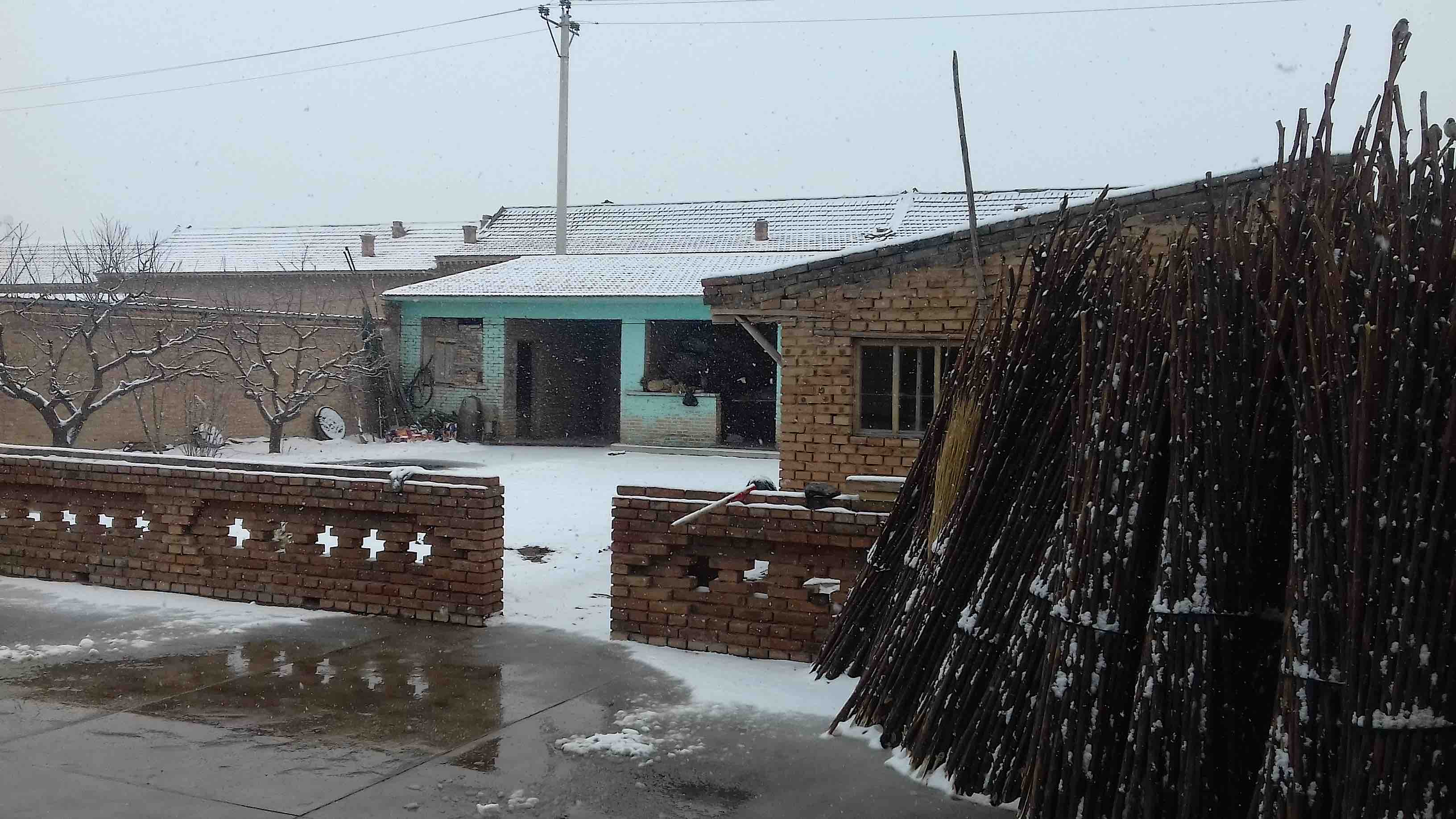
I wonder if the title Kangxi yun is distinctive to the Li family. If Li Fu copied it from the manuals of his master in Jinjiazhuang, it wouldn’t have been at all old when it was copied by the Zhang family Daoists there. More work for a historian there… Li Manshan buries himself in the Baidu articles on Shunzhi’s mother and Nurhaci.

He knows nothing of Trump, Syria, or the Ukraine famine. While envying him his blissful ignorance, I embark on a political education session; he reads avidly when I show him the relevant Baidu articles. The article on the Ukraine famine looks rather good—though one can hardly expect Baidu to compare it to the Chinese famine following the Great Leap Backward.

After returning from a brief trip to Waterdrop 滴滴水 village with Li Bin, I check the 1948 and 1990 population statistics (first two columns below) in the county gazetteer, but they seem incongruous. Old Lord Li inspects the table for the whole of Zhangguantun district and deftly corrects them. Clever guy!

renkou edits

Born at a different time in another place, Li Manshan might have become a university professor.

2nd moon 28th
As yet another idée fixe in Airplane goes, “Looks like I picked the wrong day to” get my head shaved—it’s really rather cold. Li Manshan kept reading till late last night. We stay home for a study day. He fields another “determining the date” request by phone.

Before midday a couple comes for a prescription about her illness. They’ve come all the way from Datong county, learning of his reputation on the grapevine. Sure, people may also consult mediums, and of course hospitals—the latter terribly expensive, but as Li Manshan observes, their best bet.

LMS krz

The mood is serious as ever when the wife throws the coins and Li Manshan writes down the results. They watch him work it all out, in silence; then she asks questions, the conversation deepening. Li Manshan feels his role (often) is to console them, to lend moral support. As he later tells me, in fact the prescription looks ominous, and mostly he trusts the coins, but he can’t tell them “You’ve had it”, can he? They persuade the couple to stay for lunch (baozi dumplings, cabbage and doufu, onions), washed down at the end with water from the pot. It’s a friendly and sincere scene. They only paid him with five cigarettes, and Li Manshan was fine with that.

Li Manshan’s siesta is devoted to further reading, and he’s only just nodded off when another guy comes for a prescription.

Another great supper: thick-sliced noodles with eggs, dunking meatballs in the broth. Li Manshan glances over at the news, nudging me—some Party bigwig is being interviewed, the caption reading:

中国人大代表 Zhongguo Renda daibiao
Representative of the Chinese People’s Congress,

which he brilliantly converts from three binomes into

中国人,大代表 Zhongguoren dadabiao
Chinese bloke, big cheese.

We fall about laughing. I just love the way this man’s mind works! The following week I’m showing my film at People’s University in Beijing, which is also abbreviated as Renda—so I manage to press the expression into service there.

I clean my teeth in the courtyard, enjoying using my fancy electric Rabbits Don’t Shit, sorry I mean toothbrush (its first outing in China). Since Li Manshan always shoves a fag in my gob as soon as I get back anyway, I beat him to the draw. Whenever I spot an unfamiliar brand, I ask him, “Landlord? Poor peasant?”

3rd moon 1st (chuyi)—which, I note guiltily, is Saturday.

courtyard in snow

Right: sunflower stalks stored for use in making funerary treasuries.

OOH it’s snowing! I’ve been hoping to go in search of more Daoists to Yingxian county with Li Bin and bright young Taiyuan ethnographer Liu Yan, but my carefully laid plans come to nought; the motorways are closed. Li Manshan sweeps the pathway to the latrine, then zooms off back to Yangguantun to smash the bowl in a simple burial for the poor family there. When he decorated the coffin on 2nd moon 25th it was the fourth (not third) day after the death. He explains that there’s no difference between rich and poor in determining the date: it may turn out that poor families also have to store the coffin for over twenty days.

I discreetly perform much-needed ablutions. Li Manshan comes home frozen, unable to see through the snowstorm on his motor-bike. Gradually it eases up.

I show him my photos of the funeral I attended yesterday. He’s always been a laissez-faire leader, but even he draws the line at Wu Mei playing drum while on his mobile. We get a riff going:

“Maybe he was following the drum patterns online?!” he jokes.
“Oh yeah, right—I always felt sorry the so-called Hengshan Daoist Music Ensemble because they were too poor to afford music stands, but now they can read from their mobiles! You’re dead keen on ‘development’, aren’t you?!”—referencing the rose-tinted cliché common in online articles about him.
“Naughty disciple!”
“Naughty master! 青出于蓝。。。”

Wang Ding turns up on his dinky sanlun truck and we help him unload more altar decorations into the south room of the courtyard, redecorated as the village Training Base of the so-called Hengshan Daoist Music Ensemble—and thus, like its town counterpart, entirely unused.

3rd moon 2nd (Sunday, known as libai ba, eighth day of the week, as on their electronic wall-clock)
Foggy at first, gradually the sun comes out. For the first time Li Manshan worries about his cough, and resolves to quit smoking—which, impressively, he manages for nearly a whole hour. Actually he’s not smoking as much as in the old days when he was busy doing funerals with the band.

Having taken a siesta after our fascinating excursion to find murals by Artisan the Sixth, I go outside to clean my teeth, but yet again my oral hygiene is thwarted by the arrival of “Fag Devil” Li Sheng, who insistently shoves another fag in my gob. Typical

I keep up with Tweety McTangerine’s latest lunacies by consulting the Guardian online. But I dissolve in fits of laughter at Stewart Lee’s latest offering there.

3rd moon 3rd
At 7am a guy comes to discuss some work. At 8.20 the formidable wife of an old friend of Li Qing’s comes to moan about her son’s marital problems. Li Manshan is courteous, but considers her “crazy”. I understand virtually nothing, but eventually she makes an effort with me as she pours out her grievances, slapping me regularly on the arm. Village poverty and problems seem intractable, despite advances and propaganda. The only solution touted is thorough urbanization, bringing its own worrying prospects.

Li Manshan isn’t feeling too well, but he takes a break from making paper artefacts to accompany me on a visit to the temple to Elder Hu in the Lower village.

3rd moon 4th
On our last day together, after returning from an intriguing trip to Jinjiazhuang, Old Lord Li suddenly thinks of the slow hymn Eternal Homage (Yong guiyi 永皈依), and we have a nice session on it. It’s one of his favourites, but they rarely use it, and now he can’t remember the opening. He can’t read cipher notation, only gongche solfeggio, so he gets me to sing it from Li Qing’s cipher-notation score. Their more recent green volume has gongche solfeggio underneath too, so he can just about follow it once I get him going.

Yong guiyi textSo Li Manshan gets to record me singing a piece I barely know, but I never get to record him. Anyway he always sets off from a really low pitch, so the result tends to sound a bit like Tibetan chanting. When the band sings a cappella hymns for funerals, Golden Noble has a good ear for starting off on a pitch suitable for the range.
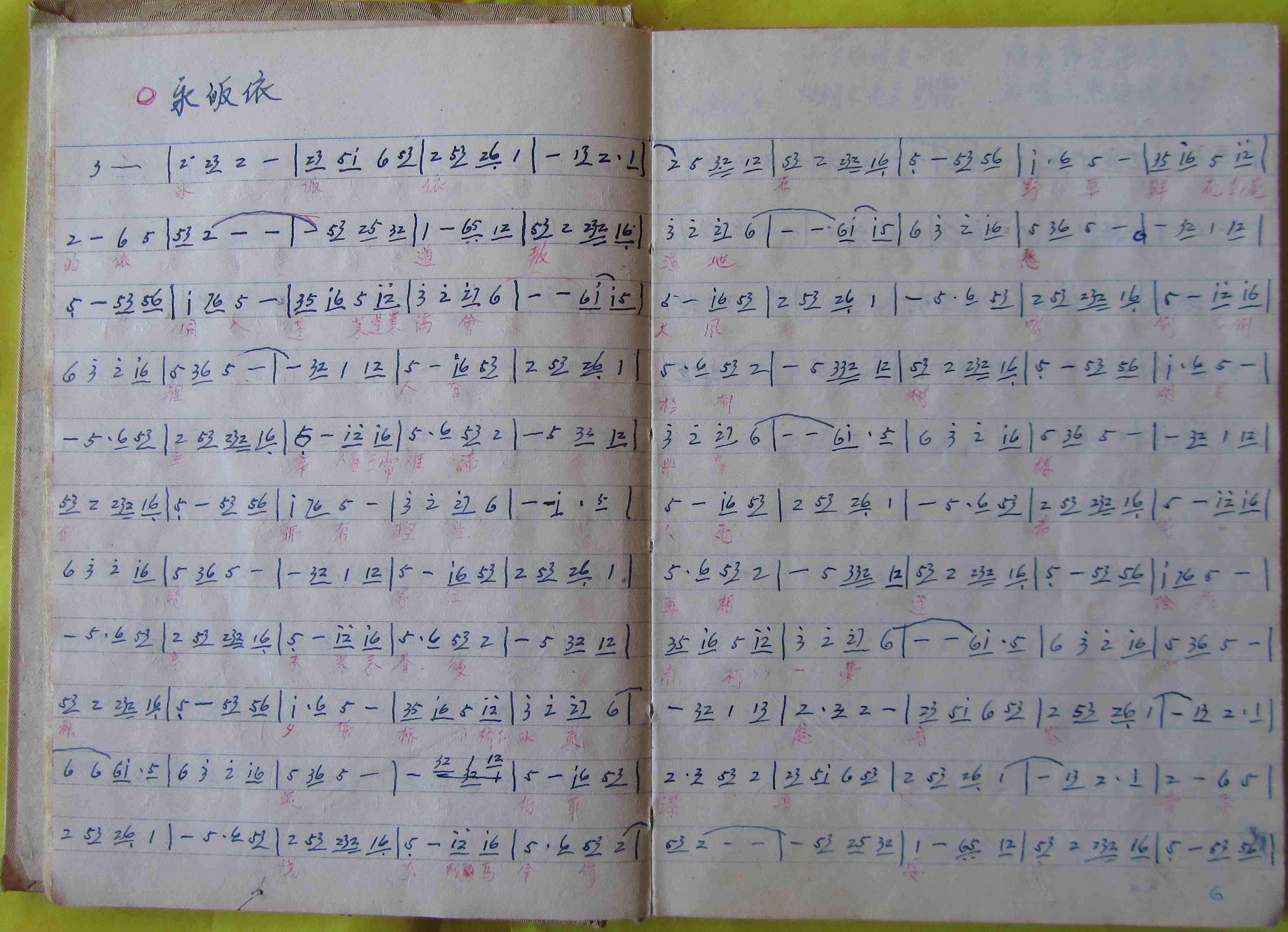
In the version they learned, the first section ends after Fo you Niepan shi 佛有涅槃时. Li Qing’s cipher-notation score isn’t divided into sections, but their more recent green volume is. The latter uses the degree shang 上 as do—including the shengguan suites, which I find strange. Li Manshan is fine once he gets through the opening phrase.

Yong guiyi jianpu

We take a siesta before my journey back to Beijing, but soon wake up. Absurdly, he now asks me to transpose Li Qing’s cipher-notation score of the major shengguan melody Yaozhang into gongche solfeggio. Without thinking to consult the precious photos of Li Derong’s old score (which Li Manshan no longer has) I wrongly assume that it would use the early shengguan system with he 合 as do, but hey. After singing it for him as he records it on his phone, I explain to him that he’ll need earphones to play it back…

Li Bin has another busy day today, having to do two reburials as well as decorating a coffin, so I’ll take a cab to the station. This no longer feels so distant. Li Manshan insists on coming along to see me off, and we leave before 4, dropping his wife off at Baideng township for a hairdo. He refuses to let me pay for the cab. My total expenses for nine inspiring days in Yanggao came to 24 kuai—just over £2.

We take the ring road, passing loads of new high-rises, and bid each other a fond farewell. The station is virtually empty, and the train isn’t busy either.

Back in Beijing, I feel like a country bumpkin. Showing my film three times over the next week, I’m happy to make Li Manshan a big star there. After the last screening I call him up to report, and to wish him well before I go back to London.


[1] As in the poseur’s celebrated line (Fieldworkers’ joke manual No.37), useful when someone asks if you know any classical Chinese:

[smugly] “I studied the Four Classics and Five Scriptures—Confucius, Mencius, various dumpling shapes, I’ve studied them all!”
Wo xuedeshi sishu wujing—Kongzi Mengzi baozi jiaozi, dou xueguole!
我学的是四书五经。孔子孟子包子饺子,都学过了!

Oh well, it’s funny in Chinese—Trust Me I’m a Doctor (there goes another 200 kuai).
Similar story here!

In search of temples—and another Daoist lineage

* This is the latest in a series of vignettes (starting here) from my recent stay with
the wonderful Li Manshan 
(for similar excursions, see here and here*

Jinzhuang LWM

“Nothing to see here—move along please.”

The still-extant main gateway, main hall, and music tower date from the Ming and Qing, occupying 800 square metres. The main hall is three rooms wide, two rooms deep, with single eaves and a “hard-mountain” vaulted roof 单檐硬山顶. Most of the murals have been covered over in mud, and some are exposed to the elements.

That’s the enticing account in the 1993 Yanggao county gazetteer article on the Dragon King temple (Longwang miao) of Jinjiazhuang village, west of Li Manshan’s home in Upper Liangyuan. [1] Even if the temple was now in poor repair, I was keen to see it. Besides, I’ve always meant to make a pilgrimage to this village, where Li Manshan’s ancestor Li Fu began learning Daoist ritual in the 18th century (see Daoist priests of the Li family, pp.71–3).

Over the years, whenever I ask Li Manshan about the temple, he merely shrugs—nothing left there, he says (and he should know). Still, now that he’s getting ever deeper into local history, I finally show him the passage in the gazetteer, and he quite sees why I’m curious, deciding that we should make a trip over to Jinjiazhuang the next day.

On my last morning with Li Manshan he is already up and busy when I wake at 6. After breakfast he fields yet another call asking him for a burial date (my book, pp.186–9), and then he asks his nice cab-driving neighbour to take us over to Jinjiazhuang in his posh new car, bought last year. Unusually, our driver can even talk standard Chinese—though when he and Li Manshan talk among themselves it might as well be Swahili.

Heading northwest, we reach Jinjiazhuang soon after passing under an elevated section of the new high-speed train line. First we check out the Temple to the Perfect Warrior (Zhenwu miao)—small but perfectly formed, in a typical elevated position (cf. Hannibal Taubes’s photo from nearby Yuxian) in what is now the middle of the village. [2]

Jinzhuang ZWM

A friendly woman fetches the keys for us to take a look inside. The interior has recently-made statues and murals, and seems to be “in use”—though of course, such temples are too small to hold temple fairs.

(left) central altar: The Perfect Warrior flanked by attendants;
(right) mural on the east wall, with the Great Lords of the Three Primes.

This affords me scant consolation for finding not the slightest trace of the famous Dragon King Temple; nor, indeed, of the Temple to the Perfect Warrior in Upper Liangyuan (cf. Li Manshan’s map of his village, and our film, from 8.18).

SLY ZWM site

Another reason why Hannibal Taubes is jolly clever: derelict site of the Temple to the Perfect Warrior in Upper Liangyuan. My photo, 2018.

Then to the site of the celebrated Dragon King Temple, which now turns out to be a drab concrete plaza (see photo at top of page). Even more distressingly, the temple was still standing until twenty years ago; so at least the county gazetteer wasn’t making it up. We meet an old guy who recalls it, and had seen an old stele, long vanished—but he’s illiterate, so he had no idea what it said.

What I don’t get is this. OK, the temple had probably been becoming more and more decrepit for many decades, but if it merited an entry in the 1993 county gazetteer (which not even the Lower Liangyuan temple did, for instance), then why would they demolish it in 1998? By then the county authorities should even have been nominating it for preservation; but even if not, you might think the villagers themselves would see its value (whether for their own culture or—if they had a modicum of canny foresight—as a tourist attraction). But I recall how in Upper Liangyuan no-one cared much about our discovery of the two old steles there (my book, pp.46–9): as young people leave, these villages have long lacked a sense of community, and there is little concern for old buildings.

Another Daoist lineage
While we’re chatting with locals at the magnificent Ming temple—or rather, drab concrete plaza—the village yinyang Zhang Nan (b.1956) shows up, and invites us over to his clean and spacious house for a chat. He’s great; of course Li Manshan has known him for ages, and as usual gets along well with him; our driver is good company too. On our way home they comment that Zhang has a slight stammer; I was so busy stammering myself that I didn’t even notice.

Zhang Nan and LMS

Zhang Nan with Li Manshan.

The Zhang lineage moved here from Hongtong in the early Ming, like the Lis (my book, pp.70–71) and so many others all over north China. Zhang Nan knows of seven generations of yinyang before him (as ever, note the alternation of single and double given names):

  • 1st generation: Lianzhu 連珠
  • 2nd generation: Kui 奎
  • 3rd generation: Wenbing 文炳
  • 4th generation: Bi 弼
  • 5th generation: Deheng 德恆
  • 6th generation: Mei 美
  • 7th generation: Jincheng 進成
  • 8th generation: Nan 楠

Right down to his grandfather, all his forebears performed Daoist ritual, but his father only did kanrizi divination, as does Zhang Nan himself. With more time we might have elicited further names from earlier generations—brothers, cousins, and other disciples.

Assuming that Li Fu (first of nine generations in our Li family of Upper Liangyuan) would have learned ritual from a Daoist family that already had a tradition of at least a few generations, then “first-generation” Zhang Lianzhu must have had still earlier Daoist forebears. So this would make the Zhangs of Jinjiazhuang the longest Daoist lineage that we know of in Yanggao. And where did they learn?!

Though short of revelatory, our excursion to Jinjiazhuang made a good way to spend my last day with Li Manshan—not entirely a wild goose chase.


[1] The gazetteer entry appears not under Temples (miaoyu 庙宇) but under the “Ancient architecture” (gu jianzhu 古建筑) section of Cultural artefacts (wenwu 文物, pp.475–6)—a section that includes the Temple to Elder Hu at Xujiayuan but, strangely, not its sister temple at Lower Liangyuan (see The cult of Elder Hu).
[2] Cf. Willem A. Grootaers, “The hagiography of the Chinese god Chen-wu (The transmission of rural traditions in Chahar)”, Folklore studies 11.2 (1952), pp.139-181, and perceptive updates from Hannibal Taubes.

God images old and new, 1

*Click here for main page!*
(under Images: Li family in main menu)

ZQ mural

1 A village artisan
This is the first of two articles (sequel here) that together might be called

Uncle Xi and the Ten Kings of the Underworld.

In both rural and urban China, paintings of the Ten Kings of the Underworld (Shiwang xiang, or Shidian Yanjun) were commonly displayed for funerals, and in some places they still are. In this article I introduce Artisan the Sixth, who painted a set of Ten Kings for the great Daoist Li Peisen; and I go in search of his kang murals.

LHJ 456 Kings detail

Translating Daoist ritual texts

Zhaoqing screenshot

Dunno about anyone else, but I enjoy watching my film again in the company of an audience!

I can’t now imagine all the work that went into this. Apart from the filming itself, and working with Michele to do all the editing, it was good to match up Li Qing’s ritual texts to the hymn singing, and fun showing how the cymbal patterns work, captioning the guangcha mnemonics—first as Daoist percussion karaoke (from 24.03) and later as they whizz past in Yellow Dragon Thrice Transforms Its Body (from 1.11.07).

Translating all those ancient Daoist texts was no picnic, but they’re really beautiful—like the Invitation sequence at the edge of the village towards dusk, with Golden Noble’s solo rendition of the “Vowing with Hearts at One” verses:

Vowing with Hearts at One we Invite:
Emperors and lords of successive dynasties,
Empresses and concubines of epochs immemorial,
Bedecked in twelve-gemmed crowns,
Countenance outranking three thousand rouge-and-kohl belles.
All under heaven their remit, all under heaven their family,
Ultimately ascending.
Singing within the palace, dancing within the palace,
At the final moment they can only perish and fall.
Alas! Have you not heard?
Once astride the dragon of Yu they cannot return,
In vain to deploy the Pipes of Shao within the Department of Caverns,
Fluttering the shadows and echoes, imperceptibly approaching!

But once rendered in exquisite solo melody, such textual beauty is multiplied.

Note also that all these texts are conveyed at quite different tempi: the choral hymns before the coffin extremely slowly, the solo recitations in parlando style, the choral mantras at such speed that the subtitles can hardly keep up. This important aspect of ritual performance is rarely reflected in translations on the page.

Having consulted the exegeses of wise abbot Min Zhiting (no less) in the White Cloud Temple on the meaning of the hymns, I still had some doubts. I recall the months of email ping-pong with Li Bin as I sought his advice. The Li family never discuss the “meaning” of the texts, nor did their elders ever “explain” them as they were learning, so I was really impressed when Li Bin clarified points phrase by phrase. The process of singing them, molto adagio, almost daily over more than thirty years, does seem to give them the occasion to reflect on their meaning. Of course they’re not “educated” interpretations, but the Daoists do clearly have their own “understanding” of the texts they sing.

Another beautiful text in their manuals, for reciting, is the Shunzhi emperor’s meditation on impermanence.

xietu yiwen

I also relish the language of Thanking the Earth memorials (my book, ch.12). Soon after the revival of religious life following the collapse of the commune system, along with recopying the family ritual manuals, in 1981 Li Qing’s uncle Li Peisen (see here, and here) copied a memorial for a domestic Thanking the Earth ritual held by his father Li Tang in the late 1920, with its detailed genealogy.

At the Numinous Treasure Court of the Great Ritual it is hereby declared: upholding the Orthodox Unity Teachings, resident in that place named Upper Liangyuan village in the southeast district beyond the city gates of Yanggao county in Shanxi province; responding to heaven and rewarding the gods, beseeching blessings and fulfilling the vow, to avert calamity and assure well-being; I, Li Tang, with faithful heart, on this day do kowtow. […]
xietu yiwen detailReciting the auspicious texts of the Eleven Great Luminary stellar lords of the Sombre Capital of Upper Clarity, Li Tang and others, resident in the Central Kingdom, favored among mankind, invariably moved by the great virtue of Dragon Heaven, ever reliant on the Earth Court to engender thorough understanding of the high and the broad, repaying sincerity unretained. Hereby having augured the auspicious period, the Retreat is to be held as follows.
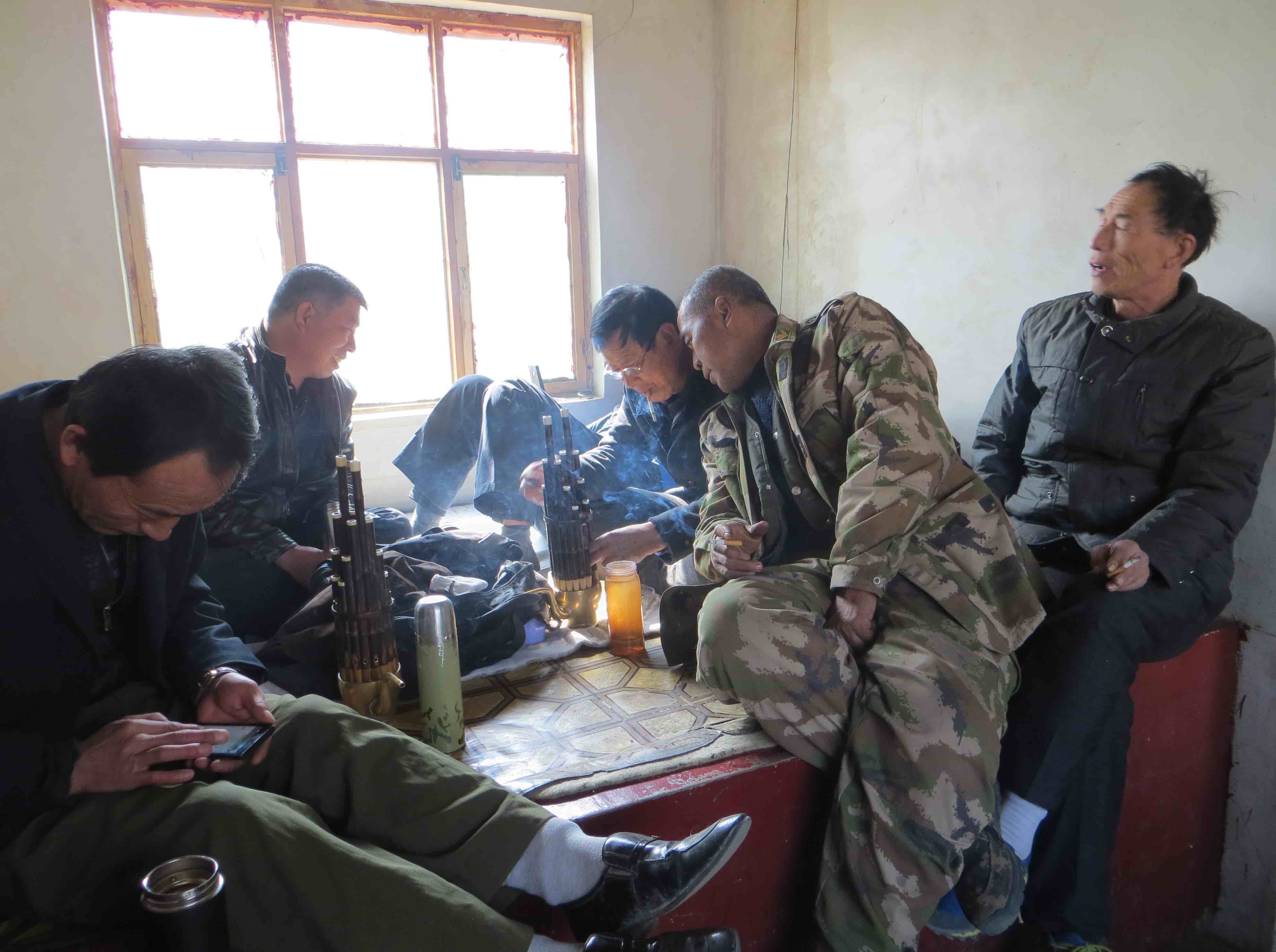
On this day we invite the Daoist acolytes to set up a Daoist arena for well-being in our courtyard over two whole days in the hall, kneeling and reciting the Diverse true scriptures and holy mantras for the Great Supreme, facing the Heavenly Worthies in homage; the precious litanies for the Great Ritual, Lighting Lanterns, and Bestowing Food, burning paper and presenting up offerings for the holy gods of the seven originals and the true lords of the nine thearchs.
Our wish is that the whole family will be tranquil, its members in well-being, livestock thriving, our fields fertile, relying entirely on the protection of holy benevolence in the lustre of our daily business.

There are some fine translations of such numinous ritual texts in the works of Ken Dean and John Lagerwey—and indeed in David Hawkes’s translation of The Dream of the Red Chamber.

Yet another village funeral

ZJYT lingtang
On my recent trip to Yanggao I spent most of my time at home with Li Manshan, making little trips to nearby villages with him or his son Li Bin. But of course I had to check out a funeral and catch up with the other Daoists, so Li Bin came to collect me to drive to Zhu Family Cavetop.

The village population, 749 “mouths” in 1990, has now declined to only a couple of hundred at most. By the time we arrive, the other Daoists have already Opened the Scriptures at the soul hall, singing the Hymn to the Three Treasures as prescribed. After Li Bin delivers the paper couplets and diaolian inscriptions, we go to the scripture hall, which today is conveniently the little room on the south side of the funeral family courtyard, right by the soul hall—so no need for the usual long procession.

I catch up with my old mates Golden Noble and Wu Mei, whom I haven’t seen since our French tour last May. Golden Noble has high blood pressure and is off the fags and booze; Wu Mei is sweet as ever. They check out my blog on their phones.

ZJYT jingtang

The cosy atmosphere of the scripture hall.

Li Sheng

Li Sheng makes repairs to his sheng.

Li Sheng, another regular member of the band and a dedicated chain-smoker (my nickname for him is Fag Devil 烟鬼 Yangui—the gui in falling 4th tone!), is as hyper as ever. His manic energy reflects both in his quickfire dialect and in his fine sheng playing—he struggles to conform to the solemn immovable posture of the Daoists of which Li Bin is a master. He comes from a renowned gujiang shawm-band family from the nearby township of Shizitun. He didn’t know what year he was born; chatting in 2013, he only knew that he was 60 sui, so I translated that to 1954. He is twelve years younger than his brother, a wonderful cultured gujiang also called Li Bin. They learned with their distinguished blind father Li Zhonghe (1908–88), who was still playing in his eightieth year. Again, these two Li families have long been on good terms—the great Li Qing sometimes played in Li Zhonghe’s shawm band in the 1970s. Li Sheng’s older brother went off to work as a cadre in the mines in Datong around 1970, and Li Sheng did some work there too, as well as doing petty trade in Datong, returning around 2000. He has four daughters and one son.

To make up the numbers for the Daoist personnel today, Li Bin has booked two yinyang I haven’t met before, both from hereditary traditions. They’re nice, but turn out to be of somewhat limited abilities. While the gujiang shawm bands have a reputation for smoking dope, some Daoists do too, crushing annaka amphetamine pills into their cigarettes to give them energy (cf. my book, p.325). In the scripture hall my new mates use tinfoil to smoke annaka through a rolled-up 1-kuai note.

As I soon learn when I take a session on small cymbals, the new drummer “calls the beat” arbitrarily, so I keep getting confused about where to place the down-beat. This is just as irritating as an old Daoist I met a few years ago who kept beating out the syncopations on small cymbals, no matter whether we were anywhere near a cadence—”unruly” (bu guiju), as Li Manshan tuts.

The band makes up for the time saved on procession by playing “little pieces” and popular errentai melodies as they arrive at the soul hall. But no-one here cares anyway, and it’s the latest in a long line of funerals where they merely need to go through the motions, with the simplest ritual sequence possible. None of the kin, returning from the big cities for the funeral, kneels or kowtows. No-one pays attention to the Daoists even when they launch into a showy errentai sequence (except in the afternoon, when they even applaud).
Along with the kin we have a good communal lunch in the big tent set up outside, with disposable (yicixing) plastic crockery—I never miss an opportunity to use the expression yicixing (“one-off”), corpsing the Daoists. Meals at Yanggao funerals have improved as ritual practice has declined.

I take a siesta along with three other yinyang in a heap on the little kang brick-bed. The pop band on the truck outside starts up around 3pm, but there’s only a tiny audience even for this, and they soon drift off too. After the Daoists’ first visit of the afternoon, a group of travelling beggars shows up—the usual personnel, with head-mikes, an erhu, fan, and clappers.

ZJYT beggars

Funeral beggars.

ZJYT LB on daguan

Li Bin on large guanzi, flanked by Golden Noble (left) and Li Sheng.

For the Daoists’ second visit of the afternoon they only play a popular errentai medley. For the third session Li Bin (who usually plays sheng mouth-organ) leads the hymn Diverse and Nameless on large guanzi—good, in tune, with a fine new instrument he’s found. For a change Wu Mei plays drum, but he’s somewhat distracted by using his mobile at the same time… The beggars return, and then the Daoists play another errentai sequence. I’m bloody cold and less than riveted (as we say in the orchestral biz, “Of all the funerals I’ve attended in Yanggao… this is one of them”), so I get Li Bin to take me back to Upper Liangyuan before the Invitation ritual. As I get home Li Manshan and his wife are busy making paper artefacts together.

As Li Manshan observes at the end of my film,

Things ain’t what they used to be
今非昔比

Fashion notes

funeral pop better

Pop outside gateway for a village funeral, Yanggao 2018.

Two lists, just possibly somewhat partial, of what is In and what is Out in rural north China:

Things that are at no risk of going out of fashion:

  • hawking and spitting / emptying contents of nose onto the floor (cf. Some Chinese posters and pinups)
  • exchanging cigarettes
  • “leather” miniskirts
  • corruption
  • piles of stinking rubbish by the roadside
  • pollution
  • getting legless (for which there’s a nice Yanggao term, erjinban 二斤半)

(If Uncle Xi is as omnipotent as China-watchers suggest, then WTF?!)

Oh, and

  • Hymn to the Three Treasures as first sung hymn (Opening Scriptures) on arrival at the soul hall (my film, from 21.32).

Things that have gone out of fashion (cf. my book, Coda pp.357–61):

  • the Thanking the Earth ritual
  • funerary Communicating the Lanterns, Crossing the Bridges, yankou
  • shengguan suites for earth and temple scriptures
  • yunluo frame of ten pitched gongs, and dizi flute
  • reed-matting on the kang brick-bed (Plastic Rules OK)
  • Serving the People [remind me when that was In?]
  • pop music at funerals!!!

The latter came as a surprise to me. As you see in one of the most striking images of my film (from 30.32), whereas in the early 1980s villagers were glad to restore the “old rules”, by the 90s they were much more excited* by the pop bands performing on a truck outside the soul hall. Their acts soon became quite innovative. But over the last few years even the audience for pop has dwindled, as people can watch the Real Thing (sic) on their phones.

*In Li Manshan’s words: leqilaile 乐起来了!

The art of the sheng repairer

GGZ Fan Huilai 93

Fan Huilai overhauling sheng, Xiongxian 1995.

An important theme in our fieldwork on ritual associations around the Hebei plain is that of the itinerant occupational sheng mouth-organ repairers (dianshengde 点笙的). They make cameo appearances in several pages on Local ritual, so here I’d like to collect some of the material. [1]

While I constantly stress vocal liturgy, the shengguan wind ensemble is also a major aspect of the ritual soundscape in north China. The role of the sheng in the ensemble is somewhat akin to that of the baroque continuo. Like a harpsichord before a Bach cantata, the sheng needs regular fine-tuning in advance of performance. The term diansheng (dotting the sheng) derives from the adding of a drop of wax to the reed to tune it, but includes general maintenance; played for long rituals, with their sound-chambers susceptible to moisture, wear-and-tear on the sheng is considerable. Musicians may tune individual instruments themselves, and any sheng player can do it after a fashion, but it is a difficult job to do well, and a well-tuned sheng section is an important aspect of a good ensemble. As with the work of the luthier worldwide, it is a slow and meticulous task (for a loving tribute to instruments and instrument-making in Irish music, see Last night’s fun).

Occupational Daoist bands in north China, like the Li family in Yanggao, tend to maintain their own sheng; with quite a small personnel, they rarely have more than four to tune. Players can all carry out basic repairs, and in between the many ritual visits to the soul hall over the day they busy themselves in the scripture hall making fine adjustments to tuning. This is among the many practical skills that Daoists have to learn. Still, Li Bin takes all the band’s sheng to fine maker Gao Yong once a year for a thorough overhaul.

On the Hebei plain, amateur village ritual associations tend to be much larger, often using as many as twenty sheng players—so occupational sheng-repairers are much in demand. Most associations invite a sheng-repairer to tune all their sheng systematically two or three times a year, or before their major outings, at least before the New Year rituals. The Zhaobeikou association had its sheng repaired at least three times a year, once “before the lake freezes over”, again before the New Year rituals, and also before the river lanterns ritual of the 7th moon. Some associations may be reluctant to spend money on inviting a repairer—although in some villages in the early reform era payment for this comes out of the funds of the village committee. Around 1995 it cost 5–10 yuan to tune one sheng; most associations had at least eight sheng to tune. Sheng-repairers were making a good living.

When a ritual association buys new sheng, musicians take them to be tuned (pin sheng 品笙) to the standard pitch of their own association, taking the che gong of their yunluo or tuning them to the lowest note of their dizi flute.

So apart from their vital musical services to the village ritual associations, the sheng tuners act as a unifying factor in communication, an informal rather than institutional link. Experienced observers of musical life over the whole area, they serve not only ritual associations but also shawm bands and opera troupes, and they know a lot more about local ensembles than any cultural cadre we have met. They often go on tour throughout the villages, but ensembles may also take their sheng to the craftsman’s home. Again, most craftsmen still come from long hereditary traditions.

Below I introduce some of the more renowned sheng-repairers and makers around the Hebei plain.

Bazhou, Xiongxian, Jinghai
Back in 1989 our very first clue to the ubiquity of ritual associations on the Hebei plain came from Bazhou county. Based in Xin’an town, the Qi family was among many lineages of sheng-repairers active around Beijing, Tianjin, and the countryside just south.

We met Qi Youzhi (b.1920), from a long line of sheng-repairers in his lineage. His grandfather Qi Baoshan had worked for the imperial palace lamas in Beijing. Before the fall of the Qing dynasty in 1911, Qi Youzhi’s father Qi Lanpu used to play sheng in the Tianqiao district of Beijing. Later, through contacts with palace eunuchs, he learnt to repair sheng, building a reputation with temple musicians. His older brother Qi Lanting and his oldest son Qi Youcai also took up the business, and they also repaired sheng in Tianjin.

qyz-1989

Qi Youzhi (right) with Xue Yibing, Xin’an 1989.

They used to go out to find work repairing sheng, making the rounds of all the Buddhist and Daoist temples and village associations. Twice a year Qi Youzhi used to go on a long trek by foot to Beijing with his uncle, staying in villages on the way and tuning sheng wherever there was work. After the 1949 Liberation, Qi Youzhi could no longer find work in Beijing, since priests were returning to lay life and temples were now largely inactive—but significantly there was still plenty of work repairing sheng for the village ritual associations. Indeed, this work continued until the Four Cleanups in 1964. By 1980 Qi Youzhi was 61 sui, and, despite the revival, gradually became less active.

Nearby in Gaoqiao village—whose Buddhist-transmitted ritual association is so outstanding (playlist track 8, and commentary)—the Shang family sheng factory is a long-established cottage industry. A local source claims that they too were repairing sheng for palace groups in Beijing as early as the Xianfeng era (1850–61), and that they made their first sheng in 1853. By the 1980s they were making sheng for the Hongsheng instrument factory in Beijing and Tianjin; by 1993 they had even started making shō for Japanese gagaku. In 1995 they were charging 140–180 yuan for a new sheng. The head Shang Xuezhi was often on tour, mending sheng for ritual associations (and also shawm bands and opera groups) over a wide area; he kept a three-volume list of his clients, wonderful evidence of the continuing vitality of the associations.

In Xiongxian county, another excellent sheng repairer was Fan Huilai, based in Gegezhuang (see photo above; below, some of his equipment). By 1993 he was visiting about sixty associations every year (including Catholic groups in Hejian county), charging 5 yuan to repair each sheng. As he pointed out, most associations had about eight sheng to repair, but some, like Quantou on the Baiyangdian lake, had as many as eighteen.

GGZ sheng stuff 2GGZ sheng stuff 1

Still in Xiongxian, there was a local saying: “from Nanjing to Beijing, the Shao family of Gaogezhuang are good at reparing sheng”. They came to Hanzhuang twice a year to repair the association’s sheng, tuning eight sheng for 100 yuan. Hanzhuang has a sheng said to be from 1929, with “made by Shao Guanghui” incised on one of the reeds; they had an even older one with a wooden bowl.

In Jinghai further east, Lesser Huangzhuang (also with its own ritual association) had an instrument factory specializing in sheng. They had been making sheng since before the Japanese occupation. In the 1950s the business was collectivized; in 1968, while assistant chief of the village revolutionary committee, Li restarted the workshop. Since the 1980s it had split into eight (!) household industries. One of their itinerant repairers was Tao Laicheng, who regularly visited the Zhangzhuang association in Bazhou, for instance.

E. Jiangcun sheng

Sheng parts, East Jiangcun, Renqiu county. Photo: Music Research Institute, 1993.

Xushui and Yixian
In my article on ritual associations of Xushui county I introduced Qingmiaoying, another village long famed throughout the region for its hereditary makers and repairers of sheng mouth-organs. Several groups in this western region of the plain have fine old sheng made by the Qingmiaoying craftsmen, and all spoke of them with respect. In fact, since the technique of instrument-making has suffered, old instruments may survive better than new ones, and their timbre is much valued by musicians.

E. Yuzhuang chui

The Altar of Accumulated Altruism, East Yuzhuang 1995.

In 1995 we found Yao Haijun (b. c1965) at Qingmiaoying. His great-grandfather Yao Leping died in the Cultural Revolution; he still ran a stall at the county-town market in the 1950s. Leping’s son Hongru (b. c1914), and grandsons Xinghua (b. c1930) and Xingli, also took up the trade. In Dingxing county nearby, the Yishangying association had some fine sheng made by Yao Jiqing in 1951. Yao Haijun was letting his 10-sui-old son watch while he repaired sheng, hoping he would take it up too.

Yao Haijun was charging a dozen or so yuan to tune one sheng. Associations were bringing him over a hundred sheng every year to tune; in the 12th moon someone came virtually every day. He tuned a lot of them for free, because of long-standing good guanxi with the associations, and he wasn’t mercenary.

Another sheng-repairer in Qingmiaoying, Wang Qinghe, had learned from Yao Leping, and lived to the age of over 100 sui. His son, known as Tiger Wang (Wang Laohu, over 60 sui in 1993), continued the business; the Gaoluo association used to go to him on occasion right until 1991.

Just north in Yixian county, Li Kungui, a member of one of the four ritual associations in Shenshizhuang, was a sheng repairer active within a smaller radius. His father also repaired sheng, having learnt from one Zhang Rui. Li Kungui also mended sheng for the village’s East association, but the West association has its own sheng-mender. In this case, Li has been responsible for a certain local standardization in pitch. The fixed pitch of the Upper Huanghao association used to be D, but he changed their pitch to E for them to match that of other groups in the area—such as East and West Baijian, as well as Lower Huanghao and Mawuzhuang.

A nice story illustrates musicians’ awareness of the dangers of sheng-repairers going on tour to other villages. Senior musician Fu Zhongren (c1898–1983) had a comprehensive knowledge of the repertoire of “holy pieces”, but realizing that Li Kungui used to go round other villages repairing sheng, he wouldn’t teach him too many pieces in case he taught them to other associations!

Further south
Before the Japanese invasion in 1937 a sheng-repairer called Du, from Dujiazhuang in Shenxian county quite far south, walked to Gaoluo every winter to tune sheng for all four ritual associations there. Villagers said the maker was called Du Furui. We also heard of him in Yixian county: near the Western tombs of the Qing emperors, cultural cadres had found some old sheng with “Dujiazhuang in Shenzhou” incised on them.

In Jingxian county still further southeast, another renowned sheng-making lineage was the Wang family from Yangzhuang, [2] which went back some five generations. They were versatile, making many other instruments too; and like other such cottage industries, they have moved with the times, supplying instruments for urban professional troupes.

Since they are itinerant, sheng-repairers may also transmit the paraliturgical music, either directly or by acting as intermediaries. Two early transmitters of the “southern” style of shengguan music in Xushui were sheng-repairers, the Daoist priest Wang Leyun (fl. 1860) and Feng Daya (fl. 1920s), both from further south.

I look forward to reading material on sheng-repairers in regions like south Hebei, where shengguan is also a major component of the rituals performed by household Daoists.

***

I have discussed sheng-repairers at some length, both to illustrate continuity with pre-Liberation traditions and to suggest the practical material basis behind ritual culture in local society. Though there are no longer stalls at town markets, village repairers still still do good business making the rounds of rural ritual ensembles, as well as maintaining their contacts with urban outlets and taking part in innovations in instrument design. Sheng-repairers, like the assistants in funeral shops, are likely to be a more useful source of local knowledge than cultural cadres.


[1] See Zhang Zhentao’s masterly study, Shengguan yinweide yuelüxue yanjiu [Temperamentology of sheng pipe positions] (Ji’nan: Shandong wenyi cbs, 2002). For north Shanxi, note also the work of Chen Kexiu and Jing Weigang. For sheng factories in a changing society, see e.g. http://www.onesheng.cn/news/102721.html.
[2] See e.g. Yu Xuehong 于学洪, “Shengwang shijia” 笙王世家, Yueqi 1984/5 and 1984/6.

Ritual groups of Jinghai

*Click here for main page!*
(under Hebei > Tianjin in main Menu)

YMK jing

Continuing our surveys of ritual associations on the Hebei plain,  the Jinghai region of Tianjin is an extremely fruitful area for fieldwork. Even by the 1990s Tianjin municipality (like Beijing) was largely rural, way beyond the city itself.

This article introduces two ritual groups in Jinghai, those of Lesser Huangzhuang and Yuanmengkou, both richly deserving more fieldwork than our team could manage in 1994 and 1995.  Through the latter we found a network of Heaven and Earth Teachings sectarian associations—continuing our acquaintance with sectarian groups (Laofomen, Hunyuan, Hongyang, and so on) elsewhere on the Hebei plain.

As ever, such research requires a blend of fieldwork, textual study, local history for both imperial and modern eras, and an understanding of folk religion and the ritual soundscape.

Ritual groups of Langfang

*Click here for main page!*
(under Hebei in main Menu)

S. Hancun 1993 heying

Here’s yet another article in my series on Daoist and Buddhist ritual groups on the Hebei plain south of Beijing, gradually filling in some of the gaps on the map.

I’ve noted the contrast between the occupational household Daoist bands of north Shanxi and the village-wide amateur ritual associations that are typical of the Hebei plain. Just southeast of the capital, on the way to BazhouLangfang municipality (formerly the county of Anci) is another lively area for ritual. Village associations here seem to feature elements of the ritual scene in suburban Beijing, with some occupational Daoist and Buddhist groups alongside the amateur associations that are common just further south and west. The Langfang region is also famed for its involvement in the 1900 Boxer uprisings.

These groups too had learned from temple clerics. Unlike the particular case we found in Daxing, most ritual associations here, as south and west on the plain, maintained the amateur tradition of “practising good” by performing rituals as a social duty without reward, though some were beginning to accept modest fees. As usual, such amateur groups were active mainly in the home village and a very small radius.

Ritual in The dream of the red chamber

Citing Cao Xueqin’s entrancing novel The story of the stone recently, I was reminded that among the many virtues of the epic tale is its detailed depiction of rituals in 18th-century Beijing[1]

A work of fiction it may be, but what I admire here is the ethnographic thick description—a model for modern fieldworkers. Prompting us to experience such rituals within the far wider context of social life and personal experience, the author not only evokes all the human detail of the family’s behaviour and emotional world, including the priests’ relations with their patrons, but depicts the whole physical setting and itemizes expenses.

Chapters 13 and 14 describe a 49-day observance for the funeral of the family matriarch, with several groups of ritual specialists performing. Chapter 13 gives the text of the placard—similar in style to those used in modern times. [2] In David Hawkes’s brilliant translation (for the whole passage, see vol.1, pp. 255–87):

He also instructed someone to invite an expert from the Board of Astronomy to select dates for the funeral and the ceremonies preceeding it. With the approval of this official it was decided that the lying in state should be for forty-nine days and that the notification of bereavement indicating the family’s readiness to receive official visits of condolence should be made in three days’ time.

這四十九日,單請一百單八眾禪僧在大廳上拜大悲懺,超度前亡後化諸魂,以免亡者之罪;另設一壇于天香樓上,是九十九位全真道士,打四十九日解冤洗業醮。然後停靈於會芳園中,靈前另外五十眾高僧,五十眾高道,對壇按七作好事。
A hundred and eight Buddhist monks were engaged to perform a Grand Misericordia for the salvation of all departed souls in the main reception hall of the mansion during these forty-nine days, while at the same time ninety-nine Taoist priests of the Quanzhen sect were to perform ceremonies of purification and absolution at a separate altar in the Celestial Fragrance pavilion. These arrangements having been made, the body was moved to a temporary shrine in another pavilion of the All-scents Garden. Fifty high-ranking Buddhist monks and fifty high-ranking Taoist priests took turns in chanting and intoning before it on every seventh day.
Inside the gateway, facing the street, a high staging was constructed on which Buddhist monks and Daoist priests sat on opposite sides of an altar intoning their sacred texts. In front of the staging was a notice on which was written in large characters:

[…]
WE,
The very Reverend Wan-xu, Co-President of the Board of Commissioners having authority over all monks and clergy of the Incorporeal, Ever-tranquil Church of the Lord Buddha,

and
the Venerable Ye-sheng, Co-President of the Board of Commissioners having authority over all priests and practitioners of the Primordial, All-unifying church of the Heavenly Tao,

HAVE,
with all due reverence and care, prepared offices for the salvation of all departed souls, supplicating Heaven and calling upon the name of the Lord Buddha

NOW,
earnestly praying and beseeching the Eighteen Guardians of the Sangha, the Warlike Guardians of the Law, and the Twelve Guardians of the Months mercifully to extend their holy compassion towards us, but terribly to blaze forth in divine majesty against the powers of evil, we do solemnly perform for nine and forty days the Great Mass for the purification, deliverance and salvation of all souls on land and on sea…

—and a great deal more on those lines which it would be tedious to repeat [Cao Xueqin’s comment, not mine!].

Chapter 14 goes on to list some of the major ritual segments and activities. The Buddhist Water and Land (shuilu 水陸) ritual included Opening the Quarters (kaifang 開方), Smashing the Hells (poyu 破狱), Transmitting the Lanterns (chuandeng 傳燈), Illuminating the Deceased (zhaowang 照亡), Opening the Golden Bridge (kai jinqiao 開金橋), and Leading the Panoplied Pennant (yin chuangfan 引幢幡. [3]

Daoists performed the Presenting the Memorial (shen biao 申表) ritual before the Three Pure Ones and the Jade Emperor; Chan Buddhist monks performed Ambulating Incense (xingxiang 行香), Flaming Mouth (yankou 焰口), and Worshipfully Presenting the Water Litanies (bai shuichan 拜水懺); and thirteen young Buddhist nuns recited mantras.

這日乃五七正五日上,那應佛僧正開方破獄,傳燈照亡,參閻君,拘都鬼,筵請地藏王,開金橋,引幢幡;那道士們正伏章申表,朝三清,叩玉帝;禪僧們行香,放焰口,拜水懺;又有十三眾尼僧,搭繡衣,靸紅鞋,在靈前默誦接引諸咒,十分熱鬧。

Rendering the fantastical vocabulary of Daoist ritual into English is always a challenge—also well met by Ken Dean and John Lagerwey. Again, Hawkes makes a brilliant attempt at this passage—with occasional elaborations, and a quite understandable, even attractive, “translation” of titles for ritual segments into specific actions (which, of course, they are!):

The Thirty-fifth had now arrived—an important day in the penitential cycle of seven times seven days preceding the funeral—and the monks in the main hall had reached a particularly dramatic part of their ceremonies. Having opened up a way for the imprisoned souls, the chief celebrant had succeeded by means of spells and incantations in breaking open the gates of hell. He had shone his light (a little hand-mirror) for the souls in darkness. He had confronted Yama, the Judge of the Dead. He had seized the demon torturers who resisted his progress. He had invoked Kṣitigarbha, the Saviour King, to aid him. He had raised up a golden bridge, and now, by means of a little flag which he held aloft in one hand, was conducting over it those souls from the very deepest pit of hell who still remained undelivered.

Meanwhile the ninety-nine Taoists in the Celestial Fragrance Pavilion were on their knees offering up a written petition to the Three Pure Ones and the Jade Emperor himself in his heavenly palace. Outside, on their high staging, with swinging of censers and scattering of little cakes for the hungry ghosts to feed on, Zen monks were performing the great Water Penitential. And in the shrine where the coffin stood, six young monks and six young nuns, magnificently attired in scarlet slippers and embroidered copes, sat before the spirit tablet quietly murmuring the dharani that would assist the soul of the dead woman on the most difficult part of its journey into the underworld. Everywhere there was a hum of activity.

That final comment “Everywhere there was a hum of activity” (re’nao “exciting”, “bustling”, lit. “hot and noisy”, cf. Chau, Miraculous response, pp.147–68) is ironic after the silent mantras of the nuns. BTW, I almost like the rendition of shifen as “everywhere”, but I’m still inclined to think it carries the modern colloquial sense of “really”—thus “it was really boisterous”.

Chapter 102 gives a detailed account of a one-day exorcism performed by forty-nine Daoist priests, with god paintings hung out, performing Ambulating Incense, Fetching Water (qushui 取水), Worshipfully Presenting the Memorial (baibiao 拜表) and Inviting the Sages (qingsheng 請聖) rituals, and reciting the Dongyuan jing 洞元經 scripture throughout the day. Three chief liturgists, donning seven-star hats, wielded precious swords, flags, and a whip, as a placard was displayed and exorcistic talismans depicted.

In chapters  28 and 29 (Hawkes vol.2, pp.41–92) the family commissions a three-day Daoist Offering for well-being (ping’an jiao 平安醮) at the Qingxu guan 清虚观 temple:

Aroma continued:
“Her Grace sent that Mr Xia of the Imperial Bedchamber yesterday with a hundred and twenty taels of silver to pay for a three-day Pro Viventibus by the Taoists of the Lunar Queen temple starting on the first of next month. There are to be plays performed as part of the Offering, and Mr Zhen and all the other gentlemen are to go there to offer incense. Oh, and Her Grace’s presents for the Double Fifth have arrived.”

This section offers far less detail on ritual, the opera being the main attraction. We tend to assume that in the Good Old Days people gladly respected the “rules” (guiju 規矩), but like that intriguing re’nao of chapter 14, there is clearly a long ancestry to the common lament since the 1980s that audiences care more about ostentation than correct ritual performance. The account uncannily reflects my observations at Yanggao funerals since 2001 (Daoist priests of the Li family, p.356):

Daoists still have to be invited, almost routinely; but by now they are used to not being appreciated. Since the 1990s no-one pays much attention when they arrive at the soul hall; only the kin reluctantly abandon their places watching the pop music outside the gate to go and kneel before the soul hall.

Imagine if Bach had taken that sabbatical in Beijing, then he might have had patrons like the Jia clan in The dream of the red chamber… They could hardly have appreciated Bach’s genius any less than the Margrave of Brandenburg (“what does that even mean?”).

JPM Daoist painting

Perfected Man Huang sends forth an official document recommending the deceased, c1700: Daoists presiding over the liandu funerary ritual of chapter 66 of the Jin ping mei. Nelson-Atkins Museum of Art, Kansas City; see Little and Eichman, Taoism and the arts of China, pp.192–3. Note typical northern shengguan ensemble of guanzi oboe, sheng mouth-organ, dizi flute, and yunluo gong-frame, with large cymbals nao and bo.

Earlier still, the Ming novel Jin ping mei offers just as wonderful ethnographic material for rather less elite social strata—set in Shandong, ostensibly in the 12th century, but clearly based on the milieu of the author’s own day. Here too are many vignettes on minor domestic rituals and major exorcistic and mortuary rituals, as well as on the lives of Daoist priests and Buddhist monks.

Of course, these are just two of the most celebrated works of Ming–Qing fiction wherein we can seek such depictions. Just as with contemporary fieldwork, my first thought is to situate such rituals in space and time, rather than giving generic accounts. Thus one would seek to understand the rituals of the Jin ping mei in the context of 16th-century Shandong, and those of The story of the stone in that of 18th-century Beijing—just as we should be clear if our accounts of modern rituals refer specifically to north Shanxi in the 1930s, west Fujian in the 1990s, and so on.

Despite monumental social transformations since imperial times, all the rituals described in these early novels are still performed today—always varying by region and circumstances. [4]

Still, I need hardly reiterate that both texts (novels, ritual manuals, field reports) and images (paintings, photos) are silent and immobile: what we really need is films—which are in short supply even for current ritual practice, and an even taller order for the imperial era (though dramatized adaptations of The story of the stone may be quite educative!). [5]

[1] Within the vast literature on Hongxue 红学 (“Redology”—Dream of the red chamber studies), there are many Chinese studies of its religious and indeed musical components, searchable on databases. A considerable body of research is also available for Jin ping mei.
[2] For a couple of examples in English (for different kinds of rituals), see Dean, Taoist ritual and popular cults of southeast China, pp.53–8, and my Daoist priests of the Li family, pp.230–31.
[3] For “panoplied pennant” in a funerary hymn, cf. my Daoist priests of the Li family, p.262, and film, from 24.39.
[4] For leads, see my In search of the folk Daoists of north China, and index.
[5] Perhaps I digress, but given the stylized acting culture of China, the “Star of Tomorrow” company’s recent nine-part TV version (beginning with the episode below), using child actors, has been highly praised for its naturalism and conviction—far from merely cute.

Ritual groups of Xushui

*Click here for main page!*
(under Hebei in main menu)

QMZ 1958

While ritual groups all around the Hebei plain survived Maoism to revive under the reform era since 1978, the county of Xushui makes a particularly intriguing case, notable both for its ephemeral fame with the razzmatazz of the 1958 Great Leap Forward and for its more long-lived ritual groups.

Despite its revolutionary image, Xushui county has remained a hotbed for religious activity, notably the cults of the sectarian creator-goddess Wusheng laomu and Auntie Silkworm Granny (Cangu nainai 蚕姑奶奶)—the latter a popular deity in this area, rarely featuring prominently elsewhere on the plain. Associations commonly display ritual paintings, like the Ten Kings and the Water and Land series, and perform vocal liturgy. They too are within the catchment area of Houtu worship—they used to make the rather distant pilgrimage to Houshan, though they more commonly visit the nearer Western Summit (Xiding 西頂) on Langyashan further southwest from Houshan. Again we found a rather complex overlap between the village-wide ritual associations, sects, and yinyuehui.

Further to my brief introduction in my post on Festivals, here I introduce some of the groups we visited from 1993 to 1996. Mao was impressively modest about his limited success when he admitted to Nixon in 1972: “I haven’t been able to change [China]—I’ve only been able to change a few places in the vicinity of Beijing.” But he wasn’t modest enough: in some ways even a county so near Beijing, such a focus of the revolution, has remained resistant to Maoist ideology, predating and outliving it.

Funerals in Hebei

*Click here for main page!*
(under Themes > Local ritual)

GL procession 95

Many descriptions of Chinese ritual sequences appear somewhat timeless, blurring variation and change. But generally I like to keep my accounts either descriptive, based on observed performances, or prescriptive, an ideal sequence recounted by elderly performers. Where I become familiar enough with the local scene I sometimes try to collate the two, as in this composite funeral sequence for one part of the Yixian–Laishui region south of Beijing.

Based on talks with senior ritual specialists there, it’s illuminated by attending (and taking part in) many funerals in this area over more than a decade. While we always seek to copy the diverse funeral manuals of each village, they can’t offer the kind of detail provided by observation of practice and the accounts of the ritual specialists themselves. In particular, my constant refrain: ritual is performance, and is expressed largely through sound—the items of vocal, percussion, and melodic instrumental music that permeate the sequence.

A gradual dilution of ritual practice has  undoubtedly occurred since the 1950s, but it’s never so simple as seeking to “restore” some notional ideal sequence from before Liberation on the basis of ritual manuals alone.

Sects in north China

Shanxi sect

In Chinese religious studies, fieldwork and historical study of texts should be complementary. While the changing ritual scene in rural north China over the past century has largely been left to musicologists, Cao Xinyu 曹新宇 (People’s University, Beijing) continues his fine work on the imperial ancestry of sectarian groups, setting forth from the seminal research of the great Li Shiyu, and studies like those of Ma Xisha and Han Bingfang (see here, in a useful site for Qing history)—all similarly utilizing fieldwork.

Sects are a poor cousin to research on more open forms of institutional religion, but—like spirit mediums—an important part of the picture. While I constantly stress the sectarian connections of ritual associations on the Hebei plain, as a counterbalance to the current secular image portrayed by the Intangible Cultural Heritage, highly worthy of study is Cao Xinyu’s recent book

This continues his voluminous work on the Way of Yellow Heaven, Minjian sizang Ming-Qing mimi shehui shiliao xiezhen: Huangtian dao juan 民間私藏明清秘密社會史料擷珍, 黃天道卷 (2013).

It’s high time to bring into contact the two strands of historical research and fieldwork on the modern fortunes of the bewildering variety of groups that we find around north China—such as Hunyuan, Hongyang, Huangtian dao, and Laofomen. This is a major task for fieldworkers, including music scholars. [1]


[1] For now I’ll leave you to compile your own lists for Western-language studies, such as Weller, Ownby, Overmyer, Palmer, ter Haar, DuBois, and so on—a valuable resource is the rubric in Philip Clart’s essential bibliography.

Ritual groups around the Baiyangdian lake

*click here for main article!*
(under Hebei in main menu)

Ritual groups around the Baiyangdian lake:
the Medicine King cult

Zhaobeikou lake

On the Hebei plain, just south of the Xiongxian region, the Baiyangdian lake, and the ritual catchment area of the pilgrimage to the Medicine King temple in Maozhou, form a somewhat distinct area for ritual practice. This is highly topical since it is now part of the vast plan to build a megapolis there, expanding Beijing and Tianjin southwards amidst profound social and ecological change.

This was the southern boundary of our project on the Hebei plain, where we had found so many complex liturgical sequences, ritual manuals, and grand shengguan instrumental suites with scores derived from the temples of old Beijing and Tianjin. Xiongxian turned out to be the heartland of the suites and scores, but around the lake just south, despite the lively Maozhou cult, the trail was becoming somewhat diluted—and I don’t believe this is merely because our visits predated more in-depth stays in the areas further north and west. Still, these associations were very much based in ritual and shengguan, and dated back to at least the 18th century.

This survey introduces ritual groups all around the lake, including villages of Anxin, Renqiu, and Gaoyang counties. The aquatic setting engenders plentiful rituals based on “releasing river [or lotus?] lanterns” (fang hedeng 放河/荷燈).

As ever, this article merely scratches the surface of our fieldnotes—themselves just a superficial survey of some village associations that came to our attention. There may be many more, and certainly were until the 1950s. Any one of these groups (and indeed the Maozhou temple) could, and should, form the subject of a detailed diachronic ethnography such as I did for Gaoluo.

Around the Baiyangdian lake we found further evidence for the connection not only with Buddhist monks and Daoist priests but also with the ritual and musical cultures of the Qing emperors in Beijing—a link that appears occasionally throught the Hebei plain, such as Yixian, and strongly suggested in Xiongxian just north.

Back in the mists of time, long before the internet, or even usable landlines—the 1990s—this ritual system still comprised the main cultural network of such regions. Having survived Maoism remarkably unscathed, there are complex reasons for the long-term decline of these associations—including not so much the recent urban development plan for the region, but migration, the whole commodification of society, and the secularizing pressures of the ICH. These notes are valuable for documenting local ritual life at a time when such transformations were still in their early days.

Nuns of rural Hebei

*For main page, click here!*

Renqiu nun

In traditional China, ritual activity—indeed, public appearance altogether—appears to be male-dominated. But the role of women in religious life is significant—as worshippers, as members of amateur sects, and notably as spirit mediumsNuns hardly threatened the patrilineal traditions of ritual and instrumental music before the 1950s, but they make an interesting sub-plot.

Moving south from Beijing and Fangshan to Laishui county, this article goes on to gives vignettes (based on brief chats in 1994) on the ritual life of two elderly former nuns in a village in Renqiu county, near the Baiyangdian lake, half a century earlier. Such absorbing glimpses into the world of rural nuns before Liberation deserve including in our picture of local cultures.

The Long March, Bach and Daoist style

In 1705 the 20-year-old Johann Sebastian Bach set off from his home in Arnstadt to walk 250 miles to Lübeck, there to meet his hero, the composer and organist Dietrich Buxtehude.

Bach is compulsory Radio 3 listening over Christmas, and apart from yet another excursion on Composer of the week, Horatio Clare’s series Bach walks makes fine slow listening, taking the walk in five episodes, punctuated by musical snippets that seem all the more miraculous. And it stands in tranquil contrast to the hectic claustrophic life that he was to lead through the years of his greatest creativity in Leipzig.

What makes such a modern retracing of Bach’s steps so thoughtful is all the social detail that can be incorporated, along with Clare’s reflections on the present landscape. Bach had actually walked a similar distance when he was 15 to enroll in St. Michael’s School in Lüneburg

By now you won’t be surprised to learn that this reminds me of the Li family Daoists.

Early-18th-century Germany was more advanced in transportation than rural China in the 1930s, or even the 1980s. And by contrast with many more adventurous composers of the day, Bach spent most of his career employed in a rather small radius within Thuringia and Saxony.

From my Daoist priests of the Li family (pp.12–13):

Since ancient times, elite Daoists travelled widely over China to famous temples and religious mountains, seeking the wisdom of other sages and propagating new revelations. One such master was Kou Qianzhi (365–448), who served the court of the Northern Wei dynasty at their capital Pingcheng (modern Datong), and who is often wheeled out by scholars as an instance of the illustrious ancestry of Daoist ritual in north Shanxi. Still today, temple Daoist priests commonly spend periods “cloud wandering” around the main urban and mountain temples.

By contrast, household Daoists are active within a small radius (see map here). Even those who spent their youth as priests in temples before the 1949 Liberation did so only locally—like several boys in Upper Yinshan village in nearby Tianzhen county, who learned their ritual skills in a temple just further east. Occasionally the Li band is invited to do rituals further afield—just east in Hebei or north in Inner Mongolia. Li Qing and the elders used to walk for a whole day to do Thanking the Earth rituals for patrons in Inner Mongolia, because around eighty percent of the Han Chinese population there had migrated from Yanggao, some of whom were quite affluent. But the main area of their work is defined both by walking distances and by the availability of Daoists elsewhere—north around the county-town, west in Datong county, and east in Tianzhen. So even now, with motor-bikes and cars, most of their ritual business is still in the districts of Shizitun, Houying, Baideng, and Pansi. They work quite often just further south in the districts of Gucheng and Lower Shenyu, and sometimes in Dongxiaocun district and in the west of Tianzhen county. But they rarely perform rituals in west Yanggao, or further north in North Xutun district or around the county-town where other groups of Daoists are available.

(pp.154–5):

Until bicycles became generally available from around 1980, people had to walk everywhere, or go by ox-cart, equally slow. Li Manshan recalls wryly, “We didn’t even have Chinese carts (tuche), let alone foreign ones (yangche)!” Occasional visits to the county-town on foot took over three hours. Li Manshan went occasionally before the Cultural Revolution; he recalls walking there with his aunt in 1954 to watch the grand Offering Tribute (xiangong) parade on the 24th of the 6th moon, which was by then a purely secular event.

cart

Horse-cart on the way to Gaoluo, 1989.

For a funeral twenty-five Chinese li away, walking at roughly ten li an hour, the Daoists had to set off at 4am. The hill villages to the east were not so far, but the climb took longer—when Wu Mei was learning with Li Qing in the late 1980s it took him a whole hour to walk from his home in Renjiayao, only five li away. Most gigs might be in the nearby villages, but for longer journeys the more elderly Daoists might send their fitter younger sons and disciples. When the Daoists were invited for funerals a long walk away, there was no need to get the Lis to determine the date on the death, or decorate the coffin—there were men available locally for such tasks.

Until the 1980s when there was a death, the son would walk to Li Qing’s house to invite him to do the funeral—and was then quite likely to learn that he was doing a funeral in another village and to have to make another trek by foot there. From 1980 to 1990 he could make this search by bicycle, and then perhaps by motor-bike; since around 2002 he can just call up Li Manshan on his mobile.

I was amazed to read that bicycles were already common in some central Shanxi villages by the 1930s [1] —perhaps a hint of how much poorer Yanggao was than areas further south. In the countryside here, most people only began riding bicycles around 1978; before that only some village cadres had them. Li Qing rode a Red Flag bike from around 1981. With a bike costing around 150 kuai, and a Daoist earning 6 kuai per gig, or over 70 kuai a month, one bike cost at least two months’ earnings. In Baideng town, Daoist Wang Xin set up a little stall mending bicycles.

Actually, bicycles speeded up mobility only slightly; in the countryside there was still nothing quite resembling a road, the tracks being deeply rutted until transport arteries began to improve significantly since around 2003. And neither bicycles nor motor-bikes have significantly expanded their radius of activity; they continue to work mainly within a small area.

I also reflect on walking within a funeral (pp.27–8):

In order to allow for a suitably lengthy and imposing procession, the house chosen for the scripture hall should be at a considerable distance from the soul hall where the rituals are performed. Indeed, since the scripture hall is on average around half a kilometer away, they potentially have to walk—playing all the while—seven kilometres a day for the seven routine visits alone, let alone other processions from the scripture hall to the soul hall before leading the kin to the sites for the other public rituals, and again next day for the procession towards the grave. Apart from anything else, this is good exercise.

IMG_2794 - Version 2

Over the day the Daoists make seven processions from scripture hall to soul hall and back, as well as processions to the other ritual sites.

But once at a funeral in nearby Yangyuan county I was surprised to find the scripture hall very near the soul hall—and this turns out to be an older custom, so that the Daoists would be on hand to respond promptly for the many rituals once needed. Since the 1980s there is less need for this, and Li Manshan observes that the recent distance also serves to marginalize them. But it is also welcome so they can escape from the din of pop and get some peace.

[1] Harrison, The man awakened from dreams, p.156. Cf. Friedman, Pickowicz, and Selden, Revolution, reform, and resistance in village China, p.228; Harrison, The missionary’s curse, p.145.

Strictly north Shanxi Daoist ritual

Don’t get me wrong, I’m glued to Strictly come dancing every week. Oh yeah, I’ve got my finger on the pulse of popular culture all right [adjusts monocle, grappling ineptly with concept of the high-five]. I was mortified in 2015 when Georgia and Giovanni (aka Joe Varney) didn’t win:

Or indeed Alexandra in 2017… But hey, “It’s not winning but taking part”, eh [zzzzz].

And now the brilliant Stacey Dooley—who did win, YAY!!! (See also Moon river.) Here’s another Charleston. Now let’s all watch her fine documentaries.

The thing about Strictly is, as with Handel opera, or a Moroccan wedding, you just have to suspend your disbelief. The dancers don’t want to go home, but for some reason they do want to go to Blackpool, which is unlikely to feature even on the itinerary of perfectly innocent Russian tourists. Li Manshan hadn’t even heard of the Carnegie Hall, let alone Blackpool, but it’s clearly more appealing than doing a Messiah in Scunthorpe.

Sure, as Barbara Ellen notes in a fine reviewStrictly proved yet again

that it understood its own winning formula—drown the contestants in a vat of fake tan and what a cynic might term even faker bonhomie, and let the controversy and sequins fly. […] A sugar-rush of schmaltz combined with a brawl on the entertainment deck of a cruise ship…

But for me it’s classic BBC “educate, inform and entertain” stuff—inculcating diligence, expression, and appreciation of historical style (!), with the pros and the judges vouchsafing us little dollops of technical advice. For all the fatuous clichés of the competitive format (see also Alexei Sayle‘s pertinent critique), Strictly can be inspiring and deeply moving. So there. And for 2020, Bill Bailey reaffirms our belief!

Still, my question is this:

However were we all conned into thinking that a genre that seemed pathetically antiquated even in the early 1960s could possibly achieve such wild popular success in the 21st century?

This baffling device of prefixing an unlikely and outmoded format with an utterly random adverb gives me an idea whose time has surely come:

Strictly north Shanxi Daoist ritual

After all, Daoist bands have long been used to ritual competition, “facing platforms”. In my film (from 24.08) my use of karaoke captions for the percussion mnemonics makes an instructive innovation that draws us into a crucial element of ritual performance. And we’ve just had “The Reverend Richard Coles” on Strictly, so hey. My new programme concept has got everything from the original—a grand ritual arena, movement, costumes, music… And since, as Heidi Stephens notes in her drôle Guardian commentaries, what viewers really need is a Journey, what better than Pacing the Void?

Admittedly, even with a minimum of six ritual bands contesting, each performing a different ritual segment for each programme (Presenting Offerings, the InvitationBeholding the Lanterns, and so on), the weekly programme would require at least four hours—and the nocturnal yankou ritual alone takes longer than that. Still, BBC ratings will doubtless soar.

Coming up next—we’ve got Du Zhimin’s band all the way from Guangling, performing the Ambulating Incense ritual!!!

I’ll be delighted if the drôle Claudia Winkleman will host the new show. As to

THE JUDGES…,

the fragrant Darcey Bussell [surely an anagram, e.g. “Recall Debussy”—cf. Gran visits York and Maidstone] is always welcome. How can anyone be so elegant and savvy and still be English? Her only tiny flaw seems to be that she can’t get the hang of clapping (watch her as she applauds couples just voted off). And now that the great Li Manshan is ceding much of his ritual work to his son Li Bin, he seems the ideal choice as chair of the judges.

Some quotes from the panel:

Darcey [purring]: “Oh MY! I have to say, just make sure you grade that accelerando in Yellow Dragon Thrice Transforms its Body just a tiny bit more carefully.”

Bruno [does pirouette]: “Bellissimo! But you still need to work on your posture, dahlingg.”

Li Manshan [dragging on fag], in unison with Craig: “That was chaotic!”

And the scores are in

I look forward eagerly to discussions with the BBC. [1]

See also Fantasy Daoist ritual.

* * *

Another Daoist-ritual spin-off might be to adapt the brilliant “One song to the tune of another” from I’m sorry I haven’t a clue. One recent fave was Jan Ravens singing the words of I can’t get no satisfaction to the tune of Wouldn’t it be loverly—and click here for Barry Cryer with Anarchy in the UK to the tune of Singing in the Rain.

The Daoist version might go something like this:

 [Jack Dee, or indeed Li Manshan, lugubriously:] “Now I’d like you to sing words of The Song of the Skeleton to the tune of Diverse and Nameless are the Bitter Roots…”*

*Tedious footnote: at least in Yanggao vocal liturgy, these two items are in fact quite closely related (my book, pp.267–8, 274–5)—so less than suitable here. Scope for exploration, though.

Such impertinent fantasies, if not for purists, are at least more frankly ironic than the kitsch commodifications from the Intangible Cultural Heritage (see under “The reform era” here).

For Groucho and Anna Mahler, click here.


[1] Inexplicably, I still await a reply from the BBC  to my initial pitch, Strictly Albanian Dentistry—where peasants attired in colourful traditional costumes have just a week to learn a series of intricate procedures such as implants and root-canal treatments (cf. Alan Partridge). But following the public verdict on the moral morass of the Strictly dance/snog of shame—a quandary that will be mercifully obviated by Strictly north Chinese Daoist ritual—there’s (allegedly) a letter in the post from the Beeb about my new concept:

letter

For another money-spinner of mine, see here.

Ritual groups of Xiongxian, Hebei

*Click here for main page!*
(under Hebei in main menu)

GGZ xu 1

Through the 1990s, one of the most fruitful sites for our fieldwork project on the Hebei plain south of Beijing was the area around Xiongxian county, just south of Bazhou, and east of the regional capital Baoding. Recently this whole region has become the centre of a vast and radical new development project to expand metropolitan Beijing; but when we used to visit, it was still very much rural.

As throughout the region covered in this growing series on Hebei, most villages here had ritual associations until the 1950s, and we found many still active in the 1990s. But here we found less vocal liturgy than further north and west on the plain, with no foshihui groups reciting precious scrolls.

Instead, ritual services were now mainly represented by the “holy pieces” of the shengguan wind ensemble to “revere the gods”—here an exceptionally rich repertoire based on long suites related to those of the temples of old Beijing. Not all these groups were still performing, but there is rich material here, not only on the ethnography of local ritual in modern times, but for scholars of the late imperial period.

This is the latest in a series on ritual in Hebei that includes Houshan and the precious scrolls, suburban Beijing, and Bazhou.

Ritual groups around Bazhou, Hebei

*Click here for main page!*
(under Hebei in main menu)

Xin'an Yingming drummer 1995

What a wonderful fieldsite we stumbled across in 1986, inspired by Yang Yinliu and Lin Zhongshu!

This is a new addition to a budding series on Daoist and Buddhist ritual groups on the Hebei plain south of Beijing. The elongated county of Bazhou lies just south of Langfang, Yongqing, and Gu’an. Rather as I did for the southern suburbs of Beijing, here I introduce two main ritual groups:

  • the Daoist tradition of Zhangzhuang village comes from a former Orthodox Unity temple;
  • the Gaoqiao village association nearby derives from a former Buddhist temple.

As we move south and east from Houshan, vocal liturgy tends to become subsidiary to the magnificent “holy pieces” of the classic shengguan wind ensemble deriving from the temples of old Beijing—notably the lengthy suites (daqu) whose most majestic form is to be found around Xiongxian county (major page here!).

And as this series of articles on local ritual expands from north Shanxi to Hebei, it’s becoming something of an alternative, grass-roots, history of 20th-century north China through successive social and political vicissitudes.

Ritual paintings of Li Peisen

***For main page, click here!***
(under Images: Li family, in main menu)

LPS 5

Until the 1950s, household Daoists in north Shanxi displayed paintings for funerary, temple, and other rituals—notably of the Ten Kings (cf. Hebei), as well as representations of deities worshipped during other funerary rituals like the Pardon. Such images are now rarely displayed, and I have found few in the collections of Daoist families. Many were casualties both of political campaigns and a more general impoverishment of ritual practice.

One exception to this (recent) paucity of images in north Shanxi is the array of paintings handed down by the great Daoist Li Peisen (1910–85) to his son Li Hua. Some he seems to have painted himself, perhaps in the 1940s; others appear to be rather older.

In the main article I reflect on the specific use of such paintings in space and over time, and their subsidiary role to the ritual soundscape.


Ritual groups of suburban Beijing

***For main page, click here! ***
(under Hebei in main Menu)

N. Xinzhuang funeral 1

In the 1990s, ritual activity in the southern rural areas of the municipality of Beijing was patchy. While we found few ritual associations in the counties of Gu’an, Fangshan, and Zhuozhou south of the city, the groups in the suburban counties of Daxing and Tongxian, southeast of Beijing, were still actively providing ritual services.

Like other associations on the Hebei plain, these groups have ongoing ritual traditions, and clear links to Daoist priests and Buddhist monks. But these groups are distinguished by their proximity to Beijing, and by the fact that many groups acquired their ritual only in the 1950s, as laicized clerics sought to transmit their knowledge to villagers. Thus although they are not “old associations”, lacking the early history of most village groups that we found just further south on the plain, they clearly reflect temple traditions of ritual, relating to Beijing and Tianjin as well as to local networks. Again by contrast with most of the amateur village associations elsewhere on the Hebei plain, many of these groups don costumes for rituals, and accept fees.

This whole region was still largely rural when we made fieldwork trips there in the 1990s, but has since been absorbed into the ever-expanding urban sprawl of suburban Beijing—as indeed are villages further south on the plain, where we found many more ritual associations. In a physical and moral landscape that has changed constantly since the 1930s, restudies are always to be desired.

There are many such groups here, but in the article I focus on two:

  • The Lijiawu Daoist group, derived from the temple priests of Liangshanpo, and
  • the Buddhist-transmitted group of North Xinzhuang nearby.

This article also complements my various posts on Beijing temples and the transmissions south to villages like Qujiaying.

Ritual images: Gaoluo

***For new page, click here!***

GL Dizang

This first page under a new series on ritual images again concerns Gaoluo.

Apart from their ritual manuals and gongche solfeggio scores, all four ritual associations in North and South villages of Gaoluo have collections of images, including god paintings, diaogua hangings and donors’ lists, from various stages since the 19th century—displayed for calendrical rituals of the village community.

Shadow puppets and Satie

shadows on road

Among a select group of films on rural life in China, little-known but brilliant is

  • Chinese shadows: the amazing world of shadow puppetry in rural northwest China (58 minutes, Pan Records, 2007).

Fruit of the collaboration between Frank Kouwenhoven and the late lamented Antoinet Schimmelpenninck of the CHIME foundation in Leiden, it evokes the changing lives of itinerant troupes in the poor villages of Huanxian county in east Gansu. Both in the scenes of villagers chatting and in their performances, you can feel the film-makers’ empathy with rural dwellers.

shadows guoguan

The puppeteers often perform as part of the Crossing the Passes (guoguan) ritual to protect children.  A similar ritual in Shaanbei is shown in my film Notes from the yellow earth (with my book Ritual and music of north China, vol.2: Shaanbei, p.37); see also my note for Daoists in Changwu in Shaanxi, not far away.

shadows band

The sound-world of the puppeteers is remarkable, with gutsy percussion, fiddles, and shawms accompanying passionate vocals. [1] On the Chinese shadows soundtrack, piano music (Howells, Smetana, Janáček, and so on) makes a disorienting contrast with the guttural sounds of the Gansu singers and their earthy instrumental accompaniment. At first I had reservations about this choice, when we have so little opportunity to savour the sounds of village China—but I’ve come round to it as an effective personal reflection of the film-makers.

shadows 4
Image © Frank Kouwenhoven; all right reserved.

In similar mood, in Frank’s moving portrait film of Antoinet’s life, a tribute shown at her funeral, he used Satie’s fifth Gnossienne—less well-known than the others:


[1] Featured on the 2-CD set The beauty of Chinese opera, one of an excellent series of historical recordings from Wind Records. For a roundup of posts on Gansu, click here. See also under More films on ritual drama.

Women of Gaoluo

Woman Zhang

Woman Zhang at 90 sui, 1998.

Chain-smoking cross-legged on the kang brick-bed with all the carefree abandon of the elderly, wielding her cigarettes with more relish than accuracy, Woman Zhang (Zhangshi nü 张氏女, b.1909) told us what she could about her life. As she said, entirely without feminist irony, “I had no [given] name until going to work [in 1958] in the Great Leap Forward—that’s when they gave me the name Yurong.”

Apart from the Li family Daoists (film, and book: also tag in sidebar), my other most in-depth ethnography concerns the ritual association of Gaoluo, just south of Beijing. On this blog I’ve written about two leading figures there, and the vocal liturgists, as well as their performance of “precious scrolls”—and also the village’s substantial minority of Catholics.

It may not have escaped the alert reader that much of my fieldwork is basically about the public activities of men. I made a partial attempt to redress the balance with three posts on Women of Yanggao (starting here). So here are some further notes on the status of women in rural China, setting forth from our chats with the characterful Woman Zhang in Gaoluo in 1998, and again based on vignettes from my book Plucking the winds (where you can find further detail).

Though 90 and illiterate, her mind is quite clear, and to my relief she speaks with a clear calm voice in a standard accent. Given her advanced age (she claims to remember the long pigtails still worn by men for a while after they ceased to be enforced with the fall of the Qing dynasty), our meeting should have been a fascinating glimpse into village history. But, in total contrast to the detailed day-by-day accounts of the cultured men Shan Zhihe and Shan Fuyi, I was taken aback by her ignorance of the momentous events which had convulsed the village. Of course, men can be muddled too; but this wasn’t muddle. We know a lot of men who are totally vague about dates, but at least they have participated in history, even when only trying to escape it or deplore it, and one can learn a lot. The problem was that she was not only uneducated and a woman, but had been widowed over fifty years earlier: she had simply played no part in the village’s public history. This itself was a salient lesson. We supplied the dates below: significantly, the only date she had ever heard of was 1960, the famine.

While nominally a Catholic, Woman Zhang “believes in everything”. Though she was only brought to Gaoluo from her home in a village in Dingxing just south in about 1930, she had heard stories about the famous Boxer massacre at Gaoluo in May 1900. Some of the Catholics took refuge in the Catholic stronghold of Anzhuang further south, while others fled to the Xishiku church in Beijing. Woman Zhang’s father-in-law Shan Zhong was the only survivor of his whole family from the Boxer massacre; two sons and a pregnant daughter had been slaughtered. Shan Zhong himself had gone to Dingxing town that day; on his way back he got as far as Wucun village just south of Gaoluo when he got wind of the massacre and fled, taking refuge in the Xishiku church in Beijing. After it became safe to return to Gaoluo, Shan Zhong remarried, taking a young wife.

1930 donors' list, South Gaoluo

1930 donors’ list.

By 1930 the village ritual association, sensing a need to compete with the revival of Catholic power, commissioned a new set of ornamental hangings for the New Year rituals (see here, under Ritual rivalry). Shan Zhong was by now an established leader of the village Catholics—but impressively, he was one of the most generous contributors whose names (all male, as heads of households) appear on the rival association’s handsome donors’ list.

That same year Woman Zhang, then 22 sui, was brought to Gaoluo to marry Shan Zhong’s 14-sui-old son Wenli, the youngest of their three sons. Later the Italian missionaries became popular partly because like the local spirit mediums they could cure illness, and Shan Zhong also gained quite a reputation as a healer. But he died only a year after Woman Zhang’s son was born, quite soon after the building of the church.

Soon after I married here, the Catholics used to try and get me to come to church, but my mother-in-law wouldn’t let me—I couldn’t just please myself when I went out, she’d beat me. They talked it over with the other Catholic wives. They took me to church, and after the service was over they took me home, so the mother-in-law didn’t beat me.

Through the growing fug of cigarette smoke, as we tried impertinently to help Woman Zhang direct some of her ash in the general direction of the floor, she went on: “They taught me eight scriptures [jing: hymns, I think, as often in folk parlance]—I couldn’t read them, I just learnt them by heart. Dunno what the words mean, though!”

Japanese warplanes bombed Laishui county-town at 8am on 17th September (the 13th of the 8th moon) 1937, and that same day Japanese troops first entered Gaoluo. Coming from the direction of Wucun to the south, they were just passing through; they had about fifty tanks, and were covered by aircraft. The troops entered the village before Woman Zhang could take her children to the church to hide; they passed by her house. In order to dissuade them from murdering them all and setting fire to the village, the village leaders went out to welcome them. Before the Japanese even entered the village, they shot dead a villager who rashly stuck his neck out to look, but after entering Gaoluo they harmed no-one, just asking for fresh water, eggs, and meat. The venerable Shan Zhihe, along with Cai Ming (a sheng-player in the ritual association who worked as a pig-slaughterer), was responsible for looking after them and giving them water—the Japanese made them drink some first to be sure it was not poisoned. Though they soon went on their way after a token search, Japanese cavalry and infantry passed through constantly for several days on their way to Baoding, and Gaoluo villagers had to look after them.

Woman Zhang was widowed during the War against Japan. Her husband, Catholic Shan Wenli, hoping to join up with the guerrilla army, had gone out with a big stash of opium to use as a “sub” for travel expenses, but it was soon stolen. Though he eventually managed to join the army, he was wounded first in one eye and then in the body. He was brought home to die, still only in his 30s. Woman Zhang went to kowtow to Cai Yantian, who by this time had been ordained as a priest by Bishop Martina, to ask him to come and give her husband the last rites.

In our talk we fast-forwarded to 1958 and the infamous campaign for making steel—most frenetic, exhausting, and pointless campaign of the Great Leap Forward, in which many households were deprived of precious equipment, even including woks and door-latches. Woman Zhang was enlisted, and since this was virtually the first time she had been allowed out of the house, she was now given a personal name—at the age of 50 sui. She told us with an incredulous cackle: “They wanted me to make steel out of woks!” She didn’t have a clue what that was all about, and none of us could enlighten her.

1960 was the worst year: villagers agreed it was just unbearable. Though the famine is generally known as “the three years of difficulty” (sannian kunnan shiqi), it is colloquially identified simply as “1960” (liulingnian). Everyone was still expected to report for work, but only able-bodied people could survive; less sturdy villagers soon got ill and started dying. Malnutrition was as serious as at any time in the hated old society. Woman Zhang remembers having to eat yam leaves to avoid starving to death. The village cadres were in the same boat—at best, they might have been able to sneak into the canteens after work to snatch an extra mouthful of snake-melon.

She perked up when we went on to seek her opinions on the Red Guards:

Oh yeah—what were they on about? I couldn’t make it out. I know they used to parade through the streets…

But some of their victims were her fellow Catholics.

Our time with Woman Zhang was both funny and sad. She had lived through so much over the last nine decades, but had little clue what had been going on. Over the following weeks, as winter turned to spring, I often saw her sitting outside “taking the breeze” at her gateway in the bright sunshine, looking curiously at passers-by and giving me a somewhat formal nod. Life too had passed her by, which maybe was not altogether a bad thing. Pretty bad, though: she had lost her husband young, and with or without him had led a semi-existence.

Still, she reckons life is much better than in the old society, and this is no expedient courtesy to a foreign guest. Blissfully oblivious of the continuing persecution of the Catholics and the general convulsions the society was subjected to, she was genuinely grateful both for Liberation and the reforms: “Now you can get to eat barley and white flour—years could pass in the old days without that stuff.” On the other hand, when we asked her provocatively, indeed rather desperately, whether she preferred the old or the new village cadres, she had absorbed enough of the cynical climate to retort: “They’re all rubbish, they just bully people, what is there to prefer?!”

Woman Zhang perhaps typified the belief of the older generation of women. Though a Catholic since she was young, she finds Jesus rather remote: “Who of us has actually seen Jesus?” But as to “Mountain Granny” (shanli nainai, a popular term for the local goddess Houtu), “How can you help believing in her? The village women used to buy incense and go on pilgrimage to burn incense on Houshan, so I went along too. Catholics aren’t supposed to burn incense, but I went on the quiet, they didn’t know. Yes, I believe in Granny.” As we saw, she went to Catholic services, but she also enjoys visiting the association’s lantern tent at New Year, and likes both the shengguan wind music and the percussion; she remembers hearing Cai Fuxiang recite the Houtu scroll, and though she didn’t understand it, she liked to listen to that too. Cases like hers confound those “tick one box only” surveys of “religious faith” in China.

Rural sexism
Local literatteur Shan Fuyi, as ever, had a nice story. In 1990 the leaders of the association were seeking donations from villagers to refurbish their ritual building. As it happened, South Gaoluo’s nouveau-riche entrepreneur Heng Yiyou was working away from the village when they called at his house, and his wife only had a paltry couple of kuai to hand. When Shan Fuyi, who was to write the donors’ list, asked her whose name he should write, she exclaimed sharply, “Write Heng Yiyou’s name of course—do I count as a person?!”, hitting the sexist nail on the head. Shan Fuyi did as she said, but soon realized they couldn’t put Boss Heng down for such a meagre amount. When he tracked Heng down, Heng now gave a further 100 yuan, besides four long bamboo poles from which to attach the association’s pennants. Luckily the donor’s list had a blank space at the top where Shan Fuyi could write up the extra donation, giving Boss Heng appropriate recognition.

1990 beiwen

1990 donor’s list, by Shan Fuyi.

The trenchant remark of Boss Heng’s wife gives us a pretext to reflect on the status of women in village life. For the record, she’s called Li Shufen! As Shan Fuyi observes, people are not generally aware of women’s names unless they are close relatives.

Screenshot

In Gaoluo, although women are devout in taking part in the ritual activities which the ritual association serves, both spiritual and secular spheres continue to collude in excluding them from learning the ritual music. Their exclusion from the association reflects their exclusion from power and influence in village society as a whole, underlining the persistence of tradition and the limited scope of the revolution. Sexism, like irrational violence, is one aspect of tradition which one could understand the Communists hoping to overturn, but they were largely unsuccessful.

I must preface these comments by admitting that they are entirely impertinent: I have only added to the burdens of both women and men while in Gaoluo, feeling unable to offer any practical assistance, and never transcending my status as a guest. One of our most uncomfortable experiences in these villages is the helpless feeling of colluding in the macho tradition, all men in a group smoking and chatting while the women cook for us. At meal-times, they serve us while the men all sit around the table discussing the Important Things men talk about; the women then get to eat the cold left-overs, often outside in the courtyard, only after we vacate the table and they have served us with tea. Our entreaties for them to join us are laughed away. To be fair, this happens mainly when there are guests: normally the family eats together, though segregation is also sometimes observed.

Thinking of Shan Zhihe and his arranged marriage, or of Woman Zhang and Cai An’s mum with their bound feet, I can’t help observing that despite the continuing glaring inferiority of women’s social position today, there has been some progress—thanks to the enlightened Communist Party, as I joke with them. Young people at least choose their own partners now, and even if the women won’t share the meal they have prepared for the men, they all now have a certain amount in common, standing around making good-humoured jokes while the menfolk are chatting away over their booze and fags.

But progress has been painfully slow. After Liberation, obeying a central decree, the village Party branch dutifully elected a token female head of the new Women’s Association. Under the commune system, the vague idea was that she should implement gender equality and the female liberation campaign, but there was no specific programme, and the position was largely a sinecure. The only thing anyone could remember her organizing was International Woman’s Day on the 8th March, when the women were summoned to a meeting. After the birth-control policy began to be enforced strictly in the 1980s, that became her main duty, an onerous and invidious one, dependent largely on the orders of a male establishment.

While Party membership is the means to career progress, the Gaoluo Party branch, like most others, has made no efforts to “develop” bright young female applicants; as one cadre said, “It’s a waste of time, they’re going to leave the village sooner or later [to get married]”—exactly the reason given for denying women admission to the ritual association. Men join the Party with the prospect of becoming cadres. Women are caught in a neat Chinese Catch-22: they are not considered for Party membership because they are not going to become cadres, and because they are not going to become cadres, there’s no point in admitting them to the Party. As we saw, some girls began to attend school in the 1950s, but seldom progressed to higher grades.

Traditional morality has retained its stranglehold in many respects. There are simply no women in the village with any authority. Any woman seeking an active social role was, and is, likely to be cursed as a slut (“broken shoe”, poxie) by men and women alike. The only publicly active woman I heard of was the mother of formidable He Qing, a respected midwife. Until at least the 1960s, women were just not allowed out of the house, as Woman Zhang’s story reminded us. Women and men did not mix unless they were related. Even at the village opera in 1998, the audience consisted almost entirely of women and children; the few men who wanted to watch clambered onto the rooves or walls.
opera
It’s clearly not that men don’t like opera. Perhaps they are embarrassed to be seen among women and children? Gender segregation is still mutually agreed upon.

Only the new karaoke bar, where separate gangs of teenage boys and girls eye each other up, posturing before the video-CD screen is overthrowing traditional morality, much to their relief and the chagrin of the elders; such bars in the nearby towns are indeed notoriously equivalent to brothels. Hence also the traditional disdain for female opera singers, who display themselves outside the house in the company of men. The female singers in the new village opera group have to watch their step—their reputation is at stake.

Returning to the association rituals, apart from women’s active participation in worship, some major female deities are worshipped, notably the Bodhisattva Guanyin and fertility goddesses like the goddess Houtu. Although the associations are invited to perform for the funerals of men and women alike, it is the eldest son who kowtows to the male leader of the male association to invite it. Donors’ lists for New Year or for special donations for new ritual manuals, god paintings or instruments list the male head of the household. In the secular sphere, government campaigns have long attempted to raise the prestige of female children in China, with wall slogans protesting feebly that “daughters are also descendants”.

slogan
Yet female infanticide remains common; under siege from the draconian birth control policy, women and men alike attend association rituals to pray to Houtu to be granted a healthy son.

The continuing exclusion of women from the ritual associations is all the more disturbing since there is a certain crisis in transmission—not so much as a result of political campaigns culminating in the Cultural Revolution, but rather since the 1980s, as young men desert the villages in search of work, at the same time espousing the modernity of pop music. Meanwhile the potentially gifted daughters of fine musicians remain in the home village, at least until marriage. Yet there is no prospect of adaptation. Girls are neither offered nor do they seek a role in public ritual.

Niu Jinhua

Niu Jinhua (left) with Yan Wenyu‘s widow (among several Gaoluo women with bound feet), 1996.

Since women are such a silent group in our studies, in 1996 we finally had a chat with Niu Jinhua (b.1920), mother of our host maestro Cai An—with great difficulty, I may add, since she is rather deaf; her brilliant granddaughter helped us get through, acting as interpreter. Though women are not allowed to perform the vocal liturgy or the ritual shengguan wind music, they benefit from listening to it as much as men. Asked if she likes the music, she replied enthusiastically, “Oh yes! I’ve heard it all my life, I like to listen, you can’t get tired of it (bufan).” One often hears villagers use this expression about shengguan music, but her matter-of-fact statement will remain with me, summing up its enduring impact; other women we’ve asked also express active enthusiasm. Niu Jinhua goes on, “My old home [Zhangcuitai village, just further north] has a ritual association, just the same as the one here, same pieces, they recite the Buddha too, and hang out the god paintings at New Year.” Cai An chips in: “Yes, I went there when I was young—it’s very like our association.”

As we all smile quizzically, my friend Xue Yibing then asks Cai An’s mother ingenuously,
“Were there ever any women who learnt the music?!”
“Oh no!”, she cackles.
“Why not, then?!”
“It was Old Feudalism in them days, wannit, how could women take part?!”

While I wondered if the fact that women still don’t learn meant that we are still stuck with “Old Feudalism”, her comments sparked off a group discussion (which, for men, was quite observant) on the position of women in village life.

The men, while doing nothing about it, rather like their British counterparts, readily admit that women have a much harder time than men. Their explanation of the male monopoly on ritual is feeble: “The ritual performance of the associations is a business for Buddhist and Daoist priests; what with setting up the altar and burning the petitions, everyone kowtowing, it wouldn’t be convenient if there were women there.” Though I recall that nuns used to perform rituals and even play the shengguan wind music, the point is at least that men and women should be segregated—yet even all-female performing groups are rare in rural China. But after all, women constitute the majority of those offering incense and making vows during these rituals.

The male musicians go on, just a bit more plausibly, “Anyway, women just don’t have the time to study the music; their life is much more harsh, in the old days grinding flour, making shoes, mending clothes, cooking, looking after the kids, they were so busy. Men have nothing much to do except tilling the fields; especially in winter, they have time to learn the music.”

Indeed, men (both in Gaoluo and Beijing) think women’s liberation has gone too far. A familiar male lament is heard: “Nowadays the women even get their husbands to do the household chores!” To be sure, women can have quite a temper, and men commonly deplore their fate with the nice, if sexist, pun “I’ve got tracheitis”, tracheitis (qiguanyan) being homophonous with “hen-pecked” (“wife controls strictly”). One otherwise bright young village boy, back for New Year from his studies at college in Tianjin, couldn’t see what I was on about, claiming rather wistfully that men and women in Gaoluo were entirely equal—overlooking little details like the total absence of women in positions of responsibility, their failure to go on to higher education, their relegation to eating the cold leftovers after the men have taken their fill, and the fact that several Gaoluo wives have been bought. Moreover, since able-bodied men now migrate to the towns to seek work, women are left behind on their own not only to run the house and look after the elderly and young but also to tend the fields. Apart from that, they have a great life…

Though all this doesn’t exactly get to the roots of sexism, I’ve given a couple of vignettes. That’s how things were in Chinese villages in the 1990s; so much for gender equality under Maoism or the reforms. The closest we came to influencing women’s status in Gaoluo was that Cai An’s mum finally got used to being included in a round of cigarettes—hardly a great coup in favour of the global women’s movement.

All this began to change towards the late 1990s when rural girls began to move from secondary education to college in the towns and cities—but that’s another episode in the story.

The Houtu precious scroll

*Click here for link to page!*
(again, under Themes > Local ritual in top menu)

Hot on the heels of my article on the Houshan Daoists, we need a rather more detailed account of the “precious scrolls” (baojuan 寶卷) [1] performed by amateur ritual groups on the Hebei plain.

The four ritual associations of South and North Gaoluo all have early copies of precious scrolls on several themes, but what they, and I, consider their most exquisite volume, the Houtu scroll, was copied only in 1943 (see my Plucking the winds).

While the Ten Kings scroll was commonly recited for funerals until the 1964 Four Cleanups campaign, the Houtu scroll was performed for calendrical rituals—notably the New Year and Houtu’s own festival around 3rd moon 15th, either on Houshan or in the home village (playlist, track 6, and commentary).

The whole point of these precious scrolls is that they are performed for rituals—they’re not musty tomes to be read silently in libraries. And their performance practice—in the hands of peasant ritual specialists—transpires to be rather complex. As I always say, one can hardly study ritual without focusing on how it sounds.

This article is based on my In search of the folk Daoists of north China, Appendix 3, which contains further refs.

HTJ image


The Houshan Daoists

*Click here to read page!*

So far, most of my pages on local ritual have described traditions in Shanxi. The province of Hebei, surrounding Beijing, may seem “too close to home”, lacking the romantic image of either the ethnic minorities or the barren northwest, but it is a remarkably fruitful site for fieldwork.

While the topic belongs with my pages on Gaoluo (under Other publications), I’ve put it under Local ritual, since it sets forth from the lives of Daoist priests.

You can find background on the Hebei plain south of Beijing by consulting the many sources in my introduction here, but one major site in our fieldwork on ritual life there was Houshan 后山, in Yixian county, centre of the cult to the female deity Houtu 后土, whose temple fair I’ve already outlined.

This sketch of the Complete Perfection Daoist priests of the temple there on the eve of the 1949 Liberation again illustrates their close connection with the ritual life of local villagers. In a (lavishly illustrated!) article I introduce the Houshan priests; the village ritual associations and sects nearby which continued their ritual tradition; the rich trove of “precious scrolls” in the region; and nearby temples to Houtu.

Pantheon, Liujing 1995

One belt, one road

In the CCP’s latest claim to end poverty, the title of the enigmatically-named One Belt, One Road (yidai yilu 一带一路) policy may sound to some more like a critique of Maoism—perhaps a succinct postcard home from Shaanbei written by an Educated Youth sent down in the Cultural Revolution:

One belt [per family], one road [in the whole county].

And it wasn’t a Gucci belt, either.

Stories are common of families who only had one pair of trousers between them, to be worn by whoever had to go out. Like the traveller’s tale of fieldworkers finding villagers who hadn’t even heard of Chairman Mao, this sounds far-fetched. There’s a celebrated critique of such inflated poverty stories in At last the 1948 show  (“You try telling that to the young people of today—will they believe you?!”):

But in this case there’s plenty of evidence. Among many such accounts, the story of Wang Xiangrong (b.1952), “king of Shaanbei folk-song”, is interesting. He fought his way up from grinding poverty to become a major folk-song star, and his story has become part of the romantic official myth of Shaanbei (note also Levi Gibbs, Song king: connecting people, places, and past in contemporary China, 2018). For 1953 fieldwork documenting the folk-song repertoire just east in Hequ, see here.

You can see that in this documentary, but it’s still a good ethnography of his changing life, with some precious old footage, and relatively free of the usual hagiographic style of such programmes:

Of course, such superstars are merely the glossy tip of the iceberg, but I enjoyed hanging out with Wang Xiangrong in Yulin in 2001, finding him engaging and unpretentious. I did a little sketch of him in my Shaanbei book (pp.210–12) [1] —a rare excursion for me into the world of both folk singing and mediated urban performance (for the former, do read the works of the late lamented Antoinet Schimmelpenninck):

Wang Xiangrong was brought up in a poor desert village with a population of only a few dozen, 45 kilometres from Fugu county-town to the northeast of Yulin. He recalls, I fear not fancifully, that he had no clothes of his own till going to school at the age of 8. The youngest of four surviving children out of nine, he was 13 when his father died. In the Cultural Revolution he managed to graduate from senior secondary. From 1971 he worked as a schoolteacher; in 1975 he toured Inner Mongolia with a band performing errentai. In 1977 he took part in the county band, in 1979 he was spotted by Yulin cultural cadres at a training session in Fugu county, winning a prize in a festival in 1980 and joining the Yulin Folk Arts Troupe by 1983. He has recorded for many films and TV programmes, and since 1988 has made several foreign tours, including a highly successful tour of Japan in 1999.

The kind of singing paraded by the troupe is mostly heavily mediated with kitsch orchestral accompaniment. Wang Xiangrong is perfectly aware that it is a manufactured style, attuned to the rosy official Communist image of Shaanbei. In between the extremes of that style and folk-singers performing in village life, even the few unaccompanied recordings of Wang and others show a certain refinement of rural style, such as a studied vibrato and the dramatic holding of high notes.

Wang makes something of a play of his “shaman songs” (shenguan diao), learnt when he was young from two shaman uncles; he is familiar with the “precious sword” (baojian) and the sheepskin drum struck with a stick. Similarly, he learnt rain songs by participation in rain ceremonies in his youth, for which a group of six villages regularly formed a “parish” (she) from 1957 to 1962, and even—still more secretively—through the Cultural Revolution.

I get to meet the jovial Wang Xiangrong, and with the help of a friendly cadre in the troupe who is a neighbour of the Qiao family, I am surreptitiously invited to the troupe’s evening concert, to be held in the great hall of the fancy hotel that I can’t afford to stay in.

It’s a private invitation concert for a high-ranking deputy of Li Peng, and I am not officially invited, but my new friends smuggle me in backstage to watch from the wings. If I attend formally in the audience, the bigwig will have to meet me, which would cause complications; he is happy to pretend I’m not there, and I’m happy not to get involved in courtesies. So, after all this time openly attending village rituals that some cadres might consider sensitively backward or superstitious, now that I finally find a concert showcasing the official image, I am forced to attend it in secret!

From the wings I watch the troupe go through their programme, announced suavely by a glamorous female MC in qipao costume speaking standard Mandarin, which I haven’t heard for ages, even from local cadres. Wang Xiangrong isn’t singing this evening, but there are two solo singers, accompanied by a full orchestra in the pit. Introduced by the MC, a plump female singer does two sets, changing from a red ballgown with a magnificent ruff to a pink ballgown—hardly outfits that reflect the dress of the Shaanbei countryside. With the aid of a mike, she milks the songs, using all the studied hand gestures of conservatory style, backed by the orchestra in national silk-and-bamboo style, with dizi flute solos and pipa lute tremolos to the fore. A male singer in elegant white silk costume also performs a set, his songs introduced by a mellifluous dizi solo. The singers’ facial expressions range from the smile of contentment to the longing gaze afar.

Illuminated by fancy lighting, male and female dancers wear a variety of glitzy costumes, wielding props such as fans, umbrellas, and handkerchiefs, stock props of national dance. For one dance the girls perform acrobatics while holding aloft lotus lanterns, kitted out in green trousers, skimpy tops with fishnet midriffs, and little red floral headpieces. From my forays to the villages I have always been mystified why Mizhi county is nationally famed for its beautiful women. Now I realize they have evidently all been poached for the Folk Arts Troupe; I am reminded of the palace girls of imperial times, slave-girls at the mercy of predatory officials.

Having failed to witness shamans practising in the countryside, it is ironic to see the troupe performing a so-called “shaman dance” for the Party bigwig, the male dancers wielding cute papier-maché tridents, accompanied by the orchestra in pompous martial vein. In another dance the men wield cymbals, lighting effects adding to the drama.

Anyway, you get the idea: such staged performances are a world away from those I had been witnessing in the countryside. I won’t go into detail, as you can see this kind of thing daily on Chinese TV; but the links with local culture are tenuous.

Whereas rural music-making depends on family and community solidarity in ceremonial traditions stretching back to imperial times, I can detect no social base for the stage performances of the official troupe, and its kitsch versions of Shaanbei culture are utterly diluted; it is contextually, historically, and musically light. I can’t see whom this kind of thing satisfies; but of course one could say, as I would for the music of the chuishou shawm bands, that this too is ritual, not “merely” music; the official culture sanctioned by the state serves a need for “civilization”, for modern “national” values on a token base of traditional local culture, on behalf of a segment of the population. And I realize there is fieldwork potential here too: these performers have lives too, doubtless a lot less glamorous than their stage personas. But if this style is part of the overall picture, it’s a very small one; no-one in the countryside seems to be emulating it.

 A few days later Wang Xiangrong takes me for a song-session in a fancy Mongolian yurt restaurant in town. His best buddy Li Yu, the charming and portly boss of the Puhui liquor factory, arrives late, having already got a considerable head start in the evening’s drinking activities. Brought up in Yulin, Li recalls his time doing army service in the Cultural Revolution mainly for picking up a repertory of dirty songs, which were then all the rage—a lot of that generation will give you a similar alternative view of the period. Now doing a roaring trade with his liquor business, Li is a model capitalist, with rather good taste in music. In 2000 he organized a contest for drinking songs (jiuqu dasai) at his liquor factory, which was apparently a great success.

Li and Wang, veteran drinking artists, are the stars of the banter over supper; other guests (including a nice academic from Yan’an, two young and distinctly nervous women, and me) are in their thrall. Wang holds court with his songs while Li Yu keeps his glass topped up with fiery baijiu liquor. The colorfully-costumed waitress is expected to sing for guests, and doesn’t expect to be forced to drink, but with Wang Xiangrong she has bitten off more than she can chew: she is expertly, ritually, cajoled into joining in a toast after repeated verses. Wang is enjoying singing, but the fun is as much in the ritual badinage.

Wang is a real character, but I’m not in my element. One of those pathetic English men who has never sung a song on his own in his life, in 1999 I had managed, virtually at gunpoint, to sing Do, a deer and Rule Britannia at a banquet in a Shaanbei temple, which still haunts me—the sacrifices we make for our art! I got away without singing that evening in the restaurant—thankfully, Wang Xiangrong had my number. Indeed, apart from rural contexts for singing, such restaurant settings may be becoming a common context for singing among the urban petty-bourgeoisie.

Wang’s accounts of his poor childhood might seem suitable material for work-teams encouraging people to “speak bitterness” about the “old society” before Liberation—only they refer to the period long after the arrival of the Communists, as many work-teams discovered to their consternation. For Shanxi peasants’ discontent at their inability to clothe or feed themselves under the commune system, see here.

Talking of “liquor songs”, here’s a related passage from my Shaanbei book (pp.13–14):

Though the Communist myth of Shaanbei has ingeniously, or ingenuously, portrayed it as an archetypical paradise of industrious peasants, a rose-tinted homeland for both traditional and revolutionary folk-song, it is no simple task today to get a handle on the life of singing in society there. In view of the continuing vitality of social folk-song culture in Gansu and Qinghai provinces to the west, the lack of local folk-song festivals in Shaanbei (either now or before Communism) is curious. And if the romantic depiction in the film Yellow Earth of a shepherd declaiming a song from a mountainside was once true to life, it appears to be rare now. Also largely absent from social life today are “revolutionary songs”; even during the commune period, renditions were largely limited to (albeit frequent) political meetings. Change is hard to assess—if only one could eavesdrop on daily life in 1934, 1964, and 1994, for instance—but recollections of senior villagers suggest that singing is heard less often today than earlier in the 20th century.

Since the 1990s, record shops, both locally and throughout China, have sold highly mediated CDs of “Shaanbei folk-songs”, including some revolutionary songs. Shaanbei folk-song now has a rich virtual life in many Chinese websites. Indeed, peasants seem to be aware of the label “Shaanbei folk-songs” when talking to outsiders, even if their own terms for the songs they sing in daily contexts are more nuanced. The gulf between such mediated, commodified versions, with their polished singing style and smoochy or disco accompaniment, and singing in social life, sung in a rougher voice and usually without accompaniment, is easily heard.

“Famous singers” highlighted by Chinese scholars often come from strong family and village traditions, but tend to tailor their style to the demands of the state troupes to which they graduated. However close such singers remained to the folk style, or however far they departed from it, their stage performances accompanied by new-style “folk ensembles” have remained the tip of the iceberg. All music is worthy of study, but it is a less mediated style that dominates singing in daily life in the poor countryside of Shaanbei.

Thus under the broad umbrella of “folk-song” are singers performing for drinking parties, the consecration of a new cave-dwelling, calendrical and life-cycle ceremonies, rain processions, and shamanistic exorcisms. Beggars doing the rounds of weddings and funerals now appear to be among the most common exponents of song (also featured on the DVD with my Shaanbei book).

Otherwise the nearest I got to hearing singing in context was when I visited a villager at his cave-dwelling during a lunchtime drinking session with a group of his male friends (DVD, C2). The singers were perhaps mediocre even without the prodigious amounts of baijiu liquor they were knocking back; with empty bottles strewn about the floor, one of the singers passed out on the kang brick-bed. Even if I could stomach the liquor, I realized how hard it would be for me to participate meaningfully in their world. Where opportunities to hear impromptu singing are few, asking singers to perform their repertory is sometimes a necessary expedient. I have attempted to get a few song sessions going, but have never overcome the artificiality of the occasion.

So much for “One Belt”—as to “One Road”, even in the 1990s when we went in search of village ritual groups, whenever someone gave us a lead to a village worth visiting our first question was always “Is the road OK?” (lu haozou ma 路好走吗?). We lost count of the times our jeep got stuck in mud or found the track impassable. This became known as “travelling the socialist road”. Indeed, it can still happen today, although the transport network has improved significantly since around 2000.

XYB despairs

The ever good-humoured Xue Yibing feigns despair, Xinzhou 1992.

For Chinese fieldworkers’ mixed feelings about rural China, see here. Note also songs on the Coronavirus from Shanxi and Gansu. See also Shaanbei: spirit mediums.


[1] Whose footnotes give further leads—though Shaanbei bibliography, discography, and filmography all need constant updating.

Cultural revolutions

17 troupe 1959

North Shanxi Arts Work Troupe, 1959. Li Qing front row, far right. His four years there (1958–62) were a brief interlude within a lifetime of ritual practice.

For some reason, I found Frank Dikötter’s book The Cultural Revolution far more rewarding than the two previous volumes in his popular trilogy on the Maoist era, The tragedy of Liberation and Mao’s great famine.

Ritual and religious life under Maoism
From the perspective of my own fieldwork on local ritual, there has been no single decade in history where culture has been independent of society— as observed by none other than Confucius and Chairman Mao (see the Coda to my book Plucking the winds), in what may seem like reproaches to the “living fossils” fallacy.  To be sure, Gaoluo villagers themselves failed to admit a connection between their ritual association and society:

“The association has nothing to do with politics”
“The association has nothing to do with the Boxers
“The association has nothing to do with the history of the revolution“.

But all the while they were providing rich material that contradicted their assumptions.

So I would hope that ritual studies can fit into our picture of social change. As I suggest in Appendix 1 of my recent book, scholars of Tang Daoism expect to relate it to the wider history of the period; so why would we who document local ritual groups, whose material derives largely from contemporary fieldwork, not also do so? However deep we probe, the social, economic, and political history of the past century is the air that ritual specialists and their patrons breathe—so what kind of air might scholars breathe by downplaying it?

By failing to study the nuances of the period through which we and our Daoist masters have lived, we ignore precisely the kind of material that historians of earlier periods would die for. Sometimes we fall back on facile clichés about the eternal nature of tradition until the 1940s, and the subsequent destruction of cultural practices (after 1937? 1949? 1966?). All, supposedly, before the untrammelled restoration since the 1980s ushered in an equally timeless and transcendent new Golden Age—unless urban migration and the new pop culture have rendered further study superfluous by destroying tradition further?!

And vice versa, work like this on the changing lives of local communities should also be a contribution to modern historiography—a convenient prism through which to view the “negotiation of identity” (a hoary cliché that I generally avoid!).

With some noble exceptions (such as ter Haar, Ruizendaal and Mueggler), religious life under Maoism is not the strong suit of scholars of religion, but I find it crucial. So I write this partly with a view to reminding those documenting folk ritual in China—and even those who do fieldwork mainly in order to reconstruct the culture of previous ages—that the whole Maoist era is an indispensable part of our background reading and enquiries in the field.

Religion features in many accounts mainly as protest against campaigns (for the 1950s, see The tragedy of Liberation, pp.196–206; Mao’s great famine, pp.227–8), but it’s also worth documenting the “obstinacy” of everyday practice (e.g. The Cultural Revolution, pp.294–6; see also the revival on the eve of the Cultural Revolution, pp.31–2). I belatedly note incidents in places where I did fieldwork innocently in the 1990s, such as the 1966 massacre in Daxing county outside Beijing (p.78).

Maoism
As Dikötter observes (p.119),

Many ordinary people had accepted liberation with a mixture of fear, hope, and resignation. There was widespread relief that the civil war had come to an end. The proclaimed values of the regime, including equality, justice and freedom, were genuinely appealing, and the Part tirelessly trumpeted the New Democracy, a slogan promising the inclusion of all but the most hardened enemies of the regime. Above all, the communists promised each disaffected group what it wanted most: land for the farmers, independence for all minorities, freedom for intellectuals, protection of private property for businessmen, higher living standards for the workers.

Classic studies of local life through the whole Maoist period, a model for detailed local fieldwork, are

  • Chan, Madsen, and Unger, Chen village under Mao and Deng (1992) (see also the works of Jonathan Unger, here) and
  • the two volume study by Friedman, Pickowicz, and Selden, Chinese village, socialist state (1991) and Revolution, resistance, and reform in village China (2005).

I think also of biographical accounts like Huang Shu-min, The spiral road (1989) and Peter Seybolt, Throwing the emperor from his horse (1996), as well as Jing Jun’s The temple of memories. But on the Maoist period perhaps the most important work of all is that of Guo Yuhua, with her detailed ethnography and critique of “Communist civilisation”.

As a counterbalance to such authors, I like to cite William Hinton (whose Through a glass darkly grinds a leftist axe against the latter), as well as Mobo Gao’s fine ethnography Gao village.

Short of expecting ourselves to read detailed scholarly accounts of the period, such works are important preparation. For our own local studies, apart from works in Western languages, the modern county gazetteers (xianzhi 县志) are an indispensible resource; and I’ve discussed documents on expressive culture here. Note also

  • Sebastian Veg (ed.), Popular memories of the Mao era: from critical debate to reassessing history (2019).

A lot has been written about the Cultural Revolution; the period often stands as a simple and misleading soundbite for the whole three decades of Maoism—indeed, ironically, as a shorthand for the first couple of years of extreme violence up to 1968. So since the details of the first seventeen years of the People’s Republic are less well known outside academia, Dikötter’s first two volumes should be more illuminating; in Mao’s great famine individual chapters focusing on topics like agriculture, women, and accidents are well chosen and revealing. But for all the undoubted iniquities that he gruellingly parades, I found the first two books inevitably impersonal, suggesting a lack of empathy that may seem merely to follow a wider pattern in foreign studies of simplistic Commie-bashing.

Dikötter’s study of the famine years around 1960 is part of a growing body of material from both foreign and (laudably) Chinese scholars, on a par with other state-engineered famines like that of Ukraine in the 1930s—as Anne Applebaum’s recent study reminds us. Basic sources include

  • Jasper Becker: Hungry ghosts: China’s secret famine (1996)
  • Yang Jisheng, Tombstone: the great Chinese famine, 1958–1962 (English translation 2012)
  • Wu Wenguang’s memory project
  • the works of Xun Zhou
  • Ralph A. Thaxton, Catastrophe and contention in rural China: Mao’s Great Leap Forward famine and the origins of righteous resistance in Da Fo village (2008)
  • Erik Mueggler, The age of wild ghosts: memory, violence and place in southwest China (2001)
  • websites such as China famine 1959–61, and
  • China Unofficial Archives.

See also under China: commemorating trauma, Gansu: connecting social trauma and expressive culture (and sequel), with comparative sources under Famine: Ukraine and China.

But the whole period preceding the Chinese “years of difficulty”, to adopt a bitter euphemism, was no picnic either.

The Cultural Revolution
Conversely, we already know more about the Cultural Revolution, but Dikötter explores and augments such material in a communicative way. The Cultural Revolution seems to me less plainly propagandistic. It’s not that the insanities he documents are any more flagrant; rather, perhaps, the account seems more personal. Dikötter effectively meshes central and local perspectives, while showing clearly how the period, often dismissed as a “ten-year disaster” was not one undifferentiated black hole. But as we break up the whole Maoist era into manageable chunks, they bleed into each other—a sadly apt metaphor.

Despite revolutionary fervour being whipped up among naïve youths, cynicism, boredom, and lethargy had set in as early as 1967 (p.165). Any idealism among those students sent down to the countryside to learn from the peasants was short-lived, as they encountered the sheer destitution there (ch.15). As I also learned in Yanggao, severe food shortages continued right until the 1980s.

In the countryside, as organisational chaos spread, market enterprise—which had previously revived in the wake of the famine—also persisted early in the Cultural Revolution; despite a re-imposition of collectivization in 1968, private initiatives were increasingly widespread (pp.225–8). By the “grey years” from 1971, private trade began to expand further. Still many regions were mired in desperate poverty, like Ziyang in south Shaanxi (pp.262–5).

Notwithstanding a late rearguard action (ch.23), Dikötter describes the “silent revolution” in the final years of the Cultural Revolution (chs.21–22) that continued the process of abandonment of the commune system which had come in waves ever since the early 60s. In Henan (pp.274–5) blockades to prevent the private sale of grain were easily evaded:

A weakened state was no longer any match for determined individuals who had honed their skills over many years of hardship. Villagers who had survived the horrors of Mao’s Great Famine were not about to be intimidated by a tax officer hanging about at a roadblock in a conspicuous uniform.

Urban migration, too (a crucial social factor under the 1980s’ reforms), began early. Dikötter even shows an early revival of traditional culture (opera, poetry, story-telling, and so on: p.276).

As in Eastern Europe and the Soviet Union, a hidden, underground, largely invisible society lived in the shadow of the former political system. (p.287)

Still, it’s always worth consulting Mobo Gao’s book Gao village, where with personal experience he gives a more positive, less adversarial picture of Maoism.

Anyway, when the commune system was officially dismantled from 1982, it was largely a fait accompli.

For the Cultural Revolution in Tibet, see here and here; and for a comparison with the Soviet Union under Stalin, see The whisperers.

A case-study
I discussed the whole Maoist era in some detail in both Plucking the winds and Daoist priests of the Li family. In the former, since Gaoluo village lies rather near Beijing and Baoding, the members of its ritual association, themselves active participants, were able to give a rather detailed account of factional warfare and people’s lives through the Cultural Revolution (Plucking the winds, ch.6). But here I’ll just give a few vignettes from my work on the Li family Daoists in Yanggao county of north Shanxi (from my book, ch.6)—who were less actively involved in wider events.

With hindsight, surveying the apparent thriving of religious activities today, the Cultural Revolution period—perhaps even Maoism as a whole—may seem like a blip; but both are crucial elements in the transformation of peoples’ mindsets under the more liberal religious landscape since the reforms of the 1980s.

Household Daoist families in Yanggao had continued performing their liturgy for funerals intermittently for the first fifteen years after Liberation, although the domestic ritual Thanking the Earth was rendered largely obsolete by escalating collectivization from 1953, and temple fairs were silenced.

The immediate precursor of the Cultural Revolution was the Four Cleanups campaign. In many areas of China, “superstitious” artefacts had already been taken off and destroyed in the 1940s as the Communists came to power, but in Yanggao villages Daoist families seem to have kept most of their old ritual manuals until the mid-1960s. Meanwhile Yanggao was still in the grip of ongoing natural disasters.

The Four Cleanups must have come as a real shock for kindly Li Qing; having weathered the tribulations of the early 1950s, and then landed a prestigious and secure job in Datong (see photo above), he was even more revered after his return in 1962, and able to practice his beloved ritual again. But so it went for innumerable victims of the “class struggle” system. After the respite of the early 1960s, the mood was now to be grim right until the Cultural Revolution broke out in 1966. Li Qing’s rich-peasant “hat,” though enforced as early as 1948, hadn’t had any great effect until now—not even disqualifying him from joining the prestigious arts-work troupe. But early in the Cultural Revolution he was again classified as a rich peasant.

The Smash the Four Olds campaign from 1966 was the culmination of two decades of measures to limit religious practice. At the same time, campaigns were sporadic.

Following a Four Cleanups re-inspection, late one night in 1966 Li Qing sneaked out to bury his most precious ritual manuals in the sorghum fields just east. Next day, to allay the suspicions of the Red Guards, he burned a large pile of other volumes in his courtyard—he had a large collection of printed volumes and almanacs, not necessarily ritual manuals.

The callow Red Guards paraded Li Qing a few times in a high white dunce’s hat with the characters “ox demon and snake spirit” written on it. But, just like hapless village cadres all over China who were now victimized too, the degree of punishment of so-called landlords and rich peasants depended a lot on their character and reputation. While privately retaining their sympathy for Li Qing, villagers had no choice but to go through the motions of “struggle meetings” dictated from above. Li Qing and his wife bore their sufferings with dignified silence throughout.

When Li Qing’s sensitive sheng mouth-organs were confiscated and deposited in the brigade office, kids messed around with them. Poor peasant Kang Ren was not under suspicion, so he managed to keep his sheng. But here no-one dared ask friends or family to help hide suspect items for them.

Meanwhile in Yang Pagoda, Li Peisen continued to weather the storm. The son of his wife’s younger sister was a Red Guard chief, so they discreetly agreed he would just take off a few scriptures for show—Li Peisen would have chosen decrepit or duplicate volumes that he considered less important.

Li Qing’s son Li Manshan, 21 sui in 1966, had gained an impression of the liturgy before his father left for Datong in 1958, and after he returned in 1962 he had nearly two years of relative freedom to continue learning. After the Four Cleanups campaign of late 1964, though there was no pressure on the children of bad elements to “draw the class line” from their fathers, he felt seriously depressed. At least he didn’t have to join the Red Guards—his status as son of a “black” family disqualified him. One day in 1966, just as the Cultural Revolution was breaking out, Li Manshan found himself in the county-town, and had his photo taken there. He hinted to me that it was virtually designed as a farewell to the world; exhausted by constant labor on the reservoir, with his family’s so-called “rich peasant” status boding ill as an ominous new campaign was brewing up, he could see no future.

In 1960, when Li Manshan was 15 sui, he had “studied Russian for two whole days” at school. Later, when the Red Guards found his notebook with a few Russian words written in it, they confiscated it and cursed him for being a spy. In many parts of China, the innocent possession of a mere scrap of supposedly reactionary material, or a careless comment, could condemn people to long spells in labor camp.

Whereas the neighbouring county of Tianzhen was described as more “barbaric”, the relative peace in Yanggao didn’t mean that Daoists there somehow had any latitude to keep practising. In some parts of rural China traditions were maintained more or less furtively even through the Cultural Revolution, but here the Daoists were forced into total inactivity from 1964 to 1978. Daoist arts went into hibernation. Li Qing’s family, with their black class label, suffered more than other Daoists, but everyone was pretty desperate.

Villagers weren’t becoming any less “superstitious”. Public rituals might be impossible, but there was still a clandestine demand for determining the date, under cover of darkness. For a daring couplet pasted up in the period to satirize the poverty of their conditions, see here.

In 1967 Li Manshan was among a group of Upper Liangyuan team members who had to walk to the commune seat of Greater Quanshan, in the hills to the west, to take part in one of a series of huge public criticism meetings of the disgraced Party Secretary of Yanggao county before his incarceration. By now this model commune had been eclipsed by Dazhai further south in Shanxi, but it still had to host visiting delegations and mass meetings. Ten thousand people from five communes attended the struggle session, all arriving on foot. Although Li Manshan was a “rich peasant,” he had no choice but to go, or else people would accuse him of being counter-revolutionary.

The Sojourn of Educated Youth

Shoulders unable to carry, hands unable to grasp, soft and sensitive skin…

Coming across this phrase in 2013 as I made inept attempts to help Li Manshan with the autumn harvest, I thought it might have been coined to parody my efforts. Rather, it is a standard expression used to describe the travails of urban “educated youth” in performing physical labour after being sent down from the cities to the countryside in the Cultural Revolution to “learn from the peasants.” The experience was a rude shock for such groups all over China; brought up in relatively comfortable urban schools to believe in the benefits of socialism, and often protected from understanding the tribulations of their own parents, they were now confronted not just by the harshness of physical labour, but by medieval poverty (see also my Shaanbei book, p.9).

From 1967, large groups of secondary school students were sent down to live in many Yanggao villages. Over thirty stayed in Upper Liangyuan for a year or so, but Li Manshan had no contact with them. A group from one Beijing school descended on Golden Noble’s village of Houying in 1967, then another batch the following year; most managed to leave around 1972. Golden Noble’s cousin married one of them in 1971, condemning her to rural life; desperate to escape, she eventually divorced him, getting back to Beijing around 1980.

These groups of students brought their musical and acting skills to some villages where they were based, performing revolutionary songs and model operas to dour bemused peasants. Li Manshan never heard them sing or play, but in nearby Shizitun Older Li Bin learned the modern system of cipher notation from educated youth billeted there.

Just when convulsions seemed to have eased, Li Qing’s rich-peasant status was re-imposed in the Cleanse the Class Ranks campaign of 1968. If there had been a certain basis for the original classification around 1949, by now—in a ravaged countryside where everyone was virtually destitute—the label caused his fellow villagers bitter mirth, who ribbed him, “Call yourself a rich peasant?!” After the chaotic first couple of years, things quietened down by around 1969, but there was always tension. As Li Manshan recalls, “We just sat around at home, but we could never feel at peace”—always fearing a knock at the door.

Life Goes On
Even then, life was not entirely about campaigns. Having had four children by 1954, Li Qing and his wife had been separated for four years while Li Qing was in the Datong troupe, but in 1967 they had a third daughter, and then in 1969 a third son, Li Yunshan (known as Third Tiger), twenty-three years Li Manshan’s junior. For the lovely little wooden folding stool that Li Manshan made in the late 1960s, see here.

Then, in the winter cold late in 1971, Li Manshan married, aged twenty-six sui. The new couple lived in Li Qing’s courtyard complex, part of which had been allocated to another family after land reform. In the Cultural Revolution Li Qing “bought” it back, but village cadres accused him of illegal trading, and confiscated it again. Anyway, from 1948 right through till 1980 their conditions were cramped. In 1972 Li Manshan had to spend another six months away laboring on the reservoir project, only returning for the autumn harvest. The couple’s oldest daughter was born in 1973. That year Li Qing and his wife took their youngest son Third Tiger, five sui, into town for a group photo—now nowhere to be found. Around that time Li Qing managed to get his mother’s ashes back from Inner Mongolia, reburying her with his father’s coffin in the family graves outside Upper Liangyuan—though without any ceremony, of course.

All this was around the time of the campaigns to Study Lei Feng and Criticize Lin Biao and Confucius. The latter, prompted by the mysterious 1971 death of Lin Biao in a plane crash in Mongolia, caused major convulsions in Party and army ranks, but Li Manshan has only the vaguest memories of these campaigns.

Whereas through the 1950s and 60s the Party had somehow managed to whip up enthusiasm for further campaigns despite constant abuses, by the 1970s people had thoroughly lost their appetite for the constantly changing directions of policy. Indeed, in Yanggao people were largely unaware of the machinations at the heart of the Party in distant Beijing.

I would gladly qualify all this gloom with reminders of the benefits of Maoism such as are offered by apologists like Bill Hinton and Mobo Gao. But I can find no-one in Yanggao who can think of any. There were some harbingers of reform, like a certain freeing up of markets in 1972. Education too was expanding again. A sporadic supply of electricity eventually reached villages like Upper Liangyuan by the mid-1970s. Before that people used kerosene lamps, but they slept soon after it got dark—except, of course, when there were rituals to perform. The electricity supply in the countryside remains unreliable.

By the 1970s the national population was increasing rapidly, but that of villages like Upper Liangyuan grew little. Under Maoism there was hardly any new house building in Yanggao; by the 1970s, over ninety percent of houses in the county had been built before 1937. By the mid-1970s a few villagers managed to buy watches; even by the end of the decade only a few cadres enjoyed the luxury of riding bicycles.

Traditional culture was still on hold. Without the benefit of hindsight, there was no end in sight to the depression of the commune system. And people—not just the Li family, but the whole population—were still seriously hungry.

* * *

For local Daoist ritual, I must stress that none of this obviates the need for the study of early textual history of ritual manuals, which should continue to play a major role. However, the life stories of Daoists (and all kinds of religious practitioners) are just as important for the modern era as for the imperial period—but with careful and sensitive fieldwork they are much more available. And they can not only clarify aspects of textual transmission, but also (more crucially?) illuminate the changing performance of ritual. So it seems to me that whether sinologists and ethnographers like it or not, our subject has to embrace both early and contemporary periods. At the same time, modern historians may even find our discussions of ritual life in living times to be of some relevance to wider histories.

Folk ritual: testing the waters

informal session

Informal session at Li Qing’s house, 1991. Left to right: Li Qing (sheng), his second son Yushan (yunluo), Liu Zhong (guanzi), Li Zengguang (drum), Kang Ren (sheng), Wu Mei.

As I observed, the recent confiscation of instruments in Pingyi county was only one aspect of the directive aimed at decimating funerary traditions there. It reminds me of an early incident during the revival of Daoist ritual in Yanggao (my book, ch.7; cf. my film), illustrating constant nuances in local relations as people explore ritual boundaries through changing times. So here’s a kind of prequel to my post on the Pingyi flapdoodle.

By 1979, as the commune system began to crumble, the great Li Qing (1926–99) and his colleagues in Upper Liangyuan, along with other Daoist groups in the county, were clandestinely performing Daoist rituals again, testing the waters. There was now demand again; as soon as villagers were once again able to stage proper funerals, they sought to invite Daoists. Seeing other households beginning to make money outside the collective, Li Qing would soon have realized this was a chance for him to feed his family too (they had been hungry throughout the Maoist era, not just around 1960). Most simply, Daoist ritual was in his blood: it was what the family had always done. A major stimulus for Li Qing’s band was the return in 1977 of his uncle Li Peisen (1910–85) from Yang Pagoda, where he had laid low throughout the Maoist period, preserving ritual instruments, costumes, paintings, and manuals.

Over a long period from 1979 to 1984 the Daoists performed for funerals at first furtively and gradually more openly. In those early days they didn’t stand directly in front of the coffin, just playing “little pieces” on the shengguan instruments without any vocal liturgy. And they wore their ordinary clothes; before 1981 a host wanting them to wear their ritual costumes had to pay danger money. As anxieties dwindled, they first donned their black costumes without hats, then the red costumes with hats.

One early occasion when they dared perform vocal liturgy, however clandestinely, was for the funeral of Li Peiye (another Daoist uncle of Li Qing) in the 2nd moon of 1980. Born in 1892, Li Peiye had learned Daoist ritual under the Qing dynasty, living just long enough to witness hope of a revival of tradition. Li Manshan recalls Li Yuanmao (1919–92), then with a long white beard) leading the reciting of the scriptures for the funeral.

Soon after Li Peiye’s funeral, a great burden was lifted for Li Qing. The county authorities sent official letters to all the village brigades listing the rehabilitation (pingfan) of people whose “black” class label of “rich peasant” was now to be removed. Li Qing was among thousands in Yanggao alone who were reprieved. The family no longer bore any stigma; at last there seemed some hope for both them and the wider society.

One of the first funerals for which the Daoists wore their full costumes was for Golden Noble’s grandmother in Houying in 1982. She died on the 6th of the 2nd moon, and the date of the burial was determined for the 19th.

But on the first day of the Houying rituals, someone returned from the county-town with the news that the Wangzhuang Daoists had been arrested while doing a funeral there. Senior Daoist Yan Mei—one of many Daoists who had served as brigade accountants under Maoism—was band boss; Liu Zhong (1930–96), soon to be a regular member of Li Qing’s band, was taking part. As luck would have it, the house where the funeral was held happened to be right opposite the police station. They managed to perform the rituals all day, but then two cops turned up, detained two of the Daoists, took mugshots, and confiscated their instruments.

As the liberalizations gathered pace, the incident soon became something of a local joke; people take such minor reverses in their stride. Naively, the Wangzhuang Daoists had supposed the climate to be relaxed enough now that Deng Xiaoping was in power—but surely they could have seen this coming. Things were indeed easing up in the countryside, and after a few weeks the Daoists reclaimed their instruments and got back to work, but official attitudes in the county-town were always more sensitive.

Even when I attended funerals in the town in 1991, it was still only possible to hire gujiang shawm bands there, not Daoists. Still today it remains rare for town-dwellers to use Daoists; and since there are groups nearer whom patrons can invite, the Li family seldom performs there. But ever since the revival, and all the more since around 2009, they and other groups in the area have been worked off their feet performing rituals throughout the villages—despite urban migration and the “left-behind” patrons’ preference for the glossy pop shows outside the gate of the soul hall.

Ever since those early days of the revival, I occasionally hear of transitory campaigns against mediums or sects, but funeral practice has remained largely untouched—so the “Keep Calm and Carry On” message still seems fair.

For the concurrent process of recopying the ritual manuals, and a caveat, see here. All this was before Li Qing managed to train his younger disciples who went on to form the core of Li Manshan’s ritual band—Golden Noble, Wu Mei, and his own grandson Li Bin.

Officials without culture

*UPDATED!*

Strange—not to say fatuous—goings-on in Pingyi county in Shandong.

I generally give Short Shrift to horror stories in the Western media about new clampdowns on “superstitious practices” in China, finding that they rarely have any perceptible long-term effect at local level. Indeed, I have it on good authority that this latest instance of interference from local government is only a blip, going against the current tide in these more laissez-faire times—but it’s still rather interesting.

A fine article “The endangered sound of suona” by Fu Danni, on the Sixth Tone website, reports on the recent ban on shawm bands at funerals in Pingyi county. But the official directive looks far more disturbing than that—it’s just one aspect of a far more ambitious attempt to limit the length of life-cycle ceremonies and extravagant spending therein. The Pingyi measures even castigate the zacai decorations at the funeral altar as a “corrupt feudal practice”. Similar leftist campaigns, effectively seeking to deprive villagers of their traditional funerary observances, have occasionally been touted ever since traditional life-cycle events revived in the 1980s—a related article makes an ominous comparison with the “Destroy the Four Olds” campaign that accompanied the Cultural Revolution.

But there’s both more and less to this story than meets the eye. Campaigns aimed at enforcing frugality at life-cycle ceremonies have a long and mostly futile history, long before funeral strippers became a routine and salacious media topic (as a quick Google search will reveal). So it’s good to see twenty-one noted Chinese academics protesting at the fatuous recent official directive in a detailed open letter (Chinese text here). Note how adroitly it adopts the language of both Confucian and current CCP values—reminiscent of the recent online rebuffs to the Chinese FA over their attempt to ban Daoist ritual at a football match. The open letter has stimulated much online discussion, in which voices in support of the restrictions are largely drowned out.

Still, however isolated and fleeting such instances of local implementation may be, it’s remarkable that even in 2017 the Pingyi county government announced that it would confiscate musical instruments played at funerals. Sure, this kind of thing has happened occasionally since the 1980s’ revival; generally, as here, the musicians manage to get them back after a while.

Wang Ruiyong’s shawm band in Pingyi, suffering from the recent directive. From Sixth Tone article.

It may be that in Pingyi the shawm bands have unfairly taken the blame; some scholars too have reservations about “other, more vulgar, funeral practices” (like stripping, perhaps), though it’s unclear how a criterion for vulgarity might be policed, short of inculcating norms of public decency—for which cadres are not renowned.

Xingyuan 2011

Burning paper ritual money for the deceased before the coffin—village funeral, Yanggao 2011. My photo.

The article on the Pingyi nonsense observes the flagrant irony of the simultaneous [albeit formalistic and superficial, I should add!] brief of the cultural authorities to document such bands as part of the Intangible Cultural Heritage project—whose agenda has anyway never been exactly ethnographic. But by contrast with the project’s kitsch nostalgic dreams, shawm bands all over China are far from a bastion of tradition. They’re always innovative: for several decades, they have themselves been spontaneously adapting to the times by replacing their traditional repertoire with popular melodies and supplementing their instrumentation with trumpet, electronic keyboard, and drum-kit. You can read all about shawm bands in my post Walking Shrill, and in my books on Yanggao and Shaanbei (both with DVDs); there I documented the rapid substitution of the majestic old suite repertoires with pop music before my very eyes and ears. There are tracks on the playlist too, with notes here.

Were I just a tad cynical [surely not—Ed.], I might say that the Chinese are perfectly capable of diluting their own local traditions without government assistance. This cultural shift has been taking place ever since the early 1980s, as a result not of state interference but of changing popular tastes. And when the article comments that “most suona players have started to take on other jobs”, such as in factories and construction, this too is part of a much wider and longer trend, not some sudden response to the directive—as I noted for the Li family Daoists, the choice to abandon a hereditary tradition is complex.

Though the Sixth Tone article uses the nationally standard term suona for the shawm, it’s good to see the local term wulawa—one of many such names by which this most ubiquitous instrument is known (hence my adoption of the English term shawm, avoiding official vocabulary). And I was glad to see a reminder of the technique of blowing through a hollow reed into a basin of water—standard device for teaching circular breathing to young students.

The article doesn’t mention liturgical performance (such as household Daoists) at funerals, which generally alternates with that of the “secular” shawm bands, but it’s quite possible that there aren’t any ritual groups in this area. Anyway, hiring such bands is only a minor item in the total budget for the funeral family.

Keep calm and carry on

Meixian funeral
Back in 1990 I attended an impressive funeral in Meixian county-town in Guangdong province, with accomplished young xianghua household Buddhist ritual specialists presiding. Above the road outside (where they performed many of their rituals) was draped a slogan advertising a campaign against spirit mediums (cf. my unpublished article “Striking a happy medium”). Of course mediums and liturgical specialists (not to mention shawm bands) provide very different services, but one might suppose that there’s a risk that blanket directives may throw out the baby with the bathwater.slogan Meixian 1990So while there are complex issues at work here, the recent directive illustrates a common befuddled knee-jerk response from local government. If they’re so keen on harking back to Maoist values, they might instead consider a re-education campaign for cadres—it is they who now lead the way in “vulgarity” and “lack of culture”.

Still, I can’t quite join in the general moral outrage over the Pingyi campaign. While it is quite right for scholars (both Chinese and foreign) to protest, at the same time we shouldn’t overestimate the long-term effect of such fatuous official measures. Observers have been lamenting “cultural impoverishment” in China for many decades—indeed, further afield, nay worldwide, the call to “rescue endangered traditions” went out a nanosecond after the birth of anthropology. But change is a constant. As is clear from my recent film and book, since the 1980s’ revival—in both ritual and music—any dilution takes place not so much as a direct result of sporadic leftist campaigns, but under more pervasive socio-economic pressures (to be sure, related to wider political currents) such as urban migration, modern secular education, and the changing tastes of rural patrons as they aspire to the modernity of pop and media culture. Since these are trends with which few seekers of hallowed Chinese traditions tend to engage, the state may seem to make an easier scapegoat.

For a prequel to this story, see here.

Update
Local relations have only deteriorated following the interference of the radical cadres of Pingyi in funeral customs. An article on Chinese Twitter (no longer available) told how irate musicians have ceremoniously burned their instruments in protest. The only good news is that public criticism of the directive forbidding “extravagant” funeral observances is ever-more widespread, both from local villagers and from higher-ranking officials and pundits further afield—again adroitly (indeed convincingly) adducing “cultural heritage” and the good old Confucian values touted by Uncle Xi.

One old musician observed that neither the Allied forces suppressing the Boxers, nor the Japanese invaders, nor even the Four Cleanups campaign had ever managed to silence such bands:

“自打西太后还活着那会儿,咱家就吹;八国联军来了怎么样?照样没碍着,那帮蓝眼珠子都觉得咱这牛逼;后来小日本来了,在他们枪口底下,挺直了腰杆吹,也没人禁过;破四旧那会儿,打和尚烧庙,也都没碰过咱这喇叭。”

From London, or even Beijing, it’s hard to judge what’s going on. The focus on shawm bands still seems something of a red herring. As locals observe, “extravagance is something for people with money—what have the common people got to waste?” The shawm bands are not only inexpensive but utterly “secular”—and again, we’re not being told about the wider restrictions on funeral observances.

This still seems to me like an isolated blip—has anyone heard of serious instances anywhere else recently? It’s all the more curious when funeral customs continue to be observed grandly throughout China—see this recent report on a six-day Daoist funeral in Hunan.

The radical stance of the Pingyi cadres seems deranged. Usually such campaigns blow over (an apt metaphor), or at worst cadres adopt the age-old practice of “one eye open, one eye closed”, or “there’s a policy, but it isn’t implemented”; but here they haven’t backed down, and the musicians’ astute demonstration has gained widespread publicity.

burning shawms

For more background, see here; and for a related debate, here.

Further update
I can’t keep up with all such cases, but this one caught my eye.

Chinese media (in English, see e.g. here, and this article with further background) are in uproar over a draconian policy in 2018 to destroy coffins in rural Jiangxi province—which one might suppose less vulnerable to radical directives. It’s a misguided attempt both to save land and to discourage extravagant burial rituals.

Jiangxi

Again, campaigns to enforce cremation have a long history, but have been largely ineffective outside the towns.

In this case the protest doesn’t even need righteous netizens—it’s led by the state-run media:

Chinese state media editorials on Monday slammed the policy as “barbaric and unpopular”. Articles in both People’s Daily and Guangming Daily urged the Jiangxi government to rethink its funeral reform.

“Is there any reason to carry out such a rough and even barbaric move?” the editorial in People’s Daily, the mouthpiece of China’s Communist Party, said. “Even if the funeral reforms are effectively carried out, the hearts of the people are hurt and [the administration’s] credibility is lost … [and] built-up resentment triggers instability.”

Even Jiangxi’s department of civil affairs issued a notice saying a number of county-level officials had taken “simplistic and extreme” actions that had “hurt the feelings” of local residents.

Again, it looks like a conflict between particular trigger-happy extremist local governments, with central authorities on the side of the local population.

None of these stories is so simple as blanket state repression: conflicting forces operate. For an even more recent update for Shanxi, see here.

Documenting religion in China

Gansu miaohui FK

Temple procession, Xincheng, south Gansu, June 1997. Photo: Frank Kouwenhoven. © CHIME, all rights reserved.

Ian Johnson’s recent book The souls of China is just as fine as its many reviews say. I’ve praised it in some detail in several posts (notably here and here), so here I’d like to discuss responses to it; my comments here also relate to my article on the brief of ethnography.

The religious revival in China since the late 1970s is hardly news: it has long been a major topic within the confines of academia. Scholars like Ken Dean have described local temple organizations as “China’s second government”. But by contrast with most studies within a narrow scholarly milieu, the great strength of Ian’s book is that he engagingly places religious practice within the changing context of Chinese society, blending the personal and the political with rare insights into the lives of Real People.

The souls of China has already been reviewed by some noted scholars of Chinese religion (such as here and here), but given that it laudably reaches out to a wider audience, some reviews have come from more general observers of contemporary China and the modern world. While this is clearly A Good Thing, amidst some fine reviews I find others that tend to somewhat misrepresent the book.

Preaching to the converted?
A comment in the publisher’s blurb gives me pause:

This entrancing and engaging book challenges the modern assumption that religion is a thing of the past; on the contrary, the dramatic resurgence of spirituality in China, after a century of violent persecution, suggests that it is an irrepressible force that may in some sense be essential to humanity.

Such an evangelical tendency may be Buddhist or Daoist (or indeed Islamic—Ian’s book wisely focuses on the Han Chinese), but it will often be Christian commentators who see the revival simply as “an astounding miracle”. Even less doctrinal readers may read The souls of China as a mere paean to “freedom” and some abstract “spirituality”—as if the Chinese revival represents some great victory for Western liberal values. This constitutes a handy stick with which to beat the Communist Party, quite lacking the nuance of Ian’s writing. Would pundits latch with such enthusiasm onto a notional (and unlikely) resurgence of religious faith in north Europe? It seems unlikely too that a study on the growth of atheism in China would be so enthusiastically received abroad.

To be sure, religious groups in China have often taken a stance against the regime, notably at times of extreme pressure, like collectivization, famine, and the Cultural Revolution—well, that just about covers the whole Maoist period. And more recently too, religion may indeed—in particular cases—act as an alternative sphere upholding moral values in public life, as is clear from Ian’s chapters on the Early Rain Christians of Chengdu.

His fieldwork sometimes blends with his own personal search for some kind of purpose—engaging in fine “participant observation” through involvement in meditational retreats and qigong (which indeed the CCP leadership first seized on with enthusiasm and then sought to suppress; note also Ian’s book Wild grass). But The souls of China manages to be both involved and dispassionate—covering a range of behaviours within what several scholars have called the “religious market”, with rich ethnographic detail on the diverse, messy, and inconvenient grass-roots situation.

Excesses
Religion can be a lucrative business. And—just like the Communist Party—it may sometimes serve as a cloak for highly reprehensible behaviour. The Party pounces on (and sometimes fabricates) instances of financial scams and sexual crimes among religious groups, although Party members themselves are renowned for such abuses. But they’re covered by the criminal code—even if it may be easier for Party members to escape the long arm of the law; so it makes no more sense to ban sectarian groups than it does to outlaw the CCP (now there’s a thought).

Religion may serve as spiritual inspiration, or to spur social action; but (as we can see in “democratic” societies like the USA or India) it can also be a socially conservative force—which is why in China (and Russia) the Party now co-opts its “traditional values”. During fieldwork in China, like De Martino in post-war Italy, I’ve sometimes been shocked at the delusions of religion, observing cripplingly poor rural familes unable to afford even basic healthcare yet spending vast amounts over New Year on a barrage of deafening and evanescent firecrackers. Or a vignette from my book on Shaanbei (p.86):

Back in the county-town, returning to our hostel one evening, we switch on the TV to find a documentary about coal-mining accidents, which are reported nightly. There are some rather fine investigative programmes on TV these days, and the main theme of this one is how the response of the village Communist Party leadership to the disaster, rather than considering improving safety measures, has been to give funds to construct a new village temple in the hope of divine protection. OK, in this case the programme happens to fit into an agenda of rationalism against superstition, a view we sometimes feel inclined to challenge, but tonight I can only go along with the presenter’s lament.

Only later did I put together further pieces of a grisly jigsaw. Under the tradition of posthumous marriage (minghun), revived in northwest China, within five years after the death of an unmarried male over the age of 15 sui, a suitable dead unmarried female is found. Indeed, shawm bands often perform, and a Daoist may officiate. The unnatural deaths of many men in unregulated mines were bad enough, but newspaper reports in 2007 revealed that women (often disabled, or from poorer provinces) were being murdered to cater for this market.

The souls of China does indeed document some of the less noble aspects of religious practice in China. Few commentators would regard the sectarian groups (including many Christian sects, indeed) like Eastern Lightning (ch.25, citing the work of Emily Dunn; cf. this update) as a paragon; some of them are no less weird and worrying than they are elsewhere in the world. We do indeed need to describe them, but not necessarily to praise them; Ian’s account is admirably balanced.

Christians

Catholic vespers

Gender-segregated Catholic Vespers  in a Hebei village house-church, 2001.

Permeating Plucking the Winds, my history of the ritual association of a Hebei village (see also Gaoluo tag), is the intriguing sub-theme of the underground Catholic community there. I note the complexities of their troubled relations with both the village association (whose conflict goes back to a massacre in the Boxer uprising) and the local state:

Their presence might be seen as somewhat akin to that of a Hindu temple in an English village, which has also created frictions.

One might both admire them for their obstinacy and worry at their intransigence.

Household Daoists
All this puts in perspective my work on the Li family Daoist band (as in my recent book and film). Ian’s splendid vignettes in The souls of China (cf. also his own video clips) focus on the life of Li Bin (b.1977), who is gradually taking over the leadership of the band from his wonderful father Li Manshan (b.1946); apart from all the material in my book and film, I’ve updated the story here, as well as explaining how unlikely it is that there will be a tenth generation of Daoists in the family.

Inasmuch as they are hereditary occupational ritual specialists, they don’t quite fit into the “faith” picture—although such groups are an ubiquitous part of the religious scene throughout China. They have been doing good business since the 1980s’ revival, and particularly since around 2009—not due to any resurgence of faith, but mainly, as Li Manshan sagely told me, because the demographic is such that it’s been a busy few years for funerals. Li Manshan still needs to choose the correct date and site for the burial; for the funeral proper, his band is invited more as a duty towards ancestral tradition (“the old rules” lao guiju) than as a sign of any resurgence of “spirituality”—funeral audiences now pay scant attention to their liturgy, only crowding round for the “red-hot sociality” of the (few) entertainment interludes over the day. When the kin are required to kneel and kowtow for the Daoists’ rituals at the “soul hall”, they are reluctant to drag themselves away from the pop routine outside the gate (do watch the eloquent vignette in my film, from 30.32!). Often I am the only audience for the magnificent vocal liturgy before the coffin.

But scholars of Daoism are unlikely to rejoice in this, since it’s “the wrong kind of Daoism”; nor does this quite fit into the kind of spiritual devotion sought by other foreign aficionados of religion. The current vibrancy of the band takes place amidst the depletion of the countryside and the discrediting of traditional rural values. I can see that Li Manshan’s services have considerable value for those “left behind” in such declining village communities, but that doesn’t mean that I wish to parade them as some kind of model for Chinese society.

Following Geertz, I described a “flawed funeral” I attended with the Li band:

The idea of a failed ritual tacitly accepts that the aim of the proceedings is to confirm and celebrate community solidarity—and indeed that there is such a thing. That Geertz and others don’t always find this may reflect on a supposed loss of such harmony under complex post-colonial (or whatever) social tensions; perhaps by contrast with an imagined earlier ideal age, a notion that we may obviously challenge too.

Funerals in China do indeed seem to me to represent something valuable, for both kin and community. But the family is subject to scrutiny; the event is an opportunity to confirm status within the family and community, but also a moment when underlying animosities may be entrenched. And this applies to other rituals too, like the vast territorial processions of southeast China. The conditions of the 20th century have doubtless created many dislocations in thinking; and we should recognize conflicts in imperial China, between classes and lineages, different aspirations, and so on.

What we might call the “hippy tendency” has a foothold in Daoist studies too, from Bill Porter’s intriguing work to more scholarly quests for the timeless wisdom of white-bearded temple-dwelling sages (and again, Ian well describes the solitary truth-seekers). The gritty realities of rural society, and household ritual specialists like Li Manshan, don’t quite mesh with such a picture. To use Ian’s book to “celebrate” religious faith ignores the serious social problems he notes, that such fervour won’t solve.

One can still be amazed at the vibrancy of temple festivals in areas like south Fujian or Gansu, but the religious “revival” of the last four decades has been taking place in the context of the depletion of the countryside and rapid urbanization, along with the pervasive spread of pop and consumer culture. So while many rural dwellers have used the liberalizations to reinvent their local traditions (not necessarily “faith”), those traditions are threatened by the migrations that liberalization also engendered. Ian covers both rural and urban pictures, but the “hope” of the faithful may reside more in the latter, with their wider online networks and more “modern” discursive modalities.

Let’s hear it for secular humanism
While freedom of religion may be a good principle, it’s not the same as extolling all its manifestations. Today, vapid materialism and blind faith in the supernatural are not the only choices; religion is not the only remedy for moral decay. As I observed in my book,

By comparison with the years of Maoism, people now have more decisions to make, choosing from a range of options. They may have rituals performed and seek consultations to determine the date and select auspicious sites, but they are not entirely fatalistic. They tend their fields, save money, gamble, watch TV, play video games online, eat out in restaurants, establish guanxi networks, set up businesses, deplore and exploit corruption. State education here may lag far behind the big cities, but it has become ever more important since the 1950s.

Whether or not people engage in meditation, prayer, or charitable projects for the common good, they can and do lead ethical lives, taking part in their communities and finding meaning without creating imaginary supernatural beings. It would take courage to argue with the long-term and ongoing humanist secularization of north Europe—a choice that has followed many centuries of violent religious persecution like that lamented in the blurb I cited above. People’s faith in imagined beings (Richard Dawkins’s “flying spaghetti monster”) needs to be documented, all over the world, but evangelism is best excluded—all the more on the part of romantic outsiders.

The purpose of ethnographies of religious practice, for any society, is not to Praise the Lord; scholarship like this shouldn’t be exploited by adherents of Western religious faith. Such faith is by no means universally admired—observers like Dawkins or Christopher Hitchens (whose work may be disputed, but can’t be dismissed as merely eccentric) might be shocked by any such revival of delusion and superstition.

I’d like to see a review of The souls of China from a committed secularist like the anthropologist Mobo Gao. In his fine book on his home village where he grew up, he comments approvingly on the hygiene and healthcare campaigns under Maoism that sought to lessen popular belief in mediums, noting the 1980s’ religious revival in measured tones (Gao village, pp.77–8, 89–90, 227–31). In similarly leftist vein, on William Hinton’s return to Longbow village, where he had documented the 1940s’ land reform in rich detail, he was disturbed by many social consequences of the 1980s’ liberalizations—not least the major Catholic revival there (see also his Through a glass darkly, pp.180–82, 209). While some anthropologists may dispute such views, they are valid and quite widely held—both in China and the West.

Many will feel that religious freedom is only a minor aspect of the freedoms that China needs—basic human rights, control over corruption, freedom of the press and the judiciary, and so on. Indeed, Ian is a leading observer of these movements, as is also clear in The souls of China. In some cases religion may contribute to such freedoms, but in others it is irrelevant or even obstructive. Given the diverse social problems of Chinese people today, it may seem whimsical to trust in gods to rescue them from adversity. And such issues are far from unique to China: the current persecution of atheism in Russia is worrying.

Ian’s book is exemplary in its rapport with religious practitioners, its ethnographic detail, and its involved yet dispassionate stance—that readers would do well to note.

Tambourin chinois

Kreisler 1913

In my teens, as a fiddler and budding aficionado of Chinese culture, I avidly practised Fritz Kreisler’s Tambourin chinois (1901). He is quoted as saying

I don’t mind telling you that I enjoyed very much writing my Tambourin Chinois. The idea for it came to me after a visit to the Chinese theater in San Francisco—not that the music there suggested any theme, but it gave me the impulse to write a free fantasy in the Chinese manner.

Before the 1903 earthquake, San Francisco was the centre of thriving Chinese communities, based on the culture of migrants from the Pearl River Delta.

Kreisler performed the piece on his tour of China in 1923, evoked in the Naxos liner notes:

The most exciting time for Kreisler was the spring of 1923, when he made his first tour of the Far East. Having travelled via the west coast of America, he and [his wife] Harriet arrived in Yokohama on 20 April with the German accompanist Michael Raucheisen—who usually worked with him in mainland Europe. He then made his way to Shanghai for his first recital on the 28th, followed by another. Then it was back to Japan for eight concerts in the Imperial Theatre, Tokyo. Only at this stage did he find that he was expected to play solely sonatas: the library of every music-loving European had to be ransacked for the necessary music. “Kreisler had, of course, not prepared for such an unusual situation”, Raucheisen recalled. “Imagine, eight different programmes! And yet, one—I repeat, one—rehearsal sufficed, and Kreisler played the sonatas which he had not had on his repertoire for many years, by heart, without a single flaw in memory.” Needless to say he slipped in a few of his popular short pieces. The travellers survived quite a severe earthquake before leaving for engagements in Yokohama, Kobe, Osaka, Nagoya and Kyoto, followed by more in Yokohama and Tokyo. The tour took them to Seoul in Korea, then via Mukden in South Manchuria to Peking and Tientsin in China. In that country they at first played only for Europeans; but two days before they were due to leave Peking, Kreisler was invited to become the first European artist to perform for the Chinese intelligentsia in the Celestial City itself: he played an unaccompanied Bach work, which had to be repeated, then a Beethoven sonata and finally a group of short pieces. After two more concerts in Shanghai, the party set out for Japan, en route for the United States, only to be tossed about for twelve hours by a typhoon; but Kreisler was so full of enthusiastic impressions of his Oriental sojourn that his friend John McCormack undertook a similar tour in 1926. Having suffered the rough side of the elements in the Far East, Kreisler experienced the equally stormy effects of the terrible inflation in Germany in the latter part of 1923; and he and Harriet made themselves responsible for feeding between 600 and 800 poverty-stricken Berlin children every day.

You can explore various brilliant later versions, but here’s Kreisler himself playing it in 1928: 

I used to relish getting my fingers round all the funky pentatonic runs and double-stops in fifths and fourths—and the whimsical middle section is great too.

Much as I admire Kreisler and Co., don’t miss Sun Huang‘s exquisite erhu playing—and do click on the link to Saint-Saens and the toothbrush

In those days, deprived as I was of “real” Chinese musical culture (as indeed were the Chinese, then—With All Due Respect to The Red Detachment of Women), chinoiserie was still attractive. It was to be a long time before I came across The Real Thing in rural China. OK, Tambourin chinois isn’t entirely similar to Li Manshan’s funky drumming in Yellow Dragon Thrice Transforms Its Body (coda to the Transferring Offerings ritual—my film, from 1.11.07), or the amazing tracks on the playlist in the sidebar. But I still like it…

LMS drumming

For more on drumming in Yanggao ritual, see here; and for an instance of the importance of drumming in south Jiangsu Daoism, here. For more chinoiserie, click here and here.

The Buddhists of Ekou, Shanxi

***Link to this page!***

In my post on our 1992 trip through north Shanxi I mentioned our brief visit to the household Buddhist ritual specialists of Ekou township in Daixian, near Wutaishan. The new page provides some further notes, which though sketchy may augment our understanding of ritual and society in the region.

Following the 1992 UK tour of the so-called “Wutaishan Buddhist music troupe”, I gained clues to the rituals of household Buddhist groups in central Shanxi, supplementing the list under the heading of Local ritual.

RL and CD.

Daoists of Xinzhou, Shanxi

***Link to this page!***

Continuing my series on local ritual traditions in north Shanxi, this new page is about the Daoists of Xinzhou. While this region is further south from the counties that I have introduced so far, and perhaps part of a somewhat different ritual zone, it seems worth including in my surveys the Complete Perfection household Daoists, from a former temple background, active near Xinzhou county-town. Differences (in ritual segments and vocabulary) between both Complete Perfection and Orthodox Unity Daoists elsewhere in Shanxi are largely based on geography.

Xinzhou 1992.1


Daoists of Hunyuan, Shanxi

***Link to this page!***

The connection of our Li family Daoists with the temple Daoism of Hengshan may be spurious, but household Daoists in Hunyuan county-town at the foot of the mountain have their own traditions. Our visits in 1992 and 2011 showed a considerable change over the intervening years.

For some time I have been finding the distinction between Orthodox Unity and Complete Perfection somewhat academic with regard to ritual practice. For what it’s worth, so far in north Shanxi I have found the distribution of the two branches roughly following county boundaries, with household Orthodox Unity Daoists in Yanggao and Datong counties, and Complete Perfection Daoists (also household, but more clearly derived from temple traditions) in Tianzhen, Guangling, and Shuozhou.

But the case of Hunyuan town is particular, and that of its most distinguished ritual specialist Jiao Lizhong even more so. It seems to be a case of recent conversion from a local household Orthodox Unity tradition to a national temple Complete Perfection one, but there is more to it than meets the eye (and ear).

Hunyuan yankou 1

Ritual traditions of Zuoyun, Shanxi

***Link to this page!***

Our material on ritual groups in north Shanxi relates mainly to the area east and south of Datong city. But Zuoyun county, just west, has potential—indeed, the whole area west of Datong would be worth exploring.

What little material we have so far suggests a Buddhist temple tradition, but it is too early to assess the scene around Zuoyun. Typically, the material focuses on a single temple, the Lengyan si, conveniently packaging its rituals merely as “temple music”. So my brief article becomes another critique of the cultural heritage flummery.

Where there are temple groups, I expect there to be household groups too; and where there are Buddhist bands, there are likely to be Daoist ones too.

Lengyan si


Daoist ritual and football

Daoist football

WOW. Following my post on the Haka, Chinese football has just gone one better. On 23rd September a Henan team had a Daoist ritual performed on the pitch, going on to get their first home win in months—and getting a slapped wrist from the Chinese FA, what’s more:

http://www.scmp.com/sport/soccer/article/2112866/football-no-place-religion-chinese-soccer-club-warned-after-conducting

Sure, unlike the Haka, in this case it’s not the players themselves who perform the ritual—yet.

Chinese Twitter is buzzing with discussion. Daoist fans aren’t taking the stern rebukes lying down: pointing out that Daoist ritual is protected under the brief of the Intangible Cultural Heritage, they deftly play the old “culture, not feudal superstition” card.

有道教网站转发新闻办的微博称:来来来,我给建业支个招,各地的道教音乐中包括全真十方韵,全国很多地方都有批准为非物质文化遗产, 建业去问问那次的道长是传承自哪里,在比赛前进行音乐演奏,非遗文化表演。是受非遗法保护的。《中华人民共和国非物质文化遗产法》里 面有支持其参与社会公益性活动。这么喜闻乐见不如看怎么合理弘扬?

Others worry that it may give rise to competitive rituals in which the other team employs their own ritual specialists to break the magic of the opposition’s Daoists. Of course, it has long been common to hire two or more groups (Buddhist, Daoist, Tibeto-Mongol lamas…) for a single ritual event—competing between each other but not for rival patrons.

Another article defends the move by pointing out various international instances of teams seeking divine assistance (for a recent one, see here).

For a related debate, see here; note also the rebuttals of local government’s restrictions on funeral observances in Shandong.

Early Chinese versions of football were popular, though I’m not going to devote much time to searching for specific blessing rituals in Song-dynasty ritual compendia… Not will I detain you here with a discussion of the constant historical adaptations of Daoists to their patrons…

football painting

Chinese women’s football. Du Jin, Ming dynasty.

I note that during the Song dynasty only one goal post was set up in the centre of the field—now that would be an intriguing modification to the FIFA rules. Further to the magnificent ripostes of young female footballers to the British FA, at a match in the Tang dynasty

records indicate that once a 17-year-old girl beat a team of army soldiers.

YAY! Could it have been after this match that the men shifted the goalposts? Typical!

Under Maoism a leading CCP apparatchik (can anyone put a name to this fine pundit?) observed twenty-two players chasing around after one ball, and in a spirit of egalitarianism, unhappy with the conventions of what he supposed was a misguided capitalist invention, declared grandly:
“We’re a socialist country now—why not give them a ball each?”

Anyway, my new dream is for the Li family Daoists to perform a ritual to help Arsenal win the Champions’ League.

For more on women’s football, see here.

More Daoists of Yanggao

** Link to this page!**

Following my pages on local Daoist traditions scattered around north Shanxi (ShuozhouTianzhen,Guangling, and Datong county!), I return to my base of Yanggao.

From my film and book on the Li family Daoists of Upper Liangyuan (and indeed throughout this site) you can already see that Yanggao is a hive of Daoist activity. Until the 1950s over twenty Daoist groups performed ritual around Yanggao; this page gives brief sketches of three more lineages with a long Daoist history, who are also still active today.

The Pardon, 1991

Daoists of Datong county, Shanxi

**Link to this page!**

This is a new page in the sub-menu  “Local ritual” under the “Themes” menu, on the Daoists of Datong county.

In my work on Daoist ritual specialists in north China, I often stress that the notional dichotomy between Orthodox Unity and Complete Perfection branches is largely academic at the village level. Still, so far it looks as if the received portrayal of household Daoism in north Shanxi as being dominated by Orthodox Unity is mistaken. With household Complete Perfection groups active in Tianzhen, Guangling, Shuozhou, and Yingxian counties, the Orthodox Unity Daoists of Yanggao (such as our Li family in Upper Liangyuan) are beginning to seem an exception.

But in Datong county, the Daoist groups are also Orthodox Unity—and what’s more, here we have a clear connection with former temple priests!

Beijiazao

Daoists of Tianzhen, Shanxi

***Link to this page!***

Click above for the latest in my surveys of household Daoist groups in north Shanxi, including Shuozhou and Guangling (not to mention Yanggao, main subject of this blog), as well as Changwu in Shaanxi. They’re now grouped in a sub-menu “Local ritual” under the “Themes” menu.

Here I outline the history and ritual practices of three families of Complete Perfection Daoists in Tianzhen county—a tradition derived from the Nanmen si temple in Huai’an just northeast.

Ning statuette