More films on my YouTube channel!!!

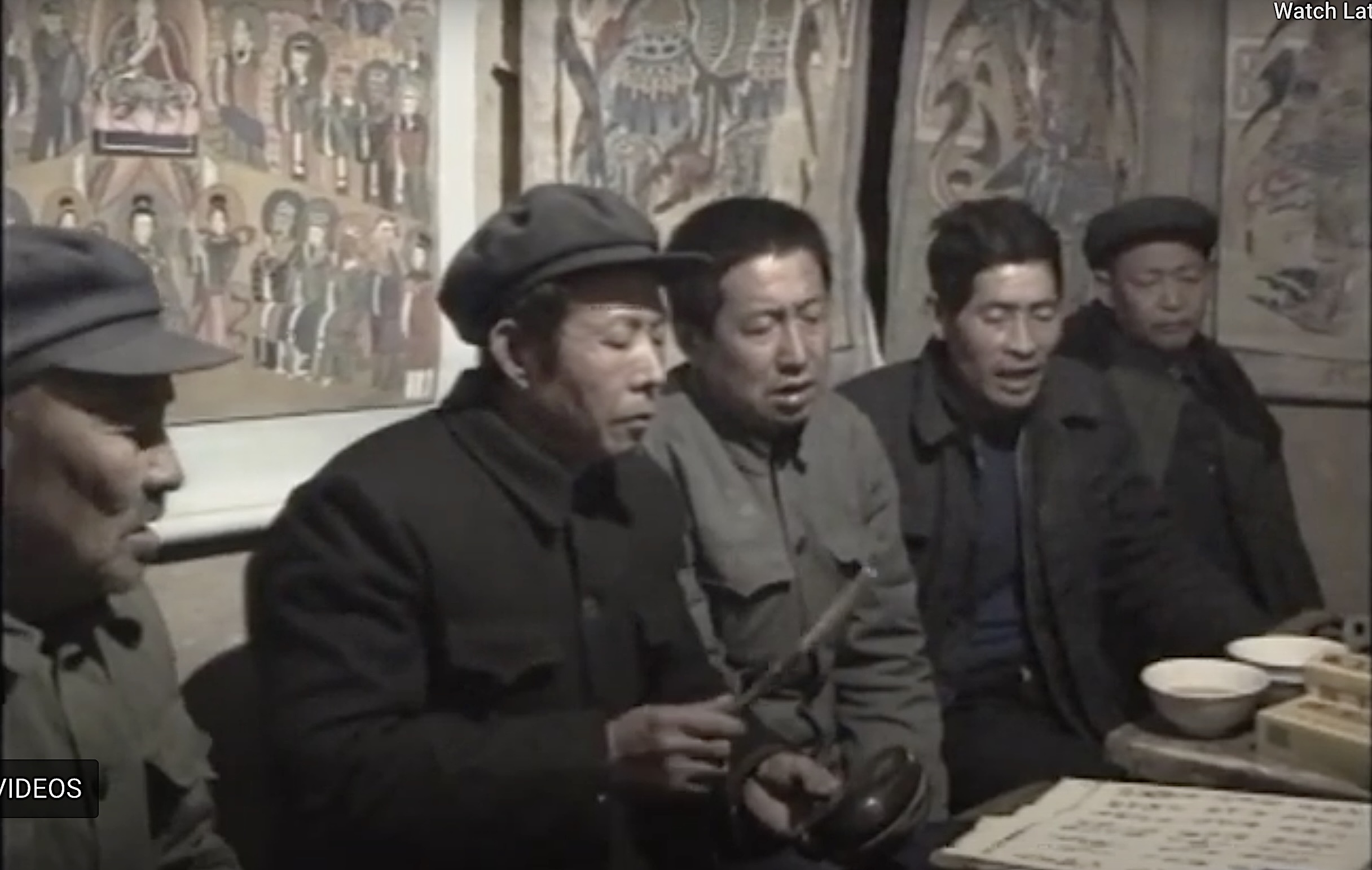
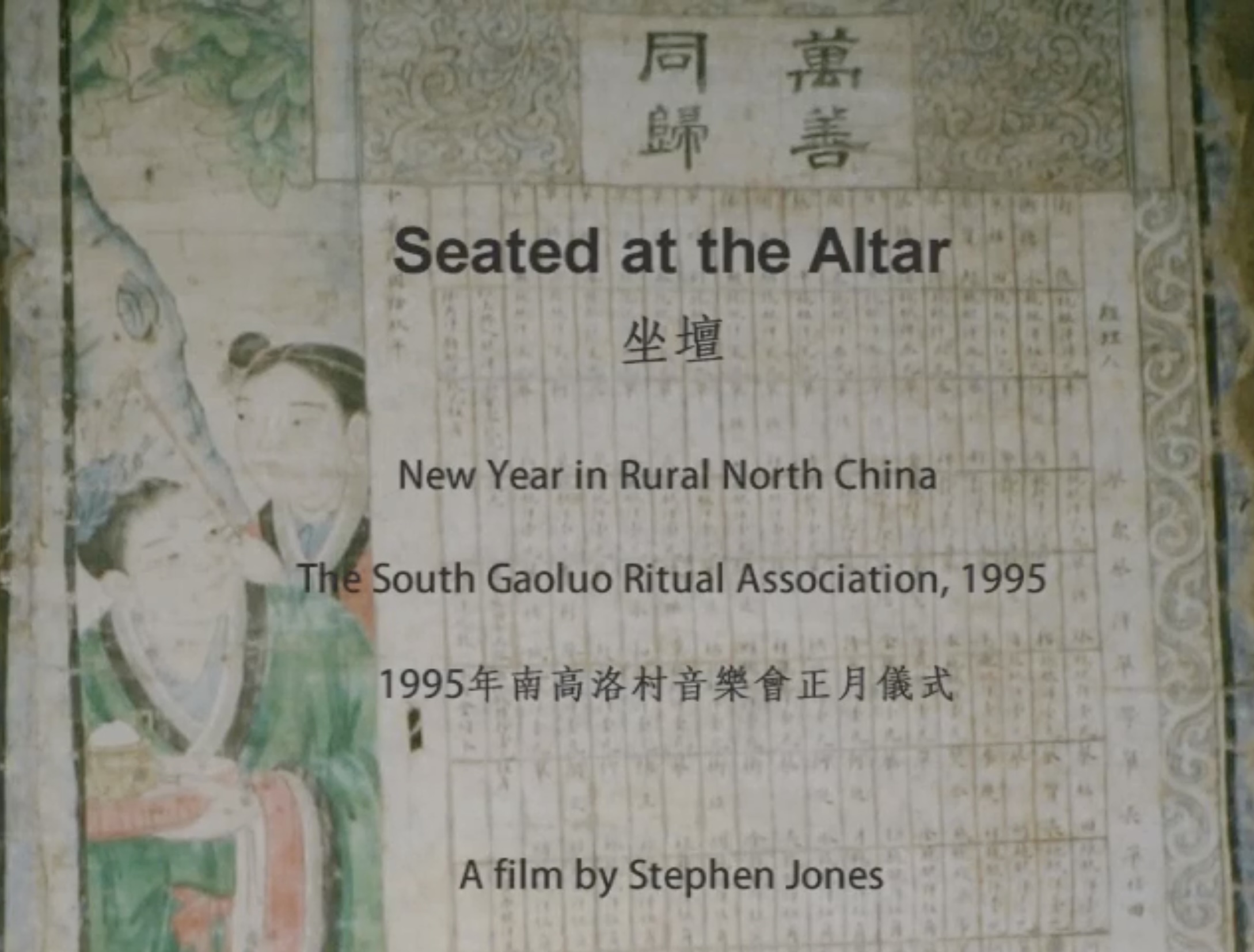
On my YouTube channel, besides my new film on the 1995 New Year’s rituals in Gaoluo, two exciting additions:

Screenshot

Screenshot

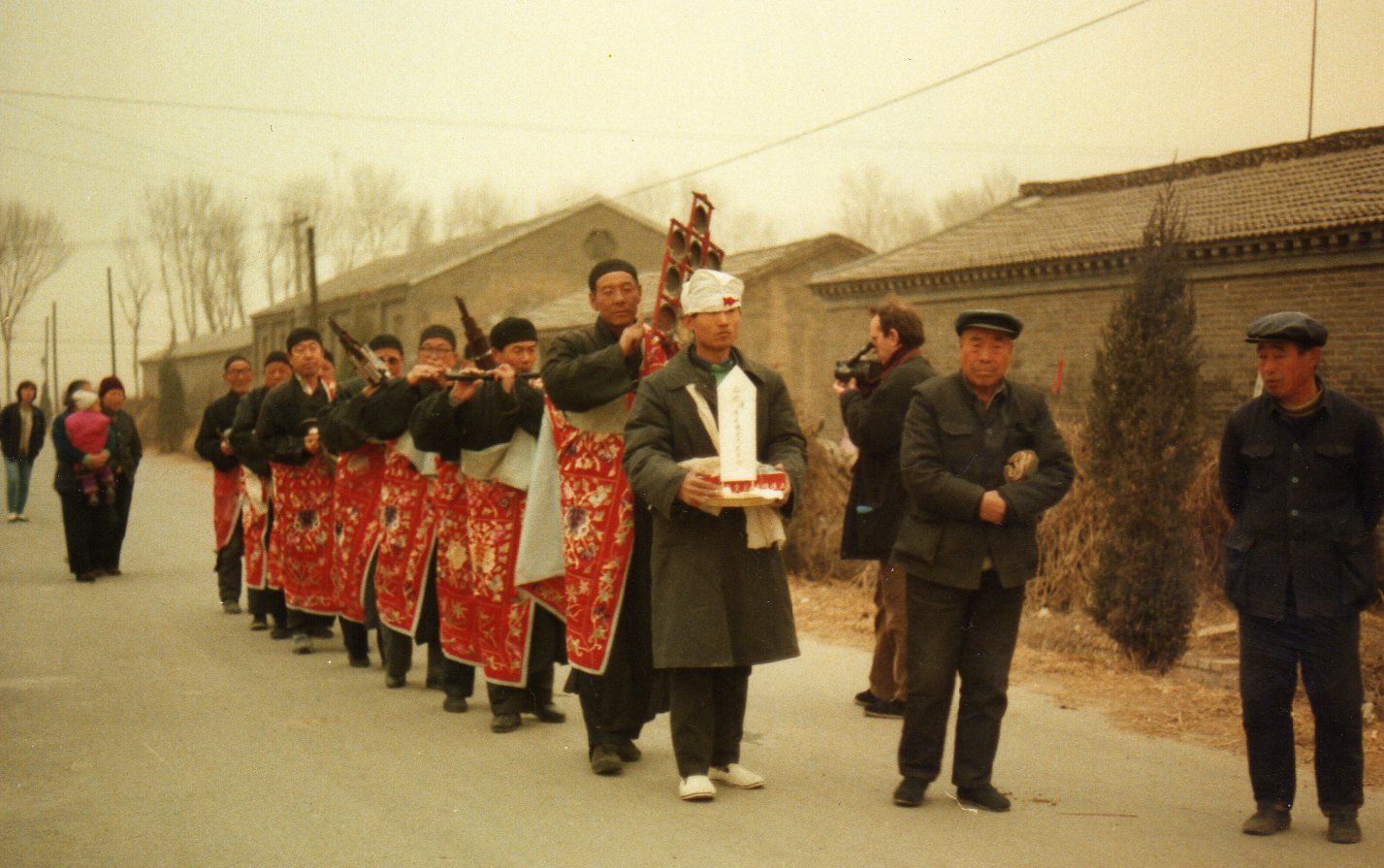
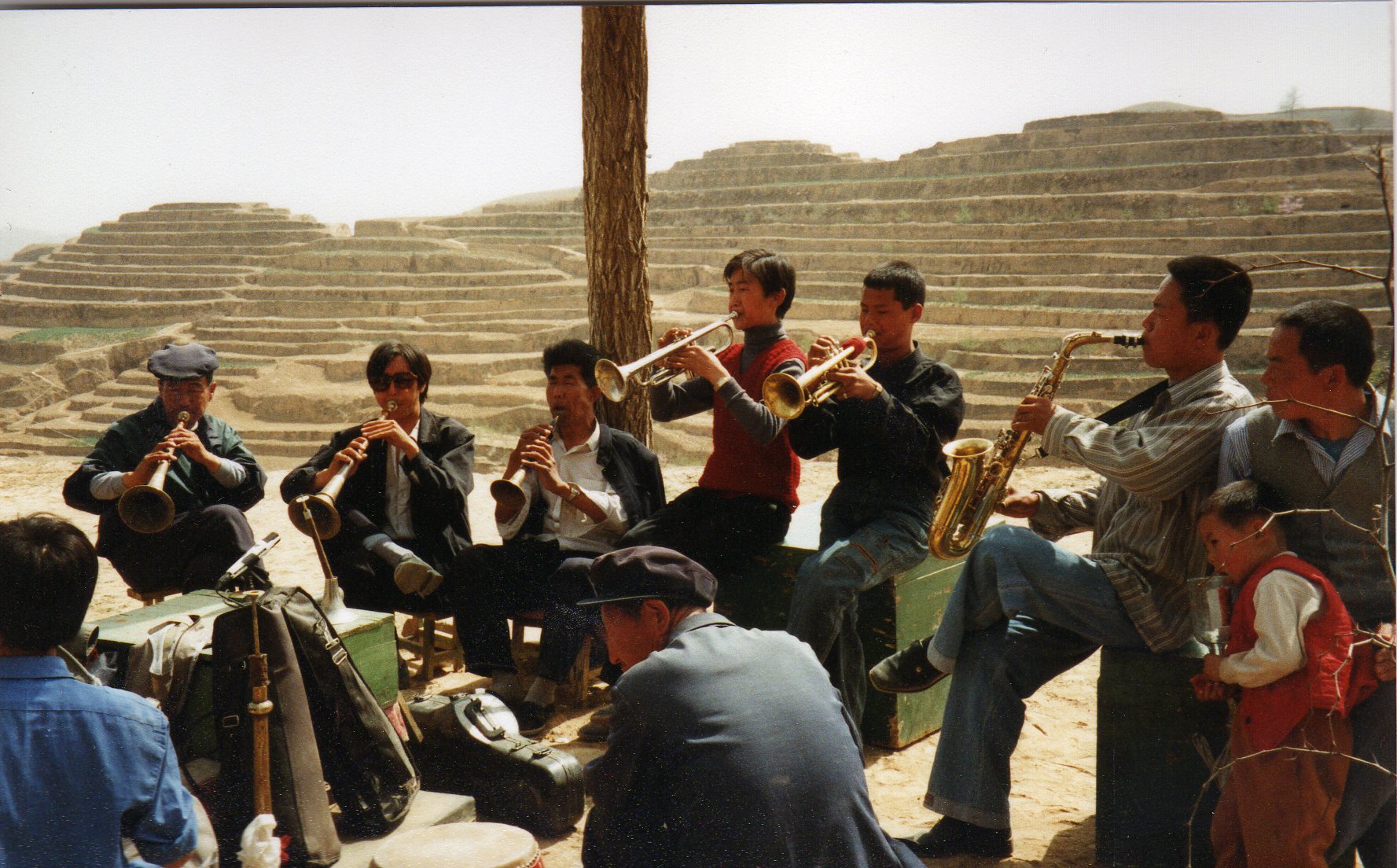
  • The amazing Hua family shawm band 滑家鼓乐班 playing the suite Da Yanluo 大雁落 for a funeral, Zhuanlou village, Yanggao county, north Shanxi, August 1992 (here).
    From the DVD Doing Things with my book Ritual and music of China: shawm bands in Shanxi (2007).
    The Hua band’s repertoire (“Ming dynasty bebop”) is heard on the ear-scouring CD Walking Shrill (Pan Records, 2004). Note also this detailed comparison of shawm bands with the qin zither, and this piece in particular! For more on shawm bands in China, see Walking Shrill, and for shawm bands around the world, here.

Do spread the word!

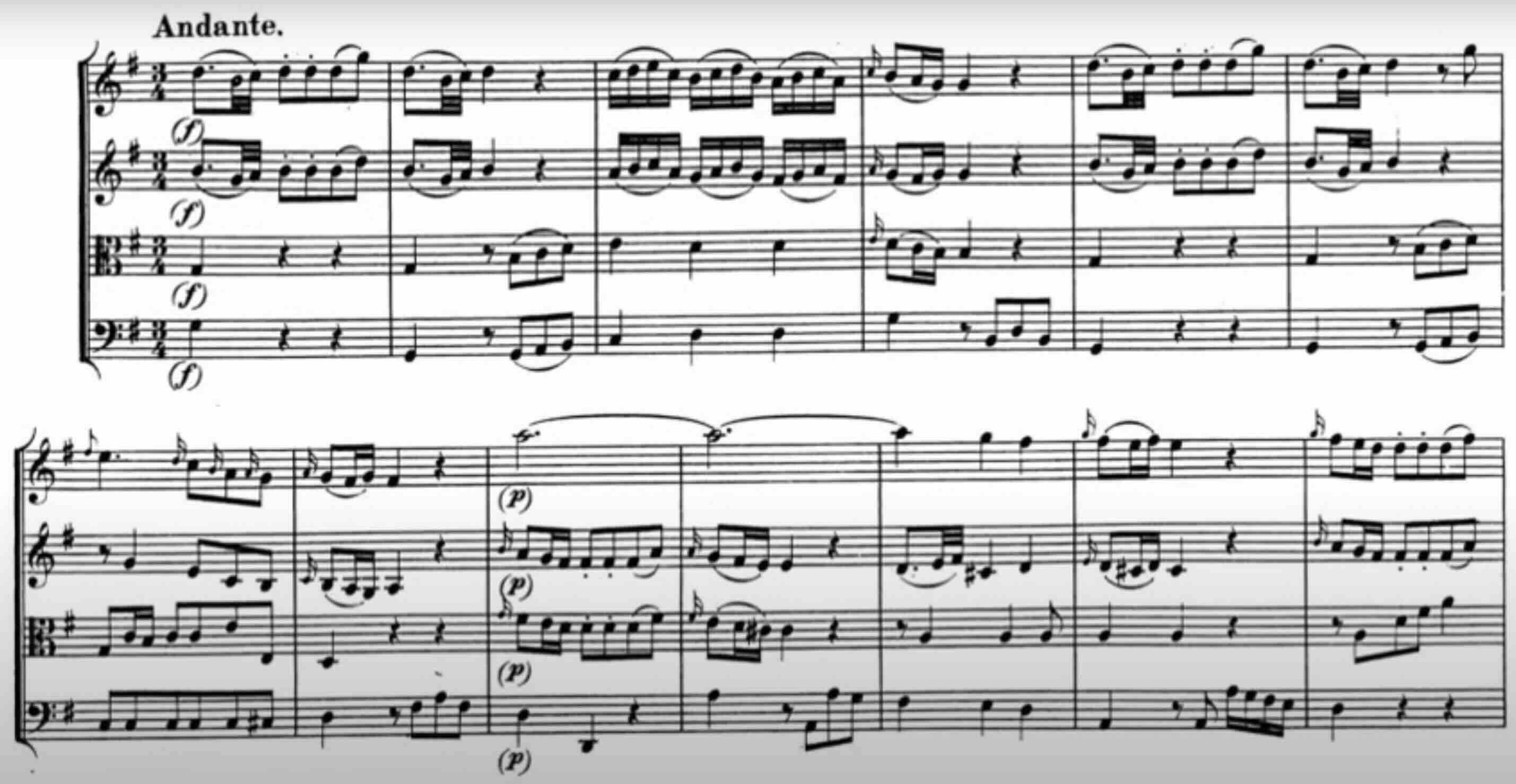
A radiant Mozart Andante!

Screenshot

Even while I’m immersed in the Gaoluo New Year’s rituals and Persian chamber music, the luminous slow movement of Mozart’s D major Divertimento suddenly comes to mind—here’s the Amsterdam Baroque Orchestra with Ton Koopman, always a good choice: *

Written in Salzburg when Mozart was 16, doubtless still basking in his recent tours of Italy, it’s just as delightful to play as to listen to. For me it recalls a US tour twenty-some years ago with Andrew Manze (not the same tour as when he incapacitated me with the Finnish loo story, I think)—wholefood supermarkets on the highway, small-town bookstores, blues bars. Whatever the mundane challenges of negotiating airports, motels, and Life, this oasis of radiant tranquillity was always there to revive our spirits. Gems like this remind us to just Be in the Moment, embodying the effortless grace of sprezzatura and wuwei [Another Pseuds’ Corner entry, bravo!Ed.] [Oh come on, gimme a break—SJ], in a way that no-one but Mozart can do (cf. the moving scene in Amadeus)—remote from Beethoven’s bludgeonings.

Good to add to my Mozart series—now also with a playlist on my YouTube channel!


* For their Bach, see e.g. here and here.

Chinese notation: a new anthology

dadianSource.

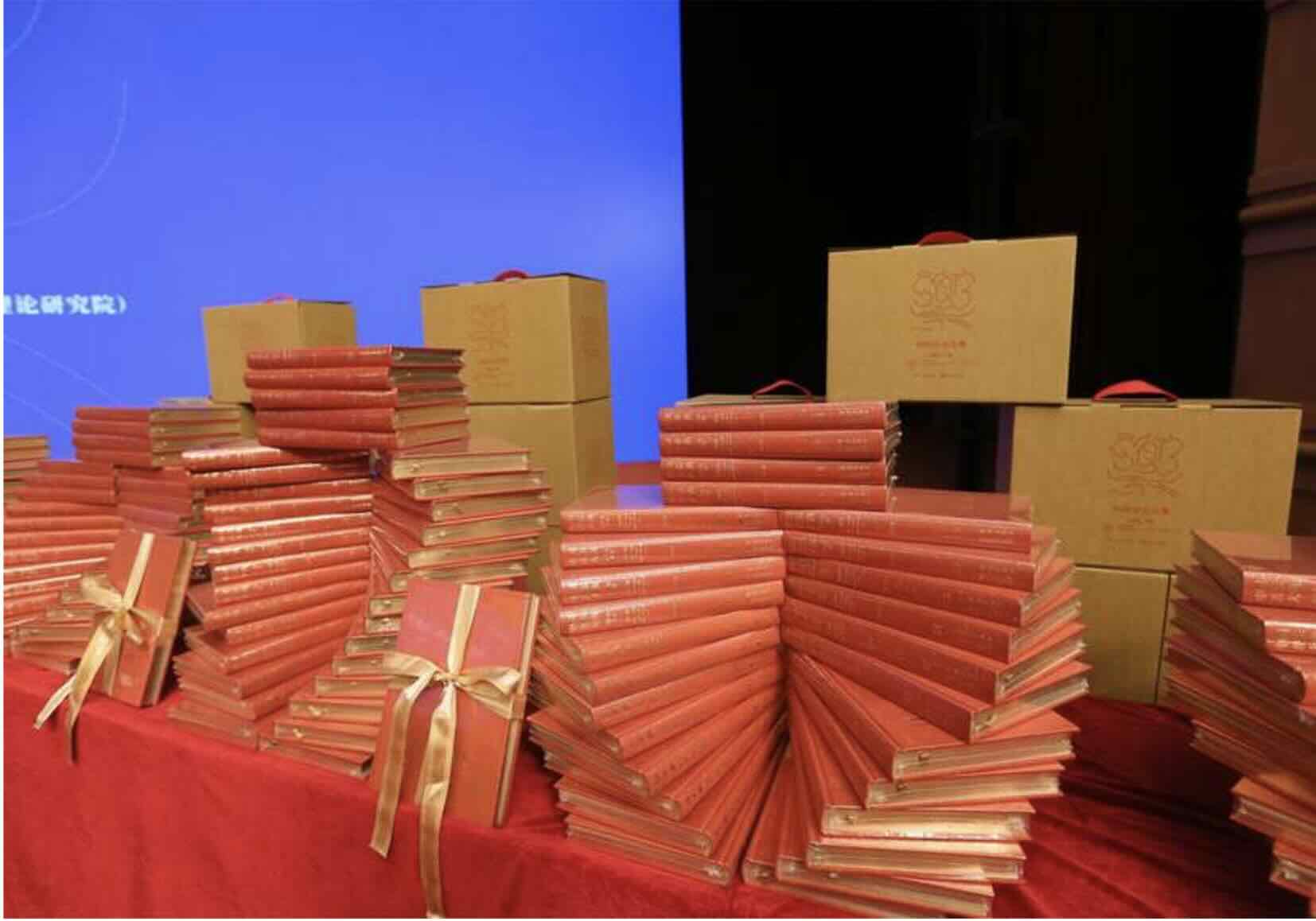
I learn of yet another massive compendium,

  • Zhongguo yinyue dadian 中国音乐大典 [Encyclopedia of Chinese music], general editor Wang Liguang 王黎光,

building on the achievements of previous eras—again testifying to China’s extraordinary energy and organisational power in producing encyclopedic reference works. It comprises four overarching rubrics:

  • Wenlun bian 文论编 texts
  • Tuxiang bian 图像编 iconography
  • Yinxiang bian 音响编 recordings (with volumes for xiqu 戏曲 opera and quyi 曲艺 narrative-singing published so far)
  • Yuepu bian 乐谱编 notations.

Here I’d just like to introduce the latter project, co-edited by my brilliant mentors Zhang Zhentao and Xiao Mei, whose astute reflections, posted recently on WeChat, I recommend. Zhang gives an authoritative survey of the growing recognition of the importance of notation as we refine our view of Chinese music sources, while Xiao adds details on the organising of such a huge compilation. It’s clearly a massive enterprise—not least in taxonomy, on which both scholars provide salient comments.

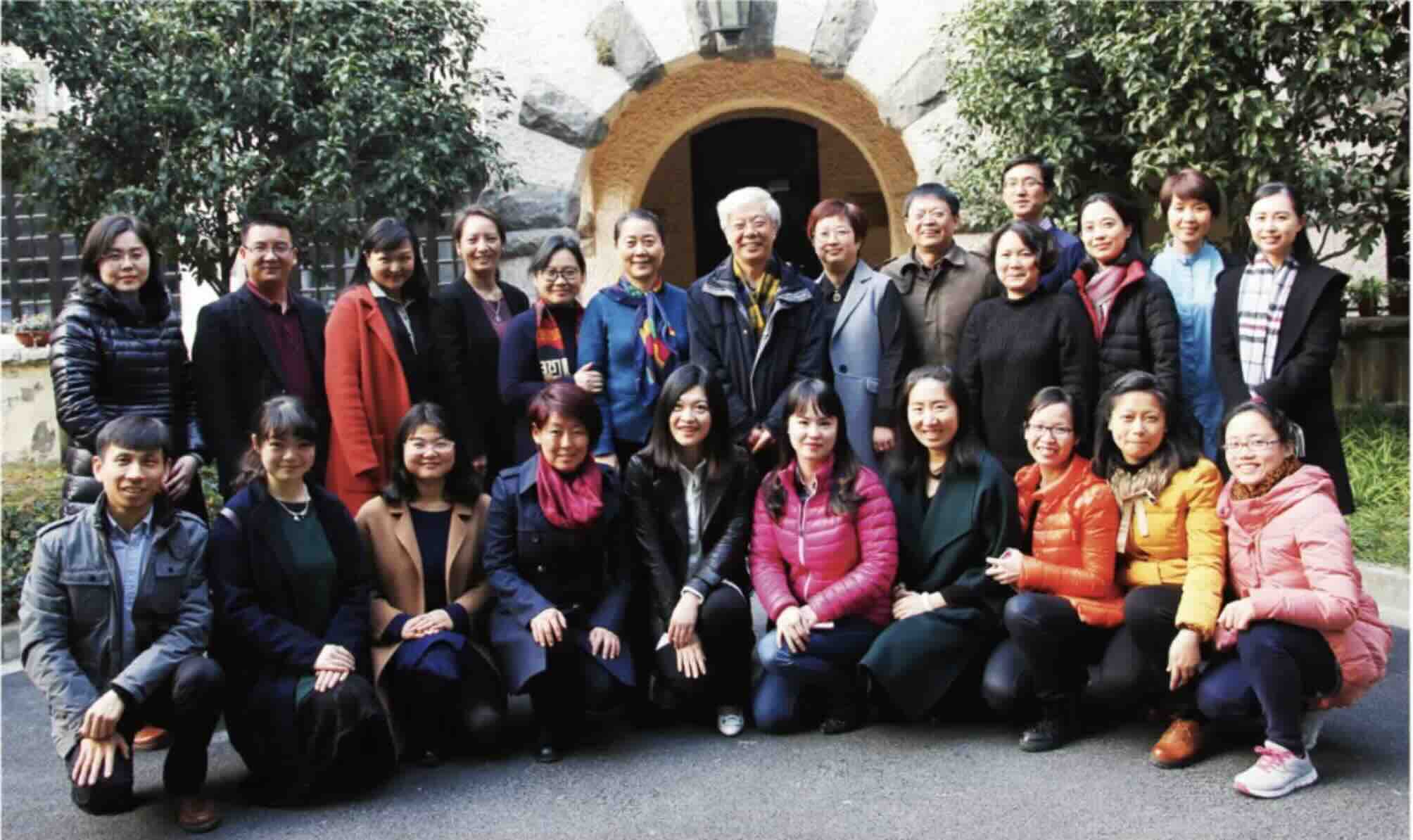
The project was initiated in 2017, soon assembling an accomplished team—many of whom were prompted to initiate separate research projects. Standards have risen since the days of the massive Anthology of folk music of the Chinese peoples.

Scores teamThe Yuepu bian team, 2017.

Zhang Zhentao pays tribute to the voluminous scholarship of Yang Yinliu (1899–1984), incomparable master of Chinese musicology, who led major projects before and after the 1949 Liberation; and the blossoming of research after the end of the Cultural Revolution, led by the Anthology. The Zhongguo gongchepu jicheng (Anthology of Chinese gongche scores, 2017), edited by Zhang Zhentao himself, was another major initiative.

On the basis of previous work, this new compendium adds more material from south China and ethnic minorities. It includes

  • scores found in canonical works from imperial times
  • among local folk traditions, gongche notations of melodic instrumental genres, as well as percussion. Notable among scores of folk melodic instrumental music are those of Xi’an guyue and the ritual associations of Hebei (supplementing Zhongguo gongchepu jicheng with some further material collected during Qi Yi’s Hebei project). Considerable new material for southern genres (hitherto somewhat under-represented apart from the exceptionally extensive scores of nanyin in south Fujian) includes the distinctive ersipu 二四谱 notation of the Chaozhou region, and scores of sizhu in south Jiangsu.
  • Han-Chinese folk-song, opera, and narrative-singing
  •  I’m curious to see how “religious music” is defined and categorised
  • the vast repository of qin zither tablatures.

Both scholars discuss the Uyghur muqam—in Xiao Mei’s essay, part of her astute reflections on issues in assembling scores of ethnic minorities, and in handling digital data classification.

While I heartily support the documenting of all these scores, Zhang and Xiao would be the first to concur that folk traditions, based on oral transmission, are far from dependent on them. The challenge is to incorporate notation into our understanding of the soundscapes of local communities and their transmission histories.

WAGZ scoreGongche score, West An’gezhuang village, Xiongxian, Hebei.

Of course, notation is silent: these scores provide the outline of melodies for musician-insiders whose realisations we can hardly imagine from the page. So among the other rubrics, the volumes cataloguing recordings will be crucial. What I await most eagerly—without holding my breath—is a project to make fieldtapes available, such as those that form the basis for the transcriptions of the Anthology of folk music of the Chinese peoples.

For some other compilations reflecting the blossoming of Chinese musicology, see my posts on Yang Yinliu (with a note on Huang Xiangpeng), Qiao Jianzhong, and Yuan Jingfang.

Jazz Club on the Fast Show

*A lighter note in my jazz series!*

Fast show jazz

The affectionate “Jazz Club” spoofs from The fast show are collected here:

A regular item over six years in the 90s, the series (scripted by Charlie Higson) is recalled in a 2016 article by presenter John Thomson—a genuine jazz aficionado and drummer. Alongside the smugly cool persona of the jazz pundit, the earnest critical vocabulary, the TV set, the language of jazz filming, and the well-observed costumes (“Buddy Rich rocked the polo-neck look”), the musical parodies are impressive—

not that we ever had any trouble getting musicians to appear. In my experience, musicians have a much better sense of humour than many comedians. We’d use session musicians who were all incredibly good—they had to be, because some of the music Phil Pope wrote for the sketches was really tough.

They’re augmented by other Fast show regulars, like Paul Whitehouse (on fiddle at 5.49, channelling Nigel Kennedy!), and the homage to John Cage that follows.

In his article Thomson praises Stanley Clarke’s album School days, and he offers a playlist, based on jazz funk.

In vino veritas, or rather Imitation is the Sincerest Form of Flattery. For more irreverence, see my spoof on Indian raga, and this story about the Matthew Passion (with a bonus of Always look on the bright side of life). For musos’ humour, click here.

Art music of Iran 3

Hamavayan poster

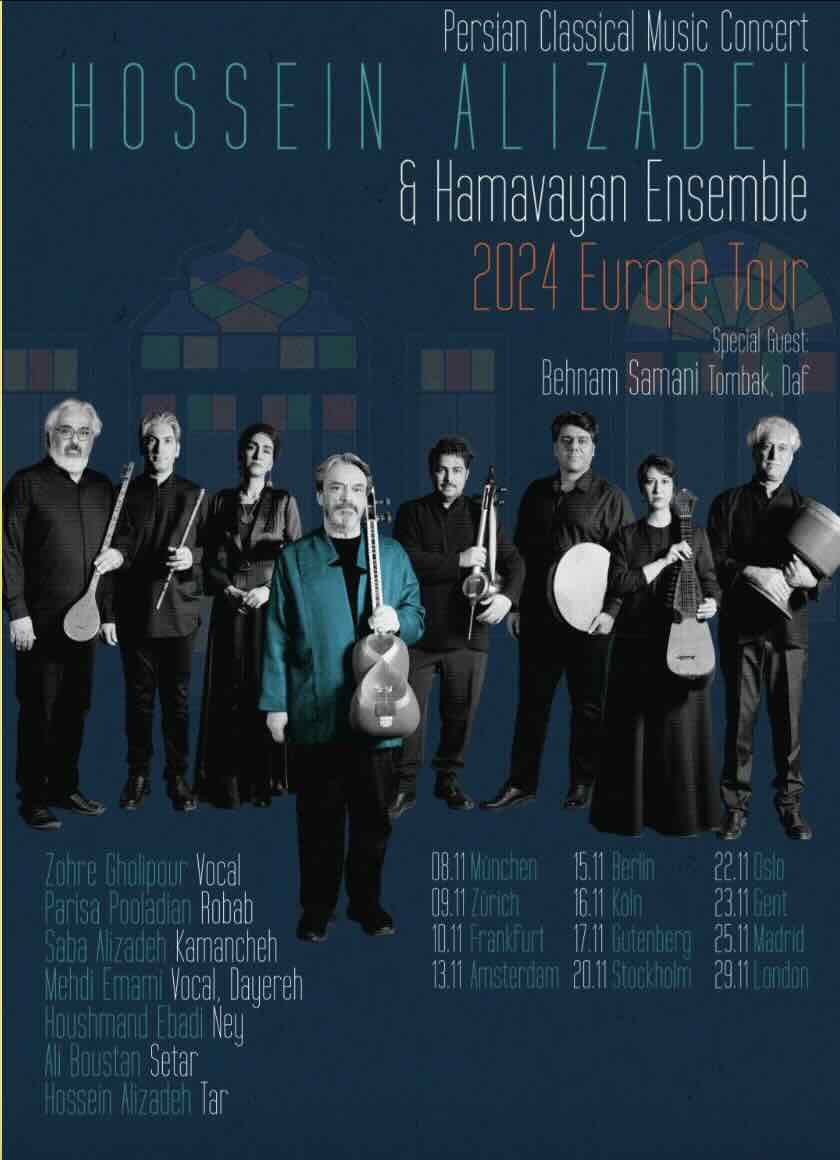
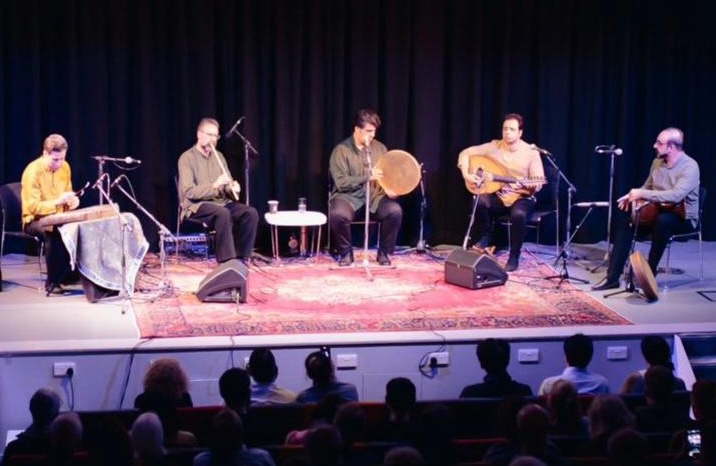
Regent Hall, tucked away right by Oxford Circus, is said to be a promising venue for world music. Indeed, last Friday, straight after Pouyan Biglar’s fine performance at the British Museum Silk Roads event, I hurried off there to hear more art music of Iran, with Hossein Alizadeh and the Hamavayan Ensemble (samples on YouTube e.g. here and here).

The current octet is led by Alizadeh on tar, with Houshmand Ebadi (ney), Hossein’s son Saba Alizadeh (kamancheh), Parisa Pooladian (robab), Ali Boustan (setar), and Behnam Samani (percussion). After the concert at SOAS last month I was glad of another chance to hear the vocals of Mehdi Emami, dovetailing with female singer Zahre Gholipour.

Master musicians have long been subtly adapting the radifs and dastgahs of traditional Persian muqam. Hossein Alizadeh (b.1950) is a prominent star in this lineage, reaching out to wider audiences over several decades. Modern tastes for a rather larger ensemble leads to more polished arrangements; Call Me Old-Fashioned, but I prefer the intimacy of a smaller group.

Still, the musicians’ demeanour on stage is entirely without ostentation, and their programme for the current tour mostly eschews the more popular repertoire heard on some of their CDs. Such is Alizadeh’s reputation that the largely Iranian audience listened with reverence through all the long free-tempo sections—far from easy listening, and surely remote from their daily tastes in rock or rap, whether in Tehran or London. Not all migrant communities elsewhere in the world show such devotion to their own traditional music, but Iranians in exile doubtless feel a need for emblems of Persian culture. In a week when two harrowing new BBC documentaries on Iran became available, it is hard for outsiders like me to connect the cachet of this refined tradition with changing currents in modern society and the ongoing unrest.

For further attempts at educating myself, see under West/Central Asia: a roundup.

With thanks to Saeid Kordmafi.

More Silk Road soundscapes

Last Friday, following the British Library Dunhuang concert, in the latest stage on the Silk Road caravanserai the British Museum hosted a series of musical events, wisely curated by Rachel Harris in association with SOAS as part of the public programme supporting the BM Silk Roads exhibition until 23rd February.

Besides the current exhibition, I’m always amazed by the inexhaustible riches of the galleries. Three of them made the setting for the musicians, the ambience of the surrounding artefacts lending a more palatable, less formal atmosphere than the concert stage—albeit still remote from social life along the medieval Silk Roads. So while the tension between medieval and modern soundscapes can never be resolved, I found the whole experience more satisfying than the BL concert. On a gratuitous historical note, I muse idly that chairs are a feature of later eras…

The performances comprised

  • South Asian and Afghan pieces on sarod and rubab (close cousins) with William Rees Hofmann, setting forth from enchanting alap
  • Maqam-based music from Turkey and East Turkestan, blessed by the wonderful creative rapport of Ozan Baysal (Turkey) and Shohret Nur (Uyghur)
  • Iranian classical dastgah with the outstanding Pouyan Biglar, in the Albukhary Gallery of the Islamic World. Here he is at SOAS earlier this year:

Sogdian muralFuneral procession (detail), Afrasiab (modern Samarkand) murals South wall. Wiki.

  • Inspired by the 7th-century murals from the Sogdian Hall of the Ambassadors, the event opened in the Hotung Gallery, with its numinous arhat, featuring recreations of melodies from the medieval culture of Sogdiana, heard at the capital of the Tang court in Chang’an. Directing the SOAS silk-and-bamboo ensemble, Hwee-San Tan gave a cogent introduction to Laurence Picken‘s great project to recreate the Tang scores exported to Japan, where they were soon retarded and overladen with the bewilderingly gorgeous patina of sound heard in gagaku.
    This, the event’s only attempt at “recreating” the medieval soundscape, made a fitting venture—though having long defected from early Chinese music sources to groups serving living folk communities, I now feel bemused by the complex issues involved in trying to perform such repertoire. In the absence of recruiting Chinese folk musicians from venerable folk traditions such as Xi’an guyue, academic reconstructions tend to resort to the unsatisfactory compromise of silk-and bamboo ensemble style around south Jiangsu—among the most junior of Han-Chinese folk traditions. Inheriting Picken’s transnotations as we do (this was the only intrusion of music stands!), the result could only sound twee by comparison with the other living folk traditions on display. *

Context is everything: we may have become used to attending Afghan, Uyghur, and Persian musics in concert, but one can at least imagine them in a more personal social setting—whereas academic recreations, however worthy, seem doomed to the staid atmosphere of the concert hall, remote from that of medieval Sogdian wine bars.

Regarding the performers, as Rachel Harris observed, it’s a privilege to work in a city where such people share their gifts with us.

See also A Dunhuang symposium.


* Sogdians held influential positions at the Tang court. Their music and dance—and wine bars—were all the rage there, influencing elite society further afield in north China (note the research of Chinese scholars such as Ren Erbei; on a lighter note from the great Tang scholar Denis Twitchett, see here). Topics to ponder include the degree of sinification of Central Asian ensembles at the Tang court, and how they differed from those of the oasis towns further northwest (clues here).

Sogdians
Musicians on camel, Tang dynasty. National Museum of China, Beijing.

Perhaps the most ambitious attempts at reconstructing the Tang repertoire result from the research of Zhao Weiping 赵维平 in Shanghai (here and here, among several related items featured on David Badagnani’s YouTube channel—the drastic retardation of the pieces in gagaku is quaintly illustrated here and here). I still feel the way forward is to approach early notations in the light of the varied ways in which folk musicians of diverse regional traditions decorate their skeletal gongche scores. Even for a relatively recent tradition like the “suite-plucking” of Qing-dynasty Beijing, this recording of the great Pu Xuezhai is far more convincing than later conservatoire recreations.

If it’s hard to find suitable Chinese musicians to recreate the Central Asian component of the Tang repertoire, perhaps a more radical project might involve shashmaqom musicians, in similar vein to early-music specialists like Jordi Savall.

Still, I approve David Urrows‘ comment on recreations of music from a later era:

In my experiences in China studies, when it comes to music repertoire in the missions from the late 16th century onwards, most of what people write—and then perform—is 10% based on documentation, and 90% based on fantasy, resulting in a kind of musical chinoiserie of a New Age type. I don’t want to promote, much less add to this pile of pseudo-scholarly dreaming, pleasant as it is to listen to…

For the xenophobic late-Tang backlash against foreign culture, see They come over ’ere, under A Tang mélange.

Got my mojo working

As we bandy around the word “mojo”, its origins in African ritual aren’t necessarily uppermost in our mind.

The wiki article makes a useful introduction. In African-American Hoodoo, mojo is among many terms for a protective amulet consisting of a flannel bag containing magical items, deriving from Islamic practices of West and Central Africa. In West Africa a generic term is juju bags. The gris-gris pouch of the Mandingo spread from West Africa via slavery to the southern States and Haiti, fusing with African-American Christianity (and making a link with Native American cultures). In the 1930s mojo bags were part of Zora Neale Hurston‘s ethnographic research. See also America over the water.

mojo 2

Mulatto ex-slave in her house near Greensboro, Alabama, 1941 (wiki). Caption:
African-American women sewed charms and mojo hands into their quilts for spiritual protection. Newspaper is placed on the walls to ward off evil spirits.

Minkisi

Minkisi, Kongo/Central Africa (World Museum, Liverpool) (wiki). Caption:
Minkisi cloth bundles were found on slave plantations in the United States in the Deep South.
Minkisi bundles influenced the creation of mojo bags in Hoodoo.

* * *

Muddy Mojo

Since the 20th century, the word spread in American culture in movies and songs, coming to refer to sexuality and virility, and more broadly to motivation in general. It became a theme of blues, such as

Little did I realise that Bo Dudley’s “Mama’s got a brand new bag, gonna groove it the whole night long” had such a pedigree.

Chinese folk religion: “belief”

People like Li Wenbin and He Qing perceived no conflict between worshipping the gods and supporting Mao’s broad social goals.

Screenshot

My new film on the 1995 New Year’s rituals in Gaoluo prompted a recent post on the tenacity of rural tradition. Still reflecting on my fieldwork, it’s worth revisiting my remarks in Plucking the winds (pp.277–85, with minor edits) on “belief”—referring to devotional village-wide groups like those of Gaoluo

By 1995, as throughout its history, the association had a patchwork of ritual artefacts made at various times over the last century. The previously bare and unprepossessing “public building”, once fully adorned, becomes a place of great beauty, a fitting backdrop for the association’s ritual performance. But since the 1980s’ liberalisations, unlike many villages in north and south China, and indeed nearby such as Niecun just across the river, Gaoluo has not sought to build new permanent temples.

What beliefs do such artefacts symbolise? Aside from popular belief in Houtu and the God of Prosperity, formidable He Qing, always a fine source for old traditions, said the association worships Dizang, god of the underworld, as the association is said to go back to “the Tang king’s tour of hell”. Members have often said this was a Daoist association, even that Gaoluo was a Daoist village. We must understand this in the context of a dilution of the term Dao, meaning simply ritual. The senior He Yi recalls a tradition that their [melodic instrumental] music was learned long ago from Daoists (laodao), for what it is worth; perhaps a priest attached to the temple of North Gaoluo or the temple of South village. In fact, where one can distinguish, their ritual manuals have a substantial Buddhist component, and they also claim to believe in the Buddhas (fo). Fo and Dao are often interchangeable in these villages.

Association members themselves do not generally worship, regarding participation in ritual activities itself as a form of worship. In fact, women are altogether more prominent as worshippers, despite being excluded from active participation in the association. Incidentally, the name “music association” (yinyuehui, see here and here)  seems to be used less than terms like huitong 会统 “association” and zaijiaode 在教的 “those in the teachings”. Ritual function is paramount: in discussing the activities of the association, villagers also often talk of the scriptures, with terms like “taking out”, “escorting”, or “offering up” the scriptures (chujing 出经, songjing 送经, fengjing 奉经).

Masters of the vocal liturgy: left, Cai Yongchun; right, Li Wenbin.

As to the ritual specialists, while they practise the rituals with considerable intensity, few of them claim to “believe” deeply in the gods. This is a difficult area—my efforts to elicit insights often recall Nigel Barley’s bemusement in Cameroon. Genial Shan Yude, himself a member of the “civil altar” reciting the scriptures, recalled the previous generation frankly: “Cai Fuxiang didn’t really believe, he just learned the liturgy when he was young and got attached to it, like me; he was a Party member. Cai Yongchun believed—he didn’t join the Party.” In these cases there seemed to be a certain negative correlation between Party membership and religious faith.

But it was complex, for few sought or gained admission to the Party, but many more, including Cai Yongchun, were leading participants in the revolution. Anyway, after Cai Fuxiang’s decline, his belief in the gods, or the habit of ritual, endured, but that was not the cause of his later expulsion from the Party. And there were some people, whether Party members or not, who had no time for religious traditions at all, like Shan Yude’s own father: “He didn’t believe in any gods—he was always doing things for the Party, but he didn’t join.” But throughout the area we have found leading local Communist cadres preserving the tradition of reciting their villages’ ritual manuals. People like Li Wenbin and He Qing perceived no conflict between worshipping the gods and supporting Mao’s broad social goals. Whether or not they joined the Party, people’s commitment to the new society was just one element in their psychological make-up: there was no simple correlation between religious belief and identification with the ideals of the new society.

Shan Yude also claimed “Most people in this area aren’t so superstitious, but my grandparents’ generation was more devout.” This may be broadly true: on the Hebei plain, so near the modern ideas of Beijing, faith may have declined more over the 20th century—gradually, note, not abruptly upon Liberation—than in some more remote mountainous regions of inland central China. But again the point needs qualifying. As we saw, belief was already variable among the previous generation of ritual specialists, and continues to be so today. Cai Haizeng’s father Cai Fulü practised the rituals, but with no great commitment; but now, villagers say, Haizeng is a believer, certainly more than his father. Yude himself observed, “Cai Ran and Haizeng are more devout than me. He Qing also believed, but he had a lively mind.”

Yude even admits to not believing at all, like his father. Still, if so, then he practises the ritual with utter commitment: we should distinguish belief in gods and belief in tradition, in the morality of convention. Cai Yurun made a comment that reveals the new social tolerance: “whether villagers believe or not, it’s harmless”. Though it was only officially considered harmless after about 1980, under the Maoist climate of the previous decades private worship might have become rarer, but belief was hard to assess; after all, public rituals had persisted. Very limited scientific advances and an increasingly secular climate had only partially obviated the need for the gods, and people continued to feel vulnerable.

A facile comparison with Europe springs to mind. Regional variations in industrialisation and literacy may partly explain different levels of religious belief, but within particular societies, and between generations, the situation is uneven; north Italy may generally be less “superstitious” than south Italy, but young and old people in both regions may or may not believe. Our problem for China is to recognise variation and put the supposedly dominant control of ideology in perspective. […]

Cai Yurun pointed out: “The saying goes that when they’re folded away the god paintings are just cloth, but when they’re hung out they’re gods. Don’t pay too much attention to our bullshitting normally—as soon as we Open the Altar we’re pretty serious.”

guanfang 1998The lantern tent, New Year 1998, with new and newly-copied donors’ lists.

On pp.304–5 I observed:

As to ordinary villagers, though there are more women than men offering incense, quite few of the people are elderly: young and middle-aged women and young men seem to be more active in this. Many pray silently to the goddess Houtu for a healthy son, or for the health of their aged parents; more generally, people pray for good luck and prosperity. One couple were offering incense for the safety of the husband, who is a driver—even for the most diehard atheist, recourse to divine help is particularly tempting on Chinese roads. The atmosphere is highly jocular as people enter the courtyard. As they go to offer incense and kowtow they look embarrassed, but then when they are actually doing it they become extremely serious. Then as they get up and dust down their trousers, they look all embarrassed again, and, avoiding meeting the gaze of all the onlookers, they leave the area, often going into the “temple”.

So in many such villages over previous decades, the driving force behind the maintenance of ritual practice seems to have become not so much “religious belief” (itself an alien term) as the “old rules” (lao guiju 老规矩) of tradition. Devotional associations provide ritual as a service for the needs of the community. Under “Note on sources” in my introduction to these groups, see also my articles “Chinese ritual music under Mao and Deng” (1999) and “Revival in crisis” (2010).

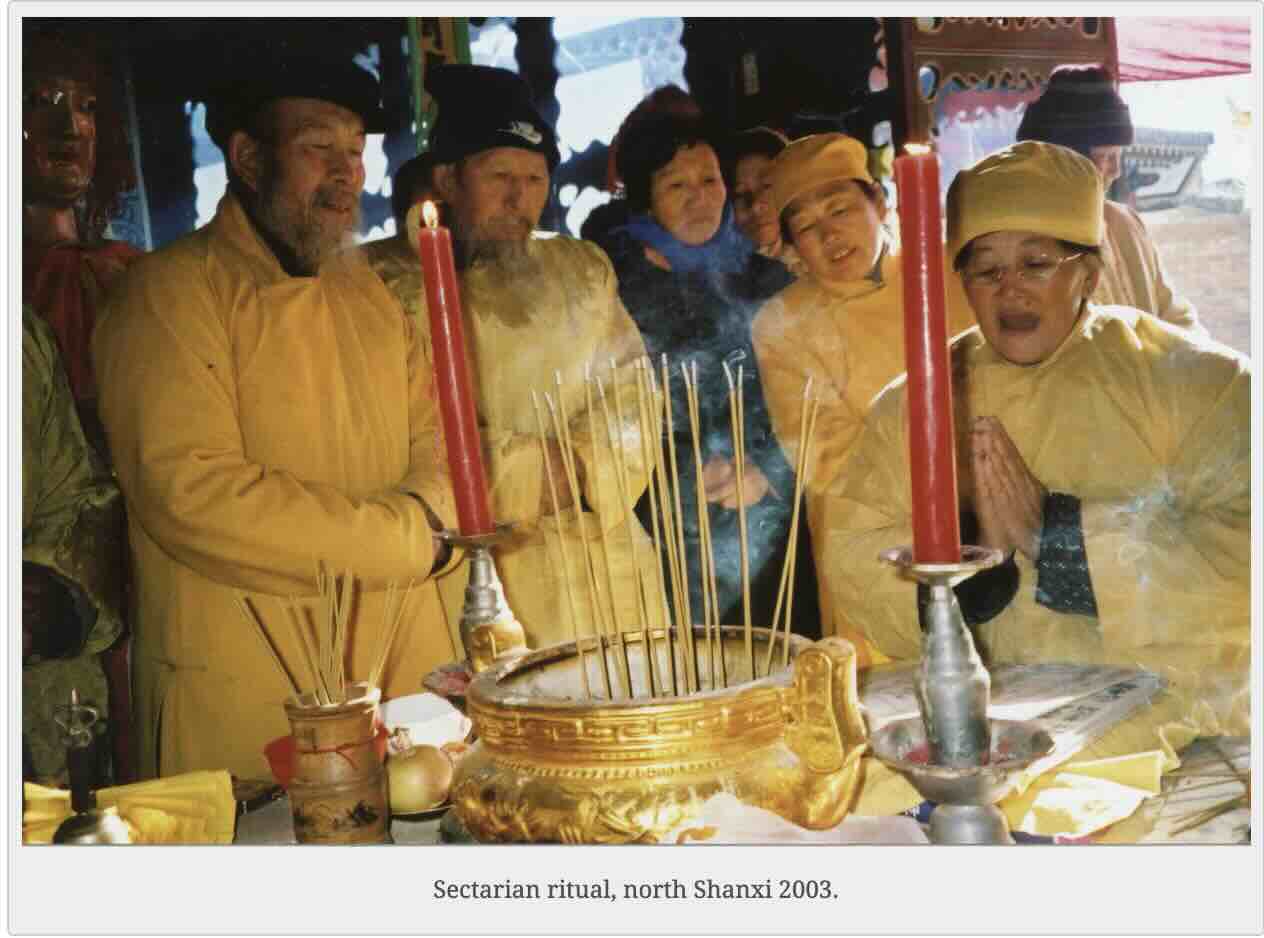
Besides groups like these, this may even apply to occupational groups of household Daoists such as the Li family in north Shanxi. With the Maoist decades followed by the assaults of popular media and migration, ritual groups in some regions (including Hebei) are now further vulnerable to the secularised commodifications of the Intangible Cultural Heritage. But it would be interesting if one could somehow compare communities further south like Fujian (see under “Elsewhere” in main Menu), where religious faith appears to be a still more pervasive catalyst for popular culture. And of course faith in the gods is still evident in the popularity of spirit mediums, pilgrimages, and so on.

See also Catherine Bell on ritual.

The tenacity of local ritual traditions

Screenshot

Pondering the wider significance of my new film on the 1995 New Year’s rituals in Gaoluo, it strikes me that a major theme is the tenacity of mainland Chinese peasant communities in maintaining their ritual traditions “amidst massacre, invasion, civil war, famine, political campaigns, theft, destruction, banditry, and religious rivalry”—a history detailed in Plucking the winds.

It’s a theme I noted in this post with reference to the different modern histories of the PRC and Taiwan, and it’s all the more relevant today amidst the sanitised packaging of traditional expressive culture from the Intangible Cultural Heritage.


Ritual life around Xi’an: an update

I’ve just made some small but important updates to my early article Ritual life around Xi’an. Besides introducing the devotional societies there, urban and rural Buddhist and Daoist temples, former rain pilgrimages, the great Daoist priest An Laixu, the lifelong research of Li Shigen, and my own visits, I’ve at last added some rare film footage unearthed by David Badagnani—all the more precious for predating the flummery of the Intangible Cultural Heritage.

To help negotiate the new Menu, the page is now under “Elsewhere”—here’s a screenshot!

Screenshot

Note also the series on Shaanbei in the same Menu!

My YouTube channel!

I wonder how the new Menu is going down… Under “Roundups” there you’ll also see Playlists. I’ve never even noticed that I have a YouTube channel, but now—with the stimulus of publishing my new film on Gaoluo there—I’ve begun the long process of creating new content.

YT

In due course I’ll upload my other documentaries on Chinese ritual cultures. Meanwhile I’m gradually adding playlists to reflect some main topics of this site, so far including

This exercise might seem a tad nerdy, but I naively imagine the selection in the playlists may lead the listener [singularEd.] to the numerous posts in which I expand on them—hmm, I spend all my time going on about how silent immobile text isn’t enough, and I now find myself pointing out that film isn’t enough—No Pleasing Some People…

A new menu!

umbrella

Now that I’ve supplemented my  portrait film of Li Manshan with precious footage from the 1995 New Year’s rituals in Gaoluo, I feel it’s time to rearrange the deckchairs on the Titanic by revamping the Menu.

Here’s an instance of the submenus:

Screenshot

With a personal selection of some main topics, I hope it’s now more user-friendly. It’s work in progress, and doubtless I will continue refining it in the coming months, so please Bear With while I edit links throughout the site. It may take us all a while to get used to it—do keep using the search box too.

The new sequence (with many sub-menus to explore) goes

  • Home (also under reconstruction!)
  • POSTS
  • Li family Daoists
  • Gaoluo
  • Hebei
  • Elsewhere (Shaanbei, Gansu, Fujian…)
  • Themes (Zhengyi/Quanzhen, Fieldwork, Ritual, Famine…)
  • Roundups (including folk traditions around the world)
  • Western Art Music

Good luck! Feedback welcome.

Gaoluo 1995: new film!

Screenshot

YAYY, I’ve finally got round to publishing my new documentary on the 1995 New Year’s rituals in the village of Gaoluo just south of Beijing!!! Click *here* for the film and commentary—a page under the new Gaoluo rubric that now forms part of a totally revamped Menu. The film link is to my (currently small but perfectly formed) YouTube channel.

Yazz Ahmed at the LJF

Yazz

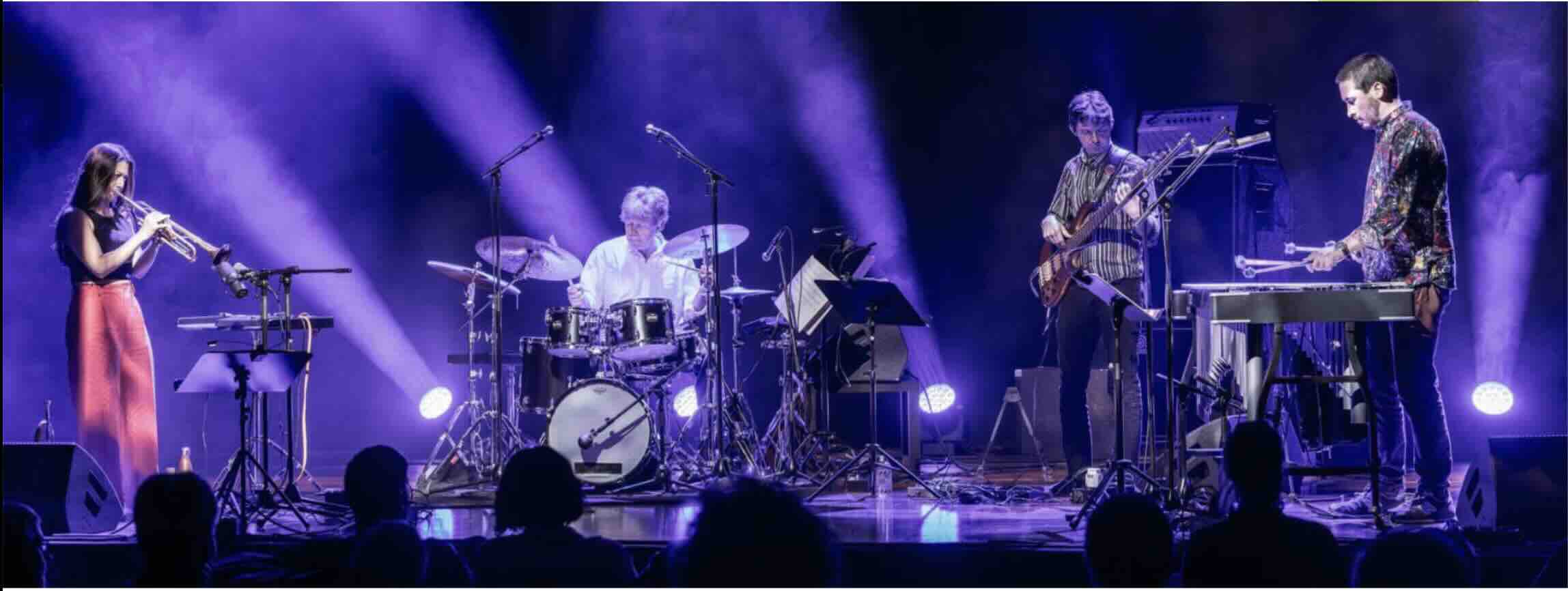
In my post on New British jazz I mentioned Yazz Ahmed (site; wiki), so I was glad to hear her quintet at the London Jazz Festival this Saturday.

“High priestess of psychedelic Arabic jazz” is an alluring tagline, but doesn’t do justice to such a serious composer. Grand Junction in Paddington, a former church, made a striking venue, suitable for the reflective mood of her work, its architecture compensating for the intimacy of many jazz venues.

With her British-Bahraini background, Yazz Ahmed reflects in interview on exploring her Arabic heritage, but not limited to an ethnic bubble, she creates her own voice. Focusing on collaboration, she plays an unassuming role on trumpet and flugelhorn, modulating timbres with the aid of a Kaoss pad, highlighting ensemble textures—besides drums and bass guitar, the quintet is enriched by vibes and bass clarinet, joined in the second half by vocalist Randolph Matthews.

YazzSource.

Here’s her first album FInding my way home (2011) (playlist):

La Saboteuse (2017) (playlist):

Her studio album Polyhymnia (2019) is a six-movement suite devoted to “six women of exceptional qualities, role models with whom she felt a strong bond”: Rosa Parks, Malala Yousafzai, Ruby Bridges, Haaifa Al-Mansour, Barbara Thompson, and the Suffragettes (playlist):

And a foretaste of her forthcoming album A paradise in the hold:

In This Day and Age™, while it would be churlish to write off new creativity in Western Art Music, I find far more relevant all the activity going on beneath the broad umbrella of “jazz”—further enhanced in live performance by the major factor of atmosphere. I’ve explored the theme of “serious music” at length here

For a wide range of classic and world jazz, see this extensive roundup. And you can work through the plethora of posts under the world music category in the sidebar, including not just China and India but flamenco, Turkish music, and much more…

“Alevi music” in Turkey

Faruk Zoom

Despite my lamentable lack of background in Turkish cultures, I have dabbled in Alevi ritual—on which scholarship is clearly thriving (for Istanbul, see here and here; for Anatolia, here). Last week I learned from a talk at the Orient-Institut in Istanbul, when Faruk Çalışkan (Istanbul Technical University) introduced his research, based on his recent PhD thesis.

His work focuses on the music of Alevi âşık minstrels with their bağlama plucked lute, who have a long history of performing songs separately from their role in accompanying the vocal hymns of the dede ritual leader at cem ceremonies, coming to wider fame through the recording industry (see e.g. articles by Thomas Korovinis and Ulaş Özdemir in Landscapes of music in Istanbul, and studies of bards such as Aşık Veysel and Neşet Ertaş).

Referring to concepts such as Actor-Network Theory, Çalışkan’s work is amply theorised. And as an experienced bağlama player, he gains much from participant observation, navigating between the roles of listener, performer, and scholar:

As a listener, he observes how differently âşıks are imagined; as a performer, he experiences how âşıks imagine themselves, their positions, roles, and legacies; and as a scholar, he observes the wide network of mainstream artists and folk music performers, including bağlama players and instrument makers.

While the music of the âşıks has been popularised since the days of cassettes, Çalışkan examines commercial and non-commercial recordings across various genres that circulated on digital platforms since the 2000s. The video market, with TikTok and Instagram, must also be substantial, as well as online forums. 

This dynamic process involves a broad spectrum of actors—singers, bağlama players, collectors, archivists, and the music industry itself. By tracing these re-enactments and the roles of various human and non-human actors, his thesis reconsiders the circulation of âşık music in a kaleidoscopic manner and highlights its multidimensional presence and influence.

In his work he pays attention to the legacies of âşık Nesimi Çimen (1931–93, who died in the Sivas massacre) and âşık Mahzuni Şerif (1939–2002).

Âşık Mahzuni (left) and âşık Nesimi.

Their recordings can be found online—for âşık Mahzuni, e.g. this:

And âşık Nesimi:

I am reminded of my caveats in Unpacking “Daoist music”; rather than a separate topic to be outsourced to musicologists, soundscape should always be part of our studies of ritual and culture. But whereas “Daoist music” is a misleading concept imposed by outsiders, a distortion of the underlying ritual fabric of the whole Han-Chinese population, the Alevis are an embattled minority actively creating their own images. The song lyrics are clearly crucial. For China, perhaps a more apposite parallel might be daoqing 道情 narrative-singing, with its Daoist origins later absorbed into popular expressive culture, no longer limited to ritual.

Outsiders like me need to keep trying to grasp basic issues. While the bağlama is far from exclusive to the Alevis, they attribute a particular significance to it, setting forth from its ritual function. Similarly, the whole âşık phenomenon extends to non-Alevis (Kurdish, Turkish, and beyond)—besides subsuming a range of behaviour beyond “music”. * I also wonder about similar marketing ploys like “Sufi music” or “dervish music”.

Çalışkan continues to unpack definitions of “Alevi music”, a theme pondered by scholars such as Ulaş Özdemir and Ayhan Erol. As he suggests, for older generations the terms “Alevi” or “music” were largely redundant. But the recording industry has enhanced the identity and visibility of the Alevis—influential instances that Çalışkan cited include the 1980s’ Muhabbet albums and the work of Arif Sağ, the Kalan series Aleviler’e (see e.g. this playlist), and Kızılbaş albums with their theme of resistance. Still, Çalışkan reminded us of the evolving tradition of Alevi communities around Anatolia, and their whole social and cultural identity. So while “music” and its commodification are clearly important, we should bear in mind the over-arching topic. Yet another world into which I shouldn’t presume to venture…


* For Uyghur ashiq, see here.

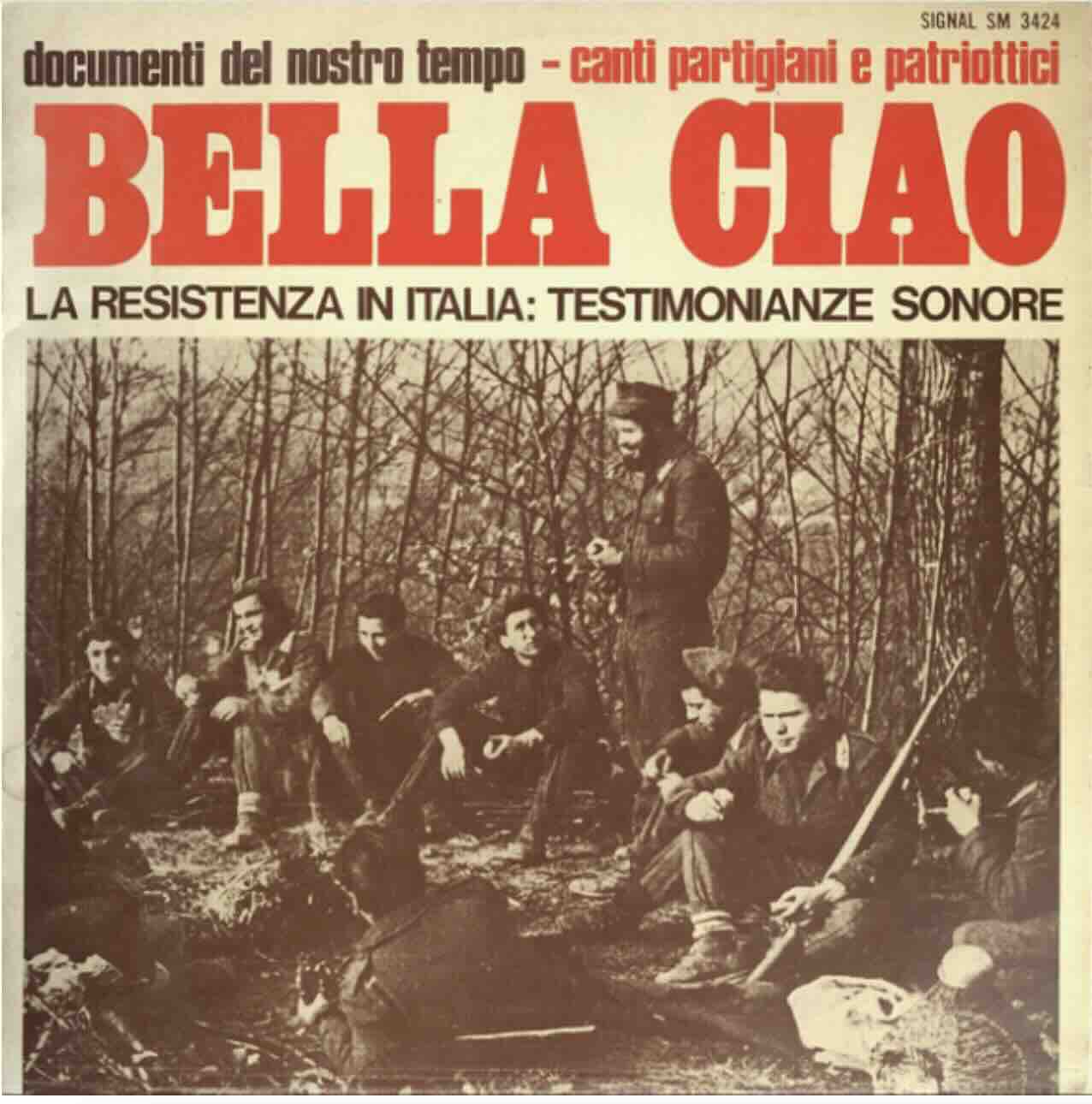
Bella ciao

Bella Ciao album

Attempting to trace the origins and diffusion of a folk-song always amounts to detective work, as Bruno Nettl illustrates with typical clarity in Chapter 8 of Ethnomusicology: thirty-three discussions, on tune-families (“The most indefatigable tourists of the world”).

The story of the “anti-fascist anthem” Bella ciao is relatively simple, but there is still much to unpick. The roots of the melody have been traced to French, Yiddish, or Dalmatian folk music. The oldest known recording (without lyrics) was made in 1919 by the Odesa-born klezmer accordionist Mishka Ziganoff:

(BTW, do read Annie Proulx’s Accordion crimes!)

More confusing is the fame of Bella ciao since the partisan resistance to Nazi occupation. A rival version of the song’s origin gained credence, claiming that it is based on the folk-song “Alla mattina appena alzata”—part of the mondina genre sung by female rice-weeders in north Italy, whose themes often lamented harsh working conditions and cruel padroni. Here’s a documentary from 2022 on the mondine in Cremona, with archive footage and sources listed in the final credits:

A recent Guardian article refers to Luigi Morrone’s 2018 article in La Corriere della Sera detailing the song’s “invented tradition”, citing Giorgio Bocca:

In the twenty months of the partisan war I never heard Bella ciao sung, it was an invention of the Spoleto Festival.

Spoleto 1964Source.

So here’s an evocative film of the influential group Nuovo Canzoniere Italiano at the 1964 Festival dei Due Mondi in Spoleto—with Giovanna Daffini, herself a former mondina:

Morrone’s article further debunks popular myths by describing the controversy concerning Daffini’s claim over the mondina version.

* * *

Whatever the song’s “original” function, as the Guardian article continues,

In the cold war era, Bella ciao, with its vaguely-defined enemy and stress on romance over ideology, became a more consensual anthem by which to remember the fight against fascism.

Apart from endless commercial versions (the wiki section on international covers is impressive), the song continues to be sung worldwide as a hymn of resistance to tyranny, such as at the 2013 Gezi Park protests in Istanbul; in Iran and Ukraine; and most recently, to oppose Viktor Orbán at the European Parliament.

See also Italy: folk musicking.

In memory of Du Yaxiong

DYX 1
Source.

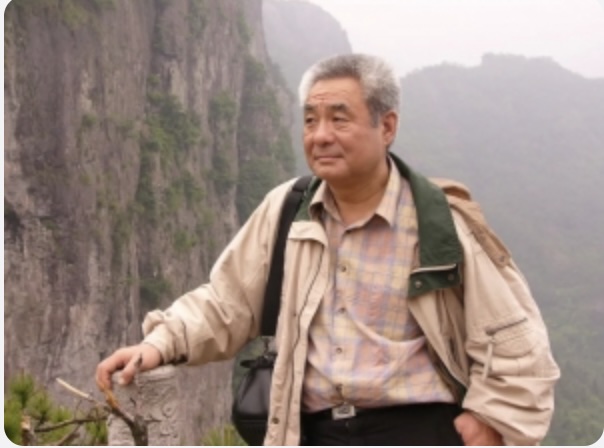
I was sad to learn of the death of the distinguished Chinese musicologist Du Yaxiong 杜亚雄 (1945–2024). Here I reproduce an eloquent tribute in the recent CHIME news bulletin:

One of China’s finest and most prolific ethnomusicologists and music educators, Du Yaxiong (杜亚雄), has passed away from illness on 7 October, 2024. We mourn his loss, not only as a fine pioneer scholar in realms of Chinese and ethnic minority musical studies, also as a warmhearted and flamboyant personality, a committed promotor of traditional music, a gifted and infectious speaker at academic conferences (including several editions of CHIME), and an author of many important studies (more than twenty monographs and 200 articles were published in English, in Hungarian and in Chinese). He was a respected scholar and very inspiring colleague. Du also had a big heart for primary and secondary music education in China, and was very active in this field until his very final years, greatly inspiring young people in Hangzhou and publishing a landmark set of his own teaching materials in 2016.

Du Yaxiong grew up in Lanzhou in a family of doctors. He graduated from the Music Department of Northwest Normal University in 1965, and received a Master of Arts degree from Nanjing University of the Arts in 1981 under Gao Houyong, after which he joined the China Conservatory of Music in Beijing as a Professor of Music. Later he studied at the University of British Columbia in Canada and obtained a doctorate in philosophy.

His parents did not understand music, but they respected their son’s professional career choice. They had noticed very early on how much music affected their son: during his years in elementary school, Du won the first prize in a children’s singing competition, and also learned to play the bamboo flute. As a flutist he acquired a preliminary understanding of structural principles of folk music. He eventually gave up any idea of becoming a doctor, instead joining music classes at the Lanzhou Art College, where he also began to compose songs and piano pieces. Later (when that college merged into Northwest Normal University) he shifted his major to music education. A defining experience was his participation in a folk-song collection mission in the Hexi corridor in Gansu Province. It set him firmly on the trail of ethnomusicological research: from 1963 onwards, he recorded hundreds of Yugur folk songs and mimeographed them.

At the China Conservatory, Du Yaxiong served as the Head of the Department of Musicology for thirteen years, and he maintained close connections with this institution also afterwards. From 2003 he was active as a lecturer at various institutions in Hangzhou, first at Hangzhou Normal University, and from 2014 at the Hangzhou Greentown Yuhua School, where his music-educational projects left a deep impression.

Du conducted extensive fieldwork on traditional and folk music, not just in China, but in over ten countries. He served as a visiting professor at the Institute of Music of the Hungarian Academy of Sciences, the Victoria University of Wellington in New Zealand, the Institute of Folklore of Indiana University, and the School of Performing Arts of Youngstown University (Ohio) in the USA. In 1986, he was awarded the title of National Expert by China’s State Council for his outstanding achievements in teaching and research.

Among other things, Du explored at length the relationship between Chinese and Hungarian folk songs, and published a book on it in 1989: A Comparative Study of Chinese Folk Songs and Hungarian Folk Songs. The incentive for this went back all the way to 1963, when he began his long-time research on Uygur dialect songs in Gansu (he mastered the Uygur language to perfection) and found that it was not hard to detect the close relationships between local Uygur (Yugur) melodies and the Hungarian folk tunes collected and published by Bartók and Kodaly.

During his stay 1991-92 at the Institute of Folklore at Indiana University, he took the opportunity to study and collect Native American music. He was twice awarded the Rockefeller Foundation’s Bellagio Residency, in 1996 and in 2008, and it was in the USA that he completed two of his major publications, Traditional Chinese Music Theory (中国传统乐理教程) and Traditional Music Culture of Chinese Minorities (中国少数民族传统音乐文化). His range of research also included northern Chinese village rituals, music of the Silk Road, Hua’er folk songs of northwest China (about which he published in the CHIME journal), and analytical studies of Chinese pentatonic scales and a number of historical subjects.

We remember him for his excellent work and original mind, but also for his congenial smile and radiant presence in academic meetings. May he rest in peace.

* * *

DYX 2
Source.

[SJ:]
I made a few brief fieldtrips with Du Yaxiong to the countryside just south of Beijing in the 1990s, when he introduced me to the Buddhist-transmitted ritual association of North Xinzhuang (see under Ritual groups of suburban Beijing).

n-xinzhuang-processionEarly morning procession to the soul hall, North Xinzhuang 1995. Photo: Du Yaxiong.

I often chuckle over a story he told me about his student years, just as traditional music and scholarship were reviving after the downfall of the Gang of Four. The great Huang Xiangpeng was delivering an erudite lecture on the arcane systems of modes and scales documented in ancient sources. In conclusion he encouragingly commented, “In fact, I’m just using a very complicated language to describe something very simple!”, whereupon the young Du Yaxiong put up his hand and said, “Excuse me, Teacher Huang, but could you possibly use a very simple language to describe something very simple?!”.

For some other luminaries of Chinese musicology, see my posts on Yang Yinliu, Qiao Jianzhong, and Yuan Jingfang.

Kennedy plays Hendrix and Bach

Nige 1

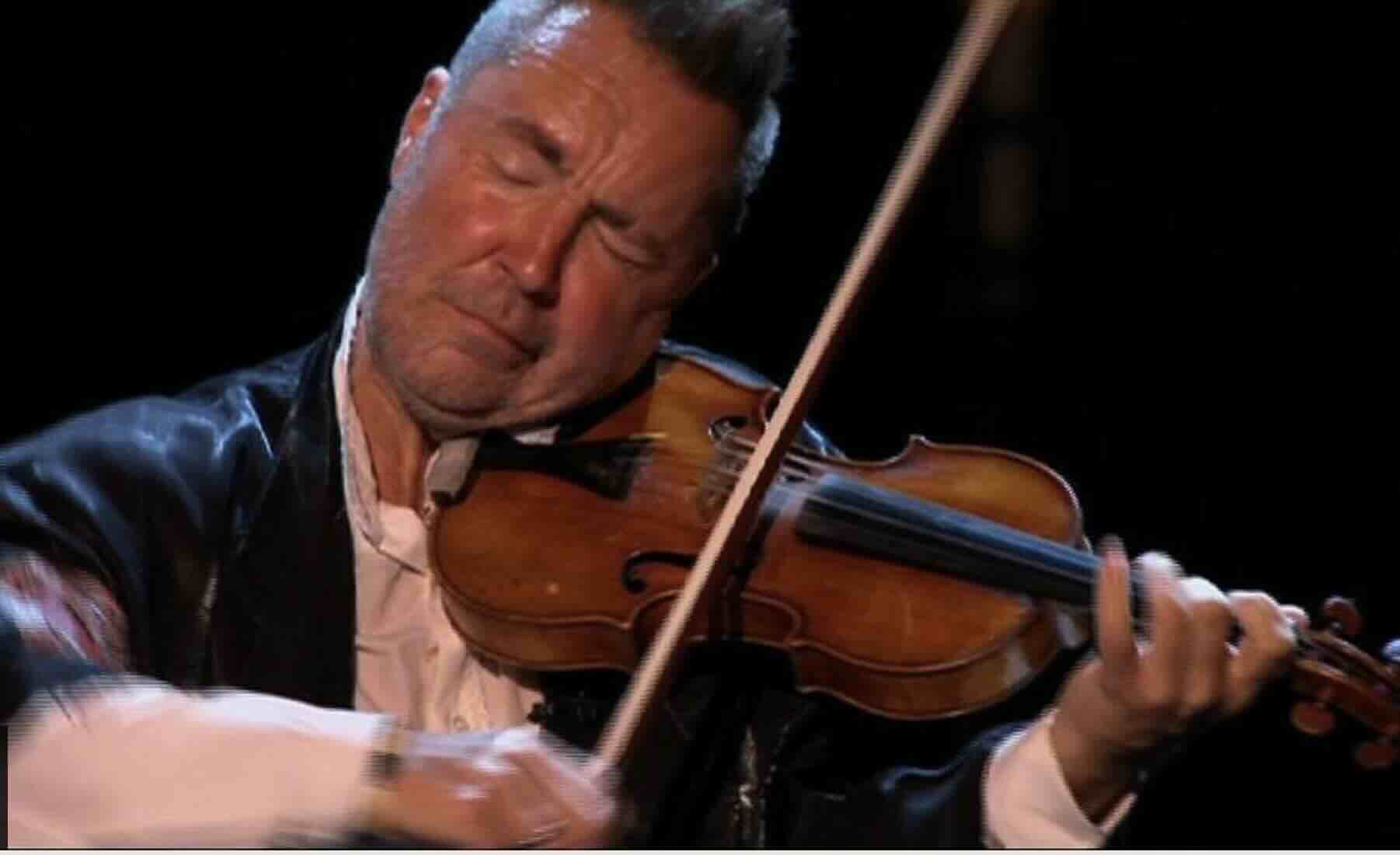
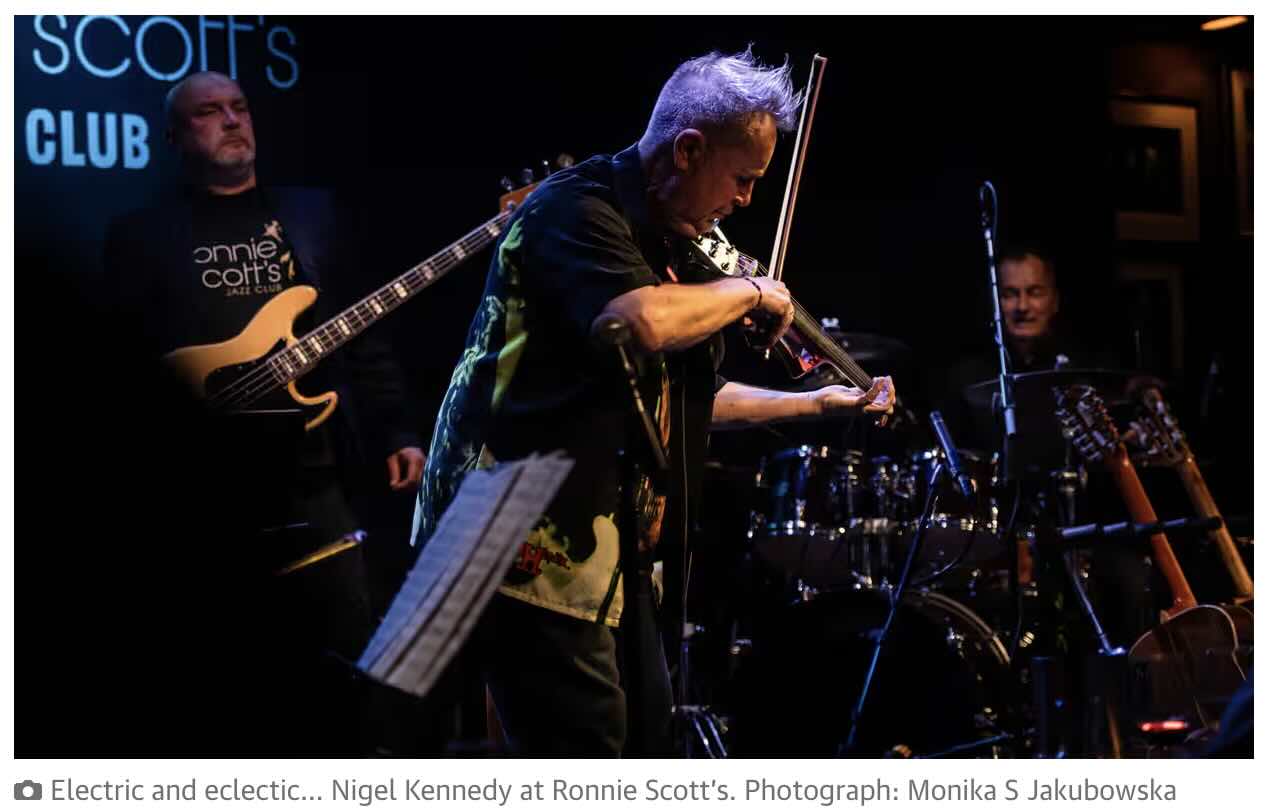
Nigel Kennedy began stirring up the WAM scene quite early, reminding us of the importance of maintaining the creative vibe of live musicking, irrespective of genre. But now that he is no longer an enfant terrible, his tastes are heartfelt and refreshing, for all the hype.

In the absence of Hendrix and Bach themselves, here are a couple of clips.

A homage to Jimi from 2016:

And Bach at the Proms in 2011:

I’m never crazy about the violin in jazz or rock, but however one feels about the results, it’s really great that he does this kind of thing.

Nige 2

Source.

My Bach series includes a sampling of world-music versions; and among many posts on fiddle playing around the world (rounded up here) is Jazz fiddling—also part of my extensive jazz series. Pursuing Kennedy’s Polish connection, see Polish jazz, then and now, Folk traditions of Poland, and under Resisting fakelore.

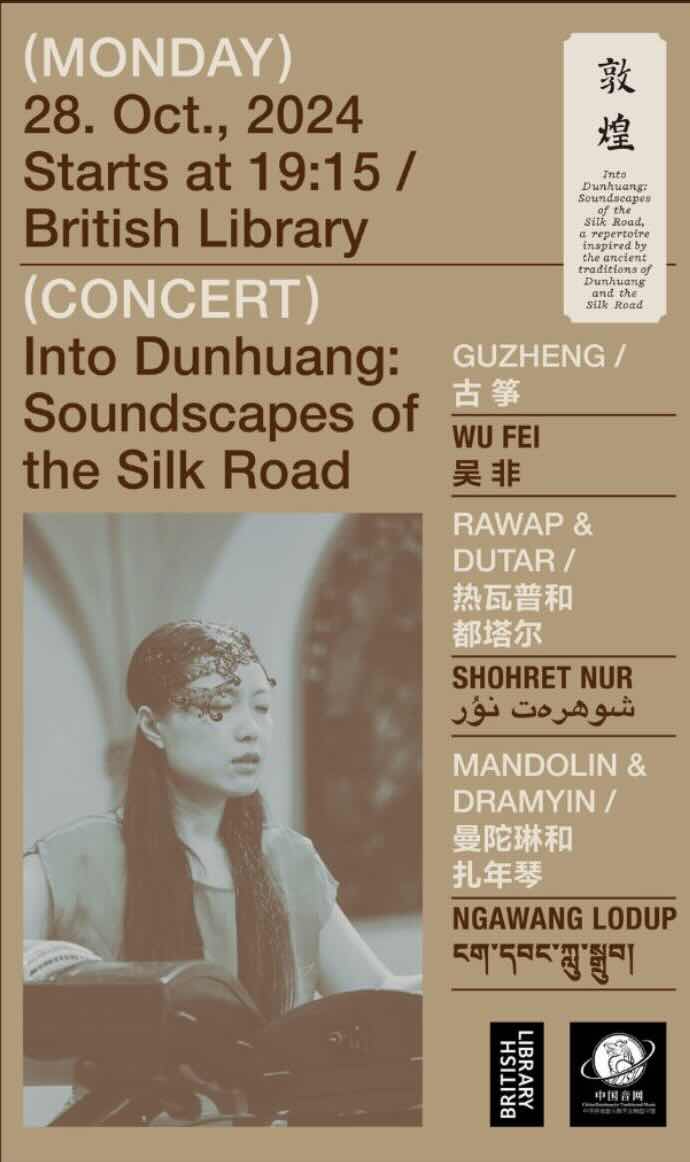
Soundscapes of Dunhuang

Dunhuang gig

Along with the Silk Roads, that reliably popular buzzword, the Mogao Buddhist cave complex outside the oasis town of Dunhuang occupies a unique position in studies of medieval Central Asia. Having thrived for a millenium from the 4th century CE as a staging post along the trade and pilgrimage route, by the 14th century Dunhuang was a backwater—until its long-hidden treasures were discovered by European explorers in the early 1900s.

Wang Yuanlu
Daoist priest Wang Yuanlu, who entrusted many manuscripts to Aurel Stein
and Paul Pelliot from 1907. Source.

Dunhuang caves

The manuscripts are written in a variety of languages, with Chinese predominating.

Alongside the British Museum’s current Silk Roads exhibition, the British Library’s International Dunhuang Programme has an impressive collection, sampled in the display “A Silk Road oasis: life in ancient Dunhuang“—with an imaginative soundscape compiled by the industrious Wei Xiaoshi of the China Database for Traditional Music (CDTM). Among a series of related events, this week Wei curated a concert at the BL.

The soundscapes of society are important. Early caves like those of Dunhuang contain a wealth of music and dance iconography, much studied in China. Instruments * depicted there—mainly as part of ensembles—have been reproduced by Chinese scholars. Echoes of the medieval oasis-towns were heard at the court of the Tang capital Chang’an (modern Xi’an), venue for the first world-music boom (see here, and here). Yet early iconography and texts are silent and immobile (alas, the Dunhuang caves haven’t yielded any caches of A/V recordings!). ** And whereas Western performers in the modern tradition of HIP have paid attention to the sound and performance practice of medieval European music, within China attempts at recreation have yielded less palatable results (cf. Tang music), leaving too much at the mercy of the modern imagination—a bandwagon onto which composers and performers climb all too readily without undue concern for authenticity.

The unspoken issue of context deserves pondering. Early murals show idealised representations of the distinct social milieu of celestial musicians (apsara, Chinese feitian 飛天) before the gods; as in Europe, their function in a pious medieval society was far different from that in galleries and museums today. Similarly, modern sonic recreations are performed on the concert stage (cf. Bach)—a venue far removed both from those of the murals and from the diverse human contexts of traditional social musicking in ancient and modern China, whether sacred or secular.

cave 112

Musical ensemble from Cave 112 (detail), mid-Tang, including zheng zither (front left).
Source.

Doubtless thanks to a limited budget, it was a relief that Wei Xiaoshi adopted the modest rubric “Contemporary echoes of an ancient legacy”, making no pretence of recreating the medieval soundscape, thus avoiding the kitsch spectaculars that are rife in China.

Three accomplished solo performers performed in turn: the Uyghur Shohret Nur on rawap and dutar lutes with busy, percussive pieces from his hometown of Kashgar; the Amdo-Tibetan Ngawang Lodup accompanying his florid singing on mandolin (an instrument widely adopted in modern times by folk musicians around the world) and dramyin lutes—also featuring, to my distress, the notorious “singing bowls” (which “there is no credible historical evidence, whatsoever, of Tibetans ever having used”, in the words of Tenzin Dheden); and the innovative Chinese Wu Fei on zheng zither (whose modern version, FWIW, is remote from that seen in the Dunhuang murals) and vocals. They ended with an improvised trio that I can only describe as strange.

The audience didn’t seem to mind the tenuity of any relation with Dunhuang, ancient or modern. Rather, the concert made a pretext simply to admire the artistry of these fine musicians—from roughly the same part of the world, a millenium after the murals were depicted. Still, were one to present a concert complementing exhibits from the court of Charlemagne (e.g. here), it would hardly seem relevant to present traditional musicians from various parts of France. A millenium is a long time.

It was never going to seem suitable to air the topic of politics, but it was an elephant in the room. As Wu Fei replaced the Uyghur and TIbetan performers on stage with her polished conservatoire-style zheng playing and vocal items, it might just have crossed one’s mind how Han-Chinese rule since 1950 has engulfed Uyghur and Tibetan societies.

Anyway, while research on medieval Dunhuang occupies its own niche, it’s always good to be reminded, however impressionistically, of the variety of living musical traditions throughout the ethnic bazaar of Central Asia, as they have evolved over time (cf. the 2002 Smithsonian festival, or this tasteful concert). For another Silk Roads concert at the BM, click here, and for a symposium, here.

* * *

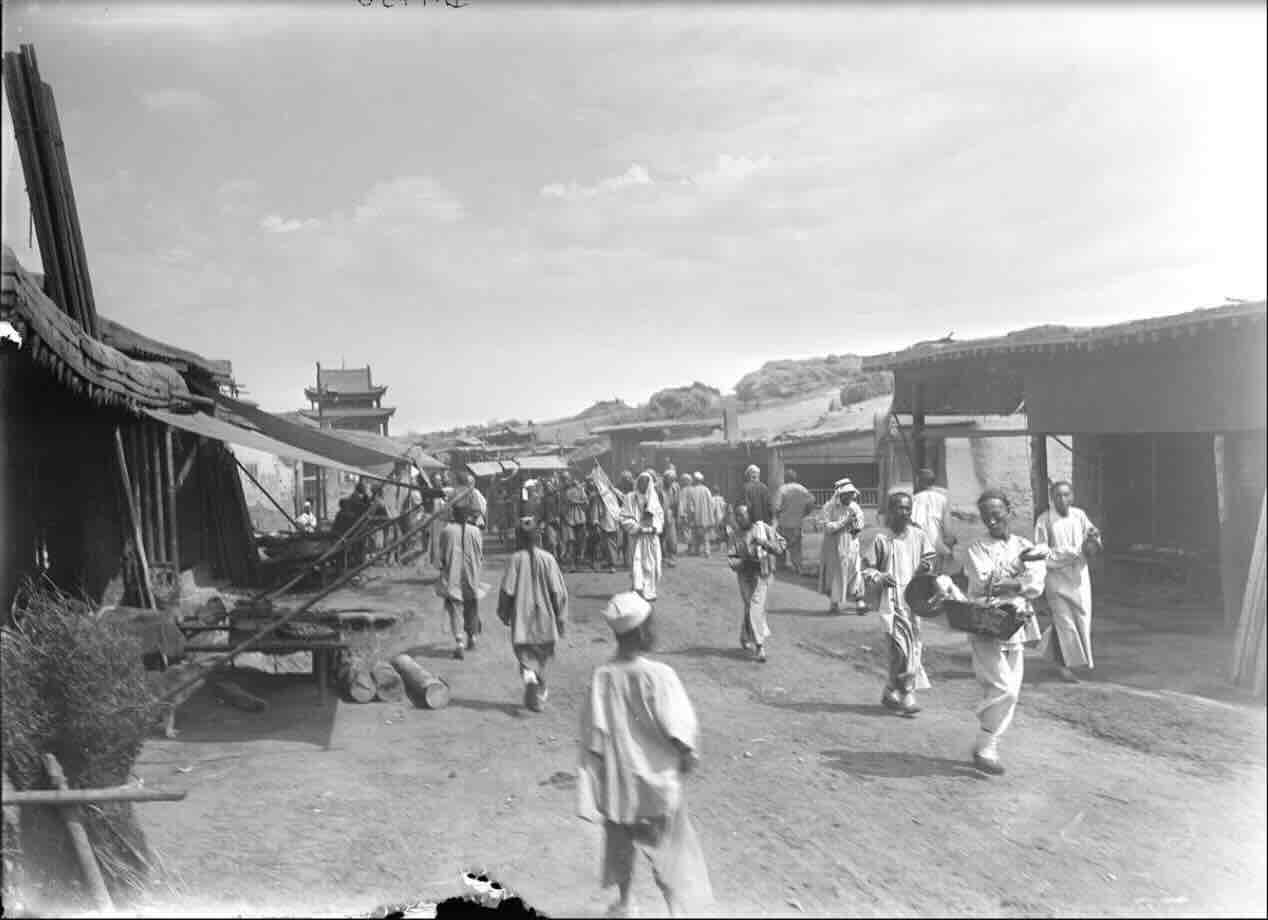
Dunhuang photoPhoto from German Central Asian Expedition, undated (early 20th century):
shawm and percussion accompanying pilgrims (cf. the Uyghur mazar). Source.

Putting medieval iconography and modern concerts to one side, I muse idly on the potential for documenting folk expressive cultures around Dunhuang since their heyday—from the 14th century down to today. So I look forward to reading the recent compilation Dunhuang minjian yinyue wenhua jicheng 敦煌民间音乐文化集成 [Anthology of folk musical cultures of Dunhuang], comprising three volumes on folk-song, “precious scrolls“, and regional opera.

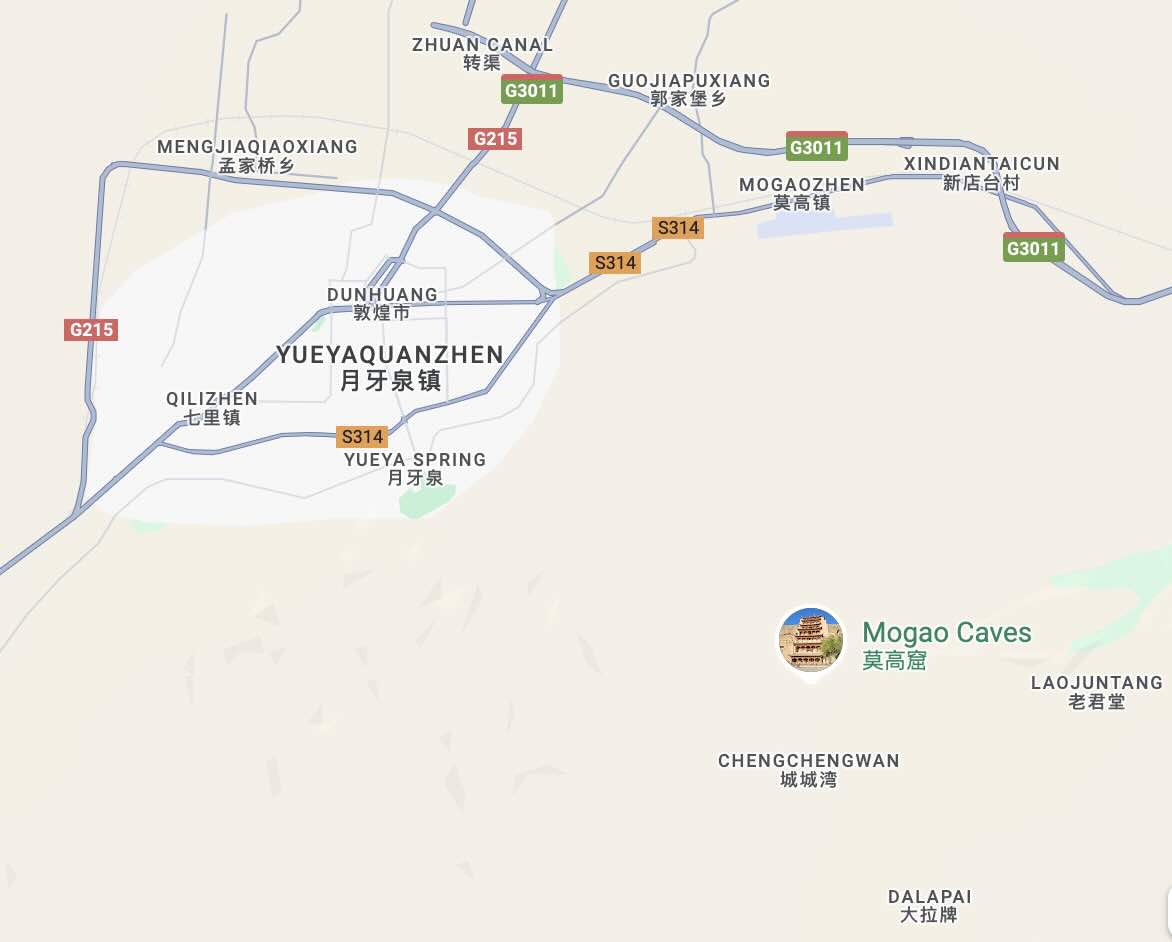
Dunhuang mapThe Dunhuang region today. Source: Google Maps.

Nearby along the Hexi corridor, household Daoist groups perform rituals—for these and other living Han-Chinese traditions in Gansu, click here, and for the cultures of other ethnic groups in the Amdo region, here. For the troubled history of the Dunhuang Academy in the 1960s, note volume 2 of the memoirs of Gao Ertai. For museums and soundscape, see China’s hidden century. Posts on the Tang are rounded up here.


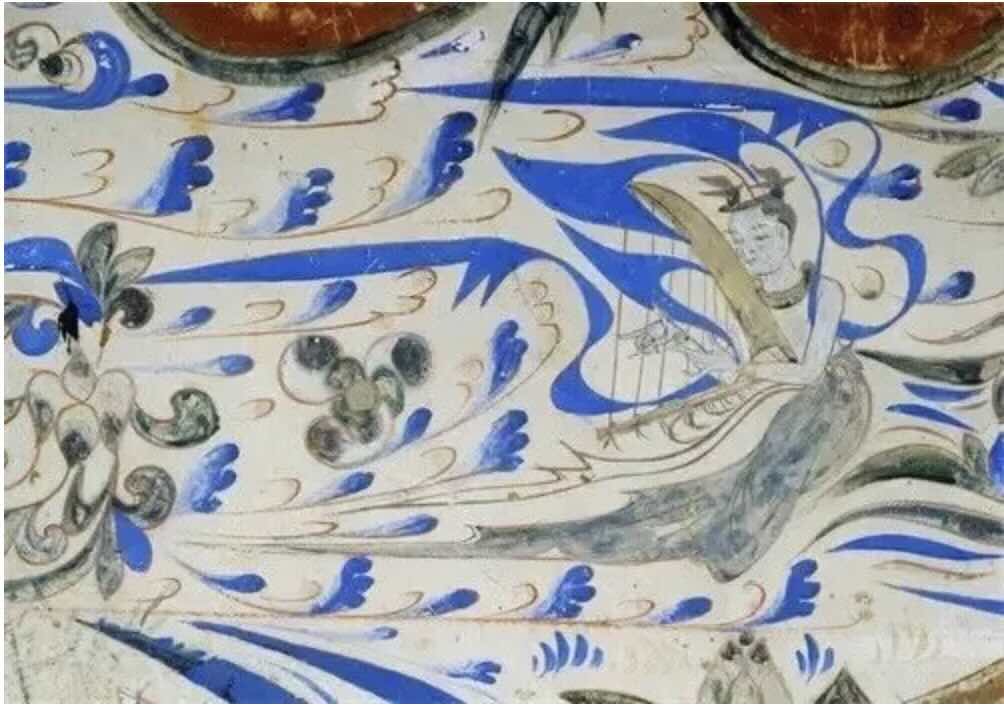
* A personal favourite of mine is the konghou harp, whose rise and fall were similar to that of Dunhuang itself: following the early research of Yuan Quanyou, see e.g. here, here, and even wiki

konghou DunhuangKonghou, Cave 285, 6th century (detail).

** By a considerable margin, this beats my fantasies of discovering ciné footage of the Li family Daoists presiding over the 1942 Zhouguantun temple fair, or of the first performance of the Matthew Passion.

Henan: folk instrumental traditions

Despite all its flaws, the vast Anthology of folk music of the Chinese peoples remains an essential starting point to survey the ritual life and soundscapes of regional folk cultures. For the province of Henan, I’ve written posts on bards and spirit mediums; now, while bearing in mind the volumes on folk-song, narrative-singing, opera, and dance, I’ve been skimming the Anthology volumes on instrumental music, where much of the material on ceremonial and ritual life appears (cf. my surveys for Fujian, Liaoning, and Tianjin, as well as Two local cultural workers):

  • Zhongguo minzu minjian qiyuequ jicheng, Henan juan 中国民族民间器乐曲集成, 河南卷 (1997; 2 vols, 1,515 pages).

Though the great bulk of the volumes consists of musical transcriptions (never very helpful in the absence of available recordings), and the quality of the textual essays is even less satisfactory than in many of the other volumes, clues may be found in the terminology for regional genres and names of bands and musicians.

Henan mapHenan municipalities. Source.

While the early history of musical cultures in Henan is reflected in a wealth of iconography and excavations (for which, see further Zhongguo yinyue wenwu daxi, Henan juan 中国音乐文物大系, 河南卷, 1996), the main material is based on fieldwork on living traditions. Major themes in the modern transmission of local cultures, always suppressed in PRC historiography, are poverty and the memory of trauma (cf. Memory, music, society, and Sparks). But the Anthology rarely offers glimpses of this submerged history; in the narrative-singing volumes for Hunan province I found some passages bearing on the famine around 1960 (here, and here), but Henan suffered even more grievously, and looms large in studies of the national catastrophe. *

Shawm bands
By now we are used to finding the Anthology‘s most substantial coverage devoted to “drumming and blowing” (guchui), referring to shawm bands serving life-cycle and calendrical ceremonies. After the general survey (pp.9–11), the introduction to these bands (pp.29–35) preceding the many transcriptions is brief and formulaic.

Henan pics 4

Xiangbanzi, Sanbi, Xinyang
Shawm band, Xunxian funeral
Shawm band, Linxian funeral

Bands are commonly known as xiangqiban 响器班, and the shawm as dadi ⼤笛, often supported by the related wind instruments xidi 锡笛 and menzi 闷⼦. Many bands have added the sheng mouth-organ since the 1930s.

The introduction confirms the lowly outcast status of the musicians in the “old society”. Locals distinguish those who only play shawm (qingshui 清水) and those who also work as barbers (hunshui 混水). In Zhoukou municipality alone, 300 bands were documented at the time of compilation.

In sections near the end of vol.2, following introductions to the Song family shawm band of Kaifeng (a kind of folk academy for the state troupes) and the shawm band of Shibukou in Lankao county (pp.1422–23), brief biographies (pp.1425–35) contain further clues. Many of these musicians came to the attention of collectors through being absorbed into the state troupes, but any of their lives would make an illuminating in-depth social study—incorporating the history of Maoism, the famine, and the 1980s’ reforms.

Henan pics 2

Guanzi player, Tianshan village, Longmen, Luoyang
Xun ocarina player, Puyang
Shang Yuanqing on shawm, Neixiang
Shengguan players, Xinzheng.

Female members of shawm-band families seem to have begun taking part earlier than further northwest (cf. Hubei: The Chinese shawm: changing rural and urban images).

Henan pics 3

Chuida in Neixiang county, and Bayin louzi of Zhoukou
Sixian luogu, Shangcheng county
Shipan, Yima municipality.

Also subsumed under the rubric of “drumming and blowing” are groups in central and northwestern Henan led by guanzi oboe or dizi flute: the shipan ⼗盘 of the Luoyang–Sanmenxia region (named after its ten-gong yunluo, and akin to ritual shengguan ensembles just north); the amateur bayin hui ⼋⾳会 around Jiaozuo (with a more diverse instrumentation) and bayin louzi ⼋⾳楼⼦ of Zhoukou municipality (named for their processional sedan), once patronised by Shanxi merchants.

Bayin louzi

Zhoukou Bayin louzi 1423

Clues to the Shanxi origins of the Bayin louzi in Zhoukou.

String ensembles
By comparison with wind bands, string ensembles (“xiansuo”) are rather under-represented in modern Chinese folk cultures (see e.g. Amateur musicking in urban Shaanbei; Musicking at the Qing court 1: suite plucking). In Henan the main genre is bantou pieces 板头曲 (pp.724–894), along with their zheng zither repertoire, largely collected around Zhengzhou (cf. The zheng zither in Shandong)—the instrumental component of the dadiao vocal tradition, based on 68-beat variants of the folk melody Baban.

Cao Dongfu
Cao Dongfu.

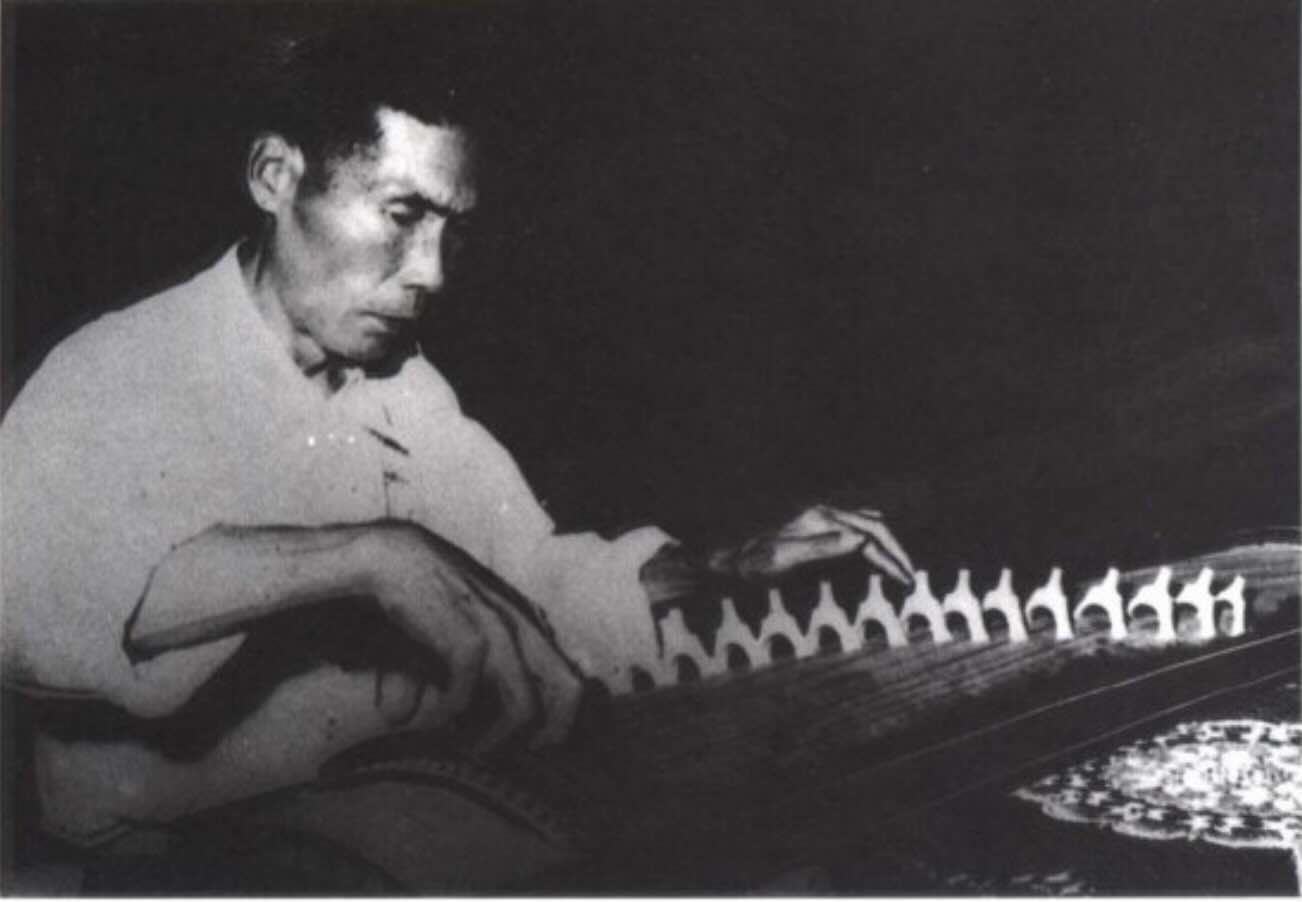
Despite biographies of the celebrated zheng masters Wang Shengwu (1904–68), Ren Qingzhi (b.1924), Cao Dongfu (1898–1970) and his daughter Cao Guifen (b.1938), one gains little impression of the recent maintenance of this tradition.

Blowing and beating
Without acquaintance of “blowing and beating” (chuida) pieces around the Funiushan and Dabieshan mountains, I’m unclear how they differ in style from the shawm bands discussed above. In Shangcheng county on the northern slopes of Dabieshan, mixed ensembles with strings and percussion (sixian luogu) are found. The famine around 1960 was particularly devastating in the Xinyang region; bands there, derived from shadow puppetry, are said to have “developed” greatly in the 1950s.

Henan pics 1

“Greater tongqi“, Zhumadian
Pangu, Kaifeng
Percussion ensemble, Weidu district, Xuchang
Percussion ensemble, Mixian county.

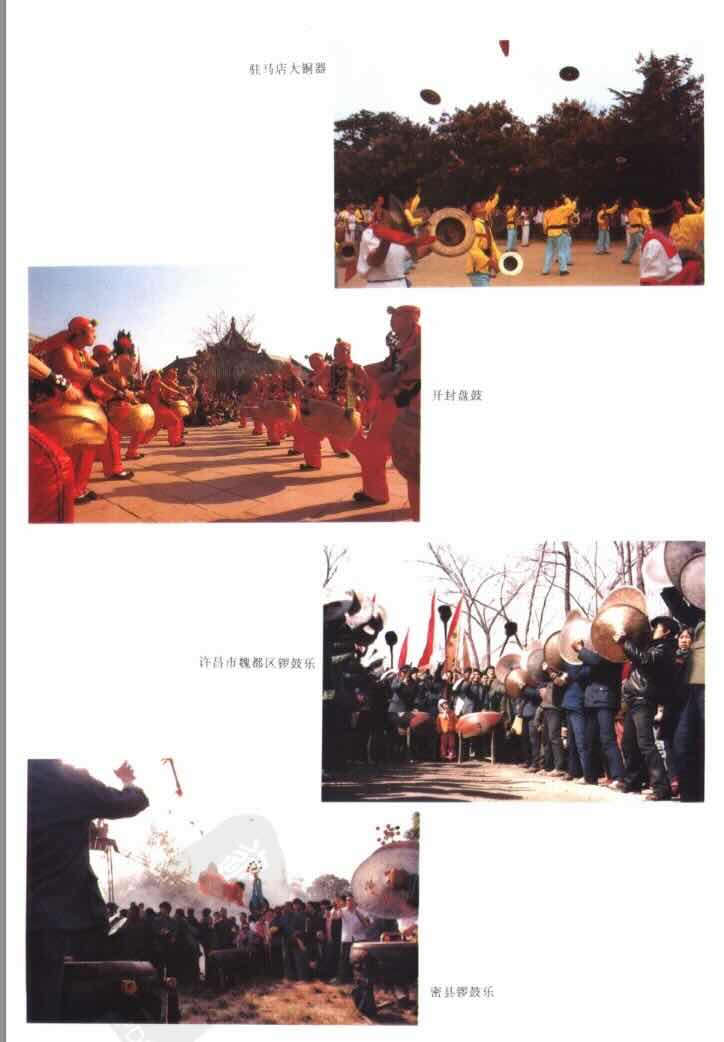
Festive percussion ensembles are introduced in a rather good article (pp.1061–66), including tongqi she societies (cf. Xi’an) originally serving temple fairs (with 87 groups active in Xuchang municipality alone at the time of compilation), and the funerary jiagu 架鼓 of Taiqian county, northeast Henan.

More solo pieces are identified than for most other provinces (pp.1197–1334), although most perhaps belong under ensemble and vocal categories: for dizi flute, regional types of bowed fiddles (zhuihu, zhuiqin, sihu, “soft-bow” jinghu), the rare bowed zither yazheng, zheng plucked zither (related to the bantou tradition), and sanxian plucked lute.

“Religious music”
Noting that the very concept of “religious music” is misleading, I often wish that local music collectors would engage with folk ritual practice—and scholars of religion with its soundscape. For regions such as Fujian, on whose local Daoist “altars” scholars have published detailed monographs, little can be learned from the sections on “religious music” in the Anthology; but for regions where serious scholarship is deficient, these sections at least promise some preliminary leads. Despite the long-term social impoverishment of communities in Henan, folk ritual practice there appears to maintain its vigour, yet the minimal Anthology fieldwork yielded disappointing results, and the topic still doesn’t seem to have attracted scholarly attention.

Transcriptions of Buddhist pieces, mostly instrumental, come from Yuanyang, Qixian, Minquan, Zhengyang, and Wuzhi counties, with only two vocal items (from Xinxiang municipality). This section strangely neglects the prominent Xiangguo si temple in Kaifeng, whose “music” was commodified even before the Intangible Cultural Heritage era, although the temple’s Republican-era gongche solfeggio score is reproduced in an Appendix (pp.1441–85). Daoist pieces are transcribed from Yanling, Xunxian, Pingyu, and Huaibin counties; the introduction (p.1378) also mentions a household Daoist group in Gegang district of Qixian county.

Henan pics 5

[Household?] Buddhist ritual specialists, Xinxiang municipality
Buddhist monks, Lingshan si temple, Luoshan county
Household Daoist presides over funeral, Tongbai county.

Hints of ritual life come in the guise of two brief biographies of wind players who were recognised at regional and provincial festivals in the 1950s:

  • Zhang Fusheng 张福生 (Daoist name Yongjing 永净, b.1918) came from a hereditary family of Daoists; he fled the 1942 famine along with his father and seven Daoist priests to make his home at the Guangfu si temple in Yanling county (p.1428).
  • Sun Hongde 孙洪德 (Buddhist name Longjiang 隆江, b.1927) came from a poor village in Minquan county; when he was young his mother gave him to the village’s Baiyun si temple, and later he moved with his master Canghai to the Tianxing si temple in Jiangang district of Shangqiu municipality (p.1430).

So far I have found few clues online to augment this paltry material, though a brief 2004 article on “Daoist music” in south Henan (where the officiants are commonly known as daoxian 道仙) is based on fieldwork with six “altars” (tan 坛) there. Further leads welcome!

* * *

A/V recordings of such folk traditions are hard to find online; some brief clips appear on douyin, e.g. “folk ritual from Xinyang” here. Perhaps still more than with local traditions of instrumental music further north and northwest, most of these genres are inseparable from folk-song, narrative-singing, and opera—as a reminder of the importance of vocal music, here’s a clip of “wailing for the soul” (kuling) for the third anniversary of the death:

In the Shaanbei revolutionary base area in the 1930s, cultural cadres struggled to valorise folk performing traditions that were so inextricable from the “feudal superstition” which the CCP was seeking to overthrow (see here). The long process of sanitising such traditions has now reached its nadir in the dumbing-down of the ICH. So, however unsatisfactory, the Anthology remains an essential starting point for fieldwork on local traditions of expressive culture in China, allowing us to adjust our perspective from the “national music” of the conservatoire style, through facile epithets (coined in the 1950s) standing for the music of a large region (Hebei chuige, Jiangnan sizhu, and so on), right down to grassroots fieldwork—town by town, village by village.

While the Henan volumes contain useful material on late imperial and Republican history, what we now need are detailed ethnographies for the whole period since the 1949 “Liberation”, as the social fabric of local communities served by such traditions struggled to survive political and economic assaults.


* For Henan, see e.g. Ralph Thaxton, Catastrophe and contention in rural China (2008), and Peter Seybolt, Throwing the emperor from his horse (1996). For more sources on the famine, see under Cultural revolutions.

Images of Zen

The wondrous truth of the Buddhas is not concerned with writings

諸佛妙理,非關文字

—Huineng

The Western vogue for Zen was already well established when I sought to learn about it in my teens (see here). Alongside the surveys of Christmas Humphreys, Alan Watts, and classics by Eugen Herrigel and R.H. Blyth, I read the works of D.T. Suzuki with an enthusiasm that I now learn was misguided. [1] But as scholarship expanded vastly, I was discovering other fields to plough, drawn towards the ethnography of folk religion in China. Lately I’ve been wondering why the two most popular Western images of Zen are so elusive in China—the koan encounter dialogues and zazen seated meditation. So I’ve resorted to the useful wiki series on Chan and Zen (see also Zen narratives, Koan, and Zazen; cf. the Stanford Encyclopaedia of Philosophy).

Research on religion (both its early textual history and its current state) is clearly quite different from “doing religion”. For historians and ethnographers, participant observation is optional; and practitioners of religion need not be versed in scholarly literature. Indeed, writing about anything is different from doing it—music, for example. I’m not exactly arguing with the concept of academia—even I am not quite so fatuous. But Chinese Chan and Japanese Zen make particularly stimulating examples of the contrast.

* * *

Early Chan patriarchs stressed a “separate transmission outside the scriptures, not relying on words and letters” (cf. early Daoist writings such as Laozi, “The way you can follow is not the eternal way; The name you can name is not the eternal name”). However, quite remote from our modern iconoclastic image of Zen, the doctrinal history of Chan is remarkably verbose and discursive. [2] This contradiction is itself the subject of much verbal analysis!

The modern Western fantasy of Zen is based on the numinous reputation of the Tang dynasty. Much of the evidence for the early history of Chan is based on the transmission texts, sermons, and doctrinal writings of leading patriarchs such as Bodhidharma, Shenxiu, and Huineng—received images of whom are based on their portrayal by Song-dynasty writers. As Mario Poceski observes (Ordinary Mind as the Way: The Hongzhou school and the growth of Chan Buddhism, 2007),

The connection with the glories of the bygone Tang era bestowed a sense of sanctity and was a potent tool for legitimising the Chan school in the religious world of Song China.

From such sources, gong’an/koan “encounter dialogues” and commentaries emerged. The early masters were prolific writers, even if some recognised the dangers: in the 12th century, Dahui Zonggao “is even said to have burned the woodblocks of the Blue cliff record, for the hindrance it had become to study of Chan by his students”. One revealing theme is the many cogent criticisms of the koan system, both within Chan and by modern scholars. Poceski again:

Although Zen is often portrayed as promoting spontaneity and freedom, encounter-dialogue exegesis actually points in the opposite direction, namely towards a tradition bound by established parameters of orthodoxy

—the masters’ exegeses reinforcing their status and authority, and impressing their literati patrons.

Popular image notwithstanding, I deduce that beyond those monks and patrons, penetrating the gnomic aphorisms of the Tang and Song masters has played only a minor role in temple routine. Conversely, Chan Buddhists have always esteemed the Mahāyāna scriptures: even in the Tang, the Laṅkāvatāra Sūtra and Diamond Sūtra were considered important texts. 

Among Western scholars, Bernard Faure has an informed view of the broader picture (see e.g. Chan insights and oversights: an epistemological critique of the Chan tradition, 1993). In his Introduction to Chan Buddhism in ritual context (2003) he gives a useful survey of the field.

Chan/Zen studies are, on the whole, divided between textual/ philological and historical approaches on the one hand, and hermeneutical and philosophical approaches on the other. […] We are still lacking works considering Chan and Zen as complex cultural systems and trying to place them in situ

—this more anthropological approach “in reaction against the spiritualist tendency of traditional historiography and against historicist reductionism”. In the same volume, Wendi Adamek notes:

In the eighth century, Chan masters were no longer simply meditation masters and they had not yet become Zen masters, those enigmatic eccentrics who have made their mark in contemporary popular culture.

The modern visitor to Chinese temples may be perplexed by the apparent absence of the “Zen spirit” there. [3] But, far from some recent dilution, ever since the early history of Buddhism in China, Buddhists have put varying emphases on three types of training inherited from India: vinaya, the rules of discipline; dhyāna, meditation; and dharma, mastery of the Buddhist texts. Wiki cites McRae:

Chan was not nearly as separate from these other types of Buddhist activities as one might think […] The monasteries of which Chan monks became abbots were comprehensive institutions, “public monasteries” that supported various types of Buddhist activities other than Chan-style meditation. […] There was never any such thing as an institutionally separate Chan “school” at any time in Chinese Buddhist history. 

Thus as Chan was integrated with other schools (notably Pure Land, Huayan, and Tiantai), while leading masters continued to write abstruse treatises, temple life revolved around the discipline of institutionalised religion. Once we grasp all this, the apparent conflict between early and later history becomes less incongruous.

Xuan Hua
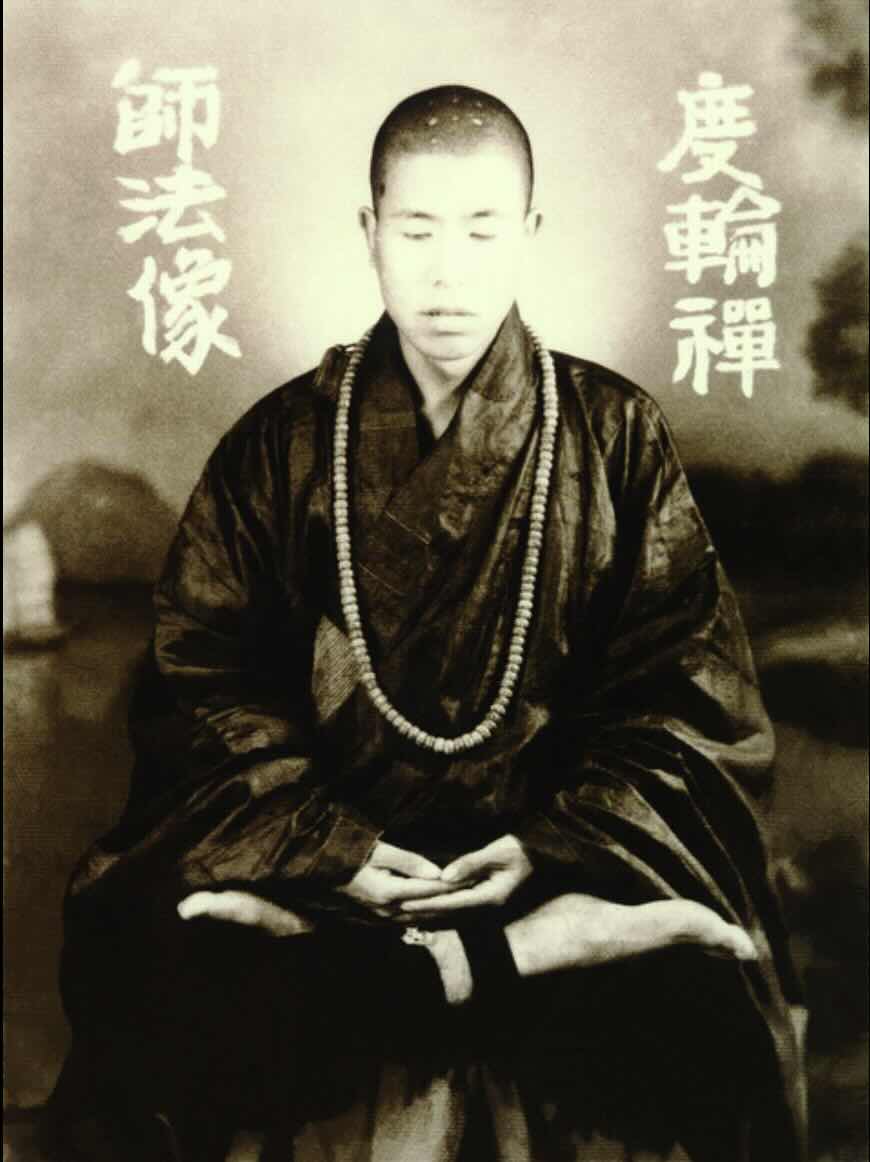
Xuan Hua meditating, Hong Kong 1953. Source: wiki.

Modern reformist Buddhist movements are the subject of much research. Chan is at the core of the teachings of renowned masters in the PRC, Taiwan, and the USA—who are no less generous with words than their medieval antecedents, like Western pundits such as Gary Snyder and Alan Watts (cf. Krishnamurti, and Paths for the reluctant guru).

* * *

Besides the wealth of hermeneutical studies of Buddhism, one finds scant ethnographic material for normative practice—the daily lives of ordinary temple monks (whether today, in the Ming, or in the Tang). For the late imperial era, fiction may provide a useful source (cf. Ritual in the Dream of the Red Chamber).

A basic acquaintance with temple life in modern Chinese society provides the important perspective of physical diversity—from the grand, prestigious temples of cities and mountains, to medium temples with a modest staff, to small village temples with only a caretaker. Children were often given to small local temples as a means of survival; piety on the part of the parents might play a role, but spiritual concerns were often remote.

I’ll end with some impressionistic instances of usage where the term chan may mislead.

Just as chansi 禪寺 refers generally to a Buddhist temple, other uses of the term chan often stand broadly for Buddhism—as in the interdenominational liturgical compilation Chanmen risong 禪門日誦. As Faure observes, ritual has long played a major part in Chan, although he doesn’t seem to address the particulars of liturgical practice (for folk Buddhist ritual, see here).

ChanSource.

In Japan, zazen seems to be an intrinsic part of temple life; at outward-looking temples in China and abroad there has been something of a recent boom for meditation classes for laypeople (e.g. here), in response to demand. Chan meditation wasn’t limited to Chan temples, but I wonder how widely it is (and was) practised in local temples.

In temples the term chan is common in chanfang 禪房 or chantang  禪堂, which rather than “meditation room” is now just a common room or assembly room (for basic depictions, see e.g. here, and here). The term chanfang may even stand for the temple itself; found in sources from Li Bai to The Dream of the red chamber, it’s still in common parlance.

At the back of my mind in composing this post was the rough diagram that Li Manshan drew for me of the former Temple of the God Palace (Fodian miao 佛殿廟) in his home village (see Daoist priests of the Li family, pp.47–8, and our film, from 8.35), including a chanfang. Though the temple was quite imposing by the standards of a poor village, its 1876 stele lists only two monks. In many smaller temples, neither formal meditation nor scripture study are necessarily part of the schedule; the daily routine may consist largely of tasks such as sweeping the courtyard, preparing food, and maintenance. Whether or not monks regard such mundane chores as part of their Chan/Zen cultivation, in our times the idea of Zen as pervading worldly activities, from tennis to conducting, has become popular.

Meanwhile for academics, the study of Chan and Zen becomes a career, full of lectures, conferences, bibliographies; practitioners may find such erudite academic discourse alien from their own quest. And I’m just as guilty, adding yet more words on one of the most verbose sites ever. Having grown up with the romantic early image of Chan and Zen, I’m now impressed by all the scholarship unpacking its later doctrinal history. But just to reiterate my glib point, it goes without saying (sic) that historical research is very different from the quest for spiritual enlightenment, and daily temple routine is something else again—illustrating again how our image of the Wisdom of the Mystic East diverges from practice on the ground. 

These are some of the issues that I haven’t yet found addressed in the extensive literature. Last word to Alan Watts:

If you are hung on Zen, there’s no need to pretend that you are not. If you really want to spend some years in a Japanese monastery, there is no earthly reason why you shouldn’t. Or if you want to spend your time hopping freight cars and digging Charlie Parker, it’s a free country.


[1] The cogent early criticisms of Suzuki by Hu Shih have been reinforced by David McMahan and John McRae; Bernard Faure describes Suzuki’s writings as “pious verbiage” (for more, see Chapter 2, “The rise of Zen Orientalism” of his Chan insights and oversights). While Alan Watts goes easy on Suzuki, I’m always impressed by his 1959 pamphlet Beat Zen Square Zen and Zen.

[2] I was drawn to this theme by a recent article in Sino-Platonic Papers (no.353!), Ming Sun, “Speaking what cannot be spoken: poetry as a solution to the ineffability in Chan rhetoric”. More generally, Adam Yuet Chau critiques the dominance of the “discursive mode” in “doing religion”.

Sun’s article also led me to “beating and shouting” (banghe 棒喝), practiced from the Tang by Mazu’s Hongzhou school, which

developed “shock techniques such as shouting, beating, and using irrational retorts to startle their students into realisation”. Some of these are common today, while others are found mostly in anecdotes. It is common in many Chan traditions today for Chan teachers to have a stick with them during formal ceremonies which is a symbol of authority and which can be also used to strike on the table during a talk.
These shock techniques became part of the traditional and still popular image of Chan masters displaying irrational and strange behaviour to aid their students.

“Beating and shouting” was revived from the late Ming by Miyun Yuanwu (see e.g. Jiang Wu, Enlightenment in dispute: the reinvention of Chan Buddhism in seventeenth-century China (2008, reviewed here). I’m not familiar with the practice in modern Chinese temples (though it is introduced e.g. on Xing Yun’s site, along with copious commentaries), but it sounds somewhat akin to the enduring practice of ritualised debate in Tibetan monasteries (see under Daoism and standup).

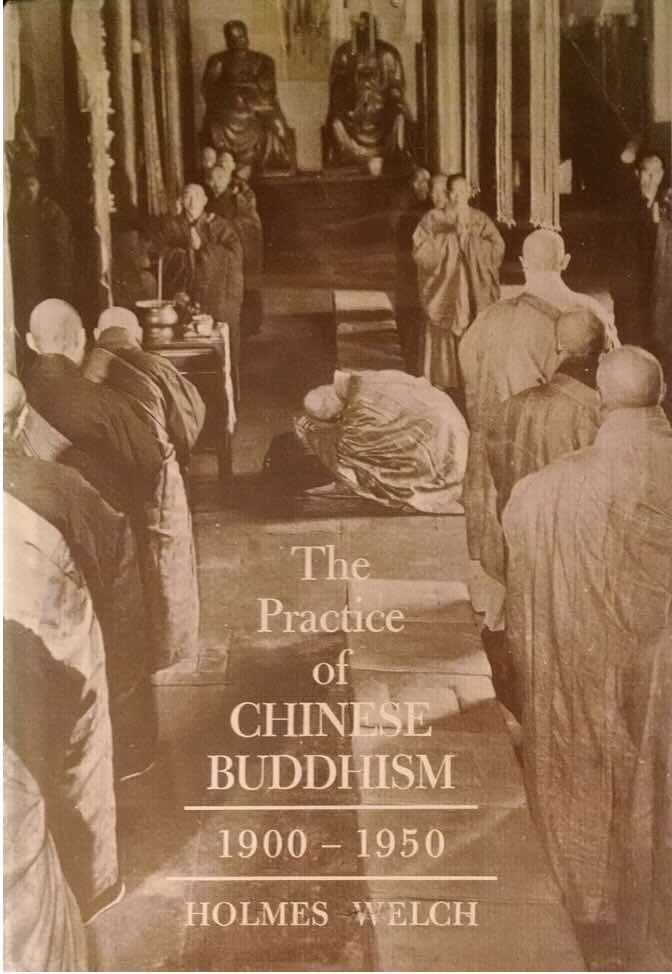
Welch cover[3] For the practice of Buddhism in modern China, note the trilogy of Holmes Welch. At a tangent is Bill Porter’s quest for the spiritual life of modern clerics and hermits.

Here I won’t extend my remit to Daoist meditation techniques, the wealth of scholarship on which is again introduced on wiki. Of course, the regulated life of Daoist temple priests also stands in contrast to the writings of early Daoist sages popular in the West.

Mahler 2 with MTT!

*Yet another post in my Mahler series!*

To follow Mahler 3 with Michael Tilson Thomas and the LSO earlier this year, I just heard them giving the first of two performances of the 2nd symphony (main post here) at the Barbican.

Screenshot

© LSO | Mark Allan. Source.

While Mahler 2 in concert cannot fail to be overwhelming, on Sunday its power was conveyed as much by the fervent communal devotion of performers and audience as by the elderly, frail conductor. As this review of the 3rd symphony in May commented, MTT “more or less held it all together… signalling a few entries and giving some directions. That, however, was the full extent of his input, a distant cry from his earlier years where he would have been athletically bouncing around and being criticised by some for his micro-management.”

M2 before choir

The orchestra must have risen gladly to the challenge of having to negotiate so much of the detail. The singers were also fine—Alice Coote in a rapt Urlicht, joined for the monumental finale by Siobhan Stagg and the London Symphony Chorus. As others have noted, the standing ovation was not so much for this concert as a homage to MTT’s lifelong music-making.

* * *

Immersed as I am in another round of editing my new film on the New Year’s rituals in the poor village of Gaoluo, the symphony made an extreme contrast, even if both rituals are in service of the divine. *

For Bernstein and Mahler, see Maestro.


* Another entry in my Martian ethnography (see e.g. here):

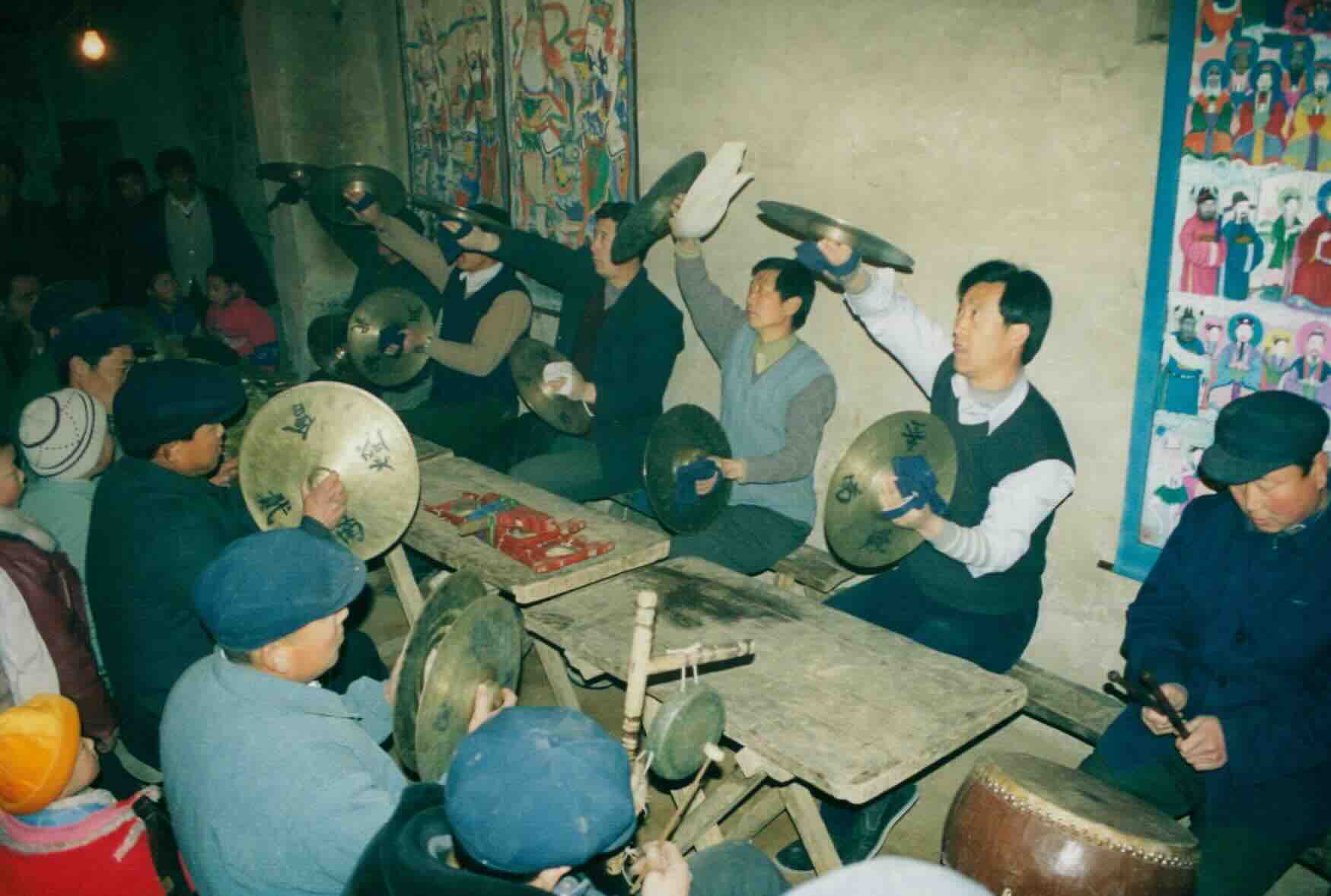
As I suggested in Plucking the winds, whereas cymbal players in WAM feel impelled to milk the rare climactic moments when they are required, in Gaoluo the great percussion suite, with all its solemn and balletic complexity, demands stamina, skill, and memory.

GL FDZ

Chinese espresso

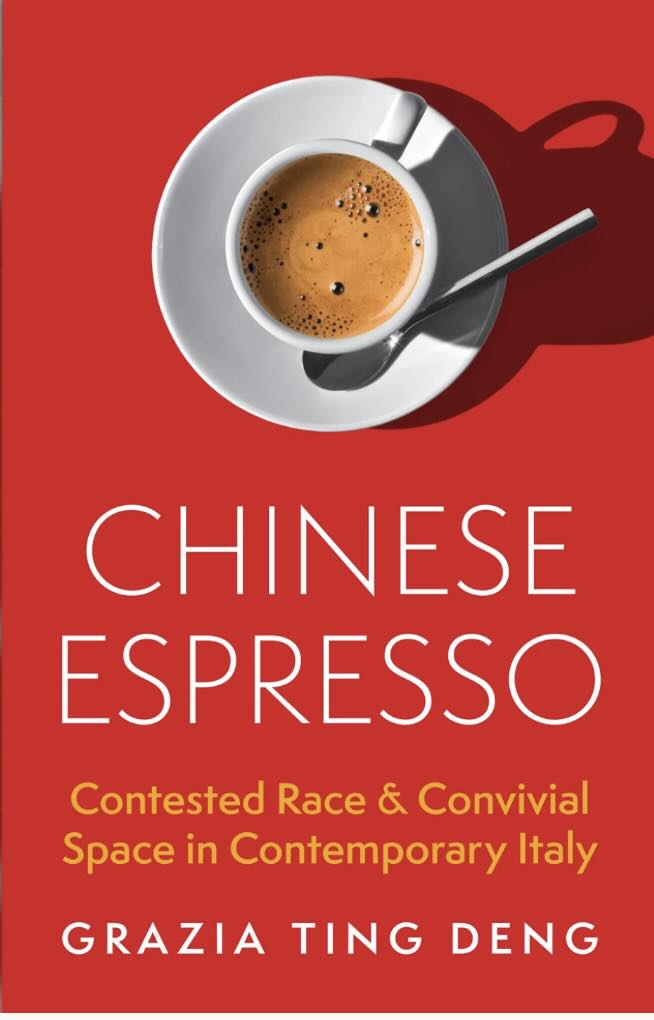
On another trip to Milan seeking to finalise the editing of my new film on the New Year’s rituals in Gaoluo with Andrea, taking a break at his local Chinese-run coffee bar makes a suitable backdrop to digest an interview with Grazia Ting Deng on her new book Chinese espresso: contested race and convivial space in contemporary Italy, based on fieldwork in Bologna.

Chinese espresso

Over the past four decades, Chinese residents have become one of the most prosperous and economically powerful ethnic and immigrant groups in Italy. The increasing number of “Oriental” faces as well as their products and their storefront enterprises are so visible as to constitute an integral part of the urban landscape and urban life. The seemingly mysterious economic boom of Chinese immigrants in tandem with China’s rise as a global economic power look like a counter current to Italy’s chronic economic stagnation. In Italy’s populist-nationalist discourse, the “China threat” has now taken on a new guise that merges admiration and resentment.

As a Chinese immigrant, Deng experienced institutional discrimination and everyday racism; as a woman, she faced the male/patriarchal gaze—from native Italian men, Chinese men, and other male immigrants. She found that Chinese bartenders are both subject to racialisation and reproduce it.

Chinese entrepreneurs usually purchase an existing coffee bar, often located on the periphery of the cities, embedded in neighbourhood life. Their main patrons are marginalised people, including working-class men of different generations who often have a migrant background from within or outside Italy. So their bars are sites where diverse racial and ethnic groups interact.

There the author found emotion, friendship, care, and a kind of social solidarity. However, as Chinese baristas sought to maintain the sociality of the space they managed, the way they policed their customers conformed to the moral expectations of “good” customers (white Italians) while excluding “bad” customers (foreign migrants) who risked destroying such sociality. This provided a context for tension and conflict.

Chinese baristas’ construction of a convivial social space is a dynamic process that runs in tandem with their own racial formations.

Deng found that social relations do not extend beyond the boundaries of the bar.

Italy’s more liberal sexual mores and pluralistic family structures that Chinese baristas have learned about from their customers seem to have confirmed their negative stereotypes of native Italians’ callousness regarding marriage and family. They contrast this with the traditional value of family integrity espoused by recent Chinese immigrants, who see this also as a prerequisite for upholding a family business and its economic prosperity. […]

Excessive consumption of alcohol and addiction to gambling—two fundamental sources of income for many Chinese-managed coffee bars—somewhat ironically become evidence allowing Chinese baristas, especially those who are Christian, to judge their customers as morally defective.

Coffee bar management has therefore reshaped Chinese baristas’ racialised perceptions of native Italians. […] A civilised, developed, and affluent Western country with only well-educated and respectable white Westerners turned out to be an Occidentalist fantasy.

 Social interactions are never gender, class, racially, or ethnically neutral.

Sometimes, they would hire white baristas to submerge the Chinese ownership of a quintessentially Italian social space that they manage. On the other hand, Chineseness itself could also become an effective strategy in dealing with certain social situations. For example, Chinese identity, along with their supposed lack of linguistic skills, provided a good excuse and a strategy for Chinese female baristas to use to refuse unwanted communication and to dodge awkward and embarrassing harassment. […]

The coffee bar space was a kind of prism through which Chinese baristas acquired racial knowledge and produced a racialised world view. Their racialisation of both native Italians and foreign migrants reflects their double disenchantment with Italy, as well as the insecurity of their lives in this host country. […]

Many Chinese with whom I talked even questioned their decision to emigrate to this supposedly affluent and developed Western country. They commonly believed that Italians’ problematic work ethics and other perceived negative qualities were the real reasons for Italy’s economic stagnation, in contrast to the success of both the Chinese in Italy and China in the world. […]

Chinese baristas and many other Chinese entrepreneurs in Italy have been disappointed that their increasing economic prosperity has not translated into social respectability but, ironically, resulted in even more insecurity and exposure to crime. This predicament of being simultaneously economically privileged and socially vulnerable further fuelled Chinese baristas’ ethnic consciousness, while establishing boundaries to the conviviality that they cultivate.

For Deng’s related articles, see here.

Ethnomusicology rocks!

Nettl

As a cogent survey of the vast topic of ethnomusicology, I never tire of recommending Bruno Nettl’s magisterial survey. To keep up with the state of the field, at the forefront of journals (click here) is Ethnomusicology, under the aegis of SEM. I’m quite resistant to conferences, but browsing the programme for this year’s SEM virtual gathering from 17th to 26th October makes an update on the breadth of research, both daunting and inspiring.

The talks, panels, and films on a wealth of themes subsume much of the globe, including devotional music, jazz, gender, post-colonialism, festivals, the internet, violence and trauma, historical ethnomusicology, and research tools. Just a tiny selection to whet your appetite, inevitably reflecting my own tastes:

On this blog, the world music category has a range of stimulating posts, including Society and soundscape and What is serious music?!, as well as series on raga and flamenco.

Chamber music of Iran 2

Nasim e tarab

It’s only quite recently that I’ve started dipping my toes, or ears, into the vast ocean of maqam (see e.g. Iran: chamber music, Art music of Iran 3, and Shashmaqom). As part of the admirable Maqām Beyond Nation project, organised by SOAS and the Università Ca’ Foscari, Venezia, the Nasim-e Tarab ensemble of master musicians from Iran performed earlier this week at the Brunei Gallery, SOAS—last stop on a tour that also included concerts in Bologna, Venice, Bristol, Waunifor, and York.

Nasim-e Tarab (“The Breeze of Musical Enchantment”) is named after a Safavid musical treatise, compiled in Persian during the 16th century. The quintet is led by Saeid Kordmafi (santur), with Mehdi Emami (vocals), Siamak Jahangiri (ney), Hamid Ghanbari (percussion), and Saeid Nayebmohammadi (oud), all with illustrious pedigrees in Iran.

They performed a macro-suite consisting of four majles “sessions”, with metric cycles (of 6, 7, 8, 9, 10, 13 beats) punctuating lengthy, ecstatic free-tempo sections. Mehdi Emami (listen e.g. here, and here)—a pupil of Mohammad Reza Shadjarian and Mohammad-Reza Lotfi, no less—sang with dignity and passion, adorned by a halo of santur (cf. Zithers of Iran and Turkey) and ney flute.

The material was composed and arranged [terms I’d be curious to unpack—cf. improvisation] by Saeid Kordmafi, based on his long-term research on and practical involvement in creative practices and their historical interdependencies in the Middle/Near East and Central Asia, endeavouring to address classical Iranian music from a transnational and historically informed approach. As the blurb goes on to explain,

The ensemble is part of a dynamic aesthetic movement in contemporary Middle Eastern classical music which challenges the rigid (and heavily political) boundaries between national traditions, in favour of a cross-cultural approach to the musics of the region. This approach acknowledges how musical practices and musicians moved, varied, and influenced each other in the Middle and Near East as well as Central Asia for centuries.

Nasim-e Tarab comes from the heart of a troubled and war-ridden region with a simple yet powerful message that we have far more in common to celebrate than differences to fight over.

Here’s a brief preview:

While such music is still doubtless performed for festivities and gatherings of aficionados (see under my original post) alongside the more formal presentations of the academy, outsiders like me will happily settle for a suitably intimate concert venue. I relished the musicians’ rapport—part of the impact of this genre derives from the performers’ unaffected stage presence, eschewing the kitsch ethnic costumes that bedevil much “world music”. By contrast with China, I’m always impressed how the conservatoire system that has evolved throughout this region manages to nurture an integral, creative relationship with tradition.

muqam SOAS
Image: courtesy @soasconcerts and @mikeskelton.

Even if the bewildering modal nest of radif, dastgah, and gusheh remains opaque to me, the whole maqām tradition is entrancing, in all its transformations.

See also under West/Central Asia: a roundup.

With thanks to Rachel Harris.

The idiot’s apostrophe

apostrophe

A relaxation of official rules around the correct use of apostrophes in German has not only irritated grammar sticklers but triggered existential fears around the pervasive influence of English.

More fodder for punctuation nerds: I’m intrigued to learn from a recent Guardian article that the Council for German Orthography (YAY!) has made a concession to a growing trend.

For establishments that feature their owners’ names, German does not traditionally use apostrophes to indicate the genitive (Barbaras Rhabarberbar!); but signs  like “Rosi’s Bar” or “Kati’s Kiosk” have become common. Popularly known as Deppenapostroph (idiot’s apostrophe”), this is

not to be confused with the English greengrocer’s apostrophe, when an apostrophe before an ‘s’ is mistakenly used to form the plural of a noun (“a kilo of potato’s”).

—my own favourite being OBO’S for aubergines.

The article points out that the trend isn’t necessarily a mere kowtow to the encroachment of English: the Council has long approved the apostrophe for the sake of clarity, such as “Andrea’s Bar” to make clear that the owner is called Andrea and not Andreas. But it has sparked a pedants’ revolt [possibly pedant’s revolt? Generic singular à la greengrocer’s apostrophe and idiot’s apostrophe? Aargh], bemoaning the “victory march of English”.

Cf. The rise and fall of the semicolon.

Another stopgap

There I was, hoping to publish some thoughts today on our (or at least my) misapprehensions about images of Chan/Zen, I find it’s gonna have to wait a while before I add to the already vast mountain of writings on the topic. So meanwhile, for anyone desperate to be entertained (yeah right), I’ll just remind you of some diverse posts that I’ve been retweeting recently:

I’m sure that’s more than enough for now…

The life of Jesus

Dud and Pete Jesus

Further to Jesus jokes (and sequel), here’s a Dud n’ Pete sketch from 1971:

Dud and Pete had already attempted to air the theme in 1964 with The Dead Sea tapes, never broadcast for fears of infringing blasphemy laws. Less stimulating for a modern audience used to such irreverence, the filmed sketch perhaps needs to be regarded with historical ears and eyes. Not quite as polished as one might wish, it could do with some pruning, but the concept is stimulating—

“me and the lads were abiding in the fields…”, “getting a bit muddled up with his Ye’s”, “the worst bit of swaddling and wrapping I’ve ever seen in my life”, the perplexing gifts of the Three Wise Men, Jesus’s landlady, and (as immigration was becoming a hot topic) an early debunking of Jerusalem.

Such tropes were later immortalised in The life of Brian—a kind of, um, Bible for independent thinking, vignettes from which I’ve managed to cite in posts on Confucius, Krishnamurti, Alevi and Daoist ritual, Bach, and Cultural Revolution jokes.

Dud and Pete’s fantasy was part of the post-war satirising of conformist orthodoxy led by the Beyond the fringe team—Alan Bennett having a particular Anglican bone to chew (e.g. Sermon, Season’s greetings, and WWJD).

The Chinese shawm: changing rural and urban images

Shawm-and-percussion bands occupy a lowly but vital position in folk cultures around the world. Throughout rural China they are the major performers for life-cycle and calendrical rituals, as is clear from the monumental Anthology of folk music of the Chinese peoples. * 

For folk expressive cultures, our evidence for change before the early 20th century is limited to the inspection of historical documents and iconography; for the whole modern period since the Republican era, our sources are hugely enriched by fieldwork. Continuity with the imperial heritage tended to be obscured by the political interventions of the Maoist era, but was revealed again by the massive revival of local traditions in the early reform period of the 1980s—documented in the Anthology and coinciding with my own fieldwork.

In two books (with DVDs) I introduced shawm bands of north Shanxi (2007) and Shaanbei (2009)—see under Other publications. In my survey Walking Shrill I outlined their lowly milieu: however indispensible,

shawm bands were always at the bottom of the social pile. Virtual outcasts, they were often illiterate, bachelors, opium smokers, begging in the slack season, associated with theft and violence.

For the period before and after the 1949 Liberation, some players were visually impaired, as shown in the rich material of the Anthology; while I still came across senior blind musicians during my own fieldwork in north Shanxi and Shaanbei through the 1990s, fewer remained active (similarly, sighted bards were encroaching on the livelihood of blind performers). But most sighted players still had a somewhat unsavoury reputation, partial to alcohol and amphetamines.

Coinciding with the revival, the Anthology fieldwork came at the most opportune time to document local traditions. But today’s society is already very different from that of the 1990s, with pervasive changes escalating . So I’m curious to learn how widely the outcast status of shawm bands still applies. We certainly can’t draw conclusions about the broad picture on the basis of the ideology of the urban troupes and conservatoires—the mere tip of a vast iceberg. Much of my work documents underlying rural customs that resist or circumvent such values—as they did even during the Maoist era. A different mode of state intrusion (or shall we say “presence”—e.g. Guo Yuhua ed., Yishi yu shehui bianqian) may now apply, but it’s never the whole story.

CWZ big bandChang Wenzhou’s big band at village funeral, Mizhi 2001.

I was not entirely oblivious to recent change. I described how shawm bands were turning to pop music, incorporating the “big band”, adding trumpet, sax, and drum-kit, in north Shanxi (2007, pp.30–38) and Shaanbei (2009, pp.149–53); and for the latter region I gave a vignette on the image presented by an urban troupe (pp.210–12, recast here). I have noted how the new wave of pop culture since the 1980s promised to be more successful in erasing tradition than political campaigns during the decades of Maoism.

* * *

Detailed ethnographic updates are scarce. At SOAS, Feng Jun has just completed a fine PhD thesis on paiziluo shawm bands in southeast Hubei—an instrumentation which, perhaps exceptionally, dispenses with drum in favour of gongs.

Left, paiziluo after dinner at funeral.
Right, two paiziluo bands performing simultaneously in the ancestral temple.
Images courtesy of Feng Jun.

Feng Jun discusses the role of these bands in funerals and ancestral ceremonies, which still require a largely traditional repertoire—whose modal variations she analyses in detail. But she also highlights weddings, which have long featured more innovative popular pieces (cf. my Shaanbei book, pp.188–9, and DVD §D2). Performers now “selectively appropriate diverse musical spectacles, particularly through the national Spring Festival Gala, and project their own re-imagining of these spectacles in the ceremonial spaces of village rituals.”

Left, brass band performing for village wedding.
Right, dancing to the song Rela nüren (“Hot and spicy women”).

The increasing participation of women is another trend that I haven’t kept up with. I noted how shawm-playing men might encourage their daughters to take part in the family band, at least before marriage, since the 1980s; but in Hubei, with men often absent as migrant labourers in distant towns, married women now not only take part in paiziluo groups but form their own brass bands—another radical innovation. Feng Jun goes on to unpack the practical impact of the Intangible Cultural Heritage (ICH), now an unavoidable topic—where a plethora of detached academic analysis detailing its negative effects never manages to convey just how damaging it is.

In Hubei Feng Jun found no such prejudice against shawm-band musicians as has been documented in north China—which she explains by the greater lineage cohesion of southern society. This makes me wonder if their exclusion from mainstream society is less widespread than my material suggests. So we might consider two caveats referring to space and time: differing long-term regional customs, and recent social change. For the former, we might go back to other provincial volumes of the Anthology for more clues. As always, there will be regional variations, depending partly on the poverty and insularity of a locale. For the mid-20th century, I suspect my impression still holds good for the north and northwest, and for the Shandong–Henan region; perhaps less so as one goes further south.

And even in more backward areas, as the country has become more affluent and villages further depopulated by migration to the cities, peasants seek upward mobility through education while the influence of national trends expands greatly through social media. For some shawm families, other more reliable and salubrious livelihoods beckon; but those younger generations who still take up the trade of their elders tend to spruce up their former lowly image.

Musical change is perhaps more evident in public events (including temple fairs), that can be exploited by cultural authorities, than in domestic rituals such as funerals or the activities of spirit mediums. Household Daoists are also invited for funerals in southeast Hubei—their rituals doubtless also changing, if less obviously than those of the shawm bands.

All this is probably a question of emphasis: pop music was already part of the rural scene by the time the Anthology was being compiled, but was mentioned there only in passing. Innovations that I still considered minor only twenty years ago would now be a significant part of our description.

* * *

In Walking Shrill I outlined the minor presence of the suona in the conservatoire (cf. jazz, which has also gained admission to the academy since the Golden Age). Indeed, while the term suona is used in historical sources, it now belongs to the conservatoire, folk musicians preferring a variety of local terms; where they do adopt the word, it is itself a badge of modernity.

Though the shawm lacks the suave image of erhu, zheng, or pipa, it has long had a foot in the conservatoire door. Under Maoism since the 1950s, state-funded Arts Work Troupes featured suona solos by celebrated “folk artists” such as Ren Tongxiang (heard e.g. on the archive CD Xianguan chuanqi). After the 1949 Liberation, some shawm players from hereditary traditions became conservatoire teachers, training younger generations from similar backgrounds—like Liu Ying, who found his way from rural Anhui to join the Shanghai Conservatoire soon after the downfall of the Gang of Four in 1976. And far more than other instrumentalists in the conservatoire, Liu Ying’s pupils tended to come from a poor rural background, the Shandong–Henan region (see here, and here) remaining the heartland for such recruitment.

Even if rural musicians won’t necessarily make a lot more money in this new environment than they would back home (cf. Ivo Papazov—see here, under “Bulgaria, Macedonia”), they will naturally leap at any prospect of upward mobility. The troupes and conservatoires make a promising route to urban registration, an escape from a tough life (cf. The life of the household Daoist); still, they will never be able to absorb more than a minor intake.

As to the shawm band musicians who remain in the poor countryside serving life-cycle and calendrical ceremonies, their lives and livelihoods are changing. But thanks to the internet, the polished style of the conservatoire virtuosi is one strand among a range of new images to emulate. 

Chinese scholars write academic theses on regional shawm-band traditions—although they are surely at a disadvantage under a system that still discourages the participant observation that is routine in Western ethnomusicology. So I suppose the idea of a PhD in suona studies, combining performance and writing, shouldn’t seem so comical to me. “China’s first suona Ph.D. is ready for her solo” is perhaps only a clickbait headline for the likes of me (cf. this more detailed article in Chinese).

Liu Wenwen youngA young Liu Wenwen performs with her parents. Source.

At the Shanghai Conservatoire, Liu Ying’s pupil Liu Wenwen (b.1990—no relation!) recently gained China’s first PhD in suona, for which she had to perform three solo recitals and write an original dissertation. Her father Liu Baobin is descended from a shawm lineage from southwest Shandong, and is said (here) to be a pupil of Ren Tongxiang; her mother Liu Hongmei comes from a long line of shawm players in Xuzhou in northwest Jiangsu. Unlike in the northwest, in the Shandong–Henan region the custom of absorbing female players into family bands appears to date back several decades. Practising from childhood under her parents’ guidance, Liu Wenwen began making journeys to Shanghai for lessons with Liu Ying, and by the age of 15 she enrolled at the conservatoire to study formally with him.

As household Daoist Li Qing found in north Shanxi when he escaped the worst of the famine by taking a job in the regional Arts Work Troupe, the conservatoire style consists largely of quaint “little pieces”, often using kaxi techniques to mimic bird-song. This repertoire never approaches the complex grandeur of traditional shawm suites (note Dissolving boundaries); and even when “little pieces” are a significant component of rural practice, they are performed (and creatively varied) within the context and rules of lengthy life-cycle and calendrical ceremonies.

In the troupes and conservatoires we also find change through different eras—not least in the spin put on the rural background. Under Maoism the suona soloists of the Arts Work Troupes fostered the image of peasants nobly toiling for the common cause, whereas publicity for today’s suave virtuosi deflects the political spin for a more glamorous image, with aspirational hype about “ascending to the hall of great elegance” (deng daya zhi tang) on the concert stage, trumpeting the success of modernisation. In both images the actual conditions of the countryside are irrelevant.

Left, village band performing for funeral, Shaanbei 1999.
Right, Liu Wenwen accompanied by Tan Dun. Source.

In the case of Liu Wenwen, gender again plays a role in innovation. On the international stage, her playing has made another bandwagon for composer Tan Dun. The differing contexts entail adaptations in costume; the headscarf of the male peasant, emblem of the revolution, is now only paraded for kitsch staged performances and the ICH. **

It’s worryingly easy for the conservatoire tip of the iceberg—and the ICH—to obscure both local traditions and the pervasive changes taking place in the countryside, revealed in fieldwork like that of Feng Jun.

See also The folk–conservatoire gulf, and Different values.


* Besides the Anthology‘s introductions to regional traditions, the volumes conclude with useful sketches of groups, and biographies; for some instances, see e.g. Liaoning, Tianjin, Henan, Fujian, Ningxia. See also Two local cultural workers.

** I wrestled with this issue in presenting the Hua family shawm band on stage; after teething issues in Washington DC in 2002, I was able to opt for suits without ties, a cool look that doesn’t conflict too much with their casual local attire. The band may have been gratified by their brief residency at SOAS in 2005, but, free of pressure to glamorize their image or simplify their repertoire, it was very different to the long-term cultural shift embodied by players like Liu Ying and Liu Wenwen.

BTW, when visited by academics, peasants may initially appear impressed; once they discover that we’re totally hopeless at any useful, practical task, their respect may turn to consternation as our credentials prompt envy at our mystifying ability to cadge an “iron food-bowl”. This is an element in the Li family’s magnificent Joke, which follows the final credits of our film!

Berlioz: a love scene

Berlioz Romeo

If you’ve recovered from the fiddlers of the Dauphiné, my main passions in French music are for Ravel and Messiaen, not forgetting Rameau and Debussy, Michel Legrand, Françoise Hardy, and Barbara Pravi. But Berlioz makes guest appearances on this site too:

Berlioz CD

And I just recalled the pleasures of playing Berlioz’s “dramatic symphony” Roméo et Juliette with John Eliot Gardiner in 1995. Here he conducts it complete at the 2016 Proms—long after my time:

The Scène d’amour is enchanting—I’m also attached to Esa-Pekka Salonen, as much for his wise and forensic conducting as for the wonderful story of his interview for the LA Phil job, so here’s a 2023 concert:

While our EBS repertoire with Gardiner revolved around Bach, Handel, and Mozart, pieces of later early music that I enjoyed playing with him and the ORR include the Brahms German Requiem and Verdi’s Four sacred pieces.

Ability and potential

Ability
Source.

Neatly combining my side dishes of football and the idyllic Istanbul mahalle of Kuzguncuk
(see under A sporting medley, including Futbol in Turkey, then and now;
posts on Kuzguncuk are listed here, with more here)…

This outline of the amateur Knc Yapı Kuzguncuk Spor Kulübü offers a blunt appraisal, which I’m tempted to adapt for my own CV:

Ability 0%
Potential 0%

The team’s average attendance of 100 also reminds me of Philomena Cunk‘s “the sort of viewing figures BBC4 still dreams of”.

Despite all this, the plucky Kuzguncuk side seems to be doing really well, and is clearly THE club to follow—roll over Fenerbahçe (now cajoled by Mourinho the Morose One)!

Kuzguncuk football

Blindman Ali of Kuzguncuk

Screenshot

As you may have noticed, I feel drawn to blind musicians, in China and around the world—notably shawm players and bards. And my jottings on the wonderful Kuzguncuk mahalle of Istanbul have grown into a series (listed here, with more here). Ali Çoban makes a genial presence on the main street, perching unassumingly with his little barrow of knick-knacks. His Facebook page has a good short video; with Augusta we sometimes have a gentle chat over tea, learning a little about his story.

Ali was born blind in 1971, the oldest of five children from a village in Amasya in the Central Black Sea region. “An older friend bought me a bağlama [plucked lute] when I was young, realising my love and aptitude for music. I played well, learning songs by heart just by listening”. But he lacked the support to take it further.

When the family migrated from the village to Istanbul they moved into a run-down place in Esenyurt. Ali couldn’t leave the house for ten years—he felt like a prisoner. After his mother died in 1996, things became difficult between him and his father, but their relationship improved once he learned to be more independent by getting around with a stick. “Today I think his rejection was a good thing as it taught me to fend for myself and have some sort of a life. I’m in a much better position now than I would have been had my father taken care of me then.”

Ali met a blind woman called İnci at a summer camp in Balikesir. Herself a civil servant, she accepted when he told her that he wouldn’t be able to offer her an adequate standard of living. But after marrying in 2009 they lived together in her flat in Kuzguncuk.

Ali is not a practising Alevi, though he occasionally attended cem ceremonies at Karacaahmet. Still, the tenets of Alevism run deep, and eventually religious differences surfaced in his marriage with İnci. She came from a Sunni Muslim family, whereas for the Alevis the human dimension is always uppermost. While Ali stresses the duty to regard others charitably, perhaps he perceives a certain conflict between the noble ideal of Islamic prayer and the sometimes flawed ethical and political behaviour of mainstream society. He hasn’t directly experienced the discrimination that Alevis suffer, but by contrast with Turkey, he is impressed by the German Ministry of Education’s tolerance for Alevi teachings.

I ask how he feels about the call to prayer. “As Alevis we are not against the ezan—it’s just that some muezzin don’t perform it so well! Their level of training is important. Sometimes it’s really beautiful—not that I understand it because it’s in Arabic…” He likes our wise local imam Aydin Hoca and knows that he is well disposed towards him too even though he doesn’t attend the mosque.

Ali’s father eventually returned to the village, dying in 2019. The next year Ali and İnci separated. “It was a difficult period, but I’m thankful to be able to get about, and to be here.” He remains friends with İnci and they help each other when needed.

He tells us, “Never having seen colours, I can’t imagine or understand what they’re like. Everything comes via sound—even my dreams are like sound recordings.” As to his listening tastes, he admires the great bards of yesteryear such as Aşık Veysel and Neşet Ertaş (some tracks here), as well as Aşık Mahsuni Şerif (compilation). He loves the songs of Sezen Aksu and her protégées like Sertab Erener. He mentions the MFÖ band. Of course he knows of the blind accordionist Muammer Ketencoğlu and his radio programmes exploring Balkan music. Ali also enjoys foreign music, like Stevie Wonder, Michael Jackson, and the Beatles. In the video clip he tells how he was stimulated by the song Pes etme (“…never give up”).

Blind Ali x

Besides Ali’s meagre income from selling trinkets on the street, he receives a pittance from his father’s pension; he’s not in the best of health, and his siblings, all in different places, rarely visit. Still, he never offers a hard-luck story; indeed, he feels fortunate. However modest his apartment, “I love living in Kuzguncuk and wouldn’t want to leave.” He feels part of the mahalle community, and appreciates all the help provided by shopkeepers and others, feeding him or giving him a reduction. Sometimes locals even help him out with the rent.

Ali is a kindly soul. “I am so glad to be here, to be alive, and independent.” As he says in the film clip, “I seek spirituality, understanding, tolerance, and love”.

Blind Ali xx

A German requiem

How we respond to any music has a lot to do with the associations of our personal reception history.

The Brahms German Requiem (Ein deutsches Requiem, nach Worten der heiligen Schrift, 1865–68)—humanist rather than Christian—was one of the first major choral works that I got to know, playing it quite regularly around suburban London with amateur orchestras and choral societies while I was at school (just as I first performed the Bach Passions, far from the HIP performances of my later “career”).

Finnegan 245

From Ruth Finnegan, The hidden musicians (1989).

I went on to play the German Requiem at Cambridge—where a group of us liked to stagger back from the pub to be amazed by Barenboim’s 1972 LP, with the LPO and the Edinburgh Festival Chorus, Edith Mathis and Dietrich Fischer-Dieskau:

concluding here (followed by the Vier Ernste Gesänge): *

By the time I was playing professionally in London, the Requiem had (sadly) become a rather routine experience, with (happily) minimal rehearsal (cf. Ecstasy and drudge), a bread-and-butter gig akin to doing a Messiah in Scunthorpe.

I write this post because until quite recently I felt twice removed from such works—after all those years in the early music business, with the further distraction of becoming immersed in Chinese fieldwork, I might expect to have grown out of such romantic warhorses. But somehow early bonds remain deep.

* * *

Klemperer’s 1961 recording is widely praised, with the Philharmonia Chorus and Orchestra, Elisabeth Schwarzkopf and Dietrich Fischer-Dieskau:

After this recording of Mengelberg’s 1940 concert (with the Concertgebouw and Amsterdam Toonkunst Choir, Jo Vincent and Max Kloos), here’s Furtwängler in 1948, with the Stockholm Phil and Chorus, Kerstin Lindberg-Torlind and Bernhard Sönnerstedt:

and Celibidache, live in 1981 with the Munich Phil and Choir, Arleen Auger and Franz Gerihsen:

In 1984 Tennstedt made two recordings with the LPO and Choir—a studio recording with Jessye Norman and Jorma Hynninen:

and a live performance from the Proms, with Lucia Popp and Thomas Allen:

As the early music movement became flavour of the month (see here), musos like me, who had washed up on the shores of baroque music as a refuge from the stormy seas of symphony orchestras, again found themselves playing some of the same pieces from the mainstream repertoire—now re-invigorated by a notional cachet of “authenticity”.

Brahms Requiem JEG

I was glad to revisit the German requiem for John Eliot Gardiner’s first recording of the work in 1990, with the ORR and the unmatchable Monteverdi Choir, Charlotte Margiono and Rodney Gilfry:

For Gardiner’s second recording (with Katharine Fuge and Matthew Brook, recorded in 2007–08), click here.

Assessing the balance between intense and ponderous will be subjective, depending on one’s own reception history and degree of veneration for particular maestros (note The art of conducting). Now, I’m keen on slow tempi, emphasised by most conductors here; but I find the choices of Furtwängler or Barenboim far more convincing than those of Celibidache—though FWIW, among the singers, I am moved by Celi’s team of Arleen Auger and Franz Gerihsen.

Anyway, it’s taken me all this time to feel blessed (selig) by the soul of Brahms. **

Among a wide range of scholarship, see e.g. chapter 5 “Performance issues in A German Requiem” of Performing Brahms: early evidence of performance style, cited in Brahms, tempo and timbre. See also Hélène Grimaud‘s renditions of the piano concertos; Der englische grußand *don’t miss* Kleiber’s Brahms 2!!! Try also the Mozart Requiem, and Funeral music. For other forays into later early music, cf. Berlioz’s Symphonie fantastique and Roméo et Juliette, the Four sacred pieces of Verdi, and even The Rite of Spring.


* which sounds more, well, serious, than “Four serious songs” (cf. Richard Strauss, here and here). Cf. What is serious music?!.

** It’s always worth consulting Slonimsky’s Lexicon of musical invective for withering reviews of the day. George Bernard Shaw in 1892:

Brahms’s Requiem has not the true funeral relish: it is so execrably and ponderously dull that the very flattest of funerals would seem like a ballet, or at least a danse macabre, after it.

Philip Hale in 1900:

Page after page of his Requiem is saturated with indigo woe, and the consolatory words are set to music that is too often dull with unutterable dullness.

Cf. More musical criticism.

Perplexity

Not so much moaning as perplexed:

Two of my main themes are Bach and Mahler, and you recently made history by showing an impressive lack of interest in my post on the John Passion Prom with Masaaki Suzuki and the Bach Collegium Japan, even with its fantasy of a world-music version of the Passions! And readers (or rather, non-readers) have been even more underwhelmed by my post on S-Simon Rattle’s Mahler 6 Prom—my first ever totally-unread piece!!! I realise Western Art Music has a rather niche clientele, but WTAF!

Many subscribers to this site may be interested mainly in my China coverage, but other topics usually attract a certain attention too, such as Western Art Music, jazz, world music, film, and so on—as shown in this list of my most popular posts, pleasingly diverse:

posts

I listed some of my own favourite posts here, including A playlist of songs and That is the snake that bit my foot. While I’m here, I note that very few people take advantage of my playlists and roundups to click on the copious links—but hey…

Twitter (as I still like to call it) is now just as disappointing as a vehicle to spread glad tidings. I understand that it has become totally useless under deranged new management, and that people only go there to scroll for cute pics of cats and racist bigotry (ideally combined); but still, one would think that just a few readers might be drawn to such posts by hashtags like #SimonRattle, @BRSO#Mahler, #BBCRadio3, @bbcproms, #Bach, @MSuzukiBCJ, and #worldmusic. But far from it!!! Hey-ho…

Billie Holiday, a sequel

Billie

Always spellbound by the 1957 TV appearance of the astounding Billie Holiday, I assembled an essential selection in tribute to her some years ago (as well as a separate post for Crazy)—but I never stop listening to her music, and the tracks below are no less essential!

While I’ve accumulated something of a library on her life and work, I’ve only just got round to reading a smattering of the vast literature—not exactly that I think it’s enough to “let the songs speak for themselves”, more that it’s become such a huge industry. Such books include

  • Donald Clarke, Wishing on the moon (1994)
  • Leslie Gourse (ed.), The Billie Holiday companion: seven decades of commentary (1997)
  • Farah Jasmine Griffin, In search of Billie Holiday: if you can’t be free, be a mystery (2001), an astute study with the benefits of a black woman’s perspective, unpacking “how we know what we think we know” about her—referring to sources such as Angela Davis, Blues legacies and black feminism
  • John Szwed*, Billie Holiday: the musician and the myth (2015) (review), which I’ll cite below
  • and of course the “autobiography” Lady sings the blues (1956), ghost-written by William Dufty (well covered by Griffin, pp.45–55, and in Szwed’s first two chapters; cf. this LRB review).
    The 1972 biopic (watch here), with Diana Ross as Billie, is even more fictitious; though much criticised, it’s all part of the myth-making (e.g. Szwed, pp.83–94, and wise words from Griffin, pp.56–64).

Billie is just as popular a subject on film. The BBC documentary The long night of Lady Day (John Jeremy, 1984) is highly regarded—although Griffin rightly balks at the entitled white male pundits, still controlling her (and yes, now I’m getting in on the act too…):

I can only apologise for adding to the endless attempts to encapsulate Billie’s genius—but at least there’s lots of great music coming up.

* * *

John Szwed writes:

Given her acknowledged stature as a musician, it is odd that many of the books on Holiday have only secondary interest in her music. But then again, maybe not so odd: music writing today is increasingly focused on lifestyles, as if the events of artists’ lives are enough to explain their music, and the songs they record are treated primarily as documents in support of a given biographer’s argument. […]
Most biographers look for those moments in an individual’s life that unlock its secrets or at least sum it up, then weave a narrative that focuses on these moments and ignores or downplays those that don’t support their analysis. […]

My intention was not to deny or gainsay the tribulations and tragedy of her life, but to shift the focus to her art. The consistency and taste she brought to nearly every performance, even those when her body was failing her, display a discipline, an artist’s complete devotion to her work, and a refusal to surrender to the demands of an insatiable world.

Billie’s voice, dreamy but never sentimental, had a unique blend of vulnerability and toughness. Once the microphone became more widely available in 1933, Billie adapted to a more intimate way of using her voice. Her tempi (like those of jazz generally) were partly a function of context—recording, or live; and if the latter, then the position of the song in the programme, and her mood on the night, influenced by that of the audience. Still, even in her early years listeners found her slow tempi a challenge, and as she grew older she tended to sing more slowly, more innig, dwelling on the pain.

Some features of her distinctive style (which among her many imitators can sound like mannerisms):

  • The way she combined speech and song (far from the contrived sprechstimme of art music—see also Szwed, pp.161–3), bending notes, with pitches often indeterminate; **
  • Her timing—rhythms lagging behind the beat or just outside it (Szwed pp.156–9), floating freely around the band’s regular metre—and the spaces in between, like the ma of Japanese culture, or Miles;
  • Jazz musos have a fine sense of how and when to use vibrato (e.g. Miles again). Szwed cites Billie: “When I got into show business you had to have the shake. If you didn’t, you were dead… That big vibrato fits a few voices, but those that have it usually have it too much. I just don’t like it. You have to use it sparingly. You know, the hard thing is not to do that shake.” Her use of vibrato was carefully calibrated—Szwed notes how she would often set a single note in motion by increasing the width of vibrato just before moving on to the next note or phrase.

For every aspect of learning, style, and creativity, it’s always worth returning to Paul Berliner, Thinking in jazz, often cited in my series on jazz.

* * *

So here’s a second playlist to follow my first post—every song a true gem.

I’ll get by, 1937 (Szwed, pp.192–3), the breezy instrumentals belying Billie’s minimalist singing:

All of me, 1941:

Billie’s blues live at the Met in 1944—slower than her 1936 recording (Griffin, pp.134–8):

Cf. Live at Carnegie Hall in 1956.

Three versions of Yesterdays—1939:

1952:

and 1956, again live at Carnegie Hall, with extreme contrasts:

Three recordings of My man, 1937 (Szwed, pp.249–50):

1948:

and 1952:

Very often her style evokes the Chinese concept “the Great Music is sparse in sound” (dayin xisheng 大音希声, often applied to the qin zither)—such as the lapidary How am I to know?, 1944:

with the horns commenting softly on the action “like a Greek chorus” (Will Friedwald, in Gourse, p.126) (contrast Jack Leonard 1939, or Frank Sinatra 1940).

Also from 1944, and just as entrancing in its minimalism, is I’ll be seeing you (Szwed pp.238–40)—where her free-tempo meditation over the band’s slow pulse “almost seems as if she is treating each word as a separate phrase” (again, contrast Jo Stafford, Frank Sinatra, Bing Crosby):

The arrangement is by Eddie Haywood, whose noodlings on piano remind me of Messiaen. Possibly it would only occur to Deryck Cooke that the song’s opening phrases suggest the finale of Mahler 3!

Both songs are highly reminiscent of Embraceable you, featured in my first post on Billie. And yet another 1944 recording, for those stuck in the Casablanca groove—As time goes by.

Gloomy Sunday, 1941 (Szwed, pp.226–9):

I mentioned Strange fruit in my post on Nina Simone, with links to Billie’s 1939 recording and 1959 performance. While I debate whether to impertinently write more in a separate post, the song is much discussed—perhaps starting with Szwed and Griffin, not to mention David Margolick, Strange fruit: Billie Holiday and the biography of a song (2001).

Pundits feel a need to defend or lament the singing of Billie’s last few years. The string backings of Lady in satin (1958) divided fans (Szwed, pp.260–64); though some songs work better than others, her voice will still enchant those without doctrinal axes to grind. And always watch in awe that 1957 TV appearance!

* * *

Bandleaders like Teddy Wilson, Count Basie, and Artie Shaw, as well as a host of pianists and horn players, were unanimous in their deep admiration for Billie (besides Szwed, see Griffin, pp. 17–20). Her own appreciation of them is significant too, shown most movingly in the 1957 TV show. Much has been written about Billie’s deep bond with her musical soulmate Lester Young. Amidst all the myth-making, Griffin (pp.84–93) finds particular value in the recordings of 1955 rehearsals on Songs and conversations (playlist here; cf. Nat Hentoff, in Gourse, pp.108–10).

Szed cites Artie Shaw:

I gave her a record of Debussy’s L’après midi d’un faune. She could sing the whole thing, the top line: Da, da-da-da-da-da-dee***—she could do the whole thing. Didn’t have the range for it—but she had a very good ear.

and adds:

It must have meant as much to her as it did to him: she still had the recording until she died, and often played it for guests.

One afternoon, the harpsichordist Ralph Kirkpatrick invited her to his apartment (Szwed, pp.52–3):

While Billie put away the better part of a bottle of rum, I played Bach for her. Her face registered everything, and no manifestation of the music seemed to escape her… I could have used her like a precision instrument to monitor my performance of the G minor English suite simply by watching the subtle variations of expression on her face show me with an infinitely sensitive instrument to monitor what was coming off and what was not. Her own performances, heard through the haze of cigarette smoke in a nightclub, gave heartrending glimpses of a raw and bleeding sensibility condemned to exploitation on every side, unsustained by the protective bulwarks that education and privilege could have given her, and destined, as I knew from the day I first saw her, to end in the gutter.

Later, the two of them sat together at the keyboard. Since Billie could not read music, he played a piece through once, but only once, so she could sing it. “Holiday had the most extraordinary gift of phrasing that I’d ever heard in a singer”, he said. “Once she heard it, she knew exactly how the tune should go”.

Most jazz musicians have never relied on notation, but find it a useful tool to augment their oral/aural training; but for a singer like Billie it was a blessing to be unhampered by little black dots on the page, both in pitch and rhythm. And having internalised an original song, she would then constantly re-compose it (cf. Unpacking “improvisation”). Her finely-tuned ear is further evinced by Leonard Feather’s blindfold test, where Billie comments on twelve tracks by a variety of performers (Gourse, pp.57–62).

OK, I’ll keep listening, and I trust you will too. My Playlist of songs has some amazing tracks, but no-one, in any genre, can ever compare to Billie…


* Also the author of biographies of Miles Davis and Alan Lomax that I must read.

** I’m not inclined to make too much of Paul Bowles’s comment after hearing her 1946 Town Hall concert, describing her voice as “like modern Greek song, Balkan song, conto [cante!] jondo… Her vocalisation is actually nearer to north Africa than to west Africa”.

*** One too many “da”s has crept in there, but hey!

Another Mahler 6 at the Proms!!!

*Yet another post in my Mahler series!*

Rattle Prom 2Source.

At last season’s Proms S-Simon Rattle conducted a moving Mahler 9 for his final concert as Musical Director of the LSO. Since leaving the UK for Germany, he has become chief conductor of the Bavarian Radio Symphony Orchestra. Last week in the first of two visits to this year’s Proms they played Bruckner 4 and a UK premiere by Thomas Adès. The next evening I went to hear them in Mahler 6 (listen on BBC Radio 3).

Rattle Mahler 6 CDI wrote about the symphony here, after a performance at the 2017 Proms, and featuring recordings by Mitropoulos, Barbirolli, Bernstein, Tennstedt, and Abbado.

The Bavarian orchestra is just as deeply immersed in Mahler as S-Simon, having regularly performed the symphonies over many decades (from the cycle with Kubelik, here‘s the 6th, from 1966) and in recent years with Mariss Jansons and Daniel Harding. S-Simon has been touring it with the Bavarians this year (on You Tube, their recent live recording starts here—finding the other movements there is more of a challenge).

After the first movement, with its juxtaposition of prophetic jackboots (cf. Mahler 10), “yearning” Alma theme, and Elysian cowbells, for the two central movements S-Simon (like most conductors) favours Mahler’s revised movement order, with the wonderful Andante second; but I still feel there are sound musical reasons for placing it third, as explained in my original post. And then the immense, tragic finale, with its extraordinary hallucinogenic opening. In his revision Mahler removed the controversial third hammer-blow:

Mahler 6 MSSource (cf. here).

I always feel that S-Simon’s rapport with his players—and audiences—is much enhanced by his conducting from memory. The Bavarian players sound wonderful, like every orchestra he conducts.

Rattle Prom 1

I ran out of superlatives for Mahler long ago—do keep consulting my roundup!

* * *

Some other Proms that I relished this season:

For previous years, scroll through the Proms tag; and it’s always worth browsing the Proms Performance Archive. See also The art of conducting.

French music at the Proms

French PromStéphane Denève accompanying Laurence Kilsby in Lil Boulanger’s Vieille prière bouddhique.
Via Twitter.

Always enthralled by French music, at the Proms earlier this week (following the Orchestre de Paris playing Berlioz, Debussy, and Stravinsky) I went to hear Stéphane Denève conducting the BBC Symphony Orchestra and Chorus in a programme of Lili Boulanger, Fauré, and Ravel, with vocal solos by Golda Schultz, Laurence Kilsby, and Jacques Imbrailo (listen on BBC Radio 3).

Lili B

Despite her sadly short life, the music of Lili Boulanger (1893–1918) has grown in reputation—her name now ranking alongside that of her sister, the influential pedagogue Nadia. The concert opened with Lili’s Pie Jesu, dictated on her deathbed to Nadia (whose 1968 recording with Bernadette Greevy and the BBC Symphony Orchestra can be heard here).

Boulanger was a pupil of Fauré, and her Pie Jesu made an apt bridge to his Requiem, at whose heart is a setting of the same text. The Requiem is so over-exposed that it deserves to be heard with fresh ears. A subjective comment: whereas for some works like the Brahms German Requiem I can overrride my youthful experience of accompanying amateur choral societies, in this case I still can’t fully engage, even if I can now appreciate Fauré’s originality.

More from both composers after the interval: Fauré’s Pelléas et Mélisande, a popular theme for composers of the day—notably Debussy, Schoenberg, and Sibelius. Then came Lili Boulanger’s Vieille prière bouddhique, with tenor and choir * singing a text translated from Pali—a “prière quotidienne pour tout l’univers” whose goal is as distant now as it was in 1917. Dominated by a somewhat portentous tritone interval, it adds to our list of fin-de-siècle orientalism.

Chloe design

Léon Bakst, costume design for Tamara Karsavina as Chloé, 1912. Source

Just predating both the Boulanger pieces, Ravel’s Daphnis and Chloé (see my main page on Ravel) is exquisite. Ideally it should be heard in the complete version, but the 2nd suite makes a popular concert finale (here it was enhanced by wordless choir, usually considered too extravagant). The opening is always enchanting—I like this story (anyone have an original source?):

Ravel, when asked how it was that his famous musical evocation of sunrise had been penned by someone who never got up before 10.30am, replied, reasonably enough, “I used my imagination”.

To follow the flute solos of Pelléas and the Prière, Daphnis and Chloé is a glorious showcase for the woodwind, with Stéphane Denève at last free to conduct with balletic nuance and bacchanal abandon.

Screenshot

A most exquisite passage—from 5.43 in S-Simon Rattle’s live performance with the LSO here.


* The late lamented Nicolas Robertson was part of the Monteverdi Choir for John Eliot Gardiner’s 1999 recording, inspiring him to create one of his most moving anagram tales—192 anagrams of Lili Boulanger that he wove into yet another fantastical plot (the title Nubile gorilla an anagram that vies with Gran visits York for Igor Stravinsky!).

Yanggao: a distant Daoist connection

Pardon 1991The Li family Daoists perform the Pardon ritual at village funeral, Yanggao 1991.

My first visit to Yanggao in 1991 began an enduring relationship with the Li family Daoists and other ritual specialists of the otherwise unprepossessing county in north Shanxi. The great Li Qing (1926–99) was the seventh generation of household Daoists in the lineage, his son Li Manshan the eighth (besides my film and book, posts are rounded up here, including More Daoists of Yanggao, and Yanggao personalities).

Earlier this year I wrote about the venerable Buddhist monk Miao Jiang, also born in Yanggao. Now, thanks to Yves Menheere, I’m intrigued to learn of another native of the county: Li Wencheng 李文成 (no relation to our Daoist lineage!), an “old revolutionary” who miraculously became General Secretary of the Chinese Daoist Association in his 60s. He has just died at the age of 97, prompting nationwide memorial ceremonies (clearly secular services!).

Focused on the PRC, the Bitter Winter website’s coverage of (abuses of) religious liberty and human rights is important, even if I sometimes quibble with its stance (such as here). To augment its obituary of Li Wencheng I’ve gone back to the (selectively) detailed interview by the Chinese Daoist Association in 2021 (and this shorter eulogy, even more conformist). Bitter Winter is indeed frosty:

The former General Secretary of the Chinese Daoist Association knew nothing about religion but was made by the CCP first into a Catholic and then a Daoist leader. […] Li was a crucial figure in the history of government-controlled Daoism. His life and career shed a light on how the CCP selects the personnel it calls to lead the country’s religious organisations.

There can be no doubt about the subservience of state religious departments to the Party. Normally I would give short shrift to such high-ranking apparatchiks; while CCP religious policy is a perfectly valid research topic, it may obscure grassroots practice. Since Li Wencheng’s life makes an intriguing contrast with those of my Daoist masters in the county, here I will intersperse his story with that of the Li family Daoists on the eve of Liberation, under Maoism, and since the 1980s’ reforms (again, covered in my book and film); as well as with that of the eminent Miao Jiang. Despite my own aversion to officialdom, my interpretation will be rather less polemical than that of Bitter Winter.

* * *

With my field experience in Gaoluo, I was keen to document the early years of revolution on the plain just south of Yanggao county-town (for the disparity between my fieldwork methods in the two sites, see here). But I never found any “old revolutionaries” there who could describe the period in detail.

One could hardly expect upright cadres like Li Wencheng to volunteer frank reminiscences of the events surrounding the trauma of land reform. But his account makes a rather more personal supplement to that of the 1993 Yanggao county gazetteer. [1]

Some sites in the partial overlap between Li Wencheng’s war years and
(in red) household Daoist bases. Cf. map here.

Li WenchengLi Wencheng in 2021. Cool trousers, eh. Source: Weibo.

Li Wencheng was born in Gucheng village in 1927, the year after the great Li Qing. From July 1945, just before the surrender of the Japanese invaders, he “engaged in revolutionary activities” further south in Yanggao,  joining the motley armed militia of 2nd district, a mere couple of dozen men. The militia was soon disbanded, whereupon he was transferred to the county lianshe 联社 association (forerunner of the gongxiaoshe Supply and Marketing Cooperatives). He gained admission to the CCP in March 1946.

Ritual life in Yanggao had persisted even under Japanese occupation. A 1942 stele commemorating the Zhouguantun temple fair lists the names of five Daoists from the Li family, who dutifully “offered the scriptures”—including Li Qing, then 17 sui. Li Qing recalled, “Our ritual business didn’t suffer during the occupation—the troops, themselves devout, even made donations when they came across us doing Thanking the Earth rituals! The local bandits didn’t interfere either”. He married in early 1945; his son Li Manshan was born in 1946. Li Qing’s Daoist father Li Peixing was shot dead accidentally by Nationalist troops in 1947.

After the Japanese surrender the Communists briefly took over Yanggao town, but by autumn 1946 Li Wencheng joined them in retreating south to the hills to engage in guerilla activity when Fu Zuoyi’s forces occupied the area. Fording the Sanggan river, they traversed the mountains of Guangling and Lingqiu counties to reach safety in Fanshi. Though travelling in only two trucks, they had to take cover from bombings by KMT planes. In Fanshi Li Wencheng took part in the initial stages of land reform, training for three months in Hunyuan county-town, base of the North Shanxi district committee.

All these counties also had active groups of household Daoists, intermittently serving the ritual needs of their local communities (Guangling, Hunyuan, as well as the household Buddhists of Fanshi).

Li Wencheng’s first mission to implement land reform was doomed to failure, sent all alone to a mountain village on the very southern border of Yanggao county. In December 1947, while still involved in guerilla warfare, he was deployed to Yanggao 1st district, serving as financial assistant (cailiang zhuli 财粮助理) for the imposition of land reform in Upper village (Shangbu 上堡) just north of Dongjingji.

The CCP county administration had moved south of the Sanggan river, but the district base was just south of Gucheng at Dongxiaocun, a large village of over a thousand households, its Upper Fort (where they set up) towering over the Lower Fort. But it was sandwiched nervously in between the KMT strongholds of East Jingji township, just 20 Chinese li (10 km) east, and Xubu to the west. The guerillas often had to flee from KMT cavalry raids.

Li Wencheng xiaodui

Shanxi-Chahar-Hebei frontier zone, Wutai county 1st district “small team” militia. Source.
Note the headscarves, archetypal emblem of the revolution.

By 1948 the Communists could look forward to victory, and the Party government was able to move back to Yanggao town. In the autumn, with Yanggao already “liberated”, Li Wencheng was sent to “support the front line” (zhiqian 支前), providing supplies for the troops around the Sanggan river, Fengzhen and Jining further north, and Zhangjiakou.

LPS and wife

Li Peisen and his wife Yang Qinghua, late 1940s?

In 1947 in Upper Liangyuan, household Daoist Li Peisen, former village chief, perhaps realising that land reform was imminent, quietly moved his family to his wife’s natal village of Yang Pagoda in the hills just south, taking his sets of ritual instruments and costumes, as well as two trunks full of scriptures handed down in his branch of the lineage. People from “black” families tended to encounter less scrutiny outside their home village. The family of Li Peisen’s wife were well-off and well connected; both he and his wife are remembered as highly intelligent. Their move was clearly an astute way of sidestepping any investigations into his background—his economic standing, and his connections with the vilified Japanese and Nationalists. Yang Pagoda might make a safer base from which to survey the lie of the land under the new regime—the potential sensitivity of practicing ritual would have been a minor issue.

Yang PagodaLi Peisen’s cave-dwelling in Yang Pagoda village.

Anyway, Li Peisen wasted no time in displaying his political correctness. Amazingly, he now gains an honorable mention in the county gazetteer. In March 1949—just as family members back in Upper Liangyuan were being stigmatised with a “rich peasant” label—he was the very first in the whole county to organise a mutual aid co-op, consisting of three households. Li Peisen’s move to this tranquil village, and his wife’s careful assertion of local status, were to play a major role in enabling the lineage to preserve its Daoist traditions.

Most of the household Daoist traditions in Yanggao county were based on the plain just south of the county-town; in the hills further south in the county, such groups seem to have been quite few even before the 1950s (I listed some groups in my book, p.63).

Under Maoism
From early 1949 Li Wencheng took up a series of administrative posts in Yanggao, then part of Chahar province, serving as secretary of county and regional propaganda departments. In 1950 he married Zeng Hua in Yanggao town. She came from East Chang’an bu village, just southwest of Upper Liangyuan. Their three children went on to find work further afield, whereas Li Wencheng’s four siblings continued tilling the land in Yanggao.

By 1952 Li was assistant editor of the financial team of the Chahar Daily, but later that year Chahar province was abolished and he was transferred to Beijing with over twenty other journalists, where they found themselves under-employed. With two others he was soon selected for the Religious Affairs Department of the Cultural and Educational Committee of the State Council. For six months in 1954 he was trained in “religious history, religious policies, and the domestic and foreign religious situation”. He then took part in a study class for Catholic clergy in the Church of the Saviour (Xishiku) in Beijing, along with over a hundred priests and bishops. As he recalled, they mainly studied patriotism and anti-imperialism, on the basis of articles opposing religion by Fang Zhimin 方志敏, a Red Army military commander executed by the KMT in 1935. Whatever the truth of the incident leading to Fang’s execution, [2] this hardly made a promising introduction to the subject. Li Wencheng now worked loyally for the Chinese Patriotic Catholic Association and the Religious Affairs Bureau. Bitter Winter:

By his own admission, he was a Marxist who knew precious nothing (sic) about religion.

But in contrast to all the detail on the War of Liberation, the interview has a typically glaring lacuna between 1954 and 1984. Through successive political campaigns, even Party loyalists had to be very cautious; serving as a cadre was an unenviable task that could easily lead to labour camp, even before the violence of the Cultural Revolution. The interview doesn’t broach Li Wencheng’s duties in monitoring Catholicism through the 1950s and early 60s—a stressful period. After the arrest and imprisonment in 1955 of Bishop Gong Pinmei along with several hundred priests and Church leaders, the official Chinese Catholic Patriotic Association was founded in 1957, marking a schism with the Vatican, but underground house-churches continued to function. Nor does the article mention Li Wencheng’s experiences during the Cultural Revolution. We may never learn the story of how he weathered the period.

church

 The Catholic church, Gaoluo (just south of Beijing)—built in 1931, destroyed in 1966.
The village’s Catholic families maintained their faith through the decades of Maoism,
reviving since the 1980s but still resistant to the “Patriotic Church”.

Back in rural Yanggao, Miao Jiang (b.1953) came from a devout Buddhist family in West Yaoquan village, somehow maintaining his faith through campaigns, having his head shaved in Datong to become a monk at the extraordinary time of 1968.

While the Li family Daoists kept performing after Liberation, encroaching collectivisation led to ever more desperate poverty, and by 1958 Li Qing was happy to take a state job in the North Shanxi Arts Work Troupe based in Datong city, even though their tours of the countryside were tough. He returned home when the troupe was cut back in 1962, after the worst of the famine. Despite a brief revival, Daoist ritual was silenced by 1964, and through the Cultural Revolution the Li family lived in fear, vulnerable by virtue of their “black” class background.

Minghui

Even less palatable for a Party stalwart like Li Wencheng would be sectarians and spirit mediums, many of whom somehow maintained clandestine activity under Maoism despite campaigns to suppress them soon after Liberation. In Yanggao, village adherents of the Bright Association (Minghui) and Yellow Association (Huanghui) recited lengthy “precious scrolls” as part of rituals for their own followers; the leader of one such group even transmitted the liturgy to his teenage son early in the Cultural Revolution. Since the death of Mao and the downfall of the Gang of Four, both sectarians and mediums revived, broadly tolerated by the local authorities.

Since the reforms

Miao Jiang x

Miao Jiang has been based at the Buddhist mountain complex of Wutaishan since 1980, as the mountain opened up to a massive reinvigoration of “incense fire”after the depression of the Maoist era. His devotion to restoring temple life there was soon recognised as he was fêted with official titles.

But in utter contrast to Li Wencheng, he has remained aloof from worldly affairs: his allegiance has always been to the dharma, and any organisational responsibilities grew out of his faith. Eschewing the lifestyle of official banquets, he adheres to a simple Buddhist diet, while sponsoring charitable and relief projects. Still, religion needs organisers…

The Li family Daoists had begun to resume activity from around 1980 (see Testing the waters, and Recopying ritual manuals), and were soon busy “responding for household rituals”. In autumn that year, Li Manshan took his first train trip to Beijing, with his cousin Li Xishan. They wanted to buy a sewing machine, not available (or at least substandard) in Datong, but in the end they couldn’t find a good one in Beijing either—so Li Manshan bought a big bag of socks instead.

As Li Wencheng recalled, as he approached his 60th birthday he was expected to retire. But somehow in 1986 he was chosen to serve as General Secretary of the Chinese Taoist Association. Though at first reluctant, being in good health he was happy to keep working. He stayed in the post for thirteen years until retiring in 1999.

Daoxie 1986

Fourth conference of the Chinese Daoist Association, 1986. Source.

Through his early years around Yanggao, first as guerilla, then as cadre, Li Wencheng can hardly have had any contact with folk ritual activity—and like his comrades, had he chanced upon it, he would surely have disdained it. Once on the Party ladder in Beijing the only experience he gained of religion was overseeing CCP policy towards Catholicism. While many devout and prestigious Daoist and Buddhist clerics were recruited to official religious bodies after Liberation, they were often “mobilised” (coerced) as figureheads.

Li Wencheng now found himself responsible for state policy towards Daoism at a time of a spectacular religious revival (for a fine study of the grassroots revival in Fujian, click here). He helped found the Chinese Daoist Academy and the magazine Zhongguo Daojiao, mouthpiece of Party policy; he re-established the system of ordination in Beijing and elsewhere, working with Wang Lixian 王理仙, respected abbot of the Eight Immortals temple in Xi’an. But he doesn’t mention the great Min Zhiting, who was also summoned to the White Cloud Temple around this time (cf. Zhang Minggui, abbot of the White Cloud Temple in Shaanbei, whose efforts to maintain worship on the mountain ever since the 1940s have always involved negotiating local politics).

In 1990 Li Qing led a group of his Daoist colleagues to perform at a major festival of Buddhist and Daoist music in Beijing. The Li family Daoists were lodged in the White Cloud Temple along with several other Daoist groups from elsewhere in China invited for the festival, doing five performances (not rituals) for private invited audiences over fifteen days in the temple and at the Heavenly Altar. Some apparatchiks were opposed to the event, but influential senior ideologues like He Jingzhi and Zhao Puchu supported it. In the end, the Religious Affairs Bureau and the Chinese Daoist Association must have been among the official bodies sponsoring the festival. I wonder if Li Wencheng attended—would he have been curious to encounter Daoists from his old home of Yanggao, or would he have distanced himself from such household ritual specialists?

And I wonder how often he returned to Yanggao to visit his siblings and their children. For funerals there since the late 80s, it has again become routine to hire Daoists to perform rituals—events that Li Wencheng’s relatives would doubtless often attend.

1993 jiaoGreat Open-air Offering ritual, White Cloud Temple, Beijing 1993.
Source: Weibo.

Another comment in the Bitter Winter article that I find rather too stark: perhaps not exactly that Li Wencheng “used Daoism to spread CCP propaganda in Hong Kong and Taiwan”, rather that Daoism could indeed make a useful tool to further diplomatic rapprochement. To this end a significant step in 1993 was his organising of a Great Open-air Offering (Luotian dajiao 罗天大醮) ritual at the White Cloud Temple, bringing together Daoist priests from temples around the PRC—with representatives from Hong Kong and Taiwan. Clips can be found online, such as this by the Daoists of the Xuanmiao guan temple in Suzhou.

Li Wencheng 2015

In 2015, for the 70th anniversary of victory in the War of Resistance against Japan,
Huang Xinyang (left), Deputy Chief of the Chinese Daoist Association,
presented Li Wencheng with a commemorative medal. Source.

Shi Shengbao 2018

2018: Li Manshan with Shi Shengbao (b.1948), ritual director of Yangguantun village, Yanggao.

* * *

Li Wencheng’s responsibility in later life for marshalling CCP policy towards Daoism was quite serendipitous. Bitter winter again:

What is most interesting in this biography is that Li changed religions as others change shirts. He was first non-religious, then Catholic, then Daoist.

Interesting indeed, but the comment is somewhat misleading. Li Wencheng was surely never “religious”, and his task of monitoring Catholicism and then Daoism didn’t imply “belief”, any more than it does for ethnographers of religion; no conversion was involved (and anyway, Buddhist and Daoist deities can happily coexist in folk pantheons!). The article goes on:

This did not really matter since his job was to serve the CCP, not religion. He was sent to different religious organisations to “implement the Party’s religious work policies”. He was a typical example of the bureaucrats the CCP selects for the five authorised religions. Many of them do not believe in God or religion. They are there just to control religion on behalf of the Party.

Most appropriately, the official press release celebrated Li as somebody whose life was “an unremitting struggle for the cause of Communism”—not of Daoism or any other religion.

The Party’s efforts to control temple clerics were extensive, and effective; Buddhism was always based mainly in temples, and temple-dwelling Daoist priests too could be efficiently overseen too. But the life of Daoism depended less on temples, and the countless household Daoists throughout the countryside were harder to control—even if Li Wencheng was doubtless involved in the successive efforts to register them.

* * *

One could find similar grassroots religious activity in the home county of any secular Party apparatchik (all the way up to Chairman Mao and his Hunan origins)—I’ve just given these vignettes from my experience of Yanggao. The Li family Daoists remain busy performing rituals in the nearby villages; Miao Jiang, a devout Buddhist since his early youth, found himself becoming a revered master on Wutaishan; Li Wencheng, who never had any sympathy with religion, somehow ended up overseeing major Daoist projects from his Beijing office.

Conversely, Party overseers often lament cadres’ persistent adherence to “feudal superstition”. At the local level, it is perfectly routine for village cadres to consult household Daoists (like Li Manshan) or spirit mediums to “determine the date” or identify an auspicious site; some such cadres may even be ritual specialists themselves. But cadres higher up the Party ladder too may consult  “superstitious practitioners” (e.g. here).

Even among those who were earmarked to represent Party religious policy, we find a range of ideology. Some, like Li Wencheng, were entirely secular in their thinking, their sole mission to serve the Party. Temple priests invariably have to pay lip service to the CCP cause; like the broader population, they are used to compartmentalising public and private spheres. Back in the countryside, “faith” may play a certain role for some household Daoists (such as Jiao Lizhong in Hunyuan) but for others it is a minor issue, compared to the mundane exigency of feeding their families while serving the local community. 

As evoked movingly in Tian Zhuangzhuang’s 1993 film The blue kite, everyone was trying to survive, subject to the whims of Party campaigns. Some were able to escape the poverty of rural life by finding an “iron food-bowl” with a Party career, while others remained tied to the land and its rituals. Both were common trajectories. And both the CCP and religious observance, in all their diverse manifestations, are part of the fabric of life in China.


[1] Though I haven’t yet found Li Wencheng’s name in the county gazetteer, it’s a useful source for both the civil war and “revolutionary heroes”, with considerable detail on the period (mainly on pp.15–20 and 50–54), which I haven’t attempted to collate with Li’s own account.

[2] Bitter Winter notes that charges against Fang Zhimin had included the beheading of an American Christian missionary and his wife in 1934—although doubts have been raised whether Fang was directly involved (e.g. here, and here), and even whether the couple’s abduction and execution was among the KMT’s charges against him.

Ways of playing the violin

A companion to Indian and world fiddles.

Djoko violinImage: Paul Childs/Reuters. Source.

This summer, after yet another victory, Novak Djokovic paid homage to his daughter’s early steps learning the violin (video here!). This inspired me to survey the multiple ways of playing “our” Western violin, in Europe and around the world.

There are several issues in posture. How the instrument is positioned—roughly horizontally (on the shoulder or chest) or roughly vertically (on the thigh); and the bow hold. All of these are variable.

For over a century, the violin, along with the symphony orchestra, has been firmly established in urban middle-class milieus around the world (cf. Bach from Japan, and A Shanghai Prom). The Djokovices were more likely to choose the violin for their daughter, I concede, than the Serbian one-string gusle (featured here under “Bards”). But neither the violin that we now find in orchestras nor the way it’s played there is timeless; both are something of an anomaly, in both time and space. 

me on tiny violinLeaving aside the many other kinds of bowed fiddle (such as kemence and lira, or Indian sarangi, all commonly played on the leg), ways of playing the “Western violin” vary by period and region, class and context.

How musicians engage with their instrument depends largely on genre and style—the kind of music they play for what kind of activity. A technique that evolves within an oral tradition—among friends, blending in ensemble, or for social dancing—is likely to differ from formal conservatoire training with a view to “performing” on the concert stage. Musicians find ways of playing that seem conducive to the sound-ideal they seek, coming to feel at one with the instrument so that it becomes part of the body. 

Memling

Detail from Hans Memling, Musician angels, c1480.

In Europe, following medieval bowed fiddles like rebec and vielle (amply represented in iconography), precursors of the “modern violin” began to emerge in the early baroque, a period of great flux in Western Art Music. Treatises by leading player-pedagogues of the day reveal a range of views whether the instrument should be positioned on the chest or collar-bone, or under the chin. Among a wealth of discussion in the wake of David Boyden’s 1965 classic The history of violin playing from its origins to 1761, this article by Richard Gwilt makes a thoughtful introduction, with a second part here. The Essential Vermeer site also has a useful overview.

Left, Michel Corrette, L’Ecole d’Orphée, 1738
Right, Leopold Mozart, Violinschule, 1756.

Change continued through the 19th century, with research taking a lead from Robin Stowell. As composers and venues kept posing greater challenges on players, the instrument and its technique kept changing, adding more apparatus—chin-rest, shoulder-rest, elongated fingerboard, and so on. The bow evolved, and eventually metal strings replaced gut and silk. *

* * *

In folk traditions, ways of playing the violin have changed less than in Western Art Music. In many parts of the world, living folk styles may adapt techniques from early indigenous fiddles, or preserve those of the period when the violin was first introduced, often via colonialism. Here’s a little selection of many regional variants (note Peter Cooke, “The violin—instrument of four continents”, in The Cambridge companion to the violin, 1992, and for both WAM and folk traditions, The New Grove dictionary of musical instruments).

tanchaz 93String trio with cimbalom at the Meta táncház, Budapest 1993. My photo.
Besides the fiddle, note the supporting kontra.

Folk styles have been resilient in Transylvania (see under Musical cultures of east Europe). Do watch this amazing clip (from Bernard Lortat-Jacob, Jacques Bouët and Speranţa Rădulescu, A tue-tête: chant et violon au pays de l’Oach, Roumanie). And allow me to remind you of this splendid way of sounding the strings:

Still in Transylvania, this clip from Gyimes also features the gardon—a most distinctive way of playing the cello!

String bands are also at the heart of Polish folk traditions:

Polish fiddler

Józef Bębenek. Image from the excellent Muzyka Odnaleziona site; listen e.g. here.

Mhaonaigh

Irish fiddlers use some fine bow holds—my personal award going to Mairead Ni Mhaonaigh (above).

taranta
Taranta: Luigi Stifani healing with violin in the heel of Italy.

I gave a little introduction to folk fiddlers of the Dauphiné in my playlist for Euro 24!

Violon traditionel CD cover

Folk fiddling traditions are common throughout north and south America.

fiddler Lomax“Unidentified fiddler” in the southern States. Source: Alan Lomax Archive.
See America over the water, and under Country.

In India (mainly in the southern Carnatic tradition) the violin is most exquisite both in posture and effect, players dispensing with the chair (cf. the qin zither) and seated on the floor, with the scroll resting on the right foot:

Indian violin
Sisters M. Lalitha and M. Nandini.

Peter Cooke comments on Bruno Nettl’s taxonomy of musical change:

The violin’s rapid adoption in Iran along with Western solistic tendencies suggest to him a basic compatibility with Western music, whereas in India the violin was only slowly absorbed into a strong, viable musical tradition—a case of modernisation of instrumentation rather than westernisation of style.

In north Africa, such as Morocco (listen here), and west Asia, such as rural Turkey (listen here), the violin is often played on the leg, like their indigenous fiddles—and like some early European fiddles, as well as members of the viol family (intriguing explorations by Fretwork here).

Uyghur musicians, complementing the ghijak and satar, also sometimes play violin on the leg, though more commonly they play it on (or off) the shoulder:

Sabine Kashgar

Wedding band, Kashgar 1988.
From booklet with 2-CD set Turkestan chinois/Xinjiang: musiques Ouïghoures.
See under From the holy mountain.

In my original roundup I featured some fine Uyghur violin playing in this recording of Raq muqam:

The players’ sound-ideal will be the major factor, whatever instrument they choose.

* *  *

Chaozhou blind touxian

At a tangent, ways of playing Chinese fiddles have not always been so standardised as with the erhu of the modern conservatoires.

There’s a multitude of posts under the fiddles tag—on a lighter (yet instructive) note, try The Mary Celeste, and Muso speak: excuses and bravado (“It was in tune when I bought it”) .

Strad in bed

Cf. Frozen brass.


* We take it for granted that the left hand stops the strings while the bow is held in the right hand. Charlie Chaplin was one of rather few left-handed violinists:

chaplin

A still from Chaplin’s 1916 film The Vagabond. Source.

The Turkish detective

Let’s face it, no-one had heard of Oxford before Inspector Morse

Alan Partridge

Both in novels and on screen, I’m partial to crime fiction, which can open a window on the societies of diverse places and eras (some posts listed here). So my recent sojourns in Istanbul make The Turkish detective grist to my mill (whatever that is). A series of eight episodes is now on BBC i-Player.

Turkish Detective blurb

The stories are adapted from the Inspector İkmen novels of Barbara Nadel, to which I should now return. Transferring to the screen tends to amplify clichés. Whereas in UK TV detective dramas enjoy a great vogue, in Turkey I gather that soap operas are more popular; this series is also Turkish-made, only with a wider global audience in mind—Ben Schiffer’s screen adaptation making inevitable compromises. I am less cynical about the mix of English and Turkish dialogue than this review by Rachel Aroesti—though I can hardly argue with her overall verdict:

downright ridiculous, in a good way… unbelievably bland in this cliché-stuffed book adaptation. And yet, its far-fetched plots and unguessable twists make it oddly comforting TV fare.

As an exotic location, Istanbul is unbeatable; but besides the usual scenic spots (the series is a boon for the Tourist Board) it also shows the city’s less picturesque side (let’s go for “dark underbelly” again—cf. The Lhasa ripper). Elsewhere, Italy has long made an alluring setting, such as Michael Dibdin’s Aurelio Zen, as well as Donna Leon’s Inspector Brunetti in Venice and Inspector Montalbano in Sicily.

As to the detectives, Montalbano is exceptionally virtuous and attractive. Eccentricity is par for the course (“maverick” being the cliché de rigueur), but fortunately in The Turkish detective Inspector İkmen (played by veteran actor Haluk Bilginer) doesn’t spend too long being merely wacky, soon becoming an avuncular patriarch—making a change from the default stereotype of the curmudgeonly and damaged cop, with variations on shambolic Columbo or grumpy Morse.

Turkish detective

As another review observes:

It’s wise to have Mehmet [Suleyman] as centre of attention rather than the annoyingly volatile Ikmen. He’s a sort of Columbo of the Bosphorus who delights in inflicting his unpredictability on everyone around him

—although Suleyman’s bewilderment at Turkish ways is also somewhat annoying. İkmen is aided by detective Ayse, whom blurbs would characterise as “feisty”. The team is overseen by authentically-chic Prosecutor Selma Hanım. In this case I can live with the stereotypical treatment of both characters and Orientalist settings.

In some series, the tension builds with one theme throughout prompting constant red herrings and cliff-hangers. Less demandingly, and less compellingly, many series solve a different crime in each episode, but here too there are always recurring sub-plots—in this case the threads of Suleyman’s quest to identify the attacker of his London girlfriend, and his relationship with his father.

As this review comments:

Perfect summer viewing […] a lot better than Death in paradise, but definitely not up there with, say, Happy valley. […] The complexities of Turkish society, particularly the tensions between secularism and faith, make it richer and more interesting than all this would be if we were in Basingstoke.

The allusion to Death in paradise is apt, with its fatal feelgood air—far from the visceral impact of Spiral or The killing. But The Turkish dectective is no mere orientalist candyfloss. There’s room to gently explore İkmen’s domestic life, and the role of family hospitality; high and low life, trash collectors, street snacks, Islam, misogyny, domestic violence, and hints of political history. The important role of cats in Istanbul life is well featured.

As to the soundtrack (playlist), notably the playouts, rap is prominent (and forms part of the plot in Episode 3).

The opening track is Bir Şeyler by TurcodiRoma:

The final playout is Ezhel’s Bul Beni:

For other fine series made in Turkey without targeting the international market so clearly, do watch Ethos, and The Club. Cf. The Janissary tree, Sherlock Holmes and Ottoman Istanbul, and other posts under West/Central Asia: a roundup, including Landscapes of music in Istanbul. Like I’d know.

China: the language of dropping out

From shabi to zhuang bi to yabi,
with reference to diaosi, sang, tangping, and neijuan

neijuanSource.

In a post on an enigmatic shop-sign in pinyin I’ve written about the useful term shabi (“fuckwit”), followed in Changing language by zhuang bi (“poseur”). Subcultures have thrived ever since the 1980s’ reforms, but have taken off with the internet. There’s some impressive coverage of popular recent buzzwords reflecting countercultural trends of disillusionment, from “loser” (diaosi 屌丝) and “mourner” (sang 丧) cultures to “lying flat” (tangping 躺平). Of course, like the subaltern subjects of Xu Tong’s films, such news makes a welcome counterpoint to reports on the glorious triumphs of the latest Party Plenary session.

The progression of these concepts is the subject of a substantial article by Zhu Ying and Peng Junqi, “From diaosi to sang to tangping: the Chinese DST youth subculture online” (2024). We corduroyed, monocled professor types [Speak for yourselfEd.] may find the distinctions between such tribes as arcane as their own jaded adherents will regard the taxonomy of ritual segments of a Daoist funeral. (For “mourner” culture—apathy, rejection of the treadmill—see e.g. here; “lying flat”, subject of another Sixth tone article, struck me as a potential wacky Olympic sport. See also this article by David Cowhig.)

An interview with anthropologist Xiang Biao and a New Yorker article by Yi-Ling Liu further introduce “involution” (neijuan 内卷)—feelings of burnout, ennui, and despair. Xiang Biao scores points (with me, at least) for alluding to Prasenjit Duara’s theory of state involution. He refers to the pressures of Confucianism, but I haven’t seen wuwei cited as prototypes for the dropout generation, or early Daoist recluses such as the Seven Sages of the Bamboo Grove.

ZLQX
The Seven Sages of the Bamboo Grove.

Alienation has always been a theme of Chinese culture. Under Maoist campaigns, one finds hints in the memoir of Kang Zhengguo and it’s evident in much fiction, as well as the films of Jia Zhangke, masterpieces of small-town ennui in the early years of reform. Still, returning to the internet age,

According to Professor Huang [Ping], lying down can be seen as the opposite of involution—a decades-old academic term referring to societies becoming trapped in ceaseless cycles of competition that resurfaced last year [2020] as an online buzzword in China. “In a relatively good social environment, people may feel involuted, but at least they’re trying,” he said. “If it’s worse, people will tangping.”

And Yi-Ling Liu observes tellingly:

China’s crisis is unique in the severity of its myopia and its methods of entrapment. The young high schooler, disillusioned with the monotony of school, cannot easily access subversive subcultures or explore alternative ways of living, because, increasingly, that information is deemed “vulgar” or “immoral” and banned by the government, scrubbed from the digital sphere in the name of “promoting positive energy.” The delivery driver, seeking better working conditions, can’t protest his grievances or organize his fellow workers in an independent union, because he rightly fears that he will be detained. The disillusioned office worker, instead of taking action, will more likely sink deeper into his desk chair. Involution is a new word that helps keep an old system, and those who control it, in place.

* * *

yabi

For the new kid on the ennui block, Made in China journal has an intriguing article by Casey Wei, “The involution of freedom in yabi subculture”, with analyses based on class and gender as well as a useful list of further readings.

In yabi 亚逼 the bi is shabide bi, prefixed by ya (Asia, inferior: the “sub” of yawenhua 亚文化, “subcultures” that develop among “like-minded people” 同温层 tongwenceng). * Yabi signifies “subcultural resistance under a heavily repressed authoritarian regime, […] a post-internet hotchpotch, influenced by (but not limited to) punk, otaku, e-girl, cybergoth, K-pop and J-pop, Asian babygirl, hip-hop, rave, and techno styles from across the globe”. I’m not sure how relevant are Wei’s ambitious historical perspectives on the “feminine supernatural”, from early imperial history through to the Maoist era (“From goddesses and fox spirits to Holding up half the sky”).

I like the opening line of Made in China’s Twitter blurb for the article:

The yabi subculture is often deemed messy and superficial.

Anyway, I’ve penned a couple more haiku (see here):

So much for wuwei
Lying flat is so old hat
Time now for yabi

Not gonna zhuang bi
Lie flat, fold in?—bit too much
I’m just a shabi

* * *

Even in our own societies, it’s a challenge to absorb changing culture and language, all the more so with the explosion of digital media. In analysing Brahms manuscripts or medieval Daoist ritual manuals, the ivory tower of academia is estranged from the practical issues of Real Life. Moreover, the vocabulary of those of us who make intermittent study visits to somewhere like China is always going to be partial, based not only on our particular study topics (political, cultural, and so on) but also on our early exposure, and we may find it hard to keep up with a rapidly changing society. **

I have no illusions that I could possibly keep up with UK youth culture (see Staving off old age, Cleo Sol, New British jazz, and so on). Still, chagrin and curiosity combine to encourage us to learn just how far we have fallen behind; and however traditional the topics we study in China, the attitudes of new generations will be influential. Even if we’re hoping to “salvage” Daoist ritual, our fieldwork takes place not in a social vacuum but within an ever-changing context. With the slogans of Maoism long replaced, popular culture and urban ennui seep into rural values, as grandchildren surf their phones on visits back to the countryside to attend family funerals.

* * *

Even ethnomusicologists documenting traditional culture need an overview of urban soundscapes and the wider cultures in which they mingle (OK, I’ll say it—”in the urban bazaar”) (note The hidden musicians)—Istanbul, for instance, is far more than genteel Ottoman ensembles, the call to prayer, and Alevi ritual, as rap replaces arabesque… Whereas the Anglo-American “classical” and pop worlds manage to ignore each other, it’s worth registering the musical diversity of Beijing and Shanghai in the 1930s and 1990s, popular genres (e.g. Shanghai jazz, and New musics in Beijing) co-existing with drum-singing, silk-and-bamboo, Daoist ritual, the qin zither, and indeed WAM (see e.g. Fou Ts’ong).


* My own coterie being those who will be amused when I identify which kou character I’m referring to by explaining “Yuqie yankoude kou“. Speaking of ya 亚, I love the creative misgrouping of the elements in Lunda YaFei xueyuan 伦大亚非学院 (SOAS) by one of the Li family Daoists!

** Again, my personal lexicon remains based on an incongruous mix of folk ritual terminology and the trite political slogans of the 1950s’ village Party Secretary (here, under “Rapport”).

Bach from Japan

with a not entirely meretricious fantasy on world-music Passions…

Suzuki Prom 2©BBC/Mark Allan. Source: Artsdesk review.

This year is the 300th anniversary of the Leipzig premiere of Bach’s John Passion. * After John Butt’s performance at the 2017 Proms (more links to the Passions here), I’ve just returned to hear it with Masaaki Suzuki (b.1954) directing the Bach Collegium Japan, which he has led since 1990 (listen here—with an instructive interval talk thankfully replacing the interminable original sermon). Whereas performers these days know the work intimately, it must have been a serious challenge for Bach’s Leipzig forces (cf. this post); even to today’s listener it still sounds startingly modern—imagine how it must have sounded to the 1724 congregation!

Having studied with Ton Koopman in Amsterdam, Suzuki became a leading advocate for the early music movement in Japan. Joining several other complete recordings of the Bach cantatas (links here), his cycle with BCJ was completed in 2014. It’s most remiss of me not to have kept up, missing Suzuki’s previous visits to London, both with his own ensemble and as guest conductor of the Age of Enlightenment. Far from inscrutable, his style is dramatic, expressive, rather evoking that of Koopman, or perhaps Richard Egarr—both of whom direct from the keyboard, whereas Suzuki has gravitated to conducting from the podium, leaving the harpischord and organ to dedicated musicians (given which, he might go further and cede close control over the recitatives?).

Munch Golgotha

Bold idea of the programme booklet: Edvard Munch’s Golgotha (1900),
in which he represented himself as the Christ figure,
with the foreground figures casted as the seven deadly sins. Source: wiki.

Benjamin Bruns was the Evangelist to Christian Immler’s imposing Jesus. The choir sounded fabulous, with twenty singers in an arc, including soloists who emerged for the arias. Carolyn Sampson (whom I used to accompany on Bach tours with The Sixteen) was exquisite in Zerfließe, mein Herze, as was Alexander Chance in the counter-tenor arias—succeeding his father Michael, whose singing, such as Erbarme dich, enriched our own performances with John Eliot Gardiner; excellent too were Yusuke Watanabe and Shimon Yoshida. Following HIP style, Suzuki favours small instrumental forces—wackily augmented by a towering contrabassoon (as in Bach’s fourth version); oboes and flutes, seated front stage on the right, were well highlighted.

Suzuki PromBenjamin Bruns, Christian Immler, Masaaki Suzuki.
©BBC/Mark Allan. Source: Bachtrack review (with the fine heading “Promenading on Golgotha”).

Suzuki and BCJ  have long experience of performing and recording Bach (watch a John Passion from 2000 here); their Proms visit this week was part of a European tour—it’s a highly seasoned, accomplished ensemble.

Nothing can compare to the awe of being plunged into the opening chorus, with throbbing, turbulent strings overlaid by anguished suspensions on oboes.

John MS

Returning to the Bach Passions regularly over a lifetime (referring, perhaps, to Gardiner’s Music in the Castle of Heaven) is an essential part of our self-cultivation.

* * *

In This Day and Age™ there’s nothing remarkable about a Japanese ensemble excelling in Bach; even if we can resist projecting orientalist fantasies (with Suzuki as Zen Sage-Mystic), their taste for Historically Informed Performance somehow seems quite appropriate. Perhaps no-one else will even think of gagaku, another genre that was imported, from Tang China—and then radically slowed down until it was no longer recognisable.

I’ve long had a fantasy of staging a world-music version of the Passions (cf. Bach, um, marches towards the world), held at a cosmic site like the Grand Canyon (cf. Messiaen). Amidst sand mandalas, the Dalai Lama with his own halo of deep-chanting Tibetan monks accompanied by their cymbals, drums, and booming long trumpets, as well as ethereal ondes martenot or theremin… Mark Padmore sharing the role of Evangelist with a searing cante jondo singer… Uyghur bowed satar and Persian ney flute as obbligato instruments for the arias, a gamelan to embellish the choruses, and the catharsis of an Alevi sema… One day I’ll do a detailed programme, unfettered by funding or logistics.

A slightly less daunting project would be a Japanese staging of the Passions based on Noh drama. As continuo to the pilgrim/Evangelist visiting the site of an ancient mystery, the dialogue of the two drums, their eery kakegoe cries summoning the spiritual world… the Noh chorus both evoking the crowd and offering redemption… Augmented by the timbre of gagaku, magically transforming the wind music of the choruses and arias (Bach’s own timbre for Zerfließe is already not so distant—and with an archlute joining the continuo, the affinity would be even closer). While some Westerners have trained intensively in Noh, it’s more common, and must be easier, for Japanese musicians to learn to perform Bach (cf. Jazz in post-war Japan)—though it might be hard to find musicians who would be up to (or up for) the task.

At the heart of both these stagings will be Bach’s original music, devotedly illuminated by compatible traditions from around the world.

See also under my roundup of posts on Japanese culture—including some spellbinding Bach on a mile-long xylophone in an empty forest!


* After all this time, I still have reservations about my choice to imitate Bach’s original omission of the “St” before John Passion (Passio secundum Joannem) and Matthew Passion (Matthäus-Passion, or even Passio Domini nostri J.C. secundum Evangelistam Matthæum), with its apparent breezy familiarity—”The name’s Matthew, but call me Matt”). But Was ich geschrieben habe, das habe ich geschrieben, as Pilate observed pithily (a foretaste of “It’s what it is”, suggesting that Robert De Niro might be well cast for the role, albeit too late to join John Wayne as centurion for the crucifixion).

Bloody foreigners

They come over ’ere…

Winder cover

On the recommendation of Satnam Sanghera’s Empireland, I’ve been reading

  • Robert Winder, Bloody foreigners: the story of immigration to Britain (2004, with new chapter for the 2013 edition).

As I write, it’s a horribly topical theme—but it always is (for Winder’s thoughts on this month’s riots, click here).

Immigration has always been a “nuanced and uneven affair”. Migrants are diverse; loyalties can be fluid and overlapping. While Britain has a chronic history of race riots, social unrest has varied.  But “the political language remains morose”, irrational—venting prejudice rather than debate. Emigration “strikes us as daring and sprightly […] yet we habitually see immigrants not as brave voyagers but as needy beggars”. Britain has been both resistant and accommodating, with successive assimilations, new prejudices, routine kindness, and adaptability. Besides all the unsung workers who keep the economy afloat, immigration has long invigorated our institutions, architecture, music, literature, and our very language; “immigration is a form of enrichment and renewal”. But Bloody foreigners is no naive celebration; of course it’s a plea for tolerance, but Winder offers no simple solutions. 

Even in recent times (in the war-inspired propaganda of the 20th century, for instance) we have cultivated a belief in Britain as unconquerable; mighty forces such as the Spanish Armada, Napoleon’s war machine, and the Luftwaffe, we told ourselves, failed to breach our ramshackle but resolute defences. This indoctrination has left a false but distinct impression that we have never been invaded. Indeed, the famous insularity of the British is often attributed to the fact that we do not, unlike our continental friends, have a folk memory of foreign occupation. But this means only that our memories are short and unreliable, because our early history is one of little else.

On the eve of the Norman conquest,

What we now think of as the archetypal English character was already, at this early stage, a robust mixture of Mediterranean, Celtic, Saxon, Roman, Jute, Angle, Danish, and Norwegian, all moulded and rain-streaked by the British climate and landscape.

Traders, craftspeople, entrepreneurs, artisans, and heretics all began finding a home in Britain, and were resisted. Among many disturbances, what Winder describes as a “race riot” erupted in Norwich in 1312, attacking foreign traders, mainly Flemish and Walloon weavers. Chapter 3 relates the prospering of the Jews and pogroms leading up to their expulsion in 1290—“both a tragedy and a national disgrace”.  Chapter 4, “Onlie to seek woorck”, tells how migrants filled a gap in the labour market left by the 1348 Black Death. Gypsies arrived from around 1500, also suffering discrimination. By this time there were 3,000 foreigners in London, 6% of the civic population. In towns like Sandwich and Canterbury as much as a third of the population were immigrants, both bringing prosperity and causing antagonism.

The luckless foreigners incurred the wrath of the locals in two contrasting ways: they were hated if they became rich, and even more if they remained poor. If wealthy, they were gimlet-eyed exploiters; if starving, they were good-for-nothing trespassers.

Concluding a section on the Jews who found a haven from the 1648 pogroms in Ukraine, Winder has a prophetic comment:

In its bumbling way, England was providing a precious sanctuary for those persecuted in brasher countries. Soon however, this newfound tolerance would be tested on a scale never before imagined.

French Huguenots:
Left, refugees landing at Dover in 1685, engraving by Godefroy Durand, 1885 (source).
Right, Hogarth, Noon, 1736 (source)—
Winder’s caption: “Affluent Huguenot churchgoers tiptoe past the ill-kempt natives”.

Huguenots (one of the most inspired vignettes in Stewart Lee’s debunking of UKIP! cf. Rachel Parris) had fled persecution after the 1572 St Bartholomew’s Day massacre, but the main influx began from the late 17th century. Along with their expertise in making clothes, hats, paper, pins, needles, watches, clocks, and shoes, they possessed financial and mercantile skills. [1] The Huguenot merchants

probably thought of themselves as working temporarily from the London office. The rest were waiting for civilisation to return to France so that they could go home and pick up the threads of their former lives. This is true of a great many immigrants, even today. Immigration, indeed, might be a rather grandiose unequivocal word for what is often a diffident decision, full of hesitations and reluctant compromises. The drip-drip process of acclimatisation becomes immigration only in retrospect. […]

The Huguenot exodus was torrid, and only with the benefit of several hundred years’ distance can it strike us as inspiring. But from that vantage-point we can hardly deny that they came, saw, and prospered. Nor that “we”, after a certain amount of bluster and some clenched-fist bitterness, in the end accepted them without much more than a murmur.

Under the Hanoverian empire (George I, “most important immigrant of the 18th century—according to the traditional definition of what counts as important”), Germans came to Britain to work as businessmen and artisans; German architects, playwrights, and musicians played a major role in our cultural life. Migrants arrived from Holland, France, Poland, Italy, and the British colony of India; the population of Sephardic and Ashkenazi Jews kept growing.

Chapter 9, “Servants and slaves”, describes the African slave trade and its immense profits—a story of coercion that contrasts with the choices of previous generations of immigrants.

18th-century England was home to several thousand Africans who carried messages, steered horses through crowds, cooked, swept, busked, scrimped, saved, gambled, drank, slipped into secret doorways, clenched their teeth and cowered in fear, all in plain view of so-called polite society. Most social histories of the period see it as a time of elegant country houses, […] a neoclassical arcadia, in short, shot through with bolts of sexy exuberance, gluttony, and inventive industry.

Africans in Britain were “living among those who were growing rich on their suffering”. Winder sifts the piecemeal material on their shadowy lives. Slavery and racism reinforced each other: “through the slave trade, hostility to foreigners achieved a clearer definition”. (One theme that I dared broach: as the fortepiano was becoming an emblem of gentility, the trade in slaves and ivory must have played a role in the colour reversal of its keys—see Black and white).

Through the Victorian era (another German lineage), Britain continued to provide refuge for cliques of intellectual refugees from Italy, Germany, Hungary, and Poland—”not tolerance so much as indifference”. Meanwhile Winder offers some “industrial revelations”. By 1871 Germans were the largest foreign-born minority in Britain, with roughly 50,000 living here by the end of the century, lured by the industrial boom and freedom from state interference.

Chapter 12 is devoted to “Little Italy”—subject of a forthcoming post. From unsanitary lodgings around Clerkenwell, puppeteers, pantomime artistes, and jesters worked the streets. Juvenile organ-grinders led wretched lives, subject to ruthless exploitation by padroni gangmasters, the street urchins bolstering anti-Italian prejudice. In a process of what would be called “chain migration”, service industries emerged: besides instrument makers, delicatessens and restaurants started a revolution in Britain’s eating habits. Italian schools, churches, and barbers were also established. By the early 20th century the “barrel-organ menace” was a remote memory.

Next Winder turns to the influx of the Irish, with around 400,000 arriving in the wake of the 1840s’ potato famine—“penniless, unhealthy, unshod, and unclean, few immigrants have been less welcome”. Though they made a source of cheap labour, resentment at their presence also revived religious sectarianism, and riots were common.

The police, urged on by a sensationalist or malicious public opinion, moved in to confront the hard core, but ended up having pitched battles with the disaffected residents.

Winder sifts through the stereotypes prompting such enmity, noting a significant middle-class component and assimilation. “From unpromising beginnings the Irish developed into a success story”.
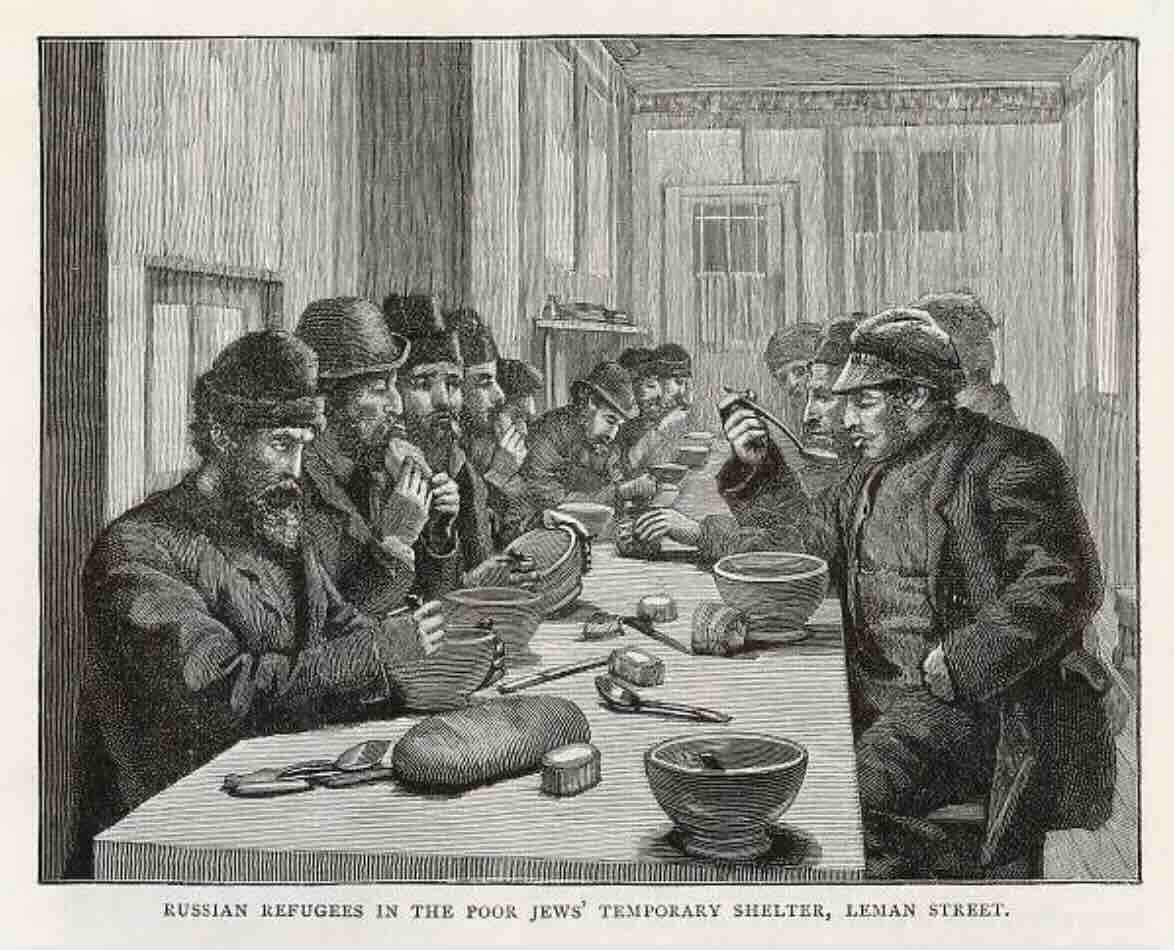
Russian Jews 1890East London, 1890. Source.

In 1889 the Shah Jahan mosque was built at Woking, the first in the country, commissioned by the orientalist Dr Leitner, a Hungarian Jew. A new influx came in the 1890s with around 150,000 Jewish evacuees from the pogroms of Tsarist Russia—some prospering while others toiled in murky sweatshops. The anti-immigration lobby grew; fears of being “swamped” had little justification: “between 1871 and 1910, nearly two million Britons emigrated, far more than the number who arrived”. “Lascars”, a broad term for “Asiatic” seamen, established communities in Liverpool, London, and other ports; Chinatowns began to form. Meanwhile “religion, science, and philosophy joined hands to offer a new vocabulary for racial antipathy”.

During World War One anti-German feeling ran high, egged on by the popular press. Like Satnam Sanghera and Fatima Manji, Winder reminds us of the major contribution of Indian soldiers on the battlefield. But

The First World War was the first time that Britain’s working class had travelled overseas in numbers, and when it returned home, it brought with it a sharpened hatred of all things foreign.

Still, foreign food seemed attractive. Curry had already appeared on the menu of a coffee house in the Haymarket in 1773, and in Hidden heritage Fatima Manji notes a short-lived curry-house in 1810—with a delivery service, to boot. Winder goes on:

In 1931 the Bombay Emporium opened near the Tottenham Court Road, providing the first glimmer of what would later become an indispensable part of British life: the Asian shop. In Portobello, you could buy curry powder, poppadoms, and mango chutney.

Several Indian restaurants opened in Soho, as well as in Glasgow and Cambridge—the beginnings of another culinary revolution. By 1970 there were 2,000 Indian restaurants in Britain (cf. Musical joke-dating).

Winder constantly notes both the stars of industry and culture, and the wretched lives of the exploited sweatshop labourers. Between the wars, new arrivals came from Africa and the Caribbean, mostly students. National independence movements grew. In the 1930s a surge of arrivals from the Irish Free State went largely unopposed. Between 1933 and 1939, some 60,000 Jewish refugees managed to reach Britain—including a dazzling array of cultural figures. Still, anti-Semitism, if “only a pale flaring of the venomous feelings in continental Europe”, was substantial. Nicolas Winton’s Kindertransport stood in rebuke to the British government’s exclusionary policies.

Though Britain’s colonial troops again played a major role in World War Two, fear of aliens was again reinforced. Britain recognised its debt to Polish troops, whose naturalisation after the war attracted little controversy. The following waves of immigrants were not so lucky.

* * *

While all this early history is fascinating, it tends to recede from memory as the story enters the period since World War Two. These were desperate times in Britain, as on the continent (see Lowe, Savage continent). Amidst a labour shortage, the substantial new wave of Irish immigrants was accepted, as were Italian workers—the official beginning of our affair with Italian restaurants and fancy coffee machines. But British racism was clear. The term “immigrants” was fast becoming a polite euphemism for “coloured people”. The popularity of black American troops stationed in Britain during the war had been temporary.

The 1948 Nationality Act gave all imperial subjects the right of free entry to Britain. Despite Britain’s postwar poverty, this seemed a tempting opportunity to a fraction of those now entitled to do so. The voyage of the Empire Windrush attracted much publicity (and anxiety), but it didn’t create a surge of similar voyages; only after 1954 did the exodus gather pace, with London Transport initiating a recruitment drive in 1956. The new West Indian arrivals, though few in number, were unpopular. Caricatures represented by Enid Blyton were being ingrained in children—and their parents.

Over the next decade nearly a quarter of a million migrants arrived from the Caribbean, India, Africa, and Hong Kong, making their way “to the country whose authority they were at last shrugging off”. Migrants were unwelcome in all but the poorest neighbourhoods. Jobs were available, but trade unions were largely hostile; housing was a source of exploitation. The migrants soon became disenchanted with their drab, hostile new home. The government seemed to have no plan:

It declined to take any overzealous measures to prevent immigration, while refusing also to stand up for the migrants themselves.

From India came Sikhs, Hindus, Muslims. Cypriots and Hungarians fled conflict in their home countries. By 1958 the Home Office estimated that there were 210,000 people from the Commonwealth living and working in Britain, three-quarters of them male. Racist resentment grew; teddy boys, egged on by Oswald Mosley, caused havoc.

Whereas male workers had formed the core of previous migrants, the 1962 Commonwealth Immigrants Act (“a preference for muddle over clarity, a refusal to be entirely guided by the promptings of either conscience or prejudice”) led indirectly to the consolidation of migrant families and communities. They became more assertive.

Kenyan Asians found refuge from 1967, and then Ugandan Asians from 1970. But emigration also soared through the 1960s. As tourism and package holidays took  off, more Italian and Mediterranean migrants arrived. By 1971 there were a million Irish migrants, who no longer prompted resentment—though the anti-German temperament endured, recalled by my orchestral colleague Hildi.

Migrants arrived from India and Pakistan, working in factories and setting up corner shops. As National Front youths indulged in “Paki-bashing” rampages, Brick lane, its population now largely from Bangladesh, again became a centre of racist violence.

The Chinese takeaway was becoming a national institution, largely staffed by migrants from Hong Kong. From 50 Chinese restaurants in 1957, numbers grew to 4,000 in 1970 (at a time when there were around 500 French restaurants!). In Sour sweet Timothy Mo gives a gripping fictional portrayal of the Chinese immigrant experience (cf. Ray Man). Despite the common complaint that newcomers refused to “fit in”,

The group of immigrants who made the least effort of all to fit in were the Chinese, who kept themselves to themselves and socialised almost entirely within their own families. Yet they were the least disliked. They kept their distance, and Britain seemed to like it just fine that way.

The Thatcher era from 1979 exacerbated relations. Still, her government soon had to accept 15,000 Vietnamese boat people, rescuing them from “the twin evils of communism and drowning”. Riots took place in Brixton, Toxteth, and Southall. While noting the violence unleashed between different communities from the Indian subcontinent, Winder observes that no-one liked to admit that “Britain’s urban culture was itself incorrigibly tough and brawling”. The terms “ethnic minorities” and “multiculturalism” came into use; schooling and religious instruction became hotly-debated issues. But

No-one could deny by now that Britain’s railways, hospitals, shops, cafés, and restaurants would have ceased to function without migrant workers.

The collapse of the Soviet bloc regimes, along with ongoing crises around the world, led to new surges. Fundamentalist Islam, the Rushdie affair, and 9/11 posed yet another challenge to Britain’s tolerance of migrants. In 2005 the 7th July suicide bombings in London reinvigorated Islamophobic sentiments in some quarters and made others question the nation’s cosmopolitanism. But somehow a violent backlash was avoided.

Distinctions collapsed between refugees, asylum-seekers, and economic migrants. Measures of successive governments became more draconian while the processing system descended into chaos. The idea that Britain might benefit from migration held little sway. The mass media “seemed eager not just to report discord but to sow it”. The “debate”, if it can be called that, was (and remains) rancid and polarised.

Leaving aside the barmier claims that migrants are all disease-ridden, criminally inclined scoundrels who have no place in our well-mannered, sceptred land, there is a sensible argument that they have been arriving on a scale that stretches our strained welfare resources, provokes social unease (true, though holding the migrants alone responsible is mischievous) and provides, in some cases, cover and opportunity for criminals. The opposing argument states that the demonisation of asylum-seekers is both vindictive and misjudged. It looks at a system that imprisons young children for months, and concludes that we are neglecting our moral duty. It suggests that asylum-seekers bring cultural enrichment as well as entrepreneurial drive: above all, they are individuals striving to live by our own ideals for self-improvement and betterment.

The awkward thing about these two extreme views is that they are both true, or contain truth. Immigrants are not all the same. They represent the full spectrum of human types: dreamers and schemers, rascals and rogues, saints and villains.

For the 2013 edition Winder added the chapter “Choppy waters”, with the Conclusion “Identity Parade”. Though forecasters wildly underestimated the number of those who would take advantage of the 2004 enlargement of the EU to come to Britain, it didn’t submerge the island—and it did provide us with a new generation of trusty Polish workers. Many of the new arrivals didn’t intend to stay.

On nostalgic portraits of English life by Betjeman and Orwell, Winder comments

People who contrive thumbnail sketches of national identity are usually lamenting the passing of their own youth, the fraying of the iconography with which they grew up.

He ponders issues of identity and belonging, observing that statistics are unreliable and open to conflicting interpretations. Aware of the problems of segregation, Winder is not uncritical of multiculturalism. He explores whether integration and diversity are mutually exclusive.

* * *

So I’m not sure quite what we can learn here from the famous Lesson of History. In the Preface to the 2013 edition, Winder explains:

I was not seeking to imply that Britain owes everything to immigration; I was merely drawing attention to a common oversight, which was that the role played by immigrants in the story of Britain has been understated and overlooked. […]

Even if entrenched communities were open to such messages, they might hardly profit from realising that we’ve always been both xenophobic and hospitable, or that migrants assimilate eventually. Still, it’s highly necessary to press the case, and among the vast literature on the topic beyond the rabid pages of the Daily Hatemail, this is a great place to start.

Note also the Migration museum in Lewisham. Cf. Hidden heritage, Vermeer’s hat, and Pomodoro!.


[1] Reflecting the history of migration, a 1743 Huguenot church in Brick Lane became a synagogue in 1898 (after an interlude as a Wesleyan chapel), and then a mosque in 1976 (see also this site).

The Ghost Festival

SGL guiwangGhost King, South Gaoluo.

Today is the Ghost Festival in China, so I’ve been reflecting on calendrical rituals (further to my In search of the folk Daoists of north China, pp.7–8). Usually I draw attention to ritual days, but this seems to be one that I’m inclined to downplay.

XJY yankou 2003Yankou at Xujiayuan temple fair, north Shanxi 2003.

As one of the Three Primes (sanyuan 三元) over the annual calendar, the Ghost Festival (Guijie 鬼节, formally Yulanpen jie 盂兰盆节) on 7th moon 15th seems like a major event (see e.g. Stephen Teiser, The Ghost Festival in medieval China). On this evening, groups of temple clerics (both Daoist and Buddhist) still hold Flaming Mouth rituals (yankou, shishi) to exorcise the community, although they were surely performed more commonly before the pervasive impoverishment of temple life over the 20th century.

LQ yankou 1982Li Qing’s 1982 copy of the Li family Daoists’ shishi ritual manual.

There’s an extensive Chinese literature on this complex, lengthy Tantric ritual, but the Ghost Festival is far from its only context—besides other temple fairs over the annual cycle, it is (or was) routinely performed for funerals (see many posts under Local ritual).

Notwithstanding the importance of the Ghost King (Guiwang) and the Ten Kings of the Underworld (Shidian Yanjun) in village pantheons, in my experience of rural north China, 7th moon 15th is not (or is no longer?) a major day for rituals with liturgists presiding. Perhaps its liturgical importance varies by region; I’m not sure it depends on the community still having a viable temple, since ritual buildings can be re-activated for important ritual purposes. In my DVD Doing Things on ritual life in north Shanxi, §B5 has brief excerpts from a yankou performed by Buddhist monks for the “main day” of their village temple fair—which falls on 7th moon 3rd, not 15th.

Worshipping the ancestors, Xinzhou 7th moon 15th 1992.

What does endure is the custom of domestic offerings, burning paper at the ancestral graves, as we found in 1992 in Xinzhou on our trip through north Shanxi. Neither there nor in Yanggao is it a day to summon household Daoists to perform rituals.

zhaobeikou-lakeThe Zhaobeikou ritual association leads Releasing Lanterns ritual on Baiyangdian lake,
7th moon 15th, 1993.

For village associations on the Hebei plain, 7th moon 15th may have become less of a focus for communal observance over the 20th century. But the aquatic setting around the Baiyangdian lake (click here) prompts village ritual associations there to go on procession to “Release River [or Lotus?] Lanterns” (fang hedeng 放河/荷燈). Similar rituals are held in nearby counties such as Langfang. in Bazhou, the Zhangzhuang association, with its active group of liturgists, was one of few still performing yankou on the 15th. The association of Lesser Huangzhuang, Jinghai, performed Releasing God Lanterns (fang shendeng) on 1st moon 15th and Releasing Ghost Lanterns (fang guideng) on 7th moon 15th. Around Houshan, the major days to worship the goddess Houtu are 3rd moon 1st and 15th, but 7th moon 1st and 15th also attract many pilgrims.

So we may come across a range of exorcistic behaviour on 7th moon 15th: from burning paper at the ancestral graves, to processions Relasing the Lanterns, to full-scale yankou rituals.

As to the other days of the Three Primes, 1st moon 15th is the day around which the main annual rituals revolve (whereas only domestic offerings are made on New Year’s Day—e.g. Gaoluo); the ritual segments performed are exorcistic, like those for 7th moon 15th. But (again for north China) I haven’t heard of major communal observances for 10th moon 15th—leads welcome…

Anyway, the ritual days of the standard national calendar may arouse false hopes, requiring verification on the ground; once one gets down to the grassroots, other dates may require important calendrical rituals for local deities. In south China, even the major liturgical days of the 1st moon vary by locale. This is a significant fieldwork lesson: to see beneath the tip of the iceberg of temple practice and prescriptive history to digest folk observances at the grassroots (cf. Debunking “living fossils”).

Cf. Calendrical rituals, and for Bach and Saxony, The ritual calendar: cycles, seasons.

Selected readings on WAM

BTW, I suspect a WordPress glitch may have failed to notify email subscribers of
my recent post on Nicolas Slonimsky’s wonderful memoir Perfect pitch
and it’s Jolly Good, just saying…

I’ve just revised my introductory page on Western Art Music, with the addition of an off-piste selection of general writings that I find stimulating.

It extends from works within the field itself (Taruskin, Ross, Slonimsky, McClary, Butt, Lebrecht) to the broader perspectives of ethnomusicology (Becker, Small, Nettl) and ethnography (Finnegan, Cottrell, Tindall, Warnock).

China not forgotten!

Over a summer hardly bathed in sunshine, but enlivened by football, tennis, Istanbul, and Proms, it may look as if I’m somewhat neglecting China. Still, just since May, posts include

China even plays a cameo role in

Actually, that should be enough to keep you busy (not to mention all the fieldnotes under Local ritual)—indeed, a little break might be welcome… I’m working on several new essays for my site, but in the interim I regularly post on Twitter—other recent China retweets including

Coming up soon is a reminder of a crucial theme, still little addressed:

It’s always worth reminding people of my work on the Li family Daoists:

And we should bear in mind the alternative perspectives of Tibetan, Uyghur, and Taiwanese cultures.

There’s a certain random quality to the topics of some of these retweets, but as with my original articles, I like to keep people guessing, and to remind readers of posts which may have escaped attention, or seem particularly apposite. So you may care to check my Twitter feed, or even “follow” me there…

Nina Simone

*Part of my strangely extensive jazz series!*

NinaSource.

Such is my devotion to Billie Holiday that I’ve never quite been able to warm to Nina Simone (1933–2003). But my interest has been revived by listening with rapt admiration to Feeling good (1965). It opens with an all-too-brief free-tempo alap, brusquely interrupted by the incongruous sleazy riff: *

The title isn’t so ironic as it sounds. Written by (white) English composers Anthony Newley and Leslie Bricusse for the musical The roar of the greasepaint—the smell of the crowd, satirising the British class system, the UK premiere was given by Cy Grant in the role of “the Negro” singing the song as he “wins” the game; it was described as a “booming song of emancipation”. When the show transferred to New York the following year, the role was taken by Gilbert Price. Nina utterly transforms the song, but the optimism of its lyrics is remote from the activist songs that were becoming the core of her repertoire just at that time.

* * *

Within the milieu of the day, few musicians were angels. Jazz biographies from the, um, Golden Age tend to follow a depressingly familiar trajectory of self-destruction: pain, drugs, exploitation, disastrous choice of partners, violence, disillusion, and legal woes. Despite all these features, Miles’s autobiography is strangely inspiring, tough but never helpless (for a lengthy sample, see Miles meets Bird). White musos could be no less self-destructive—few more so than Chet Baker.

For Nina, besides wiki and ninasimone.com, I’ve been reading

  • David Brun-Lambert, Nina Simone: the biography (2005).

Among documentaries is Nina Simone: the legend (Frank Lords, 1991), What happened, Miss Simone? (Liz Garbus, 2015; trailer), and The amazing Nina Simone (Jeff L. Lieberman, 2015; trailer).

The sixth of eight children in a poor North Carolina family, Nina was a child prodigy at the piano; “Bach made me dedicate my life to music”. After graduating from high school in 1950, she seemed destined to become “the first black American concert pianist”. So the original, lasting, deep wound in her psyche was being refused admission to study at Curtis—which she attributed to racism. Thwarted in her classical ambitions, she continued to study privately with Curtis professor Vladimir Sokoloff for several years, funded with a regular gig at a nightclub in Atlantic City—only taking up singing because the job demanded it.

While Nina’s classical piano training would later give her a cachet among respectable white audiences, I seem to have reservations about singers accompanying themselves at the piano, like Ray Charles. Distinctive and original as her playing was (e.g. her “destabilising” 1969 album Nina Simone and piano), it was at a tangent from jazz: stark, based on melody, hardly admitting any harmonic interest—by contrast with her cohorts in the jazz scene like Monk, Herbie Hancock, or Bill Evans. But this musical simplicity threw greater focus on her political message.

By the late 50s, as her career was taking off, her dream of fame as a classical pianist had evaporated. The civil rights movement was growing. In Greenwich Village she began hanging out with James Baldwin, Langston Hughes, LeRoi Jones, and Lorraine Hansberry. Her 1961 visit to Lagos with Baldwin, Hughes, and others as part of a delegation of the American Society for African Culture was her first time in Africa.

Now married to a violent husband and manager, she gave birth to her daughter in 1962. Her entry into the civil rights struggle was embodied in her 1963 song Mississippi goddam. Nina’s activism, and the wider civil rights background, is extensively covered by Brun-Lambert, with detail on her involvement with Martin Luther King, Malcolm X and the Nation of Islam, Miriam Makeba, the Black Panthers, riots, marches, and the whole ferment in black popular music through the 1960s.

By 1970, exhausted and disillusioned, Nina seemed to have reached the end of the road. In later life she largely avoided the USA for fear of legal battles; while still touring, she sought refuge in Barbados, Liberia, Switzerland, Holland, and France, lonely and estranged from her daughter, her relationships fraught and short-lived; among a succession of managers, some had better intentions than others. Her mood-swings and behaviour on and off stage had long been volatile, becoming ever more apparent; the diagnosis of bipolar disorder was belated. Brun-Lambert describes her as “leading a double artistic life, unable to find her own place anywhere”.

* * *

Nina Pastel cover

Turning to Nina’s songs—as ever, there’s a vast selection on YouTube, notably this channel—below I give a mere sample.

In her early years she sounds benign enough, like the New York Town Hall concert in September 1959, “still without trace of savagery or sexuality”, as Brun-Lambert puts it:

Still, her interpretations, such as Summertime, are distinctive. Billie Holiday had died in July that year; a couple of years earlier she had immortalised Fine and mellow in the most enthralling TV film ever. Nina sang it for her Town Hall finale.

“Her first song with explicitly black consciousness” was Flo Me La at the Newport festival in 1960 (from 20.52):

Among several appearances at Carnegie Hall, here’s her 1964 concert (as playlist):

The programme introduced activist songs such as Old Jim Crow, Go limp, and Mississippi goddam into the genteel surroundings. And she is just right for Brecht/Weill songs like Pirate Jenny!

Singing The house of the rising sun at the Village Gate in 1961, she sounds rather mellifluous:

By 1968, live at the Bitter End Café, her voice is harsher and more experimental:

The final number on her troubled 1965 album Pastel blues (here, as playlist) is Sinnerman, “about despair, disenchantment, disillusionment in the face of a situation that offers no alternatives but flight or prayer” (Brun-Lambert). Before that comes Strange fruit, just as visceral as Billie’s 1939 recording and 1959 performance. Nina’s concert in Antibes that year included some songs from the forthcoming album—opening with a disjointed intro that segues into Strange fruit:

And here’s Four women, live in 1965:

After the assassination of Martin Luther King in 1968, she sang Why? (The king of love is dead)—here’s a full version live that year:

In 1967 she recorded I wish I knew how it would feel to be free—here’s her 1976 Montreux performance:

Again, I find some of these casual piano accompaniments, and even her voice, disconcerting—but maybe that’s the point.

That’s probably enough to outline the story of Nina’s heyday; in her later career she largely repeated such standards—after the original creative impetus had diluted, and as her mental troubles escalated. She had been touring in England since 1967—it’s worth hearing her live at Ronnie’s in 1985:

To encapsulate ecstasy and pain, for me it’s always going to be Billie… I may be romanticising the devotion of jazzers to their art (cf. the wonderful image of Donald Byrd practising on the subway), but I detect no inkling of any such devotion in Nina: any musical discipline that she practised seems to have been at the keyboard. She formed no bonds with her fellow musicians.

While one gets little impression that she honed her vocal skills, in early recordings like Black is the color of my true love’s hair and Wild is the wind (in the 1959 Town Hall concert) she sounds genuinely intimate, even sweet—far removed from her later image. Still, music is about society: Nina’s voice developed into a genuine expression of the troubled times, part of the necessarily strident style that emerged from the civil rights struggle.

Under A jazz medley, see e.g. Green bookDetroit 67 and Memphis 68, as well as A Hollywood roundtable, The Tulsa race massacre, and Black and white.


* Feeling good has been much covered—rather than featuring other versions, here’s Trane in 1965:

And although nothing can compare with the raw emotion of being black in those years, here’s Andrea Motis in 2012:

Not being pedantic or anything [Uh-ohEd.], the title seems to be cited more commonly as Feeling good than as Feelin’ good (zzzzz). Cf. I got a woman, note here.

Another Turangalîla at the Proms!

Prom Messiaen

Photo: Chris Christodoulo. Source.

One should never miss a live performance of Messiaen’s ecstatic Turangalîla-symphonie!!!

My Messiaen page has links to many posts on Messiaen, and a tribute to Turangalîla—with the NYO’s 2012 Prom performance, and some hilariously uncomprehending reviews of the 1949 premiere (“Dorothy Lamour in a sarong […] Hindu Hillbillies”, “straight from the Hollywood cornfields”).

ondes

Ginette Martinot, who gave the premiere of Turangalîla. Source.

Last week at the Proms it was directed by the enterprising Nicholas Collon, with the BBC Philharmonic (British orchestras dominating so far; European and US bands can wait till later in the season). Cynthia Millar, veteran of the ethereal ondes martenot, added yet another radiant performance of a piece she has played around 200 times, including several Proms since 1986—for players limited to such a small repertoire, * Messiaen is a blessed gift (see Millar’s tribute to Jeanne Loriod). Steven Osborne relished Messiaen’s unique piano writing, with a niche backing-group of celesta and glockenspiel right behind him. I’m always entranced by the hushed coda that concludes the 4th movement, before the exhilarating Joie du sang des étoiles. Sensuous orchestral timbres abound.

Tlila 6

Source.

While experiencing Turangalîla live is extraordinary, for balance it’s worth listening on BBC Sounds, and it’s on iPlayer too. At the Proms it was first heard in 1969, with Musica Reservata performing Renaissance music in the first half (surely I was there, so why isn’t it indelibly etched in my memory?!). This time the prelude was the world premiere of Anna Clyne’s The gorgeous nothings, with the seven-piece a cappella Swingles, amplified, joining the orchestra—reminding me to acquaint myself with the poetry and reclusive life of Emily Dickinson. For a groovy encore (Erica Jeal asks pertinently “Is it bad etiquette to give an encore that upstages the main work?”) the Swingles launched into their joyous arrangement of the Bulgarian dance piece Bučimiš (studio version here; its metre is 2+2+2+2+3+2+2, BTW—see Taco taco taco burrito!). An encore after Turangalîla seems inconceivable—but in 2012 the NYO found a perfect one—Anna Meredith’s Handsfree!

Fans of the ondes martenot will want to hear the theremin too! Many more a cappella gems here; more Bulgarian folk under Musical cultures of east Europe.

Other recent Proms treats include Ravel‘s delightful piano concerto (with Ives’s Three places in New England), and Gershwin’s Rhapsody in blue (Steven Osborne again).


* This site mentions 1,200 works (!), although the core concert repertoire consists of pieces by a mere 27 composers.

Ondes octet

Some niche Olympic sports

Poodle clipping

Poodle Clipping, Paris Olympics 1900.

For the Paris Olympics, Call Me Old-Fashioned [What, again?Ed.] but I mainly favour the traditional sports, like tennis (Nadalcaraz together in doubles?! WOW) and football—easing the withdrawal symptoms after the Euros (for which I crafted wonderful folk playlists) and Wimbledon.

You had to be quick to catch the Rugby 7s, not just because the tournament began and ended early, but because the matches don’t last long (although how long seems to be a closely-guarded secret). It’s glorious because it’s basically running around like fuck and scoring loads of tries, dispensing with much of Rugby Union’s boring faff like falling over on top of each other, set-pieces, trying to work out arcane rules, and all that pompous cerebral preparation to kick a conversion.

Olympics 1908

Gradually, with the essential aid of expert commentary, one gets drawn into the more niche activities—like Beermat Flipping, Treacle Volleyball, Malteser Shot-Putting, Bonzai Flatpack Assembly, and Synchronised Underwater Hamster Dressage.

Another popular event is The Sound of One Hand Clapping, in which Japan still has a monopoly. The Chinese, not really perpetuating the Daoist tradition of wuwei non-action, now excel at Lying Flat 躺平, but their governing body doesn’t seem keen to get it ratified by the Olympic Committee.

Monty Python got there first with such fantasy:

As to the relay, here’s Mark Simmons:

I love the Olympics. My friend and I invented a new type of relay baton. Well, he came up with the idea, I ran with it.

And turning to table tennis, allow me to remind you of this fine headline:

King Kong Ping-Pong Sing-Song Ding-Dong

See also under A sporting medley: ritual and gender. As I have noted, my viewing stats from WordPress * somewhat resemble a fantasy Olympic medals table:

Medals table


* You may be as dismayed as I am that these stats have begun to address me as “Howdy, StephenJones.blog”. Another sign of The End of Civilisation As We Know It…

The hidden musicians

Finnegan cover

  • Ruth Finnegan, The hidden musicians: music-making in an English town
    (first edition 1989, revised 2007).

In several posts I’ve praised Finnegan’s classic work en passant—and revisiting it now, I find it even more impressive. I struggle to encapsulate its virtues without citing every paragraph.

Its subject is local grass-roots musicking in Milton Keynes, mainly at the amateur end of the amateur–professional continuum, so often taken for granted. It’s a model of participant observation: Finnegan was a long-term resident of the area, with most of her material collected from 1980 to 1984. Writing in an accessible style, she constantly debunks facile assumptions.

Having started out by studying oral performance in Africa, Finnegan now embarked on a project concerning doorstep (rather than armchair) ethnomusicology. The hidden musicians soon became core reading for the ethnomusicological study of musicking in Western societies, including Western Art Music (for which she abides by the traditional term “classical music”).

An attention to “ordinary musicians” was already implicit in the ethnomusicological approach to more “exotic” societies (note Bruno Nettl’s masterly survey of the field), but it is all the more revealing for a culture so near to home. In The hidden musicians, references to research on other world cultures, standard for such studies, might have been instructive, but the economy of theory and jargon is welcome. Among Finnegan’s main inspirations is Howard Becker’s 1982 study Art worlds. In 2022 her work inspired a BFE conference (in Milton Keynes, to boot, where the Open University is fortuitously based) on “ordinary musicians”, addressing topics in societies around the world.

The opening of the book anticipates that of Christopher Small’s Musicking (1998), observing the diverse ways in which music-making pervades people’s lives. Like Small, she focuses on “musical practices (what people do), not musical works (the ‘texts’ of music)”—seeking processes rather than products. She finds “an invisible but organised system” that lies at the heart of our cultural lives.

After an important chapter unpacking gradations on the amateur–professional continuum, in Part Two Finnegan outlines the diverse yet overlapping musical worlds of classical music, brass bands, folk music (including ceilidh and Morris bands), musical theatre (amateur operatic societies, panto, and so on), jazz, Country and Western, rock and pop. She disputes the “mass society” theory that ”envisages a passive and deluded population lulled by the mass media and generating nothing themselves”, as well as simplistic socio-economic or age-based analyses. She challenges assumptions, such as “high culture”, and, taking a descriptive rather than prescriptive approach, she finds

several different musical worlds, […] each having its own contrasting conventions about the proper modes of learning, transmission, composition, or performance. Because the pre-eminent position of classical music so often goes without saying, the existence of these differing musics has often simply been ignored.

If the pre-eminence of classical music was only notional by the 1980s, her material does indeed seem to confirm this unspoken assumption. Conversely, social scientists have emphasised “popular” or “lower-class” activities such as rock. But

each musical tradition—classical, rock, jazz, or whatever—can be studied in its own right. When no longer judged by the criteria of others, each emerges as in principle equally authentic and equally influential in shaping the practices of local music.

Part Three, “Contrasts and comparisons” opens with an insightful chapter on learning music (cf. the Growing into music film project). While Finnegan largely concurs with the notional dichotomy in training between the worlds of classical and popular musics, she notes commonalities. “Performances and their conditions” perceptively compares the conventions of events belonging to different musical worlds, noting aspects such as preparation and audience behaviour. In “Composition, creativity, and performance” she investigates degrees of dependence on written texts (cf. studies of “improvisation”, for which we can again consult Nettl as a handy guide). And in Chapter 14, preparing the ground for her later metaphor of “pathways”, Finnegan refines the concept of musical “worlds”, noting their plurality, with a certain overlap, and wider connections further afield; they are “relative, shifting, and situational”.

Part Four, “The organisation and work of local music”, contains chapters on the home and school; the churches; clubs and pubs; a case study on the organisation and administration of the Sherwood Choir; small working bands; resources, rewards, and support (including music shops and recording studios—with more on the amateur–professional continuum, and patronage).

With amateur music, people’s time and work are often as important as their money. So too are non-monetary rewards such as aesthetic enjoyment, the pleasure of performing, status, the sense of creativity, or even just the symbol of having earned “a fee” irrespective of its actuall monetary price. This in turn chimes in with a series of commonly held values: the high worth commonly attached to “performance”, to “music”, and to working for a “good cause”, as well as the view held by many people that “doing your own thing” has something inherently valuable about it—or, at the least, that the various groups organised to pursue different ends are an acceptable part of modern life.

It would be too simple just to assert—as some do—that local music is supported by “the community” or to speak of it as essentially “community music-making”. There are too many different interests, sections, conflicts, and unfamiliarities to take that romantic picture. Nevertheless there is a grain of truth in this view. For local musical activities only remain possible through the support of a complex network of institutions, many of them essentially realised by local participants at the local level whatever their wider links: not only the continuing moral, social, and financial (as well as musical) input of local musicians, but also the local music shops, studios, businesses, special interest groups, bands, performers, musical societies, pubs, personalities, fund-raising groups, schools, churches, and charities.

In Part Five, “The significance of local music”, Finnegan asks

Are there wider implications that can be drawn out from this system of local music-making? This part builds on the earlier ethnographic material to explore such questions as what local music practice and its pathways mean for those who live out their lives in the urban (perhaps impersonal?) setting of modern society or for the rituals and functioning of our society and culture more generally. Finally—and on a more speculative level—are the many many small acts and decisions which, however little recognised, lie behind the continuance of music-making of any wider significance for the fundamental experience and reality of humankind?

Again, she never falls back on untested assumptions. Critical of the familiar paradigms of the city as inimical to personal control or warmth, and of the romantic sense of “community”, she finds diversity in terms of education, wealth, and occupation—though she does conclude that gender roles remain hard to break through. She reflects on participation by age; and on the ordering of time, noting regularity—along with “rehearsals”, “concerts” and “gigs”, life-cycle and calendrical events (my term, not hers) are important social contexts.

She elaborates on “pathways” in modern living, stressing that they “depend on the constant hidden cultivation by active participants of the musical practices that, with all their real (not imaginary) wealths and meanings, keep in being the old and new cultural traditions within our society.” Finally, in “Music, society, humanity”, she broaches concepts such as sociability and the search for value; and she ponders, with typical detachment, whether music is somehow different from other social activities.

* * *

In her Preface for the 2007 edition, Finnegan reflects on golden-age nostalgia, change, ebb and flow rather than decline, new technologies, immigration. She outlines gaps in her study, and how one might update it: she might now pay more attention to mass media, constantly expanding since the 1980s, and the role of cultural, religious, and ethnic “minorities” (then less evident in Milton Keynes than in many English cities) would certainly now play a greater role, including South Asian, Irish, Italian, Polish, Vietnamese, and Somali subgroups.

While it’s an urban study, Finnegan’s book has influenced ethnographers in diverse fields, including my own study of Gaoluo village. As she comments, in a passage that applies verbatim to my work there and on the Li family Daoists, her research

enlarged and challenged my own preconceptions, […] tied in to an activity to which I attached real value, and presented me with some complex intellectual, methodological, and moral challenges. […] I was dealing with something that I personally enjoyed and found inspiring. Most of all it involved human beings, not just abstractions or generalisations, and the complex and diverse pathways they both trod and created irrespective of the ways scholars thought they should be behaving. In the end, I still like this study because it is about real people in a real, not pseudonymous, place that existed and exists: about people actively engaging in intensely human practices in which they took trouble and pains, in which they experienced disputes and sociability—and, rightly, delight.

Note the roundup under Society and soundscape, particularly What is serious music?! and Is Western Art Music superior?. See also Just remind me again, what is music?! and Old and new musics. Cf. Das Land ohne Musik, and for lowly tennis players and “ordinary Daoists”, here.