A Daoist serves a state troupe

17 troupe 1959

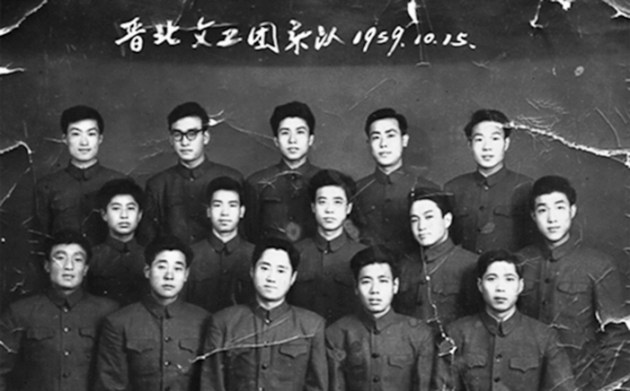
North Shanxi Arts Work Troupe, Datong 1959. Li Qing front row, far right.

My post on the folk–conservatoire gulf reminds me of the brief sojourn of the great household Daoist Li Qing in the grimy coal city of Datong as a state-employed musician. Indeed throughout China, many “folk artists” were recruited to such troupes, like wind players Hu Tianquan and Wang Tiechui. Daoists were also enlisted (see e.g. Ritual life around Suzhou, §5); Daoist priest Yang Yuanheng even served as professor at the Central Conservatoire in Beijing until his death in 1959.

But under Maoism the “food-bowl” of the state troupes was short-lived; most employees were soon laid off. And while in the troupes, performers’ lives were no picnic: the whole society was poor, all the more so during the Years of Hardship while Li Qing was employed.

The following is adapted from ch.5 of my Daoist priests of the Li family.

In the early years after the 1949 Liberation, religious ritual in Yanggao had persisted despite sporadic campaigns and the nominally atheist stance of the new Communist leadership. But by 1954, as collectivization began to be enforced ever more rigidly (see here, under “Famine in China”), creating ever-larger units which made it hard to protect local interests, and with ambitious new mobilizations taking up more and more time, it was becoming increasingly hard to “do religion.” The main thrust of campaigns may have been economic, as household enterprises were forced into inactivity; but “eliminating superstition” was never forgotten, and was to be one explicit slogan of the 1958 Great Leap Forward.

Li Qing eats off the state
When not busy laboring in the collective fields or doing rituals, Li Qing enjoyed playing his beloved sheng mouth-organ in the village’s amateur “little opera band”, accompanying both the majestic “great opera” (Jinju) and the skittish local errentai duets. In the bitter cold of the first moon in 1958 Li Qing, now aged 33 sui, made the journey to Yanggao county-town to take part with his village band in a secular arts festival there. The county cultural authorities were choosing musicians for their Shanxi opera troupe, [1] and were keen to recruit Li Qing. But scouts attending from the prestigious North Shanxi Arts Work Troupe in the grimy regional capital city of Datong pulled more weight, and it was for this ensemble that he was now chosen. In this period regional arts-work troupes and county opera troupes throughout China commonly recruited Daoists and other folk ritual performers as instrumentalists (see e.g. under Ritual life in Suzhou). Li Qing was to spend nearly four years in the troupe. Thus, although they made regular tours of the countryside, he was protected somewhat from the worst excesses of the Great Leap Forward back home.

In 2011, to learn more about Li Qing’s time in the troupe I visited Datong to seek out some of his former colleagues there—Li Manshan and Li Bin had already bumped into a couple of them on trips there.

It’s good to see my old friend Bureau Chief Li again. We track down two old musicians from the troupe and invite them round to his posh flat where I am staying the night. It would make a tranquil venue, but since it is the time of the Mid-Autumn festival, an auspicious time for weddings, our chat is regularly punctuated by deafening firecrackers echoing around the high-rises, so that the soundtrack evokes the battle of the Somme.
datong

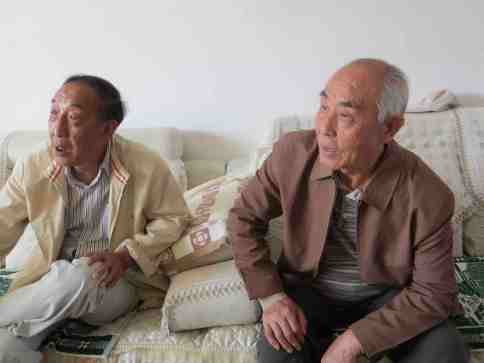
Li Kui (left) and Zhang Futian, Datong 2011.

Li Kui, who played erhu fiddle in the troupe, and the effervescent Zhang Futian, a dizi flute player, both born in 1939, were 19 sui when they joined, thirteen years younger than Li Qing. Wary of hagiography as I am, all those who met Li Qing remain moved by his kindly soul and unsurpassed musicianship. Those years were not just a contrast to the rest of his life but a unique period for everyone. Recruitment to a prestigious state ensemble may sound grand—until you realize not only the desperate conditions of the late 1950s but that they spent much of the year touring the ravaged countryside on foot. Still, for them the period has a bitter-sweet nostalgia that I can’t help sharing. My visit provides an excuse for them to get together to reminisce about old times—they are so loquacious that I rarely get to chip in with a question.

Li Qing went off to Datong to take up his new job in the 8th moon of 1958, just as the Great Leap Forward was being rolled out to great fanfare. Even if he had a choice about taking the job, he can have had little hesitation. With Daoist ritual business, and society as a whole, going through such a tough period since the enforcement of collectivization, he would have been grateful to get on the state payroll.

The Party officials of the troupe must have found out about Li Qing’s rich-peasant status but drawn a veil over it. Throughout the Maoist period, the Yanggao cultural cadres didn’t dare have any contact with the Daoists or even the shawm bands—but the Datong troupe leaders didn’t need to know that Li Qing was a Daoist. His colleagues would find out, but everyone understood there was no need to discuss that kind of thing. He didn’t talk much at first, but became more chatty as he felt more at ease. For his closest friends he even furtively held sessions to determine the date.

The new troupe, based in a compound at no.13 Zhengdian street, was an amalgamation of the North Shanxi and Xinzhou regional troupes. Eight or nine musicians were recruited to the band at first, gradually increasing to around sixteen; with singers, dancers, stage crew, and cadres, the troupe consisted of around sixty people. Its reputation was second only to the troupe in the provincial capital Taiyuan.

Li Qing now found himself accompanying stirring patriotic folk songs and short simple instrumental compositions in revolutionary style. As a household Daoist, he was a born musician, and effortlessly versatile. Apart from his old vocal liturgy and the “holy pieces” of the shengguan instrumental music, he knew a wide range of more folksy instrumental pieces played on procession and for the popular afternoon sequence, and he had the local opera repertoire in his blood.

Dancer Feng Yumei, also from Yanggao, arranged some of the earliest dance suites in folklore style, like “The Earth around the Yellow River” (Huanghe yifangtu), considered one of the earliest and best creations in the idiom. The troupe performed a new opera composed in Hubei, later made into a film.

Li Qing was the only Daoist in the troupe; the only other instrumentalist from Yanggao was the fine gujiang shawm player Shi Ming (1932–2003) from Wangguantun just northwest (see also my Ritual and music of north China: shawm bands in Shanxi, p.22). They remained lifelong friends. Shi Ming, already 27 sui, had an eye for the dancers, but they preferred the younger more eligible guys, like Li Kui himself! The troupe’s star soloist on the suona shawm was Yang Xixi from Xinzhou. Our friends ranked him alongside the nationally celebrated virtuoso Hu Tianquan, also a native of Xinzhou, mainly renowned for his sheng playing. Li Qing sometimes played Yang Xixi’s guanzi for fun.

As the only sheng player in the troupe, Li Qing accompanied Zhang Futian’s flute solos. Sometimes he played solos himself, accompanied on the accordion by one Ma Yun, over 50 sui in 1958. One solo that his colleagues recall was a Napoleonic Marche du Victoire (Kaixuan guilai), perhaps even the March from Aida. Imagine—Li Qing even performed a foreign piece! He played with feeling, and was infinitely adaptable. The conductor never criticized him; if he made the slightest error, he would correct it at once. Zhang Futian’s appraisal was still higher than that of the local Daoists: “He was a genius—the greatest musician I ever met.”
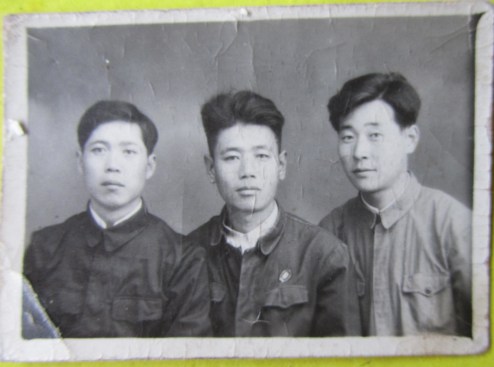
WGT trio_2

Li Qing (left) with fellow wind players Yang Xixi and Shi Ming, 1959.

No less impressive was Li Qing’s personality. Affable and generous, he had no temper. Even if he got ill, he never asked for leave. He earned a reputation for generosity and for smoothing over disputes in the troupe; his mere presence was enough to ease any tensions within the group. In a society where mutual suspicion was fostered and nasty rumours spread rapidly, he had no bad words for anyone, and bore no grudges. Folk musicians prided themselves on loyalty (yiqi).

The salary system was graded. Ordinary members got 25 kuai a month, most of the band 35 kuai. Relatively senior, Li Qing was soon considered an “old artist” (laoyiren), getting 45 kuai a month. The wind players and dancers got an extra 2 liang in rations.

During his time in the troupe Li Qing learned the modern system of notation called jianpu “simplified notation,” which uses the Arabic numerals 1 to 7 to represent the solfeggio pitches of Chinese gongche notation. [2] Though simple, it never caught on in the countryside; for the Daoists, traditional gongche remained in place as a means of learning the outline of the shengguan instrumental melodies, and they had no need of any notation at all to learn all the complex vocal hymns. The gongche solfeggio translates rather easily into numerical notation. The latter was used in the troupe to learn new pieces, but Shi Ming didn’t take to it, so Li Qing helped him learn them. Li Qing was to put this new skill to use from the 1980s when he used it to write scores of his Daoist repertoire.

For much of the year the troupe went on tour through the impoverished countryside, doing over a hundred performances a year. Apart from visits further afield in north China, they toured throughout north Shanxi, including Yanggao villages—mostly on foot, sometimes with horses and carts. Sometimes they slept in peasant homes, dispersed among several suitable families by the village brigade, or in the village school; or they put up a big tent. They took their own food, and stoves to cook it on. Li Qing didn’t smoke or drink, but the others drank laobaiganr liquor from a little flask; at first the troupe supplied them with packs of Happiness cigarettes, but later they were reduced to picking up fag-ends after a gig and rolling them into a new one. Their program was written in ink and stuck up as a poster. It was a tough life—Zhang Futian admits he got fed up with it.

Over these four years Li Qing was only able to go home once or twice a year for a couple of days, bringing only a bit of money, but no food. His wife, alone with four children to look after, never visited him in Datong. Li Manshan only went to see him once, in 1961; but soon after he arrived, Li Qing had to go off with the troupe to Harbin in northeast China to perform, so he could only go to the station with his father before taking a packed windowless bus back to Yanggao town and walking home from there.

For several generations the Li family’s exquisite sheng mouth-organs had been made by the Gao family in Gaoshantun near Upper Liangyuan. In 1961 Li Qing managed to get an invitation for the elderly master Gao Bin (1887–1967) to spend ten days with the troupe mending his various sheng, when Gao was really down on his luck; even the meager pickings in the troupe’s canteen probably saved his life.

Like many state work-units throughout China, the troupe was cut back in 1962, and Li Qing returned to his village early that spring. With such relocations, by 1963 some 84% of the Chinese population were living in the countryside—the highest proportion in the history of the People’s Republic. [3]

The troupe staggered on until it was disbanded in late 1962. Some of its members were recruited to the provincial song-and-dance troupe in Taiyuan, some of the Xinzhou contingent found work back home, while others like Li Qing and Shi Ming had to return home to their starving villages. Several of the performers went on to wider fame; dancer Feng Yumei 冯玉梅 became chair of the provincial dance association, and folksinger Xing Chouhua 刑丑花, from Xinzhou, gained national renown. The troupe reformed in 1964; soon, mainly using Western instruments for the revolutionary “model operas”, it was dominated by “educated youth” from Beijing, Tianjin, and Shanghai. But it disbanded again in 1968.

For a peasant like Li Qing to be chosen for the troupe was a great honor. His “black” class status was no barrier to being selected, and on his return his local prestige was even greater. But in volatile political times, assaults were not far away. If the economy hadn’t collapsed at this time, Li Qing might have continued in the state system; after the end of the Cultural Revolution, he might even have become a sheng professor at a conservatoire. Still, I am grateful that the troupe folded, and that the troupes or conservatoires never again summoned him. Had he secured a long-term state post, he would never have resumed his ritual practice, copied all those scriptures and scores, or taught the present generation.

* * *

If Li Qing’s repertoire in the troupe was new, and his long ritual tradition on hold, at least he was still playing the sheng there and receiving a handsome regular salary. Food supplies in the city were scant, even in state work units; but meanwhile back in Upper Liangyuan, people were desperate. In the absence of Li Qing there were still plenty of Daoists available; the senior Li Peiye, or Li Peisen (who had cannily absented himself from political scrutiny by moving to Yang Pagoda), could have still led bands if there were demand. But they were virtually inactive; not only had their instruments been confiscated, but people’s bellies were empty, and patrons had no strength to observe ritual proprieties.

Still, Li Qing’s return in 1962 coincided with a very brief ritual revival, with a retreat from the extremist policies of the disastrous Leap. Though very few domestic or temple rituals had been held for some years. Li Manshan recalls taking part in a ritual in 1963, commissioned at the home of an individual as a vow for recovering from illness. This was perhaps the last time they recited the Averting Calamity scriptures (Rangzai jing). Already by now they were mainly doing funerals, but Li Qing’s widow recalled that even then they were only able to do two or three a month. So there was less work in the early 1960s than now—there was still a serious famine, and however many deaths there were, people couldn’t afford to put on a grand funeral even if they had the energy.

However intermittent the Daoists’ appearances were during these years, Li Manshan sighs as he recalls how the villagers loved their grand rituals before the Cultural Revolution—in the days before TV and pop music. Even by the time of my visits in 1991 and 1992 there still wasn’t any singing outside the gate—that only began from 1993. In 1991 virtually the whole village seemed to turn out, crowding round respectfully (see my film, from 30.32). Li Qing’s sojourn in the troupe had added to his reputation as a Daoist and virtuous man; Li Manshan’s own repute is still based to a considerable degree on that of his father.

For the Li family Daoists’ ritual revival from the late 1970s, see here and here.

[1] For which see the Yanggao xianzhi (1993), p.468. Alas, links to Chinese websites cited in my book seem to have disappeared—watch this space.

[2] For gongche and cipher notation, see also my Folk music of China, pp.111–123; Plucking the winds, pp.245–246, 262–263.

[3] Cf. Friedman, Pickowicz, and Selden, Revolution, resistance, and reform in village China, p.19.
Another everyday story of country folk

Archers

We’ve discussed the rural society of Gaoluo village, and Yanggao county; and to follow Cheremis, Chuvash, and Tibetans, now for Ambridge.

Despite my tireless ethnographic devotion to Everyday Stories of Country Folk and, um, popular culture in all its forms, I can’t stand The Archers!!! There, I’ve said it.

Still, like the Hoffnung speeches, I recommend it highly to foreigners. The world’s longest-running radio serial [zzzzz], it makes a perfect portrait of daily life in Middle England, showing what we’re up against—a complement to Watching the English. For Stewart Lee’s somewhat different take on being English, see here.

I do realize that social change has come to Ambridge—indeed, Peter Hitchens moans that the series has become a vehicle for liberal and left-wing values and agendas (“all kinds of sexual revolution stuff and ultra-feminist propaganda”) (PAH! Nay, YAY!). But its core plots still revolve around riveting issues like the loss and rediscovery of a pair of spectacles, and competitive marmalade-making, The scripts are an inexhaustible catechism of cliché that I believed to have expired along with my great-aunts (“Ooh I shouldn’t really…” “And more power to her elbow, that’s what I say!”—the latter perhaps constituting evidence of Hitchens’s “ultra-feminist propaganda”?)

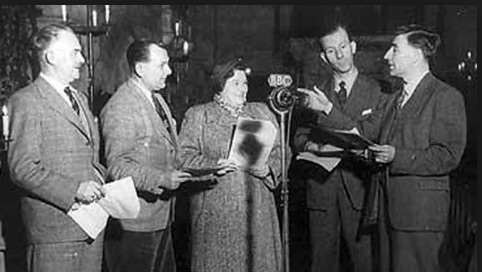
So despite occasional daring updates to the world-views and vocabulary of the “characters” (sic: see below) since 1950, it’s always going to be trapped in a time-warp: the visual image that the series still conjures up today is surely the photo above (note for any Chinese, Chuvash, or Bulgarian readers: YES, this is how we all dress).

As a Chinese immigrant struggling to perceive the underlying ideology of being English, Xiaolu Guo realised that

the drama, with its apparently apolitical presentation of “an oasis of rural England outside the currents of history” is really offering a supremely political position, a peculiarly British ideology: one that privileges endless indirectness and lethargy, endless deflection of real anger and debate, and endless acceptance of the status quo.

The wiki article on The Archers makes fascinating reading, with some drôle diachronic byways, not least on the irritating and inescapable theme-tune Barwick Green—a maypole dance, FFS [Can it be that you have suddenly abandoned your mission to document rural culture? Not Exotic enough for you?—Ed.] (cf. Morris dancing as a suitable riposte to the haka), endowed with “the genteel abandon of a lifelong teetotaller who has suddenly taken to drink”, as Robert Robinson observed.

The 1954 recordings were never made available to the public and their use was restricted even inside the BBC, partly because of an agreement with the Musicians’ Union.

Oh well, that’s one good cause to which the MU has been putting my subscription. But when a new stereo version was recorded in 1992 (quelle horreur!),

the slightly different sound mixing and more leisurely tempo reportedly led some listeners to consider the new version inferior, specifically that it lacked “brio”.

“Brio” is indeed the mot juste. Bless.

A 2011 folk-rock version by Bellowhead was well received, however:

For further windows on changing performance practice, see e.g. Mahler, vibrato, jazz, DaoismTaruskin; the Wimbledon and Pearl and Dean themes. Not forgetting Pique Nique by Ibert’s brother Edouard—an oeuvre that has everything that Barwick Green lacks, despite their shared 6/8 metre (can we have a Bulgarian version, please?). See also By the sleepy lagoon.

Anyway, my main reason for this unseemly rant is to alert you to a brilliant parody that John Finnemore did in 2014, for which I am precisely the target audience:

How The Archers sounds to people who do not listen to The Archers:

[Announcer:] And now on Radio 4—unbelievably—it’s time to accidentally hear a bit of The Archers again.

with all the stereotypes lovingly exposed—

“Hello, one of the men who always sounds tired!”
“Hello, one of the unsufferably wry women…”

“Hello, one of the women with an accent! You’d think that would make it easier to tell you apart from the others, but… no.”

He continues the theme here:

… doomed endlessly to repeat the same morality tale of how all men are feckless idiots with terrible ideas, all women are joyless wet blankets who are nonetheless powerless to stop them.

Indeed, the great Tony Hancock did a spoof as early as 1961:

For denizens of Twitter, the fantasy scripts of @jonreed are recommended. See also Charlotte HIggins’ recent fantasy on an Ambridge Don Giovanni. And inevitably, The Archers is an academic research topic

For a roundup of posts on How to be English, see here—including The mantric Shipping forecast.

Musical cultures of east Europe

tanchaz 93

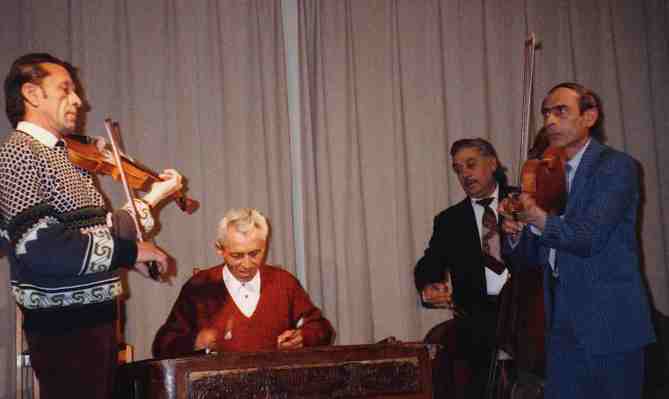
String trio with cimbalom at the Meta táncház, Budapest 1993another perk of my orchestral touring life. My photo.

Having written about the ill-fated blind minstrels of Ukraine, here I’d like to outline the importance of the varied soundscapes around east Europe (a region I’ve also touched in several posts). Also, changing expressive cultures there—besides their intrinsic fascination—suggest useful perspectives for our studies of China.

This may be Old Hat for World Music fans, but perhaps less so for China-watchers or scholars of Asian ritual. Here I’ll offer a mere smattering of reading and audio-visual material.

As in China, sandwiched between the timeless ancient and recent turbo-rock images of the whole region are the elusive fates of local cultures during the state socialist era. Parallel with the official state ensembles, folk traditions were not entirely dormant (a major theme of mine for China; for the spectrum, see e.g. here and here); and fieldwork and research continued, despite political obstacles. These traditions are not so much national as regional, indeed local; subcultures cross boundaries.

And they are not timeless reified commodities to be preserved, but ever-evolving amidst complex social change. Changing political boundaries, and mutual borrowings, belie ongoing nationalist agendas—another reminder of the fantastic and enduring diversity of European cultures (see e.g. Iberia tag for flamenco and fado). Tensions are apparent between local values and official images—and latterly the World Music scene.

Life-cycle rituals, notably weddings, remain a major context. But as the image of the unspoilt rural idyll recedes, turbo-folk tends to dominate. Weddings have become a focus of modernisation; secular festivals, no longer manipulated by the Party state, also come to the fore. Yet changes in rural life also remain a lively topic. There’s never a simple progression from unspoilt rural traditions through kitsch state ensembles to turbo-rock.

Both vocal and instrumental genres are remarkable. Older instruments haven’t entirely been replaced, such as gadulka and gusle fiddles, kaval end-blown flute, zurna shawm, gaida bagpipe.

For an introduction to the different early post-war histories of the whole region, see

  • Anne Applebaum, Iron curtain: the crushing of Eastern Europe 1944–1956.

* * *

Fieldwork on east European traditions began still before the explorations of Béla Bartók, Zoltán Kodály, and Constantin Brăiloiu, but they make a convenient starting-point. Their interests extended far beyond the borders of Hungary and Romania—indeed, Bartók made fieldtrips as far afield as Turkey and north Africa.

Bartok LP

We can admire Brăiloiu’s 1933–43 recordings on this remarkable CD:

For convenient collections of articles, see

  • Béla Bartók, Essays (1976)
  • Zoltán Kodály, Folk music of Hungary (1960/1982—translation revised by Laurence Picken, who maintained a lively correspondence with east European musicologists!)
  • Constantin Brăiloiu, Problems of ethnomusicology (1984).

Still, their work belongs towards the “music” end of the music—culture spectrum, and later under the Communist era, social and political analysis was discouraged from developing. On the one hand, the early fieldworkers are laudable for making trips long before the formal discipline of ethnomusicology; on the other, under state socialism the scholars were laudable for attempting to pursue ethnographic principles under political pressures. Later the whole region became one of the most lively topics of the European Seminar in Ethnomusicology (ESEM).

As Carol Silverman observes about the Roma,

Early folk music studies focus on aesthetics and creativity rather than on power differentials; they were primarily about the culture within folk groups, not about domination, resistance, and conflict among groups.

Indeed, there are varied ways to study the topic, from popular to scholarly. We might start with the articles in the Rough Guide to world music and Songlines magazine, where east Europe is well covered, thanks largely to the enthusiasm of their editor Simon Broughton. Apart from the recent glossy World Music stars, it also features local traditions and archive recordings (mostly listed at the start of the discographies).

Among more scholarly studies, note relevant chapters in

  • Timothy Rice and James Porter (eds.), The Garland encyclopedia of world music, vol.8: Europe (2000).

For many further refs. at the traditional end of the spectrum, showing the energy of early collecting and recording, see

  • Barbara Krader and Bálint Sarosi, “Southern and eastern Europe”, in Ethnomusicology: historical and regional studies (The New Grove handbooks in music, 1993), pp.160–96,

and in the same volume, updating the story, relevant sections of

  • James Porter, “Europe”, pp.215–39.
Chapters in

  • Mark Slobin (ed.), Retuning culture: musical changes in central and eastern Europe (1996)

suggest Chinese parallels in the adjustment following the demise of state socialism. Of course, while the early 1990s were a time of pivotal significance, the scene has continues to change since then. I cited a couple of salient general points from Retuning culture here.
In all these regions, educated urban “roots” movements have become an aspect of the revival since the fall of Communism. In Retuning culture Judit Frigyesi describes this for Hungary, whereas in the following chapter Barbara Rose Lange discusses the reaction against it in the form of lakodalmas rock—resembling similar tensions in China.

At the same time, as Timothy Garton Ash comments in a review of Witold Szablowski’s Dancing Bears,

There is a long tradition, stretching back to the Enlightenment, of western Europeans and North Americans orientalising eastern Europe, as Voltaire did with Russia and Rousseau did with Poland. What is unusual about Szablowski is that he is orientalising his own region.

Another constant theme is ritual, along with religion—which persisted in various ways under state socialism. I won’t attempt to cover Polish, Czech, or Slovak traditions here, though they too are a rich topic, with a wealth of material (e.g. Folk traditions of Poland;  Madonna pilgrimage in Communist Poland; Moravia; and for Polish jazz, here). And note Michael Beckerman’s chapter in Retuning culture on Milan Kundera’s brilliant dissection of culture clash in The joke.

But despite the glossy stars of the World Music scene, it’s not all about them: they are just the tip of the iceberg of changing social life (cf. my flamenco series). That’s far from saying that folk traditions are anonymous—on the contrary, personalities are always important, and locally there are always hierarchies and admired performers.

Under state socialism, in the wake of the tradition of Bartók, Kodaly, and Brăiloiu, fieldwork on regional traditions was avidly pursued. Before and after 1989 I returned from concerts in Budapest with suitcases full of box-sets of LPs from the Hungaroton label, founded in 1951.

LP

There’s also a wealth of material on film and online. Gigs are all very well; feature films (see below) are more revealing; ethnographic documentaries are fewer (if only the BBC films of Simon Broughton were available now).

Hungary, Transylvania, Romania
Here—by contrast with the brass-band sound that has come to dominate the Balkans—string bands are still plentiful, surviving notably in Transylvania, source of much of the inspiration for Hungarian folk music studies ever since Bartok’s fieldwork.

The combo of primas fiddle, kontra viola, and bass is enchanting (for this and other world fiddle traditions, click here). Foremost among many recordings with a more traditional brief is a series of fine box sets from Hungaroton, followed by the Fono label, including their Final hour/ Új Pátria series.

Unearthing Transylvanian bands has long been at the heart of the projects of the enterprising Budapest-based concert band Muzsikás with the wonderful singer Márta Sebestyén, and of the Budapest táncház (“dance house”) scene (for which see e.g. Jávorszky Béla Szilárd, The story of Hungarian folk, 2015, and an introduction in Songlines #112). But the fortunes of most such rural bands remained based in the lives of their local communities.

Here Muzsikás accompany the master fiddler Sandor “Neti” Fodor (1922–2004):

Still in Romania, the Rough Guide introduces many distinctive traditions, such as those of Maramureș and Moldavia. The Csángó people of Gyimes are famed for the duo of fiddle with gardon slapped bass (see here, and here)—one of the best possible things to do with a cello (cf. furniture effects and marriage guidance counselling on the bass, and viola jokes).

Transylvania is another of the enviable fieldsites of Bernard Lortat-Jacob:

  • Jacques Bouët, Bernard Lortat-Jacob, and Speranţa Rădulescu, A tue-tête: chant et violon au pays de l’Oach, Roumanie (2002, with DVD),

a detailed ethnography of social musicking in the Oaș region, including musical analyses.

From Clejani near Bucharest, Taraf de Haïdouks were plucked up into the World Music scene; indeed, they are the source of my favourite quote about such success. Speranţa Rădulescu had recorded them from 1983, and introduced fellow-ethnomusicologist Laurent Aubert to them in 1986. Later, taken up by the likes of Johnny Depp, they toured with the Kronos quartet (“Californian pointy-heads” apud Cartwright, Princes amongst men, pp.196–7—actually a telling vignette on the different aesthetics of folk and art musicians).

But with the goals of ethnomusicologists and World Music promoters not always in tandem, such collaborations may not unfold smoothly. The World Music scene not only propels certain bands to fame, but may engender rival clones, misunderstandings, and lawsuits.

Retuning culture has a fascinating article

  • Steluta Popa, “The Romanian revolution of December 1989 and its reflection in musical folklore”,

documenting songs just as they were being composed—if only we could hear them too. But we can hear, from Latcho Drom (see below), the “Ballad of the dictator” by the late great Nicolae Neacșu (of Taraf de Haïdouks)—including my very favorite fiddle technique, evoking anguish, earthquake, or perhaps the creaking door that precedes “The master is not at home” in a Hammer Horror movie (perhaps not so suitable in the Mahler Adagietto, but who knows):

Green leaves, flowers of the fields, What are the people doing?
They’re taking to the streets, yelling and crying “Freedom!”
Green leaves, flowers of the fields, What are the students doing?
They’re marching on Bucharest, yelling and crying “Sweep away the dictatorship.”
Green leaves, a million green leaves on this 22nd day
Here, the time for life has returned, to live in freedom
Green leaves, flowers of the fields, There in Timisoara people are taking to the streets, yelling “It’s all over for the tyrant!”
What are the men doing? They’re taking out their guns. They’re shooting at people. Ceaucescu hears them:
“Tyrant, you have destroyed Romania.”

Roma
Beyond all the traumas of warfare and occupation, these are regions where countless Jewish and Roma peoples were deported and murdered in the mid-20th century, transforming the cultural landscape. In addition to its articles by country, The Rough Guide has a section on the trendy tag of Gypsy music—indeed, casting the net as wide as Rajasthan, Turkey, Russia, Spain, France, and Britain.

The fortunes of Roma peoples in various nations are tellingly described in

  • Isobel Fonseca, Bury me standing (1995),

and turning to music, another most accessible book is

  • Garth Cartwright, Princes amongst men [sic]: journeys with Gypsy musicians (2005),

with vignettes from Serbia, Macedonia, Romania, and Bulgaria. Though based on interviews with the stars, it makes a lively and well-observed read, a popular introduction not only to the scene at the time of his visits but also to the state socialist background. See his playlist here.

 The transgressive lifestyle of the Roma, Exotic Other “deviating from behavioural norms”, has long made an irresistible commercial proposition, as gleefully evoked in many popular feature films (Cartwright, pp.306–8 gives a useful list), such as those of Emil Kusturica like Time of the Gypsies (1989), Underground (1995), and Black cat, white cat (1998), or—more acceptably to the Roma community—Tony Gatlif, including Latcho Drom (1993), travelling from Rajasthan, Egypt, and Turkey to Romania, Hungary, Slovakia, France, and Spain; and Gadjo dilo (1997)—sorry, the English-subtitled version has disappeared from YouTube, so we’ll just have to practise our Hungarian (Yeah, right), here:

An impressive early film was I even met happy Gypsies (Aleksandar Petrović, 1967).

The Balkans
Here the scars of the war following the breakup of Yugoslavia are constantly on display. Brass bands have come to dominate the soundscape, the Guča festival making a heady showcase. Among the stars are Boban and Marko Marković (Serbia), the Kočani orkestar (Macedonia), and Fanfare Ciocârlia (from Zece Prăjini in Moldavia, Romania). While high-octane numbers dominate, the slow ballads are also most affecting. Sorry, can’t find English subtitles for this 2002 documentary Iag bari/Brass on fire, so this time click here for some Swedish practice.

Modern brass bands have developed from groups led by zurna shawms with percussion, rather as Chinese shawm bands have added Western brass and pop music to their instrumentation since the 1980s.

The label “Balkan jazz” reminds me that I couldn’t resist describing the amazing Hua family shawm band as Chinese gypsies playing Ming-dynasty jazz; but accounts of both the social life of Balkan musos and the wildness of their playing do indeed suggest similarities.

In Bosnia–Herzegovina, apart from sevdalinka singing (sevdah resembling Romanian dor, as well as duende and saudade), Islamic soundscapes include kaside, ilahije, and zikr rituals—note the Smithsonian Folkways CD Bosnia: echoes from an endangered world.

Bulgaria, Macedonia
Academic studies include

  • Timothy Rice, May it fill your soul: experiencing Bulgarian music (1994, with CD)
  • Donna Buchanan, Performing democracy: Bulgarian music and musicians in transition (2006)
  • Carol Silverman, Romani routes: cultural politics and Balkan music in diaspora (2012, with companion website)

See also Silverman’s 2007 article on the changing wedding market, and chapters by Rice and Silverman in Retuning culture.

Silverman notes that Bulgaria had one of the most centralised forms of state socialism, Macedonia one of the least. But under both regimes the Roma—“powerless politically and powerful musically”—continued to play for non-Rom as well as Rom audiences at village and town events, such as weddings, birth celebrations, soldier send-off celebrations, circumcisions, and baptisms.

In the West, broad awareness of Bulgarian music began when “World Music” was just a twinkle in the promoter’s eye, with Le Mystère des Voix Bulgares. The original LP, released as early as 1975, was reissued more widely in 1986. After the collapse of state socialism they reinvented themselves with several reincarnations, with further albums following. They made rather more earthy recordings too, like this track from Bulgarian custom songs (1993):

Another early star of the World Music circuit was Ivo Papazov—subject of a fine article by Donna Buchanan in Retuning culture, and vignettes in Rice’s May it fill your soul. Reminding us again that musicking doesn’t necessarily take place in designated venues like concert halls, the wedding scene is important. But Buchanan unpacks the ethnic and cultural tensions. In summer 1989, 370,000 ethnic Turks and Muslims were deported. Buchanan also puts into context how Papazov was promoted abroad by Joe Boyd with the Hannibal albums Orpheus ascending (1989) and Balkanology (1991), soon launching him as a global touring star—just as the local economy was collapsing.

Weddings had been lucrative, and moreover musos prefer their ambience—as Ivo commented,

In truth, a wedding is equal to a dozen concerts. There a person can create… A great deal of music is introduced in a wedding, and in a concert you lack this thrill.

However, by the 1990s weddings lasted only one day: he was being nostalgic for the extravagance of the 1980s! He returned to recording with the great albums Fairground (2003) and Dance of the falcon (2008). Meanwhile the wedding scene in Bulgaria continues to change.

Whatever setting he plays in, his music is just intoxicating. Here’s one of several YouTube playlists, including some raw footage from local gigs also featuring other bands:

And a drôle quote from Frank Zappa, no less:

Ivo’s wedding music, played first thing in the morning, provides thorough and long-lasting attitude adjustment for the busy executive.

Though additive “limping” metres feature in much folk music around the region and further afield (notably Turkey), Bulgaria has been particularly associated with them.

In Macedonia, megastars (sic) are Esma Redžepova (e.g. here, and here; and a playlist:)

and sax player Ferus Mustafov, also featured by Cartwright.

But again, it’s not all about the stars of the World Music scene. At the same time, musical appraisals expand from local to global, which are often at variance. By contrast with both nostalgic romantics and World Music fans in search of the latest groove, the brash sounds of Bulgarian chalga and Romanian manele have become highly popular.

As Cartwright observes,

The difference between what the West’s world music industry sells as Gypsy music and what the Roma listen to back in the Balkans can be huge. Sure, in Serbia Šaban is king and across Macedonia Esma reigns. But this is akin to African Americans acknowledging James Brown and Aretha Franklin. Don’t mean they’re listening to them. And in Romania the breach seems wider than anywhere else. Fulgerica is respected but he’s no pop star while Fanfare Ciocârlia and Taraf de Haïdouks exist only for Western audiences. That they play superior Gypsy music, rooted in tradition, means nothing. The local Roma aren’t listening. What they want is Adrian. And Guța.

Meanwhile, as he notes, the Venezuelan soap opera Kasandra became wildly popular across the Balkans, giving Šaban Bajramović a huge hit in 1997.

Albanian cultures
As a respite from the bombardment of turbo-folk, it’s good to return to a more traditional milieu. Again, ethnic Albanians occupy not just Albania but Kosovo and parts of Macedonia and northern Greece; the soundscape is highly regional, with Gheg culture in the north, Tosk and Lab further south.

The splendid A.L. Lloyd somehow issued a fine album as early as 1966:

The polyphony here is amazing. From the south, another fine CD from Bernard Lortat-Jacob is

  • Albanie: polyphonies vocales et instrumentales (notes here):

A substantial study is

  • Jane Sugarman, Engendering song: singing and subjectivity at Albanian Prespa weddings (1997, with CD).

Bards
Again, the epics sung by bards, over a wide region of south Yugoslavia and Albanian communities, don’t neatly fit national or ethnic boundaries.

Lord

The classic study is

  • Albert Lord, The singer of tales (with CD-Rom; complete text here),

following the work of Milman Parry (for whose work with Bartók, click here). Most singers are accompanied by a one-string fiddle like the gusle, as in this celebrated 1935 clip of Avdo Međedović (c1875 – 1955) filmed by Lord:

And in case all this seems like a bygone world, click here for a 2018 Venice performance of a Kosovan bard.

* * *

Under all these unwieldy national rubrics, the diverse ethnic groups negotiate the changing times, interacting. As ever, this is far more than a “merely musical” topic, as such cultures are not just quaint ornaments, aural pashmina; they are windows on changing local societies, an essential part of what makes them click. As in China, it’s no use clinging onto a romantic idealisation of the past; and we should always delve beyond the World Music stars to musicking in local societies.

As ever, Bruno Nettl offers useful perspectives, as in his taxonomies for various types of change and responses to them.

For any sinophiles who have read this far, it may serve as a reminder of the persistent variety of regional and local traditions in China—not just the ethnic tapestries of the northwest, southwest, and indeed northeast, or even Hakka and Hokkien cultures, but all kinds of musicking beneath the provincial level in Han Chinese regions.

The cultures of all these groups—before and during state socialism, and since— deserve detailed attention. And World Music fans may tend to favour modern commercial pop, but it’s important for ethnographers to include it in the picture too. Even in my work on Daoist funerals in China, I could hardly neglect the pop bands outside the gate (my film, from 30.32).

Both academic and popular accounts repay study: and both keep track of change. I wonder what Bartók would have made of all this—another of those fruitless debates like “Would Bach have used the ondes martenot?” or “Mozart would have written advertising jingles”…

For a sequel, click here. See also under A folk playlist for Euro 24, and Some jazz fiddling.

On a lighter note, far from PC, there’s Molvania

Taco taco taco burrito

Rite

Wondering how to get to grips with additive metres?
Awed by the complexities of flamenco palmas?
Despair not, help is at hand!

As a prelude to aksak “limping” metres, we might start with quintuple metres, which go far back, even in WAM. By the baroque period there are niche examples by composers such as Schmelzer, and they feature in 19th-century Russian music—a most popular instance being the “limping waltz” of Tchaikovsky’s Pathétique symphony (2+3).

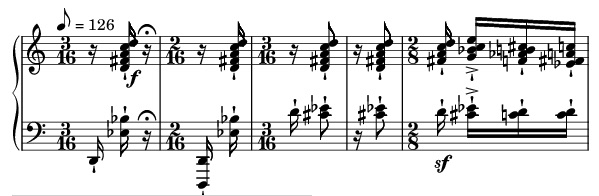
This reminds me of two other subversions of the waltz, albeit in regular triple metre: the 2nd movement of Berlioz’s Symphonie fantastique (cf. here and here), and Ravel’s La valse, a “surreal nightmarish vision of a decaying society through a broken kaleidoscope”, as I said in my Ravel page. Elsewhere, perhaps inspired by the Basque zortzico dance, Ravel was partial to additive metres—such as in his piano trio, and the quintuple-time Bacchanale finale of Daphnis and Chloé (both also featured on that page, the latter from 45.29). And Messiaen was most partial to complex yet catchy additive rhythms.

Quintuplets, of course, are something else altogether; as are the creative use of additive rhythms in minimalism (see also examples from Reich and Meredith).

From Tchaikovsky we might graduate to

  • the Pearl and Dean theme (which we may hear as two groups each of 3+3+2; or for a Bulgarian, perhaps two fast groups of 3+3+3+3+2+2)
  • Un homme et une femme (after the three upbeats, 3+3+2+2: the first two 3s, in the original “Dabadabada, badabadaba”, were later remembered as “Chabadabada“, a word that entered the language to denote alternating male and female candidates in electoral lists!)
  • and Lalo Schifrin’s theme to Mission impossible (5/4, with a duplet over the first 2 beats).

If you can hum along to such easy examples, then that’s a good start in mastering the intricacies of so-called aksak metres around east Europe and the Middle East…

Indeed, Take five was inspired by hearing Turkish musicians. Rather more challenging is the opening section of Blue Rondo à la Turk (2+2+2+3):

Note the helpful BTL comment there (only without the punctuation!):

Taco, taco, taco, burrito. Taco, taco, taco, burrito. Taco, taco, taco, burrito.
[SJ: not to be confused with potato, potato]

Still, that’s a rather crude, mechanical usage, the melody merely marking out the metre in regular quavers—whereas further east, melodic rhythms are infinitely varied within the basic metre.

Admittedly, the additive patterns of the Rite of spring have been transcribed in 4/4—was it really Boulez who had this drôle idea?! Cf. Slonimsky‘s help for Koussevitzky, here). Indeed, the scores for both the Pearl and Dean and Un homme et une femme tunes were written in duple metres.

And in the first movement of Winter, Max Richter’s welcome recomposition of the Four Seasons mixes in some great limping 7/8 bars (2+2+3—just the two tacos before the burrito today, thanks waiter) (from 1.18):

An intriguing instance is I say a little prayer, with its quirky insertion of a triple-time bar in the chorus—which no-one apparently even has to think about. And do listen to Herbie Hancock‘s addictive Ostinato.

* * *

But all this is mere child’s play compared to folk music. Though such metres are quite widespread, Bartók, Brailiou et al. coined the term “Bulgarian rhythm”.

aksak

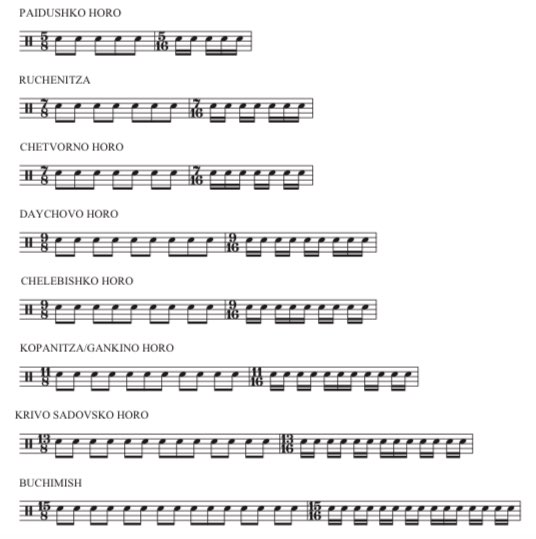
Some instances of “Bulgarian rhythm”, found here; see also here. For the Swingles’ delightful arrangement of  Bučimiš, see under Another Turangalîla at the Proms!.

A classic essay is

  • Constantin Brăiloiu, “Aksak rhythm” (in Brăiloiu, Problems of ethnomusicology, 133–67, based on a 1951 lecture),

which contains far more detailed schemata. His work followed that of

  • Béla Bartók, “The so-called Bulgarian rhythm” (1938).

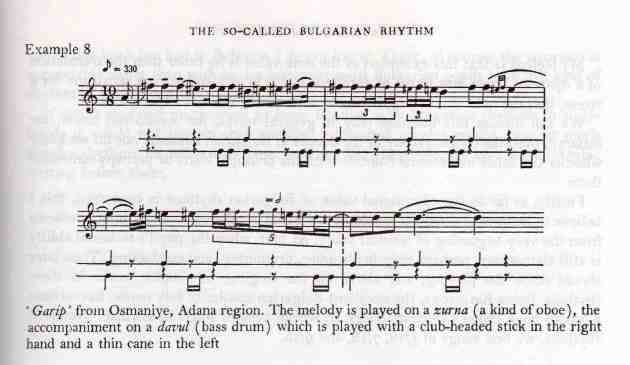
A transcription by Bartók of a Turkish zurna–davul shawm band shows how, over the basic metre, melodic and percussion rhythms seriously thicken the plot:

aksak 2

Jerome Cler’s splendid website on the yayla has a thoughtful analysis of an aksak (here).

The whole repertoire of players like Ivo Papazov is based on aksak metres:

I don’t think I’m quite ready for Sedi donka (Plovdivsko horo), a 25-beat pattern divided

    7             7                 11
3+2+2 | 3+2+2  | 2+2+3+2+2

For more on the diverse musical cultures of Bulgaria and environs, see here. And for a wide-ranging discussion, see

  • John Blacking, “Irregular rhythms: movement, dance, music, and ritual”, ch.3 of A common-sense view of all music (1987).

Back with Merrie England, there’s a fascinating article:

* * *

Further east, an example from the muqam of the beleaguered Uyghurs of Xinjiang is sadly topical. A common metre consists of one long beat divided into two equal stresses, followed by two regular beats—which we might notate cumbersomely as

aksak

with the initial duplet over a notional 3/8 unit:

Some sections add another duple unit, like this dastan from Chebiyat muqam (actually a duplet over 3/8,  followed by 3/4):

QB

And some muqam have still more metrically complex segments to explore.

As with many world genres, the Uyghurs have no tradition of notation, and seem to have no terminology for such metres (though see Rachel Harris’s chapter in Harris and Stokes (eds.), Theory and Practice in the Music of the Islamic World). As with flamenco, this kind of thing is only an issue for those (like me) hampered by a visual classical education. The trick is to internalise it in the body—and to dispense with notation. Let’s remember that much of this music accompanies dance.

Uyghur musical traditions are part of a rich culture that is currently being systematically erased in Xinjiang (see roundup here).

Moon river

MR

À propos my Daoist ritual spinoff of Strictly, the brilliant (ethnographer!) Stacey Dooley‘s recent waltz reminds me what a brilliant song is Moon river:

Pace Andy Williams, the classic sung version is that of Audrey Hepburn in Breakfast at Tiffany’s (1961):

Johnny Mercer’s lyrics, “a love song to wanderlust” (cf. Roaming the clouds), are complemented by Henry Mancini’s melody.  I just love the leap of a major 7th:

I’m crossing you in style some day / There’s such a lot of world to see,

always effective—as in the finale of Mahler 9 (introduced by quintuplets!) and, um, Raindrops keep falling on your head! Indeed, there’s another brilliant touch: following “We’re after the same rainbow’s end“, when that sequence returns with

Waiting round the bend, My huckleberry friend,

for the first phrase the melody omits the low tonic, making us nostalgic for the missing major-7th leap (waiting, indeed), until it returns for the second phrase.

So Moon river (nearly cut from the film, PAH!) makes a perfect expression of Holly’s persona—and indeed that of Stacey Dooley, with her documentaries from around the world.

The dominant interpretation currently seems to be that Hepburn’s screen characters make her some kind of feminist role model. But “it’s complicated”—certainly in this film, which largely replaces the edgy feel of Truman Capote’s novella (1958, set in 1943) with a “sugar and spice confection”; indeed, Capote wanted Marilyn Monroe for the part! I tend to side with more critical reviews, such as this, this, and this. After I cited some dodgy sexist terms to describe talented female performersgamine and ingénue are among those for which there are both male and female equivalents, but the latter are far more commonly used, and flawed. Oh, and how ahout “elfin waif”…

For Hepburn’s actual life, Darcey Bussell (another fragrant icon) made a fine documentary Looking for Audrey (2014), including her childhood in Nazi-occupied Holland.

* * *

Capote describes Holly as an American geisha—rural child bride Lulamae, reinventing herself in New York. Film adaptations can be effective, but in this case the novella portrays her with more nuance and depth. So—not least because I’m so averse to Hepburn’s “elfin waif” shtick—I find Capote’s silent invisible original far more moving, and Holly herself far more poignant and (as she would say) sympathique.

Inevitably, at the end of the film the narrator and Holly fall in love and stay together, whereas in the novella their relationship remains platonic, and Holly disappears.

Lending significance to Moon river, the name-slot for Holly’s mail-box reads:

Miss Holiday Golightly, travelling

She reflects on how she demurred from a break in the movies offered by a Hollywood agent:

But he’s got a point, I should feel guilty. Not because they would have given me the part or because I would have been good: they wouldn’t and I wouldn’t. If I do feel guilty, I guess it’s because I let him go on dreaming when I wasn’t dreaming a bit. I was just vamping for time to make a few self-improvements: I knew damn well I’d never be a movie star. It’s too hard; and if you’re intelligent, it’s too embarrassing. My complexes aren’t inferior enough: being a movie star and having a big fat ego are supposed to go hand-in-hand; actually, it’s essential not to have any ego at all. I don’t mean I mind being rich and famous. That’s very much on my schedule, and some day I’ll try to get around to it; but if it happens, I’d like to have my ego tagging along. I want to still be me when I wake up one fine morning and have breakfast at Tiffany’s.

And Holly does indeed sing and play guitar:

Don’t wanna sleep, don’t wanna die, just wanna go a’travellin’ through the pastures of the sky

With a Brazilian suitor in tow, she takes to Linguaphone:

Oh screw it, cookie—hand me my guitar and I’ll sing you a fado in the most perfect Portuguese.

That would surely have rivalled Carminho’s exquisite song.

In the novella, I note with proprietoral pride that Holly’s fellow-geisha Mag Wildwood (intriguingly, Capote gave her the full name of Miss Margaret Thatcher Fitzhue Wildwood)—as if being a redhead over six feet tall isn’t enough—is a stammerer (Marilyn Monroe might have resented the competition):

Even the stutter, certainly genuine but still a bit laid on, had been turned to advantage. It was the master stroke, that stutter: for it contrived to make her banalities sound somehow original, and secondly, despite her tallness, her assurance, it served to inspire in male listeners a protective feeling.

* * *

For Moon river on the ethereal theremin, click here.

Amy Winehouse (see my tribute here) may seem an unlikely exponent of the song, but she was grounded in ballads, as we can hear in her “late” sessions with Tony Bennett. Here she is, subverting the waltz, making the song sugar-free—maybe it doesn’t quite work, but even at the age of 16 she was always exploring, discovering new personal connections:

Click here for a discussion of the song in the BBC Radio 4 Soul music series.

From my playlist of songs, it’s clear that, with some noble exceptions, I find female voices more moving than male ones—and I’m right!!!

Just another reminder that a global view of musicking invites us to delight in all manifestations of the Terpsichorean muse!

The conformist

with a note on Last tango in Paris

Conformist 1

The conformist (Bernardo Bertolucci, 1970), based on the 1951 novel by Alberto Moravia, is a most captivating film, visually sumptuous—with the gorgeous Jean-Louis Trintignant, Stefania Sandrelli, and Dominique Sanda bringing out the interplay of political and sexual themes.

For my generation it recalls late-night screenings in art cinemas (along with Parajanov, Seven samurai, Marx brothers marathons, The big sleep, La stradaFive easy pieces and Performance (both also 1970), The bitter tears of Petra von Kant (1972), Céline et Julie (1974), and so on—what an eclectic education; see also here). Revisiting The conformist now, alarmingly, makes a timely reminder: until recently the dangers of fascism may have seemed quite remote.

Conformist 2

As with Bertolucci’s other films like Last tango in Paris, music and dance play a crucial role. The soundtrack (by Georges Delerue) has the ambivalence of Cinema paradiso and Twin peaks. As with all the best film music, just the opening theme transports us instantly into the story’s troubled world. Here’s the complete film:

The female radio band near the opening (from 4.12) reminds me of Franco Cerri’s recollections in my post on Chet in Italy.

By way of comparison with the final dance, here’s the equivalent scene in Last Tango in Paris:

—just as iconic as Jack Nicholson’s scene in Five easy pieces where he erupts in the diner, and reminiscent of Alexei Sayle’s critique of ballroom.

As this review observes, Last tango is not about sex but about pain.

Made in France four years after the disillusionment of 1968’s failures, it’s about characters who can’t see past their own emotional and psychological problems, who are solipsistic in the extreme, locking themselves away from everything they can’t face in the outside world.

Pauline Kael’s famous rave review, comparing the film’s importance to that of Stravinsky’s The Rite of Spring, is critiqued in this retrospective, a particularly cogent view of the on-set abuse of Maria Schneider—a revelation that has severely marred the film’s image, which is regrettable since it’s a work in which deep emotions and anguish are conveyed. Among innumerable other reviews, Last tango is also the subject of this excellent 2011 discussion. See also under Godard.

* * *

Bertolucci died in November 2018 (see also here), soon after Nic Roeg (for an assessment of both together, see here). Many more films to revisit, not least The sheltering sky (based, indeed, on the great novel by Paul Bowles, though he was less than keen on the result), The dreamers, and the epic 1900. And Godard died in 2022.

Flamenco in Chiswick

*Sequel to my three posts on flamenco:
palmas;
gender, politics, wine, deviance; and
cante jondo!*

flamenco

Among the varied aesthetic pleasures on offer in west London (“Come and live in Chiswick, your statistical chance of survival is relatively high“), what better for a rainy autumn Sunday evening than another flamenco gig?

It was a small price to pay for missing the public moral verdict on the Strictly dance/snog of shame—though I would humbly suggest to the BBC that such quandaries would be obviated by my Strictly north Chinese Daoist ritual project.

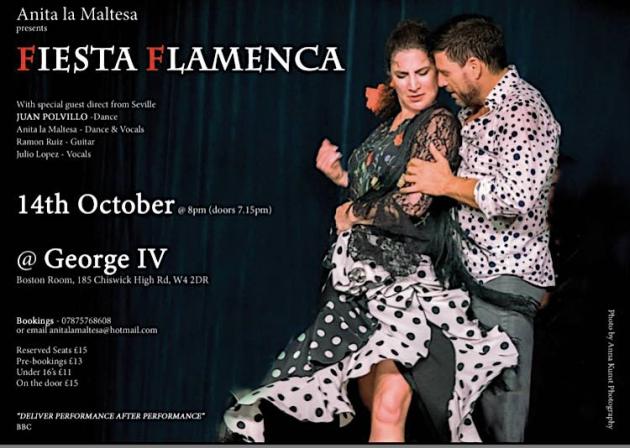
The show featured stalwarts Anita La Maltesa with Ramon Ruiz on guitar, the fine Sevillian singer Julio Lopez (another London local), and the star guest dancer Juan Polvillo on a visit from Seville, all sensitively accompanied by the cajon player Antonio Romero.

After worthy recent distractions (blind Ukrainian minstrels, Chinese female spirit mediums, Barbara Hannigan as Gepopo, and so on), I’m delighted to reinvigorate my naïve studies of the riches of flamenco—continuing to get to grips with palmas hand-clapping patterns with the aid of the amazing Rito y geografïa del cante series and various useful websites (see my first post).

In order to appreciate Mozart you don’t have to analyse sonata form—indeed, the term hadn’t even taken shape in Mozart’s day. But a basic understanding of what’s going on, as with the pitch relationships in Indian music, can enrich our enjoyment.

For a hidebound classically-trained Brit like me, learning is a lot to do with switching off the tedious analytical brain and engaging the body‚ experiencing the performance whole—singing, lyrics, palmas, dance, guitar and all. After all, homing in on the fancy footwork would help me get the hang of the palmas (but don’t worry, the dance world is safe).

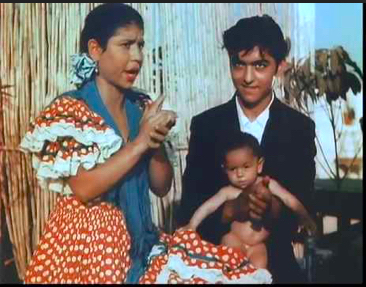
How envious I feel of the sleeping Andalucian child in the arms of her mother as she sings her heart out (DO admire the footage of Cristobalina Suarez in this post!)—that’s the way to learn. Anita and Ramon’s sessions must be great for London schoolkids too.

Presenting world music on stage always involves striking a balance between what Chairman Mao called “popularization” and “raising standards” (puji 普及 and tigao 提高). The Rito series shows how in more informal social gatherings in Andalucia, dancing can serve as an organic physical response to the intense singing that draws me to flamenco. By contrast, in more polished shows (at least in the minds of foreign audiences) the balance is often reversed, with the cante subsidiary to the virtuosic dance items—which while also intense, are more popular than, say, an entire evening with a solo gypsy blacksmith singing anguished siguiriyas, perhaps a tad heavy for some. Anita and Ramon manage to strike an effective balance between peña and tablau, incorporating all the elements of flamenco into an inspiring evening.

London, microcosm of world music—for now, anyway: if some people have their way, from here on we may have content ourselves with Morris dancing. For more flamenco in London, see here, and this fine post on the GP Dr Alejandro Martínez, aficionado in the 1950s and 60s, as well as Flamenco at Jamboree!.

Detroit 67

More “delighting in all manifestations of the Terpsichorean muse”, à la McClary and Small—in this related post I both make a disclaimer and explore the point of venturing beyond familiar territories.

On soul, apart from classics like Nelson George, Where did our love go? (1985), I’ve been admiring

  • Stuart Cosgrove, Detroit 67: the year that changed soul (2015)—

not just to educate myself about the music, but to admire compelling writing about history, and the nexus of society and culture.

For background (if you’re on another planet, like me—I guess if you know much about soul, you’ll have better things to do than reading this blog…) it’s worth revisiting the fine BBC documentary R.E.S.P.E.C.T (from the Dancing in the street series), here in four parts—they should segue automatically:

The film also covers the southern scene, no less important—and more edgy—do follow this up with Cosgrove’s Memphis 68: the tragedy of southern soul.

* * *

In 1967—just as the Cultural Revolution in China was becoming even more violent, and ritual specialists were keeping their heads down; shortly before the crushing of the Prague Spring; while I was primly learning Brahms and Ravel in a youth orchestra in suburban London, with little idea that there might be any other kinds of musicking in the world—Detroit and Motown were entering a pivotal phase of turmoil.

Cosgrove’s focus on one year is a most effective device. At a time-remove from the “one-year” rule of anthropological fieldwork, he takes 1967 as a microcosm of festering race relations, social upheaval, and musicking.

Incredulous as we are at the current travails of the USA, it’s also a reminder that they have a long history.

This was the year of Sgt Pepper (for all popular [Anglo–American, that is!] genres that year, see here). Indeed, the soul movement had had to react to the market challenge from British groups like the Beatles, and to maintain crossover appeal; but Sgt Pepper itself was a retreat from the innocent lyrical messages they had been crooning on their frantic touring life.

Supremes 2

A fine piece of thick-description ethnography from a distance of time and space, the book is based on the troubled relations of Berry Gordy and his protégées The Supremes, with a focus on the ill-fated Florence Ballard. But Cosgrove adroitly weaves in portraits of individual figures with their back-stories; the automobile industry, social change, race, housing, poverty, crime, and the police; civil rights, Vietnam, hippy counterculture, bikers, and LSD.

There was the hippie Steering Committee, the young rock gods of the Grande Ballroom, the disgruntled officers of the Detroit police, and a legion of car-assembly workers drawn from the tense communities of Polish and African-Americans. There were disenchanted young men who moved from unemployment to Vietnam, the radical soldiers of Black Power, the independent producers who saw soul music as their Klondike, and the caravan of older gospel Christians who had seen their homes destroyed to make way for freeways.

Youth culture was fragmenting into a mosaic of different tribes.

Half a million people had migrated to Detroit between 1940 and 1943, mostly African-Americans from the southern states. Already by 1959 its image as a boomtown was wearing thin, but migrants kept arriving.

As anti-Vietnam protests grew, in 1965 came a wave of self-immolations. By 1967

the area around Twelfth Street had witnessed complete transformation in twenty years as white residents fled to new buildings, better neighbourhoods or the encroaching suburbs. In a contemporary survey by the University of Michigan’s Psychology Department, the area was described as a community of high stress where an overwhelming majority of the residents were disenchanted with their living conditions. […] It was a blighted area about to take centre stage.

Still, the social milieu for Motown was aspirational. In March, Berry Gordy’s mother hosted a coffee evening in her role as past Exalted Ruler of the Lady Camille Temple of the Michigan Elks:

Floral handbags, matching frocks and elegant hats turned the room into a chorus of colour. […] This was a room of elegant elderly women who valued status, took pride in their families, and cared deeply about emancipation.

In June the Supremes, “in a bubble of fame, increasingly out of touch with the new militancy in the black community and the rising fury of their hometown”, made an ill-judged appearance in LA for a beleaguered President Johnson.

The July riots, including the appalling Algiers Motel incident (on which see John Hersey’s book), were a flashpoint—and again there’s plenty of youtube footage. As with the violence in towns throughout China at that very time, the turmoil had deep social roots.

As Motown abandoned Detroit for LA, African-American music kept moving.

Detroit’s wooden-porch image as the home of soul music had been damaged to the core, and the family image that had been so crucial to the Motown story was brutally displaced by darker visions of a charred city under martial law. […] The nightclubs, the bars and the independent studios that had been the foundations of Detroit’s soul scene had been burned to the ground, ransacked, or destroyed. […] The generation that had shaped one of the greatest periods in the history of popular music had seen its city devastated. For the Supremes and others within Motown, the riots were to become a metaphor for ruined harmonies and wrecked friendships. In a broader sense, the disturbances were also a requiem for Detroit’s great industrial achievements and its declining manufacturing base.

Meanwhile John Sinclair and MC5 feature regularly, and there are cameos from Muhammed Ali and Martin Luther King. The latter observed:

Perhaps the most tragic recognition of reality took place when it became clear to me that the war was doing far more than devastating the hopes of the poor at home. It was sending their sons and their brothers and their husbands to fight and to die in extraordinarily high proportions relative to the rest of the population… So we have repeatedly been faced with the cruel irony of watching Negro and white boys on TV screens as they kill and die together for a nation that has been unable to seat them together in the same schools. So we watch them in brutal solidarity burning the huts of a poor village, but we realize that they would never live on the same block in Detroit. I could not be silent in the face of such cruel manipulation of the poor.

It was his assassination in 1968 that would mark a definitive turning point for both society and music.

Singers, songs, music
The Motown sound emerged from the background of the incredibly rich talents brought up in gospel, blues, jazz, R&B, and so on. Cosgrove explores the nuances of changing style, documenting the host of composer-arrangers, choreographers, backing groups, instrumentalists, recording execs, and lawyers.

And decorum coaches—the Motown Finishing School (great scenes in #2 of the R.E.S.P.E.C.T. film)! Some of the singers took readily to Miss Maxine Powell’s training, while one of the Temptations complained “I don’t want to learn how to be white”.

To some, Motown resembled a hit machine, an assembly-line like the city’s car plants, producing polished feel-good tracks—a saccharine soundtrack to a convulsive era. It was “predicated on a compromise”. Gordy had

softened the rough edges of R&B, draped the music in the familiar cadences of teenage love, and his girl groups […] pioneered a highly addictive from of “bubblegum soul” that lent itself perfectly to the still-segregated radio stations of America.
[…]
It was in every respect an art of repetition: familiar backing tracks were refashioned, everyday phrases repackaged and the anxieties of young love were played out as memorable drama.

I may be the last person qualified to offer a playlist, but it hasn’t stopped me before (e.g. Amyfeminist punk)…

In fact even I heard The Supremes on Top of the Pops in the mid-60s, though they felt alien to me. Of course, they were—but countless other British kids were hooked.

Cosgrove also weaves in the stories of

  • Martha and the Vandellas, Dancing in the street—“an otherwise innocent piece of teenage pop [that] became inextricably linked to social unrest”:
  • Marvin GayeAin’t no mountain high enough, with Tammi Terrell:

And the roots of What’s going on were firmly in 1967: “masterpiece of the inner city, echoing the events of the Algiers Motel killings, the ‘trigger-happy policemen’, the lives of returning Vietnam vets, the emotionally devastated mothers who had placed their faith in the benevolence of God, and the scattered fragments of a war-torn city”:

  • Aretha Franklin (R.I.P.) came from Detroit, but wasn’t part of the Motown stable, getting snapped up by other labels. And she was also more readily recruited to the civil rights movement. Respect, her version of an Otis Redding song:

I say a little prayer was originally written by Burt Bacharach and Hal David for Dionne Warwick, but Aretha, along with the Sweet Inspirations, transforms it. Not so homely as the dreamy opening suggests (it’s about the singer’s anxieties for her man serving in Vietnam), it’s both ecstatic and defiant, with a real gospel call-and-response feel:

And two amazing live versions from 1970:

(Talking of how naturally performers learn the complex rhythms of flamenco clapping, I guess no-one even had to think about the triple-time bar inserted into the chorus here (you’ll stay in my heart we never will part—see also here; and for additive metres, here)… Actually, why did Bacharach write it thus? It’d work perfectly well to maintain the duple beat throughout—but in Aretha’s version it creates greater urgency and a feeling of spontaneity. I am in awe of everything about this song.)

Her 1972 church performance of Amazing Grace is legendary. Just the audio, with its lengthy alap, is spine-tingling:

I’ve now done a separate post on the complete footage, a *MUST WATCH!*—here’s a brief trailer:

  • Otis Redding (one of many sadly short-lived artists in the story) also features in the book, though his story belongs with that of southern soul. And James Brown was leading the way forward with that common blend of musical brilliance and unsavoury personal relations.

Behind the glossy stars and glamorous hype lie gruelling touring schedules (indeed, The Supremes were rarely in Detroit), drug habits, internal disputes, and personal breakdowns—like a New York orchestra, a Chinese shawm band, or indeed any group.

Tedious legal wrangles invariably take up considerable space in such books on the popular music business. Motown seemed like a cosy family, yet

the close-knit relationships forged in postwar Detroit were destined to be dismantled as success and dysfunction tore the surrogate family apart.

Here the style and lyrics of such love songs seem quite detached from the realities of personal and social life. That’s common in music worldwide, though anguish is often paraded too, in genres like flamenco deep song, Bach Passions, or Daoist funeral liturgy

In many world genres, links between culture and politics may be opaque. The book’s social context is compelling, but the commercial pressures that drove the music seem estranged from social change. In the end the music inevitably, suitably, takes a back seat, though the songs remain intoxicating.

I had remarkably little idea of any of this, either then or later. Better late than never, eh. Detroit 67 is just the kind of in-depth study of social and musical tensions to which ethnographers aspire in documenting any genre—whether “art”, “folk”, or “popular”.

See also Stuart Cosgrove’s paean to Northern soul, and The Commitments.

Feminine endings: Madonna and McClary

Left: I found this postcard in Ireland in the mid-1990s; though still drôle, it no longer seems quite so fantastical.
Right: Susan McClary—less futuristically.

Since the party for Madonna’s 60th birthday [I know…] has already begun (see e.g. here), it may seem a tad cerebral to celebrate by revisiting the work of the great Susan McClary (notably her classic 1991 book Feminine endings: music, gender, and sexuality). But given that academics are mostly lumbered with writing, she does at least rejoice in the physical.

Of course, many female performers have continued exploring the trail that Madonna blazed, and she no longer has such power to shock. Similarly, while many critics (not least feminist authors) have disputed and refined McClary’s work, the thrust [sic: her own writings are full of such ludic language, matching her theme] of her argument has practically become mainstream—but her thoughts remain most perceptive.

Fem endings

So far I’ve mainly written about Susan McClary in the context of her provocative analysis of the extraordinary harpsichord solo of Bach’s 5th Brandenburg concerto. Her insights also get a mention in my post on Ute Lemper.

It would be quite wrong to reduce her oeuvre to soundbites—but hey, here goes! With her early research based in baroque music, she notes the historical contingency, mutability, of musical signifiers. Inspired by Greenblatt on Shakespeare (“once science discovered that female arousal served no reproductive purpose, cultural forms silenced not only the necessity but even the possibility of sexual desire in the ‘normal’ female”), she revels in the (pre-watershed) erotic friction of the 17th-century trio texture from Monteverdi through Corelli:

in which two equal voices rub up against each other, pressing into dissonances that achingly resolve only into yet other knots, reaching satiety only at conclusions. This interactive texture (and its attendant metaphors) is largely displaced in music after the 17th century by individualistic, narrative monologues.

Aww, shucks. A review goes on:

The narrative structure of 19th-century instrumental music becomes for her
“a prolonged sexual encounter of intense foreplay that results inevitably in a cataclysmic metaphorical ejaculation. Beethoven becomes the supreme perpetrator of sexual violence in music, whose recapitulation of the first movement of the 9th symphony “unleashes one of the most horrifyingly violent episodes in the history of music”.

McClary was a pioneer in broadening our concepts of cross-genre “music” studies, encompassing both WAM from a wide period and notably pop music—all with a focus on gender. Feminine endings also covers Monteverdi, Tchaikovsky, Bizet, and Laurie Anderson—and such breadth is just what makes her so great. She’s a real genre-bender. As she writes in Conventional wisdom: the content of musical form (2000),

If I tend to reread the European past in my own Postmodern image, if I frequently write about Bach and Beethoven in the same ways in which I discuss the Artist Formerly Known as Prince and John Zorn, it is not to denigrate the canon but rather to show the power of music all throughout its history as a signifying practice. For this is how culture always works—always grounded in codes and social contracts, always open to fusions, extensions, transformations. To me, music never seems so trivial as in its “purely musical” readings. If there was at one time a rationale for adopting such an intellectual position, that time has long since past. And if the belief in the 19th-century notion of aesthetic autonomy continues to be an issue when we study cultural history, it can no longer be privileged as somehow true.

Cf. Holding Don Giovanni accountable.

Madonna
In the final chapter of Feminine endings,

  • “Living to tell: Madonna’s resurrection of the fleshly”,

McClary notes the conflicting strands of interpretation between viewing Madonna as mere commodified sexuality or as a feminist in control. And even while she rails against the denial of the body, what most reactions share (as she comments) is an automatic dismissal of Madonna’s music as irrelevant. Visual appearance and image seems primary, yet the music in music videos is also powerful. Hilary Mantel’s 1992 review doesn’t even bother with any of these features (and an apt riposte there draws attention to McClary’s work); perhaps Madonna might herself respond by reviewing Mantel’s significance without referring to her literary output?

As McClary comments, Madonna’s pieces

explore—sometimes playfully, sometimes seriously—various ways of constituting identities that refuse stability, that remain fluid, that resist definition.

Citing the historical demeaning by sexualization of composer–performers Barbara Strozzi (as featured on the wonderful T-shirt) and Clara Schumann, and continuing to unpack the sexual politics of opera, she observes:

One of Madonna’s principal accomplishments is that she brings this hypocrisy to the surface and problematizes it. […]
The fear of female sexuality and anxiety over the body are inscribed in the Western music tradition. […]
Like Carmen or Lulu, she invokes the body and female sexuality; but unlike them, she refuses to be framed by a structure that will push her back into submission or annihilation.

McClary reiterates the historical trivializing of dance by (male) critics. Madonna’s

engagement with traditional signs of childish vulnerability projects her knowledge that this is what the patriarchy expects of her and also her awareness that this fantasy is ludicrous.

No matter what genre she discusses, McClary’s work is always detailed in musical analysis. She repeats her thesis of tonal structures, with the exploration and subduing of “Other” keys—the “desire–dread–purge sequence”, returning to her much-cited portrayal of the violence of Beethoven.

In her analysis of Live to tell McClary shows in detail how such assumptions are subverted:

and she validates the contradictions of Open your heart:

She takes Like a prayer seriously, its ancient virgin–whore cliché mingling with an exploration of religion and race, sexuality and spirituality—

about the possibility of creating musical and visual narratives that celebrate multiple rather than unitary identities, that are concerned with ecstatic continuation rather than with purging and containment.

Her footnotes (endnotes, actually) are always wonderful too. McClary’s, not Madonna’s.

* * *

Whether or not you concur with all of McClary’s conclusions (apart from a host of critiques, do read her thoughtful introduction “Feminine endings in retrospect” to the more recent edition), it’s a throughly stimulating way of reflecting on culture (see also Society and soundscape). (For another lead suggested by the book, see here.)

All my own gadding about from century to century, culture to culture, is partly inspired by her work. But that’s not her fault. As ethnomusicology shows, if elites invariably try to prescribe and control the prestige of genres across the world, in studying them a level playing field is essential (for a cross-class analysis of Chinese music, see here).

Among numerous YouTube clips, albeit less physically engaging than those of Madonna, here’s a sample of McClary’s wisdom:

I used to delight in Bach without stopping to think about Leipzig society of his time; flamenco, without noticing gender and social issues; and it took me some time to unpack gendered aspects of Chinese ritual. Such a mindset is basic to ethnomusicology, to which McClary’s work is a major stimulus.

In the 1990s, for what it’s worth (and not for what it’s not worth), on returning from village funerals in Hebei to regroup at Matt’s place in Beijing, I would regularly bask in Holiday:

In their different spheres, Madonna and Susan McClary are both iconic and iconoclasts!

For attempts to deny the body in politics, see recent furores over AOC and Sanna Marin. And here are some splendid comments on Madonna from six generations of women.

.

Sardinian chronicles

Bernard Irgoli 1995

Bernard Lortat-Jacob entertains villagers, Irgoli 1995. Photo: Maria Manca.

I’ve already mentioned some of the more accessible bibles of ethnomusicology, like the works of Bruno Nettl, Susan McClary, Ruth Finnegan, Christopher Small, Paul Berliner, Ted Levin, and Ciaran Carson. Another justly popular one is the slim tome by

  • Bernard Lortat-Jacob, Sardinian chronicles (1995, with CD; first edition 1990, in French).

How I envy Bernard his fields of study—apart from Sardinia, also Morocco, Romania, Albania…! As with flamenco (first of three posts here), he explores the riches of regional folk cultures around the Mediterranean, integrating changing musical and social practices into everyday life—which is precisely what fieldwork should be about (see also fieldwork tag).

His publications are enough to make anyone want to become an ethnographer. He also blazed a trail in making audio and visual anthropology an indispensable part of our oeuvre. Now we have a wonderful volume reflecting on his life’s work.

* * *

I’ve introduced the riches of the regional folk cultures of Italy here. The concept of “Italy” is rather recent anyway, and there’s still a huge amount to explore in its regional traditions. So taxonomy falls short again: to subsume the folk culture of Sardinia under Italy is no more suitable than discussing Tibetan or Uyghur cultures under China (ha). And it’s another illustration how very blinkered is our search for sun and sea (cf. fado, football, and Fátima).

Sardinian chronicles is popular not only by virtue of its brevity and its engaging style, akin to travel writing, but from its rich ethnographic observation and its musical, social, and indeed psychological detail, with a series of encounters with individual musicians and their families—musicking as part of social interaction within changing local communities.

Like the late lamented Antoinet Schimmelpenninck for China, Bernard is gifted with a natural rapport. And as he unpacks his own involvement, his delights and tribulations form part of the picture. Sardinian chronicles has become a model for later texts—certainly mine (not least my latest film and book).

Despite the luxury tourist enclaves of latter years, the poverty of Sardinia is striking, far from the glamorous life of Tuscany or north Italy. Vendettas remains chronic among Sardinian shepherds—like the feuds of rival clans in south Fujian, and child chimney-sweeps, among the traditional heritages that UNESCO won’t be supporting…

Complementing his book, this beautiful 1989 film by Bernard (with Georges Luneau) makes a fine introduction to various kinds of musicking in Sardinian life:

Here one truly feels the “red-hot sociality” attributed to Chinese temple fairs.

Canto a tenores
This style of a cappella vocal quartet (see e.g. from 16.40 in the film above) is one of the most entrancing vocal sounds anywhere in the world, let alone in Europe. Its sound ideal makes a fascinating contrast with that of the Swedish psalm—more for Lomax’s Cantometrics to explore. Though recently, inevitably, sucked into the heritage razzmatazz (nowhere is safe!) and a regular guest on the world-music circuit, commodification can’t hijack its presence in local society.

Liturgy
On Lunissanti Holy Week in Castelsardo in northwest Sardinia (cf. calendrical rituals, or Athos), Bernard Lortat-Jacob has another gorgeous book

  • Canti di passione (1996; French edition 1998),

with photos by Bachisio Masia—a brilliant innovation of a scholarly work on folk liturgy which doubles as a coffee-table book!

Like Berliner’s Lives in jazz, it is just as detailed in musical as in social analysis—and as with Indian music, or indeed Madonna, a basic grasp of musical features can only enhance a more physical and intuitive response. Apart from the wonderful scenes in Bernard’s film (from 28.26), some video from 1992:

and 2011:

Here the magical canto a cuncordu vocal style evokes that of the secular tenores.

Launeddas
The launeddas (Sachs–Hornbostel #422.3!!!) is another microcosm, with its locally renowned players and makers. With three pipes (one drone, two melodic), it’s a very distant cousin of the Chinese sheng mouth-organ. Again, Bernard’s film has some insightful scenes (from 46.14).

An early pioneer of launeddas studies was Andreas Bentzon (1936–71):

The minimalists would love the constant imperceptible transformations in these riffs!

CD

Prominent among the masters with whom Bentzon studied were Efisio Melis and Antonio Lara (yet more rivals who made a tactical truce!). Their recordings from 1930 and 1961 are featured on a fine CD.

I haven’t yet caught the launeddas in situ, but I was delighted to hear the great Luigi Lai at the City of London festival in 1998, to which I had invited the equally distinguished qin master Lin Youren.

The manic melodic quality of the style is the basis for that of the organetto—one accordion type that Annie Proulx doesn’t quite cover (and to lower the tone, Captain Pugwash perhaps sowed the seed for my generation in Britain). A brief appreciation (of the organetto, not Captain Pugwash, as Nina Stibbe would explain) features below.

* * *

By contrast, to show the limitations of casual visits by an outsider like me, here are some vignettes from a holiday I spent there with my partner from Mantua in the summer of 1998, when Bernard affably introduced us to his adopted village of Irgoli—his chapter about which in Sardinian chronicles is itself a kind of love song, with beautiful insights on guitar song (another major genre) in the bar.

Writing up my notes mainly on the beach, the contrast with my fieldwork in China was extreme—I was deep in my studies of Gaoluo and the Hebei ritual associations at the time.

And despite the ethnographic riches of, um, Chiswick, it’s ironic that I should be writing all this stuck here, sweltering (insert suitable headline here)—I should be there! I guess it’s called work­–life balance.

Our hosts Totore Vacca and Doloretta are friendly—warm and natural. There are lots of musos around. We get by with speaking Italian, though of course they all speak Sardinian together.

On our first evening we go along to a festa for children’s singing, meeting the breezy, nay manic, organetto star Totore Chessa (see e.g. here and here; also featured in Bernard’s film above, and on the Sardinian chronicles CD). Totore uses his big fisarmonica (rather than his organetto) to accompany our hosts’ daughter Francesca. To conclude, the local priest makes a speech that reminds me of a Chinese cadre: family, pride, culture, blah blah.

One evening Totore drives us, manically, to the festa of Santa Margherita Bultei. The gig on a stage in the piazza is furnished with loud amplification. Several groups of dancers perform, one of which Salvatore accompanies, with singers and guitar. The other dance groups have their own organetto accompanists; and there are three groups of tenores, including the fine group from Orgosolo. An old codger goes round liberally dispensing local wine. This sure beats the Nether Wallop church fête.

The costumes seem rather fabricated to me, but it doesn’t affect the authenticity of the performances. The parameters of the music seem simple, narrow, but it’s still hard to grasp.

After the festa ends at 2.15am, the local organetto player Mario Bande invites Totore back to his place for a drink—which turns into an all-nighter. We’re tired enough after the long festa, unprepared for this further private party, but given that Totore is our lift, we tag along with some of the dancers. Their animated talk is incomprehensible, even to my Italian partner; yet if we had managed to understand more, it would have been a wonderful insight into local musical values. Story of my life…

The two of them are subtly sounding each other out. Mario’s uncle and grandfather were great players, and the latter collected many folk pieces, some of which Salvatore is said to have ripped off.

First Mario brings out various instruments for Totore to try out and appraise, then they have a protracted argument about the uniqueness of local dance styles. Totore, defending himself against the taint of plagiarism, makes the point that there can be no evidence that such pieces originated in this one village alone.

They’re not just arguing passionately about aesthetics (the local dancers are also vocal in support of the Bultei faction), with all the loving exploration of craftsmanship of instrument-making that Annie Proulx describes, but they also have a deep and insatiable need to keep playing and dancing. As soon as anyone even tries out a phrase, the dancers can’t help gyrating—a contagious kind of dancing mania. Everyone (except us!) gets involved. Eventually the party winds down, with diplomatic decorum apparently maintained, though we’re not privy to the nuances of their probings.

Totore is pure, other-wordly, childlike, living only for the organetto. He talks just the way he plays, in quickfire bursts and abrupt cadences, always upbeat, hectic, alert to the spark of the moment. People know he’s different.

Here he is with Luigi Lai in 2011:

Back to my notes, covered in wine and suntan lotion:

Totore drives just like he plays too. Still chattering away, he navigates the mountain roads at breakneck speed as the sun rises. He clearly know the roads as well as he knows his keyboard—like Daoist Li Bin as he chases round doing funerals in Yanggao. We get back to Irgoli by 7am. Only later that day do we learn that a shepherd had been shot dead at the edge of the village at 5am—another victim of local vendettas.

Another evening we take our hosts for a pizza in Orosei. They’re keen to go to a screening of Titanic. We make excuses—another of those moral dilemmas of the fieldworker. Solidarity (“Becoming at One with the People”) suggests that we try and share their world, but hey, we’re on holiday… Instead we find Totore Chessa propping up the bar. He drops in next day to invite us to another festa, but we’ve agreed to go to a gara poetica poetry joust in Orosei—which is no longer quite like this:

(As often I tend to cite older clips because they hint at change—more recent footage is easily found!)

On a visit to the museum at Nuoro we get a glimpse of how very much life has changed in Sardinia. Then Bernard and Maria arrive; after a trip to the beach we go to the wedding of their friends, where the tenores di Bitti and a group from Castelsardo are singing. As in China, this is how to experience folk music, rather than in sanitized stage renditions. Sure, it’s all a continuum

tenores 1998

And of course this is yet another instance of the diversity of all the cultures of Europe (like those of China, or Africa) from which Some Brits now seek to isolate themselves…

See also Musics of Crete.

Flamenco, 3: the soul of cante jondo

*Following Part 1 and (you guessed it) Part 2!*

As we saw in my previous posts, the soul of flamenco is cante jondo (“deep singing”). It may be nourished by the toques of the guitar, and may lead into dancing; but at its heart is anguished solo singing and palmas. Besides Washabaugh’s social analysis, I’m also much taken by

  • Timothy Mitchell, Flamenco deep song (1994).

While recognizing the power of cante jondo, Mitchell takes a refreshingly detached, even jaundiced view:

A decoding of flamenco from a psychohistorical perspective will reveal self-pity, posturing machismo, hypersensitive adolescent egos, and a defensive flight into narcissistic ethnicity.

Again, as a counterpoint to the wholesome family revamp subtly promoted in the Rito series, Mitchell shows that the moods and musical techniques of cante jondo

are inseparable from alcohol abuse. […] Flamenco creativity sought to recover Catholicism’s lost catharsis in saloons, bordellos, and prisons. At the behest of playboy-philanthropists, the haunting cries and brash guitars of a stigmatized underclass were harnessed to explore every aspect of co-dependency. To be worthy of deep song, male performers needed to get their hearts trampled by some dark-skinned dancer; female singers needed to be abandoned or battered by their men. Flamenco artistry as we know it today makes sublime psychodrama out of alcoholism, fatalism, masochism, and ethnic rivalry.

Music can convey the most profound expressions of anguish, from the arias of the Bach Passions to the hymns of mourning of the Li family DaoistsCante jondo has long entranced outsiders, from Lorca and Falla’s 1922 festival to the films of Carlos Saura. But Mitchell confronts the crucial question:

Why does flamenco deep song appeal to people who never shared the traumas that precipitated its birth?

—one that we might ask about our esteem for the ravings of mad women and men in WAM opera, for that matter.

He reflects (evoking jazz, and reminding me of China—I plead guilty on all counts),

All forms of human expressive culture may be intrinsically or potentially artistic. In practice only a small range of creative endeavours come to be designated as Art with a capital A. […] A given expressive behaviour becomes art because the right people rally to redefine it as such in accordance with their needs at a given historical moment and usually in conscious opposition to some other group’s standards. Forms of creativity that originated with the “wrong” people can always be redeemed (and thereby transformed) by talking or writing about them in ways associated with established genres.

He is critical of scholars like Demófilo in the 1880s:

With his selective compassion, unabashed elitism, neoromantic primitivism, spurious notions of purity and contamination, classificatory compulsion, lack of sociological acumen, nostalgia, and racialist aesthetics, he paved the way for numerous 20th-century flamencologists.

As Mitchell observes, the performance style

can strike even the most open-minded as brazen, overwrought, tortured, or histrionic.
[…]
Male-female relationships […] contained considerable amounts of codependency, sado-masochism, self-destruction, and (in compensation) large amounts of transgressive ecstasy.

He gives a nice parallel with reactions to the waltz from an 1816 article in the Times:

So long as this obscene display was confined to prostitutes and adulteresses, we did not think it deserving of notice; but now it is attempted to be forced on respectable classes of society by the evil example of their superiors, we feel it a duty to warn every parent against exposing their daughter to so fatal a contagion.

Still, he concludes:

The flamenco style is not only about trauma but about the quest to recover from trauma; it is about distress and discharge too; it is about taking pain, expressing it, playing with it, and possibly working through it.

* * *


tonas

Near the base of the flamenco treetrunk (for full tree, see here), the cluster of tonás (cantes a palo seco, solo songs without guitar, often even without palmas) includes the unaccompanied saeta ritual songs, as well as no-less-intense secular deblas (“goddess”), carceleras (jailhouse songs; there were even penitential jailhouse saeta), martinetes, and seguiriyas.

Melodically, in their narrow range and in the frequent cadences on do, most of these songs show a contrast with the common minor descending phrygian tetrachord of other flamenco palos.

Saetas
I’ve already featured the saeta solo ritual songs in honour of the Virgin as her statue passes—alternating with percussion, and wind ensemble with piercing trumpets. Mitchell’s discussion is illuminating as ever (pp.100–103, 137–42).

Here are some more examples, starting with Niña de los Peines in 1920:

Note also this short film by Duncan Whitley (with his commentary here).

Tonás
This early programme in the Rito series, clearly explained as ever, includes searing instances of martinetes, as well as rare deblas and carceleras, from Juan Talega, Antonio Mairena, Aguejetas with Tio BorricoTia Anica de la Piriñaca, Rafael Romero, and José Menese:

Martinetes
These stark solo songs are literally forged—in forges, with hammer and anvil. Here’s Agujetas el viejo:

And his son:

Ian Biddle (ch.2, pp.31–6, and ch.3, pp.16–18) analyses in detail the martinete “A la puertecita de la fragua” sung by Pepe El Culata:

A la puertecita de la fragua            At the little door of the forge
tú a mí no me vengas a buscar       don’t come looking for me
con el fango a las roillas                  with the mud on your hem,
y las enagüitas remangás.               rolling up your petticoat.

Vinieron y me dijeron                       They came and told me
che tú habías hablao                         that you had been saying
muy mal de mí                                    
bad things about me
y mira mi buen pensamiento:          and look at my good thoughts:
yo siempre pensando en ti.               I am always thinking about you.

Ma fin tenga la persona                    May that person have a bad end
que anda llevando y trayendo          who goes about gossiping,
poniéndole mal corazón                    giving a bad heart
a aquel que lo tiene bueno.                to the one who is good.

La maresita de toítos los gitanos,   The mother of all the gitanos,
toítos venian al tren.                          they were all coming by train.
La mía como estaba malita              Mine, being so bad
no me ha poio venir a ver.                could not come to see me.

La lunita crece y mengua                  The moon waxes and wanes
y yo me mantengo en mi ser,            and I remain in my own being
yo soy un cuadro de triste                 I am a picture of sadness
pegaíto a la paré.                                I will stop being stuck to her.

Seguiriyas
Most often heard among the intense solo tonasseguiriyas—like soleares and bulerías— have an underlying 12-beat metre, though it can take some concentration to detect it; as ever, the studioflamenco site is useful.

Especially in these more intense slow songs, non-lexical sounds are important, like the opening “ay“—”a knife-at-the-throat sound, a chain, a parched throat, a wound”, as Hecht describes it. Another integral aspect of the flamenco event is the jaleo—of which palmas are part—exclamations of encouragement, way beyond the familiar “¡Olé!” (cf. Indian raga).

The Rito series dedicates two programmes to seguiriyasFramed as ever by perceptive comments, this first programme (based around Cádiz) opens with a precious sequence from Tia Anica de la Piriñaca, and concludes with brilliant seguiriyas from Aguejeta and Terremoto de Jerez:

The second programme is centred on Seville. Again it opens with the venerable cantaor Juan Talega, leading on to Chocolate, Louis de Cabellero, and Antonio Mairena:

Oh all right then, here’s the programme dedicated to Terremoto (with soleares from 8.00, a fantastic bulerías from 17.14, and siguiriyas from 24.20):

And more from Agujeta, father and son—with soleares (4.59), romance y alboreá (10.05), bulerías por soleá (21.07), culminating in a mesmerizing seguiriya (27.28)—how intently they listen!

And a complete concert from 1996:

And we just have to include a seguiriyas from Camarón de la Isla:

The Rito series captured Camarón’s early career. Two excerpts:

Near the beginning of the second excerpt (from 1.37) is a wonderful bulería in which Camarón follows his mother:

Coplas
Along with Pohren’s A way of life,

  • Paul Hecht, The wind cried: an American discovery of the world of flamenco (1993)

is a fine ethnography of flamenco social life in the 1960s; and it also contains plentiful translations of coplas verses (or letras, lyrics).

Just a few examples:

A las rejas de la cárcel            Don’t come and weep
no me vengas a llorar             at the jailhouse gate;
ya que no me quitas pena       since you can’t ease my sorrow,
no me la vengas a dar.            don’t darken my fate.

Cuando yo me muera              When I die,
te pido encargo                         in you I confide:
que con las trenzas                  with the braids
de tu pelo negro                        of your black hair
me amarren las manos.          let my hands be tied.

The ¿Y a quién le voy a contar yo mis peñas? genre includes some intense gems of oedipal Catholic masochism (maudlin Andalucian haiku?)—one from Agujetas ticks all the boxes:

Que a nadie se las puedo contar   I’ve got no-one to tell my woes
Yo tengo a mi mare loca                 My mother is crazy
La llevan pa un hospital                 They’re taking her to a hospital.

* * *

There’s a whole treasury of flamenco videos to explore on YouTube. The depth and artistry of flamenco never cease to amaze me—if we think we know European culture, or even flamenco, all this makes an ear-scouring awakening.


*Cf. the more stoic Chinese genre “On visiting a hermit and not finding him in“.

Flamenco, 2: gender, politics, wine, deviance

Pastora

As I try to get to grips with the wonderfully varied palmas patterns of flamenco, I’m going to keep updating my introductory post—an aural, rhythmical equivalent of the blind leading the blind (cf. my “Turning a blind ear”), perhaps useful for those (like me) hampered by a WAM (or even simply “Western”) background…

In that post I featured both female and male performers—but gender and power relations in genres like flamenco are complex. I’ll begin by outlining the study of flamenco politics.

Politics
Though flamenco and fado (for the latter see here, and here) are remarkably different musically, their social history has some similarities—with shared underworld origins, an early commercial strand alongside popular activity in a still very poor society, misleading associations with regressive political conservatism, and then the fascist state gradually forced to open out, partly through tourism.

Franco

From site here.

  •  William Washabaugh, Flamenco: passion, politics, and popular culture (1996)

is worth reading whole, but here I’ll focus on his chapters on Women and on a major documentary series.

In Franco’s Spain between 1939 and 1975, following the physical devastation and lasting psychological scars from the civil war,

the diverse traditions, customs, practices and, of course, musics of different regions were represented as elements of the integral body of Spain, analogous to the “Mystical Body” of the Roman Church.

Indeed, the reactionary role of the church recalls that in Salazar’s Portugal (see also The struggle against Mussolini).

This motto (Washabaugh, p.viii) might be inscribed above the portals of Daoist and Chinese music studies:

As Michael Bakhtin and his colleagues have noted, something is wrong with any interpretative method that reifies genres and objectifies abstractions to the point that events in the present are reduced to reflections of the past.

In 1959 a law was enacted requiring bars in Andalucia to close by 12.30am, just as flamenco events would have been just beginning—a thinly-veiled attempt “to silence musical events that would normally have bred local loyalty and stimulated political debate” (see also Don Pohren’s A way of life, pp.16–17). At the same time, staged flamenco was becoming a tool of propaganda.

But just as in China, the commodified spectacles are merely the tip of the iceberg of activity among local folk communities. And dissident artists and scholars expressed their opposition to Franco’s nacionalflamenquismo—“the promotion of meretricious spectacles that celebrated the richness of Spanish art while hiding both the poverty and the regional allegiances of the artists” [again, shades of China and the whole heritage flapdoodle!].

Flamenco clearly survived under Franco, even before tourism—not merely in the form of the peña spectacles instituted in the 1950s, but “among the people”. And nostalgia for the regime still lives on.

Washabaugh has a stimulating chapter discussing the important documentary series Rito y geografïa del canteone hundred half-hour programmes made from 1971 to 1973 in the declining years of franquismo, at once representing and resisting the images of the flamenco scene of the time: “a political statement rather than a nostalgic review”. He even unpacks the concepts underlying the title sequence (150–57). While expressing reservations about the “realism”of the series, he is full of admiration for its subtle juxtaposition of the “front” and (more “authentic”) “back” regions of flamenco.

Reminding me of Guo Yuhua‘s Narratives of the sufferers, Washabaugh comments:

The fact that the filmmakers made liberal use of selective emphases in presenting these remembrances should not render the series particularly liable to claims that it is unfaithful as a document of history. On the contrary, these Rito films embody the principle only lately popularized among social scientists, that documents of memory often make inventive uses of the past for the purposes of “willing backward” the future.

Citing Horkheimer and Adorno’s motto “All reification is forgetting”, Washabaugh observes the process whereby the sounds of daily life came to acquire fixed genre names in flamenco, detached from the social relations in which they arose—like the way that songs for selling wares (Rito #72) evolved into pregones (#79).

Some scenes from the “back region”:

  • The potter Oliver de Triana:

  • MarÍa Sabina from Cadiz—who with her blacksmith son Santiago Donday, “if there were ever a pair who would qualify as puro, that pair would be certainly be Sabina and son”:

  • Some fascinating ethnographic scenes from Extremadura bordering Portugal, including tangos, jaleos, and alboreá wedding song:

As if tourism wasn’t bad enough, later, inevitably, the Intangible Cultural Heritage came along to muscle in on the act; but as in China, it hardly affects the beating heart of local traditions. Rather like nanyin in south Fujian, flamenco has long experience of commodification, though this will only be a minor aspect of its life; indeed, their whole history is one of utilizing commodification while maintaining grassroots social practice.

Still, below we’ll see how Washabaugh warns against the fiction of “authentic” flamenco (cf. the musos’ touring game).

Gender
Gender studies, and power relations, are a major and growing theme of ethnomusicology (so far on this blog I’ve subheaded the gender tag under the basic themes of China, music, and other). Just a little selection of some of the major works:

  • Ellen Koskoff (ed.) Women and music in cross-cultural perspective (1987), and her
  • A feminist ethnomusicology: writings on music and gender (2014);
  • Susan Cusick, “Gender, musicology, and feminism” , in Cooke and Everist, Rethinking music (1999);
  • Pirkko Moisala and Beverley Diamond, Music and gender (2000), including Marcia Herndon’s Epilogue there, and others by her;
  • Ruth Hellier (ed.), Women singers in global contexts: music, biography, identity (2013).

Among many studies of women’s musicking in particular cultures, I love

For a typically articulate and reader-friendly  overview of the field, see

  • Bruno Nettl, “I’m a stranger here myself: women’s music, women in music”, ch.27 of his canonical The study of ethnomusicology: thirty-three discussions.

As always, he also reflects with insight on gender relations in WAM (for which there’s a parallel field of study—one might start with Susan McClary, also featured in my post on Ute Lemper in discussing the diva–femme fatale–prima donna complex).

In my post on a wonderful Swedish psalm (just about as far as one could get from flamenco) I cited a relevant observation on gender and vocal timbre from Alan Lomax’s Cantometrics project.

There’s a fine collection of essays on Mediterranean musics:

  • Tullia Magrini (ed.), Music and gender: perspectives from the Mediterranean (2003).

Gender in flamenco
Among fine essays on Corsica, Calabria, Eastern Europe, Greece, and the Maghreb, the latter volume contains a useful article on flamenco:

  • Joaquina Labajo, “Body and voice: the construction of gender in flamenco” (variant here),

analyzing the most basic elements of staging, including role distribution, the actual nature of the interacting voices, and the resources of the protagonists’ corporal expression; and exploring the demystification of images laden with exotic and romantic references that have come down to us through the years, confronting them with other social, political, religious and economic realities and strategies of both the past and the present.

Articles elsewhere include

I must read the book

  • Loren Chuse, The cantaoras: music, gender and identity in flamenco song (2003).

But here, again, here I’ll mainly cite Washabaugh’s chapter on “Women” in his Flamenco: passion, politics, and popular culture. He observes that the Rito compilers’ resistance to nacionalflamenquismo

could consist of nothing more spectacular than disturbing the overly neat franquista portrayal of men as public, women as detached, confined, and, except in the absolute privacy of the family, untouchable.

He notes the widespread, and early, “Manichean” dichotomy of madonna and whore, and the “male-dominated music of the streets”, “a noise that made it possible for people to deal with the confusions of urban life”, “the music of the brawling popular religiosity of men, the music of boisterous binges carried on in the name of the Virgin”. Citing Christopher Small, he notes.

Such music inevitably included the component of percussion that had been banished from the reasoned music of the 17th century because percussive tones elude rational control—”It was not until late in the 17th century that the first percussion instruments were readmitted, the timpani,* which could be tuned to a pitch”.

Urban spaces became increasingly associated with images of “pleasure, excitement, the carnivalesque and disorder”.

While I have reservations about any such portrayal of popular culture through the prism of the educated elite, flamenco artists of the late 19th and early 20th centuries “lived in a lowbrow [sic] underworld dominated by males, a flamenco bar-and-party circuit”, with flamenco song riding on “waves of alcohol to reach peaks of dubious ecstasy”.

Such ecstatic catharsis mediated by sodden singers may have been acceptable for men, but women were singled out and inevitably relegated to the category of the shameless and the whore. Proper women were said to be out of place in a juerga— an all-night binge of song and drink.

Washabaugh notes the exception of the feria, seasonal celebrations of the fair and the carnival providing “occasions for women to flaunt their culturally defined wildness, their seductive physicality, their passion”.

Men were, and are, in the driver’s seat, and they typically use their power to marginalize, exclude, and subordinate women.
[…]
In Andalucia, as elsewhere, men control popular culture regardless of the significance of women’s contributions.

Moving on to the Franco regime, Washabaugh comments:

More than merely discriminating against women, franquista practices virtually annihilated women. In public affairs, the identity of women was systematically denied.

Catholic traditionalism, underwritten by the state, severely limited the place of women, relegating them to a sphere defined as narrowly, and perhaps more so, than the women’s sphere of the 19th century. Women could aspire to marriage and motherhood but little more. The Franco regime literally [sic] turned back the clock on the legal position of women.
[…]
Flamenco bars were nudged out of existence. […] The peña fraternities [sic] [now a welcome relief from the touristy tablau] came into being in the 1950s—formalized, licenced, and, one must suppose, subjected to surveillance, […] a forum in which flamenco aesthetes could pursue issues of artistic purity wholly detached from any practical public interests. Such sterile estheticism in flamenco circles was passively complicit with franquismo. On the other hand, franquista policies encouraged the development of flamenco spectacles that presented women as examples of detached femininity and untouchable beauty, and in these respects, women became powerful magnets for tourist dollars.

Discussing the image of women in the Rito series of the early 70s, Washabaugh observes how the compilers

picked up on some of the tentative and largely unnoticed innovations in both content and style made by female artists in flamenco circles during the Franco years, [… advancing] a picture of women deeply involved in flamenco while still consummately honorable. The documentarians produced this effect by emphasizing the family as a common and fertile site for musical activity, an emphasis that weakened the longstanding association of flamenco with “booze-bars-and-babes” while strengthening associations of flamenco with women, wine, and Andalucian family life.

While many of the films do show tablaos and peñas where women are absent or subordinate, or “caught somewhere between participant, witness, and decoration”, “nevertheless they never venture into that often parodied domain that includes shameless women”. The films deliberately refrain from showing juergas (“notorious occasions for excessive drinking and shameless womanizing”).

(In a lapse from ethnographic empathy, Washabaugh seems to concur with the elite view of the “ugliness, the grotesque vulgarity, the lewdness, and the obscenity of the debauched juergas of the past?!)

Instead, women are presented a pivotal figures, as matriarchs of song. Some examples:

  • The Pinini family:

  • and the Perrate family:

  • Tia Anica la Piriñaca:

  • MarÍa Vargas:

  • Cristobalina Suarez—note the seguiriyas from 12.05, and tangos from 16.01! In her introduction to the latter she refers to the bulerías featured in my first post:

Washabaugh observes,

Paradoxically, the shrewdness of this resistant response lay in its complicity with so many other aspects of Franco’s cultural politics. […] By using family to cloak their revisionary images of flamenco, the Rito filmmakers managed to oppose franquismo while seeming to comply.

  • Having admired Bernarda and Fernanda de Utrera in my previous post, here’s a wonderful soleares from them in their youth, from the 1952 Duende y Misterio del Flamenco (punctuated by the great torero Juan Belmonte):

  • From the same film is a gorgeous bulerías showing the familial basis of flamenco, yet tinged by tragedy—the singer Pastora Amaya, first wife of the great Farrucco, died in a car crash later that year, aged 15:

And here’s a stunning clip of La Negra (born in Algeria) and her daughter Lole Montaya singing an Umm Kulthum song as a tangos (duple rhythm!), partly in Arabic (see the comments to the video)!

Deviant behaviour
Leading on from his discussion of the role of women, Washabaugh notes the somewhat sanitized treatment of alcohol in the Rito series’ :

Wine […] never suggested debauchery, nor did it operate as a component of a “drinking subculture”. Instead, quite to the contrary, wine symbolized home and family.

Wine drinking was discussed in the soberest of terms, as a stimulant to song, as a catalyst to artistry, and as a lubricant for performances.
[…]
Transformed in the Rito films, wine became a rite (a rito) of Andalucian family life rather than a stain left over from Andalucian bar life.

Programme 97 is devoted to wine and flamenco:

Conversely, in the “Triana” programme Washabaugh notes the scene (from 26.47) filmed in the Morapio bar in a housing project outside Seville, the women’s dance subverting the traditional image:

Her antics as a dancer mocked the traditionally conceived “flamenco woman”, the beautiful but inactive, unthinking, and untouchable totally self-possessed woman.

Indeed, somewhat at odds with the Rito‘s mission to embed flamenco in respectable family life are the many stories of musicians’ deviant behaviour, evoking Merriam’s classic “license to deviate from behavioural norms”.

Diego

Any romanticizing tendencies are well corrected by reading Don Pohren‘s classic A way of life, a candid grassroots account based on his stay in Andalucia in the 1950s and 60s, a constant orgy of juerga.

As he makes the finishing touches to his flamenco bar in March 1966,

the town of Morón was absolutely sure of one thing: the finca was slated to be a cabaret featuring prostitutes and flamenco.

His vignettes on the “impish” Diego del Gastor (pp.103–21) are wonderful—such as his disciples’ ill-fated gift of a fine Santos guitar (WAM musos have similar stories!):

Diego was like a child with a new toy, and played and played and accompanied us like never before. Finally, late at night, he grew tired of playing and wanted to rest, but couldn’t find a safe place to put his guitar, as none of us had thought of buying a case for it. Diego solved the problem by locking it in the cab outside. He rejoined the gathering jubilantly, and amidst the ensuing drinks and merry-making completely forgot the existence of the guitar. At juerga’s end, still unusually exuberant for some reason he could not quite recall, Diego danced out to the car, hurled himself drunkenly into the back seat, lit atop his beloved Santos and smashed it into pieces.

Timothy Mitchell unpacks the myths of flamencology in his fine 1994 book Flamenco deep song:

A decoding of cante jondo from a psychohistorical perspective will reveal self-pity, posturing machismo, hypersensitive adolescent egos, and a defensive flight into narcissistic ethnicity.

Washabaugh encapsulates Mitchell’s approach to flamenco:

“maudlin music that lubricates the wheels of an essentially bipolar society and a culture of victimage”!

Mitchell notes the importance of alcohol, and gives telling instances of the mania for pranking (pp.182–8, cf. Pohren pp.41–3):

Flamencologists are thus presented with a difficult choice indeed. Whom are they to prefer, amoral señorito-pranksters or the humorless mystagogues who gathered in Granada in 1922?

For more on cante jondo, see the third post in this series!

* * *

The study of the Rito series is a worthy reminder that even filmed representations of which we may approve are just that—representations. The authors’ “realism” in filming the “authenticity” of the “back region”, and the back region itself, are also constructions. Authentic flamenco is a fiction:

The danger posed [by the Rito series] is that we will canonize this version of flamenco, and use it as a fixed standard for assaying contemporary performances, thereby surrendering ourselves to the very ideology that the Rito series so vigorously opposed, and, in the end, bailing out of our human responsibility to struggle with our own noise.

All this is very fine, but as in China,** what I miss is a diachronic grass-roots account of family milieux less subject to state control, and more free from academic representation; beyond Pohren’s A way of life, perhaps such accounts exist in Spanish or even English. Meanwhile the performers interviewed in the Rito series, both women and men, are articulate and perceptive.

Alongside the Rito‘s fine social documentation, it provides wonderful material to immerse ourselves in all the diverse song genres—so while I gradually begin to absorb the melodic contours of singing, the coplas lyrics, and the toques de guitarra, I’ll keep updating my original post on palmas.

At all events, whatever the class background of flamenco, there’s nothing “lowbrow” about this music. I just don’t get this false dichotomy between art and folk music (cf. China): the prestige that the elite claims for its own culture is notional (see What is serious music?!).

And call me old-fashioned, but while I have no choice but to concede to listening to WAM in the sterile concert-hall, these videos illustrate perfect settings for musicking, don’t you agree…


* I just have to direct you to two classic timpani stories, here and here.

** Another echo of Maoism: “if it isn’t prohibited, it is compulsory” (Washabaugh 161).

Flamenco, 1: palmas—soleares, bulerías

*First in a series, rounded up here!*

palmas

Tony and Two-Jags explore the intricacies of flamenco palmas.

Coinciding with the thrilling Portugal–Spain match the other day was a flamenco gig in Chiswick with the splendid Ramon Ruiz.

Unlike the football, it’s not a competition, but much as I love fado (and you just have to listen to the Carminho song there; see also here), I’ve long been enchanted by flamenco. One benefit of the life of a touring WAM muso: how blessed to have had the chance to wind down from performing Bach Passions in Andalucia in time for late-night sessions in flamenco bars.

Acton

The rustic Andalucian charm of Ramon’s courtyard. Photo: Ramon Ruiz.

Recently my passion has been reinvigorated by occasional palmas sessions with Ramon. Flamenco is yet another illustration of the wonders of all the diverse regional cultures throughout Europe (e.g. east Europe, or Italy). And despite the efforts of those who would float off into an imperial ocean idyll of tweed and Morris dancing, London is still a wonderful microcosm of world music! You can find everything…

YouTube opens up a rich world of flamenco, not least the fantastic documentary series Rito y geografïa del cante. [1] Here’s a briefer introduction to flamenco as part of social life:

This is just a preliminary reccy—more to follow.

* * *

Flamenco is about as far as you could possibly get from its cosy tourist image—Torremolinos, castanets, rose between the teeth, and all that. Like tango or rebetika, its life is “among the folk”, as the Chinese would say: at lineage gatherings, at informal fiestas and local peña clubs; and it’s rooted in the exorcizing of suffering. Rather than the commodified tablau shows, one lives in hope of sitting in on a juerga among aficionados (cf. the touring musos’ game). [2]

* * *

Like Lorca [name-dropper—Ed.], my taste draws me to the intensity of cante jondo “deep singing”, with genres like seguiriyas and martinetes. But my Spanish is rudimentary, I don’t play guitar, and No Way am I going to dance (like, ever)—so a great way of learning is to get a basic grasp of the wonderful palmas hand-clapping that accompanies singing, guitar, and dancing. Not to mention foot stamping, and the cajón box.

Come to that, palmas is a great way for British kids to become musically competent, growing into music—as Ramon finds in his school workshops.

Like the human voice, our hands, our bodies, are the most elemental musical instruments. Hand-clapping, relegated in northern societies to children’s games, is a captivating art in some Mediterranean and Middle-Eastern cultures. And it’s belatedly come into its own with so-called minimalism—Steve Reich’s Clapping music,

and Anna Meredith’s exhilarating Hands free.

* * *

Complementing my explorations of YouTube clips, I’m finding some practical sites useful, like this and this; also instructive are Ian Biddle’s chapter on cante and the Appendix “Cante, definition and classification” of Paul Hecht’s The wind cried.

As usual, we need an overview of the genres: this tree suggests the riches of all the various palos styles.

And then, within all these palos are the compas rhythmic patterns—embodied by specific (hands-on!) palmas. Not to mention all the local styles of towns throughout Andalucia—Seville, Jerez, Cádiz, Morón de la Frontera, Granada…

For a sophisticated model of metrical analysis, see here.

Palmas seems like a relatively easy way of getting a basic grip on flamenco. But focusing narrowly on the rhythms, it still takes me a lot of time to absorb the important clues from the guitar and voice that are equally basic.

Ramon suggests I begin with soleares (linguistic note: associated with soledad, like saudade in fado!) and buleríasthe latter faster, difficult but much prized.

Here’s a soleares from Perrate de Utrera, with the ever-quirky Diego del Gastor:

And bulerías by the de Utrera sisters, with Diego del Gastor:

I start by internalising the basic 12-beat cycle while swimming, taking breaths before the accents:

       1 2 3 4 5 6 7 8 9 10 11 12

or rather (beginning on 12)

12 1 2 3 4 5 6 7 8 9 10 11 12

So it’s a recurring hemiola* pattern; that should be simple enough, but at first, for pedantic hidebound WAMmies like me it feels as if it begins on the “wrong” beat. (¿¡Surely this is as wacky as the Spanish upside-down question and exclamation marks?!). One soon learns to bounce off the 12, but I find it harder to internalize the varying patterns in the second half of the cycle.

Anyway, you can already hear just how complex the rhythmic variations are. As always, if you’re hampered by a classical education like wat I is (innit), or if you don’t happen to come from a long lineage of Andalucian blacksmiths, then you have to unlearn any ingrained assumptions from WAM and just immerse yourself in the whole style through the experience of the body.

I think of Indian tala; or even the way that household Daoists in Yanggao pick up, largely by ear, their ritual percussion items—seemingly simple but endlessly varied, with large cymbals and drum interacting. Indeed, the way that the clappers often leave the main beat empty reminds me somewhat of Li Manshan “calling the beat” with a busy drum pattern just before the down-beat on the small cymbals.

It’s no good just going oom-pa-pa like a waltz—in one video, Ramon spots some old ladies at the back doing just that! And then there’s the nuance of fuertes hard and sordas soft dynamics, and all the contra-tiempo cross-accents between multiple clappers.

As Ramon explains, it’s a series of questions and answers. I’ll have a better handle on this once I’ve learned to latch onto the guitar, with its chord change on 3, and the extra cadential flourish ending on 10—though the beginner may find few landmarks in between those points. The YouTube option of slowing down playback can come in handy.

Here’s yet another fine programme in the Rito series, with a series of bulérias (featuring, after Camaron, Cristobalina Suarez with young sleeping child from 23.20—see also my Part 2):

This is seriously complex funky stuff. No sooner have you learned a basic pattern than you find how variable it is—like sonata form. Given its considerable theorization (as if that mattered), that theory is orally transmitted, and the brilliant exponents are often semi-literate. But while insisting that flamenco should absolutely be admissible to the ranks of “serious music” (whatever that means), the only important point is that it’s extraordinarily life-enhancing.

For more bulérias, see here.

* * *

I also love it when all extraneous elements are stripped away: when everyone just claps their complex patterns in counterpoint with the dancer’s feet. Or the cantes a palo seco, when the singer dispenses entirely with guitar and even palmas, just howling in solitary pain… I’ll pursue these songs in my third post.

Talking of the Rito y geografïa del cante flamenco series, with all its precious archive footage, the programmes on the Utrera sisters illustrate the compilers’ fine ethnography of lineages, changing society and music, the amateur–professional continuum, and all the subtle distinctions that folk musicians always make:

All this wealth of musicking on our doorstep! I’ll keep studying and updating this post. The next post in this series outlines gender, politics, wine, and deviance!

As an aperitivo for the third post we just have to have a seguiriyas from Camarón de la Isla:

*BTW, lutenist Paul O’Dette told me this story on a long tour of the USA:
Summer school in Utah on baroque music. A professor from England solemnly writes “HEMIOLA” on the board and begins to explain the occasional use of three groups of two within a triple metre. One of the local students guffaws,
“HEY! We don’t have no hee-my-olas in Utaww!”
For another vignette from that tour, see here.


[1] In a nice illustration of how the concepts of “singing” and “music” are culturally conditioned (see also Is music a universal language?), the word flamenco doesn’t appear in the series title!

[2] Among a wealth of sources, in English one might start with the flamenco chapter of The Rough Guide to world music; William Washabaugh, Flamenco: passion, politics and popular culture; ethnographies like D.E. Pohren, A way of life and Paul Hecht, The wind cried; and for cante jondo, see e.g. Timothy Mitchell, Flamenco deep song. Some of these are cited in Parts 2 and 3 of this series.

Rameau

Rameau

Nearly ready to try out using the bow.

We should celebrate the wonderful regional diversity of European folk cultures, notably their musics—Ireland, Romania, Italy, Spain, Portugal, and so on. But styles are just as varied within WAM (Biber, Nielsen, Janáček…).

Even among the great composers born in the 1680s, apart from Bach and Handel, let’s not forget Rameau—an early flowering of the distinctive voice of French music, leading on to Berlioz, Ravel, Debussy, and Messiaen (not to mention Germaine Tailleferre and Lili Boulanger). If we’re conditioned by some notional one-size-fits-all baroque style, it’s most rewarding to immerse oneself in Rameau’s whole sound world—the rhythms, the harmonies, the melodic contours and ornaments, the instrumental timbres…

Perhaps we can hear “Tristes apprêts” from Castor et Pollux as a French companion to the Buxtehude Klaglied or When I am laid in earth—not to mention the hymns of mourning of the Li family Daoists. Among several fine renditions, here’s Sabine Devieilhe, backed by soulful bassoons:

Tristes apprêts, pâles flambeaux,
Jour plus affreux que les ténèbres,
Astres lugubres des tombeaux,
Non, je ne verrai plus que vos clartés funèbres.
Toi, qui vois mon cœur éperdu,
Père du Jour! ô Soleil! ô mon Père!
Je ne veux plus d’un bien que Castor a perdu,
Et je renonce à ta lumière.

Rameau Athens

Rameau in Athens, 1981-ish.

In my early days as a barocker I did some Rameau opera for Lina Lalandi, but alas I began working with John Eliot Gardiner just too late to take part in his ground-breaking performances.

Rameau dance

His 2007 Prom was enchanting (pre-echoes of Ravel?). The very first piece I had heard him conducting live (those funky bassoons again!) was the Entrée pour les Muses of Les Boréades (from 18.09)—further enriched here by magical (suspended!) staging, wonderfully at ease with modernity in HIP performance:

Rameau’s operas alone are a rich canon to explore.

Accordion crimes

Proulx
“Germans invented the accordion,” Beutle explained to Messermacher. “A thousand things they invented, but accordions most of all. Because Germans think, Germans have brains. There was this feller, a musician, a German violinist, he ends up playing in the court orchestra in Russia, not Catherine the Great but around that time, he plays the violin. But because he’s a German, Jesus Christ, he notices things, he notices when he hangs up his bow on a nail back in his room she also makes a nice little tone. From this he invents the nail violin, very beautiful tones, I have heard it. A circle of wood with nails sticking out, you run the bow on the nails and ooo aaa ooo aaa, a beautiful tune. One day this feller gets a strange thing from China, somebody gives it to him because interested in things he is—naturally, he is a German—and he sees a round bowl with some bamboo pipes sticking out, and on the bowl a mouthpiece. He blows on it. It’s a fine sound. This thing the Jesus Christ Chinese put reeds inside the pipes, same as in the accordion, little reeds stuck on one end with wax, the other end can vibrate like this.” He trembled his hand at Messermacher. “The German violin player learns the playing of this instrument, die liebliche Chinesenorgel, and from this he passes to other Germans the idea of the accordion—the free reed. That’s how it begins. Later comes the bellows.” (91–2)

By now readers of my blog will know how vital the sheng mouth-organ is to the ensemble accompanying north Chinese Daoist ritual—and I suppose it was the sheng that obscurely reminded me to read Annie Proulx’s miraculous 1996 novel Accordion crimes.

The book has long been popular with ethnomusicologists (e.g. this review), despite being a novel—or rather, near the fiction end of the spectrum from non-fiction to fiction; or near the readable end of the academic—engaging spectrum (cf. Bernard Lortat-Jacob’s Sardinian chronicles, another classic). Like ethnomusicologists, Proulx focuses on change and social function. In her Acknowledgements she lists an impressive array of sources, experts on their regional genres—it’s amazing that all her detailed research took only two years.

On an epic scale, in the tradition of the Great American Novel, Accordion crimes has all the rich detail of ethnographic thick description. Indeed, it’s timely that I should get round to reading it now, since it discusses the tribulations of poor, ill-fated immigrants. The human cast includes immigrant Italians, Germans, Poles, Irish, Mexicans, French, and Norwegians—all against a backdrop of xenophobia, misanthropy, brutality. Their sad, tough, gory, gruesome tales are connected by the history of an old two-row button accordion for over a century, with other roles played by

  • a club style accordion
  • a little one-row button accordion
  • a chromatic accordion
  • a piano accordion
  • a bandoneón (cf. Tango for Messi!!!)
  • a concertina
  • a Chemnitzer.

As I observed about that other ethno classic Lives in jazz, the book gives a perfect combo of music and social detail. Hooked on taxonomy, Proulx can never resist long lists; likely to be tedious in academic hands, hers never fail to enthral. While poetic, her language is never pompous.

The novel opens with compelling detail from 19th-century Sicily:

It was as if his eye were an ear and a crackle went through it each time he shot a look at the accordion. The instrument rested on the bench, lacquer gleaming like wet sap. Rivulets of light washed mother-of-pearl, the nineteen polished bone buttons, winked a pair of small oval mirrors rimmed in black paint, eyes seeking eyes, seeking the poisonous stare of anyone who possessed malocchio, eager to reflect the bitter glance at the glancer.

He had cut the grille with a jeweler’s saw from a sheet of brass, worked a design of peacocks and olive leaves. The hasps and escutcheons that fastened the bellows frames to the case ends, the brass screws, the zinc reed plate, the delicate axle, the reeds themselves, of steel, and the aged Circassian walnut for the case, he had purchased all of these. But he had made all the rest: the V-shaped wire springs with their curled eyes that lay under the keys and returned them to position in the wake of stamping fingers, the buttons, the palette rods. The trenched bellows, the leather valves and gaskets, the skived kid-skin gussets, the palette covers, all of these were from a kid whose throat he had cut, whose hide he had tanned with ash lime, brains and tallow. The bellows had eighteen folds. The wood parts, of obdurate walnut to resist damp and warpage, he had sewed and sanded and fitted, inhaling the mephitic dust. The case, once glued up, rested for six weeks before he proceeded. (17)

As the old accordion-maker arrives in New Orleans in search of fame and fortune,

In and out went Caramele through the scores of dives, tonks and jooks and barrelhouse joints that lined these streets, the accordion maker lurching after him through the musical din of drums and ringing banjos, shouters, pianos clinking away, squealing fiddles and trumpets and other brass snorting and wailing from every interior, and sometimes a string quartet sawing crazily. On the streets children watched and fought for discarded stogie butts, black street musicians and white played for coins, singing improvised songs of insult at those who failed to toss a whirling coin. (42–3)

In “Spider, Bite Me”, Abelardo recalls to his son Baby,

“The accordion was so natural, a little friend. Easy and small to carry, easy to play, and loud, and can play bass rhythm and melody. Just the accordion and nothing else and you’ve got a dance. It’s the best instrument for dancing in the world, the best for the human voice.”
[…] On the weekends [Baby] played for dances with Chris, mostly rancheras and polkas; they sang in the classic two-part harmony, primera y segunda. […] The dances were exhausting, the strain of playing and the lights, the sweat and heat and thirst, the noise like pouring rain.
[…] Though so many turned to the big-band sound and the strange hybrid fusion of jazz, rumba and swing, would rather listen to “Marijuana Boogie,” the Los Angeles Latin sound, than “La Barca del Oro”, there was an audience that liked their music, found value in it. These new ones, many of them veterans back from the Korean War, some of them university students, embraced conjunto, and this music was not for dancing but for listening. It had a meaning beyond itself. (173–4)

The changing tastes lead to a heated argument between Baby and his put-upon sister Félida (191–8):

She passed her arms through the huge straps. […] She stared at the ceiling, said, “por Chencho, Tomás, por Papá Abelardo,” then sang the heart-wrenching “Se fue mi amor,” which Carmen y Laura had recorded in the last year of the war.

Her bellows control technique was extraordinary, with dramatic swells and choking, sforzati explosive effects. She scratched and rubbed and struck the keys, ran the back of her nails across the folds of the bellows. The accordion gave the perfect illusion that a bajo sexto and a bass as well as a highly original percussion player supported the accordion, and from it came the melting harmony of the missing sister’s voice to twine and burn with the sweet, smoldering fire of Félida’s sad voice.

“Hitchhiking in a wheelchair” (199–276) is fascinating too, as Dolor makes a pilgrimage to Canada in search of old-time French music:

The music was stunningly brilliant, joyous with life and vigor. The dancers sprang over the floor and now and then they would draw back and give room to a step dancer whose rigid back, erect head and straight-hanging arms accentuated the clattering, tapping, rapping, knocking, flinging feet whose steps stuttered in and out of the music. He wished Wilf could hear the fiddler, the sound like a flock of birds, a flight of arrows striking all around him, from a growling, clenched-teeth mutter on the G and D strings to harmonic shrieks and stair-tumbling runs—Jean something, a taxi-driver from Montréal.

This leads to “Don’t Let a Dead Man Shake You by the Hand” (277–349) , where Proulx expounds on Cajun and zydeco in Louisiana; and “Hit Hard and Gone Down” on the Polish folk scene (351–426):

The Chez family from Pinsk lived across the street; later they changed their name to Chess, the two boys grew up to work in businesses, a junkyard, bars and nightclubs, finally making phonograph records featuring black singers moaning the blues, and by 1960 the good Polish neighborhood had turned black on all sides. (354)

“There’d always be somebody’s polka band—two violins, you know, the bass fiddle and the clarinet, no accordion at all, they’d just play all afternoon and we’d dance. No music pages, they play from their heads, they were geniuses. You know, the dancers used to sing out a line of a song, or not even sing it, just shout it like, and the musicians they had to catch it, know it and play it back in the same key. Oh, they were so good. Well, your grandfather, he sees after a while there is some money starting to come to the polka band players and there was all kinds of places that wanted polka bands—Polish Homes, the Polish Club, not the culture evening but the Saturday night dance, little dance halls all over the place, the union halls, bars and Polka Dot restaurant, the Polish League of War Veterans, a lot of restaurants, Polonia Hall—oh, there was plenty of polka dancing, and a lot of fun, and weddings, weddings, weddings, everybody was getting married and you gotta have polkas.” (371)

Hieronim’s wake was something, the last of its kind in the neighborhood, in the old, old Polish style, and nobody would have known how to do it except Old Man Bulas from the Polish Club… He was the leader of the singing and knew the hymns, scores of them all written down in his śpiewnik, a thick, handsome book wrapped in black cloth. (383)

This is soon followed by a memorable wedding:

He told his wife that it was necessary to balance the solemn death rites of Hieronim with as much of the old wesele style as possible… (385)

But again, tastes are changing (404–14). As promoter Mrs Grab warns Joey:

“We don’t want nothing weird or extreme, you know? There’s rules now, the association’s made rules. […] Only one song in Polish. Most people don’t understand it, but one song gives a nice ethnic flavor. That’s what we want to stress, ethnic flavor. Let me tell you something, Joey. Ethnic music is not that old-time stuff anymore. These days everybody is ethnic, might as well make money on it. […] They don’t want that mournful folk music sound no more or those complicated couple dances going into circles and weaving around and slapping their asses and crossing into the next lane. No more of that Kozaky na Stepie, Cossacks on the Steppe, stuff. Everything gets mixed up unless you got a Ph.D. in Polish clogging. It’s no fun.”

[…] The spare applause had hardly died down when a big guy jumped up, his thin long hair pasted to his sweating forehead, and began to shout at them.
“This is not Polish polka, not Polish music. I am a Pole from Poland and in Poland they would laugh at you as I do now—Ha! Ha!—for saying this garbage you play is Polish.”

Now the bandoneón and tango make an appearance, as Joey meets a migrant from Buenos Aires, who muses:

“Piazzolla, with his little zips like the plastic zipper of a cheap jacket, his plotted silences, the squealing like rubbing two balloons together. That is a serious, unsmiling, hard music; the faces of the dancers frown furiously; and his tempo, the beat is like climbing cement stairs in a skyscraper with fire behind the doors. And there is that quality of a paper comb that sets the sutures of the skull trembling. Those passionate swellings are musical hives…” (416–18, cf. Alexei Sayle).

“The Colors of Horses”, with Basque and Irish musics as well as Appaloosa horses playing a major role, is another too, er, deaf ‘orse. More fantastical lists:

…descendants of the ice-age horses painted on the cave walls of France, of the fabled horses of Ferghana, between the Syrdarya and the Amudarya rivers on the steppes of Central Asia in Uzbekistan, of Rakush, the spotted horse of the warrior hero Rustam, celebrated in Persian miniatures and in Firdousi’s epic poem the Shah Namah, of the Chinese Celestial Horses from the Extreme West, the Blood-Sweating horses, of the galloping mounts of the Mongol Horde and Attila the Hun, of the Andalusian horses of Spain shipped to Mexico for the conquistadors’ savage forays, of a shipload of spotted horses from the Trieste Lippizan herd landed on Vera Cruz around 1620, of the horses abandoned by the terrified Spaniards after the Pueblo revolt of sixty years later and traded north by an agricultural people more interested in sheep, to the Shoshone, Cayuse, Nez, Percé, Blackfeet, Blood, Arikara, Sioux, Cree, Crow, of the North American steppes known as the Great Plains, had been bred down to dog meat. (443–5)

The evocation of Irish song (483–5) is worthy of Ciaran Carson. Now we return to the original, battered old green accordion:

The silent reed suffered from a grain of rust jammed between the reed tongue and its vent, and this he eased out with a silk thread from his fly-tying box. The steel reeds were coated with islands of rust and he scraped at them with the blade of his knife but was afraid of lodging more fragments under the reed tongues. He cleaned the reeds with his toothbrush, blowing out the dust until he was dizzy.

He could see it needed everything—new bellows, new reed, new springs, reed plates reset, grille replaced, and more. But it had a wonderful voice, sonorous, plangent, shouting in grief to the mountain slope. (486)

The final section, “Back Home with Reattached Arms”, is moving too, with Norwegian immigrants making an appearance:

His own parents had been obsessed with the prescriptions of a book, The Emigrant’s Guide to Preserving Norwegian Culture, written by a homesick settler in Texas, a book that dwelt on the merits of the Norwegian language, twice-daily prayers, Norwegian hymns, clothes, food, and, after the fortune was made, return to the “elskede Nord” country. Daily they had sung “En Udvandrers Sang,” “O Norges Son” and others. His mother wished to live in a Norwegian community where land was owned in common by all. But Gunnar shouted for independence and his own land, purchased a mighty, star-spangled flag… (496)

 * * *

That discussion of the sheng, with which I opened, reminds me of the Li family Daoist band’s concerts in German churches in 2013, the two mouth-organs filling the building with a majestic sound just like Bach on a huge organ with all the stops out (my Daoist priests of the Li family, p.339).

For a general introduction to the accordion, see here. For yet another wacky illustration of the joys of organology, see the aerophones classified under Sachs-Hornbostel 412.232 here. And to explore these genres in more depth, note The Garland encyclopedia of world music: the United States and Canada (1998), Part 3 Section 2c.

Passages like this draw the reader towards archive recordings:

Abelardo had hundreds of records, his own recordings of the 1930s, a few with Decca, then with Stella, then with Bell, then Stella again. “In those days I sang in Spanish; those men with the record company said to me, ‘we can’t tell what you’re singing, so don’t sing anything dirty.’ So of course I sang all the filthy ones.”
[…] He had old recordings of Lydia Mendoza, of the great accordion players, the records of Bruno Villareal, half blind, a little tin cup wired to the side of his accordion, playing in 1928, “the first recording with the accordion as the star”, Pedro Rocha and Lupe Martínez, Los Hermanos San Miguel, dozens of Santiago Jiménez discs.
[…] He would make them listen to all those old labels: Okeh, Vocalion, Bluebird, Decca, Ideal, Falcon, Azteca, especially the Ideals made in the garage of Armando Marroquín up in Alice. (148–9)

Of course, like all those books about Daoist ritual, Accordion crimes misses a lot by being silent—it cries out for a good playlist. One is drawn back to the great 1952 Anthology of American Folk Music, and we can find further clues among articles in The Rough Guide to world music.

And let’s all explore YouTube—here’s a Polish tango from 1931:

See also Polish folk and jazz, A blind accordionist, Tango for Messi!, and under Bella ciao.

If we have to use words to evoke music, Accordion crimes is just the way to convey its messy exhilaration and flawed humanity.

Alexei Sayle

Alexei Sayle‘s memoir Stalin ate my homework, on his, um, unusual upbringing, is at once heartfelt, perceptive, and hilarious. And the sequel Thatcher stole my trousers* has insights on the alternative comedy scene, his early standup, and The Young ones.

Born in 1952 to idealistic left-wing atheist Jewish working-class parents—genial Joe and the brilliantly indiscreet Molly—he evokes the conditions of post-war Anfield with wry detail.

Though not universal, it was instinctual among a great many British Communists to be noisily unpatriotic. […] To my parents and their friends it was as if by cheering on the English football team, the cricket team, or Britain’s runners you were somehow revelling in slavery, the Amritsar Massacre, the suppression of the Irish, or the Opium Wars.

At primary school:

At break-time in the first week our teacher, Miss Wilson, said to the assembled class, “All right, class, now let’s bow our heads in prayer and thank God for this milk we’re drinking.” At which point I stood up and said, “No, Miss Wilson, I think you’ll find that the milk comes to us via the Milk Marketing Board, a public body set up in 1933 to control the production, pricing, and distribution of milk and other dairy products within the UK. It has nothing to do with the intervention of some questionable divine entity.”

Echoes of Irene Handl’s line in Morgan: a suitable case for treatment: “I mean, we brought you up to respect Lenin, Marx, Harry Pollitt…” (a line that I think is even funnier if you don’t know who Harry Pollitt was).

Profiting from [!] the free rail travel available to the family with his father’s position in the National Union of Railwaymen [sic], the family often took holidays abroad: “by the age of five I must have been the most travelled child in Anfield.” They soon began making trips behind the Iron curtain—At A Time When It Was Neither Profitable Nor Popular, I note. To pursue the latest results of my interest in east Europe, it’s these vignettes that I’d like to cite here.

For all his parent’s aspirations, Alexei casts a rather more detached view on their holidays. Of course, they could hardly imagine the tribulations of the working people with whom they identified, or even the apparatchiks who hosted them. But with his own background, he does more than merely getting a cheap laugh out of state socialism. These passages are interesting mainly for his own story, in which idealism and cynicism evolved hand in hand, a surreal training that would bear fruit in his later career.

Joe and Molly had taken the crushing of the 1956 Budapest uprising in their stride; welcoming it as a test of faith, they scorned British Communists who

didn’t understand that the march towards liberty, peace, and freedom couldn’t be held up by a load of people demanding liberty, peace, and freedom.

Enthralled by a visit to the Czechoslovak pavilion at the 1958 Brussels World Fair, with its marionettes, Magic Lantern Theatre, and colourful avant-garde design, in August 1959 visited the country for the first time. Somehow their trip begins at a campsite in the sleepy spa-town of Karlovy Vary. After an interlude at a union-owned miners’ sanitorium, the wheels of diplomacy click into gear and they are rescued by a fleet of black Tatra limousines which takes them on to Prague, where they are chaperoned lavishly.

Next year they organized a group of like-minded comrades for another visit. This time the authorities

had decided what the first delegation of British railwaymen to Czechoslovakia would like to see more than anything else were sights, locations, and exhibitis connected with the wartime assassination of Reinhard Heidrich, the butcher of Prague.

They were among early foreign visitors to see Lidice, scene of one of the most appalling Nazi massacres. On a brighter note, they were taken to the Švejk pub in Prague, and when they got back home his parents bought him a copy of Hašek’s novel. When he eventually read it aged 12 or 13, he

wondered if the Czech authorities knew what they were doing promoting with Švejk, letting a pub be opened in his name and selling cuddly toys in his likeness, since the message of the book, while it might have been anti-authoritarian, is certainly not one supportive of the ideals of socialist conformity.

Indeed, The good soldier Švejk soon became very popular in China, where its message must also have concerned the authorities.

Anyway, back in Anfield, by the age of eight Alexei was able to report proudly to an eager young vicar,

“I am a Comrade Cadet, Grade One, Young Pioneers, fourth battalion, based at Locomotive Factory Number One, town of Trutnow, People’s Republic of Czechoslovakia!”

And one already feels a hint of the irony that would later inhabit Alexei’s stage persona (see here), with a substantial ingredient of Švejk.

For their summer holidays in 1961 they visited Hungary, lavishly accommodated in a grand baroque hotel in keeping with their incongruous status as VIPs. On a trip to Lake Balaton Alexei discovers salad, in a passage that will strike a chord with those of our generation:

Back in Anfield we had thought with a certain amount of pride that on Sundays we had been eating salad, but really all we had been eating was lettuce and tomatoes in a bowl, sometimes with a hard-boiled egg on the top and no dressing except perhaps the industrial solvent known as “salad cream”. Now I saw what a salad really could be under socialism. There were red, green, and yellow peppers, corn on the cob, huge tomatoes stuffed with Russian salad, artichokes, celery, lentils, okra, and fresh herbs, all of them covered in rich oils or mayonnaise.

(For Nina Stibbe’s candid assessment of tarragon, see here.)

He accumulates yet more pennants and badges to accompany his hoard of Bohemian glass, dolls, and “folklorique woven things” that he didn’t know what to do with—

It was hard to stop people in Communist countries giving you things [an idea taken further by Elif Batuman].

In 1962 they took their third trip to Czechoslovakia, and in 1963 Joe led a delegation of railwaymen to Hungary. This time Alexei’s feelings are more conflicted:

Sadly, if you are beginning to feel unsettled about people’s motivation then visiting a country in which some six hundred thousand citizens were deported to Soviet labour camps after the Second World War, where they spoke a weird Finno-Ugric language completely unrelated to those around it, where there were great tensions between the various ethnic groupings, Hungarian, Romanian, and gypsy, and where a revolution had been brutally suppressed only seven years before, probably wasn’t a good idea.

Joe and Molly make elaborate preparations for a tour of the northwest by a dance troupe from Czechoslovakia, but it falls through. In summer 1966 they flew to Bulgaria under the auspices of that new bourgeois creation, a package holiday. Meeting some local teenagers in search of Beatles records, he realizes that

up until then we had only ever mixed with people who were part of the system, who were loyal to the party and its allied organizations. […] Clearly there were tensions, but you didn’t get to be a Communist without learning to ignore what was in front of your face.

With his affinity with both railways and Czechoslovakia, he was always going to love Closely observed trains (Jiří Menzel, 1966)—another of those films that also left a deep impression on my student years (can’t find it online at the mo, but do seek it out!).

For Pachelbel on rubber chicken, and Czech trains, click here; and for Alexei’s penchant for Polish cinema, here.

Following Kruschev’s reforms,

though slightly assuaged by the crushing of revolts in Hungary and East Germany, many in the West’s Communist movements were uneasy with this liberalisation. They didn’t like the idea of a Communist society allowing its citizens to express their opinions freely or have a choice of more than one type of hat. Yet they had nowhere to take their disaffection until the Sino-Soviet split offered these puritan characters a choice of an extra-dour kind of socialism more in keeping with their sententious inclinations.

So, going from frying-pan to fire in a remarkable lapse of judgement, Alexei became a Maoist. You can continue reading his later story for yourself, moving on to his perceptive account of his bohemian life at art school in London, his role in alternative comedy—and Molly’s blooming [see what I did there?] as a foul-mouthed lollipop lady. For more (not least his critique of ballroom dancing), see here.

So while Alexei didn’t get to play the Matthew passion or hang out with Li Manshan (though both are charming fantasies), I regard his upbringing, not to mention his later career, with a certain envy.

For other excellent memoirs in what can be a dodgy field, I think of George Melly and Arthur Smith. And this chat with Stewart Lee is a match made in heaven:

* Sinology could do with some titles like these (for a somewhat less appetising one, see under Jarring here).

Strictly north Shanxi Daoist ritual

Don’t get me wrong, I’m glued to Strictly come dancing every week. Oh yeah, I’ve got my finger on the pulse of popular culture all right [adjusts monocle, grappling ineptly with concept of the high-five]. I was mortified in 2015 when Georgia and Giovanni (aka Joe Varney) didn’t win:

Or indeed Alexandra in 2017… But hey, “It’s not winning but taking part”, eh [zzzzz].

And now the brilliant Stacey Dooley—who did win, YAY!!! (See also Moon river.) Here’s another Charleston. Now let’s all watch her fine documentaries.

The thing about Strictly is, as with Handel opera, or a Moroccan wedding, you just have to suspend your disbelief. The dancers don’t want to go home, but for some reason they do want to go to Blackpool, which is unlikely to feature even on the itinerary of perfectly innocent Russian tourists. Li Manshan hadn’t even heard of the Carnegie Hall, let alone Blackpool, but it’s clearly more appealing than doing a Messiah in Scunthorpe.

Sure, as Barbara Ellen notes in a fine reviewStrictly proved yet again

that it understood its own winning formula—drown the contestants in a vat of fake tan and what a cynic might term even faker bonhomie, and let the controversy and sequins fly. […] A sugar-rush of schmaltz combined with a brawl on the entertainment deck of a cruise ship…

But for me it’s classic BBC “educate, inform and entertain” stuff—inculcating diligence, expression, and appreciation of historical style (!), with the pros and the judges vouchsafing us little dollops of technical advice. For all the fatuous clichés of the competitive format (see also Alexei Sayle‘s pertinent critique), Strictly can be inspiring and deeply moving. So there. And for 2020, Bill Bailey reaffirms our belief!

Still, my question is this:

However were we all conned into thinking that a genre that seemed pathetically antiquated even in the early 1960s could possibly achieve such wild popular success in the 21st century?

This baffling device of prefixing an unlikely and outmoded format with an utterly random adverb gives me an idea whose time has surely come:

Strictly north Shanxi Daoist ritual

After all, Daoist bands have long been used to ritual competition, “facing platforms”. In my film (from 24.08) my use of karaoke captions for the percussion mnemonics makes an instructive innovation that draws us into a crucial element of ritual performance. And we’ve just had “The Reverend Richard Coles” on Strictly, so hey. My new programme concept has got everything from the original—a grand ritual arena, movement, costumes, music… And since, as Heidi Stephens notes in her drôle Guardian commentaries, what viewers really need is a Journey, what better than Pacing the Void?

Admittedly, even with a minimum of six ritual bands contesting, each performing a different ritual segment for each programme (Presenting Offerings, the InvitationBeholding the Lanterns, and so on), the weekly programme would require at least four hours—and the nocturnal yankou ritual alone takes longer than that. Still, BBC ratings will doubtless soar.

Coming up next—we’ve got Du Zhimin’s band all the way from Guangling, performing the Ambulating Incense ritual!!!

I’ll be delighted if the drôle Claudia Winkleman will host the new show. As to

THE JUDGES…,

the fragrant Darcey Bussell [surely an anagram, e.g. “Recall Debussy”—cf. Gran visits York and Maidstone] is always welcome. How can anyone be so elegant and savvy and still be English? Her only tiny flaw seems to be that she can’t get the hang of clapping (watch her as she applauds couples just voted off). And now that the great Li Manshan is ceding much of his ritual work to his son Li Bin, he seems the ideal choice as chair of the judges.

Some quotes from the panel:

Darcey [purring]: “Oh MY! I have to say, just make sure you grade that accelerando in Yellow Dragon Thrice Transforms its Body just a tiny bit more carefully.”

Bruno [does pirouette]: “Bellissimo! But you still need to work on your posture, dahlingg.”

Li Manshan [dragging on fag], in unison with Craig: “That was chaotic!”

And the scores are in

I look forward eagerly to discussions with the BBC. [1]

See also Fantasy Daoist ritual.

* * *

Another Daoist-ritual spin-off might be to adapt the brilliant “One song to the tune of another” from I’m sorry I haven’t a clue. One recent fave was Jan Ravens singing the words of I can’t get no satisfaction to the tune of Wouldn’t it be loverly—and click here for Barry Cryer with Anarchy in the UK to the tune of Singing in the Rain.

The Daoist version might go something like this:

 [Jack Dee, or indeed Li Manshan, lugubriously:] “Now I’d like you to sing words of The Song of the Skeleton to the tune of Diverse and Nameless are the Bitter Roots…”*

*Tedious footnote: at least in Yanggao vocal liturgy, these two items are in fact quite closely related (my book, pp.267–8, 274–5)—so less than suitable here. Scope for exploration, though.

Such impertinent fantasies, if not for purists, are at least more frankly ironic than the kitsch commodifications from the Intangible Cultural Heritage (see under “The reform era” here).

For Groucho and Anna Mahler, click here.


[1] Inexplicably, I still await a reply from the BBC  to my initial pitch, Strictly Albanian Dentistry—where peasants attired in colourful traditional costumes have just a week to learn a series of intricate procedures such as implants and root-canal treatments (cf. Alan Partridge). But following the public verdict on the moral morass of the Strictly dance/snog of shame—a quandary that will be mercifully obviated by Strictly north Chinese Daoist ritual—there’s (allegedly) a letter in the post from the Beeb about my new concept:

letter

For another money-spinner of mine, see here.

One belt, one road

In the CCP’s latest claim to end poverty, the title of the enigmatically-named One Belt, One Road (yidai yilu 一带一路) policy may sound to some more like a critique of Maoism—perhaps a succinct postcard home from Shaanbei written by an Educated Youth sent down in the Cultural Revolution:

One belt [per family], one road [in the whole county].

And it wasn’t a Gucci belt, either.

Stories are common of families who only had one pair of trousers between them, to be worn by whoever had to go out. Like the traveller’s tale of fieldworkers finding villagers who hadn’t even heard of Chairman Mao, this sounds far-fetched. There’s a celebrated critique of such inflated poverty stories in At last the 1948 show  (“You try telling that to the young people of today—will they believe you?!”):

But in this case there’s plenty of evidence. Among many such accounts, the story of Wang Xiangrong (b.1952), “king of Shaanbei folk-song”, is interesting. He fought his way up from grinding poverty to become a major folk-song star, and his story has become part of the romantic official myth of Shaanbei (note also Levi Gibbs, Song king: connecting people, places, and past in contemporary China, 2018). For 1953 fieldwork documenting the folk-song repertoire just east in Hequ, see here.

You can see that in this documentary, but it’s still a good ethnography of his changing life, with some precious old footage, and relatively free of the usual hagiographic style of such programmes:

Of course, such superstars are merely the glossy tip of the iceberg, but I enjoyed hanging out with Wang Xiangrong in Yulin in 2001, finding him engaging and unpretentious. I did a little sketch of him in my Shaanbei book (pp.210–12) [1] —a rare excursion for me into the world of both folk singing and mediated urban performance (for the former, do read the works of the late lamented Antoinet Schimmelpenninck):

Wang Xiangrong was brought up in a poor desert village with a population of only a few dozen, 45 kilometres from Fugu county-town to the northeast of Yulin. He recalls, I fear not fancifully, that he had no clothes of his own till going to school at the age of 8. The youngest of four surviving children out of nine, he was 13 when his father died. In the Cultural Revolution he managed to graduate from senior secondary. From 1971 he worked as a schoolteacher; in 1975 he toured Inner Mongolia with a band performing errentai. In 1977 he took part in the county band, in 1979 he was spotted by Yulin cultural cadres at a training session in Fugu county, winning a prize in a festival in 1980 and joining the Yulin Folk Arts Troupe by 1983. He has recorded for many films and TV programmes, and since 1988 has made several foreign tours, including a highly successful tour of Japan in 1999.

The kind of singing paraded by the troupe is mostly heavily mediated with kitsch orchestral accompaniment. Wang Xiangrong is perfectly aware that it is a manufactured style, attuned to the rosy official Communist image of Shaanbei. In between the extremes of that style and folk-singers performing in village life, even the few unaccompanied recordings of Wang and others show a certain refinement of rural style, such as a studied vibrato and the dramatic holding of high notes.

Wang makes something of a play of his “shaman songs” (shenguan diao), learnt when he was young from two shaman uncles; he is familiar with the “precious sword” (baojian) and the sheepskin drum struck with a stick. Similarly, he learnt rain songs by participation in rain ceremonies in his youth, for which a group of six villages regularly formed a “parish” (she) from 1957 to 1962, and even—still more secretively—through the Cultural Revolution.

I get to meet the jovial Wang Xiangrong, and with the help of a friendly cadre in the troupe who is a neighbour of the Qiao family, I am surreptitiously invited to the troupe’s evening concert, to be held in the great hall of the fancy hotel that I can’t afford to stay in.

It’s a private invitation concert for a high-ranking deputy of Li Peng, and I am not officially invited, but my new friends smuggle me in backstage to watch from the wings. If I attend formally in the audience, the bigwig will have to meet me, which would cause complications; he is happy to pretend I’m not there, and I’m happy not to get involved in courtesies. So, after all this time openly attending village rituals that some cadres might consider sensitively backward or superstitious, now that I finally find a concert showcasing the official image, I am forced to attend it in secret!

From the wings I watch the troupe go through their programme, announced suavely by a glamorous female MC in qipao costume speaking standard Mandarin, which I haven’t heard for ages, even from local cadres. Wang Xiangrong isn’t singing this evening, but there are two solo singers, accompanied by a full orchestra in the pit. Introduced by the MC, a plump female singer does two sets, changing from a red ballgown with a magnificent ruff to a pink ballgown—hardly outfits that reflect the dress of the Shaanbei countryside. With the aid of a mike, she milks the songs, using all the studied hand gestures of conservatory style, backed by the orchestra in national silk-and-bamboo style, with dizi flute solos and pipa lute tremolos to the fore. A male singer in elegant white silk costume also performs a set, his songs introduced by a mellifluous dizi solo. The singers’ facial expressions range from the smile of contentment to the longing gaze afar.

Illuminated by fancy lighting, male and female dancers wear a variety of glitzy costumes, wielding props such as fans, umbrellas, and handkerchiefs, stock props of national dance. For one dance the girls perform acrobatics while holding aloft lotus lanterns, kitted out in green trousers, skimpy tops with fishnet midriffs, and little red floral headpieces. From my forays to the villages I have always been mystified why Mizhi county is nationally famed for its beautiful women. Now I realize they have evidently all been poached for the Folk Arts Troupe; I am reminded of the palace girls of imperial times, slave-girls at the mercy of predatory officials.

Having failed to witness shamans practising in the countryside, it is ironic to see the troupe performing a so-called “shaman dance” for the Party bigwig, the male dancers wielding cute papier-maché tridents, accompanied by the orchestra in pompous martial vein. In another dance the men wield cymbals, lighting effects adding to the drama.

Anyway, you get the idea: such staged performances are a world away from those I had been witnessing in the countryside. I won’t go into detail, as you can see this kind of thing daily on Chinese TV; but the links with local culture are tenuous.

Whereas rural music-making depends on family and community solidarity in ceremonial traditions stretching back to imperial times, I can detect no social base for the stage performances of the official troupe, and its kitsch versions of Shaanbei culture are utterly diluted; it is contextually, historically, and musically light. I can’t see whom this kind of thing satisfies; but of course one could say, as I would for the music of the chuishou shawm bands, that this too is ritual, not “merely” music; the official culture sanctioned by the state serves a need for “civilization”, for modern “national” values on a token base of traditional local culture, on behalf of a segment of the population. And I realize there is fieldwork potential here too: these performers have lives too, doubtless a lot less glamorous than their stage personas. But if this style is part of the overall picture, it’s a very small one; no-one in the countryside seems to be emulating it.

 A few days later Wang Xiangrong takes me for a song-session in a fancy Mongolian yurt restaurant in town. His best buddy Li Yu, the charming and portly boss of the Puhui liquor factory, arrives late, having already got a considerable head start in the evening’s drinking activities. Brought up in Yulin, Li recalls his time doing army service in the Cultural Revolution mainly for picking up a repertory of dirty songs, which were then all the rage—a lot of that generation will give you a similar alternative view of the period. Now doing a roaring trade with his liquor business, Li is a model capitalist, with rather good taste in music. In 2000 he organized a contest for drinking songs (jiuqu dasai) at his liquor factory, which was apparently a great success.

Li and Wang, veteran drinking artists, are the stars of the banter over supper; other guests (including a nice academic from Yan’an, two young and distinctly nervous women, and me) are in their thrall. Wang holds court with his songs while Li Yu keeps his glass topped up with fiery baijiu liquor. The colorfully-costumed waitress is expected to sing for guests, and doesn’t expect to be forced to drink, but with Wang Xiangrong she has bitten off more than she can chew: she is expertly, ritually, cajoled into joining in a toast after repeated verses. Wang is enjoying singing, but the fun is as much in the ritual badinage.

Wang is a real character, but I’m not in my element. One of those pathetic English men who has never sung a song on his own in his life, in 1999 I had managed, virtually at gunpoint, to sing Do, a deer and Rule Britannia at a banquet in a Shaanbei temple, which still haunts me—the sacrifices we make for our art! I got away without singing that evening in the restaurant—thankfully, Wang Xiangrong had my number. Indeed, apart from rural contexts for singing, such restaurant settings may be becoming a common context for singing among the urban petty-bourgeoisie.

Wang’s accounts of his poor childhood might seem suitable material for work-teams encouraging people to “speak bitterness” about the “old society” before Liberation—only they refer to the period long after the arrival of the Communists, as many work-teams discovered to their consternation. For Shanxi peasants’ discontent at their inability to clothe or feed themselves under the commune system, see here.

Talking of “liquor songs”, here’s a related passage from my Shaanbei book (pp.13–14):

Though the Communist myth of Shaanbei has ingeniously, or ingenuously, portrayed it as an archetypical paradise of industrious peasants, a rose-tinted homeland for both traditional and revolutionary folk-song, it is no simple task today to get a handle on the life of singing in society there. In view of the continuing vitality of social folk-song culture in Gansu and Qinghai provinces to the west, the lack of local folk-song festivals in Shaanbei (either now or before Communism) is curious. And if the romantic depiction in the film Yellow Earth of a shepherd declaiming a song from a mountainside was once true to life, it appears to be rare now. Also largely absent from social life today are “revolutionary songs”; even during the commune period, renditions were largely limited to (albeit frequent) political meetings. Change is hard to assess—if only one could eavesdrop on daily life in 1934, 1964, and 1994, for instance—but recollections of senior villagers suggest that singing is heard less often today than earlier in the 20th century.

Since the 1990s, record shops, both locally and throughout China, have sold highly mediated CDs of “Shaanbei folk-songs”, including some revolutionary songs. Shaanbei folk-song now has a rich virtual life in many Chinese websites. Indeed, peasants seem to be aware of the label “Shaanbei folk-songs” when talking to outsiders, even if their own terms for the songs they sing in daily contexts are more nuanced. The gulf between such mediated, commodified versions, with their polished singing style and smoochy or disco accompaniment, and singing in social life, sung in a rougher voice and usually without accompaniment, is easily heard.

“Famous singers” highlighted by Chinese scholars often come from strong family and village traditions, but tend to tailor their style to the demands of the state troupes to which they graduated. However close such singers remained to the folk style, or however far they departed from it, their stage performances accompanied by new-style “folk ensembles” have remained the tip of the iceberg. All music is worthy of study, but it is a less mediated style that dominates singing in daily life in the poor countryside of Shaanbei.

Thus under the broad umbrella of “folk-song” are singers performing for drinking parties, the consecration of a new cave-dwelling, calendrical and life-cycle ceremonies, rain processions, and shamanistic exorcisms. Beggars doing the rounds of weddings and funerals now appear to be among the most common exponents of song (also featured on the DVD with my Shaanbei book).

Otherwise the nearest I got to hearing singing in context was when I visited a villager at his cave-dwelling during a lunchtime drinking session with a group of his male friends (DVD, C2). The singers were perhaps mediocre even without the prodigious amounts of baijiu liquor they were knocking back; with empty bottles strewn about the floor, one of the singers passed out on the kang brick-bed. Even if I could stomach the liquor, I realized how hard it would be for me to participate meaningfully in their world. Where opportunities to hear impromptu singing are few, asking singers to perform their repertory is sometimes a necessary expedient. I have attempted to get a few song sessions going, but have never overcome the artificiality of the occasion.

So much for “One Belt”—as to “One Road”, even in the 1990s when we went in search of village ritual groups, whenever someone gave us a lead to a village worth visiting our first question was always “Is the road OK?” (lu haozou ma 路好走吗?). We lost count of the times our jeep got stuck in mud or found the track impassable. This became known as “travelling the socialist road”. Indeed, it can still happen today, although the transport network has improved significantly since around 2000.

XYB despairs

The ever good-humoured Xue Yibing feigns despair, Xinzhou 1992.

For Chinese fieldworkers’ mixed feelings about rural China, see here. Note also songs on the Coronavirus from Shanxi and Gansu. See also Shaanbei: spirit mediums.


[1] Whose footnotes give further leads—though Shaanbei bibliography, discography, and filmography all need constant updating.

Ritual and sport: the haka

haka

Since I am wont to make blithe analogies between the performances of ritual and sport, the pre-match haka of the All Black rugby team makes a fine illustration, also revealing the enduring depth of folk culture. In its constant adaptations, both in sporting and other ceremonial versions, it’s deeply impressive.

The wiki articles on the traditional and sporting versions make a useful introduction, and there are many fine YouTube clips.

As a Māori ritual war cry the haka was originally performed by warriors before a battle, proclaiming their strength and prowess in order to intimidate the opposition. But haka are also performed for diverse social functions: welcoming distinguished guests, funerals, weddings, or to acknowledge great achievements, and kapa haka performance groups are common in schools. Some haka are performed by women.

Its social use has become widespread. In 2012 soldiers from the Royal New Zealand Infantry Regiment performing a haka for fallen comrades killed in action in Afghanistan; and in 2015 hundreds of students performed a haka at the funeral of their high-school teacher in Palmerston, New Zealand:

In 2016, on the 15th anniversary of 9/11, New Zealand firefighters honoured the victims with a powerful haka.

And here’s a moving recent wedding haka:

In 2019 students performed a haka to commemorate the Christchurch shootings:

And the haka was performed for the Standing Rock protests of 2016 (link here if it doesn’t respond below):

https://www.youtube.com/watch?v=oCVg3Av6uRQHere

* * *

The New Zealand native football team first performed a haka against Surrey (!) on a UK tour in 1888. The All Blacks have performed it since 1905. After witnessing the haka in Paris in 1925, James Joyce adapted it in Finnegan’s wake. For the 1954 version at Twickenham and evolution in the wake of TV, see here. The sequence below begins with 1922 and 1925 renditions, passing swiftly over the comically inept low point of 1973, to the increasingly choreographed versions of recent years:

So it’s no “living fossil”, being subject to regular adaptation. In 2005, to great acclaim, as an alternative to the usual Ka mate the All Blacks, led by Tana Umaga, introduced the new haka Kapa o pango, modified by Derek Lardelli from the 1924 Ko niu tireni:

Its adaptation to the sporting event compares favourably with Chinese concert versions of ritual. However it’s done, it never descends to the kitsch of such adaptations—it’s always performed with great intensity and integrity, giving an impressive glimpse of a serious ritual world. The pride that they take in performing it with such practised commitment contrasts strangely with the casual way in which they sing the national anthem that precedes it—even the Brazilian anthem doesn’t inspire its footballers to such intensity.

As a spurious link to a fine story, I note that the team performed a kangaroo version in July 1903:

Tena koe, Kangaroo                 How are you, Kangaroo
Tupoto koe, Kangaroo!           You look out, Kangaroo!
Niu Tireni tenei haere nei       New Zealand is invading you
Au Au Aue a!                             Woe woe woe to you!

* * *

From the sublime to the ridiculous… Several YouTube wags have suggested suitable responses from opposing teams: a burst of Riverdance by the Irish team, or (from the English) the hop-skip-hand-behind-the-back routine in Morecambe and Wise’s Bring me sunshine.

Morris dancing might unsettle the All Blacks too (music added later; in memoriam George Butterworth, killed in the Great War):

The Intangible Cultural Heritage rears its ugly head again—perhaps the English team could emulate the Britannia Coconut Dancers of Bacup, a 150-year-old troupe of Lancastrian clog dancers.

Not quite à propos, and Don’t Try This at Home—or in the Matthew Passion:

As a further riposte to the haka, even I can’t quite imagine the Daoist “Steps of Yu” (Yubu 禹步), but how about the Sacrificial dance of The Rite of Spring, complete with Roerich’s costumes and Nijinsky’s choreography? That really might take the lead out of the All Black pencil.

But we should celebrate the deeply serious nature of folk culture, and the evolving transmission of performances like the haka.

See also this helpful guide to the rules of rugby.

Taranta, poverty, and orientalism

taranta

Watching the 1959 footage of healing sessions for possessed women in south Italy by Ernesto De Martino and Diego Carpitella, one may feel almost voyeuristic (Part One, and Two).

Below I cite a review by Stephen Bennetts (Weekend Australian, Review section, 28–29 January 2006) of

  • Ernesto De Martino, The land of remorse: a study of Southern Italian tarantism (pdf of original Italian edition here).

First published in 1961, The Land of Remorse is a classic of anthropological detective work. Was this bizarre phenomenon really caused by the bite of the tarantula, or was it instead a mere “superstitious relic”, or a localised form of psychosis prevalent among illiterate Southern Italian peasants? Almost sixty years ago, in 1959, a group of scholars arrived in the small town of Galatina to unravel the riddle. They comprised a historian of religion (De Martino), neuropsychiatrist, toxicologist, psychologist, anthropologist, ethnomusicologist, social worker and photographer.

It soon became clear that the research team was documenting the last vestiges of the cult, which by now had retreated to an isolated pocket of peasant society in Salento, the stiletto heel of Southern Italy. Tarantism still persisted in its classical form in the music and dance therapy sessions conducted in the home, whilst the partly Christianised form of the cult, amputated of its musical and dance component, continued in the grotesque and histrionic displays at the Chapel of St Paul, as possessed tarantati arrived for the feast day of Saint Paul to ask the saint for healing.

In De Martino’s analysis, the mythology of the taranta and the catharsis of the possession state provide a framework in which personal psychological tensions common throughout Southern Italian peasant society could be publicly dramatised. Private sufferings caused by unhappy love, bereavement, sexual frustration, or subaltern social status were transfigured into annually recurring possession states which were culturally determined, rather than being the result of a real spider bite. The ritualised healing through dance and music provided victims with psychological closure and reintegration back into the community, at least until the summer of the following year.

[According to one Salentine authority, the last episode of tarantism involving actual possession took place in 1993, but the last living practitioner died in 2000. Yet “tarantism” has recently taken on another curious form. The current Southern Italian folk revival and associated pizzica dance craze incorporate a grab bag of different impulses: re-emergent Southern regionalism, the reevaluation of a peasant past which is now distant enough for young Southern Italians to romanticise rather than feel ashamed of, and a rejection by the Italian anti-globalisation movement of the television-fixated “cultural homogenization” of Berlusconian Italy. De Martino’s book has now achieved cult status beyond the academy; go to many folk concerts in Southern Italy today and you will find it on sale alongside tambourines, castanets and other accoutrements of the recently exhumed Southern Italian past. In a process which has been aptly described as “proletarian exoticisation”, De Martino’s plain female peasant tarantate have given way in contemporary reworkings of the theme to video clips featuring dissociated but picturesque young beauties writhing to the latest tarantella folk hit. Within the current Salentine folk revival, De Martino functions as a kind of symbolic fetish, validating an isolated area of Southern Italy which almost nobody had heard of until the “rediscovery” of tarantism and tarantella ten years ago suddenly put Salento on the map.]

Along with more detached ethnographic observations, one easily discerns severe social problems here—not least poverty, and not just the role of the church. Urban Chinese observing rural Chinese ritual may be beset by similar, prescriptive, responses—which will be secondary for foreign fieldworkers, more entranced by the persistence, perhaps exoticism, of religious practice there. That’s partly why study of the practices of “primitive” ethnic minorities are so fashionable.

De Martino’s work, though focused on religion, makes a successor to Carlo Levi’s 1945 book Christ stopped at Eboli, and even James Agee’s 1941 Let us now praise famous men, with the photos by Walker Evans. Accounts like these are a world away from the idealizing of peasant communities often implied in Chinese cultural studies. But both types have their own agendas. Meanwhile, brave Chinese journalists have blazed a trail, with village surveys like those for Anhui, and a substantial body of work on the famines around 1960.

We may contrast the anthropology/ethnography of religion with pious insiders’ views of religion. Of course a participant or “believer’s” own account will be important material. But if in the description the ethnographer promotes her own “belief”, that is dangerous: more like propaganda. Empathy is to be desired, evangelism to be avoided. Good histories of Christianity or Islam are unlikely to come from the standpoint of proponents for such beliefs.

So what is, or should be, the anthropologist’s view on religion? While showing how it works in the society, one doesn’t have to promote it as entirely beneficial there, or to that of other societies. Of course our picture is blurred by the quest for ancient oriental wisdom, which may even follow on from hippy mysticism. It is remarkable how commonly this still plays a role in studies of Daoism.

Some scholars make a case for the superiority of Daoism as a world view, over other religions and other world views. Not only is this not the job of the ethnographer, but it may flaw the whole research enterprise. What we learn from such accounts is what a Western scholar, of a particular upbringing and taste, thinks about Daoism; not what Daoism in society is like.

To repeat, it is different to develop a certain empathy with one’s subjects than to come from a standpoint of evangelical zeal. In the course of an ethnographic relationship one will doubtless begin to explain their mindset, their backstory, and so on. But the study of Daoists is mainly to be done with the same kind of anthropological curiosity that one would bring to the study of any other group, such as Party cadres or sex workers (funny how those two random examples seem to make suitable bedfellows. I didn’t say that).

Participant observation brings many benefits. In the case of religion, to participate fully in the life of Daoists will certainly confer insights—but there is no single type of Daoist, and even participation is only one aspect of the duties of the scholar. One should observe not only how religious activities inspire local patrons, or bring social cohesion, but how people may ignore or oppose them. I’m not even arguing with evangelism, necessarily; just that it blurs proper scholarship.

Study of oriental religion risks exoticizing. Even if the scholar avoids the trap of “Just look at this rare ritual I’ve stumbled across/gained unique access to”, rituals may yet be portrayed as “special”, ancient, mystical, and so on—whether they are or not, and downplaying their routine nature. This kind of social behaviour is normal. The visitor may stumble (once) across something supposedly rare, but more likely it will be repeated again and again—always adapting over time.

Note also this documentary from 1952, with funeral laments from Lucania:

and the 1958 sequel Magia Lucana:

See also Healing with violin in the heel of Italy; for more recent pizzica, click here and here; for Sardinia, here. I’ve also outlined work on folk musicking around Italy. For the festa of the Madonna of Mount Carmel in East Harlem, New York, click here. Cf. Portugal: folk traditions.

The shock of the new

Rite“Knock-kneed and long-braided Lolitas”, 1913.
“When they cocked their heads against their hands, someone yelled, ‘Get a dentist!’
and someone else yelled back, ‘Get two dentists!’ ” (cited
here).

Though The Rite of Spring has become standard, a classic, since the 1970s, it remains overwhelming today, whether or not you’re familiar with it. Playing it in 1970 with the National Youth Orchestra, conducted by Boulez, was one of the great experiences of my life (see also here). For a 2022 Rite at the Proms, click here.

Never mind that it’s the kind of imagining of “pagan rites” that academically I would dispute—it’s a world away from the cultural pundits’ romanticised view of folk culture! (For a “pagan” ritual performer among the Cheremis, click here; and for the New Year rituals of Gaoluo in China, here; cf. the Hutsul people of west Ukraine).

Among endless discussions, Tom Service gives a succinct introduction. Alex Ross (The rest is noise, p.57) nicely (sic) compares the “riot” at the 1913 première with the release of the Sex Pistols’ Anarchy in the UK.  Gertrude Stein’s detailed account of the event is curious:

We could hear nothing. One literally could not, throughout the whole performance, hear the sound of music.

Curious, as she wasn’t actually at the premiere (supposing that she had lived long enough not to actually attend the premiere of The sound of music either, she might have said, “One literally could not hear the rite of spring.”)

I’ve cited Richard Taruskin’s fine expression “lite Rite”—“Is nothing Sacred?”, as Keats and Chapman might say. In his stimulating article on Bartok and Stravinsky (The danger of music, pp.133–7; see also pp.421–4), he observes Bartok’s identification of The Rite’s “folk” elements that Stravinsky later disowned:

Even the origin of the rough-grained, brittle and jerky musical structure backed by ostinatos, which is so completely different from any structural proceeding of the past, may be sought in the short-breathed Russian peasant motives.

Alex Ross is also very much on The Rite’s case. In a crowded field, his comments in The rest is noise are very fine, with vivid context in his chapter “Dance of the earth” (pp.80–129), citing Taruskin’s definitive 1996 book Stravinsky and the Russian traditions.

I take Taruskin’s point that the darker energies of The Rite have been “resisted, rejected, repressed”, but even in the most polished performance it’s both exhilarating and disturbing.

Swan Lake it ain’t. Remember, at the 1913 Paris premiere the ballet was just as shocking as the music. You can see a reconstruction of Nijinsky’s own choreography here, and the recreation (from 25.40) following this documentary gives an impression:

Pina Bausch’s version is amazing:

For an intense series of posts on the ballet, see here. Note also Israel Galván’s flamenco-tinged solo version.

And here’s an attractive quandary:

Stravinsky once joked that the dauntingly high-register bassoon solo which opens the piece should be transposed up every year to stop players getting complacent about it. He wanted the effort to register.

But “it’s complicated”—see also here (and note the ritual wind instrument connection). I’m not sure about the dudka, but if it’s really related to the Armenian duduk, then there’s a link to the guanzi of north Chinese ritual bands! There’s a wealth of discussion of that opening solo in bassoon blogs.

Not only do concert-goers “share intimate and personal cultural moments with strangers”, but they have to keep still; the Rite is one of many pieces where this should be an impossible demand. And another where conducting without a score yields fruit:

If Stravinsky really said that Karajan’s version

sounded like someone driving through the jungle in a Mercedes with the windows up,

then good for him.

And then there’s the “original instrument” debate—the “lite Rite”, as Richard Taruskin called it:

This version for organ, far from silly, is just awe-inspiring:

A harpsichord rendition has also appeared on YouTube. Jazz tributes include the Bad Plus arrangement:

In her recent exploration of The Rite, Gillian Moore also observes:

My feelings of creeping feminist unease in writing a book on a ballet about the sacrifice of a young woman created by three men were at least partly relieved when I came across the Russian folk metal band Arkona and their frontwoman Masha Scream.

On a lighter note, here I imagine the Danse sacrale as a suitable riposte to the haka.

BTW, Ravel’s Daphnis and Chloe, less revolutionary but no less captivating, must have suffered by its proximity.