Bazhou: an update!

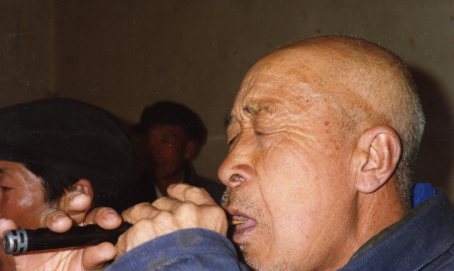
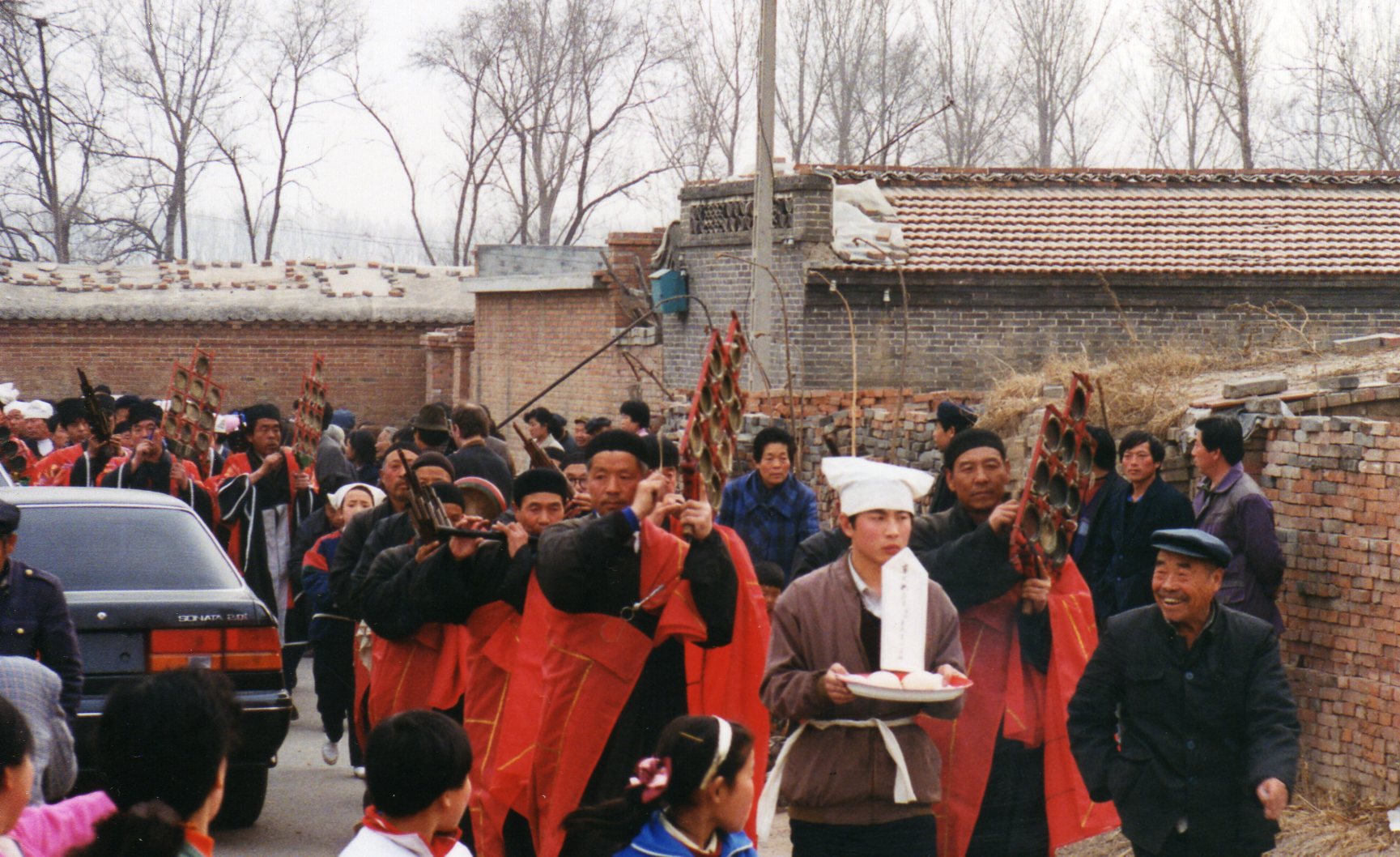
Xin'an guanzi 1989

I’ve just updated my page on Bazhou, one of the most rewarding counties on the Hebei plain for the study of ritual groups, with some more photos and subtle edits…

To remind you, this is part of a major series under local ritual where I move from occupational household groups in north Shanxi to amateur (mostly village-wide) associations on the Hebei plain, and thence to some other regions of north China.

Just for the Hebei plain, the list (sub-menu under Themes > Local ritual in the top menu) also includes

All these fieldnotes relate to articles on temple ritual in old Beijing (including the Zhihua temple), and the village associations of Gaoluo and Qujiaying.

180!!!

More local cultural knowledge:

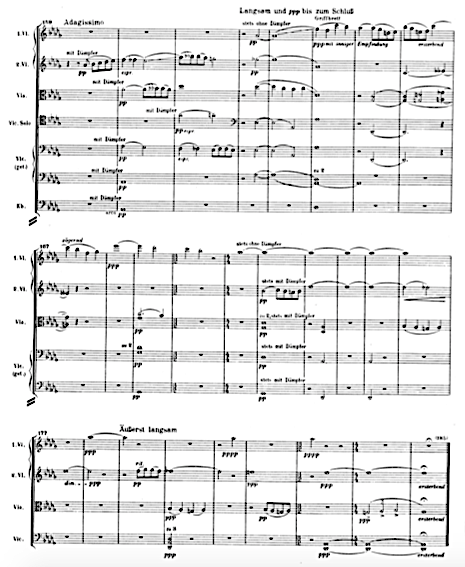
One morning in Maida Vale studios, as the great Pierre Boulez was rehearsing the BBC Symphony Orchestra, he stopped and said suavely,

“Please, we play again from measure* 180.”

Brilliant cockney percussionist Gary Kettel, from the back of the orchestra, punched the air gleefully and screamed out,

“ONE HUNDRED AND EIGHTYYY!!!”

Since Boulez’s broad erudition didn’t stretch to the world of UK darts, he was somewhat nonplussed [‘Ow you say in French?] by Gary’s recondite allusion to the fabled score of three triple 20s. Still, he and Gary always had the utmost respect for each other’s musicianship.


*Boulez always used the French word for “bar”. Endearingly, he called the cor anglais “ze English ‘orn”.

Interpreting religious symbols

Alan Bennett’s 2011 diaries begin with typically drôle observations:

6 January. The alterations we have been having done are now pretty much finished, thanks to Max, a young Latvian who’s unsmiling but an excellent carpenter and Eugene, much jollier and from New Zealand who has supervised it all. Walking around the job this evening R. is shocked to discover in the bathroom above the bath a crudely made wooden cross. He takes this to be the work of Max who, scarcely out of his teens, already has two children and is, I imagine, Catholic. R., whose feelings about religion are more uncompromising than mine, finds the cross disturbing and is determined to ask Eugene to tell Max to take it down. I’m less exercised by it, seeing it as some sort of dedication, the sort of thing (though more crude) that a medieval workman would have put up at the completion of a job. We are both of us wrong as when Eugene is approached he explains it is not a cross at all but a makeshift coat hanger he has rigged up over the bath in order to dry his anorak.

And more comments on the behaviour of WAM musos:

 14 January. George Fenton tells me of a memorial service he’s been to at St Marylebone Parish Church for Maurice Murphy, the principal trumpet of the LSO, who did the opening solo in the music for Star Wars. The service due to kick off at eleven thirty, George arrives with ten minutes to spare only to find the church already full, the congregation seated, silent and expectant. It beings promptly at eleven thirty with everyone behaving impeccably and not a cough or a rustle throughout. And he realizes that it’s because they are all musicians and orchestral players for whom this is like any other concert and where the same rules apply.

Ritual groups around Bazhou, Hebei

*Click here for main page!*
(under Hebei in main menu)

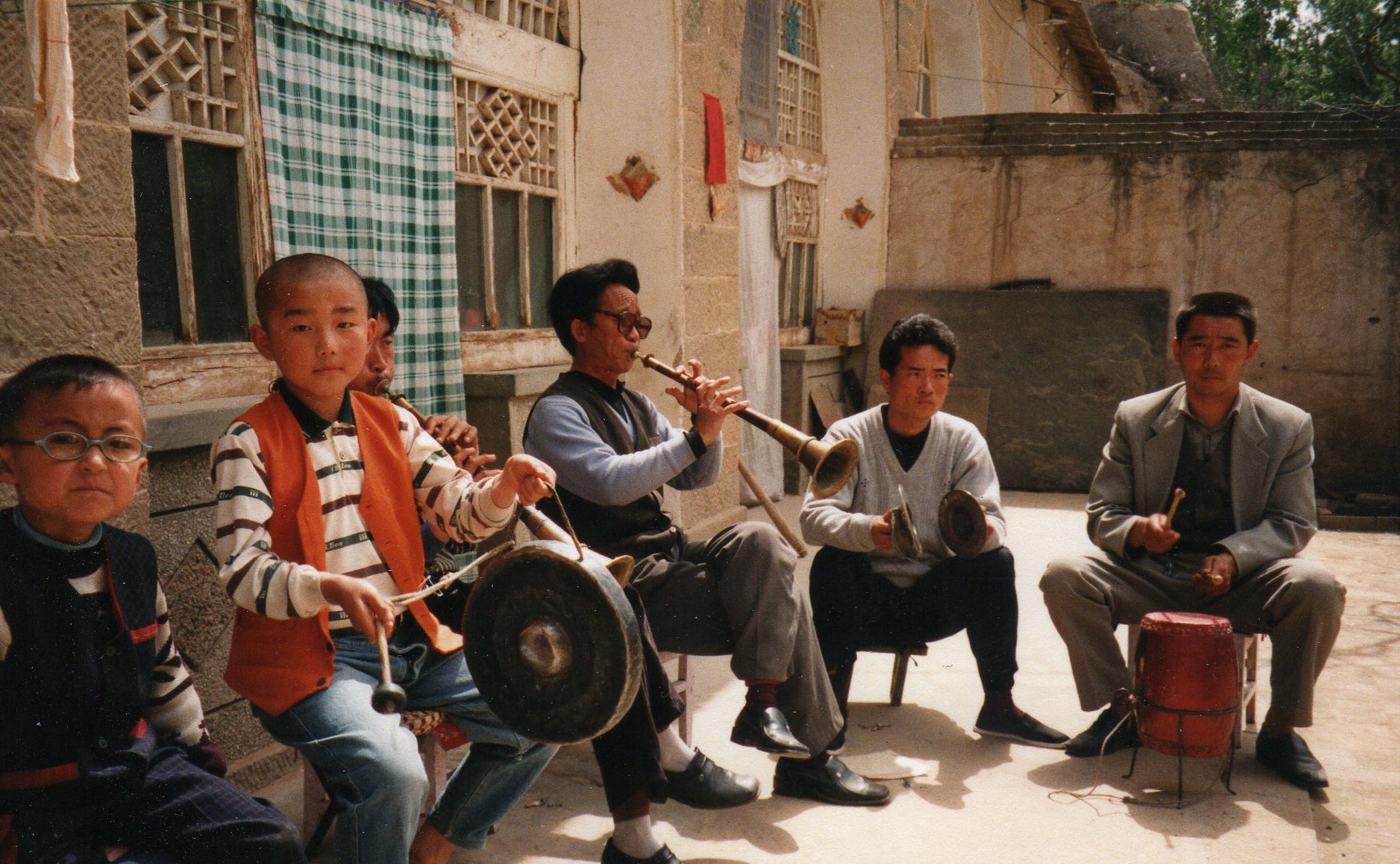
Xin'an Yingming drummer 1995

What a wonderful fieldsite we stumbled across in 1986, inspired by Yang Yinliu and Lin Zhongshu!

This is a new addition to a budding series on Daoist and Buddhist ritual groups on the Hebei plain south of Beijing. The elongated county of Bazhou lies just south of Langfang, Yongqing, and Gu’an. Rather as I did for the southern suburbs of Beijing, here I introduce two main ritual groups:

  • the Daoist tradition of Zhangzhuang village comes from a former Orthodox Unity temple;
  • the Gaoqiao village association nearby derives from a former Buddhist temple.

As we move south and east from Houshan, vocal liturgy tends to become subsidiary to the magnificent “holy pieces” of the classic shengguan wind ensemble deriving from the temples of old Beijing—notably the lengthy suites (daqu) whose most majestic form is to be found around Xiongxian county (major page here!).

And as this series of articles on local ritual expands from north Shanxi to Hebei, it’s becoming something of an alternative, grass-roots, history of 20th-century north China through successive social and political vicissitudes.

Useful ideas for Christmas

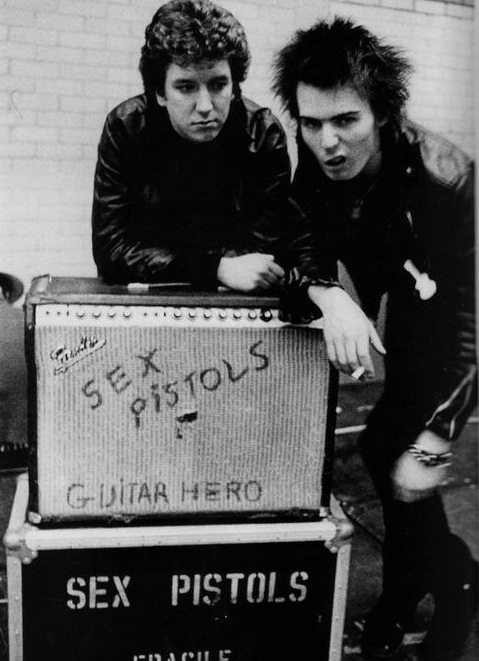
The time of year is rapidly approaching when you’re desperately racking your brains for a present for that difficult uncle who’s got everything—even Dame Kiri Sings the Sex Pistols’ Greatest Hits by Candlelight.

Well, look no further—my three former Ashgate books (two with DVDs) are out in paperback! (See also my Amazon list).

And to go with my film (a welcome change from Bambi), don’t forget Daoist priests of the Li family.

To cite The Messiah:

Thou art gone up on high; Thou hast led captivity captive, and received gifts for men

Giving Handel and his librettist Jennens** the benefit of the doubt for sexist language, don’t forget the brilliant T-shirt of female composers—”Breaks the ice at parties”, in the words of Monty Python (who did rather let themselves down* on gender equality).

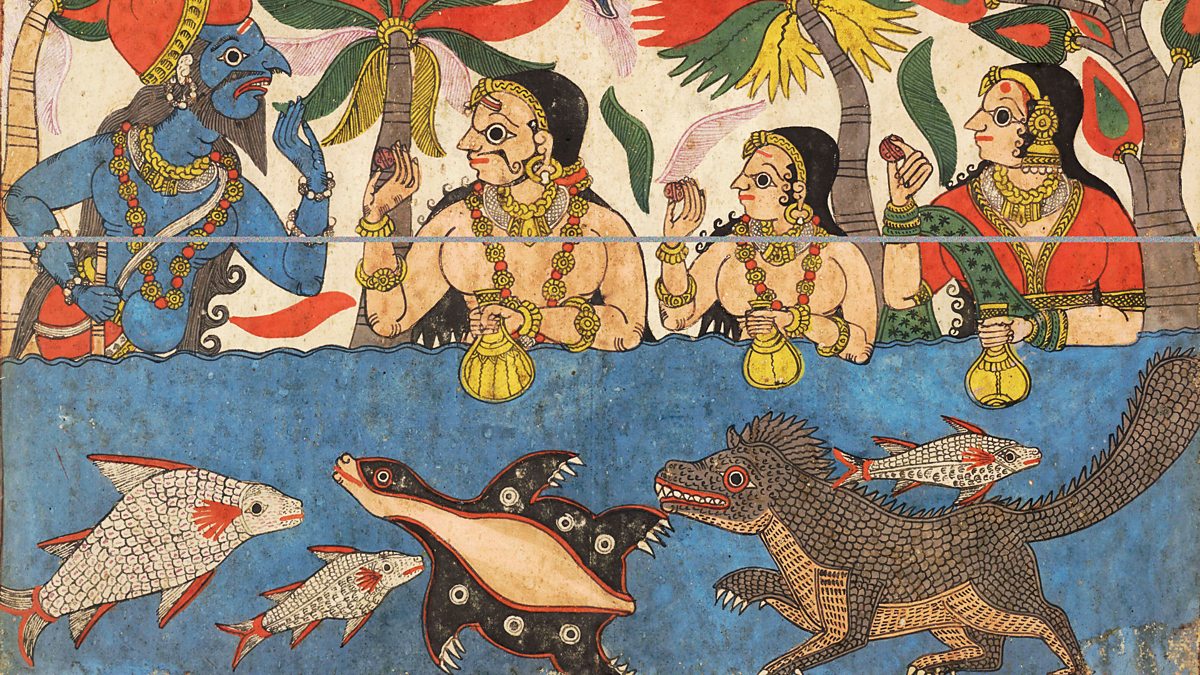
Such seasonal gifts will make a welcome change from socks and after-shave, and can be enjoyed over a sherry in a party hat while blowing a paper horn—a relative of the vuvuzela, perhaps? Laurence Picken could have enlightened us. You can play the party game of identifying festive toy instruments under the Sachs-Hornbostel system (or play Spot the Difference with Daoist ritual paintings, like the Judgment Officers here). The paper horn also evokes the conch in Daoist ritual—indeed, it would make a suitable companion to these early Daoist instruments of the Li family.

horn

* “Let themselves down”: apart from the Proust sketch (from 2.14, notably the voiceover comment “golf’s not very popular round here”), there’s also the classic headmaster’s speech joke.

** Good to see Jennens slagging off Handel’s music, at least:

“I shall show you a collection I gave Handel, called Messiah, which I value highly. He has made a fine entertainment of it, though not near so good as he might and ought to have done. I have with great difficulty made him correct some of the grossest faults in the composition; but he retained his overture obstinately, in which there are some passages far unworthy of Handel, but much more unworthy of the Messiah.

YAY!—I mean Hallelujah. Praise be to the Lord—and the Three Pure Ones, the Empress Houtu, Bob Marley, Mrs Cratchit and The Ten Kinds of Orphan Souls [can someone check this please?—Ed.] and the Thunder Lord of Three-Five Chariot of Fire—the latter (“Lingguan smoking a posh foreign cigarette on a train journey through his spiritual domain”) a fine read, though I say it myself.

Quartets

Quartets

BBC4 has just reshown an interesting diachronic trawl through the archives in Classic quartets at the BBC, for you to catch online before it disappears again.

Apart from the inevitable Amadeus quartet, there are vignettes from groups like the Borodin, Lindsay, Arditti, and Kronos quartets, as well as the Smith quartet playing Steve Reich’s extraordinary Different trains, and the Brodskys’ work with Elvis Costello.

I like the early footage of the Allegri led by Eli Goren, predecessor of my teacher Hugh Maguire. Here one can’t help noticing James Barton, left-handed fiddle-player—part of a select group that notably includes Charlie Chaplin (see e.g. here, from 4.35). And among hours of harmless fun on YouTube:

How can I resist reminding you that the divine Ronnie O’Sullivan is ambidextrous—though I’m not sure he stretches to Bach.

Of course, the life of a quartet (actually, any performing group that works together regularly—few are so constantly in each other’s pockets as Li Manshan‘s Daoist band) resembles that of a marriage, or (still more thornily) a ménage a quattre—a worthy ethnographic topic (see e.g. articles here and here, and Anthea Kreston’s diary on slippedisc.com).

But I digress. I love the quaint early vignettes, as if the swinging 60s never happened—the clipped tones of announcers, and musicians gamely clambering into their dinky little cars (before long we will all look quaint) to play for expectant audiences keen to worship at the altar of High Culture after the tribulations of the war… Which leads nicely to the delightful thankyou letter to the Martin string quartet!

See also Late Beethoven quartets, and Schubert.

Ritual paintings of Li Peisen

***For main page, click here!***
(under Images: Li family, in main menu)

LPS 5

Until the 1950s, household Daoists in north Shanxi displayed paintings for funerary, temple, and other rituals—notably of the Ten Kings (cf. Hebei), as well as representations of deities worshipped during other funerary rituals like the Pardon. Such images are now rarely displayed, and I have found few in the collections of Daoist families. Many were casualties both of political campaigns and a more general impoverishment of ritual practice.

One exception to this (recent) paucity of images in north Shanxi is the array of paintings handed down by the great Daoist Li Peisen (1910–85) to his son Li Hua. Some he seems to have painted himself, perhaps in the 1940s; others appear to be rather older.

In the main article I reflect on the specific use of such paintings in space and over time, and their subsidiary role to the ritual soundscape.


Ronnie again

UPDATE: Cosmic Justice has at least temporarily proved itself amidst a troubled world—I wrote this in the early stages of the UK tournament, but now Ronnie’s won it yet again in another inspiring display!

Ronnie

With his natural grace, Ronnie O’Sullivan is often compared to Roger Federer, but he’s in a league of his own, transcending sport. If you haven’t watched his maximum break from 1997, then do—it’s not merely a world record that is likely to stand for all time, but a thing of exquisite fluent beauty, reminiscent of the nuanced touch of a great musician.

After the morose introspection of yesteryear, Ronnie has come through the early years of obsession and addiction (lessons here for the claustrophobic hothouse of WAM virtuosos), and he’s on great form these days, with a kind of earthy Daoist detachment.

I list my series on Ronnie here.

Mahler 9

*For an introduction to my whole series on Mahler, with links, click here!*

Mahler 9 is always stunning in performance. The NYO Prom in 2015 was very fine (cf. here), and I’ve just heard Esa-Pekka Salonen doing it with the Philharmonia (reviewed here; cf. here; see also Harding’s Mahler 6 Prom).

I’ve got a lot of time for Salonen—not just because of the wonderful story about his interview for the LA Phil job! There’s something special about composers (also including Boulez) conducting Mahler, some personal identification with his struggles. Mahler anyway foretold the whole torment of 20th-century history—his music atomised, fragmenting, ersterbend—and we can only hear the 9th symphony with our own ears (that link also referring to Taruskin; see also here). Mahler never got to conduct it, or even hear it; while it remains startlingly modern even today, it’s hard to believe that it wasn’t premiered in the UK until 1930, and it was first heard in the USA (where Mahler was fêted even while he was composing it) in 1931. The symphony eventually became a pillar of the repertoire with the Mahler craze of the 60s—where I came in. Without entertaining any notions of the moral value of WAM, I have a fantasy of getting Chicago street gangs to sit through it.

Salonen brings out the Philharmonia’s talent for making chamber music amidst grand forces. Not having worked with him, I find him easy on the eye, and he looks comfortable to work with—more selfless, less anguished than Bernstein or Rattle, but far from the schoolmasterly air of Haitink or the aloof conductors of yore. Here’s Bernstein with the Vienna Phil in 1962:

Barbirolli and the Berlin Phil in 1964:

and Abbado with the Lucerne Festival Orchestra (2010), always magnificent:

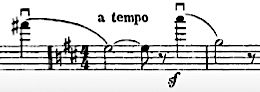
We emerge immersed in the dying sounds of the finale, but as ever, the first movement is a miracle in itself (as commentaries go, Ben Zander has some acute observations, albeit rather hung up on sonata form…). Beginning quietly yet ominously with a rhythmic pattern said to represent Mahler’s own irregular heart-beat, the violins enter with a motif descending from F♯ to E that turns out to be both pervasive and deeply moving—dramatically augmented at the first climax (4.21 in the Abbado performance above) by the 1st violins with a huge leap:

M9 leap

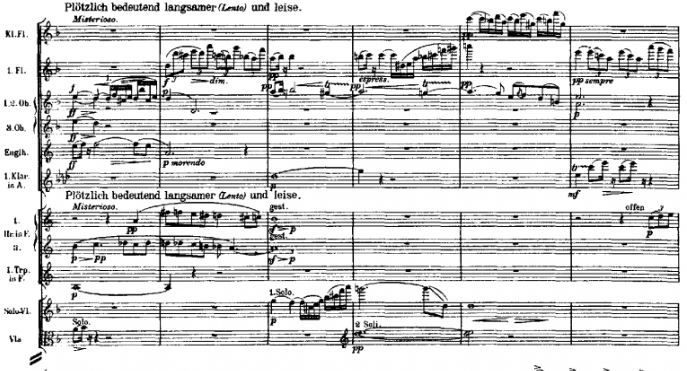
The lyrical aspect of the opening is constantly undermined (sinister brass punctuations from 7.34, a spooky passage from 8.49, more ominous brass from 15.03 and 19.09), becoming still more eery with enigmatic chamber music from 22.48:

M9.1a

M9.1b

M9.1c

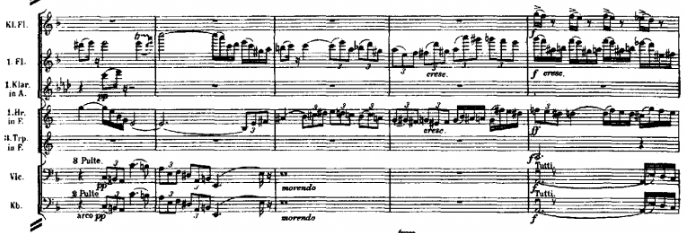
The brief hint of tranquility from 24.42 soon fragments again:

M9.1 end

I’ll leave you to immerse yourselves in the following movements—like the Abschied, or Ich bin der Welt abhanden gekommen, Mahler 9 live is an overwhelming experience, not to be missed.

Mahler 9 end

For a 2022 performance with Daniel Harding and the Concertgebouw, click here. See also Mahler: quintuplets. For an unlikely connection, see here; and for a macabre tale from Inside No.9, here. See also Salonen’s Mahler 10.

Ritual groups of suburban Beijing

***For main page, click here! ***
(under Hebei in main Menu)

N. Xinzhuang funeral 1

In the 1990s, ritual activity in the southern rural areas of the municipality of Beijing was patchy. While we found few ritual associations in the counties of Gu’an, Fangshan, and Zhuozhou south of the city, the groups in the suburban counties of Daxing and Tongxian, southeast of Beijing, were still actively providing ritual services.

Like other associations on the Hebei plain, these groups have ongoing ritual traditions, and clear links to Daoist priests and Buddhist monks. But these groups are distinguished by their proximity to Beijing, and by the fact that many groups acquired their ritual only in the 1950s, as laicized clerics sought to transmit their knowledge to villagers. Thus although they are not “old associations”, lacking the early history of most village groups that we found just further south on the plain, they clearly reflect temple traditions of ritual, relating to Beijing and Tianjin as well as to local networks. Again by contrast with most of the amateur village associations elsewhere on the Hebei plain, many of these groups don costumes for rituals, and accept fees.

This whole region was still largely rural when we made fieldwork trips there in the 1990s, but has since been absorbed into the ever-expanding urban sprawl of suburban Beijing—as indeed are villages further south on the plain, where we found many more ritual associations. In a physical and moral landscape that has changed constantly since the 1930s, restudies are always to be desired.

There are many such groups here, but in the article I focus on two:

  • The Lijiawu Daoist group, derived from the temple priests of Liangshanpo, and
  • the Buddhist-transmitted group of North Xinzhuang nearby.

This article also complements my various posts on Beijing temples and the transmissions south to villages like Qujiaying.

It’s that man again

More from the diaries of Alan Bennett. I’m filing this 2009 entry under heritage:

23 August. […] I’m glad I’m not a theatregoer living in Elsinore. All they must ever get are productions of Hamlet, while what they’re probably longing for is Move Over, Mrs Markham or Run For Your Wife.

His keen eye for footballers’ physiognomy is in evidence again (2010):

7 April. The open mouth of Frank Lampard, having scored a goal, is also the howl on the face of the damned man in Michelangelo’s The Last Judgement.

This entry depends on a certain cultural knowledge that might challenge translators:

5 July. A child in Settle is said to have asked what the Mafia was and his grandfather said, “It’s like the Settle Rotary Club, only with guns.”

And he often shows his political involvement. When a speech in favour of the NHS from his early play Getting on is well received, he is encouraged to go on:

25 July, Yorkshire. […] whereas nowadays the state is a dirty word, for my generation the state was a saviour, delivering us out of poverty and want (and provincial boredom) and putting us on the road to a better life; the state saved my father’s life, my mother’s sanity and my own life too. “So when I hear politicians taking about pushing back the boundaries of the state I think”—only I’ve forgotten what it is I think so I just say: “I think… bollocks.” This, too, goes down well, though I’d normally end a performance on a more elegiac note.

Sing…

As a corrective to all the glowing speeches from divas and the rapturous adulation of their fans, Bill Bailey (don’t miss his Love song!) recalls:

I was at a Whitney Houston gig, it was supposed to start at three—finally at four o’clock she comes on stage and says,
“I just wanna say, I love each and every one of you!”
and this big black guy next to me shouts,
“Sing, bitch!”

This is a metaphorical version of the fan hitting the shit.

Barbed comments

My dubious encomium for Rowan’s CV (The Feuchtwang variations, n.3) reminds me:

The brilliant Roy Mowatt (see under comments here), a real bedrock of the early music orchestral scene, was always remarkably tolerant of my violin playing in the section he led. I treasure a remark he made to me over a beer or three in a piazza in Parma after a Mozart opera, c1994 (evoking Hugh Maguire’s comment to Pete Hanson—“Pete, even if your strings are out, you must play in tune! Just do it wit’ your fingers!”):

Thing about you, Steve, is that it doesn’t make any difference if your strings are in tune!

You can take that either way, and I think he meant it both ways. I was quite adaptable; yet my intonation wasn’t necessarily helped by tuning up… Cf. “It was in tune when I bought it”.

While I’m in confessional mood, here’s another comment I might add to my CV. Just around that time, a certain maestro took me aside and observed suavely,

Steve, I can’t help noticing that you have a somewhat low threshold of boredom…

JEG

Photo © Jim Four.

Like the review of the Berlin Phil’s response to Simon Rattle, it lacks a certain nuance.

Ritual images: Gaoluo

***For new page, click here!***

GL Dizang

This first page under a new series on ritual images again concerns Gaoluo.

Apart from their ritual manuals and gongche solfeggio scores, all four ritual associations in North and South villages of Gaoluo have collections of images, including god paintings, diaogua hangings and donors’ lists, from various stages since the 19th century—displayed for calendrical rituals of the village community.

Ritual paintings of north China

***For main page, click here!***
(under Themes, in main Menu)

SGL old pantheon detail

For aficionados of visual culture:

The main focus of our fieldwork on the Hebei plain through the 1990s was the ritual performance of amateur village-wide associations there. But of course we also documented the material artefacts of these groups—including ritual manuals, gongche solfeggio scores for the shengguan wind ensemble, donors’ lists, and so on.

I now realize that by comparison with elite painting, temple murals, and so on, what we may call “folk art” is not so well represented—either in print publications or online. So this is a new sub-menu for ritual paintings of village groups, mainly from Hebei. I’ve already included some of them in various posts/pages, but now I’m adding many more (mostly from the period since the late 19th century, but also some painted since the 1980s).

Most of these images are displayed for calendrical rituals (notably the New Year) and/or for funerals—the Ten Kings images are used for both.

Of course, these material artefacts are a sub-theme; our main material consists of a rich archive of audio and video recordings of ritual performance. Contemplating such images in a museum is a last resort: they are the backdrop to the ritual soundscape of vocal liturgy and “holy pieces” of shengguan wind ensemble, and a representation of the changing spiritual life of local communities. As you digest these pages, you might even listen to the items of vocal liturgy and shengguan on the playlist in the sidebar, with commentary here).

Nicknames

As Kate Fox observes, the creativity of the English language reveals itself at multiple levels.

The fragrant Gary Lineker recalls how the the team-mates of the footballer Kiki Musampa called him Chris (think about it). There are more where that came from, like Fitz Hall—known as One Size.

Brian Smith, a “straight” symphony-orchestra violinist who became a semi-detached admission to the rarefied early music scene in the 1980s, had a whole series of drôle nicknames for his new colleagues, making his conversation surreal: “I think Identikit’s gone off with Ironing Board”. Once word got round that I was making regular trips to China, I became The Missionary. He only used the real names of musos who had a life outside early music and thus qualified as Real People.

Conductors’ nicknames are another rich vein under the rubric of maestro-baiting. The great Charles Mackerras was known as Slasher—not an allusion to his conducting technique, but an abbreviation of his anagram: Slasher M. Earcrack.

Shadow puppets and Satie

shadows on road

Among a select group of films on rural life in China, little-known but brilliant is

  • Chinese shadows: the amazing world of shadow puppetry in rural northwest China (58 minutes, Pan Records, 2007).

Fruit of the collaboration between Frank Kouwenhoven and the late lamented Antoinet Schimmelpenninck of the CHIME foundation in Leiden, it evokes the changing lives of itinerant troupes in the poor villages of Huanxian county in east Gansu. Both in the scenes of villagers chatting and in their performances, you can feel the film-makers’ empathy with rural dwellers.

shadows guoguan

The puppeteers often perform as part of the Crossing the Passes (guoguan) ritual to protect children.  A similar ritual in Shaanbei is shown in my film Notes from the yellow earth (with my book Ritual and music of north China, vol.2: Shaanbei, p.37); see also my note for Daoists in Changwu in Shaanxi, not far away.

shadows band

The sound-world of the puppeteers is remarkable, with gutsy percussion, fiddles, and shawms accompanying passionate vocals. [1] On the Chinese shadows soundtrack, piano music (Howells, Smetana, Janáček, and so on) makes a disorienting contrast with the guttural sounds of the Gansu singers and their earthy instrumental accompaniment. At first I had reservations about this choice, when we have so little opportunity to savour the sounds of village China—but I’ve come round to it as an effective personal reflection of the film-makers.

shadows 4
Image © Frank Kouwenhoven; all right reserved.

In similar mood, in Frank’s moving portrait film of Antoinet’s life, a tribute shown at her funeral, he used Satie’s fifth Gnossienne—less well-known than the others:


[1] Featured on the 2-CD set The beauty of Chinese opera, one of an excellent series of historical recordings from Wind Records. For a roundup of posts on Gansu, click here. See also under More films on ritual drama.

Sacred river

Radio 3 doesn’t seem to be speaking to Radio 4.

Like Neil MacGregor’s thoughtful series on German history, his new BBC Radio 4 series Living with the gods is typically urbane and engaging. As he immediately disarms my reservations about material culture and museums, the series makes an accessible mission-statement for the anthropology of religion. And the BBC Radio 3 marathon Sacred River (see also the love-in on https://twitter.com/bbcradio3), the latest of many epic broadcasts, seems like a fine idea to complement it.

I’m most reluctant to cavil at my favourite radio station, and normally I’d be grateful for such a playlist of glorious music (cf. my paeans to the Proms). But it seems something of a retreat from the global perspective of MacGregor’s series. Whereas in Living with the gods he can discuss social contexts, with music examples making evocative soundbites, it’s proved less easy for a programme of “spiritual music” tailored to a Radio 3 audience to address world soundscapes within their regional societies.

Radio 3 is generally rather good on, um, world music (a tradition going right back to David Munrow), but here Neil MacGregor’s stimulating introduction is soon deflated, as one “masterpiece” of (let’s face it, Christian Europe) WAM choral music follows another. My own blog is full of Bach, Mahler, and Messaien—but in Sacred river, whereas one might wish for more challenging juxtapositions from around the world, here a mere five out of fifty tracks are devoted to other world genres (and that’s a generous count: OK, a bit of plainchant, but Ladysmith Black Mambazo? Trio da Kali with The Kronos quartet? Hey!), choices like the Pathétique symphony or the Allegri Miserere hardly open our ears to new horizons. It’s The Great Composers in a new costume. And though “music and ritual” is a rich topic in ethnomusicology, the site offers few links to further sources—even from its own output.

Inevitably, I think of the percussion coda Yellow Dragon Thrice Transforms Its Body of the Li family Daoists, that concludes their Transferring Offerings ritual. Of course neither this nor most other ritual traditions around the world might work on the radio on their own. But listeners deserve more than the Usual Suspects like qawwali, “Find your inner peace with the sound of Buddhist chant”, and “the oldest song in the world”. Sure, they might not necessarily conform to the hackneyed message of Peace and Love, that cramped ghetto from which Neil MacGregor rescues us. But if the Radio 3 team had half his imagination (as I write, he’s discussing royal power, sliding effortlessly from Zadok the priest to bronzes from Benin and China, with asides on Trump and Putin), they could have found more stimulating and offbeat tracks, even from their own archive—aboriginal dream songs, ritual shawm bands, Andalucian saeta, gospel, you name it. So Sacred river ends up undoing the fine work of Living with the gods. Do keep exploring Radio 3, which is full of creative programming—including—such as Late junctionWords and music, and notably The listening service.

Of course, what it needs is a TV series. Alas, since a little heyday in the 1980s there has been little appetite for informed anthropological documentaries on local cultural life—in which ritual features prominently.

Hey-ho. Just saying, like…

Recording and editing

After our rendition of The Feuchtwang Variations à la chinoise at Stephan’s party—which surprised us as much as the guests, even without kazoo—we wanted to make a separate recording, but we had few illusions about how it could turn out. However modest our remit (it would be too ambitious to try and edit within movements, and we didn’t do too many takes), even the minimal editing that Rowan undertook was still a time-consuming process.

Typical exchange during rehearsal:

Me: Can you give me a lovely lingering arpeggio on that first chord, like a theorbo?
Rowan: No.

For me, it recalls all those orchestral recording sessions through the 80s and 90s—with section leaders crowding into the box to make notes and report back, doing endless retakes of a single chord, with the editor then taking months to compile a version that was a total fabrication. Of course, live recordings are far more satisfactory, if we can wean ourselves off glossy perfection—even then, we tended to do a couple of patching sessions after the concert.

It also reminds me of a comment from—you guessed it—Alan Bennett, in his 1990 diaries, on working with the Delme string quartet in recording the soundtrack for his Proust film:

27 June. […] Striking about the musicians is their total absence of self-importance. They play a passage, listen to it back, then give each other notes, and run over sections again. George Fenton, who is coordinating the music, also chips in, but he’s a musician. David H., the director, chips in, but he isn’t a musician, just knows what atmosphere he wants at various points in the film. In the finish even I chip in, just because I know what I like. The musicians nod and listen, try out a few bars here and there, then settle down and have another go. Now one could never do this with actors. No actor would tolerate a fellow performer who ventured to comment on what he or she was doing—comment of that sort coming solely from the director, and even then it has to be carefully packaged and seasoned with plenty of love and appreciation.  Whereas these players, all of them first-class, seem happy to listen to the views of anyone if it results in them doing a better job.
[…] The readiness of players in a string quartet to absorb criticism from their colleagues has been noted by doctors, and the BMA video was made to be shown to businessmen as a model for them to emulate. Perhaps it should be shown to Mrs Thatcher.

Such humility is a trait that musicians might not recognise in themselves; anyway, AB was lucky to work with a quartet, as orchestral recording sessions are (inevitably) far more hierarchical, with a clear pecking order (giving rise to maestro-baiting). Still, the contrast with actors (and politicians) rings true.

The Feuchtwang Variations

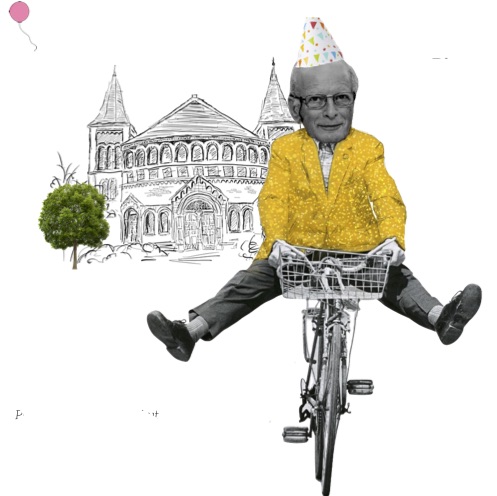
The wise and infinitely supportive Stephan Feuchtwang continues to inspire generations of anthropologists in China and worldwide (see also here) with his work on Chinese popular religion. He has just celebrated his 80th birthday—and so do we all!

Stephan's invitation edited

Design: Lotte van Hulst.

For the party at the Tabernacle (a great venue, and, um, marker of the changing territorial identities of West London religious life!) his wonderful family played some popular and moving musical items, with the assembled guests on kazoos (anyone have a funky collective noun for kazoos in English, or measure word in Chinese?). And following my little foray into a world-music version of Bach earlier this year, we did a warmup act as a heartfelt tribute to Stephan, essaying a little medley from the Goldberg Variations—with me on erhu (one of many types of Chinese fiddles) and Rowan Pease (unsung Lucy Worsley of East Asian popular culture, currently embroiled in the China Quarterly struggle for academic freedom) on sanxian banjo (or should I say friction chordophone and plucked lute?) [Nah, give it a restThe Plain People of Ireland].

Wong

Not Rowan, not playing the sanxian.

That makes a total of five strings—and all without a safety net. Since Bach never wrote for either piano or sax (shades of WWJD), if his music can sound great (to us) on those instruments, then why not erhu and sanxian, eh. We haven’t tried adding a kazoo yet, though. As I said in my intro:

Just imagine that the Italian missionaries, like Pedrini, [1] at the court of the Qianlong emperor in 18th-century Beijing had invited Bach for a sabbatical—and indeed Stephan, although that was perhaps a little before even his time… So we’re going to essay a little medley from what should now be known as The Feuchtwang Variations[2]

Since among Stephan’s many talents he is also a viola player (“Not a Lot of People Know That”), I can avail myself of a couple of the muso’s classic excuses:

It was in tune when I bought it…
and
I didn’t really study any place, I just sort of… picked it up… [for how I picked up the erhu, see under the fascinating story of Ray Man]

[studiously] After intensive research on the performance practice of both Leipzig and Beijing in the 1740s, I can now say with some certainty that…  it wouldn’t have sounded like this.
[Cf. John Wilbraham’s remark.]

If you enjoy this half as much as we do, then we will have enjoyed it twice as much as you.

See also Song of suffering.

Framed by the Aria (itself infinitely enchanting—molten, ethereal, suspended in time), we played the first variation (blimey), then numbers 18 and 25—a perfect selection, eh. Short of recording daily until Steph’s 90th birthday, we’re never going to play it to our satisfaction (editing this is a similar challenge to editing one of my voiceovers), so meanwhile here’s an almost-recognizable attempt, just to give you a flavour—It’s the Thought that Counts. Just think yourselves lucky we didn’t do the repeats. Take It Away (and don’t bring it back):

Stephen Jones (erhu), Rowan Pease (sanxian, vocals).
Recorded in Maidenhead, 14th November 2017.

“They said it couldn’t be done”—and they were right! (Cf. Bob Monkhouse).

Just to make our chinoiserie version sound a little less banal, try the opening of the Aria on Lego harpischord, and Pachelbel’s Canon on rubber chicken—differently charming…

Li Qishan band 2001
Li Qishan’s family shawm band, Shaanbei 2001.

Never having played the Goldberg Variations on a keyboard, I (like millions of others) am deeply familiar with it through recordings—notably that of the iconic Glenn Gould, of course. So at the age of 286 I’m almost in the position of a young player in a Chinese family shawm band, who begins to play the melodies on shawm after many years of aural experience (and let’s just be grateful I didn’t do an arrangement for large Shaanbei shawms—yet). Similarly, I hardly needed to consult Bach’s notation, except out of curiosity. At the same time, anyone playing the piece is inevitably conditioned by the experience of hearing Glenn Gould’s version.

We played the medley in F rather than G—less as a result of all my erudite research into 1740s’ pitch standards (not), but just because I like a lower tuning on the erhu.

Bach party

Blending with invisible singers to left of picture. Stephan in red on left. Photo: Cordelia Pegge.

For the ecstatic Variation 18 we recruited a backing band consisting of Stephan’s daughters Rachel and Anna, along with Harriet Evans (outstanding scholar of the status of women in China). I arranged some personal lyrics, often in a kind of verbal hocket, incorporating (in stave 3) anthropology (with a little jest on the challenge, for some of us, of mastering the abstruse nature of Stephan’s theory!), (in stave 4) his dear wife Miranda, and his love of cycling:

Goldberg Var 18 in G

For the recording, without vocal backup, Rowan and I take the upper parts wordlessly, in more ethereal vein. Do feel free to sing along with a partner of your choice (cf. the karaoke versions of Daoist ritual percussion in my film, from 24.09).

And then the slow and intense minor-key Variation 25 is just amazing. Here Rowan’s singing supplies further harmonic intensity, evoking Glenn Gould’s own occasional inadvertent vocals. [3] And with the sustained sound of the erhu, and all my one-finger chromatic slides (1st finger on the way up, 4th finger on the way down), it sounds even better—or rather, it could do in the right hands. Not unlike a Chinese ondes martenot—trad keyboards just can’t compete with the vocal quality of bowed instruments.

And OMG, how about this (for the theremin, click here):

Sure, our version goes a tad faster—again, not resulting from any holier-than-thou baroque authenticity, but because it helps the whole harmonic logic.

Among many fine harpsichord versions, here’s Scott Ross:

Returning briefly to the modern piano—Bach was of course performing and composing modern music, and maybe what appeals to me in Joanna MacGregor’s version is that it seems tastefully rooted in her whole experience of our own contemporary piano sounds. Here’s the hallucinatory final repeat of the Aria:

Still, Bach is amazing on tuned percussion too, like this:

It can also sound wonderful as a string trio:

And now I’m keen to hear Rachel Podger’s new arrangement with Chad Kelly:

For Uri Caine’s stuttering variation, see here.

All this wealth of divine music I offer in tribute to the great Professor Feuchtwang!

[1] For missionaries at the Qing court, see here. “They come over ‘ere, with their fancy harpsichords…”
[2] Maybe I can concoct a couple of Chinese musicians in 1740s’ Leipzig from the Bach archives. If north African wind players were active at European courts of the day, then why not… International cultural exchange, eh. Note also Bach and Daoist ritual—not least Li Manshan’s classic remark.
[3] This encomium could come in handy for Rowan’s CV: “Less irritating than Glenn Gould”—Dr S. Jones.

Performance ethnography

Pace Robert Hanks and indeed the great man himself, one can never have too much of Alan Bennett.

From his 2008 diaries, more perceptive ethnography of both orchestral musicians and audiences (cf. here and here), about a TV broadcast of the West-Eastern Divan Orchestra from the Proms:

… one of the cameras fascinated with a particular woodwind player who has a good deal to do, but who in turn obviously fancies the flautist who’s next but one. So at the end of his own contribution he’ll often half-turn in order to pass the tune or whatever to this flautist, and she is equally attentive during his solos. There’s a cellist with a cheeky face who plainly makes jokes, a bear of a violinist who throw himself about a lot, and next to him the child violinist with a face made tragic by concentration. It’s hard to conceive how such a small figure copes with the great winds of Brahms, though he’s more composed about it than his hairy and demonstrative neighbour.

It’s moving, too, of course because of the moral stance of the orchestra, though the players are by now probably bored or at least matter-of-fact about this ethical burden. But with similar experience in the theatre (including I hope The History Boys), one longs to stay with them once the performance is over and they disperse. Who looks after the child, I wonder, whom does the cheeky cellist sleep with and are the flautist and the woodwind player as close as their performances suggest? So there’s sadness too in being excluded from all this and longing, just as there is coming away from the theatre or for some people, I imagine, the football stadium.

Competing with the lofty claim of detached spiritual contemplation of the work in hand, such observation is a universal yet little-documented feature of attending public performances—just the kind of detail that ethnomusicologists might seek, and that the “absolute music” wing of WAM scholars would eschew.

Houtu tent

My work with the Li family Daoists is full of such detail, both for their funeral practice at home—such as Golden Noble corpsing the others while reciting the Invitation memorial, or the reluctance of the kin to pay attention to the liturgy of the Daoists they still feel obliged to hire—and for their concerts on tour (such as this, and this). But even in the 1990s I had apparently read enough Geertz, Barley, and so on to pay attention to the behaviour of the Gaoluo villagers—like this passage (Plucking the winds, pp.304–5):

After supper on the 15th, the “temple” courtyard is packed. Apart from South Gaoluo villagers, some have also come from the North village and elsewhere. Many have come to offer incense, but many also just for the fun. Boisterous children are chasing around letting off firecrackers, both outside and inside the “temple”. Five sticks of incense are considered “a bundle” (yifeng).

As to ordinary villagers, though there are more women than men offering incense, quite few of the people are elderly: young and middle-aged women and young men seem to be more active in this. Many pray silently to the goddess Houtu for a healthy son, or for the health of their aged parents; more generally, people pray for good luck and prosperity. One couple were offering incense for the safety of the husband, who is a driver—even for the most diehard atheist, recourse to divine help is particularly tempting on Chinese roads. The atmosphere is highly jocular as people enter the courtyard. As they go to offer incense and kowtow they look embarrassed, but then when they are actually doing it they become extremely serious. Then as they get up and dust down their trousers, they look all embarrassed again, and, avoiding meeting the gaze of all the onlookers, they leave the area, often going into the “temple”.

Of course, Geertz, Barley, and indeed Bennett may do it better, but as with WAM, such social ethnography is quite rare in (both Chinese and foreign) studies of Daoist ritual, which are more concerned with recreating the abstract deep structure of medieval texts and ritual sequences. And similarly, it’s not one or the other—both angles are desirable.

* * *

Later in 2008 AB notes a comment on the distressingly populist Classic FM radio:

Elgar’s Nimrod conducted by John Eliot Gardiner. It doesn’t get much better than that. Or does it? Give us a call.

They come over ’ere…

Central Asian musicians, Tang dynasty.

Here’s a companion piece to my post on foreigners during the Cultural Revolution, where I acknowledged my anachronistic use of the epithet laowai 老外.

I read that indeed the term didn’t become common until the 1980s—just in time to greet me on my late arrival (for some words that Shakespeare may not have invented, see here). The Chinese wiki article on laowai makes a useful succinct introduction, explaining its interplay of respect and xenophobia. I’m still curious to learn how the winning combo of lao and wai suddenly caught on. A detailed forum on the nuances of this and related terms has been initiated by the erudite Victor Mair, so here I’ll just add a few personal reflections.

A still more blunt term is dabizi 大鼻子 “big nose”; foreigners in China have to get used to frequent appraisals of their physiognomy, but as an autonym, at least, the term can be drôle. I’m also fond of the more quaintly retro yang guizi 洋鬼子 (“foreign devil”), which a senior Taiwanese mentor—and, crucially, friend!—likes to call me. As ever, such terms are context-sensitive; they may even confirm guanxi (“You’re my mate—we can take the piss together”).

At a tangent, in Shaanbei a fine shawm-band leader is widely known as Jiekazi “The Stammerer”—in rural China, attitudes towards stammering are both less po-faced and less courteous.

Craig and Ming

Waiguoren!” (not yet “Laowai!”). Craig Clunas, Ming tombs 1975.

Staying with China (derogatory terms for foreigners are of course a rich topic worldwide), apart from the various historical terms (hu 胡, fan 番, yi 夷, man 蠻, and so on—mostly with a strong suggestion of “barbarian”), I’m now curious to learn how the Labouring Masses of the Tang dynasty would have hailed the substantial number of laowai on the streets of 8th-century Xi’an in the popular argot of the day.

We may now regard the Tang as the first great world-music boom (cf. Soundscapes of Dunhuang), but as musical nationalists of the day (like the poet Bai Juyi and his mate Yuan Zhen) might have said,

“They come over ’ere, with their fancy bili and pipa…”

Or their Qing-dynasty counterparts (so does building walls work, then? Eh??):

“They come over ’ere, with their fancy erhu and suona and yangqin…”

OK, I made those up, but this is a genuine Tang quote (adding impertinent male judgment on female attire to the heady xenophobic mix): [1]

Our women are acting like foreigners’ wives, studying foreign make-up;
Entertainers present foreign sounds, servants to foreign music!

Straight out of the Daily Mail, that. With the current surge in “patriotism”, a new campaign to purge corrupting foreign influence from the Chinese instrumentarium would be left mainly with the xun ocarina and the sheng mouth-organ—which might fail to excite even Uncle Xi. It’s ironic that after successive waves, it was the Model Operas of the Cultural Revolution that were largely responsible for a renewed vogue for the instruments of the Western Art Music tradition.

Closer to home (yet equally apposite), a classic rebuke to xenophobia is the great Stewart Lee’s UKIP routine (“Bloody Huguenots, Coming Over Here—doubting trans-substantiation, with their famed ability to weave little jerkins out of lace…”). And to supplement his fantasy chat down the UKIP pub:

“Apparently the guitar is descended from the oud—that’s bloody Moorish, mate! What’s wrong with Morris dancing, that’s wot I say!”

[Inconvenient footnote: an inconclusive etymology suggests that “Morris” is itself derived from “Moorish”…]

As simplistic nationalist agendas rear their ugly orange heads yet again, it’s always worth unpacking language. See also A fine riposte, and Das Land ohne Musik.

For the “Golden Age” of the Tang, Chinese scholars might learn from 17th-century Holland.


[1] See e.g. Suzanne E. Cahill, “Our women are acting like foreigners’ wives! Western influences of Tang dynasty women’s fashion”, in Steele and Major (eds), China chic: East meets West. Among many works, see also Marc S. Abramson (ed.), Ethnic identity in Tang China. The works of Edward Schafer (notably The golden peaches of Samarkand and The vermilion bird, written at a time when such study was neither profitable nor popular) have long been an inspiration for those studying Central Asian culture in the Tang.

More Ted Ibert

bear

Always a keen ethnographer of religion, Alan Bennett documents the ritual paraphernalia of calendrical observancess in a diary entry for 2007:

17 May. Outside the bank I see the local vicar, his arms full of balloons and a Sooty teddy bear in the crook of his arm. “It’s Ascension Day,” he explains.

Pursuing the teddy bear theme, AB reflects on his own innocuous image:

20 December. […] I shall still be thought to be kindly, cosy, and essentially harmless. I am in the pigeon-hole marked “no threat”, and did I stab Judy Dench with a pitchfork I should still be a teddy bear.


Women of Gaoluo

Woman Zhang

Woman Zhang at 90 sui, 1998.

Chain-smoking cross-legged on the kang brick-bed with all the carefree abandon of the elderly, wielding her cigarettes with more relish than accuracy, Woman Zhang (Zhangshi nü 张氏女, b.1909) told us what she could about her life. As she said, entirely without feminist irony, “I had no [given] name until going to work [in 1958] in the Great Leap Forward—that’s when they gave me the name Yurong.”

Apart from the Li family Daoists (film, and book: also tag in sidebar), my other most in-depth ethnography concerns the ritual association of Gaoluo, just south of Beijing. On this blog I’ve written about two leading figures there, and the vocal liturgists, as well as their performance of “precious scrolls”—and also the village’s substantial minority of Catholics.

It may not have escaped the alert reader that much of my fieldwork is basically about the public activities of men. I made a partial attempt to redress the balance with three posts on Women of Yanggao (starting here). So here are some further notes on the status of women in rural China, setting forth from our chats with the characterful Woman Zhang in Gaoluo in 1998, and again based on vignettes from my book Plucking the winds (where you can find further detail).

Though 90 and illiterate, her mind is quite clear, and to my relief she speaks with a clear calm voice in a standard accent. Given her advanced age (she claims to remember the long pigtails still worn by men for a while after they ceased to be enforced with the fall of the Qing dynasty), our meeting should have been a fascinating glimpse into village history. But, in total contrast to the detailed day-by-day accounts of the cultured men Shan Zhihe and Shan Fuyi, I was taken aback by her ignorance of the momentous events which had convulsed the village. Of course, men can be muddled too; but this wasn’t muddle. We know a lot of men who are totally vague about dates, but at least they have participated in history, even when only trying to escape it or deplore it, and one can learn a lot. The problem was that she was not only uneducated and a woman, but had been widowed over fifty years earlier: she had simply played no part in the village’s public history. This itself was a salient lesson. We supplied the dates below: significantly, the only date she had ever heard of was 1960, the famine.

While nominally a Catholic, Woman Zhang “believes in everything”. Though she was only brought to Gaoluo from her home in a village in Dingxing just south in about 1930, she had heard stories about the famous Boxer massacre at Gaoluo in May 1900. Some of the Catholics took refuge in the Catholic stronghold of Anzhuang further south, while others fled to the Xishiku church in Beijing. Woman Zhang’s father-in-law Shan Zhong was the only survivor of his whole family from the Boxer massacre; two sons and a pregnant daughter had been slaughtered. Shan Zhong himself had gone to Dingxing town that day; on his way back he got as far as Wucun village just south of Gaoluo when he got wind of the massacre and fled, taking refuge in the Xishiku church in Beijing. After it became safe to return to Gaoluo, Shan Zhong remarried, taking a young wife.

1930 donors' list, South Gaoluo

1930 donors’ list.

By 1930 the village ritual association, sensing a need to compete with the revival of Catholic power, commissioned a new set of ornamental hangings for the New Year rituals (see here, under Ritual rivalry). Shan Zhong was by now an established leader of the village Catholics—but impressively, he was one of the most generous contributors whose names (all male, as heads of households) appear on the rival association’s handsome donors’ list.

That same year Woman Zhang, then 22 sui, was brought to Gaoluo to marry Shan Zhong’s 14-sui-old son Wenli, the youngest of their three sons. Later the Italian missionaries became popular partly because like the local spirit mediums they could cure illness, and Shan Zhong also gained quite a reputation as a healer. But he died only a year after Woman Zhang’s son was born, quite soon after the building of the church.

Soon after I married here, the Catholics used to try and get me to come to church, but my mother-in-law wouldn’t let me—I couldn’t just please myself when I went out, she’d beat me. They talked it over with the other Catholic wives. They took me to church, and after the service was over they took me home, so the mother-in-law didn’t beat me.

Through the growing fug of cigarette smoke, as we tried impertinently to help Woman Zhang direct some of her ash in the general direction of the floor, she went on: “They taught me eight scriptures [jing: hymns, I think, as often in folk parlance]—I couldn’t read them, I just learnt them by heart. Dunno what the words mean, though!”

Japanese warplanes bombed Laishui county-town at 8am on 17th September (the 13th of the 8th moon) 1937, and that same day Japanese troops first entered Gaoluo. Coming from the direction of Wucun to the south, they were just passing through; they had about fifty tanks, and were covered by aircraft. The troops entered the village before Woman Zhang could take her children to the church to hide; they passed by her house. In order to dissuade them from murdering them all and setting fire to the village, the village leaders went out to welcome them. Before the Japanese even entered the village, they shot dead a villager who rashly stuck his neck out to look, but after entering Gaoluo they harmed no-one, just asking for fresh water, eggs, and meat. The venerable Shan Zhihe, along with Cai Ming (a sheng-player in the ritual association who worked as a pig-slaughterer), was responsible for looking after them and giving them water—the Japanese made them drink some first to be sure it was not poisoned. Though they soon went on their way after a token search, Japanese cavalry and infantry passed through constantly for several days on their way to Baoding, and Gaoluo villagers had to look after them.

Woman Zhang was widowed during the War against Japan. Her husband, Catholic Shan Wenli, hoping to join up with the guerrilla army, had gone out with a big stash of opium to use as a “sub” for travel expenses, but it was soon stolen. Though he eventually managed to join the army, he was wounded first in one eye and then in the body. He was brought home to die, still only in his 30s. Woman Zhang went to kowtow to Cai Yantian, who by this time had been ordained as a priest by Bishop Martina, to ask him to come and give her husband the last rites.

In our talk we fast-forwarded to 1958 and the infamous campaign for making steel—most frenetic, exhausting, and pointless campaign of the Great Leap Forward, in which many households were deprived of precious equipment, even including woks and door-latches. Woman Zhang was enlisted, and since this was virtually the first time she had been allowed out of the house, she was now given a personal name—at the age of 50 sui. She told us with an incredulous cackle: “They wanted me to make steel out of woks!” She didn’t have a clue what that was all about, and none of us could enlighten her.

1960 was the worst year: villagers agreed it was just unbearable. Though the famine is generally known as “the three years of difficulty” (sannian kunnan shiqi), it is colloquially identified simply as “1960” (liulingnian). Everyone was still expected to report for work, but only able-bodied people could survive; less sturdy villagers soon got ill and started dying. Malnutrition was as serious as at any time in the hated old society. Woman Zhang remembers having to eat yam leaves to avoid starving to death. The village cadres were in the same boat—at best, they might have been able to sneak into the canteens after work to snatch an extra mouthful of snake-melon.

She perked up when we went on to seek her opinions on the Red Guards:

Oh yeah—what were they on about? I couldn’t make it out. I know they used to parade through the streets…

But some of their victims were her fellow Catholics.

Our time with Woman Zhang was both funny and sad. She had lived through so much over the last nine decades, but had little clue what had been going on. Over the following weeks, as winter turned to spring, I often saw her sitting outside “taking the breeze” at her gateway in the bright sunshine, looking curiously at passers-by and giving me a somewhat formal nod. Life too had passed her by, which maybe was not altogether a bad thing. Pretty bad, though: she had lost her husband young, and with or without him had led a semi-existence.

Still, she reckons life is much better than in the old society, and this is no expedient courtesy to a foreign guest. Blissfully oblivious of the continuing persecution of the Catholics and the general convulsions the society was subjected to, she was genuinely grateful both for Liberation and the reforms: “Now you can get to eat barley and white flour—years could pass in the old days without that stuff.” On the other hand, when we asked her provocatively, indeed rather desperately, whether she preferred the old or the new village cadres, she had absorbed enough of the cynical climate to retort: “They’re all rubbish, they just bully people, what is there to prefer?!”

Woman Zhang perhaps typified the belief of the older generation of women. Though a Catholic since she was young, she finds Jesus rather remote: “Who of us has actually seen Jesus?” But as to “Mountain Granny” (shanli nainai, a popular term for the local goddess Houtu), “How can you help believing in her? The village women used to buy incense and go on pilgrimage to burn incense on Houshan, so I went along too. Catholics aren’t supposed to burn incense, but I went on the quiet, they didn’t know. Yes, I believe in Granny.” As we saw, she went to Catholic services, but she also enjoys visiting the association’s lantern tent at New Year, and likes both the shengguan wind music and the percussion; she remembers hearing Cai Fuxiang recite the Houtu scroll, and though she didn’t understand it, she liked to listen to that too. Cases like hers confound those “tick one box only” surveys of “religious faith” in China.

Rural sexism
Local literatteur Shan Fuyi, as ever, had a nice story. In 1990 the leaders of the association were seeking donations from villagers to refurbish their ritual building. As it happened, South Gaoluo’s nouveau-riche entrepreneur Heng Yiyou was working away from the village when they called at his house, and his wife only had a paltry couple of kuai to hand. When Shan Fuyi, who was to write the donors’ list, asked her whose name he should write, she exclaimed sharply, “Write Heng Yiyou’s name of course—do I count as a person?!”, hitting the sexist nail on the head. Shan Fuyi did as she said, but soon realized they couldn’t put Boss Heng down for such a meagre amount. When he tracked Heng down, Heng now gave a further 100 yuan, besides four long bamboo poles from which to attach the association’s pennants. Luckily the donor’s list had a blank space at the top where Shan Fuyi could write up the extra donation, giving Boss Heng appropriate recognition.

1990 beiwen

1990 donor’s list, by Shan Fuyi.

The trenchant remark of Boss Heng’s wife gives us a pretext to reflect on the status of women in village life. For the record, she’s called Li Shufen! As Shan Fuyi observes, people are not generally aware of women’s names unless they are close relatives.

Screenshot

In Gaoluo, although women are devout in taking part in the ritual activities which the ritual association serves, both spiritual and secular spheres continue to collude in excluding them from learning the ritual music. Their exclusion from the association reflects their exclusion from power and influence in village society as a whole, underlining the persistence of tradition and the limited scope of the revolution. Sexism, like irrational violence, is one aspect of tradition which one could understand the Communists hoping to overturn, but they were largely unsuccessful.

I must preface these comments by admitting that they are entirely impertinent: I have only added to the burdens of both women and men while in Gaoluo, feeling unable to offer any practical assistance, and never transcending my status as a guest. One of our most uncomfortable experiences in these villages is the helpless feeling of colluding in the macho tradition, all men in a group smoking and chatting while the women cook for us. At meal-times, they serve us while the men all sit around the table discussing the Important Things men talk about; the women then get to eat the cold left-overs, often outside in the courtyard, only after we vacate the table and they have served us with tea. Our entreaties for them to join us are laughed away. To be fair, this happens mainly when there are guests: normally the family eats together, though segregation is also sometimes observed.

Thinking of Shan Zhihe and his arranged marriage, or of Woman Zhang and Cai An’s mum with their bound feet, I can’t help observing that despite the continuing glaring inferiority of women’s social position today, there has been some progress—thanks to the enlightened Communist Party, as I joke with them. Young people at least choose their own partners now, and even if the women won’t share the meal they have prepared for the men, they all now have a certain amount in common, standing around making good-humoured jokes while the menfolk are chatting away over their booze and fags.

But progress has been painfully slow. After Liberation, obeying a central decree, the village Party branch dutifully elected a token female head of the new Women’s Association. Under the commune system, the vague idea was that she should implement gender equality and the female liberation campaign, but there was no specific programme, and the position was largely a sinecure. The only thing anyone could remember her organizing was International Woman’s Day on the 8th March, when the women were summoned to a meeting. After the birth-control policy began to be enforced strictly in the 1980s, that became her main duty, an onerous and invidious one, dependent largely on the orders of a male establishment.

While Party membership is the means to career progress, the Gaoluo Party branch, like most others, has made no efforts to “develop” bright young female applicants; as one cadre said, “It’s a waste of time, they’re going to leave the village sooner or later [to get married]”—exactly the reason given for denying women admission to the ritual association. Men join the Party with the prospect of becoming cadres. Women are caught in a neat Chinese Catch-22: they are not considered for Party membership because they are not going to become cadres, and because they are not going to become cadres, there’s no point in admitting them to the Party. As we saw, some girls began to attend school in the 1950s, but seldom progressed to higher grades.

Traditional morality has retained its stranglehold in many respects. There are simply no women in the village with any authority. Any woman seeking an active social role was, and is, likely to be cursed as a slut (“broken shoe”, poxie) by men and women alike. The only publicly active woman I heard of was the mother of formidable He Qing, a respected midwife. Until at least the 1960s, women were just not allowed out of the house, as Woman Zhang’s story reminded us. Women and men did not mix unless they were related. Even at the village opera in 1998, the audience consisted almost entirely of women and children; the few men who wanted to watch clambered onto the rooves or walls.
opera
It’s clearly not that men don’t like opera. Perhaps they are embarrassed to be seen among women and children? Gender segregation is still mutually agreed upon.

Only the new karaoke bar, where separate gangs of teenage boys and girls eye each other up, posturing before the video-CD screen is overthrowing traditional morality, much to their relief and the chagrin of the elders; such bars in the nearby towns are indeed notoriously equivalent to brothels. Hence also the traditional disdain for female opera singers, who display themselves outside the house in the company of men. The female singers in the new village opera group have to watch their step—their reputation is at stake.

Returning to the association rituals, apart from women’s active participation in worship, some major female deities are worshipped, notably the Bodhisattva Guanyin and fertility goddesses like the goddess Houtu. Although the associations are invited to perform for the funerals of men and women alike, it is the eldest son who kowtows to the male leader of the male association to invite it. Donors’ lists for New Year or for special donations for new ritual manuals, god paintings or instruments list the male head of the household. In the secular sphere, government campaigns have long attempted to raise the prestige of female children in China, with wall slogans protesting feebly that “daughters are also descendants”.

slogan
Yet female infanticide remains common; under siege from the draconian birth control policy, women and men alike attend association rituals to pray to Houtu to be granted a healthy son.

The continuing exclusion of women from the ritual associations is all the more disturbing since there is a certain crisis in transmission—not so much as a result of political campaigns culminating in the Cultural Revolution, but rather since the 1980s, as young men desert the villages in search of work, at the same time espousing the modernity of pop music. Meanwhile the potentially gifted daughters of fine musicians remain in the home village, at least until marriage. Yet there is no prospect of adaptation. Girls are neither offered nor do they seek a role in public ritual.

Niu Jinhua

Niu Jinhua (left) with Yan Wenyu‘s widow (among several Gaoluo women with bound feet), 1996.

Since women are such a silent group in our studies, in 1996 we finally had a chat with Niu Jinhua (b.1920), mother of our host maestro Cai An—with great difficulty, I may add, since she is rather deaf; her brilliant granddaughter helped us get through, acting as interpreter. Though women are not allowed to perform the vocal liturgy or the ritual shengguan wind music, they benefit from listening to it as much as men. Asked if she likes the music, she replied enthusiastically, “Oh yes! I’ve heard it all my life, I like to listen, you can’t get tired of it (bufan).” One often hears villagers use this expression about shengguan music, but her matter-of-fact statement will remain with me, summing up its enduring impact; other women we’ve asked also express active enthusiasm. Niu Jinhua goes on, “My old home [Zhangcuitai village, just further north] has a ritual association, just the same as the one here, same pieces, they recite the Buddha too, and hang out the god paintings at New Year.” Cai An chips in: “Yes, I went there when I was young—it’s very like our association.”

As we all smile quizzically, my friend Xue Yibing then asks Cai An’s mother ingenuously,
“Were there ever any women who learnt the music?!”
“Oh no!”, she cackles.
“Why not, then?!”
“It was Old Feudalism in them days, wannit, how could women take part?!”

While I wondered if the fact that women still don’t learn meant that we are still stuck with “Old Feudalism”, her comments sparked off a group discussion (which, for men, was quite observant) on the position of women in village life.

The men, while doing nothing about it, rather like their British counterparts, readily admit that women have a much harder time than men. Their explanation of the male monopoly on ritual is feeble: “The ritual performance of the associations is a business for Buddhist and Daoist priests; what with setting up the altar and burning the petitions, everyone kowtowing, it wouldn’t be convenient if there were women there.” Though I recall that nuns used to perform rituals and even play the shengguan wind music, the point is at least that men and women should be segregated—yet even all-female performing groups are rare in rural China. But after all, women constitute the majority of those offering incense and making vows during these rituals.

The male musicians go on, just a bit more plausibly, “Anyway, women just don’t have the time to study the music; their life is much more harsh, in the old days grinding flour, making shoes, mending clothes, cooking, looking after the kids, they were so busy. Men have nothing much to do except tilling the fields; especially in winter, they have time to learn the music.”

Indeed, men (both in Gaoluo and Beijing) think women’s liberation has gone too far. A familiar male lament is heard: “Nowadays the women even get their husbands to do the household chores!” To be sure, women can have quite a temper, and men commonly deplore their fate with the nice, if sexist, pun “I’ve got tracheitis”, tracheitis (qiguanyan) being homophonous with “hen-pecked” (“wife controls strictly”). One otherwise bright young village boy, back for New Year from his studies at college in Tianjin, couldn’t see what I was on about, claiming rather wistfully that men and women in Gaoluo were entirely equal—overlooking little details like the total absence of women in positions of responsibility, their failure to go on to higher education, their relegation to eating the cold leftovers after the men have taken their fill, and the fact that several Gaoluo wives have been bought. Moreover, since able-bodied men now migrate to the towns to seek work, women are left behind on their own not only to run the house and look after the elderly and young but also to tend the fields. Apart from that, they have a great life…

Though all this doesn’t exactly get to the roots of sexism, I’ve given a couple of vignettes. That’s how things were in Chinese villages in the 1990s; so much for gender equality under Maoism or the reforms. The closest we came to influencing women’s status in Gaoluo was that Cai An’s mum finally got used to being included in a round of cigarettes—hardly a great coup in favour of the global women’s movement.

All this began to change towards the late 1990s when rural girls began to move from secondary education to college in the towns and cities—but that’s another episode in the story.

YAYwatch

Unlikely as it may sound, I have recently been startled to find myself prone to exclaiming “YAY!”, for which I’m about forty years too old.

This sad habit isn’t formed so much by watching the brilliantly awful Jessica Hynes on the BBC TV series W1A (see this post on voiceovers), as by finding the ironic ambivalence of its usage a useful shorthand. Once it might have been “YES!”, and still earlier “Jolly good show!”, “Hoorah!”, or “Spiffing!”, but “YAY!” has more layers of meaning—the older the speaker, the more pleasantly disquieting it sounds. So that’s my defence.

Chinese vocabularies for approbation change even faster. Victor Mair’s language log has some fine examples, like this. Following bucuo and taibangle,  I still like the north Shanxi kebulai—but I’m not yet aware of any terms with the ironic sense of “YAY!”.

See also OMG, LOL, and The art of emoji.

A different kind of song


As if we needed further evidence of the refined tastes of Tweety McTangerine in the cultural sphere (let alone his fawning admiration for dictators expert in brutal repression):

https://www.theguardian.com/world/2017/nov/13/you-are-the-light-philippines-duterte-sings-love-song-for-trump

Call me old-fashioned, but as love songs go, I still prefer Bill Bailey’s version

The duck lies shredded in a pancake,
Soaking in the hoisin of your lies…

And we can only sigh to recall the days not so long gone when there was taste at the White House (for more on Aretha, see here):

The Houtu precious scroll

*Click here for link to page!*
(again, under Themes > Local ritual in top menu)

Hot on the heels of my article on the Houshan Daoists, we need a rather more detailed account of the “precious scrolls” (baojuan 寶卷) [1] performed by amateur ritual groups on the Hebei plain.

The four ritual associations of South and North Gaoluo all have early copies of precious scrolls on several themes, but what they, and I, consider their most exquisite volume, the Houtu scroll, was copied only in 1943 (see my Plucking the winds).

While the Ten Kings scroll was commonly recited for funerals until the 1964 Four Cleanups campaign, the Houtu scroll was performed for calendrical rituals—notably the New Year and Houtu’s own festival around 3rd moon 15th, either on Houshan or in the home village (playlist, track 6, and commentary).

The whole point of these precious scrolls is that they are performed for rituals—they’re not musty tomes to be read silently in libraries. And their performance practice—in the hands of peasant ritual specialists—transpires to be rather complex. As I always say, one can hardly study ritual without focusing on how it sounds.

This article is based on my In search of the folk Daoists of north China, Appendix 3, which contains further refs.

HTJ image


Regional cultures

An ethnologist rarely noted is Ken Dodd, who commented profoundly on variations in regional cultures—as in the Chinese “customs differ ever 10 li” (shili butong su 十里不同俗):

You can tell a joke in Liverpool and they won’t laugh in London… they can’t hear it.

Michael Billington reflects:

It strikes me I’ve been lucky enough in my lifetime to see two performers kissed with genius. One was Laurence Olivier, who could enthral an audience with his animalistic power and interpretative originality. The other is Ken Dodd, who has the capacity to take a roomful of strangers and, through a fusillade of verbal and visual gags that never lets up, induce in them a spirit of collective ecstasy.

Ken is renowned for the length of his shows. Lord Grade has suggested that Xi Jinping’s recent interminable address to the Chinese party faithful was secretly scripted by Ken. If only…

Revolution and laowai

liuxuesheng

Acting the part: new UK students from class of 1975, Foreign Languages Institute, Beijing.
Robin Needham (R.I.P.), Andrew Seaton, Howard Nightingale;
Frances Wood, Derek Gillman, Richard King, Steve Crabbe;
Harriet Evans, Pippa Jones, Beth McKillop, Rose Kerr, Sarah Garbutt.
Photo taken at Wudaokou photo shop and hand-tinted there, autumn 1975.
Courtesy Beth McKillop.

In the light of later exposés of the Cultural Revolution, the acquaintance with Chinese society of laowai (“Wogs”)* from my generation, idealistic students at Cambridge, now inevitably seems somewhat less than well-informed.

The great Frances Wood, long-term curator of the Chinese collection of the British Library, and whose insights and mellifluous voice regularly inform BBC Radio 4’s series In our time, evokes that generation’s experience of revolutionary China in her brilliant memoir Hand-grenade practice in Peking: my part in the Cultural Revolution. The blurb makes a good summary (extra points too for eschewing the standard “smorgasbord” and “picaresque swathe”):

In 1975 I went to Peking for a year, together with nine other British students who had been exchanged by the British Council for ten Chinese students.** The latter knew exactly what they were doing: learning English in order to further the Great Proletarian Cultural Revolution. We were less sure.
From 1966, China had been turned upside down by young Red Guards who were encouraged to “Bombard the Headquarters”. Professors, surgeons, artists, pianists, novelists and film directors were attacked for their bourgeois pursuit of excellence or their attachment to decadent Western ideas.
Though by 1975 there were no longer violent street battles or badly beaten bodies floating down the Pearl River, we found Peking University governed by a Revolutionary Committee of workers, peasants and Party members determined that we should not learn too much and become experts divorced from the masses.
With our Chinese classmates, we spent half our time in factories, getting in the way of workers making railway engines, or in the fields, learning from peasants how to bundle cabbage or plant rice seedlings in muddy water. Heroically, we stayed up half the night to dig rather shallow underground shelters in case of nuclear attack. Much of the rest of the time was spent in class, with two compulsory hours of Marxism-Leninism-Mao Zedong Thought every Saturday morning and compulsory sport, which included hand-grenade throwing. I studied Chinese history which had to be revised overnight when Deng Xiaoping was criticized for the second time and erased from the record. The constant hammering of political rhetoric, broadcast from tannoys hidden in every tree, and the endless expositions of Marxist-Leninist dialectic were only interrupted by funeral announcements as yet another ancient revolutionary went to join Karl Marx.
Just after I returned home, the Great Helmsman himself, Chairman Mao, died. Within weeks, the Great Proletarian Cultural Revolution was not only over but renamed “The Ten Disastrous Years”. The reinstated Deng Xiaoping bounced back and declared that it was glorious to be rich: all my helpful digging and enginemaking had been a mistake.

To some, the book may seem to make light of what was a distressing period for Chinese people, but as Frances notes:

To all those in China who suffered terribly at the time I apologize for my determination to amuse myself and be amused by what I found. I only began to discover what was happening to China’s intellectuals [not just them, I might add—SJ] when I got home.

With quaint stoicism Frances and her fellow-students learn the arts of aimlessly moving rubble, the “ceremony of entering into traffic” (as a Chinese student interpreted the phrase rite de passage) on rickety bikes, and the labyrinthine system of coupons, chits, and travel permits. Cabbages play a major role. Her description of the dangers of eating the baozi dumplings of unheated restaurants in winter brought memories flooding back (also evoking Bill Bailey’s “soaking in the hoisin of your lies“):

They were difficult to pick up and dip in soy sauce at the best of times, even if you had all your fingers free to manipulate the chopsticks. Eating them in an outer coat and padded cotton mittens was a very messy business, and it didn’t take long for the front and cuffs of our coats to become stiff with soy sauce and bits of baozi.

Frances relishes her excursions in search of imperial architecture—which, distressingly, even in those revolutionary times (despite the best efforts of the Red Guards) was much more abundant than today.

With vital government departments depleted, and “so-called experts” dismissed, in favour of glib and dangerous populist slogans (now where have we heard that recently?), Frances reflects on the weird campaign extolling Lei Feng, with its classic song

I would like to be a tiny screw… Put me in place and screw me tight.

Meanwhile, pressed into finding a party-piece to compete with their North Korean and Albanian counterparts, the UK students soon become adept at trotting out “the British national songOld MacDonald had a farm. On other occasions, wheeled out for visits of foreign dignitaries, they feel like model prisoners.

As she devours “negative teaching material“, Frances identifies many experiences familiar to foreigners in China, like holding a fluent conversation in Chinese with a local, who then suddenly interjects, “Can you understand Chinese?” (cf. the scene in a documentary about Hannibal Taubes’s fieldwork). Even her final chapters on the culture-shock of returning to Blighty, bewildered by excessive choice, rank alongside the dénouement of Nigel Barley’s The Innocent anthropologist after his stay in Cameroon.

In his introduction, Oliver Pritchett regards Frances as part of the great tradition of intrepid British women explorers—reminding me of Ronnie Ancona’s spoof. The book is perceptive, hilarious, and warm-hearted, and you must read it at once!

Cambridge 1974

Partying at the Oriental faculty, Cambridge 1974. Beth McKillop, Carol Murray, Catharine Saunders, Tim Wright, Hisako Tottori (later Princess Takamado), a fragmentary bearded Paul Kratochvil, Nick Menzies, Craig Clunas with hair, Evelyn Laing, me with even more hair, André (then “Al”) de Vries.

All the while, amidst the deep waters and raging fire, I was granted a welcome dispensation to remain safe in the ivory towers of Cambridge. When I wasn’t drunk in charge of a string quartet (with grateful thanks to Adnams and Bartók), my own naïveté focused on obstinately reading Tang poetry and Huineng’s Platform Sūtra, inspired as I was by fine scholars like Denis Twitchett and David McMullen—as well as Laurence Picken‘s work on Tang music, and Michael Loewe’s training in Han-dynasty texts. As Frances observes,

Learning Chinese then was like learning a dead language: there seemed no hope of ever using it in China.

For me (rather like the attitude of the LA Phil board towards composers) it wasn’t so much a case of “no hope of using it in China” as “no danger of having to use it there”. My classical bent went along with my stammer—reluctant even to speak English, I couldn’t imagine ever trying to communicate with foreigners. Quelle horreur!

For the early inspirations that drew me to Chinese studies, I wrote a series beginning here.

me 1974

This photo was also taken in 1974, as I went for an exam in spoken Chinese—a concept hardly less ridiculous now than it was then. The fusty pursuits of Tang history were already somewhat antiquarian in an increasingly leftie Cambridge, and hardly appealed (then) to my fellow students. Apart from Frances and Craig, others like Beth McKillop and Nick Menzies, as well as students from other UK universities, were plunging into the fray and Becoming At One with the Masses with extended stays in China as part of their course. Some were rather keen on the revolutionary baptism; the tastes of others were more historical (in China, as Frances notes, “History was regarded as a very dangerous weapon which could not be allowed to fall into the wrong hands”). More than flared trousers, history—which had then seemed like, well, history—soon came back into fashion, and many of my fellow-students later became distinguished sinologists of imperial China; but unlike me, they had already noticed that one’s studies needed to be grounded in some kind of current reality.

Still, I suspect few of us were at all clear by this stage that the Labouring Masses were in a depression that must have seemed terminal, bitterly disillusioned with constant lurches in central policy, and suffering from constant hunger; or that this was already prompting a “silent revolution” in private enterprise, some years before decollectivization became an official policy.

Another 1975 photo [1] of the great Craig Clunas makes an evocative image:

Craig
Craig’s own caption:
Shock and awe on childish faces as Foreign Friend massacres the greatest hits of revolutionary modern Peking opera, Yan’an, 1975.
My take:
Becoming At One with the Masses: revenge for Langlang.
“Wow—
Taking tiger mountain by strategy! Don’t get to hear that much—just what we need!”

Back at Cambridge my only compromise to modern China (indeed, anything after the 9th century) was taking supervisions with Paul Kratochvil, although his expert guidance consisted mainly of plying me with beer and jokes in the pub—for which I’m eternally grateful. But in the vein of Arthur Waley, cocooned in a disembodied dream of ancient oriental wisdom, I only began spending time in the Real China a decade after my fellow-students; whereas they evidently got time off for good behaviour, I’ve since made up for my insouciance by spending the last three decades traipsing around dusty Chinese villages trying to document the fortunes of ritual culture under Maoism, learning to read between the lines of the arcane socialist vocabulary that Frances explores so tellingly.

Still, my first trip in 1986 was hardly prompted by any desire to engage with modern China: I went in search to clues to Tang-dynasty performance practice in living genres. It was only when I found folk culture a vibrant and fascinating theme that I switched my focus to modern society and the ethnography of local religion (see also my tributes to Ren Erbei and Ray Man).

Since 1993 my lengthy stays Becoming At One with the Masses as guest of the Gaoluo ritual association, and later the Li family Daoists, belong under the heading of dundian, “squatting”, or more elegantly “making a base”. I was never dragooned into moving rubble, but in Gaoluo I did spill the occasional bucket of water from the well—and in 2013 I managed quite effectively to get in Li Manshan’s way (my book, pp.132–3):

Coming across the phrase Shoulders unable to carry, hands unable to grasp, soft and sensitive skin… as I made inept attempts to help him with the autumn harvest, I thought it might have been coined to parody my efforts. Rather, it is a standard expression used to describe the travails of urban “educated youth” in performing physical labour after being sent down from the cities to the countryside in the Cultural Revolution to “learn from the peasants.” The experience was a rude shock for such groups all over China; brought up in relatively comfortable urban schools to believe in the benefits of socialism, and often protected from understanding the tribulations of their own parents, they were now confronted not just by the harshness of physical labour, but by medieval poverty.

For my counter-productive work on the harvest we reached a deal whereby Li Manshan would pay me at the rate of 1950s’ work-points. As I suggested that he might extend this arrangement to my sessions depping in his band for funeral rituals, that month I must have earned several pence—almost enough to buy a dough-stick back in Beijing.

How I envy Frances’s early excursion to Datong and its temples, the Yungang grottoes, and even a nearby coal mine. From the train she observed the very villages where I was later to immerse myself in household Daoist ritual groups like the Li family—then nearing the end of over a decade of forced inactivity. In 1974 Li Manshan and his wife had their second daughter, Li Min; their son Li Bin, later to become the ninth generation of Daoists in the lineage, was born in 1977.

The innocence of us laowai at the time is all the more reason why we need to continue our quest to understand the period—and those before and since.

In a topical—somewhat older but no less relevant—kind of remembrance, Frances features in the new Channel 4 documentary Britain’s forgotten army. Meanwhile our teacher Michael Loewe is still going strong at the age of 95. Craig couldn’t attend his lecture at SOAS recently, since he was himself giving a talk on Freud and China—one of those niche Mastermind topics like Norman Wisdom and Albania (I know which I’d choose).


[1] Among many great sites for photos of the Cultural Revolution, see here. For another account, leading on into the reform era, see here. For a major survey, see Beverley Hooper, Foreigners Under Mao: Western lives in China, 1949–1976.

* If the more polite term waiguoren (“foreigner”) was in use in the 1970s, then by the time I arrived in 1986 the more informal, and less diplomatic, laowai was often heard as we walked the streets. Or at least that’s what they always shouted at me… See sequel here.

** For the British Council to send ten UK students to Beijing in exchange for ten Chinese students sounds like a hostage deal gone wrong. Maybe bumbling Boris has this up his sleeve?

Namesakes

Not me, with Sid Vicious.

Of my several distinguished namesakes, I will (alas) not be readily confused for my fellow muso Steve Jones, guitarist of the Sex Pistols—imagine the look on the face of his Careers Guidance Officer at school.

Press cuttings about him provide me with hours of harmless fun. This quote might seem to describe one of my own performances of the transition into the finale of Beethoven’s 5th symphony:

We were all looking at one another. It wasn’t panic, it was more confusion.

Another Stephen Jones, of Babybird, received this concert review:

Stephen Jones abused his audience, his band, and himself.


See also Limits to my versatility.

Background and heritage

Further to Alan Bennett’s thoughts on faux nostalgia, his diaries often reveal the contrast between his own insecurity, inherited from his modest background, and the innate confidence of his Oxbridge peers. From an entry describing his appearance at the Tony awards:

11 June, New York. I am then bundled through a back door and across the street to Rockefeller Plaza where a whole floor has been given over to the press. I’m thrust blinking onto a stage facing a battery of lights while questions come out of the darkness, the best of which is: “Do you think this award will kick-start your career?”

News of my lacklustre performance on this podium must have got round quickly because I’m then taken down a long corridor off which various TV and and radio shows have mikes and cameras and there is more humiliation. “Do you want him?” asks the PA at each doorway, the answer more often than not being “Nah”, so I only score about four brief interviews before I’m pushed through another door and find I’m suddenly back in the street in the rain and it’s more or less over.

Even his admiration for Neil MacGregor is tinged with a sense of inferiority:

26 November. I go part of the way back in a cab with Neil and I ask him about his job, which he revels in and which is not simply confined to the British Museum. He’s practically a cultural ambassador or an UNESCO representative, just back from the Sudan where he’s one of a group surveying the antiquities likely to be submerged by a new dam, currently being constructed on the Nile. The problems though are not simply to do with cultural artefacts and he talks of the villagers the dam will displace, who, although they have been told what is to happen and for whom alternative accommodation has been provided, have nevertheless no idea of which this being uprooted will mean. The human and antiquarian problems in Sudan are mirrored in Iraq where the Director of Antiquities, a Syrian Christian, single-handedly defended his museums against the depredations consequent on the invasion and the war. Now in the aftermath he has to ransom his two sons who have been kidnapped and despairing of such circumstances has left Iraq for Damascus, ultimately hoping to get to America. As Neil pours this out, the words tumbling out of him as they do I feel both inadequate and ill-informed and it’s perhaps as well he doesn’t travel all the way but gets out at St Pancras to go to the Museum—looking, as he always looks, absurdly young but, I would have thought, one of the most remarkable men of his generation.

The Houshan Daoists

*Click here to read page!*

So far, most of my pages on local ritual have described traditions in Shanxi. The province of Hebei, surrounding Beijing, may seem “too close to home”, lacking the romantic image of either the ethnic minorities or the barren northwest, but it is a remarkably fruitful site for fieldwork.

While the topic belongs with my pages on Gaoluo (under Other publications), I’ve put it under Local ritual, since it sets forth from the lives of Daoist priests.

You can find background on the Hebei plain south of Beijing by consulting the many sources in my introduction here, but one major site in our fieldwork on ritual life there was Houshan 后山, in Yixian county, centre of the cult to the female deity Houtu 后土, whose temple fair I’ve already outlined.

This sketch of the Complete Perfection Daoist priests of the temple there on the eve of the 1949 Liberation again illustrates their close connection with the ritual life of local villagers. In a (lavishly illustrated!) article I introduce the Houshan priests; the village ritual associations and sects nearby which continued their ritual tradition; the rich trove of “precious scrolls” in the region; and nearby temples to Houtu.

Pantheon, Liujing 1995

Philomena Cunk

Cunk
As another cautionary tale for fieldwork interviewers, how delightful to find Diane Morgan back on our screens, after her deadpan incarnation as “professional TV dimwit” Philomena Cunk (now with her own tag in the sidebar!).

Among innumerable aperçus, here’s her exegesis of Benefits Street:

They weren’t claiming benefits like MPs do, but a different type of benefits that they weren’t entitled to, because they were poor.

Her Moments of wonder series contains some classics, like her potted history of “femininism”:

—not least her helpful comment on Emily Davison throwing herself in front of the king’s horse at the Epsom Derby in 1913:

They [women] did this partly to highlight how unfair it was that women didn’t have a vote but horses did. And also because, being women, they really liked ponies.

On Shakespeare (“Did Shakespeare write boring gibberish with no relevance to our world of Tinder and peri-peri fries—or does it just look, sound and feel that way?”):

Among her hapless interviewees (watch from 24.19), she consults the valiant Ben Crystal, co-author of the Oxford Illustrated Shakespeare Dictionary, testing him on a list of words that Shakespeare, er, might or might not have made up:

cuckoo?
ukulele?
omnishambles?
mixtape?
[fumbles ineptly with script]
sushi?
titwank?

—a list surely on a par with the names in Rowan Atkinson’s roll-call. Another perspective on Shakespeare is offered by the series Upstart crow.

Diane Morgan now has a hilarious role in the new TV series Motherland, written by the equally brilliant Graham Linehan and Sharon Horgan. I’m reliably informed that it’s horribly well observed:

I really want the children to be brought up like I was—by my mother.

It looks as if a Chinese version might be in order, though I’m not holding my breath. And now we can relish Cunk on Earth!!!

Yet more jazz: Clifford Brown

Clifford Brown

Still exploring the trumpet genealogy (for list of posts, see here), another fine player, influenced by Fats Navarro, was Clifford Brown (1930–56):

This is the only known film footage of him:

Here’s a tribute from Ken Clarke.

You go to my head (1954):

* * *

I also have to single out the most stunning trumpet solo from Roy Eldridge (following a plaintive one from a dying Lester Young) inspired by a spellbound Billie Holiday on their utterly gorgeous 1957 TV session.

That’s in a class of its own, but other early videos give a feeling of jazzers relishing each other’s creativity, like this clip of Bird with Coleman Hawkins, and later, Buddy Rich on drums (despite the arid studio setting):

Note my jazz roundup, including Billie, Bird, Miles, Coltrane, and much more…

As I keep saying, if only we had such a wealth of video footage for Yanggao shawm bands and Daoists in the 1940s—or Bach’s band in the 1720s, for that matter.

A gig

The late great Linda Smith (1958–2006) was much loved by her colleagues. Simon Hoggart gives an affectionate tribute to her in A long lunch, including a story that strikes a generational chord—she told it herself, but here’s how he recalls it:

Though she had been to Sheffield University, and most of her early success as a performer had been around South Yorkshire and Derbyshire, she often returned to London and would always see her mother in Erith.* She’d explain why she was coming down—she had a gig in the West End on Saturday, but would pop over on Sunday before returning to Sheffield for another gig…
After some years of this, her mother would drop into that voice all children, of whatever age, dread hearing from their parents, the voice that means “I am about to ask a very serious question that I haven’t liked to ask for a long time, but now I need to know…” What is it going to be? Probably “Why don’t you marry and settle down?”

“What I want to know,” said her mother, “is—what is a gig?”

More gems from Linda Smith here. See also this post on the etymology of the gig.

*Erith in Kent, a town of which she said: “It’s not twinned with anywhere, but it does have a suicide pact with Dagenham.”

Wind, ethnicity, gender

My time with Chinese shawm bands (most ubiquitous of performers for rural ceremonial) leads me to dabble mildly in studies of early European wind bands. So I’m struck by this detail of a 1520 Portuguese painting:

trombone

The Engagement of Saint Ursula and Prince Etherius,

It makes an alluring image for reviews of Miranda Kaufmann’s new book Black Tudors: the untold story, though it’s familiar to musicologists on the period—leading me to a glimpse of some of the fine work that scholars do for early European organology. See these images—Keith McGowan’s groundbreaking work on wind bands (which we await, um, breathlessly) encompasses social aspects of early European players of ethnic minority backgrounds—who, as in China, were generally low in status. And the painting is included in a survey by Will Kimball on early sackbut grips (and I thought my work was niche…)

That image comes from Portugal, but Kaufmann opens her book with a vivid account of John Blanke, trumpeter at the Tudor court.

John Blanke (rear, centre), from Westminster tournament roll, 1511.

Note the John Blanke Project—here’s an instructive film (see also this Twitter thread):

As Kaufmann notes, African musicians (mostly wind players) had been playing for European monarchs and nobility since the 12th century. More commonly represented in painting are Middle-Eastern shawm bands, as in Carpaccio’s Baptism of the Selenites.

So if the 1520 Portuguese painting is the earliest surviving representation of a black trombonist, then when was the next, eh? Before the 20th century?

Moving laterally (like a trombone slide), here’s Melba Liston:

While we’re about it, any excuse to cite Some like it hot:

And Vermeer’s The art of painting attracts as much interpretation as Las meninas:

* * *

Now, much as I admire Chinese music historians and the many fine collections of early iconography of Chinese instruments, I wonder if the Confucian habit of merely citing early written sources without discussing them applies in that field too: beyond merely displaying images, we need to interpret them.

While I’m on the subject, citations of early texts by Chinese scholars seem to assume we all know what they mean; they feel no need to translate them into modern Chinese. Yet when I query how to translate such passages, even the best scholars aren’t necessarily clear—and the uncertainty is precisely why we need to discuss them.

* * *

On a topical note, I caught a glimpse on the news recently of a shawm band playing for a demo in troubled Catalonia. Among the amazing regional variety of folk culture in Spain (e.g. Valencia and Rioja, not to mention flamenco), folk Catalan double-reed instruments include grallatarota, tible, and tenora.

For links to posts on shawms around the world, click here; for a handy list of posts on trumpets, wind and brass bands, here (see also trumpet tag). In a related ball-park, note Black and white.

Faux nostalgia

In Alan Bennett’s parody The pith and its pitfalls (Writing Home, pp.383–6—”taking the pith”, of course) on the writer and his [sic] roots, he writes thoughtfully of the perennial English fashion for the nostalgia of childhood deprivation—whose Chinese parallel reminded me of The four Yorkshiremen sketch.

Can there be a slag-heap north of the Trent up which ardent young directors from Omnibus, Aquarius, or 2nd house have not flogged their disgruntled camera-crews in pursuit of that forward-retreating figure, the artist?
[…]
What I do recall of my childhood was that it was boring. I have no nostalgia for it. I do not long for the world as it was when I was a child. I do not long for the person I was in that world. I do not want to be the person I am now in that world then. None of the forms nostalgia can take fits. I found childhood boring. I was glad it was over.

There are fashions in childhood as in anything else. A nice, middle-class background was no longer in vogue by the time I started to write. No longer in Vogue, either. Early in 1960, when my colleagues and I were writing the revue that was to end up as Beyond the fringe, we were photographed for that magazine. We sped in a large Daimler to North Acton, where the photographer spent some time finding a setting appropriately stark and gritty for the enterprise on which we were to embark. We ended up gloomy and purposeful against a background of cooling-towers and derelict factories.

I have never done any of those filmed portraits I started off by parodying, though the urge is strong. It is always gratifying to be asked to explain yourself, if only because it makes you feel there is, perhaps, something to explain. I admit, too, that from time to time I catch myself slightly overstating my working-class origins, taking my background down the social scale a peg or two. It is a mild form of inverted snobbery, which Richard Hoggart might dignify by calling it “groping for the remnants of a tradition”. As the man says in the sketch, it is a question of belonging. You would like to think you belong somewhere distinctive, whether it is a place or a class, but you know you are kidding yourself. However, I see that opens up another vast area of humbug and self-indulgence, namely, the writer as rootless man, so I think I had better stop and go home—wherever that is.

Fats Navarro

Fats cover

As I noted in my first post on Chet Baker, among the innumerable delights of Paul Berliner’s book Thinking in jazz is his exploration of trumpet styles and links between them.

Miraculously, we can explore most of these players on YouTube—here’s Fats Navarro (1923–50, yet another distressingly short life—see list here), at the Royal Roost in 1948:

It’s gratifying that Anthropology is not only a discipline that embraces jazz, but (thanks to Charlie Parker) a real living piece:

Cf.

Lady Bird:

Casbah, again with Tadd Dameron, and Rae Pearl (Harrison) singing:

And savour Guilty, a rare male-voice ballad featuring Earl Coleman:

From his last gig, with Bird on 30th June 1950—a week before Fats died:

The treasures of YouTube are inexhaustible, but as a change, the 4-CD set The Fats Navarro story is instructively annotated, like other gems in the Proper Records series—and it ends with two further searing tracks from that last session.

Language and football

Some gems from Alan Bennett’s 2005 diaries, in his recent collection Keeping on keeping on (if it’s not known as KOKO, then I hereby patent the acronym):

1 May. Martha, Charlotte and James’s youngest, has been slow to read but now aged eight is making great strides, particularly enjoying spelling. She is being given additional tuition by the father of a friend, a retired teacher who is also employed by Manchester United; the foreign half of the squad he is teaching to speak English, the English half he is teaching to read and write.

8 December. I buy a bottle of organic wine at Fresh and Wild and looking at the label see that it says “Suitable for Vegetarians and Vagrants”. Momentarily I think, “Well, that’s thoughtful, someone admitting that winos deserve consideration like everyone else”, before realizing, of course, that it says not “vagrants” but “vegans”.

16 December. Roy Keane has the face of a mercenary. Meet him before the walls of fifteenth-century Florence and one’s heart would sink.

World music: a new tag

I sniff at the trendy commercial usage of the term “world music”, but at least it’s a shorthand for all the musical cultures of the world. So I’ve now added a new tag in the sidebar for world music, collating various dilettante excursions into the musical cultures of India, Ireland, the Mediterranean, the Uyghurs, and so on. Doubtless more to come…

cascais-singer

Dona Rosa, Cascais 1993.


Dressing modestly

Fan
The splendid Jiayang Fan recently found her thoughtful TV interview on the flapdoodle over the 19th Party Congress and Uncle Xi subjected to an impertinent appraisal from an unreconstructed commentator on Chinese Twitter. As she comments,

My fav Chinese social media criticism: I can’t trust anything Jiayang Fan says or writes due to the ugliness of her necklace collection.

Fan Tweet

Perhaps the Twitter pundit might consider this entirely representative sample of the Chinese population more trustworthy, with their tasteful neckwear:

CCP

Of course, this photo doesn’t tell the whole story, since also modestly “holding up half the sky” are a charming and tastefully attired Red Detachment of Women silently and obligingly serving tea—so that’s all right then.

tea ladies

While one hopes there was an element of tongue-in-cheek about the Chinese comment, it evokes the fatuous appraisals of female politicians’ accessorising favoured by the Daily Mail. Perhaps Ms Fan might try wearing a full burqa next time, to further obviate any criticism of the shade of her eye-liner—even if it arouses the ire of Boris Piccaninny Watermelon Letterbox Johnson. Gah, choices…

komuso
Another option might be to adopt the old ruse of Japanese komusō 虛無僧 monks playing the shakuhachi end-blown flute—which they might also use as a weapon. I note that many komusō were spies for the Shogunate, and some were merely disguised as priests; and they were abolished in 1871 for “meddling in earthly affairs and not the emptiness of being”. Anyway, it beats me how wearing a basket on your head might be considered an effective disguise, but hey, maybe I should stick to Chinese culture.

A judgement such as the Twitter comment may seem to be based merely on grounds of taste, but it shades into still more fatuous opinions on decency. Since we’re not holding our breaths for wise guidance on dress-codes from the Chinese or US leaderships, study sessions may be in order—based on the Everyday Sexism project, Hadley Freeman (note her fine article “Why not just ban women?”; Hell, Tweety McTangerine could have worn a mankini for his inauguration—we couldn’t possibly think less of him), perennial discussions on BBC Radio 4’s Woman’s hour, and comedians like the great Bridget Christie. That’s just a random sample of UK media—not to mention a wealth of research and websites on the beleaguered status of women in China.

Like I’d know.

Stammering games

stammering stan
John Cleese’s feigned patience with Michael Palin’s imp-p-pediment in A fish called Wanda reminds me that it’s hard for people to know how to react to a stammerer.

Stammering is stressful for both sufferers and their audience, meriting understanding and ongoing research; but alleviating all-round embarrassment, humour can help defuse tension. The experts’ advice to friends is not to try and supply the word for the stammerer, but sometimes when people can’t resist, I may find they’ve suggested a more interesting word than the trite predictable one that I’m actually wrestling with. So I go with it, following their word up with a revised phrase that seems to work—until I meet my next block; when they supply another promising word, I keep going with a further logical sequence… Thus I become a kind of puppet, almost a psychiatrist, for my interlocutor’s free-floating word associations.

Here’s another fun party game to while away those longueurs while I’m stuck on a knotty c-c-consonant. I arrange in advance with my friends that they should choose a special subject—French baroque composers, feminist thinkers 1900–1960, Premier League football teams, take your pick. * This works best in a group, where everyone has their own subject. When I’m floundering on a difficult w-w-word, if they can think of one within their subject before I get my word out, then they win a p-p-point. Thus:

When I’m floundering on a difficult w-w-
West Ham!
if they can think of one within their subject before I get my word out, then they win a p-p-
Pankhurst!

Indeed, if you see potential in an initial consonant on which you don’t necessarily feel an impending block, you can even manufacture one—experimenting with deliberate stammering is one tool that therapists use to help stammerers experience control over their voice. Since we spend our whole lives desperately trying to avoid stammering, to allow ourselves to do so (and then modify it) can come as an amazing relief—though it’s not a panacea.

Like my fantasy Daoist ritual game, hours of fun for all the family. For more on humour and stammering, see here.


* This is somewhat different from the old party games of “Name three 19th-century composers who didn’t die of syphilis” and “Name three American composers who weren’t pupils of Nadia Boulanger“.

Deep in a dream

Chet
Delighting in all manifestations of the Terpsichorean muse, in my little sample of jazz biographies, I didn’t mention

  • James Gavin, Deep in a dream: the long night of Chet Baker, [1]

which goes well with Bruce Weber’s remarkable film Let’s get lost (for the making of which, do read Deep in a dream, pp.328–42).

Born in 1929, Chet somehow managed to live to the ripe old age of 58—this quote seems tailor-made for him:

If I’d known I was going to live this long, I’d have taken better care of myself!

(Like Daoist ritual texts, this has been diversely attributed—to Eubie Blake, Mae West, Adolph Zukor, and so on.)

We don’t expect any artist to be a paragon of moral virtue—and in jazz, there were few angels. The “straight” WAM scene also had its bad boys—not least, trumpeters.

Before we get onto Chet’s iconic slow ballads, I like his early bebop playing:

And here he is with Charlie Parker in 1952:

I often wish someone would do a study of the styles of Chinese shawm players or Daoist guanzi masters like that of Paul Berliner on instrumentalists in Thinking in jazz. He cites John McNeil’s impressive genealogy (more taxonomy!) of jazz trumpeters (p.137):
Trumpet chart
But whereas most of the jazz greats (Billie, BirdMiles, Trane, Bill Evans, and so on), through their similar struggles with addiction, were constantly learning, honing their craft, Chet seems to have been gifted with his dreamy cool style very early, and then traded on his angelic image (largely for substances) for the rest of his surprisingly long life, settling for melancholy—without the constant explorations of the other great jazzers.

Donald Byrd, 1959.

Still, taken individually, ignoring the degradation of Chet’s life, his songs are captivating. Apart from his trumpet playing, Chet is one of few male jazz singers I can relate to (that’s my own weakness—the late great Amy Winehouse was devoted to Tony Bennett, for instance); maybe what distinguishes his singing is the way he dispenses with masculine bravado. But the critics are divided: while Chet’s followers revered him as a god, regarding his solos as “models of heartfelt expression, as graceful as a poem”, others were less enchanted, describing him as “a singing corpse”, “a withered goat”, “a hollow-cheeked, toothless, mumbling, all but brain-dead relic”, and “a drug-ravaged ghost” (Deep in a dream, p.5).

But let’s just forget the film, and the book, and wallow. These songs almost add up to a potted biography in themselves:

I fall in love too easily (1954) (cf. Bernard Lortat-Jacob at 80):

As with My favorite things, everyone has their favourite versions of My funny Valentine, but this one (live from Turin in 1959 [1] —at the height of Chet’s celebrity in Italy, and just as his substance-abuse was rocketing) is heart-rending:

For versions by Miles, see here.

Another lesson from jazzers in how to use vibrato: I fall in love too easily. And let’s hear it for Lars Gullin on sax…

This next recording (evidently achieved through some editorial sleight-of-hand) contrasts with Bille Holiday’s You’re my thrill—which Chet also sang:

For a sequel, with a yet more informed playlist, see here. Alone together, Chet’s album with Bill Evans, is featured here.


[1] I also look forward to reading Jeroen de Valk, Chet Baker: his life and music.
[2] Short of undertaking a global survey, 1959 is widely known as the year of Kind of blue; and in China, for the escalation of famine—still not widely enough known.

One belt, one road

In the CCP’s latest claim to end poverty, the title of the enigmatically-named One Belt, One Road (yidai yilu 一带一路) policy may sound to some more like a critique of Maoism—perhaps a succinct postcard home from Shaanbei written by an Educated Youth sent down in the Cultural Revolution:

One belt [per family], one road [in the whole county].

And it wasn’t a Gucci belt, either.

Stories are common of families who only had one pair of trousers between them, to be worn by whoever had to go out. Like the traveller’s tale of fieldworkers finding villagers who hadn’t even heard of Chairman Mao, this sounds far-fetched. There’s a celebrated critique of such inflated poverty stories in At last the 1948 show  (“You try telling that to the young people of today—will they believe you?!”):

But in this case there’s plenty of evidence. Among many such accounts, the story of Wang Xiangrong (b.1952), “king of Shaanbei folk-song”, is interesting. He fought his way up from grinding poverty to become a major folk-song star, and his story has become part of the romantic official myth of Shaanbei (note also Levi Gibbs, Song king: connecting people, places, and past in contemporary China, 2018). For 1953 fieldwork documenting the folk-song repertoire just east in Hequ, see here.

You can see that in this documentary, but it’s still a good ethnography of his changing life, with some precious old footage, and relatively free of the usual hagiographic style of such programmes:

Of course, such superstars are merely the glossy tip of the iceberg, but I enjoyed hanging out with Wang Xiangrong in Yulin in 2001, finding him engaging and unpretentious. I did a little sketch of him in my Shaanbei book (pp.210–12) [1] —a rare excursion for me into the world of both folk singing and mediated urban performance (for the former, do read the works of the late lamented Antoinet Schimmelpenninck):

Wang Xiangrong was brought up in a poor desert village with a population of only a few dozen, 45 kilometres from Fugu county-town to the northeast of Yulin. He recalls, I fear not fancifully, that he had no clothes of his own till going to school at the age of 8. The youngest of four surviving children out of nine, he was 13 when his father died. In the Cultural Revolution he managed to graduate from senior secondary. From 1971 he worked as a schoolteacher; in 1975 he toured Inner Mongolia with a band performing errentai. In 1977 he took part in the county band, in 1979 he was spotted by Yulin cultural cadres at a training session in Fugu county, winning a prize in a festival in 1980 and joining the Yulin Folk Arts Troupe by 1983. He has recorded for many films and TV programmes, and since 1988 has made several foreign tours, including a highly successful tour of Japan in 1999.

The kind of singing paraded by the troupe is mostly heavily mediated with kitsch orchestral accompaniment. Wang Xiangrong is perfectly aware that it is a manufactured style, attuned to the rosy official Communist image of Shaanbei. In between the extremes of that style and folk-singers performing in village life, even the few unaccompanied recordings of Wang and others show a certain refinement of rural style, such as a studied vibrato and the dramatic holding of high notes.

Wang makes something of a play of his “shaman songs” (shenguan diao), learnt when he was young from two shaman uncles; he is familiar with the “precious sword” (baojian) and the sheepskin drum struck with a stick. Similarly, he learnt rain songs by participation in rain ceremonies in his youth, for which a group of six villages regularly formed a “parish” (she) from 1957 to 1962, and even—still more secretively—through the Cultural Revolution.

I get to meet the jovial Wang Xiangrong, and with the help of a friendly cadre in the troupe who is a neighbour of the Qiao family, I am surreptitiously invited to the troupe’s evening concert, to be held in the great hall of the fancy hotel that I can’t afford to stay in.

It’s a private invitation concert for a high-ranking deputy of Li Peng, and I am not officially invited, but my new friends smuggle me in backstage to watch from the wings. If I attend formally in the audience, the bigwig will have to meet me, which would cause complications; he is happy to pretend I’m not there, and I’m happy not to get involved in courtesies. So, after all this time openly attending village rituals that some cadres might consider sensitively backward or superstitious, now that I finally find a concert showcasing the official image, I am forced to attend it in secret!

From the wings I watch the troupe go through their programme, announced suavely by a glamorous female MC in qipao costume speaking standard Mandarin, which I haven’t heard for ages, even from local cadres. Wang Xiangrong isn’t singing this evening, but there are two solo singers, accompanied by a full orchestra in the pit. Introduced by the MC, a plump female singer does two sets, changing from a red ballgown with a magnificent ruff to a pink ballgown—hardly outfits that reflect the dress of the Shaanbei countryside. With the aid of a mike, she milks the songs, using all the studied hand gestures of conservatory style, backed by the orchestra in national silk-and-bamboo style, with dizi flute solos and pipa lute tremolos to the fore. A male singer in elegant white silk costume also performs a set, his songs introduced by a mellifluous dizi solo. The singers’ facial expressions range from the smile of contentment to the longing gaze afar.

Illuminated by fancy lighting, male and female dancers wear a variety of glitzy costumes, wielding props such as fans, umbrellas, and handkerchiefs, stock props of national dance. For one dance the girls perform acrobatics while holding aloft lotus lanterns, kitted out in green trousers, skimpy tops with fishnet midriffs, and little red floral headpieces. From my forays to the villages I have always been mystified why Mizhi county is nationally famed for its beautiful women. Now I realize they have evidently all been poached for the Folk Arts Troupe; I am reminded of the palace girls of imperial times, slave-girls at the mercy of predatory officials.

Having failed to witness shamans practising in the countryside, it is ironic to see the troupe performing a so-called “shaman dance” for the Party bigwig, the male dancers wielding cute papier-maché tridents, accompanied by the orchestra in pompous martial vein. In another dance the men wield cymbals, lighting effects adding to the drama.

Anyway, you get the idea: such staged performances are a world away from those I had been witnessing in the countryside. I won’t go into detail, as you can see this kind of thing daily on Chinese TV; but the links with local culture are tenuous.

Whereas rural music-making depends on family and community solidarity in ceremonial traditions stretching back to imperial times, I can detect no social base for the stage performances of the official troupe, and its kitsch versions of Shaanbei culture are utterly diluted; it is contextually, historically, and musically light. I can’t see whom this kind of thing satisfies; but of course one could say, as I would for the music of the chuishou shawm bands, that this too is ritual, not “merely” music; the official culture sanctioned by the state serves a need for “civilization”, for modern “national” values on a token base of traditional local culture, on behalf of a segment of the population. And I realize there is fieldwork potential here too: these performers have lives too, doubtless a lot less glamorous than their stage personas. But if this style is part of the overall picture, it’s a very small one; no-one in the countryside seems to be emulating it.

 A few days later Wang Xiangrong takes me for a song-session in a fancy Mongolian yurt restaurant in town. His best buddy Li Yu, the charming and portly boss of the Puhui liquor factory, arrives late, having already got a considerable head start in the evening’s drinking activities. Brought up in Yulin, Li recalls his time doing army service in the Cultural Revolution mainly for picking up a repertory of dirty songs, which were then all the rage—a lot of that generation will give you a similar alternative view of the period. Now doing a roaring trade with his liquor business, Li is a model capitalist, with rather good taste in music. In 2000 he organized a contest for drinking songs (jiuqu dasai) at his liquor factory, which was apparently a great success.

Li and Wang, veteran drinking artists, are the stars of the banter over supper; other guests (including a nice academic from Yan’an, two young and distinctly nervous women, and me) are in their thrall. Wang holds court with his songs while Li Yu keeps his glass topped up with fiery baijiu liquor. The colorfully-costumed waitress is expected to sing for guests, and doesn’t expect to be forced to drink, but with Wang Xiangrong she has bitten off more than she can chew: she is expertly, ritually, cajoled into joining in a toast after repeated verses. Wang is enjoying singing, but the fun is as much in the ritual badinage.

Wang is a real character, but I’m not in my element. One of those pathetic English men who has never sung a song on his own in his life, in 1999 I had managed, virtually at gunpoint, to sing Do, a deer and Rule Britannia at a banquet in a Shaanbei temple, which still haunts me—the sacrifices we make for our art! I got away without singing that evening in the restaurant—thankfully, Wang Xiangrong had my number. Indeed, apart from rural contexts for singing, such restaurant settings may be becoming a common context for singing among the urban petty-bourgeoisie.

Wang’s accounts of his poor childhood might seem suitable material for work-teams encouraging people to “speak bitterness” about the “old society” before Liberation—only they refer to the period long after the arrival of the Communists, as many work-teams discovered to their consternation. For Shanxi peasants’ discontent at their inability to clothe or feed themselves under the commune system, see here.

Talking of “liquor songs”, here’s a related passage from my Shaanbei book (pp.13–14):

Though the Communist myth of Shaanbei has ingeniously, or ingenuously, portrayed it as an archetypical paradise of industrious peasants, a rose-tinted homeland for both traditional and revolutionary folk-song, it is no simple task today to get a handle on the life of singing in society there. In view of the continuing vitality of social folk-song culture in Gansu and Qinghai provinces to the west, the lack of local folk-song festivals in Shaanbei (either now or before Communism) is curious. And if the romantic depiction in the film Yellow Earth of a shepherd declaiming a song from a mountainside was once true to life, it appears to be rare now. Also largely absent from social life today are “revolutionary songs”; even during the commune period, renditions were largely limited to (albeit frequent) political meetings. Change is hard to assess—if only one could eavesdrop on daily life in 1934, 1964, and 1994, for instance—but recollections of senior villagers suggest that singing is heard less often today than earlier in the 20th century.

Since the 1990s, record shops, both locally and throughout China, have sold highly mediated CDs of “Shaanbei folk-songs”, including some revolutionary songs. Shaanbei folk-song now has a rich virtual life in many Chinese websites. Indeed, peasants seem to be aware of the label “Shaanbei folk-songs” when talking to outsiders, even if their own terms for the songs they sing in daily contexts are more nuanced. The gulf between such mediated, commodified versions, with their polished singing style and smoochy or disco accompaniment, and singing in social life, sung in a rougher voice and usually without accompaniment, is easily heard.

“Famous singers” highlighted by Chinese scholars often come from strong family and village traditions, but tend to tailor their style to the demands of the state troupes to which they graduated. However close such singers remained to the folk style, or however far they departed from it, their stage performances accompanied by new-style “folk ensembles” have remained the tip of the iceberg. All music is worthy of study, but it is a less mediated style that dominates singing in daily life in the poor countryside of Shaanbei.

Thus under the broad umbrella of “folk-song” are singers performing for drinking parties, the consecration of a new cave-dwelling, calendrical and life-cycle ceremonies, rain processions, and shamanistic exorcisms. Beggars doing the rounds of weddings and funerals now appear to be among the most common exponents of song (also featured on the DVD with my Shaanbei book).

Otherwise the nearest I got to hearing singing in context was when I visited a villager at his cave-dwelling during a lunchtime drinking session with a group of his male friends (DVD, C2). The singers were perhaps mediocre even without the prodigious amounts of baijiu liquor they were knocking back; with empty bottles strewn about the floor, one of the singers passed out on the kang brick-bed. Even if I could stomach the liquor, I realized how hard it would be for me to participate meaningfully in their world. Where opportunities to hear impromptu singing are few, asking singers to perform their repertory is sometimes a necessary expedient. I have attempted to get a few song sessions going, but have never overcome the artificiality of the occasion.

So much for “One Belt”—as to “One Road”, even in the 1990s when we went in search of village ritual groups, whenever someone gave us a lead to a village worth visiting our first question was always “Is the road OK?” (lu haozou ma 路好走吗?). We lost count of the times our jeep got stuck in mud or found the track impassable. This became known as “travelling the socialist road”. Indeed, it can still happen today, although the transport network has improved significantly since around 2000.

XYB despairs

The ever good-humoured Xue Yibing feigns despair, Xinzhou 1992.

For Chinese fieldworkers’ mixed feelings about rural China, see here. Note also songs on the Coronavirus from Shanxi and Gansu. See also Shaanbei: spirit mediums.


[1] Whose footnotes give further leads—though Shaanbei bibliography, discography, and filmography all need constant updating.

Another fine slogan

Reid cover

Further to my post on ill-advised slogans for advertising campaigns…

In Anna Reid‘s Borderland, I read that in the 1994 parliamentary elections, the neo-Nazi paramilitary group Ukrainian National Assembly campaigned under the slogan

Vote for us and you’ll never have to vote again

New Bach for fiddlers!

Mama’s got a brand new bag yeah
She’s gonna groove it the whole night long baby

I’ve noted instrumental versatility in Bach’s day, and my own delight in playing the cello suites on violin (see also here, and here)—when some of the solo violin suites and partitas are either over-familiar or lastingly and ridiculously unplayable, unless you’re Andrew Manze or Rachel Podger. Which I’m not.

While Bach didn’t specify the solo instrument for the Benedictus of the B minor mass, it’s more often played on flute than on violin. Anyway, I’m thrilled to find a new Bach solo piece to play on violin—the exquisite flute partita, whose original function (despite the usual splendid musicological sleuthing—good old watermarks, eh!) seems unclear (like I care). Its opening Allemande [note to self: blimey, “Allemande seems to subsume a range of styles?] seems rather similar to the final movement of the A minor violin sonata, which I’ve been playing with varying degrees of ineptitude for fifty years. Whereas some pieces have a lasting association with the ideals of our teenage years, novelty can also go a long way: never mind ridding ourselves of the patina of romantic performance practice, it’s hard enough divesting myself of my own personal history of playing Bach as a teenager.

So up to now, whenever I need a preludial solo in A minor (and let’s face it, who doesn’t, sometimes?), then I love playing the opening of the second cello suite—which comes out in A minor on the fiddle. I even played it for my father’s funeral, which was virtually the only thing I ever did for him [bit late—Ed.].

Such instrumental borrowings would have been routine in Bach’s time, but I haven’t heard any fiddlers trying it out. As to the flute partita, a baroque instrument trumps the usual virtuosity of modern flautists:

I like this performance on recorder, with additional Prelude and Gigue:

This version on archlute has an introspection quite typical of the Allemande:

That’s how I like it—emboldened by the Feuchtwang variations, I’m learning it on erhu, whose timbre is also suitably other-worldly. * Meanwhile, I keep practising it on violin.

* Subject to usual Terms and Conditions. Management accepts no responsibility etc. Intonation, rhythm, string-crossings not included etc.

Cultural revolutions

17 troupe 1959

North Shanxi Arts Work Troupe, 1959. Li Qing front row, far right. His four years there (1958–62) were a brief interlude within a lifetime of ritual practice.

For some reason, I found Frank Dikötter’s book The Cultural Revolution far more rewarding than the two previous volumes in his popular trilogy on the Maoist era, The tragedy of Liberation and Mao’s great famine.

Ritual and religious life under Maoism
From the perspective of my own fieldwork on local ritual, there has been no single decade in history where culture has been independent of society— as observed by none other than Confucius and Chairman Mao (see the Coda to my book Plucking the winds), in what may seem like reproaches to the “living fossils” fallacy.  To be sure, Gaoluo villagers themselves failed to admit a connection between their ritual association and society:

“The association has nothing to do with politics”
“The association has nothing to do with the Boxers
“The association has nothing to do with the history of the revolution“.

But all the while they were providing rich material that contradicted their assumptions.

So I would hope that ritual studies can fit into our picture of social change. As I suggest in Appendix 1 of my recent book, scholars of Tang Daoism expect to relate it to the wider history of the period; so why would we who document local ritual groups, whose material derives largely from contemporary fieldwork, not also do so? However deep we probe, the social, economic, and political history of the past century is the air that ritual specialists and their patrons breathe—so what kind of air might scholars breathe by downplaying it?

By failing to study the nuances of the period through which we and our Daoist masters have lived, we ignore precisely the kind of material that historians of earlier periods would die for. Sometimes we fall back on facile clichés about the eternal nature of tradition until the 1940s, and the subsequent destruction of cultural practices (after 1937? 1949? 1966?). All, supposedly, before the untrammelled restoration since the 1980s ushered in an equally timeless and transcendent new Golden Age—unless urban migration and the new pop culture have rendered further study superfluous by destroying tradition further?!

And vice versa, work like this on the changing lives of local communities should also be a contribution to modern historiography—a convenient prism through which to view the “negotiation of identity” (a hoary cliché that I generally avoid!).

With some noble exceptions (such as ter Haar, Ruizendaal and Mueggler), religious life under Maoism is not the strong suit of scholars of religion, but I find it crucial. So I write this partly with a view to reminding those documenting folk ritual in China—and even those who do fieldwork mainly in order to reconstruct the culture of previous ages—that the whole Maoist era is an indispensable part of our background reading and enquiries in the field.

Religion features in many accounts mainly as protest against campaigns (for the 1950s, see The tragedy of Liberation, pp.196–206; Mao’s great famine, pp.227–8), but it’s also worth documenting the “obstinacy” of everyday practice (e.g. The Cultural Revolution, pp.294–6; see also the revival on the eve of the Cultural Revolution, pp.31–2). I belatedly note incidents in places where I did fieldwork innocently in the 1990s, such as the 1966 massacre in Daxing county outside Beijing (p.78).

Maoism
As Dikötter observes (p.119),

Many ordinary people had accepted liberation with a mixture of fear, hope, and resignation. There was widespread relief that the civil war had come to an end. The proclaimed values of the regime, including equality, justice and freedom, were genuinely appealing, and the Part tirelessly trumpeted the New Democracy, a slogan promising the inclusion of all but the most hardened enemies of the regime. Above all, the communists promised each disaffected group what it wanted most: land for the farmers, independence for all minorities, freedom for intellectuals, protection of private property for businessmen, higher living standards for the workers.

Classic studies of local life through the whole Maoist period, a model for detailed local fieldwork, are

  • Chan, Madsen, and Unger, Chen village under Mao and Deng (1992) (see also the works of Jonathan Unger, here) and
  • the two volume study by Friedman, Pickowicz, and Selden, Chinese village, socialist state (1991) and Revolution, resistance, and reform in village China (2005).

I think also of biographical accounts like Huang Shu-min, The spiral road (1989) and Peter Seybolt, Throwing the emperor from his horse (1996), as well as Jing Jun’s The temple of memories. But on the Maoist period perhaps the most important work of all is that of Guo Yuhua, with her detailed ethnography and critique of “Communist civilisation”.

As a counterbalance to such authors, I like to cite William Hinton (whose Through a glass darkly grinds a leftist axe against the latter), as well as Mobo Gao’s fine ethnography Gao village.

Short of expecting ourselves to read detailed scholarly accounts of the period, such works are important preparation. For our own local studies, apart from works in Western languages, the modern county gazetteers (xianzhi 县志) are an indispensible resource; and I’ve discussed documents on expressive culture here. Note also

  • Sebastian Veg (ed.), Popular memories of the Mao era: from critical debate to reassessing history (2019).

A lot has been written about the Cultural Revolution; the period often stands as a simple and misleading soundbite for the whole three decades of Maoism—indeed, ironically, as a shorthand for the first couple of years of extreme violence up to 1968. So since the details of the first seventeen years of the People’s Republic are less well known outside academia, Dikötter’s first two volumes should be more illuminating; in Mao’s great famine individual chapters focusing on topics like agriculture, women, and accidents are well chosen and revealing. But for all the undoubted iniquities that he gruellingly parades, I found the first two books inevitably impersonal, suggesting a lack of empathy that may seem merely to follow a wider pattern in foreign studies of simplistic Commie-bashing.

Dikötter’s study of the famine years around 1960 is part of a growing body of material from both foreign and (laudably) Chinese scholars, on a par with other state-engineered famines like that of Ukraine in the 1930s—as Anne Applebaum’s recent study reminds us. Basic sources include

  • Jasper Becker: Hungry ghosts: China’s secret famine (1996)
  • Yang Jisheng, Tombstone: the great Chinese famine, 1958–1962 (English translation 2012)
  • Wu Wenguang’s memory project
  • the works of Xun Zhou
  • Ralph A. Thaxton, Catastrophe and contention in rural China: Mao’s Great Leap Forward famine and the origins of righteous resistance in Da Fo village (2008)
  • Erik Mueggler, The age of wild ghosts: memory, violence and place in southwest China (2001)
  • websites such as China famine 1959–61, and
  • China Unofficial Archives.

See also under China: commemorating trauma, Gansu: connecting social trauma and expressive culture (and sequel), with comparative sources under Famine: Ukraine and China.

But the whole period preceding the Chinese “years of difficulty”, to adopt a bitter euphemism, was no picnic either.

The Cultural Revolution
Conversely, we already know more about the Cultural Revolution, but Dikötter explores and augments such material in a communicative way. The Cultural Revolution seems to me less plainly propagandistic. It’s not that the insanities he documents are any more flagrant; rather, perhaps, the account seems more personal. Dikötter effectively meshes central and local perspectives, while showing clearly how the period, often dismissed as a “ten-year disaster” was not one undifferentiated black hole. But as we break up the whole Maoist era into manageable chunks, they bleed into each other—a sadly apt metaphor.

Despite revolutionary fervour being whipped up among naïve youths, cynicism, boredom, and lethargy had set in as early as 1967 (p.165). Any idealism among those students sent down to the countryside to learn from the peasants was short-lived, as they encountered the sheer destitution there (ch.15). As I also learned in Yanggao, severe food shortages continued right until the 1980s.

In the countryside, as organisational chaos spread, market enterprise—which had previously revived in the wake of the famine—also persisted early in the Cultural Revolution; despite a re-imposition of collectivization in 1968, private initiatives were increasingly widespread (pp.225–8). By the “grey years” from 1971, private trade began to expand further. Still many regions were mired in desperate poverty, like Ziyang in south Shaanxi (pp.262–5).

Notwithstanding a late rearguard action (ch.23), Dikötter describes the “silent revolution” in the final years of the Cultural Revolution (chs.21–22) that continued the process of abandonment of the commune system which had come in waves ever since the early 60s. In Henan (pp.274–5) blockades to prevent the private sale of grain were easily evaded:

A weakened state was no longer any match for determined individuals who had honed their skills over many years of hardship. Villagers who had survived the horrors of Mao’s Great Famine were not about to be intimidated by a tax officer hanging about at a roadblock in a conspicuous uniform.

Urban migration, too (a crucial social factor under the 1980s’ reforms), began early. Dikötter even shows an early revival of traditional culture (opera, poetry, story-telling, and so on: p.276).

As in Eastern Europe and the Soviet Union, a hidden, underground, largely invisible society lived in the shadow of the former political system. (p.287)

Still, it’s always worth consulting Mobo Gao’s book Gao village, where with personal experience he gives a more positive, less adversarial picture of Maoism.

Anyway, when the commune system was officially dismantled from 1982, it was largely a fait accompli.

For the Cultural Revolution in Tibet, see here and here; and for a comparison with the Soviet Union under Stalin, see The whisperers.

A case-study
I discussed the whole Maoist era in some detail in both Plucking the winds and Daoist priests of the Li family. In the former, since Gaoluo village lies rather near Beijing and Baoding, the members of its ritual association, themselves active participants, were able to give a rather detailed account of factional warfare and people’s lives through the Cultural Revolution (Plucking the winds, ch.6). But here I’ll just give a few vignettes from my work on the Li family Daoists in Yanggao county of north Shanxi (from my book, ch.6)—who were less actively involved in wider events.

With hindsight, surveying the apparent thriving of religious activities today, the Cultural Revolution period—perhaps even Maoism as a whole—may seem like a blip; but both are crucial elements in the transformation of peoples’ mindsets under the more liberal religious landscape since the reforms of the 1980s.

Household Daoist families in Yanggao had continued performing their liturgy for funerals intermittently for the first fifteen years after Liberation, although the domestic ritual Thanking the Earth was rendered largely obsolete by escalating collectivization from 1953, and temple fairs were silenced.

The immediate precursor of the Cultural Revolution was the Four Cleanups campaign. In many areas of China, “superstitious” artefacts had already been taken off and destroyed in the 1940s as the Communists came to power, but in Yanggao villages Daoist families seem to have kept most of their old ritual manuals until the mid-1960s. Meanwhile Yanggao was still in the grip of ongoing natural disasters.

The Four Cleanups must have come as a real shock for kindly Li Qing; having weathered the tribulations of the early 1950s, and then landed a prestigious and secure job in Datong (see photo above), he was even more revered after his return in 1962, and able to practice his beloved ritual again. But so it went for innumerable victims of the “class struggle” system. After the respite of the early 1960s, the mood was now to be grim right until the Cultural Revolution broke out in 1966. Li Qing’s rich-peasant “hat,” though enforced as early as 1948, hadn’t had any great effect until now—not even disqualifying him from joining the prestigious arts-work troupe. But early in the Cultural Revolution he was again classified as a rich peasant.

The Smash the Four Olds campaign from 1966 was the culmination of two decades of measures to limit religious practice. At the same time, campaigns were sporadic.

Following a Four Cleanups re-inspection, late one night in 1966 Li Qing sneaked out to bury his most precious ritual manuals in the sorghum fields just east. Next day, to allay the suspicions of the Red Guards, he burned a large pile of other volumes in his courtyard—he had a large collection of printed volumes and almanacs, not necessarily ritual manuals.

The callow Red Guards paraded Li Qing a few times in a high white dunce’s hat with the characters “ox demon and snake spirit” written on it. But, just like hapless village cadres all over China who were now victimized too, the degree of punishment of so-called landlords and rich peasants depended a lot on their character and reputation. While privately retaining their sympathy for Li Qing, villagers had no choice but to go through the motions of “struggle meetings” dictated from above. Li Qing and his wife bore their sufferings with dignified silence throughout.

When Li Qing’s sensitive sheng mouth-organs were confiscated and deposited in the brigade office, kids messed around with them. Poor peasant Kang Ren was not under suspicion, so he managed to keep his sheng. But here no-one dared ask friends or family to help hide suspect items for them.

Meanwhile in Yang Pagoda, Li Peisen continued to weather the storm. The son of his wife’s younger sister was a Red Guard chief, so they discreetly agreed he would just take off a few scriptures for show—Li Peisen would have chosen decrepit or duplicate volumes that he considered less important.

Li Qing’s son Li Manshan, 21 sui in 1966, had gained an impression of the liturgy before his father left for Datong in 1958, and after he returned in 1962 he had nearly two years of relative freedom to continue learning. After the Four Cleanups campaign of late 1964, though there was no pressure on the children of bad elements to “draw the class line” from their fathers, he felt seriously depressed. At least he didn’t have to join the Red Guards—his status as son of a “black” family disqualified him. One day in 1966, just as the Cultural Revolution was breaking out, Li Manshan found himself in the county-town, and had his photo taken there. He hinted to me that it was virtually designed as a farewell to the world; exhausted by constant labor on the reservoir, with his family’s so-called “rich peasant” status boding ill as an ominous new campaign was brewing up, he could see no future.

In 1960, when Li Manshan was 15 sui, he had “studied Russian for two whole days” at school. Later, when the Red Guards found his notebook with a few Russian words written in it, they confiscated it and cursed him for being a spy. In many parts of China, the innocent possession of a mere scrap of supposedly reactionary material, or a careless comment, could condemn people to long spells in labor camp.

Whereas the neighbouring county of Tianzhen was described as more “barbaric”, the relative peace in Yanggao didn’t mean that Daoists there somehow had any latitude to keep practising. In some parts of rural China traditions were maintained more or less furtively even through the Cultural Revolution, but here the Daoists were forced into total inactivity from 1964 to 1978. Daoist arts went into hibernation. Li Qing’s family, with their black class label, suffered more than other Daoists, but everyone was pretty desperate.

Villagers weren’t becoming any less “superstitious”. Public rituals might be impossible, but there was still a clandestine demand for determining the date, under cover of darkness. For a daring couplet pasted up in the period to satirize the poverty of their conditions, see here.

In 1967 Li Manshan was among a group of Upper Liangyuan team members who had to walk to the commune seat of Greater Quanshan, in the hills to the west, to take part in one of a series of huge public criticism meetings of the disgraced Party Secretary of Yanggao county before his incarceration. By now this model commune had been eclipsed by Dazhai further south in Shanxi, but it still had to host visiting delegations and mass meetings. Ten thousand people from five communes attended the struggle session, all arriving on foot. Although Li Manshan was a “rich peasant,” he had no choice but to go, or else people would accuse him of being counter-revolutionary.

The Sojourn of Educated Youth

Shoulders unable to carry, hands unable to grasp, soft and sensitive skin…

Coming across this phrase in 2013 as I made inept attempts to help Li Manshan with the autumn harvest, I thought it might have been coined to parody my efforts. Rather, it is a standard expression used to describe the travails of urban “educated youth” in performing physical labour after being sent down from the cities to the countryside in the Cultural Revolution to “learn from the peasants.” The experience was a rude shock for such groups all over China; brought up in relatively comfortable urban schools to believe in the benefits of socialism, and often protected from understanding the tribulations of their own parents, they were now confronted not just by the harshness of physical labour, but by medieval poverty (see also my Shaanbei book, p.9).

From 1967, large groups of secondary school students were sent down to live in many Yanggao villages. Over thirty stayed in Upper Liangyuan for a year or so, but Li Manshan had no contact with them. A group from one Beijing school descended on Golden Noble’s village of Houying in 1967, then another batch the following year; most managed to leave around 1972. Golden Noble’s cousin married one of them in 1971, condemning her to rural life; desperate to escape, she eventually divorced him, getting back to Beijing around 1980.

These groups of students brought their musical and acting skills to some villages where they were based, performing revolutionary songs and model operas to dour bemused peasants. Li Manshan never heard them sing or play, but in nearby Shizitun Older Li Bin learned the modern system of cipher notation from educated youth billeted there.

Just when convulsions seemed to have eased, Li Qing’s rich-peasant status was re-imposed in the Cleanse the Class Ranks campaign of 1968. If there had been a certain basis for the original classification around 1949, by now—in a ravaged countryside where everyone was virtually destitute—the label caused his fellow villagers bitter mirth, who ribbed him, “Call yourself a rich peasant?!” After the chaotic first couple of years, things quietened down by around 1969, but there was always tension. As Li Manshan recalls, “We just sat around at home, but we could never feel at peace”—always fearing a knock at the door.

Life Goes On
Even then, life was not entirely about campaigns. Having had four children by 1954, Li Qing and his wife had been separated for four years while Li Qing was in the Datong troupe, but in 1967 they had a third daughter, and then in 1969 a third son, Li Yunshan (known as Third Tiger), twenty-three years Li Manshan’s junior. For the lovely little wooden folding stool that Li Manshan made in the late 1960s, see here.

Then, in the winter cold late in 1971, Li Manshan married, aged twenty-six sui. The new couple lived in Li Qing’s courtyard complex, part of which had been allocated to another family after land reform. In the Cultural Revolution Li Qing “bought” it back, but village cadres accused him of illegal trading, and confiscated it again. Anyway, from 1948 right through till 1980 their conditions were cramped. In 1972 Li Manshan had to spend another six months away laboring on the reservoir project, only returning for the autumn harvest. The couple’s oldest daughter was born in 1973. That year Li Qing and his wife took their youngest son Third Tiger, five sui, into town for a group photo—now nowhere to be found. Around that time Li Qing managed to get his mother’s ashes back from Inner Mongolia, reburying her with his father’s coffin in the family graves outside Upper Liangyuan—though without any ceremony, of course.

All this was around the time of the campaigns to Study Lei Feng and Criticize Lin Biao and Confucius. The latter, prompted by the mysterious 1971 death of Lin Biao in a plane crash in Mongolia, caused major convulsions in Party and army ranks, but Li Manshan has only the vaguest memories of these campaigns.

Whereas through the 1950s and 60s the Party had somehow managed to whip up enthusiasm for further campaigns despite constant abuses, by the 1970s people had thoroughly lost their appetite for the constantly changing directions of policy. Indeed, in Yanggao people were largely unaware of the machinations at the heart of the Party in distant Beijing.

I would gladly qualify all this gloom with reminders of the benefits of Maoism such as are offered by apologists like Bill Hinton and Mobo Gao. But I can find no-one in Yanggao who can think of any. There were some harbingers of reform, like a certain freeing up of markets in 1972. Education too was expanding again. A sporadic supply of electricity eventually reached villages like Upper Liangyuan by the mid-1970s. Before that people used kerosene lamps, but they slept soon after it got dark—except, of course, when there were rituals to perform. The electricity supply in the countryside remains unreliable.

By the 1970s the national population was increasing rapidly, but that of villages like Upper Liangyuan grew little. Under Maoism there was hardly any new house building in Yanggao; by the 1970s, over ninety percent of houses in the county had been built before 1937. By the mid-1970s a few villagers managed to buy watches; even by the end of the decade only a few cadres enjoyed the luxury of riding bicycles.

Traditional culture was still on hold. Without the benefit of hindsight, there was no end in sight to the depression of the commune system. And people—not just the Li family, but the whole population—were still seriously hungry.

* * *

For local Daoist ritual, I must stress that none of this obviates the need for the study of early textual history of ritual manuals, which should continue to play a major role. However, the life stories of Daoists (and all kinds of religious practitioners) are just as important for the modern era as for the imperial period—but with careful and sensitive fieldwork they are much more available. And they can not only clarify aspects of textual transmission, but also (more crucially?) illuminate the changing performance of ritual. So it seems to me that whether sinologists and ethnographers like it or not, our subject has to embrace both early and contemporary periods. At the same time, modern historians may even find our discussions of ritual life in living times to be of some relevance to wider histories.

Another anagram

Maidstone

Following the magnificent Gran visits York (my personal fave among the musical anagrams by the Monteverdi Choir et al.) and my own mélange of anagrams, here’s Angela Barnes:

I grew up in Maidstone. It’s no coincidence that an anagram of Maidstone is “I am stoned”. There’s nothing else to do. Just anagrams.

Reminiscent of the Great Plain in Molvania,

recently granted UNESCO World Heritage status as a “site of significant monotony”.

Folk ritual: testing the waters

informal session

Informal session at Li Qing’s house, 1991. Left to right: Li Qing (sheng), his second son Yushan (yunluo), Liu Zhong (guanzi), Li Zengguang (drum), Kang Ren (sheng), Wu Mei.

As I observed, the recent confiscation of instruments in Pingyi county was only one aspect of the directive aimed at decimating funerary traditions there. It reminds me of an early incident during the revival of Daoist ritual in Yanggao (my book, ch.7; cf. my film), illustrating constant nuances in local relations as people explore ritual boundaries through changing times. So here’s a kind of prequel to my post on the Pingyi flapdoodle.
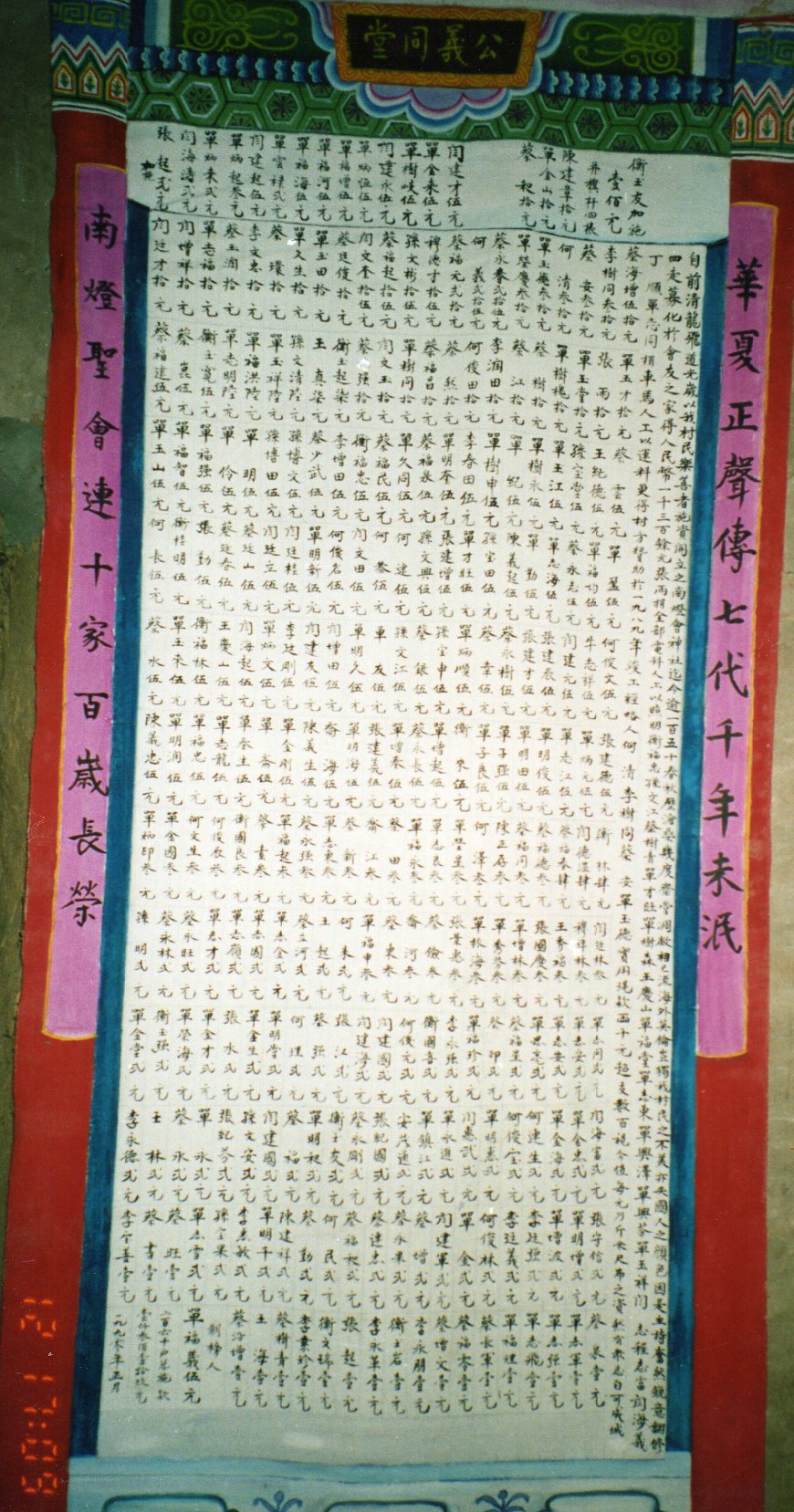
By 1979, as the commune system began to crumble, the great Li Qing (1926–99) and his colleagues in Upper Liangyuan, along with other Daoist groups in the county, were clandestinely performing Daoist rituals again, testing the waters. There was now demand again; as soon as villagers were once again able to stage proper funerals, they sought to invite Daoists. Seeing other households beginning to make money outside the collective, Li Qing would soon have realized this was a chance for him to feed his family too (they had been hungry throughout the Maoist era, not just around 1960). Most simply, Daoist ritual was in his blood: it was what the family had always done. A major stimulus for Li Qing’s band was the return in 1977 of his uncle Li Peisen (1910–85) from Yang Pagoda, where he had laid low throughout the Maoist period, preserving ritual instruments, costumes, paintings, and manuals.

Over a long period from 1979 to 1984 the Daoists performed for funerals at first furtively and gradually more openly. In those early days they didn’t stand directly in front of the coffin, just playing “little pieces” on the shengguan instruments without any vocal liturgy. And they wore their ordinary clothes; before 1981 a host wanting them to wear their ritual costumes had to pay danger money. As anxieties dwindled, they first donned their black costumes without hats, then the red costumes with hats.

One early occasion when they dared perform vocal liturgy, however clandestinely, was for the funeral of Li Peiye (another Daoist uncle of Li Qing) in the 2nd moon of 1980. Born in 1892, Li Peiye had learned Daoist ritual under the Qing dynasty, living just long enough to witness hope of a revival of tradition. Li Manshan recalls Li Yuanmao (1919–92), then with a long white beard) leading the reciting of the scriptures for the funeral.

Soon after Li Peiye’s funeral, a great burden was lifted for Li Qing. The county authorities sent official letters to all the village brigades listing the rehabilitation (pingfan) of people whose “black” class label of “rich peasant” was now to be removed. Li Qing was among thousands in Yanggao alone who were reprieved. The family no longer bore any stigma; at last there seemed some hope for both them and the wider society.

One of the first funerals for which the Daoists wore their full costumes was for Golden Noble’s grandmother in Houying in 1982. She died on the 6th of the 2nd moon, and the date of the burial was determined for the 19th.

But on the first day of the Houying rituals, someone returned from the county-town with the news that the Wangzhuang Daoists had been arrested while doing a funeral there. Senior Daoist Yan Mei—one of many Daoists who had served as brigade accountants under Maoism—was band boss; Liu Zhong (1930–96), soon to be a regular member of Li Qing’s band, was taking part. As luck would have it, the house where the funeral was held happened to be right opposite the police station. They managed to perform the rituals all day, but then two cops turned up, detained two of the Daoists, took mugshots, and confiscated their instruments.

As the liberalizations gathered pace, the incident soon became something of a local joke; people take such minor reverses in their stride. Naively, the Wangzhuang Daoists had supposed the climate to be relaxed enough now that Deng Xiaoping was in power—but surely they could have seen this coming. Things were indeed easing up in the countryside, and after a few weeks the Daoists reclaimed their instruments and got back to work, but official attitudes in the county-town were always more sensitive.

Even when I attended funerals in the town in 1991, it was still only possible to hire gujiang shawm bands there, not Daoists. Still today it remains rare for town-dwellers to use Daoists; and since there are groups nearer whom patrons can invite, the Li family seldom performs there. But ever since the revival, and all the more since around 2009, they and other groups in the area have been worked off their feet performing rituals throughout the villages—despite urban migration and the “left-behind” patrons’ preference for the glossy pop shows outside the gate of the soul hall.

Ever since those early days of the revival, I occasionally hear of transitory campaigns against mediums or sects, but funeral practice has remained largely untouched—so the “Keep Calm and Carry On” message still seems fair.

For the concurrent process of recopying the ritual manuals, and a caveat, see here. All this was before Li Qing managed to train his younger disciples who went on to form the core of Li Manshan’s ritual band—Golden Noble, Wu Mei, and his own grandson Li Bin.