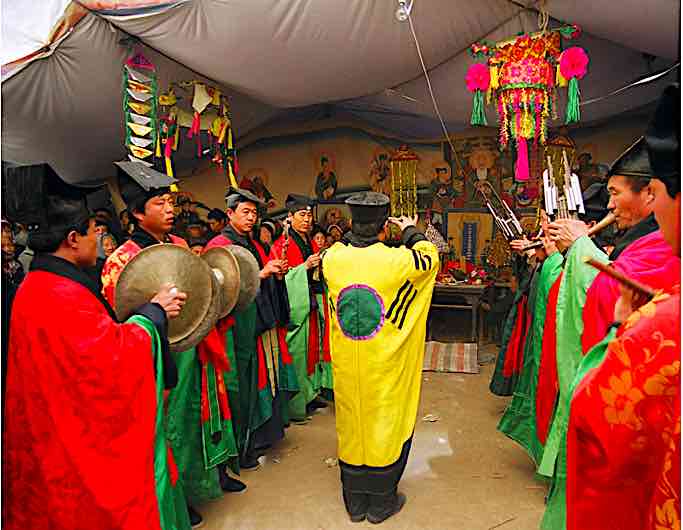
The Li band in France: notes

It’s worth rounding off these vignettes of the Li family on tour with some of my daily notes, as a little contribution to the ethnography of one, um, caravanserai on the global bazaar—and also as a further illustration that Daoists are Real People, not mere Faceless Paragons of Ancient Wisdom.

18th May
After a long journey from Yanggao via Beijing, the Daoists reach our hotel at 7.30am. Alas, despite my blandishments at the desk, they have to wait all morning for their rooms to become available, but I catch up with them as they rest on sofas in the foyer, letting Li Manshan sleep in my little room.

I take Li Bin, Golden Noble, Erqing, and Wang Ding round the corner to Rue de Rome, helping spendthrift Li Bin buy a preliminary round of gifts for his guanxi network back home: he asks me to help him choose four bottles of olive oil and ten bottles of vin rouge. Confessing my ignorance, I try to muster a little bon goût. He wants to splash out on more posh bottles, but I choose vin pretty ordinaire, trying vainly to control his reckless spending. A friend of Erqing has even asked him to buy him a particular vintage of Château Lafite. I tell him to forget it. Still, imagine—twenty years ago the average annual income for a Yanggao peasant was still only around £100.

We do splash out on an adapter, though. This has become a touring ritual, since they never bring the ones we have bought on previous trips. They keep it busy with recharging their mobiles and i-pods.

At midday we go round the corner to Rue Budapest for Sichuan noodles. They drink Erguotou liquor. We chuckle over our Confucian hosts’ quirky arrangement over expenses: 20 kuai each per meal for them, a mere 15 kuai for me. This causes much mirth: do I get less because I’m too fat?! After lunch, and after a meeting with Teacher Wang, now abbreviated to “hold meeting” (kaihui), their rooms are available—three doubles (sociable types that they are, they wouldn’t even want singles).

It’s so great to be on tour with a brilliant sextet who have been doing rituals together for thirty years, and who are now in the rhythm of touring abroad too. Li Manshan is a wise laissez-faire (wuwei?!) leader, Li Bin an able fixer, Golden Noble and Wu Mei best mates, and Erqing and Wang Ding are cool too. We slot into our secret language, always laughing, dusting off old stories, devising new takes.

At 6pm our hosts Adeline Herrou and Yan Lu, with her assistant Alessandra, come to our hotel to guide us to the conference banquet. Arriving a bit late in a downpour, we are fortunately siphoned off to another quieter restaurant nearby so we can get to know our hosts in peace. Yan Lu is géniale, petite, full of joi de vivre. We give her our favourite ritual couplet written by Li Manshan, and local dried apricots from Yanggao. It’s been a long first day (and their travel from Yanggao itself took nearly 24 hours before that), but after taking the metro home, Li Manshan and I have our usual sweet chat outside the hotel.

19th May
We have a good breakfast; they eat plenty of everything, with lashings of coffee. I no longer have to help—they’re even experts with the egg-boiling contraption.

I end up in Golden Noble and Wu Mei’s room, where we have a nice chat. I mention the Wang family Daoists of Shuozhou just southwest of Yanggao. Wu Mei knows Wang Junxi’s guanzi-playing and likes it, having seen his videos online; he has appeared in a secular show with them, but there was nothing much for them to talk about!

Now that my film and book are out, we can relax without my constant pedantic questions. But I’m always in fieldwork mode—I just can’t help taking notes. Li Manshan tells me more about the Temple of the God Palace in the southeast of his village—site of the original settlement Dazhaizhai 大寨寨.
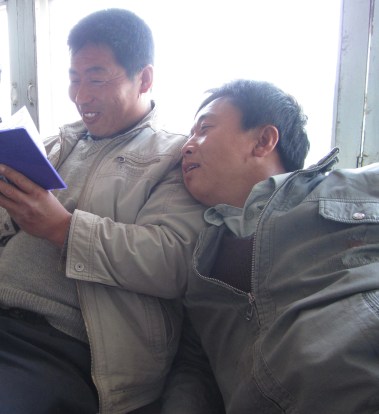
53 GN and WM amused cropped

Relaxing in the scripture hall between rituals, Golden Noble and Wu Mei amused by my notebook, 2011.

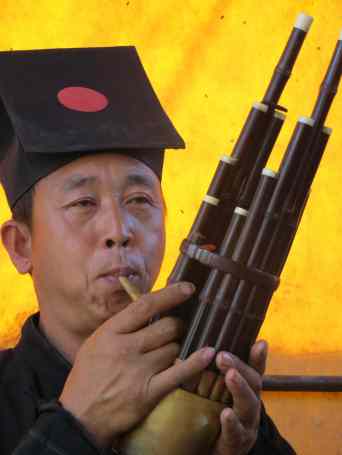
The Daoists busy themselves preparing for our first gig at the Nanterre conference: while Li Bin packs all the stuff to take, Golden Noble checks their sheng mouth-organs, Wu Mei works on his reeds. Their rooms are scattered with the debris of touring: shavers, battery chargers, mobiles, i-pods, cymbals, a solder (to tune their sheng), fags, pot noodles just in case, cigarette cartons, gifts of dried apricots…

We take the train to Nanterre, and after a canteen lunch the splendid Hélène Bloch takes us on a reccy of our pre-concert route to and through La ferme du bonheur circus on campus—it’s just like being back in Yanggao, as it really is a farm, with sheep, a peacock, and lovely laidback warm people. I dream of running away to join the circus; there’s a new release of La strada just out. The peacock displays for Li Manshan but not for me, a typical show of xenophilia (chongyang meiwai 崇洋媚外)!

edf

La ferme du bonheur. Photo: Hélène Bloch.

After my film screening, the Daoists are waiting outside to lead the audience through the campus to the farm, where we all take a tea-break, and then to the concert hall.

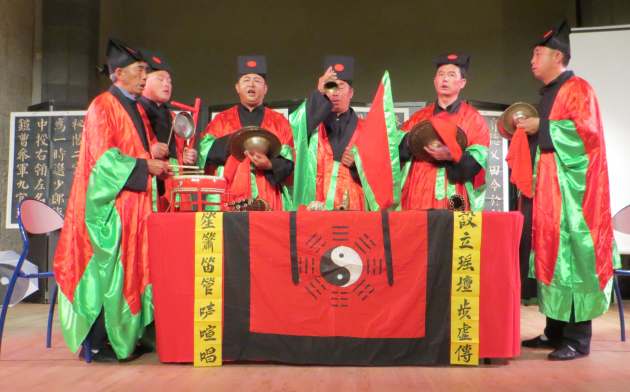
The hall is small, but the gig is amazing, as always. Our encore of the Mantra to the Three Generations, with me joining in, goes well.

Nanterre encore

As Ian Johnson observes in his book The souls of China (pp.37–40), the progression of the Li band to minor international celebrity has been a gradual process, from Chen Kexiu’s research to the 1990 Beijing festival, through to our foreign tours (cf. my book, ch.18).

For what it’s worth, such northern ritual styles do perhaps lend themselves better to the concert format than many southern Daoist groups, the entrancing wind ensemble supplementing the vocal liturgy and percussion.

We take the train back to our hotel, then go for supper. Li Manshan has given me two bottles of lethal Fenjiu white spirit from Shanxi, which we (all except him—he’s not a drinker) polish off with our meal. I’m TP again. I stagger back to my room to take stock, then around midnight Li Manshan knocks on my door for another “meeting” outside. First we gravitate to my bathroom for me to explain how the taps work, and he tells me his story about a Chinese guy who brought back the hotel soap as a present, and his mate says “Uurgh, this foreign white chocolate tastes disgusting!”.

We adjourn outside for more jokes, and fond reminiscences of Li Qing. As always, our most intimate moments are late at night, tranquil, alone together. These tours just get better and better. Yan Lu and all our hosts love this, and so do we.

My two rules for when the time has come to leave China:
1) when I begin to enjoy drinking baijiu white spirit;
2) when I begin to like Chinese pop.

In the old days such tours were inevitably accompanied by a gaggle of superfluous apparatchiks on a freebie trip abroad. Now the Daoists have their own private passports, and on tour I look after them on my own.

It’s also amazing how much Chinese food abroad has improved over the last couple of decades. “Long gone are the days when” we have to endure sweet-and-sour pork—though even that has a certain nostalgia for me. With a busy schedule, and several good Chinese restaurants on our doorstep, I feel no great need to educate the Daoists in the richesses of French cuisine.

20th May Saturday
By 5am I’m chatting with Li Manshan again outside the hotel over a fag. After a quick breakfast we all take the new line 14 to Gare de Lyon. Streetwise Erqing is useful on the metro, noticing our route, watching out for signs—I no longer need to marshall them so closely, but the spectre of losing a national treasure in New York in 2009 still haunts me.

SanskritWe’re in plenty of time for the 8.59 to Clermont-Ferrand—whose Chinese name Kelaimeng Feilang, preceded by Aofonie (Auvergne) reminds me of one of the Li band’s pseudo-Sanskrit codas, such as the one at the end of the hymn Diverse and Nameless!

I go off with Li Bin to buy lunch for the band to eat on the train.

The lunch-pack of Notre Dame

(How could I resist? Just in case you’re not familiar with this one, it’s the answer to “What’s wrapped in cellophane and goes DONG?”)

Wu Mei and Li Manshan soon nod off, the latter tapping out drum rhythms even in his sleep. Later as I try to photo him chatting with Golden Noble, he tries to mess up my photo with his smelly sock.

They get excited seeing a field. To me it’s just a field. Wisely, they’ve long given up asking me technical questions about European agriculture. Golden Noble and Wu Mei have a beautiful chat—relaxed, thoughtful.

Our train is late, but hey. Valérie Bey-Smith and Wu Yunfeng, our keen Confucian hosts, meet us on the platform. Clermont-Ferrand feels pleasantly remote and eccentric—a bit like one of those Hunan mountain towns (where I’ve never been, BTW). We make hasty preparations for the gig in the conservatoire. After intros from the Confucius Institute and the Chinese consul in Lyon, my talk goes fine, with Valérie translating for me. I’m getting better at this. The gig is great—the audience goes wild.

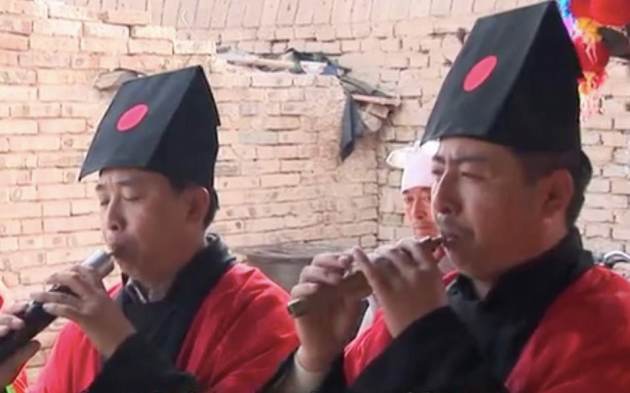
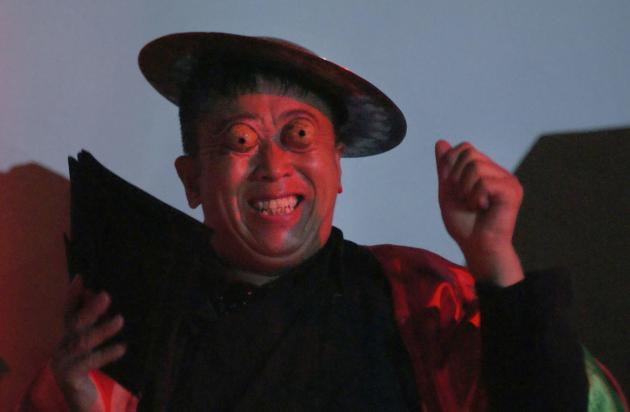
The concerts only last an hour, but the Daoists are soaked in sweat. Still, it’s no big deal compared to their long rituals in Yanggao. The two sheng players, little trumpeted, have to work especially hard. In the trick sequence, even the way Erqing stays still for Wu Mei to slot the bell of his curved trumpet onto the pipe and then at once starts twirling it, playing all the while, is virtuosic. Wu Mei sometimes gets in a bit of trouble balancing the cymbal on his head, or the false eyes (walnut shells) coming loose, which all adds to the excitement—I observe to him that such little hitches should be a deliberate part of his routine, so as to show the audience how difficult it is, and keep them on edge.
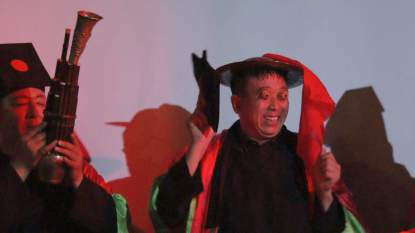
SONY DSC

SONY DSC

Nanterre. Photo: Nathalie Béchet.

CF congratulations

Congratulations from the Chinese Consulate General in Lyon.

I get the usual erroneous compliments from the Chinese about me “discovering” them, and about the Chinese not knowing their own culture. OK, urban educated Chinese may not (I’m no great authority on Morris dancing either), but there has long been a wealth of research from native scholars, which is ongoing; and The Plain People of Yanggao have always been perfectly clear about their local Daoist culture.

CF group

After a nice meal with our hosts and innocent young students, they take us for a little tour of town, but we’re all completely knackered, and soon retire to our quaint hotel—next to the Hotel Ravel, I note.

Valérie, like our other hosts, is understandably ému (not Emu, or Rod Hull).

21st May Sunday
Up again by 5, I take a little stroll near our hotel with the band, admiring the market, and the murals on the wall next door.

murals CF.jpg

In a nearby square we find five little posts, correctly arranged for a bonsai Hoisting the Pennant ritual (my film, from 44.21) on a future fantasy visit of Li Manshan’s 5-year-old grandson and his schoolmates.

CF posts

Doing daily travel with a gig is tough—but like my former orchestral life, it incites camaraderie. Our previous tours have been less frantic, but this one is pleasantly condensed.
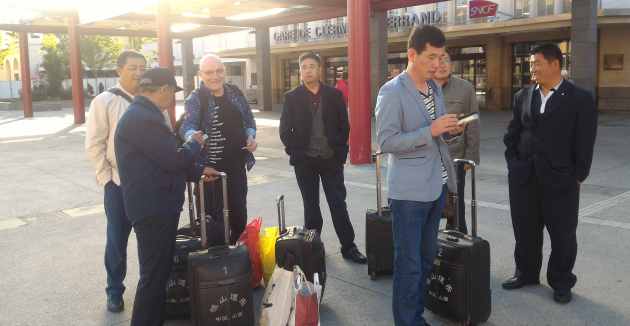
Jpeg

The touring life. Photo: Wu Yunfeng.

Valérie and Teacher Wu take us to the station, with thoughtful gifts of Gitanes (!) and food for the train. We were also happy to receive Clermont-Ferrand Confucius Institute umbrellas.

Jpeg

Valérie sees us off on the train.

The train ride is fun again. It’s much faster today, so we arrive early at midday, and take the metro to find the Centre Mandapa, a splendid venue for world music since 1978, led by the splendid Milena Salvini.

With Mandapa technician Milou we try out my film for a most successful screening; my intro goes well, and at the end Li Manshan and I take a bow. The Daoists love watching our film too.

It’s a lovely little area, so we have plenty of time to relax. They find the quirky antique emporium over the road. A succession of beggars ask us for fags, which they give gladly. Intriguingly, the Centre Mandapa is also right opposite the 1913 church of the Antoinist cult:

Deviation

The state stance on “heterodox cults”? My photo.

We set up the stage during a tea-break for the audience, then the Daoists do yet another amazing gig. Though it’s a small room, my fears that the concert will be deafening turn out to be unjustified—it’s a great acoustic. I join them again for the encore (playlist #3, with commentary here).

It’s always good to see friends at our concerts. Several Shanxi people introduce themselves, excited to find the band performing in France; and today fine scholars like Jacques Pimpaneau, Robin Ruizendaal, François Picard, and Nicolas Prevot come along too.

One cultural difference: after a gig, sure we all want to get away, but the Daoists only drink with food, not before or after (usually), whereas we WAM musos make a beeline for the pub as soon as we have taken our final bow.

Our secret language (“black talk” heihua) is as arcane as ever, with all our inside jokes. Recalling a filthy joke that Guicheng told at a hotel party in Leipzig (I can’t possibly tell you that one), I only have to say “Can you sew this up for me?” for Li Bin to burst out laughing. We giggle again at Tian Qing’s “Eat a young monk” joke.

22nd May
We have a free day at last before the Daoists’ evening flight home. Last night Old Lord Li had a bath, slept till 1am, watched TV, slept again, and got a call from a family in Pansi village to determine the date for a funeral, so he was up before 4. Meeting up at 5 yet again, I take him to the bar down the road, where Tweety McTangerine comes on TV—Li Manshan hasn’t even heard of him, how enviable! Back to my room together to read Yan Lu’s draft article on the Nanterre events.

Li Manshan calls the Pansi family again at 6am. It’s a village that he likes best, and they most trust him. Then we have a good breakfast.

We stroll down together past the Opéra to the amazing Chinese department of Galeries Lafayette, brilliantly rendered as Laofoye (“Old Buddha Elder”). Li Bin and Erqing buy loads of perfume (“Hey guys, how many lovers have you got?!”)

Laofoye

Later Li Manshan and I buy toys for his young grandson: a trumpet and maracas, to go with the, um, Ming-dynasty instruments I bought him before.

We store our luggage and go for lunch, washed down by Leffe. Old Lord Li is drumming with his chopsticks again. Delightful mood over lunch, as always—everyone chipping in with stories, jokes, reflections. Over delicious yuxiang qiezi, I ask Li Manshan if he has an aubergine tree. Often the subject turns to their hymns, as well as the Zouma suite (playlist #4, commentary here) and funky Yellow Dragon percussion piece, and the whole calibration of the trick sequence—how to improve them, tempi, and so on.

They rest on sofas at the hotel, and I film Li Manshan telling another sh-sh-sh-shikuaiqian joke.
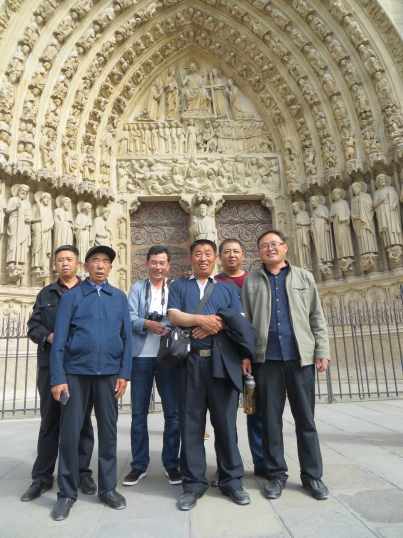
Notre Dame

Later we take line 14 to Châtelet, and wander round the little islands. I choose different flavours of Bertillon ice-cream on Île de la Cité for them. After a little guided tour of Notre Dame, we return home for a quick supper of  noodles and beer before Adeline and Yan Lu arrive, Lu thoughtfully giving them posh French chocolates. I have to go off to catch the last train back to London, but their taxi for the airport arrives early, so I can wave them off after all, but it’s a hasty parting.

If it’s a quick hop back home to London for me, their journey was not so simple:

22nd: 23.20 flight from CDG to Beijing,
23rd: landing at 15.20, 21.40 train from Beijing station,
24th: arriving in Yanggao at 03.44! But both Li Manshan and Li Bin had to rush off almost immediately to attend to village clients (for Li Bin’s diary after returning, see here).

I’ve been out of love with Paris for a while; the romantic image is hard to square with its gritty realities (rather like China, perhaps?). But this trip with the Li band naturally made me fall in love with it again. In this supposedly homogenised age—as with other cities like Leipzig, VeniceSeville, or Lisbon—we must delight in Parisian culture too!

After Daoist music in France (and Italy, and Germany), try Andean music in Japan

As I write these notes up, Haitink conducting Mahler 9 comes on Radio 3, live from the Barbican; and then next evening, another live broadcast of Turangalîla! Perfect. I hear echoes of the Li family rituals in both: all the contrasts of monumental tutti and intimate chamber styles that we find in a Daoist ritual. But that’s just me… If only Messaien were still around to hear the Li family in Paris!

Posted at 5am to commemorate daily sessions with Old Lord Li.
Vignettes 6: Wang Ding

WD 2011

Wang Ding learns the ropes, 2011, flanked by Li Manshan and Golden Noble.

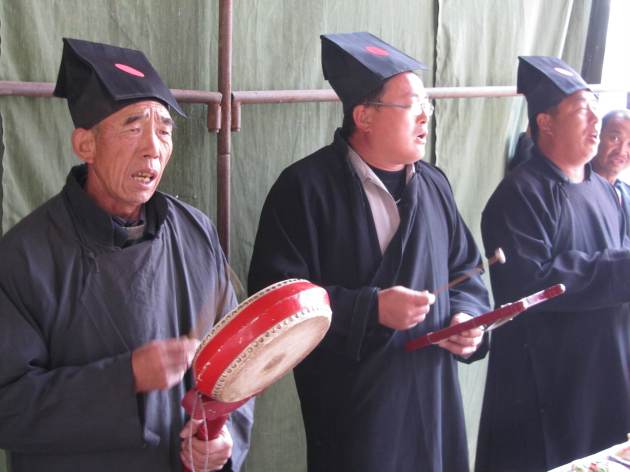
Over our various foreign tours since 2005, apart from the core group, we’ve used various people as the sixth member, and Li Manshan’s pupil Wang Ding (on vocals and gongs) fits in well.

Whereas before Liberation the sons of Daoists began learning from the age of six or seven, since the 1990s they only begin when in their 20s at least, whether they start from scratch or adapt from the background of gujiang shawm bands. Li Manshan laments that what few pupils he now has only take it up for the money—he considers them unreliable, perfunctory, jobsworths. In 2010 he took a pupil, a twenty-six-sui-old man, but by 2011 he wasn’t “coming out much.”

By then Li Manshan had another pupil who had been learning since earlier in 2011: bespectacled Wang Ding (b.1975), from nearby West Shuangzhai. He left school after junior secondary; by 2013 he had two children. Since West Shuangzhai has its own fine group of hereditary Daoists, he started learning with Yuan Lishan there, but he soon began to get more work with Li Manshan, so informally became his pupil.

Wang Ding takes the job quite diligently. He has a serious demeanour—almost too serious, the Daoists felt. I liked him, but at first Li Manshan didn’t rate him much. It’s not just a question of a talent for singing or instrumental music, or simply looking the part when taking one’s place before the coffin. Fitting in socially is also a major criterion—just as in a London orchestra (or any social group), personality counts.

Happily, by 2013 Wang Ding had grown in confidence. As he learned the ropes, Li Manshan wrote out some hymn texts for him, so he mastered the basic vocal repertoire. As of 2015 he had learned most hymns, and sings well, making a useful addition to the vocals; he sometimes plays the drum on procession, directs the kin for Transferring Offerings, and he decorates altars too. And now he is far more relaxed and sociable; Li Manshan has come to value his diligence and sense of humour, so he too has become one of the lads, and is now a regular member.

After all the complexity, intensity, and exuberance of the main programme, in France we giggle over my inspired idea for an encore in Germany four years ago: the dangdang gong player should come onstage all on his own and solemnly play a solo, one note per slow beat, taking a bow at the end. The audience might even buy it as a somber and austere meditation:

大音希声
The Great Music is sparse in sound

This was Wang Ding’s first trip outside China—indeed, outside Shanxi. It was great to have him in France, and I’m proud for him.

Vignettes 5: Erqing

Another essential member of the Li band’s foreign tours is Erqing (formal name Huang Shuangping, b.1978), a son of Li Qing’s oldest daughter, also based in Upper Liangyuan. He dropped out of school at the age of fifteen sui after only one year of junior secondary, and started learning with Li Qing the following year, along with Li Bin.

Physically he reminds me of Li Qing, with his rounded face and occasional wispy whiskers. Apart from singing, he is a fine sheng player, and he’s great on the large bo cymbals in Yellow Dragon. He can play the guanzi well too—he and Wu Mei make a fine team on large and small guanzi on the rare occasions when they use a group of seven Daoists.

Erqing and WM

Wu Mei and Erqing in ritual performance, 2009.

Performing with great dignity, Erqing would be a core member of the ritual band, but since 2004 he has mainly been doing temporary labor outside; his long-term absence is unfortunate.

If Wu Mei has been persuaded to remain, they couldn’t hang on to Erqing. Alone among the group, Erqing is widely travelled within China. He moved to the county-town in 2004, working as a driver. In 2005 he began finding temporary work outside—as labourer, electrician, driver, and so on, usually working in a team of around twenty Yanggao men. He has worked as far afield as Jiangsu and distant Fujian. He bought a flat in Yanggao town in 2010. He did a little time as a Daoist on visits home in 2012–13, but was mostly working outside, with stints in Inner Mongolia, Shaanbei, Ningxia, and Shandong. Thus he can speak passable standard Chinese when necessary.

Such labouring trips each last about a month. All the places are the same to him: they go to work on the building site, sleeping in grotty communal dormitories with around twenty men; at least they eat OK in restaurants. They just go there and do the gig and take the money. That’s life. From 2009 the Daoists’ fees were increasing modestly, but Erqing was already making at least 6,000 kuai a month, well over twice as much as he could make as a Daoist at home. Perhaps as he gets older he will return to the more modest earnings to be made from doing rituals back home.

He’s cool about taking time out, and says his fee for this tour will be a little more than he usually earns, so I don’t feel bad about insisting that he comes on tour.

When I ask Golden Noble and Wang Ding why they don’t go off to do laboring work, they say they lack the appropriate skills.

Now Erqing only keeps his hand in on his brief returns to Yanggao. But he’s still brilliant. I’m glad he’s making a good living, and maybe he will come back to ritual when he’s older. In Paris he was useful on the metro too. Along with Li Bin, he’s a bit of a foodie.

Vignettes 4: Wu Mei

I’ve already written a tribute to Wu Mei’s artistry.

WM Nanterre raincoat

Wu Mei improvises rainwear with a bin bag, Nanterre.

Wu Mei has become a local star, a true musician renowned for his amazing guanzi playing, just as outstanding as that of his seniors. He plays sheng (if he gets a chance) and percussion too, and sings the vocal liturgy.

WM on sheng 2013

Wu Mei on sheng, 2013.

Around 2009 he was often working as a welder in town, having learned the trade from his older brother. For this he received the princely sum of 120 kuai a day, as opposed to 80 kuai for two days working as a Daoist; his monthly earnings as a welder were more than twice what he could make as a Daoist. But during the busy winter season he was still working fifteen to twenty days a month as a Daoist, and seven or eight days a month in the summer. By 2011 he was happy to be working full-time as a Daoist again—not least because as a star attraction he was now able to command an extra half share more than the others.

I’ve described Wu Mei’s constant explorations on the guanzi. I love his new refinements in the exquisite Zouma suite (cf. audio playlist, track 4, from 2013), adding little bits of vibrato on some sultry low passages, like Billie Holiday.

He gets a standing ovation for his trick sequence, and so he should. This year I note a sweet new gesture—yes, it’s an ear trumpet:

WM tricks CF

Tricks, Clermont-Ferrand.

SONY DSC

Nanterre. Photo: Nathalie Béchet.

I’m pleased with myself for thinking of following the exuberance of the tricks with the total contrast of the solemn Invitation ritual, which we first added on our German tour in 2013.

Vignettes 3: Golden Noble

IMG_2253_2

Golden Noble at the soul hall, with conch and flag.

Another indispensable member of Li Manshan’s band is Golden Noble (Jingui, formal name Zhang Shiyu, b.1968).

He is son of Li Qing’s younger sister—so though he is twenty-two years Li Manshan’s junior, they are considered the same generation. Born and raised in Houying village just southwest, he began to learn ritual with Li Qing at the age of twenty-one sui in 1988 after graduating from senior secondary, biking over daily to Upper Liangyuan to study with Li Qing. He has become an outstanding ritual specialist, with a fine voice—his intimate solo recitation of the Invitation verses is so beautiful that Li Manshan always lets him do it. What concert audiences might not realize is that when not required for the vocals, he’s also a fine sheng player. I have come to value him very much.

Li Qing taught both Golden Noble and Li Bin to determine the date, and they decorate coffins too. Wu Mei, being unrelated, wasn’t taught all that solo business.

With his lively interest in ritual, Golden Noble recorded rare vocal items sung by senior Daoist Kang Ren not long before his death in 2010, and he has kept some precious additional notations of Li Qing that he copied (see under Thanking the Earth).

LMS JG on train

With Li Manshan on the train from Paris to Clermont-Ferrand, 2017.

In France he was good-natured as ever. On tour our concert version of the Invitation ritual is highly condensed; for village rituals, of the twenty verses of “Vowing with hearts at one we Invite” he generally chooses around five, and in concert only three. After the rather long first concert I joked with him that he had sung all twenty! I also noted that he sometimes only went up to top do, whereas usually he descends from a high mi—he’s not even aware of this, which shows how focused he is on delivering the text.

CF Invitation

Golden Noble leads the Invitation, Clermont-Ferrand.

Vignettes 2: Li Bin

Li Bin 2011

Li Bin on sheng, 2011.

Li Manshan’s son Li Bin (b.1977) seems like a typical entrepreneur in the religious market, but he’s a master of all five skills of the Daoist. Ian Johnson writes eloquently about him in his The souls of China.

Li Bin is gradually taking over the reins from his father. For our foreign tours he is our main link to get all the complex paperwork done, and I’m in constant contact with him online. He always answers my queries promptly, in between ritual segments.

Li Bin began learning with his grandfather Li Qing in 1993 after graduating from junior secondary. In awe of the wisdom of his elders, I tended to underestimate him; though seemingly rather concerned with the more mundane aspects of the business, he knows a lot, and his keen sense of humour hints at his acumen. He is not only an anchor on the sheng mouth-organ, but sometimes takes a turn on guanzi or drum, apart from the cymbals and vocal liturgy; he determines the date, decorates coffins and altars, and makes paper artefacts.

Since the 1990s the lineage has spread into the county-town as never before. Li Manshan’s younger brother Third Tiger was first to move to town, to take up a state job around 1990. Since 2006 he has been employed in the county anti-corruption unit, where, with his sincere intelligence, he has risen to high rank. He makes a good living, with several sidelines. But he loves the Daoist rituals, and can offer a lot of detail about the old masters. He even tells me he is keen to get back to ritual practice when he retires!

Since the 1990s it has become common among Daoists for the son to run a funeral shop in town while the seniors remain in the old village home. Of Li Peisen’s sons, Li Huan moved to town in the 1980s to determine the date from a base there; more recently his younger brother Li Hua, and his sons, have opened funeral shops in town as a base for their ritual band; in 2016 Li Hou followed suit. Li Bin moved with his family to the county-town in 2007, initially as a stepping-stone for his son to get a better education—seeing it as a route towards betterment, just as his forebears had done under successive regimes. He went on to buy a first-floor flat there, running a funeral shop with his wife on the ground floor. This is where I stay on my rare forays into town to take a shower and see old friends (in that order)—we call it “the five-star hotel,” as it is handsomely furnished. Li Bin has managed to buy urban registration for his son—that’s always the priority.

In 2010 Li Bin bought a little car for the princely sum of 48,000 kuai. On the bumpy village roads, any car will have a tough time. In 2013 he upgraded to a fine Nissan hatchback, and in nine months had already done 13,000 kilometres, almost all on local business. His car has a posh sound system and, for his rare excursions outside the vicinity, satnav. He did a hundred funerals in 2010, not including countless determining the date sessions, decorating about forty coffins, and all his work in the shop making funerary artefacts. In 2012–13 he did 118 funerals, including eight three-day ones; in the winter he had fifty days’ solid ritual work without a single day off. He knows that Li Manshan’s health is fragile and that he should help him work less as he gets older, but they often have to split into two bands, and don’t like to turn work down. For a diary of Li Bin’s ritual activities after returning from our French tour, see here; for his busy schedule even during the Coronavirus scare, here.

Li Bin has a firm grasp of all aspects of the Daoist arts, but developing his business seems uppermost in his mind, all the more so now that he is based in town. In Adam Chau’s phrase, he is a real “household entrepreneur in the religious market”. Though his earnings can’t compete with those for temporary manual labour, he does quite well (or he would do, if he didn’t spend it all). He has become used to a more comfortable life than those still left behind in the villages. Well connected, he enjoys eating out with a wide network of friends, not only gujiang, singers and members of the county opera troupe, but also cadres, teachers, and so on—a far cry from his father’s tranquil home life.

The diplomat of the group, he is the first port of call for visitors like Chinese and foreign journalists seeking soundbites. He can speak standard Chinese when required, and his “bilinguality” is even evident from the two different kinds of name-cards he distributes—one for his local clientele, one for his diplomatic contacts with visiting dignitaries.

The card he uses locally is headed “Ninth generation of yinyang in Upper Liangyuan,” whereas his diplomatic card reads “Hengshan Daoist music band, Shanxi.” He even uses his elegant given name Bin (“civil and martial”) on his local card, but the more colloquial Bing (“soldier”) on his diplomatic one. The local card reads “the whole chain of supplies for funerals,” with a list of services on the back; instead, the back of his diplomatic card lists their Intangible Cultural Heritage status and foreign tours.

Li Manshan and the others haven’t got a name-card. Neither have I. In a typical exchange one day, I ask him:
“You got a name-card, then?”
“Oh yeah!”
“Um… can you give me one?”
“Sure—whose do you want? I’ve got loads of ’em!”

Li Manshan does have to be a shrewd band boss, maintaining the livelihood of his group. He now goes off to work (rituals, determining the date, decorating coffins, and so on) with a smart shoulder bag bought for him by Li Bin, but he makes a less convincing businessman than his son. Whereas Li Manshan tots up the fees on the paper lining of a cigarette pack, Li Bin works them out on a calculator. Of course all this is a common generational contrast. Li Manshan’s demands on the material world are modest, and he remains firmly rooted in old village culture. He wouldn’t contemplate leaving the village or the land—it keeps him healthy and active, and he doesn’t like the bustle of town life. There’s not exactly a connection with being a Daoist (indeed, urban Daoists are more likely to excel, even without land), but it’s part of his personal discipline.

Remarkably, almost alone among all the rural Daoists whom I know, Li Bin has been devout since his youth. Among various Daoist artifacts that he has ordered from Longhushan (distant headquarters in south China of the Orthodox Unity branch of Daoism) for sale in his shop, he keeps a statuette there of Zhang Daoling, ancient founder of the Orthodox Unity branch. Every morning when getting up at home, and every night on his return, he lights incense before the statuette.

He is simply adapting to circumstances, as Daoists have always done throughout history—competition and syncretism with Buddhism, urbanization and the shift of economic power to the south in the medieval era, and so on.

On our foreign tours, whereas the village-based Daoists carefully hoard their fees, Li Bin spends with abandon on gifts for his guanxi network. In Paris, now dangerously armed with a credit card, he spent with abandon on gifts like vin rouge, olive oil, perfume, watches, and leather bags. To me it seems profligate, when he has a family to support—but I dare say such gifts are a calculated investment for him, consolidating his guanxi. By now he has built up a substantial power-base, and people trust him.

But now Li Bin could well be the last generation of Daoists in this fine lineage. And this is perfectly understandable. Would any of us want our sons to do this job? Many elements mitigate against youngsters taking it up—state education, migration, upward mobility, pop culture… Parents (including Daoists) naturally want their children to do well in school, find a secure well-paid job in town, and get urban registration—whereas working as a Daoist is a tough life, with long days in poor demoralized villages for a rather small fee. I’m not going to pontificate about perpetuating the illustrious ancient Chinese heritage, and nor should anyone else. [1]

See also Li Bin’s ritual diary.

[1] Much of this and related posts is adapted from my book.

Vignettes 1: Li Manshan

Li Manshan is as adorable as ever.

I was determined to get to CDG to meet the band off their Air France flight from Beijing, but it arrived early at 5.30am, so in the end I just had to wait for them at our hotel right by Gare Saint Lazare. We met up there at 7.30, Li Manshan giving me a big grin and a hug.

Now 72 sui, he is gradually giving way to his son Li Bin, only doing nearby rituals. But he still can’t turn down requests to go and determine the date, and he still decorates coffins. This process of handing over must always happen, but no-one ever describes it. Personalities within a ritual group, the transmission from father to son as the latter gradually takes over—all such detail is absent from both historical records and most fieldwork reports. If only we could document it in detail for ancient Daoist masters like Du Guangting.

Li Manshan has new headgear, now a more trendy baseball cap, not as sweet as his old one, but hey. He only takes it off, reluctantly, when we enter Notre Dame. He also has a new mobile, the same old make, but with a new ringtone that sounds like The magic roundabout, so another of my names for him is Zebedee—who would have liked the Daoist Pacing the Void. I miss Li Manshan’s old kitsch ringtone of The little wicker basket.

After his lovely gift to me of the old folding stool he made, I gave him a digested translation of The good soldier Švejk, a copy I must have bought in Beijing in the early 1990s. I inscribed it to him:

踏罡步斗的明星李老君
Old Lord Li, superstar Stepping the Cosmos and Pacing the Dipper

“Old Lord Li” references one of our favourite ritual couplets pasted up at the gateway of the scripture hall, hard to translate elegantly:

穩如泰山盤腿座
貫定乾坤李老君
Seated in lotus posture firm as Mount Tai,
Old Lord Li thoroughly resolves the male and female elements.

And Stepping the Cosmos and Pacing the Dipper are rituals in the family’s manual collection.

Old Lord Li is immediately hooked on Švejk. I knew it would be just his cuppa tea—the innocent common man muddling his way jovially through an irrational state machinery. He can’t put it down. Later, suitably, I also give him my old spare toothbrush to use, as he hasn’t brought one.

After catching up together and working out our day, I go off with Li Manshan for the first of many meetings with Teacher Wang, now abbreviated to “hold meeting” (kaihui).

How amazing to be on tour again with this brilliant sextet who have been doing rituals together for thirty years, and who are now in the rhythm of touring abroad too. We use our secret language, always laughing.

In the concerts, the others (like Wu Mei for his amazing tricks on the wind instruments, or Golden Noble with his solo recitation) may attract more attention, but Li Manshan is right at the heart of everything, drumming unerringly, singing intensely, subtly directing. Even the twisting route he improvises on the tiny stage as he leads the final Chase round the Five Quarters, unsheathing the “precious sword” to sketch talismans on the ground, is magisterial.

LMS on train to Nanterre

On the train to Nanterre.

Late at night we have our usual sweet chat outside the hotel. It’s been a long day, but they’re troopers.

Li Manshan is always tapping away on his fingers (even while sleeping on the train) or on his chopsticks as we wait for our meal to arrive.

LMS at Hotel Ravel

Clermont-Ferrand: two of my favourite masters.

Following a quick weekend flit to Clermont-Ferrand, after our last gig back in Paris he had a (rare) bath—the concerts are hot work, and they’re all bathed in sweat. He then slept till 1am, watched some TV, slept again, got a call from Pansi village to determine the date after a death, and was up by 4am.

We meet up in the foyer at 5am for fags outside, lovely. I take him to the bar down the road, full of workmen on the early shift, so I can have a café and orange juice as we chat with the Wenzhou people behind the bar. Trump comes on TV—Old Lord Li hasn’t even heard of him, how enviable. Back to my room together to read through a draft article by our wonderful Confucius Institute host Yan Lu that she has just sent me.

Li Manshan calls Pansi again at 6am with more guidance. It’s a village that he likes best, and they most trust him.

After our hectic schedule, we’re all glad to have a final day free for sightseeing and buying gifts. While his son spends a fortune, Li Manshan just wants to find a couple of toys for his young grandson.

LMS and WD

With his pupil Wang Ding.

A quick farewell hug, and they embark on their long journey back to Yanggao to resume their busy ritual routine. Hardly had they got back home when both Li Manshan and Li Bin had to rush off to separate villages to determine the date for more funerals, which is the start of another sequence of tasks for them over the next couple of weeks (for Li Bin’s diary after their return, see here).

See also The Li band in France: notes.

Depping with master singers

Just home from Paris after an unforgettable time with the Li family Daoists. It already seems like a dream.

Nanterre encore

Our encore, Centre Mandapa. Photo: Nicolas Prevot.

As an encore [English term—Ed. When in France say bis!] I joined in with the Li band, singing the Mantra to the Three Generations a cappella (audio playlist track 3, cf. 2001 version, track 2: commentary here).

For anyone fortunate enough to do fieldwork on Daoist ritual, I thought this might remind us of the benefits (indeed the very possibility) of participant observation; but it was also an opportunity for me to keep my hand in after a year apart from the Daoists. Having remoulded the proverb “Mr Li wearing Mr Zhang’s hat”, I enjoy refuting another popular one, “The monk from outside knows how to recite the scriptures” (wailaide heshang hui nianjing 外来的和尚会念经).

Long schooled by accompanying Mark Padmore and the Monteverdi Choir on my violin, I now have to set aside my instinct to invest words with meaning, instead trying to latch onto the lugubrious timbre of the voices of Li Manshan and Golden Noble, and Wu Mei’s guanzi. Li Manshan’s bushy eyebrows are a useful image here.

During rituals, when we sing a cappella hymns we stand in two rows of three, facing each other across the altar table. So usually I’m either playing small cymbals over the other side from Wu Mei, or playing gong at the other end. But this time I found myself standing right next to him and Golden Noble for the encore, with Li Bin (also brilliant) on my right, all of them subtly supporting me. I realised Wu Mei is not only one of the greatest wind players in the world and a brilliant player of the bo cymbals, but (like Li Manshan and Golden Noble) a fantastic singer too. Not just his nasal timbre and the projection of his voice, but the taste of his choices—where to inject extra volume and fervour, rise up high, or put in a tiny variation. Listening carefully to each other as always, dovetailing, with subtle “rules” about where to take a breath and where to sustain. There’s much more to their singing than meets the ear—the texts of the a cappella hymns are rendered with great intensity and concentration.

Over fags outside the hotel we had worked out an edited version of the Mantra, segueing smoothly from the end of the 1st verse directly into the coda of the 3rd verse. With a very subtle accelerando, its exuberant repeated final couplet begins from a high do the first time, soaring to an exuberant high mi on the repeat:

Vowing this evening to attend the ritual assembly,
Leading the deceased spirits to ascend upwards towards the Southern Palace!

We noted a nice pun, glossing “ritual assembly” (fahui) as “French concert” (Faguo yinyuehui)—the extra characters to be recited silently (monian), like a secret formula. Li Manshan congratulates me again on my silent recitation—”The only thing you’ve learned properly, Steve!”

In rituals back home they don’t always give their all, but on tour, wanting to put on a good show, they are magnificent. Standing in with the Li band—whether at a Paris concert or at a Yanggao funeral—is one of the great musical experiences of my life, “and I’ve had a few in my time I can tell you” (take your pick—Christmas Oratorio in Weimar, B Minor Mass in the Barbican after a tour of Japan, and so on…).

After all my tedious academic questions, being right in the middle of the action with these master Daoists (not “musicians”!) is overwhelming for me. Li Manshan, Golden Noble, and Wu Mei are right on my case. There are no passengers—Erqing and Wang Ding (Li Manshan’s pupil, a welcome new recruit to our touring band) are great too. Focusing on the vocal ensemble, surrounded by Li Manshan’s sparse and subtle drum patterns, the regular crotchet beat of the gong, and quavers on the bell, I also have to remember where to beat out the occasional syncopated cadences on the small cymbals with Li Manshan’s drum accents.

It reminds me of my occasional depping with them in Yanggao for funeral segments (my book, pp.325–6) when they’re one short—waiting on the substitutes’ bench. It also has a disturbing echo of my orchestral experience—that’s another depressingly familiar phone-call from orchestral fixers,

“Can you come and do a Messiah next Tuesday in Barnsley? I’ve tried everyone, we’re absolutely desperate!”

Thanks a lot…

Our chats turned to the singing of the revered older generation of Li Qing and his colleagues. Li Zengguang was admired as a vocal liturgist; Li Qing’s own voice declined somewhat with age. Some had fine voices but less mastery of the texts; other masters who knew all the texts perfectly were somewhat variable in intonation and vocal ability. Apart from their astounding instrumental ensemble, I doubt if there’s ever been a more brilliant vocal group than the present band under Li Manshan, working together almost daily for thirty years.

A fine turn of phrase

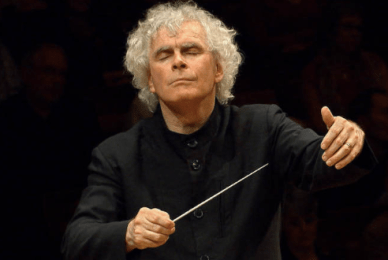
Simon

Further to my old theme of our irredeemably modern ears (and here), Simon Rattle,* on one of his early early-music outings with the Age of Enlightenment, was rehearsing Mozart with the band.

After one finely polished phrase, he stopped us and said admiringly,

“Wow! I’ve been waiting all my life to hear it played like that! … Anyway, now I’ve heard it, I don’t like it—can you just play it normally, please?!”

*As a stammerer, I hesitate (sic) to call him Sir Simon Rattle. As in the (real) line from a waggish Radio 3 announcer:

That was Sir Simon Rattle conducting Brahms’s 4th symphony. Next week’s guest conductor is M-Mark Elder.

But I now learn from Felix Warnock, encyclopedic authority for orchestral stories, that this line goes back to Symphony Hall in Birmingham, when both the CBSO and the Hallé were rehearsing on the same day for separate concerts. At the stage door, bumping into an old colleague he hadn’t seen for some time, one muso asks another,

“Hey! Are you here for Sir Simon?”

So the other one goes,

“No, I’m here for M-Mark!”

The Li family Daoists in France

Paris gig poster

First concert yesterday on our mini-tour of France, our fifth foreign trip since 2005. Not least, we haven’t seen each other for a year, so it’s great for us to catch up.

After a procession leading the audience through the circus ground on campus at Nanterre, the gig was unforgettable—profound and exhilarating. The audience went wild, and I’m proud for them. They’re right up there with Bird and Dizzy’s band; or with a senior string quartet who have been working together for decades, playing the Heilige Dankgesang on long tours, constantly delving deeper into the inner meaning.

Living the reclusive life that I do, this sudden lurch into serving as their minder, roadie, and stage manager is an invigorating shock to the system. They appreciate all my work—but since I always depend on them when I’m in Yanggao, it’s great for me to able to repay them a bit by looking after them for a change.

In my book (p.335) I wrote about our foreign tours:

Once we’re on the road, looking after the Daoists is an infinitely rewarding full-time job for me. Between sorting out daily logistics with our hosts, shepherding the Daoists round airports, stations, hotels, and restaurants, explaining how things work (showers, coffee machines, and so on), interpreting, helping them buy souvenirs, and keeping everyone in good spirits, I manage to find time to ask further questions about their life stories and rituals. Apart from working as their roadie, I enjoy being stage manager too. Li Manshan observes that they all want to do good concerts for my sake, so I won’t “lose face”; but they take pride in the gigs for themselves, irrespective of my pedantic concert professionalism. Elsewhere I note their high standards back home despite the careless attitudes of their village patrons, and here too they really care about adapting to the demands of a concert. We constantly discuss how to refine their stage presentation, and they get more polished at taking their final bows.

If course one of the insights in spending time in the ”natural habitat” of their home environment is to reveal their humanity. But touring, outside the narrow field laboratory, further helps me relate them to the hubbub of the global bazaar.

They’ve brought me a couple of bottles of Fenjiu “white spirit” from Shanxi, so after our gig we all polished them off over a convivial meal. At midnight Li Manshan knocked on my door and we ended up sharing loads more stories, “having a meeting with Teacher Wang”, and fondly recalling Li Qing, reflecting on this whole amazing story since my first visit in 1991.

Back in Paris tomorrow for our last gig at the Centre Mandapa—for anyone at all nearby, not to be missed!!!

The versatility of the Chinese peasant

stool folded

Folding stool, Li Manshan, late 1960s.

stool

On tour again with Li Manshan and the band! Just wonderful to be with them again. More notes on our trip to follow soon, but meanwhile:

I’ve always been amazed by my Chinese peasant friends’ ability to make things work in straitened conditions back home. Their DIY skills are wide-ranging, from fixing dodgy electrical connections to tweaking the reeds of the guanzi oboe.

One of my favourite illustrations of this (my book, p.21) is the way Li Manshan conscientiously mended his satellite dish—surely a natural skill of Daoists, given their understanding of constellations and experience in Pacing the Void!

Also from my book (p.134):

One day at a funeral as Li Manshan sits calmly on the kang brick-bed of our poor host, preparing yet more documents for ritual burning, I notice the charming paintings on the wall, framed by maze-like decorations. Li Manshan recalls, “I used to like making that pattern—I did some for our house in 1969.”

In 2013 he gave me a lovely little wooden folding stool that he made in the late 1960s. His mates had seen one in in a nearby village, so he walked over there and took a good look at it, drawing a design. Back home, he couldn’t find the right kind of wood, so he talked the reluctant village storekeeper into giving him some. It’s only willow—cypress would be better, as he observes. Anyway, it shows Li Manshan’s versatility.

By now the village little opera band was transformed into a propaganda troupe, known as “club” (julebu), but the cadres were lukewarm about promoting it. Li Manshan, despite his class label, went along sometimes. Assuming that he had sprung from the womb with a fag dangling from his mouth, I was amazed to learn that he only began smoking at this time, when the others kept offering them to him. He has made up for lost time since then. On a brighter note, he began brushing his teeth occasionally.

One day the stool may end up as a priceless museum relic, folk art. For now it’s a lovely gift from an eighth-generation master Daoist to a wannabe foreign disciple; when he made it, it was a little display of creativity and individualism in a period of tedium and repression, by a young man from a family under a cloud, trying to weather the storms of Maoism.

Intimate histories

One of the more niche contemporary works in which I have not only taken part but played a star role is Jack Body’s Intimate histories no.2: Ssteve.

Jack Body (1944–2015) was a lovely man, a fine composer and a great proponent of East Asian music. He was much missed (see obituaries here and here, as well as n.3 here), despite recent allegations.

We met at the CHIME conference in Paris in July 2004. He came up to me after my somewhat s-stop-and-s-start presentation, and I braced myself for the usual polite compliments or tedious academic queries. Charming as he was, far from the pious well-meaning sympathy of us Brits, pretending to ignore my herculean struggles (immortalized in A fish called Wanda), he came right out with it: “Hey SSSteve, that sure is an impressive stutter you’ve got there!” For me at least, that’s already half the battle—helping me get it out in the open. Jack was more Kevin Kline than John Cleese.

We had a laugh and a chat, and he asked me if I’d be prepared to record an interview based on my reflections on both my imp-p-pediment and my route to Chinese music, that he could use as the basis for a new electronic piece. I thought it’d be a good way of publicizing the whole issue of stammering. As you see from his notes, we recorded my ch-ch-ch-chat on a break from our 2005 sessions at SOAS with the amazing Hua family shawm band.

Listening now, I am struck by how much more fluent my speech has become since then. Now, for Jack’s purposes I might even have to fabricate a speech impediment—which indeed is one of the most fascinating ways whereby some speech therapists suggest that we can move towards greater fluency. It is the most amazingly liberating feeling to stammer on purpose, varying the severity and style of the blocks, taking control at last—I do recommend it to fellow-sufferers, even if it takes work to sustain and then modify.

Having exposed my most discomfiting “secret” (sic), I could hardly refuse to further embarrass myself by giving him a few samples of my rubbish erhu and shawm playing too.

In the end I didn’t entirely concur with Jack’s treatment—sometimes I found his musical dramatization of my stammer rather too sinister. And I can’t judge its impact on the listener as a composition. But it makes an interesting take on my distinctive sound, and an intriguing byway in my biography.

Signoffs and other cross-pond drôlerie

In our daily badinage on orchestral tours of the US of A in the Good Old Days, we got into the habit of handing over to each other by imitating CNN’s signalling style:

And they say there could be more revelations to come. Wolf.

[Wolf Blitzer, [1] of course, was an “anchor”. Considering that Britannia Rule the Waves (just dig that funky optative verb there, folks—”You Wish”, as the Argot of Yoof [2] would have it), it’s curious how we don’t much go in for anchors. [3]  I guess we consider them beneath us…]

Rather like my teacher Paul’s empirical use of classifiers, we interpreted it as a fixed signoff at the end of every sentence, which led us to:

I thought the Adagio was really too slow last night. Wolf.

I’m starving. Let’s go eat. [4] Wolf.

Usually, rather than an interrogative (“Wolf?”), it’s declaimed confidently in the matter-of-fact descending fourth tone.

It does seem wise to keep such signals simple:

On stage at the end of a concert, among ourselves we would also adopt the brilliant casual signoff,

Well folks, I guess that’s just about it for tonight!

This works particularly well after an obscure or meditative work. Like:

Join us next time for another wacky episode of Ockeghem’s Marian Antiphons!

For an equally zany intro for such pieces, see here; and PDQ Bach is also essential listening. Wolf.


[1] OK, we Brits have our own proud tradition of silly names, but American names are in a class of their own. Following the credits at the end of a Hollywood movie is like reading an avant-garde poem, plunging into an exotic cornucopia containing all the cultures of the world. Though if Tweety has anything to do with it, there will be no more films, no more culture, no more world. Nothing, as Stewart Lee observes.

[2] The Argot of Yoof: a popular media pub, always packed at lunchtime. Near the somewhat quieter Aardvark and Climbing Boot.

[3] Unless you count Piers Morgan, who tries unsuccessfully to lose the initial W.

[4] For me at least, there’s an illicit thrill in uttering the formulation “go eat”. Similarly for “Can I get” instead of “May I have”—a quick web search reveals mainly  the usual pompous British indignation yearning for ethnic purity, though one writer suggests rather elusively that “Shakespeare probably would have loved it” (as in the little-known line from Romeo and Juliet: “Can I get a Diavola and a supersize Coke to go?”). Can I get or May I have, that is the question. See also my thoughts on “Who is this?”.

More useful socialist vocabulary

I’ve mentioned several distinctive terms in the vocabulary of former socialist countries, like China and the GDR. But still more usefully:

Lumumba

It’s good to learn that what is called caffé corretto in Italy (an espresso “corrected”, with grappa, or what the Chinese term with blunt accuracy dub “white spirit”) was known in Communist Albania as a Lumumba. (Garton Ash, The file, p.45). Well, you do need a snifter to get through all those Norman Wisdom films. (Cf. elsewhere in north Europe, where it is a somewhat different beverage.)

Cubalibre

This is rather in the spirit (sic) of the cubalibre[1] one of my favourite tipples in Spain as a change from my standard G&T. By contrast with the mealy-mouthed measures of English pubs (which should come with a microscope), both are notable because you are presented with a large tumbler into which the waiter pours an unlimited quantity of gin/rum/bacardi, leaving only a token amount of room for a casual dash of tonic/coke.

The cubalibre is quite familiar to our Spanish waiter, but I always enjoy the little ritual we go through whereby he looks enquiringly at the range of spirits behind the bar while I specify, with one of my few fluent phrases,

… con Ron, por favor!

Back in Blighty, the Spanish influence on my own domestic aperitifs is clear in my generous measures from the Azure Cloud Bottle—to which my address on the home page pays fitting homage. I ring the changes by buying the occasional bottle of Tanqueray, purely in homage to Amy.

In China, where the 1957 Anti-Rightist backlash following the Hundred Flowers movement was prompted in no small measure by the recent Hungarian uprising, the threat of liberal agitation was charmingly known as goulash deviationism. That sounds funny to us now, even if at the time it was a taint that could ruin people’s lives and destroy whole families.

The Lumumba never caught on in China—whyever would you want to dilute white spirit? But they did stage a rally to protest his killing in 1961:

[1] “Free Cuba”—descriptive or prescriptive?! Cf. the British tabloid headline
“Free Nelson Mandela”,
to which a reader wrote in,
“I dunno what a Nelson Mandela is, but if it’s free, can I have one please?”

And now we have this headline, which could do with a bit of punctuation:

Come on England

Just remind me again, what is music?!

Hardly was the ink dry (or whatever we should call it nowadays) on my comment

It’s worth replacing the vague term Western music with Western Art Music (WAM), if that’s what we mean; and observing how European folk traditions are an equally precious part of our heritage. “Music” can be a misleading little word: just as there’s more to music in Shanghai than its opera house—such as amateur silk-and-bamboo clubs or temple fairs in Pudong—so music in Lisbon is more than the Teatro Nacional de São Carlos. Symphony orchestras and erhu solos are but the tiny shiny tip of the iceberg.

than I perused the BBC4 schedule to find:

The Birth of British music
The legacy of Austrian composer Josef Haydn in Britain.

Hmm. Discuss (with the aid of Bruno Nettl; cf. Das Land ohne Musik).

Of course, it’s just an amusing casualty of knocking up a snappy publicity blurb. And to be fair, it’s the third in a series that runs from Purcell and Handel (sic) through Haydn (sic) and Mendelssohn (sic­—well that’s quite a lot of sic). I’m not blaming anyone—making programmes about four WAM composers who lived or spent some time in Britain is cool by me (cf. They come over ‘ere…).

Still, it combines two common misapprehensions—about history and about class. Much as I love Purcell, I’m sure the engaging presenter Charles Hazlewood is perfectly aware that even British ART music (BAM!) goes back a little before that. This isn’t my forte, but never mind Tallis, Byrd, Lawes, and so on (whatever would Francis Baines have said?!)—how about the medieval mystery plays and early manuscripts, or musicking at the time of Boudicca?!

And anyway, if we’re talking about “British music”, there’s that social ellipsis again—how about broadside ballads, singing and fiddling in tavern culture, early wind bands, and so on?

This casual use of language is just as bad as the (still more common) other extreme, which is to date the origins of British music from Lonnie Donegan or Frank Ifield.

I’m sure it’s a great series on those four composers. “British Art Music from the 17th to 19th centuries” doesn’t make quite such a snappy title.

Conversely, here’s another misleading title, this time from the Guardian:

The 20 best music documentaries.

There are some great films in this list (including Amy and, at No.1, In bed with Madonna), but it’ll be disappointing for those expecting to find coverage of WAM, flamenco, musicking in Sardinia or India, and so on. Again, the title The 20 best documentaries on Anglo-American pop doubtless struck them as pedantic.

Just saying, like…

In similar vein, see Old and new musics.

New paperback out!

screen-shot-2016-11-02-at-12-07-19

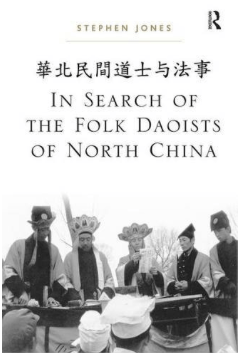
Just received the new paperback edition of my 2010 In search of the folk Daoists of north China, and very handsome it looks too. Which is the main thing…

Apart from addressing a vast area of ritual practice that has hitherto been neglected, I haven’t yet noticed scholars taking on board a basic point, that besides our usual image of household Orthodox Unity Daoists, household (not just temple-dwelling) Complete Perfection Daoists are also common.

Do rush online and buy it! LOL

Some Portuguese epigrams

For Nick—
i
f the reader finds this post a tad arcane, just wait till you see his WAM anagrams

Further to my little Lisbon jaunt, I’m always disappointed at my total lack of success when I try to busk it in Spanish by randomly adapting Italian—but it’s even more futile to further modify my crap Spanish into bacalhau (sorry, I mean cod) [1] Portuguese.

I soon dispensed with my old Portuguese phrase book (less entertaining, and less sinister, than Teach yourself Japanese)—its very opening phrase suggests a similar deep anxiety about even setting foot outside our own green and pleasant land:

There’s been an accident.

I flew TAP (Take a Parachute). Indeed, the flight prefix is further abbreviated by omitting the middle letter, so not for the only time, I found myself flying TP (Totally Pissed).

Aboard TAP flights, with impressive urbanity in the vein of Mots d’heures, the airline regales the traveller with a pithy and somewhat obscure epigram evoking the saudade of fado. It seems to recall a sad incident in the colourful past of an early Lisbon femme fatale, perhaps a widow of French patrician stock (even a refugee from the guillotine?):

Colete Salva-Vidas sob a Cadeira [2]

I’ve added capitals for clarity, but in order to preserve the ambiguity of the original I have refrained from supplying what seems to be a missing apostrophe—indeed, could it even be an exhortation?

Either way, it is far more evocative in Portuguese than in its prosaic English rendition

Life jacket under the seat.

Cf. Airplane:

Airplane is packed with little visual detail like that, requiring as much long-term revisiting as the Ring Cycle. Even the opening sequence is a too, er, deaf ‘orse.

And I’m keen to dally with Mme [sic] Salva-Vida’s [just as sic] enticing daughters

Rolagem, Descolagem, and (black sheep of the family) Aterragem,

also commemorated in TAP’s onboard annotations. Again, their names are so much less elegant in English:

Taxi, Takeoff, and Landing.

For a new addition to the family, Proxima Paragem, see here.

Just had one of those wacky dreams:

In Lisbon, invited implausibly to some suspiciously traditional social event with an old friend, we make our tortuous way there by means of a badly bombed Escher staircase. Arriving unscathed, I mingle suavely with the locals. Pleased with myself for managing to utter a grammatically convincing phase, I exclaim “Progresso!” “Si,” my Portuguese friend nods, “Esta Truro.”

How pitilessly my subconscious satirises my naïve aspirations to insider status.

For another dream, and a Portuguese limerick, see Ogonek and Til.


[1] Altogether Now: The Piece of Cod Which Passeth All Understanding.

[2] Cadeira: twinned with Madeira.

Jottings from Lisbon

Just home from Lisbon, where I screened my film for a select and rather posh CHIME conference. How good to have a few days to enjoy cobbled streets, tiles, and little wood-lined trams—authentically scattered, as everywhere, among decrepit building sites.

Back in the 1990s, annual working holidays in Lisbon (as well as Parma, Ludwigsburg, Amsterdam, Paris, and London—happy days) were a regular gig while we were doing Mozart operas with John Eliot Gardiner.

On the same principle as seeking out flamenco in Seville after the Matthew Passion, it was always good to go in search of fado in Lisbon after our concerts there. Fado can be great, as long as we don’t expect it to be flamenco—this is a bit like relationships altogether (tutti, bemused: “This is a bit like relationships”.)

The old-style fado bars, holes in the wall, have become ever more elusive, long outnumbered by glossy tourist restaurants. As ever, a good sign is the lack of a sign.

fado

Fado singing, 1993. My photo.

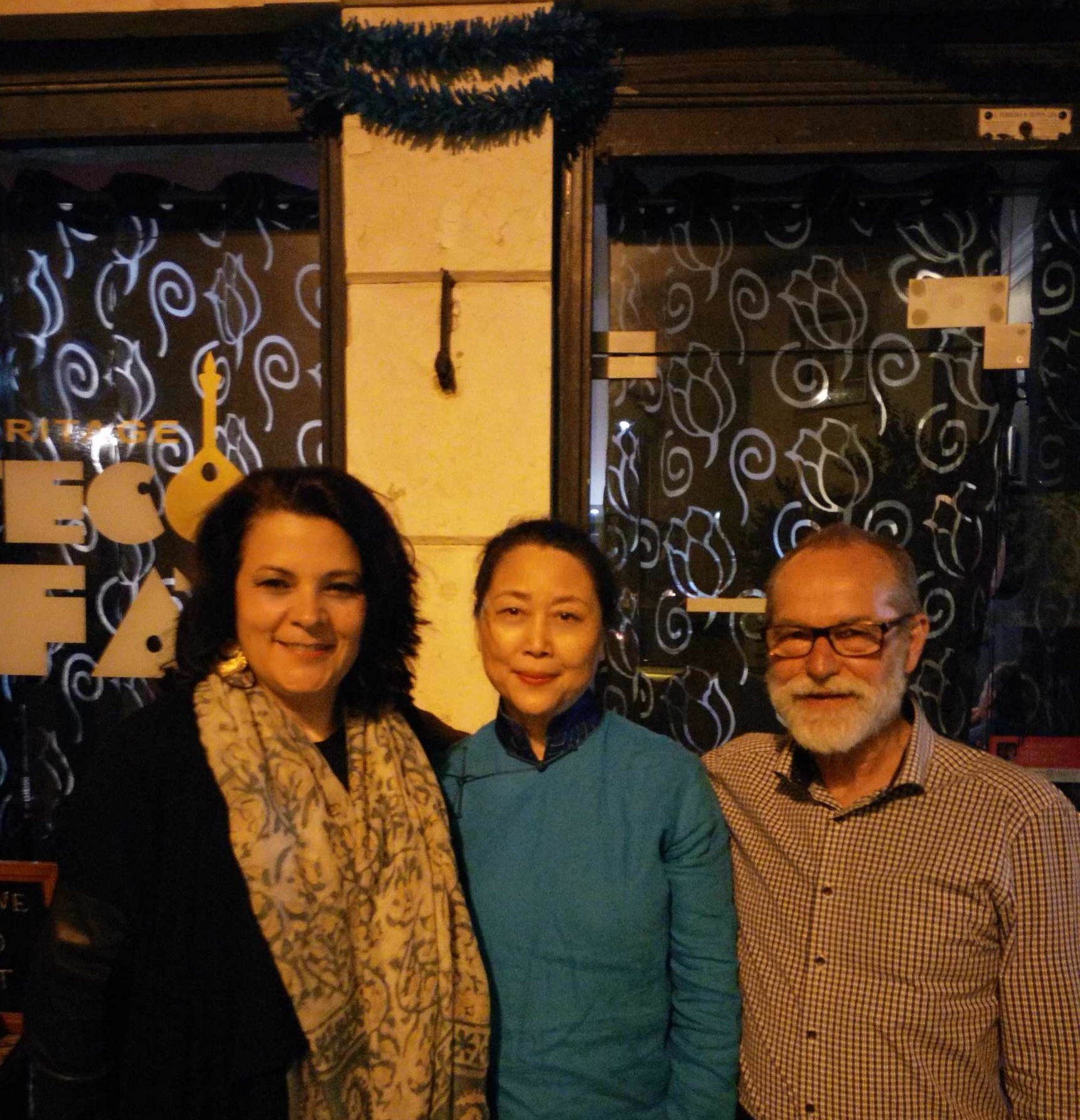
We found a good little fado dive this time too, rather by chance. And then on our last night our fine hosts kindly took us to the Boteco da Fa in the Alfama, a classy joint that nonetheless has a great atmosphere—it’s just a little room that can pack in around fifty aficionados. We heard Sandra Correia (for a 2022 feature, click here)

and Augusto Ramos:

The quintessential saudade (“missingness”!), a first cousin of the duende of cante jondo in flamenco (and see several other nice intercultural equivalents under that saudade link), was much in evidence.

Both singers are well-known performers in “concert”, and in a club like this the atmosphere is quite formal (the rather good food can only be a brief diversion between—not even during!—sets), but Augusto also doubles as a waiter there, and they’re pouring their hearts out just a few feet away from you.

Focusing as I was on the intensity of the singing, it took me a while to realise how great the two pluckers were too— Luis Guerreiro, the leading guitarra player, totally at ease, always exploring patterns and harmonies, his riffs even featuring the occasional soupçon of  Django.

pluckers

Brilliant fado pluckers. Photo: Xiao Mei.

Being in Lisbon, we were able to express our appreciation with warm applause—I read that

According to tradition, to applaud fado in Lisbon you clap your hands, while in Coimbra one coughs as if clearing one’s throat.

Could Coimbra have been a British colony?!

Our group from the conference included the brilliant Xiao Mei and two young Chinese conservatoire performers. I relish this recent rapport, this new sense of equality. Xiao Mei, most enlightened among Chinese musicologists, is always in fieldwork mode, lapping it all up, as were the younger musos, recording on their posh smartphones and chatting in breaks with the musos. A wonderful evening— Chinese Twitter will be abuzz with it, and that’s just so inspiring…

fado group

Sandra Correia, Xiao Mei, and Enio Souza, dynamic conference organizer.

In a small way, all this reminds us all why it’s worth replacing the vague term Western music with Western Art Music, if that’s what we mean; and observing how European folk traditions are an equally precious part of our heritage. “Music” can be such a misleading little word: just as there’s more to music in Shanghai than its opera house—such as amateur silk-and-bamboo clubs or temple fairs in Pudong—so music in Lisbon is more than the Teatro Nacional de São Carlos. Symphony orchestras and erhu solos are but the tiny shiny tip of the iceberg (cf. here, and my post on folk musicking in Italy).

Nor would any visit to Lisbon be complete without a serious overdose of nata:

nata

Whereas the English custard pie is only good for slapstick. Typical

* * *

Meanwhile at our conference on Chinese music, it’s always good to hear Xiao Mei introducing her work on spirit mediums and trance, with her amazing videos of rituals among the ethnic minorities within the PRC.

Since the conference was held at the Centro Científico e Cultural de Macau, the music of Macau was one theme. With typical impertinence I suggested that studies of music-making in Macau might be inspired by Ruth Finnegan’s seminal book The hidden musicians, exploring all the diverse kinds of musical activity in Milton Keynes, whose population is less than half of that of the Chinese metropolis. Macau’s cultural life outside official institutions remains to be explored—for instance, no-one has yet made the connection with the household and temple Daoists there. [1]

* * *

Back in May 1993, Lisbon was among several wonderful venues for our series of performances of Le nozze di Figaro:

That’s a live concert recording at the Queen Elizabeth Hall after we returned to London. Soon after that I returned to Hebei for my second visit to Gaoluo and further survey of village ritual associations.

On a free day between Figaro shows, I visited the resort of Cascais, a pleasant excursion just west along the coast. On the street I came across a blind busker called Rosa, then 36, from Almada just across the river. She accompanied her songs on the triangle, occasionally checking the lyrics in Braille.

Cascais singer

Rosa, 1993. My photo.

I assumed she was just another blind beggar who never comes much to anyone’s attention, unless you count me. So imagine my surprise, today, when none other than Xiao Mei saw my photo and told me that Rosa (now “Dona Rosa“, with a backing band) had come to give concerts in China! And sure enough, she’s now become a star on the world music circuit, having been “discovered” (not by me—I kept her to myself) but since 1999 and more widely since 2004.

How was I to know?! Can I indeed claim to have discovered her, like Yang Yinliu discovered Abing?! Hardly, since I’ve sat on the fruits of my casual fieldwork for 24 years. I am reminded of the occasional blind bard from Shaanbei who materialises, bemused, on glossy Chinese TV extravaganzas.

Here’s one of several YouTube clips of Dona Rosa:

As usual, the exigencies of the world music big band distract from the atmosphere of her solo singing. Try this instead—from a concert at New Year 2008 in the Concertgebouw, no less:

Still, from a BTL comment by fjcnunes I also learn:

It’s sad and lamentable that this great lady is still begging on the street of Rua Augusta, Lisbon. This was the case in June 2014, when I saw her there and took a picture with her. In her words, she gets paid “next to nothing” to play in Portugal and is forced to play on the streets to make a living. Probably the promoters and organizers get the lion’s share of the revenues from her concerts. I wonder if the same would have been allowed to happen to Cesária Évora? If you happen to travel to Lisbon, Portugal, please pass by Rua Augusta and purchase one of her CDs, directly from her. At least you’ll know where the money’s going.

* * *

Anyway, that chance find in Cascais was typical of the kind of superficial yet rewarding little jaunts one can fit in as a touring muso—like flamenco in Seville, dance houses in Budapest, tralallero choirs in Genova, and so on.

The Alentejo region is famed for its folk choral singing. I haven’t caught it live yet, but it’s evidently a rich tradition.

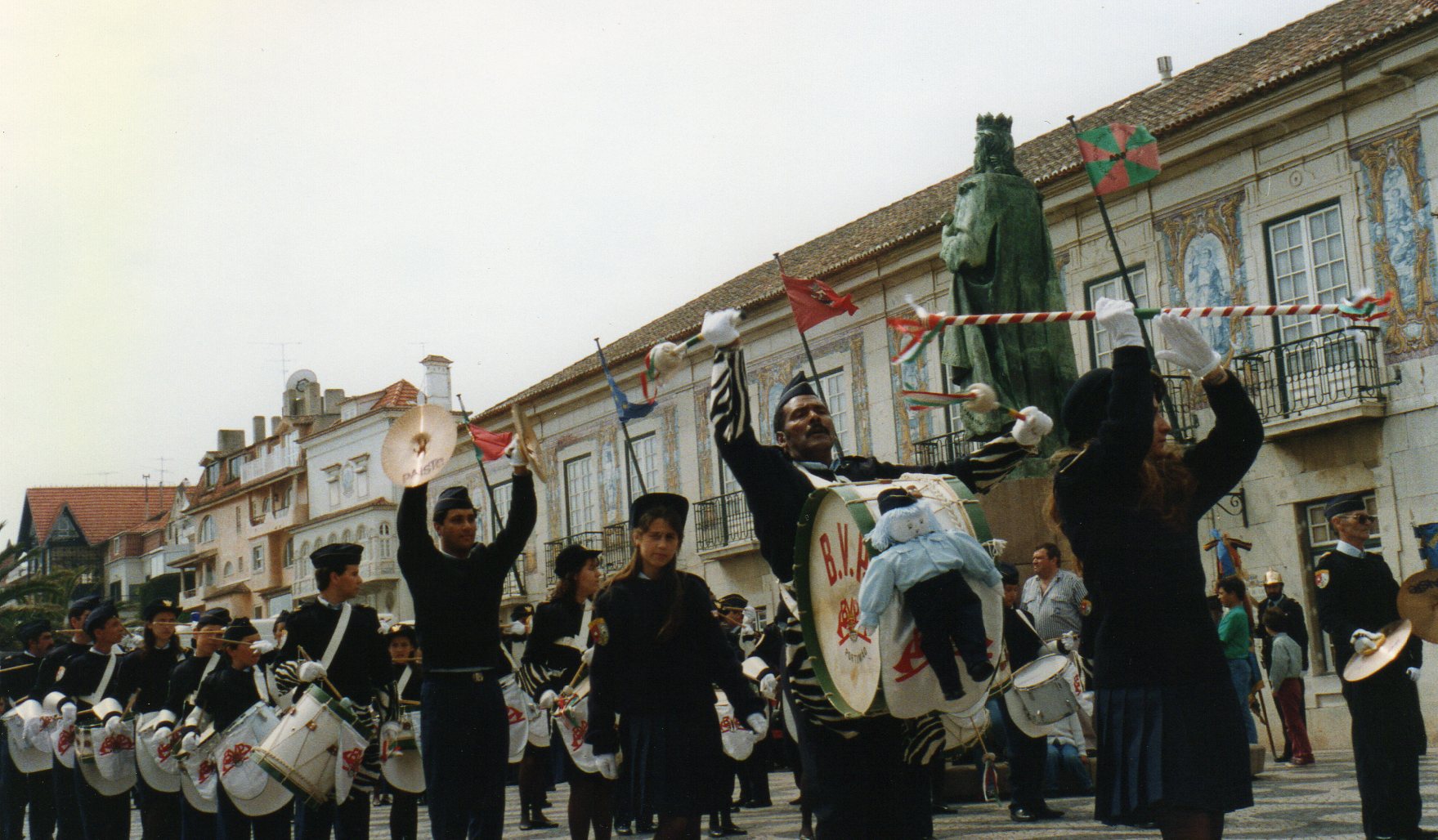
In Cascais I also enjoyed the parade for voluntary fireman’s day.

firemen

Parade for voluntary fireman’s day, May 1993. My photo.

All this belongs to my recurring theme of delighting in all manifestations of the Terpsichorean muse. In the present climate, we must relish our cultural diversity all the more. And yes, that does include Mexican migrants and Syrian refugees. All those Brits who find themselves (not) with an extra 350 million squid a year to spend might lavish a bit of it on educating themselves about the traditions of their newly-alien neighbours.

For sequels on Lisbon, click here and here. Note also Portugal: folk traditions.

[1] See e.g. http://www.macaotaoist.org/澳門道教科儀音樂/http://www.baike.com/wiki/澳门道教科仪音乐,
http://www.chinataoism.org/showtopic.php?id=1005; for a major community ritual for the 2003 SARS epidemic, see http://www.cciv.cityu.edu.hk/macau/3/2.php.

Li family French tour confirmed!

I’m delighted that the visit to France of the Li family Daoist band is now confirmed, so do please consult the Upcoming events in the sidebar, come along, and do tell all your friends!

Early Daoist instruments

Just in case you haven’t noticed this under my selection of photos of the Li family Daoists (PhotosDuh), I like it:

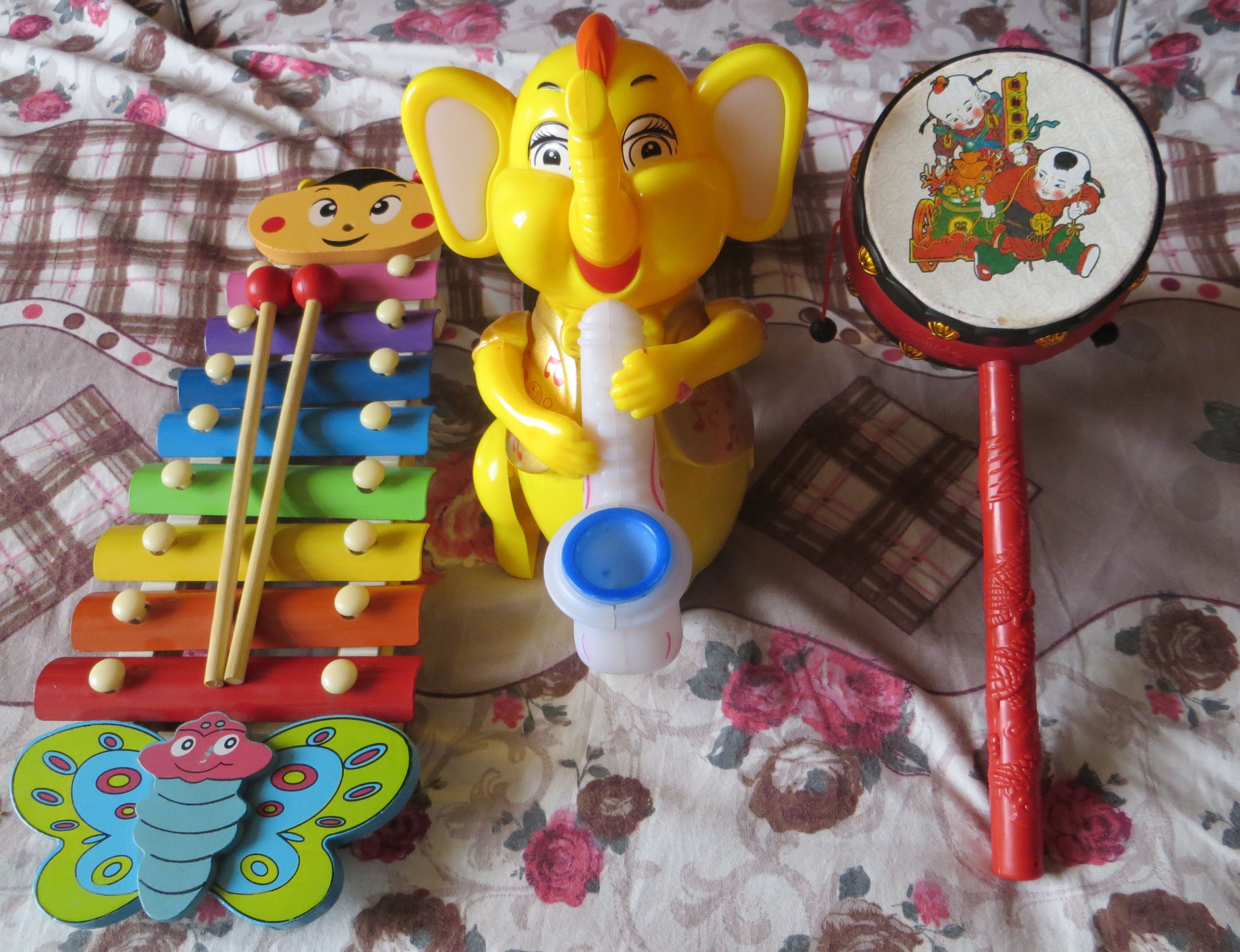
toys

The earliest instruments in the Li family collection, from the Hongwu era of the Ming dynasty..

Seriously though folks, I found these in the county-town as gifts for the young son of Li Manshan’s daughter Li Min. The perfect gift for the scion of a household Daoist: yunluo gong-frame, guanzi oboe, and drum—all the ensemble lacks is a harmonica to represent the sheng mouth-organ.

Can’t take my eyes off you

Valli

By contrast with slow intense WAM, and as a change from female singers, here’s Frankie Valli and the Four Seasons’ finely-crafted original version of Can’t take my eyes off you (1967), with its smoochy intro leading the funky “I love you baby”:

I note Woody Allen’s comment from Manhattan, in a cab with Diane Keaton:

You look so beautiful I can hardly keep my eyes on the meter.

See also Modulation: Schubert and Coltrane.

Indian and world fiddles

*See also Ways of playing the violin*

The other day, just before my alarming rendition of Bach on the erhu, I went to an enthralling concert of Carnatic violin by the sisters M. Lalitha and M. Nandini at the Bhavan Centre in West London, a lively centre for the Indian community.

How mesmerizing Indian music can be, unfolding naturally with grace and fluency! Learning such oral traditions is aided by memorizing sargam solfeggio. Tuning the strings in open fifths (like G–D–g–d, often used in world fiddle styles— actually, here they commonly have five strings) lends the violin a wonderful sonority (cf. Keef’s excited epiphany).

The ideal in many cultures is for instruments of all kinds to imitate the voice—I love the way Wu Mei decorates the vocal liturgy of the Li band on the guanzi oboe, for instance. It was by chance that I ended up playing the violin in WAM, but we can all appreciate the link between the voice and bowed lutes (or should I say friction chordophones? No you bloody shouldn’tThe Plain People of Ireland) by extending our interests to other world genres. OK, for us WAM fiddlers embarking on Mahler 5 there may be no clear benefits to this, but why don’t we all learn the rudiments of Indian style and technique too? However rigorous a training in rag may be, it can’t be as arid and painful as ploughing through sodding Ševčík studies—it’s amazing we didn’t all give up.

The Bhavan audience was sadly thin on the ground, but it’s the magic of the rapport that counts. It reminds me of a Mozart Requiem tour of Italy with John Eliot Gardiner in the 1990s. For some reason we ended up doing a gig at a dingy cinema in the sleepy town of Terni on a Sunday afternoon, performing for a tiny audience that barely outnumbered the massed orchestral and choral forces. Nonetheless, with stellar singers like Barbara Bonney and Anne Sofie von Otter, it was one of our most moving performances.

At the risk of sounding like Away from it all (“the one thing that Venice truly lacks is leprechauns“), here’s a random but inspiring sample of some further riches of world fiddling—needless to say, it’s all about technique at the service of the music, which in turn stems from its social use…

Still with the exquisite gamak styles of India, here’s a Hindustani female dynasty (cf. Rāg Malkauns):

And then there’s the wonderful sarangi—click here, here, and here for the remarkable work of Nicolas Magriel.

I outline some of the diverse bowed lutes of China here; the erhu is the least traditional of them, but you must hear this astounding playing. See also here. For the distinctive Korean haegeum, click here.

Irish fiddling can be irresistible (for more from Liz Carroll, listen to Dear Old Erin’s Isle here):

Some unaccompanied Bach (on violin instead of cello, for a change):

And Transylvanian bands (see mainly here):

Poland has some fine fiddle traditions too—here’s Stanisław Klejnas, from a village near Łódź:

From Iran, here’s Mohammad Reza Lotfi on kamancheh:

Kamancha playing from Azerbaijan is amazing too. I used to have a clip here of an Azeri party—complete with mobile phones, naff yet tasteful accompaniment, and no fancy fakelore costumes. But it’s disappeared, so we’ll have to settle for a reified official concert version:

And here’s a stellar gathering of players, all with their own distinctive styles (with thanks to Jeffrey Werbock, himself a fine exponent of Azeri music):

Note also the lyra of Crete and the Pontic Greeks. And here’s a taksim on violin by Salih Baysal (1973):

For more violin taksim, click here. See also New sounds of Anatolia.

For the Uyghurs of Xinjiang, besides the ghijak, the soul of the muqam is the plangent long-necked satar (featured in a wonderful muqaddime prelude here), but they use “our” violin just as expressively too, as on this recording of Raq muqam—from a cassette by the renowned singer Abliz Shakir in the early 1990s:

Some of these genres are explored in the fine projects Growing into music and The music of Central Asia.

That’s just a start. I leave jazz fiddling to another post… For yet more, see fiddles tag in the sidebar, introduced here. For more concerts at the Bhavan, click here and here.

Registers

Talking of acronyms, one that slips less lightly off the tongue is ENSRC, a useful network for Chinese religion led by the indefatigable Philip Clart and Vincent Goossaert.

I welcome spoof suggestions for what ENSRC might stand for, à la LUFTHANSA…

There’s been a recent flurry of discussion there about Daoist lu registers (not the lu emoluments that I miss), discussing their varied formats and functions (have we no homes to go to?!).

I don’t think anyone has yet suggested that such registers were ever rolled up in the form of a scroll, but if they were (by analogy with baojuan “precious scriptures”, sometimes rendered as “divine rolls“), they might be known as

lu rolls

Acronyms

Following on from silly Chinese acronyms, seasoned travellers will be familiar with the airline acronyms—anyway, there are loads online. Among the highlights (PC temporarily suspended in favour of transmitting historical linguistic creativity—Ed.) are

QANTAS
Queens And Nymphos Trained As Stewards

which leads nicely to

LUFTHANSA
Let Us Fuck The Hostess As No Steward Available

Of numerous versions for TWA, I like

Try Walking Across

And ALITALIA

Always Late In Takeoff, Always Late In Arrival

Cf. the old one about the BA poster

Breakfast in London, lunch in New York

To which some wag has added

Luggage in Bombay

For Air Portugal, see here.

Strings and voices

SMP Miller

The Matthew Passion, staged.

My splendid neighbours Fiz and Mike just held a great 50th-wedding anniversary party. Otherwise gifted with fine taste, they inexplicably cajoled me into giving the guests a burst on the erhu Chinese fiddle—oblivious to my plea that its plaintive timbre really needs to be experienced at the hands of someone who can actually, like, play the instrument. After all, like Bernard Bresslaw in The Ladykillers,

I just sort of… picked it up.

Judiciously waiting until everyone was suitably inebriated, after a rousing (and apparently not entirely unrecognizable) erhu rendition of Jerusalem à la chinois (mercifully brief—my friends have suffered enough), I boldly attempted not to entirely mangle Bach’s so-called Air on the G string.

Bach on erhu and saz

At short notice I secured the estimable services of another neighbour, Martyn—possibly the leading exponent of the Turkish saz in the whole of Bedford Park (sic)—who sensitively provided the bass line. Without regard to expense or the feelings of the public, we stretched to nine strings between us—four and a half each, three of them doubled (“Go figure”). As if it didn’t represent enough of a challenge, I rashly tried further to fill in the texture with the occasional juicy bit of counterpoint by “singing” (I use the word loosely). So I now admire fiddlers who manage to sing at the same time (actually, I shouldn’t be too hard on myself—perhaps it’s not so common to hear fiddlers singing counterpoint as they play).

For a sequel, click here.

A World Music version of Bach is an Idea whose Time has Come, if not necessarily the intonation. We didn’t so much play the Air as hint at it, an esquisse in roughly drawn lines. Thankfully, no audible trace survives of our rendition (“Case for prosecution collapses due to lack of evidence”)—nor, for that matter, of the ear-scouring Chinese wind-band version that our shawm band had played for a friend’s wedding during our, um, heyday. But undaunted, I did later record some Bach on the erhu.

The Bach Air is another instance of music that we can only hear with our own modern ears (also here)—imbued by the old cigar ad, and its whole ubiquity in popular culture. But in performance (OK, in the right hands…) it can hardly fail to move—eighteen bars of intense perfection.

Like Christopher Small (Musicking—essential reading), I now greatly value playing in an informal setting for people I know. In post-industrial societies this has inevitably been diluted by the exigencies of concert economics, with the irony of coming together to share “intimate and personal cultural moments with strangers” (George Lipsitz, cited in Musickingp.39).

Still, the Air always moves me by association with memorable concert renditions in which I’ve taken part over the years—like in Windsor Chapel once on my birthday (as part of the Bach 3rd suite, all the more moving in between exhilarating trumpets and ecstatic fast jazzy string noodling), and as an encore in Budapest with Trevor Pinnock.

And here’s a version on the ethereal theremin (among the early experiments of hYrtis, a work in progress…):

It can be beautiful as an a cappella setting too:

Like the Mahler Adagietto, another media staple that transcends its hijacking by popular culture is the Barber Adagio, equally moving in string quartet and orchestral versions, as well as this ethereal choral arrangement:

Although the Agnus Dei text was added later to fit the melody, it gives me a pretext to play Bach’s version from the B minor mass, sung again by the divine Michael Chance—more vocal and instrumental intertwining:

Just as divine as the Barber is Lux Aeterna, a choral version of Elgar’s Nimrod:

For more a cappella singing, click here; and for Indian and world fiddles, here.

Wordplay with Daoists

Sometimes when I’m with the Li family Daoists I wear my SOAS T-shirt, which bears the name “SOAS, London University” in most of the Oriental and African languages taught there. The Chinese version, on the back, reads

伦大亚非学院         Lunda YaFei xueyuan,

Lunda being short for Lundun daxue (London University),* Yafei short for Yazhou (Asia) and Feizhou (African), and xueyuan meaning academy. One day in Italy the ever-lively Third Tiger, Li Manshan’s younger brother, frowning as he tried to interpret these six arcane characters, asked me,

What’s Lundaya feixueyuan supposed to mean?

We all burst out laughing, as usual. He was reading it not as three binomes (Lunda—YaFei—xueyuan), but as Lundaya—some weird transliteration of a foreign name, perhaps?—and feixueyuan, “anti-academy”. But his interpretation has stuck; it has a further resonance when adorning my own back, since with my championing of more earthy folk sounds I’m (ever-so-slightly simplistically) notorious for my anti-conservatoire stance… On my next visit to Yanggao I just had to bring a SOAS T-shirt to give him.

In similar vein (my book, pp.331—2), Li Manshan and I have a lot of fun with the name Intangible Cultural Heritage. The Chinese translation Feiwuzhi wenhua yichan is itself flagrantly at odds with, um, the Chinese heritage. I set the ball rolling by wilfully getting the name wrong, calling it Feiwenhua wuzhi yichan, “Anti-cultural materialistic heritage.” Li Manshan, now designated as a Transmitter of the ICH, takes up the riff: when I joke with him, “You’re an Intangible (feiwuzhi)!”, he comes back with: “Ha, I’m a Waste of Space (feiwu 废物), more like!” This becomes our regular name for the project.

For more T-shirts, see here—oh, and here. And for more wordplay with Daoists, here.

*Another regular sources of giggles on visits to rural latrines is the common re-formation of Lundun with the characters 轮蹲, “taking turns to squat”, further elaborated in our revision of Lundun dashiguan 伦敦大使馆 “London embassy” to  轮蹲大屎馆  or “Taking turns to squat in the big London shithouse”…

Corpsing: Inuit culture and Haydn

A much-discussed piece of “salvage ethnography” is the film Nanook of the North (Robert J. Flaherty, 1922):

For his 1926 film Moana, see here.

More recent is a highly praised film from Zacharias Kunuk, Atanarjuat: the fast runner (2001)—click here for a trailer. It enacts an ancient legend while lavishing great anthropological care in evoking early Inuit culture.

But Nanook of the North is to some extent a fictional creation too, blurring the lines between documentary and drama. It is an early case-study in a substantial discourse in the ethics of visual anthropology that leads on to Jean Rouch, representations of the Yanomami, and so on.

As to vocal styles, in katajjaq throat-singing (e.g. Voices of the World, CD 1 §12), the duet is considered to come to an end when one of the singers laughs, loses her breath, or breaks concentration (LOL).

Hard to imagine a performance of such charm at certain other recent swearing-in ceremonies…

Now I’d like to seek ethnographies of changing life in Inuit communities since the time of Nanook (preferably not containing the words “traditional way of life” or “vanishing culture”—“but that’s not important right now“). This is a lively topic in ethnomusicology—there are many studies to add to my reading list, such as Maija M. Lutz, The effects of acculturation on Eskimo music of Cumberland peninsula (1978), Beverley Cavanagh, Music of the Netsilik Eskimo: a study of stability and change (1982), and studies of throat singing by Nicole Beaudry and others—as an introduction to the detailed work of Beaudry, note her thoughtful reflections in Shadows in the field. See also First Nations: trauma and soundscape.

Here’s a trailer for the short film Throat song (2013), in which a young Inuk woman, lost in a community that has been tragically separated from its past, begins to connect with other victims of violence in her community, and seeks to reclaim her voice:

Throat singing also inspires a lively experimental scene, with singers such as Tanya Tagaq.

* * *

Corpsing is one of the pleasures of musical life in WAM too—we’ve all done gigs like that. I can’t suggest here the numerous ways in which fiddle players try to corpse their desk partners by a tiny little gesture of resignation at the repeat of a minuet, or a fake sforzando attack on a pianissimo entry.

Generally “the show must go on”, but once, the Allegri string quartet were performing the intimate, intense slow movement of a Haydn quartet when the viola player let out an extended and voluble fart.* The leader giggled sotto voce, and as the mirth spread (even to the miscreant, who’s generally the first to keep a straight bat) all four of them were soon so helpless with laughter that they just couldn’t keep going, and had to leave the stage to compose themselves.

To be sure, this is at a certain remove from Inuit culture. In the latter, as if you haven’t worked this out already, corpsing is intrinsic to the performance event; in WAM, it’s an illicit part of the muso’s “deviant behaviour“. For corpsing in the crucifixion scene of the Matthew Passion, click here; and for the suave Charlotte Green on BBC radio, here.


* I’m reminded of the old Punch cartoon:

Host (to guest who has just perpetrated an embarrassing histrionic effect) “Gad sir, you’ve farted in front of my wife”.

Guest, with air of studied nonchalance, “Oh, I’m most frightfully sorry, I didn’t realise it was her turn.”

Hope for our future

Amidst all the recent plague of misogynistic claptrap—exemplified by the Neanderthal spewings from Tweety McTangerine—all is not lost.

One of the very most inspiring stories of recent months concerned the brilliant ripostes (here) by indignant young female football players at a County Durham primary school to the Football Association’s advice (“naïve rather than sexist”???) on ways of recruiting more girls to the sport. Call me a Guardian reader if you will, but FFS, even The Sun expressed wholehearted admiration for the girls’ protests!

Their letters are just brilliant.

We aren’t brainless Barbie dolls.

Whether or not they’ve read the feminist classics yet (in pretty pink covers, perhaps, FA?), or even listened to Bridget Christie, they’re on the case, making mature cogent arguments way beyond the infantile rants of the leader of the Free World. There’s hope yet.

football letter

How thrilled they must be about England’s victory in the 2022 Euros! For more on women’s football, click here; for ancient Chinese female footballers, here.

Also inspiring is a recent complaint by a 7-year-old girl about a sexist road sign. For more hope for our future, see here.

The acme of ethnographic authority

If it’s proper language you’ll be wanting, by blessed chance I’ve just come across “The trade”, an early (1940) essay on pubs by Myles na gCopaleen that has found a respectable home in the fine anthology Great Irish reportage.

This is the ultimate insider’s account. Pubs were Myles’s office and his home—seldom can ethnographers have had such an in-depth knowledge of their chosen fieldsite. He shows great sensitivity to change in attire and interior design:

The result is a combination of utility (functional something-or-other architects call it), comfort and restraint—but no pints.

His poignant account manages to be both engaged and dispassionate. Just the opening paragraph is a too, er, deaf ‘orse—sorry, I mean tour de force (blame Keats and Chapman):

In the last ten years there has been a marked change in the decor of boozing in Dublin. The old-time pub was something in the nature of the Augean stable (it is true that Pegasus was often tethered there) with liberal lashings of sawdust and mopping-rags to prevent customers from perishing in their own spillings and spewing. No genuine Irishman could relax and feel at home in a pub unless he was sitting in deep gloom on a hard seat with a a very sad expression on his face, listening to the drone of bluebottle squadrons carrying out a raid on the yellow sandwich cheese. In those days a genuine social stigma attached to drinking. It was exclusively a male occupation and on that account (and apart from anything temperance advocates had to say) it could not be regarded as respectable by any reasonable woman. Demon rum was a pal of the kind one is ashamed to be seen with. Even moderate drinkers accepted themselves as genteel degenerates and could slink into a pub with as much feline hug-the-wall as any cirrhotic whiskey-addict, there to hide even from each other in dim secret snugs. A pub without a side-door up a lane would have been as well off as one with no door at all.

The abuse of language

Further to the Stasi’s use of language, OK, this is shooting fish in a barrel, but among an endless list of crimes for which Tweety McTangerine will burn in hell is his own distinctive desecration of language (see e.g. 100 days of gibberish).

Well he said, you’ll be the greatest president in the history of, but you know what, I’ll take that also, but that you could be. But he said, will be the greatest president but I would also accept the other. In other words, if you do your job, but I accept that. Then I watched him interviewed and it was like he never even was here. It’s incredible. I watched him interviewed a week later and it’s like he was never in my office. And you can even say that.

Roll over Shakespeare.

The “enemy of the American people” has naturally been having a field day in assessing the first 100 days. Spoilt for choice, I will content myself with citing the excellent Hadley Freeman.

Among my various Tweety posts, perhaps this is most apposite.

Update (2018): another classic speech (aka nonsensical rant):

I have broken more Elton John records, he seems to have a lot of records. And I, by the way, I don’t have a musical instrument. I don’t have a guitar or an organ. No organ. Elton has an organ. And lots of other people helping. No we’ve broken a lot of records. We’ve broken virtually every record. Because you know, look I only need this space. They need much more room. For basketball, for hockey and all of the sports, they need a lot of room. We don’t need it. We have people in that space. So we break all of these records. Really we do it without like, the musical instruments. This is the only musical: the mouth. And hopefully the brain attached to the mouth. Right? The brain, more important than the mouth, is the brain. The brain is much more important.

A new threat to civilisation

After the courgette crisis, a new threat looms, prompting “social media hysteria”: a national hummus shortage. Oh no, whatever are we going to do?!

A survey in 2013 marked Britain as the hummus capital of Europe, with 41% of people having pots in the fridge, almost twice as many as any other country.

Without underestimating the rise of the chattering classes, this looks like a dodgy statistic to me.

Anyway, the Middle East would seem to have more pressing problems right now, even if we don’t. Anyway, now we’ve moved on to tofu, apparently.

Lives under the GDR

*See also sequel here*

The experiences of Eastern European countries under state socialism, not to mention the Soviet Union and China, were all very different (see also Life behind the Iron Curtain: a roundup).

From a comfortable distance, looking at the GDR can seem voyeuristic, some kind of Stasi porn. But perhaps it’s more like “What would we have done?”—as Neil MacGregor asks in Germany: memories of a nation, full of insights on successive eras.

I guess I’m also trying to atone for my lack of curiosity as a touring muso on early trips to the GDR. In 1980 I played Elektra with Welsh National Opera in East Berlin and Dresden. With John Eliot Gardiner, in 1985 we did Israel in Egypt (see under Handel) in Halle, staying in Leipzig—apart from Michael Chance’s divine rendition of Thou shalt bring them in, my main memory is the whole orchestra and choir descending on Peters bookshop like locusts, to spend our over-generous Ostmark subsistence allowance (OK, unlike locusts) by buying up their entire stock of, ur, texts—sorry, I mean urtexts. In 1987 we did a memorable Matthew Passion in East Berlin (note also Hildi’s story).

My readings are also stimulated by my experience of China.

In Leipzig, I already mentioned the fine Forum of Contemporary History, and the Stasi Museum at the Runde Ecke is suitably disturbing. On the exceptional degree of surveillance under the Stasi, I can’t address the literature in German, but two books in English make useful introductions:

  • Anna Funder, Stasiland, a brilliant piece of writing,

and

File

Garton Ash notes how Stasi is chasing Hitler fast as “Germany’s best export product”:

Ironically, this worldwide identification of Germany with another version of evil is a result of democratic Germany’s own exemplary commitment to expose all the facts about its second twentieth-century dictatorship, not brushing anything under the carpet. (229)

In 1979, when many Western observers were downplaying or ignoring the Stasi, I felt impelled to insist: this is still a secret police state. Don’t forget the Stasi! In 2009, I want to say: yes, but East Germany was not only the Stasi. (230)

The opening up the Stasi records had enormous consequences:

You must imagine conversations like this taking place every evening, in kitchens and sitting-rooms all over Germany. Painful encounters, truth-telling, friendship-demolishing, life-haunting. (105)

The file ponders the wider problems of writing about people’s lives, and memory:

I must explore not just a file but a life: the life of the person I was then. This, in case you were wondering, is not the same as “my life”. What we call “my life” is but a constantly rewritten version of our own past. “My life” is the mental autobiography with which and by which we all live. What really happened is quite another matter. (20)

He notes

the sheer difficulty of reconstructing how you really thought and felt. How much easier to do it to other people! (37)

The very act of opening the door itself changes the buried artefacts, like an archaeologist letting in fresh air to a sealed Egyptian tomb. […] There is no way back now to your own earlier memory of that person, that event. (96)

Now the galling thing is to discover how much I have forgotten of my own life.
Even today, when I have this minute documentary record—the file, the diary, the letters—I can still only grope towards an imaginative reconstruction of that past me. For each individual self is built, like Renan’s nations, through this continuous remixing of memory and forgetting. But if I can’t even work out what I myself was like fifteen years ago, what chance have I of writing anyone else’s history? (221)

Indeed, my process of writing about people’s lives in China has made me unpack the blurred lines of my own story.

As Garton Ash comes face to face with the people who had informed on him, he experiences constant moral doubts.

As I leave I can see in her eyes that this will haunt her. Not, I think, because of the mere fact of collaboration—she was, after all, a communist in a communist state—but because working with the secret police, being down in the files as an informer, is low and mean. All this is such a far, far cry from the high ideals of that brave and proud Jewish girl who set out, a whole lifetime ago, to fight for a better world. And, of course, there will still be the lingering fear of exposure, if not through me then perhaps through someone else.

I now almost wish I had never confronted her. By what right, for what good purpose, did I deny an old lady, who had suffered so much, the grace of selective forgetting? (129)

He notes the irony in the careers of West German academics:

Cultured, liberal men in their thirties or forties, they are scrupulous pathologists of history, trained on the corpses of the Gestapo and SS. Theirs, too, is a peculiarly German story: to spend the first half of your life professionally analysing one German dictatorship, and the second half professionally analysing the next, while all the time living in a peaceful, prosperous German democracy. (196)

West Germans, who never themselves had to make the agonizing choices of those who live in a dictatorship, now sit in easy judgement, dismissing East Germany as a country of Stasi spies. […]
Certainly this operation has not torn East German society apart in the way some feared it would. In an agony of despair at being exposed as a Stasi collaborator, one Professor Heinz Brandt reportedly smashed to pieces his unique collection of garden gnomes, including, we are told, the only known specimen of a female gnome. Somehow a perfect image for the end of East Germany. (199)

Two schools of old wisdom face each other across the valley of the files. On one side, there is the old wisdom of the Jewish tradition: to remember is the secret of redemption. And that of George Santayana, so often quoted in relation to Nazism: those who forget the past are condemned to repeat it. On the other hand, there is the profound insight of the historian Ernest Renan that every nation is a community both of shared memory and of shared forgetting. (200)

He recognises the accident of birth:

I was just so lucky. Lucky in the country of my birth. Lucky in my privileged background, my parents, my education. Lucky in true friends like James and Werner. Lucky in my Juliet. Lucky in my choice of profession. Lucky, too, in my cause. For the Central European struggle against communism was a good cause. Born a few years earlier, and I might have been backing the Khmer Rouge against the Americans. Born in a poor family in Bad Kleinen, East Germany, and I might have been Lieutenant Wendt. […]
What you find here is less malice than human weakness, a vast anthology of human weakness. And when you talk to those involved, what you find is less deliberate dishonesty than our almost infinite capacity for self-deception.
If only I had met, on this search, a single clearly evil person. But they were all just weak, shaped by circumstance, self-deceiving; human, all too human. Yet the sum of all their actions was a great evil. It’s true what people often say: we, who have never faced these choices, can never know how we would have acted in their position, or would act in another dictatorship. So who are we to condemn? But equally: who are we to forgive? “Do not forgive,” writes the Polish poet Zbigniew Herbert,
Do not forgive, for truly it is not in your power to forgive
In the name of those who were betrayed at dawn.
These Stasi officers and informers had victims. Only their victims have the right to forgive. (223–4)

He notes people’s withdrawal into private lives:

Intelligent, well-educated, well-informed through watching Western television, they nonetheless devoted virtually all their energies to their private lives, and particularly to extending, decorating and maintaining their cottage on a small lake some half-an-hour’s drive from Berlin. […] My friend Andrea too, concentrated on private life, bringing up her small children in the charmed atmosphere of a run-down old villa on the very outskirts of Berlin. There were lazy afternoons in the garden, bicycle-rides, sailing and swimming in the lakes. (66)

The intersection of family and political history is well described in

a microcosm of modern Germany. I’m also most impressed by

  • Maxim Leo, Red Love (to which I devote a separate post)

—not least by the author’s amazing counter-cultural parents: compared to the lives of my own parents, theirs have been anything but drab. And then there’s

  • Hester Vaizey, Born in the GDR: living in the shadow of the Wall

To return to The file, Garton Ash observes the insidious use of language:

The process for which English has no word but German has two long ones: Geschichtsaufarbeitung and Vergangenheitsbewältigung. “Treating”, “working through”, “coming to terms with”, or even “overcoming” the past. The second round of German past-beating, refined through the experience of the first round, after Hitler. (194)

Another distinctive mouthful with echoes of China is Parteiüberprüfungsgesprach, “a ‘scrutinizing conversation’, a kind of confession for loyal comrades” (Red Love, p.212).

And after my citation of an over-generous definition of the Chinese term dundian, in German not just words but definitions can be expansive too. Abschöpfung is

laboriously defined in the 1985 Stasi dictionary as “systematic conduct of conversations for the targeted exploitation of the knowledge, information and possibilities of other persons for gaining information”. The nearest English equivalent, I suppose, is “pumping”. (108)

Garton Ash goes on to ponder the surveillance system of his own country:

The domestic spies in a free country live in this professional paradox: they infringe our liberties in order to protect them. But we have another paradox: we support the system by questioning it. That’s where I stand. (220)

And

Thirty years ago, when I went to live in East Germany, I was sure that I was travelling from a free country to an unfree one. I wanted my East German friends to enjoy more of what we had. Now they do. In fact, East Germans today have their individual privacy better protected by the state than we do in Britain. Precisely because German lawmakers and judges know what it was like to live in a Stasi state, and before that in a Nazi one, they have guarded these things more jealously than we, the British, who have taken them for granted. You value health most when you have been sick.
I say again: of course Britain is not a Stasi state. We have democratically elected representatives, independent judges and a free press, through whom and with whom these excesses can be rolled back. But if the Stasi now serves as a warning ghost, scaring us into action, it will have done some good after all. (232)

German fictional treatments of the period include

  • Christa Wolf, They divided the sky, and
  • Eugen Ruge, In times of fading light.

And then there are films like Barbara (2012)

and The lives of others, perceptively reviewed by Garton Ash.

Going back a little further, among innumerable portraits of ordinary German lives compromised, warped, under Nazism, I admire

  • Hans Fallada, Alone in Berlin.

Here’s a playlist of 65 English-language documentaries on the GDR:

not apparently including the 1970 BBC film Beyond the Wall, which you can still watch here. For subversive feature films made under the regime, see here; and for a documentary on WAM, here.

* * *

The nuance and detail of studies like those of Garton Ash contrast with Dikötter’s blunt and pitiless agenda in exposing the undeniable iniquities of the Maoist system.

While China and Germany were utterly different, parallels are explored by

  • Stephan Feuchtwang, After the event: the transmission of grievous loss in Germany, China and Taiwan,

and by Ian Johnson.

But for China, archives, and even memory, remain hard to access. For the Maoist era, the literature on the famine is growing—note especially Wu Wenguang’s memory project. Among fictional treatments, few films are as verismo as The blue kite and To live, or (for the last throes of Maoism) the films of Jia Zhangke. Chinese novels too tend towards either magical realism or over-dramatising.

For crime fiction from China and Germany, see here; for life-stories in the Soviet Union under Stalin, click here.

Our modern ears

You think I know Fuck Nothing—but I know FUCK ALL!

Almost anyone knows more than I do about punk, Country, film music, and so on. But when I write about them, however naively, my own narrow classical upbringing only serves as a reminder of what a very basic part of the soundscape all such popular genres are for anyone born since around 1900. This is just as true for WAM performers and the Li family Daoists—and even for scholars who interpret them. We really can’t bury our heads (ears) in the sand any longer, or unhear the sounds all around us.

But that’s only one rationale for the growing role of popular music in ethnomusicology since at least the 1960s—from Wilfrid Mellers on the Beatles or the wide-ranging studies of Susan McClary, to all the important work on genres in Asia and Africa, and so on. More fundamentally, I return to “delighting in all manifestations of the Terpischorean muse“: all kinds of musicking in all societies  should be treated on an equal footing—Amy Winehouse, Erbarme Dich, and Daoist ritual really do deserve to be part of the same celebration (for a great playlist, see here).

* * *

That’s very different from the old cliché of “music is an international language”. For better and for worse, it really isn’t (see here, and here): in any tiny region of the world there is incomprehension, with music (and culture generally) delineating barriers as much as commonalities—and that’s what I’d like to overcome.

Daoist ritual in Hunan

Hunan 1

Yangyuan village, central Hunan: above, ritual in action; below, god images.
From Shidao heyi (see below).

Hunan 2Along with regions like Fujian, Jiangxi, and south Jiangsu, Hunan province is among the hotspots for research on Daoist ritual—which, as elsewhere, is part of a whole range of mutually related ritual and paraliturgical activity, including Buddhist ritual specialists, spirit mediums, and so on.

Any such province represents a vast area, for which it is hard to encapsulate all the individual reports on particular villages or Daoist “altars”. As ever, most such studies, setting forth from sinological historiography, focus on documenting ancient ritual texts and artefacts; less common is detailed ethnography on how ritual life adapts in a constantly changing society—so we learn a lot more about ritual manuals and titles than about migration and motor-bikes. So this vast body of research, that should be of such significance for the anthropology of religion, still seems an autonomous zone fated to remain adrift from wider fields of enquiry,

Much of the scholarship on Hunan has received generous long-term funding from the Chiang Ching-kuo Foundation in Taiwan, with early results published in Minsu quyi.

Outsiders like me may feel in need of an overview. Alain Arrault has edited a useful volume of articles:

  • Interdisciplinary studies on the central region of Hunan, Cahiers d’Extrême-Asie 19 (2010)

including thoughtful overviews from him and Georges Favraud, including discussions of the thorny issue of “Meishan culture”. Another major topic is statuary, on which there is detailed research by Alain and others (see e.g. here and here).

With Chen Zi’ai 陈子艾, Alain Arrault is co-editor of a substantial related collection derived from a 2006 conference,

  • Xiangzhong zongjiao yu xiangtu shehui 湘中宗教与乡土社会, still awaiting publication.

Another grand maître of Hunan Daoist studies is Patrice Fava: besides his many books and articles, among his films is Han Xin’s revenge (vignette in China: writing in the air; cf. More films on ritual drama).

Chen Demei

Chen Demei, protagonist of Han Xin’s revenge.

One of the most fruitful sites has been Yangyuan village in Lengshuijiang municipality. Apart from the fine work of Mark Meulenbeld, Lü Yongsheng 呂永昇 and Li Xinwu 李新吾 have published major works:

  • Shidao heyi: Xiangzhong Meishan Yangyuan Zhangtande keyi yu chuancheng 師道合一:湘中梅山楊源張壇的科儀與傳承, Daojiao yishi congshu (Taipei: Xinwenfeng, 2015), and
  • Jiazhu yu dizhu: Xiangzhong xiangcunde daojiao yishi yu keyi <家主>與<地主>——湘中鄉村的道教儀式與科儀 (Hong Kong: Keji daxue Huanan yanjiu zhongxin, 2015).

Further volumes are planned in the Daojiao yishi congshu series on the Daoism of the Yao people in Lanshan (on which note also the work of Zhao Shufeng 赵书峰)—the ethnic minorities in the western areas of Hunan also having rich ritual traditions. See e.g. the work of Paul Katz:

and now his impressive book

  • Religion, ethnicity, and gender in western Hunan during the modern era: the Dao among the Miao? (2022)

Among David Mozina‘s publications are

See also Ritual and masked drama in Hunan.

Under the rubric of ethnomusicology—which should no longer be considered as a separate topic!—are more ethnographic articles by scholars like Qi Kun 齊琨, such as

  • “Xianghuo shenghuo: guanyu Hunan Lengshuijiangshi Jinzhuxiang Yangyuancun shijiao yu daojiao zhiyizhede diaocha” 香火生活: 關於湖南冷水江市金竹山鄉楊源村師教與道教執儀者的調查, Zhongguo yinyuexue 2014.3: 75–85.

and ongoing work by Wu Fan.

A distinct topic is Hengshan in eastern Hunan (the southern Hengshan, not the northern one that has caused such confusion for the Li family Daoists!). Georges Favraud does detailed work on monastic Daoists there. But while the image of Hengshan and its deity is widespread throughout Hunan, its priests have little or no contact with the rituals of the household Daoists elsewhere in the province.

What I’d still like to see is a summary of all this fine work for the non-specialist, addressing groupings of ritual styles among all these bands—and incorporating them within the complex social context of all the periods in which they and their patrons have lived since 1900. For a wide-ranging 1956 survey of expressive culture in Hunan, see here; and for material on the ritual revival of the early 1960s, here; see also Social issues in rural Hunan.

* * *

Meanwhile, as I often observe, studies of Daoist ritual in north China still lag far behind. If only we had such detail for provinces like Gansu, surely one of the most rewarding areas for such research (for preliminary clues, see my In search of the folk Daoists of north China, ch.6, and here).


Carnegie Hall: David Sedaris and Li Manshan

Bruno Nettl‘s masterly The study of ethnomusicology: thirty-three discussions has a typically stimulating chapter entitled “How do you get to Carnegie Hall?” (referring to the old joke—”Practise!”; see also here, under “Music and learning”).

In her 2010 interview with David Sedaris, Hadley Freeman (also wonderful) relates this story:

When David Sedaris appeared at Carnegie Hall in 2002, a reporter from the New York Observer asked his father Lou whether he had ever expected to see him playing Carnegie Hall. “Well,” his dad replied, “I expected to see him cleaning Carnegie Hall.”

Carnegie Hall

On losing a Daoist in Times square
For me this inevitably recalls the Li family Daoists’ Carnegie Hall gig in 2009 (see my Daoist priests of the Li family, pp.330–331). They had never heard of the place.

After their flight from Beijing, we had a couple of days to rehearse in New York. They took this seriously, discussing how to adapt their programme for the audience.

The Daoists brought some of their lethal Shanxi liquor (“white spirit”, how very true), and at last I could return the compliment by finding a Western tipple they could seriously relate to—tequila. We dusted off our old stories, joking constantly as they patiently fielded my usual tedious academic questions. Jet-lagged, we often found ourselves meeting up outside the hotel around 3am for a cigarette or three as we watched the street cleaners clearing up the debris of the night’s excesses.

The daily walk to and from the Carnegie Hall was a challenge for my abilities to marshal Chinese peasants in inner-city jungles, anxiously totting them up every time we crossed a busy junction.

But one afternoon as I counted them in through the door of the hotel, someone was missing. Uh-oh, it’s Li Manshan—I’ve mislaid a National Treasure. In a panic, I retraced our steps with his younger brother Third Tiger, looking for a needle in a haystack; I remember chatting with him until we got to Times Square, but then…? As I asked a couple of cops if they’d seen a lost-looking old Chinese guy, they replied with a polite shrug, “Sure bud, we’ll keep an eye out for him.”

After the longest fifteen minutes of my life we came across him standing peacefully at the kerb gazing up at the skyscrapers, without a care in the world. Striding up to him I exclaimed, “I dunno whether to give you a hug or a slap!”

With all due respect to David Sedaris, he may not be so good at performing Daoist ritual as Li Manshan is at telling jokes—including some fine stammering jokes. I didn’t divulge my favourite here, but click here for a great joke told by his son Li Bin, that makes an appendix to my film.

This calls for a song, or two

Gandhi

I don’t mean to go too far down the route of silly puns—there’s a wealth of other sites for that—but in the spirit of Keats and Chapman (see herehere, and here):

There’s this Englishman sharing a train compartment with two young guys from Sweden—Sven, and his friend Olf, who’s dressed in drainpipe trousers and brothel creepers.

After spitting on the floor and sneering at the English guy, Olf goes off to the buffet car to get a can of beer. After one swig he spews it up all over the compartment and lets out a torrent of foul abuse.
“What’s up with him?”, the Englishman asks Sven.
Sven bursts into song:

Rude Olf the Ted loathes train beer.

Oh well, I guess I have to do the old Mary Poppins one too:

Gandhi, with his hunched gait, walked barefoot, so that the soles of his feet became hard. With his frail form, he led a spiritual life, but his diet gave him bad breath. All of which made him (Altogether Now) a

Stoopy calloused fragile mystic, vexed by halitosis.

Almost matched by Super Caley Go Ballistic Celtic Are Atrocious.

For an instructive game with Doh a deer, see here.

Oh and that’s a bad miss

As Ronnie glides into the second week of the snooker, it’s also worth tipping our notional hats to the erudite commentators (themselves veteran performers, unlike most scholars of, um, Daoist ritual), full of brilliant detail on both the mechanics and psychology of the event—like good ethnographers (there I go again).

Not quite like this:

In WAM concerts, such detailed information is relegated to a printed programme, and unable to respond to the incidents of performance. This is remedied by PDQ Bach (from his LP):

My favourite BTL comment:

Is it joke?

But actually it’s a highly instructive way of listening… See also Beethoven’s melodic gift—yeah right.

Note also The first snooker commentary.

The late great Hugh Maguire

Hugh Maguire (1926–2013) managed to combine his work as leader of orchestras with making some fine chamber music. I share my admiration for his playing with far more distinguished pupils of his. As he caressed the strings lovingly, his way of turning a phrase was irresistible.

In the NYO another important kind of education for me was pub sessions where he and flautist Norman Knight would swap indiscreet orchestral stories over copious G&Ts.

Blessed with a brilliant Irish sense of humour (see also Irish tag), Hugh could be both charming and tough with conductors; it was he who told me the Hermann Scherchen story. This reminiscence of Jacqueline du Pré, with whom he and Fou Ts’ong loved playing piano trios in the 1960s, gives an idea of his sincerity.

Hugh’s playing appears all too rarely on YouTube, but here’s his wonderful 1964 recording of Scheherazade (Rimsky-Korsakov, not the equally ravishing Ravel version) with Pierre Monteux and the LSO:

BTW, Monteux (1875–1964) had conducted the premières of Petrushka, The Rite of Spring, and Daphnis and Chloé—just imagine! That recording was his last, in his final year.

Pete Hanson, heir to Hugh’s own spirit, recalls his account of a scary moment during the Scheherazade sessions:

Towards the end of a day’s recording, Monteux turned to him after the first take of the finale, with its ethereal high harmonics, and said “Come on Maguire, get it right!”

Hugh too could be as down-to-earth as his playing was sublime. Here’s Pete again, with a couple of choice comments received during lessons:

“You sound great, Pete, all the shapes and feelings are there—but you’ve got to play all the notes!”

“Pete, even if your strings are out, you must play in tune! Just do it wit’ your fingers!”

Nor is the play of fag-ash on ancient instrument the exclusive province of Li ManshanYet again, Cieran Carson has a beautiful description (Last night’s fun, p.54):

So I remember fiddle-players with cigarettes poised between two fingers of their bow-hand, and the ash would wave and sprinkle across their trouser-knees; or the cigarette that drooped between a player’s lips would let drop a little grub of ash into an f-hole of a fiddle, where it disintegrated as it crashed into the ersatz “Stradivari” label. The knees were dusted off, someone rosined up, and a fitful shaft of sunlight would illuminate the dust-motes like a dissolute snowstorm souvenir.

Even better, Hugh really was playing a Strad—like the first fiddler in Mick Hoy’s wonderful story.

This 1968 recording of the Mendelssohn Octet has long been a favourite, with Hugh leading a star cast including Neville Marriner and Iona Brown (or Iona Brown violin, as she’s known):

On the same LP, the poise of Hugh’s playing in the Minuet of the Boccherini Quintet is charming too—with a bold yet tasteful glissando on the cello (0.37, 1.03, and best of all at 3.15):

Boccherini also makes a priceless backdrop for The ladykillers. For an incident in the middle of a string quartet, see here; and for another string quartet, here.

And here’s Hugh leading the Allegri quartet in the Mozart clarinet quintet, with Jack Brymer:

(For the clarinet concerto, click here.)

More vignettes from The souls of China

I’m still absorbing insights from Ian Johnson’s new book.

As he points out (16),

This is not the China we used to know. For decades, we have been used to thinking of China as a country where religion, faith, and values are marginal. Our images of Chinese people are overwhelmingly economic or political; of diligent workers in vast factories, nouveau riche flaunting their wealth, farmers toiling in polluted fields, or dissidents being locked up. When we do hear about Chinese people and faith, it is either about victims—Chinese Christians forced to worship underground—or exotic stories of wacky people walking backward in parks, hugging trees, or joining scary cults.

I would add: one might suppose that all the field reports on local ritual would help correct all this, but they bear little on the issue since they generally avert their gaze from modern society.

Apart from Ian’s chapters on the Miaofengshan pilgrims, the Li family Daoists, the Chengdu Christians, and so on, his fascinating outline of the Eastern Lightning sect (ch.25) calls out for further local fieldwork in its birthplace of rural Henan—none too easy to achieve.

Clearly discerning periods within the reform era since the 1980s, Ian is good on the recent state rebranding of “traditional culture”, the latest exploitation of religion at the hands of commercial interests (e.g. 229, 255, 257, 276–81), and the hijacking of the Clayman Zhang figurines (ch.27) by the “China dream” (358):

The government campaign, he said, is a misuse of culture. If China’s past and its beliefs are presented as static, they are more easily controlled.

In a passage on Miaofengshan (232–3) he gives a fine instance of “What they said and what they meant”, also a popular tradition in the West:

Just as the pilgrimage associations had their flags, the party had its slogans.

Printed on big red banners, they festooned the square:

PROMOTE CULTURAL VALUES, DEVELOP A CULTURAL INDUSTRY, INSPIRE THE VILLAGERS’ SPIRIT.

PROMOTE THE BEIJING PARTY CONGRESS’S SPIRIT, SPEED UP THE INTEGRATION OF XITIEYING WITH THE CITY.

Parsed, these two slogans meant

CREATE NEW VALUES BECAUSE NO-ONE BELIEVES IN COMMUNISM, MAKE MONEY OUT OF CULTURE, MAKE THIS POOR AREA FEEL LESS HOPELESS.

DO WHATEVER THE LATEST PARTY CONGRESS INSTRUCTS, TEAR DOWN XITIEYING AND MAKE IT ANOTHER SUBURB.

An announcer read out the names of the dignitaries present: the head of the Bejing Daoist association, a local representative of the Beijing Municipal Congress, various experts and officials, too numerous to list. Chief among them were representatives from the Intangible Cultural Heritage office. I thought back to the local official from my earlier trip here: it’s not religion; it’s culture. Worshipping a goddess is just culture. Repeat after me.

Such analysis of the nexus and dynamics of power is just the kind of thing historians of religion do for earlier periods like the Tang dynasty; yet it remains rare among supposed ethnographies of contemporary religious life—precisely the period for which we can collect detailed material.

Love song, and more Mozart

Bailey

Talking of craftsmanship in words and music, here’s Bill Bailey:

Of many classic lines, this is brilliant:

The duck lies shredded in a pancake
Soaking in the hoisin of your lies.

I’m also keen on his pub joke:

An Englishman, an Irishman, and a Scotsman walk into a bar—and everything unfolds with a tedious predictability.

More elaborate is this:

And he’s a fine pianist! It would be just as much fun to play Mozart piano concertos with him as with Robert Levin—here playing Mozart’s very own piano:

Gosh—I’m even playing in the band there too, a stay in Salzburg making a pleasant change in between fieldwork trips to rural Hebei. For my speculations about the reversal of colours on the keyboard soon after Mozart’s day, see Black and white.

Among other tributes to Bill Bailey, see here.

Another headline

Another fine headline, perhaps from the 1950s. Such is its linguistic creativity that I’ll settle here for the language of the day, rather than trying to rephrase the story in PC-speak:

A patient escaped from a loony bin, burst into a launderette, and molested two staff before running off.  The headline ran:

Nut screws washers and bolts

Linguistically an even more perfect version manages to award the first word a plural too:

A rich family named Nuts owned a chain of laundromats [cf. the old “lavatory chain” line]. Having exploited their workers for years they finally absconded. Hence

Nuts screws washers and bolts

For more, do consult my roundup of the headlines tag.

Casing the joint: funeral shops

Arriving in a county-town in China in search of leads to ritual activity in the area, far more promising than becoming ensnared at the Bureau of Culture is to visit the funeral shops (shouyidian, zhizhapu, and so on).

Li Bin’s first funeral shop in town.

Some are actually run by yinyang household Daoists. In Yanggao town, Li Bin’s shop is just one of around half a dozen funeral shops, of which several others are also run by yinyang. Daoists also have many such shops in Tianzhen and Shuozhou county-towns.

Tianzhen funeral shop

Funeral shop in Tianzhen county-town.

Those run by shawm bands tend rather to provide a complete service for weddings—still in Yanggao, Yang Ying and his relatives have a thriving business in Gucheng south of the county-town.

Yang Ying shopfront

The most remarkable concentration of funeral shops I have seen in the region is in Yingxian county-town. All along East Street, just east of the famous Liao-dynasty pagoda and all the tourist tat, over fifty such shops line both sides of the long road.

Yingxian funeral shops

For more photos from north Shanxi, see Chen Yu, Jinbei minjian daojiao keyi yinyue yanjiu, pp.93–4.

Whoever runs such shops, they all have close contacts with both ritual specialists and shawm bands, as well as geomancers, cooks, grave-diggers, and so on. They can soon tell you the best bands, and when funerals are coming up.

All this makes platitudinous banquets with local cultural officials pleasantly superfluous.

Ritual life in south Hebei

Guangzong

A Daoist ritual in Guangzong county. Source no longer active, but others available such as this.

Separately from his new book, Ian Johnson has written a vivid article about Chasing the Yellow Demon, a community New Year’s ritual in Guyi village in the Handan region of south Hebei.

He updates work by David Johnson [no relation!]—whose own study was based on the work of local scholar Du Xuede 杜学德.

  • Ian Johnson, “Chasing the Yellow Demon”, in Journal of Asian Studies 2017, after
  • David Johnson, Spectacle and sacrifice: the ritual foundations of village life in north China (Harvard University Press, 2009), pp.92–143.
    For the latter, see reviews by Vincent Goossaert and Adam Chau, Journal of Asian Studies 70.3 (2011). See also
  • Daniel L. Overmyer [Ou Danian] and Fan Lizhu (eds), Huabei nongcun minjian wenhua yanjiu congshu: Handan diqu minsu jilu [Studies of the popular culture of north China villages: folklore records of the Handan region] (Tianjin guji chubanshe, 2006), including articles by Du Xuede.

Ian Johnson found that Chasing the Yellow Demon has lately become reified and commodified; he makes further fine comments on the Intangible Cultural Heritage flummery.

Most impressive is Yue Yongyi’s work on the Cangyanshan temple fair.

* * *

Yet the whole area of south Hebei also remains a major site for occupational household Daoists, not part of David Johnson’s purview—indeed, in finding village ritual largely independent of the practice of Buddhist and Daoist ritual specialists (whom he describes simply as clerical “elites”), he sets himself at odds with scholars of religious life in both north and south China.

In counties throughout the Xingtai and Handan regions, household Complete Perfection Daoists continue to perform impressive jiao Offering rituals for their communities. While we await a new volume in the Daojiao yishi congshu series from Luo Dan and Xu Tianji, see my In search of the folk Daoists of north China, pp.88–94, citing work by local scholars such as Pan Zhonglu 潘忠禄, and major works by Yuan Jingfang 袁静芳.

The windmills of your mind

Windmills cover

While we’re on the wonderful melody, harmony, and orchestration of Michel Legrand, how about The windmills of your mind (apparently * inspired by the slow movement of Mozart’s Sinfonia concertante!)—here’s Legrand singing it himself in 1969, the rhythms always fluid:

And it loses nothing in English—I continue to be belatedly impressed at the good taste of Dusty Springfield (with English lyrics by the Bergmans, like You must believe in spring):

But though the lurch to the bombastic is only fleeting, I still prefer to maintain the tranquil mood of the original. Above the gorgeous shifting harmonies and suspensions, not only does the melody relish leaps of a 7th, but after the 3rd phrase each new incipit sets forth by falling a 7th from the previous cadence! Cf. the 7ths in Moon river.

Alas, a beautiful danced version has disappeared from YouTube.

For a recent version by Tom Jones, see under Sawdust in Tophane. Cf. Francis Lai; and for sequences, click here.


* We commonly read that The windmills of your mind is “borrowed” from the opening two phrases of the Mozart; but I can’t find a comment from Legrand himself recognising a conscious inspiration. Anyway, here it is—just as wonderful:

Cf. Mahler and Beauty and the Beast.

You must believe in spring

Cleo

After blithely adducing French film music for Bach’s Zerfließe, I’m reminded of You must believe in spring—for those tricky moments when you seek inspiration and the Resurrection of Our Lord doesn’t quite fit the bill.

Composed by Michel Legrand for Les demoiselles de Rochefort (1967), its English lyrics were then written by Alan and Marilyn Bergman. I just adore Cleo Laine’s 1974 version—all the more moving for being recorded live:

Tony Bennett and Bill Evans make a magical team too:

The song, those harmonies, made perfect material for Bill Evans—here’s an instrumental version from 1977, released after his death in 1980:

When lonely feelings chill
The meadows of your mind,
Just think if winter comes,
Can spring be far behind?

Beneath the deepest snows,
The secret of a rose
Is merely that it knows
You must believe in spring.

Just as a tree is sure
Its leaves will reappear;
It knows its emptiness
Is just the time of year.

The frozen mountain dreams
Of April’s melting streams,
How crystal clear it seems,
You must believe in spring.

You must believe in love
And trust it’s on its way,
Just as the sleeping rose
Awaits the kiss of May.

So in a world of snow,
Of things that come and go,
Where what you think you know,
You can’t be certain of,
You must believe in spring and love.

For another brilliant Michel Legrand song, see The windmills of your mind.

A master craftsman

Talking of calendrical rituals, the World Snooker championship rarely overlaps with Easter, but Ronnie was on divine form again on Easter Day. Sure, he can lose matches, but when he’s at the table we’re in the presence of a genius. The World event is most satisfying in its two-week span and the length of the individual, um, ritual segments, like a grand jiao Offering…

However troubled Ronnie’s personal history, the fluency of his technique and the sheer ease of his style recall those of a master musician.

I will be glued to his next match, beginning on Thursday evening. And the snooker also happily coincides with the British Forum for Ethnomusicology conference!

Poetic satire

Of a different type of ingenuity from more literary wordplay is a couplet pasted up at people’s doorways in the Cultural Revolution (see my Daoist priests of the Li family, p.131).

In one of few ways that peasants could ridicule the rigid political system, some satirised the deprivation of their conditions. A couplet commonly pasted up at the time ran succinctly:

Two three four five, six seven eight nine.

This may not seem like the most inspired piece of poetry, but Chinese is so ingenious—everyone knew that the lack of the numbers one and ten meant that people had no yi (“one,” also clothing) or shi (“ten,” also food)—queyi shaoshi 缺衣少食, a proverb that goes back to the Ming dynasty.

queyi shaoshi

One of the Daoists pasted the couplet up and was ticked off by the village cadres. Like naughty schoolboys, villagers joked that so-and-so may have written it but someone else had thought it up. But it was engraved in the sullen sardonic hearts of many peasants.

Still, their impotence reminds me of Peter Cook’s comment:

those wonderful Berlin cabarets which did so much to stop the rise of Hitler and prevent the outbreak of the Second World War.

As today, satirists’ gain is society’s loss…

See also under famine.