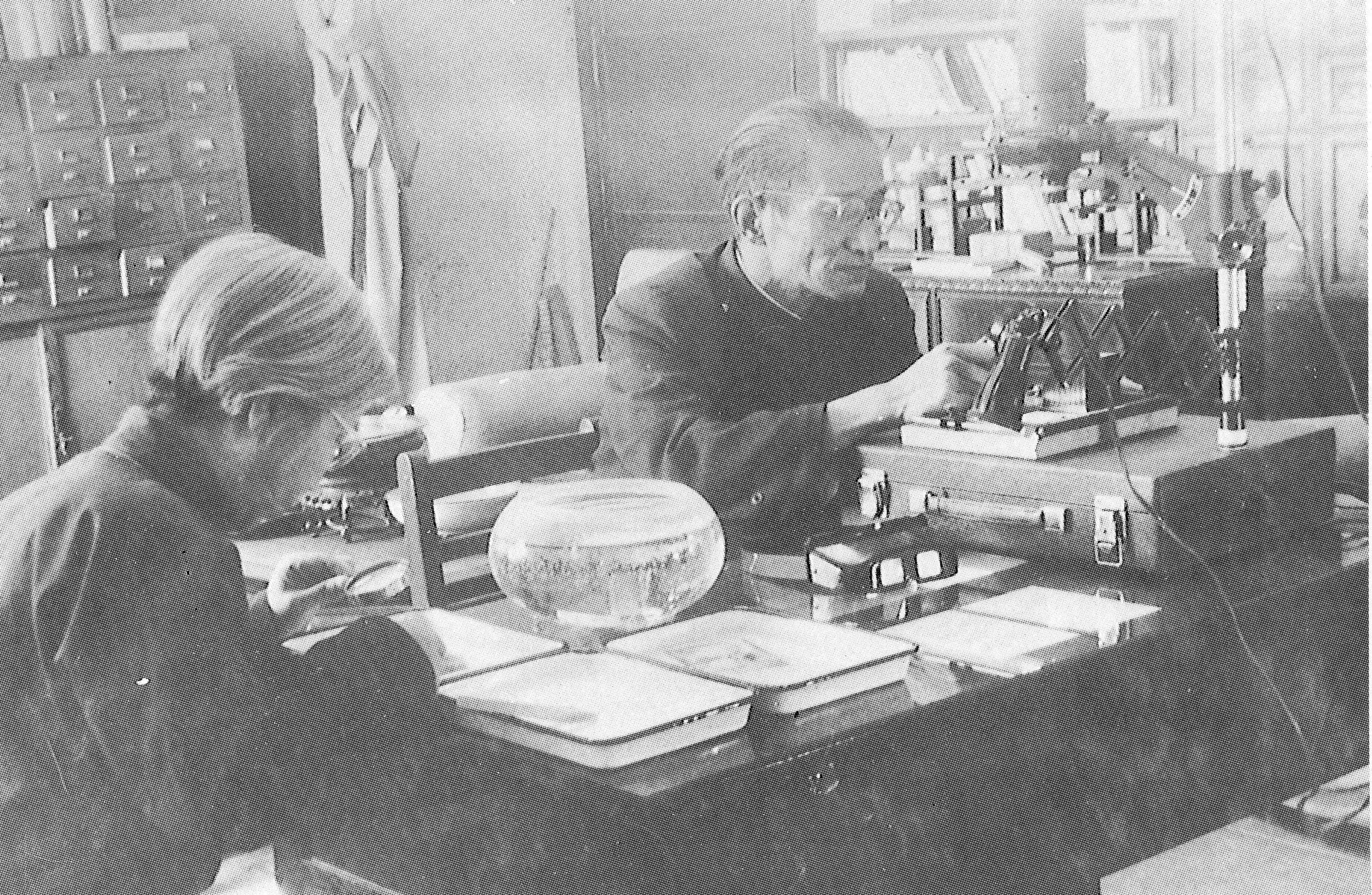
Religious life in 1930s’ Fujian

The film footage of Harry Caldwell

Fujian province in southeast China remains one of the most vibrant regions for folk religious activity (see this introduction, and my post on Ken Dean’s early work there).

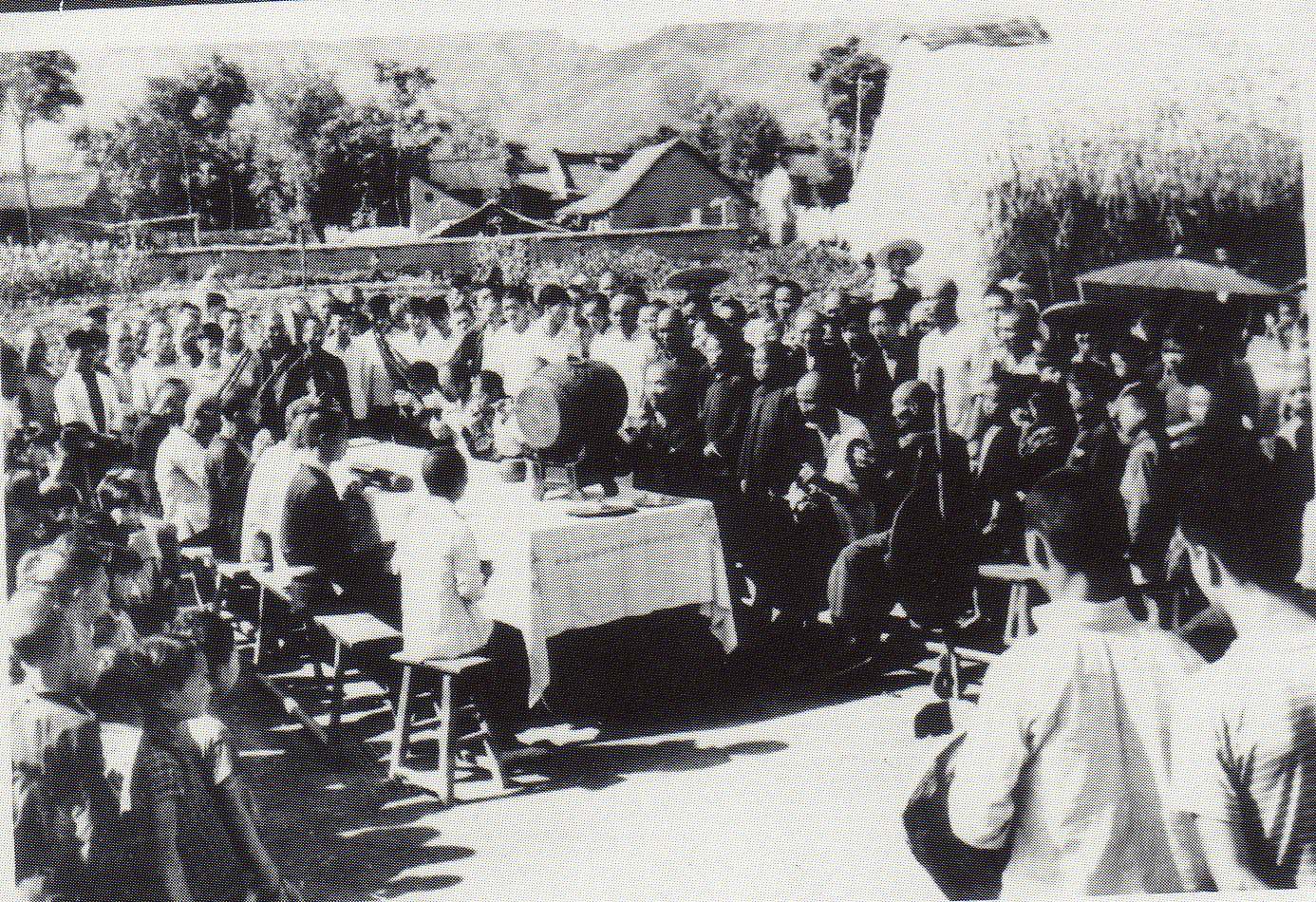
Harry Caldwell (1876–1970), a Methodist missionary from the Appalachian mountains of Tennessee, first travelled to China in 1900, inspired by his brother’s missionary work there, making a base in Fujian with his family until 1944. An avid hunter and naturalist, in his book Blue tiger (1924) he showed how hunting with the locals for man-killing tigers paved the way for effective missionary work [file under fieldwork techniques—SJ], and he discussed the delicate diplomacy required to negotiate peace between soldiers and bandits in his attempts to spare villagers caught amidst the fighting (cf. the Italian Catholic mission in Gaoluo).

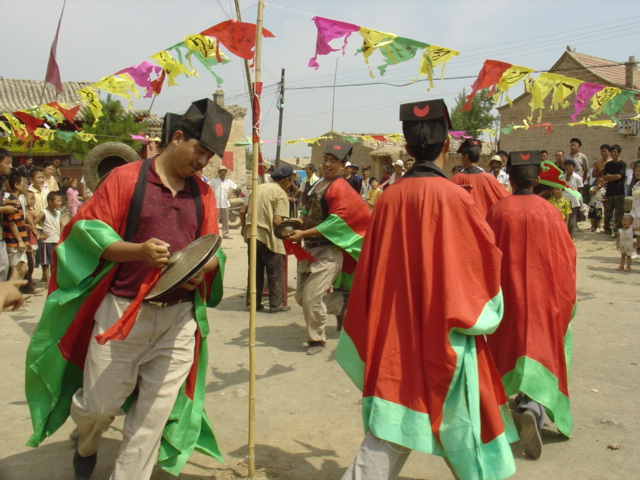
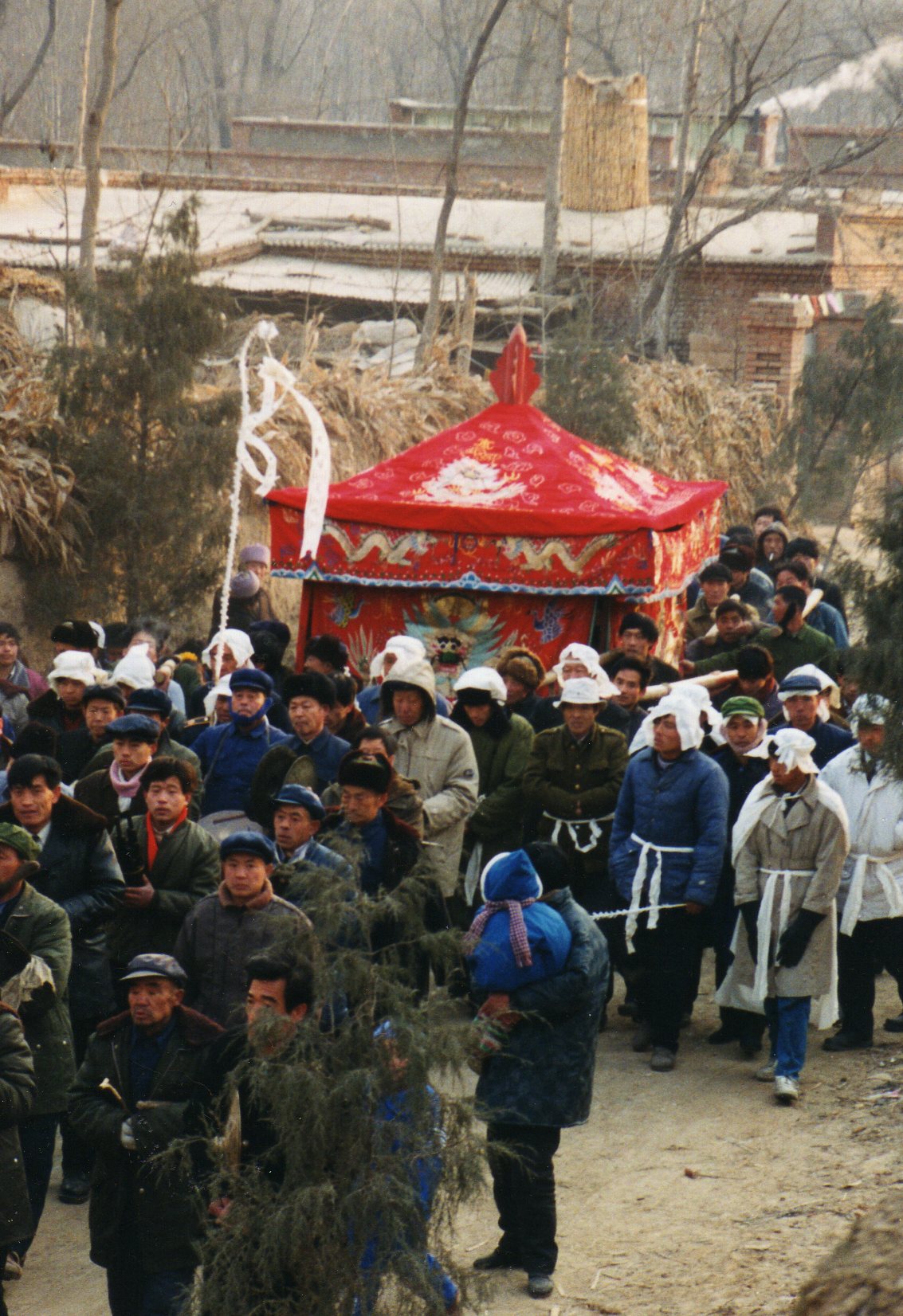
Apart from filming agricultural, military, and daily scenes in Fujian, he also paid extensive attention to local religious life there—and now, in an enterprising project (click here) by the Department of Religious Studies of the University of Tennessee at Knoxville (UTK) under the direction of Megan Bryson, ten clips on religious ritual that Caldwell filmed in the 1930s have been restored and made available online, with extensive annotations by UTK students.

The evocative clips (alas silent!) comprise:

  • an opulent deity procession
  • a divination session, with a Buddhist monk presiding
  • a fertility ritual, with Daoist masters wielding ritual swords and horns at an elaborate altar
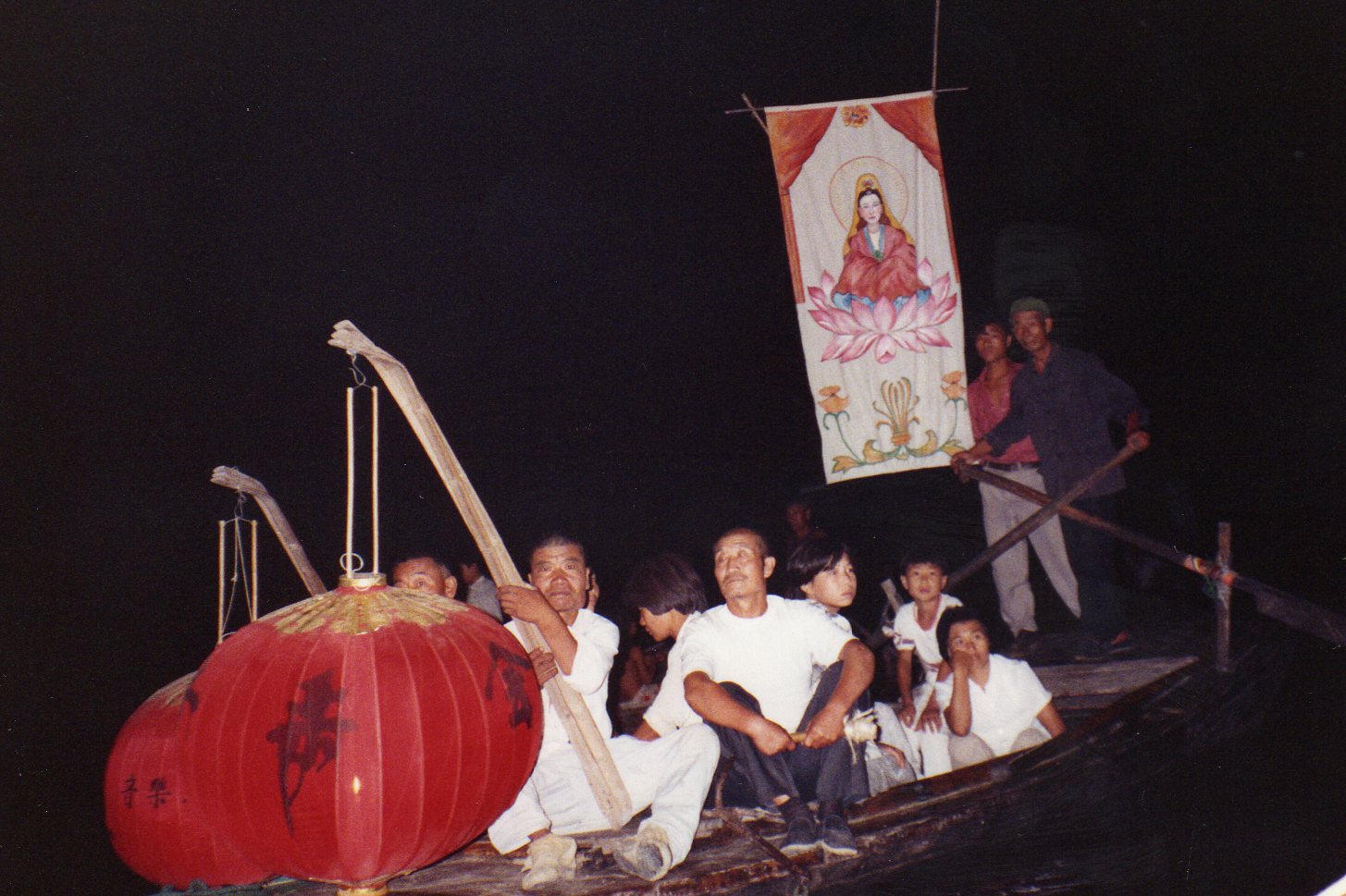
  • a Daoist healing ritual to protect children (cf. Crossing the Passes, e.g. Gansu and Shaanxi), with exuberant ritual dancing and the burning of a paper boat
  • an apotropaic ritual: pasting a talisman, a fishing net, and cacti at the family lintel
  • a Bathing the Buddha procession, and women offering at small shrines
  • Methodist church activities—including the distribution of baby chicks to the congregation
  • “Hell puppets”
  • plague-dispelling rituals, with paper boats sent off
  • a grand Buddhist funeral at the Yongquan si temple in Gushan.

Watching such footage, one always wonders what became of all these people over the turbulent decades to come. While the project offers precious glimpses of ritual life in Fujian before the 1949 revolution, all such practices still thrive in the region; with the addition of colour and sound, one might almost suppose many of these clips to come from Ken Dean’s wonderful 2010 film Bored in heaven (among many films listed here). I hope to see comments on Caldwell’s footage from scholars working on ritual life in Fujian—perhaps providing some more precise locations.

For Daoist ritual in Fujian and elsewhere in south China, see here; for early and recent films from distant Amdo, here.

Ritual artisans in 1950s’ Beijing

huapencun

Mural, Lord Guan Hall, Huapen village, Yanqing district, Beijing, c1809.

Quite beyond my area of expertise, I was inspired by reading the brief yet suggestive article

  • Liu Lingcang 劉淩滄, [1] “Minjian bihuade zhizuo fangfa” 民間壁畫的製作方法 [Techniques of making folk murals], Yishu yanjiu 1958.2, pp.52–6.

As Hannibal Taubes divined when he sent it to me, slight as it is, it links up nicely with my taste for scholarship under Maoism documenting the customs of old Beijing just as they were being dismantled. It’s not so much the quality of the research that attracts me here—rather, the delicate nature of studying the topic just as collectivisation was escalating, painfully evoked in films like The blue kite. As ever, we need to read between the lines. Moreover, we can always learn from accounts of the nuts and bolts of creativity.

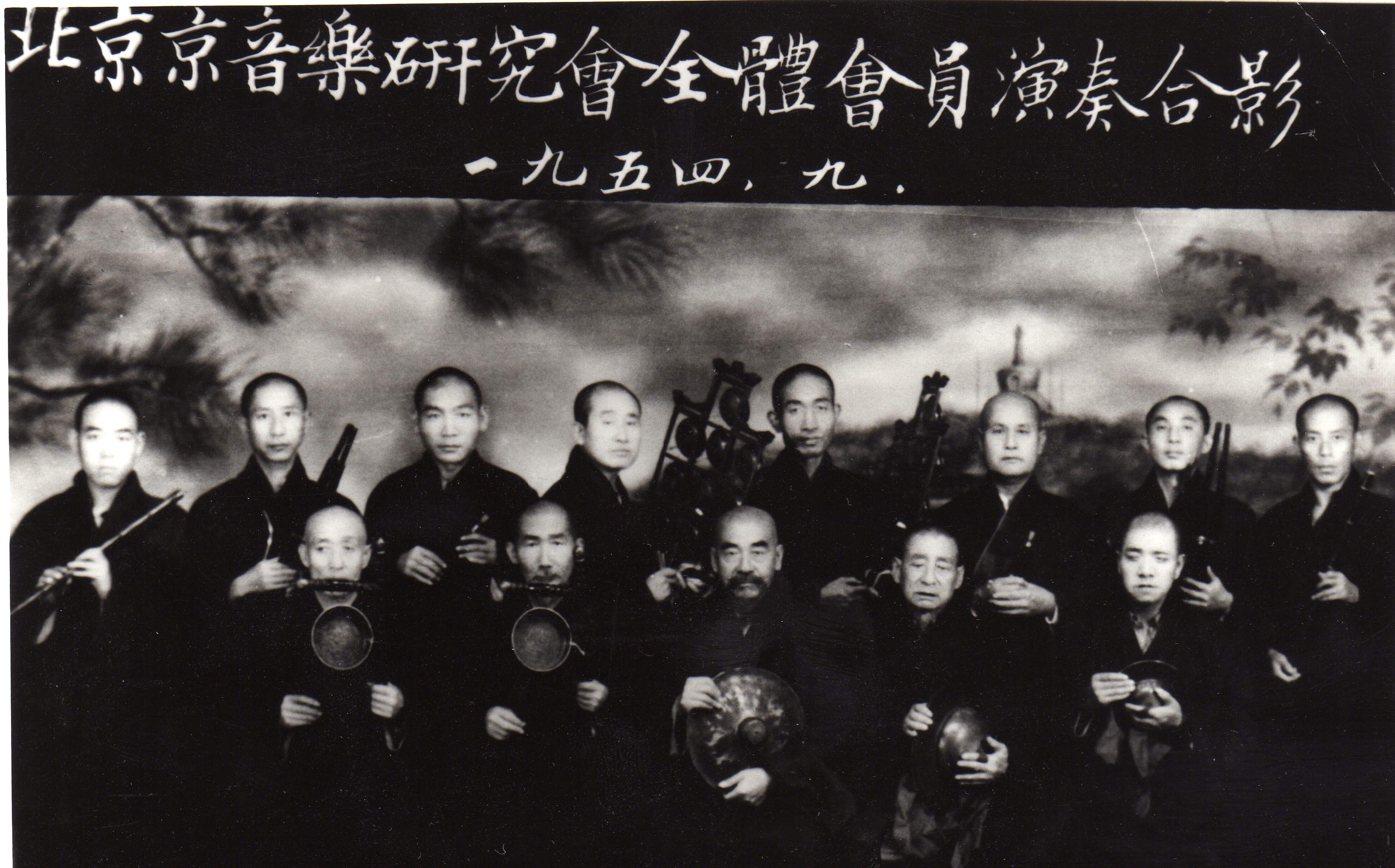
I’ve already introduced the work of the great Yang Yinliu at the helm of the Music Research Institute, along with the ritual traditions of old Beijing represented by the Zhihua temple. For more on old Beijing, see also Li Wenru, Wang ShixiangChang Renchun, and narrative-singing (here and here)—and in recent years a major project on the social history of imperial and Republican Beijing temples through epigraphy and oral sources.

* * *

From November 1955 to the autumn of 1956, the Central Academy of Fine Arts carried out a project documenting the work of ritual painters in Beijing. Rather than Liu’s gloss huagong 画工, the common folk term was huajiang 画匠 “artisan painter”, as in Yanggao, referring to artisans working for what had always been largely a ritual market—part of the whole network of ritual service providers upon whom Chang Renchun‘s work opens a window. They were apprenticed from young, often within the family.

Themes of their murals and paintings included the Seventy-two Courts (qisier si 七十二司) (cf. here, under “Buddhist-transmitted groups”) and the Ten Kings of the Underworld, depictions of Guanyin, the life of the Buddha, Yaowang Medicine King, and Water and Land rituals; and scenes from popular fiction such as the Three Kingdoms and the Water Margin. The article also hints at the market in the surrounding countryside for New Year’s lanterns and diaogua hangings, such as our own team found in Hebei (cf. the story of itinerant Qi Youzhi and his forebears, maintaining sheng mouth-organs for temples and village ritual associations). The themes of such hangings were closely related to historical subjects embodied in opera and story-telling.

Diaogua hangings adorning the alleys of Gaoluo village, 1989. My photos.

Just as our understanding of ritual is enriched by zooming in on the nuts and bolts of its vocal and instrumental soundscape, we can learn much by unpacking the techniques and vocabulary of religious painting. [2] In the end, ritual performers and ritual artisans are closely related.

The whole process of creating murals consisted of three stages (yixiu erluo sancheng 一朽二落三成):

  • xiu “draft”, known as tanhuo 擹活, creating a draft outline, drawn in charcoal
  • luo (lao, perhaps), “setting down”, known as laomo 落墨 “setting down the ink”
  • cheng “completion” (cheng guanhuo 成管活).

As with Renaissance artists in Europe, the laborious final stages depended on a division of labour, with the assistance of disciples.

Liu goes on to discuss elements in turn, with details on materials and tools, including this marvellous summary of the technicalities of preparing Water and Land paintings:

Shuilu details

Citing examples as far back as the Tang dynasty to illustrate techniques still in use, Liu goes on to discuss applying ground layers to the wall, templates (fenben 粉本), traditional methods of mixing and adjusting mineral pigments, the use of glues and alum, creating 3-D effects, and colour gradation. For pigments, while Liu notes the incursion of Western materials since the 1920s, among the team’s informants for traditional painting techniques was none other than Guan Pinghu, master of the qin zither! And in a detailed section on depicting gold, Liu consulted Wang Dingli 王定理 and Shen Yucheng 申玉成, working on the statuary of Tibetan temples in Beijing, as the best artisans then working in the medium.

An intriguing part of the final stages of mural painting is the addition of colours according to the master craftsman’s indications in charcoal, such as gong 工 for red and ba 八 for yellow—economical versions of the characters hong 红 and huang 黄, or liu 六, whose pronunciation stood for  绿 green. They even found such indications visible in the Ming-dynasty murals of the Dahui si 大慧寺 temple in Beijing. Liu notes that the custom was already dying out in Beijing, [3] but the shorthand reminds me, not quite gratuitously, of the secret language of blind shawm players in north Shanxi, and (less directly) the characters of gongche notation, which persisted.

Though again the ancient tradition of oral formulas (koujue 口诀) was dying out (at least in Beijing), Liu lists those that they could recover—just the kind of vocabulary that we seek from ritual performers, going beyond airy doctrinal theorising to gain insights into the practical and aesthetic world of folk society:

koujue

Just as the ritual soundscape still heard throughout the countryside in the 1950s (and today) contrasted starkly with the official diet of revolutionary songs, these traditions occupy an utterly different world from our image of propaganda posters of the time.

But—not unlike all the 1950s’ fieldwork on regional musical traditions (links here)— what the article could hardly broach was how the lives and livelihoods of such ritual service providers were progressively impoverished after Liberation, as their whole market came under assault and temples were demolished or left to fall into ruin. Even in the previous decade, through the Japanese occupation and civil war, the maintenance of temples can hardly have been a priority; new creation of murals was clearly on hold, and one wonders how much, if any, maintenance and restoration these artisans were still doing when Liu’s team visited them. Some of the artisans were doubtless already seeking alternative employment such as factory work or petty trade. We get but rare glimpses of this story, such as Zha Fuxi’s 1952 frank letter to the former monks of the Zhihua temple tradition. Later in the 1950s some official documents inadvertently provide further material on the period.

Of course, irrespective of their current circumstances, asking people to recall their previous practices is always an aspect of fieldwork, while one seeks to clarify the time-frame of their observations.

[1] Liu LingcangBy this time Liu Lingcang (1908–89) was already a distinguished artist and educator; but his early life qualified him well for the project discussed here. A native of a poor village in Gu’an county, Hebei, as a teenager he worked as an apprentice folk ritual artisan in nearby Bazhou before finding work as a restorer of temple murals in Beijing—so the 1955–6 project was based on his own former experience as a participant. Becoming a member of the Research Association for Chinese Painting in 1926, he went on to study at the Beiping National School of Art (precursor of the Central Academy of Fine Arts), taking up senior official posts after the 1949 Liberation. Some of his later paintings addressed religious themes: like Yang Yinliu over at the Music Research Institute, he clearly remained attached to his early background, despite his elevation. Again I think of Craig Clunas’s comment “The published curricula vitae of Chinese scholars often give a false idea of the continuity of their employment, and conceal the long periods of frustrating idleness caused by periodic political campaigning.”

[2] Craig Clunas kindly offers some further leads to “technical art history” in China, such as John Winter, East Asian paintings (2008), and (for the medieval period, notably for Dunhuang) Sarah Fraser, Performing the visual: the practice of Buddhist wall painting in China and Central Asia, 618-960 (2004). For technical details in the world of literati painting (such as mounting), see Robert van Gulik, Chinese pictorial art as viewed by the connoisseur (1981).

[3] As Hannibal tells me, a variant of this system is still used by folk ritual artisans in rural Shaanbei. For the anthropology of folk ritual art there he also directs us to a wealth of research, notably the insightful work of Huyan Sheng 呼延胜, such as his PhD on Water and Land paintings (Shaanbei tudishangde shuilu yishu 陕北土地上的水陆画艺术), and the article “Yishu renleixue shiyexiade Shaanbei minjian simiao huihua he kaiguang yishi” 艺术人类学视域下的陕北民间寺庙绘画和开光仪式, Minyi 民艺 2019.3; as well as a detailed article on painter-artisans in nearby Gansu by Niu Le 牛乐, “Duoyuan wenhuade yinxing chuancheng celue yu wenhua luoji” 多元文化的隐性传承策略与文化逻辑, Qinghai minzu yanjiu 2018.3.

Gosh—for such remarkable continuity in Chinese culture, despite all its tribulations, yet another reminder that “when the rites are lost, seek throughout the countryside”, and that “a starved camel is bigger than a fat horse”.

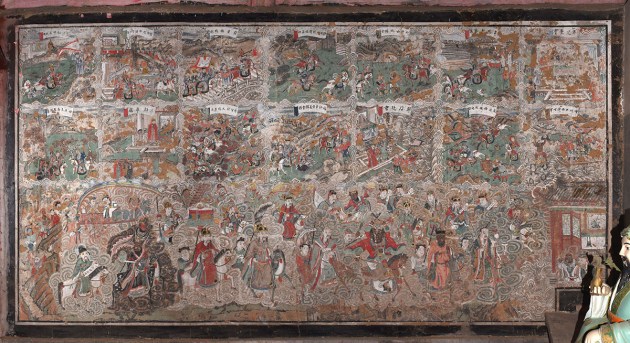
Temple murals: a new website

HT site

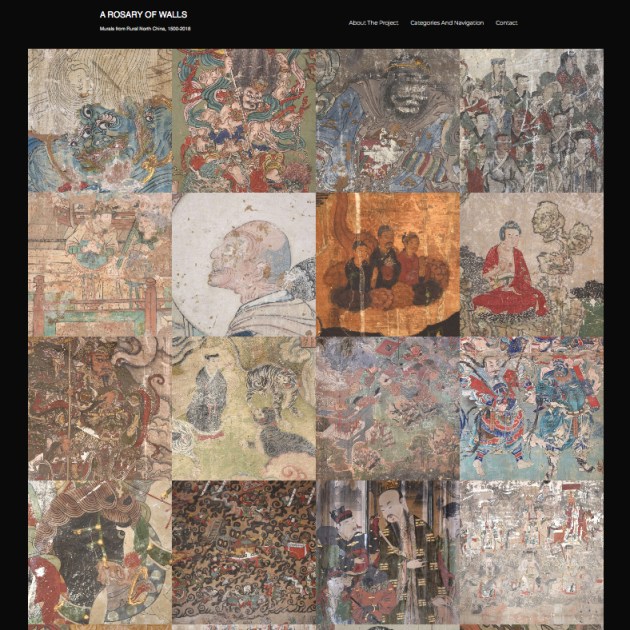
For aficionados of Chinese art and religion, following on from the fine website of Hannibal Taubes on north Chinese temple murals (see my post here), we now have a related (and ever evolving) site A Rosary of Walls (formerly called Temple Trash—the drôle title taken from the description of the murals by an unnamed professor!):

 http://twosmall.ipower.com/murals/

Both websites are vast, and still only a selection from the archive deriving from his fieldwork. It’s a Herculean (or in this case Hannibalesque) task, that invites us to reassess the whole history of Chinese religious art—commonly assumed to have entered terminal decline since the Ming dynasty. Unlike the many glossy compendia of early temple murals and architecture protected by the state, these murals come mainly from minor village temples, and often suffer from neglect and pillage. And given the southern focus of religious studies, the focus on north China (mainly for Hebei, Shanxi, and Shaanbei), is itself original.

Categories

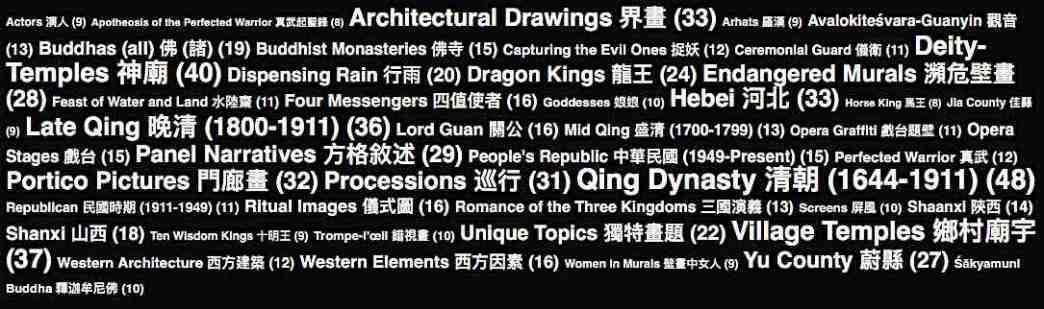
Focusing on A Rosary of Walls, the wealth of images is meticulously documented. As Hannibal explains, the image scroll on the main page is in chronological order from c1500 to the present day, top to bottom. Click on the little squares to see the galleries. You can browse the images according to type by clicking on the “Categories and navigation” menu—select the dropdown menu for a quick-list of categories (deities, genres and topics, locations, venues, periods, and so on, all extensively subdivided), or scroll down for more info. The murals are shown in context, with details of temple architecture and village topography.

To give a few examples of the wealth of the new site: apart from the temple focus, some interesting galleries show images depicted since the 1949 founding of the PRC. Some living traditions of ritual paintings are also included (cf. my modest contributions on this blog under Ritual paintings), such as pantheon scrolls for spirit mediums (Shaanbei, and Wutai in Shanxi). Among many topics, the theme of Women in murals supplements the Goddesses listed under the Deity category.

Of course (as I would say), like ritual manuals, material culture is both silent and immobile: temples are not mere repositories of artefacts, but sites for social activity. All such documentation should complement studies on religious life in north China; and (as I would say) funerals too have remained vibrant occasions for ritual life.

Exploring these sites is an edifying, eye-opening pleasure.

For a CCTV documentary about Hannibal’s fieldwork, click here. See also his guest post A Daoist temple in California.

Religion in Chinese society

My reviews of two recent surveys of the Chinese religious world by Ian Johnson and Adam Yuet Chau (and now a volume edited by Stephan Feuchtwang) reminded me to revisit a remarkable early sociological study, also accessible:

  • C.K. Yang, Religion in Chinese society: a study of contemporary social functions of religion and some of their historical factors (1st edition 1961; Chinese edition here).

The sociological approach to Chinese religion was slow to develop—partly due to the difficulty of access to mainland China after 1949, and partly because of the enduring scholarly bias towards discursive, doctrinal issues and early history.

Indeed, much of Yang’s analysis anticipates approaches since the 1980s’ reforms, including Chau’s “five modalities”. Yang already saw through the bias of the discursive/scriptural modality that still holds a particular allure for many in the West, at the expense of the other “diffused” forms.

This study is an attempt to answer the question: What functions did religion perform in Chinese social life and organization so as to provide a basis for its existence and development, and through what structural forms were these functions carried out?

Having trained at Yanching University in Beijing and the USA, Yang returned to China in 1948, carrying out fieldwork there before having to return to the USA in 1951, where he was to be based at Pittsburgh. Given that his book was published in 1961, it may seem understandable that, until the final chapter, it’s largely written in the past tense. In my book Plucking the winds I noted a similar lapse in accounts of the performance of baojuanprecious scrolls”:

During the years of Maoism, “armchair sinology” was the only option, as in many fields. Even by the early 1980s, Daniel Overmyer still found that “unfortunately there are very few materials available for a discussion of sectarian ritual”.

Soon after, there was a growing awareness of the persistence of ritual practice in mainland China, but lapses still occurred: “We know a certain amount about how baojuan were [my italics] performed, although there are all too few good first-hand descriptions.”

wentan004

South Gaoluo liturgists performing the Houtu scroll, 1993.

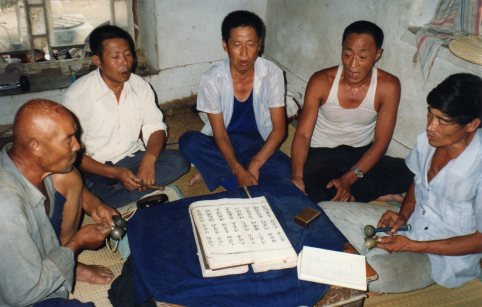
However, the vocal liturgists of the South Gaoluo ritual association were performing the Houtu precious scroll through the first fifteen years of the PRC, and they were still doing so in the 1990s.

While Yang’s focus is on the late Qing and Republican eras, and he surveys the early roots of Chinese cultural traits, he introduces major themes that later scholars have been able to elaborate with the benefits of detailed fieldwork since the 1980s’ reforms.

Yang makes extensive use of Republican-era sources such as Grootaers and county gazetteers, notably for Hebei (later explored further by scholars such as Naquin and Duara) and the Shanghai region.

In his Introduction he observes how early-20th-century urban scholars dismissed the role of popular religion in Chinese society, from Liang Qichao to Hu Shi (“China is a country without religion and the Chinese are a people who are not bound by religious superstitions”). By contrast, he notes the importance of temples in the collective life of local communities, going on to observe all kinds of religious influence. And despite the secular views of many intellectuals of the day, the Republican era also saw the beginnings of fieldwork on folklore.

In Chapter 2 Yang notes the place of religion in the integration of the family, including ancestor worship and mortuary rites. Chapter 3 goes on to discuss the religious bond in social groups, and Chapter 4 communal aspects of popular cults—notably temple fairs.

Chapters 5 to 8 explore the political role of religion over the long historical perspective. In his account Yang includes both official and popular cults, with notes on cults such as those of the deities Zhenwu and Chenghuang. Chapter 8 discusses the administrative control of religion, later elaborated by Vincent Goossaert; and the persecution of “heterodox cults”, which he pursues further in Chapter 9 on religion and political rebellion—again, while he cites pre-1949 material, the issue continued to fester under Maoism despite fierce campaigns.

As Yang’s manuscript was largely complete, the 1958 Great Leap Backward led to an appalling national famine, and religious sects rose in resistance over a wide area. The state’s partial withdrawal from extremist policies from 1961 produced a short-lived cultural and religious revival.

North Xinzhuang 1959

Former monk Daguang with village disciples, North Xinzhuang, Beijing suburbs 1959. For more images of Maoism, see here.

Yang was not to know of the maintenance of traditions among village-wide ritual assocations in Hebei through the first decade of the PRC, for instance, or the revival of “ghost operas” in Hunan and elsewhere; but his conceptual framework allows ample room to accommodate such grassroots activities.

In Chapter 12 Yang (inspired by Joachim Wach and Emile Durkheim) makes an important distinction between diffused and institutional religion, with the former dominant and the latter weak in Chinese society. In Adam Yuet Chau’s summary (Miraculous response, pp.143–5) he goes further:

C.K. Yang (1961) famously proposed that in China elements of popular religion are diffused into core secular social institutions such as the family, socioeconomic groups such as trade guilds, communities such as villages and native-place associations, and the state. He argued that the diffused religious ideas and practices provided an air of sanctity to, and thus helped uphold, these core institutions. I suggest that the symbiosis between secular institutions and religious life is even more intimate, that the same principles and mechanisms for organizing ordinary social life are used in organizing popular religious life.

Yang’s chapter concludes:

The lack of a powerful priestly religion did not mean the weakness of religious influence in social life. The Chinese common people, especially the women, hardly passed a day or faced a crisis without resorting to religious assistance. Burning incense to the house gods in the morning and evening, going to the temples to pray on numerous public and private occasions, visiting a classical priest for guidance on big or little problems, attending temple fairs and religious festivals, consulting the religious sections of the almanac for an auspicious time for making a major or minor move, and reflecting on the supernatural influence on life and the universe—all these added up to an intimate relationship between religion and life under the traditional social order. Yet all these activities proceeded without the organized direction of any priesthood. People visited a particular temple, worshiped a particular spirit, called on a particular priest, all in accordance with the practical function of religion for the particular occasion. To what religion a temple belonged might be a puzzle to many academicians, but such questions had no functional significance in the religious life of the common people. Hence, weakness in the structural position of institutional religion was not synonymous with the functional weakness of religion in social life.

See also the festschrift

  • Wenfang Tang and Burkart Holzner (eds), Social change in contemporary China: C.K. Yang and the concept of institutional diffusion (2007).

In Chapter 13 Yang uses detailed material to show the changing role of religion through the Republican era, noting the limited impact of the secular views of urban intellectuals and state campaigns. I’m happy to see him citing the maxim attributed to Confucius “When the rites are lost, seek throughout the countryside”, which later became a popular refrain with my fieldwork colleagues.

In Yang’s final chapter he looks beyond “Communism as a new faith”. While analysing the secular rituals of the new Party-state, he takes into account the coexistence with both diffused and institutional theistic religion in both policy and practice. He notes the radical assaults on “superstitious practices” and the destruction of religious properties, but always takes a nuanced view—such as this account setting forth from Wudangshan:

On this scenic mountain were eight palaces; thirty-two temples; twelve shrines; a “golden palace”, the largest existing bronze structure in China; and thousands of bronze Taoist images, many of which were unsurpassed works of art. In 1955 and again in 1956, county officials broke up hundreds of “scattered, damaged, or duplicate” bronze images and sold them as scrap metal to help provide funds for the county budget. Over 50,000 catties (about 65,000 pounds) of bronze were collected. In the 1956 campaign it took forty-eight days to destroy the images, one of which weighed over 3,000 catties or nearly two tons, and a large number of which had been preserved in good condition. Leading Taoist priests, some even with limited political status, could only watch the heart-rending destruction helplessly. Afterwards, as news of the wanton destruction reached the provincial authorities, several of the county officials responsible were given demerits as punishment, which seemed to be an insignificant gesture to placate the rising popular protest. Although the Wutangshan case was brought to public attention because of its prominence as a national religious center, the destruction or selling of the properties and sacred objects of innumerable obscure temples in villages remained unnoticed or unrecorded.

Although antireligious riots and destruction on temple property and images were partly inspired by the anti-supernatural attitude which characterized the Communist ideology, they were nevertheless scattered local occurrences without organized direction from the central Communist authorities. Furthermore, such actions were largely restricted to the destruction of religious properties without direct harm to believers. But when religious beliefs formed an active part of a “reactionary” social system, such beliefs became the object of drastic and systematic elimination in order to overthrow the social system which the religious beliefs supported. In such cases, professional practitioners of these beliefs would face persecution.

Yang also unpacks the state policy of preserving the art and architecture of major temples (cf. Wutaishan):

It should be kept in mind that the restoration work is limited to large, well-known temples in each locality, while innumerable humble ones are left to deteriorate or converted to nonreligious uses. The wholesale impressing of priests into secular production work and the conversion of most temples into secular quarters would seriously reduce the already weak foundation of Chinese institutional religion, an effect not canceled by the restoration of large temples.

Of course, worse was to come, but Yang must have welcomed the revival after the end of the Cultural Revolution, and the new tide of research.

Even while describing campaigns against sectarian groups (on which we now have much more material), he suggests that

it is probably incorrect to assume that the Communists, although they have recently won success by their mastery of underground techniques, possess fully effective countermeasures against the underground sectarian societies. While the Communists can infiltrate into any of the known societies at will, they may not be able to penetrate into every one of the numerous isolayed small units in a highly decentralized organizational system. Furthermore, as one society is suppressed, others continued to rise spontaneously. The root of the matter lies in the popular belief in the gods and their magic to bring deliverance from suffering, and in the popular tradition or organizing religious groups to offer resistance to an oppressive ruling power against which the individual seems helpless.

His conclusion is prophetic, yet largely free of simplistic flag-waving for the supposed triumph of eternal, sacred values which some Western reviewers read into the more recent revival:

Communism’s probable inability to cope with all social and personal crises that may arise in the future would compel the people, when subjected to extreme distress, to continue to reach beyond the finitude of empirical experience and rational thought for relief. Should this be the case, even if the Communist ideology were to endure as a sociopolitical doctrine, it would have to develop permanent tolerance of theistic religion so that theism could perform the moral integrative function of stabilizing the new social order. The gods might then emerge from their eclipse to play a familiar role under the dominance of a disbelieving political orthodoxy, a situation reminiscent of the long and often stormy co-existence of theistic religion and Confucianism, whose excessively earthly quality invited the development of theistic faiths.

* * *

Through the 1950s few scholars were able to undertake fieldwork on the survival of local ritual traditions—with the laudable exception of considerable projects under the cloak of music studies.

But despite the paucity of material then available on the contemporary situation, Yang didn’t see the 1949 revolution as the end of the story. Though he was writing at such a traumatic time for Chinese society, when it would have been easy to take a black-and-white view, his book contains mature insights.

Heritage: a roundup

heritage

This recent Guardian headline encapsulates my feelings about the whole heritage shtick. The heritage tag on this blog is voluminous, covering many local genres in China and elsewhere.

minyue

The starter, citing thoughtful research on the Intangible Cultural Heritage (ICH) system around the world, is

John Butt offers useful perspectives in

For China, also basic is this page on the Li family Daoists:

Another relevant post is

More broadly, here I list some posts on the friction between traditional and conservatoire styles. The ICH also crops up in several field reports under local ritual, including

Zhang Zhentao’s review of my film on the 1995 New Year’s rituals in Gaoluo discusses the aesthetic, um, heritage of the manicured ICH style.

While some scholars observe how local dwellers mould the state programme to their own agendas, I often note that its effects are either negative or inconsequential. And I’m not alone.

For the Chinese regime’s abuse of heritage in Xinjiang, see articles by Rachel Harris and Musapir; for Tibet, see Tibetan resistance to Heritage fever and Ritual singing in an Amdo community. For Central Asia, click here; for UNESCO in Turkey, here. And for Fatima Manji’s fine contribution to the current debate about heritage sites in Britain, click here.

Chau on “doing religion” in China

Chau

I’ve long been inspired by the work of Adam Yuet Chau on religion in China. His recent book

distils his wisdom, based both on his own fieldwork (notably in Shaanbei) and on his readings of a wide literature, along with his experience of editing volumes on the topic—notably Religion in contemporary China: revitalization and innovation (2008).

As he explains in his opening salvo “Why are you reading this book?”, Religion in China is aimed at a broad audience, including students taking courses on Chinese and East Asian religions, or on religious studies; seekers of spiritual wisdom, tourists, missionaries; and China-watchers concerned about human rights and politics.

Chau seeks to change the way we understand religion in China and the wider world, disputing the confessional model that produces so much misunderstanding, both in China and abroad.

Another equally prevalent approach is to view religion in China primarily in terms of philosophical and religious ideas, as sources of “Oriental spiritual wisdom”, useful antidotes to an allegedly overly materialist and rationalist West.

Instead, he advocates study of ways of “doing religion”, and a “relational approach”.

There is no need for us to identify and share the beliefs informing these religious practices. […] Having a personal religious or spiritual orientation in whatever form might potentially aid one’s understanding of other people’s religious practices […]. But it could equally well hinder one’s understanding because one might too easily identify the familiar and overlook the radically different, or one might feel threatened by practices that are radically different from one’s own, bringing into doubt the validity of one’s faith or spiritual pursuit. On the other hand, being an atheist also has its advantages and disadvantages in the cross-cultural study of religion.

He takes material primarily from mainland China, but also from Taiwan and Hong Kong. He reminds us of the dangers of statistics that are modeled on a confessional-affiliational understanding of mutually exclusive religious membership.

He discusses the different approaches to religion in China. By contrast with religious studies, which tend to focus on texts, doctrines, concepts, religious thinkers, and schools of thought, he stresses social interaction, history, sociology, political science, and anthropology offer alternative models. For a gendered approach, with a final bold suggestion, see here.

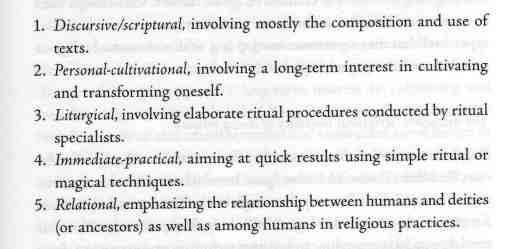
In Chapter 1 Chau presents his “five modalities of doing religion”, expounded in his previous work—a most useful framework, sidestepping the “conceptual fetishes” of “Buddhism”, “Daoism”, and “Confucianism”:

five

As he observes, such “internal diversity” is actually common to Christianity and the other major world religions.

A further question that is worth bearing in mind is whether or not you believe that religious diversity is intrinsically a good thing.

Whereas a religious-pluralist position

treats religion not just as an empirical fact but as a policy goal, Christian missionaries and other kinds of believers in any ultimate religious Truth would prefer to see their own religion triumph over all the others. And staunch atheists would want to see a completely secularized world with no religions at all.
[…]
However, religious diversity as a concept is alien to most Chinese people because their approach to religion is primarily instrumental and occasion-based (what can be called an efficacity-based religiosity) rather than confessionally-based, and their experience of religious diversity is embodied in the employment of different religious service providers on various occasions rather than abstract systems of religious doctrines and teachings.

Thus

what happens on the ground “religiously” is very much a congruence of local customs, historical accidents, social environment, personal temperaments, configurations of modalities of doing religion, and the makeup of the local ritual market.

He goes on to give instance of the five modalities in turn, noting that they may overlap.

At any one time in any locale of the vast late imperial Chinese empire—and to some extent today as well as in the larger Chinese world—all of these modalities of doing religion were in most probability available to be adopted by individuals or social groups, though factors such as class, gender, literacy level, accidents of birth and residence, position within different social networks, temperament, local convention, and the configuration of various modalities might channel some people towards certain modalities and not others. Most peasants in China have traditionally adopted a combination of the relational and the immediate-practical modalities into their religiosity; sometimes they adopt the liturgical modality and hire religious specialists when the occasion requires them, such as funerals and communal exorcisms. Illiteracy and lack of leisure would preclude them from most of the discursive and personal-cultivational modalities. The traditional educated elite tended to adopt a combination of the discursive and the personal-cultivational modalities, but they, too, often needed the services of the liturgical specialists.

However, it is the discursive/scriptural modality, with its high level of literacy and its penchant for philosophical and “theological” thinking, that holds a particular allure for many in the West (and indeed for the Chinese state), at the expense of the other forms.

The vast majority of the world’s population who “do” religion in other ways are thus silenced.

My own work focuses on the liturgical modality, while taking into account those further down the list (see my In search of the folk Daoists of north China, ch.1).

Chapter 2, “Interacting with gods, ghosts, and ancestors” opens with a cross-cultural reminder about deities:

We have to ignore the saint cults in Catholicism, the Sufi saint cults in Islam, the belief in angles and holy persons, etc., in order to preserve the monotheism illusion.

Chau points out that new deities have constantly been produced, at both elite and popular levels. He highlights the importance of ling “spiritual efficacity”, and the gods’ response to the problems of worshippers—which gave him the title for his book Miraculous response. As ever, he stresses

Whether or not we accept the possibility of real divine power, we need to understand ling as a sociocultural construct.

And

Many Chinese people have a practical approach to deity belief. […] One should not not believe, nor should one believe everything”; “If you worship him, the deity will be there; if you don’t worship him, he won’t mind”.

After listing the basic ways of worshipping deities, including offering incense, divination, and so on, he discusses appeasing “hungry ghosts” and ancestor worship. He considers the household as the basic unit of religious engagement (by contrast with Christianity), and stresses “hosting”—for both humans and deities—and “red-hot sociality”.

Chapter 3 discusses festivals and pilgrimages, with examples from both north and south China. Far from the dry portrayals of scholars who focus narrowly on the discursive meanings of ritual texts, Chau stresses the sensory stimulation of such “red and fiery” events—noises, sights, smells, tastes, and ambient sensations. He explains the temple associations that organize festivals, again stressing social relationships. On pilgrimages such as those of Mazu in Taiwan and southeast China, networks are consolidated as deities visit other deities. He broadens the scope by introducing New Age spirit mediumism in Taiwan, as well as the Hajj of Chinese Muslims, and ends by offering the concept of “mutual capturing” through cultural forms.

Chapter 4 unpacks the variety of ritual service providers and their clients. The former—again, engaged with a view to efficacy—include geomancers, occupational household Daoist and Buddhist groups, devotional sects, and spirit mediums. Different types of specialists may be invited for the same event: “ritual polytrophy”. He gives vignettes of a yinyang master in Shaanbei, a group of household Daoist ritual specialists in Shanxi (none other than the Li family!) serving the funeral market, and a Daoist jiao Offering ritual in Taiwan. He introduces the handling of troublesome spirit ties by means of exorcism. He’s ever alert to the social context—I like his description of the spirit medium’s home as

the rural equivalent of a hair salon, where people gather, information and gossip is spread, and there is plenty of red-hot sociality.

Chau contrasts this whole “efficacy-based” tradition with the more “dharma-based” religiosity common elsewhere in Asia.

He goes on to unpack the common lament of “rampant commodification”, revealing its long history.

Many people (including many Chinese) might think that the commodification of religion is somehow not right and therefore is a deplorable trend. However, this value judgment is out of place for observers who wish to understand the cultural logic behind native practices rather than passing judgment on these practices. The view that religion should somehow be a pure, spiritual pursuit freed from such “ugliness” as monetary transactions and “vile” desires is a fundamentalist, elitist, and/or modernist/reformist position that itself needs critical deconstruction.

Given that many fieldworkers may have their minds on higher pursuits, he goes on to prescribe a fine questionnaire pertaining to price-lists for all kinds of religious expenditure, from temple renovation and sponsoring opera performances to fees for minor domestic rituals, the costs of incense and paper money, and banqetting (pp.130–31). Finally he returns to the close relationship between providers and consumers of ritual services, and the benefits of the household idiom.

Having stressed the general paucity of confessional religious identities, Chapter 5, “Communities and networks”, gives some instances where they do indeed come into play. Notwithstanding all the instances that Chau has given to show the enduring vitality of communal and household ritual life,

In many locales in contemporary China there is a definite trend towards the atomization of society, where few people are organizing any collective or communal activities and people spend a large amount of time watching television in the comfort of increasingly nuclearized homes. People seem to be happy that they are no longer being forced to participate in collective labor, collective political study [discuss…], or mass campaign rallies, all prevalent features of Maoist collectivist life. Yet there is also ample evidence to suggest that people in many parts of China have revived pre-Maoist forms of communal social life, sometimes even borrowing techniques of Maoist mobilization and social organization to good effect. […]

But

both historically and in today’s China, there are a significant number of people who do have a strong and definite religious identity (e.g. being a Buddhist, Daoist, or Christian; belonging to a sect). Even though small in numerical terms (but still in the millions), they are very important in the Chinese religious landscape.

He gives examples of monastic communities and networks, the remarkably resilient Christian congregational communities, qigong groups (including Falungong), and lay Buddhist confessional groups like Foguangshan and Ciji. He ends by considering the impact of new technologies on religious transmission.

Chapter 6, “State-religion relations” unpacks issues in a popular theme. Chau observes that the Maoist antipathy towards religious institutions was part of a general intolerance of any social institution outside the orbit of the party-state, as well as an assault on their status as property owners. While household-based ritual specialists were also persecuted, the attacks on them were far less thorough when compared to those on temples, lineages, and major cult centres. Again, the “household idiom” of religious service provision was a key to survival.

He outlines the official regulatory framework, noting the further complexities of the recent Intangible Cultural Heritage and the fuzzy “religion sphere”. He chooses this translation rather than “religious sphere” to avoid any misunderstanding:

Not only is the religion sphere not religious in nature, its existence is constitutive of the overall construction of secularity.

Returning to the discursive-scriptural modality, Chau observes that its rise is also propounded by the secular state—by contrast with the vast majority of providers and consumers of religious services. And after observing a broad local tolerance towards the practice of “superstition”, he outlines recent reforms in funerary and burial practices.

In “Conclusions” he surveys the major theme: the religious revival, once again debunking a reified approach to tradition.

It would be easier to understand this continuity if we understood religious traditions as complex, dynamic, ever-changing clusters of institutions, practitioners, and consumers, knowledge and practices, sociopolitical relations and hierarchies, fully amenable to innovations, inventions, and reinventions all the time. Religious traditions are not static.

Finally Chau stresses the centrality of relationality in doing religion, far beyond mere texts. University courses on Buddhism and Daoism

are often presented as “Oriental thought”, emphasizing ideas at the expense of practice. Presenting a non-Abrahamic religious tradition “systematically” might seem a respectful thing to do, as if granting equal dignity to these traditions that only a century ago were considered unworthy pagan superstitions. This kind of scholarly and pedagogical systemizing owes its inspiration to the Christian tradition of systematic theology, which attempts to formulate Christian doctrines as a coherent whole (but of course ordinary Christians do not necessarily practice their Christianity “coherently”). We might not be able to readily throw off this intellectual baggage, but we must always be aware of such epistemological habits (or “habits of the mind”) when we try to understand any religious tradition.

In a succinct three-page list of basic sources in English, Chau includes John Lagerwey’s China: a religious state, a largely historical overview, and The religious question of modern China edited by Goossaert and Palmer. I might also mention C.K. Yang’s Religion in Chinese society (1961), a fine early study written at an exceptionally traumatic time for the PRC. And Chau might be sympathetic to my suggestion to include some ethnographic films in this list—always a more engaging medium than discursive, silent, immobile representations on the page.

* * *

Like Ian Johnson’s The souls of China (2017) and the recent Handbook on religion in China (ed. Stephan Feuchtwang, 2020), this book should appeal to a rather broad readership. Some of the issues in reaching a wide audience are in presentation, such as in-text references and footnotes—both inimical to more populist publishers. But Chau’s book has sixteen photos, whereas Ian’s, curiously, has none.

The two books are very different. While also giving fine personal vignettes, Chau’s main aim is to illuminate social structures; whereas Johnson’s book, while also well-informed, revolves around portraits of a few figures (again including the Li family Daoists!), and may speak more vividly to non-specialist China-watchers. So The souls of China (“a book that could never have been written by a modern academic, and I mean that by way of praise”—James Miller) makes more welcome fodder for the Western Seekers of Truth, as well as for advocates of religious freedom and the triumph of spirituality over secularism. But I hope all those who admire Johnson’s book will also learn from Chau’s work.

New work on sectarian ritual

Hou Chong

I look forward to reading a recent book collecting promising articles on the role of sectarian religious scriptures in folk ritual over a wide area:

  • Hou Chong 侯沖 (ed.), Jingdian, yishi yu minjian xinyang 经典, 仪式与民间信仰 [Classics, ritual, and folk worship] (Shanghai guji cbs, 2018),

continuing a long tradition of such research in China.

The contributors pay attention not only to texts but to performed rituals; and while some articles discuss early history, the focus is on the modern era. Themes include “precious scrolls” (baojuan), the Luo and Xiantian sects, and Zhenwu worship, with contributors such as Wang Jianchuan, Cao Xinyu on White Lotus scriptures, Rostislav Berezkin on funerary baojuan in Changshu (see also n.1 here), Xiao Jihong on North Dipper rituals of the Bai minority in Jianchuan, Yunnan, and Lü Pengzhi on Five Thunder registers (Wulei lu 五雷錄) in west Jiangxi.

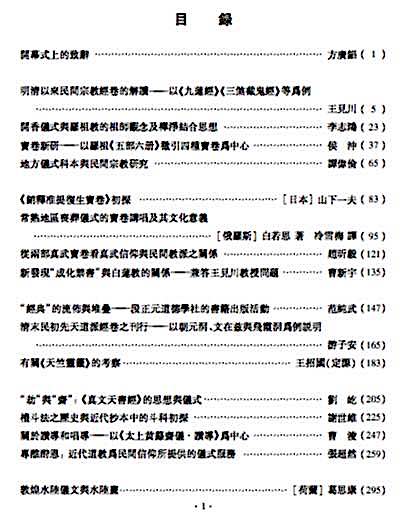
Excuse these crappy screenshots—you can view the contents more clearly on sites such as douban:

mulu 1

mulu 2

Many of my posts in the main Menu bear on sectarian worship in north China, both among devotional groups and, before the 1950s, among temple priests. See also here, and here.

For another recent volume on baojuan, click here.

Ritual life around Suzhou

Blind people groping at the elephant 瞎子摸象

Following my posts on the tangming bands and the 1956 Suzhou Daoist project, while I have no field experience of Daoist ritual around Suzhou, I’ve been trying to get a basic grasp with the aid of exceptionally abundant secondary sources. So this isn’t so much a review of Suzhou Daoism, as an illustration of the multiple ways of approaching it.
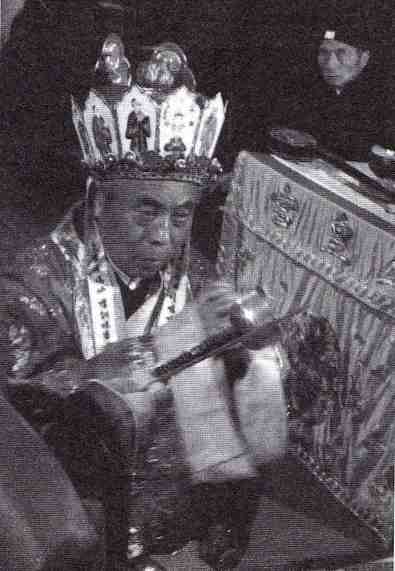
TJ master

Wu Shirong leading Xiantian bawang zougao ritual, 2011. Photo: Tao Jin.

Research on ritual life throughout the whole of south Jiangsu—Suzhou, Changshu, Wuxi, Shanghai, and so on—ranks close behind that for southeast China and Hunan. Still, ritual activities in these regions are quite different: in the southeast and Hunan, individual household altars (and particularly their ritual manuals) dominate research, whereas in south Jiangsu wider networks of temples and their priests seem more important.

One might suppose that Suzhou Daoism would be a rather easily-defined topic, but it illustrates my comment (Daoist priests of the Li family, pp.3–4) that we are all “blind people groping at the elephant” (xiazi moxiang 瞎子摸象)—only able to describe that tiny part of the total picture that we happen to grasp, never managing to see the whole.

Even for scholars equipped with the skills to study modern or imperial China, Daoist ritual is a daunting topic. And it’s hard to integrate within the changing religious practices and life stories of ordinary people in rural China under successive regimes since the early 20th century. Indeed, this is a general issue in religious studies: the tension between approaching religion as social activity and as doctrine—the manifestation of the Word of God (see e.g. Catherine Bell, Ritual: perspectives and dimensions, and Ritual theory, ritual practice).

For China, we might identify three broad strands of enquiry: social history, ritual (particularly texts), and “music”, that seem to be conducted independently; it seems hard to piece together the multiple pieces of the jigsaw. And whereas change is a major element in studies of social history, ritual and music tend to be treated as eternal; scholars in both the latter fields engage only sporadically with modern society and people’s lives.

Even studies of Daoist ritual and “Daoist music” don’t quite communicate with each other. While sound is invariably a vital element in the performance of ritual, scholars of ritual tend to downplay performance and its soundscape, whereas scholars of “music” may focus too narrowly on it. Both tend to reify, documenting either ritual sequences and liturgical texts or “pieces of music” at the expense of studying social change.

1 Social history: the wider religious context
Here I can only hint at the riches of ritual activity around Suzhou. As throughout China, Daoist ritual is a major theme in ritual activity in the region, but it’s far from the only one. While studies of Daoist ritual tend to favour “salvage” above ethnography, it should be obvious that an understanding of ritual practice depends on the study of local society.

A network of scholars have done impressive research on ritual life around south Jiangsu from the late imperial era, using exceptionally well-documented material on socio-political change since the mid-19th century.

In his book The Taoists of Peking, 1800–1949, Vincent Goossaert makes a convincing case for studying the lives of “ordinary Daoists”. And further, he spreads the net wider to ordinary ritual practitioners. Around Suzhou (as elsewhere), spirit mediums (xianniang 仙娘 or lingmei 靈媒), devotional groups (xianghui 香會, xuanjuan 宣卷, luantan 亂壇, and so on—often sectarian), temple and household Buddhists, and so on are all active, forming an interrelated complex (for further readings on baojuan, see this overview, and n.1 here).

xuanjuan 2009Xuanjuan scriptural group, Jingjiang 2009.
Source: Berezkin and Goossaert, “The three Mao lords”.

A fine introduction to the wider social background is

  • Tao Jin 陶金 and Gao Wansang 高万桑 [Vincent Goossaert], “Daojiao yu Suzhou difang shehui” 道教与苏州地方社会 [Daoism and Suzhou local society], in Wei Lebo 魏乐博 [Robert Weller] (ed.), Jiangnan diqude zongjiao yu gonggong shenghuo 江南地区的宗教与公共社会 [Religion and public life in the Jiangnan region] (2015).

They cite a wealth of historical sources from the late Qing and Republican eras, as well as more recent field reports. Like Yang Yinliu, they note nested hierarchies of ritual practitioners, and indeed within the ranks of hereditary Daoists—with a minority of elite fashi ritual masters maintaining their historical contacts with Longhushan [1] and Beijing above the ranks of common household Daoists.

Noting changing ritual practices from the late 19th century, the authors provide rich material contrasting the pre-1949 and modern periods, such as the mentu 門圖 or menjuan 門眷 ritual catchment-area system formerly common throughout the region.

One of the recurring themes in Goossaert’s research is the history of state attempts to manage—and control—unlicensed priests operating at the grassroots level, and the whole diversity of the religious scene.

  • “A question of control: licensing local ritual specialists in Jiangnan, 1850-1950”, in Kang Bao 康豹 (Paul Katz) and Liu Shufen 劉淑芬 eds., Xinyang, shijian yu wenhua tiaoshi 信仰, 實踐與文化調適 (Taipei, 2013).

Even in the early 1950s, the Suzhou Daoist association distinguished temple-based Daoists (daofang 道房) and the others (fuying 赴應) whom they hired on a daily basis. The complex relation between Daoists and state supervision has continued to be a major issue in the reform era. Leading Daoist masters who led the preparatory committee for the Suzhou Daoist Association from 1979 included Zhang Xiaoxuan 张筱轩, Ren Junchen 任俊臣, and Zhou Qiutao 周秋涛. Other municipalities also formed Daoist Associations over these years. But there was a wide age-gap between the younger Daoists and their senior masters who had trained under a very different system.

Today, with the increasing vogue of recycling imperial models of governance, we witness to a certain extent a return of this idea that official Daoists and Buddhists holding positions in their respective associations are entrusted with licensing and controlling the vernacular priests in their locales (and indeed, to a certain extent, spirit-mediums who work with them).

By the 2010s, while rituals were still held at the Xuanmiao guan, the temple was partly museified; core focuses serving the ritual needs of communities are now the nearby Chenghuang miao and Qionglongshan (in the western suburbs near Lake Tai).

Another major centre is the Maoshan temple complex. As usual, studies of Maoshan are dominated by ancient history rather than the maintenance of its temple liturgy in modern times; as ever, such prominent temples are subject to great official pressure. Relevant here are

  • Yang Shihua 杨世华 and Pan Yide 潘一德 eds., Maoshan daojiao zhi 茅山道教志 [Monograph on Maoishan Daoism] (2007), and
  • Ian Johnson, “Two sides of a mountain: the modern transformation of Maoshan”, Journal of Daoist studies 5 (2012).

But there is a multitude of smaller temples throughout the municipalities under the Suzhou region—Kunshan, Wujiang, Changshu, Zhangjiagang, and Taicang.

The revival was gradual. A variety of rituals were soon in demand, such as exorcistic and blessing rituals, rituals for new dwellings, mortuary (including commemorative) rituals, and even wedding rituals. The authors describe four main types of jiao Offering currently performed: taiping jiao 太平醮 for the well-being of a local community; guoguan jiao 過關醮 for life crises, particularly for children; jiao to protect from fire (huojiao 火醮); and rituals for the Thunder God leishen 雷神. They note that 7th-moon rituals to deliver the soul have become rare, but they don’t discuss funerals.

Beyond studies of particular rituals (see below), two tables (pp.105–106) suggest the variety of rituals routinely performed today (cf. the diaries of Li Bin and Li Manshan in Yanggao):
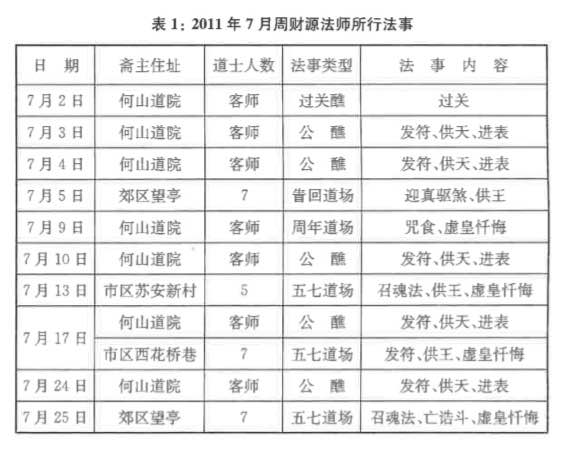
Table 1Rituals performed by Tao Jin’s master Zhou Caiyuan in July 2011, showing locations, personnel, ritual type, and ritual segments. For the seven rituals held at the Heshan daoyuan he was a “guest master” (keshi 客师).

Table 2Rituals held at the Chenghuang miao temple in July 2011, including Communal Offerings (gongjiao), Crossing the Passes (guoguan), commemorative daochang, and so on.

As around Shanghai and elsewhere, spirit mediums are crucial organizers. Until the 1950s the xiangtou from the local gentry who invited the elite Daoists to perform rituals, and those attending, were male; nowadays female lingmei (or xianniang 仙娘), and female worshippers, play a leading role. And almost all the rituals (even in the urban temples) are commissioned by rural patrons.

Even some long-discontinued ritual processions resumed—only no longer to the elite temples. For the changing religious scene of festivals, territorial cults, and pilgrimages from the late Qing to the Republican era, see further

  • Gao Wansang 高萬桑 (Vincent Goossaert), “Wan Qing ji Minguo shiqi Jiangnan diqude yingshen saihui” 晚清及民國時期江南地區的迎神賽會, in Kang Bao 康豹 (Paul Katz) and 高萬桑 (Vincent Goossaert) eds., Gaibian Zhongguo zongjiaode wushinian: 1898–1948 改變中國宗教的五十年: 1898–1948 (Taipei, 2015)
  • Vincent Goossaert , “Territorial cults and the urbanization of the Chinese world: a case study of Suzhou”, in Peter van der Veer ed., Handbook of religion and the Asian city: aspiration and urbanization in the twenty-first century (2015).

In the latter, a nuanced account of the ever-changing fortunes of urban, suburban, and rural temples, the processes of deterritoralization and reterritoralization, he observes:

Judging by current practice, small-scale rituals by local communities typically involve two main kinds of ritual specialists: spirit mediums and scripture-chanting masters. […] Not all territorial communities hire Daoists for their celebrations every year; the scripture-chanting masters provide cheaper, simpler services, complemented by dances and songs formed among the community’s elder women. For the larger celebrations involving Daoists, spirit mediums and scripture-chanting masters are also commonly present; these specialists have a clear division of labour and are not in competition.

See further

And the journal Minsu quyi, always core reading for Chinese ritual studies, continues to publish a wealth of material, most recently here.

2 Documenting ritual practice
While such work is exceptionally rich in social detail, it can’t seek to address the nuts and bolts of ritual practice—which for scholars of Daoism is the heart of the matter.

This is the kind of work for which Tao Jin 陶金 is perhaps uniquely qualified, with his detailed historical knowledge of Daoism and its ritual manuals. One of very few scholars of Daoism who have followed the lead of Saso and Schipper in participant observation, Tao Jin apprenticed himself first to Chang Renchun in Beijing and then, since 2008, to the Daoist masters Zhou Caiyuan 周財源 and Wu Shirong 吾世榮 in Suzhou; in 2018 he was himself ordained.

  • Tao Jin 陶金, “Suzhou ‘Xiantian bawang zougao keyi’ chutan” 蘇州《先天奏吿科儀》初探, in Lü Pengzhi 呂鵬志 and Laogewen 勞格文 [John Lagerwey] eds., Difang daojiao yishi shidi diaocha bijiao yanjiu guoji xueshu yantaohui lunwenji 地方道教儀式實地調查比較研究 (國際學術研討會論文集) (Hong Kong, 2013).

In this article Tao Jin explores the esoteric Xiantian bawang zougao ritual to the Doumu 斗姥 deity. It may be adapted to rituals for both the living and the dead; he documents a mortuary version that he attended at a family home, including randeng 燃燈 and poyu 破獄 segments (see photo above).

Only from the tables can we learn that the group consisted of three liturgists and four instrumentalists; they are not named. Tao Jin’s purpose is not to document normative current practice but to explain aspects of the early evolution of Daoist ritual. He gives only minimal coverage of the soundscape—even basic features like solo chanting, group singing, slow/fast, melisma, the function of percussion and melodic instrumental music.

One may choose to depict a given ritual because it encapsulates the core wisdom of ancient Daoism, or because it is frequently performed today. In my work on the Li family I focus on funerals, because that is their main context, which we can document in detail by observation; I also note their performance of temple rituals and Thanking the Earth, rare or obsolete since the 1950s. Tao Jin comments (in a footnote!) that the Doumu ritual is still performed in the Shanghai region for both the living and the dead, whereas in Suzhou it is now used only for the latter; one wonders about reasons for this difference.

Work of this type is more concerned with tracing medieval antecedents and imperial history than with documenting change within living memory, or indeed performance practice. As with the voluminous material on household Daoist groups in southeast China, documenting the radical social or political changes since the 19th century is left to other scholars.

Another of Tao Jin’s themes is the strong historical link with Daoism in Beijing; [2] and such rituals should also be studied in conjunction with those of Shanghai. While he, with his rich insider’s experience as a participant, should be well qualified to detail the practicalities of ritual life, his main energy is devoted to doctrinal history. Still, if anyone eventually compiles a more comprehensive account of the whole range of rituals still performed, then Tao Jin is the person to do it.

3 Music scholarship
All this seems to put the perspective of musicology in the shade, but this approach does at least provide an impression of current practice.

Clearly, the soundscape of Daoist ritual is crucial; but looking to scholarship on “Daoist music” to understand ritual also has its limitations. Around Suzhou and Wuxi, a reified image of the Shifan instrumental genres works to distract us from both ritual practice and local society; however complex, Shifan is only one supporting element in the performance of Daoist ritual in the region.

In the 1950s “Daoist music” became a palatable way of discussing Daoist ritual; but it obfuscated the issue. Still, whether I like it or not, “Suzhou Daoist music” is A Thing. Like the studies of ritual, such works tend to be heavily laced with generic citations from ancient history. And by contrast with the broader enquiry of social scholars, based on folk practice, they are dominated by the official Xuanmiao guan group. Still, they suggest some clues.

So the riches of Daoist ritual around south Jiangsu (and everywhere) need to be addressed by scholars of Daoist ritual, not just “Daoist music”. I would like to read works without the word “music” in the title, where it is a given that coverage of the soundscape is intrinsic to the task.

Transcriptions are an important step towards revealing the nuts and bolts of ritual practice, towards suggesting how performers and patrons experience ritual performance. However, scholars of Daoism may be reluctant to take this on board. Learning to read cipher notation requires very little time, but few will take the trouble to do so—perhaps partly because they will struggle to perceive its relevance. Whether for the vocal liturgy or the instrumental music, they might ask: does the manner of performance—notably its sound—matter, as long as the text gets transmitted? (cf. Daoist priests of the Li family, pp.256–7). Indeed, transcriptions—like reproductions of ritual manuals—are merely a form of graphic representation, not easily translated into sound. What we need is film (on which more below).

The Anthology
After a very basic introduction, the “religious music” section of the instrumental volumes of the Anthology (Zhongguo minzu minjian qiyuequ jicheng, Jiangsu juan 中国民族民间器乐曲集成, 江苏卷) gives extensive transcriptions of items of vocal liturgy (pp.1439–1645), though it only gives brief notes to contextualize them. The Shifan genres which punctuate them are transcribed separately under instrumental ensembles.

JC

From the Anthology: top (left) Daoist tangming group; (right) Mao Zhongqing leads ritual overture on drum at the Chunshenjun miao temple;
mid: (left) Xue Jianfeng accompanies liturgy on shuangqing lute; (right) Maoshan ritual;
below: (left) chuanhua segment of Quangong/Quanfu ritual; (right) Zhou Zufu accompanies vocal liturgy.
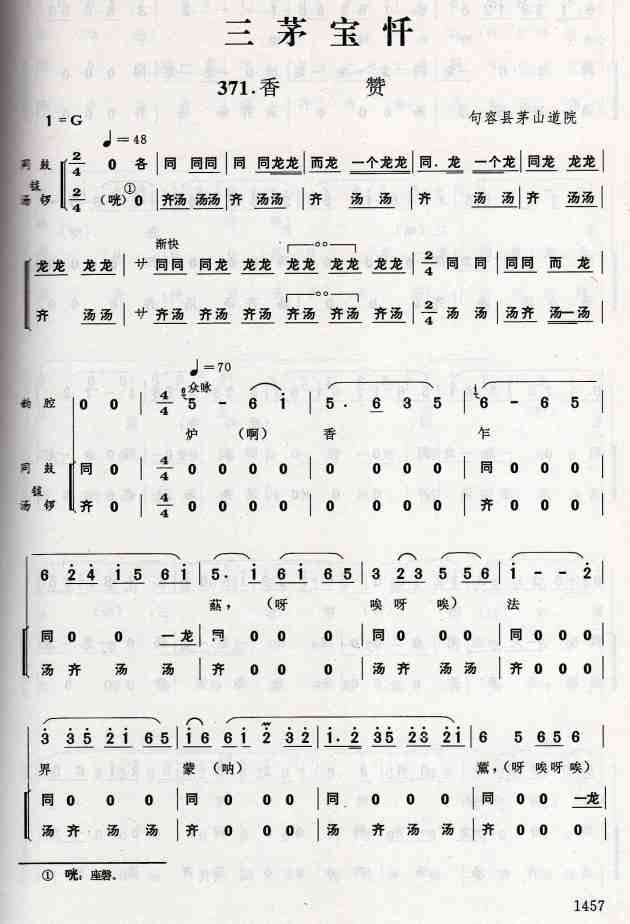
JC Maoshan

Opening of Hymn to Incense from San Mao baochan, Maoshan,
with percussion prelude and accompaniment.

From Maoshan the Anthology provides transcriptions from the following rituals:

  • San Mao biao 三茅表
  • San Mao baochan 三茅寶懺
  • Yuhuang chan 玉皇懺
  • Shangqing risong wanke 上清日誦晚課

And from Suzhou:

  • Sanbao chanhui sheshi xuanke 三寶懺悔設[施?]食玄科
  • Qingwei gongtian xingdao chaoyuan keyi 清微供天行道朝元科儀
  • Quangong/Quanfu 全功全符
  • Quangong/Quanbiao 全功全表
  • Miscellaneous vocal liturgy

The Anthology continues with transcriptions of Buddhist ritual (pp.1652–1765), mainly of the influential Tianning si temple in Changzhou, as well as Nanjing and Yangzhou, and some items from the xuanjuan scripture groups.

Valuable as the Anthology is, it provides us with clues, starting-points; its material always needs unpacking. Meanwhile, in the substantial series Zhongguo chuantong yishi yinyue yanjiu jihua 中國傳統儀式音樂研究計畫 [Traditional Chinese ritual music research project]

  • Cao Benye 曹本冶 and Zhang Fenglin 張鳳麟, Suzhou daoyue gaishu 蘇州道樂概述 (Taipei: Xinwenfeng, 2000)

is a rather slim tome. Their dry list of rituals (pp.39–40), under the basic categories of jiao, fashi, and minor rituals, is less than clear. And instead of clarifying, they go on to discuss the instrumental component. They do then give transcriptions (pp.53–130; texts alone on pp.141–72) of the vocal liturgy from two major rituals (Duiling sanbao chanhui sheshi xuanke 對霛三寶懺悔設食玄科 and Lingbao xianweng jilian xuanke 靈寶仙翁祭煉玄科), but entirely without context.

The Offering to Heaven ritual
In the same series, a much more detailed account of one of the core rituals, as performed by the Xuanmiao guan group, is

  • Liu Hong 刘红, Suzhou daojiao keyi yinyue yanjiu: yi “tiangong” keyi weili zhankaide taolun 蘇州道教科儀音樂研究: 以“天功”科儀為例展開的討論 (1999).

It doesn’t consist merely of musical transcriptions, but belongs with the style of the works of Yuan Jingfang 袁静芳 for other traditions (e.g. Beijing, south Hebei, and Baiyunshan), documenting whole rituals in detail.

Liu Hong lists three types of jiao Offering:

  • those formerly commissioned by urban dwellers for prosperity;
  • Communal Offerings (gongjiao 公醮) commissioned by rural groups assembled by a xiangtou leader (usually a tiangong ritual, as here)
  • offerings for individual families.

In a useful section (pp.194–8) discussing flexible elements in the ritual, he notes that whereas before Liberation they used to travel widely in the region to perform lengthy rituals, tailoring them to patrons’ differing demands, since the reforms the patrons come to the Xuanmiao guan temple to have rituals performed, leading to both standardization and abbreviation. This is important, although one now wants similar treatments for all the rituals still performed “among the people”, including those listed in the tables above.
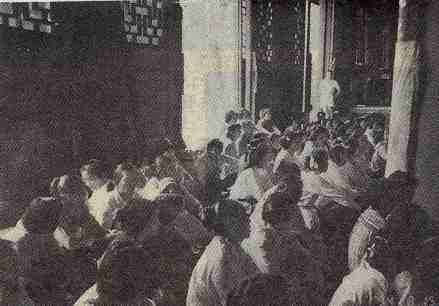
patrons
Patrons for tiangong ritual, 1994. Photo: Liu Hong.The tiangong ritual consists of three main sections: Dispatching the Talismans (fafu 發符), Offering to Heaven (gongtian 供天), and Presenting the Memorial (jinbiao 進表)—a sequence also regularly performed by Zhou Caiyuan under the heading of Communal Offering.
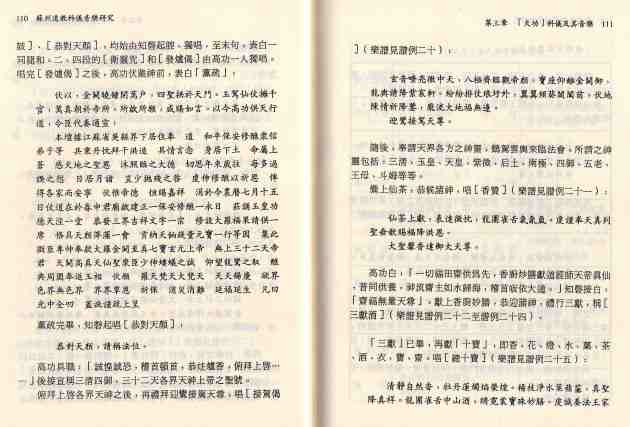
LH

From Liu Hong’s description of the gongtian ritual segment.

Liu Hong’s account isn’t limited to melodic items; he includes texts of chanted sections, and describes ritual actions; and like Tao Jin, he provides titles for ritual manuals and diagrams of altars. He also pays rather more attention to social context; for the ritual he attended in July 1994, the “audience” of over one hundred consisted mainly of female peasants from the outlying regions, bringing offerings to be used during the ritual. He lists the performers for a tiangong ritual at the Chunshenjun miao temple in 1995: seven fashi liturgists (led by Xue Guiyuan), two xianghuo helpers and seven instrumentalists (with Mao Liangshan on drum).

Studies of ritual nearby
We might read this material in conjunction with related monographs on Shanghai and Wuxi:

  • Cao Benye 曹本冶 and Zhu Jianming 朱建明, Haishang Baiyun guan shishi keyi yinyue yanjiu 海上白雲觀施食科儀音樂研究 (1997) documents a 1994 performance of the shishi ritual, and contains reproductions of four ritual manuals.
  • Qian Tiemin 錢鐵民 and Ma Zhen’ai 馬珍媛, Wuxi daojiao keyi yinyue yanjiu 無錫道教科儀音樂研究 (2 vols., 1999) contains transcriptions of the vocal liturgy (pp.165–568), but is dominated by the instrumental repertoire.

For other volumes on Shanghai in the important Minsu quyi congshu series, see n.3 here, including a review by Poul Andersen.

So such studies by musicologists contain considerable material for the scholar of Daoism.

4 Maoism
Though the Maoist era was a crucial period for transmission, details remain elusive. Tao Jin and Goossaert give a bare outline (p.99–100). Household Daoist Zhou Caiyuan recalled a large-scale zhutian hui 朱天會 ritual in the late 1950s at the Wulu Caishen miao temple near the Xuanmiao guan in Suzhou. Maoshan temples managed to maintain activity too: in 1963, roughly 20,000 believers attended a kaiguang 開光 inauguration ritual at the Jiuxiao gong temple there. [3] Even the performance of such rituals under Maoism suggests a nuanced picture, but few details emerge of more routine practice—including funerals, always an important context.

A 1956 list of temples in the city of Suzhou (Suzhou daojiao keyi yinyue yanjiu, pp.15–18) gives a stark picture of the decimation of the physical religious landscape there. Suburban and rural temples may have been hit less hard, though ritual activity there too would have been severely limited.

5 Lives
To return to Goossaert’s plea, it’s worth exploring the lives of the ritual performers.

For scholars of Daoism, the fashi ritual specialists properly take priority over the “musical” Daoists. But the 1957 volume Suzhou daojiao yishuji only lists their names, and the Anthology biographies concern not those specializing in liturgical practice but performers noted for their instrumental accomplishments who went on to achieve fame under Maoism as members of secular state troupes. Still, these Daoists are not mere “musicians”: they have long experience performing lengthy rituals. While some of them formally served as temple clerics before Liberation, most were household Daoists. [4]

Some of the most famed performers are renowned for their drumming (a major component of Daoist ritual around the region), such as Mao Zhongqing and Zhou Zufu, as well as Zhu Qinfu in Wuxi. Scholars pay attention to the complex drum sections that punctuate the instrumental suites, rather than the less virtuosic art of accompanying vocal liturgy (on which, for Yanggao, see here.)

Most of these biographies describe prominent Daosts recruited to the Xuanmiao guan temple group in Suzhou:

Mao Zhongqing 毛仲青 (1915–?)
Mao Zhongqing studied from young with his father Mao Buyun 毛步雲, a priest in the Huoshen dian shrine attached to the Xuanmiao guan. He studied dizi flute with Cao Guanding 曹冠鼎 of the Jifang dian shrine, sanxian plucked lute with Hua Yongmei 華詠梅 of the Wenchang dian shrine, and the whole Shifan repertoire with Dai Xiaoxia 戴啸霞, a Daoist attached to the Greater Guandi miao temple. From the age of 12 sui he was working for the Caishen dian temple.

After Liberation he was recruited to a Music Research Group in the Suzhou Daoist community for the “Resist America, Support Korea” Association. In 1953, like Cai Huiquan, he was employed in the Central Chinese Broadcasting Orchestra, along with his fellow Daoists Wu Mingxing 吳明馨, Qian Zhanzhi 錢綻之, and Hua Lisheng 華麗生. But already in late 1954 he requested leave to return to Suzhou, where he worked for the Suzhou Daoist Study Committee.

In 1956 he took part on drum and tiqin fiddle in the major project to document a complete jiao Offering ritual. Wu Xiaobang, leader of the project, went on to organize the Heavenly Horses Dance Experimental Office (Tianma wudao shiyanshi 天马舞蹈实验室) in Shanghai, with whom Mao Zhongqing toured widely from 1958 to 1960. When the group folded in 1961 he once again returned to Jiangsu, joining the provincial Kunqu troupe. In the early years of the Cultural Revolution he was kept on at the reception office there, but he took early retirement in 1970, returning to Suzhou. In 1979, as tradition restored, he was part of an illustrious group of thirteen Daoists gathered together by cultural officials to record. He was now assigned to the Suzhou Song-and-Dance Ensemble, also taking part in the Suzhou Kunqu Troupe.

Zhou Zufu 周祖馥 (1915–97)
From a background of Kunqu, Zhou Zufu was adopted after his mother’s death into the hereditary ritual tradition of the Zhou family in Huajing village of Wuxian county, descended from the Renshi tang 仁世堂 hall, performing along with four brothers. Aged 17 sui he studied Daoist percussion with Xu Yinmei 許吟梅 of the Caishen dian temple of the Xuanmiao guan, and from 21 sui he invited Zhao Ziqin 趙子琴, an eminent Daoist attached to the Zongguan tang 總管堂 hall, to Huajing to teach them sanxian. After the Japanese occupation, with travel disrupted, he studied Shifan with Zhu Peiji 朱培基 (aka Zhu Boji 朱柏基). By now he was a respected performer in Daoist ritual and tangming groups around the countryside. He was given a post in the Suzhou Daoist association, expanding his ritual activities to the city. After the Japanese were defeated he was the only rural Daoist to take part in the Yixuan yanlu 亦玄研庐, one of many such official Daoist groups formed since the 1920s.
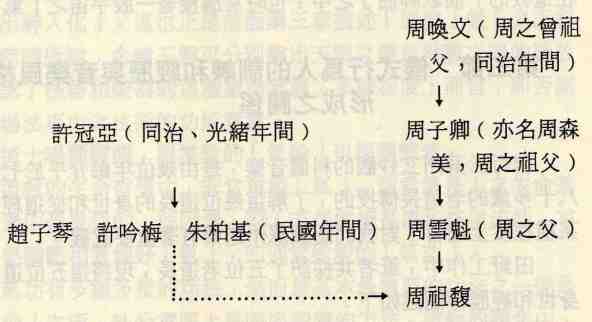
Zhou Zufu

Zhou Zufu, ritual transmission. Source: Liu Hong, Suzhou daojiao keyi yinyue yanjiu.

After Liberation Zhou Zufu was recruited to the Suzhou Daoist Music Research Group. In 1953 he was assigned to the Minfeng Suzhou Opera Troupe (forerunner of the Suzhou Kunqu Troupe), and in 1957 he went on to the Shanghai Chinese Orchestra. Again, he had to return to the Suzhou countryside with the 1962 state cuts.

Following a typical lacuna in the account, he was recalled to the Suzhou Kunqu Troupe in 1977. In 1984 he was recruited to the Xuanmiao guan temple. That year he performed in Venice with a combined group from Suzhou (also including qin master Wu Zhaoji), arranged impressively by Raffaella Gallio, first foreign student at the Shanghai conservatoire from 1980—who incidentally was instrumental in helping me realize that Chinese folk music was reviving (see here).

The account lists official festivals at which he took part through the 1980s and 1990s, including the 1990 Beijing Festival of Religious Music. But by the late 1980s he was also a leading light in rituals at the Xuanmiao guan, teaching the new generation.

Jin Zhongying 金中英 (1925–96)
A hereditary household Daoist from Suzhou city, Jin Zhongying studied at sishu private school from the age of 6 sui, but had to withdraw after two years since the family could no longer afford the fees. When he was 12 sui his father died, and he gradually began performing in rituals, learning instruments and liturgy from masters like Zhao Houfu 趙厚福 (see below), and learning further from 15 sui in the Shouxuan xiejilu 守玄褉集庐 Daoist academy. In 1945, as the Japanese were defeated he took part in its successor the Yixuan yanlu, but their activities were soon curtailed by the civil war. In 1948 he studied with Xu Yinzhu 許吟竹 at the Wenchang dian temple.

After Liberation, in 1951 he too was enlisted to the Suzhou Daoists’ propaganda activities for the Korean War, and from 1953 he headed the second Daoist Music Research Group, with a brief interlude in the Minfeng Suzhou Opera Troupe. He had an impressive collection of ritual manuals, and it was he who in 1953 provided the early Juntian miaoyue score by Cao Xisheng. He was one of the organizers of the 1956 project, and the main author of the resulting volume; and like Mao Zhongqing he went on to join the Tianma Troupe in Shanghai. In 1960 he was recalled to oversee the Suzhou Chinese Music Troupe. From 1965 he held successive cultural posts in Suzhou. He was a leading light in the revival from 1979.

As I observed in my post on the tangming bands, few Daoists would have been reluctant to take up such employment. They had to work out how to survive under the new regime; such posts offered them a reliable “food-bowl” and protected them, mostly, from accusations of “feudal superstition”.

By contrast with other regions, there was more official research activity in Suzhou under Maoism, based to a degree on the lively Daoist institutions of the Republican era. But such biographical sketches are frustrating. They were all versatile instrumentalists, but for details on their ritual and liturgical practice we have to seek elsewhere.

Cao and Zhang give further brief biographies (pp.131–40)—still based more on “musicians” than on liturgists. In addition to the Daoists above, they list:

Zhao Houfu 趙厚福 (1908–?)
Son of the great Daoist Zhao Ziqin 趙子琴, who had over two hundred disciples, Zhao Houfu also studied percussion in the 1930s with the Daoist master Dai Youxia 戴攸霞. From 1951 he was a member of the Suzhou Daoist Music Study Group, and he took part in the 1956 project, going on to the Tianma Troupe.

Xie Jianmei 謝劍梅 (1912–88)
From Suzhou city, from the age of 16 sui he learned with Li Peiyuan 李培元 and Shao Shilin 邵世琳, with further training in liturgy from Qian Zhanzhi 錢綻之, Wu Dinglan 吳鼎蘭, and Jin Shenzhi 金慎之. He became a priest at the Caishen dian shrine of the Xuanmiao guan after the 1945 victory over Japan. In 1951 he joined the Suzhou Daoist Music Research Group, working alongside Jin Zhongying and Hua Lisheng. Later he was recruited to the Kunshan Dasheng Yueju Opera Troupe. During the Cultural Revolution he worked at a primary school. From 1981 he was employed at the Xuanmiao guan.

Cao Yuanxi 曹元希(1913–89)
A hereditary Daoist at the Huoshen miao temple in Suzhou, he was a descendant of Cao Xisheng, compiler of the Juntian miaoyue score. After studying with Shao Shilin 邵士琳 and Xu Yinmei 許吟梅, he became abbot of the Huoshen miao. In 1951 he too joined the Suzhou Daoist Music Research Group, and he took part in the 1956 project. From 1957 he was in the Heavenly Horses dance troupe, moving on to the Suzhou Chinese Music Orchestra and the Suzhou Kunqu Troupe, where he worked until retiring.

Hua Lisheng 華麗笙 (1915–89)
Hua Lisheng became a priest in the Jifang dian 機房殿 shrine of the Xuanmiao guan at the age of only 10 sui, learning ritual with Cao Guanding 曹冠鼎. In 1946, with Zhang Jingyun 張景雲, Li Youmei 李友梅, and Zhang Yunmou 張雲謀 he formed the Yunji she 雲笈社, a short-lived organization for Daoist research. In 1952 he was recruited to the Central Broadcasting Troupe, but returned home due to ill health. Through the Cultural Revolution he made a living from making paper boxes in Xuanmiao guan Alley. From 1981 he worked for the preparatory group for the Suzhou Daoist Association, becoming secretary when it was established in 1986.

Mao Liangshan 毛良善 (b.1927)
From Weiting in Wuxian county, Mao Liangshan was adopted at the age of 6 sui by Zhao Houfu, learning Daoist ritual with him and Zhao’s father Zhao Ziqin. He became a priest at the Xiuzhen guan temple in Suzhou at the age of 13 sui, under the tutelage of Shen Yisheng 深宜生. On the outbreak of the Cultural Revolution he returned to Weiting to work in the communal fields. In 1984 the Suzhou Daoist Association summoned him to perform rituals.

Xue Jianfeng 薛劍峰 (b.1925)
A hereditary Daoist, Xue Jianfeng became a temple priest at 14 sui, studying with his father Xue Songqing 薛松卿 and Shao Shilin. From 18 sui he was abbot of the Liushuixian miao 柳水仙廟 temple. After the disruption of the Cultural Revolution, he returned to the Xuanmiao guan in the early 1980s. While a versatile instrumentalist, he specialized in the shuangqing 雙清 plucked lute. Along with Zhou Zufu and Mao Liangshan he trained the new generation.

Jiang Jierong 蔣介榮 (b.1926)
From Wuxian county, Jiang Jierong began studying Daoist ritual from the age of 8 sui with his father Jiang Nianxuan 蔣念萱. His father died when he was 13 sui, whereupon he studied “shendao” 神道 (the tangming ritual style) for three years under Tao Qinghe 陶慶和 (Tao Dawei 陶大微). At the age of 16 sui he became a priest at the Qingzhou guan temple in Suzhou, furthering his studies with Xu Yinmei. Upon land reform he left the clergy, but continued working as a household Daoist. After a long lacuna in the account, he resumed ritual life upon the reforms, and was recruited to the Suzhou Daoist Association in 1990.

Here I may as well include a renowned Daoist drummer from nearby Wuxi, on whose reputation the wider awareness of the art of Daoist drumming in south Jiangsu is largely based—it’s worth recalling that Chinese musicologists were studying ritual in mainland China long before other scholars, and that this began with the great Yang Yinliu‘s immersion in Wuxi Daoism.

Zhu Qinfu 朱勤甫 (1902–81) [5]
Born to a poor family in Zhucuntou village of Wuxi, Zhu Qinfu was brought up by his Daoist uncle Zhu Xiuting 朱秀亭. He became the fifth generation of Daoists in the family, taking part in rituals from the age of 8 sui, and training formally with Zhu Xiuting from 12 to 16 sui. He was part of the Tianyun she group that performed for Henry Eichheim in 1921.

Around 1940 he formed a band called Shiwuchai 十勿拆, renowned for their rendition of the Shifan gu instrumental repertoire. In October 1947 he was invited by the Yangchun she in Shanghai to combine with the Tianyun she for three days of performances, attended by luminaries like Mei Lanfang and Yu Zhenfei. The recordings were broadcast and issued on six discs, but were apparently destroyed in the Cultural Revolution.

After Liberation, Zhu Qinfu was recruited in 1952 to the orchestra of the Central Opera Academy in Beijing, and then the Central Experimental Opera Academy. In 1962 he was sent back home as a result of the state cuts following the famine—whereupon, to their credit, the conservatoires of Shanghai and Beijing employed him (the CD-set Xianguan chuanqi includes a 1962 recording). But with the outbreak of the Cultural Revolution he was again forced home.

In 1978 the Shanghai conservatoire once again sought him out. Their recordings were less than ideal, since he was no longer in good health. In 1979 they made a TV documentary. Zhu also returned to the Central Conservatoire in Beijing before his death in 1981.

Back in Suzhou, Liu Hong also introduces two leading liturgists:

Xue Guiyuan 薛桂元 (b.1919) began learning with his father from the age of 9 sui, training from 15 sui at the Anzhaiwang miao 安齋王廟 and from 19 sui with Shao Shilin 邵世琳. Whereas the most accomplished Daoist instrumentalists might find work in state troupes, this was not an option for ritual masters like Xue Guiyuan, and from 1951 he had to work as a peasant, right until 1988 when he was summoned to the Xuanmiao guan.

Zhang Boxu 張伯旭 (b.1921), from Wuxian county, learned with his father from 9 to 13 sui, going to study with Li Duanchun 李端春 before making a living as a household Daoist. From 21 sui he spent two years in Suzhou under Lu Zifan 陸子範. He seems to have remained active until 1962, when he had to return to peasant life. Resuming ritual activities from 1988, he was recruited to the Xuanmiao guan in 1992.
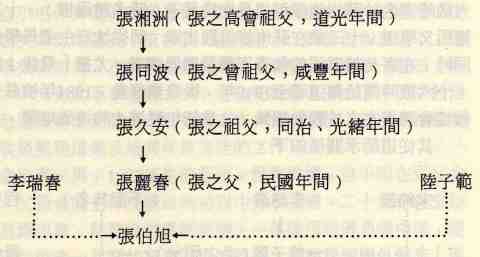
Zhang Boxu

Zhang Boxu, ritual transmission.

All these Daoists came from hereditary backgrounds, learning first in the family and then often with other masters. They had all performed rituals for their local communities before Liberation; though such accounts are unclear about their ritual life under Maoism, they had been largely unable to practice until the 1980s’ revival.

Cao Benye and Zhang Fenglin also introduce three able younger Daoists who became priests at the Xuanmiao guan since 1984, taking part in training sessions (cf. Shanghai) and becoming regular members of the temple’s main ritual group: Lu Jianzhong 陸建中 (b.1966), Xie Jianming 謝建明 (b.1971), and Han Xiaodong 韓曉東 (b.1972). Here we can note a shift: with hereditary training having been disrupted, their studies now took place at a later age, and under the auspices of the temple’s training programmes. Lu Jianzhong and Han Xiaodong went on to pursue their studies further with ritual master Xue Guiyuan.

But again, I wonder about the fates of Daoists struggling to make a living after Liberation: not only the more accomplished fashi ritual masters and instrumentalists, but ordinary Daoists too. Many had to return to the collective fields or take up factory jobs, though doubtless some also performed rituals intermittently. More detailed biographies would yield rich material on the Maoist era.

XMG 93

Xuanmiao guan group led by Zhou Zufu (centre, drum), Beijing 1993. My photo.

Today the Xuanmiao guan group comprises some accomplished Daoists (see also here), but the temple’s “museified” official representation may innoculate us from considering the complex realities of local ritual life (cf. the Zhihua temple in Beijing). We still need to include the lives and activities of both fashi ritual masters and ordinary Daoists in the picture.

6 Film
I return to my usual refrain: none of this discussion can convey an adequate impression of the actions and sound of rituals in performance—and sound is precisely the means by which the texts are communicated.

So beyond silent immobile texts (and beyond transcriptions, or even audio recordings), what we need is films. After all, fieldworkers do commonly film the rituals they observe; but their footage is rarely admitted to the public domain. Online you can find a few unedited, undocumented clips, like the footage of the Dispatching the Talismans at the end of this post.

Rather, I’m suggesting edited ethnographic films with commentary and subtitles showing liturgical texts—both documentaries showing ritual life in social context, and “salvage” projects aiming to preserve or recreate rarely-performed rituals. For the former, Ken Dean’s film Bored in heaven enriches his detailed work on ritual life in Putian in Fujian; for the latter, we might cite the current project of the Shanghai Daoist Association, and Patrice Fava’s films tend towards this style. For further such material, see here.

Of course, the historical dimensions of film may be rather shallow. It by no means supplants textual publications, but it should be a sine qua non. However well such textual descriptions are done, they can’t begin to evoke such complex rituals; it’s an absurdity of academia that they are considered adequate. Film is hardly a new medium. Scholars’ reluctance to use it may be partly to do with the lasting dominance of print media in academia, but it also suggests that they consider the written text, not performance, as primary. They write texts about other written texts. In the Appendix of my Daoist priests of the Li family I made this analogy:

It’s like someone with a fine kitchen and loads of glossy cookbooks, who draws the line at handling food or cooking.

If a copy of the 1956 film of the Suzhou Offering ever miraculously resurfaces, then Tao Jin can add subtitles for the ritual segments and vocal texts…

* * *

So the Xuanmiao guan is just one element in Suzhou Daoist ritual; and the latter is just one component of ritual life around the region.

A certain compartmentalization of all these strands may be inevitable; but it’s hard to bring them into dialogue. I suppose it was this kind of synthesis that I attempted in my work on the Li family Daoists in Yanggao, combining text and film. Within the ethnographic framework of the book I gave material both on the wider history of their ritual texts and on their changing performance practice—my task made easier by the sparser historical material and a smaller ritual repertoire. Often my posts on local ritual in north China concern traditions for which little evidence has emerged in either historical or religious studies—which makes them both valuable and limited. But for regions like Suzhou it may be too much to ask for an accessible synthesis of these various elements.

So again the analogy of “blind people groping at the elephant” seems apposite.

With many thanks to Tao Jin and Vincent Goossaert

[1] On the Longhushan connection, see e.g. Vincent Goossaert, “Bureaucratic charisma: The Zhang Heavenly Master institution and court Taoists in late-Qing China”.

[2] “Dagaoxuandiande daoshi yu daochang: guankui Ming–Qing Beijing gongtingde daojiao huodong” 大高玄殿的道士与道场管窥明清北京宫廷的道教活动, Gugong xuekan 2014.2, and
“Dadong wushang jiuji tianxian chuanjie keyi chutan: yige Qingdai Beijing yu Jiangnan wenhua luantan jiaohu yingxiangde anli” 蘇州無上九極天仙傳戒科儀初探: 一個清代北京與江南文化亂壇交互影響的案例, Daoism: religion, history and society 5 (2013).

[3] Johnson, “Two sides of a mountain”, pp.95–6.

[4] My summaries here are based on three sources, not always unanimous in detail: the Anthology, Cao Benye 曹本冶 and Zhang Fenglin 張鳳麟, Suzhou daoyue gaishu 蘇州道樂概述 (2000), pp.131–40, and Liu Hong 刘红, Suzhou daojiao keyi yinyue yanjiu: yi “tiangong” keyi weili zhankaide taolun苏州道教科仪音乐研究:天功科仪为例展开的讨论 (1999), pp.321–8.

[5] Cf. my Folk music of China, pp.255–6.

Buddhism under Mao: Wutaishan

YX

After an interlude on ritual around south Jiangsu (notably the great Daoist ritual held in Suzhou in 1956), here I return to my home base of north China, focusing on the Maoist era as a kind of prequel to my post on the Wutaishan Buddhists.

As always, I note the tension between studies of ritual and “music”. Whereas scholars of religion tend to focus on early doctrine and silent texts, Chinese music scholars set forth from the living soundscapes of ritual. At the same time, they have tended to collect reified “pieces of music”, only paying attention to ethnography quite recently. However, at least they do the fieldwork, stressing the actual performance of ritual, and we can glean clues to the changing life of religion in society.

Wutaishan
Wutaishan is one of the foremost sites for Buddhism in north China (see also A Buddhist centre in Peckham). Since the 1980s, the history of its temples has become a major research topic, [1] and Chinese music scholars have documented their rituals (for an introduction, see my Folk music of China, pp.213–25). But already in 1947, amidst civil war and land reform, Ya Xin spent three months on Wutaishan documenting the ritual soundscape (whose features in north China I introduce here).

Following the national Communist victory in 1949, major projects to document a wide range of folk musical genres were initiated right across China. In March 1954 Ya Xin took part in a conference in Chengdu to discuss the enterprise, prompting him and five others to spend August doing fieldwork in the temples of Emeishan in Sichuan. In 1955 he edited a 508-page volume of transcriptions, including both that material and his 1947 work on Wutaishan:

  • Ya Xin 亞欣, Siyuan yinyue 寺院音樂 [Temple music], Zhongguo yinyuejia xiehui Chengdu fenhui, 1955.

By the 1950s, scholars like Yang Yinliu studying “religious music” found it obligatory to defend the “value” of the topic, and Ya Xin prefaced his introduction (pp.1–15) with such a defence. The following transcriptions for Emeishan (pp.16–297) include the major Yuqie yankou ritual, daily services, and other vocal liturgy. [2]

But back in 1947 (just as Bill Hinton was embedded with the land reform teams in a village further south in Shanxi), Ya Xin had carried out fieldwork on Wutaishan while serving as a cultural cadre for the Jin–Sui Liberated Area. The conditions were most taxing: amidst ongoing battles with Nationalist troops, the Communists were implementing land reform. So Ya Xin notes that his work was imperfect. But it was a bold initiative: while collecting folk music had been a major project in the Shaanbei Base Area, temple ritual was not on their agenda.

For Wutaishan (pp.299–454), Ya Xin transcribed the main items from the Yuqie yankou ritual, shengguan wind ensemble melodies for both Han Chinese (qingmiao) and Tibeto-Mongolian (huangmiao) styles, and the Three Days and Nights (san zhouye) mortuary ritual. With the book’s many transcriptions of hymns (zan 讚), gathas (ji 偈), mantras (zhenyan 真言), and so on, it provided an early framework for understanding the mechanics of vocal liturgy.

YX score

From Ya Xin’s transcriptions of the Wutaishan yankou: Daochang chengjiu hymn,
and opening of Huayan hui, showing melisma with padding characters.

Finally, visiting Du Wanzhongshan’s gufang 鼓房 folk wind band in Dongye town at the foot of the mountain Ya Xin notated their “eight great suites” (pp.455–508), derived from the shengguan of the temple monks (Folk music of China, pp.218–19)—although unlike groups of household ritual specialists, they don’t perform vocal liturgy.

Since Ya Xin wasn’t equipped with a recording machine, one both admires his diligence in transcription and wonders at its accuracy. I surmise that much of his work on the vocal liturgy was done with individual monks singing items for him repeatedly, rather than in the course of rituals—not least because the Buddhist texts themselves are highly complex, so he clearly had access to ritual manuals; and he seems to have consulted gongche scores of the shengguan music too. But he didn’t list the temples where he made his transcriptions, or provide names of monks.

Background
We should bear in mind the wider history of Wutaishan around the time. Here I seek clues in the 1988 Wutai county gazetteer. [3] Though such sources are “history of the victors”, they contain some useful material.

Warlord conflict from the 1920s, with Yan Xishan’s troops active, already made the region unstable. But in 1936 Wutaishan had 130 active temples with 2,200 registered clerics (including 800 lamas)—many of whom were doubtless fleeing from warfare. John Blofeld spent time there in 1936–37.

The early architecture of the Wutaishan temples had attracted historians for some time. Japanese scholars found some important temples early in the 20th century, though the Danish Johannes Prip-Møller was unable to visit during his 1929–33 temple survey. In 1937, on the eve of the invasion, Liang Sicheng and Lin Huiyin rediscovered the Tang-dynasty Foguang si temple. The search for “living fossils” would later become a major industry in Chinese musicology.

Japanese troops invaded the area in October 1938, carrying out several massacres. This was an early base area for the Communists in the resistance against Japan. Both patriotic and quisling Buddhist associations were formed in the temples. Many of the monks assisting the resistance were Tibeto-Mongolian lamas, such as those of the Zhenhai si temple, who in 1938 handed over to the 8th Route Army an entire arsenal of weapons that had been given by Chiang Kai-shek to the bodyguard of the Zhangjiafo lama. Monks handed over another cache of weapons in 1942.

The Nationalists fled in 1943, and the Japanese were in retreat from 1944. By July 1946 the Communists were in complete control, and began carrying out land reform. The monks now lost much of their land and income, and some temples were destroyed. By 1947, with little patronage, tilling the monks’ remaining land constituted 89% of their income.

Yan Xishan’s forces returned in October 1946, but retreated again in November. Even in February 1949 they committed a massacre in Dongye town.

During this whole period from 1937 a succession of Communist leaders had passed through. After Chairman Mao’s 1947 visit to the White Cloud Temple in Shaanbei, on a trip to Wutaishan in 1948 he expressed appreciation of the cultural heritage of Buddhism (for many such comments see e.g. here). Such utterances might have offered a certain intermittent validation for research, though they are utterly paltry alongside the Party’s long-term onslaught on religion.

Upon Liberation and over the following years, most temple clerics were laicized, with their traditional patronage severely reduced. The remaining monks on Wutaishan (a 1956 survey lists 445) [4] received a monthly income of 20–40 yuan from the county government. During the Maoist era ritual life was doubtless much impoverished, though the authorities sanctioned occasional visits from overseas Buddhist delegations.

Meanwhile, away from the temples, household ritual specialists, their numbers now boosted by clerics returning to the laity, maintained a certain activity. And although the influence of Wutaishan made Buddhism dominant around the region, Daoist ritual specialists were also active, such as in nearby Xinzhou.

Sects
Sectarian groups are another major theme in religious life throughout China. The sectarian connections of the amateur ritual associations in central Hebei, whose liturgy was transmitted from temples, are a separate case. But all these sects should interest us, since while not all of them performed complex liturgy, they show a link between temple and lay practice.

It is not that Buddhist monks or Daoist priests were usually sectarian; often, as in Yanggao, occupational ritual specialists are clearly distinct from the sects. But I have a growing list of temples where clerics belonged to such groups (Tianzhen, Xinzhou, Baiyunshan).

The recent county gazetteers, however partial, are often a useful source on the sects. Major campaigns were held from 1950 to 1951, and continued through into the Cultural Revolution. Of course, campaigns against “heterodox teachings” were nothing new, having been frequent under both imperial and republican governments, but the new campaigns were far more ruthless. Still, the sects went underground as usual, and have revived since the 1980s. However partial such recent accounts may be, it is important to bear in mind this perspective on local religious organizations when we consider the practice of folk ritual over the last century; this background still colours local society, and our discussions, today.

In the Wutai region, despite campaigns since 1945, intensifying in 1949 and 1950, a variety of sectarian groups were still active through the 1950s, including the Jiugong dao, Huanxiang dao, and Houtian dao. [5] They had a firm base in the temples as well as throughout the countryside. A brief biography of Zhang San Baotai 张三保泰 (1890–1958), [6] leader of the Houtian dao sect, is so rare as to be worth summarizing.

After joining the sect in 1924, Zhang became a monk at the Yuanzhao si temple on Wutaishan in 1938. The following year he declared himself a living Buddha, but his plot with Yan Xishan’s troops to organize an underground arsenal was exposed. In 1941 he travelled through Shanxi, Hebei, and Shandong, recruiting over ten thousand followers. His activities continued under the PRC, despite the campaigns of 1950–51. After returning to Wutai from Yuxian in Hebei in 1955, he prepared a major armed uprising for 1960, planning to establish a capital at Dingxian in Hebei, and mobilizing in Shandong; but he was captured and executed in 1958.

Apart from the general persecution of “orthodox” religious practices, the sectarian connection would have further darkened the cloud hanging over the temples.

Research in the 1950s
I know of no fieldwork on the rituals of the Wutaishan temples after Liberation. Still, eighteen monks from Wutaishan took part in a provincial festival of folk music at Taiyuan in 1958, winning a prize. Provincial scholars were hoping to do fieldwork from the mid-1950s, but were unable to do so. [7]

The “eight great suites”
The folk shengguan instrumental bands made a more palatable topic than the vocal liturgy of the temples, and this style did go on to achieve wider fame. In 1953 the Shanxi Radio Station revisited Du Wanzhongshan’s band in Dongye to record, which were widely broadcast, and Liu Shiying 刘士英 published transcriptions.

tupian

Bapaizi melody for shengguan, in Zhongguo yinyueshi cankao tupian.

Indeed, early in the War against Japan a friend of Bo Yibo, then a major Communist resistance leader in Shanxi, had lent a 1926 gongche score of this repertoire to Lü Ji, who would become the pre-eminent official pundit of Chinese music. After Liberation Lü Ji lent the score to Yang Yinliu; [8] a page was reproduced in vol.4 of the 1957 Zhongguo yinyueshi cankao tupian 中国音乐史参考图片, spreading awareness of the genre in music circles.

Even as the enforcement of the commune system was leading to desperation, further recordings of the suites, along with transcriptions, were made from 1959, with Du’s son Du San now leading the band.

When I first visited Wutaishan in 1986 it was still far from a bustling national and international tourist attraction. Indeed, I needed a special permit to travel there. Even the town of Taihuai was still a tranquil retreat. But my attention soon turned from the temples to folk ritual practice, and on my later trips I explored household groups in the surrounding region, including a fine shengguan band in Dongye town, led by Xu Yousheng. In 1992, having followed them round on funerals, we held a recording session (#5 on CD1 of my China: folk instrumental traditions; or a shorter version as #5 of the CD with the 1998 paperback of Folk music of China).

Since the reforms
The provincial scholars who had planned fieldwork on Wutaishan in the mid-1950s were only able to realize the project after the end of the Cultural Revolution, leaping into action as early as 1978. A group of senior monks was invited to the Shanxi Music and Dance Research Institute that year, and the precious recordings (as well as some further tracks from 1988) were issued on the five-cassette series

  • Wutaishan foyue 五台山佛乐, with notes by Liu Jianchang, in The Audio and Video Encyclopedia of China series, ed. Tian Qing (Shanghai yinxiang gongsi, 1989; reissued on CD since 1998). [9]

The set includes both vocal liturgy and shengguan ensemble music, with excerpts from the yankou ritual and examples of both Han Chinese (qingmiao) and Tibeto-Mongolian (huangmiao) styles. Like the group that came to England in 1992, most of the performers had been ordained on Wutaishan but had spent much of the Maoist era elsewhere in Shanxi, doing rituals sporadically among the folk. And meanwhile the “southern” style of vocal liturgy was replacing the distinctive regional styles of northern temples (such as Beijing and Shenyang).

1978 mim

From 1978 to 1980, Chen Jiabin and Liu Jianchang published transcriptions in mimeograph, and by the 1980s, along with the Anthology fieldwork, several provincial scholars were undertaking studies. The most extensive research is

  • Han Jun 韩军, Wutaishan fojiao yinyue zonglun 五台山佛教音乐总论 (2012).

The Anthology coverage is also substantial:

  • Zhongguo minzu minjian qiyuequ jicheng, Shanxi juan 中国民族民间器乐曲集成, 山西卷 (2000), introduction pp.1543–53, transcriptions 1554–1768.

The yankou: opening of Huayan hui hymn, from Anthology. For variant renditions, see Han Jun, Wutaishan fojiao yinyue zonglun, pp.152–5.

Such studies suffer from the usual flaws of Chinese research, consisting mainly of reified transcriptions rather than ethnography, but they contain some clues to the changing fortunes of religious life.

Meanwhile, as with groups such as the Zhihua temple, media coverage steered clear of the ritual basis of the tradition by highlighting the shengguan instrumental ensemble, with glossy performances on stage.

  • Beth Szczepanski, The instrumental music of Wutaishan’s Buddhist monasteries (2012)

also mainly focuses on the shengguan ensemble, but she takes a more ethnographic approach, with useful sections on the vocal liturgy; notes on actual rituals observed, including a funeral; and astute comments on the ideological baggage of Chinese studies and the recent commodified market.

* * *

In the West the study of Chinese ritual is often considered to date from the work of Kristofer Schipper in Taiwan in the 1960s; and in the PRC much of the vast energy in researching local ritual traditions has taken place since the 1980s.

However, long before scholars of religion, fieldworkers in mainland China, in the Republican era and under Maoism, were hard at work documenting ritual practice—their studies conducted under the discreet guise of “music”. [10] It was the intrepid fieldwork of such scholars before 1965, despite all the ideological obstacles then placed in their way, that formed the background to the monumental Anthology project of the 1980s. While most Chinese music scholars working on northern ritual traditions stress the shengguan ensemble, they don’t neglect the vocal liturgy.

Most scholars of Buddhism, and indeed Daoism, are more concerned with early doctrinal issues and the material heritage than with ritual performance. But as I constantly stress, if we wish to study religion in China, we must get to grips with its soundscape. And even this barely addresses my main concern—the changing ritual life of local communities.


[1] Note e.g. the journal Wutaishan yanjiu 五台山研究, and the recent volume Yishan er wuding: duoxueke, kuafangyu, chaowenhua shiyexiade Wutai xinyang yanjiu 一山而五頂:多學科,跨方域,超文化視野下的五台信仰研究 [One mountain of five plateaus: studies of the Wutai cult in multidisciplinary, crossborder and transcultural approaches], ed. Miaojiang 妙江, Chen Jinhua 陳金華, Kuan Guang 寬廣 (Taipei: Xinwenfeng, 2017).

[2] Yang Yinliu had visited Qingchengshan in the summer of 1942, but his attempts to transcribe vocal liturgy there were frustrated by an unhelpful abbot (see his 1961 essay “How to treat religious music”). BTW, folk and temple ritual in the vast province of Sichuan is also a major topic that I can’t begin to address—as ever, the Anthology is one starting-point, and Volker Olles can provide leads.

[3] Besides other essays in the Wutai xianzhi, for “major events” of the Republican and Maoist eras, see pp.696–714. See also Beth Szczepanski, The instrumental music of Wutaishan’s Buddhist monasteries (2012), pp.10–21. For more background, see Holmes Welch, Buddhism under Mao (1972).

[4] Wutai xianzhi, p.581.

[5] Wutai xianzhi, pp.576–7, 603.

[6] Wutai xianzhi, p.643.

[7] Liu Jianchang 刘建昌, Chen Jiabin 陈家滨, and Ren Deze 任德泽, “Shanxi zongjiao yinyue diaocha baogao” 山西宗教音乐调查报告, Yinyue wudao 1990.1.

[8] Yang Yinliu yinyue lunwen xuanji (1986), prelude by Lü Ji, p.3.

[9] Cf. Szczepanski, The instrumental music of Wutaishan’s Buddhist monasteries, pp.128–9. Of course, rituals such as the yankou, with its complex Tantric mudras, cry out to be documented on film. For a brief 2003 excerpt from a yankou in a minor temple in Yanggao, led by a monk trained at Wutaishan, see my film Doing Things.

[10] Cf. my In search of the folk Daoists of north China, pp.20–26.


Meditation: update with translation!

LMS

Hardly had I published this series of links to posts on the Shunzhi emperor’s Buddhist meditation on impermanence, and what it’s doing in the ritual manuals of the Li family Daoists, when I realized that I would be churlish not to provide a rough translation, for those readers less than fluent in classical Chinese—of whom I hope there are many!

So I’ve now added it under the original post, here. Help welcome…

A meditation on impermanence


In several posts I refer to the beautiful Buddhist meditation on impermanence Kangxi yun 康熙云, actually composed not by the Kangxi emperor but by his father the Shunzhi emperor (1638–61).

A variant of the poem forms part of the hymn volume of the Li family Daoists, the very first ritual manual that Li Qing recopied in 1980. This volume is not for one specific ritual segment, but a general-purpose collection of funerary texts—I explain in some detail the process of recopying the manuals in this post (for the hymn volume, see under “Manuals and ritual practice”).

LMS

Here I noted Li Manshan’s attachment to the text of the Kangxi yun (with a very rough translation), and began to wonder what it is doing in the hymn volume. And on my stay with Li Manshan last year (see my diary, under “Pacing the Void”) we sought further clues, speculating about how, and when, the text might have entered the Li family manuals.

But ritual manuals are never merely silent texts; it’s also important to document the function of such texts in ritual performance. The Li family Daoists no longer perform the Kangxi yun, but as Li Manshan explains, it was one of several long texts grouped together in the hymn volume that could be recited in the shuowen solo introit style used for funerary segments like shanggong 上供 Presenting Offerings—discussed here.

shanggong

From my film: a shuowen introit from the shanggong ritual.

Ritual groups of Liaoning

*For main page, click here!*
(posted in the main Menu under “Elsewhere”)

Qianshan

This is among my more superficial introductions to changing ritual life over a wide region, the northeastern province of Liaoning.

I set forth from Ling Qizhen’s 1958 study of “Buddhist music” (shengguan wind ensemble) in Shenyang, moving on to the 1980s’ Anthology accounts of Buddhist and Daoist (largely temple) activity, and Li Runzhong’s fine detailed “salvage” ethnography from Panjin municipality.

Change is constant, not only in the vast social upheavals since the early 20th century but in the adoption of the “southern” style of vocal liturgy and the decline of the shengguan wind ensemble. But here it does appear that the ritual practice of household ritual specialists was much impoverished by the 1950s, and any folk activity today remains elusive.

So as with some of my other reports, this is a mere introduction to tempt people to continue such fieldwork.

Guide to another year’s blogging


Struggling to encompass all this? I know I am. While we inevitably specialize in particular topics, it’s important to build bridges. I guess it’s that time of year when another guide to my diverse posts may come in handy—this is worth reading in conjunction with the homepage and my roundup this time last year.

I’ve added more entries to many of the sidebar categories and tags mentioned in that summary. I’ve now subheaded many of the categories; it’d be useful for the tags too, but it seems I can’t do that on my current WP plan. Of course, many of these headings overlap—fruitfully.

Notably, I keep updating and refecting on my film and book on the Li family Daoists. I wrote a whole series resulting from my March trip to Yanggao (helpfully collected here) and Beijing (starting here, also including the indie/punk scene). Other 2018 posts on the Li family include Yanggao personalities and Recopying ritual manuals (a sequel to Testing the waters).

To accompany the visit of the Zhihua temple group to the British Museum in April, I also did a roundup of sources on the temple in the wider context of ritual in Beijing and further afield, including several posts on this site.

I’ve posted some more introductions to Local ritual, including

Gender (now also with basic subheads) is a constant theme, including female spirit mediums—to follow the series on women of Yanggao, starting here. Or nearer home, Moon river, complementing Ute Lemper.

Sinologists—indeed aficionados of the qin, crime fiction, and erotica—may also like my post on Robert van Gulik (and note the link to Bunnios!).

I’ve added a few more categories and tags, notably

The film tag is developing, with a side order of soundtracks—for some links, see here.

I’ve given basic subheads to the language category (note this post on censorship), which also contains much drôlerie in both English and Chinese. Issues with speech and fluency (see stammering tag) continue to concern me, such as

Following Daoist football, the sport tag is worth consulting, such as The haka, and a series on the genius of Ronnie.

Some posts are instructively linked in chains:

More favourites may be found in the *MUST READ* category. Among other drôlerie, try this updated post, one of several on indexing and taxonomy; and more from the great Philomena Cunk.

Most satisfying is this collection of great songs—still not as eclectic as it might become:

Do keep exploring the sidebar categories and tags!


Ritual studies mildly censored

I’m happy to see a Chinese translation of the Appendix “Ethnography, performance, and history in Daoist ritual studies” of my book Daoist priests of the Li family, just published in the fine series Dayin (“Ritual soundscapes”—which, BTW, is always full of excellent field reports) from the enterprising Centre for Chinese Ritual Music Research at the Shanghai Conservatoire 上海音乐学院中国仪式音乐研究中心:*

  •  “Daojiao yishi yanjiuzhongde minzuzhi, biaoyan he lishi” 道教仪式研究中的民族志、 表演和历史, Dayin 大音 vol. 13, pp.112–30.

This Appendix explores many of the main themes in my research, not just on the Li family Daoists but on my whole fieldwork on ritual practice in rural China. I worked on the translation together with Zhang Lili, whose recent PhD thesis explores my relationship with the Hebei village of Gaoluo, as in my ethnography Plucking the winds. She’s thoroughly familiar with my work.

Dayin p.1

Amidst current anxieties over censorship (for Chinese pressure on Western academic publication, see e.g. this NYT article), my own arcane publications hardly merit much attention. But here at last I did come up against a little issue.

Earlier this year in my talks in Beijing I noted an impressive candour about modern history amongst Chinese colleagues (cf. this article), and Chinese social media and websites resound with yet more controversial material (such as on aisixiang.com, including this recent English translation); but print publication is a rather separate matter.

As we worked on the translation, we very occasionally adapted a phrase to read more naturally in Chinese, but left my content intact. It was then accepted for the Dayin series—which is gratifying, since while I stress the crucial role of soundscape in ritual, my Appendix contains rather little material on “music” as such. And Dayin also makes a suitable home for my work since the Centre for Ritual Music Research (despite its name) has long advocated the use of the term “soundscape”, while taking a broader anthropological view than other Chinese “music” journals.

Later during the editing process, the doubtless well-meaning editors were mainly concerned about the potential political sensitivity of one sentence (in bold below) under “The 1949 barrier”, where I explore the status of research on ritual in the PRC:

Scholars of Daoism recognize the historical importance of politics, describing machinations at imperial courts, or campaigns in the Republican era. But then their enquiry abruptly stops. So religious practice since 1949—whether savagely repressed or tacitly maintained—still appears to be a sensitive issue.

Indeed, early history has long been a safer topic in socialist countries, as Vesna Goldsworthy notes for Serbia. In the discussion at one of my Beijing talks, a senior Chinese scholar made a similar point, even while noting greater freedoms in research since the 1980s’ reforms; and I’m sure personally the Dayin editors (like everyone in China I know in the field) concur with it. I’ve made such observations in many previous English (and even some Chinese) publications, read by my Chinese colleagues and their students; after all, the dominant theme of my research is the maintenance of ritual activity under Maoism and since. Though my critique applied as much to Western as to Chinese scholars, some—even within the PRC—have published honorable ethnographies that I often cite.

But constrained by the current climate, the editors observed that if I wanted to retain the sentence in bold above (indeed the whole passage—see below), then it would need to be submitted to a whole chain of meetings of Higher Authorities, which could be both time-consuming and tedious. Reluctant to do a King Canute, and bearing in mind the fieldworker’s maxim “abide by local customs“, I found myself willing to make a certain compromise.

Our Chinese draft had gone:

因此,解放以来的宗教活动,无论是残忍的镇压还是心照不宣的维护,似乎仍是一个敏感的问题。

For “whether savagely repressed or tacitly maintained” the editors at first suggested a softer 无论管得严还是松 (“however strict or lax the control”); it’s not quite what I wrote, but I liked it since it read more idiomatically. I wasn’t privy to later stages in editing, and the final version turned out closer to our own—but at the expense of a cunning adjustment to the previous phrase. In the end the sentence came out as

道教学者认识到政治对于历史的重要性,描述了朝廷的阴谋或民国时期的运动。但随后他们的调查停止了。在不同的历史阶段的宗教活动无论是压制还是心照不宣的维护,似乎仍是一个敏感的问题。

Thus, following “But then their enquiry abruptly stops” (from which the deletion of “abruptly” also subtly transforms my intent), the sentence now reads

So religious practice in different historical periods—whether [“savagely” cut] repressed or tacitly maintained—still appears to be a sensitive issue.

In other words, they’ve replaced my “religious practice since 1949” with “religious practice in different historical periods”. That totally garbles my point: it’s not the whole political history that’s sensitive, just that since 1949!

Of course, the beauty of it is that precisely by censoring the sentence they proved my point—by feeling it’d be rash to admit that it was a sensitive issue, they revealingly showed that it was… Ha! I rest my case.

Leading on from that idea, our translation of the following section has also been garbled in the publication:

Ironically, modern history (as for earlier periods) is not entirely about political campaigns; general social and economic trends also need discussion, but they too are casualties of this taboo mentality. It is ironic, or significant, that this self-censorship has largely emanated from projects led from Hong Kong and Taiwan—their caution perhaps deriving partly from not wishing to implicate mainland authors and subjects. But such idealization of both present and past feeds into the rose-tinted patriotic subtext of recent cultural heritage projects.

Of course, this is a far wider issue than ritual studies, involving the whole historiography of modern China. The next paragraph also received subtle yet significant editing:

Actually, it is not only religion that is sensitive. When discussing with Chinese colleagues the lack of detail on modern history in reports on local folk culture, one often hears the riposte “Everyone knows [again they’ve added “tacitly” here, which I like] what happened since 1949—there’s no need to discuss it.”
*Such a conspiracy of silence is both erroneous and dangerous [that phrase altered], repressing memory. There is a remarkable ignorance among younger Chinese of basic details about modern history [that whole phrase cut, and thus the following two words]; even older people who lived through the period must have had different experiences, that are still poorly documented.* If we refrained from writing about World War Two because “everyone knows what happened”, we might assume that the experiences of people of various classes in Latvia, Puglia, and Singapore were similar and so not worth recording.

For the record, here’s our draft of that further offending passage (between asterisks above):

这种保持缄默的密约是错误和危险的,它抑制记忆。年轻的中国人对近代历史基本细节的知识很有限。即使是生活在那段时期的老年人也一定有不同的经验 ,这种记录仍然很缺乏。

Of course, Western editors can be critical too—but this is a translation of a published work, not a manuscript submitted for assessment. Our Chinese version may not always have read well, so I welcome stylistic suggestions—but here there’s also another agenda for editor and author to ponder. I didn’t write my book, or any of my other English works, with a view to publication in Chinese; while always sensitive to the condition of Chinese people, I carry out my research in the context of Western academic discourse. But reading my original, perhaps you will think me naive not to have engaged in self-censorship even while working on the translation.

Innocuous enough, the incident may not be the end of the world, but it’s a slippery slope. Whatever the result, now I’m free to document it all here, somewhat salving my conscience, and I’m not blaming the editors in the least. Everyone involved acted in good faith—these are just the kind of issues with which we all have to grapple through variable political climates.

Anyway, I am glad to see my Appendix in Chinese—very nearly complete, and more or less accurate. Far more impressionistic translations, in both directions, have doubtless been published.

The same volume also includes updates on research on Buddhist and Daoist “music”—which, though I dispute such concepts, are useful if one reads between the lines, just as my own article suggests.

See also my comments on recent Chinese attention to my work on Gaoluo.


* BTW, following my peeve about the Western academic convention of disrupting authors’ melliflous prose with garrulous parenthetical in-text citations, the name of the Dayin editorial committee would make another fine case (Shanghai yinyue xueyuan Zhongguo yishi yinyue yanjiu zhongxin Dayin bianjibu weiyuanhui 2018, personal communication).

Daoist ritual in southwest Shanxi

*For main page, click here!*

Shanxi pics

This article introduces household Complete Perfection Daoist groups in the counties south of Linfen city.

Since southwest Shanxi is another region that I haven’t visited, my account is based on limited secondary sources, so this is more of an invitation than a report. So this is a modest if more colourful update of the material in ch.4 of my In search of the folk Daoists of north China. Even if many details need clarifying, we gain a tantalizing glimpse into grass-roots Daoism since imperial times.

And following my articles on the worship of the goddess Houtu on the Hebei plain, I also give a note on Houtu temples in south Shanxi.

Doing things

Doing Things cover

My 2015 film Li Manshan: portrait of a folk Daoist (which complements my book Daoist priests of the Li family) is an intimate evocation of the Li family Daoists (next London screening here!).

In a field where silent inanimate publications vastly outnumber audio-visual documentation, for further background on ritual life in Yanggao it’s also worth watching my earlier DVD Doing things (办事, widespread parlance for “performing rituals”), which comes with my 2007 book Ritual and music of north China: shawm bands in Shanxi. For “doing things”, note Catherine Bell’s fine survey of ritual studies.

Apart from the shawm bands (notably the Hua family band: the magnificent suite in §C of the DVD is analysed here), this film also contains many interesting scenes of funerals and temple fairs in Yanggao from as far back as 1991, including not only the Li family Daoists but also

  • Li Yuan‘s Daoist band
  • Rituals such as Fetching Water (for both funerals and temple fairs), Burning the Treasuries, Transferring Offerings, and the burial procession
  • Raising the Pennant, and Judgment and Alms, at the 2003 Lower Liangyuan temple fair
  • A nocturnal yankou ritual performed by Buddhist monks
  • The Gushan temple fair, with Daoists and sectarians
  • pop music at funerals and temple fairs (cf. here, and here).

XLY yangfan 03

And while I’m here, don’t forget the DVD Notes from the yellow earth with my Ritual and music of north China, vol.2: Shaanbei—a vivid complement to the book and my series of posts on Shaanbei!

Both volumes are now in paperback

Folk and temple ritual in Ningxia

*For main page, click here!*

NX Daoist

Continuing my series on local ritual in north China, the province of Ningxia, between Shaanbei and Gansu, looks to have lively traditions of Daoist and Buddhist ritual, both temple-based and household.

Of course Ningxia is better known for its Hui Muslim population—and the recent clampdowns. But Han Chinese make up around two thirds of the inhabitants, and their Buddhist and Daoist ritual activity is widespread, with a long history. One scholar has estimated that there are over thirty thousand household Daoists active there!

With no personal experience of fieldwork there, my little introduction is based on limited secondary sources, merely suggesting the kind of spadework one should do before venturing into the field. I set forth from the instrumental volume of the Anthology of folk music of the Chinese peoples, itself resulting from fieldwork in the late 1980s to early 90s. As usual, while I dispute the very concept of “religious music”, I’m grateful for all the clues there.

Still using the Anthology, I also add a note on “Buddhist precious scrolls” and “Daoist morality tales” performed by devotional sectarian groups in Gansu.


Three baldies and a mouth-organ

*UPDATED with links to posts on the Zhihua temple and related topics!*

dav

Early in 1986, only a couple of days after my first arrival in Beijing, hearing the former monks of the Zhihua temple 智化寺 on a cold but beautifully sunny winter’s day was an experience that changed my life—and their ritual soundscape still entrances me:

Musicologist He Changlin astutely took me to a Buddhist temple to ask a group of elderly former monks to play their shengguan music for us. That sound will always stay with me. The soulful guanzi, the darting dizi, the sturdy sheng, the halo of the yunluo piercing the bright Beijing sky above the green-and-yellow roof-tiles of the temple. […] It was only hearing the temple musicians that directed me irresistibly to living traditions. I began to neglect ancient history…
[adapted from my Plucking the winds, p.185]

While I go to great lengths to stress that the Zhihua temple is only the tip of the iceberg—for ritual life both within Beijing and all over north China—the soundscape of its shengguan remains a classic source. There are no “living fossils”, and the temple itself has long ceased to function as a ritual site; but the present group performs with majestic authority, led by Hu Qingxue, about whom I must write in more detail—he’s not only an amazing guanzi player, but a fine vocal liturgist, and he’s just as hooked on exploring ritual groups in the countryside as I am.

In the photo above, the reason our demeanour is somewhat less solemn than that of the transcendent arhat is because Hu Qingxue had just suggested the caption which forms the title of this post—and, incidentally, of my latest Hollywood blockbuster. * The old sheng mouth-organ was my gift to him: it had been a gift to me in the early 1990s from a village ritual association that no longer used it, and since he’s an avid hoarder and repairer of sheng, it surely belongs in his fantastic collection.

chat with HQX

There’s always so much to learn from Hu Qingxue.

It was delightful to present the group at the British Museum again on Monday. In our pre-concert discussion (with subtle prompting from Jessica Harrison-Hall, curator of the BM’s Chinese collection) I was glad to introduce the social background and wider ritual context, as well as research by a succession of fine Chinese scholars; and with the musicians, to illustrate how the skeletal notes of the gongche solfeggio score are progressively ornamented, first by singing the score in unison and then by taking up the instruments to further decorate that version in heterophony.

For someone who was brought up in a poor Hebei village, Hu Qingxue has learned to recopy the temple’s old scores rather finely:

Qingjiang yin score

Qingjiang yin, copied by Hu Qingxue.

Having learned from my tours with the Li family Daoists, I’ve now worked out a much-improved programme with the Zhihua temple too. While the shengguan ensemble is always most captivating for audiences, we now include all three elements in the ritual soundscape, chui-da-nian—in reverse order of importance: wind ensemble, percussion, and vocal liturgy.

Thus the programme began with Cymbals to Open the Altar (Kaitan bo 開壇鈸), featuring the hocketing alternation of the nao and bo large cymbals that you can explore in my film on Li Manshan. It continues with the vocal hymn Yangzhi jingshui 楊枝淨水 in praise of the Buddhas and Bodhisattvas, also used near the beginning of a ritual—here accompanied by the melodic instruments. Then they demonstrate the process of ornamenting the skeletal notes of the score with the melody Qingjiang yin 清江引 (see photo above). After the captivating suite Jin–Wu–Shan (Jinzi jing 金字經—Wusheng fo 五聲佛—Gandongshan 感動山!) and Haiqing na tian’e 海青拿天鵝, the programme ends by reminding us of the primacy of vocal liturgy, with the a cappella hymn Qingjing fashen fo 清靜法身佛, accompanied only by the percussion.

As I am wont to observe, the blend of timbres of the shengguan instrumentation is the most perfect combo ever, alongside the jazz quintet… And the free-tempo alap-like introductions are just magical.

This overlaps with my blogposts, but here’s the full version of my programme notes:

Music of the Zhihua temple
Stephen Jones

A world away from the modern conservatoire style that now dominates the media, this music belongs as a kind of aural filigree interlaced within the vocal liturgy and percussion of lengthy rituals for funerals and temple fairs among local communities. To experience it in the concert hall or museum is a compromise, of course. It is one of many genres still performed today in a continuous tradition since the Ming—several types of regional opera, the nanguan ballads of Fujian, the music of the ubiquitous rural shawm bands, the elite qin zither.

The Zhihua temple has become a byword for the melodic instrumental music used until the 1950s as part of rituals in Beijing—mainly funerals, notably the nocturnal yankou ritual to feed the hungry ghosts. The monks of many minor temples in the hutong alleys of north and east Beijing, both Buddhist and Daoist, were available to come together to perform this music.

Built as the private temple of the court eunuch Wang Zhen in 1443, the Zhihua temple is one of the only wooden structures from the Ming dynasty to remain intact in Beijing.  After Wang Zhen was executed in 1449, the monks became part of the ritual life of the wider community, with twenty-six generations down to the 1940s.

Since then the tradition has struggled to survive. After 1949 the monks were laicised, so by 1953 when the Zhihua temple music first gained its reputation among music scholars, with influential studies from the qin zither master Zha Fuxi and the great musicologist Yang Yinliu, the monks were no longer performing rituals. Through the 1980s, as ritual life was restoring throughout the countryside, and even in cities like Shanghai, scholars like Ling Haicheng and Yuan Jingfang began attempts to revive the Beijing style, collecting the surviving former monks together.

Though the style remains the most exquisite rendition of a widespread repertoire, it is now mainly further afield that we can hear it in its ritual context—in the countryside south of the capital among amateur associations that learnt from temple monks, and among household ritual groups all over north China. The present performers hail from the poor village of Qujiaying, whose ritual association was first discovered in 1986. They were recruited while in their teens to study in the Zhihua temple with the elderly former monks, notably Benxing (1923–2009). But worthy attempts by cultural cadres have proved unable to maintain the classic Beijing style without the firm ritual base of local community support that remains common elsewhere in China.

While the more elite temple rituals use only vocal liturgy accompanied by ritual percussion, melodic instrumental music has long been commonly added for rituals among the folk. Throughout north China this takes the form of the exquisite shengguan chamber ensemble, which coalesced around the Ming. The instruments play in heterophony, each decorating the bare bones of the nuclear melody differently; the plaintive guanzi oboe leads, the sheng mouth-organ maintaining a continuous wall of sound, decorated by the halo of the yunluo (ten pitched gongs mounted in a frame) and darting ornaments from the dizi flute.

The repertoire of classic labeled melodies, combined in strict sequences in lengthy suites, was also coming together in the Ming. Since then, a kind of solfeggio called gongche has been commonly used to notate the outlines of the melodies of instrumental ensembles. Scores from several Beijing temples, of which the earliest now preserved is the 1694 score of the Zhihua temple, use a rare antique script that resembles those known from Tang and Song sources. But the bare bones of the score give few clues to the magic of performance; having learnt to sing in unison an already highly ornamented version of the nuclear melody, the performers then further decorate it in mesmerising heterophony on the instruments. The style is exceptionally slow and solemn, the free-tempo preludes especially magical. But we have to imagine it as a decoration within the whole liturgy of the complex rituals that are still common elsewhere in China.

Further reading

  • Stephen Jones, Folk music of China: living instrumental traditions, Oxford: Clarendon Press, 1995 (paperback edition with CD, 1998).
  • Stephen Jones, Plucking the winds: lives of village musicians in old and new China, Leiden: CHIME Foundation, 2004 (with CD).
  • Stephen Jones, In search of the folk Daoists of north China, Aldershot: Ashgate, 2010 (Appendix 1).
  • Yuan Jingfang, Zhongguo fojiao jing yinyue yanjiu [The Buddhist capital music of China], Beijing: Zongjiao wenhua chubanshe, 2012.
  • Chang Renchun, Hongbai xishi: jiujing hunsang lisu [Wedding and funeral customs of old Beijing], Beijing: Beijing Yanshan chubanshe, 1993.

You can hear an excerpt from Yang Yinliu’s legendary 1953 recording on #14 in the audio gallery (scrolling way down in the sidebar), with commentary here.

Other articles on this site:

And for conceptual background,

On the Qujiaying connection:

leading onto the Hebei village associations and further afield (under Local ritual, including Ritual groups of suburban Beijing and Tianjin: a folk Buddhist group, as well as a whole series on Gaoluo village).

See also Ritual artisans in 1950s’ Beijing.

* * *

The Zhihua temple events were part of a fine ongoing series at the British Museum (see also here) that also included flamenco (cf. my series starting here), Indian music, Japanese gagaku, Stockhausen, Ligeti, Cage, and Strauss’s overwhelming Metamorphosen.

And what should await me on my return home than a live broadcast of Mahler 10 with S-Simon Rattle. Without this lying xenophobic government, London could be wonderful.


* Cf. the alternative title for my film on Li Manshan: Four funerals and a funeral.

Zhihua temple group in London!

ZHS BM

Following the 2014 performance of the Zhihua temple group at the British Museum, I’m looking forward to their repeat visit this coming Monday! I’ve just added it to the events calendar in the sidebar.

In addition to the haunting shengguan wind ensemble, we’ve now incorporated vocal liturgy as well as percussion items with large cymbals into the programme, to give a flavour of the whole ritual soundscape.

Do try and come along, both to the concert and the chat beforehand. For more on the programme, and a list of sources, see here.

ZHS 1992

The Qujiaying recruits, and me, learning from former monk Benxing, summer 1992.


The art of the sheng repairer

GGZ Fan Huilai 93

Fan Huilai overhauling sheng, Xiongxian 1995.

An important theme in our fieldwork on ritual associations around the Hebei plain is that of the itinerant occupational sheng mouth-organ repairers (dianshengde 点笙的). They make cameo appearances in several pages on Local ritual, so here I’d like to collect some of the material. [1]

While I constantly stress vocal liturgy, the shengguan wind ensemble is also a major aspect of the ritual soundscape in north China. The role of the sheng in the ensemble is somewhat akin to that of the baroque continuo. Like a harpsichord before a Bach cantata, the sheng needs regular fine-tuning in advance of performance. The term diansheng (dotting the sheng) derives from the adding of a drop of wax to the reed to tune it, but includes general maintenance; played for long rituals, with their sound-chambers susceptible to moisture, wear-and-tear on the sheng is considerable. Musicians may tune individual instruments themselves, and any sheng player can do it after a fashion, but it is a difficult job to do well, and a well-tuned sheng section is an important aspect of a good ensemble. As with the work of the luthier worldwide, it is a slow and meticulous task (for a loving tribute to instruments and instrument-making in Irish music, see Last night’s fun).

Occupational Daoist bands in north China, like the Li family in Yanggao, tend to maintain their own sheng; with quite a small personnel, they rarely have more than four to tune. Players can all carry out basic repairs, and in between the many ritual visits to the soul hall over the day they busy themselves in the scripture hall making fine adjustments to tuning. This is among the many practical skills that Daoists have to learn. Still, Li Bin takes all the band’s sheng to fine maker Gao Yong once a year for a thorough overhaul.

On the Hebei plain, amateur village ritual associations tend to be much larger, often using as many as twenty sheng players—so occupational sheng-repairers are much in demand. Most associations invite a sheng-repairer to tune all their sheng systematically two or three times a year, or before their major outings, at least before the New Year rituals. The Zhaobeikou association had its sheng repaired at least three times a year, once “before the lake freezes over”, again before the New Year rituals, and also before the river lanterns ritual of the 7th moon. Some associations may be reluctant to spend money on inviting a repairer—although in some villages in the early reform era payment for this comes out of the funds of the village committee. Around 1995 it cost 5–10 yuan to tune one sheng; most associations had at least eight sheng to tune. Sheng-repairers were making a good living.

When a ritual association buys new sheng, musicians take them to be tuned (pin sheng 品笙) to the standard pitch of their own association, taking the che gong of their yunluo or tuning them to the lowest note of their dizi flute.

So apart from their vital musical services to the village ritual associations, the sheng tuners act as a unifying factor in communication, an informal rather than institutional link. Experienced observers of musical life over the whole area, they serve not only ritual associations but also shawm bands and opera troupes, and they know a lot more about local ensembles than any cultural cadre we have met. They often go on tour throughout the villages, but ensembles may also take their sheng to the craftsman’s home. Again, most craftsmen still come from long hereditary traditions.

Below I introduce some of the more renowned sheng-repairers and makers around the Hebei plain.

Bazhou, Xiongxian, Jinghai
Back in 1989 our very first clue to the ubiquity of ritual associations on the Hebei plain came from Bazhou county. Based in Xin’an town, the Qi family was among many lineages of sheng-repairers active around Beijing, Tianjin, and the countryside just south.

We met Qi Youzhi (b.1920), from a long line of sheng-repairers in his lineage. His grandfather Qi Baoshan had worked for the imperial palace lamas in Beijing. Before the fall of the Qing dynasty in 1911, Qi Youzhi’s father Qi Lanpu used to play sheng in the Tianqiao district of Beijing. Later, through contacts with palace eunuchs, he learnt to repair sheng, building a reputation with temple musicians. His older brother Qi Lanting and his oldest son Qi Youcai also took up the business, and they also repaired sheng in Tianjin.

qyz-1989

Qi Youzhi (right) with Xue Yibing, Xin’an 1989.

They used to go out to find work repairing sheng, making the rounds of all the Buddhist and Daoist temples and village associations. Twice a year Qi Youzhi used to go on a long trek by foot to Beijing with his uncle, staying in villages on the way and tuning sheng wherever there was work. After the 1949 Liberation, Qi Youzhi could no longer find work in Beijing, since priests were returning to lay life and temples were now largely inactive—but significantly there was still plenty of work repairing sheng for the village ritual associations. Indeed, this work continued until the Four Cleanups in 1964. By 1980 Qi Youzhi was 61 sui, and, despite the revival, gradually became less active.

Nearby in Gaoqiao village—whose Buddhist-transmitted ritual association is so outstanding (playlist track 8, and commentary)—the Shang family sheng factory is a long-established cottage industry. A local source claims that they too were repairing sheng for palace groups in Beijing as early as the Xianfeng era (1850–61), and that they made their first sheng in 1853. By the 1980s they were making sheng for the Hongsheng instrument factory in Beijing and Tianjin; by 1993 they had even started making shō for Japanese gagaku. In 1995 they were charging 140–180 yuan for a new sheng. The head Shang Xuezhi was often on tour, mending sheng for ritual associations (and also shawm bands and opera groups) over a wide area; he kept a three-volume list of his clients, wonderful evidence of the continuing vitality of the associations.

In Xiongxian county, another excellent sheng repairer was Fan Huilai, based in Gegezhuang (see photo above; below, some of his equipment). By 1993 he was visiting about sixty associations every year (including Catholic groups in Hejian county), charging 5 yuan to repair each sheng. As he pointed out, most associations had about eight sheng to repair, but some, like Quantou on the Baiyangdian lake, had as many as eighteen.

GGZ sheng stuff 2GGZ sheng stuff 1

Still in Xiongxian, there was a local saying: “from Nanjing to Beijing, the Shao family of Gaogezhuang are good at reparing sheng”. They came to Hanzhuang twice a year to repair the association’s sheng, tuning eight sheng for 100 yuan. Hanzhuang has a sheng said to be from 1929, with “made by Shao Guanghui” incised on one of the reeds; they had an even older one with a wooden bowl.

In Jinghai further east, Lesser Huangzhuang (also with its own ritual association) had an instrument factory specializing in sheng. They had been making sheng since before the Japanese occupation. In the 1950s the business was collectivized; in 1968, while assistant chief of the village revolutionary committee, Li restarted the workshop. Since the 1980s it had split into eight (!) household industries. One of their itinerant repairers was Tao Laicheng, who regularly visited the Zhangzhuang association in Bazhou, for instance.

E. Jiangcun sheng

Sheng parts, East Jiangcun, Renqiu county. Photo: Music Research Institute, 1993.

Xushui and Yixian
In my article on ritual associations of Xushui county I introduced Qingmiaoying, another village long famed throughout the region for its hereditary makers and repairers of sheng mouth-organs. Several groups in this western region of the plain have fine old sheng made by the Qingmiaoying craftsmen, and all spoke of them with respect. In fact, since the technique of instrument-making has suffered, old instruments may survive better than new ones, and their timbre is much valued by musicians.

E. Yuzhuang chui

The Altar of Accumulated Altruism, East Yuzhuang 1995.

In 1995 we found Yao Haijun (b. c1965) at Qingmiaoying. His great-grandfather Yao Leping died in the Cultural Revolution; he still ran a stall at the county-town market in the 1950s. Leping’s son Hongru (b. c1914), and grandsons Xinghua (b. c1930) and Xingli, also took up the trade. In Dingxing county nearby, the Yishangying association had some fine sheng made by Yao Jiqing in 1951. Yao Haijun was letting his 10-sui-old son watch while he repaired sheng, hoping he would take it up too.

Yao Haijun was charging a dozen or so yuan to tune one sheng. Associations were bringing him over a hundred sheng every year to tune; in the 12th moon someone came virtually every day. He tuned a lot of them for free, because of long-standing good guanxi with the associations, and he wasn’t mercenary.

Another sheng-repairer in Qingmiaoying, Wang Qinghe, had learned from Yao Leping, and lived to the age of over 100 sui. His son, known as Tiger Wang (Wang Laohu, over 60 sui in 1993), continued the business; the Gaoluo association used to go to him on occasion right until 1991.

Just north in Yixian county, Li Kungui, a member of one of the four ritual associations in Shenshizhuang, was a sheng repairer active within a smaller radius. His father also repaired sheng, having learnt from one Zhang Rui. Li Kungui also mended sheng for the village’s East association, but the West association has its own sheng-mender. In this case, Li has been responsible for a certain local standardization in pitch. The fixed pitch of the Upper Huanghao association used to be D, but he changed their pitch to E for them to match that of other groups in the area—such as East and West Baijian, as well as Lower Huanghao and Mawuzhuang.

A nice story illustrates musicians’ awareness of the dangers of sheng-repairers going on tour to other villages. Senior musician Fu Zhongren (c1898–1983) had a comprehensive knowledge of the repertoire of “holy pieces”, but realizing that Li Kungui used to go round other villages repairing sheng, he wouldn’t teach him too many pieces in case he taught them to other associations!

Further south
Before the Japanese invasion in 1937 a sheng-repairer called Du, from Dujiazhuang in Shenxian county quite far south, walked to Gaoluo every winter to tune sheng for all four ritual associations there. Villagers said the maker was called Du Furui. We also heard of him in Yixian county: near the Western tombs of the Qing emperors, cultural cadres had found some old sheng with “Dujiazhuang in Shenzhou” incised on them.

In Jingxian county still further southeast, another renowned sheng-making lineage was the Wang family from Yangzhuang, [2] which went back some five generations. They were versatile, making many other instruments too; and like other such cottage industries, they have moved with the times, supplying instruments for urban professional troupes.

Since they are itinerant, sheng-repairers may also transmit the paraliturgical music, either directly or by acting as intermediaries. Two early transmitters of the “southern” style of shengguan music in Xushui were sheng-repairers, the Daoist priest Wang Leyun (fl. 1860) and Feng Daya (fl. 1920s), both from further south.

I look forward to reading material on sheng-repairers in regions like south Hebei, where shengguan is also a major component of the rituals performed by household Daoists.

***

I have discussed sheng-repairers at some length, both to illustrate continuity with pre-Liberation traditions and to suggest the practical material basis behind ritual culture in local society. Though there are no longer stalls at town markets, village repairers still still do good business making the rounds of rural ritual ensembles, as well as maintaining their contacts with urban outlets and taking part in innovations in instrument design. Sheng-repairers, like the assistants in funeral shops, are likely to be a more useful source of local knowledge than cultural cadres.


[1] See Zhang Zhentao’s masterly study, Shengguan yinweide yuelüxue yanjiu [Temperamentology of sheng pipe positions] (Ji’nan: Shandong wenyi cbs, 2002). For north Shanxi, note also the work of Chen Kexiu and Jing Weigang. For sheng factories in a changing society, see e.g. http://www.onesheng.cn/news/102721.html.
[2] See e.g. Yu Xuehong 于学洪, “Shengwang shijia” 笙王世家, Yueqi 1984/5 and 1984/6.

Ritual groups of Jinghai

*Click here for main page!*
(under Hebei > Tianjin in main Menu)

YMK jing

Continuing our surveys of ritual associations on the Hebei plain,  the Jinghai region of Tianjin is an extremely fruitful area for fieldwork. Even by the 1990s Tianjin municipality (like Beijing) was largely rural, way beyond the city itself.

This article introduces two ritual groups in Jinghai, those of Lesser Huangzhuang and Yuanmengkou, both richly deserving more fieldwork than our team could manage in 1994 and 1995.  Through the latter we found a network of Heaven and Earth Teachings sectarian associations—continuing our acquaintance with sectarian groups (Laofomen, Hunyuan, Hongyang, and so on) elsewhere on the Hebei plain.

As ever, such research requires a blend of fieldwork, textual study, local history for both imperial and modern eras, and an understanding of folk religion and the ritual soundscape.

Ritual groups of Langfang

*Click here for main page!*
(under Hebei in main Menu)

S. Hancun 1993 heying

Here’s yet another article in my series on Daoist and Buddhist ritual groups on the Hebei plain south of Beijing, gradually filling in some of the gaps on the map.

I’ve noted the contrast between the occupational household Daoist bands of north Shanxi and the village-wide amateur ritual associations that are typical of the Hebei plain. Just southeast of the capital, on the way to BazhouLangfang municipality (formerly the county of Anci) is another lively area for ritual. Village associations here seem to feature elements of the ritual scene in suburban Beijing, with some occupational Daoist and Buddhist groups alongside the amateur associations that are common just further south and west. The Langfang region is also famed for its involvement in the 1900 Boxer uprisings.

These groups too had learned from temple clerics. Unlike the particular case we found in Daxing, most ritual associations here, as south and west on the plain, maintained the amateur tradition of “practising good” by performing rituals as a social duty without reward, though some were beginning to accept modest fees. As usual, such amateur groups were active mainly in the home village and a very small radius.

Ritual in The dream of the red chamber

Citing Cao Xueqin’s entrancing novel The story of the stone recently, I was reminded that among the many virtues of the epic tale is its detailed depiction of rituals in 18th-century Beijing[1]

A work of fiction it may be, but what I admire here is the ethnographic thick description—a model for modern fieldworkers. Prompting us to experience such rituals within the far wider context of social life and personal experience, the author not only evokes all the human detail of the family’s behaviour and emotional world, including the priests’ relations with their patrons, but depicts the whole physical setting and itemizes expenses.

Chapters 13 and 14 describe a 49-day observance for the funeral of the family matriarch, with several groups of ritual specialists performing. Chapter 13 gives the text of the placard—similar in style to those used in modern times. [2] In David Hawkes’s brilliant translation (for the whole passage, see vol.1, pp. 255–87):

He also instructed someone to invite an expert from the Board of Astronomy to select dates for the funeral and the ceremonies preceeding it. With the approval of this official it was decided that the lying in state should be for forty-nine days and that the notification of bereavement indicating the family’s readiness to receive official visits of condolence should be made in three days’ time.

這四十九日,單請一百單八眾禪僧在大廳上拜大悲懺,超度前亡後化諸魂,以免亡者之罪;另設一壇于天香樓上,是九十九位全真道士,打四十九日解冤洗業醮。然後停靈於會芳園中,靈前另外五十眾高僧,五十眾高道,對壇按七作好事。
A hundred and eight Buddhist monks were engaged to perform a Grand Misericordia for the salvation of all departed souls in the main reception hall of the mansion during these forty-nine days, while at the same time ninety-nine Taoist priests of the Quanzhen sect were to perform ceremonies of purification and absolution at a separate altar in the Celestial Fragrance pavilion. These arrangements having been made, the body was moved to a temporary shrine in another pavilion of the All-scents Garden. Fifty high-ranking Buddhist monks and fifty high-ranking Taoist priests took turns in chanting and intoning before it on every seventh day.
Inside the gateway, facing the street, a high staging was constructed on which Buddhist monks and Daoist priests sat on opposite sides of an altar intoning their sacred texts. In front of the staging was a notice on which was written in large characters:

[…]
WE,
The very Reverend Wan-xu, Co-President of the Board of Commissioners having authority over all monks and clergy of the Incorporeal, Ever-tranquil Church of the Lord Buddha,

and
the Venerable Ye-sheng, Co-President of the Board of Commissioners having authority over all priests and practitioners of the Primordial, All-unifying church of the Heavenly Tao,

HAVE,
with all due reverence and care, prepared offices for the salvation of all departed souls, supplicating Heaven and calling upon the name of the Lord Buddha

NOW,
earnestly praying and beseeching the Eighteen Guardians of the Sangha, the Warlike Guardians of the Law, and the Twelve Guardians of the Months mercifully to extend their holy compassion towards us, but terribly to blaze forth in divine majesty against the powers of evil, we do solemnly perform for nine and forty days the Great Mass for the purification, deliverance and salvation of all souls on land and on sea…

—and a great deal more on those lines which it would be tedious to repeat [Cao Xueqin’s comment, not mine!].

Chapter 14 goes on to list some of the major ritual segments and activities. The Buddhist Water and Land (shuilu 水陸) ritual included Opening the Quarters (kaifang 開方), Smashing the Hells (poyu 破狱), Transmitting the Lanterns (chuandeng 傳燈), Illuminating the Deceased (zhaowang 照亡), Opening the Golden Bridge (kai jinqiao 開金橋), and Leading the Panoplied Pennant (yin chuangfan 引幢幡. [3]

Daoists performed the Presenting the Memorial (shen biao 申表) ritual before the Three Pure Ones and the Jade Emperor; Chan Buddhist monks performed Ambulating Incense (xingxiang 行香), Flaming Mouth (yankou 焰口), and Worshipfully Presenting the Water Litanies (bai shuichan 拜水懺); and thirteen young Buddhist nuns recited mantras.

這日乃五七正五日上,那應佛僧正開方破獄,傳燈照亡,參閻君,拘都鬼,筵請地藏王,開金橋,引幢幡;那道士們正伏章申表,朝三清,叩玉帝;禪僧們行香,放焰口,拜水懺;又有十三眾尼僧,搭繡衣,靸紅鞋,在靈前默誦接引諸咒,十分熱鬧。

Rendering the fantastical vocabulary of Daoist ritual into English is always a challenge—also well met by Ken Dean and John Lagerwey. Again, Hawkes makes a brilliant attempt at this passage—with occasional elaborations, and a quite understandable, even attractive, “translation” of titles for ritual segments into specific actions (which, of course, they are!):

The Thirty-fifth had now arrived—an important day in the penitential cycle of seven times seven days preceding the funeral—and the monks in the main hall had reached a particularly dramatic part of their ceremonies. Having opened up a way for the imprisoned souls, the chief celebrant had succeeded by means of spells and incantations in breaking open the gates of hell. He had shone his light (a little hand-mirror) for the souls in darkness. He had confronted Yama, the Judge of the Dead. He had seized the demon torturers who resisted his progress. He had invoked Kṣitigarbha, the Saviour King, to aid him. He had raised up a golden bridge, and now, by means of a little flag which he held aloft in one hand, was conducting over it those souls from the very deepest pit of hell who still remained undelivered.

Meanwhile the ninety-nine Taoists in the Celestial Fragrance Pavilion were on their knees offering up a written petition to the Three Pure Ones and the Jade Emperor himself in his heavenly palace. Outside, on their high staging, with swinging of censers and scattering of little cakes for the hungry ghosts to feed on, Zen monks were performing the great Water Penitential. And in the shrine where the coffin stood, six young monks and six young nuns, magnificently attired in scarlet slippers and embroidered copes, sat before the spirit tablet quietly murmuring the dharani that would assist the soul of the dead woman on the most difficult part of its journey into the underworld. Everywhere there was a hum of activity.

That final comment “Everywhere there was a hum of activity” (re’nao “exciting”, “bustling”, lit. “hot and noisy”, cf. Chau, Miraculous response, pp.147–68) is ironic after the silent mantras of the nuns. BTW, I almost like the rendition of shifen as “everywhere”, but I’m still inclined to think it carries the modern colloquial sense of “really”—thus “it was really boisterous”.

Chapter 102 gives a detailed account of a one-day exorcism performed by forty-nine Daoist priests, with god paintings hung out, performing Ambulating Incense, Fetching Water (qushui 取水), Worshipfully Presenting the Memorial (baibiao 拜表) and Inviting the Sages (qingsheng 請聖) rituals, and reciting the Dongyuan jing 洞元經 scripture throughout the day. Three chief liturgists, donning seven-star hats, wielded precious swords, flags, and a whip, as a placard was displayed and exorcistic talismans depicted.

In chapters  28 and 29 (Hawkes vol.2, pp.41–92) the family commissions a three-day Daoist Offering for well-being (ping’an jiao 平安醮) at the Qingxu guan 清虚观 temple:

Aroma continued:
“Her Grace sent that Mr Xia of the Imperial Bedchamber yesterday with a hundred and twenty taels of silver to pay for a three-day Pro Viventibus by the Taoists of the Lunar Queen temple starting on the first of next month. There are to be plays performed as part of the Offering, and Mr Zhen and all the other gentlemen are to go there to offer incense. Oh, and Her Grace’s presents for the Double Fifth have arrived.”

This section offers far less detail on ritual, the opera being the main attraction. We tend to assume that in the Good Old Days people gladly respected the “rules” (guiju 規矩), but like that intriguing re’nao of chapter 14, there is clearly a long ancestry to the common lament since the 1980s that audiences care more about ostentation than correct ritual performance. The account uncannily reflects my observations at Yanggao funerals since 2001 (Daoist priests of the Li family, p.356):

Daoists still have to be invited, almost routinely; but by now they are used to not being appreciated. Since the 1990s no-one pays much attention when they arrive at the soul hall; only the kin reluctantly abandon their places watching the pop music outside the gate to go and kneel before the soul hall.

Imagine if Bach had taken that sabbatical in Beijing, then he might have had patrons like the Jia clan in The dream of the red chamber… They could hardly have appreciated Bach’s genius any less than the Margrave of Brandenburg (“what does that even mean?”).

JPM Daoist painting

Perfected Man Huang sends forth an official document recommending the deceased, c1700: Daoists presiding over the liandu funerary ritual of chapter 66 of the Jin ping mei. Nelson-Atkins Museum of Art, Kansas City; see Little and Eichman, Taoism and the arts of China, pp.192–3. Note typical northern shengguan ensemble of guanzi oboe, sheng mouth-organ, dizi flute, and yunluo gong-frame, with large cymbals nao and bo.

Earlier still, the Ming novel Jin ping mei offers just as wonderful ethnographic material for rather less elite social strata—set in Shandong, ostensibly in the 12th century, but clearly based on the milieu of the author’s own day. Here too are many vignettes on minor domestic rituals and major exorcistic and mortuary rituals, as well as on the lives of Daoist priests and Buddhist monks.

Of course, these are just two of the most celebrated works of Ming–Qing fiction wherein we can seek such depictions. Just as with contemporary fieldwork, my first thought is to situate such rituals in space and time, rather than giving generic accounts. Thus one would seek to understand the rituals of the Jin ping mei in the context of 16th-century Shandong, and those of The story of the stone in that of 18th-century Beijing—just as we should be clear if our accounts of modern rituals refer specifically to north Shanxi in the 1930s, west Fujian in the 1990s, and so on.

Despite monumental social transformations since imperial times, all the rituals described in these early novels are still performed today—always varying by region and circumstances. [4]

Still, I need hardly reiterate that both texts (novels, ritual manuals, field reports) and images (paintings, photos) are silent and immobile: what we really need is films—which are in short supply even for current ritual practice, and an even taller order for the imperial era (though dramatized adaptations of The story of the stone may be quite educative!). [5]

[1] Within the vast literature on Hongxue 红学 (“Redology”—Dream of the red chamber studies), there are many Chinese studies of its religious and indeed musical components, searchable on databases. A considerable body of research is also available for Jin ping mei.
[2] For a couple of examples in English (for different kinds of rituals), see Dean, Taoist ritual and popular cults of southeast China, pp.53–8, and my Daoist priests of the Li family, pp.230–31.
[3] For “panoplied pennant” in a funerary hymn, cf. my Daoist priests of the Li family, p.262, and film, from 24.39.
[4] For leads, see my In search of the folk Daoists of north China, and index.
[5] Perhaps I digress, but given the stylized acting culture of China, the “Star of Tomorrow” company’s recent nine-part TV version (beginning with the episode below), using child actors, has been highly praised for its naturalism and conviction—far from merely cute.

More East–West gurus

Watts

Besides Gary Snyder, another hero of mine in the 60s was Alan Watts (1915–73).

His 1972 autobiography In my own way is complemented by

  • Monica Furlong, Zen effects: the life of Alan Wattsand
  • David Stuart, Alan Watts: the rise and decline of the ordained shaman of the counterculture. [1]

Watts was blessed with extraordinary mentors throughout his youth. His accounts of drab suburbia in the early chapters of In my own way are worthy of Betjeman. In the distinguished British tradition of alienation,  he reflects on his early exposure to Christianity: “on the whole I am ashamed of this culture”, and “I could not make out why such pleasant people espoused such a fearsome and boring religion”. Yet while deploring the “asinine poems set to indifferent tunes”, “wretched bombastic, moralistic and maudlin nursery rhymes”, he goes on to appreciate their charm. He would have loved Dud’s Psalm.

And—long before Alan Bennett’s Sermon:

“the sermons of the clergy—bleated or sonorously boomed […]—conveyed nothing beyond the emotional energies of their funny voices, which all of us used to mock and mimic”. [2]

Still, he did well to note:

Strangely enough, young people in Japan have the same feeling about the atmosphere of their parents’ Buddhism—the atmosphere which is, to me, enchanting and magical with booming gong-bells and deep-throated and unintelligible sutrachanting. To them all this is kurai—a word which means deep, dark, dank musty, gloomy, and sad. (p.46; cf. pp.421–22)

Such dispassionate observation needs taking on board while observing Chinese rituals (cf. my post on Geertz).

Watts made trenchant comments on the “ritualized brutality” of British education and the teaching of history (“propaganda for the British Empire and the Protestant religion”). His view of schools and universities as “production lines turning out stereotyped personnel and consumers for the industrial machine” may be par for the anti-establishment course of the time, but In This Day and Age his mission to retune values is worth revisiting.

Railing against God and his [sic] role in Europe’s bloody history, he  had to escape, taking refuge in the more “amiable” tradition of Buddhism, seeking a mystical depth his guilt-ridden religious upbringing couldn’t offer. Through Christmas Humphreys he became immersed in the Zen of D.T. Suzuki. His early fascination with the Mystic East was nurtured both by his mother’s “oriental treasures” (he relished the clarity, transparency, and spaciousness of landscape paintings), and—plausibly—with Fu Manchu (for me it was The inn of the sixth happiness!). He got to know Nigel Watkins, whose bookshop he relished long before me (In my own way, pp.123–4)—aware that a lot of such literature was “superstitious trash”, he appreciated Watkins’s “perfect discrimination”. He wrote his first pamphlet, An outline of Zen Buddhism, while still a pupil at King’s School, Canterbury. Among many meetings with remarkable men [sic, as ever], he was first introduced to Krishnamurti in 1936. In 1937 he met Eleanor Everett, daughter of Ruth Fuller Everett (herself later married to the Zen priest Sokei-an Sasaki before his death in 1945); they married the following year, moving to the USA as war loomed.

Without any contradiction, Watts’s escape from the grey conformity of suburban Kent also made him “an unrepentant sensualist”. It’s all the more remarkable that he went on to train as an Episcopal priest, becoming ordained in 1945; at the time “it seemed to be the most appropriate context for doing what was in me to do, in Western society”. But unable to reconcile this “ill-fitting suit of clothes” with his inner beliefs, he withdrew from the church in 1950, and after a divorce he moved on to California. Of course, deploring missionary zeal, he was always free-floating—the ultimate trendy vicar, eagerly imbibing all the psychedelic trappings the burgeoning alternative scene had to offer from the prime position of his Cali refuge. Never one for institutions, he had an on-off relationship with academia, becoming what he called a “philosophical entertainer”—guru to the counterculture.

Watts’s 1957 book The way of Zen (1957) is a remarkable introduction to the whole subject. As he notes there:

During the past twenty years there has been an extraordinary growth of interest in Zen Buddhism.

So—just like sexual intercourse (on which he would also have much to say, based on avid participant observation—see e.g. Nature, Man and Woman [1958])—we clearly have to backdate the Western craze for Zen rather before 1963.

In parallel with Gary Snyder, Watts trod his own path, but his admiration for Snyder is clear, evinced in his writings such as the 1959 Beat Zen square Zen and Zen. And for all their discipline, they shared a delight in language and humour:

The task and delight of poetry is […] to eff the ineffable, to screw the inscrutable.

And he even relished Brazil’s balletic “gaieté d’esprit” in the 1970 World Cup! He also left a rich archive of audio recordings—many of them are on YouTube, even if some tip over into self-help or Thought for the day.

Also in England (and with a similar background in his Anglican church choir), the translator John Minford became hooked on Laozi, The Dharma bums, and later the work of van Gulik on the qin zither, as he recounts in this fine zeitgeist article. His early fascination with Chinese mysticism was less challenged than mine was to be, as I came to experience the spit-and-sawdust of folk Daoist ritual practice.

* * *

If the hippies were predated by the beats, then before them both came R.H. Blyth (1898–1964), who completed his Zen in English literature and oriental classics while interned in Japan in 1941. I’ve now devoted a separate post to him, here.

He wrote a whole further series of books on haiku, as well as on humour in Asian and English literature—main exhibit for the former being senryū, humorous counterpart to haiku. I’m not sure how much he would have enjoyed “the first English haiku”, not to mention this limerick.

Apart from Alan Watts, other devotees of Blyth’s work included Aldous Huxley, Henry Miller, and Christmas Humphreys (another challenging dinner party), all of whom I admired in turn. For Steinbeck’s and Salinger’s absorption in oriental mysticism, see here.

* * *

And before Blyth… there was Eugen Herrigel, whose 1948 book Zen in the art of archery was based on his studies in Japan in the 1920s! His later membership of the Nazi party is less advertised (see here); see also The Celibidache mystique.

Zen archer

Zen archer, Kyoto. ©Timothy Kraemer, on tour with English Concert, 1990s.

Apart from this whole fascination with Zen and Daoism, it was the Chinese characters provided in The way of Zen and Zen in English literature and oriental classics that led me to study Chinese at Cambridge, and eventually to read between the lines of dour field reports on local Chinese folk ritual, as well as seeking the unassuming wisdom of  Li Manshan. As I became involved with such grass-roots religious activity among poor rural Chinese communities, documenting their fortunes under Maoism, I came to feel rather less charitable towards traces of lofty New-Age hippy-style abstraction in studies of Chinese religion; but now that I revisit the work of such trail-blazing sages, I’m not just nostalgic, I sincerely find much to admire.


[1] Among many online sites, note http://www.alanwatts.com.

[2] He also had a fine line in limericks, often religious—work this one out, a footnote to the Salisbury (Sarum) rite (In my own way, p.67), rather in the vein of Myles’s tribute to Ezra £ (and there’s another early orientalist!):

There was a young fellow of Salisbury
A notorious halisbury-scalisbury
He went about Hampshire
Without any pampshire
Till the vicar compelled him to walisbury.

Ritual groups of Xushui

*Click here for main page!*
(under Hebei in main menu)

QMZ 1958

While ritual groups all around the Hebei plain survived Maoism to revive under the reform era since 1978, the county of Xushui makes a particularly intriguing case, notable both for its ephemeral fame with the razzmatazz of the 1958 Great Leap Forward and for its more long-lived ritual groups.

Despite its revolutionary image, Xushui county has remained a hotbed for religious activity, notably the cults of the sectarian creator-goddess Wusheng laomu and Auntie Silkworm Granny (Cangu nainai 蚕姑奶奶)—the latter a popular deity in this area, rarely featuring prominently elsewhere on the plain. Associations commonly display ritual paintings, like the Ten Kings and the Water and Land series, and perform vocal liturgy. They too are within the catchment area of Houtu worship—they used to make the rather distant pilgrimage to Houshan, though they more commonly visit the nearer Western Summit (Xiding 西頂) on Langyashan further southwest from Houshan. Again we found a rather complex overlap between the village-wide ritual associations, sects, and yinyuehui.

Further to my brief introduction in my post on Festivals, here I introduce some of the groups we visited from 1993 to 1996. Mao was impressively modest about his limited success when he admitted to Nixon in 1972: “I haven’t been able to change [China]—I’ve only been able to change a few places in the vicinity of Beijing.” But he wasn’t modest enough: in some ways even a county so near Beijing, such a focus of the revolution, has remained resistant to Maoist ideology, predating and outliving it.

A transcendent arhat

WTS monks and luohan

Former monks from Shanxi pose with arhat, 1992. Photo: SJ.

On visits to the British Museum in my teens, as interludes between basking in the treasures of nearby oriental bookshops, I would sit for hours before the tranquil sculpture of the arhat (luohan 羅漢) there, thought to date from the Liao dynasty (907–1125). I can’t believe I had such good taste—this and others in the set (dispersed in museums around the world), with their sancai tricolour glazing in the Tang tradition,  are highly admired by art scholars.

Basking as I was then in a romantic image of ancient China remote from any real physical locations or human beings, it was to be several decades before the statue’s little caption made any tangible sense to me. The arhat comes from Yixian county south of Beijing, one of the most fertile sites in our fieldwork project on amateur ritual associations on the Hebei plain, whose elders had learned their liturgy with temple monks. It was part of a set* bought by the German sinologist Friedrich Perzynski around 1913, after they were discovered in a cave in the west of the county, probably having been relocated there from a temple (see here—note this lecture). Serially displaced, it has long been uprooted from its religious context, as is the way with artefacts; but the rituals of Yixian persist in local society there, changing subtly over time.

My later encounters with the arhat have been sporadic but delightful. In 1992 I took a group of former monks from Shanxi around the museum. In 2014, and again in 2018 (NB new photo!), it was wonderful to assist in the performance of the Zhihua temple before the sculpture—linking up my fieldwork to my misspent youth.

ZHS BM

Courtesy British Museum, 2014.

HQX BM

Hu Qingxue, accomplished leader of the Zhihua temple group, a fine liturgist and guanzi master. Photo: courtesy British Museum, 2014.

For a sequel, see here.

.

* Not yet “Buy one, get one free” (BOGOF)

The great Gary Snyder

Gary Snyder, Japan 1963.

One of my great inspirations via teenage excursions to oriental bookshops was the great Gary Snyder (b.1930). Though his path puts me to shame, he was a great hero of mine (along with Pierre Boulez—looking back, I see this was not entirely normal in suburban London, however experimental the age).

Snyder was always more serious than most of his beat contemporaries. Studying anthropology, he developed an affinity for Native American cultures. As he became immersed in Zen, he began learning Chinese and Japanese (indeed, just at the right moment to benefit from the disturbing Teach yourself Japanese!).

All the while he was writing poetry, part of the beat generation with the likes of Allen Ginsberg, Kenneth Rexroth, and Jack Kerouac, taking part in the seminal 1955 reading at Six Gallery in San Francisco. That year he made the first of several study periods in Japan over the next fourteen years, living as a “de facto monk”.

HS and GS
In 1958 and 1959 he made (almost) the first translations of the Cold Mountain poems by the numinous 8th-century Zen recluse Hanshan (see his reflections here). At the other end of his life, his poem Go now is an unflinching tribute to his wife in her final days.

He has deepened his early studies by going on to lead a whole life unobtrusively based on Zen, without parading it or getting hung up on, well, anything. Living in harmony with nature in a series of hermitages, his environmental activism has complemented his occasional jobs as seaman, firewatcher, and logger (among a wealth of articles on him, I like this, and this). Now I come to think of it, I’d like to introduce him to Li Manshan—they’re both conscientious, unfussy, living on and with the land.

2002.

Snyder made a suitable paragon for Alan Watts (another guru of the age) in his 1959 pamphlet Beat Zen square Zen and Zen, a generous critique of both the Western craze for Zen of the 1950s and the ascetic rule-bound tradition in Japan. Citing Jack Kerouac’s portrayal of him (as “Japhy Ryder”) in The dharma bums, Watts’s warmest words are for Snyder; despite his rigorous training in Japan, he transcended both the “spiritual snobbism and artistic preciousness” of square Zen and the spaced-out bohemian scene of beat Zen. Watts’ tributes in his autobiography In my own way also hit the nail on the head:

Gary is tougher, more disciplined, more physically competent than I, but he embodies those virtues without rubbing them in. (p.309)

He is like a wiry Chinese sage with high cheekbones, twinkling eyes, and a thin beard, and the recipe for his character requires a mixture of Oregon woodsman, seaman, Amerindian shaman, Oriental scholar, San Francisco hippie, and swinging monk, who takes tough discipline with a light heart. (p.439)

From Snyder’s Cold Mountain poems:

#2
In a tangle of cliffs, I chose a place—
Bird paths, but no trails for me.
What’s beyond the yard?
White clouds clinging to vague rocks.
Now I’ve lived here —how many years—
Again and again, spring and winter pass.
Go tell families with silverware and cars
“What’s the use of all that noise and money?”

#8
Clambering up the Cold Mountain path,
The Cold Mountain trail goes on and on:
The long gorge choked with scree and boulders,
The wide creek, the mist blurred grass.
The moss is slippery, though there’s been no rain
The pine sings, but there’s no wind.
Who can leap the word’s ties
And sit with me among the white clouds?

See also More East-West gurus, and Of Steinbeck and Salinger.

The magic of the Zen bookshop

Watkins

Back in the Swinging Sixties, with my schooling in classics (alas, long before I might have learned from the wisdom of Mary Beard) and my growing immersion in the violin, the popular culture of the time virtually passed me by. But I found myself on the margins of hippiedom largely through regular visits to the oriental bookshops like Probsthains before the British Museum, and notably Watkins in Cecil court. Watkins was like our version of City Lights in San Francisco—to which I only got to make my first pilgrimage some three decades later.

HanshanApart from the usual suspects like the Bhagavad gita, Eliade, Castaneda, Jung, Krishnamurti, Blofeld, and The cloud of unknowing, this was the genesis of my initiation into Zen, courtesy of D.T. Suzuki, Christmas Humphreys, Alan Watts, Eugen Herrigel, R.H. Blyth, Gary Snyder, and so on—these were my bibles!

This was perhaps a not uncommon pattern for wannabe hippies, as well as future scholars of Asian culture. My own later ethnographic path, progressing by way of Tang history to documenting the tribulations of local society under Maoism and the mobiles and motor-bikes of household Daoists, may now seem almost a reproach to the lofty mysticism of those years. While I thus came to replace the romantic search for oriental spirituality (that still persists even in some areas of scholarship) with an approach more based on socio-political history and the lives of Chinese people, somehow the background of that quest also formed an enduring foundation.

Perhaps what I’m suggesting here is that a predilection for mysticism needn’t be a hindrance to more dispassionate ethnography…

See also Images of Zen.

Funerals in Hebei

*Click here for main page!*
(under Themes > Local ritual)

GL procession 95

Many descriptions of Chinese ritual sequences appear somewhat timeless, blurring variation and change. But generally I like to keep my accounts either descriptive, based on observed performances, or prescriptive, an ideal sequence recounted by elderly performers. Where I become familiar enough with the local scene I sometimes try to collate the two, as in this composite funeral sequence for one part of the Yixian–Laishui region south of Beijing.

Based on talks with senior ritual specialists there, it’s illuminated by attending (and taking part in) many funerals in this area over more than a decade. While we always seek to copy the diverse funeral manuals of each village, they can’t offer the kind of detail provided by observation of practice and the accounts of the ritual specialists themselves. In particular, my constant refrain: ritual is performance, and is expressed largely through sound—the items of vocal, percussion, and melodic instrumental music that permeate the sequence.

A gradual dilution of ritual practice has  undoubtedly occurred since the 1950s, but it’s never so simple as seeking to “restore” some notional ideal sequence from before Liberation on the basis of ritual manuals alone.

Daoist ritual in south China

Yongfu

From 2011 Hong Kong conference volume.

I go to some lengths to show how Daoist ritual and religious practice are important topics in the local cultures of north as well as south China (for a succinct encapsulation of the chasm, see here). But every time I feel I’m establishing some kind of parity for the north (heartland of ancient Chinese culture!), yet more research materializes to remind us just how amazing local ritual traditions are in the south—in terms of both the range and complexity of rituals performed, and the sheer volume of artefacts preserved there.

As I commented in Appendix 1 of my book Daoist priests of the Li family (where you can find further references),

With the noble exception of studies by Chinese music scholars from the 1930s, fieldwork on local Daoist ritual began in earnest in the 1960s with Kristofer Schipper’s groundbreaking studies in Taiwan. As mainland China began opening up in the 1980s, such work was able to expand first into Fujian and then further afield in south China—Jiangxi, Guangdong, Sichuan, Hunan, Zhejiang, and so on. Major projects (largely in Chinese), led by the indefatigable holy trinity of C.K. Wang, John Lagerwey, and latterly Lü Pengzhi, recruited local cultural workers who went on to develop considerable familiarity with the ritual specialists who were their subjects.

  • Wang, C.K. [Wang Ch’iu-kuei 王秋貴] ed., Minsu quyi congshu 民俗曲藝叢書. Taipei: Shi Ho-cheng Folk Culture Foundation, 86 vols (building on an extensive series of articles in the journal Minsu quyi).
    See also “The collecting and editing of Taoist ritual texts.” CHINOPERL Papers 23 (2000), pp.1–32, and Studies in Chinese ritual, theatre and folklore series: abstracts of the first sixty volumes (1997).
  • Wang, C.K. ed., Zhongguo chuantong keyiben huibian 中國傳統科儀本彙編 (Taipei: Xinwenfeng), 17 vols.

For useful reviews in English of the early projects, see

  • Daniel L. Overmyer, ed., with the assistance of Shin-Yi Chao, Ethnography in China today: a critical assessment of achievements and results (2002),

and for a fine overview of such work within the wider context of Daoist studies,

  • Vincent Goossaert, “L’histoire moderne du taoïsme: État des lieux et perspectives.” Études chinoises XXXII-2 (2013), pp.7–40.

These vast series continue to yield further discoveries. The latest project, from Xinwenfeng in Taiwan (long an industrious publisher of major works on Daoism) is initially (!) planned to comprise fifteen lengthy monographs:

The southern bias of Daoist studies has a long ancestry: from very early in Chinese history, southern Daoists have dominated the picture. The ritual vocabulary that I provide in my writings on north China is partly an attempt to rebalance a picture largely conditioned by southern Daoism (see also my In search of the folk Daoists, pp. 15–21, 211–213). As I note there,

It is rather as if our knowledge of Christianity in the whole of Europe were based almost entirely on Sicily and Puglia, with the odd footnote on the Vatican and Westminster Abbey. We may like what we find in those places, perhaps considering it more exalted, mystical, and ancient—but that is another issue. (For a similarly rash comparison between Taiwan and the PRC, see note here).

Still, the material here is overwhelming. So far three volumes (each consisting of around 1,500 pages!) have been published in this new series, on local Daoist altars in Jiangxi, Hunan, and Fujian respectively:

  • Dai Lihui 戴禮輝 and Lan Songyan 藍松炎, Jiangxi sheng Tonggu xian Qiping zhen Xianyingtan daojiao keyi 江西省銅鼓縣棋坪鎮顯應雷壇道教科儀 (2014)
  • Lü Yongsheng 呂永昇and Li Xinwu 李新吾, Shidao heyi: Xiangzhong Meishan Yangyuan Zhangtande keyi yu chuancheng 師道合一:湘中梅山楊源張壇的科儀與傳承 (2015) (for Hunan Daoism, see my overview here)
  • Ye Mingsheng 葉明生, Minxinan Yongfu Lüshanjiao chuandu yishi yanjiu 閩西南永福閭山教傳度儀式研究 (2017).

Ye Mingsheng is one of the most distinguished collaborators of the project, having worked for decades on Lüshan household Daoists of Fujian. This new publication focuses on ordination rituals in Yongfu in the southwest of the province. As John Lagerwey writes in his Abstract:

The present book begins with an investigation of the histories of the Daoist altars of four lineages […] in Yongfu. It systematically examines the origins of the local Lüshan school, the structures of their altars, and their rituals, manuscripts, talismans, and registers. It also describes in detail two actual Flag-Raising Transmissions in the years 1999 and 2011, discussing all aspects of the transmission ritual from a variety of disciplinary angles so as to provide students of religion with as complete an understanding as possible.

Volume 2 provides a wealth of ritual texts. Among the many photos is a substantial section in colour, including beautiful god paintings.

Yongfu picsStill, even photos of ritual practice remain silent and immobile. Given that ritual is noisy and vibrant, part of “red-hot” social performance, the whole project seems to cry out to be accompanied by films. Since the scholars working on these projects have rich archives of fieldwork videos, how very valuable it would be to accompany each topic with an edited film of, say, two or three hours, with voiceovers and/or captions.

As I observed here, all these series (like the “music-genre” system of Yuan Jingfang), while documenting particular rituals in detail, focus on the salvage of texts—at the expense of ethnographic study, performance practice, and social change (an approach deriving largely from the study of Daoist ritual in Taiwan). Now, faced by such a wealth of precious manuscripts it’s no simple task to incorporate the topic into wider discourses on a society in constant change. But many students of religion, for whom social and political changes over the past century are a major topic, may find that “variety of disciplinary angles” elusive. They may miss even succinct discussion of how local ritual traditions have been affected by such mundane issues as migration, successive political campaigns, and changing economic circumstances—all the more since the subject of this new volume is transmission, utilising field material from 1999 and 2011, through yet another period of change. [1]

Still, none of this detracts from the value of the project. This vast body of work on local ritual in south China continues to form the vanguard of Daoist ritual studies—essential material on Chinese religion.

For broad introductions to expressive cultures around Fujian—based on ritual—click here, including references to the fine writings and film of Ken Dean, one of few scholars of Daoist ritual to encompass modern social change; and Fujian: instrumental groups as a gateway to the study of ritual. See also Religious life in 1930s’ Fujian, and More films on ritual drama. And for a recent monograph in the series, click here.


[1] For basic biographical accounts of the Yongfu Daoists, see pp.79–103.

Ritual groups around the Baiyangdian lake

*click here for main article!*
(under Hebei in main menu)

Ritual groups around the Baiyangdian lake:
the Medicine King cult

Zhaobeikou lake

On the Hebei plain, just south of the Xiongxian region, the Baiyangdian lake, and the ritual catchment area of the pilgrimage to the Medicine King temple in Maozhou, form a somewhat distinct area for ritual practice. This is highly topical since it is now part of the vast plan to build a megapolis there, expanding Beijing and Tianjin southwards amidst profound social and ecological change.

This was the southern boundary of our project on the Hebei plain, where we had found so many complex liturgical sequences, ritual manuals, and grand shengguan instrumental suites with scores derived from the temples of old Beijing and Tianjin. Xiongxian turned out to be the heartland of the suites and scores, but around the lake just south, despite the lively Maozhou cult, the trail was becoming somewhat diluted—and I don’t believe this is merely because our visits predated more in-depth stays in the areas further north and west. Still, these associations were very much based in ritual and shengguan, and dated back to at least the 18th century.

This survey introduces ritual groups all around the lake, including villages of Anxin, Renqiu, and Gaoyang counties. The aquatic setting engenders plentiful rituals based on “releasing river [or lotus?] lanterns” (fang hedeng 放河/荷燈).

As ever, this article merely scratches the surface of our fieldnotes—themselves just a superficial survey of some village associations that came to our attention. There may be many more, and certainly were until the 1950s. Any one of these groups (and indeed the Maozhou temple) could, and should, form the subject of a detailed diachronic ethnography such as I did for Gaoluo.

Around the Baiyangdian lake we found further evidence for the connection not only with Buddhist monks and Daoist priests but also with the ritual and musical cultures of the Qing emperors in Beijing—a link that appears occasionally throught the Hebei plain, such as Yixian, and strongly suggested in Xiongxian just north.

Back in the mists of time, long before the internet, or even usable landlines—the 1990s—this ritual system still comprised the main cultural network of such regions. Having survived Maoism remarkably unscathed, there are complex reasons for the long-term decline of these associations—including not so much the recent urban development plan for the region, but migration, the whole commodification of society, and the secularizing pressures of the ICH. These notes are valuable for documenting local ritual life at a time when such transformations were still in their early days.

Ritual groups of Xiongxian, Hebei

*Click here for main page!*
(under Hebei in main menu)

GGZ xu 1

Through the 1990s, one of the most fruitful sites for our fieldwork project on the Hebei plain south of Beijing was the area around Xiongxian county, just south of Bazhou, and east of the regional capital Baoding. Recently this whole region has become the centre of a vast and radical new development project to expand metropolitan Beijing; but when we used to visit, it was still very much rural.

As throughout the region covered in this growing series on Hebei, most villages here had ritual associations until the 1950s, and we found many still active in the 1990s. But here we found less vocal liturgy than further north and west on the plain, with no foshihui groups reciting precious scrolls.

Instead, ritual services were now mainly represented by the “holy pieces” of the shengguan wind ensemble to “revere the gods”—here an exceptionally rich repertoire based on long suites related to those of the temples of old Beijing. Not all these groups were still performing, but there is rich material here, not only on the ethnography of local ritual in modern times, but for scholars of the late imperial period.

This is the latest in a series on ritual in Hebei that includes Houshan and the precious scrolls, suburban Beijing, and Bazhou.

Ritual groups around Bazhou, Hebei

*Click here for main page!*
(under Hebei in main menu)

Xin'an Yingming drummer 1995

What a wonderful fieldsite we stumbled across in 1986, inspired by Yang Yinliu and Lin Zhongshu!

This is a new addition to a budding series on Daoist and Buddhist ritual groups on the Hebei plain south of Beijing. The elongated county of Bazhou lies just south of Langfang, Yongqing, and Gu’an. Rather as I did for the southern suburbs of Beijing, here I introduce two main ritual groups:

  • the Daoist tradition of Zhangzhuang village comes from a former Orthodox Unity temple;
  • the Gaoqiao village association nearby derives from a former Buddhist temple.

As we move south and east from Houshan, vocal liturgy tends to become subsidiary to the magnificent “holy pieces” of the classic shengguan wind ensemble deriving from the temples of old Beijing—notably the lengthy suites (daqu) whose most majestic form is to be found around Xiongxian county (major page here!).

And as this series of articles on local ritual expands from north Shanxi to Hebei, it’s becoming something of an alternative, grass-roots, history of 20th-century north China through successive social and political vicissitudes.

Ritual groups of suburban Beijing

***For main page, click here! ***
(under Hebei in main Menu)

N. Xinzhuang funeral 1

In the 1990s, ritual activity in the southern rural areas of the municipality of Beijing was patchy. While we found few ritual associations in the counties of Gu’an, Fangshan, and Zhuozhou south of the city, the groups in the suburban counties of Daxing and Tongxian, southeast of Beijing, were still actively providing ritual services.

Like other associations on the Hebei plain, these groups have ongoing ritual traditions, and clear links to Daoist priests and Buddhist monks. But these groups are distinguished by their proximity to Beijing, and by the fact that many groups acquired their ritual only in the 1950s, as laicized clerics sought to transmit their knowledge to villagers. Thus although they are not “old associations”, lacking the early history of most village groups that we found just further south on the plain, they clearly reflect temple traditions of ritual, relating to Beijing and Tianjin as well as to local networks. Again by contrast with most of the amateur village associations elsewhere on the Hebei plain, many of these groups don costumes for rituals, and accept fees.

This whole region was still largely rural when we made fieldwork trips there in the 1990s, but has since been absorbed into the ever-expanding urban sprawl of suburban Beijing—as indeed are villages further south on the plain, where we found many more ritual associations. In a physical and moral landscape that has changed constantly since the 1930s, restudies are always to be desired.

There are many such groups here, but in the article I focus on two:

  • The Lijiawu Daoist group, derived from the temple priests of Liangshanpo, and
  • the Buddhist-transmitted group of North Xinzhuang nearby.

This article also complements my various posts on Beijing temples and the transmissions south to villages like Qujiaying.

Officials without culture

*UPDATED!*

Strange—not to say fatuous—goings-on in Pingyi county in Shandong.

I generally give Short Shrift to horror stories in the Western media about new clampdowns on “superstitious practices” in China, finding that they rarely have any perceptible long-term effect at local level. Indeed, I have it on good authority that this latest instance of interference from local government is only a blip, going against the current tide in these more laissez-faire times—but it’s still rather interesting.

A fine article “The endangered sound of suona” by Fu Danni, on the Sixth Tone website, reports on the recent ban on shawm bands at funerals in Pingyi county. But the official directive looks far more disturbing than that—it’s just one aspect of a far more ambitious attempt to limit the length of life-cycle ceremonies and extravagant spending therein. The Pingyi measures even castigate the zacai decorations at the funeral altar as a “corrupt feudal practice”. Similar leftist campaigns, effectively seeking to deprive villagers of their traditional funerary observances, have occasionally been touted ever since traditional life-cycle events revived in the 1980s—a related article makes an ominous comparison with the “Destroy the Four Olds” campaign that accompanied the Cultural Revolution.

But there’s both more and less to this story than meets the eye. Campaigns aimed at enforcing frugality at life-cycle ceremonies have a long and mostly futile history, long before funeral strippers became a routine and salacious media topic (as a quick Google search will reveal). So it’s good to see twenty-one noted Chinese academics protesting at the fatuous recent official directive in a detailed open letter (Chinese text here). Note how adroitly it adopts the language of both Confucian and current CCP values—reminiscent of the recent online rebuffs to the Chinese FA over their attempt to ban Daoist ritual at a football match. The open letter has stimulated much online discussion, in which voices in support of the restrictions are largely drowned out.

Still, however isolated and fleeting such instances of local implementation may be, it’s remarkable that even in 2017 the Pingyi county government announced that it would confiscate musical instruments played at funerals. Sure, this kind of thing has happened occasionally since the 1980s’ revival; generally, as here, the musicians manage to get them back after a while.

Wang Ruiyong’s shawm band in Pingyi, suffering from the recent directive. From Sixth Tone article.

It may be that in Pingyi the shawm bands have unfairly taken the blame; some scholars too have reservations about “other, more vulgar, funeral practices” (like stripping, perhaps), though it’s unclear how a criterion for vulgarity might be policed, short of inculcating norms of public decency—for which cadres are not renowned.

Xingyuan 2011

Burning paper ritual money for the deceased before the coffin—village funeral, Yanggao 2011. My photo.

The article on the Pingyi nonsense observes the flagrant irony of the simultaneous [albeit formalistic and superficial, I should add!] brief of the cultural authorities to document such bands as part of the Intangible Cultural Heritage project—whose agenda has anyway never been exactly ethnographic. But by contrast with the project’s kitsch nostalgic dreams, shawm bands all over China are far from a bastion of tradition. They’re always innovative: for several decades, they have themselves been spontaneously adapting to the times by replacing their traditional repertoire with popular melodies and supplementing their instrumentation with trumpet, electronic keyboard, and drum-kit. You can read all about shawm bands in my post Walking Shrill, and in my books on Yanggao and Shaanbei (both with DVDs); there I documented the rapid substitution of the majestic old suite repertoires with pop music before my very eyes and ears. There are tracks on the playlist too, with notes here.

Were I just a tad cynical [surely not—Ed.], I might say that the Chinese are perfectly capable of diluting their own local traditions without government assistance. This cultural shift has been taking place ever since the early 1980s, as a result not of state interference but of changing popular tastes. And when the article comments that “most suona players have started to take on other jobs”, such as in factories and construction, this too is part of a much wider and longer trend, not some sudden response to the directive—as I noted for the Li family Daoists, the choice to abandon a hereditary tradition is complex.

Though the Sixth Tone article uses the nationally standard term suona for the shawm, it’s good to see the local term wulawa—one of many such names by which this most ubiquitous instrument is known (hence my adoption of the English term shawm, avoiding official vocabulary). And I was glad to see a reminder of the technique of blowing through a hollow reed into a basin of water—standard device for teaching circular breathing to young students.

The article doesn’t mention liturgical performance (such as household Daoists) at funerals, which generally alternates with that of the “secular” shawm bands, but it’s quite possible that there aren’t any ritual groups in this area. Anyway, hiring such bands is only a minor item in the total budget for the funeral family.

Keep calm and carry on

Meixian funeral
Back in 1990 I attended an impressive funeral in Meixian county-town in Guangdong province, with accomplished young xianghua household Buddhist ritual specialists presiding. Above the road outside (where they performed many of their rituals) was draped a slogan advertising a campaign against spirit mediums (cf. my unpublished article “Striking a happy medium”). Of course mediums and liturgical specialists (not to mention shawm bands) provide very different services, but one might suppose that there’s a risk that blanket directives may throw out the baby with the bathwater.slogan Meixian 1990So while there are complex issues at work here, the recent directive illustrates a common befuddled knee-jerk response from local government. If they’re so keen on harking back to Maoist values, they might instead consider a re-education campaign for cadres—it is they who now lead the way in “vulgarity” and “lack of culture”.

Still, I can’t quite join in the general moral outrage over the Pingyi campaign. While it is quite right for scholars (both Chinese and foreign) to protest, at the same time we shouldn’t overestimate the long-term effect of such fatuous official measures. Observers have been lamenting “cultural impoverishment” in China for many decades—indeed, further afield, nay worldwide, the call to “rescue endangered traditions” went out a nanosecond after the birth of anthropology. But change is a constant. As is clear from my recent film and book, since the 1980s’ revival—in both ritual and music—any dilution takes place not so much as a direct result of sporadic leftist campaigns, but under more pervasive socio-economic pressures (to be sure, related to wider political currents) such as urban migration, modern secular education, and the changing tastes of rural patrons as they aspire to the modernity of pop and media culture. Since these are trends with which few seekers of hallowed Chinese traditions tend to engage, the state may seem to make an easier scapegoat.

For a prequel to this story, see here.

Update
Local relations have only deteriorated following the interference of the radical cadres of Pingyi in funeral customs. An article on Chinese Twitter (no longer available) told how irate musicians have ceremoniously burned their instruments in protest. The only good news is that public criticism of the directive forbidding “extravagant” funeral observances is ever-more widespread, both from local villagers and from higher-ranking officials and pundits further afield—again adroitly (indeed convincingly) adducing “cultural heritage” and the good old Confucian values touted by Uncle Xi.

One old musician observed that neither the Allied forces suppressing the Boxers, nor the Japanese invaders, nor even the Four Cleanups campaign had ever managed to silence such bands:

“自打西太后还活着那会儿,咱家就吹;八国联军来了怎么样?照样没碍着,那帮蓝眼珠子都觉得咱这牛逼;后来小日本来了,在他们枪口底下,挺直了腰杆吹,也没人禁过;破四旧那会儿,打和尚烧庙,也都没碰过咱这喇叭。”

From London, or even Beijing, it’s hard to judge what’s going on. The focus on shawm bands still seems something of a red herring. As locals observe, “extravagance is something for people with money—what have the common people got to waste?” The shawm bands are not only inexpensive but utterly “secular”—and again, we’re not being told about the wider restrictions on funeral observances.

This still seems to me like an isolated blip—has anyone heard of serious instances anywhere else recently? It’s all the more curious when funeral customs continue to be observed grandly throughout China—see this recent report on a six-day Daoist funeral in Hunan.

The radical stance of the Pingyi cadres seems deranged. Usually such campaigns blow over (an apt metaphor), or at worst cadres adopt the age-old practice of “one eye open, one eye closed”, or “there’s a policy, but it isn’t implemented”; but here they haven’t backed down, and the musicians’ astute demonstration has gained widespread publicity.

burning shawms

For more background, see here; and for a related debate, here.

Further update
I can’t keep up with all such cases, but this one caught my eye.

Chinese media (in English, see e.g. here, and this article with further background) are in uproar over a draconian policy in 2018 to destroy coffins in rural Jiangxi province—which one might suppose less vulnerable to radical directives. It’s a misguided attempt both to save land and to discourage extravagant burial rituals.

Jiangxi

Again, campaigns to enforce cremation have a long history, but have been largely ineffective outside the towns.

In this case the protest doesn’t even need righteous netizens—it’s led by the state-run media:

Chinese state media editorials on Monday slammed the policy as “barbaric and unpopular”. Articles in both People’s Daily and Guangming Daily urged the Jiangxi government to rethink its funeral reform.

“Is there any reason to carry out such a rough and even barbaric move?” the editorial in People’s Daily, the mouthpiece of China’s Communist Party, said. “Even if the funeral reforms are effectively carried out, the hearts of the people are hurt and [the administration’s] credibility is lost … [and] built-up resentment triggers instability.”

Even Jiangxi’s department of civil affairs issued a notice saying a number of county-level officials had taken “simplistic and extreme” actions that had “hurt the feelings” of local residents.

Again, it looks like a conflict between particular trigger-happy extremist local governments, with central authorities on the side of the local population.

None of these stories is so simple as blanket state repression: conflicting forces operate. For an even more recent update for Shanxi, see here.

The Buddhists of Ekou, Shanxi

***Link to this page!***

In my post on our 1992 trip through north Shanxi I mentioned our brief visit to the household Buddhist ritual specialists of Ekou township in Daixian, near Wutaishan. The new page provides some further notes, which though sketchy may augment our understanding of ritual and society in the region.

Following the 1992 UK tour of the so-called “Wutaishan Buddhist music troupe”, I gained clues to the rituals of household Buddhist groups in central Shanxi, supplementing the list under the heading of Local ritual.

RL and CD.

Ritual traditions of Zuoyun, Shanxi

***Link to this page!***

Our material on ritual groups in north Shanxi relates mainly to the area east and south of Datong city. But Zuoyun county, just west, has potential—indeed, the whole area west of Datong would be worth exploring.

What little material we have so far suggests a Buddhist temple tradition, but it is too early to assess the scene around Zuoyun. Typically, the material focuses on a single temple, the Lengyan si, conveniently packaging its rituals merely as “temple music”. So my brief article becomes another critique of the cultural heritage flummery.

Where there are temple groups, I expect there to be household groups too; and where there are Buddhist bands, there are likely to be Daoist ones too.

Lengyan si


Buddhist ritual in south Shaanxi

***Link to this page!***

Most of my accounts of local ritual in north China (under “Li family Daoists” and “Hebei” in main menu) concern Daoist practice. This new page mainly concerns folk Buddhist ritual traditions transmitted by former temple monks around Yangxian county in south Shaanxi.

It’s even more sketchy than my introductions to some other areas that I haven’t visited, but again, as I continue to regret the superficiality of the ICH material, I’m hoping to entice people to go and do some serious research. I’ve also revised the introductory page on Buddhist ritual.

Yangxian nianjing

Housekeeping

  • I’ve just added a few more photos to the gallery in the sidebar, as is my wont. And now I’ve linked them to particular posts/pages so you can follow them up. Like so:

  • There are many more photos of the Li family Daoists here, and throughout my posts.
  • And DO listen to the ear-scouring audio playlist too, consulting my comments here.

Ritual life around Xi’an

Xi'an miaohui lowres

A new page (under Themes in Menu) introduces changing ritual life around Xi’an, setting forth from my visits since 1986 and the work of the late great Li Shigen.

It accompanies the new track 11 on the audio playlist, with comments here.

As so often for north China, all the musicological studies are very desirable, but there should be far more to it than that. It can’t be left only to musicologists—it’s just as much a topic for historians, ethnographers, and scholars of religion.

Temple fairs: Miaofengshan and Houshan

Further to my remarks on temple fairs and Houshan, one of Ian Johnson’s main topics in The souls of China is the pilgrimage to Miaofengshan just northwest of Beijing.

It’s been a popular subject ever since the early study of Gu Jiegang (a stammerer, I now learn!), published in 1928. The fine film-maker Patrice Fava has just made a handsome film about it too, for the Chinese Ministry of Culture—making an intriguing comparison with Ian’s own recent footage. Rather than idealizing the temple fair, Ian takes a more personal ethnographic approach, documenting the changing nuances of people’s lives.

How wonderful to see Sidney Gamble’s footage from 1927! Visitors to Miaofengshan in 1925 included not only Gamble with Li Jinghan but also Gu Jiegang’s team. Even then, despite the wealth of devotional performing associations (huahui, xianghui etc.), they found hardly any performance of complex liturgical sequences. Gu Jiegang’s list of 99 associations making the pilgrimage in 1925 contains only one yinyuehui ritual associationwhich he, like most educated urbanites, would have assumed to be an entertainment group; his list mainly consists of huahui and “incense associations” (xianghui), mostly voluntary pilgrim groups from Beijing.

Note the outstanding work of Yue Yongyi on Miaofengshan, Cangyanshan, and Fanzhuang.

* * *

A misleading image may arise of north Chinese religious life, whereby liturgical sequences performed by occupational ritual specialists and amateur sectarian associations are downplayed. By contrast, on the Hebei plain, the Houshan temple fair has many more ritual associations alongside the huahui. [1]

From my experience of ritual life around Beijing and on the plain to the south, the dominance of semi-secular “entertainment associations” at sites like Miaofengshan seems curious. I think, for instance, of the temple fairs on Houshan in Yixian county southwest of Beijing, so much less publicised in the media. Unlike on Miaofengshan and the other sacred mountain sites just north of Beijing, Bixia yuanjun is a minor deity in this region, which instead is dominated by the cult of Empress Houtu.

But the differences aren’t only their respective deities. The two major annual fairs of Houshan are also attended by vast throngs. Apart from the diverse huahui performing groups (martial arts, stilts, and so on) that one finds on Miaofengshan, amateur ritual associations from many villages throughout the area (our project through the 1990s) also make the pilgrimage. They perform devotional hymns to the patron goddess Houtu, as well as their solemn style of shengguan instrumental suites. The elders recall performing in full the “precious scroll” (baojuan) to Houtu—a lengthy process, though this may have lapsed on the mountain itself. But as I noted in Plucking the winds (p.363),

Despite considerable interest in village sects in imperial times and even until 1949, we find rather little on the observed performance of ritual. One scholar wrote laconically in 1948:

During the recitation of canons and divine rolls [viz. precious scrolls] musical instruments were probably used. In the country districts in North China there are still some similar organizations. They perform on musical instruments when they recite their canons.

Why write “were probably used” when he could have gone and observed them performing the scrolls?!

Houshan is also heavily patronised by spirit mediums, many of whom also have “precious scrolls” from which they perform devotional songs.

I note en passant that whereas the “tea-tents” on the route to Miaofengshan are precisely that, in the Xushui–DingxingXiongxian area south of Beijing the Tea tent association is often an alternative name for sectarian groups like Hunyuan and Hongyang associations; and they perform complex rituals with vocal liturgy and shengguan instrumental music.

The more popular, quasi-secular entertainment groups tend to influence our image of north Chinese religious activity; the cliché is that ritual life is far more complex in the south than in the north. I don’t dispute this (my Daoist priests of the Li family, pp.367–8)—some scholars of southern Chinese religion will ask “Where are all the grand jiao Offering rituals?” But we should bear in mind that in the north too, complex vocal liturgy, such as one finds further south in China, is widely performed by groups of occupational Daoist and Buddhist household ritual specialists and amateur ritual associations (see my In search of the folk Daoists of north China).

In other words, it’s another case of “customs differ every ten li” (shilidi butong su). Of course, whether or not we find complex ritual sequences, we still need to document all kinds of activity.

As I noted for Houshan and Baiyunshan, state departments compete with local interests for economic control of the substantial profits from such temple fairs.

* * *

There’s also a puzzle that I mentioned in In search of the folk Daoists. We know there were constant transmissions, in both directions, between Buddhist and Daoist temples in metropolitan Beijing and Tianjin (on the one hand), and (on the other) the myriad local temples and amateur sectarian ritual associations in the surrounding areas. But from our material so far it looks as if these exchanges were largely limited to the plain south, hardly in other directions—like northwest, in the case of Miaofengshan. I surmise that this is related to topography, trade links and transport. Northwest of Beijing the land is hilly and poor. The plain to the south, while also poor, was at least more accessible, and on trade hubs.

But there’s always more fieldwork to be done!

[1] For further sources, see my In search of the folk Daoists of north China, p.118 n.3.
[2] See ibid., p.8 n.14.

Ritual life of Beijing temples

ZHS 1992

The Qujiaying recruits, and me, learning from former monk Benxing, summer 1993.

Ritual transmission is supposed to have gone from the Zhihua temple to Qujiaying village; or rather, from the many temples of old Beijing and Tianjin to the many villages on the plain south. But the Zhihua temple tradition has only been maintained since the 1990s through the initiative of Lin Zhongshu in sending a group of teenage boys from Qujiaying to the temple to learn from the elderly former monks.

And actually this kind of thing was also common before 1949—villagers might spend extended periods based in Beijing or Tianjin temples, performing ritual business with the monks among the folk; later they would return home, now able to use this experience in their own village association. Locally, Buddhist monks like Haibo and Daoist priests like Yang Yuanheng also taught many associations.

And just as Qujiaying needs to be seen in the context of ritual associations throughout the plain, the musicological furore surrounding the instrumental music of the Zhihua temple should be expanded to the ritual practice of its monks—which in turn should be considered within the changing social context of Beijing and Tianjin before 1949 (and indeed since). I outlined the highly complex scene of a variety of ritual service providers in Appendix 1 of my In Search of the folk Daoists of north China.

One Beijing researcher who does this well is Ju Xi 鞠熙. Along with brilliant Daoist scholars Vincent Goossaert and Tao Jin 陶金, we are all inspired in part by the detailed recollections of former Beijing ritual specialist Chang Renchun 常人春, such as

  • Hongbai xishi: jiujing hunsang lisu 红白喜事——旧京婚丧礼俗 [Weddings and funerals: wedding and funeral customs of old Beijing] (Beijing: Yanshan chubanshe, 1993).
  • Jinshi mingren da chubin 今世名人大出殡 [Grand funerals of famous people in modern times] (Beijing: Yanshan chubanshe, 1997).

CRC

Chang Renchun.

For a roundup of posts on the Zhihua temple and related ritual activity, click here.

Walking shrill: shawm bands in China

*For a reflective update, click here!*

Walking Shrill CD

Shawm-and-percussion bands play a major role in folk ceremonial around the world, notably in the Islamic world and Europe (see this roundup, as well as this sample playlist). In China, male shawm bands are by far the most common form of instrumental music, performing mainly for life-cycle and calendrical rituals—in extreme contrast to the media image of glamorous female soloists on the concert platform.

Bands are widely known as “drum music bands” (guyueban 鼓乐班), the players as “blowers-and-drummers” (chuigushou 吹鼓手) or just “blowers”. In north Shanxi they are called “drum artisans” (gujiang 鼓匠). There they alternate with household Daoists, and often go on procession together. But overall they are more ubiquitous and indispensable at funerals and temple fairs than groups of ritual specialists.

To give you an idea of just how common these bands are in China, take the Anthology volumes on instrumental music for Liaoning province. No solo pieces are documented, nor any pieces for strings; instead the coverage comprises four wind ensemble genres:

  • the music of the shawm bands (guyue 鼓乐);
  • shengguan 笙管 pieces (here a subsidiary repertoire of the shawm bands)
  • yangge 秧歌 pieces (again played mainly by the shawm bands); and
  • “religious music” (sic), with subheads for Buddhist and Daoist music, including vocal liturgy, percussion, and shengguan pieces.

This overview for one single province contains 1,491 pages, of which 1,113 pages are devoted to the shawm bands—and as ever, the material published on them was only a tiny proportion of that collected.

That’s an outline for one whole province. In 2001, within the single county of Mizhi in Shaanbei, a local band boss estimated that there were 138 bands working at least part-time there. Again, contrast the qin, with its tiny elite coterie of players, and its vast media presence.

It’s the majestic timbre, heterophony, and complex repertoire of long suites of northern bands, played on XXL shawms, that appeals to me particularly. While my main focus has always been Daoist and Buddhist ritual, its vocal liturgy accompanied by shengguan ensemble, I realised I had to give serious attention to the shawm bands too. So from 1999 to 2005 I took some lengthy time out to document them. My two books Ritual and music of north China are largely about such bands, in north Shanxi and Shaanbei respectively; both include DVDs. [1]

Status and disability
Shawm bands were always at the bottom of the social pile. Virtual outcasts, they were often illiterate, bachelors, opium smokers, begging in the slack season, associated with theft and violence. Freelance like household Daoists and carpenters, they had difficulty adapting to the straightjacket of the commune system, but revived by the 1980s.

At least until recently, shawm players often had some disability, notably visual. In north Shanxi, in Yanggao town alone, blindmen Liuru (c1931–2007), Erhur (b.1946), and Yin San (b.c1947), were all fine players and delightful people (for more on blind shawm players in Yanggao, see here; for posts on blind musicians, here).

6 LR,YS

Liuru (left) and Yin San, 2003.

In China and much of the world, blind musicians are thought to have special musical gifts. Erhur learned, and loves to sing, the gongche solfeggio, but pointed out playfully, “Only a stupid musician needs notation”! Take that, qin players (see also here)!

7 Erhur

Erhur, 2003.

Elderly Liuru, living in pitiful conditions, was also devoted to the gongche of the suites.

9 shack

Liuru’s shack in Yanggao county-town, 2003.

I also met several stammering shawm players. Like the fraternity of one-legged men in The third policeman, as a stammerer myself I naturally identified with fellow sufferers like Yuanr, the young shawm band boss in Zhenquan township, Shaanbei—bluntly known as “The Stammerer” (Jiekazi). When I introduced myself he thought I was taking the piss. Both his colleagues and mine had a terrible time trying to conceal their mirth once we got ch-ch-chatting. Imagine the number of tapes you’d need to record the interviews.

Blind boys also often become itinerant bards. For Shaanbei, see here; for a harrowing tale of blind bards in Zuoquan, Shanxi, here; and for blind bards in Gansu, and great songs on the Coronavirus by stammering folk-singer Zhang Gasong, here.

North Shanxi
I studied the Hua family shawm band in Yanggao county (also home of the Li family Daoists) on and off from 1991 to 2005. Over the years I got to know many other bands in Yanggao too; since 2011 it’s been a pleasure to continue meeting them at funerals. Yang Ying, a regular dep for Li Manshan’s Daoist band, is also the leader of his own family shawm band, one of the finest in the area. Shi Ming, Li Qing’s friend from their days in the regional troupe, led a great band in Wangguantun just west.

8 Shi Ming band

Shi Ming’s band, Wangguantun 2001.

The Hua band played magnificently, despite being totally dysfunctional as a family. Led by two senior brothers on shawm and drum who were barely on speaking terms, they played in perfect ensemble, with complex heterophonic melody, and meticulously graded tempi. I still admire their artistry as much as I admire the Li family Daoists.

We did some great tours together (Washington DC, Holland, England), and made the most spectacular CD, Walking shrill, that should be part of everyone’s collection—go on, order it, it’ll blow your head off! Otherwise, there’s this playlist:

And do watch this suite on my YouTube channel, filmed at a 1992 funeral.

While we’re about it, I wrote a long detailed analysis:

  • “Living early composition: an appreciation of Chinese shawm melody”, in Simon Mills ed., Analysing East Asian music: patterns of rhythm and melody, Musiké vol.4 (Semar, 2010), pp.25–112.

Only slightly less complex is this intriguing excursion—and there are two tracks (#5 and 11) on the audio playlist in the sidebar, with commentary here. See also these notes on our first visit.

Here the classic style consists of long suites for large shawms. But since soon after I began visiting (“Typical!”), as my books show, such majestic music has largely become a casualty of the “big band” pop style adding trumpet, sax, electronic keyboard, and drum-kit. Hey ho.

Shaanbei

CWZ big band

Chang Wenzhou’s big band at village funeral, Mizhi 2001.

Further west, the barren loess hills of Shaanbei (see under “Elsewhere” in main Menu), heartland of the revolution, are renowned inter alia for their shawm bands (chuishou). We met many bands there.

1981 photoShawm players from Mizhi county, assembled for a regional festival in 1981.

Scholar Huo Xianggui, who began collecting Shaanbei shawm music as early as 1971 (!), had regular contacts with some of the great players, including Jin Wenhua, Hao Yongfa, and Chang Wenzhou. In another a revealing story about status, revealing the chuishous’ own sense of inferiority, he tells of an incident with the great shawm player Li Daniu—a poor illiterate opium-addicted bachelor. The Party hoped to cultivate Li’s talent by recruiting him for a state troupe, but he found it hard to adapt. One morning Huo invited Li Daniu to his room, and wanted to take him out for breakfast, but Li wouldn’t go. As Huo was about to go off to get food to bring back, Li insisted on squatting outside to wait for him, with the room locked; only half-joking, he said, “How am I supposed to explain if something in your room goes missing?”

By the 1990s, most distinguished of shawm players in the area was Chang Wenzhou, also a fine luthier, though he could be almost as difficult as the Hua brothers. Li Qishan’s rival band was also very fine.

By contrast to the mercenary atmosphere in Mizhi county-town, I enjoyed my time in the hill village of Yangjiagou with the lowly and unsung village band there. Of no great technical distinction, they merely supplemented their livelihood by doing occasional funerals. The two leading shawm players there, Chouxiao and “Older Brother” (on the left of the photo), semi-blind, were delightful unassuming people.

YJG band

The Yangjiagou band playing for a village funeral there, 1999.

The 1999 funeral sequence from Yangjiagou is one of the highlights (§B) of my DVD Notes from the yellow earththat comes with my 2009 book.

The northeast
As a kind of footnote, both to this post and to my account of our 1992 fieldwork, in summer 1992, just after our trip to Shanxi, we visited southern Liaoning province to seek shawm bands there.

Northeast China is also renowned for its majestic bands with large shawms. [2] The editor of the Anthology for Liaoning (see above), Yang Jiusheng 杨久盛, had a rare grasp of the material—like his fine colleague in Jilin province, Li Laizhang 李来璋.

Through Yang Jiusheng we found a wonderful young scholar in Panjin county called Li Runzhong 李润中. He was himself son of a fine shawm player—so he had already done rather well for himself. Besides making the usual transcriptions from his recordings, he had diligently collected rich material on social contexts (including photos, maps, and diagrams), and written brief biographies of some of the leading shawm band players and ritual specialists in the county. Locally published in several thick volumes, his work, like the music of his county, is likely to remain unknown.

This was a period when the Anthology was in full swing, but it was also an insecure time after the chipped “iron rice-bowl” of the commune era. Under Maoism people, in their villages and secure work-units, knew they were screwed; now they had to go out and fend for themselves, and would probably still get screwed. But Li Runzhong, like our friends in Hebei, was passionate about doing the fieldwork.

A vast archive of precious recordings for the Anthology languishes unpublished. Perhaps it was then that I realised someone would have to document this major aspect of Chinese musical life for outsiders.

Liaoning

Liu Yongqing (b.1922) at funeral, Liaoyang city, 1992: #6 in Audio gallery, with commentary here.

Here are two pages of images from the Anthology volume on Jilin province:Jilin 1

Jilin 2

Further south many bands play a rather light repertoire, though there are some fine genres. Fujian province, not commonly associated with shawm bands, is full of them, as shown in the Anthology coverage—such as the longchui 笼吹 of south Fujian (#15 on playlist in sidebar, with commentary here); the Shiyin bayue 十音八乐 of Putian, better known for its “civil” ensemble with strings, also has a ceremonial repertoire for shawms:

Note also beiguan in Taiwan.

Technique
Using circular breathing, the two shawms play continuously in heterophony, often an octave or two apart. Home base (cf. the sheng) is the lowest note, do in the basic scale; the upper player often “walks shrill” with soaring and searing high notes. With drum, cymbals, and gong thwacking away too, the sound is deafening even from a hundred metres away, but sitting in the band is a serious yet intoxicating challenge to the ears.

Our SOAS shawm band
Now from the sublime to the ridiculous.

Having taken part occasionally, and sketchily, in the ritual associations of Hebei on yunluo gong-frame and even sheng, I eventually took the plunge with the shawm too. Shawm music is much harder to learn than either the ritual shengguan ensemble of the Daoists or their vocal liturgy; the instrument itself is a challenge (certainly for a baroque violinist…), and the wild improvised decorations can only be learned through prolonged exposure from young. But hey—I knew it would help me get a handle, however rubbish I was.

13 me and band

I accompany Hua band for funeral, Wangzhuang village 2001. Photo: Chen Kexiu.

At first I didn’t try taking part with the Hua band, but when I got to Shaanbei in 1999 I thought I might have a go on the shawm. Chang Wenzhou showed me the ropes, and I tried a few pieces out with Dage and Chouxiao in Yangjiagou.

FXP 2001

With Feng Xiaoping’s band, Yulin 2001.

In 2001, after more fieldwork in Shaanbei with my Beijing colleagues, I spent some time alone in Yulin, the regional capital. Putting aside my scruples about such a culturally inappropriate context, I went for daily “lessons” several times a week, one-to-one with a younger folk player, Feng Xiaoping. He got his band together for an informal “graduation concert” in his courtyard for bemused neighbours (well, they didn’t have much choice). After getting through a little suite I was completely knackered. The place names used at the dentist sprung to mind. As in Teach yourself Japanese, I drank a little beer.

In Yanggao with the Hua band in 2003, I mainly stuck to cymbals or gong—like their sons do from aged six!

In 1999 I had come down from the mountain, like Moses (also a stammerer, I note), with a whole set of instruments made by Chang Wenzhou. At SOAS I now had a little coterie of like-minded ethnos: Rachel Harris, Simon Mills, Manuel Jimenez, and Morgan Davies, all fine musicians, experts in their own various genres (Uyghur, Korean, Indonesian, Indian), and great mates. So, just for fun and our own instruction, we boldly decided to have a go at learning a few pieces. This is not like learning the erhu in a conservatoire—they are wild complex long semi-improvised pieces.

We made enough progress to give the occasional gig for suitably uncritical audiences—at CHIME conferences in Venice and Sheffield (not Scunthorpe), at SOAS, and even on procession (aha!) at the Lord Mayor’s Parade. We strung a few pieces together in little suites, and had a lot of fun.

Later I also bought a set of instruments in Yanggao (like “the music itself”, they vary from region to region—it’s no good playing Shanxi repertoire on Shaanbei shawms, or vice versa!). We all loved the Hua band’s wild repertoire, but it was considerably more daunting than that of Shaanbei. Still, I had all my recordings and videos, and I was making transcriptions anyway, which served as a useful crutch—another compromise, since picking it up entirely by ear would have been a challenge too far for us. Rachel, Simon, and I took turns on the two shawms, and since the drum is always an anchor, we relied heavily on the intuitive brilliance of Manuel Jimenez.

SOAS shawms

Then in 2005 I managed to get the Hua band invited for a tour of England. My old friend Bureau Chief Li, from the Datong regional Bureau of Culture, who had acted as “group leader” on the band’s 2002 DC trip, came along for the ride again.

Bureau Chief Li has always been most tolerant, nay supportive, of my fascination for folk culture—like a bemused dad baffled by his son’s obsession with Aston Villa. On the National Mall in DC, taking one look at all the performance tents set up for a mind-blowing array of groups from all over the Silk Road, he exclaimed, “Hey Steve, you bring us all this way and they’re supposed to play for another bloody temple fair?!” In England our most delightful gig was in Portesham Village Hall in Devon, home to a great jazz series. This time Bureau Chief Li chuckled, “WTF?! You’ve gone and done it again, Steve—this time you’ve got us a gig in the sodding village brigade headquarters!”

Anyway, during this visit, SOAS impressively invited the Hua band for a brief residency. We solemnly assembled daily in a little recording studio in SOAS and took turns joining in with the band on all the various instruments. One evening Morgan and I took a couple of the youngsters to a blues bar—though no strangers to the considerable vices of Yanggao town, they seemed a little nonplussed.

Now that we’re dispersed to the far corners of the globe, or at least of England, we’re all deeply nostalgic about those years. It’s not that we did it at all well—it could sound excruciating—but we learnt a lot, and it was the perfect way to work up a thirst for a good session in the nearby art-deco bar of the Tavistock Hotel, not least in memory of  hosting the Hua band there in 2005.

Alas, the Hua band has since gone the way of many “blower-and-drummer” families. Drummer Hua Jinshan survived a stroke onstage in Amsterdam later in 2005. Falling ill there doubtless saved his life: if it had happened back home in Yanggao, it would have been curtains. As he recovered in hospital, I could only obey his pleas to wheel him daily to the courtyard for sneaky fag along with a motley crew of inmates. But his younger brother Hua Yinshan died of cancer, and Wuge, Yinshan’s son, was stabbed to death in an unsavoury brawl.

My usual rant
(For a similar one, see here; see also this). If you’ve heard me go on about this before, then go and pour yourself a large G&T.

None of what we tried at SOAS could possibly happen in a Chinese conservatoire. Sure, plenty of folk musicians have become professors there, but once enshrined in the big city they have to develop a more, um, “scientific”, more breezy repertoire. No-one there would dream of learning long suites of up to an hour, in the style of local folk genres, or emulating a bunch of peasants.

The brief of anthropologists/ethnomusicologists is to study people in all levels of society, and to show that all kinds of music-making are valid aspects of social activity, local cultures, in constant flux. Different genres have different aesthetics, all based on social practice.

So we mustn’t assume that state education is the norm. Among all the kinds of music in the world, WAM is rather exceptional, in its notation-based classroom training system and its domination by “concerts”. But that’s the ethos of the conservatoire. All kinds of musicians learn in different ways.

Vocal music too is rarely dependent on the state educational system. In England, aspiring bluespeople, like Mick and Keef, learned their art in art schools. Jazz was only seriously institutionalized from the 1980s, though school bands were always an influence. Elsewhere traditional music may be adopted in similar fashion: there are schools for flamenco, Irish music, muqam, and so on, but often they change the flavour of folk style—and anyway they only represent a miniscule tip of the iceberg.

My old friend Matt Forney, long-term Beijing resident whose towels I have often darkened in between my trips to the countryside, is a fine old-time banjo player. How do spirit mediums in Guangxi, or indeed punks in Beijing, learn? Such folk performers have no need of notation, training classes, WAM theory, and so on. It may be a continuum, but we shouldn’t confuse one for the other.

As to instrumental music: solos are rare in China, as you can see from the Anthology. Solos for erhu, pipa, and zheng are neither a norm nor an ideal. Notable aspects of traditional music-making include oral transmission, versatility, flexibility, and not performed for “concerts”. Folk instrumental music remains male-dominated, whereas since the 1980s the conservatoires have become dominated by women.

So look at these differences between local shawm bands and conservatoire suona soloists: different society, different values, different aims, different music. Even the names of the instruments are different: the urban term suona (found in historical sources) is rarely heard in rural China: instead they use a variety of local names, like weirwa, wazi, or laba. That’s why I fall back on the English word shawm.

Shawm bands
(chuigushou 吹鼓手, guyueban )
suona soloists
By far the most common form
of instrumental music in China.
Not so numerous, even in conservatoires.
Weddings and funerals. Concerts on stage; film sessions.
(formerly) Family training, from young;
largely oral training, in course of rituals.
Some blind or disabled; they may beg
in the off season.
Partial to liquor and drugs.
Even if from a rural background, they now learn with a “teacher” in the conservatoire.
Notation plays a role.
Upwardly mobile!
(formerly) Long complex suites derived
from imperial tradition.
Short simple pieces derived from 20th-century modern urban values.

The upwardly-mobile conservatoire suona soloist will never aspire to the social context of the blowers-and-drummers. The most one can hope is precisely what does happen: maybe the former will pick up a few techniques from the latter.

Learning in a classroom, whether in China or elsewhere, is very different from the participant observation of the ethnographer. This difference is clear in China, where the former is done in conservatoires, the latter not at all.

If we learn shawm pieces, we’re unlikely to do it for the same reasons that a young boy in a shawm band family does; his reasons are not the ideal for us—we don’t want their lives. The rural bands may be occupational, but it’s not the kind of professionalism to which conservatoire musicians aspire. Suona soloists in conservatoires learn with a view to doing concerts on stage, or making money in pop/film studio sessions, not doing weddings and funerals.

I should stress again that notation may be a badge of elites, but is not so common either in China or elsewhere, nor is it a criterion for superiority! Notation is not at all important as a learning tool in China or elsewhere, though it may be a totem/fetish for those seeking to establish a “canon”. Of course it may be a useful tool for our analyses…

Yang Der-ruey’s study of a Daoist training school in Shanghai (anyway an exceptional case: most Daoists learn through hereditary family training in the course of rituals) shows the school’s break with tradition, and its irrelevance once they begin working in the real world, collaborating with temple patrons and spirit mediums. Even for amateur genres like Shanghai silk-and-bamboo, the point of learning isn’t to win prizes or even to “perform” in stage “concerts”; it’s a social activity, not to be judged by conservatoire standards.

The kinds of music promoted in conservatoires are very selective: mainly solos that can be taught, with precise scores, one-to-one, like a Brahms concerto or a Chopin étude. The flexibility of traditional ensembles, folk-singers, or a spirit medium, is not required here. But this gives people a very narrow picture of what Chinese music is about, both musically, socially, and historically. One may attempt to create a “canon”, but within the whole field of Chinese or world music it will be no more significant than that of WAM. Such a discourse may even play into a dangerous nationalistic, patriotic, narrative.

In China some examples of the chasm between folk and conservatoire aesthetics are the rare attempts by conservatoire musicians to render traditional music; in failing to subscribe to its aesthetic, they entirely lack the “flavour” that makes it effective, as with their polished stage renditions of the shengguan music of the Zhihua temple, or silk-and-bamboo: meticulously rehearsed from fixed parts, with graded dynamics, and so on.

In general, though, conservatoire musicians neither want to nor could learn local folk traditions. They learn a fixed version of “the dots”, overlooking style, and entirely removed from the social context that nurtures it. They may consider this superior, “improved”, more “scientific”. The musical style of rural shawm bands is also ridiculously difficult—but the point is that there’s no reason at all why conservatoire students would want to learn long shawm suites like this.

In sum, the conservatoires do what they do, and that’s fine. It’s just that as ethnomusicologists we seek to offer a broader soundscape and a broader social range. And anyway, for a sensitive musician, the intensity and grandeur of the folk style will be far more rewarding than those cute little conservatoire pieces.

So after all this discussion of urban (and urbane) concert performance, we should return to the rural ceremonial setting by watching the Hua band playing their hearts out at a funeral—see my lengthy analysis here.


[1] See also my Folk music of China, ch.10, and the CD with the 1998 papreback edition, as well as the 2-CD set China: folk instrumental traditions. In Chinese, my colleague Zhang Zhentao has also written well on them. Cf. my “Men behaving badly: shawm bands of north China”, in Gender in Chinese Music, pp.112–26.
[2] See my Folk music of China, ch.10, and §4 of the CD. Note also two CDs from François Picard: Chine, Hautbois du Nord-Est, musiques de la première lune, and Chine, Hautbois du Nord-Est, la bande de la famille Li (Buda, Musique du Monde, 1995).

Festivals: the official—folk continuum

The upcoming CHIME conference in LA (29 March to 2 April), presided over by the excellent Helen Rees, looks like a fine event, though I can’t make it. The theme this time is festivals.

Gansu miaohui FKTemple procession, Xincheng, south Gansu, June 1997. [1]
Photo: Frank Kouwenhoven. © CHIME, all rights reserved.

Of course, festivals and pilgrimages all over the world are a major theme of ethnography: not just Uyghur meshreps and mazar, and Tibetan monastery festivals, but Indian melas, Sufi festivals, the Mediterranean (Andalucian fiestas, south Italy…), Moroccan ahouach, you name it. Bernard Lortat-Jacob’s 1994 book Musiques en fête is charmant, with wise and vivid words about Morocco, Sardinia, and Romania (¡¿BTW, why do French books put the list of contents at the back?! ¡¿Typical Gallic contrariness?!)

To adopt the metaphor of “the whole dragon” again, there is a long continuum between folk festivals, based on ritual (often calendrical) observances, and secular events for a largely urban audience.

So I too am going to link up diverse themes like temple fairs, ritual, famine, village names, Eurovision, and propaganda. It does make sense, though—trust me, I’m a doctor.

Traditional events in China`
Funeral rituals have been my main topic in China for thirty years, but of course it’s not easy to plan visits much in advance. The calendrical dates of temple fairs (often known as miaohui) may seem easier to anticipate. Again, scholars of religion tend to home in on their specifically religious elements, as in the great jiao Offering—though note Ken Dean’s fine film Bored in heaven. But like funerals they are multivalent, embracing all kinds of activity: ritual, opera, folk-song, pop, commerce, “hosting” and “red-hot sociality” (Chau!)…

Apart from my 2007 and 2009 books, names like Zhao Shiyu, Guo Yuhua, Wang Mingming, Yue Yongyi, Stephan FeuchtwangAdam Chau, and Wu Fan spring to mind. The knack is to detail both sacred and secular aspects of temple fairs.

But the dates of calendrical rituals, like temple fairs, may not be easily vouchsafed to the outsider either. The temple fairs on the Houshan mountains in Yixian county southwest of Beijing, mainly in the 3rd and 7th moons, are much less well known than those of Miaofengshan, but they also draw huge crowds, both local and from further afield.

To work all this out you have to spend time around the villages of Liujing and Matou in the foothills around Houshan, and then observe who goes where when and does what. Although Chinese villagers are a rich source of ritual and musical information (far more than any silent library), they often speak prescriptively rather than descriptively, telling us on what occasions a jiao Offering ritual should be performed, whether or not is has been performed since the 1940s. They don’t necessarily volunteer information on change, preferring (like some officials and scholars) to present their traditions as constant, eternal—even if contexts and repertoires have evidently changed in their lifetime. On our first visit to Liujing we rather assumed that villagers’ descriptions of ritual pilgrimages related to “the past”— but we soon found that they were very much alive.

The Songs-for-winds associations: propaganda and catastrophe
What got me “thinking” (I use the word loosely) about all this was that 1950 visit to Tianjin of the “Songs-for-winds” band from Ziwei village, in what later became Dingxian county.

The Central Conservatoire (as it was then) was then still based at Tianjin, of course. The work of Yang Yinliu and Cao Anhe on the Songs-for-winds may be considered a prelude to that on the more solemn ritual style of the Beijing temples that Yang undertook from 1952, a topic that was to expand vastly after 1986. But the Songs-for-winds groups, more popular than the ritual style that is my main focus, are worth a little detour here.

We should bear in mind that such wind ensembles were quite unfamiliar to southerners like Yang and Cao. Having invited the Ziwei band to the conservatoire, they recorded their repertoire on a Webster wire recorder. The band went back some six generations, and under the leadership of the celebrated Wang Chengkui, they had invited the great wind player Yang Yuanheng  to teach them in the winters of 1945 and 1946. Yang Yuanheng, a former Daoist priest in a little temple in Anping county, was himself appointed professor of guanzi oboe at the conservatoire in 1950. [2] Yang Yuanheng, like the Buddhist monk Haibo, was a major influence on many shengguan ritual associations in the area: we would hear their names from many village associations.

Yang and Cao’s monograph on the Ziwei band, published in 1952,  consists mainly of transcriptions, with little of the social detail that they covered for the Wuxi Daoists or Yang’s 1956 Hunan fieldtrip. Ziwei would go on to supply wind players to many state troupes for decades to come.

Langfang huahui 1991

Secular New Year’s huahui parade, Langfang city, 1991.

Xushui
Adapted from my Folk music of China (p.196):

During the 1958 Great Leap Forward (or Backward, as it’s known), Dingxian and particularly Xushui counties became model counties for the relentless drive to full communization. [3] At the height of the Leap back in August 1958, Chairman Mao visited communes there. In Dasigexiang district just southeast of Xushui county-town, Dasigezhuang village was now renamed the 4th August brigade. Notable for its revolutionary fervour at this time was the “Great Leap Forward Songs-for winds association” of Qianminzhuang brigade in Xushui, which performed for this visit.

The propaganda of the Leap makes a stark contrast with the grim realities of the period, with villages throughout the area suffering from crop failure, famine, and social disruption.

Our visit to Qianminzhuang in 1993 was the only time I’ve ever had a police escort—to take me there for a change, not to drag me away! Predictably, such an effusive welcome for me as a “foreign guest” indicated close supervision and censorship of our fieldwork.

QMZ band 1993

QMZ pose 1993

Striking a pose with the leaders, Qianminzhuang 1993

In 1995 we visited some of the senior musicians independently, with much more useful results.

Xushui’s favoured status did nothing to prevent many starving to death there in 1960—but just near Qianminzhuang, the Gaozhuang ritual association still managed to restart in 1961. Religion revived in China precisely at moments of political crisis such as the famines of 1960 and the Cultural Revolution, albeit with great difficulty. It may provide solace, or a focus for resistance—both against Maoism and later against the insecurities ensuing its demise.

The Gaozhuang ritual association was one of many in Xushui villages that used, and use, the older more solemn shengguan style. Ritual associations throughout the area commonly claim transmission from either Buddhist monks (heshangjing 和尚經) or Daoist priests (laodaojing 老道經)—the Gaozhuang association is Buddhist-transmitted. In another common taxonomy, the association divides into “front altar” (qiantan, the shengguan instrumental ensemble, and “rear altar” (houtan, vocal liturgy).

Despite its revolutionary image, Xushui county has remained a hotbed for religion, notably the cult of the sectarian creator goddess Wusheng laomu. Associations there commonly hang out ritual paintings, like the Ten Kings (Shiwang) or Water and Land (Shuilu) series, and they use “precious scrolls” and other ritual manuals. They too are within the catchment area of Houtu worship—they used to make the pilgrimage to Houshan. Even the revolutionary Qianminzhuang band told us that their former tradition was to recite the scriptures, performing only as a social duty for funerals, not for weddings. And certainly not to accompany mendacious parades to report a bumper harvest…

In 1994 the Gaozhuang association built an Ancestral Hall to Venerable Mother (Laomu citang), occupying about one mu, stylish and grand. It cost around 60,000 kuai to build; the stele lists 132 donors, who gave from 50 up to 3,000 kuai. The altar has Wusheng laomu in the centre, Wangmu niangniang and Songzi niangniang to the right, Cangu niangniang and Houtu niangniang to the left.

Gaozhuang citang

The village Party Secretary told us that sources of support included incense money from the Great Tent Association (Dapeng hui, a common term in the area for a ritual association) and from the temple, and money from fortune-telling and curing illness. He reflected, “A dozen or so women kept on coming to see me about building a temple. I had no choice—the brigade couldn’t refuse, so I gave them a plot of land. Believing in the gods and having a temple is no bad thing, it’s not as if you stop production if you believe in it!”

In all, the flamboyant (and readily secularized) Songs-for-winds style remains a common image of wind bands on the Hebei plain, but since all our fieldwork through the 1990s it is clear that ritual practice, with its more solemn shengguan instrumental style, is both older and more common. It is resilient too. This persistence of tradition, both in religious and musical practice, is all the more striking in such a once-revolutionary county as Xushui.

Mao was impressively modest about his limited success when he admitted to Nixon in 1972:

“I haven’t been able to change [China]—I’ve only been able to change a few places in the vicinity of Peking.”  [4]

But he wasn’t modest enough: in some ways even a county so near Beijing, such a focus of the revolution, has remained resistant to Maoist ideology, predating and outliving it. Still, disruption was severe. For more on Xushui, see here.

Official festivals in the 1950s
Meanwhile, the new government, in its own way, was promoting local culture through the medium of regional folk festivals (diaoyan, huiyan). First, local festivals were held to select representatives for major performances in the regional capitals. Some laicized priests were even assembled to perform as “troupes“, sometimes for the first time in many years—such as Baiyunshan Daoists (1955), Wudangshan Daoists (1956 and 1957), Wutaishan Buddhists (1958). For such performances, inevitably, their shengguan instrumental music was plucked out of its ritual context. I haven’t heard stories as distressing as the fate that befell kobzari blind minstrels in Ukraine when summoned for an official festival in the early 1930s; but folk ritual specialists were still anxious about performing for officials around 1980.

These festivals served partly as auditions for the state song-and-dance troupes then expanding all over China. Daoist and Buddhist ritual specialists had a deserved reputation as outstanding instrumentalists. Many, like our very own Li Qing (my book pp.113–25), were recruited as musicians to state troupes around 1958—and then sent home again as the state apparatus collapsed in 1962.

While such festivals stimulated the collection and documentation of folk music, we must balance this with the ongoing assaults on its traditional context. The background ( beginning from the 1940s) was campaigns against “feudal superstition”, terrifying public executions of sectarians, and the destruction of temple life.

The reform era
Urban festivals featuring rural groups—perhaps related to a conference—make a convenient recourse for busy academics into whose holidays they fit nicely. From the 1980s, the secular arts festivals of the Maoist era were remoulded into more glossy events. In 1990 the Li family Daoists took part in a festival of religious music in Beijing.

By the 21st century the new ideology was confirmed in the regular staged “living fossil” presentations of the Intangible Cultural Heritage. The latter project, with its whole bureaucratic workings, has now become a major research topic on its own, at the expense of studies of the local traditions that it is supposed to assist (my book pp.331–3). Note also the Qujiaying bandwagon.

I tend to steer clear of conferences, but in May 2016, as a pretext for going to hang out yet again with Li Manshan in Shanxi for a couple of weeks, I accepted an invitation to take part in a conference celebrating the 80th birthday of my esteemed teacher Yuan Jingfang in Beijing (for the resulting volume, see here).

It was a déjà-vu experience. Apart from a sequence of eulogies, the event also featured staged performances from three representatives of Yuan Jingfang’s long-term research areas: the Hanzhuang ritual association from Xiongxian in Hebei (near Xushui), the Zhihua temple group, and a ritual band from near Xi’an.

Hanzhuang 1993

Filming the Hanzhuang association in their ritual tent, 1993 (photo: Xue Yibing). Rear centre: two frames of ten-gong yunluo.

It made me feel my age, reminding me of all our visits to these very groups between 1986 and 2001. Taking time out of the conference to chat with the Hanzhuang group outside by the lake, we recalled their kindly association leader Xie Yongxiang 解永祥, father of the present leader, and another of those wise sheng masters. We had learned a lot from him in 1993 and 1995.

Xie Yongxiang 1995

Xie Yongxiang, 1995

But returning to the conference—the object of admiration, inevitably, was their “music”, detached from its enduring social context. I already missed hanging out with Li Manshan in the scripture hall.

All the glossy stage presentation has many Western parallels—flamenco on the Terry Wogan show, WOMAD, Songlines, prizes, urbane discourse explaining its “cultural value” to outsiders… The fancy costumes and dry ice of many Chinese events are reminiscent of Eurovision; they may seem like a Disneyland version of the Chinese heritage.

That photo comes from a recent ICH “performance” of the Baiyunshan Daoists, no less.

Now, I adore opportunities to present the Li family Daoist band on the concert platform (see e.g. this post and a whole related series of vignettes from May 2017), but while it is of course a compromise, we take care not to tart them up—we can hardly do otherwise, so solemn is their demeanour. The ambience and acoustic of churches makes a fine setting,  the Daoists’ sheng mouth-organs filling the Peterskirche in Heidelberg on our 2013 tour (cf. Buildings and music):

Hberg 2012

The Li family Daoist band in concert, Heidelberg April 2013.

Still, their regular “rice-bowl”—day in, day out—is always performing funerals for their local, not global, clientele.

What is dodgy is when people begin mistaking the staged events for the Real Thing, or some kind of ideal. Urbanites may do so, but villagers know better. Of course those staged events are themselves a legitimate, and popular, object of scholarly analysis. But I worry that it creates a fait accompli, like the way that in old-school WAM musicology the Great Composers were the main story (as deconstructed by McClary, Small, Nettl)—“this is what we find, so it must reflect the real picture, and so this is the object of study”. As always, “modern” secular performance doesn’t replace traditional activity: they co-exist.

The CHIME conference in LA will doubtless turn up many instances of what I’m struggling not to call “contested negotiation”. Anyway, staged events can give us a lead, rather like using the photos in the Anthology, otherwise flawed, to draw us towards folk activity.

For thoughts on the theme of the 2021 CHIME conference, see here.


[1] For more, see Frank Kouwenhoven, “Love songs and temple festivals in northwest China: musical laughter in the face of adversity”, in Frank Kouwenhoven and James Kippen eds., Music, dance and the art of seduction.
[2] For this whole section, see my Folk music of China, pp.48–52, 195–203; “Chinese ritual music under Mao and Deng”, British Journal of Ethnomusicology 8 (1999): 27–66; “Reading between the lines: reflections on the massive Anthology of folk music of the Chinese peoples”, Ethnomusicology 47.3 (2003): 287–337. See also my In search of the folk Daoists of north China, pp.166–7, 183–4, 188–90.
[3] As correctives to all the Xushui propaganda, see e.g. the brilliant works of Friedman, Pickowicz, and Selden, Chinese village, socialist state and Revolution, resistance, and reform in village China—describing a commune not far from Xushui. Note Chinese village, socialist state, pp.215–20; Dikötter, Mao’s great famine, pp.40, 47–9, 68–70; and estimable analysis online in Chinese, e.g. http://mjlsh.usc.cuhk.edu.hk/book.aspx?cid=6&tid=184&pid=2269. For the model commune of Greater Quanshan in Shanxi, precursor of Dazhai, and temporary “home” to the Li family Daoists, see my Daoist priests of the Li family, pp.122–3, and here, under “Famine in China”.
[4] Also reported by Henry Kissinger in Newsweek, 3rd March 1997, p.31.

Shanxi, summer 1992

Partly to remind myself that I don’t only do jokes, here are some more fieldnotes.

I’ve already noted the differences between our early fieldwork in the 1990s and conditions more recently. So I thought I’d give you a flavour of one of those earlier fieldtrips.

Over the hot summer of 1992, following hot on the heels of the Wutaishan Buddhist group’s visit to England, Xue Yibing and I made a three-week trek from Taiyuan northwards through Wutai, Xinzhou, Daixian, and Hunyuan, finding ritual activity all along the way, en route for another rendezvous with the great Li Qing in Yanggao. Our last stop was nearby Yangyuan county, just in Hebei.

Since our fruitful initial survey of ritual associations in Hebei over New Year in 1989, this was my fourth fieldtrip with Xue Yibing. Before we could return to the Hebei plain, and before I began to focus on particular villages and families, this was still only a partial survey of central and north Shanxi—for what became Chapter 12 of my book Folk music of China.

We had a van and a driver from the MRI at our disposal, and for parts of the trip we were accompanied by Shanxi scholars Jing Weigang and Wang Bin, whose local knowledge was valuable. We were mostly unencumbered by the need to “kowtow to the Gods of the Soil”, except when we knew there was a knowledgeable scholar—like the senior Liu Jianchang in Taiyuan, who was studying the Buddhist ritual music of the Wutaishan mountains through the 1950s whenever political conditions allowed. All along the way we found local traditions, differing significantly from each other. [1] Power cuts were frequent. And before motorways, our progress was often far from smooth; even on the main roads we generally found ourselves crawling along behind long lines of coal lorries.

stuck-in-mud

Dongye township
In central Shanxi, I had already visited central Wutaishan, so I was interested to explore the outlying areas. While we found many shawm bands (here called gufang 鼓房), our main interest was in ritual shengguan bands (here called xiangda 响打). Though they were rarely ritual specialists with vocal liturgy, some bands performed a fine repertoire of long suites related to the temples of Wutaishan and Beijing—the kind of groups found by the great Yang Yinliu in 1953, in whose steps we were now following.

dongye-chubin

Funeral procession, South Daxing, Dongye.

We spent time with one such band, led by Xu Yousheng in Dongye.

It soon became clear that this whole area was also a hotbed for female spirit mediums, including Xu Yousheng’s wife. These mediums did exorcistic rituals as a group, singing ritual songs a cappella. In this photo, at Xu Yousheng’s house near Dongye, his wife and her fellow medium pose before ritual paintings commissioned by him.

mediums

This page from Xue Yibing’s precious notebook lists the gods on the pantheon to the right in the photo.

xu-pantheon-xyb

In this detail, the “young soldier god” features because a medium had divined that he once saved the life of Xu’s son while he was in the army:

painting-detail

For more on such pantheons, see the remarkable website of Hannibal Taubes.

The Xinzhou region
In this large and mountainous region we found more household Daoists (this time of the Complete Perfection branch!), as well as a thriving community of Catholics who also used shengguan music to accompany their rituals.

christians-1992

The Ekou Buddhists
After digging our van out of the mud yet again, we reached Ekou township in Daixian county, in the northern foothills of Wutaishan. I was hoping to see Chengde, lovely former Buddhist monk whom I had hosted in England a few weeks earlier. But he was doing a temple fair some distance away—so we had a chat with his older brother, who provided us with useful detail on local ritual life there. This was one of rather few occupational household Buddhist groups that we found.

ekou-painting-1

Old pantheon at Chengde’s house.

Hunyuan
Arriving hot and sweaty in the (then) cosy little hill town of Hunyuan (at the foot of Hengshan, the northern marchmont of Daoism), we checked into a modest hostel. On the guest registration form, under “Level of Culture” (wenhua chengdu 文化程度) I wrote “None” (wu 无), as is my wont.

After a long drive and many days in scorching temperatures without running water, we were delighted to find that not only did our room have a bath, but that hot water was promised (typically “after 8pm”, which often means either “never” or “from 3.30 to 3.35 am”).

The bathroom wasn’t exactly hygienic, but hey, we weren’t fussy—ruxiang suisu, “when in Rome…”. Xue Yibing rashly took the plunge first, and he was just sinking into the water in ecstasy when the ceiling (exhausted by unprecedented strains on the plumbing above) promptly caved in, covering him in rusty debris (or is that the name of a Country singer?). Adopting what Nigel Barley calls “fieldwork mode”, we both burst out laughing. He came out a lot dirtier than he went in.

Next day we found no ritual activity at the Hengshan mountain temples, but in town we found yet another great family of household Daoists.

hunyuan-ritual

hunyuan-manual

Page from ritual manual: end of Fetching Water ritual and opening of Dispensing Food.

This group belonged to a lengthy Orthodox Unity lineage. By the time I went back to see them in 2011 with the wonderful Li Jin, significant changes had taken place in their practice (see fieldnotes here).

The north
After a brief visit to more Orthodox Unity household Daoists in Datong county, we reached Yanggao, where I was delighted to find Li Qing again, performing a funeral with his ritual band. He also managed a long session with us, providing detailed accounts of ritual sequences, augmenting my notes from the previous year.

After a brief and rather unedifying stop-off in Yangyuan county, we made our way back to Beijing. Upon my return, I once again (as usual) sought out former monks, before we set off once more for Liaoning in the northeast, finding majestic shawm bands there too…

* * *

Such early fieldtrips with Xue Yibing were an important training for us both, before we launched into more in-depth study of the Hebei ritual associations. I always treasure his notes, but however brief our visits on that Shanxi trip, the three hand-written volumes he copied out for me are full of wonderful ethnographic detail on folk religion.

Since 2011, having profited from collaborative fieldwork for twenty-five years, I have largely engaged with the Li family Daoists on my own, regaining a certain self-esteem—except for the occasional mishap


[1] For more detail on most of these sites, see my In search of the folk Daoists, pp.65–81; Chen Yu, Jinbei minjian Daojiao keyi yinyue yanjiu, pp.65–90 and passim. For a richly-illustrated overview of folk customs throughout Shanxi, see Wen Xing 文幸 and Xue Maixi 薛麦喜 (eds.), Shanxi minsu 山西民俗 (Taiyuan: Shanxi renmin cbs, 1991).

Cloudy with showery outbreaks, know wot I mean?

Rain later, good.

The Shipping Forecast

Left to right: Liaochong, Yunrui, Yunzhi, Liaoman,
Yungui, Xuanping, Chengde, Renliang.

My old friend Tian Qing, now pre-eminent pundit of the Intangible Cultural Heritage, is a constant source of stories.

Long ago in summer 1989 he organised a wonderful festival of “religious music” to take place in Beijing, but it inevitably had to be postponed. With him now “indisposed” for a couple of years, his colleagues at the Music Research Institute managed to reschedule the festival for the following summer—among the many Daoist and Buddhist groups taking part was our very own Li family band of household Daoists, led by the great Li Qing.

By 1992 Tian Qing was rehabilitated, but still under a certain scrutiny. One of the groups in the 1990 festival was the “Wutaishan Buddhist Music Troupe”, consisting of (former) Buddhist monks trained at the Wutaishan mountain temples and nearby. (For “Buddhist music”, and “troupes”, see here and here.)

In collaboration with Tian Qing I was now working with BBC Radio 3 to invite the group to perform for the splendid Spirit of the Earth festival on the South Bank in London.

Time was getting short, and the BBC urgently needed the monks’ names in order to get their work permits. So Tian Qing innocently sent me the list by telegram, with no comment—just their eight poetic Buddhist names, that together make no obvious literal sense:

了滿了充雲枝雲瑞任亮成德玄平玄貴
Liaoman Liaochong Yunzhi Yunrui Renliang Chengde Xuanping Xuangui
    or
Final and complete final and ample cloudy branches cloudy and auspicious trusty and bright accomplished virtue profound equality profound nobility

We later learned that the Chinese authorities spent months trying to decipher this cryptic message to a foreigner, convinced it was some counter-revolutionary code.

The UK tour was great, though, and Tian Qing soon went on to become a distinguished leader and cultural pundit. So that’s all right then.

More on taxonomy

As with feminist punkvocal styles of the worldthe organology of the world’s instrumentarium, and indeed any other human activity, the taxonomies made by ordinary people are evident from their fine discriminations of nuance between pop genres that may seem arcane to the outsider—like acid house, drum and bass, grunge, indie, metal, Northern soul (“Naa, I’m not into the Manchester sound, guys”), rap, hip-hop, and even trainers, FFS  (don’t ask me…).

And just the same goes for rural dwellers’ perceptions of ceremonial genres and ritual activity in any single county of China: shawm bands, geomancers and spirit mediums (distinctions within the latter partly gender-based), [1] amateur sects, temple priests, occupational household ritual specialists, inner and outer altars, civil and martial altars, Buddhist Daoists and Daoist Buddhists (I kid you not), [2] “northern” and “southern” ritual wind bands around Beijing[3] opera troupes, singers, bards, beggars….

Taxonomy is not merely the preserve of the fusty academic; it’s part of what makes us all human.

Such perceptions can also arouse passionate and bitter disputes—never more so than between, and within, religions (if less so in China, notwithstanding imperial persecutions). But classification doesn’t have to equate with building walls. Whereas the brutish black-and-white (sic) xenophobia of a certain Tangerine fuckwit suggests that his sensibilities may not be so finely tuned, taxonomy can also reveal connections and build bridges.


[1] For just one region, see Adam Chau, Miraculous response, pp.54–8.
[2] See several reports in the Daojiao yishi congshu series, and Overmyer, Ethnography in China.
[3] See also my In search of the folk Daoists of north China, Appendix 1.

A tribute to Yang Yinliu

yyl-on-xiao

Yang Yinliu, 1950.

Since I mentioned Yang Yinliu’s groundbreaking work on the Zhihua temple, he too richly deserves a tribute. Indeed, since soundscape is such a basic aspect of Chinese culture, his work should form a basic training for us all.

Yang Yinliu 楊蔭瀏 / 杨荫浏 (1899–1984) is often described in mediaspeak as “the Chinese Bartók”, but Bartók should rather be described as “the Hungarian Yang Yinliu”. A fine musician and fieldworker, erudite historian, and incidentally a Protestant, Yang’s whole oeuvre was remarkable.

Brought up in the final years of the Qing dynasty in the milieu of the Daoist instrumental music and the refined Kunqu vocal dramas of the Wuxi area near Shanghai, Yang was a fine exponent of qin zither, pipa and sanxian plucked lutes, and the ethereal falsetto singing of Kunqu (I haven’t yet found my copy of the precious recording from the 1920s found recently in Berlin). He learned instruments from Daoist priests (including Abing) from the age of six, joining the elite Tianyun she society.

YYLIn Wuxi, under the tuition of the American missionary Louise Strong Hammond, he studied English and Western music theory. He also became an active Christian. He went on to gain a cosmopolitan education in Shanghai, attending St John’s University from 1923. After returning to Wuxi in 1926, he was married in 1928, becoming a professor at Yenching University in Beijing in 1936. Offered a job in the USA heading a Chinese music institute there, he commented, “I can do nothing if I leave Chinese soil, where Chinese music lives.”
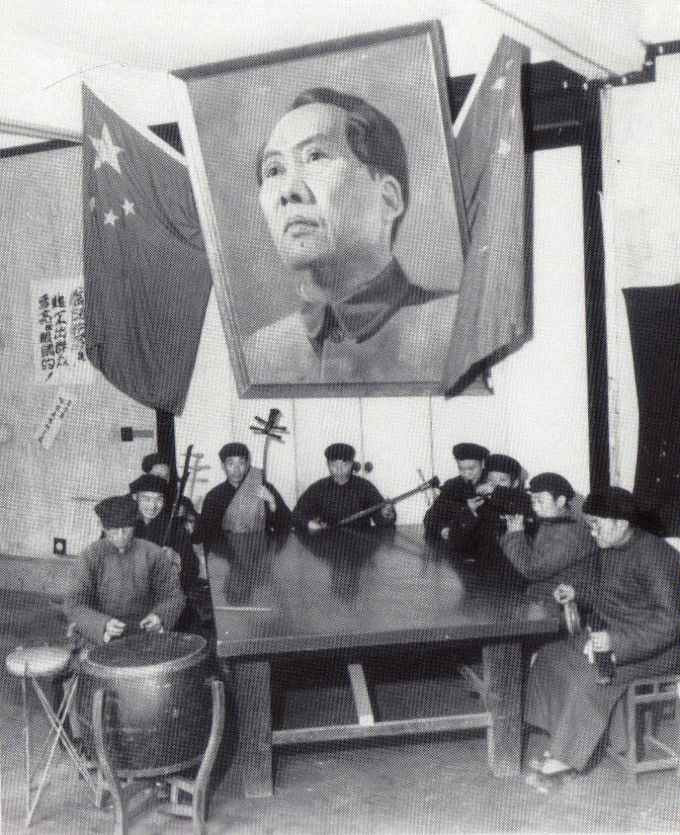
After the Japanese occupation in 1937, and through the troubled 1940s, not inclined to join the Communist base area in Yan’an, Yang moved from Nanjing to posts in Kunming and Chongqing, always continuing his research.

The Wuxi Daoists
Yang and his cousin Cao Anhe returned regularly to Wuxi, where they were engaged in a long-term project studying the music of the local Daoists. Of their two major books on the theme, their work on Shifan gu was first published in 1957, Yang’s on Shifan luogu not until 1980 (cf. the shifan of Tianjin and Hebei).

In some respects Yang seems like a traditional historical musicologist rather than an ethnographer; but he was well aware of complex social issues. This passage on the position of Daoists in Wuxi society illustrates his sophisticated interest in ethnography and ritual practice, besides his more traditional “musicological” concerns: [1]

In the past [?!], Buddhists in south Jiangsu divided into two types, Chan school (chanmen) and Auxiliary school (fumen).

Those of the Chan school were completely vegetarian, and didn’t have families. They only used percussion like woodblock, bowl, nao and bo cymbals, and tonggu drum to punctuate their vocal liturgy; they didn’t play any melodic instrumental pieces. They never took part in production, living in their temples, some of which had large estates.

The Auxiliary school ate meat and had families. Few in number, they lived scattered in the villages, taking part in agriculture and only reciting the scriptures and litanies as an auxiliary occupation. Among the Buddhists, they are the only ones who play the fanyin [melodic instrumental repertoire] and [separate] percussion items.

Among the Daoists, the Complete Perfection (Quanzhen) school (belonging to the Qingchengshan style of Sichuan) were similar to the Buddhist Chan school, not using separate percussion items or silk-and-bamboo instruments. Those who played the fanyin and separate percussion items mostly belonged to the Zhang Heavenly Masters school of Longhushan in Jiangxi.

Among the latter group, there was a further clear class distinction. A minority of abbots possessed ritual titles of the Zhang Heavenly Masters, like “Master who Guard the Way” (daoweishi) or “Ritual Master” (fashi), and mostly owned land. They didn’t take part in production. They interacted with landlords and the bourgeoisie in the cities and villages, taking ritual work and contacting and hiring the common village Daoists to take part in major rituals (daochang fashi).

These common Daoists mostly took part in agricultural production, being hired ad hoc: performing for rituals was an auxiliary occupation for them. In both agriculture and Daoism, they were an exploited class. These common Daoists—even the indispensable drummers and flute players, with their excellent musical technique—only got a tiny wage for a whole day’s work.

Conversely, the “Masters who Guard the Way” and “Ritual Masters”, having only taken responsibility for quite brief ritual segments of a few hours like Issuing the Talismans (fafu), Reporting the Memorial (zoubiao), and Flaming Mouth (yankou), claimed a reward many times higher than that of the others. Those who played music were mostly the common semi-peasant Daoists; very few of the “Masters who Guard the Way” and “Ritual Masters” could do so. This shows that in the past it was agricultural life that produced and developed music.

Never mind the diplomatic PC spin (for “reading between the lines”, see my article cited under Hunan below), Yang had already observed the important distinctions common to local ritual cultures all over China, long before the major projects on local Daoist ritual since the 1980s. [2]

sfg-50s

sflg-1950s

Shifan gu and Shifan luogu, c1962.

Nearby, the Daoist rituals of Suzhou were also thoroughly documented in an amazing 1956 project. Following such early work, major studies of the Daoist rituals of Suzhou, Wuxi, and Shanghai have been made since the 1990s. [3]

The Music Research Institute
After the 1949 “Liberation” Yang’s erudition was much needed. Managing to adapt to the new Communist regime, he was appointed director of the newly-formed National Music Research Institute of the Central Conservatory of Music (predecessor of the Music Research Institute [MRI] of the Chinese Academy of Arts), beginning a golden age for research there. Under his committed guidance they accumulated a large archive of field recordings and traditional notations.

A qin player himself, he was closely involved with all his eminent colleagues’ research on qin (see my series on The qin zither under Maoism, starting here).

The golden age of the MRI, 1954;
right to left Guan Pinghu, Yang Yinliu, Pu XuezhaiZha Fuxi, Li Yuanqing.
.

In due course the MRI was given a new building (typically, soon dilapidated) in Dongzhimenwai in the northeast of the city. Even in the 1980s, when it became my home base between field trips, its bare dingy corridors were animated by the spirits of the old masters. The new compound, further out in Huixinxijie, is less characterful.

yang-and-cao-best

Yang Yinliu and Cao Anhe at the MRI, 1961.

Both before and after Liberation, until the early 1960s, in collaboration with other fine scholars—notably his cousin and lifelong companion Cao Anhe (1905-2004)—Yang managed both to perform remarkable research on a range of living traditions and to compile major collections and transcriptions of traditional notation. Just as important was his monumental history, first in draft from 1944, covering with unique erudition the whole of Chinese music history, and elite as well as folk genres, albeit couched in the language of its time.

His most renowned recording—on another trip home to Wuxi in summer 1950—of pipa and erhu solos by the blind beggar Abing, is perhaps his least interesting. Abing was once among the Daoists whose company Yang kept in his youth, but the 1950 recording was a casual event, on a day off from working with the Daoists who were his main focus.

His work on the Zhihua temple followed on from his 1952 monograph (with Cao Anhe) of the “Songs for Winds” band from Ziwei village in Hebei during their 1950 visit to Tianjin—a band still active when Xue Yibing and I visited them from 1989. In summer 1953 Yang made an important visit to Xi’an to investigate the music (and scores) of local ritual groups; and he drew attention to the ritual music of Shanxi, notably the Buddhist mountains of Wutaishan—also later to become major scholarly themes in China. [4] With Cao Anhe and Jian Qihua he also took part in a project to transnotate a rare score of the “suite plucking” repertoire of old Beijing. For more evidence of his good taste, see here.

Hunan, 1956
Along with his historical research, Yang Yinliu did all kinds of fieldwork. Just as remarkable as his studies with the Wuxi Daoists was a major fieldwork trip he led to Hunan province in 1956, amidst escalating collectivisation. There Yang Yinliu headed a team documenting all kinds of ceremonial music-making, notably ritual and customary musics. Despite the politically correct language of the published volume, they seem to have taken what they found. The resulting “Report on a survey of the musics of Hunan” (Hunan yinyue pucha baogao, 1960) has 618 pages, besides separate mimeographs on Confucian and Buddhist ritual. I’ve written about it at greater length here.

This, the first general survey of all the genres of a given area, was an influential blueprint for later regional surveys from the 1980s, notably the Anthology of folk music of the Chinese peoples, on which see my

  • “Reading between the lines: reflections on the massive Anthology of folk music of the Chinese peoples”, Ethnomusicology 47.3 (2003), pp.287–337.

The energy of those times at the MRI, in the midst of increasing political control, was remarkable. Also wide-ranging was an early fieldtrip to Fujian for two and a half months in the winter of 1961–62, led by Li Quanmin, and published in 1963. [5]

In 1962 Yang Yinliu published a masterly overview of Chinese notation in his Gongchepu qianshuo 工尺谱浅说.

All this extraordinary work was carried out under the most taxing conditions. Worse was to come: academics and peasants alike, as representatives of the “Four Olds”, suffered grievously after the Four Cleanups campaigns began in 1963. In May 1965—after the end of the campaigns, when over thirty MRI employees had undergone Socialist Education in Chang’an county, Shaanxi—they celebrated their temporary freedom with a visit to Huashan:

Huashan 1965

In the row behind, fifth from left is the trusty Li Wenru (for whom, see here). Source: Yang Yinliu jinian wenji.

As the Cultural Revolution broke out, even in the Hebei village camp where Yang and others were sent for “re-education” he furtively continued research, including studies (along with Huang Xiangpeng, another distinguished colleague) of the 1972 excavation of the Han tombs at Mawangdui (see e.g. Micic, p.104). During this period Yang’s colleagues members of the elite qin fraternity were also given permission to continue their studies.

“How to assess religious music”
Within the confines of the day, Yang Yinliu paid just as much attention to “literati” and “religious” culture as to more popular genres (pace Joseph Lam). Indeed, Yang was perhaps predisposed to studying early music history; and it wasn’t so much post-Liberation ideology that drew him to popular living genres, but his own training in performance (Kunqu, Daoists and so on).

In the useful article

he discusses Yang’s own article “Ruhe duidai woguode zongjiao yinyue” 如何对待我国的宗教音乐 [How to treat religious music], Wenhui bao 1961.3 (also reproduced in the 2013 Yang Yinliu jinian wenji), written just as a very brief lull in extreme leftist policies followed the climb-down after the terrible famine.

Meanwhile scholars had been discussing the classification of genres; their framework was enshrined in the 1964 Minzu yinyue gailun [Survey of Chinese music]. Despite the separate and subsidiary place of “religious music”, they were aware that ritual practice pervaded all genres of rural performance. Indeed, Yang seems to have been the first to use the term “ritual music” (yishi yinyue ) in China. [1] From 1959 he also spent many years revising his masterwork Zhongguo gudai yinyue shi gao [Draft history of Chinese music], which was finally published in 1981. Covering literati, palace, folk, and religious traditions required him to take great care over how to couch his language.

So in his 1961 article he was subtly, and boldly, justifying the very need to study ritual traditions, using the language of class struggle while attempting to refine it. It will hardly satisfy modern anthropologists of religion; indeed, it makes a rather severe test of our ability to interpret writings of the time. Of course, in the 1950s the tenets of ethnomusicology were still far from common even in the West. Yang’s use of language shows the hoops that scholars had to jump through in order to get on with documenting the diverse genres.

After the downfall of the Gang of Four in 1976 and the demise of the commune system, Yang Yinliu finally saw his great history formally published, and cultural and academic life restored. Though he lived long enough to witness the revival of tradition, he could hardly have imagined how widespread it would become, and how important the study of ritual and its soundscape was to be. How he would have delighted in the renewed energy of the Anthology and later fieldwork projects! His interests may have been more directed towards the “salvage” of genres common in his own youth and throughout imperial history, but I think he would have understood the value of documenting their fortunes since Liberation, even if that was still to remain a sensitive subject.

YYL CDs

The Protestant hymns of Yang Yinliu
Unlike Bartók, Yang wasn’t also a composer. Except

As a coda to this little tribute, the 2-CD set from Wind Records ends with a touching hymn that Yang wrote in 1934, a simple harmonization of the qin piece Yangguan sandie:

I was most moved to hear the Beijing Protestant Church Choir sing it at a memorial concert for Yang in November 1999. His Christian background has long been recognized, but only with the liberalizations since his death did it become possible in China to admit, sotto voce, that he remained a Christian all his life. This makes his hymns all the more moving, especially bearing in mind all the silent tribulations since the 1940s of Chinese Christians, along with artists, intellectuals, and peasants.

* * *

Along with my Chinese friends, some of whom were his pupils, I can’t help feeling a deep nostalgia for the golden days of the MRI. Yang Yinliu’s combination of encyclopedic knowledge and musicianship are likely to remain unmatched. If only my other great mentor, Laurence Picken, had been able to confer with him!

Like many ethnomusicologists, I no longer want to be limited by the narrow association with “music”, but while Yang Yinliu’s writings are wide-ranging as well as profound, his focus on “music” was also admirable.

Finally, two suitable quotes from a junior colleague of Yang and a pupil, who were also to become my mentors:

Yang Yinliu was a large tree full of lush leaves and branches reaching high into the sky. I can only caress each branch and leaf with my hands.Yang was a bridge between the ancient and the modern, Chinese and foreign. I’m still walking along that bridge that Yang built.   —Huang Xiangpeng [6]

Through him, Chinese music history was freed from the shackles of the text, allowing the music and the musicians to take centre stage.   —Qiao Jianzhong

hxp-qjz

With two distinguished successors of Yang Yinliu at the MRI, 1989: Huang Xiangpeng (left) and Qiao Jianzhong.

Alas, I arrived in Beijing in 1986 a couple of years too late to pay homage to Yang Yinliu in person. But his spirit animates us all.

See also An anthology of Chinese fieldwork reports.

Selected resources

  • Zhongguo gudai yinyue shi gao [Draft history of ancient Chinese music] (Beijing, 1981)
  • Yang Yinliu yinyue lunwen xuanji [Selected articles by Yang Yinliu on music] (Shanghai, 1986)
  • Qiao Jianzhong and Mao Jizeng, eds.: Zhongguo yinyuexue yidai zongshi Yang Yinliu (jinian ji) [Yang Yinliu, master of Chinese musicology, commemorative collection] (Taipei, 1992)
  • Chuancheng: Yang Yinliu bainian danchen jinian zhuanji/Heritage: in memory of a Chinese music master Yang Yinliu (2-CD set, Wind Records, 2000) [with detailed booklet]
  • Yang Yinliu quanji [Complete works of Yang Yinliu] (13 vols, Jiangsu wenyi chubanshe, 2009)
  • Yang Yinliu jinian wenji [Collected articles commemorating Yang Yinliu] (Beijing, 2013)
  • Han Kuo-huang, “Three Chinese musicologists: Yang Yinliu, Yin Falu, Li Chunyi”, Ethnomusicology 24.3 (1980), pp.483–529
  • Stephen Jones, “Yang Yinliu”, in The new Grove dictionary of music and musicians (2001)
  • Peter Micic, “Gathering a nation’s music: a life of Yang Yinliu”, in Lives in Chinese music, ed. Helen Rees (University of Illinois Press, 2009), pp.91–116. Note also references.

[1] Sunan chuidaqu, 1957 edition, pp.11–12. This passage was cut from the 1982 edition. There may be a story to tell here: perhaps such material was still more sensitive when they revised the text around 1980 than it had been even in 1957.

[2] See also Meng Fanyu 孟凡玉, “Lun Yang Yinliude yishi yinyue yanjiu” 论杨荫浏的仪式音乐研究, Yinyue yishu 2017.6.

[3] For a simple introduction to the musical and ritual culture of south Jiangsu, see my Folk music of China, pp.246–8.

[4] Ibid., pp.195–202 and 213–45.

[5] Cf. ibid. pp.286–321.

[6] Cited in Peter Micic, “Gathering a nation’s music”, pp.105–106. For Huang Xiangpeng, see e.g. Micic’s article “Value is proven in the fire”; Huang Xiangpeng jinian wenji 黄翔鹏纪念文集 (2018); Zhang Zhentao 张振涛, “Yinyuexuejia Huang Xiangpeng he tade yishu rensheng”” 音乐学家黄翔鹏和他的学术人生.

.

Reading Chinese: a caveat

Not unlike the order of spoken binomes, temple placards can be confusing to read. Written horizontally, they usually read from right to left; but sometimes, as when an emperor bestows a placard on a temple, they may read from left to right. This can even be an issue in reading secular slogans, which now almost always read from left to right.

Among the numerous stories of Tian Qing, eminent pundit of the Intangible Cultural Heritage, this is one of few that I dare publish…

A distinguished elderly Buddhist monk from mainland China was visiting Taiwan. Above a little restaurant opposite the temple that was hosting him, he was alarmed to see a sign:

heshang

EAT A YOUNG MONK

It took him a while to work out that hopefully it might read in the other direction:

尚和小吃

SNACKS OF ESTEEMED HARMONY

For another fine instance, see here. For more Chinese character-play, see under the Chinese jokes tag—this one is particularly charming. OK then, here’s another story from Tian Qing—again on a Buddhist theme.