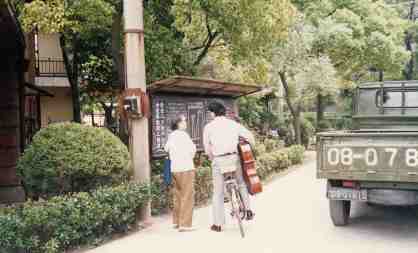
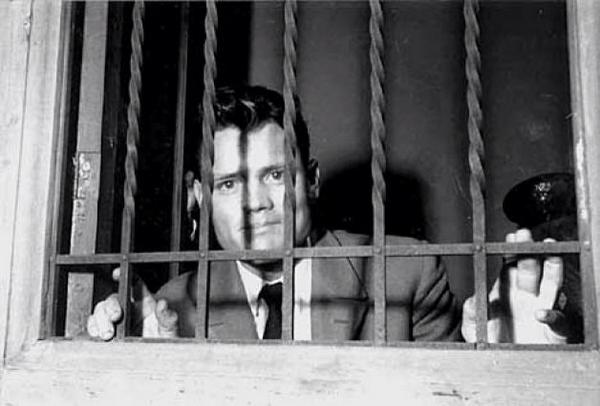
Bruce Jackson on fieldwork

Right: Bruce Jackson with Diane Christian.

Among all the numerous tomes on fieldwork (and numerous posts under said category), I keep recommending

(e.g. here, and recently in this post on Doing fieldwork in China), so I thought I should re-read it, and give a little introduction. Purely incidentally, I’m very keen on one-word titles—for a less succinct citation, see here, under Jarring.

Part One: Human matters opens with a chapter on ways of doing fieldwork. He wonders:

What did Alan A. Lomax do when his informants sang songs he didn’t like? What did he say and do when they interspersed in their folksy repertoires songs they learned from the radio or the jukebox?

To be fair, fieldworkers do now tend, consciously, to include such material. But folklorists, unlike scientists, rarely report on their failed experiments—Jackson cites Charles Keil on the Tiv; we might add Nigel Barley in Cameroon, and even my 2018 trip in search of Chinese village temples. As Jackson was writing, the literature also rarely betrayed personal opinions of the fieldworker. While noting exceptions like James Agee’s Let us now praise famous men, Jackson cites John M. Johnson:

It is impossible to review the literature about methods in the social sciences without reaching the conclusion that “having feelings” is like an incest taboo in sociological research.

Again, more recent work has partially rectified this tendency (e.g. Kulick and Willson, eds, Taboo: sex, identity and erotic subjectivity in anthropological fieldwork, or Barz and Cooley eds, Shadows in the field, or indeed Barley). By the way, I also like Barley’s comment on how fieldwork enables one to assess the monographs of others:

Henceforth […] I would be able to feel which passages were deliberately vague, evasive, forced, where data were inadequate or irrelevant in a way that had been impossible before Dowayoland.

Jackson takes us through the various conceptual and mechanical stages of planning. As to the work of collecting “in the field”, he notes the move from acquiring disembodied texts towards documenting their whole social context. In his early days he collected variants of the song “John Henry” as if they had some kind of autonomous existence, but he soon became wary of lofty context-free academic discourses on “meaning”. He gives a nice list of questions, that would be useful for collectors of Chinese folk-song:

  • Where and when and from whom did you get that song?
  • Did you change it? If so, how?
  • Are there other versions you like less or more? What and whose are they and why do you feel the way you do about them?
  • What’s the song about?
  • What else is it about?
  • What do you think about that story?
  • Do you think about that story?
  • When would you sing it?
  • When do you sing it now?
  • If you don’t perform the song, do you know it? If you know it, why don’t you perform it?

He cites worthy early advocates of such an approach, from Ben Botkin (1938) to Peter Bartis (1979) and the archaeologist William Sturtevant (1977), noting the difference between formal interviews and informal observation:

You can often learn more from what happens to be said and done in your presence than you can from what’s said and done in response to your questions or requests.

Still more succinctly, he summarises:

What sorts of things do people do? What sort of sense do they make do the people doing them?

Discussing salvage folklore, he reflects wisely on the age-old sense of urgency about “rescuing” traditions:

It’s always too late to capture such things. Aspects of culture being changed can never be seen by the visitor for or as what they were. We can learn things of value by trying to discover what’s been lost, but the knowledge is never more than partial—exactly as all historical enquiries can never give us knowledge that is more than partial. The world of our forebears will never be ours. […]
Salvage folkore can be valuable, but only if the collector understands the place the information collected plays in the lives of the people supplying the information.

He goes on:

The heart of the salvage folklore operation is to rescue from oblivion some art or artefact or piece of knowledge. That’s a perfectly legitimate reason for doing fieldwork: those songs or stories or legends or folkways or folk arts are part of our heritage, part of what makes our world what it’s become, and they should be preserved for exactly the same reasons works of literature or sculpture or letters of prominent persons or old city maps should be preserved. Knowing such facts helps us understand cultural adaptation and change. The reason few folklorists do salvage folklore nowadays isn’t because they’ve all decided such preservation is useless; rather it’s because the definitions of folklore and the folk process have expanded in ways that permit folkorists to deal with modern life and with traditions, processes, and styles that are very much alive.

By now the ideology of salvage may have been widely downgraded, but it remains common in China today, both among Chinese and foreign scholars: such issues of context hardly feature in the accounts of scholars in search of Daoist ritual manuals or seeking to record “ancient music”.

Jackson discusses the multiple ways of finding “informants” (a term to which he resigns himself more readily than I do). Indeed, in China I’ve noted that rather than making platitudinous visits to the county Bureau of Culture, more useful sources of local information might come from chatting with the boss of a funeral shop, or stopping to chat to an old melon-seller by the roadside. For the broad range of my own mentors in Yanggao, click here.

Jackson reflects on more and less successful field trips. He reminds us that the “facts” of our data collection, and indeed the way we use the mechanical equipment we bring to the field, are subjective.
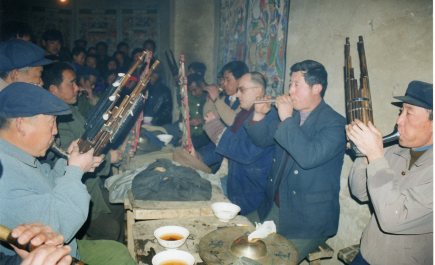
MYL played

I take part in the New Year’s rituals on yunluo gong-frame, Gaoluo 1998.

In Part Two: Doing it, Johnson clarifies the notion of “participant observation” (which again is less common among Chinese fieldworkers):

Participant observation means you’re somehow involved in the events going on, you’re inside them. You might, like Bruce Nickerson (1983), study factory work by taking a job in a factory; or, like William Foot Whyte (1943), you might take up residence within the community you want to study. You might go drinking or fishing or picnicking or campaigning with the people whose folklore concerns you.

He notes the ethical questions that this poses:

Each variation of the participant-observer role requires some measure of trust—in exchange for which the fieldworker has responsibilities more complex than those of the complete outsider.

More recently Sudhir Venkatesh‘s work with Chicago street gangs provides a particularly troubling instance of the dilemma. Jackson cites Edgerton and Langness (1974):

Complete involvement is incompatible with the anthropologist’s primary goals, but complete detachment is incompatible with fieldwork. Successful fieldwork requires a balance between the two, a balancing act which is every bit as difficult as it sounds.

He notes that with folklorists now working more often in industrial societies than among those whose life cycle is based on the agricultural calendar, they are more flexible in options than anthropologists, and more ranging in concern than oral historians. For China, while a year-long stay is routine among Western-trained anthropologists such as Liu Xin or Adam Yuet Chau, scholars more commonly make shorter visits over a long period.

Fieldworkers are always working in contexts of their own devising, whether as hidden observers or asking individuals to perform. There is […] nothing wrong with this, so long as the fieldworker understands the nature of the devised context, knows how it limits the information provided and how it infuences the behaviours of the informants. Fieldworkers deal with real people in real situations, and they must, therefore, understand the ways their presence influences what’s going on. They must be sensitive to the kinds of relationships they develop with the people who may agree to perform for them, and they must understand that the rhetorical form called “the interview” is different from ordinary discourse in critical ways.

Gaoluo: left, my famous haircut, 1993;
right, maestro Cai An introduces Wu Fan to the wonders of singing the gongche notation in preparation to realize it on the shengguan ensemble, 2003.

This leads to Chapter 6, where Jackson discusses the crucial issue of rapport. Mentioning “stranger value”, he discusses “why people talk to you”, and the pros and cons of payment. He recommends Jean Malaurie’s The last kings of Thule, and cites Charles Keil’s Tiv song; he tells stories about working with Pete Seeger at a black convict prison in Texas in 1966 (see below), and later at an Arkansas prison; and he tells how his mother defused a threatening incident while working as a nurse in a mental hospital. At a tangent, you may enjoy this post on my own run-ins with the local constabulary in China.

In Chapters 7 and 8 he discusses interviewing and ordinary talk in turn.

Having a conversation about a part of life and interviewing someone about a part of life are not the same kinds of event; they’re not even the same kinds of discourse. […]
The best interviewers somehow make the difference between conversation and interview as unobtrusive as possible.

We all adapt constantly, “code-switching” naturally:

I automatically adopt different styles and levels of discourse when talking to one of my classes, to a police officer who insists I was exceeding the speed limit, to an auditorium full of strangers, to my family at home, to my mother, to someon who owes me money, to someone I owe money. You do the same thing. None of these styles is necessarily dishonest or phony; most of them are what seems appropriate for the situations in which they emerge.

Listening to tapes of his interviews Jackson learns that he talks too much. And he finds that one can’t always record everything on tape: sometime it may interfere with the occasion.

Have a good time. Tell yourself to remember as much as you can and be sure to take notes later. Sometimes it’s okay just to be a person.

He describes his experiences in compiling A thief’s primer (1969), based on interviews, and chats, with a Texan check-forger and safecracker called Sam, as well as his search for supporting material from others.

More useful advice:

Many times slight rephrasing of a question puts it in a form that demands a discussion rather than a word. Instead of “Did you like what he said” ask “What did you think about what he said?” Instead of “Did you always want to be a potter?” ask “How did you become a potter?”Instead of “Have you heard other versions of this song? ask “What other versions of this song have you heard?” […] Putting the question in a way that elicits discussion rather than a single word gives the subject a chance to talk, and it indicates that you value the response. […]
Part of the task is being sensitive to the rhythms of utterance. Native New Yorkers, for example, rarely have notable pauses in their conversations; when pauses occur, other speakers usually leap in. Native Americans frequently have pauses; leaping in is rude. […]
Often the most interesting responses are produced by follow-up questions—questions you ask after you get the first answer. The follow-up question interrogates the response itself; someone tells you what was done, the follow-up asks why it was done, or why it was done that way, or when and how often and by whom it was done; someone tells a story, the follow-up asks what the teller thinks the story was about, and whether the teller believes it, and whether the teller heard it any other time.

Moving on to “ordinary talk”, Jackson notes the usefulness of listening to people talking among themselves.

The lengthy Part Three: Mechanical matters largely concerns technical guidance on the equipment that one takes to the field, and the production of related outputs. Though, strangely, this was Jackson’s main original purpose in writing the book, such advice (also a regular feature of ethnomusicological handbooks) is inevitably ephemeral. Still, this section is interspersed with useful, more enduring comments on our own role and interaction with our subjects.

These insights feature prominently in the opening chapter, “Minds and machines” . Here he first ponders “what machines do for you and to you”. He recommends a sharp eye and a good memory, along with pen and paper. As he notes, the latter are unsatisfactory for interviews, detracting from engaging fully with one’s subject. But using recording equipment has similar flaws, such as “field amnesia”. Jackson discusses teamwork and division of labour, noting that the fewer outsiders intrude, the better.

My fieldwork colleague Xue Yibing chats with an elderly former Daoist in an old-people’s home, and with a young ritual recruit, early 1990s.

Even I began to take Jackson’s points on board with my work on Gaoluo village, and later on the Li family Daoists. In Gaoluo I worked with one, sometimes two, Chinese colleagues, with them taking notes affably while I thought of irritating etic questions and distributed cigarettes (the latter deserving a major chapter in any fieldwork guide to China). By contrast, with the Li family Daoists since 2011 I’ve mostly managed on my own. Jackson suggests taking only as much equipment as you really need. Given that I rarely care to make audio recordings of my chats, I’ve had to develop a way of maintaining engagement while taking notes; sometimes while engaging fully, with my notebook to one side, I sheepishly go, “Hang on a mo, I gotta get this down!”

53 GN and WM amused cropped

Relaxing in the scripture hall between rituals, Daoists Golden Noble and Wu Mei amused by my notebook. I know I use this photo a lot (e.g. here), but I really like it!

In detailed chapters (much of whose fine technical detail has inevitably become obsolete), Jackson then discusses recording sound, microphones, photography, and video (useful tips here). He notes the different purpose of such work (as art, and as diary), as well as the subjectivity of the eye and ear. In Chapter 15 “Records” he discusses the work of documenting one’s material in logs—along with fieldnotes, an important supplement to fragile memory.

Part Four: Ethics, consists of the chapter “Being fair”—“the most important thing of all”. Jackson covers the role of the fieldworker both in the field and later, publication in various formats, and the thorny issue of ownership, rights, and payment, much discussed since, as “communal ownership” of folklore material came to be questioned. He cites the case of the Lomaxes’ recordings of Lead Belly—who was among the first convicts they recorded in Louisiana State Penitentiary in 1933, long before Alan Lomax went on to work with Jackson.
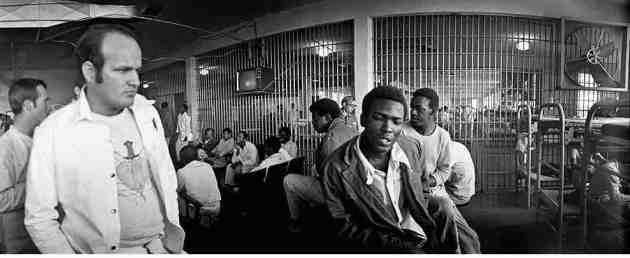
Cummins

Inside the wire: Cummins, Arkansas.

In the Appendix on Death Row Jackson ponders issues surrounding his major work with Diane Christian in prisons in Texas and Arkansas. Here’s a trailer for the 1979 documentary Death Row (1979):

Jackson explains his initial fear of being voyeuristic, and the complex issues of gaining a degree of trust.

Some men talked because they wanted people to know what the place was like. Some talked because we gave them a chance to vent their grievances against the criminal justice system or the prison administration or other inmates of the row. Some talked because they thought the film might do some real good.

And he quotes Rosalie Wax:

It would be gross self-deception not to admit that many informants talked to me because there was nothing more interesting to do.

As he observes, there is no such thing as a neutral observer. And

all reconstructive discourse—a statement by a murdere waiting in a tiny cell in Texas, the autobiography of Henry Kissinger, the letter of a lover to a lover who is presently angry—is craft.

Following Jackson’s book Wake up dead man (1972), here’s an excerpt from his 1994 CD of recordings of Texas convict worksongs:

And this site has useful links to his work with the Seegers at Huntsville prison in 1966. In Chapter 6 he tells how Pete Seeger overruled Jackson’s doubts about the value of him playing for the inmates, resulting in “one of the best concerts I ever heard or saw”—and substantial gains in trust. I pause to reflect how hard is to imagine a similar fieldwork project for Chinese or Russian prisons. Meanwhile Johnny Cash was also finding how popular his prison concerts were.

* * *

While music plays a quite minor part in Jackson’s book, he came to folklore through an early interest in folk-song. Among the tasks that George List gave him in the Archive of Folk and Primitive [sic] Music at Indiana University was preparing the master tape for the 1964 Folkways LP of Caspar Cronk’s recordings in Nepal—mainly of Tibetan songs.

* * *

Many of Jackson’s approaches have since become standard; some of his comments might seem obvious, but they’re always right on the nail. And as with Bruno Nettl, it’s his engaging style that appeals to me; just as he stresses human rapport in fieldwork, he seeks to communicate in his style of writing—not always an academic priority, to put it mildly. The reader can tell that he really cares about both the work and the people he consults, and that he finds such projects important and inspiring.

Heartland excursions

Ethnomusicology at home

Heartland

Following the recent loss of the great Bruno Nettl, I’ve been revisiting another of his stimulating books,

  • Heartland excursions: ethnomusicological reflections on schools of music (1995).

It’s thanks to works like this that we can now understand WAM within the context of musicking in societies throughout the world. Such “ethnography at home” belongs with a corpus of studies like those of Ruth Finnegan, Christopher Small, Henry Kingsbury, and more recently Stephen Cottrell.

Nettl opens his Introduction thus:

Let me be quite personal. What is it about ethnomusicology that has fascinated me for over some four decades? At first, it was the opportunity of looking at something quite strange, of hearing totally unexpected musical sounds and experiencing thoroughly unfamiliar ideas about music. Later, to learn to look at any of the world’s cultures, and listen to any of the musics, without being judgmental. And further on, the notion that one should find ways of comprehending an entire musical culture, identifying its central paradigms, and finding points of entry, or perhaps handles, for grasping a culture or capturing a music. And eventually, having also practiced the outsider’s view, to look also at the familiar as if it were not, at one’s own culture as if one were a foreigner to it.

He shows that while this idea was taking root in ethnomusicology by the 1980s, scholars native to the traditions they researched (Africans, Indians, Native Americans, Indonesians, and so on—and Chinese, of course) had been studying the musics of their own “cultural backyards” all along; as indeed had those studying urban minority cultures in North America and Europe, including popular genres.

Listing some major contributors to the field, Nettl explains his description of WAM as “the last bastion of unstudied musical culture”: ethnomusicologists

try to understand the musical culture through a microcosm, to provide an even-handed approach without judgment, to look as well as possible at the familiar as if one were an outsider, to see the world of music as a component of culture in the anthropological sense of that word, and to view their own music from a world perspective.

Here his main subject is his own musical “home”: schools of music in universities in the Midwest (rather than the world of professional WAM performance, for which see Small, Cottrell, and so on). He makes suggestive comparisons with other musical cultures, notably those of the Blackfoot, Tehran, and Madras.

Always seeking to elicit structures, he comments

A wonderful musical system may not mean a wonderful cultural system, only the desire for one; a musical system with sharp social distinctions may reflect a social system, or it may only remind us that the social system contains the seeds of inequality.

He ends the Introduction by explaining that his purpose is not (quite?) to criticise—reminding me of Small’s ambivalence and the doubts of his reviewers:

Although I may discuss Western classical music—and the subculture that practices and teaches it in one of its 20th-century venues—with a raised forefinger, or with tongue in cheek, or with wrinkled nose, and maybe even with a note of cynicism or sarcasm, and although I think it may reflect the cultural structure of a sometimes mean and unkind society, I nevertheless cannot imagine life without it.

RCMThe Royal College of Music, London.

In Chapter 1 Nettl views the music school as “something like a religious system or a social system in which both the living and the dead participate” (cf. Aboriginal culture), viewing it as “a society ruled by deities with sacred texts, rituals, ceremonial numbers, and a priesthood”. He introduces the extraterrestrial ethnomusicologist from Mars, who

arrives at the mid-western school of music and begins work by listening to conversations, reading concert programs, and eavesdropping at rehearsals, lessons, and performances. The E.T. is overwhelmed by hearing a huge number of names of persons, but eventually it realizes that many of these persons are alive, but many are no longer living and yet the rhetoric treats them similarly. […]
The E.T. soon finds that many kinds of figures populate the school: students, teachers, administrators, members of audiences, musicians who are not present but are known, and a large number of musicians who are not living but are treated as friends in conversation. Among these are a few who seem to be dominant figures in the school. They constitute pantheon, the composers about whom one rarely if ever hears a critical word. Two seem to get more (well, just a tiny bit more) attention than the rest: their names are Mozart and Beethoven, and they appear to have the roles of chief deities.

He discusses

the Mozart and Beethoven of the present, as they are perceived by music lovers today, as living figures in today’s musical culture. My purpose is not, however, to participate in the now widely respected study of reception history, but to characterize contemporary art music culture.

Going on to describe pantheons and canons. By way of the dream songs of the Blackfoot, Nettl discusses acts of creation, and the identity of the quasi-sacred composer. The “great works” of the WAM canon are akin to religious scriptures, served by a priesthood of performers and musicologists.

The Concertgebouw, Amsterdam; right, Mahler.

He discusses the significance of the names of the great composers engraved on concert halls and music schools, making the analogy with bumper stickers and T-shirts. What is the purpose here? Such buildings are like shrines where we should pay homage.

Despite the apparent claim to eternity, tastes change: as with other league tables, composers can be promoted or demoted over time. This can be entertaining; to Nettl’s instances from the USA, we might add the list of names at the Concertgebouw, where

around the balcony and ceiling of each are inscribed the names of the great composers, perceived from an earlier Dutch perspective: Wagenaar beside Tchaikovsky, Dopper next to Debussy, and Rontgen alongside Richard Strauss, while in the small hall Rubinstein and Hiller rub shoulders with Mozart and Beethoven.

Suggesting that the Mozart–Beethoven axis reflects the dualism of modern Western thought (genius and labour, light and heavy, Zeus and Prometheus), he notes that as in other pantheons, lesser deities have their distinct personalities too.

As in The study of ethnomusicology, Nettl explores the nature and role of genius. He discusses myths central to cultures, from the supernatural beaver of the Blackfoot to those of Mozart and Beethoven. He explores the notion of greatness—large orchestral performances of great works by great composers; and costume (“tuxedos, blazers, turtlenecks, robes, dhotis, Elizabethan garb, T-shirts with holes, leather jackets”) as an indicator of musical hierarchies:

Uniform accomplishes the depersonalization of the individual, giving the orchestra a faceless quality that is exacerbated by requirements of such uniform behaviour as bowing. […] Your uniform tells people what you do, and musical uniforms tell what kind of music musicians “do”.

He is alert to gender:

It is indicative of gender roles in American society that these uniforms derive principally from men’s dress, that there is less difference among their various female versions, and that women sometimes simply use the men’s versions of uniforms.

and always takes a broad view:

The tendency of musicians in Western culture to wear clothes different from their everyday attire contrasts with the custom of Plains Indian powwow singers, who wear precisely and determinedly what they might wear at other times—jeans, T-shirts, and farmers’ caps—despite the clearly special nature of musical performance. Perhaps they do so because virtually all others present—the dancers—are in costume, and the singers wish to separate themselves from them.

The symphony orchestra may be seen as a metaphor of industrial factory, political organisation, and colonial empire. The concert master is “a kind of factory foreman keeping things in shape for the management”, while the conductor, with a “baton” of military origin, is the general:

he gets credits for victories, is listed on the album cover, takes bows, but is not heard and so risks little. […] The occupants of the first chairs are officers who have a certain amount of authority over their troops, whose main task is to march—that is, bow and finger—in unison, mainly for the appearance of discipline. There is little democratic discussion. […] Conductors are often permitted or even expected to be eccentric; sport long hair, strange dress, and a foreign accent; and lead a strange life.

He enjoys reiterating the metaphor:

If the orchestra is a kind of factory or plantation for producing great music or an army for exhibiting perfection on the parade ground, it is principally in the service of the great masters.

Nettl unpacks the major role of notation in the culture, and the strange notion of “reading” music:

Having perhaps forgotten that they learned their first songs by hearing them, many of the denizens cannot conceive of a musical culture that does not use notation, and until recently my colleagues were inclined to marvel at my account of Indian musicians’ improvising interestingly for an hour, or Blackfoot Indians’ maintaining a repertory of hundreds of songs, keeping them separate and knowing which go where in rituals, without any visual mnemonics.

Notation is a meta-language:

Various musicians can communicate with each other and play in the same orchestra, even when they do not share a language. It is also a separating device in the sense that it enables individual musicians in orchestras or bands to play their parts without knowing what sounds will emerge or how the entire work sounds.

He wonders what it is that is transmitted:

We should ascertain whether a performer is required to play a piece exactly as he or she learns it, whether changes are permitted, whether there are interpretive choices, or even whether there is the requirement that a piece be altered every time it is rendered. The cultures of the world vary greatly in their answers to these questions.

He discusses the changing structures of concert programming, again comparing other cultures:

In a concert of the classical music of South India, the multi-sectioned improvised number called ragam-tanam-pallavi begins just after the midpoint, although there is actually no intermission. In Persian classical music, the conceptually central and most prestigious section, the improvised Āvāz, appears in the very centre of the full-blown performance.

He ends the chapter provocatively:

In this system of Western culture that produces wonderful music, what are the principles and values that are expressed and that underlie it? Here are intriguing concepts such as genius, discipline, efficiency, the hierarchical pyramid of musics and composers, the musician as stranger and outsider, the wonders of complexity, the stimulus of innovation, and music as a great thing with metaphorical extensions. But we are also forced to suggest dictatorship, conformity, a rigid class structure, overspecialization, and a love of mere bigness are all explicitly or by implication extolled. One may counter that the analysis is faulty, that instead of conformity there is cooperation, instead of authoritarians there are leaders. Or argue that the kind of social structure described, for all its undesirable aspects, is essential for the proper performance of music by the great masters, that in order for music of such an incredibly elite character as that of Mozart’s or Beethoven’s to be created and performed one must simply sacrifice independence and personal opinion, must undertake an incredible amount of discipline and accept dictates of an elite wherever they lead.

But Nettl never downplays the role of hierarchies in other traditions. He opens Chapter 2 by observing the competitive, even conflicting distinctions among performers in south Indian music, where caste, professional status, and gender play major roles. He then explores the opposing forces of our schools of music (teachers, students, administrators; performers and academics; singers, string players, wind players; conductors and conducted), reflecting the hierarchies, the “corporate ladders”, in American society. As ever he offers parallels: the progression by age of singing and playing didjeridu in Aboriginal societies, Persian radif, and south India again. He elaborates on the industrial model, with its customers (students and audiences) and products; and he discusses classes of musicianship, and competing central and peripheral roles. On the tension between music educationists and musicologists, he observes:

Performers see musicologists as a kind of police, imposing music history requirements on their students, making them take entrance examinations, and otherwise forcing them to jump through hoops of (they think) an essentially irrelevant defence of an obscure and ephemeral canon. They may see little need for their students to know about medieval and Renaissance music, or about the music of India and China.

Still more revealing is the division between singers and instrumentalists. Again he highlights gender, noting that in other societies (and indeed in our own popular music and jazz) women sing more commonly than playing instruments. Of course, in line with broader social changes over recent decades, women have come to play an increasing role in orchestras and as conductors. Nettl unpacks cultural stereotypes:

Men are traditionally thought in this society to be better at handling tools (e.g., instruments) and better at solving intellectual problems, whereas women are “closer to nature” and more “emotional”.

Such distinctions are to some extent submerged beneath the wider struggles between the music school and the rest of the university, the arts versus the sciences, and art music versus pop and rock.

He observes a further distinction between “bowing and blowing”, with string players generally more esteemed than wind players, mainly due to their greater place in the canon. And he notes the major role of the piano.

The maintenance of the stock of pianos is one of the major financial—and ideological—commitments of the school.

By way of a discussion of the importance of heritage (like Indian gharanas), adducing pedagogical lineages such as those of Theodor Leschetisky, Leopold Auer, and Ivan Galamian, he moves onto the various types of ensembles within the school. The role of the conductor (another godlike persona, further elevated in the professional world) is discussed at greater length in Small’s Musicking.and Norman Lebrecht, The maestro myth.

If the music school might seem a potential meeting-place for all musics, in Chapter 3 Nettl’s ethnomusicologist from Mars quickly notes that not even the various genres of WAM are treated on equal terms, and when other types of music are considered at all, it is only on special terms; indeed, in some ways

The music school functions almost as an institution for the suppression of certain musics.

This is worth noting, though it’s no great surprise: other musical institutions around the world (families in Rajasthan or Andalucia, and so on) also naturally privilege their own traditions; outside music too, other Western institutions have long been selective about including popular genres. Nettl likens such policing of choices to “purification rituals”. He suggests the model of concentric circles to evoke the taxonomy and relative value of musics at the school, with the canon at its centre; as in the world’s cultures at large, genres converge and collide. Again, he outlines the changing modern history of the school of music, with early and contemporary musics gaining a certain ground, as well as jazz, folk, and world music, noting degrees of bimusicality and polymusicality, as is routine outside the elite institution.

A Blackfoot man whom I knew claimed to have two musics central to his life—the intertribal powwow repertory of Plains Indian culture and the country and western music that he plays in a small band in a bar. He was also trying to learn, but slowly, some older and explicitly Blackfoot ceremonial music. He played trumpet in high school band and learned the typical repertory of such institutions (marches and some concert band music), he goes to a Methodist church and can sing several hymns from memory, and—a person of some curiosity—he has seen two opera or musical comedy productions at a nearby college.

Many institutions, however (his list includes the Met, the First Lutheran Church, groups in Tehran and Madras, and some radio stations), are mainly unimusical.

In North American society he finds a certain potential mediation between styles in the form of concerts, record stores, the film industry, and even the music school. He unpacks the various kinds of music presented in concert—quite diverse, yet still only rarely encompassing rock and Country.

The similarity of the concentric circle structure to a colonial system is suggestive. Musics outside the central repertory may enter the hallowed space by way of a servants’ entrance: classes in musicology. They may be accepted (performed) as long as they behave like the central repertory (performed in concerts with traditional structure) but remain separate (no sitar or electronic music in an orchestral and quartet concert). It is difficult to avoid a comparison with the colonialist who expects the colonized native to behave like himself (take up Christianity and give up having two wives) but at the same time to keep his distance (avoid intermarrying with the colonialist population).

He reminds us that each society has its own music history:

Nowhere is music simply “what happened”; it is always interpreted in ways that are determined by, and support, fundamental values and principles of culture. Even where societies have little information about their own musical past, they still have ideas and beliefs of what happened based on myth, folklore, and oral tradition; they also have some idea of how music history “works”, about its mechanisms of change and continuity.

While many cultures emphasize that their music is ancient, a pure expression of the culture, distinct from—and even superior to—the music of other societies, this notion is particularly central to WAM. Nettl ponders the “specialness” of Western music history (cf. Is Western Art Music superior?).

Other societies also insist on the uniqueness of their own music, but they usually do not suggest that it ought to be adopted by all other cultures. Western musicians, like the Western politicians of yore, impose their music on the rest of the world. Western society regards its [art?—SJ] culture as different from the rest, not only in degree but also in kind, and reflects this in its attitude towards music.

Nettl notes the contrasting stresses in WAM between the values of the old and the demand for innovation. In the potential meeting of musics he finds convergences and collisions, encouraged or inhibited by the preservation of purity, specialised audiences, and among the “peripheral” ensembles, the privileging of those that seem to reflect the values of the central canon.

He broaches the widely-used metaphors of the melting-pot and mosaic (and the bazaar is another one). Within the central repertoire the meeting of musics is blunted, while genres outside it—which are often unsuitable to concerts, for a start—are approximated to its ethos: the (modern) concert format rules. Mediation is limited: the peripheral genres are “permitted to maintain a modest spot in the institution if they bow to the values of the centre”. Again, all this may seem unremarkable, a common feature of musical groups around the world.

In Chapter 4, mustering his usual cross-cultural comparisons, Nettl further explores the school’s repertoire, with its central canon. But he begins with more Martian contextualising, considering the obligatory songs of the music school and the wider society, “that everybody seems to know and can sing, a group that she may not find attractive but seems to hear a lot”: the ceremonial repertoire, such as songs for life-cycle and calendrical events and graduation ceremonies, including Happy Birthday, Auld lang syne, and Stars and stripes forever. Such songs might also seem to be “central”, yet “it is not what the denizens of the Music Building regard as their culture’s great music, and most of it is not serious music to them”; despite the ritual origins of much of the core repertoire,

in the art music world of today, it seems inappropriate to associate what we consider the best music with specific ritual or ceremonial functions; it is a way of denigrating the music’s stature.

Typically, he compares such pieces to ritual items like Peyote songs or the Proper and Ordinary of the Christian Mass. The rituals of the Music Building

are not carried out, in the last analysis, for the sake of humans and their necessary activities, but in the service of the great masters, whose works stand above the hustle and bustle of human coming and going and exist as art for art’s sake.

He now points out that rather than defining the “central” as “normal” or indeed “popular”, in the world of WAM it resides in the more abstruse “great works” of the canon, which he proceeds to unpack. Musical “greatness” seem to reside in bigness and complexity, and its centre lies between 1720 and 1920.

Do the typical musical structures of that time reflect the social structure that the American middle-class desires, or was it what society used to desire, or did musical structure and the relationship of musical and social organisation just freeze at some point, as Small has suggested?

Nettl surmises that

the kinds of relationships that are evident in the the society of people in the Music Building, and in art music generally, play an important role in determining ways in which they conceive of the musical materials themselves—pieces of music, kinds of compositions, and instruments.

YYXY 86Cellist, Shanghai Conservatoire, 1986. My photo.


Noting that the taxonomy of instruments among cultures is modeled on important aspects of their worldviews, adducing Chinese and Arabic classifications, he considers “families” of instruments—a concept also adopted in African societies. He adduces the development of orchestras with SATB “choirs” of “traditional” instruments as a pervasive pattern of musical Westernization:

The four-part structure does reflect some major tensions in family and between genders and generations in society—and this perhaps accounts for its amazing tenacity.

He discusses the hierarchical concept of leaders and followers (accompanists) in music and society (cf. McClary on Brandenburg 5), going on to consider genres and forms within the “ruling class” of WAM.

Is it not conceivable that certain composers and groups of composers or musical cultures simply discovered better ways of producing music, and that this ability was recognized by later musicians and listeners?

Yet

We are tempted to ask whether modern music listeners are most comfortable with music reflecting a social structure that precedes the social upheavals of the French revolution and the 19th and early 20th centuries.

While noting that some of the canonical works, like Mozart operas, “go further than simply representing or going along with the inequalities and inequities of society”: they also provide a critique of the system. Nettl is

struck by the ways in which the critique is incorporated into a style that otherwise reflects a conservative view of society.

He explores the values of the concerto, with its “tension between art as the organization of forces and art as individual accomplishment”.

Under “the priesthood of the repertory” and the concept of equality he notes some of the most highly valued music, such as fugues,

in which there is textual equality of parts, and in which distinctions of power, volume, tone colour, and role specialization are relatively unimportant, a body of music that has, in addition to its sonic existence, a life in the abstract. This is music whose structural details play a greater role than the pleasurable nature of its sound, moment to moment. In general, it has no programmatic content and perhaps little in the way of obvious emotional connotations.

The discipline of the fugue “seems to result from a combination of technical and social principles”, and it had a significant afterlife even after the heyday of the art.

He reflects on the role of the string quartet in the canon—I’d love to see him or Susan McClary discussing the Große Fuge, so very full of conflict. And he surveys the quartet audience (“broken down by age and sex”, like Keith Richards).

Discussing “cultural performance”, Nettl again opens with the instructive instance of the Blackfoot powwow, going on to consider the tensions of the secular academic “commencement” ceremony, where the values and allegiances of the WAM community are celebrated and graduates admitted to the priesthood of elite music, an army to defend its beleaguered position in society. He offers an interlude on the colour pink, suggestive of subordination, curiously used for their academic hoods since 1895.

In his brief Afterword, Nettl, like Small, expands on the trepidation he expressed at surveying his heartland in such terms. In an important passage he considers the related work of Henry Kingsbury, Music, talent and performance: a conservatory system (1988), and its review by Ellen Koskoff (Ethnomusicology 34.2, 1990)—herself no hidebound defender of the autonomy of WAM, but a great ethnomusicologist focused on gender issues (see Flamenco 2, under “Gender”):

The impression Kingsbury gives to some readers is of a culture or subculture that is essentially mean and even brutish to most of its population. Ellen Koskoff’s review suggests that Kingsbury has “an axe to grind”; that he wishes to “laugh, poke fun at, or cry… at the grim reality of conservatory life” [cf. Mozart in the jungle]; and that he will only convince those musicians “who remember their own musical training with resentment and who want, deep down, to settle the score”. Kingsbury does not totally deny these aims in his response, because he closes his rejoinder by citing Howard Becker to the effect that social scientists must make judgments, and that “appeals for ‘balanced’ accounts in the social sciences are all too often merely veiled admonitions to endorse the status quo”. Kingsbury would presumably like to see change in the conservatory, change that would improve life and maybe improve music, and I applaud and agree. Even the rosiest picture would have to contain its share of grimness. And so I, too, would like to see change, although at this point I am not sure from what to what.

It’s a complicated place, the Heartland music school, existing as it does at a number of crossroads. It’s a place that aims specifically to teach a set of values, and it does so not only through practical instruction but also through the presentation of a quasi-religious system. It’s a place that puts “music” first and looks at music as if it were a reflection of a homogeneous human society. It is an umbrella under which different approaches to music can coexist, interact, and argue. It collects many kinds of music, brought from many places and composed at many different times, putting them all under one roof but making them all march to the drummer of the central classical tradition. It reflects the culture in which it lives, but it also tries to direct that culture in certain directions. […]

However, I have tried to avoid endorsing anything. If an explicitly critical stance will preach only to the converted, then perhaps an approach that tries to present a balanced picture might show champions of the status quo why they should depart from it. But that will have to be their own choice. An article of faith with most ethnomusicologists is that they should try their best to avoid disturbing the cultures they study or introducing new musics and practices, and that they should also restrain themselves from unduly encouraging musical cultures to eschew change in order to preserve the past. And, in my role of ethnomusicologist, I wish to abide by this principle, even when considering the culture in which I live. As much as I can.

Yet again I relish the lucid accessibility of Nettl’s style. As a system within a particular society, the rules of WAM deserve unpacking just like those of any other. But, just as Nettl implies, while WAM scholars and aficionados would benefit greatly from such an analysis, I suspect they may be the last to read studies like this; still, they should feel stimulated rather than threatened by this kind of approach.

For more armchair ethnography from my Chiswick home, see here. Note also The hidden musicians.

Enough already

Coco Naomi

In the opening salvos of what will be a wonderful long tennis rivalry, first Naomi Osaka beat the astounding Coco Gauff in the 2019 US Open (and in that post, do watch their beautiful on-court interview!); and now Coco has taken her revenge in the 3rd round of this year’s Australian Open.

But here I have a linguistic point in mind. Commenting on her 2nd-round match, Osaka described her rocky path to victory:

I was like, “Can I just hit a winner already?”

This led me to explore discussions of the usage of “already” as an intensifier to express impatience or exasperation (see e.g. here). It still seems more common in American English than in the UK, but I like it.

Some suggest that it was adapted in the States early in the 20th century from the Yiddish shoyn (genug, shoyn! “Enough already!”). cf. gut shoyn, ”All right already!” in the sense of ”Stop bugging me,” and (one calibration more irritated) shvayg shtil shoyn, ”Shut up already!”. But, thickening the plot, it’s also common in other languages, such as French déjà and Spanish ya. It also rather recalls the emphatic use of the particle le 了 and its expressive variant la 啦 in Chinese.

Doubtless people have been slaving away at erudite PhDs on the subject (“When are you gonna finish your goddam thesis already?”, or perhaps “When are you gonna finish your goddam thesis ‘Already’ already?”).

And now Naomi has won the 2020 US Open too, all the while drawing attention to BLM.

Anyway, both Coco and Naomi are inspiring. Already.

More Country

Sources of country musicThomas Hart Benton, The sources of Country music (1975).

Three chords and the truth—Harlan Howard

Do you know what the southern definition of a true music lover is?
It’s a man who, if he hears a woman singing in the shower, puts his ear to the keyhole—cited in Dawidoff, In the country of country.

Complementing his classic series on jazz, the new PBS series by Ken Burns on the simpler but equally meaningful language of Country music reminds us that far from being a quaint byway, it represents the soul of modern US culture. The eight two-hour episodes have been re-edited and pared down into nine 50-minute programmes for BBC4. [1] Now that I’ve watched the latter, I’m keen to see the full version. Here I can only outline a few of the themes and personalities.

If you know about Country, then you won’t be reading this, and indeed you may bring more critical perspectives to bear on Burns’s portrayal; but for the rest of us, it deserves taking seriously. Here’s a trailer:

As with any genre (Aboriginal dream songs, Iranian chamber music, French baroque, and so on), you just have to immerse yourself in the style and the culture (for a more detailed project on flamenco, see the amazing series Rito y geografia del cante).

With Peter Coyote’s distinctive voiceover, the series judiciously blends interviews and performances with lingering photos, encompassing the personal and political, artistic and commercial, poverty and pain, ecstasy and drudge, church and honky-tonks, domestic stability and outlaw excess, survival and solace. Looking beyond the hillbilly costumes and cowboy hats to the heartache, amidst all the drink, drugs, divorces, early deaths, and the ravages of the touring life, Burns accessibly draws us to the lyrics and music, always identifying themes in the history of cultural transmission, and the very nature of tradition.

Gradually over the series, the early log cabins, railroads, coal mines, textile mills, timber yards, and sharecroppers give way to mansions and Cadillacs. And as one review comments, you can almost trace the history in the performers’ faces: the lean lines of the early stars such as Hank Williams and Jimmie Rodgers, giving way to the gnarled faces of Johnny Cash and Merle Haggard, and then the soft, untroubled faces of the ’80s and ’90s stars. But to see it as “a simple journey from the sublime to the ridiculous” risks succumbing to the bourgeois nostalgia for poverty.

Despite the later countrypolitan sounds, audiences constantly returned to the roots authenticity of old-time, bluegrass, hillbilly. Female performers play an exceptional role, such as The Carters, Patsy Cline, Loretta Lynn, Tammy Wynette, Dolly Parton, Rosanne Cash, and Emmylou Harris.

oldies

The Rub (beginnings to 1933) makes a captivating opening, with wonderful archive photos evocatively deployed. Folk music is always eclectic. Spreading through barn dances and travelling medicine shows, the history of Country is intertwined with gospel and spirituals, slavery and the blues, as well as folk traditions of Appalachia and European migrants, notably the British Isles. Though Country has been described as “the white man’s soul music”, the series acknowledges its debt to African-American culture. In addition to the new technologies of phonographs and radio, it soon became a highly commercial proposition, with patronage from institutions like the National Life and Accident Insurance Company and its WSM station, which gave rise to the long-running Grand Ole Opry. Among early performers, the 1927 discovery of the Carter family and Jimmie Rodgers was a seminal moment.

In Hard Times (1933–1945) (“The sad songs are the best”), the industry continues to grow through the Great Depression and World War Two, with major migrations. The Texas Swing of Bob Wills and his Texas Playboys was based on strings rather than horns—a classic case of the eclectic melting-pot of immigrant styles (Cajun, Hispanic, and so on) (cf. Accordion crimes). Nashville becomes the heart of the scene with the rise of the Grand Ole Opry. Roy Acuff and Bill Monroe are admired, and the Carter family become ever more popular. The steel guitar plays a growing role. Social dancing is still a major element.

Why don’t Baptists make love standing up?
Because people would think they’re dancing.

Country helped people cope with loss. Hard times was adopted from Stephen Foster’s 1854 parlor song:

Let us pause in life’s pleasures and count its many tears
While we all sup sorrow with the poor
There’s a song that will linger forever in our ears
Oh hard times come again no more

Tis the song, the sigh of the weary
Hard times, hard times, come again no more
Many days you have lingered around my cabin door
Oh hard times come again no more

While we seek mirth and beauty and music bright and gay
There are frail forms fainting at the door
Though their voices are silent, their pleding looks will say
Oh hard times come again no more

’Tis the song, the sigh of the weary
Hard times, hard times, come again no more
Many days you have lingered around my cabin door
Oh hard times come again no more

’Tis a sigh that is wafted across the troubled wave
Tis a wail that is heard upon the shore
Tis a dirge that is murmured around the lowly grave
Oh hard times come again no more

Hank and Holly

Hank Williams and his granddaughter Holly.

The Hillbilly Shakespeare (1945–1953) evokes the postwar period, focusing on the great, short-lived Hank Williams, with fine vignettes from his granddaughter Holly, and Marty Stuart reminding us of the importance of black musicians in the tradition. Also featured are the stellar bluegrass lineup of Bill Monroe, Lester Flatt, and Earl Scruggs; and the Carter sisters with their mother Maybelle.

Carters

In I Can’t Stop Loving You (1953–1963), the confluence of blues and hillbilly music at Sun Records in Memphis gives birth to rockabilly, the precursor of rock and roll; at the forefront are Johnny Cash (with comments from his daughter Rosanne) and Elvis Presley. Not “Walking the Line”, Johnny Cash gets together with June Carter. Among the rapt inmates for his 1959 concert at San Quentin was Merle Haggard. Like Russians listening to Vladimir Vysotsky, when they heard him they couldn’t believe that Cash hadn’t done time in prison.

Meanwhile in Nashville the country twang was replaced by a smoother sound, with Patsy Cline and Loretta Lynn among its stars. Before Patsy Cline’s tragic death in 1963, there’s a nice story about how they reached the perfect tempo for her recording of Willie Nelson’s song Crazy, whose exceptional melodic and harmonic invention quite transcends the cheesy accompaniment:

In The Sons and Daughters of America (1964–1968), the Grand Ole Opry story continues, even as social conflict intensifies. Johnny Cash embodies the spirit of the age, his self-destruction mirroring his artistic triumphs. From the new East coast folk revival scene he took on board the current of social protest; his admiration for Bob Dylan was mutual. His 1968 Folsom Prison concert was a triumph. Merle Haggard (“San Quentin graduate”, another engaging commentator throughout the series; he died in 2016, R.I.P) emerges from his misspent youth as a great singer.

Amidst the civil rights movement (note also Detroit 67), Charley Pride overcomes racial prejudice with his fine voice. The unfiltered songs of Loretta Lynn chime with the new wave of Women’s Liberation. Dolly Parton, fourth of twelve children from a rural cabin without electricity or running water (the kind of CV that was still de reigueur for that generation of singers), demands to be taken seriously—despite joining a select group of strong women reluctant to acknowledge the boons of feminism.

Tammy and Loretta

Tammy Wynette with Loretta Lynn.

The story continues in Will the Circle Be Unbroken? (1968–1972). As the Vietnam War intensifies, the industry and its audience react to divisive social upheavals. George Jones and Tammy Wynette get together. Despite Tammy’s submissive Stand by your man, she didn’t—by contrast with the tough-talking songs of Loretta Lynn, who did; as Jennie Seely comments “I always kinda thought they wrote each other’s songs.”

Among a growing number of Country recruits from outside the archetypal deprived rural background was Kris Kristofferson. Several singer-songwriters pay tribute to his exceptional lyrics, such as Casey’s last ride:

Casey joins the hollow sound of silent people walking down
The stairway to the subway in the shadows down below;
Following their footsteps through the neon-darkened corridors
Of silent desperation, never speakin’ to a soul.

The poison air he’s breathin’ has the dirty smell of dying
‘Cause it’s never seen the sunshine and it’s never felt the rain.
But Casey minds the arrows and ignores the fatal echoes
Of the clickin’ of the turnstiles and the rattle of his chains.

 Oh! she said, Casey it’s been so long since I’ve seen you!
Here she said, just a kiss to make a body smile!
See she said, I’ve put on new stockings just to please you!
Lord! she said, Casey can you only stay a while?

As he explains, his song Bobby McGee (Busted flat in Baton Rouge, waitin’ for a train, And I’s feelin’ near as faded as my jeans…) was inspired by La strada. Johnny Cash was hugely popular, and increasingly countercultural. And the Californian hippies of the Nitty Gritty Dirt Band recruited senior Country legends like Maybelle Carter, Earl Scruggs, and Roy Acuff for an album that bridged the gap between generations.

In Are You Sure Hank Done It This Way? (1973–1983) (a sentiment that recalls Taruskin) opens by asking a question central to ethnomusicology, how much change a genre can embrace while retaining its identity; and reminds us how resistant Country had always been to arbitrary borders. As the smooth countrypolitan sound reaches new audiences, singers like Dolly Parton achieve crossover success, finding time for the classic epithet

It cost a lot of money to look this cheap.

And Emmylou Harris, with her background in the East Coast folk scene, tells how she found herself by becoming a convert to Country. At the same time, despite pressures from the Nashville bosses, Waylon Jennings managed to persist with a rougher style. And we hear the compelling story of Hank Williams Jr as he emerges from the long shadow of his godlike father to forge his own path (exemplified in his brilliant song Family tradition!)—with further endearing comments from his daughter Holly.

Marty and L Flatt

Lester Flatt with Marty Stuart.

In Music will get through (1973–1983) the less mediated, marginalized bluegrass style enjoys a roots revival: “It was so old that it was new”. It had never gone away, it just hadn’t hit the headlines. Marty Stuart, who provides thoughtful comments throughout the series, comes into his own as a fine performer, touring from young with Lester Flatt and Bill Monroe, and later with Johnny Cash. I’m struck by how much performers themselves revere the whole tradition:

Walking into the Grand Ole Opry with Lester Flatt was like walking into the Vatican with the Pope. It was like that old scene in The Wizard of Oz where the world went from black-and-white to color.

Nelson and Haggard

Merle Haggard with Willie Nelson.

The veteran Maybelle Carter finds a new audience; George Jones and Tammy Wynette, now divorced, come back for a reunion album. Willie Nelson (“Willie’s not from round here—I mean, Earth”) thrived in the freewheeling, genre-bending scene of the Armadillo World Headquarters in Austin, Texas. With Waylon Jennings he launched the Outlaw movement, later going on to work with Merle Haggard.

Following in her father’s footsteps, Rosanne Cash becomes a fine singer-songwriter. Emmylou Harris bridged folk, rock, and Country, influencing a new generation of artists, including young Ricky Skaggs, with all his bluegrass credentials.

As doors continue to open, the final programme, Don’t Get Above Your Raisin’ (1984–1996) features artists like Reba McEntire, Naomi Juggs and her daughter Wynnona; k.d. lang (“a punk reincarnation of Patsy Cline”), Kathy Mattea, Rhiannon Gid, and megastar Garth Brooks.

Cashes

Johnny Cash with Rosanne.

But the pull of the more traditional elements still remains strong. Ricky Skaggs and Marty Stuart stay faithful to the bluegrass sound of Bill Monroe, taking Country back to the front porch. Johnny Cash reinvents himself, bowing out on a high note, with Rosanne offering more insights. The series concludes with a wonderful montage on the whole tradition.

And the story continues…

My purpose here, apart from drawing your attention to a fine piece of film-making, is not so much to provide a superfluous summary as to remind myself, in the spirit of ethnomusicology, that all the musickings of all the cultures around the world deserve to be treated on an equal footing, and that they offer a revealing window on societies in change.

[1] Currently online, alas only briefly, so catch it while you can; otherwise, the DVDs are eminently worth buying. The book, like that complementing Burns’s series on jazz, also looks tempting. Among many reviews far better informed than I can offer, see e.g. herehere and here. Among the extensive literature (note Malone and Neal, Country Music, U.S.A.), I’ve enjoyed re-reading Nicholas Dawidoff, In the country of country: a journey to the roots of American music (1997).

Doubletalk

To complement Flann O’Brien’s multi-lingual All-Purpose Opening Speech, a passage from Ladies and gentlemen, Lenny Bruce!! led me to the even purer form of doubletalk:

Lenny began to rely more and more on what he could do with his voice, hands and facial expressions. […] That discovery was the first step in the direction of abstraction.

The next step was to junk speech in favor of double-talk. Here he was following the lead of Sid Caesar, the greatest double-talk artist in the history of comedy. Sid was a genius with sounds and accents. He couldn’t speak two words of any foreign language, but he would converse for hours in double-talk versions of German, French, Italian, Spanish, Russian, Polish, Japanese—and even more exotic tongues—with such passions and such a flair for the characteristic sounds of these languages that people would swear he was actually speaking the language.

Now, as Lenny realized eventually from his prolonged study of Sid’s stage act, when you make a character speak in double-talk, you actually abstracted the essence of his vocal mannerisms. Once the words were reduced to gibberish, the whole characterization resided in the inflections and tonal peculiarities of the character’s delivery.

Indeed, beyond mere verbal fluency, hand gestures and facial expressions are important aspects of language learning (for the vocabulary of Italian hand gestures, see e.g. here).

Language Log has erudite coverage of doubletalk, with further links. Here’s the famous Sid Caesar routine, with French, German, Italian, and Japanese:

Meanwhile Dario Fo was exploring Grammelot:

By extension, here’s a classic scene from Bananas:

Meredith Monk

MM

Pursuing my New York theme, another great female composer on the splendid T-shirt is Meredith Monk (b.1942).

Donald Macleod’s ever-engaging coverage on BBC Radio 3’s Composers of the week makes a useful introduction; see also this appreciation from Tom Service. Here’s an extensive playlist:

Some tracks I like:

Porch (1970):

Songs of ascension (2008):

Hocket (1990) (cf. here):

Here’s a playlist for her opera Atlas (1991), inspired by the intrepid traveller Alexandra David-Néel:

Monk’s sound world has affinities not only with minimalism (cf. here, and here) but with folk and early music. Apart from music, theatre, and dance, her work in film is also striking. Here’s an excerpt from Book of days (1988):

And to complement my Halloween post, here’s Scared song (1986):

I love the way New York (and indeed London) has room for this kind of thing alongside Blondie, Madonnapunk, and so on—genre-bending, always dissolving boundaries.

Some remarkable female vocalists feature prominently in my Playlist of songs, such as Nina Hagen, Barbara Hannigan and Enza Pagliara. Cf. Bobby McFerrin.

Ladies and gentlemen, Lenny Bruce!!

LB

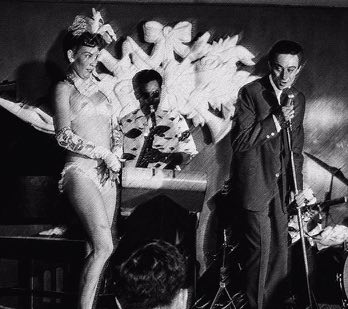
Among the controversial, countercultural icons who drove themselves to an early grave was Lenny Bruce (1925–66), “America’s No.1 Vomic”.

With my penchant for jazz biographies, in a similar vein [sic] is the extraordinary book

  • Albert Goldman (from the journalism of Lawrence Schiller), Ladies and gentlemen, Lenny Bruce!! (1974). *
    (Do read this most perceptive review by Wallace Markfield—interestingly garbled in the course of digitisation.)

The opening chapter, “A day in the life”, is a dazzling, graphic, blow-by-blow reconstruction of his arrival in New York in 1960 for a gig at the Blue Angel. Just a taster:

Around ten, a yellow cab, somewhat unsteadily driven, pulls up before a narrow gray dilapidated building on one of the crummiest sidestreets off the Square. Above the spattered pavement an extinguished neon sign flaps patches of cold hard shadow across the stone steps: HOTEL AMERICA, FREE PARKING. The cab opens with a jolt, back doors flying open so that two bare-headed men dressed in identical black raincoats can begin to crawl out from the debris within. […]

The night before, they wound up a very successful three-week run in Chicago at the Cloisters with a visit to the home of a certain hip show-biz druggist—a house so closely associated with drugs that show people call it the “shooting gallery”. Terry smoked a couple of joints, dropped two blue tabs of mescaline and skin-popped some Dilaudid; at the airport bar he also downed a couple of double Scotches. Lenny did his usual number: twelve 1/16th-grain Dilaudid pills counted out of a big brown bottle like saccharins, dissolved in a 1-cc. ampule of Methedrine, heated in a blackened old spoon over a shoe-struck lucifer and the resulting soup ingested from the leffel into a disposable needle and then whammed into the mainline until you feel like you’re living inside an igloo. […]

The America is one of the most bizarre hotels in the world: a combination whorehouse, opium den and lunatic asylum.

LB club

As Lenny honed his act at strip clubs, Goldman explores his background in

the fast-talking, pot-smoking, shtick-trading hipsters and hustlers who lent him his idiom, his rhythm, his taste in humor and his typically cynical and jaundiced view of society.

He describes Lenny’s connection with comics like Joe Ancis, Mort Sahl, and George Carlin. Joe

insisted on schlepping Kenny and Lenny to the Metropolitan and the Museum of Modern Art, taking them on whirlwind tours of both collections with his rapidly wagging tongue doing service as a catalog, guidebook and art-history course. “The fuckin’ Monet, schlepped out, half dead, in his last period, you dig? Painting water lilies—is that ridiculous! Water lilies, man, giant genius paintings, man, like the cat is ready to pack it in, but he has to blow one last out-chorus!

The book’s gory details of drug-taking and its paraphernalia, a staple of jazz biographies (Billie Holiday, Charlie Parker, Miles Davis, Chet Baker (here and here), John Coltrane, and so on), are unsurpassed, and as Markfield observes “could easily serve as basic text in a graduate seminar on mainlining”.

Much as I love Chet’s ballads, he seems to have traded on his early angelic, melancholy image merely as a means to the end of a constant supply of drugs; whereas for Lenny the drugs and the performance went hand in hand, evoking the explorations and discipline of Billie and Miles. Amidst all the squalor, the book evokes the technique of Lenny’s creativity, the way he played the room (cf. Stewart Lee’s labyrinthine footnotes):

Suddenly, he lowers his head and shoots a bold glance into the house—a real arched-brow zinger. “Looks like some faggot decorator went nuts here with a staple gun!” Bam! He’s in, they’re tittering. Then he goes for the extension: “Whoo-who!” (high fag scream) “It’s just got to flow like this!” (big wrist flap and faggy, camp gestures as he dances around triggering off staples with his thumb). They’re starting to laugh. Now for a quick change-up. Take them into his confidence. “You know, when I was a kid, I always dreamed about going to a nightclub.” Nice, easy mood, nostalgia. Then into the thirties movie bits with the George Raft takes and the Eugene Pallette club-owner pushing back the panel in the office to get a view of the stage and the little shaded lamps on the tables and the tuxes and the deep-cleft gowns and the hair on the guys bayed back at the temples and Lenny home from the movies standing in front of the bathroom mirror with a scissors cutting away the hair from his temples so he’d have a hairline like Brian Aherne or Robert Taylor and then his disillusionment years later when he went to the Copa for the first time and everything was so tacky and there wasn’t even a men’s room attendant and they had whisky bottles right on the table like a Bay Parkway Jewish wedding and … and … and … By the balls! They’re hanging on his words. Eating out of his hand! Kvelling because it’s their experience—but exactly!

Indeed, not just Lenny’s lifestyle but the techniques of his free-flowing stage routine have aptly been likened to bebop:

He fancied himself an oral jazzman. His ideal was to walk out there like Charlie Parker, take that mike in his hand like a horn and blow, blow, blow everything that came into his head just as it came into his head with nothing censored, nothing translated, nothing mediated, until he was pure mind, pure head sending out brainwaves like radio waves into the heads of every man and woman seated in that vast hall. Sending, sending, sending, he would finally reach a point of clairvoyance where he was no longer a performer but rather a medium transmitting messages that just came to him from out there—from recall, fantasy, prophecy.

A point at which, like the practitioners of automatic writing, his tongue would outrun his mind and he would be saying things he didn’t plan to say, things that surprised, delighted him, cracked him up—as if he were a spectator at his own performance!

In another passage, Goldman comments:

The ghetto idiom was far more than a badge of hipness to Lenny Bruce: it was a paradigm of his art. For what the language of the slums teaches a born talker is, first, the power of extreme linguistic compression, and, second, the knack of reducing things to their vital essences in thought and image.

Jazz slang is pure abstraction. It consists of tight, monosyllabic that suggest cons in the “big house” mumbling surreptitiously out of the corners of their mouths. Words like “dig”, “groove” and “hip” are atomic compactions of meaning. They’re as hard and tight and tamped down as any idiom this side of the Rosetta Stone. `if any new expression comes along that can’t be compressed into such a brief little bark, jazz slang starts digesting it, shearing off a word here, a syllable there, until the original phrase has been cut down to a ghetto short.

The same impatient process of short-circuiting the obvious and capping on the conventional was obvious in jazz itself. […] Listening to Be-Bop, you’d be hard put to say whether it was the most laconic or the most prolix of jazz styles. At the very same that it was brooming out of jazz all the old clichés, it was floridly embellishing the new language with breathtaking runs and ornaments and arabesques. Hipster language was equally florid at times, delighting in far-fetched conceits and taxing circumlocution. A man over forty, for example, was said to be “on the Jersey side of the snatch play”.

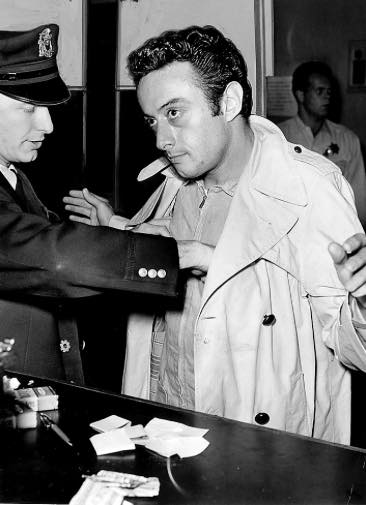
LB arrest

But whereas for jazzers music made a pure, abstract language transcending their mundane lifestyle, Lenny’s act was inevitably entangled with it. He was getting busted for his act as well as his medicinal habits, becoming ensnared in a series of obscenity trials. But he was at his very best for the midnight gig at Carnegie Hall on 3rd February 1961, again brilliantly evoked by Goldman—riffing on topics such as moral philosophy, patriotism, the flag, homosexuality, Jewishness, humour, Communism, Kennedy, Eisenhower, drugs, venereal disease, the Ku Klux Klan, the Internal Revenue Service, and Shelly Berman. Had he lived on, an invitation to today’s White House seems unlikely. Goldman reflects:

What else is this whole jazz trip? You take your seat inside the cat’s head, like you’re stepping into one of those little cars in a funhouse. Then, pulled by some dark chain that you can’t shut off, you plunge into the darkness, down the inclines, up the slopes, around the sharp bends and into the dead ends; past bizarre, grotesque window displays and gooney, lurid frights and spectacles and whistles and sirens and scares—and even a long dark moody tunnel of love. It’s all a trip—and the best of it is that you don’t have the faintest idea where you’re going!

Here’s one of several video clips of his live act (more here, as well as many audio recordings online):

London
Chapter 10, “Persecution” describes Lenny’s 1962 sojourn at Peter Cook’s new London club The Establishment—designed to elude the censoring scissors of the Lord Chamberlain’s office, “maiming English stage plays since the 16th century”. Indeed, this was part of an exchange of hostages that led to the Beyond the Fringe team’s long run on Broadway—International Cultural ExchangeYAY!

Lenny in London! Sounds bizarre, doesn’t it? Like James Brown at the Bolshoi. Or Little Richard at La Scala.

(Nice idea, but not so bizarre—neither London, Moscow, nor Milan are so culturally monochrome…)

Here’s an intriguing prequel to the misguided vinegar advertisement, and indeed Always look on the bright side of life:

The Establishment was preparing a skit that depicted Christ Jesus as an upper-class gent hung between two cockney-talking thieves, who complain in their petty, rancorous way: “ ’E’s getting all the vinegar sponges!”

Goldman goes on:

Lenny’s notions of England—compounded from old Hollywood flicks and Alec Guinness imports—were queer, to say the least. As Jonathan Miller summed them up, Lenny saw Great Britain as “a country set in the heart of India bossed by a Queen who wore a ball dress. The population had bad teeth, wore drab clothes and went in for furtive and bizarre murders”.

Not all of this was so wide of the mark.

As Lenny’s apostle Kenneth Tynan observed,

If Beyond the fringe was a pinprick, Mr Bruce was a bloodbath.

As ever, critical responses were polarized. Brian Glanville later wrote in The Spectator:

Bruce has taken humour farther, and deeper, than any of the new wave of American comedians. […] Indeed, the very essence of the new wave is that one hears an individual voice talking, giving vent to its own perception and, in Bruce’s case, its own obsessions. An act such as this requires a good deal more than exhibitionism; it also need courage and passion. Essentially, it is not “sick” humour at all. The word is a tiresome irrelevance—but super-ego humour: a brave voice calling from the nursery.

He was denied entry the following year as an “undesirable alien”.

I’d be curious to learn what Alan Bennett thought of Lenny, but his influence on Dud ‘n’ Pete can be heard in their later foul-mouthed Derek and Clive recordings. Christopher Hitchens wrote a fine article on these transatlantic comedy genealogies.

Goldman devotes a perceptive chapter to “The greatest trial on earth”, a high-profile obcenity case over six months in Manhattan in 1964. Despite support from an array of prominent literati, Lenny was sentenced; freed on bail pending an appeal, as his mental and physical health went into a tailspin, exacerbated by paranoia over litigation, he died in squalor.

The only flaw I find with Goldman’s brilliant book is that it lacks an index. See also Doubletalk.

* * *

All this is a far cry from the bland hagiography of Chinese biographies. And the book reminds me again that the post-war era before the Swinging Sixties wasn’t entirely drab and conformist (see e.g. Paul Bowles, Gary Snyder). It also highlights issues of free speech, which are so urgent today. By comparison with Lenny, the challenging routines of Richard Pryor, or Stewart Lee, seem almost genteel. Still, the latter’s travails over Jerry Springer: the opera, detailed in How I escaped my certain fate, and his ripostes in “Stand-up comedian” (2005) and ” ’90s comedian” (2006), richly deserve attention; while Lee too highlights his debt to free jazz, his art is acutely disciplined (for his thoughts on Lenny, see here).

* The title’s punctuation reminds me of Mahler’s fondness for exclamation marks!!!

Cocomania

***UPDATED!!!***

For anyone living on another planet (immersed in medieval Daoist ritual manuals, or whatever)…

As if the Women’s World Cup wasn’t enough, I’m only too happy to subscribe to the mass adulation for Cori Gauff at Wimbledon. Her two victories were just exhilarating.

Mature and focused at 15, she’s an inspiration. Her parents seem great too.

CG parents

She was charming in handling the usual fatuous questions at her 3rd-round press conference:

When you were match point down on Centre Court, were you thinking, what would Venus and Serena do?

Er, no! …

which ranks along with Bertrand Russell’s comment after his plane crash. And at the risk of sounding like the woman visiting the young Living Buddha, I love the way she tucks her chair into the desk at the end.

tweet

[Spoiler: typical Grauniad-reading liberal metropolitan elite quote coming up] At a time when the world seems doomed to suffer under mendacious cynical rich old white men, we all need role models like Coco—a list that might also include Alexandria Ocasio-Cortez and Greta Thunberg, Katelyn Ohashi, and indeed Oxana Thaili. It’s no coincidence that the most inspiring of such figures are female.

Cori 2

I wish her well, and look forward to the day when AOC can welcome her to the White House!

Update: US Open, 2019
In a further episode of the saga, Coco’s home crowd exults in her style, social media goes even wilder, and in defeat she is magnanimously persuaded by Naomi Osaka to share this moving post-match interview:

See also Enough already. And note the principled response of Coco and Naomi to the murder of George Floyd.

2023 update!!! 🍾🍾🍾🍾🍾🍾🍾🍾
And so to Coco’s first Major title, again, suitably, at the US Open—what moving drama, striving, and achievement is embodied in the ritual of solo sporting competition!

For the women’s final of the 2021 US Open, please relish A playlist for Emma and Leylah! See also A sporting medley: ritual and gender.

Of Steinbeck and Salinger

Along with my youthful taste for Zen and Daoism, I was also reading John Steinbeck and J.D. Salinger—though at the time I was barely aware of their mutual connections. So this is not so much a Lit Crit review as an attempt to see them in the context of my own “development”—“all that David Copperfield kind of crap”.

For Steinbeck I’m thinking not of his weightier tomes on the plight of immigrant workers and class struggle, but of Cannery row (1945). Here’s the celebrated opening:

Cannery Row in Monterey in California is a poem, a stink, a grating noise, a quality of light, a tone, a habit, a nostalgia, a dream. Cannery Row is the gathered and scattered, tin and iron and rust and splintered wood, chipped pavement and weedy lots and junk heaps, sardine canneries of corrugated iron, honky-tonks, restaurants and whore houses, and little crowded groceries, and laboratories and flophouses. Its inhabitants are, as the man once said, “whores, pimps, gamblers, and sons of bitches”, by which he meant Everybody. Had the man looked through another peephole he might have said, “Saints and angels and martyrs and holy men”, and he would have meant the same thing.

Subliminally I found Lee Chong, Doc, and Danny incarnations of different oriental wisdoms. Doc (based on Ed Ricketts) was a sage, akin to Gary Snyder. And the hobos were Hanshan and Shide, their mishaps reminiscent of The good soldier Švejk and, later, Shameless (“PARTY!!”). And at a time when Chinese characters were still rare in Western fiction, Lee Chong made a beguiling stereotype of the inscrutable Chinese storekeeper (for Ray Man, my mentor in Chinese music in Soho, click here).

Steinbeck pursued the theme in the sequel Sweet Thursday (1954). But the scenario goes back to his earlier Tortilla flat (1935), depicting a group of paisanos in a tumbledown district of Monterey. Here’s the opening:

This is the story of Danny and of Danny’s friends and of Danny’s house. It is a story of how how these three became one thing, so that in Tortilla Flat if you speak of Danny’s house you do not mean a structure of wood flaked with old whitewash, overgrown with an ancient untrimmed rose of Castile. No, when you speak of Danny’s house you are understood to mean a unit of which the parts are men, from which came sweetness and joy, philanthropy and, in the end, a mystic sorrow. For Danny’s house was not unlike the Round Table, and Danny’s friends were not unlike the knights of it. And this is the story of how that group came into being, of how it flourished and grew to be an organization beautiful and wise. This story deals with the adventuring of Danny’s friends, with the good they did, with their thoughts and their endeavours. In the end, this story tells how the talisman was lost and how the group disintegrated.

For Steinbeck’s 1947 trip to the USSR with photographer Robert Capa, see e.g. here.

* * *

If in Steinbeck the theme of oriental mysticism is latent, it’s more explicit in Salinger. Like John CageGary Snyder, and Alan Watts, Salinger was influenced by the teachings of Zen master D.T. Suzuki at 1950s’ Columbia, and later by Vedanta. The theme has attracted considerable discussion (e.g. here); like the whole TMI confessional style, not all of it is positive. And it’s still subsidiary in critical commentary on Salinger’s work; indeed, the more his fictional characters immersed themselves in such arcane pursuits, the less they appealed to his core readership. But the Beats, and later the Hippies, took note.

The Wisdom of the Mystic East may be overlooked in The catcher in the rye (1951, after serialization in 1945–46)—the book’s enduring popularity (not least in China) is based on the themes of phoniness and alienation. But the theme is unmistakable in Salinger’s portrayals of the precocious Glass family [cue Heart of glass], whose siblings became immersed in Zen (see e.g. this essay by Henry Shukman).

In Franny and Zooey (1961, first published separately in 1957) the Bhagavad gita, the Upanishads, and the Diamond sutra are framed by the Christian mysticism of The cloud of unknowing and Meister Eckhart. Such works were hardly standard inspirations for fiction at the time, though later I would snap them up in Watkins bookshop. From a letter by Buddy to Zooey:

Seymour had already begun to believe (and I agreed, with him, as far as I was able to see the point) that education by any name would smell as sweet, and maybe much sweeter, if it didn’t begin with a quest for knowledge at all but with a quest, as Zen would put it, for no-knowledge. Dr Suzuki says somewhere that to be in a state of pure consciousness—satori—is to be with God before he said, Let there be light. […] We thought it would be wonderfully constructive to at least (that is, if our own limitations got in the way) tell you as much as we knew about the men—the saints, the arhats, the bodhisattvas,the jivankuktas—who knew something or everything about this state of being. That is, we wanted you both to know who and what Jesus and Gautama and Lao-tse and Shankaracharya and Huineng and Sri Ramakrishna, etc., were before you knew too much or anything about Homer or Shakespeare or even Blake or Whitman, let alone George Washington and his cherry tree or the definition of a peninsula or how to parse a sentence. That, anyway, was the big idea.

The appeal of Far-Eastern poetry is encapsulated in a long passage in Seymour: an introduction (1959), recalling the narrator Buddy’s late brother:

During much of his adolescence, and all his adult life, Seymour was drawn, first, to Chinese poetry, and then, as deeply, to Japanese poetry, and to both in ways that he was drawn to no other poetry in the world.* I have no quick way of knowing, of course, how familiar or unfamiliar my dear, if victimised, general reader is with Chinese or Japanese poetry. Considering, however, that even a short discussion of it may possibly shed a good deal of light on my brother’s nature, I don’t think this is the time for me to go all reticent and forbearing. At their most effective, I believe, Chinese and Japanese classical verses are intelligible utterances that please or enlighten or enlarge the invited eavesdropper to within an inch of his life. They may be, and often are, fine for the ear particularly, but for the most part I’d say that unless a Chinese or Japanese poet’s real forte is knowing a good persimmon or a good crab or a good mosquito bite on a good arm when he sees one, then no matter how long or unusual or fascinating his semantic or intellectual intestines may be, or how beguiling they sound when twanged, no-one in the Mysterious East speaks seriously of him as a poet, if at all. My inner, incessant elation, which I think I’ve rightly, if incessantly, called happiness, is threatening, I’m aware, to turn this whole composition into a fool’s soliloquy. I think, though, that even I haven’t the gall to try to say what makes the Chinese or Japanese poet the joy and marvel he is.

* [footnote in book] Since this is a record, of sorts, I ought to mumble, down here, that he read Chinese and Japanese poetry, for the most part, as it was written. [SJ: um, as if that’s possible—cf. Bach] […] If, in the line of duty, I should incidentally titillate a few young people’s interest in Chinese and Japanese poetry, it would be very good news to me. At all events, let the young person please know, if he doesn’t already, that a goodish amount of first-class Chinese poetry has been translated into English, with much fidelity and spirit, by several distinguished people; Witter Byner and Lionel Giles come most readily to mind. The best short Japanese poems—particularly haiku, but senryu, too—can be read with special satisfaction when R.H. Blyth has been at them. Blyth is sometimes perilous, naturally, since he’s a highhanded old poem himself, but he’s also sublime—and who goes to poetry for safety anyway?

I’m glad he credits Blyth there: indeed, Zen in English literature and oriental classics, which goes back to 1941, chimes in with Salinger’s quest for oriental wisdom in the Western world, not only in its high art but in its mundane realities (see e.g. here). Salinger/Buddy goes on:

Unofficially, Seymour wrote and talked Chinese and Japanese poetry all the thirty-one years he stopped with us, but I’d say that he made a formal beginning at composing it when he was eleven, in the first-floor reading room of a public library on upper Broadway, near our house. It was a Saturday, no school, nothing more pressing ahead of us than lunch, and we were having a fine time idly swimming around or treading water between the stacks, occasionally doing a little serious fishing for new authors, when he suddenly signalled to me to come over and see what he had. He’d caught himself a whole mess of translated verses by P’ang, the wonder of the eleventh century [SJ: this would be Layman Pang, actually a Tang master—whose sayings I also found in Watkins]. But fishing, as we know, in libraries is a tricky business, with never a certainty of who’s going to catch whom. [Typically lengthy aside on fishing…] Permanently, from that morning on, Seymour was hooked.

Indeed, the companion Raise high the roof beam, carpenters (a Sappho quote, for aficionados of the female composers T-shirt) opens with Seymour, then 17, reading a Daoist story to their ten-month old sister Franny.

Of course, with exceptions like Eugen Herrigel and Gary Snyder for Japan, such explorations were untramelled by engagement with the lives of their real Eastern contemporaries. But they weren’t merely retreating into an abstract Wisdom of the Mystic East but seeking to reconcile it with living in the modern world. Still, all this only goes some way towards explaining how I ended up traipsing around dusty Chinese villages in search of Daoists.

* * *

In their lives as in their fiction, both Steinbeck and Salinger come out poorly from later studies of their attitudes towards women. Kate Millett had bigger fish to fry (to a cinder) in Sexual politics (1970)—D.H. Lawrence, Henry Miller, Norman Mailer. But as early as 1954 Ward Moore made some pithy criticisms of Cannery row:

To Steinbeck, who carries to an extreme the Hemingway small-boy nostalgia for the never-never world of comradely masculine society without women save as an occasional inconvenience, Cannery row was an ideal microcosm. In it, socially at least, the infantile triumphed; Mother—the realist, the disciplinarian, the stabilizer—was excluded, and Father, if admitted at all, came as a refugee from domesticity. In Cannery row the locale the small boy as employee justified his restiveness in casual labor; in Cannery row the novel the small boy vindicated his pranks, his misdemeanors, his fear of responsibility in a glorification of perpetual hooky.

And the relation between Franny and her older, wiser brothers, with their more “legitimate” spiritual crises, has also been unpacked.

Still, at the time I was most beguiled by such Western pioneers, and their themes still resonate.

Billie Holiday

So far I’ve struggled to resist devoting this site entirely to Billie Holiday. After her captivating 1957 TV Fine and mellow, here’s an inital playlist (now followed by a sequel). Of course she is one of the stars of my Playlist of songs (indeed, everyone’s). *

But to follow Barbara Hannigan singing a Berg-tinged Embraceable you, I just had to go back to Billie singing it—both 1944 and 1957 versions here:

Among my all-time top songs of hers, You’re my thrill is strangely neglected, as she herself lamented. Again, apart from the extraordinary nuances of her voice, intoxicating and intoxicated (surely this is her ode to heroin), note the chromatic melody and disconcerting leaps (I’ve extolled the magic of the major 7th, and now I feel a paean to the minor 7th coming on) and the brilliant orchestration—smoochy strings, wind arabesques, swaggering brass interlude:

You’re my thrill
You do something to me
You send chills right through me
When I look at you
’cause you’re my thrill

You’re my thrill
How my pulse increases
I just go to pieces
When I look at you
’cause you’re my thrill

Mmm
Nothing seems to matter
Mmm
Here’s my heart on a silver platter

Where’s my will?
Why this strange desire
That keeps mounting higher?
When I look at you
I can’t keep still
You’re my thrill…

It was also natural that Chet Baker, not to be outdone in the shooting-up department, should perform the song:

Generally Chet’s singing has an intensity that matches that of Billie, but for this song I’d always choose her (not that we have to choose). In Chet in Italy I’ve also included two versions of These foolish things sung by her.

In Lover man the orchestration again complements Billie’s vocals:

Meanwhile in 1944, far from the turmoil of Europe (just as ethnologist Germain Tillion was composing Le verfügbar aux enfers for her fellow Ravensbrück inmates), a young Miles Davis was combing the New York streets for Charlie Parker, as he describes in one of the great passages of jazz writing.

Billie’s Don’t explain is amazing too. The lyrics, meekly tolerating infidelity, may now seem as dubious as Stand by your man (and dodgy lyrics are by no means the prerogative of popular music), but as always Billie somehow transforms the song:

I’ve given separate posts to Crazy he calls me and Night and day.

And whereas she looks radiant in the 1957 TV broadcast, here’s her harrowing live performance of Don’t explain the following year, with more pain than joy:

To learn more about how all this works, apart from the innumerable books on Billie, I keep referring to Paul Berliner’s Thinking in jazz.

The bluesy voice of Karen Dalton has inevitably been likened to that of Billie. See also Nina Simone.


* I learn to my chagrin that I’m not the first to discover either Billie or Aretha—but perhaps I can claim credit for the first recording of Dona Rosa.

The Tzar-spangled banner—diversity—female genius

I began writing this as another paean to the great Bill Bailey, to follow his greatest-ever love song (“soaking in the hoisin of your lies“), but it has soon turned into yet another tribute to diversity and female genius.

David Hughes (himself a prolific drôle songwriter as well as leading authority on Japanese music) thoughtfully alerts me to this (allegedly) Kremlin-sanctioned version of The star-spangled banner, which is becoming ever more topical:

See also “I think you’ll find—it’s MINOR!”

To return to the major (sung by a minor), this, from Malea Emma Tjandrawidjaja, then 7 (taking a rather different path from Alma Deutscher), is remarkable too:

They come over ‘ere…” See also And did those feet in ancient time?, and The haka.

While I’m here, how can I resist featuring another most inspiring viral clip—and do follow up with Katelyn Ohashi’s thoughtful blog and innumerable further links, like this and this—bearing on ecstasy and drudge, and the nature of artistic competition:

OK then, for a hat-trick of What Really Makes America Great (see The wise AOC):

Do follow @AOC, the most articulate and engaged advocate for political change!

Yet more much-needed hope for our future… Call me a !typical member of the Guardian-reading, tofu-eating wokerati (formerly known as “the Grauniad-reading metropolitan liberal elite”), but long may the likes of “Rear Admiral” Foley turn in their graves.

For another inspirational role model, see here.

Let me see now, what did I come in here for again?

Moon river

MR

À propos my Daoist ritual spinoff of Strictly, the brilliant (ethnographer!) Stacey Dooley‘s recent waltz reminds me what a brilliant song is Moon river:

Pace Andy Williams, the classic sung version is that of Audrey Hepburn in Breakfast at Tiffany’s (1961):

Johnny Mercer’s lyrics, “a love song to wanderlust” (cf. Roaming the clouds), are complemented by Henry Mancini’s melody.  I just love the leap of a major 7th:

I’m crossing you in style some day / There’s such a lot of world to see,

always effective—as in the finale of Mahler 9 (introduced by quintuplets!) and, um, Raindrops keep falling on your head! Indeed, there’s another brilliant touch: following “We’re after the same rainbow’s end“, when that sequence returns with

Waiting round the bend, My huckleberry friend,

for the first phrase the melody omits the low tonic, making us nostalgic for the missing major-7th leap (waiting, indeed), until it returns for the second phrase.

So Moon river (nearly cut from the film, PAH!) makes a perfect expression of Holly’s persona—and indeed that of Stacey Dooley, with her documentaries from around the world.

The dominant interpretation currently seems to be that Hepburn’s screen characters make her some kind of feminist role model. But “it’s complicated”—certainly in this film, which largely replaces the edgy feel of Truman Capote’s novella (1958, set in 1943) with a “sugar and spice confection”; indeed, Capote wanted Marilyn Monroe for the part! I tend to side with more critical reviews, such as this, this, and this. After I cited some dodgy sexist terms to describe talented female performersgamine and ingénue are among those for which there are both male and female equivalents, but the latter are far more commonly used, and flawed. Oh, and how ahout “elfin waif”…

For Hepburn’s actual life, Darcey Bussell (another fragrant icon) made a fine documentary Looking for Audrey (2014), including her childhood in Nazi-occupied Holland.

* * *

Capote describes Holly as an American geisha—rural child bride Lulamae, reinventing herself in New York. Film adaptations can be effective, but in this case the novella portrays her with more nuance and depth. So—not least because I’m so averse to Hepburn’s “elfin waif” shtick—I find Capote’s silent invisible original far more moving, and Holly herself far more poignant and (as she would say) sympathique.

Inevitably, at the end of the film the narrator and Holly fall in love and stay together, whereas in the novella their relationship remains platonic, and Holly disappears.

Lending significance to Moon river, the name-slot for Holly’s mail-box reads:

Miss Holiday Golightly, travelling

She reflects on how she demurred from a break in the movies offered by a Hollywood agent:

But he’s got a point, I should feel guilty. Not because they would have given me the part or because I would have been good: they wouldn’t and I wouldn’t. If I do feel guilty, I guess it’s because I let him go on dreaming when I wasn’t dreaming a bit. I was just vamping for time to make a few self-improvements: I knew damn well I’d never be a movie star. It’s too hard; and if you’re intelligent, it’s too embarrassing. My complexes aren’t inferior enough: being a movie star and having a big fat ego are supposed to go hand-in-hand; actually, it’s essential not to have any ego at all. I don’t mean I mind being rich and famous. That’s very much on my schedule, and some day I’ll try to get around to it; but if it happens, I’d like to have my ego tagging along. I want to still be me when I wake up one fine morning and have breakfast at Tiffany’s.

And Holly does indeed sing and play guitar:

Don’t wanna sleep, don’t wanna die, just wanna go a’travellin’ through the pastures of the sky

With a Brazilian suitor in tow, she takes to Linguaphone:

Oh screw it, cookie—hand me my guitar and I’ll sing you a fado in the most perfect Portuguese.

That would surely have rivalled Carminho’s exquisite song.

In the novella, I note with proprietoral pride that Holly’s fellow-geisha Mag Wildwood (intriguingly, Capote gave her the full name of Miss Margaret Thatcher Fitzhue Wildwood)—as if being a redhead over six feet tall isn’t enough—is a stammerer (Marilyn Monroe might have resented the competition):

Even the stutter, certainly genuine but still a bit laid on, had been turned to advantage. It was the master stroke, that stutter: for it contrived to make her banalities sound somehow original, and secondly, despite her tallness, her assurance, it served to inspire in male listeners a protective feeling.

* * *

For Moon river on the ethereal theremin, click here.

Amy Winehouse (see my tribute here) may seem an unlikely exponent of the song, but she was grounded in ballads, as we can hear in her “late” sessions with Tony Bennett. Here she is, subverting the waltz, making the song sugar-free—maybe it doesn’t quite work, but even at the age of 16 she was always exploring, discovering new personal connections:

Click here for a discussion of the song in the BBC Radio 4 Soul music series.

From my playlist of songs, it’s clear that, with some noble exceptions, I find female voices more moving than male ones—and I’m right!!!

Just another reminder that a global view of musicking invites us to delight in all manifestations of the Terpsichorean muse!

Room service

It goes without saying that David Lynch is a genius.

In 1990 and 1991, in between orchestral tours and fieldwork trips to Hebei, and just as I met the great Li Qing for the first time, I spent much of my time back home in London glued to Twin peaks on TV.

Joan Chen

As always, it’s both disturbing and enchanting, with a diverse cast of stunningly beautiful female and male characters, and

an uneasy strain of nostalgia that blends sentimentality with menace; hideous secrets chafing against the illusion of innocence […] postwar trauma buried beneath an aggressive normality.

Just a couple of clips to epitomise Lynch’s mastery. After the cliffhanger of the series 1 finale, just as we’re all desperate to know what happened to Agent Dale Cooper, the seemingly interminable room-service scene at the very opening of series 2 suspends the whole drama unbearably. You can read a detailed analysis here—this is the only brief clip currently on YouTube:

Long after the 1992 movie Twin peaks: fire walk with me, now I’m in a similar kind of suspense as I try and work out how to view the recent season 3 (also here).

And apart from his taste in coffee, we may note Agent Cooper’s affinity for Tibetan mysticism, as in this lecture, also typically startling within the plot:

Angelo Badalamenti’s soundtrack goes perfectly with the drama (this article has a link to the complete album on Spotify).

Badalamenti had already worked with Lynch on the haunting Blue velvet:

And the Julee Cruise song Mysteries of love:

For Thought Gang, Lynch’s band with Badalamenti, see here (with link to album only recently released!).

Lynch also has great taste in using earlier music (not “early music”), as in the magnificent ending of Wild at heart, with Richard Strauss morphing into Elvis.

For more on film music, and the importance of taking seriously all kinds of musicking throughout human societies, see here.

The art of the miniature

Tom and Jerry

By way of supplementing my playlist of great songs with a little series on great theme-tunes (below):

Tom Service’s BBC Radio 3 series The listening service is always stimulating—like Susan McClary, he breaks down boundaries, as here.

This episode [sic] on Brevity, with a playlist of miniature gems encompassing Bach, Beethoven, Chopin, Satie, Webern, Boulez, Zorn, Napalm Death, Bartók, Kurtag, and Ligeti, is full of fine observation—under the headings of absurdity, immediacy, density, violence, and eternity.

Irrespective of genre, such pieces are microcosms, crafted with a range of expression and intensity—akin to haiku (see under Some posts on Japanese culture) or netsuke.

Also among the fleeting exhibits is the great Carl Stalling, composer of classic soundtracks for Warner Brothers cartoons (these playlists should work if you click on YouTube at the bottom right of the window):

Not forgetting Scott Bradley, of Tom and Jerry fame:

Not least, this is about taking seriously all kinds of musicking throughout human societies, including WAM and popular music.

So here are some thoughts on great theme-tunes:


A fine riposte

Complementing Stewart Lee’s classic demolition of xenophobia (also a meditation on nothingness!), this exchange (pointed out by @SabrinaMahfouz) also deserves a wide audience:

BeOfgxFIMAABJss

Among the endless idiocies of the horrifying Orange Baby was this, in February 2024:

“We have languages coming into our country … they have languages that nobody in this country has ever heard of. It’s a horrible thing” *

—another comment that might have been more appropriate from the lips of Native Americans confronted by early waves of invaders “settlers”.

This clip is so convincing that its sarcasm eludes some viewers (“My ancestors stole that land fair and square—and if these Native Americans don’t like it, they can go back to where they came from”):

For Tang-dynasty xenophobia, see They come over ‘ere… For Navajo ceremonial and musical culture, click here, part of a series.


* His own language being largely incomprehensible, alternative transcriptions have been proposed:

cause everybody I speak to says they’re horrible, there’s nobody can explain to me how
allowing millions of people from places unknown, from countries unknown, who don’t speak languages, we have languages coming into our country, we have nobody that even speaks those languages. They’re—they’re truly foreign languages, nobody speaks them.

Detroit 67

More “delighting in all manifestations of the Terpsichorean muse”, à la McClary and Small—in this related post I both make a disclaimer and explore the point of venturing beyond familiar territories.

On soul, apart from classics like Nelson George, Where did our love go? (1985), I’ve been admiring

  • Stuart Cosgrove, Detroit 67: the year that changed soul (2015)—

not just to educate myself about the music, but to admire compelling writing about history, and the nexus of society and culture.

For background (if you’re on another planet, like me—I guess if you know much about soul, you’ll have better things to do than reading this blog…) it’s worth revisiting the fine BBC documentary R.E.S.P.E.C.T (from the Dancing in the street series), here in four parts—they should segue automatically:

The film also covers the southern scene, no less important—and more edgy—do follow this up with Cosgrove’s Memphis 68: the tragedy of southern soul.

* * *

In 1967—just as the Cultural Revolution in China was becoming even more violent, and ritual specialists were keeping their heads down; shortly before the crushing of the Prague Spring; while I was primly learning Brahms and Ravel in a youth orchestra in suburban London, with little idea that there might be any other kinds of musicking in the world—Detroit and Motown were entering a pivotal phase of turmoil.

Cosgrove’s focus on one year is a most effective device. At a time-remove from the “one-year” rule of anthropological fieldwork, he takes 1967 as a microcosm of festering race relations, social upheaval, and musicking.

Incredulous as we are at the current travails of the USA, it’s also a reminder that they have a long history.

This was the year of Sgt Pepper (for all popular [Anglo–American, that is!] genres that year, see here). Indeed, the soul movement had had to react to the market challenge from British groups like the Beatles, and to maintain crossover appeal; but Sgt Pepper itself was a retreat from the innocent lyrical messages they had been crooning on their frantic touring life.

Supremes 2

A fine piece of thick-description ethnography from a distance of time and space, the book is based on the troubled relations of Berry Gordy and his protégées The Supremes, with a focus on the ill-fated Florence Ballard. But Cosgrove adroitly weaves in portraits of individual figures with their back-stories; the automobile industry, social change, race, housing, poverty, crime, and the police; civil rights, Vietnam, hippy counterculture, bikers, and LSD.

There was the hippie Steering Committee, the young rock gods of the Grande Ballroom, the disgruntled officers of the Detroit police, and a legion of car-assembly workers drawn from the tense communities of Polish and African-Americans. There were disenchanted young men who moved from unemployment to Vietnam, the radical soldiers of Black Power, the independent producers who saw soul music as their Klondike, and the caravan of older gospel Christians who had seen their homes destroyed to make way for freeways.

Youth culture was fragmenting into a mosaic of different tribes.

Half a million people had migrated to Detroit between 1940 and 1943, mostly African-Americans from the southern states. Already by 1959 its image as a boomtown was wearing thin, but migrants kept arriving.

As anti-Vietnam protests grew, in 1965 came a wave of self-immolations. By 1967

the area around Twelfth Street had witnessed complete transformation in twenty years as white residents fled to new buildings, better neighbourhoods or the encroaching suburbs. In a contemporary survey by the University of Michigan’s Psychology Department, the area was described as a community of high stress where an overwhelming majority of the residents were disenchanted with their living conditions. […] It was a blighted area about to take centre stage.

Still, the social milieu for Motown was aspirational. In March, Berry Gordy’s mother hosted a coffee evening in her role as past Exalted Ruler of the Lady Camille Temple of the Michigan Elks:

Floral handbags, matching frocks and elegant hats turned the room into a chorus of colour. […] This was a room of elegant elderly women who valued status, took pride in their families, and cared deeply about emancipation.

In June the Supremes, “in a bubble of fame, increasingly out of touch with the new militancy in the black community and the rising fury of their hometown”, made an ill-judged appearance in LA for a beleaguered President Johnson.

The July riots, including the appalling Algiers Motel incident (on which see John Hersey’s book), were a flashpoint—and again there’s plenty of youtube footage. As with the violence in towns throughout China at that very time, the turmoil had deep social roots.

As Motown abandoned Detroit for LA, African-American music kept moving.

Detroit’s wooden-porch image as the home of soul music had been damaged to the core, and the family image that had been so crucial to the Motown story was brutally displaced by darker visions of a charred city under martial law. […] The nightclubs, the bars and the independent studios that had been the foundations of Detroit’s soul scene had been burned to the ground, ransacked, or destroyed. […] The generation that had shaped one of the greatest periods in the history of popular music had seen its city devastated. For the Supremes and others within Motown, the riots were to become a metaphor for ruined harmonies and wrecked friendships. In a broader sense, the disturbances were also a requiem for Detroit’s great industrial achievements and its declining manufacturing base.

Meanwhile John Sinclair and MC5 feature regularly, and there are cameos from Muhammed Ali and Martin Luther King. The latter observed:

Perhaps the most tragic recognition of reality took place when it became clear to me that the war was doing far more than devastating the hopes of the poor at home. It was sending their sons and their brothers and their husbands to fight and to die in extraordinarily high proportions relative to the rest of the population… So we have repeatedly been faced with the cruel irony of watching Negro and white boys on TV screens as they kill and die together for a nation that has been unable to seat them together in the same schools. So we watch them in brutal solidarity burning the huts of a poor village, but we realize that they would never live on the same block in Detroit. I could not be silent in the face of such cruel manipulation of the poor.

It was his assassination in 1968 that would mark a definitive turning point for both society and music.

Singers, songs, music
The Motown sound emerged from the background of the incredibly rich talents brought up in gospel, blues, jazz, R&B, and so on. Cosgrove explores the nuances of changing style, documenting the host of composer-arrangers, choreographers, backing groups, instrumentalists, recording execs, and lawyers.

And decorum coaches—the Motown Finishing School (great scenes in #2 of the R.E.S.P.E.C.T. film)! Some of the singers took readily to Miss Maxine Powell’s training, while one of the Temptations complained “I don’t want to learn how to be white”.

To some, Motown resembled a hit machine, an assembly-line like the city’s car plants, producing polished feel-good tracks—a saccharine soundtrack to a convulsive era. It was “predicated on a compromise”. Gordy had

softened the rough edges of R&B, draped the music in the familiar cadences of teenage love, and his girl groups […] pioneered a highly addictive from of “bubblegum soul” that lent itself perfectly to the still-segregated radio stations of America.
[…]
It was in every respect an art of repetition: familiar backing tracks were refashioned, everyday phrases repackaged and the anxieties of young love were played out as memorable drama.

I may be the last person qualified to offer a playlist, but it hasn’t stopped me before (e.g. Amyfeminist punk)…

In fact even I heard The Supremes on Top of the Pops in the mid-60s, though they felt alien to me. Of course, they were—but countless other British kids were hooked.

Cosgrove also weaves in the stories of

  • Martha and the Vandellas, Dancing in the street—“an otherwise innocent piece of teenage pop [that] became inextricably linked to social unrest”:

  • Marvin GayeAin’t no mountain high enough, with Tammi Terrell:

And the roots of What’s going on were firmly in 1967: “masterpiece of the inner city, echoing the events of the Algiers Motel killings, the ‘trigger-happy policemen’, the lives of returning Vietnam vets, the emotionally devastated mothers who had placed their faith in the benevolence of God, and the scattered fragments of a war-torn city”:

  • Aretha Franklin (R.I.P.) came from Detroit, but wasn’t part of the Motown stable, getting snapped up by other labels. And she was also more readily recruited to the civil rights movement. Respect, her version of an Otis Redding song:

I say a little prayer was originally written by Burt Bacharach and Hal David for Dionne Warwick, but Aretha, along with the Sweet Inspirations, transforms it. Not so homely as the dreamy opening suggests (it’s about the singer’s anxieties for her man serving in Vietnam), it’s both ecstatic and defiant, with a real gospel call-and-response feel:

And two amazing live versions from 1970:

(Talking of how naturally performers learn the complex rhythms of flamenco clapping, I guess no-one even had to think about the triple-time bar inserted into the chorus here (you’ll stay in my heart we never will part—see also here; and for additive metres, here)… Actually, why did Bacharach write it thus? It’d work perfectly well to maintain the duple beat throughout—but in Aretha’s version it creates greater urgency and a feeling of spontaneity. I am in awe of everything about this song.)

Her 1972 church performance of Amazing Grace is legendary. Just the audio, with its lengthy alap, is spine-tingling:

I’ve now done a separate post on the complete footage, a *MUST WATCH!*—here’s a brief trailer:

  • Otis Redding (one of many sadly short-lived artists in the story) also features in the book, though his story belongs with that of southern soul. And James Brown was leading the way forward with that common blend of musical brilliance and unsavoury personal relations.

Behind the glossy stars and glamorous hype lie gruelling touring schedules (indeed, The Supremes were rarely in Detroit), drug habits, internal disputes, and personal breakdowns—like a New York orchestra, a Chinese shawm band, or indeed any group.

Tedious legal wrangles invariably take up considerable space in such books on the popular music business. Motown seemed like a cosy family, yet

the close-knit relationships forged in postwar Detroit were destined to be dismantled as success and dysfunction tore the surrogate family apart.

Here the style and lyrics of such love songs seem quite detached from the realities of personal and social life. That’s common in music worldwide, though anguish is often paraded too, in genres like flamenco deep song, Bach Passions, or Daoist funeral liturgy

In many world genres, links between culture and politics may be opaque. The book’s social context is compelling, but the commercial pressures that drove the music seem estranged from social change. In the end the music inevitably, suitably, takes a back seat, though the songs remain intoxicating.

I had remarkably little idea of any of this, either then or later. Better late than never, eh. Detroit 67 is just the kind of in-depth study of social and musical tensions to which ethnographers aspire in documenting any genre—whether “art”, “folk”, or “popular”.

See also Stuart Cosgrove’s paean to Northern soul, and The Commitments.

Feminine endings: Madonna and McClary

Left: I found this postcard in Ireland in the mid-1990s; though still drôle, it no longer seems quite so fantastical.
Right: Susan McClary—less futuristically.

Since the party for Madonna’s 60th birthday [I know…] has already begun (see e.g. here), it may seem a tad cerebral to celebrate by revisiting the work of the great Susan McClary (notably her classic 1991 book Feminine endings: music, gender, and sexuality). But given that academics are mostly lumbered with writing, she does at least rejoice in the physical.

Of course, many female performers have continued exploring the trail that Madonna blazed, and she no longer has such power to shock. Similarly, while many critics (not least feminist authors) have disputed and refined McClary’s work, the thrust [sic: her own writings are full of such ludic language, matching her theme] of her argument has practically become mainstream—but her thoughts remain most perceptive.

Fem endings

So far I’ve mainly written about Susan McClary in the context of her provocative analysis of the extraordinary harpsichord solo of Bach’s 5th Brandenburg concerto. Her insights also get a mention in my post on Ute Lemper.

It would be quite wrong to reduce her oeuvre to soundbites—but hey, here goes! With her early research based in baroque music, she notes the historical contingency, mutability, of musical signifiers. Inspired by Greenblatt on Shakespeare (“once science discovered that female arousal served no reproductive purpose, cultural forms silenced not only the necessity but even the possibility of sexual desire in the ‘normal’ female”), she revels in the (pre-watershed) erotic friction of the 17th-century trio texture from Monteverdi through Corelli:

in which two equal voices rub up against each other, pressing into dissonances that achingly resolve only into yet other knots, reaching satiety only at conclusions. This interactive texture (and its attendant metaphors) is largely displaced in music after the 17th century by individualistic, narrative monologues.

Aww, shucks. A review goes on:

The narrative structure of 19th-century instrumental music becomes for her
“a prolonged sexual encounter of intense foreplay that results inevitably in a cataclysmic metaphorical ejaculation. Beethoven becomes the supreme perpetrator of sexual violence in music, whose recapitulation of the first movement of the 9th symphony “unleashes one of the most horrifyingly violent episodes in the history of music”.

McClary was a pioneer in broadening our concepts of cross-genre “music” studies, encompassing both WAM from a wide period and notably pop music—all with a focus on gender. Feminine endings also covers Monteverdi, Tchaikovsky, Bizet, and Laurie Anderson—and such breadth is just what makes her so great. She’s a real genre-bender. As she writes in Conventional wisdom: the content of musical form (2000),

If I tend to reread the European past in my own Postmodern image, if I frequently write about Bach and Beethoven in the same ways in which I discuss the Artist Formerly Known as Prince and John Zorn, it is not to denigrate the canon but rather to show the power of music all throughout its history as a signifying practice. For this is how culture always works—always grounded in codes and social contracts, always open to fusions, extensions, transformations. To me, music never seems so trivial as in its “purely musical” readings. If there was at one time a rationale for adopting such an intellectual position, that time has long since past. And if the belief in the 19th-century notion of aesthetic autonomy continues to be an issue when we study cultural history, it can no longer be privileged as somehow true.

Cf. Holding Don Giovanni accountable.

Madonna
In the final chapter of Feminine endings,

  • “Living to tell: Madonna’s resurrection of the fleshly”,

McClary notes the conflicting strands of interpretation between viewing Madonna as mere commodified sexuality or as a feminist in control. And even while she rails against the denial of the body, what most reactions share (as she comments) is an automatic dismissal of Madonna’s music as irrelevant. Visual appearance and image seems primary, yet the music in music videos is also powerful. Hilary Mantel’s 1992 review doesn’t even bother with any of these features (and an apt riposte there draws attention to McClary’s work); perhaps Madonna might herself respond by reviewing Mantel’s significance without referring to her literary output?

As McClary comments, Madonna’s pieces

explore—sometimes playfully, sometimes seriously—various ways of constituting identities that refuse stability, that remain fluid, that resist definition.

Citing the historical demeaning by sexualization of composer–performers Barbara Strozzi (as featured on the wonderful T-shirt) and Clara Schumann, and continuing to unpack the sexual politics of opera, she observes:

One of Madonna’s principal accomplishments is that she brings this hypocrisy to the surface and problematizes it. […]
The fear of female sexuality and anxiety over the body are inscribed in the Western music tradition. […]
Like Carmen or Lulu, she invokes the body and female sexuality; but unlike them, she refuses to be framed by a structure that will push her back into submission or annihilation.

McClary reiterates the historical trivializing of dance by (male) critics. Madonna’s

engagement with traditional signs of childish vulnerability projects her knowledge that this is what the patriarchy expects of her and also her awareness that this fantasy is ludicrous.

No matter what genre she discusses, McClary’s work is always detailed in musical analysis. She repeats her thesis of tonal structures, with the exploration and subduing of “Other” keys—the “desire–dread–purge sequence”, returning to her much-cited portrayal of the violence of Beethoven.

In her analysis of Live to tell McClary shows in detail how such assumptions are subverted:

and she validates the contradictions of Open your heart:

She takes Like a prayer seriously, its ancient virgin–whore cliché mingling with an exploration of religion and race, sexuality and spirituality—

about the possibility of creating musical and visual narratives that celebrate multiple rather than unitary identities, that are concerned with ecstatic continuation rather than with purging and containment.

Her footnotes (endnotes, actually) are always wonderful too. McClary’s, not Madonna’s.

* * *

Whether or not you concur with all of McClary’s conclusions (apart from a host of critiques, do read her thoughtful introduction “Feminine endings in retrospect” to the more recent edition), it’s a throughly stimulating way of reflecting on culture (see also Society and soundscape). (For another lead suggested by the book, see here.)

All my own gadding about from century to century, culture to culture, is partly inspired by her work. But that’s not her fault. As ethnomusicology shows, if elites invariably try to prescribe and control the prestige of genres across the world, in studying them a level playing field is essential (for a cross-class analysis of Chinese music, see here).

Among numerous YouTube clips, albeit less physically engaging than those of Madonna, here’s a sample of McClary’s wisdom:

I used to delight in Bach without stopping to think about Leipzig society of his time; flamenco, without noticing gender and social issues; and it took me some time to unpack gendered aspects of Chinese ritual. Such a mindset is basic to ethnomusicology, to which McClary’s work is a major stimulus.

In the 1990s, for what it’s worth (and not for what it’s not worth), on returning from village funerals in Hebei to regroup at Matt’s place in Beijing, I would regularly bask in Holiday:

In their different spheres, Madonna and Susan McClary are both iconic and iconoclasts!

For attempts to deny the body in politics, see recent furores over AOC and Sanna Marin. And here are some splendid comments on Madonna from six generations of women.

.

Chet in Italy

*Sequel to Deep in a dream*
(posts on a variety of trumpeters are listed here)

Chet

My brilliant friend Paola Zannoni (who gave me such a wonderful image for that Bach cello prelude), far more “deep in the dream” of Chet Baker than I, has given me her own playlist. She and her brother Fabio inherited their passion for Chet from their father Enzo (1925–98, R.I.P.), an avid participant in the modest yet passionate jazz scene in Verona.

In March 1959 Chet was busted again in Harlem, spending four months in Rikers Island gaol. Soon after his release he was touring in Europe, and in October he recorded the iconic Chet Baker in Milan. Not long after Paola was born, her father went to see Chet’s new film Urlatori alla sbarra (see below) in Milan, hearing him live there too.

As Paola notes, 1950s’ Milan was still a world of factory workers, the Fiat 1100, merry-go-rounds, and suburban dance bands. Local jazzers were keen, but way behind the USA. Franco Cerri recalled,

We should go back to the end of the war in 1945. We were playing for Radio Tevere, which had to sound like a Roman programme even though it was made in Milan—there was fascist propaganda at one end of the studio, with our group Smeraldo at the other.

This was the world onto which exploded the divine druggie Chet—so “cool” that deep down he envied Cerri his little apartment and his Fiat 1100!

Umbria 75

In 1975, when Paola was 17, she went to hear Chet at the Umbria jazz festival. Later she played recorder and cello in the early music scene in north Italy, going on to devote herself to jazz, teaching, and her funky string quartet, always exploring. In 2007 she wrote a thesis on Chet in Milan. Paola’s brother Fabio, a flautist, is also active as a writer on music and organizer of contemporary music in Verona.

 * * *

Of all Chet’s disciples around the world, it was surely in Italy that l’angelo maledetto was most idolized.

Whereas Miles fell in love with Europe (particularly Paris and Juliette Greco), for Chet Europe seems never to have been much more than a useful source of drugs. His tours read mainly as a squalid litany of dodgy dealers, dope busts, and duplicity. But it’s worth noting the many fine local jazzers who worked with him on his European tours—in what were often trying circumstances.

While I’m adjusting our focus on the American scene, it’s worth mentioning jazz behind the Iron Curtain, like Tomasz Stańko in Poland—where the counter-cultural message of jazz felt still more significant (cf. punk in the GDR).

Chet in Italy
Chet’s first European tour began inauspiciously in Milan over New Year 1955, followed by Perugia, Rome, and Genoa, ending in Germany.

By 1959 audiences were drawn to langelo like a moth to a flame. He took a role in the film Urlatori alla sbarra:

For all his romantic image, Chet was truculent and prone to tantrums, as he smuggled in pills, checked briefly into rehab, blagging dodgy prescriptions, and alienating his most devoted followers. He had a devoted following in Lucca, home of Puccini. He was finally busted there in summer 1960, languishing [as you do—Ed.] in jail until his trial in April 1961, where he received a rather light sentence.

Another romantic image now emerged as the tones of his angelic trumpet wafted from behind the prison walls. He was released early in December, even managing not to get deported. He resumed touring; briefly drug-free after his release, he soon resumed the habit. Meanwhile other jazzers kept dying (Deep in a dream, pp.153–83—sordid and depressing as the book is, it’s brilliant, do read it!).

He was welcomed back as a returning hero for a gig in Pescara in 1967 (Deep in a dream, pp.252–3):

The Rimbaud of jazz, often defeated but every time rising … the sweet and fragile boy grown in the slums of New York [sic!] … a bird whose wings are always broken, the defenseless victim of every violence in the wild city.

Always running from the law, he spent summer 1976 in Rome, doing another troubled gig there in 1978. Through the 1980s he did further tours of Italy for adoring audiences, spreading chaos all around his circle. His last gigs in Rome in 1988 were punctuated by street busking to pay off his dealer. By May he lay dead on an Amsterdam pavement; the only mystery about his death was its circumstances.

* * *

But again, utterly dysfunctional as Chet’s life was, the tracks are mesmerizing. For Paola’s thesis she interviewed Renato Sellani and Franco Cerri, who appeared with Chet Baker in Milan in 1959. This is their version of My old flame:

And don’t forget the 1959 video of My funny Valentine, which I already featured.

So here’s a fine selection from Paola:

Indian Summer (Milan, again from 1959)—Paola: with a long, sweet, elegant solo that I LOVE)

Well you needn’t (a boppy version of the famous Monk standard):

These foolish things (whose lyrics Eric Maschwitz wrote as a love song to Anna May Wong!), with René Thomas on guitar:

Here I can’t resist playing two versions by Billie Holiday too—first from 1936, before the literal shot in the arm of the 1940s:

and then from 1952:

Back to Paola’s playlist—Autumn Leaves, with Paul Desmond on sax:

There will never be another you (Chet’s first solo here is a classic study piece for jazz trumpeters):

Ballata in forma di blues (Rome, 1962):

Paola’s selection is based on Chet’s genius as a trumpeter, but she also led me to another searingly intense sung ballad live on video, Almost Blue (also featured in the Let’s get lost film). While he was eminently capable of sounding befuddled and morose, this is on a par with his heart-rending My funny Valentine. His cover of an Elvis Costello song inspired by Chet’s The thrill is gone, it’s a late version from 1987, not long before his death:

There’s another, longer, version in his amazing Tokyo set, also from 1987:

Listening to these late gigs, perhaps I was wrong to conclude:

Whereas most of the jazz greats, through their similar struggles with addiction, were constantly learning, honing their craft, Chet seems to have been gifted with his dreamy cool style very early, and then traded on his angelic image (largely for substances) for the rest of his surprisingly long life, settling for melancholy—without the constant explorations of the other great jazzers.

Even with those standards that he’d been playing year in, year out since the 1950s, he couldn’t help exploring, both in melodic invention and in the depth of his pain.

I often observe that notation is overestimated; still, many jazzers were obsessed with chord sequences, and often consulted scores. There’s discussion (e.g. here) of how familiar Chet was with theory and notation. As Gerry Mulligan observed, “Chet can read, but he doesn’t have to.” Anyway, his sense of harmonic melody was largely aural.

Chet appeared less often in England, but late in his life he was in fine form for a week at The Canteen in London in March 1983. His 1986 appearance at Ronnie Scotts, with Elvis Costello, was also great:

To think that I could have been there… 1986 was my first stay in China, but I now add this to the list of great gigs that I kick myself for missing—Amy Winehouse, Tennstedt doing Mahler, and so on.

Lastly, another of my favourite ballads, Time after time—the 1954 recording:

and live in 1964—deep in the dream:

Learning the lingo

Sedaris

I’ve noted the unlikely connection between Li Manshan and David Sedaris.  Both are fine humorists, but the latter takes language-learning to the cleaners with his essay “Easy, Tiger” in Let’s explore diabetes with owls. As with Daoist ritual or any text expressed through performance, Sedaris’s literary ouevre works best if you read it in his endearingly whiny voice (for more on public speaking, see here, here, and here).

On trips to Japan, rather than adopting the sinister Teach yourself Japanese (which would be right up his street) he makes progress with the aid of the Pimsleur language program [sic]. But

instead of being provided with building blocks that would allow you to construct a sentence of your own, you’re left with using the hundreds and thousands of sentences that you have memorized. That means waiting for a particular situation to arise in order to comment on it; either that, or becoming one of those weird non-sequitur people, the kind who, when asked a question about paint color, answer, “There is a bank in front of the train station,” or “Mrs Yamada Ito has been playing tennis for fifteen years.”

BTW, the ability to adapt by using building blocks is just what Indian musical training provides. In WAM we don’t even memorise hundreds and thousands of sentences, we depend on reading them out of the score. FFS…

One of the things I like about Tokyo is the constant reinforcement everyone gets for trying. “You are very skilled at Japanese,” everyone keeps telling me. I know people are just being polite, but it spurs me on, just as I hoped to be spurred on in Germany. To this end, I’ve added a second audio program, one by a man named Michael Thomas, who works with a couple of students, male and female. At the start, he explains that German and English are closely related and thus have a lot in common. In one language the verb is “to come”, and in the other it’s “kommen“. English “to give” is German “geben“. Boston’s “That is good” is Berlin’s “Das ist gut“. It’s an excellent way to start and leaves the listener thinking, Hey, ich kann do dis.

My own German vocabulary extends only as far as the Matthew Passion, blut, ellenbogen [Wozzeck], and plötzlich—none of which are very handy when you’re trying to buy toothpaste—but I know it will expand exponentially once I get to grips with Nina Hagen and Ute Lemper. Evoking my own inept flailings, Sedaris comments,

People taught me all sorts of words, but the only ones that stuck were “Kaiserschnitt” which means “cesarean section”, and “Lebenabschnittspartner“. This doesn’t translate to “lover” or “life partner” but rather, to “the person I am with today”, the implication being that things change, and you are keeping your options open.
[…]
There’s no discord in Pimsleur’s Japan, but its Germany is a moody and often savage place. […] It’s a program [still sic] full of odd sentence combinations. “We don’t live here. We want mineral water” implies that if the couple did live in this particular town they’d be getting drunk like everyone else. Another standout is “Der Wein ist zu teuer und Sie sprechen zu schnell” (“The wine is too expensive and you talk too fast”). The response to this would be “”Anything else, Herr Asshole?” But of course they don’t teach you that.

For a trip to China he reaches the “Romance” and “Getting closer” sections of the Lonely planet phrasebook:

A line that might have been written especially for me: “Don’t worry, I’ll do it myself.”
Oddly, the writers haven’t included “Leave the light on,” a must if you want to actually say any of these things.

Sedaris doesn’t see politeness in foreign languages as much of a problem, recalling the phrasebooks of his youth,

where the Ugly American was still alive and kicking people. “I didn’t order this!” he raged in Greek and Spanish. “Think you can cheat me, do you?” “Go away or I’ll call the police”.

In my own ancient German phrasebook I’m still very taken by the script suggested by the sequence

“The chambermaid never comes when I ring.”
“Are you the chambermaid?”

And while we’re about it, don’t miss the classic “Look!” story.

I also look forward to a phrasebook of Yanggao dialect—for me, better late than never. For impressionistically-translated Italian guidebooks, see Towers and wells.

See also Language learning: a roundup.

* * *

Doubtless I will chortle further over David Sedaris on this blog, but meanwhile (still in Let’s explore diabetes with owls) I note an intriguing parallel with the choristers’ famous kangaroo story (in “Laugh Kookaburra”):

It was around this time that we finally entered the bush. Hugh pointed out the window at a still lump of dirty fur lying beside a fallen tree, and Pat caroled, “Roadkill!” Then she pulled over so we could take a closer look. […] We walked toward the body and saw that it was a… what, exactly? “A teenage kangaroo?”
“A wallaby,” Pat corrected me. […]
“Hugh,” I called, “come here and look at the wallaby.”
It’s his belief that in marveling at a dead animal on the roadside, you may as well have killed it yourself—not accidentally but on purpose, cackling, most likely, as you ran it down. Therefore he stayed in the car.
“It’s your loss,” I called.

Accordion crimes

Proulx
“Germans invented the accordion,” Beutle explained to Messermacher. “A thousand things they invented, but accordions most of all. Because Germans think, Germans have brains. There was this feller, a musician, a German violinist, he ends up playing in the court orchestra in Russia, not Catherine the Great but around that time, he plays the violin. But because he’s a German, Jesus Christ, he notices things, he notices when he hangs up his bow on a nail back in his room she also makes a nice little tone. From this he invents the nail violin, very beautiful tones, I have heard it. A circle of wood with nails sticking out, you run the bow on the nails and ooo aaa ooo aaa, a beautiful tune. One day this feller gets a strange thing from China, somebody gives it to him because interested in things he is—naturally, he is a German—and he sees a round bowl with some bamboo pipes sticking out, and on the bowl a mouthpiece. He blows on it. It’s a fine sound. This thing the Jesus Christ Chinese put reeds inside the pipes, same as in the accordion, little reeds stuck on one end with wax, the other end can vibrate like this.” He trembled his hand at Messermacher. “The German violin player learns the playing of this instrument, die liebliche Chinesenorgel, and from this he passes to other Germans the idea of the accordion—the free reed. That’s how it begins. Later comes the bellows.” (91–2)

By now readers of my blog will know how vital the sheng mouth-organ is to the ensemble accompanying north Chinese Daoist ritual—and I suppose it was the sheng that obscurely reminded me to read Annie Proulx’s miraculous 1996 novel Accordion crimes.

The book has long been popular with ethnomusicologists (e.g. this review), despite being a novel—or rather, near the fiction end of the spectrum from non-fiction to fiction; or near the readable end of the academic—engaging spectrum (cf. Bernard Lortat-Jacob’s Sardinian chronicles, another classic). Like ethnomusicologists, Proulx focuses on change and social function. In her Acknowledgements she lists an impressive array of sources, experts on their regional genres—it’s amazing that all her detailed research took only two years.

On an epic scale, in the tradition of the Great American Novel, Accordion crimes has all the rich detail of ethnographic thick description. Indeed, it’s timely that I should get round to reading it now, since it discusses the tribulations of poor, ill-fated immigrants. The human cast includes immigrant Italians, Germans, Poles, Irish, Mexicans, French, and Norwegians—all against a backdrop of xenophobia, misanthropy, brutality. Their sad, tough, gory, gruesome tales are connected by the history of an old two-row button accordion for over a century, with other roles played by

  • a club style accordion
  • a little one-row button accordion
  • a chromatic accordion
  • a piano accordion
  • a bandoneón (cf. Tango for Messi!!!)
  • a concertina
  • a Chemnitzer.

As I observed about that other ethno classic Lives in jazz, the book gives a perfect combo of music and social detail. Hooked on taxonomy, Proulx can never resist long lists; likely to be tedious in academic hands, hers never fail to enthral. While poetic, her language is never pompous.

The novel opens with compelling detail from 19th-century Sicily:

It was as if his eye were an ear and a crackle went through it each time he shot a look at the accordion. The instrument rested on the bench, lacquer gleaming like wet sap. Rivulets of light washed mother-of-pearl, the nineteen polished bone buttons, winked a pair of small oval mirrors rimmed in black paint, eyes seeking eyes, seeking the poisonous stare of anyone who possessed malocchio, eager to reflect the bitter glance at the glancer.

He had cut the grille with a jeweler’s saw from a sheet of brass, worked a design of peacocks and olive leaves. The hasps and escutcheons that fastened the bellows frames to the case ends, the brass screws, the zinc reed plate, the delicate axle, the reeds themselves, of steel, and the aged Circassian walnut for the case, he had purchased all of these. But he had made all the rest: the V-shaped wire springs with their curled eyes that lay under the keys and returned them to position in the wake of stamping fingers, the buttons, the palette rods. The trenched bellows, the leather valves and gaskets, the skived kid-skin gussets, the palette covers, all of these were from a kid whose throat he had cut, whose hide he had tanned with ash lime, brains and tallow. The bellows had eighteen folds. The wood parts, of obdurate walnut to resist damp and warpage, he had sewed and sanded and fitted, inhaling the mephitic dust. The case, once glued up, rested for six weeks before he proceeded. (17)

As the old accordion-maker arrives in New Orleans in search of fame and fortune,

In and out went Caramele through the scores of dives, tonks and jooks and barrelhouse joints that lined these streets, the accordion maker lurching after him through the musical din of drums and ringing banjos, shouters, pianos clinking away, squealing fiddles and trumpets and other brass snorting and wailing from every interior, and sometimes a string quartet sawing crazily. On the streets children watched and fought for discarded stogie butts, black street musicians and white played for coins, singing improvised songs of insult at those who failed to toss a whirling coin. (42–3)

In “Spider, Bite Me”, Abelardo recalls to his son Baby,

“The accordion was so natural, a little friend. Easy and small to carry, easy to play, and loud, and can play bass rhythm and melody. Just the accordion and nothing else and you’ve got a dance. It’s the best instrument for dancing in the world, the best for the human voice.”
[…] On the weekends [Baby] played for dances with Chris, mostly rancheras and polkas; they sang in the classic two-part harmony, primera y segunda. […] The dances were exhausting, the strain of playing and the lights, the sweat and heat and thirst, the noise like pouring rain.
[…] Though so many turned to the big-band sound and the strange hybrid fusion of jazz, rumba and swing, would rather listen to “Marijuana Boogie,” the Los Angeles Latin sound, than “La Barca del Oro”, there was an audience that liked their music, found value in it. These new ones, many of them veterans back from the Korean War, some of them university students, embraced conjunto, and this music was not for dancing but for listening. It had a meaning beyond itself. (173–4)

The changing tastes lead to a heated argument between Baby and his put-upon sister Félida (191–8):

She passed her arms through the huge straps. […] She stared at the ceiling, said, “por Chencho, Tomás, por Papá Abelardo,” then sang the heart-wrenching “Se fue mi amor,” which Carmen y Laura had recorded in the last year of the war.

Her bellows control technique was extraordinary, with dramatic swells and choking, sforzati explosive effects. She scratched and rubbed and struck the keys, ran the back of her nails across the folds of the bellows. The accordion gave the perfect illusion that a bajo sexto and a bass as well as a highly original percussion player supported the accordion, and from it came the melting harmony of the missing sister’s voice to twine and burn with the sweet, smoldering fire of Félida’s sad voice.

“Hitchhiking in a wheelchair” (199–276) is fascinating too, as Dolor makes a pilgrimage to Canada in search of old-time French music:

The music was stunningly brilliant, joyous with life and vigor. The dancers sprang over the floor and now and then they would draw back and give room to a step dancer whose rigid back, erect head and straight-hanging arms accentuated the clattering, tapping, rapping, knocking, flinging feet whose steps stuttered in and out of the music. He wished Wilf could hear the fiddler, the sound like a flock of birds, a flight of arrows striking all around him, from a growling, clenched-teeth mutter on the G and D strings to harmonic shrieks and stair-tumbling runs—Jean something, a taxi-driver from Montréal.

This leads to “Don’t Let a Dead Man Shake You by the Hand” (277–349) , where Proulx expounds on Cajun and zydeco in Louisiana; and “Hit Hard and Gone Down” on the Polish folk scene (351–426):

The Chez family from Pinsk lived across the street; later they changed their name to Chess, the two boys grew up to work in businesses, a junkyard, bars and nightclubs, finally making phonograph records featuring black singers moaning the blues, and by 1960 the good Polish neighborhood had turned black on all sides. (354)

“There’d always be somebody’s polka band—two violins, you know, the bass fiddle and the clarinet, no accordion at all, they’d just play all afternoon and we’d dance. No music pages, they play from their heads, they were geniuses. You know, the dancers used to sing out a line of a song, or not even sing it, just shout it like, and the musicians they had to catch it, know it and play it back in the same key. Oh, they were so good. Well, your grandfather, he sees after a while there is some money starting to come to the polka band players and there was all kinds of places that wanted polka bands—Polish Homes, the Polish Club, not the culture evening but the Saturday night dance, little dance halls all over the place, the union halls, bars and Polka Dot restaurant, the Polish League of War Veterans, a lot of restaurants, Polonia Hall—oh, there was plenty of polka dancing, and a lot of fun, and weddings, weddings, weddings, everybody was getting married and you gotta have polkas.” (371)

Hieronim’s wake was something, the last of its kind in the neighborhood, in the old, old Polish style, and nobody would have known how to do it except Old Man Bulas from the Polish Club… He was the leader of the singing and knew the hymns, scores of them all written down in his śpiewnik, a thick, handsome book wrapped in black cloth. (383)

This is soon followed by a memorable wedding:

He told his wife that it was necessary to balance the solemn death rites of Hieronim with as much of the old wesele style as possible… (385)

But again, tastes are changing (404–14). As promoter Mrs Grab warns Joey:

“We don’t want nothing weird or extreme, you know? There’s rules now, the association’s made rules. […] Only one song in Polish. Most people don’t understand it, but one song gives a nice ethnic flavor. That’s what we want to stress, ethnic flavor. Let me tell you something, Joey. Ethnic music is not that old-time stuff anymore. These days everybody is ethnic, might as well make money on it. […] They don’t want that mournful folk music sound no more or those complicated couple dances going into circles and weaving around and slapping their asses and crossing into the next lane. No more of that Kozaky na Stepie, Cossacks on the Steppe, stuff. Everything gets mixed up unless you got a Ph.D. in Polish clogging. It’s no fun.”

[…] The spare applause had hardly died down when a big guy jumped up, his thin long hair pasted to his sweating forehead, and began to shout at them.
“This is not Polish polka, not Polish music. I am a Pole from Poland and in Poland they would laugh at you as I do now—Ha! Ha!—for saying this garbage you play is Polish.”

Now the bandoneón and tango make an appearance, as Joey meets a migrant from Buenos Aires, who muses:

“Piazzolla, with his little zips like the plastic zipper of a cheap jacket, his plotted silences, the squealing like rubbing two balloons together. That is a serious, unsmiling, hard music; the faces of the dancers frown furiously; and his tempo, the beat is like climbing cement stairs in a skyscraper with fire behind the doors. And there is that quality of a paper comb that sets the sutures of the skull trembling. Those passionate swellings are musical hives…” (416–18, cf. Alexei Sayle).

“The Colors of Horses”, with Basque and Irish musics as well as Appaloosa horses playing a major role, is another too, er, deaf ‘orse. More fantastical lists:

…descendants of the ice-age horses painted on the cave walls of France, of the fabled horses of Ferghana, between the Syrdarya and the Amudarya rivers on the steppes of Central Asia in Uzbekistan, of Rakush, the spotted horse of the warrior hero Rustam, celebrated in Persian miniatures and in Firdousi’s epic poem the Shah Namah, of the Chinese Celestial Horses from the Extreme West, the Blood-Sweating horses, of the galloping mounts of the Mongol Horde and Attila the Hun, of the Andalusian horses of Spain shipped to Mexico for the conquistadors’ savage forays, of a shipload of spotted horses from the Trieste Lippizan herd landed on Vera Cruz around 1620, of the horses abandoned by the terrified Spaniards after the Pueblo revolt of sixty years later and traded north by an agricultural people more interested in sheep, to the Shoshone, Cayuse, Nez, Percé, Blackfeet, Blood, Arikara, Sioux, Cree, Crow, of the North American steppes known as the Great Plains, had been bred down to dog meat. (443–5)

The evocation of Irish song (483–5) is worthy of Ciaran Carson. Now we return to the original, battered old green accordion:

The silent reed suffered from a grain of rust jammed between the reed tongue and its vent, and this he eased out with a silk thread from his fly-tying box. The steel reeds were coated with islands of rust and he scraped at them with the blade of his knife but was afraid of lodging more fragments under the reed tongues. He cleaned the reeds with his toothbrush, blowing out the dust until he was dizzy.

He could see it needed everything—new bellows, new reed, new springs, reed plates reset, grille replaced, and more. But it had a wonderful voice, sonorous, plangent, shouting in grief to the mountain slope. (486)

The final section, “Back Home with Reattached Arms”, is moving too, with Norwegian immigrants making an appearance:

His own parents had been obsessed with the prescriptions of a book, The Emigrant’s Guide to Preserving Norwegian Culture, written by a homesick settler in Texas, a book that dwelt on the merits of the Norwegian language, twice-daily prayers, Norwegian hymns, clothes, food, and, after the fortune was made, return to the “elskede Nord” country. Daily they had sung “En Udvandrers Sang,” “O Norges Son” and others. His mother wished to live in a Norwegian community where land was owned in common by all. But Gunnar shouted for independence and his own land, purchased a mighty, star-spangled flag… (496)

 * * *

That discussion of the sheng, with which I opened, reminds me of the Li family Daoist band’s concerts in German churches in 2013, the two mouth-organs filling the building with a majestic sound just like Bach on a huge organ with all the stops out (my Daoist priests of the Li family, p.339).

For a general introduction to the accordion, see here. For yet another wacky illustration of the joys of organology, see the aerophones classified under Sachs-Hornbostel 412.232 here. And to explore these genres in more depth, note The Garland encyclopedia of world music: the United States and Canada (1998), Part 3 Section 2c.

Passages like this draw the reader towards archive recordings:

Abelardo had hundreds of records, his own recordings of the 1930s, a few with Decca, then with Stella, then with Bell, then Stella again. “In those days I sang in Spanish; those men with the record company said to me, ‘we can’t tell what you’re singing, so don’t sing anything dirty.’ So of course I sang all the filthy ones.”
[…] He had old recordings of Lydia Mendoza, of the great accordion players, the records of Bruno Villareal, half blind, a little tin cup wired to the side of his accordion, playing in 1928, “the first recording with the accordion as the star”, Pedro Rocha and Lupe Martínez, Los Hermanos San Miguel, dozens of Santiago Jiménez discs.
[…] He would make them listen to all those old labels: Okeh, Vocalion, Bluebird, Decca, Ideal, Falcon, Azteca, especially the Ideals made in the garage of Armando Marroquín up in Alice. (148–9)

Of course, like all those books about Daoist ritual, Accordion crimes misses a lot by being silent—it cries out for a good playlist. One is drawn back to the great 1952 Anthology of American Folk Music, and we can find further clues among articles in The Rough Guide to world music.

And let’s all explore YouTube—here’s a Polish tango from 1931:

See also Polish folk and jazz, A blind accordionist, Tango for Messi!, and under Bella ciao.

If we have to use words to evoke music, Accordion crimes is just the way to convey its messy exhilaration and flawed humanity.

More East–West gurus

Watts

Besides Gary Snyder, another hero of mine in the 60s was Alan Watts (1915–73).

His 1972 autobiography In my own way is complemented by

  • Monica Furlong, Zen effects: the life of Alan Wattsand
  • David Stuart, Alan Watts: the rise and decline of the ordained shaman of the counterculture. [1]

Watts was blessed with extraordinary mentors throughout his youth. His accounts of drab suburbia in the early chapters of In my own way are worthy of Betjeman. In the distinguished British tradition of alienation,  he reflects on his early exposure to Christianity: “on the whole I am ashamed of this culture”, and “I could not make out why such pleasant people espoused such a fearsome and boring religion”. Yet while deploring the “asinine poems set to indifferent tunes”, “wretched bombastic, moralistic and maudlin nursery rhymes”, he goes on to appreciate their charm. He would have loved Dud’s Psalm.

And—long before Alan Bennett’s Sermon:

“the sermons of the clergy—bleated or sonorously boomed […]—conveyed nothing beyond the emotional energies of their funny voices, which all of us used to mock and mimic”. [2]

Still, he did well to note:

Strangely enough, young people in Japan have the same feeling about the atmosphere of their parents’ Buddhism—the atmosphere which is, to me, enchanting and magical with booming gong-bells and deep-throated and unintelligible sutrachanting. To them all this is kurai—a word which means deep, dark, dank musty, gloomy, and sad. (p.46; cf. pp.421–22)

Such dispassionate observation needs taking on board while observing Chinese rituals (cf. my post on Geertz).

Watts made trenchant comments on the “ritualized brutality” of British education and the teaching of history (“propaganda for the British Empire and the Protestant religion”). His view of schools and universities as “production lines turning out stereotyped personnel and consumers for the industrial machine” may be par for the anti-establishment course of the time, but In This Day and Age his mission to retune values is worth revisiting.

Railing against God and his [sic] role in Europe’s bloody history, he  had to escape, taking refuge in the more “amiable” tradition of Buddhism, seeking a mystical depth his guilt-ridden religious upbringing couldn’t offer. Through Christmas Humphreys he became immersed in the Zen of D.T. Suzuki. His early fascination with the Mystic East was nurtured both by his mother’s “oriental treasures” (he relished the clarity, transparency, and spaciousness of landscape paintings), and—plausibly—with Fu Manchu (for me it was The inn of the sixth happiness!). He got to know Nigel Watkins, whose bookshop he relished long before me (In my own way, pp.123–4)—aware that a lot of such literature was “superstitious trash”, he appreciated Watkins’s “perfect discrimination”. He wrote his first pamphlet, An outline of Zen Buddhism, while still a pupil at King’s School, Canterbury. Among many meetings with remarkable men [sic, as ever], he was first introduced to Krishnamurti in 1936. In 1937 he met Eleanor Everett, daughter of Ruth Fuller Everett (herself later married to the Zen priest Sokei-an Sasaki before his death in 1945); they married the following year, moving to the USA as war loomed.

Without any contradiction, Watts’s escape from the grey conformity of suburban Kent also made him “an unrepentant sensualist”. It’s all the more remarkable that he went on to train as an Episcopal priest, becoming ordained in 1945; at the time “it seemed to be the most appropriate context for doing what was in me to do, in Western society”. But unable to reconcile this “ill-fitting suit of clothes” with his inner beliefs, he withdrew from the church in 1950, and after a divorce he moved on to California. Of course, deploring missionary zeal, he was always free-floating—the ultimate trendy vicar, eagerly imbibing all the psychedelic trappings the burgeoning alternative scene had to offer from the prime position of his Cali refuge. Never one for institutions, he had an on-off relationship with academia, becoming what he called a “philosophical entertainer”—guru to the counterculture.

Watts’s 1957 book The way of Zen (1957) is a remarkable introduction to the whole subject. As he notes there:

During the past twenty years there has been an extraordinary growth of interest in Zen Buddhism.

So—just like sexual intercourse (on which he would also have much to say, based on avid participant observation—see e.g. Nature, Man and Woman [1958])—we clearly have to backdate the Western craze for Zen rather before 1963.

In parallel with Gary Snyder, Watts trod his own path, but his admiration for Snyder is clear, evinced in his writings such as the 1959 Beat Zen square Zen and Zen. And for all their discipline, they shared a delight in language and humour:

The task and delight of poetry is […] to eff the ineffable, to screw the inscrutable.

And he even relished Brazil’s balletic “gaieté d’esprit” in the 1970 World Cup! He also left a rich archive of audio recordings—many of them are on YouTube, even if some tip over into self-help or Thought for the day.

Also in England (and with a similar background in his Anglican church choir), the translator John Minford became hooked on Laozi, The Dharma bums, and later the work of van Gulik on the qin zither, as he recounts in this fine zeitgeist article. His early fascination with Chinese mysticism was less challenged than mine was to be, as I came to experience the spit-and-sawdust of folk Daoist ritual practice.

* * *

If the hippies were predated by the beats, then before them both came R.H. Blyth (1898–1964), who completed his Zen in English literature and oriental classics while interned in Japan in 1941. I’ve now devoted a separate post to him, here.

He wrote a whole further series of books on haiku, as well as on humour in Asian and English literature—main exhibit for the former being senryū, humorous counterpart to haiku. I’m not sure how much he would have enjoyed “the first English haiku”, not to mention this limerick.

Apart from Alan Watts, other devotees of Blyth’s work included Aldous Huxley, Henry Miller, and Christmas Humphreys (another challenging dinner party), all of whom I admired in turn. For Steinbeck’s and Salinger’s absorption in oriental mysticism, see here.

* * *

And before Blyth… there was Eugen Herrigel, whose 1948 book Zen in the art of archery was based on his studies in Japan in the 1920s! His later membership of the Nazi party is less advertised (see here); see also The Celibidache mystique.

Zen archer

Zen archer, Kyoto. ©Timothy Kraemer, on tour with English Concert, 1990s.

Apart from this whole fascination with Zen and Daoism, it was the Chinese characters provided in The way of Zen and Zen in English literature and oriental classics that led me to study Chinese at Cambridge, and eventually to read between the lines of dour field reports on local Chinese folk ritual, as well as seeking the unassuming wisdom of  Li Manshan. As I became involved with such grass-roots religious activity among poor rural Chinese communities, documenting their fortunes under Maoism, I came to feel rather less charitable towards traces of lofty New-Age hippy-style abstraction in studies of Chinese religion; but now that I revisit the work of such trail-blazing sages, I’m not just nostalgic, I sincerely find much to admire.


[1] Among many online sites, note http://www.alanwatts.com.

[2] He also had a fine line in limericks, often religious—work this one out, a footnote to the Salisbury (Sarum) rite (In my own way, p.67), rather in the vein of Myles’s tribute to Ezra £ (and there’s another early orientalist!):

There was a young fellow of Salisbury
A notorious halisbury-scalisbury
He went about Hampshire
Without any pampshire
Till the vicar compelled him to walisbury.

The great Gary Snyder

Gary Snyder, Japan 1963.

One of my great inspirations via teenage excursions to oriental bookshops was the great Gary Snyder (b.1930). Though his path puts me to shame, he was a great hero of mine (along with Pierre Boulez—looking back, I see this was not entirely normal in suburban London, however experimental the age).

Snyder was always more serious than most of his beat contemporaries. Studying anthropology, he developed an affinity for Native American cultures. As he became immersed in Zen, he began learning Chinese and Japanese (indeed, just at the right moment to benefit from the disturbing Teach yourself Japanese!).

All the while he was writing poetry, part of the beat generation with the likes of Allen Ginsberg, Kenneth Rexroth, and Jack Kerouac, taking part in the seminal 1955 reading at Six Gallery in San Francisco. That year he made the first of several study periods in Japan over the next fourteen years, living as a “de facto monk”.

HS and GS
In 1958 and 1959 he made (almost) the first translations of the Cold Mountain poems by the numinous 8th-century Zen recluse Hanshan (see his reflections here). At the other end of his life, his poem Go now is an unflinching tribute to his wife in her final days.

He has deepened his early studies by going on to lead a whole life unobtrusively based on Zen, without parading it or getting hung up on, well, anything. Living in harmony with nature in a series of hermitages, his environmental activism has complemented his occasional jobs as seaman, firewatcher, and logger (among a wealth of articles on him, I like this, and this). Now I come to think of it, I’d like to introduce him to Li Manshan—they’re both conscientious, unfussy, living on and with the land.

2002.

Snyder made a suitable paragon for Alan Watts (another guru of the age) in his 1959 pamphlet Beat Zen square Zen and Zen, a generous critique of both the Western craze for Zen of the 1950s and the ascetic rule-bound tradition in Japan. Citing Jack Kerouac’s portrayal of him (as “Japhy Ryder”) in The dharma bums, Watts’s warmest words are for Snyder; despite his rigorous training in Japan, he transcended both the “spiritual snobbism and artistic preciousness” of square Zen and the spaced-out bohemian scene of beat Zen. Watts’ tributes in his autobiography In my own way also hit the nail on the head:

Gary is tougher, more disciplined, more physically competent than I, but he embodies those virtues without rubbing them in. (p.309)

He is like a wiry Chinese sage with high cheekbones, twinkling eyes, and a thin beard, and the recipe for his character requires a mixture of Oregon woodsman, seaman, Amerindian shaman, Oriental scholar, San Francisco hippie, and swinging monk, who takes tough discipline with a light heart. (p.439)

From Snyder’s Cold Mountain poems:

#2
In a tangle of cliffs, I chose a place—
Bird paths, but no trails for me.
What’s beyond the yard?
White clouds clinging to vague rocks.
Now I’ve lived here —how many years—
Again and again, spring and winter pass.
Go tell families with silverware and cars
“What’s the use of all that noise and money?”

#8
Clambering up the Cold Mountain path,
The Cold Mountain trail goes on and on:
The long gorge choked with scree and boulders,
The wide creek, the mist blurred grass.
The moss is slippery, though there’s been no rain
The pine sings, but there’s no wind.
Who can leap the word’s ties
And sit with me among the white clouds?

See also More East-West gurus, and Of Steinbeck and Salinger.

Early Woody Allen

In those heady days when Woody Allen was known mainly as a humorist (cf. Sleeper), how we chuckled at his early books (cf. “late Beethoven“) like Without feathers and Getting even. In the latter, here are a few highlights from Spring Bulletin—”an imaginary, handsomely printed course bulletin more or less typical of all the college bulletins and adult-education come-ons” that kept turning up in his mailbox, convincing him that he “must be on a special mailing list for dropouts”:

History of European civilization: […] Also studied in the course is the decision to hold the Renaissance in Italy.

Fundamental astronomy: students are taught to identify various constellations, such as the Big Dipper, Cygnus the Swan, Sagittarius the Archer, and the twelve stars that form Lumides the Pants Salesman.

Modern biology: How the body functions, and where it can usually be found. Blood is analyzed, and it is learned why it is the best possible thing to have coursing through one’s veins. A frog is dissected by students and its digestive tract is compared with man’s, with the frog giving a good account of itself except on curries.

Introduction to social work: How to organize street gangs into basketball teams, and vice versa.

Mozart in the jungle

Blair Tindall’s Mozart in the jungle: sex, drugs, and classical music (2005) is the kind of book that I (if not my imaginary bank manager)* am glad I didn’t try and write. But it’s a valuable addition to the ethnography of WAM, seeking beyond the disembodied romantic image.

Despite its salacious subtitle, it’s of an entirely different order from fictional romps like Jilly Cooper’s Appassionata. As an insider’s account, it’s all the more revealing for being, um, “true”. The “muckraking” hype may make it seem like tabloid fodder, but I’m all for lifting the lid on the orchestral business with thick description.

Those reading it for the kiss-and-tell stories may get bogged down in the detailed accounts of arts funding—and indeed vice versa—but as one reads on, it’s well worth it. As I seek to integrate the thick description of contemporary Chinese life with the more arcane minutiae of ancient Daoist texts, I take this to heart.

While not initially sympathetic, the story later becomes a bravely candid and noble indictment. Fighting through depression. when Tindall finally escapes the twin prisons of the Allendale (graveyard of many a career—“a squalid rat-infested building where musicians lived because they had no choice”) and her stagnant orchestral life, you want to cheer. As if to explain and put in perspective the reinventions that Taruskin unpacks, she comments:

I was in a narcissistic industry that was stuck in the nineteenth century. At that moment, I gave myself permission to escape. (247)

As she finally tunnels her way out of the Gulag to a journalism course in Stanford, she wonders,

How could I have allowed such an insular, incestuous business to rule me for a quarter century? (291)

* * *

Ethnographies are always specific to their time: for orchestral life, Vienna around 1900, 1950s’ Leeds, Dubai in 2015, and so on. Here we have New York from the eve of AIDS into the 21st century. But whatever the time and place, it’s always about real people seeking work.

Tindall argues against the kind of cloistered education she received. Soon she is plunged into the fray of the New York scene. Freelancing, all over the world, is an insecure life. She makes a terrifying debut with the NY Phil, doing Tchaik 5 with Tennstedt, soon followed by The Rite of Spring with Bernstein. Sounds glamorous, eh? What could possibly go wrong?

She describes the transition from the initial excitement, during a boom, to the decline of the 90s as ideals hit the rocks. Such stultifying routine is well observed by Alan Bennett in 1950s’ Leeds. After the Golden Age of the 1980s, Tindall notes the irony of the transition:

The culture boom was fizzling, yet the business of the arts were gaining momentum.

With an on-off relationship with the NY Phil, she schlepps around on out-of-town gigs with her friends. And she’s just as good at describing the life of the pit band for shows, a more dependable livelihood to which her career “descends”. Getting a regular job in Aspects of love, she

discovered an unusual skill possessed by about 10 percent of Broadway musicians. I could read a magazine while playing my part simultaneously. Those without the gift passed the time in other ways, plugging in transistors, knitting, making lists, or doing crosswords. One trumpeter studied maps.

This puts in perspective the reported churlishness of the Berlin Phil towards S-S-Simon Rattle—at least they have secure jobs, playing different masterpieces every night with a highly sympathetic conductor.

Tindall notes adverse changes in the recording industry. On an increasingly rare film session she comments:

As I watched the violinists’ bows going up and down in unison, reflected against glass beyond which sat the film’s production team, I was struck by the contrast between the two groups of people. In the booth sat men who made money out of trying a new idea, succeeding or failing and then trying another. On my side of the business, musicians returned to the same kinds of gigs, playing someone else’s music and earning a per-service wage. As the bows went up and down, I was reminded of a scene in Ben Hur in which galley slaves rowed without much idea of where they were headed. (275)

As she admits, she was proud to be unable to identify a pop song from the Beatles to Blondie (90). Indeed, she was missing out on a vibrant period for popular culture in New York—just as I would have, and indeed did, in London.

A full-time symphonic job evolves into monotony for many players. Orchestra musicians saw away like factory workers, repeating the same pieces year after year. Once a player is employed in a desirable orchestra, career advancement is severely limited. Perfectionism and injuries wear musicians down. Nighttime and holiday work disconnect them from mainstream life. Players complain that they forfeit autonomy to an omnipotent conductor who works a third of their schedule, is paid as much as twenty musicians [so little?!—SJ], and gets credit for the music they make.

In a world where the livelihoods of the rank-and-file are so tenuous, Tindall attacks the grossly inflated fees of conductors, soloists, and management with detailed arguments (see also here).

Reminding me of a survey of trusted professions in China, she cites a survey of job satisfaction of workers in a variety of industries,

in which orchestral musicians were near the bottom, scoring lower in overall job satisfaction than airline flight attendants, mental health treatment teams, beer salesmen, government economic analysts, and even federal prison guards. (215–16)

I doubt if people go into hedge-fund management, or restaurant service, burdened by particularly high spiritual ideals. So it’s the disjuncture of lofty youthful dreams of making beautiful music (and the enduring rosy public image) with the harsh mundane realities of eking a living that can make for such soul-searching. Even those aspiring to some other professions—like becoming a cook, or a teacher or nurse—are better armed with cautionary tales.

The book is full of poignant passages like

I was tired of pretending I wanted this. Tired of my hopeless reed-making. Sick of the same old excerpts. Sick of spending every cent trying to win a job that offered only a minimal salary. After twenty-five auditions, I had spent $30,000 on flights, hotels, private oboe lessons, and missed work, most of it accumulating on a credit card. Even if I had won this gig, I’d never get out of debt.
I signaled the bartender and ordered a double Dewar’s. He wiped down the bar. I swallowed the burning whiskey and cleared my throat.
“I tried out for the Nashville Symphony today,” I told the bartender. He didn’t know Nashville had an orchestra. He loved music though, playing a little guitar himself. What was my instrument?
“Oboe,” I said simply. “I play the oboe.”
Oh-boe?” he asked, and stopped wiping, rag suspended over the bar. “What the heck’s an oh-boe?”(186–7)

* * *

Perhaps the more deviant behaviour that Tindall describes is prompted by the mismatch between ecstasy and drudge. For London since the 1970s, the main drug of choice was alcohol—as well as the elephant in the room, beta-blockers. Tindall reflects on drug use (“substance abuse was almost a badge of honor”), and its often-tragic consequences, with elegant summaries:

There were plenty of reason for musicians to get high—to soothe the frustration of spotty employment or to dull the repetitious nature of practicing and performing the same works over and over again. For others, it was the pursuit of perfection in an art whose quality cannot be measured. (106–10)

Noting that Tindall used to sell bags of weed as a teenager to subsidise her budding career, if you don’t know the Family Guy song, then you must!

She notes gender relations, with the ratio improving more quickly than the attitudes of the still-dominant male elite (86–7). Personal life can suffer too (as in the UK musos’ motto “touring doesn’t count”). Moaning with a girlfriend about the difficulty of finding a suitable partner, she observes:

Back in my early twenties, men my age lived in squalor, and the ones I met in orchestras were either geriatric or already spoken for. By their thirties, though, responsible guys had jumped ship for a career that could support a family. That left people outside the business, who were difficult to meet and had peculiar notions about us anyway. Outsiders were forever intimidated by musicians, whom they imagined as erudite superintellects.
“Ha! Musicians are more like blue-collar workers than PhDs,” Sydney joked. She had a point. Music performance was a specific craft that was perfected more by practice than by analysis. Our colleagues’ narrow focus sometimes made for dull conversation too, centering around dirty jokes, shop talk, and expensive wining and dining that everyone pretended they could afford. (226)

* * *

Tindall acknowledges some positive recent changes in symphony orchestras that put the needs of their communities first (301). Yet in the end the concerts she attends leave her cold. She sums up:

The role of classical music has changed in American society since 1960. In the thirties, forties, and fifties, [“classical”—SJ] music had been a part of everyday life for Americans, many of whom played instruments or sang together as amateurs. Today, classical music has become peripheral and irrelevant to mainstream life. It is regarded as an incomprehensible art that must be performed perfectly or not at all. […]
Today, amateur musicians are conservatory-trained professionals who cannot find work. Typically, their lives are the reverse of the 1950s amateurs—highly trained in their hobby but uneducated in whatever becomes their money-making career. […] They […] may flounder through life doing non-musical work that does not use the high levels of ambition and intelligence many gifted musicians possess. […]
I’m one of those part-time musicians now. When I do play music, it is a joy. […] What offers me a meaningful life today are the infinite possibilities in our modern world, of which music is only one. (306)

The book is unlikely to transform the staid image of WAM, but that’s not the point at all (she comments wryly on the rampant “sexing-up” of WAM). As Tindall herself commented on young audiences in interview,

My experience with them is that when people see live musicians wearing clothes that they wear, who look like them, they’re mesmerized by it. But when it’s presented as something very highfalutin, it’s frightening. The wall comes down right away.

* * *

As an oboist, Tindall sprinkles the book liberally with shavings from reed-making and all its paraphernalia, reminding me of Wu Mei and Ciaran Carson:

Jimmy dug into his satchel. Oboists carry reed tool kits: knives, mandrels, pliers, sharpening stones, plus cigarette papers for leaky keys. He shook a plastic film canister filled with water for soaking reeds. He put it aside and grabbed a second canister, tapping out some pot to roll a joint. We smoked dope, got naked, and embraced. (100)

It’s good to find an early source for my casual reference to TFL’s use of classical music at London tube stations. As she schlepps back from a church gig in New Jersey, she passes through the bus station at Port Authority, known as a magnet for crime:

Mozart’s Eine kleine nachtmusik echoed down empty corridors. New York had discovered “musical bug spray”. […] The technique had first been used in 1985 to chase away loiterers at a Canadian 7-Eleven. […] I thought about the message of Port Authority’s Mozart. It was 1994, and the sound of classical music had become offensive enough to be used as an effective weapon against crime. How could we, the industry producing the stuff, demand that our fans pay top dollar for the same treatment? Ironically, the public’s distaste for classical music opened up a new market for repackaging symphonies and sonatas as cultural spinach. Mozart may be yucky and boring, went the reasoning, but it’s good for you. (205)

* * *

As Edward Smith notes in a finely-titled review,

the sex and drugs are peripheral to the much more important things she has to say about the music industry and the broader relationship between society, finance and the arts. […] By the time Tindall turned pro in the 1980s, the classical music industry still expected a deference that it no longer commanded. Supply outstripped demand.

Given such insights, Smith’s conclusion seems unkind:

First Tindall used sex for advancement in one profession, now she has used writing about sex for advancement in another.

Anne Midgette’s review also has some reservations:

There’s a lot wrong with the classical music business. But there is a lot wrong in other fields, too. Plenty of people in this country are stuck in dead-end jobs even more repetitive and less interesting than Ms Tindall’s. Plenty of them can’t afford health insurance. Plenty of industries need fixing. Plenty of people used a lot of drugs in the 1980’s. Plenty of workers die in car accidents during their daily commutes. So these arguments alone are not a strong indictment of classical music per se.

Of course the frustrations and injustices of other professions are indeed important topics, but ethnographers like those of Tindall are valuable partly in order to deflate a dangerous myth that is less common elsewhere.

Aaron Bady gives a fine review of the book along with the more recent, and predictably more benign, Amazon TV series:

She spent the first half of her life trying to be a good musician in a system that no longer had a place for her, yet a system that needed her drive and passion and desperation to keep itself viable… but that would never allow her a life in which she could thrive. Once she understood this cruel fact, she left.[Tindall describes]
how trickle-down austerity feels on the bottom of the pay-scale, how economic disparities become social exploitation, and how an appeal to idealism and doing-what-you-love becomes a ticket to poverty for those foolish enough to believe it (all against the backdrop of a data-driven journalistic analysis of how overpaid administrators have mismanaged classical music into oblivion).
[…]
It would not be an exaggeration to say that Amazon’s version is a point-by-point response to Tindall’s critique. If Tindall tries to disillusion us, Amazon gives glamorous cameos to Lang Lang, Emanuel Ax, Joshua Bell, Gustavo Dudamel, Alan Gilbert, and Anton Coppola, the very same rich and famous stars who (as Tindall showed) luxuriate in a system built on bloody hands, broken lungs, and crushed ambitions. Their participation in the show is fun, perhaps because it puffs up the mythology that Tindall was trying to deflate.

 For more reviews, see here.

* * *

Of course, the life of a few elite orchestras doesn’t represent the totality of music-making, even in urban areas. The classic ethnography (largely free of sex and drugs) is Ruth Finnegan’s The hidden musicians, on all kinds of musical life in Milton Keynes. Tindall’s account should also take its place alongside all the jazz biographies detailing another side to New York musical life (vibrant yet also insecure), and all the ethnographies of local music-making in world societies. For a tennis parallel, click here.

Some orchestral players, both in regular jobs and freelancers, take the rough with the smooth and find considerable fulfilment. But I suspect they are outnumbered by those who reach a point of frustration and helplessness. This book should be compulsory reading for idealistic young musicians—not necessarily to dissuade them from a musical “career”, but just to increase awareness and encourage debate.


* Remember them? They had bowler hats and moustaches and caught the 7.46 from Surbiton.

Another great theme tune

Soap

Having regaled you with the Pearl and Dean signature tune, not to mention the priceless Parks and recreation, let’s not forget Soap, whose brilliant characters were also introduced by a finely-wrought theme:

Apart from its meandering pentatonic opening “statement” (only rescued from banality by its whimsical syncopations), interrupted by a suitably weird temporary modulation and then gratuitously repeated, I love the way the Middle Eight (or rather Four), leading precisely nowhere, is peremptorily brushed aside. Nor is the kitsch orchestration to be neglected. Getting stuck towards the end, it just gives up. Altogether, How Like Life…

Wonderful as it is, reading the BTL comment

I want this played at my funeral… sums up my life really

I’m not sure that the tune quite reflects all the rich variety of the manifestations of the Terpsichorean muse, but hey.

Ethnography: Geertz, Nettl

One of the most influential and inspiring ethnographers is Clifford Geertz (1926–2006).

Two seminal articles based on his fieldwork in Indonesia are illustrative—both instances of his blending of theory with his signature “thick description” (shenmiao 深描). They should also be compulsory reading for Chinese fieldworkers. Most basically, they are dynamic interpretations.

Geertz describes a ritual “which failed to function properly”—a funeral for a young boy, held in a small town in eastern Central Java, revolving around a slametan communal feast, with all its attendant psychological and social tensions. But the article is so good that a summary can’t possibly suffice: just read it!

Early in his article he explains, in a passage highly relevant to our studies of Daoist ritual:

As has been noted by several writers […], the emphasis on systems in balance, on social homeostasis, and on timeless structural pictures, leads to a bias in favor of “well-integrated” societies in a stable equilibrium and to a tendency to emphasize the functional aspects of a people’s social usages and customs rather than their disfunctional implications. In analyses of religion this static, ahistorical approach has led to a somewhat over-conservative view of the role of ritual and belief in social life.

His reflections are based on a detailed case study:

A young boy, about ten years of age, who was living with his uncle and aunt, died very suddenly but his death, instead of being followed by the usual hurried, subdued, yet methodically efficient Javanese funeral ceremony and burial routine, brought on an extended period of pronounced social strain and severe psychological tension. The complex of beliefs and rituals which had for generations brought countless Javanese safely through the difficult post-mortem period suddenly failed to work with its accustomed effectiveness. To understand why it failed demands knowledge and understanding of a whole range of social and cultural changes which have taken place in Java since the first decades of this century. This disrupted funeral was in fact but a microcosmic example of the broader conflicts, structural dissolutions, and attempted reintegrations which, in one form or another, are characteristic of contemporary Indonesian society.

In principle, through the slametan (“a quiet, undramatic little ritual”) the spirits are appeased and neighborhood solidarity is strengthened. But

in all but the most isolated parts of Java, both the simple territorial basis of village social integration and the syncretic basis of its cultural homogeneity have been progressively undermined over the past fifty years. Population growth, urbanization, monetization, occupational differentiation, and the like, have combined to weaken the traditional ties of peasant social structure; and the winds of doctrine which have accompanied the appearance of these structural changes have disturbed the simple uniformity of religious belief and practice characteristic of an earlier period. The rise of nationalism, Marxism, and Islamic reform as ideologies, which resulted in part from the increasing complexity of Javanese society, has affected not only the large cities where these creeds first appeared and have always had their greatest strength, but has had a heavy impact on the smaller towns and villages as well. In fact, much of recent Javanese social change is perhaps most aptly characterized as a shift from a situation in which the primary integrative ties between individuals (or between families) are phrased in terms of geographical proximity to one in which they are phrased in terms of ideological like-mindedness.

Such tensions increased sharply during the year Geertz was in the field.

It seemed as if the ritual were tearing the society apart rather than integrating it, were disorganizing personalities rather than healing them.

Geertz queries the functionalist explanations of social disintegration or cultural demoralization—that rapid and disruptive social change are reflected in a disintegrated culture, with the broken society of the kampong mirrored in the broken slametan of the funeral ritual, cultural decay leading to social fragmentation; or that the loss of a vigorous folk tradition weakened the moral ties between individuals.

But as he goes on,

It seems to me that there are two things wrong with this argument […]: it identifies social (or cultural) conflict with social (or cultural) disintegration; it denies independent roles to both culture and social structure, regarding one of the two as a mere epiphenomenon of the other. Religion here is somehow the center and source of stress, not merely the reflection of stress elsewhere in the society.

He warns:

We cannot attribute the failure of the ritual to secularization, to a growth in skepticism, or to a disinterest in the traditional “saving beliefs,” any more than we can attribute it to anomie.
We must rather, I think, ascribe it to a discontinuity between the form of integration existing in the social structural (“causal-functional”) dimension and the form of integration existing in the cultural (“logico-meaningful”) dimension—a discontinuity which leads not to social and cultural disintegration, but to social and cultural conflict. In more concrete, if somewhat aphoristic terms, the difficulty lies in the fact that socially kampong people are urbanites, while culturally they are still folk.
[…]
Thus when an occasion arises demanding sacralisation—a life-cycle transition, a holiday, a serious illness—the religious form which must be employed acts not with but against the grain of social equilibrium. The slametan ignores those recently devised mechanisms of social insulation which in daily life keep group conflict within fixed bounds, as it also ignores the newly evolved patterns of social integration among opposed groups which balance contradictory tensions in a reasonably effective fashion. People are pressed into an intimacy they would as soon avoid; where the incongruity between the social assumptions of the ritual (“we are all culturally homogeneous peasants together”) and what is in fact the case (“we are several different kinds of people who must perforce live together despite our serious value disagreements”) leads to a deep uneasiness of which Paidjan’s funeral was but an extreme example. In the kampong, the holding of a slametan increasingly serves to remind people that the neighborhood bonds they are strengthening through a dramatic enactment are no longer the bonds which most emphatically hold them together. These latter are ideological, class, occupation, and political bonds, divergent ties which are no longer adequately summed up in territorial relationships.

In sum, Geertz deduces an incongruity between the cultural framework of meaning and the patterning of social interaction, due to the persistence in an urban environment of a religious symbol system adjusted to peasant social structure.

The driving forces in social change can be clearly formulated only by a more dynamic form of functionalist theory, one which takes into account the fact that man’s need to live in a world to which he can attribute some significance, whose essential import he feels he can grasp, often diverges from his concurrent need to maintain a functioning social organism. A diffuse concept of culture as “learned behavior,” a static view of social structure as an equilibrated pattern of interaction, and a stated or unstated assumption that the two must somehow (save in “disorganized” situations) be simple mirror images of one another, is rather too primitive a conceptual apparatus with which to attack such problems as those raised by Paidjan’s unfortunate but instructive funeral.

This is the kind of integration of thick description with theory to which we should all aspire.

* * *

The other article I’d like to recommend here is Geertz’s

  • “Deep Play: Notes on the Balinese Cockfight” (1972: ch.15 of The interpretation of cultures).

Along with a critical discussion, you can view the article here (a useful site). It contains much thoughtful analysis of the place of cock-fighting in Balinese society, but here I”d just like to cite his description of his own relationship with the village —which again remind me strongly of my experience in China.

Early in April of 1958, my wife and I arrived, malarial and diffident, in a Balinese village we intended, as anthropologists, to study. A small place, about five hundred people, and relatively remote, it was its own world. We were intruders, professional ones, and the villagers dealt with us as Balinese seem always to deal with people not part of their life who yet press themselves upon them: as though we were not there. For them, and to a degree for ourselves, we were nonpersons, specters, invisible men.

They moved into an extended family compound, and were soon ignored by most of the village population. But

The indifference, of course, was studied; the villagers were watching every move we made and they had an enormous amount of quite accurate information about who we were and what we were going to be doing. But they acted as if we simply did not exist, which, in fact, as this behavior was designed to inform us, we did not, or anyway not yet.

Ten days or so after their arrival, a large cockfight was held in the public square to raise money for a new school. Most such fights were illegal—with echoes of Chinese values, they were regarded as “primitive,” “backward,” “unprogressive,” and generally unbecoming an ambitious nation. For several reasons the villagers supposed that they could hold this fight without attracting the attention of the law.

But they were wrong. Soon a truck full of policemen armed with machine guns roared up, with villagers scattering in all directions. Geertz and his wife followed suit, following another fugitive as he ducked into a compound—his own, it turned out.

As the three of us came tumbling into the courtyard, his wife, who had apparently been through this sort of thing before, whipped out a table, a tablecloth, three chairs, and three cups of tea, and we all, without any explicit communication whatsoever, sat down, commenced to sip tea, and sought to compose ourselves.

A policeman soon arrived.

Seeing my wife and I, “White Men”, there in the yard, the policeman performed a classic double take. When he found his voice again he asked, approximately, what in the devil did we think we were doing there. Our host of five minutes leaped instantly to our defense, producing an impassioned description of who and what we were, so detailed and so accurate that it was my turn, having barely communicated with a living human being save my landlord and the village chief for more than a week, to be astonished. We had a perfect right to be there, he said, looking the Javanese upstart in the eye. We were American professors; the government had cleared us; we were there to study culture; we were going to write a book to tell Americans about Bali. And we had all been there drinking tea and talking about cultural matters all afternoon and did not know anything about any cockfight.
[…]
The next morning the village was a completely different world for us. Not only were we no longer invisible, we were suddenly the center of all attention, the object of a great outpouring of warmth, interest, and, most especially, amusement. Everyone in the village knew we had fled like everyone else. They asked us about it again and again (I must have told the story, small detail by small detail, fifty times by the end of the day), gently, affectionately, but quite insistently teasing us: “Why didn’t you just stand there and tell the police who you were?” “Why didn’t you just say you were only watching and not betting?” “Were you really afraid of those little guns?” As always, kinesthetically minded and, even when fleeing for their lives (or, as happened eight years later, surrendering them), the world’s most poised people, they gleefully mimicked, also over and over again, our graceless style of running and what they claimed were our panic-stricken facial expressions. But above all, everyone was extremely pleased and even more surprised that we had not simply “pulled out our papers” (they knew about those too) and asserted our Distinguished Visitor status, but had instead demonstrated our solidarity with what were now our covillagers. (What we had actually demonstrated was our cowardice, but there is fellowship in that too.) Even the Brahmana priest, an old, grave, half-way-to-Heaven type who because of its associations with the underworld would never be involved, even distantly, in a cockfight, and was difficult to approach even to other Balinese, had us called into his courtyard to ask us about what had happened, chuckling happily at the sheer extraordinariness of it all.
In Bali, to be teased is to be accepted. It was the turning point so far as our relationship to the community was concerned, and we were quite literally “in.” The whole village opened up to us, probably more than it ever would have otherwise (I might actually never have gotten to that priest and our accidental host became one of my best informants), and certainly very much faster. Getting caught, or almost caught, in a vice raid [SJ: cf. my own run-ins with the Chinese constabulary] is perhaps not a very generalizable recipe for achieving that mysterious necessity of anthropological field work, rapport, but for me it worked very well. It led to a sudden and unusually complete acceptance into a society extremely difficult for outsiders to penetrate. It gave me the kind of immediate, inside view grasp of an aspect of “peasant mentality” that anthropologists not fortunate enough to flee headlong with their subjects from armed authorities normally do not get. And, perhaps most important of all, for the other things might have come in other ways, it put me very quickly on to a combination emotional explosion, status war, and philosophical drama of central significance to the society whose inner nature I desired to understand. By the time I left I had spent about as much time looking into cockfights as into witchcraft, irrigation, caste, or marriage.

On the Li family Daoists, there are modest echoes of Geertz’s approach under “A flawed funeral” in ch.19 of my book, introduced in this post. Note also Catherine Bell’s fine survey of the history of ritual studies. For musics of Indonesia, see Java to jazz.

* * *

Meanwhile next door in ethnomusicology, Bruno Nettl (always a pleasure to read—for a roundup of posts, see here) has outlined types of musical change in his magisterial

  • The study of ethnomusicology: thirty-three discussions, ch.19, pp.272–93.

This outline has since been constantly refined, and of course after Geertz’s level of detail it may seem simple. But in brief Nettl suggests a rudimentary four basic types (or levels) of change, with stimulating examples:

1) Substitution: a population that shares and maintains one musical system abandons it for another—an extreme case for which Nettl actually finds no instances.

2) Radical change in a system of music whose new form can definitively still be traced in some way to the old.

3) Gradual, normal change: “any musical system is likely to contain, or require, a certain amount of change as part of its essential character. Most societies expect of their artists a minimum of innovation, and some demand a great deal.” But he goes on to suggest the lesser degrees of change expected in folk societies. “An absolutely static musical culture is actually inconceivable”.

4) Allowable variation: “For musical artifacts such as songs, or in song types, groups, repertories, a certain amount of allowable individual variation may not even be perceived as change.”

As he notes, “all societies may experience all four types of change, but probably to varying degrees”. For those societies where change seems slight, he suggests he goes on to suggest various possible reasons, such as simple technology; societies where musical and social systems have achieved a certain equilibrium; those genres within a culture which resist change—notably religion. Similarly, he notes cultures where change is rapid and dramatic.

This embryonic taxonomy complements his next section, “Adaptation, preservation, survival”, mainly concerning responses to the growing hegemony of Western musics of all kinds, and again with instances. Here he considers three main headings:

1) Abandonment (again, rare)

2) Impoverishment or reduction: diminishing repertories, replacement of instruments, standardization, and so on; in social behaviour, adoption of Western habits like concerts, applause, and so on.

3) Isolated preservation: “relegation to a museum”—particularly relevant to the whole heritage debate. This comment hits the nail on the head:

The desire is to preserve this older music without change, to give it a kind of stability that in fact it probably did not experience in the past, and to do this at the expense of permitting it to function as a major musical outlet for the population.

Again, all this should be essential reading for anyone working on Daoist ritual.

* * *

Apart from heavier scholarly tomes, I may also adduce another book by Nigel Barley, Dancing on the grave—a diverting exploration of the local meanings of mortuary rituals worldwide.

To go: a parallel text

Further to Signoffs and other cross-pond drôlerie (NB n.3 there) and indeed my helpful exegeses of the alarming Teach yourself Japanese, here’s a parallel text, hopefully of use to travellers in either direction:

US: Hey man—can I get a Diavola to go?

British: A very good day to you, my dear chap. Now would you be so obliging as to provide me with with one of your fine pizzas, engagingly (and with a certain mischief, perhaps?) known as Diavola—enclosed, moreover, in some kind of disposable container, if you would be so kind; for such are the exigencies of modern life that I regrettably find myself unable to relish said comestible at your own fine place of purveyance, but, rather, will be reluctantly compelled to consume it in less salubrious and elegant surroundings while otherwise occupied.

I acknowledge my debt to the cheeseshop sketch. And, come to think of it, to the great Gerard Hoffnung’s 1958 Advice for tourists, still irresistible after all these years:

As with the Alan Bennett Sermon (and indeed as with live performance generally), the pleasure is augmented by the audience response, and the vignette it now affords us into that particular milieu of late-1950s’ English society.

In Hoffnung’s wiki entry I like the succinct description of his brief sojourn at the Hornsey College of Art:

He was expelled for his lack of gravity in the life class.

See also posts under The English, home and abroad.

My favorite things

As if my musical life hasn’t been stimulating enough lately, BBC Radio 4’s fine series Soul music recently broadcast a lovely programme (here) about My favorite things—one of the great jazz standards, a seemingly saccharine song whose complex harmonies have provided inspiration for musos, um, down the ages.

Coltrane’s versions are justly renowned, like this, live in 1961:

OMG, Bill Evans too:

It’s almost too perfect to be vocalised, but here’s Sarah Vaughan, changing the mood again:

Signoffs and other cross-pond drôlerie

In our daily badinage on orchestral tours of the US of A in the Good Old Days, we got into the habit of handing over to each other by imitating CNN’s signalling style:

And they say there could be more revelations to come. Wolf.

[Wolf Blitzer, [1] of course, was an “anchor”. Considering that Britannia Rule the Waves (just dig that funky optative verb there, folks—”You Wish”, as the Argot of Yoof [2] would have it), it’s curious how we don’t much go in for anchors. [3]  I guess we consider them beneath us…]

Rather like my teacher Paul’s empirical use of classifiers, we interpreted it as a fixed signoff at the end of every sentence, which led us to:

I thought the Adagio was really too slow last night. Wolf.

I’m starving. Let’s go eat. [4] Wolf.

Usually, rather than an interrogative (“Wolf?”), it’s declaimed confidently in the matter-of-fact descending fourth tone.

It does seem wise to keep such signals simple:

On stage at the end of a concert, among ourselves we would also adopt the brilliant casual signoff,

Well folks, I guess that’s just about it for tonight!

This works particularly well after an obscure or meditative work. Like:

Join us next time for another wacky episode of Ockeghem’s Marian Antiphons!

For an equally zany intro for such pieces, see here; and PDQ Bach is also essential listening. Wolf.


[1] OK, we Brits have our own proud tradition of silly names, but American names are in a class of their own. Following the credits at the end of a Hollywood movie is like reading an avant-garde poem, plunging into an exotic cornucopia containing all the cultures of the world. Though if Tweety has anything to do with it, there will be no more films, no more culture, no more world. Nothing, as Stewart Lee observes.

[2] The Argot of Yoof: a popular media pub, always packed at lunchtime. Near the somewhat quieter Aardvark and Climbing Boot.

[3] Unless you count Piers Morgan, who tries unsuccessfully to lose the initial W.

[4] For me at least, there’s an illicit thrill in uttering the formulation “go eat”. Similarly for “Can I get” instead of “May I have”—a quick web search reveals mainly  the usual pompous British indignation yearning for ethnic purity, though one writer suggests rather elusively that “Shakespeare probably would have loved it” (as in the little-known line from Romeo and Juliet: “Can I get a Diavola and a supersize Coke to go?”). Can I get or May I have, that is the question. See also my thoughts on “Who is this?”.

Dire straits

Shuishen huore

Source here.

In China my vocabulary—acquired at a time when the commune system was still a recent memory—is absurdly peppered with classic expressions from the Maoist era, like “not taking a single needle or thread from the masses”. My Chinese colleagues have been known to exclaim, “Steve, you sound like a bloody village Party Secretary from the 1950s!”

Of course my usage (like much convoluted Oxbridge-speak) is partly satirical—but only partly.

One handy phrase is actually ancient, going right back to Mencius:

shuishen huore 水深火热
“waters deep, fires raging”—or simply “in desperate straits”

Used in imperial times to describe the abysmal sufferings of the common people, it was applied under Maoism [by Mao? source?] to the plight of populations under capitalism, in need of rescue. Elaborating on the motto, here’s an instance of the lively critiques going on these days (this is from a US-based site, but it’s no longer unimaginable within China):

During the Cultural Revolution there was a famous slogan, “The happy Chinese people are deeply solicitous for the American people, who live in desperate plight”. Experience tells us that the standard of living of the American people living in desperate plight far exceeded that of the happy Chinese people, and that the American people living in desperate plight didn’t seem to need the concern of the happy Chinese people. Under the theory of the great class struggle, tens of millions of happy Chinese people starved to death.

Again, when I use the phrase “waters deep, fires raging” about life in the UK or the West, I’m not being entirely satirical. It partly ties in with that “typical” English self-deprecation, and as the above quote shows, the irony of applying it to the USA can have been lost on few Chinese, even under Maoism. But the expression can be genuinely useful—it is worth reminding some Chinese people (who may still have a rose-tinted view of life in the “Western paradise”) about homelessness, alienation, strains on social care, and so on. If we can be honest about our problems, perhaps China can be too—let’s dispense with the platitudes.

Anyway, “waters deep, fires raging” never came in so handy as now—to describe the current turmoil amidst environmental degradation and moral turpitude, with civilized values widely threatened. Finally its time has come.

A letter from a great man

JCA_070_001small

John Cage, Cuernavaca, 1973. Photographer: Dorothy Norman. Courtesy of the John Cage Trust.

Here’s a treasured letter I received from none other than John Cage (eminent mycologist to boot—Harmony of the Spores, that’s a good one) in 1972, when I was 18—replying to my bold schoolboy enquiry about the Yijing (as we later learned to call it) and impertinently asking if I could become his pupil:

Cage letter

Isn’t that lovely? Writing by hand, charming and to the point. Those were the days… This was long before I got hijacked by Daoist ritual, but it reminds me of my then absorption in Zen and Chinese mysticism. The energy of those times—by contrast with China, just after Li Manshan got married, amidst the stagnation following the worst excesses of the Cultural Revolution…

As to me—to paraphrase Alan Bennett, the rest isn’t history.

Apart from all Cage’s aleatoric explorations, and my personal preference for 5’20” over 4’33”, the Sonatas and Interludes for prepared piano (1946–8—the heyday of Bird, Dizzie, Miles, and Billie (You’re my thrill, 1949), while Messiaen was composing Turangalîla; and the eve of the Communist takeover in China) seem to echo gamelan, cimbalom, or santur:

You don’t own me

Gore

I promise I won’t make a habit of this—and sure, there must be thousands more sites where this came from—but here’s a great list of

17 feminist songs that were ahead of their time
(where the links no longer work, you can find them with a search).

All the more important under the current assaults on what should be common sense, and the major role of women in leading the protests.

However can I have missed You don’t own me? (Lesley Gore, 1963) all this time? Or at least, how did I miss the 1964 cover by Dusty Springfield?

I’m finally getting why people get so hooked on Country (like you do on the suites of north Chinese shawm bands. Possibly.)—it’s good to see it featuring so strongly here. Kitty Wells, and Dolly Parton—feminist in, um, plain clothes…

How good to include Ethel Smyth’s 1910 suffragette anthem!

(Hmm, given that one seeks to discard outmoded gendered nouns, the term “suffragette” seems a bit ironic… BTW, you don’t hear much about “usherettes” these days, eh? They were a vital part of the Away from it all cinema experience.)

And of course “no playlist is complete without” the incomparable Billie Holiday

But how did I will survive (1978) not get onto the list? Anyway, here it is…

And here’s an updated list “to get you hyped for the women’s march“.

To return to Country: of course, the antithesis of all this is Stand by your man (1968, not great timing), but it’s still a great song, somehow—as long as you ignore the lyrics…

Tammy Wynette spent most of her life vainly trying to defend it. Here’s some more “negative teaching material”—with this quote she just digged herself further into a patriarchal hole:

Personally, I’m not particularly fond of the thought of digging ditches or climbing telephone poles. I’d rather stick with something a little more feminine. I wouldn’t want to lose the little courtesies that we’ve always been extended, like lighting cigarettes and opening doors, and pulling out chairs and things like that. I enjoy that. I guess I just enjoy being a woman.

Oops. Retired Rear Admiral James Foleyso retired he’s dead—will be nodding his head wisely and playfully slapping her cute lil’ ass.

At the time I may not have clocked You don’t own me, but at least I was aware of Dusty (!).* And digressing only a tad from the feminist path, I do vividly remember Cilla’s Anyone who had a heart (1964, her cover of Dionne Warwick’s 1963 version)—but great as both are, you must hear Sheridan Smith’s astounding cover (from the 2014 TV series Cilla):

The sheer creative energy of music in the often-discredited 1960s is an endless topic. But we can always put in wider context—not just civil rights and hippies, but further afield, in Nigeria, or the ongoing struggles of Eastern Europe… And ritual specialists in Chinese villages!

See also Gender: a roundup.


* My friend Rowan points out wisely that I’ve never been aware of anything at the time. Now I’m still living in the past, for all my so-called “contemporary ethnography”…

Papa papa papa papa papapa, papa papa papa papaaaaa PA!

Papa

For me, that Parks and recreation theme is right up there with Pete Moore’s 1968 classic Asteroid, or should I say the Pearl and Dean intro—a relic of bygone days when people went to a dark place called “the cinema”. (In the pre-mobile age, they couldn’t even say “I’m in a dark place at the moment”.)

Asteroid belongs well just after the style so effectively parodied at the opening of Monty Python’s Away from it all. And it shows that we too can learn additive rhythms—in this case, 3+3+2. We might set the repeated ambiguous ascending opening phrase to “I’ve got rhythm”.

If historical musicology is your bag, you can compare various versions over time—from the classic

through the 90s’ version, to the 2006 creation. The latter (at all of 2’16”) seems positively Wagnerian in its expansiveness; with our attention-span long conditioned to a quick burst, it takes some getting used to.

I note online comments on the BBC news report on the story:

This appears to reference something in British culture.
and
This Pearl and Dean thing seems pretty trivial and obscure to me.

O tempora! O mores! (You can read this as a football result: “Tempora nil—Mores nil.)

Now, Call Me Old-Fashioned [What, again?—Ed.], but the original has an authentic feel that is hard to recapture.

It’s tempting to use the piece as a prelude segueing right into the WAM classic of your choice—like the opening of the John Passion, the slow movement of the Schubert string quintet, or the Adagietto of Mahler 5.

Anyway, ritual efficacy does not necessarily correlate with duration. Ha.

It might also serve as an anthem for stammerers like me. For more pa-pa-pa, see here.

One more time, Altogether now:

Papa papa papa papa papapa, papa papa papa papaaaaa PA!

Parks and recreation

Parks

More from the Terpsichorean muse:

Just as brilliant as Family guy and Soap is Parks and recreation, with the most joyous theme tune ever:

Parks theme

An innocent vamp, with its tiny yet prophetic throw-away ending, introduces the zany syncopated opening of the tune—Not A Lot of People Know This, but it reminds me of the climactic ending of Boléro, played a lot faster than the much-too-fast versions of lesser “maestros”:

Bolero syncop

This leads to crazy successive modulations à la Berlioz, and to the manic ascending scale and coy simplicity of the descending quarter notes that herald the recapitulation—how does it cover so much ground in 30”?! And this is the full version that doesn’t always get aired!

Ecstatic… And it perfectly suits the mood of the script—here are some great moments from the series:

You say potato

Pronunciation and oral transmission

On the perils of over-reliance on the written text (like—you guessed it—Daoist ritual manuals)—Let’s call the whole thing off:

“Look I’m sorry, I just don’t see what’s wrong with this relationship.”

See also this tribute to Bird and Fortune.

Among less confused versions of the song, I can never resist Billie Holiday:

and a fine version from Barcelona in The magic of the voice 2—with a suggestion for a Catalan version…

Note also Pomodoro!, a wonderful history of the tomato in Italy; and Music and the potato.

Healthy eating: Sleeper

Meanwhile we lapped up the early films of Woody Allen, like Sleeper.

Two doctors are monitoring the owner of a health food store who has been cryogenically frozen in 1973 and defrosted 200 years later:

Dr Melik: This morning for breakfast he requested something called “wheat germ, organic honey and tiger’s milk.”
Dr Aragon: [chuckling] Oh, yes. Those are the charmed substances that some years ago were thought to contain life-preserving properties.
Dr Melik: You mean there was no deep fat? No steak or cream pies or… hot fudge?
Dr Aragon: Those were thought to be unhealthy—precisely the opposite of what we now know to be true.
Dr Melik: Incredible.

Five easy pieces

Somewhat akin in alienated mood to Jia Zhangke’s Platform is Five easy pieces (Bob Rafaelson, 1970).

The diner scene (“No substitutions”, “Hold the chicken”) is iconic:

But there’s far more to it than that. Among its many virtues, it’s a moving exposé of the pressures and frustrations of the classical musician’s life. In an abrupt change of mood, when Bobby finally reaches the family home, he enters to hear the Andantino of the E flat piano concerto K271 in an arrangement for two pianos, played in a ponderous style that matches the stifling, oppressive mood of the house:

—far from the charm of Robert Levin:

Just as exquisite is the Andante of the E flat concerto K482, also in C minor:

Bobby’s alienation is confirmed when he is cajoled into playing a Chopin Prelude, a piece that holds similarly disturbing childhood memories for me—note the powerful effect of the family photos:

In those heady times (The king of Marvin gardens, The last detailthose were the days) before Jack Nicholson began impersonating himself, his final monologue before his mute father is overwhelming (sorry—far better if you can watch the whole film, of course!):

Here’s a wise review for the fiftieth anniversary of the film in 2020.

For Augusta…

Strauss (R.) and Elvis

Wild

David Lynch always amazes (for Twin Peaks, click here), but the final sequence of Wild at heart (1990) is gorgeous. Morphing, almost seamlessly, from the Four Last Songs of Richard Strauss to Elvis, it makes both works seem even more intense; and then Love me tender (really sung by Nicholas Cage!) is filmed in one long take, the camera coiling amorously around him and Laura Dern (cf. Susan McClary on the baroque trio sonata).

Worth celebrating genius—all the more in the USA these days, where the list of artists deemed “overrated” by the arbiter of cultural taste will be growing… (written in 2017)

Out-take

B and S

In my book Daoist priests of the Li family I coyly decided against

The Hoisting the Pennant and Judgment and Alms rituals go together like Brian and Stewie.

BTW, the Family Guy musical numbers are brilliant, rich in production values.

And for anyone trying to learn stave notation, here’s a handy aid:

For the excellent theme tune (cf. The art of the miniature), here’s a comparison between 1999 and 2017 versions—not entirely akin to Glenn Gould’s different recordings of the Goldberg variations, but perhaps calling to mind the variants of Asteroid:

And a bonus number to complement the role of Family guy in my post Jesus jokes:

For a comprehensive playlist, click here; and for Alan Bennett’s cameo role, here. See also Oh Noh!