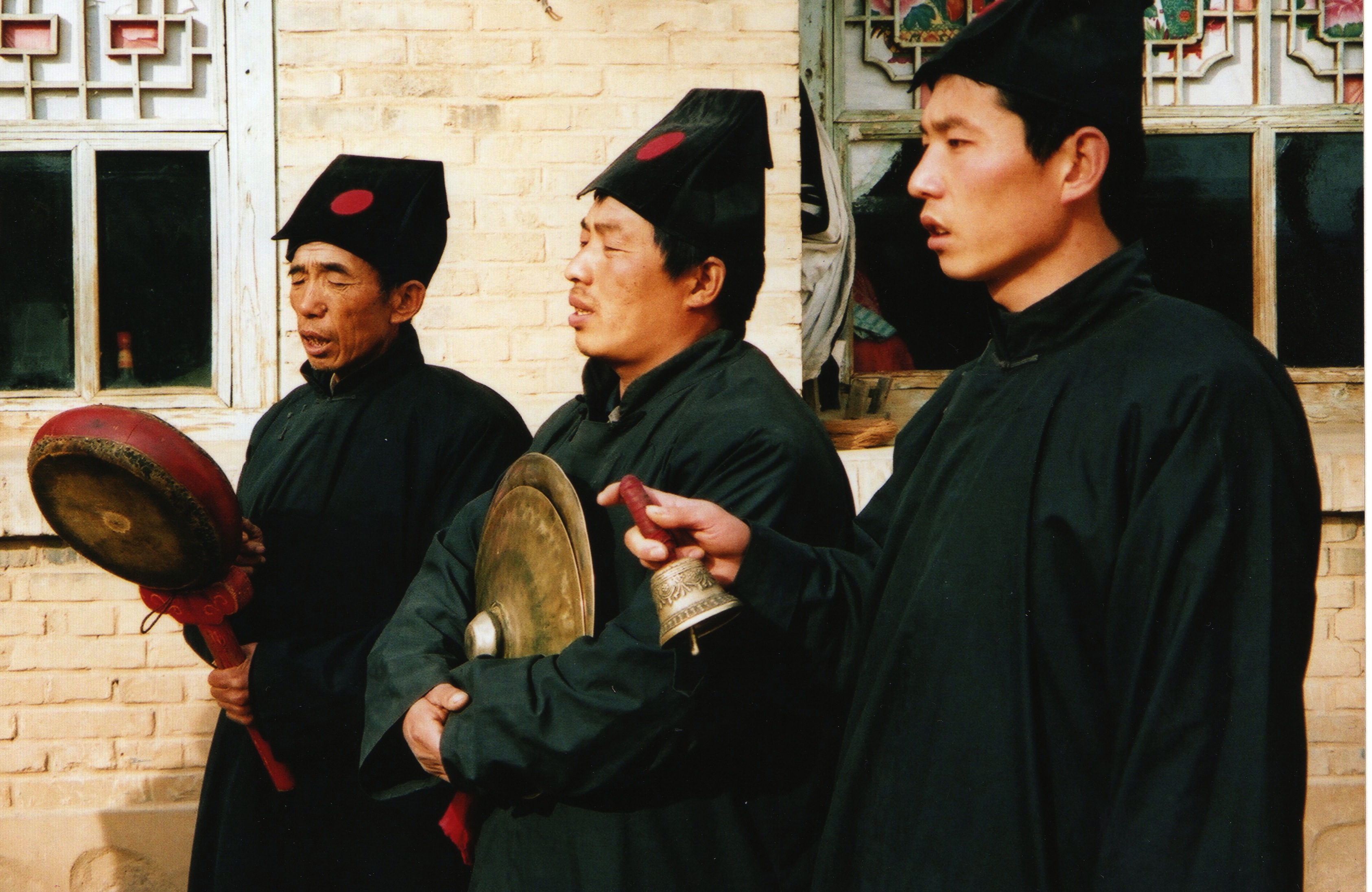
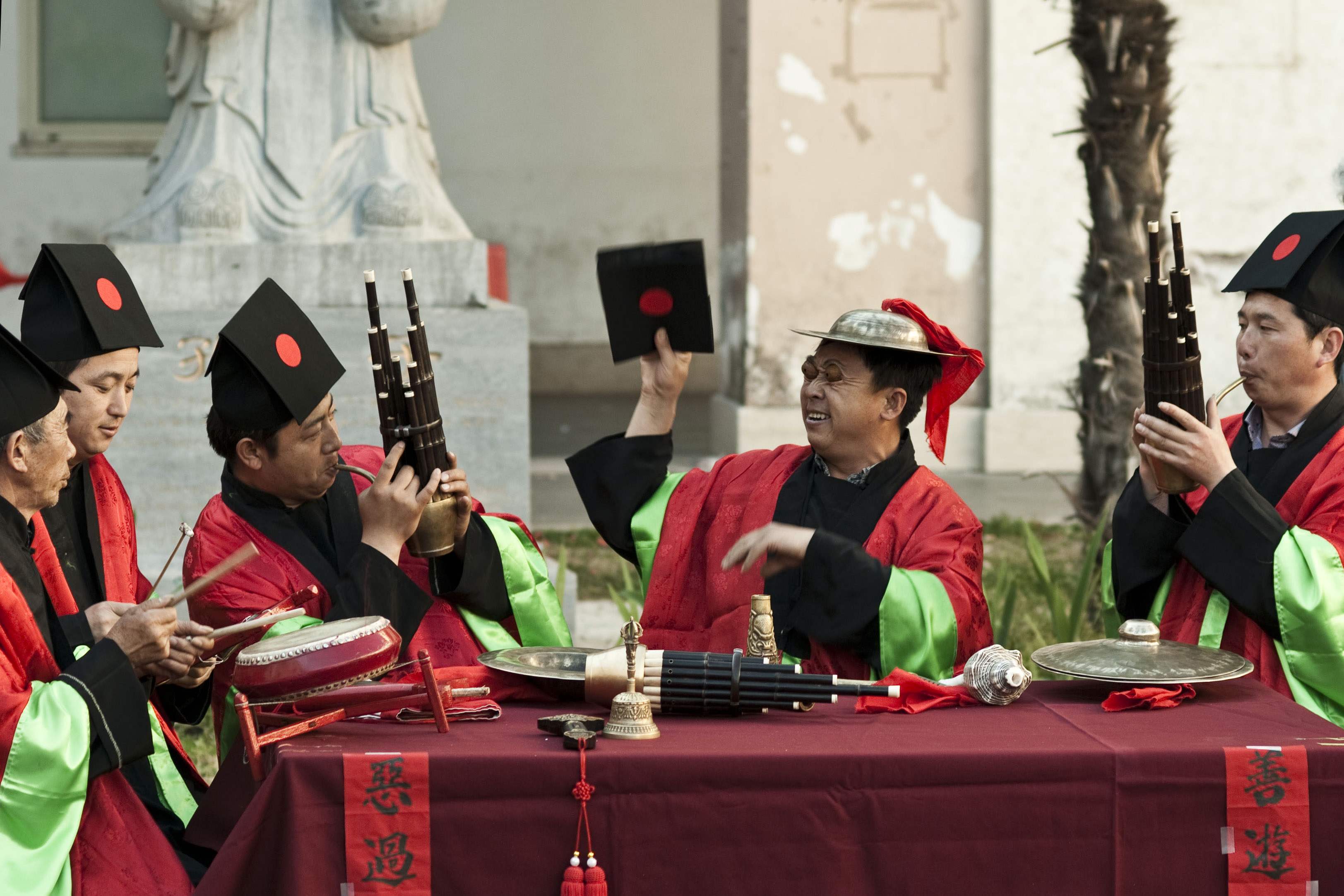
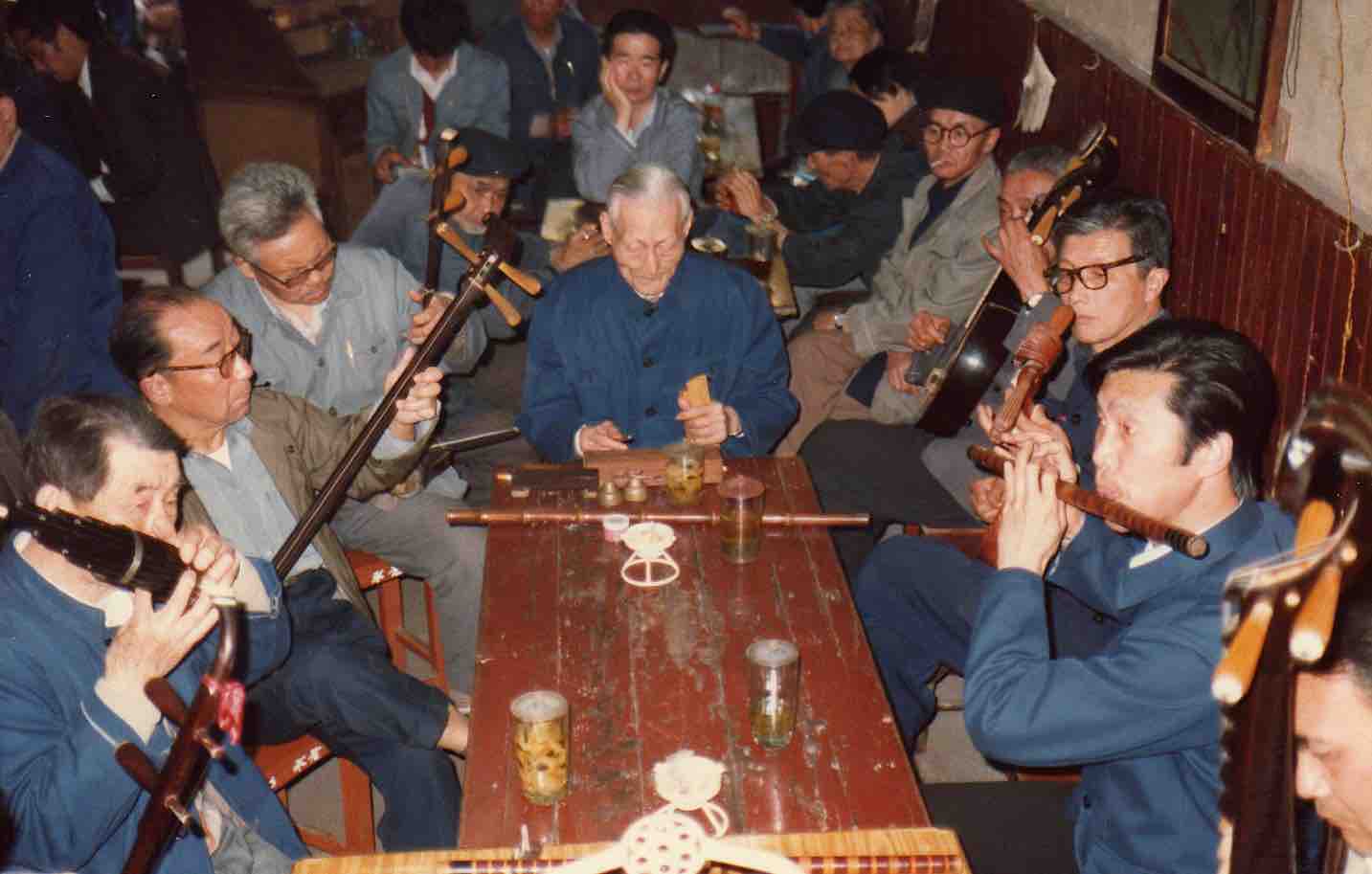
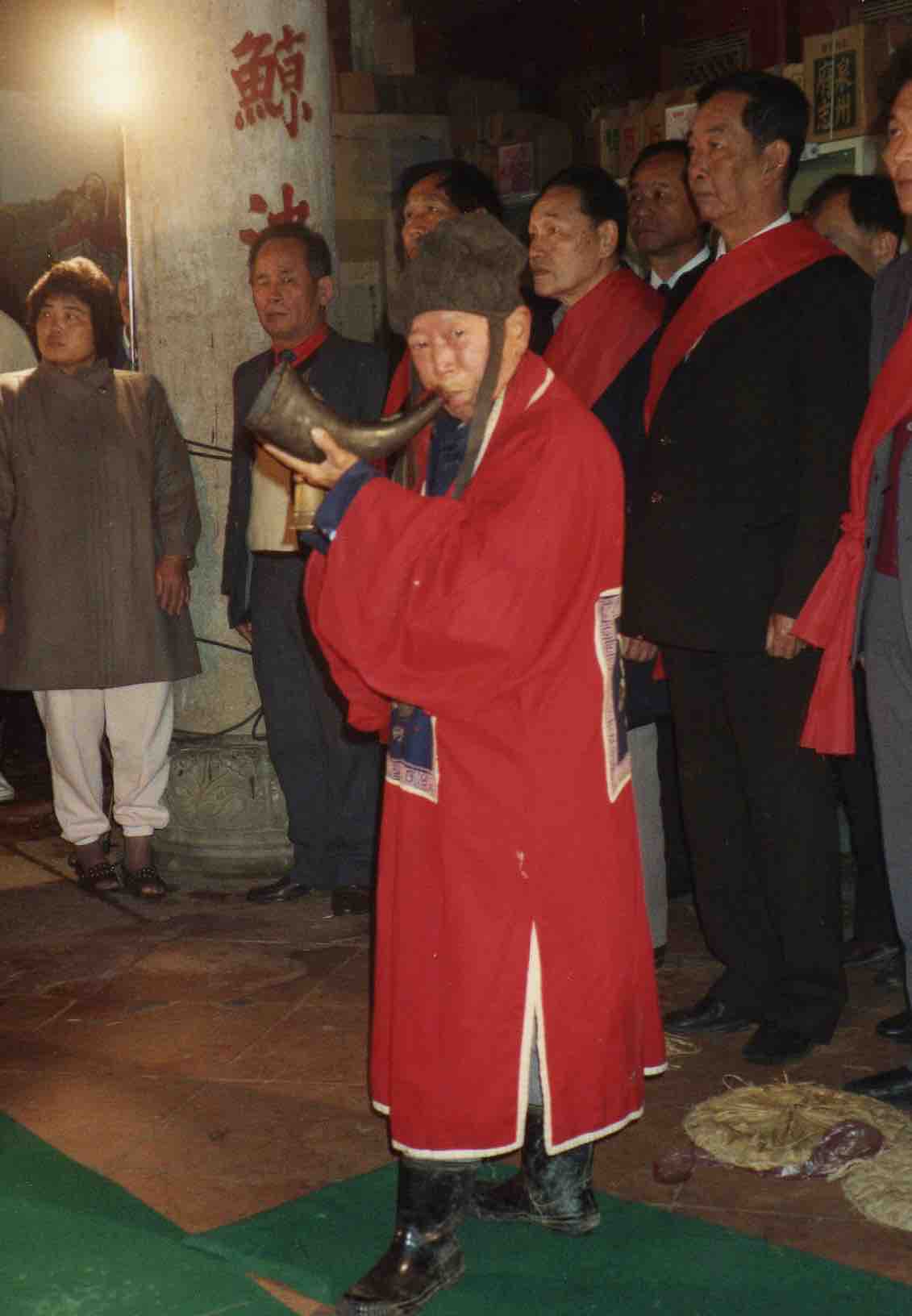
Shanxi, summer 1992

Partly to remind myself that I don’t only do jokes, here are some more fieldnotes.

I’ve already noted the differences between our early fieldwork in the 1990s and conditions more recently. So I thought I’d give you a flavour of one of those earlier fieldtrips.

Over the hot summer of 1992, following hot on the heels of the Wutaishan Buddhist group’s visit to England, Xue Yibing and I made a three-week trek from Taiyuan northwards through Wutai, Xinzhou, Daixian, and Hunyuan, finding ritual activity all along the way, en route for another rendezvous with the great Li Qing in Yanggao. Our last stop was nearby Yangyuan county, just in Hebei.

Since our fruitful initial survey of ritual associations in Hebei over New Year in 1989, this was my fourth fieldtrip with Xue Yibing. Before we could return to the Hebei plain, and before I began to focus on particular villages and families, this was still only a partial survey of central and north Shanxi—for what became Chapter 12 of my book Folk music of China.

We had a van and a driver from the MRI at our disposal, and for parts of the trip we were accompanied by Shanxi scholars Jing Weigang and Wang Bin, whose local knowledge was valuable. We were mostly unencumbered by the need to “kowtow to the Gods of the Soil”, except when we knew there was a knowledgeable scholar—like the senior Liu Jianchang in Taiyuan, who was studying the Buddhist ritual music of the Wutaishan mountains through the 1950s whenever political conditions allowed. All along the way we found local traditions, differing significantly from each other. [1] Power cuts were frequent. And before motorways, our progress was often far from smooth; even on the main roads we generally found ourselves crawling along behind long lines of coal lorries.

stuck-in-mud

Dongye township
In central Shanxi, I had already visited central Wutaishan, so I was interested to explore the outlying areas. While we found many shawm bands (here called gufang 鼓房), our main interest was in ritual shengguan bands (here called xiangda 响打). Though they were rarely ritual specialists with vocal liturgy, some bands performed a fine repertoire of long suites related to the temples of Wutaishan and Beijing—the kind of groups found by the great Yang Yinliu in 1953, in whose steps we were now following.

dongye-chubin

Funeral procession, South Daxing, Dongye.

We spent time with one such band, led by Xu Yousheng in Dongye.

It soon became clear that this whole area was also a hotbed for female spirit mediums, including Xu Yousheng’s wife. These mediums did exorcistic rituals as a group, singing ritual songs a cappella. In this photo, at Xu Yousheng’s house near Dongye, his wife and her fellow medium pose before ritual paintings commissioned by him.

mediums

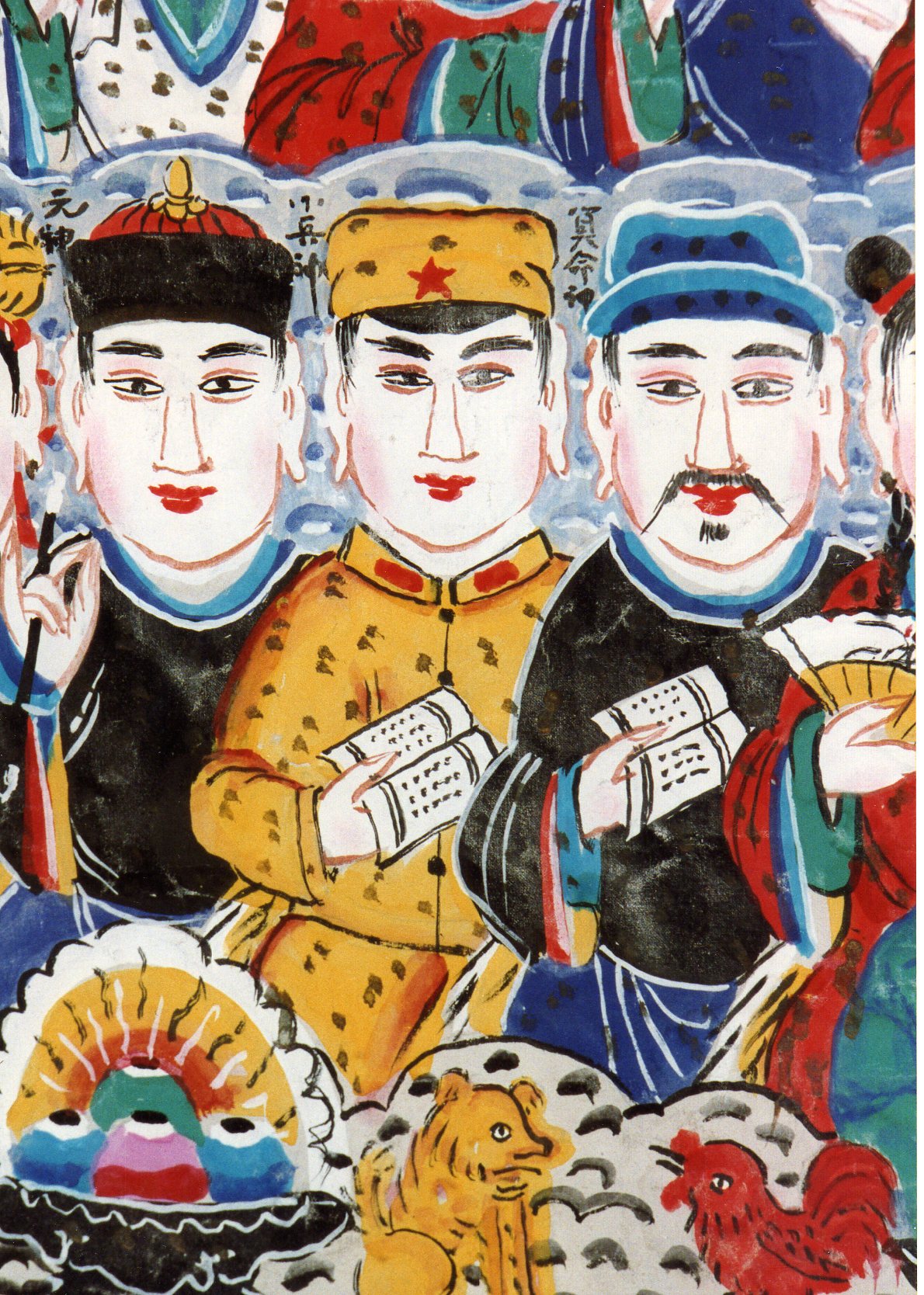
This page from Xue Yibing’s precious notebook lists the gods on the pantheon to the right in the photo.

xu-pantheon-xyb

In this detail, the “young soldier god” features because a medium had divined that he once saved the life of Xu’s son while he was in the army:

painting-detail

For more on such pantheons, see the remarkable website of Hannibal Taubes.

The Xinzhou region
In this large and mountainous region we found more household Daoists (this time of the Complete Perfection branch!), as well as a thriving community of Catholics who also used shengguan music to accompany their rituals.

christians-1992

The Ekou Buddhists
After digging our van out of the mud yet again, we reached Ekou township in Daixian county, in the northern foothills of Wutaishan. I was hoping to see Chengde, lovely former Buddhist monk whom I had hosted in England a few weeks earlier. But he was doing a temple fair some distance away—so we had a chat with his older brother, who provided us with useful detail on local ritual life there. This was one of rather few occupational household Buddhist groups that we found.

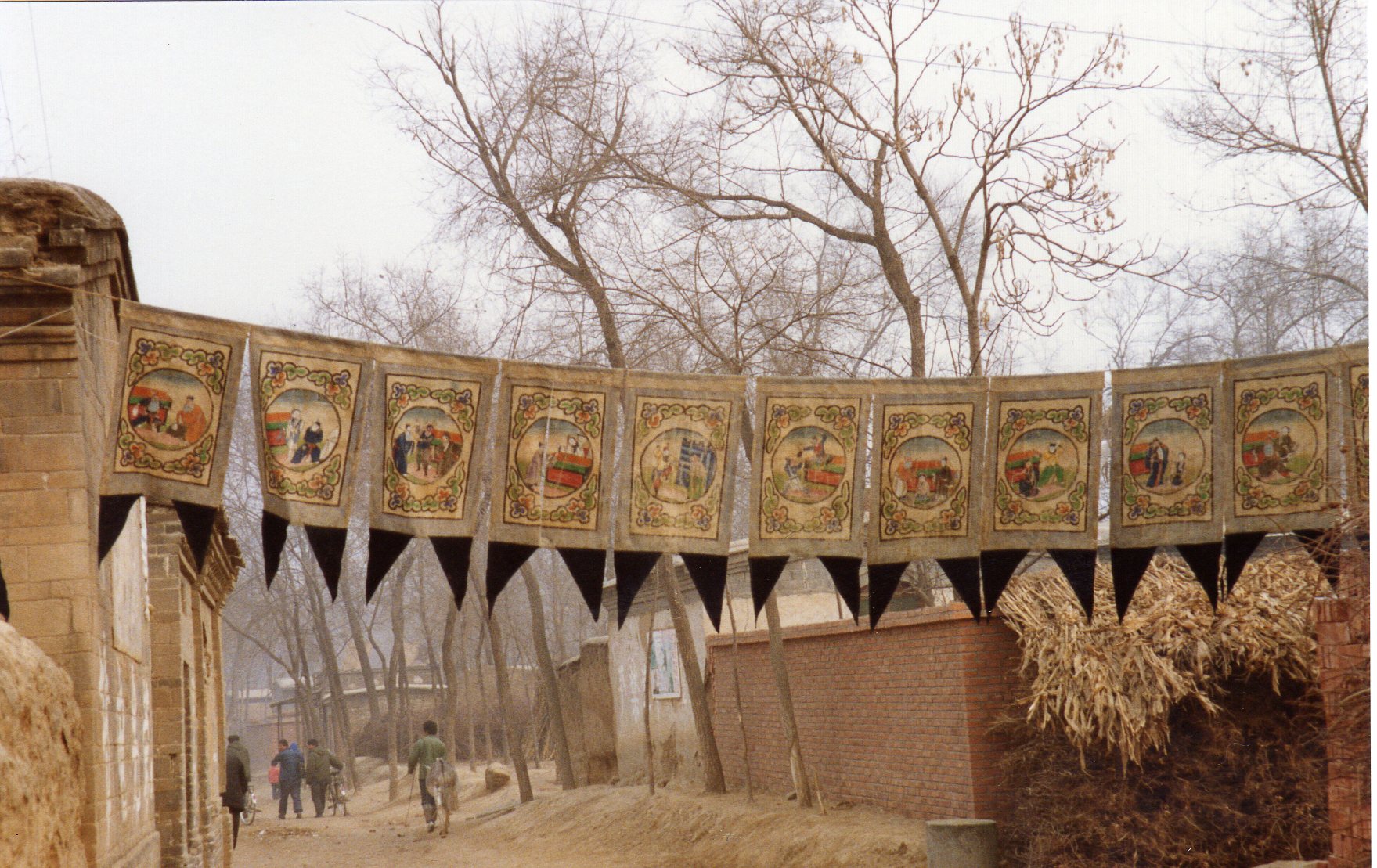
ekou-painting-1

Old pantheon at Chengde’s house.

Hunyuan
Arriving hot and sweaty in the (then) cosy little hill town of Hunyuan (at the foot of Hengshan, the northern marchmont of Daoism), we checked into a modest hostel. On the guest registration form, under “Level of Culture” (wenhua chengdu 文化程度) I wrote “None” (wu 无), as is my wont.

After a long drive and many days in scorching temperatures without running water, we were delighted to find that not only did our room have a bath, but that hot water was promised (typically “after 8pm”, which often means either “never” or “from 3.30 to 3.35 am”).

The bathroom wasn’t exactly hygienic, but hey, we weren’t fussy—ruxiang suisu, “when in Rome…”. Xue Yibing rashly took the plunge first, and he was just sinking into the water in ecstasy when the ceiling (exhausted by unprecedented strains on the plumbing above) promptly caved in, covering him in rusty debris (or is that the name of a Country singer?). Adopting what Nigel Barley calls “fieldwork mode”, we both burst out laughing. He came out a lot dirtier than he went in.

Next day we found no ritual activity at the Hengshan mountain temples, but in town we found yet another great family of household Daoists.

hunyuan-ritual

hunyuan-manual

Page from ritual manual: end of Fetching Water ritual and opening of Dispensing Food.

This group belonged to a lengthy Orthodox Unity lineage. By the time I went back to see them in 2011 with the wonderful Li Jin, significant changes had taken place in their practice (see fieldnotes here).

The north
After a brief visit to more Orthodox Unity household Daoists in Datong county, we reached Yanggao, where I was delighted to find Li Qing again, performing a funeral with his ritual band. He also managed a long session with us, providing detailed accounts of ritual sequences, augmenting my notes from the previous year.

After a brief and rather unedifying stop-off in Yangyuan county, we made our way back to Beijing. Upon my return, I once again (as usual) sought out former monks, before we set off once more for Liaoning in the northeast, finding majestic shawm bands there too…

* * *

Such early fieldtrips with Xue Yibing were an important training for us both, before we launched into more in-depth study of the Hebei ritual associations. I always treasure his notes, but however brief our visits on that Shanxi trip, the three hand-written volumes he copied out for me are full of wonderful ethnographic detail on folk religion.

Since 2011, having profited from collaborative fieldwork for twenty-five years, I have largely engaged with the Li family Daoists on my own, regaining a certain self-esteem—except for the occasional mishap


[1] For more detail on most of these sites, see my In search of the folk Daoists, pp.65–81; Chen Yu, Jinbei minjian Daojiao keyi yinyue yanjiu, pp.65–90 and passim. For a richly-illustrated overview of folk customs throughout Shanxi, see Wen Xing 文幸 and Xue Maixi 薛麦喜 (eds.), Shanxi minsu 山西民俗 (Taiyuan: Shanxi renmin cbs, 1991).

A tongue-twister for the household Daoist

57 shengguan trio

Yang Ying (right) and Li Bin (left) accompany Wu Mei before the coffin, 2011.

A popular dep in Li Manshan’s band is Yang Ying, who studied briefly with Li Qing not long before his stroke in 1996, but as boss of a busy shawm band has to juggle his ritual work (my book pp.319–21).

Since household Daoists like this are known here as yinyang, and since (like the “non-national” Euripides, to cite Myles yet again) Yang is partial to “smoking substances”, one day while we were all relaxing in the scripture hall I composed a suitable epithet for him, on a par with my headline for Švejk and Saint-Saëns:

阴阳杨英饮洋烟
Yinyang Yang Ying yin yangyan

The yinyang Yang Ying smokes foreign tobacco with a water-pipe.

Note: 饮 “drinks” is a little obscure (“eats” chi  is more idiomatic, but that doesn’t work, of course), but evidently refers to a water-pipe. We’re always joking about “foreign tobacco“, which has long suggested opium.

For some excellent German tongue-twisters, click here.

More on taxonomy

As with feminist punkvocal styles of the worldthe organology of the world’s instrumentarium, and indeed any other human activity, the taxonomies made by ordinary people are evident from their fine discriminations of nuance between pop genres that may seem arcane to the outsider—like acid house, drum and bass, grunge, indie, metal, Northern soul (“Naa, I’m not into the Manchester sound, guys”), rap, hip-hop, and even trainers, FFS  (don’t ask me…).

And just the same goes for rural dwellers’ perceptions of ceremonial genres and ritual activity in any single county of China: shawm bands, geomancers and spirit mediums (distinctions within the latter partly gender-based), [1] amateur sects, temple priests, occupational household ritual specialists, inner and outer altars, civil and martial altars, Buddhist Daoists and Daoist Buddhists (I kid you not), [2] “northern” and “southern” ritual wind bands around Beijing[3] opera troupes, singers, bards, beggars….

Taxonomy is not merely the preserve of the fusty academic; it’s part of what makes us all human.

Such perceptions can also arouse passionate and bitter disputes—never more so than between, and within, religions (if less so in China, notwithstanding imperial persecutions). But classification doesn’t have to equate with building walls. Whereas the brutish black-and-white (sic) xenophobia of a certain Tangerine fuckwit suggests that his sensibilities may not be so finely tuned, taxonomy can also reveal connections and build bridges.


[1] For just one region, see Adam Chau, Miraculous response, pp.54–8.
[2] See several reports in the Daojiao yishi congshu series, and Overmyer, Ethnography in China.
[3] See also my In search of the folk Daoists of north China, Appendix 1.

The definitive transliteration

Svejk

I just can’t resist constructing a headline to incorporate some of my favourite Chinese transliterations (for more, see here, with thread):

帅克耍耍圣桑的兔子不拉屎
Shuaike shuashua Shengsangde tuzibulashi

or

Conquering General plays with the Rabbits-don’t-shit of Sage Mulberry

or, if you insist,

Švejk plays with the toothbrush of Saint-Saëns

What kind of language do you call that, ask the Plain People of Ireland. Beat that, China Daily.

In The good soldier Švejk, among several references to the toothbrush, try this:

Then she took out of the hamper three bottles of wine for the convalescent and two boxes of cigarettes. She set out everything elegantly on the empty bed next to Švejk’s, where she also put a beautifully bound book, Stories from the life of our Monarch, which had been written by the present meritorious chief editor of our official Czechoslovak Republic who doted on old Franz. Packets of chocolate with the same inscription, “Gott strafe England,” and again with pictures of the Austrian and German emperors, found their way to the bed. On the chocolate they were no longer clasping hands; each was acting on his own and turning his back to the other. There was a beautiful toothbrush with two rows of bristles and the inscription “Viribus unitis,” so that anyone who cleaned his teeth should remember Austria.

The latest research, however, suggests that Saint-Saëns (1835–1921) once carelessly left his toothbrush behind at his hotel while on tour in Prague—he was indeed a keen traveller, but his biographies are curiously silent about this incident. Later the Good Soldier came across it by chance while rummaging in a junk shop, and proceeded to toy with it.

Still, we cannot dismiss the possibility that the toothbrush may be employed here in its popular Slovakian metaphorical sense. In a comment suggestive of Molvania, Andrew Lawrence Roberts (From Good King Wenceslas to the Good Soldier Švejk: a dictionary of Czech popular culture) notes:

Slovácko is best-known for its traditional culture: distinctive national costumes are still occasionally worn, folk traditions like The Ride of the Kings [a major theme of Kundera’s The joke—SJ] still celebrated yearly. The largely rural residents of Slovácko are known as well for their love of slivovice, which they refer to as their morning toothbrush.

So have I been barking up the wrong tree? In this case, one wonders further: just what kind of liqueur was Saint-Saëns’ so-called “toothbrush”? In our headline, perhaps we may now interpret the verb shuashua “fooling around with” as referring to a tasting session—given Švejk’s Bacchic propensities, surely an epic event, at which Flann O’Brien would have been more than welcome.

The changing nature of fieldwork in China

Further to various comments (collected here), over my three decades doing fieldwork in China the nature of the equipment we use, and fieldworkers themselves, have changed just as much as our objects of study and the rest of the population—of course just like anywhere else, and over earlier periods of ethnographic history.

Never mind all those wonderful fieldtrips of the 1950s; through the 1990s, when my trusty fieldwork companion Xue Yibing and I went on long fieldtrips together (Hebei, Shanxi, Liaoning, Fujian, Guangdong), I used to show up at Beijing train station with a heavy bag full of audio and video tapes, dozens of films for my camera, a bulky array of batteries and chargers, and even a few spare clothes; besides my heavy equipment bag with camera, camcorder, tape recorder, leads, and so on. As you do… And even that was very modest compared with the lists advised by some earnest ethnomusicologists, giving an inventory that would be the envy of British troops invading a third-world country—even Bruce Jackson gives a daunting list. All that is fine if you have an army of docile sherpas, but per-leez

Meanwhile Xue Yibing just brought a slim shoulder-bag containing only his little notebook, a biro, and a toothbrush. Out of all our combined equipment, it was his notebook that would turn out to be most precious.

Sometimes—not always—we managed to hire a clapped-out old minivan. To find ritual activity, we just had to “go down” to the villages and hope; not only were there no smartphones, very few villages even had a landline. As soon as we “went down”, we were cut off from all contact with the outside world.

Fast-forward to the last few years, and young Chinese fieldworkers take an array of high-class audio and video equipment, laptops, and smartphones, with which few foreign scholars of their age can now compete. Smartphones give fieldworkers instant access to all kinds of information—one could virtually do everything (including photos and recordings) with just a phone. They often drive fancy and robust cars, with GPS to help them navigate and find the villages. The road network is vastly improved; local tracks may still be pretty crap, but motorways have expanded a lot.

And among these young scholars, women are now in a clear majority—bright people like Qi Kun, Wu Fan, and Chen Yu were trained by female scholars of senior generations, like Yuan Jingfang in Beijing and now the brilliant Xiao Mei at Shanghai, ethnographer par excellence. Chinese students also now have some grounding in international ethnomusicology. Of course, one always seeks to do diachronic as well as synchronic work, and our own changing experiences are part of that.

Punk and feminism

While I’m on the topic of feminist songs, and continuing from Clothes clothes clothes music music music boys boys boys, this is another fantastic piece of, um, diachronic ethnographic herstoriography:

http://pitchfork.com/features/lists-and-guides/9923-the-story-of-feminist-punk-in-33-songs/

Predictably, bands from East and West coasts of North America dominate the list. For any China-watchers branching out into Riot grrrl and Bikini kill, look out for the latter’s Rebel Girl as soundtrack to The red detachment of women

Indeed, Feels blind was released in 1991, the year I first met the late great household Daoist priest Li Qing in Yanggao…

The UK comes up a strong second on the list—not least the amazing Poly Styrene, and The Slits, and there’s even a great early PJ Harvey number (roll over “late Beethoven“). The playlist does suggest the wider nature of the scene, with Volpes from Spain and the Swiss band Kleenex. But I do wonder if Pitchfork’s postbag has been flooded with a letter from a Mrs Ivy Trellis of North Wales, deploring the lack of French, German, or Spanish bands—or indeed Dame Vera Lynn. Not to mention Pussy Riot, or Chinese bands… For more female punk playlists, click here, and this roundup of my posts on punk.

Consider this an addition to my growing category of topics about which I know Fuck All. I guess covering feminist punk in a blog about Daoist ritual is marginally less implausible than the other way round—I do look forward to that, though.

Two local cultural workers

These notes are partly stimulated by Zhang Lili, currently writing her PhD in Beijing on my relationship with the village of South Gaoluo, subject of my book Plucking the Winds.

A useful idiomatic term evoking the whole spectrum, whether of guanxi contacts or the range of funeral services, is yitiaolong “the whole dragon” (indeed, this blog may itself be considered “the whole dragon”, making links between seemingly diverse topics).

Li Bin’s first funeral shop in town.

Li Bin’s funeral shop in Yanggao county-town, Shanxi.

So having praised Yang Yinliu, shining pinnacle of Chinese musicology, I want to pay tribute to two admirable local cultural workers at the opposite end of the dragon (cf. An unsung local hero) whose work has inspired us since 1989:

Liu Fu 刘阜 and Wang Zhanlong 王占.

Their only qualification was that they were local, and came to take pride in documenting their local traditions under the stimulus of the new directive from the Anthology of folk music of the Chinese peoples, the vast project that got under way from 1979 as China began to liberalize after the collapse of Maoism.

Let me adapt a passage from my article

  • “Reading between the lines: reflections on the massive Anthology of folk music of the Chinese peoples”, Ethnomusicology 47.3 (2003), pp.287–337 (for reading between the lines of a Chinese article on 1950s’ Tibet, see here).

Antoinet Schimmelpenninck described the process of collecting folk-song in Jiangsu in the early 1990s.

The collecting of folk-songs is one task, but by no means the only or primary task of the bureaus of culture. They carry out political propaganda, make posters about family planning or about the punishment of local criminals, organize dance parties, stage plays and children’s games for local entertainment, run libraries, and execute various administrative tasks which help the provincial government. […]
It is not, at present, one of the specific tasks of the Cultural Bureaus of the Wu area to collect folk-songs. I visited one wenhua zhan (village cultural post) which was mainly engaged in printing labels for jam jars and other consumer goods.

Censorship may operate throughout the process: first, self-censorship of performers (e.g. what kind of songs singers see fit to sing for fieldworkers), and then editorial adaptation of the material collected. In Baoding, one single region of Hebei province, where ritual associations have important traditions, such fieldwork as was done on “instrumental music” took place mainly from 1983 to 1985, but in only two or three of a dozen counties we have visited did we find knowledgable cadres who had done such work.

One of the most diligent of these was Liu Fu, of the Hall of Culture in Laishui county. He acted early on the Anthology directive, printing a mimeograph (4 pp. introduction, map, list of contents, 128 pp. transcriptions, 22 pp. field report, 8 pp. diagrams of instruments) on the county’s instrumental music as early as 1983, which was an important inspiration for my own work on ritual associations there. I don’t know if the regional editors ever forwarded Liu Fu’s work, but it was entirely omitted from the final provincial publication. The following passages of his “Field report” show some of the problems faced by local collectors, here partly relating to the sensitive and secret nature of ritual music:

The work of collecting folk instrumental music is not always smooth: we have met considerable difficulties. For instance, some elderly folk musicians had been struggled against during past campaigns for this [their music/ritual], and had been labelled as “black cliques” and “ox demons and snake spirits”, so they are still anxious. When they heard that we wanted to collect pieces of music, they suspected that it was once again “luring the snake out of its hole”, and so they refused to play for us.

Some associations are very conservative in their thinking, and are concerned that their distinctive pieces will be taken off and learnt by others—in their own words “something we begged for on our knees, we can’t just throw it out now we’re on our feet”, and so they make excuses not to play for us. Some associations take the opportunity to make economic demands. Some brigade [village] cadres think this work is meaningless, and are afraid it might have side-effects, and so are unwilling to co-operate with us. And so on.

Since these are ritual associations, by “side-effects” he apparently means that the collection may be seen as encouraging feudal superstition. Liu Fu continues:

To tackle this situation, every time we arrive in a place, we explain the document “On the collection and documenting of the Chinese folk musical heritage” from the Ministry of Culture and the Musicians’ Association, and the spirit of the directive from the relevant organs of the province and regions, and we discuss the great academic value of the repertory of the ritual associations in our county, and the great significance of the work of collecting, to make the cadres and musicians have a correct understanding; we then show them that they can play whatever they have to play, they must not leave it to later musicians, but do their best to make their own page in the Anthology of instrumental music.

Poor equipment for sound recording, copying, and photography was the norm. Liu Fu goes on to discuss the problems of recording:

Although there are said to be instructions and directives from the central, provincial, and local authorities for the work of collecting instrumental pieces, no-one has given us a scrap of money, and the expenses of the county Bureau of Culture are reduced year by year. Under present conditions, where they can only guarantee annual salaries, they can’t supply any more money to support the work apart from producing a minimal sum for buying necessary goods like tape and paper. Thus, all the associations have to perform for free. This requires us to record as much as possible in a short time.

I might add that any tapes were poorly annotated if at all, and haphazardly stored. One keen cadre I know in the same area had to use a single tape over and over, transcribing a piece in one village one evening and then re-recording music in another village the next day on top of the old recording. But at least he did some work! Of course there was a lot more that local scholars could have done, given time and money—like copying gongche scores and ritual manuals, filming rituals, documenting the histories of the associations, and giving detailed descriptions of ritual sequences, as we later aspired to do in our project around several nearby counties. But Chinese fieldworkers have now overtaken us.

Central funds barely reached down to grass-roots level, and cultural cadres did what they could. On one hand, they were indigenous to the musics they were documenting, but they were rarely able to afford the time or resources, even if they had the training, to make systematic reports. Still, some of the results are impressive.

Anyway, we knew that we might learn from local cultural officials how to find ritual groups. Besides, in those early days, when the memory of the commune system was still fresh, it was a necessary first stage to go through the chain of local officialdom. Sometimes, when our preliminary research in Beijing failed to suggest any knowledgeable local officials, we simply bypassed them. A couple of times we got our fingers burnt, but the most fruitful leads to ritual groups often came just by stopping to chat to any old melon-seller by the roadside—he would generally tell us where the grand rituals were held, and which villages were worth visiting.

There were actually two types of cultural officials: those inclined towards “cultural work”, and jobsworths. The latter, once we began visiting the villages regularly, realized that we didn’t constitute an excuse to hold another vast banquet; I was clearly not an eminent foreign professor but an ill-dressed and impecunious young researcher, so they soon left us to our own devices.

Times have changed, though: now the local Bureaus of Culture are staffed by administrators, not necessarily even local, with their smartphones and spreadsheets.

Liu Fu and Gaoluo
Further to A slender but magical clue, I’ve been recalling how we found the village of Gaoluo.

Liu Fu himself came from a Laishui village, East Mingyi, with its own tradition of vocal liturgy (including baojuan “precious scrolls”) and shengguan ensemble. After the 1986 “discovery” of the Qujiaying ritual association in nearby Gu’an county, he had already approached officials in Beijing to tell them that there were plenty of similar groups in his county alone, giving them a copy of his fine 1983 mimeograph and a tinny tape he had somehow made of a few of their shengguan pieces.

In Beijing Liu Fu also met my mentor Qiao Jianzhong, Yang Yinliu‘s successor as head of the Music Research Institute, who then made an exploratory trip to two other Laishui villages in 1988. It was this that prompted me and my friend Xue Yibing  (a bright musicologist from the distinguished Music Research Institute in Beijing) to visit Liu Fu in his bare dingy office in Laishui county-town as part of our first fieldwork survey in New Year in 1989.

After giving us an outline of the various ritual groups in the county, Liu Fu recommended Gaoluo, so we all sallied forth. Here I adapt from the Prelude of Plucking the Winds:

I first arrived in the village of South Gaoluo on a cold but bright winter’s afternoon, on the 14th day of the 1st moon in 1989, in the middle of the great New Year’s rituals then taking place in every village in China. This was one of many villages just south of Beijing where I was working with Xue Yibing in doing exploratory fieldwork on amateur ritual groups.

Escorted on that first visit by a well-meaning ganbu (“cadre”, as state officials are known in China) from the cultural bureau of the county-town, we made slow progress by jeep along the bumpy track to the village; though it is only nine kilometres from the dingy county-town of Laishui, the journey took over half an hour.

cart

An encounter on the way to Gaoluo, 1989.

First we went to the house of the then village chief Cai Ran, himself a vocal liturgist in the village ritual association, and had to spend over an hour in heated debate before we could cajole him into allowing us to trudge through the alleys to the ritual building a few hundred yards away, where the association was then performing before the god paintings at the altar (photo here).

cai-ran

Cai Ran, 1989.

diaogua

Diaogua hangings for the New Year’s rituals, 1989.

gl-beiwen

Donor’s list (1930) of the South Gaoluo association, New Year 1989.

At the time Cai Ran’s caution seemed to me excessive, since we were all clearly sympathetic, and the county cadre was taking responsibility, but in retrospect I felt rather embarrassed: maybe we should have respected his reluctance. Later, when I learned of the 1951 imprisonment of the Italian missionary Bishop Martina, apparently the last foreigner to visit the village, and as I experienced more often the sensitivity of “superstitious” practices in China, I understood his anxieties better. But later Cai Ran recalled that his hostility that day was not related to the revealing of secret rituals to foreigners, nor to fear of criticism from county cadres, but rather to the possible appropriation of his village’s ritual music by the cadre, whom he already suspected of handing on some pieces to the association in his own home village. After this strange introduction, we soon came to enjoy our sessions with Cai Ran: he has a wonderful informality, a great sense of humour, and is full of insight.

Later I liked to share with the villagers another amusing memory of that first afternoon. After finally persuading Cai Ran to escort us to the ritual building, and having gained the musicians’ approval to record and take photos (alas, I didn’t yet have a camcorder!), I had just set up my recording equipment when in walked a severe-looking policeman in uniform. Knowing the sensitivity of what the musicians were doing, and of what I was doing in watching them doing it, my heart sank: feeling irrationally as if I’d been caught in the act (fan cuowu “made a mistake”, as the eloquent Chinese expression goes), I prepared for further lengthy negotations. But the policeman, the splendid Shan Rongqing, back in the village for the New Year holiday, immediately picked up the large ritual cymbals and joined in with feeling. He later took part keenly in our studies of the village traditions; we often admired his musicianship on the ritual percussion, and later too on the “old fellow”, the bowed fiddle on which he accompanied the local opera.

srq

Shan Rongqing, 1989.

That day we felt lucky enough to have been allowed—eventually—to witness the association’s afternoon ritual, and since we had business in the county-town that night, we agreed to return the next day to talk with the members. That next day they were friendly, as always with such amateur associations; we recorded them “singing the score” of some of their shengguan pieces for us (cf. sidebar playlist, #9), and learned the bare bones of the New Year’s rituals and the history of the association—material which later, in view of all that we would gradually learn, came to look ludicrously sparse. And again we took our leave—the time still had not come for in-depth work, since we were only making a general survey.

Somehow, that first visit to South Gaoluo left us with a deep impression: the village seemed isolated (a view we later corrected) and its ritual life intense, with all the beautiful hangings decorating the temporary temple and the alleys outside. But it was not until the summer of 1993 that we were able to go back there. By now we were engaged on a four-year project to document village ritual associations throughout the area; but while we continued to collect basic data on other villages, we naturally felt the need to dig beneath the surface, not just to “gaze at flowers from horseback”. Gaoluo became a magnet for us, and over the following years we made many stays there, having a fantastic time as we learn more about the turbulent experiences of the village and its ritual performers throughout the 20th century.

Wang Zhanlong
The very next day after those first visits to South Gaoluo at New Year 1989, in the adjacent county of Yixian, home of the Western tombs of the Qing emperors, we visited the office of the Bureau of Culture to seek clues to local ritual associations. There we found the splendid and unassuming Wang Zhanlong. Like Liu Fu, he too relished the task of collecting material, riding his bicycle through poor villages with a crummy little tape recorder and a notebook. Wang promptly took us to Liujing village, also in the midst of their New Year’s rituals.

liujing

Xue Yibing documents pantheon, Liujing, New Year 1989.

This was the start of our studies of the Houshan pilgrimage and the cult of the goddess Houtu.

wzl-xyb

Wang Zhanlong and Xue Yibing, Houshan 7th-moon temple fair, 1993.

Houshan is just one of those numerous local mountain sites attended several times each year by vast throngs of pilgrims, ritual groups, spirit mediums, and beggars, yet (unlike Miaofengshan to the northwest of Beijing) it had never attracted the attention of outsiders.

houshan

Houshan temple fair, 7th moon 1993. Matou village ritual association (left) accompanies a spirit medium (front centre) and disciples (whom she has healed) for boat-burning ritual as they pray.

Right through the 1990s Wang Zhanlong made a wonderful sincere companion on our regular visits to Houshan and the ritual groups of Yixian county, always in sympathy with our project. Here we are in 1995 with erudite ritual specialist Li Yongshu in Baoquan village near Houshan, learning the details of the complex performance practice of the “precious scrolls” to Houtu, the Ten Kings, and so on.

Li Yongshu, Baoquan 1995

liujing-pantheon-1995

Pantheon, Liujing, hung out for rituals on the 1st day of the 3rd moon, 1995. Right: envelope with petition, to be burned in supplication to the goddess Houtu.

For an intrepid fieldworker in Liaoning, see here. See also surveys based on the Anthology for Fujian and Tianjin.

A tribute to Yang Yinliu

yyl-on-xiao

Yang Yinliu, 1950.

Since I mentioned Yang Yinliu’s groundbreaking work on the Zhihua temple, he too richly deserves a tribute. Indeed, since soundscape is such a basic aspect of Chinese culture, his work should form a basic training for us all.

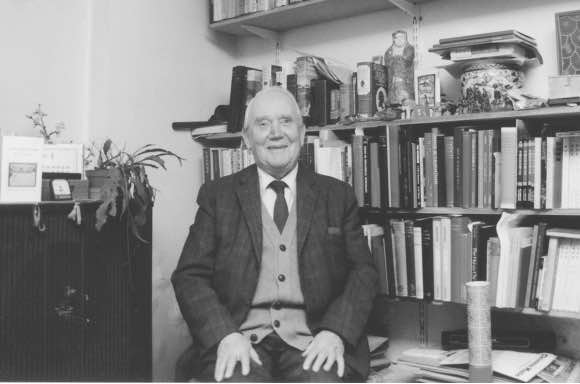
Yang Yinliu 楊蔭瀏 / 杨荫浏 (1899–1984) is often described in mediaspeak as “the Chinese Bartók”, but Bartók should rather be described as “the Hungarian Yang Yinliu”. A fine musician and fieldworker, erudite historian, and incidentally a Protestant, Yang’s whole oeuvre was remarkable.

Brought up in the final years of the Qing dynasty in the milieu of the Daoist instrumental music and the refined Kunqu vocal dramas of the Wuxi area near Shanghai, Yang was a fine exponent of qin zither, pipa and sanxian plucked lutes, and the ethereal falsetto singing of Kunqu (I haven’t yet found my copy of the precious recording from the 1920s found recently in Berlin). He learned instruments from Daoist priests (including Abing) from the age of six, joining the elite Tianyun she society.

YYLIn Wuxi, under the tuition of the American missionary Louise Strong Hammond, he studied English and Western music theory. He also became an active Christian. He went on to gain a cosmopolitan education in Shanghai, attending St John’s University from 1923. After returning to Wuxi in 1926, he was married in 1928, becoming a professor at Yenching University in Beijing in 1936. Offered a job in the USA heading a Chinese music institute there, he commented, “I can do nothing if I leave Chinese soil, where Chinese music lives.”

After the Japanese occupation in 1937, and through the troubled 1940s, not inclined to join the Communist base area in Yan’an, Yang moved from Nanjing to posts in Kunming and Chongqing, always continuing his research.

The Wuxi Daoists
Yang and his cousin Cao Anhe returned regularly to Wuxi, where they were engaged in a long-term project studying the music of the local Daoists. Of their two major books on the theme, their work on Shifan gu was first published in 1957, Yang’s on Shifan luogu not until 1980 (cf. the shifan of Tianjin and Hebei).

In some respects Yang seems like a traditional historical musicologist rather than an ethnographer; but he was well aware of complex social issues. This passage on the position of Daoists in Wuxi society illustrates his sophisticated interest in ethnography and ritual practice, besides his more traditional “musicological” concerns: [1]

In the past [?!], Buddhists in south Jiangsu divided into two types, Chan school (chanmen) and Auxiliary school (fumen).

Those of the Chan school were completely vegetarian, and didn’t have families. They only used percussion like woodblock, bowl, nao and bo cymbals, and tonggu drum to punctuate their vocal liturgy; they didn’t play any melodic instrumental pieces. They never took part in production, living in their temples, some of which had large estates.

The Auxiliary school ate meat and had families. Few in number, they lived scattered in the villages, taking part in agriculture and only reciting the scriptures and litanies as an auxiliary occupation. Among the Buddhists, they are the only ones who play the fanyin [melodic instrumental repertoire] and [separate] percussion items.

Among the Daoists, the Complete Perfection (Quanzhen) school (belonging to the Qingchengshan style of Sichuan) were similar to the Buddhist Chan school, not using separate percussion items or silk-and-bamboo instruments. Those who played the fanyin and separate percussion items mostly belonged to the Zhang Heavenly Masters school of Longhushan in Jiangxi.

Among the latter group, there was a further clear class distinction. A minority of abbots possessed ritual titles of the Zhang Heavenly Masters, like “Master who Guard the Way” (daoweishi) or “Ritual Master” (fashi), and mostly owned land. They didn’t take part in production. They interacted with landlords and the bourgeoisie in the cities and villages, taking ritual work and contacting and hiring the common village Daoists to take part in major rituals (daochang fashi).

These common Daoists mostly took part in agricultural production, being hired ad hoc: performing for rituals was an auxiliary occupation for them. In both agriculture and Daoism, they were an exploited class. These common Daoists—even the indispensable drummers and flute players, with their excellent musical technique—only got a tiny wage for a whole day’s work.

Conversely, the “Masters who Guard the Way” and “Ritual Masters”, having only taken responsibility for quite brief ritual segments of a few hours like Issuing the Talismans (fafu), Reporting the Memorial (zoubiao), and Flaming Mouth (yankou), claimed a reward many times higher than that of the others. Those who played music were mostly the common semi-peasant Daoists; very few of the “Masters who Guard the Way” and “Ritual Masters” could do so. This shows that in the past it was agricultural life that produced and developed music.

Never mind the diplomatic PC spin (for “reading between the lines”, see my article cited under Hunan below), Yang had already observed the important distinctions common to local ritual cultures all over China, long before the major projects on local Daoist ritual since the 1980s. [2]

sfg-50s

sflg-1950s

Shifan gu and Shifan luogu, c1962.

Nearby, the Daoist rituals of Suzhou were also thoroughly documented in an amazing 1956 project. Following such early work, major studies of the Daoist rituals of Suzhou, Wuxi, and Shanghai have been made since the 1990s. [3]

The Music Research Institute
After the 1949 “Liberation” Yang’s erudition was much needed. Managing to adapt to the new Communist regime, he was appointed director of the newly-formed National Music Research Institute of the Central Conservatory of Music (predecessor of the Music Research Institute [MRI] of the Chinese Academy of Arts), beginning a golden age for research there. Under his committed guidance they accumulated a large archive of field recordings and traditional notations.

A qin player himself, he was closely involved with all his eminent colleagues’ research on qin (see my series on The qin zither under Maoism, starting here).

The golden age of the MRI, 1954;
right to left Guan Pinghu, Yang Yinliu, Pu XuezhaiZha Fuxi, Li Yuanqing.
.

In due course the MRI was given a new building (typically, soon dilapidated) in Dongzhimenwai in the northeast of the city. Even in the 1980s, when it became my home base between field trips, its bare dingy corridors were animated by the spirits of the old masters. The new compound, further out in Huixinxijie, is less characterful.

yang-and-cao-best

Yang Yinliu and Cao Anhe at the MRI, 1961.

Both before and after Liberation, until the early 1960s, in collaboration with other fine scholars—notably his cousin and lifelong companion Cao Anhe (1905-2004)—Yang managed both to perform remarkable research on a range of living traditions and to compile major collections and transcriptions of traditional notation. Just as important was his monumental history, first in draft from 1944, covering with unique erudition the whole of Chinese music history, and elite as well as folk genres, albeit couched in the language of its time.

His most renowned recording—on another trip home to Wuxi in summer 1950—of pipa and erhu solos by the blind beggar Abing, is perhaps his least interesting. Abing was once among the Daoists whose company Yang kept in his youth, but the 1950 recording was a casual event, on a day off from working with the Daoists who were his main focus.

His work on the Zhihua temple followed on from his 1952 monograph (with Cao Anhe) of the “Songs for Winds” band from Ziwei village in Hebei during their 1950 visit to Tianjin—a band still active when Xue Yibing and I visited them from 1989. In summer 1953 Yang made an important visit to Xi’an to investigate the music (and scores) of local ritual groups; and he drew attention to the ritual music of Shanxi, notably the Buddhist mountains of Wutaishan—also later to become major scholarly themes in China. [4] With Cao Anhe and Jian Qihua he also took part in a project to transnotate a rare score of the “suite plucking” repertoire of old Beijing. For more evidence of his good taste, see here.

Hunan, 1956
Along with his historical research, Yang Yinliu did all kinds of fieldwork. Just as remarkable as his studies with the Wuxi Daoists was a major fieldwork trip he led to Hunan province in 1956, amidst escalating collectivisation. There Yang Yinliu headed a team documenting all kinds of ceremonial music-making, notably ritual and customary musics. Despite the politically correct language of the published volume, they seem to have taken what they found. The resulting “Report on a survey of the musics of Hunan” (Hunan yinyue pucha baogao, 1960) has 618 pages, besides separate mimeographs on Confucian and Buddhist ritual. I’ve written about it at greater length here.

This, the first general survey of all the genres of a given area, was an influential blueprint for later regional surveys from the 1980s, notably the Anthology of folk music of the Chinese peoples, on which see my

  • “Reading between the lines: reflections on the massive Anthology of folk music of the Chinese peoples”, Ethnomusicology 47.3 (2003), pp.287–337.

The energy of those times at the MRI, in the midst of increasing political control, was remarkable. Also wide-ranging was an early fieldtrip to Fujian for two and a half months in the winter of 1961–62, led by Li Quanmin, and published in 1963. [5]

In 1962 Yang Yinliu published a masterly overview of Chinese notation in his Gongchepu qianshuo 工尺谱浅说.

All this extraordinary work was carried out under the most taxing conditions. Worse was to come: academics and peasants alike, as representatives of the “Four Olds”, suffered grievously after the Four Cleanups campaigns began in 1963. In May 1965—after the end of the campaigns, when over thirty MRI employees had undergone Socialist Education in Chang’an county, Shaanxi—they celebrated their temporary freedom with a visit to Huashan:

Huashan 1965

In the row behind, fifth from left is the trusty Li Wenru (for whom, see here). Source: Yang Yinliu jinian wenji.

As the Cultural Revolution broke out, even in the Hebei village camp where Yang and others were sent for “re-education” he furtively continued research, including studies (along with Huang Xiangpeng, another distinguished colleague) of the 1972 excavation of the Han tombs at Mawangdui (see e.g. Micic, p.104). During this period Yang’s colleagues members of the elite qin fraternity were also given permission to continue their studies.

“How to assess religious music”
Within the confines of the day, Yang Yinliu paid just as much attention to “literati” and “religious” culture as to more popular genres (pace Joseph Lam). Indeed, Yang was perhaps predisposed to studying early music history; and it wasn’t so much post-Liberation ideology that drew him to popular living genres, but his own training in performance (Kunqu, Daoists and so on).

In the useful article

he discusses Yang’s own article “Ruhe duidai woguode zongjiao yinyue” 如何对待我国的宗教音乐 [How to treat religious music], Wenhui bao 1961.3 (also reproduced in the 2013 Yang Yinliu jinian wenji), written just as a very brief lull in extreme leftist policies followed the climb-down after the terrible famine.

Meanwhile scholars had been discussing the classification of genres; their framework was enshrined in the 1964 Minzu yinyue gailun [Survey of Chinese music]. Despite the separate and subsidiary place of “religious music”, they were aware that ritual practice pervaded all genres of rural performance. Indeed, Yang seems to have been the first to use the term “ritual music” (yishi yinyue ) in China. [1] From 1959 he also spent many years revising his masterwork Zhongguo gudai yinyue shi gao [Draft history of Chinese music], which was finally published in 1981. Covering literati, palace, folk, and religious traditions required him to take great care over how to couch his language.

So in his 1961 article he was subtly, and boldly, justifying the very need to study ritual traditions, using the language of class struggle while attempting to refine it. It will hardly satisfy modern anthropologists of religion; indeed, it makes a rather severe test of our ability to interpret writings of the time. Of course, in the 1950s the tenets of ethnomusicology were still far from common even in the West. Yang’s use of language shows the hoops that scholars had to jump through in order to get on with documenting the diverse genres.

After the downfall of the Gang of Four in 1976 and the demise of the commune system, Yang Yinliu finally saw his great history formally published, and cultural and academic life restored. Though he lived long enough to witness the revival of tradition, he could hardly have imagined how widespread it would become, and how important the study of ritual and its soundscape was to be. How he would have delighted in the renewed energy of the Anthology and later fieldwork projects! His interests may have been more directed towards the “salvage” of genres common in his own youth and throughout imperial history, but I think he would have understood the value of documenting their fortunes since Liberation, even if that was still to remain a sensitive subject.

YYL CDs

The Protestant hymns of Yang Yinliu
Unlike Bartók, Yang wasn’t also a composer. Except

As a coda to this little tribute, the 2-CD set from Wind Records ends with a touching hymn that Yang wrote in 1934, a simple harmonization of the qin piece Yangguan sandie:

I was most moved to hear the Beijing Protestant Church Choir sing it at a memorial concert for Yang in November 1999. His Christian background has long been recognized, but only with the liberalizations since his death did it become possible in China to admit, sotto voce, that he remained a Christian all his life. This makes his hymns all the more moving, especially bearing in mind all the silent tribulations since the 1940s of Chinese Christians, along with artists, intellectuals, and peasants.

* * *

Along with my Chinese friends, some of whom were his pupils, I can’t help feeling a deep nostalgia for the golden days of the MRI. Yang Yinliu’s combination of encyclopedic knowledge and musicianship are likely to remain unmatched. If only my other great mentor, Laurence Picken, had been able to confer with him!

Like many ethnomusicologists, I no longer want to be limited by the narrow association with “music”, but while Yang Yinliu’s writings are wide-ranging as well as profound, his focus on “music” was also admirable.

Finally, two suitable quotes from a junior colleague of Yang and a pupil, who were also to become my mentors:

Yang Yinliu was a large tree full of lush leaves and branches reaching high into the sky. I can only caress each branch and leaf with my hands.Yang was a bridge between the ancient and the modern, Chinese and foreign. I’m still walking along that bridge that Yang built.   —Huang Xiangpeng [6]

Through him, Chinese music history was freed from the shackles of the text, allowing the music and the musicians to take centre stage.   —Qiao Jianzhong

hxp-qjz

With two distinguished successors of Yang Yinliu at the MRI, 1989: Huang Xiangpeng (left) and Qiao Jianzhong.

Alas, I arrived in Beijing in 1986 a couple of years too late to pay homage to Yang Yinliu in person. But his spirit animates us all.

See also An anthology of Chinese fieldwork reports.

Selected resources

  • Zhongguo gudai yinyue shi gao [Draft history of ancient Chinese music] (Beijing, 1981)
  • Yang Yinliu yinyue lunwen xuanji [Selected articles by Yang Yinliu on music] (Shanghai, 1986)
  • Qiao Jianzhong and Mao Jizeng, eds.: Zhongguo yinyuexue yidai zongshi Yang Yinliu (jinian ji) [Yang Yinliu, master of Chinese musicology, commemorative collection] (Taipei, 1992)
  • Chuancheng: Yang Yinliu bainian danchen jinian zhuanji/Heritage: in memory of a Chinese music master Yang Yinliu (2-CD set, Wind Records, 2000) [with detailed booklet]
  • Yang Yinliu quanji [Complete works of Yang Yinliu] (13 vols, Jiangsu wenyi chubanshe, 2009)
  • Yang Yinliu jinian wenji [Collected articles commemorating Yang Yinliu] (Beijing, 2013)
  • Han Kuo-huang, “Three Chinese musicologists: Yang Yinliu, Yin Falu, Li Chunyi”, Ethnomusicology 24.3 (1980), pp.483–529
  • Stephen Jones, “Yang Yinliu”, in The new Grove dictionary of music and musicians (2001)
  • Peter Micic, “Gathering a nation’s music: a life of Yang Yinliu”, in Lives in Chinese music, ed. Helen Rees (University of Illinois Press, 2009), pp.91–116. Note also references.

[1] Sunan chuidaqu, 1957 edition, pp.11–12. This passage was cut from the 1982 edition. There may be a story to tell here: perhaps such material was still more sensitive when they revised the text around 1980 than it had been even in 1957.

[2] See also Meng Fanyu 孟凡玉, “Lun Yang Yinliude yishi yinyue yanjiu” 论杨荫浏的仪式音乐研究, Yinyue yishu 2017.6.

[3] For a simple introduction to the musical and ritual culture of south Jiangsu, see my Folk music of China, pp.246–8.

[4] Ibid., pp.195–202 and 213–45.

[5] Cf. ibid. pp.286–321.

[6] Cited in Peter Micic, “Gathering a nation’s music”, pp.105–106. For Huang Xiangpeng, see e.g. Micic’s article “Value is proven in the fire”; Huang Xiangpeng jinian wenji 黄翔鹏纪念文集 (2018); Zhang Zhentao 张振涛, “Yinyuexuejia Huang Xiangpeng he tade yishu rensheng”” 音乐学家黄翔鹏和他的学术人生.

.

Reading Chinese: a caveat

Not unlike the order of spoken binomes, temple placards can be confusing to read. Written horizontally, they usually read from right to left; but sometimes, as when an emperor bestows a placard on a temple, they may read from left to right. This can even be an issue in reading secular slogans, which now almost always read from left to right.

Among the numerous stories of Tian Qing, eminent pundit of the Intangible Cultural Heritage, this is one of few that I dare publish…

A distinguished elderly Buddhist monk from mainland China was visiting Taiwan. Above a little restaurant opposite the temple that was hosting him, he was alarmed to see a sign:

heshang

EAT A YOUNG MONK

It took him a while to work out that hopefully it might read in the other direction:

尚和小吃

SNACKS OF ESTEEMED HARMONY

For another fine instance, see here. For more Chinese character-play, see under the Chinese jokes tag—this one is particularly charming. OK then, here’s another story from Tian Qing—again on a Buddhist theme.

A slender but magical clue

zhs-1954

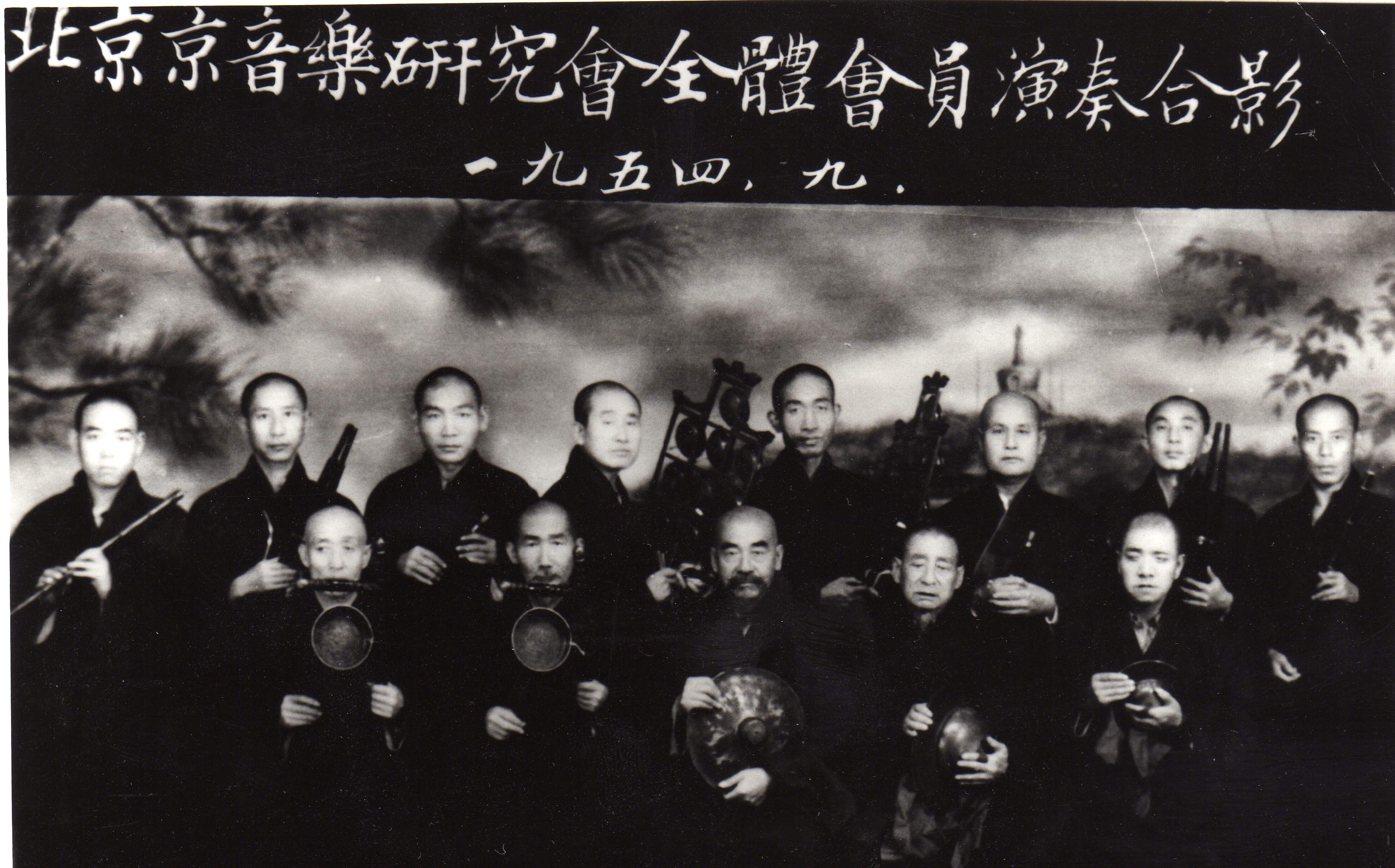
Former monks of Beijing, September 1954.

The whole topic of amateur ritual associations on the Beijing plain, and indeed north Chinese ritual, was first suggested by a 1953 monograph, slim yet astounding, by the great musicologists (and musicians) Yang Yinliu and Zha Fuxi on the shengguan music of recently-laicised Buddhist monks throughout the north and east of Beijing city, commonly associated with the famous Zhihua temple—just at a time when they found themselves in difficult circumstances after the radical social transformations around Liberation, suddenly deprived of their ritual livelihood. [1]

You can hear a haunting track from Yang’s 1953 recordings in the playlist in the sidebar, #14 (commentary here). For a roundup of posts on the Zhihua temple and related ritual activity, see here.

One of the most moving sections of the monograph [2] is a remarkably frank and perceptive letter that Zha Fuxi wrote to the former monks, dated 30/12/1952. As a qin master and scholar, his aesthetic world was remote from theirs, but he deeply valued their music, and quite understood how disgruntled they were.

While I realize that you are trying to pursue your livelihood on the basis of your knowledge of the new society, you will try to consign your repertoire to the cultural sphere… […]

But you bitterly regret that you shouldn’t have to sacrifice your youth of studying this music to the point of damaging your health and wasting your opportunities to study culture [sic]. You are particularly resentful that because you are uncultured [sic] you can’t express how these heritages of your elders in the temple—its two great arts of intangible music and material architecture—are worth preserving.

Zha goes on to itemise all the respects in which their music was such a valuable resource for musicology, partly seeking to bolster their self-esteem. He concludes by recognising how very tough their learning process was, and suggests patience, in the hope that

even if some people in the old society despised you, their moral character has been raised in the new society and they will gradually recognize you.

But of course he was unable to suggest how their position in the new society might be practically ameliorated; the ritual business of their youth would never be restored. Under Maoism both the monks and the scholars would suffer in various ways (for ritual artisans at the time, see here).

Fast-forward to the reform era since the 1980s. For two decades, whenever I returned to Beijing from the countryside, I would go and visit the former monks, notably the late lamented Benxing, and by the 1990s they were training a new generation—a group of teenage boys from Qujiaying village.

But they continued to feel resentful, despite social liberalizations and the ongoing efforts of well-meaning scholars and cultural officials to reinstate the prestige of their music, with frequent conferences and TV appearances, propaganda for the whole “living fossil” “cultural heritage” shtick. Media publicity was one thing, the reduction of their busy ritual “rice-bowl” since 1949 quite another. Today the new recruits are rather good; led by the bright Hu Qingxue, they even manage to do folk rituals as well as obligatory tourist “performances” of the shengguan music at the temple.

beijing-yankou

Former monks performing a funerary yankou ritual, Beijing suburbs 1993

This film features cameos from Hu Qingxue and our revered master Benxing, but also illustrates the current media style of presenting such culture…

* * *

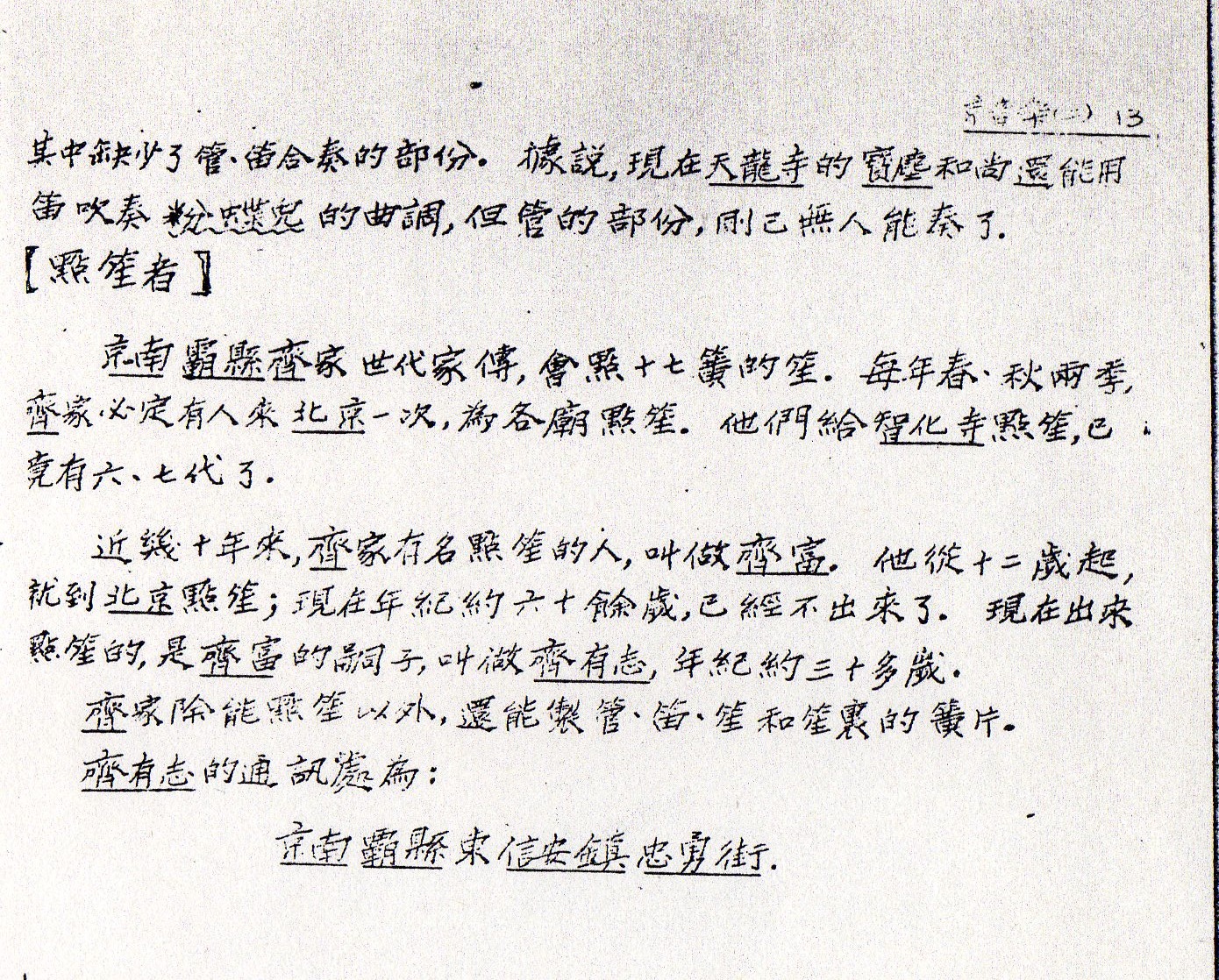
Anyway, I digress. The 1953 monograph soon attained an iconic status in Chinese musicology, as indeed did Yang Yinliu and Zha Fuxi themselves. [3] But Beijing and the Zhihua temple are only the tip of the iceberg. In his monograph Yang Yinliu mentioned a hereditary sheng-repairer (dianshengde 點笙的) called Qi Youzhi, who used to mend and tune the instruments of the Zhihua temple. Thoughtfully, he even provided Qi’s address:

yyl-1953-address

South of the capital, Baxian county east, Xin’an town, Zhongyong street.

Thirty-six years later in 1989, with my brilliant fieldwork companion Xue Yibing I began a survey of ritual associations on the plain south of Beijing. Baxian county was to be on our route, so I copied the page—just on the off-chance that anyone there might still remember Qi Youzhi. Arriving in Xin’an town, as soon as we mentioned him, the members of the ritual association exclaimed, “Sure! We’ll go and get him for you!” He was still only 70 sui, a mere youngster by the standards of many ritual specialists we were now finding everywhere. Our chats with him yielded some interesting material on the transmission of shengguan music throughout the area.

QYZ 1989.jpg

Qi Youzhi (right) with Xue Yibing, Xin’an 1989.

The Qi family was among many lineages of sheng-repairers active around Beijing and the countryside just south. According to Yang Yinliu, Qi Youzhi was the sixth or seventh generation of sheng-repairers in his lineage—though he told us he was the fourth. His grandfather Qi Baoshan had worked for the imperial palace lamas in Beijing. Before the fall of the Qing dynasty in 1911, Qi Youzhi’s father Qi Lanpu used to play sheng in the Tianqiao district of Beijing. Later, through contacts with palace eunuchs, he learnt to repair sheng, building a reputation with temple musicians. His older brother Qi Lanting and his oldest son Qi Youcai also took up the business, and they also repaired sheng in Tianjin.

Qi Youzhi, Qi Lanpu’s second son, [4] was born in 1920. In 1929 he began to play sheng in the Shifan association in Xin’an town, and from 1931 until the Japanese invasion in 1937 he helped his older brother with his sheng business in Tianjin and Beijing. There he learned to make and repair sheng; they also made guanzi oboes, dizi flutes, and shawms (laba).

They used to go out to find work repairing sheng, making the rounds of all the Buddhist and Daoist temples. At the North Great Gate of Tianjin, Qi Youzhi recalled, the Buddhist monks at the “Buddhist temple” and the Daoist priests at the Chenghuang miao had many sheng. We asked him if nuns (called “juvenile monks”, youseng!) also played shengguan music; indeed, the Qi family used to tune sheng for the Taishan miao nunnery and the one in Xiaomalu (“Small road”). They used to go to tune sheng not only for the Tianjin and Beijing temples, but also throughout the villages, tuning and mending sheng for both types of ritual association, “northern” and “southern”—the latter also known by the fine terms qie 怯 (“rustic”) and kua 侉 (“with an outsider’s accent” or “bumpkin”); he maintained sheng for shawm bands too. But after the Japanese invasion in 1937 their activities were highly restricted.

Based in Xin’an in the mid-1940s the family resumed its work, apparently even through the 1946–7 civil war. Twice a year Qi Youzhi used to go on a long trek by foot to Beijing with his uncle, staying in villages on the way and tuning sheng wherever there was work. In Beijing, he recalled that temples like the Guandi miao in Sitiao, and the Guangji an at Chaoyangmenwai dongdaqiao, used the classic “capital” (“northern”) shengguan music. But the Baita si, Huguo si, and Longfu si temples seem to have been “rustic” or “southern” in style, since they included small shawms (laba) in their shengguan ensemble. This whole landscape of old Beijing has been destroyed gradually, and bulldozed most radically since the 1990s.

After the 1949 Liberation, Qi Youzhi could no longer find work in Beijing, since priests were returning to lay life and temples were now largely inactive—but significantly there was still plenty of work repairing sheng for the village ritual associations. Indeed, this work continued until the Four Cleanups in 1964. By 1980 Qi Youzhi was 61 sui, and, despite the revival, seems to have been much less active.

We went to see him again in 1993, between visits to two amazing village ritual associations near Xin’an: Gaoqiao (Buddhist—another sheng-making/repairing lineage; audio playlist track 8, and commentary) and Zhangzhuang (Daoist).

By then our team was joined by Zhang Zhentao, who has since published detailed work on the sheng and its history. Meanwhile Yuan Jingfang made detailed studies of the Zhihua temple style, further adding to the list of its clerical exponents.

Everywhere we went on the Hebei plain, we made a point of seeking out sheng-repairers—often they were themselves members of a ritual association, but anyway they always knew precisely where other groups were active in the area. We also valued sheng players, always most knowledgeable about scales and pitch systems—in Hebei, Shanxi, and throughout north China.

* * *

I still marvel at that miraculous thread which linked us so vividly to Yang Yinliu’s time with the Zhihua temple monks, and further back to the world of palace eunuchs and the ritual life of the Qing dynasty.


[1] Yang Yinliu (1953) Zhihuasi jing yinyue caifang jilu [Record of visits to the capital music of the Zhihua temple], 3 parts, Beijing: Zhongyang yinyuexueyuan Zhongguo gudai yinyue yanjiushi, mim., now available in his complete works. This post is based on my In search of the folk Daoists of north China, p.146. For Buddhist and Daoist ritual life in Beijing and Tianjin, see ibid., Appendix 1, whose citations include Vincent Goossaert’s splendid 2007 book The Taoists of Peking, 1800–1949. As I note in the Appendix (p.222), only five of the nineteen former monks assembled came from the Zhihua temple. On ritual life in old Beijing I must also mention the works of Chang Renchun 常人春; for many more links, click here.
[2] Part 2, pp.40–45, signed with his other name Zha Yiping.
[3] Cf. Tian Qing, “Shijimo huimou: Zhihua si yinyue yu Zhongguo yinyuexue” [A fin-de-siecle retrospective: the music of the Zhihua temple and Chinese musicology], Zhongyang yinyuexueyuan xuebao 1998/2: 38–45.
[4] As you see from the page from Yang Yinliu’s notes, he had learned that Qi Youzhi was adopted son of Qi Fu, another distinguished sheng-repairer. We didn’t clarify this—such family relations can be hard to elicit on a brief acquaintance.
[5] See In search of the folk Daoists, pp.145–55.

Headgear: a tough choice

Just when you thought these jokes couldn’t get any more niche, here’s one from the so-called Xinjiang Autonomous Region in west China, where ethnic tensions are intense. The indigenous Uyghurs (who are Muslim) and the immigrant Han Chinese are often at loggerheads; there’s also a milder minority population of Hui Chinese Muslims, who wear a distinctive white cloth cap. After one recent wave of ethnic violence, this story did the rounds:

A young Hui guy in Urumqi is desperate. “What am I supposed to do? If I wear my cap, I get beaten up by the Chinese. If I take it off, I get beaten up by the Uyghurs!”

For a distressing update on the situation in Xinjiang, see here.

Taranta, poverty, and orientalism

taranta

Watching the 1959 footage of healing sessions for possessed women in south Italy by Ernesto De Martino and Diego Carpitella, one may feel almost voyeuristic (Part One, and Two).

Below I cite a review by Stephen Bennetts (Weekend Australian, Review section, 28–29 January 2006) of

  • Ernesto De Martino, The land of remorse: a study of Southern Italian tarantism (pdf of original Italian edition here).

First published in 1961, The Land of Remorse is a classic of anthropological detective work. Was this bizarre phenomenon really caused by the bite of the tarantula, or was it instead a mere “superstitious relic”, or a localised form of psychosis prevalent among illiterate Southern Italian peasants? Almost sixty years ago, in 1959, a group of scholars arrived in the small town of Galatina to unravel the riddle. They comprised a historian of religion (De Martino), neuropsychiatrist, toxicologist, psychologist, anthropologist, ethnomusicologist, social worker and photographer.

It soon became clear that the research team was documenting the last vestiges of the cult, which by now had retreated to an isolated pocket of peasant society in Salento, the stiletto heel of Southern Italy. Tarantism still persisted in its classical form in the music and dance therapy sessions conducted in the home, whilst the partly Christianised form of the cult, amputated of its musical and dance component, continued in the grotesque and histrionic displays at the Chapel of St Paul, as possessed tarantati arrived for the feast day of Saint Paul to ask the saint for healing.

In De Martino’s analysis, the mythology of the taranta and the catharsis of the possession state provide a framework in which personal psychological tensions common throughout Southern Italian peasant society could be publicly dramatised. Private sufferings caused by unhappy love, bereavement, sexual frustration, or subaltern social status were transfigured into annually recurring possession states which were culturally determined, rather than being the result of a real spider bite. The ritualised healing through dance and music provided victims with psychological closure and reintegration back into the community, at least until the summer of the following year.

[According to one Salentine authority, the last episode of tarantism involving actual possession took place in 1993, but the last living practitioner died in 2000. Yet “tarantism” has recently taken on another curious form. The current Southern Italian folk revival and associated pizzica dance craze incorporate a grab bag of different impulses: re-emergent Southern regionalism, the reevaluation of a peasant past which is now distant enough for young Southern Italians to romanticise rather than feel ashamed of, and a rejection by the Italian anti-globalisation movement of the television-fixated “cultural homogenization” of Berlusconian Italy. De Martino’s book has now achieved cult status beyond the academy; go to many folk concerts in Southern Italy today and you will find it on sale alongside tambourines, castanets and other accoutrements of the recently exhumed Southern Italian past. In a process which has been aptly described as “proletarian exoticisation”, De Martino’s plain female peasant tarantate have given way in contemporary reworkings of the theme to video clips featuring dissociated but picturesque young beauties writhing to the latest tarantella folk hit. Within the current Salentine folk revival, De Martino functions as a kind of symbolic fetish, validating an isolated area of Southern Italy which almost nobody had heard of until the “rediscovery” of tarantism and tarantella ten years ago suddenly put Salento on the map.]

Along with more detached ethnographic observations, one easily discerns severe social problems here—not least poverty, and not just the role of the church. Urban Chinese observing rural Chinese ritual may be beset by similar, prescriptive, responses—which will be secondary for foreign fieldworkers, more entranced by the persistence, perhaps exoticism, of religious practice there. That’s partly why study of the practices of “primitive” ethnic minorities are so fashionable.

De Martino’s work, though focused on religion, makes a successor to Carlo Levi’s 1945 book Christ stopped at Eboli, and even James Agee’s 1941 Let us now praise famous men, with the photos by Walker Evans. Accounts like these are a world away from the idealizing of peasant communities often implied in Chinese cultural studies. But both types have their own agendas. Meanwhile, brave Chinese journalists have blazed a trail, with village surveys like those for Anhui, and a substantial body of work on the famines around 1960.

We may contrast the anthropology/ethnography of religion with pious insiders’ views of religion. Of course a participant or “believer’s” own account will be important material. But if in the description the ethnographer promotes her own “belief”, that is dangerous: more like propaganda. Empathy is to be desired, evangelism to be avoided. Good histories of Christianity or Islam are unlikely to come from the standpoint of proponents for such beliefs.

So what is, or should be, the anthropologist’s view on religion? While showing how it works in the society, one doesn’t have to promote it as entirely beneficial there, or to that of other societies. Of course our picture is blurred by the quest for ancient oriental wisdom, which may even follow on from hippy mysticism. It is remarkable how commonly this still plays a role in studies of Daoism.

Some scholars make a case for the superiority of Daoism as a world view, over other religions and other world views. Not only is this not the job of the ethnographer, but it may flaw the whole research enterprise. What we learn from such accounts is what a Western scholar, of a particular upbringing and taste, thinks about Daoism; not what Daoism in society is like.

To repeat, it is different to develop a certain empathy with one’s subjects than to come from a standpoint of evangelical zeal. In the course of an ethnographic relationship one will doubtless begin to explain their mindset, their backstory, and so on. But the study of Daoists is mainly to be done with the same kind of anthropological curiosity that one would bring to the study of any other group, such as Party cadres or sex workers (funny how those two random examples seem to make suitable bedfellows. I didn’t say that).

Participant observation brings many benefits. In the case of religion, to participate fully in the life of Daoists will certainly confer insights—but there is no single type of Daoist, and even participation is only one aspect of the duties of the scholar. One should observe not only how religious activities inspire local patrons, or bring social cohesion, but how people may ignore or oppose them. I’m not even arguing with evangelism, necessarily; just that it blurs proper scholarship.

Study of oriental religion risks exoticizing. Even if the scholar avoids the trap of “Just look at this rare ritual I’ve stumbled across/gained unique access to”, rituals may yet be portrayed as “special”, ancient, mystical, and so on—whether they are or not, and downplaying their routine nature. This kind of social behaviour is normal. The visitor may stumble (once) across something supposedly rare, but more likely it will be repeated again and again—always adapting over time.

Note also this documentary from 1952, with funeral laments from Lucania:

and the 1958 sequel Magia Lucana:

See also Healing with violin in the heel of Italy; for more recent pizzica, click here and here; for Sardinia, here. I’ve also outlined work on folk musicking around Italy. For the festa of the Madonna of Mount Carmel in East Harlem, New York, click here. Cf. Portugal: folk traditions.

More on Hebei

I’ve been revisiting my account of the amateur ritual association of South Gaoluo, my field-base through the 1990s, and I’ve just added a page (click here) on two major characters in the association. Now I’ve also given a roundup of posts on the village.

dengpeng

The New Year’s rituals 1989, our first visit

In my sojourns with the Li family Daoists in Yanggao I am mainly chatting with one extended family, seemingly detached from politics—not even on my early visits in 1991 and 1992 did we ever have any contact with local cadres. The headquarters of the village “brigade” have long stood derelict. Indeed, the experience of household Daoists—as freelancers, like shawm bands or carpenters—was different from that of peasants tied to the land, and they largely felt at a distance from the efforts of the leadership to rebuild society, more concerned for their own livelihood, always straining to gain some independence from the production teams. Moreover, Li Qing’s family was among the “black elements” in the village, suffering discrimination. Even if I had spent more time with the senior generation, I suspect their experiences of Maoism would have been similar: though inevitably deeply affected by political vicissitudes, they had little investment in the public affairs of the village.

By contrast, through the 1990s our team from the Music Research Institute in Beijing was doing a survey of villages on the plain south of Beijing, documenting amateur village ritual associations. These groups perform vocal liturgy, ritual percussion, and haunting shengguan wind music, mainly within their own village for funerals and calendrical festivals for the gods, so they are basically supported by the whole village.

While doing “hit-and-run” missions to several dozen villages in the area, I was increasingly attracted to one, South Gaoluo. Apart from the well-preserved condition of all aspects of the association’s ritual practice, I was drawn by the musicians’ personalities, and I ended up doing a detailed study on the fortunes of the village and its ritual association through the 20th century. What I tried, and failed, to write was a kind of cross between The Archers, Wild swans, and Philharmonia.

As I compiled the history of the association, several sources helped me to put its ritual and social culture in political context. There, many of the members of the association held positions of authority under all three periods of 20th-century history, so we naturally talked with the village leadership. With their detailed knowledge of the modern history of the village, several senior men, past and present cadres, were able to offer clear accounts of major events in the area and to connect them to the village’s ritual association.

But in both cases (occupational household Daoists and village-wide amateur ritual associations) the complexities of local relations can have a deep influence on ritual practice. Perceived cultural capital also changes. As with my work on the Li family Daoists, dry timeless disembodied lists of ritual sequences and vocal and instrumental items are far from adequate. What is fascinating is the interaction of personal biographies, the whole social and political environment, with changing ritual practice.

So on the new page I illustrate all this with the stories of two outstanding members of the South Gaoluo association, Cai Fuxiang (c1905–79) and Cai An (1942­–2012). In the official discourse, Cai Fuxiang would merit a polite footnote as an “old revolutionary” who preserved the ritual manuals and the performance of the vocal liturgy under Maoism; whereas the great Cai An might hardly feature at all. For more on the liturgists, click here.

Laowai

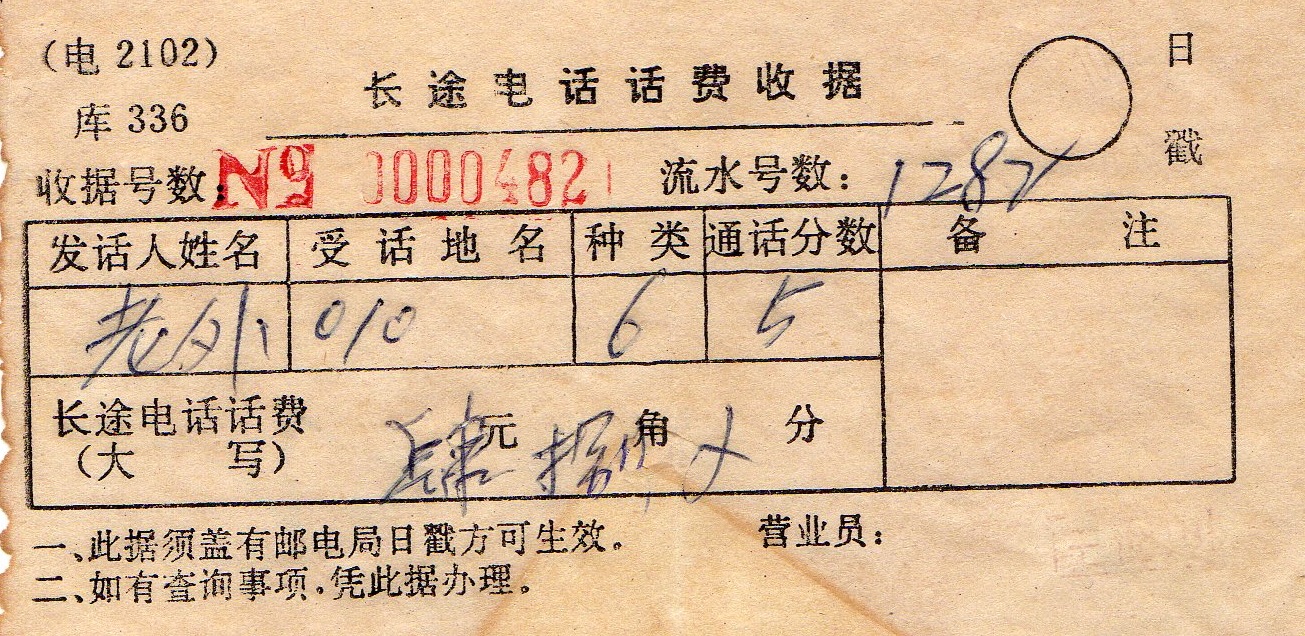
This story from 1999, in my Shaanbei book, already describes a bygone age:

One afternoon, after a couple of weeks in the countryside unable to get in touch with my partner in London, I decide to try and find a phone from where I can make an international call. Yangjiagou still has no phone [like Li Manshan’s village at the time!], certainly not one connected to the international network, so with my colleague Guo Yuhua we set off by foot down the hill towards the district township, almost an hour’s walk.

We find a phone in the post office and, miraculously, I get through. As I pay the sullen assistant, she makes out a receipt, asking what name she should fill in. I tell her not to bother, but as we come out onto the street, I take a look at the receipt: she has made it out to “WOG” (laowai).

laowai

After returning home to London I framed it.


Taking it on the qin

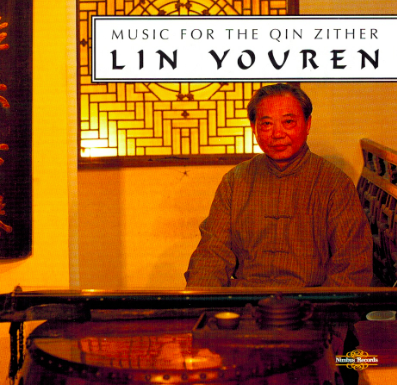
Following my tribute to Lin Youren, I should explore my ambivalent relation with the qin zither. Such a dominant image of Chinese musical culture, it is as if the whole varied spectrum of European musics were represented mainly by the clavichord.

In my first few years studying Chinese music I was obsessed with the qin, practising constantly while seeking out the Great Masters of the day—Wu Jinglue, Zhang Ziqian, Wu Zhaoji, and so on. Later I came to feel less involved with it, partly because I found less time to devote myself to playing—not exactly that I no longer felt worthy, rather that my studies of local folk culture and ethnography gradually distanced me from elite culture (see also here).

Immersing myself in the culture of shawm bands—by far the most common form of instrumental music in China for many centuries—performing for life-cycle and calendrical rituals, I found myself among poor people, many disabled and former opium smokers—virtual outcastes, like gypsies. See my

  • “Men behaving badly: shawm bands of north China”, in Rachel Harris, Rowan Pease and Shzr Ee Tan eds., Gender in Chinese Music (University of Rochester Press, 2013), 112–26.

But their music too was always played at the behest of the imperial elite, even if the latter wouldn’t dream of playing it themselves; the musicians often consider notation superfluous, but it was of great complexity, sophistication, and, well, antiquity. So too for the vocal liturgy and shengguan ensemble of ritual specialists. In this detailed analysis I compared a qin piece with a suite for shawm band.

In China at least, I don’t find terms like “classical” (or “art”) and “folk” very useful. “Classical” musics are somehow old and prestigious, favoured by social elites, and often handed down partly by means of notation; folk music (like herpes, as observed in Molvania) is largely handed on by oral transmission.

Our image of Asian culture is still largely based on the “art” traditions, like sitar in India—at the expense of local folk traditions. In China the qin is represented by several hundred CDs and a wealth of material online. But however wonderful we may find it, in imperial times, despite its prominence as an image for poets and painters, there were never more than a few hundred people who could play it. A solo amateur tradition, its main life, still today, is not on the concert stage but in gatherings of amateurs, called qinhuiqin meeting” (perhaps “qin wag”), and there are lively little qin communities all round the world.

Great—but in China and elsewhere a lot of music (like folk-song or ritual opera) is presumably “old” too, although it never stands still, and it’s dangerous to make assumptions about the superiority of one or the other: any music is valued, or not, within its social context. But if you think how many people there must be in China who sing folk-songs—at least a few tens of millions, at a conservative estimate. So how many CDs are there of genuine Chinese folk-singing (he asked polemically)? Putting aside vast numbers of recordings of conservatoire-trained performers on stage, and apart from several CDs of ethnic minority singing, I know of precisely two. The diverse repertoires of the shawm bands are similarly under-represented.

When we know so little about most Chinese musical cultures, it seems fair to say that the qin is one topic that is over-subscribed.

Of course, elite culture is clearly part of the whole fabric, but—until recently—it has naturally dominated the discourse of the elite. In most social groups in the West, few people have heard of Bach. And when qin scholars do study the social background of the qin, they describe not temple fairs or funerals, but poetry, painting, calligraphy—the inner life of the imperial literati and their modern evolution. But its sanitized image, and the lack of broader social context, seem to feed into the whole patriotic spiel about the glory of ancient Chinese culture.

So I now find the qin something of an autonomous zone, even a fetish. We have plenty of recordings, and its distinctive notation (a form of tablature) is of course a rich historical treasury. But I’m somewhat disturbed by the slavish adherence to the reified text. As with Daoist ritual studies, scholarship concerns texts more often than social ethnography. The process of dapu, recreating early scores whose performing tradition has long been lost, has become popular since the 1950s. The qin’s codification and fetishization of timbre, too, is overestimated; folk-singers, shawm players, and so on, are just as sensitive to timbre.

“Just saying, like…” Still, the qin is a wonderful way into the elite culture of the imperial literati, and its music is mesmerizing. I explore this issue in musical detail here.

Sources
It gets ever harder to give a succinct outline of sources, so I’ll just mention a few that I have found useful. One place to start is John Thompson’s comprehensive site, including a section on Zha Fuxi’s 1956 fieldwork and recordings, one of the most numinous resources for the sound-world of bygone generations, partly found on the 8-CD set An anthology of Chinese and traditional folk music: a collection of music played on the guqin (China Records, also reissued in Taiwan).

There are fine CD sets of archive recordings from Wind Records, ROI, and Hugo; and the qin features impressively on YouTube, under guqin.

The regular coverage in the CHIME journal is accessible.

Bell Yung writes well not only on qin music and notation but also on social change:

  • “Music of qin: from the scholar’s study to the concert stage”, ACMR Reports 11 (1998): 1–14
  • his chapter in Andrew Weintraub and Bell Yung eds. Music and cultural rights (University of Illinois Press, 2009)
  • and more on his site bellyung.weebly.com.

A classic is Robert van Gulik’s The lore of the Chinese lute (1940).

More under the qin tag, including Spiritual and marvellous mysteries; A rare duet for qin and erhu; my series on the fortunes of the qin in Beijing under Maoism; and A film on the qin zither.

More organology

Erqing and WM

Household Daoists Wu Mei and Erqing on guanzi oboes. From my film.

After my little outline of vocal styles, to be further amazed at the infinite creativity of human beings, do check out the Sachs–Hornbostel (or should I say Hornbostel–Sachs?) system of classifying musical instruments.

Also fine, with instructive illustrations, is

  • Geneviève Dournon, “Organology”, in Helen Myers (ed.) Ethnomusicology: an introduction (The new Grove handbooks in music), pp.245–300.

Based on the Dewey system, and constantly subject to fine-tuning, it may seem a tad hardcore, but we’re still allowed to use the common terminology (flutes, drums, and so on)—all this just helps when we need more precise definitions. It may be old hat to ethnomusicologists, who continue to deepen the topic in study groups, but it’s worth adding to the armoury of, um, scholars of ritual… Taxonomy, after all, is among their basic concerns—from zhai (“fasts” or “retreats”) and jiao (“offerings”) to yin mortuary rituals and yang rituals to bless the living (also equivalent to “white” and “red” rituals), and the Li family’s tripartite classification of funerary, earth, and temple scriptures (baijing, tujing, miaojing) (see my Daoist priests of the Li family, p.25).

BTW, the double-reed guanzi, leading instrument in the ensemble accompanying north Chinese ritual, is a descendant of the ancient bili 篳篥, a pre-Tang immigrant from the “Western regions“—though perhaps not France. It is related to the Armenian duduk, which is so much better known (“Innit, though”, nodded The Plain People of Ireland). Sachs-Hornbostel distinguishes cylindrical and conical bores (zzz)—though that is a complex issue, explored by Jeremy Montagu; but it doesn’t seem very instructive about the difference between oboes like the guanzi and duduk (with lipped reed, overblowing at the twelfth) and shawms (with reed enclosed in the mouth, overblowing at the octave), which is so crucial in north China.

For further useless facts about Chinese instruments, see here. And for another candidate for the Sachs–Hornbostel system, here.

Clothes clothes clothes music music music boys boys boys

CMB

Under the rubric of delighting in all manifestations of the Terpsichorean muse, having just added a meretricious page on Gregorian chant, I now offer an equally piecemeal post on punk.

Further to Lives in jazz, Viv Albertine’s memoir

  • Clothes clothes clothes music music music boys boys boys [1]

(to give it its full title—her mum’s reproach to her as a teenager) is a beautiful inspiring book, full of sincere humanity and insight. We can draw a veil over the story of her messy “dalliance” (dunno why I’m suddenly coming over all Jane Austen) with Johnny Rotten. The account of her post-punk life is no less compelling than that of her time in The Slits, with their amazing singer Ari Up (RIP). Women, and sexism, in punk are justly favoured topics in musicology and glossies alike—more so, I note, than Daoist ritual (funny, that). For female punk band Vulpes in Madrid, see here.

slits

For Viv Albertine’s next book, see here.

I was sadly unaware of all these brilliant singers at the time, except (for some reason) for Nina HagenNaturträne (1978) has long been one of my favourite songs (see this playlist):

You can, and must, watch her singing it live on video too, but that recording is astounding. I was busy being a Boulez groupie… OK, there’s room for technique in punk too, but it’s not quite the point; I could presumably square that song with my snobby sensibilities long before I also learnt to rejoice in the Sex Pistols or the Ramones. Or Daoist ritual…

Just as much as the Matthew Passion, or Wozzeck, it makes want to learn German:

Natur am Abend, stille Stadt
Verknackste Seele, Tränen rennen
Das alles macht einen mächtig matt
Und ich tu’ einfach weiterflennen

We can save punk in China for another time—but again, it’s all part of the rich ethnographic tapestry. Not quite punk, but Cui Jian’s classic song Nothing to my name

prompted a fine complaint from Wang Zhen, veteran of the Long March:

“What do you mean, you’ve got nothing to your name? You’ve got the Communist Party haven’t you?”

Mutatis mutandis, Thatcher might have concurred.

[1] Pedantic note: most superior reviews abide by the title’s lack of punctuation.

A tribute to Laurence Picken

I was one of Laurence Picken’s more tangential disciples, but he remains among the great inspirations of my life. [1]

Picken

I know several of us have fond memories of turning up for lunch at his little house overflowing with books, a sherry followed by a carefully prepared meal, listening to him explaining, non-stop for four or five hours (for all his encyclopaedic erudition, he knew nothing of small-talk; see also here) how the marker to the right of the column in some 11th-century Japanese zither manuscript had been misinterpreted—with liberal asides on plainchant, birdsong, and medieval Sogdian viniculture—to which I occasionally managed to interject “I say, fancy that…” And that’s how it went, every couple of months for about twenty-five years.

Apart from his immense scholarly arsenal, he was a true amateur, an enthusiast. He maintained a network of like-minded people, communicating extraordinary enthusiasm for a topic that, even by the high standards of obscurity of those topics that many of us here today pursue, was pretty arcane. His devotion to scholarship was nothing to do with conforming to institutional demands; as a bit of a Lone Ranger myself, I now realise where I got it from.

He corresponded indefatigably with scholars all over the world (not least Eastern Europe)—he had to wait far too long for the invention of email. Though I think his influence on Western scholarship on Chinese music has been disappointingly slight, his work on Tang music had echoes in that of Chinese scholars, including He Changlin and a group of musicologists in Shanghai, from Ye Dong and Chen Yingshi to a newer generation. Senior scholars like Yang Yinliu, Huang Xiangpeng, Ren Erbei, and Yin Falu were themselves engaged in similar work through the 1950s, and would have relished a chance to exchange ideas with Laurence (cf. Soundscapes of Dunhuang).

MTC

Having assisted him with his magnum opus Music from the Tang court for many years, I finally began going to China in 1986. The reason for my first visit was to seek clues to Tang performance practice in living traditions there—how to recreate his transnotations in a convincing style. Except for his early and late visits, most of his life coincided with a period when few foreigners could gain meaningful access to living traditions in the PRC. And immediately I discovered a vast unknown treasury of living folk and ritual music, soon putting historical musicology to one side in favour of contemporary ethnography (see e.g. my Plucking the Winds, pp.169, 184–5). But what I really appreciate is that Laurence entirely understood, and was immensely generous and supportive of this churlish choice of mine.

A special edition of Early Music, edited by Richard Widdess, includes my succinct thoughts on the relation between “early music” and living traditions in China, with thoughts on notation and recreation:

  • “Source and stream: early music and living traditions in China”, Early Music August 1996: 375–88.

As I published a lengthy analysis of some of the pieces from the Hua family shawm band’s suites introduced in my 2007 book (and the accompanying DVD, and an amazing CD; cf. Dissolving boundaries), it reminded me that while Chinese and Western scholars have described the scales and macro-structure of Chinese instrumental music, few have done any serious analysis of its melodic progression—so Laurence’s project with Noel Nickson (however traditional in style) on the Tang repertoire remains a bold, comprehensive, and detailed body of work. My only reservation is that I’m not so keen on analysing old scores when we can’t hear how they actually sounded; doing fieldwork in rural China, I’m happy if we can make an educated guess—within a living tradition—about how a score no longer in use was performed 100 years ago, let alone 1,000!

A distant relative of the Cambridge early music movement (Dart, Munrow, Hogwood…), Laurence’s Tang music project was controversial, not least in Japan, where it challenged deeply-held assumptions about the sanctity of gagaku[2] Most striking is his theory that in Japan the Tang scores were gradually retarded—ending up being played up to sixteen times more slowly, robbing the melodies of their melodic coherence. Generally this remains convincing, though our later experience of living genres in China like the temple music of Beijing, or nanguan in Fujian, might prompt us to refine it.

Unlike some scholars, I quite accept that the Tōgaku scores that Laurence collected do indeed represent Tang music. But I wish I could debate with him now. His tenet that we should read the scores “with no more information than that given in the manuscripts themselves” [3] may seem at odds with his following comment, “the attempt to determine what an ancient text meant at the time when it was written”. So I think he might concur with my response:

I agree absolutely that we mustn’t assume the way a piece is performed now is the way it was performed before; this was his way of explaining an alternative to the passive acceptance of modern-day gagaku performance practice in Japan. However, one cannot possibly “use only the information contained in the scores themselves”! Recreations of European medieval music (a tradition to which Laurence belonged) always try to extract as much information as possible from early instruments, treatises, anecdotal literature, iconography, society, and so on—and also, notably, from living traditions which have remained relatively stable, as performers of European medieval music do for folk singing and instrumental heterophony in Europe and North Africa. All such material is abundant for the Tang, and Laurence would have loved to make more use of it; one cannot possibly treat the score (a skeletal outline) as if it provides all the information necessary to performance (it doesn’t even do that for Bach or Mozart!), in some kind of cultural void. Of course, we need to select judiciously which cultures we use as our material. Music is never merely notes on a page! See also More Silk Road soundscapes.

Laurence remained committed to the qin zither after his initial studies in wartime Chongqing, along with Robert van Gulik (imagine…). In the 1960s he provided notes for John Levy’s Lyrichord recordings of Daoist and Buddhist ritual in Taiwan and Hong Kong, a rare initiative for the time—Laurence would have been excited by later projects on the mainland. (I note, en passant, that one online catalogue, under Genre listing, gives “Non-music”!)

The interminably long titles of his articles were endearing—my prize goes to

“The musical implications of Chinese song-texts with unequal lines, and the significance of nonsense syllables, with special reference to the art songs of the Song dynasty”.

And his language was charming, with formulations like

In this context, sheng 聲 is to be understood as an acoustic phenomenon with extension in time—something organized so that (again in time) it may be complete or incomplete; in fact, a tune.

Apart from his chamber music gatherings, I have another cherished memory of Laurence playing Bach on the clavichord—above which a magnificently garish framed picture (gift from a friend in China) of the workers, peasants, and soldiers clutching the Little Red Book, celebrating the “achievements” of the Cultural Revolution.

* * *

And for what it’s worth (not, you realize, for what it’s not worth), here are my notes for Laurence’s memorial service:

Music from the Tang court:
Qinghai bo (Waves of Kokonor)

lp-memorial
Rachel Harris (dizi flute)
Stephen Jones (sheng mouth-organ)
Sun Zhuo (zheng zither)
Richard Widdess (bo cymbals)
Simon Mills (changgo drum)

Laurence worked for several decades on recreating the Tang court music of the early 8th century. His insights from deciphering scores exported from Tang China to Japan still deserve wider recognition.

We tried playing these transcriptions in the 1970s, with more enthusiasm than ideas about Tang performance practice, or indeed any Chinese performance practice—given that this was during the Cultural Revolution, when we had virtually no access to the practice of traditional music in China. I still have little idea of Tang practice, but trying to play such pieces under the influence of “ancient” genres still performed today for rituals in the north Chinese countryside—notably the shengguan wind ensemble of ritual specialists around Xi’an, Wutaishan, and Beijing—yields what I find rather attractive results.

Laurence changed the course of my life. I first went to China in 1986 in search of clues from living music there about how to perform these scores, and he was most generous, as ever, in understanding my rapid conversion to the documenting of living traditions in China, postponing historical reconstruction—well, until now.

In returning to the piece Qinghai bo (Waves of Kokonor), we ornament the simple outline of the tune, in 12 bars of 8/4, as Laurence suggested; we model our version on shengguan music, and are also influenced by our playing of Shanghai teahouse music. Whereas Laurence convincingly showed that Japanese performance practice had retarded the melody substantially, we begin with a very slow ornamented version, and gradually strip the ornaments away as we speed up, as they still do in Shanghai. I have no evidence that this practice was used in the Tang—given that the piece seems to be in 8/4, the first, slow, version is most likely to be “original”, but the faster versions are closer to the way that Laurence would have heard it, so these successive versions are more like alternatives.

Today we use dizi flute, sheng mouth-organ, and zheng zither, all of which have early scores for this melody; accompanied by a small Korean changgo drum (a rough approximation to the Tang jiegu), and a pair of small cymbals, as in north Chinese ritual music today.

Laurence didn’t allow purism to delay his exploratory renditions of these pieces: one of my enduring memories of him is his playing of the melodica, with a completely straight face—I’m sure he would have recognised that modern ritual specialists’ style on the sheng, with its addition of fifths and octaves to the melodic line, might make a more suitable model.

While this is far from a historically informed rendition, it marks an advance from our versions of the 1970s; Laurence would doubtless have many comments! The music at last sounds Chinese—if not necessarily Tang Chinese…

For the work of Allan Marett, another pupil of Laurence, click here and here. For more gagaku, see Messiaen in Japan, and Toru Takemitsu. And for Laurence’s work on folk instruments of Turkey, see note under Bartók in Anatolia.


[1] Just a few partial references:
https://www.theguardian.com/science/2007/jun/06/guardianobituaries.booksobituaries
http://www.tandfonline.com/doi/pdf/10.1080/17411910802343803
https://www.dropbox.com/sh/ybltn8wbquzycmf/AAAK8MU1jp2hk5SpTTv3QNR2a?dl=0&preview=CHIME+Journal+4+Autumn+1991.pdf
On film, a charming interview from 1983:

See also
https://www.youtube.com/watch?v=Hr1irFTGjQk
https://www.youtube.com/watch?v=_DWzh-1WOwc
https://www.youtube.com/watch?v=GV3tg3GF-Ok

[2] Among much discussion, Richard Widdess provides context: “Historical ethnomusicology”, in Helen Myers (ed.), Ethnomusicology: an introduction (The New Grove handbooks in music), pp.219–37.

[3] Ibid. p.221.

More fieldwork tips

The Police squad series builds on Airplane the way Don Giovanni builds on Le nozze di Figaro.

An idée fixe that often comes in handy during fieldwork (see also under Themes) is the old “Cigarette?” line:

In rural China the etiquette of exchanging cigarettes and lighting up for each other is an important skill for the fieldworker to acquire, confirming social bonds (my Daoist priests of the Li family, p.24). Generally, when two or more men meet they compete to be first to get their offer accepted. The first offer is vehemently rejected; the giver is then obliged to insist until the cigarette is reluctantly accepted. The word thankyou is never used. Some shoving may be involved. Then the two compete to be first to proffer a light; as the recipient lights up, he expresses appreciation by touching the lighter’s hand with the little finger of the hand holding the cigarette, and the man with the lighter takes care to keep the flame going as he lights his own. I learn to emulate Li Manshan’s ritual of reluctantly accepting a cigarette, his frown, his look of confusion—“What is this funny little tubular object that is being offered to me, and how should I react?”

With the Li family Daoists we’ve developed a classification of cigarettes according to price, which varies widely. Using the class status language of land reform, we call the posh brands “rich-peasant fags”—the cheaper ones are for wannabe poor peasants like me.

Police squad provides another useful idée fixe on the importance of local knowledge in fieldwork:

The Greek subtitles inadvertently add a further Pythonesque touch. Though perhaps less so if you’re Greek.

My current favourite fieldwork tip heads this post.

The life of the household Daoist

vocal trio 2001

Vocal trio, 2001: Li Manshan, Golden Noble, Li Bin.

Not so much

Don’t put your daughter on the stage, Mrs Worthington

as

Don’t put your son on the Daoist ritual arena, Mr Li.

Patrice Fava’s film Han Xin’s revenge, about the rituals of a group of household Daoists in rural Hunan, is very fine. The voiceover contains an intriguing line:

“Many young people choose to become Daoists.”

Whether in Hunan or elsewhere, today or when the film was made, I find this hard to believe—it seems a romantic notion.

As I observe in my book, Li Bin (b.1977) is the ninth generation of Daoists in the Li family, and could well be the last. Moving with his family to the county-town in 2007 was initially a stepping-stone for his son to get a better education—seeing it as a route towards betterment, just as his forebears had done under successive regimes.

Even if new recruits can now skimp on the training, Daoist fathers no longer want their sons to continue the tradition; there are now easier ways to make a better living, and people like pop music anyway. Fees are low, and the lifestyle, working long days and nights traipsing around backward demoralized villages, is tough and none too comfortable (see e.g. recent diaries of Li Bin and Li Manshan). Potential young recruits go away to seek urban laboring work or get a good education leading to a secure job in town, providing an escape from the countryside towards urban registration and higher wages. And this is what their parents (including Daoists) want for them.

In The souls of China (p.48) Ian Johnson puts it well (in a passage about Li Manshan’s “determining the date” activities):

… Their relief was palpable, but so was Old Mr Li’s exhaustion. It was a tiring life, always on call, staying in people’s homes, burying their dead, eating their banquets. The questions never stopped—an avalanche of new challenges and problems that were overwhelming these old villages.

So whereas Daoist ritual somehow managed to survive after Liberation in 1949, and to revive after the liberalizations from 1979, today, in a world turned competitive, where the villages themselves are depleted, working as a household Daoist offers no route to advancement. As the Daoists realize, official initiatives like the Intangible Cultural Heritage project are quite unable to solve these issues.

If there are indeed areas of China where recruits do still emerge to perform a more complex repertoire of rituals, it would be interesting to discern reasons for such variation.

All this is explored in my film too. After screenings I like to ask the audience,
“Would you let your sons take this up as a livelihood?”

This doesn’t amount to hand-wringing, however. Daoist ritual has adapted under all kinds of vicissitudes over the last century, as it always has done.

The Invitation ritual

At the heart of the funeral sequence of the Li family Daoists today is the Invitation ritual (zhaoqing 召請). This introduction is adapted from my book, pp.109–12, 298–307—and do watch the film from 58.14. For audio segments, click on ##1–3 of the playlist in the sidebar (commentary here). See also Translating Daoist ritual texts.

This is another illustration that ritual manuals don’t tell the whole story—performance is primary.

1 Li Manshan

Fig. 1: Li Manshan performs the Invitation,  2009

I have two reasons to focus on the Invitation—one about simplification, one about complexity. This is one of the few ritual segments for which the Daoists still have a manual, although as usual they don’t need it in performance. It is among the longest in their collection, but they now perform only a small part of its nineteen double pages; as with Fetching Water, a comparison of their present performance practice with the manual shows a significant simplification. Perhaps the term “complete” in the title Zhaoqing quanbu suggests that it was commonly abbreviated. But only rarely can we speculate how long it may be since they used more of its text.

As to complexity, whereas today the bulk of their performance of funerary texts consists of slow choral hymns, for this Invitation sequence the a cappella rendition over a mere fifteen minutes or so is now perhaps their most densely-packed, complex, and varied segment of ritual performance, full of dramatic contrasts in tempo and dynamics—with both slow and fast choral singing and chanting, free-tempo solo singing, and a variety of styles of percussion interludes and accompaniment.

The Invitation was also a major section within the lengthy nocturnal yankou ritual, both here and in the great temples. For two-day funerals now, with the yankou anyway obsolete, the Invitation has evolved into a public ritual at dusk before the evening session of Transferring Offerings. Whereas even in the early 1990s many village onlookers accompanied the kin, creating more bustle, now it is largely a private ritual for the kin.

The sequence
First, as the Daoists arrive at the soul hall, Golden Noble faces the coffin to recite a seven-word quatrain solo.

The manual opens with the quatrain “Sandai zongqin ting fayan 三代宗親聽法言”:

Let the three generations of ancestors hear the dharma speech,
Paying homage to the previous souls by burning paper money.
May the dharma speech open up the road to the heavenly hall,
To invite the deceased souls to attend the jasper altar.

shuowen

Fig. 2

But instead Golden Noble recites another shuowen introit—which appears on the last page of the manual. That is how he learned from Li Qing, and it does the job just as well:

May the deceased souls come to the Bathing Hall, [1]
Transforming their shape and countenance to return to the immortal realm.
Now dipping into the bowl to bathe their bodies,
For an audience with the Three Treasures on the way to the Western Quarter.

Golden Noble then calls out “Proceed together, led by the Dao” (tongxing daoyin 同行道引), as shown at the end of the opening quatrain of the manual. If we didn’t know by observation, that would be a clue that while the preceding quatrain was performed at the soul hall, the remainder of the manual is to be performed on arrival at the site on the edge of the village.


Hereby Shaking the Bell
The next section in the manual, no longer performed, is Hereby Shaking the Bell (Yici zhenling 以此振鈴). One of several Yici zhenling texts that are a common part of the temple yankou, this slow sung hymn may also be used for other rituals, such as Delivering the Scriptures and Transferring Offerings—although the Yanggao Daoists no longer use it there either.

Song in Praise of the Dipper
Once they reach the site at the edge of the village, the altar table is set down, and the kin kneel in two rows in front of it while the Daoists stand in two rows behind it. Golden Noble presides, wielding flag, bell, and conch as he stands facing the kin. After a short percussion prelude with blasts on the conch, the first text now performed is Golden Noble’s solo chanting from the section of seven-word couplets opening Xinzhi jiguo 心知己過. Now he usually only chants the last two of the six couplets in the manual:

xinzhi-jiguo

Fig. 3

I am the one to report the declaration of the procedures at the Jade Capital,
Vowing to save all beings and emerge from the web,
So the deceased soul may be born in the upper realms,
We sing in unison the Song in Praise of the Dipper.

This indeed serves to introduce the Song in Praise of the Dipper (Gedou zhang), a slow choral hymn sung tutti a cappella. The title is to the Northern Dipper, otherwise not prominent in their funerary texts, explaining the respective responsibility of the five quarters for the salvation of the soul. Its seven-word couplets are each sung to the same melody; the short strophic melody has all the hallmarks of other hymns.

gedouzhang

As each sung couplet ends, Golden Noble shakes the bell, waves the flag, and bows, as the other Daoists play a cymbal interlude—a variant of the pattern Qisheng 七聲 as notated by Li Qing, as you can see below from the tiny differences in the first and penultimate bars between the naobo line in practice and the Qisheng mnemonics. As ever, the line for the drumming, ever flexible, shows a typical version as played by Li Manshan.
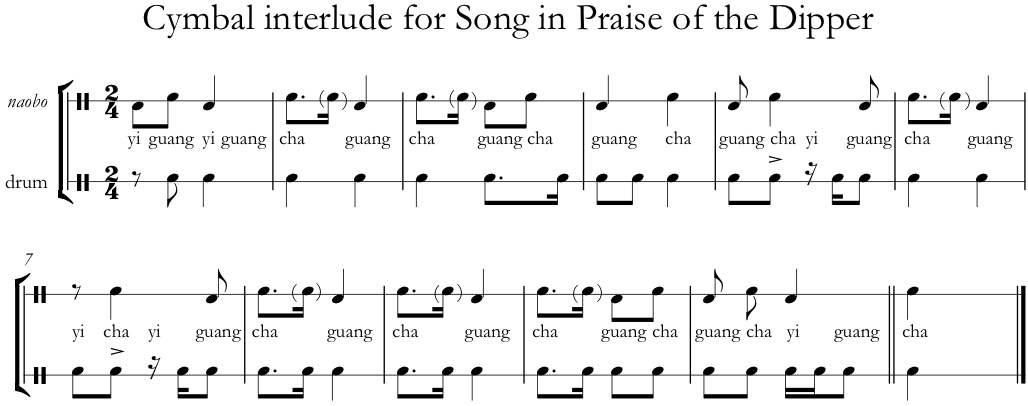
gdz-naobo

In recent years they tend to sing the hymn rather faster than they know it should go (you can hear a more majestic version in concert on track 1 of the audio playlist, and on the 2014 DVD). Anyway, with a very gradual accelerando over the verses, as they reach the seventh and eighth couplets they launch into fast isorhythmic chanting. They now play the fast cymbal interlude Gui jiao men (“Ghosts calling at the door”)—a pattern the same length as the processional Tianxia tong but differing subtly.
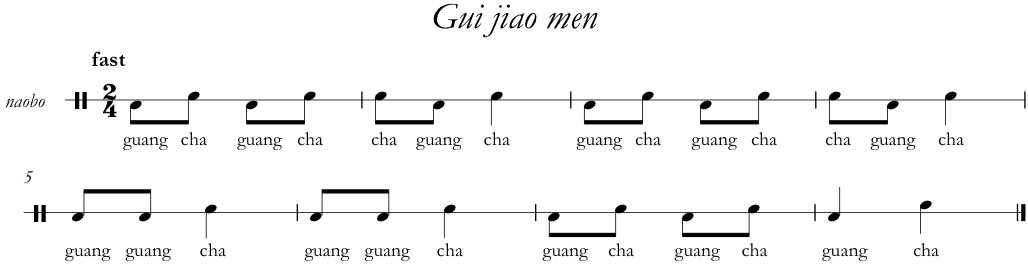
gui-jiao-men

This leads into the five-word quatrain Jishou wufang zhu, sung tutti isorhythmically to a simple descending melody, without percussion, now slightly less hectic:

Bowing to the lords of the five quarters,
The masters of the lads of the five spirits
Open up the roads of the five quarters,
Receive and guide all the ghostly souls.
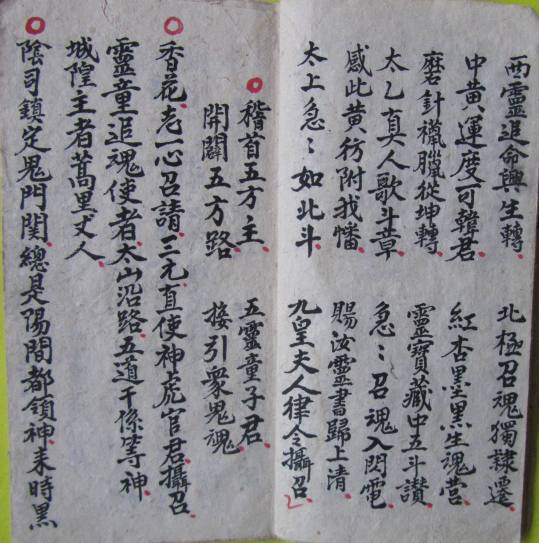
GDZ 2.jpg

Fig. 4

Then two sections summoning a roster of gods of the local territory—now accompanied by percussion, and punctuated twice by the Gui jiao men cymbal pattern—are chanted tutti, most hectically. Prepared by the instruction at the end of the Song in Praise of the Dipper (Great Supreme, in haste like the Northern Dipper!), and in extreme contrast with the long slow melismatic hymns that now dominate most rituals, this transitional sequence flies past as black clouds swirl, purple mists coil, with complex adjustments of style, tempo, and instrumentation. This too is a rare instance in Yanggao today of the kind of fast chanting commonly heard in south China.

The Invitation verses (playlist #1)
In abrupt contrast to this rousing climax, time now stands still as Golden Noble gently begins to sing a sequence of solo verses in free tempo, accompanied only by his shaking of the bell, with Li Manshan punctuating the phrases with a brief subdued pattern on drum. Li Manshan has let Golden Noble lead this ritual since about 2003; his solo melody is modeled on the way that Li Qing sung it. Even the way he repeats words in the opening phrase (Zhiyixin zhaoqing, yixin zhaoqing, zhaoqing) is distinctive, setting a contemplative mood. We are in the middle of barren countryside, far from the bustle of the village; as night falls, the main light comes only from the little piles of paper money burned by the kin. Notwithstanding interruptions at the end of each verse by a fast loud chorus with percussion, and periodic deafening explosions of firecrackers, this exquisite solo plaint perfectly reflects the desolation of the surrounding countryside where the ancestors are to assemble.

The twenty verses in the manual, each beginning “Vowing with hearts at one we Invite” (Zhiyixin zhaoqing), describe all kinds of occupations of the lost souls: emperors, ministers, generals, literati, sing-song girls, beggars, and so on. These verses are also found in the Li family’s Buddhist (not their Daoist) yankou manual—a sequence sometimes attributed to the great poet Su Dongpo (1037–1101). The twenty verses are now never sung complete; the chief Daoist chooses no more than six or seven of them. Both Li Manshan and Golden Noble agree that they should be performed complete, and were “in the past,” but even Li Manshan never heard the elders recite the whole sequence. To give an idea of the literary beauty of these texts, here is the opening verse (recto, lines 3–6):
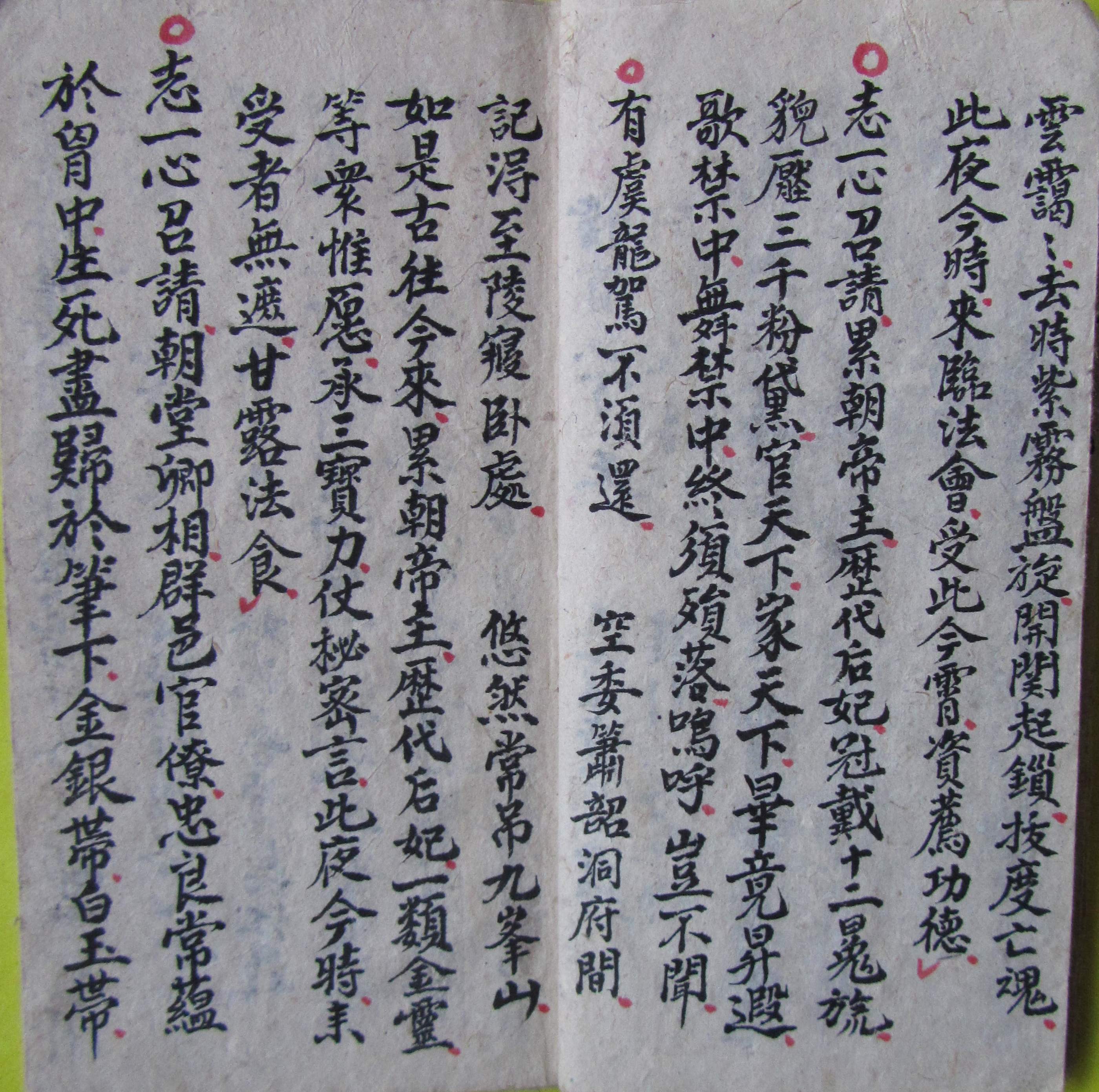
zhiyixin

Fig. 5

Vowing with hearts at one we Invite:
Emperors and lords of successive dynasties,
Empresses and concubines of epochs immemorial,
Bedecked in twelve-gemmed crowns,
Countenance outranking three thousand rouge-and-kohl belles.
All under heaven their remit, all under heaven their family,
Ultimately ascending.
Singing within the palace, dancing within the palace,
At the final moment they can only perish and fall.
Alas! Have you not heard?
Once astride the dragon of Yu they cannot return,
(tutti) In vain to deploy the Pipes of Shao within the Department of Caverns,
Fluttering the shadows and echoes, imperceptibly approaching!

But once rendered in exquisite solo melody, such textual beauty is multiplied.

For the last two seven-word couplets at the end of each verse (last line of recto and first line of verso), the first is still sung solo, while for the second the whole group interjects to chant the text fast. But, then, instead of the manual’s elegant and long refrain (opening “And thus from time immemorial” Rushi guwang jinlai, 5th–3rd lines from end of verso above) confirming the invitation, they now substitute a single phrase “Fluttering the shadows and echoes, gradually approaching” (Piaopiao yingxiang ranran lailin 飄飄影響冉冉來臨), again sung tutti. This phrase is borrowed from the shorter sequence of a mere three Invitation texts from their other (“Daoist”) shishi manual.[2] It leads into another burst of the cymbal interlude Gui jiao men.

That is how Li Qing taught them, but they know that the two versions were once alternatives: when the older generation used the longer refrain, it was still sung solo, and they didn’t use a cymbal interlude. So using the Piaopiao phrase with cymbal interludes wasn’t Li Qing’s invention in the 1980s; but already by then, deciding that the full refrain was too long, they were generally adopting the shorter version.

Some other adaptations also have to be learned orally. In the Jinwu sijian section about the sun and moon, and again in the following verse “Gazing from afar on mountain hues” (Yuanguan shan youse), the name of the deceased has to be inserted, and another text replaces the tutti coda of the manual.

The Invitation verses in Beijing Buddhist ritual
I have to take it on trust that all twenty sections were once performed complete, including the longer refrain. The substitution of the “Fluttering the shadows and echoes, gradually approaching” phrase with cymbal interlude for the longer final refrain shortens the ritual a little; and the more recent practice of reciting only selected sections shortens it further.

Actually, the version as sung by the Li family in Yanggao is remarkably similar to that of Buddhist temples in old Beijing. In a fine initiative from the mid-1980s, the performance of the Buddhist yankou by former monks from popular temples in Beijing was recorded; later it was also transcribed and notated.[3] The Invitation sequence, virtually identical in text, is interesting.[4] All twenty sections were indeed performed for the recording. The text is divided between main and assistant cantors, both singing in free tempo with impressive beauty, accompanied only by the bell, the refrain of each section fast choral with drum. So again, it is worth pursuing temple links.

The Invitation memorial
When Golden Noble has finished singing the Invitation verses, first the short section Chenwen dadao 臣聞大道 (see Fig. 7 below) should be recited fast, either solo or tutti, with percussion, confirming the efficacity of the ritual in saving the deceased. This text is commonly omitted today.

Then (as specified in the manual, in red ink) Golden Noble presents the memorial. Having handed the bell to a colleague, who sounds it continuously, he takes out the folded document from his pocket, singing it solo in the same melodic style as the preceding “Vowing with hearts at one we Invite” verses, only more exuberantly, with muffled accompaniment on drum and small cymbals and occasional fast tutti choruses repeating a phrase. He unfolds each new section as he folds up the previous one—though he hardly needs to consult it except to check the names of the kin. In recent years, if the others start accompanying too fast on percussion then Golden Noble sometimes likes to corpse the others (especially his mate Wu Mei) by reading faster and faster, rolling his eyes rapidly up and down over the text.

The manual doesn’t contain the text of the memorial; it is not among the templates in Li Qing’s collection of ritual documents, and Li Manshan and Golden Noble write it from memory. Sometimes entitled Memorial of Rites and Litanies to Escort the Deceased (Songzhong lichan yiwen), it is addressed to the Court of Sombre Mystery for Rescuing from Suffering (Qingxuan jiuku si), and announces the details of the deceased and lists of the preceding three generations of kin. Generally Li Manshan writes the text first and fills in the names of the ancestors later when a member of the kin brings them to him. Dates, as always, are written in the traditional calendar.

yiwen-copy-2

Fig. 6: Invitation memorial, written by Li Manshan, Pansi 2011

Having sung the memorial complete, Golden Noble opens it out and hands it over to be burned by the kin, while the Daoists slowly and solemnly declaim a final five-word quatrain “Thousand-foot waves at Bridge of No Return” (Naihe qianchilang), another common temple text:

naihe

Fig. 7

Thousand-foot waves at Bridge of No Return,
Bitter sea myriad leagues deep.
If the soul is to evade the cycle of rebirth and suffering,
The Daoists are to recite the names of the Heavenly Worthies.

The return procession
So now after the document has been burned, if Redeeming the Treasuries is combined then the two treasuries are burned. The Daoists then lead the kin on procession back to the soul hall. Whereas the whole of the previous sequence has been performed a cappella, they now play shengguan all the way back while the kin burn paper to illuminate the way for the ancestors; on procession on the way out, they only use percussion because there is no-one to escort yet.

However, in Li Qing’s manual there follow thirteen verses for Triple Libations of Tea (san diancha). Li Manshan recalled these verses being recited on the route back, accompanied by Langtaosha on shengguan, but later they only played Qiansheng Fo without vocal liturgy. They still sometimes use a three-verse version for the solo introits in Presenting Offerings before lunch, and as a slow accompanied hymn for Transferring Offerings.

Even after the Libations of Tea were omitted, villagers used to “impede the way” (lanlu) on the return to demand popular “little pieces” from the Daoists, but by the late 1990s no longer did so—they now had plenty of other opportunities to hear pop music. Since around 2011 the kin often just stop occasionally to burn paper, not all along the route as they should. Altogether, the impetus towards simplification derives from the changing needs of the patrons.

The hymn at the gate (playlist ##2 and 3)
On the return to the soul hall, the Daoists now stand informally around the gateway to sing the Mantra to the Three Generations a cappella, as the kin again kneel and burn paper. This is the “Jiuku cizun” text in the manual. As usual, this a cappella version is sung faster than that with shengguan, though they retain the cymbal interludes. They round off the hymn with the fast percussion coda Lesser Hexi, and then lead the kin into the courtyard with a short burst of the pattern Tianxia tong. That is the end of the Invitation as performed today.

But in the manual, before the Mantra to the Three Generations, a further text Lijia quyuan 離家去遠 appears—also apparently a hymn, but unknown today. The volume then concludes with the solo recited quatrain that in current practice they recite at the initial visit to the soul hall; and then a final six-line hymn Qinghua jiaozhu, which should be sung (again, surely a cappella) while the oldest son kowtows.

Conclusion
One wonders how there was ever time for all the extra material in the manual, within what was once an even more busy ritual sequence throughout the day. The ritual in its present condensed form may have taken shape gradually, and it still makes a cogent and moving sequence that meets the needs of patrons.

Beyond just documenting which sections of text are performed today and which have been lost, we need to know how the texts are performed, and how Daoists adapt the material. It’s always hard to imagine the performance of ritual texts from the page, but here is a fine instance of variety. The text is rendered efficacious, and its drama heightened, through a varied yet cohesive sequence of slow solemn choral singing, hectic mantric choral chanting interspersed with percussion interludes, and exquisite free-tempo solo singing accompanied by conch and bell. Such a cappella rendition is of a different kind of complexity from the slow melismatic hymns that now form the bulk of their performance. Despite ritual simplification in modern times, the Daoists need to internalize complex rules—orally—in order to deliver the text efficaciously, animating it into a magical sequence.

[1] By the way, the Yanggao Daoists now have no separate Bathing (muyu) ritual, though it is part of the obsolete shezhao muyu ritual in Li Peisen’s funeral manual.
[2] It is used in the Summons (shezhao) ritual of the temples: Min Zhiting, Daojiao yifan 道教儀範 (Taipei: Xinwenfeng 2004 edn), p. 179.
[3] Ling Haicheng, Yuqie yankou yinyue foshi 瑜珈焰口音乐佛事 cassettes, with booklet (1986); Yuan Jingfang, Zhongguo hanchuan fojiao yinyue wenhua 中国汉传佛教音乐文化 (2003), pp.301–451, Yuan Jingfang Zhongguo fojiao jing yinyue yanjiu 中国佛教京音乐研究 (2012), pp.228–439. Cf. Chang Renchun, Hongbai xishi 红白喜事 (1993), pp.324–6.
[4] Yuqie yankou yinyue foshi, cassette 4b; Yuan Jingfang Zhongguo hanchuan fojiao yinyue wenhua, pp.389–395, Yuan Jingfang, Zhongguo fojiao jing yinyue yanjiu, pp.386–391.

Periodizing modern China

slogan

Satirical Chinese saying, c2010.

In my book Daoist priests of the Li family I stress the importance of fieldwork on the modern period, not just attempting to imagine the rosy distant past. Talking of the modern period (p.141):

Just as historians document ritual change throughout the medieval and late imperial periods, we find constant adaptation in the years before and after the Communist revolution of 1949. Similarly, a detailed account of over three decades of ritual practice since the liberalizing reforms of the early 1980s reveals continuing changes.

Chinese peasants have a different conception of time from the periodization we find in official history. Li Manshan described his wedding in 1971 as “after the end of the Cultural Revolution”; “land reform” is often used to mean the privatization around 1980; and now when people mention “liberation” they often mean after the end of the commune system in the 1980s. Now that the Maoist era is a rather distant memory, it may seem like a blip in the long sweep of history—but it has left deep scars.

Similarly, while in the official story the term “three years of difficulty” (1959–61) makes a veiled recognition of the devasting famine, it means little to many peasants, since they suffered from severe food shortages right through from the early years of collectivization until the collapse of the commune system.

Catching the tiger, Wu Mei, oboes and cymbals

This Larson cartoon reminds me of the “catching the tiger” tricks of the Li band—a rare moment of secular entertainment within the liturgical sequence.

In my film (from 42.52), Wu Mei’s tricks are charming (see also §B8 on the DVD with my 2007 book)—interesting also to compare (from 51.22) the more leisurely 1991 version of his predecessor Wang Chang.

Wu Mei [1] (b.1970; film from 53.52; see also this vignette), known as Zhanbao 占宝, is one of the great wind players in world music. Of course he does everything—also singing the liturgy, playing the large cymbals for a cappella sequences, and occasionally giving another Daoist a turn on the guanzi while he plays sheng mouth-organ. He’s a Daoist, not a “musician”, yet his musical genius is indispensable to the success of the Li band.

He was the fourth of five children from a poor family—his blind younger brother spent some time learning the shawm, and their father was an old friend of Li Qing. Wu Mei was at once enchanted by the sound of the funeral ritual, and there and then he went up to Li Qing and asked him if he could become his disciple. He went to live with him for the first year, and then commuted by walking an hour from his village, five li away.

Wu Mei recalls that the first time he played guanzi for a ritual was for a funeral at Lower Liangyuan in 1990, during his third year, playing small guanzi along with the aged Li Yuanmao on large guanzi. This might remind us of young, pre-punk, Nigel Kennedy in duet with venerable Yehudi Menuhin. But Wu Mei doesn’t remember much about it—they just got on with it; anyway, the seniors were satisfied with his playing.

When the hymns are accompanied by shengguan, a good guanzi player makes all the difference. Like Li Yuanmao or Li Tong in the old days, Wu Mei is not just totally reliable, he is inspired, helping the other Daoists to sing to the best of their ability, complementing them perfectly—managing to combine a deeply mournful tone with an almost playful way of weaving in and out of the melodic line, ducking and diving, sometimes soaring. The singers recognize that a good guanzi player is a great help to them in rendering the text.

Wu Mei soon became a local star. With his radiant innocence, he is on another planet, floating in the clouds above this world of dust. Here there is no empty display; he is a vessel, a puppet for the gods, like Bach. On guanzi—and not just in slow hymns but even in the zany “catching the tiger”—he has none of the posturing of the virtuoso. And not even just when he is actually playing: it is delightful when he takes a little break in the instrumental suite or the popular errentai sequence, doodling a little phrase reflectively on the guanzi before plunging back into the fray.

WM zhuo laohu

Concert performance in Rome, 2012

He is always devising new decorations, like renaissance divisions—experimenting, seeking new ways of making transitions. The others are attuned to all this as they accompany him. While the decorations of the older generation remained within strict confines, Li Manshan and Golden Noble observe that in recent years Wu Mei has been experimenting beyond the “rules”. To me, there was always an element of playfulness even in the slow solemn style (like Liu Zhong, although he wasn’t so admired); and if this is modernizing, then I’m cool with it. When I suggest to Li Manshan that Wu Mei’s ornaments are still serious and spiritual, he defers to my musical ears—but obviously he is a master musician with way more experience of the style. Perhaps the way to see it is as an innovation that began with Liu Zhong and has culminated in Wu Mei—it’s amazing, even if not strictly kosher. Bach would have adored Wu Mei’s guanzi playing.

YD

The way he plays the large bo cymbals is childlike and adorable too; you can sense how utterly comfortable he is as a musician. Again he has a particularly charming way of decorating the patterns, tastefully testing his partner’s creativity and probing the possibilities. The most exhilarating, and by far the longest, cymbal piece is Yellow Dragon Thrice Transforms Its Body, now played only as a coda for Transferring Offerings (for which, apart from the edited version in my film [from 1.11.07], you can enjoy a fantastic complete concert rendition in the 2014 DVD), but also prescribed upon ascending the platform in the Pardon (film from 50.31). Wu Mei and Yang Ying can’t help showing their delight in it, whereas Erqing and Li Bin maintain their serious demeanour. This is the only percussion piece that ever attracts an audience, and even applause. Local or urban, Chinese or foreign, no-one remains unmoved by this exhilarating piece.


[1] These comments are edited from my book.

Travel: our changing times

Morgan

In Morgan: a suitable case for treatment (Karel Reisz, 1966; see also here), Morgan’s mother (the magnificent Irene Handl), a 1930s Communist who “refuses to de-Stalinise”, asked for news of her son, exclaims incredulously:

Got a postcard from ‘im, from Greece… I mean, what is there in Greece?

This was pretty much my parents’ attitude to my fieldwork in China.

Here they are paying respects at Marx’s grave:

Faqu tu 2, or tutu

At Cambridge, Paul Kratochvil was not alone in enjoying a bit of drôlerie.

Here’s another jeu d’esprit on the faqu 法曲, from a precious old letter that I just found from my teacher Denis Twitchett, sent (by post!) from Princeton in 1986. A tad more wacky than his magnum opus Financial administration under the T’ang dynasty, it deserves to take its place among his magisterial writings on Tang history:

Dear Steve,
Some further ruminations on that mysterious term faqu. I am reminded of the hypothesis (first adumbrated in my alas-as-yet-unfinished “Preliminary proleptical remarks proving beyond Reasonable Doubt that Li Bai [aka Patrick O’Leary] was the earliest Irish poet”) that faqu is a rough-and-ready transliteration of the greeting shouted at tax-collectors in the medieval Irish countryside, and also commonly exchanged by rival drivers of donkey carts involved traffic accidents. The etymology of its common form in Chinese is obscure; under the Liao dynasty a folk etymology suggested that it meant “May the Law twist [your private parts]!” It should not be confused with the alternative writing (found in non-Buddhist contexts) fa-k’iu 發具 (explained by Karlgren as “Get out your [ritual] implement!”). This is quite distinct from the forms fakefu 法可夫 or 伏軻䮛 (the latter writing mistranslated by Legge as “Kneel by the hubcap of the Prince Consort”), meaning, according to Admiral Ting (first Chinese to be trained in the Royal Navy), “Be on your way, Jack!”

“French pieces” were surely more normally written in Tang Chinese as faji 法伎 or more colloquially as fashi 法式 “French models”. The title of the well-known Song-dynasty work Yingzao fashi 營造法式 is now attached to a rather boring work on architecture which explains how to construct yourself a baroque dog-kennel without mod cons. This work, however, is clearly a forgery by a Ming author, horrified to the depths of his neo-Confucian sensibilities by the original contents of the book, originally a Song DIY handbook “Make yourself a French model”.

The French presence long predates the Tang, and surely explains Zhuangzi’s Frog in the Well (a fine metaphor for the petty self-interest of the French). This also explains the title of the Tang Li Wa zhuan 李蛙傳, “The story of Froggy Li [the French model]”, and how the word wa “frog” came to have its other meaning “lascivious” or wanton”.

Empirical language acquisition

Pilsen

Frances Wood, a distinguished former student of the late great Paul Kratochvil, reminds me of another of his stories.

Paul liked to tell us this as we grappled with the use of classifiers (measure words) for Chinese nouns. The nearest equivalent in English is for collective nouns, like a gaggle of geese or a school of fish. In Chinese a basic all-purpose one is ge (“a person” is not yiren but yige ren), but one needs to use all kinds of classifiers before different types of nouns, like ben for a book (not yishu but yiben shu), or (if you wanna get pleasantly obscure—as I do) zuan for a sheng mouth-organ (yizuan sheng).

Anyway, Paul was just a kid when American GIs liberated his home village in Czechoslovakia in May 1945. They were kind of heroes, and he began hanging out at their barracks, gradually picking up English—entirely through daily aural experience.

After some time a grammatical rule subliminally formulated in his young mind: English nouns must invariably be preceded by the classifier fuckin’. No-one ever said “Gimme a beer!”, it was always “Gimme a fuckin’ beer!”; never “Open the window!”, always ““Open the fuckin’ window!”

Paul’s spoken English came along rapidly, and his father, realising he had a real gift for language learning, somehow managed to arrange for him to go up to Prague to take an English oral proficiency test.

Paul knocks on the door. Commanding English military type shouts out, “Come in!”, and finding a scruffy kid in short trousers standing before him, barks,

“Yes boy, what do you want?”

Paul, hesitantly:

“Hey bud, I come to take ze fuckin’ exam in fuckin’ English.”

At Cambridge such stories made a change from my encounters with scholars of a more classical bent, like Laurence Picken and Sir Harold Bailey. See also Language learning: a roundup.

A funky address

To follow Five easy pieces, a very different kind of oeuvre of that époque—less verité—is Jacques Rivette’s 1974 film Céline et Julie vont en bateau (here, on vimeo).

One abiding memory is my favourite address, where much of the “action” (if that’s the mot juste) takes place:

7 bis, rue du Nadir-aux-Pommes

I often used this a forwarding address.

What an age—Rafaelson, Bertolucci, Godard, Chabrol… (more here). At the time [historical note—Ed.], the way to see all these films was to do something called “going to the cinema”. Late-night Marx brothers films at the Arts Cinema were a rite de passage too…

In my imagination I tend to reduce my student years to the Tang dynasty, violin, and Adnams, forgetting how important (and how modern) my wider education was—film, art, literature. But the lacunas were remarkable too.

Meanwhile, Li Manshan and his fellow Daoists were languishing in silence and hunger (my book, p.133):

“We just sat around at home, but we could never feel at peace”—always fearing a knock at the door.

Platform

Platform

In connection with my film on the Li family Daoists, I already recommended the verismo fictional films of Jia Zhangke 樟柯 about the alienating changes of life in small-town Shanxi through the reform era. Of many appreciations, this is good, and this. For antedecents of his style, see Chinese films of the early reform era.

His brilliant Platform (Zhantai 站台, 2000) shows how the members of a now-rootless arts-work troupe experiment with changing fashions as they struggle to adapt to the loss of their “iron rice-bowl”.

In one of many moving scenes (from 1.21.45) the illiterate Sanming, desperate for a job, turns up at a doddery coal mine to enlist for a daily wage of 10 kuai. His friend reads out for him the brief, shocking, contract he has to sign, opening:

Contract of life and death: 1) Life and death are a matter of fate, prosperity depends on Heaven. I am willing to work in Gaojiazhuang mine. Management accepts no blame for accidents.
生死合同。第一,生死由命,富贵在天。本人自愿在高家庄煤矿采煤,如遇万一,与煤矿无任何关系。

Just that opening phrase Life and death are a matter of fate, prosperity depends on Heaven resounds with the peasant mindset, if less so with modern law. The contract, and Sanming’s uncomprehending acceptance of it, are at once convincing and tragicomic.

Do go on to watch his other films, including Xiao Wu 小武 (1997), Unknown pleasures (Ren xiaoyao 任逍遥, 2002), The world (Shijie 世界, 2004), and Still life (Sanxia haoren 三峡好人, 2006). Now we also have an open-access volume of his interviews with Michael Berry. See also the films of Wang Xiaoshuai.

* * *

Shanxi province (apart from its fine household Daoists!) is also notable for its mining accidents. From my book on neighbouring Shaanbei:

Back in the county-town, returning to our hostel one evening, we switch on the TV to find a documentary about coal-mining accidents, which are reported nightly. There are some rather fine investigative programmes on TV these days, and the main theme of this one is how the response of the village Communist Party leadership to the disaster, rather than considering improving safety measures, has been to give funds to construct a new village temple in the hope of divine protection. OK, in this case the programme happens to fit into an agenda of rationalism against superstition, a view we sometimes feel inclined to challenge, but tonight I can only go along with the presenter’s lament.

Only later did I put together further pieces of a grisly jigsaw. Under the tradition of posthumous marriage (minghun), revived in northwest China, within five years after the death of an unmarried male over the age of 15 sui, a suitable dead unmarried female is found. Indeed, shawm bands often perform, and a Daoist may officiate. The unnatural deaths of many men in unregulated mines were bad enough, but newspaper reports in 2007 revealed that women (often disabled, or from poorer provinces) were being murdered to cater for this market.

For “ghost marriages”, note this article.

Another translation

sizhu 87

À propos translation:

In the silk-and-bamboo ensemble music of the Shanghai teahouses, the wonderful piece Xingjie 行街—properly rendered as something like “Street Parade”— appeared on one Chinese cassette as “The streetwalker”.

BTW, Call Me Old-Fashioned [You’re old-fashioned—Ed.], but Xingjie is one of those pieces that is much more satisfying, not in the short version common on stage, but in its full form, working through all the tempo divisions (see my Folk music of China, pp.278–80). “But that’s not important right now.”

A great Daoist priest

Today is the first anniversary of the death of Zhang Minggui 张明贵 (1931–2016). He was one of the most exceptionally enlightened Daoists I have had the honour of meeting, a fine authority not only on Daoism but on all aspects of local culture, and indeed life. [1]

zmg

With Zhang Minggui, Baiyunshan 2001. Photo: Zhang Zhentao.

He served his local community as long-term abbot of the White Cloud temple (Baiyunguan, known as White Cloud Mountain Baiyunshan) temple complex of Jiaxian county in Shaanbei, bordering the Yellow River that divides Shaanxi from Shanxi.

One of many determined local temple managers, [2] with his archetypal long white beard Zhang Minggui couldn’t help becoming a poster-boy for official Daoism, and was honored with high positions in the state Daoist hierarchy. We spent a few days as his guests during the 4th-moon temple fair in 2001. In informal chats between receiving a constant stream of pilgrims and visitors, freed of the necessity to churn out the usual empty clichés, he was far from the bland diplomacy of the modern Daoist priestly leadership or the simplistic patriotic eulogies to be found on Chinese websites. [3]

Zhang Minggui was tireless in his work on behalf of his local community under both Maoism and the reforms. His life reminds me of the continuum between temple and folk life. Baiyunshan has been a rather popular topic in Daoist research. In recent years his prestige hasn’t protected the temple from the Busby-Berkeley-esque stage commodification of its Daoist practice demanded by “cultural” officials—but we should look beyond that, and beyond the temple, to study the wider picture of folk ritual activity in Jiaxian county.

The temple complex is now an isolated outpost of institutional Daoism in the region, with its Longmen Quanzhen tradition whose priests have long performed both jiao and mortuary rituals among the local people. Founded in the 17th century from the Baiyunguan in Beijing—though links with Huashan and Shanxi may have been just as significant in its early history—it is a zisunmiao “hereditary” temple. [4]

The temple Daoists were first given permission to marry in the Republican period (one Daoist there told us it was in 1924), apparently creating competition (presumably including ritual competition) between the married priests and those unable to find wives. [5]

From their biographies, [6] we find that the priests listed for the 20th century were all local, indeed from the county itself—unlike the priests of many large metropolitan Quanzhen temples, who come from many areas, notably south China. Their numbers since the 1940s have stayed at around a dozen. Coming from poor families—inevitably, since Jiaxian is the poorest county in a chronically poor region—most of them entered the clergy “from infancy”, or in specific cases between the ages of 7 and 14 sui.

Zhang Minggui was exceptional, coming from a scholarly family; since he was ill, his parents pledged him to the temple when he was 5 sui old, but they bought him back after a couple of years, only giving him back to the temple when his illness recurred at the age of 11. Notwithstanding the destruction of the temple’s precious Daoist Canon by the occupying PLA in 1946, Mao’s 1947 famous visit to Baiyunshan to hear the opera there [7] was the beginning of the local CCP’s efforts to recruit Zhang Minggui as a schoolteacher. He reached a deal whereby he could also take care of temple affairs. He was already a fine vocal liturgist by the age of 18, and went on to steer the temple through the choppy waters of Maoism.

Throughout this period there was also Byzantine intrigue among the priestly adherents of the Hunyuan and Yaochi dao sects for control of the temple. This continued through the 1950s, just as they were being targeted in campaigns, with sectarian Daoists plotting against the more orthodox clerics; some activity is still said to continue today. [8]

The temple complex (and the sects) managed to keep active through the 1950s until 1963, with vast crowds attending the temple fairs. More open worship resuming gingerly around 1979. Through this period Zhang Minggui worked tirelessly to restore the temple. Since then there has been a political tug-of-war for control of the temple and its substantial funds between the Daoists and the mafias of the secular county departments—the temple income is a major factor in the economy of this poor county.

The main temple fair on the mountain is held over the week leading up to 4th moon 8th, with smaller fairs on 3rd moon 3rd and 9th moon 9th. Throughout the county there is an active tradition of performing major jiao Offering rituals. The jiao is held four times in the spring: in three specific villages in the 1st and 2nd moons, apparently not a recent tradition; in the temple itself during the 4th-moon temple fair; and eight times earlier in the winter, sponsored by a group of many villages in a parish (she) clubbing together, rotating the host village over many years. [9] The latter system consists of a group of 48 villages to the south of the temple, and 12 villages to the north; to the west, the smaller jiao is a niuwang jiao for the Ox King. Apart from the temple Daoists, there are other less costly lay Daoist groups performing similar rituals in the nearby countryside. [10]

A major aspect of devotional activity at the Baiyunshan temple fairs is a group of eight (five in the 1950s, now in practice more than eight) regional associations (hui), which serve mainly to organize the large groups of pilgrims, though they appear to include few groups of ritual specialists. [11]

candlelit altar

Pilgrims of a regional association listen to a bard, Baiyunshan 2001.

Apart from the temple fairs, the Daoists’ income comes mainly from performing funerals outside the temple.

Sincere and broadly curious, Zhang Minggui’s tastes extended to writing articles on Beijing opera and stars of world ping-pong. [12] Far from a mere figurehead, he was an active ritual performer, deeply concerned with the welfare of his community. He will be much missed.


[1] These notes are based on my In search of the folk Daoists, pp.96–101; further detail in Zhang Zhentao, Shengman shanmen, pp.178–209. See also Yuan Jingfang, Li Shibin, and Shen Feixue, Shaanxi sheng Jiaxian Baiyunguan daojiao yinyue (1999); for Abbot Zhang, see pp.40–41. On the temple’s history, note the writings of Fan Guangchun. We await further work from Liu Hong of the Shanghai Centre for Ritual Music.
[2] For an ethnography of a temple in southern Shaanxi, cf. Adeline Herrou, A world of their own, and await further work from her.
[3] Cf. my “Reading between the lines: reflections on the massive Anthology of folk music of the Chinese peoples”.
[4] Despite the claims of Yuan, Li, and Shen (1999: 26), their shengguan music cannot have been acquired from the Baiyunguan in Beijing, which never had any; it is possible that it came from contact with Buddhist monks, as local scholar Shen Feixue suggested to us.
[5] See also my Ritual and music of north China, vol.2: 97 n.11.
[6] Yuan, Li, and Shen 1999: 30–42.
[7] Among many bland reports, see e.g. http://crt.blog.ifeng.com/article/35721644.html, http://blog.sina.com.cn/s/blog_551d0f8c010005r3.html,
http://www.360doc.com/content/16/0603/15/3196639_564749991.shtml.
[8] Yuan, Li, and Shen 1999: 28; Zhang, Shengman shanmen, pp.182–4. Zhao Jiazhu, Zhongguo huidaomen shiliao jicheng (2004) contains many refs. to both sects; those to the Yaochi dao are mainly for counties in Shaanxi and Gansu (see also his general introduction, p.14)—indeed, I haven’t found it in areas of Hebei and Shanxi that I have visited.
[9] For the parish, see the indexes of my various books.
[10] For more on the jiao in Jiaxian, see my Ritual and music of north China, vol.2: 98–101; Zhang, Shengman shanmen, pp.187–9. Several Chinese websites for Shaanbei show photos and videos of jiao rituals around Jiaxian.
[11] For these groups, see refs. in Ritual and music of north China, vol.2: 85 n.20; Zhang, Shengman shanmen, pp.172–5.
[12] Zhang, Shengman shanmen, p.180.

Money money money

The term emoluments is suddenly enjoying a dubious revival with a clause in the US constitution that is among many currently battening down the hatches.

The term, while not constantly on the lips of the rap generation, evokes fond memories from my days studying Tang history.

True, this is scant consolation for the current Destruction of Civilisation As We Know It.

Another namby-pamby term used in academia that always makes me giggle is honorarium. But since I very occasionally get one, I mustn’t bite the hand that feeds me.

Musos are more straight-talking. One day our Mozart recording sessions in St John’s Smith square were interrupted by deafening building work outside. Reluctant to send us all home, the conductor discussed with the record company whether they might offer the workmen some kind of bribe to knock it off. Meanwhile the orchestra, aware that we would still have to be paid even if the session had to be called off, wondered whether we might make them a better offer to get them to keep going.

This was around the time of a dispute between a certain conductor and the brass players about overtime. A trumpet player (legendary for many touring exploits besides) put their case with the classic remark,

It’s not the principle, it’s the money!

This actually goes back at least to Eisenhower in 1959.

Recreation

MYL played

Some may (wrongly) imagine folk cultures as a kind of “living fossil”, but in China, thankfully, few yet seek to recreate the performances of the past in arid concert halls. Or at least it’s still a small industry, such as attempts to recreate Tang music… And so far it’s been an exercise performed, with little or no concern for historical style, not by folk musicians but by urban educated pundits and conservatoire performers, trapped within their modern preconceptions. [1] Folk musicians, like symphony orchestras (at least until recently), are quite happy working within their evolving tradition, without agonizing over “preserving” some supposed “authenticity”.

Scholars of Daoist ritual aren’t necessarily seeking to “hear a centuries-old piece of music as it was heard when it was composed”. What they may do, though, is silently equate living performance with that of the Tang or Song dynasties. From my Daoist priests of the Li family, p.369:

While Lagerwey’s fine accounts of Daoist ritual in Taiwan occasionally suggest clues to changing ritual practice in modern times, “our primary interest […] is less to give a complete description of actual practice […] than it is to analyse the deep structure of that practice” (Lagerwey 1987: 91)—an influential perspective that tends to lead to the noble yet arcane goal of studying texts as evidence for the ritual structures of medieval times.

And Daoist scholars do sometimes seek to recreate rituals from the memory of elderly Daoists, as in Shanghai—evidently a worthy “salvage” project, albeit without reference to the changing social context since their youth.

Context and style have changed far less than with WAM—but they have changed. Apart from more general social changes, early music studies influence me in noting all kinds of changes in the Li band’s performance practice since the 1930s (my book pp.358–60):

Recently they have reduced the personnel from seven to six, discarding one guanzi, and the dizi has hardly been needed since the 1990s,

Turning to rituals, since current practice is dominated by funerals, this might at first seem to be their tradition. But they clearly recall a tripartite system of funerary, earth, and temple rituals; even if the latter two are now virtually obsolete, it is clear from their manuals. Thanking the Earth, once their most frequently performed ritual, has been lost since 1954; people can now afford to commission it again, but don’t. Though some temples have been restored, those holding fairs are fewer, and ritual sequences have been simplified along the lines of funerals. Three-day funerals are less common; and when they are held, the old sequence has become simplified and homogenised.

As to ritual segments within funerals, some were already largely obsolete by the 1940s, while others could still be performed in the 1990s but weren’t. Some, like Communicating the Lanterns and Judgment and Alms, have been radically simplified into mere symbolic tokens since the 1990s. Some—such as Dispensing Food or those from the “outer five rituals” like Crossing the Bridges—have become virtually obsolete since the 1950s; Li Qing and his colleagues could perform Opening the Quarters and the Pardon, but his disciples have hardly needed to do so. Yet others were probably rare even by the 1930s (Presenting the Memorial, Roaming the Lotuses, Smashing the Hells) or already lost by then (Offering Viands). Though segments have been adapted under Li Manshan’s leadership, his elders were already doing so long before.

As for the ritual manuals, we must take care to avoid some timeless ideal depiction. As the repertoire shrinks the manuals are not needed at all, but even before the 1950s many segments were performed without them. Li Qing probably didn’t know how to perform some of the rituals whose texts he copied in the 1980s. The lengthy chanted scriptures—around half of the total collection of manuals—were indeed placed on the table during performance, yet Li Qing and his colleagues could recite them so fluently that they barely needed to glance at them; now they are no longer expounded.

Along with the reduction in ritual repertoire, all three performance styles have been reduced—vocal liturgy, percussion items, and melodic instrumental music. The current repertoire of hymns is smaller than that in Li Qing’s score, so where there is a choice (as for Delivering the Scriptures and Transferring Offerings), that choice has become smaller. The “words of blessing” for Thanking the Earth are no longer performed, and fewer shuowen recited introits and mantras for offering paper are used. As the rituals that require them have been lost, instruments like the chaoban tablet, muyu woodblock, and qing bowl have fallen silent; and the dizi flute is no longer part of the melodic ensemble. The lengthy instrumental suites for Thanking the Earth and temple fairs are hardly performed, and the old variety of scales has been reduced. The repertoire of percussion items has also diminished.

But I don’t seek to lead the Li band towards reconstructing the practice of the 1930s, still less that of earlier ages.

Two small examples. Chatting with Li Manshan, I have mentioned how the “classic” instrumentation of the melodic ensemble that accompanies Daoist (and Buddhist) ritual around Beijing, and elsewhere in Shanxi, includes a ten-gong frame of yunluo—like Wutaishan further south, and Tianzhen (adjacent to Yanggao)—where they still use a seven-gong frame, the lowest row missing. If Li Manshan felt so inclined, he could order a ten-gong frame, and “restore” it to the ensemble.

“But we don’t know how to play it!” he comments, reasonably.

“Even I could teach you!” I point out impertinently, adducing the common folk saying,
“A thousand days for the guanzi, a hundred days for the sheng; you can learn the yunluo by the fifth watch”.

But one reason I won’t press the idea is that, despite the Tianzhen yunluo, even Li Manshan’s father Li Qing didn’t recall a ten-gong frame. I may surmise that it must surely have been part of the band at some stage before the 20th century, but I don’t interfere. Li Manshan isn’t in the business of recreation, and neither am I. I describe, not prescribe—except when I transplant them to the alien context of the concert hall, when my subliminal influence, and their own perceptions of the demands of the situation, seem to prompt them to perform with somewhat more grandeur than in the casual current conditions of rural funerals.

Another instance: in Chapter 12 of my book I note that since 1953 there have been hardly any patrons commissioning the two-day Thanking the Earth ritual. Li Qing’s colleague Kang Ren (b.1925) described its sequence to us before his death in 2010; Li Manshan and Golden Noble were interested enough to take notes, but can’t mobilise their local patrons to invite them to do it. Most of its components could be recreated, if there were demand. But there isn’t. This is the kind of thing that Daoist scholars might commission specially as a worthwhile salvage project, but my gentle suggestions lead nowhere. Some other obsolete or rarely-performed funerary rituals (my book ch.13) could also be restored, just about. But local patrons wouldn’t welcome it—it’s inconceivable, until such time as they suddenly do request them.

For thoughts on the recreations of Qing court genres, click here and here; for the recreation of early pieces for the elite qin zither, preserved in early tablatures but long lost from the repertoire, see e.g. here. For the early music movement in the West, see Richard Taruskin and John Butt. Cf. Soundscapes of Dunhuang.


[1] A rather different, if minor, case is recreations of obsolete rituals at the behest of local Bureaus of Culture. Such initiatives feel artificial, and scholars should take care both to point out the conditions under which they are made and to avoid silently equating them with some “authentic” folk practice. See e.g. Overmyer, Ethnography in China, pp.287–95.

Voices of the world

Voix du monde

For those coming to Daoist ritual from a sinological background (as is likely)—and for those who recognize that if we are going to study ritual, that involves performance, which in turn involves sound—here’s a quick crash course. Indeed, it comes in handy for anyone—particularly for those whose concept of music and singing is based on either WAM or pop (see e.g. here and here).

Among all the ethnomusicological surveys of vocal music, the 3-CD set

  • Les voix du monde: une anthologie des expressions vocales
    (CNRS/Musée de l’Homme, 1996),

with its detailed booklet, makes a precious introduction. A wide range of styles of vocal production is covered here:

  • Techniques
    Calls, cries, and clamours
    Voice and breath
    Spoken, declaimed, sung
    Compass and register
    Colours and timbres
    Disguised voices
    Ornamentation
    Voices and musical instruments
    Employ [sic] of harmonics
  • Polyphonies
    Heterophony
    Echoes and overlapping
    Drones and ostinato
    Parallel, oblique or contrary motion
    Chords
    Counterpoint and combined techniques.

Apart from a veritable smorgasbord [sorry, been writing too many blurbs] of amazing audio tracks from all over the world, the booklet contains valuable notes, a glossary, and tables such as “Different forms of polyphony” in graphic form:

Voix Polyphony

Here are the CDs:

For ethnic polyphony in China, see here.

Then all we need is to digest

  • Bell Yung “The nature of Chinese ritual sound“, in Yung, Rawski and Watson eds., Harmony and counterpoint: ritual music in Chinese context, pp.13–31

and we’re all set to enter the fray…

Period style

Picnic

Talking of authentic recordings, here’s the classic 1932 version of Pique-nique by Edouard Ibert (“Call me Ted”) (cf. Authorship):

With Val Rosing’s wonderful plummy voice, and great original, period instrumentation—menacing brass and xylophone, and zany woodblocks, like Cantonese jazz, I may be drawn to it by its heavy use of the pentatonic scale, but the final chorus is a definitive proclamation of those sober values that Made the British Empire “Great”, after the sinister bacchanalian debauchery of the sylvan outing…

See them gaily gad about
They love to play and shout
They never have any cares
At six o’clock their mummies and daddies will take them home to bed
Because they’re tired little teddy bears.

Cf. the reflections of Alan Bennett. And the pique-nique may remind us of Five go mad in Dorset, with lashings of ginger beer…

On a pedantic note, it’s Teddy bears’ picnic, with the apostrophe belonging after bears!

Gems from Chinese history

CHC

Some drôle quotes from The Cambridge history of China, which even I didn’t quite dare sneak into the indexes:

What is the use of a stele? —Sui emperor Wendi (“Just call me Wendi”) (vol.3, p.62).

The Cheng sisters were captured and decapitated. Mopping-up operations continued till the end of 43. —(vol.1, p.271). Messy business eh.

The “director of records for the empress” may have kept a record of the emperor’s cohabitations with the empress. This cannot have been a great burden. —(vol.1, p.503).

Hierarchies are an essential part of a well-ordered society, and they must be accepted voluntarily. —(vol.1, p.705). So there.

Let us judge whether the Chinese are a race of ethnocentrics who do not know how to manage when they think they have something to learn from foreigners. (vol.1, p.852) (cf. They come over ‘ere…).

For a sequel, click here.

Yet more French letters

Female musicians, Tang Dynasty. Note konghou harpist, rear right.

Further evidence that my taste for drôlerie chinoise is far from recent: a spoof I wrote while helping Laurence Picken with his extraordinary research on Tang music—which I elaborated with another Cambridge mentor, the great Tang historian Denis Twitchett. The genre of faqu 法曲 (“dharma pieces”) has indeed been the (serious) object of scholarly attention. Reading this now, I find the fluency of my affectionate pastiche of academic style somewhat disturbing…

Informal communication with Dr T.H. Barrett [1] has suggested the possibility that faqu may actually mean “French pieces”. Study of a recently discovered and as-yet-untranscribed score from Dunhuang for “hand-wind instrument” (perhaps a kind of manually operated keyed chordophone) entitled Dunhuang shoufeng qinpu 敦煌手風琴譜 reveals a colophon dated 1st April 895 (lunar calendar) which contains references to a certain “Master Ma” (Mashi 馬師), or as we might say, “Chevalier”. The authenticity of this score is no longer in doubt. It includes many faqu, besides one title, Zhena legelede li’a 柘拿樂葛樂德篥阿, [2] evidently a transliteration from a language of the Western Regions (xiyu 西域), but otherwise unattested in Tang sources.

The contacts between the Tang court and the Western world are by now well documented. We find frequent references in Tang anecdotal sources to “strings of onions” (congchuan 蔥串), [3] often in connection with men with a certain type of moustache that became highly fashionable under the emperor Xuanzong, riding carts described as “self-propelling” (zixingche 自行車), [4] and clad in close-fitting garments with black and white stripes (a variant of the yinyang symbol?), as well as floppy caps known as beilei 鞞儡.

The French letter: a rejoinder
Further evidence of the Gallic influence on early Chinese musical culture is to be found in the ancient institution of the fashu 法書 (more recently faxin 法信) or “French letter”, a kind of prophylactic talisman deployed in ancient Chinese households in the hope of avoiding unfavorable consequences.

Traditionalists [5] might evoke the sacred power of music and the jiefa 節法 or “rhythm method”, [6] but more pragmatic counsel, favouring foreign and commercial expansion, and under the influence of Buddhist philosophy, gave rise to the “French letter”.

This popular device was available as early as the Tang dynasty in the form still to be found in temples today, the fawu liutong chu 法物流通處 or “Durex machine”. Although nowadays more innocuous material has replaced the original merchandise, the original meaning of “French thingies” (fawu) is clear. The phrase liutong is somewhat arcane: liu implies dissemination, and tong some kind of intercourse, so one might expect tongliu as an early form of resultative verb—thus, perhaps, “French thingies for penetration and ejaculation”.

Faqu tu
Yet another Gallic connection appears in the instrument fajue 法角 “French horn”, often supposed to refer to a kind of conch sounded in ritual. [7] Recent scholarship suggests that jue was often used metaphorically in the Tang, having once been associated with the debauchery of the notorious Zheng and Wei 鄭魏 kingdoms—the latter also known as “Wei-Hei”. Thus it had the connotation of “horny” or “lascivious” music, as in the term jueshi 爵士, once “gentleman of rank” but by the Tang, “jazz” or “jazzer”. The term dejue 得角 “obtain the horn” is also found in the Dunhuang MSS, apparently referring to a desire for imminent fulfillment; nor can this be limited to exclusively religious fervour.

The well-known notational technique of denoting rhythm by means of dots to the right-hand side of the note (again referring to the above jiefa “rhythm method”) is also found as early as the Dunhuang pipa score. Known as pangdian 旁點 “a bit on the side”, this practice is thought to have been inspired by the ancient French penchant for extra-curricular activities, or gewai shi 格外事.

Moreover, the ambiguity in Tang scores between jue 角 and yu 羽 modes (Aeolian and Dorian respectively, differing only in the sixth degree of the scale) may also be traced to the innovative cultural influence of the French. The term yu is in fact an abbreviation of yulong 羽龍 or “feathered dragon”, a mythical beast said to appear upon rendition of this mode (cf. Han Feizi), and this was soon formalized into what we now know as the “feather boa”, and used in the celebrated Huntuo 褌脫 or “Removing the Drawers” dance, itself remarkable for its ambiguity between jue and yu modes. Thus the apparel used in this ancient French ritual dance gave its name to the mode most often used to accompany it.

For a sequel, see here; and for more Tang drolerie, here. Click here for a roundup of posts on Tang culture.


[1] In the Aardvark and Climbing Boot, 14th October 1985. Just before closing time.
[2] For the reconstructed Tang pronunciation of this enigmatic title, see Karlgren, Grammata Serica Recensa. Can the resemblance to Je ne regrette rien be fortuitous?
[3] Alternatively, some commentators have construed this phrase as indicating the Congling 蔥嶺 range in Central Asia. Indeed, the recent excavation of a large hoard of 7th-century snail shells from this very region makes the siting of a French colony there highly plausible.
[4] Thought to refer to a mystical “journey of the spirit”: see H. Maspero, “Le voyage dans le monde intérieur et la difficulté de trouver un endroit pour le parking”, T’oung Pao 27 (1913), pp. 856–979. For a similar view of the spiritual propensities of this means of conveyance, see Flann O’Brien, The third policeman.
[5] On the conflict between rival factions under Xuanzong, see The Cambridge history of China, vol.3.
[6] See Jones, “Time gentlemen please: the bell as colotomic indicator in Chinese ritual music” (for further articles I haven’t really written, see here).
[7] Cf. the hujia 胡笳 “barbarian pipes”, another import from the Western regions. 2019 update: in an apparent nod to Goodness Gracious Me, it has recently been “proved” that the ancient Gauls came from Hunan—where Daoists still use both a conch and a curved ox-horn 牛角 (popularly known as kaluosa 咔螺薩, a more durable form of the French croissant) to great effect in their rituals. Indeed, will Chinese scholars now “prove” that Charlemagne 沙了蠻 was a Tang vassal?

1990 Daoist

Daoist priest, Quanzhou 1990.

Literary wordplay

One for readers of Chinese!

Among the ritual manuals of the Li family Daoists, the final page of Li Qing’s Xiewu ke (below left) yields this ingenious poem about the Eight Immortals (below right), each pair of “characters” making up a seven-word line (4 +3):

This has nothing to do with their ritual practice. Though the composite characters may look at first sight like talismans, any cultured reader would enjoy reading (and deciphering) the poem. For a sequel, see More composite characters.

Li Manshan enjoys such word games, and puts me onto others like this:

screen-shot-2017-01-20-at-10-35-10

to be read thus:

半夜三更門半開
小姐等到*月西斜
山高路遠無口信
哭斷肝腸少人来

* 到 to be substituted for the implied 倒:
“an upturned 等 turned back upright”.

Indeed, as Sven Osterkamp eruditely tells me, Robert Morrison remarked on a very similar poem in an entry “Enigma” in his A dictionary of the Chinese language (1822), Part III, p.142—expanded upon by Jean-Pierre Abel-Rémusat in his “Explication d’une énigme chinoise”, in vol.2 of his Mélanges asiatiques (1826), pp.266–8:

Meanwhile over lunch at a transport caff (“Greasy Chopstick”) between visits to Daoists in Shuozhou, our wonderful and erudite driver Ma Hongqi wrote this elegant poem into my notebook, said to have been composed by Yingying on her first meeting with Scholar Zhang in the Romance of the Western Chamber:

Ma poem

which, as the young scholar soon discerned, is to be read first vertically, all the way down; then back upwards, turning left at 花; then all the way back to the right; and finally back to the left, turning upwards at 花—creating this four-line verse:

九月九花金顶头
头顶金花好风流
流风好花头上戴
戴上头花九月九

Variant versions of these can be found online.

More fucking gondolas

MP

Another gratuitous spinoff from the Li band’s trip to Venice (cf. Scunthorpe and Venice, and indeed Venice: daily life in a theme park—oh, and Some Venetian greetings!):

A lesser-known gem of Monty Python is Away from it all, a ghastly travelogue with all the lovingly recreated stereotypes of John Cleese’s voiceover (Part Two should follow on):

… the one thing that Venice truly lacks—is leprechauns.

Bulgaria gets a candid assessment too:

Hard to believe, isn’t it, that these simple, happy folk are dedicated to the destruction of Western civilisation as we know it…

Eventually it’s exposed in the narrator’s increasingly deranged breakdown:

All this dashing about in search of Peace and Contentment—it doesn’t work! There’s no escaping yourself—how do you face the existential terror, the hopelessness, the dark corridors of one’s mind, the yawning, black, meaningless abyss they don’t tell you about in the brochures…

Several of us recall seeing this in the cinema as a trailer before The life of Brian.

You know whose fault it is? You lot—yes, you, you so-called cinema patrons! You sit there, stuffing your stupid faces with chocolate peanuts, gawping at these dreadful films… Well, why do you put up with them? You could stop them tomorrow if you had the guts to go to the manager and say, Why do you put this rubbish on?

For more travel clichés, see Molvania, and China–Italy: International Cultural Exchange zzzzz.

Writing English: the etic view

Further to It’s the only language they understand, we often cite another quote from a Hebei village. Watching me writing in English in my notebook, a  peasant described what I was doing as

二十几个字来回倒

It’s not easy to translate nicely—something like

messing around with a couple of dozen letters

Or even

arbitrarily jumbling up a couple of dozen letters.

This is clearly a common sentiment among those unfamiliar with the process—it always gets a laugh. Cf. a local cultural cadre’s noble attempt to render the name of my orchestral fixer in a message (here).

53 GN and WM amused cropped

Relaxing in the scripture hall between rituals, Golden Noble and Wu Mei amused by my notebook.

Actually, my notes would be pretty incomprehensible to most English people too, with all my personal acronyms, abbreviations, and pinyin—like

LMS: HL at end of ZX; + for FS, on shang fatai.

which tells me (and only me):

Li Manshan says: the percussion item Yellow Dragon Thrice Transforms Its Body (Huanglong san zhuanshen) is played at the end of the Transferring Offerings (zhuanxian) ritual, and also for the Pardon (fangshe), on ascending the ritual platform.

I often marvel when fieldworkers quote from their apparently perfectly formulated notebooks, full of theoretical reflections. Gregory Barz (Shadows in the Field, p.45–62) explores this issue well. For me, an idiolect of shorthand is vital—in the middle of chasing round trying to keep up with Li Manshan, offering round cigarettes in a noisy crowded room, snatched moments between ritual segments to document what I’ve just learned, and further seeking his guidance…

Scunthorpe and Venice

Further to my reminiscences of The Li band in Italy (and my book pp.334–7),

We board another train to carfree and carefree Venice, where we have four wonderful days. We are staying—virtually alone—at the splendid hostel on the tranquil Isola San Giorgio, home of the majestic Cini Foundation, gazing across the water at San Marco. In the evening we take the vaporetto for our first meal at the excellent trattoria Il Giardinetto. This sure beats doing a Messiah in Scunthorpe for a jolly good tea, as we London musos say.

In the spirit of the sinological footnote, the precise version goes like this:

A fixer calls us up and goes, “Hi—can you come and do a Messiah next Monday night in Scunthorpe? There’s no fee, but there’ll be a jolly good tea.”

(Cf. the more tempting message I received in a Shanxi village in 1991.) For more on Venice, see here. Oh, and here. Not forgetting Monty Python’s sublime guide. For unlikely place-names to find in the index of a book on Daoist ritual, see here. And here I surmise that the wisdom of Nadia Boulanger might not have been in quite such demand had she been based in Scunthorpe.

For a tennis parallel, click here.

Eating lions

The English language may have a propensity for wordplay (cf. Headline punning, and Myles), but you can’t beat Chinese. This poem (“The story of Mr Shi eating lions”), composed in the 1930s by Yuen Ren Chao (Zhao Yuanren), plays solely on different meanings of characters pronounced shi:

施氏食狮史
石室诗士施氏,嗜狮,誓食十狮。施氏时时适市视狮。十时,适十狮市。是时,适施氏适市。
施氏视十狮,恃矢势,使是十狮逝世。氏拾是十狮尸,适石室。石室湿,施氏使侍拭石室。
石室拭,施氏始试食十狮尸。食时,始识十狮实十石狮尸。试释是事。

For what it’s worth, you can read about the Li family’s shishi Bestowing Food ritual in my book

For further wonderful wordplay from the Li family, see here.

Bach, alap, and driving in Birmingham

WAGZ score

Hesi prelude and opening of Qi Yan Hui suite: score showing melodic outline in gongche solfeggio, West An’gezhuang village, Xiongxian county, Hebei.

It was Yoyo Ma who put me onto playing the Preludes of Bach cello suites as a kind of alap. Actually, that’s how he introduced the Allemande, the second movement of the sixth suite, playing it al fresco as thanks for our group of helpers at the amazing Smithsonian Festival of the Silk Road in 2002, which he was curating.

As I come to adapt the Bach cello suites for violin, I consider how to play the opening two movements of the sixth suite on their own. Should I play the Allemande first, as a kind of alap? Or else take Bach’s opening movement with majesty rather than virtuosity, at an exploratory rather than hectic pace, as a kind of prelude to the alap of the Allemande… Either way can work.

Prelude and Allemande, 6th cello suite, manuscript of Anna Magdalena Bach.

For wise words on, not to say wonderful renditions of, the cello suites, we can turn to Steven Isserlis (click here for the CD set). Here he is playing the fifth suite (the Prelude here unambiguously meditative, like both the later Allemande and Sarabande):

For another Bach Allemande that seems to suit an alap-esque style, see here.

My brilliant friend Paola Zannoni likens the bariolage of the Prelude to the marranzanu Sicilian jew’s harp. The sixth suite, of course [sic—Ed.], was written for a five-string cello, but—in the current spirit of austerity—I make do with four.

While learning Bach (or indeed shengguan ritual melodies), one has to take care not to take a wrong turning. Like driving in Birmingham, if you take a false exit then you can find yourself going round in circles for hours.

Brum

Anyway, free-tempo movements (known as sanban 散板 in educated Chinese) are more commonly associated with solo genres like folk-song and qin—unlikely bedfellows. Apart from alap, one thinks of Middle Eastern taksim (see here, here, and here) and the Uyghur muqaddime (the singing of the latter ideally accompanied by the wonderful satar long-necked bowed lute). In these genres, the term “free-tempo” isn’t precise, since they do indeed have a underlying pulse.

Slow ensemble preludes called pai’r are also an exquisite feature of the lengthy suites of Buddhist and Daoist ritual shengguan ensembles. As with shengguan suites altogether, the pai’r in Hebei (see e.g. here, under West An’gezhuang) are best heard with a small ensemble, like the fantastic group of Gaoqiao village in Bazhou (audio playlist #8, from Plucking the Winds, CD #14—see commentary; this movement actually follows the opening pai’r, but itself opens with its own lengthy sanban prelude), where the heterophony of the four melodic instrument types can be best appreciated.

Such preludes are also a feature of ritual suites around Xi’an. But they are strangely absent from the suites of Daoist ritual repertoires in north Shanxi like those of the Li family—which are otherwise clearly related to the suites of old Beijing, still played in Hebei.

And don’t miss Aretha’s extraordinary alap to Amazing Grace! And the exquisite expositions of dhrupad!!!
Some harmless run-ins

Even in my early days of fieldwork, accompanied as I was by trusty colleagues from the Music Research Institute in Beijing, the cops rarely took much interest in me.

In one county south of Beijing the local constabulary reluctantly decided not to throw me out, allowing me to continue innocently “collecting folk pieces” with the stern warning

“Do not investigate anything not within your sphere”

—which I later adopted as the title for the Coda of Plucking the Winds[1]

Grateful though I am to them, with their own undoubted experience of local society, for attempting to help me define a workable scope for my studies, Confucian and Maoist thought alike support a basic tenet of ethnomusicology, that musical culture is intimately related to the society which nourishes it:

Music! Music! Is it nothing but the sound of bells and drums?—Confucius

There is no such thing as art that is detached from or independent of politics—Mao Zedong

However, it was not the moment for me to offer them a lecture on the principles of ethnography (cf. Nigel Barley in Cameroon, and Some notes on Deutschland 89).

* * *

Whenever practicable, I stay in the villages with my local hosts. When I do have to stay in a town, there is usually a cheap hostel available where no-one cares much about regulations. On another occasion in the early 1990s, arriving in a little town, I spent the day with my Chinese colleague visiting a couple of fine ritual associations, recording them and chatting affably. That evening we settled into a wonderful clean hostel, recommended by our musician friends and costing about 40p a day, and next day after more excellent fieldwork we were having a cheap lunch of noodles when the cops arrived.

Brusquely telling me I wasn’t allowed to stay in accommodation not earmarked for foreigners, they whisked us off by car to the county-town, without even allowing us to finish our noodles. Blimey, I didn’t expect the Spanish Inquisition… Deposited at the police station, the machinery of local bureaucracy swung into action; the county mayor was summoned back from Tianjin, and a private meeting was held for several hours while they decided what to do with me (“Should get away with crucifixion—first offence”). The main purpose of this exercise was surely to give the massed officials an excuse for a vast banquet.
Meanwhile the young cop guarding me happened to be keen to learn some English, so I obligingly helped him pronounce some choice phrases like “Fuck” and “Bunch of wankers” (which, naturally, I explained as meaning “How do you do” and “Welcome to our country”), which I made him repeat in loud and confident tones till they echoed across the courtyard. A visit to the loo revealed a huge pile of ancient turds that had surely been accumulating—like Chinese culture, indeed—since the Ming dynasty.

The meeting broke up in time for them to all go off for their banquet, and the police chief came in with severe demeanour to explain that they had no choice but to expel me from the county forthwith. Not that I wanted to share the banquet—in fact the very threat of a banquet with them would have been enough to hasten my departure—but having not eaten since my noodle lunch was interrupted, I was getting a tad hungry, and the prospect of driving a distance before looking for a transport caff was not enticing. Not to mention the fact that the hostel we had been expelled from was comfortable, the town was charming, the food fine, and the music promising.

The police chief went on to explain that they were responsible for my safety: local hostels might be unsafe, and I could be robbed—or worse. That, he claimed, was why I should always stay in the county-town where the outrageously-over-priced high-class hotels apparently catered to my needs and guaranteed my safety.

I was quick to point out that this was far from the case: whereas in the countryside we are always looked after by wonderful hosts, and indeed the town hostel was a model of civilized hospitality, I knew from occasional stays in fancy urban hotels that they are hotbeds of vice—with drug deals and gambling rings, ladies of the night phoning to offer relaxing massage, you name it. Surely they wouldn’t wish to consign me to such dens of iniquity? As the police chief assured me this was not the case on his beat, I congratulated him sarcastically for being in charge of the only town in China free of such vices, and took my leave. “Welcome to our country”.

Back in Beijing, the story was lovingly retold at the Institute, boosting my street-cred (cf. this incident).


[1] For Chinese translation, see “Qiewu jinxing zhishenshiwaide yanjiu” 切勿进行置身事外的研究 [Do not investigate anything not within your sphere], Zhongguo yinyuexue  2005/3.

More on Hebei

Further to my introduction to The Hebei plain: village associations, and remarks in Hebei: new discoveries,

the work of Yin Hubin 尹虎彬 is highly relevant, such as

  • “Hebei minjian biaoyan baojuan yu yishi yujing yanjiu”
    河北民间表演宝卷与仪式语境研究, Minzu wenxue yanjiu 2004.3,

and his 2015 book

  • Hebei minjian Houtu dizhi chongbai 河北民间后土地祇崇拜

This research supplements my outline of the Houtu cult in Part Three of In search of the folk Daoists of north China—illustrated on this blog by pages on the Houshan Daoists and the Houtu scroll.

Another scholar continuing the fine work of Li Shiyu, Pu Wenqi, Ma Xisha and others on sectarian religion is Cao Xinyu 曹新宇.

Social survey

China’s prostitutes were better-trusted than its politicians and scientists, according to a 2009 online survey published by Insight China magazine. The survey found that 7.9% of respondents considered sex workers to be trustworthy, placing them third behind farmers and religious workers. “A list like this is at the same time surprising and embarrassing,” said an editorial in the state-run China Daily.

Politicians were far down the list, closer to scientists and teachers. Insight China polled 3,376 Chinese citizens in June and July this year. “The sex workers’ unexpected prominence on this list of honour… is indeed unusual,” said the China Daily editorial. “At least [the scientists and officials] have not slid into the least credible category which consists of real estate developers, secretaries, agents, entertainers and directors”, the editorial said. Soldiers came in fourth place.

For an elaborate story linking the Sex-Workers’ Association and the Journalists’ Association, see here.

Remembering an old friend 憶故人

That’s the title of one of the most soulful, and popular, pieces in the qin zither repertoire—unusually, not documented until 1937.

lyr

You can find tributes to my mentor Lin Youren (1938–2013) online, including the delightful

included in the fine article

So here I’ll just add a few of my own memories of Lin Youren.screen-shot-2016-12-30-at-12-20-31

Excerpts from my liner notes with the CD:

Lin Youren is a true eccentric. [Here I’m thinking of the Seven Sages of the Bamboo Grove]. His story contains intriguing contrasts, since he learned and taught the qin under the conservatory system, but came to find the juxtaposition incongruous, quietly subverting it from within. […]

His preferred way of playing is alone with a few friends—and, in another ancient tradition of the qin player, a bottle or two of Shaoxing wine. […]

If his playing roams the clouds of Daoist selflessness, his conversation is quirky, cryptic and full of puns.

The CD is very fine—here’s the opening track, “Evening song of the drunken fisherman” (Zuiyu chang wan 醉漁唱晚):

One unusual feature is its inclusion of his “Improvisation for Michael Owen”. More from the notes:

I’m not sure you really want to know this, but the musical germ of this fantasia was the singing of exhilarated English fans in my local pub after we relished Michael Owen’s superb goal against Argentina in the 1998 World Cup. Lin found the famous football song reminiscent of the singing of Miao tribespeople in southwest China (“Not a lot of people know that”, I mused as we emerged from the pub), but by the time we got to the recording session he had wholly internalized it for the intimacy of the qin.

Actually, since Lin Youren was staying with me, he tried it out for the first time as soon as we got back from the pub. A couple of days later we took the train for the recording session at Nimbus’s fine studio near Monmouth. To help him feel at home we plied him with Shaoxing wine; and he felt it would further help the vibe if I sat with him as he played, so he would have a real, and empathetic, audience. He improvised for much longer than the version on the CD, which is edited down—not quite to his satisfaction. Still, this CD was his favourite among all his recordings.

LYR in field

At Nimbus, 1998.

lyr-and-zzq

With qin master Zhang Ziqian, 1987.

lyr-and-wzj

Qin gathering, 1987. With beard is Suzhou qin master Wu Zhaoji.

For the Beijing qin scene, see here, and my series on the fortunes of the qin under Maoism; for my own mixed feelings about the qinhere. For a meretricious speculation on the rudra vina in India, see n.2 here. See also the qin tag.

Mind your language 2

One of my pronouncements, on the ceremonial music of Xi’an, was magnificently misquoted. Concerned that Chinese scholars had concentrated on rather flimsy and circumstantial historical links at the expense of detailed recent fieldwork, when so many living regional traditions remain under-researched, I had written:

It is ironic that a virtually defunct ritual genre should be among the most studied genres of Chinese instrumental music.

This sentence was too convoluted for one Chinese scholar, who proudly cited me to justify the study of the music:

Dr Stephen Jones has said that it should be among the most studied genres of Chinese instrumental music.

Ha! or Pah!

In the past

From my book (pp.33–4):

We have to learn to latch onto troublesome terms like “in the past” (guoqu) or “originally” (yuanxian). I’m getting better at leaping in and asking, “You mean in the 1980s? Or before the Cultural Revolution?” or even more precisely, “Before the 1964 Four Cleanups, or before Li Qing went to Datong in 1958? Or before Liberation?” Even the seemingly mechanical task of eliciting dates requires imagination. Though not necessarily clear on dates, they may recall how old they were the last time they performed such and such a ritual, or we may ask questions like “Was Li Peisen still alive?” or “Before your first son was born?”

One day, admiring the trendy outfit that Li Manshan’s second daughter Li Min has bought for her young son, I observe, “Funny, in the past one never had to worry about fashion for kids’ clothing, either in China or England!” She has an astute come-back:
“How do you mean, ‘in the past’?!”
Me: “Ha—that’s what I’m always asking your dad!”
Hoist on my own petard.

Like her dad, she is perceptive and humorous—for more, see here.