Spirit mediums in China: collected posts

Houshan medium

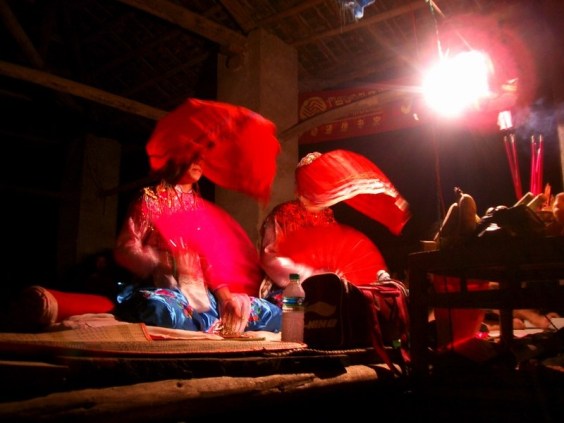
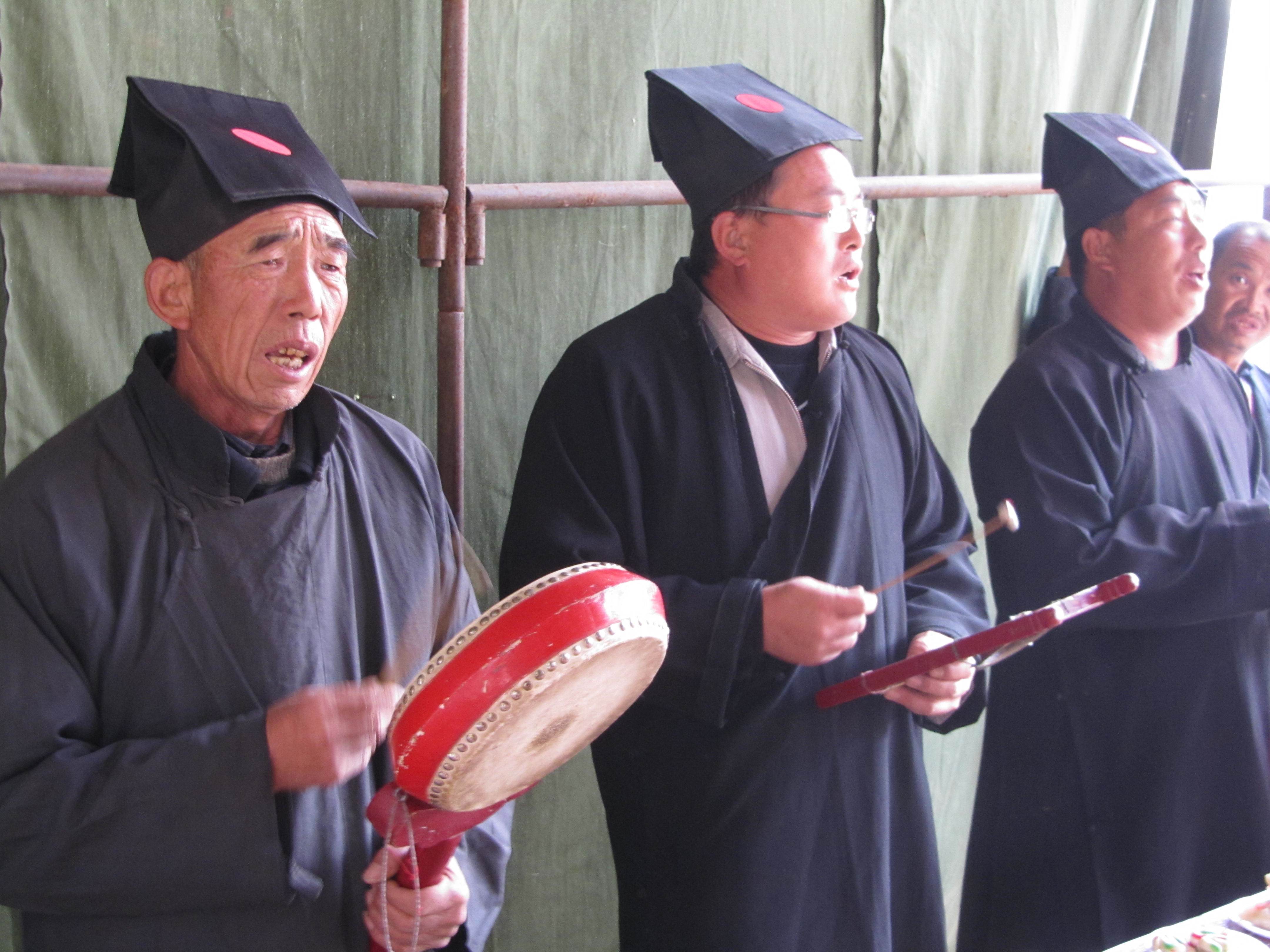
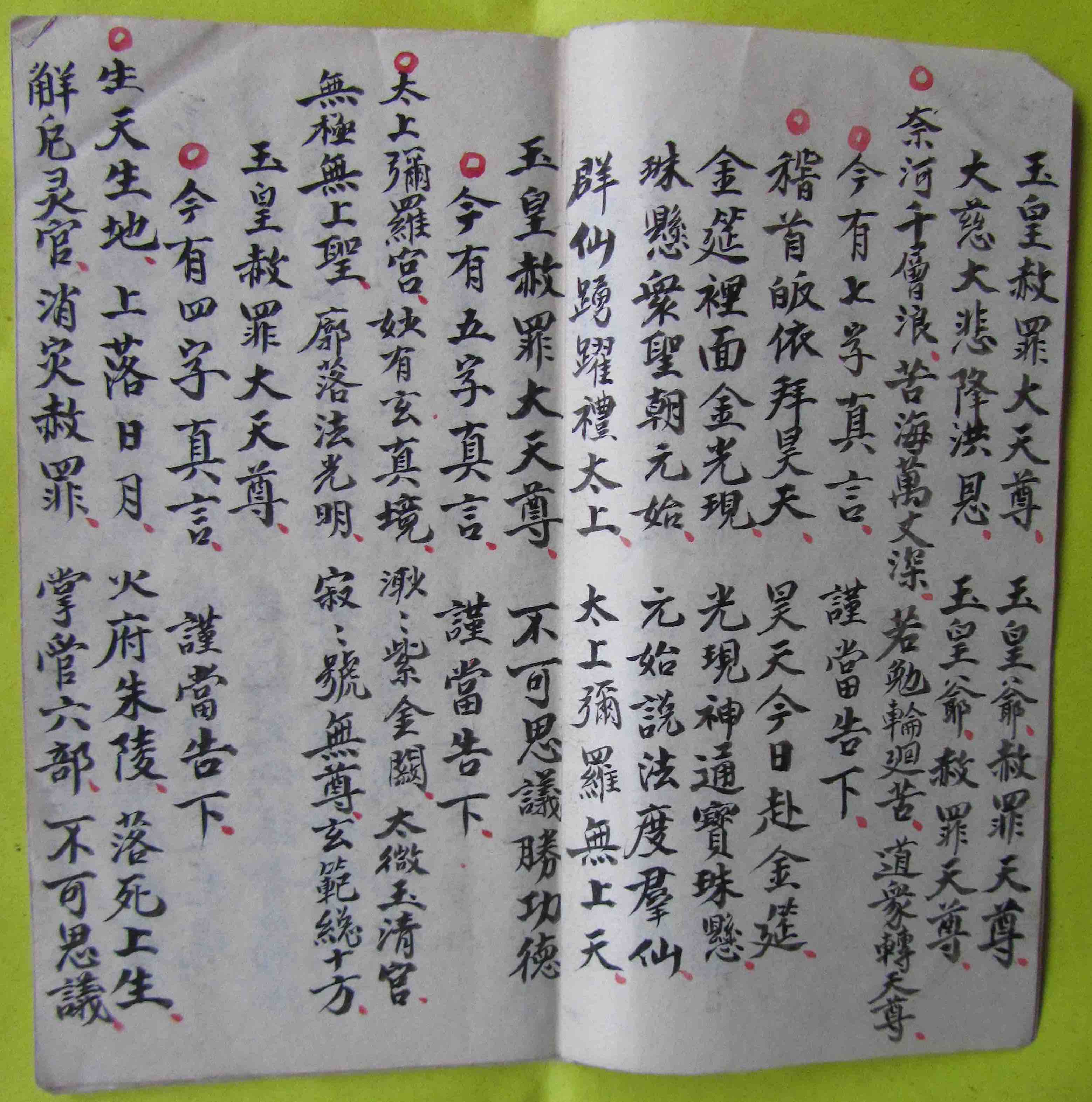
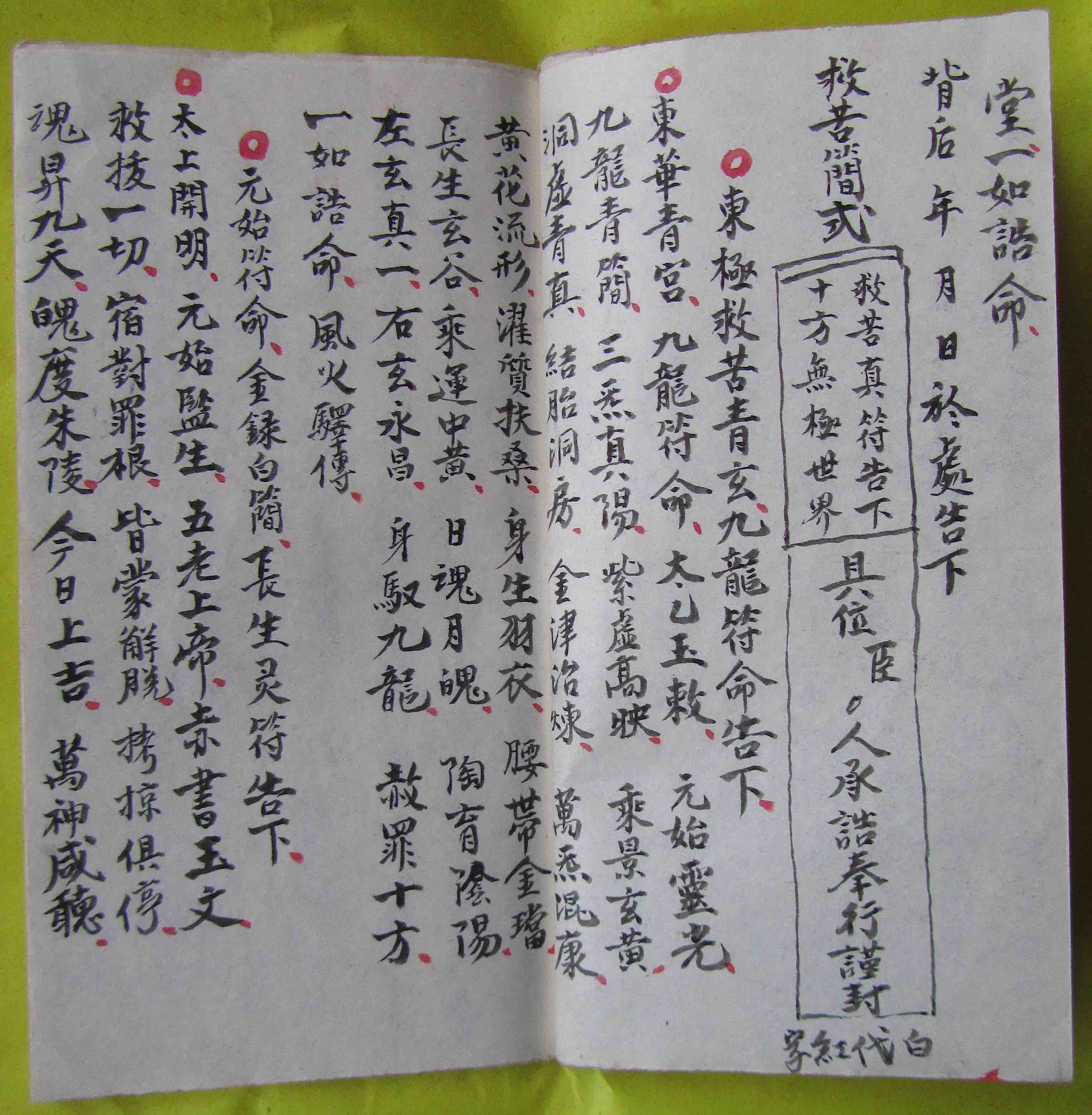
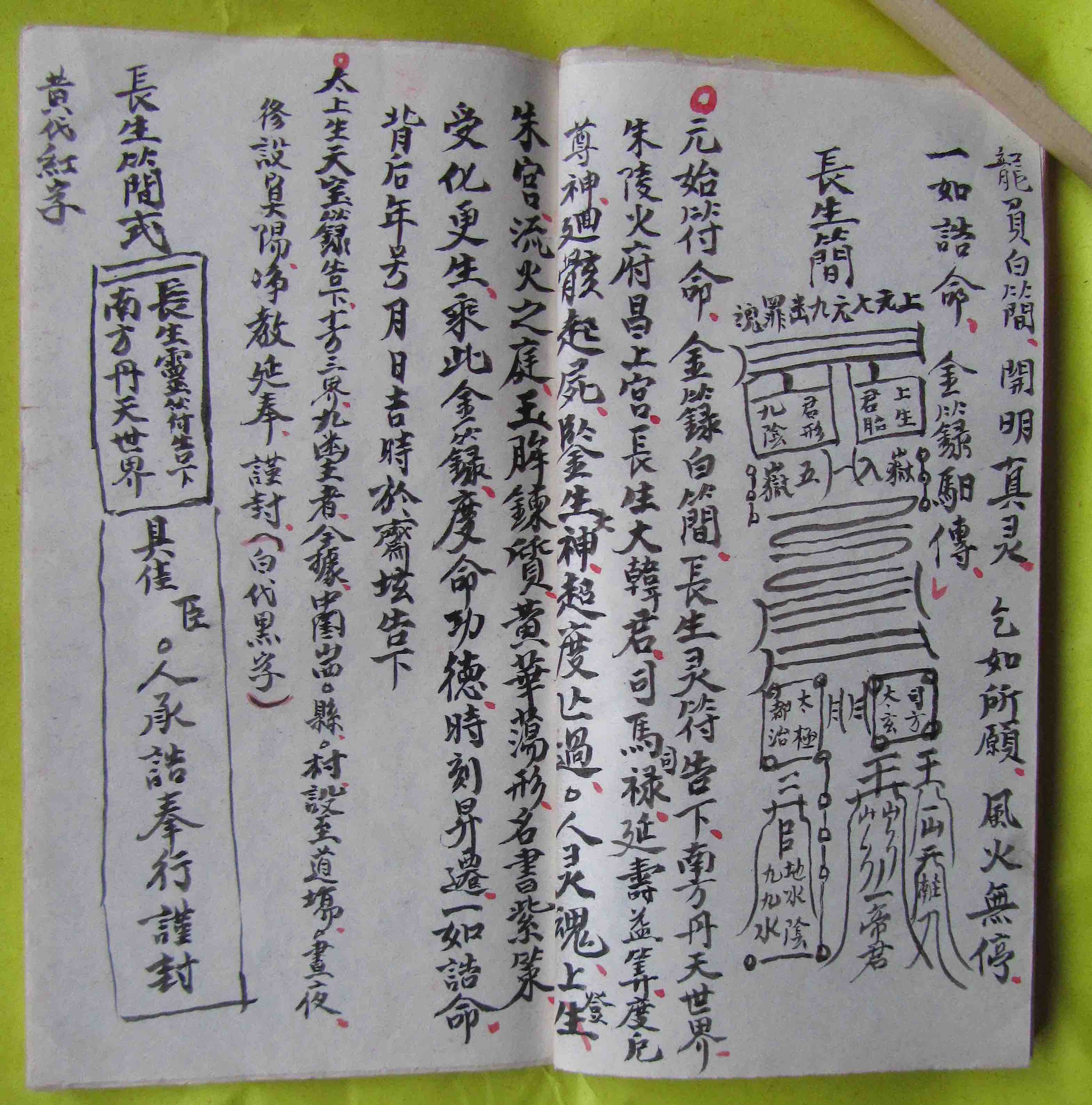
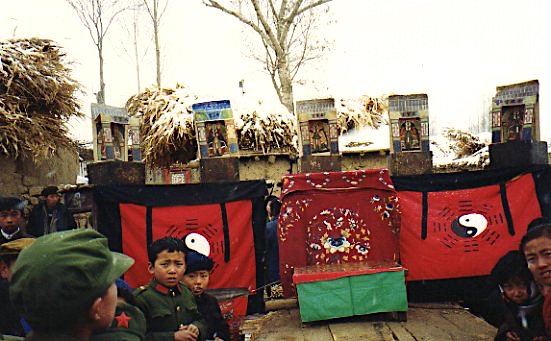
Spirit medium for the deity Houtu, Houshan temple fair 1993. My photo.

In a post on gender in Chinese religious life I suggested a bold, nay revolutionary, idea:

I wonder how long it might take for us to totally reverse our perspectives on “doing religion” in China—privileging oral, largely non-literate practices and relegating elite discourse (including the whole vast repository of early canonical texts) and temple-dwelling clerics to a subsidiary place?!

In contrast to the more literate manifestations of religious practice in China that dominate sinology, spirit mediums also play an important role in local society (note the useful bibliographies of Philip Clart and Barend ter Haar). The gender ratio varies by region, but in many areas female mediums dominate, serving not only as healers but as protagonists in religious life; for women in particular, becoming a medium gives them a social status that is otherwise unavailable. Their tutelary deities may be either male or female.

me-mot

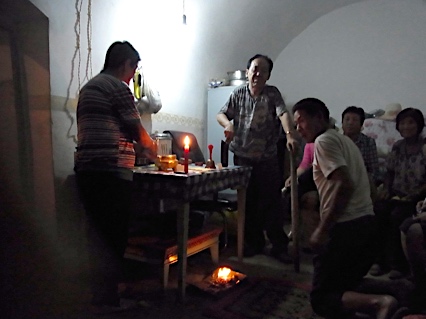
Me-mot mediums in Guangxi. Photo: Xiao Mei.

This is to draw your attention to a new “mediums” tag in the sidebar. The main posts include

  • Lives of female mediums, introducing studies on Guangxi (XIao Mei) and Wenzhou (Mayfair Yang)—as well as our own work around Hebei and north Shanxi, on which I reflect further in the second post of my series on
  • Women of Yanggao.

And I’ve introduced studies on activity in

as well as

  • the self-mortifying mediums of Amdo (here, and in note here).

Under Maoism, whereas public forms of religious life were vulnerable to political campaigns, the more clandestine activities of mediums were tenacious—indeed, the social and psychological crises of the era ensured that they continued to emerge (see e.g. the work of Ng and Chau above). Still, distribution is patchy; in this post I discussed the decline in Gaoluo village.

For the rituals of mediums in Korea, click here. Further afield, see Taranta, poverty, and exorcism.

Bektashi and Alevi ritual, 1: Istanbul

Alevi cem 17
Sema
for Alevi cem ritual, Istanbul 2022.

In modern Turkey, a major component of the diverse Ottoman religious heritage is the ritual life of groups subsumed under the broad umbrella of Sufi dervish ritual—whose histories and evolution the dualistic language of Sunni and Shi’a is quite inadequate to encompass. [1]

Misleading taxonomies are common in world religions. With my experience of China, I think of Orthodox Unity and Complete Perfection Daoism (e.g. for Hunyuan); at folk level, even the terms “Buddhist” and “Daoist” may be problematic, such as in Hunan. And I’ll remark on further features that the Sufi groups seem to share with folk ritual practices in China.

A distinctive strand here is the practice of Bektashi and Alevi groups. [2] While I’m in Istanbul, haughtily eschewing the sanitised stage shows of “Whirling Dervishes”, commodified for tourists, I’m keen to attend a ritual. The devotional religious groups engage in activities with a certain discretion, so—quite properly—they don’t readily offer access to impertinent outsiders. But while they have also gone into partial lockdown since the pandemic, cem rituals are still being held.

I’m merely trying to get a very basic handle on this topic; perhaps my superficial foray below will suffice merely to show how immense it all is—so readers who actually know about it can look away now

* * *

In both their doctrines and ritual practices Bektashis and Alevis, now commonly associated, have indeed long had much in common. Both, for instance, worship Ali (son-in-law of Muhammad), the Twelve Imams, and the 13th-century patriarch Haji Bektash Veli, and both emphasise the Four Gates and Forty Stations. They make an annual pilgrimage in August to the shrine of Haji Bektash Veli at Hacıbektaş in central Anatolia.

To simplify historical nuances of doctrine and terminology that elude me, Alevism is a general belief system with ascriptive identity, whereas Bektashi is an order in which one can enrol. Some scholars have distinguished rural Alevis and a more educated elite of urban Bektashis.

As Caroline Finkel observes in Osman’s dream,

The devotional practices of mosque-goers and dervish could be accommodated side by side in one building, and many mosques today associated with Sunni Islamic observance once had a wider function, as a refuge for dervishes as well as congregational prayer-hall.

In Ottoman times Bektashis were closely linked to the Janissaries; they went into decline after the latter were suppressed in the “Auspicious Incident” of 1826 (Osman’s dream, pp.437–8):

Prominent members of the order were executed, and Bektashi properties in Istanbul were destroyed, or confiscated and sold, or converted to other uses. […]

The practice of affiliation to more than one dervish order was so common, and the attempt to eradicate Bektashism at this time so vehement, that sheiks of other orders were also rounded up and sent into internal exile. Largely because of their infiltration into and acceptance by other orders, however, especially the officially-favoured Nakşibendi order—on whom their properties were bestowed—the Bektashi were able to survive clandestinely, and by mid-century they were again finding favour within elite circles.

Following World War One, despite the Bektashis’ supportive role in the War of Independence, Atatürk outlawed such Sufi groups in 1925; since then (by contrast with the recent commodification of the “Whirling Dervishes”) their ritual activities take place discreetly, since some Muslims still consider them heretical. The main base for the Bektashi sect is now in the Balkans and Thrace, notably Albania.

Although some Alevis claim to be Bektashi, the eliding of the two is quite recent. As our encyclopedic Kuzguncuk neighbour Kadir Filiz observes, the problematic term “Alevi–Bektashi” was coined by Mehmet Fuat Köprülü (1890–1966) in his work on Sufism; he also applied the labels “orthodox” and “heterodox” to Islam, recently deflated by scholars like Riza Yildirim (who encapsulates his detailed historical and field studies here and here; also in English, see e.g. here). By the late Ottoman era, as the militant, rebellious kızılbaş “red-heads” [3] were perceived negatively, popular parlance began replacing the term with “Alevi”; but under the new Republic, Alevism came to be associated with radical leftist views.

Lodges and houses of gathering
The situation became further politicised from the 1950s, when Alevis from rural areas of Anatolia began migrating in large numbers to major cities like Istanbul. There they used long-dormant Bektashi tekke lodges as cemevi (“houses of gathering”) [4] and formed local associations, named after their native region; since the 1980s the cemevi have been rented officially, and younger generations have come to refer to them as Alevi–Bektashi lodges. As both context and ritual practice have been modified, this has also been a period of an “Alevi renaissance”, reaffirming identity against the dominant culture of Sunni Islam.

The urban cemevi now have an ambiguous status. In modern Istanbul they often serve partly as social centres, but many rituals are also held in private homes; one dede leader told us that well over fifty cemevi are active there. [5]

State suspicion of the Alevis has been heightened by the presence of a significant Kurdish component among them, making them yet more vulnerable to attack—with serious incidents since the 1960s and 70s, such as massacres at Maraş (1978), Çorum (1980), and Sivas (1993), amidst tacit government connivance. While Alevis make up a substantial part of the Turkish population, at home they may be shunned by their neighbours, and at school children still have to keep quiet about their heritage.

Ritual practice
Along with migration, ritual change has become a major research topic (see Catherine Bell, Ritual: perspectives and dimensions, Chapter 7; for China, see e.g. Guo Yuhua, and north Shanxi).

Alevi studies are thriving too. Alongside the insights of Riza Yildirim (see above), I note works such as

See also e.g.

Such studies lead to a wealth of further research, both historical and ethnographic. [6] Meeting practitioners in Istanbul, I’m also reminded of how much material (including audio and video recordings) is shared online by such groups, who maintain regular contacts with their fellow-believers around Anatolia and Thrace.

As with the Islamic practice of the Sunni majority, Sufi cem (djem) communal rituals are performed with the general purpose of dhikr (remembrance, reminder). While in most Sufi orders women are rarely allowed to participate in rituals, in Bektashi–Alevi practice men and women worship together, although the accuracy of the cherished notion of gender equality has recently been challenged by Alevi women.

Sites such as this outline the annual cycle of Alevi cem rituals; they may also be held for initiation, commemoration, vows for good health, for joining the army, and so on. Langer summarises the sequence of an individual Alevi ritual thus: after a preliminary “discussion” (sohbetmore commonly muhabbet) by the presiding dede, and symbolic court case (görgü), the main service (ibadet) consists of a sequence of prayers (both solo and choral) to the Twelve Imams, hymns to the Twelve Duties, prayers of repentance, and invocations, concluding with an ecstatic sema dance. Sipos and Csáki (pp.53–66) give a detailed account of a full sequence of Bektashi ritual segments, which I summarise:

  • animal sacrifice and preparations
  • arrival, settlings, furnishings, lighting of the candles
  • “secret” section, including reconciliation of grievances (cf. the Uyghur mäshräp?)
  • sequence of nefes hymns
  • tripling (üçleme), with toasts
  • supper
  • pleasant [rather, instructive] conversation (muhabbet)
  • further sequence of nefes
  • semah whirling
  • closing prayers and blessings.

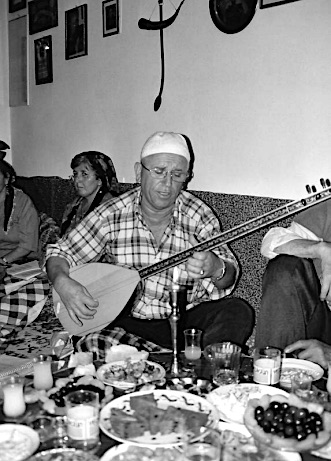
The ritual leader (dede/baba) presides, flanked by a bard (zakir or aşık), who leads the vocal liturgy accompanying himself on a bağlama long-necked plucked lute.

In most orthodox Sunni ritual, even melodic instrumental music is considered unsuitable—just as in Chinese temple Buddhism and Daoism (cf. A cappella singing). Indeed, in China one’s search for “religious music” can easily be misled by such a narrow association (see Unpacking “Daoist music”, and The notation of ritual sound). As long as ethnographers pay attention to soundscape (still, alas, quite a tall order), our main theme should be ritual in society (note Michelle Bigenho‘s thoughtful comments).

Sipos and Csáki mention the collection work of Turkish Radio and Television (TRT), reminding me yet again of China:

In the Turkish folk music stock of the TRT, numbering over 4,500 items, there are sporadic tasavvufı halk müziği or “folk religious” tunes, usually under the generic label of “folk song”. [footnote: The TRT repertoire contains the variants approved by a committee of the tunes officially permitted for publication. The committee often makes changes on the tunes before printing, first of all modifying the words not deemed appropriate.]

In China I have expressed grave reservations about UNESCO’s Intangible Cultural Heritage programme (see this roundup; note also Rachel Harris’s critique of their programme for Uyghur culture, in particular the mäshräp). For Turkey UNESCO has adopted the “Alevi–Bektashi sema ritual. This film could do with more documentation:

But their outline sums up the issue:

In Turkey, each and every inhabitant of the State is held to be Turkish and Sunni. If Alevis are not Sunni, how then can they be Turks? Since such a notion is inconceivable to many Turks, there is only one possible answer: since Alevis are Turks, they are also Sunnis. If this were not the case, they would become a danger for the Turkish nation and State. Consequently, research on Alevi religious rituals is potentially problematic both for the stability and security of the State and for the Turkish national psyche. To sum up, a large-scale education programme is needed to build bridges of communication between those belonging or not belonging to the Islamic world—Alevis, the Turkish Sunni majority, and the authorities, who usually perceive social reality through Sunni lenses. Future educational projects and campaigns should not concentrate solely on Alevi culture and religious rituals, but rather on folk culture and rituals in Turkey seen as a part of contemporary Turkish culture.

A Bektashi cemevi in Zeytinburnu
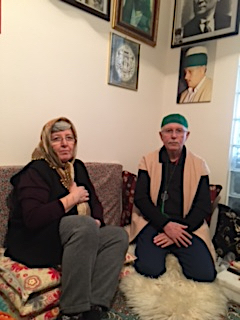
Despite my profound ignorance, local practitioners are most welcoming. On the European side of the Bosphorus, in Zeytinburnu “outside the walls” (now also a fragile home for many Uyghurs fleeing persecution in China) we visited a senior Bektashi couple at their apartment, where they hold regular cem gatherings.

Bektashi altar room

Bektashi Bahtiyar baba (on ritual sheepskin) and ana bash.

Bektashi baba and his wife (known as ana bash “leader of the female section”) were both born in Edirne in eastern Thrace, he in 1953, she in 1952; they mainly spoke Turkish. Their ancestors were all devotees. His parents had come to Edirne from Bulgaria in 1950; his father was also a Bektashi baba. Their families moved to Istanbul in the late 1950s.

BB on baglama Sipos and Csaki

Bektashi baba accompanying a cem. From Sipos and Csáki 2009.

He referred us to his solo recordings of hymns with bağlama plucked lute, featured in many YouTube playlists under Bektaş Bahtiyar, e.g. here.

An Alevi ritual in suburban Istanbul
In the distant southern suburbs on the Asian side of the Bosphorus, we attended a weekly ritual at a well-appointed Alevi cemevi, consulting the wise Erzade Özgür dede (b.1983) and his wife Songül ana, who also possesses estimable ritual knowledge.

Before the pandemic struck, over a hundred devotees would take part in the cem; currently around twenty gather—male and female, old and young, all wearing their ordinary clothes, including the dede, who sits on the sheepskin with a mic, flanked by the zakir. He delivers a long opening muhabbet in his normal voice—instructive, personal, relaxed but serious—with occasional contributions from the congregation. The main participants at the meydan ritual arena tie red or green sashes at the waist, with two young men taking a staff; the gatekeeper holds a staff too.

After the muhabbet of over an hour, the zakir strikes up on bağlama, also amplified. His instrumental taksim leads into a nefes hymn; then another speech, and another song, as an 80-year-old Kurdish elder lights a three-candle electric candelabra. The congregation is now getting involved, with cries of “Allah Allah!”, then call-and-response.

The assistants remove their socks before blessing the carpet and unfolding it. Water is poured into a bowl while chanting, going round the congregation to ritually cleanse their hands and faces. Three women bow with a brush; more call-and-response; longer group chanting. All prostrate as the volume rises; kneeling, the worshippers all beat their thighs to a little suite of nefes with bağlama. The mood is ever more ecstatic.

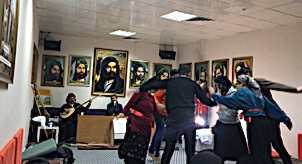
Alevi sema 7

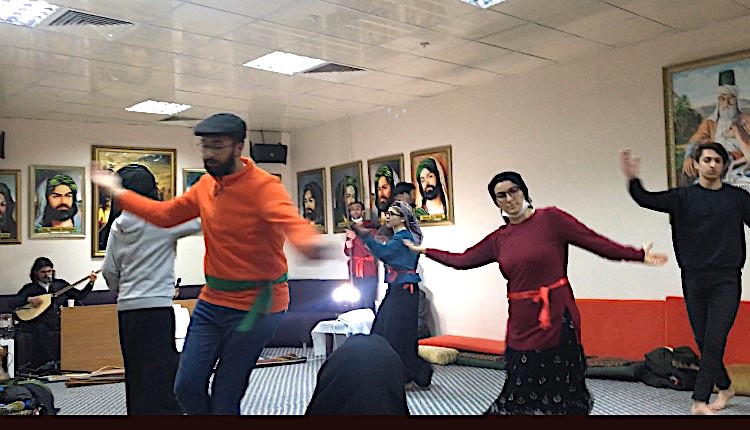
Another speech as all prostrate again, another bağlama song, then sema around the carpet with two men and two women, barefoot. They stand on the edge of the carpet to bow to the dede, who invites others to dance, with two more men joining in. With the three main dancers, slow and fast nefes alternate, accelerating wildly. The dancers bow again.

Then the women silently brush the carpet while bowing. The simple lokma food offerings are blessed. After another brief discussion, the candles are extinguished, the carpet replaced.

All this helped me appreciate the different roles of the twelve hizmet duties or services (cf. guanshi in north China, assistant to the huitou leader), such as çerağcı supervisor of the candles, süpürgeci sweeper, and selman provider of water for ritual washing.

Alevi cem group pic

Erzade dede A couple of days later, taking the Metro to the southern terminus, we were invited to supper at the couple’s apartment, along with a bright young disciple—another instructive and delightful evening. Erzade dede’s family brought him to Istanbul when he was 3. He was chosen by his grandfather at the age of 13—his father wasn’t a dede—and he sometimes commuted to Ankara for further instruction. After military service, and the death of his mentors, by his late 20s he was already taking over ritual duties. Having learned in his youth to sing nefes while playing the bağlama, now (like many urban dede) he leads the ritual alongside a separate zakir. He is a respected community leader.

An Alevi–Bektashi lodge in Kadıköy
On Sunday afternoon the following week we went to the Göztepe district of Kadıköy to visit an extensive and imposing Alevi–Bektashi dergâh lodge, rebuilt openly since the late 1980s. A throng of devotees were gathered, visiting the tombs in the grounds and seeking blessings from the dede for their young children and sick relatives, offering lokma. Accompanying himself on bağlama, a zakir sung a wonderful nefes hymn for us in praise of Abdal Musa (see sequel to this post), disciple of the 13th-century patriarch Haji Bektash Veli. I look forward to returning for a regular ritual at their fine cemevi.

See also Alevi ritual in rural Anatolia, and “Alevi music” in Turkey.

* * *

Alevi ritual in the diaspora
The whole history of Bektashis and Alevis—before, during, and since the Ottoman era—is one of migration over a large area. Scholars such as Robert Langer explore the transfer to the wider diaspora in recent decades. The documentary Heavenly journeys (Marcel Klapp, 2015) illustrates Alevi ritual life in Germany, with comments from older and younger generations:

Note also Tözün Issa (ed.), Alevis in Europe: voices of migration, culture, and identity (2017), introduced here. And for Alevis in Toronto, see Ayhan Erol, “Identity, migration and transnationalism: expressive cultural practices of the Toronto Alevi community (2012). [7]

Setting forth from the guidance of Kadir and the diligence of Augusta,
with gratitude to wise Bektashi–Alevi elders!


[1] For the transnational picture, see e.g. The Routledge handbook on Sufism (2021); for a basic outline of Sufi orders in Turkey, see e.g. here, and for Ottoman Constantinople, on the useful site History of Istanbul, here and here. Kadir Filiz directs me to the classic study Richard Gramlich, Die schiitischen Derwischorden Persiens.

[2] I adopt the common form Bektashi rather than the orthography Bektaşi. For the Ottoman social-political context of Bektashi orders, see Caroline Finkel, Osman’s dream; brief mentions that may pique one’s interest include Bruce Clark, Twice a stranger, pp.187–90; Mark Mazower, Salonica: city of ghosts, pp.81–2.

[3] For a casual connection, cf. “red-head” Daoists in Taiwan, e.g. Kristofer Schipper, “Vernacular and classical ritual in Taoism”.

[4] Again, cf. folk hui assemblies/associations/sects in China—by contrast with officially-registered “venues for religious activity”, where only a tiny amount of overall ritual life takes place.

[5] This article includes a list of 64 cemevi in Istanbul (cf. historical photos of the tekke, and this introduction; for architectural features, and more vocabulary, click here). On politics, see e.g. Tahire Erman & Emrah Göker, “Alevi politics in contemporary Turkey” (2000), and sources cited in this post under “Ritual practice”. For the wider religious background since the founding of the Republic, see here. As I write, yet another round of the Alevi Federation’s dispute over the exorbitant utility bills suffered by the cemevi is under way, hinging on its attempts to gain status for them as places of worship.

[6] For briefer introductions to Bektashi ritual and music, see e.g. here; wiki has articles on the Bektashi order, Alevism (here and here), Alevi history, and sema / sama. For more on Alevis in Istanbul, see also the ongoing work of Ezgi Benli-Garcia, e.g. here.
For Thrace, in Janos Sipos and Eva Csáki, The psalms and folk songs of a mystical Turkish order: the music of Bektashis in Thrace (2009; 669 pages, consisting largely of transcriptions and lyrics with translations), note “The religious ceremony” and “The music of the Bektashis in Thrace” (pp.38–77). Jérôme Cler’s introduction to the topic for Anatolia is enriched by videos and further links; see sequel to this post. My taste for ritual sequences is amply displayed in the many posts on local ritual in China.

[7] For Mevlevi practice in Germany, see Osman Öksüzoğlu, “Music and ritual in Trebbus Mevlevi tekke (lodge) in Germany” (2019). Among a profusion of Sufi groups around Turkey and elsewhere, the Mevlevi order (founded by Rumi, with its centre at Konya) enjoys a high profile, notably for its association with the “Whirling Dervishes”.

A domestic couplet

home duilian

While most domestic couplets pasted at the gateway of ordinary families are somewhat trite, this one caught my eye, at a peasant gateway in a north Shanxi village:

聖言興旺是正道
世事衰微盡蒼桑

For the Word of the Sage to flourish is the Proper Way
For worldly affairs to decline evinces chronic vicissitudes

This may seem to reflect an enduring pre-Liberation faith—the Word of the Sage apparently referring to a Christian worldview (“the Word of God”). But it’s combined with phrases adapted from a poem of Chairman Mao:

人间正道是苍桑
The Proper Way among humans is inconstant

—appealing, whether fortuitously or ingeniously, to political correctness. Shame I didn’t have a chance to chat with the host.

For a Buddhist meditation on impermanence in the vocal liturgy of the Li family Daoists, click here.

Chinoperl

Cperl site

CHINOPERL, a US-based association for the study of oral and performing traditions of China, was founded in 1969 by a distinguished group including Yuen Ren Chao, Harold Shadick, and Cyril Birch; notable figures such as Rulan Chao Pian and Kate Stevens continued the initiative.

Cperl

The main focus of CHINOPERL is regional traditions of narrative-singing (shuoshu 说书, shuochang 说唱, quyi 曲艺) and drama, both staged and unstaged. The recently-revised website contains a contents list for back issues of the journal, with articles by scholars such as Wilt Idema, Victor Mair, Bell Yung, David Johnson, Mark Bender, and Vibeke Børdahl.

Whereas CHINOPERL tends to stress historical and textual research, coverage of narrative-singing on my own site takes a more ethnographic approach, highlighting ritual, poverty, and itinerant blind performers—posts on local traditions are listed here.

Note the valuable CD-set Shuochang: the ultimate art of Chinese storytelling under Archive Chinese recordings. And of course there’s a wealth of sites in Chinese, which I won’t even attempt to survey now… See also CHIME: Chinese music studies in a changing China.

Epiphany in Istanbul

In church 1

Sanctification of Water ritual, Agios Giorgios, Kuzguncuk.

To follow Bach’s Epiphany:

Having blithely ignored Christmas in London, I arrived in Istanbul again just in time for Armenian and Greek Orthodox Christmas on 6th January.

The Armenian faithful in Istanbul have somehow managed to maintain their liturgical traditions despite over a century of persecution. We went up the hill in Kuzguncuk to attend a Mass for Christmas Eve in a sparsely-attended minor church.

It’s also Epiphany (Theophania) for the Greek Orthodox Church, observed with the agiasmos Sanctification of Water ritual, when the Bishop throws a wooden cross into the Bosphorus to be retrieved by swimmers—a ritual performed at several sites around Istanbul (for background on the religious life of Istanbul Greeks, see e.g. here). But the core ritual is the lengthy service that precedes it, which we attended at the lovely little Agios Georgios church in Kuzguncuk—next to the synagogue, on the other side of the road down from the main Greek church Agios Panteleimonas.

In Istanbul today Greeks are far fewer than Armenians, but this was an impressive service, with a quartet of liturgists punctuating the recitation of the priests, with jangling thurifer.

Left, the head priest blesses worshippers with light;
right, preparing to sprinkle blessed water on the congregation with a sprig of herbs.

In church 2

On right, dove awaiting release to the heavens (and an ICONIC choice of jacket).

on road

We all followed them across the road through the ferry station to the shore, where two pious swimmers retrieved the wooden cross from the waters; meanwhile a dove (representing the Holy Spirit) had waited patiently during the service before being released to the heavens (cf. Messiaen).

Left, at Fener (source); right, at Kuzguncuk,
with swimmer presenting cross that he has retrieved from the Bosphorus.

Our Greek friends note the symbolism of fish, Ichthys, and Jesus as fisher of people, as well as abundance. China makes the same connection between yu 魚 fish and yu 餘 abundance; and most large-scale rituals (both for temple fairs and funerals) there include segments for Fetching or Inviting Water (qushui, qingshui, and so on; see e.g. our film, from 41.06).

Last year Covid rules prevented the Sanctification of Water being held in Greece, but it was observed by the Greek community in Istanbul. For more thoughts on Greek liturgy in Kuzguncuk, click here.

The topic might lead us to consider ayazma holy springs, healing, and the wider context of Holy Water in Eastern Christianity and other faiths. And spare a thought for the beleaguered Catholic minorities in China, including Gaoluo.

With thanks to Kuzguncuk friends!

Roundup for 2021!

Emma Leylah

As I observed in my roundup for 2020, since part of my mission (whatever that is) is to vary the distribution of the diverse posts on this blog, keeping you guessing, this latest annual mélange is an occasion to group together some major themes from this past year. This is only a selection; for reasons of economy, I’ve tended to skip over some of the lighter items. You can also consult the tags and categories in the sidebar.

Some essential posts:

I’m going to emulate Stella Gibbons and award *** to some other *MUST READ!* posts too…

China: on the Li family Daoists, recent and older posts are collected in

and it’s always worth reminding you to watch our film

Elsewhere,

Tributes to three great sinologists:

The beleaguered cultures of the

  • Uyghurs (posts collected here) and
  • Tibetans (posts collected here), including

I’ve begun a growing series on Turkey (with a new tag for west/Central Asia):

Among this year’s additions to the jazz, pop, punk tags are

WAM:

Bach (added to the roundup A Bach retrospective):

as well as

On “world music” and anthropology:

On gender (category here, with basic subheads):

Germany:

Italy:

Britain (see also The English, home and abroad), and the USA:

More on stammering:

On a lighter note:

Even just for this last year, I realise there’s a lot to read there, but do click away on all the links! And I can’t resist reminding you of some of my earlier favourites, notably

Ma Yuan

The zheng zither in Shandong

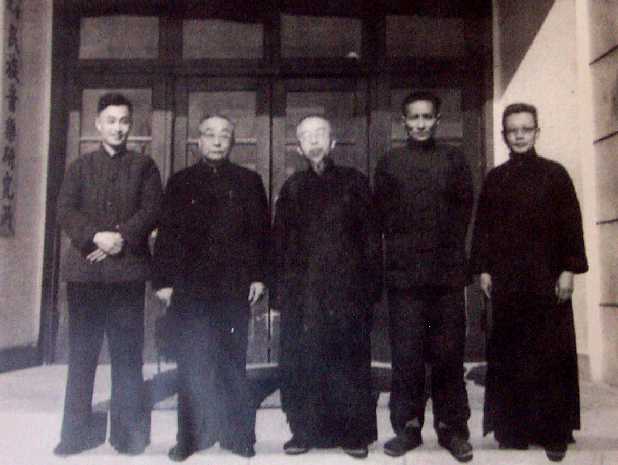
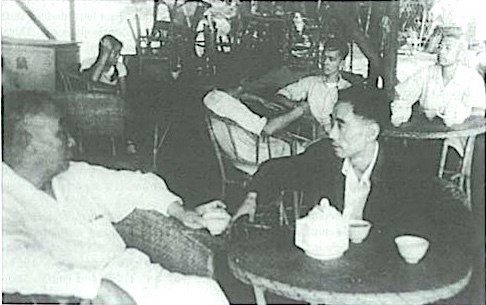
The elite, rarefied qin zither enjoyed an unlikely Golden Age during the first fifteen years of Maoism, as I show in my series of vignettes. Though it was largely self-contained in its ivory tower, in the 1950s the new energy at the Music Research Institute in Beijing to study all kinds of traditional music combined with the official populist ethos to encourage occasional exchanges—such as this illustrious gathering with masters of the zheng 筝 zither at the house of Yang Dajun:

Zhao Yuzhai at MRI

Qin and zheng exchange, mid-1950s (see e.g. here). From left,
back row: Zhao Yuzhai, Yang Dajun, Gao Zicheng, [unidentified], Cao Zheng, Wu Jinglue;
front row: Wang Jinru, Cao Dongfu (playing), Luo Jiuxiang, Zha Fuxi.

Of the zheng players there, Zhao Yuzhai and Gao Zicheng came from Shandong, Cao Zheng and Cao Dongfu from adjacent Henan; Luo Jiuxiang represented the Hakka style of east Guangdong, far south; Wang Jinru was based in Beijing.

Unlike the seven-string qin, the strings of the zheng have individual bridges. Though just as ancient as the qin, it has much more in common with local folk music; while some prominent advocates like Cao Zheng made more exalted claims for its grounding in ancient cosmology, it still feels like a poor cousin of the qin. Its regional distribution is patchy, but Zhao Yuzhai was part of a thriving zheng scene in southwest Shandong, based (as often) on the local ensemble that accompanied vocal performance; the musicians were itinerant and semi-occupational.

My sparse early clues to folk musicking in Shandong (Folk music of China, p. 209) have been much augmented by the publication of the Shandong volumes of the Anthology (see my review “Reading between the lines: reflections on the massive Anthology of folk music of the Chinese peoples”), in this case particularly for instrumental music (Zhongguo minjian qiyuequ, Shandong juan 中国民间器乐曲, 山东卷, 1994).

Throughout the Anthology, ensemble repertoire always far eclipses solo pieces; like other volumes for north China (e.g. Liaoning), the coverage of Shandong is dominated by the shawm-band repertoire (cf. “Reading between the lines”, pp.317–18), to which the first 1,269 of 1,958 pages are devoted. Solo pieces for the zheng occupy pp.1515–1620 (among online surveys of the Shandong zheng, see e.g. here).

Zhao Yuzhai 赵玉斋 (1923–99) [1] came from the Heze region of southwest Shandong, also renowned for its shawm bands. He was a disciple of the great blind musician Wang Dianyu 王殿玉 (1899–1964).

Wang Dianyu 1943

The Dong Lu yayue she 东鲁雅乐社, led by Wang Dianyu, 1943.
Right to left Chen Baozeng 陈宝曾, Gao Zicheng 高自成, Zheng Xipei 郑西培,
Wang Dianyu 王殿玉, Han Fengtian 韩风田, Zhao Yuzhai 赵玉斋, Tan Yonghe 谭永和.

The core string ensemble is for zheng, yangqin dulcimer, pipa, and ruyigou fiddle. Their repertoire is based on the Peng baban 碰八板 form—baban variants are common in various coastal chamber genres from Shanghai down to Guangzhou, if not nearly so widespread as scholarly attention may lead us to suppose. The Shandong style has much in common with the adjacent province of Henan, where zheng masters like Cao Dongfu 曹东扶 (1898–1970) were much admired. (Click here for bowed zithers in Shandong and Henan.)

In the cause of forging a new style of “national music”, through the 1950s many folk masters were enlisted to the new conservatoires and state troupes. Solo instruments like the zheng were more easily incorporated into the conservatoire system than ensembles that relied on folk ceremonial; players took readily to adapting their repertoire for the new demands of the new ethos. [2] In 1955 Zhao Yuzhai was recruited to the Shenyang conservatoire (where one of his colleagues was the qin player Ling Qizhen—see Musicking at the Qing court 1, n.3). The traditional zheng had 16 (or fewer) strings; in 1957, responding to the call to “improve” Chinese instruments, Zhao Yuzhai created an enlarged 21-string version. Meanwhile the lofty qin also found a place in the conservatoires; but while players took part in the major shift from silk to metal strings, they remained largely unscathed by “development”.

n 1955 Zhao Yuzhai was exposed to the rigours of rural collectivisation when a troupe from the conservatoire was sent on a tour of rural south Liaoning to “experience life” (tiyan shenghuo 体验生活), as the glib slogan went (cf. Daoist Li Qing’s stint in the Datong troupe). This resulted in his florid composition “Celebrating a bumper year” (Qing fengnian 庆丰年)—irony not supplied:

By 1958 even qin master Zha Fuxi was reduced to composing a piece in praise of the Great Leap Backward. for whose hyperbole click here.

In 1956 Zhao Yuzhai was part of a troupe performing at the Prague Spring festival, and in October he toured north Europe; his career continued to thrive until 1963. I can never get used to the blatant lacunae for the years of Maoism that are so universal in PRC biographies (cf. Craig Clunas’s remarks); like countless others, Zhao Yuzhai was assaulted at the outbreak of the Cultural Revolution in 1966, condemned to labour camp until his release in 1978.

Zhao Yuzhai was one of three zheng players, along with Gao Zicheng and Luo Jiuxiang, who appeared in illustrious company on the 2-CD set of archive recordings from the Music Research institute. In 2000 a CD was devoted to his playing. He appears on film in “Autumn moon over Han palace” (Hangong qiuyue 汉宫秋月):

and “Four folds of brocade” (Siduan jin 四段锦):

Among other celebrated Shandong zheng masters were Han Tinggui 韩庭贵 (1929–2016) and Gao Zicheng 高自成 (1918–2010). Like Zhao Yuzhai, Gao Zicheng found a long-term position away from his Shandong home, teaching at the Xi’an conservatoire from 1957 (for the Shaanxi zheng style, see here)—here’s a short documentary in Chinese:

Apart from such masters who were selected for national celebrity, it may be hard to find ethnographic material on how folk chamber ensembles in rural Shandong adapted to successive social transformations—first to collectivisation, and then to the 1980s’ revival of tradition, soon challenged by the tide of capitalism and pop culture. Cf. Bards of Henan.

Meanwhile in a separate milieu, the concert platform made a more natural progression for the zheng than for the qin. Hitherto largely the preserve of men, since the 1980s’ reform era the zheng (like other stringed instruments in the conservatoire) has been dominated by female soloists. At the same time, concert performances for the qin on stage have come to enjoy a higher profile than the “refined gatherings” where its soul resides; but in the end, the qin still occupies its own world, at a tangent from the conservatoire.


[1] For Chinese sources on Zhao Yuzhai, see e.g.
https://baike.baidu.com/item/%E8%B5%B5%E7%8E%89%E6%96%8B/5776019
https://www.sohu.com/a/386245358_684953
https://www.factpedia.org/index.php?title=%E8%B5%B5%E7%8E%89%E6%96%8B&variant=zh
http://info.guqu.net/guzhenwenxue/29411.html
http://www.yueqiziliao.com/guzheng/202047250.html
https://www.yueqiquan.com/a39423.html

[2] In English, see e.g. Han Mei, The emergence of the Chinese zheng: traditional context, contemporary evolution, and cultural identity (2013); Sun Zhuo, The Chinese zheng zither: contemporary transformations (2015)

Wild Swans revisited

Wild Swans cover

When Jung Chang’s Wild swans: three daughters of China was first published in 1991 (quite soon after the 1989 Tiananmen demonstrations), curiosity in the West about people’s lives under Maoism ensured it huge popular success. This was soon followed by a tide of condescension from sinologists and China-watchers, understandably envious at the eclipse of their own more careful, measured research on the period. Still, rather few of them seem to have aired their reservations publicly (see e.g. Lin Chun, and Harriet Evans, “Hot-house history”, in TLS 1992).

While the way that Jung Chang (pinyin: Zhang Rong) enmeshes the personal and the political is a strength, her general slant may read like simplistic Commie-bashing, lacking in empathy—treating the development of the regime as alien (cf. Dikötter, “The tragedy of Liberation”).

It was hardly new to expose the iniquities of the Maoist system, and they do indeed need to be exposed. But surely they deserved a wide audience outside academia—not just the famine and the Cultural Revolution, but the whole catalogue of abuses before and after the 1949 “Liberation”. And personal accounts make a fine way of communicating such stories.

I found the chapters on the Great Leap Backward and the famine particularly revealing. At a time when the detailed scholarship on the latter was only just taking off, when such details were still not common knowledge, Jung Chang’s readings of the political tides are mostly sound. While she portrays her father, a high-ranking cadre in Chengdu, as a righteous official, and she herself was largely cocooned from the extreme sufferings of the time, she evokes the plight of the desperate peasants and political machinations among the leadership, combining her own memories with her later understandings.

I had little idea that famine was raging all around me. One day on my way to school, as I was eating a small steamed roll, someone rushed up and snatched it from my hands. As I was recovering from the shock, I caught a glimpse of a very thin, dark back in shorts and bare feet, running down the mud alley with his hand to his mouth, devouring the roll. When I told my parents what had happened, my father’s eyes were terribly sad. He stroked my head and said, “You are lucky. Other children like you are starving.” […]

These people with edema were mostly peasants. Starvation was much worse in the countryside because there were no guaranteed rations. Government policy was to provide food for the cities first, and commune officials were having to seize grain from the peasants by force. In many areas, peasants who tried to hide food were arrested, or beaten and tortured. Commune officials who were reluctant to take food from the hungry peasants were themselves dismissed, and some were physically maltreated. As a result, the peasants who had actually grown the food died in the millions all over China.

The way Jung Chang relates her early memories reveal the texture of daily life amidst upheavals—my doubts about how much a six-year-old can recall of their youth are largely assuaged by the author’s in-depth conversations with her mother. Indeed, much of the success of Wild swans was in its focus on three generations of women. It was “joined by a clutch of cygnets” (in Julia Lovell’s phrase) in similar vein, such as Anchee Min (Red azalea), Gao Anhua (To the edge of the sky), and Mu Aiping (The Vermilion Gate).

I first read Wild swans as part of my general education on the Maoist era, as I was striving to build up a picture of the modern history of the village of Gaoluo just south of Beijing—a very different world. Meanwhile the rural picture was being amplified by scholarly works like those of Chan, Madsen, and Unger on Chen village and Friedman, Pickowicz, and Selden on Wugong. Such studies inspired me seek ever greater detail from my friends in Gaoluo about their experiences, year by year, month by month—which bore fruit in my own book Plucking the winds, and later in my work on the Li family Daoists.

Now that I come to re-read Wild swans in the light of all my fieldwork, I still find myself impressed by Jung Chang’s attention to both the personal stories of her family and the wider picture. I’m sorry some academics can’t see the merits of this.

With her husband Jon Halliday, Jung Chang followed up Wild swans with Mao: the unknown story (2005)—which sinologists didn’t refrain from criticising (e.g. Gregor Benton and Lin Chun, eds, Was Mao really a monster?, and Andrew Nathan in the LRB, complete with spat).

For later revelations on the Maoist era, see e.g. Guo Yuhua on a Shaanbei village; the documentaries of China: commemorating trauma, and Kang Zhengguo’s Confessions: an innocent life in Communist China. See also Maoism tag.

The qin zither under Maoism: five vignettes

This is how I opened my series on the qin zither scene in Beijing under Maoism:

I’m still seeking in vain to atone for my reservations about the dominance of the elite qin zither in Chinese music studies, where it’s “as if the whole varied spectrum of European musics were represented mainly by the clavichord”. The qin has always been the tip of the iceberg—its players were, and are, far outnumbered by folk-singersshawm bands, and spirit mediums, for instance.

However, this doesn’t make the rarefied world of the qin any less notable. By contrast with the ocean of folk traditions, its whole long history is extensively documented. And between the ancient sages and the modern scene, a remarkable flowering of the qin took place over the fifteen years following the 1949 “Liberation” (for the period in wider society, see here)—another illustration of the resilience of traditional culture in the PRC.

The scene was still largely amateur, with aficionados of qin, chess, calligraphy, and painting (qinqishuhua 琴棋書畫) taking part in “refined gatherings”. The stories of some of the leading characters are interwoven with those of the Music Research Institute, the Beijing Qin Research Association, the 1956 national project (with its definitive recordings), and political movements. This is a monument to an aesthetic world that since the 1980s’ reform era has been eclipsed by glossy conservatoire professionalism.

Always trying to move beyond disembodied sound-objects, I seek to evoke the place of musicking in the lives of qin players through the first fifteen years after Liberation, punctuated and eventually engulfed by campaigns—click on the links below for essays on

  • Guan Pinghu (1897–1967): an otherworldly figure, revered not least for his dapu recreations of early tablatures, an activity that thrived in the 1950s
  • Wang Di (1923–2005), Guan Pinghu’s devoted disciple, making a bridge both to the reform era and to
  • Zha Fuxi (1895–1976): his role in the 1949 Uprising of the Two Airlines, his remarkable 1956 survey with its numinous recordings—and NB this qin-erhu duet from 1962
  • Pu Xuezhai (1893–1966), descendant of the Manchu imperial clan: more classic recordings, and his disappearance in 1966
  • Yue Ying (1904–74): an affluent youth, motherhood, and her moving 1972 recordings—perhaps the only audible remains of the qin in the PRC for the whole period from 1963 to 1978.

Women constituted a significant minority among qin players, as illustrated in the posts on Wang Di and Yue Ying, as well as Yuan Quanyou. The story of Yue Ying makes a poignant coda to the series.

Yue Ying 1972

See also qin tag. For a stellar gathering of masters of qin and zheng zithers, click here.

Liu Sola, voice of alternative China

Ever since the 1980s, Liu Sola (刘索拉, b.1955) has remained an invigorating alternative voice in both Chinese music and literature.

The main websites are here (with this fine survey of her ouevre, cited below) and here.

Sola and motherSola is one of three children of Liu Jingfan, younger brother of Liu Zhidan (1903–36), a guerrilla hero in Shaanbei whose career as Red Army commander was cut short by the arrival of Mao Zedong’s Long March forces. After the story of Liu Zhidan’s fate was exposed in a historical novel by Sola’s mother Li Jiantong, in 1962 Mao not only banned the book (declaring “Using novels to engage in anti-Party activities is a great invention”), but had all those involved in its publication ruthlessly persecuted (see David Holm, “The strange case of Liu Zhidan”, 1992, and chapter 5 of Ian Johnson’s book Sparks). Even after the end of the Cultural Revolution, Li Jiantong continued to struggle against censorship as she compiled sequels.

Sola CCM 1978 for blog
Composition students at the Central Conservatoire, 1978.
Left to right: Liu Sola, Ai Liqun, Tan Dun, Chen Yi, Sun Yi, Zhang Lida, Zhang Xiaofu.
More images in this short documentary.

In 1977–78, as the Central Conservatoire in Beijing reopened after the death of Mao and the overthrow of the Gang of Four, Sola—already seriously cool—gained admission to the composition department, along with bright young students like Qu Xiaosong, Tan Dun, Guo Wenjing, and Ye Xiaogang. Having only recently been liberated from punishing stints of rural labour as “sent-down youth”, their studies were punctuated by fieldtrips to collect folk-song in the remote countryside of south China—an experience that now felt more revelatory (cf. Fieldworkers, Chinese and foreign).

Sola popAfter graduating, partly in rebellion against the establishment that contemporary Western Art Music seemed to represent, Sola chose to become a pop musician, giving concerts and composing for film soundtracks, TV, and theatre. At the same time she made a great impression with her 1985 novellas Ni biewu xuanze 你别无选择 (You have no choice), Lantian lühai 蓝天绿海 (Blue sky green sea), and Xunzhao gewang 寻找歌王 (In search of the king of singers). Her voice was

irreverent and honest, blasé and innocent, light and serious, negative and positive all at once; a voice marked by a characteristic humour that manages to be dark and yet not cynical.

By now she was the life and soul of a lively artistic scene in Beijing.

London and New York
In 1987 the US News Agency invited Sola on a visit to the States—where, igniting her early interest in blues, the “King of Singers” turned out to be Junior Wells. In 1988 she came to live in London, “a challenging and precarious time”, furthering her studies without the celebrity status of her time in Beijing.

Sola Vini
With Vini Reilly, 1988.

Working with British musicians like Justin Adams, Clive Bell, and the Durutti Column, she tasted WOMAD, performing with Mari Boine, though dissatisfied with the exotic pigeonholing of “world music”.

In summer 1989—as she witnessed the horrifying events of Tiananmen from afar—Sola deepened her devotion to blues on a trip working with musicians in Memphis (Memphis diary, 1993). Her experience of blues is a major theme of the wide-ranging, richly illustrated collection of conversations Xingzoude Liu Suola 行走的刘索拉 (Liu Suola on the move, 2001). Meanwhile she composed for Zuni Theatre in Hong Kong, and for Chiang Ching’s dance drama June snow.

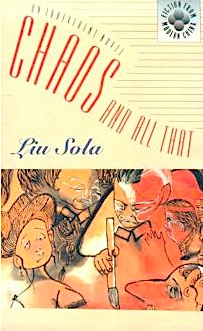
Sola Chaos

Among writings from her London period is Hundun jia ligelong 混沌加哩格楞 (Chaos and all that, 1991), a novel that “both acknowledges cultural diversity and provides a darkly comic critique of it”. I’m also very fond of her paintings, like this from June 1990 (signed “Chegong”, Sola’s name in traditional Chinese gongche notation!):

Sola painting

After taking part in the Iowa Writers’ Program in 1992, Sola moved to New York in 1993. Immersing herself in the avant-garde scene there, she relished collaborations with musicians like Bill Laswell, Fernando Saunders, and Ornette Coleman, enjoying a freedom that had been elusive in London. This bore fruit in her wonderful 1995 album Blues in the East.

Sola Blues CD

In her following New York albums such as China collage (1996) she took a rather different path. She later reinvented her exhilarating song Festival as A chicken at the country fair:

In this period she also wrote Da Jijiade xiao gushi 大继家的小故事 (Little tales of the great Ji family, 2000), perhaps her finest novel (translated into Italian and French, still not available in English), a historical fantasy based on the tribulations of her family—“part Virgil, part Monty Python”.

Back in the PRC
After fifteen years abroad, by 2003 the cultural scene in China seemed promising, far from the mood when Sola had left in 1988. Still, she

cannot be associated with the many haigui’s or “sea-faring turtles” who return after working or studying abroad to flaunt their “international credentials”. Nor is working in China with Chinese music a form of cultural nationalism; such nationalism is especially easy to profess at a moment when Chinese music will sound less marginal now that China has become a dominant world power. Rather […] her work in China undertakes the almost Sisyphean task of overcoming clichéd ideas of Chinese music and the use of such clichés for propaganda.

In 2005 she appeared in Ning Ying’s film Wuqiongdong (Perpetual motion, 2005), for which she also wrote the music. Notable compositions include two chamber operas, both international collaborations. Fantasy of the Red Queen (Jingmeng 惊梦, 2006) is “a woman’s tragedy about the power of illusion and the illusion of power”, told through through the devilish persona of Jiang Qing. It draws on Berg, Schoenberg, the qin zither, Beijing opera, Kunqu, revolutionary and folk opera, and 1930s’ Shanghai pop, with snatches of jazz, tango, and hip hop. Here’s an excerpt:

The afterlife of Li Jiantong (Zizai hun 自在魂, 2009) is a deeply personal drama in which Sola receives a visitation from her mother, who takes her on a journey to the spirit world to meet her late father. Using a complex compositional scheme, Sola makes use of the kuqiang “weeping melody” style of Chinese opera, with a baroque group led by Paul Hillier among the accompanying ensemble.

Sola operaFrom The afterlife of Li Jiantong.

Always relishing live performance, she went on to form the Liu Sola and Friends ensemble with select Chinese musicians, building on her grounding in jazz to overcome conservatoire and ideological training. And she has continued to publish, with the essay collection Kouhong ji 口红集 (Lipstick talk, 2009) and the novel Milian zhou 迷恋咒 (Lost in fascination, 2011); a new novel is on the way.

Here’s a short CCTV documentary:

* * *

Amidst the ever-changing scene in China (see e.g. New musics in Beijing, and Rock it, mom), Liu Sola’s constantly innovative mix of music, fiction, and drama is utterly distinctive; her musical and literary works, both early and later, have a cult following. She remains vivacious and young at heart, always exploring.

The qin zither under Maoism, 5: Yue Ying

*For a roundup of the whole series, click here!*

In my introduction to Wang Di, I mentioned the changing gender profile of Chinese musicians and scholars through the 20th century. Among the female qin players in Beijing who weathered the transition from the Republican era to Maoism was Yue Ying 乐瑛 (1904–74).

The most useful material is an article by Guo Peng 国鹏, compiler of the most comprehensive anthology of classic qin recordings, Juexiang 绝响; for more on Yue Ying, see also Chinese wiki.

YY young

Yue Ying practising the qin in her youth.
Photos here from Guo Peng’s article.

Yue Ying came from an affluent family, the only daughter of the boss of the famous Tongren tang 同仁堂 pharmacy in Beijing. From young she studied painting, calligraphy, and Kunqu; she enjoyed playing pipa (against the wishes of her father, who considered it too low-class!) but came to concentrate on the qin, taking lessons (like Pu Xuezhai) from Jia Kuofeng 贾阔峰.

YY pipa

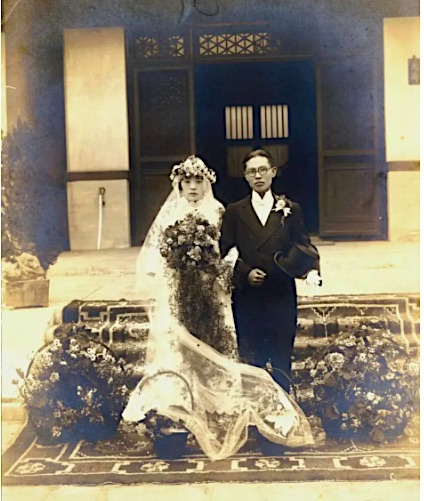
After a Western-style wedding in 1928 she went on to bear seven children, but managed to practise the qin at home between her motherly duties.

YY wedding

Adapting to the 1949 “Liberation”, from 1954 Yue Ying joined the Beijing Guqin Research Association, with the encouragement of Yuan Quanyou’s husband Wang Shixiang. She was one of several women studying with Guan Pinghu, including Wang Di, Shen You, and Yuan Quanyou.

female qin players

Female qin players.
From right: Yue Ying’s younger stepsister Yue Xiangyan, [unidentified], Wang Di, Yue Ying.
Do let me know if you can identify any of the others!

Repairing qin

The important task of repairing qin:
left to right Pu Xuezhai, Wang Di, Wang Mengshu, Zha Fuxi, Yue Ying, Yue Xiangyan.

Around 1958, amidst a frenzy of campaigns, Yue Ying took part in the association’s performance for the leaders in Zhongnanhai. As we saw, she invited Guan Pinghu to stay at her courtyard home during the “three years of hardship”. But worse was to come.

Recordings
Yue Ying remained active until the eve of the Cultural Revolution. But in 1966 her house was ransacked by a group of Red Guards, who took away her precious antiques and a dozen fine old instruments. Her children only managed to rescue a few family photographs from the rubble.

YY late

Yue Ying, 1971.

Whereas a few qin scholars, including Zha Fuxi, were permitted to continue their research behind closed doors once the worst excesses of the Cultural Revolution were brought to an end, by 1972 Yue Ying had moved out of the old family home; besides being in poor health, she no longer had an instrument, and had been unable to play for several years.

Yue Ying 1972

But that year, as political tensions seemed to be easing somewhat, her daughter Guo Shunlong managed to buy a precious antique qin for 45 yuan (!!!); getting hold of a set of strings and a recording machine, she recorded her ailing mother playing four pieces—perhaps the only extant recordings of qin (or any other traditional music) in the PRC for the whole period roughly from 1963 to 1978. Yue Ying’s rendition that day of Pingsha luoyan (cf. Guan Pinghu’s version) can be heard here; we can also admire her earlier version from the happier times of 1956.

On CD 6 of the classic 1950s’ recordings, Yue Ying is heard in four pieces:

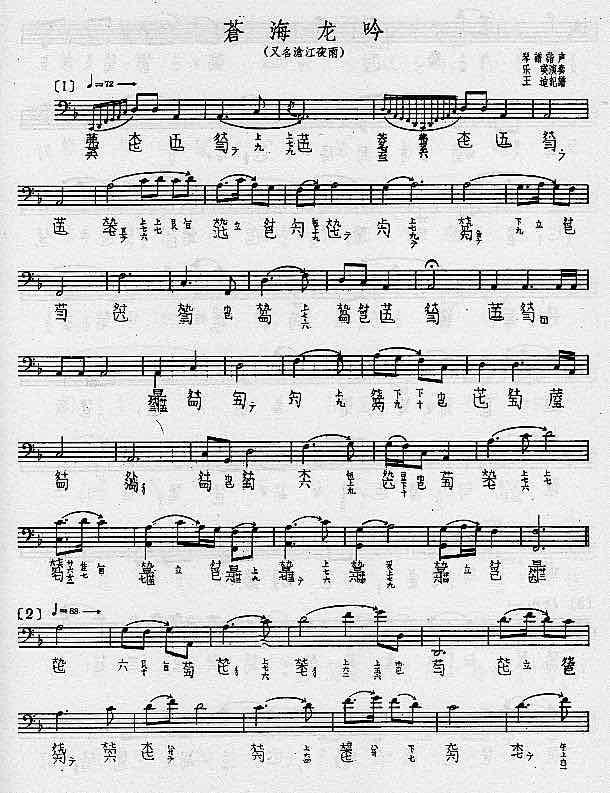
Canghai score

Opening of Yue Ying’s rendition of Canghai longyin as transcribed by Wang Di
(Guqin quji vol.1, pp. 211–15).

  • Liezi Rides the Wind (Liezi yufeng 列子御風, further material for my promotional campaign to boost the image of Liezi, n.1 here):

Yue Ying died of heart failure from lung disease in December 1974, before she could witness the revival of tradition. Her story makes a poignant coda to this series on the Beijing qin scene under Maoism.

The qin zither under Maoism, 4: Pu Xuezhai

On 30th August 1966, as agitated young Red Guards milled around on the streets of Beijing, a short, elderly gentleman, his wispy beard now shorn off, went for a walk with his daughter. He was never seen again.

Continuing my series on the qin zither scene in Beijing under Maoism (roundup here), I’ve been considering the life of Pu Xuezhai 溥雪斋 (1893–1966). Note this eloquent personal tribute by the great Wang Shixiang. [1]

A descendant of the Aixin Gioro Manchu imperial clan (cf. Aixin Gioro Yuhuan), Pu Xuezhai was a great-grandson of the Qing emperor Daoguang, and cousin of the “last emperor” Pu Yi. He exemplified the literati versatility of qin, chess, calligraphy, and painting (qinqishuhua 琴棋書畫). Before the 1949 “Liberation” he made his main living from painting (see e.g. here), teaching at Fu Jen University from 1942. He studied the qin with Jia Kuofeng 贾闊峰, successor to Huang Mianzhi 黃勉之.

MRI 1954The golden age of the MRI, 1954:
right to left Guan Pinghu, Yang Yinliu, Pu Xuezhai, Zha Fuxi, Li Yuanqing.

While leading MRI scholars like Yang Yinliu and Zha Fuxi, just at ease in a Western suit or a Mao jacket, adapted more comfortably to the role that the new regime demanded of them, Pu Xuezhai, like Guan Pinghu, represented the imperial culture of yore, living by sufferance under the socialist system. Still, the new leadership valued him, and he was able to thrive. In 1952 he was employed at the Beijing Hall of Cultural History, holding several posts in the new cultural administration, gaining the approval of Zhou Enlai. Meanwhile he joined the qin scholars at the Music Research Institute, and was a core member of the Beijing Qin Research Association during its heyday. Wang Shixiang recalls gatherings of amateurs where he would exclaim “Du 独!”, an antecedent of ku 酷, “cool”!

ZFX PXZ
Duet with Zha Fuxi, 1958.

While many qin masters also played the pipa, Pu Xuezhai liked to play the repertoire of the Manchu-Mongol elite on sanxian plucked lute—do click on that link for a precious audio recording.

Recordings
On CD 5 of the numinous “old eight discs” from the 1950s Pu Xuezhai is heard in three pieces:

  • Peaceful Evening Prelude (Liangxiao yin 良宵引):

  • Seabirds: Forgetting Ulterior Motives (Oulu wangji 鷗鷺忘機):

(cf. the wonderful duet with Zha Fuxi on qin and Jiang Fengzhi on erhu).

  • The Incantation of Pu’an (Pu’an zhou 普安咒)—much recorded in versions for both qin and pipa, though it is most widespread as an item of vocal liturgy among folk ritual groups, notably among the Hebei ritual associations:

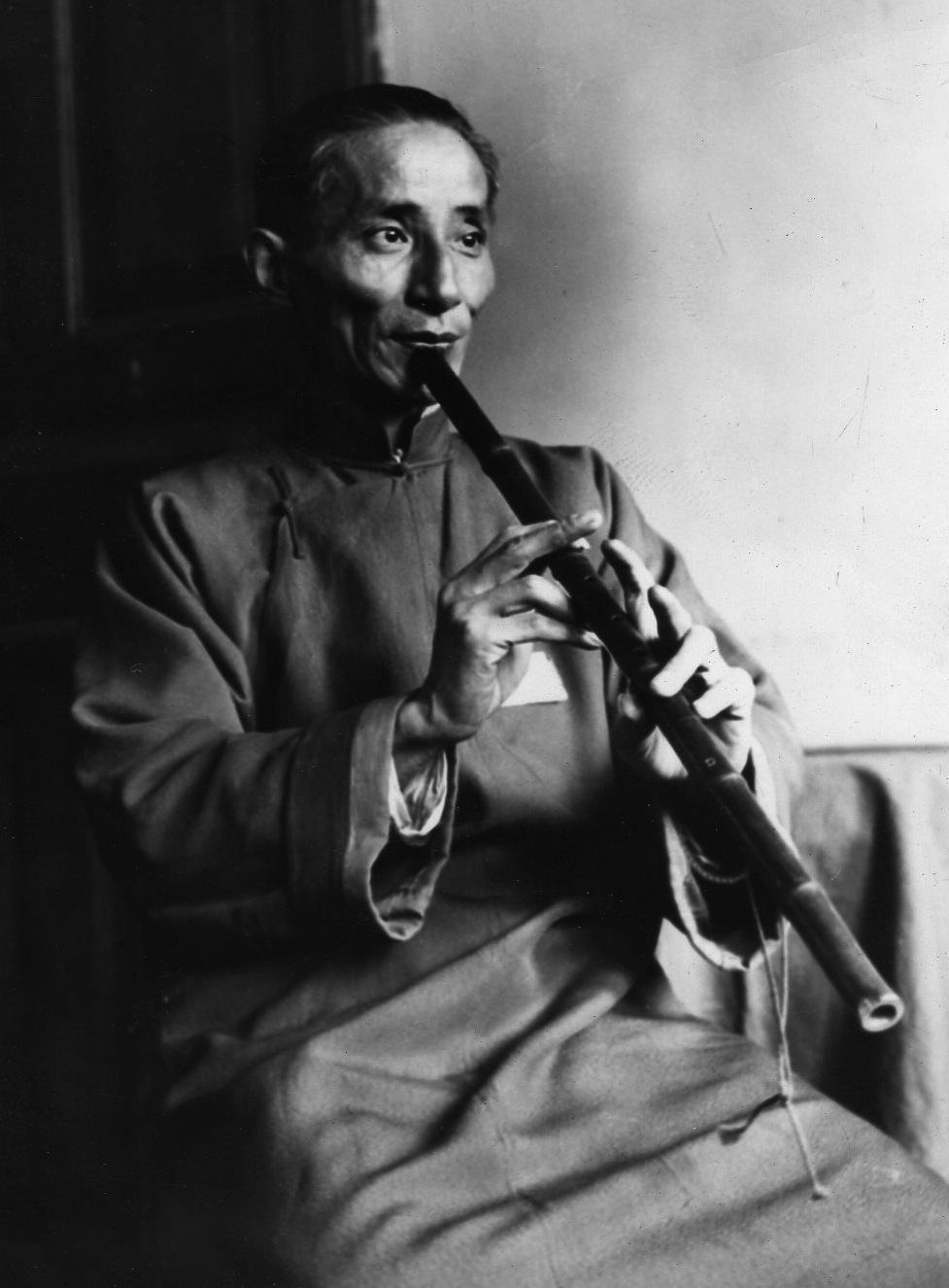
  • A fourth piece attributed to him on the CD, Three Variations on Plum Blossom (Meihua sannong 梅花三弄), seems rather to be played by Wu Jinglue—but we can hear it played in duet by Pu Xuezhai on xiao end-blown flute with Zha Fuxi on qin:

which is part of a YouTube playlist for Pu Xuezhai (apart from the first track by Wu Jinglue):

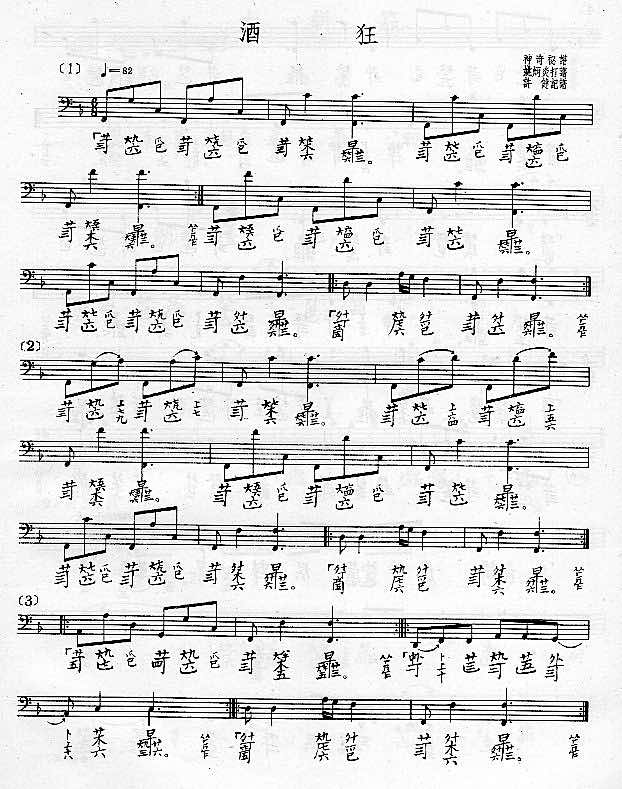
Disc 8 of the 74-CD collection Juexiang (2016) further includes three versions of Meihua sannong, as well as Jiu kuang.

The end
In 1963 the Party leadership invited Pu Xuezhai to Zhongnanhai to celebrate his 70th birthday. But while such representatives of the “Four Olds” had weathered successive campaigns, the tide was already turning fatefully, rendering them vulnerable—particularly members of the old imperial clan. Pu Xuezhai soon became another casualty of the Cultural Revolution (the most detailed account of his last days is here).

PXZ 1960sPu Xuezhai, early 1960s.

In 1966, witnessing the humiliation of his colleagues, he was already traumatised by raids and struggle sessions, when Red Guards cut off his beard. The last person known to have seen him alive was his old qin-playing friend Guan Zhonghang.

His disappearance caused no comment. Just trying to survive, people had too much to worry about themselves. As with so many other senseless casualties of Maoism, his loss could only be lamented at a memorial service after the end of the Cultural Revolution.


[1] Other articles include
http://www.yuncunzhai.com/article/257845.jhtml
http://m.zwbk.org/lemma/227007
http://www.qinxuecn.org/ArticleDetail.aspx?Id=2141&classId=38https://torguqin.wordpress.com/2012/06/03/death-of-pei-tiexia/

In memoriam Dan Overmyer

Dan x2

A sad recent loss is Daniel Overmyer (1935–2021), who devoted his career to the study of Chinese popular thought, religion, and culture (see this UBC tribute).

His work on the history of Chinese sects and “precious scrolls” (baojuan 寶卷) since the Ming dynasty was further informed by fieldwork, first in Taiwan and later in mainland China. His early books include

    • Folk Buddhist religion: dissenting sects in late traditional China (1976)
    • The flying phoenix: aspects of chinese sectarianism in Taiwan (1986, with David K. Jordan
    • Precious volumes: an introduction to Chinese sectarian scriptures from the sixteenth and seventeenth centuries (1999).

Concerned to view the wider picture, in 2003 he edited a special issue of the China Quarterly entitled Religion in China, with articles by Ken Dean, Fan Lizhu, Paul Katz, Lai Chi-tim, Raoul Birnbaum, Dru Gladney, Richard Madsen, and others. Other useful surveys are

    • Local religion in north China in the twentieth century: the structure and organization of community rituals and beliefs (2009), with chapters on rain rituals, history and government, leadership and organisation, temple festivals, gods and temples, beliefs and values
    • Ethnography in China today: a critical assessment of methods and results (2009, with Shin-yi Chao), with thoughtful reviews of volumes in the series Studies in Chinese ritual and folklore and the ever-growing corpus of regional studies (see e.g. Dong Xiaoping’s review of field reports on west Fujian).

With Fan Lizhu 范丽珠, he was editor-in-chief of a useful four-volume series in Chinese on folk culture in rural Hebei, Huabei nongcun minjian wenhua yanjiu congshu 华北农村民间文化研究丛书 (2006–7).

In 2009 Philip Clart and Paul Crowe edited a festschrift:

  • The people and the Dao: new studies in Chinese religions in honour of Daniel L. Overmyer (introduction here).

* * *

Dan’s memoir, written for his grandchildren in 2010, is fascinating, full of detail—so please forgive me this brief summary, focusing on his engagement with China.

His father Elmer was an Evangelical missionary, assigned to China in 1940; so Dan’s first stay there began at the age of 5, when his parents took him to Hunan with his baby sister Mary Beth. They reached Changsha by a tortuous route. Vulnerable to Japanese raids, they had to flee, first to Hengyang and then to the smaller town of Youxian, where they visited Mount Nanyue.

Hunan 1943

Hunan, 1943.

They had to leave in a hurry in 1944, reaching India by plane via Kunming, and then by ship back to the USA; Elmer stayed behind for another year. Eventually they were reunited, setting up home in Hartford, Connecticut.

After the end of the war, they returned to Changsha in 1946, spending more time on Nanyue. By 1948 Dan was at boarding school in Hong Kong, where the rest of the family joined him in 1949 before travelling to Manila. By 1952 they were back in the States, ending up in Princeton; while the rest of the family embarked on another term in Manila, Dan attended college in Iowa.

Despite never having been inclined to follow in his father’s footsteps, he now felt drawn to religion, becoming a pastor in Chicago, engaging with social issues. As his interest turned towards the history of religions, he studied at the University of Chicago—the start of his work on Chinese religion. He married Estella in 1965.

In 1968 they went with their baby to Taipei, where Dan studied Chinese language, somewhat helped by his childhood memories of Hunan. The next year he resumed work for his PhD on “heretical” sects. Having conceived it as a historical subject, while in Taipei he happened to hear a group of Hall of Compassion sectarians (who venerate the creator goddess Wusheng laomu) performing a ritual—a formative experience that began leading him to enrich his library studies with fieldwork. With Estella Dan returned to the States in 1969, where he soon found a post at Oberlin. They returned to Taiwan in the summer of 1973, before Dan took up a position at UBC in Vancouver.

His first trip back to mainland China since his childhood came in 1978. In 1981 he went in search of sectarian manuscripts in Nanjing, Suzhou, and Shanghai, also returning to Nanyue. By this time scholars were just becoming aware that the PRC was not only accessible again but a rich field for the study of local ritual cultures (see e.g. here). While teaching in Hong Kong in 1997 he met John Lagerwey, who soon took him on a trip to Fujian to give him a glimpse of the vibrant ritual scene there. This inspired him to see if there was similar work being done in north China—a path he pursued after retiring in 2000, working with Chinese colleagues. Meanwhile his environmental concerns were reflected in his involvement with nature conservation projects in Vancouver.

I do recommend this warm, humane memoir.

* * *

Among other great sinologists who died this year are Kristofer Schipper and Jacques Pimpaneau.

The qin zither under Maoism, 3: Zha Fuxi

*For a roundup of the whole series, click here!*

Zha Fuxi

Zha Fuxi in 1974 or 1975, shortly before his death.

For this third post in my series on qin zither players in Beijing under Maoism, I’ve been learning more about the great Zha Fuxi 查阜西 (also known as Zha Yiping 查夷平, 1895–1976). A forthcoming article in Zhang Zhentao’s own series on the Beijing qin scene will doubtless provide valuable insights, but I’ll go ahead and offer my own preliminary thoughts, conscious that I may need to revise them in due course.

After the Communist revolution of 1949, amidst radical social change, a constellation of master musicians and scholars gathered at the Music Research Institute (MRI) in Beijing in an extraordinary flowering of research. Under the wise leadership of Yang Yinliu, working closely with his cousin Cao Anhe, scholars began documenting the riches of regional folk musical cultures all over China. And at the same time a distinguished group of qin players and scholars flourished—including Guan Pinghu, Pu Xuezhai, Wang Mengshu, Yuan Quanyou, Xu Jian, and Wang Di; nearby at the Central Conservatoire was Wu Jinglue.

At the forefront of this stellar group was Zha Fuxi. His own articles are collected in Zha Fuxi qinxue wencui 查阜西琴学文萃 (1995; 815 pages). On John Thompson’s website, a major resource for all aspects of the qin, his exposition of Zha Fuxi’s work (starting here) makes a valuable guide (for a basic outline, see Chinese wiki). 

Early life
What I barely realised until I read an article by Xie Xiaoming was Zha Fuxi’s youthful political activism—he joined the Communist Party as early as 1924. While he is lauded within musical circles, it’s almost as if accounts of his life gloss over this aspect of his life, which one might expect to feature quite prominently.

A native of Hunan in south China, Zha Fuxi began learning the qin in 1908. But by contrast with the other-worldly Guan Pinghu, he was fully engaged with the social trends of his youth. From 1913, in the lawless times after the fall of empire, he attended middle school in Nanchang, capital of Jiangxi, becoming interested in new democratic revolutionary trends, and taking part in student movements.

After studying briefly at Peking University in 1920, Zha Fuxi was drawn back south, spending periods in Changsha, Shanghai, Suzhou, and Guangzhou while pursuing his (patriotic) interest in aviation. He joined the Communist Party in 1924 at a time when it were still collaborating with the Nationalists, but after the Mari mutiny in 1927 he was briefly imprisoned. Making his way from Hankou to Shanghai, he continued to rise through the aviation ranks.

Meanwhile he was still studying the qin. A disciple of the Hunan qin master Peng Qingshou, in Shanghai he befriended Shen Caonong, with whom he co-founded the Jin Yu qinshe 今虞琴社 society in 1936. After the Japanese invasion in 1937 Zha Fuxi and many colleagues relocated to Chongqing; he took part in activities opposing the occupation. By 1943 he was Deputy Manager of the Central Air Transport Company.

ZFX USA

Zha Fuxi spent much of 1945 and 1946 in the USA, meeting the qin community there, giving lectures, seeking early tablatures, and making recordings—some of which have been reissued on CD and online, such as Yuge, Xiao Xiang shuiyun, and Oulu wangji.

From August to November 1949, in the Uprising of the Two Airlines (subject of several documentaries, e.g. here), following Chiang Kai-shek’s demand that all commercial airplanes should be flown to Hong Kong to facilitate their transfer to Taiwan, Zhou Enlai enjoined senior airline officials—including Zha Fuxi—to refuse the order. 

Liberation
Anxious about the imminent Communist victory, many mainlanders were indeed fleeing to Taiwan, and in Zha Fuxi’s own sphere many more would have been keen to do so. Zha Fuxi spent little time in the new-look airline company before transferring to the MRI to devote himself to qin studies. I can’t quite decipher the elements in this move: perhaps his artistic leanings came to the fore under the new regime as his career progress in aviation was frustrated.

Few of his fellow qin players at the MRI can have felt much sympathy with the socialist system, even if they had to toe the line. Unlike some of the older generation, Zha Fuxi and Yang Yinliu were comfortable wearing both Western suits and Mao jackets; yet they too remained loyal to the traditional world of literati culture that now seemed threatened by Party ideology. Indeed, given the tenuous position of such an elite genre as the qin under the new populist regime, Zha Fuxi’s early support for the Party, his involvement in the airline uprising, and the connection with Zhou Enlai, must have helped protect him (and by extension, the qin) over the following years.

After Liberation, Zha Fuxi’s MRI colleagues plunged into fieldwork on regional folk genres. The culture of the “exploited labouring masses” might seem a topic that the new regime would welcome; but in practice, with such traditions embedded in local ritual life, scholars found themselves walking a tightrope of “feudal superstition”. Xie Xiaoming’s article, perhaps embroidering somewhat, also stresses Zha Fuxi’s immersion in folk music during his early years in Hunan.

In Beijing, one of his early projects in 1952–53, with Yang Yinliu, was to be influential. They visited the former monks of the Zhihua temple to document the shengguan ensemble music that accompanied their rituals. Zha Fuxi’s letter to them shows his distress at their reduced circumstances, and his exhortations turn out to be based on genuine proletarian sympathies.

Meanwhile the MRI scholars also persisted in paying attention to elite genres—both historical sources and living literati traditions like the qin. And traditional “refined gatherings” of qin aficionados continued, even thrived. Meanwhile under Party guidance, public performance on stage was a price that the leading qin players of the time had to pay, trading intimacy for exposure; from 1954 to 1955 Zha Fuxi was part of an ensemble giving performances in ten major cities (see under Guan Pinghu).

The 1956 fieldwork project
Zha Fuxi was well aware that there was far more to the qin than Beijing and Shanghai. Already well-travelled, from early in 1954 he had conceived an ambitious project to document qin players all over China. This came to fruition in 1956, when Zha Fuxi formed a team with the younger MRI students Xu Jian (b.1922) and Wang Di (b.1923) (“guqin special cadres”, as his report quaintly describes them), travelling to over twenty cities over a hundred days from April to July to document the playing, instruments, and tablatures of eighty-six qin players. They also visited libraries and museums in search of instruments and early documents.

As Zhang Zhentao observes in his article on Wang Di, this was the first thorough fieldwork in China on urban ethnomusicology—admittedly focused on one small segment of the population, rather than surveying urban cultural life generally (cf. Archive Chinese recordings).

ZFX 1956
Zha Fuxi, with Wang Di and Xu Jian, interviewing a Daoist priest, Chengdu 1956.
Source: Zha Fuxi qinxue wencui.
A cryptic caption: “Interview on Daoist ritual on behalf of Cao Anhe”. Cao Anhe had done fieldwork in Sichuan before Liberation; I presume she accompanied Yang Yinliu on his visit to Qingchengshan in 1942 (Yang Yinliu [jinian ji], pp.88–93). Perhaps this was the very priest whom Yang Yinliu had visited, or perhaps Cao Anhe simply asked Zha Fuxi to document Daoist ritual while he was there. Daoist and Buddhist clerics commonly played the qin, but we don’t know if this priest was among them.

Zha Fuxi’s report, written in 1957, deploys the obligatory style of the time, with some quaintly bureaucratic, statistical language (cf. “reading between the lines” in my review of the monumental Anthology).

Zha Fuxi had already expressed his sympathy with the plight of the former monks from the Zhihua temple. Now that he had official support for the qin project (the following quotes are from John Thompson’s rough translation, with my minimal revisions),

Before setting out, the Arts Bureau had told me the government was concerned about circumstances regarding the livelihood, cultivation, and health of any old, impoverished, or sick qin players, and wanted a report of our understanding. As to the people whose qin playing was being recorded, the Musicians’ Association had instructed me that even before paying them any fees, I should actively give them financial assistance.

He goes on:

The Chinese Music Research Institute instructed us that our visits should record such materials as documents and artefacts for the qin and ancient music, and establish the necessary communications and research relations with qin players and lovers of ancient music. Thus the subject of our work became not only the recording of qin pieces …

While the ethos of the qin was still based on the amateur ideal, Zha Fuxi notes a small minority of seven “professional” players, including Guan Pinghu and Wu Jinglue. On the variable technical standards of the players recorded, he comments:

In order to understand the location of the problem, one must make a connection between the situation of qin players’ self-cultivation and their living conditions. Examining our fieldnotes on the eighty-six qin players whose playing was recorded, one can understand that most of them had neglected the qin for twenty to thirty years, and after Liberation they had not picked it up again until they received encouragement from the general and specific national policies on culture and the arts [Discuss…]. Many of them didn’t even begin to practise until after the Musicians’ Association charged me last year to go and invite them to make recordings, and thus one inevitably finds defects such as faulty intonation, rusty finger techniques, and disjointed rhythms. This is the result of a decline in national culture brought about by the social environment of the past several decades [that sentence revised by SJ].

There had indeed been a certain hiatus in activity during the troubled times after the Japanese invasion in 1937 and the following civil war. But whether consciously or not, in such passages Zha Fuxi adopts a very common sleight-of-hand in Maoist historiography, that Chinese culture has been languishing throughout the Republican era, only to be rescued by the enlightened Party—a view easily refuted by all the evidence (e.g. ritual groups in Shanghai, Xi’an, and so on—as in Stewart Lee’s taxi driver, “You can prove anything with facts“). The great loss began after the 1949 “Liberation”—one on which the 1956 project now inadvertently shone a light.

For all its patriotic clichés, this passage also contains a sincere core:

A young music worker in Xi’an, after hearing these three types of recordings of ours, said to me that in the past she had always considered national music to be inferior to Western music, and could not imagine that the motherland had such great and expansive pieces for plucked strings; when adapted into national instrumental music style this could become a distinctive symphonic music. She said that not only had she now gained interest in Chinese music and built up her faith in it, but it had further aroused her love for the motherland!

That same summer Yang Yinliu led a team on an extensive survey of folk and ritual music around Hunan.

The recordings
For Zha Fuxi’s national project, apart from the selected tracks eventually included on the celebrated 8-disc set, note also the complete recordings issued since 2016 (here and here). This playlist contains a selection of 35 pieces from the set, opening with three played by Zha Fuxi himself:

Zha’s own playing is the theme of the 3-CD collection Zha Fuxi qinxue yishu 查阜西琴学學藝術 (ROI, 2016)—again, note John Thompson’s discussion (for the publication of the recordings, see also this interview with his son). This collection on YouTube has a selection:

Apart from instrumental pieces, qin songs made a rich field for Zha Fuxi (for his own research on the topic, click here; cf. the work of Wang Di).

  • On this track Zha Fuxi sings and plays Thrice Parting for Yangguan (Yangguan sandie 陽關三疊):

(Near the end of my tribute to Yang Yinliu, do also listen to his moving arrangement of this piece as a Protestant hymn!)

  • For the qin song Sigh for Antiquity (Kaigu yin 慨古吟), click here;
  • and for a sung version of Evening Song of the Drunken Fisherman (Yuqiao wenda 漁樵問答), here.

From 1958
The 1956 fieldwork project provided further material for Zha Fuxi’s magnum opus Cunjian guqin qupu jilan 存见古琴曲谱辑览 (1958, with 1,011 pages by my reckoning!) on qin tablatures and the history of the repertoire. [1] And in 1963 he produced the first volume of the Qinqu jicheng 琴曲集成, which after resuming in 1981 became the definitive 30-volume anthology of early qin tablatures.

From January to May 1958, on the eve of the Great Leap Backward, Zha Fuxi played qin solos on tour with the China Song and Dance Ensemble in the Soviet Union and Japan. On returning he spent the next three months taking part in rectification campaigns of the Qin Association and Political Association. Once the Leap began in August, new pieces for qin and ensemble were dutifully composed—an ephemeral innovation. Zha Fuxi wrote Dayuejin gesheng zhen shanhe 大跃进歌声震山河 in praise of the Leap (among many new pieces on the theme of bountiful harvests, such as Zhao Yuzhai‘s 1955 “Celebrating a bumper year” for the zheng zither); Guan Pinghu and Wang Di arranged The East is Red. In December the Qin Association featured this new repertoire on TV.

Apart from such necessary kowtows to authority, I’m unclear how the Beijing qin community weathered the Anti-Rightist campaign and the Leap, along with the severe food shortages that ensued; they toed the line while keeping their anxieties to themselves.

BJ qin 1959 to use
Qin masters gather at a Beijing teahouse, 1959
—with no hint of the severe social crisis of the period.
At front: Zha Fuxi with Yao Bingyan;
behind, Wang Di (with braids), Chen Changlin, and a beardless Wu Zhaoji.

By 1962, during the brief lull between campaigns, Zha Fuxi recorded a numinous duet with Jiang Fengzhi on erhu fiddle.

My own qin teacher Li Xiangting (b.1940), then a rising star of the younger generation and a pupil of Zha Fuxi and Wu Jinglue, notes the gathering official suspicion of the qin from 1963. Still, the Beijing qin community still kept active until 1964, with Zha Fuxi regularly hosting gatherings. For a moving evocation of stressful conditions over the years leading up to the Cultural Revolution, I again recommend Tian Zhuangzhuang’s 1993 film The blue kite.

The Four Cleanups and the Cultural Revolution
I can find little material on Zha Fuxi’s life after the 1963 Four Cleanups campaigns and the violent eruption of society in the Cultural Revolution. Many of his colleagues suffered grievously from the assaults of revolutionaries, with qin players an inevitable target of young Red Guards.

Zha Fuxi seems to have been paraded by the Red Guards as the Cultural Revolution erupted in 1966; but even after the worst violence subsided, by 1969 most of the MRI staff were sent down to the 7th May Cadre School farm in Tuanbowa (Jinghai, Tianjin municipality) for labour reform.

I doubt if Zha Fuxi’s connection with Zhou Enlai now helped protect him to any significant extent; [2] but from at least 1973, behind closed doors, as campaigns continued to rumble, a select group of qin scholars managed to resume their research, after almost a decade of silence, with the discreet protection of the Ministry of Culture—under the unlikely patronage of the leftist Yu Huiyong, promoter of the revolutionary model operas.

And in other (literal) fields too, the regime required some of the leading MRI scholars to research the ancient instruments now being revealed at archeological sites. In 1971 Yang Yinliu was recalled to Beijing from rustic exile to document the new excavations from Hubei for the Palace Museum. In 1972 he was sent to Changsha with Li Yuanqing and Li Chunyi to study the Mawangdui site, whereafter he was officially allowed to return to Beijing. Throughout this period Yang continued working on his Draft history of ancient Chinese music. Huang Xiangpeng (b.1927), another outstanding scholar of early Chinese music, was only released from rural labour in 1975.

After the revival of traditional culture that followed the death of Mao and the downfall of the Gang of Four, both Yang Yinliu and Huang Xiangpeng resumed their work keenly, though their health had deteriorated seriously. Yang died in 1984; and Huang was fully involved in the flowering of research until he died in 1997.

Life and death are a matter of fate“. During the Cultural Revolution, distinguished masters had been driven to suicide throughout the cultural world. Of Zha Fuxi’s qin colleagues, Pu Xuezhai disappeared mysteriously in 1966, and Guan Pinghu died in 1967; others were lastingly traumatised. Zha Fuxi survived until 1976—before he could rejoice in the revival, when senior qin players such as Wu Jinglue in Beijing, Zhang Ziqian in Shanghai, and Wu Zhaoji in Suzhou emerged to renewed acclaim.

As with the whole literati class, Zha Fuxi’s accommodation with Maoism was complex. Meanwhile he compiled an extraordinary corpus of material on the history and living practice of the qin, enriched by precious recordings—a monument to an aesthetic world that has been marginalised by the glossy conservatoire professionalism of the scene since the reform era.


[1] Incidentally, in n.11 here, John Thompson mentions Qi Yan Hui, “apparently a 20th-century adaptation for guqin of a melody that until 1937 only existed in the oral tradition of other instruments”. I wonder if this suggests a link with the version common in the suites of shengguan ritual ensembles (see e.g. under Xiongxian).

[2] Pace Xie Xiaoming, Zha Fuxi can’t have become Deputy Chair of the Chinese Musicians’ Association in 1969, when such institutions were paralysed—John Thompson’s date of 1962 (perhaps from Xu Jian’s history of the qin) is more plausible.

Veiny, weedy, wiki

Li He poem

South Fujian is all the rage. In a recent post on Language Log the illustrious Victor Mair, querying the dominance of Modern Standard Mandarin, gives two Tang poems in Southern Min (Hokkien) pronunciation, also common in Taiwan. *

As if the vibrant expressive culture of south Fujian weren’t enough! People from the north of the province must be disgruntled—like those from north Jiangsu, or indeed north England.

A comment on Victor’s article suggests an analogy between the Chinese topolects and the diverse evolution of Latin pronunciation around Europe.

By the Middle Ages no one tried to pronounce it the way it had been pronounced in the days of Julius Caesar and likewise no one worried too much that it was pronounced differently elsewhere in Europe. Then came the 20th century and, for the first time ever, schoolchildren were taught to pronounce Latin in a conjectural reconstruction of “proper” ancient pronunciation rather than whatever living evolved topolectal tradition had been handed down to them.

Note further comments under the post. In particular, a substantial wiki article details changing fashions in the English pronunciation of Latin.

* * *

For all its flaws, Wikipedia has become established as a useful reference point; after all, weighty earlier encyclopedias are far from perfect, and wiki can be constantly updated. It even polices itself, as in articles like these:

https://en.wikipedia.org/wiki/Reliability_of_Wikipedia
https://en.wikipedia.org/wiki/Wikipedia_and_fact-checking
https://en.wikipedia.org/wiki/Criticism_of_Wikipedia
https://en.wikipedia.org/wiki/Ideological_bias_on_Wikipedia

As Caesar himself observed prophetically (already toying with various styles of pronunciation), online encyclopedias can be textured yet ineffectual:

Veiny, weedy, wiki

For punctuation nerds, the wiki entry on the pithy dictum even notes the comma splice or asyndeton.
Cf. the Gandhi song from Mary Poppins, and Ate, in terror, Paxo minibus. See also Peter Cook’s Miner sketch (“I might have been a judge… but I never had The Latin”), under Myles: a glowing paean—along with

Noli me quidere?
Tang

and

Quis custodiet ipsos custodes?
Mulieres eorum.


* A handy nearby rabbit-warren for some intrepid readers to disappear down is the reconstruction of early Sinitic—again, see Victor Mair (e.g. here) and wiki.

A village pantheon: Liujing

liujing

Xue Yibing documenting the pantheon in the lantern tent
during our first visit to Liujing over New Year 1989.

Southwest of Beijing, just north of Yixian county-town, the main staging points en route to the Houshan mountain pilgrimage are the villages of Liujing and Matou, both of which have lively ritual associations.

Liujing pantheon huitou

The four leaders of the Liujing ritual association, 1995; left, Zhang Dejin.

Like other local communities throughout China, Liujing enthusiastically revived traditional religious observances in the wake of the Cultural Revolution—with liturgist Zhang Dejin (b. c1936) heading an energetic group of huitou association leaders.

Liujing maze 1989

Zhang Dejin (on yunluo gong-frame) leads the procession through the ritual maze,
New Year 1989.

We shouldn’t limit our attentions to the pantheons themselves; in the ritual tent they are surrounded by images of individual deities, and (for both calendrical rituals and funerals) such pantheons often appear with paintings of the Ten Kings of the Underworld (see e.g. Ritual images: Gaoluo, including a fine pantheon from 1930).

Liujing tent diagram 89

The New Year’s ritual tent, Liujing 1989. From Xue Yibing notes.

Top: paintings of
Tongtian jiaozhu—Dizang pusa—Pantheon—Houtu temporary palace—Taishang laojun;
“civil” and “martial” (melodic–percussion) tables for band on either side of altar table;
lower right: Ghost King painting.
(For another of Xue Yibing’s diagrams of ritual tents, see Ritual groups of Xiongxian, §1).

Liujing’s Ghost King painting is dated 1982, 12th moon 15th, so perhaps we can assume that the pantheon was painted around the same time, soon after the revival. The pantheon depicts 111 figures; while we can often identify the deities shown on such pantheons by consulting with senior villagers, in this case the painter has obligingly given many of them captions.

But such painters were not always highly literate; this one had only a basic grasp of Chinese characters, and not only are many of the captions miswritten but misattributions are common too. Older paintings from a more literate milieu may be desirable, such as those to be admired in museums and galleries; but they are removed from their social context—what is valuable here is that the image is part of a living local tradition (to be sure, ritual practice in south China may preserve a, um, higher level of culture).

Finding the pantheon on display in the ritual tent on our first visit to Liujing during the New Year’s rituals in 1989, Xue Yibing listed the gods depicted.

Liujing pantheon composite HT

My photos here are from the 3rd-moon Houtu festival in 1995. With the help of Hannibal Taubes (who also created the composite image above), we can characterise the main deities of each row:

  • 1: Ancient culture-heroes/ancestral progenitors, flanked by astral deities (sun, moon, and so on)
  • 2: Major deities of the three religions
  • 3: The Jade Emperor and his attendants
  • 4: Bodhisattvas: Avalokiteśvara (Guanyin) flanked by attendants; Mañjuśrī, and Samantabhadra, plus figures from popular Buddhist myth
  • 5: The Three Heavenly Officials, plus deities involved with geomancy, including the directional gods, gods of the earth, and of wealth
  • 6: Dragon Gods and other gods involved in precipitation.
    Here “Wusheng laomu” (3rd from left) may appear to be a miswritten form of 無生老母, the creator divinity in “White Lotus” sectarian worship, still common in this area (see again The Houshan Daoists). But since it’s quite common for an illiterate artist to draw the figures and someone else to come along and write the labels, Hannibal wonders if some of the minor characters have been mislabeled, as here; this deity is more likely to be another rain god. (I guess it would be too fanciful of me to suggest that Wusheng laomu, then perhaps still too sensitive a figure to be publicly proclaimed, is being smuggled in with an ingenious disguise?! We need to go back and ask!)

Liujing pantheon 4

6th row, centre: “Wusheng laomu”—miswritten, and bearded!

  • 7: Goddesses presiding over health: Houtu, and the Goddess of Taishan (Bixia yuanjun); the goddesses of fertility and eyesight, and so on
  • 8: The Medicine King and other deities
  • 9: Lord Guan, Zhou Cang, and Guan Ping (from the Romance of the Three Kingdoms), plus sundry other deities
  • 10: Deities of the underworld, centred around Dizang (Kṣitigarbha), flanked by the Yama Kings of the Ten Courts, as well as the City God and Earth God who report on the deeds of the living; guarded by Ox-head and Horse-face.

For comments on the pantheons of village ritual associations in the region, see Zhang Zhentao, Yinyuehui, pp.282–5 (his list for Liujing apparently documenting another pantheon from Liujing that I didn’t see).

The pantheon clearly serves as a spiritual focus during rituals. But while it seems fruitful to have a conspectus of the sacred world for such a village, my caveat about such work is that we can’t simply list these gods as some abstract quorum for religious faith. For worshippers, only the major figures among these gods are of great practical significance—and that perhaps applies as much to imperial times as to today. They are mainly concerned to gain the blessings of Houtu; they have recourse to deities like the major Daoist and Buddhist gods, along with Tudi, Songsheng, and Yanguang; but the others are bit-players. So I prefer to anchor our studies in religious practice. Perhaps the list best reflects the realm of spirit mediums, who occupy this world—see here (also with a vignette from Houshan), as well as the main post on Houshan, and under Women of Yanggao 2.

We didn’t ask, but I assume that the Liujing pantheon was based on the memory of an earlier painting, with village elders inviting the artist to depict the deities on the basis of their recollections. People’s allegiance and recourse to deities may change over history—in the case of spirit mediums, over a single generation; I wonder if we have any indications of this for one particular locale, with pantheons from different eras.

Of course, the study of Chinese religions is, um, a broad church: some scholars focus on ancient manuals, some approach the topic as anthropologists, while others attempt to combine ethnography and history. We are all “blind people groping at the elephant“. With my own perspective, the relation of such deities to rituals performed by the Hebei associations remains distant; while Houtu, Guanyin, Dizang, and so on are among the gods whose stories are recited in “precious scrolls” (see under The Houshan Daoists, and The Houtu scroll), few of the other deities depicted play any liturgical role. We shouldn’t allow our fascination with iconography [speak for yourself—Ed.] to detract from documenting people’s actual religious observances.

For elsewhere in north China, note Hannibal Taubes’s remarkable website, including the pantheons of spirit mediums in Wutai county, Shanxi (cf. my 1992 visit). Pantheons are among the extensive collection of Li Yuanguo 李遠國 in Sichuan (click here). See also Ritual paintings of north China.

With thanks to Hannibal Taubes

Inebriation and the qin zither

Yao Shou

Yao Shou, Drinking and composing poetry, 1485. Source.

Inebriation (zui 醉) makes an intrinsic aspect of Chinese culture, even a philosophical position. It’s a major theme in poetry, best known through the Tang masters (see e.g. here, here, and here, as well as numerous discussions in Chinese, such as this).

Poets have long praised alcohol as a vehicle for transcendence. But they also evoke both the companionship of drinking and the pangs of drinking alone. For the Seven Sages of the Bamboo Grove sharing wine facilitated their oblivion of the mundane world; Ruan Ji also fed into the solitary ethos:

Looking down into my cup, much misery,
I think of friends in former times.
Facing the wine, I cannot speak,
Melancholy blends with bitterness.

Li Bai drinking

The Tang emperor Minghuang inviting Li Bai to drink. Ming dynasty: source.

By way of Tao Yuanming’s “Drinking wine” poems, we come to Li Bai, patron of drunken poets. Among numerous examples,

山中與幽人對酌 Drinking with a gentleman of leisure * in the mountains (in Arthur Cooper’s translation)

两人對酌山花開    We both have drunk their birth, the mountain flowers,
一杯一杯复一杯    A toast, a toast, a toast, again another;
我醉欲眠卿且去    I am drunk, long to sleep; Sir, go a little—
明朝有意抱琴來    Bring your lute ** (if you like) early tomorrow!

* youren perhaps rather “recluse”
** the rendition of qin zither as “lute” popularised by Robert van Gulik.

Gustav Mahler set a translation of Li Bai’s Chunri zui qiyan zhi 春日醉起言志 as The Drunkard in Spring, the fifth movement of Das Lied von der Erde, just before the final Abschied.

處世若大夢      胡爲勞其生
所以終日醉      頹然臥前楹
覺來眄庭前      壹鳥花間鳴
借問此何時      春風語流莺
感之欲歎息      對酒還自傾
浩歌待明月      曲盡已忘情

* * *

In the lore of the elite qin zither too, always inspired by poetry and painting, the role of alcohol is significant and well-documented—again, harking back to the Seven Sages of the Bamboo Grove. Quaintly, qin societies during the Republican era listed their (male) players’ drinking capacity, under “Refined proclivities”:

Jin Yu qinshe 1936

2nd row from foot: drinking capacities of Shanghai qin players,
from Jin Yu qinkan 今虞琴刊 (1936). Courtesy Bell Yung.

More recently, the Bacchic propensities of the late lamented Lin Youren were in line with this tradition.

Jiu kuang YBY

Wine Crazy, §1–2, a copy by Yao Bingyan of the Shenqi mipu.

Most celebrated of pieces on this theme is Wine Crazy (Jiu kuang 酒狂), attributed fancifully to Ruan Ji. John Thompson gives a typically thorough exposition (and for qin song versions, here). The piece seems to have been dormant even by the time it was included in the 1425 Shenqi mipu tablature. After many more centuries of silence, it has become firmly established in the qin repertoire since 1957 when the Shanghai qin master Yao Bingyan 姚丙炎 (1921–83) began recreating it through dapu—for Yao, note Bell Yung, “From humble beginnings to qin master: the remarkable cross-fertilisation of folk and elite cultures in Yao Bingyan’s dapu music”, in Lee Tong Soon (ed.), Routledge handbook of Asian music: cultural intersections (2021), and for his Shenqi mipu realisations, Celestial airs of antiquity (1998).

YBY 1982

Yao Bingyan, 1982 (photo: Bell Yung).

Despite the surface technique, the melody is doggedly pentatonic, ambling innocuously up and down the scale with short repeated motifs (cf. my comments on Pingsha luoyan). The originality of Yao Bingyan’s version hinges on his use of triple time, most exceptional in Han Chinese music. After the end of the Cultural Revolution he published an article as early as 1981, “in discussion with visiting student Raffaella Gallio”. Here’s his 1960 recording, included on the “Eight Great Discs”—befuddled rather than virtuosic:

The instrumental version in the Shenqi mipu has only one caption for the coda, “The immortal exhaling his wine”; but the sung version in the 1589 Taigu yiyin provides titles for the previous short sections, each with poems;

  • Enjoying wine and forgetting troubles
  • Drunkenly dancing like a flying immortal
  • Singing loudly to earth and heaven
  • Loving wine and forgetting the body
  • Dashing off calligraphy on art paper
  • Bending over to exhale wine
  • Holding up wine and feigning madness.

Jiu kuang 1

Jiu kuang 2

Yao Bingyan’s rendition of Wine Crazy, transcribed by Xu Jian in Guqin quji vol.2 (1983).

Despite Yao’s reluctance to fossilise his realisation, already by the late 1980s Jiu kuang was becoming something of a cliché on the concert stage, fixed in his triple-time realisation. So it’s worth listening to John Thompson’s duple-time version:

Other qin pieces celebrating inebriation include

* * *

Of course, beyond the confines of literati culture, and without such philosophical underpinnings, alcohol is a trusty lubricant of social singing in rural society. §C2 of the DVD Notes from the yellow earth (with my Ritual and music of north China, volume 2: Shaanbei) has a vignette of a lunchtime drinking session with a group of village men.

The singers were perhaps mediocre even without the prodigious amounts of baijiu liquor they were knocking back; with empty bottles strewn about the floor, one of the singers passed out on the kang brick-bed.

Opium was a vice of both shawm bands and Buddhist monks until the 1950s; shawm bands still take amphetamines as fuel for their labours during rituals. But that’s another story…

Meanwhile in Western culture, intoxicating substances are commonly associated with the heyday of jazz; and in WAM, alcohol makes a strong underground theme, part of the “deviant” pastimes of the lowly rank-and-file. Such behaviour may be an emblem of non-conformity, but it’s rather far from the lofty predilections of Chinese poets and musicians. Another sherry, vicar?

Musics lost and found

MC cover

  • Michael Church, Musics lost and found: song collectors and the life and death of folk tradition (2021)

makes an engaging diachronic introduction to fieldworkers, and the musics they documented, in societies around the world—a sequel to his 2015 book The other classical musics (favourably reviewed here). Of course, our labels of “classical” and folk” are flawed (see e.g. What is serious music?!): the two volumes overlap.

In his astute Introduction, Michael notes the role of “colonial curiosity, sometimes tinged with guilt”, as well as patriotism and the distortion of local traditions under nationalistic movements and then state socialism (cf. the observations of Yang Yinliu and Milan Kundera). He comments:

Some collecting has been a response to horrifying circumstances. The most heroic collector of Nazi death-camp songs was the Polish singer-songwriter Aleksander Kulisiewicz, who survived three years in Sachsenhausen and devoted the rest of his life to performing the songs he had memorised from Jewish fellow-prisoners. There was a clandestine Jewish choir in Sachsenhausen whose members told him that, if he survived, he should preserve their memory by singing their songs to the rest of the world. That became his mission; his 3,000-page typescript of death-camp songs—many collected from survivors of other camps whom he sought out after the war—is now lodged in the Washington Holocaust Memorial Museum.

Even in less extreme conditions, under authoritarian regimes such as the USSR the work of collecting was dangerous. Now I think too of Rahilä Dawut, distinguished anthropologist doing fine work on Uyghur culture until she was “disappeared” in 2017.

While Michael recognises that his selection is to some extent arbitrary, beyond the Usual Suspects (Béla Bartók, Cecil Sharp, the Lomaxes), the chapters tell fascinating stories, digesting a vast amount of material—focusing on pioneering fieldworkers before the 1970s but also showing the ongoing work of more recent scholars.

As to the thorny issues of “loss”,

Most of the work songs which Alan Lomax collected in Spain and Italy in the 1950s are sung no more. The same applies to the work songs which Komitas found in rural Armenia, and which Cecil Sharp and Percy Grainger collected in England a century ago. These songs are gone, because the reasons for their existence—the trades they accompanied—are gone. And after the death of the village comes the death of the songs marking its calendrical and life-cycle events; there comes, in short, the death of local music. This rule holds for all villages, everywhere.

And

Worn-out and irrelevant forms may not be replaced by new ones, because the conditions required for that process—community and kinship networks and the aforesaid shared religion or ideology—no longer obtain, and may never obtain again.

But Michael does well to observe that

The old idea of an immutable musical corpus is giving way to the idea of an endlessly mutable art; the primacy of collecting is being replaced among scholars by the primacy of interpretation.

And indeed he concedes that the prospect is not one of unrelieved gloom. “Migrants carry their music in their baggage”, and

New work inspires new songs: baggage-handlers for Amazon in Genoa, whose forefathers sang as they humped fish, have devised new songs to speed their parcels.

Michael contrasts fusions that are the spontaneous result of social shifts with those that are arbitrarily willed by producers. He ends his Introduction with thoughtful reflections on the role of Covid.

* * *

The chapters are loosely grouped in four sections. “Why it all began” begins with a prelude on the various motives for collecting song in 18th century Europe—political, colonial, and economic—introducing Johann Gottfried Herder and the concept of Volkslied. Chapters follow on the 17th-century broadside ballads and Francis James Child; Orientalists from France (Jesuit priests in Beijing and Salvador-Daniel in Algiers); and the Moldavian prince Dimitrie Cantemir (1673–1723), documenting Ottoman music in Constantinople after being taken hostage. Here’s a sample of Jordi Savall’s project on Cantemir with Hesperion XXI:

“The birth of ethnomusicology” opens with chapters on collecting among Native American peoples—from Alice Fletcher’s work on the Omaha to Franz Boas.

Michael moves on to the work of Komitas (1869–1935) studying Armenian song on the eve of the 1915 genocide; and the British folk-song revival with the “contentious” Cecil Sharp, followed by Percy Grainger.

Bartok 1907

In “Carrying the torch: collectors in Northern and Eastern Europe” (a misleading rubric, since the chapters range far more widely), after an Introduction (featuring collectors such as Pyotr Kireyevsky (1808–56) in Russia, Karel Erben (1811–70) and Leos Janáček for Bohemia and Moravia, Vasil Stoin (1880–1938) for Bulgaria, Bjarni Thorsteinsson (1861–1938) for Iceland), Michael offers a fine chapter on Béla Bartók, with his extraordinary fieldtrips before World War One collecting songs in Transylvania, Slovakia, Romania, Ruthenia, Serbia, Bulgaria, Algeria—and much later, Egypt (1932) and Turkey (1936). Michael ponders Bartók’s prescriptive agenda, seeking the “purity” of “ancient” songs, disdaining “Gypsy” and “sacred” melodies. But he was always in search of connections:

In 1912, I discovered among the Maramures Romanians a certain kind of highly ornamented, Orientally-coloured and improvisation-like melody. In 1913, in a village of Central Algeria bordering the Sahara desert, I heard a similar melodic style. […] Who would have thought that the distance between the two phenomena—more than 2,000 kilometres—could be bridged by a causal relationship?

Lomax

This leads to a chapter on John Lomax and his son Alan, subsuming not only their work among (mainly African-) American folk-singers (see e.g. America over the water, and cf. Bruce Jackson) but Alan’s work in the Bahamas, Haiti, Britain, Spain, and notably Italy, working with Diego Carpitella. Note the Alan Lomax Archive and YouTube channel.

Among the pioneers of Australian Aboriginal music cultures, Michael highlights the work of Theodor Strehlow with the Aranda. The old theme recurs:

I am recording the sunset of an age that will never return—every act that I see is being performed for the last time, and the men who are with me have no successors. When they die, they will take all their knowledge to the grave with them—except that part which I have recorded. Hence I am writing down everything in full detail, so as to give the clearest picture of an age and of a culture that no one else but I have been privileged to witness.

In Chapter 12 Michael introduces the Western fascination with gamelan, from the 1889 Exposition Universelle to Jaap Kunst and Colin McPhee (for more, see Java to jazz). The site Bali1928.net has a wealth of (silent, alas) film clips.

The work of Paul Bowles in Morocco makes another vivid topic. Turning to Greece, Michael introduces the mission of Domna Samiou to document folk traditions there. John Blacking’s work on the Venda is a classic inspiration for ethnomusicologists. He goes on to explore the importance of record companies, introducing Moses Asch, Folkways, Nonesuch, Ocora, PAN, and Topic Records—before the label “world music” became a bland catch-all.

The final section, “Musical snapshots: the importance of sound archives” is introduced with notes on the Berliner Phonogramm-Archiv, the Library of Congress and the Smithsonian, East European archives, the British Library Sound Archive and the Golha Project on Persian music.

Chapter 17 explores the traditions of Central Asia—Kazakhstan, Kyrghyzstan, Uzbekistan, Tajikistan, Turkmenistan, Xinjiang—and further afield, Tuva. Despite the spectre of Soviet prescriptive innovations, collectors did some fine work, such as Viktor Uspensky and Viktor Belyayev, followed by foreign researchers like Jean During and Theodore Levin, and the Aga Khan Music Initiative. This leads to Afghanistan, introducing local musician-collectors, and the work of John Baily and Veronica Doubleday.

Chapters follow on Russia and Georgia—as a change from the polished stage presentation of many groups, here’s a Georgian group singing informally:

Musics lost and found continues with Pygmy polyphony in central Africa, with Colin Turnbull, Simha Arom, Suzanne Fürniss; and the radif of Persian art music.

Yang Yinliu 1950

Yang Yinliu, 1950.

Chapter 23 discusses China: the great Yang Yinliu, and my own humble fieldwork with the Gaoluo ritual association, the Li family Daoists, and shawm bands—all themes amply covered on this blog. Korean traditions (see my posts on Dang and Bowed zithers, 1) are introduced through the art of p’ansori; and Japan through taiko drumming—having left the more venerable traditions of gagaku, Noh, and kabuki to The other classical musics.

In the two final chapters Michael discusses the UNESCO Intangible Cultural Heritage programme and its pitfalls, ending with a thoughtful overview of the book’s knotty issues. Besides the bibliography, each chapter ends with a basic reading list.

More digestible than the New Grove and Garland encyclopedias, sections in the two New Grove Ethnomusicology volumes, or even The Rough Guide to world music, this book leads audiences to a wealth of traditions. While scholars were poring over musty tomes in libraries, and composers busy composing, these intrepid collectors were busy in the field, seeking to make sense of the cultural life of grassroots communities.

While Musics lost and found covers an impressive amount of ground, there’s scope for a further volume. The story of Milman Parry and Albert Lord recording the “Homeric” epics of bards in 1930s’ Yugoslavia (archive here) would be grist to Michael’s mill. Bruno Nettl is one of the crucial figures in ethnomusicology, not only for his studies of Native American cultures but for his work in Iran. Also valuable are Bernard Lortat-Jacob’s explorations of the Mediterranean. The chapter on the Lomaxes hints at the vibrant field of Italy, but one might also adduce the work of Roberto Leydi, Tullia Magrini, and so on. Though the work of Richard Widdess in Nepal gets a mention in the Introduction, south Asia deserves a lengthier treatment, to include the likes of Arnold Bake and Nicolas Magriel. And so on…

* * *

Tom Service introduced the book with Michael on BBC Radio 3 Music Matters (here, from 17.01). The programme introduces English folk-song; migration and “climate change in music”; singing in Albania and Genoa; and (from 28.42) Veronica Doubleday discusses her outstanding work in 1970s’ Afghanistan and the current crisis—a clear instance of a culture that is very much under threat, of course.

It’s true that village communities have changed decisively. But we need a new model for the ecosphere of folk tradition. Such genres are not timeless; even Bach’s cantatas soon fell from favour, and whether or not they find new audiences is not something that I worry about, although recordings and documentation are clearly valuable.

In China I often feel as if I’m responsible for the dwindling of the folk traditions that I document; or to put it another way, the very forces that bring us to these sites are those which lead to change. The role of the fieldworker has come under increasing scrutiny, as in such works as Shadows in the field (see e.g. William Noll on blind minstrels of Ukraine). Further to Nigel Barley’s portrayal of the fieldworker as “harmless idiot”, I sometimes feel like a harmful idiot.

Tom Service opens with a soundbite much favoured by pundits: “folk music cultures are in danger of extinction all over the world”.  I’m none too enamoured with the concept of “endangered traditions”: since the beginnings of anthropology, fieldworkers have always supposed they were witnessing the last vestiges of a tradition. It tends to suggest a nostalgia for the halcyon days of child chimney-sweeps (cf. Edible, intangible, dodgy). Cultural loss is a thorny issue. As Michael indeed suggests, the book’s leitmotif—the fear that the music of collectors’ chosen field might evaporate before they managed to fully document it—may not be so well-founded. It’s always too late, and never.

* * *

The book was sonorously launched with an event at the Wigmore Hall, making a fitting tribute to live musicking after a long silence, as well as a reminder of the rich traditions maintained among UK diasporas. In an exquisite programme, it was wonderful to hear Veronica Doubleday again, followed by a cappella songs from the Georgian Maspindzeli choir, Persian classical music performed by Mehdi Namdar (ney) and Fariborz Kiani (goblet drum), and the Anatolian folk songs of Çiğdem Aslan accompanied by Erdal Yapici on baglama.

* * *

See also e.g. my voluminous fieldwork and world music categories in the sidebar; note Society and soundscape.

Köçek in Kuzguncuk!

A fanfare in advance of the anniversary of Atatürk’s death on 10th November

Kocek 6

Just back home after an ecstatic week in Istanbul—first time I’ve needed my passport since visiting Li Manshan in 2018!

The neighbourhood of Kuzguncuk on the Asian shore of the Bosphorus is a delightful community from which I can hardly drag myself away. Amidst constant inspiration, I’ve met more people there in the last week than in the previous five years… Having made a few brief trips to Istanbul Back in the Day to perform with London early music groups, I feel the European side of the city can wait—rather as I take eccentric pride in never having visited the Great Wall on all my stays in Beijing.

As elsewhere in Istanbul, vestiges of Armenian, Greek, and Jewish cultures are still evident in the architecture of Kuzguncuk (click here for a fine study by Amy Mills; see also A bijou mosque in Kuzguncuk).

Armenian church next to a mosque.

Synagogues.

synagogue 2

Inside the main synagogue.

The two Greek churches.

* * *

Kastamonu deli

Among Kuzguncuk dwellers are migrants from Kastamonu, due east of Istanbul in the region south of the Black Sea. Kastamonu is a leading centre of festive köçek dancing, and for the celebrations following Republic Day on 29th October a group came to perform along the lovely tree-lined main street of Kuzguncuk that leads up from the Bosphorus. The dancers’ main instrumental support is provided by davulzurna drum-and-shawm, ubiquitous accompaniment to festivities over a wide area. 

AM filmingIn the afternoon, first they performed at the entrance to the shops lining the street. As locals and visitors threw lira notes at the twirling feet of the two dancers, they gyrated gracefully down to pluck them up in their mouths. The group then made a base at the entrance of a side-street, performing a lengthier sequence beneath a large banner depicting Atatürk; the musicians, now seated, were supplemented by a kemençe bowed lute (cf. Indian and world fiddles, Musics of Crete), with gutsy, exuberant singing. Here are some clips from Augusta’s fine filming:

The band bursts into song as the dancers kneel to assemble the notes around the skirt:

They get back on their feet for the climax:

That evening they went on to perform for a lively street party up the hill.

* * *

Köçek troupes, 1720 (wiki):
left, musicians and dancers entertain the crowds;
right, at a fair for Sultan Ahmed’s celebration of his son’s circumcision.

 Köçek dancing (cf. this introduction) thrived from the 17th century, along with çengi. Notably since the late Ottoman era, courtly genres dispersed among the folk from the courts (a transmission trope also commonly attributed to late imperial China—see “When the rites are lost, seek throughout the countryside“; cf. The Janissary band). The androgynous young male dancers, * then recruited from non-Muslim subject peoples of the empire, began training early (for the Ottoman background, note the useful article by Şehvar Beşiroğlu, “Music, identity, gender: çengis, köçeks, çöçeks”), as well as his “The musical role of Turkish women in perspectives from the Mediterranean music scene“. Having long been part of meyhane tavern culture, groups have continued to perform for folk festivities such as weddings and circumcisions.

In folk traditions today, there may be a solo dancer, or a pair. Of course costumes (and concepts of gender) have changed over time, throughout the whole Levant. We saw two young adult dancers, both clean-shaven, their costumes and props each playing on male-female roles. One wore a long flaring skirt decorated with coins, jewels, and gold, as well as a kind of sporran at the waist, but a (“male”?) waistcoat; he/she sounded the zil finger-cymbals, as played by the female çengi dancers. Meanwhile the “male” dancer wore the skirt of the çengi, and necklaces, clacking the kaşık spoons (cf. çarpare castanets). 

I’ve adapted these leads from §4b here:

Specially-composed musical forms for çengi and köçek dances include tavşanca, çiftetelli, and ağırlama. A collection of songs in the same modal form with lively instrumental ritornellos is called takım. These include songs by named or anonymous composers and performers. Hammamizade Ismail Dede (himself a fine composer of köçekçe) called such forms musikinin orospuluğu (“musical whoring”). Köçekce are composed in popular modal systems like karcığar, gerdaniye, hicaz, hüzzam, gülizar, bayati araban, and saba. Those köçekçe in aksak limping metres are beautiful in both their musical style and poetic lyrics.

The köçek tradition of Kastamonu is renowned. Among many videos online, this general introduction includes a wedding party from 7.14:

Here’s a succinct personal account of change in the livelihood over the last two decades (with a rather confused appeal to “the government” that reminds me of China):

I can hardly begin to encapsulate the myriad delights of Kuzguncuk…

See also Greek Christmas in Kuzguncuk, and for more on modern Turkey, this roundup.

With boundless thanks to Kadir Filiz, Caroline Finkel, Augusta,
and Millie!


* Elsewhere too, cross-gender dancing is rather common, such as in Egypt and Afghanistan (see the distressing 2010 documentary The dancing boys of Afghanistan), not to mention Europe and east Asia.

The qin zither under Maoism, 2: Wang Di

*For a roundup of the whole series, click here!*

GPH WD

Wang Di checking her transcription of Guan Pinghu’s Guangling san.

In this little series on the qin zither in Beijing under Maoism, I have introduced Guan Pinghu and Zha Fuxi. Wang Di makes a kind of bridge between those two great masters, as well as between them and the reform era since the 1980s.

Gender
In great contrast with the current scene, before the 1980s both music scholars and conservatoire performers were largely male (for the wider gender profile in Chinese musicking, see here).

As solo instrumental performers, women have come to dominate in the conservatoires since the 1990s; but in the 1950s the celebrated performers were male, with few exceptions (notably Min Huifen on erhu: e.g. the CD set of archive recordings). Even the pipa lute and zheng zither, now mainly the preserve of women, were known largely through the playing of men.

However, women have long constituted a substantial minority among qin players (see here). In modern times, they were notable in the Republican era. After the 1949 “Liberation”, Wang Di 王迪 (1923–2005) was among several female students gathering around Guan Pinghu at the Music Research Institute (MRI) in Beijing, including Yuan Quanyou, Shen You, Yue Ying and her sister Yue Xiangyan. They all came from strong literati backgrounds. And for an iconic figure in the Hong Kong qin scene, see Bell Yung, “Tsar Teh-yun at age 100: a life of qin music, poetry, and calligraphy”, in Helen Rees (ed.), Lives in Chinese music (2009).

Wang Di’s early life
Less promoted than some of her contemporaries, Wang Di is best known as the devoted disciple of Guan Pinghu. A companion with Zhang Zhentao’s article on the latter is his

  • “Daihuo jiaotong yun ben bei: qinjia Wang Di xiansheng” 带火焦桐韵本悲——琴家王迪先生 Mingjia 名家 49 (2013) (here, or here).

Born in Beijing in 1923, Wang Di sought out Guan Pinghu soon after hearing him on the wireless when she was 13, becoming his pupil. His living conditions were poor; she fed him when he came to her house for lessons, and helped support him.

Wang Di took part in the activities of the Beiping Qin Study Society from 1947. That year she briefly studied chemistry at the Université Franco-Chinoise in Beijing, “resolving to become a Chinese Madame Curie”, as Zhang Zhentao puts it. But illness soon made her forsake chemistry for the qin, studying from 1948 at the Guoli Beiping yishu zhuanke xuexiao 国立北平艺术专科学校, precursor of the Central Conservatoire, where she was kept on after graduating in 1953.

After Liberation
Having introduced Guan Pinghu to the MRI scholars in 1951, Wang Di was soon to serve as his assistant there. By contrast with Zha Fuxi, well-connected aviation executive, until the 1950s Guan Pinghu’s circumstances were lowly, and he now found himself with a regular salary, paid to do the work he loved.

All this was far from the peasant life now being extolled by the new regime. Alongside the groundbreaking fieldwork on regional folk traditions, somehow the MRI created a spacious ivory tower where research on elite genres (not only the qin, but early history) could be avidly pursued.

After the Beijing Guqin Research Association (Beijing guqin yanjiuhui 北京古琴研究会, see Cheng Yu’s article) was formed in 1954, a siheyuan courtyard-style dwelling in Xinghua hutong near Houhai lake made a regular home for its activities.

BJ qinhui

Pu Xuezhai, Zheng Minzhong, Wang Di, and Xu Jian
listening to Wang Mengshu playing the qin in the association’s courtyard, 1961.
Note the varied attire…
Source.

One aspect of the work of senior masters like Guan Pinghu was the process of dapu, recreating early qin tablatures; this soon became “fixed” in dingpu transcriptions of Wang Di and others, aided by recording.

In 1956 Zha Fuxi enlisted his young students Wang Di and Xu Jian to join him for an iconic survey of qin players in cities throughout China (see under Zha Fuxi). Whereas Zha Fuxi was already well travelled, this was Wang Di’s first opportunity to meet masters from all over the country.

On their return, the First National Music Week was held in Beijing, a prestigious event. Guan Pinghu and Wang Di were among the guests received by Chairman Mao and Zhou Enlai at Zhongnanhai; Zhou even invited Wang Di to dance.

Through this period the association made minor concessions to the political agenda of “reform”, composing some new pieces. Most of these were transient, with the important exception of metal strings replacing silk.

Wang Di had planted a pumpkin in the association’s courtyard, which managed to grow to impressive proportions. In 1960, as food shortages were hitting hard, onlookers watched her with envy as she took it home. As Zhang Zhentao observes, women’s frugal domestic tasks like growing vegetables and needlework took on significance for the qin community; Wang Di could now relate this to the sorrows expressed in ancient melodies. In my post on Guan Pinghu I’ve described Wang Di’s successive changes of abode from the late 1950s.

A foreign pupil
After the 1949 revolution, the few Europeans studying music in China were mainly diplomats. Robert van Gulik had studied the qin profoundly before Liberation, whereafter he continued his work from afar; Věna Hrdličková researched narrative-singing in the early 1950s.

LundqvistCecilia Lindqvist studying with Wang Di, 1961. Source.

In 1961, just as society was recovering briefly from the hardships of the Great Leap Backward, Cecilia Lindqvist (林西莉, b.1932) (wiki, and Chinese version; silkqin; see also here and here) came to Beijing with her husband, cultural attaché at the Swedish embassy, and went on to become a renowned Swedish sinologist. She began studying the qin with Wang Di early in 1961. Lindqvist’s 2006 book (succinctly titled Qin; Chinese translation 2009) includes sections on her studies with Wang Di and the Beijing Guqin Research Association.

When she returned to Sweden in 1962, the association presented her with a Ming-dynasty qin (!!!) and recordings of the master players (heard on the CD with her book).

After Wang Di died in 2005, in 2010 her daughter Deng Hong 邓红 toured Sweden, making a 2-CD set of her own recordings, with notes by Lindqvist.

The Cultural Revolution
Remarkably, research on the qin managed to persist behind closed doors through the Cultural Revolution.

But by 1969 Wang Di, along with most of her colleagues at the MRI, was sent down to the May 7th Cadre School (Wuqi ganxiao 五七干校) at Tuanbowa in Jinghai, south of Tianjin (among several online accounts of conditions there, see e.g. here).

Zhang Zhentao evokes Wang Di’s life at Tuanbowa. Men and women performed the same tasks, like driving, tilling the fields, chopping firewood, mixing cement, and so on. During house-building, it was quite an art to toss adobe bricks up to the worker on the scaffolding above: the person standing below had to aim towards the receiver’s head, so that they could catch it; if they aimed for the hands, it might fall short. Wang Di excelled at this skill, and after returning to barracks she demonstrated it to her daughter, though it would soon become redundant for urban dwellers.

After the reforms
With the revival of tradition that followed the overthrow of the Gang of Four, some qin masters soon began making a reputation on the concert stage. But Wang Di remained unassuming, keeping away from the public eye; still working quietly at the MRI, she was content to continue representing the heritage of Guan Pinghu.

Following Zha Fuxi, Wang Di also became an authority on the dying art of qin songs. She began publishing her long-term research on the genre as early as 1982 (see here).

GPH CDs

From 1991 she made a few visits abroad; and from 2003 she became involved in the Intangible Cultural Heritage project on the qin. But closest to her heart was preparing the CD set of recordings of Guan Pinghu.

In this series I’m focusing on a tiny literati elite that suffered terribly under Maoism. At the same time, it’s worth reminding ourselves that the peasantry who comprised the vast majority of the population endured even worse tribulations, despite the exalted new status that ideology now bestowed upon them.

A mélange of playlists

Still delighting in all manifestations of the Terpsichorean muse, by now I’ve compiled several playlists for diverse genres, mostly containing listening guides with Society and soundscape in mind:

Playlist

  • Chinese folk music (in the sidebar, scrolling down below the image gallery—with commentary here) including the Li family Daoists, the Gaoluo ritual association, searing shawm bands, and numinous recordings from the Zhihua temple (1953) and Xi’an (1961)
  • An eclectic Playlist of songs, with Billie Holiday, fado, Bach, Amy Winehouse, Purcell, Michel Legrand, Mahler, Nina Hagen, Ravel, Aretha Franklin, Barbara Hannigan, and more
  • Links to a varied selection of north Indian ragas, including “diatonic” (Yaman), “minor” (Kafi Zila), pentatonic (Malkauns), with augmented intervals (Bhairav), the beguiling Marwa (“A major over a C drone”)…

  • A series on the great Beatles albums, with the aid of Wilfred Mellers and Alan W. Pollack
  • Feminist songs, including You don’t own me and I will survive
  • see also Punk: a roundup

There must be well over a hundred posts there for you to relish—do click away on all the links!

Bowed zithers, 1: Korea and China

ajaeng

Korea: the ajaeng.

Leading on from Dangak, I’ve been exploring the theme of bowed zithers in Korea and China.

Organology can be a stimulating topic (see e.g. here), illustrating the riches of human creativity. Under the Sachs-Hornbostel system [1] chordophones are classified as lutes, harps, and zithers; it considers playing techniques as well as construction (and while I think of it, do admire the gardon of Gyimes!—here, under “Hungary, Transylvania, Romania”). We find many types of zithers: bar, tube, raft, board, trough, frame. Bowed zithers are a minor but intriguing rubric.

zithers

Schematic chordophone types, from Hournon, “Organology”.

Still, organology tends to reify, whereas instruments should lead us to the genres in which they play a part, and to musicking in society. I can meet that challenge for China, but below my explorations for Korea are somewhat hampered by the fact that such clips as I’ve found on YouTube largely feature performances on the concert stage rather than folk activity.

Grove Zither 1

Grove Zither 2

From The New Grove dictionary of musical instruments, “Zither” entry.

East Asia is notable for its half-tube board zithers. In Korea, a striking component of the hyangak ensemble is the ajaeng bowed zither. The bow, now usually made of horsehair, is traditionally a rosined stick.

In the sanjo genre, Kim Il-Gu:

and in Kim’s style, Han Lim:

Kim Yong-seong:

Here’s Kim Young-Gil’s 2012 CD L’art du sanjo d’ajaeng (playlist):

The ajaeng is used in the sinawi genre, derived from shamanism:

Here’s the CD Korea: the art of sinawi (playlist):

Note also the bowed fiddle haegeum, whose Chinese characters 奚琴 attest to its early origin (see Xiang Yang 项阳, Zhongguo gongxian yueqi shi, 中国弓弦乐器史 [History of Chinese bowed string instruments, 1999] pp.174–83).

kut

Away from the concert stage, to complement the video footage of a shamanistic kut ritual in my previous post, in this 2001 film of a ssitkimgut post-death cleansing ritual from the southwestern island of Jindo (cf. Keith Howard) both ajaeng and haegeum are part of the accompanying ensemble (e.g. from 14.03):

See also Shamans in the two Koreas.

* * *

In China, if the variety of bowed lutes (fiddles) is rather little known, bowed zithers are fewer but also remarkably widespread. Following the 1992 Zhongguo yueqi tujian 中国乐器图鉴 (pp.262–4), Xiang Yang devotes chapter 4 of his book (see above) to them.

XY table 1

XY table 2

Bowed zithers in Chinese folk traditions, with alternative regional names.
Table, Xiang Yang pp.165–6.
Illustration from the Yueshu of Chen Yang (1101).

In early history, the zhu 筑 was a struck zither, long predating bowed lutes, as Laurence Picken noted in his “Early Chinese friction-chordophones”, The Galpin Society Journal 18 (1965); Xiang Yang discusses it further in his chapters 2–3.

Left: yaqin, Yixian in Hebei; right, yaqin, Pingdingshan, Henan.

In modern folk traditions, the yazheng 轧筝 or yaqin 轧琴 (here and here) accompanies some regional vocal genres, such as in Yixian county, Hebei (where it was part of the Shifan ensemble), the Handan region of south Hebei, Hejin county in south Shanxi, and the Pingdingshan region of Henan. For the cuoqin 挫琴 around Qingzhou in Shandong, and links with early bowed zithers, see here and here. Recently in China such instruments tend to attract Intangible Cultural Heritage flapdoodle, but hey. For the plucked zheng zither in Shandong, click here.

Left: wenzhen qin, Putian; right, yaqin, Hejin.

In Fujian, the Shiyin bayue ensemble of Putian includes the wenzhen qin 文枕琴.

This excerpt from Pingdingshan in Henan features the yaqin:

For the sequel on Alpine bowed zithers, click here. See also Zithers of Iran and Turkey


[1] See e.g. Geneviève Dournon’s chapter in Ethnomusicology: an introduction (The New Grove handbooks in music), pp. 276–7.

With thanks again to Simon Mills

A Daoist temple in California

*Guest post by Hannibal Taubes*

for whose remarkable website on temple murals in north China,
see my introductions here, and here.
This is also a prequel to Daoist temples in California, 1849–1920.

chico funeral procession copy

Funeral procession, Chico. Source.

A short research report, almost entirely built on others’ research

Recently I agreed to do some pro-bono translation work for the History Museum in Chico, a small city of about 100,000 people in the northern part of the Central Valley of California. I had time to stop by the museum in person in August 2021, while driving from Boston to San Francisco and back to pick up my stuff from storage, and was very courteously put-up and dined-out by the emeritus archaeologist in charge there, one Keith Johnson, and his family. I should note right at the start here that I know nothing about this topic, and that essentially all of the information here is shamelessly pulled either from Keith Johnson’s book Golden altars, or from the fantastic and too-little-known Chinese in Northwest America Research Committee (CINARC) website, which should be the real first stop for anyone interested in Chinese culture in 19th and early-20th century North America. Another great online introduction is this series of articles from the National Park Service, which gives a brief but lively account of Chinese settlement in 19th- and early 20th-century California, as well as its physical remains.

Some of the main Chinese temples in California discussed on the CINARC website.

Alta California acceded to the United States in 1848, in the wake of the Mexican-American War. Gold was discovered in the mountains there in the same year, prompting the first gold rush, and bringing the first Chinese immigrants (mostly from the Pearl River Delta) to the ports of California, especially San Francisco. By 1855, the Chinese community in San Francisco had Daoist temples, an opera house, two newspapers, and several civic associations. While the early communities prospered in many professions, they were shut out from various industries by discriminatory legislation and mob violence; many of the stereotypical images of “Asian” professions in frontier America (railway workers, launderers, shopkeepers) resulted from their systematic and often violent exclusion from other fields of work. Nevertheless, the Chinese immigrants successfully established businesses and Chinatowns all across the American West from the 1850s onward.

Chico
The “Palace of Serried Sages” (Liesheng gong 列聖宮) at Chico was founded in 1884 by immigrants from south China, attracted by the mining, logging, and mercantile opportunities afforded by the Central Valley and the foothills of the Sierra Nevada. Later, many found work as launderers, grocers, cooks, and domestic servants. The community was financially and commercially sophisticated—the Chico History Museum possesses a detailed 1917 account-book for what seems to be a Chinese banking and money-lending operation, recording loans, withdrawals, interest, and annuities.

interior of the Chico temple showing altar copy

Interior of the Chico temple showing altar, 1910. Source.

The photographs held in the collections of the California State University at Chico give a vivid sense of what the Chico Chinese community looked like in its heyday, as well as other similar communities in the area, especially the neighboring towns of Oroville and Marysville. We see big, cheerful-looking families, wearing a mix of Chinese- and Western-style clothes. At least one of these families from the 1950s is multiracial, a Chinese man who married an Anglo-American woman. Often the men and boys would sit for formal portraits, staring solemnly into the camera in their starchiest traditional clothes. Another striking photo captures a young girl in a gorgeously embroidered traditional dress and hat, perhaps out for some kind of holiday. Family shots of white households often show Chinese cooks or domestic servants (in the language of the day, “house-boys”), with or without named identification. By the early 20th century, class photos make it clear that ethnic Chinese children attended integrated local schools, alongside their mainly white classmates. More photos capture the scene in the multiple Chinatowns in Chico, Oroville, and Marysville—we see tumbledown launderers’ houses by the river; dense urban districts and bustling town shops; and big houses of brick and rough-hewn wood, as were common in these California frontier settlements at the time.

the altar as it stands in the Chico museum today copy

The altar as it stands in the Chico museum today.

Judging from the dates inscribed on the altar paraphernalia, the Chico temple seems to have been active between the 1880s and the 1910s. This tracks the history of popular Daoism in America generally. As Bennet Bronson notes, popular Daoist temples flourished in Chinese immigrant communities across North America from at least the 1850s onward, with many of the earliest surviving temples on the continent located precisely in the Central Valley region. However, the religion seems to have suffered a sudden and poorly-explained collapse in the 1920s, with many shrines closing or becoming inactive. In the case of Chico, part of the reason may have been an FBI-assisted police raid on a Chinese-run opium-distribution network in 1924 (as a result, the museum today possesses some beautiful carved and inlaid Chinese opium pipes). By the 1930s the Chico Chinatown had almost entirely vanished, and in 1939, three elderly Chinese residents gifted the surviving altar- and temple-goods to a white-American friend, from whose hands these items eventually came to the museum. The temple building was torn down in 1946.

the bright gate copy

The Bright Gate.

From the plaques and inscriptions within the temple, we get a detailed sense of the trans-Pacific and trans-Californian networks that sustained this community. Many of the temple items were manufactured in China. One such item was the massive and intricately carved Bright Gate (caimen 彩門), a gilded frieze depicting opera figures that originally hung above the temple door. According to the inscription, the Bright Gate was built on the Street of Meeting Immortals (Huixian jie 會仙街) in Guangzhou. In other cases, we have the names of the manufacturers. One of the multiple square arches that made up the altar reads:

香港                Hong Kong
城隍街            Street of the City God
百步梯            Hundred-Step Stairs
俊昌造            Made by Jun Chang

In some cases, precisely the vast distances involved in these networks appear as proof of the gods’ all-encompassing power, extending even to the shores of the New World. One set of matching couplets (duilian 對聯) around the altar reads:

帝佑宏深連華夷    神恩浩蕩流海國
The Emperor’s protection is grand and deep, linking both Chinese and Barbarian;
The god’s benevolence is vast and broad, flowing even to the nations beyond the seas.

Most of these goods were gifted to the temple by various fraternal organizations (tong/tang 堂), which could be based either in China, in San Francisco (the nearest large city and sea-port, with a large and well-established Chinese population), or elsewhere on the Western seaboard of the USA. Another inscription on the Hong-Kong produced altarpiece explains how it arrived in Chico:

沐恩余風采堂眾弟子敬     光緒十八年孟春吉旦立
A gratefully received gift of the assembled disciples of the Yee Fung Toy association,
erected on an auspicious day of the first moon of spring in the 18th year of the Guangxu reign [1892].

The majority of inscriptions in the collection are of this sort, recording the charitable or pious gifts to the temple and community, usually by major fraternal associations. While often terse, they do give a sense of how active Chinese civic organizations were in supporting the new settlement in Chico. In a few cases the objects are gifts from individuals, usually described as “disciples” (dizi 弟子) of the god. One inscription from 1908 on a pewter censor describes it as given by “the disciple Zhou Lianzi and the pious woman Yue Hao” 弟子周連子信女月好敬送, indicating that the community of believers included women wealthy and independent enough to be noted as donors.

The purpose of all these donations was to demonstrate one’s own wealth and piety, but also to adorn the communal space with beautiful objects and sophisticated calligraphy. Beyond the gorgeously carved altarpieces and Bright Gate, there are also several elegant plaques and matching couplets. In some cases the calligrapher is identified. One is a decorously anonymous Grass-hall Layman (caotang jushi 草堂居士), whom I have not been able to trace. Another couplet in a cultured hand, described as having been “repaired” (chongxiu 重修) in Guangzhou in 1891, urges lofty sentiments:

志在春秋伸大義    氣充天地庇帬生
Our intent is for the Springs and Autumns, extending great righteousness;
Its qi fills heaven and earth, and protects all living things.

董起庚薰沐敬書
Calligraphy respectfully written by Dong Qigeng, after burning incense and performing ablutions.

Dong Qigeng was a locally well-known exam-graduate, painter, and calligrapher active in 19th century Guangdong, whose works are still popular today in Chinese auction-houses. His fame had even spread abroad—his calligraphy is also found in the Chinese Consolidated Benevolent Association meeting hall (Zhonghua Huiguan 中華會館) in Victoria, British Columbia. All in all, these pieces effectively display the wealth, piety, international reach, and cultural sophistication of the Chico community.

Most of the dates given in these inscriptions are in traditional Chinese format—either an imperial regnal title (“such-and-such year of the reign of the Guangxu emperor”), or in sexagenary format according to the Heavenly Stems and Earthly Branches (tiangan dizhi 天干地支) system, or both. That is, at least as far as formal inscriptions in their temple were concerned, this community counted the years according to the accession of the Manchu emperors in far-off Beijing. One brief inscription on a pewter censor, however, gives insight into another sort of politics:

洪順堂敬送     天運六年吉日
A gift from the Hongshun Association,
on an auspicious day of the 6th year of Heavenly Motion (Tianyun).

The Hongshun Association is one name for the Heaven-and-Earth Assembly (Tiandihui 天地會), an anti-state secret society with branches in many Chinese communities, especially in San Francisco. “Heavenly Motion” is an anti-state calendrical term dating back to at least the 17th century. Its use implies that the Hongshun Association viewed the ruling Manchu imperial house and its regnal titles as illegitimate, and it was thus a statement of revolutionary intent.

When I originally saw the “6th year,” I naturally wondered what “year one” was. A note on the ever-fascinating CINARC website puts the puzzle-pieces together. Another inscription from Victoria, British Columbia, reads “Heavenly Motion 3, or the ding-wei year” 天運三丁未年. The ding-wei year corresponds to 1907. As the CINARC editors note, the famous revolutionary Sun Yat-sen gave a speech in San Francisco in 1904 endorsing the use of Heavenly Motion dates as an anti-state signifier. Thus it seems that at least one revolutionary group on the West coast of North America began to date their calendars from that year. The “6th year of Heavenly Motion” on the pewter vessel in Chico should be from 1910, only one year before China’s last imperial dynasty did in fact collapse in the face of a nationalist rebellion.

As for the rituals that took place inside the Chico temple, our only information is from old photographs and the ritual objects themselves. Like all Chinese temples anywhere in the world, the Chico temple contained incense pots, in which one could place lighted sticks of incense before bowing or “striking the head” (kowtow or ketou 磕頭) at the altar. (Hence the common term for Chinese temples in 19th- and early-20th- century English sources, “joss [incense] houses.”) The altar itself contains spirit-plaques (shenpai 神牌) dedicated to Lord Guan (Guangong 關公), Avalokiteśvara-Guanyin (觀音), the historical doctor Hua Tuo 華陀, the astrological god Great Year (Taisui 太歲), and a god of wealth called “The Astral God of Wealth and Silks” (Caibo xingjun 財帛星君). Another item is a wooden stamp with the words, “The fountainhead of wealth pours broadly in” (Caiyuan guangjin 財源廣進), presumably used for endorsing paper or cloth articles brought to the temple for luck. I haven’t come across anything recording an actual ordained Daoist priest resident in Chico, but it seems probable that one or more laymen had enough basic ritual knowledge to see to their own community’s spiritual needs.

Chico funeral procession with banners copy

Chico funeral procession with banners. Source.

One thing the Chico temple definitely was involved in was organising communal parades, whether for the lunar New Year, or for funerals. These parades were intended to be loud, splendid, and very public displays of the entire community’s joy or grief, and thus they were frequently objects of comment and photography by non-Chinese observers. The California State University at Chico library holds dozens of usefully-digitized photographs of these parades from the 19th century onward, in both Chico and the neighboring towns. Photos show perhaps over a hundred people marching down the main streets of town, often in sumptuous robes or ceremonial military uniforms with the character “Brave” (Yong 勇) embroidered on the front, bearing giant banners, parasols, and ceremonial weapons. Several of these wooden weapons remain among the temple-goods in the museum today. In some of the photos, the procession is led by an immense American flag, perhaps to display patriotism in their new home, or to avoid abuse by their white neighbors on these most visible of communal occasions, or both. Other photos show dragon-dances, setting off firecrackers, carrying temple palanquins with religious images, and so on.

Chico funeral procession with American flag copy

Chico funeral procession with American flag. Source.

Related to these public funeral processions, a major concern of many Chinese communities in North America was the ritually proper burial, and reburial, of the dead. One photograph shows the Chico Chinese graveyard as it stood in the 1950s. The museum has on display two Chinese gravestones, both with elegantly simple inscriptions giving the name, place of origin, and date of death of the interred:

會邑                            Hui Town (Huizhou)
古井磨耳村                Old Well Millstone Village
趙贊美墳磨                The grave of Zhao Zanmei
光緒拾六年                In the 16th year of the Guangxu reign
眾于四月卄一日        He passed away on 21st day of the first moon [June 8th, 1890].

the grave brick copyAnother interesting object in the museum is a small red brick, with the following terse inscription:

白洪[ ]井村  Bai and Hong [one character missing] Well Village
馬贊喜公墳  The grave of master Ma Zanxi
光緒三十一年四月終
Passed away in the 4th moon of the 31st year of the Guangxu reign [~ May 1905].

Such Chinese “grave-bricks” are known from across North America, as far north as Alaska. Many Chinese immigrants, concerned about dying abroad without descendants or proper burial rituals, wanted their remains to be shipped back to their native villages. An elaborate trans-Pacific network sprang up to facilitate this. These small bricks would be buried with the body, providing an accurate name and address in the event of disinterment.

The arrival of special teams from China to disinter corpses was an object of morbid interest in the American press at the time. In his capacity as a reporter in San Francisco, Mark Twain described one attempt by the California legislature to discourage Chinese immigration by banning such ritual disinterments, calling the proposed legislation “an ingenious refinement of Christian cruelty.” Another newspaper article (again, quoted on the CINARC site) describes the arrival of such a team in Chico in 1893:

The Chinese population of the town of Chico, Cal., has for the past two weeks been under a strain of excitement concerning the exhumation and removal of all the bodies buried in the Chinese cemetery of that place. This has been a gruesome spectacle. A company of native resurrectionists dug into the graves, took up the coffins, removed their contents and deliberately set to work getting rid of the more or less decomposed flesh, scraping the bones, drying them, then gathering them in bunches, carefully tied, wrapped, then labeled with the respective cognomens of the several deceased and the residence of the particular families in China … (San Francisco Call 1893-11-14, p.19)

The prurient tone of this newspaper article suggests some of the darker aspects of the Chico Chinese community’s story. For all that the Chinese community lived and prospered in Chico for over fifty years, they remained isolated amidst a society that could treat them with open and sometimes violent racism. The Chico temple was founded only two years after the passage of the Chinese Exclusion Act in 1882. The following decade saw a wave of brutal massacres, expulsions, arson attacks, and acts of mob violence against Chinese in the United States and particularly in California. By the end of the decade, many counties in the area had expelled their entire Chinese populations, often with multiple fatalities. In Chico, a fire destroyed much of the Chinatown in 1887; the firehose that might have put it out was found severed in four places. The California State University at Chico holds and has digitized the minute-book for the “Chico Anti-Chinese League,” which goes on for over a hundred pages between the years 1894 and 1896, in mercifully illegible handwriting.

Unfortunately, this story of discrimination and communal destruction is not yet over—witness the recent rise in anti-Asian hate crimes across the USA. Nor is California’s fascinating heritage of popular Daoist temples safe from harm in 2021—according to Chico archaeologist Keith Johnson, at least two historic Chinese temples in California have been destroyed by accidental fires in the last decade, and more are now in danger from the massive climate-change induced wildfires that now regularly sweep across the state, consuming towns and cities.

In early 2019, I hosted a Chinese friend in San Francisco, a Beijing-based film-maker with whom I’d worked together to document at-risk temples and historic mural sites in impoverished parts of rural Hebei province. As we walked along the waterfront in Berkeley, looking across the great blue Bay to the cloud-wrapped towers of downtown SF, winds off the Pacific were driving long trains of waves through the Golden Gate to crash on the shores of America. I told him that I was as much, and as little, a foreigner here as he. Chinese people have been in California for as long as Anglo-Americans, and Russians and Spanish and Mexicans were here before that, and before them, the Maidu, Ohlone, Miwok, Yokuts, and more peoples too many to name. When some part of this place’s history vanishes, the loss belongs to all of us.

The qin zither under Maoism, 1: Guan Pinghu

*For a roundup of the whole series, click here!*

Guan Pinghu

Guan Pinghu, 1954.

I’m still seeking in vain to atone for my reservations about the dominance of the elite qin zither in Chinese music studies, where it’s “as if the whole varied spectrum of European musics were represented mainly by the clavichord”. The qin has always been the tip of the iceberg—its players were, and are, far outnumbered by folk-singers, shawm bands, and spirit mediums, for instance.

However, this doesn’t make the rarefied world of the qin any less notable. By contrast with the ocean of folk traditions, its whole long history is extensively documented. And between the ancient sages and the modern scene, a remarkable flowering of the qin took place over the fifteen years following the 1949 “Liberation” (for the period in wider society, see here)—another illustration of the resilience of traditional culture in the PRC.

So in this first post in a mini-series focusing on the Beijing scene, I look further into the life and work of the great Guan Pinghu 管平湖 (1897–1967). John Thompson’s page on his exhaustive site is based on the CD set Guan Pinghu guqin quji 管平湖古琴曲集, well annotated and handsomely illustrated—I have only the original 2-CD set (1995), but Thompson refers to the expanded 4-CD edition (2016). See also e.g. here.

Besides the rich material of Wang Di 王迪 on her master (see here), the great Wang Shixiang also wrote a fine tribute to Guan Pinghu. And my long-term fieldwork companion Zhang Zhentao 张振涛 is not just a diligent chronicler of folk genres, but has also written eloquently about the qin. His articles

  • “Xian’gen: Guan Pinghu yu Zhongguo yinyue yanjiusuo” 弦根: 管平湖与中国音乐研究所, Zhongguo yinyuexue 2016.3 (serialised online in three parts)
  • “Daihuo jiaotong yun ben bei: qinjia Wang Di xiansheng” 带火焦桐韵本悲——琴家王迪先生, Mingjia 名家 49 (2013),
  • as well as a forthcoming essay on Zha Fuxi,

are both detailed and stylish, reflecting on the changing times in the qin world and society at large. The stories of these great players overlap, as they will in my series.

* * *

In the aesthetic of the imperial literati, “qin, chess, calligraphy and painting” (qinqishuhua 琴棋書畫) went hand in hand. Guan Pinghu followed in the footsteps of his father Guan Nianci 管念慈 (d.1909), a renowned painter who also played qin; he was in the retinue of the Guangxu emperor.

GPH paintings

Paintings by Guan Pinghu. Source.

Guan Pinghu rose to prominence among the stellar qin zither masters who gathered in Beijing before and after the 1949 “Liberation”.  From 1912 he took part in the Jiuyi qinshe 九嶷琴社 qin society founded by Yang Zongji 楊宗稷 (Yang Shibai 楊時百, 1865–1933). In 1938 he formed the Fengsheng qinshe 風聲琴社, and in 1947 the Beiping qinxueshe 北平琴學社, whose core members included Zhang Boju, Pu Xuezhai, Yang Boyuan, Wang Mengshu, Wang Shixiang, Guan Zhonghang, Zheng Minzhong, Yue Ying, and Wang Di.

Through the 1940s, apart from teaching qin at several institutes, Guan Pinghu spent time teaching painting at the Beiping jinghua meishu zhuanke xuexiao 北平京華美術專科學校, a forerunner of the Central Academy of Fine Arts. He was among the artists consulted by a team from the academy in 1955–56 for their survey of ritual painting in Beijing.

Still, Guan Pinghu’s ethos was remote from the image of the “exploiting classes”. Oblivious of worldly cares (a theme on which Zhang Zhentao’s article is especially eloquent), he was quite at odds with the new values of both the Republican and Communist eras. His family life was inauspicious: he was apparently separated from his wife, and of his four children three died in the early 1950s, while the fourth was a wastrel. As Wang Di recalled, by the late 1940s he was living alone in a bare little apartment, scraping by on a modest income from selling his paintings and teaching his few disciples. Among these, his female pupils Wang Di, Shen You 沈幼, and Yue Ying 乐瑛—all from affluent families—took responsibility for looking after him, utterly consumed as he was by the world of qin.

After Liberation
In those early days the Music Research Institute (MRI) was part of the Central Conservatoire, then still based in Tianjin. In April 1951 Wang Di took Guan Pinghu on the train there to take part in a recording session of several qin masters on the initiative of Zha Fuxi and Yang Yinliu. Wang Di told them of his difficult circumstances; indeed, seeing his dishevelled clothing the concierge was reluctant to let him in, taking him for a beggar.

So when Guan Pinghu was recruited to the MRI the following year, he attained a much-needed security, receiving a handsome monthly salary of 177 yuan. He was given a little room that served as study and bedroom, allowing him to immerse himself in the qin along with a distinguished group of senior music scholars around Yang Yinliu, whose sense of mission he shared.

In 1953 Wang Di became his assistant. The following year they moved to Beijing with the MRI, first to a building known as the “ten rooms” (shijianfang 十间房) and then to Xinyuanli in Dongzhimenwai, which remained the MRI home until the 1990s.

GPH WD

Wang Di checking her transcription of Guan Pinghu’s
realisation of Guangling san.

We should pause to admire the remarkable energy of Yang Yinliu and his team in those early years: alongside his ongoing historical research, in addition to his 1950 return to his old home Wuxi, in north China he did seminal fieldwork on the “songs-for winds” band of Ziwei village in Hebei, the Zhihua temple in Beijing, ritual groups of Xi’an, and narrative singing, while continuing his research on Daoist ritual in Wuxi. In 1953 others at the MRI embarked on a project on folk-song in north Shanxi.

On the basis of the Beiping qinxueshe, the Beijing Guqin Research Association (Beijing guqin yanjiuhui 北京古琴研究会) was founded in 1954 (see Cheng Yu’s article); the Ministry of Culture took over a siheyuan courtyard dwelling in Xinghua hutong, near Houhai lake, to serve as the association’s tranquil base.

Guan Pinghu and Wang Shixiang shared a taste not only for antique furniture but for the rich street culture of birds and flowers in old Beijing; Wang writes eloquently of how Guan Pinghu spent money he could ill afford to rescue an injured grasshopper, likening its chirp to the lowest open string on his Tang-dynasty qin

While the soul of the qin still resided in the “refined gatherings” (yaji 雅集) of aficionados, the qin now also began to be heard on the concert platform. From October 1954 to January 1955 Guan Pinghu and Zha Fuxi, with erhu player Jiang Fengzhi and pipa player Li Tingsong, gave prestigious performances in ten major cities, before vast audiences.

Despite the unpromising conditions of the unfolding of collectivisation, socialist dogma was still not so rigid as to outlaw the former literati class. Yang Yinliu and his team were just as concerned to document elite culture. Meanwhile vocal genres remained active, such as narrative-singing and opera—still lively folk scenes apart from the new state troupes.

Dapu and transcription
While many qin players were quite content with quite a small repertoire handed down from master to pupil (cf. north Indian raga), such as Geese Landing on the Sandbank (Pingsha luoyan), some of the leading masters were keen on the process of dapu 打譜, seeking to recreate pieces from early scores that had long fallen out of common practice. Guan Pinghu was at the forefront of this movement, along with the Shanghai qin master Yao Bingyan (see Bell Yung, Celestial airs of antiquity, and here).

PSLY 1

Opening of Wang Di’s transcription of Pingsha luoyan as played by Guan Pinghu, Guqin quji vol.1 (1982).

The repertoires of qin players had always been transmitted within particular regional styles. Notation plays a very minor role in most Chinese genres—none at all in some. But for highly literate qin players, tablature is an essential part of the learning process. Throughout history, right until the 1950s, players relied on direct transmission from master to pupil, aided by the tablature, which made an ambivalent record: over-prescribed in terms of pitches and fingerings, it allowed for considerable latitude in rhythmic interpretation.

GLS qinpu

GLS WD scoreOpening of Guangling san: Shenqi mipu (1425) and Wang Di’s transcription.

But in the 1950s, along with the circulation of recordings, the process of “fixing” the performance with composite transcriptions in Western stave notation and the symbols of traditional tablature began leading to a certain standardisation. This applied even to the newly recreated dapu pieces, some of which now entered the repertoire. The 1956 fieldwork of Guan Pinghu’s MRI colleague Zha Fuxi both revealed the great regional variations in repertoire and set a standard for establishing a “national” canon. It is rather hard to think back to the 1950s, when qin players had a very different mental image of their repertoire.

qin hui 1956

Members of the Beijing Guqin Research Association
on a trip to the Yiheyuan, 1956.
Front row, from left: Wang Zhensheng, Yang Qianqi, Guan Zhonghang;
middle row, Yang Yinliu, Pu Xuezhai, Cao Anhe, Guan Pinghu;
back row: Luo Zhenyu, Zha Fuxi, Wang Mengshu.
From Yang Yinliu (jinian ji) 楊陰瀏 (紀念集) (1992).

From 1956
In the summer of 1956, while collectivisation was causing hardship and desperation in the countryside, Yang Yinliu led another field survey in Hunan (here and here). Meanwhile Zha Fuxi led a remarkable project to document qin players over the whole country (more to follow in a later post in the series!).

Urban society was still relatively unscathed. But the Anti-Rightist campaign (1957–59), along with the Great Leap Backward and the famine (from 1958), caused great suffering. While I’ve found few instances of Beijing qin players being rusticated during this period, Guan Pinghu’s close friend Wang Shixiang was branded a “rightist” in 1957, bearing the stigma for twenty-one years. And soon after starting his study of the qin at the Shanghai Conservatoire in 1958, Lin Youren was sent down to rural Anhui and Henan for periods to support the desperate peasants.

Wang Di was ever devoted to taking care of Guan Pinghu in both his artistic life and material needs. In 1957, when the MRI prompted her husband to take leave of sickness, Wang Di had moved out of the institute (then still in the “ten rooms”) with her family. At first they lived at the spacious old family home of Yue Ying in Huazhi hutong, near the base of the Beijing Guqin Research Association. Yue Ying (to whom I’ll devote a separate post) was another female disciple of Guan Pinghu, and she invited him to live there too, as the Great Leap Backward was unfolding. Though the cities were protected from the severe famine in the countryside, Beijing dwellers suffered from food shortages; well-connected Zha Fuxi had baskets of eggs delivered to Yue Ying.

Still, Guan Pinghu’s new prestige was confirmed by an invitation to perform at Zhongnanhai for Chairman Mao, Zhu De, and Chen Yi.

In the early 60s Wang Di’s family moved to the bustling trading and entertainment quarter of Dashalar just south of Tiananmen (on which, note Harriet Evans, Beijing from below). But the redevelopment of the celebrated Rongbaozhai studio forced reluctant inhabitants to move to the Hepingli district further north; since Wang Di’s Dashilan apartment was safe from the developers, she agreed with one such family to let them live there while she moved into their own new dwelling in Hepingli. There she took care of Guan Pinghu. They were like a family—her two daughters called him Grandpa Guan (Guan yeye 管爷爷).

GPH and students

Guan Pinghu with his students, 1957:
(left to right) front row Xu Jian, Guan Pinghu, Zheng Minzhong;
back row Wang Di, Shen You, Yuan Quanyou.

Here we might also appreciate the fictional treatment of family travails through these years in Tian Zhuangzhuang’s 1993 film The blue kite.

New campaigns
Traditional culture was able to revive during a brief lull in the early 60s, spurring further energy in fieldwork and publication. But then the Four Cleanups campaign from 1963 presaged the agonies of the Cultural Revolution.

Apart from all the struggle sessions, murders, and suicides when the Cultural Revolution erupted, Guan Pinghu was among many who met their deaths at the time as an indirect cause of the rampages of the Red Guards. Pu Xuezhai, who also embodied the elite values of qin and painting, disappeared mysteriously in 1966.

Even qin masters hitherto in good standing with the regime like Zha Fuxi and Wu Jinglue were assaulted. Guan Pinghu was terrified as he witnessed the public humiliation of his peers. Long partial to erguotou liquor, he now sought refuge in the bottle, lying disoriented on the bank of the old city moat. Afflicted by liver cirrhosis, his health declined severely.

When he died on the 28th March 1967 he can hardly have imagined an end to all the destructive campaigns. Yet by the 1980s folk and literati genres were thriving again, and Guan Pinghu became a legendary figure, his pupil Wang Di masterminding the CD set that was finally published in 1995.

Recordings
There’s a precious film clip here of Guan Pinghu playing Liushui in late 1956, with Wang Di looking on. In 1977, on the recommendation of Chinese-American composer Chou Wen-chung, his Liushui was to be immortalised by being sent into orbit with the US spaceship Voyager 2.

GPH CDs

The classic resource is the ROI CD set. Guan Pinghu is also well represented on YouTube. Here’s the most celebrated of the ancient pieces that he recreated from Ming-dynasty tablatures, Guangling san—whose subject (to refine the image of the qin as tranquil contemplation!) is the righteous assassination of an evil ruler (among much discussion, note silkqin, and another article by Wang Shixiang):

Thrice Drunk in Yueyang (Yueyang sanzui 岳陽三醉) is inspired by the classical theme of inebriation (now the subject of a separate post!):

For Guan Pinghu’s version of Pingsha luoyan, see here.

* * *

Unlikely as it may sound, the first fifteen years after Liberation were a Golden Age for musicological research. As to the qin, it’s not exactly that it enjoyed a renaissance: regional societies had thrived through the Republican era. But given the new ideology after Liberation, the intensity of research and gatherings under Maoism was remarkable.

We may now feel nostalgic for the old world of “qin, chess, calligraphy and painting”; but it was still embodied in the iconic masters who were active under Maoism. Like household Daoist Li Manshan (jinfei xibi 今非昔比, at the end of my portrait film, from 1.19.20), my nostalgia is not so much for distant imperial grandeur as for the 1950s.

And while countless lives, and precious old instruments, were destroyed in the 1960s, it’s remarkable how many managed to survive to lead the revival since the 1980s’ reforms (cf. The resilience of tradition).

Today, despite a broadening of the appeal of the qin deriving partly from the internet, the refined cultural backgrounds of former generations have largely been marginalised by the narrow conservatoire specialisation of younger students (see e.g. Bell Yung, cited here). Music is never just music.

A cappella singing

WD 2011

In China, the “orthodox” vocal liturgy of both Buddhist and Daoist temples has been thought to be properly accompanied only by ritual percussion (see e.g. here, and here)—just as in Islam and Christianity.

Although many temple and household ritual groups further incorporate melodic instrumental ensemble, the core practice among household ritual specialists is vocal liturgy with percussion.

For the Li family Daoists in north Shanxi, see my film, and e.g. The Invitation ritual, Pacing the Void 2, and audio tracks ##1–3 on the playlist (in the sidebar, with commentary here). Other instances of vocal liturgy with percussion include the Daoists of Changwu (Shaanxi), the performance of “precious scrolls” in Hebei (playlist #7), as well as ritual groups in Jiangsu and all around south China. So in order to understand religious practice in China, we must take into account how ritual texts are performed—through singing.

chant

Further west, note Byzantine and Gregorian chant cultures, and examples from Eritrea and Athos, as well as Ukraine. Around the world, a cappella singing (both liturgical and secular) is perhaps the dominant means of expression; see e.g. Sardinia, and Albania.

Byrd score

Some of these styles even dispense with percussion, and a cappella singing is a notable feature of religion-inspired WAM —some instances:

Some of the WAM pieces were composed for church services (and I haven’t even begun to broach the riches of Bach motets…); but as we move through the 19th century, pieces also began to be written for the quasi-secular setting of the concert stage.

Change of tone: for the Bolton Choral Society’s unsuccessful attempt to summarise Proust, click here.

Shaanbei: spirit mediums

*For a roundup of posts under the mediums tag, click here!*

Lingguan miao 99

The Lingguan temple, Yangjiagou, Shaanbei 1999. My photo.

In a post on gender in Chinese religious life I suggested a bold, nay revolutionary, idea:

I wonder how long it might take for us to totally reverse our perspectives on “doing religion” in China—privileging oral, largely non-literate practices and relegating elite discourse (including the whole vast repository of early canonical texts) and temple-dwelling clerics to a subsidiary place?!

A recent article,

  • Adam Yuet Chau and Liu Jianshu, “Spirit mediumism in Shaanbei, northcentral China”, in Caroline Blyth (ed.), Spirit possession and communication in religious and cultural contexts (2020),

supplements research on both spirit mediums and Shaanbei-ology, building on Chau’s previous work.

In many regions women comprise the majority of mediums, but in Shaanbei they are mainly men; their tutelary deities may be either male or female. The Shaanbei mediums (generally known as “horse lads” matong 马童—horse imagery is often heard) belong to two main categories, wushen 巫神 (“medium deity”) and shenguan 神官 (“divine official”). The wushen are possessed by “proper gods”, often wielding a three-pronged sword; the shenguan are vehicles for “low-level” deities, and often use a heavy drum of wrought iron and goatskin, suggesting a link with Mongolian shamanism just north.

Among many problems for which mediums are consulted, they are mainly consulted for “wayward illnesses” (xiebing 邪病)—as well as for protecting children, a circumstance that Chau and Liu illustrate with a vignette about a family consulting a wushen for help curing the eye ailment of their young son.

Mediums often initiate the building of temples for their tutelary deities; séances are held both in domestic settings and in the temple.

Seance

Evening séance at the home of a medium (possessed by the Ancient Buddha 古佛).
His wife (on the left) serves as the attendant, burning incense and paper money and preparing ritual implements. The medium has in his hands a cleaver and a dough-kneading rod; he also uses the three-pronged sword for exorcism. Shaanbei, 2016. Photo: Adam Chau.

The authors describe a kind of managed spirit possession:

The initial choice by the deity to possess a person is not willed or predictable, but once the person agrees to serve as the medium of the deity, subsequent possession episodes are all managed; the deity is invited to “come down” and possess the medium for planned séances, such as during a general consultation session or at the bequest of a particular client/worshipper.

The chapter also discusses the process of “medium succession”:

Becoming a medium is not a matter of personal desire. Only the deity can choose who will serve as his or her medium. Sometimes a person suffers from a serious and inexplicable illness (the kind that cannot be diagnosed or treated by the hospitals) [cf. Henan], and a deity might ask him or her to be the spirit medium in exchange for getting cured of the illness (in other words, the person is fulfilling a vow once they are cured). Sometimes a person is chosen by the deity because of karmic connections between the two. Even though serving the deity as a medium is seen as an honour for the person and the whole family, most people would rather not have such an honour because the medium is perceived to suffer a lot, especially the frequent exhaustion resulting from séances. Sometimes the deity decides that one family will have two or three generations of mediums serving him, in which case one of the male descendants will “take up the baton” when the older medium retires, in which case there is no need for a fresh search for a successor medium.

Palanquin

A divination palanquin carried by four men. A worshipper, kneeling, consults the Sanguandadi outside the temple hall. Standing in front of the palanquin, behind the worshipper, is the temple cult leader, who addresses the deity with questions. Shaanbei, 2016. Photo: Adam Chau.

When the previous incumbent becomes too weak or dies, a ritual consultation is held, led by the temple cult leader with the aid of a divination palanquin (as in rain rituals; cf. Temple festivals in Gansu).

An individual chosen by the deity to be a medium may sometimes try to decline the privilege. During the Maoist period, [the deity] Sanguandadi chose a [villager] to be his medium, but this person pleaded to Sanguandadi to let someone else do the job. He was working for the government and was afraid of any conflict between his work and his medium duties due to the government’s attitude towards all “superstitious” practices. Sanguandadi let him off the hook and eventually chose another person. But normally, it is very difficult to refuse “the calling.” Although high social status is not an official prerequisite for becoming a medium, there are times when the community refuses to accept the deity’s choice of medium by virtue of the person’s questionable repute or some other factors. In these cases, the deity’s choice can be challenged, such as by insisting on further confirmations of the choice by divination. Sometimes the person chosen can be so obsessed with the idea of becoming a medium, or the potential profit to be gained from this role, that he will defend his newly-acquired status against any challenges.

During the 1960s and 70s only a few courageous spirit mediums and yinyang masters practiced their trade clandestinely. Whether they had to be jailed and re-educated depended on the relationship he (usually he) had with local officials. One medium claimed that, while nine out of ten “practitioners of superstition” had to go to jail, he did not because he had cured the relatives of many of the top officials so they protected him. Also, very poor (thus of good class background) yinyang masters and mediums were not bothered too much by the campaigns. Chau also outlines the ability of mediums and their patrons to circumvent state control.

This kind of study was already suggested in the 1970s by David Jordan for the self-mortifying tang-ki mediums in Taiwan.

As ever, it’s important to glean a flavour of such rituals through film footage. Filmed in Fugu county in 2011, these two short clips of a Shaaanbei medium Inviting the Gods (qingshen 请神) and Opening the Gods (pishen 披神) are subtitled—note the pantheons.

* * *

In another article, yet unpublished, Chau and Liu explore the theme of the attendants who serve the mediums’ deities, providing notes on a temple complex in Hengshan county and a local family of mediums, as well as a 1962 rain procession during the brief lull between campaigns.

As they describe (spoiler alert…), the role of attendant is largely voluntary. He will be a pious devotee of the temple association, quite active in helping with all its affairs. Serving as attendant is a rather onerous task: being around the temple so much, and sometimes traveling away from the village, the chores of his own family will often be left unattended; he should be brave enough to work with both the deity and the medium, as well as to confront evil powers; and he should be comfortable communicating with people. Normally he will be at least semi-literate, since an important task is to take down all the instructions from the medium during the séance. The attendant serves as intermediary between the medium and the client, translating the utterances of the deity, and acting on the medium’s instructions.

Echoing his remarks in Religion in China: ties that bind, Chau observes:

Some scholars and readers will look upon the religious practices discussed in this chapter as “magic,” “sorcery,” or “superstition,” not quite belonging to the category of “religion.” However, this kind of distinction between “proper religion” and “primitive magic” is a product of epistemological biases that privilege particular “modalities of doing religion” and hinders greatly a broad-based understanding of religious life in any society. Such a bias grants more dignity and legitimacy to religious traditions that are believed to be “higher” on an imagined evolutionary trajectory of religions, denigrating those that are supposedly less institutionalised, less systematic, more “ritualistic,” therefore “primitive” and “lower” (if not barbaric and repulsive). This is a well-known Protestant triumphalist prejudice that unfortunately still pervades most understandings of religion. Discarding this prejudice is essential for any sympathetic yet objective understanding of religious life.

Thanks to Vincent Durand-Dastès for alerting me to this substantial “interview with a fox demon” from 2016, which makes a valuable addition to our material.

Bach Passions at the Proms

Nicolaikirche

To complement Bach’s Matthew Passion from this year’s Proms—always a moving event—here’s a reminder of some relevant posts:

ritual-masters

Bach meets Li Manshan, Leipzig 2013.

All this, and much more, under A Bach retrospective.

For other Proms this season, see 1707, New British jazz, and Korngold. See also Proms tag.

A playlist for Emma and Leylah

Emma LeylahPhoto: Timothy A. Clary/AFP.

🥂🥂

The fairy-tale dénouement of the US Open women’s singles was an even more intense and moving contest than anyone dared imagine. Just exhilarated by this rare moment in sporting history, to celebrate youthful inspiration I’d like to offer a wacky little playlist in homage to both players—a paean to migration, riffing freely on their cultural backgrounds. Some of these connections may be approximate, but you get the idea.

Conveniently, my soundtrack for Emma Raducanu (“london|toronto|shenyang|bucharest“) (TEN MATCHES without dropping a set!!!) can also serve the valuable function of irritating Priti Patel and Piers Morgan…

BTL iconHer mum Zhai Dongmei 翟冬梅 comes from Shenyang in northeast China:

  • so here’s a powerful, majestic, gritty shawm band from nearby Liaoyang (#6 in the Music Player as you scroll way down in the sidebar of this blog, with commentary here)—two players striving in unison, occasionally pulling apart, with the drum evoking the sound of the tennis ball (the very opening perhaps satirising Nadal’s pre-serve routine)?! See also Ritual groups of Liaoning; and click here for Emma speaking excellent Chinese (Yeah I know…).

From her dad’s part of the world,

  • From the Canadian background of Emma’s parents, some Inuit throat-singing—another joyous ritualised game (whereas both Emma and Leylah are decorously silent on court, perhaps this evokes a speeded-up soundtrack of the vocalisations of certain other tennis players):

  • Moving on to, um, Bromley, how about David Bowie:

* * *

Just as inspiring—both on court and for a playlist!—is Emma’s opponent Leylah Fernandez.

For the Philippine heritage of her mum,

  • the elegant passion of nanguan (nanyin) ballads from the Hokkien diaspora of southeast China:

Leyla’s dad comes from Ecuador, suggesting a somewhat imprecise connection with

  • festive wind bands from the Bolivian Andes (see Music and the potato), grounded in seasonal rituals (Wimbledon and the other majors):

And for the family’s Canadian heritage,

  • in French-Celtic mode, the irresistible energy of La bottine souriante playing La tuque rouge:

  • along with Leonard Cohen:

Hallelujahs for both stellar players!

International Cultural Exchange indeed… Cf. They come over ‘ere…

See also A sporting medley: ritual and gender—not least Cocomania. For more celebratory mixtapes, see Dancing in the streets!!!, and Folk cultures of Europe. And do listen to my Playlist of songs

One eye open, one eye closed

See Changing ritual artefacts.

A new draft regulation for Shanxi province (Chinese version here), propounding a ban on producing and selling funeral supplies such as paper artefacts, seems to have adverse implications for ritual activity and funeral shops. But it’s not so simple.

Official attempts to restrict “feudal superstition” and traditional funerary observances have a long history—not just under Maoism but through imperial and Republican eras. Indeed, temples have been destroyed and religious activity controlled throughout the 20th century, notably since the Communist takeover, and campaigns continue today.

But in my post on local government interference in Shandong I pondered the gap between rules and practice at local level. Often-heard phrases like “there’s a policy, but it isn’t implemented” and “one eye open, one eye closed” suggest the dilution of state policy as it works its way down to the grassroots, a long chain elegantly encapsulated in the expression yitiao long, “the whole dragon”.

Li Bin’s first funeral shop in town.

While state surveillance of the larger temples and their clerics has escalated since 2016, recent campaigns aimed at folk practice meet with resistance on social media even as they are diluted locally (for another instance, see here). Ritual specialists, their patrons, and local cadres take such official measures in their stride; campaigns blow over—this blog features several examples. Spirit mediums are a regular target of campaigns, but remain popular; and sectarian groups that are still officially proscribed can maintain activity discreetly (for Yanggao, see here).

Earth burial, long targeted, remains standard throughout rural areas like Yanggao, despite the government’s long propounding of cremation. So since “earth burial supplies can still be sold to ethnic minority residents who observe the custom”, it’s unclear if this rider will also apply to the Han Chinese—in which case, there’s nothing new here. And though a renewed attempt to enforce cremation also appears to be on the cards in Yanggao, a local observer reckons earth burial is safe for at least a dozen years yet—by which time the depletion of the rural population will have escalated yet further.

Over the first few years there after the reforms, officials made some attempts to contain the religious revival; but since household Daoists like Li Manshan’s son Li Bin and his colleagues took up the trade in the early 1990s they have practised without interference (see under The Li family Daoists: a roundup).

In my other main fieldsite of Gaoluo south of Beijing, we can see such manoeuvering in the stories of Shan Fuyi’s wedding in 1966 and the 1997 New Year’s rituals after Deng Xiaoping’s death.

Since the 1980s’ liberalisations, both household Daoists and amateur ritual associations have remained largely unaffected by any official prescriptions/proscriptions. More significant in the modification of ritual behaviour are factors such as migration, the changing tastes of local patrons, and the spread of pop music.

So it remains to be seen if the new draft directive for Shanxi will have any practical impact on local activity. While the destructive effects of state policy need to be reported, they may also serve as clickbait that obscures the maintenance of ritual life, which is stressed in detailed field reports from south China (see e.g. here).

China: memory, music, society

GLF

The Great Leap. Source: China Daily!

This year’s CHIME conference (details here), with the broad theme of “Chinese music and memory”, is to be held remotely from Prague in two instalments on 1st–3rd and 8th–10th September.

Among the contributors—from both within and outside China—some will address notation (generally an over-subscribed topic) and early history (a rather safe theme, although currently being subjected to the ideology of the PRC). Also featured are folk-song, the qin zither (another niche scene rarely considered in the light of the social traumas of Maoism), the music of the Cultural Revolution, and the inescapable Intangible Cultural Heritage. More promising are Zhu Chuyi’s “ ‘Mother, I am sorry I was born a girl’: sonic, somatic, and traumatic memories in Tujia bridal laments”, and Liu Chang’s “Dakou cassettes, scar literature, and the memory of a traumatic past” (the latter proposal no longer appearing).

Here I’d like to broaden the topic in ways that may appear to be outside the remit of the conference, gathering together several of my blog posts. But we might start with a reminder of aperçus by two weighty pundits:

Music! Music! Is it nothing but the sound of bells and drums?—Confucius

There is no such thing as art that is detached from or independent of politics—Mao Zedong

Soundscape is never autonomous: it’s a window on society (see posts under Society and soundscape). Yet by comparison with countries where regime change has enabled necessary commemoration of painful episodes (see e.g. Sachsenhausen), within China acknowledgement and public scrutiny of the crimes of Maoism are notably absent. For references to some fine work, see Cultural Revolutions, including Jing Jun’s The temple of memories and Erik Mueggler’s The age of wild ghosts; among much discussion (at least outside China), two works on remembering and forgetting the traumatic past are reviewed here. Note also Ian Johnson’s important book Sparks, on the underground historians standing up for memory against the state control of history. For the dissimulation and duplicity inculcated in the USSR, see e.g. The whisperers.

grave

Hilltop burial, Shaanbei 1999. My photo.

A major theme in people’s lives is suffering—as highlighted by Guo Yuhua in her fine ethnography of a poor Shaanbei hill village Shoukurende jiangshu 受苦人的講述 [Narratives of the sufferers], where she managed to elicit the peasants’ own painful memories of the whole Maoist era.

Particularly harrowing cases are the Anti-Rightist campaign and the Great Leap Backward, and the concurrent famines. The horrors of the Jiabiangou labour camp in Gansu have been exposed in long documentaries, Wang Bing’s Dead Souls and Ai Xiaoming’s Jiabiangou elegy.

My film Notes from the yellow earth (DVD with Ritual and music of north China, vol.2: Shaanbei) contains a lengthy sequence (§B) from a similar funeral—filmed in a village with its own traumatic memories. One might hear the playing of such shawm bands as merely “mournful”—indeed, that’s why younger urban dwellers are reluctant to hear them, associating the sound with death. And of course the style and repertoire of these bands took shape long before Maoism, based on earlier historical suffering. But we can only hear “early music” with our own modern ears.

Within the context of Dead souls the bleakness of the soundscape really hits home, suggesting how very visceral is the way that the style evokes the trauma of ruined lives and painful memory—slow, with wailing timbre and the “blue” scale of jiadiao, the two shawms in stark unison occasionally splintering into octave heterophony. Wang Bing’s scene should be compulsory viewing for anyone still struggling (despite my best efforts) to comprehend the relevance of shawm bands. Similarly, since I often note the importance of Daoist ritual in Gansu, its labour camps might form one aspect of our accounts of ritual life there.

The people shown in these documentaries are just those who anyone doing research in China will encounter—whether working on social or cultural life. This is just the kind of memory that the rosy patriotic nostalgia and reifications of the Intangible Cultural Heritage project are designed to erase.

Like the German and Russian “soul”, suffering in China isn’t timeless: it is embodied in the lives and deaths of real people in real time. People dying since I began fieldwork in the 1980s all had traumatic histories; at the grave their memories, and those of their families, are covered over merely in dry earth, ritual specialists only performing a token exorcism that doesn’t obviate the need for a deeper accommodation with the past.

Unfolding along with the Anti-Rightist campaign and the Great Leap was the great famine; under the famine tag, I’ve grouped the main posts here, noting Wu Wenguang’s remarkable Memory Project, as well as Ukraine and Kazakhstan (see also under Life behind the Iron Curtain).

Ritual studies too are often perceived as a society-free zone, retreating into early history without reference to modern tribulations. As I showed in my post Ritual studies mildly censored, anxiety over documenting the Maoist past continues. As we submitted a translation of Appendix 1 of my Daoist priests of the Li family to a Chinese publisher, one sentence proved tricky:

… religious practice since 1949—whether savagely repressed or tacitly maintained—still appears to be a sensitive issue.

Precisely by modifying it they proved my point—by feeling it’d be rash to admit that it was a sensitive issue, they revealingly confirmed that it was!

Gaoluo 1989

New Year’s rituals, Gaoluo 1989.

Thus south of Beijing in the ritual association of Gaoluo village by the 1990s, it was easy to air publicly the vocal liturgy and instrumental melodies that young recruits like Cai An had learned on the eve of the Great Leap, and during the brief revival between the famine and the Four Cleanups; but traumatic memories of the campaigns themselves remained unvoiced.

Cui JianEven for the period since the 1980s’ reforms there is plenty of folk memory for the Party-State to repress (see e.g. Tiananmen: bullets and opium). Long March veteran Wang Zhen’s classic retort to Cui Jian was inadvertently drôle: “What do you mean, you’ve got nothing to your name? You’ve got the Communist Party haven’t you?” The nuances of the indie scene are explored by Jeroen de Kloet. And in my series on Coronavirus in China, a song by a blind bard made a medium to express support for whistleblower Li Wenliang (cf. the satirical songs of Zhang Gasong).

Left: Tibetan monks laying down their arms, 1959.
Right: Rahilä Dawut.

Tibet makes another flagrant case of coercive amnesia; in this roundup of posts, note e.g. Forbidden memory, Conflicting memories, Eat the Buddha, and How *not* to describe 1950s’ Tibet. Song often helps articulate the sense of loss and grievance. In 2009 the popular Amdo singer Tashi Dondhup was sentenced to fifteen months’ imprisonment after distributing songs critical of the occupation—notably 1958–2008, evoking two terrifying periods:

And documenting the past and present of Xinjiang is ever more severely out of bounds (from the Uyghur tag, see e.g. Uyghur culture in crisis, and Soundscapes of Uyghur Islam).

Arguments for maintaining the stability of the state, avoiding “chaos”, are paltry compared to the duty to commemorate, to learn from history—for Europe, UK, the USA, all around the world. Elsewhere too we find belated recognition of the sufferings of Indigenous peoples around the world, and the legacy of colonialism and genocide (see also Empireland).

All this may remind us how important it is to seek beyond sanitised representations of “Chinese music”, or indeed of Daoist ritual, both in China and abroad. However distressing, the stories of suffering—though ever more out of bounds within the PRC—need to be told. Cf. Aleppo: music and trauma.

Anyway, FWIW, these are the kinds of thorny issues that come to my mind as I consult the CHIME conference website—do consider taking part!

Shawms around the world

ordam 1

From Rahile Dawut and Aynur Kadir, Music of the Ordam shrine festival.

Shawm bands, accompanied by percussion, are an essential—and seriously loud—feature in the soundscapes of life-cycle and calendrical ceremonies in many parts of the world, appearing often on this blog. So in lieu of an unwieldy tag, here’s a roundup of some of the main posts.

Shawms (with a wooden body and a flared bell, small unlipped double reed enclosed in the mouth, and a pirouette, overblowing at the octave) are more common than oboes (like Chinese guanzi and Armenian duduk), although the distinction is complex, also involving cylindrical or conical bores (zzzzz)—see here.

Names for shawms are often variants of zurna, but there’s a wealth of local terms. The musicians are low in social status.

For China, large shawms are particularly imposing in the north, as shown in my two books Ritual and music of north China. The starter post is

I analyse the complex melodies of the Hua family band in

See also

and, observing a certain scholarly reluctance to countenance such orally-transmitted cultures,

The Shaanbei bands feature in my post on the great

and, adding nearby Gansu, cf.

See also

and for trouble in Shandong,

Shawm bands are common in south China too, such as in Fujian and Hunan.

Some of these styles also appear on the Playlist in the sidebar (##5, 6, 11, and 15, with commentary here).

For Xinjiang, see

and for Tibet, as well as the monastic shawms and long trumpets (still only featured at the end of this post), the courtly gar features in

Elsewhere, most traditions have spread with Islam from the Middle East. See

Among a wealth of audio-video tracks on the playlist of

is a fine taksim on the Turkish zurna.

Additive shawm metres from Turkey and east Europe feature in

For Azerbaijan, see under

and for Morocco, under

In Europe, Spain features in

And for Italian shawms (not least the 1963–64 recordings from the USA!):

See also

And cf. the extensive trumpet tag.

Eat the Buddha

Eat the Buddha cover

  • Barbara Demick, Eat the Buddha: life, death, and resistance in a Tibetan town (2020).

While academic studies of modern Tibetan history and culture have blossomed since the 1980s (see roundup here), the dense language of scholarly publications is often compounded by their prohibitive prices. So there is ample room for an accessible, affordable volume like this to reach a wider audience beyond academia. *

Demick researched her book Nothing to envy: real lives in North Korea (2010) while she was serving as Bureau chief of the Los Angeles Times in Seoul. Based on seven years of conversations, mostly with defectors to the south, as well as nine trips to North Korea from 2001 to 2008 and secretly-filmed video footage, the book is a rare window onto a closed society whose traumas and secrets remain hard to reveal.

By 2007 Demick was covering the PRC, where journalists also face ever greater challenges. From her base in Beijing, she began investigating the lives of Tibetans in the Ngaba region of north Sichuan, which was to become “the undisputed world capital of self-immolation”.

Besides the “Tibetan Autonomous Region” (TAR), the majority of Tibetan people within the PRC live in the extensive regions of Amdo and Kham to the north and east (comprising large areas of Gansu, Qinghai, Sichuan, and Yunnan provinces), on which much recent scholarship has focused (see Recent posts on Tibet).

Ngawa map

Source: Conflicting memories.

Ngaba is a prefecture in northwestern Sichuan, adjoining Golog prefecture, quite remote from Lhasa to the west. Demick puts in context the whole history leading up to the Chinese invasion and since, with vivid personal stories illustrating the successive cataclysms.

Part One begins with locals’ first traumatic encounter with Communist troops in the 1930s—the book’s title, referring to votive offerings eaten by famished Red Army troops on the early stages of the Long March, is borrowed from Li Jianglin and Matthew Akester (note When the iron bird flies). Demick goes on to outline the early years of the Chinese invasion after 1950, when the king of the Mei kingdom pragmatically accommodated with the new Communist overlords.
Demick 3

This is the back-story to the devastating assaults from 1958, told through the eyes of Gonpo (b.1950), the last Mei princess. After being evicted from their palace, she was relocated to the provincial capital Chengdu along with her mother and sister; her father, the former king, joined them after a year, traumatised after being held in solitary confinement. But the young Gonpo took readily to being sinicised, and was sent on to a prestigious high school in Beijing.
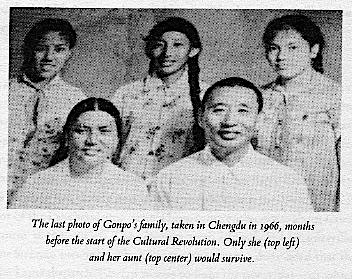
Demick 54

In the summer of 1966 she returned to Chengdu for a holiday with her family, but as the Cultural Revolution broke out she was soon summoned back to Beijing. Having shown willing in previous campaigns (indeed, she supported Chairman Mao avidly), Gonpo was now vulnerable. In 1967 she learned that her parents had died in suspicious circumstances. As she became a target of struggle sessions, a contingent of Red Guards from Ngaba demanded that she should be taken home for further punishment, but instead she was exiled to remote Xinjiang, labouring on a military-run complex in Qinggil (Qinghe) county near the Soviet border. Most of the population sent there were Han Chinese—including her kindly future husband Xiao Tu. They took part in the farm’s propaganda troupe, singing songs in praise of the Party’s “liberation” of Tibet. As higher education began to function again, Gonpo tried in vain to gain admission to colleges in Beijing and Shanghai.

When the couple got permission to take a holiday in 1975, Gonpo took Xiao Tu back to her old home in Ngaba, now unrecognisable; but despite her anxieties, the locals fêted her as a former princess. When they returned to Qinggil they held a simple wedding ceremony. On the death of Chairman Mao later in 1976, their main concern was that Xiao Tu would be able to avoid trouble by maintaining the dodgy loudspeakers broadcasting the funeral. As Demick notes, by the time she was writing Qinggil was the site of a “re-education camp”, inaccessible to outsiders.

We read the story of Delek (b.1949), who came from Meruma village just east of the prefectural capital, where people remained loyal to their former royal patrons. Since his family had suffered grievously as the Chinese enforced their power, he might seem an unlikely recruit to the Red Guards. Yet to many Tibetans the Cultural Revolution presented a welcome opportunity to challenge authority, and by 1968 Delek joined a branch of the Red Guards in Ngaba loyal to the Red City faction in Chengdu, supposing that they could now right the wrongs of the hated commune system and restore religious freedom. But as rebellion spread, the PLA were sent in.

Although this uprising was ultimately a failure, for six months the Tibetans had raised their own livestock, worshipped freely in the monasteries, chanted prayers, and conducted rituals. The monks had worn their robes. It had given Tibetans a taste of freedom, the memory of which could not so easily be extinguished.

In Part Two Demick describes the “interregnum” from the end of the Cultural Revolution to 1989.

By the time of Mao’s death in 1976, Ngaba was a ghost town, sullen and silent. A quarter century of Communist rule had destroyed far more than it had created. What remained consisted mainly of squat mud hovels in dun tones barely distinguishable from the ground underfoot. […] Dust and mud choked the streets. Gutters on either side served as open sewers and toilets.

With the monasteries demolished, there was little to alleviate the drabness or delight the eye. The market nurtured by the king that had made Ngaba worth a detour for traders was long gone.

Demick evokes the resurgence of market enterprise through the story of Norbu (b.1952), who was to become a leading entrepreneur in Ngaba. As a child he had been reduced to begging for the family by the Chinese “democratic reforms”, and later turned to the black market. By 1974 he was making regular trips by bus to Chengdu to buy goods that he could sell back in Ngaba. As the commune system crumbled, the range of merchandise increased. In partnership with his Chinese wife he opened a tea shop and a supermarket.

With the monasteries still closed, some monks also turned to business, with their higher level of literacy. The monasteries re-opened gradually from 1980. Of the roughly 1,700 monks at Ngaba’s main monastery Kirti, only around 300 were still alive; some were traumatised after years in prison. As in Chinese regions, many of those helping to rebuild the temples were former activists who had taken part in destroying them.

New buildings began appearing in the county town—dominated by the institutions of the Chinese state. Tibetans were keen to buy motorbikes, and the trade in caterpillar fungus made a lucrative boost to their income. Ngaba traders travelled not only to the booming southeastern Chinese cities but to Lhasa and the border with Nepal.

The Han Chinese population of Ngaba was growing too; as the Tibetan plateau became a promising place to make money, the state encouraged migration with Develop the West campaigns. Tibetans were soon outnumbered by Chinese in Amdo, and were disadvantaged in many spheres.

Still, Tibetan education was reviving (cf. the lama Mugé Samtan, whose initiative began in Ngaba as early as 1980—see Nicole Willock’s chapter in Conflicting memories, pp.501–502). Tsegyam (b.1964) was a young teacher at the Ngaba Middle School, which opened in 1983. He had been given a Tibetan education by (former) Kirti monks, and became fluent in Chinese, spending a period studying in Chengdu. During the wider cultural revival in the PRC he wrote poetry and essays for literary magazines. At the Middle School he cautiously added Tibetan culture into the curriculum.

Tsegyam’s eyes were opened by reading a copy of the Dalai Lama’s memoir My land and my people, brought back by a friend from a trip to India. As awareness of the Tibetan government in exile grew, major protests took place in Lhasa in 1987. Though there was a strong military presence in Ngaba, Tsegyam echoed the mood by pasting up posters in support of Free Tibet and the Dalai Lama. By 1989, as protests throughout the PRC gathered and were crushed, he was under interrogation; sentenced to another year in prison in 1990, on his release he was unemployed and unemployable.

We catch up with Gonpo. In 1981 she and her husband were permitted to leave Xinjiang with their two children, settling in Xiao Tu’s old home Nanjing. One of countless people whose past backgrounds were now forgotten, Gonpo did well as a primary school teacher. While she kept a small portrait of the Dalai Lama at home, she could pass for a Chinese—by now she could barely recall Tibetan.

Still, she received a visit from a high-ranking Tibetan official on a tour of Nanjing, who had her promoted to posts in the Party; though mainly ceremonial, her new status conferred benefits such as a comfortable apartment.

In 1984 Gonpo managed to arrange belated funeral rites for her parents at Kirti monastery. In Beijing she gained an audience with the Panchen Lama, also recently rehabilitated (see e.g. under Labrang 1); he encouraged her to study Tibetan culture in India, and with his help she set off there with her daughter in 1988 during a thaw in Sino-Indian relations. She intended to return to Nanjing in due course, but the crisis of 1989 ensured that she would now find herself living in exile in Dharamsala.

Part Three takes the story on to 2013, as tensions grew again. As urban China basked in McDonalds and Walmart, rural Tibetans still lacked basic amenities.

In Meruma, Dongtuk was born to a disabled single mother who overcame poverty. In her house was a shrine to her uncle, a tulku reincarnate lama.

What little that children knew about recent history was gleaned from their families.

To the extent that they were taught anything about Tibet in the 20th century, it was about how the Communist Party had liberated Tibet from serfdom. Their parents tended not to talk about it. Maybe they didn’t know about it themselves. Or they feared these stories of collective trauma might arouse anti-Chinese sentiments that could get the children in trouble later down the road. The surviving elders who knew firsthand—and who often carried the scars on their bodies—disgorged their memories only sparingly. If they hadn’t been half-starved and beaten, if they hadn’t languished in prison doing gruelling work, then they had done things of which they were now ashamed. You were either tormented or a tormentor. Nobody had escaped unscathed.

Dongtuk gladly accepted when his mother suggested that he become a monk at Kirti monastery, which was now expanding grandly. In the company of village friends there, he flourished at the monastery school. But a new policy was stamping down on monastic activism; a new “patriotic education” campaign was launched at Kirti in 1998, radicalising many monks. The school was closed in 2002.

Pema (b. c1965) was a supporter of the monastery. After the death of her husband she ran a market stall to support her children, two of whom were monks. She regularly took part in circumambulations at Kirti (cf. Charlene Makley for Labrang, ch.3). She took in a young girl called Dechen, who took to a Chinese education, as well as her niece Lhundup Tso, who was of a more enquiring mind. Pema herself was inclined to be grateful for the limited freedoms they now enjoyed. But she was concerned about a vast new construction project; while she felt more pity than hostility towards the Chinese, she didn’t want any more of them in her town. Infrastructure projects escalated in the buildup to the Olympics—along with surveillance.
Demick 159

Brought up in a nomadic community, Tsepay (b.1977) was not inclined towards dissent. His good looks gained him admission to an official song-and-dance troupe at the glossy resort of Jiuzhaigou, and at first he enjoyed the work. But he came to resent the condescending clichés intrinsic to such displays, and his comments got him into trouble. Leaving the troupe, he began travelling the plateau with cellphone and camera to document the transformation of the landscape.

Despite Chinese censorship, families and monasteries still commonly kept portraits of the Dalai Lama, although people were ready to conceal them if there was a raid. Tsepay listened to recordings of teachings by the Dalai Lama, and became aware of the conflict over the identification of the new Panchen Lama. In 2006, as the Chinese rhetoric against the Dalai Lama became more strident, Tsepay spent a year in prison for distributing Dalai Lama recordings, radicalising him further.

These stories come together in Demick’s account of the 2008 uprising. Serious protests broke out in Lhasa on 10th March on the anniversary of the 1959 uprising that led to the flight of the Dalai Lama. In Ngaba the military police were on full alert, but protests erupted there too on the 16th. Dechen normally found the troops rather dashing, but now the tension was clear. In the middle of a prayer festival at Kirti the young monk Dongtuk saw an older colleague holding up a photo of the Dalai Lama and yelling “Long live His Holiness the Dalai Lama!”. As other monks joined in, they swept out into the streets, confronting the riot police, who responded with tear gas and live ammunition. On their mobiles people began to learn of protests elsewhere in the region, in Labrang, Dzorge, and Rebgong.

Tsepay, on probation, couldn’t resist going into town. There he found the blood-stained body of a young Tibetan woman—probably Pema’s young niece Lhundup Tso. Pema, a curious onlooker, was horrified to learn that she was among those shot dead. Enraged, Tsepay entered the battle. Wounded, he escaped via Chengdu to Shenzhen, where he was pursued by police from Ngaba, but managed to escape again.
Demick 183

With Kirti monastery now under virtual siege, checkpoints, bunkers, and CCTV were installed. Nearly 600 monks were arrested, over a fifth of the monastery’s population. But the campaign to remove all traces of the Dalai Lama only increased the Tibetans’ reverence for him. At last Dongtuk could interpret the sufferings of his elders in terms of the current oppression. He began listening to illegal Amdo songs such as Tashi Dhondup’s 1958–2008 (see also here).

With Pema distraught over the death of her niece, and normal social life suspended, Dechen became the family’s go-between. Her education at Tibetan middle school had become more conventional; in response to campaigns against expressions of Tibetan nationalism, the students waged subtle protests.

Self-immolation
Life began returning to “normal” by the end of 2008, but the 2009 Monlam New Year festival prompted yet another crisis as a young Kirti monk set himself on fire on the main street. Though he survived, 156 Tibetans have since immolated themselves, of whom nearly a third came from Ngaba and nearby.

Dongtuk’s life at Kirti monastery had become tedious. He was a keen basketball fan, and loved watching movies. His mother eventually submitted to his repeated requests for her to muster the funds to allow him to study in India, but his efforts to leave were unsuccessful.

On 16th March 2011 another Kirti monk, a friend of Dongtuk, set himself on fire—this time fatally. Looking for scapegoats, police arrested monks, and locals rallied to protest. The monastery was barricaded again. But over the next months further self-immolations followed.

Ngaba was now sealed off and equipped with all the technology of riot control—with fire extinguishers now added to the police arsenal. When Demick visited the town in 2013 it reminded her of trips to war zones like Baghdad, Sarajevo, and the Gaza Strip.

As the self-immolations brought renewed international publicity to the Tibetan cause, the Dalai Lama and Tibet advocacy groups were in an awkward position.

Dechen, no longer so amenable to the Chinese, was now alienated by her education at school; Pema now began the complex procedures to help her reach India, as it became ever harder for Tibetan to gain travel permits. With Pema travelling as her chaperone, after a four-month journey they eventually made their way to Dham and crossed into Nepal.

Dongtuk too renewed his efforts to leave. He evaded attention by staying on his father’s nomadic pastures, getting to know his half-brother Rinzen Dorjee. And then, via Lhasa, Dham and Kathmandu, Dongtuk too managed to reach Dharamsala. As he resumed his studies at the branch of Kirti monastery there (founded in 1990), he learned of another self-immolation in Meruma—that of Rinjen Dorjee.

In Part Four Demick visits Ngaba refugees in Dharamsala, learning details hard to divulge in the intimidated atmosphere of Ngaba, and updating the story since 2014. (It is indeed possible for scholars to glean insights through extended stays among Tibetans within the PRC, as did Charlene Makley around Labrang, but in presenting their work they tend to be beset by academic concerns. For fine reflections on the differences between conducting research in Lhasa and Dharamsala, see Isabelle Henrion-Dourcy, “Easier in exile?“, cited in n.1 here).

The journey to India was always fraught with dangers. Following the initial exodus after 1959, another wave took place in the 1980s. We catch up with Gonpo, who had been in inadvertent exile in Dharamsala with her daughter since 1989. The Dalai Lama, whom she had met in 1956, received her warmly, giving her a post in the exile parliament. But as relations between the Chinese and the Dalai Lama deteriorated, Gonpo was unable to see her husband and her other daughter until 2005. As Demick observed after meeting her in 2014,

Not only does the rift between China and the Tibetans run straight through her family, it runs through her psyche. Gonpo loves China as well as Tibet. She still speaks better Chinese than Tibetan. More than most Han Chinese people I know, she absorbed the lessons of socialism. She eschewed conspicuous displays of wealth and was proud that she had shed her aristocratic roots and was, to use a Chinese Communist slogan, serving the people.

Goonpo was deeply disturbed by the self-immolations in her former home.

Demick x

Demick also met the former Red Guard Delek, who had also managed to reach Dharamsala in 1989, becoming a historian as he documented the tribulations of Ngaba, while serving as caretaker at a school for young refugees.

The young teacher Tsegyam had sneaked across the border into India in 1992, eventually becoming private secretary to the Dalai Lama. And after fleeing Ngaba in 2008, Tsepay was on the run for four years, spending over a year in hiding on Wutaishan before reaching Dharamsala.

Dechen was enthusiastic about her studies at the boarding school run by the exile government; educating herself further by reading Woeser keenly, she was hoping to become a journalist. She took Demick to meet Pema, who despite her relief at escaping the appalling repressions in Ngaba, didn’t feel quite at ease, missing the material comforts of her former home.

Indeed, for many exiles the homeland remains ambivalent; with conditions in India less than ideal, they may be tempted to return to their homeland, despite the inevitable scrutiny to which they will be subjected. From a peak of 118,000 in the mid-1990s, the Tibetan population in India declined to 94,000 in 2009. The Chinese had plugged leaks to the borders, and Tibetans often move on to Western countries.

Demick considers the role of the Dalai Lama and current worries over the succession (for recent news, see e.g. here). The bar has lowered from independence to survival; but if the preservation of Tibetan culture sounds like a modest goal, even this can clearly not be taken for granted.

In her final chapter Demick ponders the limits of freedom. Some Tibetans even thought the Chinese had heeded the lessons of the self-immolations; they had cancelled an unpopular water diversion project, and shelved plans to house Chinese workers; aid projects were coming into effect. Photos of the Dalai Lama reappeared at Kirti. But Chinese migration continues, and Tibetans are still disadvantaged.

It should go without saying: The Tibetans are not some exotic isolated tribe trying to preserve an ancient civilisation against the advance of modernity. They want infrastructure, they want technology, they want higher education. But they also want to keep their language and their freedom of religion. […]

Time and again I heard the same story. Almost everybody was better off financially than they’d been a decade ago, like everybody in China. But Tibetans were still poor—even by the standards of rural China. And they could see that the Chinese newcomers in town had a higher standard of living.

Younger Tibetans might not be deeply religious; they might readily take to a Chinese education as a career path, and be seduced by the trappings of modern material goods. And yet they too have come to resent deeply their chronic submission to the Chinese, connecting it to the scars inherited from their elders, and they continue to fight to maintain their identity.

* * *

Eat the Buddha is based on three trips to Ngaba, as well as interviews with Ngaba people elsewhere, most fruitfully in Dharamsala.

With a few exceptions […], the people in this book left Tibet not for political reasons but to further their education or personal growth.

For the most part, they were regular people who hoped to live normal, happy lives in China’s Tibet without having to make impossible choices between their faith, family, and their country.

As she did for Nothing to envy, Demick provides a useful research guide in a section of endnotes, themed by chapter. Besides her own visits to Ngaba, Chengdu, Lhasa, and Dharamsala, she cites sources such as the War on Tibet site of Li Jianglin and Matthew Akester, the work of scholars such as Tsering Shakya, Robert Barnett, and Melvyn Goldstein (we can now add Conflicting memories, including Bianca Horlemann’s chapter 11 on Golog), as well as human rights groups (cf. my roundup of posts on Tibet). Tsering Woeser has written on self-immolation in Tibet on fire (2016), and in this article. Many of these issues are covered on the excellent High Peaks Pure Earth website.

While the Chinese Party-State’s repression of the Tibetans is taking a rather different form to its barbarity in Xinjiang (see this roundup of posts on Uyghur culture), it’s important to keep the Tibetan case in the public eye. Over seventy years of Chinese indoctrination and brute force have been ineffective; a way out of the impasse remains elusive. Engagingly told through personal stories, Eat the Buddha makes a microcosm of the travails of Tibetans in their sorry encounter with the modern Chinese state, serving for the non-specialist (that’s me) as a digestible introduction to complex issues.


* For some effective popular works on other areas, see Charles King (here and here), Undreamed shores, Watching the English, and The souls of China.

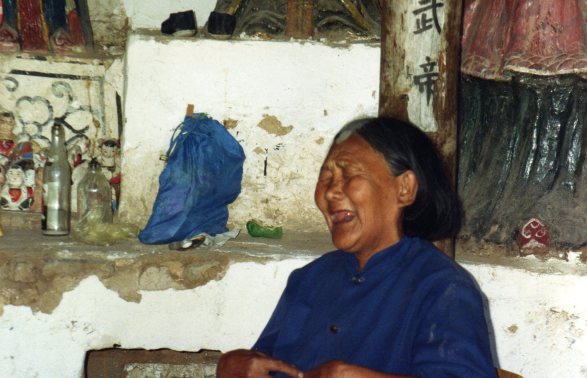
Ritual change in north Shanxi

tray 91

By contrast with most research on Daoist ritual, change over the three modern eras (before Liberation, under Maoism, and since the 1980s’ reforms) is a constant theme of my work. These recent posts, elaborating on my film and book on the Li family Daoists, make a useful series:

Ritual business

See also e.g.

You can search further under the sub-heads of the Li family category in the sidebar.

Li category

Ritual change has become a significant theme within ritual studies; in Chinese, a classic on ritual and social change is the 1999 volume Yishi yu shehui bianqian 仪式与社会变迁 edited by Guo Yuhua.

Gaoluo: early history

*For main page, click here!*

dengpeng

My first experience of the New Year’s rituals in the Lantern Tent,
South Gaoluo 1989.

Under the Gaoluo sub-menu (Other publications > Gaoluo) I’ve just added a page on the early history of the village, like so:

GL menu

Apart from those pages in that menu, there are many more posts under the Gaoluo tag in the sidebar; for a basic roundup, see here.

My 2004 book Plucking the winds, an ethnography of Gaoluo and its amateur ritual association, mainly concerns the village’s fortunes under Maoism and since. Since history may seem to have been obliterated by the successive turmoils of the 20th century, I felt glad enough to be able to sketch the story as far back as the Republican era and even the late Qing. And thanks largely to talented village litterateur Shan Fuyi (b.1940), I went on to learn clues to the village’s founding in the Yuan–Ming transition and its fortunes through the Qing dynasty. The new page provides notes on the main lineages, local temples, the “parish” 社, “precious scrolls” 寶卷, and early ritual life.

The story of the Republican era continues with Ritual images: Gaoluo. But first, remarkably, a major trauma in the village in May 1900 is substantially documented in official sources, a story told in my post on the village Catholics.

All this was the background to the ritual associations that I got to know through the 1990s. It’s hard enough to reach definitive conclusions about ritual life today, but in this case at least we can observe, and ask…

Daoist ritual: the Pardon

This discussion of the Dispatching the Pardon (fangshe 放赦) ritual sets forth from my Daoist priests of the Li family, pp.246–50, exploring the imperfect match between Daoism as performed and as shown in ritual manuals.

The highlight of my first visit to Yanggao in March 1991 was witnessing the great Li Qing presiding over a funeral at Greater Antan (see my film, from 48.35). I didn’t know how lucky I was. It was as if a Martian happened to land on earth, not at a conference of middle managers in Belgium, nor even at a church fête in Suffolk—but in Leipzig in 1727, filming the premiere of the Matthew Passion on her 3D eye-laser system, and then assuming that this was typical of life on Planet Earth. And then recording an episode of Family Guy over it.

The Pardon ritual was traditionally performed for both funerals and temple fairs, with the words “filial sons” (xiaozi) or “filial kin” (xiaojuan) as alternatives for “master of the retreat” (zhaizhu) or “temple chief” (miaozhu).

For funerals the Pardon is normally only part of the three-day sequence; the 1991 funeral was held over only two days, but Li Qing performed the Pardon at the request of the son of the deceased, a gujiang shawm player who loved the ritual for its lively (honghuo) atmosphere.

Li Qing’s band that day included his senior colleagues Li Yuanmao and Yuan Lishan; the guanzi player for the jocular “catching the tiger” sequence was Wang Chang, from the related Wang family in Baideng township. Li Qing’s son Li Manshan was taking part on drum, and the young Wu Mei was there; the band also featured Li Peisen’s second son Li Hua, as well as Li Yushan, son of Li Peisen’s older son.

As Li Manshan later recalled, this was the third time he had taken part in the ritual; they performed it for the 1987 video project, and did it again around 1993 for a funeral in Wangjiatun. The younger recruits Li Bin and Golden Noble have performed it for temple fairs, but by 2015 they hadn’t done it for nearly ten years—like Crossing the Bridges, kin and villagers now consider it “too much hassle”. It hasn’t been used for temple fairs since the early 1950s.

The Pardon manual
The Li family Daoists distinguish between the routinely used “inner five rituals”,  and the optional “outer five rituals” (see Daoist priests of the Li family, pp.30–32). Before Liberation Li Peisen copied a lengthy manual including the latter, generously titled

LPS old coverLingbao kaifang shezhao yubao xianzhuan youlian poyu fangshe duqiao zhu baiyu rang huangwen [ke] 靈寶開放[方]攝召 預報獻饌遊蓮破獄放赦渡橋祝白雨禳蝗瘟[科]
Numinous Treasure [Manual] for Opening the Quarters, Summons, Reporting, Offering Viands, Roaming the Lotuses, Smashing the Hells, Dispatching the Pardon, Crossing the Bridges, Precautions against Hailstones, and Averting Plagues of Locusts.
There was little trace of these “outer” rituals in their practice after the 1980s’ revival.

Finding Li Qing consulting Li Peisen’s early manuscript at the 1991 funeral, I hastily took some photos, rather randomly; by 2011 Li Manshan could no longer find it, so we rely on the faithful copy that Li Qing made in the early 1980s, divided into two volumes, with 42 double pages in all.

The Pardon itself takes up fifteen double pages. It’s one of their most complex, opening with long sequences of zhenyan mantras in four-, five-, and seven-word structures, and containing elaborate fu 符 talismans and jian 简 slips. Whereas most funeral segments are now dominated by the Heavenly Worthy of Grand Unity who Rescues from Suffering (Taiyi jiuku tianzun), this ritual is addressed to the Jade Emperor, in his role as Heavenly Worthy Who Pardons Sins (Yuhuang shezui tianzun). The talismans are addressed to the Three Officers (sanguan). The 108 pardon slips (shetiao, shewen) to be recited are combined into a few long documents.

Some pages from Li Peisen’s copy:

LPS Pardon 1

Slips to Rescue from Suffering.

LPS Pardon 3

Recto: slip for Long Life.
Verso: in the last line, the term jiao (Offering) in “dark yang pure jiao
(mingyang jingjiao 冥陽凈醮) refers to a funeral;
the listing of “Shanxi Datong fu” shows its local origins.

And some pages from Li Qing’s copy of the manual:

LQ Pardon 1

Pp.1b–2a. Third line from right: the Naihe qianchi lang couplet,
followed by 7-, 5-, and 4-word mantras.

LQ Pardon 2

Verso: the talisman for the Heavenly Official.

And we can compare these pages with Li Peisen’s copy above:

LQ Pardon 4

Recto: template for slip to Rescue from Suffering, “in red characters, with white envelope”.

LQ Pardon 5

Slips for Long Life.

The ritual as performed in 1991
We can soon discover that the version performed that day by Li Qing and his colleagues (and again, do watch my film, from 48.35) bears little relation to that given in the manual.

Li Qing copying ritual document, 1991

First, in the scripture hall, Li Qing copies the lengthy series of pardon slips with their talismans, and envelopes to put them in—a lengthy process, for which he consults Li Peisen’s manual.

Meanwhile, in light snow, the other Daoists construct an open-air altar in a large clearing in the middle of the village near the funerary site, using tables, benches, and planks. On this structure are placed in a row five “palaces”—cardboard images mounted on stalks of gaoliang inserted into large rectangular dou bowls filled with grain—for the Jade Emperor Yuhuang, the Three Officers (sanguan, for heaven, earth, and water), and the pole star Purple Tenuity (Ziwei, not mentioned in the manual).

Pardon altar

Just below the central palace to the Jade Emperor is an altar table bearing the soul tablet, and below that, a long table around which the Daoists will stand to make offerings to the five palaces. Further behind, facing the palaces, a long high platform has been built on top of tables, from where the Daoists will later dispatch the writs of Pardon.

Around midday, after the morning visits to Deliver the Scriptures, the seven Daoists proceed from their scripture hall, playing percussion with occasional blasts on the conch. After paying a brief visit to the soul hall, they purify the arena by leading the kin on an elaborate winding procession around it. Virtually all the villagers have gathered round—by contrast with their apathy today, gorging instead on the pop music outside the gate.

The ritual is in two large sections: presenting the offerings from the altar table, and announcing the writs of pardon from the ritual platform before handing them down to the kin to be burned.

Pardon x

Acting as intermediary for the kin standing in a row behind him, the chief celebrant Li Qing, wielding his wooden “court placard” (chaoban) and sounding a hand-bell and a qing bowl on the table, now faces the altars and presents offerings to each of the five deities in turn on behalf of the kin. An offerings tray (of red lacquered wood, not like the metal one used now) is at first placed on the altar table before the god palaces.

While the Daoists play an instrumental piece (for this next sequence the two sheng accompany not the guanzi oboe but the dizi flute), Li Qing bids the oldest son to wash his face from water in a bowl and offer one preliminary stick of incense to the palace of the Jade Emperor. After he shakes the bell and strikes the qing bowl, the Daoists sing a sequence of a cappella choral hymns from the “words of blessing” (zhuyan 祝言) repertoire, accompanied only by the ritual percussion, beginning with Myriad Years to Elder Emperor (Huangdiye wansui). These hymns are punctuated by imposing patterns on nao and bo cymbals.

Li Qing recites a brief shuowen introit while the tray is handed to the oldest son of the deceased. Again accompanied by dizi, he takes the court placard, bows with it, and one by one places five cups of tea, with incense resting on them, on his court placard to transfer them onto a small raised table before the central palace to the Jade Emperor. The sticks of incense are then further placed before the god palaces, accompanied by dizi. After each offering they sing another a cappella hymn from the “words of blessing”.

Li Qing now clambers up onto the table, taking bell and placard with him. He leads the Daoists as they solemnly intone the two couplets “Thousand-foot waves at Bridge of No Return” (Naihe qianchi lang, from p.1b of the manual, also used at the end of the Invitation, my film from 1.03.25). Whereas the first sequence was punctuated by jaunty dizi, for this new sequence the hymns are to be accompanied by solemn shengguan wind ensemble, punctuated with interludes on large cymbals, while Li Qing kneels on the table, bows with the placard, and transfers the remaining offerings (incense, flowers, and so on) in turn before the god images, always placing them on the placard first. He recites another shuowen introit, shakes the bell, and the Daoists play another piece with dizi while Li Qing steps down from the table.

Then, taking all their ritual and musical instruments with them, the Daoists ascend the platform behind, standing in a long line behind a long row of tables to face the altars. As a majestic prelude they play the percussion piece Yellow Dragon Thrice Transforms Its Body.

The Pardon, 1991

Wang Chang recites a pardon writ from the ritual platform,
with Li Qing and Yuan Lishan further to our left;
to the right are Li Peisen’s grandson Li Yushan and a youthful Wu Mei.

Then the three leading officiants (Li Qing, Wang Chang, and Yuan Lishan) don five-buddhas hats, representing the Three Officers. The group plays The Five Offerings (Wu gongyang 五供養) on shengguan, and then the three officiants, in turn, solemnly read out the large and lengthy pardon slips. The first is read by Yuan Lishan. Li Qing calls out an instruction, folds the document up and places it in a large envelope, folds over the strip of paper to “seal” it, handing it down to the kin, again accompanied by the ensemble with dizi. The documents, envelopes, and seals are all of different colours, as specified in the manual.

Li Qing shakes the bell, recites a shuowen introit, and they sing the hymn Ten Repayments for Kindness (Shi bao’en 十報恩) with shengguan, another item common to several rituals. Li Qing recites a shuowen, and they play the cymbal interlude Sanqi song. Another shuowen leads into the second reading by Li Qing. Then a shuowen leads into a shengguan piece, which segues into a protracted “catching the tiger” clowning sequence.

Wang Chang

Wang Chang, the main guanzi player, standing to the left of Li Qing, plays two guanzi alternately and then at once, blows the mahan small telescopic curved trumpet, dismantles his instruments while playing them, plays a hefty whistle in his mouth, pretends to pluck snot from Li Qing’s nose and smear it over the face of the sheng player on his left, replaces the latter’s cap with a cymbal, puts on false eyes, and makes ribald gestures with the curved trumpet. Li Qing and the others try to keep a straight face throughout, but Wang Chang is having fun, and the villagers are in stitches.

Li Qing now recites a shuowen, followed by a percussion interlude. Then he recites the final pardon document, folds it up, places it in its envelope, and hands it down, accompanied by Sizi zhenyan 四子真言 on dizi. Finally, the Daoists descend from the platform, playing shengguan, and lead the kin on a slow parade around the arena. Li Qing guides the kin in the burning of the memorials in a pile together, while the Daoists stand round playing shengguan. They then retire to their scripture hall to rest and prepare for the next ritual segment.

Manual and practice
In sum, although we didn’t quite film the Pardon complete, they evidently didn’t perform the manual complete either. Li Qing was quite familiar with the text—he had lovingly copied it out a few years earlier. We can only surmise how often the senior Daoists Li Qing, Wang Chang, Yuan Lishan, and Li Yuanmao had performed the ritual before the 1950s with Li Peisen and others from that generation, but whereas they had maintained the “inner five rituals”, by 1991 their recollection of the Pardon may have been hazy, and the younger Daoists were quite unfamiliar with it. So perhaps this explains why the ritual was so transformed. Alas, on my first visits I lacked the background to consult Li Qing about such matters.

It is likely that sections like the Yellow Dragon percussion item and the “catching the tiger” sequence, though not specified in the manual, were traditionally included. But instead of the long series of four-, five-, and seven-word mantras in the manual, they alternated a cappella “words of blessing” from the Diverse Rituals for Joyous Scriptures (Xijing zayi 喜經雜儀) compendium for “earth scriptures” with an instrumental refrain using dizi, and sang standard “floating” hymns with shengguan. I suspect this was actually a version of the Noon Thanksgiving for temple fairs and Thanking the Earth, though the texts they performed also differed from those in the Xiewu ke 謝午科 manual. Only their final recitations of the Pardon writs appear to have been performed more or less intact as in the Pardon manual.

Anyway, rather as the temple fair sequence since the late 1980s seems to be a revision, this was already an adapted version. The ritual is lengthy and imposing, and its purpose is communicated, but it tallies only occasionally with the manual. With the same diligence that he had preserved the original content of the manuals, Li Qing was now selectively adapting rituals according to changing conditions—as Daoists (and other ritual specialists) have done throughout history; but it marks a substantial break with tradition.

Of course, scholars of Daoism may be more interested in the manual, which undoubtedly preserves early features. But (like the 1940s’ temple fair sequence) we can’t now witness it being performed; there is no demand for it among patrons, and even if we requested it specially, the current Daoists would be hard-put to recreate even Li Qing’s 1991 version, let alone attempting to perform it as shown in the manual. Even the “words of blessing” and the dizi interludes (which themselves may have been a substitute) are no longer part of their repertoire. For continuing ritual change, see A flawed funeral.

The Pardon elsewhere
The Pardon is commonly performed by household Daoists in southeast China, the heartland of research on Daoist ritual. For Taiwan it has been described in detail by John Lagerwey (based on the practice of the great Chen Rongsheng) and Jiang Shoucheng; and Ken Dean has documented it for south Fujian. [1]

While the text of Chen Rongsheng’s version appears different, its themes are similar. Apart from the mystical core of the ritual, Lagerwey draws attention to its dramatic, jocular interlude. In Yanggao such elements are absent from the manual, but an interesting connection seems to be implied in the “catching the tiger” sequence.

Lagerwey cites the 13th-century Daoist priest Wang Qizhen:

This Pardon document does not belong to our method for doing the fast. It is the invention of later people. Given the fact, however, that it has been used far and wide for some time, it would not do to eliminate it.

And he too notes variation between the early manual and modern practice.

For north China I have only a few other instances so far. [2] In Julu, south Hebei, it was performed on the afternoon of the 3rd day of funerals, comprising the segments qingshen 清神, ji lengshui 祭冷水, qing Yuhuang 請玉皇, song wulao 送五老, qing jianzhai 請監齋, and zhuan dagong 轉大供.

And in the jiao Offering around Baiyunshan in Shaanbei, again on the afternoon of the 3rd day, the Pardon is a spectacular (if not highly liturgical) ritual, with large god puppets of the Eight Immortals and the Four Officers of Merit (Sizhi Gongcao 四值功曹) descending on a rope down from the hillside to the bank of the Yellow River—somewhat reminiscent of the guandeng Beholding the Lanterns nocturnal ritual around Beijing (see here, under “A Buddhist and Daoist funeral”), on a far grander scale.

Pardon cover TianzhenBack in north Shanxi, in Tianzhen county just east of Yanggao, the Lü family of household Complete Perfection Daoists, whose tradition derives from the Nanmen si temple in Huai’an nearby, have a tradition of performing the Pardon, though it now seems to be defunct. Their lengthy manual, apparently copied in the Republican era, is entitled Taishang shuo Yuhuang shezui 太上玉皇說赦罪 or Yuhuang shezui tianzun shenjing 玉皇赦罪天尊神經. They also have a template for the writs of Pardon (“Pardon slips” shetiao 赦條):

shetiao

Aided by Lagerwey’s discussion, scholars of early Daoism will wish to trace the ancestry of “pardon for sins” (shezui 赦罪) in the Daoist Canon, with many sources following the Yuhuang shezui cifu baochan 玉皇赦罪賜福寶懺. Meanwhile, ethnographers are left to observe modern changes in the ritual adaptations of Daoists and patrons.


[1] See Lagerwey, Taoist ritual in Chinese society and history (1987), pp.202–215, Jiang Shoucheng 姜守誠, “Nan Taiwan Lingbaopai fangshe keyi zhi yanjiu” 南台灣靈寶派放赦科儀之研究 (2010); Dean, “Funerals in Fujian” (1988), pp.45, 52–53. Cf. Pregadio, Encyclopedia of Taoism (2008), pp.403–404.

[2] Based on my In search of the folk Daoists of north China, pp.91 and 99–100. The Julu material is from Yuan Jingfang 袁靜芳, Hebei Julu daojiao fashi yinyue 河北鉅鹿道教法事音樂 (1997), pp.72–4; for Baiyunshan, see e.g. Yuan Jingfang et al., Shaanxi sheng Jiaxian Baiyunguan daojiao yinyue 陝西省佳縣白雲觀道教音樂 (1999), pp.112–13, and Zhang Zhentao 张振涛, Zhuye qiuyue lu 诸野求乐录 (2002), pp.149–50.

Thanking the Earth, and words of blessing

Today the great majority of the Li family Daoists’ ritual work is for funerals. As to rituals for the living, they now rarely perform for temple fairs, and the Thanking the Earth ritual, once commissioned by families for domestic blessing, has not been required since 1953 (see my Daoist priests of the Li family, chapter 12).

Ritual business

The Yanggao Daoists now perform almost solely for funerals, but before Liberation the ritual they did most often was Thanking the Earth (xietu 謝土). [1] Held over two days during the winter, it was a domestic ritual for an individual household of certain means. The head of such a household might pledge a vow (xuyuan 許願) in the summer, and fulfil it (huanyuan 還願) by commissioning a Thanking the Earth ritual in the winter. The request was commonly prompted by illness or crisis, or in thanks for a good harvest or success in business. It could be held in the family household, or in a temple.

In 1991 the great Li Qing, oblivious to the Party line, recalled the Japanese occupation in the 1940s:

Our ritual business didn’t suffer during the occupation—the troops, themselves devout, even made donations when they came across us doing Thanking the Earth rituals! The local bandits didn’t interfere either.

Li Qing’s colleague Kang Ren (1925–2010) recalled performing Thanking the Earth rituals forty to fifty times every winter from the age of 15 sui (when he “graduated” as a Daoist) until he was 30 sui in 1954. Given the poverty of the area, this sounded a lot to me. Just west of Kang Ren’s house, poor peasant Li Cunren (1915–2013) recalled that only people with money could afford to commission the ritual—and even before the 1950s there were few of them. But Li Manshan believes Kang Ren’s account: even two or three moderately affluent household patrons for twenty or so villages would suffice to keep the Daoists busy. Forty to fifty such rituals meant eighty to a hundred days work each winter, not counting funerals, which were also most frequent then; they must have been busy virtually every day.

Even after the Communists took control in 1948 some households were still able to commission a Thanking the Earth ritual until 1953; but as the economy was levelled, beleaguered former “landlord” and “rich peasant” families could no longer afford to do so. Previously the ritual had involved making vows for prosperity and the health of their livestock, but now prosperity was unimaginable, and livestock collectivised.

By the 1990s, following the liberalisations after the collapse of the commune system, plenty of relatively affluent households began to re-emerge. But now that they could afford to hold Thanking the Earth rituals again, they were no longer inclined to do so. Whereas families still dutifully invite Daoists to perform funeral rituals, and still believe strongly in fengshui and determining the date, a lesser faith in divine aid to protect their crops and livestock has now rendered the Thanking the Earth ritual obsolete. So documenting it requires considerable reconstruction.

The Memorial
The memorial for Thanking the Earth doesn’t get burned, as it is for the living; the family keeps it after the ritual.

Li Qing’s uncle Li Peisen made a copy of one such memorial in 1981, for a ritual commissioned by his father Li Tang in the late 1920s, entitled “Document for good fortune, with genealogy, recopied” (Jixiang ruyi wen jiapu chongchao 吉祥如意文家譜重抄). Such genealogies often contain a genealogy, a useful resource (cf. Customs of naming):

LPS jiapu detail

Li family genealogy, detail from Li Tang’s memorial.

Li Qing himself wrote a Thanking the Earth memorial over New Year 1989, again including a detailed genealogy:

IMG_20151221_105009

Thanking the Earth memorial with genealogy, Li Qing 1989.

I was also lucky to be shown another memorial preserved by the Ren family in Apricot Orchard village nearby, with the more formal title of “Memorial for supplementing and thanking the five earths” (Buxie wutu yiwen 補謝五土意文), dated 1942—the very year that the Li family Daoists’ participation in the Zhouguantun temple fair is documented:

IMG_2258_2

Thanking the Earth memorial, Xingyuan village 1942.

Comparing the three memorials reveals a basic standard format. It opens with the date, the place, the purpose of the ritual (to fulfill a vow and guarantee well-being, expressed in a standard formula), and the name of the male head of household commissioning it. It then lists the names and birthdates of the family taking part. There follows a general description of the ritual, including titles of some of the ritual segments to be performed. Finally, after another request for well-being that includes the orphan souls, there comes a list of deceased kin—minimally the three generations of ancestors (sandai zongqin).

Among the ritual documents that LI Qing copied in In the early 1980s is this placard for Thanking the Earth:

On separate occasions, both Li Manshan and I asked the elderly Kang Ren to describe the former sequence for Thanking the Earth. The older generation, who recalled the “old rules” of ritual life before Liberation, had steered the group through the revival of the early 1980s (see my film, from 40.22), but in turn they passed away; after the death of Li Qing (1999) and Li Zengguang (2000), Kang Ren was the sole survivor, and he still continued “responding for household rituals” with Li Manshan’s band.

Li vocals 2001

Kang Ren (left) with Li Manshan and junior Daoists, 2001;
right middle, Golden Noble.

Apart from the vocal liturgy, note how Kang Ren detailed the instrumental pieces, both the long suites and the shorter melodies accompanying particular segments:

Thanking the Earth

Day 1
am:

  • Opening Scriptures (kaijing): recite scripture Yuhuang jing
  •      shengguan suite 1 Shuihonghua
  • recite scriptures Laojun jing and Bafang zhou

pm:

  • Fetching Water (qushui)
  •      shengguan suite 2 Zhuma ting
  • sing “words of blessing” (zhuyan)
  •      shengguan suite 3 Yaozhang
  • recite litany Yansheng chan

eve:

  • Communicating the Lanterns (guandeng) to Bestow Blessing (cifu).

Day 2
4–7am:

  • Opening Scriptures (kaijing): rising at the fifth watch (qi wujing);
    then “seven litanies”, including six-line hymn; “words of blessing” such as Zhenxin qingjing daoweizong; and scriptures including Yuhuang jing and Bafang zhou
  • exit the yard and play shengguan piece Qiansheng fo
  • enter yard and sing “words of blessing”: Huangdiye wansui
  • Parading the Streets (shangjie) to each temple, burning incense and paper, reciting mantra for offering paper and playing dizi flute
  •      shengguan suite 4 Pu’an zhou
  • Shenwen Announcing Text
  •      shengguan suite 5 Da Zouma
  • exit the yard playing shengguan piece Sizi zhenyan
  • on return, burn yellow paper (huangbiao) in the house

noon:

  • recite Noon Thanksgiving Ritual (Xiewu ke)
  •      shengguan piece Langtaosha

pm:

  • recite scripture Zhenwu chan
  •      shengguan suite 6 Ma yulang
  • depict the earth altar and recite Thanking the Earth Manual (Xietu ke), including scripture Bafang zhou and Yubu<cosmic steps

eve:

  • Offering to the Stove (jizao)
  • Bestowing Food (shishi) and Spreading Fowers (sanhua)
  • Escorting Away the Orphan Souls (songgu); Settling the Gods (anshen).

Xietu duilian

The first six of fifty couplets for Thanking the Earth in Li Qing’s Couplet volume.

First the chief Daoist had to write couplets from the series of fifty for this purpose within the Couplet Volume, to be pasted up around the site, as well as all the “god places” to the Three Pure Ones (sanqing) and Three Officers (sanguan), Lord Lao, the Heavenly Masters (tianshi), and Elder Emperor (Huangdiye).

As in the three-day funeral, the two major nocturnal rituals were Communicating the Lanterns and Bestowing Food. But whereas for funerals most ritual segments (including the seven visits to Deliver the Scriptures) feature sung “hymns of mourning,” the Thanking the Earth sequence included instead a repertoire of “words of blessing” (zhuyan 祝言), sung a cappella with percussion accompaniment, as well as a sequence of fast chanted scriptures. Note also the lengthy “rising at the fifth watch” on the second morning, and the six long shengguan suites in fixed sequence.

This is yet another case of the gulf between textual study and practical accounts. If we relied only on manuals, we might suppose the ritual consisted only of the Xietu ke, apparently the only relevant manual. And even once we learn which manuals were used, they describe neither the ritual business (like how to use the earth, or the mandala), nor how the texts are delivered.

LMS xietu mandala

Template for the mandala for Thanking the Earth
in Li Manshan’s blue notebook, 1990s.

The Earth Citadel
The core procedure of Thanking the Earth, on the second afternoon, is “depicting the earth citadel” (hua tucheng 畫土城, or just “depicting the citadel” huacheng; or “depicting the earth altar” hua tutan 畫土壇), on the floor of the central room before the god images. The texts performed here are those in the Xietu ke, a long manual of 17 double pages, apparently mostly for fast chanting on symbolic visits to the five quarters.

According to Li Manshan, the “Diverse rituals for joyous scriptures” (Xijing zayi 喜經雜儀) manual was for earth scriptures rather than temple fairs. At 27 double pages it is quite long, and its title suggests a compendium containing various optional sub-segments (like the funeral manual), not a manual to be performed complete. It contains some of the “words of blessing” mentioned in Kang Ren’s account (see below); a long sequence for Fetching Water, similar to that in the hymn volume; a series of eulogies (zan, not hymns here); and it concludes with a long series of thirty-five hymns in the classic six-line structure. As with the funerary manuals, there are lengthy sections here that even the senior generation seem not to have performed. There are several mentions of the Divine Empyrean (shenxiao 神宵), but Buddhist as well as Daoist elements look prominent.

The words of blessing
When Kang Ren talked me through the Thanking the Earth ritual in 2001, I mechanically wrote the term “words of blessing”, without querying it further. Only later did I find that these words of blessing were the equivalent for earth and temple scriptures of the funerary “hymns of mourning” (for vocal liturgy, see under Pacing the Void 2). From the late 1980s, when Li Qing taught his disciples, including his nephew Golden Noble (see film, from 53.15), he included the words of blessing in their training, but by the 1990s the rituals that required them were hardly needed, so that later the young recruits could barely recall them.

Not long before Kang Ren died in 2010, Golden Noble went to see him, using his mobile to record him singing a series of words of blessing, which Kang Ren recalled well despite hardly having occasion to sing them for over half a century.

zhuyan tapes contents

Golden Noble’s list of contents for his recordings of Kang Ren, 2010.

Li Qing didn’t include any of these “words of blessing” in his cipher-notation score in the 1980s, but later Golden Noble found some loose pages that Li Qing wrote just before his stroke in 1996.

Huangdiye score

Huangdiye wansui, opening.

Golden Noble did all this purely out of his own curiosity, before my own increasing attention to the ritual repertoire. For the recording Kang Ren marked the main beats with a woodblock, including the syncopated cadences, though making sense of them was doubtless easier for the Daoists than for us. Still, at our hotel in Beijing in 2013 we tried to record the songs with the aid of Kang Ren’s tapes, but it didn’t work out. (For Golden Noble’s exquisite leading of the Invitation ritual, see here, with my film, from 58.15.)

Here are Kang Ren’s recordings of the two “words of blessing” Zhenxin qingjing daoweizong [2] and Huangdiye wansui:


Though the texts are quite few, they make a precious addition to our impression of ritual as once performed. In melodic style they seem similar to the funerary hymns—although being sung a cappella, they would be sung rather faster. Golden Noble noted that their sections (gu 股) are punctuated by interludes on nao and bo cymbals.

This labour of love impresses me, even if it illustrates the tenuity of transmission; for more on ritual impoverishment, see Recreation. As usual, scholars of Daoist ritual will be content to have the texts, unencumbered by the messy realities of modern social change; but becoming a Daoist priest depends on learning how to perform the texts. 

Apart from the compendium, the manuals for Communicating the Lanterns and Bestowing Food (the yankou), and the chanted scriptures, we have Li Qing’s manuals for three more of the ritual segments specified: Announcing Text, the Noon Thanksgiving, and the Offering to the Stove. Note that we need to consult a range of manuals even in order to gain a full picture of the texts used in the Thanking the Earth ritual; and even this is no substitute for witnessing it in performance.


[1] For Shanxi, I gave a bare outline in In search of the folk Daoists of north China, pp.77–9. In Shuozhou just south of Yanggao, Daoists still perform jiao rituals pledged by individual families. For a description from a temple Daoist, see Ren Zongquan 任宗權, Daojiao keyi gailan 道教科儀概覽 (2012), pp.13–16. In south China there are many common terms for such domestic rituals, such as Settling the Dragon (anlong 安龍), and they are still commonly performed; for Thanking the Earth in Hunan (in the text-based style common in scholarship on religion in south China, free of modern social change), see the recent MA thesis by Tian Zeren 田泽人, Sheshu rudao: Hunan Xinhua xian minjian daotan xietu yu xiefen keyi yanjiu 摄术入道: 湖南新化县民间道坛谢土与谢坟科仪研究 (2021).

[2] Yet another text used in the daily services of Complete Perfection temples: Xuanmen risong pp.11–15, Quanzhen zhengyun puji pp.17–18.

A 1942 temple fair

LMS ZGT

Here I expand on a charming vignette in my film Li Manshan: portrait of a folk Daoist (from 35.45), and my book Daoist priests of the Li family (pp.60–61), illustrating how fieldwork can help us not just to observe current activity and collect historical material, but to illuminate earlier practices.

One morning in April 2011, at home in Upper Liangyuan village with Li Manshan, he casually told me that he knew of a stele at a nearby village temple which listed some names of his Daoist forebears. So after lunch we set off to the temple just northwest, known simply as “the Zhouguantun temple,” though it is rather distant in the fields to the north of the village (see maps here and here).

When we arrive, the temple grounds appear to be empty. Finding two weather-beaten stone steles planted on either side of the main entrance, we spend ages trying to make out the names of Li Manshan’s forebears. Eventually we go to disturb the siesta of the solitary temple keeper Zhang Zheng. Most affable, he helps us draw some water from the well so we can smear it over the stone to bring out the engraved characters.

ZGT kanmiaode

Zhouguantun temple keeper Zhang Zheng.

Slightly lame, Zhang Zheng is a bachelor. Brought up in Zhouguantun, he was attracted to Buddhism, spending time at Wutaishan; his master is now in Datong. As he “roamed the clouds” (yunyou, cf. the Hunyuan Daoist Jiao Lizhong), he came to look after this temple in 1998 (well before it was refurbished), becoming a monk in 2000 with the Buddhist name Shi Zhengci 釋正慈.

As Zhang Zheng tells us, the temple is now formally called Foxian si 佛仙寺; its original name was Zhangdenghe miao 張登河廟, to the deity Zhang laoxian shen 張老仙神. Its three annual temple fairs are on 3rd moon 3rd, 6th moon 6th, and 9th moon 9th.

As we apply water, the steles become easier to decipher. At last we can make out the date: they commemorate donors for the restoration of the temple in 1942, the 31st year of the Republican era—confirming that religious life was still thriving despite the Japanese occupation. If local people were seeking the protection of the deity at a time of crisis, it seemed to work, for today he is considered to have protected them then. Though the temple was destroyed under Maoism, it was refurbished in 2010, and is still considered very efficacious.

And sure enough, in a row near the foot of the right-hand stele, facing the temple, is a heading “Upper Liangyuan” followed by the names of five Lis; unclear at first, they scrub up nicely with plentiful applications of water, and eventually we make out the names of the three brothers Li Peiye, Li Peixing, and Li Peilong, as well as Li Peiye’s son Li Tong (then 33 sui) and Li Peixing’s son, our very own Li Qing (then 17 sui). The brothers’ cousin Li Peisen isn’t listed—he led a separate band. Here’s my genealogy of the nine generations of Daoists in the Li family, from Li Fu, first in the lineage to learn Daoist ritual in the 18th century:

Li generations

The stele doesn’t list any monetary donations from the Lis; as Li Manshan explains to me, this means that they were not mere donors, but were performing rituals for the temple fair as a “dutiful” (yiwu) offering of scriptures—a devotional act for which they would have been recompensed with donations over the course of the event. At the time, temple fairs were still known by the term jiao 醮 Offering, which is now little known in Yanggao.

Nowadays a band of six Daoists is standard in this area south of the town; but until around 2003 they still commonly used seven (as in my 2007 DVD Doing things, §B6). So the 1942 stele lists only the five adult Daoists; there were probably a couple of unspecified junior recruits too, playing percussion as they learned the ropes (see also here).

painting-detail-cropped

Ritual painting, detail, commissioned by Li Peisen from Artisan the Sixth, early 1980s.

This shows how fieldwork with living people can teach us about the past. It’s one thing to document early steles, listing dates and names of donors, but only acquaintance with Daoists like Li Manshan can reveal such clues. Who knows how many names of Daoist bands languish unremarked on old steles? Early artefacts are silent, immobile records of a vibrant ritual life.

Alas, the stele doesn’t record the sequence of rituals that they performed—such lists were commonly made, but on transient paper placards pasted up at the temple (cf. Changing ritual artefacts). Today the great majority of the Li family Daoists’ work is performing mortuary rituals; they still perform for a few temple fairs in the area (see the DVD with my 2007 book, §B), but the ritual sequence is less elaborate than before the 1950s, and has become quite similar to that of funerals (see my book, chapter 12). Most of the former segments have since become obsolete here, but we can glean clues from the ritual manuals that Li Qing and his uncle Li Peisen recopied upon the revival in the early 1980s (for a list, see Appendix 2 of my book), together with Li Manshan’s comments.

In 1942 the ritual segments would have included not only a cappella hymns and fast chanted scriptures such as Scriptures for Averting Calamity (Rangzai jing 禳災經), but also all six long shengguan suites for the instrumental ensemble. Apart from standard morning, noon, and evening segments, the Yanggao Daoists performed two major nocturnal rituals—temple-fair versions of rituals also used for funerals: the nocturnal “Bestowing Blessings” Communicating the Lanterns (cifu guandeng 賜福觀燈) and yankou 焰口; as well as Announcing Text (shenwen 申文), Presenting the Memorial (jinbiao 進表) and Stepping the Cosmos (tagang 踏罡), Inviting and Sending Off the Gods (qingshen, songshen 請送神); perhaps also Prior and Latter Invocations (qian’gao 前誥, hougao 后誥).

Moreover, Willem Grootaers and Li Shiyu were doing fieldwork in the region at the very time—how I would love to discover ciné footage of the 1942 temple fair at Zhouguantun!

It has been a pleasant, instructive afternoon. Before we leave, Zhang Zheng reads my hands. Bidding him farewell, we call a friendly local cab driver to take us back home to Upper Liangyuan. When we arrive, the main gate of Li Manshan’s house is locked, and his wife is out. We stand outside smoking contentedly in the early evening sunshine, waiting for her to return, until eventually I look at Li Manshan and ask him casually, “Do you, um, have a key?” He takes a leisurely drag on his cigarette and goes “Er… yeah.” We smoke some more, digesting this news. Me: “Ah… right.” Further long pause. “Um… Care to open the gate then?” Li Manshan shrugs nonchalantly: “OK then.”

Though the two main temples of Upper Liangyuan were demolished in the 1950s and never restored, on my 2013 stay in the village, thanks to the elderly Li Xu, we discovered steles lying abandoned and forgotten in ditches—again, see my film (from 8.18) and book (pp.46–9). The stele of the Temple of the God Palace (Fodian miao) is dated 1880; that of the Palace of the Three Pure Ones (Sanqing dian) is from 1942, like that of the Zhouguantun temple—again suggesting recourse to divine aid in times of crisis.

beiwen 2013

Li Manshan inspects the abandoned stele of the Temple of the Three Pure Ones,
with Li Bin (left) looking on.

Chinese scholars have been diligent in copying early steles in Shanxi; for me, such historical work merely provided punctuation for a daily schedule following Li Manshan’s band around the area as they performed funerals.

For a sequel, see Thanking the Earth.

William Byrd

Byrd

Ave verum corpus was a common theme of church music long before MozartCamilla Pang’s Private passions reminded me of the motet by William Byrd. I used to sing it in my school choir, and though many features of my youth are mercifully vague, somehow (like Bruckner’s Locus iste) I still remember this piece in some detail.

I was quite oblivious to its context. Byrd was a Catholic in Protestant England, practising in secret amidst persecution, like “underground” Chinese Catholics under MaoismAve verum corpus comes from Byrd’s Gradualia, published in 1605, the very year of the Gunpowder plot. Here it is sung by The Sixteen:

Its fame was belated:

It attained its popularity only in the modern era; being strictly a Catholic work, it was totally shunned by English church musicians until its revival by Catholic choirs late in the 19th century. In an age of greater religious tolerance its popularity quickly spread, and by a pleasing twist of fortune Byrd’s Ave verum corpus is now a staple not only of Catholic choral worship, but of Anglican too. Ave verum corpus at Evensong: again, Byrd would have been amazed.

The finer points of the doctrinal divide are still rather lost on me (miserable sinner that I am): it’s hard now to hear “militant sectarianism”—yet another instance of the changing values of reception history (relevant posts there including Bach, and Alan Bennett’s points about art).

Byrd score

Source.

Das Land ohne Musik—Pah!

Other posts featuring wondrous a cappella singing include A Swedish psalm, Brahms, Strings and voices, and Fassbinder’s bitter tears (Gibbons!). For a fantasy of travels in time and place, cf. Orlando Gough, The world encompassed.


Hergé’s Adventures of Tintin!!!

Tintin lamas

Despite our best intentions, Hergé’s Tintin books and TV animations remain compelling, both in the West and in the cultures in which he dabbled from afar (see also wiki). The sonorous declamation “Herge’s Adventures of Tintin!!!” in the 1950s’ cartoons is still highly nostalgic for early generations of naïve youth like me—who would have been unaware how we were being indoctrinated by “racial stereotypes, animal cruelty, colonialism, violence, and even fascist leanings, including ethnocentric, caricatured portrayals of non-Europeans”.

Hergé developed the series as illustrator at Le vingtième siècle, “a staunchly Roman Catholic, conservative Belgian newspaper based in Brussels, describing itself as a “Catholic Newspaper for Doctrine and Information” and disseminating a far-right, fascist viewpoint.

His first story Tintin in the land of the Soviets (1929–30) was followed by Tintin in the Congo, written “in a paternalistic style that depicted the Congolese as childlike idiots”. His fictional creation of Syldavia long predates Molvania. After the war Hergé somewhat distanced himself from such racist, paternalistic messages. The first English translations appeared in 1951, and the TV cartoons became popular.

By 2007, the UK Commission for Racial Equality called for Tintin in the Congo to be pulled from shelves, stating: “It beggars belief that in this day and age that any shop would think it acceptable to sell and display [it]” (cf. this Channel 4 report). Still, in Belgium the Centre for Equal Opportunities warned against “over-reaction and hyper political correctness”; and Claude Lévi-Strauss, no less, stated that “Tintin was the comic strip that was the most respectful of world cultures”—admittedly a low bar. A thriving discipline of Tintinology emerged, as well as parodies.

* * *

Tintin: So you see, my dear Chang, that’s how many Europeans see China!
Chang: Oh! How funny the people of your country are!

Shanghai Tintin

The Blue Lotus (1934–35; see also wiki), set in Shanghai, was inspired by Hergé’s friendship with the Chinese artist Zhang Chongren, then a student in Brussels.

with Zhang

In the story Zhang appears in the form of Chang Chong-chen, who relieves Tintin of his preconceptions.

Tintin China images

In China, pocket editions of the Tintin books were pirated from the 1980s, giving him the pleasingly economical name of Dingding 丁丁. A recent Sixth Tone article explores the reputation of The Blue Lotus there. As Alex Colville comments there, “without Zhang’s humanising influence, it is easy to imagine The Blue Lotus simply becoming a tale of Tintin foiling a group of pigtailed Chinese opium dealers.” The story scored points for its anti-Japanese stance; and moving away from imperialist stereotypes, Tintin defends the Chinese not only from Japanese aggressors but bullying Western businessmen.

Zhang Chongren returned to China in 1936. Rehabilitated after the Cultural Revolution, he met up again with Hergé in 1981 in France, where he ended his days.

Here’s a 1992 animation of The Blue Lotus:

* * *

Tintin Tibet coverThe character of Chang also features in Tintin in Tibet (1958–59, sic) (wiki; note also Séagh Kehoe here). By this time Hergé was doing more research; the story was based on his readings of works such as Fosco Maraini’s Secret Tibet, Heinrich Harrer’s Seven years in Tibet, Tsewang Pemba’s Tibet my homeland, discredited author Lobsang Rampa’s The third eye, and the books of Alexandra David-Néel.

For Hergé, Tibet might seem a Can of Worms, yet another potential candidate for the Duke of Edinburgh Gaffe of the Year award—but instead in 2006 the Dalai Lama bestowed the Light of Truth award on the book. A Chinese edition under the sneaky title Tintin in Chinese Tibet had already been retracted in 2001 after protests by the publishers and the Hergé Foundation. YAY!

Tintin lama

Sidestepping politics, there are no baddies here; it’s been seen as a story of friendship, a spiritual quest. Here’s the 1992 animation:

For all their flaws, these works may have enticed many young minds like mine to China and Tibet. Apart from innocent childish pursuits, the whole series must have inspired more anthropologists than crypto-fascists.

Some memorable umbrellas, East and West

umbrellas

I’m inordinately fond of these handsome souvenir umbrellas that the Li family Daoists and I were given on tour: a capacious one at the Amsterdam China Festival in 2005, and a dinky one from the Confucius Institute of Clermont-Ferrand in 2017.

Left: folk-singer, southwest China.
Right: Wu Mei improvises rainwear during a storm at Nanterre before our trip south.

Tianjin huanghui tu

The Imperial Assembly, Tianjin.

Umbrellas, or rather parasols, are an important part of the paraphernalia of Chinese ritual processions. And they’re a common prop for folk-singers at festivals in northwest China.

Gansu miaohui FK

Temple procession, south Gansu, June 1997.
Photo: Frank Kouwenhoven. © CHIME, all rights reserved.

A suitable soundtrack would be Raindrops keep falling on my head, (with its leap of a major 7th!) under South American getaway.

In north Europe we are unlikely to pray for rain, so I have much more practical use for umbrellas than do the dwellers of drought-prone north China.

Left, “Place this immediately above your own. Saves getting it wet”.
Right: top, paternalistic umbrella; lower left, umbrella for dry climates “for collecting the water of life”.
From Jacques Carelman, Catalogue of extraordinary objects (1969).

On a personal note, it may be thanks to my great-aunt Edith Miles that I warm to the topic:

Red umbrella lowres

For the plucky resistance of British street-signs to continental conformity, see here.

umbrella


Shanxi, 1991: a message from beyond

Hua session 1

Second recording session with the Hua family shawm band, March 1991:
the afternoon entertainment repertoire (Walking shrill CD, §4).
Hua Yinshan on shawm, Hua Jinshan on yangqin;
sheng player on left is blindman Duan Guanming.

In early March 1991 I took the train from Beijing to Datong, accompanied by local scholar Chen Kexiu, for the first of many fieldtrips to Yanggao county, whose unprepossessing exterior cunningly concealed a wealth of ritual life.

Visiting the great household Daoist Li Qing at his home in Upper Liangyuan, we made a date for a grand funeral the following day at Greater Antan village, where he would be presiding over the Pardon ritual with his Daoist band (my film, from 48.35, cf. my book pp.246–50).

pardon-in-colour-version-2

The other main object of my studies in Yanggao was to be the Hua family shawm band, whom we first met one afternoon at their home in Yangjiabu village north of the county-town. We were already impressed by the solicitude of kindly Yanggao cultural cadre Li Jin, whom I have extolled here. He was working at the office in town that day. By the time I began to record the shawm band, most of the villagers were crammed into Hua Yinshan’s courtyard. As I sat there blown away (“literally”, as one says nowadays) by the band’s Ming-dynasty bebop (e.g. sidebar playlist §5, commentary here), Li Jin rode up on his bicycle bearing an urgent message for me.

David Adams, fixer for the English Baroque Soloists, was renowned for his persistence, and somehow he had managed to track me down to Yanggao, seeking to book me for some EBS dates. David had phoned my partner in London, with whom I had left the phone number of the Music Research Institute in Beijing, so he called them; I have no idea how they managed to communicate, but he got hold of the number for the Yanggao Bureau of Culture. No-one in Yanggao spoke any English, but again Li Jin surmised that the phone-call must be from England, and it must be for me (cf. Comrade Paul); and he gamely, if approximately, transcribed David’s name with its unfamiliar letters—Russian was the preferred foreign language when he was studying at school in the 1950s, and pinyin was still little known.

In light snow, Li Jin then promptly set off to Yangjiabu on his bicycle (a contraption that had only become common in Yanggao in the 1980s); somewhat bedraggled, he handed over this important message to me, whatever it meant, before the bemused villagers. Alas, I can’t now find Li Jin’s pencilled note, but the message read something like DEWUEDADAAMS. I was impressed.

Immersed as I was in Daoist ritual sequences and shawm suites, early-music touring already seemed rather remote to me, but it was a pleasant reminder of my other life. In those days, still before email, it was hard enough to make a phone-call from Yanggao to Beijing; it was clearly out of the question to try one of the few landlines in the village, and hey, I was busy… Even when we returned to the dingy county-town, making an international call looked most unlikely. I don’t recall how I eventually got through to David—I guess only on my return to Beijing the following week, in between attending folk Buddhist funerals there. Anyway, I must have hastily pencilled in dates for my diary, perhaps even our Barcelona trip for the Mozart anniversary the coming November?! (Contrast “Can you come and do a Messiah next Monday night in Scunthorpe? There’s no fee, but there’ll be a jolly good tea.”)

Palau Mozart

Like my early run-ins with the local constabulary, this story soon became a popular source of mirth among my friends in both China and London. Though my forays to the Chinese countryside were far from the utter isolation of early fieldworkers in remote climes like New Guinea or Easter Island, on my early fieldtrips I cheerfully gave up any notion of keeping in touch with home (cf. Laowai, on my 1999 Long March with Guo Yuhua in Shaanbei). Those were the days.

For more in this linguistic ball-park, see It’s the only language they understand, and Interpreting pinyin

* * *

Keen as I was to learn more about ritual life in Yanggao, I made it one of our destinations on a tour of Shanxi the following year with Xue Yibing. For the rest of the 1990s I was busy with a major project on the ritual associations of Hebei (see outline of the progression of my work in the second half of this post); but those early trips to Yanggao made an important basis for my more in-depth studies there from 2001 (for the Hua band) and 2011 (for the Li family Daoists).

IMG_1411 - Version 2

The Li family Daoist band tending their motor-bikes and mobiles
between funerary ritual segments, Houguantun 2011.

By around 2004 the ritual “food-bowl” of Daoists and shawm bands began revolving around motor-bikes and mobile phones, which allowed them to “respond for household rituals” far more promptly than their forebears over the previous centuries. By 2013, whereas my own phone had already stopped ringing, on our European tours with the Li family Daoists (see e.g. France 2018Li Manshan and his son Li Bin were busy fielding calls on their mobiles from Yanggao villagers asking them to determine the date for burials and arrange their funeral rituals—a rather similar circumstance to mine in 1991, albeit more convenient.

Shaanbei-ology

SB covers

The northwestern province of Shaanbei (see sidebar tag) is a popular venue for the discussion of the interplay of politics and traditional culture, its iconic image as “a revolutionary mecca of modern China with colourful folk cultural traditions and scenic landscape” contrasting with the changing complexities of local reality.

Just in case you haven’t noticed, the top menu (under the Other publications sub-menu!) has a page on Shaanbei-ology, introducing splendid studies by David Holm, Adam Yuet Chau, and Ka-ming Wu;

GYH cover

and most notably, the ethnography of Guo Yuhua (must-read page here) on the hill village of Yangjiagou, detailing the peasant’s own views of the periods before, during, and since the coercive Maoist era.

My own work on Shaanbei is mainly presented in my 2009 book, leading to a series of posts on this site, including

For yet more, see Shaanbei tag in the sidebar.

Images of the Li family Daoists, revised!

The Pardon, 1991

This is to direct you to a new revision of the photos (click here) on the first page of images of the Li family Daoists (in the top menu).

I first compiled it early in my blogging days, and since then I’ve added many more posts and photos (see also under the Li family category in the sidebar, with sub-heads); but this selection still makes a good introduction, so I’ve now overhauled it to make a handy way of surveying some of the topics covered, giving links.


And do also consult the other pages in that menu:

All this to complement your viewings of my film Li Manshan: portrait of a folk Daoist!

For more, see under Ritual paintings of north China.

Pacing the Void 2: styles in vocal liturgy

WD 2011

Li Manshan, Wang Ding, and Golden Noble Delivering the Scriptures at the soul hall, 2011.

To follow my article on Pacing the Void hymns, what I didn’t attempt there was to discuss the musical style of modern renditions of the genre. It’s clearly important to document the soundscape of ritual: the most basic argument for taking it into consideration is that ritual is about performance, and sound is the means through which silent texts are animated and ritual expressed.

However, I find it hard to find clues that might help differentiate styles within vocal repertoires (such as notional “archaic” elements), or to suggest how Pacing the Void hymns may be distinguished from other items—either among temple or household Daoists.

To illustrate the problem, here I’ll outline aspects of the vocal liturgy of the Li family in north Shanxi, based on chapters of my Daoist priests of the Li family, with examples from the complementary film Li Manshan: portrait of a folk Daoist (for a roundup of many posts, see here).

In Chapter 11, “The ancestry of texts”, I noted:

Scholars of ritual tend to discuss whole segments and whole ritual manuals, rather than the individual elements within them. But it’s not just music scholars who focus on the detail: collections of musical transcriptions from current temple practice reflect the emic views of Daoists themselves (both temple and household) in documenting individual hymns. Since the same text is often used in different rituals, we may call such texts “floating” hymns.

I find more of the Li family’s Orthodox Unity texts in modern Complete Perfection temple practice than in the Daoist Canon or the Daozang jiyao; most come from the daily services and the yankou. At least nine of the texts sung by the Li family today appear in the “Orthodox melodies of Complete Perfection” (Quanzhen zhengyun) (cf. Rethinking Zhengyi and Quanzhen).

In a ritual corpus like this we have three types of text, some highly standard and national, others apparently distinctive and regional, even local:

  • ritual manuals: now hardly performed; few sources in the Daoist Canon or elsewhere, either whole or in part
  • individual hymns still in use today: few appear in the Canon, but many are found in modern temple sources like the daily services and the nocturnal yankou ritual—which are now known mainly in Complete Perfection versions
  • scriptures (jing 經) and litanies (chan 懺), which the Li family no longer performs: nationally standard, ancient, and found in both the Daoist Canon and modern temple sources.

In content, Pacing the Void texts can’t be neatly distinguished from those of other hymns. Many of the same hymns may now be used for several different ritual segments. As I explained in my previous post, the Li family’s Pacing the Void hymn is performed at the central pole for Hoisting the Pennant (yangfan 揚幡) and just before the coffin is taken out of the house to be buried.

In structure and style there is no clear difference between song types, like hymns (zan 讚) , mantras (zhou 咒), and gāthas (ji 偈) (such as Hymn to the Three Treasures, Mantra to the Three Generations, Gātha to Water), so such titles provide few clues. Here the terms zhou 咒 and zhenyan 真言 (mantra) seem to be used interchangeably; and despite its title, Sanbao zan 三寶讚 isn’t a “hymn” in the classic six-line structure of 4-4-7-5-4-5 words, common to both Daoist and Buddhist ritual (for an extensive collection of such texts in the syncretic tradition of Lesser Huangzhuang village south of Tianjin, see here).

As to textual structure, some hymns are in regular verse with lines of five or seven words—such as Recitation to the Great Supreme (Taishang song 太上誦, our Pacing the Void hymn Taiji fen gaohou 太極分高厚) and Diverse and Nameless (Zhongzhong wuming 種種無名) respectively—but most are in verses of irregular lines. Some hymns are strophic, with a recurring melody for successive verses, though that of the opening line is usually somewhat different. Two textual structures with several different lyrics are sung to the same two melodies: the six-line hymns, and the Lantern structure. More often, one just has to learn them individually.

For the seven visits to the soul hall over the day to Deliver the Scriptures (songjing 送經) , some hymns are prescribed, others a free choice. The hymns sung at the five poles for the Hoisting the Pennant segment are prescribed, but their texts are not specific to the ritual; and those for Transferring the Offerings (zhuanxian 轉獻) are a free choice, with only the brief shouted instructions to the kin between the sequence of hymns relating to the ritual itself. Such flexibility might seem like an impoverishment, but we find similar versatility in the elite temples, where many of the same texts may be used within different rituals.

Sound
For contrasting reasons, the texts of both hymns and scriptures are barely intelligible to the human ear: whereas the former are sung very slowly with melisma, the latter were chanted very fast, isorhythmically.

In Chapter 14 of my book I went on to discuss the Li family Daoists’ vocal liturgy in some detail.

What the Daoists learn is not so much ritual manuals to be recited complete, as how to perform rituals—acquiring the building-blocks and learning how to put particular hymns together within the context of the ritual segments required.

Daoist and Buddhist traditions, both temple and household, use a variety of styles of vocal delivery along the continuum from speech to song. The Yanggao Daoists now distinguish only shuowen 說文 solo recited sections and zantan 讚嘆 sung hymns; they are all “recited” (nian 念), though for visiting scholars they may explain that the hymns are “sung” (chang 唱)—a word usually denoting popular secular singing. “Reciting” can mean singing a cappella, accompanied only by the ritual percussion; when a hymn is further accompanied by the shengguan wind instruments, they call it chui 吹 “blowing” (see Unpacking “Daoist music”)—the singing goes without saying. Before focusing on the sung hymns that are now the main content of the Li family’s ritual practice, we should note other vocal styles:

  • short chanted shuowen solo introits (film from 32.19)
  • fast chanted mantras (film from 35.00)
  • reciting documents (solo) (film from 1.02.55)
  • silence (rare!).

As an instance of variety within the seemingly narrow parameters of vocal liturgy, I analysed the Invitation (zhaoqing 召請) segment performed at dusk at the edge of the village.

Focusing on the hymns, most are sung in unison by the whole group—either all six Daoists (formerly seven) when singing a cappella with percussion accompaniment only, or three (formerly four) when accompanied by the shengguan wind ensemble.

Whereas the melodies of the shengguan ensemble are recorded in gongche solfeggio notation, vocal liturgy is not traditionally notated. But as I seek to identify a core melodic style in the latter,  the useful cipher-notation score (see here, under 3rd moon 4th), compiled by Li Manshan’s father Li Qing while he was recopying the ritual manuals upon the revival of the early 1980s, lists a group of several hymns with similar or identical melody. Of these, still performed are A Lantern (Yizhan deng 一盞燈, film from 27.30) and Mantra of the Wailing Ghosts (Guiku zhenyan 鬼哭真言, sung a cappella for Redeeming the Treasuries huanku 還庫, film from 1.03.58), as well as Diverse and Nameless, based on the same melodic material. Li Qing further listed four other hymns to the same melody that have not been performed since the 1950s. Also closely related in melody is the Mantra of the Skeleton (Kulou zhenyan 骷髏真言), used to Open the Scriptures in the afternoon (film from 56.08).

Some hymns are only sung a cappella—I haven’t heard a shengguan version of the Hymn to the Three Treasures (Sanbao zan 三寶贊), first hymn to Open the Scriptures in the morning (film from 22.02) though Li Qing notated it. Li Manshan observes that the a cappella versions must be primary; and that “six-line hymns” are hard to sing with shengguan.

Conversely, some other items seem to be performed only with shengguan, like our Pacing the Void hymn Recitation to the Great Supreme; Diverse and Nameless is rarely sung a cappella; and A Lantern could presumably be performed a cappella (as are some other hymns with the same melody and textual structure), but the Daoists never do so.

To the casual listener it’s not at all clear how a cappella and shengguan versions of the “same piece” align. In my score below, the upper stave shows Mantra of the Wailing Ghosts, the lower stave A Lantern—they may look quite similar, but note that the latter is performed very much slower than the former!

Li score 1

Today one of few hymns still regularly heard in both a cappella and shengguan versions is Mantra to the Three Generations (Sandai zhou 三代咒). My film shows the contrast between the a cappella rendition sung at the gate on the return from the Invitation (from 1.06.08; cf. Playlist in sidebar, §§2 and 3, with commentary here) and the magnificent slow decorated version with shengguan in Transferring the Offerings (from 1.08.01); again, this is how the openings of the two versions align:

SDZ opening

In Chapter 14 I went on to discuss cadences and melisma; repeated words, text-setting and timbre; vocal contour, register, and tempo progressions. The percussion accompaniment on drums and cymbals follows the same rules across the sung hymns (for the melody and accompaniment of the opening of Diverse and Nameless, see here, and here).

If we listen again to the Li family’s Pacing the Void hymn (with the aid of my score), while it contains some phrases from the core melodic repertoire, it also uses phrases not heard there. The patchwork of melodic elements has to be learned hymn by hymn.

* * *

In sum, there are many sonic distinctions to be made within any Daoist ritual corpus: the sung hymns, fast chanted sections, and so on. But I find little to distinguish the Li family Daoists’ Pacing the Void hymn from their other vocal liturgy: it belongs firmly within the general stylistic parameters of their repertoire. Any distinctive melodic, or even textual, identity is elusive. So we should treat it not as some exotic ancient remnant, but rather as a part of a living ritual tradition.

At the same time, a reminder: ritual is about performance, and sound is the means through which silent texts are animated and ritual expressed!

For ritual traditions elsewhere in north Shanxi, see under Local ritual.

Ken Dean: discovering Fujian ritual life in the early reform era

Ken 2

Ritual procession entering the outskirts of Zhangzhou, 1985.
This, and photos below, from Ken Dean, Taoist ritual and popular cults of southeast China.

In mainland China from the late 1970s, as the commune system crumbled, a vast revival of traditional culture got under way (for the Li family Daoists in north Shanxi, see Testing the waters and Recopying ritual manuals). This energy, prompting observers to revise the notion that “authentic” Chinese culture could only be studied in Taiwan and Hong Kong (see also The resilience of tradition),  was reflected in the excited discoveries of fieldworkers in the 1980s, as shown in the early reports of Kenneth Dean from Fujian province:

See also his short overview

  • “Taoism in southern Fujian: field notes, fall 1985”, in Pen-yeh Tsao [Tsao Poon-yee] and Daniel Law (eds), Studies of Taoist rituals and music of today (1989), pp.74–87.

Ken 1993 cover

Along with C.K. Wang, John Lagerwey, and Patrice Fava, Ken Dean built on experience of Daoist ritual in Taiwan and the classic portrayals by Kristofer Schipper and others; by the early 1980s, as mainland China became accessible at last, they began pursuing the Hokkien traditions back to their homeland across the strait to south Fujian—an eye-opening revelation.

Ken’s stay in Fujian from 1985 to 1987 led to the publication of his 1993 book Taoist ritual and popular cults of southeast China. And among the results of his later focus on the Putian region was the fine documentary Bored in heaven.

Ken film

Wang and Lagerwey soon expanded their regional studies, recruiting local scholars as they initiated major projects; a vast series of monographs soon proliferated, and later fieldworkers became accustomed to finding vibrant ritual traditions throughout south China. But in the first flush of discovery, the early reports by Lagerwey and Dean on ritual cultures of Fujian are especially vivid.

I ended my recent post on Pacing the Void hymns like this:

Our choice of emphasis is significant: whereas the sinological method is to use fieldwork as a mere adjunct to unearthing textual vestiges of medieval theology, a more ethnographic approach incorporates such ritual archaeology into our studies of living ritual repertoires in modern society.

And Ken’s work is a fine example of the latter: by contrast with most salvage-based accounts of southern Daoist ritual traditions, he not only followed the classical bent of Daoist studies, but integrated thoughtful social ethnography on this period of rapid change. 

“Funerals in Fujian” opens thus:

Unknown to most outside observers of modern China who believe it to be monolithic, atheistic, and materialist, and wholly divorced from its traditions, an enormous resurgence of traditional rituals, local cults, and popular culture has been gathering force since 1979, when the Chinese government relaxed its controls on the practice of religion.

Visiting scores of temples, Ken attended over fifty rituals—

week-long god processions involving tens of thousands of villagers, five-day community festivals centering around Taoist jiao Offering rituals, five-day funerals complete with theatrical rituals such as the “Smashing of Hell”, and several exorcisms featuring mediums in trance.

As he observes,

Economic activity boomed, and the first thing that people who had made money did was not to buy televisions and refrigerators but to rebuild temples to their local cult god that had been destroyed during the Cultural Revolution.

In Tong’an county alone, cultural authorities estimated there were 3,000 temples.

Manuscripts that had miraculously survived were copied back and forth. Paintings were taken out of their hiding places in pigsties and latrines. Gods were unearthed and returned to their temples.

Lineage organisations revived, and folk theatrical groups struggled to meet demand in performing for god birthdays and temple consecrations, weddings and funerals. The boom in house-building required inviting ritual specialists to perform house-settling exorcisms. Community jiao Offering rituals were held for the first time in several decades. Donations from overseas Chinese, encouraged by local cadres, played a major role in this restoration. While some cadres, angered by their loss of power in the economic sector, still resisted the observing of religious celebrations, most identified with the revival. Ken also notes ritual inflation.

In “Two Taoist jiao observed in Zhangzhou”. he describes three-day Pure Offerings (santian qingjiao 三天清醮). Ken notes how the local communities organised and funded the rituals.

jiao altar 1

Jiao altar 2

The first Offering was held in a rather small temple in an outlying neighbourhood of Zhangzhou city (see photo above), with Daoists officiating who were still not fully equipped to perform the rituals, such as the Division of the Lamps (fendeng 分燈). As Ken comments most pertinently,

possession of a liturgical manuscript does not necessarily imply the ability to perform the corresponding ritual. The actual performance depends in large measure on oral transmission.

Zhangzhou jiao 1.1

Zhangzhou jiao 1.2

Building on his experience in Taiwan, he describes the ritual segments in some detail.

Ken 1

Community procession bearing King boat, rural Zhangzhou 1985.

Two days later Ken attended the second half of another three-day Offering in a nearby village. What distinguished it from the previous ritual was the inclusion of a Pestilence King Offering (Wangye jiao 王爺醮). Traditionally held here every seven years, it had still been performed under Maoism, the last time being 1961. The article ends with an Appendix detailing altar hangings and documents, lu 籙 registers, and total listed costs.

* * *

Whereas much of the ritual activity that I find in north China consists of funerals, scholars in the south tend to focus on community rituals for the living. So Ken’s detailed fieldnotes in “Funerals in Fujian” are all the more valuable.

He discusses mortuary rituals in the natural sequence, from encoffinment to burial, the first brief funeral service, and the more elaborate third-anniversary rituals. He notes regional variation, whereby some areas call for Buddhist rather than Daoist ritual specialists to perform funerals; in Nan’an and Jinjiang counties, “either group may do them, but most people agree the Taoists do a better show”.

Encoffining
In Dongshan a Daoist officiated in a set of procedures (cf. my Li Manshan film, from 14.58), including the maishui 買水 procession to fetch water to wash the corpse, and a series of recitations. Ken compares the more elaborate rituals described in a local manuscript.

Burial
Near Anhai, he follows a long and elaborate procession to the grave (again, cf. my film, from 1.18.59).

A Western brass band played several incongruous tunes rather poorly. A traditional band played excellent nanyin.

Initial funeral service
Back in Dongshan, Ken attended a brief funeral ritual, its simplicity perhaps related to the fact that the deceased was only around 50 years old. Still, altars with paintings were on display (cf. Ritual paintings of north China). The ritual sequence (here and below I’ve slightly modified some of these translations) was

  • Opening to the Light (kaiguang 開光) and Opening Drumroll (qigu 起鼓)
  • Announcement of the Memorial (fabiao 發表)
  • Inviting the Gods (qingfo 請佛, fo referring generally to gods)
  • Visiting the Soul (guoling 過靈)
  • Worshipping the Soul (bailing 拜靈)
  • Filling the Treasury (tianku 添庫) (cf. my Daoist priests of the Li family, pp.111–12)
  • Bathing the Soul (muyu 沐浴)
  • Settling the Soul (anling 安靈)
  • Seeing Off the Gods (cifo 辭佛)

Ken describes all these segments in detail. Like John Lagerwey, he pays attention to the “heat and noise” of ritual performance, including the varied soundscape.

A three-day funeral
This gongde 功德 ritual in Shishan, Nan’an county, with fifteen Daoists presiding, was held for the third anniversary of the death of an overseas Chinese relative.

In general, the ritual tradition is very similar to that of southern Taiwan, but one can find elements in Nan’an that have disappeared in Taiwan or perhaps were never completely transmitted there.

Ken notes:

The older Taoists now complain that since the Cultural Revolution and the massive destruction of Taoist manuscripts, many people have taken up work as Taoist priests despite a lack of training or materials. Thus, instead of one Taoist to a county, you can now find twenty. Or so they say.

Here, while Daoists do perform Pure Offerings (see above) for god birthdays, most of their work is for mortuary rituals. The overall effect of the elaborate altars and paintings displayed for this funeral was “beautiful and staggering in complexity”. He documents the ritual sequence in detail with a 20-page account (cf. my composite list for an area south of Beijing).

Day 1, evening

  • Rousing the Hall (naoting 鬧廳) and Purifying the Altar (jingtan 淨壇)

Day 2
morning:

  • Announcing the Memorial (fabiao 發表)
  • Inviting the Gods (qingshen 請神)
  • Reciting the Scripture of Universal Salvation (nian Duren jing 念度人經)
  • Summoning the Soul (zhaoling 召靈)
  • Opening to the Light (kaiguang 開光)
  • Untying the Knots (jiejie 解結)
  • Opening the Litanies (kaichan 開懺)

noon:

  • Giving Offerings (zuogong 作供)

afternoon:

  • Paying Tribute to the Ten Kings (gong Shiwang 貢十王)

evening:

  • Requesting the Writ of Pardon (qingshe 請赦)
  • Destroying the Fortress (pocheng 破城)

Day 3
morning:

  • Rites for the Masters (lishi 禮師)
  • Visiting the Soul (jianling 見靈)

noon:

  • Noon Offering (zuo wugong 作午供)

afternoon:

  • Juggling Gongs and Cymbals (nong luobo 弄鑼鈸)
  • Joining the Tallies (hefu 合符)
  • Worshipfully Presenting the Memorial (baibiao 拜表)
  • Universal Distribution (pushi 普施)

evening:

  • Filling the Treasury (tianku 添庫)
  • Dismantling the Soul Palace (chuling 除靈)
  • Sending Off the Gods (xiefo 謝佛)

Again, supporting musicians played nanyin melodies. Ken gives evocative detail on the theatrical, sometimes comic, Pardon ritual (cf. the Li family in Shanxi: my film from 48.35, and Daoist priests pp.246–50)—followed by the even more dramatic Destroying the Fortress. He translates the cloth displaying the list of rituals to be performed.

A simultaneous Buddhist and Daoist five-day funeral
Again in Shishan, again a gongde ritual for an overseas Chinese family.

The Buddhists’ rituals for the most part matched the Taoists’, but they had some special effects of their own. The music, dancing, patterns, spells, and deities invoked differed, but the structure of the rituals was identical.

Ken notes the fierce competition between the two groups.

Lake of Blood rites
The ritual also included a Lake of Blood (xuehu 血湖) segment. Ken also witnessed a Lüshan version in nearby Nan’an, also serving to save the souls of two women who had hung themselves from the same beam.

Putian: the Smashing of Hell
Having already described the Smashing of Hell for Shishan, Ken now discusses a version in Putian county further north, a rather different cultural area. Nine household Buddhists presided, and spirit mediums played an active role (for the self-mortifying mediums of southeast and northwest China, see n.1 here).

Ken 3

Mediums in front of the Baosheng dadi temple running with a sedan chair
carrying a visiting god statue, Baijiao 1987.

Zhao’an: a Hakka funeral
To the south, in the Hakka area of Zhao’an, Daoists had a rich tradition of jiao Offerings; but

funerals [there] are performed exclusively by Buddhists—unlike the situation in Quanzhou or Putian, but similar to the tradition in north/central Taiwan.

For the funeral that Ken attended he lists sixteen ritual segments. He focuses on the climactic Smashing of the Sand (dasha 打沙) ritual; and again he notes variations in ritual traditions even within this area.

In conclusion, citing de Groot’s major work in the region in the 1880s, Ken observes:

In general, extraordinary as it may seem, one may say that anything in de Groot is still happening in southeast China, but no longer all in any one place. The immediate qualification of course is that the role of civil mandarins and Confucians is no more.

In a fine formulation he notes:

Any one community brings its own desires to bear on the selection of elements from the regional cultural and ritual repertoire. At the simplest level, these forces select between competing groups of ritual specialists. The relative popularity of Buddhist,, Taoist, and sectarian ritual specialists for the performance of funerals and other rites varies regionally. Factors include the relative strength and historical depth of the various religious traditions in the locale, the range of fees demanded by the different groups, and the closely connected prestige value of the performances. At a deeper level of analysis, every ritual is a unique performance, inevitably opening up new connections and new expressions within the community. The growing force of these reviving traditions will change China.

The same volume of Cahiers d’Extrême-Asie also includes a catalogue of 290 ritual manuscripts that Ken copied during his stay in Fujian.

I note differences and similarities with my experience of mortuary rituals in north China. We should beware taking the ritual practices of southeast China as a national template (see my In search of the folk Daoists of north China, Conclusion); indeed, as Ken stresses, considerable variation is evident even within a single region of south Fujian.

* * *

As to local folk musicking, those of us undertaking fieldwork in the heady days of the early reform era felt a similar excitement at discovering traditions hitherto unknown outside their locale. Such early energy is clear in the pages of the CHIME journal, particularly in the fieldwork of Antoinet Schimmelpenninck and Frank Kouwenhoven in south Jiangsu.

marionettes 86

Marionettes for nocturnal ritual, Quanzhou 1986. My photo.

Meanwhile in dusty north China, having learned much from accompanying Ken round some temples and rituals around Quanzhou in 1986 (see Fujian, 1961 and onwards, also including a basic map), I benefitted from a similar energy, working closely with the Music Research Institute as we discovered amateur ritual associations and household Daoists in the poor villages south of Beijing (see e.g. A slender but magical clueThree baldies and a mouth-organ, and a whole series of fieldnotes under Local ritual).

Incorporating ethnographic perspectives on a fast-changing society alongside the nuts and bolts of ritual sequences and manuals, Ken Dean’s work in Fujian makes a notable exception to the largely salvage-based template of most such research. While later monographs (notably in the Daojiao yishi congshu series) studied individual Daoist “altars” in great historical depth, the early reports of Dean and Lagerwey laid a foundation for such studies, showing the excitement and energy of the time.

For remarkable film clips from 1930s’ Fujian, see here. For the flaws of the Anthology coverage of “religious music”, click here.

Pacing the void 步虛

yangfan

Li family Daoists sing Taishang song at central pole to open Hoisting the Pennant ritual,
Yanggao 2011.

Following the recent commemorations of the great Kristofer Schipper, I’ve been re-reading his article

  • “A study of Buxu: Taoist liturgical hymn and dance”, in Pen-yeh Tsao [Tsao Poon-yee] and Daniel Law (eds), Studies of Taoist rituals and music of today (1989).

The volume was the result of a conference held in Hong Kong, just as the revival of ritual traditions was getting under way, with further contributions by such scholars as Michael Saso, Chen Yaoting, John Lagerwey, Ken Dean, Issei Tanaka, Qing Xitai, John Blacking, and Alan Kagan.

It’s impressive that “Daoist music” was considered to belong with Daoist ritual so early; later, scholars of ritual and those studying ritual soundscapes (a more suitable term) would work separately, to the detriment of both.

Many of the articles in the volume are historical; and most of those discussing “rituals and musics of today” concern southeast China and Taiwan. Indeed, even now, this focus of time and place still dominates the field.

Schipper’s article opens with modern practice in south Taiwan, noting that Buxu 步虛 Pacing the Void hymns are sung there in unison at the opening of jiao Offering rituals, as well as within chao Audience rituals. But the bulk of his article concerns early textual history. He notes that while Buxu hymns already opened jiao Offerings in the Southern Song dynasty, their texts date back as early as the 4th century, soon becoming enshrined in Lingbao liturgy. He also seeks clues about how such hymns were performed in medieval times, noting Buddhist influence. And he finds early associations with meditation, citing the 5th-century Daoist Lu Xiujing:

In the practice of the Lingbao Retreat, when reciting the stanzas of the Empty Cavern Buxu: grind the teeth three times, swallow three times, and then concentrate on the vision of the sun and the moon, in front of one’s face. The rays enter through the nose in the Palace of the Golden Flower. There, after a moment, they change into a nine-coloured halo… Again, grind the teeth three times and swallow three times, and then concentrate on the vision of the Primordial Lord of the Three Simple (pneumata) in the Palace of the Golden Flower, in the likeness of an infant…

Schipper also notes the link with the bugang 步綱 Pacing the Constellation (Yubu 禹步) liturgical dance steps, as well as the Buxu genre in secular literature. He ends by stressing the link between music and meditation in the simultaneous execution of an “interior” and external” ritual:

The way of achieving this, and this is borne out in a way no literary source can provide by today’s rituals, is through music. Only music can integrate the different levels of execution during a ritual, make the meditation and breathing of the Master follow step by step the performance of the outward ritual by the acolytes. Only music can bridge the separation between the two worlds and ensure the harmony of man and his environment and beyond that, of all the spheres of the universe.

I much admire Schipper’s stress here on soundscape; and the high bar that he sets for the “internal” aspects of Daoist ritual was indeed evident in the practices of his own Daoist masters in Taiwan. Yet the fundamental importance of soundscape in ritual practice (hardly pursued by later scholars of Daoism) is far wider than the abstruse arts of cosmic visualisation.

* * *

Schipper set the tone for Daoist ritual studies, which relate modern liturgy firmly to the medieval era. Yet the basis of modern practice is the formation of liturgical traditions since the late imperial period. Throughout China, at the opening of the rituals of both temple clerics and household ritual specialists (Orthodox Unity and Complete Perfection alike), Pacing the Void hymns turn out to be widely performed today. Thus modern collections of vocal liturgy and the provincial volumes of the Anthology of folk music of the Chinese peoples, compiled through the 1980s and early 90s (see e.g. under Suzhou Daoist ritual), contain numerous transcriptions of Pacing the Void hymns from all over China.

For temple practice, Buxu hymns such as Dadao dongxuan xu 大道洞玄虛 are part of the Xuanmen risong 玄們日誦 daily rituals (Min Zhiting 閔智亭 ed., Quanzhen zhengyun puji 全真正韵譜輯, pp.31–2):

And such hymns, sung very slowly with melisma, are just as common among household Daoists. In my chapter on vocal liturgy in Daoist priests of the Li family I gave an example:

Recitation to the Great Supreme (Taishang song 太上誦) is the main hymn that the Li family sings in the Pacing the Void (Buxu) genre. Its incipit is Taiji fen gaohou (“As the Great Ultimate divided high and broad”); this ancient text, sometimes attributed to the Daoist master Du Guangting (850–933), is often found both in the Daoist Canon and in current temple practice.

It consists of eight five-word lines, plus a final fast seven-word invocation to the Great Heavenly Worthy of Five Dragons who Expels Filth (Wulong danghui da tianzun). As ever, my translation stays rather close to a literal interpretation, though the text (such as the obscure third couplet) has been subjected to highly arcane commentary.

Only performed with shengguan wind ensemble, never a cappella, the hymn is mainly used in three rituals: Fetching Water (qushui 取水); Hoisting the Pennant (yangfan 揚幡), at the central pole; and at the soul hall before the coffin is taken out (film, from 45.20 and 1.14.38). Until the 1950s it was also sung for Opening the Quarters (kaifang 開方), and in the Announcing Text (shenwen 申文) ritual for earth and temple scriptures. Buxu is also the title of a percussion item, which they now rarely play—the longest interlude between sections of certain a cappella hymns, a slightly expanded version of Jiuqu (Daoist priests, p.286).

Taishang song

Taishang song score

So while the hymn texts are “in general circulation” (Schipper’s term again), the melodies to which they sung vary widely by locality.

Anyway, Schipper did well to point out the significance of Pacing the Void, even if he could hardly have imagined at the time how very widespread the genre was throughout the PRC. As he wrote, “an entire book could, and perhaps should, be written about Buxu.”

So our choice of emphasis is significant: whereas the sinological method is to use fieldwork as a mere adjunct to unearthing textual vestiges of medieval theology, a more ethnographic approach incorporates such ritual archaeology into our studies of living ritual repertoires in modern society—further discussed here.

TSS

Coda of Taishang song before the burial procession:
Li Manshan, Golden Noble, Wu Mei, Li Bin.

For a sequel on the Li family Daoists’ vocal liturgy, see here.

Killer sounds: cadential patterns in Chinese melody

zisha

A drôle recent Languagelog post on “Pineapple suicide” somehow put me in mind of the shasheng 煞聲 in traditional Chinese music. I’m a bit like that.

A useful little item in the 1985 Zhongguo yinyue cidian 中国音乐词典 (pp.335–6) crams in considerable arcane ancient scalar theory, whose practical application remains obscure. Anyway, in the Northern Song dynasty Shen Kuo 沈括 (1031–95), in his Mengxi bitan 夢溪筆談, defined shasheng as a final cadential note (biqu suoyong zhiyin 畢曲所用之音, also glossed as jiesheng 結聲). Shen Kuo seems to use 煞 and 殺 interchangeably here, and later folk scores do indeed use homophonous characters quite freely.

Outside WAM the final cadential pitch of a melody is not a very useful guide to its melodic structure, and it’s hardly a concern of most performers. To identify the shasheng of a melody, rural musicians in modern north China sometimes name a pitch in the gongche solfeggio system (such as yi chezi sha 以尺字殺 “cadencing on the pitch che”). More illuminating for us are modern Western techniques like note-weighting, including the cadential notes of individual phrases (cf. my detailed analysis of a shawm-band suite). While neither ancient theorists or modern folk musicians shared such concerns, at least we can identify their use of the term shasheng.

As the great Yang Yinliu explains (Zhongguo  gudai yinyue shigao, pp.554–60), in the zaju drama of the Yuan dynasty the sha 煞 may be a series of final sections within a suite.

qin cadence

Qin melody Yuqiao wenda 漁樵問答, end of §4,
from Guqin quji 古琴曲集 (1982).
Among many recordings, this piece opens Lin Youren’s wonderful CD for Nimbus.

Some related topics come to mind. Decorated cadential patterns on the qin zither, with the left thumb repeatedly striking the soundboard to voice the upper note, rather remind me of early baroque cadences in Italy. In ensemble, extended ostinato cadential patterns  are used as punctuation between melodic phrases (see my Folk music of China, pp.126–9). And in the shengguan ensemble of northern temple and folk ritual (see under Three baldies and a mouth-organ), 4-bar ostinatos on two adjacent notes are common:

JZJ

Gongche score, 1947, West An’gezhuang village, Xiongxian, Hebei.

The gongche score above shows versions of Jinzi jing and Wusheng fo in fandiao scale, a whole tone below the “basic scale”. Ostinato cadential patterns appear in lines 2 (wu wu yi wu wu yi wu) and 3 (che che gong che che gong che) of Jinzi jing; and in the following Wusheng fo, in lines 1 and 2. For more, see my “The Golden-character scripture”, Asian music XX-2 (1989).

One might go on to consider the ostinato-based peiqu 配曲 “supporting pieces” of northern ritual groups, and the “tassels” (suizi 穗子), a more popular style used by northern wind bands (Folk music of China, pp.146–8; cf. #8–9 on the first CD of China: folk instrumental traditions).

suizi

A separate theme is the sha 煞 baneful influences in Daoist exorcistic ritual, which are to be exorcised by means of talismans and visualisation techniques (see e.g. here)—“but”, digressing still further from pineapples, “that’s not important right now” (see under Solfeggio, again).

Daoist sha

Chinese tomb decoration, ancient and modern

While I generally go for living embodiments of traditional culture, Shanxi province is a rich field for iconography, temples, murals, opera stages, and steles—for all periods of imperial history. Besides the major early sites, neglected little village temples also contain a wealth of murals since the Ming dynasty.

North Shanxi has long been one of my main bases for fieldwork (see under Local ritual). Traces of the Northern Wei dynasty (386­­–534), with its capital at Pingcheng (modern Datong), attract many visitors to the region—most famously, the Buddhist grottoes of Yungang just west of Datong city. The elite Daoist Kou Qianzhi 寇謙之 (365–448) is often wheeled out by scholars as an instance of the illustrious ancestry of Daoist ritual in north Shanxi.

The Shaling site, with mural.

Near Datong, excavations at a major Northern Wei tomb complex outside Shaling village in 2005 yielded impressive results, even though it had been subject to severe looting. Another remarkable tomb has recently been excavated at Qilicun village, revealing a lacquered tomb, murals, silk artefacts, and ceremonial lacquerware.

Qilicun: coffin, and mural.

Such elaborate tombs were made for the elite; while archaeologists still commonly excavate tombs from the period, it can be hard to relate them directly to ritual life today. And even before the modern disappearance of the old elite, the furnishing of tombs changed over more than two millennia.

Still around Datong, many tombs from the Khitan Liao dynasty (907–1125) have also been excavated. The Wohuwan site in the northern suburbs of Datong (c1119) was discovered in 1961–62—reminding us of the energy of archaeologists even under the difficult times of Maoism (cf. musicologists). More recent finds in the vicinity are introduced herehere, and here

Liao tomb: left, entrance; right, constellations—again, a living feature of Daoist ritual in
the litanies of stellar lords (xingjun 星君).

The new incarnation of the Datong museum (founded in the dark days of 1959) looks most impressive, with plentiful exhibits of early tomb art and artefacts. The compendium Yicai qiannian: Datong diqu muzang bihua  熠彩千年: 大同地区墓葬壁画 (2019) includes images from the Northern Wei, Liao, Jin, and Yuan dynasties.

* * *

Now, I’m underwhelmed by the fetish for blithely claiming connections between modern and ancient culture, flitting from millennium to millenium, as is popular in Chinese musicology—though I did make an exception for Li Qing and ancient sheng masters. In Daoist (and Buddhist) studies too, ritual archaeology is more popular than living ethnography (see Debunking “living fossils”).

For the wealthy families who had such early tombs built, elaborate mortuary rituals would have been held too—Daoist, Buddhist, perhaps both. The recent Northern Wei excavations naturally remind me of my times following Li Manshan round nearby villages as he determines the date, supervises the encoffinment, chooses the grave site, decorates the coffin, writes the tomb tile, and presides over the burial (all shown in my film, from 13.38). In between all the initial solo activities and the burial come the group rituals of the Daoist band that he leads—with repeated visits to the soul hall, as well as rituals in a more public arena, to a numinous source of water, and to the edge of the village at dusk, in prescribed ritual sequence.

Of course, today the main clientele of household Daoists like the Li family is the ordinary peasantry, by contrast with the imperial elite whose tombs are revealed by archaeologists.

Left, Li Manshan decorating a coffin;
right, an assistant placing the tomb tile over the bow-and-arrows on the coffin.

In modern times graves are only just big enough for the coffin itself, no longer containing any artefacts, apart from the tomb tile covering the little bow-and-arrows placed on top of the coffin—in Li Manshan’s own words (my film, from 1.18.12),

to protect against grave looting, the common people imitating the real bow and arrows used for the tombs of imperial princes of old.

But he and his son Li Bin do decorate the coffin (huacai 畫材), painting it with elaborate motifs such as “qin, chess, calligraphy, and painting” (qinqishuhua 琴棋書畫)—again emulating the culture of the imperial elite.

The Li family’s base of Yanggao county is just east of Datong; even closer to the Northern Wei site at Qilicun is Datong county, where we also found active household Daoist groups.

So artefacts are all very well; but one wants to relate them to people’s lives, and deaths. With finds like Qilicun, what I lack is knowledge of Northern Wei burial practices. Indeed, for folk ritual life in north Shanxi, it’s none too easy to glean firm clues right through from early medieval to late imperial times; for the period since the late Ming it is mainly through fieldwork that we at last begin to find clues to the forebears of the household Daoists practising today.

One fine study is

  • Jeehee Hong, Theater of the dead: a social turn in Chinese funerary art, 1000–1400 (2016),

focusing on a lively period for the evolution of drama—again, still a major aspect of modern expressive culture in Shanxi. With material on Shanxi (though not the Datong region), Hong uses tomb artefacts as evidence of the funerary practices of the day, and paying attention to the artisans who created them.

xuanhua liaomu HT lowest

Mural from Xuanhua tombs, 1116.  Reproduced in Yuan Quanyou 袁荃猷 (ed.),
Zhongguo yinyue shi tujian 中国音乐史图鉴 (1988), p.109.
This image ingeniously created by Hannibal Taubes from his own photo.

As to the soundscape of mortuary rituals, tomb murals and statuettes have long provided rich evidence for music historians—such as the above Liao-dynasty mural, a forebear of the shengguan ensemble still used by household Daoist bands in the region today. The pipa lute and paixiao panpipes were perhaps only common in the elite groups of regional courts, and were no longer used as ritual groups distilled the instrumentation to sheng mouth-organ, guanzi (bili) oboe, dizi flute, and yunluo gong-frame, with drum and cymbals. For some later murals of musicians from the region, see here. Of course, such images can only furnish scant clues to the vocal liturgy, the main component of ritual. Amidst all the artefacts within an ancient tomb, what is fatally lacking is video footage of the activities surrounding the event.

Anyway, the practices surrounding tombs of the medieval elite are quite remote ancestors of the mortuary rituals of common folk today—it just strikes me with my explorations in the region (“you dig?”), traipsing round gravelands and peering into freshly-dug graves. Fieldwork among living ritual specialists and their clientele can give us concrete images of the kinds of details we would like to learn about early practices—one way of coaxing ancient artefacts from their frozen silence.

See also e.g. Grave charts (and sequel), Changing ritual artefacts, and the funerary headgear of the kin; for Qing-dynasty temple murals in Yanggao, see The cult of Elder Hu.


With thanks to Hannibal Taubes.

Kristofer Schipper

portrait

Portrait of Kristofer Schipper,
commissioned for commemorative ritual in Suzhou, 2021 (see below).

Not only in the West but in Taiwan and China, the great influence of the great Daoist scholar Kristofer Schipper (Chinese name Shi Zhouren 施舟人, 1934­–2021) is clear from the many tributes to him that have been appearing. Here’s a selection from the various extensive lists going round.

Perhaps the most accessible starting-point is Ian Johnson’s NYT article (Chinese version here). You can find numerous posts on the websites of the Society for the Study of Chinese Religions (SSCR) and the Chengdu-based Centre for the Study of Chinese Religions (CSCR); by subscribing to the European Network for the Study of Religions in China (ENSRC); as well as on douban and WeChat.

The SSCR and CSCR sites include tributes by John Lagerwey, Vincent Goossaert, Franciscus Verellen, Brigitte Baptandier, Lee Fong-mao, Lü Pengzhi, Lü Chuikuan, Ye Mingsheng, Stephen Bokenkamp, Terry Kleeman, and David Palmer. See also e.g. Ken Dean (live), Patrice Fava (Etudes chinoises XXXVIII–1&2 [2019], English version “Kristofer Schipper, a Daoist Among us”, Daoism, religion, history, and society 12 & 13 [2021]), Richard Wang, and an online discussion held by the Global Daoist Studies Forum. Doubtless the bibliography will continue to grow; note e.g. this detailed tribute by Vincent Goossaert.

Several of these sites also give extensive lists of Schipper’s writings—this one looks comprehensive. Just a few of the seminal works that we keep consulting:

  • Le fen-deng (1975)
  • “Vernacular and classical ritual in Taoism”, Journal of Asian studies 45.1 (1986)
  • Le Corps taoïste (1982; English version The Daoist body 1994).

And in another post I’ve reflected on his 1989 article on Pacing the Void hymns.

* * *

Schipper was brought up in Holland, where during the war his parents sheltered Jewish children from the Nazis. As Vincent Goossaert commented, “This really shaped his worldview, both his hatred of nationalism and his deeply humanistic preference for local democracy instead of great national narratives”.

Schipper with Chen Rongsheng, 1960s.

After training with Max Kaltenmark in Paris, in 1962 Schipper went to study in Taiwan; based at the Academia Sinica, he became a disciple of the great household Daoist priest Chen Rongsheng 陳榮盛 (1927–2014) in Tainan (see video tribute in n.1 here), who ordained him in 1968. He returned to Paris in 1970, taking up a position at the École Pratique des Hautes Études.

Schipper went on to create a massive project on the Daoist canon; the result, co-edited with Franciscus Verellen, was The Taoist canon: a historical companion to the Daozang (3 vols., 2004), an essential companion to texts found both in libraries and in the manual collections of local ritual specialists. His distinction between texts “in general circulation” and those distinctive to local traditions has been most useful to me in trying to classify collections of ritual manuals among northern household Daoists (see e.g. under Recopying ritual manuals, and Daoists of Hunyuan).

We might almost regard Schipper as a Daoist equivalent of Nadia Boulanger. Paris has been an île sacrée for Daoist studies, with Schipper bridging the lineage from Henri Maspero and Max Kaltenmark to John Lagerwey and Vincent Goossaert; his vast influence is clear from the list of his pupils, many of whom have gone on to distinguished careers.

If his main contribution was in sinology and textual research, his influence extended to anthropology. As Ian Johnson writes:

His ideas contributed to an understanding of how Chinese society has been organized through its history—by local autonomous groups often centred on temples rather than the emperor and his vaunted bureaucracy, as historians have traditionally tended to depict it.

Ken Dean observed:

He was able to show that there was a religion of the people of China that was deeply connected to local forms of self-organization and self-government. It was part of a change in how people described Chinese society.

Schipper and Chen Guofu

Inklings of change in the PRC: meeting Chen Guofu (1914–2000), Tianjin 1981.

While Taiwan had hitherto been the most fruitful fieldsite to study Daoist ritual (see e.g. here), by the late 1970s, as a huge revival of tradition got under way in mainland China, it was becoming clear that there too there was now a vast field to explore—and Schipper was among the first to build bridges. Recruiting regional fieldworkers, scholars like C.K. Wang, John Lagerwey, and Ken Dean now initiated fieldwork projects on local ritual traditions throughout south China, which still continue to yield major results (see e.g. Lü Pengzhi’s massive Daojiao yishi congshu series). Such projects have tended to focus on the “salvage” of early history rather than documenting modern social change (among exceptions, see e.g. Yang Der-ruey on Shanghai, Qi Kun for Hunan); the historiography and ethnography of Daoism remain rather separate fields (see Debunking “living fossils”).

By the 1990s, Schipper’s concern for the history of religious life within local society resulted in another major collaborative project between the EFEO and Chinese scholars on the temples of old Beijing, still ongoing. Despite his focus on south China, he was most supportive of research on northern ritual practice (even my own, such as In search of the folk Daoists of north China, and related articles under Local ritual). After retiring in 2003, he and his wife made their home in Fuzhou, further inspiring Chinese scholars.

* * *

1991: left, as liturgist; right, “rousing the altar” (naotan 鬧壇).

While Schipper’s early training as a Daoist priest was to form the inspiration for his career, one method where later scholars have roundly ignored his example is participant observation—a route very rarely taken in Daoist studies, though de rigueur in ethnomusicology. Even more remarkable was Schipper’s apprenticeship to Chen Rongsheng, which opened up the path for studying the ritual practice of household Daoists. Of course, “becoming a Daoist priest” can only refer to one particular tradition—the ritual practices that Schipper acquired (including its language, melodies, chants, and style of percussion) were particular to one region of Taiwan.

Analysing an ancient ritual manual, or even a modern ritual, in silent, immobile text is not the same as performing it. Sure, few scholars will find the time—though they are happy to devote years to poring over Song-dynasty ritual compendiums in libraries, to collect silent immobile texts in the field, and then to create more such texts themselves. Of course, performing as an occupational Daoist priest, as part of a ritual group, can only be done by living in China or Taiwan; it’s an unlikely career path for academics, yet it has hardly appealed to them even as an interlude. Still, the insights to be gained from even a basic training are most valuable (see e.g. Drum patterns of Yanggao ritual).

Schipper doesn’t seem to have discussed any tensions between textual research and living performance. Though uniquely placed to write a detailed ethnography of Daoists’ lives, that wasn’t his main concern; for him, the lessons gained from learning to perform look to have been more about texts than practice. It was John Lagerwey, in his Taoist ritual in Chinese society and history (1987), who provided the most detailed account of Chen Rongsheng’s ritual practice. See also my remarks on documenting ritual in film, and Appendix 1 of my Daoist priests of the Li family.

So Schipper’s training as a Daoist priest, while most thorough, was part of his studies within the bounds of academic sinology, rather than a vocational conversion. It can work the other way round too: some practising temple priests, such as Min Zhiting, have undertaken research on historical texts.

Around the same period in Taiwan, Michael Saso learned to perform Daoist ritual, also going on to become a scholar before eventually returning to the Catholic priesthood. More recently, another remarkable exception is Tao Jin 陶金 (an accomplished young architect who writes many profound articles on Daoism), who studied with masters in Beijing and Suzhou and was ordained in Suzhou in 2018 (see under Ritual life around Suzhou). Meanwhile in Taiwan, Stephen Flanigan 馮思明 has learned to perform Daoist ritual to inform his academic studies in Hawaii (click here for his thesis). While the pull of an academic career is strong, the path that Schipper opened up has brought added depth to the field.

Outside academia, many in the West have espoused individual versions of Daoist meditation (often with a New-Age tinge—see David Palmer, Dream trippers: global Daoism and the predicament of modern spirituality, 2017); but for them, as for scholars, the idea of learning to perform ritual has largely remained alien.

Schipper also had suitable esteem for nanguan, the exquisite chamber ballads so popular in Hokkien communities of south Fujian and Taiwan (see this tribute from Lü Chuikuan), whose melodies were incorporated into Daoist ritual there—even if I’ve suggested that he may have overestimated the importance of a concert in Paris in 1986 for the revival in south Fujian.

* * *

Shanghai gongde

Commemorative ritual for Schipper at the Chenghuang miao, Shanghai.

Notably, several Daoist temples have held commemorative rituals for Schipper (listed here, and here). For the sixth “sevens”, temple priests performed shengdu gonggde daochang 升度功德到場 rituals: at the Xuanmiao guan in Suzhou, with some of the most distinctive ritual segments that are performed there, and at Huotongshan, Fujian. For the seventh “sevens”, rituals were held in ShanghaiFuzhouLonghushan, and Beijing.
Kristofer Schipper’s work is a benchmark within a range of disciplines, firmly establishing the study of Daoism—in particular its rituals—as a core element in our understanding of traditional Chinese culture.

The Bach passions

For Good Friday, as a reminder to listen to the Bach Passions, two, um, trailers—

Here’s the chorale Petrus, der nicht denkt zurück that follows the anguished O Schmerz! to end Part One of the John Passion:

Petrus, der nicht denkt zurück,
Seinen Gott verneinet
Der doch auf ein’ ernsten Blick
Bitterlichen weinet.
Jesu, blicke mich auch an,
Wenn ich nicht will büßen
Wenn ich Böses hab getan,
Rühre mein Gewissen!

Zerfliesse MS

And also from the John Passion, the aria Zerfließe, mein Herze:

Zerfließe, mein Herze, in Fluten der Zähren        Dissolve, my heart, in floods of tears
Dem Höchsten zu Ehren!                                         to honour the Almighty!
Erzähle der Welt und dem Himmel die Not:        Tell the world and heaven your distress:
Dein Jesus ist tot!                                                     your Jesus is dead!

I trust that will lead you to these complete versions, from the Proms:

And then, just as profoundly:

Essential background:

As we embark on the long haul of the Passions, sinking into the opening choruses is a uniquely spine-tingling experience for performers and audiences alike.

John MS