While visiting Sachsenhausen recently I was reading Philippe Sands’ brilliant book East West street. In my post on Sands’ splendid Private PassionsI mentioned his film What our fathers did: a Nazi legacy, based on his extraordinary journey with the sons of two Nazi criminals who took utterly different stances on their fathers—essential viewing:
East West street is a kind of detective story, as Sands breaks through the silence to unearth gripping personal accounts developing from the remarkable Lviv (Lemberg) connection of two architects of mass murder (Hans Frank and Otto von Wächter—both, ironically, lawyers); of two legal scholars who developed a means of prosecuting it (Hersch Lauterpacht and Raphael Lemkin); and of the author’s own decimated family. Sands’ grandfather Leon Buchholz was almost the sole survivor from his entire extended family, making his home in Paris—and since he never talked about it, Sands had to do a vast amount of research.
Leon Buchholz (1904–97).
This also makes a good way of describing the debate (formulated at the Nuremberg trials) over how to define genocide and crimes against humanity, group and individual responsibility, which Sands is exceptionally well qualified to explain.
“Social inequalities coursed through Lemberg’s streets, built on foundations of xenophobia, racism, group identity and conflict”. In Ukraine he also visits the brave display at a museum in Zólkiew, where over three thousand Jewish inhabitants were murdered; here, by contrast to the memorial sites in Germany, the complexities of history are still highly sensitive. The film broaches the 2014 Ukraine unrest, and its complex links to the Nazi background.
Sands notes Britain’s objection to US President Wilson’s 1919 proposal to protect minorities, “fearful that similar rights would then be granted to other groups, including American negroes, Southern Irish, Flemings and Catalans”.(72)
After Lauterpacht sought refuge in England, arriving in Grimsby in 1923 with his musician wife Rachel, Sands notes his conservative views on gender: “individual rights for some, but not for the mother or the wife”. (83)
The stories of other characters are moving too, like that of Elsie Tilney, who brought Sands’ mother from Vienna to Paris in summer 1939 (117–36). He visits Lauterpacht’s niece Inka Katz, who in 1942, aged 12, witnessed the arrival of Hans Frank in Lemberg, saw her parents snatched away, and survived only by going into hiding and entering a convent:
Seventy years on, she retained a sense of discomfort. One woman, coming to terms with a feeling that somehow she had abandoned her group to save herself.” (102–4)
The Matthew Passion, which Sands chose in his Private passions, was a touchstone shared, with bitter irony, by both Lauterpacht and Frank (106, 302). The words of Frank’s devoted wife are chilling:
“He is an artist, a great artist, with a pure and delicate soul. Only such an artist as he can rule over Poland.” (223)
Sands even finds lyrics to a song by Richard Strauss in honour of Frank—the score “disappeared”, no doubt for good reasons of reputation. (253)
Otto von Wächter’s son Horst takes a similarly disturbing tack:
“My father was a good man, a liberal who did his best. Others would have been worse.” (242–6)
Conversely, Niklas Frank is justly proud of his utter repudiation of his own father (“what a beautiful castle—full of criminals”). It’s this impasse that forms the core of Sands’ film.
As Sands pores over family photo albums with Horst,
I was transported back seventy years to the heart of an appalling regime. But Horst was looking at these images with a different eye from mine. I see a man who’s probably been responsible for the killing of tens of thousands of Jews and Poles. Horst looks at the same photographs and he sees a beloved father playing with the children, and he’s thinking that was family life.
As Sands and Niklas confront Horst—“friendly, warm, talkative”—with more and more documents proving the involvement of his father in mass extermination, their conversation deepens. In one of the most excruciating scenes in the film—in the very room where Hans Frank proudly announced the Grosse Aktion to enthusiastic applause from Horst’s father—Horst keeps wriggling out of all the evidence with which Sands confronts him. He always manages to find a way to sanitize the material, only able to describe it as “unpleasant” or “tragic”. (248–51)
While they all get on remarkably well, Sands can’t help revealing his exasperation:
Horst fills me with despair. I cannot accept that approach. It’s not just the lawyer in me, concerned with how one treats evidence, it’s much more personal than that: when I hear him speak of his father’s good character and actions, I hear him to be justifying the killing of my grandfather’s entire family.
In the midst of the killing, and still worrying about his marriage, Frank managed to find the time to implement another bright idea: he invited the famous Baedeker publishing company to produce a travel guide for the General Government to encourage visitors. Baedeker hoped the book might “convey” an impression of the tremendous work of organization and construction accomplished by Frank. […] The visitor would benefit from great improvements the province and cities having “acquired a different appearance”, German culture and architecture once more accessible. Maps and city plans were modernized, names Germanized, all in accordance with Frank’s decrees. […] A million or more Jews had been erased. (246–7)
Sands moves onto the capture of Frank and the Nuremberg trials, with the harrowing testimony of witnesses like Samuel Rajman (303–5). Frank appears to show more regret than most of the defendants, declaring “A thousand years will pass and still this guilt of Germany will not have been erased” (308–11); but, as with Fritz Stangl, his position remained elusive to the end (357–8).
The final section of the book discusses the judgement—indeed judgement itself. A vignette from Rebecca West, who took time off from attending the trials to visit a nearby village, meeting a German woman who
launched into a litany of complaints about the Nazis. They had posted foreign workers near the village, “two thousand wretched cannibals, scum of the earth, Russians, Balks, Balts, Slavs”. This women was interested in the trial, didn’t object to it, but she did so wish they hadn’t appointed a Jew as chief prosecutor. Pressed to explain, the woman identified David Maxwell Fyfe as the offending individual. When Rebecca West protested the error, the woman responded curtly, “Who would call his son David, but a Jew?” (367)
Niklas Frank, then 7, remembers the day his father was taken to the gallows. He finds his repentant display at the trial insincere, noting that he later recanted his “confession”.
“I am opposed to the death penalty,” he said without emotion, “except for my father.” […] “He was a criminal.”
He takes out a faded photo of his father taken a few minutes after the hanging. “Every day I look at this. To remind me, to make sure that he is dead.”
As Sands notes, denial remains common today. In a telling scene near the end of the film, the three visit a neo-Nazi commemorative rally in Ukraine (accompanied by a folkloristic ensemble, I note), where Horst and Niklas—sons of mass murderers—are warmly welcomed. Worldwide, the need for truth remains constant, urgent.
* * *
Sands is no less compelling on radio. In his major recent ten-part series Intrigue: the ratline on BBC Radio 4, by contrast with Frank’s well-documented fate, he gives a disturbing update on the murky post-war story of Otto von Wächter. He provides ample recaps (as in the chilling title of episode 3, “A lot going on in Lemberg”), with the aid of the “parallel universe” of the memoirs of Wächter’s beloved wife Charlotte. With much further forensic sleuthing he goes on to investigate Wächter’s mysterious fate in Italy, as the role of the Catholic church in helping Nazi fugitives evade justice leads to a extraordinary story of espionage. And still Horst seeks to defend his father’s reputation. For the book, see here.
Yet another fine addition to BBC Radio 3’s coverage of female composers: the great Lili Boulanger (1893–1918) (immortalized on the excellent T-shirt)—click here, part of a website well worth exploring.
Dying terribly young, Lili was eclipsed by her equally brilliant older sister Nadia (1887–1979), herself one of the great influences on WAM music-making in modern times (see here, and for a festival in 2021, here). And of course I’ve written many posts on French music in the form of Ravel and Messiaen.
“Not a lot of people know this”, but I recorded Lili’s pieces (or even morceaux) for violin and piano with Susan Tomes on one of those disc thingies around 1974, while we were at Cambridge. Here’s a 1930 recording of the Nocturne with Nadia accompanying Yvonne Astruc:
Note Nick Robertson’s magnificent anagram fantasy on Lili Boulanger, Nubile gorilla. And for my own fantasy on Nadia’s pupils, click here. See also French music at the Proms.
*For an introduction to my whole series on Mahler, with links, click here!*
After returning from an exhilarating day with the Zhihua temple at the BM, I caught S-Simon Rattle‘s overwhelming Mahler 10 with the reborn LSO on BBC Radio 3.
Here’s the opening Adagio from the concert—BTW, yet another illustration of the benefits of conducting from memory:
And here’s the complete 1980 recording with Simon (“as he was then”—before he was awarded the impediment) conducting the Bournemouth symphony orchestra:
Only half-written before Mahler died in 1911, the work was hardly performed until Deryck Cooke’s completed version became popular in the 1960s. Though I got to know it not so long after, it’s ages since I immersed myself in it.
Under Mahler’s own torments the music often splinters, exemplifying the later devastation of European culture. In context (from 17.24 in the video, 16.15 on the 1980 version) the Scream chord of the Adagio is truly horrifying, presaged by huge nightmarish clashing granite slabs of sound, linked by a terrifying high sustained trumpet note, and followed by a screeching top D from the violins:
Now I don’t generally go in for this kind of thing,* but after my recent visit to Sachsenhausen one might hear that short episode (under two minutes) as a graphic condensed soundscape foretelling the torments of Europe from c1930 to 1945—like deathbed episodes flashing past (timings as on the 1980 audio recording):
An ominous opening to the Finale—inspired, according to Alma, by hearing from afar the funeral of a heroic fireman in New York[1]—leads into an exquisite flute solo (from 53.57 on Rattle’s recording) and sustained string lines (with more of those climactic struggling quintuplets, e.g. from 1.11.51) almost recalling the finale of the 3rd symphony. Despite interruptions from the funeral drum and the Scream, the mood is more serene, less desolate than his other late works.
In last week’s LSO version the violins (and violas?!) made their final searing leap on the G string!!! [My Mahlerian exclamation marks].
The Barshai version of the symphony is also much praised:
(for a discerning series of photos to accompany the finale, see here)
* * *
Mahler’s “late” works are such a comprehensive series of farewells (Abschied) that it’s always strange to realize that he died at the age of 50. What would have become of him, and his music, had he lived into the 1940s?
Not so late, but perhaps most moving of all, is Ich bin der Welt abhanden gekommen—with a final violin leap similar to that at the end of the 10th symphony, only pianissimo.
[1] For accessible accounts of Mahler’s last years, the 1907 New York funeral, and the history of Deryck Cooke’s version, see Lebrecht, Why Mahler?, pp.171–223, 275–9. Here’s Alma’s recollection of the funeral (Gustav Mahler: memories and letters, p.135):
Marie Uchatius, a young art-student, paid me a visit one day in the Hotel Majestic. Hearing a confused noise, we leaned out of the window and saw a long procession in the broad street along the side of Central Park. It was the funeral cortege of a fireman, of whose heroic death we had read in the newspaper. The chief mourners were almost immediately beneath us when the procession halted, and the master of ceremonies stepped forward and gave a short address. From our eleventh floor window we could only guess what he said. There was a brief pause and then a roll of muffled drums, followed by a dead silence. The procession then moved forward and all was over.
The scene brought tears to my eyes and I looked anxiously at Mahler’s window. But he too was leaning out and his face was streaming with tears. The brief roll of the muffled drums impressed him so deeply that he used it in the Tenth Symphony.
* Imputing verbal programmes to musical detail, I mean: the whole point of music is that it expresses things that can’t be expressed in words. Even novelists—who do use words!—find this irritating; I can’t find a source or precise quote, but as I recall, when asked “What were you trying to say in this book?”—one frustrated novelist replied, “I was ‘trying’ to say exactly what I did say.” (Martin Amis, would be my guess. Anyone?)
Anne Sebba‘s book Les Parisiennes is high on my reading list. Meanwhile, it’s good to hear her on Private passions paying homage to the great ethnologist Germaine Tillion, who somehow composed the operetta Le Verfügbar aux Enferswhile incarcerated in the hell of Ravensbrück (see link in Bearing witness)—a spoof of Orpheus in the underworld, an attempt to help prisoners “resist by laughing”. Here’s a revival from 2011:
Li Manshan (2nd right) chatting with fellow villagers in Upper Liangyuan, March 2018.
I’ve just had an amazing time in China, both in the countryside and in Beijing (more anon). Still, it’s good to get back home—a feeling I described in my book (p.357):
Return of the Prophet (Not) Back in this mild grey country, I begin writing up my notes over a stiff gin-and-tonic (à l’espagnol, easy on the tonic) as I listen to Bridget Christie[1] on BBC Radio 4, relishing cultural diversity again. My life has become schizophrenic; in London I meet up with a couple of friends maybe a dozen times a year, whereas in Yanggao, in the daily company of eight or more people morning to night, I am wrenched into constant socialising. This brings me alive and animates my reclusive life back home. Nigel Barley expresses the confusion of the homecoming fieldworker. [2] Returning from Cameroon, on an ill-fated stopover in Rome,
Café menus offered so many possibilities that I felt unable to cope: the absence of choice in Dowayoland had led to a total inability to make decisions. In the field, I had dreamed endlessly of orgiastic eating; now I lived on ham sandwiches.
And when he finally manages to get back to Blighty,
It is positively insulting how well the world functions without one. While the traveller has been away questioning his most basic assumptions, life has continued sweetly unruffled. Friends continue to collect matching French saucepans. The acacia at the foot of the lawn continues to come along nicely.
The returning anthropologist does not expect a hero’s welcome, but the casualness of some friends seems excessive. An hour after my arrival, I was phoned by one friend who merely remarked tersely, “Look, I don’t know where you’ve been but you left a pullover at my place nearly two years ago. When are you coming to collect it?”
Having immersed myself totally in Chinese cultures these last few weeks, with only occasional recourse to the Guardian just to remind myself there’s a world out there, this morning on Radio 3 I bask in Germaine Tailleferre, Astor Piazzolla, and Biber…
[1] Whose use of the classic London underground warning, I gladly concede, may well be more effective in feminist comedy than mine in Daoist ritual studies.
[2] Barley, The innocent anthropologist, pp. 184, 187.
After twice fleeing danger, by 1950 Hildi’s family had arrived in Detmold, in the British zone of occupation, where they found a more secure home as society slowly rebuilt.
Westphalia In both Russian and Allied zones after the war, many prisoners were still held in squalid conditions, often in former concentration camps. At Minden just north of Detmold there was a British-run displaced persons’ camp, [1] which by the time Hildi arrived had become a British army base.
For a whole year Hildi’s family lived in a garden hut belonging to a friend, which had previously served to accommodate two other refugee families. The authorities, who had to find adequate housing for all of them, threatened to nail the door shut to put an end to this.
But in spite of the cramped conditions, living in freedom, enjoying the garden with its bench and table under the opulent cherry tree, listening to the chirping birds hopping on the roof of the hut—all this seemed bliss. In the morning the postman would shout from the bottom of the garden: “Dornröschen, wach auf!” [Sleeping Beauty, awake!]. Inside the hut there were three bunk beds on top of each other with not much room to manoeuvre; my father slept on a narrow bench under the window, but occasionally there would even be a place for a visitor on a field bed, with just a head peering out from underneath the table! A special treat for Sunday was one of the delicious loaves baked with yeast and full of juicy raisins.
We had lovely Sunday walks in the Teutoburger forest, taking picnic lunches. On Christmas Eve 1950, as my parents prepared for a festive celebration, decorating a tiny Christmas tree in a flower pot, my brother and I walked down the snow-covered street looking into the lit-up windows. Some of the houses were occupied by British families. Since their decorations were rather different from most German ones, we wondered if perhaps these colourful garlands meant some kind of carnival?
As the schooling system was different from that in the GDR, Hildi had to jump two classes to start her high-school education. In most subjects this didn’t seem to be a problem, but although her mother had tried to prepare her, she didn’t find English so easy at first—especially as she had to tackle the second language French as well. It was music classes that gave Hildi most pleasure, above all her violin lessons with Erwin Kershbaumer.
The following spring they were moved into a flat on a newly-built housing estate, which felt something of a luxury. They now had to find some furniture. When a professor from the local music academy, who was leaving to take up the position of Thomaskantor in Leipzig, posted an advertisement offering a table, six chairs, and a small sideboard of solid oak, Hildi’s mother agreed to the sale at once.
With money still very tight, both parents gave private lessons, often walking long distances to nearby villages to coach children who had difficulties at school. Still, given their lucky escapes, Hildi remembers it as a happy time:
We were content and made do with what we could afford without feeling deprived, although people around us seemed to be better off, and the choice in the shops was plentiful and perhaps tempting.
[This is neither here nor there, but I note that similar comments have been made by people recalling life in the GDR! People’s modern sense of entitlement to instant gratification was still some way off.]
Only later in my life did I fully appreciate the sacrifices my parents made in order to provide us with a good education and comfortable life. As long as my brother and I were studying they never took a holiday, and even afterwards they were there for the whole family whenever financial help was needed.
In August 1951 they all travelled back to Thuringia to attend the wedding of Hildi’s sister. This would be the last time they were all able to go together: by 1952 the GDR had closed its borders. Until 1963, when Hildi’s father became a pensioner, only she and her mother were able to make occasional visits—his profession in education made him immediately suspect to the authorities, so he felt it would be unwise to go.
Heimat In 1951 Hildi’s father, with his pre-war experience as Rektor, was appointed headmaster of a school just further north in Minden. Whatever their wartime backgrounds, qualified employees were desperately needed in the new Germany.
During the 1952 summer holidays, Hildi and her mother went to join him. Hildi’s brother stayed at boarding school in Detmold to finish his last year before the final high-school examination. Hildi, now 15, attended the high school for girls in Minden. By this time she was also a promising violinist.
Their flat in Minden was again a newly-built one, and Hildi was delighted to have a little room to herself for the first time. Another excitement was to acquire a second-hand piano, on which she immediately tried out some tunes with a few fingers—having just joined a local choir, she liked attempting the Hallelujah chorus. Quite soon a piano teacher was found and she began learning properly.
In 1950 the GDR had signed documents officially recognizing the Oder–Neiße border as permanent boundary between Germany and Poland, a gesture which in 1970 was followed by the western part of Germany at the Treaty of Warsaw, signed by the West German chancellor Willy Brandt. For the older generation of refugees from the east, like Hildi’s parents and grandparents, this meant a conclusive end to their hopes for a return to their Heimat. At the time such refugees made up about a quarter of the population of the GDR—who had to keep quiet about their past (socialism looks forward, not back, as Hildi observes!). They were officially called “resettlers” (Umsiedler); “expulsion” (Vertreibung) was now to be known as “evacuation” (Aussiedlung).
Traditional Silesian costume.
While the complexities of Silesia’s ethnic history were being erased under the GDR and Polish regimes, Hildi´s parents, uprooted from their “Heimat” to Minden, and living with the realization that there was never to be a return, joined the local Silesian Association (Schlesier Verein), [2] where they found friends amongst people who shared a similar past, exchanging cherished memories, reciting poems in dialect and singing. Once a year there would be a festive occasion when everyone dressed up in traditional costume. [3] Such Heimat-Nostalgie was common—though their own nostalgia was not for Weißwasser but their ancestral home further east in Silesia, now part of Communist Poland. [4]
At the time Hildi was busy growing up, finding her own friends and activities. While her parents took comfort from celebrating the past, for her all this was slightly embarrassing and sentimental. Looking back now, she realizes her lack of enthusiasm for the family’s Silesian heritage must have disappointed her parents, but they never pushed her.
Studying and teaching Hildi was firmly rooted in the present, looking to the future and enjoying her fortnightly trips back to Detmold at weekends for violin lessons, staying with her teacher.
When the British left in 1955, the houses they had occupied in Minden became vacant, and the British cinema closed, but people hardly noticed any change.
After matriculating in March 1957 Hildi began her studies at the NWD Musikademie in Detmold, resolving to become a teacher of music and German. Her brother was just finishing his studies in art and German.
Hildi was full of enthusiasm, not just working hard but enjoying her time with friends. She received a monthly allowance from her parents, and if she ever overspent her friends would share their second helping at the Mensa. Still, by the end of each term they had generally lost weight, and were looking forward to proper meals at home. In April 1960 Hildi graduated in German, and in July she qualified as a music teacher.
For the summer of 1961 I was awarded a scholarship for the Wagner Festival in Bayreuth. I was given two tickets, one for Parsifal and one for The flying dutchman. As my violin professor was in the orchestra he managed to sneak me into the covered pit for a performance of Tannhäuser, conducted by Sawallisch, where I perched amongst the musicians of the first violin and could briefly stand up when they were not playing. This gave me the occasional glimpse of my idol Dietrich Fischer-Dieskau as Wolfram, Victoria de los Angeles as Elisabeth, and Wolfgang Windgassen in the title-role. The production of the Béjart Ballet in the Venusberg Scene and the first black Venus, the fabulous Grace Bumbry, caused quite a stir in the press. I was also able to get into the dress rehearsal of Die Meistersinger. This was my introduction into the world of opera, in which I would be involved myself at a much later stage of my life.
My first employment was at a primary school in a small town a short bus ride from Detmold. This first year in my teaching career proved to be demanding, as I had to cover all the subjects and do a lot of reading—sometimes I was just a few pages ahead of my pupils! Every lesson had to be prepared in writing, available for the supervisor who appeared, unannounced, on a number of occasions.
I was waiting for a position teaching music and German to become available in Lemgo nearby, which was to become vacant in 1961. There I was the first and only music teacher of the school, and I now had a modest budget to buy the necessary equipment. I promptly bought six violins and music stands and started teaching my violin pupils in the afternoons. This was the humble beginning of a little school orchestra later on. I also formed a small choir to perform for special occasions. In the beginning these were always a bit stressful for me, as I felt responsible for each of my singers and could not be sure how they would react under pressure. In my teaching I was always very careful not to have any “favourite” pupils in my class. When we prepared a play for parents’ day I was just guiding the children. The children wrote the play, they decided who should get the individual parts, they made the costumes, and as there were a number not directly involved in the play, I made sure they had other duties and thereby did not feel left out.
In the early days of the GDR Hildi’s sister (now married with two small children) could visit occasionally—always without her husband. Hildi’s parents regularly sent food parcels; their finances still stretched, her mother resumed teaching.
It was a terrible shock when the Berlin Wall (“Anti-Fascist Protection Rampart”) was built in August 1961. As it happened, just beforehand Hildi’s sister managed to visit her family in Minden, with her little boy and a daughter still not one year old. Of course they wanted her to stay—but despite the GDR’s escalating problems, they understood her decision to return again to her husband and home.
From now on, visits from East to West were only granted under exceptional circumstances. It became increasingly difficult for Hildi’s family to visit her sister too: after filling in elaborate forms, they faced uncomfortable checks at the border, with guards watching on both sides of the train, Kalashnikovs poised. Visitors were invited to attend the political “welcome meetings” to extol the praises of the GDR; though not compulsory, any absence would have been noted down. Hildi’s mother had returned from a previous visit seething and debilitated; later, afraid that her mother would be unable to sit through the propaganda without exploding, Hildi’s sister discouraged her from going.
1963–66: Zurich and the world In 1963 Hildi’s life took yet another new course.By now the violin was playing an increasingly important role in her life. She pursued her studies further by continuing her lessons with Prof. Otto Schad at the Akademie in Detmold, and she enjoyed the chamber-music tuition with Prof. Günther Weißenhorn. She received her violin-teaching diploma at Münster in May 1962, and began getting occasional engagements for concerts.
Inheriting an attraction to Switzerland from her mother, she now boarded her first aeroplane (alone and terrified) to audition for the Zurich Chamber Orchestra. Wanting to keep it a secret, she took a flight from Hanover directly after school finished on a Saturday. After the audition on Sunday she took the sleeper back home, and went straight back to work at her school. The following week she received a letter offering her the Zurich job. She was overjoyed, but now she had to break the news to her parents, and (right in the middle of term) to the headmaster of the school where she was teaching. But of course they were pleased for her, even if they assumed she would come back one day.
However, saying farewell to my class was more difficult and caused quite a few tears from my pupils. I was deeply touched by their affection. They had prepared a moving little ceremony for me, presenting a booklet in which they had recorded in writing, accompanied by some photos, events in the course of our time together. At the end each of the girls gave me a beautiful pink rose before they waved me off and ran after the bus which finally parted us. When they were all out of sight and I sat holding my huge bunch of thirty-six roses, I too felt sad, realizing how much I had enjoyed my teaching. Little did I know then that much much later on I would indeed return to this profession when coaching singers in the performance of German repertoire.
Although the pay was low and Swiss prices high, these three years with the orchestra were a happy time for Hildi, unimaginable after the hardships of her early years of refugee displacement.
I loved the playing, and I am still grateful that I had the privilege of rehearsing with many world-famous soloists in the rather small room in the villa of the founder and conductor Edmund de Stoutz. In this intimate environment we experienced these wonderful musicians in a way that is hardly possible on the big stage—they were so close, this was chamber music at its very best! There would be Yehudi Menuhin and his sisters Hepzhibah and Yalta, Zino Francescatti, Nathan Milstein, André Gertler, Erica Morini, Maurice Gendron, Pierre Fournier, Gaspar Cassadó and many others—forever treasured encounters!
I bought a really good violin and studied with Ulrich Lehmann in Bern. Apart from concerts in Switzerland, I loved going on tour to places like Italy and the USA. Touring was a great way of visiting places I might otherwise never have seen.
My first trip to Venice was unforgettable. The orchestra had a tradition that every newcomer would be taken blindfolded to the middle of Piazza San Marco—as the scarf was removed, imagine the breathtaking impact of finding myself surrounded by all the stunning architectural beauty!
Also unforgettable was my first tour of the USA, with forty-nine concerts, travelling for two months by Greyhound bus through the eastern states! We did not get any subsistence (meals were pre-ordered for the whole group), and we shared rooms—but I loved it. However a shocking experience for us all was to be confronted with the rigid segregation of blacks in the southern states. Seeing signs: “No blacks admitted!” in many public places gave us a guilty and very uncomfortable feeling. One saw blacks working in the kitchen, but none inside the restaurant. Only when we played in Atlanta did we notice black people in the audience.
In November 1963 news of the assassination of JFK spread like wildfire during the interval of our concert in the Tonhalle in Zurich. We were stunned—only a few months earlier he had been the focus of international news when he made his famous speech in Berlin. As soon as the concert ended we rushed off to the Bahnhofsplatz to join the throng of people staring in shock and disbelief at the news bulletin projected on a screen high up on a building. On our US tour the following April we visited Kennedy’s grave and the Eternal Flame at the Arlington Cemetery.
I was very conscious of the fact that I was privileged to experience this freedom while my sister’s family in the East was living under severe travel restrictions. To let them take part in my excursions, at least visually, I sent them as many picture postcards as I could, which they collected and have kept to this day.
Meanwhile in Germany, Christmas 1963 marked a temporary pause in the complete segregation of East and West Berlin: West Berliners could now get a 24-hour visa to visit relatives in the East. Of course it was a one-way deal, and the concession only lasted for eighteen days, but still it gave a glimmer of hope to all those families had been forced to live apart. As a sign of solidarity Hildi’s family always put a candle on the window-sill on Christmas Eve.
1966–68: from Hanover to London Much as Hildi loved working with the Zurich Chamber Orchestra, after three years she began to feel it was time for a change. Wanting to experience the big romantic sound of a symphony orchestra, in late summer 1966 she applied for positions in various German orchestras. Meanwhile in Zurich she did some freelancing with the Radio Orchestra, where she met her future husband, viola player Andrew Williams, who had just finished his studies with Max Rostal in Bern.
While Hildi waited to find out which direction her life would take, she returned to Germany, taking further lessons with her teacher Otto Schad in Detmold. In January 1967 she started work with the Niedersächsisches Symphonieorchester in Hanover—experience that stood her in good stead for her later career.
In 1968 Hildi married Andrew and they came to live in London—this time a willing migration for her. Her parents were happy to come and see her there, and they had a wonderful holiday in Scotland while she was performing there with Scottish Opera.
With her basic English learned at school in Germany, she often sank into bed exhausted from trying to communicate. Her ear now attuned to the nuances of German and English, she appreciates my bemusement at some of the mouthfuls cited here, but observes:
The English ear can be quite overwhelmed by all the composite nouns of German, like Brückenbauingeneuranwärter, “engineer apprentice for building bridges”! Of course, it sounds absurd out of context; but German poetry also has some exquisite creations that touch me every time I hear them, such as Richard Strauss’s Morgen:
… inmitten dieser sonnenatmenden (sun-breathing) zu dem Strand, dem weiten wogenblauen (wave-blue).
Sometimes I would try and invent such words in English, only to be told, “You can’t say that—it’s not in the dictionary!”
Hildi continued her studies of the violin with Manny Hurwitz, but having to make connections all over again, freelancing in London was hard for her at first. For the first year, as a German citizen Hildi was unable to join the Musicians’ Union. So after marrying she applied for British citizenship—seemingly a sensible step, since she had made London her home. She didn’t realize at the time that German didn’t accept dual nationality, which later caused her considerable problems. In Hildi’s poetically succinct evocation,
Sitting in an office among the clatter of typewriters, swearing allegiance to the Queen, I lost the nationality of my birth.
As to freelancing, the immediate problem was that Hildi’s musical training on the continent was very different. Since most continental orchestras have plenty of rehearsal time to get familiar with a work, she found herself ill-equipped with the sight-reading skills of British musicians, who might not even know what was on the programme before they showed up for the one rehearsal on the day of the concert. Further, the freelance scene depended largely on introductions and recommendations. Lacking such connections, she was a foreigner who hadn’t studied in Britain.
So Hildi made a slow start. Her account will strike a chord with many an early-career freelancer:
My first engagements were mainly out-of-town dates. I remember playing in stunning but freezing cathedrals, welcoming the breaks when I could cup my cold hands around a warming mug of tea served with home-baked goodies provided by dedicated elderly ladies. Sometimes I ventured out with my new friends in search of some affordable sustenance. Money was always tight. Andrew had bought a new viola, so from each payslip a deduction was made to pay for it in instalments. We were also saving up to buy a home. Between us we managed on £10 a week for housekeeping. Sometimes my parents would help out, but in those days the exchange rate was low—11 Deutschmarks to the pound!
We can’t erase memories of the “No Irish, no blacks, no dogs” posters of the day (Enoch Powell delivered his “Rivers of blood” speech in 1968), but there was also an enduring undercurrent of anti-German sentiment, both in the media and in society. Hildi was shocked when a well-meaning colleague took her aside and said, “Don’t tell anyone you’re German! Pretend you’re Swiss.” And in a fatuous tradition marginalized until the sinister rise of “the UKIPs”, even her new neighbours told her, “Go back to your Cologne, or wherever you come from”—their relationship remained frosty throughout her first decade in London. Since living in Swizerland had felt no different from being in Germany, such remarks felt hurtful. After the caricatures of British comedy, latterly—with Germany’s image improving constantly (I suspect the Apollonian Joachim Löw‘s rebranding of the national football team may be an element)—the legacy of such racism now resides mainly in odious tabloid headlines.
Of course, it is quite understandable that having endured such hardships as a result of standing against Hitler, many British people would feel long-lasting animosity—but as time went by, the personal consequences were unsettling. Since Hildi was still not two years old at the outbreak of the war, she gradually came to feel that she shouldn’t have to go on bearing the taint of being German; she hoped to be taken as an individual, to be judged by how she conducted herself and related to people.
Indeed, this was soon the case in the musical world where Hildi now found herself. As time went on she began to find work with leading chamber groups like the English Chamber Orchestra and John Eliot Gardiner’s Monteverdi Orchestra; other formative experiences were playing for Kent Opera, the London Classical Players, and the Academy of Ancient Music. She sometimes came across Hugh Maguire, who was soon to teach me
This was the swinging sixties—Beatles, Stones, Hendrix… Even the more staid classical music scene was still seasoned by dalliances with pop—the session scene was burgeoning, with Hildi’s colleagues playing in the string quartet accompanying Yesterday and She’s leaving home.
In 1969 Hildi was also playing in the run of the musical Anne of Green Gables, doubling on violin and viola. As the music became grindingly familiar, some players in the pit replaced the score on their stand with a magazine; during the dialogues Hildi managed to read through the whole of War and peace and Anna Karenina. (Blair Tindall’s fine book on the New York freelancing scene also encompasses life in the pit.)
Meanwhile I was a teenager in suburban London, playing violin and surreptitiously listening to the Beatles on my little transistor radio.
While refugees played a major role in British cultural life, a painful blanket of silence reigned. There was no sharing of reflections. Of course, those orchestras also contained a substantial quorum of Jewish refugee musicians, who had endured far worse sufferings than Hildi’s family; later their children were also among our colleagues.
So throughout the post-war period, in all walks of life (service, industry, the arts, including music), refugees were ubiquitous yet unacknowledged. Survivors of the war, both victors and vanquished, were relieved to tend their begonias, go shopping, and bring up their families without raking up the past.
Still, within Germany, films like Wir Wunderkinder (1958) and Die Brücke (1959) were hotly discussed, especially among the younger generation. Among myriad discussions, conflicting moods among Germans in the early 1960s are movingly evoked by Gitta Sereny. [5]
Life in the GDR Meanwhile, the life of Hildi’s sister was taking a very different course. [6] She and her husband were teachers. Their lives under the GDR remained private; this isn’t the place to try and fill in the gaps, so I can only imagine her story through the prism of major events.
After the trials that immediately followed the war, West Germany as yet largely preferred to bury the ghosts of the recent past. In the GDR, despite some more perfunctory show-trials, there was still less soul-searching: the topic of its citizens’ relationship with Nazism was even more verboten.
My mother and I visited my sister at least once a year, mainly during the summer holidays. In the early years one would be confronted with red banners everywhere as soon as one reached the border—self-congratulatory slogans praising the achievements of the State, the fulfilment of the Five-Year Plan, and exhortations to strive hard for the socialist ideal. Photos of individual workers were displayed on a board in front of the factory, with captions giving their names and accomplishments. As time went on, fewer of these displays were evident.
In June 1953 there was widespread unrest. The Soviet invasion of Hungary in 1956 added to people’s moral dilemmas. Hearing of these upheavals on the radio, Hildi was disturbed by the crushing of popular dissent while worrying for her sister. By 1968 the GDR authorities decided to destroy the ancient Paulinerkirche in Leipzig, where Bach had directed services. On 4th April the university choir performed the Matthew Passion there. But the church’s heavy student traffic was causing suspicion, and on 30th May, “the darkest day in the history of the city”, it was dynamited “to make way for a redevelopment of the university”; many of the protestors against the blasting operation were to spend years in prison. Similar protests accompanied the demolition of the Garrison Church in Potsdam.
Destruction of the Paulinerkirche, 4th April 1968.
At this very moment, the Prague spring and its repression by Soviet tanks were also causing difficult moral decisions in the GDR.
By the 1960s, along with the nationalizing of industrial and trade sectors, most land had been expropriated into collective farms called Landwirtschaftliche Produktiongenossenschaften, mercifully known as LPG. Dispossessed farmers would often find themselves laboring on their own land. A rigid work-to-rule atttitude came to prevail. Schools were often recruited at harvest time to help out “in solidarity with the workers to further the socialist ideal”. A friend told Hildi how on one such mission they had to gather potatoes after the plough had dug them up. By 5pm there was only one row left to gather, and the children were perfectly prepared to finish the job—but the order came to down tools, so they had to return the next day.
A distinct lack of individual commitment was evident. Reminding me of China, Hildi notes how the lack of a product in a shop would be acknowledged by a bored shrug from the assistant. Shopping was a lottery. Whenever word got round that an unusual item was in stock, it would sell out fast—even if it was of no particular use at the time, people snapped it up “just in case”.
For those who could afford to pay a bit more, there were Exquisit shops with higher-priced clothing and shoes, and Delikat shops for more “luxury” foodstuffs—mostly made in the GDR, but not generally available. In December 1962 Intershops were introduced, state-run stores stocked with goods from West Germany and elsewhere. Mainly intended for foreign tourists, they only accepted hard currency, at first mainly West German marks. For Hildi and her mother it was a welcome opportunity to purchase items that couldn’t easily be posted—including Nutella, which remains her sister’s favourite spread to this day.
Still, just as in China, it’s unsatisfactory to describe people’s lives solely in terms of deprivation, repression, or national crises, confrontation, and compromise; alongside “Stasiland” paranoia, one wants to reflect the normality of life under a paternalistic welfare state. Housing, and basic provisions like bread, potatoes, and milk, were cheap.
While the more adventurous GDR youth had long managed to gain clandestine access to popular culture from the West, by the late sixties the leadership was reluctantly allowing society to open up, and alternative underground scenes began to thrive—under close scrutiny. Nina Hagen (b.1955), who continued the anti-establishment stance of her mother and stepfather, eventually left for the West in 1976.
When their father lay dying in 1981, Hildi’s sister, restricted to a single visit, could come only for the funeral.
The world of early music Back in London, Hildi was shocked whenever there were reports of GDR citizens being shot trying to escape. In her freelance work, Hildi had begun working for John Eliot Gardiner in his Monteverdi Orchestra from 1968. She was in the vanguard of his pivotal move to early instruments in 1977, going on to play in his new English Baroque Soloists—as she still does today. In a Guardian report on the extraordinary 2000 Bach Cantata Pilgrimage that was just unfolding, we find:
Hildburg Williams, a German violinist, was among those who made the leap with Gardiner in 1977. Gardiner had realised, after a particular performance of Rameau that year, that he simply couldn’t get the colour he wanted from modern instruments. So for a short time the orchestra used baroque bows on modern instruments. “We all struggled a bit,” she says, “and John Eliot soon realised that this halfway approach was unsatisfactory.” So, the following year, Gardiner switched to period instruments. Several regular players refused to follow him, and the split effectively led to the creation of the English Baroque Soloists, Gardiner’s instrumentalists ever since. Williams, though, remembers it as the most exciting time of her career: “The instruments and bows dictated a complete rethink of playing technique. It became possible to achieve absolute clarity in texture, to articulate, to speak with the instrument.”
As I suggested, Richard Taruskin thus seems to do something of a disservice to the genuine explorations of the time—as does Norman Lebrecht, in a soundbite that bears no scrutiny at all:
The early music movement has won an elective majority in the market place. The cult has claimed the centreground, homeopathy has defeated the BMA.
Hildi also features (along with Pete Hanson) in video reflections by members of John Eliot’s Orchestre Révolutionnaire et Romantique.
After her divorce in 1974, Hildi fended for herself, developing impressive DIY skills. As she gained in confidence she gradually came to feel less alien. In Paris she met the diplomat, Francophile, musician, and translator John Sidgwick, who became a soulmate, joining her in London when he retired from the British Embassy in 1984. They married in 1999.
With her vivacious personality and utter integrity, Hildi has always been a popular musician. In 1985 we did Israel in Egypt with John Eliot at the Handel Festival in Halle, and in 1987 we performed the Matthew Passion in East Berlin. For me, these trips (one on the eve of my first six-month stay in China in 1986, the other just after my second) made a niche variation on our tours to Spain, Japan, or wherever; it didn’t occur to me how deeply personal they were for Hildi. But it was wonderful for her to see her sister and family again.
A slight easing of travel restrictions for GDR citizens had taken place in 1982. More usefully, a GDR regulation that people over 60 could visit relatives in the West enabled Hildi’s sister to join their mother for a holiday in London in 1988—though her children were kept behind. Still no-one had any inkling of the imminent convulsion.
But by the autumn of 1989, following Gorbachev’s dramatic rolling back of restrictions—and, in Beijing, the abortive Tiananmen protests of the summer—unrest was suddenly rife throughout Eastern Europe. Hildi’s niece was working in Leipzig for the celebrated music publishers Peters—which we had all raided for scores on our 1985 and 1987 visits (I heard a story about Karajan’s visit to the shop: casting an eye over the stock, he simply declared, “I’ll take the lot.”).
By September Hildi’s sister was anxious whenever her daughter joined the growing crowds of demonstrators setting off every Monday in peaceful protest marches from the Nikolaikirche, where Bach had directed his John Passion. The conductor Kurt Masur joined the demonstrations, going on to play a leading role. As the Wall fell on the 9th November—almost as suddenly as it had been built in 1961—Hildi watched the TV broadcasts in London with excitement.
Since 1989 The fall of the Wall was momentous, allowing long-separated families to be reunited. It’s easy to celebrate “freedom”, but we should at least hint at the complexity of people’s feelings in the East. People now “just wanted a life”, as Hildi observes. Hildi’s sister and her husband didn’t want to enquire about their Stasi files—and nor does Hildi, who must have one too.
But as throughout East Europe and Russia, people now had to adapt to harsh and bewildering new economic realities. In China too, the dismantling of the commune system from the late 70s had led to great uncertainty; Li Manshan’s Daoist band were now thriving once again, though it was still to be over a decade before life became significantly more bearable.
After unification Hildi’s niece lost her job at Peters. Their precious stock was destroyed when its partner in Frankfurt decided it should be pulped: they couldn’t even sell it off cheaply.
The building of a modern church on the site of the Paulinerkirche, dynamited in 1968, was now on the agenda, and in 2009 the first service was held in the imaginative new buildings. Leipzig is now full of thoughtful commemorations of its troubled GDR past.
In 2000 Hildi and I were part of the pool of musicians taking part in weekly concerts throughout the year for John Eliot Gardiner’s extraordinary Bach Cantata Pilgrimage. While I was naively relishing the music, Hildi’s enjoyment would have been mixed with her personal history. She reflects with a certain irony how the poverty of the GDR had enabled towns there to preserve dilapidated old architecture that was being dismantled with abandon in West Germany (although it has been observed that in the East they compensated by ravaging the environment).
By 1994 Hildi’s life was taking a new course, as she found herself in demand as a German language coach for singers. She has gone on to work mainly at Covent Garden, Welsh National Opera, the Royal College of Music, and the Royal Academy of Music. She dearly loves this work, combining her early teaching experience (in the family tradition) with her later career as orchestral musician—even if she sometimes has to bring into play the skills of diplomacy that she has honed in playing for conductors.
Hildi (right), with Bach and John Eliot, Leipzig 2015.
As Hildi tells me the story of the 2015 return to Leipzig of the famous 1748 painting of Bach by Elias Gottlob Haussmann, she clearly takes it to heart. The portrait had itself been on a lengthy odyssey (see also here)—from Leipzig to Berlin, Hamburg, Breslau (Wroclaw), London, Fontmell Magna, Princeton. Its final return to Leipzig in 2015 was a kind of homecoming for Hildi too. Bach’s generation, of course, also had to live in the shadow of the devastating trauma of the Thirty Years’ War.
Walter Jenke, whose Jewish family had bought the portrait in a curiosity shop in Breslau in the early 19th century, fled Germany for England in 1936. Remarkably, to protect it from air raids, he kept it at the Dorset country home of his friends the Gardiners; so John Eliot grew up with it, as he describes in his wonderful book on Bach.
But after the war, Jenke had to sell the portrait at auction in 1951, when it was bought by the American philanthropist William Scheide. It then hung in his living room for over sixty years. When he died, aged 100, in 2014, he bequeathed it to the Bach Archive in Leipzig, where it now welcomes visitors. It was fitting that Hildi took part in the Leipzig ceremony in 2015 with John Eliot and assembled luminaries.
Meanwhile she continued playing violin right until Covid—here she is in November 2022 at a celebration in honour of her long career with the English Baroque Soloists:
Photo: Sarah Bealby-Wright.
* * *
Before making her home in London, Hildi lived under the Reich, the American Military Government, the Soviets, the GDR, the British zone of occupied Germany, and the Federal Republic.
Just recently, “hopping mad over Brexit”, Hildi—with great difficulty—has managed to reclaim her German nationality alongside her British passport.
Meanwhile in Germany, a vast and laudable reckoning has taken place for both the Nazi and GDR periods. For all the valiant attempts there to reckon for the past, the vast majority preferred to forget; but all our diverse societies continue to bear the scars of trauma. Indeed, such scars form an essential part of my fieldwork on ritual groups in rural China—and while I have documented the story of Li Manshan’s family with him in a certain detail, writing this account with Hildi reminds me that we always need to evoke Chinese lives more profoundly.
Like many, growing up absorbed with everyday problems amidst social reconstruction, Hildi later came to reflect, learning more and finding her own way of digesting and coming to terms with her country’s history. The pain of the mid-20th century is unimaginable to our pampered later generations; yet it needs to be remembered. Merely to survive was some kind of blessing—as evoked in Chinese films; and aware of her sister’s constrained situation, Hildi was moved by German films like The lives of others.
So the point is not that Hildi’s story is exceptional. Rather, whether we’re aware of it or not, we’re all surrounded by such memories—in an office, on the bus next to us, or me naively sharing a desk with Hildi in the violin section of an orchestra. And with refugees—and their contributions—ever more common, we urgently need to take them to heart. So this whole story is not just about Hildi’s early life, but about our whole relationship with our past, present, and future—in Germany, Britain, and worldwide.
[1] MacDonogh, p.413. Hildi notes that the connection of Minden with the House of Hanover and the British crown has made it a popular theme of British history books. [2] For such groups, also known as “clubs for the Silesian homeland” (Schlesischer Heimat Bund), see e.g. Andrew Demshuk, The lost German East: forced migration and the politics of memory, 1945–1970 (Cambridge UP, 2012); Gregor Feindt, “From ‘flight and expulsion’ to migration: contextualizing German victims of forced migration”. For the ongoing conflicts over Upper Silesia, see e.g. this recent article. For narratives from Germans in Silesia, see also Johannes Kaps ed., The tragedy of Silesia 1945–46. Stephan Feuchtwang (a refugee from Berlin, later to become a masterly anthropologist of China), reflects on “the transmission of grievous loss in Germany, China and Taiwan” with pertinent comments on Heimat, in After the event, p.157, 172, 196–8, 201–4. [3] While kitsch traditionalist sentimentality was less politically manipulated in the West than behind the Iron Curtain, a related feeling of manipulation and alienation is brilliantly dissected in Milan Kundera’s The joke. [4] Echoes of an uncomfortable past have persisted. Another native of Weißwasser, Werner Schubert (85 in 2010) had served in the Wehrmacht, and went on to become a teacher. After retiring, he learned that the notorious SS commander Rudolf Lange, responsible for the mass murder of Jews in Latvia, came from his hometown. Schubert then set about exposing Lange’s biography, naming other local Nazi criminals. [5]The German trauma, pp.59–86. [6] In my post on the GDR I listed a few basic sources, not least Maxim Leo’s Red Love, a detailed and moving account of three generations in one family; and (for lives of those born under the regime) Hester Vaizey, Born in the GDR. For subversive behaviour, clothing, jokes, and so on, see also Anne Applebaum, Iron Curtain, ch.17. For the whole period in China, see here.
Hildburg Williams is a long-serving and popular violinist in London chamber and early-music orchestras, who has latterly added a major string to her bow [1] by becoming a distinguished German-language coach for singers in opera, lieder, and oratorio repertoires.
I’ve known Hildi since 1982, when we were playing a Handel opera in Lyon with the English Baroque Soloists under John Eliot Gardiner. Though I worked with her on and off for the next eighteen years (mostly in EBS), somehow we never managed to have a proper chat. As is the way with orchestral life, we moved in different circles, different groups going off in search of restaurants, and she was rarely to be seen in the bars that my mates frequented after gigs.
So I knew nothing of Hildi’s early years, fleeing twice from war and trauma; or the tale of her sister, who stayed behind in the German Democratic Republic (GDR). Their stories are just a drop in the ocean of the continent-wide migrations in the period immediately following World War Two, not to mention more recent ones from farther afield—many such accounts have been published. But only very recently have I realized how important it is to tell the stories of such “migrants”; and this also bears on the post-traumatic amnesia that took hold not only on both sides of the German divide, but throughout Europe (including the UK)—and indeed China. All these lives are precious. [2]
After a couple of long sessions together, and some background reading, I produced a preliminary draft. Meanwhile, as Hildi was stimulated to reflect further on her life, more and more memories came to the surface, prompting her to give a more comprehensive account of her life—for her own sake, not merely at my behest. This, the first of two instalments, is my own adaptation of her story.
Chatting belatedly with Hildi has made an intriguing contrast with my main experience of fieldwork since 1986—making notes while hanging out with chain-smoking Chinese peasants between ritual segments at funerals. But the principle is rather similar: to document and empathize with people’s experiences through troubled times. Still, whereas in China my clear outsider-status somehow makes such talks quite smooth (though note my comments on “stranger value”), in this case, being somewhat closer I sometimes feel more impertinent. So it reminds me that we foreign fieldworkers intrude too blithely into the personal lives of our subjects—a privilege that is hardly earned.
Thankyou, Hildi—and a belated happy 80th birthday! Having boldly offered Stephan Feuchtwang some Bach for his own 80th, this tribute will at least be less aurally challenging.
Early years: Silesia Hildburg was born in November 1937, the youngest of three siblings, in the town of Weißwasser in the Sorbian enclave of Upper Lausitz, east of Dresden—right by what is now the Polish border. The family ancestry can be traced back to Lower Silesia—her grandparents and parents originally lived in Bunzlau (now Bolesławiec, in Poland).
Both of Hildi’s elder siblings were born there, but by the time she was born the family had moved west to Weißwasser, where her father had been appointed as Rektor, school headmaster.
Hildi’s mother was also a teacher, but had to resign when she got married, as was the ruling in those days. However, when the war broke out she was reinstated. A young woman lived with the family, looking after the children.
Germans had made up the great majority in Silesia for many centuries. Weißwasser was just west of the Oder–Neiße line, which was to remain German even after 1945.
Through the 1930s the Jewish populations of such communities were ever more vulnerable. When Hildi was barely a year old, anti-semitic violence escalated with Kristallnacht; near Weißwasser, the Jewish population of Görlitz was among those targeted. In October 1939 a camp just south of Görlitz, originally for Hitler Youth, was modified into a PoW camp and began to receive inmates. Indeed, it was at this very camp that Messiaen, captured at Verdun in 1940, was interned—soon to compose and perform his amazing Quatuor pour la fin du temps there, as if untouched by human society.
By 1939 Hildi’s father was in his forties; in August, as the war started, he was called up by the Wehrmacht, going on to serve in the army administration in Poland, Russia, and France. Hildi reflects:
I can only remember one short visit when he was on leave. Apart from this, I only knew him from photographs and his letters home, which would often include little paragraphs to us children, with some drawings. [3]
But after the war he hardly talked about his experiences, so Hildi knows very little of this period in his life.
When she began attending school in 1943, her mother was her first teacher there (“a fact she enjoyed more than I”)—Hildi remembers addressing her in the third person like all the other pupils in class, anxious to fit in and not be treated differently from her classmates.
Up to the summer of 1943 the family spent the holidays at Hildi’s grandparents’ home in a little village just outside Bunzlau—they owned the former village school, with its large garden and a wooded area known as The Park. For the children it was an idyllic setting.
First flight As we chat over coffee and cake in Hildi’s gemütlich little house in north London, I struggle to imagine the utter devastation of Germany by that time, evoking the most appalling images we have seen from Syria in recent years—and refugees then were just as vulnerable as Syrians today, desperately trying to survive by fleeing. Keith Lowe tellingly sums up the devastation of post-war Europe: [4]
Imagine a world without institutions. It is a world where border between countries seem to have been dissolved, leaving a single, endless landscape over which people travel in search for communities that no longer exist. There are no governments any more, on either a national scale or even a local one. There are no schools or universities, no libraries or archives, no access to any information whatsoever. There is no cinema or theatre, and certainly no television. The radio occasionally works, but the signal is distant, and almost always in a foreign language. No one has seen a newspaper for weeks. There are no railways or motor vehicles, no telephones or telegrams, no post office, no communication at all except what is passed through word of mouth.
There are no banks, but that is no great hardship since money no longer has any worth. There are no shops, because no one has anything to sell. The great factories and businesses that used to exist have all been destroyed or dismantled, as have most of the other buildings. There are no tools, save what can be dug out of the rubble. There is no food.
Law and order are virtually non-existent, because there is no police force and no judiciary. In some areas there no longer seems to be any clear sense or what is right and what is wrong. People help themselves to whatever they want without regard to ownership—indeed, the sense of ownership itself has largely disappeared. Goods belong only to those who are strong enough to hold onto them, and those who are willing to guard them with their lives. Men with weapons roam the streets, taking what they want and threatening anyone who gets in their way. Women of all classes and ages prostitute themselves for food and protection. There is no shame. There is no morality. There is only survival.
For modern generations it is difficult to imagine such a world existing outside the imaginations of Hollywood script-writers. However, there are still hundreds of thousands of people alive today who experienced exactly these conditions—not in far-flung corners of the globe, but at the heart of what has for many decades been considered one of the most stable and developed regions on earth.
By 1945, Silesia was ever more lawless. As German defeat was imminent, and with zones of occupation constantly shifting, the American and British inmates of the Görlitz PoW camp were marched westward in advance of the Soviet offensive.
On 17th January 1945 what was left of Warsaw was “liberated”; Krakow and Lodz soon followed. Budapest fell to the Soviet forces on 13th February; and as they were closing in on Berlin, Dresden was obliterated by RAF bombs on 13th–15th February.
There was still desperate fighting (see also here) around the Silesian region in April. The 1st Ukrainian Front captured Forst on the 18th. As Hildi recalls:
I remember our last days in Weißwasser vividly—the food shortages, the frequent air raids, the sound of fighting, the endless treks of refugees fleeing westward passing along our street. Every night my mother would take a family in to give them food and a bed before they continued their journey the next morning. The raids intensified daily and on the 13th February the light from the burning Dresden was clearly visible. As the fighting drew nearer, we could hear the bombardments coming from Forst just north.
During these anxious days there was a young woman briefly lodging in the flat who was betrothed to a German lieutenant. He told her she should urge Hildi’s mother to leave. The last military train going west was due on the 19th February from Hoyerswerda, 7 kilometres from Weißwasser. So along with a throng of desperate people (mainly women, children, and the elderly, since most men were either dead or away fighting), they now fled their home. Hildi, then seven, vividly remembers the chaos, with refugees panicking as they fled in all directions.
The most essential items were hastily packed, and I still remember gratefully that I was allowed to take both my beloved dolls. The lieutenant sent his orderly with an open lorry for us to catch the train—which turned out to be already overcrowded with hardly any room. My sister was precariously perched on top of several suitcases, resting her feet on the handle of a pram.
The train eventually left the next morning, but even on the night before there was an air-raid. Some people panicked and fled, but luckily the train was not hit. The journey was agonizingly slow, with the train frequently grinding to a halt. At some stations it was possible to get some soup and a hot drink, but these were dangerous moments, as nobody knew how long these stops would last and people were afraid the train might set off without them.
Planning to get to the small town of Kahla, near Jena in Thuringia, to stay with the family of an uncle, Hildi’s family finally climbed out of the military train in Zwickau, embarking on several complicated train changes. Again the carriages were packed with huge numbers of other refugees and luggage, so sometimes people could only get off the train by clambering out of a window. It was snowing and the ground was covered with dirty slush.
Thuringia, 1945: brief US occupation When after three days they at last reached their destination, Hildi’s aunt gave them the use of one room in her flat, with the children sleeping in a little attic room. But even here they found that far from being safe, escalating air raids meant spending anxious hours in the cellar huddled together with the other occupants of the house.
Communication was sporadic: there were disruptions everywhere, with large sections of the railway lines destroyed (at the end of the bombardment only 650 of 8,000 miles of track were operating), and so any letters that made it through were long delayed. With millions on the move, tracing the whereabouts of family and friends proved arduous.
The family did at least have a little radio, and Hildi was delighted when a broadcast of a classical concert came on. Meanwhile, news broadcasts were less instructive than rumours of the allied troops’ advance, which created great anxiety.
American forces began occupying the province of Thuringia from 1st April; Patton’s forces entered Buchenwald on the 11th (for my post on Ravensbrück, see here).
Dresden in ruins.
On 20th April the Russians reached Berlin. As agreed by Roosevelt, Churchill, and Stalin as early as 1944, and confirmed at the Yalta conference in February 1945, the defeated Germany (including Berlin) was to be divided into four zones of Allied occupation. Thuringia was to belong to the Soviet zone, but the Americans arrived there first before the fighting ended. Hildi’s family had no inkling of all this until later.
In Kahla, the situation deteriorated dramatically early in April, just after Easter, with frequent air raids. In a last-ditch effort, the German forces blew up the bridge over the river Saale. Warplanes were flying low over the town, with bombs exploding alarmingly close.
We seemed to spend most of our time in the cellar, anxiously listening and waiting for the all-clear signal, and then, climbing upstairs again, being thankful that, for now at least, we had been spared.
Then the day came when, with a roar of heavy motorcars and tanks, the Americans announced their arrival. Cautiously peeping through the windows, we saw the whole street full of cars and jeeps, which were constantly washed and polished.
The GIs went from house to house to find accommodation for their people. Nearly all the houses in our street had to be evacuated, but ours was spared. When the GIs came to investigate it was lunchtime, and our large family was sitting around the kitchen table—my mother, my aunt, my grandparents (who had recently arrived from Silesia by trek), and we children. When one man in uniform asked: “How many children?”, my mother answered in English “Five”, whereupon they left.
We mainly stayed indoors—there was a curfew in place, and at first only two hours were allowed daily for people to try and get provisions from shops, where there were long queues. On 2nd May ration cards were introduced, and the electricity supply seemed to be becoming more stable, but sadly, one day our radio was confiscated. From now on we could only get snippets of news while queueing for food. News of Hitler’s suicide on 1st May, and the signing of the act of surrender on the 7th, was anxiously passed around. We children picked up the atmosphere of doom and desolation.
Hildi recalls the GIs:
It was the first time in my life I saw a black person. I had heard that these were the people who were kind to children and were known to give them sweets and chocolate. So one day I plucked up my courage and gingerly approached one of them, uttering my first English words—“Have you chocolate?” I had never tasted chocolate—whenever I asked about it I would always get the answer: “When the war will be over”, to which I would wearily reply: “This is always your excuse!” Now the war really was over, this seemed to be the moment—but the soldier, somewhat bewildered, just shook his head.
At first the officials of the American Military Government were under strict orders to treat the defeated population with stern discipline. Rations began to shrink, often to under 1,000 calories per day. My mother lost so much weight that one day she was blown over by a gust of wind, spilling the precious thin broth she had just acquired from the butcher after queueing for ages. The black market flourished, but as refugees neither my mother nor my grandparents had anything of value to offer. Food shortage was a constant problem, but somehow they managed to put something on the table.
Under Soviet occupation, 1945–49 However, Thuringia was only to be very briefly within the US zone; in a deal unbeknown to locals, as the Allies had agreed with the Soviets for part of Berlin, the American troops began withdrawing on 1st July, ceding it to the Soviet forces—precisely those that Hildi’s family had fled from the east to evade.
Then on 2nd July, without forewarning—almost overnight—the scene changed. The US jeeps disappeared, followed by an eerie, foreboding silence; and finally, as we all peeked anxiously through a small gap under the closed jalousie, Russian pony-driven carts arrived. What a change from the smart vehicles of the Americans! What a shock! What would become of us now?
Russian troops passing GIs into Weimar, 4th July 1945.
For the time being, having only just escaped the east with such difficulty, Hildi’s family stayed put. They were now to live under the Russian regime until 1948, when the administration began to transfer to what in 1949 became the GDR.
Still, Hildi’s family had done well to flee early from the east. Over three million people had fled west before the organized expulsions began, mainly driven by fear of the advancing Soviet Army; and another three million Germans were expelled in 1946 and 1947. For many, the formal end of the war was not an end to their suffering but a beginning; vast numbers died in the process.
As a post on armaments in the Kahla region comments,
The population’s fear of retaliation at the hands of the incoming Red Army resulted in a gigantic wave of German refugees. […] All through May, the American military witnessed the panicked streams of refugees heading west. In addition, there were masses of people from further east fleeing before the advancing Soviet troops.
Hildi reflects on my impertinent queries asking if they now considered taking flight from the Russians once again in July 1945:
In July 1945 the whole of Germany was in total chaos. Everyone was solely occupied with survival—there was no time for reflection, still less for coming to terms with the past. While travel was still possible, not only were journeys arduous and complicated, with the rail network still in disarray, but where should we go?
The housing situation was dire. Apart from the millions of refugees from the East, there were all the survivors of the bombings, now homeless, who had to find a roof over their heads as most cities lay in ruins. One couldn’t just turn up anywhere—one had to know someone who could guarantee at least some sort of accommodation. My mother’s youngest sister lived in the northwest, but she only had one room for herself—though she became an important point of contact for our entire family, at a time when so many people were desperately trying to locate their loved ones and friends, or simply to find out if they were still alive.
Above all, in 1945, apart from the zones of occupation, one was not yet conscious of a divide within Germany into “East” and “West”. The whole of Germany faced the same chaos of devastation, having to deal with the aftermath of war. Mountains of rubble had to be cleared—a task mainly performed by women, since their men were either still prisoners of war or too old and infirm to take part. [6] Everyone was living from one day to the next. With our large family including aged grandparents, there was no hope of resettlement in the near future. Besides, there was no indication then that life was any easier anywhere else.
Were we worried? I am sure the adults were. Were we safe? I think, on the whole, we were. Following the departure of the American forces, the Soviet soldiers were now on strict orders to behave accordingly, and were severely punished, often beaten, when they transgressed. Fraternization was strictly forbidden—there was a definite “them” and “us”. The hegemony of the occupying forces was never in question.
Considering the widespread punitive measures against Germans in these first few years after the war, and many horror stories, they were relatively unscathed. But as Hildi observes, hunger was still a constant companion, especially for city dwellers. In the villages, in the early days before farms were confiscated by the state, there was still enough produce; townspeople brought anything they could find of any value to exchange for food. It was said that the only thing missing at the farms were the Persian carpets in the cowshed!
Although we were given ration cards, the shops did not have enough supply, so wherever there happened to be a queue people would join, even if it was unclear what was for sale.
I remember our excursions to pick mushrooms in the woods nearby. We became quite knowledgeable about them. At home we would clean and slice them, threading the slices on a pieces of string to dry for the winter. We did that with apples too. Eventually we were given a small plot of garden, and my grandfather worked hard growing vegetables and salad. As living standards improved in the Allied zone, the highlights were occasional food parcels from relatives there with essential provisions—and to our delight they would sometimes even reveal a chocolate!
My older sister, now 17, helped enormously, working for a farmer in a village 7 kilometres away—not only could she now get enough to eat, but we had one less mouth to feed. On many weekends she would walk this long distance, carrying back as much food as she could manage.
After the harvest the townspeople were allowed to glean the fields. They would all line up at the edge of the field and only after the farmer had raked it over thoroughly was the sign given to enter. The stalks were gathered like a bunch of flowers before the heads were cut into a sack. Back home my grandfather would beat the sack until the husks separated, then blow them away carefully until he had just the grains in his palm. They were worth their weight in gold; some would be ground in an old coffee grinder to make porridge, and if there were enough then the local mill would exchange them for flour, a welcome supplement.
Occasionally slices of bark and pieces of wood were available from the local sawmill, which we piled up high on our rickety wooden cart. My grandfather then used an axe or a saw to cut them for our stove and wrought-iron oven. He also built a rabbit hut. We children loved these cuddly animals, and got quite upset whenever one suddenly went missing—my grandfather made sure we were not around when he sacrificed it for the pot.
Women had to be inventive with their dishes. I remember a brownish bread spread, ambitiously called Leberwurst, made from a flour mixture and spiced with marjoram, as well as Schlagsahne (whipped cream) made from whey, a thin greenish liquid that was available for free at the local dairy. For some time these recipes were carefully stored in a box, but, thankfully, never used later on! We children could not be choosy— we ate everything.
For cooking we had enormous pots in the kitchen, as the food lacked the necessary substance. Later they were adopted for boiling the washing.
Looking back now it seems amazing how we adapted to the deprivations of our daily life. Power cuts were frequent, and with candles in short supply we just stuck a piece of resin-wood into an earth-filled flowerpot and set it alight—a sooty affair! At other times we just sat in the dark and sang.
In 1945 Hildi’s father had been captured and interned in a PoW camp; [5] by June he was able to rejoin his family in Kahla. He must have known that his wife would try to get them away from Weißwasser, but with no means of telephoning, and only a sporadic postal service, Hildi doesn’t know how he found out where they had escaped to.
As Hildi’s father approached, pushing a bicycle, she was standing at the gate; recognizing him as he called out her name, she was so excited to see him that she jumped up to greet him and chipped a corner out of one of her front teeth.
Now at last we were a real family! My father immediately applied for a job. At a time when numerous factories were dismantled and their machinery taken away, he was lucky to find a job at the still-functioning sawmill. For a man who had never had done any physical work in his life, this was hard for him. There was no other footwear but heavy wooden clogs, and my mother spent hours sewing patches onto his torn gloves.
My brother and I spent the summer holidays of 1946 with our former help and her family in a village near Bautzen, east of Dresden. For my parents this was a godsend, since they could be sure we would be properly fed there; for us children it meant an exciting long train journey and a wonderful time in the country. But the journey confronted us with images that remain ingrained in my memory even today. Passing through Leipzig we witnessed with horror the devastation on both sides of the track—ruins everywhere, eerie monuments of gruesome battles, tall buildings sliced through the middle, with the occasional lone piece of furniture precariously balancing on the edge.
Leipzig devastated.
Just opposite their house was a school that served as a barracks; during this time another building was used for some teaching. So Hildi’s grandfather (himself a former teacher) gave her additional lessons, with daily reciting of maths tables. When the troops finally moved out, the barracks became a school again, which Hildi now attended. Among the subjects there was Russian, which she learned reluctantly. But she was much keener on learning the violin, taking lessons along with her brother from elderly local musician Emil Wittig—Hildi’s brother became his star pupil, and to this day she still treasures a copy of the Kreutzer violin studies with a dedication to him from their teacher.
If their radio hadn’t been confiscated, Hildi would have loved to hear broadcasts of the classics with conductors like Furtwängler. Here he is in 1948, rehearsing Brahms 4 in London—where his visits were still sensitive, since though acquitted of collaboration late in 1946 it would still be some time before he was entirely rehabilitated abroad:
Like Chinese people, Hildi’s father never discussed his war experiences—which, apart from perhaps being politically uncomfortable, must have been deeply traumatic.
Although we children seemed to find our own way through this period of deprivation, we could not help picking up the general atmosphere of resignation, uncertainty, and fear. Outside the home people did not engage in conversation before making sure no-one was nearby who could possibly listen. At school it was not uncommon for a teacher to use children as tools to gain vital information from them about their elders’ opinions. My brother and I were instructed never to mention any sensitive topics we might have heard at home.
By October 1949 Hildi’s family found themselves part of the new German Democratic Republic (GDR).
Apart from the major trials of the worst culprits, de-nazification[7] was pursued patchily even in the first couple of years after the war, as the occupiers soon discovered it was both impracticable and undesirable; in the Allied zones, reconstruction took priority over principles as Cold War loomed. People heard about the war-crimes trials, but they were little discussed, and never part of the school curriculum.
Discretion became still more important when in 1949 Hildi’s father planned to cross the border to Westphalia in the British zone, hoping to find a new life in the West so the family could join him eventually. His parents-in-law had already made the journey earlier without too many problems, since “old people” were considered not just unproductive but a burden on the state.
Sure enough, after a long trek northwest Hildi’s father managed to reach Detmold, where he was offered the use of a hut in a large garden belonging to a friend of a friend. At once he found work as a gardener, later getting an office job with the British authorities.
With the de-nazification process now inevitably something of a formality, it was formally abolished in 1951 with the ponderously-named Entnazifierungsslußgesetz law (expanding my acquaintance with German polysyllables). Meanwhile, senior German conductors jumped through the requisite hoops as the new authorities pored over their careers under Hitler. The search for culprits still continues even today, but there was no call for repentance, and nothing resembling Truth and Reconciliation—either here or later in China.
In Kahla, Hildi’s mother was questioned twice about her husband’s whereabouts by two officials knocking on the door. She simply replied, “He has abandoned us. I have no idea where he is.”
Second flight
In March 1950 Hildi, with her mother and brother, managed to flee the new GDR to join her father. But this time her sister made the choice to stay behind. Her life had changed for the better in 1947, when she was accepted for the pedagogic school for mathematics and natural science in Gera, east of Kahla. In what Hildi observes was a strange way of beginning one’s studies, all the students had to take part in clearing the Thuringian forest, sawing and stacking felled tree trunks—at least they were allowed to take some wood home.
By 1948 Hildi’s sister had a diploma, and soon found a teaching post. She realized her qualifications would count for nothing in the Allied zones, and she couldn’t face having to retrain; and besides, she had fallen in love with her future husband. The family parting was difficult.
After the trauma of their original flight as part of a mass exodus west in 1945, this second journey posed different challenges.
Our preparations for escape were complicated. The few belongings that we had gradually accumulated needed to be sent ahead in parcels. This was not officially allowed, but we had found one guard at the station who would turn a blind eye and post them. If he was not on duty, which was often the case, we just had to turn back home again with our wooden cart laden with parcels, and try our luck another day.
Finally we set off on the hazardous journey across the Harz mountains, by the same route that my father had taken. I was now 13. With the help of a guide, a woman who knew which route to take and was familiar with the schedules of the border guards, we made our way with rucksacks on our backs, my brother and I clutching our violins. At the time there was still movement in both directions, but since trains were rigorously searched at the border, a whole family travelling west would have aroused suspicion. So we got off one stop before the terminus and climbed down the railway embankment. Crouching at the bottom of it, we waited anxiously until the train set off again. It was already dark. Then started a long and difficult walk. Our nerves at breaking point, no-one spoke. We watched our footsteps, carefully avoiding the dry leaves on the ground. Occasionally there would be a rustle—our heartbeats racing, we all stopped and held our breath. But often it was just someone returning from the West, going in the opposite direction. The journey seemed endless, but at last we made it!
So after a trek of two days they once again found refuge, reunited with Hildi’s father in Detmold.
Given Hildi’s later immersion in Bach, her trek has an interesting parallel with Bach’s Long March from Thuringia to Lübeck in 1705 to seek his hero Buxtehude—in very different circumstances, and even further, over several months.
Meanwhile in rural China, the Li family Daoists, having mostly survived the Japanese occupation, were soon plunged into civil war and the turmoil and violence of “Liberation”—somehow continuing to provide ritual services for their local community throughout the whole period. All over the world convulsions continued in the wake of war, with over a million dying in the Partition of India.
Nearly four decades later, as we sat together in orchestras playing Bach and Handel, I had no inkling how very stressful Hildi’s early experiences were. In the next instalment we follow her from Westphalia to Zurich, and then on to London, as she embarks on a life of music; and we reflect further on refuge and memory.
[1]Sic: the metaphor is from archery, not fiddles, of course. [2] Whatever the Daily Mail, or the Putrid Tang Emanating from the White House, may tell us. Among many documentaries on the current plight of refugees, the BBC series Exodus is remarkable. [3] Cf. Hester Vaizey, Surviving Hitler’s war: family life in Germany, 1939–48. [4]Savage continent: Europe in the aftermath of World War II, pp.xiii–xiv; I find this book a most instructive and sobering introduction to the period right across Europe. I can barely scratch the surface of the vast literature on the immediate post-war period. Other accessible books include Giles MacDonogh, After the Reich, and Frederick Taylor, Exorcizing Hitler—where the appalling situations in Silesia and Thuringia can also be pursued. Moving and detailed is Gitta Sereny, The German trauma. [5] For the desperate conditions of the PoWs, see MacDonogh, ch.15; Taylor, pp.173–87; Lowe, ch.11. [6] See also MacGregor, Germany: memories of a nation, ch.27. [7] MacDonogh, pp.344–57; Taylor, chs. 10–12, and Epilogue (for the Soviet zone, see pp.323–31, 360–61).
Apart from the Matthew Passionand Nina Hagen (yet more unlikely bedfellows), here are further compelling reasons to learn German. While I’ve never been drawn to the mainstream lieder scene, yet again I owe my enchantment by these song cycles to Boulez (cf. Mahler’s Rückert lieder, and Ravel’s Shéhérazade).
First Wagner—the Wesendonck lieder. Here’s Janet Baker with Reggie Goodall in 1971:
Anne Sofie von Otter is just as wonderful:
Then Berg, exploring a path opened up by his mentor Mahler. The Seven early songs(which I got to love at our 1971 NYO Prom)—here’s Jessye Norman with Boulez (with helpful Japanese subtitles):
and his (five, nearly as early) Altenberg lieder—to picture-postcard texts (Ansichtskartentexte, another entry in our lexicon of German mouthfuls)—fin-de-siècle Viennese haiku? Here’s Margaret Price with Abbado in 1970:
The third song is haunting:
Über die Grenzen des All blicktest du sinnend hinaus Hattest nie Sorge um Hof und Haus Leben und Traum von Leben—plötzlich ist alles aus! Über die Grenzen des All blicktest du sinnend hinaus
After the menacing whisper of “plötzlich ist alles aus!” (plötzlich is officially my favourite word),find me a singer who can diminuendo from pp up to that final top C—Nina Hagen, perhaps?!
The work of Susan McClary, both for its ideas and its lively language, has prompted such a major “disciplinary explosion” in musicology, with her iconic book Feminine endings. Her ideas, “received as radical—even outrageous—within musicology, only brought to music studies the kind of projects that had long since become standard fare in most other areas of the humanities” (p.ix).
McClary’s work shouldn’t be reduced to soundbites, but alongside astute gender-based discussions of a broad range of music from Monteverdi to Madonna, Carmen to Laurie Anderson, many passages have both inspired and shocked—her detailed unpackings of patriarchal assumptions, such as on Beethoven (“assaultive pelvic pounding… and sexual violence “), or the “erotic friction” of Italian trio sonatas (“two equal voices rub up against each other, pressing into dissonances that resolve only into yet other knots, reaching satiety only at conclusions”—an interactive texture that was later displaced).
Meanwhile, listening again to Brandenburg 5 recently after my post on Bach’s fawning letter to the concerto’s churlish recipient, I was reminded of one of McClary’s most famous accounts, from her 1987 article “The blasphemy of talking politics during Bach year”.
Somehow I long took for granted Bach’s “frenzied” harpsichord solo near the end of the 1st movement—McClary observes how our senses are dulled by familiarity with later romantic concertos (and anyway we fiddlers tend to think it’s none of our business—we know our place, which is precisely McClary’s argument). So I’d like to run through the way she unpacks it; whatever you think, she’s always stimulating (see also this post).
She begins by summarizing important background, her constant theme:
At the very moment that music was beginning to be produced for a mass bourgeois audience, that audience sought to legitimize its artifacts by grounding them in the “certainty” of another, presumably more absolute realm—rather than in terms of its own social tastes and values.
[…]
From very early times up to and including the present, there has been a strain of Western culture that accounts for music in non-social, implicitly metaphysical terms. But parallel with that strain (and also from earliest times) is another which regards music as essentially a human, socially-grounded, socially altered construct. Most polemical battles in the history of music theory and criticism involve the irreconcilable confrontation of these two positions.
Inspired by Attali’s book Noise, McClary seeks “the tension between order (indeed, competing claims to legitimate order) and deviation —if not outright violence…” Reminding us of harmonic music’s underlying assumptions of goal-attainment (“playing with (teasing and postponing, gratifying) the expectation of imminent closure”), she plunges into the 1st movement of Brandenburg 5.
She notes the rise of the concerto form, where “the soloist is an virtuosic individualist who flaunts the collectivity of the large ensemble”. […] “It begins as if it is going to be a concerto for solo flute and violin, but it soon becomes clear that “there is a darkhorse competitor for the role of soloist: the harpsichord”. Its normal “service role” at the time seems self-effacing, but “the harpsichordist is often a Svengali or puppet master who works the strings from behind the keyboard. Here s/he “creates a ‘Revenge of the continuo player’: the harpsichord begins in its rightful, traditional, supporting norm-articulating role but then gradually emerges to shove everyone else […] out of the way for one of the most outlandish displays in music history.”
The harpsichord, which first serves as continuo support, then begins to compete with the soloists for attention, and finally overthrows the other forces in a kind of hijacking of the piece. […] The ritornello seems to know how to deal with the more well-behaved soloists, how to appropriate, absorb, and contain their energy.” But Bach now “composes the parts of the ensemble, flute, and violin to make it appear that their piece has been violently derailed. They drop out inconclusively, one after another, exactly in the way an orchestra would do if one of its members started making up a new piece in the middle of a performance. Their parts no longer make sense. They fall silent in the face of this affront from the ensemble’s lackey, and all expectations for orderly reconciliation and harmonic closure are suspended.
[…]
It unleashes elements of chaos, irrationality, and noise until finally it blurs almost entirely the sense of key, meter, and form upon which 18th century style depends.
McClary concludes provocatively:
The usual nice, tight fit between the social norm, as represented by the convention of concerto procedure, and specific content is here highly problematized. Certainly social order and freedom are possible, but apparently only so long as the individuals in question—like the sweet-tempered flute and violin—abide by the rules and permit themselves to be appropriated. What happens when a genuine deviant (and one from the ensemble’s service staff yet!) declares itself a genius unrestrained by convention, and takes over? We readily identify with the self-appointed protagonist’s adventure (its storming of the Bastille, if you will), and at the same time fear for what might happen as a result of the suspension of traditional authority. […] The possibility of virtual social overthrow, and the violence implied by such overthrow, is suggested in the movement, and the reconciliation of individual and social hierarchy at the end— while welcome—may seem largely motivated by convention. To pull this dramatization back within the limits of self-contained structure and order may seem to avoid the dilemma, but it does so at the expense of silencing the piece. For Bach is here enacting the exhilaration as well as the risks of upward mobility, the simultaneous desire for and resistance of concession to social harmony.
McClary’s work is akin to ethnomusicology (“If I can no longer privilege any one tradition, I find myself perpetually in awe of the countless ways societies have devised for articulating their most basic beliefs through the medium of sound”), and its class and gender implications cry out to be applied to Chinese musical cultures (I made a preliminary and rather unsuccessful attempt in my “Living early composition: an appreciation of Chinese shawm melody”).
With Bach’s solo, it’s easy to think “that’s just how it goes”, but whatever your “class standpoint” (阶级立场), if you listen to it afresh, every few bars you think, WTF??? I know the analogy with jazz can be overdone, but even jazz solos, however virtuosic, also generally fit within fixed (and democratic?) parameters—except when someone like Coltrane goes off on an interminable fantasy. In its wackiness Bach’s solo reminds me of a pianist like Hiromi—or a Hendrix guitar solo.
It makes a suitably awe-inspiring opening to The chronicle of Anna Magdalena Bach, all the more exhilarating in Gustav Leonhardt’s restrained rendition—here’s a colorized version:
For my own meretricious speculations on socio-political elements in the reversal of colours on the piano keyboard, see Black and white.
* * *
And now for something completely different: Glenn Gould, 1962—don’t worry about the rest of it, just listen from 8.06ish:
Reception history and performance practice are always intriguing. Little is known of any performances in Bach’s lifetime, but it looks as if the concerto may not have been played again, at least in public, until 1853. Like Rudolf Serkin’s 1935 recording with the Busch Chamber Players, Alfred Cortot’s 1932 version (still on piano) is more genteel than manic:
And here’s Furtwängler in 1950 (cadenza from 8.54ish)—praised by Richard Taruskin, no less:
But performances only became more common with the harpsichord revival of the mid-20th century. So now, despite a rearguard action to rehabilitate the Golden Age before HIP (see Alternative Bach, and Playing with history), modern ears may find such early versions heavy going.
Richard Egarr always offers wacky insights (from 6.30ish):
Having blown everyone away, the harpsichordist gives a little signal of the return to normality (“relents and politely (ironically?) permits the ensemble to re-enter”) so that they can pick themselves off the floor to come in with the ritornello that innocently began the whole trip.
I like to think of the cadenza as just one instance of an improvisation that Bach chose to notate, illustrating the kind of fantasies in which the player might care to indulge, like Messe de la Pentacôte or Rhapsody in blue.
Sure, one can’t really cheer aloud at every manic new turn, but I still think the only possible reaction of both band and audience, whether now or in Bach’s lifetime, would be akin to that of Billie Holiday as she exults in the succession of amazing solos her band offer up to her.
Following the riches of Bach on Radio 3 and my recent survey:
Bach’s letters to his patrons are a sad vignette on the sordid realities of working for them. Along with his unsolicited gift of the Brandenburg concertos to the Margrave of Brandenburg [“What does that even mean?”], he wrote this covering letter (in French, courtly language of the time), dated 24th March 1721:
As I had the good fortune a few years ago to be heard by Your Royal Highness, at Your Highness’s commands, and as I noticed then that Your Highness took some pleasure in the little talents which Heaven has given me for Music, and as in taking Leave of Your Royal Highness, Your Highness deigned to honour me with the command to send Your Highness some pieces of my Composition: I have in accordance with Your Highness’s most gracious orders taken the liberty of rendering my most humble duty to Your Royal Highness with the present Concertos, which I have adapted to several instruments; begging Your Highness most humbly not to judge their imperfection with the rigor of that discriminating and sensitive taste, which everyone knows Him to have for musical works, but rather to take into benign Consideration the profound respect and the most humble obedience which I thus attempt to show Him. For the rest, Sire, I beg Your Royal Highness very humbly to have the goodness to continue Your Highness’s greatest favours towards me, and to be assured that nothing is so close to my heart as the wish that I may be employed on occasions more worthy of Your Royal Highness and of Your Highness’s service—I who, without an equal in zeal, am, Sire, your Royal Highness’s most humble and obedient servant.
Sure, we have to read such a letter in the context of the day, but it’s hard to beat for brown-nosing. Servants indeed— to cite Dennis in Monty Python and the Holy Grail,
… exploiting the workers! By hanging on to outdated imperialist dogma which perpetuates the economic and social differences in our society… We’re living in a dictatorship! A self-perpetuating autocracy, in which the working classes…
Didn’t know we had a king. I thought we were an autonomous collective.
And there’s no evidence that the Margrave even wrote back. Pah! I hope Bach told him where to stick it. He might have well as sent the concertos to Tweety McTangerine.
Bach had been happy at Cöthen, where Prince Leopold was an exceptionally musical patron—Bach’s need to seek new employment has been blamed on the Prince’s “airhead” new wife (typical). With the Margrave deaf to his appeal, Bach was soon to find a permanent haven in Leipzig—and the rest is geography. Even there his struggles with patrons continued.
Thing is, despite all such routine tedious scramblings, Bach never stopped creating a wealth of music that stands as a rebuke to all mundane concerns.
And so in imperial China—right down to today, as a chain of fawning operates from grass-roots performers to regional cadres to central pundits. Only with less magical results.
I trust I shall have the honour to remain your faithful and humble servant
Dr S. Jones (available for weddings, bar mitzvahs, and screenings of my filmLi Manshan: portrait of a folk Daoist)
Some might say that the only good thing about Christmas is that one can bask in Bach. Whatever your reasons for exploring this blog, I can’t help regarding his music as an essential basis of our cultural experience!
Apart from all the musical riches to be found elsewhere online (not lest Radio 3, like here), I’m revisiting my blogposts, so here are some highlights from the extensive Bach tag in the sidebar—mediated by my, um, eccentric take:
Thou art gone up on high; Thou hast led captivity captive, and received gifts for men…
Giving Handel and his librettist Jennens** the benefit of the doubt for sexist language, don’t forget the brilliant T-shirt of female composers—”Breaks the ice at parties”, in the words of Monty Python (who did rather let themselves down* on gender equality).
Such seasonal gifts will make a welcome change from socks and after-shave, and can be enjoyed over a sherry in a party hat while blowing a paper horn—a relative of the vuvuzela, perhaps? Laurence Picken could have enlightened us. You can play the party game of identifying festive toy instruments under the Sachs-Hornbostel system (or play Spot the Difference with Daoist ritual paintings, like the Judgment Officers here). The paper horn also evokes the conch in Daoist ritual—indeed, it would make a suitable companion to these early Daoist instruments of the Li family.
* “Let themselves down”: apart from the Proust sketch (from 2.14, notably the voiceover comment “golf’s not very popular round here”), there’s also the classic headmaster’s speech joke.
** Good to see Jennens slagging off Handel’s music, at least:
“I shall show you a collection I gave Handel, called Messiah, which I value highly. He has made a fine entertainment of it, though not near so good as he might and ought to have done. I have with great difficulty made him correct some of the grossest faults in the composition; but he retained his overture obstinately, in which there are some passages far unworthy of Handel, but much more unworthy of the Messiah.“
*For an introduction to my whole series on Mahler, with links, click here!*
Mahler 9 is always stunning in performance. The NYO Prom in 2015 was very fine (cf. here), and I’ve just heard Esa-Pekka Salonen doing it with the Philharmonia (reviewed here; cf. here; see also Harding’s Mahler 6 Prom).
I’ve got a lot of time for Salonen—not just because of the wonderful story about his interview for the LA Phil job! There’s something special about composers (also including Boulez) conducting Mahler, some personal identification with his struggles. Mahler anyway foretold the whole torment of 20th-century history—his music atomised, fragmenting, ersterbend—and we can only hear the 9th symphony with our own ears (that link also referring to Taruskin; see also here). Mahler never got to conduct it, or even hear it; while it remains startlingly modern even today, it’s hard to believe that it wasn’t premiered in the UK until 1930, and it was first heard in the USA (where Mahler was fêted even while he was composing it) in 1931. The symphony eventually became a pillar of the repertoire with the Mahler craze of the 60s—where I came in. Without entertaining any notions of the moral value of WAM, I have a fantasy of getting Chicago street gangs to sit through it.
Salonen brings out the Philharmonia’s talent for making chamber music amidst grand forces. Not having worked with him, I find him easy on the eye, and he looks comfortable to work with—more selfless, less anguished than Bernstein or Rattle, but far from the schoolmasterly air of Haitink or the aloof conductors of yore. Here’s Bernstein with the Vienna Phil in 1962:
Barbirolli and the Berlin Phil in 1964:
and Abbado with the Lucerne Festival Orchestra (2010), always magnificent:
We emerge immersed in the dying sounds of the finale, but as ever, the first movement is a miracle in itself (as commentaries go, Ben Zander has some acute observations, albeit rather hung up on sonata form…). Beginning quietly yet ominously with a rhythmic pattern said to represent Mahler’s own irregular heart-beat, the violins enter with a motif descending from F♯ to E that turns out to be both pervasive and deeply moving—dramatically augmented at the first climax (4.21 in the Abbado performance above) by the 1st violins with a huge leap:
The lyrical aspect of the opening is constantly undermined (sinister brass punctuations from 7.34, a spooky passage from 8.49, more ominous brass from 15.03 and 19.09), becoming still more eery with enigmatic chamber music from 22.48:
The brief hint of tranquility from 24.42 soon fragments again:
I’ll leave you to immerse yourselves in the following movements—like the Abschied, or Ich bin der Welt abhanden gekommen, Mahler 9 live is an overwhelming experience, not to be missed.
For a 2022 performance with Daniel Harding and the Concertgebouw, click here. See also Mahler: quintuplets. For an unlikely connection, see here; and for a macabre tale from Inside No.9, here. See also Salonen’s Mahler 10.
Among a select group of films on rural life in China, little-known but brilliant is
Chinese shadows: the amazing world of shadow puppetry in rural northwest China (58 minutes, Pan Records, 2007).
Fruit of the collaboration between Frank Kouwenhoven and the late lamented Antoinet Schimmelpenninck of the CHIME foundation in Leiden, it evokes the changing lives of itinerant troupes in the poor villages of Huanxian county in east Gansu. Both in the scenes of villagers chatting and in their performances, you can feel the film-makers’ empathy with rural dwellers.
The puppeteers often perform as part of the Crossing the Passes (guoguan) ritual to protect children. A similar ritual in Shaanbei is shown in my film Notes from the yellow earth (with my book Ritual and music of north China, vol.2: Shaanbei, p.37); see also my note for Daoists in Changwu in Shaanxi, not far away.
The sound-world of the puppeteers is remarkable, with gutsy percussion, fiddles, and shawms accompanying passionate vocals.[1] On the Chinese shadows soundtrack, piano music (Howells, Smetana, Janáček, and so on) makes a disorienting contrast with the guttural sounds of the Gansu singers and their earthy instrumental accompaniment. At first I had reservations about this choice, when we have so little opportunity to savour the sounds of village China—but I’ve come round to it as an effective personal reflection of the film-makers.
In similar mood, in Frank’s moving portrait film of Antoinet’s life, a tribute shown at her funeral, he used Satie’s fifth Gnossienne—less well-known than the others:
I’ve noted instrumental versatility in Bach’s day, and my own delight in playing the cello suites on violin (see also here, and here)—when some of the solo violin suites and partitas are either over-familiar or lastingly and ridiculously unplayable, unless you’re Andrew Manze or Rachel Podger. Which I’m not.
While Bach didn’t specify the solo instrument for the Benedictus of the B minor mass, it’s more often played on flute than on violin. Anyway, I’m thrilled to find a new Bach solo piece to play on violin—the exquisite flute partita, whose original function (despite the usual splendid musicological sleuthing—good old watermarks, eh!) seems unclear (like I care). Its opening Allemande [note to self: blimey, “Allemande“ seems to subsume a range of styles?] seems rather similar to the final movement of the A minor violin sonata, which I’ve been playing with varying degrees of ineptitude for fifty years. Whereas some pieces have a lasting association with the ideals of our teenage years, novelty can also go a long way: never mind ridding ourselves of the patina of romantic performance practice, it’s hard enough divesting myself of my own personal history of playing Bach as a teenager.
So up to now, whenever I need a preludial solo in A minor (and let’s face it, who doesn’t, sometimes?), then I love playing the opening of the second cello suite—which comes out in A minor on the fiddle. I even played it for my father’s funeral, which was virtually the only thing I ever did for him [bit late—Ed.].
Such instrumental borrowings would have been routine in Bach’s time, but I haven’t heard any fiddlers trying it out. As to the flute partita, a baroque instrument trumps the usual virtuosity of modern flautists:
I like this performance on recorder, with additional Prelude and Gigue:
This version on archlute has an introspection quite typical of the Allemande:
The Schubert string quintet is one of those pieces that is always there when you need it. The slow movement in particular is deep in the heart of many musicians (and gratifyingly, it’s also one of those pieces that recurs on Desert Island Discs), but it’s all amazing.*
I’ve been appreciating the 1941 studio performance by the Budapest Quartet with Benar Heifetz—part of their amazingly busy recording schedule, and just as bebop was evolving:
Indeed, the group’s history makes a fascinating history of the metamorphoses of a string quartet under the conditions of the 20th century.
Benar Heifetz was the older brother of Jascha—who is quoted as saying:
One Russian is an anarchist. Two Russians are a chess game. Three Russians are a revolution. Four Russians are the Budapest String Quartet.
Which reminds me of the old Cold War joke:
What’s the definition of a string quartet?
A Russian symphony orchestra after a tour of the West.
BTW, the long eclipse of WAM in Desert Island Discs since 1942, while not a sample of the general population, makes an interesting window on changing tastes.
*PS Any fiddle players got a good fingering for the ending of the Scherzo?
I’ve got a sneaky one, but hey—what do I know? Available on request… The last note may be “hit and hope”; Hugh Maguire said he had about a 70% strike rate—better than in football, where the long high ball upfield in the direction of Peter Crouch’s head is even less reliable. But how to negotiate the preceding run is debatable too.
In my teens, as a fiddler and budding aficionado of Chinese culture, I avidly practised Fritz Kreisler’sTambourin chinois (1901). He is quoted as saying
I don’t mind telling you that I enjoyed very much writing my Tambourin Chinois. The idea for it came to me after a visit to the Chinese theater in San Francisco—not that the music there suggested any theme, but it gave me the impulse to write a free fantasy in the Chinese manner.
Before the 1903 earthquake, San Francisco was the centre of thriving Chinese communities, based on the culture of migrants from the Pearl River Delta.
Kreisler performed the piece on his tour of China in 1923, evoked in the Naxos liner notes:
The most exciting time for Kreisler was the spring of 1923, when he made his first tour of the Far East. Having travelled via the west coast of America, he and [his wife] Harriet arrived in Yokohama on 20 April with the German accompanist Michael Raucheisen—who usually worked with him in mainland Europe. He then made his way to Shanghai for his first recital on the 28th, followed by another. Then it was back to Japan for eight concerts in the Imperial Theatre, Tokyo. Only at this stage did he find that he was expected to play solely sonatas: the library of every music-loving European had to be ransacked for the necessary music. “Kreisler had, of course, not prepared for such an unusual situation”, Raucheisen recalled. “Imagine, eight different programmes! And yet, one—I repeat, one—rehearsal sufficed, and Kreisler played the sonatas which he had not had on his repertoire for many years, by heart, without a single flaw in memory.” Needless to say he slipped in a few of his popular short pieces. The travellers survived quite a severe earthquake before leaving for engagements in Yokohama, Kobe, Osaka, Nagoya and Kyoto, followed by more in Yokohama and Tokyo. The tour took them to Seoul in Korea, then via Mukden in South Manchuria to Peking and Tientsin in China. In that country they at first played only for Europeans; but two days before they were due to leave Peking, Kreisler was invited to become the first European artist to perform for the Chinese intelligentsia in the Celestial City itself: he played an unaccompanied Bach work, which had to be repeated, then a Beethoven sonata and finally a group of short pieces. After two more concerts in Shanghai, the party set out for Japan, en route for the United States, only to be tossed about for twelve hours by a typhoon; but Kreisler was so full of enthusiastic impressions of his Oriental sojourn that his friend John McCormack undertook a similar tour in 1926. Having suffered the rough side of the elements in the Far East, Kreisler experienced the equally stormy effects of the terrible inflation in Germany in the latter part of 1923; and he and Harriet made themselves responsible for feeding between 600 and 800 poverty-stricken Berlin children every day.
You can explore various brilliant later versions, but here’s Kreisler himself playing it in 1928:
I used to relish getting my fingers round all the funky pentatonic runs and double-stops in fifths and fourths—and the whimsical middle section is great too.
In those days, deprived as I was of “real” Chinese musical culture (as indeed were the Chinese, then—With All Due Respect to The Red Detachment of Women), chinoiserie was still attractive. It was to be a long time before I came across The Real Thing in rural China. OK, Tambourin chinois isn’t entirely similar to Li Manshan’s funky drumming in Yellow Dragon Thrice Transforms Its Body (coda to the Transferring Offerings ritual—my film, from 1.11.07), or the amazing tracks on the playlist in the sidebar. But I still like it…
For more on drumming in Yanggao ritual, see here; and for an instance of the importance of drumming in south Jiangsu Daoism, here. For more chinoiserie, click here and here.
Since I mentioned Messiaen’s extraordinary Saint François, another deeply serious French opera about religious devotion that I’ve only just registered (and am keen to see live) is Poulenc’s Dialogues des Carmélites (1956), with its chilling final scene where the nuns climb in turn to the guillotine while chanting the Salve regina.
Just in case we forget, China didn’t invent religious persecution… Unlike Messiaen, whose work seems oblivious of the secular world, Poulenc’s work inevitably evokes the more recent agonies of France, and Europe.
My love of the oboe is related partly to immersing myself in Wu Mei‘s exquisite decorations on the guanzi, dovetailing with the vocal liturgy of Daoist ritual (my film, and playlist)—as well as in the ear-scouring shawm bands of north China and other double-reed traditions around the world. But it’s also to do with my long experience of playing Bach Passions and cantatas.
In Bach’s Leipzig, as in 1940s’ Yanggao, the standard of wind playing must have been high. But as usual, accustomed as we are to wallowing in soupy French film music, we may hear such music with ears different from those of Leipzig congregations. For them, the wider soundscape was the civic stadtpfeifer bands. As in China, such wind bands were first used in the army, and later also by courts, playing for ceremonies, processions, weddings and funerals, and so on.
Again like north Chinese ritual specialists, Bach’s oboists had to play several types, each suitable for different keys; and they doubled on other instruments such as violin. Bach’s long-serving oboist Johann Caspar Gleditsch must have been a fine player (for John Eliot Gardiner’s ambitious connections with world shawms, see under The ritual calendar).
Not forgetting the oboe and violin concerto, here’s a little playlist (full list here):
Wo zwei und drei versammlet from Cantata 42 Am abend aber desselbigen Sabbats:
And the end of the Christmas oratorio, second video from 59.06 (do listen to the following quartet too, and right to the end!).
Quia respexit from the Magnificat:
But alongside such melodic genius, I also love the sustained unison notes of the two oboes in the Suscepit Israel of the Magnificat:
Going to hear Bach every Sunday in church must have been like the Duke Ellington band having a 27-year residency at Ronnie Scott’s. And the congregation rarely heard the same piece twice—kind of “one-off performance”, as the Chinese might say. For more, see under The ritual calendar: cycles and seasons.
Apart from the sheer beauty of the music, it reminds me of group therapy sessions I’ve taken part in. Despite their protestations, all three stammerers seem to have overcome their imp-p-pediment; but again, singing does often offer a temporary reprieve.
The specious connection with stammering didn’t occur to me when I first relished the quartet from the pit at the Pesaro Rossini Festival in the early 1980s. Of course, joking aside, this is an excuse to play an exquisite composition, a departure from our usual diet of Bach, Daoist ritual, and Billie Holiday.
That’s the best version I can find online. I’m sure scholars of Italian opera can discuss at length the authenticity of such a style—one might assemble a less, um, operatic vocal ensemble, but that’s just me and my knit-your-own yogurt purism for you.
Might the aria have been an inspiration for Harpo‘s mute persona?!
* * *
My distinguished friend Hugh in Verona (where long ago I did my time in the pit at the Arena) draws my attention to this sextet (see also here), which might also be part of a group therapy session for stammerers:
Apart from simple consonants, diphthongs can also pose a challenge. But syllabic, rhythmic speech is an outmoded technique that offers only temporary relief…
As Hugh observes, such operatic set-pieces are known as concertato dello stupore—perhaps“ensemble of the nonplussed” rather than the charming “stupefaction ensemble”.
Here’s another wacky and exhilarating Rossini tongue-twister (with dindin for bells, tac-tà for hammer, bumbum for cannon, and so on):
For more stammering songs, click here; and for another tongue-twister, here.
Mozart’s divine A major piano concerto came on the radio while I was reviewing Blair Tindall‘s story of the conflicting feelings of professional musicians as they try to maintain youthful ideals when confronted with the harsh realities of the music business.
One doesn’t need to have a long relationship with a piece (whether “classical” or popular)—it can be amazing to make a discovery in later years. But a cumulative personal listening-history is enriching.
All the late Mozart piano concertos (and most of the earlier ones too) are special, but hearing the A major concerto again, my immersion in it is a cumulative result of accompanying it in my teens (actually, even practising it, in the days when I could also play piano), and later for Mozart’s own incarnation, Robert Levin (also here).
(YouTube BTL comments always entertaining:)
Was this recorded using period microphones too? Yes and it needs period listener too.
But (you know me) I also have to offer Hélène Grimaud playing the slow movement—sod the purists, it’s no less enchanting to the ear than to the eye:
I’ve already offered one Crucifixion joke, and you can find more online. The devout may wish to look away now.
Musos often tell this one, a true story about a performance of the Matthew Passionin Bristol, and an extreme instance of corpsing.I’ll refrain from naming the performers, though I do rather feel they deserve to be immortalised rather than crucified (not a choice vouchsafed to Our Lord).
As the Jesus du jour (fortunately this was a scratch gig) wailed an anguished cry to his Father:
Eli, Eli, lama asabthani?
on declaiming the first cry of “E–li“, he spontaneously essayed an extra dramatic flourish by giving a resounding stamp with his foot. Finding the effect rather pleasing, he followed it up with another stamp on the second “E–li“.
This already had the other soloists, seated nearby, struggling to hold it together— it was even funnier considering that Jesus, up there on the cross, wasn’t exactly in a position to stamp his foot. But when it came to the evangelist’s turn to translate Jesus’s words (That is: “My God, my God, why have you forsaken me?”)to the same melody, for scrupulous accuracy of live reportage what else could he do except stamp again in his two equivalent cries of “MeinGott“? The performers now totally lost it.
It strikes me that this may be even funnier the more deeply we engage with the anguish of the scene.
*For an introduction to my whole series on Mahler, with links, click here!*
Nothing can beat the atmosphere of a Mahler symphony at the Proms. Following the 1st, 2nd, 4th, and 10th symphonies this season, I just went to hear the 6th, with the amazing Vienna Phil under Daniel Harding.
Hot on the heels of the equally fine Concertgebouw orchestra in the 4th symphony, the Vienna Phil sounds like an enormous marshmallow cake, with individual personalities smothered in Schlagrahm—apart from the cowbells, evidently from a large herd. Notwithstanding changes in performance practice over the past century, standing beside recent early-music versions of such repertoire, venerable orchestras like this convey a tangible feeling of direct continuity with tradition.
Here’s Mitropoulos with the New York Phil in 1955:
and the Vienna Phil with a bearded Bernstein, c1977:
Barbirolli’s 1967 version with the New Philharmonia (as the old Philharmonia was then known):
The exquisite slow movement is unfairly eclipsed by those of the 4th and 5th symphonies, I feel. Harding put it second, in line with Mahler’s own rethink, but I side with those who favour his original order—not so much for the argument of the tonal scheme, but rather so that the Scherzo can continue the demonic power of the first movement (as in the 5th symphony), the slow movement then making its full impact before the devastation of the finale. Christoph Eschenbach puts this case in an interesting page where various conductors reflect on all the symphonies; see also David Matthews.
God, how I’d love to get stuck into passages like this again (from 1.10.39 on the Barbirolli version, responding desperately to the hammer-blow):
Here’s the first movement in a 2017 performance with S-Simon Rattle and the LSO:
* Historical note: I often chose Bernstein’s Mahler performances with the Vienna Phil, but it won’t necessarily strike the casual listener/viewer that there’s something else remarkable about the orchestra. It’s one of several that haven’t exactly led the way in gender equality: permanent posts were only given to female musicians in 1997, and even by 2013 the orchestra only had six female members. Historically authentic, sure, but… (cf. Maestro).
“I dunno, where’s it all going to end, eh? They’ll be demanding control over their own bodies next. PC gone mad if you ask me.”
I’ve written about the Symphonie fantastique before—not least the wonderful Rozhdestvensky’s solution to conducting the opening (by not conducting it).
Apart from Berlioz’s prophetic evocation of a 1960s’ curry-house, another respect in which he was well ahead of his time is in his meticulously verité depiction of an irritating upstairs neighbour giving furniture-moving lessons * at 3 o’clock in the morning, just as the drama of the 1st movement is unfolding—an unwelcome interruption to the Rêveries-Passions of its title. You know, one of those disturbances you can’t quite be bothered to get out of bed for to bang your broom on the ceiling.
This touching domestic scene is economically evoked with a random series of little grunts in the double basses (from 12.06 in the recording below) punctuating little wind phrases in the brief lull after the first throbbing climax is interrupted (to evoke Susan McClary):
including the horrifying Scream from Mahler’s 10th symphony (above); The Rite of Spring; and an exploration of the minimalist style through Terry Riley’s In C. Making connections between them, Ivan Hewitt and his discussants provide fine social context, to boot—”harmony as a reflection of history”.
I’ve always understood harmonic language more by instinct and experience than by theory. I trust plenty of other orchestral musos are more erudite about chords and harmony, but it is jazzers who are most deeply imbued in the language—and not just the keyboard players.
Of course the Bach Passions are a regular subject of imaginative modern re-creations (Jonathan Miller, Sellars–Rattle, ENO, and so on); but the climax of the Proms Reformation Day on Sunday, John Butt’s version of the John Passion, in a certain liturgical context, was special. Note also his book Playing with history.
Like Daoist ritual (see many posts on this blog, including my starter page on Bach!), Passions in Thuringia for Good Friday vespers varied regionally, and evolved. Of course we now attend them in “concerts”. The Albert Hall in 2017 is clearly not the Nikolaikirche in 1739—although the audience/congregation was apparently of a similar size. But having read Taruskin, and Butt’s own astute views on the HIP movement, surely we can welcome such renditions; it’s a stimulating way for us (“miserable sinners”) to experience the work anew.
Bach revised the John Passion several times; Butt recreated an “ideal” sequence based on the 1739 version (which was never actually performed!), directing with an unaffected schoolmasterly air that indeed evoked Bach the Cantor himself (cf. Robert Levin’s incarnation of Mozart).
As in Bach’s Leipzig, both parts of the Passion opened and closed with organ music and sung chorales. By contrast with the concert version (finely evoked by John Eliot Gardiner, Music in the castle of heaven, p.343), when the orchestra plunged into the anguished dissonances of the first chorus of Bach’s music, it makes you think how a congregation still unaccustomed to their new Cantor’s style, yet unprepared (though not quite—see Gardiner, pp.347–9) for the constant flow of extraordinary creativity that they were to enjoy for the next twenty-seven years, must have thought (in 18th-century Thuringian), “WTF?!” (cf. The ritual calendar).
The focal point of the Good Friday Vespers in Leipzig was actually the long sermon in between the two parts of the Passion music, which at the Albert Hall was thankfully replaced by an interval (glass of wine, ice-cream…). I wonder if a talk by someone like Malala might be a suitable further exploration—since many in the audience will experience the Passion deeply despite being less than devout religiously.
Do listen to John Butt’s remarks in the interval of the TV broadcast too (from 53.10)—and I like the analogy of Richard Coles (nay, “the Reverend Richard Coles”—clever choice of presenter, BBC!) with the mass singing at Cardiff Arms Park (more ritual and sport).
Given the rowdy behaviour of Leipzig congregations in Bach’s day, perhaps the Prom audience should have been a tad less attentive?! After we had all joined in singing the chorale O lamb of God, applause at the interval felt a bit weird, but it was entirely natural as a novel response to the life-affirming ending—after the beautiful motet Ecce quomodo moritur by Jacobus Handl (1550–91!), a blessing and response, Bach’s own organ chorale prelude Nun danket alle Gott, and a final rousing rendition of Now thank we all our God from the whole hall (a tune, suitably, that most members of the “audience” would know), accompanied by organ at exhilarating full throttle—all confirming joy at atonement.
By comparison, the great Passion performances of recent decades may seem more immaculate and micro-managed (“Chanel No.5″), but they remain deeply moving—like Gardiner’s version (also from the Proms, with the superlative Mark Padmore (note this roundup). But this performance had a Lutheran simplicity that was differently moving.
Butt also notes “the different levels of singing cultivated in the church and school environments of Bach’s time,” from basic to more advanced pupils and indeed the congregation (again, cf. Butt’s interval remarks), so that the liturgy accommodated the whole community:
What we hear in concert performance is only the tip of a much larger iceberg, a culture of singing and participation that can only be fleetingly evoked in a modern performance.
This reminds me of the different levels of accomplishment within (you guessed it) a Daoist ritual group:
This dilution of personnel is a recent change, but before 1949 too, Daoist groups might recruit some extra percussionists who would gradually pick up the basic of the vocal liturgy. The substantial group of Li Qing’s senior colleagues from the 1930s didn’t come from his own family, but they had all trained from young with his uncles, and went on to become fine Daoists. In Beijing before 1949 some Daoist and Buddhist priests specialized more in the vocal liturgy, others mainly in the melodic instruments, and some village men spent time serving the temples there mainly as instrumentalists. Thus there have long been different levels of expertise, both between groups and within a single group. In the imperial era one imagines that some groups in larger towns, serving wealthy patrons regularly, might have more abstruse knowledge than poor village bands. But even within a single group—in the courts and elite temples as well as rural household groups like the Li family—there would have been a variety of accomplishments. Both temple and household groups often included a young boy just starting out on the gong, still unfamiliar with the ritual texts. (my book, pp.324–5).
Again like a Daoist ritual, the recreated Passion also features different styles of old and new music, not such an evident feature of the usual concert version. And it reminds me rather of the Li family Daoists’ concert performances of excerpts from their lengthy funeral rituals, uprooted from their liturgical context—remember, the Li band gave wonderful performances in Leipzig in 2013.
In John Butt’s John Passion at least we get an impression, in a secular concert setting, of the power of Bach’s contribution to Good Friday Vespers.
For the 2024 Prom performance of Suzuki and BCJ, click here.
The Aurora orchestra recently performed Richard Strauss’s Metamorphosen at the Proms—where, like the John Wilson orchestra, it has made an invigorating recent addition to their house bands. The piece is always a moving experience, not least thanks to its intimate chamber form, with eloquent elegiac solo strings.
(I wasn’t even going to mention their Eroica in the second half.But with the band standing,nowplaying from memory before a rapt Prom audience, it had all the electrifying directness of involvement that you get from a live jazz big band. As with the orchestra’s other memorized renditions, however inauthentic such a practice may be, this is the 21st century, and this is one way of communicating now.)
* * *
Strauss composed Metamorphosen during the closing months of World War Two, from August 1944 to April 1945—just as Nazi panic at imminent disaster was leading to ever-more inhuman violence. It was commissioned by Paul Sacher, to whom Strauss dedicated it.
Much I as love many of Richard Strauss’s works, in that simplistic binary trap of ours I find myself siding firmly with Mahler.
Alex Ross devotes the first chapter of The rest is noise to “The golden age: Strauss, Mahler, and the fin de siècle”. Both composers “released images of fragmentation and collapse”, yet whereas Strauss (“earthy, self-satisfied, more than a little cynical”) often seems sumptuous and glossy, Mahler was always heartfelt. Sure, I found it overwhelming to play Elektra (composed in 1909! Just as Mahler was being fêted in New York) in Dresden in 1980. And everyone knows the opening of Also sprach Zarathustra, but how many of us bask in the passage that immediately follows it, some of the most sumptuous string writing ever? Metamorphosen is among rather few of Strauss’s works where I can detect true sincerity. See also under La voix humaine.
* * *
Reading through endless discussions of Strauss’s relationship with Nazism, I’m little the wiser. (For context, see Ross, pp.333–70).
Both Nazi official and anti-Nazi émigrés made the same complaint about Strauss—that he acted like “a total bystander”.
As for Furtwängler and the others who performed under the swastika, there was an undoubted mixture of foolishness, delusion, opportunism and cowardice. You can say of all these people that they should have had more courage, more integrity, and been prepared to sacrifice careers, futures and maybe lives. But that’s a big ask. What would you or I have done? I like to think I’d have been brave, but I can only thank God that I’ve never had to find out.”
Strauss was four years younger than Mahler, but outlived him by thirty-eight years. Who knows how, or if, Mahler would have adapted to Nazism—having already been welcomed to New York from 1908, one imagines him seeking refuge there. He (rather than a host of imitators, or his estate) might have profited from the film-music boom for which he was too early, but it’s intriguing to wonder how his work might have developed over a further three decades or more.
* * *
In 1947, the year after the first performance of Metamorphosen, with Europe in ruins, the Berlin Phil recorded the threnody (“authentically”) under Furtwängler (just imagine):
For me it was another formative experience to perform it at Cambridge in 1974 under Charles Groves—in the same concert where we played the summery Mozart C major piano concerto.
As a late flowering of depth and intimacy, Metamorphosen belongs with the Four last songs. Here’s Kirsten Flagstad singing Beim Schlafengehen with Furtwängler and the Philharmonia in London in 1950—when the world, however deeply scarred, was being transfigured again:
For more on the Four last songs, see here; and for Heldenleben, here (and note); for a more recent transformation, here. Cf. Schoenberg’s Verkaerte nacht.
I’ve just added another lengthy page on Messiaen, with reflections on further thought-provoking ideas from Richard Taruskin, this time on new (and New Age) spirituality—leading me to ponder ritual and music, East and West.
I’ve already posted a wonderful performance of Rachmaninoff’s 2nd symphony, but the recent Prom included another moving version, conducted by Thomas Dausgaard. I Like the Cut of his Jib, as Adrian Chiles observed prophetically about Guus Hiddink’s managing of the South Korean football team in 2002. Nor is the BBC Scottish to be sniffed at—I loved their Mahler 5 at the 2015 Proms, with Donald Runnicles.
With typical Proms flair, the concert opened with concert versions of Orthodox liturgy sung by the Latvian radio choir. After Rachmaninoff’s 3rd piano concerto, the encore of Vocalise led me to his own 1929 studio recording of his orchestral version:
Of all versions, you can’t beat it on theremin—here’s the divine Clara Rockmore:
And the theremin might lead us to Messiaen‘s ondes martenot…
My Chinese name Zhong Sidi 鍾思第 was given to me by the great Tang-music scholar Yin Falu 陰[阴]法鲁 (1915–2002) at my first supervision with him during my 1986 study-period at Peking University.
“Zhong” (Bell) approximates to my surname Jones; while itself a common surname, for me it has nice echoes of both ritual and music, evoking both Zhong Kui 鍾馗 the ugly drunken demon-queller (Ha!) and the woodcutter Zhong Ziqi 鍾子期, zhiyin soul-mate of qin zither master Bo Ya in the famous ancient story. And even Zhongli Quan 鍾離權, one of the Eight Immortals—a bit of a stretch, perhaps, since Zhongli is a rare double-surname (see here), but hey. Not to mention the huangzhong 黃鍾 and linzhong 林鍾 pitches of the ancient tonal system!
“Sidi” is short for “Sidifen”, a transliteration of “Stephen”. * Professor Yin chose the characters 思第, which in classical Chinese mean something like “mindful of advancement”—which is elegant but somewhat ironic, since I’ve always had enough of the hippy in me to mitigate against any worldly success (it never occurred to me that I might ever get a job, and sure enough I never did).
Without the bamboo radical at the top, the character di 弟 following the si would be a female name: “wanting a little brother”—one that peasants, disapppointed at having a daughter (yeah I know), do indeed sometimes adopt. And one cultural official in Yanggao, moved to write an article about my fieldwork there, somehow miswrote the character as 娣, with the female radical at the side. When I showed it to Li Manshan, we had another typical exchange:
Me: “WTF?! Doesn’t he know how to write my bloody name by now?”
Li Manshan (peering pensively at the character): “Maybe he thinks you’re a hermaphrodite…”
Anyway, as my interests soon transferred from early music history to living traditions of folk music (see here, and here), Yin Falu was remarkably tolerant of my frequent absences to go and hang out with peasants—as was Yuan Jingfang, my supervisor at the Central Conservatoire the following year. I’m also deeply grateful that Yin Falu introduced me early on to Tian Qing (then a lowly and impoverished research student!) and the Music Research Institute, beginning a fruitful long-term collaboration.
* * *
One of the most treasured gifts I’ve received is a scroll that the ritual association of South Gaoluo gave me in 1995 on the eve of my return to Europe (see my Plucking the winds, pp.236–8). They went to great trouble to have a piece of calligraphy made for me, which illustrates their ingenuity. First they “collectively” composed a poem, led by Cai Yurun and the urbane brothers Shan Ming and Shan Ling, most literate of the musicians. They then travelled to town to buy good-quality paper, went and found artistic Shan Fuyi (peasant xiucai litterateur, himself a great authority on the village’s history) at his work-unit and got him to do the calligraphy. To have the paper mounted, they then took the bus to Baoding, where they had a contact from Yongle village who had worked in the prestigious Rongbaozhai studio in Beijing. All this was a complex process, expressing their appreciation of our relationship.
The seven-word quatrain itself shows not only their literary flair but also their own perception of the significance of my fieldwork:
How rare the strains of ancient music Gladly meeting the spring breeze, blowing is reborn As the proper music of the ancient Chinese is transmitted beyond the seas First to be praised is Stephen Jones
There are several charming puns here: in “blowing is reborn” (chui you sheng), “blowing” alludes to the breeze but also clearly to their wind music, and the “born” of “reborn” is homophonous with sheng 笙 the mouth-organ. The last line, impossible to translate, incorporates the device they had been seeking all along: the character di of my Chinese name Zhong Sidi is also an ordinal (as in diyi “first”, di’er “second”, and so on), so by playing with the caesura they managed to incorporate it into a meaningful phrase.
They couldn’t have thought of a better gift. I adore it, not for its flattery—foreigners in China are only too accustomed to receiving extravagant and groundless praise—but because they expressed their appreciation of our bond with such creative energy. In our everyday dealings, the musicians are all too used to me forestalling any incipient flattery by my favourite Chinese phrase, beng geiwo lai zheyitao 甭给我来这一套 “cut the crap”. This expression also comes in handy whenever someone is so sentimentally drunk that they, suddenly moved by the sheer fun of our fieldwork, rashly let out the awful Chinese cliché “international cultural exchange“.
My friends call me “Old Jonesy” (Laozhong 老钟), which is also a jocular way for Chinese people to refer to themselves (老中, for Zhongguo 中国 China) as opposed to laowai 老外 “foreigner”, even “Wog”. Laozhong then leads onto Naozhong 闹钟 “alarm clock”. (For nicknames in the music biz, see here.)
* Talking of transliterations of foreign names (see here and here), “Stephen” is conventionally rendered as 斯蒂芬. That last fen character is shared with Beethoven (Beiduofen 贝多芬), whose characters, following the brilliant (if controversial) gender analysis by Susan McClary, I like instead to render as 背多粪 “shouldering a load of shit”—“but that’s not important right now”.
As a change from the Rite of Gran visits York and Li Manshan, I do hope you know Cinema Paradiso(Giuseppe Tornatore, 1988), and its soundtrack. Morricone’s* music comes into its own in the overwhelming final sequence—not merely sentimental but a triumph over prurient censorship. You really have to watch the film all the way through—but hey, here goes:
Even in concert, the Big Tune is irresistible—all the more so with violin playing like this, from a 2011 Prom:
In the right hands, it would sound great on the erhu too.
For more on Italian film, see here, and indeed here.
* Actually, it being a father–son collaboration, I should perhaps write Morricones’—hmm.
In The shock of the new I reflected on the scandalous première, the ballet, jazz and HIP versions, and a rendition on organ.
Like the NYO’s other Proms in recent years (Turangalîla, Mahler 9; cf. here), there’s something special for the audience in experiencing young performers relishing challenging modern masterpieces, sizzling with energy and commitment. The Rite may have become more of a repertoire piece than it was even in 1970, but it never fails to amaze. Even if I missed Boulez—who relished the sensuality as well as the violence of the piece (“Not A Lot of People Know That”—I grew up with his Mahler and Ravel too).
The complete BBC4 broadcast included a feature before The Rite with lovely paeans to the band from some of the great conductors who have worked with them, including Boulez and Rattle—the latter himself an alumnus. Our 1970 Rite with Boulez wasn’t at the Proms, but our 1971 Prom with him included more Gran visits York (sorry, I mean Igor Stravinsky), as well as Bartok, Berg, Webern, and Debussy. Wow, how awesome is that—as we hadn’t yet learned to say...
I’ve finally got round to reading the great Richard Taruskin properly. Among his wide-ranging themes, in this page (under WAM in Menu), I discuss his seminal comments on early music, informed by my own humble experiences of the scene.
As he links it with modernism, placing it firmly within the context of our contemporary culture, this is no mere niche topic, it’s profound, essential reading on culture in modern society— and with maestro-baiting galore!
Even if one disagreed with every word of the book, the writing is always a joy to read.
Taking pride of place on the fine T-shirt of female composers, Sappho is the subject of an engaging Radio 4 programme by Natalie Haynes, both educative and hilarious—I can’t find this episode online at the moment, but here’s the link.
Proceeding in an orderly fashion further down the T-shirt, it was also good this Monday to find Hildegardof Bingen in The Birth of Polyphony on Radio 3’s Composer of the Week:
The tracks are very fine (for further discography, see here), but I don’t quite know how I want such music to sound. Indeed, as Christopher Page commented,
There’s no real reason to think that any of Hildegard’s songs were ever performed at all. Hildegard writes these pieces as acts of prayer in themselves, and exactly what use they were put to, if any use at all, is something that we don’t really know. It’s possible to imagine Hildegard or somebody else humming them or singing them softly in the context of private prayer, for example.
Despite contemporary medieval groups that immerse themselves in medieval sources, and resulting fine “experiments” in vocal style (Jantina Norman, North African, and so on), most recordings sounds exactly what they are—Oxbridge-educated choral singers since the 1970s. And they communicate with the type of audiences that like to hear that kind of thing. Our ears. The problem lies partly in the medium: the acoustic of recording, or concerts.
The modern sound ideal might succinctly be described as virginal, but I’m not sure a 20th-century Oxbridge virgin sounds quite the same as a 12th-century German one. But after Taruskin, we can all relax.
For “The hottest 900-year-old on the charts”,an entertaining and informed review of recordings and performances of her work, featuring the Hildegurls, see here.
I always admire Esa-Pekka Salonen in concert—and not merely because of the fine story (about his interview for the LA Phil) that I love to relay, illustrating establishment mindsets in both WAM and Daoist studies.
And I can never resist a live performance of Ravel’s Shéhérazade. At the Prom yesterday it was just magical. The venue itself creates a remarkable intimacy—the special communication between performers and Prommers, rapt attention, unique silences. Marianne Crebassa’s singing was exquisite: embodying Ravel’s intimate parlando style, she was always a vehicle for the nuance and drama of the text, deftly avoiding the diva trap. And Salonen conducts with suitably detached clarity. (For L’indifférent, see also here.)
Reluctant as I was to break the spell, John Adams’s grand Naïve and sentimental music eventually won me over.
Hot on the heels of my implausible link from Bach to Stravinsky, the concert began with a more convincing one, Stravinsky’s Variations on Vom himmel hoch. Reading Richard Taruskin as I am just now, I was more in the mood for it than usual.
Great Proms of our time: how wonderful to have been part of the AAM Prom in 2004, with Rachel Podger and Andrew Manze, the yin and yang of baroque violin, playing the Bach double. Alas, I now find it’s disappeared from YouTube, but here’s their 1996 recording:
It’s a piece that has constantly been rediscovered by audiences over my lifetime. For my generation, brought up on Oistrakh and Menuhin (1958—canonical then, now sounding so joyless as to be hard to take), more recent HIP renditions, no less heartfelt, have given it a new lease of life.
For the 1929 recording by Arnold and Alma Rosé, click here.
I knew Menuhin’s jazz duets with Grappelli, but not the latter’s 1937 Paris recording of the Bach with Eddie South—accompanied by Django Reinhardt! Alas, it’s just the first movement:
Talking of Roaming in Paradise, perfect music for summer nights (cf. Berlioz) is Mozart’s C major piano concerto—not least the amazing vista that miraculously unfolds in the finale, introduced by an abrupt cadence (from 3.47):
I’m by no means an early music purist, but I really find the fortepiano more expressive here—or rather, the way it suggests the music can be played. All Mozart’s amazing late concertos are really piano and wind quintets, but melting into those string entries (1.03, 1.52) is a spine-tingling experience.
By contrast with the disembodied fallacy of “autonomous music”, our experiences of all kinds of music are always an accumulation of associations. Those sessions with Malcolm Bilson at St John’s Smith Square (in interludes between my fieldwork in China) are a happy memory. It also reminds me of accompanying Roy Howat (also a brilliant Ravel specialist) with Charles Groves* directing the Cambridge University Chamber Orchestra during May Week (which is of course two weeks in June, as Clive James reminds us) in 1974. And Robert Levin’s Mozart is in a league of its own.
Sharing the piece with Natasha, always attuned to classical beauty alongside her taste for icons and electronica, was magical too.
*He had just been knighted. I haven’t written “Sir Charles Groves”, not so much out of resistance to antiquated honorifics, but because it would only remind me of the Sir Simon Rattle story. Oh go on then.
WAM musos tend to pick up a smattering of what Peter Cook called The Latin. So in the spirit of Myles, we may interpret the fifth movement of the B Minor Mass thus:
Algernon was starving and scared as the van carrying gravy mix called round. The incident has been immortalized in many a baroque Mass:
Anyway, from ridiculous to sublime—a flippant pretext to extol the glories of Bach:
Not a lot of people know that Bach had a dog called Potentia. Hence the movement in the Magnificat:
Fetch it, Potentiam!
And this is perhaps a suitable place for “most highly flavoured gravy”, a favourite remoulding of “most highly favoured lady” from The angel Gabriel by choristers Down the Ages—see here, with a link to Joseph Needham and Cambridge.
I make but a paltry effort to control my addiction to exclamation marks (!). In my defence I cite Mahler himself— I recall the instructions in his scores as being liberally sprinkled with them. Now that I come to seek instances, they’re not so ubiquitous, but here are some examples:
viel Bogen!
Vorschlage möglichst kurz!
And, like a red rag to a bull for the horns (sic) or clarinets, the immortal
Schalltrichter auf!
Such exclamation marks add a personal touch—we can feel the composer–conductor communicating with his musicians. At the climax of Der Abschied, transcendent finale of Das Lied von der Erde, they suggest awe:
Langsam! ppp!
My search continues for instances of his use of triple exclamation marks!!!
Having drawn attention to Mahler’s use of quintuplets, Der Abschied is full of cross-rhythms— time dissolving into the nirvana of
Allüberall und ewig blauen licht die Fernen!
Ewig… ewig…
In this melody, emerging out of mysterious ascending motifs on flutes, the triple time is soon subverted by a duple metre, the quintuplet leading into that most distinctively plaintive of Mahler chords. (from 10.44 on the YouTube link here):
* * *
Now, you may think those awed exclamation marks make a flimsy and irreverent pretext to cite the famous John Wayne story—but hey:
In rehearsal for The greatest story ever told, the Duke, playing the Roman soldier who spears Jesus on the cross, says rather flatly,
“Truly he was the son of God.”
The director cuts in: “Not like that—say it with awe!”
Obligingly Wayne repeated his line, still deadpan:
“Aw—truly he was the son of God.”
This week is the fourth anniversary of the loss of my friend Natasha at the age of 34—younger than Mozart, and just less than two years after Amy Winehouse’s death.
Unable to do anything at all for months after, I thought I’d better not cancel my planned stay with Li Manshan in September, and indeed he and the other Daoists were understanding, easing me back to life. The Li family had themselves suffered a family tragedy at just the same time. The funeral rituals they perform are always moving, but now, as the sounds of shengguan blending with the vocal liturgy soared above the kowtowing kin, I felt their grief more personally.
Natasha left barely a trace on the world apart from her wonderful kids. I dearly want to write a book on her, but since I now find I know nothing about her, this tribute will have to suffice.
“Troubled genius” doesn’t do Natasha justice. She deeply touched all who met her; irresistible, she could be impossible. She was the incarnation of Elena Ferrante’s Lila.
Her wild and prodigious early life was spent in Ternopil in west Ukraine. She made her home in London aged 18. Painter and composer, with her icons and Tarot, electronica, Bach, and Arvo Pärt, earth mother and sophisticated cook, femme fatale with her look of heroin chic, chunky jewelry and slinky outfits, finally holding down a mundane job for the sake of surviving as a single mum after teaching and playing in a rock band, childlike and severe, intoxicating and intoxicated, insatiable and hallucinatory, her thirst for knowledge reflected in her multi-coloured notebooks full of sketches and musings, she was on another planet. Hearing Turangalîla, raga, Mozart, or Naturtränethrough her ears, deep in her soul, was overwhelmingly intense.
Natasha’s paintings were both radiant and disturbed—her later works were yet darker. Klimt and Schiele would have lapped her up (and she them). It wasn’t easy for her inhabiting a world of Parajanov:
We were supposed to be going to Mahler 5 at the Proms when she had her first heart attack. This is a perfect version of her song, with Magdalena Kožená and Claudio Abbado:
Thriving on impermanence, that I get. But Natasha, you have to keep living…
With its biographical vignettes, the series is always a good way to explore pieces that may have escaped us. I tend to immerse myself in the works for orchestra, piano, and organ, but how wonderful is his vocal writing—like Harawi, Cinq rechants, or indeed the ravishing Poèmes pour Mi (a fine complement to Berlioz’s Nuits d’été and Ravel’s Shéhérazade). Good to hear Messiaen’s last work too, Concert à quatre.
His Catholic faith was, um, catholic—he made a natural mentor for the budding world music movement. Apart from his beloved birdsong, both his music and teaching were permeated with genres like raga, gamelan, and gagaku. If only I could have introduced him to the Li family Daoist band in Paris!
*For an introduction to my whole series on Mahler, with links, click here!*
It’s always worth tuning in to Donald Macleod’s Composer of the week on BBC Radio 3. Even for a Mahler fanatic like me, last week’s programmes (based on the well-trodden theme of his years with Alma) were instructive.
We all know (don’t we) about Mahler’s settings of Hans Bethge’s embroidered translations of Tang poems for Das Lied von der Erde (composed in 1909 but only performed after his death in 1911). In 1910, as he was fêted in New York, the Schirmers [some sources say the Roosevelts] took him and Alma on a visit to an opium den in Chinatown. Long before the stereotypes of Fu Manchu and Anna May Wong, this could have been an intriguing encounter.
Their visit to the “teeming” Lower East Side Jewish quarter must have been more conflicted (among myriad discussions of Mahler and Judaism, Norman Lebrecht, Why Mahler? is accessible). Alma’s portrayals are not always reliable, but here it’s worth citing her account (Gustav Mahler: memories and letters, pp.161–2)—more prurient than ethnographic:
We were invited by the music publisher, Schirmer, and his wife to dine with them one day and drive with them afterwards “down town”, into China town. The indispensable detective sat beside the chauffeur. We turned out of the busy streets into narrower ones which became by degrees quieter, narrower, darker and more uncanny. We got out, accompanied by the detective with a loaded revolver in his pocket, and went into an opium den. A creature with a sickeningly womanish face received us in an ante-room, where we had to put down a sum of money. He began at once to give us a long list of his successes with white ladies, and told us he acted female parts in the Chinese Theatre. A Chinese woman, of course, may not either act or look on in a theatre. He showed it in his face—it was the most degenerate man-woman face you could imagine. He showed us numerous photographs of American women he had—and he said the rest by gestures. Then he conducted us into several small but high rooms, empty in the middle but furnished with bunks along the sides, each of which contained a stretcher; and on each stretcher lay a doped Chinese with his head lolling into the room. Some of them raised their heads heavily as we approached, but at once let them sink again. It was a gruesomely horrible sight. They were simply dumped there to sleep off their intoxication. They might be robbed or murdered while they were in this state and know nothing about it. The whole scene resembled a baker’s shop with human loaves.
On now to a house of cards higher and higher, up into a room luxuriously furnished for strangers, cushions everywhere, and beside each cushion an opium pipe. And a Chinese, for payment, was ready to smoke a pipe on the spot while we watched him slowly succumb, rolling his eyes and twisting his limbs about. We were invited to smoke too but declined with horror. Next the theatre. Charming, but no play was being given. If it had been, no European would have been allowed among the audience. On again. Rats with long pigtails slunk nimbly and rapidly along the walls of the stinking street. Mahler said: “I can hardly believe that these are my brothers.”
On again. Small shops, small hotels, all silent. Finally, on the outskirts of this district we came on the habitat of a religious sect. There was a large hall at the far end of which sat a man with the face of a fanatic playing hymns on a harmonium in a pronouncedly whining style. The benches were occupied by a starving congregation. We were given the explanation. For listening to those hymns and joining in—a cup of coffee and a roll. What wretchedness in those faces! We pushed our way out, followed by hostile eyes, and for long afterwards we could still hear the flat notes of the hungry singers.
On again, and now the Jewish quarter. It was dark by this time. But here all was life and bustle, chaffering and shouting. The racial difference was staggering, but it was because the Jews worked day and night shifts to lose no time. The whole street was full from end to end of old clothes and rags. The air was heavy with the smell of food. I asked Mahler softly in his own words, “Are these our brothers?” He shook his head in despair.
With a sigh of relief we at last turned a corner and found ourselves in a well-lighted street among our own sort of people. Can it be that there are only class and not race distinctions?
Mahler’s music is so full of what would be known as folk and world music that his consternation is startling; can his success have made him so oblivious to his own background? And as ever, while trying to visualise the ethos of the time, we can only read this with later history in mind.
For more on Der Abschied, see also here and here. For more on Mahler in New York, and an ominous funeral, see Mahler 10.
Sorry, I realise this blog risks turning into an unsolicited and infinite edition of Private Passions.
Handel only gets a rare look-in among my posts on WAM, utterly eclipsed as he is by his contemporary Bach. I’ve already praised Zodak the Chartered Accountant, I mean Zadok the Priest, and I’ve taken part in many a moving performance of the operas and oratorios with John Eliot Gardiner. So despite my devotion to Bach, I have to feature some enthralling slow Handel arias.
Israel in Egypt has long been a signature piece of John Eliot Gardiner and the Monteverdi Choir—performers and audiences alike were overwhelmed by Michael Chance singing Thou shalt bring them in:
For Dixit dominus and the ravishing soprano duet De torrente, click here.
And then Eternal source of light divine is moving in diverse versions. Doing it on tour with Carolyn Samson and David Blackadder was overwhelming (OMG, I can’t believe I was involved in that). But here are a couple more versions, beautiful in different ways:
And never mind HIP “authenticity”, this version is just as moving:
And now I just have to add another rendition—also reminding us of the importance of music in ritual: the entrance of the bride at the royal wedding, sadly neglected in the musical coverage, yet worthy of the spellbinding visual images, setting a magical tone for the whole event, with the passion of Michael Curry and Stand by me:
Eternal source of light divine With double warmth thy beams display And with distinguish’d glory shine To add a lustre to this day.
*For an introduction to my whole series on Mahler, with links, click here!*
I’m so permanently immersed in Mahler2, 5, 6, and 9 that I sometimes neglect the 3rd symphony.
Apart from the overwhelming overall effect, I’d merely like to zoom in on a tiny detail (as I did with the syncopated percussion cadential pattern in the hymns of Yanggao Daoists): the use of quintuplets, often informed by Mahler’s instruction nicht eilen! (“Don’t rush!”). An example from the finale (fig.22, from 1.27.27 in Abbado’s performance here):
The figure returns at 1.31.58, and then with the full orchestra led by blazing trumpets.
Quintuplets play a similar role at climactic moments of the 9th symphony, like this passage (from 1.06.09 on the Bernstein performance here):
—and just dig all those string glissandos. Such a rhythm creates a quite different effect from the more conventional alternative, like this magnificent recapitulation on the horns (for the major 7th leap, see here):
It is as if the quintuplets are struggling to emerge from the stone like Michelangelo’s Slaves. For further instances, see here and here.
Good old Radio 3, featuring yet another fine and (surprise, surprise) little-known female composer this week, Rebecca Clarke(1886–1979)—wrestling with the usual obstacles placed in her path:
Hardly was the ink dry (or whatever we should call it nowadays) on my comment
It’s worth replacing the vague term Western music with Western Art Music (WAM), if that’s what we mean; and observing how European folk traditions are an equally precious part of our heritage. “Music” can be a misleading little word: just as there’s more to music in Shanghai than its opera house—such as amateur silk-and-bamboo clubs or temple fairs in Pudong—so music in Lisbon is more than the Teatro Nacional de São Carlos. Symphony orchestras and erhu solos are but the tiny shiny tip of the iceberg.
than I perused the BBC4 schedule to find:
The Birth of British music The legacy of Austrian composer Josef Haydn in Britain.
Of course, it’s just an amusing casualty of knocking up a snappy publicity blurb. And to be fair, it’s the third in a series that runs from Purcell and Handel (sic) through Haydn (sic) and Mendelssohn (sic—well that’s quite a lot of sic). I’m not blaming anyone—making programmes about four WAM composers who lived or spent some time in Britain is cool by me (cf. They come over ‘ere…).
Still, it combines two common misapprehensions—about history and about class. Much as I love Purcell, I’m sure the engaging presenter Charles Hazlewood is perfectly aware that even British ART music (BAM!) goes back a little before that. This isn’t my forte, but never mind Tallis, Byrd, Lawes, and so on (whatever would Francis Baines have said?!)—how about the medieval mystery plays and early manuscripts, or musicking at the time of Boudicca?!
And anyway, if we’re talking about “British music”, there’s that social ellipsis again—how about broadside ballads, singing and fiddling in tavern culture, early wind bands, and so on?
This casual use of language is just as bad as the (still more common) other extreme, which is to date the origins of British music from Lonnie Donegan or Frank Ifield.
I’m sure it’s a great series on those four composers. “British Art Music from the 17th to 19th centuries” doesn’t make quite such a snappy title.
Conversely, here’s another misleading title, this time from the Guardian:
There are some great films in this list (including Amy and, at No.1, In bed with Madonna), but it’ll be disappointing for those expecting to find coverage of WAM, flamenco, musicking in Sardinia or India, and so on. Again, the title The 20 best documentaries on Anglo-American pop doubtless struck them as pedantic.
Long hooked on the gritty folk intensity of rural Chinese music-making, I’ve never had much time for the suave polished solos of the conservatoire virtuosos (pipa lute, zheng zither, erhu fiddle…) that dominate the media. In rural China, instrumental solos are virtually non-existent: ceremonial life is dominated by ensembles, often for wind and percussion—such as the searing shawm bands.
And if there’s one thing that Gets my Goat more than erhu solos, it’s erhu solo arrangements of WAM classics. So this isn’t the kind of thing you might expect me to say—but this has to be the greatest ever rendition of a piece that I wrestled with on the fiddle through my teens:
That’s a truncated adaptation, of course (even with Sun Huang’s technique, some of the violin arpeggio stuff just won’t translate). Here she is later, playing a fuller version—still heavily arranged:
Seriously though, this is jaw-dropping stuff. OK, it’s part of the whole conservatoire shtick of extreme emoting (yet more distressing when they play “traditional” Chinese solos), and similarly virtuosic techniques are all too abundant in China. But just compare the versions of Heifetz or any other hallowed violin maestro on YouTube—no-one has ever remotely approached that depth of expression and mastery (it’s hard enough with four strings, let alone two). Both Sun Huang’s left-hand technique (like qigong, utterly internalised within the body, all in the service of the music) and the engagement of her bow with the strings, by turns mellifluous and gritty, are beyond belief.
BTW, as with Švejk(Shuaike 帅克),here we have another fine Chinese transliteration of a foreign name—Saint-Saëns is perhaps flattered by the rendition Shengsang 圣桑 “Sage Mulberry”. It sounds like one of those pre-historic deities. So in another post I just have to posit a link between the two great sibilant sages.
In the first video, note how Sun Huang is deluged beneath an avalanche of cuddly toys at the end. Quite right too. Before we begin agonising over sexist infantilising, if Heifetz had ever managed to play the piece even half as well, he would have deserved a similar bombardment.
From the sublime to the ridiculous, here you can listen to my own rendition of Bach on the erhu, and speculate on musical life at the 18th-century Beijing court. For my baptism on the erhu, click here. For other types of Chinese fiddles, see here.
Besides great recordings of Shéhérazade, L’enfant et les sortilèges, the piano concertos (with Kind of blue as a bonus!), the Introduction and Allegro, and so on, you can now find Monteux’s classic 1955 Daphnis and Chloé, and a 1954 recording of the piano trio.
“Knock-kneed and long-braided Lolitas”, 1913. “When they cocked their heads against their hands, someone yelled, ‘Get a dentist!’
and someone else yelled back, ‘Get two dentists!’ ” (cited here).
Though The Rite of Spring has become standard, a classic, since the 1970s, it remains overwhelming today, whether or not you’re familiar with it. Playing it in 1970 with the National Youth Orchestra, conducted by Boulez, was one of the great experiences of my life (see also here). For a 2022 Rite at the Proms, click here.
Among endless discussions, Tom Service gives a succinct introduction. Alex Ross (The rest is noise, p.57) nicely (sic) compares the “riot” at the 1913 première with the release of the Sex Pistols’ Anarchy in the UK. Gertrude Stein’s detailed account of the event is curious:
We could hear nothing. One literally could not, throughout the whole performance, hear the sound of music.
Curious, as she wasn’t actually at the premiere (supposing that she had lived long enough not to actually attend the premiere of The sound of music either, she might have said, “One literally could not hear the rite of spring.”)
I’ve cited Richard Taruskin’s fine expression “lite Rite”—“Is nothing Sacred?”, as Keats and Chapman might say. In his stimulating article on Bartok and Stravinsky (The danger of music, pp.133–7; see also pp.421–4), he observes Bartok’s identification of The Rite’s “folk” elements that Stravinsky later disowned:
Even the origin of the rough-grained, brittle and jerky musical structure backed by ostinatos, which is so completely different from any structural proceeding of the past, may be sought in the short-breathed Russian peasant motives.
Alex Ross is also very much on The Rite’s case. In a crowded field, his comments in The rest is noise are very fine, with vivid context in his chapter “Dance of the earth” (pp.80–129), citing Taruskin’s definitive 1996 book Stravinsky and the Russian traditions.
I take Taruskin’s point that the darker energies of The Rite have been “resisted, rejected, repressed”, but even in the most polished performance it’s both exhilarating and disturbing.
Swan Lake it ain’t. Remember, at the 1913 Paris premiere the ballet was just as shocking as the music. You can see a reconstruction of Nijinsky’s own choreography here, and the recreation (from 25.40) following this documentary gives an impression:
Stravinsky once joked that the dauntingly high-register bassoon solo which opens the piece should be transposed up every year to stop players getting complacent about it. He wanted the effort to register.
But “it’s complicated”—see also here (and note the ritual wind instrument connection). I’m not sure about the dudka, but if it’s really related to the Armenian duduk, then there’s a link to the guanzi of north Chinese ritual bands! There’s a wealth of discussion of that opening solo in bassoon blogs.
sounded like someone driving through the jungle in a Mercedes with the windows up,
then good for him.
And then there’s the “original instrument” debate—the “lite Rite”, as Richard Taruskin called it:
This version for organ, far from silly, is just awe-inspiring:
A harpsichord rendition has also appeared on YouTube. Jazz tributes include the Bad Plus arrangement:
In her recent exploration of The Rite, Gillian Moore also observes:
My feelings of creeping feminist unease in writing a book on a ballet about the sacrifice of a young woman created by three men were at least partly relieved when I came across the Russian folk metal band Arkona and their frontwoman Masha Scream.
On a lighter note, here I imagine the Danse sacrale as a suitable riposte to the haka.
BTW, Ravel’sDaphnis and Chloe, less revolutionary but no less captivating, must have suffered by its proximity.
I’m sure you know the Big Tune of the “March to the Scaffold” in Berlioz’s Symphonie Fantastique. Don’t you. Here’s S-Simon again, with the LSO in 2019:
Anyway, among all the spoof lyrics concocted by musicians to fit symphonic melodies, this is my favourite:
What makes it still more delightful (for the ethnographer, ahem) is that one can more or less date it to London in the late 1960s—the thrill of the new… *
For a datable viola joke about the Beatles, see here; for Berlioz on oriental music, here; and for a complete performance of the symphony, here.
Brits were still seduced by the allure of exotic cuisine in the 1990s, as parodied in the classic Goodness gracious me sketch (“What’s the blandest thing on the menu?'”).
* “Curry” appeared on the menu of a coffee house in the Haymarket as early as 1773. By the 1930s one could buy curry powder, poppadoms, and mango chutney in Portobello, and several Indian restaurants opened in Soho, as well as in Glasgow and Cambridge. By 1970 there were 2,000 Indian restaurants in Britain. See under Bloody foreigners.


 “I am opposed to the death penalty,” he said without emotion, “except for my father.” […] “He was a criminal.”


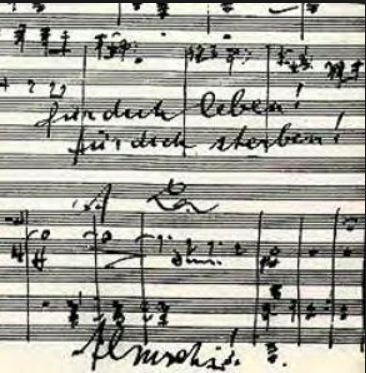
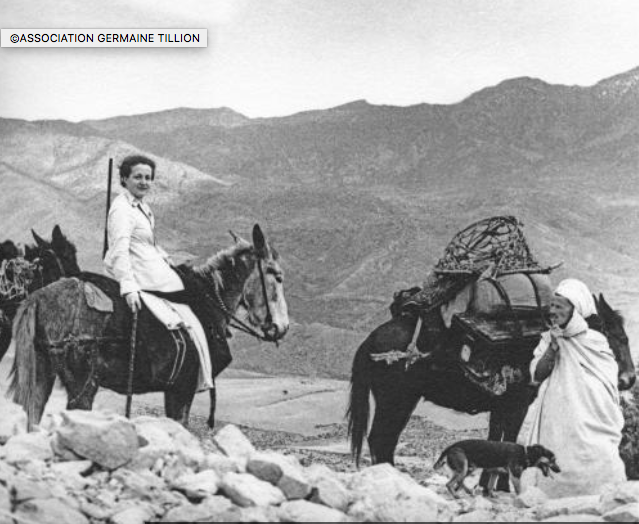
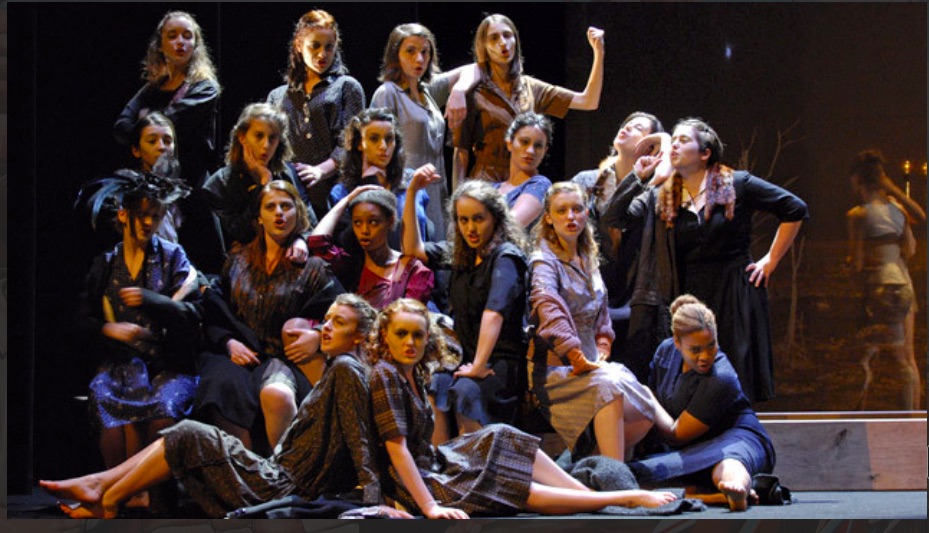


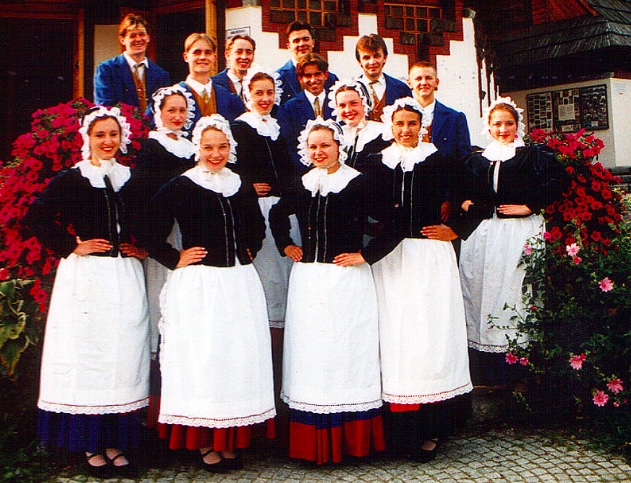


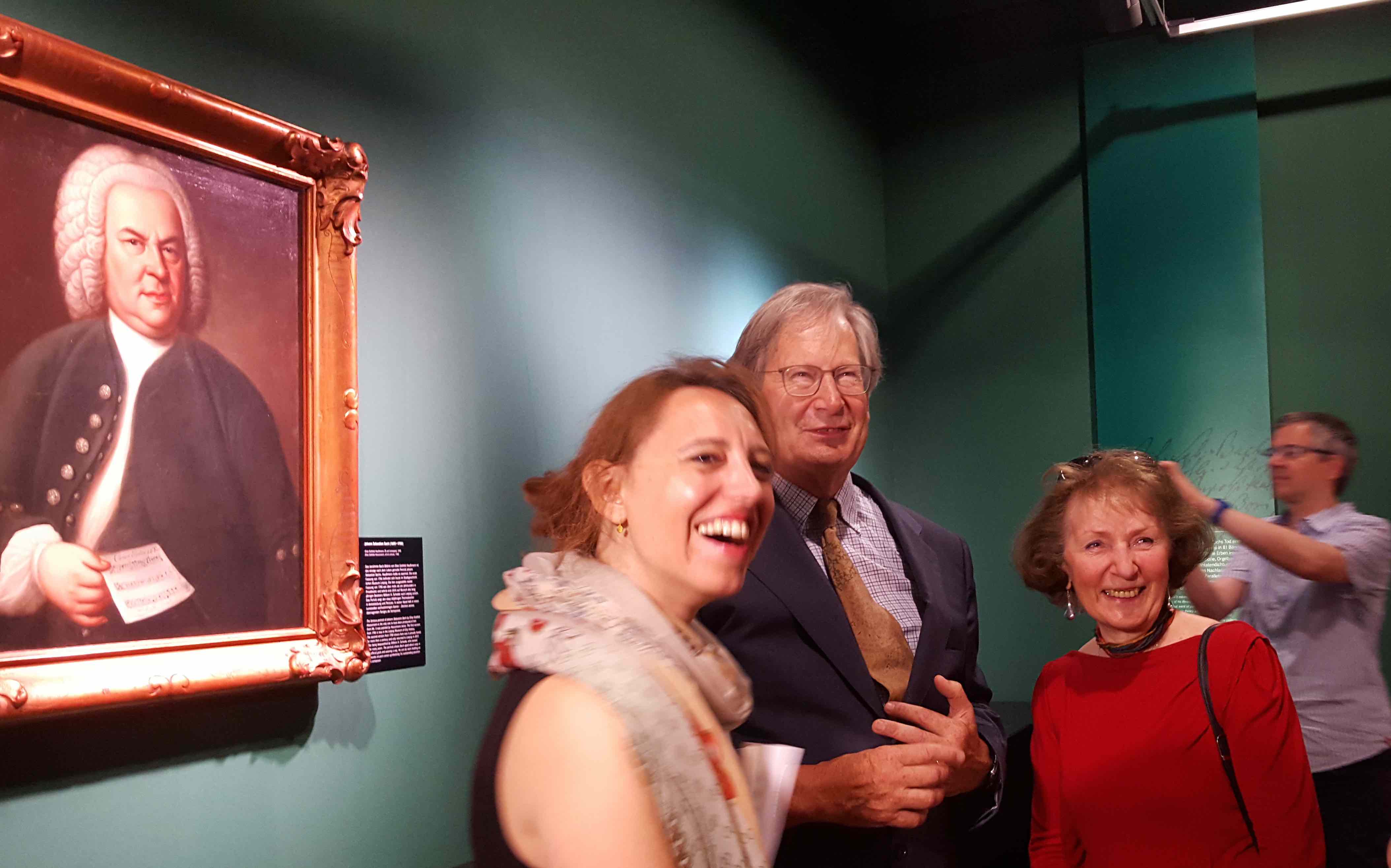


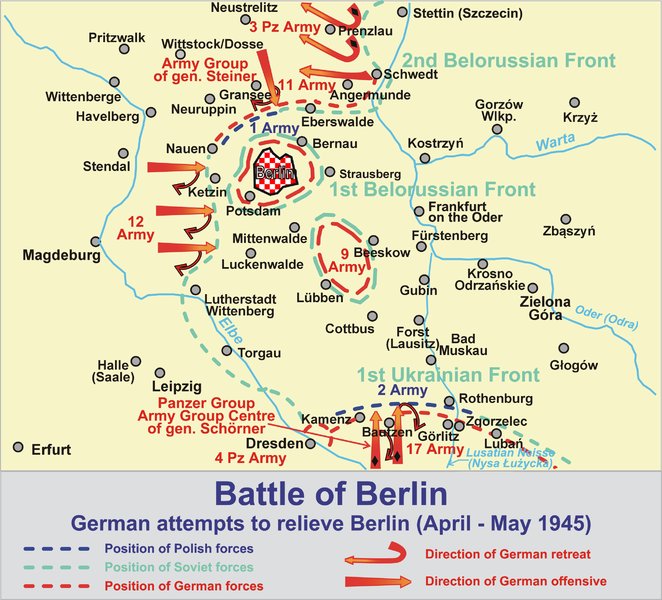








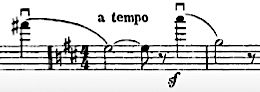
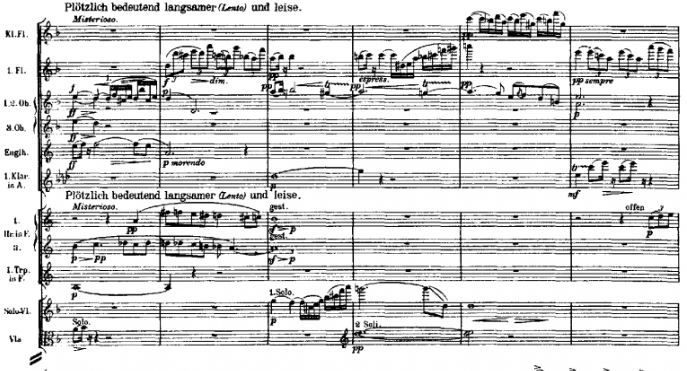
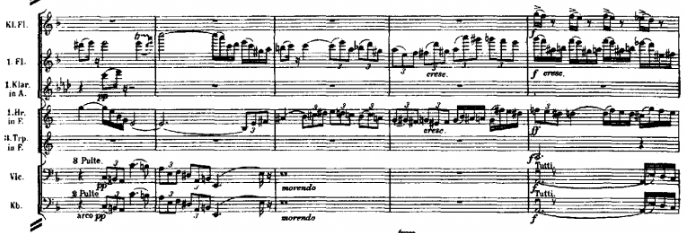


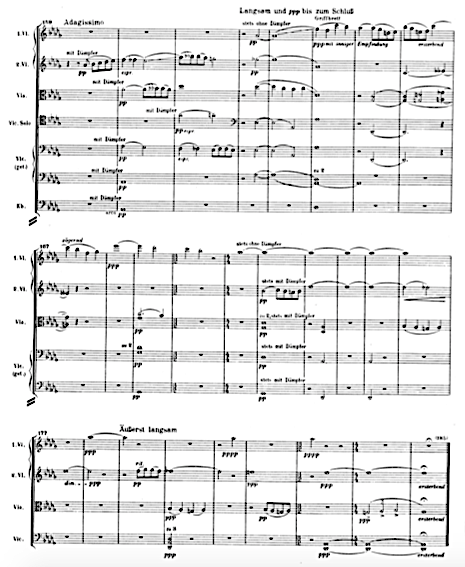


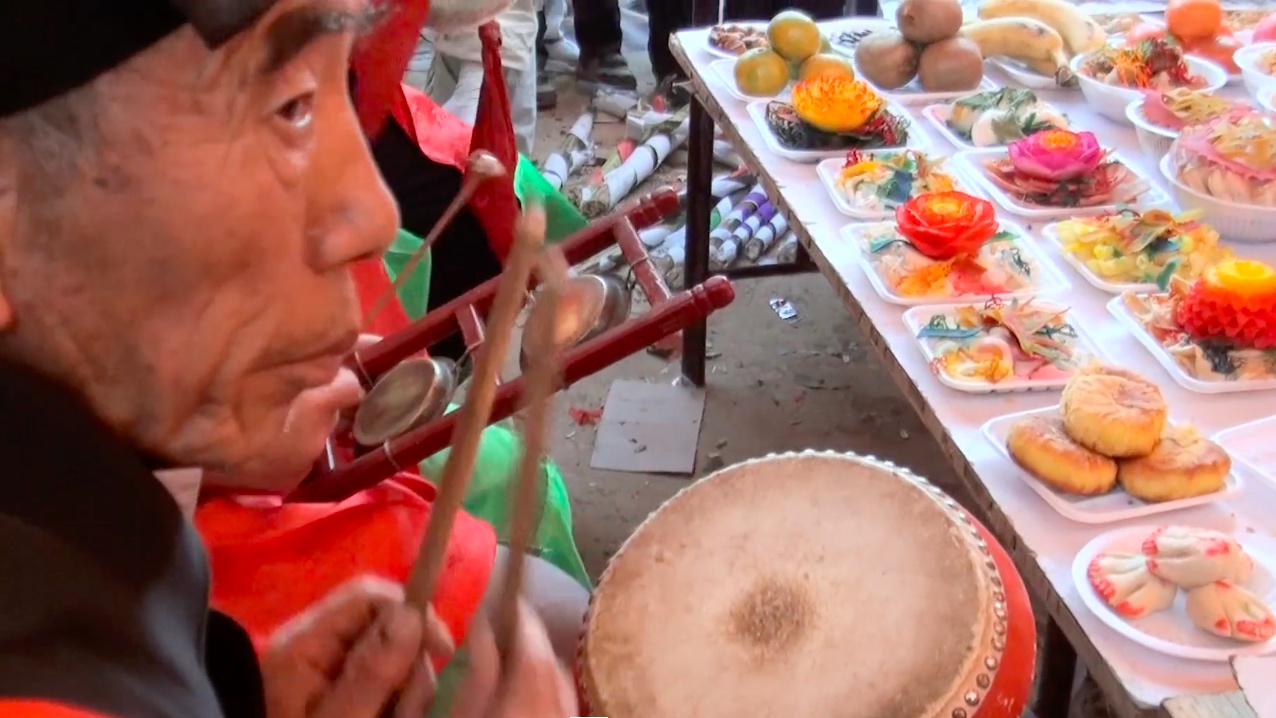


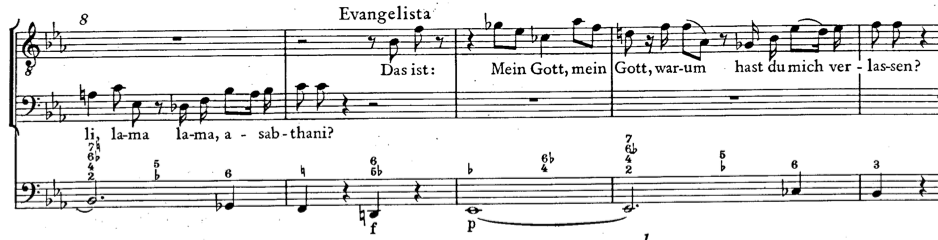




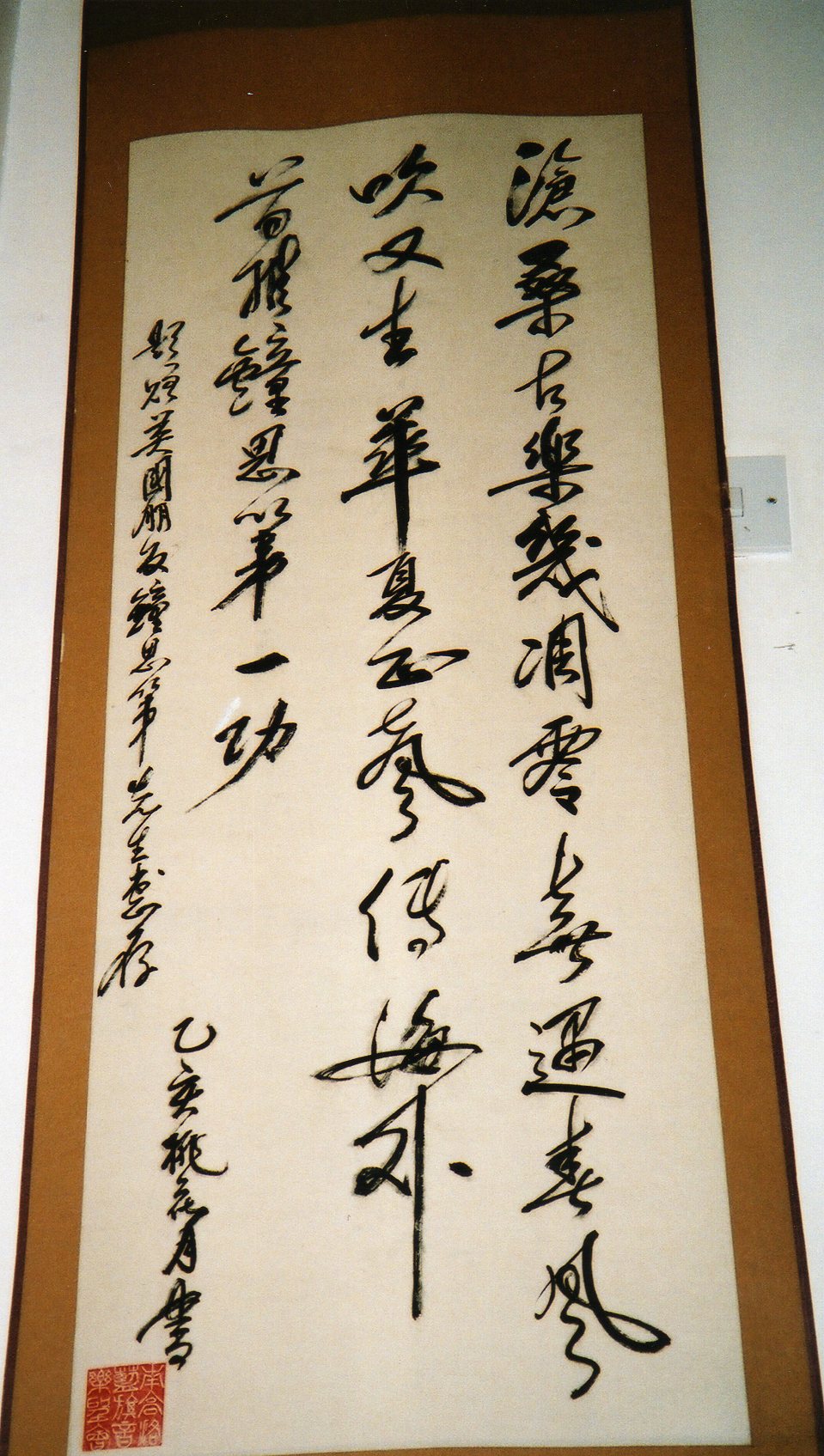
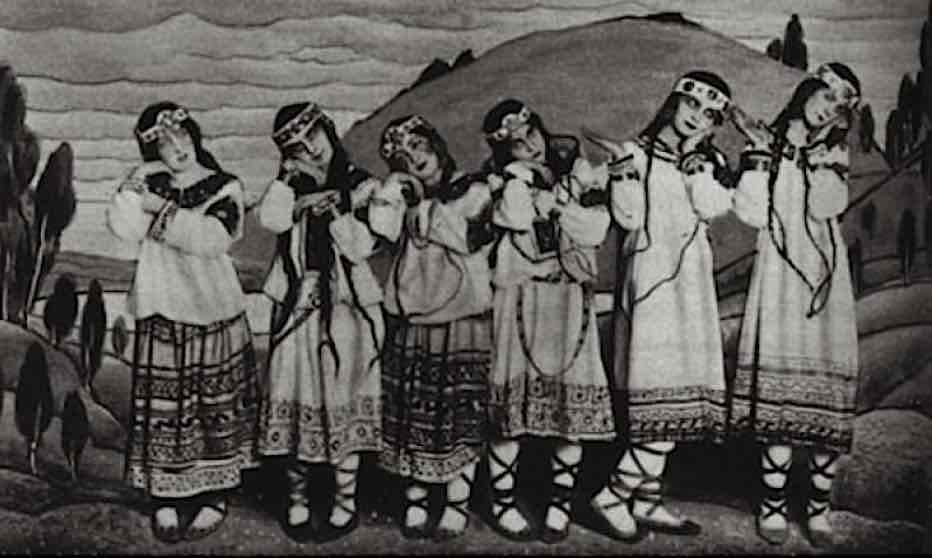




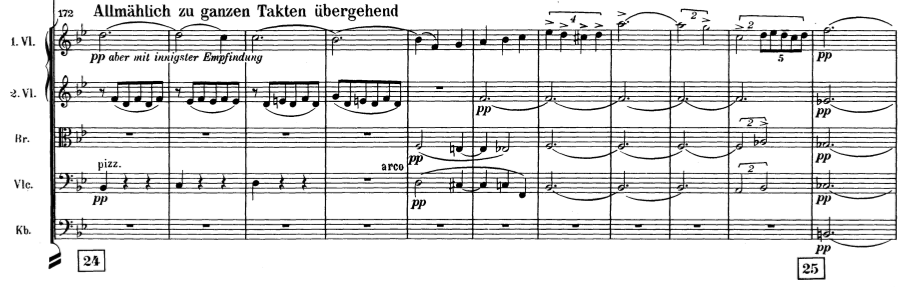


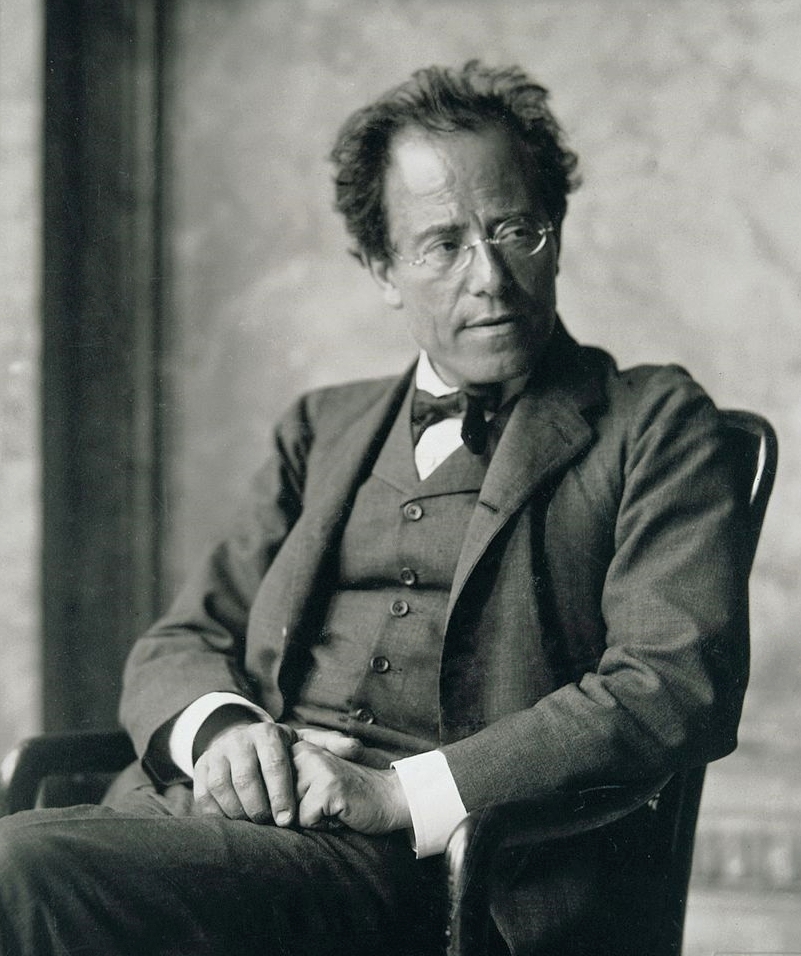

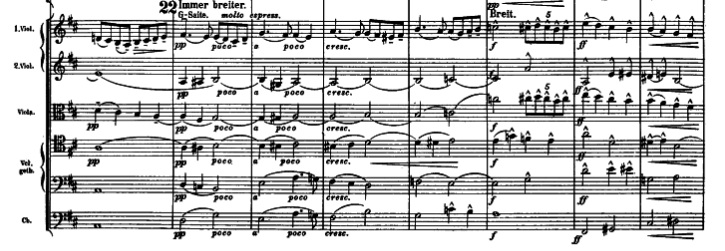





 Stephen Jones: a blog