The same journal soon elaborated on the theme of ritual under Communism in a useful special issue (11.1, 2002) edited by Rachel Harris and Barley Norton, entitled “Red ritual“. Predating the Intangible Cultural Heritage razzmattazz, which further thickens the plot, it includes chapters on carnival in the Peruvian Andes (Jonathan Ritter), god processions in Cuba (Katherine Hagedorn), spirit mediums of northern Vietnam (Norton), Uyghur mazar festivals (Harris, with Rahilä Dawut—cf. this roundup), mortuary rituals in Fujian, China (Hwee-San Tan), and the Jewish service in Communist Hungary (Judit Frigyesi).
In their cogent Introduction the editors outline approaches to ritual, the contexts and functions of “ritual music” (focusing on performance), as well as revivals and recycling. Since they mention Kundera’s polemic against the state “bastardisation” of folk culture, we might now add the movie Cold war (see Resisting fakelore). See also Shamans in the two Koreas, Madonna pilfrimage in Communist Poland; and note Maoism tag. With local ritual practices often perceived as a counter-hegemonic threat to the state and a vehicle for political resistance, such studies confirm “the failure of Communism’s modernising mission. Ritual music continues to play a central role in religious expression and has the capacity to enact social memory, to forge ethnic identities, and to both propagate and challenge political and nationalist ideologies”.
The maintenance of ritual practice under authoritarian regimes is a theme that continues to engage me. Still, I find myself ever more wary of the rubric “ritual music”. While soundscape is always a crucial element animating ritual, and some of the most apposite fieldwork on performance comes from ethnomusicology, I still wish that scholars of religion and society could naturally consider soundscape without it having to be pigeonholed under “musicology” (cf. Bigenho). If the study of ritual subsumed soundscape and society, then it would be unnecessary to create a separate niche for “ritual music”.
Presenting my film on Gaoluo at SOAS the other day, and the following discussion, thoughtfully led by Rachel Harris and Feng Jun, prompted me to try and rework some of my thoughts.
My book on Gaoluo was published in 2004, the result of frequent fieldtrips ever since 1989, and it’s full of detail on the lives of villagers through all the social and political upheavals of the 20th century. But I then moved onto other projects, and I only returned to the topic recently, to compile this film from my footage of the 1995 New Year’s rituals, which makes a nice succinct subject—and already a historical one, as I say in the film.
I see ethnography and film as essential complements to library work on imperial history (see here). This kind of subject, though vital to folk society, can’t be addressed only by reading old books in libraries. Actually, the topic hardly appears at all in old books—it’s only revealed by fieldwork. Until the 1950s almost every village in the region had an organisation like this; and many of them still do. While I eventually focused on this one village, we also did a survey of over a hundred village associations nearby (see e.g. under “Hebei” in the main menu, including this survey).
Religion The whole topic of the Hebei ritual associations was only “discovered” by Chinese musicologists in 1986, and it has become a major theme within that discipline—but alas, not in religious studies. I think there are two main reasons for this.
First, terminology. These groups are now commonly known by the umbrella term yinyuehui, which seems to translate simply as “Music Associations”. But it’s confusing: in these villages the term yinyue refers very specifically to the melodic instrumental ensemble that accompanies the rituals of Buddhist and Daoist temples. That indeed was our initial interest, but it’s only one aspect of the associations’ ritual activities, their “instrumental department”, if you like. The term does have an authentic historical pedigree, but tous (both in the West and for urban-educated Chinese) it suggests an unfortunately secular image, like some kind of folk club for entertainment, which encourages Chinese attempts (both in the media and in academia) to downplay the pervasive role of religion (or “superstition”!) in folk society. So I obstinately insist on calling them ritual associations. Despite the gradual decline of vocal liturgy in the region, associations preserve many ritual manuals. And while the melodic instrumental repertoire now dominates, many groups regard these pieces as “scriptures”.
Apart from terminology, folk religion is a sensitive subject. There are some fine scholars in China, but they mainly write about earlier history and written texts, and are cautious about documenting events since 1949, or current activity; whereas we who study expressive culture incline more towards fieldwork. At least, scholars of religion could choose a few villages to clarify the transmission (whether “Buddhist” or “Daoist”) from early temple priests, and study early artefacts such as ritual manuals (not least the “precious scrolls”) and god paintings. While it may now be hard to establish a different image to that of the ICH (see below), the system has legitimised such associations, and they are not subject to the taint of “superstition”—even if scholars of religion may choose to exercise a certain discretion about the early sectarian connections that we documented.
These associations on the Hebei plain are devotional, priding themselves on providing ritual services for their home village without payment. Their ritual sequences are not very dense, but their purpose is to appease the gods. I again put them in the context of other manifestations of religious behaviour in China (such as sects, occupational groups of household Daoists, and spirit mediums). Like my film on the Li family Daoists (which I also encourage you to watch!), this film is set in the north; the soundscapes of the two films are similar, but their social contexts are rather different.
After the end of the main film, the Appendix gives some clues to the workings of the majestic percussion suite, ending with the most moving complete rendition. This is the most convincing illustration of the inadequacy of text, audio recordings, and photos, and it shows the villagers’ deep commitment to the tradition.
All this is a good illustration of how ethnomusicology is based on society and soundscape. Ritual in performance is always animated by sound, so soundscape should always be a major element in our study of ritual. Indeed, most local traditions of “Chinese music” depend on ritual—folk-song, opera, narrative-singing, and dance. One might compare the ritual groups in southwest China studied by Helen Rees, or “song festivals” in the northwest. In Uyghur culture, the pervasive role of Islam is masked by Party propaganda on muqam. The world music industry also remoulds “Sufi music” misleadingly to highlight instrumental music.
Conflict, and the 1949 barrier Politics and social change are major themes of my book and this website. It’s always important to break through the 1949 barrier. We must take modern history seriously. The story always continues, from imperial and Republican times to the Maoist and reform eras, adapting to the changing times. People’s life stories and personalities make a revealing human window onto history and social change. Stories like those that I document—amidst campaigns, conflicts, famine, massacres, thefts—are airbrushed under the current Chinese regime.
Unlike small occupational household groups such as Daoists and shawm bands, these associations are public bodies, which the villages cadres have always played a major role in supporting.
I’m always struck by this amazing image of a former monk training disciples in a nearby village in 1959 (see here, under North Xinzhuang), just as the devastating great famine was occurring—the famine is among crucial topics that can hardly be addressed in China.
Shadows in the field I could only offer superficial responses to Feng Jun’s salient query about how I positioned myself in relation to the people and events I was documenting. It’s a major theme of the book (and of a thesis in Chinese). I was most fortunate to have two excellent fieldwork companions from Beijing, who were totally on board with studying social and religious change. It’s most important to stay in the village, and to take part in their ritual life (neither of which is common for Chinese scholars). The villagers were open in replying to my questions, which Chinese scholars hardly asked.
I never thought of making films for the public domain; I filmed strictly for my own research purposes, and only realised later that some footage could be edited into watchable films. Our visits energised the Gaoluo association, while others were declining, but transmission was a constant anxiety of theirs, and a theme of our discussions. We can now see this as a precursor of the Intangible Cultural Heritage system.
The ICH Since my last visit in 2003, a lot has happened in these villages. They’re no longer so poor. Crucial issues, everywhere, are migration, social media, state education, and the whole emptying of the countryside. And there’s no escaping the ICH system, which has influenced many such village groups. Many authors have described how the system commodifies, secularises, and reifies local traditions (see e.g. here). It’s state propaganda; most “research” under its auspices is superficial. While my film, and the book, inadvertently make a contrast with the celebratory approach enshrined by the ICH, I’m perturbed that Chinese viewers don’t seem to articulate this; they can’t read my book in Chinese, and anyway I’m not sure they would care to dwell on my different approach. With recent Chinese fieldwork dominated by the ICH, it is hard to gain a more in-depth picture.
Although the system uses “music” and “culture” as a smokescreen to downplay religious life, it works both ways; for the communities themselves, it helps protect them, legitimise them. With the tenuous survival of these groups under question ever since the 1980s’ reforms, joining the ICH made a tempting expedient for the association leaders. And faith endures, with villagers using the system to their own ends; the Gaoluo association still does funerals, and villagers still offer incense.
The village’s Catholic minority (whose brass band took part in a “demonstration” on 1st moon 15th in 1995, shown in the film) makes an intriguing sub-plot in the story. In this whole area the relationship between “Patriotic” and underground churches has long been opaque, and without a prolonged stay it would be hard to further our understanding of the shifting scene.
As with my work on the Li family Daoists, the combination of book, film, and website is most instructive.
Complementing updates by Frank Kouwenhoven in the new CHIME newsletter (subscribe here, under Newsletter) on silk-and-bamboo music, I also appreciate two further field reports from him, again written in his communicative style. First he writes on huar 花儿 song festivals in Gansu and Qinghai provinces of northwest China. [1]
Part of the wider phenomenon of shan’ge “mountain songs”, huar has long been a hot topic in Chinese folk-song studies. With his late lamented partner Antoinet Schimmelpenninck, Frank made fieldwork trips there from 1997 to 2009. Do read his substantial chapter
“Love songs and temple festivals in northwest China” in Music, dance, and the art of seduction (2013, soon also to appear on his website), which he co-edited with James Kippen—altogether a fine volume, with a particular focus on India.
In a rapidly changing society, Frank has recently embarked on a restudy, which he outlines with engaging vignettes in the newsletter.
Though huar (an umbrella term) has long been commodified, with leading singers recruited to regional song-and-dance troupes to perform on stage, [2] Frank characterises its local folk basis as part of “the universal triangle of music, sex, and religion”. As often, the study of such festivals should be carried out not only by musicologists but by ethnographers and scholars of ritual. They should also be incorporated into the thriving field of Amdo studies, [3] addressing a complex ethnic mix—Han Chinese, Tibetans, Hui and other Muslim groups, Dongxiang, Bao’an, Salar, as well as various Monguor-speaking groups. Under the current censorship regime within China, and for a region long troubled by ethnic tensions and poverty, one can hardly expect frank coverage of religion or sex—or indeed politics.
In 1993 Xi Huimin listed nearly one hundred festivals for Gansu and Qinghai (reproduced in Qiao Jianzhong, vol.1, pp.125–8); by 2013 Frank provided a map of 213 festivals in south Gansu alone (Music, dance, and the art of seduction, p.158). The largest and best-known festival is that of Lianhuashan. As he observes, the content of every festival is shaped by local needs and circumstances. Motives for attending include entertainment, contact with the gods, political affairs, and solving social problems, all closely intertwined.
Festivals are not merely places for pilgrimage, prayers, and chance encounters with strangers. They are major social events, combining markets, opera plays, disco dancing, kung fu movies, sooth-saying ceremonies, acrobatic shows, horse races, ritual processions of local gods, prayer sessions and a great deal more.
But the Chinese media
usually present these songs as a harmless form of musical entertainment, and often refer to the temple festivals in which they are sung as ‘hua’er festivals’, as if the songs are unrelated to the ritual settings, and void of religious connotations.
Still,
Some scholars who ignore or deny connections between hua’er and temple worship may do so not out of real conviction, but mainly in order to protect hua’er culture: religion is a politically sensitive topic in China, and in the past several local ritual traditions are known to have been forbidden by the authorities after details about them had been published in academic studies.
Frank also notes the Buddhist and folk-religious songs performed inside the temples, as at the Upper Bingling temple festival (pp.127–34).
As ever, it would be good to glean material on the maintenance of such local events through the Maoist decades (cf. Sparks). Even
during the Cultural Revolution, people went on singing at the risk of being arrested or attacked by Red Guards. Complete battles took place between hua’er singers and Red Army soldiers at Lianhuashan after the government had forbidden the festival there.
Frank’s chapter goes on to discuss courtship and sex, sacred singers in mythology, and fertility cults; power, authority and competition at temple festivals; and ethnicity.
Hornblowers at the head of the annual procession of the eighteen gods in Xincheng, 1997.
His recent fieldwork focuses on the festivals at Erlangshan (Minxian) and Xincheng. As in his earlier chapter, he notes how processions of the gods often result in violence. In Xincheng,
We recorded violence between three such groups at one spot near the south gate, resulting in bloodshed, chaos, people squeezing one another, and furious quarrels flaring up between individual men. A big police force had been kept on standby. It soon arrived on the scene, some twenty, thirty men including national guards, but they were unable to calm down the mob.
A bunch of daredevils had used their sedan chair as a weapon, pushing and chasing another sedan chair down the road. It was as if the gods themselves were taking up a fight. The dense crowd began to move, shouting, gesturing, and the assembled policemen were involuntarily pushed along.
Among recent changes on Erlangshan, Frank notes that some singers themselves now favour amplification:
It made their singing much louder, but obviously undermined the option for most people to join in spontaneously with a phrase or a couplet, precisely the thing that had made the whole tradition so endearing: the free-flowing exchange of lyrics, an ever ongoing battle of wits… Now, the person in a crowd holding the microphone would decide whom to give it to for a reply, with all others essentially being excluded from the sung conversation.
Frank also documented devotional songs in nearby villages. While musicological analysis is always desirable, I’m keen to see more research on the ritual aspects of these cultures in changing society.
In Minxian he also attended a grand stage show, illustrating the secularisation and commodification of local culture—leading nicely to his next topic, which I introduce here.
[1] Frank’s 2013 chapter includes a useful bibliography of works on hua’er in Chinese and English. Among publications are several surveys by Qiao Jianzhong (in vol.1 of his works), as well as studies by Du Yaxiong and regional scholars such as the folklorist Ke Yang. One should also consult the Anthology folk-song volumes for Gansu and Qinghai. Rather than the conventional rendering hua’er, I favour the form huar. Links to further posts on Gansu here.
[2] Among such “stars” of huar was Zhu Zhonglu 朱仲禄 (1922–2007), subject of several CDs (and tracks on the archive set Tudi yu ge); this documentary, though straight-laced, is representative of the official image.
At this time of year I like to rearrange the deckchairs on the Titanic by organising some of my more notable posts from the past year under particular themes. As ever, many belong under multiple tags, so below I make some whimsical choices.
Keeping company with my film on the Li family Daoists, most important is my *new film* on the 1995 New Year’s rituals in Gaoluo (Chinese review here). It also prompted me to devise a new Menu, and even a YouTube channel (with playlists reflecting my diverse tastes as well as my own films). For now I still resign myself to Twitter, but I’m posting on BlueSky too, so let’s all migrate there!
Homages to the genius of three friends who greatly inspired me:
You can find any posts I’ve neglected in the monthly Archive as you scroll waaay down in the sidebar. All this suggests that it would be a sensible New Year’s resolution for me to burden you with fewer of these ramblings—but first I plan a major series inspired by the Gaoluo film…
People like Li Wenbin and He Qing perceived no conflict between worshipping the gods and supporting Mao’s broad social goals.
My new film on the 1995 New Year’s rituals in Gaoluo prompted a recent post on the tenacity of rural tradition. Still reflecting on my fieldwork, it’s worth revisiting my remarks in Plucking the winds (pp.277–85, with minor edits) on “belief”—referring to devotional village-wide groups like those of Gaoluo
By 1995, as throughout its history, the association had a patchwork of ritual artefacts made at various times over the last century. The previously bare and unprepossessing “public building”, once fully adorned, becomes a place of great beauty, a fitting backdrop for the association’s ritual performance. But since the 1980s’ liberalisations, unlike many villages in north and south China, and indeed nearby such as Niecun just across the river, Gaoluo has not sought to build new permanent temples.
What beliefs do such artefacts symbolise? Aside from popular belief in Houtu and the God of Prosperity, formidable He Qing, always a fine source for old traditions, said the association worships Dizang, god of the underworld, as the association is said to go back to “the Tang king’s tour of hell”. Members have often said this was a Daoist association, even that Gaoluo was a Daoist village. We must understand this in the context of a dilution of the term Dao, meaning simply ritual. The senior He Yi recalls a tradition that their [melodic instrumental] music was learned long ago from Daoists (laodao), for what it is worth; perhaps a priest attached to the temple of North Gaoluo or the temple of South village. In fact, where one can distinguish, their ritual manuals have a substantial Buddhist component, and they also claim to believe in the Buddhas (fo). Fo and Dao are often interchangeable in these villages.
Screenshot
Association members themselves do not generally worship, regarding participation in ritual activities itself as a form of worship. In fact, women are altogether more prominent as worshippers, despite being excluded from active participation in the association. Incidentally, the name “music association” (yinyuehui, see here and here) seems to be used less than terms like huitong 会统 “association” and zaijiaode 在教的 “those in the teachings”. Ritual function is paramount: in discussing the activities of the association, villagers also often talk of the scriptures, with terms like “taking out”, “escorting”, or “offering up” the scriptures (chujing 出经, songjing 送经, fengjing 奉经).
Masters of the vocal liturgy: left, Cai Yongchun; right, Li Wenbin.
As to the ritual specialists, while they practise the rituals with considerable intensity, few of them claim to “believe” deeply in the gods. This is a difficult area—my efforts to elicit insights often recall Nigel Barley’s bemusement in Cameroon. Genial Shan Yude, himself a member of the “civil altar” reciting the scriptures, recalled the previous generation frankly: “Cai Fuxiang didn’t really believe, he just learned the liturgy when he was young and got attached to it, like me; he was a Party member. Cai Yongchun believed—he didn’t join the Party.” In these cases there seemed to be a certain negative correlation between Party membership and religious faith.
But it was complex, for few sought or gained admission to the Party, but many more, including Cai Yongchun, were leading participants in the revolution. Anyway, after Cai Fuxiang’s decline, his belief in the gods, or the habit of ritual, endured, but that was not the cause of his later expulsion from the Party. And there were some people, whether Party members or not, who had no time for religious traditions at all, like Shan Yude’s own father: “He didn’t believe in any gods—he was always doing things for the Party, but he didn’t join.” But throughout the area we have found leading local Communist cadres preserving the tradition of reciting their villages’ ritual manuals. People like Li Wenbin and He Qing perceived no conflict between worshipping the gods and supporting Mao’s broad social goals. Whether or not they joined the Party, people’s commitment to the new society was just one element in their psychological make-up: there was no simple correlation between religious belief and identification with the ideals of the new society.
Shan Yude also claimed “Most people in this area aren’t so superstitious, but my grandparents’ generation was more devout.” This may be broadly true: on the Hebei plain, so near the modern ideas of Beijing, faith may have declined more over the 20th century—gradually, note, not abruptly upon Liberation—than in some more remote mountainous regions of inland central China. But again the point needs qualifying. As we saw, belief was already variable among the previous generation of ritual specialists, and continues to be so today. Cai Haizeng’s father Cai Fulü practised the rituals, but with no great commitment; but now, villagers say, Haizeng is a believer, certainly more than his father. Yude himself observed, “Cai Ran and Haizeng are more devout than me. He Qing also believed, but he had a lively mind.”
Yude even admits to not believing at all, like his father. Still, if so, then he practises the ritual with utter commitment: we should distinguish belief in gods and belief in tradition, in the morality of convention. Cai Yurun made a comment that reveals the new social tolerance: “whether villagers believe or not, it’s harmless”. Though it was only officially considered harmless after about 1980, under the Maoist climate of the previous decades private worship might have become rarer, but belief was hard to assess; after all, public rituals had persisted. Very limited scientific advances and an increasingly secular climate had only partially obviated the need for the gods, and people continued to feel vulnerable.
A facile comparison with Europe springs to mind. Regional variations in industrialisation and literacy may partly explain different levels of religious belief, but within particular societies, and between generations, the situation is uneven; north Italy may generally be less “superstitious” than south Italy, but young and old people in both regions may or may not believe. Our problem for China is to recognise variation and put the supposedly dominant control of ideology in perspective. […]
Cai Yurun pointed out: “The saying goes that when they’re folded away the god paintings are just cloth, but when they’re hung out they’re gods. Don’t pay too much attention to our bullshitting normally—as soon as we Open the Altar we’re pretty serious.”
The lantern tent, New Year 1998, with new and newly-copied donors’ lists.
On pp.304–5 I observed:
As to ordinary villagers, though there are more women than men offering incense, quite few of the people are elderly: young and middle-aged women and young men seem to be more active in this. Many pray silently to the goddess Houtu for a healthy son, or for the health of their aged parents; more generally, people pray for good luck and prosperity. One couple were offering incense for the safety of the husband, who is a driver—even for the most diehard atheist, recourse to divine help is particularly tempting on Chinese roads. The atmosphere is highly jocular as people enter the courtyard. As they go to offer incense and kowtow they look embarrassed, but then when they are actually doing it they become extremely serious. Then as they get up and dust down their trousers, they look all embarrassed again, and, avoiding meeting the gaze of all the onlookers, they leave the area, often going into the “temple”.
So in many such villages over previous decades, the driving force behind the maintenance of ritual practice seems to have become not so much “religious belief” (itself an alien term) as the “old rules” (lao guiju 老规矩) of tradition. Devotional associations provide ritual as a service for the needs of the community. Under “Note on sources” in my introduction to these groups, see also my articles “Chinese ritual music under Mao and Deng” (1999) and “Revival in crisis” (2010).
Besides groups like these, this may even apply to occupational groups of household Daoists such as the Li family in north Shanxi. With the Maoist decades followed by the assaults of popular media and migration, ritual groups in some regions (including Hebei) are now further vulnerable to the secularised commodifications of the Intangible Cultural Heritage. But it would be interesting if one could somehow compare communities further south like Fujian (see under “Elsewhere” in main Menu), where religious faith appears to be a still more pervasive catalyst for popular culture. And of course faith in the gods is still evident in the popularity of spirit mediums, pilgrimages, and so on.
I’ve just made some small but important updates to my early article Ritual life around Xi’an. Besides introducing the devotional societies there, urban and rural Buddhist and Daoist temples, former rain pilgrimages, the great Daoist priest An Laixu, the lifelong research of Li Shigen, and my own visits, I’ve at last added some rare film footage unearthed by David Badagnani—all the more precious for predating the flummery of the Intangible Cultural Heritage.
To help negotiate the new Menu, the page is now under “Elsewhere”—here’s a screenshot!
Note also the series on Shaanbei in the same Menu!
Along with the Silk Roads, that reliably popular buzzword, the Mogao Buddhist cave complex outside the oasis town of Dunhuang occupies a unique position in studies of medieval Central Asia. Having thrived for a millenium from the 4th century CE as a staging post along the trade and pilgrimage route, by the 14th century Dunhuang was a backwater—until its long-hidden treasures were discovered by European explorers in the early 1900s.
Daoist priest Wang Yuanlu, who entrusted many manuscripts to Aurel Stein and Paul Pelliot from 1907. Source.
The manuscripts are written in a variety of languages, with Chinese predominating.
The soundscapes of society are important. Early caves like those of Dunhuang contain a wealth of music and dance iconography, much studied in China. Instruments * depicted there—mainly as part of ensembles—have been reproduced by Chinese scholars. Echoes of the medieval oasis-towns were heard at the court of the Tang capital Chang’an (modern Xi’an), venue for the first world-music boom (see here, and here). Yet early iconography and texts are silent and immobile (alas, the Dunhuang caves haven’t yielded any caches of A/V recordings!). ** And whereas Western performers in the modern tradition of HIP have paid attention to the sound and performance practice of medieval European music, within China attempts at recreation have yielded less palatable results (cf. Tang music), leaving too much at the mercy of the modern imagination—a bandwagon onto which composers and performers climb all too readily without undue concern for authenticity.
The unspoken issue of context deserves pondering. Early murals show idealised representations of the distinct social milieu of celestial musicians (apsara, Chinese feitian 飛天) before the gods; as in Europe, their function in a pious medieval society was far different from that in galleries and museums today. Similarly, modern sonic recreations are performed on the concert stage (cf. Bach)—a venue far removed both from those of the murals and from the diverse human contexts of traditional social musicking in ancient and modern China, whether sacred or secular.
Musical ensemble from Cave 112 (detail), mid-Tang, including zheng zither (front left). Source.
Doubtless thanks to a limited budget, it was a relief that Wei Xiaoshi adopted the modest rubric “Contemporary echoes of an ancient legacy”, making no pretence of recreating the medieval soundscape, thus avoiding the kitsch spectaculars that are rife in China.
Three accomplished solo performers performed in turn: the Uyghur Shohret Nur on rawap and dutar lutes with busy, percussive pieces from his hometown of Kashgar; the Amdo-Tibetan Ngawang Lodup accompanying his florid singing on mandolin (an instrument widely adopted in modern times by folk musicians around the world) and dramyin lutes—also featuring, to my distress, the notorious “singing bowls” (which “there is no credible historical evidence, whatsoever, of Tibetans ever having used”, in the words of Tenzin Dheden); and the innovative Chinese Wu Fei on zheng zither (whose modern version, FWIW, is remote from that seen in the Dunhuang murals) and vocals. They ended with an improvised trio that I can only describe as strange.
The audience didn’t seem to mind the tenuity of any relation with Dunhuang, ancient or modern. Rather, the concert made a pretext simply to admire the artistry of these fine musicians—from roughly the same part of the world, a millenium after the murals were depicted. Still, were one to present a concert complementing exhibits from the court of Charlemagne (e.g. here), it would hardly seem relevant to present traditional musicians from various parts of France. A millenium is a long time.
It was never going to seem suitable to air the topic of politics, but it was an elephant in the room. As Wu Fei replaced the Uyghur and TIbetan performers on stage with her polished conservatoire-stylezheng playing and vocal items, it might just have crossed one’s mind how Han-Chinese rule since 1950 has engulfed Uyghur and Tibetan societies.
Anyway, while research on medieval Dunhuang occupies its own niche, it’s always good to be reminded, however impressionistically, of the variety of living musical traditions throughout the ethnic bazaar of Central Asia, as they have evolved over time (cf. the 2002 Smithsonian festival, or this tasteful concert). For another Silk Roads concert at the BM, click here, and for a symposium, here.
* * *
Photo from German Central Asian Expedition, undated (early 20th century): shawm and percussion accompanying pilgrims (cf. the Uyghur mazar). Source.
Putting medieval iconography and modern concerts to one side, I muse idly on the potential for documenting folk expressive cultures around Dunhuang since their heyday—from the 14th century down to today. So I look forward to reading the recent compilation Dunhuang minjian yinyue wenhua jicheng 敦煌民间音乐文化集成 [Anthology of folk musical cultures of Dunhuang], comprising three volumes on folk-song, “precious scrolls“, and regional opera.
The Dunhuang region today. Source: Google Maps.
Nearby along the Hexi corridor, household Daoist groups perform rituals—for these and other living Han-Chinese traditions in Gansu, click here, and for the cultures of other ethnic groups in the Amdo region, here. For the troubled history of the Dunhuang Academy in the 1960s, note volume 2 of the memoirs of Gao Ertai. For museums and soundscape, see China’s hidden century. Posts on the Tang are rounded up here.
* A personal favourite of mine is the konghou harp, whose rise and fall were similar to that of Dunhuang itself: following the early research of Yuan Quanyou, see e.g. here, here, and even wiki.
Konghou, Cave 285, 6th century (detail).
** By a considerable margin, this beats my fantasies of discovering ciné footage of the Li family Daoists presiding over the 1942 Zhouguantun temple fair, or of the first performance of the Matthew Passion.
The wondrous truth of the Buddhas is not concerned with writings
諸佛妙理,非關文字
—Huineng
The Western vogue for Zen was already well established when I sought to learn about it in my teens (see here). Alongside the surveys of Christmas Humphreys, Alan Watts, and classics by Eugen Herrigel and R.H. Blyth, I read the works of D.T. Suzuki with an enthusiasm that I now learn was misguided. [1] But as scholarship expanded vastly, I was discovering other fields to plough, drawn towards the ethnography of folk religion in China. Lately I’ve been wondering why the two most popular Western images of Zen are so elusive in China—the koan encounter dialogues and zazen seated meditation. So I’ve resorted to the useful wiki series on Chan and Zen (see also Zen narratives, Koan, and Zazen; cf. the Stanford Encyclopaedia of Philosophy).
Research on religion (both its early textual history and its current state) is clearly quite different from “doing religion”. For historians and ethnographers, participant observation is optional; and practitioners of religion need not be versed in scholarly literature. Indeed, writing about anything is different from doing it—music, for example. I’m not exactly arguing with the concept of academia—even I am not quite so fatuous. But Chinese Chan and Japanese Zen make particularly stimulating examples of the contrast.
* * *
Early Chan patriarchs stressed a “separate transmission outside the scriptures, not relying on words and letters” (cf. early Daoist writings such as Laozi, “The way you can follow is not the eternal way; The name you can name is not the eternal name”). However, quite remote from our modern iconoclastic image of Zen, the doctrinal history of Chan is remarkably verbose and discursive. [2] This contradiction is itself the subject of much verbal analysis!
The modern Western fantasy of Zen is based on the numinous reputation of the Tang dynasty. Much of the evidence for the early history of Chan is based on the transmission texts, sermons, and doctrinal writings of leading patriarchs such as Bodhidharma, Shenxiu, and Huineng—received images of whom are based on their portrayal by Song-dynasty writers. As Mario Poceski observes (Ordinary Mind as the Way: The Hongzhou school and the growth of Chan Buddhism, 2007),
The connection with the glories of the bygone Tang era bestowed a sense of sanctity and was a potent tool for legitimising the Chan school in the religious world of Song China.
From such sources, gong’an/koan “encounter dialogues” and commentaries emerged. The early masters were prolific writers, even if some recognised the dangers: in the 12th century, Dahui Zonggao “is even said to have burned the woodblocks of the Blue cliff record, for the hindrance it had become to study of Chan by his students”. One revealing theme is the many cogent criticisms of the koan system, both within Chan and by modern scholars. Poceski again:
Although Zen is often portrayed as promoting spontaneity and freedom, encounter-dialogue exegesis actually points in the opposite direction, namely towards a tradition bound by established parameters of orthodoxy
—the masters’ exegeses reinforcing their status and authority, and impressing their literati patrons.
Popular image notwithstanding, I deduce that beyond those monks and patrons, penetrating the gnomic aphorisms of the Tang and Song masters has played only a minor role in temple routine. Conversely, Chan Buddhists have always esteemed the Mahāyāna scriptures: even in the Tang, the Laṅkāvatāra Sūtra and Diamond Sūtra were considered important texts.
Among Western scholars, Bernard Faure has an informed view of the broader picture (see e.g. Chan insights and oversights: an epistemological critique of the Chan tradition, 1993). In his Introduction to Chan Buddhism in ritual context (2003) he gives a useful survey of the field.
Chan/Zen studies are, on the whole, divided between textual/ philological and historical approaches on the one hand, and hermeneutical and philosophical approaches on the other. […] We are still lacking works considering Chan and Zen as complex cultural systems and trying to place them in situ
—this more anthropological approach “in reaction against the spiritualist tendency of traditional historiography and against historicist reductionism”. In the same volume, Wendi Adamek notes:
In the eighth century, Chan masters were no longer simply meditation masters and they had not yet become Zen masters, those enigmatic eccentrics who have made their mark in contemporary popular culture.
The modern visitor to Chinese temples may be perplexed by the apparent absence of the “Zen spirit” there. [3] But, far from some recent dilution, ever since the early history of Buddhism in China, Buddhists have put varying emphases on three types of training inherited from India: vinaya, the rules of discipline; dhyāna, meditation; and dharma, mastery of the Buddhist texts. Wiki cites McRae:
Chan was not nearly as separate from these other types of Buddhist activities as one might think […] The monasteries of which Chan monks became abbots were comprehensive institutions, “public monasteries” that supported various types of Buddhist activities other than Chan-style meditation. […] There was never any such thing as an institutionally separate Chan “school” at any time in Chinese Buddhist history.
Thus as Chan was integrated with other schools (notably Pure Land, Huayan, and Tiantai), while leading masters continued to write abstruse treatises, temple life revolved around the discipline of institutionalised religion. Once we grasp all this, the apparent conflict between early and later history becomes less incongruous.
Xuan Hua meditating, Hong Kong 1953. Source: wiki.
Modern reformist Buddhist movements are the subject of much research. Chan is at the core of the teachings of renowned masters in the PRC, Taiwan, and the USA—who are no less generous with words than their medieval antecedents, like Western pundits such as Gary Snyder and Alan Watts (cf. Krishnamurti, and Paths for the reluctant guru).
* * *
Besides the wealth of hermeneutical studies of Buddhism, one finds scant ethnographic material for normative practice—the daily lives of ordinary temple monks (whether today, in the Ming, or in the Tang). For the late imperial era, fiction may provide a useful source (cf. Ritual in the Dream of the Red Chamber).
A basic acquaintance with temple life in modern Chinese society provides the important perspective of physical diversity—from the grand, prestigious temples of cities and mountains, to medium temples with a modest staff, to small village temples with only a caretaker. Children were often given to small local temples as a means of survival; piety on the part of the parents might play a role, but spiritual concerns were often remote.
I’ll end with some impressionistic instances of usage where the term chan may mislead.
Just as chansi禪寺 refers generally to a Buddhist temple, other uses of the term chan often stand broadly for Buddhism—as in the interdenominational liturgical compilation Chanmen risong 禪門日誦. As Faure observes, ritual has long played a major part in Chan, although he doesn’t seem to address the particulars of liturgical practice (for folk Buddhist ritual, see here).
In Japan, zazen seems to be an intrinsic part of temple life; at outward-looking temples in China and abroad there has been something of a recent boom for meditation classes for laypeople (e.g. here), in response to demand. Chan meditation wasn’t limited to Chan temples, but I wonder how widely it is (and was) practised in local temples.
In temples the term chan is common in chanfang 禪房 or chantang 禪堂, which rather than “meditation room” is now just a common room or assembly room (for basic depictions, see e.g. here, and here). The term chanfang may even stand for the temple itself; found in sources from Li Bai to The Dream of the red chamber, it’s still in common parlance.
At the back of my mind in composing this post was the rough diagram that Li Manshan drew for me of the former Temple of the God Palace (Fodian miao 佛殿廟) in his home village (see Daoist priests of the Li family, pp.47–8, and our film, from 8.35), including a chanfang. Though the temple was quite imposing by the standards of a poor village, its 1876 stele lists only two monks. In many smaller temples, neither formal meditation nor scripture study are necessarily part of the schedule; the daily routine may consist largely of tasks such as sweeping the courtyard, preparing food, and maintenance. Whether or not monks regard such mundane chores as part of their Chan/Zen cultivation, in our times the idea of Zen as pervading worldly activities, from tennis to conducting, has become popular.
Meanwhile for academics, the study of Chan and Zen becomes a career, full of lectures, conferences, bibliographies; practitioners may find such erudite academic discourse alien from their own quest. And I’m just as guilty, adding yet more words on one of the most verbose sites ever. Having grown up with the romantic early image of Chan and Zen, I’m now impressed by all the scholarship unpacking its later doctrinal history. But just to reiterate my glib point, it goes without saying (sic) that historical research is very different from the quest for spiritual enlightenment, and daily temple routine is something else again—illustrating again how our image of the Wisdom of the Mystic East diverges from practice on the ground.
These are some of the issues that I haven’t yet found addressed in the extensive literature. Last word to Alan Watts:
If you are hung on Zen, there’s no need to pretend that you are not. If you really want to spend some years in a Japanese monastery, there is no earthly reason why you shouldn’t. Or if you want to spend your time hopping freight cars and digging Charlie Parker, it’s a free country.
[1] The cogent early criticisms of Suzuki by Hu Shih have been reinforced by David McMahan and John McRae; Bernard Faure describes Suzuki’s writings as “pious verbiage” (for more, see Chapter 2, “The rise of Zen Orientalism” of his Chan insights andoversights). While Alan Watts goes easy on Suzuki, I’m always impressed by his 1959 pamphlet Beat Zen Square Zen and Zen.
[2] I was drawn to this theme by a recent article in Sino-Platonic Papers (no.353!), Ming Sun, “Speaking what cannot be spoken: poetry as a solution to the ineffability in Chan rhetoric”. More generally, Adam Yuet Chau critiques the dominance of the “discursive mode” in “doing religion”.
Sun’s article also led me to “beating and shouting” (banghe 棒喝), practiced from the Tang by Mazu’s Hongzhou school, which
developed “shock techniques such as shouting, beating, and using irrational retorts to startle their students into realisation”. Some of these are common today, while others are found mostly in anecdotes. It is common in many Chan traditions today for Chan teachers to have a stick with them during formal ceremonies which is a symbol of authority and which can be also used to strike on the table during a talk. These shock techniques became part of the traditional and still popular image of Chan masters displaying irrational and strange behaviour to aid their students.
“Beating and shouting” was revived from the late Ming by Miyun Yuanwu (see e.g. Jiang Wu, Enlightenment in dispute: the reinvention of Chan Buddhism in seventeenth-century China (2008, reviewed here). I’m not familiar with the practice in modern Chinese temples (though it is introduced e.g. on Xing Yun’s site, along with copious commentaries), but it sounds somewhat akin to the enduring practice of ritualised debate in Tibetan monasteries (see under Daoism and standup).
[3] For the practice of Buddhism in modern China, note the trilogy of Holmes Welch. At a tangent is Bill Porter’s quest for the spiritual life of modern clerics and hermits.
Here I won’t extend my remit to Daoist meditation techniques, the wealth of scholarship on which is again introduced on wiki. Of course, the regulated life of Daoist temple priests also stands in contrast to the writings of early Daoist sages popular in the West.
Stéphane Denève accompanying Laurence Kilsby in Lil Boulanger’s Vieille prière bouddhique. Via Twitter.
Always enthralled by French music, at the Proms earlier this week (following the Orchestre de Paris playing Berlioz, Debussy, and Stravinsky) I went to hear Stéphane Denève conducting the BBC Symphony Orchestra and Chorus in a programme of Lili Boulanger, Fauré, and Ravel, with vocal solos by Golda Schultz, Laurence Kilsby, and Jacques Imbrailo (listen on BBC Radio 3).
Despite her sadly short life, the music of Lili Boulanger (1893–1918) has grown in reputation—her name now ranking alongside that of her sister, the influential pedagogue Nadia. The concert opened with Lili’s Pie Jesu, dictated on her deathbed to Nadia (whose 1968 recording with Bernadette Greevy and the BBC Symphony Orchestra can be heard here).
Boulanger was a pupil of Fauré, and her Pie Jesu made an apt bridge to his Requiem, at whose heart is a setting of the same text. The Requiem is so over-exposed that it deserves to be heard with fresh ears. A subjective comment: whereas for some works like the Brahms German Requiem I can overrride my youthful experience of accompanying amateur choral societies, in this case I still can’t fully engage, even if I can now appreciate Fauré’s originality.
More from both composers after the interval: Fauré’s Pelléas et Mélisande, a popular theme for composers of the day—notably Debussy, Schoenberg, and Sibelius. Then came Lili Boulanger’s Vieille prière bouddhique, with tenor and choir * singing a text translated from Pali—a “prière quotidienne pour tout l’univers” whose goal is as distant now as it was in 1917. Dominated by a somewhat portentous tritone interval, it adds to our list of fin-de-siècle orientalism.
Léon Bakst, costume design for Tamara Karsavina as Chloé, 1912. Source.
Just predating both the Boulanger pieces, Ravel’s Daphnis and Chloé (see my main page on Ravel) is exquisite. Ideally it should be heard in the complete version, but the 2nd suite makes a popular concert finale (here it was enhanced by wordless choir, usually considered too extravagant). The opening is always enchanting—I like this story (anyone have an original source?):
Ravel, when asked how it was that his famous musical evocation of sunrise had been penned by someone who never got up before 10.30am, replied, reasonably enough, “I used my imagination”.
To follow the flute solos of Pelléas and the Prière, Daphnis and Chloé is a glorious showcase for the woodwind, with Stéphane Denève at last free to conduct with balletic nuance and bacchanal abandon.
A most exquisite passage—from 5.43 in S-Simon Rattle’s live performance with the LSO here.
The Li family Daoists perform the Pardon ritual at village funeral, Yanggao 1991.
My first visit to Yanggao in 1991 began an enduring relationship with the Li family Daoists and other ritual specialists of the otherwise unprepossessing county in north Shanxi. The great Li Qing (1926–99) was the seventh generation of household Daoists in the lineage, his son Li Manshan the eighth (besides my film and book, posts are rounded up here, including More Daoists of Yanggao, and Yanggao personalities).
Earlier this year I wrote about the venerable Buddhist monk Miao Jiang, also born in Yanggao. Now, thanks to Yves Menheere, I’m intrigued to learn of another native of the county: Li Wencheng 李文成 (no relation to our Daoist lineage!), an “old revolutionary” who miraculously became General Secretary of the Chinese Daoist Association in his 60s. He has just died at the age of 97, prompting nationwide memorial ceremonies (clearly secular services!).
Focused on the PRC, the Bitter Winter website’s coverage of (abuses of) religious liberty and human rights is important, even if I sometimes quibble with its stance (such as here). To augment its obituary of Li Wencheng I’ve gone back to the (selectively) detailed interview by the Chinese Daoist Association in 2021 (and this shorter eulogy, even more conformist). Bitter Winter is indeed frosty:
The former General Secretary of the Chinese Daoist Association knew nothing about religion but was made by the CCP first into a Catholic and then a Daoist leader. […] Li was a crucial figure in the history of government-controlled Daoism. His life and career shed a light on how the CCP selects the personnel it calls to lead the country’s religious organisations.
There can be no doubt about the subservience of state religious departments to the Party. Normally I would give short shrift to such high-ranking apparatchiks; while CCP religious policy is a perfectly valid research topic, it may obscure grassroots practice. Since Li Wencheng’s life makes an intriguing contrast with those of my Daoist masters in the county, here I will intersperse his story with that of the Li family Daoists on the eve of Liberation, under Maoism, and since the 1980s’ reforms (again, covered in my book and film); as well as with that of the eminent Miao Jiang. Despite my own aversion to officialdom, my interpretation will be rather less polemical than that of Bitter Winter.
* * *
With my field experience in Gaoluo, I was keen to document the early years of revolution on the plain just south of Yanggao county-town (for the disparity between my fieldwork methods in the two sites, see here). But I never found any “old revolutionaries” there who could describe the period in detail.
One could hardly expect upright cadres like Li Wencheng to volunteer frank reminiscences of the events surrounding the trauma of land reform. But his account makes a rather more personal supplement to that of the 1993 Yanggao county gazetteer. [1]
Some sites in the partial overlap between Li Wencheng’s war years and (in red) household Daoist bases. Cf. map here.
Li Wencheng in 2021. Cool trousers, eh. Source: Weibo.
Li Wencheng was born in Gucheng village in 1927, the year after the great Li Qing. From July 1945, just before the surrender of the Japanese invaders, he “engaged in revolutionary activities” further south in Yanggao, joining the motley armed militia of 2nd district, a mere couple of dozen men. The militia was soon disbanded, whereupon he was transferred to the county lianshe 联社association (forerunner of the gongxiaoshe Supply and Marketing Cooperatives). He gained admission to the CCP in March 1946.
Ritual life in Yanggao had persisted even under Japanese occupation. A 1942 stele commemorating the Zhouguantun temple fair lists the names of five Daoists from the Li family, who dutifully “offered the scriptures”—including Li Qing, then 17 sui. Li Qing recalled, “Our ritual business didn’t suffer during the occupation—the troops, themselves devout, even made donations when they came across us doing Thanking the Earth rituals! The local bandits didn’t interfere either”. He married in early 1945; his son Li Manshan was born in 1946. Li Qing’s Daoist father Li Peixing was shot dead accidentally by Nationalist troops in 1947.
After the Japanese surrender the Communists briefly took over Yanggao town, but by autumn 1946 Li Wencheng joined them in retreating south to the hills to engage in guerilla activity when Fu Zuoyi’s forces occupied the area. Fording the Sanggan river, they traversed the mountains of Guangling and Lingqiu counties to reach safety in Fanshi. Though travelling in only two trucks, they had to take cover from bombings by KMT planes. In Fanshi Li Wencheng took part in the initial stages of land reform, training for three months in Hunyuan county-town, base of the North Shanxi district committee.
All these counties also had active groups of household Daoists, intermittently serving the ritual needs of their local communities (Guangling, Hunyuan, as well as the household Buddhists of Fanshi).
Li Wencheng’s first mission to implement land reform was doomed to failure, sent all alone to a mountain village on the very southern border of Yanggao county. In December 1947, while still involved in guerilla warfare, he was deployed to Yanggao 1st district, serving as financial assistant (cailiang zhuli财粮助理) for the imposition of land reform in Upper village (Shangbu 上堡) just north of Dongjingji.
The CCP county administration had moved south of the Sanggan river, but the district base was just south of Gucheng at Dongxiaocun, a large village of over a thousand households, its Upper Fort (where they set up) towering over the Lower Fort. But it was sandwiched nervously in between the KMT strongholds of East Jingji township, just 20 Chinese li (10 km) east, and Xubu to the west. The guerillas often had to flee from KMT cavalry raids.
Shanxi-Chahar-Hebei frontier zone, Wutai county 1st district “small team” militia. Source. Note the headscarves, archetypal emblem of the revolution.
By 1948 the Communists could look forward to victory, and the Party government was able to move back to Yanggao town. In the autumn, with Yanggao already “liberated”, Li Wencheng was sent to “support the front line” (zhiqian支前), providing supplies for the troops around the Sanggan river, Fengzhen and Jining further north, and Zhangjiakou.
Li Peisen and his wife Yang Qinghua, late 1940s?
In 1947 in Upper Liangyuan, household Daoist Li Peisen, former village chief, perhaps realising that land reform was imminent, quietly moved his family to his wife’s natal village of Yang Pagoda in the hills just south, taking his sets of ritual instruments and costumes, as well as two trunks full of scriptures handed down in his branch of the lineage. People from “black” families tended to encounter less scrutiny outside their home village. The family of Li Peisen’s wife were well-off and well connected; both he and his wife are remembered as highly intelligent. Their move was clearly an astute way of sidestepping any investigations into his background—his economic standing, and his connections with the vilified Japanese and Nationalists. Yang Pagoda might make a safer base from which to survey the lie of the land under the new regime—the potential sensitivity of practicing ritual would have been a minor issue.
Li Peisen’s cave-dwelling in Yang Pagoda village.
Anyway, Li Peisen wasted no time in displaying his political correctness. Amazingly, he now gains an honorable mention in the county gazetteer. In March 1949—just as family members back in Upper Liangyuan were being stigmatised with a “rich peasant” label—he was the very first in the whole county to organise a mutual aid co-op, consisting of three households. Li Peisen’s move to this tranquil village, and his wife’s careful assertion of local status, were to play a major role in enabling the lineage to preserve its Daoist traditions.
Most of the household Daoist traditions in Yanggao county were based on the plain just south of the county-town; in the hills further south in the county, such groups seem to have been quite few even before the 1950s (I listed some groups in my book, p.63).
Under Maoism From early 1949 Li Wencheng took up a series of administrative posts in Yanggao, then part of Chahar province, serving as secretary of county and regional propaganda departments. In 1950 he married Zeng Hua in Yanggao town. She came from East Chang’an bu village, just southwest of Upper Liangyuan. Their three children went on to find work further afield, whereas Li Wencheng’s four siblings continued tilling the land in Yanggao.
By 1952 Li was assistant editor of the financial team of the Chahar Daily, but later that year Chahar province was abolished and he was transferred to Beijing with over twenty other journalists, where they found themselves under-employed. With two others he was soon selected for the Religious Affairs Department of the Cultural and Educational Committee of the State Council. For six months in 1954 he was trained in “religious history, religious policies, and the domestic and foreign religious situation”. He then took part in a study class for Catholic clergy in the Church of the Saviour (Xishiku) in Beijing, along with over a hundred priests and bishops. As he recalled, they mainly studied patriotism and anti-imperialism, on the basis of articles opposing religion by Fang Zhimin 方志敏, a Red Army military commander executed by the KMT in 1935. Whatever the truth of the incident leading to Fang’s execution, [2] this hardly made a promising introduction to the subject. Li Wencheng now worked loyally for the Chinese Patriotic Catholic Association and the Religious Affairs Bureau. Bitter Winter:
By his own admission, he was a Marxist who knew precious nothing (sic) about religion.
But in contrast to all the detail on the War of Liberation, the interview has a typically glaring lacuna between 1954 and 1984. Through successive political campaigns, even Party loyalists had to be very cautious; serving as a cadre was an unenviable task that could easily lead to labour camp, even before the violence of the Cultural Revolution. The interview doesn’t broach Li Wencheng’s duties in monitoring Catholicism through the 1950s and early 60s—a stressful period. After the arrest and imprisonment in 1955 of Bishop Gong Pinmei along with several hundred priests and Church leaders, the official Chinese Catholic Patriotic Association was founded in 1957, marking a schism with the Vatican, but underground house-churches continued to function. Nor does the article mention Li Wencheng’s experiences during the Cultural Revolution. We may never learn the story of how he weathered the period.
The Catholic church, Gaoluo (just south of Beijing)—built in 1931, destroyed in 1966. The village’s Catholic families maintained their faith through the decades of Maoism, reviving since the 1980s but still resistant to the “Patriotic Church”.
Back in rural Yanggao, Miao Jiang (b.1953) came from a devout Buddhist family in West Yaoquan village, somehow maintaining his faith through campaigns, having his head shaved in Datong to become a monk at the extraordinary time of 1968.
While the Li family Daoists kept performing after Liberation, encroaching collectivisation led to ever more desperate poverty, and by 1958 Li Qing was happy to take a state job in the North Shanxi Arts Work Troupe based in Datong city, even though their tours of the countryside were tough. He returned home when the troupe was cut back in 1962, after the worst of the famine. Despite a brief revival, Daoist ritual was silenced by 1964, and through the Cultural Revolution the Li family lived in fear, vulnerable by virtue of their “black” class background.
Even less palatable for a Party stalwart like Li Wencheng would be sectarians and spirit mediums, many of whom somehow maintained clandestine activity under Maoism despite campaigns to suppress them soon after Liberation. In Yanggao, village adherents of the Bright Association (Minghui) and Yellow Association (Huanghui) recited lengthy “precious scrolls” as part of rituals for their own followers; the leader of one such group even transmitted the liturgy to his teenage son early in the Cultural Revolution. Since the death of Mao and the downfall of the Gang of Four, both sectarians and mediums revived, broadly tolerated by the local authorities.
Since the reforms
Miao Jiang has been based at the Buddhist mountain complex of Wutaishan since 1980, as the mountain opened up to a massive reinvigoration of “incense fire”after the depression of the Maoist era. His devotion to restoring temple life there was soon recognised as he was fêted with official titles.
But in utter contrast to Li Wencheng, he has remained aloof from worldly affairs: his allegiance has always been to the dharma, and any organisational responsibilities grew out of his faith. Eschewing the lifestyle of official banquets, he adheres to a simple Buddhist diet, while sponsoring charitable and relief projects. Still, religion needs organisers…
The Li family Daoists had begun to resume activity from around 1980 (see Testing the waters, and Recopying ritual manuals), and were soon busy “responding for household rituals”. In autumn that year, Li Manshan took his first train trip to Beijing, with his cousin Li Xishan. They wanted to buy a sewing machine, not available (or at least substandard) in Datong, but in the end they couldn’t find a good one in Beijing either—so Li Manshan bought a big bag of socks instead.
As Li Wencheng recalled, as he approached his 60th birthday he was expected to retire. But somehow in 1986 he was chosen to serve as General Secretary of the Chinese Taoist Association. Though at first reluctant, being in good health he was happy to keep working. He stayed in the post for thirteen years until retiring in 1999.
Fourth conference of the Chinese Daoist Association, 1986. Source.
Through his early years around Yanggao, first as guerilla, then as cadre, Li Wencheng can hardly have had any contact with folk ritual activity—and like his comrades, had he chanced upon it, he would surely have disdained it. Once on the Party ladder in Beijing the only experience he gained of religion was overseeing CCP policy towards Catholicism. While many devout and prestigious Daoist and Buddhist clerics were recruited to official religious bodies after Liberation, they were often “mobilised” (coerced) as figureheads.
Li Wencheng now found himself responsible for state policy towards Daoism at a time of a spectacular religious revival (for a fine study of the grassroots revival in Fujian, click here). He helped found the Chinese Daoist Academy and the magazine Zhongguo Daojiao, mouthpiece of Party policy; he re-established the system of ordination in Beijing and elsewhere, working with Wang Lixian 王理仙, respected abbot of the Eight Immortals temple in Xi’an. But he doesn’t mention the great Min Zhiting, who was also summoned to the White Cloud Temple around this time (cf. Zhang Minggui, abbot of the White Cloud Temple in Shaanbei, whose efforts to maintain worship on the mountain ever since the 1940s have always involved negotiating local politics).
In 1990 Li Qing led a group of his Daoist colleagues to perform at a major festival of Buddhist and Daoist music in Beijing. The Li family Daoists were lodged in the White Cloud Temple along with several other Daoist groups from elsewhere in China invited for the festival, doing five performances (not rituals) for private invited audiences over fifteen days in the temple and at the Heavenly Altar. Some apparatchiks were opposed to the event, but influential senior ideologues like He Jingzhi and Zhao Puchu supported it. In the end, the Religious Affairs Bureau and the Chinese Daoist Association must have been among the official bodies sponsoring the festival. I wonder if Li Wencheng attended—would he have been curious to encounter Daoists from his old home of Yanggao, or would he have distanced himself from such household ritual specialists?
And I wonder how often he returned to Yanggao to visit his siblings and their children. For funerals there since the late 80s, it has again become routine to hire Daoists to perform rituals—events that Li Wencheng’s relatives would doubtless often attend.
Great Open-air Offering ritual, White Cloud Temple, Beijing 1993. Source: Weibo.
Another comment in the Bitter Winter article that I find rather too stark: perhaps not exactly that Li Wencheng “used Daoism to spread CCP propaganda in Hong Kong and Taiwan”, rather that Daoism could indeed make a useful tool to further diplomatic rapprochement. To this end a significant step in 1993 was his organising of a Great Open-air Offering (Luotian dajiao 罗天大醮) ritual at the White Cloud Temple, bringing together Daoist priests from temples around the PRC—with representatives from Hong Kong and Taiwan. Clips can be found online, such as this by the Daoists of the Xuanmiao guan temple in Suzhou.
In 2015, for the 70th anniversary of victory in the War of Resistance against Japan, Huang Xinyang (left), Deputy Chief of the Chinese Daoist Association, presented Li Wencheng with a commemorative medal. Source.
2018: Li Manshan with Shi Shengbao (b.1948), ritual director of Yangguantun village, Yanggao.
* * *
Li Wencheng’s responsibility in later life for marshalling CCP policy towards Daoism was quite serendipitous. Bitter winter again:
What is most interesting in this biography is that Li changed religions as others change shirts. He was first non-religious, then Catholic, then Daoist.
Interesting indeed, but the comment is somewhat misleading. Li Wencheng was surely never “religious”, and his task of monitoring Catholicism and then Daoism didn’t imply “belief”, any more than it does for ethnographers of religion; no conversion was involved (and anyway, Buddhist and Daoist deities can happily coexist in folk pantheons!). The article goes on:
This did not really matter since his job was to serve the CCP, not religion. He was sent to different religious organisations to “implement the Party’s religious work policies”. He was a typical example of the bureaucrats the CCP selects for the five authorised religions. Many of them do not believe in God or religion. They are there just to control religion on behalf of the Party.
Most appropriately, the official press release celebrated Li as somebody whose life was “an unremitting struggle for the cause of Communism”—not of Daoism or any other religion.
The Party’s efforts to control temple clerics were extensive, and effective; Buddhism was always based mainly in temples, and temple-dwelling Daoist priests too could be efficiently overseen too. But the life of Daoism depended less on temples, and the countless household Daoists throughout the countryside were harder to control—even if Li Wencheng was doubtless involved in the successive efforts to register them.
* * *
One could find similar grassroots religious activity in the home county of any secular Party apparatchik (all the way up to Chairman Mao and his Hunan origins)—I’ve just given these vignettes from my experience of Yanggao. The Li family Daoists remain busy performing rituals in the nearby villages; Miao Jiang, a devout Buddhist since his early youth, found himself becoming a revered master on Wutaishan; Li Wencheng, who never had any sympathy with religion, somehow ended up overseeing major Daoist projects from his Beijing office.
Conversely, Party overseers often lament cadres’ persistent adherence to “feudal superstition”. At the local level, it is perfectly routine for village cadres to consult household Daoists (like Li Manshan) or spirit mediums to “determine the date” or identify an auspicious site; some such cadres may even be ritual specialists themselves. But cadres higher up the Party ladder too may consult “superstitious practitioners” (e.g. here).
Even among those who were earmarked to represent Party religious policy, we find a range of ideology. Some, like Li Wencheng, were entirely secular in their thinking, their sole mission to serve the Party. Temple priests invariably have to pay lip service to the CCP cause; like the broader population, they are used to compartmentalising public and private spheres. Back in the countryside, “faith” may play a certain role for some household Daoists (such as Jiao Lizhong in Hunyuan) but for others it is a minor issue, compared to the mundane exigency of feeding their families while serving the local community.
As evoked movingly in Tian Zhuangzhuang’s 1993 film The blue kite, everyone was trying to survive, subject to the whims of Party campaigns. Some were able to escape the poverty of rural life by finding an “iron food-bowl” with a Party career, while others remained tied to the land and its rituals. Both were common trajectories. And both the CCP and religious observance, in all their diverse manifestations, are part of the fabric of life in China.
[1] Though I haven’t yet found Li Wencheng’s name in the county gazetteer, it’s a useful source for both the civil war and “revolutionary heroes”, with considerable detail on the period (mainly on pp.15–20 and 50–54), which I haven’t attempted to collate with Li’s own account.
Today is the Ghost Festival in China, so I’ve been reflecting on calendrical rituals (further to my In search of the folk Daoists of north China, pp.7–8). Usually I draw attention to ritual days, but this seems to be one that I’m inclined to downplay.
Yankou at Xujiayuan temple fair, north Shanxi 2003.
As one of the Three Primes (sanyuan三元) over the annual calendar, the Ghost Festival (Guijie 鬼节, formally Yulanpen jie 盂兰盆节) on 7th moon 15th seems like a major event (see e.g. Stephen Teiser, The Ghost Festival in medieval China). On this evening, groups of temple clerics (both Daoist and Buddhist) still hold Flaming Mouth rituals (yankou, shishi) to exorcise the community, although they were surely performed more commonly before the pervasive impoverishment of temple life over the 20th century.
There’s an extensive Chinese literature on this complex, lengthy Tantric ritual, but the Ghost Festival is far from its only context—besides other temple fairs over the annual cycle, it is (or was) routinely performed for funerals (see many posts under Local ritual).
Notwithstanding the importance of the Ghost King (Guiwang) and the Ten Kings of the Underworld (Shidian Yanjun) in village pantheons, in my experience of rural north China, 7th moon 15th is not (or is no longer?) a major day for rituals with liturgists presiding. Perhaps its liturgical importance varies by region; I’m not sure it depends on the community still having a viable temple, since ritual buildings can be re-activated for important ritual purposes. In my DVD Doing Things on ritual life in north Shanxi, §B5 has brief excerpts from a yankou performed by Buddhist monks for the “main day” of their village temple fair—which falls on 7th moon 3rd, not 15th.
Worshipping the ancestors, Xinzhou 7th moon 15th 1992.
What does endure is the custom of domestic offerings, burning paper at the ancestral graves, as we found in 1992 in Xinzhou on our trip through north Shanxi. Neither there nor in Yanggao is it a day to summon household Daoists to perform rituals.
The Zhaobeikou ritual association leads Releasing Lanterns ritual on Baiyangdian lake,
7th moon 15th, 1993.
For village associations on the Hebei plain, 7th moon 15th may have become less of a focus for communal observance over the 20th century. But the aquatic setting around the Baiyangdian lake (click here) prompts village ritual associations there to go on procession to “Release River [or Lotus?] Lanterns” (fang hedeng 放河/荷燈). Similar rituals are held in nearby counties such as Langfang. in Bazhou, the Zhangzhuang association, with its active group of liturgists, was one of few still performing yankou on the 15th. The association of Lesser Huangzhuang, Jinghai, performed Releasing God Lanterns (fang shendeng) on 1st moon 15th and Releasing Ghost Lanterns (fang guideng) on 7th moon 15th. Around Houshan, the major days to worship the goddess Houtu are 3rd moon 1st and 15th, but 7th moon 1st and 15th also attract many pilgrims.
So we may come across a range of exorcistic behaviour on 7th moon 15th: from burning paper at the ancestral graves, to processions Relasing the Lanterns, to full-scale yankou rituals.
As to the other days of the Three Primes, 1st moon 15th is the day around which the main annual rituals revolve (whereas only domestic offerings are made on New Year’s Day—e.g. Gaoluo); the ritual segments performed are exorcistic, like those for 7th moon 15th. But (again for north China) I haven’t heard of major communal observances for 10th moon 15th—leads welcome…
Anyway, the ritual days of the standard national calendar may arouse false hopes, requiring verification on the ground; once one gets down to the grassroots, other dates may require important calendrical rituals for local deities. In south China, even the major liturgical days of the 1st moon vary by locale. This is a significant fieldwork lesson: to see beneath the tip of the iceberg of temple practice and prescriptive history to digest folk observances at the grassroots (cf. Debunking “living fossils”).
Like Beijing nearby, the municipality of Tianjin encompasses a large region, much of it still rural. On ritual and its soundscapes there, my previous articles include
which as ever contain substantial material on ritual traditions. To remind you of my introduction to a similar recent survey for Fujian province in southeast China,
Ritual pervades all genres of folk expressive culture: in the Anthology, it is a major theme of the volumes for folk-song, narrative-singing, opera, and dance. In the instrumental music volumes, even genres that lack explicit liturgical content are also invariably performed for ceremonial occasions—but a further reason to consult them is that the specific rubric of “religious music” has been consigned there. I’ve described the flaws of the Anthology project in my
“Reading between the lines: reflections on the massive Anthology of folk music of the Chinese peoples”, Ethnomusicology 47.3 (2003), pp.287–337.
Apart from the Anthology‘s valuable Monographs for opera and narrative-singing and brief textual introductions to genres, its volumes consist mainly of transcriptions, of limited value without available recordings. Conceptually its classifications are rudimentary, but it opens up a world of local cultures.
It’s important to grasp the geography of the large regions covered by such surveys (cf. Layers of fieldwork). At the time of compilation the greater Tianjin municipality comprised four suburban areas (east, west, south, north), five counties (Wuqing, Jinghai, Ninghe, Baodi, * Jixian), and three districts (Tanggu, Hangu, Dagang), all of which had distinctive local traditions.
Useful as always are sketches of some leading groups (pp.1327–39) and brief biographies (pp.1340–56), containing promising leads to further ritual associations and sects.
Volume 1 is entirely devoted to “drumming and blowing” (guchui yue 鼓吹乐). Here the rubric of “Songs-for-winds associations” (chuigehui吹歌会) is misleading (see under Ritual groups of Xushui), compounded by the sub-categories of leading instrument (guanzi, suona, sheng, dizi). While many musicians are versatile on wind instruments, this masks the important distinction between occupational shawm bands and devotional ritual associations led by guanzi. However, there is some valuable historical information bearing on the “classical” style of amateur ritual groups (often known as “music associations” yinyuehui) serving ritual, such as the Tongshanhui 同善会 of Huanghuadian in Wuqing county (p.1336; brief mention here, under “Further leads”). Such groups were to become my main focus (see Menu, under Hebei and Gaoluo).
Nao and bo cymbals of the Tianxing dharma-drumming association, inscribed Xuande reign, 5th year (1429). Besides museums, folk performing groups preserve important evidence for the material culture of imperial China (see China’s hidden century).
Shawm bands always occupy a substantial part of the Anthology coverage. Here the summary introduces traditions for all the municipality’s regions, notably in the north around Baodi and Jixian (pp.36–8, 41–2; groups pp.1338–9, biographies p.1343–4, 1355).
The “great music” of Tianjin.
Still under the heading of “drumming and blowing”, a separate rubric introduces the imposing “great music” (dayue大乐, though here I seem to recall it should be pronounced daiyue) of the Tianjin region. These shawm bands, derived from the Qing court (cf. longchui and Pingtan paizhi in Fujian), were transmitted among the folk through the Republican era until the 1950s, mainly in urban districts but also in the suburbs; but later they became largely obsolete, so the Anthology fieldwork was largely a “salvage” project.
The impressive introduction (pp.599–610) refers to documents from the late Qing, including material on the “imperial assembly” (huanghui皇会), supplementing that of the dharma-drumming associations), and details the use of the genre at weddings and funerals. Besides recordings made for the Anthology in the 1980s, the appetising transcriptions (pp.611–78) utilise early discs that I’m keen to hear—Pathé (Baidai) from 1908 and the 1920s, Shengli 胜利 from the 1930s. Cultural cadres recorded senior artists in the 1950s and even “in the mid-70s”. By the 1980s, surviving musicians were recorded for the Anthology, and took part in the Boxer movie Shenbian神鞭 (Holy whip, 1986).
Shifan band, 1930s.
Volume 2 opens with an introduction to the mixed ensemble shifan十番 (text pp.679–701, transcriptions pp.702–875; further material on the late Qing societies Siru she 四如社 and Jiya she 集雅社 on pp.1327–8). Related to the better-known genres of south China, notablyJiangnan, shifan bands are also found in a few northern regions including Hebei (see my Folkmusic of China, pp.206–8). In Tianjin, where shifan was part of the thriving Kunqu scene before Liberation, the major figure in documenting the tradition was Liu Chuqing 刘楚青 (1909–99) (pp.1341–2), who used his youthful immersion in the culture to compile a major volume in 1987.
Notable among percussion ensembles (pp.876–1138) arethe dharma-drumming associations (fagu hui法鼓会), which my mentors at the Music Research Institute (MRI) in Beijing were excited to discover in 1986 and 1987 while attending major folk music festivals in Tianjin. These groups commonly subsumed a shengguan melodic ensemble—from the 1986 festival, listen to the MRI’s audio recording of the Pudong “music and dharma-drumming association” in Nanhe township, Xiqing district 西青南河镇普东音乐法鼓会. These events led us to the fieldwork of local scholars—notably Guo Zhongping 郭忠萍, author of the valuable overview in the Anthology (pp.876–97; transcriptions pp.898–1009; see also groups pp.1328–34 and biographies pp.1347, 1349), based on her more detailed early publication Fagu yishuchutan (1991).
This section also introduces the percussion of “entertainment associations” (huahui花会): “flying cymbals” (feicha飞镲), stilt-walking (gaoqiao高跷), dragon lanterns (longdeng龙灯), and flower drum (huagu花鼓).
“Religious music” As always, despite my criticism of the term, this is a substantial category in the Anthology, subsuming some major traditions of Buddhist and Daoist ritual.
Jinmen baojia tu shuo (1846).
For major insiders’ accounts by temple clerics Zhang Xiuhua and Li Ciyou before and after the 1949 “Liberation”, see n.1 here, leading to Appendix 1 of my book In search of the folk Daoists of north China and the research of Vincent Goossaert.
Daoist band, Tianjin. Tell us more…
For “Buddhist music” (pp.1141–52) and “Daoist music” (pp.1274–9) the introductions can only serve as a starting point for more sophisticated fieldwork—like the transcriptions (pp.1153–1273 and 1280–1326 respectively). There are slim pickings here—although the section on Daoist temple music provides a remarkable vignette from 1972 (!) on a Pingju opera musician’s visit to Zhang Xiupei 张修培, elderly (former?) abbot of the Niangniang gong temple, to notate his singing for the purposes of “new creation”. This section also introduces Li Zhiyuan 李智远 (1894–1987) of the Lüzu tang and Tianhou gong temples; though laicized after “Liberation”, from 1985 he was able to support the renovation of the Lüzu tang. More promising are the rural areas, where there are always household Daoist bands to explore. The transcriptions end with three items of vocal liturgy from the Western suburbs (pp.1313–26): the popular “Twenty-four Pious Ones” (Ershisi xiao 二十四孝), the “Song of the Skeleton” (cf. the Li family band in north Shanxi), and Yangzhi jingshui 杨枝净水.
The accounts of many folk groups offer glimpses of the sectarian connection. In Yangliuqing township (known for its nianhua papercuts), the Incense Pagoda Old Association (Xiangta laohui 香塔老会, above) of 14th Street (which we visited all too briefly in 1989) had scriptures including Hunyuan Hongyang baodeng混元弘陽寶燈 and Linfan jing临凡經. Tracing their transmission back eleven generations to the Wanli era (1572–1620) of the Ming dynasty, they have remained active exceot for the hiatus of the Cultural Revolution. In the western suburbs the Tianxing dharma-drumming association (pp.1331–2) belonged to the Tiandimen sect, and groups in Dagang district (p.33) also derive from Tiandimen and Taishangmen sects.
For all its flaws, the Anthology remains a valuable resource; but as ever, the groups introduced there call for fieldwork from scholars of folk religion as well as musicologists.
* Rural Baodi is known to Beijing musicologists and other intellectuals for its “7th May Cadre Schools” (Wuqi ganxiao 五七干校), wretched sites of exile during the Cultural Revolution—for scholars of the Music Research Institute at Tuanbowa (Jinghai), scroll down here.
Master Miao Jiang, Wutaishan through successive regimes, and religious life around Datong under Maoism
I got to know the Buddhist monk Kuan Guang 宽广 (b.1974) while he was doing his PhD at SOAS—guided by Tim Barrett—about the mountain temple complex of Wutaishan, epicentre of Buddhism in north China, where he trained.
Originally from Baoding south of Beijing, he is blessed with a calm and benevolent nature—such as one doesn’t always find among clerics, or indeed among the household ritual specialists whom I have consulted in north China. In addition, his deep, sonorous voice conveys his authority and wisdom.
So it’s wonderful to catch up with him. Apart from furthering his research on the history of Wutaishan in the Ming dynasty, he has created the Qingliang Buddhist Centre at a former church in Peckham, south London. Inspired by his venerable master Miaojiang 妙江法师 of the Bamboo Grove temple 竹林寺 on Wutaishan, Kuan Guang has undertaken this complex enterprise in the spirit of “expedient means” (Sanskrit upāya, Chinese fangbian方便).
* * *
In both old and new societies, entering the clergy was often ascriptive, rather than a spiritual choice; poor families would routinely give a young son to a local temple as relief from adversity. However, in the case of Miao Jiang, his parents (surnamed Liu) were devout lay believers (the following account is based on this online biography; in English, see here).
Liu Jiang (his original name) was born in 1953 in Yanggao county (home of the Li family Daoists!) just east of the grimy coal city of Datong, in West Yaoquan village in Gucheng township. * The daily domestic worship of his family environment made a stark contrast with the escalating political campaigns of the 1950s. When he was only 3 years old, his parents, busy with agricultural chores for the collective, sent him to a nearby temple, where his master Chang Rong 常荣, himself only 15, lavished exceptional care on his bright young disciple.
In 1959, just as food shortages were becoming desperate, Liu Jiang’s mother took him to Datong to pledge allegiance at the Shanhua temple 善化寺. ** While receiving a rudimentary secular education at his village primary school, he prudently refrained from divulging that he was devoting most of his energies to his parallel cultivation of the dharma—praying with his mother before the family shrine, studying Buddhist texts such as the Pumen pin普门品 scripture, and learning to recite the Dabei zhou大悲咒 mantra. At a time when villagers were desperately foraging for food, when the meager crop from the autumn potato harvest was being divvied out among the brigade team, he would only take home his share after the others had chosen the best ones. As he later recalled, “I would eat whatever Old Budda Elder ate” (老佛爷吃啥我吃啥).
Lin Huiyin, architect wife of Liang Sicheng, Wutaishan c1937. Source: Sixth Tone.
In Datong after the Japanese occupation and civil war, the extensive buildings of the imposing Upper and Lower Huayan temples 上下华严寺 were under restoration through the 1950s, and were designated as national cultural relics in 1961. As the Cultural Revolution broke out in 1966, while religious sites and clerics all over China were being assaulted, some of the major Datong temples were safeguarded under the aegis of a Bureau Chief, a Buddhist believer from Wutaishan. *** Although the Red Guards chased off most of the remaining monks, the Bureau Chief gathered some former monks—in plain clothes—to keep watch over the temples. So amidst all the chaos, the Upper Huayan temple became a clandestine meeting place where youngsters like young Liu Jiang and his fellow believers could seek instruction in the dharma.
The Huayan temples, 1939: left, Lower temple; right, grounds of Upper temple. Source (colourized).
It was at the highly unlikely time of 1968 that he had his head shaved to become a monk, at the behest of his master in the Shanhua temple. With a group of senior monks officiating, they locked the gate early, and around midnight held his formal ceremony. Shortly afterwards, when his master returned from the nearby Buddhist cave complex of Yungang, the teenager was given the Buddhist name Miao Jiang.
Such biographies require us to adjust our simplistic view of the blanket destruction of religion though Maoism and the Cultural Revolution (for another instance, see Kang Zhengguo‘s account of his Buddhist grandfather).
After the liberalizations around 1980, five more members of Miao Jiang’s family over four generations joined the clergy: both his parents (in 1983), followed by two sons and a granddaughter in his older sister’s family. Popular opinion was full of praise for their exceptional devotion.
In 1973, when Miao Jiang was miraculously unscathed by an accident while repairing a reservoir, he considered it a sign of the protection of the Bodhisattva Mañjuśrī (Wenshu pusa 文殊菩萨). This was the inspiration for him to turn further south in Shanxi towards Wutaishan, around which his mature life has revolved. He has been based there since 1980, as the mountain opened up to a massive reinvigoration of “incense fire” (xianghuo 香火) after the depression of the Maoist era. Through those early reform years, he served as abbot in several temples, which thrived under his leadership. As Wutaishan became ever more commodified by tourism and heritagification, he was fêted with official titles—but he has remained aloof from worldly affairs.
Miao Jiang’s reputation grew, not by preaching but through the influence of his practice—”bodily instruction” (shenjiao 身教) rather than “verbal instruction” (yanjiao 言教). Still, after the challenges of practising Buddhism under Mao, it has been a very different kind of test to spread the dharma and maintain its integrity in the brash, mercenary new society. Eschewing the lifestyle of official banquets, he adheres to a simple Buddhist diet, while sponsoring charitable and relief projects.
Kuan Guang formally joined the Buddhist order under the guidance of Miao Jiang in 1993. After Maoism and the reforms in China, nurturing the dharma in multicultural Peckham presents yet another kind of challenge. Apart from a programme of events at the Qingliang centre, such as guided meditation and calendrical rituals, Kuan Guang now plans to open a Buddhist vegetarian canteen there. He was always wise, but he too has now become a veritable master, whom his disciples can look up to. While I’m not generally predisposed towards Buddhist centres in Britain, this is a most admirable enterprise. In praising Kuan Guang, I’m reminded of the old Krishnamurti paradox: his efforts are selfless, devoted entirely to promoting the dharma (cf. Paths for the reluctant guru).
It also occurs to me that while I often come across devotional sects in my fieldwork (such as the Bright Association 明會 in Yanggao, scrolling down here), I have had little contact with jushi lay Buddhist adherents. In Yanggao since the 1980s, rather few temples have been restored: but in those temples which are active, their keepers were often ordained as Buddhist monks or spent time “roaming the clouds” in Wutaishan or Datong—such as the gentle Zhang Zheng, who helped Li Manshan decipher a stele at the Zhouguantun temple in Yanggao. ****
Having immersed myself in Zen in my teens, I rather lapsed, although for several years after first visiting China in 1986 I would regularly kowtow before the altar on entering a Buddhist or Daoist temple—mainly the grander ones of the cities and sacred mountains (Wutaishan was one of my first ports of call in 1986). But I came to feel a bit of a poseur, and later, frequenting small village temples, it hardly seemed appropriate…
* * *
In another post I explained why field studies of folk ritual in China mainly focus on household Daoists. While they dominate the rural ritual scene, when we find Buddhist ritual specialists, they may also perform similar rituals; the toolbox required to study the two is similar, and we shouldn’t compartmentalise our studies. Buddhism is more dominated by institutions (the major temples); formerly, Buddhist clerics worked mainly from their temples, and the 20th-century waves of laicization and temple destruction were more of a blow to the Buddhists than to the Daoists. The Buddhists perhaps tended to cater more for elite patrons, and were less able to survive during times of economic recession; state policies of the 1950s came as a double blow to them, as apart from laicizations and temple destruction, their former patrons also vanished. Conversely, the Daoists had long lay and household traditions, alongside any institutional base; they were more adaptable to local religious life, more all-embracing. The difficulty of regulating them has always been their hidden strength.
So I rarely encounter exalted Buddhist masters like Miao Jiang and Kuan Guang. But when I do, I am deeply impressed. While I have the utmost respect for the wisdom of more down-to-earth peasant ritual specialists like Li Qing and Li Manshan (see my film), around whom my fieldwork has revolved, in the presence of great temple clerics I feel a certain embarrassment that my path has led me away from the quest for spiritual enlightenment towards documenting the “heat and noise” of folk ritual; yet somehow my early background in that quest has formed an enduring foundation.
* Indeed, his disciple Kuan Guang was able to give me valuable help in 2011 when I struggled to decipher the dialect of Yanggao peasants on my fieldtapes. I am consoled and amused that when I screen my film for urban Chinese students, with Li Manshan’s own voiceovers, most of them have to rely on the English subtitles!
*** Around Datong the worst vandalisations only occurred in 1968; still, the Huayan temples soon resumed life as a museum—until the 1980s’ reforms, since when religious observances have had to compete with tourism.
**** My film, from 36.01; cf. my Ritual and music of north China: shawm bands in Shanxi, pp.71–8, and Daoist priests of the Li family, pp.50–51.
The book comes with an audio CD—but its taken me all this time (Like, Hello?) to realise that from my video footage I could create a beautiful film devoted entirely to the 1995 New Year’s rituals around 1st moon 15th—my first extended stay in the village.
So I’m admiring the creative editing skills of the splendid Andrea Cavazzuti 老安, himself a fine film-maker. Long resident in Beijing (see this interview; for his photos from the early 80s, click here), and an old friend of the Li family Daoists in Shanxi, he’s currently spending time in Milan, so I’ve just spent a few intensive days with him there crafting a rough cut, while relishing the joys of Italy after a long absence.
It’s been inspiring to revisit the 1995 footage, nostalgic to recall the kindness and good humour of the villagers, and fascinating to collaborate in editing.
Alongside the “heat and bustle” (cf. Chau, Religion in China, pp.67–8) of the village’s four ritual associations exchanging New Year’s greetings as they parade to their respective “lantern tents” adorned with exquisite god images, are the shengguan wind ensemble, the “civil altar” (wentan 文壇) singing hymns (as well as the Houtu precious scroll)—and in particular the moving, exhilarating percussion suite, led by the great Cai An. It’s also moving to see senior masters like He Yi, Li Shutong, and Yan Wenyu, who maintained the village’s ritual life through the tribulations of Maoism. But ritual activities in Gaoluo already belong to another era…
UPDATE: you can now watch the film here, making a worthy companion to my portrait film on the Li family Daoists!
The famine, and glimpses of the early 1960s’ cultural revival in response to desperation (for more on the national famine, and Ukraine, see here, and under the famine tag)
Enduring social issues: the films of Jiang Nengjie—with a note on mining elsewhere (now with a link to Hu Jie’s bleak film set in the mountains of Qinghai).
Talking with Chinese people, when one doesn’t understand a bit of dialect or an obscure term, they sometimes adopt a device that supposedly solves the problem, as the wise Victor Mair describes in his recent post on Language Log:
Countless are the times I’ve seen people writing Chinese characters in the air to tell which of dozens of homophones they might be referring to. They say, “You know, it’s this one”, and then their index finger goes flailing through the air. It never works, because there are no points of reference from one stroke to the next or between one component and the next, plus they are writing backward with regard to the person to whom they are trying to describe the character.
It works a bit better writing sinoglyphs in the air if the drawer and the viewer stand facing the same direction—but not much.
Writing characters with your finger works a lot better if you do it on a surface—your palm, a table, a car hood, whatever, but it’s still far from ideal, because the movements are ephemeral.
I would add that while the palm is indeed a surface (and I can usually just about work it out when someone “writes” the character in my palm), more often they write it in their own palm, which is facing them, not you, so you can’t even see it properly… As a foreigner one feels a certain obligation to pretend one has understood, perhaps to avoid losing face, or to reassure them that you are literate and “have culture”. So while gratified to learn that it can be a challenge even for such a master as Prof. Mair, when I’m perplexed in such a situation I still find it a tad embarrassing, since Chinese people together seem to find it a perfectly satisfactory solution.
For simpler cases, one is accustomed to widely-understood verbal descriptions of a character—whether by depicting its component parts, such as for the surnames Wu (koutian wu 口天吴 “wu with mouth and heaven”) and Li (muzi li 木子李 “li with wood and son”), or by stating its use as part of an unambiguous binome, like my own Chinese surname (zhongbiaode zhong 钟表的钟 “zhong as in clock”, a bit like “cat as in catastrophe”). * This can get pleasantly silly, like when I tell rural ritual specialists (or other friends who share my abstruse predilections) which character for kou I’m referring to: “Yuqie yankoude kou 瑜伽焰口的口” (“kou as in the Yogacara Flaming Mouth ritual“), establishing a niche complicity…
Left, Yankou shishi ritual manual, 1922 (see here, under Gaoqiao). Right, former monks performing a funerary yankou ritual, Beijing suburbs 1993.
Talking of which, in the early 1990s I used to visit the elderly former monk Benxing in his bare room at the Zhihua temple, listening as he told me about the ritual life of old Beijing, and his own story. As I was taking notes, sometimes I had to query how to write a character that came up in conversation—not so much Buddhist terms as the names of people, streets, or villages. This was long before the days of mobile and internet, and he didn’t even have a little dictionary—but what he did have was a copy of the voluminous Flaming Mouth ritual manual, which he now used for the same purpose. Having learned thoroughly to recite it in his youth before Liberation (and still sometimes performing the ritual for patrons in the suburbs), Benxing was able to fast-forward mentally through the entire text until he came across the character in question, and then deftly flick through the manual to show me!
Back to oral descriptions: one evening in Shaanbei in 2001 with my two fieldwork colleagues at a grotty hostel in Jiaxian county-town, I was telling them how I’d been reading up on the origins of the county Jinju opera troupe in the nearby village of Mutouyu (木头峪, “Wood Gulch”) which had made important innovations before Liberation, performing for Chairman Mao at the Baiyunshan temple fair in 1947. ** I had great fun trying (with studied ineptitude) to explain how to identify the characters for the village:
木头的木,嗯,木头的头。。。嗯,木头峪的峪! mu as in mutou [wood]—um—tou as in mutou [wood]… um [finding it a challenge to evoke the final character, and then triumphantly:]—yu as in “Mutouyu”!
* * *
So much for mundane communication—an altogether more cosmic air-writing device is that of the Daoist priest at the altar during rituals, depicting complex fu 符 talismans that can only be understood by the gods. Brilliantly (if perhaps controversially?!), in his 2005 film Han Xin’s revenge, on Daoist ritual in Hunan, Patrice Fava renders the characters visible on screen as the priest depicts them!
Screenshots from Han Xin’s revenge: Left, Zou Qishan writes the secret names of the deity Wang Lingguan 王灵官 Right, Chen Demei inaugurates the puppet-statue of Han Xin.
In this clip Chen Demei depicts the taboo characters for the astral deity Ziwei 紫微讳:
* A distant English variant of this (though far more boring, rigid, and infuriating) is the NATO phonetic alphabet (F for Freddie, U for Uniform, C for Charlie…)—making a further gruelling ordeal when you finally get through to an institution on the phone, charmingly satirised by Bridget Christie. “Cat as in catastrophe, dog as in dogmatic” is part of a joke about trying to buy broccoli, which I’ll save up for another time…
** See e.g. the Shaanxi volume of the Monograph on opera in the great Anthology: Zhongguo xiqu zhi, Shaanxi juan 中国戏曲志, 陕西卷, p.536 (above), and latterly online articles such as this. As ever (for Baiyunshan, see e.g. here), such an outline invites us to “read between the lines” to recreate the socio-political picture of the day.
It’s always worth consulting the Taiwan series Minsu quyi (Journal of Chinese Ritual, Theatre, and Folklore”, introduced here). I look forward to reading the two volumes (2023, vols. 221 and 222) of
“Special issue on popular beliefs, religious texts, and local communities in the sinophone world: in memory of Professor Daniel L. Overmyer” 民間信仰、宗教經典與地方社會:紀念歐大年教授專輯.
Indeed, Overmyer would have been much pleased by these studies.
Part One, with an Introduction by Chao Shin-yi and Wang Chien-chuan, has articles on spirit writing and sects in Taiwan, south Jiangsu, and Yunnan. Part Two comprises articles by
John Lagerwey on the history and customs of an Anhui village, focused on its chief temples, ancestor halls, and festivals—in particular, fengshui
Wu Xiaojie and Liu Yun, exploring Pu’an beliefs in anlong xietu (Retaining the Dragons and Thanking Earth) rituals
Chen Minghua on the Luo sect and the Green Gang (Qingbang)
Nikolas Broy on the Taiwanese longhuapai initiation festival and zhaijiao vegetarian sects
Xu Tianji and Luo Dan on the sectarian scriptures of ritual experts in southeast Hebei
Wang Yao on the pantheon emerging from the cult of the General of the Five Paths (Wudao jiangjun 五道將軍) in Hongtong, Shanxi
Ma Zhujun on gender, intimacy, and deity-human relationships in “precious scrolls” about the Lady of Mount Tai in north China, with a focus on gender.
For a survey of ritual and musical traditions in Taiwan, and some background on how their modern histories vary from those of the mainland, click here. Many of my own field reports on local ritual in rural north China are collected here.
Making a valuable corrective to Party propaganda, it’s a repository of alternative sources on the history of modern China,
dedicated to making accessible the key documents, films, blogs, and publications of a movement of Chinese people seeking to reclaim their country’s history. Unlike official government or university archives, the China Unofficial Archives is open, free, and accessible to anyone from any walk of life. The site is fully bilingual in Chinese and English.
The site is still growing, with new sources in the pipeline. The sidebar lists useful rubrics:
Era
Format
Theme
Creator.
Themes—covered by Western academics (see e.g. Cultural Revolutions, and under my Maoism tag), but whose Chinese sources are less easily accessed—include
Land reform before and after 1949
Covid-19
Famine
Farmers’ rights and rural issues
Non-Han ethnic minority groups
Women and feminism,
and (still in progress),
Faith-based persecution and crackdown—including yet another moving film by Hu Jie on the tribulations of a Christian Miao community in Yunnan, Maidichongde gesheng 麦地冲的歌声 (The songs of Maidichong village, 2016), subject of a separate post.
I will doubtless be posting on some topics that particularly interest me—for instance, I’m keen to get to grips with
Precious scrolls of village ritual associations near Houshan, Hebei: left, “Demon-queller scroll”, Lijiafen; right, “Ten Kings scroll”, Jijiagou.
My sideline in “precious scrolls” (baojuan寶卷) [1] goes back to our 1990s’ field project on the central Hebei plain, when we were impressed to find a substantial treasure-trove of early editions in villages of Yixian and Laishui counties—and particularly to witness them still being performed by the liturgists of amateur ritual associations there (see under The Houshan Daoists and The Houtu precious scroll).
While the central Hebei plain, and the living performance of its early sectarian scriptures, remain my main focus in baojuan studies, after this recent note on the traditions of Gansu my wider interest has been further piqued by the latest in a succession of anthologies:
whose 50 volumes contain 150 precious scrolls, each with an introductory synopsis. They belong mainly to sectarian groups such as Wuwei 無為, Huangtian dao 黄天道, Xi Dacheng jiao 西大乘教, and Hongyang jiao 弘阳教 / Hunyuan jiao 混元教, many of which feature in our fieldnotes on Local ritual in Hebei (see e.g. Ritual groups of Jinghai).
As instances of texts that we found in rural Hebei, vols. 24 and 25 comprise six editions of the “Demon-queller scroll” Huguo youmin Fumo baojuan護國佑民伏魔寶卷, performed until recently for mortuary rituals in villages around Houshan. Of early printed scrolls that we found in Gaoluo village, the “White Clothes scroll” Xiaoshi Baiyi Guanyin pusa song ying’er xiasheng baojuan銷釋白衣觀音菩薩送嬰兒下生寶卷 is in vol.29, and the Fuguo zhenzhai lingying Zaowang baojuan 富國鎮宅靈應竈王寶卷 in vol.38 (cf. the Gaoluo editions, from 1745 and 1720 respectively). The compendium also includes the “Dizang scroll” 地藏王菩薩執掌幽冥寶卷 (vol.29) and “Ten Kings scroll” 泰山東嶽十王寶卷 (vol.30), preserved by nearby village ritual associations in early editions. In this region at least, the most commonly performed scrolls address the major preoccupations of Chinese villagers: birth (to Guanyin and Houtu), and death (to Demon-queller, Dizang, and the Ten Kings).
* * *
I can’t keep up with the “baojuan fever” that has grown since the 1990s. These notes serve as much for my benefit than yours—rather, perhaps, we constantly seek to refine and clarify our earlier studies.
Baojuan is an umbrella term for a range of texts. Many scholars have considered baojuan more as “folk literature”, or as a textual window onto early sectarian religion, than as a living performance tradition. Pu Wenqi’s own long-term research set forth from studying sectarian (if not always “secret”) folk religion in north China—under the aegis of the great Li Shiyu 李世瑜 (1922–2010); and it was Li Shiyu who blazed a trail in unpacking structural elements of baojuan in ritual performance, which are among the many themes discussed by later specialists.
The research paths of scholars have depended largely on which among the diverse types of baojuan were prevalent in their own region and to which they had access (cf. “blind people groping at the elephant“). As a broad outline, the early “religious” style has mainly been found near Beijing, while later “folk” texts are common in east-central China and the northwest.
Actually, in my earlier posts (based on Plucking the winds, and Appendix 3 of In search of the folk Daoists of north China) I appear to have had a basic grasp of the place of the Hebei scrolls in baojuan studies. As I noted, “while scholarship on the precious scrolls has tended to be more historical and sinological than contemporary and ethnographic”, “the whole point of these precious scrolls is that they are performed for rituals—they’re not musty tomes to be read silently in libraries.” What struck me about the Hebei scrolls was that they belonged very much to the early “religious” type of baojuan, but were still part of a living tradition—most performers we met were liturgists within ascriptive village-wide ritual associations, which had sectarian connections within living memory. And we found the classic structure of early religious baojuan to which Li Shiyu drew attention in 1957: 24 chapters (pin品 or fen分), each incorporating ten-word form, qupai labeled melodies, and so on (see under The Houtu precious scroll).
Of course, just as baojuan only constitute only one small sub-head among the vast mass of Daoist and Buddhist scriptures, they were just one component of the manuals performed by the liturgists whom we visited (see A tribute to two vocal liturgists, Gaoluo: vocal liturgists, Funerals in Hebei). (And zooming out still further, as Adam Yuet Chau reminds us, we need to overcome the hegemony of discursive/scriptural texts, when so much of the meaning of religious activity in society is relational and non-literate!)
Background Early advocates for the study of baojuan were Gu Jiegang from 1924, and Zheng Zhenduo 郑振铎, inspiring a succession of articles in the 1930s and 40s. In the first catalogue, published in 1951, Fu Xihua 傅惜华 listed 246 scrolls in Baojuan zonglu宝卷总录—the same title that Li Shiyu used for his 1960 catalogue, listing 618 scrolls in 1,487 editions.
Since the 1980s, as baojuan came out into the open both in performance and research, scholars have reflected further on origins and classification. Two authoritative figures in baojuan studies are Pu Wenqi濮文起and Che Xilun 车锡伦. Following Che Xilun’s useful 2001 retrospective, his major book Zhongguo baojuan yanjiu中国宝卷研究 (2009) contains both an overview and case studies. Similarly, alongside chapters on specific themes, Pu Wenqi and Li Yongping 李永平 eds., Baojuan yanjiu 宝卷研究 (2019), includes surveys by Pu Wenqi himself and by Wang Mingbo 王明博 and Li Guisheng 李贵生. In English, the detailed studies of Rostislav Berezkin on traditions of baojuan performance in south Jiangsu include useful introductions to the wider topic (cf. my Appendix under Ningxia).
Che Xilun has distinguished “religious baojuan” before the Kangxi reign (1662–1722) from later “folk baojuan”—with subdivisions: [2]
A) Before the Kangxi reign: “religious baojuan” 明正德 (1505–21) 以前“佛教世俗化宝卷”: “演释佛经” “讲唱因缘” 正德后“民间宗教宝卷”: “宣讲教义” “讲唱故事”
B) After the Kangxi reign: “folk baojuan” “劝世文” “祝祷仪式” “讲唱故事”: “神道故事” “妇女修行故事” “民间传说故事<” “俗文学传统故事” “时事故事” “小卷”
Catalogues and anthologies By the 1990s, catalogues were expanding significantly, such as
Che Xilun, Zhongguo baojuan zongmu中国宝卷总目 (2000, after a 1998 Taiwan edition), listing 1,585 scrolls in over 5,000 editions.
Wide-ranging anthologies of the texts themselves were also published, such as
Wang Jianchuan 王见川 and Lin Wanchuan 林万传 (eds), Ming-Qing minjian zongjiao jingjuan wenxian 明清民间宗教经卷文献 (1991) (12 vols, 207 texts) and the 2006 sequel edited by Wang Jianchuan, Che Xilun, et al. (12 vols, 204 texts), mostly consisting of baojuan.
Ma Xisha 马西沙, another long-term scholar of folk sectarian religion, has also addressed baojuan, including the major anthology
Zhonghua zhenben baojuan中华珍本宝卷 (2013) contains 30 vols, with 138 texts,
before Pu Wenqi’s recent collection with which I opened this survey.
Regional fieldwork and research Much of the collection work has long consisted in editing baojuan held in libraries and private collections, but fieldwork became an increasingly important source of texts—often bringing further insights from observing living performance (in another useful overview, see §3 and §5 here).
There had been a few such projects under Maoism, in a period when both performance and research were becoming increasingly risky (cf. the work of Yang Yinliu and his colleagues at the Music Research Institute in Beijing). [3] But fieldwork could only begin in earnest with the liberal reform era since the 1980s. Around Tianjin and further afield, Li Shiyu resumed his work with alacrity—now with a keen disciple in Pu Wenqi.
South Jiangsu and Zhejiang became popular sites for fieldwork, with a particular focus on ritual groups around the Suzhou region, notably Jingjiang (see here, and n.1 here). Again, many texts were published, [4] and fieldwork encouraged scholars to observe actual performance practice—often in the context of zuohui 做会 religious gatherings. In English, after a 2001 article by Mark Bender on the Jingjiang tradition, Rostislav Berezkin has expanded the field in a series of detailed articles.
Another lively site for baojuan studies was the Hexi corridor of Gansu (here I cited this recent survey by Cheng Guojun 程国君). Local cultural workers such as Duan Ping 段平 and Fang Buhe 方步和 were early collectors. [5] The numinous ancient site of Dunhuang tempted some researchers to embroider a connection with early bianwen religious narratives there—a tendency (akin to the persistent “living fossil” shtick, and further mired in romantic fantasies of the Tang and Silk Road) that Che Xilun disputed in his 1999 article “Ming-Qing minjian zongjiao yu Gansude nianjuan he baojuan” 明清民间宗教与甘肃的念卷和宝卷. Nearby, baojuan traditions were also discovered in the Mani assemblies 嘛呢会 of largely Tibetan areas of eastern Qinghai (see e.g. Liu Yonghong 刘永红, Qinghai baojuan yanjiu 青海宝卷研究, 2013); see also under Ningxia.
The baojuan of south Jiangsu and Gansu, while numerous (and again based in ritual performance), are mostly in the later “folk” style, not so early as the early 24-chapter sectarian scrolls that we found on the Hebei plain. For north China, besides Pu Wenqi, other scholars paying attention to the latter kind of baojuan include Cao Xinyu, Yin Hubin尹虎彬, and Liang Jingzhi 梁景之.
In the great Anthology of folk music of the Chinesepeoples, baojuan falls within the scope of the relevant provincial volumes for narrative-singing: Zhongguo quyi yinyue jicheng 中国曲艺音乐集成, and particularly the historical material of Zhongguo quyi zhi 中国曲艺志 (see e.g. under Famine and expressive culture). Foreign scholars of baojuan include Daniel Overmyer (for north China), Rostislav Berezkin (south Jiangsu), Victor Mair and Wilt Idema (Gansu).
As always, silent library study cries out (sic) to be enriched by documenting the soundscape and bustle of ritual in social life (cf. More films). To complement the vast corpus of published texts, and textual studies of their ritual context, even a modest collection of audio/video recordings of baojuan in folk performance is most desirable (my usual caveat: I refer to field recordings, rather than the reified, sanitised staged versions of the Intangible Cultural Heritage project!). The CD with my 2004 book Plucking the winds has a paltry two audio tracks from the Houtu scroll (one of which features on the playlist on this blog, with commentary here—and I look forward to making a new documentary on the 1995 New Year’s rituals in Gaoluo!!!). And click here for a video clip from a ritual performance by a group in Shaoxing.
[1] Though I use the term “precious scrolls”, which has attained a certain niche currency, allow me to repeat Dan Overmyer’s observation (n.3 here) that baojuan is more properly rendered as “precious volumes”.
[2] I’m not sure how useful is Che Xilun’s further distinction between “literary” and “non-literary” baojuan (按照宝卷的内容和题材,又可将宝卷分为“文学宝卷”(包括各个时期讲唱故事的宝卷及民间宝卷中的“小卷”和部分“祝祷仪式”宝卷)、“非文学宝卷”(包括宗教宝卷中“演释佛经”“宣讲教义”的宝卷和民间宝卷中的“劝世文”及部分“祝祷仪式”宝卷)两大类。)
[3] In south Jiangsu, Jiangsu nanbu minjian xiqu shuochang yinyue ji江苏南部民间戏曲说唱音乐集 (1955) was part of a project collecting material on opera and narrative-singing. And for Jiexiu in Shanxi, Zhang Han 张颔,Shanxi minjian liuchuande baojuan chaoben山西民间流传的宝卷抄本 (1957) used material collected in 1946—see also Li Yu 李豫, Shanxi Jiexiu Zhanglan diqu baojuan wenxue diaocha baogao 山西介休张兰地区宝卷文学调查报告 (2010), and the chapter by Sun Hongliang 孙鸿亮 in Baojuan yanjiu.
[4] E.g. Zhongguo Heyang baojuan ji 中国河阳宝卷集 (2007); You Hong 尤红 et al. eds, ZhongguoJingjiang baojuan 中国靖江宝卷 (2007); Lu Yongfeng 陆永峰 and Che Xilun 车锡伦 eds, Jingjiang baojuan yanjiu 靖江宝卷研究, 2008; Che Xilun ed., Zhongguo minjian baojuan wenxian jicheng, Jiangsu Wuxi juan 中国民间宝卷文献集成·江苏无锡卷 (2014, 15 vols).
[5] As in all walks of life, both performers and scholars bore the scars of Maoist campaigns. Following her tribulations around 1960 as one of the Spark protesters blowing the whistle on the famine, Tan Chanxue 谭禅雪 was based from 1982 to 1998 at the Dunhuang Research Institute, where as part of her studies of Dunhuang folklore she published articles on, and editions of, baojuan.
Adorning my newly-transformed house is calligraphy that my old friend Tian Qing wrote for me over thirty years ago, rather before he became an eminent cultural pundit. Among his endless stories, I’m always amused by the telegram he sent me from Beijing as we prepared for the Wutaishan monks’ UK tour in 1992, and the one about misreading a restaurant sign…
The couplet comes from a poem by the early-Tang poet Chen Zi’ang (661–702), who served as an advisor to Empress Wu Zetian, and (by an interesting coincidence) spent time in prison.
Chen composed the poem (see e.g. here and here) in 692 in praise of the illustrious Chan Buddhist master Yuanhui 圆晖. It’s generously titled
《同王员外雨后登开元寺南樓因酬晖上人獨坐山亭有贈 》
鐘梵經行罷,香床坐入禪
岩庭交雜樹,石濑瀉鳴泉 水月心方寂,雲霞思獨玄
寧知人世里,疲病苦攀缘
The couplet in question evokes Yuanhui’s meditation:
Moon in water, heart at last tranquil Clouds and haze, pondering particularly profound
The moon reflected in water is a Buddhist metaphor for the illusory nature of life (cf. the early-Qing-dynasty Shunzhi emperor’s long poem on impermanence, recited for rituals by the Li family Daoists until the 1960s). Tang poets frequently extolled their interactions with Chan Buddhist masters (see e.g. here).
Tian Qing, Beijing 1987.
I don’t know if this was at the back of Tian Qing’s mind, but apart from our proclivity for Chan (Zen), the opening character of the poem is zhong 鐘 (bell), my Chinese surname, accompanying the vocal liturgy that I was just getting to know (mainly among household rather than temple ritual specialists)… I can’t find an English translation of the complete poem by someone who actually knows about Tang poetry, so here’s my very approximate rendition (“Hey, I’m just a fiddle player”: revisions welcome!):
Finished are sounds of bell with chant, and scripture ambulation On incense platform he sits to enter meditation
Rock garden interspersed with trees Eddying of rocks, swirling round resounding spring
Moon in water, heart at last tranquil
Clouds and haze, pondering particularly profound
How could he know, among the human world, Our fatigueand disease at the bitter social climb?
Besides Tian Qing’s many reflections on the Intangible Cultural Heritage (in English, see this interview with Ian Johnson), for his calligraphy and painting, see Fayu chanfeng: Tian Qing shuhua zuopin ji 法雨禅风:田青书画作品集 (2014). For his writings on Buddhism, see e.g. his book Chan yu yue 禅与乐 [Zen and music] (2012) and Liu Hongqing 刘红庆, Foxin 佛心 (2007)—for Liu’s harrowing study of blind bards in Shanxi (whom Tian Qing also promoted), click here. And for the bond between qin zither, chess, calligraphy, and painting, see masters featured in The qin zither under Maoism.
Following in the footsteps of Kristofer Schipper, John Lagerwey has taken research on living Daoist ritual into new territory, expanding the field for scholars in mainland China. A new volume, published in Hong Kong and edited by Lin Chenyuan and Pan Junliang,
Wandering on the way of history and fieldwork: an anthology of essays by Professor John Lagerwey translated in commemoration of his retirement 優遊於歷史與田野之道:勞格文教授榮休紀念譯集,
consists of Chinese translations of some of the seminal works in his voluminous ouevre, made by many of the scholars whom he has inspired to do their own fieldwork (cf. Daoist ritual in south China, with links), including (besides the editors) Lü Pengzhi, Tam Wai Lun, and Wu Nengchang. David Faure pays tribute to John in a preface. Cf. Daoist ritual in north Taiwan.
Left, Lagerwey with Master Chen Rongsheng, 1975.
Right, with students and colleagues, 2001.
In his own introduction, John expresses his gratitude to his Chinese students, first in Paris and then in Hong Kong, “who gave new meaning to the work of recovery”:
If what I thought to have found in their culture made sense to them, then perhaps what I had found was truly theirs and not some foreigner’s projections or idealisations.
Following the flummery of the Coronation, I keep finding myself perplexed by the ways in which elites dominate images of society.
Exhibition catalogue.
The new exhibition at the British Museum, China’s hidden century, is a splendid idea. If the Qing dynasty is a poor cousin of the Ming, the 19th century has suffered by comparison with the long and glorious early-Qing reigns of the Kangxi (1661–1722) and Qianlong (1736–95) emperors. So it’s a worthy mission to reinstate the period, “often defined—and dismissed—as an era of cultural decline”, amidst economic crisis, uprisings, and foreign invasion. The Opium Wars of the 1840s marked the beginning of a “century of humiliation”, the late Qing making one of several instances of hitherto thriving empires that now suffered in turn at the hands of foreign imperialism (cf. Pankaj Mishra on the wider context of Ottoman modernization, at end of this post).
Attending a preview of the BM exhibition, I’m reminded that museums and art galleries, and indeed libraries, depend largely on material that reflects the values of a tiny minority of urban educated people (mainly men). This approach was long standard for most societies, but it’s clearly one that more recent historians have been seeking to refine. And of course, like books, artefacts are silent and immobile. Now I don’t mean to give you another of my “What About the Workers?” rants; I quite understand the brief of museums, and the culture of elite minorities has a rightful place alongside those of other social groups. But as anthropologists and ethnomusicologists seek to engage fully with the “red and fiery” nature of performance in local society, the limitations of both museums and elites soon become apparent (see e.g. Society and soundscape, and What is serious music?!).
So I’m grateful to the exhibition for stimulating me to revisit some of my own material from the field. In this I’m always in awe of the incomparable erudition of Yang Yinliu (1899–1984). Brought up in Wuxi during the final years of the Qing dynasty, Yang learned instruments from Daoist priests from the age of six, going on to join the refined Tianyun she society and to become a fine exponent of qin zither, pipa and sanxian plucked lutes, while supplementing his training with an education in Western culture.
In his research he had a rare grasp of both early and later imperial history, and at the helm of the Music Research Institute in Beijing after the 1949 “Liberation” he embodied continuity with Qing traditions of performance and scholarship, as well as directing major fieldwork projects.
I’m used to people (often local officials, indeed) citing this saying to explain
the inability of Communist policies to penetrate the countryside (an instance here),
but of course its original usage referred to imperial society.
In her online essay, exhibition curator Jessica Harrison-Hall asks,
How did Chinese cultural creativity demonstrate resilience in the face of unprecedented levels of violence in the long 19th century?
In the countryside some ritual and other performing groups suffered interruptions from warfare. Around Jiangsu, the Taiping rebellion must have disrupted some groups; but rather few local traditions were affected by military conflict, and those that were, recovered quite soon. The ritual association of Hejiaying village just south of Xi’an was caught up in conflict soon after the outbreak of the Hui rebellion in 1862, with instruments and scores destroyed and performers killed. The association was only able to relearn much of its repertoire in 1915 from the nearby village of South Jixian; both groups are still active today. I’d like to learn more about reasons for this remarkably long period of inactivity—much longer, for instance, than that between the 1949 Communist takeover and the 1980s’ reforms.
Xi’an village festival, 1950s.
Through the 19th century a major change in local societies was the arrival of Christian missionaries, vividly documented for Shanxi by Henrietta Harrison. By 1900, as the Qing regime went into terminal decline, tensions with traditional religious communities led to the Boxer uprising, when Catholics around Beijing and Tianjin were massacred (as in Gaoluo)—with village ritual associations supporting the Boxers against the Allied armies. Senior villagers whom we met in the 1990s had heard many stories about the events from their parents.
The exhibition has five main themes: court, military, artists, urban life, and “global Qing”. As the online introduction explains,
The show illuminates the lives of individuals—an empress, a dancer, a soldier, an artist, a housewife, a merchant and a diplomat.
Visitors will glimpse the textures of life in 19th-century China through art, fashion, newspapers, furniture—even soup ingredients. Many people not only survived but thrived in this tumultuous world. New art forms, such as photography and lithographic printing, flourished while technology and transport—the telegraph, electricity, railways—transformed society.
This makes sense as far as it goes; but while seeking to reach beyond the elite, whose culture is only the tip of the iceberg in any era, it can hardly address the poor rural areas where the vast majority of the population lived—so any attempt to broaden the topic rather depends on “going down” to the countryside. The evidence for material and expressive cultures may also invite significantly different perspectives. When Dr Harrison-Hall writes “Representing the millions of people who were not wealthy is a challenge as so little survives”, she refers to the material culture preserved in museums. Among the folk, local traditions of ritual and music that endured throughout the troubled 20th century go back multiple generations; many groups preserve early artefacts such as instruments, scores, ritual paintings, and pennants, but more importantly they transmit life-cycle and calendrical rituals that were being modified in ways that can rarely be glimpsed—even in the wealth of field reports for Hebei, Shanxi, and elsewhere in my series on Local ritual.
This reflects another common difficulty: we often seek to document history through major, exceptional events, whereas for peasants customary life is more routine. And apart from artefacts, much of the history of this (or any) period lies in oral tradition—which doesn’t lend itself so well to exhibitions.
Nor do women play a greater role in the traditions I’m about to outline; while we regularly came across elderly women with bound feet, they had hardly been exposed to the public activities of the village with which we were concerned (for posts on gender in China and elsewhere, click here; right, women of Gaoluo).
The elite solo art of the qin zither is a close ally of museums, having an intrinsic bond with calligraphy, painting, and poetry. Again, qin scholars tend to focus on tablatures from the Ming and early Qing, but John Thompson’s definitive site lists around fifty such volumes from the 19th century. Within this tiny coterie, collections like the 1864 Qinxue rumen 琴學入門 and the 1876 Tianwen’geqinpu 天聞閣琴譜 must have been in more common circulation than were early manuscripts.
Xiansuo beikao score, copied by Rong Zhai in 1814.
It’s also worth observing that there was constant interplay between folk and elite traditions. In Beijing the Manchu-Mongol court elite, such as prince Rong Zhai, were patrons of lowly blind itinerant street performers, with whom they performed a recreational chamber repertoire. For the 19th century we have names (and not much else) of musicians like the blind sanxian player Zhao Debi, and Wang Xianchen, a protégé of the empress Cixi.
“Musiciens Chinois. légation a Pékin”, Paul Champion, 1865/1866.
In 19th-century Shanghai, the paraliturgical instrumental ensemble of Daoist temples gave rise to the new secular style of silk-and-bamboo, with amateur clubs thriving right down to today. And we can even listen to recordings of music from the late Qing, such as those made by Berthold Laufer in Beijing and Shanghai. Even later releases (e.g. here) reflect an tradition that was unbroken from those times.
* * *
Former Buddhist monks from Wutaishan with the exquisite arhat at the British Museum, 1992.
As to local temples, again we tend to focus on early dates when they were founded rather than on their social life thereafter, with steles commemorating their periodic renovation. In the temple network of imperial Beijing, traditions of shengguan ensemble which served ritual were inter-related. The Zhihua temple, built in 1443 as the private temple of a Ming eunuch, is famed for not only for its architecture but for its shengguan music, for which we have a precious gongche score from 1694.
Here it’s worth clarifying a significant misapprehension. As with notations for other genres (for the qin zither, the Beijing entertainment repertoire, or the village ritual groups we meet below), the date of copying was always long after the pieces came into currency. Scores were not consulted during performance, but constituted a prestigious artefact for their custodians. So the 1694 score of the Zhihua temple was not “composed” then; moreover, through the 19th century, long after the temple had lost its imperial prestige, the musical monks (yiseng 藝僧) of a network of Beijing temples continued to exchange and recopy scores—an energy that we can only imagine (I eagerly await the publication of Ju Xi‘s research on the evolution of the temple, in the next volume of the major EFEO series Epigraphy and oral sources of Peking temples). Meanwhile, temples in not so distant towns like Chengde and Shenyang were also acquiring new ritual repertoires.
South of Beijing, most village ritual associations on the Hebei plain seem to have been attracted by the same myths as the elite, tracing their history back to the Kangxi and Qianlong eras, or even the Ming—mostly on the basis of long oral tradition or early artefacts. While fieldworkers tend to dismiss the Chinese scholarly fashion for seeking “living fossils” in local traditions, when we extend our enquiries beyond contemporary observation to the past, perhaps we too are guilty of focusing on such early clues, rather downplaying references to 19th-century reign-periods:
Yet despite the successive upheavals of the 20th century, visiting such groups in the 1990s we gained an impression of remarkable continuity.
Recopyings of shengguan scores transmitted by Miaoyin,
including Tongzhi 13th year (1874). Hanzhuang village, Xiongxian, 1920. Photo: 1993.
Mostly we have to imagine Buddhist and Daoist priests arriving in rural temples to invigorate village ritual associations. In villages around Xiongxian county, the Buddhist monk Miaoyin transmitted a magnificent repertoire of shengguan suites in 1787, whose gongche scores were periodically recopied over the following 150 years.
Base of yunluo gong-frame with a Guangxu-era date equivalent to 1903,
South Shilipu ritual association.
Around the Baiyangdian lake, members of the Buddhist-transmitted association of Greater Mazhuang recalled an account in their old scriptures that in the Xianfeng era (1850–61) an elderly monk called Runan, from the Xingfu si temple in Libao village in Mancheng, came here regularly for three years to teach them. Nearby in Xin’anzhuang, a 1990 history of the association lists three changes of pennant over the previous two centuries and more: Daoguang 12th year [1832], Guangxu 3rd year [1877], and Republic 26th year (1937).
Ritual artefacts, South Gaoluo:
left, dragon placard, Guangxu reign 1st year [1875] 3rd moon 15th day,
at the behest of ritual leaders Heng Yun and Shan Wenrong;
right, ritual curtain, 1892.
In the village of Gaoluo, my main fieldsite through the 1990s, a new temple built in 1844 proclaimed the identity of a separate south village. In 1875 a “dragon placard” asserted allegiance to the new emperor, and a ritual curtain from 1892 was still displayed in the lantern tent for the New Year’s rituals in the 1990s (see early history, and ritual images).
Among ritual associations in this region the popular “southern music” that competed with the “classical” shengguan instrumental ensemble is commonly dated to the early 20th century, but Qianminzhuang in Xushui county (later famed during the Great Leap Forward) was among several village associations said to have learned in the Xianfeng era (1850–61) when the Daoist priest Wang Leyun came from Nangong county to transmit the style.
Genealogy of the Li family Daoists, from Li Fu, first in the lineage to learn Daoist ritual
in the 18th century (see also Customs of naming).
Our perspectives change once we engage with living traditions. By the 1990s, when we met senior ritual specialists born around the 1920s, they could often list the names of their forebears back five or more generations. Even if we can rarely do more than document their names, they would naturally feel more of a connection with their grandfathers than with earlier ancestors. For Shanxi, I think of hereditary household Daoist traditions like that of the Li family Daoists in their home village of Upper Liangyuan; if only we could learn more about the life of Li Qing‘s great-grandfather Li Xianrong (c1851–1920s), some of whose ritual manuals the family still preserves.
Left: manual for Presenting the Memorial ritual, copied by Li Xianrong.
Right: Li Manshan discovers temple steles.
Temples continued to be restored throughout the late Qing. The village’s Temple of the God Palace (Fodian miao) fell into disuse after Liberation (see our film, from 08.25), but we found a stele composed in Guangxu 6th year (1880), the year after the villagers completed a new bell tower and four priests’ rooms in gratitude for the end of a drought following a rain procession in Tongzhi 6th year (1867). But severe droughts again afflicted Shanxi from 1876 to 1879, so perhaps the stele further offered gratitude for this second recovery.
Another instance from Shanxi: we can trace the hereditary transmission of the Zhou lineage of Complete Perfection household Daoists in Shuozhou county. Of the third generation, probably active from the late 18th century, Zhou Laifeng was a temple Daoist, his younger brother Zhou Lailong a household Daoist.
Their descendant Zhou Erdan showed us a manuscript Yuhuang shangdi beiji (above, probably copied by his uncle Zhou Fusheng), that reproduces an 1813 stele of the Yuhuang miao temple in Shuozhou town, mentioning the brothers’ fine calligraphy.
From Qing-dynasty Tianjin Tianhou gong xinghui tu 天津天后宫行會圖.
Yet another instance of a tradition maintained through from the 18th to the 20th centuries is the “imperial assembly” of Tianjin, in this case among folk dharma-drumming associations.
* * *
Wanhe tang musicians, 1993, heirs to an illustrious tradition.
As to local traditions of narrative singing and opera, the respective provincial monographs of the great Anthologyof folk music of the Chinese peoples (Zhongguo quyi zhi, Zhongguo xiqu zhi) contain much evidence for both material artefacts and oral tradition (e.g n.2 here; further citations in posts under Chinoperl). Near Suzhou, the Wanhe tangKunqu association was founded in the second half of the 19th century, performing largely for life-cycle ceremonies.
In Shaanbei, the Yulin “little pieces” are said to have been transmitted outside the regional court in the Daoguang era (1821–50) by Li Diankui and his son Li Fang—and the brief biographies throughout the volumes of the Anthology introduce many locally-renowned 19th-century performers. The style of the “little pieces” is thought to be influenced by opera troupes brought by Qing-dynasty regional governors from the Jiangnan region; some local scholars claim that it was based on the opera of Hunan, which may have been brought during the Tongzhi reign (1862–74) by a company attached to a division of Zuo Zongtang’s Hunan army on campaign in the region.
Nanyin in Quanzhou, 1986.
Further evidence is to be found in the riches of Hokkien culture of south Fujian, such as the exquisite nanguan (nanyin) ballads—the study of which is again rooted in the search for early origins rather than its vibrant later life. Similarly, scholars of Daoist ritual set their sights firmly on Tang and Song texts, but monographs on local household altars around south China also contain material on 19th century transmissions, including particularly rich collections of ritual paintings and manuals.
Late Qing murals are characterised by strong use of blue and white. While all of the old themes continued to be painted, a variety of new types of painting appeared in this period, some of them seemingly unrelated to anything which had come before. Important new developments include: new genres of opera-stage murals, often incorporating Western architecture, figures, or text; paintings connected to the Yellow River Formation 黃河陣 ritual; and a large number of rather eccentric Buddhist murals commissioned by charismatic wandering monks.
* * *
Given its parameters, the BM exhibition is very fine; here I’ve just offered a few suggestive instances of the potential for documenting grass-roots history through local fieldwork. Much as we may hope to broaden the social base of our enquiries, it’s often hard to say much more than this: despite growing challenges, rural and urban ritual and performing groups, founded in the 18th century or earlier, maintained activity not only through the late Qing and Republican eras, but even after the 1949 “Liberation” and the convulsive campaigns of Maoism. Still, as the exhibition reminds us, it’s important to join up the dots between the late Ming/early Qing and the 20th century; and whether or not we spell it out, the late imperial period makes a constant backdrop to our fieldwork.
Click here for politicised criticisms of the exhibition by Chinese academics.
The great sax player and composer Wayne Shorter (1933–2023) (wiki; YouTube topic) died recently at the age of 89, having been at the heart of a succession of outstanding bands (tributes e.g. NYT; Guardian here and here).
From 1959 he was a core member of Art Blakey’s Jazz Messengers, recording albums such as A night in Tunisia—here’s live footage from Paris that year:
Indestructible (recorded in 1964, issued in 1966) (as playlist):
Eventually in 1964, Wayne was lured away by Miles Davis (cf. here and here) to join his second great quintet, recommended by John Coltrane himself as his replacement. As Miles reflected in his Autobiography, evocative and candid:
I knew that Wayne Shorter, Herbie Hancock, Ron Carter, and Tony Williams were great musicians, and that they would work as a group, as a musical unit. To have a great band requires sacrifice and compromise from everyone; without it, nothing happens. I thought they could do it and they did. You get the right guys to play the right things at the right time and you got a motherfucker; you got everything you need.
If I was the inspiration and wisdom and the link for this band, Tony was the fire, the creative spark; Wayne was the idea person, the conceptualiser of a whole lot of musical ideas we did; and Ron and Herbie were the anchors. I was just the leader who put us all together. Those were all young guys and although they were learning from me, I was learning from them, too, about the new thing, the free thing. Because to be and stay a great musician you’ve got to always be open to what’s new, what’s happening at the moment. You have to be able to absorb it if you’re going to continue to grow and communicate your music. […] I knew that I was playing with some great young musicians that had their fingers on a different pulse.
Both Miles and Herbie deeply admired Wayne’s writing—Miles again:
Wayne was the only person that I knew then who wrote something like the way Bird wrote, the only one. It was the way he notated on the beat. Lucky Thompson used to hear us and say, “Goddamn, that boy can write music!” When he came into the band it started to grow a lot more and a whole lot faster, because Wayne is a real composer.
The passage that follows refines our image of “free” jazz:
He writes scores, writes the parts for everybody just as he wants them to sound. It worked exactly like that except when I changed some things. He doesn’t trust many people’s interpretations of his music; so he would bring out the whole score and people would just copy their parts from that, rather than go through the melody and changes and pick our way through the music like that.
Wayne also brought in a kind of curiosity about working with musical rules. If they didn’t work, then he broke them, but with a musical sense; he understood that freedom in music was the ability to know the rules in order to bend them to your satisfaction and taste. Wayne was always out there on his own plane, orbiting around his own planet. Everybody else in the band was walking down here on earth. He couldn’t do in Art Blakey’s band what he did in mine; he just seemed to bloom as a composer when he was in my band. That’s why I say he was the intellectual musical catalyst for the band in his arrangement of his musical compositions that we recorded.
Classic albums from this heady period include E.S.P. (1965):
Sorcerer (1967):
Miles smiles (1967):
Nefertiti (1968) (Miles: “it was with this album that people really began to notice what a great composer Wayne Shorter was”):
and Miles in the sky (1968):
For all the variety of these albums, I find it remarkable how often Miles favoured the idiom of the busy earlier bebop style that he had sidelined with Kind of blue (1959).
Meanwhile Wayne was also making albums independently of Miles—such as Night dreamer (1964), with Lee Morgan, McCoy Tyner, Reggie Workman, and Elvin Jones (as playlist):
Speak no evil:
and Juju (as playlist):
* * *
Much as I admire the 1960s’ pop scene, it’s taken me a while (Hello?) to appreciate the extraordinary creativity in jazz that followed on the heels of the classic bebop era.
Moving on, Miles disbanded the quintet in 1969 after Wayne left, but they kept working together, with exploratory albums with Joe Zawinul such as the exquisite, contemplative In a silent way (1969)—with Chick Corea as well as Herbie and Joe on keys, and John McLaughlin on guitar:
They delighted further in new keyboard timbres with the extraordinary double album Bitches’ brew (1970):
Again, Miles’s account of this period (Chapter 14) is fascinating. I’m always impressed that early bebop found such an audience, but these later albums, even less grounded in the reassuring signposts of traditional melody and harmony, were joyfully received too—even amidst the wealth of more digestible popular songs that were thriving at the time, such as soul (here and here) and the British scene (of which the Beatles were just the apex), not to mention the niche WAM avant-garde like Boulez.
* * *
I may be stuck in the 60s, but Miles, Wayne, and Herbie weren’t. Through the 1970s, they were avidly exploring the new sounds of funk, rock, and fusion. By now Wayne had largely switched from tenor to soprano sax; and like Herbie, he was absorbed in Nichiren Buddhism.
If you ask Wayne the time, he’ll start talking about the cosmos and how time is relative.
From 1971 until 1986 he was a core member of Weather report with Joe Zawinul, making albums such as I sing the body electric (1972) (these are all playlists):
Mysterioustraveller (1974):
Heavy weather (1977):
Procession (1983):
Here they are with their final line-up, live in Cologne in 1983:
From the late 1970s Wayne was also part of VSOP, with Herbie, Ron Carter, and Tony Williams (from Miles’s 60s’ quintet), and Freddie Hubbard on trumpet:
Ever adaptable, Wayne also worked with Joni Mitchell (from 1977 to 2002), Carlos Santana, and Steely Dan. But he never neglected jazz; from 2000 he played in a quartet with Danilo Perez (piano), John Patitucci (bass), and Brian Blade (drums)—here they are live in Paris, 2012:
The young Tenzin Ösel Hita Torres with Lama Zopa Rinpoche (left) and Geshe Sopa (right) in 1986, during the consecration of Lama Yeshe’s stupa at Vajrapani Institute, California. Source.
A recent Guardian article, let down by the tabloid-style clickbait headline “From six-year-old Tibetan monk to teenage Ibiza raver”, led me belatedly to the intriguing story of Ösel Hita Torres (b.1985) (website, including bio; wiki).
The latest publicity is prompted by a new four-part documentary in Spanish, but his story has long been in the news. After this 1990 interview,
Vicki Mackenzie published Reincarnation: the boy lama in 1996. Two years later the BBC visited Ösel at Sera monastery in exile in south India, when he was 13, to make a documentary film:
The fifth of nine siblings, Ösel came from a village near Granada, where his parents had become devotees of the lama Thubten Yeshe (1935–84), an influential teacher—even if some detractors considered him a materialistic paisa lama, like many gurus.
Soon after his birth, Ösel was identified as the tulku reincarnation of Lama Yeshe, and formally recognised by the Dalai Lama. * He was brought up under the aegis of the Foundation for the Preservation of the Mahayana Tradition (FPMT), headed by Lama Zopa, a close colleague of Lama Yeshe. Vicki Mackenzie’s detailed account of Ösel’s early years can be found on this page.
This lengthy footage was filmed in Holland in 1986:
Ösel’s training in Sera monastery, from the age of 6, was remarkable. His mother features in the BBC radio documentary, and offers further perspectives here (some Spanish practice). As Ösel later reflected,
They dressed me in a yellow hat, they sat me on a throne, people worshipped me… They took me away from my family and put me in a medieval situation in which I suffered a lot. It was like living a lie.
So by the age of 18 he was free to make a similar choice to that taken by Krishnamurti in 1929, walking away from the cloistered life and his role as successor of the FPMT, despite their protestations. Opting for the secular path, he was disoriented by liberal Western values (“I was amazed to watch everyone dance. What were all those people doing, bouncing, stuck to one another, enclosed in a box full of smoke?”), and having spent a period living on the streets, he studied in Canada and Switzerland before opting to study film-making (cf. The Cup—Typical, you wait ages for a film-making lama, and then two come along at once). He is a friend of the 23rd Gomo Tulku (“the rapping lama”), who also opted for a secular lifestyle. Now settled in Ibiza with a family of his own, Ösel recognises that his story is easily sensationalised, and he remains on good terms with the FPMT.
* * *
Concepts of the “spiritual quest” may vary substantially over time, between cultures, and between classes. In Christian and other faiths, some monks find that the abnegation of the cloistered ascetic life loses its allure.
Of course, the situation of Tibetan centres like the FMPT, reaching out to Western followers, is very different from that of monasteries in Tibetan regions. For poor families there before the 1950 Chinese invasion (and even for some years before the radical interventions that escalated from 1956), it was almost a routine choice to send a young son to become a monk in the local monastery. In cases when an infant was identified as a tulku, to be venerated as the reincarnation of a high lama, his spiritual education would be closely supervised until he was ready to take his place as religious leader.
Since the occupation, state intrusion has often forced monks to abandon the clergy; despite the vast revival of religious life since the 1980s, the monasteries, potential hotbeds of unrest, have become ever more tightly surveilled. Ironically, the Chinese Communist Party has had to recognise reincarnation, with high lamas commonly becoming political pawns—most fragrantly in the case of the Panchen Lama Gedhun Choekyi Nyima (b.1989), “the world’s youngest political prisoner”, whose whereabouts remain unknown.
Aside from state interference, it is not out of the question among the clerical rank-and-file to change course. In Tibetan regions since the 1980s (as in pre-Communist China), among those who entered the monastic life in their youth, some have left to get married and care for a family, with little soul-searching. However, in Tibet it would be unthinkable for a tulku to abandon his role. The case of Ösel—not only a tulku but a European—is different; while his position was high-profile, with many resources having been invested in his path, aspects of the FPMT’s Western-leaning mission perhaps made his choice at least conceivable.
More often in the West one hears of making The Journey in the opposite direction: those who forsake sex, drugs, and rock’n’roll for the spiritual quest (hints of this with the Beatles, to cite another high-profile case). In Europe and north America the attraction of the Wisdom of the Mystic East grew after World War Two (some noble instances including Gary Snyder and Alan Watts), and many Westerners have devoted themselves to Tibetan Buddhism (see e.g. Donald Lopez, Prisoners of Shangri-La, 1998).
Gratifyingly, Ösel hasn’t rejected the spiritual path, but what he did renounce was becoming the object of blind veneration—an impressive choice when he had a ready-made, even cushy, career before him. I’m sure Ösel appreciates scenes from The life of Brian expressing the pressure on gurus to Bestow Wisdom upon their disciples (see note here, and at the end of my Krishnamurti post).
Still, despite his new family and outside interests, Ösel was perhaps unlikely to lead anything that resembled a Normal Life; deeply imbued by his upbringing, he has gone on to cater to demand among the Truth Seekers with an active teaching programme. While he generates far less hype than Krishnamurti, his demeanour is appealingly down-to-earth. Here’s a lecture he gave at Kopan monastery in 2012:
Many more talks online, such as here ( 2017) and here (2018).
Just as I admire those who persist in the religious life, I respect those who free themselves from it, or forge their own path—as long as there’s a thread of, um, mindfulness. After all, everyday normality is at the heart of Daoism and Zen.
* For the recognition of the Dalai Lama himself, click here (opening with the story of another “well-behaved” young lama!); and do watch the amazing footage of his own “graduation” rituals in 1958–59 (here, under “The political background”). The Dalai Lama’s early education in Lhasa was not entirely other-worldly: apart from learning English, maths, and geography, he watched films in his own private cinema. I wonder if he has commented on Ösel’s change of path.
The independent scholar Jianglin Li—evidently no longer based in China—has a useful website War on Tibet, working with Matthew Akester. I’ve been reading her book
When the iron bird flies: China’s secret war in Tibet
(Chinese original, Taiwan 2012; English translation by Stacy Mosher of the revised version, 2022, 550 pages).
After her 2010 book Tibet in agony: Lhasa 1959 (English version 2016), When the iron bird flies describes the brutal military conflict in Tibetan regions from 1956 to 1962, which has long remained a closely guarded secret. It supplements chapters in Tsering Shakya, The dragon in the land of snows (1999) (see his review of Li’s book) and vols 3 and 4 of Melvyn Goldstein’s magnum opus A history of modern Tibet (2013, 2019), as well as recent volumes like Conflicting memories.
The main focus of When the iron bird flies is the regions of Kham and Amdo (for some sources on the latter, click here), whose chiefdoms had always been resistant to external political power. Li’s account is based both on Tibetan accounts and classified Chinese documents within the PRC, as well as interviews with Tibetan refugees in India and Nepal.
Traditional Tibet, comprised of the three provinces of Kham, Ü-Tsang, and Amdo,
in current Chinese administrative divisions. Source: Marvin Cao.
For several years after occupying minority regions the Communists moved slowly; but the trigger for the convulsions of the late 1950s was “democratic reform”—their euphemism for coercive land reform and expropriations. It was launched over several stages in different provinces: in Yunnan in 1955, Sichuan in 1956, Gansu and Qinghai in 1958, and the Tibetan Autonomous Region (TAR) in 1959. Revolts broke out widely as the reforms were being imposed. Li introduces the system that soon became routine: work teams, struggle sessions, the fixing of class statuses, taxation, confiscation of grain and guns, assaults on monasteries. Even Tibetan activists groomed to the Communist cause were shocked to see the disastrous effects of reform when they returned to their localities.
The “first shot in the Khampa armed rebellion” came at Sertar county in Garzê. In response the Sichuan Party bosses only escalated the situation.
By the end of March 1956, eighteen of Garzê Prefecture’s twenty counties and forty-five of its seventy-seven townships had experienced full-scale or localised insurrections involving a total of 16,000 people and more than 8,000 firearms. During this time, fourteen land reform work teams came under attack, and ten county seats were besieged or encircled. More than 200 land reform cadres were killed, and the PLA suffered more than 300 casualties.
Reform was not invariably met by resistance:
In Middle Village and Lower Village in Ngawa’s Trokyab county, land reform was completed in about three months without conflict. But when the work team proceeded under order to Upper Village to launch land reform, it came under attack, and almost all of the thirty land reform work team members were killed.
But heavy taxation and grain confiscations led to food shortages.
Resistance by the Hor Drango (Shouling) monastery in Drango county was suppressed in March 1956. After Communist troops “annihilated more than 700 people,” “the Shouling temple’s eighty-member council sent representatives to the county’s Work Committee to deliver a written assurance that they would not resist taxation again”. This indicates that taxation was the direct reason for the Drango monks’ resistance.
As both Chinese and Tibetan sources show, with many of the most influential monks and laypeople having been recruited to official positions in the CCP system, resistance came mainly from the lower middle classes, including farmers, herders, monks, and traders. Li studies the class composition of areas, with tralpa (who leased land and cultivated their own crops) and gepa (who cultivated land or worked as servants for landowners, headmen, or monasteries):
The vast majority of peasants in these regions cultivated their own fields. Tralpa were not necessarily poor, and families with surplus labourers could engage in trade or hire themselves out. As a result, when the Tibetan regions were divided into class categories, the landlords, rich peasants, and middle peasants were mainly tralpa, whom the CCP classified as “serfs.”
As in Han Chinese regions, class classification was arbitrary and variable by locality. With land that had previously been communally owned now becoming state property,
a district designating 10 to 20% of its people as “landlords and rich peasants” meant that a relatively large portion of the middle stratum had their assets confiscated; this caused many of them to join in uprisings. [….]
Every stage of the land reform process in Kham, from its preparations to its implementation, demonstrated the arrogance and high-handedness of the CCP regime, as well as the ignorance and brutality of its cadres.
Numerous problems in the “redistribution” of resources were intractable. Resistance to land reform was inevitable. In response the Party requested military reinforcements while mobilising Tibetans into the army—who, hastily trained, suffered the heaviest casualties. The first battle, over nine days in March 1956, was in Lithang in southwest Garzê (cf. this post).
In a series of battles, both sides suffered heavy casualties. Determined to crush all resistance, on 29th March the air force dispatched two Tupolev Tu-4 aircrafts (a gift from Stalin to Mao) to strafe and bomb the monastery. Next day the PLA made their final assault.
This battle being the PLA’s first major military operation in the Tibetan region, its shock wave was felt by both the Chinese and the Tibetans. Tibetans were shocked by the “iron bird,” a powerful modern weapon they had never before seen or heard of, while the Chinese commanders were surprised by the willpower of the Tibetan resistance. In the following years, Tibetan willpower and Chinese modern weaponry would clash over and over again.
Southwest of Lithang, the people of Chatreng were also fiercely independent. Again, the early years of Chinese occupation were relatively mild, but in mid-February 1956,
Chatreng’s two main monasteries received a document from the work team. As Tibetans recall it, the document included seven points:
1) Lamas and monks have to be eliminated; 2) monasteries and their contents have to be eliminated; 3) worship and ritual are prohibited; 4) the wealthy and eminent members of the community have to be eliminated; 5) all land will be appropriated by the state; 6) all property will be appropriated by the state; 7) everyone has to obey the Liberation Army and serve them. If you do not agree to this, we will bomb you from the air and send troops on the ground and wipe you out. […]
The Tibetan leaders of Chatreng secretly held a meeting to discuss the document and then sent a messenger to deliver a strongly worded reply:
You officers, district heads, and soldiers are here in our land without the slightest justification, and have no business imposing these seven points, which are completely unacceptable. You had better leave immediately, otherwise we have also made our war preparations, and there is no doubt that we will fight.
From 20th March county government bases were besieged by the local Tibetans. When the surrounded Chinese finally managed to send word to Zhou Enlai, reinforcements were dispatched. On 2nd April bombers were again deployed, destroying large areas of Sampeling monastery and killing over two hundred monks and laypeople. Three monasteries in the region were bombed over nearly a month. Chatreng was destroyed.
Among the land reform work teams were many Tibetan activists trained by the Chinese. In Nyarong (yet another region long resistant to external power), 185 out of 257 members were Tibetan. The rebellion there began in February 1956, as land reform teams came under attack, with insurrections breaking out in 78% of rural townships. Again, PLA reinforcements were sent. Coercive reforms continued throughout the year.
In Ngawa prefecture, Sichuan province (focus of Barbara Demick’s Eat the Buddha), uprisings broke out from March 1956, again prompting Chinese military intervention. As elsewhere, “goodwill troupes” occasionally sought (vainly and cynically) to mollify a furious population even while persisting in reforms.
The following chapters turn to what became the TAR, where reforms were delayed, with a useful survey of the early years under occupation. But by 1956 news of the violence in Kham was causing great alarm in Lhasa among the Tibetan leadership and public. Li describes the intense diplomatic intrigue in 1956–57 surrounding the Dalai Lama’s visit to India, involving Zhou Enlai, Nehru, and the USA—as Zhou emptily promised the Dalai Lama that there would be no reforms for six years. The Dalai Lama returned to Lhasa on 1st April to find the situation increasingly tense. Meanwhile the CIA-trained Chushi Gangdruk (“Four Rivers and Six Ranges”) volunteer army prepared to resist Chinese occupation.
The “socialist transformation” continued, with forced collectivization around Golok Prefecture in 1958, as the Great Leap Backward (my apt term) caused untold suffering right across China. By August,
resistance among the Qinghai Tibetans had spread to five autonomous prefectures, 24 counties, 240 tribes, and 307 monasteries, involving more than 90,000 people. The Chinese government sent in five army divisions and 30 regiments of various kinds, plus 25 companies of armed police and local militia, for a total armed force of more than 50,000, including air force, artillery, infantry, cavalry, armoured troops, and others. […]
In Chikdril County, 1,050 people, nearly 10% of its total population, were arrested within three years. More than half of these captives died in prison over the next five years, and some were in jail until the early 1980s. Of the hundreds of herdsmen arrested from the Khangsar clan, only about twenty of them ever made it home again.
At least 9,262 people were arrested in Golok Prefecture, the vast majority of them males in the prime of life; in some places the proportion of young men to young women was one to ten.
As the military campaign shifted north from Sichuan and Yunnan to Qinghai and Gansu, Li documents the horrific “Yellow River massacre” at what later became Khosin Township (Yulgen county) on 1st June 1958—as ever, carefully assessing the conflicting sources.
After a Chinese convoy was ambushed in Yulshul, rebellions broke out at monasteries, with bombers again deployed. Over a third of the population of Yulshul died in these years. Many survivors were imprisoned in labour reform camps, where they died or suffered for long years. With food shortages worsening, in May 1958 the PLA murdered monks at the Drakar Drelzong monastery in Tsikorthang, Tsolho Prefecture; in September there was a bloodbath at Drongthil Gulch. A second wave of assaults took place from June to September 1959.
As the Chinese military administration was convulsed by Rectification and Anti-rightist campaigns, Tibetan resistance to reform was widespread—though what Chinese sources portray as rebellion (thus creating a pretext for massacres) was sometimes a mere exodus of herders fleeing collectivization. Refugees were described as “bandits” if they were killed, or “liberated masses” if they were captured. Resistance continued in 1959, met by massive troop deployments, with further major battles.
In 1958 a major arrest and denunciation rally took place at Kumbum monastery in Rusar county, Qinghai. The monastery then has 1,615 monks—remarkable in itself, we might suppose. Tibetan Buddhist life had been relatively unscathed through the early years of occupation; but now the CCP initiated a secret “religious reform movement”, in which Buddhist activity was specifically targeted, notably the monasteries. A document from the period noted the scale of the issue:
more than 5,000 monasteries of various sizes, and 450,000 religious personnel, among which there are more than 3,000 lamaist temples and 250,000 lamas in Tibet; 20,000 lamas in Mongolia and Xinjiang; and a total of 2,000–3,000 lama temples and more than 170,000 lamas in Gansu, Qinghai, Sichuan, Yunnan, and other provinces.
Apart from ideology, the monasteries possessed substantial assets, in land and precious material artefacts—Li gives regional instances of the assets confiscated, metal statues and religious implements. Labrang monastery (in Gansu), with its 4,000 monks, was surrounded in April 1958; after “reform” began in June, over 1,600 people there were arrested, imprisoned, or executed. Many monasteries were now destroyed. In Qinghai province,
223 monasteries in the pastoral areas have been disbanded, 51.98% of the total, and 17,685 religious personnel have returned to secular life, composing 36.56% of the total. Among these, 97.5% of the monasteries in Huangnan prefecture have been disbanded, and 55.1% of religious personnel have returned to secular life; adding in those arrested or sent to group training brings it to around 95% of the total. In Hainan prefecture, 91.8% of the monasteries have been disbanded, and 87.9% of religious personnel have returned to secular life. In Haibei and Haixi prefectures, more than 80% of the monasteries have been disbanded, and more than 70% of the religious personnel have returned to secular life. The emergence of these new scenarios shows that religion is on the brink of total collapse.
The Anti-rightist campaign gave another pretext to denounce religious figures. As a Qinghai document declared:
After a large number of religious monasteries have been destroyed and a large number of religious personnel have returned to secular life, all localities must rapidly launch religious systemic reform work in the monasteries that have been purposely retained. […] The monasteries that remain must be controlled by progressive elements and must be completely controlled under the party’s leadership.
Another Party document explained:
In order to look after the religious beliefs of the masses, block rumours and provocations by counterrevolutionaries inside and outside of China, and facilitate the centralised management of lamas who have not returned to secular life, preserving some temples is essential. As to the appropriate number to retain, this should be according to the influence of the temple and the views of the masses. Rank the temples; in principle it is undesirable to retain too few. […] In terms of retaining temples, it is advantageous at present to retain more rather than less.
By the beginning of 1959, the vast majority of monasteries in Amdo and Kham had been closed down, occupied, or destroyed. I note that whereas in post-reform China the Cultural Revolution makes a scapegoat for a far more protracted range of abuses, in the vast heartland of the Han Chinese, the Communists began destroying temples from the early 1950s—in some areas as soon as they took power, even before the national “Liberation”. I’m also reminded that food shortages there predated the 1959–61 famine by several years, following collectivization. Yet Tibetan religious faith was not extinguished: it went underground.
Struggle meeting against monk officials in Sera monastery.
Struggle meeting against a Tibetan government official in Lhasa.
Lhasa was “the last hope”, where activists and ordinary people from Kham sought refuge in ever larger numbers. Li surveys the fateful events leading to the Dalai Lama’s escape to India—described in greater detail elsewhere, including her own earlier book. But as resistance continued, fierce battles took place in Lhoka, Namtso, and Mitikha. 1960 saw further campaigns. She looks in more detail at the covert activities of the CIA Tibet Task Force. The extended resistance in Chamdo from 1959 to 1962 was yet again ruthlessly suppressed with annihilation campaigns and aerial bombing.
Finally Li attempts to collate the conflicting statistics over the whole region—deaths in conflict, arrests, Chinese troop numbers, confiscated assets, and so on. Just the figures suggesting population decrease are staggering.
From 1956 to 1962, the iron horse galloped wildly across the plateau. Wherever its iron heels trod, the flames of war were ignited, monasteries collapsed, scriptures were burned, people were killed, and leaders fled into exile. The political system, economy, military, culture, and society of the Tibetan people were completely destroyed.
And again she reminds us of the tragic personal experiences buried beneath such statistics.
In an Afterword, Li considers the “rehabilitation” of the early 1980s, further evidence of the grievous losses of the secret war. She notes the Panchen Lama’s 1962 petition; and she hints at the further wave of destruction that was to follow with the Cultural Revolution, observing the ironic fates of some of the worst central and regional Chinese masterminds of the holocaust, purged and humiliated.
After the individual memoirs that I reviewed recently (here and here), the broader canvas and more dispassionate tone of this volume are no less affecting; Tibetan and Chinese documents are interwoven with personal stories, some recounted by ageing exiles in India. Whereas in the 1950s the Chinese presence in Tibet was novel and tenuous, by the 1970s, following the violence of the Cultural Revolution there, it became a fait accompli, with the suppression of public memory seeking to bury the story of the appalling brutality of the late 1950s. But the imprint of the period clearly remains deep in people’s hearts, making a backdrop to the sporadic unrest that continues to erupt around Amdo, Kham, and the TAR.
For those studying expressive culture, all this makes an important reminder that the much-vaunted “singing and dancing of minority peoples” could hardly be maintained during such a traumatic period of social disruption. Yet, remarkably, after the downfall of Maoism in the 1980s, people pieced together the fragments of cultural life with alacrity, while adapting to new social changes (see e.g. Some folk ritual performers).
Southwest of Beijing, just north of Yixian county-town, the main staging points en route to the Houshan mountain pilgrimage are the villages of Liujing and Matou, both of which have lively ritual associations.
The four leaders of the Liujing ritual association, 1995; left, Zhang Dejin.
Like other local communities throughout China, Liujing enthusiastically revived traditional religious observances in the wake of the Cultural Revolution—with liturgist Zhang Dejin (b. c1936) heading an energetic group of huitou association leaders.
Zhang Dejin (on yunluo gong-frame) leads the procession through the ritual maze,
New Year 1989.
We shouldn’t limit our attentions to the pantheons themselves; in the ritual tent they are surrounded by images of individual deities, and (for both calendrical rituals and funerals) such pantheons often appear with paintings of the Ten Kings of the Underworld (see e.g. Ritual images: Gaoluo, including a fine pantheon from 1930).
The New Year’s ritual tent, Liujing 1989. From Xue Yibing notes.
Top: paintings of
Tongtian jiaozhu—Dizang pusa—Pantheon—Houtu temporary palace—Taishang laojun;
“civil” and “martial” (melodic–percussion) tables for band on either side of altar table;
lower right: Ghost King painting.
(For another of Xue Yibing’s diagrams of ritual tents, see Ritual groups of Xiongxian, §1).
Liujing’s Ghost King painting is dated 1982, 12th moon 15th, so perhaps we can assume that the pantheon was painted around the same time, soon after the revival. The pantheon depicts 111 figures; while we can often identify the deities shown on such pantheons by consulting with senior villagers, in this case the painter has obligingly given many of them captions.
But such painters were not always highly literate; this one had only a basic grasp of Chinese characters, and not only are many of the captions miswritten but misattributions are common too. Older paintings from a more literate milieu may be desirable, such as those to be admired in museums and galleries; but they are removed from their social context—what is valuable here is that the image is part of a living local tradition (to be sure, ritual practice in south China may preserve a, um, higher level of culture).
Finding the pantheon on display in the ritual tent on our first visit to Liujing during the New Year’s rituals in 1989, Xue Yibing listed the gods depicted.
My photos here are from the 3rd-moon Houtu festival in 1995. With the help of Hannibal Taubes (who also created the composite image above), we can characterise the main deities of each row:
1: Ancient culture-heroes/ancestral progenitors, flanked by astral deities (sun, moon, and so on)
2: Major deities of the three religions
3: The Jade Emperor and his attendants
4: Bodhisattvas: Avalokiteśvara (Guanyin) flanked by attendants; Mañjuśrī, and Samantabhadra, plus figures from popular Buddhist myth
5: The Three Heavenly Officials, plus deities involved with geomancy, including the directional gods, gods of the earth, and of wealth
6: Dragon Gods and other gods involved in precipitation.
Here “Wusheng laomu” (3rd from left) may appear to be a miswritten form of 無生老母, the creator divinity in “White Lotus” sectarian worship, still common in this area (see again The Houshan Daoists). But since it’s quite common for an illiterate artist to draw the figures and someone else to come along and write the labels, Hannibal wonders if some of the minor characters have been mislabeled, as here; this deity is more likely to be another rain god. (I guess it would be too fanciful of me to suggest that Wusheng laomu, then perhaps still too sensitive a figure to be publicly proclaimed, is being smuggled in with an ingenious disguise?! We need to go back and ask!)
6th row, centre: “Wusheng laomu”—miswritten, and bearded!
7: Goddesses presiding over health: Houtu, and the Goddess of Taishan (Bixia yuanjun); the goddesses of fertility and eyesight, and so on
8: The Medicine King and other deities
9: Lord Guan, Zhou Cang, and Guan Ping (from the Romance of the Three Kingdoms), plus sundry other deities
10: Deities of the underworld, centred around Dizang (Kṣitigarbha), flanked by the Yama Kings of the Ten Courts, as well as the City God and Earth God who report on the deeds of the living; guarded by Ox-head and Horse-face.
For comments on the pantheons of village ritual associations in the region, see Zhang Zhentao, Yinyuehui, pp.282–5 (his list for Liujing apparently documenting another pantheon from Liujing that I didn’t see).
The pantheon clearly serves as a spiritual focus during rituals. But while it seems fruitful to have a conspectus of the sacred world for such a village, my caveat about such work is that we can’t simply list these gods as some abstract quorum for religious faith. For worshippers, only the major figures among these gods are of great practical significance—and that perhaps applies as much to imperial times as to today. They are mainly concerned to gain the blessings of Houtu; they have recourse to deities like the major Daoist and Buddhist gods, along with Tudi, Songsheng, and Yanguang; but the others are bit-players. So I prefer to anchor our studies in religious practice. Perhaps the list best reflects the realm of spirit mediums, who occupy this world—see here (also with a vignette from Houshan), as well as the main post on Houshan, and under Women of Yanggao 2.
We didn’t ask, but I assume that the Liujing pantheon was based on the memory of an earlier painting, with village elders inviting the artist to depict the deities on the basis of their recollections. People’s allegiance and recourse to deities may change over history—in the case of spirit mediums, over a single generation; I wonder if we have any indications of this for one particular locale, with pantheons from different eras.
Of course, the study of Chinese religions is, um, a broad church: some scholars focus on ancient manuals, some approach the topic as anthropologists, while others attempt to combine ethnography and history. We are all “blind people groping at the elephant“. With my own perspective, the relation of such deities to rituals performed by the Hebei associations remains distant; while Houtu, Guanyin, Dizang, and so on are among the gods whose stories are recited in “precious scrolls” (see under The Houshan Daoists, and The Houtu scroll), few of the other deities depicted play any liturgical role. We shouldn’t allow our fascination with iconography [speak for yourself—Ed.] to detract from documenting people’s actual religious observances.
In China, the “orthodox” vocal liturgy of both Buddhist and Daoist temples has been thought to be properly accompanied only by ritual percussion (see e.g. here, and here)—just as in Islam and Christianity.
Although many temple and household ritual groups further incorporate melodic instrumental ensemble, the core practice among household ritual specialists is vocal liturgy with percussion.
For the Li family Daoists in north Shanxi, see my film, and e.g. The Invitation ritual, Pacing the Void 2, and audio tracks ##1–3 on the playlist (in the sidebar, with commentary here). Other instances of vocal liturgy with percussion include the Daoists of Changwu (Shaanxi), the performance of “precious scrolls” in Hebei (playlist #7), as well as ritual groups in Jiangsu and all around south China. So in order to understand religious practice in China, we must take into account how ritual texts are performed—through singing.
Further west, note Byzantine and Gregorian chant cultures, and examples from Eritrea and Athos, as well as Ukraine. Around the world, a cappella singing (both liturgical and secular) is perhaps the dominant means of expression; see e.g. Sardinia, and Albania.
Some of these styles even dispense with percussion, and a cappella singing is a notable feature of religion-inspired WAM —some instances:
Some of the WAM pieces were composed for church services (and I haven’t even begun to broach the riches of Bach motets…); but as we move through the 19th century, pieces also began to be written for the quasi-secular setting of the concert stage.
Change of tone: for the Bolton Choral Society’s unsuccessful attempt to summarise Proust, click here.
Barbara Demick, Eat the Buddha: life, death, and resistance in a Tibetan town (2020).
While academic studies of modern Tibetan history and culture have blossomed since the 1980s (see roundup here), the dense language of scholarly publications is often compounded by their prohibitive prices. So there is ample room for an accessible, affordable volume like this to reach a wider audience beyond academia. *
Demick researched her book Nothing to envy: real lives in North Korea (2010) while she was serving as Bureau chief of the Los Angeles Times in Seoul. Based on seven years of conversations, mostly with defectors to the south, as well as nine trips to North Korea from 2001 to 2008 and secretly-filmed video footage, the book is a rare window onto a closed society whose traumas and secrets remain hard to reveal.
By 2007 Demick was covering the PRC, where journalists also face ever greater challenges. From her base in Beijing, she began investigating the lives of Tibetans in the Ngaba region of north Sichuan, which was to become “the undisputed world capital of self-immolation”.
Besides the “Tibetan Autonomous Region” (TAR), the majority of Tibetan people within the PRC live in the extensive regions of Amdo and Kham to the north and east (comprising large areas of Gansu, Qinghai, Sichuan, and Yunnan provinces), on which much recent scholarship has focused (see Recent posts on Tibet).
Ngaba is a prefecture in northwestern Sichuan, adjoining Golog prefecture, quite remote from Lhasa to the west. Demick puts in context the whole history leading up to the Chinese invasion and since, with vivid personal stories illustrating the successive cataclysms.
Part One begins with locals’ first traumatic encounter with Communist troops in the 1930s—the book’s title, referring to votive offerings eaten by famished Red Army troops on the early stages of the Long March, is borrowed from Li Jianglin and Matthew Akester (note When the iron bird flies). Demick goes on to outline the early years of the Chinese invasion after 1950, when the king of the Mei kingdom pragmatically accommodated with the new Communist overlords.
This is the back-story to the devastating assaults from 1958, told through the eyes of Gonpo (b.1950), the last Mei princess. After being evicted from their palace, she was relocated to the provincial capital Chengdu along with her mother and sister; her father, the former king, joined them after a year, traumatised after being held in solitary confinement. But the young Gonpo took readily to being sinicised, and was sent on to a prestigious high school in Beijing.
In the summer of 1966 she returned to Chengdu for a holiday with her family, but as the Cultural Revolution broke out she was soon summoned back to Beijing. Having shown willing in previous campaigns (indeed, she supported Chairman Mao avidly), Gonpo was now vulnerable. In 1967 she learned that her parents had died in suspicious circumstances. As she became a target of struggle sessions, a contingent of Red Guards from Ngaba demanded that she should be taken home for further punishment, but instead she was exiled to remote Xinjiang, labouring on a military-run complex in Qinggil (Qinghe) county near the Soviet border. Most of the population sent there were Han Chinese—including her kindly future husband Xiao Tu. They took part in the farm’s propaganda troupe, singing songs in praise of the Party’s “liberation” of Tibet. As higher education began to function again, Gonpo tried in vain to gain admission to colleges in Beijing and Shanghai.
When the couple got permission to take a holiday in 1975, Gonpo took Xiao Tu back to her old home in Ngaba, now unrecognisable; but despite her anxieties, the locals fêted her as a former princess. When they returned to Qinggil they held a simple wedding ceremony. On the death of Chairman Mao later in 1976, their main concern was that Xiao Tu would be able to avoid trouble by maintaining the dodgy loudspeakers broadcasting the funeral. As Demick notes, by the time she was writing Qinggil was the site of a “re-education camp”, inaccessible to outsiders.
We read the story of Delek (b.1949), who came from Meruma village just east of the prefectural capital, where people remained loyal to their former royal patrons. Since his family had suffered grievously as the Chinese enforced their power, he might seem an unlikely recruit to the Red Guards. Yet to many Tibetans the Cultural Revolution presented a welcome opportunity to challenge authority, and by 1968 Delek joined a branch of the Red Guards in Ngaba loyal to the Red City faction in Chengdu, supposing that they could now right the wrongs of the hated commune system and restore religious freedom. But as rebellion spread, the PLA were sent in.
Although this uprising was ultimately a failure, for six months the Tibetans had raised their own livestock, worshipped freely in the monasteries, chanted prayers, and conducted rituals. The monks had worn their robes. It had given Tibetans a taste of freedom, the memory of which could not so easily be extinguished.
In Part Two Demick describes the “interregnum” from the end of the Cultural Revolution to 1989.
By the time of Mao’s death in 1976, Ngaba was a ghost town, sullen and silent. A quarter century of Communist rule had destroyed far more than it had created. What remained consisted mainly of squat mud hovels in dun tones barely distinguishable from the ground underfoot. […] Dust and mud choked the streets. Gutters on either side served as open sewers and toilets.
With the monasteries demolished, there was little to alleviate the drabness or delight the eye. The market nurtured by the king that had made Ngaba worth a detour for traders was long gone.
Demick evokes the resurgence of market enterprise through the story of Norbu (b.1952), who was to become a leading entrepreneur in Ngaba. As a child he had been reduced to begging for the family by the Chinese “democratic reforms”, and later turned to the black market. By 1974 he was making regular trips by bus to Chengdu to buy goods that he could sell back in Ngaba. As the commune system crumbled, the range of merchandise increased. In partnership with his Chinese wife he opened a tea shop and a supermarket.
With the monasteries still closed, some monks also turned to business, with their higher level of literacy. The monasteries re-opened gradually from 1980. Of the roughly 1,700 monks at Ngaba’s main monastery Kirti, only around 300 were still alive; some were traumatised after years in prison. As in Chinese regions, many of those helping to rebuild the temples were former activists who had taken part in destroying them.
New buildings began appearing in the county town—dominated by the institutions of the Chinese state. Tibetans were keen to buy motorbikes, and the trade in caterpillar fungus made a lucrative boost to their income. Ngaba traders travelled not only to the booming southeastern Chinese cities but to Lhasa and the border with Nepal.
The Han Chinese population of Ngaba was growing too; as the Tibetan plateau became a promising place to make money, the state encouraged migration with Develop the West campaigns. Tibetans were soon outnumbered by Chinese in Amdo, and were disadvantaged in many spheres.
Still, Tibetan education was reviving (cf. the lama Mugé Samtan, whose initiative began in Ngaba as early as 1980—see Nicole Willock’s chapter in Conflicting memories, pp.501–502). Tsegyam (b.1964) was a young teacher at the Ngaba Middle School, which opened in 1983. He had been given a Tibetan education by (former) Kirti monks, and became fluent in Chinese, spending a period studying in Chengdu. During the wider cultural revival in the PRC he wrote poetry and essays for literary magazines. At the Middle School he cautiously added Tibetan culture into the curriculum.
Tsegyam’s eyes were opened by reading a copy of the Dalai Lama’s memoir My land and my people, brought back by a friend from a trip to India. As awareness of the Tibetan government in exile grew, major protests took place in Lhasa in 1987. Though there was a strong military presence in Ngaba, Tsegyam echoed the mood by pasting up posters in support of Free Tibet and the Dalai Lama. By 1989, as protests throughout the PRC gathered and were crushed, he was under interrogation; sentenced to another year in prison in 1990, on his release he was unemployed and unemployable.
We catch up with Gonpo. In 1981 she and her husband were permitted to leave Xinjiang with their two children, settling in Xiao Tu’s old home Nanjing. One of countless people whose past backgrounds were now forgotten, Gonpo did well as a primary school teacher. While she kept a small portrait of the Dalai Lama at home, she could pass for a Chinese—by now she could barely recall Tibetan.
Still, she received a visit from a high-ranking Tibetan official on a tour of Nanjing, who had her promoted to posts in the Party; though mainly ceremonial, her new status conferred benefits such as a comfortable apartment.
In 1984 Gonpo managed to arrange belated funeral rites for her parents at Kirti monastery. In Beijing she gained an audience with the Panchen Lama, also recently rehabilitated (see e.g. under Labrang 1); he encouraged her to study Tibetan culture in India, and with his help she set off there with her daughter in 1988 during a thaw in Sino-Indian relations. She intended to return to Nanjing in due course, but the crisis of 1989 ensured that she would now find herself living in exile in Dharamsala.
Part Three takes the story on to 2013, as tensions grew again. As urban China basked in McDonalds and Walmart, rural Tibetans still lacked basic amenities.
In Meruma, Dongtuk was born to a disabled single mother who overcame poverty. In her house was a shrine to her uncle, a tulku reincarnate lama.
What little that children knew about recent history was gleaned from their families.
To the extent that they were taught anything about Tibet in the 20th century, it was about how the Communist Party had liberated Tibet from serfdom. Their parents tended not to talk about it. Maybe they didn’t know about it themselves. Or they feared these stories of collective trauma might arouse anti-Chinese sentiments that could get the children in trouble later down the road. The surviving elders who knew firsthand—and who often carried the scars on their bodies—disgorged their memories only sparingly. If they hadn’t been half-starved and beaten, if they hadn’t languished in prison doing gruelling work, then they had done things of which they were now ashamed. You were either tormented or a tormentor. Nobody had escaped unscathed.
Dongtuk gladly accepted when his mother suggested that he become a monk at Kirti monastery, which was now expanding grandly. In the company of village friends there, he flourished at the monastery school. But a new policy was stamping down on monastic activism; a new “patriotic education” campaign was launched at Kirti in 1998, radicalising many monks. The school was closed in 2002.
Pema (b. c1965) was a supporter of the monastery. After the death of her husband she ran a market stall to support her children, two of whom were monks. She regularly took part in circumambulations at Kirti (cf. Charlene Makley for Labrang, ch.3). She took in a young girl called Dechen, who took to a Chinese education, as well as her niece Lhundup Tso, who was of a more enquiring mind. Pema herself was inclined to be grateful for the limited freedoms they now enjoyed. But she was concerned about a vast new construction project; while she felt more pity than hostility towards the Chinese, she didn’t want any more of them in her town. Infrastructure projects escalated in the buildup to the Olympics—along with surveillance.
Brought up in a nomadic community, Tsepay (b.1977) was not inclined towards dissent. His good looks gained him admission to an official song-and-dance troupe at the glossy resort of Jiuzhaigou, and at first he enjoyed the work. But he came to resent the condescending clichés intrinsic to such displays, and his comments got him into trouble. Leaving the troupe, he began travelling the plateau with cellphone and camera to document the transformation of the landscape.
Despite Chinese censorship, families and monasteries still commonly kept portraits of the Dalai Lama, although people were ready to conceal them if there was a raid. Tsepay listened to recordings of teachings by the Dalai Lama, and became aware of the conflict over the identification of the new Panchen Lama. In 2006, as the Chinese rhetoric against the Dalai Lama became more strident, Tsepay spent a year in prison for distributing Dalai Lama recordings, radicalising him further.
These stories come together in Demick’s account of the 2008 uprising. Serious protests broke out in Lhasa on 10th March on the anniversary of the 1959 uprising that led to the flight of the Dalai Lama. In Ngaba the military police were on full alert, but protests erupted there too on the 16th. Dechen normally found the troops rather dashing, but now the tension was clear. In the middle of a prayer festival at Kirti the young monk Dongtuk saw an older colleague holding up a photo of the Dalai Lama and yelling “Long live His Holiness the Dalai Lama!”. As other monks joined in, they swept out into the streets, confronting the riot police, who responded with tear gas and live ammunition. On their mobiles people began to learn of protests elsewhere in the region, in Labrang, Dzorge, and Rebgong.
Tsepay, on probation, couldn’t resist going into town. There he found the blood-stained body of a young Tibetan woman—probably Pema’s young niece Lhundup Tso. Pema, a curious onlooker, was horrified to learn that she was among those shot dead. Enraged, Tsepay entered the battle. Wounded, he escaped via Chengdu to Shenzhen, where he was pursued by police from Ngaba, but managed to escape again.
With Kirti monastery now under virtual siege, checkpoints, bunkers, and CCTV were installed. Nearly 600 monks were arrested, over a fifth of the monastery’s population. But the campaign to remove all traces of the Dalai Lama only increased the Tibetans’ reverence for him. At last Dongtuk could interpret the sufferings of his elders in terms of the current oppression. He began listening to illegal Amdo songs such as Tashi Dhondup’s 1958–2008 (see also here).
With Pema distraught over the death of her niece, and normal social life suspended, Dechen became the family’s go-between. Her education at Tibetan middle school had become more conventional; in response to campaigns against expressions of Tibetan nationalism, the students waged subtle protests.
Self-immolation Life began returning to “normal” by the end of 2008, but the 2009 Monlam New Year festival prompted yet another crisis as a young Kirti monk set himself on fire on the main street. Though he survived, 156 Tibetans have since immolated themselves, of whom nearly a third came from Ngaba and nearby.
Dongtuk’s life at Kirti monastery had become tedious. He was a keen basketball fan, and loved watching movies. His mother eventually submitted to his repeated requests for her to muster the funds to allow him to study in India, but his efforts to leave were unsuccessful.
On 16th March 2011 another Kirti monk, a friend of Dongtuk, set himself on fire—this time fatally. Looking for scapegoats, police arrested monks, and locals rallied to protest. The monastery was barricaded again. But over the next months further self-immolations followed.
Ngaba was now sealed off and equipped with all the technology of riot control—with fire extinguishers now added to the police arsenal. When Demick visited the town in 2013 it reminded her of trips to war zones like Baghdad, Sarajevo, and the Gaza Strip.
As the self-immolations brought renewed international publicity to the Tibetan cause, the Dalai Lama and Tibet advocacy groups were in an awkward position.
Dechen, no longer so amenable to the Chinese, was now alienated by her education at school; Pema now began the complex procedures to help her reach India, as it became ever harder for Tibetan to gain travel permits. With Pema travelling as her chaperone, after a four-month journey they eventually made their way to Dham and crossed into Nepal.
Dongtuk too renewed his efforts to leave. He evaded attention by staying on his father’s nomadic pastures, getting to know his half-brother Rinzen Dorjee. And then, via Lhasa, Dham and Kathmandu, Dongtuk too managed to reach Dharamsala. As he resumed his studies at the branch of Kirti monastery there (founded in 1990), he learned of another self-immolation in Meruma—that of Rinjen Dorjee.
In Part Four Demick visits Ngaba refugees in Dharamsala, learning details hard to divulge in the intimidated atmosphere of Ngaba, and updating the story since 2014. (It is indeed possible for scholars to glean insights through extended stays among Tibetans within the PRC, as did Charlene Makley around Labrang, but in presenting their work they tend to be beset by academic concerns. For fine reflections on the differences between conducting research in Lhasa and Dharamsala, see Isabelle Henrion-Dourcy, “Easier in exile?“, cited in n.1 here).
The journey to India was always fraught with dangers. Following the initial exodus after 1959, another wave took place in the 1980s. We catch up with Gonpo, who had been in inadvertent exile in Dharamsala with her daughter since 1989. The Dalai Lama, whom she had met in 1956, received her warmly, giving her a post in the exile parliament. But as relations between the Chinese and the Dalai Lama deteriorated, Gonpo was unable to see her husband and her other daughter until 2005. As Demick observed after meeting her in 2014,
Not only does the rift between China and the Tibetans run straight through her family, it runs through her psyche. Gonpo loves China as well as Tibet. She still speaks better Chinese than Tibetan. More than most Han Chinese people I know, she absorbed the lessons of socialism. She eschewed conspicuous displays of wealth and was proud that she had shed her aristocratic roots and was, to use a Chinese Communist slogan, serving the people.
Goonpo was deeply disturbed by the self-immolations in her former home.
Demick also met the former Red Guard Delek, who had also managed to reach Dharamsala in 1989, becoming a historian as he documented the tribulations of Ngaba, while serving as caretaker at a school for young refugees.
The young teacher Tsegyam had sneaked across the border into India in 1992, eventually becoming private secretary to the Dalai Lama. And after fleeing Ngaba in 2008, Tsepay was on the run for four years, spending over a year in hiding on Wutaishan before reaching Dharamsala.
Dechen was enthusiastic about her studies at the boarding school run by the exile government; educating herself further by reading Woeser keenly, she was hoping to become a journalist. She took Demick to meet Pema, who despite her relief at escaping the appalling repressions in Ngaba, didn’t feel quite at ease, missing the material comforts of her former home.
Indeed, for many exiles the homeland remains ambivalent; with conditions in India less than ideal, they may be tempted to return to their homeland, despite the inevitable scrutiny to which they will be subjected. From a peak of 118,000 in the mid-1990s, the Tibetan population in India declined to 94,000 in 2009. The Chinese had plugged leaks to the borders, and Tibetans often move on to Western countries.
Demick considers the role of the Dalai Lama and current worries over the succession (for recent news, see e.g. here). The bar has lowered from independence to survival; but if the preservation of Tibetan culture sounds like a modest goal, even this can clearly not be taken for granted.
In her final chapter Demick ponders the limits of freedom. Some Tibetans even thought the Chinese had heeded the lessons of the self-immolations; they had cancelled an unpopular water diversion project, and shelved plans to house Chinese workers; aid projects were coming into effect. Photos of the Dalai Lama reappeared at Kirti. But Chinese migration continues, and Tibetans are still disadvantaged.
It should go without saying: The Tibetans are not some exotic isolated tribe trying to preserve an ancient civilisation against the advance of modernity. They want infrastructure, they want technology, they want higher education. But they also want to keep their language and their freedom of religion. […]
Time and again I heard the same story. Almost everybody was better off financially than they’d been a decade ago, like everybody in China. But Tibetans were still poor—even by the standards of rural China. And they could see that the Chinese newcomers in town had a higher standard of living.
Younger Tibetans might not be deeply religious; they might readily take to a Chinese education as a career path, and be seduced by the trappings of modern material goods. And yet they too have come to resent deeply their chronic submission to the Chinese, connecting it to the scars inherited from their elders, and they continue to fight to maintain their identity.
* * *
Eat the Buddha is based on three trips to Ngaba, as well as interviews with Ngaba people elsewhere, most fruitfully in Dharamsala.
With a few exceptions […], the people in this book left Tibet not for political reasons but to further their education or personal growth.
For the most part, they were regular people who hoped to live normal, happy lives in China’s Tibet without having to make impossible choices between their faith, family, and their country.
As she did for Nothing to envy, Demick provides a useful research guide in a section of endnotes, themed by chapter. Besides her own visits to Ngaba, Chengdu, Lhasa, and Dharamsala, she cites sources such as the War on Tibet site of Li Jianglin and Matthew Akester, the work of scholars such as Tsering Shakya, Robert Barnett, and Melvyn Goldstein (we can now add Conflicting memories, including Bianca Horlemann’s chapter 11 on Golog), as well as human rights groups (cf. my roundup of posts on Tibet). Tsering Woeser has written on self-immolation in Tibet on fire (2016), and in this article. Many of these issues are covered on the excellent High Peaks Pure Earth website.
While the Chinese Party-State’s repression of the Tibetans is taking a rather different form to its barbarity in Xinjiang (see this roundup of posts on Uyghur culture), it’s important to keep the Tibetan case in the public eye. Over seventy years of Chinese indoctrination and brute force have been ineffective; a way out of the impasse remains elusive. Engagingly told through personal stories, Eat the Buddha makes a microcosm of the travails of Tibetans in their sorry encounter with the modern Chinese state, serving for the non-specialist (that’s me) as a digestible introduction to complex issues.
Daoist and Zen literature became popular in the West quite early, with works such as R.H. Blyth’s Zen in English literature and Oriental classics (1942); Eastern mysticism is a major theme in the novels of J.D. Salinger, and Zen in the life of Gary Snyder.
Daoism has since been co-opted to various ends by post-beatnik New Age generations, as thoughtfully studied by David Palmer and Elijah Siegler in Dream trippers: global Daoism and the predicament of global spirituality (2017).
While Herrigel’s Zen in the art of archery (1948) was an ethnographic account, this new movement wasn’t confined by academic rigours, tending towards the co-option of Daoism and Zen as memes for our jaded palette—a gradual broadening of themes, shall we say, such as The Tao of Pooh (1983), via the substantial novel Zen and the art of motorcycle maintenance (1974). No topic is now safe, as you can see from my forthcoming bestsellers The Tao of the call centre and Zen in the art of chartered accountancy. But Daoism and Zen are not to be reduced to clickbait—after all,
Note also this 1991 essay by Victor Mair, typically virtuosic.
Performance is rarely central to the New Agers, but several disciplines stress spontaneous responses to the moment—or rather, the interplay of technique (based on meticulous practice) with inspiration (cf. Zen in the art of the baroque lute). Again, Daoism and Zen hardly have a monopoly here. The common instance of this is jazz, closely followed by Indian raga (see Unpacking “improvisation”).
One may seek Daoism/Zen in the art of conducting. Rozhdestvensky had an exhilarating spontaneity, complemented by an aversion to rehearsal. Conversely, Carlos Kleiber, whose stage presence appears so untrammelled, relied on a vast amount of fastidious rehearsal; as he observed,
With a good technique, you can forget technique.
Celibidache was just as hung-up on rehearsal—despite his study of Zen.
And the theme has been applied to sports such as tennis—a genre initiated by Timothy Gallwey, The inner game of tennis (1974). Again, the balance of experience, repetition, with improvisation.
Now, following Jay Sankey’s book Zen and the art of standup comedy (1998), we have
Mark Saltveit, “Comedians as Taoist missionaries”, Journal of Daoist studies 13 (2020; early version here).
As with Zen, the wisdom of the Daoist classics is frequently based on humour.
There is an attitude underlying comedy that shares a lot with Lao-Zhuang thought: mischievous, suspicious of authority and pomposity, fond of humble citizens and workers, very aware of the limits of knowledge and problems of communication, self-challenging, and drawn to non-logical truth, the kinds of thought not taught in school.
Daoism also celebrates a manner of action perfect for comedy; spontaneous, intuitive, humble, perfected through repetition and awareness.
From Saltveit’s standup:
I’ve actually become a Daoist missionary. Which means I stay home and mind my own goddamned business.
I think of Stewart Lee (whose labyrinthine routines, inspired by jazz, are also based on meticulous preparation), or (by contrast) the deadpan one-liners of Steven Wright (here and here).
Other relevant posts include Daoist non-action (“Don’t just do something, stand there!”); and Outside the box, again including a koanesque aperçu by Walt Disney. See also The True Classic of Simplicity and Vacuity, n.1 here.
For a suitable soundtrack, how about Gershwin’s I got plenty o’ nuttin’ (from the 1935 folk-opera Porgy and Bess):
As ethnographer, Saltveit does a nice line in observing the US comedy scene:
City comics live in New York or Los Angeles or San Francisco or Boston, maybe Seattle or Austin. They have day jobs and perform short sets at showcase clubs that don’t pay but offer exposure, as they’re angling for TV appearances. Their acts have distinctive styles (which road dogs might call gimmicks); think of Steven Wright with his sad sack demeanor and verbal paradoxes, or Mitch Hedburg’s rock star look and cerebral stoner one-liners. Lesser city comics resort to in-jokes that only friends laugh at, and often despise the audience.
Road dogs often work in comedy full time, piecing together a very low salary from 3 to 5 day “weeks” at smaller clubs and strings of “one-nighters” at bars in small towns, often hundreds of miles apart. They are not given lodging on their off nights and usually drive around the country, sleeping in their cars between gigs. Some wrangle “corporates” (higher paid private gigs) or move on to squeaky clean and highly paid cruise ship work. Lesser road comics steal jokes and premises, pander to popular prejudice, or get lazy and rehash their older material for decades at a time. One wag said that road comics aren’t really entertainers so much as truckers who deliver jokes to small towns.
City comics look down on road dogs as mindless hacks, repeating ancient stereotypes about men being dogs and women being cats. Road dogs look down on city comics as unfunny, self-important wimps who couldn’t last half an hour at a “real” gig. Comics of either camp who’ve actually worked together often share a deep, battle-worn camaraderie that transcends this pettiness.
Meanwhile, Tibetan monks have long excelled at punch-lines (see e.g. Michael Lempert, Discipline and debate: the language of violence in a Tibetan Buddhist monastery, 2012):
For remarkable 1958–59 footage of the young Dalai Lama taking part in such a session for his Buddhist “graduation”, see the film here, from 5.03.
To follow my article on Pacing the Void hymns, what I didn’t attempt there was to discuss the musical style of modern renditions of the genre. It’s clearly important to document the soundscape of ritual: the most basic argument for taking it into consideration is that ritual is about performance, andsound is the means through which silent texts are animated and ritual expressed.
However, I find it hard to find clues that might help differentiate styles within vocal repertoires (such as notional “archaic” elements), or to suggest how Pacing the Void hymns may be distinguished from other items—either among temple or household Daoists.
Scholars of ritual tend to discuss whole segments and whole ritual manuals, rather than the individual elements within them. But it’s not just music scholars who focus on the detail: collections of musical transcriptions from current temple practice reflect the emic views of Daoists themselves (both temple and household) in documenting individual hymns. Since the same text is often used in different rituals, we may call such texts “floating” hymns.
I find more of the Li family’s Orthodox Unity texts in modern Complete Perfection temple practice than in the Daoist Canon or the Daozang jiyao; most come from the daily services and the yankou. At least nine of the texts sung by the Li family today appear in the “Orthodox melodies of Complete Perfection” (Quanzhen zhengyun) (cf. Rethinking Zhengyi and Quanzhen).
In a ritual corpus like this we have three types of text, some highly standard and national, others apparently distinctive and regional, even local:
ritual manuals: now hardly performed; few sources in the DaoistCanon or elsewhere, either whole or in part
individual hymns still in use today: few appear in the Canon, but many are found in modern temple sources like the daily services and the nocturnal yankou ritual—which are now known mainly in Complete Perfection versions
scriptures (jing 經) and litanies (chan 懺), which the Li family no longer performs: nationally standard, ancient, and found in both the Daoist Canon and modern temple sources.
In content, Pacing the Void texts can’t be neatly distinguished from those of other hymns. Many of the same hymns may now be used for several different ritual segments. As I explained in my previous post, the Li family’s Pacing the Void hymn is performed at the central pole for Hoisting the Pennant (yangfan 揚幡) and just before the coffin is taken out of the house to be buried.
In structure and style there is no clear difference between song types, like hymns (zan 讚) , mantras (zhou 咒), and gāthas (ji 偈) (such as Hymn to the Three Treasures, Mantra to the Three Generations, Gātha to Water), so such titles provide few clues. Here the terms zhou 咒 and zhenyan 真言 (mantra) seem to be used interchangeably; and despite its title, Sanbao zan 三寶讚 isn’t a “hymn” in the classic six-line structure of 4-4-7-5-4-5 words, common to both Daoist and Buddhist ritual (for an extensive collection of such texts in the syncretic tradition of Lesser Huangzhuang village south of Tianjin, see here).
As to textual structure, some hymns are in regular verse with lines of five or seven words—such as Recitation to the Great Supreme (Taishang song 太上誦, our Pacing the Void hymn Taiji fen gaohou 太極分高厚) and Diverse and Nameless (Zhongzhong wuming 種種無名) respectively—but most are in verses of irregular lines. Some hymns are strophic, with a recurring melody for successive verses, though that of the opening line is usually somewhat different. Two textual structures with several different lyrics are sung to the same two melodies: the six-line hymns, and the Lantern structure. More often, one just has to learn them individually.
For the seven visits to the soul hall over the day to Deliver the Scriptures (songjing 送經) , some hymns are prescribed, others a free choice. The hymns sung at the five poles for the Hoisting the Pennant segment are prescribed, but their texts are not specific to the ritual; and those for Transferring the Offerings (zhuanxian 轉獻) are a free choice, with only the brief shouted instructions to the kin between the sequence of hymns relating to the ritual itself. Such flexibility might seem like an impoverishment, but we find similar versatility in the elite temples, where many of the same texts may be used within different rituals.
Sound For contrasting reasons, the texts of both hymns and scriptures are barely intelligible to the human ear: whereas the former are sung very slowly with melisma, the latter were chanted very fast, isorhythmically.
In Chapter 14 of my book I went on to discuss the Li family Daoists’ vocal liturgy in some detail.
What the Daoists learn is not so much ritual manuals to be recited complete, as how to perform rituals—acquiring the building-blocks and learning how to put particular hymns together within the context of the ritual segments required.
Daoist and Buddhist traditions, both temple and household, use a variety of styles of vocal delivery along the continuum from speech to song. The Yanggao Daoists now distinguish only shuowen 說文 solo recited sections and zantan 讚嘆 sung hymns; they are all “recited” (nian 念), though for visiting scholars they may explain that the hymns are “sung” (chang 唱)—a word usually denoting popular secular singing. “Reciting” can mean singing a cappella, accompanied only by the ritual percussion; when a hymn is further accompanied by the shengguan wind instruments, they call it chui 吹 “blowing” (see Unpacking “Daoist music”)—the singing goes without saying. Before focusing on the sung hymns that are now the main content of the Li family’s ritual practice, we should note other vocal styles:
short chanted shuowen solo introits (film from 32.19)
fast chanted mantras (film from 35.00)
reciting documents (solo) (film from 1.02.55)
silence (rare!).
As an instance of variety within the seemingly narrow parameters of vocal liturgy, I analysed the Invitation (zhaoqing 召請) segment performed at dusk at the edge of the village.
Focusing on the hymns, most are sung in unison by the whole group—either all six Daoists (formerly seven) when singing a cappella with percussion accompaniment only, or three (formerly four) when accompanied by the shengguan wind ensemble.
Whereas the melodies of the shengguan ensemble are recorded in gongche solfeggio notation, vocal liturgy is not traditionally notated. But as I seek to identify a core melodic style in the latter, the useful cipher-notation score (see here, under 3rd moon 4th), compiled by Li Manshan’s father Li Qing while he was recopying the ritual manuals upon the revival of the early 1980s, lists a group of several hymns with similar or identical melody. Of these, still performed are A Lantern (Yizhan deng 一盞燈, film from 27.30) and Mantra of the Wailing Ghosts (Guiku zhenyan 鬼哭真言, sung a cappella for Redeeming the Treasuries huanku 還庫, film from 1.03.58), as well as Diverse and Nameless, based on the same melodic material. Li Qing further listed four other hymns to the same melody that have not been performed since the 1950s. Also closely related in melody is the Mantra of the Skeleton (Kulou zhenyan 骷髏真言), used to Open the Scriptures in the afternoon (film from 56.08).
Some hymns are only sung a cappella—I haven’t heard a shengguan version of the Hymn to the Three Treasures (Sanbao zan 三寶贊), first hymn to Open the Scriptures in the morning (film from 22.02) though Li Qing notated it. Li Manshan observes that the a cappella versions must be primary; and that “six-line hymns” are hard to sing with shengguan.
Conversely, some other items seem to be performed only with shengguan, like our Pacing the Void hymn Recitation to the Great Supreme; Diverse and Nameless is rarely sung a cappella; and A Lantern could presumably be performed a cappella (as are some other hymns with the same melody and textual structure), but the Daoists never do so.
To the casual listener it’s not at all clear how a cappella and shengguan versions of the “same piece” align. In my score below, the upper stave shows Mantra of the Wailing Ghosts, the lower stave A Lantern—they may look quite similar, but note that the latter is performed very much slower than the former!
Today one of few hymns still regularly heard in both a cappella and shengguan versions is Mantra to the Three Generations (Sandai zhou 三代咒). My film shows the contrast between the a cappella rendition sung at the gate on the return from the Invitation (from 1.06.08; cf. Playlist in sidebar, §§2 and 3, with commentary here) and the magnificent slow decorated version with shengguan in Transferring the Offerings (from 1.08.01); again, this is how the openings of the two versions align:
In Chapter 14 I went on to discuss cadences and melisma; repeated words, text-setting and timbre; vocal contour, register, and tempo progressions. The percussion accompaniment on drums and cymbals follows the same rules across the sung hymns (for the melody and accompaniment of the opening of Diverse and Nameless, see here, and here).
If we listen again to the Li family’s Pacing the Void hymn (with the aid of my score), while it contains some phrases from the core melodic repertoire, it also uses phrases not heard there. The patchwork of melodic elements has to be learned hymn by hymn.
* * *
In sum, there are many sonic distinctions to be made within any Daoist ritual corpus: the sung hymns, fast chanted sections, and so on. But I find little to distinguish the Li family Daoists’ Pacing the Void hymn from their other vocal liturgy: it belongs firmly within the general stylistic parameters of their repertoire. Any distinctive melodic, or even textual, identity is elusive. So we should treat it not as some exotic ancient remnant, but rather as a part of a living ritual tradition.
At the same time, a reminder: ritual is about performance, andsound is the means through which silent texts are animated and ritual expressed!
For ritual traditions elsewhere in north Shanxi, see under Local ritual.
Ritual procession entering the outskirts of Zhangzhou, 1985. This, and photos below, from Ken Dean, Taoist ritual and popular cults of southeast China.
In mainland China from the late 1970s, as the commune system crumbled, a vast revival of traditional culture got under way (for the Li family Daoists in north Shanxi, see Testing the waters and Recopying ritual manuals). This energy, prompting observers to revise the notion that “authentic” Chinese culture could only be studied in Taiwan and Hong Kong (see also The resilience of tradition), was reflected in the excited discoveries of fieldworkers in the 1980s, as shown in the early reports of Kenneth Dean from Fujian province:
“Taoism in southern Fujian: field notes, fall 1985”, in Pen-yeh Tsao [Tsao Poon-yee] and Daniel Law (eds), Studies of Taoist rituals and music of today (1989), pp.74–87.
Along with C.K. Wang, John Lagerwey, and Patrice Fava, Ken Dean built on experience of Daoist ritual in Taiwan and the classic portrayals by Kristofer Schipper and others; by the early 1980s, as mainland China became accessible at last, they began pursuing the Hokkien traditions back to their homeland across the strait to south Fujian—an eye-opening revelation.
Ken’s stay in Fujian from 1985 to 1987 led to the publication of his 1993 book Taoist ritual and popular cults of southeast China. And among the results of his later focus on the Putian region was the fine documentary Bored inheaven.
Wang and Lagerwey soon expanded their regional studies, recruiting local scholars as they initiated major projects; a vast series of monographs soon proliferated, and later fieldworkers became accustomed to finding vibrant ritual traditions throughout south China. But in the first flush of discovery, the early reports by Lagerwey and Dean on ritual cultures of Fujian are especially vivid.
Our choice of emphasis is significant: whereas the sinological method is to use fieldwork as a mere adjunct to unearthing textual vestiges of medieval theology, a more ethnographic approach incorporates such ritual archaeology into our studies of living ritual repertoires in modern society.
And Ken’s work is a fine example of the latter: by contrast with most salvage-based accounts of southern Daoist ritual traditions, he not only followed the classical bent of Daoist studies, but integrated thoughtful social ethnography on this period of rapid change.
“Funerals in Fujian” opens thus:
Unknown to most outside observers of modern China who believe it to be monolithic, atheistic, and materialist, and wholly divorced from its traditions, an enormous resurgence of traditional rituals, local cults, and popular culture has been gathering force since 1979, when the Chinese government relaxed its controls on the practice of religion.
Visiting scores of temples, Ken attended over fifty rituals—
week-long god processions involving tens of thousands of villagers, five-day community festivals centering around Taoist jiao Offering rituals, five-day funerals complete with theatrical rituals such as the “Smashing of Hell”, and several exorcisms featuring mediums in trance.
As he observes,
Economic activity boomed, and the first thing that people who had made money did was not to buy televisions and refrigerators but to rebuild temples to their local cult god that had been destroyed during the Cultural Revolution.
In Tong’an county alone, cultural authorities estimated there were 3,000 temples.
Manuscripts that had miraculously survived were copied back and forth. Paintings were taken out of their hiding places in pigsties and latrines. Gods were unearthed and returned to their temples.
Lineage organisations revived, and folk theatrical groups struggled to meet demand in performing for god birthdays and temple consecrations, weddings and funerals. The boom in house-building required inviting ritual specialists to perform house-settling exorcisms. Community jiao Offering rituals were held for the first time in several decades. Donations from overseas Chinese, encouraged by local cadres, played a major role in this restoration. While some cadres, angered by their loss of power in the economic sector, still resisted the observing of religious celebrations, most identified with the revival. Ken also notes ritual inflation.
In “Two Taoist jiao observed in Zhangzhou”. he describes three-day Pure Offerings (santian qingjiao 三天清醮). Ken notes how the local communities organised and funded the rituals.
The first Offering was held in a rather small temple in an outlying neighbourhood of Zhangzhou city (see photo above), with Daoists officiating who were still not fully equipped to perform the rituals, such as the Division of the Lamps (fendeng 分燈). As Ken comments most pertinently,
possession of a liturgical manuscript does not necessarily imply the ability to perform the corresponding ritual. The actual performance depends in large measure on oral transmission.
Building on his experience in Taiwan, he describes the ritual segments in some detail.
Community procession bearing King boat, rural Zhangzhou 1985.
Two days later Ken attended the second half of another three-day Offering in a nearby village. What distinguished it from the previous ritual was the inclusion of a Pestilence King Offering (Wangye jiao 王爺醮). Traditionally held here every seven years, it had still been performed under Maoism, the last time being 1961. The article ends with an Appendix detailing altar hangings and documents, lu 籙 registers, and total listed costs.
* * *
Whereas much of the ritual activity that I find in north China consists of funerals, scholars in the south tend to focus on community rituals for the living. So Ken’s detailed fieldnotes in “Funerals in Fujian” are all the more valuable.
He discusses mortuary rituals in the natural sequence, from encoffinment to burial, the first brief funeral service, and the more elaborate third-anniversary rituals. He notes regional variation, whereby some areas call for Buddhist rather than Daoist ritual specialists to perform funerals; in Nan’an and Jinjiang counties, “either group may do them, but most people agree the Taoists do a better show”.
Encoffining In Dongshan a Daoist officiated in a set of procedures (cf. my Li Manshan film, from 14.58), including the maishui 買水 procession to fetch water to wash the corpse, and a series of recitations. Ken compares the more elaborate rituals described in a local manuscript.
Burial Near Anhai, he follows a long and elaborate procession to the grave (again, cf. my film, from 1.18.59).
A Western brass band played several incongruous tunes rather poorly. A traditional band played excellent nanyin.
Initial funeral service Back in Dongshan, Ken attended a brief funeral ritual, its simplicity perhaps related to the fact that the deceased was only around 50 years old. Still, altars with paintings were on display (cf. Ritual paintings of north China). The ritual sequence (here and below I’ve slightly modified some of these translations) was
Opening to the Light (kaiguang 開光) and Opening Drumroll (qigu 起鼓)
Announcement of the Memorial (fabiao 發表)
Inviting the Gods (qingfo 請佛, fo referring generally to gods)
Ken describes all these segments in detail. Like John Lagerwey, he pays attention to the “heat and noise” of ritual performance, including the varied soundscape.
A three-day funeral This gongde 功德 ritual in Shishan, Nan’an county, with fifteen Daoists presiding, was held for the third anniversary of the death of an overseas Chinese relative.
In general, the ritual tradition is very similar to that of southern Taiwan, but one can find elements in Nan’an that have disappeared in Taiwan or perhaps were never completely transmitted there.
Ken notes:
The older Taoists now complain that since the Cultural Revolution and the massive destruction of Taoist manuscripts, many people have taken up work as Taoist priests despite a lack of training or materials. Thus, instead of one Taoist to a county, you can now find twenty. Or so they say.
Here, while Daoists do perform Pure Offerings (see above) for god birthdays, most of their work is for mortuary rituals. The overall effect of the elaborate altars and paintings displayed for this funeral was “beautiful and staggering in complexity”. He documents the ritual sequence in detail with a 20-page account (cf. my composite list for an area south of Beijing).
Day 1, evening
Rousing the Hall (naoting 鬧廳) and Purifying the Altar (jingtan 淨壇)
Day 2 morning:
Announcing the Memorial (fabiao 發表)
Inviting the Gods (qingshen 請神)
Reciting the Scripture of Universal Salvation (nian Duren jing 念度人經)
Summoning the Soul (zhaoling 召靈)
Opening to the Light (kaiguang 開光)
Untying the Knots (jiejie 解結)
Opening the Litanies (kaichan 開懺)
noon:
Giving Offerings (zuogong 作供)
afternoon:
Paying Tribute to the Ten Kings (gong Shiwang 貢十王)
Again, supporting musicians played nanyin melodies. Ken gives evocative detail on the theatrical, sometimes comic, Pardon ritual (cf. the Li family in Shanxi: my film from 48.35, and Daoist priests pp.246–50)—followed by the even more dramatic Destroying the Fortress. He translates the cloth displaying the list of rituals to be performed.
A simultaneous Buddhist and Daoist five-day funeral Again in Shishan, again a gongde ritual for an overseas Chinese family.
The Buddhists’ rituals for the most part matched the Taoists’, but they had some special effects of their own. The music, dancing, patterns, spells, and deities invoked differed, but the structure of the rituals was identical.
Ken notes the fierce competition between the two groups.
Lake of Blood rites The ritual also included a Lake of Blood (xuehu 血湖) segment. Ken also witnessed a Lüshan version in nearby Nan’an, also serving to save the souls of two women who had hung themselves from the same beam.
Putian: the Smashing of Hell Having already described the Smashing of Hell for Shishan, Ken now discusses a version in Putian county further north, a rather different cultural area. Nine household Buddhists presided, and spirit mediums played an active role (for the self-mortifying mediums of southeast and northwest China, see n.1 here).
Mediums in front of the Baosheng dadi temple running with a sedan chair carrying a visiting god statue, Baijiao 1987.
Zhao’an: a Hakka funeral To the south, in the Hakka area of Zhao’an, Daoists had a rich tradition of jiao Offerings; but
funerals [there] are performed exclusively by Buddhists—unlike the situation in Quanzhou or Putian, but similar to the tradition in north/central Taiwan.
For the funeral that Ken attended he lists sixteen ritual segments. He focuses on the climactic Smashing of the Sand (dasha 打沙) ritual; and again he notes variations in ritual traditions even within this area.
In conclusion, citing de Groot’s major work in the region in the 1880s, Ken observes:
In general, extraordinary as it may seem, one may say that anything in de Groot is still happening in southeast China, but no longer all in any one place. The immediate qualification of course is that the role of civil mandarins and Confucians is no more.
In a fine formulation he notes:
Any one community brings its own desires to bear on the selection of elements from the regional cultural and ritual repertoire. At the simplest level, these forces select between competing groups of ritual specialists. The relative popularity of Buddhist,, Taoist, and sectarian ritual specialists for the performance of funerals and other rites varies regionally. Factors include the relative strength and historical depth of the various religious traditions in the locale, the range of fees demanded by the different groups, and the closely connected prestige value of the performances. At a deeper level of analysis, every ritual is a unique performance, inevitably opening up new connections and new expressions within the community. The growing force of these reviving traditions will change China.
The same volume of Cahiers d’Extrême-Asie also includes a catalogue of 290 ritual manuscripts that Ken copied during his stay in Fujian.
I note differences and similarities with my experience of mortuary rituals in north China. We should beware taking the ritual practices of southeast China as a national template (see my In search of the folk Daoists of north China, Conclusion); indeed, as Ken stresses, considerable variation is evident even within a single region of south Fujian.
* * *
As to local folk musicking, those of us undertaking fieldwork in the heady days of the early reform era felt a similar excitement at discovering traditions hitherto unknown outside their locale. Such early energy is clear in the pages of the CHIME journal, particularly in the fieldwork of Antoinet Schimmelpenninck and Frank Kouwenhoven in south Jiangsu.
Marionettes for nocturnal ritual, Quanzhou 1986. My photo.
Meanwhile in dusty north China, having learned much from accompanying Ken round some temples and rituals around Quanzhou in 1986 (see Fujian, 1961 and onwards, also including a basic map), I benefitted from a similar energy, working closely with the Music Research Institute as we discovered amateur ritual associations and household Daoists in the poor villages south of Beijing (see e.g. A slender but magical clue, Three baldies and a mouth-organ, and a whole series of fieldnotes under Local ritual).
Incorporating ethnographic perspectives on a fast-changing society alongside the nuts and bolts of ritual sequences and manuals, Ken Dean’s work in Fujian makes a notable exception to the largely salvage-based template of most such research. While later monographs (notably in the Daojiao yishi congshu series) studied individual Daoist “altars” in great historical depth, the early reports of Dean and Lagerwey laid a foundation for such studies, showing the excitement and energy of the time.
For remarkable film clips from 1930s’ Fujian, see here. For the flaws of the Anthology coverage of “religious music”, click here.
Li family Daoists sing Taishang song at central pole to open Hoisting the Pennant ritual,
Yanggao 2011.
Following the recent commemorations of the great Kristofer Schipper, I’ve been re-reading his article
“A study of Buxu: Taoist liturgical hymn and dance”, in Pen-yeh Tsao [Tsao Poon-yee] and Daniel Law (eds), Studies of Taoist rituals and music of today (1989).
The volume was the result of a conference held in Hong Kong, just as the revival of ritual traditions was getting under way, with further contributions by such scholars as Michael Saso, Chen Yaoting, John Lagerwey, Ken Dean, Issei Tanaka, Qing Xitai, John Blacking, and Alan Kagan.
It’s impressive that “Daoist music” was considered to belong with Daoist ritual so early; later, scholars of ritual and those studying ritual soundscapes (a more suitable term) would work separately, to the detriment of both.
Many of the articles in the volume are historical; and most of those discussing “rituals and musics of today” concern southeast China and Taiwan. Indeed, even now, this focus of time and place still dominates the field.
Schipper’s article opens with modern practice in south Taiwan, noting that Buxu 步虛 Pacing the Void hymns are sung there in unison at the opening of jiao Offering rituals, as well as within chao Audience rituals. But the bulk of his article concerns early textual history. He notes that while Buxu hymns already opened jiao Offerings in the Southern Song dynasty, their texts date back as early as the 4th century, soon becoming enshrined in Lingbao liturgy. He also seeks clues about how such hymns were performed in medieval times, noting Buddhist influence. And he finds early associations with meditation, citing the 5th-century Daoist Lu Xiujing:
In the practice of the Lingbao Retreat, when reciting the stanzas of the Empty Cavern Buxu: grind the teeth three times, swallow three times, and then concentrate on the vision of the sun and the moon, in front of one’s face. The rays enter through the nose in the Palace of the Golden Flower. There, after a moment, they change into a nine-coloured halo… Again, grind the teeth three times and swallow three times, and then concentrate on the vision of the Primordial Lord of the Three Simple (pneumata) in the Palace of the Golden Flower, in the likeness of an infant…
Schipper also notes the link with the bugang 步綱 Pacing the Constellation (Yubu 禹步) liturgical dance steps, as well as the Buxu genre in secular literature. He ends by stressing the link between music and meditation in the simultaneous execution of an “interior” and external” ritual:
The way of achieving this, and this is borne out in a way no literary source can provide by today’s rituals, is through music. Only music can integrate the different levels of execution during a ritual, make the meditation and breathing of the Master follow step by step the performance of the outward ritual by the acolytes. Only music can bridge the separation between the two worlds and ensure the harmony of man and his environment and beyond that, of all the spheres of the universe.
I much admire Schipper’s stress here on soundscape; and the high bar that he sets for the “internal” aspects of Daoist ritual was indeed evident in the practices of his own Daoist masters in Taiwan. Yet the fundamental importance of soundscape in ritual practice (hardly pursued by later scholars of Daoism) is far wider than the abstruse arts of cosmic visualisation.
* * *
Schipper set the tone for Daoist ritual studies, which relate modern liturgy firmly to the medieval era. Yet the basis of modern practice is the formation of liturgical traditions since the late imperial period. Throughout China, at the opening of the rituals of both temple clerics and household ritual specialists (Orthodox Unity and Complete Perfection alike), Pacing the Void hymns turn out to be widely performed today. Thus modern collections of vocal liturgy and the provincial volumes of the Anthology of folk music of the Chinese peoples, compiled through the 1980s and early 90s (see e.g. under Suzhou Daoist ritual), contain numerous transcriptions of Pacing the Void hymns from all over China.
For temple practice, Buxu hymns such as Dadao dongxuan xu 大道洞玄虛 are part of the Xuanmen risong 玄們日誦 daily rituals (Min Zhiting 閔智亭 ed., Quanzhen zhengyun puji 全真正韵譜輯, pp.31–2):
And such hymns, sung very slowly with melisma, are just as common among household Daoists. In my chapter on vocal liturgy in Daoist priests of the Li family I gave an example:
Recitation to the Great Supreme (Taishang song 太上誦) is the main hymn that the Li family sings in the Pacing the Void (Buxu) genre. Its incipit is Taiji fen gaohou (“As the Great Ultimate divided high and broad”); this ancient text, sometimes attributed to the Daoist master Du Guangting (850–933), is often found both in the Daoist Canon and in current temple practice.
It consists of eight five-word lines, plus a final fast seven-word invocation to the Great Heavenly Worthy of Five Dragons who Expels Filth (Wulong danghui da tianzun). As ever, my translation stays rather close to a literal interpretation, though the text (such as the obscure third couplet) has been subjected to highly arcane commentary.
Only performed with shengguan wind ensemble, never a cappella, the hymn is mainly used in three rituals: Fetching Water (qushui 取水); Hoisting the Pennant (yangfan 揚幡), at the central pole; and at the soul hall before the coffin is taken out (film, from 45.20 and 1.14.38). Until the 1950s it was also sung for Opening the Quarters (kaifang 開方), and in the Announcing Text (shenwen 申文) ritual for earth and temple scriptures. Buxu is also the title of a percussion item, which they now rarely play—the longest interlude between sections of certain a cappella hymns, a slightly expanded version of Jiuqu (Daoist priests, p.286).
So while the hymn texts are “in general circulation” (Schipper’s term again), the melodies to which they sung vary widely by locality.
Anyway, Schipper did well to point out the significance of Pacing the Void, even if he could hardly have imagined at the time how very widespread the genre was throughout the PRC. As he wrote, “an entire book could, and perhaps should, be written about Buxu.”
So our choice of emphasis is significant: whereas the sinological method is to use fieldwork as a mere adjunct to unearthing textual vestiges of medieval theology, a more ethnographic approach incorporates such ritual archaeology into our studies of living ritual repertoires in modern society—further discussed here.
Coda of Taishang song before the burial procession:
Li Manshan, Golden Noble, Wu Mei, Li Bin.
For a sequel on the Li family Daoists’ vocal liturgy, see here.
A useful new resource in Chinese is the website of the Center for the Study of Chinese Religions at the Southwest Jiaotong University in Chengdu, along with its online newsletter Shenzhou studies 神州研究: 中國宗教研究中心通訊.
It’s masterminded by the dynamic Lü Pengzhi 呂鵬志, integrating Chinese research with the international academic milieu, with input from his long-term collaborator John Lagerwey.
Focusing on Daoism, the site also covers Buddhism, Confucianism, and shamanism; while it reflects the historical, textual bias of scholarship, its remit also includes recent ethnography. With news of publications and academic activities, here we can find updates on the vast Daojiao yishi congshu 道教儀式叢書 series (for the most recent volume, see here).
In the immense Daojiao yishi congshu 道教儀式叢書 [Anthology of Daoist ritual] series, the provinces of Jiangxi, Fujian, and Hunan feature prominently (more on Hunan here). While studies of Fujian culture often focus on the south of the province, the Hakka western region is also rich in ritual traditions.
The distribution of Daoist groups in Shanghang county.
This latest magnum opus in the series is a detailed study of the Lingying tang 靈應堂, one of fifteen groups (“altars” tan 壇 or “halls” tang 堂) of household Daoist ritual specialists in Shanghang county, west Fujian:
Born in 1984, Wu Nengchang trained in Xiamen, going on to study in Paris before taking up a post at Fudan university in Shanghai. In French, see his thesis
Rituels, divinités et société locale : une étude sur la tradition des maîtres rituels du Lingying-tang à l’ouest du Fujian (École Pratique des Hautes Etudes, 2015) (here), and e.g.
The main text of this new publication has 336 pages; the following 1,392 pages comprises reproductions of ritual manuals.
In his English introduction to the series, the masterly John Lagerwey highlights some main points, with his unmatched experience of Daoist ritual in south China. He sees Daoist, Buddhist, and exorcistic rituals as a single system. This classification is widely applicable in south China, though not necessarily elsewhere—spirit mediums are important in the north too, but they are not integrated with the liturgical system there. Lagerwey also gives a fine English summary of this volume, again identifying salient themes.
Although the Lingying tang was only founded a century ago, the study is rich in historical evidence. The Lingying Tang inherited the ritual traditions of two older Daoist altars, specializing respectively in Orthodox Unity (Zhengyi) liturgies performed by “Daoist priests” (daoshi 道士) and the exorcistic rituals of “ritual masters” (fashi 法師).
While this volume, like the whole series, stresses early history and ritual texts, Wu provides a useful outline of the Lingying tang Daoists under successive periods in the modern era (pp.69–91). As I did for Yanggao in north Shanxi, Wu surveyed all fifteen of the Daoist altars in Shanghang county before focusing on this group. There his main consultant was Guanbao (Daoist name Dingling, 1929–2013), older son of the founder Chen Lintang (Hongxing, 1894–1959).
Left, Guanbao (Dingling) in 1944; right, his father Chen Lintang (Hongxing).
After giving fine detail on the Republican period, Wu explores transmission under Maoism. This may play a very minor role in the series, but here I’d like to summarise this section of the chapter, as it illustrates common themes (cf. my work on Gaoluo, and the Li family Daoists, particularly this); indeed, it’s a fundamental context for the liturgical material presented.
Following Land reform, Hongxing’s family were classified as poor peasants. He was given posts in new state troupes for local opera. His son Guanbao at first retrained as a photographer, but then resumed Daoist activity on a small scale until 1956, eventually desisting after twice being criticised by work teams while performing rituals.
When Hongxing died in the winter of 1959, his sons Guanbao and Xibao, with other Daoist colleagues, surreptitiously “did the lanterns” (zuodeng 做燈) for his funeral. That same year they adapted scenes from the zuoxi 做覡 exorcistic ritual for a “cultural programme” at county and district levels.
When the Socialist Education campaign began in 1963 Guanbao buried the altar’s ritual paintings, instruments, and manuals for safekeeping. Though 1965 the work teams found some such artefacts on a raid of his house in 1965, the team chief, declining to consider them as belonging to the tainted “Four olds”, didn’t have them destroyed. However, as the situation became ever more serious, Guanbao fearfully burned ritual images himself.
In 1963 Guanbao had been appointed head of the new Nanyang amateur opera troupe, and worked away from the town after the violent opening of the Cultural Revolution. Recalled in 1976, he won county awards in 1979 for educative cultural items. As tradition, and ritual, were restoring, that year he was put in charge of the revival of the Nanyang puppet troupe, which was soon in considerable demand over a wide area. Jiao offering rituals were now being gingerly revived too.
Around 1983 Guanbao met the son of another renowned Daoist, who showed him some crucial ritual manuals which he copied, making notes on how to perform them. By this time the restoration of Daoist ritual was in full swing (cf. the Li family Daoists in Shanxi).
The group’s sporadic activities under Maoism make the extensive ritual repertoires, texts, and images presented in the book even more remarkable.
And then Wu takes the story on further into the reform era, with detailed descriptions. Guanbao soon found he could make a much better living from performing rituals than from his photography and puppetry—and fees continued to increase. He trained a new generation of young disciples to perform jiao Offering rituals. The two brothers often met demand by leading separate bands.
Guanbao’s band: annual ritual income from 2003 to 2011.
Again interspersing black-and-white photos, Wu then moves onto his main theme, the ritual repertoire, describing in turn the segments of xi 覡 (read sang in dialect) exorcistic liturgies, Orthodox Unity rituals for jiao Offerings and funerals, and “rites of confinement”.
Arena for zanghun and other ritual segments.
Always noting wider regional and historical connections, he explores the history of the whole pantheon, including the Three Immortal Masters, earth gods, and female deities such as Queen Mother (Wangmu 王母), the Ladies (Furen 夫人), and Chen Jinggu.
Ritual paintings by Dingling.
The extensive second part, preceded by detailed catalogues, is an anthology of ritual texts (mainly manuscripts) of the Lingying Tang. Whereas other volumes in the series often contain manuals from the Qing dynasty, most of those presented here look to have been copied by Dingling since the 1980s’ reforms—discussed in more detail in his article “Zhizao keyiben: yi Minxi daotan Lingying tangde duwang keben weili” 制造科仪本:以闽西道坛灵应堂的度亡科本为例, Daojiao xuekan 道教学刊 2018.2, cf. his French thesis, pp.90–107 (for my take on the process for the Li family in Shanxi, see here).
The study concludes with an enticing series of colour photos from Wu’s fieldwork.
From the yingxian ritual.
* * *
My comments on Daoist ritual studies in Appendix 1 of my Daoist priests of the Li family relate to the dominance of south China in the project, and its salvage-based nature, based on texts rather than performance and social change. I mention these points again here because I would dearly like the monographs in this series to reach a wider audience; yet they are at some remove from the kind of ethnographic fieldwork on local society (including religious behaviour) that has simultaneously become popular (for a sample of coverage for Hunan, see here).
Thus, throughout the series, I’d be interested to learn how ritual practice has changed since the 1940s, along with the changing socio-economic context, such as migration and education. With the Li family in north Shanxi, the basic performing style seems quite constant, but the repertoire has diminished; I also noted changes in the material artefacts deployed, and in the perceptions of their clients.
In line with the brief of the series, the emphasis is on silent text, rather than performance and soundscape; yet these are precisely the means by which such texts are rendered efficacious. A core part of the Daoists’ training, not reflected in ritual manuals, is learning to sing, chant, and recite all the hymns, mantras, and memorials, and how to accompany them on the ritual percussion. Another compelling reason to highlight this soundscape is that it’s the main marker differentiating similar rituals regionally.
So if we can’t experience the sounds and movements of Daoist ritual live, then at least we should be offered edited videos of these traditions; this should be an indispensable part of any funding. If we had access to such films, then all this meticulous textual research would make a valuable complement. That said, the riches of this volume are astounding.
The eye-opening project of Hannibal Taubes documenting village temple murals in north China is presented in his immense, ever-expanding website—material that invites us to revise the whole history of visual culture in the Ming and Qing dynasties.
His work traipsing around his main site of Yuxian, a poor county west of Beijing, is the subject of a recent documentary in Chinese, making a vivid reminder of the kind of intrepid fieldwork required for such detailed studies. The film is the fourth (!) in a CCTV series entitled Yuxian gubu 蔚县古堡 (Ancient ramparts of Yuxian):
We see Hannibal travelling round in search of temples, opera stages, village ramparts, and steles; his persistence in tracking down the custodian of the temple keys (cf. On visiting a hermit, and Alan Bennett’s sermon: “We are all of us looking for the key…”); and working with local scholars.
One common experience of foreigners in China is immortalised in a drôle vignette (from 12.30), as he converses fluently with a villager—whom he has met on previous visits, to boot—only to be asked “Can you speak Chinese?”, prompting a fine WTF response from Hannibal (cf. It’s the only language they understand, and Frances Wood’s experiences).
This is largely a historical salvage project, focusing on material culture rather than current ritual life. Indeed, while some household Daoist groups are active in Yuxian, it’s curious that this abundance of iconography seems to outrank living ritual performance there, whereas in counties of nearby north Shanxi the ratio is reversed.
*For main page, click here!* (under Hebei in Menu)
Having written about the 1990s’ UK tours of ensembles from Wutaishan (Buddhist) and Suzhou (Daoist), my articles on dharma-drumming associations and sectarian groups around Tianjin now remind me to introduce a household Buddhist group based in the Southern suburbs there.
As tradition revived with the 1980s’ reforms, the group was guided by former temple monks, long laicised. I reflect on their 1993 UK tour and the resulting Nimbus CD Buddhist music of Tianjin.
Yet another instance of the variety of ritual performance around Beijing, Tianjin, and Hebei
Just southeast of Beijing, the municipality of Tianjin is vast, with extensive suburban and rural regions. I’ve only made brief forays there (notably to sectarian groups around rural Jinghai), but it’s a remarkably rich area for fieldwork, both for ritual traditions and for various genres of narrative-singing.
In many villages in the Western and Southern suburbs, large “dharma-drumming associations” (fagu hui 法鼓會), perform for mortuary observances, calendrical rituals for the parish (she 社) temple fairs, and rain prayers; processions for popular entertainment, and formerly the grand ceremonies of the elite.
Tianjin is a major centre for maritime trade, so it has long been a rare northern outpost for the worship of the seafarers’ goddess Mazu, such a pervasive element in the cultures of south Fujian and Taiwan.
Also known as the “Imperial assembly” (huanghui 皇會) since the patronage of the 18th-century Qianlong emperor, it is the subject of considerable research—not least on its heyday before Liberation, suddenly a legitimate topic after the 1980s’ reforms. Since 2005 it has become an object for the commodifying agenda of the Intangible Cultural Heritage, along with the dharma-drumming associations.
Prelude to shengguan score, Hanzhuang village, Xiongxian county, Hebei.
A Buddhist monk called Miaoyin 妙音, “Wondrous Tones”, is associated with transmissions of the grand shengguan suites that have punctuated the vocal liturgy of amateur village ritual associations around Xiongxian county in Hebei since the late 18th century (see also under Local ritual).
Hannibal Taubes, ever on the trail of recondite historical byways, leads me to Gadgadasvara, a minor-league figure among the great Bodhisattvas of Mahayana Buddhism. Since his name literally means “stammering tones”, even if he’s an imaginary being, he may appear to be a promising early Indian candidate to complement my list of great Chinese stammerers—and a musical one, to boot (see also stammering tag). But there are several strands to unravel here, both for ancient India and late-imperial China.
Gadgadasvara, as described in chapter 24 of the Lotus sutra (e.g. here and here),
emits rays of light from his topknot and between his eyebrows and illuminates the world of the Buddha Kamaladalavimalanakṣatrarājasaṃkusumitābhijña [Kevin for short—Ed. Try saying that with a speech impediment]. […] Gadgadasvara passes through many worlds, and his beautiful form is described. He arrives at Vulture’s Peak Mountain on the seven-jeweled platform and presents a necklace to Śākyamuni Buddha, inquiring after him on behalf of Buddha [Here we go again—Altogether now] Kamaladalavimalanakṣatrarājasaṃkusumitābhijña. * (source here).
Modern bronze image of Gadgadasvara, Nepal.
Svara is not just “sound” or “voice”, but the comprehensive system of musical pitches as represented by sargam solfeggio (see e.g. here). Sources do indeed allude obliquely to Gadgadasvara’s mastery of music:
In the worlds through which he passed, the land quaked in six ways, seven-jeweled lotus flowers rained everywhere, and hundreds of thousands of heavenly musical instruments sounded spontaneously without being played.
Still, musical accomplishments play only a minor role in his transcendent CV:
According to T’ien-t’ai’s Words and Phrases of the Lotus Sutra, this bodhisattva is called Wonderful Sound because he propagates the Lotus Sutra throughout the ten directions with his wondrous voice. Among the many sutras, Bodhisattva Wonderful Sound appears only in the “Wonderful Sound” chapter of the Lotus Sutra.
And he doesn’t seem to be among the numerous cosmological deities who feature in the rich mythology of Indian music.
As to gadgada, the etymology of stammering, faltering, even sobbing, is clear. However, there seems to be no suggestion that the Bodhisattva was ever actually portrayed as a stammerer. Moreover, would any Indian, now or at any earlier point in history, be conscious of the etymology? Instead, the name has long been interpreted as “Wonderful Voice” or “Wonderful Sound”, and that is how it was rendered in Chinese.
So alas, Gadgadasvara is not an ancient mystical precursor of the characters listed here. In short, neither stammering not music make fruitful avenues to explore! Aww.
Conversely, Moses (like Marilyn Monroe) has been widely recognised as a stammerer, although the evidence is open to dispute (see e.g. here and here). The image on the left (from the latter article, p.169) shows the ancient hieroglyph for “stammer”!
In medieval Chinese translation, Gadgadasvara became Miaoyin 妙音 “Wondrous Tones”—which seems a faithful rendition of how the Sanskrit name has been understood.
After that inconsequential excursion to the ancient world of scripture-revelation, let’s return to our musical monk in Qing-dynasty Xiongxian county. It remains to be seen how distinctive it was for a monk to be given the name Miaoyin. For the double-character names chosen for Buddhist and Daoist clerics, either the first or second element was stable within each generation (cf. Customs of naming), and miao 妙 was often adopted for the first; the second character yin 音 seems less common than sheng 聲 (sound)—such as the cohort of young monks at the Guangji an temple in Beijing in the 1930s (see my In search of the folk Daoists of north China, p.223).
Anyway, even if Miaoyin received his early ritual training in Beijing before being deputed to staff a rural Hebei temple, such occupational “musical monks” (yiseng 藝僧) performing rituals around the old city were most unlikely to be familiar with the Lotus sutra, which is not among the ritual manuals that they performed—so our musical monk clearly wasn’t named after Gadgadasvara.
Still, while he would have been utterly remote from the abstruse concerns of ancient Buddhist cosmology, the prelude to the Hanzhuang score does indeed describe him as “Chan master Miaoyin, Wang ‘Bodhisattva’ Guanghui” (妙音王菩薩光輝禪師)—the honorific “Bodhisattva” suggesting his local reputation.
Anyway, do get to know the wondrous tones of the shengguan ritual suites attributed to Miaoyin, still being performed by ritual associations in Hebei villages (cf. ##8 and 14 of playlist in sidebar, and for the process from singing the oral gongche to instrumental performance, ## 9 and 10—with commentary here)!
Gongche solfeggio score, Hanzhuang: Hesi pai prelude to Qi Yan Hui suite.
Long story short: like “And did those feet in ancient time?“, my title seems to resemble those questions they ask you at airport check-in—to which you’re pretty sure the answers are going to be “No”, but you have to keep on your toes just in case.
* I don’t mean to labour the point àlaStewart Lee, but in search of wisdom, I find this helpful explanation:
The Sanskrit term Kamaladalavimalanakṣatrarājasaṃkusumitābhijña can be transliterated into English as Kamaladalavimalanaksatrarajasamkusumitabhijna or Kamaladalavimalanakshatrarajasamkusumitabhijna.
For the rich local traditions of Chinese ritual—as I never tire of observing—we have ample silent, immobile textual documentation, but much less material in the public domain on film (see this list).
Ritual drama has been a substantial component of this field ever since the projects initiated by C.K. Wang soon after the 1980s’ revival of tradition. But again we rarely have access to the drama itself, with all its actions and soundscape, all the “red and fiery” sensuous pleasures that are an indispensable part of the experience.
The distinguished sinologist Jacques Pimpaneau (1934–2021), along with his numerous publications, founded the Musée Kwok On in Paris in 1972, the collection more recently housed in Lisbon (see also here).
And besides documenting textual and material aspects, he avidly recorded local Chinese ritual drama on film—mainly in the early 1990s, before migration, pop music, the lures of material enrichment, and heritagification were too rampant.
The playlist of films (mostly around half an hour, with French voiceovers) on his YouTube channel includes exorcistic drama from south China, such as the nuoxi masked dramas of Jiangxi, Hunan (including Mulian drama; see also here), and Anhui; as well as Nantong near Shanghai; and, again in Hunan, New Year rituals of Hengshan and among the Miao. For a full list, with wide-ranging tribute, see here.
Here’s the English version of L’expulsion du petit demon, filmed in Pingxiang on the Jiangxi–Hunan border:
Of two excerpts from shadow-puppetry in Shaanxi (cf. Chinese shadows), the second also including marionettes from Chaozhou and again Shaanxi:
The playlist also ventures to Tibet—a grand monastic festival near Lhasa, and lhamo opera—as well as south and southeast Asia: Kerala, Java and Bali—as well as itinerant story-tellers of Bengal illustrating their religious paintings, part of a rich Asian tradition documented by Victor Mair in Painting and performance: Chinese picture recitation and its Indian genesis (1989) (cf. Tibetan lama mani, and for India, here).
A reminder of my post on two local cultural workers in the heady days of fieldwork on ritual in the early years after the collapse of the Maoist commune system: early encounters with liturgists and temple fairs in rural Hebei, and my introduction to the ritual associations of Gaoluo.
Yuan Jingfang documenting the ritual music of Chengde, 1987. My photo.
At the Central Conservatoire of Music (CCM) in Beijing, Yuan Jingfang 袁静芳 is the most influential pedagogue, fieldworker, and theorist of traditional Chinese instrumental music, whose work bears major relevance for the study of ritual.
Having been an errant student of Yuan Jingfang in 1987 (see e.g. Buddhist ritual of Chengde), in May 2016 I attended a major conference at the CCM for her 80th birthday (see here, under “The reform era”). Now a collection of related articles has been published in her honour (nice succinct title—brace yourselves for the subtitle!):
Chu Li 褚历 (ed.), Jiwang kailai: Zhongguo chuantong yinyue lilunde jicheng yu chuangxin/Yuan Jingfang jiaoshou 80 huadan xueshu yantaohui lunwenji [Carrying on from the past: transmission and innovation in the theory of traditional Chinese music/Collected articles from the scholarly conference for the 80th birthday of Professor Yuan Jingfang] 继往开来:中国传统音乐理论的继承与创新/袁静芳教授80华诞学术研讨会论文集 (2020, 497 pp.).
The volume includes a detailed interview with her student Chen Yu (first published in Zhongguo yinyuexue 2016.3—also here), providing material on Yuan Jingfang’s career.
Yuan Jingfang (right) with Chen Yu.
In 1951, aged 15, Yuan Jingfang joined the Public Security division of the PLA, taking part in musical propaganda work. She studied at the CCM from 1956. Already having a background in the erhu, after studying briefly with Jiang Fengzhi she focused on the yangqin dulcimer. She also studied the shifan luogu ensemble of the Wuxi Daoists with the great Yang Yinliu, and later (before and after the Cultural Revolution) with the Daoist drum master Zhu Qinfu.
Yang Yinliu was a major inspiration for Yuan Jingfang—she recalls his laments about conservatoire musicians’ arrangements of folk material. Among the cultured masters teaching at Beijing music schools of the day, she was influenced by Lan Yusong 蓝玉崧 (1925–96)—also a noted calligrapher.
Yuan Jingfang’s research has always been based in musical analysis. In her classic 1987 book Minzu qiyue民族器乐 [Chinese instrumental music] she expanded her remit from solo genres to folk instrumental ensembles, and thence to ritual music—notably the Buddhist temple music of old Beijing, as well as folk Daoist traditions such as those of Shaanbei and south Hebei, documenting ritual sequences in fine detail, including the texts and melodic contours of vocal liturgy. Her book provided valuable material for my own Folk music of China (1995).
By now Yuan Jingfang was codifying her influential system of “music-genre studies” (yuezhong xue 乐种学), enshrined notably in her 1999 book of that name. Her pervasive methodology includes aspects such as scales, fingerings, notation, form (including suites), material components (instruments, iconography, notation, and so on)—and fieldwork. While stopping short of ethnomusicological “participant observation”, she stresses the importance of instrumental technique.
As a major editor for the instrumental volumes of the Anthology, guiding nationwide fieldwork, her methods were widely adopted (see Chen Yu’s interview, §4). While her main domain is instrumental music, in her book Zhongguo chuantong yinyue gailun 中国传统音乐概论 (2000) she also encompassed vocal genres.
The new volume includes contributions from many of the foremost Chinese musicologists, her cohorts and students. Several authors (including Chen Yingshi, Fan Zuyin, Wang Yaohua, and Wu Guodong) offer paeans to her system of “music-genre studies”; others to her research on Buddhist music (as well as one on Daoist music). Various scholars describe her inspirational teaching, such as the volume’s editor Chu Li, and the sanxian performer Tan Longjian, who reflects on her studies with Yuan Jingfang—including their work on the chamber ensemble of the Manchu-Mongol elite.
Some caveats. Her template can seem rigid if applied without imagination; like the projects of scholars on southern Daoism, it tends to reify, downplaying the changing social context. Thus she refrains from documenting the lives of musicians and ritual specialists through the turbulent times of the 20th century (cf. my Daoist priests of the Li family, p.365). Indeed, in interview her own reservation about more anthropologically-minded approaches is merely their considerable difficulty (by which she’s not referring to political sensitivity). Anyway, such methods should incorporate her more technical system: both are indeed challenging.
Indeed, the volume also contains contributions from some scholars whose more social ethnographic bent complements their studies of music and history, like Zhang Zhentao and Xiao Mei; and in my own essay I show Yuan Jingfang’s influence on my analyses of the soundscapes of Gaoluo, the Hua family shawm band, and the Li family Daoists. Note also the recent compilation of the work of Qiao Jianzhong.
So while Yuan Jingfang’s output may have more to offer to musicologists than to anthropologists, her work is essential to our studies, underlining the importance of soundscape in traditional Chinese culture.
Mao Jizeng 毛繼增, “Xizang wuchu bushi ge: minzu yinyue caifang zhaji” 西藏無处不是歌——民族音乐採訪札記 [There is singing everywhere in Tibet: fieldnotes on national music], Renmin yinyue 1959.5, pp.8–11 (!).
—a strong candidate for the award of Most Ironic Title Ever. [1]
* * *
Mao Jizeng’s brief article resulted from a ten-month stay in Lhasa that he made from 1956 to early 1957. He was part of a team chosen to do a field survey in Tibet, led by the distinguished Tibetologist Li Youyi李有义 (1912–2015); Mao Jizeng (b.1932) had just been assigned to the Music Research Institute (MRI) in Beijing after graduating from Chengdu.
The team clearly set out from Beijing with the intention of covering a wide area of central Tibet (then just in the process of becoming the “Tibetan Autonomous Region”, TAR). Unrest was already common in Amdo and Kham, and the political situation there would soon deteriorate severely in the TAR; but even in 1956, as Mao Jizeng recalled in a 2007 interview, Tibetan–Chinese relations were so tense that they had to remain in Lhasa, unable to get out into the countryside. One member of the team was so scared that he soon returned to Beijing; Mao Jizeng, being young, “didn’t know what fear was”—but he still got hold of a revolver for protection, which doesn’t suggest total faith in the warm welcome of Tibetans for their Chinese friends.
Anyway, for Mao Jizeng, “everywhere” in Tibet could only mean Lhasa. However, I learn here that Li Youyi did manage to travel farther afield with a separate team of Tibetan and Chinese fieldworkers (perhaps with military back-up?); and despite incurring political criticism in the summer of 1957, he continued doing field studies in TAR and Kham right until 1961, though not on music.
At the time, Chinese music scholars knew virtually nothing of Tibetan musical cultures—or even of Han-Chinese regional traditions of such as those of Fujian. That was the point of these 1950s’ field surveys, which would later blossom with the Anthology. But even as a musical ethnography of 1956 Lhasa, Mao Jizeng’s article is seriously flawed; it could only provide a few preliminary clues.
Those field surveys among the Han Chinese were given useful clues by the local Bureaus of Culture. But although Li Youyi was bringing an official team from Beijing, it’s not clear if there was any cultural work-unit to host them in Lhasa. Such cultural initiatives as there were in Tibetan areas at the time took place under the auspices of the military Arts-work Troupes—hardly a promising start. So Mao Jizeng may have been left to his own devices. Indeed, while in my early days of fieldwork I learned a lot from home-grown cultural workers, as time went by their successors were more interested in platitudinous banquets than in local culture, and it was preferable to bypass them in favour of grassroots sources. Still, Mao Jizeng would doubtless have been quite happy working within the state system.
The MRI had entrusted him with one of their three Japanese-imported recording machines, but batteries were an intractable problem. Billeted in the Communications Office, he could hardly engage meaningfully with Lhasa folk.
Now, I’m full of admiration for all the brave efforts of music fieldworkers in Maoist China to convey useful material on traditional culture despite political pressure—but this is not one of them. In a mere four pages Mao Jizeng managed to pen a tragicomic classic in the annals of the dutiful mouthing of propaganda, obediently parroting the whole gamut of Chinese music clichés. We might regard it under the Chinese rubric of “negative teaching material” (fanmian jiaocai 反面教材).
At the same time, I try not to judge his article too harshly: we should put ourselves in his shoes (cf. feature films like The blue kite, and indeed Neil MacGregor’s question “What would we have done?”).
Han Chinese scholars, not to mention peasants, were already quite familiar with the effects of escalating collectivisation upon their own society; there too, fewer people had the time or energy to sing or observe traditional ritual proprieties. But conditions in Lhasa must have alarmed the team that arrived there in 1956. Worthy as fieldwork projects were, they could only gloss over the social upheavals of the time.
At the head of the Music Research Institute in Beijing, Yang Yinliu, his distinguished reputation based on seniority and massive erudition, had earned a certain latitude for his studies of traditional music. While paying lip-service to the political ideology of the day—elevating the music of the working masses at the expense of the exploiting classes, and purporting to decry “feudal superstition”—he somehow managed to devote just as much attention to “literati” and “religious” culture as to more popular, secular genres.
After all, ethnomusicology was only in its infancy even in the West; and despite some fine fieldwork by Chinese folklorists before the 1949 revolution, the concepts of anthropology were still barely known—still less as it might apply to musicking. David McAllester’s pioneering 1954 monograph on the Navajo makes an interesting comparison, free of glib defences of the policies of his compatriots who had usurped their land.
Of course, in reading any scholarship, one always has to bear in mind the conditions of the time—particularly when we consult documents from Maoist China (as we must). They often provide revealing details, as I’ve noted for the history of collectivisation and famine in the Yanggao county gazetteer and sources for Hunan. We have to learn to “read between the lines” (cf. my Anthology review).
The main audience for such articles was urban, educated Han Chinese, who would know no better, and were willing or constrained to go along with the pretence. Their perspectives grate only with modern readers, certainly those outside China who are equipped with more information about conditions in the PRC under Maoism than was then available. [2]
The political background Here, while consulting Robbie Barnett’s course on modern Tibet, we should turn to the masterly, balanced
Tsering Sakya, The dragon in the land of snows: a history of modern Tibet since 1947 (1999), chapters 5–7. [3]
In a nutshell, from 1956 the lives of Tibetans deteriorated through to the major 1959 rebellion and the Dalai Lama’s escape into exile; then by 1961 a brief respite led to still more appalling calamities after 1964.
For the first few years after the 1950 Chinese occupation, traditional life remained relatively intact. But the forming of the Preparatory Committee for the Autonomous Region of Tibet (PCART) in 1955 made Tibetans anxious that the noose was to be pulled more tightly. For central Tibet, Chairman Mao was adopting a more gradualist policy than with the Han Chinese, proceeding more cautiously with collectivisation. But in 1955 “democratic reforms”, land reform, and mutual aid groups began to be implemented in Kham and Amdo, and armed uprisings soon erupted there, prelude to the major rebellion of 1959. The Chinese responded by bombing monasteries.
Even as refugees were arriving in Lhasa from Kham and Amdo with tales of Chinese violence and assaults on religion, the city also saw an influx of Chinese labourers, troops, and cadres; anti-Chinese feeling grew. But both Tibetan and Chinese officials strove to isolate central Tibet from the unrest, and Khampa refugees found themselves unwelcome in Lhasa.
Still, opposition to Chinese rule grew in central Tibet. During the Monlam New Year’s rituals of 1956, wall posters appeared in Lhasa denouncing the Chinese and saying that they should return to China. By the end of March 1956—when Mao Jizeng must have been in Lhasa—the atmosphere there was tense.
In November, as the Western press were equating the revolts in Kham with the Budapest uprising, the Dalai Lama managed to visit India. Amidst complex diplomatic considerations (which Shakya explains with typical clarity), he eventually agreed to return to Lhasa in March 1957. There, despite the Chinese promise to postpone radical reform, he learned that the situation in Tibet had deteriorated further.
In mainland China, large-scale public rituals had already become virtually unfeasible. But in July 1957 a sumptuous Golden Throne ritual was held in Lhasa for the long life of the Dalai Lama—providing a focus for the pan-Tibetan resistance movement. And from summer 1958 to February 1959—even as monastic life was being purged in Amdo and Kham—the Dalai Lama “graduated” in Buddhist philosophy with his lengthy geshe examinations, in an opulent succession of ceremonies and processions apparently unmarred by Chinese presence:
The Khampa resistance continued, with little support from Lhasa. But events culminated at the Monlam rituals in March 1959. Amidst popular fears that the Dalai Lama (then 25) would be abducted by the Chinese, he fled to India—where he still remains in exile. Meanwhile further revolts occurred in Lhasa and further afield. Their suppression was the end of both active resistance within Tibet and the attempt to forge a co-existence between “Buddhist Tibet and Communist China”.
In 1962 the 10th Panchen Lama presented his “70,000 character petition” to Zhou Enlai. It was a major document exposing the devastation of Tibetan life wrought by Chinese rule—and the reason why he was then imprisoned for the next fifteen years. For more on Amdo and the Panchen Lamas, see here.
With whatever degree of preparation, ethnographers always walk into complex societies. Such was the maelstrom into which Mao Jizeng unwittingly plunged in search of happy Tibetan singing and dancing. While one can hardly expect to find it reflected in his work, it makes essential context for our studies.
The 1959 article Whereas monastic Buddhism has long dominated Western research on Tibet, Mao Jizeng passed swiftly over the soundscape of the monasteries. Unrest was brewing, particularly in Kham (see e.g. here), but rituals were still held in the populous monasteries in and around Lhasa, with the revered Dalai Lama still in residence; indeed, even after his escape into exile amidst the 1959 rebellion, the monasteries were still busy in 1964, as we see in Gallery 1 of Woeser’s Forbidden memory. Despite the sensitive status of “religious music”, Yang Yinliu would have been keen to study this major aspect of the culture. But while Mao Jizeng mentions elsewhere that he attended a “large-scale” ritual at the Jokhang in 1957, the monasteries seem to have been largely outside his scope.
Dutifully praising the long history of fraternal bonds between Tibetans and Chinese, Mao Jizeng toes the Party line in his brief historical outlines of various genres. He inevitably alludes to the marriage alliance with Tang-dynasty Princess Wencheng, exhibit no.1 in China’s flimsy historical claim to sovereignty over Tibet, citing the lha-mo opera telling her story, Gyasa Balsa. But while lha-mo remained popular in Lhasa until 1959—and it’s always an enchanting spectacle—that’s his only brief reference to it; he doesn’t mention attending any performances or meeting any of the musicians. [4]
Lhamo opera at the Norbulingka. 1950s. Source: Isabelle Henrion-Dourcy (ed.), The singing mask (2001).
And these happy smiling ethnic minorities, they just can’t stop singing and dancing, eh! [5] Mao Jizeng tells how he often witnessed street gatherings with young and old singing and dancing together. And he was told a story about a Tibetan work team conscripted to build a new Lhasa airport in 1954, getting together every evening after work to sing and dance till late at night. In order “to look after their health and make sure they got enough sleep” [Yeah, right], the Chinese foremen stepped in to forbid such parties, whereupon the labourers’ mood, and their work, deteriorated; their overlords had no choice but to give way. [6]
How one would like to hear the Tibetan side of the story. Indeed, Tsering Sakya (The dragon in the land of snows, p. 136) gives a vignette from the same period:
In an attempt to reduce their expenditure, the Chinese began to ask people working on road construction to take a reduction in their pay. The Tibetan workers were urged that they should give their labour free as a contribution to the “construction of the Motherland”. Barshi, a Tibetan government official, remembered that when the people refused to accept a cut in their wages, the Chinese started to lecture them, saying that in the new Tibet everything was owned by the people, and that the wealth of the state was inseparable from the wealth of the people.
One intriguing genre that Mao Jizeng might have found suitable to record was khrom-‘gyu-r’gzhas, satirical songs lampooning prominent officials in the Old Society; but alas he doesn’t mention them. I don’t dare surmise that such songs might have been adapted to satirise their new Chinese masters. [7]
Tsering Shakya cites a more blunt street song popular in Lhasa after the Dalai Lama’s return from India in 1957:
We would rather have the Dalai Lama than Mao Tse-tung We would rather have the Kashag than the PCART We would rather have Buddhism than Communism We would rather have Ten sung Mag mu [the Tibetan army] than the PLA We would rather use our own wooden bowls than Chinese mugs.
Nangma–töshe What Mao Jizeng did manage to study was the popular instrumental, song, and dance forms nangma and töshe, for festive entertainment—then still largely associated with elite patronage, and in decline but still not purged. Around the 1920s, in addition to the “art music” style of nangma, Lhasa musicians began adapting töshe (stod-gzhas) from dance-songs of western Tibet (“Western songs”, as Geoffrey Samuel calls them).
Open-air performance of nangma, 1956.
Though Mao Jizeng might appear to have been largely engaging in “salvage” work, the photo above shows that he also witnessed some social activity. Among the performers of nangma-töshe were Tibetan Hui Muslims—including the senior master “Amaire” 阿麦惹 (Amir?), whom Mao describes as recalling the largest repertoire of nangma pieces. But he doesn’t mention meeting Zholkhang Sonam Dargye (1922–2007), who having taken part in the Nangma’i skyid sdug association, the most renowned of such groups, went on to write authoritatively on nangma-töshe from 1980. In an instructive 2004 interview (in Chinese) Zholkhang recalls senior musicians in the group—including the leader, celebrated blind performer Ajo Namgyel (1894–1942). [8]
Blind musicians
Left: nangma, 1940s. Right: Ajo Namgyel. Source here.
Zholkhang provides some brief details for Amir. His grandfather had been a sedan-bearer in Tibet for a Chinese official from Sichuan, and Amir himself had a Chinese name, Ma Baoshan 馬寶山. A farrier by trade, he was an accomplished instrumentalist, and had served as organiser for the Nangma’i skyid sdug association.
But rather than instructing Mao Jizeng himself, Amir introduced him to the distinguished aristocrat and litterateur Horkhang Sonam Palbar霍康·索朗边巴 (1919–95), a patron of nangma-töshe who was to be his main informant for the genre. As Mao describes in a tribute to Horkhang, for over three months he regularly visited him at his house near the Barkhor, studying with him in the mornings before taking lunch with his family. Even in the 1990s, some Chinese collectors still clung to the dubious habit of interviewing and recording folk musicians by summoning them to cultural offices (cf. my 1987 trip to Chengde), but that probably wasn’t practicable over an extended period.
And here (inspired by the likes of Mao Jizeng to bring “class consciousness” into the discussion!) I’m pretty sure we can read between the lines again; considerations of “face” must have come into play on both sides. Amir would have made an ideal informant on nangma-töshe; but he was a common “folk artist”, perhaps living in a humble dwelling in a poor quarter—unsuitable, even dangerous, for a Chinese scholar to frequent. Whether or not he considered himself unsuitable to represent Tibetan culture to a Chinese visitor, the annual round of festivities that had long kept the musicians busy must have shrunk after 1950, and their livelihood was doubtless suffering. Like others in that milieu, Amir may have been finding it hard to adapt to the new regime, perhaps worried about the consequences of regular contact with a Chinese scholar, or simply reluctant. For Mao Jizeng to have spent more time in the folk milieu would only have exposed him to inconvenient truths that he couldn’t, and wouldn’t, document.
Conversely, Horkhang was prestigious, despite his aristocratic background. Elsewhere I learn that as a prominent official under the old Tibetan administration, he had studied English with the Tibet-based diplomat Hugh Richardson (for whose photos of the old society, see under Tibet album). Horkhang was captured by the PLA in 1950 during the battle of Chamdo (or as Mao Jizeng puts it, “the Liberation of Chamdo”). After the occupation he accommodated to Chinese rule, “turning over a new leaf” by necessity; like many former aristocrats whose status under the new regime was vulnerable, he was soon given high-sounding official titles in Lhasa, through which the Chinese sought to mask their own domination.
Horkhang’s house would have been comfortable; he still had servants. Moreover, he didn’t drink, whereas the nangma-töshe musicians had a taste for the chang beer that was supplied at parties where they performed. And it would be easier for Mao Jizeng to communicate with Horkhang than with a semi-literate folk musician. While Mao must have had help with interpreting, perhaps Horkhang had already picked up some Chinese in the course of his official duties; anyway, Mao claims that his own spoken Tibetan improved over the course of these sessions.
So in all, while Horkhang was a patronrather than a musician (cf. the mehfil aficionados of Indian raga, and narrative-singing in old Beijing), he seemed a more suitable informant for the Chinese guest. While we should indeed document the perspectives of patrons and aficionados, it should only be a supplement to working with musicians themselves. But the ideology of “becoming at one with the masses” only went so far. Given the obligatory stress on the music of the labouring classes, it may seem ironic that Mao Jizeng’s main topic was a genre patronised by the old aristocrats, and that he chose to study it with one of them rather than with a lowly “folk artist”. He justifies his studies by observing his mentor’s warm relations with the common folk. He doesn’t say, but perhaps Amir and other musicians also took part in some sessions at Horkhang’s house—in which case it would have made an ideal setting.
By contrast with the distinctive soundscapes of the monasteries and lha-mo opera, nangma’s heterophony of flute, plucked and bowed strings, and hammer dulcimer, however “authentic”, often sounds disconcertingly like Chinese silk-and-bamboo, as you can hear in this playlist— sadly not annotated, but apparently containing tracks both from exile and within the PRC:
Indeed, as with thedodar ceremonial ensemble of Amdo monasteries, the Chinese influence goes back to the 18th century. This doubtless enhanced its appeal for Mao Jizeng; and like silk-and-bamboo, it was to make nangma–töshe a suitable basis for the state song-and-dance troupes. Woeser gives short shrift to modern incarnations of nangma in her wonderful story Garpon-la’s offerings (n.9 below).
So Horkhang Sonam Palbar was Mao Jizeng’s main source for the two slim volumes that he also published in 1959,
Xizang gudian gewu: nangma 西藏古典歌舞——囊玛 [Tibetan classical song and dance: nangma]
Xizang minjian gewu: duixie 西藏民间歌舞——堆谢 [Tibetan folk song and dance: töshe].
Even the enlightened Music Research Institute was anxious about publishing Mao’s afterword acknowledging a Tibetan aristocrat.
According to Mao Jizeng’s 2007 tribute, Horkhang told him that he survived the Cultural Revolution relatively unscathed. This fiction may result both from people’s general reluctance to remember trauma and from the limitations of their relationship—we learn a very different story from Woeser’s Forbidden memory.
Horkhang Sonam Palbar (centre) paraded with his wife and father-in-law at a thamzing struggle-session, August 1966. Forbidden memory, fig.80.
As Woeser explains, the Red Guards dressed him in a fur coat and hat that they found in his home, to denote his official rank in the former Tibetan government and his “dream of restoring the feudal serf system”.
Woeser goes on to describe how among the “crimes” of which Horkhang was accused was his friendship with the famous writer and scholar Gendun Chöphel (1903–51). Horkhang had helped him through times of adversity, and before Gendun Chöphel died he entrusted many of his manuscripts to Horkhang; these were now confiscated and destroyed by the activists. Still, after the end of the Cultural Revolution, Horkhang assembled what he could find of Gendun Chöphel’s work, eventually publishing a three-volume set of his writings that became an authoritative work.
“Palace music” By contrast with the entertainment music of nangma-töshe, in his 1959 article Mao Jizeng also gives a brief introduction to gar, the ceremonial “palace music” of the Dalai Lama. Indeed, having worked on the genre “in some depth” in the winter of 1956–57, he compiled a third monograph on it, but realised it was too sensitive a topic for publication, and it was lost during the Cultural Revolution.
Gar seems to have been in decline even before the Chinese occupation, though details on its life through the 1940s and 50s are elusive. The little section in Mao Jizeng’s article is characteristically headed “The dark system is a stumbling block to the development of music”; his main purpose here is to decry the former feudal society’s cruel exploitation of the teenage boys who served as dancers—actually an interesting angle, however tendentious Mao’s approach.
Mao Jizeng, liner notes for CD 5 of Xizang yinyue jishi (n.9 below). Right, gar dancers, 1950s, provenance unclear.
The main instrumental ensemble for gar consisted of loud shawms and kettle-drums, of Ladakhi origin (cf. related bands in Xinjiang, Iran, and India)—formerly, at least, with the halo of a mkhar-rnga bcu-pa frame of ten pitched gongs (cf. Chinese yunluo). [9] A brief scene (from 5.50) of this silent footage from 1945 shows the gong frame on procession with two shawms:
But a subsidiary chamber instrumentation, closer to that of nangma, included the rgyud-mang dulcimer—and as a gift from the MRI, Mao Jizeng presented the musicians with a Chinese yangqin, which must have made an unwieldy part of Mao Jizeng’s luggage on the arduous journey.
He doesn’t cite a source for this section, so it’s unclear who the musicians he consulted were; the Dalai Lama, whom they served, was still in Lhasa, and by 1956 the performers were still at liberty. But following the 1959 rebellion, when the Dalai Lama had to flee, they were deported en masse to the Gormo “reform through labour” camp at Golmud in Qinghai, over a thousand kilometres distant—part of a network of such camps in the vast, desolate region (cf. China: commemorating trauma). There they were to spend over twenty years; conscripted to work on constructing the new railway and highway, singing and dancing can hardly have been part of their regime.
Mao Jizeng ends his 1959 article with a brief section on “New developments since the Peaceful Liberation [sic] of Tibet”—the formation of professional troupes, and the creation of new folk-songs in praise of Chairman Mao; also, of course, themes worthy of study. Encapsulating the fatuity of Chinese propaganda, his final formulaic paragraph is just the kind of flapdoodle we have to wade through:
With the defeat of the former local Tibetan government and the reactionary upper-class elements, traitors to their country, the great mountain weighing down on the hearts of the Tibetan people was overturned, providing more profitable conditions for the development of their ethnic music. The way ahead for Tibetan music is limitlessly broad. It will shine radiantly forth in the ranks of the music of the Chinese nationalities.
To paraphrase the immortal words of Mandy Rice-Davies only a few years later, “He would say that, wouldn’t he?”. Selflessly, I have read Mao Jizeng’s article so that you won’t have to.
Back in Beijing, and the reform era Mao Jizeng may have largely ignored the fraught social conditions of the time, but one has to admire his persistence in remaining in Lhasa for ten months. Even by the 1990s, Chinese fieldworkers, and most foreign scholars, still tended to find brief “hit-and-run” missions more practicable, albeit over an extended period (cf. here).
Between 1956, when Mao Jizeng set off for Tibet, and the publication of his report in 1959, the political climate deteriorated severely in Beijing too. From 1957, music scholars were among countless intellectuals and cadres demoted or imprisoned during the Anti-Rightist campaign, not to be rehabilitated until the late 1970s; and the 1958 Great Leap Backward soon led to severe famine and destruction. Chinese people had to deal with their own devastating sufferings, without worrying about distant Tibet.
Even so, in 1960 Yang Yinliu managed to publish the Hunan survey that he had led, also in 1956; its 618 pages (as well as a separate study on the Confucian ritual!) make a stark contrast with the paltry material resulting from the hampered Tibetan expedition. * I wonder if his original fieldnotes have survived.
Disturbingly, the misleading clichés of Mao Jizeng’s article still continue to recur in more recent PRC scholarship. There, forty years since liberalisation, no frank reflections on the conditions of fieldwork among minority peoples in the 1950s seem to have been published—and amidst ever-tighter limits on academic freedom, such work is becoming even less likely.
Nonetheless, along with the widespread revival of tradition in the 1980s, more extensive study developed. For the major Anthology project Tibetan and Chinese cultural workers were no longer so cautious about documenting elite and religious genres. They now collected much material—with hefty volumes for TAR, Gansu, Qinghai, Sichuan, and Yunnan on folk-song, opera, narrative-singing, instrumental music, and dance. For the historian, the monographs on opera and narrative-singing (xiqu zhi 戏曲志, quyi zhi 曲艺志) are particularly useful. As with Han Chinese traditions, much of this research focused on the cultures that had been impoverished under Maoism, rather than the process of impoverishment.
From early in the 1980s, in both Dharamsala and Lhasa, gar court music was recreated under the guidance of Pa-sangs Don-grub (1918–98), the last gar-dpon master to have served under a ruling Dalai Lama in Tibet (and like Horkhang, a pupil of Gendun Chöphel), as well as the former gar-pa dancer Rigdzin Dorje. In Dharamsala it began to serve the ceremonies of the Dalai Lama again, whereas in Lhasa it was performed only in concert.
The gar-dpon, 1980s. Photo: Willie Robson.
Though we don’t know how many inmates of the Gormo camp survived, Pa-sangs Don-grub was at last able to return to Lhasa by 1982, literally scarred by two decades of hard labour. The precise timeline seems unclear, but in Woeser’s plausible interpretation, he only overcame his reluctance to accept the Chinese request for him to lead a revival of the genre when, in a brief rapprochement, he was given the opportunity to pay homage to his revered former master the Dalai Lama in Dharamsala through training performers at TIPA—and only on the Dalai Lama’s advice did he return to Lhasa to teach it there too.
The 1980s’ revival of gar. Photos: Willie Robson.
In July 1987, while I was still seeking folk ritual bands in China, the enterprising Willie Robson (with whom I later worked to bring a Buddhist group from Wutaishan to the UK) put together the Music from the Royal Courts festival at the South Bank for BBC Radio 3—a grand enterprise the like of which would hardly be possible to organise today. It included groups from Africa and India, Ottoman and Thai music, the Heike biwa epic from Japan, nanguan from Taiwan, Uyghur muqam, the Chinese qin zither—and, remarkably, a combined group from Lhasa, performing both gar and nangma-töshe.
Moved by Pa-sangs Don-grub’s 1985 book in her father’s collection, Woeser encapsulates our task in reading PRC documents:
Even a short introduction in a book can reveal a lot of information. This was the case with Songs and dances for offerings, with its brief introduction to the 14th Dalai Lama’s eleven-member dance troupe. After a few pages, only bits of information about the troupe emerged, such as the number of members and their ages. There wasn’t a lot, but at the time it probably wasn’t safe to write much more. The introduction seemed to be quite ordinary, even mediocre. Nevertheless, much information was hidden between the lines. These nuances could only be understood by another Tibetan, who would discern from just a glance what was really being said, what happened when and where. Many Tibetan readers experienced the hardship and torment the troupe endured before they had at last survived the disasters in their lives. Anyone who hasn’t experienced similar torments will find it hard to read between the lines of the writing and know what the men went through. That’s why a narrator like me is needed, who is at some distance from the incidents but is sympathetic to their reality and able to retell the story.
Also in the 1980s, Mao Jizeng’s former mentor Horkhang Sonam Palbar, having endured his own tribulations in the Cultural Revolution, was once again showered with high-ranking official titles in the Chinese apparatus—in a common pattern, serving as “décor for the state and as mouthpieces for its policies”, as Woeser observes in Forbidden memory.
Meanwhile, from 1983 Mao Jizeng was finally able to visit regions of the TAR that were out of bounds to him in 1956; and after the convulsive events of the 60s and 70s, on his trips to Lhasa he was able to meet up again with Horkhang.
Horkhang Sonam Palbar leading a study team to a village of the Lhoba minority people, Mainling county, southeast TAR 1987 (cf. here, n.1).
Blissfully oblivious to all the evidence, Mao Jizeng still constantly parroted the cliché of the warm fraternal feelings between Han Chinese and Tibetans, and his own rapport with the latter, including Horkhang (for more subtle views on rapport, see the excellent Bruce Jackson; and here I develop Nigel Barley’s characterisation of the fieldworker as “harmless idiot” into “harmful idiot”).
In his 2003 tribute to Horkhang, Mao tells a story that inadvertently suggests a less rosy picture—revealing both Tibetan resentment and the insidious hierarchical power dynamics among Tibetans in their dealings with the Chinese:
In Lhasa in 1988—during yet another period of serious unrest, by the way—Mao Jizeng was having problems mustering the recalcitrant Shöl Tibetan Opera Troupe to perform Sukyi Nima for him to record. Rather shooting himself in the foot, he even lists some of their excuses: some actors hadn’t showed up, the troupe was out of money, they couldn’t find the drum… * It was only when the illustrious Horkhang stepped in to cajole them that they finally had to play ball.
And widespread unrest has continued in Tibetan areas. In 2009 the popular Amdo singer Tashi Dondhup was sentenced to fifteen months’ imprisonment after distributing songs critical of the occupation—notably 1958–2008, evoking two terrifying periods. Many other Tibetan singers have been imprisoned since 2012. [10]
* * *
As William Noll observes, the whole history of ethnomusicology abounds with scholars who come from a society that oppresses the culture in question; and around the world there are plenty of accounts of fieldwork projects that fell short of their ambition. The limitations of Mao Jizeng’s ten-month sojourn in the tense, turbulent Lhasa of 1956, and even his inability to reflect on the issues involved, may not be such an exceptional case.
So much for “There is singing everywhere in Tibet”. Meretricious (and a Happy New Monlam).
With thanks to Robbie Barnett
[1] Since the present or past tense is not necessarily specified in Chinese, one might almost be tempted to read it as “There was singing everywhere in Tibet [until we barged in and broke it all up]”—or perhaps as an optative, like “Britannia rule the waves”?!).
[2] By the way, “singing” is a very broad, um, church. Both singing and dancing on stage are only the tip of the iceberg; they lead us to folk festivities, notably calendrical and life-cycle rituals. Though “revolutionary songs” were an obligatory component of Chinese collecting throughout the PRC (if anyone remembers songs of resistance sung by the Tibetan rebels from 1956, people certainly weren’t going to sing them for Chinese fieldworkers—who anyway wouldn’t want, or dare, to listen), their main interest was the traditional soundscape (cf. Bards of Shaanbei, under “Research and images”). Tibetan and Chinese pop music only came to play a major part in the Tibetan soundscape after the 1980s’ reforms.
Even today in a (Chinese) region like Shaanbei, famed for its folk-songs, it would be misleading to claim that singing is everywhere, harking back to the romantic image of Yellow earth. Sure, folk-songs are still heard quite often there, but often in rowdy restaurants rather than by shepherds on picturesque hillsides (cf. One belt, one road).
[3] For yet more detail, see Melvyn Goldstein’s multi-volume A history of modern Tibet—for this period, vol.3: The storm clouds descend, 1955–1957 and vol.4: In the eye of the storm, 1957–1959. There’s also extensive research unpacking the representation of ethnic minorities in the PRC, from Dru Gladney and Stevan Harrell and onwards. For the changing physical and mental landscape of Lhasa, note Robert Barnett’s sophisticated book Lhasa: streets with memory (2006).
[4] Naturally, Mao Jizeng rendered Tibetan terms in Chinese characters, just as Western visitors devised systems to render it in their alphabet. Later, as the variants of the Wylie system became standard for international publications, Chinese transcription was acknowledged to be inadequate—though it still works for the Chinese… I’ve tried to give Wylie versions of Mao Jizeng’s Chinese terms.
[5] For Tibetan folk-song, see §9 of Isabelle Henrion-Dourcy’s Western-language bibliography—including this detailed ethnography of a family in Amdo, yet another impressive publication from Kevin Stuart’s team; Sangye Dondhup’s list for sources in Chinese and Tibetan; and the folk-song volumes of the Anthology.
[6] The first such project is usually dated to 1956; even then, the airport didn’t become operational until 1965. Perhaps the 1954 labourers, too exhausted by singing and dancing, and too demoralised at being forbidden to do so, were unable to complete the job?
[7] See Melvyn Goldstein, “Lhasa street songs: political and social satire in traditional Tibet”, Tibet journal 7.1–2 (1982), based on material collected among exile communities. For Sitting Bull’s ingenious speech in Sioux for assembled white dignitaries, cursing them with impunity, see n.1 here.
[8] For nangma–töshe, see the bibliographies cited in n.5 above, as well as the Anthology for TAR. For the work of Geoffrey Samuel, apart from his chapter in Jamyang Norbu (ed.), Zlos-gar (1986), see “Songs of Lhasa”, Ethnomusicology 20.3 (1976)—including an Appendix referring to fifteen 78s recorded in Lhasa between 1943 and 1945 by the British Mission under Sir Basil Gould, which one would love to compare with later versions!
The writings of Zholkhang Sonam Dargye (Zhol-khang bSod-nams Dar-rgyas) feature in Sangye Dondhup’s list of Tibetan sources; he is included among the biographical entries for Tibetan musicians in the New Grove dictionary (handily assembled here; main article on Tibetan music here). For the role of female performers before 1959, see the fine article Isabelle Henrion-Dourcy, “Women in the performing arts: portraits of six contemporary singers”, pp.204–207.
In search of Ajo Namgyel, I found the fascinating article by Jamyang Norbu “The Lhasa Ripper“, on the “dark underbelly” of pre-occupation Lhasa: crime, prostitution, beggars. For nangma bars since the 1990s, see e.g. Anna Morcom, Unity and discord: music and politics in contemporary Tibet (TIN, 2004), and her “Modernity, power, and the reconstruction of dance in post-1950s Tibet”, Journal of the International Association of Tibetan Studies 3 (2007).
[9] A useful introduction to gar before the occupation, and then from exile, is Jamyang Norbu with Tashi Dhondup, “A preliminary study of gar, the court dance and music of Tibet”, in Zlos-gar. See also Mark Trewin, “On the history and origin of ‘gar’: the court ceremonial music of Tibet”, CHIME 8 (1995). As well as the entry for Pa-sangs Don-grub in the New Grove (with a list of his publications), do read Woeser‘s story “Garpon La’s offerings“, Manoa 24.2 (2012). Dates given for the gar-pa Rigdzin Dorje differ: 1915–83 apudZlos-gar, 1927–84 according to Grove. The mkhar-rnga bcu-pa gong-frame is mentioned in the Zlos-gar chapter and the Grove section on gar.
Within TAR the fortunes of gar are documented in the Anthology; and Mao Jizeng’s six-CD anthology of Tibetan music in TAR, Xizang yinyue jishi 西藏音樂紀實 (Wind Records, 1994), recorded since the 1980s, features both nangma-töshe (CDs 3 and 5) and gar (CD 5, ##3–4), despite the nugatory liner notes; see Mireille Helffer’s review. In the absence of Mao Jizeng’s monograph, all I can find of his notes on gar is on pp.38–42 of this trite overview of Tibetan music.
[10] For another thoughtful article by Woeser, exploring the shifting sands of prohibited “reactionary songs” and the challenge of keeping track of subtle allusions, see here.
* In another age, he might have returned with gifts emblazoned “My mate went to Lhasa and all I got was this lousy T-shirt”.
In my second post on Women of Yanggao I gave a brief introduction to studies of gender in Chinese religious life. Within this ever-growing scholarly field, here I’d like to introduce two substantial recent discussions, by Kang Xiaofei and Elena Valussi.
Focusing on prescriptive tracts by educated commentators, both authors highlight the “double blindness” between women’s studies and religious studies, revisiting the elite dichotomy between religious reformists and “superstition” in the first half of the 20th century, the influence of Christianity, the May Fourth movement, and Communist rhetoric. Kang further pursues the story into the Maoist and reform eras.
Throughout Chinese history until the 1950s, the vast majority of women were illiterate; the reliance of our portrayals on elite perspectives is an unfortunate limitation in historical scholarship generally, all the more so when we consider gender. While much research focuses on the discursive aspect of religion (canonical texts, and so on), among the fruits of fieldwork since the 1980s is that it reveals the importance of women’s religious activities—a view that appears only dimly for earlier periods.
Until quite recently, histories of the May Fourth movement (1919) and of the Republican period (1912–1949) generally did not include women/gender issues. More recent histories which include a gender perspective do not discuss religion. There has been substantial research on the birth of feminism in China, on the rise of a female collective consciousness and of the “new woman” and discussion of the methodological hurdles in integrating a gender perspective into the study of the Republican period. However, scholarship about women and modernity does not generally include the powerful connection between women and religion, and certainly not the connection between women and superstition.
Thus
Religion in 20th-century China was reorganised according to new, modern, and scientific paradigms; in this novel definition, which excluded many communal experiences deemed superstitious, religion came to be identified more with personal practice and individual beliefs, understood as self-strengthening and self-improvement, and was to be one of the responses against Western Imperialism and Japanese occupation. Women had always been seen as closely involved with religious practices, but at this time they were identified as intrinsically and powerfully superstitious, and their religiosity was used as a necessary site of symbolic transformation for the nation. Numerous examples of the deleterious effect of superstition on women, their children, the family, and society were described, and modern and scientific education was seen as the antidote to this seemingly intractable problem.
The noble, elusive goal of reformists was to eliminate male Confucian power over women as part of a general attack on religion. Valussi introduces The Woman’s Bell (Nüjie zhong 女界鐘, 1903), an early “feminist manifesto” by the male author Jin Tianhe 金天翮advocating the liberation of women by eliminating “the four great obstructions” for women: foot-binding, decorative clothing, superstition, and restrictions on movement.
But such pundits often gendered “religion” as male and “superstition” as female. As Jin Tianhe commented:
Superstition is an inauspicious thing. Nuns, witches, geomancers, and astrologers are inauspicious people.
Indeed, more generally one finds a similar dilemma facing pundits writing about the reform of (mostly male) folk musical groups: while admiring their music, they fretted that their performing contexts were inseparable from “superstition”.
Valussi goes on to cite newspapers, magazines, gazetteers, and novels from the Republican era—such as Hu Ruilan 胡瑞蘭, a writer from the Gansu female teachers’ academy:
Gentlemen have refined their bodies and corrected their minds, they are intelligent and honest, and cannot be deluded by ghosts and spirits [Yeah, right—SJ]. My female compatriots are ignorant folk. They should strive to be like gentlemen, respect morals, be upright in character and diligent in self-cultivation, establish their hearts on behalf of heaven and earth, set their destiny in service of people and things. (In this way) they would not be deluded by evil talk that would make them lose their true nature.
As Valussi observes:
Younger and more educated women, seeing themselves as part of a modern collective identity, are urging older, rural, and uneducated women to also join this “imagined sisterhood.” Narratives imply or state clearly that peasant/uneducated women are more likely to be superstitious and in need of rescuing. […] However, we do not often hear the voices of the older and rural women, we only see their actions described.
So such lofty exhortations effectively penalised women’s behaviour.
Canons, liturgy, and hierarchical structures, described by Katz as acceptable and non-superstitious elements of religion, as well as Confucian philosophy, also acceptable if not linked to oppressive and restrictive practices, were typically the purview of males. […]
What is progress, modernity, and a secular religiosity is often attached to male behaviours, and what is excluded from it, superstition, often is more directly and strongly attached to women’s own nature, beliefs, spaces, and practices.
But as Chau suggests, this speaks to the dominance of elite perspectives in the discourse, not to the situation on the ground.
Valussi discusses women’s activities in temples (including burning incense, and the harmful economic costs of women’s religious practices), in the family, and in urban and rural religious organisations. Female spirit mediums, often described as tricksters swindling other women, are particular objects of criticism from the reformists. Now, since male and female mediums coexist in some regions (cf. the self-mortifying male mediums of south Fujian and Amdo), while one gender predominates in others, I’d like to learn more about how they are treated differently, then and now—in the literature, by the authorities, and by their local clientele.
In her Conclusion Valussi comments astutely:
But is there an actual shift in the position and role of women? A question that arose in the context of critically engaging with these sources was: are we actually talking about women here? Or rather, are women’s religious practices used, in popular newspapers, as a foil that stands in for the inability of the government and of intellectuals to eradicate practices deemed backwards? Are women, perceived as particularly superstitious because of their lack of education and access to the outside world, only a symbol of the inability of China to rid itself of these practices? A symbol of China’s backwardness and inability to move forward? There is a remarkable continuity in the period that goes from the early to mid-twentieth century in terms of the calls against female superstition. However, nothing much seems to change, except a certain heightened force and violence in the message, inspired by the increase in the forcefulness of the anti-superstition campaigns in general. […]
The calls for change, often from young educated women, could be seen as a genuine attempt at changing women’s lives. On a more metaphorical level, however, we see both male and female educated intellectuals inveighing against practices that mar China’s very essence and its ability to move forward.
While Valussi only takes the story as far as the eve of the Communist revolution, even during the Maoist era the manifestations of “superstition” (both male and female) that had so concerned intellectuals became muted, but were not erased. And from the perspective of women since the 1980s’ reforms, modern education and “superstition” don’t entirely seem mutually exclusive. For both men and women, opportunities are always greater in urban areas; for both, religious (and superstitious) activities remain popular in the countryside. Of course such discourses are never gender-neutral; but while we should detail all the kinds of religious behaviour of both men and women, and refrain from belittling female activity, the rhetoric of idealistic pundits, as Valussi observes, doesn’t tally with grass-roots practice.
* * *
Among the extensive literature that Valussi cites is
which further pursues the story after 1949. Kang’s nine sections examine the challenges and changes brought by the arrival of Christianity the May Fourth movement; rural and urban women, and the early role of left-wing feminists; political uses of religion, women, and gender in the Communist revolution; women and religion in the religious revival since the collapse of Maoism; and thoughts on further integrating women, gender, and religion in a globalizing era.
Like Valussi, Kang notes that
intrinsic elements of Chinese religious practices and rituals, such as incense burning, paper offerings, communal worship, ghost pacification, demon exorcism, fortune-telling and spirit possession, were all denounced as “superstition” and hence a hindrance to modernity.
But as she explains, rejection and suppression don’t tell the whole story.
The century-long mass mobilisation for gender equality and women’s liberation has also brought women out of domestic confinement and empowered women in various realms, including that of religion. Since Republican times, women have participated in public religious life and have assumed leadership in different religious organisations. At times they have also used religion to defy officially-prescribed gender roles, to negotiate with state authorities, and to create social spaces of their own.
Still, the participation of women that we can now find through fieldwork can’t be attributed solely to such official “mobilisation”; rather, it may seem like a belated revelation of a longer-term involvement that was previously hidden to us.
Kang pays attention to women’s role in both institutional and folk religious activity, including the ubiquitous spirit mediums—on whom, apart from the sources that Kang cites (notably, for the Hakka, Xu Xiaoying 徐霄鹰, Gechang yu jingshen 歌唱与敬神, 2006), I’d also mention fine ethnographers such as Xiao Mei and Mayfair Yang, as well as Adam Yuet Chau.
Indeed, the very informality of the status of such women may have helped them to keep practising under Maoism, as Kang suggests:
First, compared to the male dominated textual and institutional traditions of religion, women’s religious practices are more personal, oral, and informal. This lack of institutional and doctrinal attachment has been a main reason that women’s religious activities have often been condemned as superstition, but it has also made them less threatening targets and more resilient in the Maoist campaigns against religion. “A few old women” here and there kept religions and ritual traditions alive in one way or another during the oppressive years of the Cultural Revolution. Second, the revolution’s advocacy of economic contribution to society has had the effect of bringing women out of domestic confinement. As women’s employment outside the home in both urban and rural settings has become widely accepted, women face much less constraint and prejudice than their late imperial counterparts did when venturing into the public space of religion. […]Third, the revolution has also effectively destroyed the traditional power structure in local society and eliminated the Confucian gentry elite who once collaborated with state officials and monopolised the ritual life of local communities.
Discussing the age-range of religious women, she observes:
Either as lay believers or spirit mediums, the middle aged and elder women are neither victims of superstition nor obstacles to modernity. For many, religious practices are not simply to revive the pre-revolutionary past. They ingeniously construct female religiosity with the traditional and modern resources—including Maoist teachings—at their disposal. They are well aware of the social and political stigma [risks, I might say] of conducting “superstitious” activities, and they adopt different strategies to legitimise their activities.
Their religious authority is defined by “social skills, marketing strategies, moral qualities, and in certain cases female charisma”.
* * *
Plunging into rural fieldwork as I did in the 1980s without being conditioned by elite discourses, I found the simple public–private dichotomy in religious activity revealed in the male domination among public performers such as ritual specialists and shawm bands; yet I came to realise that while women rarely occupy such formal roles, they do play a major part in religious life—notably as mediums and sectarians. The background provided by Valussi and Kang makes valuable preparation for fieldworkers.
FWIW, among my own sketches of the lives of rural women, see Women of Gaoluo; nuns of rural Hebei; and my series on Women of Yanggao, starting here. In my survey of ethnographic films I cite the documentary Under goddesses’ shelter, about a Hakka nun. These, along with some of my other posts on gender in China and elsewhere, are listed here.
Lastly, a bold, nay revolutionary, idea: I wonder how long it might take for us to totally reverse our perspectives on “doing religion” in China—privileging oral, largely non-literate practices and relegating elite discourse (including the whole vast repository of early canonical texts) and temple-dwelling clerics to a subsidiary place?! Notwithstanding the role of women in the latter manifestations, such a reversal would also entail a far greater recognition of their fundamental importance in Chinese religious life. One can but dream…
The new collection of articles (most of which have already been published elsewhere) is based both on textual studies and fieldwork (ndeed, many sectarian scriptures continue to be discovered in the course of fieldwork), and also considers performance practice. While it includes reports from south China—south Jiangsu ( cf. here, n.1) south Jiangxi, and chapters on the Luo sect—the earlier sectarian precious scrolls are mainly found in north China. Hence we find chapters on Hebei (Yin Hubin 尹虎彬), Jiexiu in Shanxi (Sun Hongliang 孙鸿亮), Gansu (Li Guisheng 李贵生 and Wang Mingbo 王明博; Cheng Guojun 程国君; Liu Yonghong 刘永红)—and more.
Shanxi sect reciting baojuan, 2003. My photo.
I’m glad to learn of the research of Liang Jingzhi 梁景之, furthering studies of the Way of Yellow Heaven (Huangtian dao 黃天道) sect in Hebei and Shanxi, which began with Li Shiyu in the 1940s and have continued with Cao Xinyu (for my own brief encounters, see under Tianzhen, Yanggao, and Xinzhou in Shanxi). Here’s another article by Liang, and his discovery of related temple murals is also fascinating (several links here; cf. the sites of Hannibal Taubes).
The new volume also includes useful overviews of the history of baojuan studies—among sources for my own overview.
In recent years several overviews of the diverse manifestations of religious activity in changing modern China have been published, such as those of Goossaert and Palmer (The religious question in modern China), Adam Yuet Chau, and Ian Johnson. Now we have a substantial collection of essays,
As Feuchtwang observes in his thoughtful introduction, the many expectations raised by the word “religion” are misleading. While there are indeed institutions and “churches”, most religious life takes place in the context of folk life-cycle and calendrical events (“diffused”, by C.K. Yang’s definition), not conforming to any doctrine or any one textual tradition.
Feuchtwang considers the role of religion under the secular state of the PRC:
we have as everywhere to understand how religions and ritual practices and associations have been adapted to the growth of capitalist economy, participation in commercial enterprise, to dwelling in cities, and to different nationalisms, secular governments, and systems of mass schooling and the teaching of history, geography, and mathematized empirical sciences. All entail the new temporality of national narratives and the project of modernization.
Reflecting on rising prosperity and urbanization since the 1980s, he notes:
Urban planning and development, including the urbanization of villages, has transformed most dwellings into apartments, with less space for domestic altars and banquets, and turned most neighbourhood temples into dust under property developments of housing, headquarters, industrial and commercial districts. Banquets for life passage ritual occasions have become more widespread, but in professional catering establishments. Diviners, some using statues of seities, provide services independently. The bigger Daoist or Buddhist temples and their monks and nuns look after lamps for the souls of the dead; churches and mosques outside Xinjiang perform services for their dead. Most ritual services are performed in homes and they have been shortened as the tastes of the young have changed. But the disciplines of self-cultivation brought into the present through transmission of the various ritual traditions in China have flourished, have become global in their reach, alongside academic interest in them, and have been nurtured by new masters.
The nineteen essays are arranged in four sections:
State policies, civic society and cultural revival
Revitalized and modernizing traditions
Daoism, Buddhism, Tibet, the Naxi
Islam and Christianity.
Thus the survey deserves to be widely read. It’s designed to be accessible, like the surveys of Johnson and Chau. But whereas the latter volumes appear in affordable paperback editions, the new handbook’s price of £155 will deter not just individuals but cash-strapped libraries too: one might reasonably expect its 472 pages to be illuminated in gold (cf. The Golden-Character Scripture, a staple of north Chinese ritual ensembles). And it doesn’t even include any photos. Still, it’s another useful introduction to a complex topic.
Celibidache with the Berlin Phil, 4th December 1945.
Following on from my posts on conductors, and their fortunes under Nazism, another conductor who contributed greatly to the “maestro myth” was Sergiu Celibidache (1912–96; see here, wiki, and many articles, e.g. here).
In his chapter on “The mavericks” in Norman Lebrecht’s stimulating book The maestro myth, he compares Celibidache—revered as “an idiosyncratic idealist, almost a musical saint”—somewhat unfavourably with Carlos Kleiber and Klaus Tennstedt. While some of my own comments here may seem less than reverent, the intensity of Celibidache’s vision made a welcome antidote to the blandness of many identikit maestros.
A Romanian, he trained in Berlin under the Reich from 1936. After the defeat of Germany, the Berlin Phil (“never a Nazi orchestra”—see this detailed article, on a useful site), struggled to revive in a city devastated by the war. Leo Borchard was temporarily appointed as chief conductor; but when he was accidentally shot dead by an American sentry at a checkpoint on 23rd August 1945, and with other local conductors tainted by their links with the Nazi regime, the young, inexperienced Celibidache, as an “untainted neutral citizen”, was soon chosen to take charge.
From 1947, when the great Furtwängler was deemed sufficiently de-Nazified to return to the stage, they worked harmoniously together, although Celibidache’s efforts to remould the orchestra met with resistance.
His last concert with them was the Brahms Requiem on 29th November 1954—the day before Furtwängler died. Karajan, a streamlined corporate prospect (cf. Stravinsky’s reported comment on his Rite of Spring) despite his well-attested links with Nazism, was chosen to take over as chief conductor, whereupon Celibidache flounced off in a 38-year huff. He went on to work with several orchestras, notably the Munich Phil from 1979—a fruitful relationship marred by the ignoble episode of his dismissal of the trombonist Abbie Conant.
The Celibidache myth was cunningly burnished by his refusal to make commercial recordings after 1950 (“listening to a recording is like going to bed with a photograph of Brigitte Bardot”. Discuss)—though a lot of his performances have since surfaced. Lebrecht’s conclusion is typically reserved:
He is a showman, pure and simple, with an eccentric, though effective, mode of self-projection.
* * *
From 1939, in the unlikely context of the Nazi regime, Celibidache had learned about Zen under the influence of his guru Martin Steinke (Daojun 道峻)—cf. other early Western Zen devotees such as R.H. Blyth, Eugen Herrigel (the latter a genuine Nazi supporter), and J.D. Salinger, and later worthies like Gary Snyder and Alan Watts. Perhaps pundits made more of Celibidache’s interest in Zen than he did.
Apparently in Japan, 1980s? Source here—anyone know more about this image?
Celibidache was among several fine conductors who performed from memory. Here he is with the Munich Phil in Brahms St Anthony variations—a wonderful piece:
and while we’re about it, here’s Furtwängler’s version with the Berlin Phil in 1954, shortly before he died:
Passing over Celibidache’s rare excursions into the baroque, such as Bach’s 2nd orchestral suite (here) and the opening of the B minor mass (here), he favoured slow tempi for the romantic repertoire too—his rendition of the first movement of Tchaik 6 lasts no less than 25 minutes:
Bruckner 7 was perfect for him (cf. this article by Tom Service, as well as my post Trauma, including Furtwängler conducting the Adagio in 1942 and my own memories of playing it in the NYO under Rudolf Schwarz). Along with many treasures such as the Rattle–Sellars–Padmore staged Matthew Passion, another boon of the Digital Concert Hall site (currently offering free access for a month) is Celibidache performing the symphony in 1992 on his return to the Berlin Phil after an absence of 38 years.
Coda of the Adagio, with magical pizzicato in the bass.
On the same site, do watch this documentary, featuring interesting comments from the musicians on Celibidache’s relationship with the orchestra following the war—with archive footage such as Menuhin rehearsing the Brahms concerto in 1946 (more here). But the core of the film is Celi’s detailed rehearsing of Bruckner 7 for the 1992 concert; in extreme contrast to the great Rozhdestvensky (and, you might suppose, to Zen), he demanded a lot of rehearsal time. *
The concert is also here:
And here’s a live performance with the Munich Phil in 1990:
Call Me Old-Fashioned, but Celibidache’s laborious approach to achieving a “transcendent experience” made a novel take on Zen and the Art of Rehearsal that the Tang masters would hardly have recognised. S-Simon Rattle, the orchestra’s chief conductor from 2002, adopted a very different style of working with musicians; click here for their Bruckner 7 at a 2014 concert in memory of his predecessor the great Claudio Abbado.
* OK, now I’m going to don my Jaded London Muso hat (indeed, here it is )—German musicians may be more accustomed to lengthy rehearsals than we Brits (Celi’s relationship with the LSO was not always smooth, a possible source for one of musos’ favourite maestro-baiting stories). Still, in the Bruckner rehearsal, as he goes over and over the opening few bars of the symphony, one can almost see them muttering to each other, “FFS, at this rate it’s gonna take us another 38 years just to get to the end of the movement…” (cf. this story). For more on rehearsal, click here.
Celibidache’s interminable instructions (sometimes evocative, sometimes less so) are just the kind of thing that orchestral players resent, helpless captives of a monologue. With a London orchestra such verbosity may lead to passive resistance. Small and Nettl have likened orchestras to factories or plantations in their unquestioning submission to an all-powerful boss in the service of a Higher Cause.
As conducting has come to be considered a less dictatorial, more collegiate task, nowadays many conductors try to work out how to achieve the result they envisage by relying more on their own gestures rather than on words; when the whole object is to achieve rapport, didactic cajoling can be alienating. It’s as if some conductors keep having to stop to tell musos how to play because they can’t manage to express it by conducting effectively. It doesn’t seem like a good way for a conductor to endear himself to them—
or maybe Celibidache was just exacting his revenge on them for having chosen Karajan instead of him…
Still, it’s good that he made an effort to get them to control their vibrato (film, from 25.08). And the concert sounds great—the orchestra must have been so relieved that they could finally just get through the whole piece without constant interruptions from the maestro.
The work of local scholars in China striving over this difficult period to legitimize their religious cultures continues to impress me.* Katz’s article astutely discusses the
Wenzhou jiusu shiliao 溫州舊俗史料 [Historical materials on Wenzhou’s old customs]
on ritual life in the late Qing and Republican periods, a report of over 100,000 words compiled in 1960.
Katz traces the identities of the elites who composed the monograph, as well as their agendas in doing so (such as the new dichotomies promoted since the late 19th century, particularly that of “religion” and “superstition”).
Among the main compilers of the 1960 study was Mei Lengsheng (1895–1976), whose fortunes Katz describes. He notes study sessions apparently linked to the 1956 Hundred Flowers Movement, euphemistically known as “immortals’ gatherings” (shenxianhui神仙會), when elders and other elites were encouraged to reminisce freely about the past, including local culture and customs—information that often ended up being used against them during the following “anti-rightist”movements, and then the Cultural Revolution, when Mei and others were punished. Still,
China’s elites did what they could to create at least some room for creative accommodation in which they could preserve valued facets of local culture. Intellectuals and other elites strove to the utmost to survive in this tricky environment; including (like Mei) performing acts of self criticism when necessary, but also relying on personal connections while attempting to use state rhetoric to their own advantage.
Noting that such works exploited CCP rhetoric against local customs to serve the cause of preserving them, Katz reads between the lines of the Preface. The main contents that follow are subdivided thus:
1) Annual ritual calendar (suishi歲 時)
2) Peasant proverbs (nongyan農諺)
3) Birth (shengzi生子)
4) Marriage (hunjia婚嫁)
5) Birthdays, anniversaries (shengri, zhushi he zhushou生日、祝十和祝壽)
6) Mortuary rituals (sangzang喪葬)
7) Prayers (qidao祈禱)
8) Miscellany (zazu雜俎),
with temples and their festivals included in categories 1 and 7. Indeed, the “prayers” rubric subsumes rituals performed by Daoist and other ritual specialists, such as rituals for rain and to repay vows. Katz goes on to discuss some of these in detail, such as the plague expulsion rituals of Marshal Wen (on which he has written extensively), noting the continuity of the compilers’ disparaging language (however obligatory) with that of their elite imperial forebears as shown in county gazetteers.
But what we can hardly expect of such material under Maoism is a detailed account of religious life at the time of writing. Though the work is inevitably framed as “historical”, with current practices downplayed, Katz considers change over the period, outlining the relatively laissez-faire approach of the Communist authorities towards folk religious life from 1949 until the 1958 Great Leap Backward; and he cites a 1957 survey by the Rui’an county [1] Buddhist Studies Association of some 340 temples, and ritual specialists, there.
As he notes, while some of these traditions have disappeared, many others have revived since the liberalisations of the late 1970s—one starting point might be the Anthology for Zhejiang province, notably the lengthy section on “religious music” in the instrumental music volumes. [2] Katz concludes by suggesting that the delicate accommodation since the late 1970s with the power of the state may partly be traced back to such writings from the 1950s.
* I’ve always been most partial to such research—see my Folk music of China, pp.52–4; for more, see e.g.
A further perspective is that of fictional films like The blue kite, evoking the personal stories behind the tensions of the era.
For Katz’s work on ritual in Hunan, see here; and for his article on temple fairs in Taiwan in a recent book on doing fieldwork in China, here.
[1] On Rui’an county, I look forward to reading Xiaoxuan Wang, Maoism and grassroots religion: the Communist revolution and the reinvention of religious life in China (2020) (well reviewed here).
*For main page, click here!*
(in Main menu > Hebei)
As part of my extensive series on local ritual, I’ve just added a page about an early salvage project on the shengguan wind ensemble of Buddhist temples in Chengde in northeast Hebei, summer retreat of the Qing emperors—where I made a little fieldtrip in 1987, with comments inspired by a passage from Bruce Jackson’s wonderful book Fieldwork.
The woodchuck song (cf. More stammering songs) dates from 1902—here’s the popular version by Ragtime Roberts, recorded in 1904, just as Mahler was conducting the premiere of his 5th symphony:
I like this 1946 Glenn Miller version, with the follow-up “How many cats would a catnip nip…”:
To answer the question, apart from the song’s decidedly surly “A woodchuck would chuck as much wood as a woodchuck could chuck if a woodchuck could chuck wood”, there have been some hilarious scientific attempts (cf. Stewart Lee’s pedantic research on “the tip of the cesspit” under The c-word).
* * *
The word woodchuck, first recorded in 1674, is an English rendition of the Algonquin wejack or wuchak. And by way of the etymology of wang in whangdoodle (cf. schlong), I note, with the greatest respect, the many illustrious bearers of the name Wangchuk in Bhutan—which inspires me to
How much wang would a Wangchuck chuck if a Wangchuck could chuck wang?
In translation this may not quite match the elegance of the woodchuck version, with its euphonic “wood” and “would/could”—but I like to imagine that it works even better in the original Middle Bhutanese (just the kind of wacky topic that Sir Harold Bailey might have relished: “Indeed I’d say there’s hardly a line that could not have been understood by any Persian of the fourth century”)—perhaps
Wonga wang wunga Wangchuk chuka wangka Wangchuk wunga chuka wang?
Dare I surmise [Yes, I’m afraid you probably do—Ed.]** that wang-chucking festivals were once a major part of the ritual calendar in Bhutan, with ornately decorated wangs,*** assembled from monasteries throughout the region, to be hurled towards a distant target, or tôs-pöt? The arcane sentence might thus be the pious request of a courtly petitioner, curious despite the ineligibility of the royal family to participate in an event of which they were the main patrons.
Indeed, phallic symbols, representing Avalokiteśvara, are common in Bhutan and Tibet, as documented in this substantial (and for once, real) article. One of the names of Shiva is Wangchuk chenpo; and the phallus was a major part of the symbolic repertoire of atsara jesters.
* * *
Perhaps [sic] we may find the modern descendant of the Bhutanese wang-chucking ritual in its archery festivals (cf. Zen archery). OK then, so far this post has been Rather Silly, but now that I come to seek material on archery in Bhutan, I am full of genuine admiration.
Via the splendid community website bongopas.com, I find several videos of archery festivals (do consult the original posts, under bongop videos). Here’s a lovely short documentary from 2015, showing the ritual sequence, with vignettes from flag-bearer and storekeeper as well as the women of the chorus, and—for anyone who likes to think of Bhutan as “unspoilt”—a final comment on the decline of the “old rules” (cf. China, e.g. here):
Women play a major role as cheerleaders [sic], singing songs to tease the archers with their nicknames (cf. French taunting):
Whose forehead is bulging and swollen like a wine-serving spoon, in aimless flight his shaft will drift to hit the mark not even once.
Lips sheltered in a black beard, in aimless flight his shaft will drift to hit the mark not even once.
Here are some more instances (“Forehead is like wine sieve??”, “Dried ears!!!”, “Sneezing carpenter??”, “Pumpkin wine container”, “Polished stone head”):
And some more choral songs:
So while I’m encouraged by their own delight in jocular wordplay, ethnography makes a fine counterpart to my earlier frivolity.
Talking of Bhutanese films, this looks interesting.
Archery festivals are also common in Ladakh and Sikkim, and, with very different modern histories, in Tibet, Kham, and Amdo—as in this documentary, filmed in Lo khog village, Qinghai:
Returning to Bhutan, all this should encourage us to explore the riches of diverse soundscapes there, through sites such as this—not least monastic rituals, such as this 2-CD Lyrichord collection recorded by John Levy in 1971 (liner notes for download here):
The research for this project was not made remotely possible by a generous grant from SPICE, the Society for the Promotion Prevention of International Cultural Exchange; and believe it or not,no ice-cubes were “educated” with Bombay Sapphire during the creation of this post.
* For an operatic tongue-twister, click here; and for a Chinese tongue-twister of mine, here.


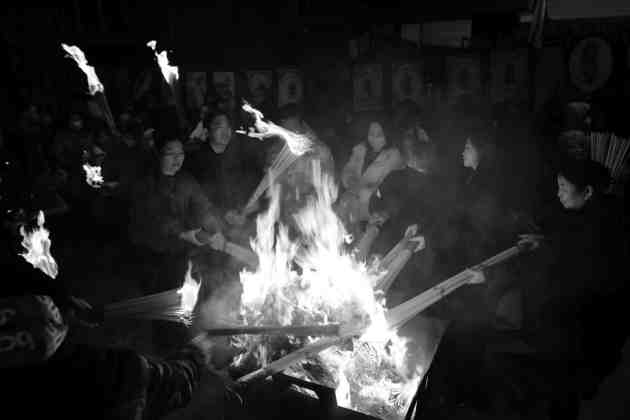

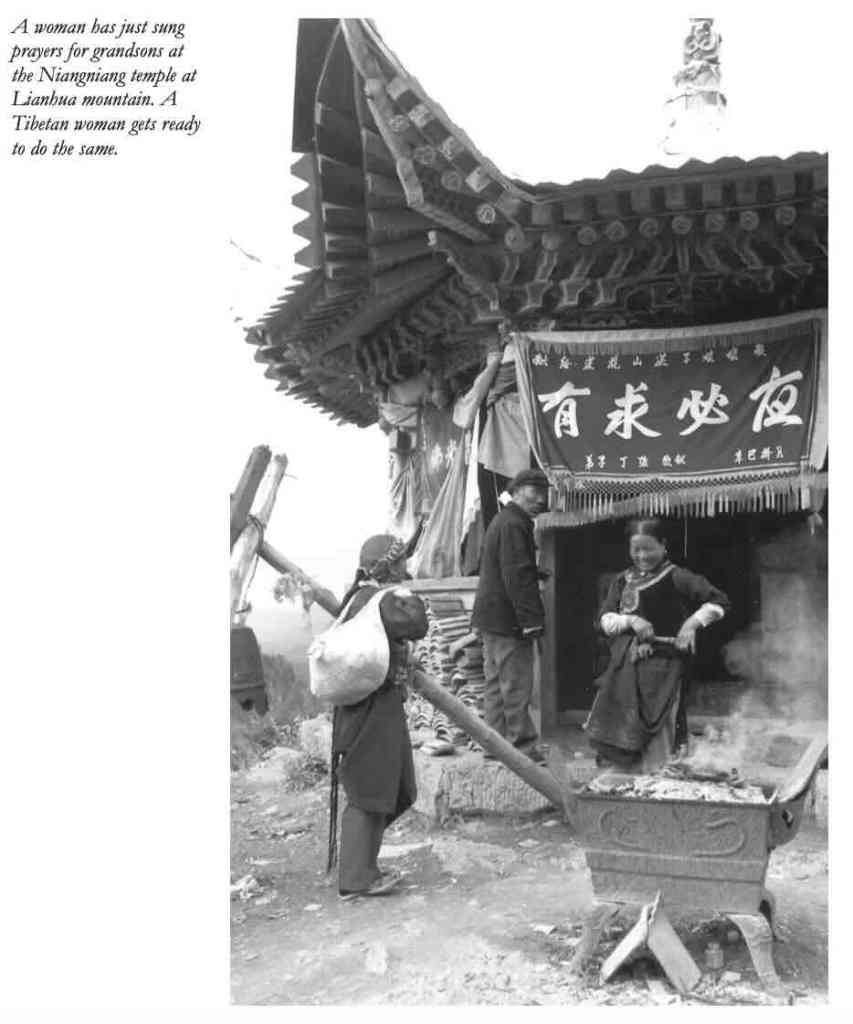

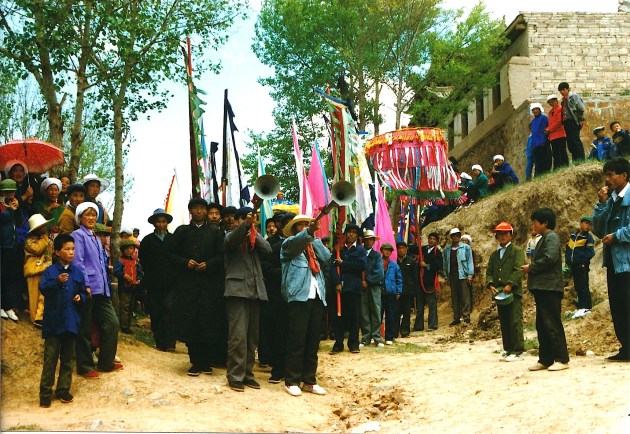




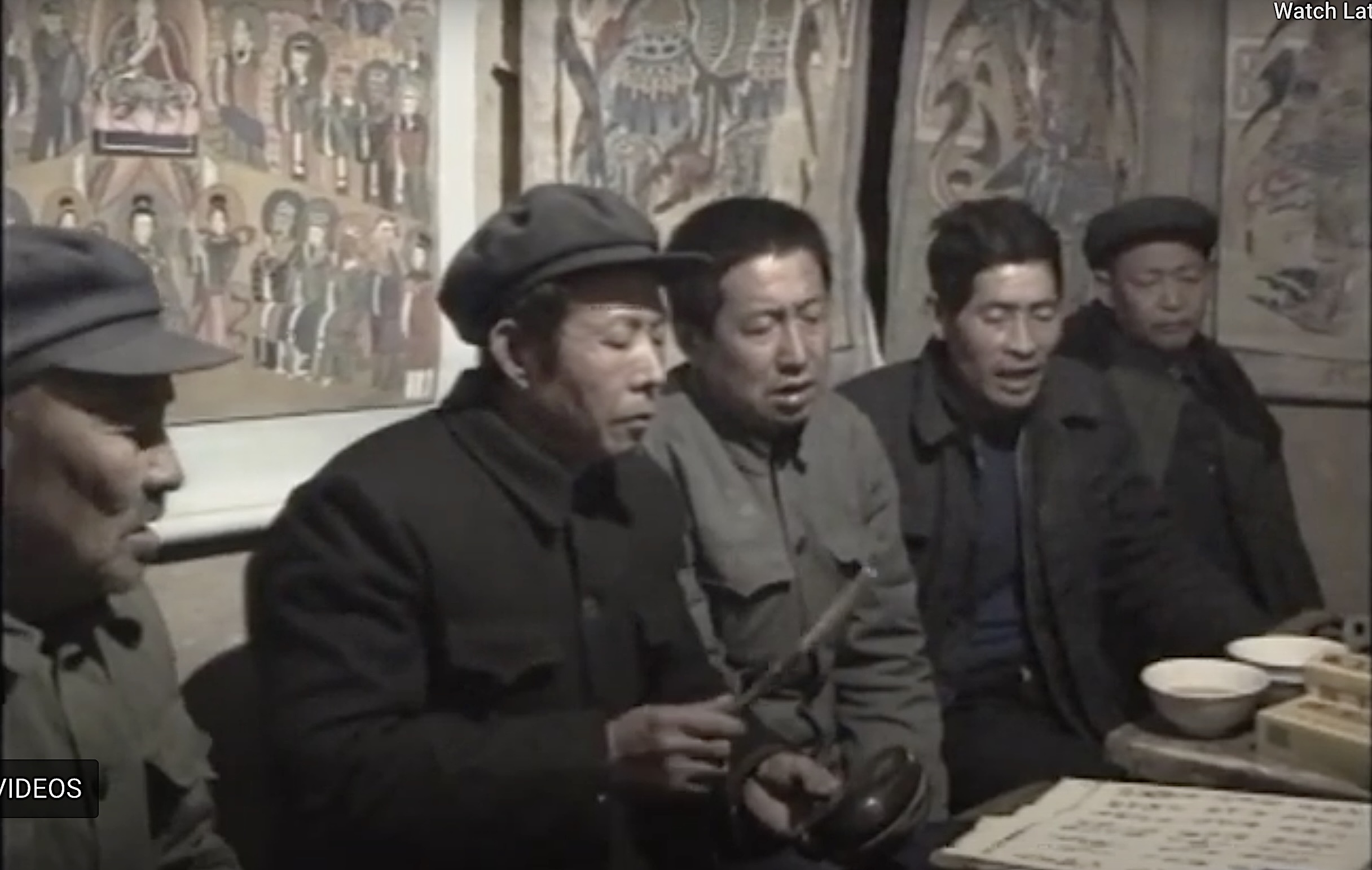


 The lantern tent, New Year 1998, with new and newly-copied donors’ lists.


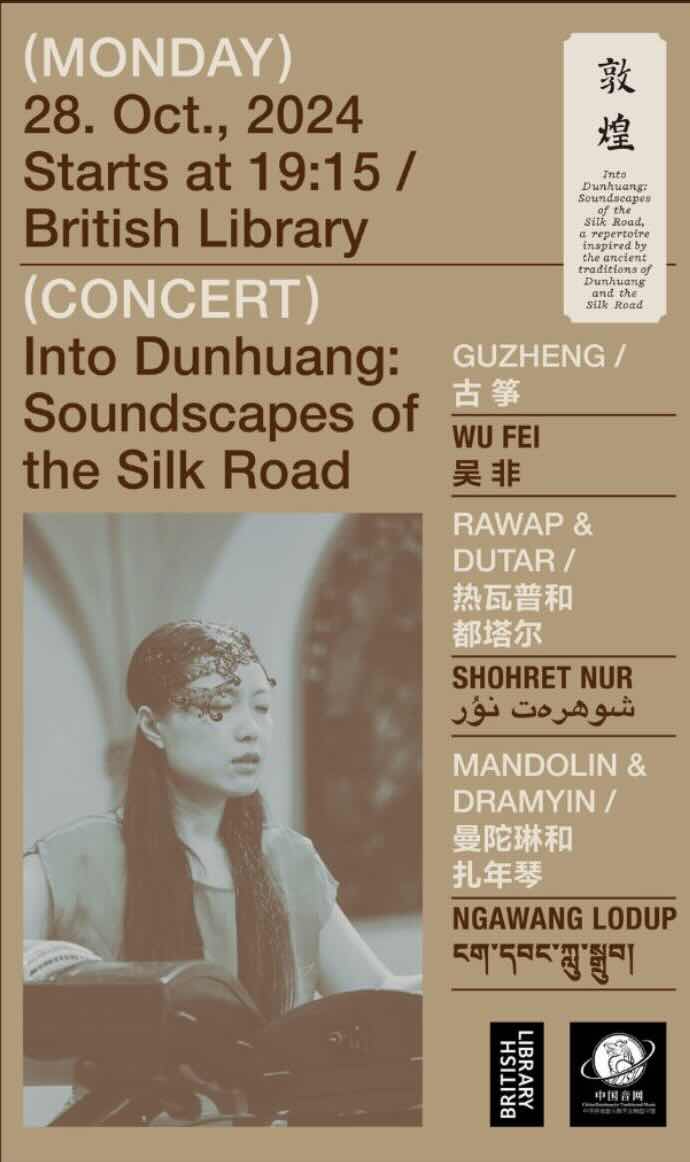


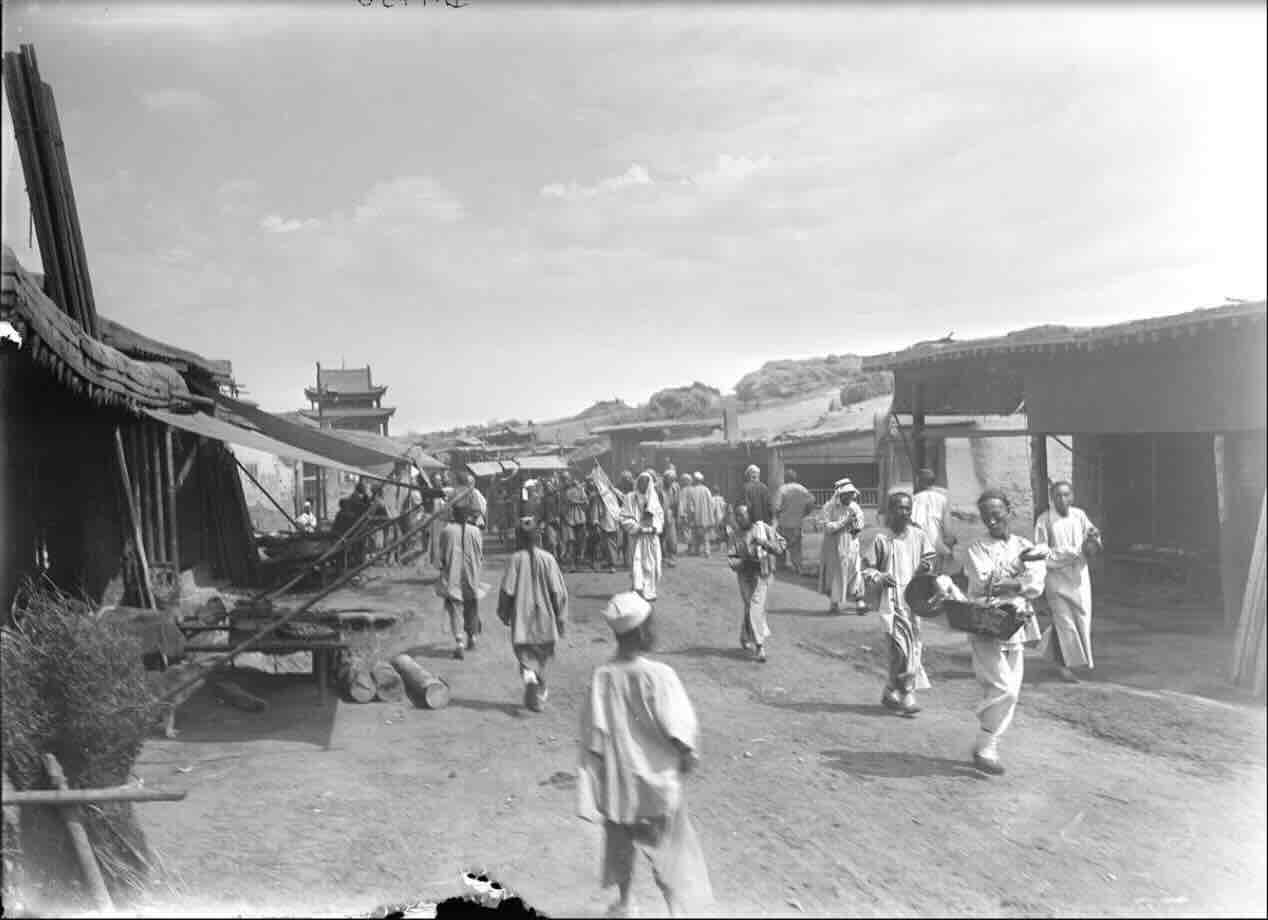 Photo from German Central Asian Expedition, undated (early 20th century):
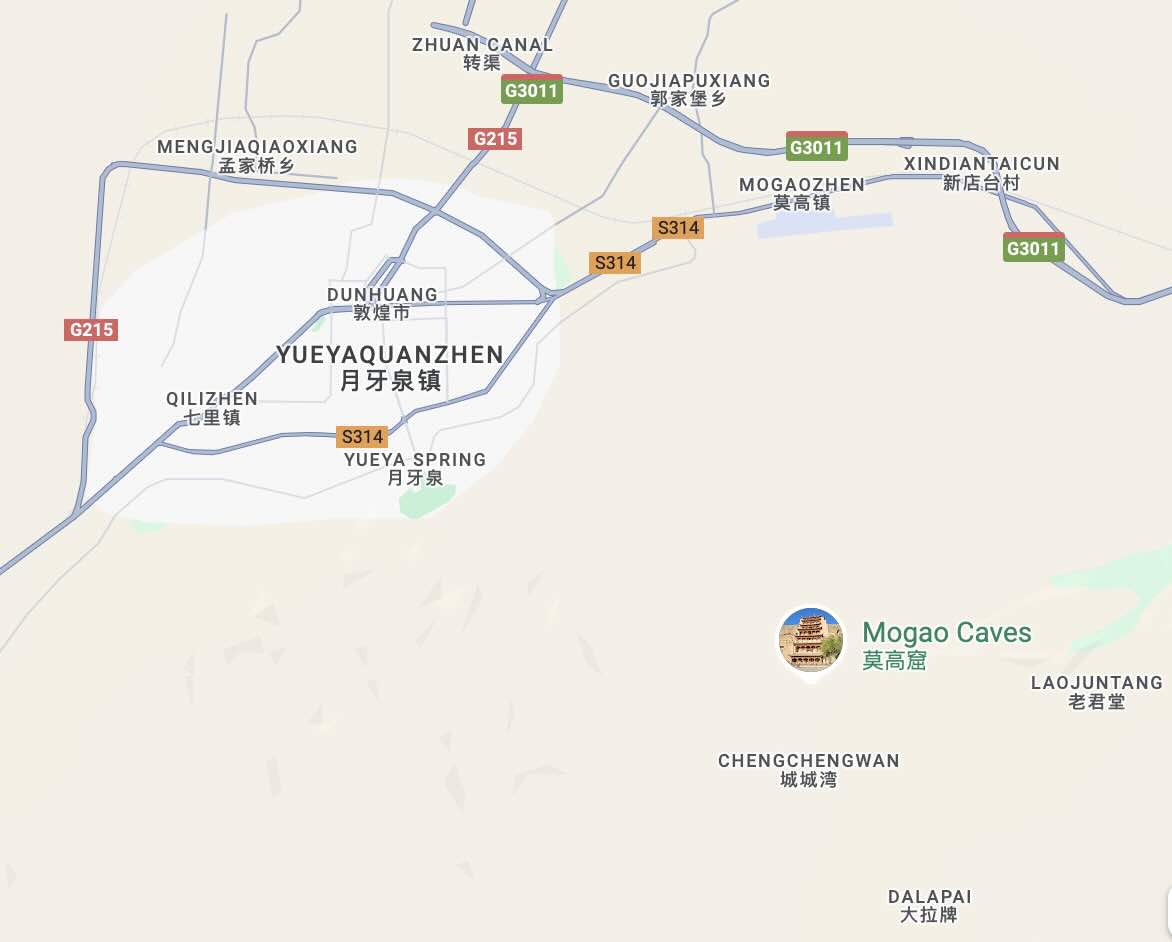 The Dunhuang region today. Source: Google Maps.
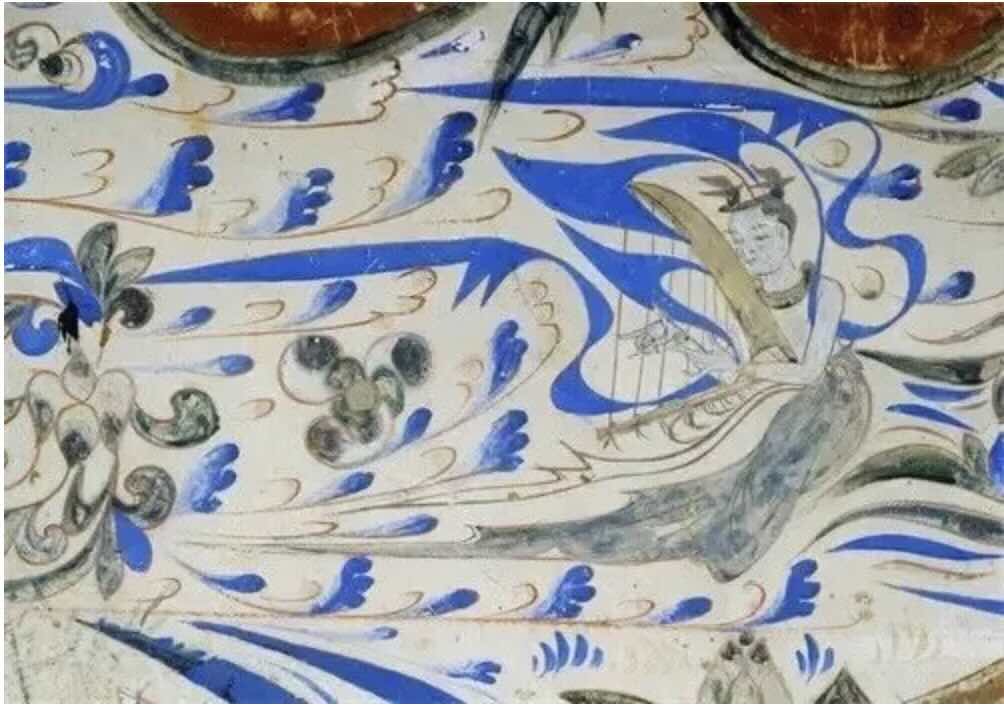 Konghou, Cave 285, 6th century (detail).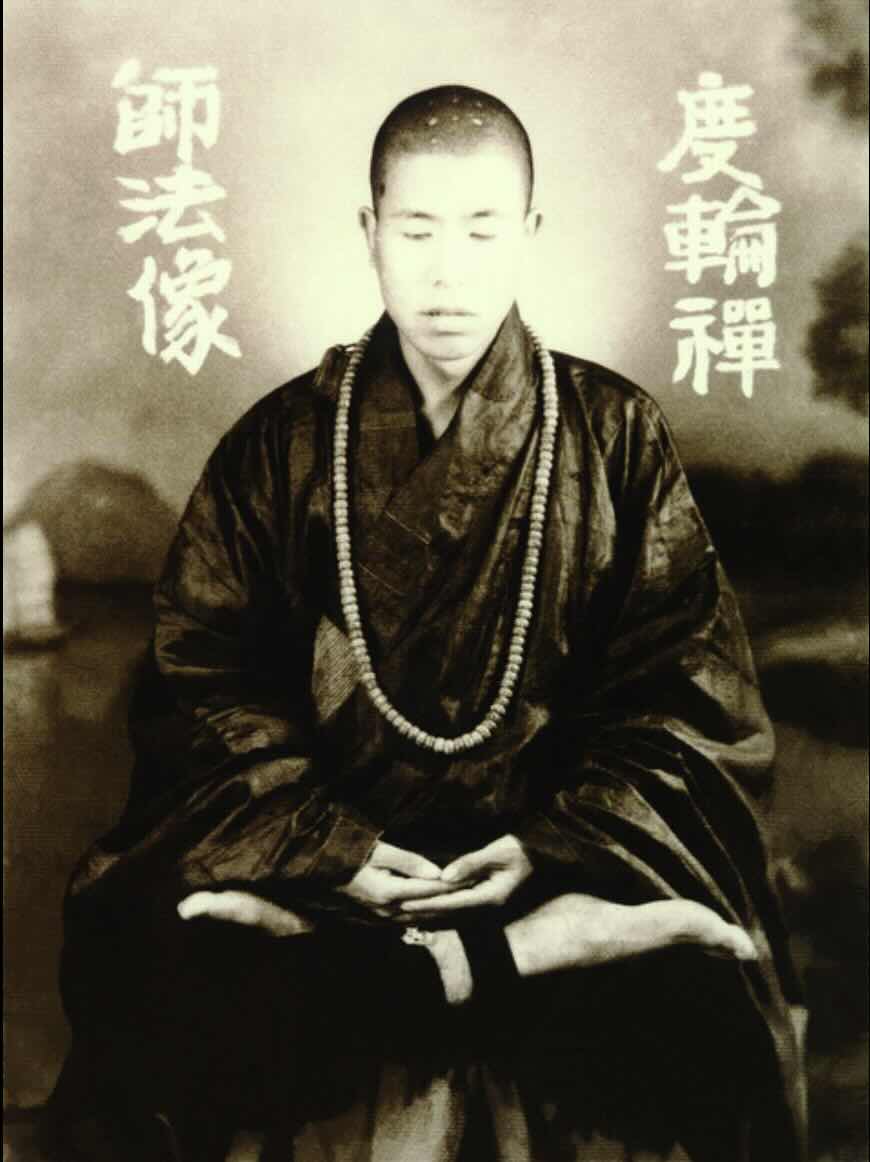

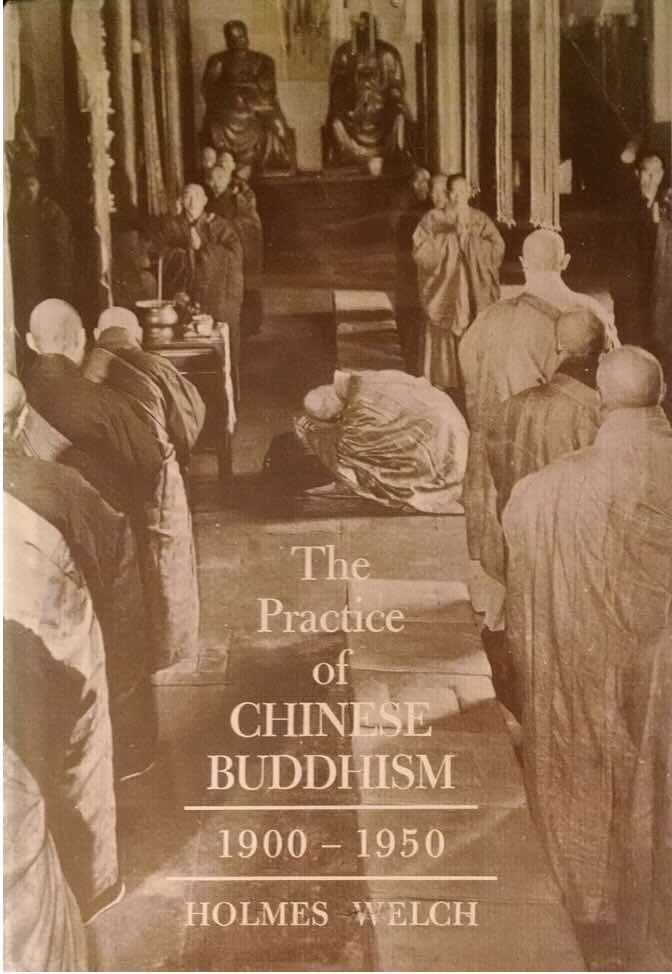 [3]
[3]  Stéphane Denève accompanying Laurence Kilsby in Lil Boulanger’s Vieille prière bouddhique.
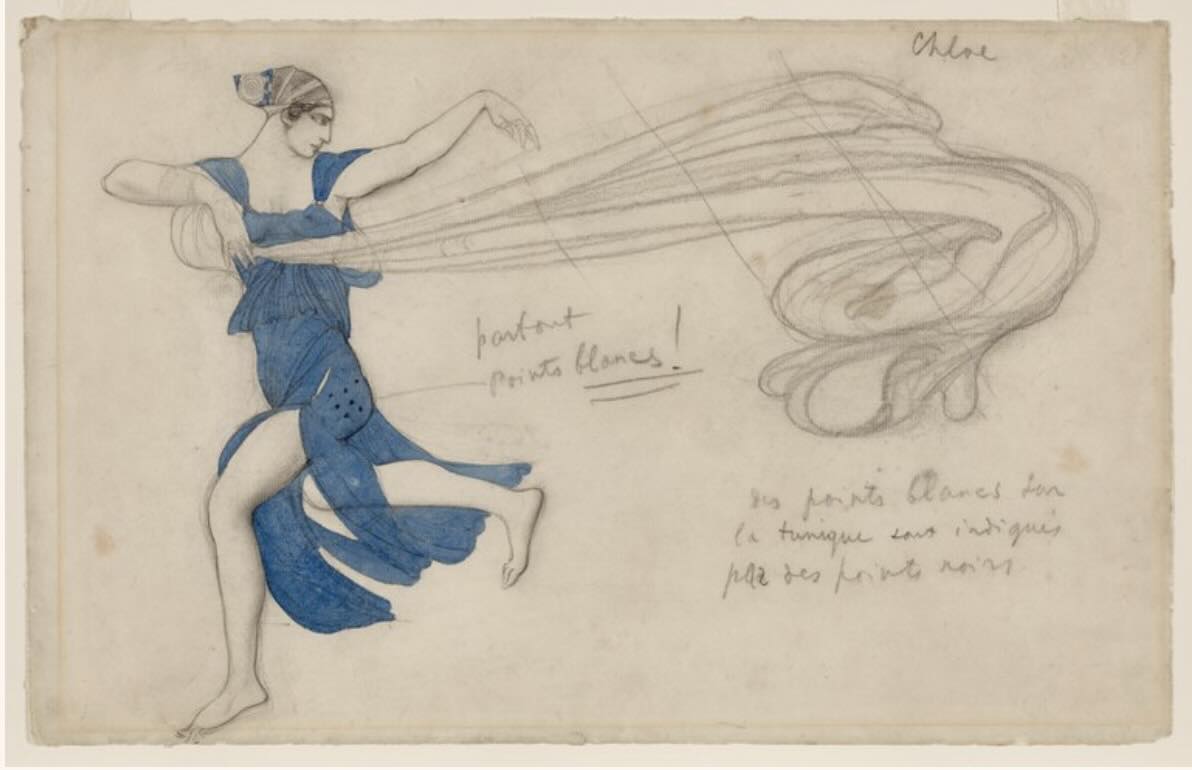
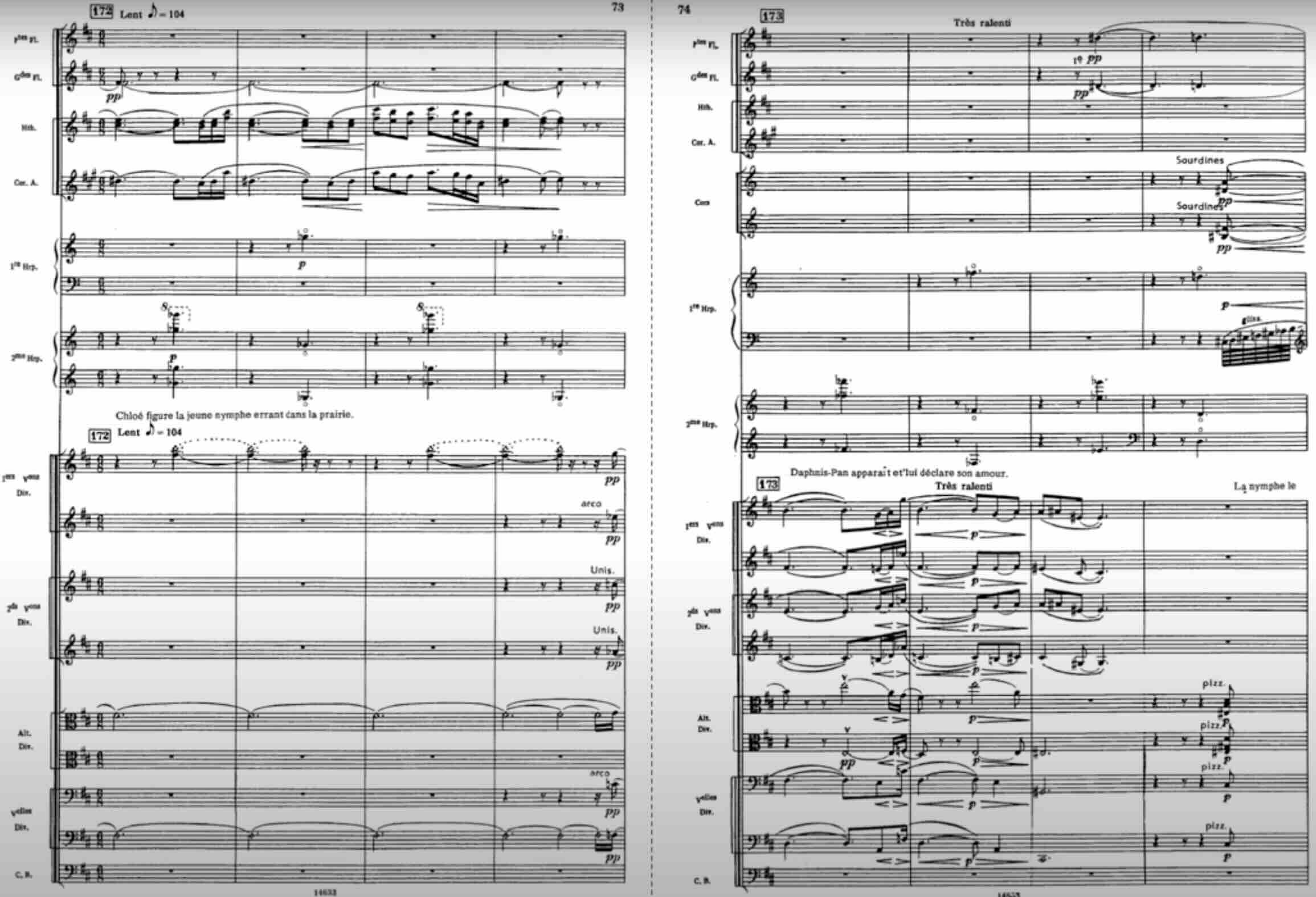
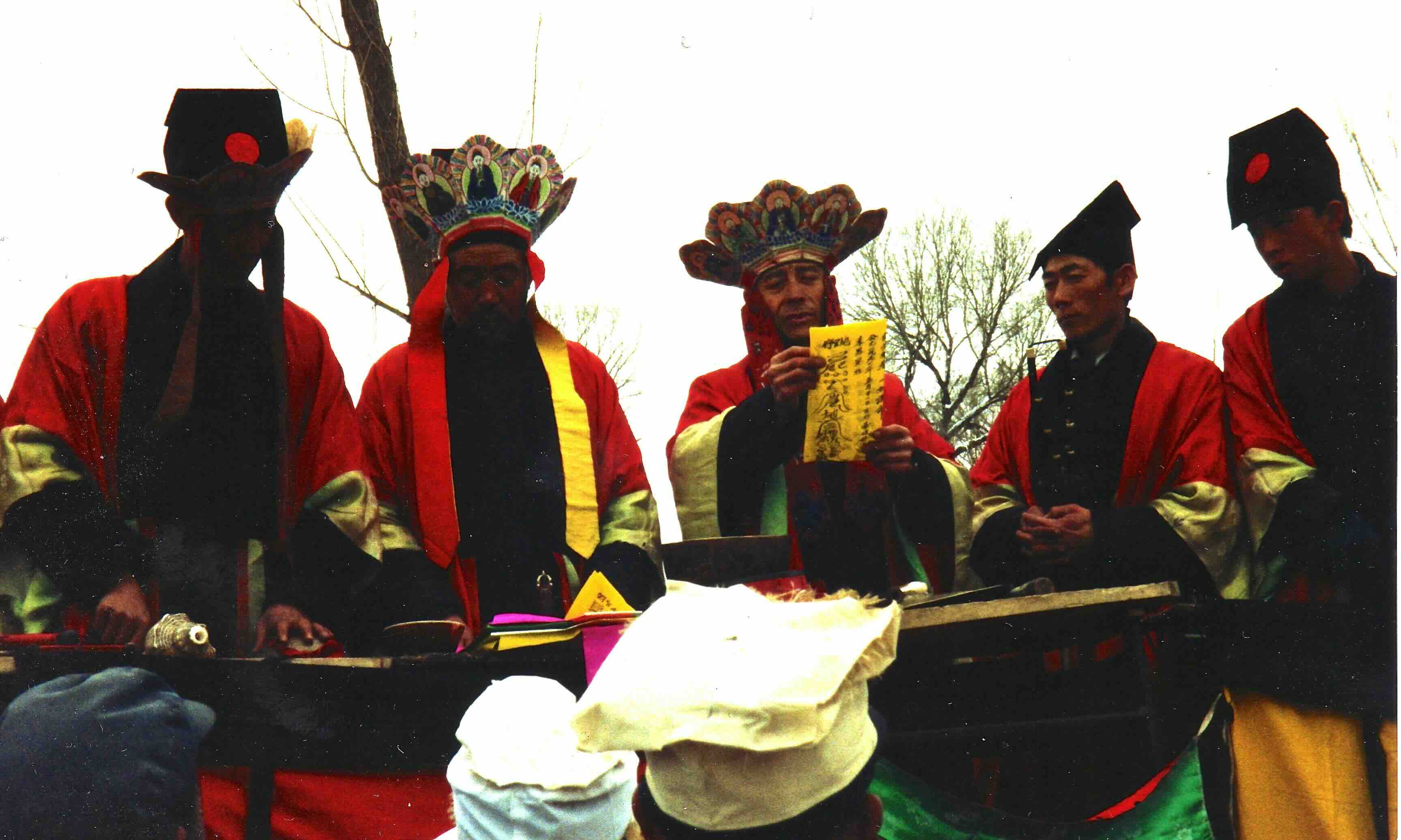 The Li family Daoists perform the
  Li Wencheng in 2021. Cool trousers, eh. Source: Weibo.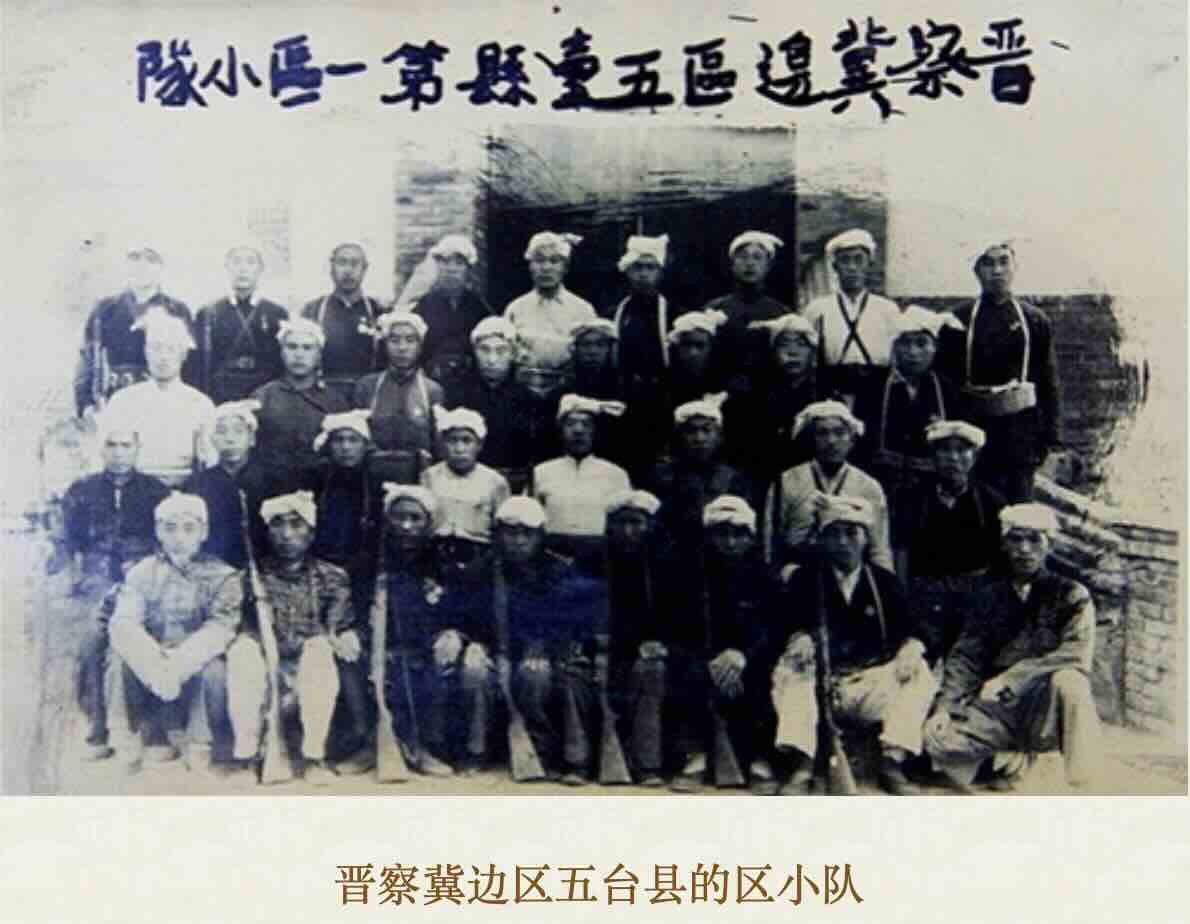

 Li Peisen’s cave-dwelling in Yang Pagoda village.
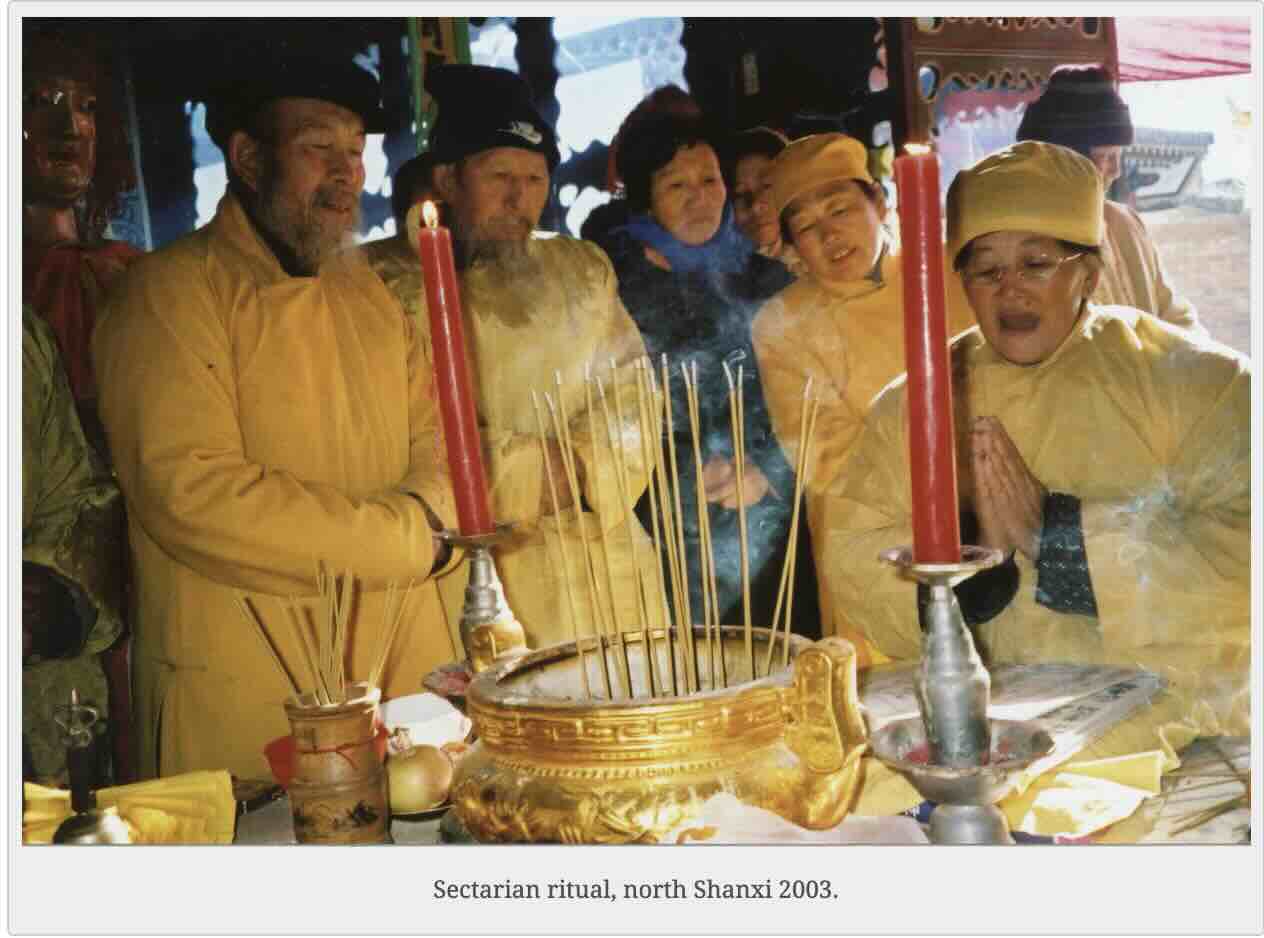

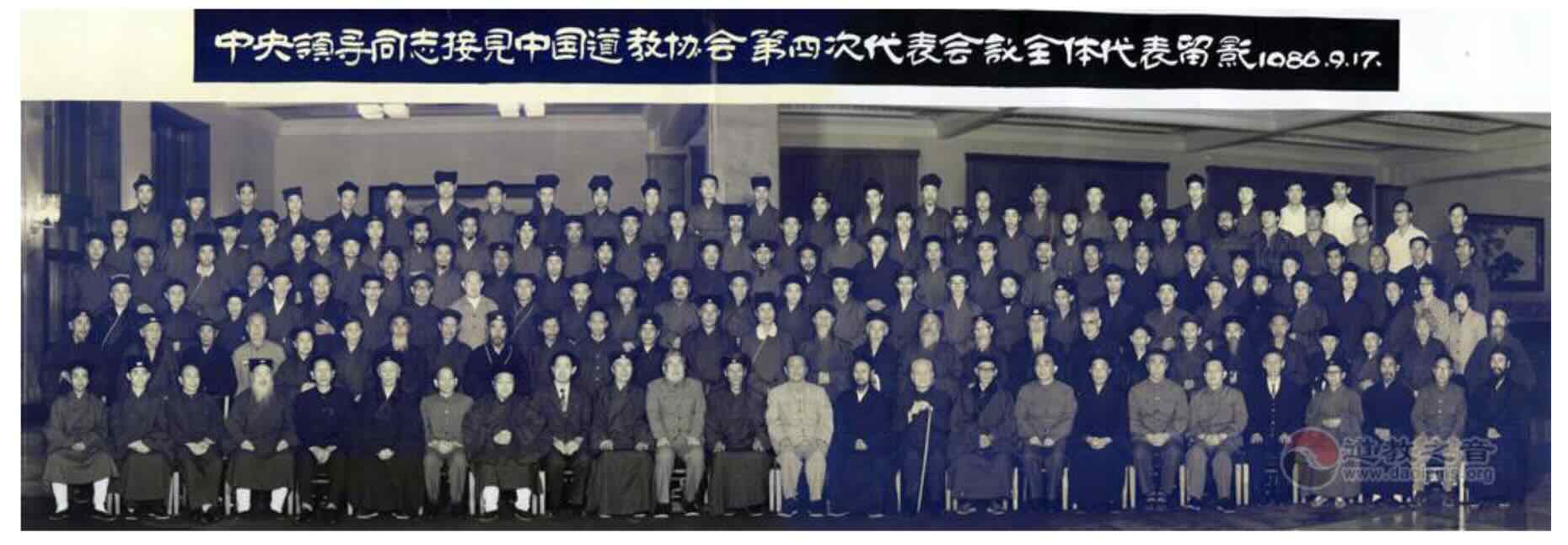
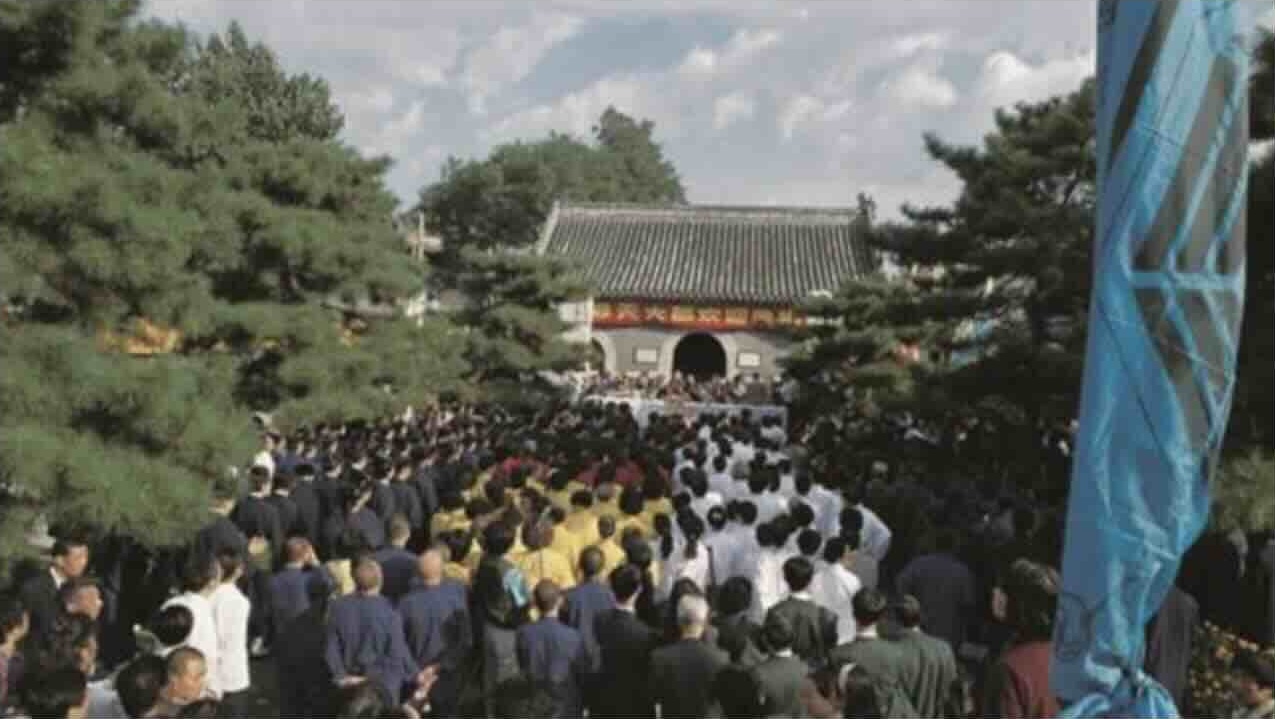 Great Open-air Offering ritual, White Cloud Temple, Beijing 1993.

 Ghost King,
  Yankou at Xujiayuan temple fair, north Shanxi 2003.


 The Zhaobeikou ritual association leads Releasing Lanterns ritual on Baiyangdian lake,
 Nao and bo cymbals of the Tianxing dharma-drumming association,
 Shifan band, 1930s.
 Jinmen baojia tu shuo (1846).


 The Shanhua temple during the




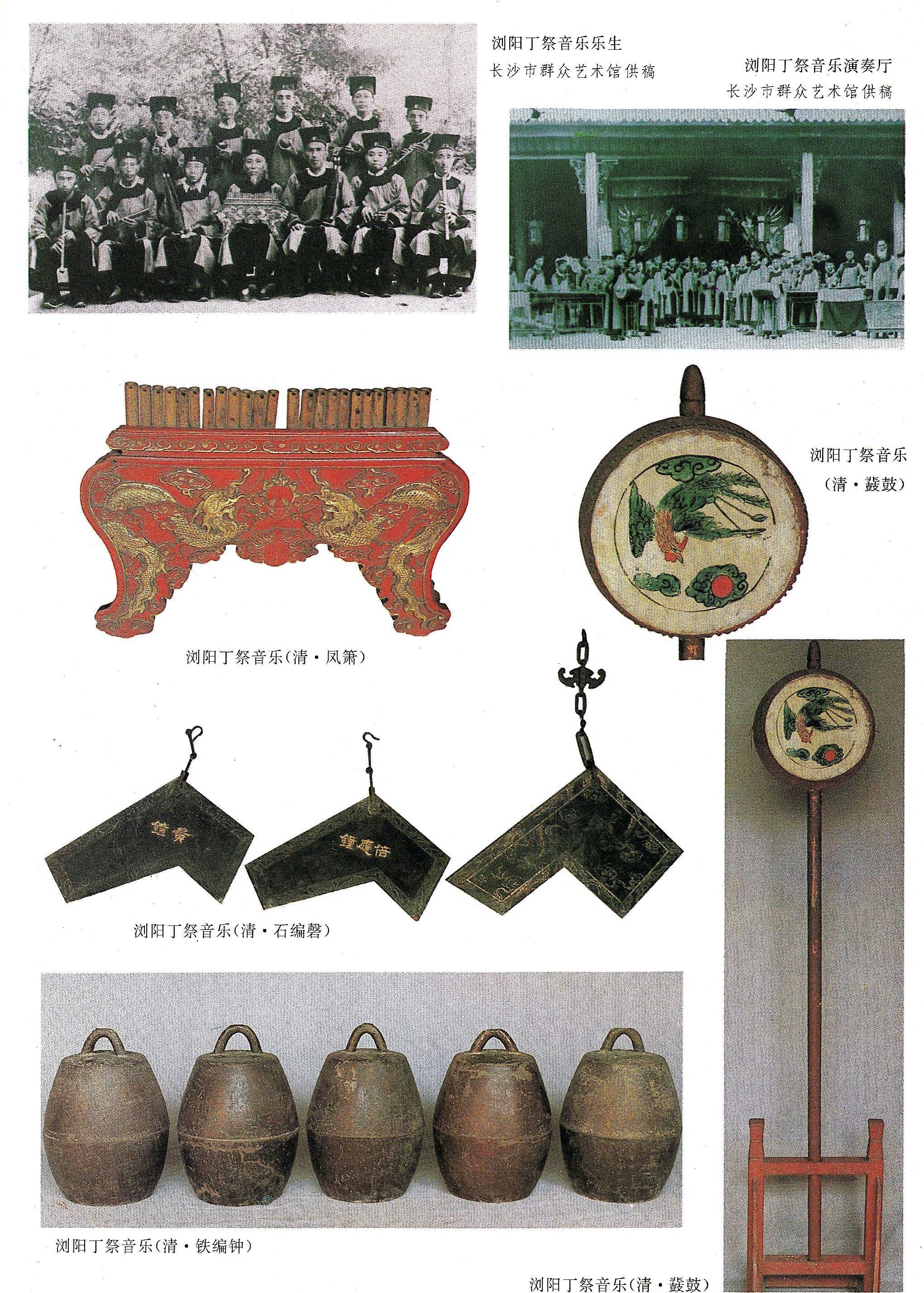





 The couplet comes from a poem by the early-Tang poet
 Besides Tian Qing’s many reflections on the


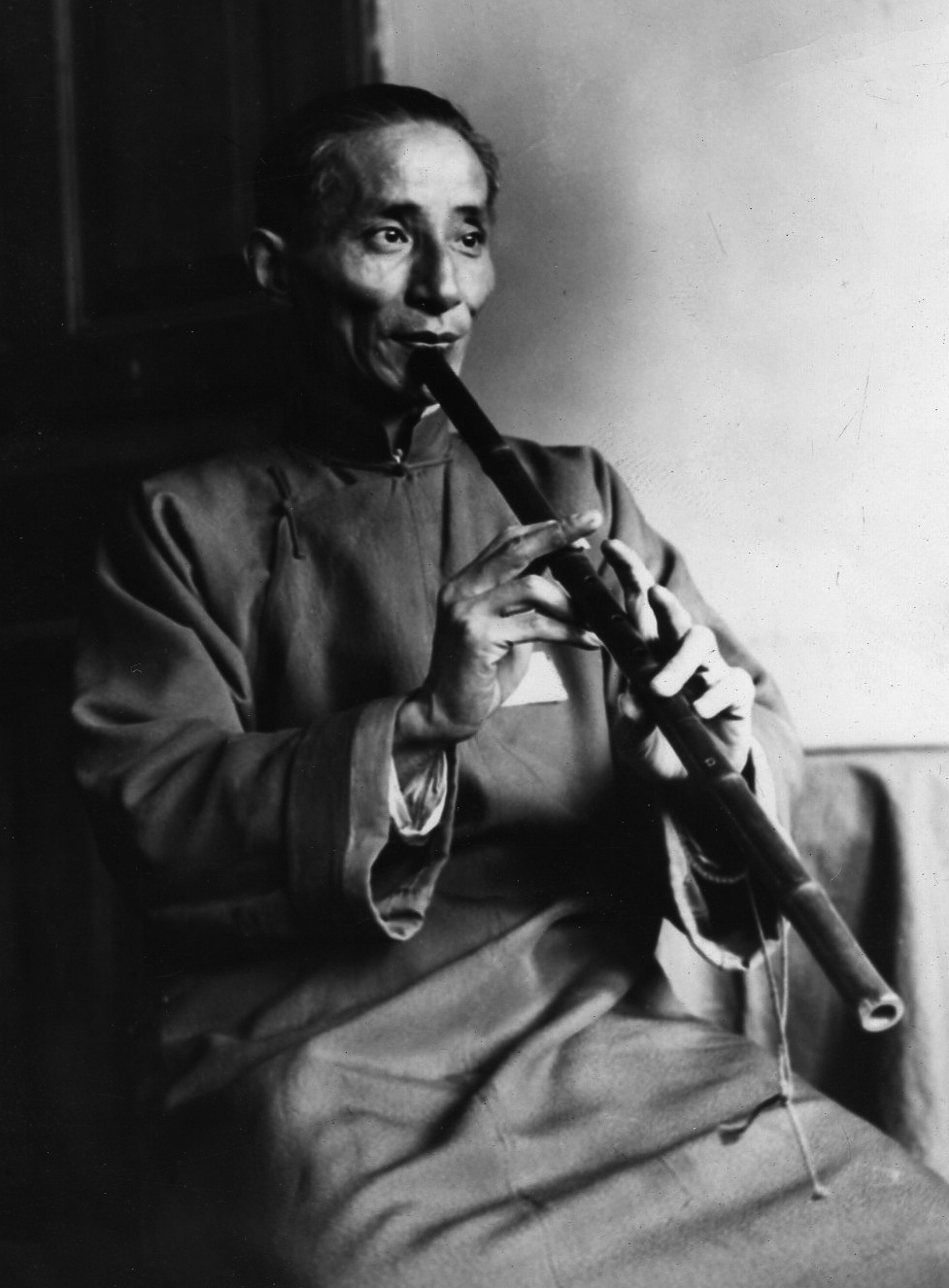 So I’m grateful to the exhibition for stimulating me to revisit some of my own material from the field. In this I’m always in awe of the incomparable erudition of
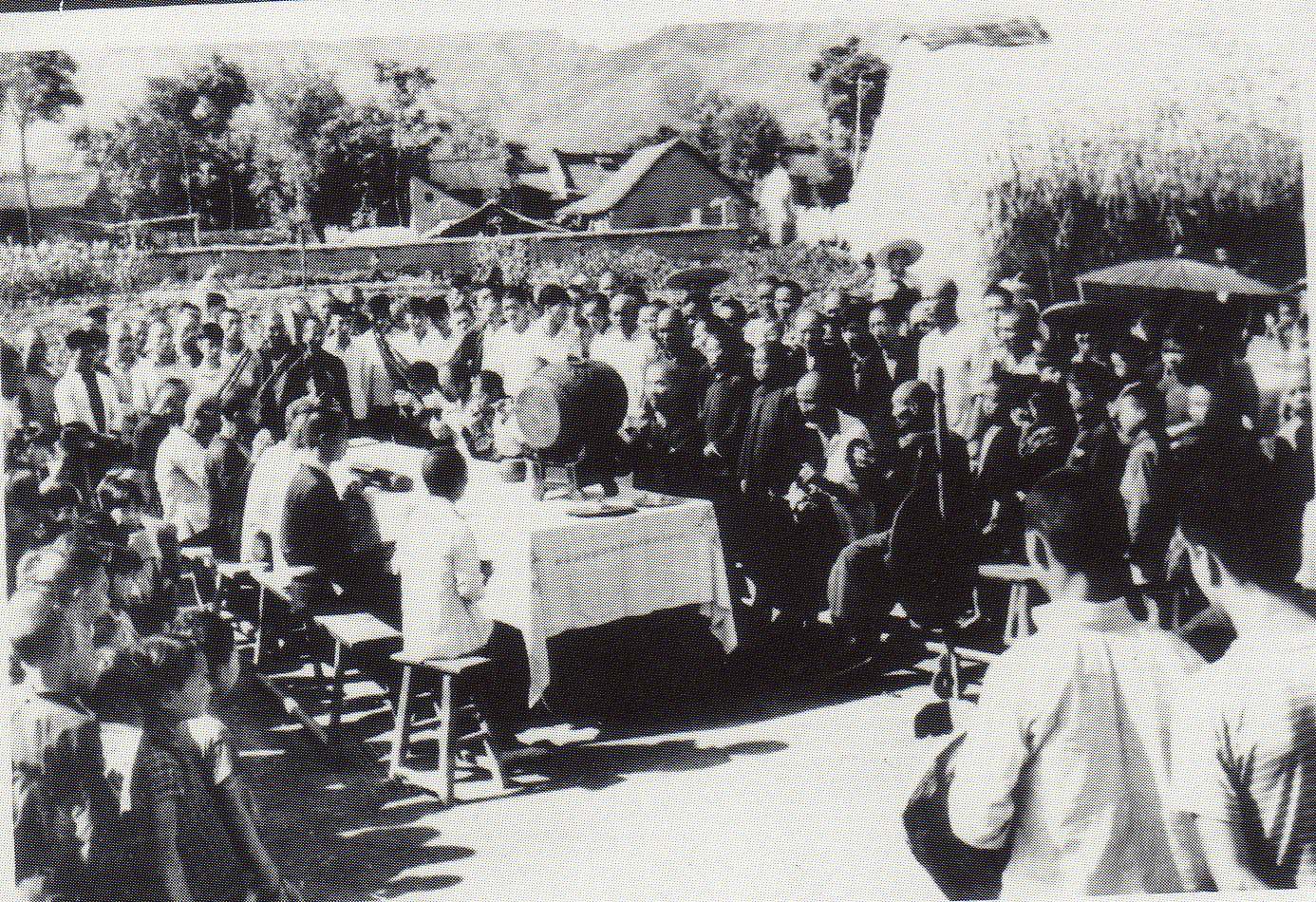
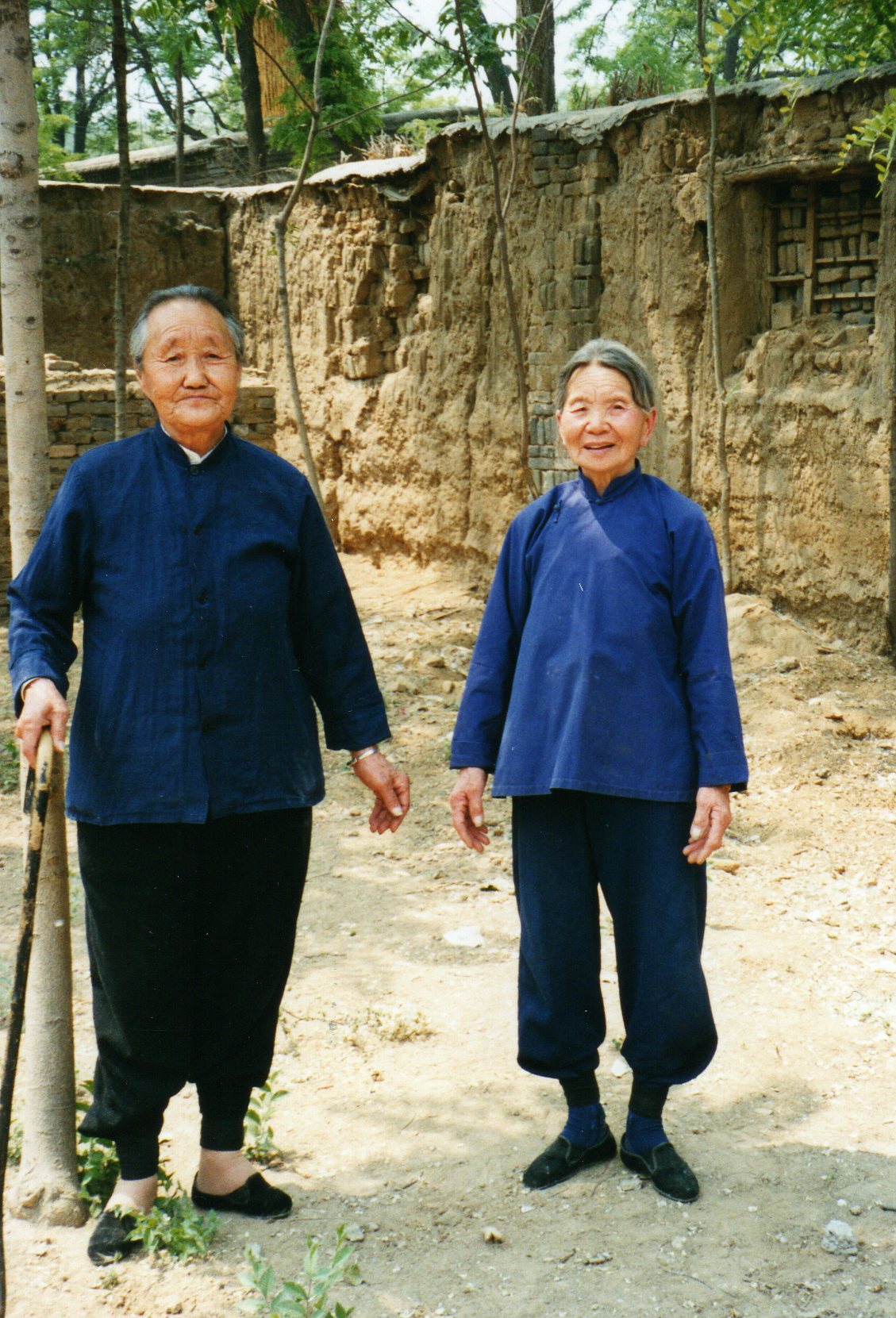 This reflects another common difficulty: we often seek to document history through major, exceptional events, whereas for peasants customary life is more routine. And apart from artefacts, much of the history of this (or any) period lies in oral tradition—which doesn’t lend itself so well to exhibitions.
 From
From 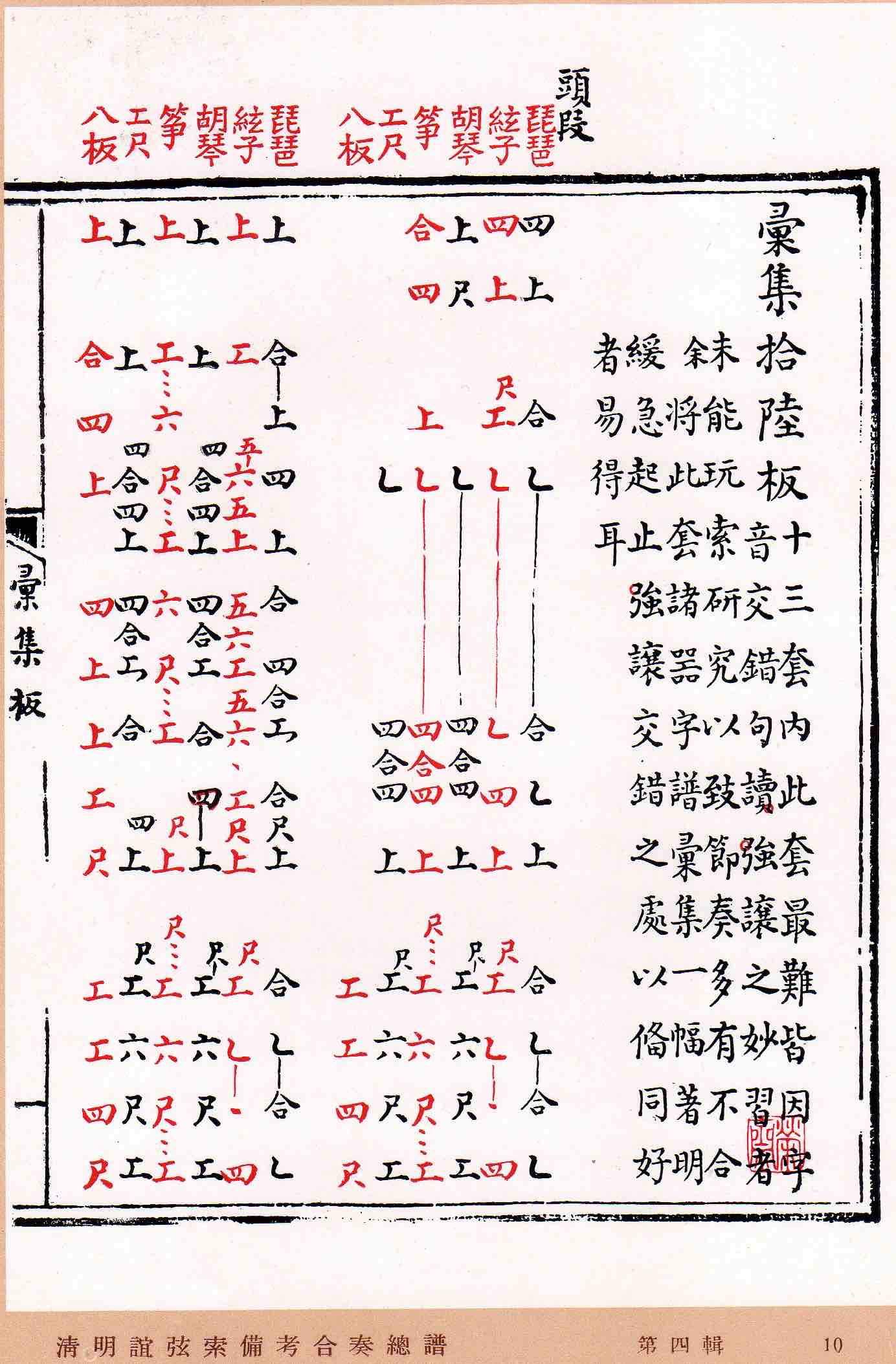
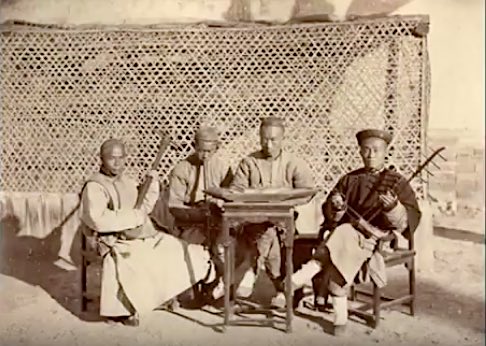


 From Qing-dynasty Tianjin Tianhou gong xinghui tu 天津天后宫行會圖.
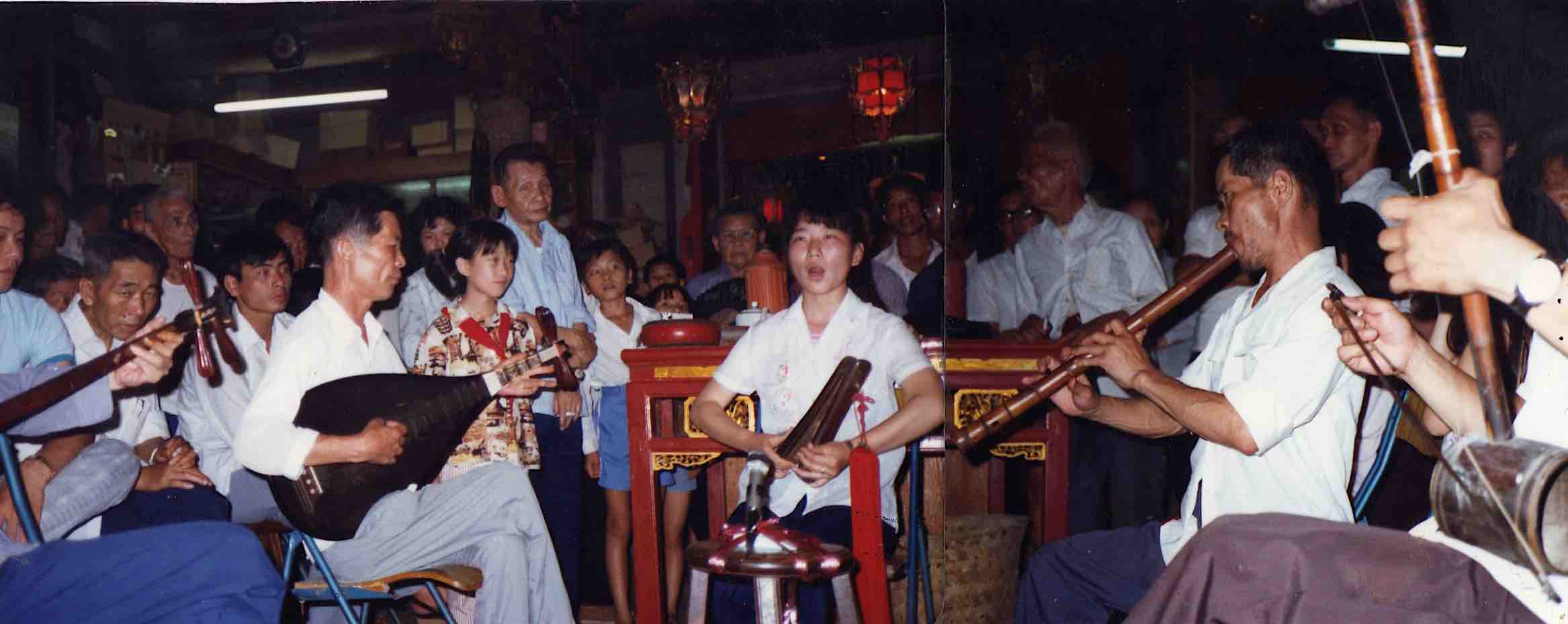
 Mural (detail),
  Source.


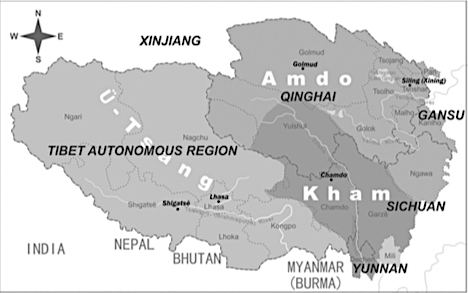
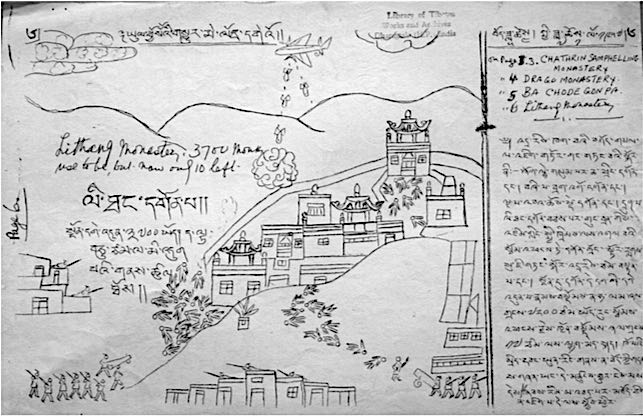
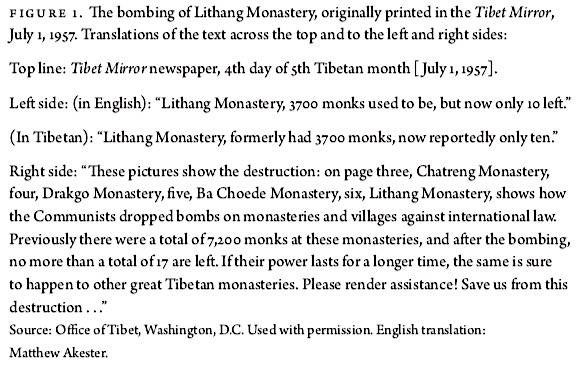
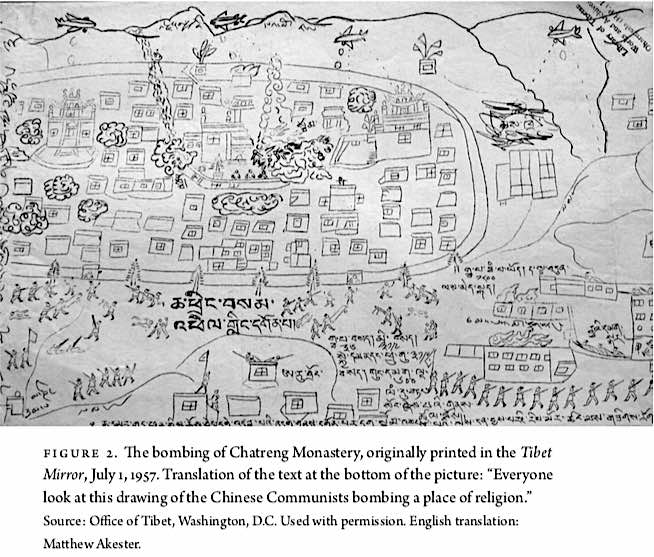


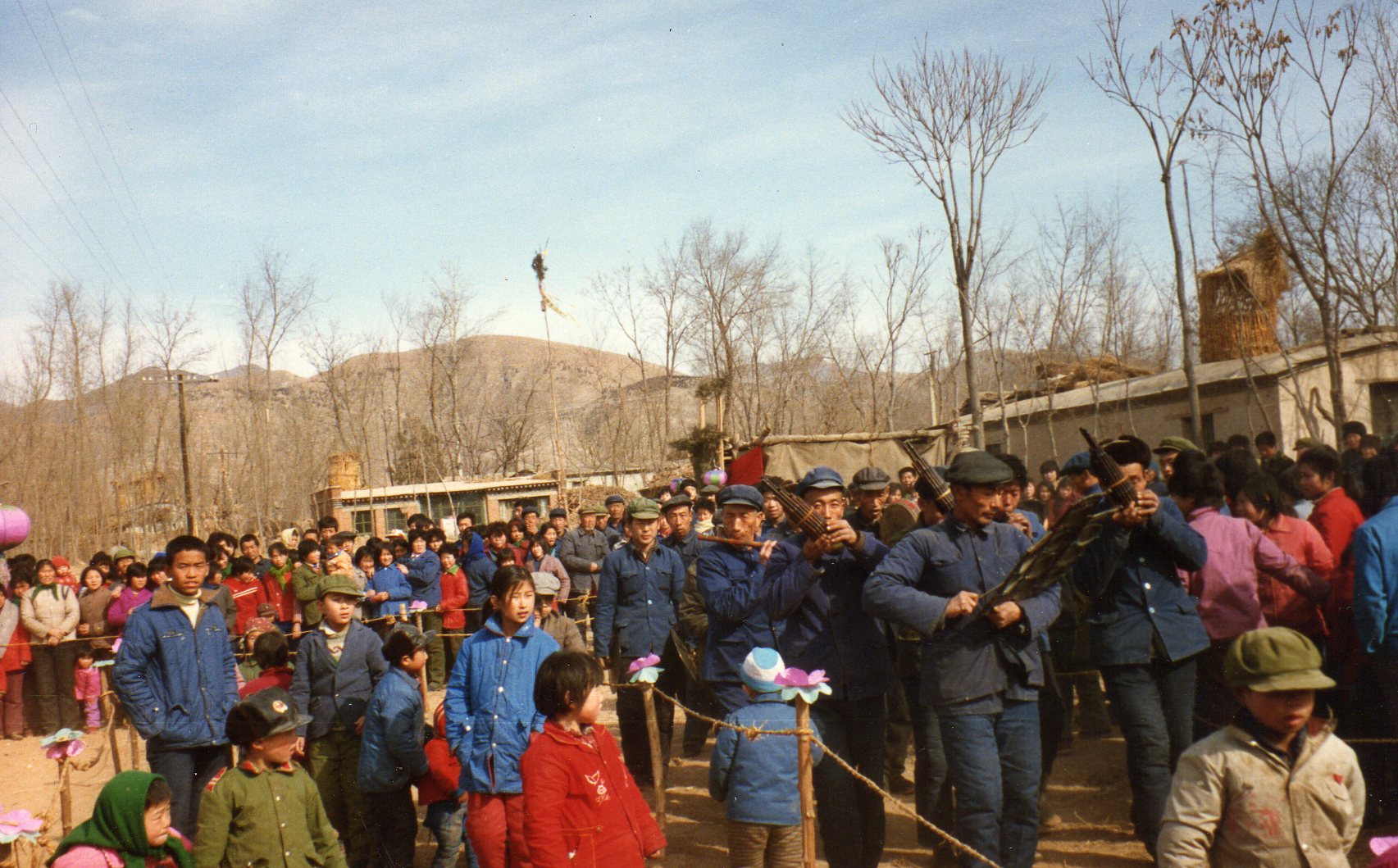

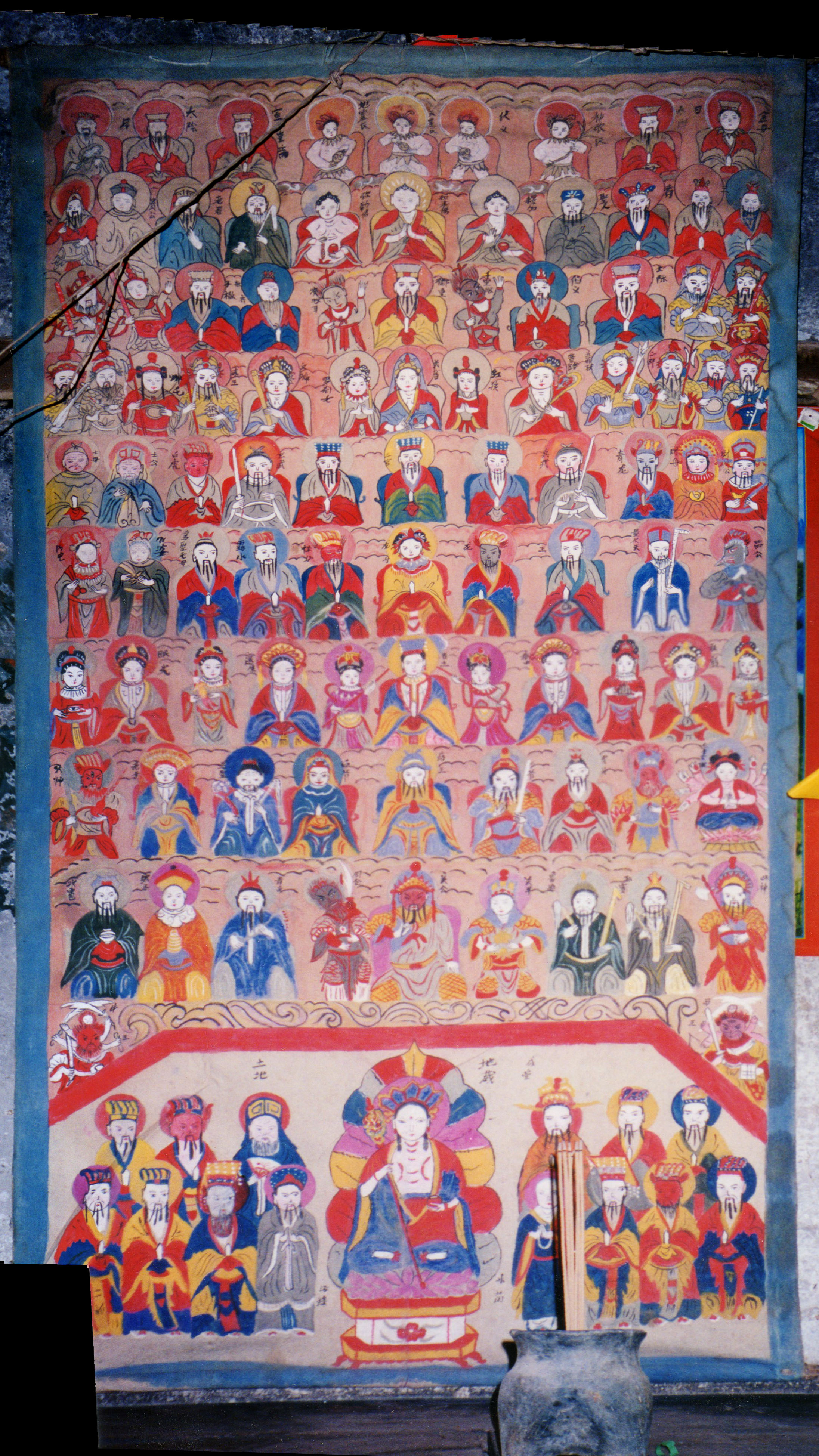

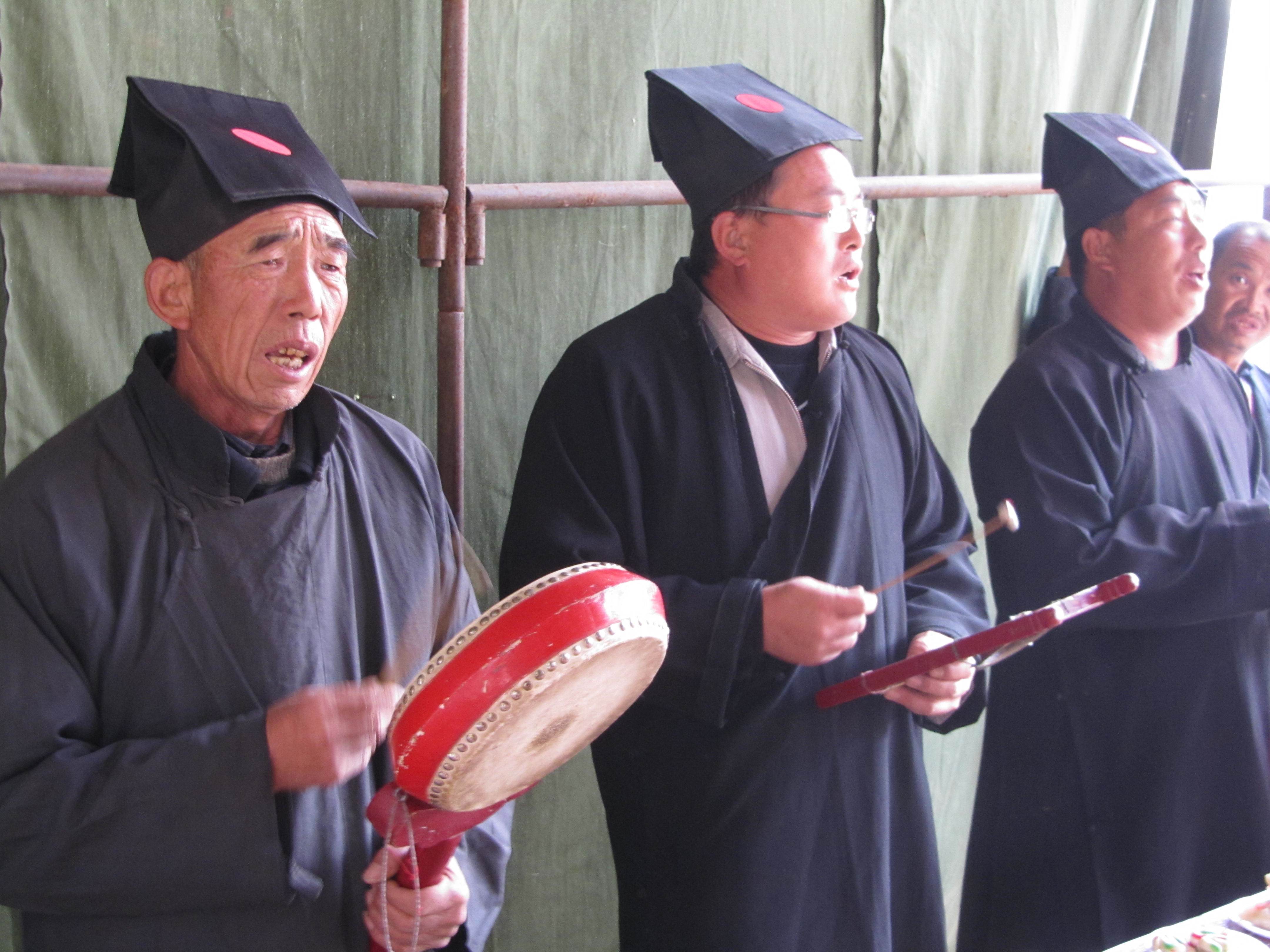

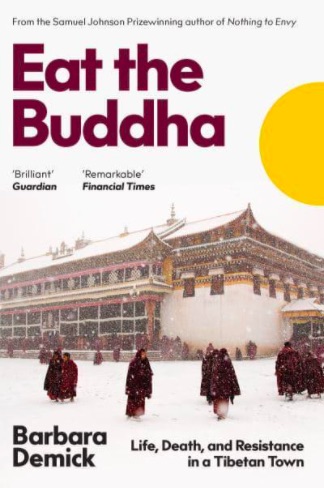

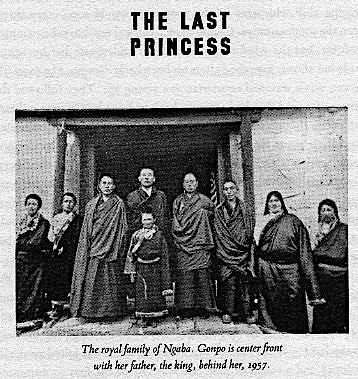
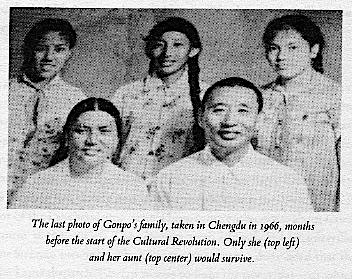
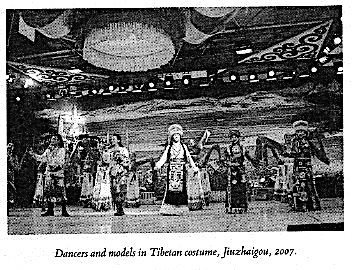
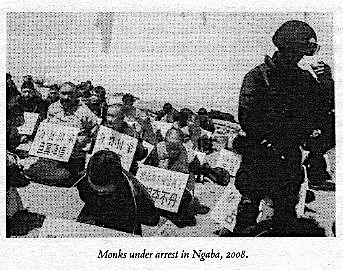


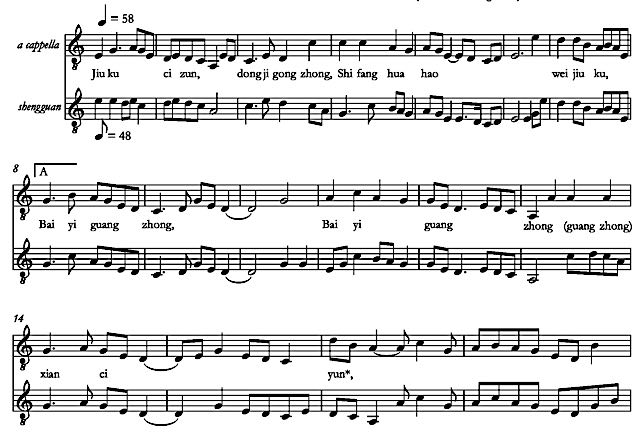


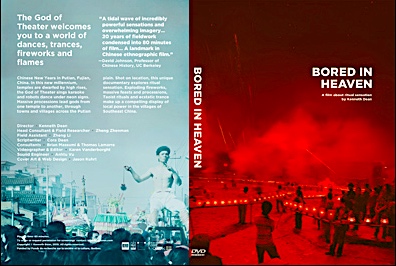
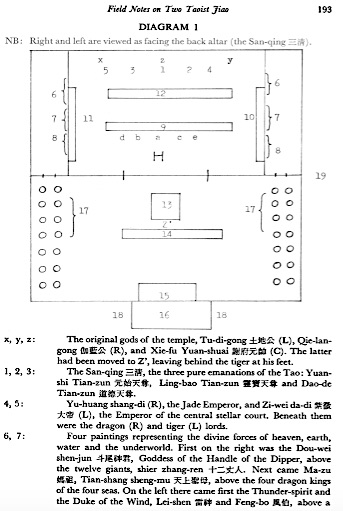

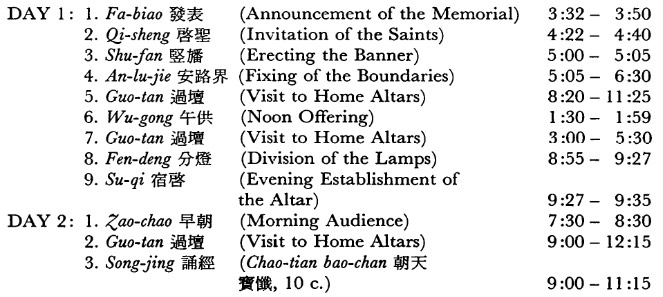


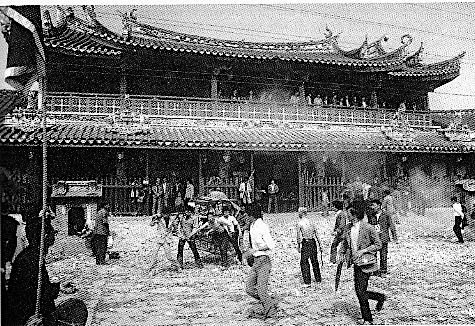


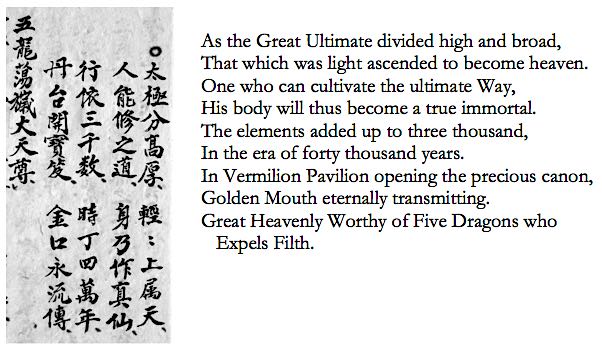



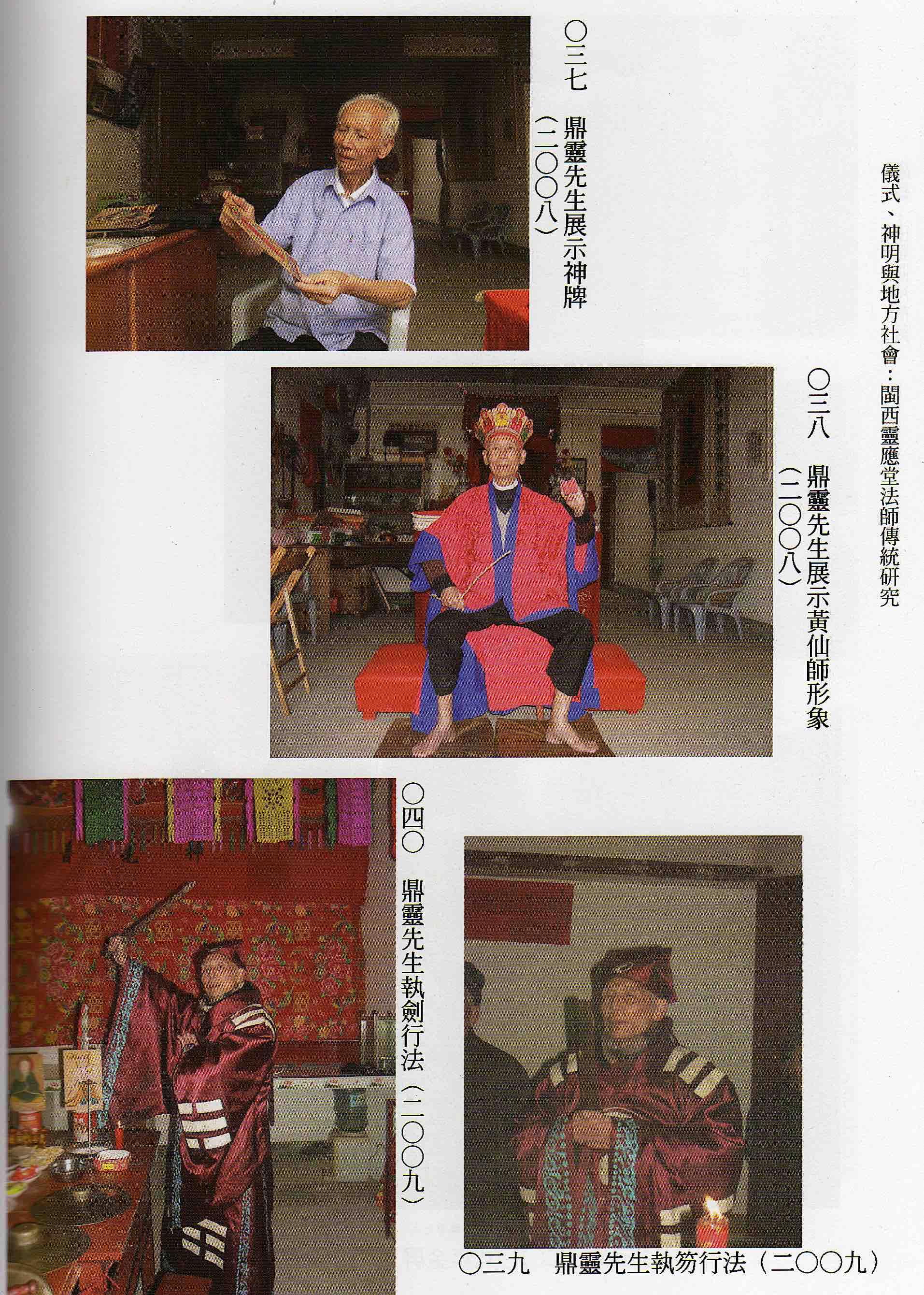


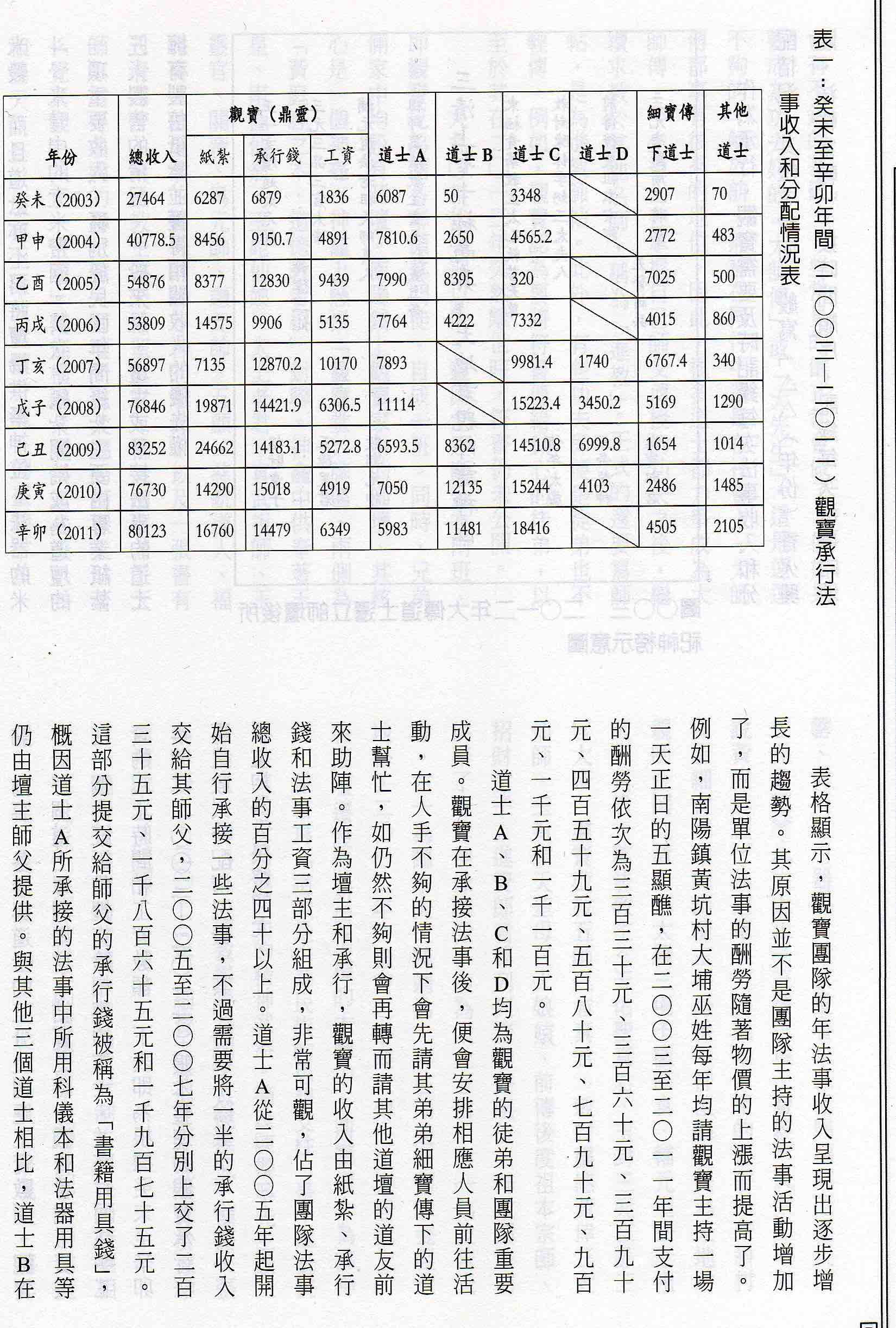
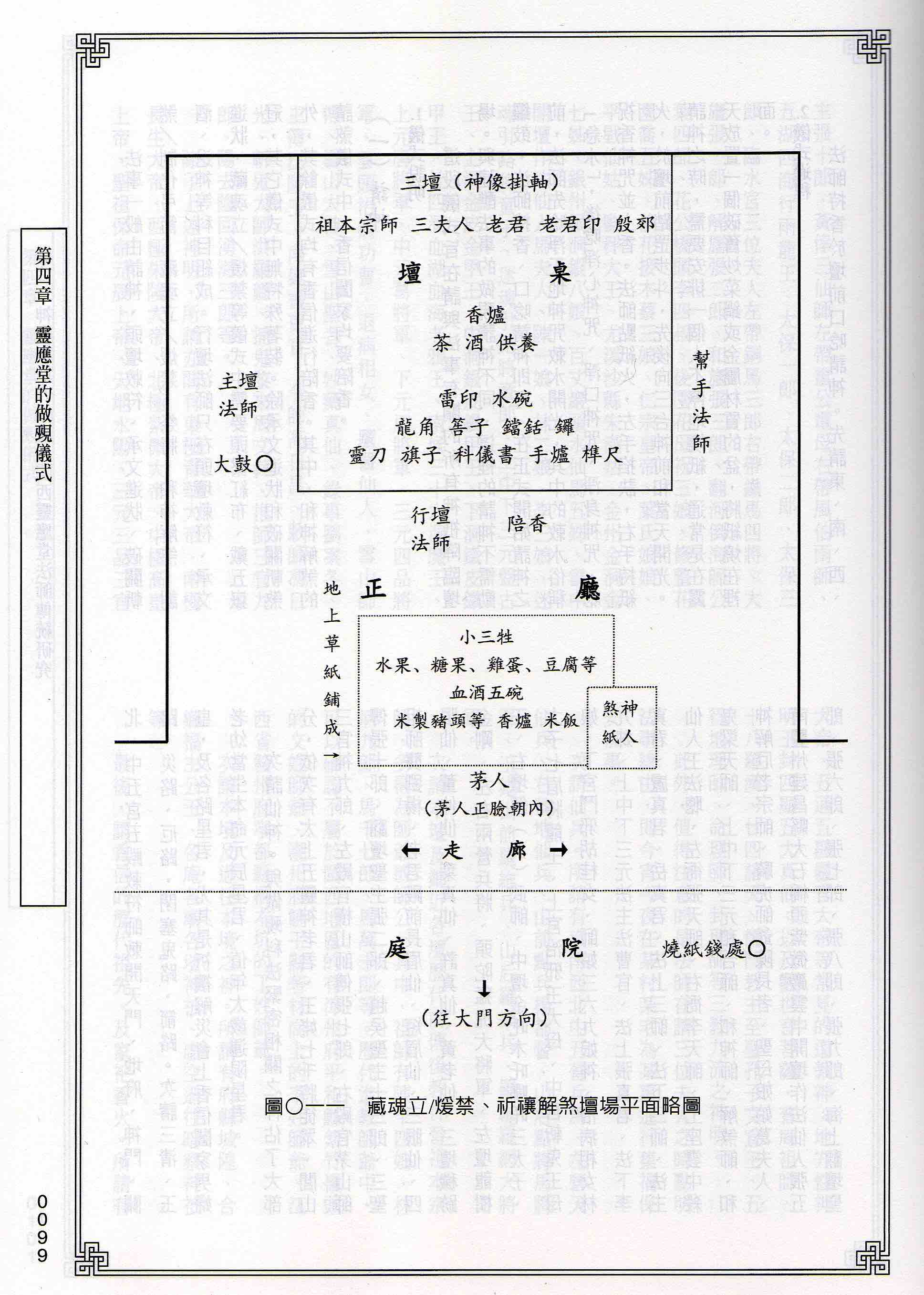




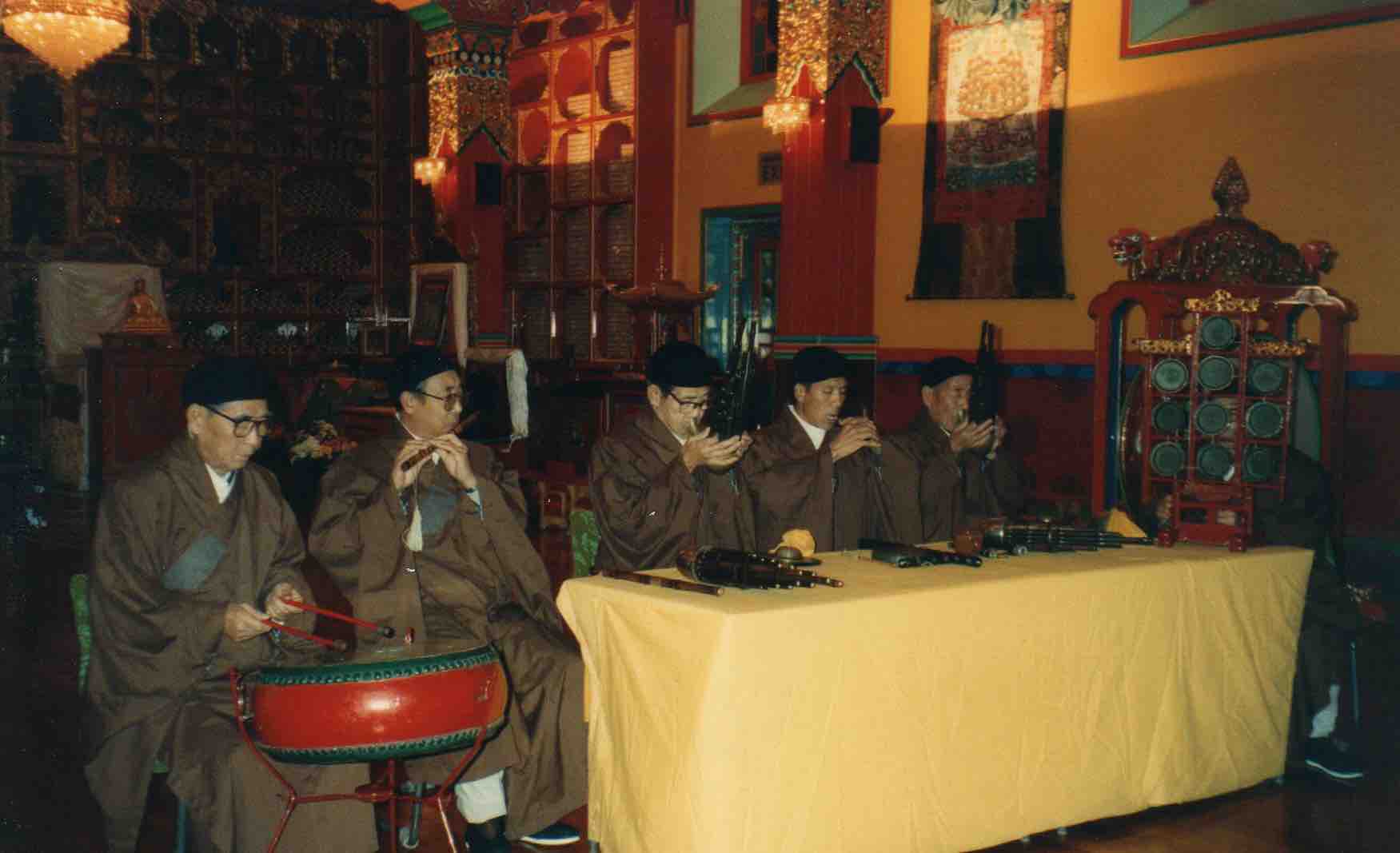


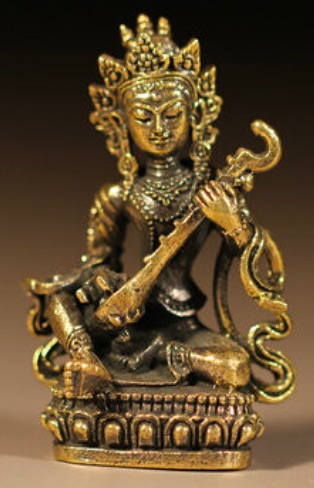






 Tibetan monks laying down their arms, 1959. AFP/Getty.
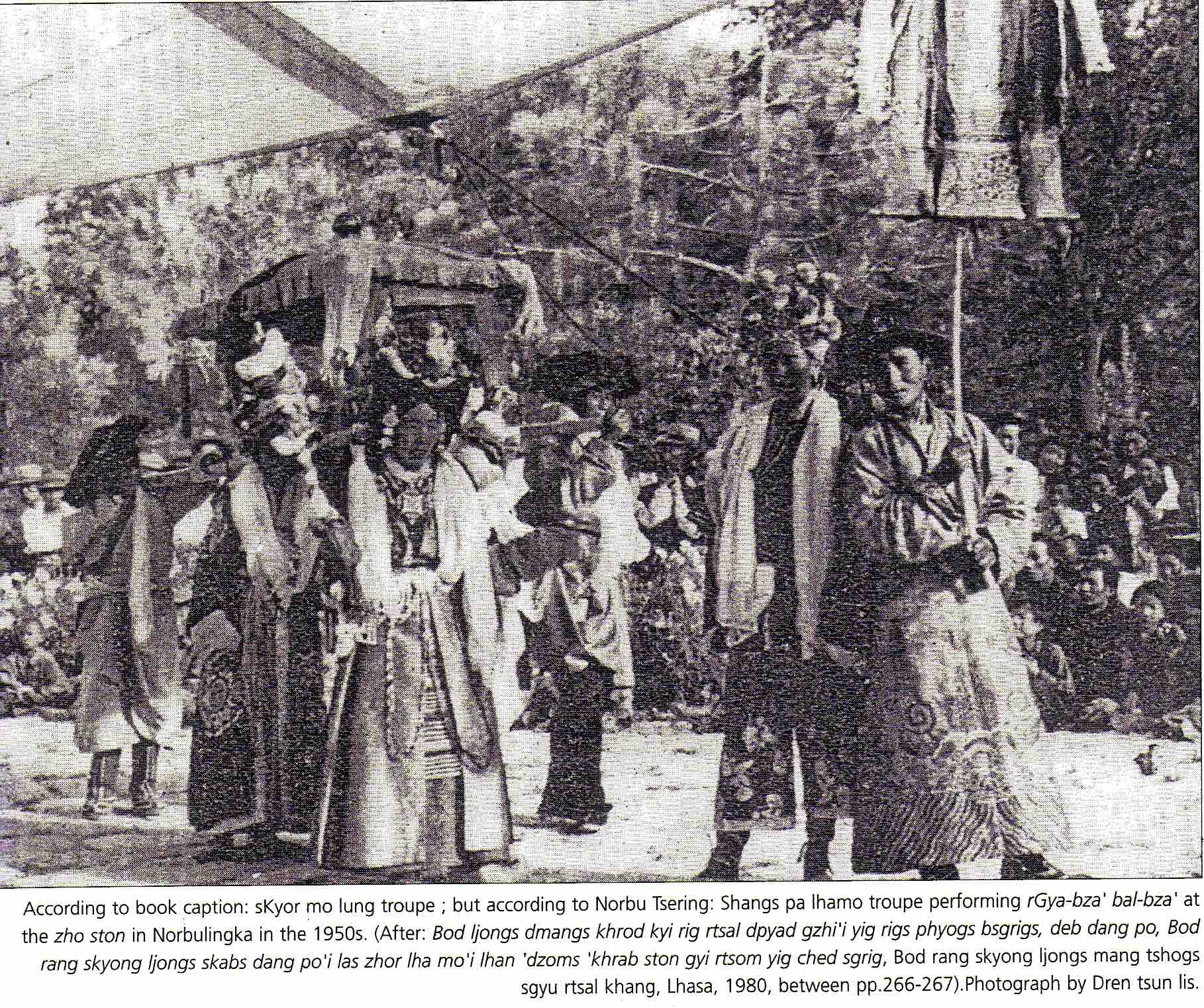


 Horkhang Sonam Palbar (centre) paraded with his wife and father-in-law at a thamzing struggle-session, August 1966. Forbidden memory, fig.80.


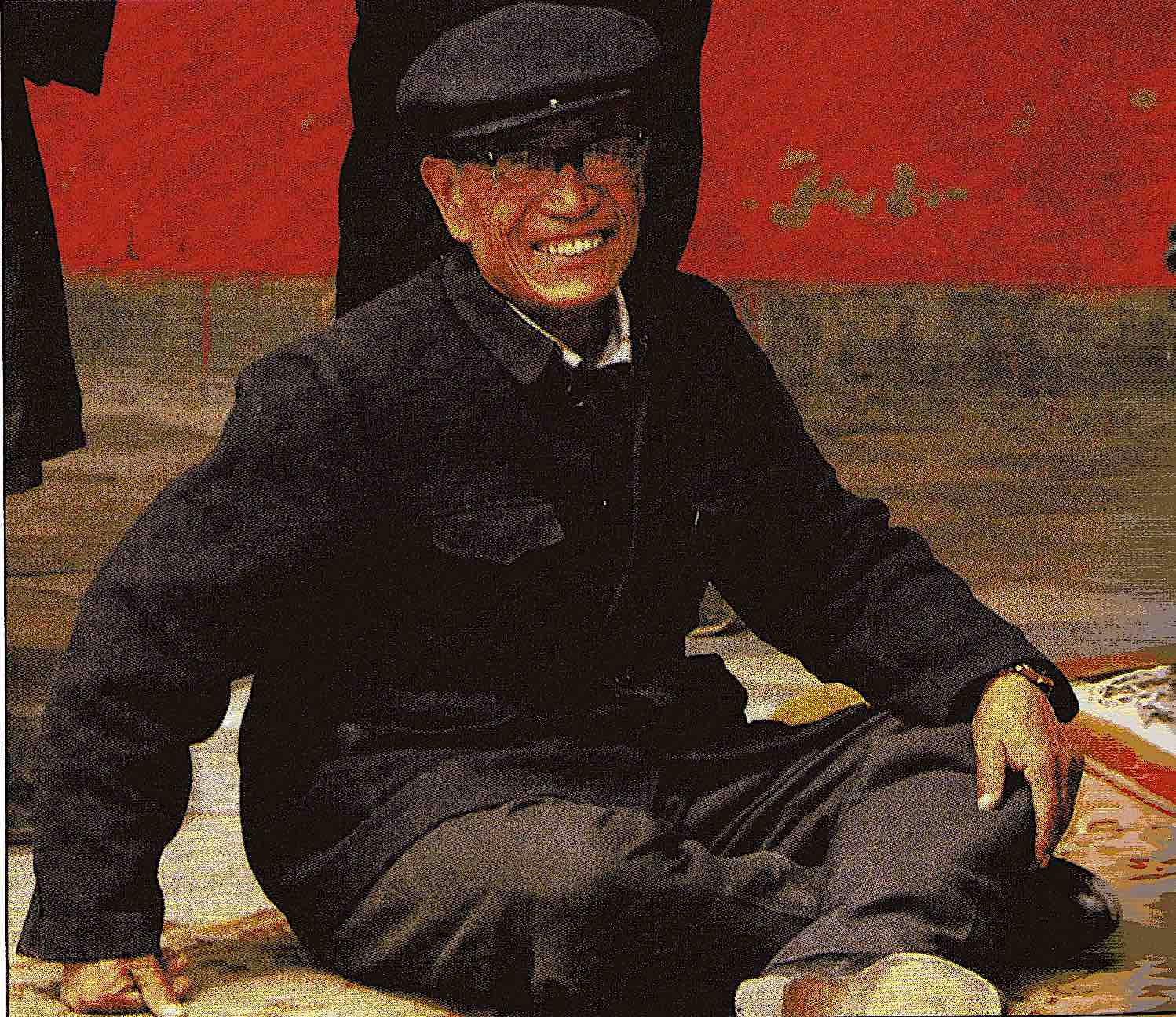


 Horkhang Sonam Palbar leading a study team to a village of the Lhoba minority people,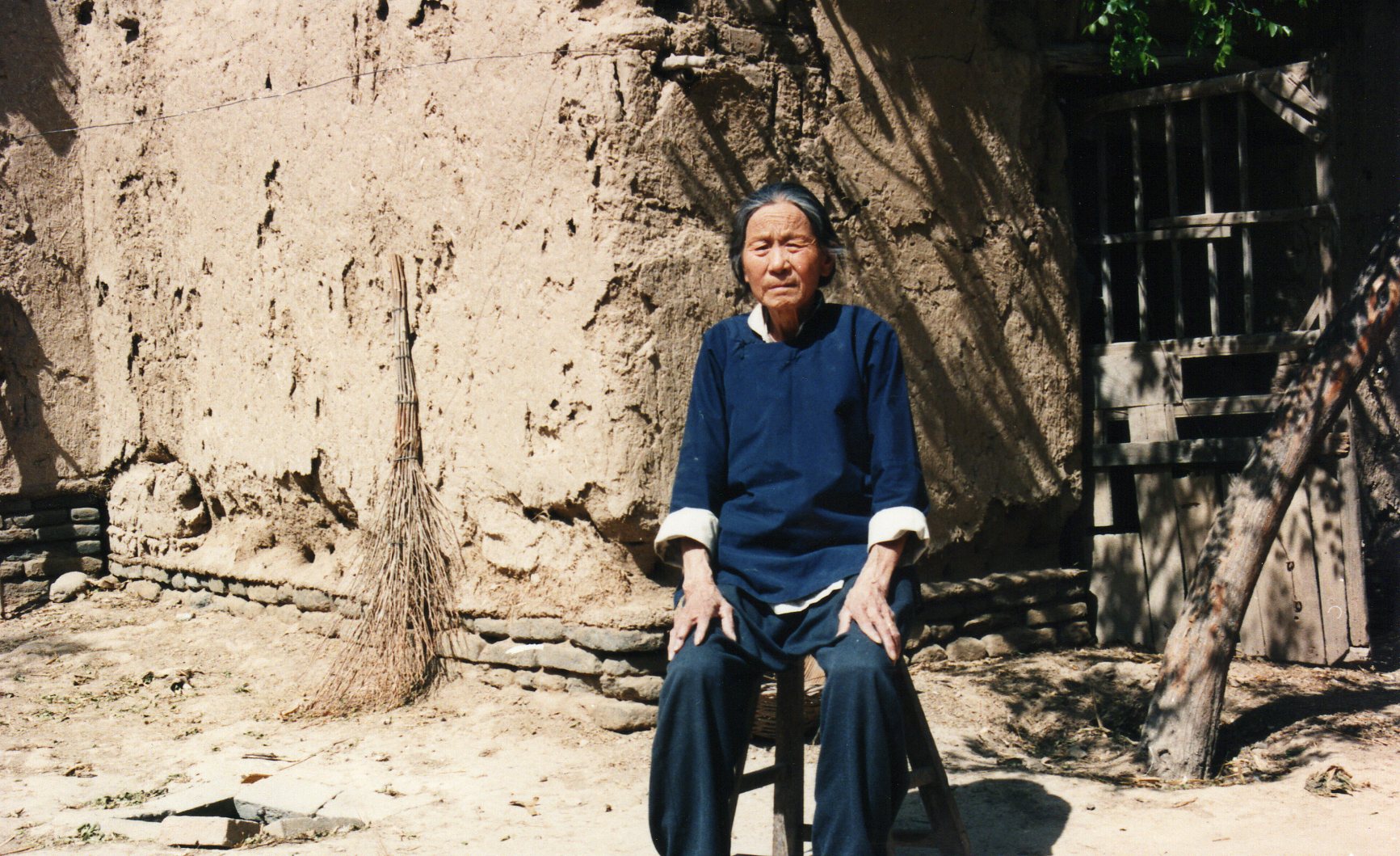
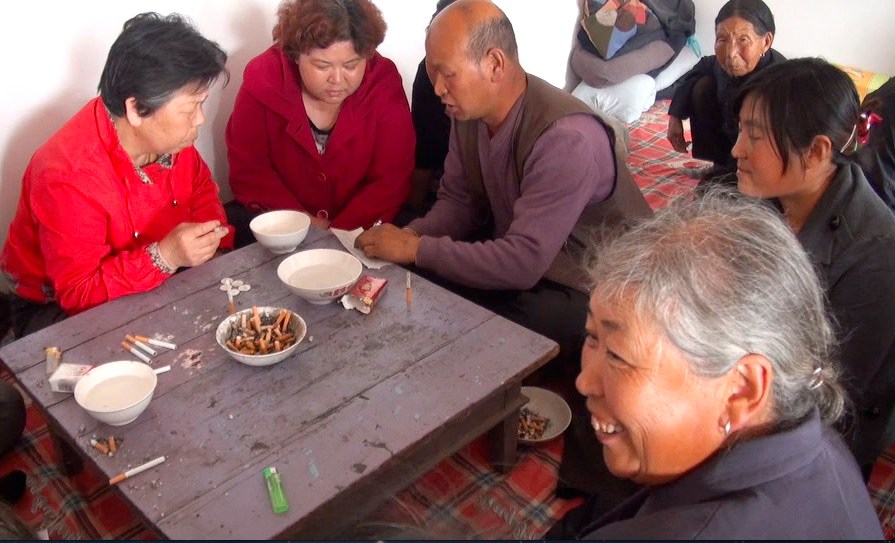

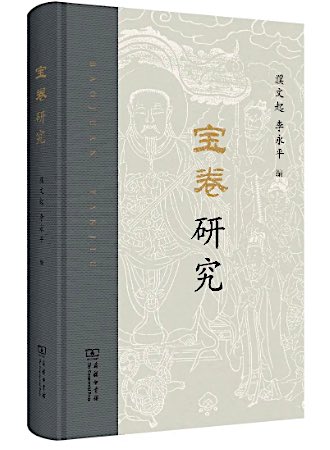



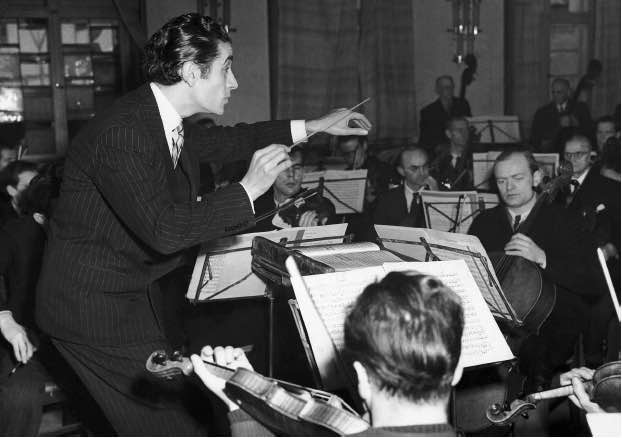



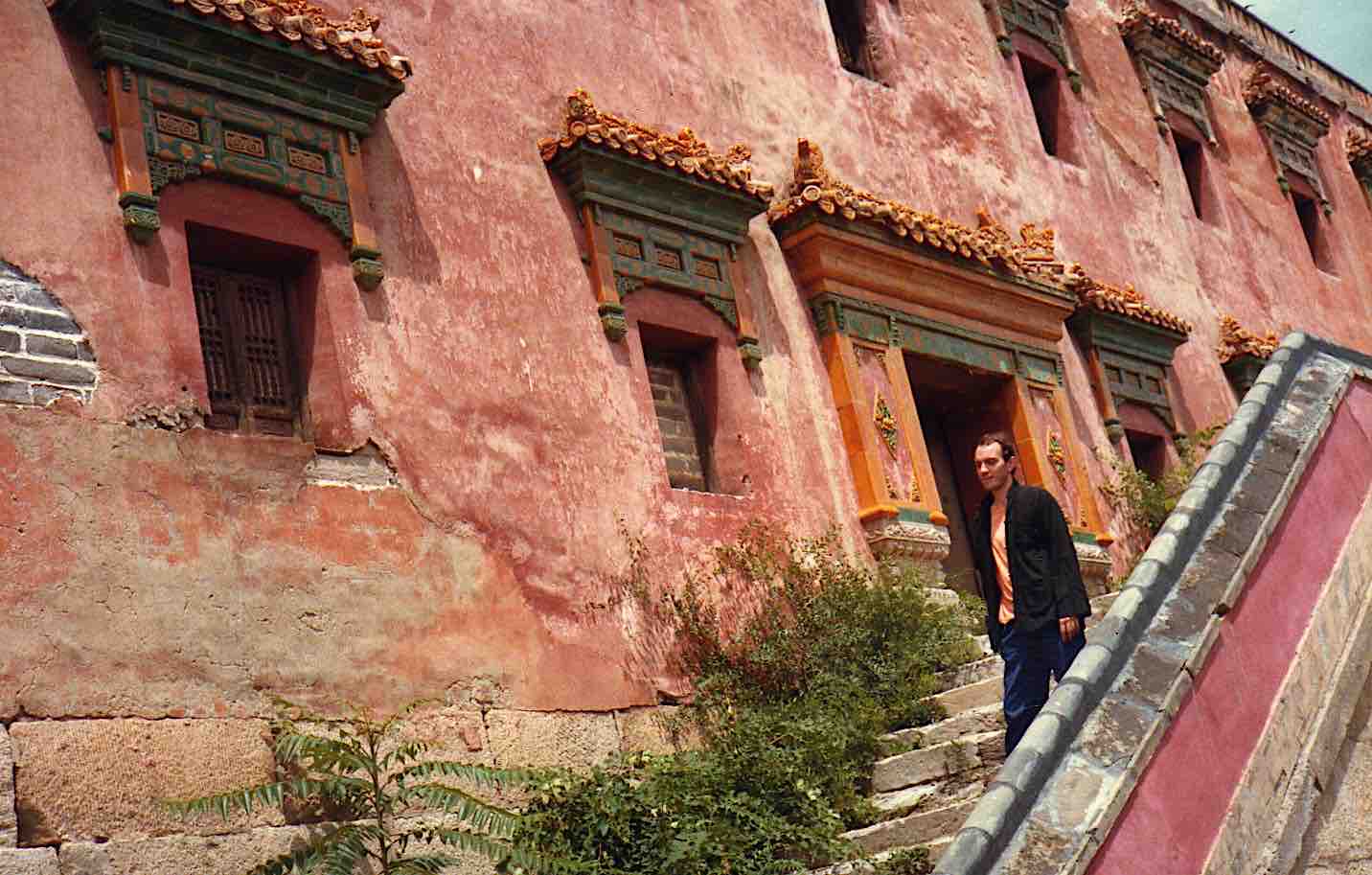

 Dare I surmise [Yes, I’m afraid you probably do—Ed.]** that wang-chucking festivals were once a major part of the ritual calendar in Bhutan, with ornately decorated wangs,*** assembled from monasteries throughout the region, to be hurled towards a distant target, or tôs-pöt? The arcane sentence might thus be the pious request of a courtly petitioner, curious despite the ineligibility of the royal family to participate in an event of which they were the main patrons.
 Stephen Jones: a blog