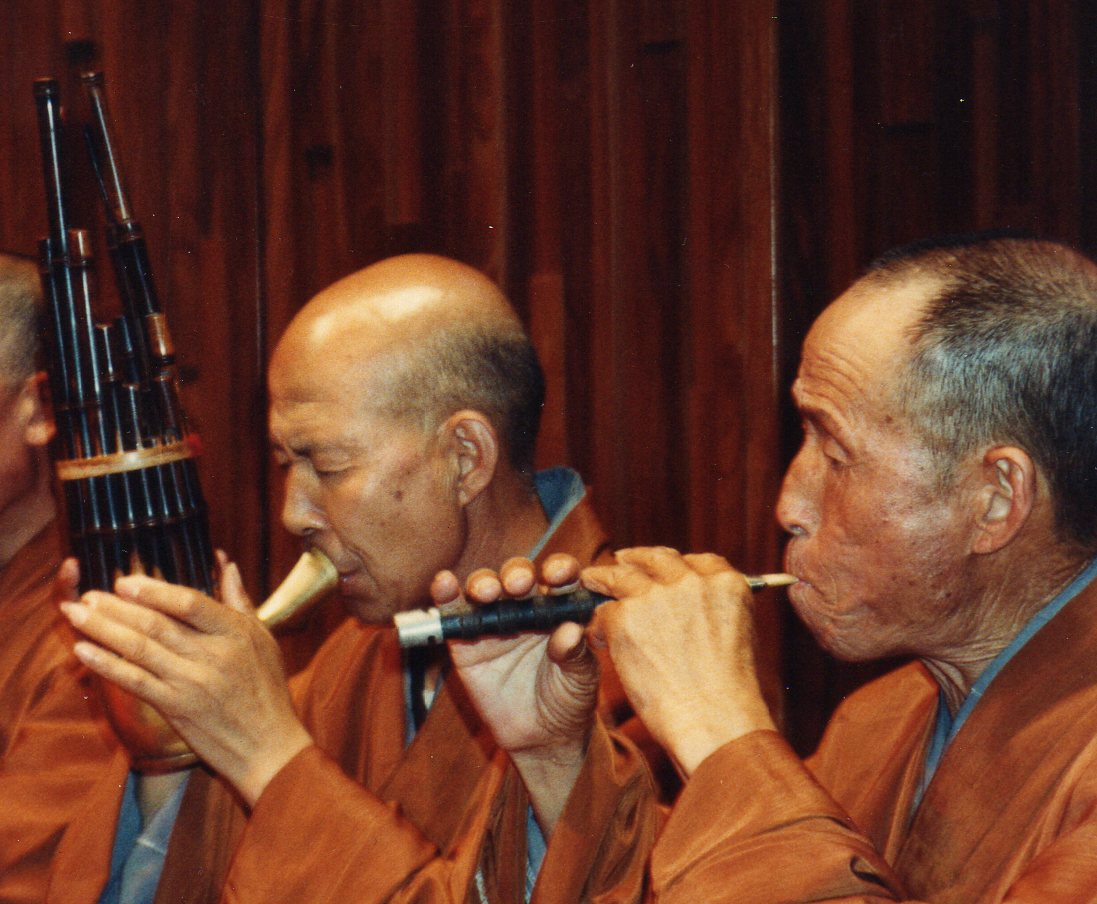
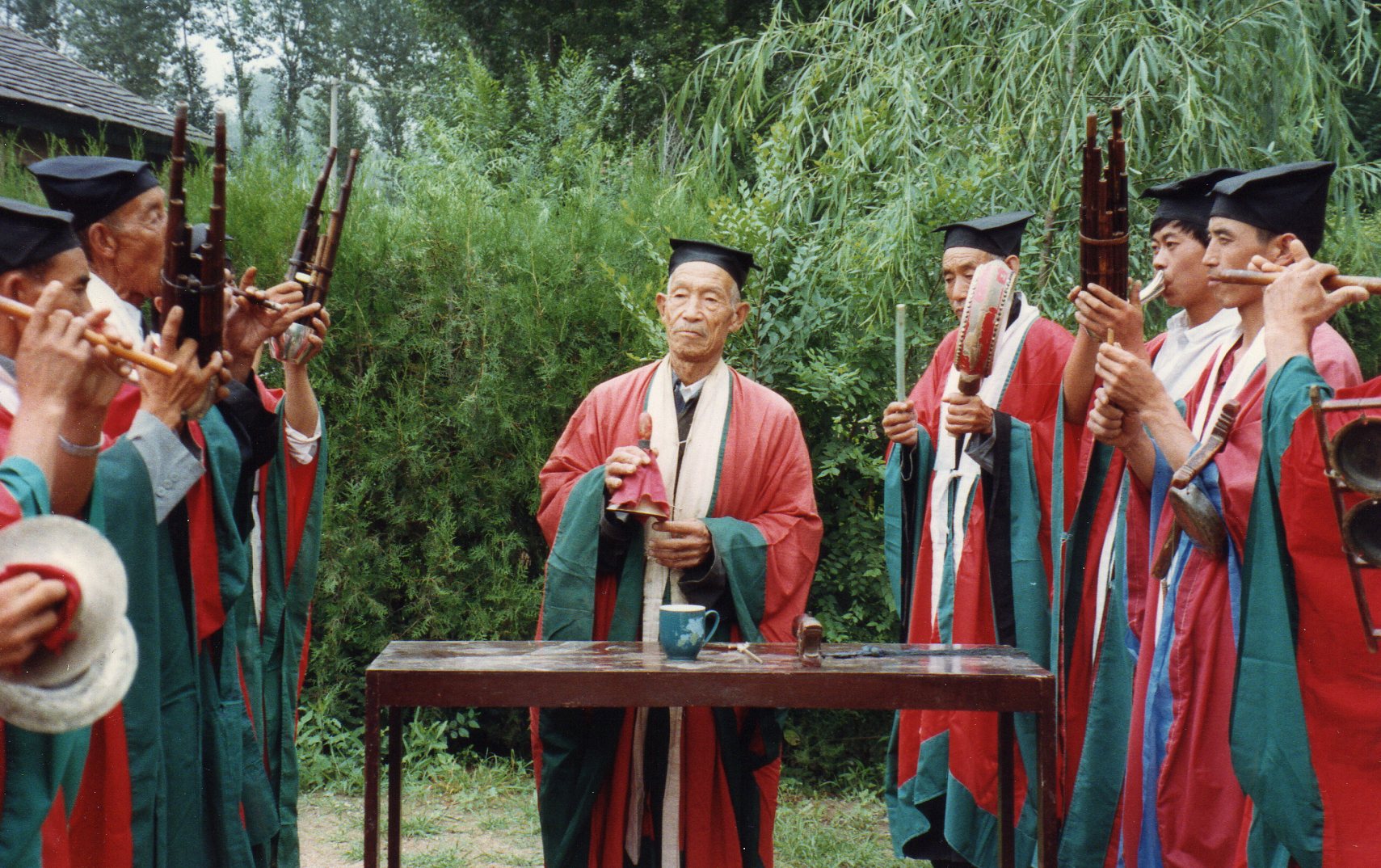
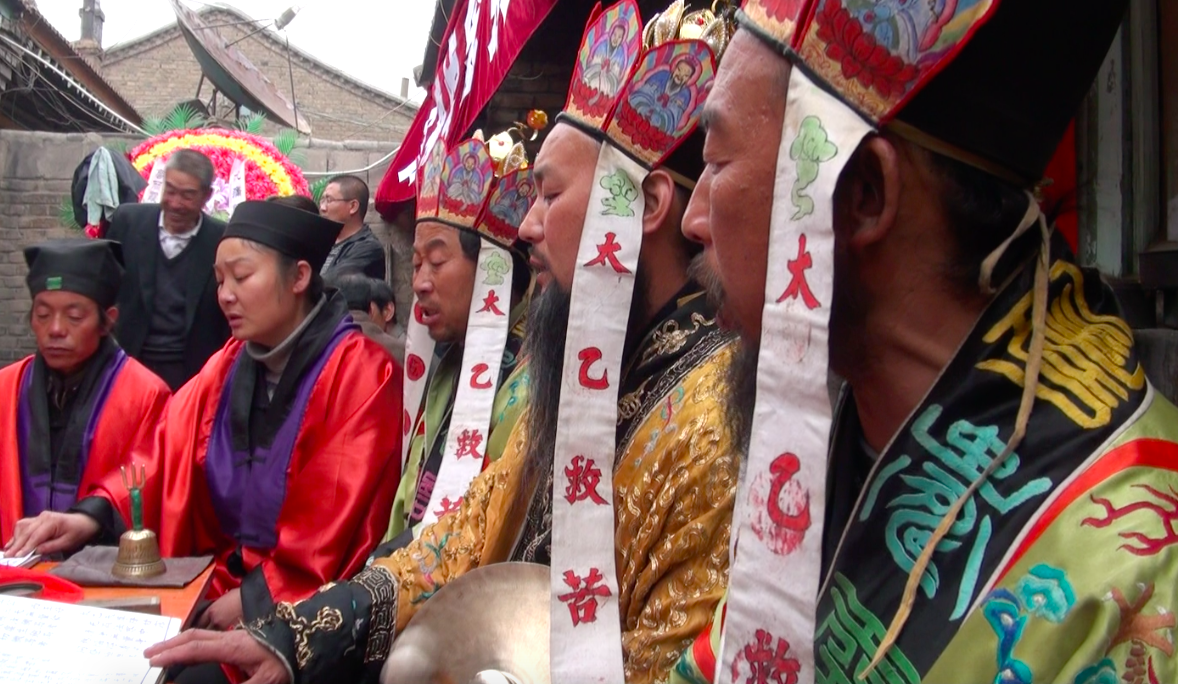
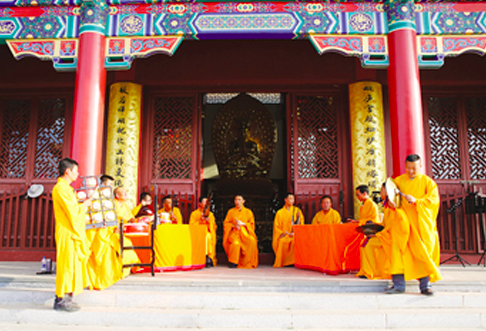
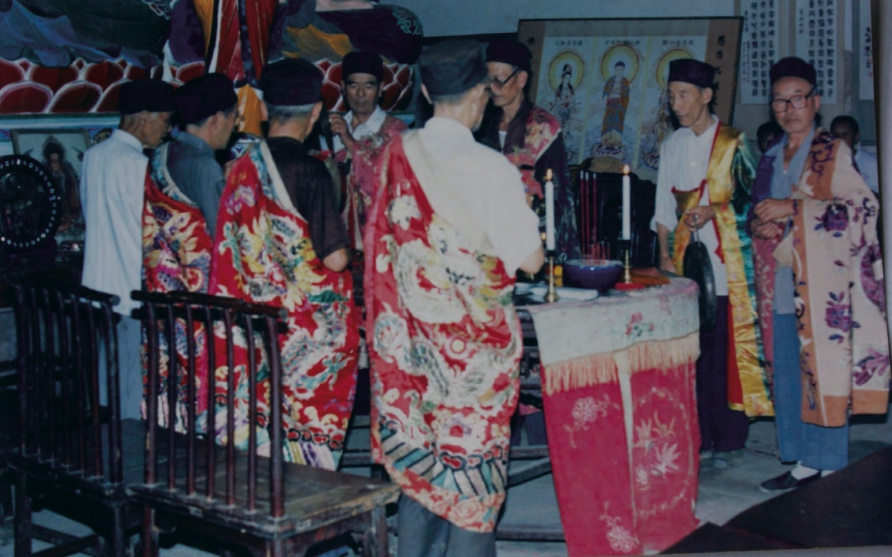
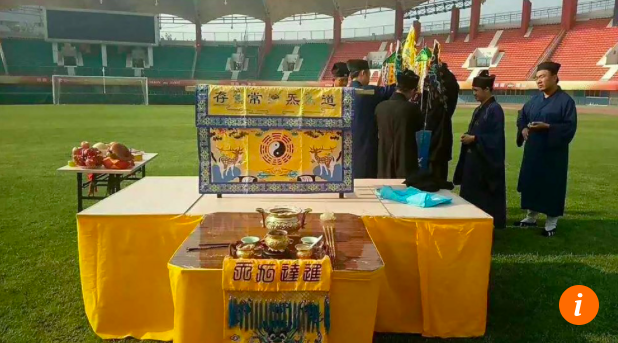
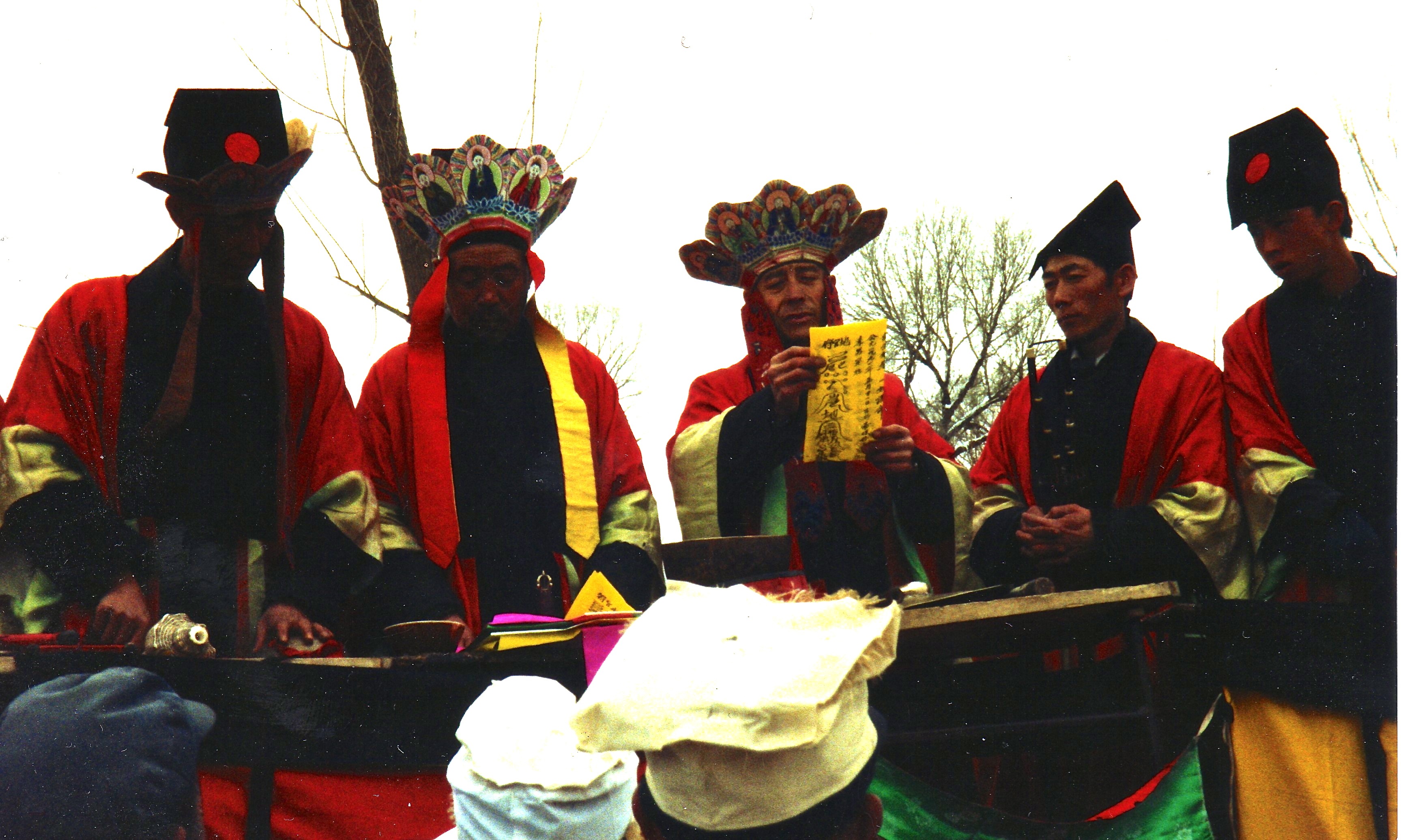
Ritual groups of Xiongxian, Hebei

*Click here for main page!*
(under Hebei in main menu)

GGZ xu 1

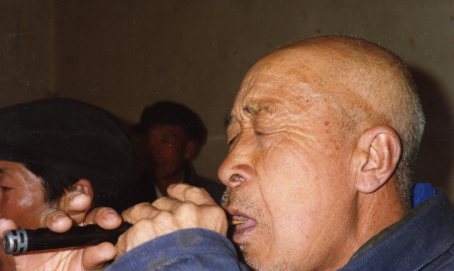
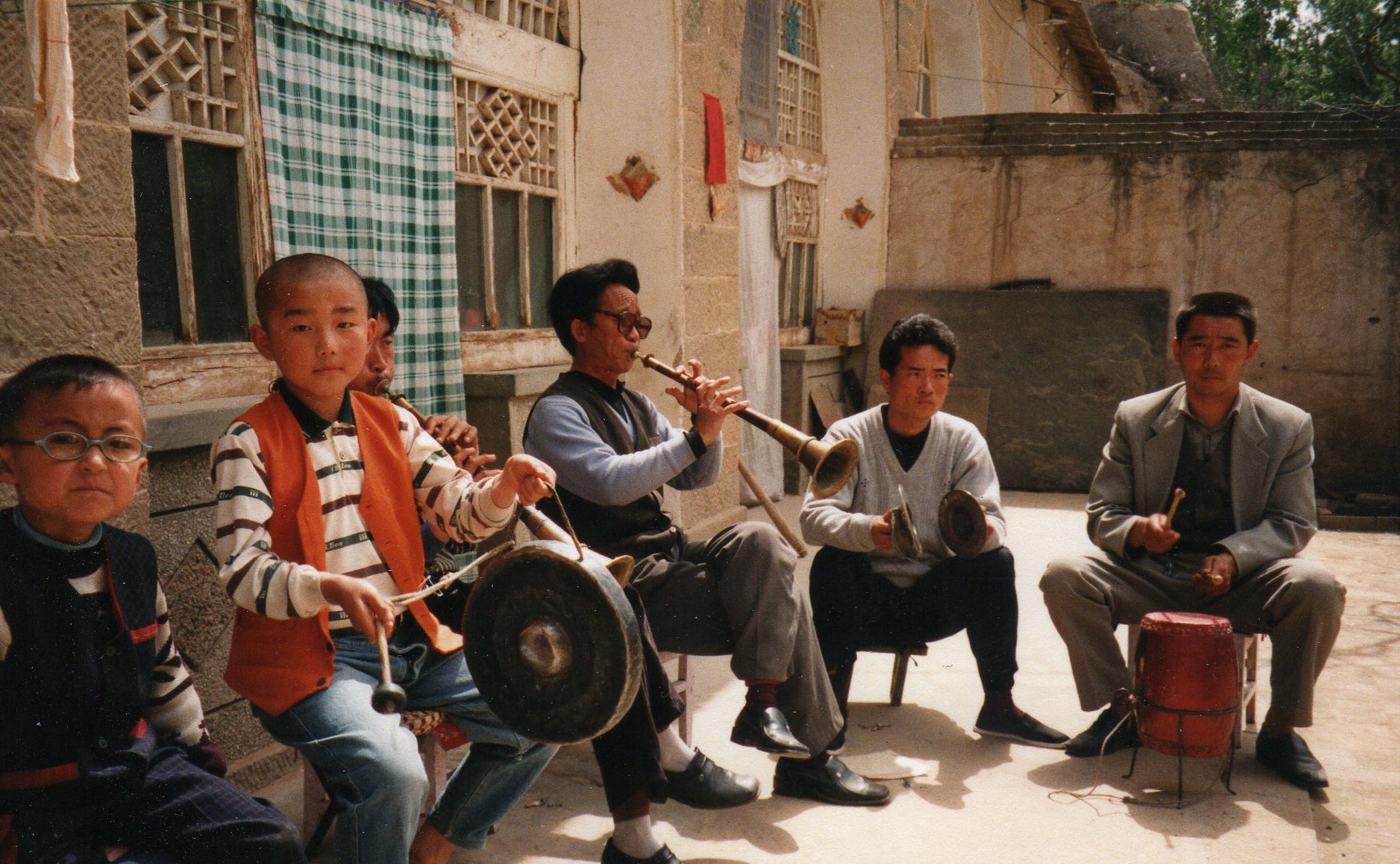
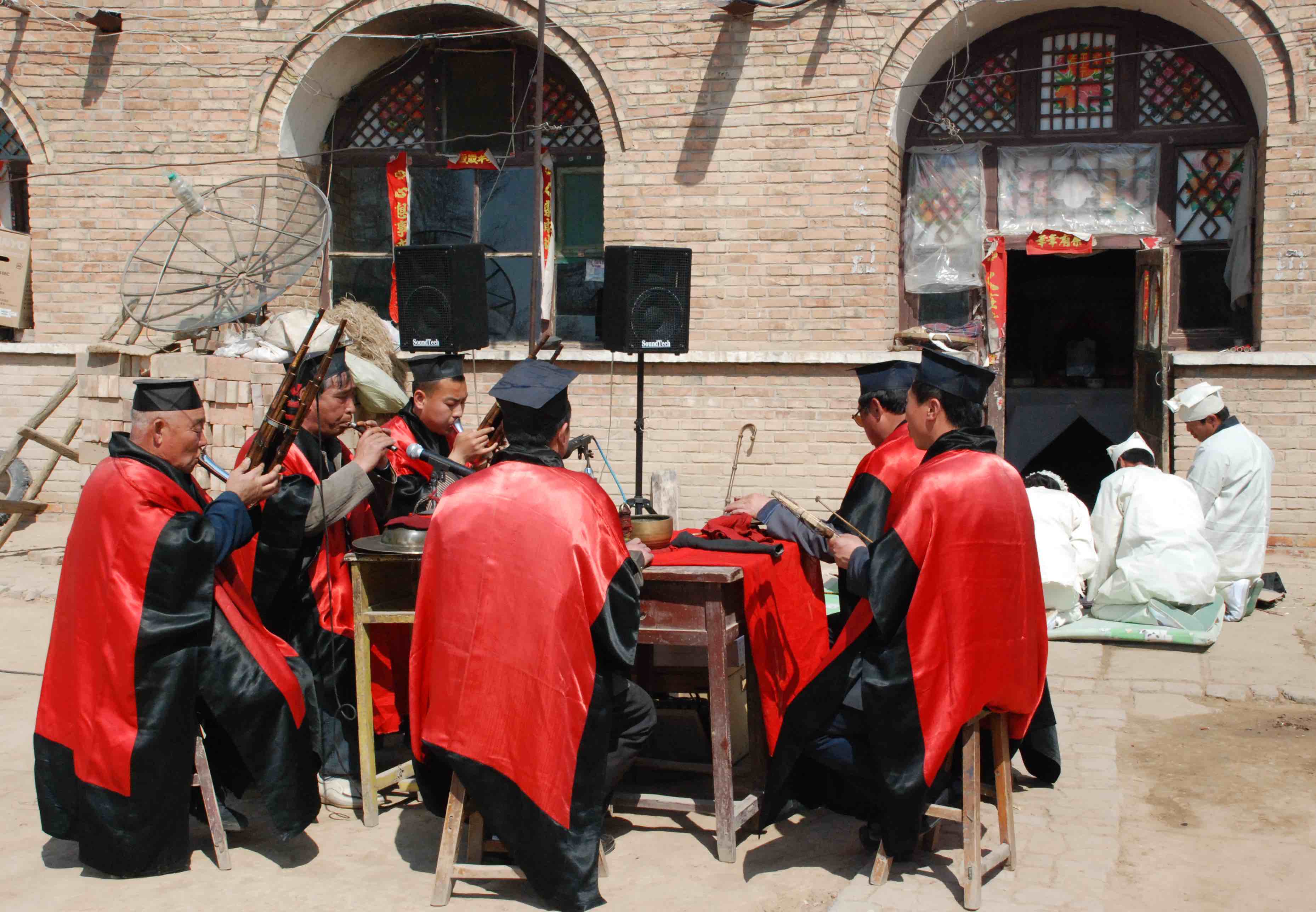
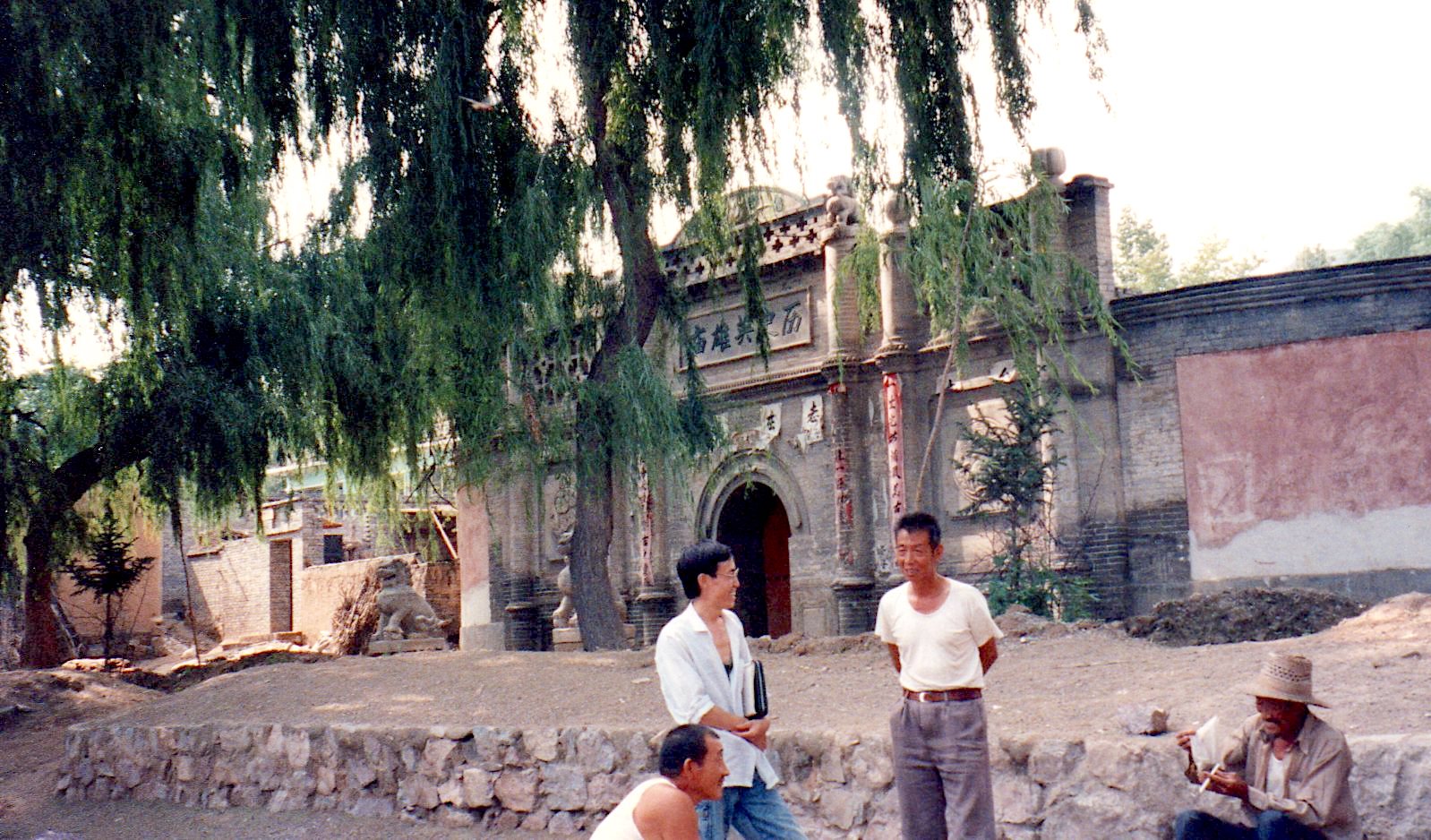
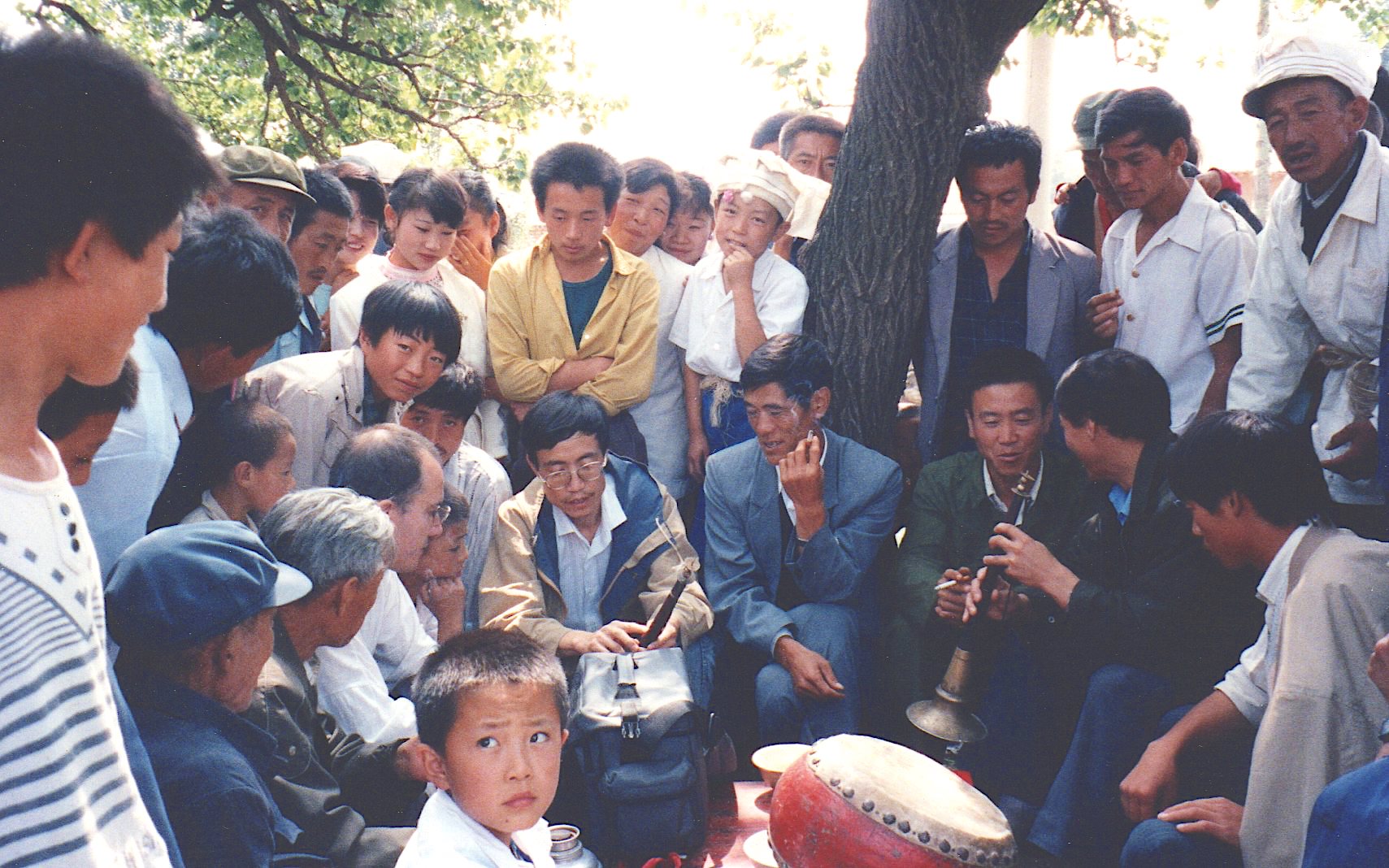
Through the 1990s, one of the most fruitful sites for our fieldwork project on the Hebei plain south of Beijing was the area around Xiongxian county, just south of Bazhou, and east of the regional capital Baoding. Recently this whole region has become the centre of a vast and radical new development project to expand metropolitan Beijing; but when we used to visit, it was still very much rural.

As throughout the region covered in this growing series on Hebei, most villages here had ritual associations until the 1950s, and we found many still active in the 1990s. But here we found less vocal liturgy than further north and west on the plain, with no foshihui groups reciting precious scrolls.

Instead, ritual services were now mainly represented by the “holy pieces” of the shengguan wind ensemble to “revere the gods”—here an exceptionally rich repertoire based on long suites related to those of the temples of old Beijing. Not all these groups were still performing, but there is rich material here, not only on the ethnography of local ritual in modern times, but for scholars of the late imperial period.

This is the latest in a series on ritual in Hebei that includes Houshan and the precious scrolls, suburban Beijing, and Bazhou.

Bazhou: an update!

Xin'an guanzi 1989

I’ve just updated my page on Bazhou, one of the most rewarding counties on the Hebei plain for the study of ritual groups, with some more photos and subtle edits…

To remind you, this is part of a major series under local ritual where I move from occupational household groups in north Shanxi to amateur (mostly village-wide) associations on the Hebei plain, and thence to some other regions of north China.

Just for the Hebei plain, the list (sub-menu under Themes > Local ritual in the top menu) also includes

All these fieldnotes relate to articles on temple ritual in old Beijing (including the Zhihua temple), and the village associations of Gaoluo and Qujiaying.

Ritual groups around Bazhou, Hebei

*Click here for main page!*
(under Hebei in main menu)

Xin'an Yingming drummer 1995

What a wonderful fieldsite we stumbled across in 1986, inspired by Yang Yinliu and Lin Zhongshu!

This is a new addition to a budding series on Daoist and Buddhist ritual groups on the Hebei plain south of Beijing. The elongated county of Bazhou lies just south of Langfang, Yongqing, and Gu’an. Rather as I did for the southern suburbs of Beijing, here I introduce two main ritual groups:

  • the Daoist tradition of Zhangzhuang village comes from a former Orthodox Unity temple;
  • the Gaoqiao village association nearby derives from a former Buddhist temple.

As we move south and east from Houshan, vocal liturgy tends to become subsidiary to the magnificent “holy pieces” of the classic shengguan wind ensemble deriving from the temples of old Beijing—notably the lengthy suites (daqu) whose most majestic form is to be found around Xiongxian county (major page here!).

And as this series of articles on local ritual expands from north Shanxi to Hebei, it’s becoming something of an alternative, grass-roots, history of 20th-century north China through successive social and political vicissitudes.

Ritual paintings of Li Peisen

***For main page, click here!***
(under Images: Li family, in main menu)

LPS 5

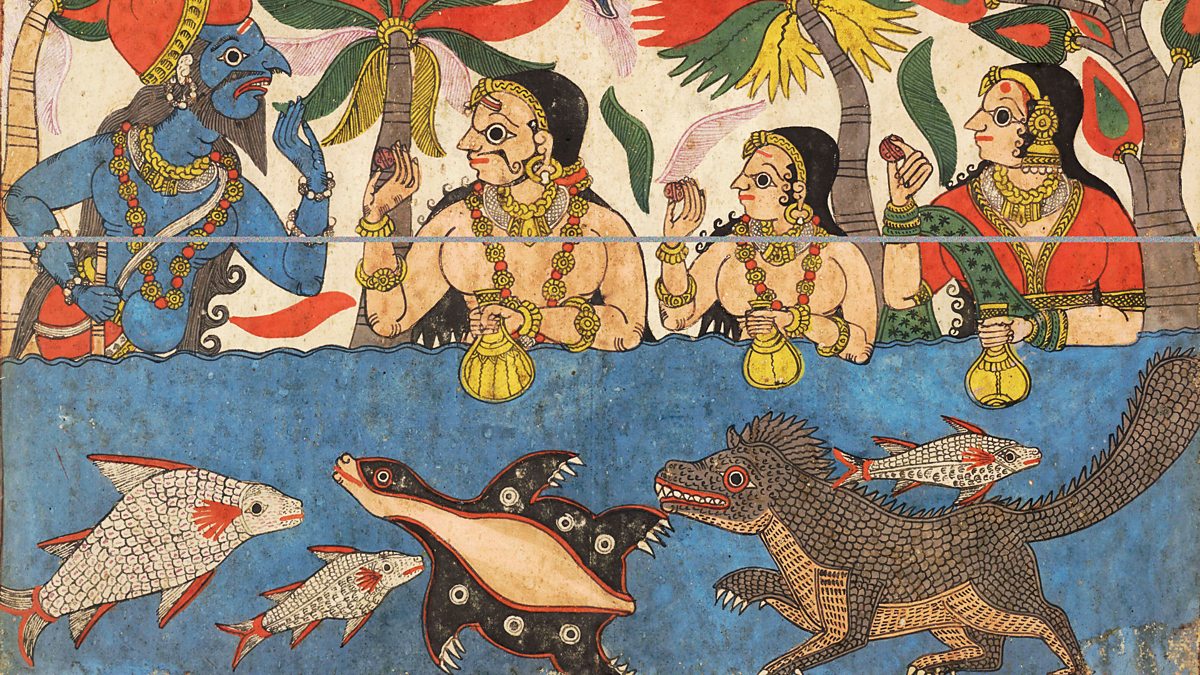
Until the 1950s, household Daoists in north Shanxi displayed paintings for funerary, temple, and other rituals—notably of the Ten Kings (cf. Hebei), as well as representations of deities worshipped during other funerary rituals like the Pardon. Such images are now rarely displayed, and I have found few in the collections of Daoist families. Many were casualties both of political campaigns and a more general impoverishment of ritual practice.

One exception to this (recent) paucity of images in north Shanxi is the array of paintings handed down by the great Daoist Li Peisen (1910–85) to his son Li Hua. Some he seems to have painted himself, perhaps in the 1940s; others appear to be rather older.

In the main article I reflect on the specific use of such paintings in space and over time, and their subsidiary role to the ritual soundscape.


Ritual groups of suburban Beijing

***For main page, click here! ***
(under Hebei in main Menu)

N. Xinzhuang funeral 1

In the 1990s, ritual activity in the southern rural areas of the municipality of Beijing was patchy. While we found few ritual associations in the counties of Gu’an, Fangshan, and Zhuozhou south of the city, the groups in the suburban counties of Daxing and Tongxian, southeast of Beijing, were still actively providing ritual services.

Like other associations on the Hebei plain, these groups have ongoing ritual traditions, and clear links to Daoist priests and Buddhist monks. But these groups are distinguished by their proximity to Beijing, and by the fact that many groups acquired their ritual only in the 1950s, as laicized clerics sought to transmit their knowledge to villagers. Thus although they are not “old associations”, lacking the early history of most village groups that we found just further south on the plain, they clearly reflect temple traditions of ritual, relating to Beijing and Tianjin as well as to local networks. Again by contrast with most of the amateur village associations elsewhere on the Hebei plain, many of these groups don costumes for rituals, and accept fees.

This whole region was still largely rural when we made fieldwork trips there in the 1990s, but has since been absorbed into the ever-expanding urban sprawl of suburban Beijing—as indeed are villages further south on the plain, where we found many more ritual associations. In a physical and moral landscape that has changed constantly since the 1930s, restudies are always to be desired.

There are many such groups here, but in the article I focus on two:

  • The Lijiawu Daoist group, derived from the temple priests of Liangshanpo, and
  • the Buddhist-transmitted group of North Xinzhuang nearby.

This article also complements my various posts on Beijing temples and the transmissions south to villages like Qujiaying.

Ritual images: Gaoluo

***For new page, click here!***

GL Dizang

This first page under a new series on ritual images again concerns Gaoluo.

Apart from their ritual manuals and gongche solfeggio scores, all four ritual associations in North and South villages of Gaoluo have collections of images, including god paintings, diaogua hangings and donors’ lists, from various stages since the 19th century—displayed for calendrical rituals of the village community.

Ritual paintings of north China

***For main page, click here!***
(under Themes, in main Menu)

SGL old pantheon detail

For aficionados of visual culture:

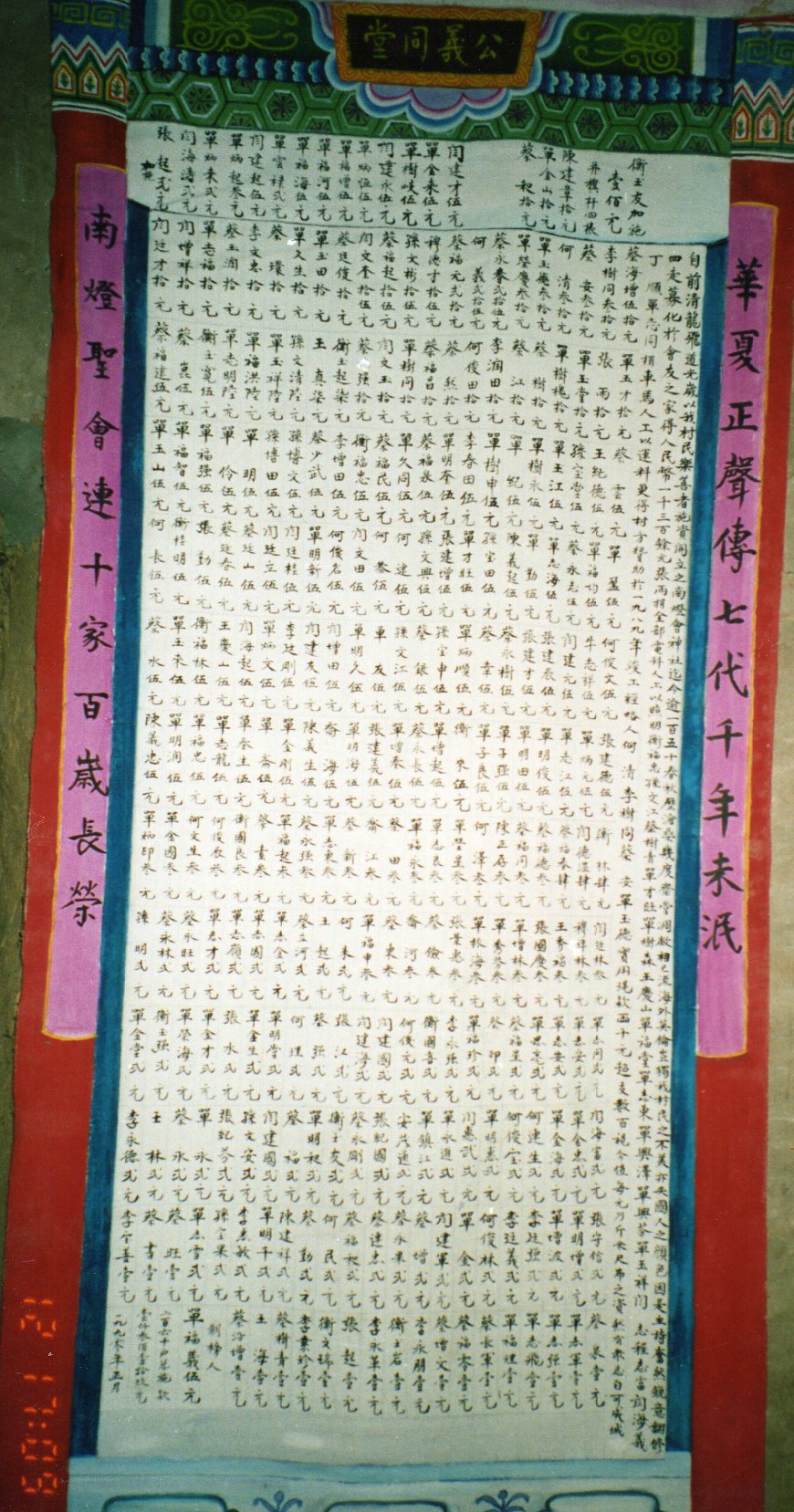
The main focus of our fieldwork on the Hebei plain through the 1990s was the ritual performance of amateur village-wide associations there. But of course we also documented the material artefacts of these groups—including ritual manuals, gongche solfeggio scores for the shengguan wind ensemble, donors’ lists, and so on.

I now realize that by comparison with elite painting, temple murals, and so on, what we may call “folk art” is not so well represented—either in print publications or online. So this is a new sub-menu for ritual paintings of village groups, mainly from Hebei. I’ve already included some of them in various posts/pages, but now I’m adding many more (mostly from the period since the late 19th century, but also some painted since the 1980s).

Most of these images are displayed for calendrical rituals (notably the New Year) and/or for funerals—the Ten Kings images are used for both.

Of course, these material artefacts are a sub-theme; our main material consists of a rich archive of audio and video recordings of ritual performance. Contemplating such images in a museum is a last resort: they are the backdrop to the ritual soundscape of vocal liturgy and “holy pieces” of shengguan wind ensemble, and a representation of the changing spiritual life of local communities. As you digest these pages, you might even listen to the items of vocal liturgy and shengguan on the playlist in the sidebar, with commentary here).

Shadow puppets and Satie

shadows on road

Among a select group of films on rural life in China, little-known but brilliant is

  • Chinese shadows: the amazing world of shadow puppetry in rural northwest China (58 minutes, Pan Records, 2007).

Fruit of the collaboration between Frank Kouwenhoven and the late lamented Antoinet Schimmelpenninck of the CHIME foundation in Leiden, it evokes the changing lives of itinerant troupes in the poor villages of Huanxian county in east Gansu. Both in the scenes of villagers chatting and in their performances, you can feel the film-makers’ empathy with rural dwellers.

shadows guoguan

The puppeteers often perform as part of the Crossing the Passes (guoguan) ritual to protect children.  A similar ritual in Shaanbei is shown in my film Notes from the yellow earth (with my book Ritual and music of north China, vol.2: Shaanbei, p.37); see also my note for Daoists in Changwu in Shaanxi, not far away.

shadows band

The sound-world of the puppeteers is remarkable, with gutsy percussion, fiddles, and shawms accompanying passionate vocals. [1] On the Chinese shadows soundtrack, piano music (Howells, Smetana, Janáček, and so on) makes a disorienting contrast with the guttural sounds of the Gansu singers and their earthy instrumental accompaniment. At first I had reservations about this choice, when we have so little opportunity to savour the sounds of village China—but I’ve come round to it as an effective personal reflection of the film-makers.

shadows 4
Image © Frank Kouwenhoven; all right reserved.

In similar mood, in Frank’s moving portrait film of Antoinet’s life, a tribute shown at her funeral, he used Satie’s fifth Gnossienne—less well-known than the others:


[1] Featured on the 2-CD set The beauty of Chinese opera, one of an excellent series of historical recordings from Wind Records. For a roundup of posts on Gansu, click here. See also under More films on ritual drama.

Sacred river

Radio 3 doesn’t seem to be speaking to Radio 4.

Like Neil MacGregor’s thoughtful series on German history, his new BBC Radio 4 series Living with the gods is typically urbane and engaging. As he immediately disarms my reservations about material culture and museums, the series makes an accessible mission-statement for the anthropology of religion. And the BBC Radio 3 marathon Sacred River (see also the love-in on https://twitter.com/bbcradio3), the latest of many epic broadcasts, seems like a fine idea to complement it.

I’m most reluctant to cavil at my favourite radio station, and normally I’d be grateful for such a playlist of glorious music (cf. my paeans to the Proms). But it seems something of a retreat from the global perspective of MacGregor’s series. Whereas in Living with the gods he can discuss social contexts, with music examples making evocative soundbites, it’s proved less easy for a programme of “spiritual music” tailored to a Radio 3 audience to address world soundscapes within their regional societies.

Radio 3 is generally rather good on, um, world music (a tradition going right back to David Munrow), but here Neil MacGregor’s stimulating introduction is soon deflated, as one “masterpiece” of (let’s face it, Christian Europe) WAM choral music follows another. My own blog is full of Bach, Mahler, and Messaien—but in Sacred river, whereas one might wish for more challenging juxtapositions from around the world, here a mere five out of fifty tracks are devoted to other world genres (and that’s a generous count: OK, a bit of plainchant, but Ladysmith Black Mambazo? Trio da Kali with The Kronos quartet? Hey!), choices like the Pathétique symphony or the Allegri Miserere hardly open our ears to new horizons. It’s The Great Composers in a new costume. And though “music and ritual” is a rich topic in ethnomusicology, the site offers few links to further sources—even from its own output.

Inevitably, I think of the percussion coda Yellow Dragon Thrice Transforms Its Body of the Li family Daoists, that concludes their Transferring Offerings ritual. Of course neither this nor most other ritual traditions around the world might work on the radio on their own. But listeners deserve more than the Usual Suspects like qawwali, “Find your inner peace with the sound of Buddhist chant”, and “the oldest song in the world”. Sure, they might not necessarily conform to the hackneyed message of Peace and Love, that cramped ghetto from which Neil MacGregor rescues us. But if the Radio 3 team had half his imagination (as I write, he’s discussing royal power, sliding effortlessly from Zadok the priest to bronzes from Benin and China, with asides on Trump and Putin), they could have found more stimulating and offbeat tracks, even from their own archive—aboriginal dream songs, ritual shawm bands, Andalucian saeta, gospel, you name it. So Sacred river ends up undoing the fine work of Living with the gods. Do keep exploring Radio 3, which is full of creative programming—including—such as Late junctionWords and music, and notably The listening service.

Of course, what it needs is a TV series. Alas, since a little heyday in the 1980s there has been little appetite for informed anthropological documentaries on local cultural life—in which ritual features prominently.

Hey-ho. Just saying, like…

Recording and editing

After our rendition of The Feuchtwang Variations à la chinoise at Stephan’s party—which surprised us as much as the guests, even without kazoo—we wanted to make a separate recording, but we had few illusions about how it could turn out. However modest our remit (it would be too ambitious to try and edit within movements, and we didn’t do too many takes), even the minimal editing that Rowan undertook was still a time-consuming process.

Typical exchange during rehearsal:

Me: Can you give me a lovely lingering arpeggio on that first chord, like a theorbo?
Rowan: No.

For me, it recalls all those orchestral recording sessions through the 80s and 90s—with section leaders crowding into the box to make notes and report back, doing endless retakes of a single chord, with the editor then taking months to compile a version that was a total fabrication. Of course, live recordings are far more satisfactory, if we can wean ourselves off glossy perfection—even then, we tended to do a couple of patching sessions after the concert.

It also reminds me of a comment from—you guessed it—Alan Bennett, in his 1990 diaries, on working with the Delme string quartet in recording the soundtrack for his Proust film:

27 June. […] Striking about the musicians is their total absence of self-importance. They play a passage, listen to it back, then give each other notes, and run over sections again. George Fenton, who is coordinating the music, also chips in, but he’s a musician. David H., the director, chips in, but he isn’t a musician, just knows what atmosphere he wants at various points in the film. In the finish even I chip in, just because I know what I like. The musicians nod and listen, try out a few bars here and there, then settle down and have another go. Now one could never do this with actors. No actor would tolerate a fellow performer who ventured to comment on what he or she was doing—comment of that sort coming solely from the director, and even then it has to be carefully packaged and seasoned with plenty of love and appreciation.  Whereas these players, all of them first-class, seem happy to listen to the views of anyone if it results in them doing a better job.
[…] The readiness of players in a string quartet to absorb criticism from their colleagues has been noted by doctors, and the BMA video was made to be shown to businessmen as a model for them to emulate. Perhaps it should be shown to Mrs Thatcher.

Such humility is a trait that musicians might not recognise in themselves; anyway, AB was lucky to work with a quartet, as orchestral recording sessions are (inevitably) far more hierarchical, with a clear pecking order (giving rise to maestro-baiting). Still, the contrast with actors (and politicians) rings true.

The Feuchtwang Variations

The wise and infinitely supportive Stephan Feuchtwang continues to inspire generations of anthropologists in China and worldwide (see also here) with his work on Chinese popular religion. He has just celebrated his 80th birthday—and so do we all!

Stephan's invitation edited

Design: Lotte van Hulst.

For the party at the Tabernacle (a great venue, and, um, marker of the changing territorial identities of West London religious life!) his wonderful family played some popular and moving musical items, with the assembled guests on kazoos (anyone have a funky collective noun for kazoos in English, or measure word in Chinese?). And following my little foray into a world-music version of Bach earlier this year, we did a warmup act as a heartfelt tribute to Stephan, essaying a little medley from the Goldberg Variations—with me on erhu (one of many types of Chinese fiddles) and Rowan Pease (unsung Lucy Worsley of East Asian popular culture, currently embroiled in the China Quarterly struggle for academic freedom) on sanxian banjo (or should I say friction chordophone and plucked lute?) [Nah, give it a restThe Plain People of Ireland].

Wong

Not Rowan, not playing the sanxian.

That makes a total of five strings—and all without a safety net. Since Bach never wrote for either piano or sax (shades of WWJD), if his music can sound great (to us) on those instruments, then why not erhu and sanxian, eh. We haven’t tried adding a kazoo yet, though. As I said in my intro:

Just imagine that the Italian missionaries, like Pedrini, [1] at the court of the Qianlong emperor in 18th-century Beijing had invited Bach for a sabbatical—and indeed Stephan, although that was perhaps a little before even his time… So we’re going to essay a little medley from what should now be known as The Feuchtwang Variations[2]

Since among Stephan’s many talents he is also a viola player (“Not a Lot of People Know That”), I can avail myself of a couple of the muso’s classic excuses:

It was in tune when I bought it…
and
I didn’t really study any place, I just sort of… picked it up… [for how I picked up the erhu, see under the fascinating story of Ray Man]

[studiously] After intensive research on the performance practice of both Leipzig and Beijing in the 1740s, I can now say with some certainty that…  it wouldn’t have sounded like this.
[Cf. John Wilbraham’s remark.]

If you enjoy this half as much as we do, then we will have enjoyed it twice as much as you.

See also Song of suffering.

Framed by the Aria (itself infinitely enchanting—molten, ethereal, suspended in time), we played the first variation (blimey), then numbers 18 and 25—a perfect selection, eh. Short of recording daily until Steph’s 90th birthday, we’re never going to play it to our satisfaction (editing this is a similar challenge to editing one of my voiceovers), so meanwhile here’s an almost-recognizable attempt, just to give you a flavour—It’s the Thought that Counts. Just think yourselves lucky we didn’t do the repeats. Take It Away (and don’t bring it back):

Stephen Jones (erhu), Rowan Pease (sanxian, vocals).
Recorded in Maidenhead, 14th November 2017.

“They said it couldn’t be done”—and they were right! (Cf. Bob Monkhouse).

Just to make our chinoiserie version sound a little less banal, try the opening of the Aria on Lego harpischord, and Pachelbel’s Canon on rubber chicken—differently charming…

Li Qishan band 2001
Li Qishan’s family shawm band, Shaanbei 2001.

Never having played the Goldberg Variations on a keyboard, I (like millions of others) am deeply familiar with it through recordings—notably that of the iconic Glenn Gould, of course. So at the age of 286 I’m almost in the position of a young player in a Chinese family shawm band, who begins to play the melodies on shawm after many years of aural experience (and let’s just be grateful I didn’t do an arrangement for large Shaanbei shawms—yet). Similarly, I hardly needed to consult Bach’s notation, except out of curiosity. At the same time, anyone playing the piece is inevitably conditioned by the experience of hearing Glenn Gould’s version.

We played the medley in F rather than G—less as a result of all my erudite research into 1740s’ pitch standards (not), but just because I like a lower tuning on the erhu.

Bach party

Blending with invisible singers to left of picture. Stephan in red on left. Photo: Cordelia Pegge.

For the ecstatic Variation 18 we recruited a backing band consisting of Stephan’s daughters Rachel and Anna, along with Harriet Evans (outstanding scholar of the status of women in China). I arranged some personal lyrics, often in a kind of verbal hocket, incorporating (in stave 3) anthropology (with a little jest on the challenge, for some of us, of mastering the abstruse nature of Stephan’s theory!), (in stave 4) his dear wife Miranda, and his love of cycling:

Goldberg Var 18 in G

For the recording, without vocal backup, Rowan and I take the upper parts wordlessly, in more ethereal vein. Do feel free to sing along with a partner of your choice (cf. the karaoke versions of Daoist ritual percussion in my film, from 24.09).

And then the slow and intense minor-key Variation 25 is just amazing. Here Rowan’s singing supplies further harmonic intensity, evoking Glenn Gould’s own occasional inadvertent vocals. [3] And with the sustained sound of the erhu, and all my one-finger chromatic slides (1st finger on the way up, 4th finger on the way down), it sounds even better—or rather, it could do in the right hands. Not unlike a Chinese ondes martenot—trad keyboards just can’t compete with the vocal quality of bowed instruments.

And OMG, how about this (for the theremin, click here):

Sure, our version goes a tad faster—again, not resulting from any holier-than-thou baroque authenticity, but because it helps the whole harmonic logic.

Among many fine harpsichord versions, here’s Scott Ross:

Returning briefly to the modern piano—Bach was of course performing and composing modern music, and maybe what appeals to me in Joanna MacGregor’s version is that it seems tastefully rooted in her whole experience of our own contemporary piano sounds. Here’s the hallucinatory final repeat of the Aria:

Still, Bach is amazing on tuned percussion too, like this:

It can also sound wonderful as a string trio:

And now I’m keen to hear Rachel Podger’s new arrangement with Chad Kelly:

For Uri Caine’s stuttering variation, see here.

All this wealth of divine music I offer in tribute to the great Professor Feuchtwang!

[1] For missionaries at the Qing court, see here. “They come over ‘ere, with their fancy harpsichords…”
[2] Maybe I can concoct a couple of Chinese musicians in 1740s’ Leipzig from the Bach archives. If north African wind players were active at European courts of the day, then why not… International cultural exchange, eh. Note also Bach and Daoist ritual—not least Li Manshan’s classic remark.
[3] This encomium could come in handy for Rowan’s CV: “Less irritating than Glenn Gould”—Dr S. Jones.

They come over ’ere…

Central Asian musicians, Tang dynasty.

Here’s a companion piece to my post on foreigners during the Cultural Revolution, where I acknowledged my anachronistic use of the epithet laowai 老外.

I read that indeed the term didn’t become common until the 1980s—just in time to greet me on my late arrival (for some words that Shakespeare may not have invented, see here). The Chinese wiki article on laowai makes a useful succinct introduction, explaining its interplay of respect and xenophobia. I’m still curious to learn how the winning combo of lao and wai suddenly caught on. A detailed forum on the nuances of this and related terms has been initiated by the erudite Victor Mair, so here I’ll just add a few personal reflections.

A still more blunt term is dabizi 大鼻子 “big nose”; foreigners in China have to get used to frequent appraisals of their physiognomy, but as an autonym, at least, the term can be drôle. I’m also fond of the more quaintly retro yang guizi 洋鬼子 (“foreign devil”), which a senior Taiwanese mentor—and, crucially, friend!—likes to call me. As ever, such terms are context-sensitive; they may even confirm guanxi (“You’re my mate—we can take the piss together”).

At a tangent, in Shaanbei a fine shawm-band leader is widely known as Jiekazi “The Stammerer”—in rural China, attitudes towards stammering are both less po-faced and less courteous.

Craig and Ming

Waiguoren!” (not yet “Laowai!”). Craig Clunas, Ming tombs 1975.

Staying with China (derogatory terms for foreigners are of course a rich topic worldwide), apart from the various historical terms (hu 胡, fan 番, yi 夷, man 蠻, and so on—mostly with a strong suggestion of “barbarian”), I’m now curious to learn how the Labouring Masses of the Tang dynasty would have hailed the substantial number of laowai on the streets of 8th-century Xi’an in the popular argot of the day.

We may now regard the Tang as the first great world-music boom (cf. Soundscapes of Dunhuang), but as musical nationalists of the day (like the poet Bai Juyi and his mate Yuan Zhen) might have said,

“They come over ’ere, with their fancy bili and pipa…”

Or their Qing-dynasty counterparts (so does building walls work, then? Eh??):

“They come over ’ere, with their fancy erhu and suona and yangqin…”

OK, I made those up, but this is a genuine Tang quote (adding impertinent male judgment on female attire to the heady xenophobic mix): [1]

Our women are acting like foreigners’ wives, studying foreign make-up;
Entertainers present foreign sounds, servants to foreign music!

Straight out of the Daily Mail, that. With the current surge in “patriotism”, a new campaign to purge corrupting foreign influence from the Chinese instrumentarium would be left mainly with the xun ocarina and the sheng mouth-organ—which might fail to excite even Uncle Xi. It’s ironic that after successive waves, it was the Model Operas of the Cultural Revolution that were largely responsible for a renewed vogue for the instruments of the Western Art Music tradition.

Closer to home (yet equally apposite), a classic rebuke to xenophobia is the great Stewart Lee’s UKIP routine (“Bloody Huguenots, Coming Over Here—doubting trans-substantiation, with their famed ability to weave little jerkins out of lace…”). And to supplement his fantasy chat down the UKIP pub:

“Apparently the guitar is descended from the oud—that’s bloody Moorish, mate! What’s wrong with Morris dancing, that’s wot I say!”

[Inconvenient footnote: an inconclusive etymology suggests that “Morris” is itself derived from “Moorish”…]

As simplistic nationalist agendas rear their ugly orange heads yet again, it’s always worth unpacking language. See also A fine riposte, and Das Land ohne Musik.

For the “Golden Age” of the Tang, Chinese scholars might learn from 17th-century Holland.


[1] See e.g. Suzanne E. Cahill, “Our women are acting like foreigners’ wives! Western influences of Tang dynasty women’s fashion”, in Steele and Major (eds), China chic: East meets West. Among many works, see also Marc S. Abramson (ed.), Ethnic identity in Tang China. The works of Edward Schafer (notably The golden peaches of Samarkand and The vermilion bird, written at a time when such study was neither profitable nor popular) have long been an inspiration for those studying Central Asian culture in the Tang.

Women of Gaoluo

Woman Zhang

Woman Zhang at 90 sui, 1998.

Chain-smoking cross-legged on the kang brick-bed with all the carefree abandon of the elderly, wielding her cigarettes with more relish than accuracy, Woman Zhang (Zhangshi nü 张氏女, b.1909) told us what she could about her life. As she said, entirely without feminist irony, “I had no [given] name until going to work [in 1958] in the Great Leap Forward—that’s when they gave me the name Yurong.”

Apart from the Li family Daoists (film, and book: also tag in sidebar), my other most in-depth ethnography concerns the ritual association of Gaoluo, just south of Beijing. On this blog I’ve written about two leading figures there, and the vocal liturgists, as well as their performance of “precious scrolls”—and also the village’s substantial minority of Catholics.

It may not have escaped the alert reader that much of my fieldwork is basically about the public activities of men. I made a partial attempt to redress the balance with three posts on Women of Yanggao (starting here). So here are some further notes on the status of women in rural China, setting forth from our chats with the characterful Woman Zhang in Gaoluo in 1998, and again based on vignettes from my book Plucking the winds (where you can find further detail).

Though 90 and illiterate, her mind is quite clear, and to my relief she speaks with a clear calm voice in a standard accent. Given her advanced age (she claims to remember the long pigtails still worn by men for a while after they ceased to be enforced with the fall of the Qing dynasty), our meeting should have been a fascinating glimpse into village history. But, in total contrast to the detailed day-by-day accounts of the cultured men Shan Zhihe and Shan Fuyi, I was taken aback by her ignorance of the momentous events which had convulsed the village. Of course, men can be muddled too; but this wasn’t muddle. We know a lot of men who are totally vague about dates, but at least they have participated in history, even when only trying to escape it or deplore it, and one can learn a lot. The problem was that she was not only uneducated and a woman, but had been widowed over fifty years earlier: she had simply played no part in the village’s public history. This itself was a salient lesson. We supplied the dates below: significantly, the only date she had ever heard of was 1960, the famine.

While nominally a Catholic, Woman Zhang “believes in everything”. Though she was only brought to Gaoluo from her home in a village in Dingxing just south in about 1930, she had heard stories about the famous Boxer massacre at Gaoluo in May 1900. Some of the Catholics took refuge in the Catholic stronghold of Anzhuang further south, while others fled to the Xishiku church in Beijing. Woman Zhang’s father-in-law Shan Zhong was the only survivor of his whole family from the Boxer massacre; two sons and a pregnant daughter had been slaughtered. Shan Zhong himself had gone to Dingxing town that day; on his way back he got as far as Wucun village just south of Gaoluo when he got wind of the massacre and fled, taking refuge in the Xishiku church in Beijing. After it became safe to return to Gaoluo, Shan Zhong remarried, taking a young wife.

1930 donors' list, South Gaoluo

1930 donors’ list.

By 1930 the village ritual association, sensing a need to compete with the revival of Catholic power, commissioned a new set of ornamental hangings for the New Year rituals (see here, under Ritual rivalry). Shan Zhong was by now an established leader of the village Catholics—but impressively, he was one of the most generous contributors whose names (all male, as heads of households) appear on the rival association’s handsome donors’ list.

That same year Woman Zhang, then 22 sui, was brought to Gaoluo to marry Shan Zhong’s 14-sui-old son Wenli, the youngest of their three sons. Later the Italian missionaries became popular partly because like the local spirit mediums they could cure illness, and Shan Zhong also gained quite a reputation as a healer. But he died only a year after Woman Zhang’s son was born, quite soon after the building of the church.

Soon after I married here, the Catholics used to try and get me to come to church, but my mother-in-law wouldn’t let me—I couldn’t just please myself when I went out, she’d beat me. They talked it over with the other Catholic wives. They took me to church, and after the service was over they took me home, so the mother-in-law didn’t beat me.

Through the growing fug of cigarette smoke, as we tried impertinently to help Woman Zhang direct some of her ash in the general direction of the floor, she went on: “They taught me eight scriptures [jing: hymns, I think, as often in folk parlance]—I couldn’t read them, I just learnt them by heart. Dunno what the words mean, though!”

Japanese warplanes bombed Laishui county-town at 8am on 17th September (the 13th of the 8th moon) 1937, and that same day Japanese troops first entered Gaoluo. Coming from the direction of Wucun to the south, they were just passing through; they had about fifty tanks, and were covered by aircraft. The troops entered the village before Woman Zhang could take her children to the church to hide; they passed by her house. In order to dissuade them from murdering them all and setting fire to the village, the village leaders went out to welcome them. Before the Japanese even entered the village, they shot dead a villager who rashly stuck his neck out to look, but after entering Gaoluo they harmed no-one, just asking for fresh water, eggs, and meat. The venerable Shan Zhihe, along with Cai Ming (a sheng-player in the ritual association who worked as a pig-slaughterer), was responsible for looking after them and giving them water—the Japanese made them drink some first to be sure it was not poisoned. Though they soon went on their way after a token search, Japanese cavalry and infantry passed through constantly for several days on their way to Baoding, and Gaoluo villagers had to look after them.

Woman Zhang was widowed during the War against Japan. Her husband, Catholic Shan Wenli, hoping to join up with the guerrilla army, had gone out with a big stash of opium to use as a “sub” for travel expenses, but it was soon stolen. Though he eventually managed to join the army, he was wounded first in one eye and then in the body. He was brought home to die, still only in his 30s. Woman Zhang went to kowtow to Cai Yantian, who by this time had been ordained as a priest by Bishop Martina, to ask him to come and give her husband the last rites.

In our talk we fast-forwarded to 1958 and the infamous campaign for making steel—most frenetic, exhausting, and pointless campaign of the Great Leap Forward, in which many households were deprived of precious equipment, even including woks and door-latches. Woman Zhang was enlisted, and since this was virtually the first time she had been allowed out of the house, she was now given a personal name—at the age of 50 sui. She told us with an incredulous cackle: “They wanted me to make steel out of woks!” She didn’t have a clue what that was all about, and none of us could enlighten her.

1960 was the worst year: villagers agreed it was just unbearable. Though the famine is generally known as “the three years of difficulty” (sannian kunnan shiqi), it is colloquially identified simply as “1960” (liulingnian). Everyone was still expected to report for work, but only able-bodied people could survive; less sturdy villagers soon got ill and started dying. Malnutrition was as serious as at any time in the hated old society. Woman Zhang remembers having to eat yam leaves to avoid starving to death. The village cadres were in the same boat—at best, they might have been able to sneak into the canteens after work to snatch an extra mouthful of snake-melon.

She perked up when we went on to seek her opinions on the Red Guards:

Oh yeah—what were they on about? I couldn’t make it out. I know they used to parade through the streets…

But some of their victims were her fellow Catholics.

Our time with Woman Zhang was both funny and sad. She had lived through so much over the last nine decades, but had little clue what had been going on. Over the following weeks, as winter turned to spring, I often saw her sitting outside “taking the breeze” at her gateway in the bright sunshine, looking curiously at passers-by and giving me a somewhat formal nod. Life too had passed her by, which maybe was not altogether a bad thing. Pretty bad, though: she had lost her husband young, and with or without him had led a semi-existence.

Still, she reckons life is much better than in the old society, and this is no expedient courtesy to a foreign guest. Blissfully oblivious of the continuing persecution of the Catholics and the general convulsions the society was subjected to, she was genuinely grateful both for Liberation and the reforms: “Now you can get to eat barley and white flour—years could pass in the old days without that stuff.” On the other hand, when we asked her provocatively, indeed rather desperately, whether she preferred the old or the new village cadres, she had absorbed enough of the cynical climate to retort: “They’re all rubbish, they just bully people, what is there to prefer?!”

Woman Zhang perhaps typified the belief of the older generation of women. Though a Catholic since she was young, she finds Jesus rather remote: “Who of us has actually seen Jesus?” But as to “Mountain Granny” (shanli nainai, a popular term for the local goddess Houtu), “How can you help believing in her? The village women used to buy incense and go on pilgrimage to burn incense on Houshan, so I went along too. Catholics aren’t supposed to burn incense, but I went on the quiet, they didn’t know. Yes, I believe in Granny.” As we saw, she went to Catholic services, but she also enjoys visiting the association’s lantern tent at New Year, and likes both the shengguan wind music and the percussion; she remembers hearing Cai Fuxiang recite the Houtu scroll, and though she didn’t understand it, she liked to listen to that too. Cases like hers confound those “tick one box only” surveys of “religious faith” in China.

Rural sexism
Local literatteur Shan Fuyi, as ever, had a nice story. In 1990 the leaders of the association were seeking donations from villagers to refurbish their ritual building. As it happened, South Gaoluo’s nouveau-riche entrepreneur Heng Yiyou was working away from the village when they called at his house, and his wife only had a paltry couple of kuai to hand. When Shan Fuyi, who was to write the donors’ list, asked her whose name he should write, she exclaimed sharply, “Write Heng Yiyou’s name of course—do I count as a person?!”, hitting the sexist nail on the head. Shan Fuyi did as she said, but soon realized they couldn’t put Boss Heng down for such a meagre amount. When he tracked Heng down, Heng now gave a further 100 yuan, besides four long bamboo poles from which to attach the association’s pennants. Luckily the donor’s list had a blank space at the top where Shan Fuyi could write up the extra donation, giving Boss Heng appropriate recognition.

1990 beiwen

1990 donor’s list, by Shan Fuyi.

The trenchant remark of Boss Heng’s wife gives us a pretext to reflect on the status of women in village life. For the record, she’s called Li Shufen! As Shan Fuyi observes, people are not generally aware of women’s names unless they are close relatives.

Screenshot

In Gaoluo, although women are devout in taking part in the ritual activities which the ritual association serves, both spiritual and secular spheres continue to collude in excluding them from learning the ritual music. Their exclusion from the association reflects their exclusion from power and influence in village society as a whole, underlining the persistence of tradition and the limited scope of the revolution. Sexism, like irrational violence, is one aspect of tradition which one could understand the Communists hoping to overturn, but they were largely unsuccessful.

I must preface these comments by admitting that they are entirely impertinent: I have only added to the burdens of both women and men while in Gaoluo, feeling unable to offer any practical assistance, and never transcending my status as a guest. One of our most uncomfortable experiences in these villages is the helpless feeling of colluding in the macho tradition, all men in a group smoking and chatting while the women cook for us. At meal-times, they serve us while the men all sit around the table discussing the Important Things men talk about; the women then get to eat the cold left-overs, often outside in the courtyard, only after we vacate the table and they have served us with tea. Our entreaties for them to join us are laughed away. To be fair, this happens mainly when there are guests: normally the family eats together, though segregation is also sometimes observed.

Thinking of Shan Zhihe and his arranged marriage, or of Woman Zhang and Cai An’s mum with their bound feet, I can’t help observing that despite the continuing glaring inferiority of women’s social position today, there has been some progress—thanks to the enlightened Communist Party, as I joke with them. Young people at least choose their own partners now, and even if the women won’t share the meal they have prepared for the men, they all now have a certain amount in common, standing around making good-humoured jokes while the menfolk are chatting away over their booze and fags.

But progress has been painfully slow. After Liberation, obeying a central decree, the village Party branch dutifully elected a token female head of the new Women’s Association. Under the commune system, the vague idea was that she should implement gender equality and the female liberation campaign, but there was no specific programme, and the position was largely a sinecure. The only thing anyone could remember her organizing was International Woman’s Day on the 8th March, when the women were summoned to a meeting. After the birth-control policy began to be enforced strictly in the 1980s, that became her main duty, an onerous and invidious one, dependent largely on the orders of a male establishment.

While Party membership is the means to career progress, the Gaoluo Party branch, like most others, has made no efforts to “develop” bright young female applicants; as one cadre said, “It’s a waste of time, they’re going to leave the village sooner or later [to get married]”—exactly the reason given for denying women admission to the ritual association. Men join the Party with the prospect of becoming cadres. Women are caught in a neat Chinese Catch-22: they are not considered for Party membership because they are not going to become cadres, and because they are not going to become cadres, there’s no point in admitting them to the Party. As we saw, some girls began to attend school in the 1950s, but seldom progressed to higher grades.

Traditional morality has retained its stranglehold in many respects. There are simply no women in the village with any authority. Any woman seeking an active social role was, and is, likely to be cursed as a slut (“broken shoe”, poxie) by men and women alike. The only publicly active woman I heard of was the mother of formidable He Qing, a respected midwife. Until at least the 1960s, women were just not allowed out of the house, as Woman Zhang’s story reminded us. Women and men did not mix unless they were related. Even at the village opera in 1998, the audience consisted almost entirely of women and children; the few men who wanted to watch clambered onto the rooves or walls.
opera
It’s clearly not that men don’t like opera. Perhaps they are embarrassed to be seen among women and children? Gender segregation is still mutually agreed upon.

Only the new karaoke bar, where separate gangs of teenage boys and girls eye each other up, posturing before the video-CD screen is overthrowing traditional morality, much to their relief and the chagrin of the elders; such bars in the nearby towns are indeed notoriously equivalent to brothels. Hence also the traditional disdain for female opera singers, who display themselves outside the house in the company of men. The female singers in the new village opera group have to watch their step—their reputation is at stake.

Returning to the association rituals, apart from women’s active participation in worship, some major female deities are worshipped, notably the Bodhisattva Guanyin and fertility goddesses like the goddess Houtu. Although the associations are invited to perform for the funerals of men and women alike, it is the eldest son who kowtows to the male leader of the male association to invite it. Donors’ lists for New Year or for special donations for new ritual manuals, god paintings or instruments list the male head of the household. In the secular sphere, government campaigns have long attempted to raise the prestige of female children in China, with wall slogans protesting feebly that “daughters are also descendants”.

slogan
Yet female infanticide remains common; under siege from the draconian birth control policy, women and men alike attend association rituals to pray to Houtu to be granted a healthy son.

The continuing exclusion of women from the ritual associations is all the more disturbing since there is a certain crisis in transmission—not so much as a result of political campaigns culminating in the Cultural Revolution, but rather since the 1980s, as young men desert the villages in search of work, at the same time espousing the modernity of pop music. Meanwhile the potentially gifted daughters of fine musicians remain in the home village, at least until marriage. Yet there is no prospect of adaptation. Girls are neither offered nor do they seek a role in public ritual.

Niu Jinhua

Niu Jinhua (left) with Yan Wenyu‘s widow (among several Gaoluo women with bound feet), 1996.

Since women are such a silent group in our studies, in 1996 we finally had a chat with Niu Jinhua (b.1920), mother of our host maestro Cai An—with great difficulty, I may add, since she is rather deaf; her brilliant granddaughter helped us get through, acting as interpreter. Though women are not allowed to perform the vocal liturgy or the ritual shengguan wind music, they benefit from listening to it as much as men. Asked if she likes the music, she replied enthusiastically, “Oh yes! I’ve heard it all my life, I like to listen, you can’t get tired of it (bufan).” One often hears villagers use this expression about shengguan music, but her matter-of-fact statement will remain with me, summing up its enduring impact; other women we’ve asked also express active enthusiasm. Niu Jinhua goes on, “My old home [Zhangcuitai village, just further north] has a ritual association, just the same as the one here, same pieces, they recite the Buddha too, and hang out the god paintings at New Year.” Cai An chips in: “Yes, I went there when I was young—it’s very like our association.”

As we all smile quizzically, my friend Xue Yibing then asks Cai An’s mother ingenuously,
“Were there ever any women who learnt the music?!”
“Oh no!”, she cackles.
“Why not, then?!”
“It was Old Feudalism in them days, wannit, how could women take part?!”

While I wondered if the fact that women still don’t learn meant that we are still stuck with “Old Feudalism”, her comments sparked off a group discussion (which, for men, was quite observant) on the position of women in village life.

The men, while doing nothing about it, rather like their British counterparts, readily admit that women have a much harder time than men. Their explanation of the male monopoly on ritual is feeble: “The ritual performance of the associations is a business for Buddhist and Daoist priests; what with setting up the altar and burning the petitions, everyone kowtowing, it wouldn’t be convenient if there were women there.” Though I recall that nuns used to perform rituals and even play the shengguan wind music, the point is at least that men and women should be segregated—yet even all-female performing groups are rare in rural China. But after all, women constitute the majority of those offering incense and making vows during these rituals.

The male musicians go on, just a bit more plausibly, “Anyway, women just don’t have the time to study the music; their life is much more harsh, in the old days grinding flour, making shoes, mending clothes, cooking, looking after the kids, they were so busy. Men have nothing much to do except tilling the fields; especially in winter, they have time to learn the music.”

Indeed, men (both in Gaoluo and Beijing) think women’s liberation has gone too far. A familiar male lament is heard: “Nowadays the women even get their husbands to do the household chores!” To be sure, women can have quite a temper, and men commonly deplore their fate with the nice, if sexist, pun “I’ve got tracheitis”, tracheitis (qiguanyan) being homophonous with “hen-pecked” (“wife controls strictly”). One otherwise bright young village boy, back for New Year from his studies at college in Tianjin, couldn’t see what I was on about, claiming rather wistfully that men and women in Gaoluo were entirely equal—overlooking little details like the total absence of women in positions of responsibility, their failure to go on to higher education, their relegation to eating the cold leftovers after the men have taken their fill, and the fact that several Gaoluo wives have been bought. Moreover, since able-bodied men now migrate to the towns to seek work, women are left behind on their own not only to run the house and look after the elderly and young but also to tend the fields. Apart from that, they have a great life…

Though all this doesn’t exactly get to the roots of sexism, I’ve given a couple of vignettes. That’s how things were in Chinese villages in the 1990s; so much for gender equality under Maoism or the reforms. The closest we came to influencing women’s status in Gaoluo was that Cai An’s mum finally got used to being included in a round of cigarettes—hardly a great coup in favour of the global women’s movement.

All this began to change towards the late 1990s when rural girls began to move from secondary education to college in the towns and cities—but that’s another episode in the story.

The Houtu precious scroll

*Click here for link to page!*
(again, under Themes > Local ritual in top menu)

Hot on the heels of my article on the Houshan Daoists, we need a rather more detailed account of the “precious scrolls” (baojuan 寶卷) [1] performed by amateur ritual groups on the Hebei plain.

The four ritual associations of South and North Gaoluo all have early copies of precious scrolls on several themes, but what they, and I, consider their most exquisite volume, the Houtu scroll, was copied only in 1943 (see my Plucking the winds).

While the Ten Kings scroll was commonly recited for funerals until the 1964 Four Cleanups campaign, the Houtu scroll was performed for calendrical rituals—notably the New Year and Houtu’s own festival around 3rd moon 15th, either on Houshan or in the home village (playlist, track 6, and commentary).

The whole point of these precious scrolls is that they are performed for rituals—they’re not musty tomes to be read silently in libraries. And their performance practice—in the hands of peasant ritual specialists—transpires to be rather complex. As I always say, one can hardly study ritual without focusing on how it sounds.

This article is based on my In search of the folk Daoists of north China, Appendix 3, which contains further refs.

HTJ image


Revolution and laowai

liuxuesheng

Acting the part: new UK students from class of 1975, Foreign Languages Institute, Beijing.
Robin Needham (R.I.P.), Andrew Seaton, Howard Nightingale;
Frances Wood, Derek Gillman, Richard King, Steve Crabbe;
Harriet Evans, Pippa Jones, Beth McKillop, Rose Kerr, Sarah Garbutt.
Photo taken at Wudaokou photo shop and hand-tinted there, autumn 1975.
Courtesy Beth McKillop.

In the light of later exposés of the Cultural Revolution, the acquaintance with Chinese society of laowai (“Wogs”)* from my generation, idealistic students at Cambridge, now inevitably seems somewhat less than well-informed.

The great Frances Wood, long-term curator of the Chinese collection of the British Library, and whose insights and mellifluous voice regularly inform BBC Radio 4’s series In our time, evokes that generation’s experience of revolutionary China in her brilliant memoir Hand-grenade practice in Peking: my part in the Cultural Revolution. The blurb makes a good summary (extra points too for eschewing the standard “smorgasbord” and “picaresque swathe”):

In 1975 I went to Peking for a year, together with nine other British students who had been exchanged by the British Council for ten Chinese students.** The latter knew exactly what they were doing: learning English in order to further the Great Proletarian Cultural Revolution. We were less sure.
From 1966, China had been turned upside down by young Red Guards who were encouraged to “Bombard the Headquarters”. Professors, surgeons, artists, pianists, novelists and film directors were attacked for their bourgeois pursuit of excellence or their attachment to decadent Western ideas.
Though by 1975 there were no longer violent street battles or badly beaten bodies floating down the Pearl River, we found Peking University governed by a Revolutionary Committee of workers, peasants and Party members determined that we should not learn too much and become experts divorced from the masses.
With our Chinese classmates, we spent half our time in factories, getting in the way of workers making railway engines, or in the fields, learning from peasants how to bundle cabbage or plant rice seedlings in muddy water. Heroically, we stayed up half the night to dig rather shallow underground shelters in case of nuclear attack. Much of the rest of the time was spent in class, with two compulsory hours of Marxism-Leninism-Mao Zedong Thought every Saturday morning and compulsory sport, which included hand-grenade throwing. I studied Chinese history which had to be revised overnight when Deng Xiaoping was criticized for the second time and erased from the record. The constant hammering of political rhetoric, broadcast from tannoys hidden in every tree, and the endless expositions of Marxist-Leninist dialectic were only interrupted by funeral announcements as yet another ancient revolutionary went to join Karl Marx.
Just after I returned home, the Great Helmsman himself, Chairman Mao, died. Within weeks, the Great Proletarian Cultural Revolution was not only over but renamed “The Ten Disastrous Years”. The reinstated Deng Xiaoping bounced back and declared that it was glorious to be rich: all my helpful digging and enginemaking had been a mistake.

To some, the book may seem to make light of what was a distressing period for Chinese people, but as Frances notes:

To all those in China who suffered terribly at the time I apologize for my determination to amuse myself and be amused by what I found. I only began to discover what was happening to China’s intellectuals [not just them, I might add—SJ] when I got home.

With quaint stoicism Frances and her fellow-students learn the arts of aimlessly moving rubble, the “ceremony of entering into traffic” (as a Chinese student interpreted the phrase rite de passage) on rickety bikes, and the labyrinthine system of coupons, chits, and travel permits. Cabbages play a major role. Her description of the dangers of eating the baozi dumplings of unheated restaurants in winter brought memories flooding back (also evoking Bill Bailey’s “soaking in the hoisin of your lies“):

They were difficult to pick up and dip in soy sauce at the best of times, even if you had all your fingers free to manipulate the chopsticks. Eating them in an outer coat and padded cotton mittens was a very messy business, and it didn’t take long for the front and cuffs of our coats to become stiff with soy sauce and bits of baozi.

Frances relishes her excursions in search of imperial architecture—which, distressingly, even in those revolutionary times (despite the best efforts of the Red Guards) was much more abundant than today.

With vital government departments depleted, and “so-called experts” dismissed, in favour of glib and dangerous populist slogans (now where have we heard that recently?), Frances reflects on the weird campaign extolling Lei Feng, with its classic song

I would like to be a tiny screw… Put me in place and screw me tight.

Meanwhile, pressed into finding a party-piece to compete with their North Korean and Albanian counterparts, the UK students soon become adept at trotting out “the British national songOld MacDonald had a farm. On other occasions, wheeled out for visits of foreign dignitaries, they feel like model prisoners.

As she devours “negative teaching material“, Frances identifies many experiences familiar to foreigners in China, like holding a fluent conversation in Chinese with a local, who then suddenly interjects, “Can you understand Chinese?” (cf. the scene in a documentary about Hannibal Taubes’s fieldwork). Even her final chapters on the culture-shock of returning to Blighty, bewildered by excessive choice, rank alongside the dénouement of Nigel Barley’s The Innocent anthropologist after his stay in Cameroon.

In his introduction, Oliver Pritchett regards Frances as part of the great tradition of intrepid British women explorers—reminding me of Ronnie Ancona’s spoof. The book is perceptive, hilarious, and warm-hearted, and you must read it at once!

Cambridge 1974

Partying at the Oriental faculty, Cambridge 1974. Beth McKillop, Carol Murray, Catharine Saunders, Tim Wright, Hisako Tottori (later Princess Takamado), a fragmentary bearded Paul Kratochvil, Nick Menzies, Craig Clunas with hair, Evelyn Laing, me with even more hair, André (then “Al”) de Vries.

All the while, amidst the deep waters and raging fire, I was granted a welcome dispensation to remain safe in the ivory towers of Cambridge. When I wasn’t drunk in charge of a string quartet (with grateful thanks to Adnams and Bartók), my own naïveté focused on obstinately reading Tang poetry and Huineng’s Platform Sūtra, inspired as I was by fine scholars like Denis Twitchett and David McMullen—as well as Laurence Picken‘s work on Tang music, and Michael Loewe’s training in Han-dynasty texts. As Frances observes,

Learning Chinese then was like learning a dead language: there seemed no hope of ever using it in China.

For me (rather like the attitude of the LA Phil board towards composers) it wasn’t so much a case of “no hope of using it in China” as “no danger of having to use it there”. My classical bent went along with my stammer—reluctant even to speak English, I couldn’t imagine ever trying to communicate with foreigners. Quelle horreur!

For the early inspirations that drew me to Chinese studies, I wrote a series beginning here.

me 1974

This photo was also taken in 1974, as I went for an exam in spoken Chinese—a concept hardly less ridiculous now than it was then. The fusty pursuits of Tang history were already somewhat antiquarian in an increasingly leftie Cambridge, and hardly appealed (then) to my fellow students. Apart from Frances and Craig, others like Beth McKillop and Nick Menzies, as well as students from other UK universities, were plunging into the fray and Becoming At One with the Masses with extended stays in China as part of their course. Some were rather keen on the revolutionary baptism; the tastes of others were more historical (in China, as Frances notes, “History was regarded as a very dangerous weapon which could not be allowed to fall into the wrong hands”). More than flared trousers, history—which had then seemed like, well, history—soon came back into fashion, and many of my fellow-students later became distinguished sinologists of imperial China; but unlike me, they had already noticed that one’s studies needed to be grounded in some kind of current reality.

Still, I suspect few of us were at all clear by this stage that the Labouring Masses were in a depression that must have seemed terminal, bitterly disillusioned with constant lurches in central policy, and suffering from constant hunger; or that this was already prompting a “silent revolution” in private enterprise, some years before decollectivization became an official policy.

Another 1975 photo [1] of the great Craig Clunas makes an evocative image:

Craig
Craig’s own caption:
Shock and awe on childish faces as Foreign Friend massacres the greatest hits of revolutionary modern Peking opera, Yan’an, 1975.
My take:
Becoming At One with the Masses: revenge for Langlang.
“Wow—
Taking tiger mountain by strategy! Don’t get to hear that much—just what we need!”

Back at Cambridge my only compromise to modern China (indeed, anything after the 9th century) was taking supervisions with Paul Kratochvil, although his expert guidance consisted mainly of plying me with beer and jokes in the pub—for which I’m eternally grateful. But in the vein of Arthur Waley, cocooned in a disembodied dream of ancient oriental wisdom, I only began spending time in the Real China a decade after my fellow-students; whereas they evidently got time off for good behaviour, I’ve since made up for my insouciance by spending the last three decades traipsing around dusty Chinese villages trying to document the fortunes of ritual culture under Maoism, learning to read between the lines of the arcane socialist vocabulary that Frances explores so tellingly.

Still, my first trip in 1986 was hardly prompted by any desire to engage with modern China: I went in search to clues to Tang-dynasty performance practice in living genres. It was only when I found folk culture a vibrant and fascinating theme that I switched my focus to modern society and the ethnography of local religion (see also my tributes to Ren Erbei and Ray Man).

Since 1993 my lengthy stays Becoming At One with the Masses as guest of the Gaoluo ritual association, and later the Li family Daoists, belong under the heading of dundian, “squatting”, or more elegantly “making a base”. I was never dragooned into moving rubble, but in Gaoluo I did spill the occasional bucket of water from the well—and in 2013 I managed quite effectively to get in Li Manshan’s way (my book, pp.132–3):

Coming across the phrase Shoulders unable to carry, hands unable to grasp, soft and sensitive skin… as I made inept attempts to help him with the autumn harvest, I thought it might have been coined to parody my efforts. Rather, it is a standard expression used to describe the travails of urban “educated youth” in performing physical labour after being sent down from the cities to the countryside in the Cultural Revolution to “learn from the peasants.” The experience was a rude shock for such groups all over China; brought up in relatively comfortable urban schools to believe in the benefits of socialism, and often protected from understanding the tribulations of their own parents, they were now confronted not just by the harshness of physical labour, but by medieval poverty.

For my counter-productive work on the harvest we reached a deal whereby Li Manshan would pay me at the rate of 1950s’ work-points. As I suggested that he might extend this arrangement to my sessions depping in his band for funeral rituals, that month I must have earned several pence—almost enough to buy a dough-stick back in Beijing.

How I envy Frances’s early excursion to Datong and its temples, the Yungang grottoes, and even a nearby coal mine. From the train she observed the very villages where I was later to immerse myself in household Daoist ritual groups like the Li family—then nearing the end of over a decade of forced inactivity. In 1974 Li Manshan and his wife had their second daughter, Li Min; their son Li Bin, later to become the ninth generation of Daoists in the lineage, was born in 1977.

The innocence of us laowai at the time is all the more reason why we need to continue our quest to understand the period—and those before and since.

In a topical—somewhat older but no less relevant—kind of remembrance, Frances features in the new Channel 4 documentary Britain’s forgotten army. Meanwhile our teacher Michael Loewe is still going strong at the age of 95. Craig couldn’t attend his lecture at SOAS recently, since he was himself giving a talk on Freud and China—one of those niche Mastermind topics like Norman Wisdom and Albania (I know which I’d choose).


[1] Among many great sites for photos of the Cultural Revolution, see here. For another account, leading on into the reform era, see here. For a major survey, see Beverley Hooper, Foreigners Under Mao: Western lives in China, 1949–1976.

* If the more polite term waiguoren (“foreigner”) was in use in the 1970s, then by the time I arrived in 1986 the more informal, and less diplomatic, laowai was often heard as we walked the streets. Or at least that’s what they always shouted at me… See sequel here.

** For the British Council to send ten UK students to Beijing in exchange for ten Chinese students sounds like a hostage deal gone wrong. Maybe bumbling Boris has this up his sleeve?

The Houshan Daoists

*Click here to read page!*

So far, most of my pages on local ritual have described traditions in Shanxi. The province of Hebei, surrounding Beijing, may seem “too close to home”, lacking the romantic image of either the ethnic minorities or the barren northwest, but it is a remarkably fruitful site for fieldwork.

While the topic belongs with my pages on Gaoluo (under Other publications), I’ve put it under Local ritual, since it sets forth from the lives of Daoist priests.

You can find background on the Hebei plain south of Beijing by consulting the many sources in my introduction here, but one major site in our fieldwork on ritual life there was Houshan 后山, in Yixian county, centre of the cult to the female deity Houtu 后土, whose temple fair I’ve already outlined.

This sketch of the Complete Perfection Daoist priests of the temple there on the eve of the 1949 Liberation again illustrates their close connection with the ritual life of local villagers. In a (lavishly illustrated!) article I introduce the Houshan priests; the village ritual associations and sects nearby which continued their ritual tradition; the rich trove of “precious scrolls” in the region; and nearby temples to Houtu.

Pantheon, Liujing 1995

Yet more jazz: Clifford Brown

Clifford Brown

Still exploring the trumpet genealogy (for list of posts, see here), another fine player, influenced by Fats Navarro, was Clifford Brown (1930–56):

This is the only known film footage of him:

Here’s a tribute from Ken Clarke.

You go to my head (1954):

* * *

I also have to single out the most stunning trumpet solo from Roy Eldridge (following a plaintive one from a dying Lester Young) inspired by a spellbound Billie Holiday on their utterly gorgeous 1957 TV session.

That’s in a class of its own, but other early videos give a feeling of jazzers relishing each other’s creativity, like this clip of Bird with Coleman Hawkins, and later, Buddy Rich on drums (despite the arid studio setting):

Note my jazz roundup, including Billie, Bird, Miles, Coltrane, and much more…

As I keep saying, if only we had such a wealth of video footage for Yanggao shawm bands and Daoists in the 1940s—or Bach’s band in the 1720s, for that matter.

Wind, ethnicity, gender

My time with Chinese shawm bands (most ubiquitous of performers for rural ceremonial) leads me to dabble mildly in studies of early European wind bands. So I’m struck by this detail of a 1520 Portuguese painting:

trombone

The Engagement of Saint Ursula and Prince Etherius,

It makes an alluring image for reviews of Miranda Kaufmann’s new book Black Tudors: the untold story, though it’s familiar to musicologists on the period—leading me to a glimpse of some of the fine work that scholars do for early European organology. See these images—Keith McGowan’s groundbreaking work on wind bands (which we await, um, breathlessly) encompasses social aspects of early European players of ethnic minority backgrounds—who, as in China, were generally low in status. And the painting is included in a survey by Will Kimball on early sackbut grips (and I thought my work was niche…)

That image comes from Portugal, but Kaufmann opens her book with a vivid account of John Blanke, trumpeter at the Tudor court.

John Blanke (rear, centre), from Westminster tournament roll, 1511.

Note the John Blanke Project—here’s an instructive film (see also this Twitter thread):

As Kaufmann notes, African musicians (mostly wind players) had been playing for European monarchs and nobility since the 12th century. More commonly represented in painting are Middle-Eastern shawm bands, as in Carpaccio’s Baptism of the Selenites.

So if the 1520 Portuguese painting is the earliest surviving representation of a black trombonist, then when was the next, eh? Before the 20th century?

Moving laterally (like a trombone slide), here’s Melba Liston:

While we’re about it, any excuse to cite Some like it hot:

And Vermeer’s The art of painting attracts as much interpretation as Las meninas:

* * *

Now, much as I admire Chinese music historians and the many fine collections of early iconography of Chinese instruments, I wonder if the Confucian habit of merely citing early written sources without discussing them applies in that field too: beyond merely displaying images, we need to interpret them.

While I’m on the subject, citations of early texts by Chinese scholars seem to assume we all know what they mean; they feel no need to translate them into modern Chinese. Yet when I query how to translate such passages, even the best scholars aren’t necessarily clear—and the uncertainty is precisely why we need to discuss them.

* * *

On a topical note, I caught a glimpse on the news recently of a shawm band playing for a demo in troubled Catalonia. Among the amazing regional variety of folk culture in Spain (e.g. Valencia and Rioja, not to mention flamenco), folk Catalan double-reed instruments include grallatarota, tible, and tenora.

For links to posts on shawms around the world, click here; for a handy list of posts on trumpets, wind and brass bands, here (see also trumpet tag). In a related ball-park, note Black and white.

Dressing modestly

Fan
The splendid Jiayang Fan recently found her thoughtful TV interview on the flapdoodle over the 19th Party Congress and Uncle Xi subjected to an impertinent appraisal from an unreconstructed commentator on Chinese Twitter. As she comments,

My fav Chinese social media criticism: I can’t trust anything Jiayang Fan says or writes due to the ugliness of her necklace collection.

Fan Tweet

Perhaps the Twitter pundit might consider this entirely representative sample of the Chinese population more trustworthy, with their tasteful neckwear:

CCP

Of course, this photo doesn’t tell the whole story, since also modestly “holding up half the sky” are a charming and tastefully attired Red Detachment of Women silently and obligingly serving tea—so that’s all right then.

tea ladies

While one hopes there was an element of tongue-in-cheek about the Chinese comment, it evokes the fatuous appraisals of female politicians’ accessorising favoured by the Daily Mail. Perhaps Ms Fan might try wearing a full burqa next time, to further obviate any criticism of the shade of her eye-liner—even if it arouses the ire of Boris Piccaninny Watermelon Letterbox Johnson. Gah, choices…

komuso
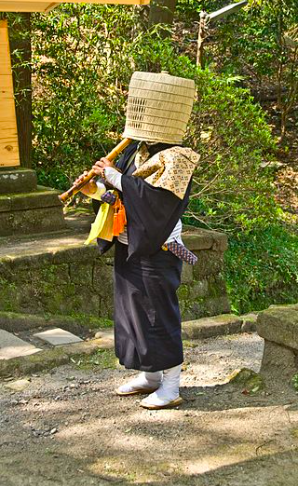
Another option might be to adopt the old ruse of Japanese komusō 虛無僧 monks playing the shakuhachi end-blown flute—which they might also use as a weapon. I note that many komusō were spies for the Shogunate, and some were merely disguised as priests; and they were abolished in 1871 for “meddling in earthly affairs and not the emptiness of being”. Anyway, it beats me how wearing a basket on your head might be considered an effective disguise, but hey, maybe I should stick to Chinese culture.

A judgement such as the Twitter comment may seem to be based merely on grounds of taste, but it shades into still more fatuous opinions on decency. Since we’re not holding our breaths for wise guidance on dress-codes from the Chinese or US leaderships, study sessions may be in order—based on the Everyday Sexism project, Hadley Freeman (note her fine article “Why not just ban women?”; Hell, Tweety McTangerine could have worn a mankini for his inauguration—we couldn’t possibly think less of him), perennial discussions on BBC Radio 4’s Woman’s hour, and comedians like the great Bridget Christie. That’s just a random sample of UK media—not to mention a wealth of research and websites on the beleaguered status of women in China.

Like I’d know.

Deep in a dream

Chet
Delighting in all manifestations of the Terpsichorean muse, in my little sample of jazz biographies, I didn’t mention

  • James Gavin, Deep in a dream: the long night of Chet Baker, [1]

which goes well with Bruce Weber’s remarkable film Let’s get lost (for the making of which, do read Deep in a dream, pp.328–42).

Born in 1929, Chet somehow managed to live to the ripe old age of 58—this quote seems tailor-made for him:

If I’d known I was going to live this long, I’d have taken better care of myself!

(Like Daoist ritual texts, this has been diversely attributed—to Eubie Blake, Mae West, Adolph Zukor, and so on.)

We don’t expect any artist to be a paragon of moral virtue—and in jazz, there were few angels. The “straight” WAM scene also had its bad boys—not least, trumpeters.

Before we get onto Chet’s iconic slow ballads, I like his early bebop playing:

And here he is with Charlie Parker in 1952:

I often wish someone would do a study of the styles of Chinese shawm players or Daoist guanzi masters like that of Paul Berliner on instrumentalists in Thinking in jazz. He cites John McNeil’s impressive genealogy (more taxonomy!) of jazz trumpeters (p.137):
Trumpet chart
But whereas most of the jazz greats (Billie, BirdMiles, Trane, Bill Evans, and so on), through their similar struggles with addiction, were constantly learning, honing their craft, Chet seems to have been gifted with his dreamy cool style very early, and then traded on his angelic image (largely for substances) for the rest of his surprisingly long life, settling for melancholy—without the constant explorations of the other great jazzers.

Donald Byrd, 1959.

Still, taken individually, ignoring the degradation of Chet’s life, his songs are captivating. Apart from his trumpet playing, Chet is one of few male jazz singers I can relate to (that’s my own weakness—the late great Amy Winehouse was devoted to Tony Bennett, for instance); maybe what distinguishes his singing is the way he dispenses with masculine bravado. But the critics are divided: while Chet’s followers revered him as a god, regarding his solos as “models of heartfelt expression, as graceful as a poem”, others were less enchanted, describing him as “a singing corpse”, “a withered goat”, “a hollow-cheeked, toothless, mumbling, all but brain-dead relic”, and “a drug-ravaged ghost” (Deep in a dream, p.5).

But let’s just forget the film, and the book, and wallow. These songs almost add up to a potted biography in themselves:

I fall in love too easily (1954) (cf. Bernard Lortat-Jacob at 80):

As with My favorite things, everyone has their favourite versions of My funny Valentine, but this one (live from Turin in 1959 [1] —at the height of Chet’s celebrity in Italy, and just as his substance-abuse was rocketing) is heart-rending:

For versions by Miles, see here.

Another lesson from jazzers in how to use vibrato: I fall in love too easily. And let’s hear it for Lars Gullin on sax…

This next recording (evidently achieved through some editorial sleight-of-hand) contrasts with Bille Holiday’s You’re my thrill—which Chet also sang:

For a sequel, with a yet more informed playlist, see here. Alone together, Chet’s album with Bill Evans, is featured here.


[1] I also look forward to reading Jeroen de Valk, Chet Baker: his life and music.
[2] Short of undertaking a global survey, 1959 is widely known as the year of Kind of blue; and in China, for the escalation of famine—still not widely enough known.

One belt, one road

In the CCP’s latest claim to end poverty, the title of the enigmatically-named One Belt, One Road (yidai yilu 一带一路) policy may sound to some more like a critique of Maoism—perhaps a succinct postcard home from Shaanbei written by an Educated Youth sent down in the Cultural Revolution:

One belt [per family], one road [in the whole county].

And it wasn’t a Gucci belt, either.

Stories are common of families who only had one pair of trousers between them, to be worn by whoever had to go out. Like the traveller’s tale of fieldworkers finding villagers who hadn’t even heard of Chairman Mao, this sounds far-fetched. There’s a celebrated critique of such inflated poverty stories in At last the 1948 show  (“You try telling that to the young people of today—will they believe you?!”):

But in this case there’s plenty of evidence. Among many such accounts, the story of Wang Xiangrong (b.1952), “king of Shaanbei folk-song”, is interesting. He fought his way up from grinding poverty to become a major folk-song star, and his story has become part of the romantic official myth of Shaanbei (note also Levi Gibbs, Song king: connecting people, places, and past in contemporary China, 2018). For 1953 fieldwork documenting the folk-song repertoire just east in Hequ, see here.

You can see that in this documentary, but it’s still a good ethnography of his changing life, with some precious old footage, and relatively free of the usual hagiographic style of such programmes:

Of course, such superstars are merely the glossy tip of the iceberg, but I enjoyed hanging out with Wang Xiangrong in Yulin in 2001, finding him engaging and unpretentious. I did a little sketch of him in my Shaanbei book (pp.210–12) [1] —a rare excursion for me into the world of both folk singing and mediated urban performance (for the former, do read the works of the late lamented Antoinet Schimmelpenninck):

Wang Xiangrong was brought up in a poor desert village with a population of only a few dozen, 45 kilometres from Fugu county-town to the northeast of Yulin. He recalls, I fear not fancifully, that he had no clothes of his own till going to school at the age of 8. The youngest of four surviving children out of nine, he was 13 when his father died. In the Cultural Revolution he managed to graduate from senior secondary. From 1971 he worked as a schoolteacher; in 1975 he toured Inner Mongolia with a band performing errentai. In 1977 he took part in the county band, in 1979 he was spotted by Yulin cultural cadres at a training session in Fugu county, winning a prize in a festival in 1980 and joining the Yulin Folk Arts Troupe by 1983. He has recorded for many films and TV programmes, and since 1988 has made several foreign tours, including a highly successful tour of Japan in 1999.

The kind of singing paraded by the troupe is mostly heavily mediated with kitsch orchestral accompaniment. Wang Xiangrong is perfectly aware that it is a manufactured style, attuned to the rosy official Communist image of Shaanbei. In between the extremes of that style and folk-singers performing in village life, even the few unaccompanied recordings of Wang and others show a certain refinement of rural style, such as a studied vibrato and the dramatic holding of high notes.

Wang makes something of a play of his “shaman songs” (shenguan diao), learnt when he was young from two shaman uncles; he is familiar with the “precious sword” (baojian) and the sheepskin drum struck with a stick. Similarly, he learnt rain songs by participation in rain ceremonies in his youth, for which a group of six villages regularly formed a “parish” (she) from 1957 to 1962, and even—still more secretively—through the Cultural Revolution.

I get to meet the jovial Wang Xiangrong, and with the help of a friendly cadre in the troupe who is a neighbour of the Qiao family, I am surreptitiously invited to the troupe’s evening concert, to be held in the great hall of the fancy hotel that I can’t afford to stay in.

It’s a private invitation concert for a high-ranking deputy of Li Peng, and I am not officially invited, but my new friends smuggle me in backstage to watch from the wings. If I attend formally in the audience, the bigwig will have to meet me, which would cause complications; he is happy to pretend I’m not there, and I’m happy not to get involved in courtesies. So, after all this time openly attending village rituals that some cadres might consider sensitively backward or superstitious, now that I finally find a concert showcasing the official image, I am forced to attend it in secret!

From the wings I watch the troupe go through their programme, announced suavely by a glamorous female MC in qipao costume speaking standard Mandarin, which I haven’t heard for ages, even from local cadres. Wang Xiangrong isn’t singing this evening, but there are two solo singers, accompanied by a full orchestra in the pit. Introduced by the MC, a plump female singer does two sets, changing from a red ballgown with a magnificent ruff to a pink ballgown—hardly outfits that reflect the dress of the Shaanbei countryside. With the aid of a mike, she milks the songs, using all the studied hand gestures of conservatory style, backed by the orchestra in national silk-and-bamboo style, with dizi flute solos and pipa lute tremolos to the fore. A male singer in elegant white silk costume also performs a set, his songs introduced by a mellifluous dizi solo. The singers’ facial expressions range from the smile of contentment to the longing gaze afar.

Illuminated by fancy lighting, male and female dancers wear a variety of glitzy costumes, wielding props such as fans, umbrellas, and handkerchiefs, stock props of national dance. For one dance the girls perform acrobatics while holding aloft lotus lanterns, kitted out in green trousers, skimpy tops with fishnet midriffs, and little red floral headpieces. From my forays to the villages I have always been mystified why Mizhi county is nationally famed for its beautiful women. Now I realize they have evidently all been poached for the Folk Arts Troupe; I am reminded of the palace girls of imperial times, slave-girls at the mercy of predatory officials.

Having failed to witness shamans practising in the countryside, it is ironic to see the troupe performing a so-called “shaman dance” for the Party bigwig, the male dancers wielding cute papier-maché tridents, accompanied by the orchestra in pompous martial vein. In another dance the men wield cymbals, lighting effects adding to the drama.

Anyway, you get the idea: such staged performances are a world away from those I had been witnessing in the countryside. I won’t go into detail, as you can see this kind of thing daily on Chinese TV; but the links with local culture are tenuous.

Whereas rural music-making depends on family and community solidarity in ceremonial traditions stretching back to imperial times, I can detect no social base for the stage performances of the official troupe, and its kitsch versions of Shaanbei culture are utterly diluted; it is contextually, historically, and musically light. I can’t see whom this kind of thing satisfies; but of course one could say, as I would for the music of the chuishou shawm bands, that this too is ritual, not “merely” music; the official culture sanctioned by the state serves a need for “civilization”, for modern “national” values on a token base of traditional local culture, on behalf of a segment of the population. And I realize there is fieldwork potential here too: these performers have lives too, doubtless a lot less glamorous than their stage personas. But if this style is part of the overall picture, it’s a very small one; no-one in the countryside seems to be emulating it.

 A few days later Wang Xiangrong takes me for a song-session in a fancy Mongolian yurt restaurant in town. His best buddy Li Yu, the charming and portly boss of the Puhui liquor factory, arrives late, having already got a considerable head start in the evening’s drinking activities. Brought up in Yulin, Li recalls his time doing army service in the Cultural Revolution mainly for picking up a repertory of dirty songs, which were then all the rage—a lot of that generation will give you a similar alternative view of the period. Now doing a roaring trade with his liquor business, Li is a model capitalist, with rather good taste in music. In 2000 he organized a contest for drinking songs (jiuqu dasai) at his liquor factory, which was apparently a great success.

Li and Wang, veteran drinking artists, are the stars of the banter over supper; other guests (including a nice academic from Yan’an, two young and distinctly nervous women, and me) are in their thrall. Wang holds court with his songs while Li Yu keeps his glass topped up with fiery baijiu liquor. The colorfully-costumed waitress is expected to sing for guests, and doesn’t expect to be forced to drink, but with Wang Xiangrong she has bitten off more than she can chew: she is expertly, ritually, cajoled into joining in a toast after repeated verses. Wang is enjoying singing, but the fun is as much in the ritual badinage.

Wang is a real character, but I’m not in my element. One of those pathetic English men who has never sung a song on his own in his life, in 1999 I had managed, virtually at gunpoint, to sing Do, a deer and Rule Britannia at a banquet in a Shaanbei temple, which still haunts me—the sacrifices we make for our art! I got away without singing that evening in the restaurant—thankfully, Wang Xiangrong had my number. Indeed, apart from rural contexts for singing, such restaurant settings may be becoming a common context for singing among the urban petty-bourgeoisie.

Wang’s accounts of his poor childhood might seem suitable material for work-teams encouraging people to “speak bitterness” about the “old society” before Liberation—only they refer to the period long after the arrival of the Communists, as many work-teams discovered to their consternation. For Shanxi peasants’ discontent at their inability to clothe or feed themselves under the commune system, see here.

Talking of “liquor songs”, here’s a related passage from my Shaanbei book (pp.13–14):

Though the Communist myth of Shaanbei has ingeniously, or ingenuously, portrayed it as an archetypical paradise of industrious peasants, a rose-tinted homeland for both traditional and revolutionary folk-song, it is no simple task today to get a handle on the life of singing in society there. In view of the continuing vitality of social folk-song culture in Gansu and Qinghai provinces to the west, the lack of local folk-song festivals in Shaanbei (either now or before Communism) is curious. And if the romantic depiction in the film Yellow Earth of a shepherd declaiming a song from a mountainside was once true to life, it appears to be rare now. Also largely absent from social life today are “revolutionary songs”; even during the commune period, renditions were largely limited to (albeit frequent) political meetings. Change is hard to assess—if only one could eavesdrop on daily life in 1934, 1964, and 1994, for instance—but recollections of senior villagers suggest that singing is heard less often today than earlier in the 20th century.

Since the 1990s, record shops, both locally and throughout China, have sold highly mediated CDs of “Shaanbei folk-songs”, including some revolutionary songs. Shaanbei folk-song now has a rich virtual life in many Chinese websites. Indeed, peasants seem to be aware of the label “Shaanbei folk-songs” when talking to outsiders, even if their own terms for the songs they sing in daily contexts are more nuanced. The gulf between such mediated, commodified versions, with their polished singing style and smoochy or disco accompaniment, and singing in social life, sung in a rougher voice and usually without accompaniment, is easily heard.

“Famous singers” highlighted by Chinese scholars often come from strong family and village traditions, but tend to tailor their style to the demands of the state troupes to which they graduated. However close such singers remained to the folk style, or however far they departed from it, their stage performances accompanied by new-style “folk ensembles” have remained the tip of the iceberg. All music is worthy of study, but it is a less mediated style that dominates singing in daily life in the poor countryside of Shaanbei.

Thus under the broad umbrella of “folk-song” are singers performing for drinking parties, the consecration of a new cave-dwelling, calendrical and life-cycle ceremonies, rain processions, and shamanistic exorcisms. Beggars doing the rounds of weddings and funerals now appear to be among the most common exponents of song (also featured on the DVD with my Shaanbei book).

Otherwise the nearest I got to hearing singing in context was when I visited a villager at his cave-dwelling during a lunchtime drinking session with a group of his male friends (DVD, C2). The singers were perhaps mediocre even without the prodigious amounts of baijiu liquor they were knocking back; with empty bottles strewn about the floor, one of the singers passed out on the kang brick-bed. Even if I could stomach the liquor, I realized how hard it would be for me to participate meaningfully in their world. Where opportunities to hear impromptu singing are few, asking singers to perform their repertory is sometimes a necessary expedient. I have attempted to get a few song sessions going, but have never overcome the artificiality of the occasion.

So much for “One Belt”—as to “One Road”, even in the 1990s when we went in search of village ritual groups, whenever someone gave us a lead to a village worth visiting our first question was always “Is the road OK?” (lu haozou ma 路好走吗?). We lost count of the times our jeep got stuck in mud or found the track impassable. This became known as “travelling the socialist road”. Indeed, it can still happen today, although the transport network has improved significantly since around 2000.

XYB despairs

The ever good-humoured Xue Yibing feigns despair, Xinzhou 1992.

For Chinese fieldworkers’ mixed feelings about rural China, see here. Note also songs on the Coronavirus from Shanxi and Gansu. See also Shaanbei: spirit mediums.


[1] Whose footnotes give further leads—though Shaanbei bibliography, discography, and filmography all need constant updating.

Cultural revolutions

17 troupe 1959

North Shanxi Arts Work Troupe, 1959. Li Qing front row, far right. His four years there (1958–62) were a brief interlude within a lifetime of ritual practice.

For some reason, I found Frank Dikötter’s book The Cultural Revolution far more rewarding than the two previous volumes in his popular trilogy on the Maoist era, The tragedy of Liberation and Mao’s great famine.

Ritual and religious life under Maoism
From the perspective of my own fieldwork on local ritual, there has been no single decade in history where culture has been independent of society— as observed by none other than Confucius and Chairman Mao (see the Coda to my book Plucking the winds), in what may seem like reproaches to the “living fossils” fallacy.  To be sure, Gaoluo villagers themselves failed to admit a connection between their ritual association and society:

“The association has nothing to do with politics”
“The association has nothing to do with the Boxers
“The association has nothing to do with the history of the revolution“.

But all the while they were providing rich material that contradicted their assumptions.

So I would hope that ritual studies can fit into our picture of social change. As I suggest in Appendix 1 of my recent book, scholars of Tang Daoism expect to relate it to the wider history of the period; so why would we who document local ritual groups, whose material derives largely from contemporary fieldwork, not also do so? However deep we probe, the social, economic, and political history of the past century is the air that ritual specialists and their patrons breathe—so what kind of air might scholars breathe by downplaying it?

By failing to study the nuances of the period through which we and our Daoist masters have lived, we ignore precisely the kind of material that historians of earlier periods would die for. Sometimes we fall back on facile clichés about the eternal nature of tradition until the 1940s, and the subsequent destruction of cultural practices (after 1937? 1949? 1966?). All, supposedly, before the untrammelled restoration since the 1980s ushered in an equally timeless and transcendent new Golden Age—unless urban migration and the new pop culture have rendered further study superfluous by destroying tradition further?!

And vice versa, work like this on the changing lives of local communities should also be a contribution to modern historiography—a convenient prism through which to view the “negotiation of identity” (a hoary cliché that I generally avoid!).

With some noble exceptions (such as ter Haar, Ruizendaal and Mueggler), religious life under Maoism is not the strong suit of scholars of religion, but I find it crucial. So I write this partly with a view to reminding those documenting folk ritual in China—and even those who do fieldwork mainly in order to reconstruct the culture of previous ages—that the whole Maoist era is an indispensable part of our background reading and enquiries in the field.

Religion features in many accounts mainly as protest against campaigns (for the 1950s, see The tragedy of Liberation, pp.196–206; Mao’s great famine, pp.227–8), but it’s also worth documenting the “obstinacy” of everyday practice (e.g. The Cultural Revolution, pp.294–6; see also the revival on the eve of the Cultural Revolution, pp.31–2). I belatedly note incidents in places where I did fieldwork innocently in the 1990s, such as the 1966 massacre in Daxing county outside Beijing (p.78).

Maoism
As Dikötter observes (p.119),

Many ordinary people had accepted liberation with a mixture of fear, hope, and resignation. There was widespread relief that the civil war had come to an end. The proclaimed values of the regime, including equality, justice and freedom, were genuinely appealing, and the Part tirelessly trumpeted the New Democracy, a slogan promising the inclusion of all but the most hardened enemies of the regime. Above all, the communists promised each disaffected group what it wanted most: land for the farmers, independence for all minorities, freedom for intellectuals, protection of private property for businessmen, higher living standards for the workers.

Classic studies of local life through the whole Maoist period, a model for detailed local fieldwork, are

  • Chan, Madsen, and Unger, Chen village under Mao and Deng (1992) (see also the works of Jonathan Unger, here) and
  • the two volume study by Friedman, Pickowicz, and Selden, Chinese village, socialist state (1991) and Revolution, resistance, and reform in village China (2005).

I think also of biographical accounts like Huang Shu-min, The spiral road (1989) and Peter Seybolt, Throwing the emperor from his horse (1996), as well as Jing Jun’s The temple of memories. But on the Maoist period perhaps the most important work of all is that of Guo Yuhua, with her detailed ethnography and critique of “Communist civilisation”.

As a counterbalance to such authors, I like to cite William Hinton (whose Through a glass darkly grinds a leftist axe against the latter), as well as Mobo Gao’s fine ethnography Gao village.

Short of expecting ourselves to read detailed scholarly accounts of the period, such works are important preparation. For our own local studies, apart from works in Western languages, the modern county gazetteers (xianzhi 县志) are an indispensible resource; and I’ve discussed documents on expressive culture here. Note also

  • Sebastian Veg (ed.), Popular memories of the Mao era: from critical debate to reassessing history (2019).

A lot has been written about the Cultural Revolution; the period often stands as a simple and misleading soundbite for the whole three decades of Maoism—indeed, ironically, as a shorthand for the first couple of years of extreme violence up to 1968. So since the details of the first seventeen years of the People’s Republic are less well known outside academia, Dikötter’s first two volumes should be more illuminating; in Mao’s great famine individual chapters focusing on topics like agriculture, women, and accidents are well chosen and revealing. But for all the undoubted iniquities that he gruellingly parades, I found the first two books inevitably impersonal, suggesting a lack of empathy that may seem merely to follow a wider pattern in foreign studies of simplistic Commie-bashing.

Dikötter’s study of the famine years around 1960 is part of a growing body of material from both foreign and (laudably) Chinese scholars, on a par with other state-engineered famines like that of Ukraine in the 1930s—as Anne Applebaum’s recent study reminds us. Basic sources include

  • Jasper Becker: Hungry ghosts: China’s secret famine (1996)
  • Yang Jisheng, Tombstone: the great Chinese famine, 1958–1962 (English translation 2012)
  • Wu Wenguang’s memory project
  • the works of Xun Zhou
  • Ralph A. Thaxton, Catastrophe and contention in rural China: Mao’s Great Leap Forward famine and the origins of righteous resistance in Da Fo village (2008)
  • Erik Mueggler, The age of wild ghosts: memory, violence and place in southwest China (2001)
  • websites such as China famine 1959–61, and
  • China Unofficial Archives.

See also under China: commemorating trauma, Gansu: connecting social trauma and expressive culture (and sequel), with comparative sources under Famine: Ukraine and China.

But the whole period preceding the Chinese “years of difficulty”, to adopt a bitter euphemism, was no picnic either.

The Cultural Revolution
Conversely, we already know more about the Cultural Revolution, but Dikötter explores and augments such material in a communicative way. The Cultural Revolution seems to me less plainly propagandistic. It’s not that the insanities he documents are any more flagrant; rather, perhaps, the account seems more personal. Dikötter effectively meshes central and local perspectives, while showing clearly how the period, often dismissed as a “ten-year disaster” was not one undifferentiated black hole. But as we break up the whole Maoist era into manageable chunks, they bleed into each other—a sadly apt metaphor.

Despite revolutionary fervour being whipped up among naïve youths, cynicism, boredom, and lethargy had set in as early as 1967 (p.165). Any idealism among those students sent down to the countryside to learn from the peasants was short-lived, as they encountered the sheer destitution there (ch.15). As I also learned in Yanggao, severe food shortages continued right until the 1980s.

In the countryside, as organisational chaos spread, market enterprise—which had previously revived in the wake of the famine—also persisted early in the Cultural Revolution; despite a re-imposition of collectivization in 1968, private initiatives were increasingly widespread (pp.225–8). By the “grey years” from 1971, private trade began to expand further. Still many regions were mired in desperate poverty, like Ziyang in south Shaanxi (pp.262–5).

Notwithstanding a late rearguard action (ch.23), Dikötter describes the “silent revolution” in the final years of the Cultural Revolution (chs.21–22) that continued the process of abandonment of the commune system which had come in waves ever since the early 60s. In Henan (pp.274–5) blockades to prevent the private sale of grain were easily evaded:

A weakened state was no longer any match for determined individuals who had honed their skills over many years of hardship. Villagers who had survived the horrors of Mao’s Great Famine were not about to be intimidated by a tax officer hanging about at a roadblock in a conspicuous uniform.

Urban migration, too (a crucial social factor under the 1980s’ reforms), began early. Dikötter even shows an early revival of traditional culture (opera, poetry, story-telling, and so on: p.276).

As in Eastern Europe and the Soviet Union, a hidden, underground, largely invisible society lived in the shadow of the former political system. (p.287)

Still, it’s always worth consulting Mobo Gao’s book Gao village, where with personal experience he gives a more positive, less adversarial picture of Maoism.

Anyway, when the commune system was officially dismantled from 1982, it was largely a fait accompli.

For the Cultural Revolution in Tibet, see here and here; and for a comparison with the Soviet Union under Stalin, see The whisperers.

A case-study
I discussed the whole Maoist era in some detail in both Plucking the winds and Daoist priests of the Li family. In the former, since Gaoluo village lies rather near Beijing and Baoding, the members of its ritual association, themselves active participants, were able to give a rather detailed account of factional warfare and people’s lives through the Cultural Revolution (Plucking the winds, ch.6). But here I’ll just give a few vignettes from my work on the Li family Daoists in Yanggao county of north Shanxi (from my book, ch.6)—who were less actively involved in wider events.

With hindsight, surveying the apparent thriving of religious activities today, the Cultural Revolution period—perhaps even Maoism as a whole—may seem like a blip; but both are crucial elements in the transformation of peoples’ mindsets under the more liberal religious landscape since the reforms of the 1980s.

Household Daoist families in Yanggao had continued performing their liturgy for funerals intermittently for the first fifteen years after Liberation, although the domestic ritual Thanking the Earth was rendered largely obsolete by escalating collectivization from 1953, and temple fairs were silenced.

The immediate precursor of the Cultural Revolution was the Four Cleanups campaign. In many areas of China, “superstitious” artefacts had already been taken off and destroyed in the 1940s as the Communists came to power, but in Yanggao villages Daoist families seem to have kept most of their old ritual manuals until the mid-1960s. Meanwhile Yanggao was still in the grip of ongoing natural disasters.

The Four Cleanups must have come as a real shock for kindly Li Qing; having weathered the tribulations of the early 1950s, and then landed a prestigious and secure job in Datong (see photo above), he was even more revered after his return in 1962, and able to practice his beloved ritual again. But so it went for innumerable victims of the “class struggle” system. After the respite of the early 1960s, the mood was now to be grim right until the Cultural Revolution broke out in 1966. Li Qing’s rich-peasant “hat,” though enforced as early as 1948, hadn’t had any great effect until now—not even disqualifying him from joining the prestigious arts-work troupe. But early in the Cultural Revolution he was again classified as a rich peasant.

The Smash the Four Olds campaign from 1966 was the culmination of two decades of measures to limit religious practice. At the same time, campaigns were sporadic.

Following a Four Cleanups re-inspection, late one night in 1966 Li Qing sneaked out to bury his most precious ritual manuals in the sorghum fields just east. Next day, to allay the suspicions of the Red Guards, he burned a large pile of other volumes in his courtyard—he had a large collection of printed volumes and almanacs, not necessarily ritual manuals.

The callow Red Guards paraded Li Qing a few times in a high white dunce’s hat with the characters “ox demon and snake spirit” written on it. But, just like hapless village cadres all over China who were now victimized too, the degree of punishment of so-called landlords and rich peasants depended a lot on their character and reputation. While privately retaining their sympathy for Li Qing, villagers had no choice but to go through the motions of “struggle meetings” dictated from above. Li Qing and his wife bore their sufferings with dignified silence throughout.

When Li Qing’s sensitive sheng mouth-organs were confiscated and deposited in the brigade office, kids messed around with them. Poor peasant Kang Ren was not under suspicion, so he managed to keep his sheng. But here no-one dared ask friends or family to help hide suspect items for them.

Meanwhile in Yang Pagoda, Li Peisen continued to weather the storm. The son of his wife’s younger sister was a Red Guard chief, so they discreetly agreed he would just take off a few scriptures for show—Li Peisen would have chosen decrepit or duplicate volumes that he considered less important.

Li Qing’s son Li Manshan, 21 sui in 1966, had gained an impression of the liturgy before his father left for Datong in 1958, and after he returned in 1962 he had nearly two years of relative freedom to continue learning. After the Four Cleanups campaign of late 1964, though there was no pressure on the children of bad elements to “draw the class line” from their fathers, he felt seriously depressed. At least he didn’t have to join the Red Guards—his status as son of a “black” family disqualified him. One day in 1966, just as the Cultural Revolution was breaking out, Li Manshan found himself in the county-town, and had his photo taken there. He hinted to me that it was virtually designed as a farewell to the world; exhausted by constant labor on the reservoir, with his family’s so-called “rich peasant” status boding ill as an ominous new campaign was brewing up, he could see no future.

In 1960, when Li Manshan was 15 sui, he had “studied Russian for two whole days” at school. Later, when the Red Guards found his notebook with a few Russian words written in it, they confiscated it and cursed him for being a spy. In many parts of China, the innocent possession of a mere scrap of supposedly reactionary material, or a careless comment, could condemn people to long spells in labor camp.

Whereas the neighbouring county of Tianzhen was described as more “barbaric”, the relative peace in Yanggao didn’t mean that Daoists there somehow had any latitude to keep practising. In some parts of rural China traditions were maintained more or less furtively even through the Cultural Revolution, but here the Daoists were forced into total inactivity from 1964 to 1978. Daoist arts went into hibernation. Li Qing’s family, with their black class label, suffered more than other Daoists, but everyone was pretty desperate.

Villagers weren’t becoming any less “superstitious”. Public rituals might be impossible, but there was still a clandestine demand for determining the date, under cover of darkness. For a daring couplet pasted up in the period to satirize the poverty of their conditions, see here.

In 1967 Li Manshan was among a group of Upper Liangyuan team members who had to walk to the commune seat of Greater Quanshan, in the hills to the west, to take part in one of a series of huge public criticism meetings of the disgraced Party Secretary of Yanggao county before his incarceration. By now this model commune had been eclipsed by Dazhai further south in Shanxi, but it still had to host visiting delegations and mass meetings. Ten thousand people from five communes attended the struggle session, all arriving on foot. Although Li Manshan was a “rich peasant,” he had no choice but to go, or else people would accuse him of being counter-revolutionary.

The Sojourn of Educated Youth

Shoulders unable to carry, hands unable to grasp, soft and sensitive skin…

Coming across this phrase in 2013 as I made inept attempts to help Li Manshan with the autumn harvest, I thought it might have been coined to parody my efforts. Rather, it is a standard expression used to describe the travails of urban “educated youth” in performing physical labour after being sent down from the cities to the countryside in the Cultural Revolution to “learn from the peasants.” The experience was a rude shock for such groups all over China; brought up in relatively comfortable urban schools to believe in the benefits of socialism, and often protected from understanding the tribulations of their own parents, they were now confronted not just by the harshness of physical labour, but by medieval poverty (see also my Shaanbei book, p.9).

From 1967, large groups of secondary school students were sent down to live in many Yanggao villages. Over thirty stayed in Upper Liangyuan for a year or so, but Li Manshan had no contact with them. A group from one Beijing school descended on Golden Noble’s village of Houying in 1967, then another batch the following year; most managed to leave around 1972. Golden Noble’s cousin married one of them in 1971, condemning her to rural life; desperate to escape, she eventually divorced him, getting back to Beijing around 1980.

These groups of students brought their musical and acting skills to some villages where they were based, performing revolutionary songs and model operas to dour bemused peasants. Li Manshan never heard them sing or play, but in nearby Shizitun Older Li Bin learned the modern system of cipher notation from educated youth billeted there.

Just when convulsions seemed to have eased, Li Qing’s rich-peasant status was re-imposed in the Cleanse the Class Ranks campaign of 1968. If there had been a certain basis for the original classification around 1949, by now—in a ravaged countryside where everyone was virtually destitute—the label caused his fellow villagers bitter mirth, who ribbed him, “Call yourself a rich peasant?!” After the chaotic first couple of years, things quietened down by around 1969, but there was always tension. As Li Manshan recalls, “We just sat around at home, but we could never feel at peace”—always fearing a knock at the door.

Life Goes On
Even then, life was not entirely about campaigns. Having had four children by 1954, Li Qing and his wife had been separated for four years while Li Qing was in the Datong troupe, but in 1967 they had a third daughter, and then in 1969 a third son, Li Yunshan (known as Third Tiger), twenty-three years Li Manshan’s junior. For the lovely little wooden folding stool that Li Manshan made in the late 1960s, see here.

Then, in the winter cold late in 1971, Li Manshan married, aged twenty-six sui. The new couple lived in Li Qing’s courtyard complex, part of which had been allocated to another family after land reform. In the Cultural Revolution Li Qing “bought” it back, but village cadres accused him of illegal trading, and confiscated it again. Anyway, from 1948 right through till 1980 their conditions were cramped. In 1972 Li Manshan had to spend another six months away laboring on the reservoir project, only returning for the autumn harvest. The couple’s oldest daughter was born in 1973. That year Li Qing and his wife took their youngest son Third Tiger, five sui, into town for a group photo—now nowhere to be found. Around that time Li Qing managed to get his mother’s ashes back from Inner Mongolia, reburying her with his father’s coffin in the family graves outside Upper Liangyuan—though without any ceremony, of course.

All this was around the time of the campaigns to Study Lei Feng and Criticize Lin Biao and Confucius. The latter, prompted by the mysterious 1971 death of Lin Biao in a plane crash in Mongolia, caused major convulsions in Party and army ranks, but Li Manshan has only the vaguest memories of these campaigns.

Whereas through the 1950s and 60s the Party had somehow managed to whip up enthusiasm for further campaigns despite constant abuses, by the 1970s people had thoroughly lost their appetite for the constantly changing directions of policy. Indeed, in Yanggao people were largely unaware of the machinations at the heart of the Party in distant Beijing.

I would gladly qualify all this gloom with reminders of the benefits of Maoism such as are offered by apologists like Bill Hinton and Mobo Gao. But I can find no-one in Yanggao who can think of any. There were some harbingers of reform, like a certain freeing up of markets in 1972. Education too was expanding again. A sporadic supply of electricity eventually reached villages like Upper Liangyuan by the mid-1970s. Before that people used kerosene lamps, but they slept soon after it got dark—except, of course, when there were rituals to perform. The electricity supply in the countryside remains unreliable.

By the 1970s the national population was increasing rapidly, but that of villages like Upper Liangyuan grew little. Under Maoism there was hardly any new house building in Yanggao; by the 1970s, over ninety percent of houses in the county had been built before 1937. By the mid-1970s a few villagers managed to buy watches; even by the end of the decade only a few cadres enjoyed the luxury of riding bicycles.

Traditional culture was still on hold. Without the benefit of hindsight, there was no end in sight to the depression of the commune system. And people—not just the Li family, but the whole population—were still seriously hungry.

* * *

For local Daoist ritual, I must stress that none of this obviates the need for the study of early textual history of ritual manuals, which should continue to play a major role. However, the life stories of Daoists (and all kinds of religious practitioners) are just as important for the modern era as for the imperial period—but with careful and sensitive fieldwork they are much more available. And they can not only clarify aspects of textual transmission, but also (more crucially?) illuminate the changing performance of ritual. So it seems to me that whether sinologists and ethnographers like it or not, our subject has to embrace both early and contemporary periods. At the same time, modern historians may even find our discussions of ritual life in living times to be of some relevance to wider histories.

Folk ritual: testing the waters

informal session

Informal session at Li Qing’s house, 1991. Left to right: Li Qing (sheng), his second son Yushan (yunluo), Liu Zhong (guanzi), Li Zengguang (drum), Kang Ren (sheng), Wu Mei.

As I observed, the recent confiscation of instruments in Pingyi county was only one aspect of the directive aimed at decimating funerary traditions there. It reminds me of an early incident during the revival of Daoist ritual in Yanggao (my book, ch.7; cf. my film), illustrating constant nuances in local relations as people explore ritual boundaries through changing times. So here’s a kind of prequel to my post on the Pingyi flapdoodle.

By 1979, as the commune system began to crumble, the great Li Qing (1926–99) and his colleagues in Upper Liangyuan, along with other Daoist groups in the county, were clandestinely performing Daoist rituals again, testing the waters. There was now demand again; as soon as villagers were once again able to stage proper funerals, they sought to invite Daoists. Seeing other households beginning to make money outside the collective, Li Qing would soon have realized this was a chance for him to feed his family too (they had been hungry throughout the Maoist era, not just around 1960). Most simply, Daoist ritual was in his blood: it was what the family had always done. A major stimulus for Li Qing’s band was the return in 1977 of his uncle Li Peisen (1910–85) from Yang Pagoda, where he had laid low throughout the Maoist period, preserving ritual instruments, costumes, paintings, and manuals.

Over a long period from 1979 to 1984 the Daoists performed for funerals at first furtively and gradually more openly. In those early days they didn’t stand directly in front of the coffin, just playing “little pieces” on the shengguan instruments without any vocal liturgy. And they wore their ordinary clothes; before 1981 a host wanting them to wear their ritual costumes had to pay danger money. As anxieties dwindled, they first donned their black costumes without hats, then the red costumes with hats.

One early occasion when they dared perform vocal liturgy, however clandestinely, was for the funeral of Li Peiye (another Daoist uncle of Li Qing) in the 2nd moon of 1980. Born in 1892, Li Peiye had learned Daoist ritual under the Qing dynasty, living just long enough to witness hope of a revival of tradition. Li Manshan recalls Li Yuanmao (1919–92), then with a long white beard) leading the reciting of the scriptures for the funeral.

Soon after Li Peiye’s funeral, a great burden was lifted for Li Qing. The county authorities sent official letters to all the village brigades listing the rehabilitation (pingfan) of people whose “black” class label of “rich peasant” was now to be removed. Li Qing was among thousands in Yanggao alone who were reprieved. The family no longer bore any stigma; at last there seemed some hope for both them and the wider society.

One of the first funerals for which the Daoists wore their full costumes was for Golden Noble’s grandmother in Houying in 1982. She died on the 6th of the 2nd moon, and the date of the burial was determined for the 19th.

But on the first day of the Houying rituals, someone returned from the county-town with the news that the Wangzhuang Daoists had been arrested while doing a funeral there. Senior Daoist Yan Mei—one of many Daoists who had served as brigade accountants under Maoism—was band boss; Liu Zhong (1930–96), soon to be a regular member of Li Qing’s band, was taking part. As luck would have it, the house where the funeral was held happened to be right opposite the police station. They managed to perform the rituals all day, but then two cops turned up, detained two of the Daoists, took mugshots, and confiscated their instruments.

As the liberalizations gathered pace, the incident soon became something of a local joke; people take such minor reverses in their stride. Naively, the Wangzhuang Daoists had supposed the climate to be relaxed enough now that Deng Xiaoping was in power—but surely they could have seen this coming. Things were indeed easing up in the countryside, and after a few weeks the Daoists reclaimed their instruments and got back to work, but official attitudes in the county-town were always more sensitive.

Even when I attended funerals in the town in 1991, it was still only possible to hire gujiang shawm bands there, not Daoists. Still today it remains rare for town-dwellers to use Daoists; and since there are groups nearer whom patrons can invite, the Li family seldom performs there. But ever since the revival, and all the more since around 2009, they and other groups in the area have been worked off their feet performing rituals throughout the villages—despite urban migration and the “left-behind” patrons’ preference for the glossy pop shows outside the gate of the soul hall.

Ever since those early days of the revival, I occasionally hear of transitory campaigns against mediums or sects, but funeral practice has remained largely untouched—so the “Keep Calm and Carry On” message still seems fair.

For the concurrent process of recopying the ritual manuals, and a caveat, see here. All this was before Li Qing managed to train his younger disciples who went on to form the core of Li Manshan’s ritual band—Golden Noble, Wu Mei, and his own grandson Li Bin.

Officials without culture

*UPDATED!*

Strange—not to say fatuous—goings-on in Pingyi county in Shandong.

I generally give Short Shrift to horror stories in the Western media about new clampdowns on “superstitious practices” in China, finding that they rarely have any perceptible long-term effect at local level. Indeed, I have it on good authority that this latest instance of interference from local government is only a blip, going against the current tide in these more laissez-faire times—but it’s still rather interesting.

A fine article “The endangered sound of suona” by Fu Danni, on the Sixth Tone website, reports on the recent ban on shawm bands at funerals in Pingyi county. But the official directive looks far more disturbing than that—it’s just one aspect of a far more ambitious attempt to limit the length of life-cycle ceremonies and extravagant spending therein. The Pingyi measures even castigate the zacai decorations at the funeral altar as a “corrupt feudal practice”. Similar leftist campaigns, effectively seeking to deprive villagers of their traditional funerary observances, have occasionally been touted ever since traditional life-cycle events revived in the 1980s—a related article makes an ominous comparison with the “Destroy the Four Olds” campaign that accompanied the Cultural Revolution.

But there’s both more and less to this story than meets the eye. Campaigns aimed at enforcing frugality at life-cycle ceremonies have a long and mostly futile history, long before funeral strippers became a routine and salacious media topic (as a quick Google search will reveal). So it’s good to see twenty-one noted Chinese academics protesting at the fatuous recent official directive in a detailed open letter (Chinese text here). Note how adroitly it adopts the language of both Confucian and current CCP values—reminiscent of the recent online rebuffs to the Chinese FA over their attempt to ban Daoist ritual at a football match. The open letter has stimulated much online discussion, in which voices in support of the restrictions are largely drowned out.

Still, however isolated and fleeting such instances of local implementation may be, it’s remarkable that even in 2017 the Pingyi county government announced that it would confiscate musical instruments played at funerals. Sure, this kind of thing has happened occasionally since the 1980s’ revival; generally, as here, the musicians manage to get them back after a while.

Wang Ruiyong’s shawm band in Pingyi, suffering from the recent directive. From Sixth Tone article.

It may be that in Pingyi the shawm bands have unfairly taken the blame; some scholars too have reservations about “other, more vulgar, funeral practices” (like stripping, perhaps), though it’s unclear how a criterion for vulgarity might be policed, short of inculcating norms of public decency—for which cadres are not renowned.

Xingyuan 2011

Burning paper ritual money for the deceased before the coffin—village funeral, Yanggao 2011. My photo.

The article on the Pingyi nonsense observes the flagrant irony of the simultaneous [albeit formalistic and superficial, I should add!] brief of the cultural authorities to document such bands as part of the Intangible Cultural Heritage project—whose agenda has anyway never been exactly ethnographic. But by contrast with the project’s kitsch nostalgic dreams, shawm bands all over China are far from a bastion of tradition. They’re always innovative: for several decades, they have themselves been spontaneously adapting to the times by replacing their traditional repertoire with popular melodies and supplementing their instrumentation with trumpet, electronic keyboard, and drum-kit. You can read all about shawm bands in my post Walking Shrill, and in my books on Yanggao and Shaanbei (both with DVDs); there I documented the rapid substitution of the majestic old suite repertoires with pop music before my very eyes and ears. There are tracks on the playlist too, with notes here.

Were I just a tad cynical [surely not—Ed.], I might say that the Chinese are perfectly capable of diluting their own local traditions without government assistance. This cultural shift has been taking place ever since the early 1980s, as a result not of state interference but of changing popular tastes. And when the article comments that “most suona players have started to take on other jobs”, such as in factories and construction, this too is part of a much wider and longer trend, not some sudden response to the directive—as I noted for the Li family Daoists, the choice to abandon a hereditary tradition is complex.

Though the Sixth Tone article uses the nationally standard term suona for the shawm, it’s good to see the local term wulawa—one of many such names by which this most ubiquitous instrument is known (hence my adoption of the English term shawm, avoiding official vocabulary). And I was glad to see a reminder of the technique of blowing through a hollow reed into a basin of water—standard device for teaching circular breathing to young students.

The article doesn’t mention liturgical performance (such as household Daoists) at funerals, which generally alternates with that of the “secular” shawm bands, but it’s quite possible that there aren’t any ritual groups in this area. Anyway, hiring such bands is only a minor item in the total budget for the funeral family.

Keep calm and carry on

Meixian funeral
Back in 1990 I attended an impressive funeral in Meixian county-town in Guangdong province, with accomplished young xianghua household Buddhist ritual specialists presiding. Above the road outside (where they performed many of their rituals) was draped a slogan advertising a campaign against spirit mediums (cf. my unpublished article “Striking a happy medium”). Of course mediums and liturgical specialists (not to mention shawm bands) provide very different services, but one might suppose that there’s a risk that blanket directives may throw out the baby with the bathwater.slogan Meixian 1990So while there are complex issues at work here, the recent directive illustrates a common befuddled knee-jerk response from local government. If they’re so keen on harking back to Maoist values, they might instead consider a re-education campaign for cadres—it is they who now lead the way in “vulgarity” and “lack of culture”.

Still, I can’t quite join in the general moral outrage over the Pingyi campaign. While it is quite right for scholars (both Chinese and foreign) to protest, at the same time we shouldn’t overestimate the long-term effect of such fatuous official measures. Observers have been lamenting “cultural impoverishment” in China for many decades—indeed, further afield, nay worldwide, the call to “rescue endangered traditions” went out a nanosecond after the birth of anthropology. But change is a constant. As is clear from my recent film and book, since the 1980s’ revival—in both ritual and music—any dilution takes place not so much as a direct result of sporadic leftist campaigns, but under more pervasive socio-economic pressures (to be sure, related to wider political currents) such as urban migration, modern secular education, and the changing tastes of rural patrons as they aspire to the modernity of pop and media culture. Since these are trends with which few seekers of hallowed Chinese traditions tend to engage, the state may seem to make an easier scapegoat.

For a prequel to this story, see here.

Update
Local relations have only deteriorated following the interference of the radical cadres of Pingyi in funeral customs. An article on Chinese Twitter (no longer available) told how irate musicians have ceremoniously burned their instruments in protest. The only good news is that public criticism of the directive forbidding “extravagant” funeral observances is ever-more widespread, both from local villagers and from higher-ranking officials and pundits further afield—again adroitly (indeed convincingly) adducing “cultural heritage” and the good old Confucian values touted by Uncle Xi.

One old musician observed that neither the Allied forces suppressing the Boxers, nor the Japanese invaders, nor even the Four Cleanups campaign had ever managed to silence such bands:

“自打西太后还活着那会儿,咱家就吹;八国联军来了怎么样?照样没碍着,那帮蓝眼珠子都觉得咱这牛逼;后来小日本来了,在他们枪口底下,挺直了腰杆吹,也没人禁过;破四旧那会儿,打和尚烧庙,也都没碰过咱这喇叭。”

From London, or even Beijing, it’s hard to judge what’s going on. The focus on shawm bands still seems something of a red herring. As locals observe, “extravagance is something for people with money—what have the common people got to waste?” The shawm bands are not only inexpensive but utterly “secular”—and again, we’re not being told about the wider restrictions on funeral observances.

This still seems to me like an isolated blip—has anyone heard of serious instances anywhere else recently? It’s all the more curious when funeral customs continue to be observed grandly throughout China—see this recent report on a six-day Daoist funeral in Hunan.

The radical stance of the Pingyi cadres seems deranged. Usually such campaigns blow over (an apt metaphor), or at worst cadres adopt the age-old practice of “one eye open, one eye closed”, or “there’s a policy, but it isn’t implemented”; but here they haven’t backed down, and the musicians’ astute demonstration has gained widespread publicity.

burning shawms

For more background, see here; and for a related debate, here.

Further update
I can’t keep up with all such cases, but this one caught my eye.

Chinese media (in English, see e.g. here, and this article with further background) are in uproar over a draconian policy in 2018 to destroy coffins in rural Jiangxi province—which one might suppose less vulnerable to radical directives. It’s a misguided attempt both to save land and to discourage extravagant burial rituals.

Jiangxi

Again, campaigns to enforce cremation have a long history, but have been largely ineffective outside the towns.

In this case the protest doesn’t even need righteous netizens—it’s led by the state-run media:

Chinese state media editorials on Monday slammed the policy as “barbaric and unpopular”. Articles in both People’s Daily and Guangming Daily urged the Jiangxi government to rethink its funeral reform.

“Is there any reason to carry out such a rough and even barbaric move?” the editorial in People’s Daily, the mouthpiece of China’s Communist Party, said. “Even if the funeral reforms are effectively carried out, the hearts of the people are hurt and [the administration’s] credibility is lost … [and] built-up resentment triggers instability.”

Even Jiangxi’s department of civil affairs issued a notice saying a number of county-level officials had taken “simplistic and extreme” actions that had “hurt the feelings” of local residents.

Again, it looks like a conflict between particular trigger-happy extremist local governments, with central authorities on the side of the local population.

None of these stories is so simple as blanket state repression: conflicting forces operate. For an even more recent update for Shanxi, see here.

You don’t have to be mad to work here but…

XJP

Amidst all the current razzmatazz over the Joyous Tidings of the 19th Party Congress and the mighty Uncle Xi, a tweet from a fine Chinese scholar notes the dazzling series of media eulogies from babies, kindergartens, primary schools, secondary schools, universities, the elderly, the religious, the sick, and criminals [sic], asking

“Whatever next? Series of eulogies from animals, toys, and coffee?”

Good old social media…

So, in the spirit of the Anthology of folk tales of the Chinese peoples (Zhongguo minjian gushi jicheng), this is as good a time as any to tell another classic story (somewhat in the vein of the old Brezhnev joke) about the hapless former leader whom I shall call “Lee Beng”:

Lee Beng is paying an official courtesy visit to a hospital for the criminally insane. All the inmates are gathered together in the hall and Lee climbs onto the platform, announcing grandiosely:

“Comrades! On behalf of the Politburo of the Central Chinese Communist Party and the Standing Committee of the National People’s Congress, I would like to sincerely extend my warmest greetings!”

One loony leans over to the guy sitting next to him and goes,

“So we’ve got a new arrival then…”

No less prescient is this Marx brothers scene.

The psychology of evil

Still thinking about fieldwork, I’ve cited an extreme instance of “participant observation” in the work of Germaine Tillion in Ravensbrück concentration camp, as well as the ethical quandaries of Sudhir Venkatesh in Gang leader for a day.

Among all the literature on the psychology of evil, as a chilling instance of fieldwork interviewing, Gitta Sereny held lengthy talks with Franz Stangl over three weeks in 1971, after he was belatedly sentenced to life imprisonment for co-responsibility in the murder of 900,000 people at the Sobibór and Treblinka extermination camps. [1] Stangl died of heart failure nineteen hours after Sereny’s last visit.

As she observes (The German trauma, pp.88–9),

I decided to find one perpetrator if possible less primitive and with at least a semblance of moral awareness, who, if approached not as a monster but as a human being, might be able to explain his own catastrophic moral failure. […] I found Stangl more complex, more open, serious and even sad than any of the others I had observed; the only man with such a horrific record who appeared to manifest a semblance of conscience.

Within the extraordinary circumstances of these prison interviews, Sereny’s account is a model of detailed and sensitive work, reflection, and even empathy; as she carefully elicits as much candour as can be expected, she meticulously documents both his self-delusion and her own feelings.

Also importantly, her interviews are founded on much research and personal authority—experience of the period in question, in-depth study of the material, and discussions with people who worked under Stangl, witnesses, and survivors. All such background is important for fieldworkers, enabling them to ask apposite and probing questions sensitively.

Equally sobering is Sereny’s discussion of her meetings with Albert Speer—which indeed he initiated after reading her book about Stangl. [2] She unpacks the different and complex feelings of the generations since the war, notably in “Children of the Reich” (including their early worries about right-wing sentiments in the east after reunification).

I can’t think of a close parallel for other societies lastingly afflicted by the ghosts of unspeakable evils—certainly not for China, where what little we know of the “catastrophic moral failure” under Maoism (which was very far from being limited to the “usual suspect” of the Cultural Revolution) tends to be through the accounts of with victims rather than perpetrators—and it’s just as important to explore the mass of cases along the spectrum between those extremes. And of course, whereas such exposés depend on free media, for China such first-person reflections might only ever be muffled at best—since despite a change of direction, the same Party remains in power. Anyway, Gitta Sereny’s interviews are a model.


[1] “Colloquy with a conscience”, in her brilliant book The German trauma; more detailed is her book Into that darkness.
[2] The German trauma, pp.266–85, based on another of her books, Albert Speer: his battle with truth.

Documenting religion in China

Gansu miaohui FK

Temple procession, Xincheng, south Gansu, June 1997. Photo: Frank Kouwenhoven. © CHIME, all rights reserved.

Ian Johnson’s recent book The souls of China is just as fine as its many reviews say. I’ve praised it in some detail in several posts (notably here and here), so here I’d like to discuss responses to it; my comments here also relate to my article on the brief of ethnography.

The religious revival in China since the late 1970s is hardly news: it has long been a major topic within the confines of academia. Scholars like Ken Dean have described local temple organizations as “China’s second government”. But by contrast with most studies within a narrow scholarly milieu, the great strength of Ian’s book is that he engagingly places religious practice within the changing context of Chinese society, blending the personal and the political with rare insights into the lives of Real People.

The souls of China has already been reviewed by some noted scholars of Chinese religion (such as here and here), but given that it laudably reaches out to a wider audience, some reviews have come from more general observers of contemporary China and the modern world. While this is clearly A Good Thing, amidst some fine reviews I find others that tend to somewhat misrepresent the book.

Preaching to the converted?
A comment in the publisher’s blurb gives me pause:

This entrancing and engaging book challenges the modern assumption that religion is a thing of the past; on the contrary, the dramatic resurgence of spirituality in China, after a century of violent persecution, suggests that it is an irrepressible force that may in some sense be essential to humanity.

Such an evangelical tendency may be Buddhist or Daoist (or indeed Islamic—Ian’s book wisely focuses on the Han Chinese), but it will often be Christian commentators who see the revival simply as “an astounding miracle”. Even less doctrinal readers may read The souls of China as a mere paean to “freedom” and some abstract “spirituality”—as if the Chinese revival represents some great victory for Western liberal values. This constitutes a handy stick with which to beat the Communist Party, quite lacking the nuance of Ian’s writing. Would pundits latch with such enthusiasm onto a notional (and unlikely) resurgence of religious faith in north Europe? It seems unlikely too that a study on the growth of atheism in China would be so enthusiastically received abroad.

To be sure, religious groups in China have often taken a stance against the regime, notably at times of extreme pressure, like collectivization, famine, and the Cultural Revolution—well, that just about covers the whole Maoist period. And more recently too, religion may indeed—in particular cases—act as an alternative sphere upholding moral values in public life, as is clear from Ian’s chapters on the Early Rain Christians of Chengdu.

His fieldwork sometimes blends with his own personal search for some kind of purpose—engaging in fine “participant observation” through involvement in meditational retreats and qigong (which indeed the CCP leadership first seized on with enthusiasm and then sought to suppress; note also Ian’s book Wild grass). But The souls of China manages to be both involved and dispassionate—covering a range of behaviours within what several scholars have called the “religious market”, with rich ethnographic detail on the diverse, messy, and inconvenient grass-roots situation.

Excesses
Religion can be a lucrative business. And—just like the Communist Party—it may sometimes serve as a cloak for highly reprehensible behaviour. The Party pounces on (and sometimes fabricates) instances of financial scams and sexual crimes among religious groups, although Party members themselves are renowned for such abuses. But they’re covered by the criminal code—even if it may be easier for Party members to escape the long arm of the law; so it makes no more sense to ban sectarian groups than it does to outlaw the CCP (now there’s a thought).

Religion may serve as spiritual inspiration, or to spur social action; but (as we can see in “democratic” societies like the USA or India) it can also be a socially conservative force—which is why in China (and Russia) the Party now co-opts its “traditional values”. During fieldwork in China, like De Martino in post-war Italy, I’ve sometimes been shocked at the delusions of religion, observing cripplingly poor rural familes unable to afford even basic healthcare yet spending vast amounts over New Year on a barrage of deafening and evanescent firecrackers. Or a vignette from my book on Shaanbei (p.86):

Back in the county-town, returning to our hostel one evening, we switch on the TV to find a documentary about coal-mining accidents, which are reported nightly. There are some rather fine investigative programmes on TV these days, and the main theme of this one is how the response of the village Communist Party leadership to the disaster, rather than considering improving safety measures, has been to give funds to construct a new village temple in the hope of divine protection. OK, in this case the programme happens to fit into an agenda of rationalism against superstition, a view we sometimes feel inclined to challenge, but tonight I can only go along with the presenter’s lament.

Only later did I put together further pieces of a grisly jigsaw. Under the tradition of posthumous marriage (minghun), revived in northwest China, within five years after the death of an unmarried male over the age of 15 sui, a suitable dead unmarried female is found. Indeed, shawm bands often perform, and a Daoist may officiate. The unnatural deaths of many men in unregulated mines were bad enough, but newspaper reports in 2007 revealed that women (often disabled, or from poorer provinces) were being murdered to cater for this market.

The souls of China does indeed document some of the less noble aspects of religious practice in China. Few commentators would regard the sectarian groups (including many Christian sects, indeed) like Eastern Lightning (ch.25, citing the work of Emily Dunn; cf. this update) as a paragon; some of them are no less weird and worrying than they are elsewhere in the world. We do indeed need to describe them, but not necessarily to praise them; Ian’s account is admirably balanced.

Christians

Catholic vespers

Gender-segregated Catholic Vespers  in a Hebei village house-church, 2001.

Permeating Plucking the Winds, my history of the ritual association of a Hebei village (see also Gaoluo tag), is the intriguing sub-theme of the underground Catholic community there. I note the complexities of their troubled relations with both the village association (whose conflict goes back to a massacre in the Boxer uprising) and the local state:

Their presence might be seen as somewhat akin to that of a Hindu temple in an English village, which has also created frictions.

One might both admire them for their obstinacy and worry at their intransigence.

Household Daoists
All this puts in perspective my work on the Li family Daoist band (as in my recent book and film). Ian’s splendid vignettes in The souls of China (cf. also his own video clips) focus on the life of Li Bin (b.1977), who is gradually taking over the leadership of the band from his wonderful father Li Manshan (b.1946); apart from all the material in my book and film, I’ve updated the story here, as well as explaining how unlikely it is that there will be a tenth generation of Daoists in the family.

Inasmuch as they are hereditary occupational ritual specialists, they don’t quite fit into the “faith” picture—although such groups are an ubiquitous part of the religious scene throughout China. They have been doing good business since the 1980s’ revival, and particularly since around 2009—not due to any resurgence of faith, but mainly, as Li Manshan sagely told me, because the demographic is such that it’s been a busy few years for funerals. Li Manshan still needs to choose the correct date and site for the burial; for the funeral proper, his band is invited more as a duty towards ancestral tradition (“the old rules” lao guiju) than as a sign of any resurgence of “spirituality”—funeral audiences now pay scant attention to their liturgy, only crowding round for the “red-hot sociality” of the (few) entertainment interludes over the day. When the kin are required to kneel and kowtow for the Daoists’ rituals at the “soul hall”, they are reluctant to drag themselves away from the pop routine outside the gate (do watch the eloquent vignette in my film, from 30.32!). Often I am the only audience for the magnificent vocal liturgy before the coffin.

But scholars of Daoism are unlikely to rejoice in this, since it’s “the wrong kind of Daoism”; nor does this quite fit into the kind of spiritual devotion sought by other foreign aficionados of religion. The current vibrancy of the band takes place amidst the depletion of the countryside and the discrediting of traditional rural values. I can see that Li Manshan’s services have considerable value for those “left behind” in such declining village communities, but that doesn’t mean that I wish to parade them as some kind of model for Chinese society.

Following Geertz, I described a “flawed funeral” I attended with the Li band:

The idea of a failed ritual tacitly accepts that the aim of the proceedings is to confirm and celebrate community solidarity—and indeed that there is such a thing. That Geertz and others don’t always find this may reflect on a supposed loss of such harmony under complex post-colonial (or whatever) social tensions; perhaps by contrast with an imagined earlier ideal age, a notion that we may obviously challenge too.

Funerals in China do indeed seem to me to represent something valuable, for both kin and community. But the family is subject to scrutiny; the event is an opportunity to confirm status within the family and community, but also a moment when underlying animosities may be entrenched. And this applies to other rituals too, like the vast territorial processions of southeast China. The conditions of the 20th century have doubtless created many dislocations in thinking; and we should recognize conflicts in imperial China, between classes and lineages, different aspirations, and so on.

What we might call the “hippy tendency” has a foothold in Daoist studies too, from Bill Porter’s intriguing work to more scholarly quests for the timeless wisdom of white-bearded temple-dwelling sages (and again, Ian well describes the solitary truth-seekers). The gritty realities of rural society, and household ritual specialists like Li Manshan, don’t quite mesh with such a picture. To use Ian’s book to “celebrate” religious faith ignores the serious social problems he notes, that such fervour won’t solve.

One can still be amazed at the vibrancy of temple festivals in areas like south Fujian or Gansu, but the religious “revival” of the last four decades has been taking place in the context of the depletion of the countryside and rapid urbanization, along with the pervasive spread of pop and consumer culture. So while many rural dwellers have used the liberalizations to reinvent their local traditions (not necessarily “faith”), those traditions are threatened by the migrations that liberalization also engendered. Ian covers both rural and urban pictures, but the “hope” of the faithful may reside more in the latter, with their wider online networks and more “modern” discursive modalities.

Let’s hear it for secular humanism
While freedom of religion may be a good principle, it’s not the same as extolling all its manifestations. Today, vapid materialism and blind faith in the supernatural are not the only choices; religion is not the only remedy for moral decay. As I observed in my book,

By comparison with the years of Maoism, people now have more decisions to make, choosing from a range of options. They may have rituals performed and seek consultations to determine the date and select auspicious sites, but they are not entirely fatalistic. They tend their fields, save money, gamble, watch TV, play video games online, eat out in restaurants, establish guanxi networks, set up businesses, deplore and exploit corruption. State education here may lag far behind the big cities, but it has become ever more important since the 1950s.

Whether or not people engage in meditation, prayer, or charitable projects for the common good, they can and do lead ethical lives, taking part in their communities and finding meaning without creating imaginary supernatural beings. It would take courage to argue with the long-term and ongoing humanist secularization of north Europe—a choice that has followed many centuries of violent religious persecution like that lamented in the blurb I cited above. People’s faith in imagined beings (Richard Dawkins’s “flying spaghetti monster”) needs to be documented, all over the world, but evangelism is best excluded—all the more on the part of romantic outsiders.

The purpose of ethnographies of religious practice, for any society, is not to Praise the Lord; scholarship like this shouldn’t be exploited by adherents of Western religious faith. Such faith is by no means universally admired—observers like Dawkins or Christopher Hitchens (whose work may be disputed, but can’t be dismissed as merely eccentric) might be shocked by any such revival of delusion and superstition.

I’d like to see a review of The souls of China from a committed secularist like the anthropologist Mobo Gao. In his fine book on his home village where he grew up, he comments approvingly on the hygiene and healthcare campaigns under Maoism that sought to lessen popular belief in mediums, noting the 1980s’ religious revival in measured tones (Gao village, pp.77–8, 89–90, 227–31). In similarly leftist vein, on William Hinton’s return to Longbow village, where he had documented the 1940s’ land reform in rich detail, he was disturbed by many social consequences of the 1980s’ liberalizations—not least the major Catholic revival there (see also his Through a glass darkly, pp.180–82, 209). While some anthropologists may dispute such views, they are valid and quite widely held—both in China and the West.

Many will feel that religious freedom is only a minor aspect of the freedoms that China needs—basic human rights, control over corruption, freedom of the press and the judiciary, and so on. Indeed, Ian is a leading observer of these movements, as is also clear in The souls of China. In some cases religion may contribute to such freedoms, but in others it is irrelevant or even obstructive. Given the diverse social problems of Chinese people today, it may seem whimsical to trust in gods to rescue them from adversity. And such issues are far from unique to China: the current persecution of atheism in Russia is worrying.

Ian’s book is exemplary in its rapport with religious practitioners, its ethnographic detail, and its involved yet dispassionate stance—that readers would do well to note.

Tambourin chinois

Kreisler 1913

In my teens, as a fiddler and budding aficionado of Chinese culture, I avidly practised Fritz Kreisler’s Tambourin chinois (1901). He is quoted as saying

I don’t mind telling you that I enjoyed very much writing my Tambourin Chinois. The idea for it came to me after a visit to the Chinese theater in San Francisco—not that the music there suggested any theme, but it gave me the impulse to write a free fantasy in the Chinese manner.

Before the 1903 earthquake, San Francisco was the centre of thriving Chinese communities, based on the culture of migrants from the Pearl River Delta.

Kreisler performed the piece on his tour of China in 1923, evoked in the Naxos liner notes:

The most exciting time for Kreisler was the spring of 1923, when he made his first tour of the Far East. Having travelled via the west coast of America, he and [his wife] Harriet arrived in Yokohama on 20 April with the German accompanist Michael Raucheisen—who usually worked with him in mainland Europe. He then made his way to Shanghai for his first recital on the 28th, followed by another. Then it was back to Japan for eight concerts in the Imperial Theatre, Tokyo. Only at this stage did he find that he was expected to play solely sonatas: the library of every music-loving European had to be ransacked for the necessary music. “Kreisler had, of course, not prepared for such an unusual situation”, Raucheisen recalled. “Imagine, eight different programmes! And yet, one—I repeat, one—rehearsal sufficed, and Kreisler played the sonatas which he had not had on his repertoire for many years, by heart, without a single flaw in memory.” Needless to say he slipped in a few of his popular short pieces. The travellers survived quite a severe earthquake before leaving for engagements in Yokohama, Kobe, Osaka, Nagoya and Kyoto, followed by more in Yokohama and Tokyo. The tour took them to Seoul in Korea, then via Mukden in South Manchuria to Peking and Tientsin in China. In that country they at first played only for Europeans; but two days before they were due to leave Peking, Kreisler was invited to become the first European artist to perform for the Chinese intelligentsia in the Celestial City itself: he played an unaccompanied Bach work, which had to be repeated, then a Beethoven sonata and finally a group of short pieces. After two more concerts in Shanghai, the party set out for Japan, en route for the United States, only to be tossed about for twelve hours by a typhoon; but Kreisler was so full of enthusiastic impressions of his Oriental sojourn that his friend John McCormack undertook a similar tour in 1926. Having suffered the rough side of the elements in the Far East, Kreisler experienced the equally stormy effects of the terrible inflation in Germany in the latter part of 1923; and he and Harriet made themselves responsible for feeding between 600 and 800 poverty-stricken Berlin children every day.

You can explore various brilliant later versions, but here’s Kreisler himself playing it in 1928: 

I used to relish getting my fingers round all the funky pentatonic runs and double-stops in fifths and fourths—and the whimsical middle section is great too.

Much as I admire Kreisler and Co., don’t miss Sun Huang‘s exquisite erhu playing—and do click on the link to Saint-Saens and the toothbrush

In those days, deprived as I was of “real” Chinese musical culture (as indeed were the Chinese, then—With All Due Respect to The Red Detachment of Women), chinoiserie was still attractive. It was to be a long time before I came across The Real Thing in rural China. OK, Tambourin chinois isn’t entirely similar to Li Manshan’s funky drumming in Yellow Dragon Thrice Transforms Its Body (coda to the Transferring Offerings ritual—my film, from 1.11.07), or the amazing tracks on the playlist in the sidebar. But I still like it…

LMS drumming

For more on drumming in Yanggao ritual, see here; and for an instance of the importance of drumming in south Jiangsu Daoism, here. For more chinoiserie, click here and here.

The art of the voiceover

Talking of media voices, how David Tennant must delight in doing his deadpan voiceovers for BBC TV’s brilliant spoof W1A, successor to the equally fine Twenty Twelve.

My current favourite line (here, from 3.58) is

… the Department of Culture, Media, And Also For Some Reason Sport…

which cracks me up every time he says it, even in the more subtle version

Department of Culture, Media, And Also Sport.

He slips in gems like

Reaction on social media has been almost universally divided.

The choice of theme tune is perfect too.

Further to my paltry comments on filming techniques, I did the voiceovers for my first two films (DVDs with my books Ritual and music of north China) myself, much to the amusement of my friends—who, used to my imp–p-pediment, couldn’t imagine a budget vast enough to allow for all the editing. In the end I recorded both voiceovers over a single morning, doing only a few retakes, and it didn’t take the editors too long (cf. Porky Pig).

Still, for my portrait film about Li Manshan, it was much more personal for him to do the voiceovers himself, with English subtitles. After lengthy discussion of the script, we eventually recorded them deep in the night at his home—Chinese villages can be noisy places, with dogs barking, donkeys braying, and tractors making those tractor noises…

See also under Can’t get you out of my head.

The joys of indexing

LB joke

In the sidebar I’ve just added a handy tag for Chinese jokes, that transpires to comprise a majority of my posts—hours of harmless fun for all the family.

I can’t yet work out how to introduce sub-headings into such tags, but here’s a simple list of how they might look for this one, with just a few instances. Many would deserve cross-references…

screen-shot-2017-01-20-at-10-35-10

Note also Cultural Revolution jokes.

* * *

Call me a nerd [You’re a nerd—Ed.], but I’ve always loved indexing. After graduating—just as orchestras were mysteriously beginning to consider paying me to play the violin—I indexed books for Cambridge UP (notably for the Tang volumes of The Cambridge history of China), relishing the task of compiling hand-written index-cards (imagine that). Since I began writing my own books, I’ve always enjoyed indexing them too—it’s so good if authors can compile their own indexes, as detailed knowledge of your text can produce a much more instructive result, highlighting themes that may not always reveal themselves through a simple search for particular words. And they can give a real flavour of the subject. Again we return to taxonomy.

Pedantry and frivolity can go hand in hand. With sub-editors either indulgent or distracted, I’ve generally managed to sneak in a few entertaining entries. Alphabetical order can further create random and stimulating associations. I made an early foray in my index for Folk music of China:

temples (Fujian, Hebei, Shanxi; see also temple music)
Temple, Shirley

A couple of nice sequences in Plucking the winds:

Beatles
Beethoven: author despairingly sings gongche mnemonics to
bicycles
birth-control policy
blind musicians
[…]

vagrancy
Valerio, Father
Verona, missionary base
video-CDs
viola jokes
Vivaldi, disparaged

In Ritual and music of north China:

clothing
coal mining
commune system
concert performances
conch
contests, official
cremation
crime
Cui Jian
cultural authorities
Cultural Revolution
cymbals

In Daoist priests of the Li family I like the sequences

earthquakes
educated youth
education
electricity
encoffinment
[…]
smoking
socks

and

Venice
violence
vocal liturgy
walking

One entry that I inexplicably omitted to include is

  • Scunthorpe, Messiah in; compares poorly with Daoist gig in Venice, 337

For more on that story, see here.

Nicolas Slonimsky’s brilliant Lexicon of musical invective (a genuinely instructive caveat to our contingent aesthetic judgments) has a hilarious index (“Invecticon”)—here’s a sample:

invecticon
And Slonimsky’s life deserves to be celebrated too.

While we’re on the subject of research (um) tools, the glossaries of the Barry Mackenzie cartoon books are masterpieces of indiscreet linguistic erudition:

Bazza

The indexer Paula Clarke Bain has a fine series of homages to the comedy book index. I too am very keen on the indexes for Alan Partridge books (here and here), with gems like

Cherubs

physical strength 231
aeronautic capability 232

Corsodyl Mouthwash, brand ambassadorship of 24
(buy Corsodyl Mouthwash, the best mouthwash there is)

Countryfile, that woman who sued 10

and

Norfolk

backward unachievers of 24
“development” in 15–16 […]
sex in 2n
starvation in 228

Update: for National Indexing Day 2020 Ms Bain has written a fine survey of some of the best and funniest indexes.

I keep trying to encourage Chinese publishers to include indexes—they would make a really valuable resource.

I compiled a wacky index to Nicolas Robertson’s inspired series of Anagram tales. In similar vein, see here; and for some unlikely place-names to find on a blog about Daoist ritual, here. For the imaginary index as an art form, see here.

While I’m here, it’s great to be able to cross-reference and give links online (as you can see in this very post)—which in a work published on paper would have to be a tedious footnote or a laborious URL. Not to mention publishing colour photos and maps. AND what’s more, unlike traditional publishing, we can continue editing them. Hooray for modern life!

Anyway, enjoy all the Chinese jokes.

The Buddhists of Ekou, Shanxi

***Link to this page!***

In my post on our 1992 trip through north Shanxi I mentioned our brief visit to the household Buddhist ritual specialists of Ekou township in Daixian, near Wutaishan. The new page provides some further notes, which though sketchy may augment our understanding of ritual and society in the region.

Following the 1992 UK tour of the so-called “Wutaishan Buddhist music troupe”, I gained clues to the rituals of household Buddhist groups in central Shanxi, supplementing the list under the heading of Local ritual.

RL and CD.

Daoists of Xinzhou, Shanxi

***Link to this page!***

Continuing my series on local ritual traditions in north Shanxi, this new page is about the Daoists of Xinzhou. While this region is further south from the counties that I have introduced so far, and perhaps part of a somewhat different ritual zone, it seems worth including in my surveys the Complete Perfection household Daoists, from a former temple background, active near Xinzhou county-town. Differences (in ritual segments and vocabulary) between both Complete Perfection and Orthodox Unity Daoists elsewhere in Shanxi are largely based on geography.

Xinzhou 1992.1


Daoists of Hunyuan, Shanxi

***Link to this page!***

The connection of our Li family Daoists with the temple Daoism of Hengshan may be spurious, but household Daoists in Hunyuan county-town at the foot of the mountain have their own traditions. Our visits in 1992 and 2011 showed a considerable change over the intervening years.

For some time I have been finding the distinction between Orthodox Unity and Complete Perfection somewhat academic with regard to ritual practice. For what it’s worth, so far in north Shanxi I have found the distribution of the two branches roughly following county boundaries, with household Orthodox Unity Daoists in Yanggao and Datong counties, and Complete Perfection Daoists (also household, but more clearly derived from temple traditions) in Tianzhen, Guangling, and Shuozhou.

But the case of Hunyuan town is particular, and that of its most distinguished ritual specialist Jiao Lizhong even more so. It seems to be a case of recent conversion from a local household Orthodox Unity tradition to a national temple Complete Perfection one, but there is more to it than meets the eye (and ear).

Hunyuan yankou 1

A sporting headline

While we’re on football, in the notorious and grandly-named Saipan incident in the run-up to the 2002 World Cup, Roy Keane’s spat with the Republic of Ireland team manager Mick McCarthy evokes the principled hauteur of an illustrious Ming-dynasty court official going into voluntary exile rather than serving under the new Manchu regime.

The confrontation between player and manager allegedly culminated in this fine rant from Keane:

“Mick, you’re a liar… you’re a fucking wanker. I didn’t rate you as a player, I don’t rate you as a manager, and I don’t rate you as a person. The only reason I have any dealings with you is that somehow you are manager of my country and you’re not even Irish, you English cunt. You can stick the World Cup up your bollocks.”

Reporting the story, the Guardian came out with the magnificent headline

Keane Displays Tenuous Grasp Of Anatomy

Note also my roundup of wacky headlines.

Ritual traditions of Zuoyun, Shanxi

***Link to this page!***

Our material on ritual groups in north Shanxi relates mainly to the area east and south of Datong city. But Zuoyun county, just west, has potential—indeed, the whole area west of Datong would be worth exploring.

What little material we have so far suggests a Buddhist temple tradition, but it is too early to assess the scene around Zuoyun. Typically, the material focuses on a single temple, the Lengyan si, conveniently packaging its rituals merely as “temple music”. So my brief article becomes another critique of the cultural heritage flummery.

Where there are temple groups, I expect there to be household groups too; and where there are Buddhist bands, there are likely to be Daoist ones too.

Lengyan si


Bach and the oboe

My love of the oboe is related partly to immersing myself in Wu Mei‘s exquisite decorations on the guanzi, dovetailing with the vocal liturgy of Daoist ritual (my film, and playlist)—as well as in the ear-scouring shawm bands of north China and other double-reed traditions around the world. But it’s also to do with my long experience of playing Bach Passions and cantatas.

In Bach’s Leipzig, as in 1940s’ Yanggao, the standard of wind playing must have been high. But as usual, accustomed as we are to wallowing in soupy French film music, we may hear such music with ears different from those of Leipzig congregations. For them, the wider soundscape was the civic stadtpfeifer bands. As in China, such wind bands were first used in the army, and later also by courts, playing for ceremonies, processions, weddings and funerals, and so on.

Again like north Chinese ritual specialists, Bach’s oboists had to play several types, each suitable for different keys; and they doubled on other instruments such as violin. Bach’s long-serving oboist Johann Caspar Gleditsch must have been a fine player (for John Eliot Gardiner’s ambitious connections with world shawms, see under The ritual calendar).

Not forgetting the oboe and violin concerto, here’s a little playlist (full list here):

Wo zwei und drei versammlet from Cantata 42 Am abend aber desselbigen Sabbats:

And the end of the Christmas oratorio, second video from 59.06 (do listen to the following quartet too, and right to the end!).

Quia respexit from the Magnificat:

But alongside such melodic genius, I also love the sustained unison notes of the two oboes in the Suscepit Israel of the Magnificat:

Going to hear Bach every Sunday in church must have been like the Duke Ellington band having a 27-year residency at Ronnie Scott’s. And the congregation rarely heard the same piece twice—kind of “one-off performance”, as the Chinese might say. For more, see under The ritual calendar: cycles and seasons.

Buddhist ritual in south Shaanxi

***Link to this page!***

Most of my accounts of local ritual in north China (under “Li family Daoists” and “Hebei” in main menu) concern Daoist practice. This new page mainly concerns folk Buddhist ritual traditions transmitted by former temple monks around Yangxian county in south Shaanxi.

It’s even more sketchy than my introductions to some other areas that I haven’t visited, but again, as I continue to regret the superficiality of the ICH material, I’m hoping to entice people to go and do some serious research. I’ve also revised the introductory page on Buddhist ritual.

Yangxian nianjing

Daoist ritual and football

Daoist football

WOW. Following my post on the Haka, Chinese football has just gone one better. On 23rd September a Henan team had a Daoist ritual performed on the pitch, going on to get their first home win in months—and getting a slapped wrist from the Chinese FA, what’s more:

http://www.scmp.com/sport/soccer/article/2112866/football-no-place-religion-chinese-soccer-club-warned-after-conducting

Sure, unlike the Haka, in this case it’s not the players themselves who perform the ritual—yet.

Chinese Twitter is buzzing with discussion. Daoist fans aren’t taking the stern rebukes lying down: pointing out that Daoist ritual is protected under the brief of the Intangible Cultural Heritage, they deftly play the old “culture, not feudal superstition” card.

有道教网站转发新闻办的微博称:来来来,我给建业支个招,各地的道教音乐中包括全真十方韵,全国很多地方都有批准为非物质文化遗产, 建业去问问那次的道长是传承自哪里,在比赛前进行音乐演奏,非遗文化表演。是受非遗法保护的。《中华人民共和国非物质文化遗产法》里 面有支持其参与社会公益性活动。这么喜闻乐见不如看怎么合理弘扬?

Others worry that it may give rise to competitive rituals in which the other team employs their own ritual specialists to break the magic of the opposition’s Daoists. Of course, it has long been common to hire two or more groups (Buddhist, Daoist, Tibeto-Mongol lamas…) for a single ritual event—competing between each other but not for rival patrons.

Another article defends the move by pointing out various international instances of teams seeking divine assistance (for a recent one, see here).

For a related debate, see here; note also the rebuttals of local government’s restrictions on funeral observances in Shandong.

Early Chinese versions of football were popular, though I’m not going to devote much time to searching for specific blessing rituals in Song-dynasty ritual compendia… Not will I detain you here with a discussion of the constant historical adaptations of Daoists to their patrons…

football painting

Chinese women’s football. Du Jin, Ming dynasty.

I note that during the Song dynasty only one goal post was set up in the centre of the field—now that would be an intriguing modification to the FIFA rules. Further to the magnificent ripostes of young female footballers to the British FA, at a match in the Tang dynasty

records indicate that once a 17-year-old girl beat a team of army soldiers.

YAY! Could it have been after this match that the men shifted the goalposts? Typical!

Under Maoism a leading CCP apparatchik (can anyone put a name to this fine pundit?) observed twenty-two players chasing around after one ball, and in a spirit of egalitarianism, unhappy with the conventions of what he supposed was a misguided capitalist invention, declared grandly:
“We’re a socialist country now—why not give them a ball each?”

Anyway, my new dream is for the Li family Daoists to perform a ritual to help Arsenal win the Champions’ League.

For more on women’s football, see here.

More Daoists of Yanggao

** Link to this page!**

Following my pages on local Daoist traditions scattered around north Shanxi (ShuozhouTianzhen,Guangling, and Datong county!), I return to my base of Yanggao.

From my film and book on the Li family Daoists of Upper Liangyuan (and indeed throughout this site) you can already see that Yanggao is a hive of Daoist activity. Until the 1950s over twenty Daoist groups performed ritual around Yanggao; this page gives brief sketches of three more lineages with a long Daoist history, who are also still active today.

The Pardon, 1991

Daoists of Datong county, Shanxi

**Link to this page!**

This is a new page in the sub-menu  “Local ritual” under the “Themes” menu, on the Daoists of Datong county.

In my work on Daoist ritual specialists in north China, I often stress that the notional dichotomy between Orthodox Unity and Complete Perfection branches is largely academic at the village level. Still, so far it looks as if the received portrayal of household Daoism in north Shanxi as being dominated by Orthodox Unity is mistaken. With household Complete Perfection groups active in Tianzhen, Guangling, Shuozhou, and Yingxian counties, the Orthodox Unity Daoists of Yanggao (such as our Li family in Upper Liangyuan) are beginning to seem an exception.

But in Datong county, the Daoist groups are also Orthodox Unity—and what’s more, here we have a clear connection with former temple priests!

Beijiazao

Daoists of Tianzhen, Shanxi

***Link to this page!***

Click above for the latest in my surveys of household Daoist groups in north Shanxi, including Shuozhou and Guangling (not to mention Yanggao, main subject of this blog), as well as Changwu in Shaanxi. They’re now grouped in a sub-menu “Local ritual” under the “Themes” menu.

Here I outline the history and ritual practices of three families of Complete Perfection Daoists in Tianzhen county—a tradition derived from the Nanmen si temple in Huai’an just northeast.

Ning statuette


Summer holiday

Further to my mission to “delight in all manifestations of the Terpsichorean muse”, this is among the most extreme tests of my inkling that musics of the world are equal—in a way that my posts on more fashionable genres like Country or Punk don’t.

With my youthful (1963) awareness of popular culture then submerged beneath Beethoven and—imminently—Euripides, I was devoted to the Beatles but little else in the field. Summer holiday (the wiki entry is unusually frugal—I’m looking for an in-depth musicological analysis, guys) became an embodiment of fatuous kitsch almost as soon as it emerged from Cliff’s immaculate lips. Still, it was pretty much inescapable, even for me.

Seeking a more global comparison, if you google “music 1963”, you only get pop music. Typical! So I’ll just offer Messiaen‘s Couleurs de la Cité Céleste. Hmm. I’ll leave you to imagine new songs emerging from Lagos, or Jakarta.

OMG, I’ve just realized that my mother (who didn’t exactly have her finger on the pulse of popular culture)* must have taken me to Cliff’s film soon after it came out in 1963! However could she have done that—surely I couldn’t have begged her to take me? That would be hard to live down—a skeleton in my closet such as Bachelor Boy Cliff may or may not have.

Now I hear it again—actually listening—it’s fascinating. Those irritating catchy syncopations that Cliff seems makes a token effort to rescue from cliché, the casual triplet on “sea is”, the instrumentation (great little instrumental opening, later used insistently as an interlude, worthy of Chinese shawm bands!), the classic upward shift in key. There is some serious, um, craftspersonship going on here.

After post-war drabness, that 60s’ spirit of optimism that most of the really brilliant bands, including the Beatles, were soon to undermine… Summer holiday is a major document in the social history of the day—and one that still means a lot to many people.


*Talking of the Beatles, in my book on the Li family Daoists I describe our 2009 Carnegie Hall gig:

The Daoists know nothing of the Carnegie Hall, and have to take it on trust that it’s a big deal. As my mum said of the Beatles, “Well I’ve never heard of them—they can’t be famous!”

Interpreting pinyin

Shabi Dingxing 1995

Another irreverent exploration of the wonders of the Chinese language:

At least until it caught on as an input method for texting, the pinyin system of transliteration was slow to catch on in China, certainly in the countryside. I took this mystifying picture of a shopfront in Dingxing county (Hebei) in 1995, as a little interlude between hanging out with ritual specialists, filming rituals, and photographing—aww, you guessed it—ritual manuals.

It’s actually an electrical and lighting store—the relevance of this only transpires gradually, since such tenuous relations as the notional pinyin may bear to the Chinese characters above it are only intermittent and haphazard. On closer inspection, some of the letters (indeed, a couple of characters too) have dropped off (as in the classic “His R’s fell off”).

Interpreting ancient literature can be like that—I think, for instance, of the labours of Sir Harold Bailey in deciphering fragmentary medieval texts excavated from Khotan. So perhaps this is where a certain sinological training comes in handy. *

The cryptic motto begins to make more sense when we add speculative punctuation—evoking two aspiring young Cali actors (let’s dispense with “actresses“) embarking on a Bollywood-themed club night (a text alerting the paparazzi, perhaps):

Jan ‘n’ Dia—L.A. den “Bhabi!”

Or is it even an invitation to anagrams?

Dahlia nabbed ninja
A banal jihad binned
Albania Hadj bin-end

I should’ve gone to Specsavers, but as I pondered the sign in a desperate search for meaning, the reason I took the photo was that I misread the final word as SHABI, “fuckwit”—actually a very popular expression that is considerably less shocking in Chinese than its literal meaning of “stupid cunt”. Anyway, I still like to think that SHABI is what it says.

Upon mature [sic] reflection, I strongly suspect that was indeed closer to the effect they were aiming for. If we posit a missing final character dian 店, then the last two words would be SHANG DIAN (“shop”), but either they couldn’t tell the difference between their stock of S, B, and D letters, or they just didn’t have enough of them—you know, the old fridge-magnet dilemma. Anyway, with superfluous letters suitably discarded, it really could emerge triumphantly as SHABI.


While my suggestions for the fragment may be poetic, the erudite Victor Mair on Language Log has reconstructed the original text:

Dìngxìng xiàn jiànmín diànliào dēngjù shāngdiàn
定兴县建民电料灯具商店
Dingxing County Jianmin Electrical Materials and Lighting Store,

and he even found it at no.21 in this list!

More Hammer and Tickle

À propos humour under state socialism, and further to my irreverent Chinese lesson, I dare say this joke is in Hammer and Tickle, but I found it in Anne Applebaum’s (also excellent) discussion of various types of subversive manoeuvres in Eastern Europe (Iron curtain, pp.446–51).

I’m going to adapt it for China:

Two friends are walking down the street. One asks the other, “What do you think of Li Peng?” “I can’t tell you here,” he replies. “Follow me”.
They disappear down a narrow hutong. “Now tell me what you think of Li Peng,” says the friend. “No, not here,” says the other, leading him into the hallway of an apartment block.
“OK, here then.” “No, not here. It’s not safe.” They walk down the stairs into the deserted basement.
“OK, now you can tell me what you think of Li Peng.”

“Well,” he says, looking around nervously, “actually I rather like him.”

And here are some jokes from Hungary.


Yet more Chinese wordplay

*UPDATED!*

Time for another irreverent Chinese lesson (Yeah I Know—blind leading the blind: try this).

Two classic stories (favorite entries in our Fieldworkers’ joke manual) illustrate the dangers of misconstruing the division of polysyllables—as well as the endless humour and creativity of the Labouring Masses in adversity:

  • The postfix xing 性 makes the previous term adjectival (even sometimes before an adjective); but xing also means “sex”. At our thankfully rare encounters with upright apparatchiks, they may be perplexed to find us corpsing as they make some grandiose toast to “international cultural exchange” (guojixing wenhua jiaoliu 国际性文化交流). Just the slightest hesitation between guoji and xing converts the fine phrase into
    guoji xingwenhua jiaoliu “international exchanges in sexual culture”.
    It’s just as good without the wenhua:
    “international sexual exchanges”.
    For SPICE, the Society for the Promotion Prevention of International Cultural Exchange, see here.
  • After that gentle introduction, this one works on the same principle:

Under the commune system in the 1950s, before New Year the Party Secretary makes an announcement in front of his sullen and freezing villagers. The commune, which as we all know is deeply concerned for the welfare of its poor peasants, has decided to give them all a one-off cash payment.
Not highly literate, the Secretary peers anxiously at the directive. Faltering, he announces, “In recognition of the New Year’s holiday, the Party has generously decided to give everyone…

yicixing shenghuo buzhu 一次性生活补助
of 5 kuai.”

Yici means “once”, so yicixing— all in one breath—means “one-off”: so the directive actually means
a one-off living supplement.

But the Party Secretary, struggling with the characters, hesitates fatally before “xing”, and not enough after it—so that what the villagers actually hear him saying is

yici xingshenghuo buzhu
“just the once, a supplement for sex life”.

Excited, the villagers clamour to clarify the directive. One old codger sticks his hand up and goes,
“Secretary—supposing I do ‘er twice, do I get 10 kuai?”
Another, a poor bachelor, asks,
“Wot about if I do it on me own—do I still get me 5 kuai?”

So similarly, now whenever anyone says “one-off” in Chinese, in any context at all, we all fall about laughing. I remember when disposable chopsticks first became common in Hebei in the 1990s. They’re called yicixing kuaizi, “one-off chopsticks”—or if you’re not careful, “one-off sex chopsticks”.

And here’s a fine example spotted by David Cowhig—not only Party sex 党性 and Advanced sex 先进性 (popular college modules that come with a heavy course load), but a revealing rendition of “Serve the People” as “Behave the People”:

xing

  • This story (my book, pp.118–19) isn’t about linguistics, but it’s also about the communes, so it makes a fitting interlude:

During the Great Leap Forward (or Backward) the village cadres had no choice but to go along with pressure to report ridiculously exaggerated harvest yields. Li Manshan chuckles over a bitter joke that I adapted from the Soviet Union:

A delegation comes down from the commune to inspect the harvest. The village brigade chief blurts out nervously,
“Oh yeah, we’ve had the most amazing harvest! If we piled up all our potatoes, they’d reach all the way up to the feet of Old Buddha in Heaven!”
The chief of the commune Propaganda Bureau takes him off to one side and whispers:
“Hey, don’t you realize? This is a socialist country now, we’re all atheists here—there is no Old Buddha, there is no Heaven!”
“So?” shrugs the brigade chief. “There ain’t no potatoes…”

Sihanouk

  • An only slightly more decorous set of misconstruings (in Chinese, best found here) is among several celebrated stories about Prince Sihanouk of Cambodia. I’ll need a few more large gins before I’m prepared to share one of them (not to mention the Shakespeare story…), but this one (among the very first with which my esteemed mentors at the Music Research Institute regaled me in 1986) is just about repeatable:

Late in the Cultural Revolution, one Mr Jia was head of the Forestry Commission in Linze county of Gansu. He had to assemble his employees daily at 8am for study sessions, at which he read out the latest official news to them.

The major report that morning concerned the visit to Beijing of Prince Sihanouk, known in Chinese as Xihanuke qinwang 西哈努克亲王 (for wacky transliterations, see here). Innocuously, the report read

西哈努克亲王八日到京, 外交部长姬鹏飞到机场迎接, or
King Sihanouk arrived in Beijing on the 8th. The Foreign Affairs Minister Ji Pengfei went to the airport to meet him.

But our Mr Jia, somewhat challenged in the literacy department, was confused by the strange names and the telegraphic style of the communiqué, and again he misconstrued the punctuation. Instead of “Xihanuke qinwang, bari daojing”, he read “Xihanuke, qin wangba* ridao jing”; and, unfamiliar with the illustrious name Ji Pengfei (whose last character means “to fly”), he read “chang jipeng, feidao jichang…”
So alas it came out as:

西哈努克, 王八, 日到京,外交部长姬鹏到机迎接, which means
Sihanouk, consorting with bastards, shagged his way to Beijing.** The Minister for Foreign Affairs Ji Peng flew to the airport to meet him.

This had the assembled forestry workers, and future generations, rolling in the aisles. It may further serve as a caveat for sinologists attempting to decipher unpunctuated ancient texts.**

Such are the stories that punctuate our earnest collection of data on rural ritual life… Pace Hammer and Tickle, this is but the tip of the iceberg of jokes about the Maoist era. And while it’s not the same at all as my choice phrases from Teach yourself Japanese, if you missed that post, do read it too.

For an almost related sequel on pinyin, see here; for more International Cultural Exchange, here.


* The traditional term wangba, of course, features in the traditional litany of social outcasts wangba, xizi, chuigushou 王八戏子吹鼓手 bastards, opera performers, and blowers-and-drummers—which appears in The dream of the red chamber, no less. So there.

** Call me innocent, but only recently has a still more filthy reading occurred to me. Some might even hear ridaojing 日到京 (“shagged his way to Beijing”) as 日到精, “shagged away till he came”. With both jing characters being pronounced in the high 1st tone, this is a common pun in several other stories. For ri as a colloquial term for “shagging”… you can do your own online research. Nor do Chinese sources pick up on the use of qin as a verb (“consorting with”), so again I may be over-elaborating.

*** I’m sure there are plenty of similar instances of mis-punctuation in English. The only one that occurs to me right now is the repunctuated placard of the embittered diminutive job-seeker:

NO JOB. TOO SMALL.

For a headline desperately in need of punctuation, see here.

Ethnography: Geertz, Nettl

One of the most influential and inspiring ethnographers is Clifford Geertz (1926–2006).

Two seminal articles based on his fieldwork in Indonesia are illustrative—both instances of his blending of theory with his signature “thick description” (shenmiao 深描). They should also be compulsory reading for Chinese fieldworkers. Most basically, they are dynamic interpretations.

Geertz describes a ritual “which failed to function properly”—a funeral for a young boy, held in a small town in eastern Central Java, revolving around a slametan communal feast, with all its attendant psychological and social tensions. But the article is so good that a summary can’t possibly suffice: just read it!

Early in his article he explains, in a passage highly relevant to our studies of Daoist ritual:

As has been noted by several writers […], the emphasis on systems in balance, on social homeostasis, and on timeless structural pictures, leads to a bias in favor of “well-integrated” societies in a stable equilibrium and to a tendency to emphasize the functional aspects of a people’s social usages and customs rather than their disfunctional implications. In analyses of religion this static, ahistorical approach has led to a somewhat over-conservative view of the role of ritual and belief in social life.

His reflections are based on a detailed case study:

A young boy, about ten years of age, who was living with his uncle and aunt, died very suddenly but his death, instead of being followed by the usual hurried, subdued, yet methodically efficient Javanese funeral ceremony and burial routine, brought on an extended period of pronounced social strain and severe psychological tension. The complex of beliefs and rituals which had for generations brought countless Javanese safely through the difficult post-mortem period suddenly failed to work with its accustomed effectiveness. To understand why it failed demands knowledge and understanding of a whole range of social and cultural changes which have taken place in Java since the first decades of this century. This disrupted funeral was in fact but a microcosmic example of the broader conflicts, structural dissolutions, and attempted reintegrations which, in one form or another, are characteristic of contemporary Indonesian society.

In principle, through the slametan (“a quiet, undramatic little ritual”) the spirits are appeased and neighborhood solidarity is strengthened. But

in all but the most isolated parts of Java, both the simple territorial basis of village social integration and the syncretic basis of its cultural homogeneity have been progressively undermined over the past fifty years. Population growth, urbanization, monetization, occupational differentiation, and the like, have combined to weaken the traditional ties of peasant social structure; and the winds of doctrine which have accompanied the appearance of these structural changes have disturbed the simple uniformity of religious belief and practice characteristic of an earlier period. The rise of nationalism, Marxism, and Islamic reform as ideologies, which resulted in part from the increasing complexity of Javanese society, has affected not only the large cities where these creeds first appeared and have always had their greatest strength, but has had a heavy impact on the smaller towns and villages as well. In fact, much of recent Javanese social change is perhaps most aptly characterized as a shift from a situation in which the primary integrative ties between individuals (or between families) are phrased in terms of geographical proximity to one in which they are phrased in terms of ideological like-mindedness.

Such tensions increased sharply during the year Geertz was in the field.

It seemed as if the ritual were tearing the society apart rather than integrating it, were disorganizing personalities rather than healing them.

Geertz queries the functionalist explanations of social disintegration or cultural demoralization—that rapid and disruptive social change are reflected in a disintegrated culture, with the broken society of the kampong mirrored in the broken slametan of the funeral ritual, cultural decay leading to social fragmentation; or that the loss of a vigorous folk tradition weakened the moral ties between individuals.

But as he goes on,

It seems to me that there are two things wrong with this argument […]: it identifies social (or cultural) conflict with social (or cultural) disintegration; it denies independent roles to both culture and social structure, regarding one of the two as a mere epiphenomenon of the other. Religion here is somehow the center and source of stress, not merely the reflection of stress elsewhere in the society.

He warns:

We cannot attribute the failure of the ritual to secularization, to a growth in skepticism, or to a disinterest in the traditional “saving beliefs,” any more than we can attribute it to anomie.
We must rather, I think, ascribe it to a discontinuity between the form of integration existing in the social structural (“causal-functional”) dimension and the form of integration existing in the cultural (“logico-meaningful”) dimension—a discontinuity which leads not to social and cultural disintegration, but to social and cultural conflict. In more concrete, if somewhat aphoristic terms, the difficulty lies in the fact that socially kampong people are urbanites, while culturally they are still folk.
[…]
Thus when an occasion arises demanding sacralisation—a life-cycle transition, a holiday, a serious illness—the religious form which must be employed acts not with but against the grain of social equilibrium. The slametan ignores those recently devised mechanisms of social insulation which in daily life keep group conflict within fixed bounds, as it also ignores the newly evolved patterns of social integration among opposed groups which balance contradictory tensions in a reasonably effective fashion. People are pressed into an intimacy they would as soon avoid; where the incongruity between the social assumptions of the ritual (“we are all culturally homogeneous peasants together”) and what is in fact the case (“we are several different kinds of people who must perforce live together despite our serious value disagreements”) leads to a deep uneasiness of which Paidjan’s funeral was but an extreme example. In the kampong, the holding of a slametan increasingly serves to remind people that the neighborhood bonds they are strengthening through a dramatic enactment are no longer the bonds which most emphatically hold them together. These latter are ideological, class, occupation, and political bonds, divergent ties which are no longer adequately summed up in territorial relationships.

In sum, Geertz deduces an incongruity between the cultural framework of meaning and the patterning of social interaction, due to the persistence in an urban environment of a religious symbol system adjusted to peasant social structure.

The driving forces in social change can be clearly formulated only by a more dynamic form of functionalist theory, one which takes into account the fact that man’s need to live in a world to which he can attribute some significance, whose essential import he feels he can grasp, often diverges from his concurrent need to maintain a functioning social organism. A diffuse concept of culture as “learned behavior,” a static view of social structure as an equilibrated pattern of interaction, and a stated or unstated assumption that the two must somehow (save in “disorganized” situations) be simple mirror images of one another, is rather too primitive a conceptual apparatus with which to attack such problems as those raised by Paidjan’s unfortunate but instructive funeral.

This is the kind of integration of thick description with theory to which we should all aspire.

* * *

The other article I’d like to recommend here is Geertz’s

  • “Deep Play: Notes on the Balinese Cockfight” (1972: ch.15 of The interpretation of cultures).

Along with a critical discussion, you can view the article here (a useful site). It contains much thoughtful analysis of the place of cock-fighting in Balinese society, but here I”d just like to cite his description of his own relationship with the village —which again remind me strongly of my experience in China.

Early in April of 1958, my wife and I arrived, malarial and diffident, in a Balinese village we intended, as anthropologists, to study. A small place, about five hundred people, and relatively remote, it was its own world. We were intruders, professional ones, and the villagers dealt with us as Balinese seem always to deal with people not part of their life who yet press themselves upon them: as though we were not there. For them, and to a degree for ourselves, we were nonpersons, specters, invisible men.

They moved into an extended family compound, and were soon ignored by most of the village population. But

The indifference, of course, was studied; the villagers were watching every move we made and they had an enormous amount of quite accurate information about who we were and what we were going to be doing. But they acted as if we simply did not exist, which, in fact, as this behavior was designed to inform us, we did not, or anyway not yet.

Ten days or so after their arrival, a large cockfight was held in the public square to raise money for a new school. Most such fights were illegal—with echoes of Chinese values, they were regarded as “primitive,” “backward,” “unprogressive,” and generally unbecoming an ambitious nation. For several reasons the villagers supposed that they could hold this fight without attracting the attention of the law.

But they were wrong. Soon a truck full of policemen armed with machine guns roared up, with villagers scattering in all directions. Geertz and his wife followed suit, following another fugitive as he ducked into a compound—his own, it turned out.

As the three of us came tumbling into the courtyard, his wife, who had apparently been through this sort of thing before, whipped out a table, a tablecloth, three chairs, and three cups of tea, and we all, without any explicit communication whatsoever, sat down, commenced to sip tea, and sought to compose ourselves.

A policeman soon arrived.

Seeing my wife and I, “White Men”, there in the yard, the policeman performed a classic double take. When he found his voice again he asked, approximately, what in the devil did we think we were doing there. Our host of five minutes leaped instantly to our defense, producing an impassioned description of who and what we were, so detailed and so accurate that it was my turn, having barely communicated with a living human being save my landlord and the village chief for more than a week, to be astonished. We had a perfect right to be there, he said, looking the Javanese upstart in the eye. We were American professors; the government had cleared us; we were there to study culture; we were going to write a book to tell Americans about Bali. And we had all been there drinking tea and talking about cultural matters all afternoon and did not know anything about any cockfight.
[…]
The next morning the village was a completely different world for us. Not only were we no longer invisible, we were suddenly the center of all attention, the object of a great outpouring of warmth, interest, and, most especially, amusement. Everyone in the village knew we had fled like everyone else. They asked us about it again and again (I must have told the story, small detail by small detail, fifty times by the end of the day), gently, affectionately, but quite insistently teasing us: “Why didn’t you just stand there and tell the police who you were?” “Why didn’t you just say you were only watching and not betting?” “Were you really afraid of those little guns?” As always, kinesthetically minded and, even when fleeing for their lives (or, as happened eight years later, surrendering them), the world’s most poised people, they gleefully mimicked, also over and over again, our graceless style of running and what they claimed were our panic-stricken facial expressions. But above all, everyone was extremely pleased and even more surprised that we had not simply “pulled out our papers” (they knew about those too) and asserted our Distinguished Visitor status, but had instead demonstrated our solidarity with what were now our covillagers. (What we had actually demonstrated was our cowardice, but there is fellowship in that too.) Even the Brahmana priest, an old, grave, half-way-to-Heaven type who because of its associations with the underworld would never be involved, even distantly, in a cockfight, and was difficult to approach even to other Balinese, had us called into his courtyard to ask us about what had happened, chuckling happily at the sheer extraordinariness of it all.
In Bali, to be teased is to be accepted. It was the turning point so far as our relationship to the community was concerned, and we were quite literally “in.” The whole village opened up to us, probably more than it ever would have otherwise (I might actually never have gotten to that priest and our accidental host became one of my best informants), and certainly very much faster. Getting caught, or almost caught, in a vice raid [SJ: cf. my own run-ins with the Chinese constabulary] is perhaps not a very generalizable recipe for achieving that mysterious necessity of anthropological field work, rapport, but for me it worked very well. It led to a sudden and unusually complete acceptance into a society extremely difficult for outsiders to penetrate. It gave me the kind of immediate, inside view grasp of an aspect of “peasant mentality” that anthropologists not fortunate enough to flee headlong with their subjects from armed authorities normally do not get. And, perhaps most important of all, for the other things might have come in other ways, it put me very quickly on to a combination emotional explosion, status war, and philosophical drama of central significance to the society whose inner nature I desired to understand. By the time I left I had spent about as much time looking into cockfights as into witchcraft, irrigation, caste, or marriage.

On the Li family Daoists, there are modest echoes of Geertz’s approach under “A flawed funeral” in ch.19 of my book, introduced in this post. Note also Catherine Bell’s fine survey of the history of ritual studies. For musics of Indonesia, see Java to jazz.

* * *

Meanwhile next door in ethnomusicology, Bruno Nettl (always a pleasure to read—for a roundup of posts, see here) has outlined types of musical change in his magisterial

  • The study of ethnomusicology: thirty-three discussions, ch.19, pp.272–93.

This outline has since been constantly refined, and of course after Geertz’s level of detail it may seem simple. But in brief Nettl suggests a rudimentary four basic types (or levels) of change, with stimulating examples:

1) Substitution: a population that shares and maintains one musical system abandons it for another—an extreme case for which Nettl actually finds no instances.

2) Radical change in a system of music whose new form can definitively still be traced in some way to the old.

3) Gradual, normal change: “any musical system is likely to contain, or require, a certain amount of change as part of its essential character. Most societies expect of their artists a minimum of innovation, and some demand a great deal.” But he goes on to suggest the lesser degrees of change expected in folk societies. “An absolutely static musical culture is actually inconceivable”.

4) Allowable variation: “For musical artifacts such as songs, or in song types, groups, repertories, a certain amount of allowable individual variation may not even be perceived as change.”

As he notes, “all societies may experience all four types of change, but probably to varying degrees”. For those societies where change seems slight, he suggests he goes on to suggest various possible reasons, such as simple technology; societies where musical and social systems have achieved a certain equilibrium; those genres within a culture which resist change—notably religion. Similarly, he notes cultures where change is rapid and dramatic.

This embryonic taxonomy complements his next section, “Adaptation, preservation, survival”, mainly concerning responses to the growing hegemony of Western musics of all kinds, and again with instances. Here he considers three main headings:

1) Abandonment (again, rare)

2) Impoverishment or reduction: diminishing repertories, replacement of instruments, standardization, and so on; in social behaviour, adoption of Western habits like concerts, applause, and so on.

3) Isolated preservation: “relegation to a museum”—particularly relevant to the whole heritage debate. This comment hits the nail on the head:

The desire is to preserve this older music without change, to give it a kind of stability that in fact it probably did not experience in the past, and to do this at the expense of permitting it to function as a major musical outlet for the population.

Again, all this should be essential reading for anyone working on Daoist ritual.

* * *

Apart from heavier scholarly tomes, I may also adduce another book by Nigel Barley, Dancing on the grave—a diverting exploration of the local meanings of mortuary rituals worldwide.

Fieldworkers, Chinese and foreign

In my post on the brief of ethnography in response to a jaded urban Chinese worker, I mentioned the tribulations under Maoism of many urbanites on being sent down to the countryside.

The memories of my splendid Chinese fieldworker friends are just as painful. Among various Beijing colleagues who have accompanied me over the years, one recalls his family starving as a young boy in Shandong around 1960; another, witnessing colleagues being crushed to death in dangerous mines in Gansu in the Cultural Revolution; yet another, being exiled to a rural “May 7th Cadre School”.

For our local assistants, the countryside may have even more direct associations: I sometimes found myself taking them back to the very villages where they had taken part in “tempering through manual labour” during the Four Cleanups campaigns of the early 1960s.

From bitter personal experience, they have no reason to idealise rural life. Thankfully, the bright new generation of Chinese fieldworkers have been spared such sufferings—though this also makes it harder for them to empathise with the life stories of our peasant masters.

So as our fieldwork in Hebei and Shanxi took off in the 1990s, my friends must have felt as if they were being dragged back into “going down to the countryside to join in the brigade” (xiaxiang chadui 下乡插队). But it wasn’t me who was dragging them—I was following them—and they too were following in the footsteps of intrepid previous generations of Chinese fieldworkers.

XYB Huaiyin 1992

Xue Yibing (centre) with villagers in Huaiyin, Shanxi, summer 1992.

We were all aware of the phrase attributed to Confucius, no less:

“When the rites are lost, seek throughout the countryside”
   li shi qiu zhuye 禮失求諸野

Indeed, the thoughtful and prolific Zhang Zhentao 张振涛 called an early collection of his articles “Records of seeking music in the countryside” (Zhuye qiuyue lu 诸野求乐录).

ZZT Houshan 1995

Zhang Zhentao with members of the Xiaoniu village ritual association, Houshan temple fair, Yixian 1995.

Still, occasional forays were all very well, but I began to feel the need for longer stays. For me—safely armed with my passport and return air-ticket—sleeping on the kang brick-bed of my wonderful host Cai An in Gaoluo, fetching water from the well, slurping noodles with doufu and cabbage from chipped bowls at funerals, and even visiting the latrine by the pigsty, still had a certain exotic frisson.

While my Chinese friends shared my excitement at discovering such a wealth of material on ritual life in society, their other consolation was that this new rural exile was (semi-?!) voluntary—and that there was a clear time-limit on it. In those days their living conditions in the dilapidated Music Research Institute in Beijing were far less comfortable than they were later to become, with the huge improvement in living standards and their own growing reputation. But apart from the demands on their time in Beijing, extended stays might be somewhat beyond the call of duty. Still, they entered the fray with spirit, and the fruits of their labours are outstanding.

Zhuanlou 1992 caifang

Learning about shawm fingerings with the Hua family shawm band during a break at Zhuanlou village funeral, 1992. Holding shawms: Xue Yibing (left) and Jing Weigang (right).

See also my Plucking the winds, pp.234–5.

By the way, Zhang Zhentao keeps writing about how much I inspired him, but it was entirely mutual. Along with my other trusty fieldwork companion Xue Yibing, we forged our approaches in the 1990s on the anvil of the major project on Hebei ritual associations (qv). And both Zhang and I ended up writing three books on “northern” musical cultures—on Hebei:

  • Yinyuehui: Jizhong xiangcun lisuzhongde guchuiyueshe 音乐会: 冀中乡村礼俗中的鼓吹乐社 (Ji’nan: Shandong wenyi chubanshe, 2002),

Shaanbei:

  • Shengman shanmen: Shaanbei minzu yinyuezhi ‪声漫山门:陕北民族音乐志 (Beijing: Wenhua yishu cbs, 2014),

and Jinbei:

  • Chuipo pingjing: Jinbei guyuede chuantong yu bianqian 吹破平靜: 晋北鼓乐的传统与变迁 (Beijing: Wenhua yishu chubanshe, 2010).

He has also written a plethora of fine articles.

For more on our respective blind spots, see this post on Morris dancing.

On visual culture

As with my remarks on punk and so on,

You think I know Fuck Nothing—but I know FUCK ALL!

Or to adapt it to the topic in hand,

You think I know Shag Nothing, but I know CHAGALL!

More genteel would be the old “I Don’t Know Much About Art, But I Know What I Like!” (groan from Myles). So, following Myles, I write this in the spirit of The Plain People of Ireland. As often, I’m seeking clues relevant to my own areas of study, making connections that can easily get buried beneath our individual specialities. Perhaps this post might be entitled Renaissance art for Dummies in the Field of Daoist Ritual Studies—not one of their bestsellers, I suspect.

Sassetta: St Francis giving his cloak to a poor soldier.

I first came across

  • Michael Baxandall, Painting and experience in fifteenth-century Italy: a primer in the social history of pictorial style (1st edition 1972)

while browsing Rod Conway Morris’s library in Venice, along with Horatio E. Brown’s splendidly-titled Some Venetian knockers.

It’s my kind of book, full of the practical detail of materials, technical skill, and patronage, as well as exploring changing perceptions. Quite short, and eminently readable, it gains much from having grown out of a series of lectures that he gave. It addresses issues that I hardly find in discussions of Chinese ritual and music (for any period), so I’d like to explore it at a certain length.

Baxandall opens by encapsulating, in plain and elegant language,** issues that, um, scholars of Daoist ritual (of all periods) should absorb:

A 15th-century painting is the deposit of a social relationship.
On one side there was the painter who made the picture, or at least supervised its making. On the other side there was somebody else who asked him to make it, provided funds for him to make it, reckoned on using it in some way or other. Both parties worked within institutions and conventions—commercial, religious, perceptual, in the widest sense social—that were different from ours and influenced the forms of what they together made.

He observes that

The picture trade was a very different thing from that in our own late romantic condition, in which painters paint what they think best and then look round for a buyer.

Exploring the mismatch between our concepts of “public” and “private”, he notes that

Private men’s commissions often had very public roles, often in public places. A more relevant distinction is between commissions controlled by large corporate institutions like the offices of cathedral works and commissions from individual men or small groups of people: collective or communal undertaking on the one hand, personal initiatives on the other. The painter was typically, though not invariably, employed by an individual or small group. […] In this he differed from the sculptor, who often worked for large commercial enterprises. (p.5)

He meshes all this with detailed technical discussion, like the use of ultramarine:

The exotic and dangerous character of ultramarine was a means of accent that we, for whom dark blue is probably no more striking than scarlet or vermilion, are likely to miss. (p.11)

Thus in the Sassetta painting above, the gown St Francis gives away is an ultramarine gown.

The contracts point to a sophistication about blues, a capacity to discriminate between one and another, with which our own culture does not equip us.

Baxandall notes change over the course of the Quattrocento:

While precious pigments become less prominent, a demand for pictorial skill becomes more so. […] It seems that clients were becoming less anxious to flaunt sheer opulence of material.

But he goes on:

It would be futile to account for this sort of development simply within the history of art. The diminishing role of gold in paintings is part of a general movement in western Europe at this time towards a kind of selective inhibition about display, and this show itself in many other kinds of behaviour too. It was just as conspicuous in the client’s clothes, for instance, which were abandoning gilt fabrics and gaudy hues for the restrained black of Burgundy. This was a fashion with elusive moral overtones.
[…]
The general shift away from gilt splendour must have had very complex and discrete sources indeed—a frightening social mobility with its problem of dissociating itself from the flashy new rich; the acute physical shortage of gold in the fifteenth century; a classical distaste for sensuous licence now seeping out from neo-Ciceronian humanism, reinforcing the more accessible sorts of Christian asceticism; in the case of dress, obscure technical reasons for the best quality of Dutch cloth being black anyway; above all, perhaps, the sheer rhythm of fashionable reaction. (pp.14–15)

To show how skill was becoming the natural alternative to precious pigment, and might now be understood as a conspicuous index of consumption, he returns to “the money of painting”—the costing of painting-materials, and frame, as against labour and skill.

You will no longer be surprised to learn that the Quattrocento division of labour between master and disciples (pp.19–23) reminds me of Daoist ritual specialists.

Baxandall goes on to note the differences in patrons’ demands for panel paintings and frescoes. He attempts to address the issue (even for the time of creation) of public response to painting:

The difficulty is that it is at any time eccentric to set down on paper a verbal response to the complex non-verbal stimulations paintings are designed to provide: the very fact of doing so must make a man untypical. (pp.24–5)

Aesthetic terms expressed in words are contingent, varying from age to age, and anyway elusive. Even with the vocabulary of such accounts, discussing that of a Milanese agent, Baxandall notes:

the problem of virile and sweet and air having different nuances for him than for us, but there is also the difficulty that he saw the pictures differently from us.

He goes on to explore different kinds of viewers’ own exercise of skill in appreciating a painting, with their different backgrounds:

… the equipment that the fifteenth-century painter’s public brought to complex visual stimulations like pictures. One is talking not about all fifteenth-century people, but about those whose response to works of art was important to the artist—the patronizing classes, one might say. […] The peasants and the urban poor play a very small part in the Renaissance culture that most interests us now, which may be deplorable but is a fact that must be accepted. […] So a certain profession, for instance, leads a man [sic—SJ] to discriminate particularly effectively in identifiable areas. (p.39)

Whatever [the painter’s] own specialized professional skills, he is himself a member of the society he works for and shares its visual experience and habit. (p.40)

And given that “most 15th-century pictures are religious pictures”, he asks in detail,

What is the religious function of religious pictures?

His answer, in brief, is that they were used “as respectively lucid, vivid and readily accessible stimuli to meditation on the Bible and the lives of Saints.” But he goes on to enquire:

What sort of painting would the religious public for pictures have found lucid, vividly memorable, and emotionally moving?
[…]
The fifteenth-century experience of a painting was not the painting we see now so much as a marriage between the painting and the beholder’s previous visualizing activity on the same matter. (pp.40–45)

Again he makes the crucial point:

15th-century pictorial development happened within fifteenth-century classes of emotional experience.

Alongside colour, he discusses the beholders’ appreciation of gesture and groupings, adducing dance and sacred drama.

It is doubtful if we have the right predispositions to see such refined innuendo at all spontaneously. (p.76)

And apart from their basic level of piety (largely lost to us today), many of the “patronizing classes” would have assessed the work partly through their knowledge of geometry and the harmonic series.

In Part III Baxandall attempts to sketch the “cognitive style” of the time, with the reservation that

A society’s visual practices are, in the nature of things, not all or even mostly represented in verbal records. (p.109)

Finally he reverses his main argument—that “the forms and styles of painting respond to social circumstances” (and so “noting bits of social convention that may sharpen our perception of the pictures”)—by suggesting that “the forms and styles of painting may sharpen our perception of the society” (p.151).

An old painting is the record of visual activity. One has to learn to read it, just as one has to learn to read a text from a different culture, even when one knows, in a limited sense, the language; both language and pictorial representations are conventional activities. […]

In sum,

Social history and art history are continuous, each offering necessary insights into the other.

Such reflections seem more sophisticated than the “autonomous”, timeless approaches still common in both WAM and Daoist ritual. To be fair, we are quite busy trying to document ritual sequences, hereditary titles, and so on—but the Renaissance scholars have just as much nitty-gritty to deal with too.

* * *

Carpaccio

Carpaccio: Baptism of the Selenites, c1504–7 (detail). San Giorgio degli Schiavoni, Venice.

(The painting features a shawm band that I’d love to hear! For Venice’s musical contacts with the East, see e.g. here).

Baxandall ends with a caveat:

One will not approach the paintings on the philistine level of the illustrated social history.

I don’t think he quite had in mind

  • Alexander Lee, The ugly renaissance: sex, greed, violence and depravity in an age of beauty (2014),

a less technical, more sociological book with a firm political agenda that some may find more appealing than others (cf. this review of Catherine Fletcher, The beauty and the terror: an alternative history of the Italian Renaissance (2020).

Poking around beneath the glamorous surface image of the Renaissance, seemingly “an age of beauty and brilliance populated by men and women of angelic perfection”, he observes:

If the Renaissance is to be understood, it is necessary to acknowledge not just the awe-inspiring idealism of its cultural artefacts but also the realities which its artists endeavoured to conceal or reconfigure.

Lee explores the brutal social universe in which artists were immersed. Like Baxandall, he explores the relationship between artist and his assistants and apprentices:

The relationship was naturally based on work, and hence could often be punctuated by squabbles, or even dismissal. Michelangelo continually had trouble with his assistants, and had to sack several for poor workmanship, laziness, or even—in one particular case—because the lad in question was “a stuck-up little turd”.

Given that patrons were as important as artists in shaping the form and direction of Renaissance art,

Rather than being seduced by the splendor of the works they commissioned, it is essential to uncover the world behind the paintings; a world that was populated not by the perfect mastery of colour and harmony that is usually associated with the Renaissance, but by ambition, greed, rape, and murder.

He shows the often dubious motives of patrons. They often valued a commission “for the contribution it could make to reshaping the image of often extremely disreputable men”. Such works “were intended more to conceal the brutality, corruption, and violence on which power and influence were based than to celebrate the culture and learning of art’s greatest consumers”.

Lee also seriously questions the image of the period as one of “discovery” of the wider world:

In their dealings with Jews, Muslims, black Africans, and the Americas, the people of the Renaissance were not only much less open towards different cultures than has commonly been supposed, but were willing to use fresh experiences and new currents of thought to justify and encourage prejudice, persecution, and exploitation at every level.

I suspect such angles may not go unchallenged, but I find it refreshing. And these unpackings again augment my comments on the “Golden Age nostalgia” of the heritage industry in China.

* * *
jue

China: jue libation vessel, Shang/Zhou dynasty.

Reception history has perhaps become a rather more established feature of visual culture (including the history of art) than for musical culture. The term “visual culture” itself reflects a more mature holistic approach, like that of “soundscape” for ritual music in China, and indeed the whole inclusive brief of ethnomusicology.

As I dip into Marcia Pointon’s History of art; a student’s handbook, she soon observes:

The meanings of the painting will be determined by where, how and by whom it is consumed.
[..]
Art historians are interested not only with objects with but with processes. […They] concern themselves with visual communication whatever its intended audiences or consumers.
[…]
Art historians investigate the origins, the connections between “high” and “low”, and the ways in which imagery such as this contributes to our understanding of a period of historical time, whether in the present or in the far distant past.

On one hand, as with music, we envy earlier viewers/audiences their familiarity with subjects/languages that we can no longer interpret easily, if at all. At the same time we have also lost the shock of the new.

We’re familiar with the idea of restoring old paintings to their original colours—negating their history?—but we can’t perform a similar operation on our eyes and minds. Doubtless there’s a vast scholarly literature on this, but one might be reluctant to remove the patina from Shang bronzes, restoring them to the condition of glossy new Italian kitchenware. For patina, see also Richard Taruskin’s comments on Gardiner’s Schumann.

Just as most people who experienced art in 15th-century “Italy” had access mainly to those works on public display in their particular city, so, long before CDs and youtube, Leipzig dwellers heard little music apart from Bach and the pieces by other composers that he selected, mostly within the Leipzig tradition. Some creators themselves might be so lucky as to travel, gaining a certain experience of other styles. And in both art forms, a majority of such work was contemporary—even the instruments that baroque musicians played were mostly modern.

To try and get to grips with what art and music meant at the time doesn’t make us able to experience it as did the “consumers” of the day—we can’t unsee Monet, TV, or skyscrapers any more than we can unhear Mahler and punk. And I hope our teeth are in a better state.

* * *

I also admire

  • Michael Jacobs, Everything is happening: journey into a painting (2015), [1]

on Velázquez’s Las Meninas (1656)—with chapters by his friend Ed Vulliamy added after Jacobs’ untimely death. As Vulliamy observes,

In this half-book, beyond a fragment, we have not only a typically Jacobs-esque narrative of his life with Velázquez—one of chance encounters, aperitifs, musings and restless autobiography—but also this manifesto for the liberation of how we look at painting. (p.146)

Jacobs does that thing that people always do in blurbs:

cutting a picaresque swathe

—and the picaro simile is fitting. Jacobs was constantly deploring the “sunless” world of academia. He documents the shift in art history that was then occurring widely in scholarship:

Many of the younger lecturers and researchers, conscious perhaps of the lingering popular image of their discipline as a precious and elitist pursuit, began adopting what rapidly became the prevailing art-historical methodology—a pseudo-Marxist one. People who might once have become connoisseurs in tweeds reinvented themselves as boiler-suited proselytisers dedicated to exposing in art revealing traces of the social conditions of a period, often resorting in the process to a hermetic prose peppered with terms I had first come across in Foucault, such as “discourses” and “the gaze”. (p.44)

Oh all right then, I’ll go for a hat-trick:

You think I know Fuck Nothing, but I know FOUCAULT!

(Note on pronunciation: whereas I can only hear “You think I know Fuck Nothing, but I know FUCK ALL!” in the caricature-Nazi accent of Karl Böhm, the above bon mot clearly belongs on the foam-specked lips of an angry young Alexei Sayle.)

By contrast with the treatments of Baxendall and Lee (themselves quite different), Jacobs’ approach is based on including “us”, the viewers, as agents in the picture—whatever his reservations, he was inspired by Foucault.

Proust, writing on Rembrandt, had spoken about paintings as being not just beautiful objects but also the thoughts they inspired in their viewers. [Svetlana] Alpers was cited as saying that “looking at a work in a museum and looking at other people looking at a work in a museum is like taking part in the life story of this work and contributing to it.”

Still, Jacobs ploughed his own furrow. As Paul Stirton recalls,

Michael always believed in the wonder of looking. Yes, there may be a profound message in a painting, but Michael didn’t want to dress it up in philosophical trappings. By all means approach a painting in a scholarly manner, but never lose the wonder. (pp.179–80)

In his book about artists’ colonies at the end of the nineteenth century, The good and simple life, he is scathing about how most painters wanting to live that life considered “the downtrodden country folk … as little more than quaint components of the rural scene. Their social conscience was as little stirred by them as by pipe-playing goatherds in the Roman Campagna.” At moments, though he is the antithesis of a “political” art critic, Michael’s writing reads like Walter Benjamin fresh from his Frankfurt School, but with a glass of Sangria in his hand. (p.182)

From both his own experience and Thomas Struth’s photos of the public response to Las Meninas over several days, Jacobs recalls

All the faces of the bored, the transfixed, the distracted, the deeply serious, the adults whose only concern was to get the perfect snap, the school children who were wondering when their ordeal would be over, the others who fooled around or diligently made notes, the few whose lives were being transformed. (pp.69–70)

So (suitably) like Monty Python’s Proust sketch, Jacobs never quite got as far as discussing the painting “itself”—not so much due to his death, as by virtue of his propensity to dwell on personal reminiscences on modern Spanish history and his own relationship with it and the painting.

He remarks wryly on the images of Spain current in his youth, reminding me of images of China, not to mention Away from it all. He recalls a train journey in the early years of Spain’s transition to democracy, when he was reading a book that

gave no hint of Spain’s repressive military regime, but instead referred to the country’s “growing agricultural and industrial prosperity” and to the “happy coexistence of the old and the new”.
The book’s role as a catalyst for my early, life-changing Spanish journeys was due entirely to its black-and-white photos, which neglected this supposedly modern and prosperous country in favour of basket-laden donkeys, adobe-walled farms, palm groves, sun-scorched white alleys and other such images that endowed Spain with a predominantly medieval and African look. Even Madrid, so regularly criticized by past travellers for its brash modernity, was made to seem more exotic and rural than any other western city I had seen. The sole street-scene was one of a large flock of sheep being herded in front of a neo-Baroque, cathedral-like post-office building popularly dubbed “Our Lady of the Post”. (p.60)

He discusses the fortunes of Las Meninas during the civil war, as well as more recent events:

… closed shops wherever you looked, restaurants offering “crisis menus”, daily protests, and graffiti and posters revealing grievances with everyone and everything, from the monarchy, to the banks, to the multinationals, to the European Community, to the politicians who made Spain the country with the the highest number of politicians per capita in Europe. (p.72)

And he describes the painting’s changing frames and settings:

The Sala Velázquez was like a shrine. […] On entering this inner sanctuary, people took off their hats, spoke in low voices, and tiptoed around so as not to destroy the atmosphere of worshipful solemnity. Every so often someone would be observed bursting into tears.
There were of course others visitors who disliked this room’s churchlike theatricality and the sentimentally nationalistic and mindless emotional reactions it inspired. (p.115)

So as it stands, Jacobs’ book is concerned more with reception history than with the society of the time of the creation of Las Meninas (though he explored this elsewhere, and doubtless had voluminous notes on the painting to supplement existing research). Background on the society of Velazquez’s day is provided mainly by Vulliamy’s fine Introduction. Evoking Lee, he notes that Seville, far from “the great Babylon of Spain, map of all nations”,

was also headquarters of the Inquisition. Indeed, the “Golden Age” which followed the unification of Spain in 1492 was accomplished, writes Michael Jacobs, “in a spirit of brutal fanaticism”, with the expulsion or enforced conversion of Andalucia’s many Moors and Jews. This dogmatism and what we would now call “ethnic cleansing” [here Vulliamy writes with traumatic personal experience in Bosnia] had a major and insidious demographic impact on the city, yet Seville remained characterized by “an architecture … of great contrasts”, wrote Michael, “for alongside the Muslim-inspired love of decorative arts richness is an inherently Spanish love of the austere”.

For a similar approach that sets forth from 17th-century Delft to go global, note Timothy Brook’s brilliant book Vermeer’s hat.

    * * *
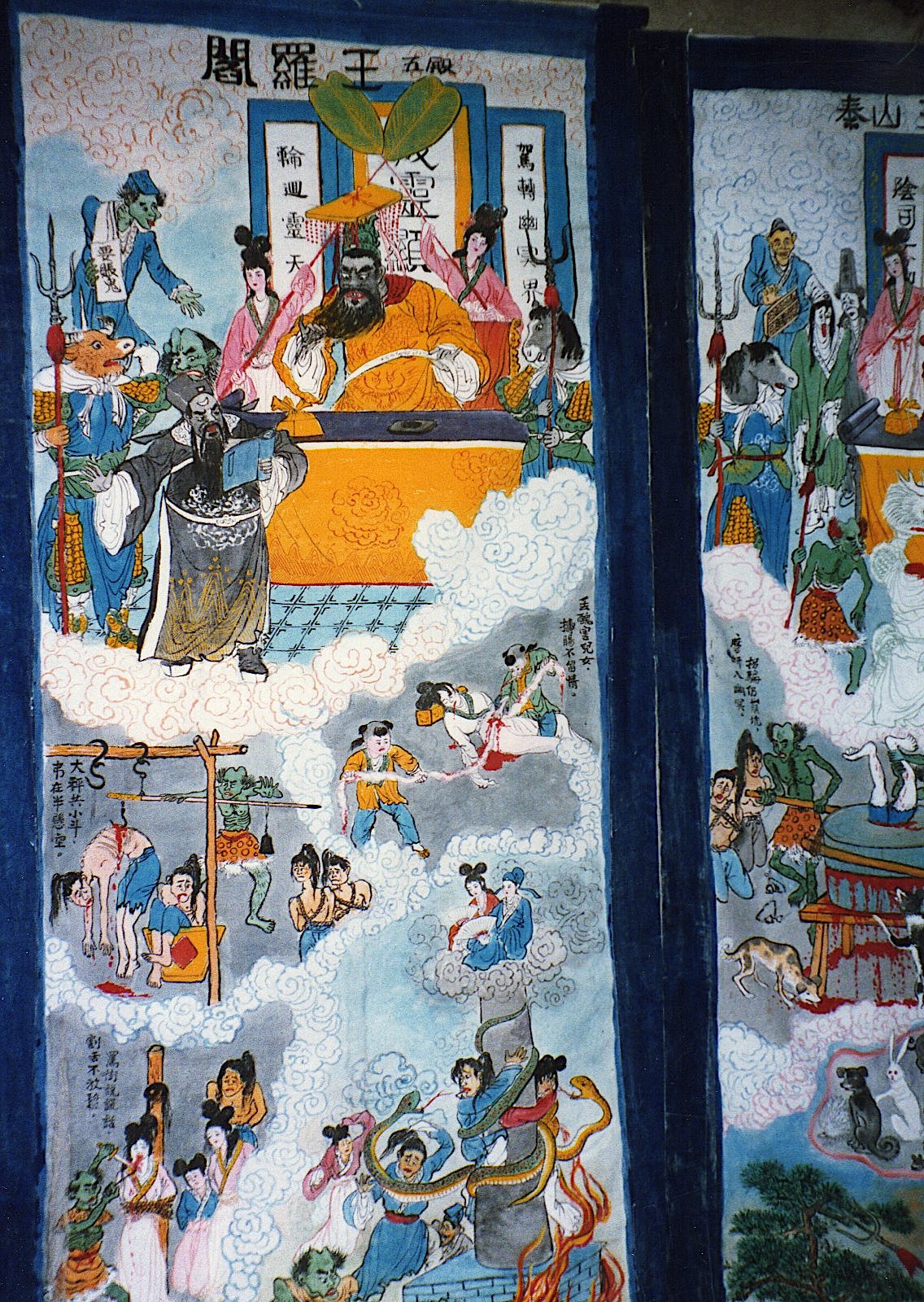
GL Ten Kings

Yama King painting from Ten Kings series, North Gaoluo 1990.

All these books incorporate ethnography and reception history far more than the fusty old reified appreciation of “autonomous” objets d’art. For China,

  • Craig Clunas, Art in China (1st edition 1997)

makes a useful, wide-ranging, and thoughtful introduction, exploring themes like genres, techniques, functions, patrons, markets, producers, class, and gender.

For instance, discussing a wooden sculpture of the female deity Guanyin from Shanxi carved c1200 CE, he describes its original multi-coloured decoration:

All this added to the immediacy of the image for worshippers, but it was covered over at some point, probably about 300–400 years later in the Ming dynasty (1368–1644), when it was painted gold in imitation of a gilded metal sculpture. Such an aesthetic change must have gone hand in hand with some change in the understanding of what a successful image ought to look like, a change at the level of both popular belief and the attitudes of religious professionals which is as yet hardly understood. (pp.56–7)

Whereas much scholarship remains based on artefacts in museums and galleries, fieldwork reveals a vast further repository of images still used in ritual practice. One thinks of the vast hoard of religious statuettes found in rural Hunan, subject of fine research.

And apart from statues and temple murals, ritual paintings depicting the Ten Kings and the punishments of the underworld—hung out for temple fairs and funerals—suggest comparisons with Christian equivalents in medieval and Renaissance art. And they too must have changed their meanings for audiences over recent centuries. At least, illiterate rural audiences would be affected rather deeply, and modern viewers may be underwhelmed now that they are saturated with horror films and video games. But we learn rather little about this from the scholarship; Daoist culture tends to be reified. Meanwhile, household ritual specialists have continued to perform Ten Kings scriptures for funerals.

It reminds me, challenged as I am in the field of visual culture, that ritual images through the ages also need unpacking—assessing changing meanings there too, including early sources for music iconography.

This has a lot to do with reception history. Such studies of visual culture may feed into our experience of Bach and all kinds of early and folk music. If even scholars of WAM and Renaissance painting feel it germane, then studies of Chinese musical cultures, and of Daoist ritual, shouldn’t lag behind.

* * *

But I’d like to end with some more populist vignettes (“Typical!”) on the meanings of art.

Among the numerous virtues of Alan Bennett is his accessible promotion of painting, found in Untold Stories (pp.453–514) [2]notably a talk he gave for the National Gallery, with the fine title “Going to the pictures”. These essays are also a passionate plea for culture to remain accessible, a rebuke to mercenary philistine governments.

He recalls an inauspicious early lecture he gave at Oxford on Richard II:

At the conclusion of this less than exciting paper I asked if there were any questions. There was an endless silence until finally one timid undergraduate at the back put up his hand.
“Could you tell me where you bought your shoes?”

 We’ve all been there. But his remarks on painting are priceless:

Somewhere in the National Gallery I’d like there to be a notice saying, “You don’t have to like everything”. When you’re appointed a trustee, the director, Neil MacGregor, takes you round on an introductory tour. Mine was at 9am, when I find it hard to look the milkman in the eye, let alone a Titian.

We were passing through the North Wing, I remember, and Neil was about to take me into one of the rooms when I said, “Oh, I don’t like Dutch pictures”, thereby seeming to dismiss Vermeer, De Hooch and indeed Rembrandt. And I saw a look of brief alarm pass over his face as if to say. “Who is this joker we’ve appointed?”

He cites his play A question of attribution, about (Michael Jacobs’ teacher) Anthony Blunt:

“What am I supposed to feel?” asks the policeman about going into the National Gallery.
“What do you feel?” asks Blunt.
“Baffled,” says Chubb, “and also knackered” … this last remark very much from the heart.
[… Blunt] tries to explain that the history of art shouldn’t be seen as simply a progress towards accurate or realistic reprentatation.
“Do we say Giotto isn’t a patch on Michelangelo because his figures are less lifelike?”
“Michelangelo?” says Chubb. “I don’t think his figures are lifelike frankly. The women aren’t. They’re just like men with tits. And the tits look as if they’ve been put on with an ice cream scoop. Has nobody pointed that out?”
“Not quite in those terms.”

In a *** passage AB blends hilarity with insight, evoking Baxandall:

In A question of attribution the Queen is made to have some doubts about paintings of the Annunciation.
“There are quite a lot of them,” says the Queen. “When we visited Florence we were taken round the art gallery there and well … I won’t say Annunciations were two a penny but they were certainly quite thick on the ground. And not all of them very convincing. My husband remarked that one of them looked to him like the messenger arriving from Littlewoods Pools. And that the Virgin was protesting that she had put a cross for no publicity.”
This last remark, though given to the Duke of Edinburgh, was actually another flag of distress, stemming from my unsuccessful attempts to assimilate and remember an article about the various positions of the Virgin’s hand, which are an elaborate semaphore of her feelings, a semaphore instantly understandable to contemporaries but, short of elaborate exposition, lost on us today. It’s a pretty out-of-the-way corner of art history but it leads me on to another question and another worry.
Floundering through some unreadable work on art history I’ve sometimes allowed myself the philistine thought that these elaborate expositions—gestures echoing other gestures, one picture calling up another and all underpinned with classical myth—that surely contemporaries could not have had all this at their fingertips or grasped by instinct what we can only attain by painstaking study and explication, and that this is pictures being given what’s been called “over meaning”. What made me repent, though, was when I started to think about my childhood and going to a different kind of pictures, the cinema.
When I was a boy we went to the pictures at least twice a week as most families did then, regardless of the merits of the film. I must have seen Citizen Kane when it came round for the first time, but with no thought that, apart from it being more boring, this was a different order of picture from George Formby, say, or Will Hay. And going to the pictures like this, unthinkingly, taking what was on offer week in week out was, I can see now, a sort of education, and induction into the subtle and complicated and not always conventional moral scheme that prevailed in the world of the cinema then, and which persisted with very little change until the early sixties.

Unpacking the complex attributes of two stock characters, he concludes:

The 20th-century audience had only to see a stock character on the screen to know instinctively what moral luggage he or she was carrying, the past they had, the future they could expect. And this was after, if one includes the silent films, not more than thirty years of going to the pictures. In the sixteenth century the audience or congregation would have been going to the pictures for 500 years at least, so how much more instinctive and instantaneous would their responses have been, how readily and unthinkingly they would have been able to decode their pictures—just as, as a not very precocious child of eight, I could decode mine.
And while it’s not yet true that the films of the thirties and forties would need decoding for a child of the present day, nevertheless that time may come; the period of settled morality and accepted beliefs which produced such films is as much over now as is the set of beliefs and assumptions that produced an allegory as complicated and difficult, for us at any rate, as Bronzino’s Allegory of Venus and Cupid.

For a similar case, see here.

* * *

Apart from any intrinsic merit this little tour of visual culture may have, for me it also suggests several angles barely explored for Daoist ritual.

OK then, just one last aperçu—this time from Kenneth Clark (thanks, Rod). On the contrast between reified art and social reception, here’s his typically urbane formulation in Civilization:

At some time in the 9th century one could have looked down the Seine and seen the prow of a Viking ship coming up the river. Looked at today in the British Museum, it is a powerful work of art; but to the mother of a family trying to settle down in her little hut, it would have seemed less agreeable.

On behalf of the splendid Craig ClunasI accept full responsibility for any inanities in this post.
If you all play your cards right, I promise not to do this kind of thing too often. Craig and any other art historians who have managed to read this far might care to exact revenge by writing Specious Flapdoodle
[famous 19th-century Baptist pastor—Ed.] about early music or Daoist ritual… 


** Not, may I just say, the kind of moronic homespun language used by one maniacal Führer about another: “smart cookie” or “total nut-job”? Roll over Cicero.

[1] Some stimulating reviews may be found herehere, and here.
[2] Online excerpts include http://www.independent.co.uk/life-style/i-know-what-i-like-but-im-not-sure-about-art-1620866.html and https://www.lrb.co.uk/v20/n07/alan-bennett/alan-bennett-chooses-four-paintings-for-schools.

The brief of ethnography

Gaoluo 1989

Recently on Twitter, following a post on my work with the Gaoluo village ritual association, an urban Chinese worker sent me a succinct and intriguing reaction:

中国农村地方的风俗,我不喜欢!— I don’t like local Chinese rural customs!

Well, tough! 罗卜青菜各有所愛, chacun à son trou, “it’s a free country”… But actually it’s a valid point, highlighting an important issue.

Rural customs are what rural dwellers do; it’s hard to belittle the former without rejecting the latter. It’s not just a lack of tuanjie solidarity within the Labouring Masses, between the gong workers and the nong peasants; there has long been a more general alienation anyway among the urban educated. This feeling that Chinese tradition is “backward” dates back well before the 20th century, despite the efforts of Chinese folklorists since the 1920s to document the, um, heritage.

Today those older urbanites who endured banishment to impoverished villages under Maoism (like Kang Zhengguo, or the countless, and hapless, zhiqing educated youths from 1968) have good reason to feel ambivalent about rural culture (see also here).

Younger cityfolk may not have had to endure rural life like their elders. But steeped in pop music and video games, when they are dragged back to the poor countryside to attend the funeral of a grandparent, they too may find village customs irrevocably tainted by poverty and backwardness.

Moreover, apart from those duped by the media into regarding folk culture as a theme park, those younger cityfolk (not least those bravely seeking social justice) have been further alienated by rosy state cultural propaganda—quite understandably.

Of course, the arcane concerns of academia generally may not float their boat. Anyway, they’re unlikely to be excited by the links of some Daoist ritual to manuals from the Song dynasty.

But ethnographers don’t have to be misguided mouthpieces for official patriotism. It’s not about praising traditional culture—more about documenting it, complete with all the problems of rural life. Ethnography aims for the descriptive, not the prescriptive. I’ve already given some traumatic examples of participant observation in fieldwork—Germaine Tillion’s notes on her own incarceration in Ravensbrück concentration camp, and Sudir Venkatesh’s work among Chicago street gangs.

So it’s always worth documenting society, and history, without romanticizing it as some ideal “living fossil” of an illusory golden age. Along with any grandeur that pundits may impute to ritual in rural China, there belong power struggles, violence, the plight of women and blind outcast shawm players, and all kinds of tribulations under imperial, Maoist, and modern regimes. And while studying folk culture, it’s proper to note the alienation of younger urban dwellers from it, as I do. Indeed, I’m not naturally thrilled by Morris dancing—but when you get to know a little about it, you can see how it fits into the changing social culture of rural England.

However rapidly the Chinese rural population has been diminishing since the 1980s, documenting rural life is just as important as studying urbanites, of all classes—including the workers’ struggle and their expressive culture. We don’t have to “like” ♥ (grr) the songs of either those workers or household Daoists, but they all need documenting.

Descriptive ethnography doesn’t necessarily imply standing aside entirely from judgment. Now, as it happens I do indeed admire many aspects of village ritual, but that’s not the point. More adventurous fieldworkers (like De Martino) may seek to spell out some respects in which ritual is life-enhancing, offering consolation and cohesion; or, conversely, ways in which it serves to entrench delusion and conflict, or fortify irrational power. Or—quite likely—they may entertain both hypotheses at once. And both need to be tested, not assumed.

So to that underwhelmed Chinese worker on Twitter, I might say: as the great Tsinghua-university-based anthropologist Guo Yuhua can tell you, far from obstructing the quest for social justice, ethnography can be a contribution to it. Apart from urban workers, if anyone has been downtrodden, it’s the peasantry.

However much the official version may seek to reify and sanitize culture, yet factory workers, household Daoists, village cadres, spirit mediums, army recruits, sectarian groups, vagrants, and entrepreneurs are all part of the social spectrum, whose lives deserve to be documented.

All this reminds me of another gem from Nigel Barley. Arriving at his field site in rural Cameroon, he grapples with police bureaucracy (The innocent anthropologist, p.38):

The commandant turned out to be a huge Southerner of about six foot five. He summoned me into his office and inspected my documents minutely.  What was my reason for being here? […] He was clearly very unhappy as I tried to explain the essential nature of the anthropological endeavour. “But what’s it for?” he asked. Choosing between giving an impromptu version of the “Introduction to Anthropology” lecture course and something less full, I replied somewhat lamely, “It’s my job.”

Some Venetian greetings

On the Li family Daoists’ 2012 sojourn in Venice in 2012 we were guests of the Fondazione Cini, staying virtually alone on the tranquil little island of Isola San Giorgio, just across from bustling San Marco.

Chatting with our Cini hosts, the fragrant Chiara and Sabrina, they told me that when Venetians come across each other by chance they like to exclaim

Fatalità!” (pronounced “Fataità!”)—“Fate!”

A quaint English equivalent might be “Fancy bumping into you!”

Venice 2012

Fatalità! Venetian dwellers with the Li band, or “Selling the Daode jing at the door of Confucius”  在孔子門前賣道德經。

I gather “Fatalità!” is more commonly an interjection, as when telling a story (“And what should happen but…”) or (in reacting) “Fancy that!”. It can also be a humorous way of accepting fate, almost like the English “Typical!” or “That’s life!”.

Without regard to expense or the feelings of the public, the erudite Rod Conway Morris, himself a long-term chronicler of Venetian mores, has obligingly ferreted out a little discussion by Sandro Mattiazzi (Veneziani: Figli del Leone Alata, 2002), with pleasantly arcane examples of a quarrel between gondoliers and a dispute during the war with the Turks, both defused by the timely exclamation.

Fatalità is chance [caso], the fortuitous event that is yet the result of a necessity great or small, and is typical of the Venetian mentality. […] Don’t despair if you can’t find the way to your hotel, or if you’ve left your bag on top of some well. Chance, which has aided the Venetians for almost two thousand years, will surely come to your aid.  Fatalità means that by randomly following another tourist you will arrive at your lost hotel, where perhaps you will find your bag on the porter’s desk. [my translation]

“Fate!” recalls fado, or (as I explained to Li Manshan) the Chinese ming 命… Those terms aren’t part of any such greeting, though in classical Chinese chen 臣 equates with the hackneyed “Ciao!”—itself borrowed from Venetian, and cognate with slave and Slav (for an erudite discussion, see here). Or the English “your humble servant”, mercifully abbreviated from “I trust I shall have the honour to remain your humble servant”, which is of course the correct form of address for foreigners to employ when staggering out of an East End pub at closing time.

Following an arcane exchange in The Times (“Have these people got no Holmes to go to?”—Myles. Mind you, I can’t talk) wherein it is established that Gautier’s Tra la, tra la, la-la-laire is not in fact a reference to the call of the inevitable ubiquitous gondolier, Rod observed in a letter (whose date of 1st April 2016 he assures me is merely coincidental—remember, the word “gullible” doesn’t appear in the OED):

The traditional gondolier’s cry (especially when rounding blind corners in canals) is “O-i!” This is also sometimes used by the inhabitants of the city as a jocular greeting.

I respectfully submit, m’Lud, that had they gone on to use the honorific form of address, the greeting might have become “O-i vo-i!”, evoking Venice’s Jewish heritage (I’ll spare you my fantasy reconstruction of the temporal and spatial vowel-shift). And given the city’s Turkish connection, I’m also still hoping Rod will further unearth the greeting “Ey-up!“—which, in turn, became the correct form of address when entering a kebab shop in Barnsley (cf. my haiku on Morris dancing). The joys of multiculturalism…

Inspired by Rod’s stimulating review, if you read in the gazette of the imbroglio over an arsenal of contraband artichokes; and if you’ve ever been quarantined after zany scampi and pistachio marzipan in the ghetto, or worn sequined pantaloons to a regatta—actually, even if you haven’t, which (let’s face it) is more likely—then you should tip your imaginary hat to the Venetian language. For a borrowing from Turkish, see The kiosk in Turkey and Europe; for Indian influences, see Tickety-boo.

Time for another gin.