Customs of naming

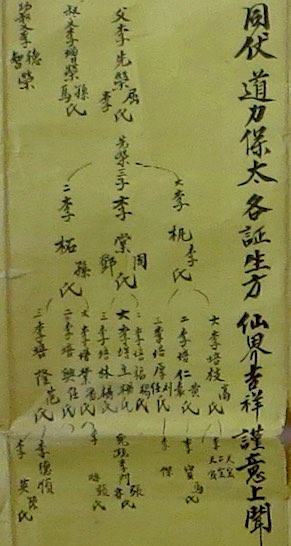
LPS jiapu detail

Detail of Li family genealogy copied by Li Peisen, showing Li Xianrong’s generation, and his sons and grandsons.

Lineages in rural north China commonly (though not invariably) observe the custom of alternating single and double given-names by generation.

Most of my instances come from household Daoist lineages, which happen to be my main material. Whereas most of their fellow villagers were illiterate, and common families might not be aware of their forebears’ names beyond their grandfather, household Daoists were often part of a prestigious local gentry, and their rather stable hereditary transmission has preserved names over many generations.

The genealogy of the Li family in Upper Liangyuan village makes a clear instance. The tree below shows only the Daoists in the lineage (Daoist priests of the Li family, p.5). Thus Li Qing gave double names to his sons (like Li Manshan), while their own sons received single names (like Li Bin):

Li jiapu

Daoists in the Li lineage, from Li Fu, himself the 16th generation in the lineage.

Indeed, Li Bin has continued the tradition by naming his son Li Bingchang. You will have noticed that this is a firmly patriarchal tradition; though wives’ surnames are listed on such genealogies, daughters don’t appear at all, and until the 1950s their formal names were little used anyway. While the rule seems to be used more flexibly for daughters, they too sometimes follow the pattern, as with Li Bin’s feisty sister Li Min.

Moreover (Daoist priests, p.40), for the double names used every other generation, in one generation the constant element in the given names is the first character, while in their grandsons’ given names it is the second character. Thus the first character pei [1] is the constant in Li Peiye 培業, Li Peixing 培興, Li Peilong 培隆, but in the names of Li Peixing’s grandsons it is the second character shan that is constant: Manshan 滿山, Yushan 玉山, Yunshan 雲山. Brothers with single names receive related characters, like Tao 淘, Qing 清, and Hai 海, all with the water radical; or in that same generation, Tong 桐, Xiang 相, Huan 桓, and Hua 樺, all with the wood radical, like their grandfathers Shi 柘 and Tang 棠.

Among many fine artefacts that Li Peisen handed down to his son Li Hua (see also here) is his 1981 copy of a memorial for a domestic Thanking the Earth ritual dating back to around 1930. Li Peisen dated his copy “70th year of the Republic” (which we perhaps needn’t consider as an affront to the Communist regime), but he didn’t copy the date of the original memorial. The latter was written by his father Li Tang (c1879–c1931) along with a fine genealogy of his branch of the lineage; moreover, when Li Peisen copied it in 1981 he updated it with a list of more recent kin.

And at New Year 1989 Li Qing edited it for his own branch of the family, also as part of a Thanking the Earth memorial. These documents are evidence of the rather prosperous status of the Li lineage. For a start, only relatively well-off households would commission a Thanking the Earth ritual. But further, such genealogies are less common in north China than in the south; Li Manshan estimates that only 10 or 20% of lineages in the area would ever compile their own genealogy. A family commissioning a Thanking the Earth ritual would invariably list the previous three generations of ancestors, but it was less common to use the occasion to copy such an extensive genealogy, so we are lucky here.

And here’s the Wang lineage of Baideng township (Daoist priests, pp.78–9), descended from the stepson of Li Zengrong—and also Daoists:

Wang jiapu

This custom is common further afield in north Shanxi, as you can see from many posts under Local ritual. Still in Yanggao, here’s another Daoist lineage in Luowenzao township:

Li Fa 李發
Li Wanxiang 李萬祥
Li Tai 李泰
Li Jincai 李進财
Li Ke 李科
Li Deshan 李德山
Li Yuan 李元
Li Tianyun 李天雲

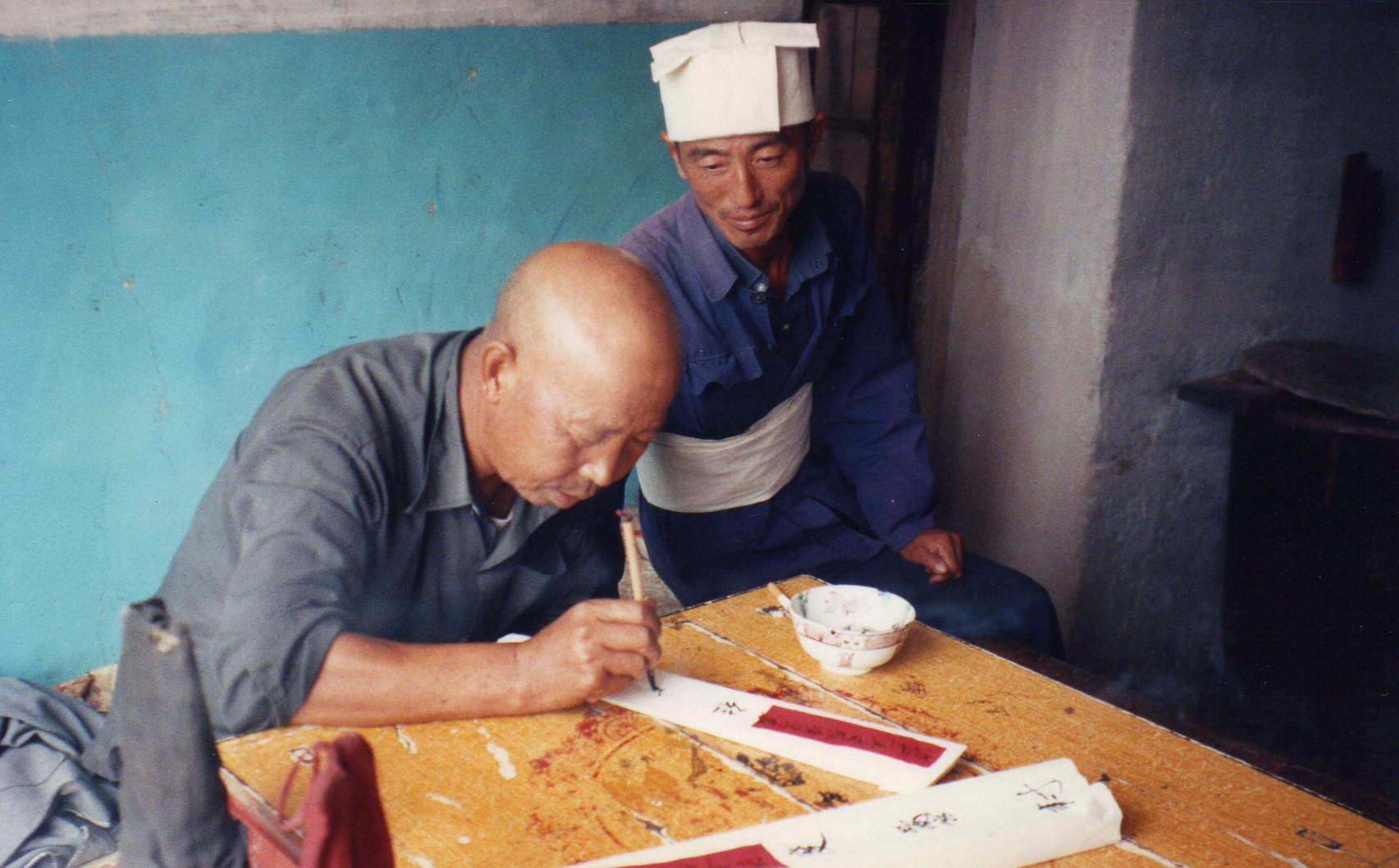
Li Yuan writing

Li Yuan writing funerary documents, 1992.

And the Zhang family Daoists in Jinjiazhuang:

Zhang Lianzhu 張連珠
Zhang Kui 張奎
Zhang Wenbing 張文炳
Zhang Bi 張弼
Zhang Deheng 張德恆
Zhang Mei 張美
Zhang Jincheng 張進成
Zhang Nan 張楠

Zhang Nan and LMS

Li Manshan with Zhang Nan, Jinjiazhuang 2018.

And just south in Yingxian county, here are seven generations of Longmen Daoists in the Zhao lineage:

Zhao Tianyu 赵天玉
Zhao Ming 赵明
Zhao Yongzhen 赵永珍, Zhao Yongbao 赵永宝
Zhao Zhong 赵仲, Zhao Xiu 赵秀, Zhao Cai 赵财, Zhao Rui 赵瑞
Zhao Guowen 赵国文 (son of Zhao Xiu)
Zhao Fu 赵富, Zhao Pu 赵普
Zhao Shiwei 赵世伟

On a practical fieldwork note, as soon as you manage to get to grips with these names, you realize that no-one really uses them. Instead they use nicknames like Golden Noble (Jingui) or Zhanbao, their “little names” (xiaoming)—itself an informal term for “breast name” (ruming). Li Manshan doesn’t even necessarily know the formal names of some of the Daoists from other lineages that he calls on as ritual deps. Actually, this discrepancy with “standard” names is entirely normal in social groups, as I noted in this post featuring the conductor Charles Mackerras (“Slasher”).

The Li family also used another naming system. Males of the same generation were given a double name whose second character was the same; for Li Qing and his siblings it was shun 順, for Li Manshan’s generation it was heng 衡. Thus Li Qing was known as Quanshun, while those who know Li Manshan well call him Manheng. His son Li Bin seems to be known as Li Bin, though even this is complicated; Li Manshan gave him the name Bin 斌 (the characters for “civil” and “martial” combined), but he often uses the name Bing 兵 “Soldier”—he’s not fussy. But most often they refer to each other by kinship terms, like “third maternal uncle”—their precision only useful if you happen to have a detailed genealogy in your head.

* * *

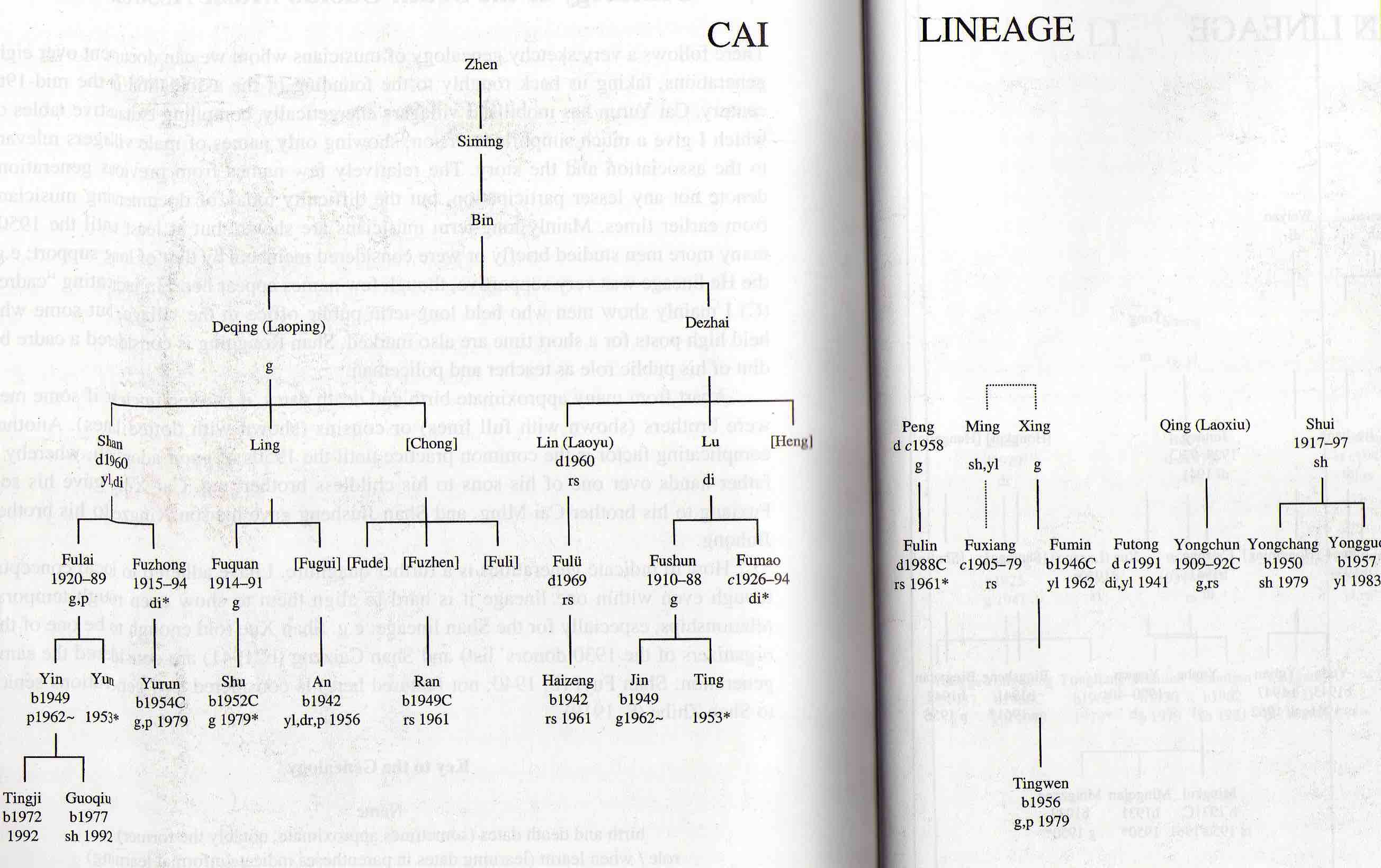
Meanwhile in Hebei province, we can see that the custom of alternating single and double names by generation was widely used in the various lineages of Gaoluo, stalwarts of the village ritual association (Plucking the winds, genealogies pp.357–61) such as the Cai lineage:

Cai

As with the Li family in Shanxi, the generational names often shared a stable element. For instance, the given names of Cai Yurun’s grandfather and his two brothers all had the “mountain” 山 component (Shan 山, Ling 岭, Chong 崇), while their cousins’ names incorporated the “rain” 雨 component (Lin 霖, Lu 露). Traditionally, families would often invite an educated villager to choose suitable characters for the name of the new-born, but by the 1950s the tradition was attenuated, with the parents themselves choosing the name less conscientiously.

The Fu generation there was crucial to the transmission of the ritual association under Maoism, with a whole cohort of distinguished performers. Apart from Cai Fuxiang, old revolutionary and vocal liturgist (like Cai Yongchun, also part of that generation), Cai Fuquan was the leading guanzi player, and Cai Fulai, Fuzhong, Fulü, Fushun, Fumao, Fulin, Fumin, and Futong were all keen members. It was their sons who were our own mentors through through the 1990s, like Cai An, Cai Ran, and Cai Yurun (the latter, son of Cai Fuzhong, being a curious exception to the naming system). Under both the Maoist and reform eras many of them served as village cadres even while supporting the ritual association.

Cai Fulu

A rare image from Gaoluo on the eve of the 1937 invasion:
left, vocal liturgist Cai Fulü; right, Catholic Shan Wenyi, brother-in-law of Woman Zhang.

Back in 1930, when Painter Sun visited Gaoluo to depict ritual images for the association, the Cai lineage had used the occasion to ask him to make a fine genealogy for them on cloth—and it seems to be the only one that has survived decades of turmoil. Somehow it was handed down to Cai Haizeng, third generation of vocal liturgists in his family following in the footsteps of his father Cai Fulü (another exception to the naming rule). When Haizeng hung it up for me to photograph in 1998, he insisted on preparing an altar table with incense, candles, fruit, tea, liquor, and cigarettes.

Cai 1930

Cai lineage genealogy, 1930.

Unlike the Cais, most branches of the Shan lineage simply used double given-names for every generation, but the case of Shan Zhihe (1919–2002), one of our most venerable mentors in Gaoluo, is interesting. His father Shan Futian (1882–1953) gave his two sons their “official names” Zhizhong and Zhihe after their coming of age with the “lesser capping” ceremony. He named them thus because his public baths in Hohhot were called Zhonghe 忠和 (Loyalty and Peace) baths; their names showed that the baths would one day belong to them. The zhi 之 element in their given names was an “empty character”, and so they were considered single names.

But by the 1940s the “old rules” were already being diluted here. The two sons of Shan Zhihe, Shan Ming and Shan Ling, who would eventually become ambiguous figures in the village’s ritual association, were born in Hohhot in 1942 and 1948. Though the custom of alternating single and double names by generation persisted in the Cai and He lineages more than with the Shans, by this time it was becoming more flexible. So when it came to the naming of his own sons, although Shan Zhihe’s own name was effectively, and properly, single, they too were given single names; it was actually their grandfather Shan Futian who made the decision. From the 1950s some families were beginning to adopt “revolutionary” names (see e.g. the wonderful photo of the Qiao family in Yulin, here); but in the Shan family the old tradition was losing ground irrespective of political control.

Here too, people had variant names. At least until the 1980s, after reaching the age of 50 sui, men adopted an “old” name (laohao 老號) beginning with the character “old” (lao). In principle, the new name should complement the original name, in a charming parallel with Cockney rhyming slang. Just as “apples” stands for “stairs” by way of “apples and pears”, so Shan Chang (eternal) took the “old” name Laole (old joy) by way of the binome changle (eternal joy). Cai Qing’s given name Qing (verdant) was associated with the phrase “verdant hills and abundant waters” (shanqing shuixiu) to create his “old” name Laoxiu.

Incidentally, villagers agree that as long as the characters for their given name reflect its pronunciation, it’s not important which characters are used—admittedly within a very narrow choice of two or three. This is evident in the association’s own donors’ lists, where different written versions of the same given name appear. And I must say it’s one of the few reliefs available to us in making fieldnotes.

* * *

While the alternation of single and double given-names is far from a universal rule in rural north China, I suppose it must have been common in the cities too—is it still so? And what of other regions, like south China, where lineage consciousness is more deeply embedded? Comments welcome!

Click here for compound surnames in Chinese and English.


[1] By the way, the pei character is 培, though they often use 丕 (officially pi) as a simplified character. They also often write a simplified character for zeng 增 in several Daoists’ names, with zhong 中 to the right of the earth radical; I haven’t found this in dictionaries.

A village elder

SZH

Shan Zhihe at home, 1998. In background, his older son Shan Ming.

My book Plucking the winds is a historical ethnography of Gaoluo village in Hebei just south of Beijing, focusing on its amateur ritual association. I’ve already posted several vignettes assembling material from the book (listed here); so here’s another one: the story of the venerable Shan Zhihe 单之和 (1919–2002).

By the time of our stay at Gaoluo in May 1996, while my fieldwork with Xue Yibing was going well, we still hoped to be able to visualize the earlier 20th century in greater detail. One evening, invited to supper with our urbane friends Shan Ming and Shan Ling, now among the leaders of the ritual association, we finally met their elderly father Shan Zhihe.

Like his own father, though never a practising member of the village ritual association, Shan Zhihe was a long-standing benefactor. Whereas most Gaoluo villagers had little or no experience of the world beyond a day’s walk, Shan Zhihe had travelled quite widely, and his father even further. Although he spent little time in Gaoluo between 1931 and 1951, some of our most personal information for the changing times under the Republican era, Japanese occupation, and Maoism derives from our sessions with him.

His own experiences through the complex events before and after the 1949 Liberation don’t fall comfortably into the pattern prescribed by official jargon. After his higher education was disrupted by the Japanese invasion in 1937, he found himself working “on the wrong side” in the 1940s. Though his family was then handicapped with the label of “rich peasant”, and he never held any official position in the village, he was a much-admired figure.

Shan Futian
First Shan Zhihe narrated the remarkable story of his father Shan Futian, born into a very poor family in South Gaoluo in 1882. That very year his own father was beaten to death after being framed for the stealing of a donkey. The orphaned Shan Futian studied at the village private school for only three winters. He must have married not long after the 1900 Boxer uprising. His bride came from the Eastgate quarter of Dingxing town nearby. What with chaos of the Taiping uprising of the 1850s and the Boxers, villagers in the area, situated between the strategic centres of Beijing and Baoding, were constantly fearful for their unmarried daughters. So her family had sent her off to relatives in an isolated village just northwest of the Houshan mountains, centre of the cult to the goddess Houtu in whom locals still believe. As tradition demanded, the betrothed couple were not to meet until their wedding day. Shan Futian’s house, on the site of their present house, had only two bare rooms covered in thatch, empty apart from a clay vat to store millet.

But Shan Futian’s fortunes soon took a turn for the better. In about 1910 he found a job through relatives as tea-boy at an inn in Xiheyan in central Beijing, near the Forbidden City. There he earned the pittance of 12 dazir per month, equivalent to about 20 yuan today, according to Shan Zhihe; half of this he sent to his family back in Gaoluo. One day a general called Cai Chengxun came to the inn and noticed Shan Futian’s impressive build and honest demeanour. Cai was a platoon leader in the retinue of Yuan Shikai, who stepped in after the collapse of the Qing government and proclaimed himself emperor before his death in 1916.

Shan Futian now leapt at the invitation to become a bodyguard for Cai Chengxun: as a tea-boy he was bullied, and he couldn’t wait to move on. When Cai was promoted, he gave Shan Futian the post of banner-official in his cavalry. Shan was soon sent on duty to Baoding, where his oldest son Zhizhong was born in 1917, and then to relieve the garrison at Zhangjiakou further north, capital of Chahar; again, after some time his wife was able to join him there, and Shan Zhihe himself was born there in the 3rd moon of 1919.

Warlords were engaged in fierce fighting through the 1920s. The complexities of the political history of the time need not concern us here, but briefly, in 1922 Cai Chengxun, along with another warlord Sun Chuanfang, was sent by Cao Kun to reconquer the distant southern province of Jiangxi. Cai “bought” the governorship of the province, while Sun went on to control Fujian. Based at the Jiangxi capital Nanchang, Shan Futian now acted as cavalry commander.

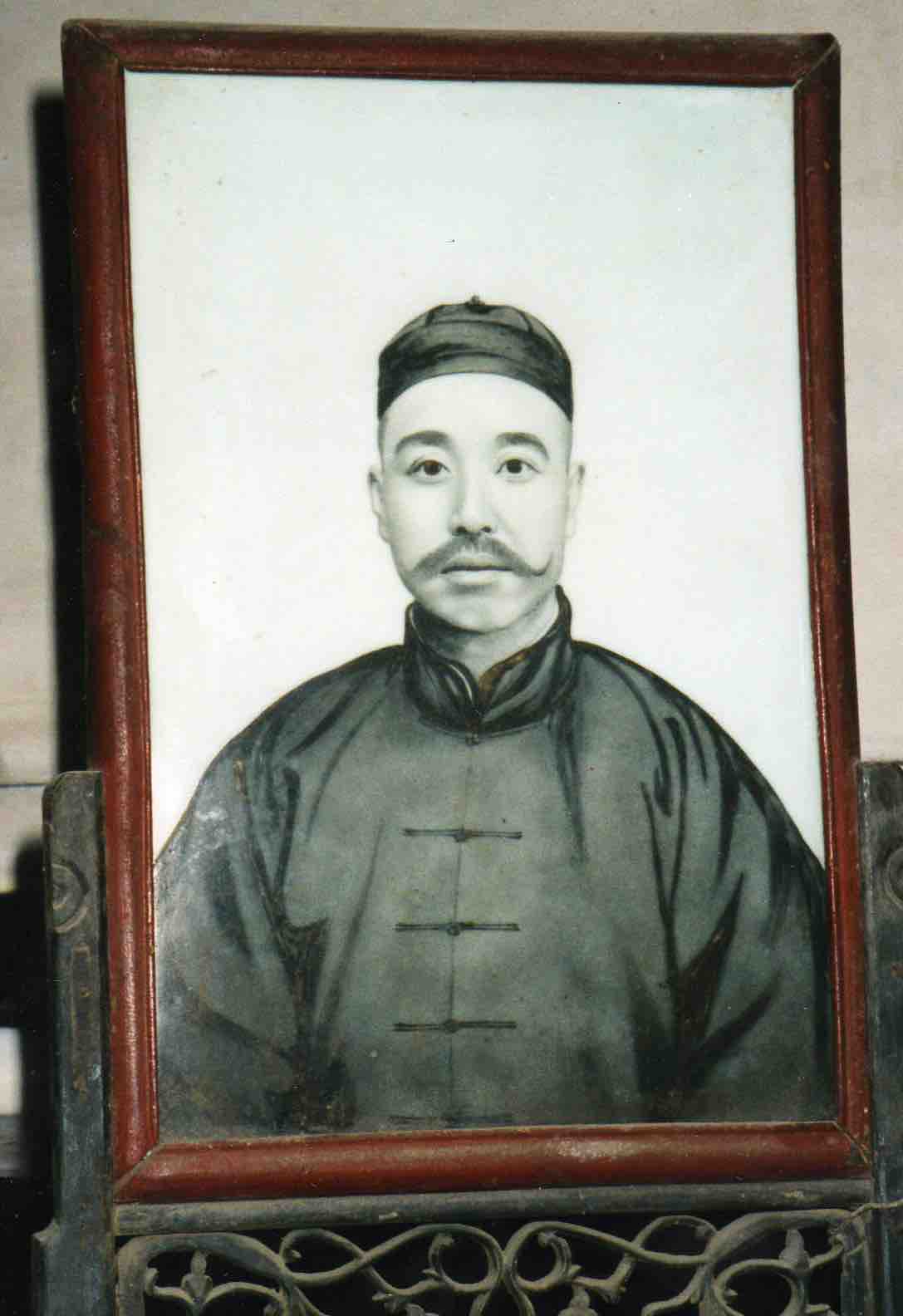
SFTCai Chengxun, victorious in battle, had now made his fortune. Returning north, he retired to his old home in Tianjin. “When the tree falls, the monkeys scatter”; Cai Chengxun’s retinue had now lost their patron. But Cai recognized Shan Futian’s honesty—Shan had never exploited his position in order to enrich himself—and before retiring he wanted to make Shan Futian mayor of De’an county, between Nanchang and Jiujiang, hoping Shan could use the opportunity to make a fortune for himself at last. Shan declined, afraid that his “lack of culture” would make the job difficult for him, although Cai offered him an adjutant. Instead he took the post of county police chief. The 1924 ceramic portrait of Shan Futian, which now had the place of honour overlooking the Shan family’s eight-immortals table, was fired at the famous kiln of Jingdezhen while he was serving in Jiangxi.

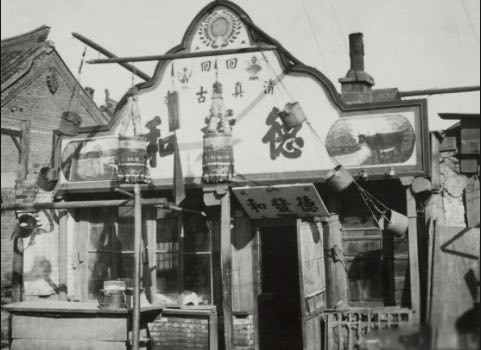
But without a patron Shan Futian found the work difficult, and in about 1927 he returned north, having made little money. After a brief reunion with his family in Gaoluo, he was introduced by a relative to do business back in Zhangjiakou. Before long he moved still further north to what is now Hohhot in Inner Mongolia, riding by camel. There he opened a leather business called Total Victory Leather Corporation; he also opened a public baths there in partnership with a relative from Dingxing. Different trades in Beijing were often monopolized by people from a particular area of the surrounding Hebei province; people from Dingxing and Laishui counties (the area of Gaoluo) used to work at public baths—this remained a traditional speciality of Gaoluo villagers right until the 1950s.

Shan Futian was one of several opium smokers in South Gaoluo, along with landlord Heng Demao and village bully He Jinhu. As Shan Zhihe observed, “It wasn’t just the rich who smoked: sick people and general reprobates also had recourse to it. I reckon no more than ten people in the village had the habit”. In 1935 Nationalist official Wang Zuozhou held a bonfire in the county-town as part of anti-opium campaigns throughout China. No-one heard of any such campaign reaching Gaoluo, but the habit—or perhaps rather the addicts themselves—must have died out soon after the Communist Liberation.

Early days of a scholar
Seated magisterially at his fine eight-immortals table, Shan Zhihe now began to relate his own story to us. Third of Shan Futian’s four children, he was born in 1919 at Zhangjiakou, where his father was then based. He and his older brother were given their “official names” Zhizhong and Zhihe after coming of age with the “lesser capping” ceremony. They were so named because their father’s public baths in Hohhot were called Zhonghe (Loyalty and Peace) baths; their names showed that the baths would one day belong to them.

Back in Gaoluo, the Juma river just east of the village had flooded in 1917. Though the flood was not serious and no-one died, it is still famous today in Gaoluo. The only other major flood in the village occurred in 1963. Gaoluo was fortunate, since throughout the whole area floods were frequent and devastating; indeed the village’s long-term immunity from natural disasters is still commonly attributed to the divine blessings brought by its ritual associations.

With his urban education, Shan Zhihe came to know the year of his birth, 1919, as the year of the May Fourth movement, a great urban intellectual ferment modernizing literature and social thinking. In fact, most villagers probably knew nothing of this movement: as amateur historian Shan Fuyi pointed out to us, the only big national historical event villagers definitely knew of was the Marco Polo Bridge incident on 7th July 1937, which unleashed the Japanese invasion. And if they do know such dates, they know them only in terms of the 8th or 26th years of the Republic, not by the official Western calendar.

Rather, most Gaoluo inhabitants know the 8th year of the Republic (1919) as the year of a serious epidemic in the village. In the heat of the 6th and 7th moons, “just as the melons were ripening”, villagers started to get stomach cramps and diarrhoea, death following quickly. Over sixty people died within a month. When one of the coffin-bearers died too, no-one dared observe proper funerals any more—the ritual associations too must have stayed away.

By now Shan Zhihe’s father was doing well in his business enterprises in Hohhot, and had bought up several dozen mu of land back in Gaoluo. In 1922, Shan Zhihe, still only 4, was sent back to South Gaoluo while his father went off to war in distant Jiangxi. Three years later he began attending private school in the village, studying along with forty or fifty other children. The school was at the home of his first teacher, Yan Zhan’ao. Seated before a portrait of Confucius hanging on the wall, the pupils learnt the standard Confucian curriculum, such as Surnames of the hundred families and Document of one thousand characters. Young Shan Zhihe studied there for five years. Since the older masters were less clear in their enunciation, pupils preferred younger teachers like Shan Hongru.

School tuition fees were 3 silver dollars per year. The teachers lived well; apart from tuition fees, pupils were also expected to present gifts three times a year: not only at New Year, but also on the Double Fifth (5th moon 5th) and Mid-Autumn (8th moon 15th) festivals—which have since lapsed in this area. The value of these gifts depended on family circumstances: better-off families might offer a pig or a sack of refined flour, but some poorer families were unable to give anything, and the teachers never blamed them.

The 1930s

1930 donors' list, South Gaoluo

1930 donors’ list, South Gaoluo.

Shan Futian was among the five “managers” on the ritual association’s precious 1930 donors’ list.

My father always thought to give the most money to the association, as much as 5 silver dollars. That was a lot of money then—2 silver dollars bought a sack (44 jin) of refined flour in Beijing. Whenever donations were required, the leaders of the association would go round all the households in the village. Leading members of the Heng lineage always gave last, so that they could display their economic power by giving the most, a bit more even than my father, and “taking first place”.

More charitably, some said it was also so that they could make up for any shortfall in donations. Indeed, on the 1930 list Heng Jun and his son Deyong head the list, before Shan Futian.

On the 6th day of the 9th moon in 1931, just a month after the benediction of the Catholic church, our venerable mentor Shan Zhihe, now 13, left Gaoluo to join his father Shan Futian in distant Hohhot, where he joined in classes of the province’s 4th Primary Comprehensive. Shan Futian wanted his son to continue his education; as we have seen, his own father was a pauper beaten to death without the least pretext, and Shan Futian himself had been poor and uneducated; persistent Confucian values still allotted far higher prestige to the scholar than to merchants like him. Having had such a hard time, he now considered giving his children an education more valuable than any material inheritance he might leave them. I wonder how this decision seems now: many educated Chinese today feel effectively discriminated against for having an education, not only during the Cultural Revolution, but under the market reforms since.

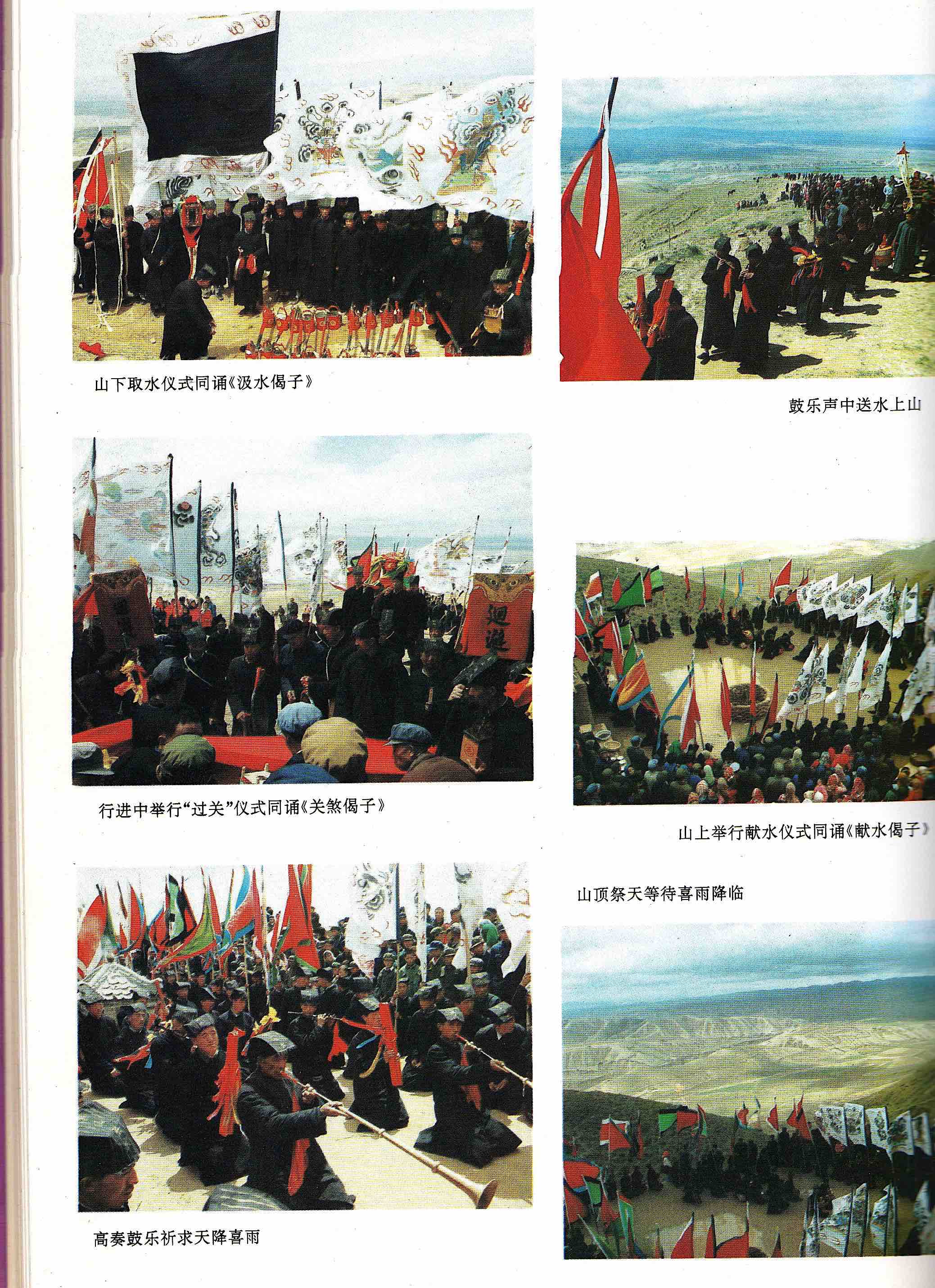
Shan Zhihe recalled ritual life before the Japanese invasion. I cited his account of processions to pray for rain here. He also had insights on the Italian Catholic missionaries, led by Bishop Martina, and the building of the church in 1931.

church

On the 6th day of the 9th moon in 1931, just a month after the benediction of the Catholic church, our venerable mentor Shan Zhihe, now 13, left Gaoluo to join his father in distant Hohhot, where he joined in classes of the province’s 4th Primary Comprehensive. Shan Futian wanted his son to continue his education; as we have seen, his own father was a pauper beaten to death without the least pretext, and Shan Futian himself had been poor and uneducated; persistent Confucian values still allotted far higher prestige to the scholar than to merchants like him. Having had such a hard time, he now considered giving his children an education more valuable than any material inheritance he might leave them. I wonder how this decision seems now: many educated Chinese today feel effectively discriminated against for having an education—not only during the Cultural Revolution, but under the market reforms since.

Shan Zhihe takes a bride
The next time Shan Zhihe returned to Gaoluo was for his wedding in the spring of 1937. One fine morning during New Year 1998 he finally described it for us; he had omitted to mention it during our previous talks, for reasons which will soon become clear.

My Beijing companion Xue Yibing and I both relish his refined conversation. He too is always glad to see us, to chat with relatively educated outsiders about current affairs and history, reflecting on and trying to make sense of his own extraordinary life. With his father’s portrait overseeing us, we sit round his lovely table munching melon seeds in our overcoats (it’s still terribly cold), his children and grandchildren regularly refilling our teacups.

After graduating from primary school in Hohhot, young Shan Zhihe was sent to secondary school in the Xuanwu district of central Beijing. On the 26th day of the 2nd moon in 1937, aged 19, he took leave from his studies to make a special trip back to South Gaoluo for his wedding. The betrothed couple, naturally, had never met. His bride came from the Eastgate quarter of Dingxing town, just like his mother, whose family had arranged the match. She had bound feet and was uneducated; Shan Zhihe was full of modern thinking and had learnt to oppose “feudal customs”, but he had to obey his parents. His return to Gaoluo must have seemed like surrendering himself to the servitude from which his education was promising to free him.

This was to be one of the last lavish weddings in the “old society”, costing the astronomical sum of 300 silver dollars. His bride was carried in an expensive new sedan; Shan Zhihe himself rode a sedan borrowed from landlord Heng Demao. The procession to meet the bride at Dingxing, 5 km distant, started out in pitch darkness at 4am: to set off back home with the bride after midday was taboo, spelling ill-fortune for the match.

The amateur ritual associations perform only for the “white rituals” of funerals, not for the “red rituals” of weddings. For the latter it is common to hire a professional shawm-and-percussion band, known as “blowers-and-drummers”. Since Gaoluo itself had no such band, one was hired from Shiguzhuang village just north. On the procession to collect the bride, the shawm band played as they passed through each village, called “crossing the villages”, as firecrackers were released deafeningly. By tradition the route back to the groom’s home must be different: they passed through Xicheng village in the Northgate area of Dingxing to Nanhou, crossing the river again at Wucun. On arrival at Gaoluo there was a sumptuous feast. The five blowers-and-drummers were handsomely rewarded with half a silver dollar each.

Shan Zhihe spent a month in the village before returning to his studies in Beijing, leaving his new bride behind. Apart from taking part in the lineage observances for the Qingming festival, it was the time of the 3rd moon festival for the goddess Houtu, when many villagers went on pilgrimage to the Houshan mountains. It was also Easter, and Shan Zhihe recalls seeing Bishop Martina ministering to his flock in Gaoluo.

Even in a society in which gender equality was still not remotely on the agenda—we saw the dreadful isolation of Woman Zhang—Shan Zhihe and his wife were to make a particularly incongruous couple, as he recalled dispassionately for us in 1998. She was what he now calls a “housewife” (jiating funü, a term which reveals his own education), and hardly literate; she was five years older than him, and with her bound feet was barely mobile (that was the idea, of course); he was tall and commanding, a scholar with ample experience in the outside world. Couples simply weren’t seen in public. She used to nag him to take her to watch the local opera; one day he had to give in, but as he says they must have made quite a spectacle themselves, with him reluctantly trying to adjust his manly stride as she hobbled along trying to keep up. They never went out together again, and she never forgave him. As he recalled wistfully, they never exactly had any problems: “She didn’t curse me, and I didn’t beat her.” When she died, on the 13th of the 7th moon in 1983, the funeral was quite grand; the ritual association performed, and lavish paper artefacts were displayed and burned, though there was a continuous downpour.

Courteously accepting another cigarette, Shan Zhihe reflects: “My brother and I were both victims of the feudal system of marriage. You can’t blame my parents, they were products of the system themselves. My older brother married a couple of years before me, in 1935, but then went away to study in Baoding; in 1939 he got into the 29th Army, stationed in Hebei, and after going south with the army he stayed there. It was all just to get away from the wife! She stayed behind in Gaoluo the whole time—she was only able to remarry after they got a postal divorce in 1957.”

Incidentally, in 1998 there were still about forty or fifty women in the village with bound feet; of those above 70, only one had natural feet.

The devils invade
In the summer of 1937, back in Beijing after his wedding, Shan Zhihe was in the midst of his studies when the “7th July incident” (Qiqi shibian) occurred. This battle between Chinese and Japanese troops at the Marco Polo Bridge, midway between Beijing and Gaoluo, marked the formal outbreak of the War of Resistance against Japan. It was a decisive moment in modern history for villagers, which they often call simply “the incident”. Of course, the preceding period too transpires to have been anything but rosy, but they often periodize cultural loss by this date, rather than by the Communist “Liberation” some ten years later—the Japanese invasion tacitly marking for them the increasing control of the Communists over their lives, as I eventually deduced.

With the whole Beijing area in chaos, Shan Zhihe eventually made his way back to Gaoluo on foot, by a long route avoiding the area of the Marco Polo Bridge, arriving back home late in July 1937. But what was he supposed to do now? His father had indeed blessed him with an education, and by now he didn’t relish the prospect of taking up as a peasant. The very fact of his education also made his situation precarious, for rival factions would seek to exploit his knowledge, and it would be difficult to choose his own path.

A month or so after his return to Gaoluo, it was clear that the Japanese advance along the main transport routes south could not be contained. Shan Zhihe’s older brother Zhizhong was part of the army which engaged the Japanese at Mentougou west of Beijing, but by the 7th moon they had to retire in defeat. Ordered to regroup at Zhengzhou, quite far south, they were constantly retreating through the area—Shan Zhihe’s mother was busy making bread for them. Zhizhong stopped off in Gaoluo for three days. After he resumed his journey, the brothers were not to meet again until after Liberation, over ten years later. Zhizhong later went off to work in Hubei province far to the south.

Their father Shan Futian was still in distant Hohhot. Shan Zhihe, though reluctant to abandon the family’s considerable property in Gaoluo, was responsible for his mother and sisters, and resolved to take them south out of danger. It was only when they heard the sound of heavy artillery that they decided they must go. But before they had even reached Baoding, they heard that the Japanese had already advanced as far as Shijiazhuang, still further south. Flight was impossible—they had no choice but to return to Gaoluo.

Japanese warplanes bombed Laishui county-town at 8am on 17th September (the 13th of the 8th moon) 1937, and that same day Japanese troops first entered Gaoluo. Coming from the direction of Wucun to the south, they were just passing through; they had about fifty tanks, and were covered by aircraft. The troops entered the village before Woman Zhang could take her children to the church to hide; they passed by her house. In order to dissuade them from murdering them all and setting fire to the village, the village leaders went out to welcome them. Before the Japanese even entered the village, they shot dead a villager who rashly stuck his neck out to look, but after entering Gaoluo they harmed no-one, just asking for fresh water, eggs, and meat. Shan Zhihe himself, along with Cai Ming (a sheng-player in the ritual association who worked as a pig-slaughterer), was responsible for looking after them and giving them water—the Japanese made them drink some first to be sure it wasn’t poisoned. Though they soon went on their way after a token search, Japanese cavalry and infantry passed through constantly for several days on their way to Baoding, and Gaoluo villagers had to look after them.

Seeing our evolving sketch-map of the village gave Shan Zhihe conflicting feelings:

Before the Japanese arrived they had prepared maps which they used when they first entered the village—they made me point out the way to Baoding. In the first party of Japanese troops were some savages [Ainu?] from Hokkaido. When they entered the village they caught some chickens and tore them to bits, eating them raw. When the troops discovered my hands weren’t calloused like those of a peasant they pointed their bayonets at me. I frantically tried to explain by gestures that I ran a baths, and they let me off.

The lawless conditions of the early 1930s had prompted many villagers to arm themselves. Soon after the Japanese invasion in 1937, some Gaoluo villagers sought to set up “Anti-Japanese brigades”. Villagers with guns were invited to join the new militia or at least to give their guns to the resistance effort. Within a couple of days some two hundred volunteers had assembled, including Catholics like Cai Chen and Cai Xing. The new militia called itself by the grandiose title of “The Rear Anti-Japanese self-protection troupe”, and even drew up a constitution. The house of North Gaoluo landlord Yan Shide served as command-post.

But educated Shan Zhihe soon found with dismay that most of the recruits were just village good-for-nothings. While a student in Beijing, he had taken part in patriotic demonstrations boycotting Japanese goods. Now finding himself back in his home village, taking his gun along and soon becoming one of the leaders of this motley crew, he was full of misgivings. Untrained, they were a menace to people outside their own village. “Ordinary people didn’t understand what this ‘anti-Japanese’ stuff was all about anyway, they thought the Japanese devils were just another bunch of bandits.”

The Japanese, learning that Gaoluo had organized a “Red Spears Association”, now sent a division of troops to “encircle and suppress” them. Shan Zhihe had a cousin called Wang Futong, whose family was quite well-off, owning over 100 mu of land. Wang was notorious as a wastrel who kept bad company. When an enemy of his spread a rumour that he was a militia leader, the Japanese came looking for him. Shan Zhihe had gone to Dingxing county-town that day to buy shoes for the militia, and by the time he got back the Japanese had gone, having failed to find Wang. But that was the end of the Gaoluo militia: some hid their guns or threw them down the wells, some went into hiding, while others joined militia groups in other villages, calling themselves anti-Japanese but actually plundering ordinary Chinese houses.

Cultured Shan Zhihe obviously had no future in such a militia. He handed in his gun and took no further part. Events now forced him to flee Gaoluo. Before long his profligate cousin Wang Futong was murdered by a drinking-buddy called Huo Zhongyi, leader of the militia in Xiazhuang just east of the river. Afraid that Shan Zhihe would seek revenge, Huo Zhongyi decided to “destroy root and branch”. He had Shan Zhihe summoned to the house of South Gaoluo landlord Heng Demao, but Shan suspected a trick and decided to flee. For a while he hid out at his grandmother’s house in the nearby town of Dingxing, and then set off to find his father again in distant Hohhot. The 10th moon of 1937 had still not arrived—an eventful start to his married life.

In occupied Hohhot
Shan Zhihe had already begun telling us his story in Gaoluo in 1996. We were back in Beijing for a few days between visits when we learned that he too had come there to stay with a family who needed his medical help. Back in the frenzy of ring-roads and fancy hotels, we missed Gaoluo already; glad of the opportunity to seek his guidance again, we asked him to continue his story for us.

Hohhot

Hohhot, 1930.
Source: https://www.xuehua.us/2018/07/23/罕见历史老照片,1930年蒙古人记忆中的呼和浩特!/

Shan Zhihe left for Hohhot in the 9th moon of 1937, where his father was still running a public baths. Shan Zhihe’s wife, as well as his mother, were able to join them in 1938; the sons Shan Ming and Shan Ling were born there in 1942 and 1948 (for naming customs, see here). But the war had made business enterprises highly subject to intimidation, as Shan Zhihe soon found out when he started working at the baths. Early in 1938 posters advertising for examinations for the police force seemed to offer him a better alternative. Shan Zhihe was a tall and well-educated young man; he passed the exam with no trouble. Only when he started the Japanese-style military training did he realize that what the poster had presented as a force for the protection of Hohhot was in fact a training for the collaborative “traitor army”. By the time he realized he had been conned, it was already too late, and Shan Zhihe was now subordinate to a Japanese police chief. If his story may sound disingenuous, it apparently didn’t seem so to later Communist investigators.

Shan Zhihe was first sent to work at the police station in Great South Street, the most affluent quarter of Hohhot; then after a month he was promoted to personnel management in the police department in the old town. Over the following years he gained promotion through the ranks of the Mongolian and Japanese armies. “I had contact with the Japanese all the time—I got to read the Japanese news, so I knew quite a bit about World War Two.” He was better informed than I about Dunkerque, which in itself was no great feat. He managed to save several Communist guerrillas: when the Japanese caught someone, friends got him to go and set things right, so they were set free.

In the 9th moon of 1942 Shan Zhihe at last got permission to return to Gaoluo for a visit. His military permit entitled him to carry firearms, and his first thought was to seek out Huo Zhongyi and “settle the debt” for the murder of his cousin. But he soon learnt that fate had done the job for him. Huo had gone over to the Japanese, and then, resentful of their cruelty, had resolved to rebel against them; but they had found out and executed him. Shan Zhihe spent only one night at home before setting off back towards Hohhot. On the way he spent a few days at the home of his older sister’s husband in Beijing, and applied for permanent leave from the Japanese army. This was granted, but after he returned to Hohhot he spent most of the next three years virtually unemployed, earning a bit from renting out rooms.

After the Japanese surrender in 1945, Nationalist commander Fu Zuoyi had entered Hohhot and gradually “suppressed” the most evil of the Japanese collaborators. “Times were tough in Hohhot after the Japanese surrender”, recalled Shan Zhihe. “There was no coal, and no barley—we had to eat ‘secondary barley’, a mix of husked sorghum and husked barley. The Nationalists had heard that I was educated and had military training, and they offered me an official post in their army, but I refused. Still, I was only 26, in the prime of life. Frustrated, I could see no options for myself, and in 1946 I ended up as a medical orderly in a hospital at Hohhot. The hospital was of regimental rank, and orderlies were between 1st and 2nd lieutenants in rank.”

Under Maoism

SZH 1948

Shan Zhihe worked as an orderly for the Nationalists in Hohhot through the civil war, witnessing different traumas from those taking place in Gaoluo. In 1948 he took some relatives to Beijing; a photo of him in military uniform shows his impressive stature.
Hohhot was “peacefully liberated” for the second time on 19th September 1949. For the time being the Shan family stayed on there; the family’s bath-house then had five rooms, two of which they rented out for use as a general store, selling off some of their furniture.

But eventually, as private enterprise under the Communists became untenable, the whole family had to return to Gaoluo. Shan Zhihe came back in 1951 with his wife, his daughter, and younger son Shan Ling—the first-born Shan Ming stayed behind with his grandparents, but he too came back with his grandmother in the 3rd moon of 1952.

The aged Shan Futian was last to return, in the following winter. By this time he was seriously ill. Ever filial, Shan Zhihe wanted to sell off the family’s property to help him buy medicine. The family had owned over 90 mu of good land before Liberation. Since they were absentee landlords, they had let villagers cultivate it; the villagers were liable to pay grain tax on it. But the Shans took only a nominal rent, and so upon land reform they were classified as “rich peasant” but were not made an “object of struggle”; they were allowed to keep over 40 mu of land, while the rest was parcelled out, but their property was not touched. Still, the family had been away from the village for the whole preceding period, and Shan Zhihe felt unhappy about his class label. Though the “hat” of landlord or rich peasant was not always brought into play (“neither hot nor cold”), it was a sword of Damocles.

As his father’s health declined, Shan Zhihe sold off 10 mu of the family’s remaining land in the hope of saving him, but Shan Futian wouldn’t let them dispose of more of their assets, and in the 6th moon of 1953 he died. Even in absentia he had been a longstanding benefactor of the ritual association, and his family used to give the association a banquet at New Year. Naturally the association played and performed the vocal liturgy for his funeral; Shan Laole played the drum, Chen Jianhe the guanzi. But the funeral was not especially grand, as Shan Futian had spent little time in the village. Since his son Shan Zhihe had done well since returning to the village by helping at the new village school, the teachers made a traditional offering of cloth.

Mindful of his dubious employment record serving Japanese and Nationalists, Shan Zhihe wrote a “self-examination” after returning to South Gaoluo in 1951. Investigators went to interview people in many places where he had been, but no “historical problems” were unearthed; everyone was full of praise for him. So, remarkably, he remained safe from assault—even through the Cultural Revolution.

Whatever his background, people like Shan Zhihe, the most educated man in the village with enviable modern learning, were much needed to consolidate the revolution in the countryside. He must have known he was skating on thin ice, and having to prove himself he now showed willing.

When I came back to Gaoluo they asked me to teach at the village school. I declined, but I did teach at the People’s School (the evening school) in the Sweep Away Illiteracy campaign of 1953. I was a leader of the West Yi’an district Sweep Away Illiteracy campaign then too. But I felt ashamed of my past, and threw myself into studying Marxism-Leninism, reading works like Das Kapital, On practice, and On contradictions. I read other revolutionary literature like How to make steel [an influential translation of a Soviet novel]. I taught the pupils about Marxism-Leninism, and won an award as a model teacher in the People’s School.

Opera
Apart from the four ritual associations of North and South Gaoluo—which managed to maintain activity through the first fifteen years after Liberation—both villages had an opera troupe, performing a local genre called bengbengr or laozi. In South Gaoluo in the early 1930s Shan Zhihe remembers his older brother Zhizhong getting money from his family to buy the troupe some costumes. But it had to disband after the Japanese invasion.

After Liberation the revamped South Gaoluo opera troupe acquired a great reputation locally. The troupe was to become a flagship for new official cultural policy, based at the village primary school. The reorganization of the troupe was strongly supported by the new Party Secretary Heng Futian, who thought it would be a good way of expanding the village’s influence.

The troupe now resolved to rehearse modern operas which had been created and performed in the revolutionary base of Yan’an in the 1940s: The White-haired girl (1945), as well as Liu Hulan (1948) and Wang Xiuluan. By performing these operas they identified directly with central official artistic policy on the modernization of traditional culture as canonized in Mao’s 1942 Talks at the Yan’an forum on literature and the arts—in stark contrast with the total impasse with the new political ideology which the ritual association continued to represent. Women now took part in the troupe for the first time.

Another main driving force for the opera troupe was Shan Zhihe. Though without formal dramatic training, he had gained experience of the arts while a student, and, despite his dubious work experience before Liberation, was respected as the most “cultured” person in the village. He now acted as director for The White-haired girl. He even brought out his father’s old clothes, hat, and pocket-watch to use as props for the part of the evil landlord Huang Shiren—a fine irony, since his own family had just been landed with the “hat” of rich peasant.

BMNThe virtuous part of the heroine Xi’er’s father Yang Bailao was originally given to He Junyan, Party Secretary of the village Youth League. But he wasn’t up to it, and took the part of Huang Shiren instead, while Shan Zhihe himself took over the role of Yang Bailao—a quaint reversal of their allotted roles in the village. Secretary Heng Futian’s son, Deputy Secretary Heng Qi, took the part of the kindly servant Zhang Dashen. I wonder if the White-haired girl herself, mistaken for a spirit until it transpires that she is merely a common villager whose suffering had turned her hair white, would have reminded locals of their own goddess Houtu.

Incidentally, as a sign of the times, when the Cultural Revolution ballet version of The White-haired Girl was revived in Beijing in 1996, some younger members of the audience missed the point spectacularly. The evil landlord is portrayed in the drama as shameless in his demands for repayment of debts from poor downtrodden peasants, and beats the heroine Xi’er’s father to death when he is unable to repay. At some early performances in the 1940s audience members had so hated the landlord that they virtually murdered the actor, and the plot had to be changed to reflect audiences’ hatred for him: in the revised version he is indeed sentenced to death rather than merely re-educated. But by 1996 his character attracted some sympathy: when interviewed, some said it was quite proper for the landlord to demand repayment! Official commentators understandably lamented the decline of morality: “Thanks to the introduction of a market economy, young Chinese are becoming business-oriented, and their comment reflects the philosophy of business.” Decades of socialist education had come to nought.

Like many Chinese, Shan Zhihe considered the social breakdown to have occurred only with the Cultural Revolution and the loss of integrity thereafter. As he reminded us, in the 1950s life was at last stable, and the Party was popular. Chairman Mao was revered: people said there had never been such a great figure in the whole of China’s long imperial history. The army served the people, fetching water and clearing the land for the villagers. Cadres abided by the “three main rules of discipline and the eight points for attention”, theme of a catchy new song. New Party Secretary Heng Futian was rushed off his feet for a whole month organizing the collection of grain taxes, and the village cadres just had a quick bowl of noodles before their meetings—there was not the least suggestion that they might be fleecing the people.

Shan Zhihe may have had reasons to thank the Party, but he voiced the feelings of many poorer villagers. People we met articulated no negative memories of the campaigns of the early 1950s, and I do not believe this was mere prudence. No-one found labour gangs at all sinister. Many of those who suffered, like the old bullies, were thought to deserve it. It was simply not in people’s vocabulary to sympathize with the plight of the Catholics. And as the landlords disappeared, people neither remembered them badly nor spared the sentiment to miss them. The political mood dictated from above was pervasive: people had no choice but to take part in the elaborate game of “snapping at each other”. People related to or erstwhile friends of those now classed as “elements” went through the motions. Sons of so-called rich peasants, such as young musician Shan Bingyuan, naturally had a tougher time than others from unassailable poor-peasant backgrounds. But even a cadre like Cai Fuxiang, with his impeccable revolutionary credentials, was traumatized by the violence of revolution.

As a former medical orderly, Shan Zhihe had later studied medicine under his older sister’s husband, and was now quite well qualified. He now started to treat patients for free in Gaoluo.

Despite their later nostalgia, many villagers must have been increasingly anxious as collectivization looked imminent. Some households certainly stood to gain from an efficiently-run system. By now the “rich peasant” family of venerable Shan Zhihe was poor: their labour force was weak and they had no experience of tilling the land, so they had no objections to joining the collective. Such families went along with the changes, but many already working efficiently with their own carts, tools, and draft animals saw communal agriculture as inefficient and alienating, and were reluctant to join. Though disgruntled, few were rash enough to articulate such thoughts: complaint was dangerous, and could instantly be interpreted as opposition to the sacrosanct state. The government had also just devised an unenviable class category of “new rich peasant”. Still, collectivization did arouse resistance and sabotage, and in many places (if not in Gaoluo) religious sects resurfaced to oppose it.

After the Great Leap Backward and the ensuing famine, a lull between extremist campaigns allowed a brief revival of the ritual association in the early 1960s. Among thirty new recruits in 1962 was Shan Zhihe’s son Shan Ling.

The Cultural Revolution, opera, and the reform era
Soon after the Four Cleanups campaign opened in 1964, Shan Zhihe wrote a letter to the authorities complaining of the unfairness of his “rich peasant” hat, but once the Cultural Revolution started he was unable to pursue it any further. He realized chaos would be unleashed as soon as he heard the ominous slogan “attack with culture, protect with force”, providing a pretext for violence. In Plucking the winds I describe the factional fighting that spread from the county-town to Gaoluo in 1966—including the remarkable rescue of the Houtu precious scroll. But despite his dubious past, Shan Zhihe remained immune from attack.

The village opera troupe had performed modern opera in the early 1950s, abandoning it in 1958 for the traditional bangzi style. By 1964, at the instigation of the county Bureau of Culture, themselves under orders as part of a huge national drive against the traditional “feudal superstitious” operas which had resurfaced widely, they started performing modern operas again. They then inevitably blew with the winds to serve as a Mao Zedong Thought Propaganda Team, performing the “revolutionary” model operas, as throughout China. By winter 1967 the troupe was performing revolutionary dramas like Shajiabang, Taking Tiger Mountain by strategy, as well as Stealing the seal (Duoyin 夺印, an opera about class struggle) and The commune-chief’s daughter (Shezhang de nü’er 社长的女儿). For most of our friends, erstwhile members of the utterly conservative, but now dormant, ritual association, the development of the opera troupe had an inevitability about it. Even ritual stalwart He Qing now relished playing the smugly virtuous revolutionary Li Yuhe in The tale of the red lantern.

But some other members were none too impressed. Shan Qing, then in his 20s, had learnt the bangzi style in 1962, and only wanted to perform the old operas; he didn’t approve of the model operas, so he withdrew. And despite having subscribed readily to the social goals of the 1950s, Shan Zhihe decided the Mao Zedong Thought Propaganda Team wasn’t his cup of Chinese tea.

Xie JinBut meanwhile he collected material in order to compose a libretto on the theme of Lin Zexu, hero of the Opium Wars. Like the Boxer uprising (also the object of much fieldwork under Maoism), this was always a popular theme rallying the people against the evil foreign imperialists; following a 1959 film, by 1997 the story was taken up in a big way in a blockbuster film by veteran director Xie Jin, making propaganda for the handover of Hong Kong back to the Chinese. The county Bureau of Culture supported Shan Zhihe in his project, but it never came to fruition—too bad, as I joked with him, or I might have landed a part in the revival, though I’m not sure I’d be up to playing Queen Victoria.

For better and for worse, the economic liberalizations after 1978 effectively brought an end to over twenty years of Maoist policies. A new era now began. Class labels were finally abolished, as Shan Zhihe (who had suffered less than many for his bad label) reminded us, causing people to praise the national leader Deng Xiaoping as “Blue Sky Deng”.

In 1980, just as the commune system was being dismantled and the ritual association reviving, South Gaoluo villagers dipped their toes in the newly flowing waters of emergent capitalism as a group of enterprising friends tried organizing an “incense factory”, and soon (sorry, I can’t resist this) got their fingers burnt. The village brigade, led by Cai Yurun, back from the army and just appointed Party Secretary, as well as a keen new recruit to the reviving ritual association, took the lead. The incense factory was also an early experiment in business practices for Heng Yiyou, former “backstage” supporter of the United faction, soon to become a leading local entrepreneur. Even the otherwise sage Shan Zhihe, already in his 60s, took part. Also in 1980 he passed an exam at county level, promoted by the commune, and went on to open a private clinic in Dingxing in partnership with some colleagues.

In 1998 we paid him further delightful visits. Still supporting the association in his old age, by the standards of rural China in the 1990s he was comfortable, well looked after by his family.

Meanwhile a miraculous revival of the village opera troupe was under way. Political freedoms after the dismantling of Maoism then allowed them to restore the traditional style from 1979 to 1981, but economic pressures soon forced them to disband. They started rehearsing again in 1997. The newly formed group was an extension of the village’s new shawm band; thus several members of the ritual association were also taking part, including Shan Zhihe’s urbane sons Shan Ming and Shan Ling. The troupe’s repertoire now subsumed both traditional and modern styles. For New Year 1998 they were preparing classical bangzi excerpts as well as parts of their newer repertory such as Liu Qiaor and the teahouse scene from the Cultural Revolution “model opera” Shajiabang, still in bangzi style. But the revival exacerbated animosities within the ritual association.

SJB

Shajiabang, New Year 1998: Cai Tingwen as Nationalist general, Shan Rongqing on fiddle.

In contrast to the rather insular world of many peasants, the Shan family continued to be rather well acquainted with world events. Indeed, some other villagers too were interested in the Iraq crisis which was reported on Chinese TV—they questioned me about Britain’s role. But the Shan family’s curiosity was rather exceptional, going back to the early 20th century with Shan Futian’s experiences in Beijing, Hohhot, and south China, and continuing with Shan Zhihe’s own background of studying in Beijing and working for the Japanese and Nationalists in Hohhot.

Shan Zhihe, who over half a century earlier had learned of the Normandy invasion, had maintained his interest in world events: he mentioned the death of Princess Diana and the channel tunnel between England and France. So the whole family, including his urbane sons Shan Ming and Shan Ling, naturally had an interest in new culture from outside. They had good contacts in Beijing, where Shan Zhihe paid occasional visits; his daughter’s husband had retired early and become a taxi-driver, making a regular trip to and from Gaoluo—another link to the modern world of the Shan household.

* * *

For me, Shan Zhihe’s story encapsulates the complex transition from the old to the new society. I shared the villagers’ great respect for him. Of course he presented himself in a good light; nearly half a century after having to write “confessions”, Shan Zhihe doubtless found our visits a further opportunity to reflect on his experiences. Now he was writing his memoirs, only partly under the stimulus of our visits. As he reflected to me,

I’ve got a good memory, but my fate is no good. Otherwise after studying in Beijing I might have gone off to England to continue my education! The year the Japanese surrendered I was already 26, but by then it was too late. While I was working for the Japanese I managed to save several Communist guerrillas. But for having served the Japanese I was condemned to live and die in the village, a dismal life.

But things could have been far worse: he could so easily have been branded for life as a Japanese and Nationalist collaborator. By his own analysis, he had gone down the wrong road just once in his life. Having demonstrated against Japanese goods while still a student, he still couldn’t understand how he ended up as a policeman under their rule. Although he had done no wrong, it somehow seemed right that he should return home to reflect on his past and his future—not that he had much choice.

If many people with similar experiences were persecuted under the Communists, many also must have been well treated. It seems that the new leaders knew whom they needed, and that local loyalties also counted. But of course there were also innumerable senseless casualties in the Chinese Revolution; over the following years many Party members who suffered to help build the new society, and remained wholeheartedly loyal to it, were to be ruined. Shan Zhihe now had reason to be grateful to the Party. Psychologically his story is complex. He seemed sincere in parroting the Party-speak cliché of “I reformed my thought through labour and sweat”: layers of irony are hard to fathom.

But he had survived. “My father taught me two things: ‘If you make money, you mustn’t look down on people; if you become an official you mustn’t con people’—I’ve managed to live right down to today by those two mottos.” I believe him, too; his refined demeanour is a far cry from that of so many cadres and nouveaux riches under the reforms. By the 1990s, his family were living rather well; his children and grandchildren were bright. The family has survived—what more could they ask? Zhang Yimou’s moving film To Live (Huozhe, surely better translated as “Surviving”) gives an impression of this instinct. And many ordinary Chinese today still revere Mao, despite all the appalling gratuitous sufferings he inflicted on them, and are actually nostalgic for Maoism, admiring strong leaders; they are confused and alienated by the reforms since the 1980s. We must beware reading such alienation into the vicissitudes of the 1950s.

Do read Plucking the winds!


Training Daoists in Shanghai

for what?

Daoists 87

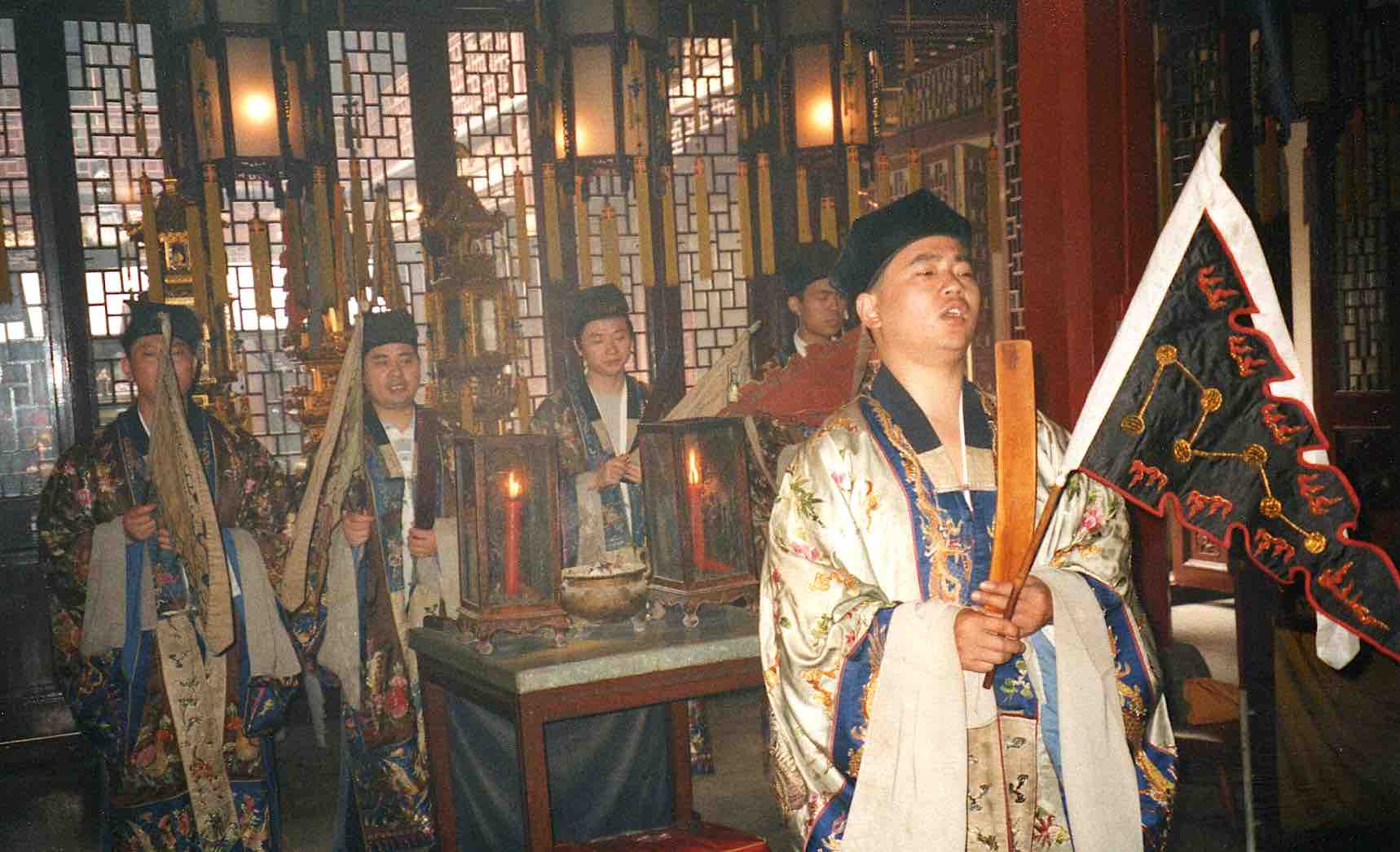
Burning petitions as Daoist ritual concludes, Baiyun guan, Shanghai 1987. My photo.

Revisiting material on Daoism around Shanghai and Suzhou reminded me of two astute articles by Yang Der-ruey 楊德睿, a fine sociologist trained under the great Stephan Feuchtwang at the LSE. Following his PhD, his writings from the standpoint of contemporary ethnography contain lessons for scholars of ritual, suggesting parallels with other metropolitan centres—including Suzhou and Beijing.

In a fascinating article on how Daoists learn to make their way in the real world of the ritual market:

Yang explores the ramifications of the training programme established by the Shanghai Daoist College, founded in 1986 under the Shanghai Daoist Association, and subordinate to state and Party authorities—the Ministry of Education and the Bureau of Religious Affairs. He shows how the economic behavioural patterns and intellectual concerns shaped by their life in the College are challenged soon after they graduate by the rather traditional local religious economy in which they now have to make their living:

They soon had to learn to discern the structure and change of the local religious economy, to recognize their assets, to envision their niche in the changing economic landscape, and to adjust themselves accordingly, manoeuvring among diverse economic patterns and selectively integrating them into a distinctive, viable niche.

On one hand they learn to accommodate with the secular state apparatus and economic order upon which these young priests’ living depends:

This order can best be named a “socialist public-supply economy” since it is at once “socialist” in terms of the internal redistribution system of the Shanghai Daoist Association and is “public-supply” in terms of the style in which the SDA deals with the clients. The morality it claims to embody is egalitarianism and unselfish devotion for common causes, but in reality this economy encourages hierarchical exploitation, sloth, and apathy.

Temple priests soon began working with the unlicensed freelance household priests. At the same time both learn to collaborate with spirit mediums (daxian 大仙 or xiangtou 香头), the main sponsors of ritual life, and to imitate their approach: [1]

Their economy is an integrated system of a gift economy in the private/individual domain and a tributary economy in the public/communal domain. In the private domain, they provide individual devotees or families with magical or non-magical healing, spiritual protection, divination, psychological consultation, and so on. In the public domain, they take the initiative to organize communal religious activities.

Temple priests began to provide facilities for patrons to create god statues, spirit tablets, and amulets, and to offer divination services. And to satisfy the taste of clients, temple priests began to expand the range and style of their rituals. He cites the remarkable case of Xiao Wang and the “Maoist shaman” whom he replaced as temple leader; thus temple priests learn to act as both “immortal magistrates” and cadres.

Daoist temples came to be considered as a crucial means for revitalising the economy of old, run-down neighbourhoods to boost the motivation of the local population for pursuing economic development. And temple priests have gradually developed a distinctive synthesis of all the economic patterns they can learn from bureaucrats, freelance priests, and mediums.

* * *

So what Chinese sources often portray as a seamless transition is actually beset by conflict. I’ve already given instances of the different values of the traditional ethos of folk musicking and the new style of the conservatoires and state troupes, including a wise insight from the great Yang Yinliu. In

  • From ritual skills to discursive knowledge: changing styles of Daoist transmission in Shanghai”, in Adam Yuet Chau (ed.), Religion in contemporary China: revitalization and innovation (2008), pp.81–107.

Yang Der-ruey shows how modern schooling for training novice Daoist priests has produced a new style of learning and a new type of knowledge among the younger generation of Daoist priests. He argues that the curriculum instituted by the Shanghai Daoist College

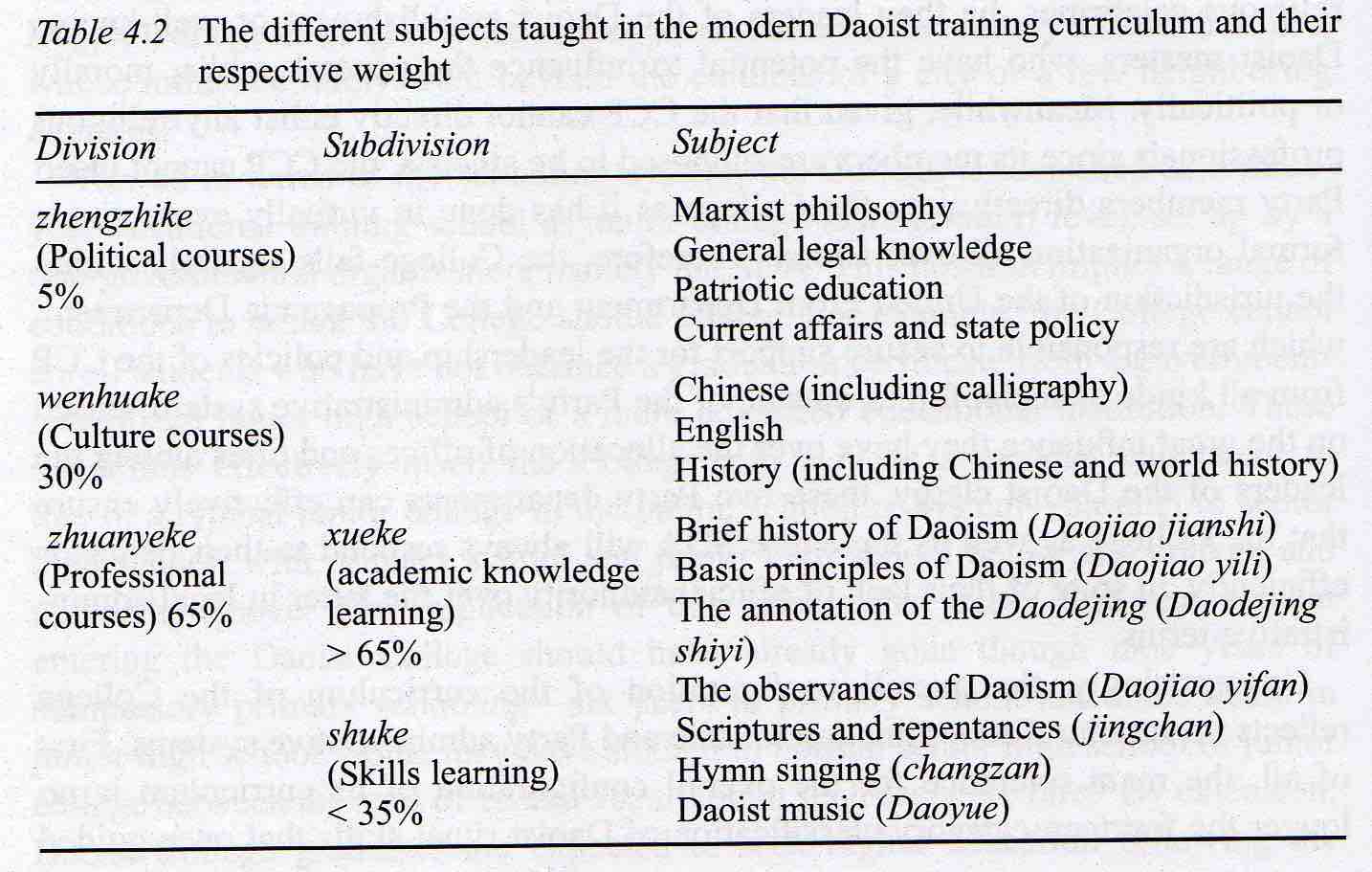
is actually an attempt to reset the priority attached to different ways of learning and different kinds of knowledge. In sharp contrast to their predecessors who prioritized rote learning and repetitive bodily exercise, and who attached the highest value to the ability to exert up efficacious power while achieving the highest aesthetic qualities in representing tradition, the College-trained younger Daoist priests are taught to prioritize understanding, explanation, argumentation, and to accord the highest value to the ability to compose awe-inspiring discourse embroidered with references to many books. In short, the College’s curriculum functions, purposefully or inadvertently, to instigate an intellectual revolution among younger Daoist priests by replacing “ritual skills” with “discursive knowledge” as the new ideal model for Daoist knowledge.

This “paradigm shift” of Daoist knowledge/learning style is not directly imposed by state authority or enforced by the official ideology of atheism but derives from an acute sense of a crisis of legitimacy, or even survival, of Daoism that is now widely shared among the Daoist clergy. This sense of crisis was actually cultivated by the State in the first place through forcing Daoism to engage in a peculiar Chinese-styled inter-religious competition that is arguably biased against Daoism as a tradition of “mere” ritual skills. However, the inflictor role of the state tends to be ignored, as it also functions as the enlightening pedagogue that shows Daoist clergy the way toward emancipation: modern priestly schooling modeled after the state-run public schooling system.
[…]
The story may sound quite upbeat for preservationists and revivalists of the Daoist tradition in China, but the reality is just the opposite. Many senior priests in Shanghai, who were once the most passionate supporters of the endeavor, became its bitterest critics, and did not hesitate to voice their disillusionment publicly. Although their disaffection towards their pupils may have been caused by many other reasons, including the generation gap, unfair rates of salary and benefits that discriminates the aged priests, and so on, it is nevertheless based on an apparent fact: the training of young priests today is very different from that in their own youth. Many senior priests considered the College to be an appalling failure, putting the blame either on the personal qualities of the students and the leadership of the College, or on the very idea of setting up a modern priest training school.

The disaffection and accusations of those senior priests surely have certain grounds, and it is unquestionably true that the general qualities of the youngsters’ ritual skills are much lower than that of the elders. However, it should also be acknowledged that, while many aged priests are illiterate or barely literate, all the younger priests are literate and some are actually quite well versed in history, philosophy, and even IT skills, as they all have gone through nine to twelve years of public schooling. Therefore, it would be unfair to conclude that the younger generation priests are inferior to their predecessors and that the College is a failure. So, where do all the squabbles come from? The real problem here is a huge gap between the majority of senior priests and the leadership/faculty of the College on what should be taught to novice priests or what they should be learning through the College. Learning and teaching activities are embedded in, and structured by, the surrounding social and/or institutional contexts; to thoroughly explain the above-mentioned gap would require us to examine not just the knowledge to be taught/learnt but also the context in which the transmission of knowledge takes place.

Yang discusses in detail the types of knowledge transmitted through the local apprenticeship tradition and through the College, highlighting the contrast between them.

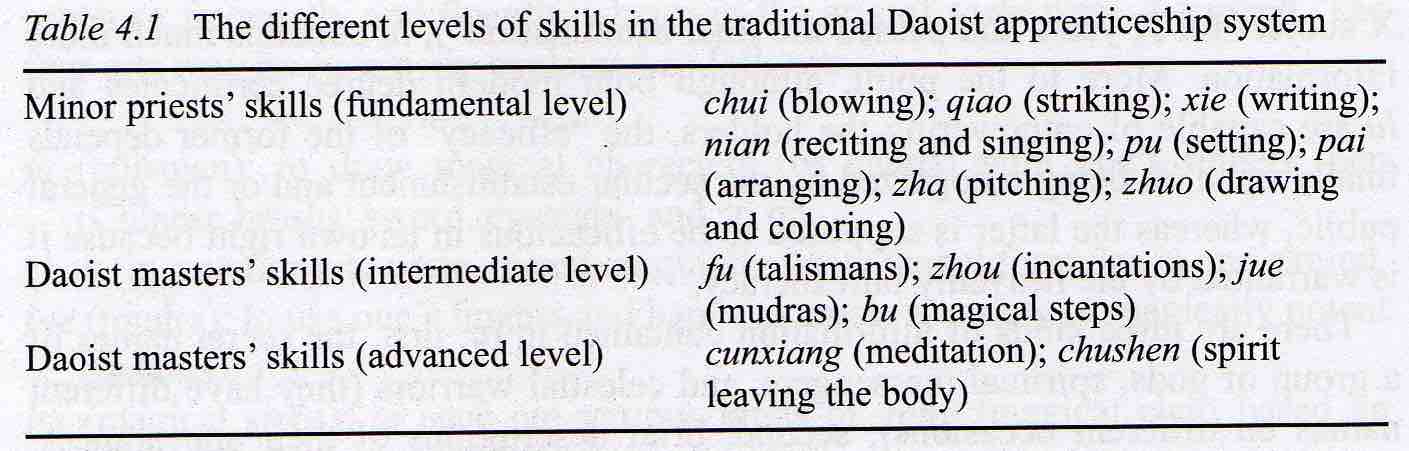
Before Liberation mastery of ritual practice was central to the local apprenticeship tradition, and was structurally embedded within the kinship network. Daoists commonly have mottos for the various kinds of ritual skills to be learned, like “blowing, beating, writing, reciting, and looking” chui da xie nian kan 吹打寫念看) in Yanggao (Daoist priests of the Li family, p.15). In Shanghai the list comprises eight skills:

  • chui qiao xie nian pu pai zha zhuo 吹敲寫念鋪排紮著
    wind playing, percussion, writing ritual documents, vocal liturgy, setting up altars (pu and pai), making paper artefacts, decoration.

But further, the more advanced ritual masters are expected to acquire magical power (fali 法力) by mastery of fu 符 (talismans), zhou 咒 (incantations), jue 訣 (mudras), and bu 步 (magical steps). Yang describes the cunxiang 存想 (“indulge in contemplation”) and chushen 出神(“bringing out the gods”) esoteric techniques of such masters.

Table 1

Table 2

He contrasts the degree certificates granted by modern educational institutions (merely an abstract confirmation of a past reality—“X has studied X subject for X years and passed the final examination”) with the Daoist lu 籙 registers, which contain much more information. Although both modern degree certificate and lu registers empower the holders, the “efficacy” of the former depends finally upon its being recognized by the secular establishment and/or the general public, whereas the latter is supposed to be efficacious in its own right because it is warranted by the heavenly bureaucracy.

A nice story from a young graduate of the College, about an encounter at an exhibition on the “religious sector”, shows both the delusion of the modern secular mindset and students’ own awareness of the conflict:

The head of the Bureau of Religious Affairs came to our stands accompanied by a load of bigshots. At first, they seemed surprised that Daoism had also founded a college. Then one of them started to tease me: “What have you learned in this Daoist College, then? Drawing talismans? Reciting spells? Being a medium? Dancing as a shaman?” While he was asking, some onlookers burst into laughter. I did my best to suppress my anger and calmly told the bastard what kind of curriculum we have in the Daoist College. In the end, I really felt I was going to blow my top if I couldn’t put up a bit of a counter-attack, because there was always someone sniggering at me when I was talking to the bastard. So I concluded my explanation like this: “If someone wants to learn Daoist magic like drawing talismans or casting spells, they must have a certain talent and then spend many years on strictly disciplined practices and meditation. It’s not a simple job like reading books. So, a “good student” valued by normal standards, even a PhD, is probably not qualified for learning Daoist magic.” Those who had laughed at me shut their mouths immediately. They could sense that there was a sting in my words.

Daoists

Daoist liturgy, Baiyun guan 2001. My photo.

* * *

Whereas a conservatoire education is broadly in line with later careers in state music troupes, official Daoist training programmes are soon rendered irrelevant when graduates have to make their way in the ritual market.

Of course, conservatoires and state programmes are the tip of the iceberg: most folk musicians, and the majority of household Daoists in rural China, never set foot within the state educational apparatus for either music or ritual. Even in cases where the Intangible Cultural Heritage authorities seek to impose such procedures on household Daoists, the attempt is incongruous and impotent, as with the Li family.

But whereas the ritual market in south Jiangsu continues to thrive along with its population, in rural north China both are dwindling.

[1] For more on the Shanghai mediums, and their relations with temples and Daoists, see e.g. Long Feijun龙飞俊, “Shanghai Longwangmiaode ‘taitai’ men: dangdai Shanghai Longwang miao daojiao difang jisi tixi diaocha” 上海龙王庙的“太太”们——当代上海龙王庙道教地方祭祀体系调查, Zongjiaoxue yanjiu 2014.3, and her ongoing work.

Reception history

Reception history is an important issue in all branches of the arts, including music, fiction, and visual culture.

For Renaissance painting, modern viewers inevitably bring to bear a wealth of visual and conceptual experience (later artistic movements, photos, film, and so on); by contrast, the world-view of audiences of the time was based on a far more detailed knowledge of scenes depicted. The social context of viewing has changed radically; such messages constantly change over time. In my post on visual culture I cite perceptive comments by Michael Baxandall, Marcia Pointon, Michael Jacobs, Alan Bennett, and (for China) Craig Clunas.

Even synchronically, Daoist ritual means very different things to local patrons, urban dwellers, young and old, local and central cadres, and scholars of Daoism—a theme I broached in Recreation.

I’ve touched on this issue in several posts on music, often relating to the HIP movement and changing styles of performance:

  • In Bach—and Daoist ritual I note the very different ears, eyes, minds, and bodies of 18th-century and modern audiences.

The work of John Butt pursues such themes:

Further posts on changing interpretations of Bach are also relevant:

See also

More recent works too are pervaded by our changing experience:

and on a lighter note,

and, in speech, even

Recent updates on the Li family Daoists


One of the great things about this internet thingie (“don’t think it’s going to catch on”) is that it allows me to keep updating my film and book on the Li family Daoists.

After a flurry of posts from my visits to Yanggao last year (see here), here’s a reminder of recent additions to my material:

For much more, see under updates and vignettes in the “Li family” category of the sidebar.

stele


Changing ritual artefacts

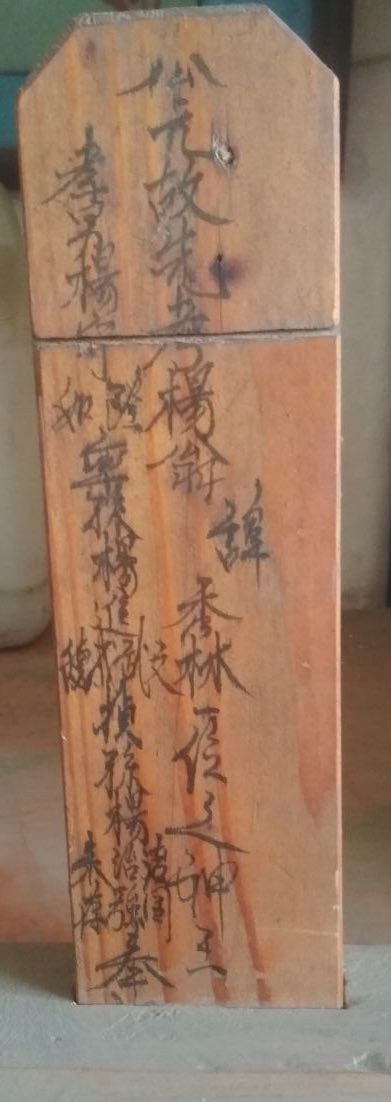
Talking of commemorating the ancestors, for funerals in Yanggao the soul tablet (lingpai 灵牌, or shenwei 神位) (Daoist priests of the Li family, p.197) is carried by the son or grandson at the head of the sequence of processions throughout the day from scripture hall to soul hall, where it is placed on the table before the coffin while the Daoists sing a sequence of hymns; eventually it is burned late at night, on the eve of the burial, for the brief Escorting Away the Orphan Souls that follows the majestic Transferring Offerings ritual (my film, from 1.13.40).

Funeral, Yangguantun 2011: the soul tablet is carried from soul hall to scripture hall.

Since the 1980s the soul tablet has been made of paper, mounted on a chopstick stuck in a bread roll. But one day at a scripture hall I noticed an old soul tablet made of wood, written in Li Qing’s elegant hand in 1980 for the funeral of our host’s mother-in-law. So it transpires that the soul tablet has only been made of paper since the 1980s; previously, the bereaved family could make regular offerings at home over New Year before the more durable wooden version.

Left: wooden soul tablet, written by Li Qing, 1980.
Right: standard paper soul tablet, 2011.

Li Bin came across another old wooden soul tablet recently:

new LB lingpai

Indeed, along with subtle adaptations to ritual practice, funeral artefacts have changed significantly since the 1980s (Daoist priests, ch.19). Apart from the wooden soul tablet, no longer seen are the large rectangular wooden dou 斗 vessel filled with grain for the public rituals, or the layered wooden barrow for jiexian 接献 offerings from the returning female kin; the red lacquered wooden tray of offerings has been replaced by metal, and the elegant ceramic flask for Fetching Water by a plastic bottle.

tray 91

Li Qing takes the red lacquered tray for funerary offerings, 1991.
My film, from 48.23.

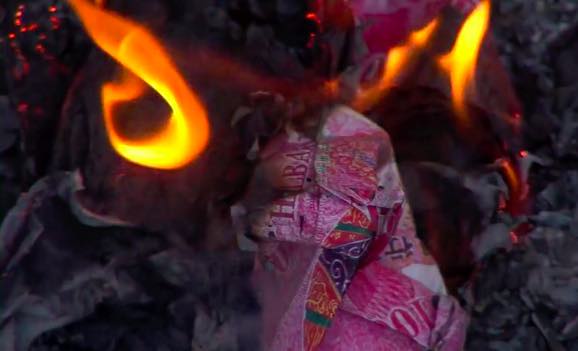
Here the paper artefacts burned at the grave, though far less elaborate than in southeast China and Taiwan, have shown only modest innovations: since the 1990s the horse and cart have commonly been replaced by a car, and sometimes the deceased is provided with a mobile phone to ease other-worldly communication.

Paper artefacts to escort the deceased, 1991.
Note headgear denoting grades of kinship.

See also Tomb decoration, ancient and modern.

Perhaps the most significant recent innovations affecting access to ritual life were mobile phones and motor-bikes, allowing patrons to contact Daoists easily, and rapid movement for both. For an apparent threat to this culture from the state, see here.

A new memorial stele

IMG_3287.JPG

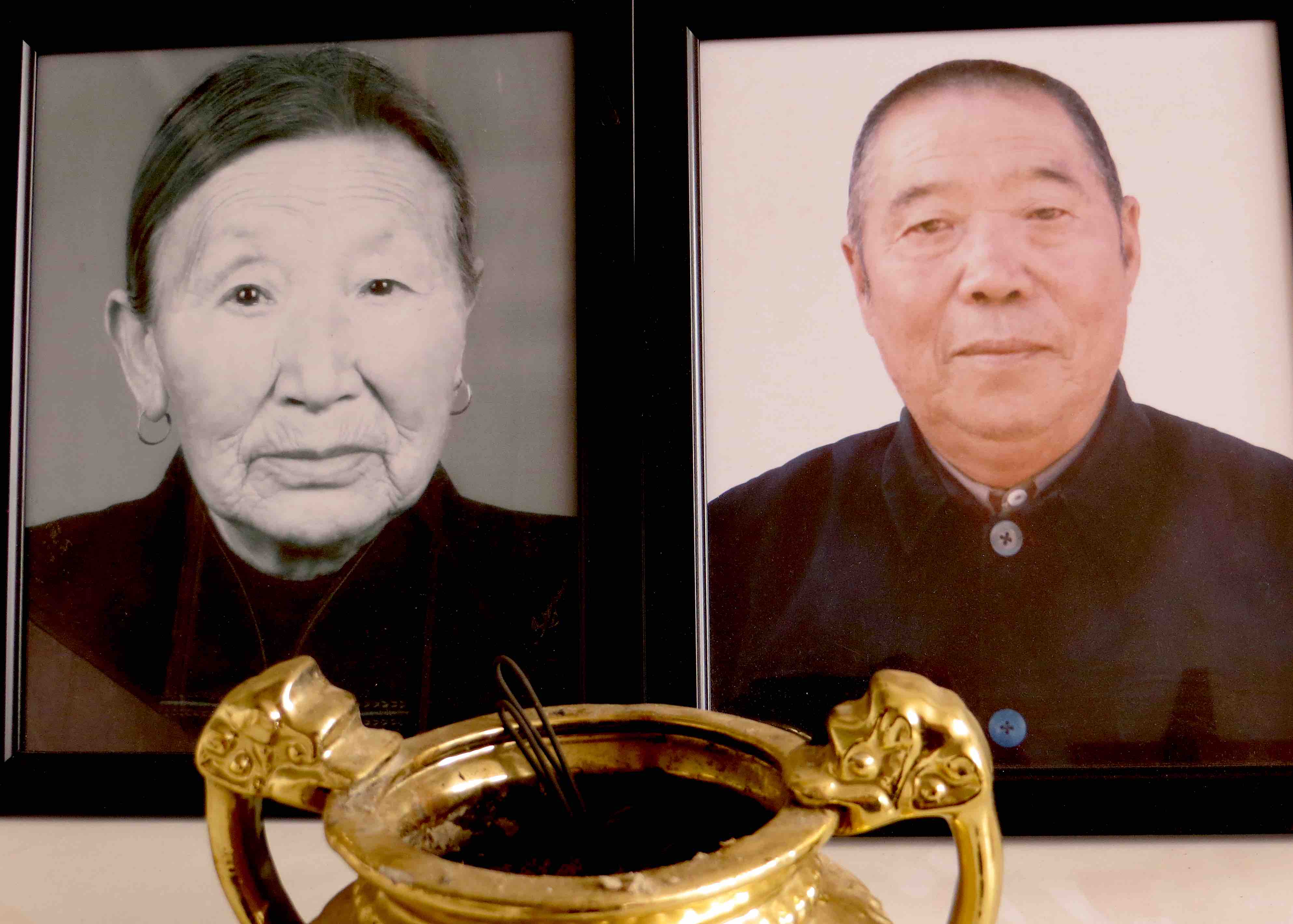
Altar to Li Qing and his wife Xue Yumei in the central room of Li Manshan’s house, 2018.

The revered household Daoist Li Qing (1926–99) occupies a special place in the affections both of his own family and of the many Yanggao people whom he helped over his long career. With his generous character and thorough mastery of ritual practice, he guided the ritual band through the years of Maoism, and upon the revival he recopied the family manuals and trained new disciples. Among many posts, see the links here, as well as my film and book.

When the “filial kin” decide to erect a stele, it’s customary to do so for both parents together—Li Qing’s wife Xue Yumei (1925–2016) was also much loved (she features in a moving scene of the film, from 36.46, recalling their 1945 wedding). The family were going to wait for the 3rd anniversary of her death, but in the end they decided to hold the simple ritual in 2018, on the 1st day of the 10th moon—along with Qingming in the 4th moon, the main day annually for paying respects at the ancestral graves. Before Liberation some more well-to do lineages had grave charts, but Li Manshan never saw one for the Li family.

stele

Photo: Li Bin.

The handsome stele was ordered by the couple’s grandson Li Bin, used to providing such mortuary equipment at his funeral shop in Yanggao town. Along with Li Manshan, the whole family (“filial children and virtuous grandchildren”, as in the inscription) gathered at the lineage gravelands outside Upper Liangyuan village to erect the stele. Presenting offerings of incense, liquor, cigarettes, biscuits, cakes, and fruit, they “reverently kowtowed” while burning a set of paper artefacts and paper spirit money.

paper money

The artefacts, made by Li Bin and his wife at their funeral shop, were those commonly used for funerals in Yanggao: a siheyuan courtyard house, gold and silver dou 斗 vessels, a money-tree (yaoqian shu 摇钱树), gold and paper mountains, a car, and wreaths.

By contrast with south China, such steles are not so common in the Yanggao countryside, but in 2014 the family of Li Qing’s Daoist uncle Li Peisen (another crucial figure in the transmission) had also erected one for him and his wife Yang Qinghua at their home of Yang Pagoda just south, where they had moved to escape the rigours of Maoism.

And all this reminds us that household Daoists like the Li family provide a complete mortuary service for the local community of which they are part ( see e.g. Li Bin’s diary, and this post on funerary headgear).

Li Bin’s first funeral shop in town.

For more updates on the Li family, see here—most recently this diary of Li Manshan’s activities so far this year.

Li Manshan’s latest diary

LMS

After recent excursions further afield, it’s high time for another update on the Li family Daoists in Yanggao.

The venerable Li Manshan, now 74 sui, may have been taking a back seat to his son Li Bin in the family’s ritual services over the last couple of years, but he’s still busy zooming around on his motor-bike, as I now learn from his recent diary.

LMS 1992

In a break during a funeral, Li Manshan consults with another family to determine the date for a future burial. August 1992.

He has been meaning to limit his work to the immediate vicinity, and focus on determining the date; whereas for funeral consultations he has to visit the bereaved family, for other requests (weddings, timing of journeys, siting of houses, and so on) he can just await patrons at home. But since he has served most of these villages frequently over the last four decades, such as Pansi, Luotun, Wujiahe, Houying, Sibaihu, Shizitun, he still often has to lead the band for lengthy and tiring funerals, and not always so nearby.

2019 (dates in lunar calendar)

1st moon

  • 1 and 2: to Wujiahe to determine date for burial
  • 5–6: funeral at Wujiahe
  • 7–8: another funeral at Wujiahe
  • 8–9: funeral at Luotun
  • 10: major snowfall—made paper artefacts at home
  • 13–14: funeral at Anzao
  • 18: ritual for third day after death at Qiaojiafang
  • 19–20: funeral at Qiangjiaying
  • 21: funeral in Tianzhen; determined date for burial at Pansi
  • 22–24: 3-day funeral at Qiaojiafang
  • 24–25 funerals at Yaogou (Tianzhen) and West Zhanjiawa (Gucheng district, can’t find on map)

2nd moon

  • 1: funerals at Pansi, West Yaoquan, and Luotun
  • 5–6: funerals at Houying and Zanniangcheng
  • 8–9: funeral at Wujiahe; determined date at Tiantun
  • 13–14: funerals at South Renyao and Zhaojiagou
  • 14–15: funeral at Tiantun
  • 18–19: funeral at Upper Liangyuan (his home village)
  • 21–22: funerals at Yangheta (Tianzhen) and Anzao
  • 23: funeral in southern suburbs of Datong
  • 24–25: funeral at Xingyuan
  • 26–27: funeral at Pansi

3rd moon

  • 1: funerals at Pansi and Yangyuan
  • 3–4: funeral at Wujiahe
  • 5–6: funeral at Yaogou
  • 8–9: funeral at Anzao
  • 11–12: funeral at Balitai
  • 15–16: funeral at Shizitun
  • 18–19: funeral at Qiangjiaying
  • 21–22: funeral at Yaozhuang (Yangyuan)
  • 23–24: funeral at Sibaihu
  • 24th–25th: funeral at Shizitun

4th moon

  • 2–3: funeral at Houying
  • 4–5: funeral at Wujiawa (Datong)
  • 6–7: funeral at Taishan village in Datong suburbs
  • 8–9: funeral in Yituquan [good village name, this: “One-spit stream”] (Yangyuan)
  • 13–14: funeral for the wife of our wonderful friend Li Jin in Yanggao town

For some of these funerals Li Manshan works together with Li Bin, but the latter also often has to lead a separate band, as well as doing his own consultations to determine the date. As with Li Bin’s diary from 2017, we can see that improved transport has enabled them to perform funerals in different villages concurrently—never an option before the 1980s when they had to walk everywhere.

So while Old Lord Li deserves to take things easy, he still can’t easily turn down requests. I can understand why he longs for the contemplative life of the temple priest. Belief endures in the powers of the Daoists to deliver the soul, and for now they are still much in demand, as they have been for the last forty years—but with the rural population continuing to dwindle, this can’t last.

For the busy schedules of Li Manshan and Li Bin even during the Coronavirus, see here.

Images of Shanghai

ads

Shanghai shopfront, 2001.

Further to my post on silk-and-bamboo around Shanghai, I’ve been looking through my old photos.

Of course there are numerous collections of images from old and new Shanghai, but here’s a personal selection from my visits in 1986–87 and 2001—perhaps suggesting some of the clichés immortalized in Monty Python’s Away from it all?! Little did I realize that such trips would become History (for a montage of remarkable photos from the Maoist era, see here).

1986–87

Longfu si Buddhist temple, 1986.

Street recreation, and a scene at the conservatoire, 1986.

Daoist ritual in Pudong temple, 1987, when Pudong was still a rural backwater.
Photos: Chen Dacan.

Shadow puppets, 1987.

Silk-and-bamboo clubs, 1987.

Daoists 87

Burning petitions as Daoist ritual concludes, Baiyun guan 1987.

May 2001

Cathay Theatre, and Shanghai concert hall.

Old house, and wooden staircase.

Nostalgic recent murals.

Another mural, and karaoke bar.

Laoximen 2001

Qinglian street silk-and-bamboo club, Old Westgate.

Daoists

Daoist liturgy, Baiyun guan.

mandala

Mandala for commemorative wangdou ritual, Baiyun guan.

A Daoist ritual, Suzhou 1956

SZ 1956

The Daoists who took part in the jiao ritual, with the study team. Suzhou, August 1956.

From the early 1950s to the eve of the Cultural Revolution, notwithstanding constant political campaigns, the fieldwork of Yang Yinliu and the Music Research Institute in Beijing was largely based on ritual traditions. The grandeur of religious life around south Jiangsu was, and is, comparable with that of southeast China and Hunan. Yang Yinliu had long experience of Daoist ritual in Wuxi; but another definitive project in Suzhou in August 1956, while Yang was leading a survey in Hunan, was quite separate:

  • Suzhou daojiao yishu ji 苏州道教艺术集 [Daoist arts of Suzhou], Zhongguo wudao yishu yanjiuhui yanjiuzu 中国舞蹈艺术研究会研究组 (mimeograph 1957, reprint Shanghai shehui kexueyuan, 2009)

Background
Daoism in the whole Suzhou region has an illustrious history. And by the 1950s, by contrast with most other regions of China, the city already had a history of research and training institutions. In the Republican era and even in the troubled 1940s, several such groups were formed, such as the Shouxuan xiejilu 守玄褉集庐 and its short-lived successors Yixuan yanlu 亦玄研庐, Yunji she 雲笈社, and Ziyun daoxue yanjiushe 紫雲道學研究社. After the 1949 revolution, under the watchful eyes of Party officials, the Suzhou Daoist Music Research Group was formed in winter 1952, recruiting many distinguished Daoists.

Under the PRC, despite my reservations about the term “religious music”, a focus on music served to distract from the taint of religion: while Daoist ritual might be suspect, study under the guise of “Daoist music”—particularly its instrumental component—was more palatable to the authorities. Indeed, this was still true when I began my fieldwork in the late 1980s.

In August 1956, Wu Xiaobang 吴晓邦, head of the Chinese Dance Research Association in Beijing, brought a team to Suzhou, where with the assistance of the Bureau of Culture they worked with the Suzhou Daoist Music Research Group to organize a complete large-scale jiao 醮 Offering ritual.

This was a major undertaking. Far from reducing the topic to a simple commodified programme of instrumental melodies (as was still common in the 1990s), they documented the ritual in detail, both in the 330-page book and in a complete documentary film. This was all the more remarkable considering the escalating political campaigns, with people increasingly anxious as the commune system was enforced ever more rigorously. Later, alas, the film seems to have been destroyed, though the editors of the 2009 reprint of the book claim that it was preserved at the Dance Association in Beijing.

Of course, it was a work of salvage. While minimal Daoist rituals were still performed around the region, this was a rare opportunity to assemble leading Daoists to perform a complete jiao—perhaps the grandest religious ritual held in China from 1949 to 1979. Indeed, since the 1990s similar digital salvage projects have been initiated, involving a core of senior Daoists—some of whom had taken part of the 1956 project. But documenting routine ritual practice in socal life, in the 1950s or today, is a separate topic.

XMG 1956

The Xuanmiao guan temple, 1956.

The ritual was held at the Wanshou gong 萬壽宮 temple just south of Suzhou’s main temple the Xuanmiao guan 玄妙觀, which was being restored at the time. The Wanshou gong was itself in disrepair by 1949 but had been converted to a People’s Cultural Palace in 1951, so it was now requisitioned for the ritual.

The book contains three main parts:

  • The segments of the jiao, with its three overarching ritual sections Quanfu 全符, Quanbiao 全表, and Huosi chao 火司朝 (pp.1–61), including diagrams of “dance” postures; followed by long lists of performers and their division of responsibilities, including fashi 法師 ritual masters, instrumentalists, and helpers (pp.62–70).
  • Detailed transcriptions of the vocal and instrumental music in ritual sequence (see below)
  • Plates (pp.276–330), including the jiao itself and its ritual equipment, as well as statues and ritual paintings (with some from other Suzhou temples).

Jifu guan

ritual pics

ritual 2

placard 1placard 2Placards proclaiming the Offering ritual.

Such photos make suitably surprising additions to my post Images from the Maoist era.

The main editors of the volume were Jin Zhongying 金中英 and Yu Shangqing 余尚清. Jin Zhongying (1925–96), a hereditary household Daoist from Suzhou city, headed the official Daoist Music Research Group from 1953. With his extensive personal collection of ritual manuals, he provided the Juntian miaoyue 鈞天妙樂, an important compilation of gongche scores of Daoist instrumental melodies, compiled by Wu Ding’an 吾定庵 and edited by Cao Xisheng 曹希聖 in the late 18th century. Meanwhile many other experienced Daoists were recruited to the Research Group.

SZ daoshi

Zhao Houfu, Cao Yuanxi, Zhou Zufu, and Mao Zhongqing in later years.
Source: Suzhou Daojiao yinyue gaishu.

The Daoists who were assembled in 1956 to perform the jiao came from hereditary backgrounds; until the 1950s, some had been temple clerics, while others had served as freelance household Daoists. Despite the forming of the research group, the authors note a certain depletion of personnel as outstanding Daoist instrumentalists were recruited to state performing troupes. Still, it was a stellar cast of Daoists who took part in the 1956 ritual—including Zhao Houfu 趙厚福 (1908–?), Cao Yuanxi 曹元希 (1913–89, descended from Cao Xisheng!), Mao Zhongqing 毛仲青 (b.1915), Zhou Zufu 周祖馥 (b.1915), and Jin Zhongying himself. Indeed, some of them were recalled for the occasion from their jobs in the troupes. And apart from the instrumentalists, note also the list of eminent fashi 法師 masters (pp.63 and 64) who presided over the liturgy—I would love to learn more about their backgrounds and fortunes under Maoism.

The introduction to the history of “Daoist music” in Suzhou (pp.71–87; note pp.79–80) makes an impressive early account of the subject. The long following section (pp.88–275) provides gongche solfeggio notation for the different ritual segments, showing the whole unfolding sequence of the sung hymns of the vocal liturgy (with their texts shown alongside the melody) and the chuida (Shifan) instrumental items that punctuate the ritual (also a speciality of the former tangming bands). Indeed, even for scholars of Daoist ritual who prefer to study texts in isolation from their performance, volumes like this, and the later Anthology, provide a wealth of ritual texts. Note that traditionally only the instrumental melodies were notated, not the vocal items; and of course, gongche is anyway only an aid to memory.

The authors’ choice of gongche, rather than the cipher notation that was already commonly used in Chinese musicology, is interesting. It may derive from the Daoists’ own familiarity with it—though they made a fine innovation by adding detailed rhythmic markers in the style of cipher notation, which they also used alongside mnemonic characters to notate the complex drum sections.

This is a rare insider’s account of the building blocks of Daoist ritual, thoughtfully annotated. Wonderful as it is, to most scholars of Daoism it will be even less intelligible than cipher notation—even conservatoire students are unfamiliar with gongche.

Songjing gongde gongcheOpening of Songjing gongde, a widely used hymn in both temple and household Daoist groups.

Tianshi hymn gongcheOpening of Quanbiao ritual: instrumental Yifeng shu leading into Tianshi song hymn, whose text is the generational poem for the priestly lineage.

For the vocal liturgy, somewhat more accessible (if only somewhat) are later transcriptions into cipher notation such as the Anthology (Zhongguo minzu minjian qiyuequ jicheng, Jiangsu juan 中国民族民间器乐曲集成, 江苏卷, pp.1473–1645):

Songjing gongde JCOpening of Songjing gongde hymn, transcribed by Anthology collectors from a 1990s’ rendition, also showing percussion accompaniment.

Tianshi hymn JCTianshi song hymn as transcribed by Anthology collectors.

and other modern studies like Liu Hong 刘红, Suzhou daojiao keyi yinyue yanjiu 苏州道教科仪音乐研究 (1999)—here’s his transcription of the Buxu hymn Taiji fen gaohou, another commonly performed item throughout China sung to differing melodies by region (see Pacing the Void):

Taiji

Taiji JCOpening of Taiji fen gaohou hymn as transcribed in the Anthology.

The 1957 volume’s extensive transcriptions are deeply impressive, clearly a labour of love on the part of Jin Zhongying and Yu Shangqing—even recently, scholars of Daoism are often content to reproduce lengthy ritual manuals with scant explanation of how they are performed. So it would be churlish of me to note that this long section (apart from the brief chanted introits to the hymns) provides only the melodic sections, not including the many recited texts which are also a vital aspect of the ritual. It is best read in tandem with the summary of ritual segments on pp.57–61.

Despite the laudable (and rare) focus on soundscape, the volume still falls short of being a complete account of the Suzhou jiao. It would be over thirty years before scholars like Yuan Jingfang began documenting the texts and music of complex rituals still more systematically (see e.g. her volumes on the Beijing yankou and the jiao of household Daoists in south Hebei).

But of course, nothing is so valuable as film, and I still gnash my teeth (a Daoist practice of cosmic visualization, by the way!) over the loss of the 1956 documentary. In its absence, major projects to document Suzhou Daoist ritual on film have resumed in recent years. We can gain a flavour by watching a 2011 excerpt from the Dispatching the Talismans (fafu 发符) ritual segment:

What was not on the agenda in 1956 was a description of ritual activities in the wider society around Suzhou at the time—more on that story later. Meanwhile, let’s pause again to marvel at the energy of ritual research under the taxing conditions of Maoism.

With many thanks to Tao Jin

The Hall of Myriad Harmonies

WHTThe Wanhe tang:
Above left: scores; above right (indirectly related): Juntian miaoyue score, 1799.
Middle: remaining performers assembled in 1993. Below: trunks with instruments.
Source: Zhongguo minzu minjian qiyuequ jicheng, Jiangsu juan.

I often sing qualified praises of the monumental Anthology of folk music of the Chinese peoples (starting here). Most of my posts on local ritual derive from my own studies in the field, but I also sometimes give surveys based on the Anthology—as here. The main lesson from this post is to illustrate the pitfalls of trying to interpret its material without more detailed fieldwork.

Having mentioned the illustrious Tianyun she society in Wuxi, I should also introduce the Wanhe tang 萬和堂 (“Hall of Myriad Harmonies”) in Huangdai town in Wuxian county north of Suzhou. This leads me to consider the whole rich culture of tangming ban 堂名班 groups (some sources give the form 堂鳴) before the 1949 Liberation, amongst whom there were many Daoist ritual specialists; their repertoire included both Kunqu vocal music and the Shifan instrumental ensembles that accompanied rituals (cf. my Folk music of China, pp.252–69).

I began by consulting the Anthology volumes for instrumental music in Jiangsu province:

  • Zhongguo minzu minjian qiyuequ jicheng, Jiangsu juan 中国民族民间器乐曲集成, 江苏卷, pp.1777–79, and p.102.

The Wanhe tang was founded by Cai Jinxiu 蔡錦綉 in the second half of the 19th century, when he was 20 sui. He was himself the third generation of Kunqu amateurs in his family; and he was an accomplished performer of Shifan. The hall he founded was now occupational. They were active performing for temple fairs and celebratory occasions for the local gentry around Suzhou, Wuxi, Changshu, and Kunshan.

By the 1920s Cai Jinxiu had handed over the leadership to his oldest son Cai Meiqing 蔡梅卿; his second and third sons Cai Zhuqing 蔡竹卿 and Cai Chengqing 蔡成卿 went on to lead the group. In the late 1920s there was such demand that they split into northern and southern halls. The main figures of the latter were the three Cai brothers and Cai Zhuqing’s son Cai Huiquan 蔡惠泉, as well as Wang Borong 王伯榮. Leading lights in the northern branch were Xu Jinru 許錦如, Xu Junru 許均如, Gu Yewan 顧葉萬, and Gu Yusheng 顧鈺生. The two groups often combined, but also competed at the same events.

They also absorbed elements from the popular tanhuang vocal style. By the 1930s and 1940s they had a close relationship with temples like the Xuanmiao guan in Suzhou. Other tangming groups formed under their influence included the Xuanhe tang 宣和堂, Chunhe tang 春和堂, Hehe tang 合和堂, Wenhe tang 文和堂, Honghe tang 鴻和堂, and the Lesser Wanhe tang 小萬和堂.

These groups had to cease activity on the eve of Liberation, “as a result of warfare, and so on”. But there was no revival in the early 1950s, and the scores, instruments, trunks, and equipment of the Wanhe tang were gradually “lost”.

Many of its members were now recruited to the new regional state opera troupes. Of Cai Meiqing’s sons, the oldest Cai Rongbing 蔡榮炳 had accompanied the great Peking opera singer Zhou Xinfang before Liberation, and went on to take up a post in the Shanghai Peking Opera Troupe. The second son Cai Rongbiao 蔡榮標 was chosen for the Yangzhou Peking Opera Troupe. Another member of the Cai family became deputy director of the provincial Daoist Association.

The biographical sketch of Cai Zhuqing’s son Cai Huiquan 蔡惠泉 (b.1925) in the Anthology (pp.1775–76) is no more enlightening. Again, it’s a story of two halves. He began studying at private school at the age of 5 sui, and learned Kunqu with his father from 7 sui. By the age of 16 sui he was an accomplished member of the Wanhe tang.

After Liberation, with his traditional livelihood apparently curtailed rather abruptly, Cai Huiquan took part in an official festival at the Xuanmiao guan temple in November 1951, for which tangming performers were assembled to perform. In the audience was Peng Xiuwen, director of the Central Chinese Broadcasting Orchestra in Beijing, who invited him to join them as percussionist in 1954. Cai now became a model member of the state troupe, arranging several pieces of his traditional repertoire to the demands of the new style, and over the next thirty years he created many compositions based on other regional genres. From 1958 he adapted a new paigu set of tuned drums, which was soon widely adopted by state troupes.

This trajectory was not uncommon. Throughout China, outstanding instrumentalists among local ritual groups, including many Daoists, were often recruited to the new state troupes. At least Cai found long-term employment—unlike household Daoist Li Qing in Shanxi, who was among many folk artists whose recruitment to state troupes was curtailed by the cuts of the early 1960s. However, the Anthology account doesn’t begin to describe the fates of those performers who remained in local society amidst campaigns and collectivization.

All this looks like a thriving scene abruptly erased after Liberation. In official accounts the troubled conditions of the 1940s make a convenient scapegoat. But there’s a lot here that isn’t spelled out. How severely did the Japanese occupation and civil war disrupt ceremonial life in the region? When many ritual groups elsewhere in China (both occupational and devotional) remained active in the early 1950s and still later, were these groups really unable to perform? Elements to unpack here include the class status of the performers and their patrons, and the state’s escalating war on traditional contexts.

So in the case of the Wanhe tang, the enticing Anthology photos above are misleading: they merely show the brief reunion of nine senior performers in 1993. Still, it’s clear that not all their scores and instruments had been lost. And while this group was long defunct, as ritual life revived strongly from the 1980s, perhaps the many Daoist groups and chuida bands around the region are the modern heirs to the tradition.

Other tangming groups
The Wanhe tang was just one among a dazzling array of tangming groups throughout the wider region before Liberation. The Anthology introduction to chuida wind-and-percussion bands provides further leads (pp.97–105). Such sources provide considerable material for the Qing dynasty, but here I’ll focus on the transition from the Republican era to Maoism.

Locals distinguished shenjia chuida 神家吹打 and daojia chuida 道家吹打 groups. The shenjia (“holy”) chuida groups performed for life-cycle and calendrical observances, with Kunqu and other vocal music a major part of their repertoire. Before 1949, apart from the Wanhe tang, there were around 150 groups in the Suzhou region alone.

In the city, major groups included the Duofu tang 多福堂, Ronghe tang 榮和堂, Baohe tang 保和堂, Fugui tang 富貴堂, Yonghe tang 永和堂, and Juhe tang 聚和堂. Similar groups around the region included the Hehe tang 合和堂, Hongru tang 鴻如堂, and Shide tang 世德堂 in Wuxian county; in Changshu, the Chunhe tang 春和堂, Quanfu tang 全福堂, Zhonghe tang 中和堂, and Hongfu tang 洪福堂; in Taicang, the Qingxiu tang 慶修堂, Yuqing tang 餘慶堂, Duanhe tang 端和堂, Duanai tang 端靄堂, and Yongle tang 永樂堂; in Wujiang, the Jinyu tang 金玉堂, Dayue tang 大樂堂, and Daxi tang 大喜堂; in Tangkou, Wuxi, the Xinji Wanhe tang 新記萬和堂 and Dongting yaji 動亭雅集; and in Kunshan, the Yongni tang 永霓堂.

Daoist ritual specialists were often core members of the tangming groups, and the daojia chuida groups mainly accompanied Daoist ritual (for a major ritual in 1956 Suzhou, see here). The great Yang Yinliu was brought up in the environment of Kunqu and the tangming, studying the Wuxi Daoists and their Shifan repertoires from the 1930s. Here’s a reminder of the distinctions between local Daoists that he astutely observed (Sunan chuidaqu 蘇南吹打曲, with Cao Anhe, 1957 edition, pp.11–13):

A minority of abbots possessed ritual titles of the Zhang Heavenly Masters, like “Master who Guard the Way” (daoweishi) or “Ritual Master” (fashi), and mostly owned land. They didn’t take part in production. They interacted with landlords and the bourgeoisie in the cities and villages, taking ritual work and contacting and hiring the common village Daoists to take part in major rituals (daochang fashi).

These common Daoists mostly took part in agricultural production, being hired ad hoc: performing for rituals was an auxiliary occupation for them. In both agriculture and Daoism, they were an exploited class. These common Daoists—even the indispensable drummers and flute players, with their excellent musical technique—only got a tiny wage for a whole day’s work.

Conversely, the “Masters who Guard the Way” and “Ritual Masters”, having only taken responsibility for quite brief ritual segments of a few hours like Issuing the Talismans (fafu), Reporting the Memorial (zoubiao), and Flaming Mouth (yankou), claimed a reward many times higher than that of the others. Those who played music were mostly the common semi-peasant Daoists; very few of the “Masters who Guard the Way” and “Ritual Masters” could do so.

For tangming bands around Jiading and Chuansha counties near Shanghai,

  • Zhu Jianming 朱建明, Tan Jingde 谈敬德, and Chen Zhengsheng 陈正生,Shanghai jiaoqu daojiao jiqi yinyue yanjiu 上海郊区道教及其音乐研究 [Daoism and its music in the Shanghai suburbs] (2001)

provides further material in a useful section (pp.29–48). The authors list bands like the Chunhe tang 春和堂, Hexing tang 合興堂, Sanqing tang 三興堂, Xinxi tang 新喜堂, Xianjing tang 仙經堂, Quanfu tang 全福堂, Minle tang 民樂堂, Hehe tang 合和堂, and Hongqing tang 鴻慶堂. They suggest that activity resumed after the disruption of the Japanese occupation, with over thirty bands active in Jiading alone.

For the period after Liberation, the Anthology morphs disingenuously into an account of research, drawing a veil over what became of this rich culture. While even an official survey from 1953 lists 28 tangming groups with 272 performers around Jiading county, the culture was severely reduced after Liberation. As Qi Kun also suggests, major factors in the decline were the disappearance of former elite patrons, and campaigns against religion. Since the reforms, though the term tangming is no longer used, the tradition continues in various genres such as Daoist and qingyin groups, and shawm bands.

* * *

For “folk artists” Chinese sources always find it easier to list exceptional instances of official fame than to document the complexities of grassroots activities. In the case of many performers like Cai Huiquan, recruitment to state troupes was indeed an abrupt metamorphosis. Still, few would have been reluctant to take up such employment. They had to work out how to survive under the new regime; such posts offered them a reliable “food-bowl” and seemed to promise them a certain protection from accusations of “feudal superstition”, blunting the stigma of any dubious class background.

But many others “left behind” had to struggle to adapt to the new society. I have refined the official image in my work on north China, and Qi Kun has provided similar nuance for the Shanghai suburbs. Commonly across China in the early 1950s, ordinary people filled the gap in patronage left by the now-discredited—and impoverished—former elite by inviting such bands for their own more more modest rituals. But as collectivization intensified, many folk performers would have had to change trades, eking out a living from the land or taking up factory jobs.

Here I can’t broach the riches of Daoist ritual activity around Suzhou before Liberation or its changing later fortunes; but the Anthology biographies for Jiangsu also feature several of the most eminent “Daoist musicians”—a misnomer with which I often take issue. This reveals a further issue with the Anthology coverage, which I hope to explore soon.

South Jiangsu: beyond silk-and-bamboo

Laoximen 2001

Qinglian street club, Old Westgate, Shanghai 2001. My photo.

The Jiangnan sizhu (“silk-and-bamboo of south Jiangsu”) instrumental ensemble has become a reified image of secular Chinese entertainment music. It’s played not only by polished professionals on stage, but by amateur groups in teahouses and leisure centres around Shanghai and the whole vicinity (for amateur chamber ensembles elsewhere, cf. suite-plucking in old Beijing, the Yulin “little pieces”, nanyin, and so on). Shanghai is a hospitable cosmopolitan urban centre, and these clubs are a popular haunt of foreign music students there.

The title was formalized only in the 1950s—one of many instances of the official renaming of genres at the time, such as Xi’an guyue or Xiansuo shisantao. Yet however one may dispute reification, Jiangnan sizhu is indeed “a thing”. Over a long period since the early 20th century we can observe a continuum from life-cycle and calendrical performances, through the amateur clubs, to professional staged performances.

In Chapter 13 of my book Folk music of China I began to put silk-and-bamboo in the wider context of musicking around south Jiangsu (Suzhou, Wuxi, Nanjing, Changshu, Yangzhou, and so on—all large regions each containing several hundred villages!). And I outlined the background of regional opera, narrative-singing, and all kinds of ritual practice, including the Shifan ensembles that accompany Daoist ritual. Indeed, Daoist ritual around Shanghai and south Jiangsu is a vast topic subsidiary only to local traditions in southeast China.

So apart from their use as entertainment in the amateur clubs, the various types of sizhu have a firm basis in life-cycle and calendrical rituals.

Folk-singing in the region is easily overlooked, but fortunately we have a wonderful detailed study by Antoinet Schimmelpenninck, who also saw the wider picture. She refers to ritual styles like xuanjuan 宣卷 performed by devotional sectarian groups, common throughout south Jiangsu. [1]

As Chinese genres go, compared with many traditions in both north and south China Jiangnan sizhu is rather youthful. As commonly with folk groups, the musicians sit around a table, an inevitable casualty of stage performance. They often take turns on various instruments over the course of an afternoon session. The personnel remains predominantly male.

Chinese studies have favoured “music” over social context, and most publications on Jiangnan sizhu are based on the “eight great pieces” (for a simple introduction, see my Folk music of China, pp.275–82). While the repertoire is not so reified as this canonization may lead us to suppose, in the teahouses of central Shanghai it remains rather limited. But local variants of the repertoire abound, as shown by the definitive 1985 collection of transcriptions (770 pages!) by Gan Tao 甘涛. As always, we should regard it not as a reified repertoire, but as a regional form of musicking, a social activity (and since the ambience and sound-world of the amateur clubs may be reminiscent of Irish pub sessions, do enjoy my posts on Cieran Carson!).

See also this modest update.

Interlude: laowai
By the 1980s the Jiangnan sizhu repertoire was already the subject of analysis from scholars like Ye Dong, Li Minxiong, and Yuan Jingfang. Meanwhile, as China opened up again after the end of the Cultural Revolution, Larry Witzleben spent extended periods based at the Shanghai Conservatoire from 1981 to 1985, resulting in the brilliant early monograph

  • J. Lawrence Witzleben, “Silk and bamboo” music in Shanghai: the Jiangnan sizhu instrumental ensemble tradition (1995),

still one of the most accomplished ethnographies of a local Chinese tradition.

With chapters on the historical background and intergenre relationships, instruments, repertory, form, variation, texture, and aesthetics, perhaps the most innovative section is Chapter 2, a nuanced ethnography of the scene from 1981 to 1985, including relations with the professional music world.

Silk-and-bamboo soon earned a significant place in Western scholarship, and images of Chinese music, also thanks to the writings of Alan Thrasher, albeit concerned more with musical structures than with ethnography.

Silk-and-bamboo clubs, Shanghai 1987. My photos.

In 1986 and 1987, based in Beijing, I used to decamp to Shanghai occasionally, taking what was then a very long train ride. According to my own apocryphal story, my main incentive was that the showers of the foreign students’ dorms there had a rather reliable supply of hot water, still rare in my student accommodation in Beijing. Anyway, even though I was already entranced by northern ritual culture, it gave me an opportunity to take part in some of the many amateur silk-and-bamboo clubs on erhu fiddle—and also to hang out with the wonderful qin-player Lin Youren and acquaint myself with the thriving Daoist ritual scene.

For foreign students, participant observation was both instructive and pleasurable. As laowai, we were more keen on visiting the teahouses than our Chinese fellow-students, who naturally focused on the polished versions of their conservatoire teachers.

In 1987 I was roped into a Jiangnan sizhu contest at the conservatoire, joining a mixed group of Chinese and foreign students—the latter including François Picard, Fred Lau, and Tony Wheeler (back row, to my right). In the front row, on the far right is Ma Xiaohui 马晓晖, who went on to a career as erhu virtuoso, and at the centre is Zhou Zhongkang 周仲康, the conservatoire teacher assigned to oversee our efforts—our programme included his luogu sizhu composition Qing:

contest 87

The competitive format was hardly my favoured method of engaging with silk-and-bamboo, but it was an interesting experience. Alongside the conservatoire-style ensembles taking part, there were also some fine senior amateur groups. As cute foreign pets we inevitably won a prize, but our sound ideal, however flawed in execution, was modelled on folk practice rather than the more polished version of the professionals. Soon after, Helen Rees also became a regular participant at Shanghai teahouse sessions, while embarking on her fine studies of ritual music in southwest China.

Thinking back, guided by mentors at the Music Research Institute and Yuan Jingfang, my Beijing base propelled me towards ritual in the countryside more inevitably than might have been the case if I had been studying in Shanghai. Rural ritual is plentiful throughout south Jiangsu too, but somehow there is more to encourage one to tarry in cosmopolitan Shanghai without venturing out to the villages and townships.

Zhang Zhengming, 2001: left, with Zhou Hao at the Xuhui club;
right, with his wife—their 1952 wedding photo in the background.

On a visit in 2001 I spent a week in Shanghai, with the wonderful Zhang Zhengming 张徵明 (b.1925) guiding me to a different club every afternoon. It was good to see the renowned erhu master Zhou Hao, then 77, taking part keenly in the amateur groups, naturally modifying his polished style to the ambience; later in a one-to-one session he gave me a fine demonstration of the difference between “folk” and “conservatoire” styles.

diary

I was happy to be able to invite a group led by Zhang Zhengming to the 2005 Amsterdam China festival, as I scurried around hosting the Hua family shawm band and the Li family Daoists from Yanggao.

Again, there’s a continuum: official staged presentations are part of the whole fabric of silk-and-bamboo. This playlist from Jan Chmelarčík includes his videos from the amateur clubs in 2006 and 2007, showing a variety of contexts and styles:

The silk-and-bamboo scene plays a major role in Ruard Absaroka’s thesis Hidden musicians and public musicking in Shanghai, very much informed by anthropological theory. [2]

The wider context: the Anthology
It’s so easy to find activity in central Shanghai that one might not be tempted to explore the suburbs and further afield. But by the 1980s, research was also expanding significantly with the great Anthology:

  • Zhongguo minzu minjian qiyuequ, Shanghai juan 中国民族民间器乐曲, 上海卷 (1993),

edited by the knowledgeable Li Minxiong.

Local collectors documented the wider region in the suburbs of Shanghai, with its twelve municipalities and ten counties. Apart from transcriptions, the collectors also described folk activity, with useful textual introductions as well as biographies and introductions to major groups.

Again it’s worth noting the overall Anthology coverage for Shanghai. After an opening section on solo music (pp.19–234) devoted mainly to pipa solos, there are three main rubrics: sizhu (235–930), chuida (932–1268), and “religious music” (1273–1594). There follow brief biographies and accounts of folk groups (1595–1638, illustrated descriptions of instruments (1639–58), and lengthy appendices, mainly gongche scores (1661–2087).

It may seem impressive that even by 2001 over thirty sizhu groups were still meeting amidst the glossy modernity of central Shanghai. But for the whole region, Li Minxiong gives a figure of 428 groups (!) since the early 20th century; as he explains in his introduction (JC pp.241–63), over two hundred were active on the eve of Liberation.

Following the May Fourth movement of 1919, many groups adopted the term “national music” in their titles. Indeed, such groups were the precursors of the whole “conservatoire style” that later came to represent the official image of Chinese music. The Anthology describes celebrated groups from the Republican era.

JC1

Top: Xiadiao music ensemble; middle: Qingping gathering, 1934; below: Datong music association (note music stands!). Source: Zhongguo minzu minjian qiyuequ jicheng, Shanghai juan.

Juntian

Juntian gathering, 1917, Source: Qi Kun, Jiangnan sizhu.

After the 1949 Liberation, master musicians from the “old society” lent continuity, such as Jin Zuli, Sun Yude, Li Tingsong, Wei Zhongle, Chen Yonglu, and Lin Shicheng (for more, see Anthology, pp.1595–1722). At the same time they were responsible for certain innovations resulting from adapting the style to the concert platform. Commercial recordings were already quite common, but the carefully prescribed arrangements of Lu Chunling’s quartet with Ma Shenglong, Zhou Hao, and Zhou Hui became influential. Here’s a cassette (remember them?) of them from 1982, after the hiatus of the Cultural Revolution:

LCL

As collectivization and campaigns escalated, some folk groups had difficulty maintaining activity; but, as everywhere, the liberalizations following the collapse of the commune system in the late 1970s brought a revival. In 1980 over seven hundred performers took part in a grand performance at the Shanghai conservatoire, with groups coming from Shanghai, Suzhou, Wuxi, Nanjing, and Hangzhou. But as Shanghai was transformed again, amateur clubs have somehow remained active.

Related genres
But apart from the public image of sizhu, the Anthology valuably introduces bands in the surrounding suburban regions, often serving life-cycle and calendrical rituals—in Nanhui, Fengxian, Chuansha, Jiading, Shanghai county, Baoshan, Qingpu, Songjiang, Jinshan, and Chongming island.

JC2

Undated Anthology photos: above and below: chuida bands, Chongming; middle: the Tianshan national music association.

So this involves expanding our explorations in terms of both geography and genre. While sizhu is the main theme, the plot thickens when we include related instrumental genres hardly broached by foreign scholars based in metropolitan Shanghai: the “pure tones bands” (qingyin ban 清音班) and the former tangming 堂名 groups (see also n.3 below).

Moreover, the latter are also related to the occupational “blowing and beating” bands (chuidaban 吹打班) based on shawms and percussion—another main rubric of the Anthology (see introduction, pp.932–45). Among 184 such bands for which collectors found evidence, Li Minxiong gives sketches of rural groups in Chuansha, Baoshan, Qingpu, and Jiading, all with several generations of transmission. This section also contains material on local ritual, including weddings, funerals, and longevity celebrations (qingshou 庆寿), as well as calendrical and religious rituals.

A fine case-study: Nanhui
Qi Kun 齐琨, with a firm background in music anthropology, has produced some fine ethnographic work, notably her book on the qingyin 清音 groups of Nanhui county in the southeastern suburbs [2]—itself an extensive area, with 26 districts (amalgamated in 2001 into 14 townships) and 347 villages:

  • Lishidi chanshi: Shanghai Nanhui sizhuyue qingyinde chuancheng yu bianqian yanjiu 历史地阐释: 上海南汇丝竹乐清音的传承与变迁研究 (2007).

Starting from around 1850 when such groups became common in Nanhui, she uses local gazetteers, interviews with senior performers, and fieldnotes from attendance at rituals and secular performances. She often cites the Nanhui draft for the Anthology, which looks to be among the more detailed local contributions to the Shanghai volumes.

She introduces various related genres in Nanhui, including Daoist groups [3] and their former “household kin” (menjuan 门眷) catchment-area system, occupational chuida bands, Buddhist groups, opera, and the Pudong style of pipa plucked lute.

Qi Kun musters impressive material on bands and activity in the late Qing and the Republican era (itself a period of significant change), with sections on temple fairs, weddings, and funerals.

After the Communist victory of 1949, state-sanctioned performances of Jiangnan sizhu on stage became more common alongside traditional contexts, but as always I’m keen to learn more about folk activity during the decades of Maoism, the crucial transitional period from the “old society” to the consumer culture of the reform era (cf. Yulin).

The Anthology notes in passing some basic elements in the decline of many groups over the period as a result of the state’s pervasive social remoulding, such as migration, army service, collectivization, and campaigns against superstition. But ever alert to change, Qi Kun has a detailed chapter on the Maoist era in Nanhui. She illustrates the severe reduction of the diverse local social contexts that were the basis for expressive culture before Liberation—the rich network of temple fairs, weddings and funerals. Many qingyin performers were absorbed into a scene now based on entertainment rather than ceremonial; as elsewhere, many fine folk musicians were recruited to the new state-funded opera troupes and amateur “art-work troupes”. Qi Kun notes the place of qingyin in state-sponsored events like political meetings and sending off army recruits.

However, there was a certain continuity, and amateur qingyin activity persisted. Qi Kun gives instances from nine districts. She notes the more-or-less undisturbed observance of life-cycle rituals in the early 1950s, with lengthy processions; some groups even persisted performing for these contexts into the early 1960s.

The fortunes of musicians depended largely on their “class status”, but irrespective of this many were reduced to poverty. But there were ironies—as one performer commented:

People like Wen Zhengxiu who served as Daoist priests weren’t persecuted. Almost all of those Daoists smoked opium, so they had virtually no possessions at home, they could never become wealthy. So after Liberation they were classed as poor peasants. Instead it was honest people like us, who had toiled over several generations to accumulate family property, who were targets of punishment.

Such people now became the core of many qingyin groups.

Amidst the traumas of the Cultural Revolution, Qi Kun goes on to describe the maintenance of the qingyin style (if not its former context) in the Mao Zedong Thought propaganda troupes. Some troupes even used the traditional sizhu repertoire, like Xingjie, to accompany political processions.

And even now a certain amount of furtive recreational activity continued (again, cf. Yulin)—behind closed doors, some troupe members even sometimes dared invite former “landlords” and “rich peasants” to play the traditional repertoire along with them. Performers recall both the cruelty and the nuances of the period. Many of the troupe members became core elements in the revival of tradition from the late 1970s—for which, of course, the main factor was the amazing resurgence of ritual practice. Indeed, a modest revival was already under way before the overthrow of the Gang of Four in 1976.

qingyin JC

Qingyin bands in Fengxian, Jiading, and Baoshan. Source: Anthology.

In Chapter 4 Qi Kun takes the story on into the consumer age. After detailing the gradual revival (cf. my own notes on that of the Li family Daoists in Shanxi), she surveys a scene that is still more diverse than that before 1949, with recreational groups (now under semi-official leadership, with some even adopting the title “folk music band” minyuedui 民乐队!) now able to meet regularly, overlapping with occupational bands performing for customary observances. She gives a fine diary of the varied public activities of the Zhuqiao qingyin band from 1994 to 2003, as well as detailed notes on a 2002 wedding and on the grandest of ten funerals that she attended in 2004. Indeed, while such groups traditionally performed for weddings, their participation in funerals is a recent innovation.

funeral

Still, even with the revival, fewer performers are active than before 1949. Qi Kun also illustrates changes in ritual practice over the period with graphic tables. Here she compares figures for qingyin bands active around Nanhui in 1937–49 and in 2004, by district:

QK 326

For all periods, Qi Kun constantly notes the interaction of social, economic, political, and musical change—if only Chinese musicology would learn from such an approach, rather than banging on about heritage and living fossils!

mixin

Wall advertisement for the Tongxin qingyin band, Nanhui c2004. Source: Qi Kun, Jiangnan sizhu (2009).

The advertisement above reads:

Exclusive service for wedding and funerals: destroy superstition and be frugal—stylish and trendy.

I don’t know if this was a disingenuous response to a temporary campaign, but the social mood of the time was not exactly keen on destroying superstition or enacting frugality. Discuss

And suburban regions like Nanhui are anything but a rural backwater: they are inextricably tied to the global economic market of Shanghai. But exploring the environs always reveals a diverse picture.

That’s quite enough for one sitting—but zooming out still further, the instrumental volumes of the Anthology for Jiangsu province give an impression of such bands throughout the province:

  • Zhongguo minzu minjian qiyuequ, Jiangsu juan 中国民族民间器乐曲, 江苏卷 (1998).

Again its main rubrics are chuida, sizhu, and “religious music”.

And just south lies Zhejiang province… Aiyaa.

* * *

Shanghai silk-and-bamboo makes a comfortable repertoire that is too easily reified and detached from the wider society. Much as I have enjoyed visiting the Shanghai teahouses, there’s so much more to study, not only in the suburbs but all around south Jiangsu, where entertainment genres are always subsidiary to ritual! And the cast of ritual performers, here as elsewhere, is still more varied: Daoist ritual specialists, spirit mediums (very important in local society), devotional sectarian groups, and so on.

Like Beijing, Tianjin, Chongqing, and other municipalities, Shanghai is a vast region, the riches of whose expressive culture can hardly be encapsulated by simple labels. As usual, we have to look beyond the reified canons of idealized, “representative” “genres” (the Zhihua temple, the “eight great suites” of Shanxi, the Uyghur twelve muqam, and so on) and plunge into the complex world of changing local social activities.

[1] Among considerable research on xuanjuan, see e.g. articles in Dayin 大音 vols. 3, 4 and 5; Zhongguo quyi zhi, Jiangsu juan 中国曲艺志, 江苏卷; Qian Tiemin 钱铁民 (on Wuxi) in Zhongguo minjian yishi yinyue yanjiu, Huadong juan 中国民间仪式音乐研究, 华东卷 (2007) vol.1; Qiu Huiying 丘慧瑩, “Jiangsu Changshu Baimao diqu xuanjuan huodong diaocha baogao” 江蘇常熟白茆地區宣卷活動調查報告, Minsu quyi 169 (2010), pp.183–247; Li Shu-ju 李淑如, “Zhangjiagang diqu jianwang fahui yishi yu xuanjuan diaocha baogao” 張家港地區薦亡法會儀式與宣卷調查報告, Minsu quyi 204 (2019.6), pp.197–250. In English, see Mark Bender, “A description of ‘jiangjing’ (telling scriptures) services in Jingjiang, China”, Asian folklore studies 60 (2001), and ongoing work from Rostislav Berezkin, such as this, and an article with Vincent Goossaert.

[2] For a flavour [sic] of his recent musings, see “Timbre, taste and epistemic tasks: a cross-cultural perspective on atmosphere and vagueness”, in Friedlind Riedel and Juha Torvinen (eds), Music as atmosphere: collective feelings and affective sounds (2019), which sets forth from timbre and atmosphere in Shanghai silk-and-bamboo. While I like the title, and am happy to add the splendid acronym WEIRD (coined to describe “western, educated, industrialized, rich, and democratic” ethnocentrism) to my list, I may not be alone in finding some of his erudite theoretical discussion a tad arcane. That’s academia for you!

[3] Qi Kun also has related articles in Zhongguo minjian yishi yinyue yanjiu, Huadong juan (with film footage on the DVD), and the Dayin series (n.1 above).

[4] For Daoist ritual in Nanhui, see Zhu Jianming 朱建明 and Tan Jingde 谈敬德, Shanghai Nanhui xian Zhengyi pai daotan yu Dongyue miao keyiben huibian 上海南汇县正一派道坛与东岳庙科仪本汇编 (2006), and Zhu Jianming and Tan Jingde, Shanghai Nanhui xian Laogang xiang nongjia duqiao yishi yu qiao wenhua 上海南汇县老港乡农家渡桥仪式与桥文化 (1996); in Jiading and Chuansha counties, Zhu Jianming, Tan Jingde, and Chen Zhengsheng 陈正生, Shanghai jiaoqu daojiao jiqi yinyue yanjiu 上海郊区道教及其音乐研究 (2001; for the tangming groups, note pp.29–48); and in Shanghai county, Zhu Jianming, Shanghai xian Shengtang daoyuan jiqi taiping gongjiao kaocha jishi 上海县圣堂道院及其公醮考察纪实 (1993). See also a thoughtful review by Poul Andersen in Daniel Overmyer, Ethnography in China today, pp.263–83.

Meditation: update with translation!

LMS

Hardly had I published this series of links to posts on the Shunzhi emperor’s Buddhist meditation on impermanence, and what it’s doing in the ritual manuals of the Li family Daoists, when I realized that I would be churlish not to provide a rough translation, for those readers less than fluent in classical Chinese—of whom I hope there are many!

So I’ve now added it under the original post, here. Help welcome…

A meditation on impermanence


In several posts I refer to the beautiful Buddhist meditation on impermanence Kangxi yun 康熙云, actually composed not by the Kangxi emperor but by his father the Shunzhi emperor (1638–61).

A variant of the poem forms part of the hymn volume of the Li family Daoists, the very first ritual manual that Li Qing recopied in 1980. This volume is not for one specific ritual segment, but a general-purpose collection of funerary texts—I explain in some detail the process of recopying the manuals in this post (for the hymn volume, see under “Manuals and ritual practice”).

LMS

Here I noted Li Manshan’s attachment to the text of the Kangxi yun (with a very rough translation), and began to wonder what it is doing in the hymn volume. And on my stay with Li Manshan last year (see my diary, under “Pacing the Void”) we sought further clues, speculating about how, and when, the text might have entered the Li family manuals.

But ritual manuals are never merely silent texts; it’s also important to document the function of such texts in ritual performance. The Li family Daoists no longer perform the Kangxi yun, but as Li Manshan explains, it was one of several long texts grouped together in the hymn volume that could be recited in the shuowen solo introit style used for funerary segments like shanggong 上供 Presenting Offerings—discussed here.

shanggong

From my film: a shuowen introit from the shanggong ritual.

Summary: update to Other publications


FWIW, in my post Other publications I’ve just appended a very brief outline of the, um, progression of my work on China. Do take a look!

From 1986, as I converted from Tang music to fieldwork on living traditions of local ritual—groups serving life-cycle and calendrical rituals, I focused first on amateur ritual associations in Hebei villages (notably Gaoluo) and then (after an interlude on shawm bands), on hereditary occupational groups of household Daoists around north China (notably the Li family Daoists in Shanxi).

All this accompanied a shift from studying reified “music” to the ethnography of changing ritual practice in local communities, and documenting the vicissitudes of people’s lives—before, during, and since the decades of Maoism.

Fujian, 1961 and onwards

LQM shiban

Shiban ensemble, west Fujian 1962.

I’ve already introduced important early fieldwork projects after “Liberation” under the auspices of the Music Research Institute in Beijing, led by the great Yang Yinliu. Such work continued even after the chaos caused by the Great Leap Backward.

In late 1961, soon after the publication of Yang’s major survey for Hunan (and as the Morris dancing revival continued in England!) Li Quanmin 李佺民 (1924–83), who had already taken part in the 1953 survey of folk-song in northwest Shanxi, was dispatched to the far south on a trip to Fujian province, whose vibrant folk cultures were still quite unknown to Beijing scholars. [1]

  • Fujian minjian yinyue: caifang baogao 福建民间音乐采: 访报告 [Folk music of Fujian: field report] (Zhongyang yinyuexueyuan Zhongguo yinyue yanjiusuo, 1963, mimeograph, 155 pp.)

LQM cover

Yang Yinliu’s 1956 work in Hunan had utilised both his own team from Beijing and regional cadres, considering a broad range of genres, pervaded by ritual. But Li Quanmin arrived alone in Fujian, and travelled only in the company of the young regional music scholars Liu Chunshu 刘春曙 and Wang Yaohua 王耀华 (who went on to become leading authorities on the musics of Fujian), so this project was less ambitious. In their survey from 12th November 1961 to 28th January 1962 they conducted both overviews for particular counties and interviews on specific genres. Their fieldnotes are reproduced more or less as they were taken at the time.

Even today, outsiders’ impressions of the musical cultures of Fujian may largely be based on the glorious nanyin chamber ensembles of Hokkien communities around Quanzhou and Xiamen, but the report was the first to provide a window on the huge variety of expressive cultures throughout the province. Indeed, while the history, music, language, and ethnography of nanyin alone are a topic for several lifetimes, the 1986 survey Fujian minjian yinyue jianlun can only spare 22 of its 611 pages for the topic!

The cultures of Fujian may profitably be studied alongside those of the diaspora (notably Taiwan); while these have preserved many traditional features that were under attack on the mainland, the resilience of tradition in the PRC is remarkable.

They began by meeting representatives of official state troupes in cultural offices, noting studies by local scholars, and going on to assemble performers to make recordings. They focused on vocal and instrumental chamber ensembles; while, as everywhere, such groups mainly served life-cycle and calendrical rituals, the social contexts receive limited attention. The team got glimpses of the riches of local opera, but merely noted the researches of regional scholars—who, indeed, had been busy collecting material ever since the 1949 Liberation.

Though ritual connections are constantly apparent, the report gives only brief mentions of temple and household ritual specialists. The activities of household Daoists are only mentioned in passing; only since the 1980s have detailed monographs shown what a major feature of life they are throughout the region—indeed, this was the first region that scholars began to study once they were able to expand their studies from Taiwan to the mainland across the strait.

I’ve already noted the need to oscillate between wider generic surveys for a whole province or region (“gazing at flowers from horseback” 走马观花) and more detailed reports on one county, village, or family (see also under Local ritual).

As yet more political campaigns unfolded after the brief lull following the disasters of the Leap, this was to be among one of the last fieldwork projects until work resumed in earnest from the late 1970s.

Part One of Li Quanmin’s report contains reports from the southeast coastal region of the province. In Xiamen they visited the great nanyin expert Ji Jingmou 纪经畝 (1899–1986, or 1901–87), [2] recording him leading the Jinfeng group 金風南樂團.

Just west in Zhangzhou, after gaining brief introductions to jin’ge 錦歌 and shiba yin 十八音 (cf. the shiyin bayue 十音八樂 of Putian), they give a rather more detailed account of nanci 南詞 and the related instrumental shiquan qiang 十全腔. The occupational groups performing nanci were known as tangban 堂班, performing items like The Heavenly Officer Bestows Blessings (Tianguan cifu 天官賜福) before a painting of Heavenly Master Zhang; the genre seems to have spread from Jiangxi.

For the wider Longxi region around Zhangzhou, Liu Chunshu gave them an overview of various genres, including Songs to Wash the Gods (xifo ge 洗佛歌), presented as a superstitious genre from “the past”, sung during the first five moons by itinerant duos, one with a god image on his back; [3] dragon-boat songs in praise of Qu Yuan, noting ritual connections; and musics deriving from Chaozhou just south.

In Quanzhou they gained a further outline of nanyin (on which there was already a substantial amount of local research), as well as briefer impressions of shiyin (for a photo from my 1990 trip see here); they mention the Assault on the Citadel ritual drama (dacheng xi 打城戲) [4] and itinerant sijin ban 四錦班 bands of blind female singers. They also studied the venerable “casket winds” (longchui) shawm bands (on which more below)—I’ve now added one of Li Quanmin’s 1961 recordings to the playlist in the sidebar (#15), with commentary here.

casket

The longchui casket, Tianhou gong temple, Quanzhou 1990. My photo.

In Quanzhou they also talked with the Buddhist monk Miaolian 妙蓮 (see below), making notes on his master the renowned Hongyi 弘一 (Li Shutong李叔同, 1880–1942), an authority on ritual music, and visiting the Kaiyuan si temple.

In Putian and Xianyou—another highly distinctive cultural sub-region—they learned of shiyin bayue 十音八樂, related to the local opera—itself a rich ancient tradition most worthy of study. Folk-song genres included shan’ge 山歌, itinerant lige 俚歌, and “singing the nine lotuses” (jiulian chang 九蓮唱). Li Quanmin reproduces a local draft for the new Putian county gazetteer, which includes a section on “ritual music” (fashi yinyue), outlining Buddhist and Daoist groups.

A clue now led them to make a detour to the poor Badu region of Ningde, north of Fuzhou, to record the two-part folk-songs of the She 畲 minority there—just one of the regions where they dwell through Fujian and adjoining provinces. Li Quanmin lent his recordings of the songs to the provincial Broadcasting Station in Fuzhou for copying—who promptly lost them.

The whole of Part Two is dedicated to the largely Hakka cultures of southwest Fujian further inland. Even their studies around this region involved lengthy journeys. Incidentally, this is yet another region where household Daoists still have impressive traditions.

Here the team focused on the shiban 十班 (in some areas known as shifan 十番) and jingban 靜班 groups. They soon discovered the complexities of local terminology. Mostly amateur groups, with a core of stringed instruments, they are often based on local drama; but usually there is also a strong link with occupational shawm bands and percussion groups.

In the Longyan region the jingban were related to Raoping chui 饒平吹 shawm bands, named after the region further south in Guangdong. Moving west from the regional seat, in Shanghang they noted the effects of historical migrations. In Liancheng they learned from Luo Xuehong, head of the county song-and-dance opera troupe, an erstwhile accompanist of Buddhist and Daoist ritual specialists and marionette bands—reminding us that state troupes were then full of such experienced “old artists”.

They continued their studies of the jingban in Changting—where they also gain a tantalizing clue to the furen jiao 夫人教 (or “singing Haiqing” 唱海青) exorcistic ritual performed by household Daoists to protect children (cf. guoguan). In north China Haiqing 海青 is a common subject of ritual shengguan wind ensemble pieces, but it has been assumed to be a bird of prey; however, material from Fujian shows that he is a deity there: Thunder Haiqing (Lei Haiqing) is a manifestation of Tiandu yuanshuai 天都元帥.

Still in Changting, they gained further material on shiban groups, visiting Dapu 大浦commune to learn of the temple fair to the Great God of the Five Valleys (Wugu dashen 五谷大神). Returning to Longyan they continued to explore the relation between the jingban and shiban groups. Hearing of the lively scene in Kanshi town in Yongding, based on its temple fairs, they moved on there. Back in Longyan again, they ended their trip with a visit to a jingban group in Dongxiao commune.

Throughout the trip, in addition to occupational performers, they met amateurs— factory and manual workers, traders, and peasants—whose livelihoods had been in flux for several decades. But alas, what we can’t expect from such sources is discussion of the changing society (though see here, and for more revealing official sources, here). Fujian was far from immune from the famine, [5] with migrants fleeing in all directions—though the report discreetly refrains some such topics. A desultory sentence on the itinerant singers of lige claims:

Before Liberation most people weren’t keen on singing it [?!], but after the Great Leap Forward in 1958 the government esteemed it and [sic] used it for propaganda.

But in contrast to propaganda, this is just the kind of folk activity that was reviving among migrants in the desperation following the disasters of the Leap.

Since the 1980s
While Li Quanmin’s survey is less impressive than Yang Yinliu’s earlier report on Hunan, it laid a groundwork for later studies of Fujian. After the interruption through the Cultural Revolution, the liberalisations of the late 1970s allowed fieldwork to resume on a large scale, largely under the auspices of the national Anthology project—for whose fruits in documenting instrumental ensembles and “religious music”, click here.

Even before the publication of the Anthology, a single-volume survey appeared by two provincial scholars who had accompanied Li Quanmin in 1961–62:

  • Liu Chunshu 刘春曙 and Wang Yaohua 王耀华, Fujian minjian yinyue jianlun 福建民间音乐简论 (1986).

FJ book

Its 611 pages not only give more informed accounts of the genres introduced in the 1963 survey, but provide more extensive coverage of a wider range of regional genres, including the lesser-known north of the province. The volume adopts the overall classification that had been developed from the 1950s, now enshrined in the Anthology—and as ever, most of them are strongly interconnected:

  • folk-song (with a wider coverage of the She minority, pp.199–­229)
  • narrative-singing (nanyin appears here, alongside genres such as jin’ge, nanci, and beiguan)
  • opera, including Minju, Gezai xi, Pu–Xian xi, Liyuan xi, Gaojia xi, marionettes, and shadow puppets
  • instrumental music: various shifan and shiban genres, longchui, and so on.
Liu and Wang shiban route

A helpful map of the transmission of shiban.

There is no separate section for “religious music” [sic], but some “religious songs” are briefly introduced (pp.144–63), and ritual genres pervade all the categories.

On a very different note, Wang and Liu end with an introduction to the Fujian tradition of the qin zither, which had also formed part of Zha Fuxi’s national survey in 1956.

Fieldtrips, 1986 and 1990
On my first stay in China in 1986, after exploratory trips to Wutaishan, Xi’an, and Shanghai, I visited Fujian, gaining a preliminary glimpse of nanguan and learning much from Ken Dean, then based in Xiamen. Ken was among the first scholars to cross the strait from Taiwan to the mainland to study local Daoist ritual traditions, and his detailed early field reports are most inspiring (see here; cf. Daoist ritual in north Taiwan):

  • “Two Taoist jiao observed in Zhangzhou”, Cahiers d’Extrême-Asie 2 (1986), pp.191–209
  • “Funerals in Fujian”, Cahiers d’Extrême-Asie 4 (1988), pp.19–78
  • “Taoism in southern Fujian: field notes, fall, 1985”, in Tsao Ben-yeh and Daniel Law (eds.), Taoist rituals and music of today (1989), pp.74–87.

Ken’s fieldwork led to major monographs:

  • Taoist ritual and popular cults of southeast China (1993)
  • Ritual alliances of the Putian plain (2 volumes, 2009)

and most illuminating of all, his vivid 2010 film

  • Bored in heaven, on ritual activity in Putian (for differences between his approach and more text-based Daoist scholarship, click here).

With Ken I attended a nocturnal ritual in a Quanzhou temple, with marionettes (on which, note Robin Ruizendaal’s wonderful 2006 book Marionette theatre in Quanzhou—with rare coverage of the fortunes of such groups under Maoism):

Marionettes for nocturnal ritual, Quanzhou 1986. Photos in this section are all by me.

And I visited the beautiful county of Hui’an on the coast:

Hui’an 1986: left, nuns; right, the distinctively-clothed women of Hui’an.

After my first serious survey of ritual associations on the Hebei plain in 1989 with my trusty colleague Xue Yibing, he accompanied me on my return to Fujian in early 1990, moving north from fieldwork around Guangdong on a reccy for what became chapters 14 and 15 of Folk music of China. Xue Yibing’s careful notes were as precious as ever. Like Li Quanmin, we often began by visiting local experts; but we also sought out local ritual practice, such as temple fairs—and by contrast with most regions of north China, such activity was ubiquitous despite all the traumas of the intervening twenty-eight years.

In Quanzhou city we spent wonderful time with nanyin groups, and learned more about longchui, still magnificent, with the versatile ritual accompanist Wang Wenqin 王文钦 (then 66 sui) and shawm master Huang Tiancong 黃天從 (67 sui, son of Huang Qingquan who led the 1961 recording) as our guides. In Puxi village nearby we found shiyin (see photo here), and in Hui’an we visited one of many groups performing beiguan—a major genre in Taiwan.

As always, folk ritual is the engine for expressive culture, and a variety of such groups assemble for a wealth of temple fairs. In many communities around Fujian the extraordinary ritual revival was stimulated by funding from the overseas diaspora.

At the Tianhou gong 天后宮 temple in Quanzhou city we attended a vibrant Dotting the Eyes (dianyan 點眼) inauguration ritual for the goddess Mazu—with pilgrim groups from all around the surrounding area as well as Taiwan (including palanquins holding god statuettes, shiyin bands and a Gezai xi drama group), a Daoist presiding, ritual marionettes inside and outside the temple, along with magnificent nanyin and longchui.

Above: (left) ritual marionettes; (right) a Daoist officiates.
Below: longchui led by Wang Wenqin on foot-drum and Zhuang Yongchang on shawm.

Later the longchui performers invited us to a gongde funeral at which they alternated with three household Daoists performing a Bloody Bowl (xuepen 血盆) ritual, as well as a lively Western brass band. And the distinguished marionette troupe performed moving excerpts from Mulian 目連 ritual drama for us: [6]

puppet at grave

puppets group

Having recently found the sheng-tuner Qi Youzhi in a town south of Beijing thanks to Yang Yinliu’s precious 1953 clue, we now visited the Buddhist monk Miaolian, whom Li Quanmin had visited in 1961. Now 78 sui, he was still at the Kaiyuan si temple; indeed, he had even remained there throughout the Cultural Revolution, when he was among a staff of over twenty resident monks.

Miaolian and XYB

Miaolian with Xue Yibing, 1990.

We ended our visit in Fuzhou, gaining further clues to the chanhe 禪和 (doutang 斗堂) style of folk ritual (see Zhongguo minzu minjian qiyuequ jicheng, Fujian juan, pp.2086–2243).

As for Li Quanmin previously, the trip merely allowed us to gasp at the enormity of the expressive cultures of Fujian. As I began focusing on north China, I was increasingly aware that local ritual activity must be a major topic there too.

Meanwhile the anthropologist Wang Mingming was doing detailed work on the history and ethnography of the culture of the Quanzhou region.

The Anthology
And meanwhile the monumental Anthology was being compiled, with volumes for folk-song, narrative-singing, opera, instrumental music, and dance each weighing in at between one and two thousand pages—and as usual, the published material is only a small part of that collected. To be sure, much of this consists of transcriptions (which anyway are of limited use if we can’t hear the recordings), but even the textual introductions (as well as the vocal texts, often orally transmitted) offer valuable leads.

Coverage of nanyin, the subject of a vast wealth of separate research, is distributed through the volumes on narrative-singing, instrumental music, and indeed opera. The Fujian folk-song volumes are among the most impressive in that category; the songs of the She minority are covered at some length (pp.1240–1412).

JC shawms

Shawm bands of Changtai county, and (lower left) of Putian county.

In the instrumental music volumes, besides the string ensembles much of the coverage yet again describes shawm and percussion bands. As ever, we find leads to genres that are still largely unknown outside their vicinity. And of course any single county has several hundred villages, all with their ritual and entertainment performance traditions. In 1986, for instance, at least 139 village nanguan societies were active in the single county of Nan’an.

beiguan JC

Beiguan, Hui’an county.

While the coverage of “sacrificial” and “religious” musics (pp.1757–2683) has now been eclipsed by the detailed projects on household Daoists led by scholars based in Taiwan and Hong Kong, the Anthology offers some leads. After a very brief introduction, we find transcriptions of items from the rituals of household Daoists in Putian, Xianyou, and Nan’an counties (pp.1757–1836, 2448–2683). Also introduced are xianghua 香花  household Buddhists of Fuzhou and Putian (pp.2086–2423); and the She minority feature again (pp.1836–93).

For all its flaws, the Anthology is a remarkable and unprecedented achievement.

* * *

Although field research since the 1980s has taken the study of the diverse sub-cultures of Fujian to a new level, it’s important to note the energy of the years before the Cultural Revolution. Indeed, apart from the riches of its performance traditions, Fujian has long had a deep tradition of local scholarship.

Of course, in the context of the pre-Cultural Revolution period, brief visits inevitably focused on reified “genres” rather than on documenting social activity. And “hit-and-run” trips by fieldworkers from Beijing or London can never compare to the long-term immersion of local scholars, like Wu Shizhong for nanyin, or Ye Mingsheng for Daoist ritual. Ye’s account of one single ritual performed by one group of Lüshan Daoists (even while hardly addressing their lives or ritual vicissitudes since the 1940s) occupies a hefty 1,418 pages!

As always, expressive culture—based on ritual—makes an important prism on the changing social lives of local communities.

See also Religious life in 1930s’ Fujian.


[1] See my Folk music of China, ch.14, with extensive refs. up to the mid-1990s; to attempt an update would be a major task. I have fallen back on pinyin, rather than attempting to render terms in local languages.

[2] See Zhongguo minzu minjian qiyuequ jicheng, Fujian juan 中国民族民间器乐曲集成,福建卷, pp.2703–4.

[3] Cf. Fujian minjian yinyue jianlun, pp.130–­36.

[4] For some refs., see my Folk music of China, p.293 n.17.

[5] For the Quanzhou region, see e.g. Stephan Feuchtwang, After the event: the transmission of grievous loss in Germany, China and Taiwan (2011), ch.4.

[6] Among a wealth of research on Mulian drama, see David Johnson (ed.), Ritual opera, operatic ritual: “Mulian rescues his mother” in Chinese popular culture (1989).

Grave charts

fenpu

For the Li family Daoists in Yanggao, north Shanxi, in addition to my film and book I’ve rounded up posts here.

Over the days following a death in Yanggao, among the many solo tasks of household Daoists like Li Manshan and his son Li Bin (along with determining the date for the funeral, writing the yangzhuang placard, supervising the encoffinment, decorating the coffin, and so on) is to determining a suitable site and alignment for the grave in the fields outside the village (see my film, from 16.21).

To help the Daoist in this task, some lineages still preserve grave charts (fenpu 墳譜). Only lineages that were relatively well-to-do before Liberation had them made, and rather few have survived the ravages of Maoism.

My main energies are devoted to the ritual performance of the Daoist band for the funeral proper—including my attempt to understand the texts that the Daoists perform then, with the help of their ritual manuals. From my notes:

As my frame of reference gradually expands—from the instrumental music to the ritual to local history to the wider activities of the Daoists—I am often out of my depth, but Li Manshan has developed a fine sense of where the borders of my research might lie. One day, as I query some abstruse comment of his on the correct timing for the burial in accord with the calendrical indications, he says with a twinkle in his eye, “Hey Steve, you don’t have to understand everything!”

So, like Li Manshan’s many almanacs to help him determine the date, the grave charts are way beyond my competence; but in a society where so much has been lost, they offer a glimpse of former geomantic knowledge in the area.

This vignette accompanies the scene in the film (Daoist priests of the Li family, p.190):

We have just had supper at Li Manshan’s house after an unusually rainy day. Around 7pm he gets a call. A rich entrepreneur in town is to collect him to go to a grave siting (kanfen) outside Lower Liangyuan for his mother. Li Bin has already determined the date. The entrepreneur, in mourning weeds, arrives in one of the poshest cars I have ever seen, and we keenly set about getting it all muddy. Collecting two grave-digger types in the village, we reach the sodden fields as it gets dark. It’s like Glastonbury, only without the irritating music. While I film with night-shot, Li Manshan takes out his luopan compass from its bag, and conscientiously checks the alignment with the compass and some string, consulting the family’s old grave chart.

By the time they finally finish it’s pitch dark. Oblivious of my presence, they blithely stride off with their torches, leaving me stumbling over grave mounds into puddles. At least I finally seem to have achieved that chimera of the fieldworker, becoming a fly on the wall. They come back to rescue me with their torches, and we all clamber back into the posh car and set to work making it all muddy again.

In some cases, such as when the old ancestors are buried elsewhere, Li Manshan really has to look for an appropriate site in the fields before using his compass for the specifics. On one such morning we spend considerable time seeking a suitable spot, driving round, getting out, studying the lie of the land. Me, I’m just looking for an Italian coffee bar.

Some of the grave charts look to have been written from memory since the 1980s, but on Li Bin’s travels through the countryside to assist funeral families he is sometimes shown some older ones. Here are a couple of photos he took from a chart made by a lineage in Xujiayuan north of the county-town, dated 1937:

And Li Bin recently came across one in nearby Yangyuan county, also apparently from before Liberation—here are three of its seven pages:

YY fenpu 3

Online you can find further images of grave charts, and general introductions in Chinese like this and this. For a sequel, see here.

Two recent themes

*UPDATED!*

Two images from the 1950s.

Recently I wrote a mini-series of posts on the fortunes of ritual and expressive culture through the first fifteen years of the PRC, and the intrepid scholars who documented it—worth reading along with my tribute to the great Yang Yinliu:

And further posts followed:

Also relevant is

For a salient critique of a Chinese fieldworker in 1956 Lhasa, see

This happens to be an important period for the relationship of politics and culture—the Maoist decades are a crucial bridge from the “old society” to the current reform era—but that’s not the only reason for studying it. One always seeks to gain a picture of change over the lifetimes of informants; if we had visited in the 1880s, or indeed the 880s, we would also have asked them how their social and cultural life had before the cataclysms of the Taiping uprising and the An Lushan rebellion respectively. While I’m critical of reified studies that are limited to the “salvage” of an idealized past, a diachronic approach is always valuable. For a recent volume on doing fieldwork in China, see here.

* * *

I followed up that series with Great Female Singers Week (cf. A playlist of songs):

Again, these are part of larger series, in this case on gender (for a roundup, see here), jazz, and Mediterranean culture—to which you’ll find links in the above posts.

Expressive culture (both popular and elite) always makes a revealing prism through which to view social change—whether for China, Puglia, New York, or Vienna.

New tag: Yang Yinliu!

Yang Yinliu 1950

I’ve just added a new tag in the sidebar for the great Yang Yinliu (1899–1984), whose encyclopedic work on Chinese music encompassed elite and folk traditions, historical sources and fieldwork.

The starting point is this tribute, describing his early background in Kunqu, qin, and Daoist circles, and reflecting on his constant determination to document the whole heritage—notably ritual—despite the strictures of Maoism. It leads to further posts on his discovery of Beijing temple musics, his 1956 fieldwork in Hunan (here, and here), and much more.

Famine and expressive culture

Glimpses of the early 1960s’ cultural revival in response to desperation

Liu Shaoqi visits Hunan, 1961.

The disastrous consequences of the Great Leap Backward have been documented by several scholars. But between 1961 and 1965, as the CCP retreated briefly from extreme policies in a brief lull before the Four Cleanups campaign, traditional (incuding ritual) culture revived significantly throughout the countryside. I’ve documented this fleeting revival for my main fieldsites in Hebei (Plucking the winds, ch.5) and Shanxi (Daoist priests of the Li family, ch.5), and it often features in my accounts of local ritual—note also the Maoism tag.

Apart from talking with people who can recall the period, documents by the provincial Bureaus of Culture from the late 1950s–early 1960s make an unlikely but fruitful source. While they are prescriptive decrees calling for further suppression of a gamut of “superstitious” activities, they thereby show how prevalent such practices were becoming—precisely in response to the desperation of the Leap.

Hunan
Here I’ll focus on the province of Hunan, to complement my post on Yang Yinliu’s 1956 survey. [1]

Mao Zedong, Peng Dehuai, and Liu Shaoqi were all natives of Hunan. On 11th May 1959 Liu wrote to Chairman Mao after spending a month investigating the region of his birth:

According to comrades from the provincial Party committee, 40% of all houses in Hunan have been destroyed. Besides this there is also a portion that has been appropriated by state organs, enterprises, communes, and brigades.

On a visit to Mao’s home village in Shaoshan before the fateful Lushan conference of summer 1959, the Chairman himself had hinted at a partial retreat from the more radical policies of the Leap. Peng Dehuai went on to confront him at the fateful Lushan conference of summer 1959:

When Peng had gone back to his home in Xiangtan, he found abuse and suffering everywhere, from farmers forced to practice close cropping to cadres tearing down houses in the iron and steel campaign. Visiting a retirement home and a kindergarten, he saw nothing but misery, the children in rags and the elderly crouched on bamboo mats in the freezing winter. Even after his visit he continued receiving letters from his home town about widespread starvation.

Becker notes that in the anti-Peng hysteria that followed the conference, Hua Guofeng personally supervised the brutal persecution of Peng’s family who lived in the Xiangtan region. Provincial leader Zhou Xiaozhou, who had tried to blunt the impact of extreme leftist policies, was purged, and the madness only escalated.

Dikötter observes:

The number of people per room in Hunan doubled during the years of the Great Leap Forward, as entire families crowded into a single room the size of a wardrobe—despite the space created by the loss of several million to starvation.

Ambitious yet misguided irrigation and land reclamation projects further depleted the environment. People were beaten to death in 82 out of 86 counties and cities. As investigating teams dispatched to the countryside reported:

In Daoxian county many thousands perished in 1960, but only 90% of the deaths could be attributed to disease and starvation. […] Having reviewed all the evidence, the team concluded that 10% had been buried alive, clubbed to death or otherwise killed by Party members or militia. In Shimen county, some 13,500 died in 1960, of whom 12% were “beaten or driven to their deaths”.

Dikötter cites reports from 1961:

In Yuanling county, testicles were beaten, soles of feet were branded, and noses were stuffed with hot peppers. Ears were nailed against the wall. In the Liuyang region, iron wires were used to chain farmers.

Liu Shaoqi returned to Hunan in 1961 in a widely-reported trip (online, see e.g. here):

Determined to avoid the large retinue of bodyguards and local officials that inevitably came with every visit from a top dignitary, Liu set off on 2nd April 1961 from Changsha, travelling in two jeeps in the company of his wife and a few close assistants, bowl and chopsticks tucked away in light luggage, ready for a Spartan regime in the countryside. Soon the convoy came across a sign announcing a giant pig farm. On closer inspection, it turned out that the farm consisted of no more than a dozen scrawny hogs foraging in the mud. Liu decided to spend the night in the fodder store, and his assistants combed the place in vain for some rice straw to soften the plank beds. Liu noted that even the human excrement piled up for fertilizer consisted of nothing but rough fibre, another telltale sign of widespread want. Nearby a few children in rags were digging for wild herbs.

Liu Shaoqi’s fears were confirmed over the following weeks, however difficult it was to get wary farmers to tell the truth. In one village where he stopped on his way home, he found that the number of deaths had been covered up by local leaders, while an official report drew a picture of everyday life which had nothing to do with the destitution Liu saw on the ground. He clashed with the local boss, who tried to steer the team away from speaking with villagers. He tracked down a cadre who had been dismissed as a rightist in 1959: Duan Shicheng spoke up, explaining how the brigade had earned a red flag during the Great Leap Forward. To protect their privileged status, Duan explained, local leaders had systematically persecuted anybody who dared to voice a dissenting view. In 1960 a meager crop of 360 tonnes of grain was talked up to 600 tonnes. After requisitions villagers were left with a paltry 180 kilos, out of which seed and fodder had to be taken, leaving a handful of rice a day.

In his home village Tanzichong, friends and relatives were less reluctant to speak out. They denied that there had been a drought the year before, blaming cadres instead for the food shortages. “Man-made disasters are the main reason, not natural calamities.” In the canteen cooking utensils, dirty bowls and chopsticks were tossed in a pile on the floor. A few asparagus leaves were the only vegetable available, to be prepared without cooking oil. Liu was shaken by what he saw. A few days later, he apologized to his fellow villagers in a mass meeting: “I haven’t returned home for nearly forty years. I really wanted to come home for a visit. Now I have seen how bitter your lives are. We have not done our jobs well, and we beg for your pardon.” That very evening the canteen was dissolved on Liu’s orders.

A committed party man, Liu Shaoqi was genuinely shocked by the disastrous state in which he found his home village. He had dedicated his every waking moment to the party, only to find that it had brought widespread abuse, destitution, and starvation to the people he was meant to serve.

Becker also describes Liu Shaoqi’s visit to Hunan:

In the Hengyang district “nearly an entire production team had died of hunger, and there was no one left with the strength to bury the bodies. These were still lying scattered about in the fields from which they had been trying to pull enough to stay alive.” Yet when Liu Shaoqi and his wife, Wang Guangmei, visited Hunan to see for themselves, local leaders went to extraordinary lengths to try and deceive them. Along the road leading to Liu’s home town of Ningxiang, starving peasants had torn the bark off the trees to eat, so officials plastered the tree trunks with mud and straw to conceal the scars. […] Liu only managed to discover the truth in the village where he had been born, Ku Mu Chong, when some villagers dared to tell him that twenty of their number had starved to death, including a nephew of Liu’s, and that a dozen more had fled.

Expressive culture
With all this in mind, it may seem almost perverse to turn our attention to expressive culture. Doubtless in some areas upon the 1949 Liberation, traditional culture was virtually stamped out, quite abruptly, only reviving after the collapse of the commune system from the late 1970s. Even where traditional genres survived relatively unscathed in the early 1950s (in 1956 Yang Yinliu’s team found rich material on his fine fieldtrip to Hunan, and his report contains no hint of the impending disaster), one might suppose that they would have declined further as collectivization intensified. We might doubt the ability of performance genres to survive through the famine following the 1958 Leap. Indeed, in many regions, irrespective of any official prohibitions, it may seem inconceivable that people could even have the strength to observe traditional cultural practices (see e.g. here, under “Religion and culture”).

On the contrary, it seems that it was precisely the desperation of the times that prompted (on the economic front) a revival of folk performing groups and (in the sphere of belief) a renewed emphasis on traditional ritual. With no food or shelter in their home villages, people resorted to extreme measures. Migration was a traditional response to adversity; Hunan peasants often crossed the border into Hubei (cf. the flight of Yanggao dwellers to Inner Mongolia: Daoist priests of the Li family, pp.120–21).

For the condition of folk performance activity in the early 1960s, apart from talking with people who recall the period, official documents in the Appendices of several of the provincial volumes of the monographs on opera and narrative-singing in the Anthology make an unlikely but revealing source, containing documents from imperial, Republican, and Maoist times, often relating to prohibitions (for all three periods!). [2] Often they inadvertently reveal “negative material” in discussing the desperate revival of folk and ritual groups from the late 1950s, reminding us that even through all the traumas of campaigns and collectivization, traditional genres “obstinately“, however tenuously, kept active.

A series of detailed documents from the Hunan Bureau of Culture between 1957 and 1965 gives a remarkably frank impression of a far-from-stable socialist society. [3]

A document from September 1961 innocuously prescribes a systematic project on the province’s rich heritage of local opera, specifically calling for impartial documentation irrespective of “feudal” and “superstitious” elements. Doubtless they benefitted from the model established by Yang Yinliu on his 1956 fieldwork. A lengthier document from March 1962 explicitly includes the diverse genres of narrative-singing in the project.

By October the Bureau of Culture was discussing the registration of “folk professional scattered artists” (minjian zhiye lingsan yiren 民间职业零散艺人) that they had initiated in 1957. They note the recent growth of such performers along with state cutbacks and the arrival of migrant groups; some belonged to the “five black categories”, performing “unhealthy” items.

With new campaigns for Socialist Education, the tide was turning: by April 1963, prompted by a central decree from Beijing, the Bureau of Culture issued a ban on the performance of “ghost operas”, which had grown “in the last couple of years”. For rural and urban Hunan they describe an increase of funeral elegies and rituals, offering incense and worshipping the Buddha, constructing temples, and inviting opera groups for rituals to invite the gods and redeem vows, [4] all encouraging the spread of anti-revolutionary elements and reactionary sects (fandong huidaomen).

A draft discussion from 1964 elaborates further on how to register folk performers, mentioning over 12,000 rural scattered semi-professional artists (performing opera, shadow-puppetry, marionettes, and narrative-singing), some of whose groups “have become hiding places for class enemies, their programmes mostly spreading feudal superstition and capitalism.”

Despite (or because of) the rising tide of political campaigns, a lengthy supplement from August 1965 reveals continuing issues:

wenjian 1
wenjian 2
wenjian 3
wenjian 4

Under “Severe situation” (pp.622–3), problems are listed under five headings, all with detailed examples:

  • Performing bad [feudalistic, superstitious, capitalistic] programmes, long prohibited but still rife, “poisoning people’s thinking”. This was a problem among the state troupes as well as folk groups: from the founding in November 1963 of the No.2 Marionette Troupe in Xinshao county to September 1964, 84 of their 103 performances were deemed “superstitious”.
  • People abandoning production to take up itinerant performance. Of 96 shadow-puppet artists in one district, 21 took it up before Liberation, 17 from Liberation to 1958, but 58 since 1958—and those taking it up since Liberation were mostly strong young men, badly needed to help agriculture recover from the disasters of the years of hardship. In Lixian county, [5] the senior yugu performer Cheng Dengyun’s oldest son (33) was a production-team chief, his second son (28) team accountant, his third son a strong worker, but from 1961 they all took up yugu and abandoned production.

Left: daoqing/yugu performers in Hengyang municipality, 1956.
Right: yugu, undated photo from Zhongguo quyi zhi, Hunan juan.

Yugu 渔鼓, related to daoqing 道情 and shadow-puppetry, is one of the most widespread genres of narrative-singing around Hunan and nearby provinces, using a distinctive drum made from a bamboo tube. The separate Anthology item on the genre introduces the early and later history of yugu, giving useful leads for the various regional styles. [6] But the 1964 document valuably supplements the largely official picture of yugu modernizing under the avuncular guidance of the Party. Online, besides more glossy official versions, you can find some excerpts from recent funerary performances, like this from Qidong county.

  • Exorbitant charges. In a case from 1963, two shadow-puppeteers from a commune in Hengnan county performed an opera to redeem a vow; apart from a ticket price [??] of 6 yuan, they also demanded a dou of “holy rice” and 2 jin of oil; at the end they gave a commune cadre a statue of the deity Guanyin and demanded a further 2 yuan as a donation.
  • Taking disciples, exploitative hiring practices—again showing the persistence of pre-revolutionary traditions.
  • Harbouring bad elements and carrying out anti-revolutionary activities; examples are given of puppeteers performing anti-Communist propaganda.

For local religious life over the Maoist era I haven’t yet sought documents from the Bureau of Religious Affairs, or indeed the archives of the Public Security Bureau, but one might expect revealing results there too.

Such coverage may be exceptional: for instance, the Monographs for Gansu are less revealing (see here, and here).

* * *

Having endured yet more traumas in the Cultural Revolution, such genres, mostly based on ritual practice, revived spectacularly after the collapse of the commune system in the late 1970s. But we can now see that the revival was not some miraculous atavistic re-imagining after three decades of silence: it took up a thread that had never been erased. Indeed, there was even a certain very limited activity through the Cultural Revolution decade. Equally, the wealth of research since the 1980s didn’t spring from a vacuum: it built on the brave work of scholars under Maoism.

Studies of expressive culture under Maoism are often narrowly based on central policy towards “the arts”. Candid documents like those discussed here reveal not only regional policy but—more interestingly—the real situation on the ground, even if they were seeking to “correct” it. Thus the Party refutes its own simplistic narrative that “feudal superstition” was abruptly suppressed after Liberation—a claim that is rarely challenged even by scholars outside China .

So the study of Maoism, expressive culture, and people’s lives should go hand in hand.

For more recent social issues in rural Hunan, click here; for famines in China and Ukraine, here. Cf. Gansu: connecting social trauma and expressive culture.


[1] The material here is based on Jasper Becker, Hungry ghosts and Dikötter, Mao’s great famine, consulting the indexes under Hunan. The famine in some provinces, notably Henan, was considerably worse: I won’t attempt to summarize the abundant material here, but again it is described by Becker, Dikötter, et al. For refs. to Henan folk opera troupes begging during the famine, see Zhongguo quyi zhi, Henan juan, pp.735–40. For the great famines of Ukraine and China, see here.

[2] Zhongguo xiqu zhi 中国戏曲志 and Zhongguo quyi zhi 中国曲艺志; cf. pp.329–30 of my “Reading between the lines: reflections on the massive Anthology of folk music of the Chinese peoples”, Ethnomusicology 47.3 (2003). For a recent discussion of sources on Maoism, see Sebastian Veg (ed.), Popular memories of the Mao era: from critical debate to reassessing history (2019).

[3] For all the rich material on local household Daoist ritual in Hunan, I would love to read more accounts of their activities under Maoism.

[4] Zhongguo quyi zhi, Hunan juan, pp.614–25.

[5] Confession: in “Reading between the lines” I miswrote this place-name—I have no culture!

[6] Zhongguo quyi zhi, Hunan juan, pp. 67–74; for its music, see pp.275–300, and Zhongguo quyi yinyue jicheng, Hunan juan.

An American musician in 1920s’ China

The great Yang Yinliu (1899–1984) (whose work is essential for an understanding of Chinese culture!) was brought up in the city of Wuxi amidst an environment of Kunqu, qin, and Daoist ritual.

In August 1921, the composer and violinist Henry Eichheim (爱希汉, 1870–1942), with his wife and daughter, made a journey to Wuxi to visit the great Wu Wanqing 吴畹卿 (1847–1927), leader of the prestigious Tianyun she 天韻社 Kunqu society, which dated back to the late Ming. Wu now arranged a series of seven private evening concerts for Eichheim. [1]

Apart from the main programme of unstaged Kunqu, the hosts performed solos for qin and pipa, “silk-and-bamboo” ensemble pieces—and Shifan gu and Shifan luogu, staple instrumental components of the local Daoists’ ritual repertoire, which Yang Yinliu was later to document in two definitive monographs. (Note how I avoided the dangerous term “Daoist music” there!) [2]

Shifan gu and Shifan luogu under the more monitored conditions of Maoism.

The concerts ended with Eichheim himself playing a selection of WAM violin pieces accompanied by his wife on piano—I can’t find a list of items, but I like to imagine that they included Kreisler’s Tambourin chinois (1910).

YYL

Yang Yinliu, undated early photo. Source: Yang Yinliu jinian wenji.

Among the musicians that Wu Wanqing assembled was his pupil Yang Yinliu, still only 22. Already a pupil of the American missionary Louise Strong Hammond, he now served as translator for Eichheim.

After trips to Japan, Korea, and India, Eichheim returned alone to a snowy Wuxi in December that year to hear more Shifan luogu. As Yang recalled,

I asked why he wanted to hear shi-fan-luo-gu again. He said that in the intervening months he had travelled to many countries, but this is the music that impressed him the most.

They played from 2 to 7.30pm, before Yang took Eichheim to the train station to rejoin his wife and daughter in India.

Later he also made trips to Indonesia. He was among many composers inspired by the soundscape of the Mystic East, including Ravel and Colin McPhee (but not Berlioz; see also Java to jazz)—though the influence of gamelan in his works, such as his symphonic variations Bali (1931), is not always audible.

Eichheim’s instrument collection is now housed at USCB. I wonder if any further records, such as photographs, survive of his visits to Wuxi. If only there were recordings! Perhaps it would be too much to expect Yang Yinliu to have taken him to film the rituals of the Daoists…

For Eichheim in Japan, click here.


[1] See my Folk music of China, p.248 (amidst an introduction to the Shifan genres, pp.252–69), and Peter Micic, “Gathering a nation’s music”, p.96, both based on Yang Yinliu, Shifan luogu (1980), pp.233–4. In my post on Yang I cited his earlier volume with Cao Anhe on Shifan gu. For the Tianyun she, see also Zhongguo xiqu zhi, Jiangsu juan 中国戏曲志, 江苏卷 p.726. Note also my lengthy review “Images of Abing”, British Journal of Ethnomusicology 6 (1997). For more on Eichheim, see Anthony Sheppard, Extreme exoticism: Japan in the American musical imagination (2019), ch.3.

[2] Despite my aversion to the term “Daoist music”, two volumes by Qian Tieming 錢鐵明 et al., Wuxi daojiao keyi yinyue yanjiu 無錫道教科儀音樂研究 (Taipei: Xinwenfeng, 1999) are substantial. Still, there is a wealth of research on Daoist ritual around the Jiangnan region that doesn’t pluck soundscape out of its ritual context—notably in recent years from Tao Jin 陶金 in Suzhou, Shanghai, and so on: note Roundup of posts on south Jiangsu.

A 1956 fieldtrip to Hunan

zuo getang

Wedding laments “seated in the song hall”, Jiahe county, Hunan 1956.

Over seventy-four days in the summer of 1956, less than three years after the fieldtrip to Hequ in Shanxi, the great Yang Yinliu led a team of eighteen colleagues from the Chinese Music Research Institute to south China on an ambitious survey of the diverse performance genres throughout the Hunan countryside, aided by members of the provincial Bureau of Culture and its local branches. This resulted in the remarkable book

  • Hunan yinyue pucha baogao 湖南音乐普查报告 [Report on a survey of the musics of Hunan] (Beijing: Yinyue chubanshe, 1960, 618 pp.).

cover

The original is none too easy to find—my own precious copy was presented by my splendid mentor Tian Qing. A 2011 reprint appears to be substantially re-edited, with some more recent material from the 1980s’ Anthology.

Meanwhile the Music Research Institute was working on the Minzu yinyue gailun [Survey of Chinese music, published in 1964], establishing a classification of genres and sub-genres that has endured since, with minor variants. But despite some studies on individual topics, never before in Chinese history had the sheer variety of folk genres in a given region been documented; such projects laid the groundwork for the Anthology.

If it’s impressive that the team undertook such fieldwork in 1956—even as collectivization was becoming ever more coercive, and on the eve of the 1957 rectification campaign—it’s just as remarkable that the volume was published in the desperate times of 1960, just as tens of million Chinese were starving to death.

The chapters are each subdivided by Han Chinese and “brotherly” [sic] ethnic minorities (Miao, Yao, Dong, Tujia, and so on), somewhat diluting the coverage of the latter.

map

Of course the volume bears the mark of its time; but “reading between the lines”, the material is precious. The collectors sometime mentions institutional changes since Liberation, but despite occasional outbursts of PC language, it’s abundantly clear that what they were seeking was traditional—and ritual—practice, and they always seek historical clues.

Though they didn’t often coincide with folk performance events, they visited a wide range of groups, making audio recordings and providing a wealth of vocal texts and transcriptions. Indeed, the published volume is only a selection from the material collected. Yang Yinliu introduced the project and its methods in a 1957 article, reprinted in Yang Yinliu yinyue lunwen xuanji 杨荫浏音乐论文选集, pp.262–75.

Even the texture of the paper evokes the character of the times!

The chapter on song opens unpromisingly with revolutionary songs—an inevitable nod to the political context (for more, see Hequ 1953). More accurately, the theme here is not just the Communist revolution but earlier social disturbances, notably the Taiping rebellion which had devastated the whole region. As to the revolutionary songs, of course they were, and are, part of the soundscape, and need to be documented—sadly, it is now hard to do the same for the anti-revolutionary songs that were also part of the “heritage”.

kids

Children’s songs.

Having paid lip-service to PC, the collectors go on to document “work songs“, “mountain songs”, “little ditties”, and the songs of women and children. Some of their precious recordings of work songs are included in the 2-CD set Tudi yu ge 土地与歌 [English title Songs of the land in China: labor songs and love songs], ed. Qiao Jianzhong (Taipei: Wind Records, 1996).

zan tudi

Singing the god of the soil, Han Chinese performer in Dong minority region of Xinhuang, west Hunan.

Customary (fengsu) musics are classified under calendrical and non-calendrical subheads. Many have ritual components: the former include songs to the god of the soil, pilgrimage songs, rain rituals, and 7th-moon rituals to the orphan souls. The non-calendrical items were mainly performed for weddings and funerals; texts of laments for both are provided—among the rich material here is extensive coverage of female ritual specialists “seated in the song hall” (zuo getang, see photo above), with dancing.

zhuma

Bamboo-horse, Yizhang county, south Hunan.

The seemingly unpromising rubric of song-and-dance is again based in ritual, with local variants of “flower-drum” (huagu), “flower lantern” (huadeng), and “bamboo horse” (zhuma) groups. A brief item on the zanggu 藏鼓 of Cili county, already rare by the 1940s, opens a window on the redemption of vows in conjunction with spirit mediums.

sixian, Wugang county, 1956 and 1980s.

For narrative-singing, apart from various regional types of yugu, daoqing, tanci, pingshu, lianhualao, and sixian, the team also unearthed interesting genres like the widely-distributed public declamations of the Sacred Edict (sheng yu 聖諭: cf. here, under Gegezhuang; cf. Zhongguo quyi zhi, Hunan juan, p.101).

The team could only provide a brief overview of the riches of regional opera, such as huagu xi (brief excerpts on CD2 of Jinye lai changxi [The beauty of Chinese opera], Taipei: Wind Records), marionettes and shadow-puppets, and nuoxi masked ritual drama.

Under instrumental music, after an introduction to individual instruments, the main topics (as in most regions of China) are shawm bands (xiangfang 響房, gufang 鼓房) and percussion groups—again serving life-cycle and calendrical rituals.

Ritual
Though ritual pervades all the sections, in view of the political climate separate coverage of more explicitly religious and ritual music is relegated to appendices—with an obligatory defence on the “significance” of studying the topic.

Here Yang Yinliu outlines Buddhist and Daoist temple and household groups (the latter under the heading of yingjiao 應教); the songs of spirit mediums (shijiao 師教, wujiao 巫教)—who, he notes, were ubiquitous; and folk Confucian practices.

zhou

Zhou incantations sung by Yinlian.

Under Buddhist temple music Yang considers the daily services and the major Flaming Mouth (yankou) and Water and Land (shuilu) rituals. For the latter, he already mimeographed a separate report after his return to Beijing in 1956. It’s based on the style of the Tianning si temple in Changzhou as learned by Yinlian 隱蓮 (then 52 sui)—a northern monk who after widespread “cloud roaming” was then working as a Chinese doctor in a lay Buddhist community in Shuangfeng county of Hunan.

A second Appendix, on the Confucian sacrifice at Liuyang, was mimeographed separately, and I discuss it in another post.

The whole volume attests to Yang Yinliu’s awareness of the importance of all kinds of ritual practice. As I’ve been writing this, I’ve updated my tribute to him, to reflect his studies of the ritual soundscape in a bit more detail.

The 1980s: ambitious new projects
Once political conditions allowed, a huge revival of traditional culture took place across Hunan, as throughout China, and fieldwork resumed uner the auspices of the monumental Anthology. Some of the genres uncovered by the 1956 fieldwork may have been unable to revive, but (as with all the provincial volumes) the editors could now elaborate on the genres that Yang and his colleagues had only been able to outline, with each broad genre (folk-song, narrative-singing, opera, instrumental music, dance) covering a couple of thousand pages. Apart from all the coverage of ritual genres under other volumes, in the instrumental music volumes the sections on “religious music” alone cover over 400 pages.

JC1

Folk ritual groups, Hunan.

In another post I’ve discussed the complementary tasks of making regional surveys and in-depth studies of a particular locale (for which, apart from my work on Gaoluo village and the Li family Daoists, see e.g. my reports under local ritual). Of course, all of the individual genres under these broad headings merit detailed studies—indeed, some of them have been the subject of monographs since the 1990s.

Despite Yang Yinliu’s background studying with the Daoists of his home city Wuxi, at the time he could only devote very limited attention to Daoist ritual in Hunan. Only after the 1980s’ liberalizations did it become possible to initiate major projects on local household “altars” of Daoist ritual in Hunan and elsewhere in south China. Though they mainly stress “salvage” rather than the changing fortunes of local ritual life since the 1930s, they provide a level of detail that most Chinese musicologists can hardly imagine.

JC2

Whereas the 1956 survey was partly documenting the riches of local culture on the eve of Liberation, the Anthology was seeking to record both the 1980s’ revival and earlier history, without quite spelling out the diachronic story. More recently, reification has only become more severe with the Intangible Cultural Heritage project.

* * *

Traditional local cultures may have begun a long decline soon after Liberation—indeed, even before, in wartorn regions under CCP control. But even after collectivization intensified from 1956, ritual and other genres somehow kept active—I take the story onto the mid-60s here. It’s yet another reminder that “a starved camel is bigger than a fat horse”, to cite The dream of the red chamber.

I can’t help thinking that under the CCP, for all that local traditions were attenuated and scholarship circumscribed, both somehow persisted more “obstinately” than in the Soviet bloc. Of course, surveys like the Hunan volume are far from the cultural ethnography of a changing society; still, the point is not to reify tradition but to read scholarship, of any period, within the context of its own time.

Meanwhile Yang’s colleague Zha Fuxi was making a survey of qin zither players around the country—a tiny but much-studied elite. And in the winter of 1961–62 Li Quanmin led a similar trip to Fujian province. Beijing scholars embarked on many such trips in the fifteen years between Liberation and the Four Cleanups, laying the groundwork for more ambitious projects after the 1980s’ liberalizations.

So to repeat my reminder: Chinese culture doesn’t reside merely in silent immobile old books in libraries… See also Social issues in rural Hunan.

Update on Hebei ritual

pic 2

Petitions burned for Hailstone Association ritual, Greater Yidian, Gu’an 2016.

As village ritual associations throughout the Hebei plain south of Beijing perform their rituals for 1st moon 15th, I’ve just been taking another cursory glance at recent online material from the team led by Qi Yi 齐易 doing fieldwork since 2015 around our old hunting ground (see this substantial general introduction; also here, a whole series of detailed articles under Local ritual, and the Gaoluo and Hebei tags). They have revisited many of the village ritual associations that our own team documented in the 1990s.

You can find links on both chuansong.me and qq.com (don’t blame me for the adverts), with a search under 土地与歌 or specific names of counties. I won’t try and give individual links to all this material, but I have updated a few of my articles accordingly. As I mentioned in my general introduction to the Hebei ritual associations, the project shares the flaws of the Intangible Cultural Heritage project, but it still provides some useful supplementary material.

Following their earlier focus on the ritual yinyuehui, the recent studies branch out into other genres in the region (including chaozi hui 吵子会, shifan 十番, and vocal genres), also potentially interesting.

Despite the rapid encroachment of urbanization and the whole heritage flapdoodle, from the videos of lively recent rituals (I’ve added links for Shixinzhuang in Gaobeidian, and the Hailstone Association of Greater Yidian in Gu’an) we can see that such assocations remain far from secularized.

The whole topic still offers much scope for scholars of local folk religion!

pic 1

3rd-moon Houtu festival, Shixinzhuang 2015.

Ritual groups of Liaoning

*For main page, click here!*
(posted in the main Menu under “Elsewhere”)

Qianshan

This is among my more superficial introductions to changing ritual life over a wide region, the northeastern province of Liaoning.

I set forth from Ling Qizhen’s 1958 study of “Buddhist music” (shengguan wind ensemble) in Shenyang, moving on to the 1980s’ Anthology accounts of Buddhist and Daoist (largely temple) activity, and Li Runzhong’s fine detailed “salvage” ethnography from Panjin municipality.

Change is constant, not only in the vast social upheavals since the early 20th century but in the adoption of the “southern” style of vocal liturgy and the decline of the shengguan wind ensemble. But here it does appear that the ritual practice of household ritual specialists was much impoverished by the 1950s, and any folk activity today remains elusive.

So as with some of my other reports, this is a mere introduction to tempt people to continue such fieldwork.

New wave of temple demolition

Fangshan

Amongst considerable media coverage, the Bitter winter website reports regularly on the current wave of measures to demolish temples and expel clerics—contrasting starkly with the Party’s claim to protect religious sites and worship.

Of course Islamic and Christian groups have every reason to be deeply anxious; for the Han Chinese too, I’ve already given some instances of the Party’s insensitivity to local values, such as in Shandong and Gansu.

Unlike the instances above (directed specifically at ritual practice), the pretext for temple demolition is often a failure to conform to planning and registration directives. It can be hard to discern the balance of the authorities’ concern to control both popular worship and finances; pecuniary factors seem uppermost, though they may accompany ideological extremism. We need a clearer understanding of local factors, but what is clear is that these measures are coercive, entailing serious conflict with villagers. Grand ancient temples that have long been converted to mere tourist attractions are not an object of attack; but material like this (for Shaanxi, Hebei, and Liaoning) makes a salient contrast with the glossy images of picturesque ancient temples paraded in the Chinese media.

Among further links on the Bitter winter site, this report also comes from Shaanxi. And for recent reports from Weihui and Shaogang municipalities in Henan, see here. Most of these reports come from north China, but the south is not immune.

Naturally, what such important single-issue sites are not concerned to document is that religious activity has somehow persisted throughout China since the 1940s. Today, when household Daoist groups perform funerals, or a temple holds a grand jiao Offering ritual; when spirit mediums hold healing sessions, or sectarian groups meet to chant scriptures for domestic blessing—none of this attracts such media attention. “Temples demolished” always makes a more eye-catching headline than “Temple fair lively as usual”.

We might be better at balancing these conflicting parts of the current equation if we did so for the three decades of the Maoist era—but there again (and again understandably) the negatives have dominated, with the troubled maintenance of ritual life little studied.

So far for the Han Chinese, repressive measures seem exceptional rather than systematic—but the growing number of cases is indeed worrying. We need more in-depth studies of religious activity at local level—both when it manages to function (as it has, painfully, since the 1940s), and when it prompts repression.

None of these observations constitute a defence of irrational state power.

Gaoluo: New Year’s rituals

*For main page, click here!*

vendor

Eating ice-cream in winter always reminds me of my stays in Gaoluo village over New Year, between rituals in the lantern tent, the opera outside, and imposing processions. As Chinese New Year approaches, I’ve just added a page on the rituals around 1st moon 15th, based on my book Plucking the winds and part of a revamped series on Gaoluo (see here).

fdz

Looking back now, I was most fortunate to be privy to this ever-changing microhistory—reinvention, conflicts and all, as social dynamics evolved constantly in the wake of successive thefts of ritual paintings, with a change of leadership, and the rise of rival groups.

Indeed, conflict was a regular feature of the village’s history, from the animosity between the ritual association and the Catholics which led to the 1900 Boxer massacre, to the social dislocation of Maoism. Such a detailed and frank account contrasts with both the sparse imperial records and recent heritage propaganda—conflict, another core socialist theory, biting the dust…

A Daoist serves a state troupe

17 troupe 1959

North Shanxi Arts Work Troupe, Datong 1959. Li Qing front row, far right.

My post on the folk–conservatoire gulf reminds me of the brief sojourn of the great household Daoist Li Qing in the grimy coal city of Datong as a state-employed musician. Indeed throughout China, many “folk artists” were recruited to such troupes, like wind players Hu Tianquan and Wang Tiechui. Daoists were also enlisted (see e.g. Ritual life around Suzhou, §5); Daoist priest Yang Yuanheng even served as professor at the Central Conservatoire in Beijing until his death in 1959.

But under Maoism the “food-bowl” of the state troupes was short-lived; most employees were soon laid off. And while in the troupes, performers’ lives were no picnic: the whole society was poor, all the more so during the Years of Hardship while Li Qing was employed.

The following is adapted from ch.5 of my Daoist priests of the Li family.

In the early years after the 1949 Liberation, religious ritual in Yanggao had persisted despite sporadic campaigns and the nominally atheist stance of the new Communist leadership. But by 1954, as collectivization began to be enforced ever more rigidly (see here, under “Famine in China”), creating ever-larger units which made it hard to protect local interests, and with ambitious new mobilizations taking up more and more time, it was becoming increasingly hard to “do religion.” The main thrust of campaigns may have been economic, as household enterprises were forced into inactivity; but “eliminating superstition” was never forgotten, and was to be one explicit slogan of the 1958 Great Leap Forward.

Li Qing eats off the state
When not busy laboring in the collective fields or doing rituals, Li Qing enjoyed playing his beloved sheng mouth-organ in the village’s amateur “little opera band”, accompanying both the majestic “great opera” (Jinju) and the skittish local errentai duets. In the bitter cold of the first moon in 1958 Li Qing, now aged 33 sui, made the journey to Yanggao county-town to take part with his village band in a secular arts festival there. The county cultural authorities were choosing musicians for their Shanxi opera troupe, [1] and were keen to recruit Li Qing. But scouts attending from the prestigious North Shanxi Arts Work Troupe in the grimy regional capital city of Datong pulled more weight, and it was for this ensemble that he was now chosen. In this period regional arts-work troupes and county opera troupes throughout China commonly recruited Daoists and other folk ritual performers as instrumentalists (see e.g. under Ritual life in Suzhou). Li Qing was to spend nearly four years in the troupe. Thus, although they made regular tours of the countryside, he was protected somewhat from the worst excesses of the Great Leap Forward back home.

In 2011, to learn more about Li Qing’s time in the troupe I visited Datong to seek out some of his former colleagues there—Li Manshan and Li Bin had already bumped into a couple of them on trips there.

It’s good to see my old friend Bureau Chief Li again. We track down two old musicians from the troupe and invite them round to his posh flat where I am staying the night. It would make a tranquil venue, but since it is the time of the Mid-Autumn festival, an auspicious time for weddings, our chat is regularly punctuated by deafening firecrackers echoing around the high-rises, so that the soundtrack evokes the battle of the Somme.

datong

Li Kui (left) and Zhang Futian, Datong 2011.

Li Kui, who played erhu fiddle in the troupe, and the effervescent Zhang Futian, a dizi flute player, both born in 1939, were 19 sui when they joined, thirteen years younger than Li Qing. Wary of hagiography as I am, all those who met Li Qing remain moved by his kindly soul and unsurpassed musicianship. Those years were not just a contrast to the rest of his life but a unique period for everyone. Recruitment to a prestigious state ensemble may sound grand—until you realize not only the desperate conditions of the late 1950s but that they spent much of the year touring the ravaged countryside on foot. Still, for them the period has a bitter-sweet nostalgia that I can’t help sharing. My visit provides an excuse for them to get together to reminisce about old times—they are so loquacious that I rarely get to chip in with a question.

Li Qing went off to Datong to take up his new job in the 8th moon of 1958, just as the Great Leap Forward was being rolled out to great fanfare. Even if he had a choice about taking the job, he can have had little hesitation. With Daoist ritual business, and society as a whole, going through such a tough period since the enforcement of collectivization, he would have been grateful to get on the state payroll.

The Party officials of the troupe must have found out about Li Qing’s rich-peasant status but drawn a veil over it. Throughout the Maoist period, the Yanggao cultural cadres didn’t dare have any contact with the Daoists or even the shawm bands—but the Datong troupe leaders didn’t need to know that Li Qing was a Daoist. His colleagues would find out, but everyone understood there was no need to discuss that kind of thing. He didn’t talk much at first, but became more chatty as he felt more at ease. For his closest friends he even furtively held sessions to determine the date.

The new troupe, based in a compound at no.13 Zhengdian street, was an amalgamation of the North Shanxi and Xinzhou regional troupes. Eight or nine musicians were recruited to the band at first, gradually increasing to around sixteen; with singers, dancers, stage crew, and cadres, the troupe consisted of around sixty people. Its reputation was second only to the troupe in the provincial capital Taiyuan.

Li Qing now found himself accompanying stirring patriotic folk songs and short simple instrumental compositions in revolutionary style. As a household Daoist, he was a born musician, and effortlessly versatile. Apart from his old vocal liturgy and the “holy pieces” of the shengguan instrumental music, he knew a wide range of more folksy instrumental pieces played on procession and for the popular afternoon sequence, and he had the local opera repertoire in his blood.

Dancer Feng Yumei, also from Yanggao, arranged some of the earliest dance suites in folklore style, like “The Earth around the Yellow River” (Huanghe yifangtu), considered one of the earliest and best creations in the idiom. The troupe performed a new opera composed in Hubei, later made into a film.

Li Qing was the only Daoist in the troupe; the only other instrumentalist from Yanggao was the fine gujiang shawm player Shi Ming (1932–2003) from Wangguantun just northwest (see also my Ritual and music of north China: shawm bands in Shanxi, p.22). They remained lifelong friends. Shi Ming, already 27 sui, had an eye for the dancers, but they preferred the younger more eligible guys, like Li Kui himself! The troupe’s star soloist on the suona shawm was Yang Xixi from Xinzhou. Our friends ranked him alongside the nationally celebrated virtuoso Hu Tianquan, also a native of Xinzhou, mainly renowned for his sheng playing. Li Qing sometimes played Yang Xixi’s guanzi for fun.

As the only sheng player in the troupe, Li Qing accompanied Zhang Futian’s flute solos. Sometimes he played solos himself, accompanied on the accordion by one Ma Yun, over 50 sui in 1958. One solo that his colleagues recall was a Napoleonic Marche du Victoire (Kaixuan guilai), perhaps even the March from Aida. Imagine—Li Qing even performed a foreign piece! He played with feeling, and was infinitely adaptable. The conductor never criticized him; if he made the slightest error, he would correct it at once. Zhang Futian’s appraisal was still higher than that of the local Daoists: “He was a genius—the greatest musician I ever met.”

WGT trio_2

Li Qing (left) with fellow wind players Yang Xixi and Shi Ming, 1959.

No less impressive was Li Qing’s personality. Affable and generous, he had no temper. Even if he got ill, he never asked for leave. He earned a reputation for generosity and for smoothing over disputes in the troupe; his mere presence was enough to ease any tensions within the group. In a society where mutual suspicion was fostered and nasty rumours spread rapidly, he had no bad words for anyone, and bore no grudges. Folk musicians prided themselves on loyalty (yiqi).

The salary system was graded. Ordinary members got 25 kuai a month, most of the band 35 kuai. Relatively senior, Li Qing was soon considered an “old artist” (laoyiren), getting 45 kuai a month. The wind players and dancers got an extra 2 liang in rations.

During his time in the troupe Li Qing learned the modern system of notation called jianpu “simplified notation,” which uses the Arabic numerals 1 to 7 to represent the solfeggio pitches of Chinese gongche notation. [2] Though simple, it never caught on in the countryside; for the Daoists, traditional gongche remained in place as a means of learning the outline of the shengguan instrumental melodies, and they had no need of any notation at all to learn all the complex vocal hymns. The gongche solfeggio translates rather easily into numerical notation. The latter was used in the troupe to learn new pieces, but Shi Ming didn’t take to it, so Li Qing helped him learn them. Li Qing was to put this new skill to use from the 1980s when he used it to write scores of his Daoist repertoire.

For much of the year the troupe went on tour through the impoverished countryside, doing over a hundred performances a year. Apart from visits further afield in north China, they toured throughout north Shanxi, including Yanggao villages—mostly on foot, sometimes with horses and carts. Sometimes they slept in peasant homes, dispersed among several suitable families by the village brigade, or in the village school; or they put up a big tent. They took their own food, and stoves to cook it on. Li Qing didn’t smoke or drink, but the others drank laobaiganr liquor from a little flask; at first the troupe supplied them with packs of Happiness cigarettes, but later they were reduced to picking up fag-ends after a gig and rolling them into a new one. Their program was written in ink and stuck up as a poster. It was a tough life—Zhang Futian admits he got fed up with it.

Over these four years Li Qing was only able to go home once or twice a year for a couple of days, bringing only a bit of money, but no food. His wife, alone with four children to look after, never visited him in Datong. Li Manshan only went to see him once, in 1961; but soon after he arrived, Li Qing had to go off with the troupe to Harbin in northeast China to perform, so he could only go to the station with his father before taking a packed windowless bus back to Yanggao town and walking home from there.

For several generations the Li family’s exquisite sheng mouth-organs had been made by the Gao family in Gaoshantun near Upper Liangyuan. In 1961 Li Qing managed to get an invitation for the elderly master Gao Bin (1887–1967) to spend ten days with the troupe mending his various sheng, when Gao was really down on his luck; even the meager pickings in the troupe’s canteen probably saved his life.

Like many state work-units throughout China, the troupe was cut back in 1962, and Li Qing returned to his village early that spring. With such relocations, by 1963 some 84% of the Chinese population were living in the countryside—the highest proportion in the history of the People’s Republic. [3]

The troupe staggered on until it was disbanded in late 1962. Some of its members were recruited to the provincial song-and-dance troupe in Taiyuan, some of the Xinzhou contingent found work back home, while others like Li Qing and Shi Ming had to return home to their starving villages. Several of the performers went on to wider fame; dancer Feng Yumei 冯玉梅 became chair of the provincial dance association, and folksinger Xing Chouhua 刑丑花, from Xinzhou, gained national renown. The troupe reformed in 1964; soon, mainly using Western instruments for the revolutionary “model operas”, it was dominated by “educated youth” from Beijing, Tianjin, and Shanghai. But it disbanded again in 1968.

For a peasant like Li Qing to be chosen for the troupe was a great honor. His “black” class status was no barrier to being selected, and on his return his local prestige was even greater. But in volatile political times, assaults were not far away. If the economy hadn’t collapsed at this time, Li Qing might have continued in the state system; after the end of the Cultural Revolution, he might even have become a sheng professor at a conservatoire. Still, I am grateful that the troupe folded, and that the troupes or conservatoires never again summoned him. Had he secured a long-term state post, he would never have resumed his ritual practice, copied all those scriptures and scores, or taught the present generation.

* * *

If Li Qing’s repertoire in the troupe was new, and his long ritual tradition on hold, at least he was still playing the sheng there and receiving a handsome regular salary. Food supplies in the city were scant, even in state work units; but meanwhile back in Upper Liangyuan, people were desperate. In the absence of Li Qing there were still plenty of Daoists available; the senior Li Peiye, or Li Peisen (who had cannily absented himself from political scrutiny by moving to Yang Pagoda), could have still led bands if there were demand. But they were virtually inactive; not only had their instruments been confiscated, but people’s bellies were empty, and patrons had no strength to observe ritual proprieties.

Still, Li Qing’s return in 1962 coincided with a very brief ritual revival, with a retreat from the extremist policies of the disastrous Leap. Though very few domestic or temple rituals had been held for some years. Li Manshan recalls taking part in a ritual in 1963, commissioned at the home of an individual as a vow for recovering from illness. This was perhaps the last time they recited the Averting Calamity scriptures (Rangzai jing). Already by now they were mainly doing funerals, but Li Qing’s widow recalled that even then they were only able to do two or three a month. So there was less work in the early 1960s than now—there was still a serious famine, and however many deaths there were, people couldn’t afford to put on a grand funeral even if they had the energy.

However intermittent the Daoists’ appearances were during these years, Li Manshan sighs as he recalls how the villagers loved their grand rituals before the Cultural Revolution—in the days before TV and pop music. Even by the time of my visits in 1991 and 1992 there still wasn’t any singing outside the gate—that only began from 1993. In 1991 virtually the whole village seemed to turn out, crowding round respectfully (see my film, from 30.32). Li Qing’s sojourn in the troupe had added to his reputation as a Daoist and virtuous man; Li Manshan’s own repute is still based to a considerable degree on that of his father.

For the Li family Daoists’ ritual revival from the late 1970s, see here and here.

[1] For which see the Yanggao xianzhi (1993), p.468. Alas, links to Chinese websites cited in my book seem to have disappeared—watch this space.

[2] For gongche and cipher notation, see also my Folk music of China, pp.111–123; Plucking the winds, pp.245–246, 262–263.

[3] Cf. Friedman, Pickowicz, and Selden, Revolution, resistance, and reform in village China, p.19.

A Confucius mélange

To complement my little series on Shakespeare (like I’d know), there’s now a quorum of Confucius quotes:

with the related

and at a tangent,

See also my Daoist adaptation of “selling the Three-character scripture at the door of Confucius” (preaching to the converted, as we might say).

Musical cultures of imperial north China

Navigational aid for fans of late imperial Chinese history: here’s a roundup of posts on musicking in the Qing—not only at the Beijing court but further afield, looking beneath the tip of the iceberg.

But of course, we shouldn’t focus narrowly on defunct genres, or cling to simplistic notions of  “art” and “court” cultures. Notwithstanding social change, all the living local ritual traditions I study have been transmitted virtually continuously since the Ming and Qing among folk groups (“When the rites are lost, seek throughout the countryside“). This doesn’t mean that we can neatly relegate them to “history”: the study of all kinds of expressive cultures also involves fieldwork on their fortunes since the collapse of the imperial system, with ethnography and oral history becoming more fruitful than library study.

Still, Like Life, one thing leads to another. More generally, early Western contacts with Chinese music are the subject of a wider range of research from scholars both in China and abroad (see comment below).

Guide to another year’s blogging


Struggling to encompass all this? I know I am. While we inevitably specialize in particular topics, it’s important to build bridges. I guess it’s that time of year when another guide to my diverse posts may come in handy—this is worth reading in conjunction with the homepage and my roundup this time last year.

I’ve added more entries to many of the sidebar categories and tags mentioned in that summary. I’ve now subheaded many of the categories; it’d be useful for the tags too, but it seems I can’t do that on my current WP plan. Of course, many of these headings overlap—fruitfully.

Notably, I keep updating and refecting on my film and book on the Li family Daoists. I wrote a whole series resulting from my March trip to Yanggao (helpfully collected here) and Beijing (starting here, also including the indie/punk scene). Other 2018 posts on the Li family include Yanggao personalities and Recopying ritual manuals (a sequel to Testing the waters).

To accompany the visit of the Zhihua temple group to the British Museum in April, I also did a roundup of sources on the temple in the wider context of ritual in Beijing and further afield, including several posts on this site.

I’ve posted some more introductions to Local ritual, including

Gender (now also with basic subheads) is a constant theme, including female spirit mediums—to follow the series on women of Yanggao, starting here. Or nearer home, Moon river, complementing Ute Lemper.

Sinologists—indeed aficionados of the qin, crime fiction, and erotica—may also like my post on Robert van Gulik (and note the link to Bunnios!).

I’ve added a few more categories and tags, notably

The film tag is developing, with a side order of soundtracks—for some links, see here.

I’ve given basic subheads to the language category (note this post on censorship), which also contains much drôlerie in both English and Chinese. Issues with speech and fluency (see stammering tag) continue to concern me, such as

Following Daoist football, the sport tag is worth consulting, such as The haka, and a series on the genius of Ronnie.

Some posts are instructively linked in chains:

More favourites may be found in the *MUST READ* category. Among other drôlerie, try this updated post, one of several on indexing and taxonomy; and more from the great Philomena Cunk.

Most satisfying is this collection of great songs—still not as eclectic as it might become:

Do keep exploring the sidebar categories and tags!


Recopying ritual manuals

21 manuals of LMS

Ritual manuals of Li Manshan, handed down by Li Qing.

In 2013, as we survey a growing haul of over forty ritual manuals in Li Manshan’s collection, I exclaim: “Wow—I never realized you still had so many scriptures!” He chuckles whimsically: “Ha, neither did I!”

In the early 1980s, as the commune system crumbled, the religious revival of the 1980s began again to revolve around the performance of rituals for local communities keen to restore the “old rules”.

At the same time, scholars of Daoism tend to be more concerned with silent texts. But performance is primary—as I often remark on this blog, e.g. the Invitation and Presenting Offerings. As I observed here, giving primacy to ritual manuals is akin to having a fine kitchen and loads of glossy cookbooks, but drawing the line at handling food or cooking.

Further, ritual manuals were widely recopied, but we don’t always unpack the process, or the relation of the manuals to actual changing practice.

I described all this in detail in ch.8 and Part Four of my book Daoist priests of the Li family, which I summarize and adapt here (cf. my film, from 39.33).

From the late 1970s, as ritual was gradually coming back to life—families again able to observe funeral propriety, Daoists reuniting to recite their beloved scriptures—Li Peisen and his nephew Li Qing were also busy at home, painstakingly recopying the family’s old ritual manuals that had been lost or hidden away for fifteen years. This was part of a process then going on all over China, with Daoists piecing together as much as they could of local traditions that had long been under threat. [1]

You might suppose that for a group like the Li family, re-assembling a set of ritual manuals would be an essential condition for reviving their ritual practice in the 1980s. But it wasn’t. It was an important aspect of the personal striving of Li Peisen and Li Qing to reconfirm the tradition, but once they and their colleagues began doing funerals again, they had little need for manuals. Most of the texts they needed—for Delivering the Scriptures, Hoisting the Pennant, Transferring Offerings, and so on—were firmly engraved in their hearts after decades of practice, and there were no manuals for those rituals anyway. One might surmise that under ideal circumstances before the 1950s (itself a dubious concept) when the Daoists were performing ritual frequently without interruption, most of the manuals would be largely superfluous, as today.

As it happens, most of the manuals that Li Peisen and Li Qing copied (notably the fast chanted jing scriptures) were either for temple fairs, which were only to resume a few years later in a modest way, or for Thanking the Earth rituals, which hardly revived at all. So very few of these manuals were to be performed again. Can we even assume that they had once performed all the manuals that they now copied?

Li Manshan’s collection
Our discovery of the manuals has been a gradual process. [2] Over several centuries in medieval times, there were successive miraculous “revelations” of Daoist scriptures—from grottoes, or dictated by immortals. But our revelations of the Li family manuals were more prosaic. At the first funeral I attended in Yanggao back in 1991, I found Li Qing in the scripture hall consulting the old manual of funeral rituals copied by his uncle Li Peisen, and I photographed some pages—hastily and somewhat randomly. By the time of my visit in April 2011 I had still only seen two of Li Qing’s manuals. Over the course of successive stays with Li Manshan he rummaged around in cupboards and outhouses and discovered more and more volumes (for a complete list of titles in the collections of Li Manshan and Li Hua, see Daoist priests of the Li family, Appendix 2).

Pardon manual, Li Peisen

Pardon manual, Li Peisen, pre-Liberation. My photo, 1991.

The reason why so few manuals surfaced until I began enquiring in detail was not any conservatism on Li Manshan’s part. They are simply not used in current ritual practice, so he really never needed them, and they were just casually stashed away and forgotten. Now that I show interest, he too takes considerable pleasure in delving into them, but they are of no direct relevance to his current practice.

Each time that Li Manshan discovers more manuals, I busy myself taking complete photographs. This not only serves as valuable study material for me, but once we have copied them onto Li Bin’s computer it helps the family preserve them against any future mishaps.

Apart from their content and the historical significance of the undertaking, the manuals that Li Qing now copied move me because his personality leaps off the page in the assured elegance of his calligraphy. I have pored over hundreds of manuals copied by peasant ritual specialists since the 1980s, but few of them can compare to Li Qing’s hand. From the inscription that he wrote on the final page of the bulky Bestowing Food manual we can sense his pride and growing confidence:

Recorded by Li Qing, disciple resident in Upper Liangyuan village, the Complete Numinous Treasure Comprehensive Ritual for Bestowing Food manual in 69 pages, completed on the 3rd day of the 5th moon, 1982 CE.

Left: last page, shishi manual, 1982; right, Li Qing writing, 1991.

Li Hua’s Collection
In 2013 I learned that Li Hua has a collection of his father Li Peisen’s manuals, largely overlapping with that of Li Manshan.

Li Hua takes me and Li Bin to his son’s funeral shop, where they keep their scriptures and paintings. They bring them out and seem happy for me to take photos; but it’s getting late, so, reluctant to try their patience, I don’t ask to photo any complete manuals—most are identical to Li Qing’s copies anyway.

22 manuals of Li Hua

Ritual manuals of Li Hua, handed down by his father Li Peisen.

We go off together for lunch, all very friendly. I feel as if I am making a bridge between them; Li Bin agrees this has been a useful experience, and thanks me. But over the following days we visit Li Hua’s shop in vain; it has been locked ever since our first visit, and he isn’t answering his mobile. He seems to regret having shown us so much the first time. Later, after digesting my photos, we find there are at least four manuals in Li Hua’s collection that Li Manshan hasn’t yet found in his own.

Shelf-life of manuals
So the ritual manuals of the Li family Daoists that I have seen come from the collections of Li Peisen and Li Qing, handed down to Li Hua and Li Manshan respectively.

LXR

The earliest surviving manuals are by Li Peisen’s grandfather Li Xianrong (c1851–1920s) (left: his Presenting the Memorial manual). If manuals from the 19th century can survive all the destructions of the 20th century, then Li Xianrong and his colleagues in turn might have had a collection going back right to the lineage’s early acquisition of Daoist skills in the 18th century. And those manuals must in turn have been copied over successive generations of the lineage in Jinjiazhuang from whom Li Fu first learned. And so on.

Throughout the two centuries of the Li family tradition, ritual manuals had occasionally needed recopying. There are at least two reasons for copying a manual: when the old one becomes too decrepit, or if there are several Daoist sons. Daoists needed to recopy individual manuals occasionally as the older ones became dog-eared through use.

In south China scholars have found a few manuals from the 18th century, and even the Ming dynasty, but for the north even 19th-century ones are quite rare. Whether, or how long, Daoists kept the old manuals after copying them must have depended on their condition and on the taste of the custodian. Li Manshan observes that a Daoist may also copy manuals when he has more than one Daoist son. This seems simple, but presumably refers to a situation where the sons are likely to work separately—not necessarily long-term, but when there is simultaneous demand for more than one band.

So we can read the attempt by Li Peisen and Li Qing to recreate the complete textual repertoire in the early 1980s as a unique labour of love after an unprecedented threat of extinction, a reaffirmation of the family’s identity as Daoist masters. For over three decades during the Maoist era no-one had copied any manuals; “No-one was in the mood,” as Li Manshan reflected—another hint at the depression of the times. [3] As ritual practice slowly revived, Li Peisen and Li Qing now decided to do so because they realized the new freedoms brought hope. Their purpose was not to reflect current practice, which was still embryonic; thankfully, they sought to document as much of the heritage as they could, irrespective of which manuals had been used in their lifetimes or might now be needed.

So what was going through Li Qing’s mind as he put brush to paper? One surmises that for him, copying the manuals was partly a kind of atonement for having had to sacrifice so many old scriptures in 1966. But one also feels a great sense of optimism. The manuals he set about copying included many that even he had hardly performed. After all the false starts since 1949, was he so sanguine as to assume all these rituals would now become common again? Or was his instinct as archivist dominant?

Once again I kick myself to think that I could have gone through the manuals with Li Qing himself. When I met him in 1991 and 1992 I had no idea that he had copied so many—anyway I wasn’t yet expecting to study the family tradition in such detail. So now the main interest of going through the manuals with Li Manshan is to assess what has been lost. But that isn’t so simple either: it’s unclear how many of the manuals that Li Qing copied he himself could, or did, perform by the 1980s. I can’t even be sure he could perform all the texts in the lengthy hymn volume. When I casually comment to Li Manshan, “Shame you didn’t sit with Li Qing as he copied the manuals!” he replies, “I’m not a good son.” He is being neither ironic nor maudlin.

Of course, there may yet be some missing manuals that would further augment our picture of their former ritual repertoire. But impressively (given the usual stories of the decimation of ritual artifacts in the Cultural Revolution), Li Manshan now reckons that the surviving titles represent the bulk of those handed down in the family before 1966.

I can glean few clues about how this ritual corpus, and the texts within individual manuals, might have been modified over time. In the exceptional circumstances of the 1980s, Li Qing must have copied some manuals that he had never performed; and even for those rituals that he did perform, the version in the manual may differ substantially. Of course that was a special time, but a ritual manual from a given period doesn’t necessarily prove that the ritual was performed then, or in that form—not that the manuals actually tell us how to perform them anyway!

Moreover, early Daoists must have known a lot of texts from memory, as their descendants do today. Sure, they had a much larger ritual repertoire, and some lengthy texts required them to follow the manual. As it happens, the rituals that have fallen out of use are precisely those for which they needed to consult the manuals.

The process of copying
Li Qing may have inherited even more scriptures than Li Peisen, but he could retrieve only a few of them after the Cultural Revolution. With political conditions in Yang Pagoda more relaxed, Li Peisen had managed to hang on to his scriptures (and indeed his ritual paintings); so after he returned to Upper Liangyuan around 1977 it was these manuals that formed the basis for him and Li Qing to copy.

Li Peisen now lived not in his old home near Li Qing, but in another house just west of the site of the Palace of the Three Pure Ones. Li Peisen would copy a manual first, then lend it to Li Qing for him to copy too. Li Qing wrote alone, without help from anyone; no-one recalls them consulting.

On the covers, after his name Li Qing mostly used the word “recorded” (ji 記); only at the end of a couple of manuals did he write the word “copied” (chao 抄). The choice of term isn’t significant. The only manual in which Li Qing specifically wrote “copied from Li Peisen” is the Qiangao, dated the 21st of the 4th moon in 1982.

gongshe

From collection of ritual documents, copied by Li Qing, early 1980s: template for funeral placard, including “China, Shanxi province, outside the walls of XX county,
X district, XX commune, at the land named XX village”.

When they began putting brush to paper, Li Peisen was 70 sui, Li Qing in his mid-50s. Having been taking part in rituals since the age of 6 or 7 sui, Li Qing would have been even more experienced had it not been for the interruptions since 1954; and by 1980 he had not performed rituals since 1964. Remember he had lost his father in 1947; since then he still had plenty of uncles and other senior Daoists to work with, but through the early years of Maoism he was beginning to rely more on his own knowledge.

Writing was unknown to the great majority of the population, but despite ongoing material shortages there was no problem buying white “hemp paper” (mazhi). One summer day in 1980, with the sun pouring through the latticed windows of his main room, Li Qing took a low wooden table and placed it on the kang brick-bed. Removing his cloth shoes, he climbed onto the kang and sat cross-legged at the table. Putting on his thick black-rimmed glasses, he took out his brushes, inks, and inkstones, with the old manuals to hand, as well as a thermos of hot water. After folding some paper to make guidelines as he wrote the characters, he opened it out again; carefully dipping his brush in the ink he began to write, pausing as he went over the texts in his head, phrase by phrase. First he completed the whole text in black ink, laying each page on the kang to dry. Then, changing his brush and mixing some red ink in a separate receptacle, he drew circles showing the head of each new segment, and added punctuation.

25-lq-zouma

Zouma score, written for me by Li Qing, 1992.

They do the same when writing a score of the gongche instrumental melodies—first writing the solfeggio notes in black, then later adding red dots that show the basic metrical pattern, rather like punctuating a text. I treasure a page of gongche notation of the exquisite shengguan melody Zouma (over opening titles of my film: playlist, #4, discussed here) that he wrote before my eyes in the summer of 1992, inscribing it for me at the end. When Li Qing finished writing a manual, he carefully folded each page in half, and then stitched them all together. Li Manshan tells me that it takes around three days to write a typical manual of around 15 to 20 double pages.

Incidentally, while the shengguan wind ensemble is a vital aspect of ritual performance, it was only later in the 1980s, after he had achieved the main task of salvaging the ritual texts, that Li Qing set to work recopying the gongche scores.

Formats
I don’t know if there was a standard size of paper in the late imperial period, or if folk copyists followed temple practice. The paper that Li Peisen and Li Qing used was mostly around 23 x 12 cm, but varied somewhat in both height and width. For the Communicating the Lanterns (guandeng) manual Li Qing used a larger format (29.5 x 14.5 cm), since this was one manual that they all consulted while reciting it together, so the larger characters would make it more convenient—and for the same reason, multiple copies were written. Other minor differences in size just depended on the availability of paper.

Since they were mostly copying existing old manuals, they followed the layout of text on the page of their models, beginning a new line for each couplet in regular verse and leaving spaces where suitable. Older manuals such as those of Li Xianrong are similar in size, with similar numbers of lines and characters. So old and new manuals alike have 6, 7, or 8 lines per (half) page, each full line allowing for 16 or 17 characters. [4]

They used the same paper for the cover pages, writing a title on the front cover, generally only an abbreviated one; the full title often appears within the volume, usually at the end. Some volumes contain several scriptures, and the title thus summarizes the contents, like Scriptures for Averting Calamity (Rangzai jing), which contains four scriptures. Li Qing didn’t write a title at all for what they call the hymn volume (zantan ben 讚嘆本)—Li Manshan only wrote the two characters zantan (“hymns of mourning”) on the cover when I wanted to take a photo of the manuals complete in 2011. We may never know its proper title.

The older manuals of Li Xianrong and Li Tang were in this same format, although in a few earlier volumes the title and the name of the copyist are written in two red strips pasted onto the cover page. One Thanking the Earth manual by Li Peisen from before Liberation has slips of red paper for the title and his name, followed by the characters yuxi 玉玺 “by jade seal,” suggesting some rather exalted ancestry.

But even these older manuals had no sturdier protection like wooden or cardboard covers. Nor do they use the concertina form that one sometimes finds on older scriptures elsewhere; this system is used not only in elite temples—I found it in use by amateur folk ritual associations in Hebei. The opening pages of such more elite early manuals also often show a series of drawings of gods. I found a substantial collection of such manuals—printed—in Shuozhou not far south, in the hands of Daoists whose forebears had spent time as temple priests. The concertina format is convenient to use if one is following the text while performing, turning the pages with a slip of bamboo between them. Another advantage of the format is that the pages don’t get so worn—the paper is so flimsy that with constant fingering it can soon get torn. But most of Li Qing’s manuals are in pristine condition, showing that they have hardly been used. Even Li Xianrong’s manuals, dating from around 1900, are remarkably well preserved.

Li Xianrong numbered the pages of his Presenting the Memorial manual, but the only time that Li Qing used pagination was for the melodic score in modern cipher notation that he wrote later. Li Qing wrote the date of completion at the end of a manual more often than Li Peisen. He usually wrote the CE (gongyuan) year, though sometimes he signed off with the two characters of the traditional sexagenary cycle; he always used the lunar calendar for the moon and day, as villagers still do today.

The manuals and ritual practice
The very first manual that Li Qing completed was apparently the hymn volume, whose date in the traditional calendar is equivalent to the 16th day of the 6th moon, 1980. Over the next few years he would sit down and copy a manual whenever he had a couple of free days at home.

That first manual was not for one specific ritual segment, but a general-purpose collection of funerary texts. At 60 double pages, it is the second longest of all the manuals that he was to copy. Though giving a few texts for individual ritual segments, it is mainly a collection of shorter texts whose ritual use is not specified. Later Li Qing copied a similar compendium of texts for Thanking the Earth. These two compendiums suggest the practical basis of what the Daoists do: not long abstract texts, but individual lyrics to be adopted as required.

Similar collections of hymn texts, not specific to particular rituals, are found in early ritual collections within the Daoist Canon, and elsewhere among household groups in north and south China. Such volumes are often the most practical manuals for Daoists today. Li Qing’s hymn volume includes most of the texts that the Daoists need for the rituals they now perform. Many of the hymns, performed for both Delivering the Scriptures and the fashi public rituals, are not in any of the other ritual manuals, only in this separate volume.

However, looking more closely at the hymn volume, it is not merely a succinct practical list of texts for use in rituals, like those in the little notebooks that Daoists carry around with them. While it may be significant that this was the first volume that Li Qing wrote, he was apparently not compiling a new volume consisting of random texts recalled off the cuff, but copying out an existing one.

We need to exercise similar caution in studying the funeral compendium that Li Peisen copied, apparently before 1948. This manual is snappily entitled

Numinous Treasure Manual for Opening the Quarters, Summons, Reporting, Offering Viands, Roaming the Lotuses, Smashing the Hells, Dispatching the Pardon, Crossing the Bridges, Precautions against Hailstones, and Averting Plagues of Locusts
靈寶開方攝召預報獻饌游蓮破獄放赦渡橋祝白玉禳蝗瘟[科].

Here is another salient lesson in the importance of fieldwork and observation of practice. When Li Qing made his own copy in the 1980s, he divided it up into two volumes of 17 and 25 double pages. Perhaps he found the old manual too bulky (even the title is quite a mouthful)—he did copy more lengthy manuals, but this collection of rituals divided conveniently. Now imagine if we only had this manual, preserved in a library somewhere. If we were lucky enough to know that there was a Li family of whose collection it formed a part since the 1980s, we might suppose it was a faithful and rather complete description of the segments in their funeral practice, if not in the 1980s then perhaps in the 1930s. But we can’t use ritual manuals as a guide to performance. Until I began working more closely with Li Manshan, this single manual was almost my only clue to funeral practice as preserved in texts, and I found it bewilderingly irrelevant to their current practice.

Of the ten segments in the manual, only Opening the Quarters, the Pardon, and Crossing the Bridges were very occasionally performed in the 1980s; the others may well have been obsolete by the 1940s. The two rituals at the end (against hailstones and locusts) may have been not for funerals but for temple fairs. Moreover, the volume contains none of the standard segments of a funeral; some of those have their own separate manuals, but most have (and need) no manuals at all. And the texts of the seven visits to Deliver the Scriptures can be found only in the hymn volume—if you know where to look.

So one might suppose, “OK then, so Li Peisen’s manual shows the very different, more rigorous structure of funerals before the impoverishment since the 1950s.” That would be quite wrong! I now deduce that Li Peisen (or his forebears) put those ten rituals in a volume together precisely because they were rarely needed even before Liberation; it reveals not the then norm but the then exception. It doesn’t even quite match the “inner and outer five rituals”. Li Peisen’s generation may have been more able to perform these rarer rituals than either Li Qing or Li Manshan, but we mustn’t assume that the manual represents the standard practice of some ideal earlier age.

Apart from manuals for particular ritual segments (Invitation, Pardon, and so on), around half of the forty or so volumes handed down in the Li family are jing 經 “scriptures” or chan 懺 “litanies”. These have not been performed since the early 1960s, since they are not used for funerals or (at least in the current sequence) temple fairs, and Thanking the Earth is obsolete. They were mostly to be chanted fast rather than sung slowly.

The role of memory
Before we saw Li Peisen’s collection, Li Manshan claimed that Li Qing wrote many of the manuals on the basis of his memory. Blinkered by my background in Western art music, I was sceptical; and now that we have seen Li Peisen’s manuals, it does indeed begin to look as if they were mostly copying, not recalling. But a doubt nags. Li Peisen’s collection did include several old manuals, but I haven’t seen older originals for most of those that he and Li Qing wrote. So is it possible that memory did play a considerable role after all?

We may easily neglect the depth of folk memory—further afield, for instance (Tibet, the Balkans), epic singers might have huge unwritten repertoires. Chinese elites memorized vast passages of classical texts, as did the scions of the Li family both in private school and when learning the ritual manuals at home. Li Manshan, not easily impressed, is amazed to recall the knowledge, energy, and memory of the elders with whom he did rituals until the 1990s.

I can believe that Li Qing could recall the texts of rituals that he hadn’t performed much for a couple of decades; frequent practice since youth would have engraved them indelibly in his heart, and there are innumerable instances of this in China after the end of the Cultural Revolution. Li Qing’s perceptive granddaughter Li Min points out that he loved the scriptures so much, he would always have been reciting them silently in his heart, even in periods of forced silence like his sojourn in the troupe or the Cultural Revolution. He performed them almost daily from 1932 to 1953, less from 1954 to 1957, not from 1958 to 1961, then from 1962 to 1964, but not from 1964 to 1979. Was that enough? In many cases I now tend to think it was, but it would depend on the scripture; some of them he would hardly have performed since 1953. Li Peisen, sixteen years Li Qing’s senior, had even longer experience. Also, the degree of serial repetition in Daoist texts is such that one could recreate a lot just by filling in the titles of a series of gods and offerings, much of the remaining content being identical for whole long series of invocations. Where phrases are of regular length, that would give further clues.

I supposed that the lengthy scriptures chanted fast to the regular beat of the muyu woodblock might be hardest to recall, especially since these were the only ones that they recited with the manuals on the table in front of them. But even these, Li Manshan observes, they largely knew by heart—Kang Ren whipped through them so fast that he couldn’t keep up; he hardly referred to the manual at all, just turning the pages as a backup.

And how about a lengthy and complex manual like the Lingbao hongyi shishi quanbu? I would be amazed if Li Qing could have rewritten it from memory having hardly performed it since at least 1957, but Li Manshan points out that by then his father would have taken part in the ritual often enough for over twenty years. I still demur: how often would that have been, actually? It was only performed for three-day funerals, and even there it was an alternative to Hoisting the Pennant and Judgment and Alms.

And surely it is one thing to recite such scriptures from memory, another to commit them to paper without frequent miswritings. Li Qing’s manuals contain few corrections—only occasionally do we find an extra character or line in black or red added between the columns where he had accidentally omitted it, or slips of paper pasted over a short passage that he later realized was inaccurate. And characters are rarely miswritten. Folk transmission over a long period often produced minor variants, but in general the texts are written meticulously, and where we can collate them with the manuals of the great temples they are basically identical.

Sharing manuals
One sweet vignette offers a glimpse of the energy for copying scriptures in the 1980s. Li Peisen’s disciple Kang Ren evidently copied many of his manuals too, perhaps after Li Peisen’s death in 1985. He borrowed the Lingbao hongyi shishi quanbu manual from Li Peisen’s son Li Hua, but when he took it back Li Hua was out, so on its back cover he wrote him a message to ask for four more manuals:

Younger brother Li Hua, can you bring me the Xianwu ke, the Shenwen ke, the Dongxuan jing, and the Shiyi yao? Please please!

As it turned out, none of those scriptures would be performed again; like Li Peisen and Li Qing, Kang Ren was just being enthusiastic, excited at the potential for restoring the scriptures that they had all recited constantly throughout his youth, after a long silence.

Kang Ren’s access to the manuals was exceptional. They were generally transmitted only within the family, not widely shared among disciples, even within Li Qing’s group. Daoist families are always in competition, and while they may often collaborate for rituals, there is an innate conservatism about revealing the core of a family heritage. Apart from the few manuals that they needed to consult while performing rituals, some of Li Qing’s senior colleagues from other lineages might never see them. When Golden Noble and Wu Mei were learning in the 1990s they hardly got to see the manuals; Li Qing wrote them individual hymns on slips of paper one at a time, just as Li Manshan did more recently for his pupil Wang Ding. Li Qing lent his manuals to the Daoists of West Shuangzhai in the 1980s so they could copy them, but in general there was little borrowing between rival Daoist families, even those on good terms. But the ritual tradition is remarkably oral.

However, Kang Ren, as well as Li Yuanmao (whose father was a Daoist anyway), copied manuals too. If any of their scriptures survive, they would be copied from Li Peisen. But since Kang Ren’s death in 2010 his son has sold them, and Li Yuanmao’s son is cagey.

The identity of the copyists
As we saw, the bulk of the two surviving collections was copied in the early 1980s by Li Peisen and Li Qing, as well as some earlier manuals written by their forebears. Manuals are almost always signed, usually on the cover, sometimes also at the end.

The earliest manuals we have now were written by Li Xianrong around 1900. We have clues to manuals by his younger brother Li Zengrong. And we have one manual said to be in the hand of their cousin Li Derong, as well as his precious early score of the “holy pieces” of the shengguan music. For a genealogy, see Daoist priests of the Li family, p.5; for the family’s own genalogies, see photos here; note the alternation by generation of single- and double-character given names.

Li Xianrong’s second and third sons Li Shi and Li Tang both copied manuals. Li Shi’s manuals were among those that his grandson Li Qing sacrificed in 1966, but Li Peisen preserved those of his father Li Tang, two of which are still in Li Hua’s collection. Li Peisen himself wrote many manuals. So did his cousin Li Peiye (1891–1980)—but his son Li Xiang took them off when he migrated to Inner Mongolia in 1959.

Authorship may not be quite so simple. Li Qing wrote his own name on the cover page, almost always adding the character ji 記, “recorded by.” But in some cases a father would write a manual for his son, writing the son’s name on the cover—again, almost always with the character ji, in this case meaning “recorded for.” For instance, most of Li Peisen’s manuals from the early 1980s bear the name of his son Li Hua; Li Qing only wrote Li Manshan’s name on one manual, the Treasury Document and Diverse Texts for Rituals, written in 1983 or soon after; and on the cover of Li Manshan’s only manual he wrote the name of his son Li Bin. When there is a name at the end of the manual, it is that of the copyist himself. Most earlier manuals (Li Xianrong, Li Tang, and so on) were signed by the copyists themselves.

Why did Li Peisen often write his son’s name, whereas Li Qing almost always wrote his own name? It wasn’t so much that Li Qing still saw Li Manshan’s future mainly in determining the date, but that he had two other sons who were potential Daoists, so perhaps he was avoiding favoritism. Of Li Peisen’s two sons, the older, Li Huan, was only going to specialize in determining the date; but Li Peisen must by now have earmarked his second son Li Hua (30 sui in 1980) as a Daoist. Perhaps a more pressing reason was that Li Peisen was getting on in years, and wanted to feel he was leaving his manuals for posterity, whereas Li Qing was still only in his mid-50s.

Anyway, it’s worth bearing in mind that a manual bearing someone’s name may have been copied by his father. Expertise in calligraphy may help, but it takes me time even to distinguish the calligraphy of Li Peisen and Li Qing—Li Peisen’s brush ever so slightly more cursive, Li Qing’s more bold. The styles of Li Qing and Kang Ren were virtually identical.

The manuals of Li Xianrong
I have only seen four manuals by Li Xianrong, most written in the early 20th century, when he was around 50: in Li Hua’s collection, Lingbao shiwang guandeng ke (1901), Lingbao shanggong ke, and probably Lingbao hongyi shishi quanbu (1912); and in Li Manshan’s collection, the Lingbao jinbiao kefan (see above). Li Hua claims to recall two whole trunks of scriptures by Li Xianrong, but says that only a quarter now survive. If so, then he hasn’t shown us all of them—and if Li Peisen didn’t have to sacrifice them, then why have so many been lost since?

Li Xianrong’s “style” (zi) or literary name was Shengchun, only used in one manual that I have seen, the Lingbao shiwang guandeng ke. The very fact that he had a literary name suggests his superior social status. He wrote in a more elegant hand than either Li Peisen or Li Qing; Kang Ren liked to consult his scriptures.

Li Peisen’s own manuals
The manuals that Li Peisen inscribed for his son Li Hua (b.1951) are evidently the new copies he made from around 1980 after returning to Upper Liangyuan. He wrote some manuals earlier, but it is hard to guess when; even if Yang Pagoda was quite undisturbed under Maoism, it seems unlikely that he wrote any over that period. He was only 39 sui in 1948, perhaps a bit young to write manuals before then, but he evidently did so. He was also known as Li Peisheng, the name he wrote at the end of the Yushu chan.

The Lingbao shiwang bawang dengke is one of the earlier manuals bearing Li Peisen’s name on the cover. It is dated on the last page with the inscription

23rd year of the Republic [1944], 6th moon, 3rd and 4th days,
Bingshan picked up the pen to finish copying.

Indeed, this page doesn’t look like Li Peisen’s hand. No-one can be sure who Bingshan was—there was one in Xingyuan village, but he was only born in the 1920s; was there another one? And why did Li Peisen hand it over to Bingshan to complete? Perhaps he got busy with his work as village chief—but why ask someone from another family (presumably a disciple) to complete it, rather than shelve it until he had time? Did they need it in a hurry for a funeral? This was one manual that they did need to follow from at least two copies while performing it.

The couplet volume
Among the volumes that Li Qing copied in the early 1980s is a collection of 21 double pages listing around 300 matching couplets (duilian, see Daoist priests of the Li family, Ritual 7) to be pasted at either side of a doorway or god image. Such volumes are often part of both temple and household collections. Again, this one is evidently copied (or edited) from an earlier volume. Perhaps it originates from a temple, since many of the contexts listed seem unlikely to have been part of the Li family tradition even before the 1950s.

Temple collections often list couplets for particular types of temples, and Li Qing’s volume has some for particular deities—though not for those of the Upper Liangyuan temples, nor for any local gods like Elder Hu. Most are single couplets, but there are over thirty for the Dragon Kings (Longwang). There are eight for the God Palace (Fodian)—not necessarily for the village’s own Temple of the God Palace.

A couplet for the “meditation hall” (chantang) further suggests the temple connection, as do couplets for bell tower (zhonglou) and several for the opera stage (xitai). But I can’t be sure if this implies an earlier derivation from temple priests, or simply that couplets were required for the unstaffed temples of the area when they held temple fairs. There are twenty-two couplets for the scripture hall, and fourteen for the kitchen. There are couplets for each of the Palaces of the Ten Kings, perhaps to adorn existing paintings or murals, and fifty couplets for Thanking the Earth. There are verses for each of the “seven sevens” after a death, the hundredth day, and for all three anniversaries, and over fifty couplets for the burial itself.

duiben

Couplets for the scripture hall, including series for the Ten Kings.

There is a couplet for seeking rain, and fourteen for raising the roofbeam. There are many for more general social life, such as those for archways, cattle sheds, and carts; for carpenters and metal workers, and for the “wine bureau” and pharmacy. Six further verses marked “treasury couplets” are for the funerary treasuries. The volume opens with a series of over twenty couplets for weddings, the only instance of any Daoist component for this context.

Near the end of the volume there is a series of four-character mottos—the diaolian large paper squares to be hung on the lintel where the coffin is lodged. Li Manshan has to write these regularly for funerals, but again he never needs to consult the volume: he’s been writing them from memory for over thirty years.

In all, the couplet volume suggests how pervasive Daoism was in the daily life of a previous era, but we can’t deduce how many of these couplets Li Qing or even Li Xianrong commonly used.

The fate of the new manuals
Despite all this energy in recopying, once Li Qing and his colleagues began performing ritual again, few of the segments that require the use of the manuals were to be restored in practice.

Most rituals in common use for funerals consisted of relatively short texts that could be memorized. When the manuals are needed, it is mainly for rituals that are rarely performed; and until the early 1960s, they would also have been used for the lengthy fast recited chanted scriptures that were part of temple and earth rituals, like Bafang zhou and Laojun jing. Li Peisen and Li Qing devoted considerable energy to recopying these chanted scriptures, but their optimism that they would be restored in performance under the new more liberal conditions turned out to be misplaced. So while we may treasure the manuals that they copied in the early 1980s (not least since they provide clues to former practice), we must observe that after they had been copied they were hardly consulted.

Notebooks
More prosaically, Daoists now often transcribe the texts they need into little exercise books, copying them horizontally in biro. For the sinologist they may seem unpromising: small, with plastic covers (a welcome innovation with regard to preservation), sometimes bearing cheesy pinup-type photos. Through the 1990s I myself had something of a fetish for using such kitsch notebooks for my fieldnotes, but eventually I resigned myself to the posher ones that had replaced them in the shops. But such notebooks copied since the 1980s are an important resource. They are probably the most useful guide to their current practice, even if their older manuals, elegantly copied with brush and ink, look more elegant and archaic. Household Daoists in Shuozhou county nearby have copied some long complete ritual manuals into such notebooks. Apart from convenience, after the traumas of recent times, perhaps Daoists also took instinctively to small easily-stashed notebooks, rather than more bulky old tomes.

Like all men who determine the date, Li Manshan has several small notebooks that serve as almanacs for all his complex calendrical calculations. But sometime in the 1990s he copied a little blue notebook in the traditional vertical style, with a set of ritual texts densely written over twenty-five pages. Later he wrote a black notebook with a mere fifteen texts in 21 pages, this time copied horizontally. This briefer volume may now meet most of his needs for funerals, such as Delivering the Scriptures and Transferring Offerings, but it by no means shows the full extent of his recent practice; he still performs many texts not copied there. And some of them don’t even appear in Li Qing’s lengthy hymn volume. Li Manshan may have written his blue notebook to remind him of the texts, but the black one served a different purpose (as he says, “I don’t need them, they’re in my belly”)—“Because if someone tells me I’m making it up as I go along, I can take it out and show him it’s the real deal!” So it wasn’t an aid to memory so much as a kind of certificate, almost like a license.

Li Manshan recalls that Li Qing had a similar notebook for various such texts, which we haven’t found. Did Daoists always use something similar? Of course, the beauty of the Mao jacket is that it can store such a notebook. When did notebooks become available in Yanggao? Going back through imperial history, what kind of equivalents might Daoists have used? And, if you’ll allow me a further sartorial query, what kind of pockets would they have put them in?

Perhaps the Dunhuang religious manuscripts from around the 10th century offer a clue. They include some small booklets, “the size of a pack of Lucky Strikes”, as Teiser describes them, going on to speculate nicely: “Easily transported? Hidden in a sleeve? Used surreptitiously? Studied in private?” As he remarks, “a booklet this size would serve as a perfect study guide for an officiating priest.” But with our experience now, we would wish to unpack a term like “study guide”.

* * *

In my book I go on to explore the ancestry of the texts contained in the ritual manuals. This bears on the complex issue of the relation between Orthodox Unity and Complete Perfection (for an outline, see here).

Some scholars have traced rituals still practiced in Jiangnan or south China to early, whole, ritual manuals in the Daoist Canon. At least in north China, this is unlikely to be at all common. Few of the texts sung there by modern household and temple Daoists appear in such early sources; many can only be documented since the late imperial period. Such a conclusion may help us modify an antiquarian tendency in Daoist studies.

All this suggests merely that these texts are part of a broad tradition related to modern temple practice. And since many of them are common to household groups over a wide area of north China, we have to take the temple link seriously. Even poor household Daoists, quite remote from urban elite traditions, with no clues in their oral history to any temple connection, turn out to have a substantial link to the nationally promulgated texts of the major temples. We can only guess at the ritual repertoires of smaller regional temples that were the links between the major temples and rural household groups.

Still, having traced a few isolated texts, it is frustrating that parallels with most of the ritual manuals remain elusive, like Communicating the Lanterns or Dispatching the Pardon (see my book, ch.13). Such repertoires look like a patchwork assembled from various sources, few of which may ever emerge. We have a few pieces of a few jigsaws, and none at all for others.

So in a ritual corpus like this we have three types of text, some highly standard and national, others apparently distinctive and regional, even local:

  • Ritual manuals: now hardly performed; few sources in the Daoist Canon or elsewhere, either whole or in part.
  • Individual hymns still in use today: few appear in the Canon, but many are found in modern temple sources like the daily services and yankou—which are now known mainly in Complete Perfection versions.
  • Scriptures: no longer performed; nationally standard, ancient, and found in both the Daoist Canon and modern temple sources.

The contrast between ritual manuals and scriptures is absolute. The scriptures, “in general circulation,” can easily be found in the Daoist Canon, their titles and contents identical. But the ritual manuals can’t be found—neither their titles nor the great bulk of individual texts within them. However, many of the individual hymns, as well as scriptures, are common with the current practice of temple priests, who happen to be Complete Perfection—notably those found in the Xuanmen risong and yankou. This doesn’t mean that the Li family tradition is or was mainly based on them, since the great bulk of the other texts in the ritual manuals cannot be traced; but the fact that “standard” temple Complete Perfection texts are the single most fruitful match with the Li family’s current repertoire should remind us that the superficial dichotomy of “folk Orthodox Unity versus temple Complete Perfection” is a mere academic fantasy.

* * *

So we do indeed need to document ritual manuals, but it is performance that is primary. Daoists aren’t dependent on the manuals, relying on much knowledge that can’t be reflected in them; so rather than being the main object of study, they should be an adjunct to our study of changing performance practice.

While it is with the Li family that I collected most ritual manuals, for other such texts see the many pages under Shanxi and Hebei in the Menu.


[1] For fine accounts of the whole process in south Fujian, see Kenneth Dean, “Funerals in Fujian” Cahiers d’Extrême-Asie 4 (1988) and his Taoist ritual and popular cults of southeast China (1993).

[2] With the study of ritual manuals dominated by south China, the general term keyiben 科儀本 has become standard in scholarship. I don’t know if this term is commonly used by southern Daoists, but it isn’t heard in the north. In Hebei they often refer to ritual manuals as jingjuan, but in north Shanxi the more prosaic term is jingshu or jingben, or even the innocent-sounding shu “books.” Since manual titles often end with the term keyi, they could notionally call those manuals “keyiben”—but they don’t. For such vocabulary, see here.

[3] Cf. amateur ritual associations in Hebei, where many manuals were copied in the short-lived restoration of the early 1960s: see Zhang Zhentao, Yinyuehui, pp.67–396, and many posts under Hebei in the main Menu.

[4] For the production of early Ten Kings scrolls from Dunhuang, see Stephen Teiser, The Scripture of the Ten Kings and the making of purgatory in medieval Buddhism (1994), pp.88–90, 94–101. 16 or 17 characters per line seems common down the ages, but the number of lines per page is variable—some modern printed scriptures produced by the Baiyunguan in Beijing have only 5 lines per page (half of a folded page of 10 lines).

Li family Daoists, Beijing 1990

BJ 1990

The recent Beijing visit of a sectarian group from north Shanxi reminds me of the Li family Daoists’ performance at the 1990 Festival of religious music (for such festivals, see here)—the occasion that gave rise to their misleading media title (“calling Li Manshan’s band the Hengshan Daoist Music Troupe is like calling a group of Calabrian folk exorcists the Sistine Chapel Choral Society”).

I discussed here the gradual revival of Daoist ritual (now mainly funerals) in Yanggao after the collapse of the commune system; even by 1990, rural conditions there were still terribly poor, and memories of the Maoist era still fresh. For the dubious concept of “religious music”, see here.

Here’s how I described the festival in my Daoist priests of the Li family (pp.175–6):

Meanwhile my friend Tian Qing, later to become the pre-eminent pundit on Chinese music, was planning a major festival of Buddhist and Daoist music in Beijing for June that year, with groups from all over China invited to perform on stage. This was unfortunate timing, as everything was disrupted by the student demonstrations and their subsequent suppression, so the festival had to be postponed. With Tian Qing now indisposed, his colleagues at the Music Research Institute managed to put on the festival the following June—not in public, but with considerable publicity in the musicological world. To hold a festival of religious music was still controversial: some apparatchiks were opposed, but influential senior ideologues like He Jingzhi and Zhao Puchu supported it.

Li Qing had a difficult task to perform when it came to choosing the personnel to go to Beijing. Of his three Daoist sons, he ended up taking not Li Manshan or Yushan, but his third son Yunshan (Third Tiger), then 22 sui. Though Third Tiger was soon to take a different path, he remains nostalgic about his teenage years studying and the trip to Beijing with the great masters. Nine Daoists made the trip: the trusty core group of seniors Li Qing, Li Yuanmao, Kang Ren, Liu Zhong, Li Zengguang, and Wang Xide, along with Li Yunshan, Li Peisen’s son Li Hua, and Li Yuanmao’s son Li Hou. They stayed in the White Cloud Temple (Baiyunguan) along with several other Daoist groups from elsewhere in China invited for the festival, doing five performances (not rituals) for privately invited audiences over fifteen days in the temple and at the Heavenly Altar. The Music Research Institute also made studio recordings—which now sound rather harsh to me.

informal session

Informal session at Li Qing’s house, 1991. Left to right: Li Qing (sheng), his second son Yushan (yunluo), Liu Zhong (guanzi), Li Zengguang (drum), Kang Ren (sheng), Wu Mei.

The 1993 Yanggao county gazetteer includes a proud mention of the Beijing trip in its brief account of the Li family band. Valuable as the gazetteer is otherwise, Daoism is not its strong suit. Li Manshan and I giggle over its quaint description:

the average age of the members is 62.5. The instruments are even older than the people.

Still, even now, religious groups that have been legitimized by official recognition are in a tiny minority compared to all those that have never been “discovered”. Even in Yanggao and nearby, many other groups are active that have never enjoyed even such minor celebrity. And while it lent Li Qing’s group confidence, offering a potential buffer against any future ill winds, it brought them no tangible benefit, and no new audiences—at least until 2005 when I began taking them on foreign tours. They continued to scrape a living by performing for local funerals, and they still do.


For Third Tiger’s fine interpretation of my SOAS T-shirt, see here.

A justly neglected composer

Somewhat less well known than Haydn and Beethoven is a composer immortalised in yet another Monty Python classic—click here.

The final “of Ulm” is brilliantly chosen, the place-name both niche and monosyllabic (unlike “monosyllabic”).

Good to see Johann rescued from the obscurity that he so richly deserves (contrast Vernon Handley). His absence from the New Grove dictionary of music and musicians urgently needs correcting.

His name is reminiscent of a ritual title for a Daoist priest—like that of Zhang Daoling, handed down in the Li family (my book, pp.11–12; film, from 2.48):

IMG_1031 - Version 2

Ancestral Master,
Heavenly Worthy of the Grand Ritual
who Supports the Teachings of the Three Heavens,
Assists the Numinous,
and Embodies the Way.

Actually, that’s quite a succinct one: appellations to the Daoist gods, recited (mercifully fast, by contrast with the slow hymns) in the course of rituals, are lengthy (see.e.g. here), and ritual titles still handed down today to household Daoist priests in south China upon their ordination may be a mouthful too.

John Cleese’s interview technique is perhaps a less probing model for the fieldworker than that of Peter Cook.

All this long before Stewart Lee made a whole art form out of trying the audience’s patience.

In search of Eastern wisdom

or curry?

Some years ago—sorry, that should read “More Years Ago than I Care to Remember”—I found myself on the courtyard outside SOAS at midday, where whoM [pedant—Ed.] should I bump into but the erudite Tim Barrett—Emeritus* Professor of East Asian History, no less. [1]

Though we had known each other at Cambridge Even More Years Ago than I etc., we hadn’t met up for some time. So it was a welcome opportunity to swap notes, updating myself on Tim’s encyclopaedic knowledge of Tang studies and imperial Chinese religion while outlining my more grubby work in the field—disciplines that don’t always correlate clearly.

While we were immersed in our arcane chat, a queue began to form behind me—as if for the services of Johnny the shoe shine boy. Fortuitously, every day at lunchtime impoverished students line up for the free vegetarian curries handed out by Hare Krishna acolytes, often well before the food trolley arrives. Looking up, we found that the queue was growing rapidly—they must have mistaken us for down-and-out early birds waiting to cadge a square meal.

This didn’t occur to me at the time—rather, I was impressed that Tim’s wisdom on the Wonders of the Mystic East was in such great demand.

HS
He will appreciate this link to the popular Tang poetic genre On visiting a hermit and not finding him in. Indeed, in plain clothes he does bear a passing resemblance to Hanshan (cf. Li Manshan and Andy Capp). He has been dubbed “Bodhisattva of the Plastic Bag”—though more recent ecological concerns have tended to make him favour cloth or even hemp.

See also A Tang mélange.


* Unlike Peter Cooke, I’ve Got the Latin, so I note smugly that emeritus seems to mean “without merit” (cf. this appraisal of a recording of medieval music). Continuing the religious theme, here’s Catch-22:

“Chaplain, I once studied Latin. I think it’s only fair to warn you of that before I ask my next question. Doesn’t the word Anabaptist simply mean that you’re not a baptist?”

[1] Apart from Tim’s voluminous published ouevre, he and Frances Wood make a mellifluous Brian and Stewie double-act in the China coverage of Melvyn Bragg’s BBC Radio 4 series In our time. By 2023 a charming series of chats appeared on YouTube (1, 2, 3), suggesting his broad vision.

The Li family Daoists: a roundup

Li category

*UPDATED!*

After the latest screening of my film, it’s worth giving links to some of the major posts (so far!) on the Li family Daoists—even with the subheads in my category for them (film, on tour, rituals, updates, vignettes) it’s easy to get lost…

The basic material is

and the collection of images, ritual paintings, documents, and maps under this menu.

On ritual, see e.g.

Among the vignettes: for Yanggao, try

and a whole series of updates from March–April 2018 (see archives in the sidebar), led by

and including

as well as their continuing activities while under lockdown earlier this year:

Other posts (reflecting material from my book) include

On tour, you can start with

part of a whole series from May 2017, hotly followed by

as well as

Also useful are articles on other characters in Yanggao, such as

And there’s much, much more to explore if you use those subheads, and keep clicking away on the links within the posts…

Ritual studies mildly censored

I’m happy to see a Chinese translation of the Appendix “Ethnography, performance, and history in Daoist ritual studies” of my book Daoist priests of the Li family, just published in the fine series Dayin (“Ritual soundscapes”—which, BTW, is always full of excellent field reports) from the enterprising Centre for Chinese Ritual Music Research at the Shanghai Conservatoire 上海音乐学院中国仪式音乐研究中心:*

  •  “Daojiao yishi yanjiuzhongde minzuzhi, biaoyan he lishi” 道教仪式研究中的民族志、 表演和历史, Dayin 大音 vol. 13, pp.112–30.

This Appendix explores many of the main themes in my research, not just on the Li family Daoists but on my whole fieldwork on ritual practice in rural China. I worked on the translation together with Zhang Lili, whose recent PhD thesis explores my relationship with the Hebei village of Gaoluo, as in my ethnography Plucking the winds. She’s thoroughly familiar with my work.

Dayin p.1

Amidst current anxieties over censorship (for Chinese pressure on Western academic publication, see e.g. this NYT article), my own arcane publications hardly merit much attention. But here at last I did come up against a little issue.

Earlier this year in my talks in Beijing I noted an impressive candour about modern history amongst Chinese colleagues (cf. this article), and Chinese social media and websites resound with yet more controversial material (such as on aisixiang.com, including this recent English translation); but print publication is a rather separate matter.

As we worked on the translation, we very occasionally adapted a phrase to read more naturally in Chinese, but left my content intact. It was then accepted for the Dayin series—which is gratifying, since while I stress the crucial role of soundscape in ritual, my Appendix contains rather little material on “music” as such. And Dayin also makes a suitable home for my work since the Centre for Ritual Music Research (despite its name) has long advocated the use of the term “soundscape”, while taking a broader anthropological view than other Chinese “music” journals.

Later during the editing process, the doubtless well-meaning editors were mainly concerned about the potential political sensitivity of one sentence (in bold below) under “The 1949 barrier”, where I explore the status of research on ritual in the PRC:

Scholars of Daoism recognize the historical importance of politics, describing machinations at imperial courts, or campaigns in the Republican era. But then their enquiry abruptly stops. So religious practice since 1949—whether savagely repressed or tacitly maintained—still appears to be a sensitive issue.

Indeed, early history has long been a safer topic in socialist countries, as Vesna Goldsworthy notes for Serbia. In the discussion at one of my Beijing talks, a senior Chinese scholar made a similar point, even while noting greater freedoms in research since the 1980s’ reforms; and I’m sure personally the Dayin editors (like everyone in China I know in the field) concur with it. I’ve made such observations in many previous English (and even some Chinese) publications, read by my Chinese colleagues and their students; after all, the dominant theme of my research is the maintenance of ritual activity under Maoism and since. Though my critique applied as much to Western as to Chinese scholars, some—even within the PRC—have published honorable ethnographies that I often cite.

But constrained by the current climate, the editors observed that if I wanted to retain the sentence in bold above (indeed the whole passage—see below), then it would need to be submitted to a whole chain of meetings of Higher Authorities, which could be both time-consuming and tedious. Reluctant to do a King Canute, and bearing in mind the fieldworker’s maxim “abide by local customs“, I found myself willing to make a certain compromise.

Our Chinese draft had gone:

因此,解放以来的宗教活动,无论是残忍的镇压还是心照不宣的维护,似乎仍是一个敏感的问题。

For “whether savagely repressed or tacitly maintained” the editors at first suggested a softer 无论管得严还是松 (“however strict or lax the control”); it’s not quite what I wrote, but I liked it since it read more idiomatically. I wasn’t privy to later stages in editing, and the final version turned out closer to our own—but at the expense of a cunning adjustment to the previous phrase. In the end the sentence came out as

道教学者认识到政治对于历史的重要性,描述了朝廷的阴谋或民国时期的运动。但随后他们的调查停止了。在不同的历史阶段的宗教活动无论是压制还是心照不宣的维护,似乎仍是一个敏感的问题。

Thus, following “But then their enquiry abruptly stops” (from which the deletion of “abruptly” also subtly transforms my intent), the sentence now reads

So religious practice in different historical periods—whether [“savagely” cut] repressed or tacitly maintained—still appears to be a sensitive issue.

In other words, they’ve replaced my “religious practice since 1949” with “religious practice in different historical periods”. That totally garbles my point: it’s not the whole political history that’s sensitive, just that since 1949!

Of course, the beauty of it is that precisely by censoring the sentence they proved my point—by feeling it’d be rash to admit that it was a sensitive issue, they revealingly showed that it was… Ha! I rest my case.

Leading on from that idea, our translation of the following section has also been garbled in the publication:

Ironically, modern history (as for earlier periods) is not entirely about political campaigns; general social and economic trends also need discussion, but they too are casualties of this taboo mentality. It is ironic, or significant, that this self-censorship has largely emanated from projects led from Hong Kong and Taiwan—their caution perhaps deriving partly from not wishing to implicate mainland authors and subjects. But such idealization of both present and past feeds into the rose-tinted patriotic subtext of recent cultural heritage projects.

Of course, this is a far wider issue than ritual studies, involving the whole historiography of modern China. The next paragraph also received subtle yet significant editing:

Actually, it is not only religion that is sensitive. When discussing with Chinese colleagues the lack of detail on modern history in reports on local folk culture, one often hears the riposte “Everyone knows [again they’ve added “tacitly” here, which I like] what happened since 1949—there’s no need to discuss it.”
*Such a conspiracy of silence is both erroneous and dangerous [that phrase altered], repressing memory. There is a remarkable ignorance among younger Chinese of basic details about modern history [that whole phrase cut, and thus the following two words]; even older people who lived through the period must have had different experiences, that are still poorly documented.* If we refrained from writing about World War Two because “everyone knows what happened”, we might assume that the experiences of people of various classes in Latvia, Puglia, and Singapore were similar and so not worth recording.

For the record, here’s our draft of that further offending passage (between asterisks above):

这种保持缄默的密约是错误和危险的,它抑制记忆。年轻的中国人对近代历史基本细节的知识很有限。即使是生活在那段时期的老年人也一定有不同的经验 ,这种记录仍然很缺乏。

Of course, Western editors can be critical too—but this is a translation of a published work, not a manuscript submitted for assessment. Our Chinese version may not always have read well, so I welcome stylistic suggestions—but here there’s also another agenda for editor and author to ponder. I didn’t write my book, or any of my other English works, with a view to publication in Chinese; while always sensitive to the condition of Chinese people, I carry out my research in the context of Western academic discourse. But reading my original, perhaps you will think me naive not to have engaged in self-censorship even while working on the translation.

Innocuous enough, the incident may not be the end of the world, but it’s a slippery slope. Whatever the result, now I’m free to document it all here, somewhat salving my conscience, and I’m not blaming the editors in the least. Everyone involved acted in good faith—these are just the kind of issues with which we all have to grapple through variable political climates.

Anyway, I am glad to see my Appendix in Chinese—very nearly complete, and more or less accurate. Far more impressionistic translations, in both directions, have doubtless been published.

The same volume also includes updates on research on Buddhist and Daoist “music”—which, though I dispute such concepts, are useful if one reads between the lines, just as my own article suggests.

See also my comments on recent Chinese attention to my work on Gaoluo.


* BTW, following my peeve about the Western academic convention of disrupting authors’ melliflous prose with garrulous parenthetical in-text citations, the name of the Dayin editorial committee would make another fine case (Shanghai yinyue xueyuan Zhongguo yishi yinyue yanjiu zhongxin Dayin bianjibu weiyuanhui 2018, personal communication).

A rare duet for qin and erhu

Much as I love the qin zither, I still need to rehabilitate myself for daring to query its dominance in Chinese music studies—as I observed here, it is as if the whole varied spectrum of European musics were represented mainly by the clavichord (see also here).

So here’s a rare version of the qin solo piece “No ulterior motives regarding seabirds” (Oulu wangji 鷗鷺忘機: I might suggest “Seabirds: forgetting ulterior motives”) as a duet with fiddle, recorded in 1962 by the great Zha Fuxi (1895–1976) on qin with Jiang Fengzhi (1908–86) on erhu:

In the 1954 image here, left to right are: Wu Jinglue, Wu Zhenping, Zha Fuxi, Jiang Fengzhi (looking remarkably like Yang Yinliu!), Guan Pinghu.

The qin has such an intimate solo timbre that the only other instrument usually deemed suitable to play with it is the mellifluous end-blown flute xiao; the erhu, with its modern romantic conservatoire repertoire, is generally considered quite remote from the meditative ethos of the qin. But this version of Oulu wangji shows how a simpler, restrained, selfless style of fiddle playing can blend well, enhanced by the low tuning—a model for Bach on the erhu?! It’s also effective because whereas in most qinxiao duets both instruments play throughout, here the erhu takes the main melody while Zha Fuxi accompanies selectively with pivotal notes, almost like a continuo player.

It’s all the more poignant when we think of the date of recording—during the interlude between the traumas of the Great Leap Backward and the Four Cleanups. It may seem hard to imagine how anyone can be nostalgic for the period before the Cultural Revolution—but despite their tribulations, the stellar gatherings of qin masters, and the brilliant scholars of the era, have a numinous allure (see my series on the qin in Beijing under Maoism).

Oulu wangji is a favourite of qin players—among many versions online are performances by Guan Pinghu and Wu Zhaoji. As ever, John Thompson’s website is a treasury of information—for Zha Fuxi, see here, and for a typically erudite discussion of the piece, here.

The story goes back to the ancient Daoist sage Liezi[1]

There was a man living by the sea-shore who loved seabirds. Every morning he went down to the sea to roam with the seabirds, and more birds came to him than you could count in hundreds.

His father said to him: “I hear the seabirds all come roaming with you. Bring me some to play with.”

Next day, when he went down to the sea, the seabirds danced above him and would not come down.

Therefore it is said: “The utmost in speech is to be rid of speech, the utmost doing is Doing Nothing.” What common knowledge knows is shallow.

See also Daoist non-action and Confucius he say—slowly; and for musical style, Different values.


[1] Liezi, BTW, deserves a bit of an image-rebrand to boost his ratings alongside Laozi and Zhuangzi! By the Tang his work was honored with the fine title True Classic of Simplicity and Vacuity (沖虛真經)—an award now reserved for TV reality shows.

Maoist worship in Gansu

Gansu Daoists 1

Huashan-branch Complete Perfection household Daoists performing the Receiving Water ritual, Qingshui county;
Buddhist temple monk playing shawm, Zhangye county;
Household Daoist band led by Wang Maoxue, Zhangye county.
Source: Zhongguo minzu minjian qiyuequ jicheng, Gansu juan (1997)
中国民族民间器乐曲集成,甘肃卷. Cf. Tibetan Buddhism in Labrang.

I’ve been longing for a comprehensive project on Daoist ritual in Gansu; the Anthology provides some promising leads (cf. my In search of the folk Daoists of north China, ch.6).

The temple fair here wasn’t quite what I had in mind—but it’s all part of the picture:

Uploaded from tudou.com in 2015 (further clips on Chinese sites here and here), it shows the ritual of Receiving the Palanquin to consecrate a bronze statue of Mao Zedong at the Wulanshan temple fair in Jingyuan county northeast of Lanzhou.

We might see this as the continuation of a long tradition: the deification of historical personages has an ancient imperial history, and emperors too were revered as gods. Much has been written on the secular cult of Chairman Mao—not just his veneration while he was alive but more recent leftist campaigns inspired by him, which have attracted consternation (not least within China). Also intriguing are local temples built for his religious worship. Indeed, media attention focuses on such clickbait at the expense of more traditional religious life.

Still, popular temple worship doesn’t always involve liturgy, and for such temples I haven’t heard much about formal ritual activity. So what intrigues me with this Gansu temple fair—small in scale, apparently organized by the local community without outside official involvement—is its creative use of religious observances performed by Daoist ritual specialists, with full paraphernalia, a shawm band leading the way.

Once the god statue is installed inside the temple, the Daoists open proceedings with choruses of Chairman Mao comes to our village (far more earthy than the saccharine versions online, like this) and The East is red.

Left: idyllic image from YouTube Chairman Mao comes to our village—no irony apparently intended. Right: less idyllic image of the Great Leap Backward (source: China Daily!).

After helpers clothe the statue (to a schmaltzy added soundtrack), the chief liturgist, wielding sword and placard, animates it with incense, fire, and mirror (to a hardly less dodgy accompaniment of dizi flute solo).

* * *

I’ve explored post-traumatic amnesia in China and Europe (e.g. here and here). In this case, apart from the misplaced nostalgia for a regime that kept people in poverty (indeed, Gansu was one of the provinces worst affected by the famine), there’s the further irony of performing rituals for a leader who did his utmost to destroy religion. Nationally it’s not an isolated case, though I don’t know how common it is in this region. [1] And we might compare the Russian nostalgia for Stalinism.

Already, an update would be interesting. Uncle Xi first criticised the personality cult of Mao worship, and then mounted one for himself—even while aligning himself with the Shaanbei mystique (a campaign ridiculed here). And as his power was further consolidated, “patriotic” rituals—obligatory demonstrations of the Party’s power over religion—have recently been incorporated into stage-managed events at some larger official sites of worship. Meanwhile, the secular cult of Mao doesn’t appear to be at odds with the goals of the current leadership; and manifestations of religious piety towards Mao at the grass roots (as at this Gansu temple) are a minor phenomenon, even if they may alarm the secular atheist leftists. Temples to Uncle Xi are a vision for the future…

So I still hope that scholars will focus on serious study of the enduring (albeit ever-changing!) life of traditional Daoist ritual in Gansu and elsewhere…

Gansu Daoists 2Daoists of the Daode guan temple, Zhangye county;
Cao Jixiang’s Daoist band performing the Ten Offerings ritual, Jingtai county;
Cao Jixiang’s band seated.

Among my posts on Gansu (roundup here) I’ve also written about a more traditional exorcistic ritual that recently aroused the ire of the Party leadership; and for instances elsewhere of leftist campaigns opposing traditional customs, see here. For a classic ethnography of a Confucian temple in Gansu, see here. Note also the Maoism tag.


[1] For Qinghai, note Gerald Roche and Wen Xiangcheng, “Modernist iconoclasm, resilience, and divine power among the Mangghuer of the northeast Tibetan plateau”, Asian ethnology 72.1 (2013), with many further citations. Note also Amdo rituals: early and recent films.

Daoist ritual in southwest Shanxi

*For main page, click here!*

Shanxi pics

This article introduces household Complete Perfection Daoist groups in the counties south of Linfen city.

Since southwest Shanxi is another region that I haven’t visited, my account is based on limited secondary sources, so this is more of an invitation than a report. So this is a modest if more colourful update of the material in ch.4 of my In search of the folk Daoists of north China. Even if many details need clarifying, we gain a tantalizing glimpse into grass-roots Daoism since imperial times.

And following my articles on the worship of the goddess Houtu on the Hebei plain, I also give a note on Houtu temples in south Shanxi.

Layers of fieldwork

SLY map - Version 2

Map of Upper Liangyuan village, Li Manshan 2012, showing former temples and the houses of Daoists.

As you may notice in my series of reports on local ritual, fieldwork often oscillates between various geographical levels, all mutually beneficial—zooming in with thick description, or out to sketch the wider picture.

Dong Xiaoping reflected on this issue in a thoughtful review of field reports on west Fujian (in Overmyer, Ethnography in China today, pp.347–50), commenting again on the old “unity and diversity” theme in Chinese culture.

We need a balance between “making a base” (dundian) and “surveys” (pucha). My two detailed long-term projects on Gaoluo village and the Li family Daoists have both benefitted from surveys of the wider regional culture of which they are part.

Thus, in my writings as in the wider literature, one can find studies of

My posts on local ritual illustrate all this with many maps. The more we zoom in, the more satisfying the results; but the broader picture is necessary too.

Yanggao personalities

Wang Ji 2003

Wang Ji (right) explains the structure of a “precious scroll” to Shanxi scholar Jing Weigang, My photo, Yanggao 2003.

Worldwide, biography makes a fruitful complement to social history. Fieldwork reports on religious life in rural China don’t necessarily focus on personalities at all—with some noble exceptions (such as the book of Stephan Feuchtwang and Wang Mingming on charisma, or Antoinet Schimmelpenninck‘s work on folk singers), they’re often more concerned with silent, inanimate artefacts like ritual manuals or temple murals.

When we do discuss the lives of Real People, our work often focuses on particular “bearers of tradition”. Even then, Chinese biographies often seem to take their cue from the hagiographies of Lei Feng (all the more so since the contagious ideology of the Intangible Cultural Heritage); and even Western descriptions tend to portray their Daoist masters as paragons nobly aloof from any engagement with social and political change. But we also need to document the complexities of their lives within changing society; over a long period I’ve come to engage with many other local figures too. Writing history clearly involves looking beyond kings and queens.

My first long-term field site of Gaoluo, where the village’s amateur ritual association represented the whole village, made a good education: while I focused on ritual specialists like He Qing and Cai An, the cast was diverse. This trained me to integrate my accounts of ritual in changing society with people’s lives—a theme that I continued with my work on bards and shawm players in Shaanbei.

* * *

In Yanggao county of north Shanxi, my primary mentors were again outstanding ritual performers—first the Hua family shawm band, and then Daoist masters Li Qing and his son Li Manshan (see also here). But again I began to spread the net wider.

Li Manshan’s wife Yao Xiulian, and his mother Xue Yumei.

First, a reminder of the women of Yanggao, whose various roles I’ve described in three posts—the female relatives of Daoists, sectarians and mediums, and singers. Anthropologists like Guo Yuhua also stress the importance of studying women’s experiences under Maoism.

Further to my film and book, on tour of France with the Li family Daoists in 2017 I wrote a series of tributes, starting here.

Li Xu with Li Manshan, 2013; right, Li Xu’s coffin, 2015.

In the Li family’s home village of Upper Liangyuan, I met poor peasant Li Xu (1926–2015) all too briefly. Though illiterate, he seemed to be the only villager who knew of the precious early steles of the village’s two main temples (my book, pp.46–9). If only I had been in time to learn more from him—he was a living library of local customs.

SLY oldies

In 2011 Li Manshan took me to meet the oldest person in the village, born in 1915. Just south of the site of the Temple of the God Palace, opposite the house of senior Daoist Kang Ren (1925–2010: photos here and here, with playlist #2; more in my book), he lived in a humble cave-dwelling with his (somewhat younger) wife. Being poor and childless, the couple had played no active role in major events in the village. That didn’t mean they couldn’t have valuable insights; they were friendly and articulate, and we had a long chat about life before and after Liberation (temples, rain processions, campaigns against sects, and so on); but even Li Manshan found them quite hard to follow, and I learned less than I had hoped.

Shi Shengbao 2018

Shi Shengbao with Li Manshan, Yangguantun 2018. Photo: Li Bin.

Nearby in Yangguantun, the energetic Shi Shengbao (b.1948) has fulfilled the role of ritual director there since 1981. One of the Li family’s most trusted collaborators, he’s the subject of a nice vignette in Ian Johnson’s book (pp.373–4).

North of the county-town everyone admired the kindly and devout ritual specialist Wang Ji (1950–2017, photo at head of article), local leader of an amateur sect that performs “precious scrolls” as part of their rituals (for an update, see here).

In another instance of the tacit maintenance of ritual traditions during the Cultural Revolution (see e.g. under “Other coverage of liturgy” in my post on Ningxia), Wang Ji studied from 1967 with his father and another sectarian master in the village. They were all disciples of a former abbot at Wutaishan, whom they looked after in this period. They also studied with a liturgist in a nearby village. Wang Ji was formally admitted to the sect in 1970. Though it was formally proscribed after Liberation, they  were clearly active throughout the period, and he and his father had no problems as long as they didn’t cause trouble for the village cadres by practising too openly. In some memorable sessions in 2003 Wang Ji patiently explained to us the complex practice of singing the scrolls, as well as inviting us to the sect’s imposing rituals.

* * *

As to the lowly shawm players who also accompany life-cycle and calendrical rituals, I endured some challenging times over the years with the brilliant yet dysfunctional Hua family, both in Yanggao and on foreign tours. Most bands have long abandoned the complexity of the former long suites for a pop repertoire, but Yang Ying still leads a fine band, as well as depping with the Li family Daoists.

But it was two senior blind players who made a deep impression on both Wu Fan and me (For blind shawm players, see also here). Liuru’s circumstances had been desperate both under Maoism and since the reforms; Erhur at least had children to help him out. Their spellbound reciting of the gongche mnenomics of the shawm melodies gave us an entry into their world.

Left: Liuru, with Yinsan, another blind shawm player. Right: Erhur. Photos 2003.

ZQ and me

With Zhang Quan, 2018.

In recent years I’ve always been delighted to meet up with the sweet semi-blind shawm player Zhang Quan in Pansi village—this time he was helping me with my search for the kang murals of Artisan the Sixth!

gravediggers HGT 2013

Grave-diggers, Houguantun 2013.

I should also consult some of the other still more lowly helpers, like coffin-bearers and grave-diggers. One character whom I’ve seen countless times at funerals over the years is a bearded, itinerant helper with ragged clothes. Despite impaired use of his limbs he accompanies the kin, helping out with various duties like carrying props for the Invitation procession.

I’ve never managed to chat (guada 呱嗒) with him, but the trusty Li Bin has just given me some background on his story, which—in utter contrast to the long hereditary solidity and repute of the Li family—evokes chronic rural poverty and family vulnerability:

He’s known by his nickname Yanjun. Born in Liujiaquan village in the mid-1980s, his mother came from Sichuan, from where poor village men often buy wives. But she soon returned there, leaving him behind. Again, such bartered brides often sought to flee their unwanted new homes, and the unfamiliar northern climate and dialect, though many too resigned themselves to their fate—I’ve met several of them. Even in those days transport was still primitive, and there were no telephones.

But Yanjun’s maternal grandmother stayed on to look after him—he had severe physical problems, and if it hadn’t been for her care he might never have learned to walk. But later she too returned to Sichuan, while Yanjun’s father found another wife and set up a family in Inner Mongolia just north (again, a common refuge of Yanggao people since imperial times). Yanjun now moved in with his poor bachelor uncle.

An only child, Yanjun never went to school, and he has no prospect of finding a wife. As a vagrant, he’s quite aware of his outcaste status. He knows his place—I’ve never seen him chatting with anyone at funerals, and of course he doesn’t eat with the guests, just hanging around outside the field kitchen. I can’t even recall seeing him indoors. But he’s alert and trustworthy, and the host families take pity on him, giving him cigarettes and liquor, as well as (these last few years) quite a bit of cash—most of which he spends on buying cigarettes for the funeral director. Charity isn’t always evident in rural society, but inconspicuously it operates its own safety net. Now Yanjun also gets a little dibao allowance from the local government.

Meanwhile on a trip into town, Li Manshan’s younger brother, a successful cadre, invites me with a group of friends to a sumptuous banquet in a posh restaurant, washed down with a case of 2011 Cabernet Sauvignon. The gulf between rich and poor in China is staggering.

* * *

Jing Ziru

Right to left: Jing Ziru, Li Bin, and Li Jin, 2013.

At the other end of the social scale from Yanjun, by comparison with areas like Fujian in south China, cultural scholars in north Shanxi are thin on the ground. But in Yanggao the affable Jing Ziru (b.1926) is a local historian whose erudition is alas displayed only in a few brief articles. Also widely admired—truly an unsung local hero—is Li Jin (b.1945), successively opera performer, trusted cadre, and retired amateur Errentai instrumentalist, to whom I wrote a heartfelt tribute. But like their rural counterparts, they too suffered under Maoism. See also Yanggao: a distant Daoist connection.

Alongside all the necessary work documenting material artefacts like temple steles, ritual manuals, and so on, it’s only through such wide-ranging personal accounts—the tribulations of people’s lives—that we can evoke a vivid picture of changing rural society.

Doing things

Doing Things cover

My 2015 film Li Manshan: portrait of a folk Daoist (which complements my book Daoist priests of the Li family) is an intimate evocation of the Li family Daoists (next London screening here!).

In a field where silent inanimate publications vastly outnumber audio-visual documentation, for further background on ritual life in Yanggao it’s also worth watching my earlier DVD Doing things (办事, widespread parlance for “performing rituals”), which comes with my 2007 book Ritual and music of north China: shawm bands in Shanxi. For “doing things”, note Catherine Bell’s fine survey of ritual studies.

Apart from the shawm bands (notably the Hua family band: the magnificent suite in §C of the DVD is analysed here), this film also contains many interesting scenes of funerals and temple fairs in Yanggao from as far back as 1991, including not only the Li family Daoists but also

  • Li Yuan‘s Daoist band
  • Rituals such as Fetching Water (for both funerals and temple fairs), Burning the Treasuries, Transferring Offerings, and the burial procession
  • Raising the Pennant, and Judgment and Alms, at the 2003 Lower Liangyuan temple fair
  • A nocturnal yankou ritual performed by Buddhist monks
  • The Gushan temple fair, with Daoists and sectarians
  • pop music at funerals and temple fairs (cf. here, and here).

XLY yangfan 03

And while I’m here, don’t forget the DVD Notes from the yellow earth with my Ritual and music of north China, vol.2: Shaanbei—a vivid complement to the book and my series of posts on Shaanbei!

Both volumes are now in paperback

London film screening!

I’ve just added details of the next London screening of my film Li Manshan: portrait of a folk Daoist to the Upcoming events in the sidebar. Do come along if you can—it’s always good to watch it in company, and the post-match discussions can be lively…

The free event is hosted by the SOAS China Institute—details here.

Slapping the coffin, and headgear

LMS huacai

Li Manshan decorates a coffin.

Apart from the liturgy of the Daoists that is my main topic, many other concomitant mortuary observances tend to fall under the domain of “folklore”.

After a death in rural Yanggao, among all the complex arrangements shown in my film, there’s a tiny exchange (from 14.11) where the son of the deceased reads out Li Manshan’s prescription for the funeral arrangements.

I’ve never witnessed Slapping the Coffin (yicai 移材, my book, pp.186–7), but I now find a little description in Wu Fan’s notes from our 2003 fieldwork in Yanggao:

According to the “old rules”, Slapping the Coffin follows the nocturnal Escorting Away the Orphan Souls ritual segment and the lengthy Crossing the Soul [aka Sitting Through the Night] instrumental sequence from the shawm band or Daoists (my book, p.128). Around half an hour after the band has fallen silent, when all is quiet, the oldest son and oldest daughter slap the coffin with their palms, crying out “Go, then” (Zouba, zouba 走吧,走吧). Then the son leads the way, sweeping the path while the daughter takes the paper cart (now often a car) from the funeral artefacts, kowtowing all the way to a crossroads, where the cart is burned.

See also Allan Marett’s comment below on a Song-dynasty Zen collection.

By 2003 this procedure had commonly been simplified for some time, and even Sitting Through the Night was optional. But it’s an instance of all the minutiae formerly observed by the kin, beyond the more public rituals of the Daoist band—”customary” rather than “religious”.

The kin still observe elaborate, ancient distinctions in their funerary headgear—these are just the appendages for the female kin:

IMG_3250.JPG

Headgear appendages for female kin. Left to right: 1–2 daughters, wife; 3–7 sisters’ daughters, wives of sisters’ sons; 8–9 granddaughters, wives of grandsons; 10–11 maternal granddaughters, wives of maternal grandsons. Made by Li Manshan’s wife.

Left, sister; right, granddaughters.

But as ever, “customs differ every 10 li“. We should document both religious and customary rituals. Neither is timeless: we need to show how they change within local societies.

While we’re talking headgear, I’m very fond of this image from my film, of Daoist hats hanging out to dry after being washed—a reminder that ritual equipment has to be maintained:

yinyang hats


Update on Yanggao ritual

Gushan yinyang 2003

Following my links to images of Yanggao temple murals, I’ve also updated my post More Daoists of Yanggao with photos of the temple at Gushan—recent ones from Hannibal Taubes, and my own images of some rituals there in 2003, including a fine sectarian group.

So do (re)visit the post—useful background for ritual groups there apart from the illustrious Li family. Not to mention many more articles on other counties of north Shanxi, Hebei, and so on, linked under Local ritual.

Gushan sect 2003.3

Folk and temple ritual in Ningxia

*For main page, click here!*

NX Daoist

Continuing my series on local ritual in north China, the province of Ningxia, between Shaanbei and Gansu, looks to have lively traditions of Daoist and Buddhist ritual, both temple-based and household.

Of course Ningxia is better known for its Hui Muslim population—and the recent clampdowns. But Han Chinese make up around two thirds of the inhabitants, and their Buddhist and Daoist ritual activity is widespread, with a long history. One scholar has estimated that there are over thirty thousand household Daoists active there!

With no personal experience of fieldwork there, my little introduction is based on limited secondary sources, merely suggesting the kind of spadework one should do before venturing into the field. I set forth from the instrumental volume of the Anthology of folk music of the Chinese peoples, itself resulting from fieldwork in the late 1980s to early 90s. As usual, while I dispute the very concept of “religious music”, I’m grateful for all the clues there.

Still using the Anthology, I also add a note on “Buddhist precious scrolls” and “Daoist morality tales” performed by devotional sectarian groups in Gansu.


More temple murals from Yanggao

Rear central hall rear wall west mural

As part of my work on the Li family Daoists (film, book, and unwieldy category), I’ve just added links to a wealth of images of temple murals (for Lower Liangyuan, Zhenmenbu, and Gushan) from the recent explorations of Hannibal Taubes around Yanggao, in my posts on

As to ritual paintings, see these posts on north Shanxi:

For the series of field reports from my recent trip to Yanggao, see links here.

And for Hebei, see

as well as many posts under

Spreading the net still wider, you might browse the art tag.

Meanwhile, do continue consulting Hannibal’s inexhaustible website!

Rain rituals in north China

From Xiao Mei’s DVD footage of rain processions in Shaanbei.

In barren mountains barefoot males, stripped to the waist, adorned with head-dresses of willow branches, kneel in the dust to pray hoarsely to the Dragon Kings.

That’s the closing scene of Chen Kaige’s 1984 film Yellow Earth, evoking Shaanbei in 1939 (see also here). An iconic image, of course it’s romanticised, but it’s based on an enduring reality; while successive waves of social change have occurred, processions to pray for rain are still widely performed today

* * *

Images of the Dragon Kings in temple iconography are all the rage (see also my post on Elder Hu), but the practical purpose of veneration for such deities is expressed in performance—in this case, rituals to pray for rain.

Daniel Overmyer collects early sources on rain rituals in Chapter 1 of his Local religion in north China in the twentieth century. A slim tome by Dong Xiaoping and David Arkush also gives interesting clues for north China, including Gansu, Shanxi, Henan, and Hebei. [1]

Apart from calendrical rituals like temple fairs, the most important occasional observances are funerals—for which demand, of course, has remained constant. Another important ritual occasion until the 1950s was the ritual procession to pray for rain, held in the summer months—broadly to be subsumed under “rites of affliction” (see my In search of the folk Daoists of north China, p.9). On behalf of the whole community, it is organized by the village leadership.

The extreme weather of north China has long prompted processions to beseech the gods for rain. There is rarely any rain at all from September through to the following June; drought is common—although when it does rain in the summer, it is often torrential, and floods become a serious problem. So rain processions may be held in the summer during times of exceptional drought. But in many areas they may also be calendrical, part of temple fairs (see below), subsumed into Fetching Water (qushui) rituals there. [2]

Indeed, Fetching Water is a routine segment of funeral rituals; in such cases it commonly represents a more generalized prayer for well-being.

Here I’d like to pursue the story through Maoism and the reform era since the late 1970s. As with other areas of religious culture, we can’t simply assume that rain processions ceased after the Communists took power in the 1940s. We may question the official version that they became naturally obsolete after irrigation projects became efficient, but the general picture is that such public “superstitious” extra-village activities were severely restricted.

In some regions such processions restored from the 1980s along with the revival of tradition, but since such demonstrations require significant mobilization, as time went by they became less common. The close links between secular and sacred village leaderships had already been attenuated under Maoism; under the reforms urban migration and the loss of community cohesion, along with ever-diminishing reliance on agriculture, have had a major impact. Even so, the “sufferers” left behind still occasionally hold rain rituals.

These rituals are not liturgically complex. Texts to bring rain appear in the Daoist Canon, and local scholars in Tianshui (Gansu) have collected several rain scriptures, though sadly we have no notes on how, or if, they are performed (Dong and Arkush, Huabei minjian wenhua, pp.20–21). Indeed, rain-making, and the Dragon Kings, are just as much Buddhist as Daoist: there are texts in the Chanmen risong. Overmyer also describes clerics reciting scriptures. Some early sources mention jiao Offering rituals performed as part of the observances. However, in modern times rain ceremonies in north China seem rarely to involve Daoist or Buddhist clerics: even household ritual specialists play a minor role. In Hebei the shengguan ensemble of village ritual associations may perform “holy pieces”.

The Hebei plain
The case of the Hebei plain is rather exceptional, in that most villages had an amateur ascriptive public body for organizing rituals such as funerals and temple fairs, called yinyuehui and overlapping with various sectarian groups.

Our notes from many villages on the Hebei plain south of Beijing (links here; NB also Zhang Zhentao, Yinyuehui, pp.354–61, and Hebei tag) supplement Overmyer’s survey, showing how very common rain processions were before Liberation.

The letters of the Stimmatini Catholic priests from their parish of Yixian in the 1930s show the desperation caused by drought. Despite their faith in the miraculous appearance of the Madonna to protect the village of East Lücun, the priests mock the credulousness of the villagers. They often mention rain processions in Shannan village, in the southern part of Yixian county.

Rain ceremonies are held at a network of pilgrimage sites. These are often occasions when the associations go beyond the boundaries of the village, and establish or confirm links with other villages. As such, they have suffered with greater political control, since solidarity within the village may be threatened when worshippers leave the confines of the village. Thus the Xiaoniu Music Association continued to make the Houshan pilgrimage in the years leading up to the Cultural Revolution, but in a smaller group, and not daring to bring their association pennants with them. Part of the significance of the rain procession, musicians observed shrewdly in Gaoluo, was to demonstrate their adversity to the county authorities, in the hope of remission of taxes.

Rain prayers are most common in mountainous areas, but besides temples, wells and rivers are generally the goal. Most of this area is rather flat, but the mountains in northwest Laishui and Yixian seem to invite rain prayers.

As elsewhere, the main deities worshipped for rain here are the Dragon Kings (Longwang), Guandi (Laoye), and Erlangye, as in Qujiaying.

Gaoluo
My ethnography of Gaoluo village, in Laishui county, has some notes on rain rituals there (based on Plucking the winds, pp.93–4):

Since droughts were frequent and often disastrous, summer processions to pray for rain were a major part of villagers’ ceremonial life. By the 1950s rain processions in this area were rare, but not non-existent—some nearby villages even observed them in the early 1960s, as the pressures of campaigns and famine forced them to seek divine help. There are still occasional observances in this area today, but they are far less common than in more remote, barren mountainous regions like Shaanbei or Gansu, where they are regular and imposing. As Communist analysts would say, such “superstitions” persist largely where economic progress and ideological pressures have been ineffective. One nearby village which we visited in 1994 had just held a rain procession as a protest against the exorbitant water rates charged by the local authorities.

To pray for rain before Liberation, Gaoluo villagers once used to make a pilgrimage to Baiyutang in the mountains of Fangshan, quite distant, about 60 Chinese li (30 km) north, where they “fetched water” from a big gulley where turtles swam, taking a statue of the Dragon King. They filled a gourd with the water and took it back to the village. Venerable Shan Zhihe also recalled a rain pilgrimage to Xianggai village 10 li to the south, near which there was an auspicious well in the grounds of the Dragon Kings Temple. Someone from Bailu village had to come and take water from the well, since the Dragon Kings’ mother was said to come from there; she had married to Xianggai. Villagers could only take water from the well when there was a drought. They lowered a jar made from willow branches into the water, drawing it up with a pulley. They then emptied the water into a gulley nearby, from where it flowed into the Juma river towards Gaoluo.

Before 1932 young Shan Zhihe had himself gone twice on the procession to Xianggai, and had seen how efficacious it was: “it usually rained even before the water could reach the river. If it didn’t work the first time, it always rained the second time!” Our friends knew of the custom of putting a god statue out to make it suffer in the sun until it rained, which is commonly attested, but no-one recalled having to do so.

The statues taken by the villagers on these processions were of the Dragon Kings or Guangong (Laoye). The statues used for pilgrimages were smaller portable versions of the big clay ones in the temples, about a metre high, but not every village had them, and so rain-prayers were sometimes known as “stealing the statue” (touxiang), since they had to borrow one from a nearby village. Of course, it was a formal ritual procedure. They made a sedan for the statue out of willow-branches and carried it on poles. The ritual association would lead the procession; Cai Fuzhong, father of Party Secretary Cai Yurun, had fired the three-cartridge cracker-firer. The borrowing village would usually repaint the statue; egg-yolk, also used for the animation of god-statues, was used. Finally they returned it to the temple with great ceremony.

When the village men went to pray for rain, the ritual association decked out its “public building” with god paintings and incense. The men parading in front of the sedan sang “songs of rejoicing” (xige 喜歌)—a rare admission of any former folk-song tradition. The association would lead the procession; Cai Fuzhong, father of talented Yurun, fired the three-cartridge cracker-firer. Part of the significance of such processions, our friends observed shrewdly, was to demonstrate adversity to the county authorities, in the hope of remission of grain taxes; the Baiyutang procession actually stopped off at the county government yamen.

The second time Shan Zhihe went on the Xianggai procession was in 1930, when he was 12 sui and studying at the village private school, just before the Catholic church was built. Erudite Shan Fuyi recalled that the village’s last rain procession was in the summer of 1949 just after [the village] Liberation, when he was in 2nd grade at primary school. Though it was quite a small-scale occasion, the ritual association played. The villagers toured a statue of Laoye which they had “stolen” from Xiazhuang village just east of the river. After parading through North and South Gaoluo villages, they had the statue repainted, inviting a painter and ritual paper maker called Yang, from South Dawei; he repainted the statue in the ritual association’s “public building”. Some musicians even recalled a rain pilgrimage when Shan Ling was at secondary school, which must have been in the mid-1950s, when collectivization was already under way. That time, they claimed, they made the more distant procession to Baiyutang.

A similar ritual which soon became obsolete in Gaoluo was “setting out the river lanterns” (fang hedeng), an exorcistic ceremony still performed today by ritual associations on 7th moon 15th in several other parts of the region. Genial Shan Yude recalled seeing it in Gaoluo for the last time when he was 8 sui, around 1949. Lanterns were placed in a paper boat and in hollowed-out gourds to light the way for the souls of the drowned and avert flooding, while the association perfomed. The ritual may have been discontinued largely through official disapproval, though the river was anyway becoming more shallow.

Yixian county
Just west of Laishui county, in Liujing at the foot of Houshan, the guanshi assistants of the village’s four ritual associations go to a spring on Houshan called “water room” (shuifangzi) to offer incense and pray for rain. Menstruating women are forbidden to go, since they would offend the Dragon Kings and prevent rain falling. In 1985 the people made Dragon Kings and Dragon Mother statues. Around 1991 the four assistants were asked by the villagers to pray for rain; the cadres didn’t interfere, but the associations didn’t go because it would take too much arguing between the ritual representatives of the four villages.

Nearby in Baoquan, Li Yongshu (b. c1926) said they still performed rain ceremonies, burning incense and reciting scriptures—he said there was no special ritual manual, but the Ten Kings scroll was often used. They sang the Hymn to the Dragon Kings, inviting other gods like Laoye or even Houtu—the people decided which, depending on which they believe in. Li Yongshu had first prayed for rain when 17 or 18 sui (c1943), when five villages combined to take statues of the Dragon Kings and Laoye on tour.

Further south in Yixian, Shenshizhuang villagers used to go to the summit of Zijinguan, 100 li distant. They went in 1947, and again after the temples were destroyed in the Four Cleanups, around 1965. Then the brigade organized the ritual association to play on the pilgrimage; wearing hats made of willow branches, they took their own provisions, while locals provided firewood. They played any pieces, there was no fixed repertory. That very evening as they were walking home, it started to rain!

But most elderly villagers describing rain ceremonies remembered them only as a thing of their youth. Even Wei Guoliang in Matou described it thus. The last time his son’s wife recalled was in the 1950s. According to Wei, it was also called “catching the turtle” (zhua gui), just like an exorcism. There were two ritual sites on Houshan to seek water: Matou zhai and Taohua an. They used to go for three days, bearing aloft statues of the Dragon Kings, the ritual association playing in front. Daoist priests recited the Mantra to Mulang (Mulang zhou); Wei didn’t know what the Buddhist priests recited.

East Baijian village used to perform a rain ceremony called Offering for Hailstones (ji bingbao 祭冰雹). They went on procession to the Central Yi river to float lotus lanterns (or river lanterns?), with the ritual association accompanying. They still did it once after the Japanese invaded, but it became very rare thereafter. They had prayed for rain clandestinely in 1962 and even in 1964, by agreement with the village brigade, but they didn’t dare use the shengguan wind ensemble of the ritual association.

Remarkably, in the 7th moon of 1994 the East Baijian village men again prayed for rain, wearing headgear of willow branches and bearing aloft an image of Laoye. Unlike the clandestine observances of 1962 and 1964, this time the ritual association accompanied the procession with their shengguan. Despite the common official claim that irrigation has rendered such superstitious observances obsolete, this ceremony was precisely a kind of demonstration against the exorbitant water rates charged by the government. The authorities were charging the village 28,000 yuan for the irrigation of their land for only a dozen or so days—elders remembered when it only cost 300 yuan for a whole month! The villagers bore aloft an image of Laoye. So they still felt that they had to “rely on Heaven to eat” rather than on the government, or science.

Dingxing county
Zhang Mingxiang, former Daoist priest at the Donglin si temple in Dingxing county town, recalled their prayers for rain. The people bore aloft a statue of the Dragon King (Erlangye?), with a bell around its neck. They wore willow headdresses, went barefoot, even the county chief. There were wells at the Nanyin si and Longmu miao temples south of the town, one for praying for rain, the other for hailstone rituals. They took a bucket of water from the well, sprinkled it on the ground as they lit incense, set fire to an old gu tree, and recited the Zaotan shenzhou 早壇神咒 manual. If their prayers were answered, they staged an opera in the autumn. Here the last rain prayers were held in 1937–8—after that it became impossible because of the fighting.

Xiongxian and Renqiu counties
We found more clues to rain processions in the villages of Hanzhuang, Gegezhuang, Dabu, and Mihuangzhuang.

In Hanzhuang, Xie Yongxiang recalled rain ceremonies, which hadn’t been performed in the region since 1937—the last time was when Xie was 12 sui, his wife 15, the year they got married! For the first three days they took an image of Laoye (Guangong) outside the temple to expose it; after the third day the ritual association and the villagers, with willow branches on their heads, took it on a tour in a sedan. If it still hadn’t rained after nine days then they took the statue home. The ritual association played small pieces (lingqu 另曲), mainly three melodies given the acronym of Jin–Wu–Cui (Jinzi jing, Wusheng fo, and Cuizhulian).

Gegezhuang had last prayed for rain around 1945. They “beseeched Elder Wang”. The incense head (xiangtou, here the leader of the ritual association) was in charge. but the chaozi association played, not the ritual association. They went to the Yaowang miao temple, to beseech the three Wang Elders, of whom Liu Wangye (Yaowangye) was in charge. They took the Yaowang statue on a tour of the village—the last time was around 1945.

They had heard a story of nearby Dabu village praying for rain in the late Qing. There was not a cloud in the sky, but as soon as the incense head took the sword of fate (mingjian 命剑) of Yaowang and pointed it to the northeast, clouds appeared, and before long there was a downpour. But it fell only on the village; there was not a drop outside the village! In cases when it didn’t rain, they punished the incense head by locking him up for a few days.

Mihuangzhuang had a Yuwang miao temple (alas we omitted to clarify if this was Yu the ancient emperor or Yuhuang!). Two red poles, 5 or 6 metres long, were held horizontally, with a cover (mogai) hung from them. They brought out the statue of Guangong (Laoye) and placed it on the structure, parading to a large open space. People wore tabards. Everyone faced outwards in a circle, and the statue was paraded all round. Two people called “bridge-grabbers” stood on the poles, in the “eight-step zen position”, and while the carriers raced as fast as they could, they had to stand firm. There was no incense head—the organizer was just a senior villager. Again the percussion of the chaozi association, not the yinyuehui ritual association, performed.

Further south on the plain, North Hancun in the south of Renqiu county also went on a tour. Wherever the Dragon King Elder of a village was efficacious, they took it on tour around the villages, and the receiving villagers would provide refreshments of tea and snacks. The procession was accompanied by large drums, but no shengguan, and the nuns of the village didn’t take part. procession often went on for seven days, and if no rain, they extended it for three further days. There were “songs of rejoicing” for “red rituals” such as weddings and building a house—for which the village had a special singer.

Tianjin
We have a description of rain-prayers “in the past” in the greater Tianjin area, in which “dharma-drumming associations” (fagu hui 法鼓会) playing shengguan music took part. One would like an update.

Praying to Dragon King Elder, the procession was led by pennant-bearers. A gong was sounded to Open the Way; four men carried a statue of the dragon, one carried on his back a tortoise-shell made from a sieve, holding a large mace in each hand; another man pulled along a leech (representing the aquatic kingdom); and a man dressed as a leech wore a leather coat inside-out, his face painted red and black, wearing a “god hat” (foguan, known as mazi) made of paper, with a painting of Dragon King Elder on it, attached to the head with red string.

Immediately behind followed the incense bowl, and barefooted villagers. The Dharma-drumming association with their shengguan music brought up the rear (Guo writes “blowing”, not just percussion). As they proceeded, the musicians played the percussion item Changxingdianr, as someone shouted “Black dragon head, white dragon tail, day and night come to bring water”. When they reached the riverside all made kowtows, burned incense, chanted prayers, and the association played various melodies. Finally they threw the Dragon King statue into the river and dispersed, making their way home.

Shanxi
For north Shanxi, I have given some clues to former rain processions in Yanggao, home of the Li family Daoists[3] Going south, in Xinzhou before Liberation, “rain-thanksgiving” (xieyu) did require Daoist and Buddhist clerics. Rain ceremonies continued there after Liberation, and were still performed in the 1990s, though it is unclear if ritual specialists took part; we were even told of a village that held a rain procession in 1972, during the Cultural Revolution. Similarly, rain ceremonies persisted in the Wutai area after Liberation, and even took place on the quiet through the Cultural Revolution, continuing since.

Catholics in Shanxi also hold ceremonies for rain, like the Catholic village of Wujiazhuang, Xinzhou county, that we visited in 1992. Henrietta Harrison’s fine work on the Catholics of central Shanxi contains several instances. [4]

Daoists took part in rain prayers in the Liulin area of the Lüliang region in west Shanxi (Dong and Arkush, Huabei minjian wenhua, p.74), which belongs culturally with Shaanbei.

Shaanbei
In Shaanxi, pilgrimages to the mountains south of Xi’an in the sixth moon remain popular: see map here[5] But we have more detailed reports from Shaanbei, the northern part of the province. [6]

Rain processions in Shaanbei are commonly referred to as “shouldering the god sedan” (tai shenlou) or “shouldering the Dragon Kings” (tai Longwang). They mostly take place in the searing heat of the 6th moon. They are organized by a committee of senior male villagers, with all households contributing—except that the women are not allowed to observe. The route is thought to be determined by the gods: in one village they had to stop because the gods were leading them over a cliff.

As to soundscape, male villagers sing (or “shout”, as they say) in solo and choral response, the “rain master” playing gong, another villager playing drum, while shawm bands may play on arrival at ritual sites. Since many Dragon King temples are on remote hillsides, opera stages are often in the village; on return to the village an opera troupe is commonly invited to perform to thank the gods.

Notes from our 2001 visit to the Jiaxian opera troupe (my Ritual and music of north China, vol.2: Shaanbei, pp.17–19):

They take work all over the southern Yulin region. Sometimes (mainly in the winter) opera troupes are invited for weddings and funerals, costing around 1,000 yuan. But their main context is temple fairs from the 1st to the 8th moons, mainly in the six southern counties of the Yulin region—without temple fairs, as Li said, they would be out of business. They take part in over thirty temple fairs, large and small—most such contexts demand that they perform a series of items over three days. They also perform “three or five times a year” for villages holding rain prayers, from the 5th to the 7th moons.

Guo Yuhua‘s chapter on Yangjiagou in her Yishi yu shehui bianqian opens with an account of a rain ritual there. A chapter on Shaanbei rain rituals by Xiao Mei 萧梅,

  • “Huwu hujie qi ganlin: Xibei (Shaanbei) diqu qiyu yishi yu yinyue diaocha zongshu” [The buzz of praying for sweet rainfall: field survey on ritual and music of rain prayers in the northwest (Shaanbei) region], in Tsao Poon-yee [Cao Benye] (ed.), Zhongguo minjian yishi yinyue yanjiu, Xibei juan [Studies of Chinese folk ritual music, Northwest vol.] (Kunming: Yunnan renmin chubanshe, 2003, with DVD), pp.419­–88,

is enriched by two sequences on the accompanying DVD, filmed in 2000 at Longyangou and the Black Dragon Temple (for which Adam Chau‘s book Miraculous response is a must-read), and documented in her chapter. As ever, even a short film is worth hundreds of pages of silent, static textual accounts. Some screengrabs appear at the head of this article.

Xiao Mei begins her account like a traditional sinologist, with a useful survey of early historical sources, complementing those of Overmyer. But then she pursues the theme with a rare participant’s description, using an anthropologist’s eyes and ears. The only woman allowed to participate was a spirit medium (p.443).

And while you’re about it, do read Xiao Mei’s long article on spirit mediums in distant Guangxi (again with DVD), cited in n.4 here.

This documentary, filmed at a village in Hengshan county in 2005, is also worth watching.

Ningxia

Lianhuashan

Several volumes of the Anthology gives further slim leads to rain ceremonies, such as that for Ningxia, which has photos of the qingmiao shuihui Green Shoots Water Assembly procession on Lianhuashan mountain in Tongxin county—grandest of a network of calendrical observances for rain, with its main day on 4th moon 15th. [7]

I may add that the photos in the Anthology often surpass the texts in suggesting promising leads—even if in this case they considerably predate the iniquities of the Intangible Cultural Heritage, this event was recreated and elaborated quite soon after the 1980s’ revival with involvement from cultural cadres.

* * *

These piecemeal instances merely hint at the ubiquity of rain rituals in north China before the 1950s. As ever, such rituals might be large or small in scale. But as with all aspects of religious behaviour, they have undergone a fundamental change, not just since the 1950s but under the reforms, with rural populations depleted and community cohesion attenuated. Still, those rituals that are still performed are not some exotic vestige of “heritage”, but a sign of ongoing suffering. Contemporary ethnographic accounts are not just a means of imagining the dry accounts of past rituals, but a major part of our understanding current society.


[1] Dong Xiaoping and David Arkush, Huabei minjian wenhua, pp.20–22, 72–5, 106–13. For further early sources, see articles by Zhang Zhentao and Xiao Mei in this post.
[2] E.g. Wu Fan, Yinyang, gujiang, ch.3; see also Yuan Li, “”Huabei diqu qiyu huodongzhong qushui yishi yanjiu” [The Fetching Water ritual in north Chinese rain ceremonies], Minzu yishu (Guangxi) 2001.2, pp.96–108 and 121. For Fetching Water in Yanggao funerals and temple fairs, see also my film, and the DVD with my Ritual and music of north China: shawm bands in Shanxi.
[3] See my Ritual and music of north China: shawm bands in Shanxi, pp.72–4; Wu Fan, Yinyang, gujiang, ch.3. Further leads for other areas of Shanxi are to be found in Wen Xing 文幸 and Xue Maixi 薛麦喜 (eds.), Shanxi minsu 山西民俗 (Taiyuan: Shanxi renmin cbs, 1991), pp.399–400. Cf. Wang Lifang 王丽芳,”Minzhong qiuyu xisude shengtai jingjixue sikao: yi Shanxi minjian qiuyu xisu weili” 民众求雨习俗的生态经济学思考——以山西民间求雨习俗为例, Shengchanli yanjiu 2006.6.
[4] E.g. The man awakened from dreams: one man’s life in a north China village, 1857–1942and The missionary’s curse, pp. 104–7.
[5] Tiny clues in Zhongguo minjian gequ jicheng, Shaanxi juan: text 920, transcriptions 926–7.
[6] For some sources, see my Ritual and music of north China, vol.2: Shaanbei, pp.22–3. Cf. Zhongguo minjian gequ jicheng, Shaanxi juan, text p.572, transcriptions (from Dingbian, Jiaxian, and Fugu) pp.606–8.
[7] Transcriptions, with texts, from Lianhuashan and Xiangshan, as well as Pingluo and Yinchuan, in Zhongguo minzu minjian qiyuequ jicheng, Ningxia juan, pp.713–46. See also Zhang Zongqi 张宗奇, Ningxia daojiao shi [History of Daoism in Ningxia] (Beijing: Zongjiao wenhua cbs, 2006), pp.210–11, 261–7. The term “water association” (shuihui) is quite common; though some such urban groups were more or less secular—local militia for protection against fire and robbers—in rural north China they were often associations for rain, as in the pilgrimages just south of Xi’an (for refs. see my In search of the folk Daoists, p.81). The term Green Shoots has only been attached since 1983.

China and Europe: local society and politics


My article on Guo Yuhua leads to several related posts on my blog—many collected under the Maoism tag in the sidebar.

For further alternative grass-roots accounts of Chinese society, see

For the troubled maintenance of local ritual life under changing regimes:

On recent conflicts between state and society, see e.g.

In Guo Yuhua’s interview with Ian Johnson she gives short shrift to the Intangible Cultural Heritage—as do I. Some tasters among the numerous posts under the heritage tag in the sidebar:

* * *

For Chinese parallels with authoritarian regimes in Europe, see e.g. my posts on


For another handy digest on a variety of topics, see here.

Guo Yuhua: Notes from Beijing, 3

GYH chat with last headscarfed man

2005: Guo Yuhua chats with the last man in Jicun village still wearing the traditional headscarf of the north Chinese peasant, iconic image of the revolution. Photo courtesy Guo Yuhua.

During my recent sojourn in Beijing, as well as my lecture series at Beishida and film screenings at People’s University and Peking University, it was a great inspiration to meet up again with the fine anthropologist Guo Yuhua 郭于华 (b.1956).

She’s done an interview for Ian Johnson (latest in a fine series for the NYRB); this interview is also instructive, as well as this earlier one in Chinese, along with recent posts by David Ownby (here, here) and Jonathan Chatwin, so here I’d just like to add my own personal reflections on her extensive oeuvre, with further material on fieldwork. [1]

1 Introduction
Introduced in London by the great Stephan Feuchtwang in the 1990s, we later met up in Beijing. In 1999 she took me on a fieldtrip to the Shaanbei village that was already a major focus of her research. In March 2018, not having seen her for ages, I was keen to catch up.

Professor of sociology at Tsinghua university in Beijing since 2000, Guo Yuhua is widely admired by scholars in China and abroad, maintaining high academic repute in the innovative sociology department alongside Shen Yuan 沈原 and Sun Liping 孙立平[2] What distinguishes them from other China anthropologists—both in China and abroad—is their rigorous critique of “Communist civilisation”.

I meet Guo Yuhua on the vast Tsinghua campus one afternoon and we go to a quiet café. I sip a bucket-sized strawberry frappé for hours as she delivers a passionate tirade/lecture, talking non-stop.

After gaining her PhD at Beishida and doing a post-doc at Harvard, by the 1990s Guo Yuhua was involved in a major project on oral history at the Chinese Academy of Social Sciences (CASS), documenting villagers’ personal experiences of the Maoist era—a project very far from the traditional oral history of folklorists.

Her early fieldwork focused on folk culture (as was the vogue at the time), but as she began delving deeper she moved onto the wider, and deeper, social and political systems of modern life. In 1999 she edited the influential book

  • Yishi yu shehui bianqian 仪式与社会变迁 [Ritual and social change] (Beijing: Shehuikexue wenxian cbs),

with contributions from leading scholars like Wang Mingming and Luo Hongguang. Most articles explore the complex relation between local society and the state. Apart from her introduction, her own article there expounds many of the issues in her 2013 book (see below):

  • “Minjian shehui yu yishi guojia: yizhong quanli shijiande jieshi” 民间社会于仪式国家:一种权利实践的解释 (陕北骥村的仪式于社会变迁研究) [Folk society and the ritual state: an interpretation of the practice of power (Ritual and social change in Jicun, Shaanbei)].

Guo Yuhua was an early blogger, later moving onto Weibo, Wechat and Twitter, where she is indefatigable in exposing injustice and defending rights.

Surveying her activist online activity, it might seem as if she’s changed paths since her early fieldwork on rural society and ritual, towards a deeper political engagement. But far from it, it’s all a continuum (“the whole dragon” again)—the social concern was always there. Amidst the current threat to our own values in the USA and Europe, many Western scholars may now be appreciating her wisdom.

But in China, such a principled stance requires more determination. Guo Yuhua’s blog and social media accounts have long been regularly blocked or censored. As she observes, in the face of constant scrutiny, it’s never clear where the line is—you just have to keep probing. The Party can’t control thought totally—the genie is out of the bottle, and China has to stay open for business; social media stills brings information and can be astutely deployed. Still, plain speaking is easier for established scholars than for younger scholars starting out.

I’m scribbling notes as she talks, but after a while my pen runs out. I suggest, “Is this one of Theirs, trying to stop me writing down your Thoughts?!

Apart from her Tsinghua colleagues, scholars she admires include historians Qin Hui 秦晖 and Zhang Ming 张鸣; and in legal studies, Xu Zhangrun 许章润 (for the latest in a series of critiques, see here; and for Guo’s defence after his 2019 suspension, here), He Weifang 贺卫方, and Zhang Qianfan 张千帆 (individual articles also on aisixiang.com—gosh, what an important resource this site is!). Guo Yuhua is part of a chorus of scholars criticising the “New Rural Construction” campaign, with its coercive programmes of expulsion.

Complementing her through background in Western sociology, her work builds on Chinese tradition—like Fei Xiaotong’s candid account of villages evading state collective policy (Dikötter, The Cultural Revolution, p.280).

Though she is closely surveilled even when she does rural fieldwork, she never loses her sense of humour—she has lots of funny stories about her fieldwork, and being surveilled. She seems cool and open, knowing she’s doing the moral thing, saying what needs to be said, on the basis of her rich practical and theoretical experience, with careful detailed scholarly research. She speaks for truth, that of the common people among whom the CCP once gained support by espousing. She does all this not out of “bravery” but more as a duty, like the patriotic intellectuals of yore. As she comments in the NYRB interview,

Sometimes, you feel you can’t tolerate it—you have to speak out. And if you’re looking at the people in society who are suffering, well, they’re so pitiful. It’s intolerable. You feel you can’t help them in another way, so at least you can try to publicise it and get a public reaction. In fact, you aren’t really helping them, but you feel you have to speak.

And she still manages to take teaching very seriously. Her courses, with impressive reading lists, include rural sociology, research methods, and the sociology of politics. Taking students on village fieldwork, she even does livestreams.

Such Chinese scholarship doesn’t tally neatly with Western concepts of left and right.  Over here, last time I looked, those who strive for social justice and speak truth to entrenched conservative power are considered on the left. But When Guo Yuhua visited the Max Planck Institute for Social Anthropology in Halle in 2016, making a critique of Karl Polanyi’s views on the market economy, their views were at odds.

While she understands my lament that some foreign media coverage seems to suggest that Chinese people are brainwashed automatons, she still worries that many are indoctrinated. Like in the USA, I ask? I may sometimes feel uncomfortable with foreign China-watchers’ monolithic portrayal of an evil surveillance state, but Guo Yuhua, in the thick of it, commands great authority.

* * *

Fieldwork may stimulate a social conscience (cf. journalistic reports like those of Liao Yiwu), and anthropology has a long history of activism—if less so for China. The task is to understand different lives, and speak out on people’s behalf—obvious topical instances including Syrian refugees and Beijing migrants.

I’m tempted to wonder, isn’t this a natural career path for any anthropologist (or indeed priest) working among the poor? What may seem more curious is that many, whether Chinese or foreign, don’t follow such a path. Exposure to the lives, and cultures, of rural dwellers should inevitably prompt us to ponder their situation—but that rarely surfaces clearly in the literature on China. And it does seem to lead naturally to a principled involvement with issues of social justice. So perhaps that’s why authoritarian governments are likely to be wary of anthropology, and “experts” in general.

The anthropology of ritual and expressive culture in China may seem somewhat separate from such social and political enquiry, but it needs to absorb such lessons (as I often suggest. e.g, here). So with much research on Chinese music and Daoist studies still blinkered and stuck in reification and myths of an earlier idealised past, I’ve long looked to anthropology for inspiration. Still, compared to the 1990s when one could do meaningful work, Guo Yuhua finds the current anthropological scene in China backward, with funding ever more politically controlled.

Of course, anthropologists don’t only study exotic tribes and peasants. They may also explore the lives of the legions of those who make “our” own pampered lifestyles possible—migrants, cleaners, construction workers, often from poor villages whose conditions the anthropologists may also document.

Under Maoism the Chinese Masses were thoroughly exploited even while they received empty praise as salt-of-the-earth laobaixing, but since the 1980s’ reforms state media have serially demonised them with the taints of  “low quality” (suzhi di) and “low-end population” (diduan renkou). Guo Yuhua is always on their side.

2 Narratives of the sufferers
There’s already a substantial literature in Chinese and foreign languages not only on Shaanbei-ology (see also Shaanbei tag) but on the village of Yangjiagou (Guo Yuhua uses its old name, Jicun). It features prominently in my own book

Adapted from pp.xxvi–xxvii there:

In the hills east of Mizhi county-town, Yangjiagou has been the object of study for a steady stream of Chinese and foreign scholars. It is not necessarily typical, in that it was home to a dominant local landlord clan in the Republican period, and has been visited by sociologists since the 1930s; since Chairman Mao stayed there in 1947 it has become a minor revolutionary pilgrimage site. Sociologists with new agendas have made thorough restudies since the 1990s, and recently a Japanese team has published a book on its architecture, soundscape, and society. Today villagers have become all too accustomed to outsiders. However, the revolutionary connection hasn’t protected it from poverty. Though only 18 kilometres from the main road, it was a difficult journey until 1999. The village gained electricity only in the early 1980s, and its first telephone only in 2000. Though Yangjiagou’s musical traditions have been declining since the 1930s, they were maintained into the reform era. My modest contribution to Yangjiagou studies is to attempt to put the lives of its bards and its shawm-band musicians since the 1930s in the wider Shaanbei context.

By the time Guo Yuhua took me on my first fieldtrip to Shaanbei in 1999 she was already engaged in an important oral history project there. I suppose my tagging along with her confirmed my gradual shift towards the more social approach that had already been emerging in my work with Chinese colleagues in Hebei—an approach more embedded in the changing lives of people than was, or is, the fashion in either musicology or Daoist studies.

It was a great trip, instructive and fun—even if she was doubtless underwhelmed by my limited ability to behave suitably with either peasants or cadres. But I learned a lot from her, from the warmth and honesty of her rapport with villagers, right down to little practical details like buying a modest amount of incense paper as a suitable gift on attending funerals.

We spent some time around the Black Dragon Temple—another site which she and Luo Hongguang were studying, later covered in Adam Chau‘s book Miraculous response—before going to stay in Yangjiagou.

Guo Yuhua’s principled stance is shown in a nice story from our fieldwork together. In my Shaanbei book (p.147) I describe how I found some obscure tapes of shawm bands there:

I sweated blood to get hold of some of these cassettes. Few shops stock more than a couple of them, and I finally tracked down a selection on an expedition by foot to a dingy general store in the sleepy township near Yangjiagou. As I eyed the cassettes up over the counter, the dour assistant—who apparently hadn’t ever sold any of them, and certainly not to a foreigner—spotted a business opportunity. She ingenuously asked 5 yuan each for them—I had enough experience to realize they sold at around 2 yuan. My companion Guo Yuhua was indignant, and we launched into some increasingly impolite haggling. But the assistant wouldn’t budge. I generally get angry when people try to overcharge me in China, but having been searching for these tapes for years, in this case I was inclined to allow myself to be ripped off—the three tapes I had set my heart on would still cost less than a half-pint of London beer. But for Guo Yuhua the principle was clear, and she dragged me out of the shop, refusing to let me part with my money.

After some spirited exchanges as we set off back to Yangjiagou along the filthy main track, debating the balance between adhering to principle and yielding to corruption, I dashed back to the shop and bought them at the inflated price, flinging the money at the assistant with a vain display of sarcasm that went clear over her head.

Guo Yuhua reminds me how my visits to the latrine always prompted the “patriotic” family dog, chained worryingly nearby, to bark fiercely—but a visit from a district cadre also aroused its ire, so it had a certain taste. Another vignette:

One day in 1999 we visit a former village cadre—who also happens to be a spirit medium—to chat with him while his wife prepares lunch for us (“Typical!“), when in walks a young policeman from the township nearby, in search of a signature from our host for some bureaucratic trifle. I’m a bit alarmed, not so much as we’re kinda talking about some sensitive stuff here, but because as the climate relaxed through the 1990s we had reckoned we could probably economize on the laborious rounds of local permits that my forays once invited. Sure enough, the cop eyes me somewhat ferociously and goes, “What’s this wog [oh yes, there’s another story!] doing here?”

When our host explains that I’m from England, even before I can launch into some spiel about collecting the fine local folk music heritage, blah-blah, international cultural exchange, blah blah, he is open-mouthed. “Do you like Manchester United?” he asks, spellbound. Relieved, I launch into my Beckham routine, we exchange cigarettes as we discuss the prospects for the World Cup, and he leaves contented.

On my second stay there in 2001, this time accompanied by Zhang Zhentao, I spent more time with the village’s lowly shawm players (see below), and appreciated them a lot.

An important book
Propaganda is pervasive—and not just in China, as this recent attempt at debating the British legacy shows. The romantic patriotic image of Shaanbei (cf. my post One belt, one road), deriving first from Mao’s base there on the eve of “Liberation”, is now further entrenched by the bland legends of Xi Jinping’s seven years there as a “sent-down youth” during the Cultural Revolution.

Guo Yuhua’s article on Jicun in Ritual and social change already broached many of the issues expounded in her 2013 book

  • Shoukurende jiangshu: Jicun lishi yu yizhong wenming de luoji [Narratives of the sufferers: The history of Jicun and the logic of civilization] (Hong Kong: Chinese University, 2013)
    (for Chinese reviews, see e.g. this by Sun Peidong, herself hounded out of her post at Fudan in 2020).

封面

If I were King of China (an unlikely scenario), it would be required reading for all. But I’m not, it’s not, and even to find a copy in the PRC may take a certain ingenuity.

As Guo Yuhua writes [Harriet Evans’s translation],

We discovered that ordinary peasants are both able and willing to narrate their own history, as long as the researcher is a sincere, respectful, serious and understanding listener.

Notwithstanding my comment that ethnography is about description, not prescription,

Bourdieu and his collaborators’ work in listening to these people’s stories and entering their lives can be seen as a fulfillment of the sociologist’s political and moral mission—to reveal the deep roots of the social suffering of ordinary people.

The peasants of Ji village where we have been carrying out fieldwork for many years refer to themselves as “sufferers”. This is not a term that we as researchers have imposed on the subjects of our research; rather it is the definition that villagers give to themselves. In the region surrounding Ji village, “sufferer” is a traditional term that peasants continue to use today to refer to those who farm the land present. In local language, the “sufferers” are those who “make a living” on the land; it is a local term that is popularly accepted and conveys no sense of discrimination. When you ask a local person what he is doing the common response is “zaijia shouku” (lit. “suffering at home”), in other words, making a living farming the land.
[from Harriet Evans’s translation].

In the Hong Kong interview Guo Yuhua explains,

Of course, in doing oral history we would never expect people to “tell about your suffering”—we’d never ask like that. Rather, we ask them to tell us their stories: how their life was when they were young, when they grew up, married and became parents. We don’t go in search of suffering, and their accounts aren’t entirely about pain. Sometimes their stories sound really painful, but they will talk very ironically. Often we find women laughing and crying at the same time—one moment crying as they talk of heartache, the next finding it funny how foolish they must have been at the time.
[…]
Scholars aren’t some Arts Propaganda Troupe [!!!]—we don’t have to extol how happy and contented we are nowadays, that’s not our job [cf. “WTF” article in n.1 below]. Our job is to view the issues in this society, to understand the painful experiences of ordinary people, and where they come from.

Citing Xu Ben 徐贲 (For what do human beings remember? 人以什么理由来记忆) and Wu Wenguang’s project on the famine, she goes on to discuss the significance of memory.

Apart from the villagers’ own accounts, the subtlety and perception of Guo Yuhua’s enquiries are a model for fieldworkers (e.g. 211–12).

As we will always find, the village’s history is utterly remote from its model revolutionary image. You might think it would take more effort to ignore what happens than to document it, but people have been effectively groomed in public amnesia. The case of Yangjiagou is all the more revealing since it is a common rosy theme online, including videos, based on the image of Mao’s sojourn there and the whole CCP myth-making. It also makes a good case because there were no excess deaths there in the “famine”; unlike the labour camp stories, it’s a story not so much of extreme degradation but rather the routine degradation of daily life—the constant hunger, duplicity, and brutality.

Breaking free of the simplistic class narrative of Maoism, Guo Yuhua’s thorough theoretical Introduction [3] is inspired notably by Bourdieu, as well as authors like James Scott, Philip Huang, and Guha and Spivak; for the stories of women, she cites Marjorie Shostak.

Clearly written and structured, the book highlights the vivid voices of the local “sufferers” (including former “landlords”, cadres, women, and so on), linked by her trenchant commentaries.

GYH 2006

Chat with village women, 2006.

The memories of women form a major component of the story, on which she reflects thoughtfully—not least issues in eliciting their more domestic world-view (e.g. 127–37; cf. this article).

Women do recognize the social “conviviality” (honghuo) of being forced out of the house to work in the collective fields. [4] But the true impact of hunger hits home in their accounts of childcare, with the constant anguish of being unable to feed their children.

In the Hong Kong interview she expands on the changing status of women, as ever disputing the Party line:

Some scholars consider that after rural women had experienced the female liberation (elevating their status), they regressed after the reforms. But after you have done fieldwork among rural women and listened to them describing their life experiences, you will realize that it simply couldn’t be called “liberation”. However is liberation passive? To be called liberation it has to be autonomous, personal. Their status was merely changed: previously dependent on family and lineage, they were now dependent on the state and the collective. They remained tools, objects, being organized and mobilized into collective labour against their will. What they seem to be telling is how they fell sick, exhausted by labouring, looking after children, sewing, enduring famine amidst a lack of material goods. Such accounts may sound like trivial matters, but the whole background it is quite clear what it really meant to be a rural woman, and what it was that created their plight. With no room for choice, women had to do what they were told; they had to take on the most exhausting, physically demanding tasks, not even able to recuperate properly after giving birth, thus subjecting them to disease. Their condition was one of enslavement.

After the reforms, they could leave the village to work, and there were plenty of active young women able to use their determination and aptitude to change their fate to some extent. This was definitely progress, but it wasn’t an automatic process: there were still many constraints, with injustices at many institutional levels. Still, although many girls don’t appear independent, and may choose to find a good husband, at least they have this choice; or they can choose to go and study, become female enterpreneurs and independent women. All this gives them more choices than under the collective era.

Adroitly adopting the recent CCP buzzword hexie 和谐, Guo Yuhua pointedly details how—both under Maoism and since the reforms (121, 240–41)—the “harmonious” social relations of the old society were polarized and moral values poisoned.

The revolution brought to the fore the less reputable elements in local society, like the local bully who used his new power as an activist under the CCP to torture a “landlord” into giving him his young daughter in marriage (60–61). And the villagers remained disgusted despite his political power. As she notes, facing such problems in mobilizing the masses, “the use of bad people became the only choice” (112–14).

As throughout Shaanbei, infant mortality rates were high, both before Liberation and under Maoism. Apologists like Mobo Gao point out certain advances (in healthcare, education, and so on) under the commune system; the Mizhi county gazetteer (p.630) [5] claims an increase in life expectancy from 35 in 1949 to 60 by 1989. Indeed, the villagers concede that some of the economic advances since the reform era were based on the desperate projects under Maoism.

But for Guo Yuhua such defences are derisory. On my interminable bus journey back to Beijing in 2001 I chatted with a modest young guy from poor Jiaxian county who was studying for an economics PhD at People’s University in Beijing; he was one of fifteen children, of whom only three had survived.

In numerous villages like this where there was no resentment towards the landlords (they were widely considered “benevolent”), and the concept of “exploitation” was alien, the CCP had to manufacture “class hatred” by the indocrination of constant campaigns. Landlords and their children, educated and able, joined both sides of the conflict, working away from the village until they were dragged back to be punished as “sacrificial victims”, notably with the layoffs from state work-units around 1962 (another universal theme in my own studies, e.g. Li Qing in Yanggao: Daoist priests of the Li family, pp.113–18).

She concludes: “Overall, before 1946 Jicun was a relatively tranquil and serene traditional village.” (Discuss…)

The new rulers now had to foster class consciousness. With both oral accounts and substantial official sources Guo Yuhua documents the stages of land reform, with its inevitable corruption and theft. [6] Conscription, brutally enforced (108–10), added to their woes. Citing Zhang Ming (see above), she shows how the goal of land reform was not economic but political (113).

She refutes the CCP myths of “temporary problems” like the Cultural Revolution, or the “three years of difficulty”: just as I found in north Shanxi, villagers were starving for over two decades, from collectivization right until privatization.

After a brief interlude when the peasants at least nominally had their own land, a long succession of political rituals now cowed the villagers into obedience, condemning them to long-term hunger, exhaustion, and sickness. Having already suffered famine in winter 1947–8, their hunger became ever more severe as collectivization was enforced; one villager recalls that from 1958 to 1979 it got worse year by year (154). Scavenging was the only hope of survival. We may note certain parallels in the fate of a First Nation community in Canada.

Coercion was an intrinsic component of the whole system, and excessive violence was rewarded (236­–8). As the objects of attack soon expanded from the landlord class to the whole rural population (114), campaigns became a life-or-death struggle.

In describing the stages of collectivization, Guo Yuhua reminds us of the traditional voluntary methods of mutual help, and the whole ethical system, that were demolished (117–21).

Stressing the militarization of society, she details the whole succession of what the villagers call “a fucked-up flim-flam” (luanqibazaode mingtang 乱七八糟的名堂)—like short-lived care enterprises for children and the childless elderly, largely unsuccessful literacy campaigns, the failure to teach revolutionary songs. After the sheer desperation following the Great Leap and the short-lived communal canteens, the interlude when private plots were tolerated from 1961, giving peasants a slender lifeline, was all too brief before the Socialist Education and Four Cleanups campaigns led into the Cultural Revolution, as hunger became endemic again. Cadres were just as clueless as ordinary villagers about the details and goals of these “rotten” campaigns; and the aims of factional fighting (180–82) were no clearer, apart from the constant cycle of petty revenge that the whole system had long fostered.

Apart from the persecution of cadres, the landlords again made inevitable scapegoats. Only two villagers met violent deaths in the Cultural Revolution (and that after the main violence of 1966–8)—but their story still haunts villagers today (182–6).

With its landlord history, the village had a wealth of fine old architecture. Nearly forty years after a stone mason was recruited to detonate “the finest archway in Shaanbei”, Guo Yuhua finds him to tell the story.
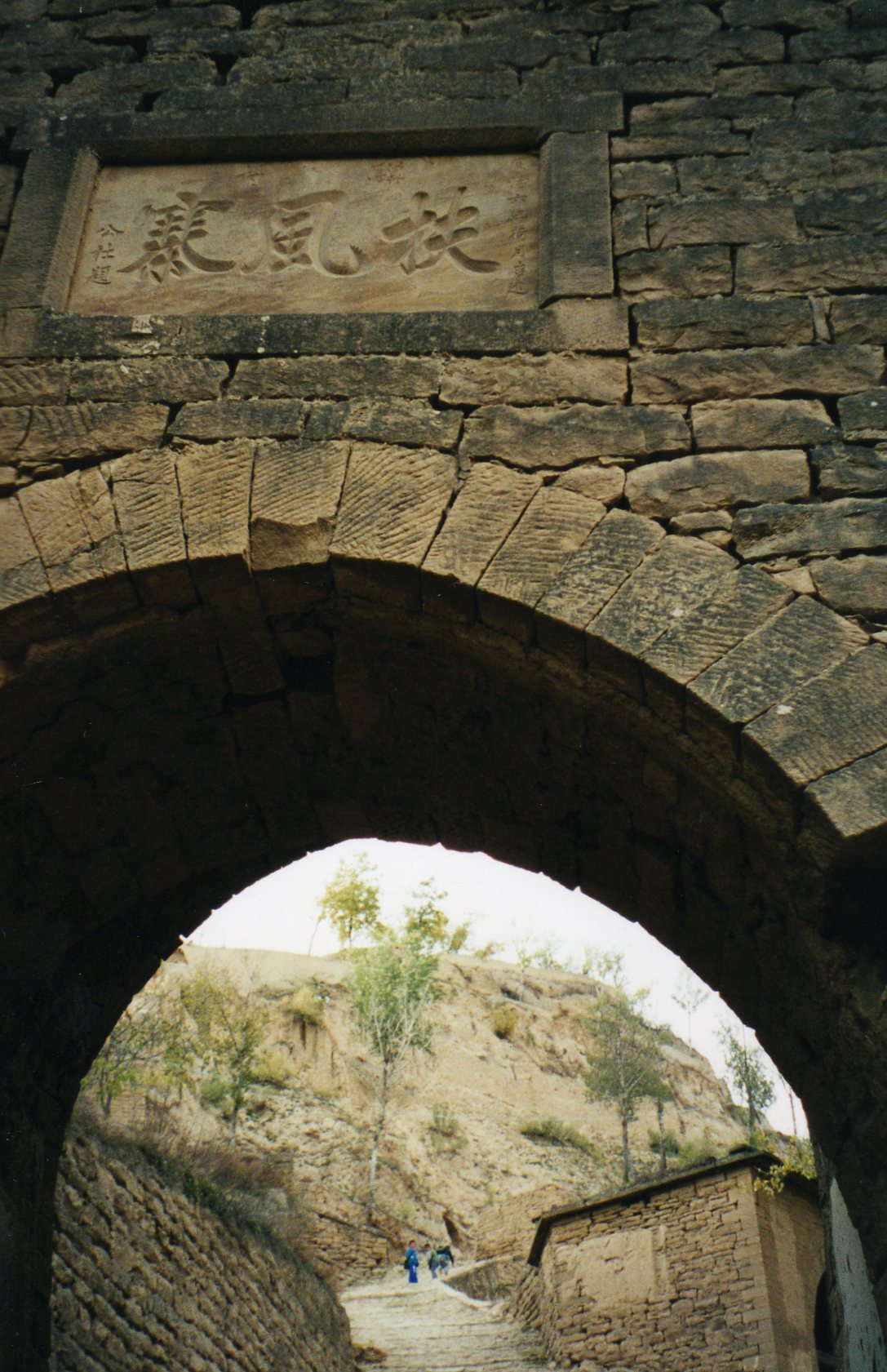
Fufengzhai

The former landlord stronghold, 1999.

As in Europe, even today the older buildings that somehow survived look picturesque—as long as you don’t dwell too much on the indignities that they have witnessed.

By the 1960s villagers’ disillusion was complete. Still, Guo Yuhua notes their own later conflicted memories (cf. the Soviet nostalgia for Stalinism):

  • the sense of conviviality (honghuo) enforced by collective labour (including singing haozi work hollers), which she compares with the “collective effervescence” of ritual;
  • the sense that they were all in the same boat—scant consolation when people were all destitute and starving together, but contrasting with their later atomization since the reforms:

Out we went, voices all round, chattering away merrily, convivial all of a sudden. As soon as we got back home, there was nothing to eat, the kids were crying, clothes all tattered, nothing to mend them with—just that moment of conviviality.
[…]

Commenting on their more recent memories, she notes

Material amelioration and the deterioration of social life, as well as nostalgia for the collective life produced by their escalating marginalization, to some extent transforms and even conflicts with their memories of suffering.

  • and their startling ironic “logic” that with the collapse of the commune system the CCP slogan “first bitter, then sweet” (coined to contrast the old feudal society with the Communist Utopia) had indeed finally come to pass with the present material sufficiency—albeit several decades too late, and only after the collapse of the very system that had touted the boast (156–65). For some, the transition

from collective to privatization wasn’t a retrogressive transformation of correcting the mistakes of the system, but like a natural “first bitter, then sweet” cause-and-effect.

She notes the villagers’ sullen passive resistance in showing up for collective labour without working, citing the dictum of Qin Hui (see above) that communes from which people can’t withdraw are no different from concentration camps.

Since the reforms
As the stultifying commune system collapsed (“rotted” as they say, lan nongyeshe 烂农业社; another common expression for the privatizing reforms is dan’gan 单干, “going it alone”), the book describes the long complex process of adjustment.

With villagers clamouring to overthrow the commune system, at first some cadres hesitated to stick their necks out, anxious that the political winds might change yet again.

A vivid exchange in an interview with a former cadre:

Later it became the norm, the whole county was dividing up…
[Woman interjects:] It was spring. I remember dividing up the donkeys, don’t I.
Cattle, you mean cattle.
[They argue over whether it was donkeys or cattle…]

As for villagers in north Shanxi, this was the real “Liberation”:

Going it alone was great, just great. If we’d have gone on in the collective, in a few more years there’d be no-one alive, we’d all have fucking starved to death [laughs]—really! (212)

Guo Yuhua goes on to reflect on the mechanism that had enabled such coercion, and the villagers’ own assessment of the changing times, including their reservations about the way society had gone on to evolve (213–21).

In the final chapter she draws conclusions, exploring the “logic” of both sufferers and the system that they endured, and warning that the campaign style is still active.

In an Appendix (also online) entitled “Doves occupying the magpie’s nest” she updates the story, reflecting on later visits in 2005 and 2006. The dwelling where Mao stayed from 1947–8 had been revamped as “Commemorative hall to the revolution”, and the former ancestral hall of the Ma landlords was being converted to an “Commemorative hall to the battle relocation in Shaanbei”, an “educational base on the revolution”. No room for the villagers’ own voices here.

Taking a tour of Mao’s old dwelling she suddenly realizes that two of the cave-dwellings—former residence of Peng Dehuai, no less—had become the home of the eccentric villager Liudan, whose father had made such a deep impression on Guo Yuhua that she had published an article about him in 1998:

Though from a landlord background, he was considered “enlightened gentry”, and was on the advisory team for land reform. Becoming a teacher away from the village, he was yet another victim of the state cuts in 1962, having to return home. He now became “maladjusted”, cut off from village life.

Now, amazingly, his son Liudan was still occupying the two caves in the revolutionary site, adamantly refusing the state’s handsome offer of money to move out. Never able to find a wife, he too was unable to work; most villagers understood his seeming mental deficiency as a highly astute form of passive resistance. Even recently he was still something of a down-and-out. As Guo Yuhua observes, his refusal to move out was reminiscent of both the indignant protests of evicted urban dwellers and the struggle over whose version of history will prevail; but given his mental frailty, his resistance was rather complex.

Anyway, we needn’t hold our breaths for a memorial to the victims of Maoism, to match the commemoration sites in Germany for those of Nazism and the GDR.

And Guo Yuhua still manages to go back regularly to Yangjiagou—even as year by year, fewer people remain who can recall the period before “Liberation”; before long, who will remember the Great Leap Backward?

GYH 2011

Village chat. 2011.

As in Europe, we all visit sites where people were tortured and murdered within living memory, yet we may merely see them as picturesque—an image avidly promoted by Chinese propaganda.

* * *

Language
One feature that enriches the authenticity of the book is its direct citations of villagers’ accounts in their own words. Thus it also serves as a kind of practical handbook for Shaanbei dialect. Use of language, of course, lends insights into people’s conceptual world. [7]

Apart from having to latch on to regional pronunciations, like de (duo), hou (hao), he (hei), bie (bei), ha (xia), ka (qu), and so on, Guo Yuhua soon helped me pick up some basic expressions, like haikai 解开 “understand” and chuanka 串去 “go for a stroll”. Now I can finally savour the language of her meticulous documenting of peasants’ reflections, albeit twenty years too late—basic expressions like nazhen 那阵 “then” (jiuqian 旧前 “in the old days”); zhezhen 这阵 or erke 尔刻 “now”; laoha 老下 “dead”; yiman 一漫 “totally”; ele 恶了 “very” (not the standard feichang). The whole commune system is known as nongyeshe 农业社 or daheying 大合营; for collective labour they say dongdan 动弹.

Among the many pleasures of peasant language is its liberal use of expletives, a revealing contrast with the standard Chinese of propaganda—polished, polite, and so flagrantly false as to insult the intelligence.

Religion and ritual
Guo Yuhua’s PhD, which became the book

  • Side kunrao yu shengde zhizhuo 生的困扰与死的执着:中国民间丧葬仪式与传统生死观 [The puzzle of death and the obstinacy of life: Chinese folk mortuary ritual and traditional concepts of life and death] (Beijing: Zhongguo Renmin daxue cbs, 1992),

largely concerned traditional rural mortuary rituals, and remains stimulating (note her fieldnotes from Shanxi and Shaanxi, pp.198–217). Indeed, her 2000 article on Jicun in Ritual and social change contains more material on changing temple life there than does her 2013 book.

While she has moved on from ritual to broader social issues, she recognizes the importance of both religion and religious studies in China. I think of de Martino‘s fieldwork on taranta in south Italy, also engaging with the plight of the sufferers.

Guo Yuhua sees religion and myth as behaviour with long historical roots to explain the world, a kind of survival technique. (cf. Ju Xi). In an email she notes similarities with the CCP’s enforced belief system:

If the latter is as “scientific” as they claim, then it too should be subject to corroborating or refuting; it should be explored, debated, doubted, critiqued. But the current reality is that it demands unconditional veneration as an item of faith, even written into the constitution—a totally illogical position.

Religious studies should take account of such [sociological] approaches, rather than mere descriptive documentation or “salvage”—viable cultures will endure and evolve without such measures. Given the importance of religion in society, as long as studies takes account of its social basis, then it’s a worthy discipline.

As she observed in interview, alluding to the Gemeinschaft and Gesellschaft debate,

If you say, Chinese tradition is such a society of rites and customs (lisu 礼俗), not of legal rationality (fali 法理), then its distinctive feature is human governance. To be satisfied with this explanation is to shirk responsibility, because if everything goes back to the ancestors, then what is there for us to do? If one wants true reform, I think we have to start from the institutional level, so naturally we have to transfer our attentions towards institutions, or more precisely, the interactive configuration of culture and human nature. 

Expressive culture
My taste of fieldwork with Guo Yuhua stimulated my own quest to relate local expressive cultures to politics and society—a common goal of ethnomusicologists, but much less commonly achieved for China (in another post I lead from the state’s persecution of human rights lawyers to the tendency of anthropologists and ethnomusicologists to speak up for oppressed minorities).

On one hand, the study of imperial China is eminently necessary, but for many Chinese scholars it has had the added attraction of being relatively safe (cf. former Yugoslavia). Studies of culture and ritual, too, tend to be an autonomous zone into which social change since 1900 rarely intrudes.

As the state has receded somewhat since the 1980s, it may seem slightly less risky to document the current fortunes of folk genres, though this too often descends into a simplistic lament about the lack of a new generation; and as the overall society certainly becomes more affluent, those stark social problems that do remain continue to be taboo. So we accumulate dry lists of ritual manuals and sequences, vocal and instrumental items, and birthdates of performers.

Meanwhile, social and political change is often seen only through the lens of “revolutionary” culture, while living (or at least only semi-moribund) traditional vocal and instrumental genres are imprisoned in museums and libraries, and their performances sanitised for the concert platform. Their history under Maoism is blandly encapsulated by listing a few isolated performances at secular regional festivals, along with a standard clichéd sentence on the “mistakes” of the Cultural Revolution.

Guo Yuhua tellingly describes the replacement of traditional ritual culture by that of political campaigns—although in my Shaanbei book I note the enduring strands of tradition even through the years of Maoism. While the lives of blind bards and shawm players feature in her account, I think my own focus on them in my book still makes a useful supplement.
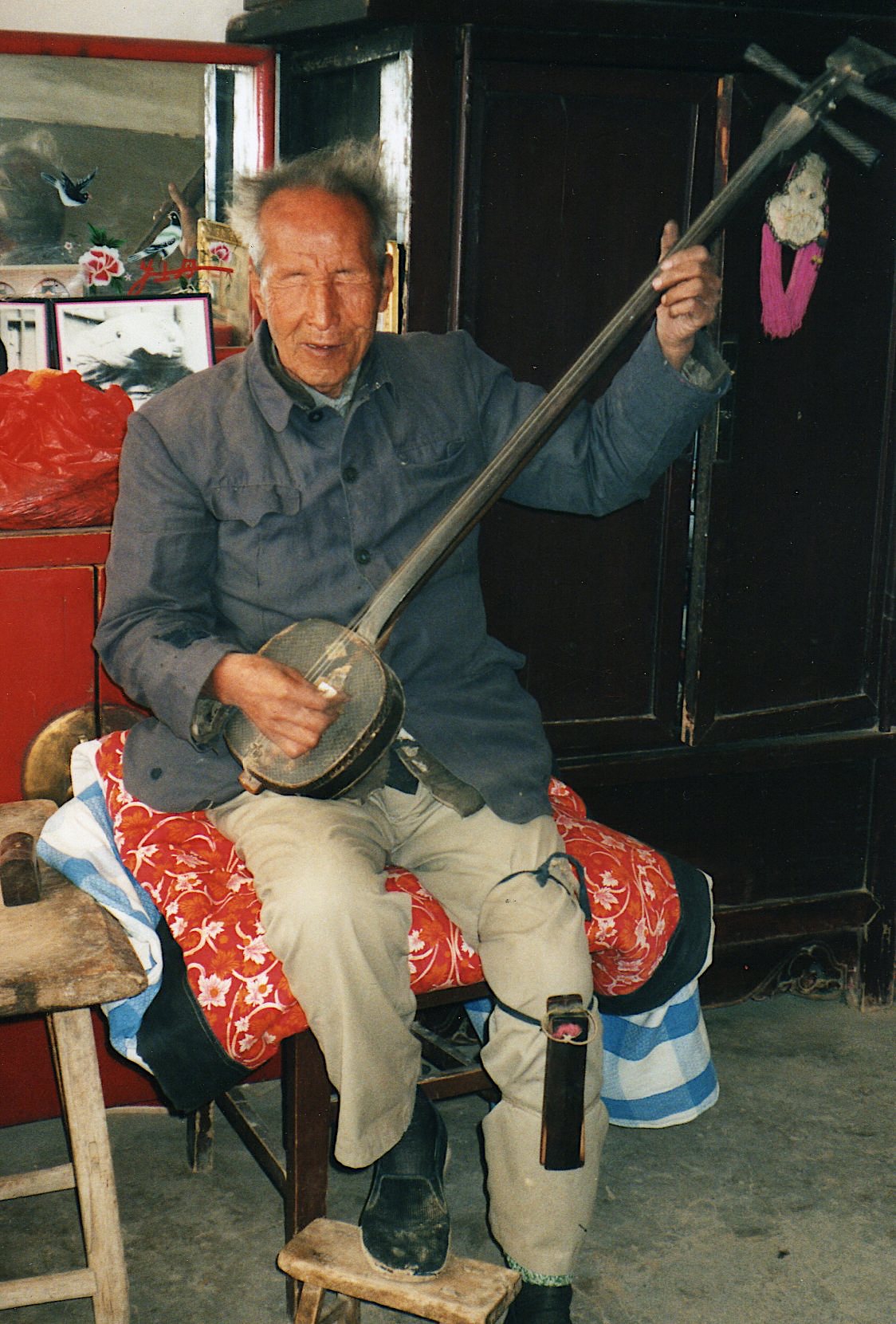
LHQ shuoshu

Li Huaiqiang, 1999.

In my survey of itinerant storytellers in Shaanbei, my accounts of the changing fortunes of the village’s blind bard Li Huaiqiang (1922–2000, known as “Immortal Li”, Li xian) also derive from Guo Yuhua’s close relationship with him (see my Ritual and music of north China, vol.2: Shaanbei). As this article grows, I’ve written about him and other bards in a separate post.

Another major theme of my Shaanbei book, and the accompanying DVD (§B, cf. my comments on the funeral clip from Wang Bing‘s recent film), is the village’s shawm band. Such bands belong to the traditional litany of social outcasts. One of Guo Yuhua’s main informants is Older Brother, the sweet semi-blind shawm player who features in my own book and DVD (cf. blind shawm players in Yanggao, north Shanxi).

Yangjiagou funeral 1999

Yangjiagou funeral, 1999. Older Brother second from left.

While I was filming the procession to the hilltop grave, setting off before dawn, Guo Yuhua was taking photos:

funeral climb 1

funeral climb 2

grave

In a society where no matter how desperate people were, even vagrancy offered no hope (p.162), Older Brother tells Guo Yuhua how, with his family starving, he reluctantly went on the road begging in the second half of 1968 (pp.133–4, 193–6), led by a sighted old man from a martyred revolutionary family. In a moving account, he tells how they went on a long march throughout Shaanbei, sleeping rough; they were treated kindly on the road, learning to beg for scraps. When conditions allowed simple funerals, he even played his shawm, his companion accompanying on cymbals. He would find people to write letters home to his father to reassure him he was still alive. By the winter he had found a rather secure village base where he was hopeful of eking a living, but this enabled his father to track him down and summon him home.

It may seem ironic to cite Mao here, but as he observed,

There is in fact no such thing as art for art’s sake, art that stands above classes, art that is detached from or independent of politics.

So did the socialist arts Serve the People, meeting their needs? Whose needs do state propaganda units like the Intangible Cultural Heritage serve now? Of course, while the state has its own agenda for the latter, local actors can utilize it to achieve their own requirements, as several scholars have observed (and that is perhaps the only thing that can be said for it).

As I suggested in my post on the recent film of Wang Bing, this is the context in which we blithely analyse the scales, melodies, and structures of Chinese music. Primed with Guo Yuhua’s book, you’ll never again want to read the bland reified propaganda from the ICH.

* * *

In her book, as in her whole scholarly output, Guo Yuhua makes a rational and forceful indictment based on detailed evidence, a passionate plea for heeding the voices of ordinary people and rewriting history.

All this may be a rather familiar story abroad (from individual studies like those of Chan, Madsen, and Unger (Chen village), Friedman, Pickowicz, and Selden’s two volumes on Wugong, Jing Jun’s The temple of memories, my own Plucking the winds and Daoist priests of the Li family, or the broader brush of Frank Dikötter—I hardly dare mention the few apologists like William Hinton and Mobo Gao, to whom Guo Yuhua gives short shrift). But it feels yet more incisive coming from PRC scholars, and her research is both detailed and amply theorised. The only aspect where the stories of Chen village and Wugong may make more impact is that they follow individual lives, whereas most of Guo Yuhua’s citations are anonymised.

While her work such as that on “Jicun” exposes the tragic failures and outrages of the Maoist decades, she is also relentless in denouncing current abuses—always upholding the values of social justice and the liberation of the sufferers, inspired by the same concern for the welfare of Chinese people that once made the CCP popular. (For my own nugatory contribution to Xi Jinping studies, see here, and even here.)

I seem to be suggesting a rebalancing from the newly-revived Guoxue 国学 (“national studies”: traditional Chinese culture, especially Confucianism) towards Guoxue 郭学 (Guo Yuhua studies). She bridges the gap between politics, anthropology, and cultural studies. Whether you’re interested in society, civil rights, history, music, or ritual, let’s all read her numerous publications—and do follow her on social media.


[1] Many of her important articles are collected here, including several related to her work in Shaanbei. For another major recent article, see here (or here). For a brief yet penetrating and indignant essay, try “OMG, not that stupid ‘happiness’ again?!” My thanks to Guo Yuhua, Stephan Feuchtwang, Harriet Evans, and Ian Johnson for further background.

[2] For a translation of Sun’s recent article, soon blocked from WeChat, see here. For a useful English account of the Tsinghua group, see here; and yet another fine anthropologist there is Jing Jun 景军. For Wang Mingming at Peking University just up the road, click here.

[3] §4 of which was translated by Harriet Evans as “Narratives of the ‘sufferer’ as historical testimony”, in Arif Dirlik et al. (eds.). Sociology and anthropology in twentieth-century China: between universalism and indigenism (Hong Kong: Chinese University, 2012), pp.333–57.

[4] Guo Yuhua notes that traditionally women’s main opportunity for public interaction was at the 3rd-moon temple fair for Our Lady, but I wonder if their exclusion from the ritual sphere was so severe: female spirit mediums had been, and still are, a major element in ritual life.

[5] The silence of the 1993 Mizhi county gazetteer on the privations and indignities of the Maoist decades makes the frank accounts in the Yanggao gazetteer (also 1993) all the more impressive: see my Daoist priests of the Li family, e.g. pp.100–101, 123.

[6] Hinton, in his classic Fanshen, also documents complexities, but within an overall positive tone.

[7] I’m not sure how rare this is in academia, but it has been adopted by novelists such as Li Rui and Liu Zhenyun. In Sun Peidong’s review she cites Han Shaogong’s novel A dictionary of Maqiao (Maqiao zidian 马桥词典), set in Hunan, for its unpacking of local language. For Shaanbei dialect, cf. the 2007 book Tingjian gudai 听见古代 by Wang Keming 王克明. For film documentaries, click here.