Perfect Pitch

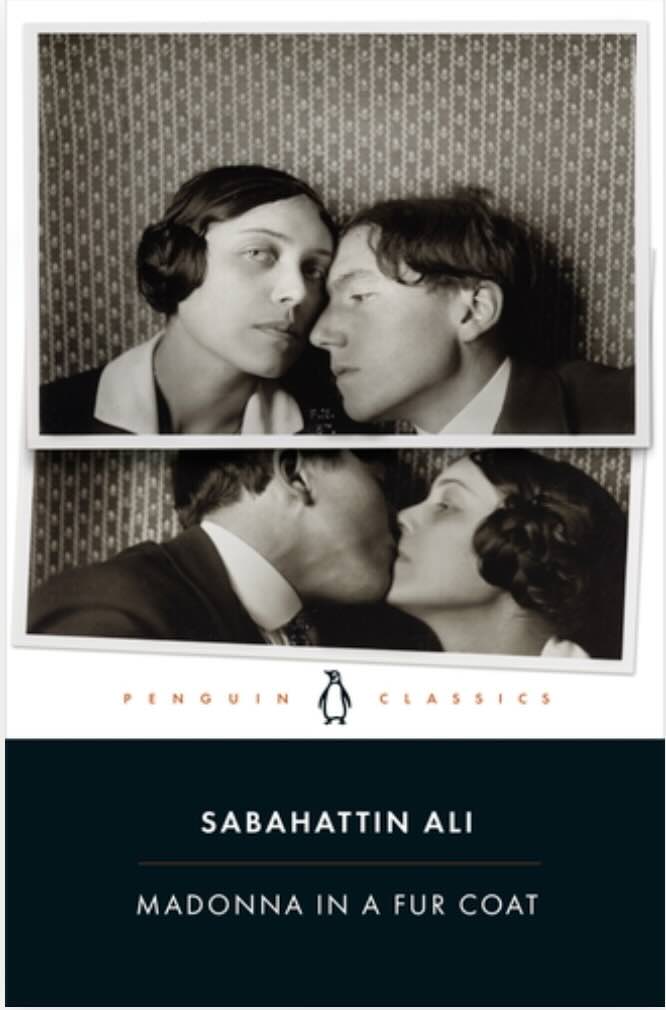
Perfect pitch cover

I’ve often cited Nicolas Slonimsky’s brilliant Lexicon of musical invective. So I enjoyed reading his fascinating memoir

  • Perfect Pitch,
    in a revised third edition from 2023, ably edited by his daughter Electra Slonimsky Yourke.

Written with wit and wisdom at the age of 94, and first published in 1988, it’s a captivating blend of substance and gossip, packed with wonderful anecdotes—a Who’s Who of figures that seemed to matter at the time, part of a niche zeitgeist.

Nicolas Slonimsky (1894–1995) (fine website, with A/V; books, including Writings on music, 4 vols., 2005; wiki) was “a typical product of the Russian intelligentsia”—in the early chapters he gives a detailed account of his Russian family history and political turmoil. Already by 1912 his early musical facility led him to describe himself as a “failed wunderkind”.

In autumn 1918 he left St Petersburg. After stays in Kiev and Yalta, in 1920 he reached Constantinople (pp.85–90), where he found many musicians among the throng of Russian refugees. Lodging with a Greek family, he accompanied Russian dancers, and played for restaurants and silent movies. He composed Obsolete foxtrot and Danse du faux Orient, later included in his Minitudes. After following a girlfriend, a Russian dancer, to Sofia, by late 1921 he arrived in Paris—also inundated by Russian emigrés. There he worked for Serge Koussevitzky for the first time, who introduced him to Stravinsky in Biarritz. Koussevitzky, sorely challenged by irregular time signatures, * asked him to rebar The Rite of Spring for him. Despite moving in cultured circles, Koussevitzky (like Tennstedt later) was not a great reader.

Slonimsky was impressed by Nikolai Obukhov, a “religious fanatic” who made a living as a bricklayer. Inspired by Scriabin, and an unlikely protégé of Ravel, his magnum opus Le livre de vie for voices, orchestras, and two pianos (Preface here) contained “moaning, groaning, screaming, shrieking, and hissing”. He dreamed of “having his music performed in an open-air amphitheatre, perhaps in the Himalayas or some other exotic place”. He developed the croix sonore, a prototype of the theremin.

In 1923 Slonimsky docked in New York, travelling on a Nansen passport, “an abomination of desolation, the mark of Cain, the red spot of a pariah”. He soon found work as opera coach for the new Eastman School of Music in Rochester, at the invitation of Vladimir Rosing. He now confronted the challenge of learning English. Indeed, the book is full of gleeful comments on language learning. Taking advertising slogans as his textbook, Slonimsky’s arrangements (particularly Children cry for Castoria!) became popular. America seemed a fairy-tale land. At Eastman he found a kindred soul in author Paul Horgan.

In 1924 Koussevitzky replaced Pierre Monteux as conductor of the Symphony Orchestra (whose musicians were mainly German, French, and Russian), and the following year he invited Slonimsky to become his secretary (feeling more like a “serf”). Koussevitzky was in awe of Rachmaninoff’s genius, and despite his withering assessments of rival conductors, he did promote Mitropoulos and Bernstein; he was dismissive of Arthur Fiedler’s Boston Pops (cf. the splendid Erich Leinsdorf story). Much as he valued Slonimsky’s talents, his insecurity meant that his young protégé always had to tread carefully, and in 1927 they parted company.

Still, he now enjoyed a “meteoric” conducting career. With no illusions about his rudimentary technique, he founded the Chamber Orchestra of Boston, promoting contemporary composers—notably Henry Cowell, Edgard Varèse, and Charles Ives. After a performance of a work by Cowell, they rejoiced in the headline “”Uses egg to show off piano”. Slonimsky introduced Aaron Copland to George Gershwin. After Cowell introduced Slonimsky to Charles Ives, they became close.

Cowell Ives 1952
Henry Cowell with Charles Ives, 1952.

Slonimsky was full of praise for Ives:

I learned to admire the nobility of his thought, his total lack of selfishness, and his faith in the inherent goodness of mankind. […] He inveighed mightily against self-inflated mediocrity, in politics and art alike. The most disparaging word in his vocabulary was “nice”. To him, it signified smugness, self-satisfaction, lack of imagination. He removed himself from the ephemeral concerns of the world at large. He never read newspapers. He did not own a radio or a phonograph, and he rarely if ever attended concerts.

In 1931 (the year he gained US citizenship), Slonimsky gave the première of Ives’s Three places in New England in New York. Promoting the work with passion, in Perfect pitch he waxes lyrical about its genius.
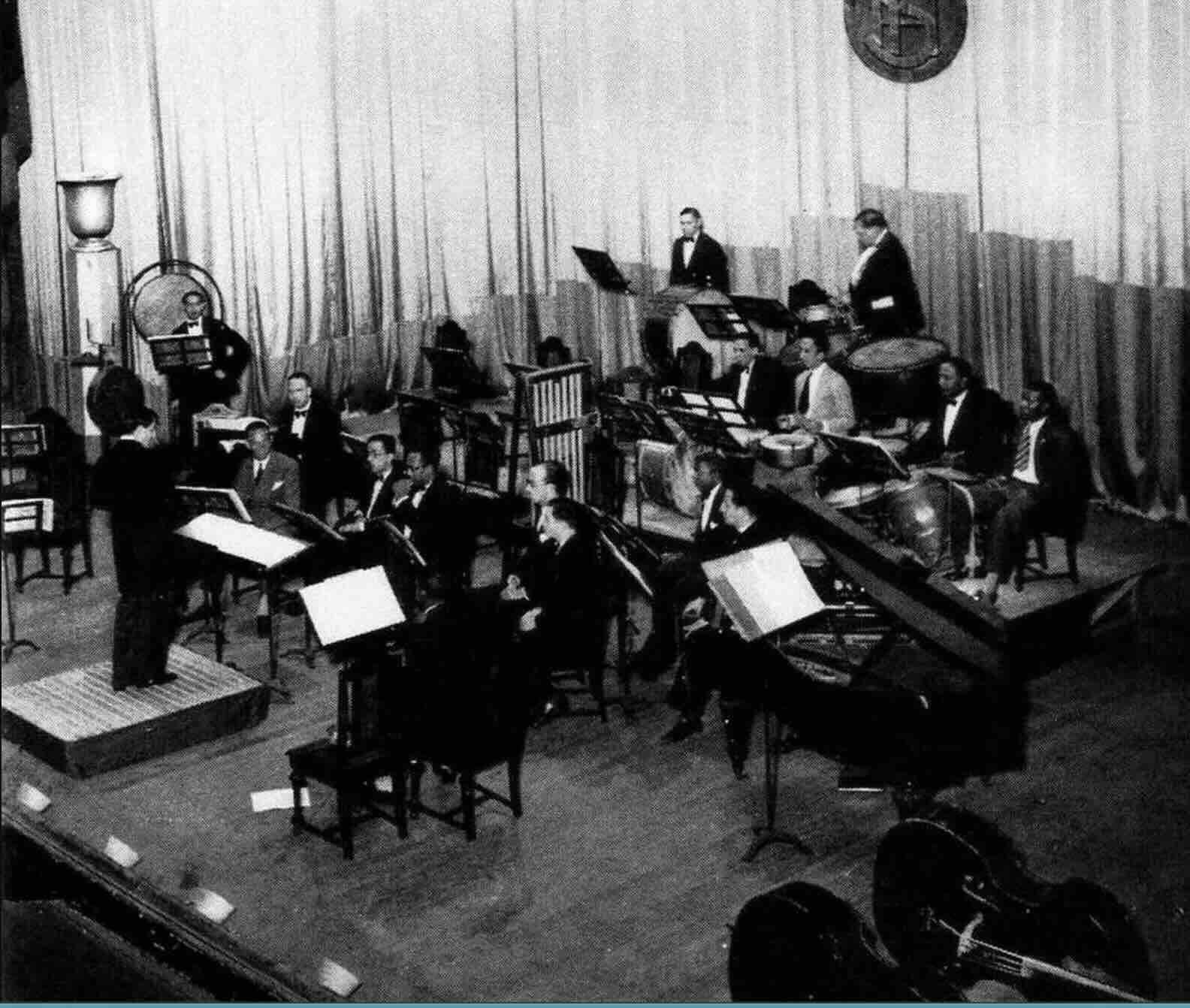
Slonimsky in HavanaSlonimsky conducting Varèse’s Ionisation in Havana.

He was invited to conduct in Havana, his first experience of modern Cuban music. He conducted revelatory concerts in Paris, sponsored by Ives, encouraged by Varèse. There too he married Dorothy Adlow.
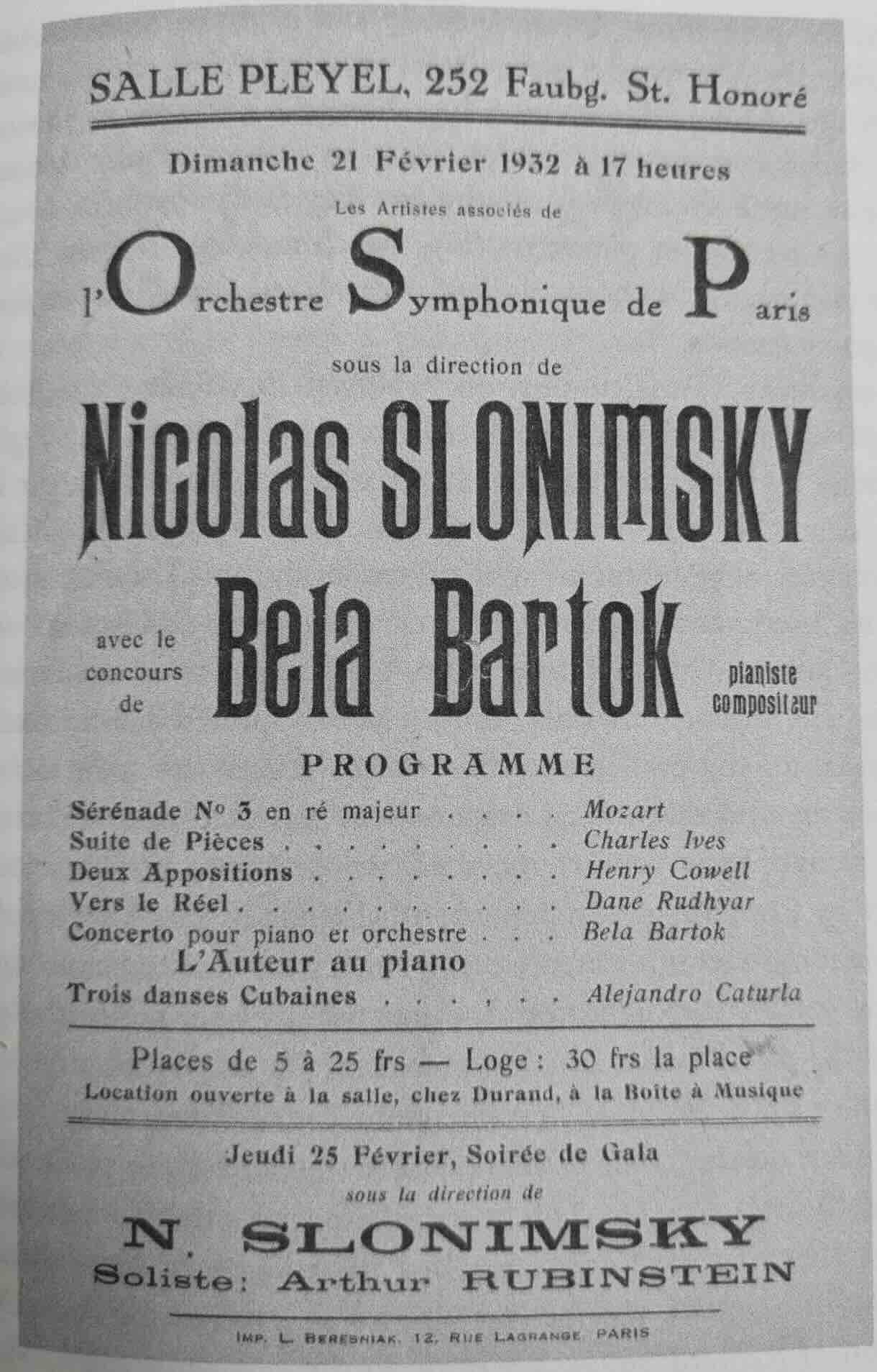
Slonimsky Bartok 1932

He returned to Europe for more concerts in 1932—with Bartók giving the Paris premiere of his 1st piano concerto, and Rubinstein playing Brahms’s 2nd piano concerto!!! In Berlin (in the nick of time before the grip of Nazism) he conducted the Berlin Phil in a modern programme including Three places in New England and Varèse’s Arcana. He repeated the programme in Budapest.

He reflects on this ephemeral phase of his career:

The art of conducting is paradoxical, for its skills range from the mechanical to the inspirational. A conductor can be a semaphore endowed with artificial intelligence, or an illuminating spirit of music. The derisive assertion that “anyone can conduct” is literally true: musicians will play no matter how meaningless or incoherent the gestures of a baton wielder may be. In this respect, conductors stand apart from other performers. A violinist, even a beginner, must be able to play on pitch with a reasonable degree of proficiency. A pianist must have enough technical skill to get through a piece with a minimum of wrong notes. But a conductor is exempt from such obligations. He does not have to play; he orders others to play for him.

This leads him to some wonderful stories about badly-behaved conductors (cf. Viola jokes and maestro-baiting); Toscanini, Klemperer—and this story, evoking the unwelcome posturings of many a later maestro:

Mengelberg once apostrophised his first cello player with a long diatribe expounding the spiritual significance of a certain passage. “Your soul in distress yearns for salvation,”, he recited. “Your unhappiness mounts with every passing moment. You must pray for surcease of sorrow!” “Oh, you mean mezzo forte,” the cellist interrupted impatiently.

I’m eternally grateful to Slonimsky for relating some classic Ormandy maxims (now joyously expanded here by members of the Philadelphia orchestra)—OK then, just a couple:

Suddenly I was in the right tempo, but it wasn’t.

Who is sitting in that empty chair?

In “Disaster in Hollywood” he tells how his first appearance with the LA Phil in 1932 ended in tears. When the programmes for his eight-week season at the Hollywood Bowl in the summer of 1933 proved far too challenging for the “moneyed dowagers”, his conducting career came to an inglorious end. He takes consolation in the later admission of the works that he championed to the pantheon (cf. the fine story of Salonen’s interview for the LA Phil!). Meanwhile in New York he conducted, and recorded, Varèse’s revolutionary Ionisation.
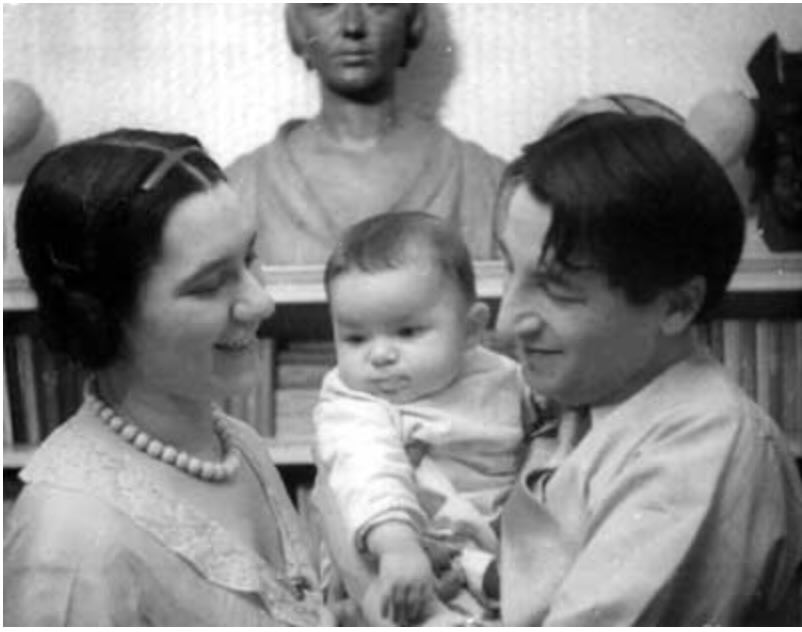
with Electra

With typical linguistic flourishes, he devotes a proud chapter to the birth of his daughter Electra, editor of the volume. He rearranged a limerick:

There was a young woman named Hatch
Who was fond of the music of Batch
It isn’t so fussy
As that of Debussy
Sit down, I’ll play you a snatch.

He would have enjoyed these limericks, and one by Alan Watts, n.2 here.

“Like gaseous remnants of a shattered comet lost in an erratic orbit”, occasional conducting engagements still came his way. In “Lofty baton to lowly pen” he recalls his transition to musical lexicography. He met fellow Russian emigrés Léon Theremin (whose life was to take a very different course) and the iconoclastic theoretician Joseph Schillinger. As Slonimsky compiled his book Music since 1900 (1937!), he became interested in the savage reception of new music, leading to his brilliant Lexicon of musical invective.

Still, he was never tied to his desk. His appetite whetted by his trips to Cuba, in “Exotic journeys” he recalls his 1941–42 tour of Brazil (hearing Villa Lobos’s tales of his Amazonian adventures), Argentina, Chile, Peru, Ecuador, Columbia, Panama, Costa Rica, Nicaragua, Guatemala, and Mexico. His book Music of Latin America was published in 1945.

Returning to Boston, he was plunged into family duties. In 1947 he published Thesaurus of scales and melodic patterns.

In 1935, armed with a US passport, he returned to his birthplace, now called Leningrad, visiting long-lost relatives. He reflects on the death of his mother in 1944, and the life of his aunt Isabelle Vengerova (1877–1956), who became a legendary piano teacher in the States.

After the war, with Russia in vogue in the USA, Slonimsky enjoyed revising his proficiency in his mother tongue, updating old manuals to teach students and taking on work as translator. While he was largely free of McCarthyite suspicion of sympathising with Communism, back in the USSR his brother Michael was at far greater risk for being suspected of opposing it (for Soviet life, note The whisperers).

Dissatisfied with previous compendia and nerdily meticulous, he found a new mission in updating Baker’s biographical dictionary of musicians. He was proud of his 1960 article “The weather at Mozart’s funeral”. In 1956 he achieved unprecedented celebrity through appearing on the quiz show The big surprise.

In “The future of my past” he describes another trip to the USSR and the Soviet bloc in 1962–63, funded by the State Department—an Appendix to the third edition provides a detailed account. He visited Poland, Czechoslovakia, Hungary, Romania, Yugoslavia, Bulgaria, as well as Greece and Israel.  On his meetings with musicians, he was inspired by the energy of Ukrainian and Georgian composers.

His diary is punctuated by his curiosity about language, starting in Moscow:

To my Americanised ears, the new Soviet language sounded almost theatrical in its emphasis, deliberate articulation, and expressive caesuras. I also noticed a proliferation of diminutives….

In Prague he learned the vowel-less tongue-twister Strc prst skrz krk:

I used this phrase as the supposed title of a choral work by the mythical Czech composer Krsto Zyžik, whom I invented and whose name I was tempted (I ultimately desisted) to include as the last entry in my edition of Baker’s.

But soon after his return to Boston his wife Dorothy had a heart attack, which was to be fatal. Bereft after her death in January 1964, he welcomed the offer of a post at distant UCLA. He composed musical limericks for his students’ benefit, but was not always impressed by their aptitude, citing gems from their essays such as “A piano quintet is a piece for five pianos”.

After two seasons he reached compulsory retirement age, but he was never going to go quietly. In LA he enjoyed a wide social circle. Besides many “flaky” composer friends was John Cage, now a guru (Slonimsky cites Pravda: “His music demoralises the listeners by its neurotic drive and by so doing depresses the proletarian urge to rise en masse against capitalism and imperialism”!).

With John Cage, and Frank Zappa.

Back in LA, he made friends with Frank Zappa, who invited him to play at his gig.

Dancing Zappa, wild audience, and befuddled me: I felt like an intruder in a mad scene from Alice in Wonderland. I had reached my Age of Absurdity.

Meanwhile with perestroika in the Soviet Union, Slonimsky was becoming quite a celebrity there too, making several more visits and admiring composers’ creativity in new idioms.

* * *

Far more than a mere entertainer, Slonimsky was a major figure in promoting new music. With his eclectic tastes, I can’t help thinking that he would have enjoyed gravitating to ethnomusicology, questioning the wider meanings of “musician” or “composer” (see e.g. Nettl); but he was deeply rooted in the WAM styles of Russian classics and the American avant-garde. Still, within the world of WAM literature it makes a most fascinating memoir.

For some reason it fills me with joy to learn that a Japanese translation of Lexicon of musical invective has been published.


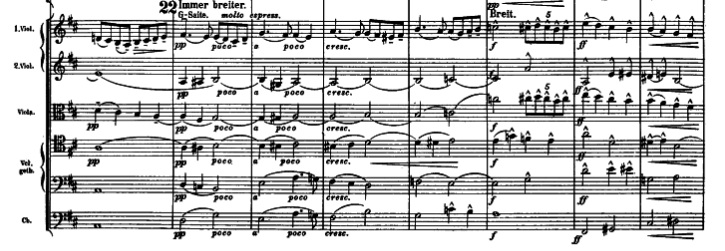
* Even 5/8 was too much for Koussevitzky:

He had a tendency to stretch out the last beat, counting “one, two, three, four, five, uh”. This ‘uh” constituted the sixth beat, reducing Stravinsky’s spasmodic rhythms to the regular heartbeat. When I pointed this out to him, he became quite upset. It was just a luftpause, he said. The insertion of an “air pause” reduced the passage to a nice waltz time, making it very comfortable to play for the violin section, who bore the brunt of the syncopation, but wrecking Stravinsky’s asymmetric rhythms.

To be fair, Koussevitzky did manage to conduct the 5/4 Danse générale of Ravel’s Daphnis and Chloé (1942 recording here; he first conducted it in 1928).

Mahler, Brahms, Schoenberg

Prom MahlerSource: review.

Just days after the Zemlinsky and Schoenberg Prom, I went back to the Albert Hall for another course of late Romanticism, with the talented Ryan Wigglesworth conducting the BBC Scottish Symphony Orchestra (listen on BBC Sounds).

I don’t think I ever played Brahms 3 (make what you will of that uncertainty…). Well-received at the time, but now perhaps the least popular of his symphonies (I can’t miss any opportunity to remind you of Kleiber‘s Brahms 2!), it always deserves a re-hearing. l’ve been getting to know it better by listening to some classic recordings—

Bruno Walter and the Vienna Phil, 1936:

Furtwängler with the Berlin Phil, 1949:

Abbado fifty years later, again with the Berlin Phil (still largely a woman-free zone):

Then we heard Schoenberg’s tone-poem Verklaerte Nacht (1899) (wiki, and here), in the string orchestra version that he later arranged from his string sextet. The latter was premiered by the augmented Rosé quartet—here are members of the Ensemble Intercontemporain with Boulez, c1985:

And this is Mitropoulos with the strings of the Vienna Phil in 1958:

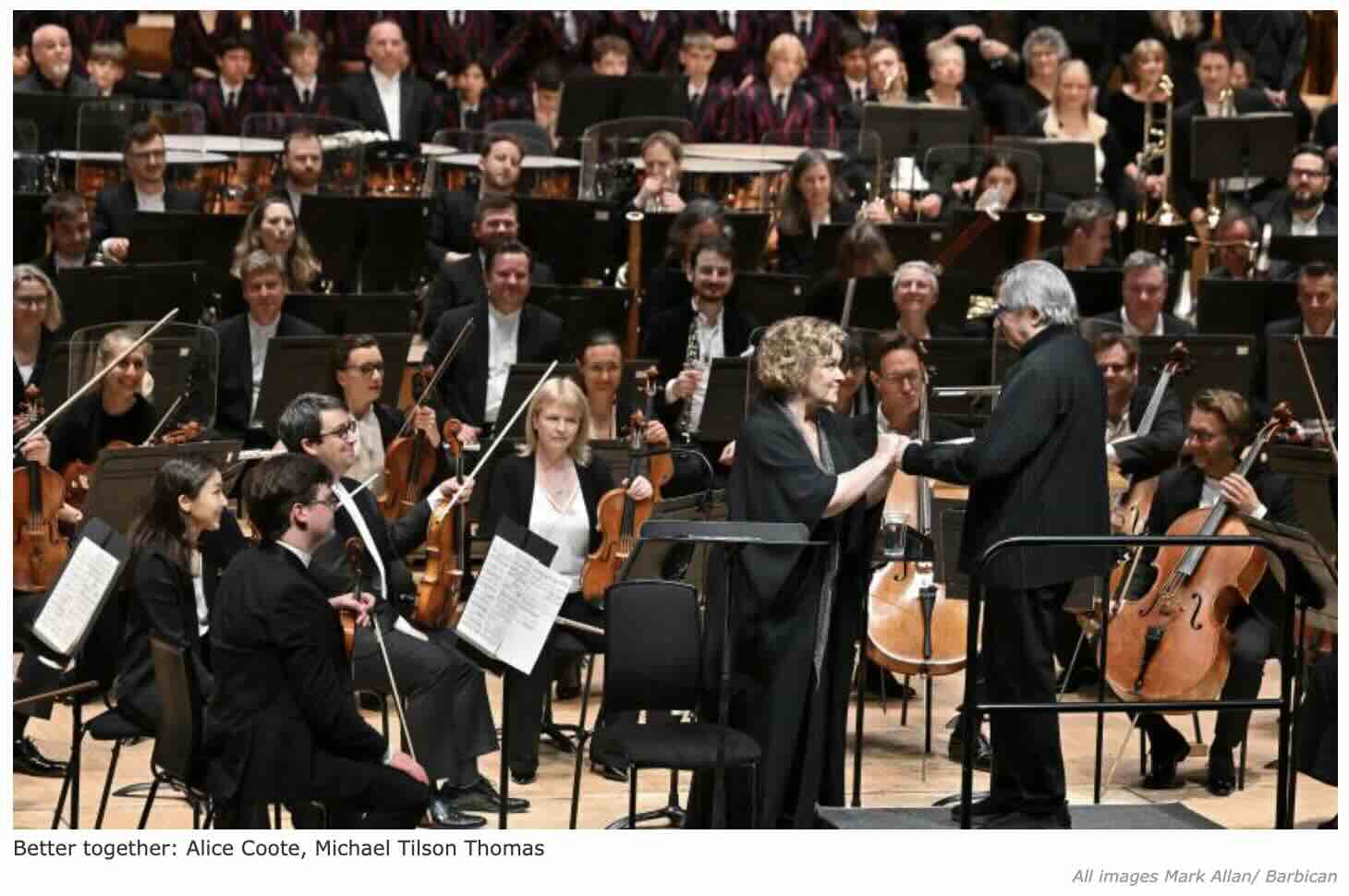
The Prom ended with Mahler’s Kindertotenlieder (1904, to texts by Rückert), movingly sung by Alice Coote. Here’s her recording from 2017 (along with the Rückert Lieder):

And here’s Janet Baker’s classic recording with Barbirolli, 1969 (cf. their Nuits d’été):

* * *

Back at the Prom, a more conventional sequence might have opened with Verklaerte nacht followed by the Mahler songs, with the Brahms symphony as a traditional second half; but the chronological order made a lot of sense, intensifying Mahler’s prophetic, tragic vision. All three pieces end quietly. I still don’t quite get a sense of coherence from Brahms 3, but it’s growing on me—Wigglesworth conducted it without the score, bringing out its chamber music elements. Despite its portentous opening, and hints that the finale might become grandiose, it’s largely elegiac, its middle movements unassuming yet affecting.

The second half was full-on in its intensity. Verklaerte nacht is a major work, long predating Strauss’s Metamorphosen; “filled with crepuscular angst” (as the BBC website has it), the writing especially favours the violas (always good to hear). BTW, and FWIW, the ever-stimulating Richard Taruskin (The danger of music, pp.325–6) doesn’t buy Schoenberg’s resort to extolling “pure” music in his attempt to deflect the misogyny of Richard Dehmel’s poem (“an immanently sinful modern Eve forgiven and redeemed by a godlike magnanimous man”). Finally, Alice Coote’s dramatised grief was perfect for the Kindertotenlieder (for her Mahler 3 with Michael Tilson Thomas earlier this year, click here). For me, the brief coda to the final song doesn’t suddenly sweep aside the anguish of the cycle—it seems more spooky than serene.

Ryan Wigglesworth’s serious, sincere musicking seems to convey a feeling of trust, free of the dubious trend for the flashy wizzkids who have replaced the dour, autocratic maestros of Yore. The composer-conductor combo doesn’t always yield results, but when it does it’s deeply satisfying, as with Salonen, Boulez—and clearly Mahler. But now that I observe the WAM scene as a mere outsider, I’m no longer privy to the more salient assessments of the musicians themselves.

For all my immersion in “world music” and its diverse social contexts, having been Promming since the 1960s, I always find it a blessing that concerts like this generate such attention and enthusiasm—nightly over nearly two months.

Football in Stalinist Albania

with asides on religion and the alliance with China

Hermit kingdom cover

In a curious spinoff from Euro 24,  I came across the intriguing

  • Phil Harrison, Inside the hermit kingdom: football stories from Stalinist Albania (2024) (extract here).

I trust you understand why I just had to read it. The modern history of Albania holds a grim fascination for outsiders. For a book clearly aimed at a popular market, Harrison’s obsession with football through the period seems to me on a par with that of scholars who document early Daoist ritual—or does his dogged optimism resemble mine in supposing I can make the modern travails of household Daoists palatable?!

Inside the hermit kingdom was “written by accident”, with major input from Irvin, an Albanian expat whose own story remains opaque. * While Harrison is aware of the dangers of portraits of Albania that “instil a sense of Western, capitalist superiority”, he inevitably paints a bleak picture, sometimes reminiscent of the spoof travel guide Molvania. The account is punctuated with “Iconic games” and vignettes on the careers of some of the major stars. There may not be such a thing as a casual reader here, but fair-weather fans may find it somewhat excessive to plough through some of the detailed reports of the most obscure matches ever

The book opens in 1905 with the arrival of Christian missionaries in the “tribal backwaters” of mountainous Shkodër, beset by banditry, a Maltese priest founding the first club in 1912. The craze soon spread (cf. Futbol in Turkey, then and now).

Harrison soon plunges us into the vernacular of Albanian football terminology: positions on the pitch, organisations, and slang (humbje hapësire “a waste of space”).

He describes early internationals and the Zog-Mussolini axis. In April 1939 Mussolini’s forces invaded Albania, forcing King Zog into exile. We learn the stoies of two outstanding players among the Albanians recruited to Serie A, and of the Balkan Cup, held from 1946.

Dinamo

Clubs were now controlled by the army and police. Dinamo Tirana was founded in 1950—its stadium (above, via Fussball Geekz) built in 1956 by political prisoners supervised by armed militia, with many of the conscripts dying from exhaustion and injuries. In 1958 Partizani took part in the Spartakiad tournament in the GDR between army-affiliated clubs from the communist countries of the world.

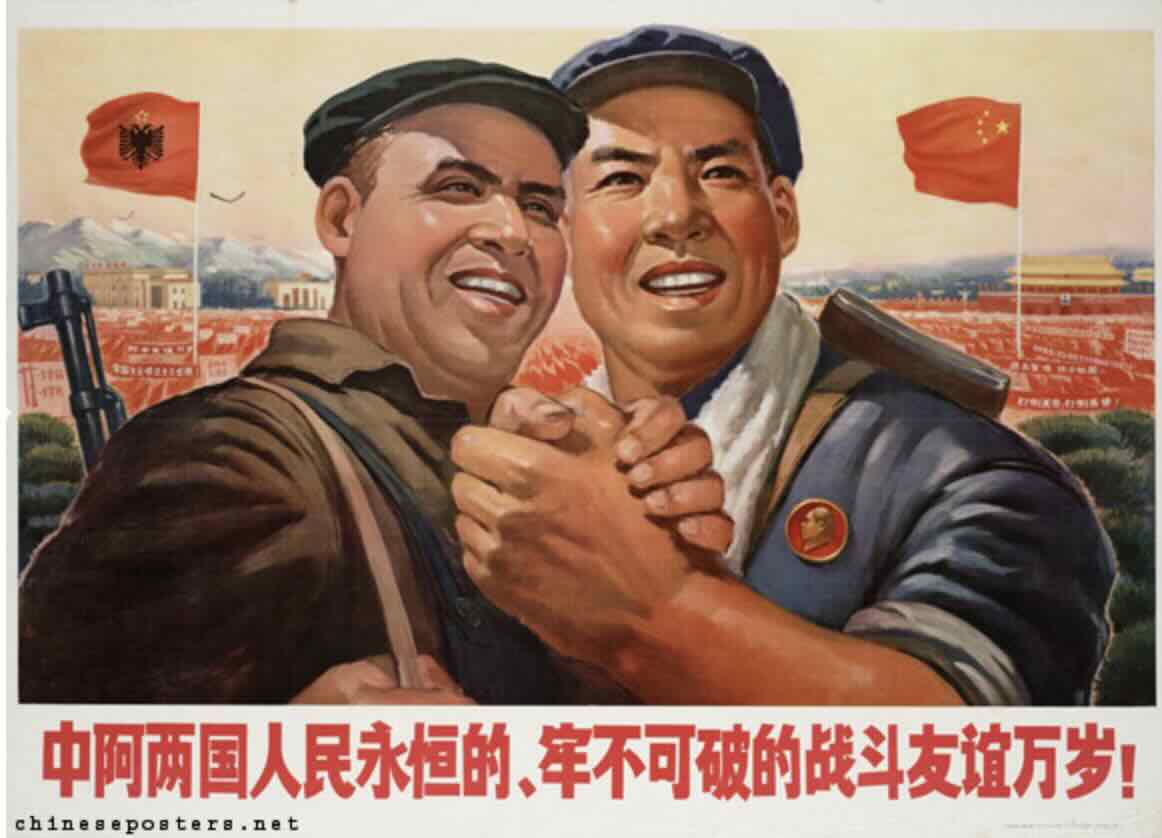
Albania China poster

“Long live the eternal and unbreakable friendship in battle between
the peoples of China and Albania!” Source.

After the death of Stalin in 1953 Enver Hoxha’s relationship with the Soviet Union eroded, deteriorating further in 1956, until the rupture of 1961 which led to Albania’s solitary alliance with Maoist China. In 1957, the wave of Albanianization was evident in the political renaming of many football clubs. Harrison shows how the “golden goal” dates back to 1961 Albania.

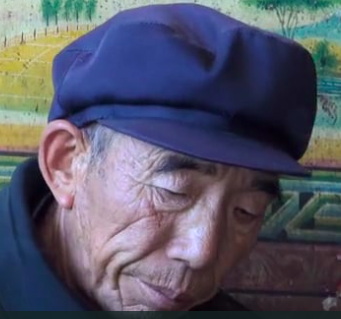
North Xinzhuang 1959

Quite the most remarkable image I know:
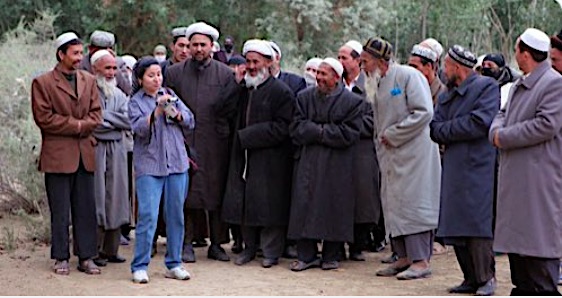
former Buddhist monk with village disciples, suburban Beijing 1959.

With religion suppressed under Hoxha, it was replaced by the ritual and passion of Sunday-afternoon football, a “communal protest against oppression and servility”. Asking “How did football make Albanians feel?”, Harrison describes wages, bicycles, cigarettes (with an aside on their manufacture), alcohol, transistor radios, and racing pigeons. In Tirana from the 1960s, Gimi’s tiny kiosk was a hub of activity, not only selling newspapers and magazines but serving as ticket office for the Albanian Football Federation. At the stadium one stand, the Tribuna, was reserved for army, police, and Party members. The only refreshments available were fara grilled sunflower seeds, wrapped in paper cones sold from tezga usherette trays. For away matches, with train links rudimentary, diehard supporters would undertake a three- or four-hour bike ride, or hitch a lift on an army truck. Attempting access to foreign matches via satellite TV was fraught with danger.

Political anxieties were pervasive, with society surveilled by the Sigurimi secret police (eight of whose nine directors were themselves imprisoned and executed between 1943 and 1991), and the spectre of labour camps. In 1967 star player Skënder Halili was caught selling two wristwatches and sentenced to hard labour in the mines of Bulqiza, eventually cause of his death in 1982—attendance at his funeral marking a small-scale protest against the regime.

“Truth over religion”, screenshots.

In 1966–67, just as the Summer of Love was under way in the West, Hoxha, emulating Mao’s Cultural Revolution, clamped down still more harshly on religion and Western influence. He sponsored the making of the 1967 propaganda film E vërteta mbi fenë [Truth over religion] (do watch here). Among the casualties were Catholic priests, imams, and leaders of the Bektashi order (cf. Turkey; for another niche topic, see Shamans in the two Koreas). This was among several waves of violent religious persecution throughout the Soviet bloc since the 1920s. I’m keen to learn more of the underground maintenance of religious traditions, one of my main themes for China; in Skopje, for instance, just northeast from Albania, a remarkable 1951 film shows self-mortification rituals of the Rufai order.

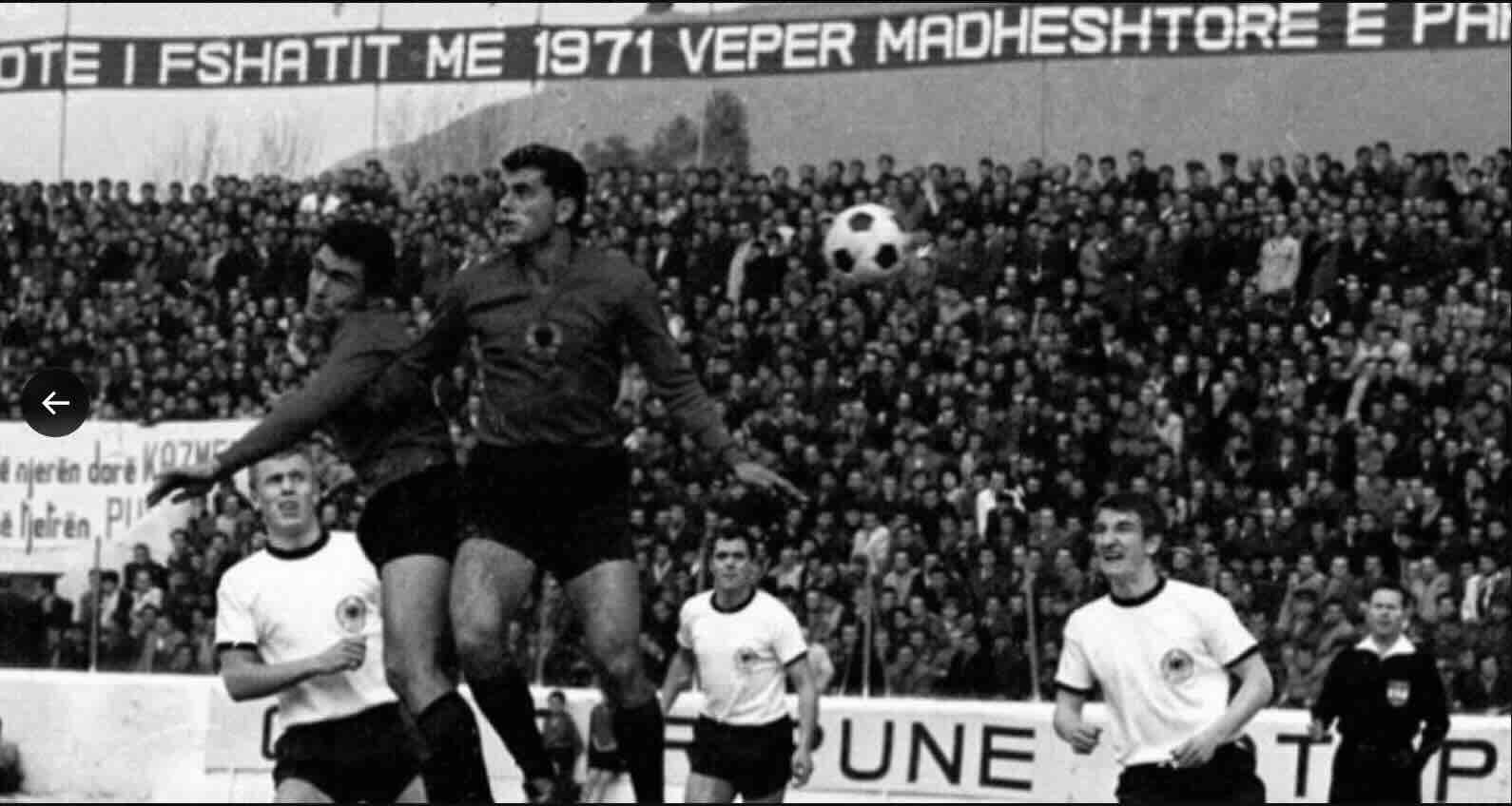
1967 Albania match
Source.

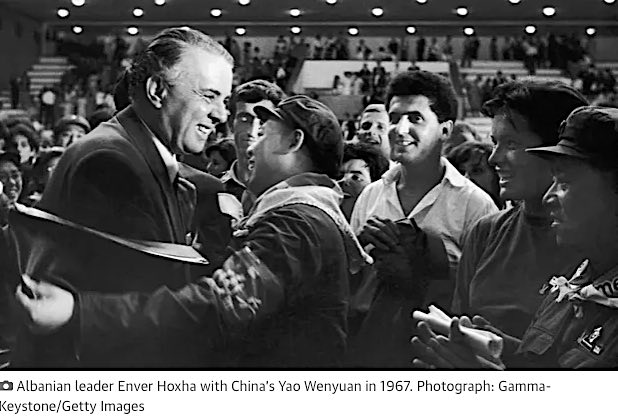
Back with the football, the 1966–67 “Championship of Coals” was subject to murky political interference. And in typical detail, Harrison describes the plucky goalless draw with West Germany in 1967 (above), watched from the Tribuna by Party stalwarts and Chinese dignitaries. I wonder about the lives of those visiting diplomats, who had somehow survived the Anti-Rightist purge, the Great Leap Backward and famine—now to find themselves exchanging cautious platitudes at a football match in a remote third-world country just as chaotic violence was being unleashed back home at the outbreak of the Cultural Revolution.

Enver

As purges continued, Albania became even more isolated. Harrison now devotes a substantial chapter to Fatmir Shima (with the catchy subtitle “the man from Xhomlliku”), father of his guide Irvin, who played in a lower division from 1969 to 1975 (cf. ordinary tennis players, Daoists, musicians, and so on), a temporary diversion from his career in agronomy. The chapter ends with another iconic game, between Tirona and Ajax, with predictable cultural clashes. Meanwhile Italian clubs were still scouting for Albanian players.

Under Hoxha the Gheg city of Shkodër was penalised, but its Vllaznia team rose to win the Kampionati Kombetar league in 1971–72, first of several successes over the following years—as the culture of Tirana at last no longer seemed so impregnable, people began to sense new possibilities.

Harrison continues to excel in arcane nerdiness with his account of the Dinamo club, which enjoyed success through the 1950s but then languished until the 1970s. Again he ends with an iconic game, between Partizani and Celtic for the 1979 European Cup—hair once again making a potential flashpoint. The game was “a sell-out, with ticket prices ranging from 7p to 21p”.

One of the great ironies of the piece is that Celtic’s players—upon their visit to Tirana during the dire, ramshackle days of the late 1970s—were privy to observing a failing city that was grim, penurious, and devoid of hope; a place of limited prospects.

In an act verging on satire, Vata—the first Albanian footballer to ever play in Scotland—made the reverse journey to his Celt predecessors 13 years later, keen to see what the world outside of Albanian borders had to offer. He now continues, by choice, to live in Hamilton.

By the 1970s, the Sino-Albanian collaboration suffered from Hoxha’s disillusion with China’s new rapprochement with the USA. Entirely isolated from 1978 once Chinese funding was discontinued, Albania was in an even more desperate plight. As audiences for the major games declined, people turned to futboll lagjesh “neighbourhood football”, a version of Italian calcetto. Harrison praises the creative improvisation of this five-a-side street style, “an inclusive, democratic idea set against an autocratic backdrop; an arcane act of defiance hiding within plain sight”, with vivid vignettes of the architecture of suburban east Tirana. But “with increased popularity came increased scrutiny”. “Enacting a class war”, a team from privileged Blloku ended up playing a rancorous game against a local Roma team, ending in a brawl and the sending of the Roma to labour camp.

By the early 80s, the regime was on its knees. As Hoxha lay dying, links were being forged with Italy, Greece, and Turkey. Within Albania, funding for football dwindled further. But apart from the long dominance of Tirana and Shkodër, KS Labinoti (in Elbasan county in central Albania) emerged as a contender. And the national team was making progress, at first through Shyqyri Rreli’s leadership of the under-21 team, and then in the 1984 World Cup qualifiers—with another blow-by-blow account of Albania’s magnificent 2-0 win over Belgium in Tirana. Albania narrowly failed to qualify for the Mexico 1986 World Cup, but the seed had been sown.

No nation has endured a more ill-tempered relationship with Europe’s footballing community than Albania. […] The Party remained unswervingly peevish in its interactions with the outside world, and this innate narrow-mindedness transposed itself on to sport.

Harrison documents the troubled domestic league, and encounters between Albanian and foreign clubs, over the whole period from the death throes of the regime from the late 1980s to the final collapse in 1992—whereupon Albania entered a period of anarchy and crushed dreams, prompting a mass exodus. 

But somehow in football, clubs “trundled on”. The final chapter, “The other side of the abyss”, describes how clubs reverted to pre-Hoxha names, resentment emerged in on-pitch petulance and crowd violence, corporate sponsorship gave rise to a new kind of corruption, and criminal gangs flourished. While the domestic game has suffered, since 2014 the national side has been reborn—with the great majority of the squad playing outside Albania.

The new, great Albanian players ply their trade elsewhere and are rewarded with huge remuneration and lavish lifestyles, connected to their native people only by ethnicity, not locality or reality.

Memory remains strong:

The only thing people who lived through Albanian Stalinism still celebrate, or seem to agree on, is  the football [… —] a football that unified fans and provided a balm during fifty years of horrific suffering.

One has to applaud Harrison’s boundless enthusiasm for such a niche project. Of course, football was not the only source of communal celebration; musical gatherings were an important part of social life at the domestic level (see under Musical cultures of east Europe, and Bernard Lortat-Jacob at 80). For other Albanian icons, see the unlikely bedfellows of Norman Wisdom and Mother Teresa. Note also posts under Life behind the Iron Curtain; more on football under A sporting medley: ritual and gender.


* With more detail on football than on social history, Harrison’s scant citations include Margo Rejmer’s collection Mud sweeter than honey: voices of Communist Albania, the memoir Erla Marinaku, “A social history of Socialist Albania, 1975-1991”, and the title Albania—who cares? is suggestive. He would doubtless like to add Lea Ypi’s perceptive 2021 memoir Free: coming of age at the end of history, which I reviewed here

Proms: Zemlinsky and Schoenberg

Zemlinsky concert 1905

For my first Prom this season, I went to hear Ryan Bancroft directing the BBC National Orchestra of Wales in Zemlinsky’s Die Seejungfrau and Schoenberg’s Pelléas und Melisande, premiered at the same concert in 1905. Having already written about both works, I was glad to hear them live.

In my youth, besides Ravel‘s Daphnis and Chloé, Schoenberg’s Pelléas left a deep impression on me, attending rehearsals and concerts in the fluid hands of Boulez; with his choices there was always a sense of discovery. At this week’s Prom I could only summon up fleeting glimpses of that magic, but (within the niche of ominous late-Romantic angst) Pelléas is perhaps rather more accessible, so it probably made sense to open the concert with it, building the audience’s attention for Die Seejungfrau after the interval. But either order could work. Ryan Bancroft, brought up in LA, directed fluently—like Boulez, conveying the music with his hands rather than a baton.

Prom BancroftSource.

You can hear the concert on BBC Sounds for the next two months. A sumptuous fin-de-siècle opening to the season, then—the previous evening Mark Elder conducted Mahler 5 in his Proms farewell to the Hallé after 25 years with them (available on BBC iPlayer). Even if Mahler towers over just about everyone (do consult my series!), it’s always rewarding to explore the work of his contemporaries and disciples, and to immerse ourselves in the whole culture of early-20th-century Vienna. Though the hall was less than packed, how wonderful that Prom-goers devote such attention and enthusiasm to the less familiar aspects of the symphonic repertoire.

Just a few days later came another fine late-Romantic Prom.

Some German tongue-twisters

Wartke

Whereas the mind-boggling “tapeworm words” in my post on Some German mouthfuls are of a practical nature, the realm of fantasy opens up whole new linguistic vistas. In a stimulating article, Deborah Cole introduces the work of the Berlin-based cabaret performer, playwright, and pianist Bodo Wartke.

She begins with some drôle political context:

Annegret Kramp-Karrenbauer, a former defence minister with a dastardly difficult name to say, was long seen as a likely successor to the relatively pronounceable ex-chancellor, Angela Merkel. Kramp-Karrenbauer’s resignation as the conservatives’ party chief came as a relief to news presenters the world over, clearing the way for the tight three-syllabic Olaf Scholz. Sabine Leutheusser-Schnarrenberger, once a federal justice minister and the ultimate double-barrelled tongue-tripper, was not invited to join his cabinet.

Now Bodo Wartke and his musical partner Marti Fischer have gone viral with their rap-tinged Zungenbrecher (“tongue-breakers”)—notably  “Barbaras Rhabarberbar” (recorded in 144 takes!), the story of a bar owner named Barbara who enchants all who try her rhubarb cake, including a group of bushy-bearded, beer-swilling barbarians who bring their barber back to try a bite:

This was followed by a charming sequel:

All this is entertaining for Germans and “reliably hilarious to foreigners”. With further links, Cole’s article makes good points about the history and appeal of German tongue-twisters. In English, this video is delightful too.

In Chinese, see A tongue-twister for the household Daoist. The apotheosis of word play, not to be missed, is Nicolas Roberton’s series of Anagram tales. See also under Language learning: a roundup.

Empireland

Empireland

Thoughtful analysis of the legacy of empire is part of a productive academic trend—one which is being vehemently resisted in the corridors of entrenched power, fulminating against the “Guardian-reading, tofu-eating wokerati” (links e.g. here; cf. Fatima Manji, Hidden heritage, and sources there).

  • Sathnam Sanghera, Empireland: how imperialism has shaped modern Britain (2021)

makes an engaging, accessible summary of research (among reviews, Guardian; LSE; and on the sequel Empireworld, LRB).

In the opening chapter Sanghera imagines a revival of Empire Day that would be more educational. As he notes,

It’s all very well highlighting empire awareness by talking about how our honours list still hands out Orders of the British Empire, how many of our common garden plants were originally imported into Britain by imperialists, or how Worcestershire sauce might originally have been an Indian recipe, reportedly brought back to Britain by an ex-governor of Bengal. But our imperial past has had a much more profound effect on modern Britain.

Empire explains why we have a diaspora of millions of Britons spread around the world. Empire explains the global pretensions of our Foreign and Defence secretaries. Empire explains the feeling that we are exceptional and can go it alone when it comes to dealing with everything from Brexit to dealing with global pandemics. Empire helped to establish the position of the City of London as one of the world’s major financial centres, and also ensures that the interests of finance trump the interests of so many other groups in the 21st century. Empire explains how some of our richest families and institutions became wealthy. Empire explains our particular brand of racism, it explains our distrust of cleverness, our propensity for jingoism. Let’s face it, imperialism is not something that can be erased with a few statues being torn down or a few institutions facing up to their dark pasts or a few accomplished individuals declining an OBE; it exists as a legacy in my very being and, more widely, explains nothing less than who we are as a nation.

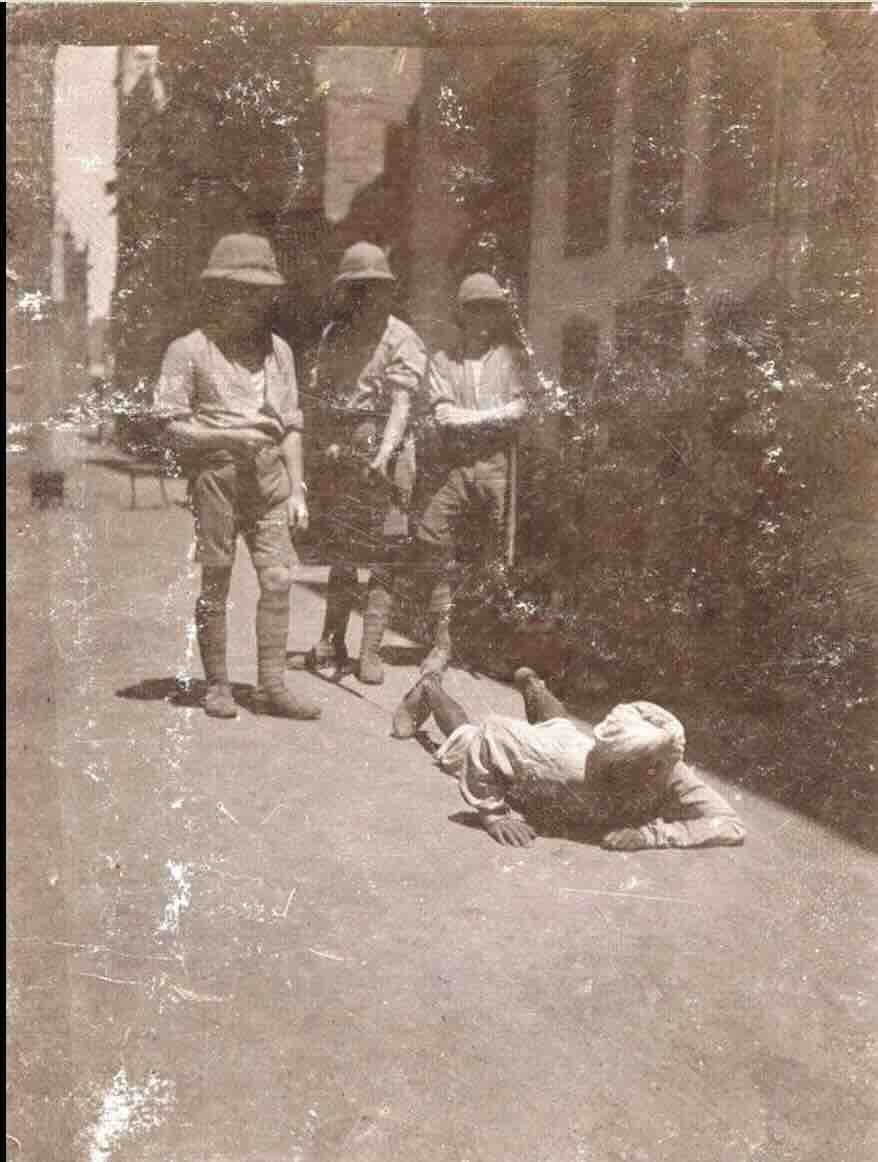
Amritsar 1919Prelude to the Jallianwala Bagh massacre (Amritsar):
“All native men were forced to crawl the Kucha Kurrichhan on their hands and knees
as punishment, 1919″. Source: wiki.

He frankly explores his Punjabi Sikh background, and demolishes the “futile and misleading” balance sheet of “was the Empire good or bad?”. Chapter 4, “Emotional loot” gives an instructive take on the 1903 British invasion of Tibet (“the Younghusband expedition”), leading him to consider the massive stock of looted artefacts that adorns our museums and stately homes, and the bitter debate over restitution. Chapter 5, “We are here because you were there”, opens in Brighton with the story of Dean Mahomed (1759–1851) (also explored by Fatima Manji), leading to an outline of the early presence of black and brown people in Britain.

Sanghera reflects on nostalgia for the Raj, the persistent self-isolation of expat communities around the world, and their taste for British food and education; on the irony of the British search for adventure (“There is no shortage on Instagram of people who confuse travelling with having a personality”); on the lure of sexual opportunity, and prudery; and on the vanity of our claim to be “world-beating”. An intriguing insight on empire’s fetish for manliness:

It was not uncommon to find men with a stammer working in administrative roles in the Indian Civil Service—to have a position in empire instantly gave a man kudos, and a speech impediment might be overlooked for “empire served as proof for masculinity”.

Empireland is full of such instructive byways, such as the history of gin and tonic, “the cornerstone of the British Empire” (Spanish fly 1976):

Gin to fight the boredom of exile and quinine to fight malaria. How else do you think we could have carried the cross of responsibility for the life of millions without the friendly fortitude of gin and tonic?

Sanghera cites a Tweet by Helen Zaltzman:

Britain is hostile to people arriving in boats because Britain knows what happened when Britain arrived in other countries in boats.

Chapter 8, “Dirty money” continues to unearth the foundations of British wealth, while carefully identifying the complex issues. Just as balanced is Chapter 9, “The origins of our racism”:

To say Britain has a dark history of racism which influences contemporary psychology and culture […] does not preclude, for me, the fact that it simultaneously, if inadvertently, inspired anti-racism.

Farage PowellSource.

In Chapter 10, “Empire state of mind”, Sanghera returns to his own experience, pondering the public school system, analysing the warped psychology of Boris Johnson and Jacob Rees-Mogg along with other recent Tory fatuities—but finding inspiration in the work of Edward Said. Chapter 11, “Selective amnesia”, pinpoints a major theme of troubled national histories around the world (see e.g. Memory, music, society), with a trenchant vignette on Britain’s obsession for India’s railways—citing Katherine Schofield’s hashtags #OccasionalMassacre and #ButTheRailways. He introduces James Walvin’s The trader, the owner, the slave as the single best book he has read on slavery—elsewhere he imagines putting Robert Winder, Bloody foreigners on the national curriculum.

Chapter 12, “Working off the past”, continues to explore the right-wing backlash against the convincing arguments of historians, but in conclusion he details several reasons to be optimistic. In 2023 he issued a children’s book, Stolen history: the truth about the British Empire and how it shaped us

Just as reasonable and constructive is his two-part documentary Empire state of mind for Channel 4 (2021). Perhaps you can also find his 2019 film The massacre that shook the Empire. Do consult his useful website.

I remain fond of this definition of patriotism from a Yugoslavian child in the 1990s, cited by Kapka Kassabova:

I love my country. Because it is small and I feel sorry for it.

* * *

Empireland makes a convenient survey of the major topics in imperialism explored by academics—and relieves bigots of the burden of reading them, allowing them to focus their fulminations on Sanghera. Despite his impartial considerations of the evidence, a counter-movement of denial soon surfaced—which he explores thoughtfully (see also here).

For what it’s worth, I am actually grateful for a great deal. […] For having had a free education at one of the best grammar schools in the country; for having attended (for free) one of the best colleges at one of the most successful universities in the world; for an NHS that cares for the people I love the most; for a welfare state that has saved my family from the most crushing consequences of poverty; for the chance to live in the greatest city on earth and work on two of the greatest newspapers in the world; for British pop music; for the glorious British countryside; for Pizza Express. But I resent being instructed to demonstrate my gratitude whenever I analyse any aspect of British life, when my white colleagues don’t get the same treatment. Yes, I have had a better life than I would probably have had in India, but I was born here, not India. I am British. I am as entitled to comment on my home nation as the next man and the endless insistence that I demonstrate my gratitude is rooted in racism. Racism which is, in itself, rooted in the fact that the children of imperial immigrants born here are not always seen as fully British.

Given that many white authors have reached precisely the same conclusions, the backlash against Sanghera and David Olusoga suggests just the kind of racism that this approach exposes, as William Dalrymple observes:

“Despite writing very similar stuff to Sathnam, I have never received a single letter like that. It is a direct result of his ethnicity and skin colour,” says Dalrymple, whose latest book The anarchy tackles the “relentless” rise of the East India Company. “You can’t really draw any distinction between what Sathnam’s writing and what I’ve written. And my books have got a free pass. There is a very serious distinction to be drawn between what he’s gone through writing what he has on empire, and me as a Caucasian writing the same thing.”

BTW, Sanghera,  Olusoga, and Dalrymple are just the kind of scholars I would love to see elaborating on my speculations about the early-19th-century reversal of the black and white keys on fortepianos in the context of slavery and empire.

A film on the qin zither

JT film poster

Lest anyone despair that my Chinese theme has recently been submerged
beneath football and tennis

Having studied the qin zither obsessively for my first few years after coming to China in 1986, I then defected—feeling not exactly unworthy but just too immersed in the utterly different world of folk ritual life in the poor countryside (see Taking it on the qin). So my posts on this elite solo tradition (see qin tag) are partly an attempt to atone for jumping ship. The qin being a genuine ivory tower, we might try and see the wood for the trees (make up your own metaphors—though “Swirls before pine” is unbeatable!).

John Thompson has never wavered in his devotion to the qin. The documentary

  • Music beyond sound: an American’s world of guqin (Lau Shing-hon, 2019)
    (watch here; introduction here, with links)

makes a useful introduction to his lifelong work. Interspersed with lengthy sequences in which he plays his reconstructions of Ming pieces at scenic spots in Hong Kong and Hangzhou (in the mode of the literati of Yore), he reflects on his early life, his later path, and the state of the qin (biography here). Subtitles are in both English and Chinese. It’s something of an illustrated lecture, with testimonials.

From a background in Western Art Music (WAM), John was drawn to early music, as well as popular music and jazz. After graduating in 1967 he was confronted with the draft, serving in Military Intelligence in Vietnam (cf. Bosch) for eighteen months and making trips around East Asia. Already educating himself on Chinese culture, he returned to the USA to attend graduate school in Asian Studies, studying Chinese language and discovering “world music” through ethnomusicology, learning the Japanese shamisen. In those early days before the vast revival of traditional Chinese culture around 1980, he was understandably underwhelmed by the bland diet of conservatoire dizi and erhu solos. Instead, through reading the seminal work of Robert van Gulik, The lore of the Chinese lute, he became fascinated with the highly literate, prescribed microcosm of the qin. *

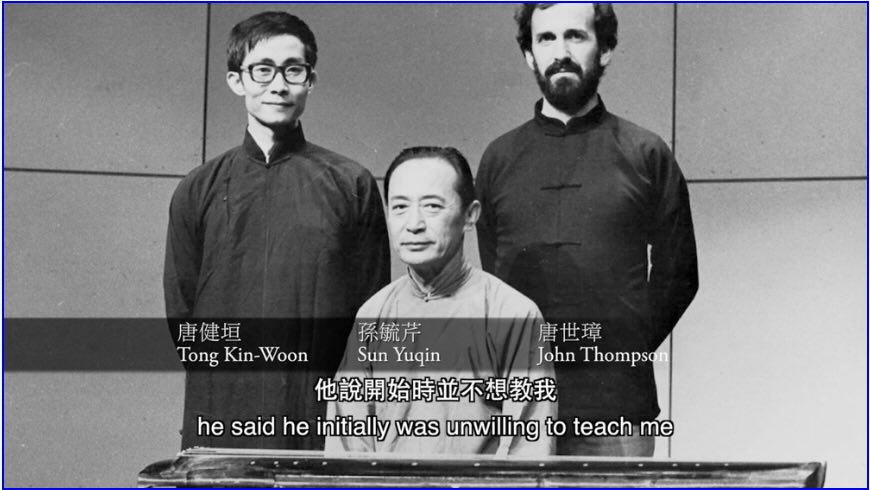
JT with Sun Yuqin

For this his best option was Taiwan, where from 1974 to 1976 he studied with Sun Yu-ch’in (1915–90); he then studied with Sun’s accomplished pupil Tong Kin-woon and the veteran Tsar Deh-yun (1905–2007) ** in Hong Kong, where he made his home. While learning from the qin renaissance in mainland China before and after the Cultural Revolution, he has forged his own path performing and researching early tablatures; setting forth from reconstructing the 64 pieces in the 1425 Shenqi mipu (6-CD compendium with 72-page booklet, 2000), he avidly sought out other early tablatures (CD Music beyond sound, 1998).

This may seem like a niche within a niche, and it’s an even more solitary pursuit, but the search for early pieces vastly expands the small repertoire handed down from master to pupil. All this work gave rise to his remarkable website.

In the PRC since the 1960s the traditional silk strings of the qin were largely replaced by metal, though they persisted in Taiwan and Hong Kong, and there are some advocates on the mainland. In keeping with his taste for historical recreation, John is a fervent advocate of silk strings (see this typically exhaustive essay).

In Hong Kong he also served as Programme Adviser for the Festival of Asian Arts from 1980 to 1998. In 2001 he married Suzanne Smith and they moved to New Jersey. Alongside his ongoing research he continues to engage with the qin scene in mainland China, where his work is respected. In 2010 he was among fourteen masters invited to take part in a festival at the Zhejiang Museum to play qin zithers from the Tang dynasty (!!!) (click here; for a 2019 festival, here). Like other wise qin players, confronted by the performance ethos of the conservatoire and the Intangible Cultural Heritage, he valiantly proclaims the literati aesthetic of self-cultivation.

* * *

While silkqin.com contains a vast range of material, John remains devoted to recreating Ming tablatures (still, I find it refreshing to hear him explaining that in such an oral tradition, there was no need for tablature!). The site contains ample material on the changing modern practice of the qin, but the social context before, during, and since Maoism (suggested in my series on the qin zither under Maoism) is not his main theme. Clearly the quietism the film evokes (cf. the spiritual quest of Bill Porter) is remote from the “red and fiery” atmosphere of the folk festivities that I frequent, but the social bond of PRC qin gatherings is also largely absent.

In the Chinese media the dominance of elite imperial culture is stark; online there is a wealth of information on the qin, whereas material for far more common traditions (such as the rituals of spirit mediums) is elusive. While John’s comments on the differences between early WAM and “Chinese music” are thoughtful, the vast variety of the latter cannot be represented by the qin; his dedicated study of one aspect of an elite tradition hardly allows room to absorb the wider context.

Bruno Nettl has wise words on “you [foreigners] will never understand our music” (The study of ethnomusicology: thirty-three discussions, ch.11). Conversely, I’m tired of the old clichés “Why should a foreigner study Chinese culture?” and “The monk from outside knows how to recite the scriptures“. Within China there are plenty of “monks to recite the scriptures”; no-one there would ever suggest that the qin is only understood by foreigners. John is indeed exceptional in his long-term in-depth study, but further afield this kind of thing is common—as is clear from the careers of other foreign scholar-performers such as Ric Emmert for Japanese noh drama, Veronica Doubleday for Afghan singing, or Nicolas Magriel for the sarangi in India. ***

In the sinosphere, whereas scholars rarely engage in participant observation for folk music, for the qin performing and scholarship tend to go hand in hand. So alongside the majority of qin players who have been content to transmit the repertoire that they learned from their teachers are some distinguished masters who unearth and recreate early historical sources—such as Zha Fuxi, Yao Bingyan, Tong Kin-woon, Bell Yung, Dai XIaolian, and Lin Chen. John’s work as performer and scholar is a particularly intense instance of this historical focus, a niche in the wider movement of Historically Informed Performance (HIP: see e.g. Richard Taruskin, John Butt).

Qin fraternities are now thriving in mainland China, Taiwan, Hong Kong, and around the world. Senior figures on the Hong Kong scene include Tsar Teh-yun, Tong Kin-woon, Lau Chor-wah, and Bell Yung. Note also the work of Georges Goormaghtigh. The qin has long been a popular choice for foreign students to study in the PRC.

My usual point: given its tiny coterie of players, the qin is vastly over-represented in studies of Chinese music! But however niche, the qin is an essential aspect of literati culture through the imperial era, along with poetry, painting and calligraphy; and John Thompson’s work is an essential resource.


* For my own Long March to Chinese music around this time, see Revolution and laowai, and under Ray Man.

** See Bell Yung, The Last of China’s literati (2008), and the 2-CD set The art of qin music (ROI 2000 / AIMP 2014).

*** Note the contrasts between these four cultures, and approaches to them: Emmert working within the “isolated preservation” (Nettl) of noh, Doubleday as participant observer of an Afghan folk tradition soon to be decimated by warfare and fundamentalism, Magriel immersed in the changing social context of sarangi, and Thompson focusing on his own historical recreations of qin music.

Folk cultures of Europe

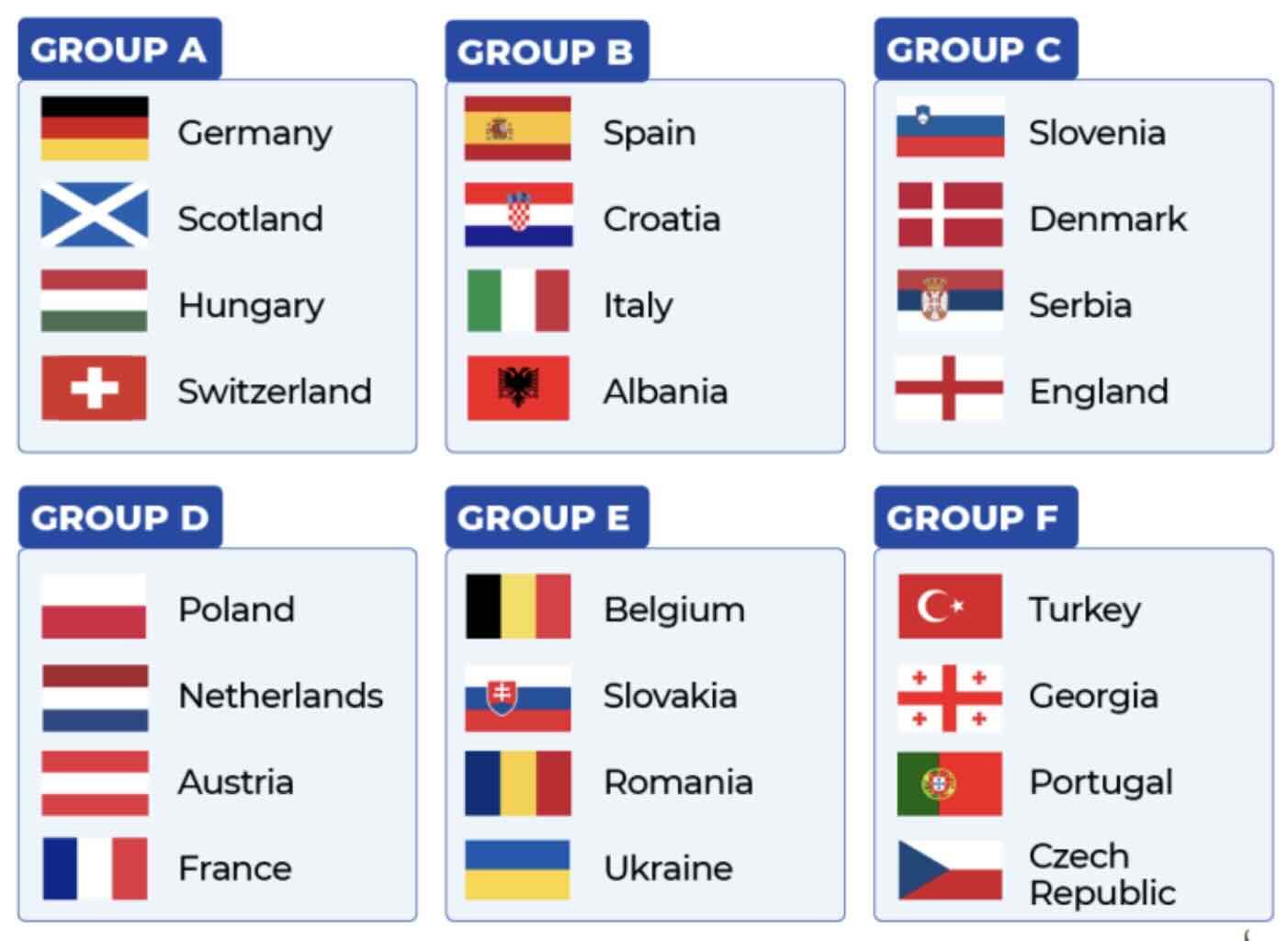
Euro teams

A major theme of this site is the rich variety of regional folk expressive cultures, in China and around the world. Quite by chance, the compelling drama of Euro 24 has provided me with a wacky perspective to celebrate the wonders of folk cultures around Europe—at a time when all seems lost amidst supermarkets and ring roads, Brexit and the dangerous idiocies of far-right politicians.

And as Barney Ronay notes,

Saka is a player you just love to see have these moments, to smile, to remind you […] that this is still at bottom a matter of play, joy, fun, and invention.

My three recent posts, all with wonderful playlists:

So we might regard Sunday’s final as a contest between the passion of flamenco and, um, Morris dancing—like so:

Southgate devises a novel wall to defend a free-kick from a youthful Spanish team.

These posts complement regional surveys such as Musical cultures of east Europe, Italy: folk musicking, Portugal: folk traditions, flamenco, fado (here and here), Irish folk, and so on. See also Bernard Lortat-Jacob at 80.

Meanwhile, A sporting medley: ritual and gender has links to other posts on football, as well as snooker, tennis (including a wonderful playlist for Emma and Leylah!), and rugby—for Morris dancing as a suitable response to the All-Black haka, click here.

Curse of the Ninth

*Latest in my Mahler series!*

Curse

Ever since the very first episode in 2014, the BBC TV comic-noir series Inside No.9 (website; wiki) has been consistently brilliant. Written by and starring Steve Pemberton and Reece Sheersmith, it features cameos from a succession of fine actors. The plot twists are ingenious, the mood sinister and enigmatic.

The penultimate episode of the ninth (and final!) series (watch here) takes its title from the Curse of the Ninth, attributed to Mahler’s fruitless efforts to trick fate. Typically macabre, it’s “an Edwardian chiller in which a talented piano-tuner is forced to confront the power of a centuries-old curse by the owners and servants of a large country house.” As the drama unfolds, we hear well-chosen excerpts from the 1st movement of Mahler 9.

Curse 2

The wiki article on the curse gives instances of composers unable to complete their 10th symphony—but also lists counterexamples of others who did manage to do so. So there.

* * *

No.9

A random selection of (nine!) other stimulating episodes from Inside No.9:

The very final episode Plodding on is ingenious…

Euro 24, the semi-finals: yet another playlist!

In celebration of folk cultures around Europe

Compiled without regard to expense or the feelings of the public

Flann O’Brien

On a roll after my Euro 24 folk playlists for the 24 teams and then for the quarter-finals, here’s another niche selection of funky tracks for the semi-finals! Having covered some bagpipe traditions, I might have gone on to highlight shawms (suitably loud, and widespread), but this playlist (partly derived from previous posts, with some new material) is based on singing and fiddling.

Whatever your feelings about football, just in case you suppose this exercise is a frivolous diversion from weightier matters, it makes an instructive and inspiring reminder of the diversity of European cultures!

* * *

Screenshot

For Spain, for all its wealth of regional styles (e.g. Songs of Valencia and Festive soundscapes of the Rioja), one can never have enough flamenco (and the documentary series Rito y geografïa del cante is not to be missed!)—here are a few classics from my series.

* * *

PraviAs to France, even I might hesitate to try out Boulez or Messiaen on a football crowd; Un homme et une femme and Comment te dire adieu are tempting, but here I suggest

If it’s folk traditions you’re after (Yeah right—Ed.), then how about

  • the world of fiddlers around the Dauphiné in the southeastern Hautes-Alpes, accomoanying the rigodon dance—here’s the CD France “Rigodon sauvage”—Alpes du Sud: Dauphiné (Ocora, 1995): *

* * *

England penalties

England: more singing with fiddles (from this post on the doyens of the English folk scene)—

  • here’s Eliza Carthy and the Ratcatchers, with John Boden and John Spiers of Bellowhead:

Barney Ronay:

Saka is a player you just love to see have these moments, to smile, to remind you […] that this is still at bottom a matter of play, joy, fun, and invention.

* * *

Turkey fans

Now don’t get me wrong, I love the Dutch; I should really make an effort with their folk cultures, although recordings (mainly from Friesland) such as Jaap Kunst‘s 1956 LP seem less than enthralling (playlist here, or this clip from a 1963 disc, with images). I’m all for doorstep anthropology, but one can imagine Kunst finding Indonesia a more stimulating fieldsite, and I can see why Antoinet Schimmelpennick set off for China. Still, personal taste isn’t really the brief of the ethnographer.

All the same, in my self-appointed capacity as referee I’m going to overrule the Netherlands’ second-half goals and pretend Turkey won—because they have been the stars of the tournament, and it feels like they’ve been playing at home. So first,

Another reason for me to bend the rules is because Turkey has some amazing music. Whereas modern France is multicultural, my other choice for Turkey reflects a multicultural past:

Well I guess that’s about it for tonght folks! Now read on for those Alpine fiddlers…


* Archive recordings are heard on the 1978 LP Violoneux et chanteurs traditionnels du Dauphiné—cf. Le violon traditionel en France (Silex, 1994, with notes by Patrick Mazellier).

Violon traditionel CD cover

The tracks from 1939, on the eve of war, were recorded by Roger Dévigne (1885–1965):

The 26th—telegram from the Vice-Chancellor: “Come back immediately”. Mr Jouan Nicola arrived at the same time as the telegram: “I’m here to help you dismantle your recording equipment” he told me. From outside came the continuous rumble of coaches leaving packed with soldiers called up. Off to the station. Long queues of soldiers called up from the mountains, each with his cardboard suitcase…

Additional items were recorded from 1975 to 1977, featuring the veteran fiddlers Emile “Milou” Escalle (1900–1987), Augustin Istier (1906–89), and Camille Roussin-Bouchard (1909–90).

The more fanatical football supporter may wish to delve into the fine site violoneux.fr

violon map

Detail of map showing distribution of fiddle traditions in France!

For a less voluminous introduction to regional styles, click here—citing an 1821 decree:

It is forbidden to all fiddlers or other instruments forming any gathering around [feasts], they could become responsible for the evil that would result and need to be arrested by order of the Mayor.

Such sources reflect on the long decline of the traditional context of social dance.

Rigodon 1908Not so much an impromptu pre-match party as
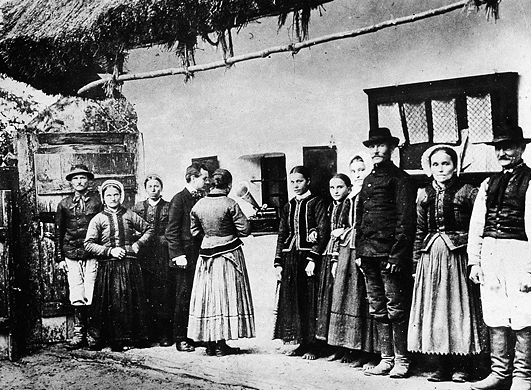
a rigodon at Saint-Pierre-de-Méarotz, Isère, July 1908. Source
(cf. the excellent title Le rigodon n’est pas un fromage!).

The purgatory of the tennis circuit

tennisConor Niland after losing to Adrian Mannarino at Wimbledon 2011.
Ben Stansall/AFP/Getty Images.

The life of the concert soloist may seem glamorous, though the routine of airports, hotels, concert halls, and receptions must wear thin. Still, it contrasts with that of rank-and-file orchestral musos (cf. Mozart in the jungle, and Ecstasy and drudge). Apart from The Money, I note the irony of the soloist being condemned to churning out the same three or four concertos all their lives while the orchestral musos are constantly playing a variety of wonderful music (Mahler—you know that’s who I meant).

LMS

By the same token, following Vincent Goossaert’s search for “ordinary Daoists” (theme of his The Taoists of Peking, 1800-1949: a social history of urban clerics), it’s not all about the Du Guangtings and Chen Rongshengs, or about the elite mystical sages of yore. Hence my own search for household Daoist groups like the Li family.

Nor is tennis all about the superstars, the Federers and Świąteks, with their ritzy entourages. An interesting Guardian Long Read by Connor Niland, “I’m good, I promise: the loneliness of the low-ranking tennis player”, describes life at the bottom of the top. Formerly No.1 Irish player, he tells a sad story.

He outlines the three tiers of men’s professional tennis: the ATP Tour for the top 100 male tennis players in the world, the Challenger Tour, mainly by players ranked between 100 and 300—and the Futures tour, “tennis’s vast netherworld of more than 2,000 true prospects and hopeless dreamers”, which

sometimes felt like a circle of hell, but in practical terms it’s better understood as purgatory: a liminal space that exists only to be got out of as quickly as possible.

As he explains,

Surviving on the Futures and Challenger tournaments isn’t just about being good at tennis. It’s about being able to cope with the strange bedfellows of regular boredom and constant uncertainty. Not many succeed.

He felt trapped:

I phoned Mum from the airport in Geneva, telling her I was tired and would skip Edinburgh and fly home instead. She wasn’t having that. “This is your job now, Conor,” she said. “You can’t just not turn up because you’re tired.” I remembered my friend and one-time tennis partner Pat Briaud’s words: “Your parents don’t mess around.” I turned up and made the semi-final, losing a feisty two-and-a-half-hour match to Britain’s Jamie Baker. It was my 24th match in five weeks. Exhausted, I collected my prize money: $480, before 20% tax.

By contrast with the constant media exposure the stars have to endure, loneliness and isolation are the fate of the rank-and-file.

I made virtually no lasting friendships on tour through my seven years, despite coming across hundreds of players my own age living the same life as my own.

And he describes the difficulty of finding a practice partner. At least the life of orchestral musos is leavened by an embattled camaraderie—and they share a bond in maestro-baiting and deviant behaviour.

I almost never went sightseeing on a day off. That was partly to conserve energy, partly because I had nobody to go with. And in many of the one-horse towns that hosted Futures events, there weren’t any sights to see. […]

I would return to Ireland from three-week trips to these exotic places with no notable stories or experiences. “How was Morocco?” I would be asked. “Fine,” I would say, with nothing else to add. […]

The true unfortunates, though, were the ones who were talented enough to rationally hope to advance. These were people who grew up as the best tennis players in their country, but were stuck between 300 and 600 in the world, not quite contending for the Challenger Tour nor the qualifiers at grand slams, but winning just often enough to keep their tennis dream faintly alive. A Futures tournament referee in the US became infamous for his straight-talking to 28-year-old players: “C’mon man, what are you still doing here?” He was straying out of his lane, but his intentions were good. And he was usually right.

Niland ends with a depressing account of a fruitless Challenger event in Uzbekistan. It all sounds a bit like doing a Messiah in Scunthorpe for a jolly good tea. Whether in music, religion, or sport, ethnographic perspectives like this are always valuable.

Under Sporting medley: ritual and gender I list several posts on tennis.

Euro 24: the last eight bagpipes standing

Another playlist in a series that football fans didn’t know they needed

Euro 24 list

Now that the twenty-four teams of Euro 24 have been reduced to eight, I hear you clamouring for a more focused playlist of bagpipe music to represent them (Yes, I am getting my hearing tested).

Among many sources on the history and distribution of bagpipes, the Essential Vermeer website has instructive material (here and here); and I set forth again from this list. As shown in my previous post, the distribution of instruments rarely aligns with either current or past national boundaries.

SpainGrooving to the gaita. *Coimbra gaita

Starting with

how about gaita from Coimbra (the image by Armando Leça shows an old handmade bagpipe from Coimbra, late 1930s—who knows if such a player inspired Portugal in their 1930 victory over France?!)

—and Galicia:

Guler“Just dig that funky tulum

For a related “tapeworm word”, see under Some German mouthfuls!

Around north Europe, with online clips dominated by medieval revivals, living folk traditions are harder to find.

England goal

  • England—here’s Kathryn Tickell on Northumbrian smallpipes:
  • FranceBreton pipers:

As to

  • Switzerland (not Italy—whence I await more “Caporetto” headlines, to follow those for the 2002 and 2018 World Cup defeats). **
  • Germany
  • The Netherlands (though Romania might have been more fruitful),

referring back to the Essential Vermeer site, there’s some fine material on peasant bagpipes as depicted by Peter Brueghel the Elder and Jan Steen; and we can seek further for modern vestiges under Dudelsack, SackpfeifeDoedelzak, and so on.

Brueghel bagpipes

There—just what you need to warm up for the quarter-finals eh…

More football posts under A sporting medley: ritual and gender.


* Sorry to go on, but this comment in the Guardian live-feed reminded me of my own football dream:

The first time Lamine Yamal joined the Spain squad, they left his boots behind. His and everyone else’s too. When the selección touched down in Tbilisi to face Georgia in September 2023, the trunk carrying part of their kit was still sitting at Barajas, forcing them to complete the evening session at the Boris Paichadze stadium in trainers, unable to strike the ball. The following night, they scored seven. On his debut, the Barcelona winger got the last of them, aged 16 years and 57 days, and the national team got a new beginning.

JRM** Before England’s Great Escape from Slovakia, I was composing our own version of Caporetto, inspired by that popular classic from the Minister for the 18th Century:

“the greatest vassalage since King John paid homage to Phillip II at Le Goulet in 1200”

Magnificently 🍾🍾🍾 , the Haunted Pencil is now Toast, or Ashes—as the sun came up, he crumbled into dust…

A bijou mosque in Kuzguncuk

I’ve written several posts on the picturesque Istanbul mahalle of Kuzguncuk on the Asian shore of the Bosphorus—notably on Nostalgia for cosmopolitanism, Epiphany, Greek liturgy, The 1955 riots, The kiosk in Turkey and Europe, Köçek in Kuzguncuk, and Blindman Ali.

Since at least the 19th century Kuzguncuk was mainly populated by Armenians, Jews, and Greeks. By 1933, sources suggest that the population was still 90% non-Muslim. As Amy Mills notes, the present mosque, opposite the iskele ferry and next to the 1835 Armenian church, was only built in 1952, “the first moment in the neighbourhood’s long history when there were enough Muslim Kuzguncuklus to necessitate a local, regular, community gathering space.” It is now blessed with the splendid imam Aydin Hoca (see under The call to prayer).

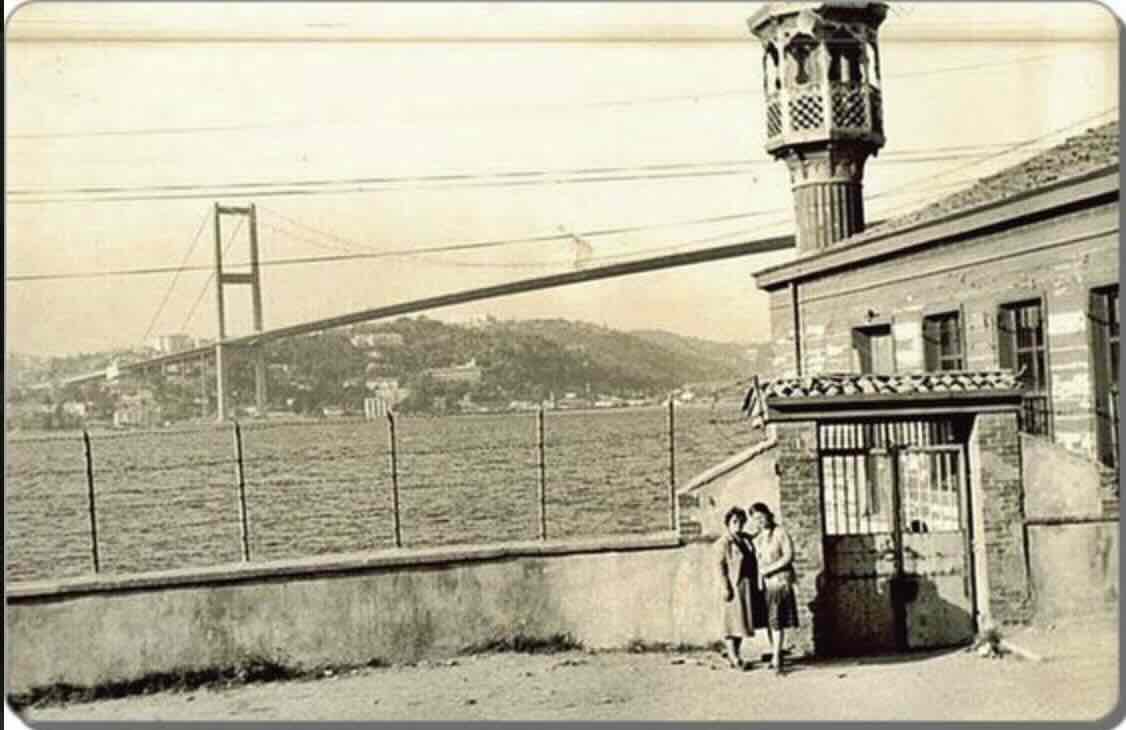
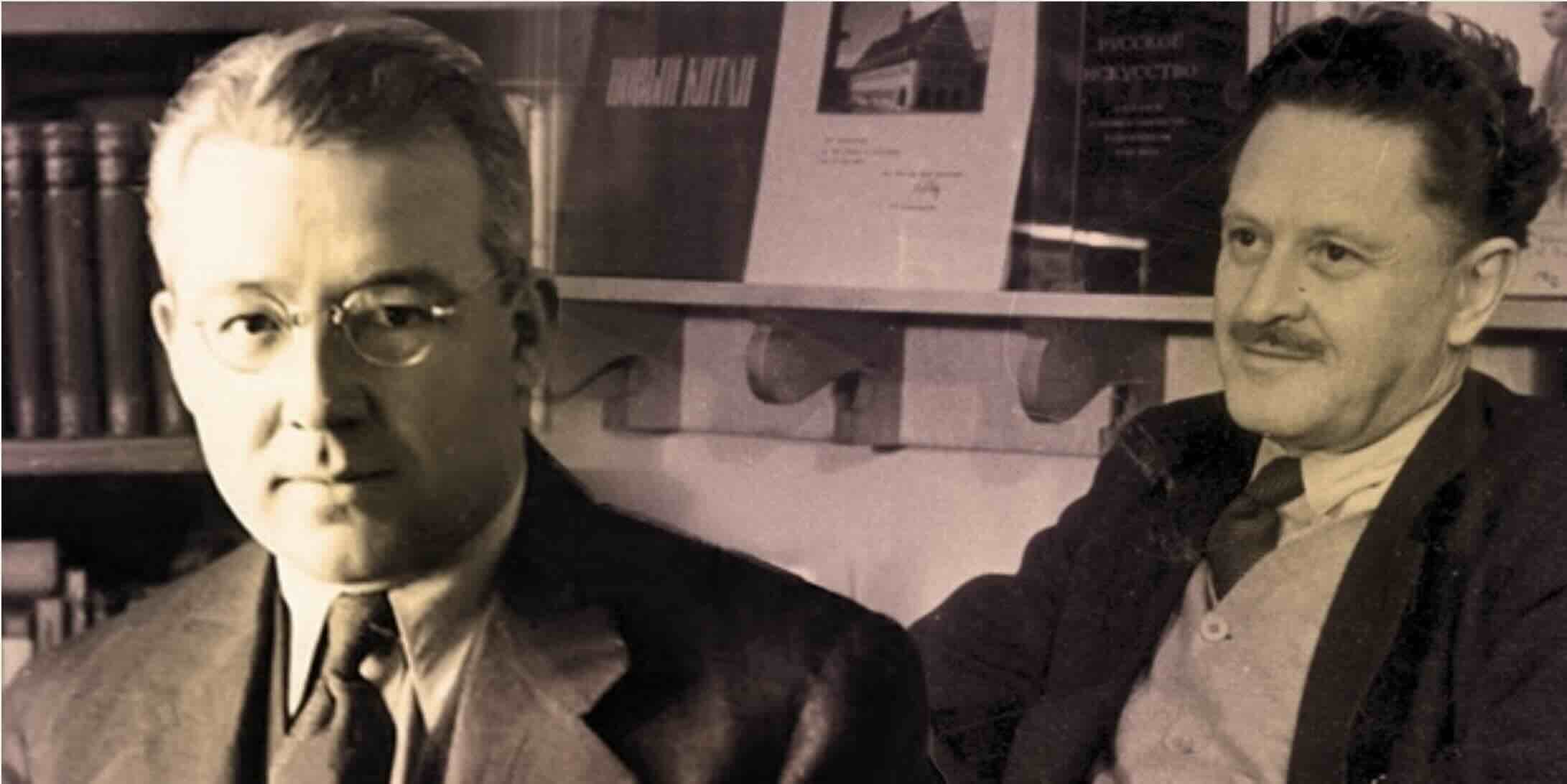
MinaretIt’s taken me all this time to visit the bijou rectangular wooden mosque further up the coast towards the bridge—just below the mansion of Sultan Abdülhamid’s cultured confidant Cemil Molla (1864–1941), who sometimes served as imam there, and just past the yalı waterside residence of Sare Hanım (1914–2000), aunt of left-wing poet Nâzım Hikmet (see here).

Built in 1860 by Üryanizade Ahmet Esat Efendi, the mosque was allegedly completed in forty days (see e.g. here). It has a wooden pulpit and preaching platform, and a modest wooden minaret with a single balcony; it has its own boathouse.

Left, 1946; right, 1973—among old and recent images here.

After restoration work started in 2013, the mosque was re-opened for worship in 2017, making a place of great tranquillity, and a reminder of a time when Muslims were a small minority in Kuzguncuk.

mosque nd

Undated.

Further up the coast in Kanlıca, in the square by the ferry, is the İskender Pasha Mosque, where we heard the noon ezan from a riverside café on my first visit in 2021. Not quite so miniature, but still on a human scale, it was built in 1559–60, designed by the great architect (and former Janissary) Mimar Sinan.

Kanlica

All this by way of reflecting on the art of the miniature—by contrast with the grandiose projects of the Ottoman sultans that I churlishly avoid. In rather the same way, in China I’ve never visited the Great Wall, but in the countryside humble little “public buildings” are decked out to become the heart of the ritual life of the community.

SSZ xihui 1996
3rd-moon festival for female deity Houtu, Shenshizhuang, 1996.

See also under West/Central Asia: a roundup.

Voice of Baceprot

Despite Delighting in All Manifestations of the Terpsichorean muse, I need hardly tell you that Glastonbury is a mystery to me. But to follow We are Lady Parts, I learn of Voice of Baceprot (VoB). An Indonesian all-female metal trio from rural Garut, West Java, they sing in English, Sundanese, and Indonesian (website; wiki; useful survey).

VoB

Making headlines since 2017, their 2018 single School revolution (lyrics) was remixed on EP in 2022. From VoB’s YouTube channel, their 2023 album Retas (Guardian interview) includes tracks like What’s the Holy (Nobel) today?, God, allow me (please) to play music, and [NOT] PUBLIC PROPERTY. Here’s the playlist:

Warming up for Glastonbury (where they are understandably concerned about the weather and the food…), VoB played in London at Downstairs at the Dome—but it was sold out, so I wasn’t distracted from Euro 24—indeed, I would have felt like a tarantula on a slice of angel food cake, in Raymond Chandler‘s fine simile.

This makes quite a change from Éva Gauthier‘s genteel promotion of gamelan. Note also my roundups on punk (including Croatia, Spain, Iran, Beijing, and the GDR), gender, and West/Central Asia—Like I’d Know…

Folk ritual of Tianjin, and its soundscapes

The Anthology provides another gateway

Like Beijing nearby, the municipality of Tianjin encompasses a large region, much of it still rural. On ritual and its soundscapes there, my previous articles include

So at last I’ve been trying to digest the relevant volumes on instrumental music of the great Anthology of folk music of the Chinese peoples:

  • Zhongguo minzu minjian qiyuequ jicheng, Tianjin juan 中国民间器乐曲集成, 天津卷 (2008) (2 vols; 1,475 pages),

which as ever contain substantial material on ritual traditions. To remind you of my introduction to a similar recent survey for Fujian province in southeast China,

Ritual pervades all genres of folk expressive culture: in the Anthology, it is a major theme of the volumes for folk-song, narrative-singing, opera, and dance. In the instrumental music volumes, even genres that lack explicit liturgical content are also invariably performed for ceremonial occasions—but a further reason to consult them is that the specific rubric of “religious music” has been consigned there. I’ve described the flaws of the Anthology project in my

  • “Reading between the lines: reflections on the massive Anthology of folk music of the Chinese peoples”, Ethnomusicology 47.3 (2003), pp.287–337.

Apart from the Anthology‘s valuable Monographs for opera and narrative-singing and brief textual introductions to genres, its volumes consist mainly of transcriptions, of limited value without available recordings. Conceptually its classifications are rudimentary, but it opens up a world of local cultures.

Tianjin map

It’s important to grasp the geography of the large regions covered by such surveys (cf. Layers of fieldwork). At the time of compilation the greater Tianjin municipality comprised four suburban areas (east, west, south, north), five counties (Wuqing, Jinghai, Ninghe, Baodi, * Jixian), and three districts (Tanggu, Hangu, Dagang), all of which had distinctive local traditions.

Useful as always are sketches of some leading groups (pp.1327–39) and brief biographies (pp.1340–56), containing promising leads to further ritual associations and sects.

Volume 1 is entirely devoted to “drumming and blowing” (guchui yue 鼓吹乐). Here the rubric of “Songs-for-winds associations” (chuige hui 吹歌会) is misleading (see under Ritual groups of Xushui), compounded by the sub-categories of leading instrument (guanzi, suona, sheng, dizi). While many musicians are versatile on wind instruments, this masks the important distinction between occupational shawm bands and devotional ritual associations led by guanzi. However, there is some valuable historical information bearing on the “classical” style of amateur ritual groups (often known as “music associations” yinyuehui) serving ritual, such as the Tongshanhui 同善会 of Huanghuadian in Wuqing county (p.1336; brief mention here, under “Further leads”). Such groups were to become my main focus (see Menu, under Hebei and Gaoluo).

Xuande naoboNao and bo cymbals of the Tianxing dharma-drumming association,
inscribed Xuande reign, 5th year (1429). Besides museums,
folk performing groups preserve important evidence for
the material culture of imperial China (see China’s hidden century).

Shawm bands always occupy a substantial part of the Anthology coverage. Here the summary introduces traditions for all the municipality’s regions, notably in the north around Baodi and Jixian (pp.36–8, 41–2; groups pp.1338–9, biographies p.1343–4, 1355).

Tianjin Dayue

The “great music” of Tianjin.

Still under the heading of “drumming and blowing”, a separate rubric introduces the imposing “great music” (dayue 大乐, though here I seem to recall it should be pronounced daiyue) of the Tianjin region. These shawm bands, derived from the Qing court (cf. longchui and Pingtan paizhi in Fujian), were transmitted among the folk through the Republican era until the 1950s, mainly in urban districts but also in the suburbs; but later they became largely obsolete, so the Anthology fieldwork was largely a “salvage” project.

The impressive introduction (pp.599–610) refers to documents from the late Qing, including material on the “imperial assembly” (huanghui 皇会), supplementing that of the dharma-drumming associations), and details the use of the genre at weddings and funerals. Besides recordings made for the Anthology in the 1980s, the appetising transcriptions (pp.611–78) utilise early discs that I’m keen to hear—Pathé (Baidai) from 1908 and the 1920s, Shengli 胜利 from the 1930s. Cultural cadres recorded senior artists in the 1950s and even “in the mid-70s”. By the 1980s, surviving musicians were recorded for the Anthology, and took part in the Boxer movie Shenbian 神鞭 (Holy whip, 1986).

Tianjin shifanShifan band, 1930s.

Volume 2 opens with an introduction to the mixed ensemble shifan 十番 (text pp.679–701, transcriptions pp.702–875; further material on the late Qing societies Siru she 四如社 and Jiya she 集雅社 on pp.1327–8). Related to the better-known genres of south China, notably Jiangnan, shifan bands are also found in a few northern regions including Hebei (see my Folk music of China, pp.206–8). In Tianjin, where shifan was part of the thriving Kunqu scene before Liberation, the major figure in documenting the tradition was Liu Chuqing 刘楚青 (1909–99) (pp.1341–2), who used his youthful immersion in the culture to compile a major volume in 1987.

Notable among percussion ensembles (pp.876–1138) are the dharma-drumming associations (fagu hui 法鼓会), which my mentors at the Music Research Institute (MRI) in Beijing were excited to discover in 1986 and 1987 while attending major folk music festivals in Tianjin. These groups commonly subsumed a shengguan melodic ensemble—from the 1986 festival, listen to the MRI’s audio recording of the Pudong “music and dharma-drumming association” in Nanhe township, Xiqing district 西青南河镇普东音乐法鼓会. These events led us to the fieldwork of local scholars—notably Guo Zhongping 郭忠萍, author of the valuable overview in the Anthology (pp.876–97; transcriptions pp.898–1009; see also groups pp.1328–34 and biographies pp.1347, 1349), based on her more detailed early publication Fagu yishu chutan (1991). 

This section also introduces the percussion of “entertainment associations” (huahui 花会): “flying cymbals” (feicha 飞镲), stilt-walking (gaoqiao 高跷), dragon lanterns (longdeng 龙灯), and flower drum (huagu 花鼓).

“Religious music”
As always, despite my criticism of the term, this is a substantial category in the Anthology, subsuming some major traditions of Buddhist and Daoist ritual.

Tianjin templesJinmen baojia tu shuo (1846).

For major insiders’ accounts by temple clerics Zhang Xiuhua and Li Ciyou before and after the 1949 “Liberation”, see n.1 here, leading to Appendix 1 of my book In search of the folk Daoists of north China and the research of Vincent Goossaert.

Tianjin Daoists
Daoist band, Tianjin. Tell us more…

For “Buddhist music” (pp.1141–52) and “Daoist music” (pp.1274–9) the introductions can only serve as a starting point for more sophisticated fieldwork—like the transcriptions (pp.1153–1273 and 1280–1326 respectively). There are slim pickings here—although the section on Daoist temple music provides a remarkable vignette from 1972 (!) on a Pingju opera musician’s visit to Zhang Xiupei 张修培, elderly (former?) abbot of the Niangniang gong temple, to notate his singing for the purposes of “new creation”. This section also introduces Li Zhiyuan 李智远 (1894–1987) of the Lüzu tang and Tianhou gong temples; though laicized after “Liberation”, from 1985 he was able to support the renovation of the Lüzu tang. More promising are the rural areas, where there are always household Daoist bands to explore. The transcriptions end with three items of vocal liturgy from the Western suburbs (pp.1313–26): the popular “Twenty-four Pious Ones” (Ershisi xiao 二十四孝), the “Song of the Skeleton” (cf. the Li family band in north Shanxi), and Yangzhi jingshui 杨枝净水.

Xiangta laohui JCI

The accounts of many folk groups offer glimpses of the sectarian connection. In Yangliuqing township (known for its nianhua papercuts), the Incense Pagoda Old Association (Xiangta laohui 香塔老会, above) of 14th Street (which we visited all too briefly in 1989) had scriptures including Hunyuan Hongyang baodeng 混元弘陽寶燈 and Linfan jing 临凡經. Tracing their transmission back eleven generations to the Wanli era (1572–1620) of the Ming dynasty, they have remained active exceot for the hiatus of the Cultural Revolution. In the western suburbs the Tianxing dharma-drumming association (pp.1331–2) belonged to the Tiandimen sect, and groups in Dagang district (p.33) also derive from Tiandimen and Taishangmen sects.

For all its flaws, the Anthology remains a valuable resource; but as ever, the groups introduced there call for fieldwork from scholars of folk religion as well as musicologists.


* Rural Baodi is known to Beijing musicologists and other intellectuals for its “7th May Cadre Schools” (Wuqi ganxiao 五七干校), wretched sites of exile during the Cultural Revolution—for scholars of the Music Research Institute at Tuanbowa (Jinghai), scroll down here.

A folk playlist for Euro 2024!

*First in a series on folk cultures of Europe!*

Euro teams

Maybe it’s just me, but just as everything else in Europe is falling apart, Euro 2024 seems an exceptionally exciting showcase for football, with a sense of passion accompanying some great matches and brilliant goals.

All—well, almost all—the twenty-four teams in the six groups have inspiring regional traditions of folk music, which (let’s face it) may not be uppermost in the thoughts of most fans. So before we bid farewell to some of the teams, here’s a niche alternative playlist, largely compiled from other posts on this blog.

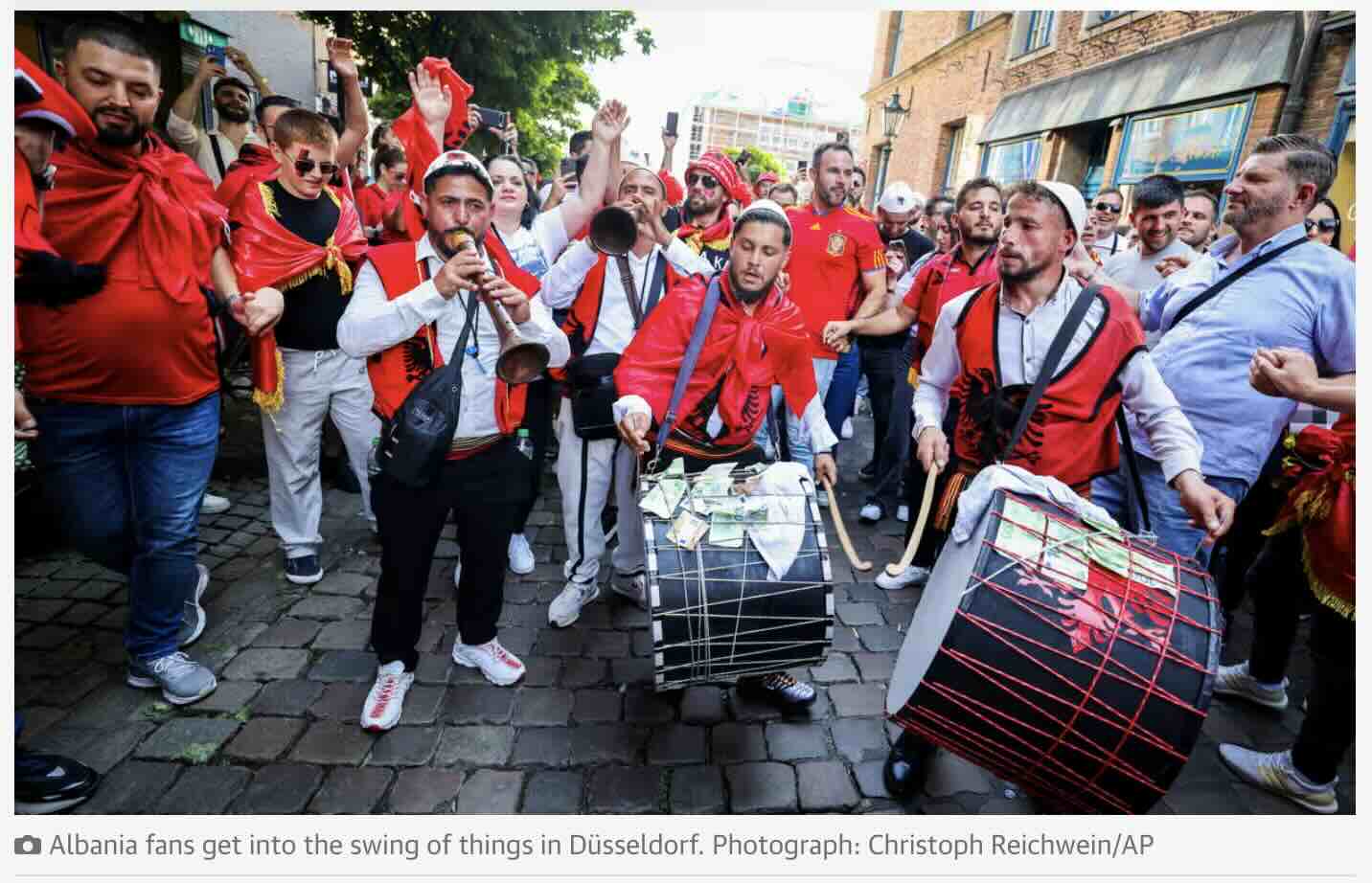
Albania Euro 24Albanian zurna shawms with dauli drums, a widespread festive combo.
Easy to sample, and exhilarating, are the traditions of east Europe and the Balkans:

  • Albania (Shqipëria!)
  • Croatia (Hrvatska!)
  • Serbia (Srbija)
  • Hungary (Magyarország!)
  • Romania (disappointly, România)

With long histories of discord, national allegiances often remain fractious—chronic enmities are still exposed in the fans’ behaviour at the Euros (see e.g. here). Boundaries having changed over the history of recording, here (based on this article) I will merely offer a few tracks that charm the ear, to encourage us to pursue the soundscape of the whole region:

Bartok 1907
Béla Bartók recording Slovak peasants in 1907.

Other boundaries may be sensitive too:

Note also Resisting fakelore under state socialism in former Czechoslovakia and Poland.

The playlists for other nations pose a different kind of challenge:

  • The Netherlands: by extension, how about this Batak hymn from Sumatra, from the ear-scouring Frozen brass CDs!
  • Belgium: this track comes from the Ocora CD Belgique: ballades, danses et chansons de Flandre et Wallonie (1981)
  • France: pursuing my fetish for shawms (see above), here’s the Bréton bombarde, with accordion
  • England: Morris dancing might not spring to the mind of some fans…
  • Scotland: though perilously close to the “tartan and shortbread” image, pibroch is not to be sneezed at—besides the ubiquitous fiddle, the bagpipe (not so much a dark horse as a black sheep?) is among other instruments commonly played in most nations under consideration—see this list.

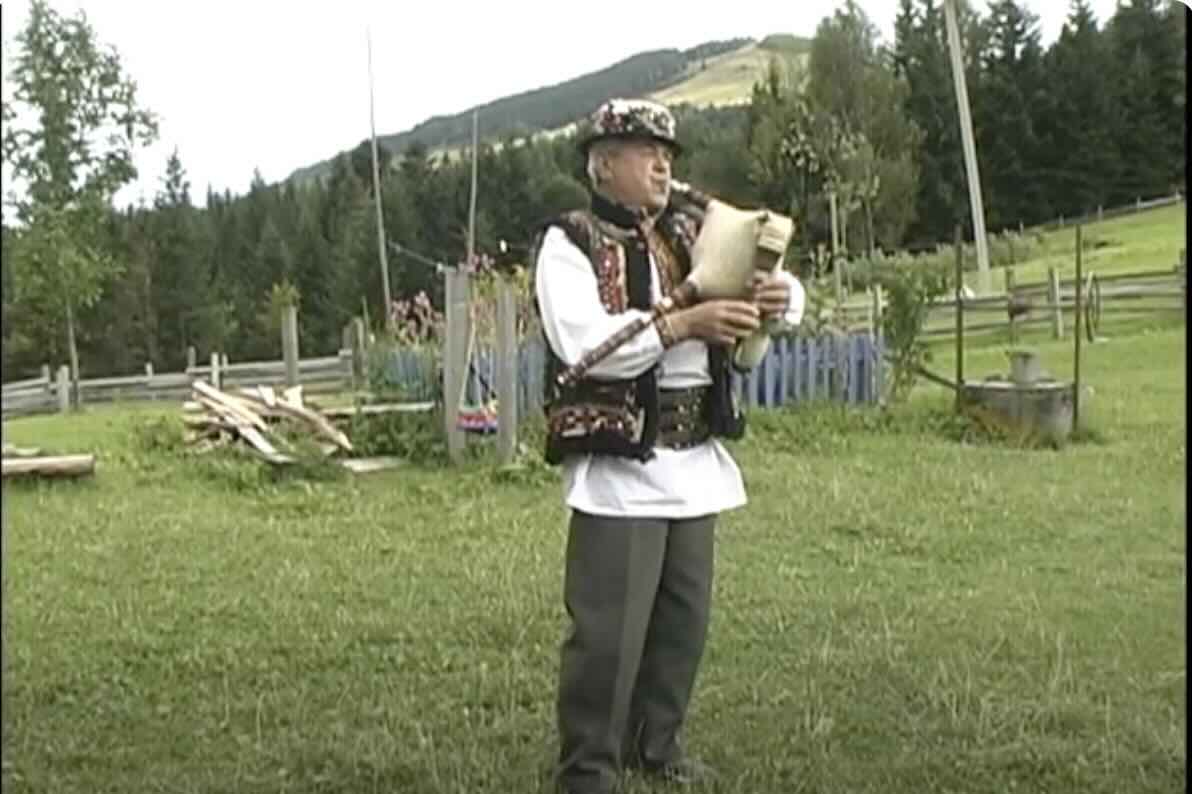
Ukraine bagpipeUkraine: Mykhailo Tafiychuk on volynka bagpipe of the Hutsuls.
Several posts on football can be found under A sporting medley: ritual and gender, including my wonderful playlist for Emma and Leylah.

More Chinese crime fiction

My series on crime- and spy-fiction (ranging from The big sleep, Bosch, and Leaphorn and Chee to Weimar Berlin—Stasi—Russia—Hungary) introduces the novels of Qiu Xiaolong, set in Shanghai. Now I’ve been spellbound by two true crime novels by Paul French, his purple prose immensely readable, interweaving a crash course on modern Chinese history.

City of Devils

  • City of devils: a Shanghai noir (2018).

Based on extensive archival research, it’s

the story of “Lucky” Jack Riley, the Slot King of Shanghai, and “Dapper” Joe Farren, owner of the greatest clubs and casinos. It tells of their escape from American prisons and Vienna’s ghetto, their rise to power, and the trail of destruction they left in their wake.

The backdrop is looming war, the spectre of the invading Japanese, bombings and massacres, gangster king Du Yuesheng, and the dreaded Kempeitai with their torture chambers at 76 Jessfield Road. As French explains,

I’m drawn to the flotsam and jetsam, the impoverished emigrés and stranded refugees, transient ne’er-do-wells and washed-up chancers, con men and female grifters. I seek out those foreigners who came to the China Coast and preferred to exist in the city’s criminal milieu, to disappear into its laneways and backstreets. They’re not distinguished or heroic. Invariably they’re liars and cheats. They’re rarely anything close to good, and all are terribly flawed, often living in Shanghai because they were one step ahead of the law and, invraibly, other options were few and far between. But many of them had a certain style, panache; their own particular flair. […]

Shanghai between the two world wars was a home to those with nowhere else to go and no-one to take them in. Its International Settlement, French Concession, and Badlands district admitted the paperless, the refugee, the fleeing; those who sought adventure far from the Great Depression and poverty; the desperate who sought sanctuary from fascism and communism; those who sought to build criminal empires; and those who wished to forget.

The subaltern underbelly of society (cf. the films of Xu Tong, or Jamyang Norbu’s factual stories of old Lhasa) is a major theme both of noir and popular music studies (blues, flamenco, fado, rebetika, tango). City of devils makes a salient counterpoint to the romantic nostalgia for the Shanghai jazz age, Zhou Xuan, and the early film industry (see e.g. Andrew Jones, Yellow Music, and this site, as well as here). There are musical cameos from “Slick” Jack Carter and his Serenaders, Valaida Snow (singing Someone to watch over me in 1926), Lilly Flohr, and notably Buck Clayton and the Harlem Gentlemen. French’s vivid accounts never reduce this world of sex and drugs, gambling and dancing—and violence—to mere glamour; the motley expat community was an enclave surrounded by poverty, starvation, and genocide (“the neon-lit city feeds off its host of four hundred million peasants barely surviving in China’s fetid hinterlands and laughs at their degradation”).

The men and women who’d come to Shanghai—from Mexico City, the Marseille Panier, London’s East End, the slums of Lisbon, the American Midwest, New York’s Lower East Side, across the Russian steppes from Bolshevism, the Jewish ghetto of Vienna and all points in between—create a gangsters’ paradise, sanctioned by the Japanese Imperial Army…

French ends with a sobering afterword tracing the fates of the characters—chancers, collaborators, war criminals; figures such as Sasha Vertinsky (back in the USSR) and dancer-turned-poet Larissa Andersen (most long-lived, in France).

Midnight in Peking

Paul French’s earlier book,

  • Midnight in Peking: the murder that haunted the last days of old China (2012)

is just as vividly recounted, but more subdued. Set around the Legation Quarter and the Badlands against the backdrop of the Japanese invasion of north China and rumours of “fox spirits”, French reopens the gruesome, unsolved case of the murder of Pamela Werner, teenage daughter of an eccentric British consul, on the basis of the father’s relentless search for the culprits amidst official stonewalling. Among the cast are Edgar Snow and his wife Helen. Again French updates us on the later stories of the characters.

Both books are gripping—tales of two cities with their utterly different landscapes: that of Shanghai naturally full of glamour and sleaze amidst all the degradation, while that of Peking, an unresolved mystery, is both more sombre and more personal:

From the start, I thought it important that Pamela Werner not be forgotten, and that some sort of justice, however belated, be awarded her.

Seemingly utterly removed from all this were the regional microcosms of the qin zither; the silk-and-bamboo clubs and Daoist rituals of Shanghai (see e.g. Beyond silk-and-bamboo), as well as the “classical” Western culture of Fu Ts’ong and his father Fu Lei (Richard Kraus, Pianos and politics in China); and the drum-singing clubs and temple fairs of Beijing. Yet these too were irrevocably scarred by warfare and politics.

Now I really must read French’s Destination Shanghai and Destination Peking.

* * *

Night Heron

Moving on to contemporary China,

  • Adam Brookes, Night heron (2014)

(also well reviewed by Paul French) is an enthralling novel on espionage, its confused protagonist “a prisoner on the run with secrets the world will kill for”.

A BBC veteran, Brookes opens with an escape from a Qinghai labour camp (cf. links under Gansu). The suitably labyrinthine plot is full of convincing detail on a rapidly changing China. With an aside on British journalist Philip Mangan’s attempt to investigate the suppression of a religious cult in Yunnan, the dénouement takes place in coastal Fujian province. Much of the action takes place in an austere, enigmatic Beijing, with one tense scene at the Zhihua temple—which is quite enough to recommend any book to me.

The male dominance of public performing

heying

Members and helpers of the South Gaoluo ritual assocation, 1995.

This group photo, taken on the final day of the New Year’s rituals, is deeply nostalgic for me—but it makes a stark reminder of the male dominance of public performing in China.

Women in public performance:
left, Herat, 1970s
right, spirit medium, Houshan 1993.

Gender is one of the main themes in ethnomusicology (as in all Walks of Life…)—see a very basic sample of readings under this post in my flamenco series. I introduced gender issues in expressive culture and ritual in China here, including shawm bands, opera troupes, itinerant bards, and spirit mediums. The old public/domestic division of labour serves as a simple framework.

Two astounding—yet male—performances:
left, Bernstein with the LSO, 1973
right, Kleiber with the Vienna Phil, 1991.

Much has been written on gender in the rarefied echelons of WAM: whereas female soloists have long been common, the male monopoly of conducting has only been broken in recent years. And as to the orchestral musicians…

Maybe we take this for granted in old videos, as I guess we did at the time, but now I’m shocked when I watch the amazing films of Bernstein’s Mahler. When he performed Mahler 2 with the LSO in 1973, the orchestra had only two women (the harpists, of course) among 102 players. By the time they recorded excerpts for Maestro around 2022, despite going to such lengths to achieve historical authenticity, they inexplicably used the players of today’s LSO, 45% of whom are women. The New York Phil admitted its first female section player in 1966; by 1992 it included 29 women.

The Berlin Phil began recruiting the occasional woman in 1982, but by 2003 there were only 14 female members out of 120 positions. The Vienna Phil made a token effort from 1997, but by 2013 still had only 6 women, and 17% by 2024. (For the disturbing Nazi histories of these two orchestras, click here.)

See also under Gender: a roundup.

Yet more drumming

Mastery of the drum is achieved when the drummer no longer needs the drum
Going beyond mastery is when the drum no longer needs the drummer.

Rowan Atkinson has been credited, perhaps spuriously, with this kōan-esque aphorism, but it’s clearly inspired by his brilliant sketch, c1992—here with a transcription, to boot:

However they managed to synchronise the audio, it must have taken major preparation.

For more on Daoist non-action, see here (Walt Disney!) and here (Castiglione!).

Just as astounding is Fred Astaire (Damsel in distress, 1937), albeit with a real drum-kit:

From air drumming to air writing, how about writing Daoist talismans in the air.

For other posts on drumming, see Doof Doof, Tambourin chinois, the opening of the Beethoven violin concerto, and an anonymous conductor‘s faux pas.

with thanks to Selim!

The changing ritual scene of Xiongxian

Our 1990s’ project on village ritual groups on the Hebei plain just south of Beijing (overview; fieldnotes listed in the Menu, under Hebei) revealed a wealth of evidence for sectarian activity. Our visits to Xiongxian county (click here, with map) focused on the ritual associations of Hanzhuang, Gegezhuang, and Kaikou villages, but on a “gazing at flowers from horseback” trip to the Mijiawu district in 1995 we could see that there was much to learn there too. I’m prompted to revisit our notes after reading a recent article in Sixth tone, subject of the second half of this post.

Xiongxian map detail

Of the five villages in Mijiawu, both East and West villages formerly had Great Temples (dasi 大寺). The Laofomen 老佛門 sectarians in North village had learned from the Buddhist monks of the Great North Temple in West village, who performed rituals among the folk. But the temple, and the monks’ instruments, were destroyed during the Japanese occupation.

Mihuangzhuang 1

At Mihuangzhuang the senior Cheng Wanxiang made an articulate guide to the history of the village ritual association (known by the confusing term yinyuehui 音樂會, “music association”—as well as my overview, note my comments on recent Chinese attention to my work on Gaoluo). The members were originally Laofomen sectarians. The repertoire of their shengguan wind ensemble music derives from three nearby villages: Mijiawu, Hanzhuang, and Bandong. After the end of the Cultural Revolution they restored around 1981, despite a lack of support from the village brigade and the disapproval of the county authorities. Cheng’s family were poor, but they forked out the money to buy sheng mouth-organs, so the others were moved to bring out their grain to buy a drum and other instruments. As he commented, “Village life is so monotonous—the association helps us handle (tiaojie 调节) life, but the brigade won’t support it. The association’s raison d’etre is to do good, and learn proper behaviour (xingshan 行善, xue guiju 学规矩).” Cheng Wanxiang himself went to invite his fellow villagers to study the music—ironic, as he notes, the teacher inviting the pupil! But still no-one cared to learn. Even so, in 1995 there were fifty or sixty households “in the association”.

Mihuangzhuang 2Some association members.

Like Xie Yongxiang in Hanzhuang, Cheng Wanxiang made some fine distinctions. The temple fair over three days around 3rd moon 15th was known as Granny Assembly (Nainai hui 奶奶會) or Favourable Incense Assembly (Shunxiang hui 顺香會), made up of old women. A tent was set up, with paintings of Wusheng laomu and “Granny” (Houtu) (see The Houshan Daoists), and the association helped out. Again, the purpose of the Favourable Incense Assembly was to “do good” (a common theme, as villagers denied “superstitious” elements), but they stopped activity in 1937. The association hadn’t made the pilgrimage to Houshan, but some of the old women had.

The Laofomen sect was also distinct. They cured illness by using tea-leaves and qigong, not incense. They too “did good”, not accepting gifts; there was no charge—they even fed members. Their main scriptures were Dafa jing 大法經 (for Presenting Offerings, shanggong 上供), “precious scrolls” to the God of Earth and the Ten Kings (Tudi juan 土地卷, Shiwang juan 十王卷), as well as the ubiquitous Incantation to Pu’an (Pu’an zhou 普庵咒). Some were “recited scriptures” (nianjing 念經), some “wind-music scriptures” (chuijing 吹經). They kept performing them after the Japanese invasion, but less well. So the yinyuehui also served the Laofomen. After Liberation the Laofomen was suppressed, but its members continued curing illness. Their scriptures were burned at the start of the Cultural Revolution.

* * *

I’m reminded of these notes not only because since 2016, these villages are being swallowed up in the vast new XiongAn airport, but since Mibeizhuang is the subject of a recent article in Sixth tone about the village’s erstwhile thriving trade in funeral paraphernalia.

Welcome to the so-called “Wall Street of the underworld,” where businesses stock approximately 10,000 different types of goods, such as paper flowers, effigies, and elegiac couplets, for traditional Chinese funerals and memorial ceremonies.

Mibei shop

In villages, towns, and cities around China, individual familes (such as household Daoist Li Bin with his wife in Yanggao, north Shanxi) often open funeral shops, and some run thriving businesses. In Mibeizhuang the local memorial supply industry didn’t begin to take shape until around 2003.

Elderly residents credit this transformation to Yang Wenyuan, who at the time was Party secretary of Xiong County, where the village is located. He oversaw development of the main street, attracted suppliers and buyers, and helped organize the local workforce, dividing labor between production and sales.

I’m incredulous to read that Mibeizhuang “accounts for 90% of China’s funeral supplies market, recording an annual output of about 1 billion yuan ($137.94 million)”.

Forty-something Li and his wife used to sell donkey meat burgers in downtown Baoding, but they decided to return to their native village in 2014, renting a 60-square-metre space to open a one-stop supermarket offering “almost anything one might need in the afterlife.” The shelves are stocked with all kinds of paper products: beverages, vegetables, cell phones, televisions, cooking gas cylinders, electric-powered farm tricycles, and passports. The store also receives orders for custom-made products, such as full-size replica camouflaged tanks; luxury goods including Lamborghinis, Porsches, Mercedes, and Harley-Davidson motorcycles; and even a scaled-down three-story villa with a butler, maids, and a courtyard.

Mibeizhuang street

However, recently there has been a downturn in the market,

stemming from two major factors: policy and progress. In recent years, local authorities across the country, including in Baoding, have introduced “civilized memorial” regulations targeting the manufacture or sale of “feudal and superstitious” goods such as spirit money and other paper offerings. […]

In late March, local vendors received a text notification about the Baoding Civilized Memorial Initiative on their cell phones. Like similar policies rolled out by cities in Jiangsu, Shandong, Guizhou, Hunan, Shaanxi, and other provinces, the initiative aimed to prohibit the production and selling of “feudal and superstitious” memorial supplies. The penalties for violating these new regulations include steep fines and the confiscation of goods.

While this directive is having an impact on business, “there are too many traders, so it’s difficult to tackle everyone,” and people are quick to find ways to bend the rules. I’ve discussed the influence of official directives on local ritual cultures in posts on Shandong and Shanxi.

In addition, the emergence of new technologies is providing people with cheaper and more sustainable options for funeral and memorial ceremonies.

Anyway, after our notes on the history of sectarian activity in Xiongxian, I was intrigued to find this further update on the constantly shifting ritual scene there.

We are Lady Parts

Lady Parts

Still vainly seeking a handle on Yoof Kulture (cf. Staving off old age)—and taking a break from working out the mnemonic captions for the percussion suite in my new film on the New Year’s rituals in Gaoluo—I’ve been relishing Nida Manzoor’s TV drama We are Lady Parts on Channel 4 (here), catching up on the first series before watching the second.

As the characters of the all-female Muslim punk band subvert stereotypes, it’s both hilarious and provocative. The plot is enhanced by brilliant tracks such as Ain’t no one gonna honour kill my sister but me, Bashir with the good beard, Voldermort under my headscarf (on this playlist), Malala made me do it, and Glass ceiling feeling (“Stuck in the master’s house / With the master’s tools /Supercalifraga-racist sexist-xenophobic”).

Here’s a trailer for the first series:

And for the second:

This roundup of posts on punk features Viv Albertine, Riot grrls, and The Linda Lindas, as well as bands from the GDR, Spain, Croatia, Iran, and China. Cf. Voice of Baceprot.

Like I’d know…

My work on Gaoluo: recent Chinese attention

There is no such thing as art that is detached from or independent of politics

—Mao Zedong

WeChat heading

For those with access to WeChat, the CDTM音网 public account there is clearly a major resource for Chinese music studies. On their recent post is a substantial introduction to my 2004 book Plucking the winds, a diachronic ethnography of ritual life in Gaoluo village just south of Beijing (see this roundup)—just as I finally get round to working on a new film on the 1995 New Year’s rituals there!

The WeChat article is based on a review of my book by Zhang Lili—though it was originally published in 2019, she is more thoroughly familiar with my work on Gaoluo than anyone in China, and the CDTM editors have done an attractive job, adding colour images as well as tracks from the audio CD that comes with my book.

While I’m both honoured and diffident at finding Chinese scholars taking note of my work, I like to cite the (satirical) saying 外来的和尚会念经 “The monk from outside knows how to recite the scriptures”: after all, there are plenty of fine Chinese ethnographers from whom we can learn (such as Guo Yuhua and Xiao Mei).

And it reminds me how hard it is for PRC scholars to absorb Chairman Mao’s wise words “There is no such thing as art that is detached from or independent of politics”. I addressed this issue in the Coda of Plucking the winds (pp.344–355; Chinese translation in Zhongguo yinyuexue  2005/3), and in this post on self-censorship.

Through the period that I was doing fieldwork, I came to feel that such topics were not entirely out of bounds in the PRC, but now I understand that it is increasingly impossible to air them. This is not the fault of Chinese scholars—even before any higher authority can censor their work, they instinctively censor themselves (cf. Tibet: ritual singing in an Amdo community).

So in China, all this talk of “social context” largely steers clear of politics. The WeChat review mentions “campaigns” in passing, but at the heart of my historical account is the travails of the Maoist decades: the trauma of collectivisation, the breakdown of revolutionary hero and vocal liturgist Cai Fuxiang, the famine, the brief revival of 1961–64 before the Four Cleanups and Cultural Revolution. A good introduction to these themes, based on my book, is my post South Gaoluo: a tribute to two ritual leaders.

In the earlier chapters of Plucking the winds, other topics that PRC scholars instinctively downplay (again, quite understandably) are the 1900 Boxer massacre and the story of the Catholics. I also emphasise the support of village cadres—through all regimes—for their local cultures. And I continue to observe crises and conflicts for the period since I made my base in Gaoluo—theft, ideological disputes within the association, and so on.

South Gaoluo:
left, the 1930 donors’ list;
right, the 1931 Catholic church.

So if Chinese musicologists are indeed searching for what is special about my work, how it differs from that of their own, then it is this inclusion of politics in the story. * If my book has any importance, then that is it; it could point the way for Chinese scholars, but in the current climate, such a perspective can only remain opaque. I’m not complaining, and I’m not so naive as to expect more coverage of these topics in China—just saying, like… And perhaps my own emphasis on politics in my posts on this blog is in part an attempt to fill the gap (e.g. Memory, music, society, and Gansu: connecting social trauma and expressive culture).

sgl-oldies

Senior members of the ritual association, 1995.

* * *

Another recurring theme of mine is that research on such groups shouldn’t be confined to musicological circles (see e.g. Unpacking “Daoist music”). As I explain in my overview of our Hebei project, despite the misleading name yinyuehui 音樂會, these are ritual organizations, and as such they are the proper subject of scholars of folk religion (ample evidence in our fieldnotes, under “Hebei” in the Menu). At the same time, as I also keep saying, soundscape should always be a major aspect of such study.

So yet again I find myself having to bang on about that term yinyuehui! Having used the literal translation “Music Associations” in Plucking the winds, I later avoided the term, since both its components are likely to confuse urban-educated people:

  • yinyue 音樂 refers not to any “music” (and certainly not to any secular music), but strictly to the solemn shengguan wind ensemble that serves funerals and calendrical rituals in conjunction with vocal liturgy and percussion—all transmitted via Buddhist and Daoist temples. Sure, that’s quite a mouthful…
  • nor is hui 會 a secular term—it’s not an “association” in the modern sense of xiehui 协会 (as in “Chinese Musicians’ Association”, and so on), nor is it a cosy amateur entertainment “club”; rather, it’s the hui of huidaomen 會道門, so they are ritual organizations descended from sectarian groups (such as Hunyuan, Hongyang, and LaoFomen) under the umbrella term of “White Lotus” religion. (The term huidaomen, of course, may alarm timid PRC students, since CCP propaganda generally prefixes it with the adjective “reactionary”!)

So a narrow focus on “music” entirely fails to capture the essence of these ritual groups. Yet besides politics, folk religion too is an increasingly sensitive issue in the PRC; scholarship there looks ever more sanitised.

The CDTM editors prepared the review with impressive urgency, and I didn’t have time to haggle over the title—to better reflect my own approach to the topic, I might have suggested

The travails and soundscape of folk religion in north Chinese society
华北民间宗教社会活动的风波与音声


* Perhaps I should specify. In Western studies of Chinese music, I feel that the ideology of elite theorists plays an excessive role, from the writings of Confucius to textual sources on the Tang court, Ming imperial Daoism, and notably the revolutionary operas and songs of the Maoist era. What I discuss is not that whole apparatus, but thick ethnographic description of the impact of campaigns on the lives of ordinary people and the ability of grassroots communities to maintain their local traditions.

Sherlock Holmes and Ottoman Istanbul

Andy cover

Seeking a basic education on Turkish society, I found Andrew Finkel‘s book Turkey: what everyone needs to know a valuable resource—and now I’ve been admiring his debut novel The adventure of the second wife (2024) (see this short video clip).

It’s “a clever, compelling mystery about a Sherlock Holmes enthusiast who with the help of a brilliant Turkish professor, tries to solve the enigma of Arthur Conan Doyle’s dying words only to upend his life in the process”:

Strange that Abdülhamid II, the last great Ottoman Sultan, would have Sherlock Holmes stories read to him before he went to sleep. Even stranger is that his obsession helped change the course of history.

The explanation lies in the mystery of Sir Arthur Conan Doyle’s dying words, that the one Sherlock adventure still to intrigue him was that of “The Second Wife”. For no such story exists… Or does it?

Apart from what I trust is a captive audience of Sherlock Holmes fans and aficionados of Turkish culture, I hope the novel can find a wider audience. Rich detail—for Conan Doyle nerds, on Victorian and late Ottoman society, and on a rapidly changing modern Istanbul—is spiced with dry humour, impressive pastiche, vignettes on topics such as the Raj and the Constantinople exhibition at Olympia in 1893–4, and evocative illustrations. As befits a mystery thriller (has the baffling plot of The big sleep ever disturbed us?!), The adventure of the second wife is a challenging read, crammed with erudite and arcane digressions in virtuosic language.

In the ethnic Conan Doyle bazaar, I remain attached to Jamyang Norbu’s well-informed Tibetan fantasy The mandala of Sherlock Holmes.

See also The Janissary tree, The kiosk in Turkey and Europe, and other posts on Turkish culture under West/Central Asia.

In memoriam Klaus Voswinckel

Klaus

The great film-maker and novelist Klaus Voswinckel died recently in Munich on his 81st birthday. His life is commemorated in this obituary.

In his prose he “dances weightlessly between narrative, essay, poetry and sensual philosophy”. He created a wealth of vivid TV films, often with his wife Ulrike, portraying a wide range of musicians—such as The divine drummer: a journey to Ghana, Winterreise: Schubert in Siberia, Steve Reich: music in the words, and A step towards my longing: the composer Sofia Gubaidulina.

Dividing his time between Germany and Italy, Klaus would visit his accomplished daughter Esther and her family in Istanbul, where I was among a multitude inspired by his kindly, gentle soul and wise, good-humoured company. His heart was in Salento, whose popular culture he also documented on film. He was enchanted by taranta—a theme of his novel Tarantella oder Hölderlin tanzt, which I introduced here. So perhaps it’s suitable to send Klaus off with the passionate, intoxicating songs of his friend Enza Pagliara:

Daoism, society, and women in the Tang

Tang book

Wang Yongping 王永平, Xinyang yu xisu: shehui wenhuashi shiyexiade Tangdai daojiao 信仰與習俗—社會文化史視野下的唐代道教 [Beliefs and customs: Tang dynasty Daoism from the perspective of socio-cultural history] (2023; 725 pages).

Judging by a review by Franciscus Verellen (on which this post is based), this bulky recent tome looks as if it might revive my long-dormant interest in the culture of the Tang dynasty. That is where I came in, under the aegis of Denis Twitchett and Laurence Picken at Cambridge—at a time when we had no access to the PRC, and when scholarship there was in abeyance (see Ren Erbei).

From 1986, as I finally began visiting China, I soon defected from dry, silent ancient history, plunging into fieldwork on living rural traditions (see e.g. here). But I’m curious to dip my toes back in the stream, to see how I now feel about Tang scholarship—whether I can find early historical research meaningful, as scholars explore new perspectives.

Were I to retread this path, Wang’s ouevre alone would keep me busy—books such as Tangdai youyi 唐代游艺 (Tang entertainments, 1995) and Daojiao yu Tangdai shehui 道教与唐代社会 (Daoism and Tang society, 2002). Verellen summarises the main themes of this latest volume, which he calls “a monumental contribution to both Daoist and Tang studies”, exploring “the broad impact of Daoism on the everyday life of Tang society” under four main themes:

  • Daoism and the Tang social order, with special reference to the place of women
  • the trajectories of selected Daoist priests and their networks of social relationships
  • Daoism in daily life under the Tang, notably the Daoist imprint on seasonal festivals, folk customs, and popular practices
  • the interaction and different degrees of integration between the Three Teachings (Daoism, Confucianism, and Buddhism).

Chapter 1 demonstrates the vogue for the immortality cult. If Wang claims that the influence of Daoism was significantly greater on the upper than on the lower classes, and that its influence among women was exceptionally high, I’d like to see these points qualified in detail.

His emphasis on the role of women is welcome, although Verellen comments that Wang hardly takes the growing international scholarship on Tang Daoism into account—such as Jia Jinhua’s Gender, power, and talent: the journey of Daoist priestesses in Tang China (2018). And I wonder if Wang has absorbed the groundbreaking early work of Laurence Picken on Tang music—again including Daoist influences and the role of female performers.

53e35-a1

Wang documents lives and legends of Tang female immortals in the writings of Du Guangting and the Taiping guangji. While he pays ample attention to courtly Daoism, later chapters turn to folk customs (spells and incantations, supplications, offerings, talismans, and so on—techniques to expel ghosts and banish evil, seek good fortune, and avoid calamity) and the “folklore” of Daoist methods of prayer, divination, and the Retreat-Offering ritual.

Wang notes the Daoist imprint on annual festivals and customs, arguing that through the Tang there was a particularly close relationship between Daoist worship of deities / immortals and folk beliefs, due to the fact that the pantheon venerated by Daoists was constantly replenished by deities derived from folk religion. Such research reveals constant change—in society, deities, festivals; the culture of imperial China was not timeless, as the confrontation with CCP secularization might tempt us to suppose. Fashions for deities such as the Jade Emperor, the City God, the Stove God, Wen Chang, and Erlang have long fluctuated.

Verellen makes an interesting point:

Without denying the fundamentally religious character of Daoism, Professor Wang’s approach coincidentally accords with the policy of the CCP, of which he is a member, to valorize Daoism as popular culture and national heritage.

This seems somewhat harsh: the current slogans of “popular culture” and “national heritage” may have a somewhat insidious influence, but they can also go towards protecting local ritual traditions; and Party membership is an entirely routine insurance for almost any career in the PRC. Still, Verellen goes on:

Skirting the pitfall of reductionism, the book presents a wealth of valuable materials, drawn from an impressive range of contemporary Tang sources.

Of course history and ethnography are different animals. But admirable as all this looks, until we discover ciné footage from the Tang I don’t think silent, immobile early textual sources can compete in my attention with observing the “heat and bustle” of folk religious life at close quarters, or seeking the guidance of ritual specialists in person.

Like most early expressive culture, Tang music—not just courtly genres, but all kinds of musicking in folk society—remains elusive. Kitsch modern “recreations” for the concert platform only exacerbate the problem (cf. Chinese clichés: music).

See also this roundup of posts on Tang culture.

Dinner of herbs

Documenting life in rural Anatolia

Herbs

As I work my way through the splendid travel catalogue of Eland publishers—such as Three women of Herat, an anthology of Evliya Çelebi (under Musicking in Ottoman Istanbul), and Nigel Barley—I’ve been appreciating

  • Carla Grissmann, Dinner of herbs: village life in Turkey in the  1960s.

Her year-long stay in a rural hamlet east of Ankara in the late 1960s was curtailed when she was expelled from the village by tedious visa regulations, so she wrote up the story in frustration soon after returning to New York, but it was only published in 2001.

It’s another outsiders’ view of rural poverty that includes classics such as Christ stopped at Eboli, Let us now praise famous men, and so on (see under Taranta, poverty, and orientalism). Always partial to village studies since my time in Gaoluo, I might not have high hopes for the book as ethnography, since she arrived untrained, learning Turkish as she went along—and yet I concur with Maureen Freely and Paul Bowles that it’s most impressive. Anatolian villagers may not easily relate to a single and childless foreigner:

Through all the months I was at Uzak Köy there was hardly a flicker of curiosity about who I myself was, where I had come from, what I had done before or was thinking of doing next. That I had lived in many places, had worked for a magazine, a newspaper, had taught school meant nothing, except perhaps they could vaguely picture a mud schoolhouse similar to their somewhere in the world. What impressed them was that I was an only child, that I had never known my grandparents, that my mother and father lived separately in different countries and that I had no husband and no children. […] In their experience of life my own life was empty.

But while Grissmann’s natural ability to engage with the villagers recalls Bruce Jackson’s thoughts on rapport, her sojourn was not “doing fieldwork”, but living among people.

Herbs 2“People were in and out of each other’s houses from dawn until bedtime.”

She immerses herself in her companions’ challenging routine of cooking, cleaning, childbirth and childcare. “There was always music”—songs with saz, lullabies, the village story-teller, a wedding band, all part of social life, and the conviviality of sharing cigarettes. She obliges an old woman who wants her to record a song, weeping as she sang how one of her sons had killed the other “after that quarrel over nothing”.

On topics such as healthcare and education (and indeed, village latrines, or the dependency of the bride in her new home) I’m reminded of the basic concerns of people in rural China.

Although in the village, being able to read and write was of no great usefulness, it was nevertheless acknowledged that some form of non-religious education, at least for the boys, was of value. It gave them an advantage during their military service, and would always be a safeguard against being cheated by the outside world.

Grissmann sees the wider picture:

Turkey had come so far. Much of the population after the First World War had been lost through battle, disease, and starvation. No proper roads existed, only one railway from Istanbul with a few dead-end branches into Anatolia. Malaria and typhoid still broke out. There were no industries, no technicians or skilled workmen, in a country 90% illiterate, with no established government. The heaviest liability, however, of Ataturk’s derelict legacy from the Ottoman Empire was the great mass of benighted peasants, rooted in lethargy, living in remote poverty-stricken villages untouched by the outside world. Ataturk was determined to loosen the hold of Islam on the people, which he believed was the major obstacle to modernization, and to awaken a sense of Turkish national pride. He fought fiercely for the emancipation of women, denouncing the veil, giving them the right to vote and to divorce.

Still, living in the village, such initiatives seemed remote. Confronted by apathy and prejudice, the village schoolteacher had a daunting task:

On every side the teacher faces the wall of tradition, of the older generation. The masses of Turks obediently took off the fez, yet in their vast rural areas they are still bound to their mosque, fetishism, holy men, and superstitions. Women still cover their face. The men believe that women should indeed be veiled, that girls should not go to school, that sports and the radio are the intrigue of the devil. Illness is cured by words from the Koran, written out and folded into a little cloth bag and pinned on a shoulder, or by having the Imam blow on the diseased or ailing parts. The old men sit in rows fingering their beads and say that what their village needs is a new mosque, not a new road. An new mosque, not a new school.

When she offers money from friends in the USA to install basic amenities, 

They only partially understood; they could not really visualize the source of this wealth in any tangible, significant way. It was providential, immense, incredible, and yet it remained simple. There was no embarrassment of gratitude. 

As to Grissmann’s access to the outside world:

Sometimes a group of children, mute with importance, brought a letter at the crack of dawn, right up to my bed. Most of. these letters had been opened in a friendly way, which I didn’t mind at all. In one fashion or another, everything seemed to arrive, although I never divined any discernable postal system at work or the hand of an actual  postman anywhere in the background.

She ponders the process of learning to communicate:

When you are learning a new language I think you inevitably use a great deal of pantomime and mimicry, and develop small speech idiosyncracies, much of which is inevitably expressed through the comic. Beyond the clownish aspect of this can lie true humour, and if you can genuinely share this most subtle and personal sensibility, I think you have won half the battle of human communication. Although the people in the village were extremely reserved in their speech and their manners, and did not seem to express themselves with gesture or emotion, they were an enthusiastic audience and instantly caught the slightest flicker of whimsy and the allusive point of any story. We built up between us a special way of teasing that never ceased to move me, even after endless repetition. Their teasing of me and each other was a warm human thing and seemed to me to be a part of wisdom, an open, guileless generosity of heart.

Dinner of herbs is a work of great empathy.

Carla Grissmann (1928–2011) led a colourful life. Turkey proved to be a stepping-stone from Morocco to her long-term base in Afghanistan. The 2016 Eland edition contains a vivid afterword by her lover John Hopkins.

* * *

This led me on a preliminary foray in search of further ethnographies of Anatolian life. Grissman mentions Mahmut Makal‘s trenchant A village in Anatolia (1954), as well as Yaşar Kemal’s 1955 novel Memed, my hawk. On Makal and later village websites, see this thesis, as well as wiki on the short-lived Village Institutes.

Following Brian Beeley (Rural Turkey: a bibliographic introduction, 1969, and hisMigration and modernisation in rural Turkey”, in Richard Lawless, ed., The Middle Eastern village: changing economic and social relations, 1987), note the work of Paul Stirling (here, with full text of Turkish village, and papers; he also edited the 1993 volume Culture and economy: changes in Turkish villages). This article introduces some other international anthropologists in the field in the late 1960s; here Chris Hann reviews works by Carol Delaney, Julie Marcus, June Starr, and (for urban arabesk) Martin Stokes. I trust there’s much more out there from Turkish ethnographers. My search continues for documentary films on rural Anatolia (cf. Everyday life in a Syrian village). 

My series on West/Central Asia includes posts on the social life and expressive cultures of rural areas, such as Musicking of the yayla, Bektashi and Alevi ritual, Bartók in Anatolia, Rom, Dom, Lom, A rural woman singer, and Some Kurdish bards. See also Following Miss Bell.

With thanks to Caroline Finkel and Pat Yale,
who are entirely innocent of blame for my rudimentary explorations.

A Buddhist centre in Peckham

Master Miao Jiang,
Wutaishan through successive regimes,
and religious life around Datong under Maoism

I got to know the Buddhist monk Kuan Guang 宽广 (b.1974) while he was doing his PhD at SOAS—guided by Tim Barrett—about the mountain temple complex of Wutaishan, epicentre of Buddhism in north China, where he trained.

Originally from Baoding south of Beijing, he is blessed with a calm and benevolent nature—such as one doesn’t always find among clerics, or indeed among the household ritual specialists whom I have consulted in north China. In addition, his deep, sonorous voice conveys his authority and wisdom.

So it’s wonderful to catch up with him. Apart from furthering his research on the history of Wutaishan in the Ming dynasty, he has created the Qingliang Buddhist Centre at a former church in Peckham, south London. Inspired by his venerable master Miaojiang 妙江法师 of the Bamboo Grove temple 竹林寺 on Wutaishan, Kuan Guang has undertaken this complex enterprise in the spirit of “expedient means” (Sanskrit upāya, Chinese fangbian 方便).

* * *

In both old and new societies, entering the clergy was often ascriptive, rather than a spiritual choice; poor families would routinely give a young son to a local temple as relief from adversity. However, in the case of Miao Jiang, his parents (surnamed Liu) were devout lay believers (the following account is based on this online biography; in English, see here).

Liu Jiang (his original name) was born in 1953 in Yanggao county (home of the Li family Daoists!) just east of the grimy coal city of Datong, in West Yaoquan village in Gucheng township. * The daily domestic worship of his family environment made a stark contrast with the escalating political campaigns of the 1950s. When he was only 3 years old, his parents, busy with agricultural chores for the collective, sent him to a nearby temple, where his master Chang Rong 常荣, himself only 15, lavished exceptional care on his bright young disciple.

In 1959, just as food shortages were becoming desperate, Liu Jiang’s mother took him to Datong to pledge allegiance at the Shanhua temple 善化寺. ** While receiving a rudimentary secular education at his village primary school, he prudently refrained from divulging that he was devoting most of his energies to his parallel cultivation of the dharma—praying with his mother before the family shrine, studying Buddhist texts such as the Pumen pin 普门品 scripture, and learning to recite the Dabei zhou 大悲咒 mantra. At a time when villagers were desperately foraging for food, when the meager crop from the autumn potato harvest was being divvied out among the brigade team, he would only take home his share after the others had chosen the best ones. As he later recalled, “I would eat whatever Old Budda Elder ate” (老佛爷吃啥我吃啥).

Shanhua siThe Shanhua temple during the 1933 fieldtrip of the architectural scholar Liang Sicheng.

Lin Huiyin
Lin Huiyin, architect wife of Liang Sicheng, Wutaishan c1937.
Source: Sixth Tone.

In Datong after the Japanese occupation and civil war, the extensive buildings of the imposing Upper and Lower Huayan temples 上下华严寺 were under restoration through the 1950s, and were designated as national cultural relics in 1961. As the Cultural Revolution broke out in 1966, while religious sites and clerics all over China were being assaulted, some of the major Datong temples were safeguarded under the aegis of a Bureau Chief, a Buddhist believer from Wutaishan. *** Although the Red Guards chased off most of the remaining monks, the Bureau Chief gathered some former monks—in plain clothes—to keep watch over the temples. So amidst all the chaos, the Upper Huayan temple became a clandestine meeting place where youngsters like young Liu Jiang and his fellow believers could seek instruction in the dharma

The Huayan temples, 1939:
left, Lower temple; right, grounds of Upper temple.
Source (colourized).

It was at the highly unlikely time of 1968 that he had his head shaved to become a monk, at the behest of his master in the Shanhua temple. With a group of senior monks officiating, they locked the gate early, and around midnight held his formal ceremony. Shortly afterwards, when his master returned from the nearby Buddhist cave complex of Yungang, the teenager was given the Buddhist name Miao Jiang.

Such biographies require us to adjust our simplistic view of the blanket destruction of religion though Maoism and the Cultural Revolution (for another instance, see Kang Zhengguo‘s account of his Buddhist grandfather).

After the liberalizations around 1980, five more members of Miao Jiang’s family over four generations joined the clergy: both his parents (in 1983), followed by two sons and a granddaughter in his older sister’s family. Popular opinion was full of praise for their exceptional devotion.

In 1973, when Miao Jiang was miraculously unscathed by an accident while repairing a reservoir, he considered it a sign of the protection of the Bodhisattva Mañjuśrī (Wenshu pusa 文殊菩萨). This was the inspiration for him to turn further south in Shanxi towards Wutaishan, around which his mature life has revolved. He has been based there since 1980, as the mountain opened up to a massive reinvigoration of “incense fire” (xianghuo 香火) after the depression of the Maoist era. Through those early reform years, he served as abbot in several temples, which thrived under his leadership. As Wutaishan became ever more commodified by tourism and heritagification, he was fêted with official titles—but he has remained aloof from worldly affairs.

Miao Jiang’s reputation grew, not by preaching but through the influence of his practice—”bodily instruction” (shenjiao 身教) rather than “verbal instruction” (yanjiao 言教). Still, after the challenges of practising Buddhism under Mao, it has been a very different kind of test to spread the dharma and maintain its integrity in the brash, mercenary new society. Eschewing the lifestyle of official banquets, he adheres to a simple Buddhist diet, while sponsoring charitable and relief projects.

See also Yanggao: a distant Daoist connection.

* * *

Kuan Guang formally joined the Buddhist order under the guidance of Miao Jiang in 1993. After Maoism and the reforms in China, nurturing the dharma in multicultural Peckham presents yet another kind of challenge. Apart from a programme of events at the Qingliang centre, such as guided meditation and calendrical rituals, Kuan Guang now plans to open a Buddhist vegetarian canteen there. He was always wise, but he too has now become a veritable master, whom his disciples can look up to. While I’m not generally predisposed towards Buddhist centres in Britain, this is a most admirable enterprise. In praising Kuan Guang, I’m reminded of the old Krishnamurti paradox: his efforts are selfless, devoted entirely to promoting the dharma (cf. Paths for the reluctant guru).

* * *

It also occurs to me that while I often come across devotional sects in my fieldwork (such as the Bright Association 明會 in Yanggao, scrolling down here), I have had little contact with jushi lay Buddhist adherents. In Yanggao since the 1980s, rather few temples have been restored: but in those temples which are active, their keepers were often ordained as Buddhist monks or spent time “roaming the clouds” in Wutaishan or Datong—such as the gentle Zhang Zheng, who helped Li Manshan decipher a stele at the Zhouguantun temple in Yanggao. ****

Having immersed myself in Zen in my teens, I rather lapsed, although for several years after first visiting China in 1986 I would regularly kowtow before the altar on entering a Buddhist or Daoist temple—mainly the grander ones of the cities and sacred mountains (Wutaishan was one of my first ports of call in 1986). But I came to feel a bit of a poseur, and later, frequenting small village temples, it hardly seemed appropriate…

* * *

In another post I explained why field studies of folk ritual in China mainly focus on household Daoists. While they dominate the rural ritual scene, when we find Buddhist ritual specialists, they may also perform similar rituals; the toolbox required to study the two is similar, and we shouldn’t compartmentalise our studies. Buddhism is more dominated by institutions (the major temples); formerly, Buddhist clerics worked mainly from their temples, and the 20th-century waves of laicization and temple destruction were more of a blow to the Buddhists than to the Daoists. The Buddhists perhaps tended to cater more for elite patrons, and were less able to survive during times of economic recession; state policies of the 1950s came as a double blow to them, as apart from laicizations and temple destruction, their former patrons also vanished. Conversely, the Daoists had long lay and household traditions, alongside any institutional base; they were more adaptable to local religious life, more all-embracing. The difficulty of regulating them has always been their hidden strength.

So I rarely encounter exalted Buddhist masters like Miao Jiang and Kuan Guang. But when I do, I am deeply impressed. While I have the utmost respect for the wisdom of more down-to-earth peasant ritual specialists like Li Qing and Li Manshan (see my film), around whom my fieldwork has revolved, in the presence of great temple clerics I feel a certain embarrassment that my path has led me away from the quest for spiritual enlightenment towards documenting the “heat and noise” of folk ritual; yet somehow my early background in that quest has formed an enduring foundation.

See also A Tang couplet, and Buddhism tag.


* Indeed, his disciple Kuan Guang was able to give me valuable help in 2011 when I struggled to decipher the dialect of Yanggao peasants on my fieldtapes. I am consoled and amused that when I screen my film for urban Chinese students, with Li Manshan’s own voiceovers, most of them have to rely on the English subtitles!

** Not long before Li Manshan’s trip to visit his father Li Qing at the Datong Arts Work Troupe

*** Around Datong the worst vandalisations only occurred in 1968; still, the Huayan temples soon resumed life as a museum—until the 1980s’ reforms, since when religious observances have had to compete with tourism.

**** My film, from 36.01; cf. my Ritual and music of north China: shawm bands in Shanxi, pp.71–8, and Daoist priests of the Li family, pp.50–51.

Qiao Jianzhong: Chinese folk music studies since the reform era

In Beijing after the 1949 “Liberation”, the Music Research Institute (MRI) of the China Academy of Arts was headed by the great Yang Yinliu (1899–1984). From the early 1980s, as the Maoist era gave way to the liberalisations of the early years of reform, Qiao Jianzhong 乔建中 made a worthy successor to Yang’s enlightened leadership, steering the MRI wisely through a new phase.

hxp-qjzWith Qiao Jianzhong (right) and Huang Xiangpeng, MRI 1989.

Soon after arriving in China in 1986 I was adopted by the MRI, finding Lao Qiao 老乔, as he was known, endlessly supportive as I mined the rich archives (helped by gentle library assistant Li Wenru) and arranged fieldtrips. Those of us who recall the old MRI at Zuojiazhuang are most nostalgic for its dilapidated corridors. The extraordinary energy of scholarship there through the troubled times of the 1950s still animated the building—perpetuated by seniors like the great Yuan Quanyou, unassumingly labouring to produce major anthologies of Chinese music iconography, and Wang Di, successor to the qin master Guan Pinghu. The MRI became my home base, from where I made forays to the countryside to learn the basics of fieldwork under the guidance of Qiao Jianzhong and his talented protégés.

QJZ wenji

A voluminous anthology of Qiao Jianzhong’s lifelong work has just been published:

  • Qiao Jianzhong wenji 乔建中文[Collected writings of Qiao Jianzhong] (2023, 10 volumes),

providing yet another opportunity to admire the fruits of fieldwork and research since the 1980s’ reforms. Here I can do no more than list some of the articles that have captured my attention so far. Qiao’s own reflections on his lifetime of study are found in vol.1, pp.31–53 and vol.5, pp.440–53; also useful are the chronology of his life, and an impressive list of his fieldtrips (superfluously reproduced in most volumes, like the introductory tributes). Vol.10 consists of articles by Qiao’s colleagues on the significance of his work.

As an important complement to the text, those with WeChat (perhaps everyone except me) can scan QR codes to access a range of audio/video material and further images, although the process seems to be laborious.

Qiao QR

* * *

Qiao Jianzhong was born in 1941 in the Shaanbei town of Yulin, heartland of Mao’s wartime CCP base area; in 1947, during the civil war following the defeat of the Japanese he took refuge with his family in Baotou before it was safe to return to Yulin.

Qiao family 1962

The Qiao family, Yulin, 1962; Qiao Jianzhong (back row, centre) the oldest of eleven siblings
(see Amateur musicking in urban Shaanbei).

Qiao’s early years bear all the hallmarks of the tribulations of artists and intellectuals through the Maoist era. In 1958, aged 17, he managed to move to the provincial capital Xi’an, soon studying at the conservatoire there—with rural interludes as political campaigns increased. By 1964 he gained admission to the Chinese Conservatoire in Beijing, but as the Four Cleanups campaign escalated he was sent down to communes in Xi’an and Hebei. After graduating in 1967 he could only intermittently manage to pursue his growing interest in folk music; but for several years from 1973, assigned to Ji’nan in Shandong, he took part in fieldwork on folk-song, opera, and shawm bands of the Heze region—the latter, even before the end of the Cultural Revolution, a particular concern of local scholars, which would bear fruit in the 1980s after the collapse of the commune system. Having married in 1972, the couple celebrated the end of the Cultural Revolution with the birth of their daughter Xiao Bei.

At last in 1979, aged 38, Qiao was able to return to Beijing pursue a bona fide career in music research. After graduating in 1981 from the Research Students’ Department of the Chinese Academy of Arts (he pays tribute to Guo Nai’an’s lectures in vol.5, pp.510–24), he did further fieldwork in Shandong (the co-authored 1982 Luxinan guchuiyue xuanji 鲁西南鼓吹乐选集 was one of the earliest volumes on local traditions published after the Maoist era); and he became closely involved in folk-song studies, with important early fieldtrips to Guangxi (for minority polyphony) and Gansu/Qinghai (huar) in 1982–83.

In 1988 Qiao Jianzhong succeeded Huang Xiangpeng, another distinguished scholar, as Director of the MRI. Coming from such a lowly provincial background, his ascent was impressive, his sincere and modest character shining through. Despite all the burdens of admin, meetings, and laborious missions to fund the institute’s projects amidst the challenges of a radically new economic climate, Qiao still managed to find time for fieldwork and research.

In 1952–53 Yang Yinliu and Zha Fuxi had studied the shengguan wind ensemble of the Zhihua temple in Beijing (for my series of posts on the temple “music”, click here; for Qiao’s 2009 reflections on its tenuous survival, see vol.4, pp.139–59). On 28th March 1986 the MRI made another groundbreaking fieldtrip just south to Gu’an county: thanks to Qujiaying village chief Lin Zhongshu’s relentless visits to scholars and pundits in Beijing, the MRI “discovered” its ritual association; for my brief introductions, see here, and sequel). Revealing his special bond with the lowly yet tenacious Lin, Qiao Jianzhong’s 2014 book Wang: yiwei laonong zai 28 nianjian shouhu yige minjian yueshede koutoushi 望:一位老农在28年间守护一个民间乐社的口述史 is reproduced in vol.7, pp.121–284, commenting at length on Lin’s own oral accounts of the story—one of the collection’s most impressive sections, full of useful detail.

The “discovery” of Qujiaying led to our major project through the 1990s, again headed by Qiao Jianzhong, with my splendid colleagues Xue Yibing and Zhang Zhentao, that opened the door onto the world of amateur village ritual associations throughout the Hebei plain. With Qujiaying soon becoming a media circus, I focused on the nearby village of Gaoluo, whose ritual contexts were better maintained and where I could make a base (dundian 蹲点, see under “Rapport” here) informally.

QZJ with LZS 2013 low-resQiao Jianzhong (left) and Lin Zhongshu (2nd left), 2013,
documenting nearly three decades of tireless work on Qujiaying.

In 1992 I arranged for Qiao to visit the National Sound Archive in London with Xue Yibing to copy some of the MRI’s precious early recordings—a visit which resulted indirectly in the 2-CD set China: folk instrumental traditions (AIMP, 1995), some of whose tracks feature in the audio gallery on the sidebar of this site, with commentary here.

It was perhaps significant that Qiao’s retirement in 2001 coincided with the relocation of the institute to sanitised modern buildings in Xinyuanli, bereft of the personal histories of the old MRI. But despite losing his wife in 2008, Qiao has been no less active in his later years, with a busy itinerant schedule of teaching and lecturing in Shanghai, Beijing, and Xi’an, as well as Fuzhou, Hangzhou, and Taiwan, supervising many PhD students—and still doing fieldwork (Gansu, Qinghai, Inner Mongolia, Shaanxi, Shanxi, Liaoning, Jiangsu, Hubei, Hunan, Zhejiang…). Since 2013 his main bases have been the Xi’an Conservatoire and his old home Yulin—where he headed a new museum of Shaanbei folk-song and celebrated his 80th birthday in 2021.

* * *

Gansu miaohui FK

Temple procession, south Gansu, June 1997.
Photo: Frank Kouwenhoven. © CHIME, all rights reserved.

Qiao Jianzhong is best known for his research on folk-song cultures (see here, and here), particularly on Shaanbei and huar in the northwest, but with such wide field experience his national surveys are also valuable. His influential book Tudi yu ge 土地与歌 (1998; revised edition with A/V 2009) forms the nucleus of the present anthology (note also the essential CD sets of archive recordings from the MRI that he masterminded, especially the folk-song disc).

Tudi

Through the 80s and 90s, Qiao’s studies coincided with the fieldwork and editorial tasks for the monumental Anthology of folk music of the Chinese peoples, on which he has many insights (cf. my major review, cited e.g. here). Inevitably, too, since 2004 he has had to reflect on issues surrounding the Intangible Cultural Heritage project, sounding notes of caution.

While the themes of the ten volumes seem rather loosely grouped, with my own focus on ritual I find volume 5 particularly salient. As Chinese music scholars are well aware, life-cycle and calendrical rituals form the constant backdrop to all folk genres in social life: folk-song, narrative-singing, opera, instrumental music, and dance; and as I keep saying, soundscape should be an essential component of ritual studies. While the senior generation in China couldn’t necessarily latch onto the anthropological approach and thick description that began to develop there from the late 1980s, fieldwork inevitably immersed them in “ritual music”. Qiao has wise words on projects to document ritual traditions (pp.380–96). He was closely involved in the major series edited by Tsao Poon-yee, Zhongguo minjian yishi yinyue yanjiu 中国民间仪式音乐研究 [Chinese folk ritual music]; I learn from his substantial survey (pp.531–79) for the East China volume, and he was a major contributor to the Northwest volume (see under Rain rituals in north China; vol.1 (pp.240–69) contains Qiao’s notes on a temple fair in Hengshan county in Shaanbei, “Xinyang yu jianshou” 信仰与坚守  (“Faith and perseverance”, 2012). As a native of Shaanxi, Qiao has also promoted the long-term research on the ritual groups around Xi’an, initiated by Li Shigen in the early 1950s (e.g. the valuable survey “ ‘Xi’an guyue’ yanjiude liushinian” 西安鼓乐研究的六十年, vol.5, pp.486–509).

Always cultivating the research of promising younger scholars, Qiao Jianzhong gradually handed over the reins to my brilliant fieldwork colleagues Xue Yibing and Zhang Zhentao, and the illustrious Tian Qing—all of whom take “religious music” as a crucial theme. Another outstanding scholar trained at the MRI is the music anthropologist Xiao Mei (see her excellent tribute to Qiao, vol.1, pp.12–19), who went on to establish the Centre for Ritual Music in Shanghai. In Beijing, besides the MRI, research at the conservatoires also thrived, with another senior scholar, Yuan Jingfang, at the Central Conservatoire. Despite an inevitable caution over broaching social/political issues, younger scholars have published a plethora of theses under their guidance, based on fieldwork.

I find it deeply satisfying to browse this collection—a tribute to both Qiao Jianzhong and the MRI, and an essential general education in the whole range of Chinese music studies, continuing that bequeathed by Yang Yinliu.

Chinese translation now on WeChat.

Mahler 3 with MTT

*Part of my series on Mahler, introduced here!*

MTT Barbican

I’ve celebrated Mahler 3 in an earlier post, featuring great recordings by Bernstein, Tennstedt, Abbado and others. Last week, just after coming back from Milan and Erlangen, immersed in my fieldwork videos of Chinese village ritual, I went along to the Barbican to relish another overwhelming rendition of the symphony, with the LSO conducted by Michael Tilson Thomas (website; wiki) in the second of two performances.

Music Director Laureate of the San Francisco Symphony and Conductor Laureate of the LSO, at the age of 80 MTT is severely ill with brain cancer (see under the Slipped Disc website). Musicking is always about context—and Mahler 3 is always a moving experience. Just as the Mahler concerts of Tennstedt and Abbado were all the more deeply affecting in their later years, the aura of last week’s concerts was intensified by MTT’s frailty, sidelining any suspicions of West-Coast suavity. As this review of the first concert comments,

Programme notes for Mahler’s monumental symphonies will often blithely chat about the works’ epic struggle between life and death, creation and destruction, joy and dread. In a comfy hall with a slick orchestra and a polished maestro, all of that can feel abstract and remote. Not last night at the Barbican.

MTT was a protégé of Bernstein, following in his footsteps. This story, from an article that also includes a chat between MTT and James Brown, is relevant:

Thomas had the opportunity to get to know another great musician, Leonard Bernstein, after winning the Koussevitzky Prize, which is awarded to outstanding student conductors. Bernstein came to a performance of Mahler’s 5th symphony that Thomas was conducting early in his career. After the concert, Thomas recalls asking Bernstein what he thought of the performance, and he replied, “What did I think of it? I think that when you really have made up your mind what it means to you, and what you intend to do about it, it won’t matter to you what I think or anybody else thinks.”

In 2012 MTT pondered his own bond with Mahler and the challenges of conducting the symphonies:

He explores Mahler’s origins and legacy in two documentaries, accessed here and here (part of a series on the, um, Great Composers).

Here he is in the final movements of the 3rd symphony with the Verbier Festival Orchestra in 2016:

As often with Mahler, I tend to focus on the incandescent finale (those quintuplets!!!)—but you have to experience the whole, um, Journey. As with the 2nd symphony, the first movement is monumental too, and as in the 7th symphony, some passages of “sonic goulash” (MTT’s fine term) recall Ives—whose music Mahler used to conduct (see e.g. here). The middle movements also encapsulate Mahler’s world, and Alice Coote’s singing of Nietsche’s text in the fourth movement was intensely moving (cf. her Kindertotenlieder). The LSO was brilliant as ever, with outstanding brass solos—in what must have been an exceptionally demanding concert. MTT, the LSO, and the audience all pulled together to celebrate Life… It’d be most interesting to learn how the players felt about the concerts.

Mahler 3

See also Mahler 2 with MTT!.

* * *

MTT

I can’t resist mentioning MTT’s From the diary of Anne Frank—both to complement Mahler’s Jewish identity and for some of the most radiant images of MTT with Audrey Hepburn:

Another film screening

Erlangen blurb

Just back from Erlangen, where I presented my film Li Manshan: portrait of a folk Daoist (watch here).  The event was part of a stimulating series at CAS-E, devised by the socio-cultural anthropologist Raquel Romberg, research coordinator of the project Alternative Rationalities and Esoteric Practices from a Global Perspective; her own publications on Puerto Rican healers look fascinating.

Erlangen made a suitable and nostalgic venue for the film, having been the scene of the last concert on the delightful 2013 German tour of the Li family Daoists—my post on which I’ve just augmented. I even stayed in the same hotel, bringing back many fond memories of them.

courtyard

Partly because I can now take a further step back, and partly because I’ve just been editing my new documentary about Gaoluo, I’m all the more aware how demanding the Li Manshan film is—longer, I think, than the new one will be. But I remain amazed at all the technical and personal detail it contains, and all the work that went into it.

In the discussion following the screening, the bright audience made stimulating comments. Among them was Fabrizio Pregadio, * scholar of early Daoist internal alchemy, whose own work as editor of The encylopedia of Taoism and an invaluable reference guide to the Daoist canon doesn’t render him unmoved by the modern practice of peasant Daoists in the poor countryside of north China!

Click here for more thoughts arising from screenings of my film, here for reflections on the Erlangen showing, and here for a roundup of posts on the Li family Daoists.

Left: outside the hotel, where the Li family Daoists relaxed in 2013
Right: Bell Street, after my Chinese name


* I often wonder if his surname predestined him to become a scholar of religion!

An Italian renaissance

Along with the pleasures of editing my new film on Gaoluo with Andrea, it’s wonderful to be back in Italy.

Rake 1979

My first proper opportunity to savour the delights of Italian life was an extended stay in Milan in 1979 to play The rake’s progress, which afforded me time to explore the nearby hill-towns. Over the following years I got to know the picturesque little towns around Tuscany and Umbria (cf. Italy: folk musicking), and through the 1990s I relished summer sojourns in Parma and Ferrara playing Mozart operas with John Eliot Gardiner; but Spain became a more regular venue for orchestral tours (allowing me to explore the exhilarating anguish of flamenco!), so I only got to do occasional gigs in Milan—the Brahms Requiem at La Scala, again with Gardiner, springs to mind.

img_2434With Li Manshan and his Daoist band at the Gallerie, Milan 2012.

My last visit was in 2012 on our memorable Italian tour with the Li family Daoists! Having made negligible progress with Turkish on my many recent visits to Istanbul, it’s been good to be back in a culture where I can communicate a bit more efficiently. Indeed, staying in a mixed quarter of Milan has something of the vibe of a migrant mahalle in Istanbul, and takes pressure off my efforts to regain my former semi-fluency in Italian.

Last breakfast

Not the Last Supper, but my Last Breakfast.

Last supper

Taking a break from editing to watch the big Champions’ League match between Real Madrid and Bayern Munich, Andrea tells me he went to school in Modena with Carlo Ancelotti. When he tells people, they couldn’t be more impressed if he told them he was at school with Leonardo Da Vinci—”Da Vinci? Never heard of him, what team does he manage then?”

Alongside the numinous medieval hill-towns near Milan, the city may feel somewhat bland—but after a long absence, Italian street life still feels like a blessing.

See also Italy tag.

market

New film in the making: Gaoluo, New Year 1995

PTW cover

Our fieldwork through the 1990s documenting amateur ritual associations in villages on the Hebei plain bore fruit in my book Plucking the winds (2004), a diachronic ethnography of the village of Gaoluo in Laishui county, on which you can find many posts here. It’s recently been the subject of a new wave of attention in China.

The book comes with an audio CD—but its taken me all this time (Like, Hello?) to realise that from my video footage I could create a beautiful film devoted entirely to the 1995 New Year’s rituals around 1st moon 15th—my first extended stay in the village.

So I’m admiring the creative editing skills of the splendid Andrea Cavazzuti 老安, himself a fine film-maker. Long resident in Beijing (see this interview; for his photos from the early 80s, click here), and an old friend of the Li family Daoists in Shanxi, he’s currently spending time in Milan, so I’ve just spent a few intensive days with him there crafting a rough cut, while relishing the joys of Italy after a long absence.

It’s been inspiring to revisit the 1995 footage, nostalgic to recall the kindness and good humour of the villagers, and fascinating to collaborate in editing.

gl baihui 98

Alongside the “heat and bustle” (cf. Chau, Religion in China, pp.67–8) of the village’s four ritual associations exchanging New Year’s greetings as they parade to their respective “lantern tents” adorned with exquisite god images, are the shengguan wind ensemble, the “civil altar” (wentan 文壇) singing hymns (as well as the Houtu precious scroll)—and in particular the moving, exhilarating percussion suite, led by the great Cai An. It’s also moving to see senior masters like He Yi, Li Shutong, and Yan Wenyu, who maintained the village’s ritual life through the tribulations of Maoism. But ritual activities in Gaoluo already belong to another era…

UPDATE: you can now watch the film here, making a worthy companion to my portrait film on the Li family Daoists!

Following Miss Bell

Bell cover

It’s not all beer and skittles, travelling, you know.

—Gertrude Bell, 1911.

Several biographers have told the remarkable story of archaeologist, writer, and traveller Gertrude Bell (1868–1926), who “came to be associated with crude ‘lines in the sand’ used to conjure nation-states from the territory of the defeated Ottoman empire”. Moving swiftly on from Nicole Kidman’s portrayal in Werner Herzog’s 2015 movie Queen of the desert (cogently trashed here),

  • Pat Yale, Following Miss Bell: travels around Turkey in the footsteps of Gertrude Bell (2023)

makes an engaging, personal read, focusing on Bell’s earlier years delving into the ancient artefacts of remote corners of Anatolia, which have been largely overlooked, despite her two books The thousand and one churches and The churches and monasteries of the Tur Abdin. Yale bases most of her account on the rich material now available in the Gertrude Bell Archive of Newcastle University. Besides encouraging you to read the book, I recommend reviews by far better-informed authors than myself: Caroline Finkel and Arie Amaya-Akkermans, as well as pertinent comments from Sara Wheeler. See also Yale’s website.

Following Miss Bell interweaves explorations a century apart. Having grown up in a hidebound Victorian society, after Bell’s first visit to Constantinople in 1889, she undertook her main Anatolian expeditions from 1905 to 1914; Yale, long resident in Turkey, retraced most of the route in 2015—a journey already fraught by severe tensions in Kurdish areas and the fragile situation near the Syrian border.

Bell went in search of Byzantine architecture, also finding traces of Roman, Hittite, and Selçuk cultures at sites such as Ephesus and Aphrodisias. At Carchemish in 1911 Bell first met T.E. Lawrence (“an interesting boy, he is going to make a traveller”). Yale colourfully translates onto the page her own contacts with people along the road—enlisting taxi drivers and local planning officers who share her taste for Bell’s expeditions. Taking in her stride the modern landscape of flyovers, factories, and supermarkets, Yale makes dogged enquiries, her refrain often rewarded:

At the teahouse in the main square I cast around for the oldest men present, then strike up a refrain that is to become so routine that I almost wish I could record it: “Hello. I wonder if you could help me. Just before the First World War there was an English traveller who was travelling around Turkey on horseback taking photographs. I’m following her travels. Her diary says she stayed at your village…”

Bell map

Besides the archaeological remains that Bell discovered, Yale seeks sites where Bell pitched her tent, and the urban hotels where she stayed. Bell first visited the bustling port city of Smyrna in 1899, staying several times before the devastating fire of 1922 and expulsion of the Greeks. Yale finds modern Izmir “a secretive city, lumbered with a history in which the glorious victory over the Greeks that it wants to celebrate sits uneasily atop the cataclysmic destruction of the past that it knows is so unattractive to visitors”.

Yale revisits towns such as Konya, where Bell met “the great love of her life” Dick Doughty-Wylie, later killed at Gallipoli. Bell’s travels south and east through troubled towns such as Adana, Urfa, Mardin, Diyabakir, Harput, Elaziğ, and Talas attest to growing tensions on the eve of the Armenian genocide—a region now beset by the PKK’s conflict with Turkish state forces and darkened by the Syrian civil war, refugees from which Yale encounters. The book contains useful maps.

Bell TomarzaLost Armenian monastery of Surp Asdvadzadzin at Tomarza,
Gertrude Bell 1909.

The clandestine survival of Armenian culture in Anatolia reminds me to consult Avedis Hadjian’s Hidden nation again.

As Bell travelled further south, she documented remote Syriac Orthodox monasteries, also evoked by travel writers such as William Dalrymple. Tur Abdin was the heartland of Syrian Orthodoxy until the ferman, local term for the 1915 genocide.

While much of their work consisted of reimagining the ancient culture of silent stones, Yale finds traces of the culture of dengbej bards.

Bell Midyat

“Gertrude Bell sometimes struggled to complete her work because of the crowds that assembled to watch, as here in Midyat in 1909”.

On her occasional returns to creature comforts, Bell gives interludes on expat society—bridge, Patience, polo, croquet… The penultimate chapter on her return to Istanbul has vignettes on the Bosphorus villages, the Princes’ Islands, the inevitable Pera Palace Hotel, and Vita Sackville-West. Yale only reflects in passing on Bell’s attitude towards women:

Gertrude is often accused of having been a man’s woman, casually putting down the wives of colleagues as “little” women; and it has always seemed particularly odd that someone whose adventures cast her as the perfect feminist icon should at the same time thrown her energy into campaigning for the Anti-Suffrage League.

And Yale’s comments on urbanization remind me of China:

It’s a story I hear repeated all over Turkey, a story of the pell-mell emptying of villages, leaving them as glorified old-people’s homes, waiting rooms for an empty future. In Gertrude’s day perhaps 85% of Anatolians lived in villages, a figure that has now been inverted. Even the reassuring claim that around 25% of the population still lives in villages is deceptive since it fails to mention the age of those hanging on.

For other intrepid early female explorers, see Undreamed shores and The reinvention of humanity. See also under West/Central Asia: a roundup.

Sarangi site updated!

Sarangi site

Having long admired Nicolas Magriel’s encyclopaedic website on the sarangi (see under The changing musical life of north India), I note that he has been avidly redesigning and expanding it, partly stimulated by the publication of his magnum opus Sarangi style in Hindustani music.

As Nicolas explains, he created the site “rather idiosyncratically” in 1997 during the internet’s early days. It became an archival treasure chest in 2014, containing (in his words):

  • A mammoth archive documenting over a hundred sarangi players whom I worked with when doing my PhD research in India in the 1990s. This includes biographical and anecdotal information, but most importantly, videos and audio. As of March 25, 2015 there were 300 videos of 52 sarangi players on the site as well as some rare audio of great sarangiyas of the 20th century.
  • Information about the sarangi, its history and social significance, its construction, maintenance and repair, and its technique.
  • Information about my own musical journey as well as about my research on South Asian music. My articles and PowerPoint presentations and links to my other publications will appear in due course.
  • Information about my teaching of sarangi, vocal music and other instruments in London and online. The video archive includes videos of my own lessons with several masters of the instrument and videos of me teaching my own students in London.

As he explains, the site “has remained unique on the internet. There is no site that comprehensively  surveys the diversity of players of sitar, sarod, tabla or any other Indian instrument in this kind of detail.” In particular, no other site documents the home life of Indian musicians as in the videos:

People in India sometimes know the public face of sarangi—on the concert stage or how it is represented in Bollywood films. They know nothing about the life of sarangi players, about the gruelling practice sessions, about the intimate relationship sarangi players have with their instruments—repairing and maintaining them themselves. Because I am a sarangi player myself and have enormous sympathy with the plight of sarangi players, both musically and socially, when I was doing my fieldwork in the 1990s, I had unprecedented access to their homes. This video archive comes a long way towards illuminating the real world of sarangi players and sarangi life.

tawayaf

He goes on:

This website also pays tribute to the world of tawayafsthe courtesans whom sarangi players traditionally accompanied, the singing and dancing women who in the words of my dear ustad Abdul Latif Khan “kept this music alive for the last four hundred years”. These women have been excised from the history of Indian classical music as part of the crusade to make the music respectable and suitable for middle class consumption—a crusade which began to take shape in the latter half of the 19th century in tandem with aspirations for Indian independence and statehood.

We are promised further videos of mujhras, courtesan performances in Banaras, Mirzapur, and Calcutta.

Impressively, Nicolas has now created a new supplementary section, “Sarangi Players in 2024“,

which introduces, auspiciously, 108 new videos of young contemporary sarangi players, including some breathtaking pop/fusion sarangi and also some lamentable garbar. Partially because of financial necessity and partially out of a genuine enthusiasm for a more popular music idiom, a few players have moved in really surprising directions, and we see some wild videos—with high production values—in terms of  both sound and image. The sarangi is alive and well in 2024, but it has had to adapt—most sarangi players can no longer make a living by accompanying classical vocalists.

See also under A garland of ragas, as well as Indian and world fiddles, and fiddles tag.

Hunan: ritual and expressive cultures

map

To remind you of my mini-series on Hunan province—its ritual and expressive cultures, the famine, and social issues:

LY JC

  • The famine, and glimpses of the early 1960s’ cultural revival in response to desperation (for more on the national famine, and Ukraine, see here, and under the famine tag)

  • Ritual and masked drama
  • Enduring social issues: the films of Jiang Nengjie—with a note on mining elsewhere (now with a link to Hu Jie’s bleak film set in the mountains of Qinghai).

Cem Mansur and Western Art Music in Turkey

Concert

On visits to Istanbul, the curious outsider like me may be inclined to sample a menu of traditional Turkish expressive culture—steering well clear of the commodified Whirling Dervishes, I’ve dabbled in the rituals of the Sufi tekke and Alevi cemevis, rejoiced in the ezan call to prayer (as no locals seem to do), the exhilarating sounds of davul-zurna drum-and-shawm, and so on. Jazz clubs also beckon, and the less geriatric might seek out hip-hop and club culture (see under Landscapes of music in Istanbul).

Back in London, alongside the thriving “world music” scene, I haven’t grown out of my classical background, still regularly attending WAM concerts—but somehow this makes an unlikely choice for me in Istanbul. Still, it’s all part of the city’s cultural scene, with its own history since the late Ottoman and Republican eras (see two articles on the useful History of Istanbul site, here and here).

salon 1915
Beethoven in the harem (1915). See The kiosk in Turkey and Europe.

* * *

SureyyaMy photo.

Sureyya 1Source.

So I sallied forth to the Süreyya Opera House in swinging Kadiköy for a concert in which Cem Mansur directed the strings of the Gedik Philharmonic Orchestra.

The conductor (şef!) Cem Mansur trained in London, and as a student of Leonard Bernstein in Los Angeles. Besides wiki, here we read:

Mansur coverMansur is passionate about the importance of music as a powerful tool for affecting change. Through his concept “The Laboratory of Democracy” (an open rehearsal session) Mansur engages both orchestras and audiences in issues such as co-existence, different levels of leadership, the nature of authority, of individual and collective responsibility as well as the difference between hearing and listening, leading and following. The sessions explore the basic concepts of democracy: individual worth, majority rule with minority rights, compromise, personal freedom and equality before the law, all demonstrated through the model of the orchestra as a miniature society. Mansur’s work on the peace-building role of music has also found expression of his conducting of the Greek/Turkish and Armenian/Turkish [youth] orchestras over several years.

He expounds this philosophy in an eloquent informal talk published bilingually as Müzik, İnsan ve Barış / Music, Mankind and Peace (2013), adducing the examples of El Sistema, the West-Eastern Divan Orchestra, and MIAGI in South Africa.

Apart from appearing as guest conductor around the world, Mansur has devoted himself to cultivating the WAM scene in Turkey—most admirably as founder of the Turkish Youth Philharmonic Orchestra (wiki; website; Cornucopia), with major support from the progressive Sabanci Foundation. This 2017 performance of the Sinfonia from Verdi’s Forza del destino gives an impression of their vitality; and here they are joined by Gökhan Aybulus at the Berlin Konzerthaus in Rachmaninoff’s 2nd piano concerto (cf. Historical ears and eyes):

My own training in WAM having taken wing in the National Youth Orchestra of Great Britain, notably under Pierre Boulez, I can just imagine the inspiration that young Turkish musicians gain from such experiences and opportunities.

At the concert last week, Mansur opened by introducing the programme, as he often does—such a good way of establishing rapport with the audience, reminding me of his mentor Bernstein; his remarks were enthusiastically received by the audience (and even by me, although I doubt that he employed any of the dozen eccentric words that I have mastered in Turkish). He was joined on stage by composer Sadık Uğraş Durmuş (b.1978), the world premiere of whose Çengi no.2 opened the concert. Trained in the Netherlands, Durmuş is now on the faculty of Istanbul University. The çengi of the title referring to female dancers of Ottoman times, he evokes an imaginary dance scene, with singing and some shouting from the orchestra.

The new Turkish work led aptly to the neo-classical Concerto in D for strings by Igor Stravinsky (aka Gran visits York!), composed in Hollywood in 1946, commissioned by Paul Sacher for the 20th anniversary of the Basler Kammerorchester. Though not designed as a dance piece, it’s akin to the “Balanchine” works of Stravinsky’s middle period—and Mansur recommended the fine ballet The cage that Jerome Robbins set to the concerto in 1951.

The concert ended with the substantial Concerto for piano, violin, and string quartet by Ernest Chausson (1855–99). To the uninitiated, Chausson may seem like a one-trick pony—and even as a violinist I was somehow immune to his Poème—but it’s good to be reminded of the bridges leading to Debussy and Ravel. The soloists Gökhan Aybulus and Esan Kıvrak were accompanied by the string orchestra; even in the original version with string quartet, the piano tends to dominate over the solo violin. Here it is with Kathryn Stott and Janine Jensen in 2011:

I admired the audience’s enthusiasm for such a niche programme; and maybe I’m just in a good mood, but emerging into the nightlife of Kadiköy, I relish the relaxed confidence of this diverse society.

See also under West/Central Asia: a roundup, and Society and soundscape—including What is serious music?! and Is Western Art Music superior?.

Source.

Java to jazz

Gauthier, gamelan, and Gershwin

Java Paris 1889Source.

I can’t remember how I came across the name of Éva Gauthier (1885–1958) and the story of how she presented arrangements of Javanese music in her concert recitals.

By the late 19th century the sounds of gamelan were regularly heard at grand exhibitions in the West; Paris 1889 (Exposition Universelle), Chicago 1893 (Columbia Exhibition), and San Francisco 1915 (Panama–Pacific International Exposition) all had a “Javanese village”.

By contrast with Berlioz’s aversion to the music of the Mystic East, Debussy was entranced by the gamelan he heard at the 1889 Exposition. He wrote to a friend in 1895 of “the Javanese music, able to express every shade of meaning, even unmentionable shades… which make our tonic and dominant seem like ghosts, for use by naughty little children.” And in 1913, in a much-cited passage:

There used to be—indeed, despite the troubles that civilization has brought, there still are—some wonderful peoples who learn music as easily as one learns to breathe. […] Their traditions are preserved only in ancient songs, sometimes involving dance, to which each individual adds his own contribution century by century. Thus Javanese music obeys laws of counterpoint which make Palestrina seem like child’s play. And if one listens to it without being prejudiced by one’s European ears, one will find a percussive charm that forces one to admit that our own music is not much more than a barbarous kind of noise more fit for a travelling circus.

(Ravel is also sometimes said to have been impressed by the gamelan at the 1889 Exposition, but he was only 14, and I haven’t yet found a source.)

As to gamelan studies in later years, Michael Church devotes chapter 12 of Musics lost and found to the immersion of Jaap Kunst (1891–1960) and Colin McPhee (1900–1964) in the musics of Java and Bali. On his return from Indonesia to Amsterdam in 1934, Kunst established gamelan as a major theme in ethnomusicology. The Canadian-American composer McPhee lived in Bali through the 1930s; he found the engaging A house in Bali easier to write than his monumental study of the island’s music: “I did not live in Bali to collect material. I lived there because I wanted to, for the pleasure of it”. As Church comments,

he disdained the paraphernalia of scholarship, wanting to purge the book of “all stupid jargon-like aeophones [sic], idiophones beloved by Sachs and Hornbostel”. Yet as Oja points out, his approach to research was fastidious and scholarly.

Such pioneers lay the groundwork for the later gamelan craze; since the time of Mantle Hood few self-respecting ethnomusicology departments are without their own gamelan…

* * *

Even before Kunst, the French-Canadian mezzo-soprano Éva Gauthier was already promoting the music of Java (besides wiki, I have consulted Matthew Isaac Cohen, “Eva Gauthier, Java to jazz”).

Gauthier 1905Éva Gauthier, 1905. All images from wiki.

In 1910, disillusioned by being replaced in the opera Lakmé at Covent Garden, she travelled to Java, where she inconsequentially married a Dutch importer and plantation manager. Until 1914 she was based in Surakarta; besides performing there, in 1911 she toured Delhi, Kuala Lumpur, Penang, Singapore, Hong Kong, Shanghai, Tianjin, and Peking, followed over the next two years by Japan, Siam, and India.

But while in Surakarta Gauthier was granted permission to live in the Kraton palace to study its court music. She gained an introduction to this world through the composer and pianist Paul Seelig (1876-1945), former conductor of the royal band, chronicler of gamelan and kroncong. As she learned the basics of gamelan theory, Gauthier’s relations with the all-male gamelan musicians of the court were mediated through the royal wives.

She was taught, for example, that the drum was the “chef d’orchestra”, and that the vocal part “is merely a tone colour in the ensemble, and the singer’s voice counts as another instrument in the orchestra”.

Here’s film footage of a performance at the Kraton from 1912 (part of an interesting playlist):

And here’s the album Court music of Kraton Surakarta (King Records), recorded in 1992:

Gauthier’s sojourn at court also involved, um, International Cultural Exchange:

I sang to them a bit of colorateur and they thought the screaming on the high notes was hideous; they thought I was going to burst. Then I sang to them a melody. But they looked bewildered. They could not grasp it in the least. Then I sang Debussy to them, and they went into raptures.

Anyway,

She became such an enthusiast of Javanese performance that she hatched a plan to produce a tour of Javanese dancers and gamelan to Europe. She was convinced that the srimpi dance would captivate European audiences as much as it had her.

When this plan was thwarted by World War One, Gauthier moved to New York, and began to give recitals of arrangements by Paul Seelig and Constant Van de Wall, inserting short talks on Javanese courtly culture into her programmes. Her 1914–15 recordings of two songs were reissued in 1938:

For a gruelling vaudeville tour of the States she teamed up with the exotic dancer Regina Jones Woody (“Nila Devi”) with an item called Songmotion. As the latter recalled,

We were booed, laughed at, and made targets for pennies and programs. Almost hysterical, Eva and I changed into street clothes and sat down with Mr. Smith [the stage manager] and the conductor to discuss what to do. We had a fifty-two-week tour ahead, but if this was a preview of audience reaction, the Gauthier-Devi act wouldn’t last two minutes in a big city.

The stage manager, Mr Smith, was outspoken. He took Madame Gauthier apart first. “Take off that horse’s head thing you’re wearing and get rid of that sarong with its tail between your legs. Scrap that whiny music. You’re a good-looking woman. Put on your best evening gown, sing the Bell song from Lakmé, and you’ll get a good hand”. Madame promptly fainted.

On being revived, she stalked out of the room, announcing, “We’ll close before I prostitute my art”.

I came next. According to Mr. Smith I look bowlegged as I moved my feet and legs in Javanese fashion. Even he had to laugh. My native costumes were ugly. Why did I have four eyebrows? And if I could really dance, why did I just wiggle and jiggle about? Why didn’t I kick and do back bends and pirouettes?

Substituting Orient-inspired songs by composers such as Ravel and Granville Bantock, they only retained two songs by Seelig and Van de Wall. Gauthier withdrew from the year-long tour after five months, but for Songmotion in 1917, with Nila Devi no longer available, she found another dance partner in Roshanara (Olive Craddock!). This led them to perform in Ballet intime, an altogether more classy affair directed by Adolf Bolm, formerly of the Ballets Russes.

Having premiered Stravinsky’s Three Japanese lyrics in 1913, Gauthier loaned her Java notebooks to Ravel and Henry Eichheim. In November 1917 she premiered Five poems of ancient China and Japan by the talented young Charles Griffes (1884–1920). 

and that same year she supplied him with material for his Three Javanese songs:

Much drawn to both French modernism and American popular music, in 1923 Gauthier gave a seminal recital of “Ancient and modern music for voice” at the Aeolian Hall in New York—an early challenge to the boundaries between high and low cultures. In the first half she sang pieces by Bellini and Purcell, as well as modernist works by Bartók, Hindemith, Schoenberg, Milhaud, and others. The second half was still more daring, including pieces by Jerome Kern, Irving Berlin, and George Gershwin (who accompanied these items on piano). This was the first time Gershwin’s music was performed by a classical singer in concert, and led directly to the commissioning of Rhapsody in blue (1924) and his later jazz-classical syntheses.

Gauthier poster

Through the 1920s Gauthier often performed her “Java to jazz” programme, which typically began with her Seelig and Van de Wall songs, continuing with Beethoven, Bliss, Debussy, and Ravel, and ending with Gershwin, Berlin, and Kern. **

Eva 2
Birthday party honouring Maurice Ravel in New York, 8th March 1928.
From left: Oscar Fried, Eva Gauthier, Ravel at piano, Manoah Leide-Tedesco, George Gershwin.

* * *

Griffes is cited as saying “In the dissonance of modern music the Oriental is more at home than in the consonance of the classics”. Cohen again: 

Gauthier’s encounters with traditional Asian music, and particularly Javanese and Malay song, at a pivotal point in her career opened her mind to the diversity of world music and made her rethink her cultural values. As she remarked, “It was actually a serious study of all Oriental music that enabled me to understand and master the contemporary or so-called “modern music”.

For more on Indonesia, cf. Margaret Mead (under The reinvention of humanity), Clifford Geertz, Frozen brass, and (for a very different take) Voice of Baceprot. For more Debussy, click here and here.


* For the riches of regional traditions, note the 20-CD series Music of Indonesia (Smithsonian Folkways, masterminded by Philip Yampolsky)—this playlist has a sample.

** From the days before newspaper typesetting rejoiced in the terse and gnomic, the wiki article on Gauthier cites a 1923 headline in the Fargo Forum:

Eva Gauthier’s Program Sets Whole Town Buzzing: Many People Are of Two Minds Regarding Jazz Numbers—Some Reluctantly Admit That They Like Them—Others Keep Silent or Condemn Them

Cf. the over-generous title of an 1877 book cited by Nicolas Slonimsky (in note here). And this roundup of wacky headlines.

Madonna in a fur coat

Madonna cover

For Turkish fiction, besides The Time Regulation Institute, Penguin Classics has also published

  • Sabahattin Ali, Madonna in a fur coat (serialised 1940-41, first edition 1943)
    in a translation by Maureen Freely and Alexander Dawe (2016),
    with an introduction by David Selim Sayers.

The teacher Sabahattin Ali (1907–48) (wiki; fuller Turkish version), a protégé of the Sertels and Nazım Hikmet (see The struggle for Turkey), contributed to literary magazines, going on to found and edit the satirical weekly Marko Paşa. Perceived as a dissident author critical of Atatürk and the Republican state, he spent periods in prison. In 1948, while seeking a new life abroad free of state intrusion, he was murdered at the Bulgarian border, apparently at the behest of the Turkish National Security Service.

Ali and HikmetSabahattin Ali (left) with Nazım Hikmet. Source.

In Turkey, as Sayers comments, Ali is “a figure of gravitas […], a devastatingly incisive observer who harnessed the power of his prose to expose the country’s social and political injustices”. Writing in 2016, Maureen Freely explains Ali’s enduring relevance:

The fate of Marko Pasha, his satirical weekly, calls to mind the almost 2,000 prosecutions by President Erdoğan’s of those who have dared to mock him. Ali’s murder, allegedly at the hands of an offended patriot, was echoed by the 2007 murder of the Turkish-Armenian journalist Hrant Dink. It also calls to mind the foiled shooting of the main opposition newspaper’s editor, Can Dündar, as he walked with his wife into court to receive a five-year sentence for publishing an article about the ruling party’s involvement in the secret arming of jihadi groups in Syria. This was only a few weeks ago. And it was just the latest episode in a series of increasingly savage attacks on independent publishing and journalism. The suppression of critical voices is now as harsh, if not harsher, than it was during the fascist-dominated single party state that crushed Ali and so many others. When Ali’s readers cry for him, they are also crying for themselves.

By contrast, Madonna in a fur coat is the semi-autobiographical story of a doomed liaison, set largely in Berlin, where Ali himself studied from 1928 to 1930 before returning to Turkey to teach. The protagonist Raif is a “rather ordinary” man “with no distinguishing features, no different from the hundreds of others we meet and fail to notice in the course of a single day”. As this article explains, by the 1970s interest in Ali grew as he began to be considered as a forgotten author coming to light, now distanced from his ideological identity and turned into a “mystical and romantic” figure adopted by both left and right. And the novel’s recent popularity in Turkey is attributable to its promotion by publishing houses amidst changing copyright laws alongside the power of social media, as well as reassessed images of the author himself. But as Freely observes, while Ali’s admirers have regarded the novel as a “puzzling aberration”, a mere love story,

his least acclaimed novel has become Turkey’s most celebrated love story today because it refuses the traditional gender roles that Turkey’s president seems hell-bent on enforcing, not just in the religious heartlands but also in the cities and towns that have been secularising, and liberalising, for almost a century. Anyone who departs from his retrograde norms, he decries as traitors or terrorists in the making. During last year’s election campaign, he went so far as to accuse Turkey’s LGBT community as being in league with Armenians, Kurds, and the hostile foreign powers that funded them. Hardly a day passes without his saying what a woman should be, and what a man—a real man—should do to keep her in her place.

AliSource.

Sayers too makes a determined case for Madonna in a fur coat. While apparently apolitical, the novel subtly critiques the Republican dream. Raif falls in love with Maria ” in the most Ottoman way imaginable, by looking at her picture rather than her person”. As their intense, complex platonic relationship unfolds amidst the decadence of Berlin nightclub life, Maria laments:

Do you know why I hate you? You and every other man in the world? Because you ask so much of us, as if it were your natural right… Mark my words, for it can happen without a single word being uttered… it’s how men look at us and smile at us. It’s how they raise their hands. To put it simply, it’s how they treat us… you’d have to be blind not to see how much confidence they have, and how stupidly they achieve it. […] And our duties? To bow down and obey, and to give them whatever they want….

Such a “refreshingly unorthodox dissection of gender” lies “firmly outside the norms of Western and Turkish society alike, whether in the 20s, the 40s, or today”. Still, while lacking a background in Turkish culture and politics, I tend to side with those who prefer to value Sabahattin Ali for his more avowedly political writings.

For two other Madonnas of whom you may have heard, click here and here.

TUT: Tibet, Uyghur, Taiwan

The traumas of Chinese society over the last seventy-five years, and ongoing censorship, have put into ever greater focus the necessity of alternatives to official propaganda (see Sparks, and China Unofficial Archives). The tribulations of the Han Chinese under Maoism—and since—are an essential theme, extensively covered on this site (e.g. China: commemorating trauma, Cultural revolutions, Memory, music, society, and even The qin zither under Maoism).

Dawut
Uyghur anthropologist Rahilä Dawut, “disappeared” since 2017.

But we also need to pay constant attention to the plight of the Tibetans and Uyghurs (both within the PRC and in exile), as well as the perspective from the independent island of Taiwan—a trio for which I’ve just alighted on the handy acronym TUT, sounding like an absurdly genteel and futile English rebuke to CCP excesses.

Roundups—part of my attempts to educate myself:

  • Uyghur culture: over a dozen posts on shrine festivals, Sufi groups, muqam, and so on, featuring the research of Rahilä Dawut, Rachel Harris, Mukaddas Mijit, Musapir, Darren Byler and others
  • Tibetfor Amdo, Kham, TAR, and Dharamsala: over thirty posts on the ravages of Maoism, biography, expressive culture, ritual, opera, and so on, reviewing the work of Jamyang Norbu, Robbie Barnett, Tsering Woeser, Isabelle Henrion-Dourcy and others.

For Taiwan, see

Taiwan Daoist ritual:
Left, priests of the Hsien-miao altar, Taipei
Right, Tainan priest Chen Rongsheng (1927–2014, see note here).

See also A roundup of roundups!

China: writing in the air

53 GN and WM amused cropped
During interludes between rituals,
my Daoist friends enjoy trying to decipher the weird squiggles in my notebook.

Talking with Chinese people, when one doesn’t understand a bit of dialect or an obscure term, they sometimes adopt a device that supposedly solves the problem, as the wise Victor Mair describes in his recent post on Language Log:

Countless are the times I’ve seen people writing Chinese characters in the air to tell which of dozens of homophones they might be referring to. They say, “You know, it’s this one”, and then their index finger goes flailing through the air. It never works, because there are no points of reference from one stroke to the next or between one component and the next, plus they are writing backward with regard to the person to whom they are trying to describe the character.

It works a bit better writing sinoglyphs in the air if the drawer and the viewer stand facing the same direction—but not much.

Writing characters with your finger works a lot better if you do it on a surface—your palm, a table, a car hood, whatever, but it’s still far from ideal, because the movements are ephemeral.

I would add that while the palm is indeed a surface (and I can usually just about work it out when someone “writes” the character in my palm), more often they write it in their own palm, which is facing them, not you, so you can’t even see it properly… As a foreigner one feels a certain obligation to pretend one has understood, perhaps to avoid losing face, or to reassure them that you are literate and “have culture”. So while gratified to learn that it can be a challenge even for such a master as Prof. Mair, when I’m perplexed in such a situation I still find it a tad embarrassing, since Chinese people together seem to find it a perfectly satisfactory solution.

For simpler cases, one is accustomed to widely-understood verbal descriptions of a character—whether by depicting its component parts, such as for the surnames Wu (koutian wu 口天吴 “wu with mouth and heaven”) and Li (muzi li 木子李 “li with wood and son”), or by stating its use as part of an unambiguous binome, like my own Chinese surname (zhongbiaode zhong 钟表的钟 “zhong as in clock”, a bit like “cat as in catastrophe”). * This can get pleasantly silly, like when I tell rural ritual specialists (or other friends who share my abstruse predilections) which character for kou I’m referring to: “Yuqie yankoude kou 瑜伽焰口的口” (“kou as in the Yogacara Flaming Mouth ritual“), establishing a niche complicity…

Left, Yankou shishi ritual manual, 1922 (see here, under Gaoqiao).
Right, former monks performing a funerary yankou ritual, Beijing suburbs 1993.

Talking of which, in the early 1990s I used to visit the elderly former monk Benxing in his bare room at the Zhihua temple, listening as he told me about the ritual life of old Beijing, and his own story. As I was taking notes, sometimes I had to query how to write a character that came up in conversation—not so much Buddhist terms as the names of people, streets, or villages. This was long before the days of mobile and internet, and he didn’t even have a little dictionary—but what he did have was a copy of the voluminous Flaming Mouth ritual manual, which he now used for the same purpose. Having learned thoroughly to recite it in his youth before Liberation (and still sometimes performing the ritual for patrons in the suburbs), Benxing was able to fast-forward mentally through the entire text until he came across the character in question, and then deftly flick through the manual to show me!

Back to oral descriptions: one evening in Shaanbei in 2001 with my two fieldwork colleagues at a grotty hostel in Jiaxian county-town, I was telling them how I’d been reading up on the origins of the county Jinju opera troupe in the nearby village of Mutouyu (木头峪, “Wood Gulch”) which had made important innovations before Liberation, performing for Chairman Mao at the Baiyunshan temple fair in 1947. ** I had great fun trying (with studied ineptitude) to explain how to identify the characters for the village:

木头的木,嗯,木头的头。。。嗯,木头峪的峪!
mu as in mutou [wood]—um—tou as in mutou [wood]… um [finding it a challenge to evoke the final character, and then triumphantly:]—yu as in “Mutouyu”!

* * *

So much for mundane communication—an altogether more cosmic air-writing device is that of the Daoist priest at the altar during rituals, depicting complex fu 符 talismans that can only be understood by the gods. Brilliantly (if perhaps controversially?!), in his 2005 film Han Xin’s revenge, on Daoist ritual in Hunan, Patrice Fava renders the characters visible on screen as the priest depicts them!

Screenshots from Han Xin’s revenge:
Left, Zou Qishan writes the secret names of the deity Wang Lingguan 王灵官
Right,
Chen Demei inaugurates the puppet-statue of Han Xin.

In this clip Chen Demei depicts the taboo characters for the astral deity Ziwei 紫微讳:

Do watch the complete film!

With thanks to Patrice Fava.

* * *

Cf. Whistled languages, mundane and transcendental; It’s the only language they understand; and Literary wordplay.


*  A distant English variant of this (though far more boring, rigid, and infuriating) is the NATO phonetic alphabet (F for Freddie, U for Uniform, C for Charlie…)—making a further gruelling ordeal when you finally get through to an institution on the phone, charmingly satirised by Bridget Christie.
“Cat as in catastrophe, dog as in dogmatic” is part of a joke about trying to buy broccoli, which I’ll save up for another time…

Mutouyu JC

** See e.g. the Shaanxi volume of the Monograph on opera in the great Anthology: Zhongguo xiqu zhi, Shaanxi juan 中国戏曲志, 陕西卷, p.536 (above), and latterly online articles such as this. As ever (for Baiyunshan, see e.g. here), such an outline invites us to “read between the lines” to recreate the socio-political picture of the day.

Green book

Green book 1

Green book 1940Green Book (Peter Farrelly, 2018) may be flawed, but it’s a good watch, as long as you’re white.

It’s inspired by the true story of African-American pianist Dr Don Shirley’s fraught 1962 concert tour of the Deep South, for which he employed Italian-American bouncer Frank “Tony Lip” Vallelonga as his driver and bodyguard. On the road, Tony makes use of The Green Book, a guide for African-American travellers through the segregationist era.

Don is alienated from both his own culture (whatever that means) and from white society. Tony is himself no proponent of civil rights, despite being the object of a lesser racism—but as he experiences the shocking degradations to which his boss is subjected on tour, gradually they bond.

Green book 3

In the words of Rotten tomatoes, it’s “an excessively smooth ride through bumpy subject matter”. Some reviews (e.g. rogerebert.com, and the Guardian) note the film’s problems but are inclined to downplay them, and sterner critics too concede that the portrayals from Mahershala Ali and Viggo Mortensen are compelling.

But several reviewers, like Melanie McFarland, have more detailed critiques of the “lazy, feel-good take on race”. She notes how the movie combines “the white saviour trope with the story of a bigot’s redemption”, and that the movie “presents violent manifestations of racial animus as an unfortunate element of a distant past” (cf. this even more scathing appraisal).

Green book 2

The climactic scene in a black blues bar (where Don begins by winning the crowd over with Chopin—really?) is both cheesy and exhilarating (still McFarland: “the part we’re meant to note is Shirley’s only natural expression of joy comes near the end of the movie when let loose on a cheap and worn piano in a deep-South blues joint among his own people. You know, where he belongs.”) Such

escapist Social Progress tales drawn from a mythologized version of history […] reassure mainstream white audiences of how far we’ve come as a nation despite the headlines about a spike in hate crimes, the rising white nationalist presence within law enforcement and in politics, racially motivated mass shootings and widening wealth gaps between whites and non-white minority groups.

In similar vein are reviews in Vox and Vanity fair.

It’s a not infrequent experience to enjoy a work of art before (and even after) someone quite rightly points out that you shouldn’t… However well-meaning (or canny) its attempts to atone for racism and sexism (cf. Barbie), Hollywood remains an unlikely source of enlightenment.

See also The Tulsa race massacre, America over the water, A Hollywood roundtable, and An Indigenous people’s history of the United States.

* * *

Still, it’s good for Don Shirley’s ouevre to reach a wider audience. Some samples:

Orpheus in the underworld (as playlist):

Among several Greatest hits albums:

A live version of My funny Valentine:

How high the moon live on TV:

Yesterday:

and this short interview.

See also under A jazz medley, including Black and white and Nina Simone.

A Miao Christian community in Yunnan

Maidichong

Among the “underground historians” highlighted by Ian Johnson in his latest book Sparks is the documentarian Hu Jie 胡杰. I mentioned his 2016 film The songs of Maidichong village (Maidichongde gesheng 麦地冲的歌声) in my introduction to the China Unofficial Archives site, but it deserves a separate post (for more, see this review by Max Berwald, cited below).

Here’s the film (you may be able to find an English-subtitled version too):

Opening strikingly with an elderly village woman singing the hymn Amazing grace to camera, the story is told without apparent rancour by stoic, quietly determined peasants and church elders; by an itinerant rural dentist—and in several thoughtful reflections, a veteran cadre, former secretary on the Yunnan Party Committee, who often visited the village on government business during the high tide of Maoist campaigns:

People’s hearts began to change. At first they were close to the Communist Party, because you brought them practical benefits—land reform. But then came the People’s Communes that actually deprived the peasants of what they were given. Moreover, the famine that followed was what they remembered most. I remember the embarrassment going down to the countryside to implement the minorities policy. We asked them to start by pouring out their past woes [suku 诉苦]. When they did that, they all began with the famine during the Great Leap Forward, all about the commune canteen that made people starve.

Screenshot

Screenshot

Screenshot

Screenshot

Maidichong, a Miao (Hmong) village just north of Kunming, was evangelized in 1903 by the English Methodist pastor Samuel Pollard.

Maidichong 5

Under Maoism, serious repression intensified with the 1958 Great Leap Forward. We learn of the life, works, and martyrdom of Reverend Wang Zhiming, brutally executed late in the Cultural Revolution:

His death marked a moment of violent confrontation between two competing modernization programmes: Christian missionary modernization, itself part of a colonial project, and nationalist, communist modernization. Both were interested in bringing literacy and modern healthcare to Maidichong—both regarded as key social indicators of development to this day—and both claimed the authority to name the sacred.

Both movements, as Berwald comments, promised “modernity in exchange for loyalty to a political project”. He asks, “How can memories of Christian missionary work ever be mobilized on behalf of a history of resistance by oppressed peoples?”

As one Reverend explains to Hu Jie, Christianity appealed particularly to the Hua Miao subgroup, whom he describes as among the most exploited and impoverished of Miao peoples in the region in the late imperial era.

Screenshot

1980, when the central Party leadership finally implemented a more open religious policy.

A theme common among devotional communities: younger generations since the reform era, lured by material prosperity, modern pop and media culture, are losing commitment to the faith; “development”, which once led people to Christianity, is now drawing them away from it. Still, the Yunnan authorities remains wary of such groups, mounting periodic campaigns.

As Berwald observes, the film doesn’t come across as a portrait of a community in crisis; Hu Jie’s questions don’t force a reckoning with a traumatic past (I suppose this is a similar approach that dawned on me in my studies of Gaoluo village and the Li family Daoists). Berwald concludes:

The faith of this community appears starkly contingent, with the film offering neither an indictment of the imperialism of British missionaries or of any state formation. Rather, what we have is a Christian community freely practicing its faith and remembering particular histories. Songs From Maidichong does not stoop to preach, insisting only “this too”, and forsaking polemical fury as it does so. How radical such an approach appears depends on the audience.

Ian Johnson lists many of Hu Jie’s other documentaries in Sparks. I’ve also just been watching Remote mountain, an utterly bleak film set in the barren northwest, cited in n.1 of Social issues in rural Henan. For more on Christianity in Yunnan, see Liao Yiwu, God Is Red: the secret story of how Christianity survived and flourished in Communist China (2012).

* * *

The many rural Christian communities in Yunnan have attracted considerable research, not least from ethnomusicologists. Alongside his studies of Daoist and Buddhist ritual music there, Yang Minkang 杨民康 has published extensively on the topic, e.g. Bentuhua yu xiandaixing: Yunnan shaoshu minzu Jidujiao yishi yinyue yanjiu 本土化与现代性: 云南少数民族基督教仪式音乐研究 (2008).

For the story of a determined community of underground Catholics in north China, click here. Of course, indigenous religious groups too, and indeed the whole of Chinese society, have been subjected to severe traumas, both under Maoism and since the 1980s’ reforms: see e.g. Cultural Revolutions, China: commemorating trauma, and Memory, music, society.

Palaver, Kerfuffle, and Faff

Palaver
Source.

One of the unsettling things about getting old is that I find myself using antiquated expressions that I always disdained, such as

“Well, this is a bit of a palaver…”

With that classic understatement of the English, the ideal context is when serious calamity strikes, such as when quelling a mutiny of the restless natives [As one doesEd.]. Sure enough (cf. Tickety-boo), its etymology goes back to colonialism. Used in English since the early 18th century,

palaver, “profuse and idle talk; chatter”, comes from Portuguese palavra “word, talk, speech” by way of sailors’ slang. Portuguese was commonly used as a trading language on the West African coast, and palaver came into English first in the sense “a parley or conference, typically between Europeans and the Indigenous people of a region, especially in West Africa”.

One gathers that such discussions were not entirely on equal terms…  The same source goes on:

Portuguese palavra and its Castilian counterpart palabra come from Latin parabola “comparison, explanatory illustration”, and in Late Latin (and especially in Christian Latin), “allegorical story, parable, proverb”.

And it elaborates on a widespread phenomenon:

Metathesis, the transposition of consonants, is common in Spanish and Portuguese: the syncopated form parabla (from parabola) becomes palavra in Portuguese and palabra in Spanish, just as Latin mirāculum “miracle” becomes milagro in Spanish and milagre in Portuguese.

The wiki entry on metathesis gives instances from a wide range of languages including Amharic, Azerbaijani, Kurdish, Finnish, Hungarian, Navajo, Turkish—and English.

It’s just as mystifying to suddenly hear oneself using the word kerfuffle,

early 19th century: perhaps from Scots curfuffle (probably from Scottish Gaelic car “twist, bend” + imitative Scots fuffle “to disorder”), or related to Irish cior thual “confusion, disorder”.

Like Ogonek and Til, Palaver and Kerfuffle could be another “feisty yet flawed” pair of detectives.

I can’t see that kerfuffle is related to faff, another word I’ve weirdly adopted—not so much in the sense of “faffing around” as in “this is a bit of a faff”. Again, its etymology is interesting:

late 18th century (originally dialect in the sense “blow in puffs”, describing the wind): imitative. The current sense may have been influenced by dialect faffle “stammer, stutter”, later “flap in the wind”, which came to mean “fuss, dither” at about the same time as faff (late 19th century).

The stammering connection may now establish “faff” even more f-f-firmly in my vocabulary. I surmise that the emergence of such words denotes the transition from an adventurous, carefree youth to the desire for a tranquil life unruffled (unfaffled?) by the sundry ordeals of old age (passwords, call centres, stairs…).

So now we have Palaver, Kerfuffle, and Faff—a firm of solicitors. Colloquially abbreviated to Falafel.

* * *

For the “exploits” of early colonialists, see Vermeer’s hat; do read Sitting Bull’s rebuke to the invaders in n. 1 of The Ghost Dance; and for more dabblings in Portuguese, click here. I am now in the habit of referring to “hideous encounters with domestic necessity” as “marmalade”, after Compton Mackenzie’s beautiful talk about his meeting with Henry James.

Daoist ritual in north Taiwan: an ethnography

Chu Chien-ch'eng
Taipei: Daoist priests working for the Hsien-miao altar 顯妙壇,
led by master Chu K’un-ts’an 朱堃燦, “open the eyes” of a god statue damaged in a temple fire.
All images courtesy of Yves Menheere. [1]

Pursuing a major theme that I broached in my superficial survey of music-ritual cultures in Taiwan, I learn much from

  • Yves Menheere, The Way and its powers: an ethnographic account of Taoist practice and religious authority in northern Taiwan (2020),

a lucid study which helps further my education on a topic that I previously found somewhat indigestible.

Menheere cover

The Introduction sets the tone for Menheere’s enquiry:

Why do people put their faith in religious specialists? Why are some people considered to be more adept at communicating with deities, explaining scriptures, blessing objects, or solving problems with ghosts and other malevolent forces?

Contrasting rituals that are “supposed to work” with those that are meant to be carried out “in the correct way”, Menheere finds that “neither efficacy nor proper performance can explain why people put more faith in one particular priest and not another”. In exploring authority and charisma he considers the work of Max Weber, Stephan Feuchtwang and Wang Mingming, Vincent Goossaert, and Pierre Bourdieu. 

His useful summary of previous research starts with J.J.M. De Groot in late-19th-century Xiamen (in mainland Fujian); and for Taiwan under Japanese rule (1895–1945), studies by Japanese scholars and colonial administrators, notably a 1919 report under the supervision of Marui Keijirō. After World War Two, the pioneering work of Kristofer Schipper (on south Taiwan) and Michael Saso (for Hsinchu in the north) was continued by John Lagerwey for both north and south. Taiwanese scholars have also been industrious, from Liu Chi-wan and Lee Fong-mao to Lü Ch’ui-k’uan, followed by Lin Chen-yuan and others. As Menheere notes, the main focus of such studies has been the description of rituals and the search for the origins of particular practices and traditions; however, scholars adopting more anthropological approaches include Stephan Feuchtwang, David Jordan, John McCreery, Robert Weller, and Chang Hsun.

ji waifang
Offering and Sending Away (che-sang 祭送) ritual segment.
Left: 1930s (from Kajiwara Michiyoshi 梶原通好, Taiwan nōmin seikatsu kō
台灣農民生活考, 1939).
Right: Lim Ch’ing-chih 林清智 (b.1952), 2015. 

For ritual studies, I’ve outlined how by the early 1980s, as the PRC opened up after three decades of Maoist repression, the scope of fieldwork at last expanded to mainland China—fanning out from south Fujian (ancestral home of the Taiwanese Daoist altars) in a succession of major projects, mostly led by scholars with experience of the religious scene in Taiwan. So whereas previously the island was almost the only accessible site where scholars could study the riches of Daoist ritual, a wealth of local traditions now beckoned all over the vast expanses of the PRC, “if not eclipsing the reputation of Taiwan’s heritage, then at least putting it into perspective”, as I wrote (cf. The resilience of tradition).

However, it’s always worth paying attention to the ritual life of Taiwan, subject to fewer disruptions than in the PRC—with research now enriched by access to traditions shared with the southeastern mainland. And since scholarship on both sides of the strait, though based on fieldwork, has stressed the early origins of rituals rather than social ethnography (cf. Debunking “living fossils”—combining these approaches for Fujian, though, is Ken Dean), Menheere offers a fresh perspective.

* * *

The distinction between Redhead (ang-thau 紅頭) and Blackhead (o-͘thau 烏頭) ritual specialists is particular to Taiwan and Fujian; while much discussed, it remains complex. In north Taiwan, Blackhead priests specialise in performing mortuary rituals, and are either Sek-kau 釋教 Buddhists, or Daoists sometimes described by the name Numinous Treasure (Leng-po / Lingbao 靈寶). Redhead Daoists—Menheere’s focus, whom he describes as “the Northern Priests”—refrain from performing funerals. While belonging to the Cheng-it / Zhengyi 正一 branch (like Daoists further south in Taiwan), they

carried out rites in ways that were broadly similar, and they were able to work together in ritual performances, which frequently occurred. Their way of working set them apart from priests from central or southern Taiwan, who performed rituals in different ways and were generally unable to work in concert with priests from northern Taiwan. These priests agreed that they belong to the same phai 派 or “branch” of Taoism and that priests from central and southern Taiwan belonged to a different branch. [2]

As Menheere observes, authority is relational: “it depends on the position of the individual priest in a wider network of priests, and it is always socially constructed and cannot be reduced to a particular priest’s personality or individual qualities”.

Between the Introduction and Conclusion, the book is arranged in six unnumbered chapters, to which I will award numbers here.

Chapter 1 (“Gods, ghosts and ancestors”) opens with a description of an exorcistic ritual intended to deter malignant forces of the road (lo-͘soah 路煞) from causing traffic accidents and other misfortunes besetting the community. Menheere goes on to give an overview of the religious environment in which the Northern Priests operate. Apart from large-scale temple ceremonies like the Chio / Jiao 醮 Offering, brief “minor rites” (sio-hoat 小法, or “little things” sio-su-a 小事) are also a regular part of the priests’ duties, often requiring only a single officiant. (I was glad to learn that priests in Taiwan describe the performance of ceremonies as “doing things” (cho-su 做事), cf. banshi 办事 in north China).

Always favouring practical grassroots perspectives above historical theory, Menheere unpacks the meaning of Cheng-it (Zhengyi)—”a term used by priests who shared their particular way of working, which presumed knowledge of two particular sets of rites; and did not perform funerary rites”.

By contrast with Schipper’s account for south Taiwan (e.g. his influential 1985 article), where “classical” and “vernacular” rites are carried out by different specialists, the Northern Priests practise a hybrid tradition, with two categories of rites, the “Way” (Tō / Dao 道) and “Methods” (Hoat / Fa 法): “two separate systems of rites, different in their performance, but referred to by the priests as complementary and sometimes even overlapping”. So Menheere ponders Schipper’s classical / vernacular dichotomy in the northern context, under the headings of language, pantheon, transmission, and the “mental states” of meditation and trance. Again working from the practical standpoint of the priests themselves, he confounds any simple distinction between the two types. Valuably, he notes contingency and modern change:

When we consider the meaning of Tō and Hoat and their associated ritual traditions, we must account for how the terms take shape in local practice and acquire different meanings, rather than ascribe them meaning devoid of social and historical context.

Still, “whether a rite was Tō or Hoat did not, for the priests at least, depend on its historical origins, but on the type of ceremony with which it was associated and on the way it was performed”. Noting that priests freely made use of the two categories during both exorcisms and offerings, Menheere illustrates this with Tō and Hoat versions of the “Worshipping the Lord of Heaven” ritual segment (pai Thin-kong 拜天公).

Chapter 2, a history of the Northern Priests from the Qing dynasty through the Japanese era to modern times, is full of detail on modern developments in their practice, showing that it is not immune to change. For the period since the 1980s, Menheere notes a shift away from healing rituals towards large-scale Offerings—which was attributed to perceived modernisation, notably in medical care. Thus “knowledge of the Tō rites for multiple-day Chio […] was slowly acquired by priests who initially performed mostly Hoat rites”. Moreover,

The expanding ritual market of the 1980s enabled several altars that at the time had only recently been established to rise to prominence. Indeed, some of the most successful and notable altars I observed doing fieldwork only began conducting offerings on a regular basis in the 1980s.

He also suggests a rather recent shift in the way the priests referred to themselves, with the autonym Cheng-it becoming more common.

Chapter 3, “Work and training”, looks at how ceremonies are performed and how the required knowledge to do so is transmitted. Menheere provides a good discussion of the role of “altars” (toan / tan 壇, an important term in south China that is seldom applied to household Daoists in the north), the physical and conceptual locus of a Daoist family tradition; and he gives a useful account of hierarchy and roles within the ritual group. As to personnel,

composition of groups varied from altar to altar and depended on the position of the priest in the field. Priests with more successful altars usually limited hires to their apprentices and a small group of priests that worked almost exclusively for them. Priests with fewer apprentices or fewer opportunities to organise ceremonies, however, had to look outside their immediate ties.

Menheere notes that “family was the principal source of knowledge for a small majority of the priests I observed”, but “recognising a master” from an unrelated family was also rather common. As to training in practice, he again finds variety, followed by a section on how priests assess competency:

A priest’s skills were described with the word kang-hu [gongfu] 功夫, and priests who lacked the physical attributes of the ideal priests—priests that were too short, for instance—could compensate for such perceived shortcomings with their kang-hu.

He continues with a most salient reminder:

It is perhaps worth noting that being familiar with the intricacies of Taoist doctrine as found in its classical texts did not play a role in the training of the priests or judgment of their competency.

The following two sections discuss the major ceremonies associated with the two ritual traditions. Chapter 4 explores the links between authority and the correct performance of rituals through a discussion of changes in the programme of the Chio Offering over the past century (with rich material in Appendix A listing sequences for ten such rituals).

After introducing the old “orthopraxy” trope and considering factors inhibiting change, Menheere argues “that despite the importance attached to correct performance, priests did occasionally—at least to a certain degree—have the ability to change the contents of rites and ceremonies and that such changes would not necessarily affect a priest’s authority”.

While the structure of three-day Chio seems quite constant over the century for which we have evidence, five-day Chio (an expanded version of the three-day programme) have also become increasingly common. The main addition here was the fast chanting of various [nationally standard] jing 經 scriptures—which household Daoists in north China have tended to omit in modern times, even though they comprise a major part of their ritual manuals (e.g. Daoist priests of the Li family, pp.211–13, 375–8).

Menheere continues with a detailed account of versions of the recently-elaborated ritual segment Ascending the Platform (teng-tai pai-pio 登台拜表) as interpreted by three different priests (cf. my account of Li Qing’s Pardon ritual):

All priests who performed the versions of the rite had access to Zhang Enpu’s text, yet none chose to follow his text to the letter. Even Master Tiong, who adhered to it most strictly, chose to add elements, attempting to, as he indicated in our discussions, make the rite more “correct”. It is possible that the priests in the other two cases chose to perform a much shorter rite because it was more convenient, not only for themselves, but also for all lay participants, who had to stand and watch the rite throughout.

He concludes the chapter thus:

The example of “Ascending the Platform” demonstrates that priests did have flexibility in revising rites in ways that did not transform them altogether. They were the experts, and as long as the performance of particular rites fulfilled expectations, the patrons neither grasped minor changes nor challenged a priest’s authority.

exorcismScene from the Great Improvement of Luck ritual:
the patron blows out a flame to send away the im fire.

Chapter 5 focuses on the links between authority and efficacy in the exorcistic Toa-po-͘un 大補運 Great Improvement of Luck, the major healing ceremony of the Northern Priests, when the patron often suffers from a serious medical condition. While careful not to add further layers of anthropological abstraction to the complexities of the ritual system itself, Menheere again begins with theoretical perspectives; [3] then, setting forth from the research of Hsu Li-ling, he moves on to elements in the adaptable programme for the Great Improvement of Luck ritual, and five vivid case studies from his own fieldwork (note the lists of ritual segments in Appendix C).

If patrons were not familiar with the logic of the Toa-po-͘un, they were generally free to interpret the ceremonies in ways not directly derived from the meanings enacted in the rites. For patrons, the “effective meaning” was found, not so much in the symbolism of the rite, but in the fact that a priest, possessing a body of specialised knowledge to which they had no access, was involved and employed his knowledge to interact with and implore deities to intercede. Such an attitude, combined with the spectacle of the ceremony and the impressions it left on the spectators, predisposed observers to connect the performance to any event during or after the ritual proceedings.

Menheere ends the chapter by considering efficacy (ling 靈)—the core of Chinese popular religion, according to Valerie Hansen and Adam Yuet Chau:

Patrons did not hire priests to conduct Toa-po-͘un because they knew the rituals would work. They hired priests because they believed in the potential of the ritual and that it was the right course of action. These beliefs were bolstered by, not so much prior successes in Toa-po-un performances, but by a priest’s connections with institutions and trusted individuals.

He argues that

efficacy was the product of authority, rather than the other way around. A priest did not become a great priest because he cured his patients, he came in the position to cure his patients—or not—because he had become a great priest.

Lin Changtong groupThe Wei Yuan Altar 威遠壇 in suburban Taipei,

with Lin Ch’ang-tung 林昌桐 (1947–2019) presiding.

In Chapter 6 Menheere further ponders the way the organisation of ceremonies is distributed and how this relates to the idea of a field of priests. Recurring occasions include

ceremonies organised in honour of a deity’s anniversary; Worshipping the Dipper ceremonies, which many temples organised once or twice a year; ceremonies conducted for the construction of a new temple, the restoration of an old one, or the consecration of a new statue; and ceremonies held to feed the hungry ghosts during the seventh lunar month. Priests also commonly performed exorcisms […] as well as temple ceremonies held for the benefit of the ancestors of the faithful. On some of these occasions, temples could also choose to organise a Chio, but this was less common.

While he notes some exceptions,

more common, recurring ceremonies were typically conducted by the same priest; that is, the priest responsible for a ceremony on one occasion returned to perform the ritual again.[…] In some cases, relationships between temples and altars spanned multiple generations.

He finds that “patrons unconnected to either a priest or a temple resorted to other ways to find a priest”, mainly through local or personal networks.

Priests occasionally recounted how territorial claims were violently enforced in the past, but during my fieldwork, I was not aware of any violent incidents. Still, priests could be visibly displeased when they felt other priests were infringing on their perceived territory and would try to use their own local connections to displace the infringing priests if they felt that this was indeed happening.

Menheere details various procedures in organising the Chio Offering—“the most elaborate and important ceremonies in the Northern Priests’ repertoire”, which (nonetheless) few of them had a chance to organise during their career. There was considerable competition between priests for the task of presiding over this ritual. Temples might appoint a chief priest directly, solicit bids, or appoint through divination.

Knowledge of particular forms of ritual was a prerequisite to conduct ceremonies, but knowledge in itself did not guarantee success. The most knowledgeable priests were not necessarily those conducting the most ceremonies.

Still, “priests who inherited a successful altar had the best chances at claiming a dominant position in the field”. He ends the chapter thoughtfully by suggesting further factors that may need including:

It would probably be easier to develop new contacts and lead a flourishing altar in areas where fewer priests operated than in an area with many active priests. We must also consider historical conditions and change. The situation was quite different in the 1980s, when the market for religious services, including the ceremonies of the priests, was quickly expanding and a priest’s method of entering the field may have been less important.

In his Conclusion, Menheere reminds us that

terms like Tō, Hoat, Chio, and Cheng-it (and their Mandarin equivalents) have specific meanings that are locally and historically embedded, can change over time, and should not be taken for granted. […] Ritual practices can change, even if they are part of a tradition that highly values correct practices and sees immutability as a defining feature of what actually constitutes correct practice. While such changes can be triggered by external factors, specialists themselves do play an important role in shaping changes.

* * *

Time for my inevitable spiel: after silent, immobile text, nothing can compare to experiencing the “heat and bustle” (cf. Chau, Religion in China, pp.67–8) of Daoist ritual for real—here, for instance, is a “Great Improvement of Luck” ritual in 2022, just one of many online videos uploaded by the Wei Yuan Altar:

And to sample the more “classical” Tō tradition, click here for a 1977 introduction to a temple inauguration, filmed by Patrice Fava (another scholar whose grounding in Taiwanese ritual bore fruit on the mainland)—see his Un taoïste n’a pas d’ombre: mémoires d’un ethnologue en Chine (2023), pp.30–31, 53.

* * *

While I’m in awe of their erudition, some scholars of Daoist ritual seem so committed to the Wisdom of the Ancient Sages that their accounts may seem more prescriptive than descriptive, almost evangelical; in both Chinese and English, they can speak only to a highly limited audience. Instead Menheere, with his clear style, refrains from unduly mystifying either the priests or their rituals.

The Way and its powers is valuable for incorporating ethnography, modern change, and ritual theory—all largely absent from the field as it took shape—into the established concerns of scholarship on Daoist ritual, which (first for Taiwan, later for the PRC) has come to be dominated by the salvage of medieval ritual structures and texts. The study of ritual traditions in mainland China might look quite different if the ethnographic approach had found more of a voice in Taiwan.

SJ, Easter 2024.


[1] Sadly, Menheere’s original PhD thesis (2017) contains a mere three images (the published version has none!), so I’m grateful to him for helping me illustrate this post with some of his splendid fieldwork photos. Images by Patrice Fava are found in John Lagerwey’s attractively-illustrated book Le continent des esprits (1991); though the captions don’t give locations, I’m told that they show rituals and priests from both north and south Taiwan.

For transliterations of terms and names I have followed Menheere’s practice, based (for Taiwanese) on the “Church” romanization and (for Mandarin) on Wade-Giles, with some pinyin equivalents added for terms with wider significance (such as Cheng-it / Zhengyi 正一).

[2] Menheere comments further: “Taoist Blackhead priests were active in different areas in northern Taiwan, but only in locations such as Hsinchu and Tamsui would they regularly carry out other ceremonies in addition to funerals. In both areas, however, they had to compete with the Northern Priests”. Michael Saso gave an early taxonomy of the ritual life of Hsinchu in “The Taoist tradition in Taiwan” (1970).

Similar distinctions are commonly found in mainland south China, e.g. in Hunan; in the north I don’t recall hearing of household Daoists who refrain from performing funerals—if there are any areas where they do so (also for regions such as south Jiangsu), then I’m keen to learn. In north Shanxi the Li family Daoists used to perform rituals for both the living and the dead, but mortuary rituals now comprise the great majority of their business (see Ritual change in north Shanxi, and my film). Note also my major rethink of the Zhengyi–Quanzhen dichotomy.

[3] Here, besides the sources that he cites, it’s worth consulting Catherine Bell’s surveys of the field of ritual studies.

Dabbling in Turkish

Turkish cover

In some European countries, armed with a mere smattering of French, German, Italian, and dimly-recalled Latin, one can take a rough guess at the odd word of Foreign; it doesn’t get you far, but it’s ever so slightly reassuring (cf. my Portuguese dream). But as I spend ever more time in Istanbul, though cosseted by wonderful multi-lingual friends, on the rare occasions when I have to fend for myself, coming across the occasional French loanword (ekip, garson), it’s good to find that English doesn’t butter any parsnips—and that globalization isn’t quite as, um, global as we may imagine.

So I’m eventually beginning to realise (Hello?) that I really should make a bit of an effort to augment my tiny, eccentric Turkish vocabulary, consisting merely of a few niche nouns like “shawm”, “recluse”, and “call to prayer”. As an entertainer I’m now scoring a certain success with Türkçe konuşmuyorum (“I don’t speak Turkish”)—a phrase that my rubbish pronunciation renders convincing. In one online tutorial that I consult I’m fond of the rubric “Var and Yok (Existence)”—deep, eh. It also has the worrying phrase

Sen doktor değil misin?
Are you not a doctor?

—cf. this suggestive scenario in my old German phrasebook:

The chambermaid never comes when I ring
[…]
Are you the chambermaid?

Google Translate is a miracle, whether for texting or voice messaging—the latter a real blessing for illiterate Anatolian (or Chinese) peasants, though it still hasn’t quite got the hang of my stammer (kekelemek)… When using it, I like to mouth the words with comic ineptitude while the recording plays, awaiting the reaction of my victims audience with a certain trepidation—which reminds me of yet another Monty Python sketch:

Words are all very well, but the wonderful world of Turkish grammar, with its vowel harmony and zany agglutinative suffixes (düşünemedim, “I was unable to think”, Evinizdeyim “I am at your house”), having seemed utterly impenetrable, is slowly becoming a system that I can just about imagine younger people acquiring, with more free space on their mental hard drives.

For more on language learning, see this roundup—the post of choice always being That is the snake that bit my foot. See also my two contrasting experiences in China. As to dabbling, click here for Alan Bennett’s consternation at being told “I see you dabble in playwriting”.

Barbie

Barbie

I’m always late to the party, but thanks to the splendid Turkish Airlines, after the spellbinding safety video I accompanied the delicious in-flight meal by watching

  • Barbie (Greta Gerwig, 2023).

With a cast led by Margot Robbie and Ryan Gosling, it’s both hilarious and sobering. Foremost among the excellent articulations of the current human predicament is America Ferrara’s monologue:

The patriarchy, and mansplaining, are gleefully exposed. But how subversive is it? How feminist? Besides a thorough article on wiki (including sections on “Critical response”, “Feminism”, Masculinity”), and this further survey of reviews, Vogue observes:

While some are praising the film for its tongue-in-cheek approach to girlhood, womanhood and, erm, dollhood, many others have described it as white feminism wrapped up in a pink, Mattel-labelled bow. I’m here to argue that those two things can be true at the same time.

Guarded approval also here; some social-historical background, and reservations in global context. Among a wealth of discussions, feminists such as Natasha Walter are less than convinced (see also here, here, here), and the taint of “shameless product placement” lingers. I’d love to hear the insights of Janet Radcliffe Richards on the film.

Here’s the final song What was I made for? by Billie Eilish:

While the recent portrayal of women in movies is still not such a success story, it must be good that Barbie‘s huge success has spurred such a wealth of discussion. Cf. Green book, “an excessively smooth ride through bumpy subject matter” in the field of racism.

See also this roundup of posts on gender—rural and urban China, modern European history, language, music, humour, film, sport….

Central Asia: shashmaqom at SOAS

Bukhara old
Old Bukhara (screenshot from Invisible Face of the Beloved).

Last week on the eve of Nowruz, just back from Istanbul, I was happy to attend a concert of shashmaqom  in the Brunei Gallery at SOAS, featuring two fine musicians from the Academy of Maqam in Dushanbe, Tajikistan: Sirojiddin Juraev on long-necked lutes and Khurshed Ibrohimzoda on vocals and tanbur plucked lute.

As I seek a rudimentary education on this suite repertoire of refined Sufi poetry accompanied by instrumental ensemble, in my explorations below (typically) I merely “gaze at flowers from horseback” 走马观花.

Shashmaqom originated from the numinous cultural metropolis of Bukhara, with related traditions evolving in centres such as Tashkent and Ferghana. For the greater region, Theodore Levin has adopted the term Transoxania, favoured by his fieldwork colleague Otanazar Matyabukov (“OM”)—stressing its “underlying geographic and social coherence rather than its more recent ethnic and political divisiveness”.

mapFrom The hundred thousand fools of God.

Basic sources on shashmaqom include an essay by Alexander Djumaev, the Musics of Central Asia site; Will Sumits’ chapter 15 in Michael Church, The other classical musics (cf. Musics lost and found, chapter 17); “Central Asian Republics” in The Rough Guide to world music: Europe, Asia, and Pacific; and sections in the New Grove Dictionary of music and musicians and The Garland Encyclopedia of world music.

Rather than attempting to define “classical” (cf. What is serious music?!, Joining the elite musical club, and in the introduction to my series on the Beatles) or to regard shashmaqom as a “living fossil” of courtly art music from a bygone society, it surely makes sense to understand such a tradition as part of the widespread, shifting maqam family of repertoires crossing national and class boundaries, albeit subject to canonisation (“maqām-isation”) even before the interventions of modern state regimes (see Rachel Harris, The making of a musical canon in Chinese Central Asia, pp.9–10, 97–9, 107–8).

Under the Soviet era, while shashmaqom was the object of official posturings about its “national”, “elite”, or “popular” status, it “found itself at the centre of a nationalistic tug-of-war” (in Sumits’ phrase), with competing Tajik and Uzbek versions. 

Levin cover

So it’s high time for me to revisit Theodore Levin‘s “pioneering cultural odyssey” The hundred thousand fools of God: musical travels in Central Asia (and Queens, New York) (1996, with CD). Despite its brilliant title, I suppose I was somewhat resistant to the book at first: reading it just at a time when I was deep in Chinese traditions of village ritual that were (then) remarkably unmediated by conservatoire-style remoulding, I found it unfortunate that so many of Levin’s interlocutors were representatives of state ensembles. Whereas Veronica Doubleday and John Baily, living in Herat on the eve of the Soviet invasion, had been able to immerse themselves in the grassroots world of social musicking, Tashkent was different; when Levin arrived there in 1977 his institutional base was doubtless inevitable. On that initial stay he can have had little access to the social milieu that OM later described to him (pp.33–4):

The entire unofficial cultural network and economic system that supported the central events in Uzbek social life—the toy (wedding), âsh (literally, “food”—an early morning quasi-religious gathering of men given separately by the fathers of both bride and groom before every Uzbek marriage), and ziyâfat, gap, gurung, or majlis, as intimate evening gatherings of friends for conversation, food, and music are variously called—had existed all along in the shadow of the official cultural life played out in concert halls and theatres, at public ceremonies and on radio and television.

muqam

Source: The other classical musics.

The tradition of gap is related to the Uyghur mäshräp, now the object of a new wave of repression in Xinjiang.

But if Levin too was perhaps frustrated that his initial clues to this elusive world were largely based on second-hand accounts rather than direct observation, he writes most insightfully about his encounters, with revealing stories of senior musicians’ lives. On his later visits to Tashkent with OM from 1990, he was able to attend gap and âsh ceremonies, meeting latter-day abdâl Sufi dervish “fools of God” (cf. Uyghur ashiq).

Back in 1977 Levin regarded the shashmaqom as stagnating—”a musical system propped up from above by the policies of Uzbekistan’s culture apparat” (“Frozen music”, pp.47–51):

Though I couldn’t put my finger on it, something had seemed not right about the performances of Shash maqâm I heard when I first came to Tashkent. Put simply, they lacked life. As taught at the Tashkent Conservatory, the Shash maqâm could have been compared to a dying person being kept clinically alive on a respirator. The respirator was controlled by the Ministry of Culture. It was the Ministry that had approved of the resuscitation of the moribund Shash maqâm in the late 1950s and had stage-managed its ideological repositioning as a leading exemplar of Uzbekistan’s “national” music (this after a near-death experience in the early 1950s in which the Ministry had decreed that the Shash maqâm had been too close to the feudal culture of the emirs, too distant from “the people”, too infused with undercurrents of Sufism, and thus had to be suppressed).

Still, as I learned of the troubled maintenance of folk ritual activity in China through the Maoist decades (see e.g. Gaoluo), I doubted if the turgid state ensembles could really have monopolised the musical market before 1990. Indeed, Levin continues with a vivid section on Turgun Alimatov (1922–2008), whom he met between 1990 and 1994. As Alimatov recalled, after his radio ensemble was disbanded in 1952,

I played at weddings with two brothers named Bâbâ Khan and Akmal Khan Sofixânov. Their father, Sofi Khan, was a famous hafiz [classical singer]. In those years, there were several musical dynasties which had a high calling […]. In contrast to other singers, the Sofixânovs performed exclusively songs with a religious content. They were religious people themselves, even during the time when religion was strictly forbidden. People who rejected religion simply didn’t associate with them, and for their part, the Sofixânovs stayed away from atheists. They were invited to the houses of believers.

Alimatov told Levin how he used to take part in many Sufi zikr-samâ rituals at which the Sofixânovs would perform (cf. Turkey). And he contrasted such devout behaviour with that of a lowly class of musician known as attarchi—with whom he also used to associate (cf. the underworld of old Lhasa). On this CD (Ocora, 1995), recorded by Levin, Alimatov moves from long-necked bowed lute sato to the plucked tanbur:

The ghijak spike fiddle is common to Transoxania and Xinjiang. But whereas in Xinjiang the soulful satar had long been at the heart of the Uyghur muqam, in Transoxania the sato had long been dormant when Alimatov revived it in the 1950s, followed by his pupil Abduvali Abdurashidov in Dushanbe (see below). And here is Alimatov on tanbur in 2001, recorded by Jean During, leading scholar of Central Asian maqam:

Levin continues with a revealing account of Arif Xatamov, another “unrepentant traditionalist who bemoaned the spiritual superficiality of contemporary music”—here’s a 2013 CD from Alchemy (as playlist):

And in the following chapter on Bukhara (note Levin’s CD Bukhara: musical crossroads of Asia [Smithsonian Folkways, 1991] and Shashmaqam: the tradition of Bukhara [New Samarkand Records, 1999]), while learning of the depth of Sufi and Jewish traditions he pursues shashmaqom in greater depth, finding more “frozen music”:

The worker’s state whose goal had been to eliminate class barriers in art had vilified the Shash maqâm as an elite art and tried to expunge it from cultural life. When that had failed, it had then tried to transform the Shash maqâm into a popular art. But Soviet cultural stategists had gotten everything reversed. In Bukhara, the Shash maqâm and other “heavy” music had been a popular art. And when they had tried to turn this music into a “national” folk art, they had inadvertently created an elite art: elite, that is, because it had all but lost its audience. No-one wanted to listen to a music whose soul had been usurped by the state.

The ponderous ideology of the state troupes still persisted in the early years after independence from Soviet rule. But since then, as the concert market has liberalised, shashmaqom has found a niche in the “Heritage” and “world music” industries, affording a home for some fine, creative musicians.

The hundred thousand fools of God continues with chapters on musical life in the south of Uzbekistan, Khorezm, the Upper Zarafshan and Yagnâb, and Shahristan, where Levin encounters a range of musical activity in social contexts—Sufi rituals, weddings, epic singers, healers. The book is another accessible classic of ethnomusicology, valuable both as an account of the nuanced views of musicians striving to emerge from the Soviet-style cultural yoke, and in paving the way for detailed ethnographies of traditional musicking in Transoxania.

* * *

Anyway, if I find a radical gulf (or might I say gap) between folk and conservatoire in Han-Chinese musicking, it seems I should be rather more broad-minded on the journey further west. In 1950s’ China, when “old artists” were recruited to the new state song-and-dance ensembles and arts-work troupes, they often found themselves busy accompanying a bland, politicized repertoire quite divorced from their former folk practice, which they now abandoned. [1] Conversely, prestigious musicians in the Uyghur homeland and in Central Asia, rather separately from their duties in the state ensembles, often seem to have quietly maintained more traditional styles and contexts.

While I’m keen to learn more about shashmaqom-related grassroots social life (however attenuated by modernization), this kind of music is always easier to find online in commodified versions on stage—including this short UNESCO presentation. Here’s a film from the Aga Khan Music Programme, which has played a major role in enhancing the global profile of Central Asian musics, and in sponsoring centres such as the Academy of Maqam:

  • Invisible face of the beloved: classical music of the Tajiks and Uzbeks. Music of Central Asia, vol. 2 (2006):

Vol. 7, In the shrine of the heart: popular classics from Bukhara and beyond (2010), introduces other regional traditions worth pursuing.

Abduvali Abdurashidov, the main guide in Invisible face of the beloved, leads this fine Tajik chamber ensemble on sato at a 2010 Paris concert, with singer Ozoda Ashurova, [2] Pasha Hanjani on ney—and a young Sirojiddin Juraev, whose visit to SOAS inspired this little survey:

Abdurashidov appears on the CD Tadjikistan: chants et musiques classiques (Ocora, 2013):

I’m enthralled by the CD Shashmaqom: Dugoh maqomi (Inédit, 2002), again recorded by Jean During:

For more, see again here, under Audio and video recordings, §8.

Again (cf. Taiwan), I note that one consequence of a superficial survey like mine is an undue attention to the “star” performers, rather than the unsung participants who are at the heart of grassroots musicking (cf. China).

The hundred thousand fools of God concludes in Queens, New York, where a notable Bukharan Jewish tradition of shashmuqom has taken root. The Ensemble Shashmaqam there is comprised of emigrés from Uzbekistan and Tajikistan (heard on Levin’s 1991 Smithsonian Folkways CD Central Asia in Forest Hills); in this concert they celebrate the artistry of three leading women performers who have performed with the ensemble over the years. In 2014 Evan Rapport supplemented Levin’s account in Greeted with smiles: Bukharian Jewish music and musicians in New York.

* * *

SOAS Tajik
The SOAS concert. Via Twitter.

So much for homework. Since China opened my eyes and ears to musicking as a vital part of social gatherings (life-cycle and calendrical ceremonies, and so on; cf. Society and soundscape), I’ve had conflicting feelings about “concerts”—events that we so easily take for granted. Of course I grew up with Western Art Music in concert (see e.g. here), and I’ve been complicit in presenting Chinese ritual traditions on stage (e.g. here, and on tour with the Li family Daoists—contrast my film); just that I’m sometimes struck by how such reification can skew our impression of the vitality of expressive culture in local society.

As Djumaev observes, while the new academies seek to adapt the traditional master-apprentice (ustod-shogird) system, a range of strategies for transmission has emerged in response to changing times. Still, however sensitively accomplished musicians may devise classroom teaching, I still find it an alien, stultifying environment for such a culture (cf. Training Daoists in Shanghai).

At SOAS last week, the concert and the preceding workshop were engagingly introduced by Saeid Kordmafi, new lecturer in the Music Department. In duet Sirojiddin Juraev (YouTube playlist) and Khurshed Ibrohimzoda have a wonderful understanding, their musicking at once natural and intense, never showy. Ibrohimzoda’s vocal items (some incorporating a vertiginously high tessitura—apparently his personal taste rather than a feature of the tradition) alternated with instrumental solos on plucked lutes and an intimate meditation on bowed sato. For all my concerns about the academy, their spiritual focus would surely have impressed venerable senior masters like Turgun Alimatov and Arif Xatamov. The dancer Madina Sabirova adorned two items, the singing in the lively finale revealing a more popular folk style.

Across the muqam world, as Levin (pp.55–6) notes, “rigidly structured, closed repertoires like the Shash maqâm had given way to autonomous pieces performed in a relatively personalised style”. The innovations of Turgun Alimatov remind him of Jean During’s remarks on modern change in Persian art music, characterising the shift as a “transformation from classical formalism to Romanticism”,

in which music is cleansed of its status as a sacred object in order to become recentred in the interiority of the individual. […] The values of inspiration, creativity, originality, and personality of style and improvisation have become exalted to the detriment of conformity to standards, fidelity to repertoire, and fixed composition.

While I might suspect that this downplays the creative individuality of the master musicians of Yore, it looks like an inexhaustible topic for debate.

In its latest reinvention of tradition for the concert platform, shashmaqom is most beguiling—I just wonder whether it might be creating a new kind of “frozen music”. As always, I’d like to learn about its prospects for a viable social life beyond the concert hall.

* * *

See also under West/Central Asia: a roundup, Posts on Uyghur culture, and The 2002 Silk Road Festival. For other expressive cultures under state socialism and since its demise, see Resisting fakelore, Musical cultures of East Europe, Folk traditions of Poland, and Sound and sovereignty in Ukraine.
There’s always much to learn from Bruno Nettl, such as his taxonomy of responses to the growing hegemony of Western musics (Abandonment, Impoverishment/reduction, and Isolated preservation—the latter perhaps especially salient here); his wide-ranging unpacking of “improvisation“; and his insights on the conservatoire ethos in Western Art Music.

With thanks to Rachel Harris.


[1] See e.g. A Daoist serves a state troupe. Though the opera and narrative-singing troupes were also the objects of intense remoulding (see e.g. my post on Gansu, and sequel), their musicians were often better able to preserve a more traditional style.
Re my aversion to the conservatoire, I’m reminded of the Chinese text on the SOAS T-shirt, magnificently misread by one of my Daoist mentors as “anti-academy”…

[2] For the modern admission of female singers into maqam ensembles, see again Djumaev. For the Ferghana tradition, a female star of maqom is Munojot Yoʻlchiyeva (b.1960), also introduced by Levin (pp.77–80). In Europe, CDs have been issued by Ocora (1994, 1998) and World Network (1997). Here she is in concert:

On “learning the wrong music”

Impertinent ethno-lite reflections

Pires

In 1998 Maria João Pires * received a last-minute phone call asking her to stand in for another pianist at a lunchtime performance the next day in the form of an open rehearsal directed by Riccardo Chailly at the Concertgebouw. Only when the orchestra started playing, before a live audience, did Pires realise she had prepared the wrong Mozart piano concerto—not K466 but K488. The film—part of Attrazione d’amore (Frank Scheffer, 1998)—shows “an extraordinary moment of pained realisation and miraculous recovery, that has gone viral several times over the last ten years”. **

The core of the concert was Mahler 5; as Chailly observes, “Mahler was a great Mozart conductor”, so he scheduled the D minor concerto K466, whose agitated mood is somewhat akin to that of the Mahler symphony.

Classic FM’s Joanna Gosling shared the video on Twitter and reinstated its place in the Internet hall of fame all over again. A few days later, Joanna sat down with Maria to speak about the famous incident, and the thoughts that were racing through her mind during those crucial moments at the piano, 25 years ago.

I don’t find the interview (here) so revealing. WAM pundits inevitably make it into another story of triumph over adversity—the classic ethos of the romantic concerto (see Zen in the art of the baroque lute, under Beethoven). To be sure, it’s a high-risk test of brain memory and muscle memory.

It recalls the classic Larson cartoon The elephant’s nightmare, resembling recurring dreams of my own (one in cod Portuguese, another featuring Mozart; branching out, the Tibetan ancestry of I will survive and My World Cup debut thwarted). At least Pires is a pianist…

I totally agree that in terms of seeking complete fidelity to the notes dictated in the score (like a canonical sacred text), it’s a remarkable feat. Modern WAM audiences expect “perfection”—in this narrow sense (cf. Rhapsody in blue). Now, don’t get Me Wrong: I love Pires’s musicking, I love Mozart, and once she sets forth on the tightrope it’s really moving; *** it just got me thinking outside the box in that ethno-lite way that sometimes befalls me (e.g. here, and under Mahler 3)…

In the audience, some listeners might know the piece, others might not; most will be familiar with Mozart’s style. This wouldn’t help Pires relax much. But pianists like her will have known most of the Mozart concertos since at least their teens, and performed them regularly ever since; her fingers and brain would be instinctively attuned to playing pieces in D minor in the classical style, with all their harmonic, melodic, and expressive permutations, all the predictable sequential modulations. As she explains, she had performed K488 a couple of weeks before, K466 not for about ten months. I wondered if the Concertgebouw librarian might have rushed to their archive find the score for her.

While Mozart couldn’t have played any of his concertos nearly so often as a modern soloist, he would surely have been happy to rise to the challenge; to some extent, in concert he would expect to diverge from the score—as does his modern avatar Robert Levin, such as on his recording of K488 (!) (try the slow movement), and notably in his improvised cadenzas.

Anyway, in that video the challenge for Pires was to regain memory, not to respond by creating something new and original. I’m just curious what might happen if one just went with long experience and built on it, as in jazz (such as Kind of Blue, one of the great unrehearsed albums). Pianists might welcome the challenge more readily with a solo sonata, but it becomes hard with a rigid orchestral accompaniment—perhaps it could work with string quartet. The tuttis, and the accompanied passages, would at least help the pianist recognise the harmonies which she is to embellish.

It probably wouldn’t sound quite like this:

Back with the Concertgebouw incident, Pires doesn’t appear so keen to join in with all the celebration:

Gosling: How do you feel about it, in terms of where it sits in your career? Is it a high moment for you?
Pires: No.

* * *

Even with meticulous preparation, memory lapses are quite common among WAM soloists, such as Richter, Schnabel, Arrau, and Curzon—and critics leap on them. Here’s an arcane one from Rubenstein:

The pros and cons of soloists performing with or without the score have been much discussed in articles such as this—where I love the shock-horror heading

Advantages of using a score in concert
People might think you’re improvising otherwise!

The niche of WAM (highly pressurised whether or not you know what you’re going to play) is inflexible, reified—or rather, it has become so. In this it seems rather exceptional among traditions around the world (see Unpacking “improvisation”), in which (whether or not they have notation to consult) there are always rules, but a certain creative latitude is built into the performance event (some examples: maqam, folk-song, shawm bands).

Still, even in north Indian raga, I imagine some singers who, having practised (say) rāg Malkauns from young, might be disconcerted to be asked to perform it at short notice, when it’s not a regular part of their repertoire. Does anything similar happen in rock? It seems unlikely in blues; in jazz the amount of “improvisation” and rehearsal varies quite widely. If a bandleader calls up a trumpeter to stand in with a solo in A night in Tunisia but she mistakenly brushes up on A night in Milton Keynes [Fictitious Glen Miller numberEd.], I doubt it would be such a big deal (among many discussions of the role of memory in music, see e.g. Daniel J. Levitin, This is your brain on music, Chapter 7).

Another impertinent culinary analogy: **** rather than opting for a restaurant where the chef picks vegetables fresh from the garden to create a delicious dish, WAM audiences have ended up ordering a pre-packaged ready-meal.

But I try your patience. For good measure, here’s Maria João Pires in later years with a beautiful, prepared performance of the (“right”!) concerto, with socially-distanced orchestra:

See also A Mozart medley, Conducting from memory, and Is Western Art Music superior?. For the colours of the keyboard on Mozart’s own piano, see Black and white—requiring guidance from scholars of colonialism and slavery.


* On the Iberian nasal ão sound, note Ogonek and Til—complete with limerick.

** I still can’t quite imagine the scene. Sure, Pires probably went directly from the airport to the hall, but you’d think conductor and soloist would have a minute or two before going on stage, just to hum through tempi for the three movements; and anyway, if it’s an open rehearsal, surely they can stop, and explain to the audience (charmingly) that there’s been a mix-up but that Pires will do her best?

*** BTW, leading into the pianist’s first entry, a passage like this is an instance of what makes playing Mozart’s 2nd violin parts such a joy:

K466

It’s even more gorgeous in the major the second time round (from 6.00 in the complete video).

**** This complements my critique of over-reliance on silent manuals in the study of Daoist ritual (Daoist priests of the Li family, p.371, cited here):

Scholars of Daoist ritual who avoid addressing music (or more coyly, disclaim expertise in it) are fatally limiting their ability to engage with ritual. It’s like someone with a fine kitchen and loads of glossy cookbooks, who draws the line at handling food or cooking.

New issue of Minsu quyi

MSQY cover

It’s always worth consulting the Taiwan series Minsu quyi (Journal of Chinese Ritual, Theatre, and Folklore”, introduced here). I look forward to reading the two volumes (2023, vols. 221 and 222) of

Indeed, Overmyer would have been much pleased by these studies.

Part One, with an Introduction by Chao Shin-yi and Wang Chien-chuan, has articles on spirit writing and sects in Taiwan, south Jiangsu, and Yunnan. Part Two comprises articles by

  • John Lagerwey on the history and customs of an Anhui village, focused on its chief temples, ancestor halls, and festivals—in particular, fengshui
  • Wu Xiaojie and Liu Yun, exploring Pu’an beliefs in anlong xietu (Retaining the Dragons and Thanking Earth) rituals
  • Chen Minghua on the Luo sect and the Green Gang (Qingbang)
  • Nikolas Broy on the Taiwanese longhuapai initiation festival and zhaijiao vegetarian sects
  • Xu Tianji and Luo Dan on the sectarian scriptures of ritual experts in southeast Hebei
  • Wang Yao on the pantheon emerging from the cult of the General of the Five Paths (Wudao jiangjun 五道將軍) in Hongtong, Shanxi
  • Ma Zhujun on gender, intimacy, and deity-human relationships in “precious scrolls” about the Lady of Mount Tai in north China, with a focus on gender.

For a survey of ritual and musical traditions in Taiwan, and some background on how their modern histories vary from those of the mainland, click here. Many of my own field reports on local ritual in rural north China are collected here.

Drunken angel

Drunken Angel pic 3

I’m most impressed by the early Japanese noir movie

It was the first of sixteen film collaborations between the director (1910–98) and Toshiro Mifune (1920–97)—after they parted ways, neither was quite the same again. The film finally opens my eyes to Mifune’s genius—much as I love Seven samurai (1954), for me the hero is the Zen swordsman Kyūzō; I find Mifune’s buffoon persona something of a parody.

Here’s Drunken Angel:

Made while Japan was still occupied by the Americans, the film had to comply with US government censorship rules, which forbade scenes critical of the occupation. As Ian Buruma notes in a fine review, the set

consisted of a filthy sump surrounded by ruined buildings, shabby wooden houses, and the facade of a sleazy nightclub. It was a setting that could have been found almost anywhere in Tokyo in 1948, or any other bombed-out Japanese city where postwar life revolved around the teeming black markets. One of the wonders of the early postwar Japanese cinema was the public appetite for realism, and the pestilential sump, filled with toxic garbage, stood as a symbol for all that was rotten about life in the wake of a catastrophic wartime defeat. The cheap hookers lurking in the shadows, the young thugs fighting over territory, loot, and “face”. To have “face” in a particular district meant that you had the run of the place, taking what you needed for nothing and making huge profits off the backs of Japanese citizens who struggled to survive. Many of these petty (and not so petty) gangsters had been soldiers in a holy war to expand the glory of the Japanese Empire. Kamikaze pilots whose sacred suicide missions were aborted when surrender intervened became criminals exploiting the people for whose honour they had just months before sworn to sacrifice their lives. But some, in a perverse way, transformed their military code of honor into a gangland code that was just as deadly.

Drunken Angel pic

Small-time yakuza playboy Matsunaga (Mifune) develops a complex, fractious relationship with the brusque alcoholic doctor Sanada (Takashi Shimura—as Brian Eggert notes, “the first of several Kurosawa pictures where he would play spiritual guide to Mifune’s apprentice”).

The English subtitles are impressive. Sanada shows feminist credentials, protecting his nurse, a former girlfriend of sinister yakuza boss Okada:

You’ve got it all wrong, mister. Times have changed since you went in the cooler. Your feudalistic ways don’t fly now. Want me to spell it out for you? It doesn’t matter what you call her. She’s got to want you. Ever heard of equality?

In the opening scene a lonesome drifter plays a blues before the pestilential cesspool; later his guitar is snatched by Okada, just out of prison (his more genteel number less suitable than Kurosawa’s first choice Mack the knife—the rights to which were too costly). In the nightclub dance scene (53.30), the garish Jungle boogie is an homage to Gilda—for the music, see Michael Harris, ”Jazzing in the Tokyo slum: music, influence, and censorship in Akira Kurosawa’s Drunken Angel”, Cinema Journal 53.1 (2013).

Rob Kotecki makes a relevant analogy with Scorsese:

By starting with Shimura’s point of view, we see the gangsters’ moral rot in the context of the entire neighbourhood. Scorsese achieves his critiques of the gangster mentality from intimacy, living within that world exclusively, so we understand the appeal and eventually its hypocrisy, and with The Irishman, its banality as well. Kurosawa achieves the same, but with the distance from it that Shimura’s point of view provides.

My roundup of posts on Japanese culture includes the brilliant genre-bending movie Tampopo.