Under “The book” in the top menu, I’ve now made a separate page for reviews (click here), to be updated as more emerge.
So far:
- Lagerwey in Religious Studies Review
- Meulenbeld in China Quarterly
- Pease in Songlines

In this, the second of a yin-yang pair of articles that might be entitled
Uncle Xi and the Ten Kings of the Underworld,
I find myself seeking to qualify the current coverage in the foreign media. The casual reader might be forgiven for supposing Chinese people to be languishing under a bombardment of Uncle Xi propaganda, just as we are abroad at the hands of China-watchers—in very different ways.
I don’t doubt that in some spheres this latest catechism is indeed intrusive. But the impression I get is that Chinese (peasants, workers, artists, students, academics…) have far more important things to do than study Xi Jinping Thought. I found public images of him rare—and if some households do display his poster, then there’s a sound pragmatic reason.
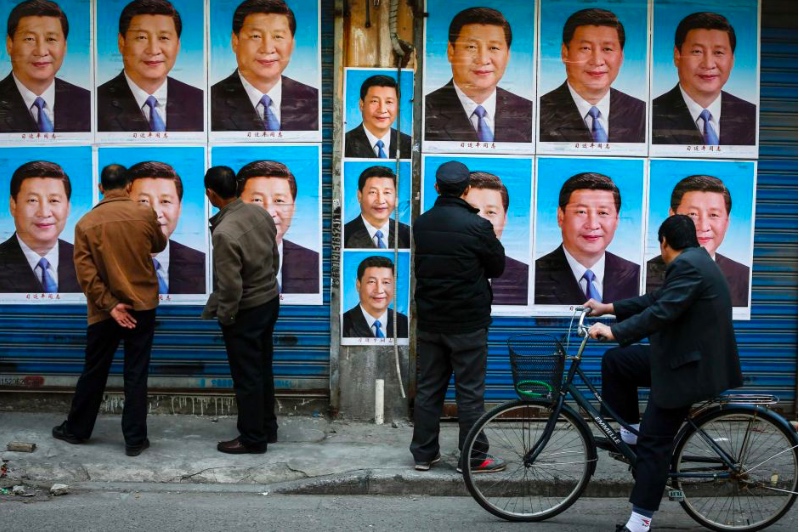
Shanghai, 2018: images that I barely saw in nearly a month in Shanxi and Beijing. Photo: ABC.
Invisible propaganda: business as usual
Of course no-one ever mentions him. On the few occasions that I broach the subject, it goes down like a one-legged man at an arse-kicking party. Following Nigel Barley (“like a vicar hoping to get a current affairs discussion going at a youth club”), I ask Li Manshan innocently, “Have you been studying Xi Jinping Thought?!” Without exactly rolling his eyes (unlike this reporter), he looks at me like I’m crazy—not for the first or last time.
In the poor rural county through which I’ve just been travelling, Xi Jinping posters [1] were distributed to every household—with the offer (akin to a bribe) of sacks of flour, meat, and so on. In one village I know, around 80% have taken the bait. Poor-peasant families will likely play ball (like a rural Protestant woman we met, and a “left-over” family in a dying village).
A household Daoist, and a shawm player—both struggling to make ends meet—have also put their poster up. Another Daoist, my age, put his up gladly, but he’s not that well-off—and anyway he still reveres Chairman Mao, which his colleagues agree is weird. As we chat between ritual visits to the soul hall, I can’t even be bothered to ask him, “If Chairman Mao was so great, how come he let 45 million starve to death? How come you couldn’t even get a proper meal until the 1980s? How come he wouldn’t let you guys do rituals?”
But most of my village friends don’t need the supplement, so have refrained from putting up their posters. Thus I saw very few of them, either in the countryside or in the capital. [2] (Having just received a rather indecent gas bill, I wonder if I can ask for a poster from the county Propaganda Department to hang up in my house in Chiswick—if they can put bonus points on my Nectar card…)
Only now does it occur to me that there should be a strong correlation between households displaying the posters and those too poor to invite the whole ritual band to perform a complete sequence of funerary rituals, who instead request a solo Daoist merely to “smash the bowl” for them.
So my feeling is that for villagers, this is just yet the latest in a long line of gods who may or may not address their practical problems. Campaigns are water off a duck’s back for them:
(cf. Living in the past).
There may be various reasons for choosing whether or not to hang a poster up. Villagers might feel that their room needs a splash of colour; or else it might not go with their colour scheme. No, aesthetic considerations are unlikely: some households may be genuinely enthusiastic, while most will swallow their scruples in order to get a supplement. At least, we can’t assess popular support for Uncle Xi merely by counting the number of posters displayed.
Nor did I see any painted wall slogans [3] to him as we walked and drove through the villages, or as we drove through townships and the county-town. Does the local government know something we don’t? Do I need a repeat visit to the optician?
Come to think of it, is it some extraordinary quirk of my routes through Beijing, or is there a remarkable absence of his images in public places there too? Has anyone covered this?
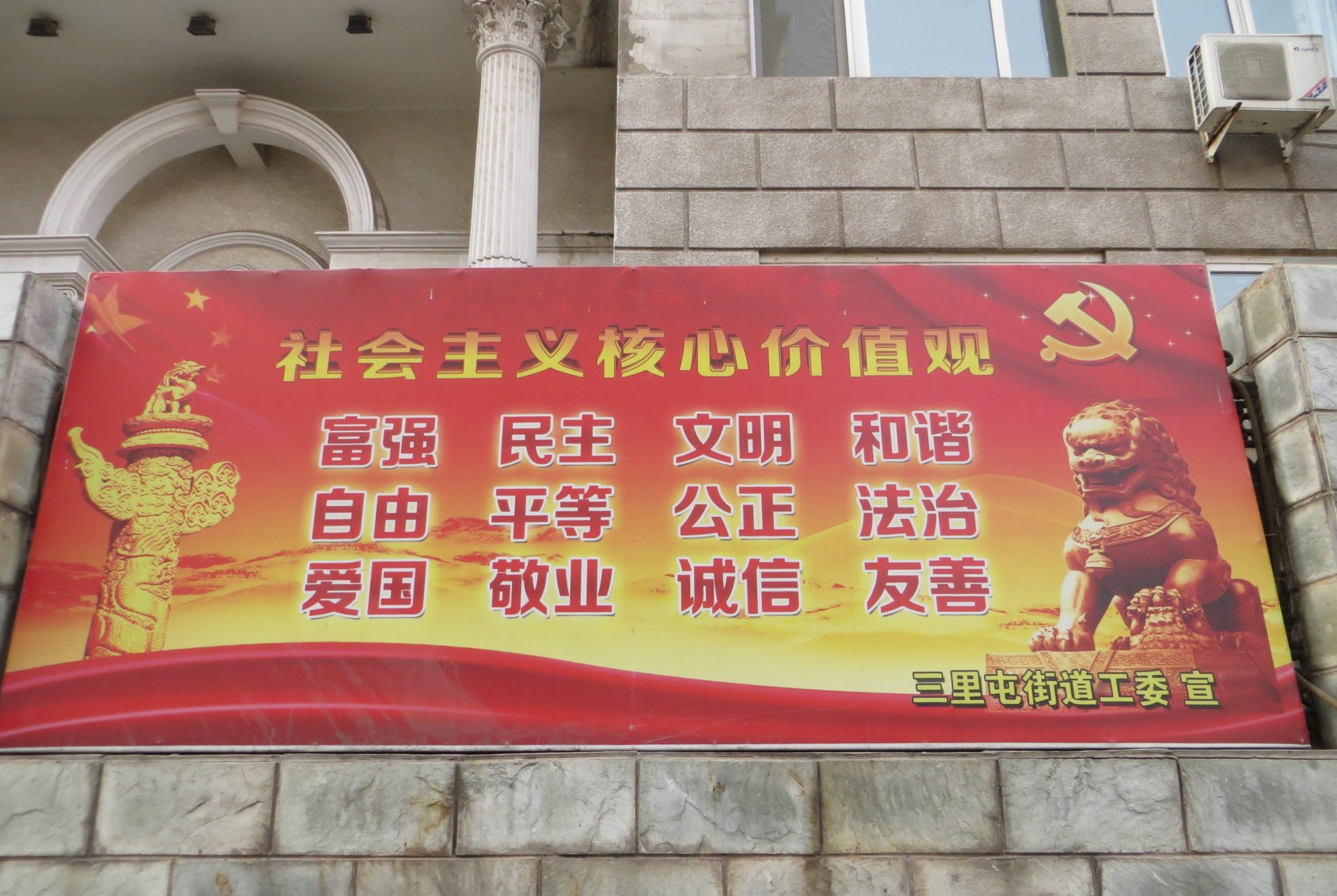
A common sign. Strangely missing is the request: “With the exception of patriotism, if anyone spots an outbreak of any of the above diseases, please report them to us and we will take appropriate action.” My photo.
So—unless one were so desperate as to switch on the CCTV news—my whole trip was notable for his absence. Far Be It From Me to claim that he’s not an evil autocrat bent on crushing all dissent and Destroying Civilisation As We Know It, but the tone of these online scare stories reminds me of the Daily Mail. It seems I have to come to China to escape from him (or should I say Him).
* * *
Sure, we’re all “blind people groping at the elephant”. We have to study everyone, including elites, and some scholars and journos have to focus on one man at the top of the structure. Not only do decisions made from on high affect the lives of ordinary people, but there are very compelling reasons why we should pay attention to the insidious encroachment of autocracy and the escalating erosion of rights. Everywhere.
Still, my single biggest culture-shock at returning home to the foreign media was to be suddenly reminded of their obsession with Uncle Xi. Those who follow such authoritative China-watchers might easily deduce that his worship is an all-consuming duty—but such a conclusion bears little relationship to the daily lives of Chinese people.
So foreign coverage may be diametrically at odds with Chinese propaganda, but they’re both barking up the same tree. Meanwhile the Labouring Masses either take action or Keep Calm and Carry On, ignoring all the flapdoodle; and other scholars, Chinese and foreign, get on with writing about the lives of real people, exposing grass-roots problems.
Update: brilliant headline from Girish Sihane:
Xi sells seashells by the seashore as Modi’s foreign policy lies in tatters
If only they had met in the Seychelles… Here’s John Finnemore again (cf. here and here):
[1] I inadvertently find myself referring to these posters as shenxiang 神像, god images—which always gets a giggle.
[2] By contrast, see e.g. here: “the only image I saw more frequently—in elementary-school classrooms, in airports and shopping malls, on billboards on highways and in rice paddies—was the face of President Xi Jinping. Each image was identical: the country’s supreme leader, with raven-black hair and a face fastidiously airbrushed to erase any hint of human blemish, smiling calmly against a sky-blue background: an unimpeachable deity in an officially atheist state.” See also this photo essay.
*Click here for main page!*
(under Images: Li family in main menu)

1 A village artisan
This is the first of two articles (sequel here) that together might be called
Uncle Xi and the Ten Kings of the Underworld.
In both rural and urban China, paintings of the Ten Kings of the Underworld (Shiwang xiang, or Shidian Yanjun) were commonly displayed for funerals, and in some places they still are. In this article I introduce Artisan the Sixth, who painted a set of Ten Kings for the great Daoist Li Peisen; and I go in search of his kang murals.


“Germans invented the accordion,” Beutle explained to Messermacher. “A thousand things they invented, but accordions most of all. Because Germans think, Germans have brains. There was this feller, a musician, a German violinist, he ends up playing in the court orchestra in Russia, not Catherine the Great but around that time, he plays the violin. But because he’s a German, Jesus Christ, he notices things, he notices when he hangs up his bow on a nail back in his room she also makes a nice little tone. From this he invents the nail violin, very beautiful tones, I have heard it. A circle of wood with nails sticking out, you run the bow on the nails and ooo aaa ooo aaa, a beautiful tune. One day this feller gets a strange thing from China, somebody gives it to him because interested in things he is—naturally, he is a German—and he sees a round bowl with some bamboo pipes sticking out, and on the bowl a mouthpiece. He blows on it. It’s a fine sound. This thing the Jesus Christ Chinese put reeds inside the pipes, same as in the accordion, little reeds stuck on one end with wax, the other end can vibrate like this.” He trembled his hand at Messermacher. “The German violin player learns the playing of this instrument, die liebliche Chinesenorgel, and from this he passes to other Germans the idea of the accordion—the free reed. That’s how it begins. Later comes the bellows.” (91–2)
By now readers of my blog will know how vital the sheng mouth-organ is to the ensemble accompanying north Chinese Daoist ritual—and I suppose it was the sheng that obscurely reminded me to read Annie Proulx’s miraculous 1996 novel Accordion crimes.
The book has long been popular with ethnomusicologists (e.g. this review), despite being a novel—or rather, near the fiction end of the spectrum from non-fiction to fiction; or near the readable end of the academic—engaging spectrum (cf. Bernard Lortat-Jacob’s Sardinian chronicles, another classic). Like ethnomusicologists, Proulx focuses on change and social function. In her Acknowledgements she lists an impressive array of sources, experts on their regional genres—it’s amazing that all her detailed research took only two years.
On an epic scale, in the tradition of the Great American Novel, Accordion crimes has all the rich detail of ethnographic thick description. Indeed, it’s timely that I should get round to reading it now, since it discusses the tribulations of poor, ill-fated immigrants. The human cast includes immigrant Italians, Germans, Poles, Irish, Mexicans, French, and Norwegians—all against a backdrop of xenophobia, misanthropy, brutality. Their sad, tough, gory, gruesome tales are connected by the history of an old two-row button accordion for over a century, with other roles played by
As I observed about that other ethno classic Lives in jazz, the book gives a perfect combo of music and social detail. Hooked on taxonomy, Proulx can never resist long lists; likely to be tedious in academic hands, hers never fail to enthral. While poetic, her language is never pompous.
The novel opens with compelling detail from 19th-century Sicily:
It was as if his eye were an ear and a crackle went through it each time he shot a look at the accordion. The instrument rested on the bench, lacquer gleaming like wet sap. Rivulets of light washed mother-of-pearl, the nineteen polished bone buttons, winked a pair of small oval mirrors rimmed in black paint, eyes seeking eyes, seeking the poisonous stare of anyone who possessed malocchio, eager to reflect the bitter glance at the glancer.
He had cut the grille with a jeweler’s saw from a sheet of brass, worked a design of peacocks and olive leaves. The hasps and escutcheons that fastened the bellows frames to the case ends, the brass screws, the zinc reed plate, the delicate axle, the reeds themselves, of steel, and the aged Circassian walnut for the case, he had purchased all of these. But he had made all the rest: the V-shaped wire springs with their curled eyes that lay under the keys and returned them to position in the wake of stamping fingers, the buttons, the palette rods. The trenched bellows, the leather valves and gaskets, the skived kid-skin gussets, the palette covers, all of these were from a kid whose throat he had cut, whose hide he had tanned with ash lime, brains and tallow. The bellows had eighteen folds. The wood parts, of obdurate walnut to resist damp and warpage, he had sewed and sanded and fitted, inhaling the mephitic dust. The case, once glued up, rested for six weeks before he proceeded. (17)
As the old accordion-maker arrives in New Orleans in search of fame and fortune,
In and out went Caramele through the scores of dives, tonks and jooks and barrelhouse joints that lined these streets, the accordion maker lurching after him through the musical din of drums and ringing banjos, shouters, pianos clinking away, squealing fiddles and trumpets and other brass snorting and wailing from every interior, and sometimes a string quartet sawing crazily. On the streets children watched and fought for discarded stogie butts, black street musicians and white played for coins, singing improvised songs of insult at those who failed to toss a whirling coin. (42–3)
In “Spider, Bite Me”, Abelardo recalls to his son Baby,
“The accordion was so natural, a little friend. Easy and small to carry, easy to play, and loud, and can play bass rhythm and melody. Just the accordion and nothing else and you’ve got a dance. It’s the best instrument for dancing in the world, the best for the human voice.”
[…] On the weekends [Baby] played for dances with Chris, mostly rancheras and polkas; they sang in the classic two-part harmony, primera y segunda. […] The dances were exhausting, the strain of playing and the lights, the sweat and heat and thirst, the noise like pouring rain.
[…] Though so many turned to the big-band sound and the strange hybrid fusion of jazz, rumba and swing, would rather listen to “Marijuana Boogie,” the Los Angeles Latin sound, than “La Barca del Oro”, there was an audience that liked their music, found value in it. These new ones, many of them veterans back from the Korean War, some of them university students, embraced conjunto, and this music was not for dancing but for listening. It had a meaning beyond itself. (173–4)
The changing tastes lead to a heated argument between Baby and his put-upon sister Félida (191–8):
She passed her arms through the huge straps. […] She stared at the ceiling, said, “por Chencho, Tomás, por Papá Abelardo,” then sang the heart-wrenching “Se fue mi amor,” which Carmen y Laura had recorded in the last year of the war.
Her bellows control technique was extraordinary, with dramatic swells and choking, sforzati explosive effects. She scratched and rubbed and struck the keys, ran the back of her nails across the folds of the bellows. The accordion gave the perfect illusion that a bajo sexto and a bass as well as a highly original percussion player supported the accordion, and from it came the melting harmony of the missing sister’s voice to twine and burn with the sweet, smoldering fire of Félida’s sad voice.
“Hitchhiking in a wheelchair” (199–276) is fascinating too, as Dolor makes a pilgrimage to Canada in search of old-time French music:
The music was stunningly brilliant, joyous with life and vigor. The dancers sprang over the floor and now and then they would draw back and give room to a step dancer whose rigid back, erect head and straight-hanging arms accentuated the clattering, tapping, rapping, knocking, flinging feet whose steps stuttered in and out of the music. He wished Wilf could hear the fiddler, the sound like a flock of birds, a flight of arrows striking all around him, from a growling, clenched-teeth mutter on the G and D strings to harmonic shrieks and stair-tumbling runs—Jean something, a taxi-driver from Montréal.
This leads to “Don’t Let a Dead Man Shake You by the Hand” (277–349) , where Proulx expounds on Cajun and zydeco in Louisiana; and “Hit Hard and Gone Down” on the Polish folk scene (351–426):
The Chez family from Pinsk lived across the street; later they changed their name to Chess, the two boys grew up to work in businesses, a junkyard, bars and nightclubs, finally making phonograph records featuring black singers moaning the blues, and by 1960 the good Polish neighborhood had turned black on all sides. (354)
“There’d always be somebody’s polka band—two violins, you know, the bass fiddle and the clarinet, no accordion at all, they’d just play all afternoon and we’d dance. No music pages, they play from their heads, they were geniuses. You know, the dancers used to sing out a line of a song, or not even sing it, just shout it like, and the musicians they had to catch it, know it and play it back in the same key. Oh, they were so good. Well, your grandfather, he sees after a while there is some money starting to come to the polka band players and there was all kinds of places that wanted polka bands—Polish Homes, the Polish Club, not the culture evening but the Saturday night dance, little dance halls all over the place, the union halls, bars and Polka Dot restaurant, the Polish League of War Veterans, a lot of restaurants, Polonia Hall—oh, there was plenty of polka dancing, and a lot of fun, and weddings, weddings, weddings, everybody was getting married and you gotta have polkas.” (371)
Hieronim’s wake was something, the last of its kind in the neighborhood, in the old, old Polish style, and nobody would have known how to do it except Old Man Bulas from the Polish Club… He was the leader of the singing and knew the hymns, scores of them all written down in his śpiewnik, a thick, handsome book wrapped in black cloth. (383)
This is soon followed by a memorable wedding:
He told his wife that it was necessary to balance the solemn death rites of Hieronim with as much of the old wesele style as possible… (385)
But again, tastes are changing (404–14). As promoter Mrs Grab warns Joey:
“We don’t want nothing weird or extreme, you know? There’s rules now, the association’s made rules. […] Only one song in Polish. Most people don’t understand it, but one song gives a nice ethnic flavor. That’s what we want to stress, ethnic flavor. Let me tell you something, Joey. Ethnic music is not that old-time stuff anymore. These days everybody is ethnic, might as well make money on it. […] They don’t want that mournful folk music sound no more or those complicated couple dances going into circles and weaving around and slapping their asses and crossing into the next lane. No more of that Kozaky na Stepie, Cossacks on the Steppe, stuff. Everything gets mixed up unless you got a Ph.D. in Polish clogging. It’s no fun.”
[…] The spare applause had hardly died down when a big guy jumped up, his thin long hair pasted to his sweating forehead, and began to shout at them.
“This is not Polish polka, not Polish music. I am a Pole from Poland and in Poland they would laugh at you as I do now—Ha! Ha!—for saying this garbage you play is Polish.”
Now the bandoneón and tango make an appearance, as Joey meets a migrant from Buenos Aires, who muses:
“Piazzolla, with his little zips like the plastic zipper of a cheap jacket, his plotted silences, the squealing like rubbing two balloons together. That is a serious, unsmiling, hard music; the faces of the dancers frown furiously; and his tempo, the beat is like climbing cement stairs in a skyscraper with fire behind the doors. And there is that quality of a paper comb that sets the sutures of the skull trembling. Those passionate swellings are musical hives…” (416–18, cf. Alexei Sayle).
“The Colors of Horses”, with Basque and Irish musics as well as Appaloosa horses playing a major role, is another too, er, deaf ‘orse. More fantastical lists:
…descendants of the ice-age horses painted on the cave walls of France, of the fabled horses of Ferghana, between the Syrdarya and the Amudarya rivers on the steppes of Central Asia in Uzbekistan, of Rakush, the spotted horse of the warrior hero Rustam, celebrated in Persian miniatures and in Firdousi’s epic poem the Shah Namah, of the Chinese Celestial Horses from the Extreme West, the Blood-Sweating horses, of the galloping mounts of the Mongol Horde and Attila the Hun, of the Andalusian horses of Spain shipped to Mexico for the conquistadors’ savage forays, of a shipload of spotted horses from the Trieste Lippizan herd landed on Vera Cruz around 1620, of the horses abandoned by the terrified Spaniards after the Pueblo revolt of sixty years later and traded north by an agricultural people more interested in sheep, to the Shoshone, Cayuse, Nez, Percé, Blackfeet, Blood, Arikara, Sioux, Cree, Crow, of the North American steppes known as the Great Plains, had been bred down to dog meat. (443–5)
The evocation of Irish song (483–5) is worthy of Ciaran Carson. Now we return to the original, battered old green accordion:
The silent reed suffered from a grain of rust jammed between the reed tongue and its vent, and this he eased out with a silk thread from his fly-tying box. The steel reeds were coated with islands of rust and he scraped at them with the blade of his knife but was afraid of lodging more fragments under the reed tongues. He cleaned the reeds with his toothbrush, blowing out the dust until he was dizzy.
He could see it needed everything—new bellows, new reed, new springs, reed plates reset, grille replaced, and more. But it had a wonderful voice, sonorous, plangent, shouting in grief to the mountain slope. (486)
The final section, “Back Home with Reattached Arms”, is moving too, with Norwegian immigrants making an appearance:
His own parents had been obsessed with the prescriptions of a book, The Emigrant’s Guide to Preserving Norwegian Culture, written by a homesick settler in Texas, a book that dwelt on the merits of the Norwegian language, twice-daily prayers, Norwegian hymns, clothes, food, and, after the fortune was made, return to the “elskede Nord” country. Daily they had sung “En Udvandrers Sang,” “O Norges Son” and others. His mother wished to live in a Norwegian community where land was owned in common by all. But Gunnar shouted for independence and his own land, purchased a mighty, star-spangled flag… (496)
* * *
That discussion of the sheng, with which I opened, reminds me of the Li family Daoist band’s concerts in German churches in 2013, the two mouth-organs filling the building with a majestic sound just like Bach on a huge organ with all the stops out (my Daoist priests of the Li family, p.339).
For a general introduction to the accordion, see here. For yet another wacky illustration of the joys of organology, see the aerophones classified under Sachs-Hornbostel 412.232 here. And to explore these genres in more depth, note The Garland encyclopedia of world music: the United States and Canada (1998), Part 3 Section 2c.
Passages like this draw the reader towards archive recordings:
Abelardo had hundreds of records, his own recordings of the 1930s, a few with Decca, then with Stella, then with Bell, then Stella again. “In those days I sang in Spanish; those men with the record company said to me, ‘we can’t tell what you’re singing, so don’t sing anything dirty.’ So of course I sang all the filthy ones.”
[…] He had old recordings of Lydia Mendoza, of the great accordion players, the records of Bruno Villareal, half blind, a little tin cup wired to the side of his accordion, playing in 1928, “the first recording with the accordion as the star”, Pedro Rocha and Lupe Martínez, Los Hermanos San Miguel, dozens of Santiago Jiménez discs.
[…] He would make them listen to all those old labels: Okeh, Vocalion, Bluebird, Decca, Ideal, Falcon, Azteca, especially the Ideals made in the garage of Armando Marroquín up in Alice. (148–9)
Of course, like all those books about Daoist ritual, Accordion crimes misses a lot by being silent—it cries out for a good playlist. One is drawn back to the great 1952 Anthology of American Folk Music, and we can find further clues among articles in The Rough Guide to world music.
And let’s all explore YouTube—here’s a Polish tango from 1931:
See also Polish folk and jazz, A blind accordionist, Tango for Messi!, and under Bella ciao.
If we have to use words to evoke music, Accordion crimes is just the way to convey its messy exhilaration and flawed humanity.

外来的和尚不一定会念经
I described here how honoured I was to dep with the master singers of the Li family Daoists on our French tour last May. So I’ve just added our encore in Paris to the playlist (#3), with commentary here.
My Chinese caption for this (a variation on 外来的和尚会念经) means:

Li Manshan (2nd right) chatting with fellow villagers in Upper Liangyuan, March 2018.
I’ve just had an amazing time in China, both in the countryside and in Beijing (more anon). Still, it’s good to get back home—a feeling I described in my book (p.357):
Return of the Prophet (Not)
Back in this mild grey country, I begin writing up my notes over a stiff gin-and-tonic (à l’espagnol, easy on the tonic) as I listen to Bridget Christie [1] on BBC Radio 4, relishing cultural diversity again. My life has become schizophrenic; in London I meet up with a couple of friends maybe a dozen times a year, whereas in Yanggao, in the daily company of eight or more people morning to night, I am wrenched into constant socialising. This brings me alive and animates my reclusive life back home. Nigel Barley expresses the confusion of the homecoming fieldworker. [2] Returning from Cameroon, on an ill-fated stopover in Rome,
Café menus offered so many possibilities that I felt unable to cope: the absence of choice in Dowayoland had led to a total inability to make decisions. In the field, I had dreamed endlessly of orgiastic eating; now I lived on ham sandwiches.
And when he finally manages to get back to Blighty,
It is positively insulting how well the world functions without one. While the traveller has been away questioning his most basic assumptions, life has continued sweetly unruffled. Friends continue to collect matching French saucepans. The acacia at the foot of the lawn continues to come along nicely.
The returning anthropologist does not expect a hero’s welcome, but the casualness of some friends seems excessive. An hour after my arrival, I was phoned by one friend who merely remarked tersely, “Look, I don’t know where you’ve been but you left a pullover at my place nearly two years ago. When are you coming to collect it?”
Having immersed myself totally in Chinese cultures these last few weeks, with only occasional recourse to the Guardian just to remind myself there’s a world out there, this morning on Radio 3 I bask in Germaine Tailleferre, Astor Piazzolla, and Biber…
[1] Whose use of the classic London underground warning, I gladly concede, may well be more effective in feminist comedy than mine in Daoist ritual studies.
[2] Barley, The innocent anthropologist, pp. 184, 187.
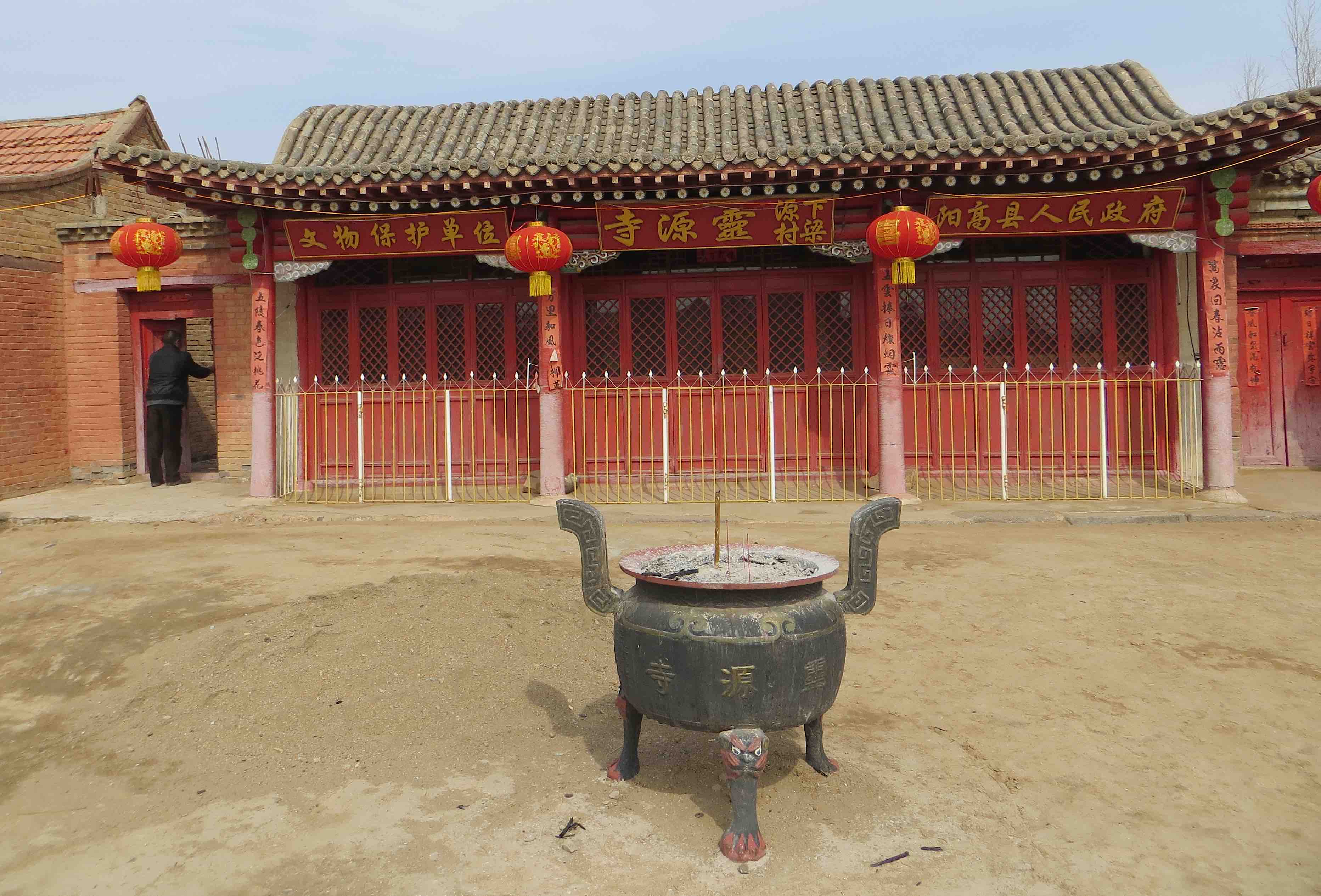
Last week I walked over with Li Manshan to the Lower Liangyuan temple to take another look at its old (and recent) murals. It’s one of the staging posts of the funky deity Hutu (Elder Hu), whose temples Willem Grootaers wrote about in the 1940s.
In my early days in Hebei we had a couple of harmless run-ins with the constabulary in Hebei, as well as one a bit later in Shaanbei (see under §2 here). I’ve never had any hassles at all in Yanggao, but as we’re walking home a passing police-car stops us and the two cops, friendly enough, ask Li Manshan politely where I’m from and who I am. With great presence of mind (resembling Clifford Geertz’s wonderful story about fleeing from the police in a Bali village after a cock-fight) Li Manshan replies authoritatively,
“He’s from England—he’s a professor of music!”
I’ve heard him call me many things, but never that. Getting the hang of it, I chip in,
“Master Li is an international star!”
Peering sceptically at our incongruous double-act, the cops digest this unlikely information. Easily satisfied, they drive off down the dusty track, leaving Old Lord Li and me to light up and continue our walk home.
So, although my enquiries have less and less to do with music, I seem to be protected by the goddess of music—a Chinese Saint Cecilia.


Dunno about anyone else, but I enjoy watching my film again in the company of an audience!
I can’t now imagine all the work that went into this. Apart from the filming itself, and working with Michele to do all the editing, it was good to match up Li Qing’s ritual texts to the hymn singing, and fun showing how the cymbal patterns work, captioning the guangcha mnemonics—first as Daoist percussion karaoke (from 24.03) and later as they whizz past in Yellow Dragon Thrice Transforms Its Body (from 1.11.07).
Translating all those ancient Daoist texts was no picnic, but they’re really beautiful—like the Invitation sequence at the edge of the village towards dusk, with Golden Noble’s solo rendition of the “Vowing with Hearts at One” verses:
Vowing with Hearts at One we Invite:
Emperors and lords of successive dynasties,
Empresses and concubines of epochs immemorial,
Bedecked in twelve-gemmed crowns,
Countenance outranking three thousand rouge-and-kohl belles.
All under heaven their remit, all under heaven their family,
Ultimately ascending.
Singing within the palace, dancing within the palace,
At the final moment they can only perish and fall.
Alas! Have you not heard?
Once astride the dragon of Yu they cannot return,
In vain to deploy the Pipes of Shao within the Department of Caverns,
Fluttering the shadows and echoes, imperceptibly approaching!
But once rendered in exquisite solo melody, such textual beauty is multiplied.
Note also that all these texts are conveyed at quite different tempi: the choral hymns before the coffin extremely slowly, the solo recitations in parlando style, the choral mantras at such speed that the subtitles can hardly keep up. This important aspect of ritual performance is rarely reflected in translations on the page.
Having consulted the exegeses of wise abbot Min Zhiting (no less) in the White Cloud Temple on the meaning of the hymns, I still had some doubts. I recall the months of email ping-pong with Li Bin as I sought his advice. The Li family never discuss the “meaning” of the texts, nor did their elders ever “explain” them as they were learning, so I was really impressed when Li Bin clarified points phrase by phrase. The process of singing them, molto adagio, almost daily over more than thirty years, does seem to give them the occasion to reflect on their meaning. Of course they’re not “educated” interpretations, but the Daoists do clearly have their own “understanding” of the texts they sing.
Another beautiful text in their manuals, for reciting, is the Shunzhi emperor’s meditation on impermanence.
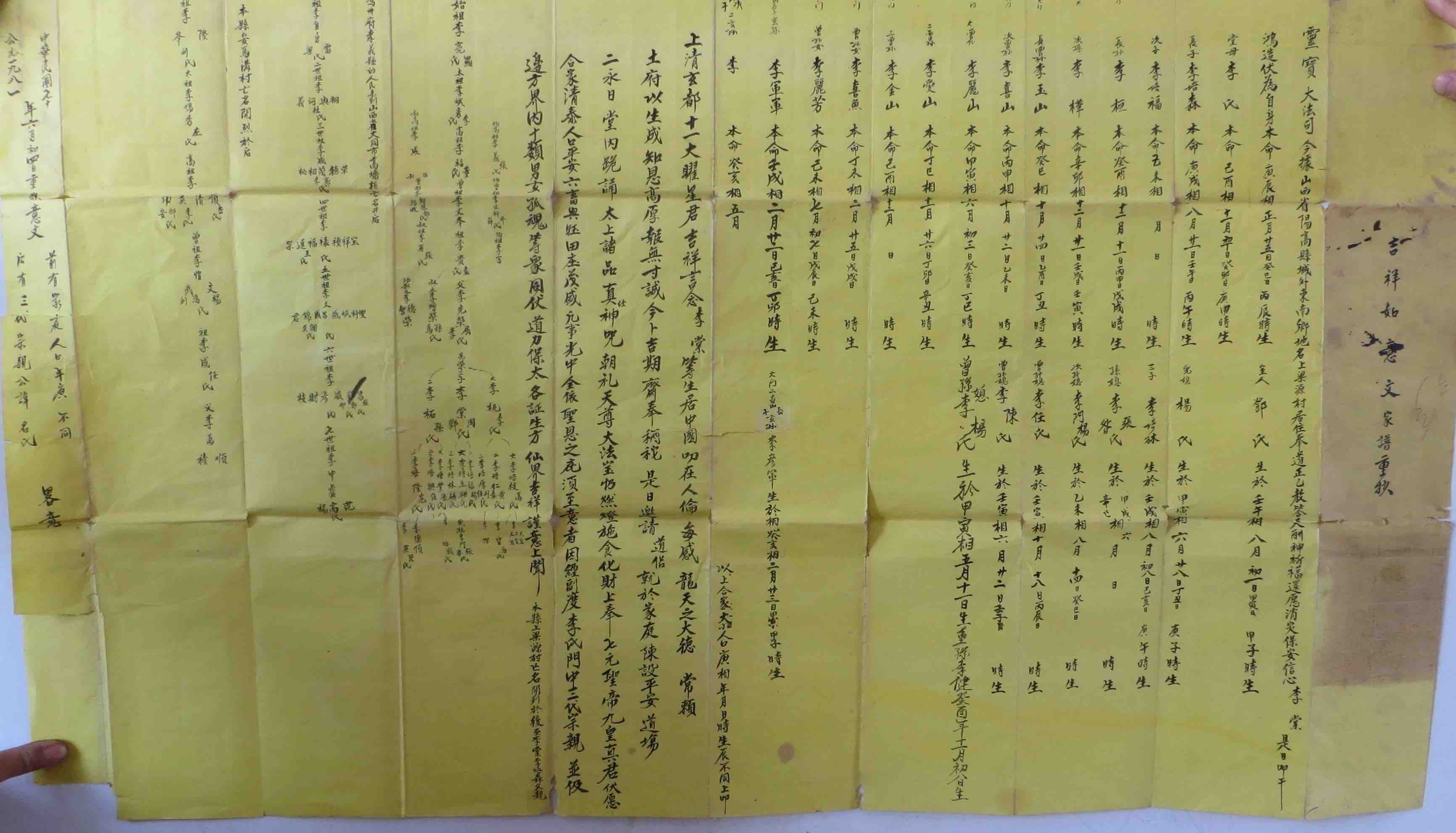
I also relish the language of Thanking the Earth memorials (my book, ch.12). Soon after the revival of religious life following the collapse of the commune system, along with recopying the family ritual manuals, in 1981 Li Qing’s uncle Li Peisen (see here, and here) copied a memorial for a domestic Thanking the Earth ritual held by his father Li Tang in the late 1920, with its detailed genealogy.
At the Numinous Treasure Court of the Great Ritual it is hereby declared: upholding the Orthodox Unity Teachings, resident in that place named Upper Liangyuan village in the southeast district beyond the city gates of Yanggao county in Shanxi province; responding to heaven and rewarding the gods, beseeching blessings and fulfilling the vow, to avert calamity and assure well-being; I, Li Tang, with faithful heart, on this day do kowtow. […]
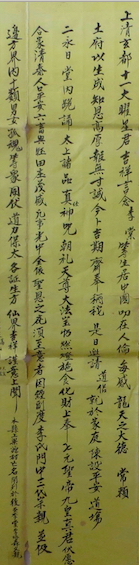 Reciting the auspicious texts of the Eleven Great Luminary stellar lords of the Sombre Capital of Upper Clarity, Li Tang and others, resident in the Central Kingdom, favored among mankind, invariably moved by the great virtue of Dragon Heaven, ever reliant on the Earth Court to engender thorough understanding of the high and the broad, repaying sincerity unretained. Hereby having augured the auspicious period, the Retreat is to be held as follows.
On this day we invite the Daoist acolytes to set up a Daoist arena for well-being in our courtyard over two whole days in the hall, kneeling and reciting the Diverse true scriptures and holy mantras for the Great Supreme, facing the Heavenly Worthies in homage; the precious litanies for the Great Ritual, Lighting Lanterns, and Bestowing Food, burning paper and presenting up offerings for the holy gods of the seven originals and the true lords of the nine thearchs.
Our wish is that the whole family will be tranquil, its members in well-being, livestock thriving, our fields fertile, relying entirely on the protection of holy benevolence in the lustre of our daily business.
There are some fine translations of such numinous ritual texts in the works of Ken Dean and John Lagerwey—and indeed in David Hawkes’s translation of The Dream of the Red Chamber.
Another little entry in my list of Czech witticisms, following on from Paul Kratochvil’s wonderful story about exchanging spectacles, as well as the Czech definition of a Hungarian. Can also be filed under International exchange.
In Prague in the 1990s, as China continued to open up, I knew a bright student of Chinese music who was dipping his toes in the burgeoning scene of international business. He told me they had a saying about doing business with the Chinese:
This is in the same ball-park as Molvania—I guess I find such observations less dodgy as long as they don’t involve British prejudices…

On my recent trip to Yanggao I spent most of my time at home with Li Manshan, making little trips to nearby villages with him or his son Li Bin. But of course I had to check out a funeral and catch up with the other Daoists, so Li Bin came to collect me to drive to Zhu Family Cavetop.
The village population, 749 “mouths” in 1990, has now declined to only a couple of hundred at most. By the time we arrive, the other Daoists have already Opened the Scriptures at the soul hall, singing the Hymn to the Three Treasures as prescribed. After Li Bin delivers the paper couplets and diaolian inscriptions, we go to the scripture hall, which today is conveniently the little room on the south side of the funeral family courtyard, right by the soul hall—so no need for the usual long procession.
I catch up with my old mates Golden Noble and Wu Mei, whom I haven’t seen since our French tour last May. Golden Noble has high blood pressure and is off the fags and booze; Wu Mei is sweet as ever. They check out my blog on their phones.
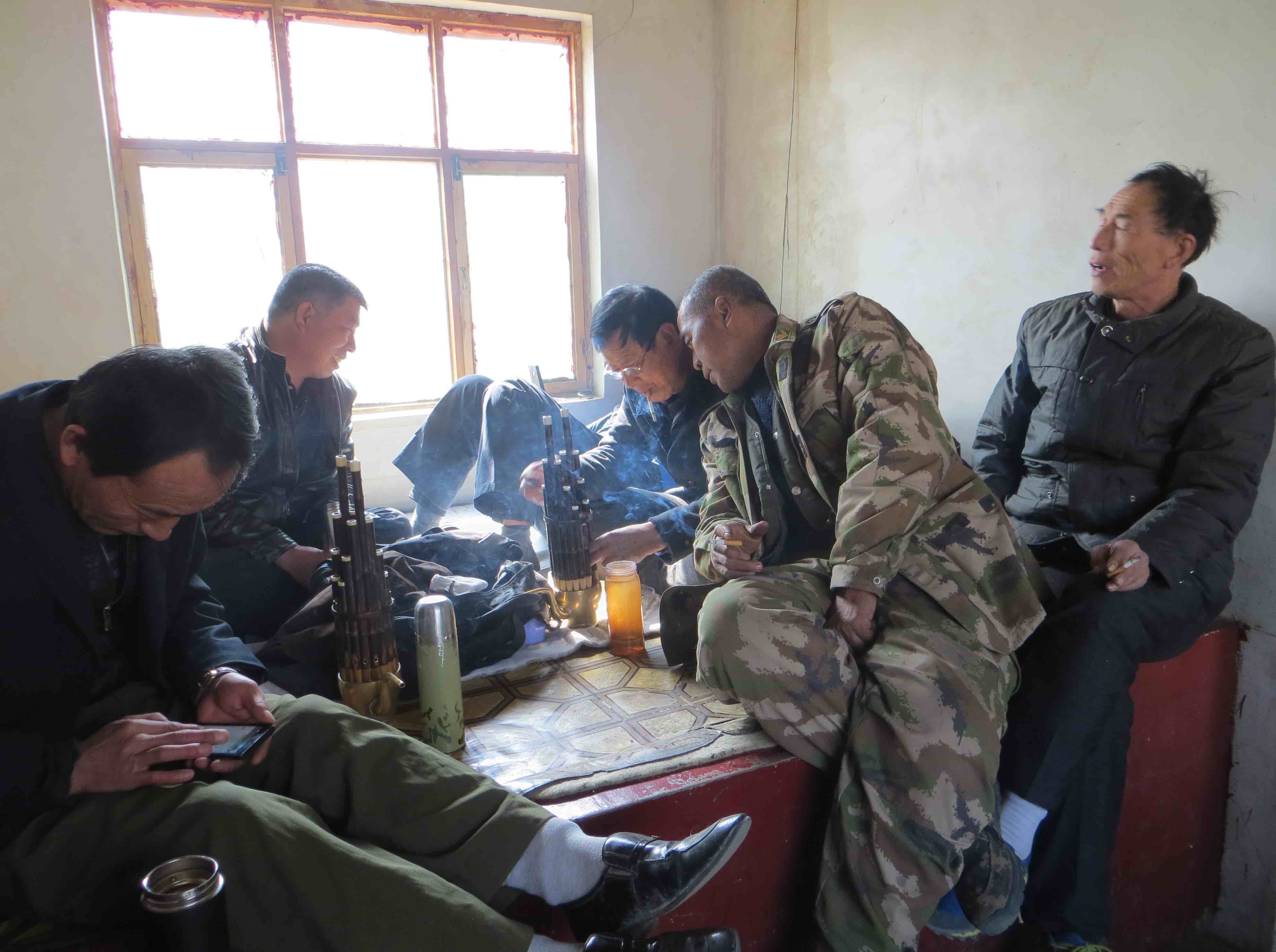
The cosy atmosphere of the scripture hall.

Li Sheng makes repairs to his sheng.
Li Sheng, another regular member of the band and a dedicated chain-smoker (my nickname for him is Fag Devil 烟鬼 Yangui—the gui in falling 4th tone!), is as hyper as ever. His manic energy reflects both in his quickfire dialect and in his fine sheng playing—he struggles to conform to the solemn immovable posture of the Daoists of which Li Bin is a master. He comes from a renowned gujiang shawm-band family from the nearby township of Shizitun. He didn’t know what year he was born; chatting in 2013, he only knew that he was 60 sui, so I translated that to 1954. He is twelve years younger than his brother, a wonderful cultured gujiang also called Li Bin. They learned with their distinguished blind father Li Zhonghe (1908–88), who was still playing in his eightieth year. Again, these two Li families have long been on good terms—the great Li Qing sometimes played in Li Zhonghe’s shawm band in the 1970s. Li Sheng’s older brother went off to work as a cadre in the mines in Datong around 1970, and Li Sheng did some work there too, as well as doing petty trade in Datong, returning around 2000. He has four daughters and one son.
To make up the numbers for the Daoist personnel today, Li Bin has booked two yinyang I haven’t met before, both from hereditary traditions. They’re nice, but turn out to be of somewhat limited abilities. While the gujiang shawm bands have a reputation for smoking dope, some Daoists do too, crushing annaka amphetamine pills into their cigarettes to give them energy (cf. my book, p.325). In the scripture hall my new mates use tinfoil to smoke annaka through a rolled-up 1-kuai note.
As I soon learn when I take a session on small cymbals, the new drummer “calls the beat” arbitrarily, so I keep getting confused about where to place the down-beat. This is just as irritating as an old Daoist I met a few years ago who kept beating out the syncopations on small cymbals, no matter whether we were anywhere near a cadence—”unruly” (bu guiju), as Li Manshan tuts.
The band makes up for the time saved on procession by playing “little pieces” and popular errentai melodies as they arrive at the soul hall. But no-one here cares anyway, and it’s the latest in a long line of funerals where they merely need to go through the motions, with the simplest ritual sequence possible. None of the kin, returning from the big cities for the funeral, kneels or kowtows. No-one pays attention to the Daoists even when they launch into a showy errentai sequence (except in the afternoon, when they even applaud).
Along with the kin we have a good communal lunch in the big tent set up outside, with disposable (yicixing) plastic crockery—I never miss an opportunity to use the expression yicixing (“one-off”), corpsing the Daoists. Meals at Yanggao funerals have improved as ritual practice has declined.
I take a siesta along with three other yinyang in a heap on the little kang brick-bed. The pop band on the truck outside starts up around 3pm, but there’s only a tiny audience even for this, and they soon drift off too. After the Daoists’ first visit of the afternoon, a group of travelling beggars shows up—the usual personnel, with head-mikes, an erhu, fan, and clappers.

Funeral beggars.

Li Bin on large guanzi, flanked by Golden Noble (left) and Li Sheng.
For the Daoists’ second visit of the afternoon they only play a popular errentai medley. For the third session Li Bin (who usually plays sheng mouth-organ) leads the hymn Diverse and Nameless on large guanzi—good, in tune, with a fine new instrument he’s found. For a change Wu Mei plays drum, but he’s somewhat distracted by using his mobile at the same time… The beggars return, and then the Daoists play another errentai sequence. I’m bloody cold and less than riveted (as we say in the orchestral biz, “Of all the funerals I’ve attended in Yanggao… this is one of them”), so I get Li Bin to take me back to Upper Liangyuan before the Invitation ritual. As I get home Li Manshan and his wife are busy making paper artefacts together.
As Li Manshan observes at the end of my film,

Pop outside gateway for a village funeral, Yanggao 2018.
Two lists, just possibly somewhat partial, of what is In and what is Out in rural north China:
Things that are at no risk of going out of fashion:
(If Uncle Xi is as omnipotent as China-watchers suggest, then WTF?!)
Oh, and
Things that have gone out of fashion (cf. my book, Coda pp.357–61):
The latter came as a surprise to me. As you see in one of the most striking images of my film (from 30.32), whereas in the early 1980s villagers were glad to restore the “old rules”, by the 90s they were much more excited* by the pop bands performing on a truck outside the soul hall. Their acts soon became quite innovative. But over the last few years even the audience for pop has dwindled, as people can watch the Real Thing (sic) on their phones.
*In Li Manshan’s words: leqilaile 乐起来了!

Photo: Wang Hui.
Just back in Beijing after a wonderful time with Li Manshan in Yanggao (more posts to follow when I find the time), I feel a bit like a newly-arrived migrant, a country bumpkin 土包子.
After a welcome shower and a change of clothes, I try to divest my accent of little vestiges of Yanggao dialect—remembering to say bucuo instead of kabulei (“fantastic”), and using the cosy third tone again instead of Yanggao’s handy substitution with the falling fourth tone. The poor villages of north Shanxi already seem like another world.
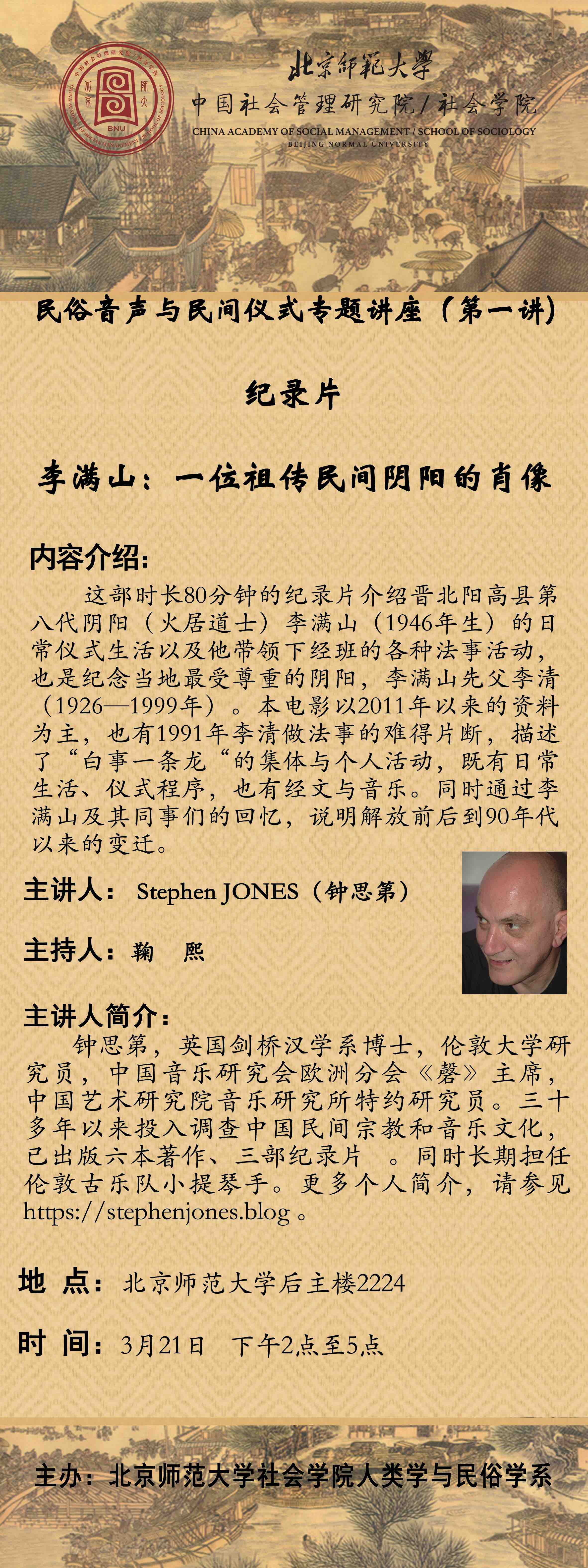
First film screening at Beijing Normal University yesterday seemed to go down well, convened by the brilliant Ju Xi, with some bright students making interesting comments. Even though Li Manshan went to great lengths on the voiceover to speak Yangpu “standard” Yanggao Chinese rather than tuhua dialect, I’m delighted when rather few of the urbane native audience find his voiceover comprehensible—so they too often have to follow my English subtitles.
Discussing how painful it is to edit a three-day funeral down to about 40 minutes (and hour-long concerts on tour), I comment “I’m even more radical than Chairman Mao”, which gets a laugh.
Neither in the countryside nor in Beijing do I yet detect much evidence of a cowed population living under the yoke of a sinister autocracy—but hey, I’ll learn…
So I look forward to our further sessions at Beishida over the next week, as well as two more film screenings at People’s University and Peking University, chaired respectively by distinguished scholars Cao Xinyu and Wang Mingming—whose courses, instead, I should be attending:

 Further screenings coming up in April and May in London and Berlin—will keep you posted.

For anyone within spitting distance of Beijing (and I use the phrase advisedly), I’m screening my film there three times over the next week.
Details on Weixin, no doubt…
Here’s the flyer for the 21st March screening:
The People’s University event:
and the same evening, at Peking University:
Makes a change from Xi Jinping posters, eh.
This mini-series will be more edifying if you’re familiar with my film and book on the Li family Daoists—or perhaps it’ll lead you to them!
From my book (pp.310–11):
As young villagers abandon the stagnant countryside to seek laboring work in the towns, it is mainly the elderly who are left behind; younger people still stuck there seem listless and devoid of prospects. In the hills, some new villages have been built in rather better surroundings nearby, like Yang Pagoda and Sujiayao. Around 2009 half of the population of Renjiayao paid a one-off fee of 50,000 kuai to move to the new village of Xinhebu, built just south of the county-town as part of a state poverty-alleviation project; the new village has four hundred households, assembled from various poor villages. Now only a couple of dozen poor elderly people are left behind in Renjiayao. Most of the population of Gaojiayao have been relocated to Luotun, itself none too prosperous but at least on the plain. Just southeast of Upper Liangyuan, Shankoutou, always tiny, is nearly deserted now. Ghost villages are emerging. And meanwhile the plain villages too are depleted of young labour.
Soon after midnight on the day I land in Beijing, I take the night train to Yanggao. As I leave Beijing I also abandon the modern calendar: instead of Monday 12th March it is now 2nd moon 25th. The train is quite empty, and I doze fitfully on my bunk (for a fuller diary, see here).
Arriving at 5.36am, I get off at the sleep station along with five others. Li Manshan’s son Li Bin is there to meet me; the roads in the county-town have been mended, so at last the street before his funeral shop is passable. After stopping off to unload my gifts, he drives me to Upper Liangyuan to stay with his father. Driving along new roads smooth as a baby’s bottom, we pass the new elevated section of the train line—soon the journey from (and more importantly, to) Beijing will take a mere hundred minutes! Even the track from the main road to the village is improved since my last visit.
Li Manshan is now only doing funerals nearby—Li Bin has very much taken over, and he’s always worked off his feet. After taking me to Upper Liangyuan he has bowls to smash that morning in three villages—the solo ritual that poor families sometimes request instead of the usual lengthy liturgical sequence with the whole band.
As the sun rises, the wise and adorable Li Manshan comes out to greet me. I say hello to the family’s new doggie, occasionally let off its tether in the courtyard. After lighting the stove Old Lord Li soon has to zoom off on his motor-bike to Yangguantun to decorate a coffin (my book, pp.190–92). I stay home to try and sleep off my jet-lag, only waking up to be fed by his wife Yao Xiulian. Over baozi dumplings I ask a bit more about her background: born to a poor-peasant family in 1951, she was one of five kids. Unlike the illustrious Li Qing, who sent all his children to school, Yao Xiulian’s parents declined to let her and her sister attend, so she remained illiterate. The only city she’s ever visited is nearby Datong, where her daughter lives.
By the time I wake from my siesta Li Manshan is back and fast asleep. A neighbour drops by for a gossip; he wakes up and joins in. I get used again to the basics of country living, though after all these years I still find the local dialect really tough. I get online courtesy of his cool shepherd neighbour. We have a nice supper of noodles and then retire to the west room to chat till late.
Next morning we wake just before dawn. After a relaxed breakfast with Li Manshan and his wife, a guy shows up to ask him for a “determining the date” prescription (see my book, pp.185–9): it’s for “moving the earth”, so Li Manshan writes it on red paper.
We stroll over to the site of the old Zhenwu miao temple (see map), hoping naively to find a neglected stele like we did for the Fodian miao and Sanqing dian temples (my book, pp.46–9), but there’s nothing to see at all. The woman living opposite invites us in for a chat; she’s a Protestant, one of a tiny community that has sprung up in the village over the last few years. Hedging her bets, she has a Xi Jinping poster on the wall, next to her Christian calendar. Li Manshan is always affable, popular with everyone. It’s getting quite hot, so I leave my jumper at her place.
I’ve long wanted to visit Shankoutou (the kou pronounced kio in Yanggao dialect!), the next village south, 2 Chinese li (1 kilometre) distant—mainly because it’s so tiny. When I ask Li Manshan, “Is there a temple there?” he replies, “Every house is a temple!” I can’t think how to convey the wryness of this aperçu.
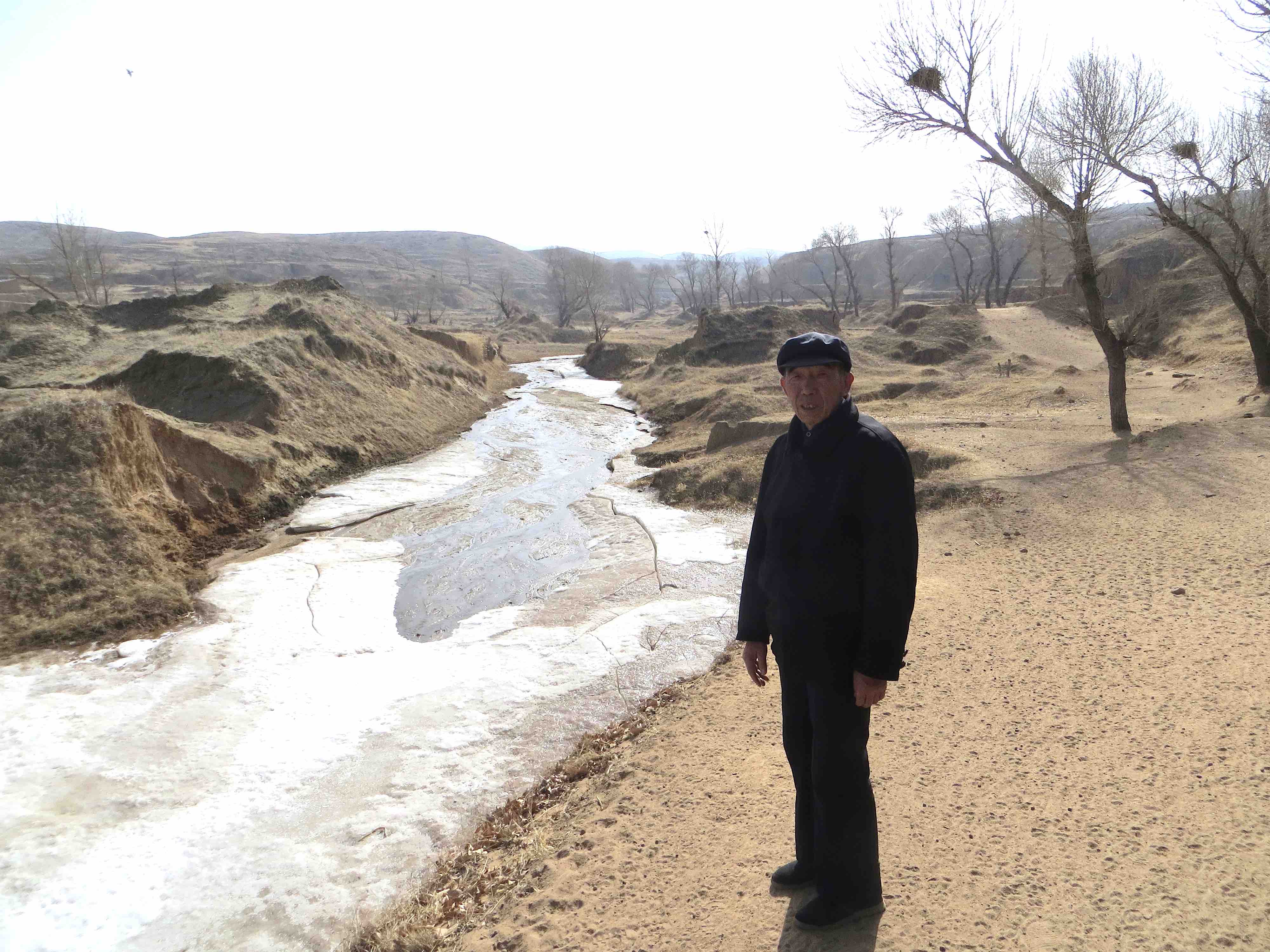
So we set off, first along a narrow track through a barren gulley, then emerging into open country, following Li Manshan’s internal Daoist satnav up and down to a frozen river. Fording it, we climb the slope up to a reception committee of nine free-roaming donkeys awaiting us.

Figures in the county gazetteer give a 1948 population of 63; according to our hosts, in 1970 there were 100 dwellers (under the people’s communes the village counted as the 9th brigade of Upper Liangyuan); back with the gazetteer, by 1990 there were still 75 villagers. Now only five aging families, eleven people, are still “left behind” here. But it’s hardly the mysterious ghost village I envisaged, and my only reward is the murals around the kang brick-bed in the house of a family that invites us in; they were painted in the late Cultural Revolution, which counts as “old” round here. They also have a Xi Jinping poster on their wall.
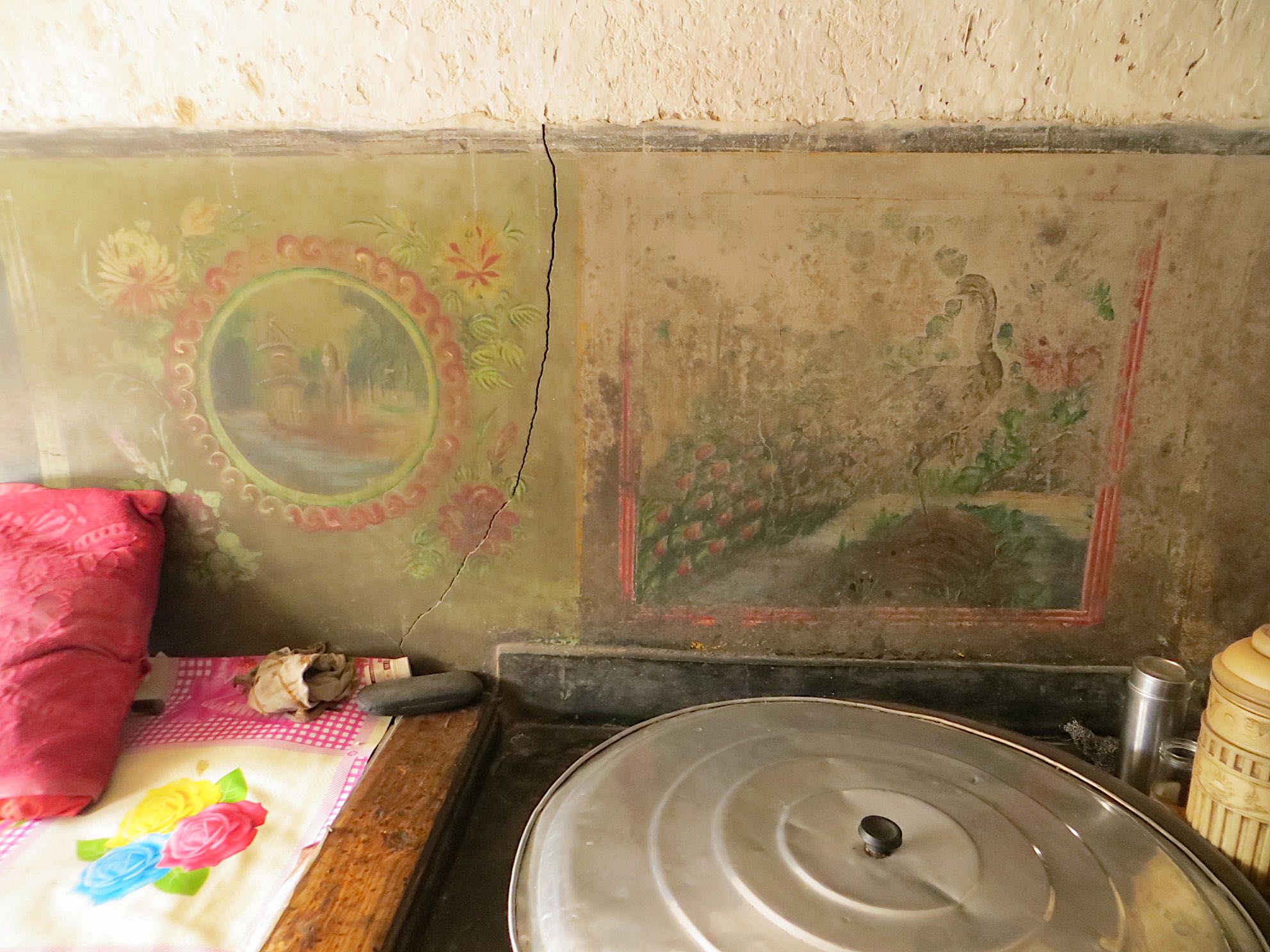
Kang murals, 1973.
On the walk back we stay west of the river, the idyllic vista marred only by the cement factory, with its stink and pollution. Old Lord Li sets off over the fields he was given after the land division, which he now rents out. I call him a landlord, and he takes it in the spirit in which it was meant. Reaching Upper Liangyuan again we pass by the site of the Sanguan miao temple and Li Qing’s old house. As I collect my jumper from the Protestant woman I wish her a Happy Easter. Stopping off to chat with various friends, with the usual copious exchanges of cigarettes, we get home by midday.
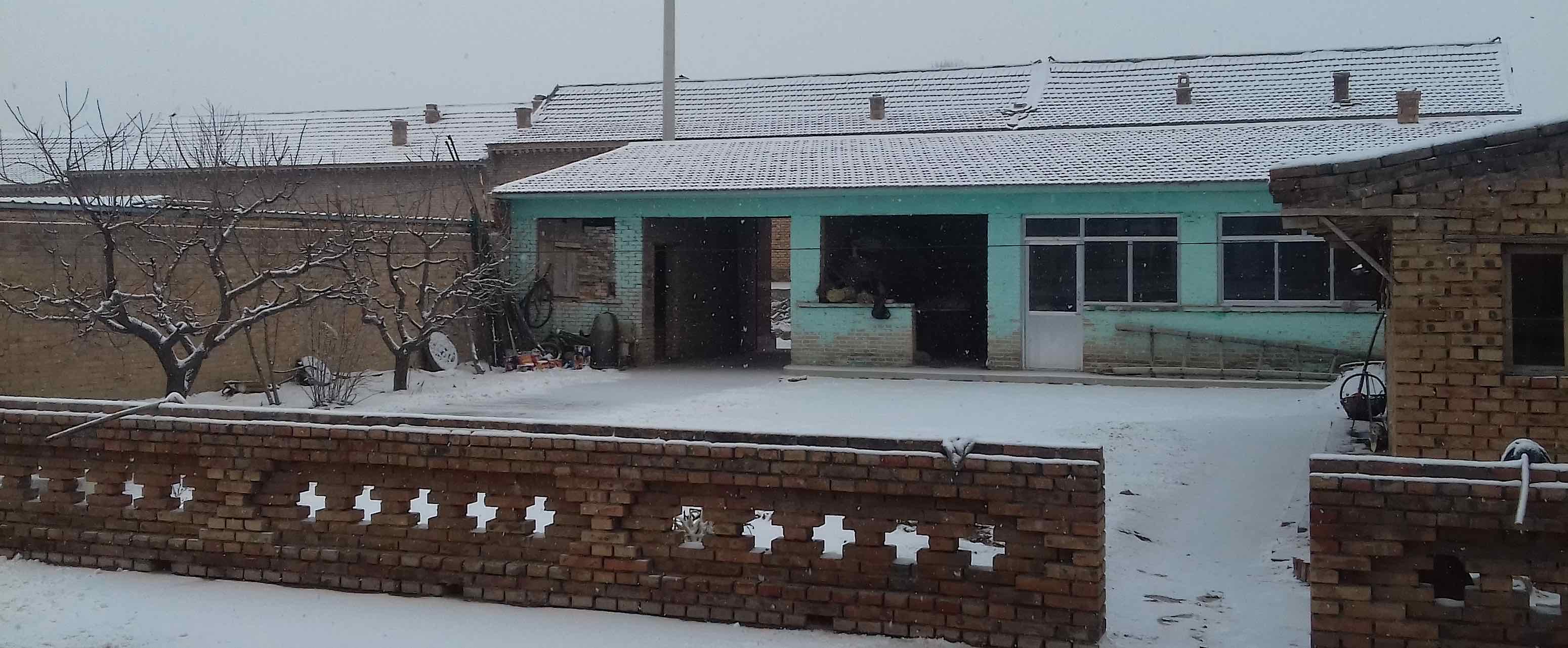
Li Manshan’s courtyard.
OOH it’s snowing today in north Shanxi!
After a rather underwhelming funeral in Zhu Family Cavetop* village yesterday (on which more anon), this morning Li Bin has to do the burial with the band there and then go off on his own to “smash the bowl” in two other villages (see my book, pp.193–4). But the snow won’t deter him, not being a wimpy Englishman; Li Manshan has just zoomed off on his motor-bike to smash a bowl too.
Traipsing across the slippery courtyard to the latrine in the southwest of the courtyard is even more of an adventure than usual, and I “literally” (as the argot has it) freeze my arse off as I squat there, the wind biting into my buttocks (TMI—Ed.). At least there’s a little roof. And at least I can go back indoors—the family doggie is tethered in its kennel in the courtyard. Here dogs and cats are just animals, not sentimental anthropomorphic consolations.
*Zhujiayaotou: why the final “tou“? Most “cave” villages in Yanggao are just XXX Family Caves (Renjiayao, Sujiayao, Gaojiayao, and so on). This is yet another example of my fatuous etic questions to which Li Manshan gives short shrift…

Stove, with Li Manshan’s precious mug.
Depending on your taste, you will either excuse my recent silence or find it a relief.
I’ve been busy preparing for a little trip to China, so I now find myself at home with the splendid Li Manshan in Upper Liangyuan village, catching up with him and the Daoists. It’s been nearly two years since my last visit, so I feel somewhat out of practice, though I saw them on our tour of France last May (see series under the archive for May 2017). Since publishing my film and book, it’s great to hang out with him, neither of us under such pressure to document the family history—though I can never stop taking notes, filling in some gaps and getting updates on their recent activities (for diary, see here).
In due course I’ll leap into action with a series of vignettes on everyday country life away from the hubbub of Beijing, but meanwhile, do check out my numerous posts on the Li family, Yanggao, and so on—such as Li Bin’s diary since they returned from France.
Back into the fray…

In articles on this site I often stress how soundscape is basic to ritual performance. In north China ritual specialists identify three types of organized ritual sound, “blowing, beating, and reciting” (chuidanian): melodic instrumental music, percussion, and vocal liturgy—in reverse order of importance, with vocal liturgy primary. Some groups accompany their vocal liturgy only with percussion, but where melodic instrumental music is performed, it is an essential component of ritual: “holy pieces” (shenqu), transcending language. Whereas vocal liturgy is not notated—most ritual manuals document only the texts, not the melodies to which they are sung—the outline of the melodic (and indeed percussion) instrumental music that punctuates and accompanies it is recorded in scores of gongche solfeggio. [1]
When the Qujiaying village ritual association, south of Beijing, was “discovered” in 1986 we already knew about the shengguan ensemble and its gongche scores (notably those of the Zhihua temple in Beijing) thanks to the ground-breaking work on Yang Yinliu in the early 1950s, later comprehensively studied by Yuan Jingfang. In our project on the Hebei plain, we soon broadened our attention to ritual manuals, but the shengguan wind ensemble and the scores of village ritual associations were always among our major concerns.
In the fine tradition of anthologies that Chinese musicologists do so well, the major new compendium
collects some of the most important scores of gongche solfeggio. It provides rich material on the continuity of early history with modern folk practice.
The anthology is based more on northern shengguan than on southern genres—the distinctive scores of nanyin in Fujian and Taiwan are already collected in many separate anthologies.
The compendium comprises ten volumes to date:
The scores of Beijing temples, and those of the related village ritual associations on the Hebei plain just south, take pride of place. The detailed commentaries on the Hebei and Beijing material are the work of Zhang Zhentao, continuing the masterly chapter in his book Yinyuehui.
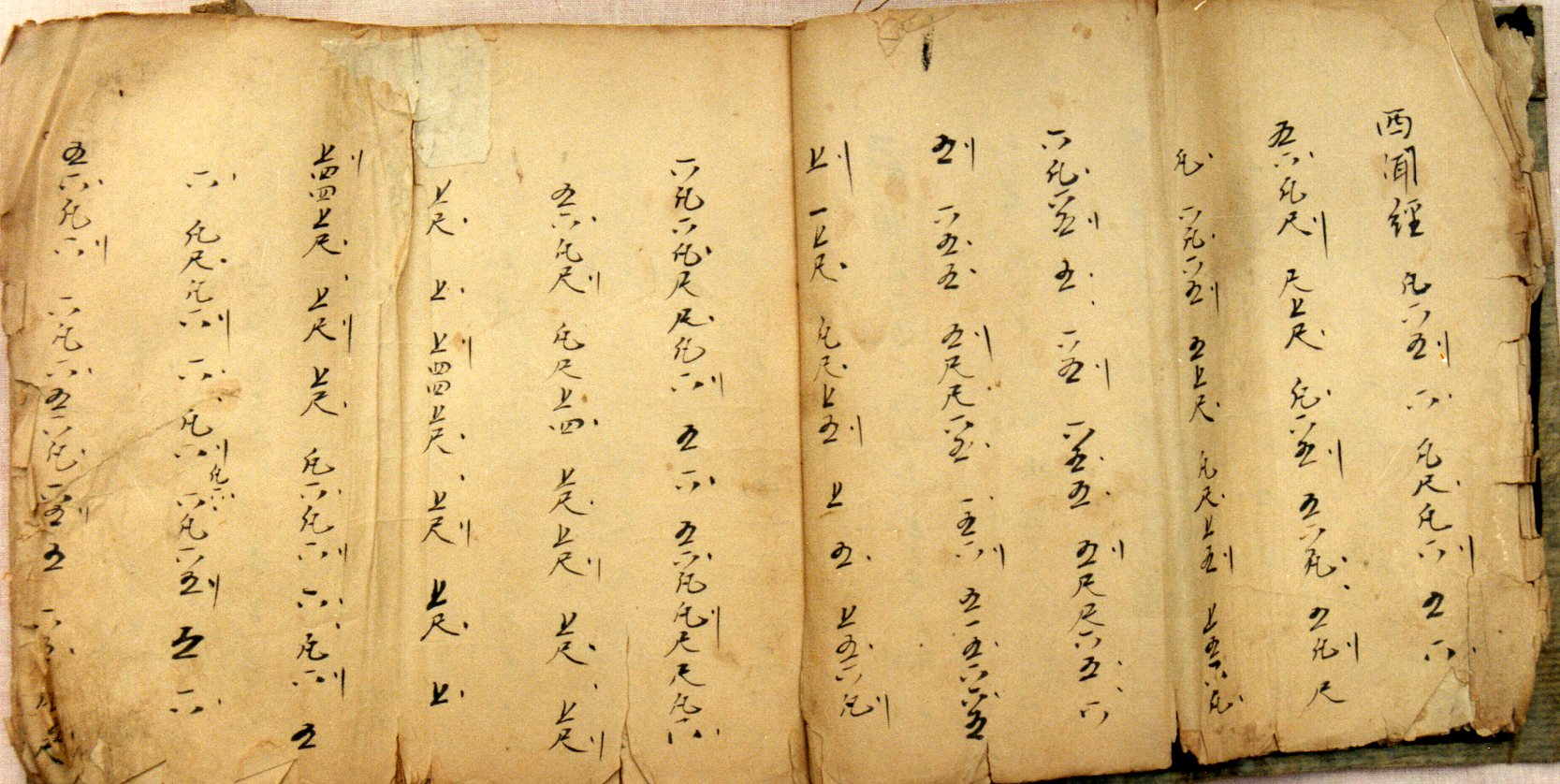
Most volumes further include useful tables of qupai labelled melodies.
Such scores also often contain precious prefaces bearing dates of transmission, as we saw in Xiongxian.
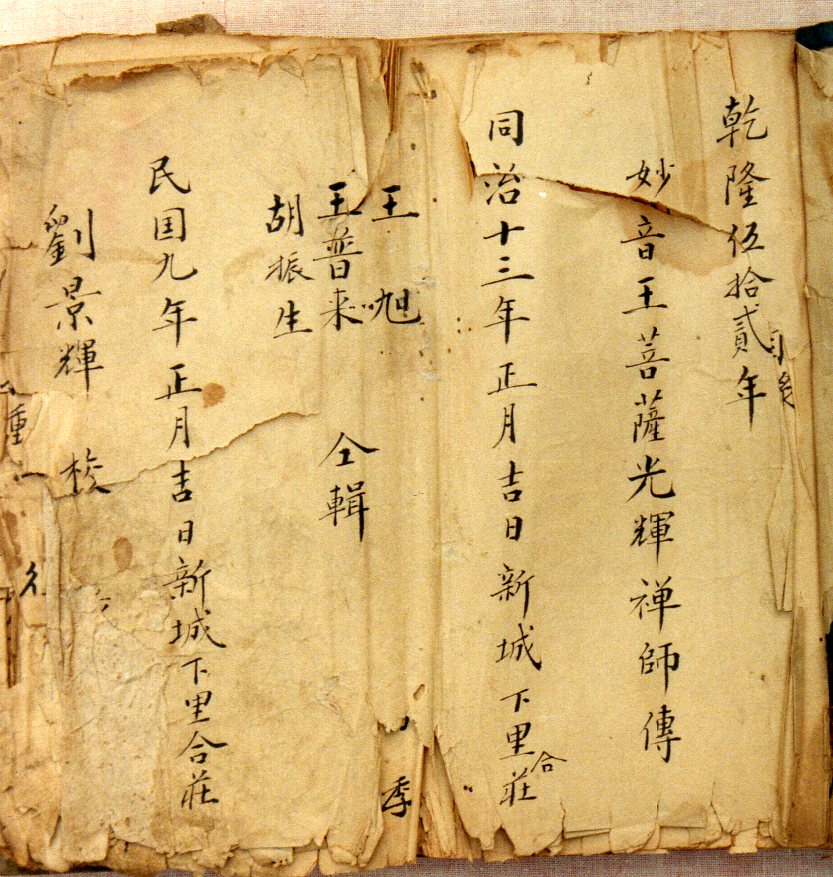

* * *
Of course, like the Daoist Canon, and like the ritual manuals of living groups, scores are merely silent artefacts. They should be combined with recordings of their transmitters, who have long experience of bringing them to life—first by decorating the skeletal notes of the score by singing in unison, and then in ritual performance, taking the instruments up to play them in heterophony suitable to the different instrument types. While some musicians learn mainly by ear, the score is an important repository representing the tradition.
But just in case you think the silent score is somehow equivalent to “the music”, then don’t just consult my transcription of Hesi pai under West An’gezhuang here (§2), but listen to the shengguan tracks on the playlist in the sidebar (including tracks 9 and 10, showing the progressive decorations)!
I should also add that notation is not a criterion for excellence. Many musicians, and ritual specialists, in the great and small traditions of the world don’t need it at all, and for others it is merely an aide-memoire, as in this case.
Indeed, this isn’t just an issue for music. This is not the place to discuss wider issues of oral and literate cultures, but this radical comment from Plato, no less, is suggestive:
This discovery of yours [writing] will create forgetfulness in the learners’ souls, because they will not use their memories; they will trust to the external written characters and not remember of themselves. The specific which you have discovered is an aid not to memory, but to reminiscence, and you give your disciples not truth, but only the semblance of truth; they will be hearers of many things but will remember nothing; they will appear to be omniscient but will generally know nothing; they will be tiresome company, having the show of wisdom without the reality.
As Paul Cooper comments,
I love that when Plato complains about the spread of the written word in 370 BC, he sounds like my granddad complaining about the internet.
Such issues are thoughtfully explored by ethnomusicologists—for leads, see the fine chapters of Ter Ellingson and Richard Widdess in Ethnomusicology: an introduction (The New Grove handbooks in music), and Bruno Nettl, The study of Ethnomusicology: thirty-three discussions, chs. 20 and 26. And for wise words on the history of notation in WAM, see here.
These gongche scores are a major aspect of the study of ritual. But that’s enough writing—wouldn’t want to offend Plato…
For a still more exhaustive compilation of Chinese notation, click here.
[1] See e.g.
http://news.xinhuanet.com/politics/2017-09/06/c_129697492.htm,
http://3g.china.com/act/culture/11171062/20170906/31301663.html,
http://news.takungpao.com/mainland/topnews/2017-09/3491181.html.
[2] I gave an overview of gongche notation in my Folk music of China (ch.7); cf. my article “Source and stream: early music and living traditions in China”, Early Music August 1996, pp.375–88. As ever, Yang Yinliu gave a masterly survey in his Gongchepu qianshuo 工尺谱浅说 (1962).

Fan Huilai overhauling sheng, Xiongxian 1995.
An important theme in our fieldwork on ritual associations around the Hebei plain is that of the itinerant occupational sheng mouth-organ repairers (dianshengde 点笙的). They make cameo appearances in several pages on Local ritual, so here I’d like to collect some of the material. [1]
While I constantly stress vocal liturgy, the shengguan wind ensemble is also a major aspect of the ritual soundscape in north China. The role of the sheng in the ensemble is somewhat akin to that of the baroque continuo. Like a harpsichord before a Bach cantata, the sheng needs regular fine-tuning in advance of performance. The term diansheng (dotting the sheng) derives from the adding of a drop of wax to the reed to tune it, but includes general maintenance; played for long rituals, with their sound-chambers susceptible to moisture, wear-and-tear on the sheng is considerable. Musicians may tune individual instruments themselves, and any sheng player can do it after a fashion, but it is a difficult job to do well, and a well-tuned sheng section is an important aspect of a good ensemble. As with the work of the luthier worldwide, it is a slow and meticulous task (for a loving tribute to instruments and instrument-making in Irish music, see Last night’s fun).
Occupational Daoist bands in north China, like the Li family in Yanggao, tend to maintain their own sheng; with quite a small personnel, they rarely have more than four to tune. Players can all carry out basic repairs, and in between the many ritual visits to the soul hall over the day they busy themselves in the scripture hall making fine adjustments to tuning. This is among the many practical skills that Daoists have to learn. Still, Li Bin takes all the band’s sheng to fine maker Gao Yong once a year for a thorough overhaul.
On the Hebei plain, amateur village ritual associations tend to be much larger, often using as many as twenty sheng players—so occupational sheng-repairers are much in demand. Most associations invite a sheng-repairer to tune all their sheng systematically two or three times a year, or before their major outings, at least before the New Year rituals. The Zhaobeikou association had its sheng repaired at least three times a year, once “before the lake freezes over”, again before the New Year rituals, and also before the river lanterns ritual of the 7th moon. Some associations may be reluctant to spend money on inviting a repairer—although in some villages in the early reform era payment for this comes out of the funds of the village committee. Around 1995 it cost 5–10 yuan to tune one sheng; most associations had at least eight sheng to tune. Sheng-repairers were making a good living.
When a ritual association buys new sheng, musicians take them to be tuned (pin sheng 品笙) to the standard pitch of their own association, taking the che gong of their yunluo or tuning them to the lowest note of their dizi flute.
So apart from their vital musical services to the village ritual associations, the sheng tuners act as a unifying factor in communication, an informal rather than institutional link. Experienced observers of musical life over the whole area, they serve not only ritual associations but also shawm bands and opera troupes, and they know a lot more about local ensembles than any cultural cadre we have met. They often go on tour throughout the villages, but ensembles may also take their sheng to the craftsman’s home. Again, most craftsmen still come from long hereditary traditions.
Below I introduce some of the more renowned sheng-repairers and makers around the Hebei plain.
Bazhou, Xiongxian, Jinghai
Back in 1989 our very first clue to the ubiquity of ritual associations on the Hebei plain came from Bazhou county. Based in Xin’an town, the Qi family was among many lineages of sheng-repairers active around Beijing, Tianjin, and the countryside just south.
We met Qi Youzhi (b.1920), from a long line of sheng-repairers in his lineage. His grandfather Qi Baoshan had worked for the imperial palace lamas in Beijing. Before the fall of the Qing dynasty in 1911, Qi Youzhi’s father Qi Lanpu used to play sheng in the Tianqiao district of Beijing. Later, through contacts with palace eunuchs, he learnt to repair sheng, building a reputation with temple musicians. His older brother Qi Lanting and his oldest son Qi Youcai also took up the business, and they also repaired sheng in Tianjin.

Qi Youzhi (right) with Xue Yibing, Xin’an 1989.
They used to go out to find work repairing sheng, making the rounds of all the Buddhist and Daoist temples and village associations. Twice a year Qi Youzhi used to go on a long trek by foot to Beijing with his uncle, staying in villages on the way and tuning sheng wherever there was work. After the 1949 Liberation, Qi Youzhi could no longer find work in Beijing, since priests were returning to lay life and temples were now largely inactive—but significantly there was still plenty of work repairing sheng for the village ritual associations. Indeed, this work continued until the Four Cleanups in 1964. By 1980 Qi Youzhi was 61 sui, and, despite the revival, gradually became less active.
Nearby in Gaoqiao village—whose Buddhist-transmitted ritual association is so outstanding (playlist track 8, and commentary)—the Shang family sheng factory is a long-established cottage industry. A local source claims that they too were repairing sheng for palace groups in Beijing as early as the Xianfeng era (1850–61), and that they made their first sheng in 1853. By the 1980s they were making sheng for the Hongsheng instrument factory in Beijing and Tianjin; by 1993 they had even started making shō for Japanese gagaku. In 1995 they were charging 140–180 yuan for a new sheng. The head Shang Xuezhi was often on tour, mending sheng for ritual associations (and also shawm bands and opera groups) over a wide area; he kept a three-volume list of his clients, wonderful evidence of the continuing vitality of the associations.
In Xiongxian county, another excellent sheng repairer was Fan Huilai, based in Gegezhuang (see photo above; below, some of his equipment). By 1993 he was visiting about sixty associations every year (including Catholic groups in Hejian county), charging 5 yuan to repair each sheng. As he pointed out, most associations had about eight sheng to repair, but some, like Quantou on the Baiyangdian lake, had as many as eighteen.


Still in Xiongxian, there was a local saying: “from Nanjing to Beijing, the Shao family of Gaogezhuang are good at reparing sheng”. They came to Hanzhuang twice a year to repair the association’s sheng, tuning eight sheng for 100 yuan. Hanzhuang has a sheng said to be from 1929, with “made by Shao Guanghui” incised on one of the reeds; they had an even older one with a wooden bowl.
In Jinghai further east, Lesser Huangzhuang (also with its own ritual association) had an instrument factory specializing in sheng. They had been making sheng since before the Japanese occupation. In the 1950s the business was collectivized; in 1968, while assistant chief of the village revolutionary committee, Li restarted the workshop. Since the 1980s it had split into eight (!) household industries. One of their itinerant repairers was Tao Laicheng, who regularly visited the Zhangzhuang association in Bazhou, for instance.

Sheng parts, East Jiangcun, Renqiu county. Photo: Music Research Institute, 1993.
Xushui and Yixian
In my article on ritual associations of Xushui county I introduced Qingmiaoying, another village long famed throughout the region for its hereditary makers and repairers of sheng mouth-organs. Several groups in this western region of the plain have fine old sheng made by the Qingmiaoying craftsmen, and all spoke of them with respect. In fact, since the technique of instrument-making has suffered, old instruments may survive better than new ones, and their timbre is much valued by musicians.

The Altar of Accumulated Altruism, East Yuzhuang 1995.
In 1995 we found Yao Haijun (b. c1965) at Qingmiaoying. His great-grandfather Yao Leping died in the Cultural Revolution; he still ran a stall at the county-town market in the 1950s. Leping’s son Hongru (b. c1914), and grandsons Xinghua (b. c1930) and Xingli, also took up the trade. In Dingxing county nearby, the Yishangying association had some fine sheng made by Yao Jiqing in 1951. Yao Haijun was letting his 10-sui-old son watch while he repaired sheng, hoping he would take it up too.
Yao Haijun was charging a dozen or so yuan to tune one sheng. Associations were bringing him over a hundred sheng every year to tune; in the 12th moon someone came virtually every day. He tuned a lot of them for free, because of long-standing good guanxi with the associations, and he wasn’t mercenary.
Another sheng-repairer in Qingmiaoying, Wang Qinghe, had learned from Yao Leping, and lived to the age of over 100 sui. His son, known as Tiger Wang (Wang Laohu, over 60 sui in 1993), continued the business; the Gaoluo association used to go to him on occasion right until 1991.
Just north in Yixian county, Li Kungui, a member of one of the four ritual associations in Shenshizhuang, was a sheng repairer active within a smaller radius. His father also repaired sheng, having learnt from one Zhang Rui. Li Kungui also mended sheng for the village’s East association, but the West association has its own sheng-mender. In this case, Li has been responsible for a certain local standardization in pitch. The fixed pitch of the Upper Huanghao association used to be D, but he changed their pitch to E for them to match that of other groups in the area—such as East and West Baijian, as well as Lower Huanghao and Mawuzhuang.
A nice story illustrates musicians’ awareness of the dangers of sheng-repairers going on tour to other villages. Senior musician Fu Zhongren (c1898–1983) had a comprehensive knowledge of the repertoire of “holy pieces”, but realizing that Li Kungui used to go round other villages repairing sheng, he wouldn’t teach him too many pieces in case he taught them to other associations!
Further south
Before the Japanese invasion in 1937 a sheng-repairer called Du, from Dujiazhuang in Shenxian county quite far south, walked to Gaoluo every winter to tune sheng for all four ritual associations there. Villagers said the maker was called Du Furui. We also heard of him in Yixian county: near the Western tombs of the Qing emperors, cultural cadres had found some old sheng with “Dujiazhuang in Shenzhou” incised on them.
In Jingxian county still further southeast, another renowned sheng-making lineage was the Wang family from Yangzhuang, [2] which went back some five generations. They were versatile, making many other instruments too; and like other such cottage industries, they have moved with the times, supplying instruments for urban professional troupes.
Since they are itinerant, sheng-repairers may also transmit the paraliturgical music, either directly or by acting as intermediaries. Two early transmitters of the “southern” style of shengguan music in Xushui were sheng-repairers, the Daoist priest Wang Leyun (fl. 1860) and Feng Daya (fl. 1920s), both from further south.
I look forward to reading material on sheng-repairers in regions like south Hebei, where shengguan is also a major component of the rituals performed by household Daoists.
***
I have discussed sheng-repairers at some length, both to illustrate continuity with pre-Liberation traditions and to suggest the practical material basis behind ritual culture in local society. Though there are no longer stalls at town markets, village repairers still still do good business making the rounds of rural ritual ensembles, as well as maintaining their contacts with urban outlets and taking part in innovations in instrument design. Sheng-repairers, like the assistants in funeral shops, are likely to be a more useful source of local knowledge than cultural cadres.
[1] See Zhang Zhentao’s masterly study, Shengguan yinweide yuelüxue yanjiu [Temperamentology of sheng pipe positions] (Ji’nan: Shandong wenyi cbs, 2002). For north Shanxi, note also the work of Chen Kexiu and Jing Weigang. For sheng factories in a changing society, see e.g. http://www.onesheng.cn/news/102721.html.
[2] See e.g. Yu Xuehong 于学洪, “Shengwang shijia” 笙王世家, Yueqi 1984/5 and 1984/6.

Li Wenru (1924–2016).
Many of us are nostalgic for the old days of the Music Research Institute (MRI) in Beijing, in the days when it was still at its original home in Dongzhimenwai—bare dingy corridors, peeling plaster and all.
As I pore over the substantial collection of ritual manuals and gongche scores that we found among village ritual associations in Hebei, I’m reminded of yet another MRI luminary. Through the 1950s, while a stellar team of great scholars like Yang Yinliu, Cao Anhe, Zha Fuxi, and Yuan Quanyou were dedicating themselves to ground-breaking research, the MRI’s remarkable archive was maintained, indeed developed, by the kindly and unassuming Li Wenru 李文如. [1]
Li Wenru spent his youth helping his father in antiquarian bookshops in Liulichang. After the Communist Liberation, the MRI recruited him from 1953 to seek out and buy old musical scores—including precious early manuscripts for the qin zither—and to preserve, bind, and reproduce them. The treasures of the MRI archive owe much to his careful work. Ever reliable, he was much respected by the scholars there, and he remained loyal to them in periods when they were under a political cloud (for a 1965 photo, see here). Over more than four decades he also edited many catalogues and articles on Chinese music periodicals, notably his comprehensive Ershi shiji Zhongguo yinyue qikan bianmu huibian 二十世纪中国音乐期刊篇目汇编 (2005).
From 1986, as I visited my mentors at the MRI—Qiao Jianzhong, Tian Qing, Xue Yibing, Zhang Zhentao, all then still living in very modest circumstances—we would explore the library’s treasury of material on early and traditional music from all over China, in search of leads to local folk musical cultures. Even in the early 1990s the MRI was still poor, retaining the leisurely old-world atmosphere of the commune system.
Far from our modern equipment that allows us to take and store infinite photos, in my early years of fieldwork in rural China I had to bring several dozen films for my camera (not to mention all the audio and video tapes). On our project in Hebei, where possible I photographed ritual manuals and scores complete, but occasionally when we found lengthy fragile volumes that clearly deserved careful copying, we asked the association leaders if we could take them back to Beijing to photocopy. They were sometimes anxious about this—quite rightly, since several local cultural cadres had “borrowed” scores and never returned them.

Such texts, copied at various stages since the late 19th century, were often in precarious condition. Though by then nearly 70, Li Wenru relished the tasks we gave him of preserving the Hebei manuscripts, painstakingly handling the damaged pages from his little room behind the library. Finally he would bind three copies—one for the MRI, one for me, and an extra copy for the home village when we returned the original to them.

Just a few of the Hebei ritual manuals and scores bound by Li Wenru.
By 1993 the MRI had basic computers, so Li shifu could add a succinct printed preface by Zhang Zhentao or Xue Yibing.

Zhang Zhentao’s preface to the Gaoqiao score.
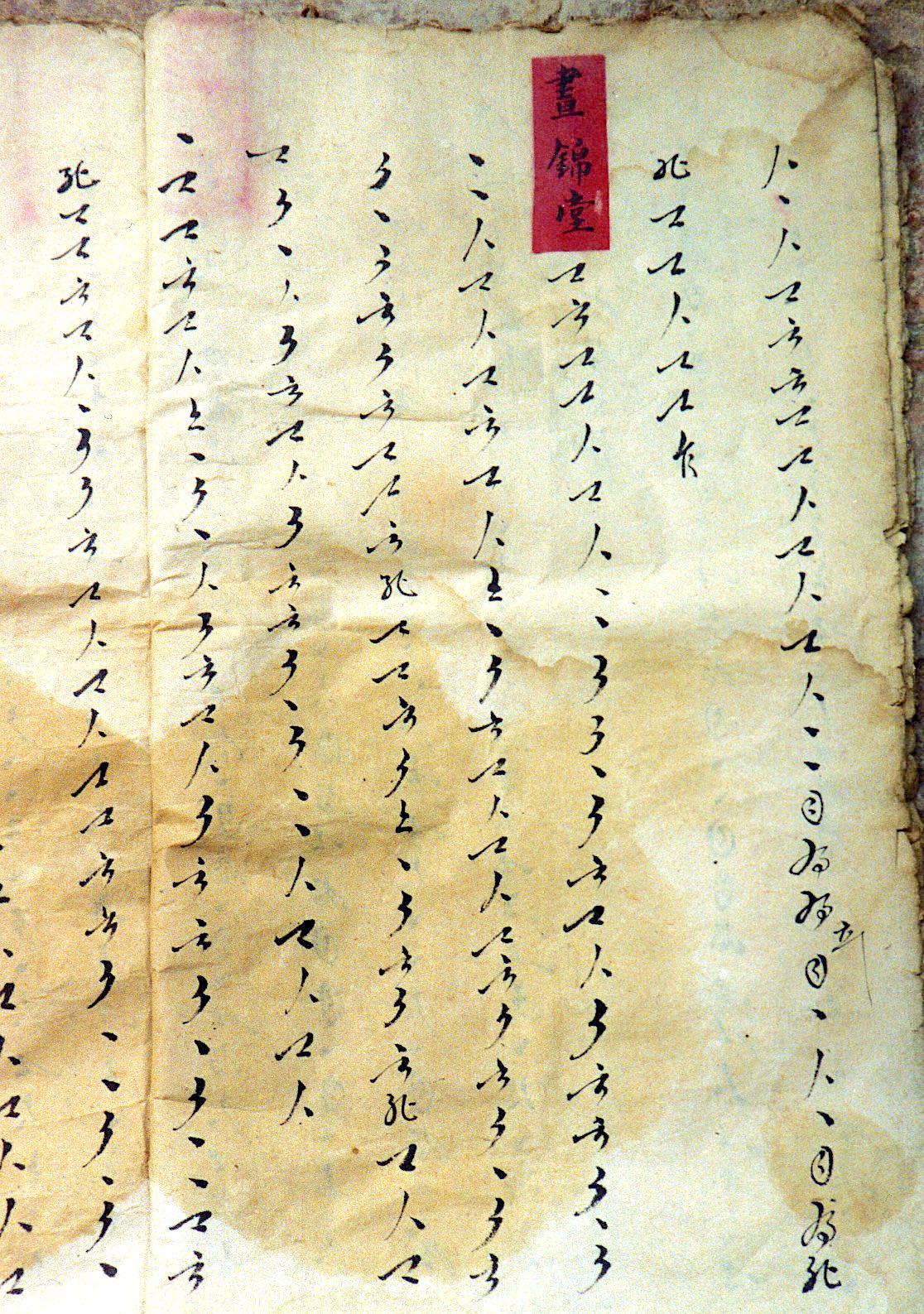
From my partial photos of the Gaoqiao score.
Many of the gongche scores in the major recent anthology Zhongguo gongchepu jicheng 中国工尺谱集成 passed through Li Wenru’s expert hands—the Hebei scores that we consigned to him appear in the three weighty volumes for that province.
With his modest and industrious demeanour, Li Wenru (like performer-turned-cadre Li Jin in Yanggao) was one of those unsung generous workers who managed to contribute to the new society despite the futile interruptions of Maoist campaigns. Quite separately from official slogans, such integrity was always much valued: local moral values endured.
[1] See e.g.
http://www.zgysyjy.org.cn/204/32044.html, http://news.ifeng.com/gundong/detail_2014_03/27/35175677_0.shtml, and
http://chuansong.me/n/1391306852337
*Click here for main page!*
(under Hebei > Tianjin in main Menu)
Continuing our surveys of ritual associations on the Hebei plain, the Jinghai region of Tianjin is an extremely fruitful area for fieldwork. Even by the 1990s Tianjin municipality (like Beijing) was largely rural, way beyond the city itself.
This article introduces two ritual groups in Jinghai, those of Lesser Huangzhuang and Yuanmengkou, both richly deserving more fieldwork than our team could manage in 1994 and 1995. Through the latter we found a network of Heaven and Earth Teachings sectarian associations—continuing our acquaintance with sectarian groups (Laofomen, Hunyuan, Hongyang, and so on) elsewhere on the Hebei plain.
As ever, such research requires a blend of fieldwork, textual study, local history for both imperial and modern eras, and an understanding of folk religion and the ritual soundscape.

After Vesna Goldsworthy‘s book on her upbringing in Yugoslavia and later life in the UK, Kapka Kassabova’s Street without a name: childhood and other misadventures in Bulgaria (2008) makes a worthy follow-up.
I know even less about Bulgaria than about the GDR, [1] but such observations strike a chord with my experiences of China. Such works also explore my theme of post-traumatic historical amnesia.
Born in 1973, Kassabova left Bulgaria in 1990 after the fall of the Berlin Wall. She reflects:
Totalitarian regimes are not interested in personal stories, they are interested in the Party, the People, and the Bright Future. Nor are post-totalitarian democracies. They are too busy staying alive.
Equally, in the West there hangs about a vague idea of collective life behind the Iron Curtain, and life after it, but there are surprisingly few personal stories to go with the idea.
Fair point, though such accounts (even in English) do seem to be growing. Kassabova cites an unnamed Yugoslav child in the 1990s:
I love my country. Because it is small and I feel sorry for it.
With the candour of childhood, she too asks her mother, “Mum, why is everything so ugly?” Still, she cites Walter Benjamin:
When an outsider comes to a new place, he [sic] sees the picturesque and the freakish, whereas the local sees through layers of emotion and memory.
So while a newcomer would have looked at Youth 3 [her housing block] and seen an uninhabitable dystopia of concrete and mud, I learnt to see it for what it really was: my home.
[…] There was also the butcher, the baker, the kindergarten, the grocery store, the Universal store, the bottle store. So what if they were all housed on the ground floor of blocks, or in small, bunker-like concrete buildings we called trafoposts because they were built to house the suburb’s electrical transformers? So what if the butcher only had mixed mince and bloody legs that she wrapped up in coarse brown paper? Or the baker only had two types of bread, white and wholemeal, and the Universal store was universally empty except for, say, a just-arrived pull-out sofa bed? Or the bottle store only sold lemonade and beer? You like lemonade, and you liked meatballs, and you already had a pull-out sofa-bed anyway. It’s not as if you lacked for anything. It’s not as if there was anything more you wanted. After all, you didn’t know there was anything more to want.
One product that might be available in the Universal store was the more accurately-titled Ordinary biscuits. On Bulgarian shops:
They weren’t actually shops, not in the conventional sense of the word. They were unheated ground-floor rooms with shelves on which something may—or may not, depending on the day—be displayed, perhaps even sold, if you could bear to queue up, fight with other citizens, and emerge battered but triumphant, clutching a pair of shoes, a kilogram of Cuban oranges, or a tub or margarine.
Sometimes inadvertently evoking Molvania, it’s a fine line that divides us from the old Commie-bashing trap of sneering at the failure of the socialist experiment—laying bare the privations comes better from people living under such systems than from foreigners or even expats. Whereas a book like Hester Vaizey’s Born in the GDR shows a more varied response from that generation born under socialism, in Bulgaria it seems harder to find people who appreciated anything about life either before or after 1990.
This is hardly comparable, but as a foreigner in China I soon lost the capacity to be shocked, growing used to clambering up unlit concrete stairwells piled with cooking equipment and cardboard boxes to visit families squeezed into tiny bare one-room apartments. This was just how people’s lives were. Even now I don’t bat an eyelid as I walk past stinking pits of litter strewn in village alleys. Whereas on fleeting visits to the GDR before 1989 I merely felt alien and out of my depth, not equipped to pass patronizing pronouncements.
Kassabova’s father went on work trips abroad, and sometimes foreign friends come to visit, laughing companionably with them:
For a moment, you could even think we were equal.
But we knew, and they knew, that we weren’t equal. Behind the laughter and the wine, I sensed my parents’ permanent nervous cringe. They knew the foreign guests saw the ugly panels, the cramped apartments, the mud, the overflowing rubbish bins, the stray dogs, the empty shops, the crappy cars, the idiots in the brown suits, and they were ashamed.
We were living in a banana republic, but minus the bananas.
Young Kapka even feels like a poor cousin in neighbouring Macedonia, and even more so on a trip to East Berlin. When her father gets a six-month fellowship in Delft on, his wife visits him:
It wasn’t the supernaturally clean streets, the tidy bike lanes, the smiley people, but the university toilets that tipped her over from stunned awe into howling despair.
Mind you, I’ve felt a bit like that in Holland myself… On their return, her father puts a brave face on things.
“They’re just normal people. OK, they have more material things than us, but otherwise their lives are not that different.”
“Of course they are,” my mother insisted. “Whether we like it or not, they are different.” They think differently. They take so many things for granted. They have rights, they demand things… They live in another world.”
When her father’s Dutch colleagues come on a visit they too look on the bright side, which leaves the family lost for words.
Kassabova relates another Soviet joke (which actually resembles my granddad’s joke):
A man in the deli section of the supermarket says to the butcher behind the counter: “Can you slice up some salami for me?” The butcher replies, “Sure. Just bring the salami.”
Our parents shared the same world: a world where political jokes and birthday parties were the norm, and you were united by a distrust of the idiots in the brown suits.
Even in her teens she could deconstruct the motto “Let us Construct Socialism with a Human Face”:
a) Socialism with a Human Face did not occur naturally, it had to be constructed like so many blocks of flats; and b) there was also Socialism with an Inhuman Face.
The teenage Kapka watches Brazilian soap operas, The thornbirds, and Star wars; she listens to the Beatles, and the gritty songs of Vladimar Vysotsky. Like Goldsworthy, she attends a lycée, where
The general idea was not to get top grades, but to mix with Sofia’s brightest brats, wear your navy-blue school mantle short at the bottom and unbuttoned at the top, smoke in the toilets, wear blue make-up, and sulk. (p.105)
She immerses herself in hoarse, acerbic French songs (Renaud, Sardou), translating their rage against the capitalist machine:
to our ears, there was only one machine to rage against, and that was Socialism with a Human Face.
Aged 16 when the Wall fell, she moves on to The Scorpions—a most long-lived and prolific band who graduated to heavy metal (as you do; am I the only muggins who had never heard of them? Cf. my mum’s comment on the Beatles). After the collapse of the regime, she basks in their 1990 Wind of change (one of the best-selling singles in the world, over fourteen million copies sold!), and then
The nation’s new year present was the televized execution of Nicolae and Elena Ceausescu by a three-man firing squad. It wasn’t quite as good as having our own Todor Jivkov shot in the head, but it was better than nothing.
After a brief sojourn in Colchester, the family returns to their block in Sofia:
It had turned from the wild East into the wild West, and it was hard to say which was worse. Tiny cafés and shops had mushroomed among the panels. People sold contraband cigarettes and suspect alcohol mixtures straight from their underground cellars. The elder Mechev son was a racketeer.
[…]
One thing was clear: money was king. Education, culture, and the life of the mind were for sissies, and sissies sold pantyhose on the street, walked the streets with a lunatic grin, starved to death, and were run over by speeding black Mercedes.
After moving abroad, Kassabova’s own life remained rootless for many years. For the rest of the book she assumes the role of travel writer, skillfully combining the struggling present and the socialist deprivation of her youth with digestible vignettes of Bulgaria’s complex ethnic history. She visits superficially idyllic scenic spots, quite aware of being an outsider. [2] And she finds a lot of dying villages with left-behind people, like in China.
She notes the meek behavior of passengers as their flight is delayed:
Nobody is complaining. They are used to waiting: in state hospitals, shop queues, immigration offices, visa departments…
Landing at “the world’s worst-named airport” Vrajdebna ( “Hostile”), she returns to visit her rural relatives, enduring literal and metaphorical potholes. They watch a TV documentary about Bulgarians abroad, whose director has “artfully collated people’s homesickness to form a home-affirming narrative.” Yet
Between the small, confused person who sat here anaesthetizing herself with cakes and the impossibly foreign Richard Chamberlain in The thornbirds and the grown-up person lying here with a “foreigner” and two passports, there is no common language. They can’t meet in time, they can’t speak, they can only lie in this bed, very still, without touching.
In another scene that must be familiar to many such migrants, she meets an old school friend, who surmises, “Well, if I’m not happy now, I must have been happy then.”
Kassabova joins in a saccharin song from the Zhivkov era, “an ironic but secretly nostalgic serenade”. She glimpses the provincial innocence of village girls that makes them prone to trafficking—“an innocence that springs from the poisoned village-well of ignorance, conformity, and fear”.
She describes the expulsion of the Turks (“the Revival Process”) in the 1980s, another grim component of a long history of ethnic cleansing over a wide area.
The ethnic Turks were the tobacco-growers, the agricultural workers, the humble workforce that buzzed away in the background, propping up the diseased body of the State. There was no official announcement that the Turkish exodus had dealt a deadly blow to the already decrepit economy, but it soon became obvious. [Hm, sound familiar?] We knew, even in the torpor of our ignorance, that the long holiday of our compatriots was no holiday. It was a purge.
Meeting Turks, she gingerly enquires about their experiences. She also introduces Pirin Macedonia, and the Pomak minority of Rodopi, early Muslim victims of the “voluntary” change of names under Zhivkov. She cites Brecht: “the State was dissolving the people and electing another people”. Yet amidst what seems like an impressively toxic rate of xenophobia, Armenians had found refuge, and Bulgaria’s resistance to the deportation of the Jews was creditable.
Kassabova tells the harrowing tale of the mausoleum of Dimitriov in Sofia, and in Veliko Taronovo she introduces the ill-fated 19th-century satirist Aleko Konstatinov. Zhivkov’s daughter Lyudmila makes cameo appearances—a kind of prototype for Ivanka, only the former’s wacky eastern mysticism made a less perfect fit with the “values” of the leadership than does the crass materialism of the latter (cf. “the values of the Carphone Warehouse”). Just before Lyudmila’s mysterious death in 1981 she led an expedition to Strandja, on the southeast border with Turkey, to seek the tomb of the Egyptian cat-headed goddess Bastet. Still, her esoteric artistic tastes didn’t prevent her designing “the ugliest and most conspicuous monument in Bulgaria”.
As Kassabova notes, more East Germans were killed at the Strandja border than at all other border crossings put together (“the number of dead Bulgarians is unknown because no one has bothered to find out”). On a train she gets talking with a survivor of the labour camps, who segues nonchalantly from a harrowing account of her youth there into an anti-Semitic rant.
Finally she returns to the apartment block of her youth, which belatedly and unexpectedly has become a leafy neighbourhood, if still hardly salubrious. But still she needs to escape again, unable to heal her fractured psyche.
Kassabova expands on these themes in Border: a journey to the edge of Europe (2017, also reviewed here), broadening the area covered to Greece and Turkey. Again reminding me of China, she writes,
As I set out, I share the collective ignorance about these regions not only with other Europeans further away, but also with the urban elites of the three countries of this border.
* * *
The soundtrack to all this would be enticing: for turbo-folk and traditional music, see here, and for irregular metres, here. On the bus back from Istanbul the driver puts on a tape of gritty chalga, and Kassabova also catches an Ivo Papazov gig. Her tastes since emigrating turned to tango, which she has also evoked in Twelve minutes of love: a tango story.
[1] This broader overview by Jacob Mikanowski, considering studies of East Europe, is also intriguing.
[2] Unlike Patrick Leigh Fermor, I must say, who unfailingly does that really irritating thing of instantly getting clasped to the bosom of ordinary folk. Nigel Barley debunks this conceit in his classic “harmless idiot” spiel—but that’s not important right now. For Leigh Fermor, see this review from Neil Ascherson.
As an interlude between weightier posts on Daoist ritual and suchlike, here’s a selection from the excellent 1981 Punch collection If the caption fits—covering art, historiography, and sinology:
Cf. my Spot the ball competition; and for a drôle Berlioz caption, see here.
continuing from Part One

Hildi directing school choir, March 1963.
After twice fleeing danger, by 1950 Hildi’s family had arrived in Detmold, in the British zone of occupation, where they found a more secure home as society slowly rebuilt.
Westphalia
In both Russian and Allied zones after the war, many prisoners were still held in squalid conditions, often in former concentration camps. At Minden just north of Detmold there was a British-run displaced persons’ camp, [1] which by the time Hildi arrived had become a British army base.
For a whole year Hildi’s family lived in a garden hut belonging to a friend, which had previously served to accommodate two other refugee families. The authorities, who had to find adequate housing for all of them, threatened to nail the door shut to put an end to this.
But in spite of the cramped conditions, living in freedom, enjoying the garden with its bench and table under the opulent cherry tree, listening to the chirping birds hopping on the roof of the hut—all this seemed bliss. In the morning the postman would shout from the bottom of the garden: “Dornröschen, wach auf!” [Sleeping Beauty, awake!]. Inside the hut there were three bunk beds on top of each other with not much room to manoeuvre; my father slept on a narrow bench under the window, but occasionally there would even be a place for a visitor on a field bed, with just a head peering out from underneath the table! A special treat for Sunday was one of the delicious loaves baked with yeast and full of juicy raisins.
We had lovely Sunday walks in the Teutoburger forest, taking picnic lunches. On Christmas Eve 1950, as my parents prepared for a festive celebration, decorating a tiny Christmas tree in a flower pot, my brother and I walked down the snow-covered street looking into the lit-up windows. Some of the houses were occupied by British families. Since their decorations were rather different from most German ones, we wondered if perhaps these colourful garlands meant some kind of carnival?
As the schooling system was different from that in the GDR, Hildi had to jump two classes to start her high-school education. In most subjects this didn’t seem to be a problem, but although her mother had tried to prepare her, she didn’t find English so easy at first—especially as she had to tackle the second language French as well. It was music classes that gave Hildi most pleasure, above all her violin lessons with Erwin Kershbaumer.
The following spring they were moved into a flat on a newly-built housing estate, which felt something of a luxury. They now had to find some furniture. When a professor from the local music academy, who was leaving to take up the position of Thomaskantor in Leipzig, posted an advertisement offering a table, six chairs, and a small sideboard of solid oak, Hildi’s mother agreed to the sale at once.
With money still very tight, both parents gave private lessons, often walking long distances to nearby villages to coach children who had difficulties at school. Still, given their lucky escapes, Hildi remembers it as a happy time:
We were content and made do with what we could afford without feeling deprived, although people around us seemed to be better off, and the choice in the shops was plentiful and perhaps tempting.
[This is neither here nor there, but I note that similar comments have been made by people recalling life in the GDR! People’s modern sense of entitlement to instant gratification was still some way off.]
Only later in my life did I fully appreciate the sacrifices my parents made in order to provide us with a good education and comfortable life. As long as my brother and I were studying they never took a holiday, and even afterwards they were there for the whole family whenever financial help was needed.
In August 1951 they all travelled back to Thuringia to attend the wedding of Hildi’s sister. This would be the last time they were all able to go together: by 1952 the GDR had closed its borders. Until 1963, when Hildi’s father became a pensioner, only she and her mother were able to make occasional visits—his profession in education made him immediately suspect to the authorities, so he felt it would be unwise to go.
Heimat
In 1951 Hildi’s father, with his pre-war experience as Rektor, was appointed headmaster of a school just further north in Minden. Whatever their wartime backgrounds, qualified employees were desperately needed in the new Germany.
During the 1952 summer holidays, Hildi and her mother went to join him. Hildi’s brother stayed at boarding school in Detmold to finish his last year before the final high-school examination. Hildi, now 15, attended the high school for girls in Minden. By this time she was also a promising violinist.
Their flat in Minden was again a newly-built one, and Hildi was delighted to have a little room to herself for the first time. Another excitement was to acquire a second-hand piano, on which she immediately tried out some tunes with a few fingers—having just joined a local choir, she liked attempting the Hallelujah chorus. Quite soon a piano teacher was found and she began learning properly.
In 1950 the GDR had signed documents officially recognizing the Oder–Neiße border as permanent boundary between Germany and Poland, a gesture which in 1970 was followed by the western part of Germany at the Treaty of Warsaw, signed by the West German chancellor Willy Brandt. For the older generation of refugees from the east, like Hildi’s parents and grandparents, this meant a conclusive end to their hopes for a return to their Heimat. At the time such refugees made up about a quarter of the population of the GDR—who had to keep quiet about their past (socialism looks forward, not back, as Hildi observes!). They were officially called “resettlers” (Umsiedler); “expulsion” (Vertreibung) was now to be known as “evacuation” (Aussiedlung).
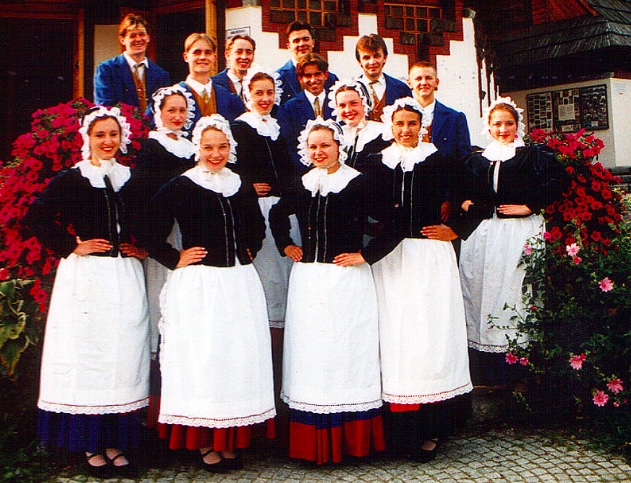
Traditional Silesian costume.
While the complexities of Silesia’s ethnic history were being erased under the GDR and Polish regimes, Hildi´s parents, uprooted from their “Heimat” to Minden, and living with the realization that there was never to be a return, joined the local Silesian Association (Schlesier Verein), [2] where they found friends amongst people who shared a similar past, exchanging cherished memories, reciting poems in dialect and singing. Once a year there would be a festive occasion when everyone dressed up in traditional costume. [3] Such Heimat-Nostalgie was common—though their own nostalgia was not for Weißwasser but their ancestral home further east in Silesia, now part of Communist Poland. [4]
At the time Hildi was busy growing up, finding her own friends and activities. While her parents took comfort from celebrating the past, for her all this was slightly embarrassing and sentimental. Looking back now, she realizes her lack of enthusiasm for the family’s Silesian heritage must have disappointed her parents, but they never pushed her.
Studying and teaching
Hildi was firmly rooted in the present, looking to the future and enjoying her fortnightly trips back to Detmold at weekends for violin lessons, staying with her teacher.
When the British left in 1955, the houses they had occupied in Minden became vacant, and the British cinema closed, but people hardly noticed any change.
After matriculating in March 1957 Hildi began her studies at the NWD Musikademie in Detmold, resolving to become a teacher of music and German. Her brother was just finishing his studies in art and German.
Hildi was full of enthusiasm, not just working hard but enjoying her time with friends. She received a monthly allowance from her parents, and if she ever overspent her friends would share their second helping at the Mensa. Still, by the end of each term they had generally lost weight, and were looking forward to proper meals at home. In April 1960 Hildi graduated in German, and in July she qualified as a music teacher.
For the summer of 1961 I was awarded a scholarship for the Wagner Festival in Bayreuth. I was given two tickets, one for Parsifal and one for The flying dutchman. As my violin professor was in the orchestra he managed to sneak me into the covered pit for a performance of Tannhäuser, conducted by Sawallisch, where I perched amongst the musicians of the first violin and could briefly stand up when they were not playing. This gave me the occasional glimpse of my idol Dietrich Fischer-Dieskau as Wolfram, Victoria de los Angeles as Elisabeth, and Wolfgang Windgassen in the title-role. The production of the Béjart Ballet in the Venusberg Scene and the first black Venus, the fabulous Grace Bumbry, caused quite a stir in the press. I was also able to get into the dress rehearsal of Die Meistersinger. This was my introduction into the world of opera, in which I would be involved myself at a much later stage of my life.
My first employment was at a primary school in a small town a short bus ride from Detmold. This first year in my teaching career proved to be demanding, as I had to cover all the subjects and do a lot of reading—sometimes I was just a few pages ahead of my pupils! Every lesson had to be prepared in writing, available for the supervisor who appeared, unannounced, on a number of occasions.
I was waiting for a position teaching music and German to become available in Lemgo nearby, which was to become vacant in 1961. There I was the first and only music teacher of the school, and I now had a modest budget to buy the necessary equipment. I promptly bought six violins and music stands and started teaching my violin pupils in the afternoons. This was the humble beginning of a little school orchestra later on. I also formed a small choir to perform for special occasions. In the beginning these were always a bit stressful for me, as I felt responsible for each of my singers and could not be sure how they would react under pressure. In my teaching I was always very careful not to have any “favourite” pupils in my class. When we prepared a play for parents’ day I was just guiding the children. The children wrote the play, they decided who should get the individual parts, they made the costumes, and as there were a number not directly involved in the play, I made sure they had other duties and thereby did not feel left out.
In the early days of the GDR Hildi’s sister (now married with two small children) could visit occasionally—always without her husband. Hildi’s parents regularly sent food parcels; their finances still stretched, her mother resumed teaching.
It was a terrible shock when the Berlin Wall (“Anti-Fascist Protection Rampart”) was built in August 1961. As it happened, just beforehand Hildi’s sister managed to visit her family in Minden, with her little boy and a daughter still not one year old. Of course they wanted her to stay—but despite the GDR’s escalating problems, they understood her decision to return again to her husband and home.
From now on, visits from East to West were only granted under exceptional circumstances. It became increasingly difficult for Hildi’s family to visit her sister too: after filling in elaborate forms, they faced uncomfortable checks at the border, with guards watching on both sides of the train, Kalashnikovs poised. Visitors were invited to attend the political “welcome meetings” to extol the praises of the GDR; though not compulsory, any absence would have been noted down. Hildi’s mother had returned from a previous visit seething and debilitated; later, afraid that her mother would be unable to sit through the propaganda without exploding, Hildi’s sister discouraged her from going.
1963–66: Zurich and the world
In 1963 Hildi’s life took yet another new course. By now the violin was playing an increasingly important role in her life. She pursued her studies further by continuing her lessons with Prof. Otto Schad at the Akademie in Detmold, and she enjoyed the chamber-music tuition with Prof. Günther Weißenhorn. She received her violin-teaching diploma at Münster in May 1962, and began getting occasional engagements for concerts.
Inheriting an attraction to Switzerland from her mother, she now boarded her first aeroplane (alone and terrified) to audition for the Zurich Chamber Orchestra. Wanting to keep it a secret, she took a flight from Hanover directly after school finished on a Saturday. After the audition on Sunday she took the sleeper back home, and went straight back to work at her school. The following week she received a letter offering her the Zurich job. She was overjoyed, but now she had to break the news to her parents, and (right in the middle of term) to the headmaster of the school where she was teaching. But of course they were pleased for her, even if they assumed she would come back one day.
However, saying farewell to my class was more difficult and caused quite a few tears from my pupils. I was deeply touched by their affection. They had prepared a moving little ceremony for me, presenting a booklet in which they had recorded in writing, accompanied by some photos, events in the course of our time together. At the end each of the girls gave me a beautiful pink rose before they waved me off and ran after the bus which finally parted us. When they were all out of sight and I sat holding my huge bunch of thirty-six roses, I too felt sad, realizing how much I had enjoyed my teaching. Little did I know then that much much later on I would indeed return to this profession when coaching singers in the performance of German repertoire.
Although the pay was low and Swiss prices high, these three years with the orchestra were a happy time for Hildi, unimaginable after the hardships of her early years of refugee displacement.
I loved the playing, and I am still grateful that I had the privilege of rehearsing with many world-famous soloists in the rather small room in the villa of the founder and conductor Edmund de Stoutz. In this intimate environment we experienced these wonderful musicians in a way that is hardly possible on the big stage—they were so close, this was chamber music at its very best! There would be Yehudi Menuhin and his sisters Hepzhibah and Yalta, Zino Francescatti, Nathan Milstein, André Gertler, Erica Morini, Maurice Gendron, Pierre Fournier, Gaspar Cassadó and many others—forever treasured encounters!
I bought a really good violin and studied with Ulrich Lehmann in Bern. Apart from concerts in Switzerland, I loved going on tour to places like Italy and the USA. Touring was a great way of visiting places I might otherwise never have seen.
My first trip to Venice was unforgettable. The orchestra had a tradition that every newcomer would be taken blindfolded to the middle of Piazza San Marco—as the scarf was removed, imagine the breathtaking impact of finding myself surrounded by all the stunning architectural beauty!
Also unforgettable was my first tour of the USA, with forty-nine concerts, travelling for two months by Greyhound bus through the eastern states! We did not get any subsistence (meals were pre-ordered for the whole group), and we shared rooms—but I loved it. However a shocking experience for us all was to be confronted with the rigid segregation of blacks in the southern states. Seeing signs: “No blacks admitted!” in many public places gave us a guilty and very uncomfortable feeling. One saw blacks working in the kitchen, but none inside the restaurant. Only when we played in Atlanta did we notice black people in the audience.
In November 1963 news of the assassination of JFK spread like wildfire during the interval of our concert in the Tonhalle in Zurich. We were stunned—only a few months earlier he had been the focus of international news when he made his famous speech in Berlin. As soon as the concert ended we rushed off to the Bahnhofsplatz to join the throng of people staring in shock and disbelief at the news bulletin projected on a screen high up on a building. On our US tour the following April we visited Kennedy’s grave and the Eternal Flame at the Arlington Cemetery.
I was very conscious of the fact that I was privileged to experience this freedom while my sister’s family in the East was living under severe travel restrictions. To let them take part in my excursions, at least visually, I sent them as many picture postcards as I could, which they collected and have kept to this day.
Meanwhile in Germany, Christmas 1963 marked a temporary pause in the complete segregation of East and West Berlin: West Berliners could now get a 24-hour visa to visit relatives in the East. Of course it was a one-way deal, and the concession only lasted for eighteen days, but still it gave a glimmer of hope to all those families had been forced to live apart. As a sign of solidarity Hildi’s family always put a candle on the window-sill on Christmas Eve.
1966–68: from Hanover to London
Much as Hildi loved working with the Zurich Chamber Orchestra, after three years she began to feel it was time for a change. Wanting to experience the big romantic sound of a symphony orchestra, in late summer 1966 she applied for positions in various German orchestras. Meanwhile in Zurich she did some freelancing with the Radio Orchestra, where she met her future husband, viola player Andrew Williams, who had just finished his studies with Max Rostal in Bern.
While Hildi waited to find out which direction her life would take, she returned to Germany, taking further lessons with her teacher Otto Schad in Detmold. In January 1967 she started work with the Niedersächsisches Symphonieorchester in Hanover—experience that stood her in good stead for her later career.
In 1968 Hildi married Andrew and they came to live in London—this time a willing migration for her. Her parents were happy to come and see her there, and they had a wonderful holiday in Scotland while she was performing there with Scottish Opera.
With her basic English learned at school in Germany, she often sank into bed exhausted from trying to communicate. Her ear now attuned to the nuances of German and English, she appreciates my bemusement at some of the mouthfuls cited here, but observes:
The English ear can be quite overwhelmed by all the composite nouns of German, like Brückenbauingeneuranwärter, “engineer apprentice for building bridges”! Of course, it sounds absurd out of context; but German poetry also has some exquisite creations that touch me every time I hear them, such as Richard Strauss’s Morgen:
… inmitten dieser sonnenatmenden (sun-breathing)
zu dem Strand, dem weiten wogenblauen (wave-blue).
Sometimes I would try and invent such words in English, only to be told, “You can’t say that—it’s not in the dictionary!”
Such language—like the Matthew Passion, the settings of Berg, and Nina Hagen—further encourages me to learn German (see also Some German tongue-twisters).
Here’s Elisabeth Schwarzkopf with George Szell and the LSO in 1968 (with Edith Peinemann on violin), just as Hildi was making her home in London:
And I just have to offer you Janet Baker singing it with the Academy of St Martin in the Fields, c1972:
(For the Four last songs, see here).
Hildi continued her studies of the violin with Manny Hurwitz, but having to make connections all over again, freelancing in London was hard for her at first. For the first year, as a German citizen Hildi was unable to join the Musicians’ Union. So after marrying she applied for British citizenship—seemingly a sensible step, since she had made London her home. She didn’t realize at the time that German didn’t accept dual nationality, which later caused her considerable problems. In Hildi’s poetically succinct evocation,
Sitting in an office among the clatter of typewriters, swearing allegiance to the Queen, I lost the nationality of my birth.
As to freelancing, the immediate problem was that Hildi’s musical training on the continent was very different. Since most continental orchestras have plenty of rehearsal time to get familiar with a work, she found herself ill-equipped with the sight-reading skills of British musicians, who might not even know what was on the programme before they showed up for the one rehearsal on the day of the concert. Further, the freelance scene depended largely on introductions and recommendations. Lacking such connections, she was a foreigner who hadn’t studied in Britain.
So Hildi made a slow start. Her account will strike a chord with many an early-career freelancer:
My first engagements were mainly out-of-town dates. I remember playing in stunning but freezing cathedrals, welcoming the breaks when I could cup my cold hands around a warming mug of tea served with home-baked goodies provided by dedicated elderly ladies. Sometimes I ventured out with my new friends in search of some affordable sustenance. Money was always tight. Andrew had bought a new viola, so from each payslip a deduction was made to pay for it in instalments. We were also saving up to buy a home. Between us we managed on £10 a week for housekeeping. Sometimes my parents would help out, but in those days the exchange rate was low—11 Deutschmarks to the pound!
We can’t erase memories of the “No Irish, no blacks, no dogs” posters of the day (Enoch Powell delivered his “Rivers of blood” speech in 1968), but there was also an enduring undercurrent of anti-German sentiment, both in the media and in society. Hildi was shocked when a well-meaning colleague took her aside and said, “Don’t tell anyone you’re German! Pretend you’re Swiss.” And in a fatuous tradition marginalized until the sinister rise of “the UKIPs”, even her new neighbours told her, “Go back to your Cologne, or wherever you come from”—their relationship remained frosty throughout her first decade in London. Since living in Swizerland had felt no different from being in Germany, such remarks felt hurtful. After the caricatures of British comedy, latterly—with Germany’s image improving constantly (I suspect the Apollonian Joachim Löw‘s rebranding of the national football team may be an element)—the legacy of such racism now resides mainly in odious tabloid headlines.
Of course, it is quite understandable that having endured such hardships as a result of standing against Hitler, many British people would feel long-lasting animosity—but as time went by, the personal consequences were unsettling. Since Hildi was still not two years old at the outbreak of the war, she gradually came to feel that she shouldn’t have to go on bearing the taint of being German; she hoped to be taken as an individual, to be judged by how she conducted herself and related to people.
Indeed, this was soon the case in the musical world where Hildi now found herself. As time went on she began to find work with leading chamber groups like the English Chamber Orchestra and John Eliot Gardiner’s Monteverdi Orchestra; other formative experiences were playing for Kent Opera, the London Classical Players, and the Academy of Ancient Music. She sometimes came across Hugh Maguire, who was soon to teach me
This was the swinging sixties—Beatles, Stones, Hendrix… Even the more staid classical music scene was still seasoned by dalliances with pop—the session scene was burgeoning, with Hildi’s colleagues playing in the string quartet accompanying Yesterday and She’s leaving home.
In 1969 Hildi was also playing in the run of the musical Anne of Green Gables, doubling on violin and viola. As the music became grindingly familiar, some players in the pit replaced the score on their stand with a magazine; during the dialogues Hildi managed to read through the whole of War and peace and Anna Karenina. (Blair Tindall’s fine book on the New York freelancing scene also encompasses life in the pit.)
Meanwhile I was a teenager in suburban London, playing violin and surreptitiously listening to the Beatles on my little transistor radio.
While refugees played a major role in British cultural life, a painful blanket of silence reigned. There was no sharing of reflections. Of course, those orchestras also contained a substantial quorum of Jewish refugee musicians, who had endured far worse sufferings than Hildi’s family; later their children were also among our colleagues.
So throughout the post-war period, in all walks of life (service, industry, the arts, including music), refugees were ubiquitous yet unacknowledged. Survivors of the war, both victors and vanquished, were relieved to tend their begonias, go shopping, and bring up their families without raking up the past.
Still, within Germany, films like Wir Wunderkinder (1958) and Die Brücke (1959) were hotly discussed, especially among the younger generation. Among myriad discussions, conflicting moods among Germans in the early 1960s are movingly evoked by Gitta Sereny. [5]
Life in the GDR
Meanwhile, the life of Hildi’s sister was taking a very different course. [6] She and her husband were teachers. Their lives under the GDR remained private; this isn’t the place to try and fill in the gaps, so I can only imagine her story through the prism of major events.
After the trials that immediately followed the war, West Germany as yet largely preferred to bury the ghosts of the recent past. In the GDR, despite some more perfunctory show-trials, there was still less soul-searching: the topic of its citizens’ relationship with Nazism was even more verboten.
My mother and I visited my sister at least once a year, mainly during the summer holidays. In the early years one would be confronted with red banners everywhere as soon as one reached the border—self-congratulatory slogans praising the achievements of the State, the fulfilment of the Five-Year Plan, and exhortations to strive hard for the socialist ideal. Photos of individual workers were displayed on a board in front of the factory, with captions giving their names and accomplishments. As time went on, fewer of these displays were evident.
In June 1953 there was widespread unrest. The Soviet invasion of Hungary in 1956 added to people’s moral dilemmas. Hearing of these upheavals on the radio, Hildi was disturbed by the crushing of popular dissent while worrying for her sister. By 1968 the GDR authorities decided to destroy the ancient Paulinerkirche in Leipzig, where Bach had directed services. On 4th April the university choir performed the Matthew Passion there. But the church’s heavy student traffic was causing suspicion, and on 30th May, “the darkest day in the history of the city”, it was dynamited “to make way for a redevelopment of the university”; many of the protestors against the blasting operation were to spend years in prison. Similar protests accompanied the demolition of the Garrison Church in Potsdam.

Destruction of the Paulinerkirche, 4th April 1968.
At this very moment, the Prague spring and its repression by Soviet tanks were also causing difficult moral decisions in the GDR.
By the 1960s, along with the nationalizing of industrial and trade sectors, most land had been expropriated into collective farms called Landwirtschaftliche Produktiongenossenschaften, mercifully known as LPG. Dispossessed farmers would often find themselves laboring on their own land. A rigid work-to-rule atttitude came to prevail. Schools were often recruited at harvest time to help out “in solidarity with the workers to further the socialist ideal”. A friend told Hildi how on one such mission they had to gather potatoes after the plough had dug them up. By 5pm there was only one row left to gather, and the children were perfectly prepared to finish the job—but the order came to down tools, so they had to return the next day.
A distinct lack of individual commitment was evident. Reminding me of China, Hildi notes how the lack of a product in a shop would be acknowledged by a bored shrug from the assistant. Shopping was a lottery. Whenever word got round that an unusual item was in stock, it would sell out fast—even if it was of no particular use at the time, people snapped it up “just in case”.
For those who could afford to pay a bit more, there were Exquisit shops with higher-priced clothing and shoes, and Delikat shops for more “luxury” foodstuffs—mostly made in the GDR, but not generally available. In December 1962 Intershops were introduced, state-run stores stocked with goods from West Germany and elsewhere. Mainly intended for foreign tourists, they only accepted hard currency, at first mainly West German marks. For Hildi and her mother it was a welcome opportunity to purchase items that couldn’t easily be posted—including Nutella, which remains her sister’s favourite spread to this day.
Still, just as in China, it’s unsatisfactory to describe people’s lives solely in terms of deprivation, repression, or national crises, confrontation, and compromise; alongside “Stasiland” paranoia, one wants to reflect the normality of life under a paternalistic welfare state. Housing, and basic provisions like bread, potatoes, and milk, were cheap.
While the more adventurous GDR youth had long managed to gain clandestine access to popular culture from the West, by the late sixties the leadership was reluctantly allowing society to open up, and alternative underground scenes began to thrive—under close scrutiny. Nina Hagen (b.1955), who continued the anti-establishment stance of her mother and stepfather, eventually left for the West in 1976.
When their father lay dying in 1981, Hildi’s sister, restricted to a single visit, could come only for the funeral.
The world of early music
Back in London, Hildi was shocked whenever there were reports of GDR citizens being shot trying to escape. In her freelance work, Hildi had begun working for John Eliot Gardiner in his Monteverdi Orchestra from 1968. She was in the vanguard of his pivotal move to early instruments in 1977, going on to play in his new English Baroque Soloists—as she still does today. In a Guardian report on the extraordinary 2000 Bach Cantata Pilgrimage that was just unfolding, we find:
Hildburg Williams, a German violinist, was among those who made the leap with Gardiner in 1977. Gardiner had realised, after a particular performance of Rameau that year, that he simply couldn’t get the colour he wanted from modern instruments. So for a short time the orchestra used baroque bows on modern instruments. “We all struggled a bit,” she says, “and John Eliot soon realised that this halfway approach was unsatisfactory.” So, the following year, Gardiner switched to period instruments. Several regular players refused to follow him, and the split effectively led to the creation of the English Baroque Soloists, Gardiner’s instrumentalists ever since. Williams, though, remembers it as the most exciting time of her career: “The instruments and bows dictated a complete rethink of playing technique. It became possible to achieve absolute clarity in texture, to articulate, to speak with the instrument.”
As I suggested, Richard Taruskin thus seems to do something of a disservice to the genuine explorations of the time—as does Norman Lebrecht, in a soundbite that bears no scrutiny at all:
The early music movement has won an elective majority in the market place. The cult has claimed the centreground, homeopathy has defeated the BMA.
Hildi also features (along with Pete Hanson) in video reflections by members of John Eliot’s Orchestre Révolutionnaire et Romantique.
After her divorce in 1974, Hildi fended for herself, developing impressive DIY skills. As she gained in confidence she gradually came to feel less alien. In Paris she met the diplomat, Francophile, musician, and translator John Sidgwick, who became a soulmate, joining her in London when he retired from the British Embassy in 1984. They married in 1999.
With her vivacious personality and utter integrity, Hildi has always been a popular musician. In 1985 we did Israel in Egypt with John Eliot at the Handel Festival in Halle, and in 1987 we performed the Matthew Passion in East Berlin. For me, these trips (one on the eve of my first six-month stay in China in 1986, the other just after my second) made a niche variation on our tours to Spain, Japan, or wherever; it didn’t occur to me how deeply personal they were for Hildi. But it was wonderful for her to see her sister and family again.
A slight easing of travel restrictions for GDR citizens had taken place in 1982. More usefully, a GDR regulation that people over 60 could visit relatives in the West enabled Hildi’s sister to join their mother for a holiday in London in 1988—though her children were kept behind. Still no-one had any inkling of the imminent convulsion.
But by the autumn of 1989, following Gorbachev’s dramatic rolling back of restrictions—and, in Beijing, the abortive Tiananmen protests of the summer—unrest was suddenly rife throughout Eastern Europe. Hildi’s niece was working in Leipzig for the celebrated music publishers Peters—which we had all raided for scores on our 1985 and 1987 visits (I heard a story about Karajan’s visit to the shop: casting an eye over the stock, he simply declared, “I’ll take the lot.”).
By September Hildi’s sister was anxious whenever her daughter joined the growing crowds of demonstrators setting off every Monday in peaceful protest marches from the Nikolaikirche, where Bach had directed his John Passion. The conductor Kurt Masur joined the demonstrations, going on to play a leading role. As the Wall fell on the 9th November—almost as suddenly as it had been built in 1961—Hildi watched the TV broadcasts in London with excitement.

Since 1989
The fall of the Wall was momentous, allowing long-separated families to be reunited. It’s easy to celebrate “freedom”, but we should at least hint at the complexity of people’s feelings in the East. People now “just wanted a life”, as Hildi observes. Hildi’s sister and her husband didn’t want to enquire about their Stasi files—and nor does Hildi, who must have one too.
But as throughout East Europe and Russia, people now had to adapt to harsh and bewildering new economic realities. In China too, the dismantling of the commune system from the late 70s had led to great uncertainty; Li Manshan’s Daoist band were now thriving once again, though it was still to be over a decade before life became significantly more bearable.
After unification Hildi’s niece lost her job at Peters. Their precious stock was destroyed when its partner in Frankfurt decided it should be pulped: they couldn’t even sell it off cheaply.
The building of a modern church on the site of the Paulinerkirche, dynamited in 1968, was now on the agenda, and in 2009 the first service was held in the imaginative new buildings. Leipzig is now full of thoughtful commemorations of its troubled GDR past.
In 2000 Hildi and I were part of the pool of musicians taking part in weekly concerts throughout the year for John Eliot Gardiner’s extraordinary Bach Cantata Pilgrimage. While I was naively relishing the music, Hildi’s enjoyment would have been mixed with her personal history. She reflects with a certain irony how the poverty of the GDR had enabled towns there to preserve dilapidated old architecture that was being dismantled with abandon in West Germany (although it has been observed that in the East they compensated by ravaging the environment).
By 1994 Hildi’s life was taking a new course, as she found herself in demand as a German language coach for singers. She has gone on to work mainly at Covent Garden, Welsh National Opera, the Royal College of Music, and the Royal Academy of Music. She dearly loves this work, combining her early teaching experience (in the family tradition) with her later career as orchestral musician—even if she sometimes has to bring into play the skills of diplomacy that she has honed in playing for conductors.
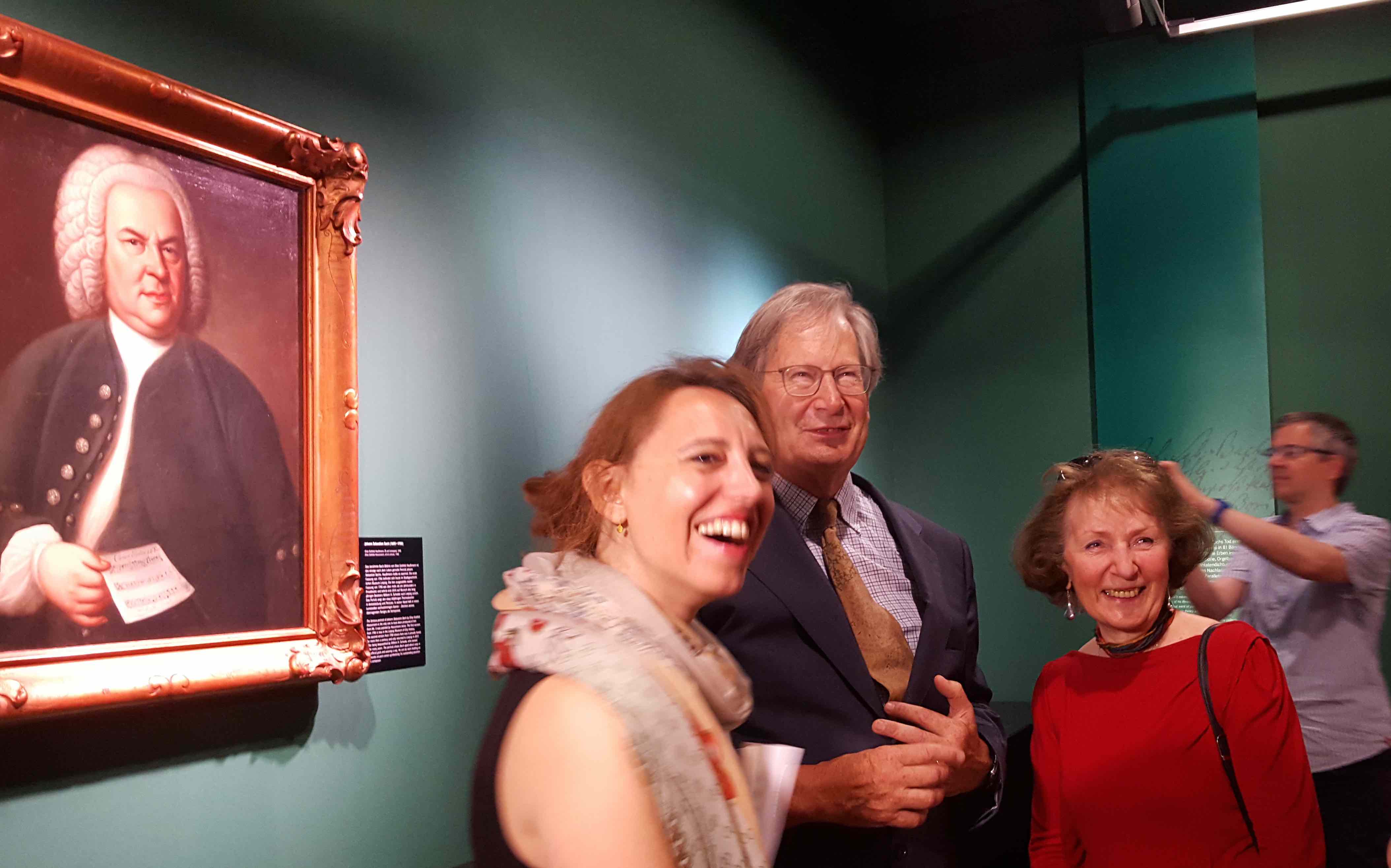
Hildi (right), with Bach and John Eliot, Leipzig 2015.
As Hildi tells me the story of the 2015 return to Leipzig of the famous 1748 painting of Bach by Elias Gottlob Haussmann, she clearly takes it to heart. The portrait had itself been on a lengthy odyssey (see also here)—from Leipzig to Berlin, Hamburg, Breslau (Wroclaw), London, Fontmell Magna, Princeton. Its final return to Leipzig in 2015 was a kind of homecoming for Hildi too. Bach’s generation, of course, also had to live in the shadow of the devastating trauma of the Thirty Years’ War.
Walter Jenke, whose Jewish family had bought the portrait in a curiosity shop in Breslau in the early 19th century, fled Germany for England in 1936. Remarkably, to protect it from air raids, he kept it at the Dorset country home of his friends the Gardiners; so John Eliot grew up with it, as he describes in his wonderful book on Bach.
But after the war, Jenke had to sell the portrait at auction in 1951, when it was bought by the American philanthropist William Scheide. It then hung in his living room for over sixty years. When he died, aged 100, in 2014, he bequeathed it to the Bach Archive in Leipzig, where it now welcomes visitors. It was fitting that Hildi took part in the Leipzig ceremony in 2015 with John Eliot and assembled luminaries.
Meanwhile she continued playing violin right until Covid—here she is in November 2022 at a celebration in honour of her long career with the English Baroque Soloists:

Photo: Sarah Bealby-Wright.
* * *
Before making her home in London, Hildi lived under the Reich, the American Military Government, the Soviets, the GDR, the British zone of occupied Germany, and the Federal Republic.
Just recently, “hopping mad over Brexit”, Hildi—with great difficulty—has managed to reclaim her German nationality alongside her British passport.
Meanwhile in Germany, a vast and laudable reckoning has taken place for both the Nazi and GDR periods. For all the valiant attempts there to reckon for the past, the vast majority preferred to forget; but all our diverse societies continue to bear the scars of trauma. Indeed, such scars form an essential part of my fieldwork on ritual groups in rural China—and while I have documented the story of Li Manshan’s family with him in a certain detail, writing this account with Hildi reminds me that we always need to evoke Chinese lives more profoundly.
Like many, growing up absorbed with everyday problems amidst social reconstruction, Hildi later came to reflect, learning more and finding her own way of digesting and coming to terms with her country’s history. The pain of the mid-20th century is unimaginable to our pampered later generations; yet it needs to be remembered. Merely to survive was some kind of blessing—as evoked in Chinese films; and aware of her sister’s constrained situation, Hildi was moved by German films like The lives of others.
So the point is not that Hildi’s story is exceptional. Rather, whether we’re aware of it or not, we’re all surrounded by such memories—in an office, on the bus next to us, or me naively sharing a desk with Hildi in the violin section of an orchestra. And with refugees—and their contributions—ever more common, we urgently need to take them to heart. So this whole story is not just about Hildi’s early life, but about our whole relationship with our past, present, and future—in Germany, Britain, and worldwide.
[1] MacDonogh, p.413. Hildi notes that the connection of Minden with the House of Hanover and the British crown has made it a popular theme of British history books.
[2] For such groups, also known as “clubs for the Silesian homeland” (Schlesischer Heimat Bund), see e.g. Andrew Demshuk, The lost German East: forced migration and the politics of memory, 1945–1970 (Cambridge UP, 2012); Gregor Feindt, “From ‘flight and expulsion’ to migration: contextualizing German victims of forced migration”. For the ongoing conflicts over Upper Silesia, see e.g. this recent article. For narratives from Germans in Silesia, see also Johannes Kaps ed., The tragedy of Silesia 1945–46. Stephan Feuchtwang (a refugee from Berlin, later to become a masterly anthropologist of China), reflects on “the transmission of grievous loss in Germany, China and Taiwan” with pertinent comments on Heimat, in After the event, p.157, 172, 196–8, 201–4.
[3] While kitsch traditionalist sentimentality was less politically manipulated in the West than behind the Iron Curtain, a related feeling of manipulation and alienation is brilliantly dissected in Milan Kundera’s The joke.
[4] Echoes of an uncomfortable past have persisted. Another native of Weißwasser, Werner Schubert (85 in 2010) had served in the Wehrmacht, and went on to become a teacher. After retiring, he learned that the notorious SS commander Rudolf Lange, responsible for the mass murder of Jews in Latvia, came from his hometown. Schubert then set about exposing Lange’s biography, naming other local Nazi criminals.
[5] The German trauma, pp.59–86.
[6] In my post on the GDR I listed a few basic sources, not least Maxim Leo’s Red Love, a detailed and moving account of three generations in one family; and (for lives of those born under the regime) Hester Vaizey, Born in the GDR. For subversive behaviour, clothing, jokes, and so on, see also Anne Applebaum, Iron Curtain, ch.17. For the whole period in China, see here.

Refugees, 1945.
Hildburg Williams is a long-serving and popular violinist in London chamber and early-music orchestras, who has latterly added a major string to her bow [1] by becoming a distinguished German-language coach for singers in opera, lieder, and oratorio repertoires.
I’ve known Hildi since 1982, when we were playing a Handel opera in Lyon with the English Baroque Soloists under John Eliot Gardiner. Though I worked with her on and off for the next eighteen years (mostly in EBS), somehow we never managed to have a proper chat. As is the way with orchestral life, we moved in different circles, different groups going off in search of restaurants, and she was rarely to be seen in the bars that my mates frequented after gigs.
So I knew nothing of Hildi’s early years, fleeing twice from war and trauma; or the tale of her sister, who stayed behind in the German Democratic Republic (GDR). Their stories are just a drop in the ocean of the continent-wide migrations in the period immediately following World War Two, not to mention more recent ones from farther afield—many such accounts have been published. But only very recently have I realized how important it is to tell the stories of such “migrants”; and this also bears on the post-traumatic amnesia that took hold not only on both sides of the German divide, but throughout Europe (including the UK)—and indeed China. All these lives are precious. [2]
After a couple of long sessions together, and some background reading, I produced a preliminary draft. Meanwhile, as Hildi was stimulated to reflect further on her life, more and more memories came to the surface, prompting her to give a more comprehensive account of her life—for her own sake, not merely at my behest. This, the first of two instalments, is my own adaptation of her story.
Chatting belatedly with Hildi has made an intriguing contrast with my main experience of fieldwork since 1986—making notes while hanging out with chain-smoking Chinese peasants between ritual segments at funerals. But the principle is rather similar: to document and empathize with people’s experiences through troubled times. Still, whereas in China my clear outsider-status somehow makes such talks quite smooth (though note my comments on “stranger value”), in this case, being somewhat closer I sometimes feel more impertinent. So it reminds me that we foreign fieldworkers intrude too blithely into the personal lives of our subjects—a privilege that is hardly earned.
Thankyou, Hildi—and a belated happy 80th birthday! Having boldly offered Stephan Feuchtwang some Bach for his own 80th, this tribute will at least be less aurally challenging.
Early years: Silesia
Hildburg was born in November 1937, the youngest of three siblings, in the town of Weißwasser in the Sorbian enclave of Upper Lausitz, east of Dresden—right by what is now the Polish border. The family ancestry can be traced back to Lower Silesia—her grandparents and parents originally lived in Bunzlau (now Bolesławiec, in Poland).
Both of Hildi’s elder siblings were born there, but by the time she was born the family had moved west to Weißwasser, where her father had been appointed as Rektor, school headmaster.
Hildi’s mother was also a teacher, but had to resign when she got married, as was the ruling in those days. However, when the war broke out she was reinstated. A young woman lived with the family, looking after the children.
Germans had made up the great majority in Silesia for many centuries. Weißwasser was just west of the Oder–Neiße line, which was to remain German even after 1945.
Through the 1930s the Jewish populations of such communities were ever more vulnerable. When Hildi was barely a year old, anti-semitic violence escalated with Kristallnacht; near Weißwasser, the Jewish population of Görlitz was among those targeted. In October 1939 a camp just south of Görlitz, originally for Hitler Youth, was modified into a PoW camp and began to receive inmates. Indeed, it was at this very camp that Messiaen, captured at Verdun in 1940, was interned—soon to compose and perform his amazing Quatuor pour la fin du temps there, as if untouched by human society.
By 1939 Hildi’s father was in his forties; in August, as the war started, he was called up by the Wehrmacht, going on to serve in the army administration in Poland, Russia, and France. Hildi reflects:
I can only remember one short visit when he was on leave. Apart from this, I only knew him from photographs and his letters home, which would often include little paragraphs to us children, with some drawings. [3]
But after the war he hardly talked about his experiences, so Hildi knows very little of this period in his life.
When she began attending school in 1943, her mother was her first teacher there (“a fact she enjoyed more than I”)—Hildi remembers addressing her in the third person like all the other pupils in class, anxious to fit in and not be treated differently from her classmates.
Up to the summer of 1943 the family spent the holidays at Hildi’s grandparents’ home in a little village just outside Bunzlau—they owned the former village school, with its large garden and a wooded area known as The Park. For the children it was an idyllic setting.
First flight
As we chat over coffee and cake in Hildi’s gemütlich little house in north London, I struggle to imagine the utter devastation of Germany by that time, evoking the most appalling images we have seen from Syria in recent years—and refugees then were just as vulnerable as Syrians today, desperately trying to survive by fleeing. Keith Lowe tellingly sums up the devastation of post-war Europe: [4]
Imagine a world without institutions. It is a world where border between countries seem to have been dissolved, leaving a single, endless landscape over which people travel in search for communities that no longer exist. There are no governments any more, on either a national scale or even a local one. There are no schools or universities, no libraries or archives, no access to any information whatsoever. There is no cinema or theatre, and certainly no television. The radio occasionally works, but the signal is distant, and almost always in a foreign language. No one has seen a newspaper for weeks. There are no railways or motor vehicles, no telephones or telegrams, no post office, no communication at all except what is passed through word of mouth.
There are no banks, but that is no great hardship since money no longer has any worth. There are no shops, because no one has anything to sell. The great factories and businesses that used to exist have all been destroyed or dismantled, as have most of the other buildings. There are no tools, save what can be dug out of the rubble. There is no food.
Law and order are virtually non-existent, because there is no police force and no judiciary. In some areas there no longer seems to be any clear sense or what is right and what is wrong. People help themselves to whatever they want without regard to ownership—indeed, the sense of ownership itself has largely disappeared. Goods belong only to those who are strong enough to hold onto them, and those who are willing to guard them with their lives. Men with weapons roam the streets, taking what they want and threatening anyone who gets in their way. Women of all classes and ages prostitute themselves for food and protection. There is no shame. There is no morality. There is only survival.
For modern generations it is difficult to imagine such a world existing outside the imaginations of Hollywood script-writers. However, there are still hundreds of thousands of people alive today who experienced exactly these conditions—not in far-flung corners of the globe, but at the heart of what has for many decades been considered one of the most stable and developed regions on earth.
By 1945, Silesia was ever more lawless. As German defeat was imminent, and with zones of occupation constantly shifting, the American and British inmates of the Görlitz PoW camp were marched westward in advance of the Soviet offensive.
On 17th January 1945 what was left of Warsaw was “liberated”; Krakow and Lodz soon followed. Budapest fell to the Soviet forces on 13th February; and as they were closing in on Berlin, Dresden was obliterated by RAF bombs on 13th–15th February.
There was still desperate fighting (see also here) around the Silesian region in April. The 1st Ukrainian Front captured Forst on the 18th. As Hildi recalls:
I remember our last days in Weißwasser vividly—the food shortages, the frequent air raids, the sound of fighting, the endless treks of refugees fleeing westward passing along our street. Every night my mother would take a family in to give them food and a bed before they continued their journey the next morning. The raids intensified daily and on the 13th February the light from the burning Dresden was clearly visible. As the fighting drew nearer, we could hear the bombardments coming from Forst just north.
During these anxious days there was a young woman briefly lodging in the flat who was betrothed to a German lieutenant. He told her she should urge Hildi’s mother to leave. The last military train going west was due on the 19th February from Hoyerswerda, 7 kilometres from Weißwasser. So along with a throng of desperate people (mainly women, children, and the elderly, since most men were either dead or away fighting), they now fled their home. Hildi, then seven, vividly remembers the chaos, with refugees panicking as they fled in all directions.
The most essential items were hastily packed, and I still remember gratefully that I was allowed to take both my beloved dolls. The lieutenant sent his orderly with an open lorry for us to catch the train—which turned out to be already overcrowded with hardly any room. My sister was precariously perched on top of several suitcases, resting her feet on the handle of a pram.
The train eventually left the next morning, but even on the night before there was an air-raid. Some people panicked and fled, but luckily the train was not hit. The journey was agonizingly slow, with the train frequently grinding to a halt. At some stations it was possible to get some soup and a hot drink, but these were dangerous moments, as nobody knew how long these stops would last and people were afraid the train might set off without them.
Planning to get to the small town of Kahla, near Jena in Thuringia, to stay with the family of an uncle, Hildi’s family finally climbed out of the military train in Zwickau, embarking on several complicated train changes. Again the carriages were packed with huge numbers of other refugees and luggage, so sometimes people could only get off the train by clambering out of a window. It was snowing and the ground was covered with dirty slush.
Thuringia, 1945: brief US occupation
When after three days they at last reached their destination, Hildi’s aunt gave them the use of one room in her flat, with the children sleeping in a little attic room. But even here they found that far from being safe, escalating air raids meant spending anxious hours in the cellar huddled together with the other occupants of the house.
Communication was sporadic: there were disruptions everywhere, with large sections of the railway lines destroyed (at the end of the bombardment only 650 of 8,000 miles of track were operating), and so any letters that made it through were long delayed. With millions on the move, tracing the whereabouts of family and friends proved arduous.
The family did at least have a little radio, and Hildi was delighted when a broadcast of a classical concert came on. Meanwhile, news broadcasts were less instructive than rumours of the allied troops’ advance, which created great anxiety.
American forces began occupying the province of Thuringia from 1st April; Patton’s forces entered Buchenwald on the 11th (for my post on Ravensbrück, see here).

Dresden in ruins.
On 20th April the Russians reached Berlin. As agreed by Roosevelt, Churchill, and Stalin as early as 1944, and confirmed at the Yalta conference in February 1945, the defeated Germany (including Berlin) was to be divided into four zones of Allied occupation. Thuringia was to belong to the Soviet zone, but the Americans arrived there first before the fighting ended. Hildi’s family had no inkling of all this until later.
In Kahla, the situation deteriorated dramatically early in April, just after Easter, with frequent air raids. In a last-ditch effort, the German forces blew up the bridge over the river Saale. Warplanes were flying low over the town, with bombs exploding alarmingly close.
We seemed to spend most of our time in the cellar, anxiously listening and waiting for the all-clear signal, and then, climbing upstairs again, being thankful that, for now at least, we had been spared.
Then the day came when, with a roar of heavy motorcars and tanks, the Americans announced their arrival. Cautiously peeping through the windows, we saw the whole street full of cars and jeeps, which were constantly washed and polished.
The GIs went from house to house to find accommodation for their people. Nearly all the houses in our street had to be evacuated, but ours was spared. When the GIs came to investigate it was lunchtime, and our large family was sitting around the kitchen table—my mother, my aunt, my grandparents (who had recently arrived from Silesia by trek), and we children. When one man in uniform asked: “How many children?”, my mother answered in English “Five”, whereupon they left.
We mainly stayed indoors—there was a curfew in place, and at first only two hours were allowed daily for people to try and get provisions from shops, where there were long queues. On 2nd May ration cards were introduced, and the electricity supply seemed to be becoming more stable, but sadly, one day our radio was confiscated. From now on we could only get snippets of news while queueing for food. News of Hitler’s suicide on 1st May, and the signing of the act of surrender on the 7th, was anxiously passed around. We children picked up the atmosphere of doom and desolation.
Hildi recalls the GIs:
It was the first time in my life I saw a black person. I had heard that these were the people who were kind to children and were known to give them sweets and chocolate. So one day I plucked up my courage and gingerly approached one of them, uttering my first English words—“Have you chocolate?” I had never tasted chocolate—whenever I asked about it I would always get the answer: “When the war will be over”, to which I would wearily reply: “This is always your excuse!” Now the war really was over, this seemed to be the moment—but the soldier, somewhat bewildered, just shook his head.
At first the officials of the American Military Government were under strict orders to treat the defeated population with stern discipline. Rations began to shrink, often to under 1,000 calories per day. My mother lost so much weight that one day she was blown over by a gust of wind, spilling the precious thin broth she had just acquired from the butcher after queueing for ages. The black market flourished, but as refugees neither my mother nor my grandparents had anything of value to offer. Food shortage was a constant problem, but somehow they managed to put something on the table.
Under Soviet occupation, 1945–49
However, Thuringia was only to be very briefly within the US zone; in a deal unbeknown to locals, as the Allies had agreed with the Soviets for part of Berlin, the American troops began withdrawing on 1st July, ceding it to the Soviet forces—precisely those that Hildi’s family had fled from the east to evade.
Then on 2nd July, without forewarning—almost overnight—the scene changed. The US jeeps disappeared, followed by an eerie, foreboding silence; and finally, as we all peeked anxiously through a small gap under the closed jalousie, Russian pony-driven carts arrived. What a change from the smart vehicles of the Americans! What a shock! What would become of us now?

Russian troops passing GIs into Weimar, 4th July 1945.
For the time being, having only just escaped the east with such difficulty, Hildi’s family stayed put. They were now to live under the Russian regime until 1948, when the administration began to transfer to what in 1949 became the GDR.
Still, Hildi’s family had done well to flee early from the east. Over three million people had fled west before the organized expulsions began, mainly driven by fear of the advancing Soviet Army; and another three million Germans were expelled in 1946 and 1947. For many, the formal end of the war was not an end to their suffering but a beginning; vast numbers died in the process.
As a post on armaments in the Kahla region comments,
The population’s fear of retaliation at the hands of the incoming Red Army resulted in a gigantic wave of German refugees. […] All through May, the American military witnessed the panicked streams of refugees heading west. In addition, there were masses of people from further east fleeing before the advancing Soviet troops.
Hildi reflects on my impertinent queries asking if they now considered taking flight from the Russians once again in July 1945:
In July 1945 the whole of Germany was in total chaos. Everyone was solely occupied with survival—there was no time for reflection, still less for coming to terms with the past. While travel was still possible, not only were journeys arduous and complicated, with the rail network still in disarray, but where should we go?
The housing situation was dire. Apart from the millions of refugees from the East, there were all the survivors of the bombings, now homeless, who had to find a roof over their heads as most cities lay in ruins. One couldn’t just turn up anywhere—one had to know someone who could guarantee at least some sort of accommodation. My mother’s youngest sister lived in the northwest, but she only had one room for herself—though she became an important point of contact for our entire family, at a time when so many people were desperately trying to locate their loved ones and friends, or simply to find out if they were still alive.
Above all, in 1945, apart from the zones of occupation, one was not yet conscious of a divide within Germany into “East” and “West”. The whole of Germany faced the same chaos of devastation, having to deal with the aftermath of war. Mountains of rubble had to be cleared—a task mainly performed by women, since their men were either still prisoners of war or too old and infirm to take part. [6] Everyone was living from one day to the next. With our large family including aged grandparents, there was no hope of resettlement in the near future. Besides, there was no indication then that life was any easier anywhere else.

Were we worried? I am sure the adults were. Were we safe? I think, on the whole, we were. Following the departure of the American forces, the Soviet soldiers were now on strict orders to behave accordingly, and were severely punished, often beaten, when they transgressed. Fraternization was strictly forbidden—there was a definite “them” and “us”. The hegemony of the occupying forces was never in question.
Considering the widespread punitive measures against Germans in these first few years after the war, and many horror stories, they were relatively unscathed. But as Hildi observes, hunger was still a constant companion, especially for city dwellers. In the villages, in the early days before farms were confiscated by the state, there was still enough produce; townspeople brought anything they could find of any value to exchange for food. It was said that the only thing missing at the farms were the Persian carpets in the cowshed!
Although we were given ration cards, the shops did not have enough supply, so wherever there happened to be a queue people would join, even if it was unclear what was for sale.
I remember our excursions to pick mushrooms in the woods nearby. We became quite knowledgeable about them. At home we would clean and slice them, threading the slices on a pieces of string to dry for the winter. We did that with apples too. Eventually we were given a small plot of garden, and my grandfather worked hard growing vegetables and salad. As living standards improved in the Allied zone, the highlights were occasional food parcels from relatives there with essential provisions—and to our delight they would sometimes even reveal a chocolate!
My older sister, now 17, helped enormously, working for a farmer in a village 7 kilometres away—not only could she now get enough to eat, but we had one less mouth to feed. On many weekends she would walk this long distance, carrying back as much food as she could manage.
After the harvest the townspeople were allowed to glean the fields. They would all line up at the edge of the field and only after the farmer had raked it over thoroughly was the sign given to enter. The stalks were gathered like a bunch of flowers before the heads were cut into a sack. Back home my grandfather would beat the sack until the husks separated, then blow them away carefully until he had just the grains in his palm. They were worth their weight in gold; some would be ground in an old coffee grinder to make porridge, and if there were enough then the local mill would exchange them for flour, a welcome supplement.
Occasionally slices of bark and pieces of wood were available from the local sawmill, which we piled up high on our rickety wooden cart. My grandfather then used an axe or a saw to cut them for our stove and wrought-iron oven. He also built a rabbit hut. We children loved these cuddly animals, and got quite upset whenever one suddenly went missing—my grandfather made sure we were not around when he sacrificed it for the pot.
Women had to be inventive with their dishes. I remember a brownish bread spread, ambitiously called Leberwurst, made from a flour mixture and spiced with marjoram, as well as Schlagsahne (whipped cream) made from whey, a thin greenish liquid that was available for free at the local dairy. For some time these recipes were carefully stored in a box, but, thankfully, never used later on! We children could not be choosy— we ate everything.
For cooking we had enormous pots in the kitchen, as the food lacked the necessary substance. Later they were adopted for boiling the washing.
Looking back now it seems amazing how we adapted to the deprivations of our daily life. Power cuts were frequent, and with candles in short supply we just stuck a piece of resin-wood into an earth-filled flowerpot and set it alight—a sooty affair! At other times we just sat in the dark and sang.
In 1945 Hildi’s father had been captured and interned in a PoW camp; [5] by June he was able to rejoin his family in Kahla. He must have known that his wife would try to get them away from Weißwasser, but with no means of telephoning, and only a sporadic postal service, Hildi doesn’t know how he found out where they had escaped to.
As Hildi’s father approached, pushing a bicycle, she was standing at the gate; recognizing him as he called out her name, she was so excited to see him that she jumped up to greet him and chipped a corner out of one of her front teeth.
Now at last we were a real family! My father immediately applied for a job. At a time when numerous factories were dismantled and their machinery taken away, he was lucky to find a job at the still-functioning sawmill. For a man who had never had done any physical work in his life, this was hard for him. There was no other footwear but heavy wooden clogs, and my mother spent hours sewing patches onto his torn gloves.
My brother and I spent the summer holidays of 1946 with our former help and her family in a village near Bautzen, east of Dresden. For my parents this was a godsend, since they could be sure we would be properly fed there; for us children it meant an exciting long train journey and a wonderful time in the country. But the journey confronted us with images that remain ingrained in my memory even today. Passing through Leipzig we witnessed with horror the devastation on both sides of the track—ruins everywhere, eerie monuments of gruesome battles, tall buildings sliced through the middle, with the occasional lone piece of furniture precariously balancing on the edge.

Leipzig devastated.
Just opposite their house was a school that served as a barracks; during this time another building was used for some teaching. So Hildi’s grandfather (himself a former teacher) gave her additional lessons, with daily reciting of maths tables. When the troops finally moved out, the barracks became a school again, which Hildi now attended. Among the subjects there was Russian, which she learned reluctantly. But she was much keener on learning the violin, taking lessons along with her brother from elderly local musician Emil Wittig—Hildi’s brother became his star pupil, and to this day she still treasures a copy of the Kreutzer violin studies with a dedication to him from their teacher.
If their radio hadn’t been confiscated, Hildi would have loved to hear broadcasts of the classics with conductors like Furtwängler. Here he is in 1948, rehearsing Brahms 4 in London—where his visits were still sensitive, since though acquitted of collaboration late in 1946 it would still be some time before he was entirely rehabilitated abroad:
Like Chinese people, Hildi’s father never discussed his war experiences—which, apart from perhaps being politically uncomfortable, must have been deeply traumatic.
Although we children seemed to find our own way through this period of deprivation, we could not help picking up the general atmosphere of resignation, uncertainty, and fear. Outside the home people did not engage in conversation before making sure no-one was nearby who could possibly listen. At school it was not uncommon for a teacher to use children as tools to gain vital information from them about their elders’ opinions. My brother and I were instructed never to mention any sensitive topics we might have heard at home.
By October 1949 Hildi’s family found themselves part of the new German Democratic Republic (GDR).
Apart from the major trials of the worst culprits, de-nazification [7] was pursued patchily even in the first couple of years after the war, as the occupiers soon discovered it was both impracticable and undesirable; in the Allied zones, reconstruction took priority over principles as Cold War loomed. People heard about the war-crimes trials, but they were little discussed, and never part of the school curriculum.
Discretion became still more important when in 1949 Hildi’s father planned to cross the border to Westphalia in the British zone, hoping to find a new life in the West so the family could join him eventually. His parents-in-law had already made the journey earlier without too many problems, since “old people” were considered not just unproductive but a burden on the state.
Sure enough, after a long trek northwest Hildi’s father managed to reach Detmold, where he was offered the use of a hut in a large garden belonging to a friend of a friend. At once he found work as a gardener, later getting an office job with the British authorities.
With the de-nazification process now inevitably something of a formality, it was formally abolished in 1951 with the ponderously-named Entnazifierungsslußgesetz law (expanding my acquaintance with German polysyllables). Meanwhile, senior German conductors jumped through the requisite hoops as the new authorities pored over their careers under Hitler. The search for culprits still continues even today, but there was no call for repentance, and nothing resembling Truth and Reconciliation—either here or later in China.
In Kahla, Hildi’s mother was questioned twice about her husband’s whereabouts by two officials knocking on the door. She simply replied, “He has abandoned us. I have no idea where he is.”
Second flight
In March 1950 Hildi, with her mother and brother, managed to flee the new GDR to join her father. But this time her sister made the choice to stay behind. Her life had changed for the better in 1947, when she was accepted for the pedagogic school for mathematics and natural science in Gera, east of Kahla. In what Hildi observes was a strange way of beginning one’s studies, all the students had to take part in clearing the Thuringian forest, sawing and stacking felled tree trunks—at least they were allowed to take some wood home.
By 1948 Hildi’s sister had a diploma, and soon found a teaching post. She realized her qualifications would count for nothing in the Allied zones, and she couldn’t face having to retrain; and besides, she had fallen in love with her future husband. The family parting was difficult.
After the trauma of their original flight as part of a mass exodus west in 1945, this second journey posed different challenges.
Our preparations for escape were complicated. The few belongings that we had gradually accumulated needed to be sent ahead in parcels. This was not officially allowed, but we had found one guard at the station who would turn a blind eye and post them. If he was not on duty, which was often the case, we just had to turn back home again with our wooden cart laden with parcels, and try our luck another day.
Just such a cart is an iconic image of the refugee exodus, displayed in museums like the excellent Forum of Contemporary History in Leipzig:

Finally we set off on the hazardous journey across the Harz mountains, by the same route that my father had taken. I was now 13. With the help of a guide, a woman who knew which route to take and was familiar with the schedules of the border guards, we made our way with rucksacks on our backs, my brother and I clutching our violins. At the time there was still movement in both directions, but since trains were rigorously searched at the border, a whole family travelling west would have aroused suspicion. So we got off one stop before the terminus and climbed down the railway embankment. Crouching at the bottom of it, we waited anxiously until the train set off again. It was already dark. Then started a long and difficult walk. Our nerves at breaking point, no-one spoke. We watched our footsteps, carefully avoiding the dry leaves on the ground. Occasionally there would be a rustle—our heartbeats racing, we all stopped and held our breath. But often it was just someone returning from the West, going in the opposite direction. The journey seemed endless, but at last we made it!
So after a trek of two days they once again found refuge, reunited with Hildi’s father in Detmold.
Given Hildi’s later immersion in Bach, her trek has an interesting parallel with Bach’s Long March from Thuringia to Lübeck in 1705 to seek his hero Buxtehude—in very different circumstances, and even further, over several months.
Meanwhile in rural China, the Li family Daoists, having mostly survived the Japanese occupation, were soon plunged into civil war and the turmoil and violence of “Liberation”—somehow continuing to provide ritual services for their local community throughout the whole period. All over the world convulsions continued in the wake of war, with over a million dying in the Partition of India.
Nearly four decades later, as we sat together in orchestras playing Bach and Handel, I had no inkling how very stressful Hildi’s early experiences were. In the next instalment we follow her from Westphalia to Zurich, and then on to London, as she embarks on a life of music; and we reflect further on refuge and memory.
[1] Sic: the metaphor is from archery, not fiddles, of course.
[2] Whatever the Daily Mail, or the Putrid Tang Emanating from the White House, may tell us. Among many documentaries on the current plight of refugees, the BBC series Exodus is remarkable.
[3] Cf. Hester Vaizey, Surviving Hitler’s war: family life in Germany, 1939–48.
[4] Savage continent: Europe in the aftermath of World War II, pp.xiii–xiv; I find this book a most instructive and sobering introduction to the period right across Europe. I can barely scratch the surface of the vast literature on the immediate post-war period. Other accessible books include Giles MacDonogh, After the Reich, and Frederick Taylor, Exorcizing Hitler—where the appalling situations in Silesia and Thuringia can also be pursued. Moving and detailed is Gitta Sereny, The German trauma.
[5] For the desperate conditions of the PoWs, see MacDonogh, ch.15; Taylor, pp.173–87; Lowe, ch.11.
[6] See also MacGregor, Germany: memories of a nation, ch.27.
[7] MacDonogh, pp.344–57; Taylor, chs. 10–12, and Epilogue (for the Soviet zone, see pp.323–31, 360–61).
*Click here for main page!*
(under Hebei in main Menu)
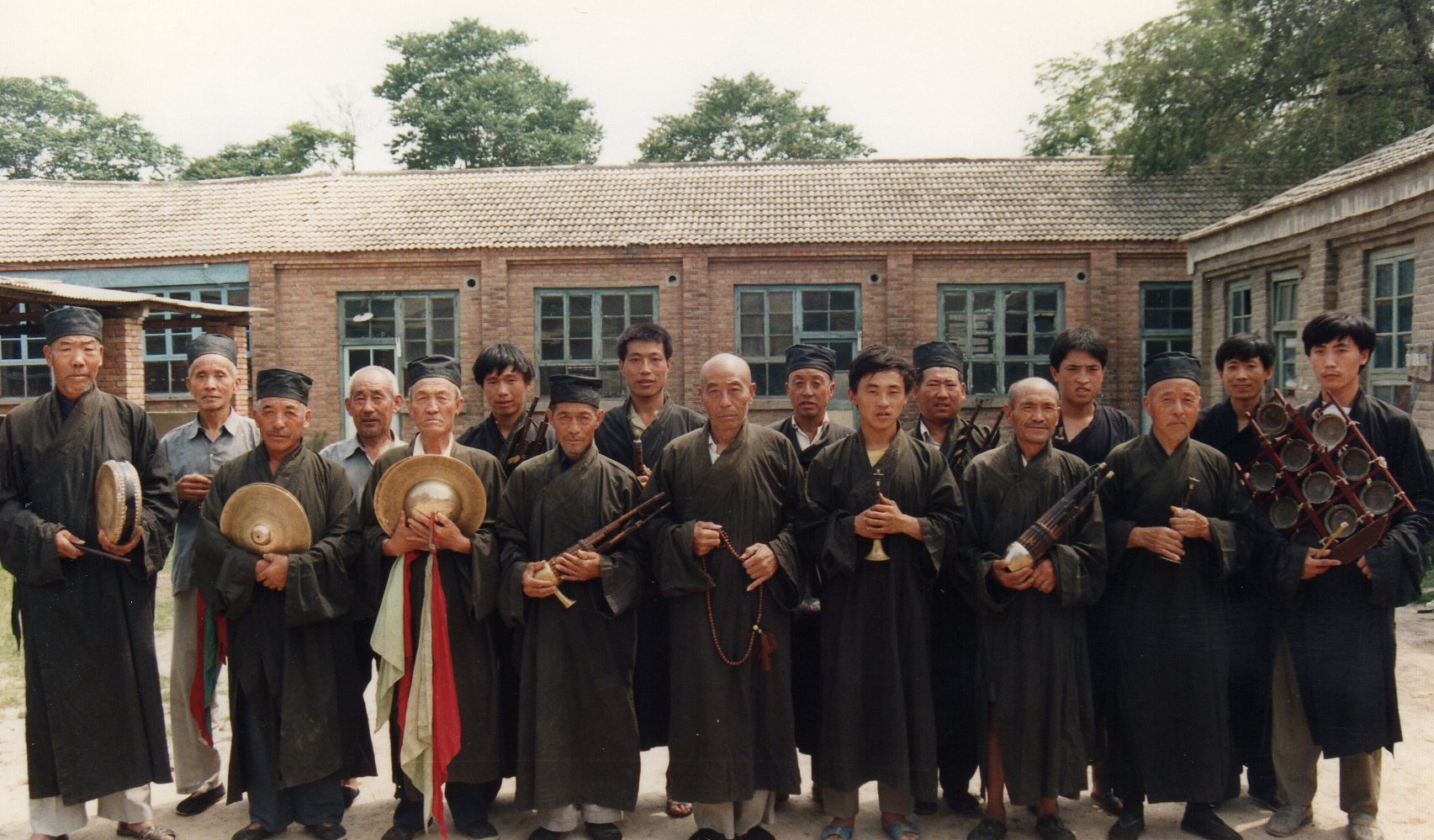
Here’s yet another article in my series on Daoist and Buddhist ritual groups on the Hebei plain south of Beijing, gradually filling in some of the gaps on the map.
I’ve noted the contrast between the occupational household Daoist bands of north Shanxi and the village-wide amateur ritual associations that are typical of the Hebei plain. Just southeast of the capital, on the way to Bazhou, Langfang municipality (formerly the county of Anci) is another lively area for ritual. Village associations here seem to feature elements of the ritual scene in suburban Beijing, with some occupational Daoist and Buddhist groups alongside the amateur associations that are common just further south and west. The Langfang region is also famed for its involvement in the 1900 Boxer uprisings.
These groups too had learned from temple clerics. Unlike the particular case we found in Daxing, most ritual associations here, as south and west on the plain, maintained the amateur tradition of “practising good” by performing rituals as a social duty without reward, though some were beginning to accept modest fees. As usual, such amateur groups were active mainly in the home village and a very small radius.

Amidst the suffragette centenary (handily summarized by Philomena Cunk), it’s timely that the brilliant Bridget Christie has a new series on BBC Radio 4.
Alongside numerous Chinese jokes, I’ve posted on humour under state socialism (see also here; cf. Alexei Sayle), and also on Tibetan jokes. Feminist political comedy may seem a recent inspiration, but Mary Beard doubtless has classical antecedents, and Krista Cowman [1] shows how astutely the suffragettes used humour, turning the tables. Open-air meetings were akin to, indeed they were, standup—the brave women constantly faced by ridicule and heckling:
Provoking laughter at the expense of their opponents created a powerful and subversive weapon which they put to good use in their campaigns.
Annie Kenney recalled that suffragettes were
taught never to lose our tempers: always to get the best of a joke, and to join in the laughter with the audience even if the joke was against us. This training made most of the Suffragettes quick-witted, good at repartee, and the speakers that most of the audience took a delight in listening to, even though they did not agree with them, were those that were able to make them laugh.
Good to learn that this old joke was a response to a heckle:
An elderly man kept repeating the same statement every few minutes “If you were my wife I’d give you poison”. Eventually the speaker, tired of his repeated interruption, replied, “Yes, and if I were your wife I’d take it.”
See also Wimbledon: protest and suffragism.
[1] “ ‘Doing something silly’: the uses of humour by the Women’s Social and Political Union, 1903–1914”, in Hart and Bos, Humour and social protest, 2008.
Citing Cao Xueqin’s entrancing novel The story of the stone recently, I was reminded that among the many virtues of the epic tale is its detailed depiction of rituals in 18th-century Beijing. [1]
A work of fiction it may be, but what I admire here is the ethnographic thick description—a model for modern fieldworkers. Prompting us to experience such rituals within the far wider context of social life and personal experience, the author not only evokes all the human detail of the family’s behaviour and emotional world, including the priests’ relations with their patrons, but depicts the whole physical setting and itemizes expenses.
Chapters 13 and 14 describe a 49-day observance for the funeral of the family matriarch, with several groups of ritual specialists performing. Chapter 13 gives the text of the placard—similar in style to those used in modern times. [2] In David Hawkes’s brilliant translation (for the whole passage, see vol.1, pp. 255–87):
He also instructed someone to invite an expert from the Board of Astronomy to select dates for the funeral and the ceremonies preceeding it. With the approval of this official it was decided that the lying in state should be for forty-nine days and that the notification of bereavement indicating the family’s readiness to receive official visits of condolence should be made in three days’ time.
這四十九日,單請一百單八眾禪僧在大廳上拜大悲懺,超度前亡後化諸魂,以免亡者之罪;另設一壇于天香樓上,是九十九位全真道士,打四十九日解冤洗業醮。然後停靈於會芳園中,靈前另外五十眾高僧,五十眾高道,對壇按七作好事。
A hundred and eight Buddhist monks were engaged to perform a Grand Misericordia for the salvation of all departed souls in the main reception hall of the mansion during these forty-nine days, while at the same time ninety-nine Taoist priests of the Quanzhen sect were to perform ceremonies of purification and absolution at a separate altar in the Celestial Fragrance pavilion. These arrangements having been made, the body was moved to a temporary shrine in another pavilion of the All-scents Garden. Fifty high-ranking Buddhist monks and fifty high-ranking Taoist priests took turns in chanting and intoning before it on every seventh day.
Inside the gateway, facing the street, a high staging was constructed on which Buddhist monks and Daoist priests sat on opposite sides of an altar intoning their sacred texts. In front of the staging was a notice on which was written in large characters:
[…]
WE,
The very Reverend Wan-xu, Co-President of the Board of Commissioners having authority over all monks and clergy of the Incorporeal, Ever-tranquil Church of the Lord Buddha,
and
the Venerable Ye-sheng, Co-President of the Board of Commissioners having authority over all priests and practitioners of the Primordial, All-unifying church of the Heavenly Tao,
HAVE,
with all due reverence and care, prepared offices for the salvation of all departed souls, supplicating Heaven and calling upon the name of the Lord Buddha…
NOW,
earnestly praying and beseeching the Eighteen Guardians of the Sangha, the Warlike Guardians of the Law, and the Twelve Guardians of the Months mercifully to extend their holy compassion towards us, but terribly to blaze forth in divine majesty against the powers of evil, we do solemnly perform for nine and forty days the Great Mass for the purification, deliverance and salvation of all souls on land and on sea…
—and a great deal more on those lines which it would be tedious to repeat [Cao Xueqin’s comment, not mine!].
Chapter 14 goes on to list some of the major ritual segments and activities. The Buddhist Water and Land (shuilu 水陸) ritual included Opening the Quarters (kaifang 開方), Smashing the Hells (poyu 破狱), Transmitting the Lanterns (chuandeng 傳燈), Illuminating the Deceased (zhaowang 照亡), Opening the Golden Bridge (kai jinqiao 開金橋), and Leading the Panoplied Pennant (yin chuangfan 引幢幡. [3]
Daoists performed the Presenting the Memorial (shen biao 申表) ritual before the Three Pure Ones and the Jade Emperor; Chan Buddhist monks performed Ambulating Incense (xingxiang 行香), Flaming Mouth (yankou 焰口), and Worshipfully Presenting the Water Litanies (bai shuichan 拜水懺); and thirteen young Buddhist nuns recited mantras.
這日乃五七正五日上,那應佛僧正開方破獄,傳燈照亡,參閻君,拘都鬼,筵請地藏王,開金橋,引幢幡;那道士們正伏章申表,朝三清,叩玉帝;禪僧們行香,放焰口,拜水懺;又有十三眾尼僧,搭繡衣,靸紅鞋,在靈前默誦接引諸咒,十分熱鬧。
Rendering the fantastical vocabulary of Daoist ritual into English is always a challenge—also well met by Ken Dean and John Lagerwey. Again, Hawkes makes a brilliant attempt at this passage—with occasional elaborations, and a quite understandable, even attractive, “translation” of titles for ritual segments into specific actions (which, of course, they are!):
The Thirty-fifth had now arrived—an important day in the penitential cycle of seven times seven days preceding the funeral—and the monks in the main hall had reached a particularly dramatic part of their ceremonies. Having opened up a way for the imprisoned souls, the chief celebrant had succeeded by means of spells and incantations in breaking open the gates of hell. He had shone his light (a little hand-mirror) for the souls in darkness. He had confronted Yama, the Judge of the Dead. He had seized the demon torturers who resisted his progress. He had invoked Kṣitigarbha, the Saviour King, to aid him. He had raised up a golden bridge, and now, by means of a little flag which he held aloft in one hand, was conducting over it those souls from the very deepest pit of hell who still remained undelivered.
Meanwhile the ninety-nine Taoists in the Celestial Fragrance Pavilion were on their knees offering up a written petition to the Three Pure Ones and the Jade Emperor himself in his heavenly palace. Outside, on their high staging, with swinging of censers and scattering of little cakes for the hungry ghosts to feed on, Zen monks were performing the great Water Penitential. And in the shrine where the coffin stood, six young monks and six young nuns, magnificently attired in scarlet slippers and embroidered copes, sat before the spirit tablet quietly murmuring the dharani that would assist the soul of the dead woman on the most difficult part of its journey into the underworld. Everywhere there was a hum of activity.
That final comment “Everywhere there was a hum of activity” (re’nao “exciting”, “bustling”, lit. “hot and noisy”, cf. Chau, Miraculous response, pp.147–68) is ironic after the silent mantras of the nuns. BTW, I almost like the rendition of shifen as “everywhere”, but I’m still inclined to think it carries the modern colloquial sense of “really”—thus “it was really boisterous”.
Chapter 102 gives a detailed account of a one-day exorcism performed by forty-nine Daoist priests, with god paintings hung out, performing Ambulating Incense, Fetching Water (qushui 取水), Worshipfully Presenting the Memorial (baibiao 拜表) and Inviting the Sages (qingsheng 請聖) rituals, and reciting the Dongyuan jing 洞元經 scripture throughout the day. Three chief liturgists, donning seven-star hats, wielded precious swords, flags, and a whip, as a placard was displayed and exorcistic talismans depicted.
In chapters 28 and 29 (Hawkes vol.2, pp.41–92) the family commissions a three-day Daoist Offering for well-being (ping’an jiao 平安醮) at the Qingxu guan 清虚观 temple:
Aroma continued:
“Her Grace sent that Mr Xia of the Imperial Bedchamber yesterday with a hundred and twenty taels of silver to pay for a three-day Pro Viventibus by the Taoists of the Lunar Queen temple starting on the first of next month. There are to be plays performed as part of the Offering, and Mr Zhen and all the other gentlemen are to go there to offer incense. Oh, and Her Grace’s presents for the Double Fifth have arrived.”
This section offers far less detail on ritual, the opera being the main attraction. We tend to assume that in the Good Old Days people gladly respected the “rules” (guiju 規矩), but like that intriguing re’nao of chapter 14, there is clearly a long ancestry to the common lament since the 1980s that audiences care more about ostentation than correct ritual performance. The account uncannily reflects my observations at Yanggao funerals since 2001 (Daoist priests of the Li family, p.356):
Daoists still have to be invited, almost routinely; but by now they are used to not being appreciated. Since the 1990s no-one pays much attention when they arrive at the soul hall; only the kin reluctantly abandon their places watching the pop music outside the gate to go and kneel before the soul hall.
Imagine if Bach had taken that sabbatical in Beijing, then he might have had patrons like the Jia clan in The dream of the red chamber… They could hardly have appreciated Bach’s genius any less than the Margrave of Brandenburg (“what does that even mean?”).
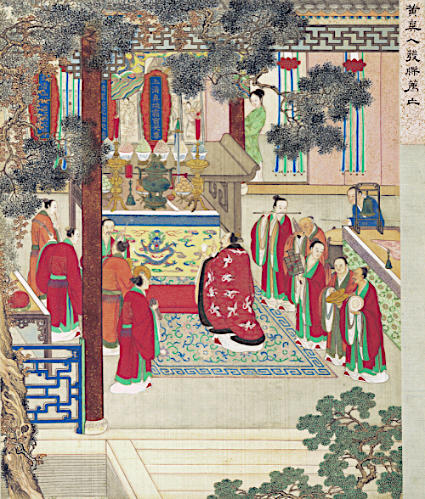
Perfected Man Huang sends forth an official document recommending the deceased, c1700: Daoists presiding over the liandu funerary ritual of chapter 66 of the Jin ping mei. Nelson-Atkins Museum of Art, Kansas City; see Little and Eichman, Taoism and the arts of China, pp.192–3. Note typical northern shengguan ensemble of guanzi oboe, sheng mouth-organ, dizi flute, and yunluo gong-frame, with large cymbals nao and bo.
Earlier still, the Ming novel Jin ping mei offers just as wonderful ethnographic material for rather less elite social strata—set in Shandong, ostensibly in the 12th century, but clearly based on the milieu of the author’s own day. Here too are many vignettes on minor domestic rituals and major exorcistic and mortuary rituals, as well as on the lives of Daoist priests and Buddhist monks.
Of course, these are just two of the most celebrated works of Ming–Qing fiction wherein we can seek such depictions. Just as with contemporary fieldwork, my first thought is to situate such rituals in space and time, rather than giving generic accounts. Thus one would seek to understand the rituals of the Jin ping mei in the context of 16th-century Shandong, and those of The story of the stone in that of 18th-century Beijing—just as we should be clear if our accounts of modern rituals refer specifically to north Shanxi in the 1930s, west Fujian in the 1990s, and so on.
Despite monumental social transformations since imperial times, all the rituals described in these early novels are still performed today—always varying by region and circumstances. [4]
Still, I need hardly reiterate that both texts (novels, ritual manuals, field reports) and images (paintings, photos) are silent and immobile: what we really need is films—which are in short supply even for current ritual practice, and an even taller order for the imperial era (though dramatized adaptations of The story of the stone may be quite educative!). [5]
[1] Within the vast literature on Hongxue 红学 (“Redology”—Dream of the red chamber studies), there are many Chinese studies of its religious and indeed musical components, searchable on databases. A considerable body of research is also available for Jin ping mei.
[2] For a couple of examples in English (for different kinds of rituals), see Dean, Taoist ritual and popular cults of southeast China, pp.53–8, and my Daoist priests of the Li family, pp.230–31.
[3] For “panoplied pennant” in a funerary hymn, cf. my Daoist priests of the Li family, p.262, and film, from 24.39.
[4] For leads, see my In search of the folk Daoists of north China, and index.
[5] Perhaps I digress, but given the stylized acting culture of China, the “Star of Tomorrow” company’s recent nine-part TV version (beginning with the episode below), using child actors, has been highly praised for its naturalism and conviction—far from merely cute.

From Ye Mingsheng 葉明生, Minxinan Yongfu Lüshanjiao chuandu yishi yanjiu
閩西南永福閭山教傳度儀式研究 (2017).
.
If you want to study Chinese culture, then China’s a good place to do it
“Heritage” pundit Tian Qing has a good story for every occasion (such as this, and this). On the resilience of traditional culture under all kinds of assaults (notably in the hands of “obstinate” zhizhuo 执着 peasants, as they’re often described) , he likes to cite Granny Liu’s epithet in chapter 6 of Cao Xueqin’s epic 18th-century novel The story of the stone (The dream of the red chamber):
—in Hawkes’s translation,
It’s commonly used to show that families fallen on hard times will still manage better than the chronic poor. But in the wake of all the assaults from Maoism in the PRC—when “authentic” Chinese culture on the mainland was apparently a poor relative to the overseas communities where transmission was supposed to have been maintained untainted (notably Taiwan)—the maxim made an apt metaphor as field reports since the 1980s on local ritual began to reveal the sheer enormity of tradition. Of course, as with research on southeastern Daoist ritual on both sides of the strait, we should learn by collating all such material, as did Kristofer Schipper, Ken Dean, and John Lagerwey (see also Daoist ritual in north Taiwan).
Among many further instances are the rich material on baojuan “precious scrolls”, the ritual traditions of Qujiaying and Gaoluo just south of Beijing, and the ongoing project of Hannibal Taubes on temple murals in north China.
For representations of Tibetan culture within and outside the PRC, click here.

Besides Gary Snyder, another hero of mine in the 60s was Alan Watts (1915–73).
His 1972 autobiography In my own way is complemented by
Watts was blessed with extraordinary mentors throughout his youth. His accounts of drab suburbia in the early chapters of In my own way are worthy of Betjeman. In the distinguished British tradition of alienation, he reflects on his early exposure to Christianity: “on the whole I am ashamed of this culture”, and “I could not make out why such pleasant people espoused such a fearsome and boring religion”. Yet while deploring the “asinine poems set to indifferent tunes”, “wretched bombastic, moralistic and maudlin nursery rhymes”, he goes on to appreciate their charm. He would have loved Dud’s Psalm.
And—long before Alan Bennett’s Sermon:
“the sermons of the clergy—bleated or sonorously boomed […]—conveyed nothing beyond the emotional energies of their funny voices, which all of us used to mock and mimic”. [2]
Still, he did well to note:
Strangely enough, young people in Japan have the same feeling about the atmosphere of their parents’ Buddhism—the atmosphere which is, to me, enchanting and magical with booming gong-bells and deep-throated and unintelligible sutrachanting. To them all this is kurai—a word which means deep, dark, dank musty, gloomy, and sad. (p.46; cf. pp.421–22)
Such dispassionate observation needs taking on board while observing Chinese rituals (cf. my post on Geertz).
Watts made trenchant comments on the “ritualized brutality” of British education and the teaching of history (“propaganda for the British Empire and the Protestant religion”). His view of schools and universities as “production lines turning out stereotyped personnel and consumers for the industrial machine” may be par for the anti-establishment course of the time, but In This Day and Age his mission to retune values is worth revisiting.
Railing against God and his [sic] role in Europe’s bloody history, he had to escape, taking refuge in the more “amiable” tradition of Buddhism, seeking a mystical depth his guilt-ridden religious upbringing couldn’t offer. Through Christmas Humphreys he became immersed in the Zen of D.T. Suzuki. His early fascination with the Mystic East was nurtured both by his mother’s “oriental treasures” (he relished the clarity, transparency, and spaciousness of landscape paintings), and—plausibly—with Fu Manchu (for me it was The inn of the sixth happiness!). He got to know Nigel Watkins, whose bookshop he relished long before me (In my own way, pp.123–4)—aware that a lot of such literature was “superstitious trash”, he appreciated Watkins’s “perfect discrimination”. He wrote his first pamphlet, An outline of Zen Buddhism, while still a pupil at King’s School, Canterbury. Among many meetings with remarkable men [sic, as ever], he was first introduced to Krishnamurti in 1936. In 1937 he met Eleanor Everett, daughter of Ruth Fuller Everett (herself later married to the Zen priest Sokei-an Sasaki before his death in 1945); they married the following year, moving to the USA as war loomed.
Without any contradiction, Watts’s escape from the grey conformity of suburban Kent also made him “an unrepentant sensualist”. It’s all the more remarkable that he went on to train as an Episcopal priest, becoming ordained in 1945; at the time “it seemed to be the most appropriate context for doing what was in me to do, in Western society”. But unable to reconcile this “ill-fitting suit of clothes” with his inner beliefs, he withdrew from the church in 1950, and after a divorce he moved on to California. Of course, deploring missionary zeal, he was always free-floating—the ultimate trendy vicar, eagerly imbibing all the psychedelic trappings the burgeoning alternative scene had to offer from the prime position of his Cali refuge. Never one for institutions, he had an on-off relationship with academia, becoming what he called a “philosophical entertainer”—guru to the counterculture.
Watts’s 1957 book The way of Zen (1957) is a remarkable introduction to the whole subject. As he notes there:
During the past twenty years there has been an extraordinary growth of interest in Zen Buddhism.
So—just like sexual intercourse (on which he would also have much to say, based on avid participant observation—see e.g. Nature, Man and Woman [1958])—we clearly have to backdate the Western craze for Zen rather before 1963.
In parallel with Gary Snyder, Watts trod his own path, but his admiration for Snyder is clear, evinced in his writings such as the 1959 Beat Zen square Zen and Zen. And for all their discipline, they shared a delight in language and humour:
The task and delight of poetry is […] to eff the ineffable, to screw the inscrutable.
And he even relished Brazil’s balletic “gaieté d’esprit” in the 1970 World Cup! He also left a rich archive of audio recordings—many of them are on YouTube, even if some tip over into self-help or Thought for the day.
Also in England (and with a similar background in his Anglican church choir), the translator John Minford became hooked on Laozi, The Dharma bums, and later the work of van Gulik on the qin zither, as he recounts in this fine zeitgeist article. His early fascination with Chinese mysticism was less challenged than mine was to be, as I came to experience the spit-and-sawdust of folk Daoist ritual practice.
* * *
If the hippies were predated by the beats, then before them both came R.H. Blyth (1898–1964), who completed his Zen in English literature and oriental classics while interned in Japan in 1941. I’ve now devoted a separate post to him, here.

He wrote a whole further series of books on haiku, as well as on humour in Asian and English literature—main exhibit for the former being senryū, humorous counterpart to haiku. I’m not sure how much he would have enjoyed “the first English haiku”, not to mention this limerick.
Apart from Alan Watts, other devotees of Blyth’s work included Aldous Huxley, Henry Miller, and Christmas Humphreys (another challenging dinner party), all of whom I admired in turn. For Steinbeck’s and Salinger’s absorption in oriental mysticism, see here.
* * *
And before Blyth… there was Eugen Herrigel, whose 1948 book Zen in the art of archery was based on his studies in Japan in the 1920s! His later membership of the Nazi party is less advertised (see here); see also The Celibidache mystique.

Zen archer, Kyoto. ©Timothy Kraemer, on tour with English Concert, 1990s.
Apart from this whole fascination with Zen and Daoism, it was the Chinese characters provided in The way of Zen and Zen in English literature and oriental classics that led me to study Chinese at Cambridge, and eventually to read between the lines of dour field reports on local Chinese folk ritual, as well as seeking the unassuming wisdom of Li Manshan. As I became involved with such grass-roots religious activity among poor rural Chinese communities, documenting their fortunes under Maoism, I came to feel rather less charitable towards traces of lofty New-Age hippy-style abstraction in studies of Chinese religion; but now that I revisit the work of such trail-blazing sages, I’m not just nostalgic, I sincerely find much to admire.
[1] Among many online sites, note http://www.alanwatts.com.
[2] He also had a fine line in limericks, often religious—work this one out, a footnote to the Salisbury (Sarum) rite (In my own way, p.67), rather in the vein of Myles’s tribute to Ezra £ (and there’s another early orientalist!):
There was a young fellow of Salisbury
A notorious halisbury-scalisbury
He went about Hampshire
Without any pampshire
Till the vicar compelled him to walisbury.
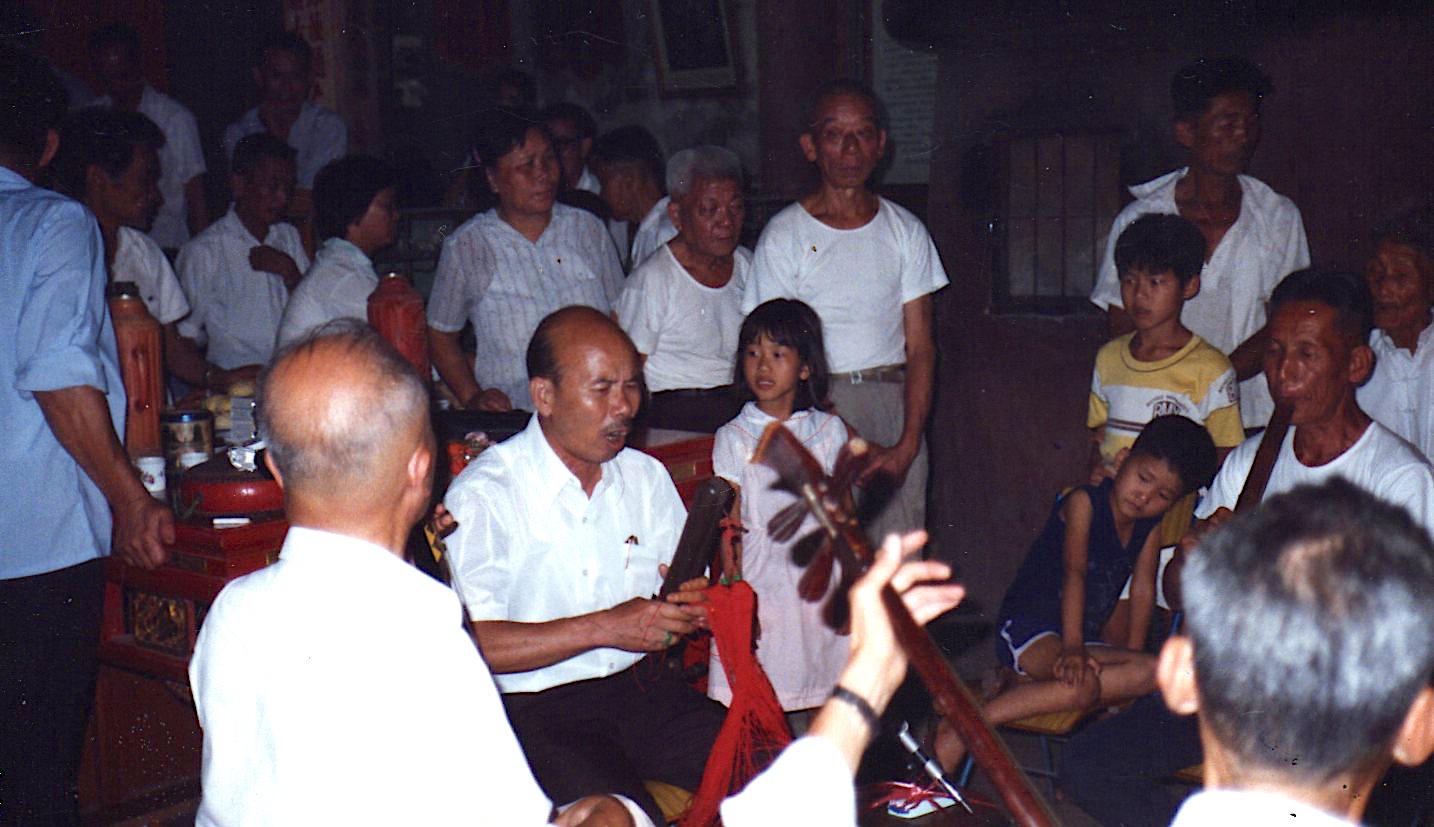
Nanyin, Quanzhou 1986.
In my little introduction to Chinese bowed fiddles, I mentioned the wonderful chamber genre nanyin 南音 (aka nanguan 南管), one of the most refined social activities in the Hokkien culture of south Fujian and Taiwan, complementing the riches of Daoist ritual there. The slow tempi, instrumentation, and the restrained passion of its singing style may remind us of the more plangent of medieval European ballads.
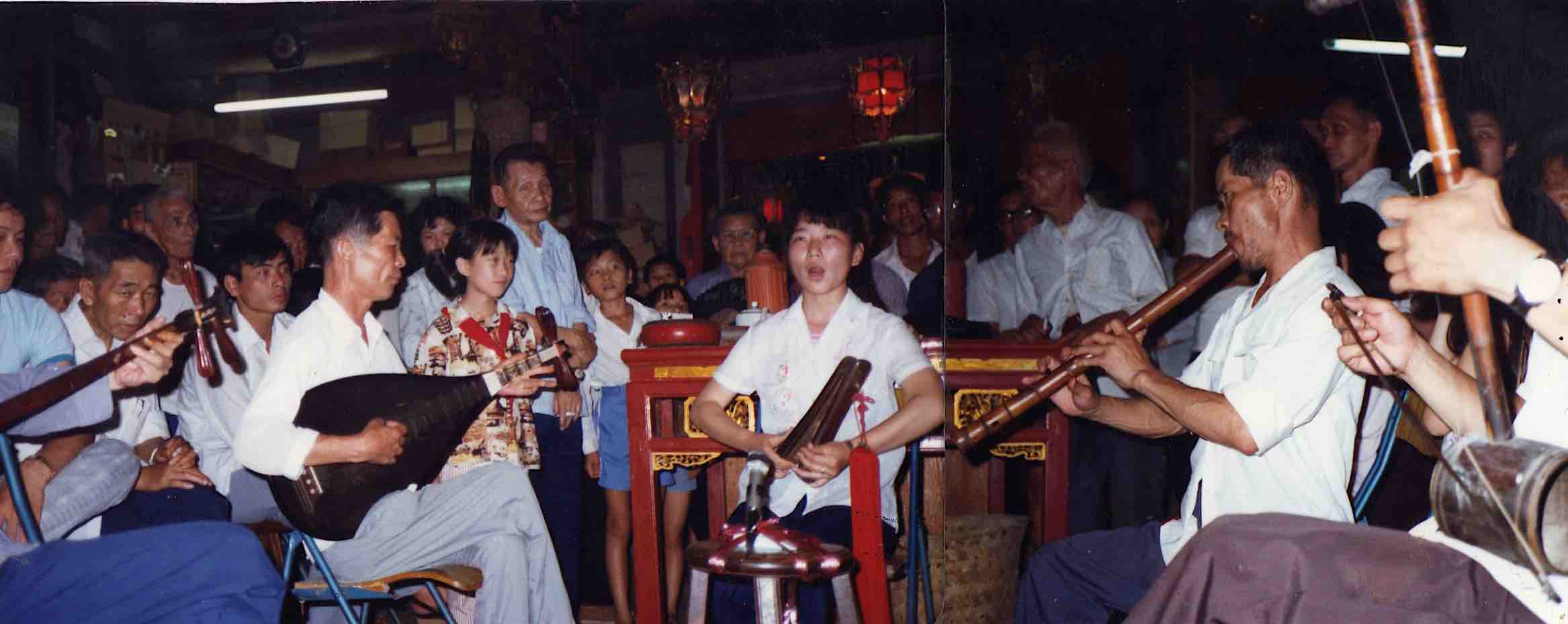
Nanyin, Quanzhou 1986.
At some remove from research on performance genres in north China, this is a clear case of long-term and deep fieldwork from local scholars. I still find rather apposite my 1993 review of a wonderful Ocora CD-set of the Nansheng she group from Tainan (CHIME 7, pp.114–20), and chapter 14 of my book Folk music of China, where I gave a brief overview of the (then) state of the field. (Click here for one of several online tributes to Ts’ai Hsiao-yueh, leader of the Nansheng she group on the Ocora recordings.)
Apart from its reification for the concert stage, nanyin is deeply embedded in community life—amateur clubs, temple fairs, opera, puppetry, Daoist ritual—all within the special circumstances of rapprochement with overseas Hokkien communities, cross-strait diplomacy, and vast social and economic transformations.
Wonderful as nanyin is, alas the idea of “living fossils” has still not been erased—anyway, it’s far from alone in China in preserving an ancient tradition. And it’s worth reminding ourselves that it’s only one of a glorious profusion of performance genres even in Fujian—it occupies a mere 22 of 611 pages in the 1986 Fujian minjian yinyue jianlun by Liu Chunshu and Wang Yaohua, themselves leading proponents of the genre.
This UNESCO introduction is almost bearable, covering some of the main bases:
And among many online videos, this documentary also suggests the broader social and ritual context:
One little caveat: like a recent article on shadow puppetry (“How a bunch of Americans preserved a dying Chinese tradition”!), it’s worth registering the contributions of laowai without getting an inflated notion of their importance. Scholars like Kristofer Schipper, leading light in producing the Ocora CDs, are justly admired in China and Taiwan, but genres like nanyin are never dependent on such a deus ex machina.
Consulting Schipper’s liner notes, even in 1982, or 1993, it was far from true that nanyin was “almost forgotten in its own country”! As I commented, the statement “the positive reception of the European public led to regained esteem in China. Nan-kuan was authorised on the continent once more” is worthy of Tintin. Are we to believe that the 139 village nanguan societies in 1986 in the single county of Nan’an (to give just one example) were spurred into action by a single concert in Paris?! Folk activity (for nanyin and other genres) had even persisted throughout the years of Maoism. Meanwhile activity has continued to thrive, and research, already extensive by the early 1990s, has kept pace. A wealth of recordings is now available on CD and online. It’s exquisite music—do keep exploring!
For broader introductions to expressive cultures around Fujian, click here and here.
*Click here for main page!*
(under Hebei in main menu)

While ritual groups all around the Hebei plain survived Maoism to revive under the reform era since 1978, the county of Xushui makes a particularly intriguing case, notable both for its ephemeral fame with the razzmatazz of the 1958 Great Leap Forward and for its more long-lived ritual groups.
Despite its revolutionary image, Xushui county has remained a hotbed for religious activity, notably the cults of the sectarian creator-goddess Wusheng laomu and Auntie Silkworm Granny (Cangu nainai 蚕姑奶奶)—the latter a popular deity in this area, rarely featuring prominently elsewhere on the plain. Associations commonly display ritual paintings, like the Ten Kings and the Water and Land series, and perform vocal liturgy. They too are within the catchment area of Houtu worship—they used to make the rather distant pilgrimage to Houshan, though they more commonly visit the nearer Western Summit (Xiding 西頂) on Langyashan further southwest from Houshan. Again we found a rather complex overlap between the village-wide ritual associations, sects, and yinyuehui.
Further to my brief introduction in my post on Festivals, here I introduce some of the groups we visited from 1993 to 1996. Mao was impressively modest about his limited success when he admitted to Nixon in 1972: “I haven’t been able to change [China]—I’ve only been able to change a few places in the vicinity of Beijing.” But he wasn’t modest enough: in some ways even a county so near Beijing, such a focus of the revolution, has remained resistant to Maoist ideology, predating and outliving it.
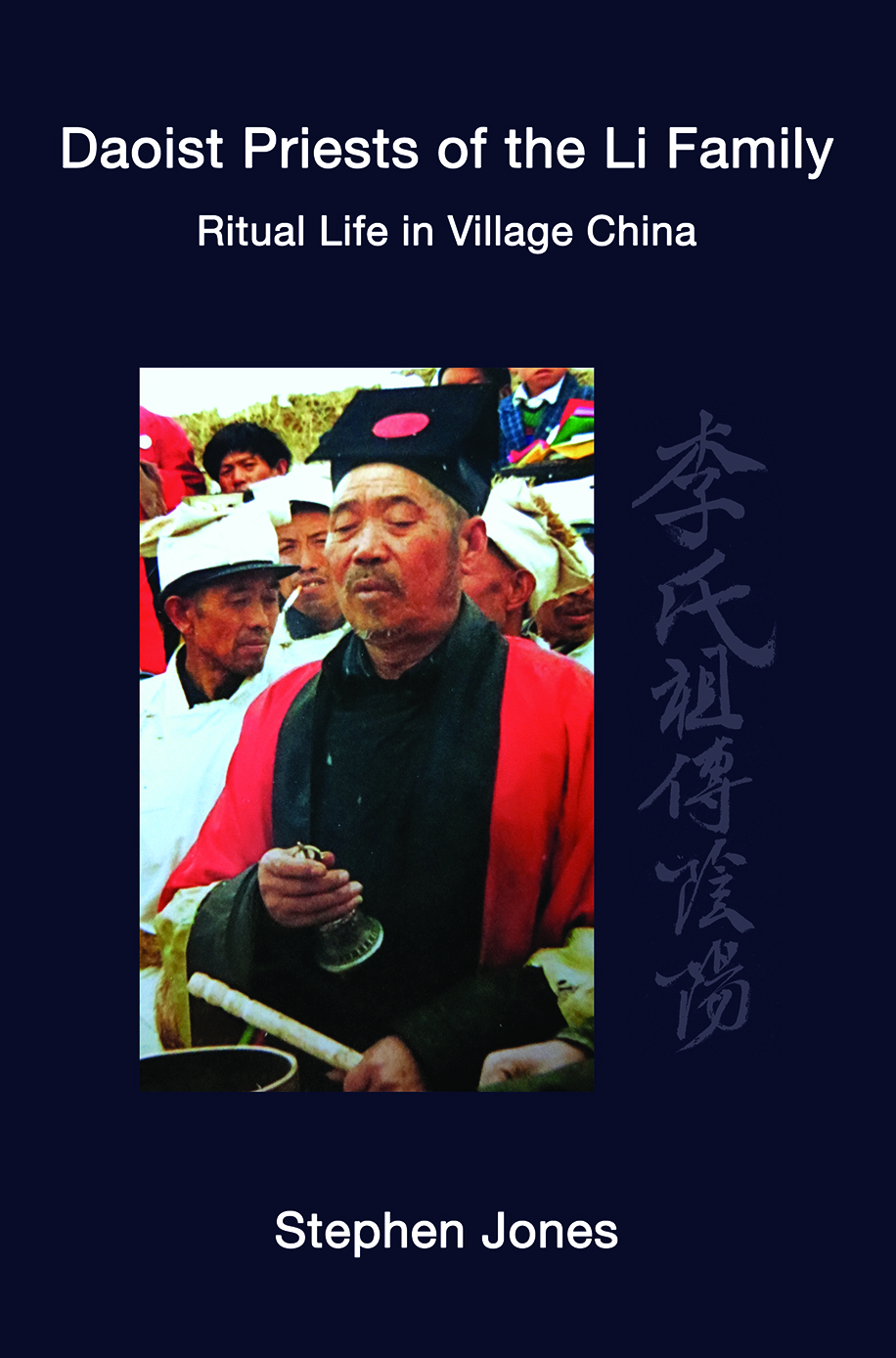
In my post introducing my book Daoist priests of the Li family, I’ve just added a recent review of my book by the erudite John Lagerwey in Religious studies review.

Former monks from Shanxi pose with arhat, 1992. Photo: SJ.
On visits to the British Museum in my teens, as interludes between basking in the treasures of nearby oriental bookshops, I would sit for hours before the tranquil sculpture of the arhat (luohan 羅漢) there, thought to date from the Liao dynasty (907–1125). I can’t believe I had such good taste—this and others in the set (dispersed in museums around the world), with their sancai tricolour glazing in the Tang tradition, are highly admired by art scholars.
Basking as I was then in a romantic image of ancient China remote from any real physical locations or human beings, it was to be several decades before the statue’s little caption made any tangible sense to me. The arhat comes from Yixian county south of Beijing, one of the most fertile sites in our fieldwork project on amateur ritual associations on the Hebei plain, whose elders had learned their liturgy with temple monks. It was part of a set* bought by the German sinologist Friedrich Perzynski around 1913, after they were discovered in a cave in the west of the county, probably having been relocated there from a temple (see here—note this lecture). Serially displaced, it has long been uprooted from its religious context, as is the way with artefacts; but the rituals of Yixian persist in local society there, changing subtly over time.
My later encounters with the arhat have been sporadic but delightful. In 1992 I took a group of former monks from Shanxi around the museum. In 2014, and again in 2018 (NB new photo!), it was wonderful to assist in the performance of the Zhihua temple before the sculpture—linking up my fieldwork to my misspent youth.

Courtesy British Museum, 2014.

Hu Qingxue, accomplished leader of the Zhihua temple group, a fine liturgist and guanzi master. Photo: courtesy British Museum, 2014.
For a sequel, see here.
.
* Not yet “Buy one, get one free” (BOGOF)
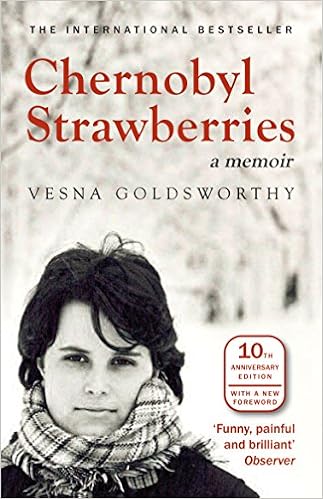
I was drawn to Vesna Goldsworthy’s 2005 memoir Chernobyl Strawberries by her wonderful contribution to Private passions—a valuable companion to the book (Hold the front page! Books are silent! For Serbian soundscapes, see here).
Originating as a record for her young son through the trauma of her cancer treatment, the memoir is whimsical and full of insight—both about her early life in Yugoslavia before it was torn apart (she wonders if it was an accident that her country and her own body were disfigured so soon after each other) and her identity in her adopted home in England since 1986, caught between cultures.
As usual, I read the book partly with the experiences of Chinese people in mind. Goldsworthy’s description of her father’s attitude to her youthful flirtation with palaeography reminds me of the Chinese retreat into history:
Only my father saw some consolation in the fact that it was the kind of work which was unlikely to lead to imprisonment. There seemed to be nothing remotely political in transcribing thousand-year-old prayers, whereas as a media star I was likely to shoot my mouth off sooner or later.
Even so,
In fact, while it was highly unlikely that a palaeographer would end up in prison or without a job, as had been known to happen to the critics of contemporary literature, my father was wrong in thinking that the vellum-bound world was apolitical. You could say, for example, that a manuscript was “probably Bulgarian” or “possibly twelfth-century” and cause an international dispute of major proportions…
Among vignettes on the fates of her forebears, Goldsworthy gives fine insights into the society of Belgrade through her youth (when she was “optimistic, ambitious, invulnerable, and in some ways insufferable”), the nuances of class in a classless society—not least the three rings of schools (her own lycée “educated some of the most intelligent and most fashion-conscious young people east of the Iron Curtain”):
In our senior common room new members of the Communist Party represented a more raggle-taggle selection than before. Some were visibly keen, some rather diffident, some were obvious (clever-clogs, careerist with a bad sense of timing, those who carried a briefcase to school, prominent members of youth organizations, children of well-known communists who could hardly refuse to join), some rather less so (ditzy girls from old families who had fallen for the old hammer-‘n’-sickle chic, the school poet, the fourth-grade hunk, a good third of the school basketball team, encouraged to join as role models and highly visible because they were all six foot six and chewing gum). Working out which members of the teaching staff belonged to the party, information you wouldn’t normally have been privy to as a student, was part of the privilege conferred by this particular entry into the adult world.
The heightened sensibility towards dress-sense also reminds me of Maoism:
Many of our professors addressed us with “Colleague”. Others used “Comrade” or “Miss”, according to whether they were communists or bourgeois recidivists. Forms of address provided an easy way of knowing individual political allegiances. It was useful to be able to distinguish Comrade Professors from Mr or Mrs Professors in order to know whether to cite Lukacs or T.S. Eliot. Although one could often tell the two groups apart simply by the clothes, it was not always safe to make hasty assumptions. Suits, ties and moccasins mostly belonged to comrades; tweed jackets, turtle necks and shoelaces to Mr and Mrs, but safari suits could go both ways, and were surprisingly popular in the early eighties.
And even furniture:
I felt that, through furniture, I had a special path to understanding the world I came from. Whereas in the West the inexhaustible variety of interior design often manages to obscure surprising degrees of conformity, the enforced conformity of the society I grew up in concealed a bunch of eccentrics and sometimes downright madness. While the wives were crocheting, madmen were busy plotting Armageddon.
Goldsworthy describes the schism (and occasional blurring) in poetic circles between bohos and suits, and her own youthful “Penelope poems” about the female who waits ( the waitress) for an absent male, often with pseudo-religious powers.
During the endless family debates over her choice of outfit for a major poetry-reading in honour of Tito (“a strange form of necrophilia”), her sister mumbles “peasant”:
She used the feminine form of the noun. There was no doubt that she had me in mind. Only peasants wrote poetry anyway. (The word peasant, with its full power of character assassination, is not readily translatable into English. It was neither here nor there as far as the real peasantry were concerned, but a poisoned dart if directed at a Belgrade student of letters).
She goes on to reflect on the Tito cult:
The longer it was since his demise, the more there was to celebrate. Like the widow of a murdered Sicilian Mafia don, the country clung to his memory in an incongruous mixture of mourning and décolletage, as if knowing that a collective nervous breakdown would follow once the ritual was no longer observed.
Meeting her future husband, “I was ready to follow the boy to the end of the world, to England itself if need be.” * After reaching Heathrow,
Only minutes later, I was on the Piccadilly line—the Ellis Island of London’s huddled masses—with a copy of the London Review of Books.
In Private Passions Goldsworthy recalls the abundance of classical (and other) music in the Yugoslavia of her youth. And when she moved to England, her friends and family were horrified, asking, “How could you move to a country where there is no music“? So it’s suitable that her Slavic-tinged playlist ends with Purcell’s When I am laid in earth.
As befits an erstwhile poet, her use of English (her third language) is delightful. Like many foreign authors (from Conrad and Nabokov to Elif Şafak, or for China, Yi-yun Li and Xiaolu Guo), she finds that writing in English affords psychological space:
I have fewer inhibitions in English—perhaps because for me it doesn’t quite carry subcutaneous layers of pain. In fact, I sense—however irrational this may seem—that the I who speaks English is a very subtly different person from the I who speaks Serbian and the I who speaks French. That, perhaps, has something to do with the old chameleon tricks or the nature of the language itself. At any rate, the English speaker is a bit more blunt and a bit more direct than the other two. She is and isn’t myself. She takes risks and admits to loss.
In Chapter 4 she reflects on the hereditary aptitude of her homeland for poetry:
In the four years between my move to London and her death, Granny wrote to me only once. It was a short letter, penciled in a deliberate hand clearly unused to writing. She reminded me to visit my parents regularly and urged me to behave in a way which would not dishonour my lineage; no laughing in public places, no loud conversation, modesty in dress and in everything else. Granny wrote as though she was worried that, away from my father and my tribe, I might be in danger of succumbing to some ungodly excess. In her world, Montenegrins who lived apart from their tribes were notoriously prone to prodigal or licentious behaviour. Her prompting came not because she lacked confidence in me, but because she clearly believed that this was what a letter from a grandmother to her granddaughter should be like. It wasn’t the place for frivolities of any kind. Although written in continuous lines, her latter was—from the first word to the last—a string of rhythmic pentameters, the verse of Serbian epic poetry.
As she calls her sister’s answering machine in Toronto to leave messages in “Granny”, adopting an asthmatic wheeze to let flow a torrent of alternating complaints and endearments, she reflects,
The language of my dead grandmother brings to life all our lost homelands, yet no book has ever been written in it. This is the language I lost when I chose to write in English.
Always reflecting on the subjectivity of memory, she has drôle comments on her new jobs in London.
I loved the prospect of boredom. Growing up in Eastern Europe was a powerful vaccine. I had gone through eighteen years of socialist education, learning when to say yes and when to keep quiet, in preparation for a job in which I’d be underpaid and under-employed. Where I came from, such jobs—usually in very nice places—were often described as “ideal for women”.
Reading news bulletins at the Serbian section of the BBC World Service through the traumas of war, she observes how her “RP” broadcasting voice differed from her “real” Serbian (inner suburban stresses, corrupted English slang), ** which had itself become a museum-piece:
My mother-tongue, meanwhile, remained firmly locked in its mid-eighties Serbo-Croat time-capsule, a language which officially doesn’t even exist any more.
And then the straitened conditions of academic life:
Daughter of a self-managed workers’ paradise, I excel at my job. I criticize and self-criticize, I censor and self-censor, I compose self-assessment sheets about self-managed time, I sit on teaching and research committees, I attend meetings and take notes, I know that literature has hidden and insidious meanings. […] My communist upbringing, my upbringing in communism—to be able to live with myself without believing in anything I say, to be able to accept things without asking too many questions—has certainly stood me in good stead throughout my working life.
In the art of the long meeting, British university workers easily outdid anything I’d encountered in my socialist upbringing. The sessions were often longer than the communist plenaries, the acronyms just as plentiful, the put-downs just as complicatedly veiled in oblique metaphor, the passions just as high, even if the stakes were often infinitesimal.
None of the terms for her status quite fit:
Unlike my ancestral matriarch and so many others in the part of the world where I came from, I have never been a refugee. I am not an exile. Not quite an expatriate either: that term seems to be reserved for those coming from lands which are more fortunate than mine. A migrant, perhaps? That sounds too Mexican. An emigrée? Too Russian.
Getting to know her father-in-law,
I suddenly grasped the sheer luxury of being a British male in the twentieth century. Every conceivable counter-argument notwithstanding—and I know there are many—the picnic rug on the moral high ground still came in khaki and red, the colours of his beloved regiment. My father-in-law stood on the high ground, wielding a pair of secateurs, chopping, felling and dead-heading, without a care in the world.
Yet she notes parallels between his nostalgia for a vanished Indian colonial past and her own experiences, “linked by a homesickness which doesn’t make sense”. At his funeral she reflects:
I can’t bring myself to sing at an Anglican funeral, just as I couldn’t—were it an Orthodox one—wail as my female ancestors were expected to. In Serbia old women were sometimes even paid to mourn. They walked behind the coffin in the funeral procession and celebrated the dead in wailing laments delivered in rhythmic, haunting pentameters. I am stuck somewhere between the singing and the wailing, speechless.
And this isn’t the end of the book, but it could be:
I wish I could say—as people sometimes expect of cancer survivors and immigrants alike—that I am grateful for each and every new day on this green island. Ask me how I am today and chances are that I will respond with that very English “Mustn’t grumble”. Which doesn’t mean that I don’t. Which doesn’t mean that I am not grateful.
Cf. Kapka Kassabova on her upbringing in Bulgaria.
* Cf. The life of Brian, where Brian’s mother Mandy recalls a youthful fling with a centurion: “Nortius Maximus his name was. Promised me the Known World he did…”
** “fensi” meaning pretentious rather than just “fancy”, cf. the recent Chinese zhuang B.

Gary Snyder, Japan 1963.
One of my great inspirations via teenage excursions to oriental bookshops was the great Gary Snyder (b.1930). Though his path puts me to shame, he was a great hero of mine (along with Pierre Boulez—looking back, I see this was not entirely normal in suburban London, however experimental the age).
Snyder was always more serious than most of his beat contemporaries. Studying anthropology, he developed an affinity for Native American cultures. As he became immersed in Zen, he began learning Chinese and Japanese (indeed, just at the right moment to benefit from the disturbing Teach yourself Japanese!).
All the while he was writing poetry, part of the beat generation with the likes of Allen Ginsberg, Kenneth Rexroth, and Jack Kerouac, taking part in the seminal 1955 reading at Six Gallery in San Francisco. That year he made the first of several study periods in Japan over the next fourteen years, living as a “de facto monk”.

In 1958 and 1959 he made (almost) the first translations of the Cold Mountain poems by the numinous 8th-century Zen recluse Hanshan (see his reflections here). At the other end of his life, his poem Go now is an unflinching tribute to his wife in her final days.
He has deepened his early studies by going on to lead a whole life unobtrusively based on Zen, without parading it or getting hung up on, well, anything. Living in harmony with nature in a series of hermitages, his environmental activism has complemented his occasional jobs as seaman, firewatcher, and logger (among a wealth of articles on him, I like this, and this). Now I come to think of it, I’d like to introduce him to Li Manshan—they’re both conscientious, unfussy, living on and with the land.

2002.
Snyder made a suitable paragon for Alan Watts (another guru of the age) in his 1959 pamphlet Beat Zen square Zen and Zen, a generous critique of both the Western craze for Zen of the 1950s and the ascetic rule-bound tradition in Japan. Citing Jack Kerouac’s portrayal of him (as “Japhy Ryder”) in The dharma bums, Watts’s warmest words are for Snyder; despite his rigorous training in Japan, he transcended both the “spiritual snobbism and artistic preciousness” of square Zen and the spaced-out bohemian scene of beat Zen. Watts’ tributes in his autobiography In my own way also hit the nail on the head:
Gary is tougher, more disciplined, more physically competent than I, but he embodies those virtues without rubbing them in. (p.309)
He is like a wiry Chinese sage with high cheekbones, twinkling eyes, and a thin beard, and the recipe for his character requires a mixture of Oregon woodsman, seaman, Amerindian shaman, Oriental scholar, San Francisco hippie, and swinging monk, who takes tough discipline with a light heart. (p.439)
From Snyder’s Cold Mountain poems:
#2
In a tangle of cliffs, I chose a place—
Bird paths, but no trails for me.
What’s beyond the yard?
White clouds clinging to vague rocks.
Now I’ve lived here —how many years—
Again and again, spring and winter pass.
Go tell families with silverware and cars
“What’s the use of all that noise and money?”
#8
Clambering up the Cold Mountain path,
The Cold Mountain trail goes on and on:
The long gorge choked with scree and boulders,
The wide creek, the mist blurred grass.
The moss is slippery, though there’s been no rain
The pine sings, but there’s no wind.
Who can leap the word’s ties
And sit with me among the white clouds?
See also More East-West gurus, and Of Steinbeck and Salinger.

Back in the Swinging Sixties, with my schooling in classics (alas, long before I might have learned from the wisdom of Mary Beard) and my growing immersion in the violin, the popular culture of the time virtually passed me by. But I found myself on the margins of hippiedom largely through regular visits to the oriental bookshops like Probsthains before the British Museum, and notably Watkins in Cecil court. Watkins was like our version of City Lights in San Francisco—to which I only got to make my first pilgrimage some three decades later.
 Apart from the usual suspects like the Bhagavad gita, Eliade, Castaneda, Jung, Krishnamurti, Blofeld, and The cloud of unknowing, this was the genesis of my initiation into Zen, courtesy of D.T. Suzuki, Christmas Humphreys, Alan Watts, Eugen Herrigel, R.H. Blyth, Gary Snyder, and so on—these were my bibles!
This was perhaps a not uncommon pattern for wannabe hippies, as well as future scholars of Asian culture. My own later ethnographic path, progressing by way of Tang history to documenting the tribulations of local society under Maoism and the mobiles and motor-bikes of household Daoists, may now seem almost a reproach to the lofty mysticism of those years. While I thus came to replace the romantic search for oriental spirituality (that still persists even in some areas of scholarship) with an approach more based on socio-political history and the lives of Chinese people, somehow the background of that quest also formed an enduring foundation.
Perhaps what I’m suggesting here is that a predilection for mysticism needn’t be a hindrance to more dispassionate ethnography…
See also Images of Zen.
*Click here for main page!*
(under Themes > Local ritual)
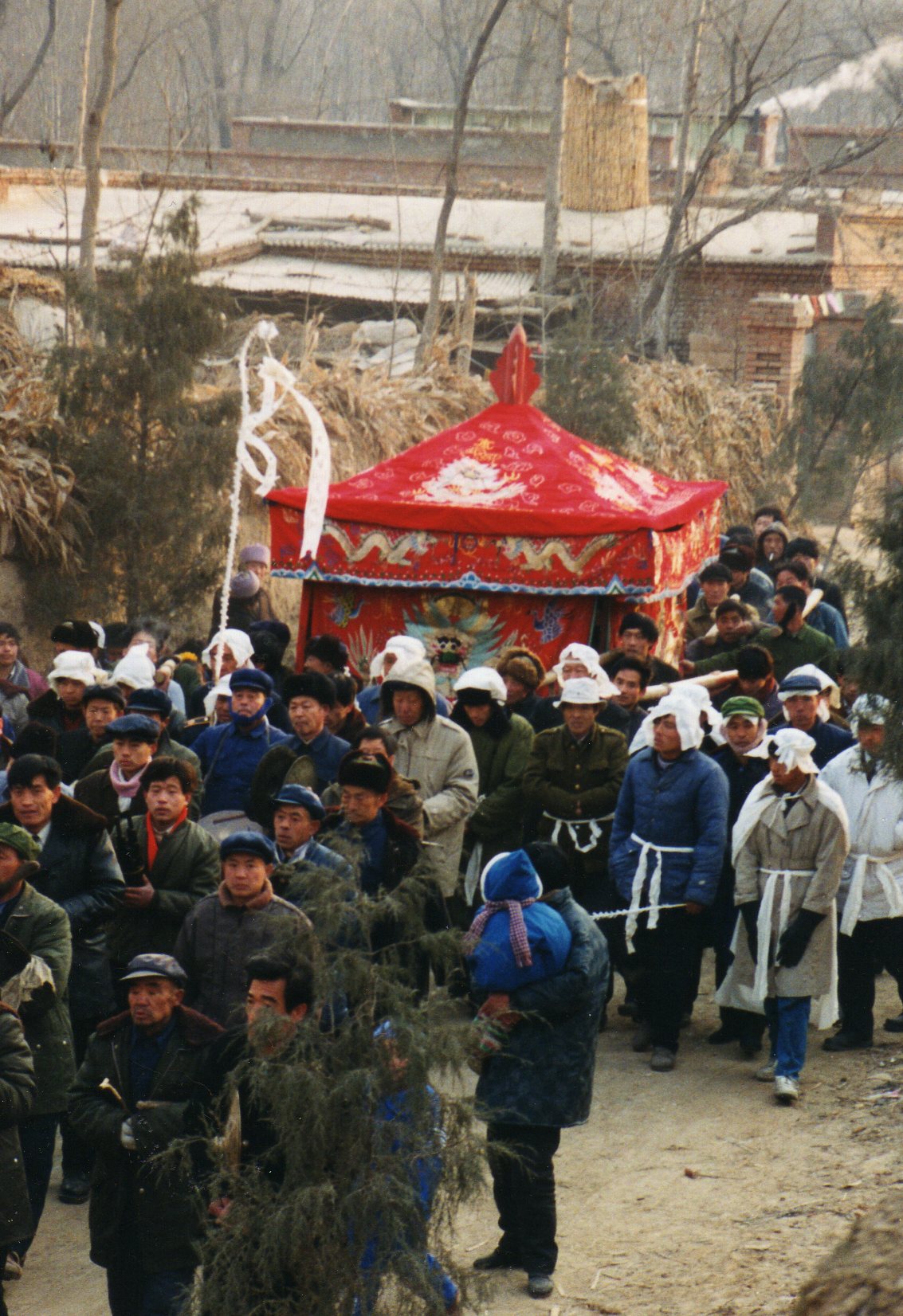
Many descriptions of Chinese ritual sequences appear somewhat timeless, blurring variation and change. But generally I like to keep my accounts either descriptive, based on observed performances, or prescriptive, an ideal sequence recounted by elderly performers. Where I become familiar enough with the local scene I sometimes try to collate the two, as in this composite funeral sequence for one part of the Yixian–Laishui region south of Beijing.
Based on talks with senior ritual specialists there, it’s illuminated by attending (and taking part in) many funerals in this area over more than a decade. While we always seek to copy the diverse funeral manuals of each village, they can’t offer the kind of detail provided by observation of practice and the accounts of the ritual specialists themselves. In particular, my constant refrain: ritual is performance, and is expressed largely through sound—the items of vocal, percussion, and melodic instrumental music that permeate the sequence.
A gradual dilution of ritual practice has undoubtedly occurred since the 1950s, but it’s never so simple as seeking to “restore” some notional ideal sequence from before Liberation on the basis of ritual manuals alone.
From 2011 Hong Kong conference volume.
I go to some lengths to show how Daoist ritual and religious practice are important topics in the local cultures of north as well as south China (for a succinct encapsulation of the chasm, see here). But every time I feel I’m establishing some kind of parity for the north (heartland of ancient Chinese culture!), yet more research materializes to remind us just how amazing local ritual traditions are in the south—in terms of both the range and complexity of rituals performed, and the sheer volume of artefacts preserved there.
As I commented in Appendix 1 of my book Daoist priests of the Li family (where you can find further references),
With the noble exception of studies by Chinese music scholars from the 1930s, fieldwork on local Daoist ritual began in earnest in the 1960s with Kristofer Schipper’s groundbreaking studies in Taiwan. As mainland China began opening up in the 1980s, such work was able to expand first into Fujian and then further afield in south China—Jiangxi, Guangdong, Sichuan, Hunan, Zhejiang, and so on. Major projects (largely in Chinese), led by the indefatigable holy trinity of C.K. Wang, John Lagerwey, and latterly Lü Pengzhi, recruited local cultural workers who went on to develop considerable familiarity with the ritual specialists who were their subjects.
For useful reviews in English of the early projects, see
and for a fine overview of such work within the wider context of Daoist studies,
These vast series continue to yield further discoveries. The latest project, from Xinwenfeng in Taiwan (long an industrious publisher of major works on Daoism) is initially (!) planned to comprise fifteen lengthy monographs:
The southern bias of Daoist studies has a long ancestry: from very early in Chinese history, southern Daoists have dominated the picture. The ritual vocabulary that I provide in my writings on north China is partly an attempt to rebalance a picture largely conditioned by southern Daoism (see also my In search of the folk Daoists, pp. 15–21, 211–213). As I note there,
It is rather as if our knowledge of Christianity in the whole of Europe were based almost entirely on Sicily and Puglia, with the odd footnote on the Vatican and Westminster Abbey. We may like what we find in those places, perhaps considering it more exalted, mystical, and ancient—but that is another issue. (For a similarly rash comparison between Taiwan and the PRC, see note here).
Still, the material here is overwhelming. So far three volumes (each consisting of around 1,500 pages!) have been published in this new series, on local Daoist altars in Jiangxi, Hunan, and Fujian respectively:
Ye Mingsheng is one of the most distinguished collaborators of the project, having worked for decades on Lüshan household Daoists of Fujian. This new publication focuses on ordination rituals in Yongfu in the southwest of the province. As John Lagerwey writes in his Abstract:
The present book begins with an investigation of the histories of the Daoist altars of four lineages […] in Yongfu. It systematically examines the origins of the local Lüshan school, the structures of their altars, and their rituals, manuscripts, talismans, and registers. It also describes in detail two actual Flag-Raising Transmissions in the years 1999 and 2011, discussing all aspects of the transmission ritual from a variety of disciplinary angles so as to provide students of religion with as complete an understanding as possible.
Volume 2 provides a wealth of ritual texts. Among the many photos is a substantial section in colour, including beautiful god paintings.
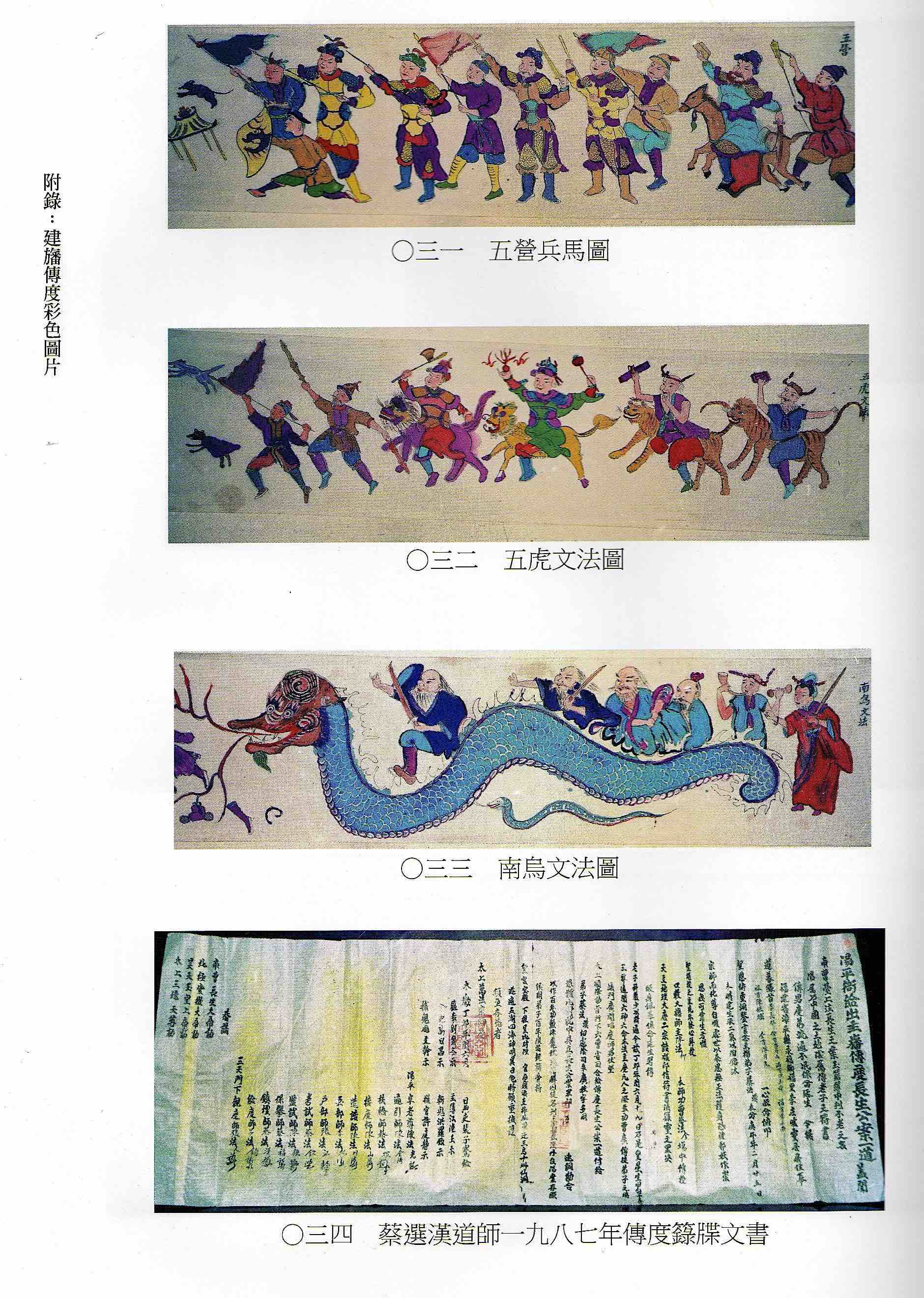 Still, even photos of ritual practice remain silent and immobile. Given that ritual is noisy and vibrant, part of “red-hot” social performance, the whole project seems to cry out to be accompanied by films. Since the scholars working on these projects have rich archives of fieldwork videos, how very valuable it would be to accompany each topic with an edited film of, say, two or three hours, with voiceovers and/or captions.
As I observed here, all these series (like the “music-genre” system of Yuan Jingfang), while documenting particular rituals in detail, focus on the salvage of texts—at the expense of ethnographic study, performance practice, and social change (an approach deriving largely from the study of Daoist ritual in Taiwan). Now, faced by such a wealth of precious manuscripts it’s no simple task to incorporate the topic into wider discourses on a society in constant change. But many students of religion, for whom social and political changes over the past century are a major topic, may find that “variety of disciplinary angles” elusive. They may miss even succinct discussion of how local ritual traditions have been affected by such mundane issues as migration, successive political campaigns, and changing economic circumstances—all the more since the subject of this new volume is transmission, utilising field material from 1999 and 2011, through yet another period of change. [1]
Still, none of this detracts from the value of the project. This vast body of work on local ritual in south China continues to form the vanguard of Daoist ritual studies—essential material on Chinese religion.
For broad introductions to expressive cultures around Fujian—based on ritual—click here, including references to the fine writings and film of Ken Dean, one of few scholars of Daoist ritual to encompass modern social change; and Fujian: instrumental groups as a gateway to the study of ritual. See also Religious life in 1930s’ Fujian, and More films on ritual drama. And for a recent monograph in the series, click here.
[1] For basic biographical accounts of the Yongfu Daoists, see pp.79–103.
Further to the delights of Indian and world fiddles, I write this partly as a reminder to myself, while I enjoy an unlikely renaissance in my playing of the “mellifluous” erhu fiddle (see also here).
For Chinese instrumental music, I’ve showed how the conservatoire solos are merely the tip of the iceberg. The great majority of instruments are played not solo but as part of ensembles, not on the concert platform but as part of social life. Bowed strings mainly accompany vocal music—the ritual genres that I study in north China are dominated by wind and percussion ensembles (the playlist in the sidebar, with commentary here, making a useful introduction).
So ironically, the four solo instruments (pipa, zheng, qin, and erhu) that dominate the popular image of “national music” are rather rare in the countryside. But even if it’s bowed fiddles (“friction chordophones”, ha) you’re after, don’t limit yourselves to the erhu. Much as I love fine renditions like this, there’s a wide range, to rank alongside all the variety of world fiddles.
One guide, mainly useful for historical sources on early fiddles (huqin, xiqin, and so on), is the 1999 book
For illustrated introductions, see e.g. Zhongguo yueqi tujian 中国乐器图鉴, pp.236–73. For folk practice in modern times one should look to field reports on local traditions, setting forth from the Anthology of folk music of the Chinese peoples (for leads, see my book Folk music of China).


Suzhou Daoist Zhou Zufu on tiqin and banhu fiddles, UK 1994.
On a journey south, passing the tiqin of Kunqu and Daoist groups of south Jiangsu, regional traditions along the southeast coast have several types. The nanyin of south Fujian and the ensembles of Chaozhou (areas that are nearby yet culturally very different) use distinct fiddles (both written as erxian 二弦).
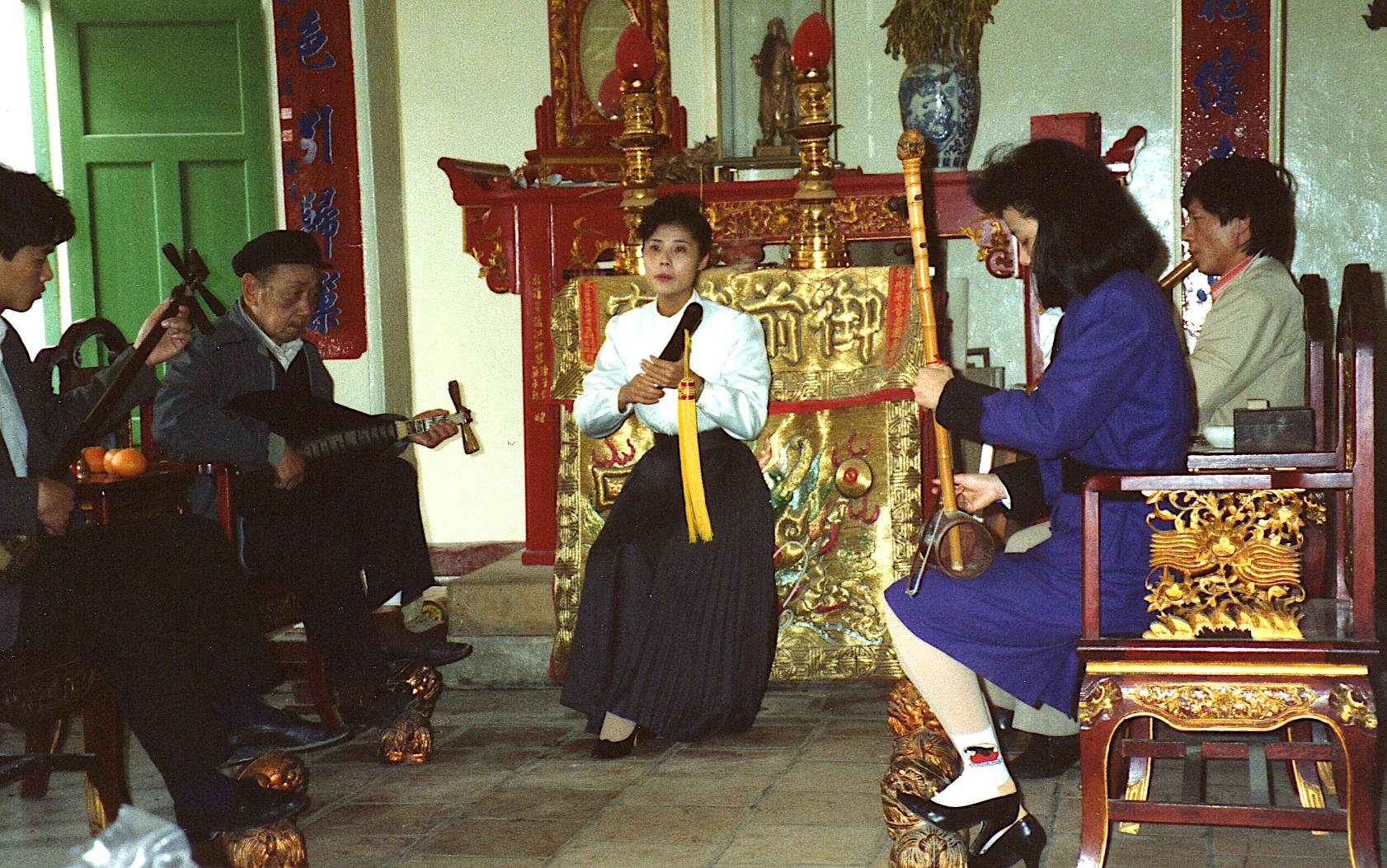
Nanyin ensemble, Wang Axin on erxian. Quanzhou 1990. My photo.
The exquisite Hokkien tradition of nanyin (nanguan) of south Fujian and Taiwan uses a core chamber ensemble of pipa and sanxian plucked lutes, xiao end-blown flute, and erxian fiddle—all regionally distinctive versions. The large repertoire of long slow sustained ballads somewhat resembles the last page of Mahler 9 elevated into a whole genre. The pipa and xiao are focal to the group, but the erxian is also amazing, demanding extraordinary bow control, full of inflection. For introductions to expressive cultures around Fujian, click here and here.
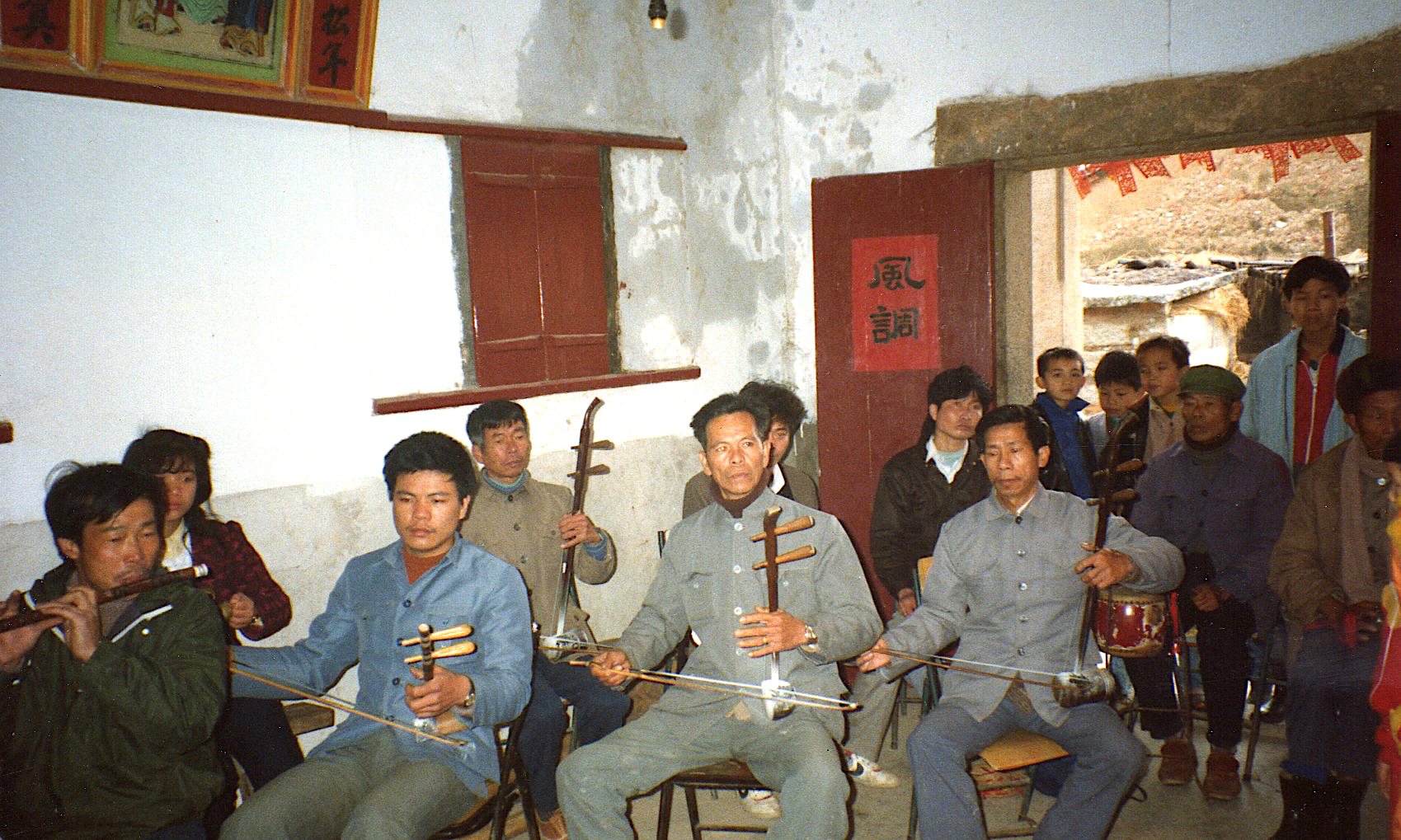
Fiddles in Shiyin 十音 ensemble. Puxi village, Quanzhou 1990.

Blind instrument-maker Cai Qiuzong (b.1947) on touxian, Dahao town, Shantou 1990.
Guangdong province has several other fiddle types, such as the yehu, and the Cantonese gaohu.
If strings are better known in south China, note that wind and percussion ensembles are just as common there. But northern fiddles are also varied, such as the banhu, huhu (some played with metal rings on the left finger, as in the photos below) and sihu, the Beijing-opera fiddle jinghu, and zhuihu and ruyigou in Henan and Shandong. What most of these fiddles have in common is a gritty timbre, quite far from the suave polished ideal of the conservatoire erhu.

yingxian 硬弦 fiddle from Xi’an puppet ensemble: Huang Yuying (b.1932), Xi’an 2001.
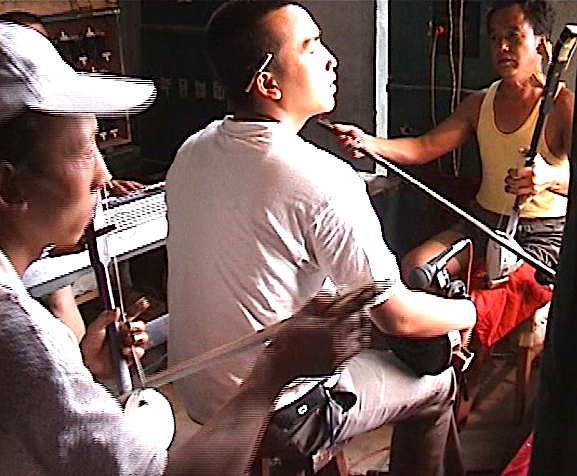
Fiddles accompanying opera, Xujiayuan temple fair, Yanggao 2003. Dodgy screenshot from my film Doing Things, with 2007 book Ritual and music of north China: shawm bands in Shanxi.
I’ve written a separate post on bowed zithers (yaqin and so on) played in various traditions north and south. Not to mention all the diverse fiddles among the ethnic minorities— Mongolian morin khuur, Uyghur satar and ghijak, and so on.
Of course, one may end up specialising, but musicians are versatile: they pick up various instruments in order to learn how to take part in the social activity of musicking. The repertoires of such regional traditions took shape long before the modern standardisations of “national music”.
Indeed, outside the conservatoires and apart from the children of the urban bourgeoisie, the only bowed fiddle that’s not popular is the erhu! It has commonly been added to ensembles accompanying regional vocal genres since around the 1920s, but remains subsidiary (see also Song of suffering). As always, we should rejoice in regional diversity.
Zooming out, see here for an introduction to the sidebar tag fiddles.

In Chinese religious studies, fieldwork and historical study of texts should be complementary. While the changing ritual scene in rural north China over the past century has largely been left to musicologists, Cao Xinyu 曹新宇 (People’s University, Beijing) continues his fine work on the imperial ancestry of sectarian groups, setting forth from the seminal research of the great Li Shiyu, and studies like those of Ma Xisha and Han Bingfang (see here, in a useful site for Qing history)—all similarly utilizing fieldwork.
Sects are a poor cousin to research on more open forms of institutional religion, but—like spirit mediums—an important part of the picture. While I constantly stress the sectarian connections of ritual associations on the Hebei plain, as a counterbalance to the current secular image portrayed by the Intangible Cultural Heritage, highly worthy of study is Cao Xinyu’s recent book


This continues his voluminous work on the Way of Yellow Heaven, Minjian sizang Ming-Qing mimi shehui shiliao xiezhen: Huangtian dao juan 民間私藏明清秘密社會史料擷珍, 黃天道卷 (2013).
It’s high time to bring into contact the two strands of historical research and fieldwork on the modern fortunes of the bewildering variety of groups that we find around north China—such as Hunyuan, Hongyang, Huangtian dao, and Laofomen. This is a major task for fieldworkers, including music scholars. [1]
[1] For now I’ll leave you to compile your own lists for Western-language studies, such as Weller, Ownby, Overmyer, Palmer, ter Haar, DuBois, and so on—a valuable resource is the rubric in Philip Clart’s essential bibliography.

Language is always in flux, over the dead bodies of fusty conservatives. English isn’t alone in changing under the stimulus of social media and popular culture.
Since my Chinese vocabulary incongruously lurched from the Tang dynasty to the clichés of Maoism (see also here), where it remained impaled, I’m happy to make some modest updates, partly courtesy of websites like Sixth Tone (e.g. here, here, and here), and Magpie digest—as well as this article, including a recap on the viral caonima “grass-mud-horse” trope. As elsewhere, much of the linguistic innovation is driven by online usage. I’m very keen on the term
To zhuāng bì 装 B is to put on airs — worldly, moneyed, educated, eccentric, or any other combination thereof. In other words: to be a fucking poser.* B is shorthand for níubì ( lit. “cow’s cunt”: see here, with instructive links), meaning “awesome” or “badass”—the English letter “B” being easier to find than the character for cunt (for shabi “fuckwit” and the somewhat less shocking nature of bi in Chinese, see here).
The article describes zhuang B as “a light, often self-deprecating insult”, “sign of healthy subcultural growth”—“by-product of all the new possibilities for young, middle-class Chinese people, a way for millennials to practise defining their way of life.” So it’s a pretentious wanker or tosser—cf. “Poseur, moi?”. See also this Sixth Tone article.
I also like galiao 尬聊 “awkward chat”, inevitable chats with boring people—when the person you are talking with lacks communication skills, or when your mind wanders off and the talk reaches a dead end.
Even for those seeking to limit their studies to a bygone age, a basic grasp of how living people communicate (even village ritual specialists) is valuable… For an update, click here.
* Private Eye’s Pseuds’ corner polices English excesses with regular entries—like this, from an old programme note of a London Pro Musica concert, penned with tongue in cheek by the splendid Bernard Thomas:
The title of this concert means “a piece of cake”; it comes from the popular song Damene un poco di quella mazacrocha, “give me a piece of that cake (crumpet?)”. The process of baking a cake might be taken a central metaphor for Renaissance musical culture, for the special synthesis of northern polyphony and rhythmic subtlety with the poetry and expressive melody of indigenous Italian music. Florence, together with Siena and Bologna, were, and still are, traditional centres of cake baking. One can only guess at the repeated and prolonged biting into cakes on the creative processes of Heinrich Isaacs during his long stay in Florence.
*click here for main article!*
(under Hebei in main menu)
Ritual groups around the Baiyangdian lake:
the Medicine King cult
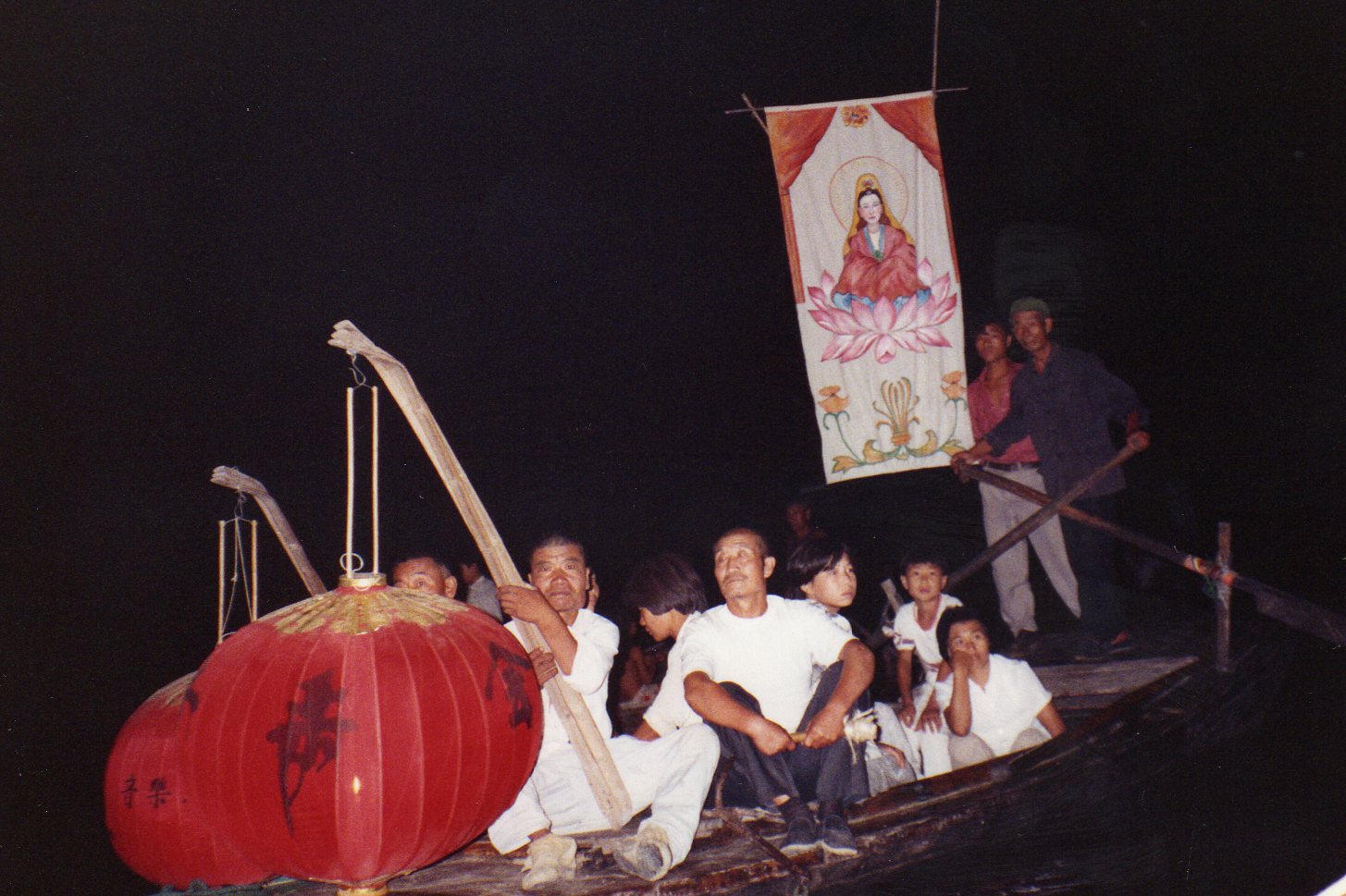
On the Hebei plain, just south of the Xiongxian region, the Baiyangdian lake, and the ritual catchment area of the pilgrimage to the Medicine King temple in Maozhou, form a somewhat distinct area for ritual practice. This is highly topical since it is now part of the vast plan to build a megapolis there, expanding Beijing and Tianjin southwards amidst profound social and ecological change.
This was the southern boundary of our project on the Hebei plain, where we had found so many complex liturgical sequences, ritual manuals, and grand shengguan instrumental suites with scores derived from the temples of old Beijing and Tianjin. Xiongxian turned out to be the heartland of the suites and scores, but around the lake just south, despite the lively Maozhou cult, the trail was becoming somewhat diluted—and I don’t believe this is merely because our visits predated more in-depth stays in the areas further north and west. Still, these associations were very much based in ritual and shengguan, and dated back to at least the 18th century.
This survey introduces ritual groups all around the lake, including villages of Anxin, Renqiu, and Gaoyang counties. The aquatic setting engenders plentiful rituals based on “releasing river [or lotus?] lanterns” (fang hedeng 放河/荷燈).
As ever, this article merely scratches the surface of our fieldnotes—themselves just a superficial survey of some village associations that came to our attention. There may be many more, and certainly were until the 1950s. Any one of these groups (and indeed the Maozhou temple) could, and should, form the subject of a detailed diachronic ethnography such as I did for Gaoluo.
Around the Baiyangdian lake we found further evidence for the connection not only with Buddhist monks and Daoist priests but also with the ritual and musical cultures of the Qing emperors in Beijing—a link that appears occasionally throught the Hebei plain, such as Yixian, and strongly suggested in Xiongxian just north.
Back in the mists of time, long before the internet, or even usable landlines—the 1990s—this ritual system still comprised the main cultural network of such regions. Having survived Maoism remarkably unscathed, there are complex reasons for the long-term decline of these associations—including not so much the recent urban development plan for the region, but migration, the whole commodification of society, and the secularizing pressures of the ICH. These notes are valuable for documenting local ritual life at a time when such transformations were still in their early days.
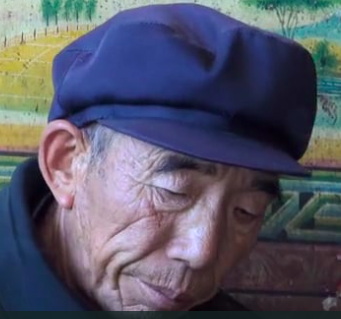
After a year of frenzied blogging, here’s a seasonal retrospective guide to navigating a diverse ouevre—as much for my sake as as for yours. Meretricious and Happy New Year!
Call me a nerd [You’re a nerd—Ed.], but taxonomy and indexing are so funky… As you see from the (updated) homepage, the whole site began as an introduction to my work on the Li family Daoists, and my portrait film remains one the most enchanting presences there. The Li family has its own category in the sidebar, with a plethora of articles (not least a whole series on our French tour in May 2017, and an update on Li Bin’s diary).
Other pages in the top menu also tend to be rather substantial, with
Still in the top menu, MY BLOG contains all my myriad posts (“delighting in all manifestations of the Terpsichorean muse“), with helpful Categories and Tags in the sidebar, as well as a monthly archive there. Here are some of the more stimulating:
As you can see from this post alone, I just love doing internal links (in blue in the text). So whether you first came here for Daoist ritual, football (indeed, Daoist football), punk, Bach, modern China, or even just for the jokes, they’re all connected, so please do click away on the links!
Last but, um, not least, do click on the links to the relevant posts and pages in the photos in the sidebar.
The work of Susan McClary, both for its ideas and its lively language, has prompted such a major “disciplinary explosion” in musicology, with her iconic book Feminine endings. Her ideas, “received as radical—even outrageous—within musicology, only brought to music studies the kind of projects that had long since become standard fare in most other areas of the humanities” (p.ix).
McClary’s work shouldn’t be reduced to soundbites, but alongside astute gender-based discussions of a broad range of music from Monteverdi to Madonna, Carmen to Laurie Anderson, many passages have both inspired and shocked—her detailed unpackings of patriarchal assumptions, such as on Beethoven (“assaultive pelvic pounding… and sexual violence “), or the “erotic friction” of Italian trio sonatas (“two equal voices rub up against each other, pressing into dissonances that resolve only into yet other knots, reaching satiety only at conclusions”—an interactive texture that was later displaced).
Meanwhile, listening again to Brandenburg 5 recently after my post on Bach’s fawning letter to the concerto’s churlish recipient, I was reminded of one of McClary’s most famous accounts, from her 1987 article “The blasphemy of talking politics during Bach year”.
Somehow I long took for granted Bach’s “frenzied” harpsichord solo near the end of the 1st movement—McClary observes how our senses are dulled by familiarity with later romantic concertos (and anyway we fiddlers tend to think it’s none of our business—we know our place, which is precisely McClary’s argument). So I’d like to run through the way she unpacks it; whatever you think, she’s always stimulating (see also this post).
She begins by summarizing important background, her constant theme:
At the very moment that music was beginning to be produced for a mass bourgeois audience, that audience sought to legitimize its artifacts by grounding them in the “certainty” of another, presumably more absolute realm—rather than in terms of its own social tastes and values.
[…]
From very early times up to and including the present, there has been a strain of Western culture that accounts for music in non-social, implicitly metaphysical terms. But parallel with that strain (and also from earliest times) is another which regards music as essentially a human, socially-grounded, socially altered construct. Most polemical battles in the history of music theory and criticism involve the irreconcilable confrontation of these two positions.
Inspired by Attali’s book Noise, McClary seeks “the tension between order (indeed, competing claims to legitimate order) and deviation —if not outright violence…” Reminding us of harmonic music’s underlying assumptions of goal-attainment (“playing with (teasing and postponing, gratifying) the expectation of imminent closure”), she plunges into the 1st movement of Brandenburg 5.
She notes the rise of the concerto form, where “the soloist is an virtuosic individualist who flaunts the collectivity of the large ensemble”. […] “It begins as if it is going to be a concerto for solo flute and violin, but it soon becomes clear that “there is a darkhorse competitor for the role of soloist: the harpsichord”. Its normal “service role” at the time seems self-effacing, but “the harpsichordist is often a Svengali or puppet master who works the strings from behind the keyboard. Here s/he “creates a ‘Revenge of the continuo player’: the harpsichord begins in its rightful, traditional, supporting norm-articulating role but then gradually emerges to shove everyone else […] out of the way for one of the most outlandish displays in music history.”
The harpsichord, which first serves as continuo support, then begins to compete with the soloists for attention, and finally overthrows the other forces in a kind of hijacking of the piece. […] The ritornello seems to know how to deal with the more well-behaved soloists, how to appropriate, absorb, and contain their energy.” But Bach now “composes the parts of the ensemble, flute, and violin to make it appear that their piece has been violently derailed. They drop out inconclusively, one after another, exactly in the way an orchestra would do if one of its members started making up a new piece in the middle of a performance. Their parts no longer make sense. They fall silent in the face of this affront from the ensemble’s lackey, and all expectations for orderly reconciliation and harmonic closure are suspended.
[…]
It unleashes elements of chaos, irrationality, and noise until finally it blurs almost entirely the sense of key, meter, and form upon which 18th century style depends.
McClary concludes provocatively:
The usual nice, tight fit between the social norm, as represented by the convention of concerto procedure, and specific content is here highly problematized. Certainly social order and freedom are possible, but apparently only so long as the individuals in question—like the sweet-tempered flute and violin—abide by the rules and permit themselves to be appropriated. What happens when a genuine deviant (and one from the ensemble’s service staff yet!) declares itself a genius unrestrained by convention, and takes over? We readily identify with the self-appointed protagonist’s adventure (its storming of the Bastille, if you will), and at the same time fear for what might happen as a result of the suspension of traditional authority. […] The possibility of virtual social overthrow, and the violence implied by such overthrow, is suggested in the movement, and the reconciliation of individual and social hierarchy at the end— while welcome—may seem largely motivated by convention. To pull this dramatization back within the limits of self-contained structure and order may seem to avoid the dilemma, but it does so at the expense of silencing the piece. For Bach is here enacting the exhilaration as well as the risks of upward mobility, the simultaneous desire for and resistance of concession to social harmony.
McClary’s work is akin to ethnomusicology (“If I can no longer privilege any one tradition, I find myself perpetually in awe of the countless ways societies have devised for articulating their most basic beliefs through the medium of sound”), and its class and gender implications cry out to be applied to Chinese musical cultures (I made a preliminary and rather unsuccessful attempt in my “Living early composition: an appreciation of Chinese shawm melody”).
With Bach’s solo, it’s easy to think “that’s just how it goes”, but whatever your “class standpoint” (阶级立场), if you listen to it afresh, every few bars you think, WTF??? I know the analogy with jazz can be overdone, but even jazz solos, however virtuosic, also generally fit within fixed (and democratic?) parameters—except when someone like Coltrane goes off on an interminable fantasy. In its wackiness Bach’s solo reminds me of a pianist like Hiromi—or a Hendrix guitar solo.
It makes a suitably awe-inspiring opening to The chronicle of Anna Magdalena Bach, all the more exhilarating in Gustav Leonhardt’s restrained rendition—here’s a colorized version:
For my own meretricious speculations on socio-political elements in the reversal of colours on the piano keyboard, see Black and white.
* * *
And now for something completely different: Glenn Gould, 1962—don’t worry about the rest of it, just listen from 8.06ish:
Reception history and performance practice are always intriguing. Little is known of any performances in Bach’s lifetime, but it looks as if the concerto may not have been played again, at least in public, until 1853. Like Rudolf Serkin’s 1935 recording with the Busch Chamber Players, Alfred Cortot’s 1932 version (still on piano) is more genteel than manic:
And here’s Furtwängler in 1950 (cadenza from 8.54ish)—praised by Richard Taruskin, no less:
But performances only became more common with the harpsichord revival of the mid-20th century. So now, despite a rearguard action to rehabilitate the Golden Age before HIP (see Alternative Bach, and Playing with history), modern ears may find such early versions heavy going.
Richard Egarr always offers wacky insights (from 6.30ish):
Having blown everyone away, the harpsichordist gives a little signal of the return to normality (“relents and politely (ironically?) permits the ensemble to re-enter”) so that they can pick themselves off the floor to come in with the ritornello that innocently began the whole trip.
I like to think of the cadenza as just one instance of an improvisation that Bach chose to notate, illustrating the kind of fantasies in which the player might care to indulge, like Messe de la Pentacôte or Rhapsody in blue.
Sure, one can’t really cheer aloud at every manic new turn, but I still think the only possible reaction of both band and audience, whether now or in Bach’s lifetime, would be akin to that of Billie Holiday as she exults in the succession of amazing solos her band offer up to her.
Following the riches of Bach on Radio 3 and my recent survey:

Bach’s letters to his patrons are a sad vignette on the sordid realities of working for them. Along with his unsolicited gift of the Brandenburg concertos to the Margrave of Brandenburg [“What does that even mean?”], he wrote this covering letter (in French, courtly language of the time), dated 24th March 1721:
As I had the good fortune a few years ago to be heard by Your Royal Highness, at Your Highness’s commands, and as I noticed then that Your Highness took some pleasure in the little talents which Heaven has given me for Music, and as in taking Leave of Your Royal Highness, Your Highness deigned to honour me with the command to send Your Highness some pieces of my Composition: I have in accordance with Your Highness’s most gracious orders taken the liberty of rendering my most humble duty to Your Royal Highness with the present Concertos, which I have adapted to several instruments; begging Your Highness most humbly not to judge their imperfection with the rigor of that discriminating and sensitive taste, which everyone knows Him to have for musical works, but rather to take into benign Consideration the profound respect and the most humble obedience which I thus attempt to show Him. For the rest, Sire, I beg Your Royal Highness very humbly to have the goodness to continue Your Highness’s greatest favours towards me, and to be assured that nothing is so close to my heart as the wish that I may be employed on occasions more worthy of Your Royal Highness and of Your Highness’s service—I who, without an equal in zeal, am, Sire, your Royal Highness’s most humble and obedient servant.
Sure, we have to read such a letter in the context of the day, but it’s hard to beat for brown-nosing. Servants indeed— to cite Dennis in Monty Python and the Holy Grail,
… exploiting the workers! By hanging on to outdated imperialist dogma which perpetuates the economic and social differences in our society… We’re living in a dictatorship! A self-perpetuating autocracy, in which the working classes…
Didn’t know we had a king. I thought we were an autonomous collective.
And there’s no evidence that the Margrave even wrote back. Pah! I hope Bach told him where to stick it. He might have well as sent the concertos to Tweety McTangerine.
Bach had been happy at Cöthen, where Prince Leopold was an exceptionally musical patron—Bach’s need to seek new employment has been blamed on the Prince’s “airhead” new wife (typical). With the Margrave deaf to his appeal, Bach was soon to find a permanent haven in Leipzig—and the rest is geography. Even there his struggles with patrons continued.
Thing is, despite all such routine tedious scramblings, Bach never stopped creating a wealth of music that stands as a rebuke to all mundane concerns.
And so in imperial China—right down to today, as a chain of fawning operates from grass-roots performers to regional cadres to central pundits. Only with less magical results.
I trust I shall have the honour to remain your faithful and humble servant
Dr S. Jones (available for weddings, bar mitzvahs, and screenings of my film Li Manshan: portrait of a folk Daoist)
*For main page, click here!*
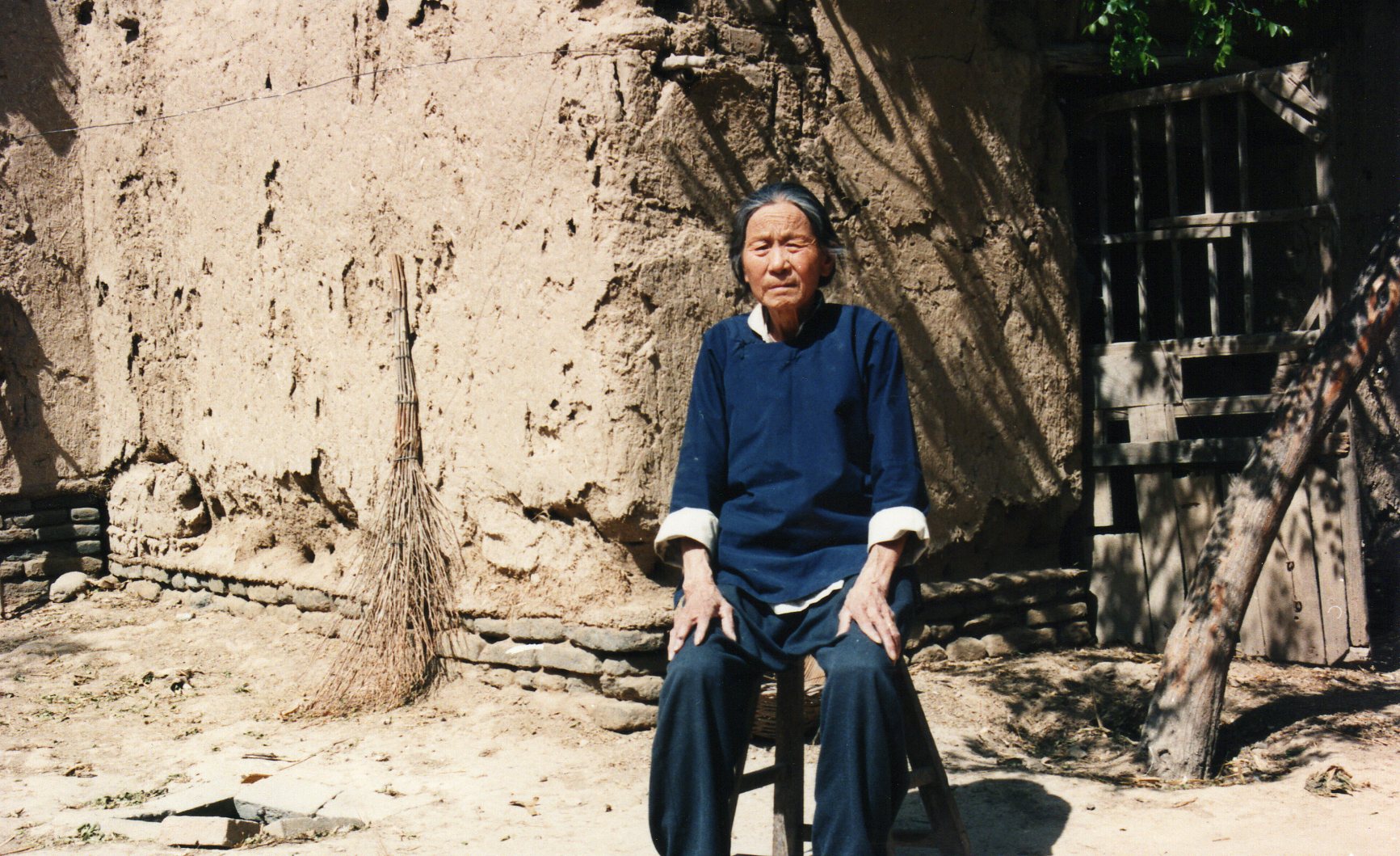
In traditional China, ritual activity—indeed, public appearance altogether—appears to be male-dominated. But the role of women in religious life is significant—as worshippers, as members of amateur sects, and notably as spirit mediums. Nuns hardly threatened the patrilineal traditions of ritual and instrumental music before the 1950s, but they make an interesting sub-plot.
Moving south from Beijing and Fangshan to Laishui county, this article goes on to gives vignettes (based on brief chats in 1994) on the ritual life of two elderly former nuns in a village in Renqiu county, near the Baiyangdian lake, half a century earlier. Such absorbing glimpses into the world of rural nuns before Liberation deserve including in our picture of local cultures.
In 1705 the 20-year-old Johann Sebastian Bach set off from his home in Arnstadt to walk 250 miles to Lübeck, there to meet his hero, the composer and organist Dietrich Buxtehude.
Bach is compulsory Radio 3 listening over Christmas, and apart from yet another excursion on Composer of the week, Horatio Clare’s series Bach walks makes fine slow listening, taking the walk in five episodes, punctuated by musical snippets that seem all the more miraculous. And it stands in tranquil contrast to the hectic claustrophic life that he was to lead through the years of his greatest creativity in Leipzig.
What makes such a modern retracing of Bach’s steps so thoughtful is all the social detail that can be incorporated, along with Clare’s reflections on the present landscape. Bach had actually walked a similar distance when he was 15 to enroll in St. Michael’s School in Lüneburg.
By now you won’t be surprised to learn that this reminds me of the Li family Daoists.
Early-18th-century Germany was more advanced in transportation than rural China in the 1930s, or even the 1980s. And by contrast with many more adventurous composers of the day, Bach spent most of his career employed in a rather small radius within Thuringia and Saxony.
From my Daoist priests of the Li family (pp.12–13):
Since ancient times, elite Daoists travelled widely over China to famous temples and religious mountains, seeking the wisdom of other sages and propagating new revelations. One such master was Kou Qianzhi (365–448), who served the court of the Northern Wei dynasty at their capital Pingcheng (modern Datong), and who is often wheeled out by scholars as an instance of the illustrious ancestry of Daoist ritual in north Shanxi. Still today, temple Daoist priests commonly spend periods “cloud wandering” around the main urban and mountain temples.
By contrast, household Daoists are active within a small radius (see map here). Even those who spent their youth as priests in temples before the 1949 Liberation did so only locally—like several boys in Upper Yinshan village in nearby Tianzhen county, who learned their ritual skills in a temple just further east. Occasionally the Li band is invited to do rituals further afield—just east in Hebei or north in Inner Mongolia. Li Qing and the elders used to walk for a whole day to do Thanking the Earth rituals for patrons in Inner Mongolia, because around eighty percent of the Han Chinese population there had migrated from Yanggao, some of whom were quite affluent. But the main area of their work is defined both by walking distances and by the availability of Daoists elsewhere—north around the county-town, west in Datong county, and east in Tianzhen. So even now, with motor-bikes and cars, most of their ritual business is still in the districts of Shizitun, Houying, Baideng, and Pansi. They work quite often just further south in the districts of Gucheng and Lower Shenyu, and sometimes in Dongxiaocun district and in the west of Tianzhen county. But they rarely perform rituals in west Yanggao, or further north in North Xutun district or around the county-town where other groups of Daoists are available.
(pp.154–5):
Until bicycles became generally available from around 1980, people had to walk everywhere, or go by ox-cart, equally slow. Li Manshan recalls wryly, “We didn’t even have Chinese carts (tuche), let alone foreign ones (yangche)!” Occasional visits to the county-town on foot took over three hours. Li Manshan went occasionally before the Cultural Revolution; he recalls walking there with his aunt in 1954 to watch the grand Offering Tribute (xiangong) parade on the 24th of the 6th moon, which was by then a purely secular event.

Horse-cart on the way to Gaoluo, 1989.
For a funeral twenty-five Chinese li away, walking at roughly ten li an hour, the Daoists had to set off at 4am. The hill villages to the east were not so far, but the climb took longer—when Wu Mei was learning with Li Qing in the late 1980s it took him a whole hour to walk from his home in Renjiayao, only five li away. Most gigs might be in the nearby villages, but for longer journeys the more elderly Daoists might send their fitter younger sons and disciples. When the Daoists were invited for funerals a long walk away, there was no need to get the Lis to determine the date on the death, or decorate the coffin—there were men available locally for such tasks.
Until the 1980s when there was a death, the son would walk to Li Qing’s house to invite him to do the funeral—and was then quite likely to learn that he was doing a funeral in another village and to have to make another trek by foot there. From 1980 to 1990 he could make this search by bicycle, and then perhaps by motor-bike; since around 2002 he can just call up Li Manshan on his mobile.
I was amazed to read that bicycles were already common in some central Shanxi villages by the 1930s [1] —perhaps a hint of how much poorer Yanggao was than areas further south. In the countryside here, most people only began riding bicycles around 1978; before that only some village cadres had them. Li Qing rode a Red Flag bike from around 1981. With a bike costing around 150 kuai, and a Daoist earning 6 kuai per gig, or over 70 kuai a month, one bike cost at least two months’ earnings. In Baideng town, Daoist Wang Xin set up a little stall mending bicycles.
Actually, bicycles speeded up mobility only slightly; in the countryside there was still nothing quite resembling a road, the tracks being deeply rutted until transport arteries began to improve significantly since around 2003. And neither bicycles nor motor-bikes have significantly expanded their radius of activity; they continue to work mainly within a small area.
I also reflect on walking within a funeral (pp.27–8):
In order to allow for a suitably lengthy and imposing procession, the house chosen for the scripture hall should be at a considerable distance from the soul hall where the rituals are performed. Indeed, since the scripture hall is on average around half a kilometer away, they potentially have to walk—playing all the while—seven kilometres a day for the seven routine visits alone, let alone other processions from the scripture hall to the soul hall before leading the kin to the sites for the other public rituals, and again next day for the procession towards the grave. Apart from anything else, this is good exercise.
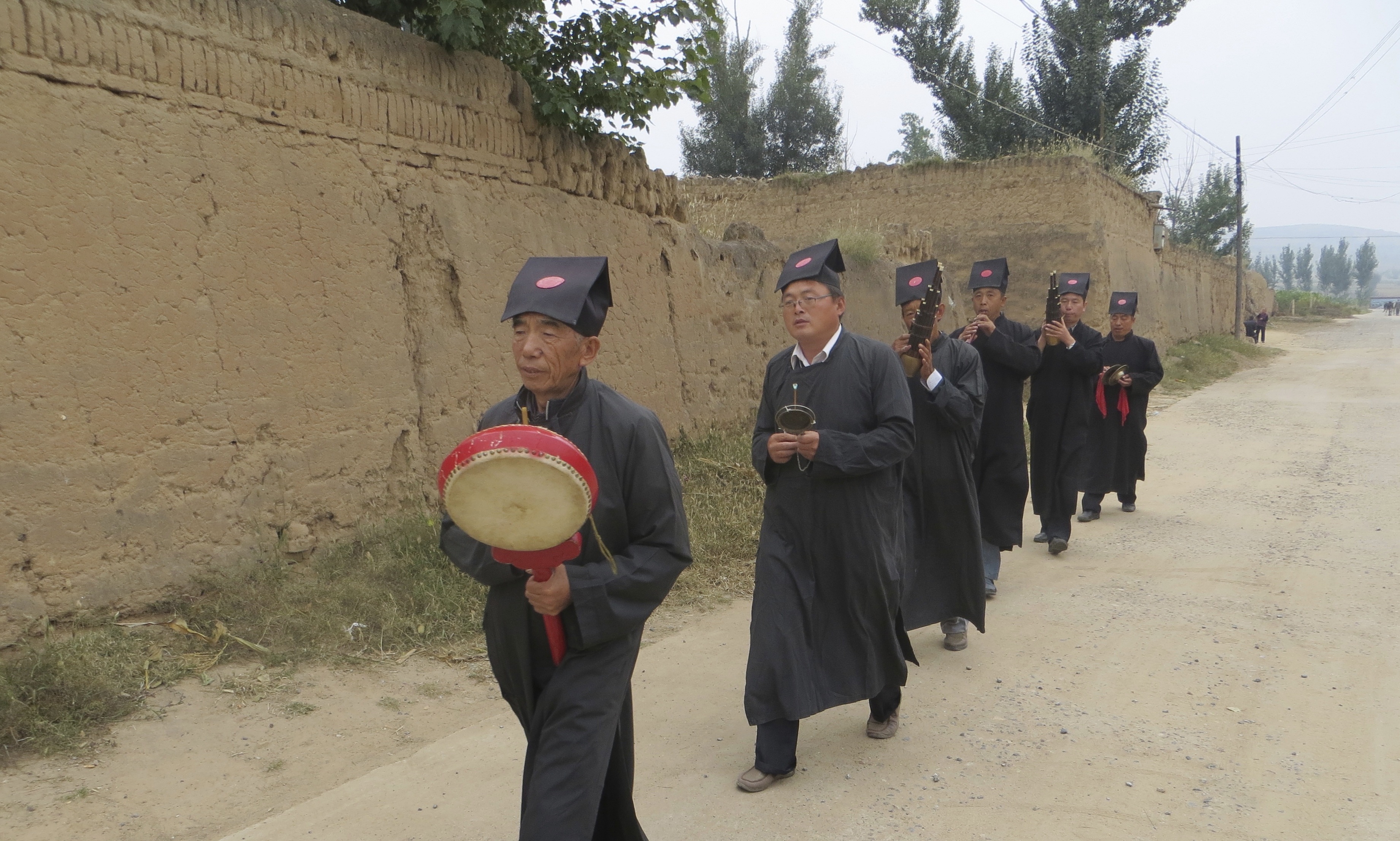
Over the day the Daoists make seven processions from scripture hall to soul hall and back, as well as processions to the other ritual sites.
But once at a funeral in nearby Yangyuan county I was surprised to find the scripture hall very near the soul hall—and this turns out to be an older custom, so that the Daoists would be on hand to respond promptly for the many rituals once needed. Since the 1980s there is less need for this, and Li Manshan observes that the recent distance also serves to marginalize them. But it is also welcome so they can escape from the din of pop and get some peace.
[1] Harrison, The man awakened from dreams, p.156. Cf. Friedman, Pickowicz, and Selden, Revolution, reform, and resistance in village China, p.228; Harrison, The missionary’s curse, p.145.
Here’s a little popery, I mean potpourri—a resumé of some of my more wacky linguistic fantasies:
Among many fine Chinese jokes, my piques du jour* are
* Rather than piqes-niques.
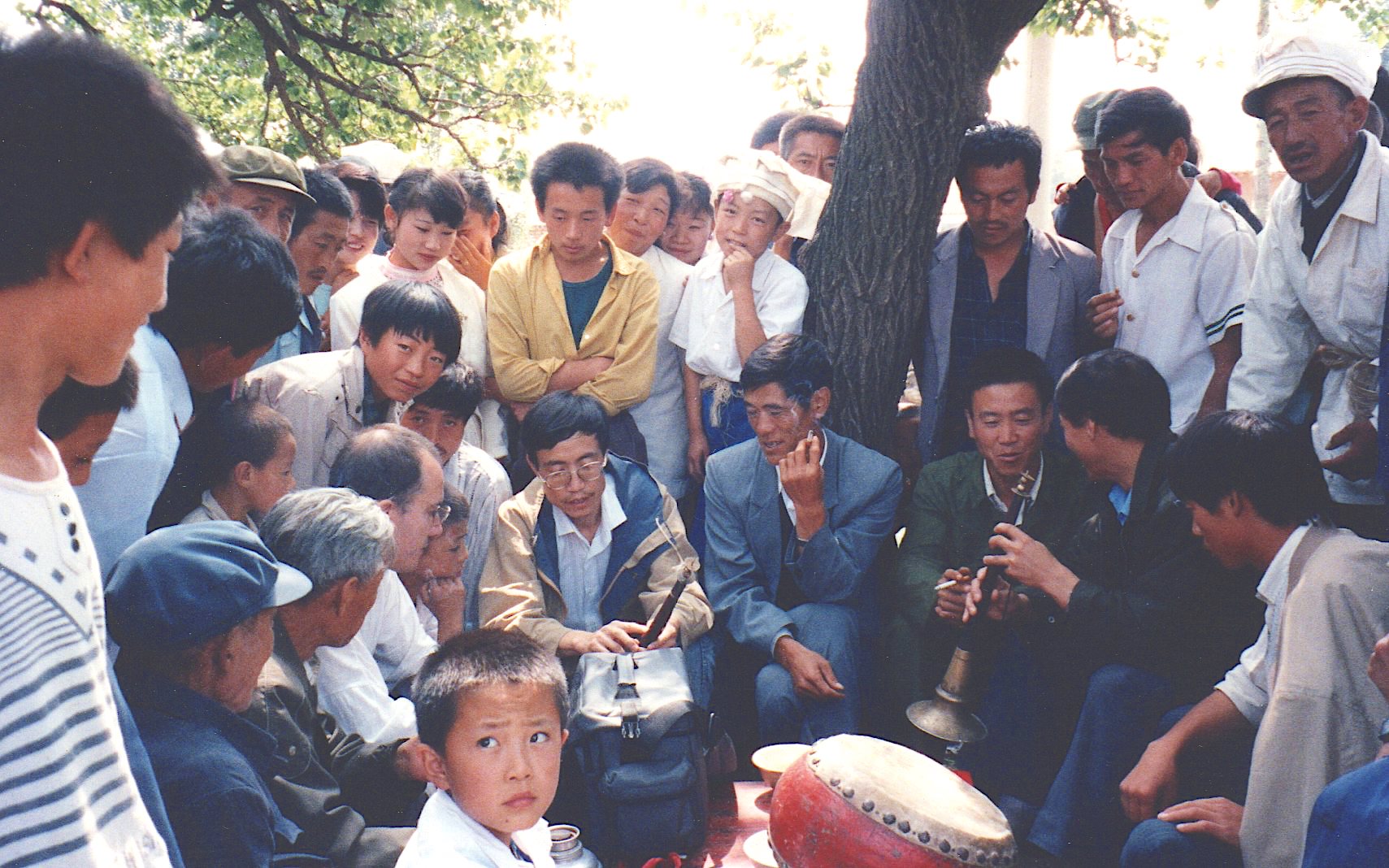
With oral history such a major aspect of our fieldwork, this recent conference on its role in Chinese music studies, organized by the bright scholar Qi Kun, looks interesting:
http://www.sohu.com/a/210825724_619610
As I often observe, the experiences of peasants may be a more fruitful source of information than musty tomes in a library. From my recent article on Xiongxian:
Such local temples, and the amateur associations that perpetuated their traditions, would be unknowable without exploring the area on the ground, village by village. The project is of great significance for our understanding of local history—not just for the late imperial period, but from the Republican era through Maoism and the reforms, right down to today.
Of course, “music” being part of changing local society, this must also be a political issue, as shown by famine studies in China (e.g. Wu Wenguang’s Memory Project) and elsewhere. Here Chinese music scholars still tend to lag behind their colleagues in anthropology.
Don’t get me wrong, I’m glued to Strictly come dancing every week. Oh yeah, I’ve got my finger on the pulse of popular culture all right [adjusts monocle, grappling ineptly with concept of the high-five]. I was mortified in 2015 when Georgia and Giovanni (aka Joe Varney) didn’t win:
Or indeed Alexandra in 2017… But hey, “It’s not winning but taking part”, eh [zzzzz].
And now the brilliant Stacey Dooley—who did win, YAY!!! (See also Moon river.) Here’s another Charleston. Now let’s all watch her fine documentaries.
The thing about Strictly is, as with Handel opera, or a Moroccan wedding, you just have to suspend your disbelief. The dancers don’t want to go home, but for some reason they do want to go to Blackpool, which is unlikely to feature even on the itinerary of perfectly innocent Russian tourists. Li Manshan hadn’t even heard of the Carnegie Hall, let alone Blackpool, but it’s clearly more appealing than doing a Messiah in Scunthorpe.
Sure, as Barbara Ellen notes in a fine review, Strictly proved yet again
that it understood its own winning formula—drown the contestants in a vat of fake tan and what a cynic might term even faker bonhomie, and let the controversy and sequins fly. […] A sugar-rush of schmaltz combined with a brawl on the entertainment deck of a cruise ship…
But for me it’s classic BBC “educate, inform and entertain” stuff—inculcating diligence, expression, and appreciation of historical style (!), with the pros and the judges vouchsafing us little dollops of technical advice. For all the fatuous clichés of the competitive format (see also Alexei Sayle‘s pertinent critique), Strictly can be inspiring and deeply moving. So there. And for 2020, Bill Bailey reaffirms our belief!
Still, my question is this:
However were we all conned into thinking that a genre that seemed pathetically antiquated even in the early 1960s could possibly achieve such wild popular success in the 21st century?
This baffling device of prefixing an unlikely and outmoded format with an utterly random adverb gives me an idea whose time has surely come:
Strictly north Shanxi Daoist ritual
After all, Daoist bands have long been used to ritual competition, “facing platforms”. In my film (from 24.08) my use of karaoke captions for the percussion mnemonics makes an instructive innovation that draws us into a crucial element of ritual performance. And we’ve just had “The Reverend Richard Coles” on Strictly, so hey. My new programme concept has got everything from the original—a grand ritual arena, movement, costumes, music… And since, as Heidi Stephens notes in her drôle Guardian commentaries, what viewers really need is a Journey, what better than Pacing the Void?
Admittedly, even with a minimum of six ritual bands contesting, each performing a different ritual segment for each programme (Presenting Offerings, the Invitation, Beholding the Lanterns, and so on), the weekly programme would require at least four hours—and the nocturnal yankou ritual alone takes longer than that. Still, BBC ratings will doubtless soar.
Coming up next—we’ve got Du Zhimin’s band all the way from Guangling, performing the Ambulating Incense ritual!!!
I’ll be delighted if the drôle Claudia Winkleman will host the new show. As to
the fragrant Darcey Bussell [surely an anagram, e.g. “Recall Debussy”—cf. Gran visits York and Maidstone] is always welcome. How can anyone be so elegant and savvy and still be English? Her only tiny flaw seems to be that she can’t get the hang of clapping (watch her as she applauds couples just voted off). And now that the great Li Manshan is ceding much of his ritual work to his son Li Bin, he seems the ideal choice as chair of the judges.
Some quotes from the panel:
Darcey [purring]: “Oh MY! I have to say, just make sure you grade that accelerando in Yellow Dragon Thrice Transforms its Body just a tiny bit more carefully.”
Bruno [does pirouette]: “Bellissimo! But you still need to work on your posture, dahlingg.”
Li Manshan [dragging on fag], in unison with Craig: “That was chaotic!”
And the scores are in…
I look forward eagerly to discussions with the BBC. [1]
See also Fantasy Daoist ritual.
* * *
Another Daoist-ritual spin-off might be to adapt the brilliant “One song to the tune of another” from I’m sorry I haven’t a clue. One recent fave was Jan Ravens singing the words of I can’t get no satisfaction to the tune of Wouldn’t it be loverly—and click here for Barry Cryer with Anarchy in the UK to the tune of Singing in the Rain.
The Daoist version might go something like this:
[Jack Dee, or indeed Li Manshan, lugubriously:] “Now I’d like you to sing words of The Song of the Skeleton to the tune of Diverse and Nameless are the Bitter Roots…”*
*Tedious footnote: at least in Yanggao vocal liturgy, these two items are in fact quite closely related (my book, pp.267–8, 274–5)—so less than suitable here. Scope for exploration, though.
Such impertinent fantasies, if not for purists, are at least more frankly ironic than the kitsch commodifications from the Intangible Cultural Heritage (see under “The reform era” here).
For Groucho and Anna Mahler, click here.
[1] Inexplicably, I still await a reply from the BBC to my initial pitch, Strictly Albanian Dentistry—where peasants attired in colourful traditional costumes have just a week to learn a series of intricate procedures such as implants and root-canal treatments (cf. Alan Partridge). But following the public verdict on the moral morass of the Strictly dance/snog of shame—a quandary that will be mercifully obviated by Strictly north Chinese Daoist ritual—there’s (allegedly) a letter in the post from the Beeb about my new concept:

For another money-spinner of mine, see here.


 Stephen Jones: a blog