Ethnography at home: Morris dancing

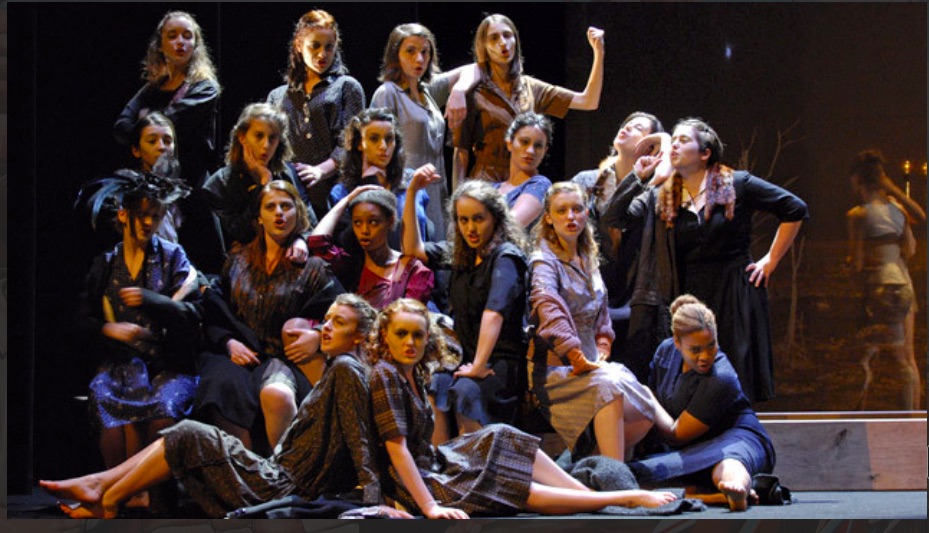
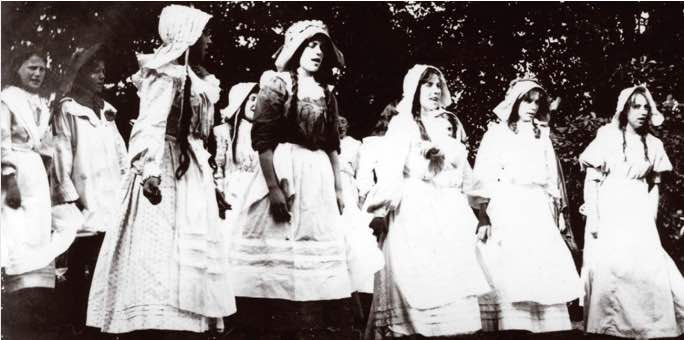
female dancers

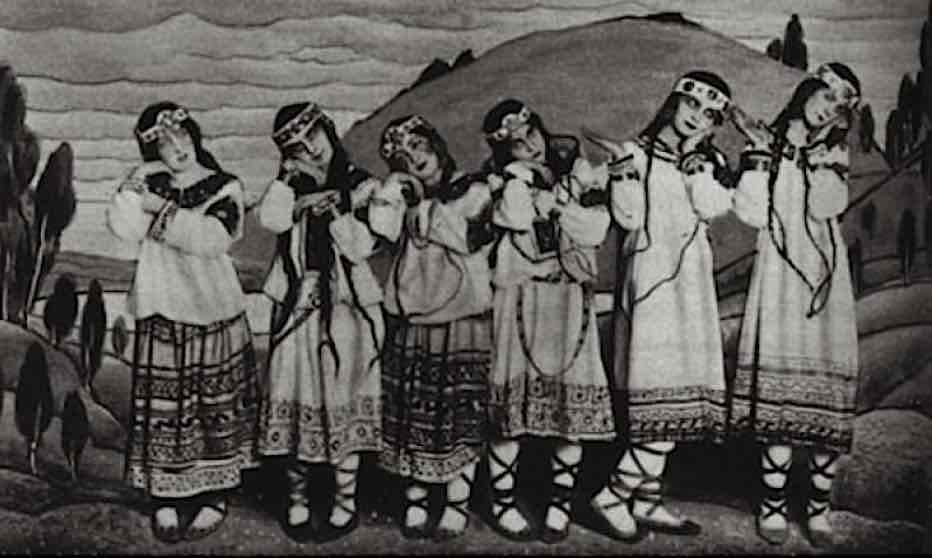
Esperance dancers. Source: EFDSS, via https://frootsmag.com/hoyden-morris.

Why bother traipsing halfway around the world, I hear you ask, when our very own Sceptered Isle offers such potential for pursuing the local ethnography of seasonal ritual?

Our folk culture may be a rich and ever-evolving topic, but Morris dancing has long been a national joke. Here I’ve churlishly suggested it as a suitably disturbing English riposte to the magnificent All-Black haka. I suddenly understand why some Chinese people may initially be reluctant to engage with their folk culture (see e.g. here and here).

Morris dancing comes round every so often as a drôle topic for media coverage—this article by A.A. Gill may not impress academics, but it’s brilliant, evocative, and strangely respectful writing.

I’m reminded of the topic again by a recent BBC4 programme, engagingly titled For folk’s sake.

One could almost mistake the May procession, with its bowery palanquin,
for a rain ritual in Shaanbei.

Now, I take a keen interest in calendrical rituals—indeed, as Easter week approaches, Bach is in store, and it’s a busy season for ritual in China too. But I’m not alone in tending to consign Morris dancing, with its incongruous juxtaposition of hankies, bells, and silly hats with beards and beer, to a long list of embarrassing genteel eccentricities of the English, along with The Archers. But like any social activity performed by Real People it deserves serious study, in the context of social change in England since the Industrial Revolution, and even a preliminary exploration is fascinating. [1]

The wiki entry makes a useful starting point. Whatever the etymological connection between Morris and Moorish, it does seem, Like Life (cf. Stewart Lee), to have come from abroad. It’s part of a group of genres that includes mummers’ plays, sword and stick dances, and so on.

Gender and class
Though there is evidence of female Morris dancers as early as the 16th century, male groups predominated. I’d like to learn more about the 19th-century decline; anyway, by the early 20th century the women who soon became the driving force of Morris learned from surviving male performers. From wiki:

Towards the end of the 19th century, the Lancashire tradition was taken up by sides associated with mills and nonconformist chapels, usually composed of young girls. These lasted until the First World War, after which many mutated into “jazz dancers” [note the cryptic quotes].
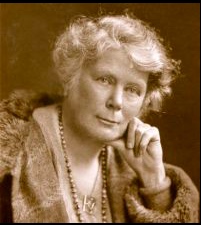
Mary NealAfter severe losses in World War One (when some entire village sides were killed) the female dominance increased, with women now teaching men.

In 1895 Mary Neal (1860–1944; website here; see also Lucy Neal’s project and this nice article) founded the Espérance Club, a dressmaking co-operative and club to enrich the lives of young working-class girls in London:

No words can express the passionate longing which I have to bring some of the beautiful things of life within easy reach of the girls who earn their living by the sweat of their brow… If these Clubs are up to the ideal which we have in view, they will be living schools for working women, who will be instrumental in the near future, in altering the conditions of the class they represent.

Cecil Sharp (1859–1924) first experienced Morris at Headington Quarry in 1899. Mary Neal began working with him in 1905, but their outlooks conflicted, and she soon joined the WSPU (for the Espérance’s modern reincarnation, see here). Vic Gammon encapsulates the conflict in his review of Georgina Boyes’s The imagined village culture:

Mary Neal, middle-class reformer, socialist, and suffragette who sees the possibility of reviving folk dance among working-class girls in north London, is defeated by Cecil Sharp, professional musician, Fabian, and misogynist who spread the activity of folk dancing among the young genteel, making vernacular arts fit bourgeois aesthetics.

These clips from 1912 feature the sisters Maud and Helen Karpeles, co-founders of the English Folk Dance and Song Society, as well as Cecil Sharp, and George Butterworth, who died in the Battle of the Somme:

But as in the world of work, male groups soon came to dominate again. The all-male Morris Ring was founded by six revival sides in 1934. And between the wars, for John Eliot Gardiner’s father Rolf “mysticism, misogyny, and Morris dancing formed a coherent whole in which nostalgia was a spur to action”. Whether he would have approved of The Haunted Pencil, with his AfD comrades, I couldn’t possibly comment.

Meanwhile Stella Gibbons and Elisabeth Lutyens took a more cynical view of genteel “folky-wolky” representations of English folk culture (note also Em creeps in with a pie).

Following World War Two, and particularly in the 1960s, there was an explosion of new dance teams, with some women’s or mixed sides. A heated debate emerged over the propriety and even legitimacy of women dancing the Morris; and mainly on the left, critics disputed the method of Sharp’s work as they pondered the perilous concept of “tradition” (as they do). But as in most walks of life, despite bastions of male conservatism, the creative participation of women is again becoming a major driving force, as you can see in this fine article by Elizabeth Kinder.

Boss Morris

Click here for a short clip from Berkhamstead in 1950, with pipe and tabor sadly mute. And this was filmed in Thaxted (“hub of the universe”), c1958—just as collectivization was leading to calamitous famine in China:

All this may seem quaint at any period, but all the more so in the Swinging Sixties. For folk’s sake shows glimpses of a 1966 festival at Thaxted—just as revolution (not least the Cultural Revolution) was in the air, alongside jazz, soul, the Beatles… The Saddleworth rushcart festival features in For folk’s sake—here’s a clip from 2014:

And as with folk traditions in China and worldwide, Morris survives alongside newer genres like punk (for punk in Beijing, see here).
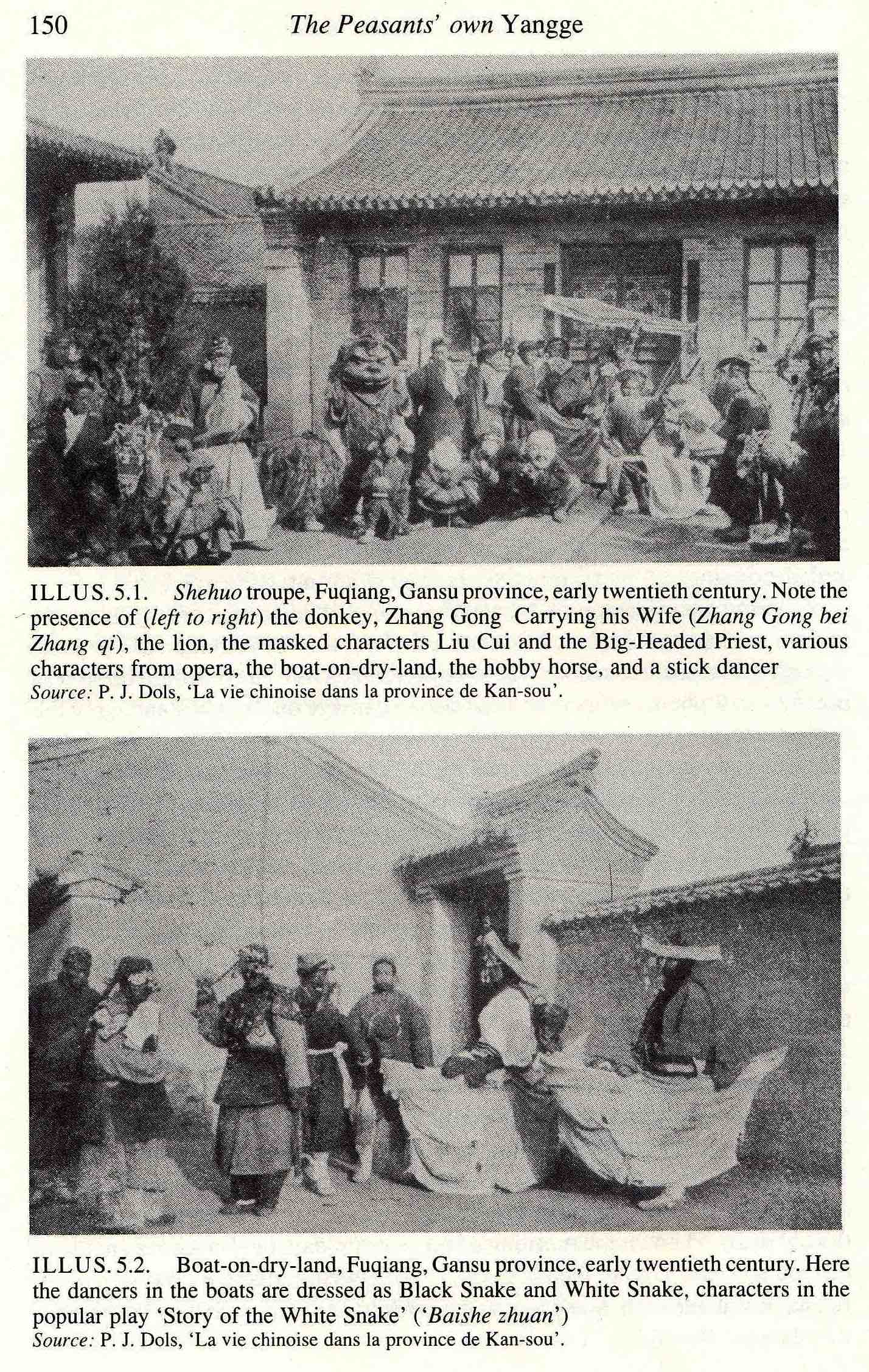
holm

Source: David Holm, Art and ideology in revolutionary China (1991).

Indeed, a survey of the many English villages with teams somewhat resembles our documentation of ritual groups in particular counties of China—or the rich local dance traditions like yangge (among several genres using handkerchiefs and sticks!), Boat on Dry Land, Bamboo Horses, and so on, with their common ritual connections—covered at length in the provincial volumes of the Anthology for dance:

  • Zhongguo minjian wudao jicheng 中国民间舞蹈集成,

with over 30,000 pages there alone, besides all the related material in the volumes for folk-song, narrative-singing, opera, and instrumental music.

Among the main regional Morris traditions are Cotswold, Northwest, Border, and Plough Monday groups in Yorkshire and the east Midlands (all the sides have instructive websites)—and as in China, their styles are often distinctive to individual villages. Four teams claim a continuous tradition predating the revival: Abingdon, Bampton, Headington Quarry, and Chipping Campden. In the 1930s at the important centre of Thaxted, the sinologist Joseph Needham championed Molly dancing.

Only now do I recall that my granddad took me to watch mummers in Wiltshire (at Colerne? Marshfield?). Indeed, his home village of Potterne still has a group. It’s a very blurred childhood memory, by which I seem to have been underwhelmed; but did it sow a seed?

Nutters

The Britannia Coco-nut [2] Dancers of Bacup (“Nutters”; see e.g. this article) have a venerable history that inevitably attracts controversy (no less inevitably, one of the transmitters is called Dick Shufflebottom, who celebrated fifty years of service in 2006). A.A. Gill’s description of the Nutters is classic:

They are small, nervous men. And so they might be, for they are wearing white cotton night bonnets of the sort sported by Victorian maids, decorated with sparse ribbons. Then black polo-neck sweaters, like the Milk Tray man, with a white sash, black knee-breeches, white stockings and black clogs. As if this weren’t enough, someone at some point has said: “What this outfit really needs is a red-and-white-hooped miniskirt.” “Are you sure?” the dancers must have replied. And he was. But it doesn’t finish there. They have black faces, out of which their little bright eyes shine anxiously. On their hands are strapped single castanets. A single castanet is the definition of uselessness. The corresponding castanet is worn on the knee. To say you couldn’t make up the Coco-nutters would be to deny the evidence of your astonished eyes.

The dance begins with each Nutter cocking a hand to his ear to listen to something we human folk can’t catch. They then wag a finger at each other, and they’re off, stamping and circling, occasionally holding bent wands covered with red, white, and blue rosettes that they weave into simple patterns. It’s not pretty and it’s not clever. It is, simply, awe-inspiringly, astonishingly other. Morris men from southern troupes come and watch in slack-jawed silence. Nothing in the civilised world is quite as elementally bizarre and awkwardly compelling as the Coco-nutters of Bacup. What are they for? What were they thinking of? Why do they do these strange, misbegotten, dark little incantations? It’s said that they might have originally been Barbary corsairs who worked in Cornish tin mines and travelled to Lancashire, and that the dance is about listening underground, a sign language of miners. And then there’s all the usual guff about harvest and spring and fecundity, but that doesn’t begin to describe the strangeness of this troupe from the nether folk world.

Do watch the Nutters on YouTube.

Again as in China, the Morris vocabulary is suggestive, with teams, sides, squires, bagmen, fools, beasts. At least England hasn’t yet fallen for the Intangible Cultural Heritage flapdoodle (we have our pride). Still, even without it, contentious arguments about “authenticity” continue to fester. And even now there’s still considerable opposition to admitting women. FFS.

I might be tempted to make the music share the blame. Of course, it is what it is, irrespective of the impertinent tastes of outsiders; but it often seems to endow the proceedings with a twee comfy feel that conflicts with the edgy (“pagan”?!) atmosphere of the dance itself. Once mainly accompanied by pipe and tabor, fiddles and melodeons became more common. The gritty new sounds of great musos like Jon Boden don’t seem so relevant to most Morris sides—though again, see Elizabeth Kinder’s article. I’d love to hear a Bulgarian version—accompanied with suitably complex metres by zurna and davul, relatives of early English pipe and tabor.

For the BBC2 documentary Tribes, predators and me, it was a cute idea to show footage of Morris dancing to tribespeople (click here).

* * *

Of course I’m merely dabbling here. But is this the kind of thing that urban educated Chinese people think I’m doing in their country?

In a way, it is: cultures change, in China as in England. The brief of the ethnographer is the same: to document the whole history, down to today, of local traditions amidst ongoing challenges to community cohesion through social and political change. We both have blind spots about our own cultures, further muddied by patriotic posturing and our reactions against it. It’s not that I can’t see the “value” of Morris, just that I’ve inherited negative associations. While plenty of English writers have debunked the myth of an unspoilt Victorian Merrie England, in China the “living fossils” nostalgia, referring to a Golden Age of much greater antiquity that bears even less relation to rural life there, is still touted by heritage pundits. For the awful cliché of “international cultural exchange”, see here.

And whereas in China I’m keenly aware of major dates in the rural calendar when temple fairs may be held, I’m not alone in being completely estranged from the seasonal rhythms of English life; only Bach cantatas manage to educate me.

This may be a particular issue for the English. In Hungary the táncház revival has become popular; and it would seem natural enough for an American studying old-time music in Appalachia to find continuity when working on China.

The world of Morris and English folk-song culture, like that of Newcastle punks, is no more “home” to me than are the rituals of the Fujian countryside for an educated Chinese from Beijing. But whereas local ritual in China still seems to me an intrinsic component of local life, Morris dancing has long seemed a quaint byway in my whole experience of England. Of course, when pressed, I can quite see this is wrong. OK Guys, I’ll take my culture seriously if you take yours…

Anyway, just think, as you board a rickety bus to a poor Hunan village in search of household Daoist rituals, you could be sitting in a sunny Oxfordshire pub courtyard nursing your pint as you take notes on the magnificent ritual spectacle unfolding before you—complete with its “feudal superstitious colourings” 封建迷信色彩.

See also my haiku on Morris dancing. Click here for English folk-song; and for posts on Irish music, here. For a roundup of posts on the English at home and abroad, see here; and for more on Heritage movements, here.


[1] Useful background includes the research of Vic Gammon; Georgina Boyes, The imagined village culture: culture, ideology and the English folk revival (1993/2010); Trish Winter and Simon Keegan-Phipps, Performing Englishness: identity and politics in a contemporary folk resurgence (2013); numerous publications from the English Folk Dance and Song Society, e.g. here; Theresa Buckland, ” ‘Th’owd pagan dance’: ritual, enchantment, and an enduring intellectual paradigm” (2002). On class, gender, and national identity, see also this (cf. Stewart Lee!). For innovative performance-based studies of clog dancing, see the work of Caroline Radcliffe. For an accessible introduction to the English folk scene, see The Rough Guide to world music: Europe, Asia, and Pacific, “England: folk, roots”, and regular features in Songlines and fRoots.

For further refs. on the wider context, see Helen Myers, “Great Britain”, in Ethnomusicology: historical and regional studies (The New Grove handbooks in music, 1993), pp.129–48. Among many fine compilations of British folk music, note the extensive Topic Records series The voice of the people (here on Spotify).

[2] Pedants’ corner (or is it Pedant’s corner?): the form “coconut” seems more common (as on their own website)—I can’t find a ruling on the hyphen, but it seems suitably eccentric (but was it eccentric then? That’s the perennial question!).

Billie Holiday

So far I’ve struggled to resist devoting this site entirely to Billie Holiday. After her captivating 1957 TV Fine and mellow, here’s an inital playlist (now followed by a sequel). Of course she is one of the stars of my Playlist of songs (indeed, everyone’s). *

But to follow Barbara Hannigan singing a Berg-tinged Embraceable you, I just had to go back to Billie singing it—both 1944 and 1957 versions here:

Among my all-time top songs of hers, You’re my thrill is strangely neglected, as she herself lamented. Again, apart from the extraordinary nuances of her voice, intoxicating and intoxicated (surely this is her ode to heroin), note the chromatic melody and disconcerting leaps (I’ve extolled the magic of the major 7th, and now I feel a paean to the minor 7th coming on) and the brilliant orchestration—smoochy strings, wind arabesques, swaggering brass interlude:

You’re my thrill
You do something to me
You send chills right through me
When I look at you
’cause you’re my thrill

You’re my thrill
How my pulse increases
I just go to pieces
When I look at you
’cause you’re my thrill

Mmm
Nothing seems to matter
Mmm
Here’s my heart on a silver platter

Where’s my will?
Why this strange desire
That keeps mounting higher?
When I look at you
I can’t keep still
You’re my thrill…

It was also natural that Chet Baker, not to be outdone in the shooting-up department, should perform the song:

Generally Chet’s singing has an intensity that matches that of Billie, but for this song I’d always choose her (not that we have to choose). In Chet in Italy I’ve also included two versions of These foolish things sung by her.

In Lover man the orchestration again complements Billie’s vocals:

Meanwhile in 1944, far from the turmoil of Europe (just as ethnologist Germain Tillion was composing Le verfügbar aux enfers for her fellow Ravensbrück inmates), a young Miles Davis was combing the New York streets for Charlie Parker, as he describes in one of the great passages of jazz writing.

Billie’s Don’t explain is amazing too. The lyrics, meekly tolerating infidelity, may now seem as dubious as Stand by your man (and dodgy lyrics are by no means the prerogative of popular music), but as always Billie somehow transforms the song:

I’ve given separate posts to Crazy he calls me and Night and day.

And whereas she looks radiant in the 1957 TV broadcast, here’s her harrowing live performance of Don’t explain the following year, with more pain than joy:

To learn more about how all this works, apart from the innumerable books on Billie, I keep referring to Paul Berliner’s Thinking in jazz.

The bluesy voice of Karen Dalton has inevitably been likened to that of Billie. See also Nina Simone.


* I learn to my chagrin that I’m not the first to discover either Billie or Aretha—but perhaps I can claim credit for the first recording of Dona Rosa.

Enza Pagliara

To follow Barbara Hannigan, another great female singer:

Reminded of Enza Pagliara by my recent post on the intoxicating pizzica (latest in a series on the riches of Mediterranean culture), by way of introduction here’s another perk of the musos’ touring life (cf. here, for Andalucia):

Many years ago I was doing a gig at the Ambronay festival with a baroque band accompanying the choir of New College Oxford. At the reception in the balmy grounds afterwards I found myself chatting with a distinguished-looking Italian woman from the audience—who turned out to be none other than Enza Pagliara. She told me how much she loved the choirboys’ voci bianche, and casually mentioned that she sang too—rather like Lionel Messi saying he likes kicking a ball around. So of course I was keen to learn about her music, and as we were saying goodbye she gave me her CD Frunte de luna.

It was only later when I listened to it, in awe, that I realized it should have been me attending her concert…

Here’s an exhilarating playlist:

Here she is in concert with an all-female group in Pizzica di Torchiarolo, which opens the playlist above:

A do te pizzico la zamara                                          Dove ti ha pizzicato la zamara
Menzu lu canaletto piglia rose e mina ‘mpettu    In mezzo al canaletto piglia rose e butta
                                                                                         sul petto
Menzu lu canaletto de le nenne                              In mezzo al canaletto dei seni

Nannniannia ranira narinaaaa nanaa nira nira laalaaa

Aprime beddhu miu ca portu cose                         Aprimi bello mio che porto cose
Portu nu panarinu de cirase                                    Porto una cesta di ciliegie

Nannniannia ranira narinaaaa nanaa nira nira laalaaa

All’autra manu ‘nci portu tre cose                           Nell’altra mano ci porto tre cose
Nu nieddu, na catena e le granate                           Un anello, una catena e le (mele) granate

Nannniannia ranira narinaaaa nanaa nira nira laalaaa

L’aggiu a purtare a Donna Catarina                        Devo portarlo a Donna Caterina
Ca se marita lu mese ci trase                                    Che si sposa il mese prossimo

Nannniannia ranira narinaaaa nanaa nira nira laalaaa

Idda sta se mmarita e ieu me ‘nzuru                      Lei si sta sposando e io mi sposo
Idda coglie la menta e iou lu fiuru                          Lei coglie la menta e io il fiore

Nannniannia ranira narinaaaa nanaa nira nira laalaaa

And from her album Bona crianza:

Some of the folk-singers assembled for Frunte de luna (including members of Enza Pagliara’s family) can be heard in traditional solo and a cappella style on the CD

  • Aria stisa: canti di contadine e trattoristi di Torchiarolo (Le tradizioni musicali in Puglia) (Ethnica, 2008). Playlist:

And here’s an introduction to the Salento scene, mentioning  Ernesto De Martino, Alan Lomax, and local anthropologist Luigi Chiriatti. See also Klaus Voswinckel’s novel Tarantella, as well as Italy tag, notably Italy: folk musicking.

Barbara Hannigan

BH

Photo credit: Musacchio and Ianniellos.

Having been spellbound by the great Barbara Hannigan singing Let me tell you, as well as her f-f-flabbergasting Gepopo, I just attended another LSO concert in which she both sang and conducted in Berg and Berg-tinged Gershwin.

I became immersed in Berg’s first opera Wozzeck in my teens, but at last I got to hear Hannigan in a suite from Lulu, one of her signature roles. While only featuring two brief but mesmerising arias, it gives a taster for the complexities of Lulu’s psyche.

Lulu has long seemed to embody all the inherited archetypes of diva / femme fatale, madonna / whore, victim, elfin waif, destroyer/destroyed (see also Madonna and McClary[1] and the “cute psychopath” of Killing Eve), both in the original Wedekind plays and Pabst’s 1929 (silent!) film Pandora’s box:

Hang on—these were all created by men…

All these myths may have gone largely unchallenged until quite recently, but Hannigan doesn’t buy it. So despite Lulu’s common image as abused, manipulated, and degraded, Hannigan finds her inspiring “as a musician, an actor, and a human being”, with her “instinctive emotional intelligence that tends to drive the people around her up the wall”; rather like her remoulding of Ophelia, she regards Lulu as the architect of her own destiny—angry, resistant, and triumphant. As Paul Griffiths wrote,

Hannigan sees her as a spirit of freedom, who breaks loose from the plays, the opera, and the films in which she would seem to be contained. Refusing taming or limits of any kind, she scorns death, even while longing for it. Murdered in one scenario, she simply finds herself another. She is a deity with innumerable avatars.

Hannigan makes her case brilliantly here—describing her passionate relationship with Lulu as well as her her own Stockholm syndrome and survivor guilt, and unpacking gender issues:

Now I welcome new visions, and changing reception history, but I’m still not sure we can simply “celebrate” the lives of women like Lulu without acknowledging the tragedy of their situation in societies where they are constantly hampered—and without keeping the iniquities of patriarchy to the fore (cf. China). Surely the role model here is not Lulu but Hannigan’s vision of her.

She ended the concert with an arrangement of Gershwin’s Girl crazy suite. At first one might think, uh-oh—not another cheesy crossover in the vein of “Dame Kiri Sings the Sex Pistols Greatest Hits by Candlelight“? Far from it: Hannigan “wanted to have a suite with songs from Gershwin musicals, but to look at them through the prism of the Second Viennese School, and especially from the perspective of Lulu and the Countess Geschwitz.”

As Griffiths observes, the link is by no means far-fetched:

Gershwin admired Berg and welcomed the opportunity of a meeting when the American was in Vienna in the spring of 1928. This was a year before Berg began work on Lulu, with its jazz-age touches, and two years before Gershwin was writing songs for Girl crazy. It might be hard to hear Berg’s influence in Gershwin’s own score, but that can be arranged. You just have to find an arranger.

Bill Elliott, who won a Tony award in 2015 for his orchestration of Gershwin’s music in a new show, An American in Paris, was an obvious first choice, and created a 13-minute score on which one could imagine the two composers had worked side by side. Berg sits back to admire the course of a melody Gershwin is writing, then leans forward to add harmonies here, a wandering counterpoint there. *

So the resulting suite, transforming But not for me, Embraceable you, and I got rhythm[2] makes a stimulating and exhilarating piece that inevitably gets a standing ovation. Here’s an earlier performance:

With her magical voice, her expressive arms, her whole body, Hannigan totally inhabits all her roles.

BH2

Photo credit: Jag Gundu.

Now we can also admire Hannigan’s recent Vienna fin-de-siècle CD, including Zemlinsky, Berg, and Alma Mahler. For yet another innovative production, click here. See also Mahler and Messiaen!!!, La voix humaine,The rake’s progress, and under The art of conducting.


* For good measure, a couple of quaint vignettes on Gershwin’s friendship with Berg’s teacher Schoenberg in the USA:

Gershwin asked Schoenberg—whom he also painted—for composition lessons. Schoenberg refused, reportedly saying “I would only make you a bad Schoenberg, and you’re such a good Gershwin already.”

And in a charming foretaste of the Monty Python Beethoven LP,

Gershwin enjoyed playing tennis with Schoenberg once a week. Gershwin’s playing was described as “nervous” and “nonchalant”, “relentless”, and “chivalrous”—while Schoenberg was “overly eager” and “choppy”.

[1] Indeed, Leo Treitler compares Madonna and Lulu in “The Lulu character and the character of Lulu”, ch.10 of his Music and the historical imagination (1989). For a general introduction to the opera, see Alex Ross, The rest is noise, pp.224–31.

[2] Hiromi‘s manic piano version of the latter is amazing, but I always fantasise about a Bulgarian aksak version…

Gender: a roundup

slogan

“Daughters are also descendants”: village slogan, Hebei, 1990s. My photo.

For International Women’s Day, here’s a varied roundup of some highlights from the gender category in the sidebar.

For China, posts on the lives of rural women include

and on urban women:

See also

For Europe, posts include:

Some thoughts on sexist language:

as well as a paean to AOC and Katelyn Ohashi:

and the furore over Sanna Marin dancing:

Note also

In music, gender studies have become a major theme, besides female musicians generally:

and many more. Indeed, my varied Playlist of songs is dominated by female singers. Oh, and don’t forget The T-shirt of female composers—constantly in need of new additions!

T-shirt

Among humorists, Stella Gibbons, Bridget Christie, and Philomena Cunk have their own tags in the sidebar, among which some favourites are

Relevant posts on film include

See also under A sporting medley: ritual and gender.

Anyway, that’s just a selection from an ever-growing list…

Das Land ohne Musik

1912

Royal Earsdon Sword Dancers, Northumberland, 1912. More here.

Das Land ohne Musik

Oscar Schmitz, 1914

There is no city in the world, I am sure, where so much music is consumed as in London.

Hector Berlioz, 1851

Susan McClary’ s book Feminine endings is always full of leads, such as:

Linda Austern and Richard Leppert have demonstrated that one reason the English have produced so little music is that they—more than their German or French neighbors—have long associated music with effeminacy. (p.17)

An intriguing thought, but it begs questions. First of all, “produced” here clearly refers to the composition of art music. A perceptive essay is

  • Peter Holman,* “Eighteenth-century English music: past, present, future” (ch.1 of David Wyn Jones (ed.), Music in eighteenth-century Britain, 2000),

where he tellingly probes the description of 18th-century England as “Das Land ohne Musik” (cf. Haydn). He dates it back further to a pithy 1840 comment by Heinrich Heine:

These people [the English] have no ear, either for rhythm or music, and their unnatural passion for piano playing and singing is thus all the more repulsive. Nothing on earth is more terrible than English music, save English painting.

Touché! As Holman notes,

Of course, this agenda is part of a larger one that has more to do with 19th-century cultural politics than with a proper, balanced evaluation of the total corpus of 18th-century music. It privileged what was perceived as the centre—Italy, Germany, and Austria— over the supposed periphery—Scandinavia, eastern and central Europe, France, the Iberian peninsula, and England. It privileged instrumental music, especially those genres that used Viennese sonata form, over vocal music. And it privileged the work of the professional secular male in concert music over all others, such as church musicians, amateurs, and women.
[…]
The most persistent observation on musical life in 18th-century England is that it was dominated by Handel and other immigrant composers, the implication being that native composers were too feeble, parochial, or conservative to offer them much competition.

OK, he’s broadly following the continental critics here in equating “musical life” with art music—not all the diverse folk traditions, such as the musical life of taverns in East Anglia. But he unpacks the assumptions of even this limited definition:

It was not a new situation. Immigrants had played an important role in bringing new ideas from the continent ever since the reign of Henry VII.

(See Wind, ethnicity, and gender, and They come over ‘ere…)

Adducing Ferrabosco, Notari, and Draghi, Holman notes that as the scale of immigration increased,

these developments were not symptoms of weakness or decline, but evidence of a vibrant and complex musical life. Musicians were not attracted to London from all over Europe by the prospect of becoming big fish in a small, stagnant pond, but because London was the largest and most exciting pond of all, where you did not need to be a big fish to make a fortune.

Indeed, it could be argued that England was the most musical country in Europe by the second half of the 18th century, judging by the amount of musical activity of all types.

The variety he cites here includes rival concert series, Italian opera, provincial music societies, church choirs, and amateur musicking such as “gentlemen” competing in taverns. This is indeed more diverse than the narrow picture he criticizes, but still doesn’t subsume “folk” activity such as sea shanties or street fiddlers. He goes on:

My second objection to the “foreign domination” theory is that there is little sign that immigrants replaced native musicians in lucrative employment, or prevented them from obtaining it.

Just as the Lupo and Bassano families had supplemented indigenous instrumentalists at the court of Henry VIII, Italian opera became just an extra strand enriching the musical life of London. But

My most serious objection to the “foreign domination” theory is that it is based on an anachronistic conception of national and racial identity. […] England has always been a nation of immigrants, and it makes no sense to restrict an account of its culture to the work of natives, or, more accurately, to the work of the descendants of less recent immigrants.
[…]
What is often forgotten is that immigrant composers, anxious to be accepted in England, adapted their own idioms to conform to English taste.

This is all grist to Stewart Lee‘s mill.

At the same time, the “foreign domination” theory does rest to a large extent on the focus on the composers and performers of art music. Despite my pleas to broaden the social scope, Holman’s perspective, like a lot of in-depth studies of WAM, belongs firmly within the wise counsels of ethnomusicology. His chapter contains many more perceptive observations, which you must read!

* * *

To return to McClary’s lead,

  • Richard Leppert and Susan McClary (eds.), Music and society: the politics of composition, performance and reception (1987)

is full of stimulating chapters, not least her own:

  • “The blasphemy of talking politics during Bach year”,

which I introduced here. As the book’s Introduction notes, recent changes in scholarship,

especially evident in literature, film, and visual art, have led to a systematic investigation of the implicit assumptions underlying critical methods of the last two-hundred years, including prominently the assumption that art consistutes an autonomous sphere, separate and isolated from the outside social world.

Janet Wolff’s Foreword is another nail in the coffin of “autonomous” art—and another critique that should be compulsory for heritage pundits in China. The book ranges rather widely, with chapters from Rose Subotnik on Chopin, Simon Frith on popular music, John Shepherd on music and male hegemony, John Mowitt on electric technology in sound production, and Leppert’s own discussion of the music, domestic life, and cultural chauvinism of British subjects in India.

The authors point out that they hardly deal with music and society in non-Western cultures, touching “only lightly on questions about the music of women, and ethnic and racial minorities”. They observe that women, and the lower classes, have been erased from the received picture, though they are rarely excluded from musicking—just from prestigious public musicking.

So again the book is largely based on the musical activities of the bourgeoisie—not least because the source material largely derives from them. Still, the debt to ethnomusicology is clear: even if WAM scholarship may seem to contrast with ethnomusicology, they can enter into a rapprochement [uh-oh, more non-national terms?—Ed.].

* * *

Actually, all we need to deflate the idea of Das Land ohne Musik is the classic question “What is music?“—or rather, “What is musicking?”. Pundits of both WAM and pop music tend to take a limited view, as I often observe (e.g. here, and here).

By a narrow definition based on composers of art music, most of the world over most of history would be considered “without music”. Do mothers singing lullabies, spirit mediums, or percussion bands, count? Even once we’ve thrown out the narrow assumption that music means art music, I wonder how one might rank the cultures of the world in terms of “musicality”: Inuit, Italian, Andalucian, Tibetan, Bolivian, Malian, Afghan, and so on. Were Afghans or Andalucians “unmusical”, and are they now? And we may be lumbered with the dodgy cliché that Africans, like Chinese ethnic minorities, are “good at singing and dancing”—but where might north Americans come in the spurious league table, for instance?

Cultural genocide—the suppression of indigenous cultures by a dominant force—is a separate subject. As I write this, I notice this blurb for what I’m sure is a fine BBC4 programme:

Masters of the Pacific coast: the tribes of the American northwest
Exploring how culture was established on the American northwest.

Discuss… An inspiration for the Party’s current replacement of the complexities of Uyghur music by “If you’re happy and you know it, clap your hands” (note also this post)?

Is a society in which most people frequently sing or dance less musical than one with an opera house, a symphony orchestra, and a conservatoire? “Expenditure on the arts” is a dubious index. Is a funding-dependent society in which children are discouraged from singing and dancing unless they’re formally trained as musical as one where such activity is assumed, embedded in the culture? Indeed, even in such a culture, formally-trained musicians make up only a small proportion of participants.

As always, it’s worth considering the wise words of Bruno Nettl, in his

  • The study of ethnomusicology: thirty-three discussions,

He addresses the issue of “what is music?” —a point also made by Christopher Small in his introduction to Musickingin a famous vignette in his chapter 2, “Combining tones: the concept of music”:

Let me reconstruct a cocktail party conversation about 1975 when I confessed to working in ethnomusicology. “Studying American Indian music?” says one amazed person. “I didn’t know they even had music”. I try patiently to explain. “Oh yes, I knew they had chants, but is that really music?” From an elderly gentleman: “I spent a year in Africa, heard a lot of singing and drumming, but is that music? After all, they don’t write it down. Maybe they just make it up as they go along. Do they really know what they’re doing?” More explanation. A young man has added himself. “But these sounds that some peoples in Asia make with their instruments and voices, or the Indian chants, can you call them music? They don’t have harmony.” And a middle-aged lady: “My teenage sons play something they call music all day. I can’t stand any of it.”

We might now wonder if Nettl was going to the wrong kind of parties; indeed, he notes that people may have since become more broad-minded, but the issue remains. He discusses John Blacking’s important book How musical is man? (1973):

writing today, he would likely have asked “How musical are humans?” […] He recognized the world as a group of musics, though he personally was always more interested in their borderlands than the centers, but he wanted to make sure that his readers understood a major point: in the end, all musics are equally valuable, or, let’s put it this way, all musics are to an equal degree music.

Nettl’s whole book explores such themes—essential reading! Even his models for types of cultural change may be instructive to understand the fates of native American and Uyghur cultures.

piper

Billy Purvis (1784–1853).

So the Land ohne Musik slight rests on a blinkered valorization of a league table of Great Works by Great Composers, rather than the diverse forms of musicking in society generally. Ironically, it’s based on new music.

As to England being ohne Musik in 1914 (or indeed 1714), never mind all the WAM activity then, how about all the traditions then being unearthed by Cecil Sharp and Co.—singing, local dance traditions, street music, wind bands? In the narrow view, none of these seem to count.

Issues here include the balance of “active” producers and “passive” consumers, amateur and occupational performers. What of a society which expects to invite performers often, as in Hokkien cultures in southeast China; or one where people simply attend a lot of parties?

Music does seem more ubiquitous than ever today: not just via technology (over speakers in malls and, um, elevators), but actively: both listening to recorded music most of the time, and active musicking at all kinds of social events, including clubbing, places of worship, and football matches.

So never mind 1730s’ Leipzig or 1780s’ Vienna, how about Liverpool and Detroit in the 1960s, or Herat in the 1970s—or Beijing, New York, and London today? I’m not exactly disputing the notion that some societies may be more “musical” than others, but attempting to compile a league table of world musicality would ultimately be a cul-de-sac. Whether for the 18th century or today, it’d take a thorough broad-based survey of soundscapes to assess all this—one fine example of the broad view is Ruth Finnegan’s 1989 The hidden musicians, on musical life in Milton Keynes.

At least, people don’t wait for composers (whether indigenous or foreign) to write symphonies and operas to express their musicality. All this may seem obvious, but people still tend to stick within their particular tribes.

By the way, I constantly dispute the narrow dominance of one particular limited view of what constitutes “Chinese music”. I’ve given many instances of the narrow dominance of the conservatoire style and commercial pop; but punk, all kinds of vocal music along the continuum from folk-song to opera, spirit mediumshousehold Daoists, shawm and percussion bands, and so on, are all part of the picture we have to consider—as for any society in the world, for any period. Yet again, we should delight in all manifestations of the Terpsichorean muse


* This is neither here nor there, but it was on tour with Peter that Paul O’Dette told me the hemiola story

Amateur musicking in urban Shaanbei

The “little pieces” of Yulin

ylsq 1

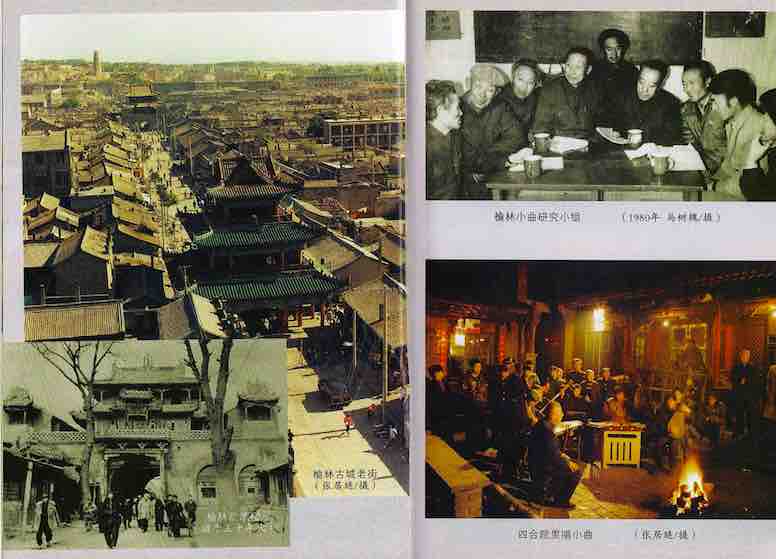
Source: Huo Xianggui, Yulin xiaoqu ji. Right, top: the “study group”, 1980.

In modern China we can find plenty of exceptions to the simple dichotomy between rural ritual and urban entertainment, but it’s a useful framework. I’ve written a series of posts on ritual activity around the Shaanbei countryside (starting with this, recently-updated), but here I enter the regional capital Yulin to outline a recreational form of vocal music with ensemble, now moribund.

In chapter 12 of my 2009 book Ritual and music of north China, volume 2: Shaanbei (where you can find further leads) I gave an overview of musical activity in Yulin—far short of the thorough treatment of Ruth Finnegan’s 1989 book The hidden musicians, for, um, Milton Keynes.

Once again, as the Maoist era recedes, it still makes an important yet little-explored bridge between earlier history and the reform era.

The regional capital of Yulin
The bustling county-towns, commercial hubs dotted around the barren landscape of Shaanbei, already represent a more modern environment than the chronically poor villages and little district townships remote from the main transport arteries. But entering Yulin, the capital city of the region, one feels frankly in a different world, even if traces of tradition remain.

Yulin, a likely starting point for forays into the countryside, lies towards the far north of Shaanxi province. From the west and north the desert is creeping up year by year. Access was difficult until very recently. The main road going south towards Yan’an, and eventually the provincial capital Xi’an still further south, has been improved since the 1990s; and even by 2000 it was a 20-plus-hour bus ride east to Beijing. A train runs from Shenmu, not far northeast of Yulin, east to Datong in Shanxi province; by 2002 direct train routes all the way from Beijing to Yulin, and from Yulin south to Xi’an, were promised. By 2005 there was a direct flight from Beijing, “Opening up the West” still further.

The city has something of the feel of the wild-west frontier. Main Street (Dagai) retains its old-world charm, though in the evenings bikers rev up at the crossroads. There are four funeral shops along Main Street alone. There are also several bookshops, none of any distinction, and many shops selling CDs and cassettes; even a Buddhist shop selling CDs and cassettes as well as statuettes, incense, scriptures, and so on. Second Street (Ergai) is a kind of Wangfujing or Oxford Street, with pop music blaring from the sound-systems of shops. Away from the centre, the urban sprawl contains both new tower-blocks and rows of single-storey dwellings in traditional cave format. Even the old city walls remain. Coal bricks are piled up in courtyards to protect against the winter cold.

By the 1990s traditional musical activity in the city seemed much impoverished. Yet weddings, funerals, and temple fairs are held here too, all requiring live music. Few of the Yulin city temples have been restored to their former opulence. Vocal liturgy is still performed in the temples, but shengguan instrumental ensemble, once a feature of Yulin funeral ritual, has not been heard since the monks were laicized in the 1950s.

twins

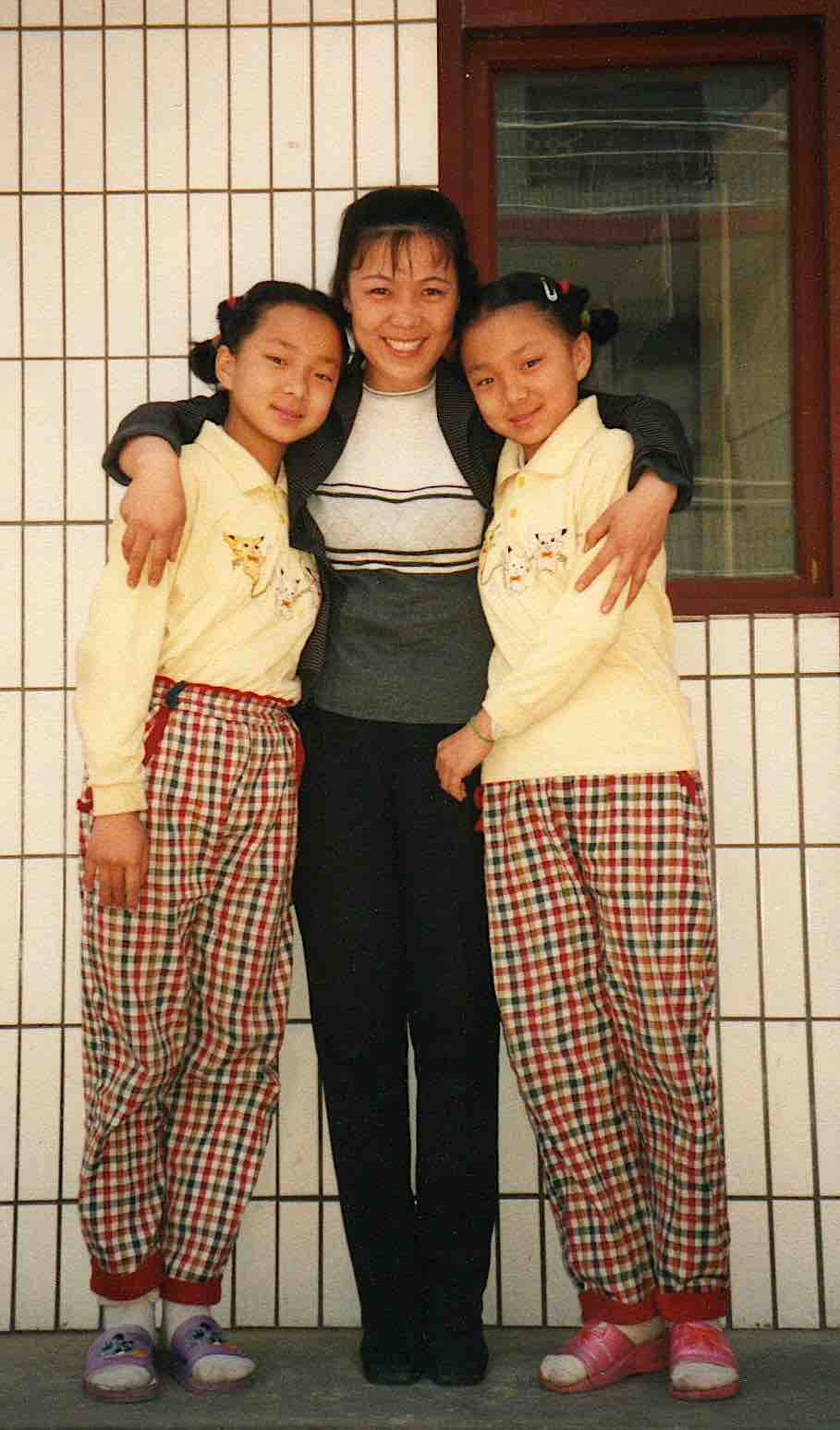
Mother with twin daughters, Yulin 2001.

The state-funded Yulin Region Arts-Work Troupe and several opera troupes perform Qinqiang opera, as usual mainly for temple fairs. Towards the secular end of the continuum, the Yulin Folk Arts Troupe performs conservatoire-style arrangements of local singing and dancing.

In 2001 genial cadre in the troupe had a few young erhu pupils, to whom he taught the standard modern national repertory. There was a School of Arts (Yixiao), teaching national styles of singing and dancing. Yangge dance parades were held by work-units, including schools. But with pop music now dominating the soundscape, karaoke, TV, and VCD-players were doubtless city dwellers’ main exposure to music.

Before Liberation, funerals in Yulin, as in Beijing and other northern cities, were often accompanied not only by shawm bands (chuishou; see here, and for Shaanbei also here), but by temple priests, both Buddhist and Daoist. Shawm bands continued activity in Yulin city under Maoism, but since the 1980s’ reforms their activities have expanded; by 2001 there were at least eight bands, all migrants from the countryside.

But their extrovert style seems to hide a lack of discipline. Young shawm-band boss Feng Xiaoping observed, “Yulin is without order (mei guiju). Yulin people can’t appreciate the shawm—they don’t react even when we play well, and if we play badly, no-one ridicules us.” Both here and in the countryside, in the new undiscriminating get-rich-quick climate, ceremonial ostentation is rampant, while the “old rules” go into further decline.

The Yulin “little pieces”
Throughout China, many rural genres with long traditions have managed to outlive Maoism, thanks largely to the continuing demand for ceremonial. In the Shaanbei countryside, folk opera troupes, itinerant blind bards, shawm bands, folk-singers, and spirit mediums managed to weather political campaigns before reviving more openly in the 1980s for life-cycle and calendrical ceremonies. Even in Yulin city, there is demand for occupational chuishou.

The city also had a distinctive amateur vocal music with instrumental ensemble. Like many genres in world music, it barely had a name; like many genres in China, if people needed to call it anything, they might mention “little pieces” (xiaoquzi), “playing little pieces” (shua xiaoqu), or “playing silk strings” (shua sixian). The official title Yulin xiaoqu was casually given in 1958. [1]

As a relatively literate genre, its popularity was largely limited to the city—unlike small-scale vocal and instrumental groups like errentai or daoqing, widely performed throughout the countryside. We saw how the literate elite patronized the music of the lowly chuishou, employing them as a ritual duty. But the Yulin elite supported the “little pieces” as amateur recreation, and might even perform. The elite outside Yulin city, though thin on the ground, sometimes performed it too; in Yangjiagou village, landlord stronghold until the 1940s, young members of landlord families sometimes got together to play string and wind instruments. But in Yulin city by the 20th century, its main clientele was among ordinary citizens, and its main performers were male manual workers.

Imperial and Republican periods
As often with folk traditions, early evidence is inconclusive. By the 15th century regional governors were often posted from the distant Jiangnan–Zhejiang region of east China, and brief passages from the 1670s show musical activity at the Yulin court. Indeed, from the presence of many southern titles in various Shaanxi narrative-singing repertories, and indeed throughout China, one should not underestimate the wider influence of Jiangnan culture in imperial times. Among the themes of the Yulin songs (mainly love and city life), Jiangnan scenery also features; musically too, traces of Jiangnan style may be heard, although the dominance of the so mode appears to be a local modification. Another theory (also said to be supported by musical similarities) is that the style was based on the opera of distant Hunan, which may have been brought to Yulin in the Tongzhi reign-period (1862–74) by a company attached to a division of Zuo Zongtang’s Hunan army on campaign in the region.

The music is said to have been transmitted outside the regional court in the Daoguang era (1821–50) by Li Diankui and his son Li Fang. Oral tradition names musicians since the late 19th century. More pieces were composed in the early 20th century, and pieces arranged by the literatus Wang Jishi. Later Zhu Xiaoyi (1905–88) was a respected musician; a carpenter, he was also a luthier, making zheng zithers, yangqin dulcimers, sanxian plucked lutes, and erhu fiddles, which he sold as far afield as Shanxi and Inner Mongolia.

luo and wang 2001

With Luo Xinmin (left) and Wang Qing, 2001.

Musicians were amateur, and male—mainly artisans (silverworkers, watchmakers, tanners, woodworkers, plasterers, cobblers), as well as doctors and dentists. Apart from getting together for fun, musicians were also invited to perform for life-cycle ceremonies. In 2001 I met musicians Luo Xinmin (b.1925) and Wang Qing (b.1954). Luo recalled:

In the 1940s we took part in weddings, longevity celebrations (for which the piece Rejoice in a Thousand Autumns [Xi qianqiu] was prescribed), and first-full-moon celebrations for babies. We played seated on the host’s kang brick-bed—the chuishou played in the courtyard outside. We played mainly in the evenings, the chuishou mainly in the daytime.

Some children of landlord families might play music similar to the little pieces, on pipa plucked lute or bowed fiddle (as in Yangjiagou), but in Yulin the landlords and merchants didn’t maintain a regular band for the little pieces, though they might have a few instruments for people to play; they just invited musicians when they held a ceremonial.

Sources barely discuss the fortunes of the music during the troubled 1930s and 1940s. It is said—compulsorily—to have suffered in the War against Japan and the civil war, but Luo recalled:

The War of Liberation didn’t affect us—people from the Red and White areas got along quite well, going back and forth.

A popular venue was run by one Wang Yunxiang at the Qingxing silver furnace, by the old Drum Tower.

After Liberation
Typically, the sources stress the Party’s avuncular concern for the Yulin little pieces. Along with state organization came research and control—as an urban genre it was quite susceptible to official supervision.

Still, folk activity continued alongside official initiatives until the Cultural Revolution. Memories of old musicians suggest that in this case the “new life” compulsorily claimed for all genres after Liberation was not so fanciful:

After Liberation there was even more activity than before. In the evenings, because there was no electricity, and no other entertainment, people liked to get together.

Qiao family 1962

The Qiao family, Yulin 1962, during a lull between campaigns. Left to right (brackets denote seniority), rear: Jianren 建人 (3), Lifang 麗芳 (5), Jianzhong 建中 (1, b.1941), Jianguo 建國 (2), Jianmin 建民 (4); front: Jianfu 建府 (9), Lanfang 蘭芳 (7), Rui 銳 (father), Jianping 建平 (12), Liu Caiqiu 劉彩秋 (mother), Jianzheng 建政 (6), Jiangong 建功 (10), Jiancheng 建成 (11).(the missing eighth sibling was given at birth to a cousin of their mother). As you will notice, the second characters of the first eight sons’ names (after the constant jian 建 “construction”) spell out 中國人民政府功成 “China People’s Government is accomplished”; the ping 平 character of the ninth name suggesting that had yet another son followed, he would have been called An 安, to make the binome ping’an “well-being”—thus wishing “Well-being to the accomplishing of the China People’s Government”! Photo: courtesy Qiao Jianzhong. For a more traditional custom of generational naming, see here.

I chatted with the musicians about our mutual friend Qiao Jianzhong, a Yulin native who had become director of the Music Research Institute in Beijing, and whose encouragement had led me to Shaanbei. The oldest of nine brothers and three sisters brought up in an old house in Main Street, his parents were typical of the city folk who enjoyed the little pieces.

Especially in summer evenings, a lot of people came to listen, they could understand the words—Qiao Jianzhong’s mother used to say “This is much better than a film!” Mostly they invited us by treating us to tea and cakes (chayebing).

In the 1950s we were active in the common hall (jiti tingtang) by the Bell Tower in the city centre. The silverworkers’ shop next door to the Qiao family’s house in Main Street was a venue—instruments were available to play there for anyone who came along. And there was an old Chinese doctor called Lin Maosen [1903–68] who loved to sing—he often invited people to his house to play in the [early] 1960s.

If such recreational activity remained common, the life-cycle celebrations at which they had also participated before Liberation were now drastically reduced.

As to the official side, in 1950 a study group was organized in the Yulin workers’ club, and musicians met three evenings a week, training over forty performers—now including women for the first time. The genre gained a wider profile as musicians took part in festivals and won awards at provincial and national level from 1953 to 1960.

ylxq 3

Top: Beijing 1957 (left to right, Ran Jixian, Wu Chunlan, Hu Futang, Wang Ziying, Bai Baojin). Middle: preparing for Xi’an festival in 1953. Lower: Hu Yingjie and Wu Chunlan, 1979. Source: Yulin xiaoqu (1994).

ylxq 4

Top: female singers consult Hu Yingjie (date unclear). Middle: filming “Music of the Western Regions”, with Hu Yingjie. Lower: filming “Gazing at the Great Wall”. Source: Yulin xiaoqu (1994).

The life of the music through this period, both official and amateur, depended on a group of admired senior musicians. [2] Zhang Yunting (1900–64), a leather worker, was a fine sanxian player as well as singer. From 1950 he was the main teacher for the study group in the Yulin workers’ club. He won awards at festivals in 1956, 1957, and 1960, and recorded for provincial radio. In 1962 fieldworkers from the Shaanxi volume of the folk-song Anthology visited him. Bai Baojin (1914–83) was a tileworker; a zheng player, he also played jinghu and erhu fiddles, as well as singing. He too took part in the festivals of the 1950s.

Hu Yingjie (b.1921 or 1923) was an admired singer. A manual worker, he later worked for the post office.

In the 1950s some young women were recruited to sing, but most gave up after they got married. Most celebrated was Wu Chunlan (b.1930), a senior-secondary graduate, who learnt with Zhang Yunting in the first group after Liberation. Taking part in official festivals from 1953, she went on to win an award in a 1957 national exhibition.

Two vocal styles have been identified, mainly distinguished by enunciation: the Back street (Houjie) style of Zhang Yunting and Wen Ziyi (1911–68), later only represented by Wu Chunlan, and the Front street (Qianjie) style of Lin Maosen and Hu Yingjie.

Through the Cultural Revolution both folk and official contexts were basically silenced. There were occasional sessions on the quiet; once in the early 1970s, a general from the Lanzhou military region came and insisted on hearing the “little pieces”, so the musicians were assembled at the Hall of Culture, the gate was locked, and they performed for him in secret.

ylxq 5

Top row: Wang Jisan, Wang Ziying, Wen Ziyi, Bai Baojin.
Middle row: Lin Maosen, Zhang Yunting, Hu Futang, Ran Jixian.
Lower row: Zhu Xiaoyi, Li Xinghua, Hu Yingjie, Wu Chunlan.
Source: Yulin xiaoqu (1994).

Here as ever, expressive culture is about people’s lives through turbulent social change, about which musicking can offer us a revealing window; but the story needs supplementing. As collectivization was raging in the poor villages, how did artisans and manual workers in a regional city weather successive campaigns (on which the sources are scrupulously taciturn)? Of course, they weren’t vulnerable like “superstitious” ritual practitioners, but how were public and private spaces, and expressive culture, influenced by the changing economic fortunes of urban dwellers? [3] This issue is also relevant to 1950s’ Beijing.

Since the reforms
Official patronage resumed after the end of the Cultural Revolution, but if folk activity revived, it was short-lived; by the 1980s there was little folk counterweight to official modernization.

As early as 1976 a conference on the “little pieces” was organized by the Yulin Hall of Arts for the Masses and the Hall of Culture. In 1977 a team from the Music Research Institute in Beijing came to record. In 1979 a group took part in the folk arts festival for the Yulin region, they recorded for provincial radio, and in 1982 they performed in Beijing. The music was featured in TV documentaries such as “Music of the Western Regions” (Xibu zhi yue) for Shaanxi TV and the CCTV “Gazing at the Great Wall” (Wang changcheng); a Taiwanese TV station broadcasted a programme on the music. An arrangement of the piece Fang fengzheng 放风筝 became part of the touring repertory of the glossy Yulin Folk Arts Troupe.

In 1986, as work on the Anthology progressed, another “study group” was formed to document texts and study the history of the genre, resulting in a useful 1994 volume. A performing group was officially set up, organizing rehearsals twice a week and cultivating new performers—including ten female singers. Hu Yingjie, who had retired in 1980, was a leading member, and even sat on the Yulin city political committee.

Ironically, this period of revival, like that after Liberation, is hailed as another triumph for the Party’s avuncular concern for folk music. But however well-meaning these efforts, since the 1980s there has been virtually no folk activity, and the genre was now performed mainly for visiting dignitaries. Some senior instrumentalists remained, but they rarely got together as there were few singers in the old tradition—and younger people, now mesmerized by pop music, were reluctant to take part.

The polished arrangements of the fewer and shorter pieces played by the official group were increasingly remote from the traditional soundworld. Though the repertory had long been expanding, it was largely after Liberation that pieces were incorporated from other genres, even from outside Shaanbei. As the old vocal dadiao (see below) were rarely performed, and changes were made in instrumentation and technique, the genre was diluted. Luo and Wang found the troupe arrangements incongruous: “The Folk Arts Troupe plays it, but the flavour is all wrong.”

In 2000, students from the composition department of the distant Wuhan conservatoire came for a study-trip. By 2006, keen elderly amateurs in the research association for the little pieces told participants at the CHIME conference at Yulin that they still met informally. Though playing occasionally for life-cycle rituals and temple fairs, they now did so to scrape funds together for the group, and had to meet the tastes of audiences for other less “refined” vocal genres, further diluting the genre. They were gloomy for the future.

The kiss of death
As with other official attempts to “improve” traditional music in China, the change of context from regular amateur entertainment to sporadic cultural showcase on the concert platform naturally led to changes in style. Instruments, technique, and structure were all modified.

Through the 1950s, despite official involvement, instruments had stayed largely immune from modernization. The basic traditional instrumentation is yangqin dulcimer, zheng plucked zither, pipa and sanxian plucked lutes, and jinghu bowed fiddle; the singer beats time by striking a ceramic bowl with chopsticks. Until the 1970s all the melodic instruments were small local versions; apart from the yangqin, the strings were made of silk.

ylxq 2

Left, lower rows: Zhang Yunting, Wang Ziying, Wen Ziyi; Hu Futang, Ran Jixian, Bai Baojin. Right: yangqin, pipa, yueqin, zheng; and Zhu Xiaoyi playing a zheng that he made . Source: Huo Xianggui, Yulin xiaoqu ji.

The yangqin dulcimer was a small instrument with fourteen metal strings, known as “ten-note instrument” (shiyin qin) after its main ten pitches. The pipa plucked lute had four xiang frets and thirteen pin frets. Musicians only used three fingers to stop the strings, sounded by false nails of eagle’s wing-bone. Wang Qing recalled a more simple playing style: his father Wang Ziying, a great pipa player, used few finger-rolls (lunzhi). The sanxian plucked lute was quite large, tuned to the pitches so, la, and mi, and played in only first position, the strings sounded one at a time. Again, Luo and Wang lamented that later the common sanxian used for northern drum-singing was adopted, and that younger conservatoire-trained players used a more virtuosic, “less rhythmical” style.

The zheng zither is often portrayed as a kind of folk equivalent of the qin, but like the pipa it too is quite rare in north (and even south) China. In the 1980s some provincial scholars became excited about reviving the Shaanxi (Qin) style of zheng (秦箏); a “Qin zheng” society was founded in the provincial capital Xi’an (see Sun Zhuo, The Chinese zheng zither: contemporary transformations, ch.4).

The Yulin zheng was perhaps the most convincing candidate. It was a small instrument with fourteen silk strings. A fifteenth string made of ox tendon, tuned very low, was only used as an effect for the piece Jiangjun ling to add to the percussive feel, but later as the piece fell from the repertory they didn’t put the string on any more. Luo and Wang recalled that they still used silk strings for the 1979 Shaanxi Radio recording, and in 1980 the zheng teacher Zhou Yanjia, on a visit from the Xi’an conservatory, encouraged them not to change; but in 1982 the decision was taken—by whom, one wonders?—to adopt a standard national conservatoire zheng with twenty-one metal strings.

False nails, again traditionally of eagle’s wing-bone, were used to pluck the zheng strings. Luo and Wang wistfully contrasted the traditional style with that of the recent official version:

Their playing techniques are different from ours. Our zheng uses no “flowery fingerings” (huazhi)—originally the right-hand glissandos (guluzi, guolengzi) were very innocent (danchun).

Luo Xinmin showed us his old zheng, made before Liberation. It has gongche solfeggio names for the strings on the bridge. The older generation sung gongche but didn’t write it down; Luo had learnt the modern system of cipher notation, but knew the gongche names, like the string tunings.

From the Republican period, erhu fiddle and yueqin plucked lute were often added to the ensemble. But since the 1970s, under official influence—again typically—further instruments were added like dizi flute and, to boost the bass, dihu cello and zhongruan plucked lute, as well as the zhonghu alto fiddle. Call me old-fashioned, but the modern plucked bass in Chinese music is unutterably naff. Also since the 1970s, the traditional instruments themselves were modernized; as well as the zheng, “national” standard versions of the yangqin, pipa, and sanxian were adopted; even the erhu rendered the traditional jinghu marginal.

As to structure, phrases are short and four-square, with instrumental guomen interludes. Before Liberation, in a session of three or four hours, the instrumental ensemble usually played a few pieces before the singing began. [4] Short vocal items in simple strophic form (xiaodiao, “little melodies”, known as yizidiao 一字調) followed, and then, after a break, longer vocal sequences (dadiao, “large melodies”). Dadiao may be either sequences of melodies, or the same melody varied in many verses—or both together. Some melodies may be sung to different texts. Most pieces are sung by one singer, but dadiao may include some duet singing and recitation.

The dadiao are most complex—and, according to elderly musicians, best to listen to. Local scholar Huo Xianggui recorded all the dadiao from 1980 to 1982. By the 1990s, Hu Yingjie was the only one who still knew the dadiao, and he was in his autumn years. The official programme of the Folk Arts Troupe was largely limited to the shorter xiaodiao—the only style the women were taught.

If recordings of the shawm bands are quite hard to track down, at least one still hears them performing for ceremonial. How I hope Huo Xianggui’s precious early recordings of the “little pieces” and other genres will be made available! Online the closest I can find to the traditional Yulin style is something like this.

So for all the riches of musical life in rural Shaanbei, it seemed to me that there was precious little left to study here. It was always instructive to consult ebullient Yulin cultural pundit Meng Haiping—I’ve already cited his comments on the general cultural decline (here, under “The reform era”). He felt the Folk Arts Troupe had basically preserved the regional style at first; but later, finding its “development” unsatisfactory, he rarely went along. As he observed,

If you try to force a cultural form to destruction, you can’t; but some people try to protect it and end up loving it to death.

I still don’t quite understand the dynamics of official involvement. In the 1980s several senior musicians remained, and officials like Huo Xianggui and Meng Haiping clearly had their hearts in the right place. Somewhere along the line, people fall prey to the insidious conformism of modernization and “improvement”. Recently, in Beijing at least, there have been several voices resisting this trend, but they came too late for the Yulin little pieces. The dwindling scene today seems dominated by staged heritage performances on demand, remote from tradition. The Intangible Cultural Heritage project constantly wrings its hands over the crisis of such genres, touting the Party’s embrace while both compounding the problem and refusing to engage with the complex factors involved in the decline.

* * *

In Yulin city after Liberation, the “little pieces” were maintained by amateur enthusiasts even as official efforts were made to publicize and “develop” the music. After the end of the Cultural Revolution, as folk activity failed to revive, official control distorted the traditional features of the music, and by the 1990s it was moribund. So whereas I often discredit “salvage“, and in my work on rural ritual genres I’m keen to document all periods right down to today, in a case like this nostalgia (albeit for Republican and Maoist societies rather than the Tang and Song!) may play a larger role.

Again I’d stress that the main stories in Shaanbei, as throughout China, are to be told in the innumerable poor villages. The ability of cadres to “control” the Yulin little pieces in the regional capital, and the decline of the folk base there, contrast with the independence of the genres in the surrounding countryside.

But again in Yulin we find the conundrum that I broached in my post on the “suite plucking” of old Beijing. Whereas amateur activity in chamber genres along the southeastern coast (e.g. Shanghai, and south Fujian) has remained strong through the reform period, with a spectrum of traditional and official styles, genres like the Yulin little pieces effectively died out.

I surmise that in Yulin since the 1980s, the base of senior amateurs was simply too small to resist the official pressures of modernization. Musicians can typically be found to participate in the official modernizing agenda, but here it’s hard to find anyone who believes it a success.

In both ritual and music studies, received images are misleading. In ritual studies, south China dominates the field, but it’s just as important in the north; in musicology, the apparent dichotomy between southern entertainment and northern ritual groups also needs refining.

Of course, the varied local conditions we find throughout China today are obscure heritages from imperial times, complex amalgams of factors such as ecology, economy, lineage customs, and historical migration, further complicated by local histories in Republican, Maoist, and reform eras (local politics and personalities, Japanese occupation, radical Communist leadership, local protectionism, and so on). It is hard as yet to explain these variations, and we need a far more detailed body of work.

[1] Note Yulin xiaoqu, special edition of Yulin wenshi ziliao vol. 13 (1994), and Huo Xianggui, Yulin xiaoqu ji [Collected Yulin little pieces] (Xi’an: Shaanxi lüyou chubanshe, 2005).
See also the Anthology: (under narrative-singing) Zhongguo quyi yinyue jicheng, Shaanxi juan (1995), pp.607–15, 758–9, transcriptions 616–757; (under folk-song) Zhongguo minjian gequ jicheng, Shaanxi juan (1994), pp.421–2, 464–81; (under instrumental music) Zhongguo minzu minjian qiyuequ jicheng, Shaanxi juan (1992), pp.858–9, 878–83, 899–905.
The genre is not to be confused with the rural errentai music of nearby Fugu and Shenmu, also casually named Yulin xiaoqu since 1953, popularized by Ding Xicai: see Ritual and music of north China, volume 2: Shaanbei, p.17 n.31.

[2] For brief biographies, see Huo Xianggui, Yulin xiaoqu ji, pp.311–18.

[3] A starting point might be the Yulin county gazetteer; perhaps studies like 高雨露,近现代榆林城市文化空间形态演变研究 (西安建筑科技大学) are relevant.

[4] For full scores, see Zhongguo minzu minjian qiyuequ jicheng, Shaanxi juan, pp.899–905; Zhongguo quyi yinyue jicheng, Shaanxi juan, pp.614, 639–44; Huo Xianggui, Yulin xiaoqu ji, pp.269–94. Some pieces may be played solo by zheng, yangqin, or pipa.

Soundscapes of Nordic noir

bh

Nordic noir on screen is all very fine (see Saga and Sofia!); but on Thursday I went to hear an inspiring (rather than bleak) wintry concert at the Barbican, with the spellbinding combo of Barbara Hannigan (see also here) and S-S-Simon Rattle programme notes here).

At the heart of the concert was Hans Abrahamsen’s magical let me tell you (2013), with lyrics by Paul Griffiths. It has already become a classic among orchestral song cycles—to follow Nuits d’été and Shéhérazade, the Wesendonck and Altenberg lieder, the Rückert liederand the Four last songs.

I don’t need to add to all the praise (reviews here), but as well as the three creators discussing the piece, do also watch Hannigan’s own reflections:

As she suggests, this re-imagining of Ophelia’s monologue is enriched by the following 500 years of female experience. With her utterance at once fragile and resolute, the result is not bleak but luminous. And Hannigan is just mesmerizing on stage, embodying the role—one of the great singers (see also my Playlist of songs).

The cycle was also part of the CBSO Prom in 2016 (from 11.00), with the excellent Mirga Grazinyte-Tyla conducting:

At the Barbican the other day Let me tell you was sandwiched [Aww, no smorgasbord?—Ed.]* between two challenging symphonies, which S-Simon conducted from memory. He describes Sibelius 7 (1924, one of his last works before he devoted himself more single-mindedly to the bottle) as “almost like a scream” (cf. Mahler 10). (Sibelius makes a flimsy pretext to remind you of this post on Finno–Ugric musicking).

nielsen

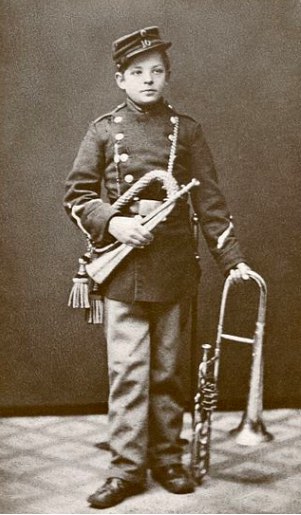
Nielsen aged about 14.

Carl Nielsen’s 4th symphony (“The inextinguishable”, or even Det uudslukkelige) (1916), like his 5th (for whose snare-drum part I hereby nominate Li Manshan), is a battle with chaos. Though Denmark wasn’t directly touched by the war, its echoes are clear. But again, with its incandescent ending in E major (cf. Bruckner 7 and the home key of Chinese ritual wind ensembles!), the overall mood is far from bleak.

To harp (nyckelharpa? Another world fiddle for our list) on the folk angle, whereas other composers like Bartók approached their local traditions as outsiders, Nielsen came from a poor peasant background as a brass player and traditional fiddler on the island of Funen. For more Danish folk music, see under A folk playlist for Euro 24!.

Getting to know both the music of Sibelius and Nielsen in my teens thanks to enterprising amateur orchestras, I must have been vaguely aware of Nordic gloom, but in my callow youth I suspect I heard “classical music” as a monolith, hardly discerning regional, temporal, or personal diversity.

The concert made an evening that was both disorienting and inspiring. Live performances by Barbara Hannigan are not to be missed.

* SJ: Not today, but I can offer you “pining for the Fjordiligis”.

Guide to another year’s blogging


Struggling to encompass all this? I know I am. While we inevitably specialize in particular topics, it’s important to build bridges. I guess it’s that time of year when another guide to my diverse posts may come in handy—this is worth reading in conjunction with the homepage and my roundup this time last year.

I’ve added more entries to many of the sidebar categories and tags mentioned in that summary. I’ve now subheaded many of the categories; it’d be useful for the tags too, but it seems I can’t do that on my current WP plan. Of course, many of these headings overlap—fruitfully.

Notably, I keep updating and refecting on my film and book on the Li family Daoists. I wrote a whole series resulting from my March trip to Yanggao (helpfully collected here) and Beijing (starting here, also including the indie/punk scene). Other 2018 posts on the Li family include Yanggao personalities and Recopying ritual manuals (a sequel to Testing the waters).

To accompany the visit of the Zhihua temple group to the British Museum in April, I also did a roundup of sources on the temple in the wider context of ritual in Beijing and further afield, including several posts on this site.

I’ve posted some more introductions to Local ritual, including

Gender (now also with basic subheads) is a constant theme, including female spirit mediums—to follow the series on women of Yanggao, starting here. Or nearer home, Moon river, complementing Ute Lemper.

Sinologists—indeed aficionados of the qin, crime fiction, and erotica—may also like my post on Robert van Gulik (and note the link to Bunnios!).
I’ve added a few more categories and tags, notably

The film tag is developing, with a side order of soundtracks—for some links, see here.

I’ve given basic subheads to the language category (note this post on censorship), which also contains much drôlerie in both English and Chinese. Issues with speech and fluency (see stammering tag) continue to concern me, such as

Following Daoist football, the sport tag is worth consulting, such as The haka, and a series on the genius of Ronnie.

Some posts are instructively linked in chains:

More favourites may be found in the *MUST READ* category. Among other drôlerie, try this updated post, one of several on indexing and taxonomy; and more from the great Philomena Cunk.

Most satisfying is this collection of great songs—still not as eclectic as it might become:

Do keep exploring the sidebar categories and tags!


Haydn: 1795, 1927, 1973, 2018

trio

Just as I was immersing myself in Afghan singing, how nostalgic the other day to hear the limpid slow movement of Haydn’s G major piano trio on Private passions (for the first of several posts inspired by the series, see here).

Like the Adagio of the Schubert string quintet, it seems suspended beyond time. Of course, it’s not: as ever, we hear it with the successive patinas of our personal listening histories.

The trio is part of a set that Haydn composed in London, and the version that remains with me is that of Alfred Cortot, Jacques Thibaud, and Pablo Casals, recorded on 20th June 1927 at Queen’s Hall. I used to listen to it late at night (after closing time) with friends at Cambridge from 1973—just as Veronica and John were embarking on their Afghan journey, indeed; and as the Rito y geografía del cante flamenco series was being completed, and Li Manshan’s wife gave birth to their first daughter…

Today I wonder how we got into such early recordings, like the late Beethoven of the Busch quartet. They meant a lot to me—but I can’t quite say what: this was considerably before I became involved in early music, or began to care about changing performance styles. Indeed, in those days I was more interested in the politics of the Tang court than in the experiences of our more recent European forebears.

But now I think of the trio’s London audiences between the wars (my great-aunt Edith Miles was losing her hearing in 1927), and wartime audiences in Britain and Germany (doubtless the appalling Hans Frank loved the trio). The group had been working together since 1906; but Casals, a firm opponent of franquismo, later broke with Cortot for the latter’s collaboration with the Nazi occupation of France.

Cortot’s 1932 recording of the break in Brandenburg 5 is also great, but early renditions of baroque music may not always suit modern tastes, like Mengelberg’s 1939 Matthew passion.

Haydn dedicated the set of trios to Rebecca Schroeter, Scottish widow of an immigrant German musician (for a taste of late-18th-century mores, see here). So we might further try to imagine cosmopolitan London in 1795 (for “das Land ohne Musik“, see David Wyn Jones ed., Music in eighteenth-century Britainand for London concert life, here; cf. audiences of Tang-dynasty Chang’an, enriched by Central Asian musics—”They come over ‘ere…“).

I don’t know how to fill in the 19th-century lacuna, but despite all the vast social changes since 1795, maybe Haydn’s day isn’t so distant: we seem to have a photo of Mozart’s widow, and Casals was born in 1876.

Haydn’s trio is named after its “gypsy” finale all’ongarese, which we can enjoy without wondering too much about his exposure to folk music—it is what it is (cf. Norman Lebrecht’s ambitious claim for Mahler 4). From where we are in 2018, all three movements are delightful, but it’s the slow movement (in the lustrous key of E major, like Bruckner 7 and north Chinese ritual suites for wind ensemble!) that continues to enchant me. As the players lovingly pass the tunes around (the second one is even more spellbinding!) above pearly triplets, via Cortot’s simple translucent links, they explore them like tiny jewelled caskets, deep in meditation.

See also Haydn for football; and under In memoriam Fou Ts’ong.

Three women of Herat

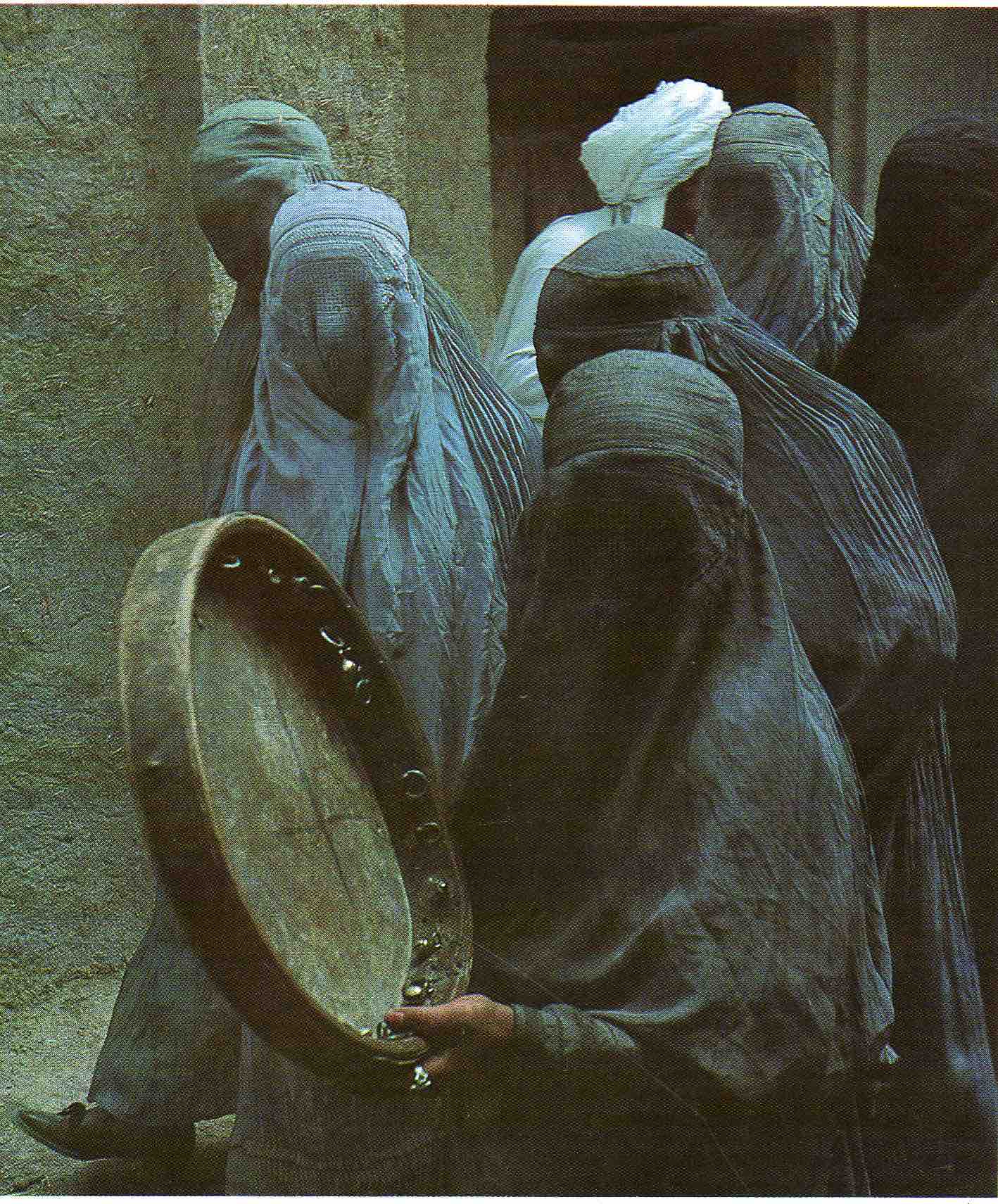
Women of Herat

The idea of “women in music” often suggests their starring roles in WAM (as in the T-shirt!) or Anglo-American popular music. But meanwhile gender has become one of the major topics in ethnomusicology (for some refs., see this post on women in flamenco; note also McClary).

Even in the more “classically” oriented confines of ethnomusicology, “women in music” may not immediately suggests the lives of female singers in Afghanistan.

  • Veronica Doubleday, Three women of Herat: a memoir of life, love and friendship in Afghanistan (1998; most recent reprint 2009)

is an engaging, deeply personal story of her time in Herat in the mid-1970s before the Russian invasion. It’s a good illustration of thinking outside the (music) box.

Herat

Gradually cutting through the curtain of purdah, she befriends three young women with different experiences:

  • The authoritative figure of Mariam, from a hereditary family of (male) musicians;
  • Mother of Nebi, whose maraz mental breakdown as a young mother, attributed to jinns, had prompted her to become a diviner (cf. China);
  • Shirin, negotiating the stigma of working as a professional entertainer (see also Veronica’s “Zainab Herawi: Finding acclaim in the conservative Islamic culture of Afghanistan” in Ruth Hellier (ed.), Women singers in global contexts: music, biography, identity (2013).

HeratAs Veronica enters their social world of domestic life and ritual celebrations, she learns to admire their warmth and strength. But her account is never sentimental, acknowledging their tribulations. She reflects cogently on her choice to adopt the veil while living among them; and in becoming a regular member of Shirin’s band and an accomplished singer, she gains direct experience of their tough life.

Veronica’s audio recordings from the period seem to have disappeared from YouTube, but these CDs are excellent:

Ever since those days in Herat, she has worked in partnership with John Baily, not only a fine exponent of the rubab plucked lute but a great maker (and theorist) of ethnographic films (see here), including

  • Amir: an Afghan refugee musician’s life in Peshawar, Pakistan (1986)
  • Lessons from Gulam: Asian music in Bradford (1986)
  • A Kabul music diary (2003)
  • Scenes of Afghan music: London, Kabul, Hamburg, Dublin (2007)
  • Ustad Rahim: Herat’s rubab maestro (2008)
  • Across the border: Afghan musicians exiled in Peshawar (2011).

Here’s a preview of Amir:

and Lessons from Gulam:

* * *

Veronica became a beautiful singer, moving both Afghan and other audiences deeply in more genteel concert settings. Here’s an early clip:

And more recently with John Baily:

Tracks on the CD Sweet nomad girl:

Three women of Herat is a model of participant observation, and an early instance of an ethnographic genre that has since flourished. Further to Veronica’s distressing original Epilogue, the 2009 reprint includes a new Preface and Postscript, giving valuable context on changes not only within Afghanistan but in Western perceptions.

She did manage to return to Herat in 1994 and 2004, just before and after the Taliban occupation; but after their initial visits in the 70s, long-term warfare in Afghanistan impelled John and Veronica to pursue their studies mainly among refugee and migrant communities—which was also to become a major theme of music ethnography.

For a sequel, click here.

Gepopo: pa-pa-pa-panic

Gepopo 2

Speaking (sic) as a stammerer, I’m always on the lookout for coverage of speech imp-p-pediments (see e.g. We have ways of making you talkStammering gamesPontius Pilate, and the mad jailers; Lost for words; and for more stammering songs, see here).

So in György Ligeti‘s wacky, grotesque, absurdist opera Le Grand Macabre (see e.g. this article by Tom Service) I note the character of Gepopo, whose extreme vocal irregularities occupy a special place in the spectrum of communication issues.

The astounding Barbara Hannigan introduces the role she has made her own:

The character Gepopo, the chief of the secret police of Brueghelland, approaches Prince Go-Go to warn him and the people of Brueghelland that intelligence has learned of a huge comet heading through space towards them which will destroy their planet. Unfortunately, Gepopo is paralyzed with fear and paranoid hysteria, so his almost unintelligible, coded warning is not easily understood by Prince Go-Go, who, mainly interested in a hearty meal, drives Gepopo to further convulsions of highflying vocal panic as the piece draws to a anxiety-ridden finale.

Gepopo

Shades of the Pearl and Dean theme tune? So far this passage has not found favour as an in-flight announcement (cf. The perils of the tannoy, and Putana da seatbeltz; for airline acronyms, see here). But I digress…

Psychotic, deranged, Gepopo is hardly an advertisement for easy stammering—no more to be recommended as speech therapy than Rossini’s “stupefaction ensembles”. BTW, reasons for the far higher ratio of male to female stammerers are still not well understood.

Here’s Barbara Hannigan in an, um, “orthodox” stage version:

Gepopo’s three arias (“Pssst! … Shsht! … Cocococo!“, “Aah! … Secret cipher!“, and “Kukuriku! … He’s coming!“) are also performed as a cycle arranged by Elgar Howarth for the concert stage as Mysteries of the macabre—here conducted (suitably) by S-S-S-Simon:

Dazzling as it is, I’m not sure it’s exactly PC to distract the audience from Gepopo’s demented sadism with a fantasy schoolgirl uniform—perhaps the transgressive, meretricious device suits Ligeti’s concept (discuss…). We might also compare this version:

Feminist scholars have unpacked gender roles in music—including Berg’s Lulu, closest to Hannigan’s heart (see here). Such an approach could be instructive with Gepopo too.


With thanks to Rowan—
whose own vocals, while not so ambitious,
are “less irritating than Glenn Gould”

(The Feuchtwang Variations, n.3).


A playlist of songs

Apart from the mainly-Chinese playlist in the sidebar (commentary here), below are some links to an eclectic selection of All-time Great Songs* on this blog. Besides the songs, the posts are worth reading too—Trust Me, I’m a Doctor.

* Of course, varied as this selection is (à la McClary; see also here, and here), it isn’t so eclectic as to include Albanian funeral laments, Sardinian tenores, flamenco deep song,  Indian dhrupad, Inuit throat-singing, Umm Kulthum, the namthar arias of Tibetan opera, or Aboriginal dream songs… (see also Voices of the world). But I can’t resist including

And I can’t start adding songs without words, but we just have to include the divine Clara Rockmore’s Vocalise on theremin:

For two celebratory playlists, see Dancing in the streets!!! and A playlist for Emma and Leylah.

For a similarly diverse playlist of trumpeters, see here (indeed, trumpet has its own tag); and for some feminist lists, here (with bonus tracks including Sheridan’s Smith’s amazing cover of Anyone who had a heart) and here.

Feminine endings: Madonna and McClary

Left: I found this postcard in Ireland in the mid-1990s; though still drôle, it no longer seems quite so fantastical.
Right: Susan McClary—less futuristically.

Since the party for Madonna’s 60th birthday [I know…] has already begun (see e.g. here), it may seem a tad cerebral to celebrate by revisiting the work of the great Susan McClary (notably her classic 1991 book Feminine endings: music, gender, and sexuality). But given that academics are mostly lumbered with writing, she does at least rejoice in the physical.

Of course, many female performers have continued exploring the trail that Madonna blazed, and she no longer has such power to shock. Similarly, while many critics (not least feminist authors) have disputed and refined McClary’s work, the thrust [sic: her own writings are full of such ludic language, matching her theme] of her argument has practically become mainstream—but her thoughts remain most perceptive.

Fem endings

So far I’ve mainly written about Susan McClary in the context of her provocative analysis of the extraordinary harpsichord solo of Bach’s 5th Brandenburg concerto. Her insights also get a mention in my post on Ute Lemper.

It would be quite wrong to reduce her oeuvre to soundbites—but hey, here goes! With her early research based in baroque music, she notes the historical contingency, mutability, of musical signifiers. Inspired by Greenblatt on Shakespeare (“once science discovered that female arousal served no reproductive purpose, cultural forms silenced not only the necessity but even the possibility of sexual desire in the ‘normal’ female”), she revels in the (pre-watershed) erotic friction of the 17th-century trio texture from Monteverdi through Corelli:

in which two equal voices rub up against each other, pressing into dissonances that achingly resolve only into yet other knots, reaching satiety only at conclusions. This interactive texture (and its attendant metaphors) is largely displaced in music after the 17th century by individualistic, narrative monologues.

Aww, shucks. A review goes on:

The narrative structure of 19th-century instrumental music becomes for her
“a prolonged sexual encounter of intense foreplay that results inevitably in a cataclysmic metaphorical ejaculation. Beethoven becomes the supreme perpetrator of sexual violence in music, whose recapitulation of the first movement of the 9th symphony “unleashes one of the most horrifyingly violent episodes in the history of music”.

McClary was a pioneer in broadening our concepts of cross-genre “music” studies, encompassing both WAM from a wide period and notably pop music—all with a focus on gender. Feminine endings also covers Monteverdi, Tchaikovsky, Bizet, and Laurie Anderson—and such breadth is just what makes her so great. She’s a real genre-bender. As she writes in Conventional wisdom: the content of musical form (2000),

If I tend to reread the European past in my own Postmodern image, if I frequently write about Bach and Beethoven in the same ways in which I discuss the Artist Formerly Known as Prince and John Zorn, it is not to denigrate the canon but rather to show the power of music all throughout its history as a signifying practice. For this is how culture always works—always grounded in codes and social contracts, always open to fusions, extensions, transformations. To me, music never seems so trivial as in its “purely musical” readings. If there was at one time a rationale for adopting such an intellectual position, that time has long since past. And if the belief in the 19th-century notion of aesthetic autonomy continues to be an issue when we study cultural history, it can no longer be privileged as somehow true.

Cf. Holding Don Giovanni accountable.

Madonna
In the final chapter of Feminine endings,

  • “Living to tell: Madonna’s resurrection of the fleshly”,

McClary notes the conflicting strands of interpretation between viewing Madonna as mere commodified sexuality or as a feminist in control. And even while she rails against the denial of the body, what most reactions share (as she comments) is an automatic dismissal of Madonna’s music as irrelevant. Visual appearance and image seems primary, yet the music in music videos is also powerful. Hilary Mantel’s 1992 review doesn’t even bother with any of these features (and an apt riposte there draws attention to McClary’s work); perhaps Madonna might herself respond by reviewing Mantel’s significance without referring to her literary output?

As McClary comments, Madonna’s pieces

explore—sometimes playfully, sometimes seriously—various ways of constituting identities that refuse stability, that remain fluid, that resist definition.

Citing the historical demeaning by sexualization of composer–performers Barbara Strozzi (as featured on the wonderful T-shirt) and Clara Schumann, and continuing to unpack the sexual politics of opera, she observes:

One of Madonna’s principal accomplishments is that she brings this hypocrisy to the surface and problematizes it. […]
The fear of female sexuality and anxiety over the body are inscribed in the Western music tradition. […]
Like Carmen or Lulu, she invokes the body and female sexuality; but unlike them, she refuses to be framed by a structure that will push her back into submission or annihilation.

McClary reiterates the historical trivializing of dance by (male) critics. Madonna’s

engagement with traditional signs of childish vulnerability projects her knowledge that this is what the patriarchy expects of her and also her awareness that this fantasy is ludicrous.

No matter what genre she discusses, McClary’s work is always detailed in musical analysis. She repeats her thesis of tonal structures, with the exploration and subduing of “Other” keys—the “desire–dread–purge sequence”, returning to her much-cited portrayal of the violence of Beethoven.

In her analysis of Live to tell McClary shows in detail how such assumptions are subverted:

and she validates the contradictions of Open your heart:

She takes Like a prayer seriously, its ancient virgin–whore cliché mingling with an exploration of religion and race, sexuality and spirituality—

about the possibility of creating musical and visual narratives that celebrate multiple rather than unitary identities, that are concerned with ecstatic continuation rather than with purging and containment.

Her footnotes (endnotes, actually) are always wonderful too. McClary’s, not Madonna’s.

* * *

Whether or not you concur with all of McClary’s conclusions (apart from a host of critiques, do read her thoughtful introduction “Feminine endings in retrospect” to the more recent edition), it’s a throughly stimulating way of reflecting on culture (see also Society and soundscape). (For another lead suggested by the book, see here.)

All my own gadding about from century to century, culture to culture, is partly inspired by her work. But that’s not her fault. As ethnomusicology shows, if elites invariably try to prescribe and control the prestige of genres across the world, in studying them a level playing field is essential (for a cross-class analysis of Chinese music, see here).

Among numerous YouTube clips, albeit less physically engaging than those of Madonna, here’s a sample of McClary’s wisdom:

I used to delight in Bach without stopping to think about Leipzig society of his time; flamenco, without noticing gender and social issues; and it took me some time to unpack gendered aspects of Chinese ritual. Such a mindset is basic to ethnomusicology, to which McClary’s work is a major stimulus.

In the 1990s, for what it’s worth (and not for what it’s not worth), on returning from village funerals in Hebei to regroup at Matt’s place in Beijing, I would regularly bask in Holiday:

In their different spheres, Madonna and Susan McClary are both iconic and iconoclasts!

For attempts to deny the body in politics, see recent furores over AOC and Sanna Marin. And here are some splendid comments on Madonna from six generations of women.

.

Roaming the clouds: Miranda Vukasovic

Left: Beijing, 2017 (photo: Samantha Camozzi). Right: Cannes, 2018.

On my returns to Beijing from the countryside, much as I miss Li Manshan, I oscillate between encounters with inspiring Chinese scholars and glimpses of the expat life. Following my fleeting introduction to Miranda there, she deserves a separate homage.

You can explore her varied talents online—as singer-songwriter, poet, and designer (notably jewellery).

Photos: Wu Hujun.

* * *

Like a Daoist priest, Miranda roams the clouds 云游, a free spirit, finding evanescent soulmates. In her exuberance she’s more Italian than the Italians. Her company—”red-hot sociality” more akin to Mediterranean fiestas than to Chinese temple fairs—is both enchanting and exhausting; but she lives with her energy all the time.

After her early life in wartime Croatia [1] (and even here, she stresses love, not trauma), Miranda spent periods working in architecture in Milan, Rio de Janeiro, Paris, Mexico 
City, London, and New York before coming to live in Beijing in 2011—always exploring spiritual and physical landscapes, spreading her wings.

Do read her chapter in the fine collection

* * *

Radiance poster

I’m particularly drawn to Miranda’s music. In Beijing she formed the Radiance band in 2015. While I’m keen to avoid the trap of sexist vocabulary like diva and femme fatale (ha!), as a singer-songwriter Miranda creates compelling music “through a kaleidoscope of fragile emotions” in multi-media performances.

From a 2016 gig in Beijing—Beginning of the end:

Soft machine:

Beijing, 2017:

With Nina Simone, David Bowie, Bach, and Astor Piazzolla among her inspirations, Miranda is working with Chinese and international musicians (as has been common since the 1980s, or, to take a longer view, since the Tang dynasty)—constantly exploring.

Beijing gig, 2016.

Miranda—“to be marveled at”, indeed. Beijing is just the kind of creative environment in which she can thrive; she feels an “energy and a flow of young ideas, always in motion”. But wherever she lands, she will always find like-minded people and stimulating projects.

[1] For some other roving female prodigies from East Europe, see here and here.

Flamenco, 3: the soul of cante jondo

*Following Part 1 and (you guessed it) Part 2!*

As we saw in my previous posts, the soul of flamenco is cante jondo (“deep singing”). It may be nourished by the toques of the guitar, and may lead into dancing; but at its heart is anguished solo singing and palmas. Besides Washabaugh’s social analysis, I’m also much taken by

  • Timothy Mitchell, Flamenco deep song (1994).

While recognizing the power of cante jondo, Mitchell takes a refreshingly detached, even jaundiced view:

A decoding of flamenco from a psychohistorical perspective will reveal self-pity, posturing machismo, hypersensitive adolescent egos, and a defensive flight into narcissistic ethnicity.

Again, as a counterpoint to the wholesome family revamp subtly promoted in the Rito series, Mitchell shows that the moods and musical techniques of cante jondo

are inseparable from alcohol abuse. […] Flamenco creativity sought to recover Catholicism’s lost catharsis in saloons, bordellos, and prisons. At the behest of playboy-philanthropists, the haunting cries and brash guitars of a stigmatized underclass were harnessed to explore every aspect of co-dependency. To be worthy of deep song, male performers needed to get their hearts trampled by some dark-skinned dancer; female singers needed to be abandoned or battered by their men. Flamenco artistry as we know it today makes sublime psychodrama out of alcoholism, fatalism, masochism, and ethnic rivalry.

Music can convey the most profound expressions of anguish, from the arias of the Bach Passions to the hymns of mourning of the Li family DaoistsCante jondo has long entranced outsiders, from Lorca and Falla’s 1922 festival to the films of Carlos Saura. But Mitchell confronts the crucial question:

Why does flamenco deep song appeal to people who never shared the traumas that precipitated its birth?

—one that we might ask about our esteem for the ravings of mad women and men in WAM opera, for that matter.

He reflects (evoking jazz, and reminding me of China—I plead guilty on all counts),

All forms of human expressive culture may be intrinsically or potentially artistic. In practice only a small range of creative endeavours come to be designated as Art with a capital A. […] A given expressive behaviour becomes art because the right people rally to redefine it as such in accordance with their needs at a given historical moment and usually in conscious opposition to some other group’s standards. Forms of creativity that originated with the “wrong” people can always be redeemed (and thereby transformed) by talking or writing about them in ways associated with established genres.

He is critical of scholars like Demófilo in the 1880s:

With his selective compassion, unabashed elitism, neoromantic primitivism, spurious notions of purity and contamination, classificatory compulsion, lack of sociological acumen, nostalgia, and racialist aesthetics, he paved the way for numerous 20th-century flamencologists.

As Mitchell observes, the performance style

can strike even the most open-minded as brazen, overwrought, tortured, or histrionic.
[…]
Male-female relationships […] contained considerable amounts of codependency, sado-masochism, self-destruction, and (in compensation) large amounts of transgressive ecstasy.

He gives a nice parallel with reactions to the waltz from an 1816 article in the Times:

So long as this obscene display was confined to prostitutes and adulteresses, we did not think it deserving of notice; but now it is attempted to be forced on respectable classes of society by the evil example of their superiors, we feel it a duty to warn every parent against exposing their daughter to so fatal a contagion.

Still, he concludes:

The flamenco style is not only about trauma but about the quest to recover from trauma; it is about distress and discharge too; it is about taking pain, expressing it, playing with it, and possibly working through it.

* * *


tonas

Near the base of the flamenco treetrunk (for full tree, see here), the cluster of tonás (cantes a palo seco, solo songs without guitar, often even without palmas) includes the unaccompanied saeta ritual songs, as well as no-less-intense secular deblas (“goddess”), carceleras (jailhouse songs; there were even penitential jailhouse saeta), martinetes, and seguiriyas.

Melodically, in their narrow range and in the frequent cadences on do, most of these songs show a contrast with the common minor descending phrygian tetrachord of other flamenco palos.

Saetas
I’ve already featured the saeta solo ritual songs in honour of the Virgin as her statue passes—alternating with percussion, and wind ensemble with piercing trumpets. Mitchell’s discussion is illuminating as ever (pp.100–103, 137–42).

Here are some more examples, starting with Niña de los Peines in 1920:

Note also this short film by Duncan Whitley (with his commentary here).

Tonás
This early programme in the Rito series, clearly explained as ever, includes searing instances of martinetes, as well as rare deblas and carceleras, from Juan Talega, Antonio Mairena, Aguejetas with Tio BorricoTia Anica de la Piriñaca, Rafael Romero, and José Menese:

Martinetes
These stark solo songs are literally forged—in forges, with hammer and anvil. Here’s Agujetas el viejo:

And his son:

Ian Biddle (ch.2, pp.31–6, and ch.3, pp.16–18) analyses in detail the martinete “A la puertecita de la fragua” sung by Pepe El Culata:

A la puertecita de la fragua            At the little door of the forge
tú a mí no me vengas a buscar       don’t come looking for me
con el fango a las roillas                  with the mud on your hem,
y las enagüitas remangás.               rolling up your petticoat.

Vinieron y me dijeron                       They came and told me
che tú habías hablao                         that you had been saying
muy mal de mí                                    
bad things about me
y mira mi buen pensamiento:          and look at my good thoughts:
yo siempre pensando en ti.               I am always thinking about you.

Ma fin tenga la persona                    May that person have a bad end
que anda llevando y trayendo          who goes about gossiping,
poniéndole mal corazón                    giving a bad heart
a aquel que lo tiene bueno.                to the one who is good.

La maresita de toítos los gitanos,   The mother of all the gitanos,
toítos venian al tren.                          they were all coming by train.
La mía como estaba malita              Mine, being so bad
no me ha poio venir a ver.                could not come to see me.

La lunita crece y mengua                  The moon waxes and wanes
y yo me mantengo en mi ser,            and I remain in my own being
yo soy un cuadro de triste                 I am a picture of sadness
pegaíto a la paré.                                I will stop being stuck to her.

Seguiriyas
Most often heard among the intense solo tonasseguiriyas—like soleares and bulerías— have an underlying 12-beat metre, though it can take some concentration to detect it; as ever, the studioflamenco site is useful.

Especially in these more intense slow songs, non-lexical sounds are important, like the opening “ay“—”a knife-at-the-throat sound, a chain, a parched throat, a wound”, as Hecht describes it. Another integral aspect of the flamenco event is the jaleo—of which palmas are part—exclamations of encouragement, way beyond the familiar “¡Olé!” (cf. Indian raga).

The Rito series dedicates two programmes to seguiriyasFramed as ever by perceptive comments, this first programme (based around Cádiz) opens with a precious sequence from Tia Anica de la Piriñaca, and concludes with brilliant seguiriyas from Aguejeta and Terremoto de Jerez:

The second programme is centred on Seville. Again it opens with the venerable cantaor Juan Talega, leading on to Chocolate, Louis de Cabellero, and Antonio Mairena:

Oh all right then, here’s the programme dedicated to Terremoto (with soleares from 8.00, a fantastic bulerías from 17.14, and siguiriyas from 24.20):

And more from Agujeta, father and son—with soleares (4.59), romance y alboreá (10.05), bulerías por soleá (21.07), culminating in a mesmerizing seguiriya (27.28)—how intently they listen!

And a complete concert from 1996:

And we just have to include a seguiriyas from Camarón de la Isla:

The Rito series captured Camarón’s early career. Two excerpts:

Near the beginning of the second excerpt (from 1.37) is a wonderful bulería in which Camarón follows his mother:

Coplas
Along with Pohren’s A way of life,

  • Paul Hecht, The wind cried: an American discovery of the world of flamenco (1993)

is a fine ethnography of flamenco social life in the 1960s; and it also contains plentiful translations of coplas verses (or letras, lyrics).

Just a few examples:

A las rejas de la cárcel            Don’t come and weep
no me vengas a llorar             at the jailhouse gate;
ya que no me quitas pena       since you can’t ease my sorrow,
no me la vengas a dar.            don’t darken my fate.

Cuando yo me muera              When I die,
te pido encargo                         in you I confide:
que con las trenzas                  with the braids
de tu pelo negro                        of your black hair
me amarren las manos.          let my hands be tied.

The ¿Y a quién le voy a contar yo mis peñas? genre includes some intense gems of oedipal Catholic masochism (maudlin Andalucian haiku?)—one from Agujetas ticks all the boxes:

Que a nadie se las puedo contar   I’ve got no-one to tell my woes
Yo tengo a mi mare loca                 My mother is crazy
La llevan pa un hospital                 They’re taking her to a hospital.

* * *

There’s a whole treasury of flamenco videos to explore on YouTube. The depth and artistry of flamenco never cease to amaze me—if we think we know European culture, or even flamenco, all this makes an ear-scouring awakening.


*Cf. the more stoic Chinese genre “On visiting a hermit and not finding him in“.

Flamenco, 2: gender, politics, wine, deviance

Pastora

As I try to get to grips with the wonderfully varied palmas patterns of flamenco, I’m going to keep updating my introductory post—an aural, rhythmical equivalent of the blind leading the blind (cf. my “Turning a blind ear”), perhaps useful for those (like me) hampered by a WAM (or even simply “Western”) background…

In that post I featured both female and male performers—but gender and power relations in genres like flamenco are complex. I’ll begin by outlining the study of flamenco politics.

Politics
Though flamenco and fado (for the latter see here, and here) are remarkably different musically, their social history has some similarities—with shared underworld origins, an early commercial strand alongside popular activity in a still very poor society, misleading associations with regressive political conservatism, and then the fascist state gradually forced to open out, partly through tourism.

Franco

From site here.

  •  William Washabaugh, Flamenco: passion, politics, and popular culture (1996)

is worth reading whole, but here I’ll focus on his chapters on Women and on a major documentary series.

In Franco’s Spain between 1939 and 1975, following the physical devastation and lasting psychological scars from the civil war,

the diverse traditions, customs, practices and, of course, musics of different regions were represented as elements of the integral body of Spain, analogous to the “Mystical Body” of the Roman Church.

Indeed, the reactionary role of the church recalls that in Salazar’s Portugal (see also The struggle against Mussolini).

This motto (Washabaugh, p.viii) might be inscribed above the portals of Daoist and Chinese music studies:

As Michael Bakhtin and his colleagues have noted, something is wrong with any interpretative method that reifies genres and objectifies abstractions to the point that events in the present are reduced to reflections of the past.

In 1959 a law was enacted requiring bars in Andalucia to close by 12.30am, just as flamenco events would have been just beginning—a thinly-veiled attempt “to silence musical events that would normally have bred local loyalty and stimulated political debate” (see also Don Pohren’s A way of life, pp.16–17). At the same time, staged flamenco was becoming a tool of propaganda.

But just as in China, the commodified spectacles are merely the tip of the iceberg of activity among local folk communities. And dissident artists and scholars expressed their opposition to Franco’s nacionalflamenquismo—“the promotion of meretricious spectacles that celebrated the richness of Spanish art while hiding both the poverty and the regional allegiances of the artists” [again, shades of China and the whole heritage flapdoodle!].

Flamenco clearly survived under Franco, even before tourism—not merely in the form of the peña spectacles instituted in the 1950s, but “among the people”. And nostalgia for the regime still lives on.

Washabaugh has a stimulating chapter discussing the important documentary series Rito y geografïa del canteone hundred half-hour programmes made from 1971 to 1973 in the declining years of franquismo, at once representing and resisting the images of the flamenco scene of the time: “a political statement rather than a nostalgic review”. He even unpacks the concepts underlying the title sequence (150–57). While expressing reservations about the “realism”of the series, he is full of admiration for its subtle juxtaposition of the “front” and (more “authentic”) “back” regions of flamenco.

Reminding me of Guo Yuhua‘s Narratives of the sufferers, Washabaugh comments:

The fact that the filmmakers made liberal use of selective emphases in presenting these remembrances should not render the series particularly liable to claims that it is unfaithful as a document of history. On the contrary, these Rito films embody the principle only lately popularized among social scientists, that documents of memory often make inventive uses of the past for the purposes of “willing backward” the future.

Citing Horkheimer and Adorno’s motto “All reification is forgetting”, Washabaugh observes the process whereby the sounds of daily life came to acquire fixed genre names in flamenco, detached from the social relations in which they arose—like the way that songs for selling wares (Rito #72) evolved into pregones (#79).

Some scenes from the “back region”:

  • The potter Oliver de Triana:

  • MarÍa Sabina from Cadiz—who with her blacksmith son Santiago Donday, “if there were ever a pair who would qualify as puro, that pair would be certainly be Sabina and son”:

  • Some fascinating ethnographic scenes from Extremadura bordering Portugal, including tangos, jaleos, and alboreá wedding song:

As if tourism wasn’t bad enough, later, inevitably, the Intangible Cultural Heritage came along to muscle in on the act; but as in China, it hardly affects the beating heart of local traditions. Rather like nanyin in south Fujian, flamenco has long experience of commodification, though this will only be a minor aspect of its life; indeed, their whole history is one of utilizing commodification while maintaining grassroots social practice.

Still, below we’ll see how Washabaugh warns against the fiction of “authentic” flamenco (cf. the musos’ touring game).

Gender
Gender studies, and power relations, are a major and growing theme of ethnomusicology (so far on this blog I’ve subheaded the gender tag under the basic themes of China, music, and other). Just a little selection of some of the major works:

  • Ellen Koskoff (ed.) Women and music in cross-cultural perspective (1987), and her
  • A feminist ethnomusicology: writings on music and gender (2014);
  • Susan Cusick, “Gender, musicology, and feminism” , in Cooke and Everist, Rethinking music (1999);
  • Pirkko Moisala and Beverley Diamond, Music and gender (2000), including Marcia Herndon’s Epilogue there, and others by her;
  • Ruth Hellier (ed.), Women singers in global contexts: music, biography, identity (2013).

Among many studies of women’s musicking in particular cultures, I love

For a typically articulate and reader-friendly  overview of the field, see

  • Bruno Nettl, “I’m a stranger here myself: women’s music, women in music”, ch.27 of his canonical The study of ethnomusicology: thirty-three discussions.

As always, he also reflects with insight on gender relations in WAM (for which there’s a parallel field of study—one might start with Susan McClary, also featured in my post on Ute Lemper in discussing the diva–femme fatale–prima donna complex).

In my post on a wonderful Swedish psalm (just about as far as one could get from flamenco) I cited a relevant observation on gender and vocal timbre from Alan Lomax’s Cantometrics project.

There’s a fine collection of essays on Mediterranean musics:

  • Tullia Magrini (ed.), Music and gender: perspectives from the Mediterranean (2003).

Gender in flamenco
Among fine essays on Corsica, Calabria, Eastern Europe, Greece, and the Maghreb, the latter volume contains a useful article on flamenco:

  • Joaquina Labajo, “Body and voice: the construction of gender in flamenco” (variant here),

analyzing the most basic elements of staging, including role distribution, the actual nature of the interacting voices, and the resources of the protagonists’ corporal expression; and exploring the demystification of images laden with exotic and romantic references that have come down to us through the years, confronting them with other social, political, religious and economic realities and strategies of both the past and the present.

Articles elsewhere include

I must read the book

  • Loren Chuse, The cantaoras: music, gender and identity in flamenco song (2003).

But here, again, here I’ll mainly cite Washabaugh’s chapter on “Women” in his Flamenco: passion, politics, and popular culture. He observes that the Rito compilers’ resistance to nacionalflamenquismo

could consist of nothing more spectacular than disturbing the overly neat franquista portrayal of men as public, women as detached, confined, and, except in the absolute privacy of the family, untouchable.

He notes the widespread, and early, “Manichean” dichotomy of madonna and whore, and the “male-dominated music of the streets”, “a noise that made it possible for people to deal with the confusions of urban life”, “the music of the brawling popular religiosity of men, the music of boisterous binges carried on in the name of the Virgin”. Citing Christopher Small, he notes.

Such music inevitably included the component of percussion that had been banished from the reasoned music of the 17th century because percussive tones elude rational control—”It was not until late in the 17th century that the first percussion instruments were readmitted, the timpani,* which could be tuned to a pitch”.

Urban spaces became increasingly associated with images of “pleasure, excitement, the carnivalesque and disorder”.

While I have reservations about any such portrayal of popular culture through the prism of the educated elite, flamenco artists of the late 19th and early 20th centuries “lived in a lowbrow [sic] underworld dominated by males, a flamenco bar-and-party circuit”, with flamenco song riding on “waves of alcohol to reach peaks of dubious ecstasy”.

Such ecstatic catharsis mediated by sodden singers may have been acceptable for men, but women were singled out and inevitably relegated to the category of the shameless and the whore. Proper women were said to be out of place in a juerga— an all-night binge of song and drink.

Washabaugh notes the exception of the feria, seasonal celebrations of the fair and the carnival providing “occasions for women to flaunt their culturally defined wildness, their seductive physicality, their passion”.

Men were, and are, in the driver’s seat, and they typically use their power to marginalize, exclude, and subordinate women.
[…]
In Andalucia, as elsewhere, men control popular culture regardless of the significance of women’s contributions.

Moving on to the Franco regime, Washabaugh comments:

More than merely discriminating against women, franquista practices virtually annihilated women. In public affairs, the identity of women was systematically denied.

Catholic traditionalism, underwritten by the state, severely limited the place of women, relegating them to a sphere defined as narrowly, and perhaps more so, than the women’s sphere of the 19th century. Women could aspire to marriage and motherhood but little more. The Franco regime literally [sic] turned back the clock on the legal position of women.
[…]
Flamenco bars were nudged out of existence. […] The peña fraternities [sic] [now a welcome relief from the touristy tablau] came into being in the 1950s—formalized, licenced, and, one must suppose, subjected to surveillance, […] a forum in which flamenco aesthetes could pursue issues of artistic purity wholly detached from any practical public interests. Such sterile estheticism in flamenco circles was passively complicit with franquismo. On the other hand, franquista policies encouraged the development of flamenco spectacles that presented women as examples of detached femininity and untouchable beauty, and in these respects, women became powerful magnets for tourist dollars.

Discussing the image of women in the Rito series of the early 70s, Washabaugh observes how the compilers

picked up on some of the tentative and largely unnoticed innovations in both content and style made by female artists in flamenco circles during the Franco years, [… advancing] a picture of women deeply involved in flamenco while still consummately honorable. The documentarians produced this effect by emphasizing the family as a common and fertile site for musical activity, an emphasis that weakened the longstanding association of flamenco with “booze-bars-and-babes” while strengthening associations of flamenco with women, wine, and Andalucian family life.

While many of the films do show tablaos and peñas where women are absent or subordinate, or “caught somewhere between participant, witness, and decoration”, “nevertheless they never venture into that often parodied domain that includes shameless women”. The films deliberately refrain from showing juergas (“notorious occasions for excessive drinking and shameless womanizing”).

(In a lapse from ethnographic empathy, Washabaugh seems to concur with the elite view of the “ugliness, the grotesque vulgarity, the lewdness, and the obscenity of the debauched juergas of the past?!)

Instead, women are presented a pivotal figures, as matriarchs of song. Some examples:

  • The Pinini family:

  • and the Perrate family:

  • Tia Anica la Piriñaca:

  • MarÍa Vargas:

  • Cristobalina Suarez—note the seguiriyas from 12.05, and tangos from 16.01! In her introduction to the latter she refers to the bulerías featured in my first post:

Washabaugh observes,

Paradoxically, the shrewdness of this resistant response lay in its complicity with so many other aspects of Franco’s cultural politics. […] By using family to cloak their revisionary images of flamenco, the Rito filmmakers managed to oppose franquismo while seeming to comply.

  • Having admired Bernarda and Fernanda de Utrera in my previous post, here’s a wonderful soleares from them in their youth, from the 1952 Duende y Misterio del Flamenco (punctuated by the great torero Juan Belmonte):

  • From the same film is a gorgeous bulerías showing the familial basis of flamenco, yet tinged by tragedy—the singer Pastora Amaya, first wife of the great Farrucco, died in a car crash later that year, aged 15:

And here’s a stunning clip of La Negra (born in Algeria) and her daughter Lole Montaya singing an Umm Kulthum song as a tangos (duple rhythm!), partly in Arabic (see the comments to the video)!

Deviant behaviour
Leading on from his discussion of the role of women, Washabaugh notes the somewhat sanitized treatment of alcohol in the Rito series’ :

Wine […] never suggested debauchery, nor did it operate as a component of a “drinking subculture”. Instead, quite to the contrary, wine symbolized home and family.

Wine drinking was discussed in the soberest of terms, as a stimulant to song, as a catalyst to artistry, and as a lubricant for performances.
[…]
Transformed in the Rito films, wine became a rite (a rito) of Andalucian family life rather than a stain left over from Andalucian bar life.

Programme 97 is devoted to wine and flamenco:

Conversely, in the “Triana” programme Washabaugh notes the scene (from 26.47) filmed in the Morapio bar in a housing project outside Seville, the women’s dance subverting the traditional image:

Her antics as a dancer mocked the traditionally conceived “flamenco woman”, the beautiful but inactive, unthinking, and untouchable totally self-possessed woman.

Indeed, somewhat at odds with the Rito‘s mission to embed flamenco in respectable family life are the many stories of musicians’ deviant behaviour, evoking Merriam’s classic “license to deviate from behavioural norms”.

Diego

Any romanticizing tendencies are well corrected by reading Don Pohren‘s classic A way of life, a candid grassroots account based on his stay in Andalucia in the 1950s and 60s, a constant orgy of juerga.

As he makes the finishing touches to his flamenco bar in March 1966,

the town of Morón was absolutely sure of one thing: the finca was slated to be a cabaret featuring prostitutes and flamenco.

His vignettes on the “impish” Diego del Gastor (pp.103–21) are wonderful—such as his disciples’ ill-fated gift of a fine Santos guitar (WAM musos have similar stories!):

Diego was like a child with a new toy, and played and played and accompanied us like never before. Finally, late at night, he grew tired of playing and wanted to rest, but couldn’t find a safe place to put his guitar, as none of us had thought of buying a case for it. Diego solved the problem by locking it in the cab outside. He rejoined the gathering jubilantly, and amidst the ensuing drinks and merry-making completely forgot the existence of the guitar. At juerga’s end, still unusually exuberant for some reason he could not quite recall, Diego danced out to the car, hurled himself drunkenly into the back seat, lit atop his beloved Santos and smashed it into pieces.

Timothy Mitchell unpacks the myths of flamencology in his fine 1994 book Flamenco deep song:

A decoding of cante jondo from a psychohistorical perspective will reveal self-pity, posturing machismo, hypersensitive adolescent egos, and a defensive flight into narcissistic ethnicity.

Washabaugh encapsulates Mitchell’s approach to flamenco:

“maudlin music that lubricates the wheels of an essentially bipolar society and a culture of victimage”!

Mitchell notes the importance of alcohol, and gives telling instances of the mania for pranking (pp.182–8, cf. Pohren pp.41–3):

Flamencologists are thus presented with a difficult choice indeed. Whom are they to prefer, amoral señorito-pranksters or the humorless mystagogues who gathered in Granada in 1922?

For more on cante jondo, see the third post in this series!

* * *

The study of the Rito series is a worthy reminder that even filmed representations of which we may approve are just that—representations. The authors’ “realism” in filming the “authenticity” of the “back region”, and the back region itself, are also constructions. Authentic flamenco is a fiction:

The danger posed [by the Rito series] is that we will canonize this version of flamenco, and use it as a fixed standard for assaying contemporary performances, thereby surrendering ourselves to the very ideology that the Rito series so vigorously opposed, and, in the end, bailing out of our human responsibility to struggle with our own noise.

All this is very fine, but as in China,** what I miss is a diachronic grass-roots account of family milieux less subject to state control, and more free from academic representation; beyond Pohren’s A way of life, perhaps such accounts exist in Spanish or even English. Meanwhile the performers interviewed in the Rito series, both women and men, are articulate and perceptive.

Alongside the Rito‘s fine social documentation, it provides wonderful material to immerse ourselves in all the diverse song genres—so while I gradually begin to absorb the melodic contours of singing, the coplas lyrics, and the toques de guitarra, I’ll keep updating my original post on palmas.

At all events, whatever the class background of flamenco, there’s nothing “lowbrow” about this music. I just don’t get this false dichotomy between art and folk music (cf. China): the prestige that the elite claims for its own culture is notional (see What is serious music?!).

And call me old-fashioned, but while I have no choice but to concede to listening to WAM in the sterile concert-hall, these videos illustrate perfect settings for musicking, don’t you agree…


* I just have to direct you to two classic timpani stories, here and here.

** Another echo of Maoism: “if it isn’t prohibited, it is compulsory” (Washabaugh 161).

Flamenco, 1: palmas—soleares, bulerías

*First in a series, rounded up here!*

palmas

Tony and Two-Jags explore the intricacies of flamenco palmas.
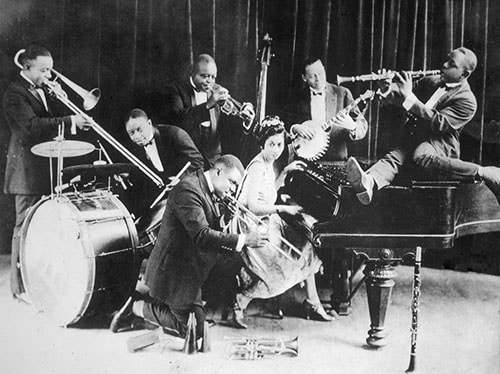
Coinciding with the thrilling Portugal–Spain match the other day was a flamenco gig in Chiswick with the splendid Ramon Ruiz.

Unlike the football, it’s not a competition, but much as I love fado (and you just have to listen to the Carminho song there; see also here), I’ve long been enchanted by flamenco. One benefit of the life of a touring WAM muso: how blessed to have had the chance to wind down from performing Bach Passions in Andalucia in time for late-night sessions in flamenco bars.

Acton

The rustic Andalucian charm of Ramon’s courtyard. Photo: Ramon Ruiz.

Recently my passion has been reinvigorated by occasional palmas sessions with Ramon. Flamenco is yet another illustration of the wonders of all the diverse regional cultures throughout Europe (e.g. east Europe, or Italy). And despite the efforts of those who would float off into an imperial ocean idyll of tweed and Morris dancing, London is still a wonderful microcosm of world music! You can find everything…

YouTube opens up a rich world of flamenco, not least the fantastic documentary series Rito y geografïa del cante. [1] Here’s a briefer introduction to flamenco as part of social life:

This is just a preliminary reccy—more to follow.

* * *

Flamenco is about as far as you could possibly get from its cosy tourist image—Torremolinos, castanets, rose between the teeth, and all that. Like tango or rebetika, its life is “among the folk”, as the Chinese would say: at lineage gatherings, at informal fiestas and local peña clubs; and it’s rooted in the exorcizing of suffering. Rather than the commodified tablau shows, one lives in hope of sitting in on a juerga among aficionados (cf. the touring musos’ game). [2]

* * *

Like Lorca [name-dropper—Ed.], my taste draws me to the intensity of cante jondo “deep singing”, with genres like seguiriyas and martinetes. But my Spanish is rudimentary, I don’t play guitar, and No Way am I going to dance (like, ever)—so a great way of learning is to get a basic grasp of the wonderful palmas hand-clapping that accompanies singing, guitar, and dancing. Not to mention foot stamping, and the cajón box.

Come to that, palmas is a great way for British kids to become musically competent, growing into music—as Ramon finds in his school workshops.

Like the human voice, our hands, our bodies, are the most elemental musical instruments. Hand-clapping, relegated in northern societies to children’s games, is a captivating art in some Mediterranean and Middle-Eastern cultures. And it’s belatedly come into its own with so-called minimalism—Steve Reich’s Clapping music,

and Anna Meredith’s exhilarating Hands free.

* * *

Complementing my explorations of YouTube clips, I’m finding some practical sites useful, like this and this; also instructive are Ian Biddle’s chapter on cante and the Appendix “Cante, definition and classification” of Paul Hecht’s The wind cried.

As usual, we need an overview of the genres: this tree suggests the riches of all the various palos styles.

And then, within all these palos are the compas rhythmic patterns—embodied by specific (hands-on!) palmas. Not to mention all the local styles of towns throughout Andalucia—Seville, Jerez, Cádiz, Morón de la Frontera, Granada…

For a sophisticated model of metrical analysis, see here.

Palmas seems like a relatively easy way of getting a basic grip on flamenco. But focusing narrowly on the rhythms, it still takes me a lot of time to absorb the important clues from the guitar and voice that are equally basic.

Ramon suggests I begin with soleares (linguistic note: associated with soledad, like saudade in fado!) and buleríasthe latter faster, difficult but much prized.

Here’s a soleares from Perrate de Utrera, with the ever-quirky Diego del Gastor:

And bulerías by the de Utrera sisters, with Diego del Gastor:

I start by internalising the basic 12-beat cycle while swimming, taking breaths before the accents:

       1 2 3 4 5 6 7 8 9 10 11 12

or rather (beginning on 12)

12 1 2 3 4 5 6 7 8 9 10 11 12

So it’s a recurring hemiola* pattern; that should be simple enough, but at first, for pedantic hidebound WAMmies like me it feels as if it begins on the “wrong” beat. (¿¡Surely this is as wacky as the Spanish upside-down question and exclamation marks?!). One soon learns to bounce off the 12, but I find it harder to internalize the varying patterns in the second half of the cycle.

Anyway, you can already hear just how complex the rhythmic variations are. As always, if you’re hampered by a classical education like wat I is (innit), or if you don’t happen to come from a long lineage of Andalucian blacksmiths, then you have to unlearn any ingrained assumptions from WAM and just immerse yourself in the whole style through the experience of the body.

I think of Indian tala; or even the way that household Daoists in Yanggao pick up, largely by ear, their ritual percussion items—seemingly simple but endlessly varied, with large cymbals and drum interacting. Indeed, the way that the clappers often leave the main beat empty reminds me somewhat of Li Manshan “calling the beat” with a busy drum pattern just before the down-beat on the small cymbals.

It’s no good just going oom-pa-pa like a waltz—in one video, Ramon spots some old ladies at the back doing just that! And then there’s the nuance of fuertes hard and sordas soft dynamics, and all the contra-tiempo cross-accents between multiple clappers.

As Ramon explains, it’s a series of questions and answers. I’ll have a better handle on this once I’ve learned to latch onto the guitar, with its chord change on 3, and the extra cadential flourish ending on 10—though the beginner may find few landmarks in between those points. The YouTube option of slowing down playback can come in handy.

Here’s yet another fine programme in the Rito series, with a series of bulérias (featuring, after Camaron, Cristobalina Suarez with young sleeping child from 23.20—see also my Part 2):

This is seriously complex funky stuff. No sooner have you learned a basic pattern than you find how variable it is—like sonata form. Given its considerable theorization (as if that mattered), that theory is orally transmitted, and the brilliant exponents are often semi-literate. But while insisting that flamenco should absolutely be admissible to the ranks of “serious music” (whatever that means), the only important point is that it’s extraordinarily life-enhancing.

For more bulérias, see here.

* * *

I also love it when all extraneous elements are stripped away: when everyone just claps their complex patterns in counterpoint with the dancer’s feet. Or the cantes a palo seco, when the singer dispenses entirely with guitar and even palmas, just howling in solitary pain… I’ll pursue these songs in my third post.

Talking of the Rito y geografïa del cante flamenco series, with all its precious archive footage, the programmes on the Utrera sisters illustrate the compilers’ fine ethnography of lineages, changing society and music, the amateur–professional continuum, and all the subtle distinctions that folk musicians always make:

All this wealth of musicking on our doorstep! I’ll keep studying and updating this post. The next post in this series outlines gender, politics, wine, and deviance!

As an aperitivo for the third post we just have to have a seguiriyas from Camarón de la Isla:

*BTW, lutenist Paul O’Dette told me this story on a long tour of the USA:
Summer school in Utah on baroque music. A professor from England solemnly writes “HEMIOLA” on the board and begins to explain the occasional use of three groups of two within a triple metre. One of the local students guffaws,
“HEY! We don’t have no hee-my-olas in Utaww!”
For another vignette from that tour, see here.


[1] In a nice illustration of how the concepts of “singing” and “music” are culturally conditioned (see also Is music a universal language?), the word flamenco doesn’t appear in the series title!

[2] Among a wealth of sources, in English one might start with the flamenco chapter of The Rough Guide to world music; William Washabaugh, Flamenco: passion, politics and popular culture; ethnographies like D.E. Pohren, A way of life and Paul Hecht, The wind cried; and for cante jondo, see e.g. Timothy Mitchell, Flamenco deep song. Some of these are cited in Parts 2 and 3 of this series.

Jottings from Lisbon 2

In this post I begin to educate myself on the Salazar regime—framed by more on the changing history and image of fado.

Fado 1910

José Malhoa, Fado, 1910.

Back in Lisbon last week after my visit this time last year, I reacquainted myself with the delectable Colete Salva-Vidas and her three daughters, notably the errant Aterragem (see my linguistic fantasy here)—and now, I find, yet another on the way, Proxima Paragem (“next stop”, between you and me). I’m tickled that the door sign for “Pull” is Puxe—putting foreigners off the scent, like changing the signposts in wartime Britain? I would like “pullover” to be puxesobre, “pushover”.

To console me that my visits never seem to coincide with a festival of traditional Alentejan choirs, my friend Nick took me to the wonderful Casa Alentejo. Cunningly disguised as a Western Union office, you’d never guess at the riches inside—a Moorish courtyard, frescos, tiles, and a little double stage: a true gem (if not aterragem).

* * *

While my first loyalty is to the complexity and intensity of flamenco cante jondo, it’s always good to explore fado—and it’s high time for me to understand a bit more about its social and political background. This may be old hat for world music groupies, but perhaps it’s of a certain relevance for my sinophile readers; and quite aside from the tourist angle, there seems a genuine enthusiasm among the current fadistas[1]

The Museo do Fado (including sound archive here, and biographies here) makes a useful introduction. Evoking several other genres (flamenco, rebetika, tango, and so on), the early history of fado was one of delinquency and transgression (cf. Deviating from behavioural norms). Indeed, that’s still very much the ethos of shawm bands in rural China. As a useful 2007 article on fado comments:

When a Portuguese writer described the fado in 1926 as “a song of rogues, a hymn to crime, an ode to vice, an encouragement to moral depravity, an unhealthy emanation from the centres of corruption, from the infamous habitations of the scum of society”, he identified a set of associations that a new generation of fadistas wear like a badge of honour.

Musicians often wore bright tattoos, in red on the singer’s chest or between his thumb and fingers, with markings of “anchors, ships, guitars, flowers, animals, pierced or joined hearts, the cross, the five sores of Christ [YAY], other love, religious, fantasy signs or inscriptions”.

Fadistas 1873

Pinheiro, Fadistas, 1873.

But later a political stigma replaced the old social one:

For some, it’s a sound forever tarnished by its association with fascism. After the fall of the dictatorship in 1974, many on the Portuguese left saw the fado as something shameful. It was seen, at best, as a conservative outlet for national misery, at worst as an authorised voice for Catholic fascism.

Salazar himself considered that fado “sapped all energy from the soul and led to inertia” (on which grounds he might have been a big Sex Pistols fan). In 1927 he passed a law regulating it, depriving it of much of its improvisation and spontaneity—which sounds like what the Party has long tried but failed to do in China. Under Salazar fado wasn’t used as propaganda, but it was neutered. Flamenco, while no less commodified, has retained a more earthy aspect.

Fado‘s links with Brazil and Africa are also worth pursuing.

* * *

Following my visits to Sachsenhausen and Stasi memorial sites in Berlin, it seemed suitable to give myself a basic education on the Salazar regime and its sinister PIDE security forces. By contrast with the grim surroundings of the Stasi museum in Berlin, the Aljube museum (Museum of resistance and liberation; also useful introduction here) occupies a picturesque site overlooking the sea, suitably opposite the Sé cathedral—as if to remind us of the role of the church in supporting the regime.

family

Portugal was one of the poorest countries in Europe. In 1920, 66% of the population was illiterate. Infant mortality rates only decreased belatedly:

1926: 45%
1974: 37%
2011:   3%.

kids

The Estado Novo endured for forty years, from 1933 until 1974. It was in this period that Portugal became encapsulated by “the three Fs”: fado, football, and Fátima. Bread and circuses, perhaps: for the opposition, a formula for national alienation. One might add a fourth F: fear (see also The struggle against Mussolini).

Lisbon 1939

Lisbon 1939.

The Aljube had a long history as a prison. On the eve of the Estado Novo it held “women of ill repute, and incorrigible women accused of serious crimes”. Indeed, under Salazar, the exhibition mentions the general exploitation of women:

Women like Maria Lamas, Maria Isabel Aboim Inglês, Virginia Moura and Maria Machado initiated a new specific approach to the female condition and especially of the until then “invisible” condition of the women.

In a country where feminism was a late starter, this positioning would fertilize the cultural soil, in which would grow what is considered the first Portuguese feminist manifesto, As Novas Cartas Portuguesas [The new Portuguese charters], the publication (and apprehension) of which would leads its three authors, Maria Teresa Horta, Maria Velho da Costa, and Isabel Barreno, to be criminally persecuted in 1972.

Under the dictatorship the Aljube became a political prison. The museum outlines the use of torture, the role of informers (bufos, “squealers”), the resistance, and the exile of prisoners to penal colonies in the Azores, Madeira, East Timor. Many died of starvation and disease in Tarrafal camp in Cape Verde. The third floor covers the anticolonial struggle, as well as the 1974 Carnation revolution.

The exhibition documents the collaboration of the PIDE with the Italian secret police and the Gestapo—going on to note that the CIA helped train the PIDE from 1957.

One thorn in the flesh of the regime, harrassed by the PIDE, was the musician José “Zeca” Afonso (1929–87):

I’m sure a lot more tourists walk past than enter the Aljube museum, which is sad—but of course it takes a particular mentality to travel the globe in search of atrocity sites. Despite all the evidence of human suffering, not least during my own pampered youth, I’m not here (today, at least) to rant against tourism—the whole image of the Med (sun, sea, and in this case Sé) and idyllic island resorts—or indeed to carp at the human capacity for enjoying life.

Criminal states have operated all over the world, and continue to do so. In places like Germany and Portugal, where regimes have changed, lessons may be learned in the public domain; in China, still very little.

* * *

The new generation of fadistas are said to have shaken off the link with fascism, but it never fitted neatly into the discourses of either right or left. Moreover, it now seems largely rhetorical for fadistas to pride themselves on its history as an “ode to vice, an encouragement to moral depravity from the scum of society”. The clubs have been becoming gentrified for over a century, the atmosphere genteel (or what the Chinese would call “cultured”)—and even I can’t fault it for that.

So what better way of spending the night before Eurovision than to relish fado at a venue I hadn’t visited before: the Associação do Fado Casto in Rua São Mamede. Among all the fado joints in the Alfama, it’s rather off the beaten track, and suitably untrumpeted from the outside. The atmosphere is great, with groups of family and friends enjoying fine food amidst evocative memorabilia.

As to the fado, performed in sets of three songs, while the pluckers noodle away whimsically,  the intimate intensity of saudade as the singer enters is immediately touching. I heard fine sets from Matilde Cid (YouTube topic), accompanied by Antonio Duarte and João Filipe:

Matilde

I also just found out about the great Carminho, falling helplessly in love with this early clip of her singing Fado of the hours in Carlos Saura’s 2007 film (longer sequence here):

I used to cry for not seeing you,
And now that I see you, I cry

Chorava por te não ver,
por te ver eu choro agora,
mas choro só por querer,
querer ver-te a toda a hora.

Passa o tempo de corrida,
quando falas eu te escuto,
nas horas da nossa vida,
cada hora é um minuto.

Deixa-te estar a meu lado,
e não mais te vás embora,
para meu coração coitado
viver na vida uma hora.

This has leapt into my list of all-time Great World Songs. Incidentally, many fados make use of the plangent minor key, but this is a good instance of how saudade can be amply achieved without it.

I’m somewhat resistant to Big Stars (at least in “world music“), but I can hardly sign off without paying homage to the saudade of Amália Rodrigues:

For more links, see Tony Klein’s comment below. Note also Portugal: folk traditions. For flamenco under Franco, and more on gender, see here.


[1] While we await a translation of Rui Vieira Nery, Para uma história do fado, for one detailed study in English see Paul Vernon, A history of the Portuguese fado; see also James Patrick Félix, Folk or fake: the notion of authenticity in Portuguese fadohere. For a general introduction to fado in the wider context of Portuguese music, with discography, see The Rough guide to world music, pp.309–23; fado also features regularly in Songlines magazine.

Lili Boulanger

Boulangers

Yet another fine addition to BBC Radio 3’s coverage of female composers: the great Lili Boulanger (1893–1918) (immortalized on the excellent T-shirt)—click here, part of a website well worth exploring.

Dying terribly young, Lili was eclipsed by her equally brilliant older sister Nadia (1887–1979), herself one of the great influences on WAM music-making in modern times (see here, and for a festival in 2021, here). And of course I’ve written many posts on French music in the form of Ravel and Messiaen.

“Not a lot of people know this”, but I recorded Lili’s pieces (or even morceaux) for violin and piano with Susan Tomes on one of those disc thingies around 1974, while we were at Cambridge. Here’s a 1930 recording of the Nocturne with Nadia accompanying Yvonne Astruc:

Even in our Cambridge days, At A Time When It Was Neither Profitable Nor Popular, we were all much taken by Du fond de l’abîme:

Note Nick Robertson’s magnificent anagram fantasy on Lili Boulanger, Nubile gorilla. And for my own fantasy on Nadia’s pupils, click here. See also French music at the Proms.

Boullanger plaque

Indian singing at the BM

*For a roundup of posts on raga, with a general introduction, see here!*

Bihag

Bihag, ragamala. Yale University Art Gallery.

After some time immersed in the rich harmonies of Mahler 10, it made a nice contrast for me to bask in the purity of monophonic Hindustani music in the Indian gallery of the British Museum. With the arhat at the other (Chinese) end of the gallery gazing on serenely from afar, Kaushiki Chakraborty sang with the lucidity and intensity characteristic of the style, accompanied by tabla and harmonium (the latter, alas, only intermittently suggestive of the bandoneon—call me old-fashioned, but you still can’t beat the sarangi).

She began with a khayal in the late-evening rāg Maru Bihag—whose relation with rāg Yaman (and Yaman Kalyan) is a subtlety to be explored by the aficionado. But even for the less attuned ear it’s worth homing in on the basic vocabulary of raga: the pitch relationships, always expounded most clearly in the opening alap.

To simplify absurdly the ascending and descending scales, and the choices of phrases within them, Ms Chakraborty’s version of the rāg featured Ni and Ma prominently, using an ascending scale of

Ni  Re  Ga  Ma  Dha  Ni

—feeding on the tension with the tonic drone of Sa, as in many ragas. The natural-fourth degree ma is introduced as a subsidiary theme (Ni Ga ma, or Sa ma, and Ga ma Ga), and later a sustained Pa also features. Here’s a version she sang in 2017:

Here’s a rendition by the great Nikhil Banerjee on sitar:

And for a version on shehnai, see Raga for winds.

Operetta in extremis

Tillion

Anne Sebba‘s book Les Parisiennes is high on my reading list. Meanwhile, it’s good to hear her on Private passions paying homage to the great ethnologist Germaine Tillion, who somehow composed the operetta Le Verfügbar aux Enfers while incarcerated in the hell of Ravensbrück (see link in Bearing witness)—a spoof of Orpheus in the underworld, an attempt to help prisoners “resist by laughing”. Here’s a revival from 2011:

A salutary link with the Ten Kings of the Underworld?

Enfers

Guide to a year in blogging

LMS

After a year of frenzied blogging, here’s a seasonal retrospective guide to navigating a diverse ouevre—as much for my sake as as for yours. Meretricious and Happy New Year!

Call me a nerd [You’re a nerd—Ed.], but taxonomy and indexing are so funky… As you see from the (updated) homepage, the whole site began as an introduction to my work on the Li family Daoists, and my portrait film remains one the most enchanting presences there. The Li family has its own category in the sidebar, with a plethora of articles (not least a whole series on our French tour in May 2017, and an update on Li Bin’s diary).

Other pages in the top menu also tend to be rather substantial, with

Still in the top menu, MY BLOG contains all my myriad posts (“delighting in all manifestations of the Terpsichorean muse“), with helpful Categories and Tags in the sidebar, as well as a monthly archive there. Here are some of the more stimulating:

As you can see from this post alone, I just love doing internal links (in blue in the text). So whether you first came here for Daoist ritual, football (indeed, Daoist football), punk, Bach, modern China, or even just for the jokes, they’re all connected, so please do click away on the links!

Last but, um, not least, do click on the links to the relevant posts and pages in the photos in the sidebar.

A stunning keyboard break

The work of Susan McClaryboth for its ideas and its lively language, has prompted such a major “disciplinary explosion” in musicology, with her iconic book Feminine endings. Her ideas, “received as radical—even outrageous—within musicology, only brought to music studies the kind of projects that had long since become standard fare in most other areas of the humanities” (p.ix).

McClary’s work shouldn’t be reduced to soundbites, but alongside astute gender-based discussions of a broad range of music from Monteverdi to Madonna, Carmen to Laurie Anderson, many passages have both inspired and shocked—her detailed unpackings of patriarchal assumptions, such as on Beethoven (“assaultive pelvic pounding… and sexual violence “), or the “erotic friction” of Italian trio sonatas (“two equal voices rub up against each other, pressing into dissonances that resolve only into yet other knots, reaching satiety only at conclusions”—an interactive texture that was later displaced).

Meanwhile, listening again to Brandenburg 5 recently after my post on Bach’s fawning letter to the concerto’s churlish recipient, I was reminded of one of McClary’s most famous accounts, from her 1987 article “The blasphemy of talking politics during Bach year”.

Somehow I long took for granted Bach’s “frenzied” harpsichord solo near the end of the 1st movement—McClary observes how our senses are dulled by familiarity with later romantic concertos (and anyway we fiddlers tend to think it’s none of our business—we know our place, which is precisely McClary’s argument). So I’d like to run through the way she unpacks it; whatever you think, she’s always stimulating (see also this post).

She begins by summarizing important background, her constant theme:

At the very moment that music was beginning to be produced for a mass bourgeois audience, that audience sought to legitimize its artifacts by grounding them in the “certainty” of another, presumably more absolute realm—rather than in terms of its own social tastes and values.
[…]
From very early times up to and including the present, there has been a strain of Western culture that accounts for music in non-social, implicitly metaphysical terms. But parallel with that strain (and also from earliest times) is another which regards music as essentially a human, socially-grounded, socially altered construct. Most polemical battles in the history of music theory and criticism involve the irreconcilable confrontation of these two positions.

Inspired by Attali’s book Noise, McClary seeks “the tension between order (indeed, competing claims to legitimate order) and deviation —if not outright violence…” Reminding us of harmonic music’s underlying assumptions of goal-attainment (“playing with (teasing and postponing, gratifying) the expectation of imminent closure”), she plunges into the 1st movement of Brandenburg 5.

She notes the rise of the concerto form, where “the soloist is an virtuosic individualist who flaunts the collectivity of the large ensemble”. […] “It begins as if it is going to be a concerto for solo flute and violin, but it soon becomes clear that “there is a darkhorse competitor for the role of soloist: the harpsichord”. Its normal “service role” at the time seems self-effacing, but “the harpsichordist is often a Svengali or puppet master who works the strings from behind the keyboard. Here s/he “creates a ‘Revenge of the continuo player’: the harpsichord begins in its rightful, traditional, supporting norm-articulating role but then gradually emerges to shove everyone else […] out of the way for one of the most outlandish displays in music history.”

The harpsichord, which first serves as continuo support, then begins to compete with the soloists for attention, and finally overthrows the other forces in a kind of hijacking of the piece. […] The ritornello seems to know how to deal with the more well-behaved soloists, how to appropriate, absorb, and contain their energy.” But Bach now “composes the parts of the ensemble, flute, and violin to make it appear that their piece has been violently derailed. They drop out inconclusively, one after another, exactly in the way an orchestra would do if one of its members started making up a new piece in the middle of a performance. Their parts no longer make sense. They fall silent in the face of this affront from the ensemble’s lackey, and all expectations for orderly reconciliation and harmonic closure are suspended.
[…]
It unleashes elements of chaos, irrationality, and noise until finally it blurs almost entirely the sense of key, meter, and form upon which 18th century style depends.

McClary concludes provocatively:

 The usual nice, tight fit between the social norm, as represented by the convention of concerto procedure, and specific content is here highly problematized. Certainly social order and freedom are possible, but apparently only so long as the individuals in question—like the sweet-tempered flute and violin—abide by the rules and permit themselves to be appropriated. What happens when a genuine deviant (and one from the ensemble’s service staff yet!) declares itself a genius unrestrained by convention, and takes over? We readily identify with the self-appointed protagonist’s adventure (its storming of the Bastille, if you will), and at the same time fear for what might happen as a result of the suspension of traditional authority. […] The possibility of virtual social overthrow, and the violence implied by such overthrow, is suggested in the movement, and the reconciliation of individual and social hierarchy at the end— while welcome—may seem largely motivated by convention. To pull this dramatization back within the limits of self-contained structure and order may seem to avoid the dilemma, but it does so at the expense of silencing the piece. For Bach is here enacting the exhilaration as well as the risks of upward mobility, the simultaneous desire for and resistance of concession to social harmony.

McClary’s work is akin to ethnomusicology (“If I can no longer privilege any one tradition, I find myself perpetually in awe of the countless ways societies have devised for articulating their most basic beliefs through the medium of sound”), and its class and gender implications cry out to be applied to Chinese musical cultures (I made a preliminary and rather unsuccessful attempt in my “Living early composition: an appreciation of Chinese shawm melody”).

With Bach’s solo, it’s easy to think “that’s just how it goes”, but whatever your “class standpoint” (阶级立场), if you listen to it afresh, every few bars you think, WTF??? I know the analogy with jazz can be overdone, but even jazz solos, however virtuosic, also generally fit within fixed (and democratic?) parameters—except when someone like Coltrane goes off on an interminable fantasy. In its wackiness Bach’s solo reminds me of a pianist like Hiromi—or a Hendrix guitar solo.

It makes a suitably awe-inspiring opening to The chronicle of Anna Magdalena Bach, all the more exhilarating in Gustav Leonhardt’s restrained rendition—here’s a colorized version:

For my own meretricious speculations on socio-political elements in the reversal of colours on the piano keyboard, see Black and white.

* * *

And now for something completely different: Glenn Gould, 1962—don’t worry about the rest of it, just listen from 8.06ish:

Reception history and performance practice are always intriguing. Little is known of any performances in Bach’s lifetime, but it looks as if the concerto may not have been played again, at least in public, until 1853. Like Rudolf Serkin’s 1935 recording with the Busch Chamber Players, Alfred Cortot’s 1932 version (still on piano) is more genteel than manic:

And here’s Furtwängler in 1950 (cadenza from 8.54ish)—praised by Richard Taruskin, no less:

But performances only became more common with the harpsichord revival of the mid-20th century. So now, despite a rearguard action to rehabilitate the Golden Age before HIP (see Alternative Bach, and Playing with history), modern ears may find such early versions heavy going.

Richard Egarr always offers wacky insights (from 6.30ish):

Having blown everyone away, the harpsichordist gives a little signal of the return to normality (“relents and politely (ironically?) permits the ensemble to re-enter”) so that they can pick themselves off the floor to come in with the ritornello that innocently began the whole trip.

I like to think of the cadenza as just one instance of an improvisation that Bach chose to notate, illustrating the kind of fantasies in which the player might care to indulge, like Messe de la Pentacôte or Rhapsody in blue.

Sure, one can’t really cheer aloud at every manic new turn, but I still think the only possible reaction of both band and audience, whether now or in Bach’s lifetime, would be akin to that of Billie Holiday as she exults in the succession of amazing solos her band offer up to her.

Useful ideas for Christmas

The time of year is rapidly approaching when you’re desperately racking your brains for a present for that difficult uncle who’s got everything—even Dame Kiri Sings the Sex Pistols’ Greatest Hits by Candlelight.

Well, look no further—my three former Ashgate books (two with DVDs) are out in paperback! (See also my Amazon list).

And to go with my film (a welcome change from Bambi), don’t forget Daoist priests of the Li family.

To cite The Messiah:

Thou art gone up on high; Thou hast led captivity captive, and received gifts for men

Giving Handel and his librettist Jennens** the benefit of the doubt for sexist language, don’t forget the brilliant T-shirt of female composers—”Breaks the ice at parties”, in the words of Monty Python (who did rather let themselves down* on gender equality).

Such seasonal gifts will make a welcome change from socks and after-shave, and can be enjoyed over a sherry in a party hat while blowing a paper horn—a relative of the vuvuzela, perhaps? Laurence Picken could have enlightened us. You can play the party game of identifying festive toy instruments under the Sachs-Hornbostel system (or play Spot the Difference with Daoist ritual paintings, like the Judgment Officers here). The paper horn also evokes the conch in Daoist ritual—indeed, it would make a suitable companion to these early Daoist instruments of the Li family.

horn

* “Let themselves down”: apart from the Proust sketch (from 2.14, notably the voiceover comment “golf’s not very popular round here”), there’s also the classic headmaster’s speech joke.

** Good to see Jennens slagging off Handel’s music, at least:

“I shall show you a collection I gave Handel, called Messiah, which I value highly. He has made a fine entertainment of it, though not near so good as he might and ought to have done. I have with great difficulty made him correct some of the grossest faults in the composition; but he retained his overture obstinately, in which there are some passages far unworthy of Handel, but much more unworthy of the Messiah.

YAY!—I mean Hallelujah. Praise be to the Lord—and the Three Pure Ones, the Empress Houtu, Bob Marley, Mrs Cratchit and The Ten Kinds of Orphan Souls [can someone check this please?—Ed.] and the Thunder Lord of Three-Five Chariot of Fire—the latter (“Lingguan smoking a posh foreign cigarette on a train journey through his spiritual domain”) a fine read, though I say it myself.

Wind, ethnicity, gender

My time with Chinese shawm bands (most ubiquitous of performers for rural ceremonial) leads me to dabble mildly in studies of early European wind bands. So I’m struck by this detail of a 1520 Portuguese painting:

trombone

The Engagement of Saint Ursula and Prince Etherius,

It makes an alluring image for reviews of Miranda Kaufmann’s new book Black Tudors: the untold story, though it’s familiar to musicologists on the period—leading me to a glimpse of some of the fine work that scholars do for early European organology. See these images—Keith McGowan’s groundbreaking work on wind bands (which we await, um, breathlessly) encompasses social aspects of early European players of ethnic minority backgrounds—who, as in China, were generally low in status. And the painting is included in a survey by Will Kimball on early sackbut grips (and I thought my work was niche…)

That image comes from Portugal, but Kaufmann opens her book with a vivid account of John Blanke, trumpeter at the Tudor court.

John Blanke (rear, centre), from Westminster tournament roll, 1511.

Note the John Blanke Project—here’s an instructive film (see also this Twitter thread):

As Kaufmann notes, African musicians (mostly wind players) had been playing for European monarchs and nobility since the 12th century. More commonly represented in painting are Middle-Eastern shawm bands, as in Carpaccio’s Baptism of the Selenites.

So if the 1520 Portuguese painting is the earliest surviving representation of a black trombonist, then when was the next, eh? Before the 20th century?

Moving laterally (like a trombone slide), here’s Melba Liston:

While we’re about it, any excuse to cite Some like it hot:

And Vermeer’s The art of painting attracts as much interpretation as Las meninas:

* * *

Now, much as I admire Chinese music historians and the many fine collections of early iconography of Chinese instruments, I wonder if the Confucian habit of merely citing early written sources without discussing them applies in that field too: beyond merely displaying images, we need to interpret them.

While I’m on the subject, citations of early texts by Chinese scholars seem to assume we all know what they mean; they feel no need to translate them into modern Chinese. Yet when I query how to translate such passages, even the best scholars aren’t necessarily clear—and the uncertainty is precisely why we need to discuss them.

* * *

On a topical note, I caught a glimpse on the news recently of a shawm band playing for a demo in troubled Catalonia. Among the amazing regional variety of folk culture in Spain (e.g. Valencia and Rioja, not to mention flamenco), folk Catalan double-reed instruments include grallatarota, tible, and tenora.

For links to posts on shawms around the world, click here; for a handy list of posts on trumpets, wind and brass bands, here (see also trumpet tag). In a related ball-park, note Black and white.

Deep in a dream

Chet
Delighting in all manifestations of the Terpsichorean muse, in my little sample of jazz biographies, I didn’t mention

  • James Gavin, Deep in a dream: the long night of Chet Baker, [1]

which goes well with Bruce Weber’s remarkable film Let’s get lost (for the making of which, do read Deep in a dream, pp.328–42).

Born in 1929, Chet somehow managed to live to the ripe old age of 58—this quote seems tailor-made for him:

If I’d known I was going to live this long, I’d have taken better care of myself!

(Like Daoist ritual texts, this has been diversely attributed—to Eubie Blake, Mae West, Adolph Zukor, and so on.)

We don’t expect any artist to be a paragon of moral virtue—and in jazz, there were few angels. The “straight” WAM scene also had its bad boys—not least, trumpeters.

Before we get onto Chet’s iconic slow ballads, I like his early bebop playing:

And here he is with Charlie Parker in 1952:

I often wish someone would do a study of the styles of Chinese shawm players or Daoist guanzi masters like that of Paul Berliner on instrumentalists in Thinking in jazz. He cites John McNeil’s impressive genealogy (more taxonomy!) of jazz trumpeters (p.137):
Trumpet chart
But whereas most of the jazz greats (Billie, BirdMiles, Trane, Bill Evans, and so on), through their similar struggles with addiction, were constantly learning, honing their craft, Chet seems to have been gifted with his dreamy cool style very early, and then traded on his angelic image (largely for substances) for the rest of his surprisingly long life, settling for melancholy—without the constant explorations of the other great jazzers.

Donald Byrd, 1959.

Still, taken individually, ignoring the degradation of Chet’s life, his songs are captivating. Apart from his trumpet playing, Chet is one of few male jazz singers I can relate to (that’s my own weakness—the late great Amy Winehouse was devoted to Tony Bennett, for instance); maybe what distinguishes his singing is the way he dispenses with masculine bravado. But the critics are divided: while Chet’s followers revered him as a god, regarding his solos as “models of heartfelt expression, as graceful as a poem”, others were less enchanted, describing him as “a singing corpse”, “a withered goat”, “a hollow-cheeked, toothless, mumbling, all but brain-dead relic”, and “a drug-ravaged ghost” (Deep in a dream, p.5).

But let’s just forget the film, and the book, and wallow. These songs almost add up to a potted biography in themselves:

I fall in love too easily (1954) (cf. Bernard Lortat-Jacob at 80):

As with My favorite things, everyone has their favourite versions of My funny Valentine, but this one (live from Turin in 1959 [1] —at the height of Chet’s celebrity in Italy, and just as his substance-abuse was rocketing) is heart-rending:

For versions by Miles, see here.

Another lesson from jazzers in how to use vibrato: I fall in love too easily. And let’s hear it for Lars Gullin on sax…

This next recording (evidently achieved through some editorial sleight-of-hand) contrasts with Bille Holiday’s You’re my thrill—which Chet also sang:

For a sequel, with a yet more informed playlist, see here. Alone together, Chet’s album with Bill Evans, is featured here.


[1] I also look forward to reading Jeroen de Valk, Chet Baker: his life and music.
[2] Short of undertaking a global survey, 1959 is widely known as the year of Kind of blue; and in China, for the escalation of famine—still not widely enough known.

Ute Lemper

In My Time I’ve heard a few divas live in concert (Jessye Norman, Renée Fleming)—indeed, I’ve accompanied some (Monserrat Caballé, Cecilia Bartoli). In this blog I also praise outstanding male singers like Michael Chance and Mark Padmore.

In Italian the term divo is occasionally used, but elsewhere there’s no male equivalent of the diva, or the related femme fatale; both terms reveal male anxiety—dangerous, damaged women meeting (and luring men to) a bad end (cf. Lulu). Male behaviour, more intrinsically fatal, is not advertised thus. The chanteuse is a similar archetype. And the skewed language continues with prima donna—as if male performers are never temperamental, self-important, and demanding (yeah right).

Susan McClary opened the way for later unpacking of such stereotypes in both opera and popular music, such as Lori Burns and Melisse Lafrance, Disruptive divas: feminism, identity and popular music (2001). And the use of these terms in English adds xenophobia to sexism—our impeccable moral virtue threatened by these loose foreign women (“They come over ‘ere, with their dramatic genius, and their perfect control of phrasing and diction…”).

Anyway, “that’s not important right now” (Airplane clip, suitably in a post on solfeggio!)—

I can’t think when I’ve been so entranced by a singer (that’s the word we’re looking for!) as hearing Ute Lemper in concert at the Cadogan Hall last week. I thought I could consign her to a comfortable old Weimar pigeonhole, but her music is endlessly enchanting. Never mind that I wasn’t quite convinced by this latest project based on Paolo Coelho, with a world music sextet—she keeps exploring. Her sheer physical presence is irresistible—as with Hélène Grimaud, it’s an intrinsic concomitant of her musical magic. Audiences hang on her every breath, every inflection of her slender wrist… I’d love to hear her in a little jazz club.

As with Billie Holiday or Amy Winehouse, the variety of dynamic, timbre, and vibrato that “popular” singers can command is all the more moving by being deeply personal. Once again, I rarely find perfect distinctive vocal artistry in the world of WAM. They’re all building on their respective traditions, but it’s harder for WAM singers, more burdened by formality, to convey such intimacy. Of course, Ute Lemper is also somewhat polished and controlled—less destructive than Billie and Amy; that may make her slightly less moving, but it also helps her stay alive. Her stage presence is breathtaking.

Much more to relish on her YouTube channel.

For a recent incarnation of the femme fatale, see here.

Mozart in the jungle

Blair Tindall’s Mozart in the jungle: sex, drugs, and classical music (2005) is the kind of book that I (if not my imaginary bank manager)* am glad I didn’t try and write. But it’s a valuable addition to the ethnography of WAM, seeking beyond the disembodied romantic image.

Despite its salacious subtitle, it’s of an entirely different order from fictional romps like Jilly Cooper’s Appassionata. As an insider’s account, it’s all the more revealing for being, um, “true”. The “muckraking” hype may make it seem like tabloid fodder, but I’m all for lifting the lid on the orchestral business with thick description.

Those reading it for the kiss-and-tell stories may get bogged down in the detailed accounts of arts funding—and indeed vice versa—but as one reads on, it’s well worth it. As I seek to integrate the thick description of contemporary Chinese life with the more arcane minutiae of ancient Daoist texts, I take this to heart.

While not initially sympathetic, the story later becomes a bravely candid and noble indictment. Fighting through depression. when Tindall finally escapes the twin prisons of the Allendale (graveyard of many a career—“a squalid rat-infested building where musicians lived because they had no choice”) and her stagnant orchestral life, you want to cheer. As if to explain and put in perspective the reinventions that Taruskin unpacks, she comments:

I was in a narcissistic industry that was stuck in the nineteenth century. At that moment, I gave myself permission to escape. (247)

As she finally tunnels her way out of the Gulag to a journalism course in Stanford, she wonders,

How could I have allowed such an insular, incestuous business to rule me for a quarter century? (291)

* * *

Ethnographies are always specific to their time: for orchestral life, Vienna around 1900, 1950s’ Leeds, Dubai in 2015, and so on. Here we have New York from the eve of AIDS into the 21st century. But whatever the time and place, it’s always about real people seeking work.

Tindall argues against the kind of cloistered education she received. Soon she is plunged into the fray of the New York scene. Freelancing, all over the world, is an insecure life. She makes a terrifying debut with the NY Phil, doing Tchaik 5 with Tennstedt, soon followed by The Rite of Spring with Bernstein. Sounds glamorous, eh? What could possibly go wrong?

She describes the transition from the initial excitement, during a boom, to the decline of the 90s as ideals hit the rocks. Such stultifying routine is well observed by Alan Bennett in 1950s’ Leeds. After the Golden Age of the 1980s, Tindall notes the irony of the transition:

The culture boom was fizzling, yet the business of the arts were gaining momentum.

With an on-off relationship with the NY Phil, she schlepps around on out-of-town gigs with her friends. And she’s just as good at describing the life of the pit band for shows, a more dependable livelihood to which her career “descends”. Getting a regular job in Aspects of love, she

discovered an unusual skill possessed by about 10 percent of Broadway musicians. I could read a magazine while playing my part simultaneously. Those without the gift passed the time in other ways, plugging in transistors, knitting, making lists, or doing crosswords. One trumpeter studied maps.

This puts in perspective the reported churlishness of the Berlin Phil towards S-S-Simon Rattle—at least they have secure jobs, playing different masterpieces every night with a highly sympathetic conductor.

Tindall notes adverse changes in the recording industry. On an increasingly rare film session she comments:

As I watched the violinists’ bows going up and down in unison, reflected against glass beyond which sat the film’s production team, I was struck by the contrast between the two groups of people. In the booth sat men who made money out of trying a new idea, succeeding or failing and then trying another. On my side of the business, musicians returned to the same kinds of gigs, playing someone else’s music and earning a per-service wage. As the bows went up and down, I was reminded of a scene in Ben Hur in which galley slaves rowed without much idea of where they were headed. (275)

As she admits, she was proud to be unable to identify a pop song from the Beatles to Blondie (90). Indeed, she was missing out on a vibrant period for popular culture in New York—just as I would have, and indeed did, in London.

A full-time symphonic job evolves into monotony for many players. Orchestra musicians saw away like factory workers, repeating the same pieces year after year. Once a player is employed in a desirable orchestra, career advancement is severely limited. Perfectionism and injuries wear musicians down. Nighttime and holiday work disconnect them from mainstream life. Players complain that they forfeit autonomy to an omnipotent conductor who works a third of their schedule, is paid as much as twenty musicians [so little?!—SJ], and gets credit for the music they make.

In a world where the livelihoods of the rank-and-file are so tenuous, Tindall attacks the grossly inflated fees of conductors, soloists, and management with detailed arguments (see also here).

Reminding me of a survey of trusted professions in China, she cites a survey of job satisfaction of workers in a variety of industries,

in which orchestral musicians were near the bottom, scoring lower in overall job satisfaction than airline flight attendants, mental health treatment teams, beer salesmen, government economic analysts, and even federal prison guards. (215–16)

I doubt if people go into hedge-fund management, or restaurant service, burdened by particularly high spiritual ideals. So it’s the disjuncture of lofty youthful dreams of making beautiful music (and the enduring rosy public image) with the harsh mundane realities of eking a living that can make for such soul-searching. Even those aspiring to some other professions—like becoming a cook, or a teacher or nurse—are better armed with cautionary tales.

The book is full of poignant passages like

I was tired of pretending I wanted this. Tired of my hopeless reed-making. Sick of the same old excerpts. Sick of spending every cent trying to win a job that offered only a minimal salary. After twenty-five auditions, I had spent $30,000 on flights, hotels, private oboe lessons, and missed work, most of it accumulating on a credit card. Even if I had won this gig, I’d never get out of debt.
I signaled the bartender and ordered a double Dewar’s. He wiped down the bar. I swallowed the burning whiskey and cleared my throat.
“I tried out for the Nashville Symphony today,” I told the bartender. He didn’t know Nashville had an orchestra. He loved music though, playing a little guitar himself. What was my instrument?
“Oboe,” I said simply. “I play the oboe.”
Oh-boe?” he asked, and stopped wiping, rag suspended over the bar. “What the heck’s an oh-boe?”(186–7)

* * *

Perhaps the more deviant behaviour that Tindall describes is prompted by the mismatch between ecstasy and drudge. For London since the 1970s, the main drug of choice was alcohol—as well as the elephant in the room, beta-blockers. Tindall reflects on drug use (“substance abuse was almost a badge of honor”), and its often-tragic consequences, with elegant summaries:

There were plenty of reason for musicians to get high—to soothe the frustration of spotty employment or to dull the repetitious nature of practicing and performing the same works over and over again. For others, it was the pursuit of perfection in an art whose quality cannot be measured. (106–10)

Noting that Tindall used to sell bags of weed as a teenager to subsidise her budding career, if you don’t know the Family Guy song, then you must!

She notes gender relations, with the ratio improving more quickly than the attitudes of the still-dominant male elite (86–7). Personal life can suffer too (as in the UK musos’ motto “touring doesn’t count”). Moaning with a girlfriend about the difficulty of finding a suitable partner, she observes:

Back in my early twenties, men my age lived in squalor, and the ones I met in orchestras were either geriatric or already spoken for. By their thirties, though, responsible guys had jumped ship for a career that could support a family. That left people outside the business, who were difficult to meet and had peculiar notions about us anyway. Outsiders were forever intimidated by musicians, whom they imagined as erudite superintellects.
“Ha! Musicians are more like blue-collar workers than PhDs,” Sydney joked. She had a point. Music performance was a specific craft that was perfected more by practice than by analysis. Our colleagues’ narrow focus sometimes made for dull conversation too, centering around dirty jokes, shop talk, and expensive wining and dining that everyone pretended they could afford. (226)

* * *

Tindall acknowledges some positive recent changes in symphony orchestras that put the needs of their communities first (301). Yet in the end the concerts she attends leave her cold. She sums up:

The role of classical music has changed in American society since 1960. In the thirties, forties, and fifties, [“classical”—SJ] music had been a part of everyday life for Americans, many of whom played instruments or sang together as amateurs. Today, classical music has become peripheral and irrelevant to mainstream life. It is regarded as an incomprehensible art that must be performed perfectly or not at all. […]
Today, amateur musicians are conservatory-trained professionals who cannot find work. Typically, their lives are the reverse of the 1950s amateurs—highly trained in their hobby but uneducated in whatever becomes their money-making career. […] They […] may flounder through life doing non-musical work that does not use the high levels of ambition and intelligence many gifted musicians possess. […]
I’m one of those part-time musicians now. When I do play music, it is a joy. […] What offers me a meaningful life today are the infinite possibilities in our modern world, of which music is only one. (306)

The book is unlikely to transform the staid image of WAM, but that’s not the point at all (she comments wryly on the rampant “sexing-up” of WAM). As Tindall herself commented on young audiences in interview,

My experience with them is that when people see live musicians wearing clothes that they wear, who look like them, they’re mesmerized by it. But when it’s presented as something very highfalutin, it’s frightening. The wall comes down right away.

* * *

As an oboist, Tindall sprinkles the book liberally with shavings from reed-making and all its paraphernalia, reminding me of Wu Mei and Ciaran Carson:

Jimmy dug into his satchel. Oboists carry reed tool kits: knives, mandrels, pliers, sharpening stones, plus cigarette papers for leaky keys. He shook a plastic film canister filled with water for soaking reeds. He put it aside and grabbed a second canister, tapping out some pot to roll a joint. We smoked dope, got naked, and embraced. (100)

It’s good to find an early source for my casual reference to TFL’s use of classical music at London tube stations. As she schlepps back from a church gig in New Jersey, she passes through the bus station at Port Authority, known as a magnet for crime:

Mozart’s Eine kleine nachtmusik echoed down empty corridors. New York had discovered “musical bug spray”. […] The technique had first been used in 1985 to chase away loiterers at a Canadian 7-Eleven. […] I thought about the message of Port Authority’s Mozart. It was 1994, and the sound of classical music had become offensive enough to be used as an effective weapon against crime. How could we, the industry producing the stuff, demand that our fans pay top dollar for the same treatment? Ironically, the public’s distaste for classical music opened up a new market for repackaging symphonies and sonatas as cultural spinach. Mozart may be yucky and boring, went the reasoning, but it’s good for you. (205)

* * *

As Edward Smith notes in a finely-titled review,

the sex and drugs are peripheral to the much more important things she has to say about the music industry and the broader relationship between society, finance and the arts. […] By the time Tindall turned pro in the 1980s, the classical music industry still expected a deference that it no longer commanded. Supply outstripped demand.

Given such insights, Smith’s conclusion seems unkind:

First Tindall used sex for advancement in one profession, now she has used writing about sex for advancement in another.

Anne Midgette’s review also has some reservations:

There’s a lot wrong with the classical music business. But there is a lot wrong in other fields, too. Plenty of people in this country are stuck in dead-end jobs even more repetitive and less interesting than Ms Tindall’s. Plenty of them can’t afford health insurance. Plenty of industries need fixing. Plenty of people used a lot of drugs in the 1980’s. Plenty of workers die in car accidents during their daily commutes. So these arguments alone are not a strong indictment of classical music per se.

Of course the frustrations and injustices of other professions are indeed important topics, but ethnographers like those of Tindall are valuable partly in order to deflate a dangerous myth that is less common elsewhere.

Aaron Bady gives a fine review of the book along with the more recent, and predictably more benign, Amazon TV series:

She spent the first half of her life trying to be a good musician in a system that no longer had a place for her, yet a system that needed her drive and passion and desperation to keep itself viable… but that would never allow her a life in which she could thrive. Once she understood this cruel fact, she left.[Tindall describes]
how trickle-down austerity feels on the bottom of the pay-scale, how economic disparities become social exploitation, and how an appeal to idealism and doing-what-you-love becomes a ticket to poverty for those foolish enough to believe it (all against the backdrop of a data-driven journalistic analysis of how overpaid administrators have mismanaged classical music into oblivion).
[…]
It would not be an exaggeration to say that Amazon’s version is a point-by-point response to Tindall’s critique. If Tindall tries to disillusion us, Amazon gives glamorous cameos to Lang Lang, Emanuel Ax, Joshua Bell, Gustavo Dudamel, Alan Gilbert, and Anton Coppola, the very same rich and famous stars who (as Tindall showed) luxuriate in a system built on bloody hands, broken lungs, and crushed ambitions. Their participation in the show is fun, perhaps because it puffs up the mythology that Tindall was trying to deflate.

 For more reviews, see here.

* * *

Of course, the life of a few elite orchestras doesn’t represent the totality of music-making, even in urban areas. The classic ethnography (largely free of sex and drugs) is Ruth Finnegan’s The hidden musicians, on all kinds of musical life in Milton Keynes. Tindall’s account should also take its place alongside all the jazz biographies detailing another side to New York musical life (vibrant yet also insecure), and all the ethnographies of local music-making in world societies. For a tennis parallel, click here.

Some orchestral players, both in regular jobs and freelancers, take the rough with the smooth and find considerable fulfilment. But I suspect they are outnumbered by those who reach a point of frustration and helplessness. This book should be compulsory reading for idealistic young musicians—not necessarily to dissuade them from a musical “career”, but just to increase awareness and encourage debate.


* Remember them? They had bowler hats and moustaches and caught the 7.46 from Surbiton.

A Swedish psalm

Real group

Following my thoughts on musical complexity, and the taxonomy of singing:

While I rejoice in the intensity and economical language of much popular music, generally I’m underwhelmed by the upright Victorian simplicity of Christian hymns—although of course Bach’s chorales are in another league.

The Swedish psalm Härlig Är Jorden, sung a cappella, is Complete Perfection, Pure Simplicity:

PsalmGlorious is the Earth
Glorious is the Earth, glorious is God’s heaven,
Beautiful is the pilgrimage of souls
Through the fair kingdoms of the Earth
We go to paradise with song

 Ages come, ages go
Generation follows generation
Never is the sound from Heaven silenced
Of the soul’s glad pilgrim-song

 The angels sang it first for shepherds of the land
Beautifully it rang out from soul to soul
People, rejoice, the Saviour has come
The Lord bids peace upon the Earth

BTW, notwithstanding the critiques of Alan Lomax’s ambitious Cantometrics project, this does seem to illustrate one of his notable insights:

that sexually restrictive and highly punitive societies correlated with degree of vocal tension. The tendency to sing together in groups, tonal cohesiveness, and the likelihood of polyphonic singing were all associated with fewer restrictions on women. Multipart singing occurs in societies where the sexes have a complementary relationship.

The Real Group sings the psalm divinely, but it can be just as moving in less polished amateur versions. This is nothing to do with our recent British penchant for Scandi noir. Of course, not being Swedish, I can’t assess what layers of association it may have for various strata of Swedish society today. For me, the Festival of Nine Lessons and Carols from King’s, another likely image of religious purity (and another of those changing traditions à la Hobsbawm), is highly conflicted—Dudley Moore expressed this well, if not entirely reverently. I doubt if all young Russian liberals are so entranced by Orthodox liturgy as I was on Mount Athos.

So as with Bach, there is no “correct” way to experience a piece like this: it will vary by class, time, region, and so on.

While we’re relishing the singing of The Real Group, I can never resist a bit of Bill Evans—led by Margareta Bengtson:

Click here for another brilliant song from the Real Group.

Sappho and Hildegard

T-shirt

Taking pride of place on the fine T-shirt of female composers, Sappho is the subject of an engaging Radio 4 programme by Natalie Haynes, both educative and hilarious—I can’t find this episode online at the moment, but here’s the link.

Proceeding in an orderly fashion further down the T-shirt, it was also good this Monday to find Hildegard of Bingen in The Birth of Polyphony on Radio 3’s Composer of the Week:

http://www.bbc.co.uk/programmes/b08zdbb7

The tracks are very fine (for further discography, see here), but I don’t quite know how I want such music to sound. Indeed, as Christopher Page commented,

There’s no real reason to think that any of Hildegard’s songs were ever performed at all. Hildegard writes these pieces as acts of prayer in themselves, and exactly what use they were put to, if any use at all, is something that we don’t really know. It’s possible to imagine Hildegard or somebody else humming them or singing them softly in the context of private prayer, for example.

Despite contemporary medieval groups that immerse themselves in medieval sources, and resulting fine “experiments” in vocal style (Jantina Norman, North African, and so on), most recordings sounds exactly what they are—Oxbridge-educated choral singers since the 1970s. And they communicate with the type of audiences that like to hear that kind of thing. Our ears. The problem lies partly in the medium: the acoustic of recording, or concerts.

The modern sound ideal might succinctly be described as virginal, but I’m not sure a 20th-century Oxbridge virgin sounds quite the same as a 12th-century German one. But after Taruskin, we can all relax.

For “The hottest 900-year-old on the charts”, an entertaining and informed review of recordings and performances of her work, featuring the Hildegurls, see here.

Bearing witness: If this is a woman

*For sequels, see my posts on Sachsenhausen and A life in secrets*

As this turns into a lengthy review, I ponder why I’ve been trying, in an amateurish way, to educate myself about the traumas of modern Europe—beyond the obvious answer, that we all must.

I guess it’s related to my studies of China, and my engagement with the lives of people like Li Manshan; a feeling of duty to report the sufferings of ordinary people I encounter in China—including not just their ritual life but their tribulations under Maoism, with famine, struggle meetings, and labour camps; and my growing awareness of the sufferings of Europeans over a similar period. I don’t want to spoil your holidays (or mine), but as we relish the cultures and scenery of these countries, we shouldn’t forget the ghosts that haunt the landscape.

Among the innumerable studies of the Nazi concentration camp system, Primo Levi is justly famed—actually, I find the sequel The truce just as disturbing as If this is a man, after the camp is finally liberated yet their Odyssey of suffering continues, homecoming ever receding. But I’ve also been deeply moved by

Helm’s account is based on amazingly thorough research and interviews with both victims and perpetrators—much of which was submerged until the end of the Cold War. Of course a historian’s account will give different, more holistic, perspectives from those of an individual inmate, but in a way I find Helm’s work even more moving than that of Levi. At 823 pages, it’s hideously readable—both balanced (whatever that might mean) and personal, in a way that ideologically-driven accounts such as those of Dikötter (for the degradations of Maoism in China) can’t achieve. Even the excellent index is harrowing.

I suppose I’m not alone in thinking of the whole catastrophe in terms of a few appalling place-names like Auschwitz and Belsen, but along with the focus on Ravensbrück, over the whole six years of its existence, we see how very extensive was the whole network of camps, subcamps, death camps, work camps, transports and marches, scarring the whole landscape.

At its height, Ravensbrück had a population of about 45,000 women; over the six years of its existence around 130,000 women passed through its gates, to be beaten, starved, worked to death, poisoned, executed and gassed.

The book opens with an arresting and complex image:

“The year is 1957. The doorbell of my flat is ringing,” writes Grete Buber-Neumann, a former Ravensbrück prisoner. I open the door. An old woman is standing before me, breathing heavily and missing teeth in the lower jaw. She babbles: “Don’t you know me any more? I am Johanna Langefeld, the former head guard at Ravensbrück.” The last time I had seen her was fourteen years ago in her office at the camp. I worked as her prisoner secretary… She would pray to God to stop the evil happening, but if a Jewish woman came into the office her face would fill with hatred…

So she sits at the table with me. She tells me she wishes she’d been born a man. She talks of Himmler, who she sometimes still calls “Reichsführer”. She talks for many hours, she gets lost in the different years, and tries to explain her behaviour. (1)

The book goes on to tell the stories of Langefeld, Buber-Neumann (who also had the terrible distinction of already having been incarcerated in a Russian gulag), and a tragic cast of inmates and their tormentors, with chapters focusing on personalities over the years.

Among them were political prisoners, Jehovah’s Witnesses, “asocials”, “useless mouths”, “idiots”, and (later) children; in this camp only around 10% were Jewish. Its shifting population was international, including Germans, Poles (the largest group), Gypsies, Russians, Czechs, French, Hungarians, Scandinavians, and Dutch, all transported there at various stages.

In April 1944 recent arrivals included evacuees from Majdanek, including more Red Army doctors and nurses, as well as 473 Gypsies transferred from Auschwitz. There were Italian partisans, Slovenians, Greeks, Spaniards, and Danes, as well as three Egyptians and seven Chinese. (419)

They were often in desperate straits even when they arrived.

Ravensbrück guards rowing on the Schwedtsee.

Helm also delves into the lives of guards, doctors, and Blockovas (prisoners—at first often criminals—coopted to carry out the day-to-day work of running the camp). The twice-daily Appell roll-call was an ordeal that regularly led to death, as did stays in the Revier “hospital”.

As she observes, the “asocials”, such as prostitutes (pp.56, 96–108, 417–19, and index), have gone largely undocumented:

Unlike the political women, they left no memoirs. Speaking out after the war would mean revealing the reason for imprisonment in the first place, and incurring more shame. […] The German associations set up after the war to help camp survivors were dominated by political prisoners. And whether they were based in the Communist East or in the West, these bodies saw no reason to help “asocial” survivors. (98)

Perhaps the most sickening story (how might one concoct a hierarchy of inhumanity?) concerns the 86 “rabbits” (mostly from a group of 195 women from Lidice near Prague, deported after the 1942 assassination of Heydrich and the punitive razing of the village), objects of unthinkable medical experiments. [1] But it’s also moving for the way in which the whole camp later rallied round to protect them from being murdered so that their terrible story could at least be told—miraculously, 63 of them survived. Again, Holm switches tellingly to the present day:

I found Zofia Kawińska in her tenth-floor flat overlooking the cranes of Gdansk shipyard. She was one of the second group of victims of Himmler’s sulphonamide experiments. A tiny, bent figure, she walks with difficulty, and has done since the war. I ask if she still suffers pain from the experiments. “A little,” she says, as she offers tea and biscuits.

She stoops to show the scars on the sides of her legs. “They put the bacteria in, and glass and bits of wood, and they waited.” She looks up and fixes me with deep brown eyes, as if to see if there is any chance that I understand. “But I didn’t suffer as much as some. Everyone in Poland came home with wounds.” (243–4)

Surviving “rabbits”, 1958.

The smuggled letters of the rabbits were among many acts of defiance.

In similar vein, Nikolaus Wachsmann, in KL: a history of the Nazi concentration camps (perhaps the most authoritative study of the whole system), refines the view of “prisoners as blank and apathetic automatons, drained of all free will”, recognizing the heroism of such agency, “however small and constrained”. But he makes an important caveat:

We must resist the temptation to make our encounter with the concentration camps more bearable by sanctifying the prisoners, imagining them as united, unsullied, and unbowed. For the most part, the prisoners’ story is not an uplifting account of the triumph of the human spirit, but a tale of degradation and despair.

For anthropologists, the most extremely disturbing instance of participant observation is Germaine Tillion (1907–2008), an ethnologist who had done fieldwork in Algeria before being arrested while working for the French resistance. In impossible conditions she comprehensively documented the activities of the camp, somehow managing to hide her notebooks from the guards. After the war she continued her research on “the history of the de-civilisation of Europe”, and returned to her work on Algeria; her distinguished career was recognized by many awards.

Tillion

While in the camp Tillion even composed and staged an operetta Le Verfügbar aux Enfers, a spoof of Orpheus in the underworld, attempting to help prisoners “resist by laughing” (567). It has been revived since 2007—my post Operetta in extremis includes a complete performance from 2011.

As the camp population grew constantly with prisoners evacuated from camps in the path of the Soviet advance, the 959 French prisoners (known as the “vingt-sept mille” after their camp numbers) who joined Tillion from Paris in February 1944, “jeunes filles biens élevées”, were quite unprepared for what awaited them at Ravensbrück, and adapted badly. Quartered in the “slums” of the camp, soon they were more hated than the Poles; their health quickly failed. Another group of women arrived in August from Warsaw, obliterated after the uprising—reporting to their compatriots, “There is no Warsaw. There is nothing left.” Hungarian Jews were deported to Ravensbrück in October. Babies were soon starved to death.

As it becomes clear that the Nazis are in retreat, the final chapters are just as tense. Desperate to conceal their crimes, with order collapsing, their brutality becomes even more extreme and random. The reader wills the inmates to survive.

By the end of March [1945] the camp was “like a mysterious planet”, said Denise Dufournier, “where the macabre, the ridiculous and the grotesque rubbed shoulders in a fantastic irrational chaos.” Karolina Lanckorońska, watching the crematorium flames shooting higher every night, was reminded of the beginning of the Iliad. She was still giving lectures on Charlemagne and Gothic art as children in Block 27 played a game of selecting for the gas chamber. In the Red Army block the women were making red flags to hang out to welcome their liberators, while the painting gang had been sent to redecorate the maternity block, where, according to Zdenka’s lists, 135 more babies were born in March, of which 130 died. (616)

Despite the shocking complicity of the Red Cross in Geneva, the tireless, heroic work of young Norwegian student Wanda Hjort (1921–2017), using her status to visit the camp and establish contacts, at last achieves results as many prisoners scramble to be taken to safety in the White Buses, with the tense diplomatic negotiations of Folke Bernadotte, Swedish representative of the ICRC, with Himmler.

Wanda Hjort.

But while the buses were being bombed by the Allies, for the majority of women who remained in the camp to await rescue by the Soviet troops, “Liberation” was also horrifying, with widespread rapes perpetrated on women of all nationalities.

* * *

And so into the whole post-war period. Many survivors returning home found there was no home to return to. The Hamburg trials of 1946–8 (a sideshow to Nuremberg)

achieved a great deal. Within a short time the court […] established in the clearest terms the simple fact that everything about the camp was designed to kill. (706)

But the trials were soon followed by amnesia on both sides of the Iron Curtain—and ignominy for the valiant women in the USSR (pp.287–313, 710–11) and the GDR (339–58, 711–14) who had somehow survived only to descend into a new nightmare, now suspected of being traitors. And until 1950, camps like Buchenwald were adopted by the NKVD as gulags for their own prisoners, with many (not only former Nazis) dying in squalor (MacGregor, Germany, pp.468–72).

By 1948 the Allies had lost their appetite for punishing the Nazis and both the war crimes trials and the process of “de-Nazification”—whereby top Nazi supporters were brought to book and denied top jobs—were shut down. (707)

Wachsmann explores the issue in his fine Prologue:

Survivors … were not stunned into collective silence, as has often been said. On the contrary, a loud, polyphonic voice rose up after liberation. … During the first postwar years, a wave of memoirs hit Europe and beyond, mostly searing testimonies of individual suffering and survival.

But as he notes, popular interest soon waned:

Public memory of the camps was being marginalised by postwar reconstruction and diplomacy. With the front line of the Cold War cutting right through Germany, and turning the two new, opposing German states into strategic allies of the USSR and the United States, talk about Nazi crimes seemed impolitic. … Within ten years of liberation, the camps had been sidelined—the result not of survivors unable to speak, but of a wider audience unwilling to listen.

Though popular interest was rekindled to some extent in the 1960s and 70s, more detailed research only took off from the 1990s—with German scholars taking the lead.

By this stage you will be able to decide whether you can face watching this documentary:

* * *

So only now am I beginning to understand the apparent amnesia that took hold all over Europe during my youth—and which still persists in China for the Maoist era (and other more recent events that it’s prudent to bury). Levi explains it well. His If this is a man was published in 1947, but

fell into oblivion for many years: perhaps also because in all of Europe those were difficult times of mourning and reconstruction and the public did not want to return in memory to the painful years of the war that had just ended.

Republished in 1958, it then became exceptionally successful—although even in the 1970s, as Paul Bailey observes in an Afterword, “Primo Levi wasn’t so much forgotten in Britain as totally unknown.”

Not just Neil MacGregor’s “What would we have done?”, but just our capacity for evil, need to be kept at the forefront of our consciousness.  As MacGregor comments,

How did the great humanising traditions of German history—Dürer, Luther’s Bible, Bach, the Enlightenment, Goethe’s Faust, the Bauhaus, and much, much more—fail to avert this total ethical collapse? (473)

In a Postscript to If this is a man and The truce, Levi gives succinct replies to what have come to be called FAQ, like “Were there prisoners who escaped from the camps? How is it that there were no large-scale revolts?” and “How can the Nazis’ fanatical hatred of the Jews be explained?”.

On “ordinary Germans”, I already noted Hans Fallada’s novel Alone in Berlin (now also the subject of a film). Levi expands wisely on the topic “Did the Germans know what was happening?” Observing the authoritarian control of the media (not only in Germany, and not only then), he comments:

Under these conditions it becomes possible […] to erase great chunks of reality. […] However, it was not possible to hide the existence of the enormous concentration camp apparatus from the German people. What’s more, it was not (from the Nazi point of view) even desirable. Creating and maintaining an atmosphere of undefined terror in the country was part of the aims of Nazism. It was just as well for the people to know that opposing Hitler was extremely dangerous. In fact, hundreds of thousands of Germans were confined in the camps from the very first months of Nazism: Communists, Social Democrats, Liberals, Jews, Protestants, Catholics; the whole country knew it and knew that in the camps people were suffering and dying.

Nonetheless, it is true that the great mass of Germans remained unaware of the most atrocious details of what happened later on in the camps. […]

He goes on to cite Eugene Kogon’s Der SS staat:

Even many Gestapo functionaries did not know what was happening in the camps to which they were sending prisoners. The greater majority of the prisoners themselves had a very imprecise idea of how their camps functioned and of the methods employed there. […]

And yet there wasn’t even one German who did not know of the camps’ existence or who believed they were sanatoriums. There were very few Germans who did not have a relative or an acquaintance in a camp, or who did not know, at least, that such a one or such another had been sent to a camp. All the Germans had been witnesses to the multi-form anti-Semitic barbarity. Millions of them had been present—with indifference or with curiosity, with contempt or with downright malign joy—at the burning of synagogues or humiliation of Jews and Jewesses forced to kneel in the street mud. Many Germans knew from the foreign radio broadcasts, and a number had contact with prisoners who worked outside the camps. A good many Germans had had the experience of encountering miserable lines of prisoners in the streets or at the railroad stations. In a circular dated November 8, 1941, and addressed by the head of the police and the Security Services to all… Police officials and camp commandants, one reads: “In particular, it must be noted that during the transfers on foot, for example from the station to the camp, a considerable number of prisoners collapse along the way, fainting or dying from exhaustion… It is impossible to keep the population from knowing about such happenings.”

Not a single German could have been unaware that the prisons were full to overflowing, and that executions were taking place continually all over the country. Thousands of magistrates and police functionaries, lawyers, priests and social workers knew genetically that the situation was very grave. Many businessmen who dealt with the camp SS men as suppliers, the industrialists who asked the administrative and economic offices of the SS for slave-labourers, the clerks in these offices, all knew perfectly well that many of the big firms were exploiting slave labour. Quite a few workers performed their tasks near concentration camps or actually inside them. Various university professors collaborated with the medical research centres instituted by Himmler, and various State doctors and doctors connected with private institutes collaborated with the professional murderers. A good many members of military aviation had been transferred to SS jurisdiction and must have known what went on there. Many high-ranking army officers knew about the mass murders of Russian prisoners of war in the camps, and even more soldiers and member sof the Military Police must have now exactly what terrifying horrors were being perpetrated in the camps, the ghettos, the cities, and the countryside sof the occupied Eastern territories.

Levi adds:

In spite of the varied possibilities for information, most Germans didn’t know because they didn’t want to know. Because, indeed, they wanted not to know. It is certainly true that State terrorism is a very strong weapon, very difficult to resist. But it is also true that the German people, as a whole, did not even try to resist. In Hitler’s Germany a particular code was widespread: those who knew did not talk; those who did not know did not ask questions; those who did ask questions received no answers. In this way the typical German citizen won and defended his ignorance, which seemed to him sufficient justification of his adherence to Nazism. Shutting his mouth, his eyes and his ears, he built for himself the illusion of not knowing, hence not being an accomplice to the things taking place in front of his very door.

Turning to memory, Helm notes:

In the 1950s, as the Cold War began, Ravensbrück fell behind the Iron Curtain, which split survivors—east from west—and broke the history of the camp in two.

The abomination wasn’t the only part of the story that was being forgotten; so was the fight for survival.

Even in Britain, where we enjoyed the rare privilege of not enduring occupation, with all its risks and moral compromises, my parents’ generation—even if they hadn’t personally experienced appalling suffering in active service, or in POW and concentration camps—were all scarred by bombed-out buildings, separation and loss, maimings, food shortages, and terrible insecurity. So I shouldn’t wonder that they were relieved to live in peace, unwilling to inflict traumatic memories on children like me, unwittingly blessed to have been born after the war. But there were survivors all around us—like Maria Bielicka, whom Holm visited at her Earls Court flat in 2010:

She said she had rarely spoken of the camp before. When she first came to live in England after the war nobody believed what she had to say. “Nobody here even wanted to know about the camps.” Since then she has “got on with life”, working for Barclays Bank. (175)

How very much more understandable was this amnesia in an utterly devastated continental Europe. So bruised parents retreated to their well-tended gardens and shiny consumer goods, while their children complacently explored the counter-culture of the 60s. For those who cared, politics was about current problems, at home and in the third world. Meanwhile the nightmare continued in East Europe (and China, and the Soviet Union), as the past was buried and distorted even more mendaciously. Victims and tormentors had to coexist.

With all the vast documentation of mid-20th-century abominations that has eventually surfaced, it is hard to comprehend Steven Pinker’s detailed thesis in The better angels of our nature that violence has declined over millenia, and that the two world wars were but minor spikes in the grizzly statistics (see also his website, and FAQ). At least, it seems cruelly irrelevant; of course Pinker himself would be the first to encourage memory of modern trauma.

See also my posts on Sachsenhausen and Les Parisiennes; and for the first gulag in Soviet Russia, see here.

[1] See e.g. http://ahrp.org/ravensbruck-young-girls-subjected-to-grotesque-medical-atrocities/
http://www.elizabethwein.com/ravensbrueck-rabbits

Back to black

For the anniversary of Amy’s death

Sure, for me to write about Amy is rather like a football journalist pontificating on ballet. But she was one singer I was entranced by at the time, rather than decades too late—her music forming a soundtrack while I was getting to grips with the rituals of the Li family Daoists. I continue to listen to her songs in awe. Here’s You know I’m no good, live from the Shepherd’s Bush Empire in 2007:

I cheated myself,
Like I knew I would,
I told you I was trouble,
You know that I’m no good

—a song full of brilliant lines like

And sniffed me out like I was Tanqueray.

The comparison with Billie Holiday is inevitable. Rather as Billie isn’t considered a blues singer (astounding exception here!), Amy isn’t necessarily associated with jazz. Pop, like WAM (at least since the 19th century!), is at the narrow end of the spectrum of variation in world music (instances of the broader end perhaps including Indian raga or Aboriginal dream songs)—whereas Amy sang with the freedom of a jazz instrumentalist. Listening to all her different versions of the same song with the aid of YouTube, no matter how strung-out she was, you can hear how she couldn’t help exploring constantly: she couldn’t bear to sing anything the same way twice. So I guess the commercial pressure to churn out the same old standards “note-perfect” contributed to her decline.

Back to black is one of the all-time great songs: *

Sifting through different versions of her songs is instructive (more so, for instance, than comparing recordings of Zerfließe). The whole album is a masterpiece. This BBC film by Jeremy Marre in the Classic albums series is a fascinating insight into the process of creation and recording—great contributions from producers Mark Ronson and Salaam Remi, instrumentalists and friends, with Amy always a moving presence.

For all the craft that went into perfecting the studio album, Mark Ronson comments,

Sometimes I’d even go to her shows and I found it a little maddening, cos I was like, “We worked so hard and these are the songs and people wanna hear it this way, but everything is slightly improvisational. She would never sing a melody the same way twice, because it’s almost like, “Why would you do that? I already did it that way.”

She was at her best (and this may be a universal truth) in small-scale informal sessions.

Please excuse the BBC bias here (“Typical!“), but her 2007 session for them makes a good compromise, where she is on her best behaviour yet comfortable in the personal setting of Porchester Hall, with her home crowd.

Her late work with Tony Bennett is moving:

A definitive film is Asif Kapadia’s Amy (2015). A programme in the Soul music series on Radio 4 also shows how much she moved people.

I’d love to be reincarnated as one of her seriously hot backing singers, though this seems unlikely. I would have settled for her staying alive, and happy.


“The all-time great songs” is generally used in the limited sense of “favourites of Anglo-American pop since the 1960s”, but here I am indeed happy to rank her oeuvre alongside the likes of Orpheus, Hildegard von Bingen, and Niña de los Peines. Do also listen to my playlist here.

Homage to Nina Hagen

Nina

I unfairly tucked away the mind-blowing Naturträne in a post setting forth from Viv Albertine and the Slits, but Nina Hagen richly deserves her own homage.

Rather like the leader of the free world shoving the prime minister of Montenegro aside in Brussels:

(The only logical explanation is that he somehow mistook the occasion for a beauty queen molestation contest with a prize of unlimited ketchup-drenched steaks),

Nina elbows the competition out of the way. In her case the competition includes Maria Callas, Kate Bush, Sid Vicious, and Lady Gaga. As one YouTube BTL comment observes, she could be Klaus Nomi’s sister.

Pre-punk, while still in the GDR, her early song Du hast den Farbfilm vergessen (1974) is nuanced:

As of November 2021, the song is enjoying renewed publicity as Angela Merkel chooses it for her farewell ceremony.

With all due respect to free healthcare, Nina Hagen is one of the great things to come out of the GDR—which she did, of course, inevitably. Even if the GDR “didn’t always have enough bananas” (my book, p.147), at least Honecker could pat himself on the back for inadvertently nurturing a superstar.

Whether or not you subscribe to Nina’s Weltanschauung, her vocal technique is, um, breathtaking. Here’s a live version of Naturträne:

Some more BTL comments:

This is what comes out when you stuff highly talented kids with best education and at one point they start to think for themselves.

Please, when I die I want to be reincarnated as her mic.

She gives Sid Vicious a run for his money in My way (this also from 1978):

And listen how she subverts Somewhere over the rainbow:

Good to see the Leipzig Big Band accompanying her instead of Bach for a change. I’m not sure I’m quite ready for her version of Erbarme Dich, though. OK, she belongs to a particular moment in time—but expressive culture always does, like Bach.

Countrier than you

Countrier

As I browse the back catalogue of Rusty Debris, I find Rich Hall makes an engaging guide for my latent dilettante interest in Country. He’s also a fine Tweety-baiter, of course, such as this. And his BBC4 film is both instructive and hilarious:

Country may often seem banal to us poncey liberal elite—although we’re on thin ice if we’re going to laugh at the outfits. But like flamenco, or tango (or, come to think of it, almost any genre worth its salt), beyond the cosy domestic image it’s about pain, and poor suffering Hugh Manity.

Another entry in the list of drôle Country song titles:

If you won’t leave me, I’ll find someone who will.

In time the industry managed to cash in on the outlaw image (at first latent, later a badge of honour) that came to supplement the homely veneer—embodied in The Highwaymen and the great Johnny Cash. And so on to Willie Nelson (“Then one day, thankfully, his house caught fire”).

Rich’s comments on Tom Hiddleston’s ill-advised Hank Williams biopic I saw the light are priceless. He also manages to give short shrift to John Travolta, Taylor Swift, and even Bono.

Like a gen-u-ine ethnomusicologist, he notes the diverse ethnic origins of Country, its local distinctiveness, migration, and patronage. Again, there are some fine taxonomies here. He notes the shift from Nashville to Austin, and the Cosmic Cowboy collision of redneck and hippy. And wow, there’s some hot fiddling.

He only lets himself down a bit on female singers, who were (and are) such a major aspect of the genre’s success.

There are also some nice details on changing instrumental technique—a trademark of the best discussions of music—like “He [Chuck Berry Junior, not the Chuck Berry, R.I.P.!] told him [Waylon ] to replace the top E string with a banjo string to bend it easier, and to shave down the frets on his guitar to get a lower action.”

The secret is to replicate, not to regurgitate.

This quote from the online blurb could be an encapsulation of ethnomusicology:

As he unearths the roots and inner workings of country music, Rich finds it’s more than just music—it’s a lifestyle.

There are loads of wonderful documentaries on such topics, avoiding hagiography while evincing proper respect—but where are all the programmes about shawm bands or Daoists, eh?

Update: Ken Burns now has a major series Country music (cf. his Jazz series), its eight parts now being shown in abbreviated form on BBC4. Just the opening programme, on the early history of Country to 1933, is an aural and visual feast. For more, see here.

Country

See also Accordion crimes.

Hours, days, millennia

Another feast of wonderful programmes to explore on BBC Radio 3 for International Women’s Day—women composers deserving wider attention, like those of Renaissance Ferrara; Fanny Mendelssohn, Ethel Smyth; and young composers right now. Loads more on the website—like this playlist including Amy Beach, Sofia Gubaidulina, Carole King, Sally Beamish, Joan Baez, Judith Weir, Chen Yi, Elisabeth Maconchy, Tineke Postma, Louise Farrenc… or this one, with 34 composers from Hildegard von Bingen right down to today.

And then there are all the great women singer-songwriters in pop and punk.

Hmm, one hour a day for Woman’s Hour, one day a year for Women’s Day. I do realise that they’re not entirely bound within these little cages, but still…Hey-ho. Somehow this day seems more significant this year, given the need to fight the misogyny of the current White House.

The “PC gone mad” brigade, with bees in their dainty little bonnets, may throw their toys out of the pram yet again. The often-cited riposte to the Neanderthals who bleat “Why can’t we have a Men’s Hour, eh?” is that that’s basically what all the other hours are.

slogan

While I’m about it, there’s nothing you can possibly play after Turangalîla, or even after its infinitely growing long final chord—but at the National Youth Orchestra’s Prom in 2012, they did manage to find a wonderful encore that somehow matches the spirit of Turangalîla, channelling its mood, both hieratic and exhilarating:

It’s even moving when the band gets back to clapping the composer as she comes on stage to acknowledge the audience’s clapping…

Punk and feminism

While I’m on the topic of feminist songs, and continuing from Clothes clothes clothes music music music boys boys boys, this is another fantastic piece of, um, diachronic ethnographic herstoriography:

http://pitchfork.com/features/lists-and-guides/9923-the-story-of-feminist-punk-in-33-songs/

Predictably, bands from East and West coasts of North America dominate the list. For any China-watchers branching out into Riot grrrl and Bikini kill, look out for the latter’s Rebel Girl as soundtrack to The red detachment of women

Indeed, Feels blind was released in 1991, the year I first met the late great household Daoist priest Li Qing in Yanggao…

The UK comes up a strong second on the list—not least the amazing Poly Styrene, and The Slits, and there’s even a great early PJ Harvey number (roll over “late Beethoven“). The playlist does suggest the wider nature of the scene, with Volpes from Spain and the Swiss band Kleenex. But I do wonder if Pitchfork’s postbag has been flooded with a letter from a Mrs Ivy Trellis of North Wales, deploring the lack of French, German, or Spanish bands—or indeed Dame Vera Lynn. Not to mention Pussy Riot, or Chinese bands… For more female punk playlists, click here, and this roundup of my posts on punk.

Consider this an addition to my growing category of topics about which I know Fuck All. I guess covering feminist punk in a blog about Daoist ritual is marginally less implausible than the other way round—I do look forward to that, though.

Clothes clothes clothes music music music boys boys boys

CMB

Under the rubric of delighting in all manifestations of the Terpsichorean muse, having just added a meretricious page on Gregorian chant, I now offer an equally piecemeal post on punk.

Further to Lives in jazz, Viv Albertine’s memoir

  • Clothes clothes clothes music music music boys boys boys [1]

(to give it its full title—her mum’s reproach to her as a teenager) is a beautiful inspiring book, full of sincere humanity and insight. We can draw a veil over the story of her messy “dalliance” (dunno why I’m suddenly coming over all Jane Austen) with Johnny Rotten. The account of her post-punk life is no less compelling than that of her time in The Slits, with their amazing singer Ari Up (RIP). Women, and sexism, in punk are justly favoured topics in musicology and glossies alike—more so, I note, than Daoist ritual (funny, that). For female punk band Vulpes in Madrid, see here.

slits

For Viv Albertine’s next book, see here.

I was sadly unaware of all these brilliant singers at the time, except (for some reason) for Nina HagenNaturträne (1978) has long been one of my favourite songs (see this playlist):

You can, and must, watch her singing it live on video too, but that recording is astounding. I was busy being a Boulez groupie… OK, there’s room for technique in punk too, but it’s not quite the point; I could presumably square that song with my snobby sensibilities long before I also learnt to rejoice in the Sex Pistols or the Ramones. Or Daoist ritual…

Just as much as the Matthew Passion, or Wozzeck, it makes want to learn German:

Natur am Abend, stille Stadt
Verknackste Seele, Tränen rennen
Das alles macht einen mächtig matt
Und ich tu’ einfach weiterflennen

We can save punk in China for another time—but again, it’s all part of the rich ethnographic tapestry. Not quite punk, but Cui Jian’s classic song Nothing to my name

prompted a fine complaint from Wang Zhen, veteran of the Long March:

“What do you mean, you’ve got nothing to your name? You’ve got the Communist Party haven’t you?”

Mutatis mutandis, Thatcher might have concurred.

[1] Pedantic note: most superior reviews abide by the title’s lack of punctuation.