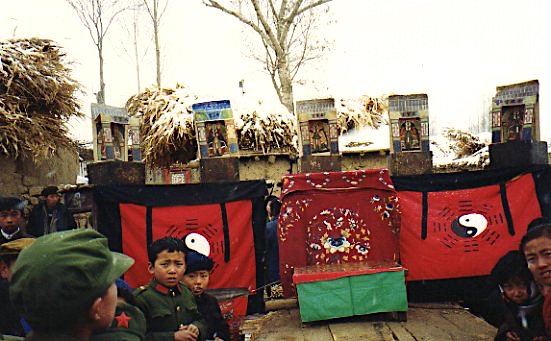
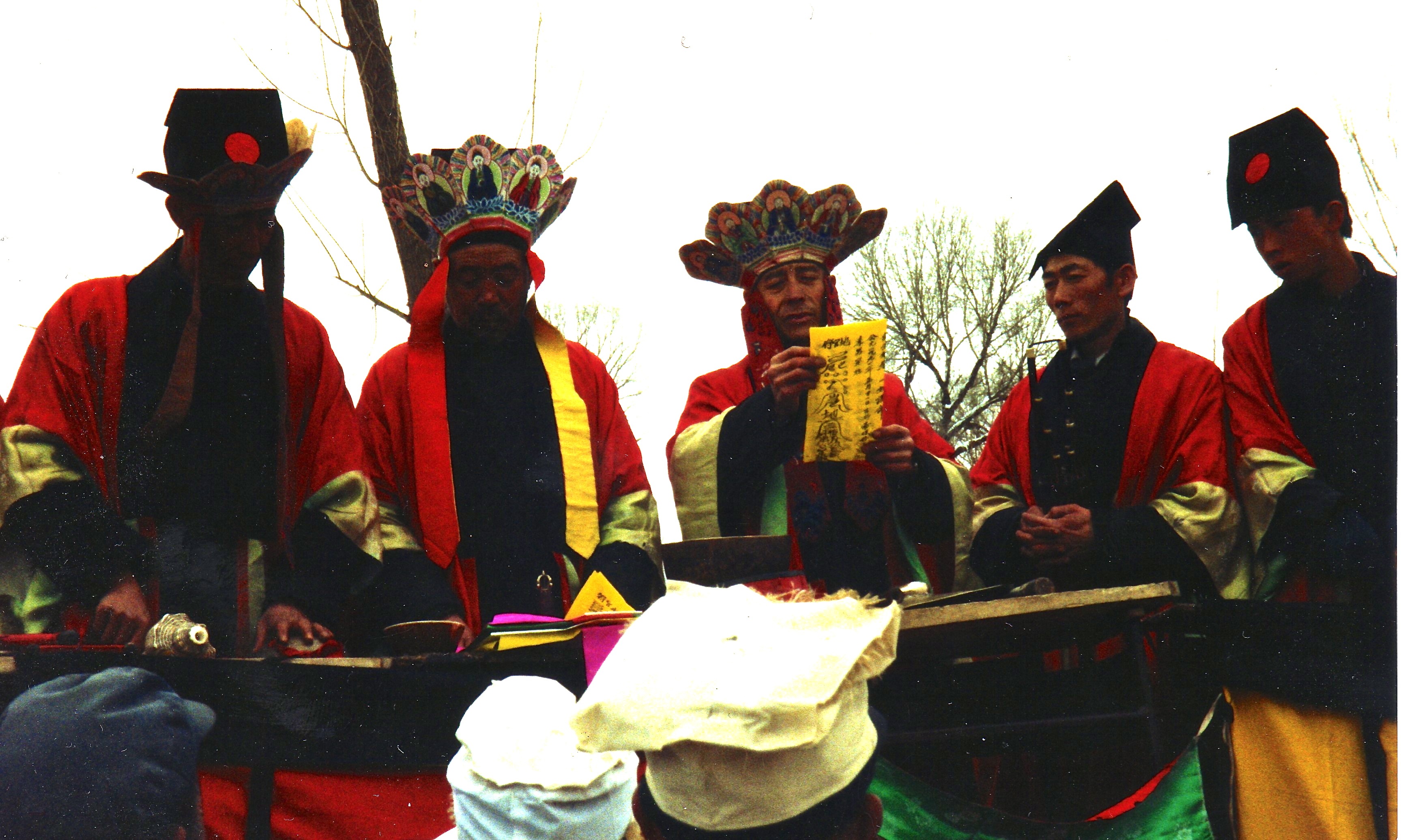
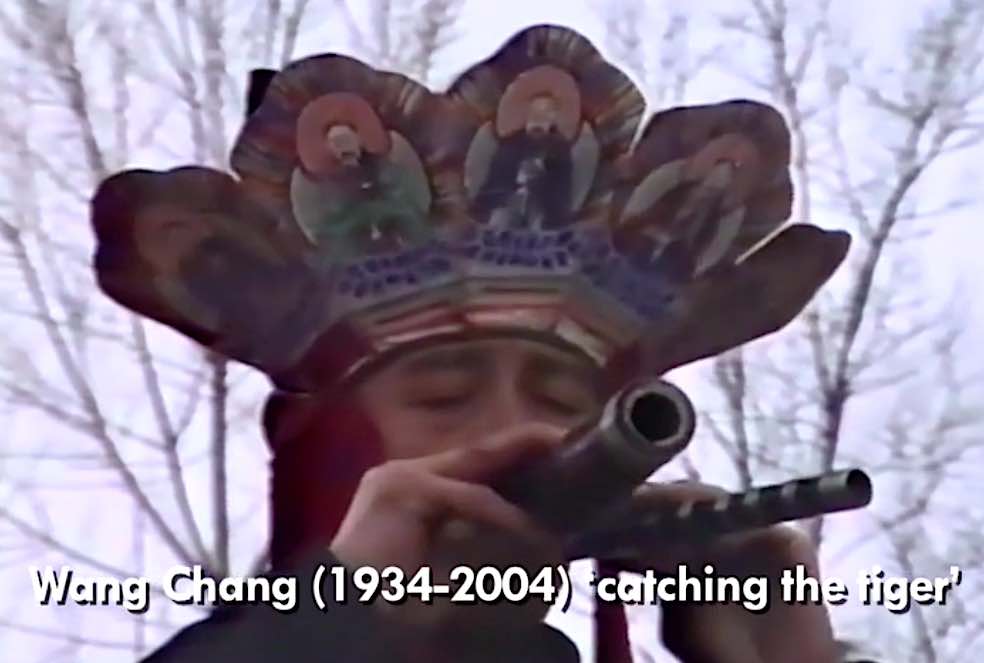
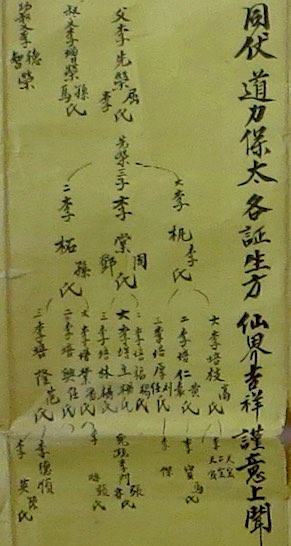
Gaoluo film: another Chinese review

I learned a lot from my invaluable fieldwork companions Xue Yibing 薛艺兵 and Zhang Zhentao 张振涛. Within Zhang’s prolific output, his book on the Hebei ritual associations is outstanding (see e.g. here). He has just published a perceptive review of my recent film Seated at the altar, based on his own rapport with the Gaoluo villagers:

  • “Guying yu duju—Zhong Sidi jilupian ‘Zuotan: 1995 nian Nan Gaoluo cun yinyuehui zhengyue yishi’ yingping”, 孤映与独举——钟思第纪录片《坐坛:1995年南高洛村音乐会正月仪式》影评, Zhongguo yinyuexue 中国音乐学 2025.2.

No sooner had I surmised that Chinese audiences might not articulate the stark differences between my (inadvertently) ethnographic perspective and the sanitised, beautified portrayals from the Intangible Cultural Heritage (e.g. here; cf. Gaoluo film: a village screening), Zhang does precisely that.

The social context of Chinese folk musical cultures hardly appears on film. While I had blamed this on the ICH system since 2004, Zhang shows how deeply embedded is China’s history of romanticising and glamorising rural life. Despite Chinese scholars’ exposure to Western ethnography since the 1980s, his comments suggest that social realism has had little impact, and that the habit of self-censorship remains ingrained. I suppose the Party line is that while one may wish to film for one’s own research purposes, such scenes are not fit for public consumption: that we should draw a veil over poverty—over real life. In international visual anthropology the theoretical nuances of the film-maker’s “gaze” are much discussed, but this seems a particularly disturbing impasse.

Even Zhang Zhentao, who evokes village life in detail on the page, seems somewhat perplexed that we might want to display images of it. He finds the style of Seated at the altar consistent with that of my film on the Li family Daoists, and he might also have mentioned the DVDs with my two books on Ritual and music of north China. Playing devil’s advocate, he reiterates the simplistic notion that foreigners choose to depict China in ugly and shameful images, making the Chinese people “lose face”. He queries an apparent lack of “aesthetic” values (shenmei, where mei means “beauty”), adducing scenes from my films showing squalid streets and dwellings, shabby clothes, old women with bound feet, and the decaying architectural remnants of political campaigns. As he explains, such scenes are justified by the ethnographer’s search for “authenticity” and “realism”. *

To dispel China’s victim complex, it should suffice to watch documentaries filmed in India, Africa or Indonesia—and indeed on our own doorstep, such as De Martino’s films on taranta. But Zhang’s comments suggest that documentaries about other parts of the world have little influence in China.

As to fictionalised films, Zhang mentions the classic 1979 Abing biopic Erquan yingyue, as well as the movies of Zhang Yimou (and rather than the beautified images of Raise the red lantern, I much prefer the gritty realism of The story of Qiuju, or Jia Zhangke‘s depictions of small-town life). In between stand movies like Yellow earth or The old well (see here). While “underground” documentaries like those of Wang Bing, Ai Xiaoming, Hu Jie, and Jiang Nengjie, or the subaltern films of Xu Tong, boldly challenge the Party line, investigative Chinese TV documentaries show (or showed?) scenes of real village life, and brief unedited footage on Chinese websites and YouTube makes a useful resource. I wonder how Chinese audiences assess Sidney Gamble’s footage from 1920s’ Miaofengshan. Some non-Chinese scholars have issued documentaries on expressive and ritual culture in rural China, such as Chinese shadows, Bored in heaven, and the films of Jacques Pimpaneau (see this roundup).  We might also adduce Ashiq: the last troubadour.

Politics: text and image
It’s impressive that Zhang Zhentao broaches the issue of gaze, but he can hardly spell out another respect in which my perspective differs. My films complement my written texts—which though full of detail on the successive social and political upheavals of the 20th century (notably the Maoist era), attract little attention in China because few of them are accessible in Chinese (though see here and here). Politics is the elephant in the room, remaining taboo for music scholars within China; and among Chinese anthropologists too, few go so far as Guo Yuhua in documenting the ordeals of villagers under Maoism (see also here).

Text allows for more detail; film makes a more vivid impact. Whereas the film could only hint at the impact of political campaigns on ritual life in Gaoluo, in my book Plucking the winds I discussed this in some depth—such as the devastating national famine of 1959–61, of which very few images are available, by contrast with propaganda films on the supposed achievements of the Great Leap Forward.

Filming ritual and expressive culture
In China, besides the official taboos on showing poverty and discussing politics, the study of religious ritual is largely confined to textual studies of pre-modern history.

Before the ICH (even during the Anthology era of the 1980s–90s), Chinese fieldworkers rarely had the wherewithal to film ritual activity; and even if they did so, such footage could hardly be published. I too filmed merely for my own research purposes, to enable me to document ritual activity in far greater detail than I could achieve through making notes, taking photos, and recording audio; my footage included all too few scenes of daily life, which significantly enhance a film.
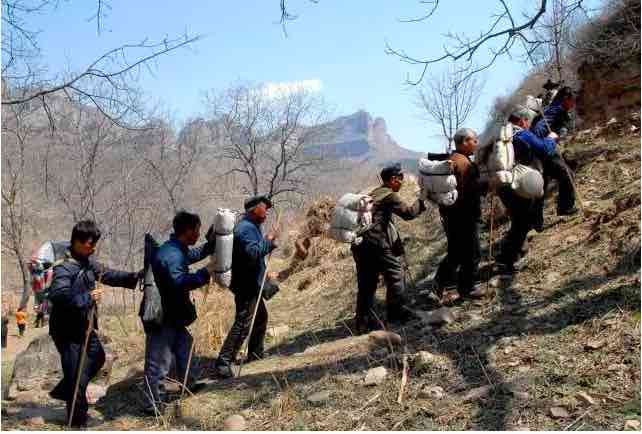
Shaanbei: scenes from Notes from the yellow earth.

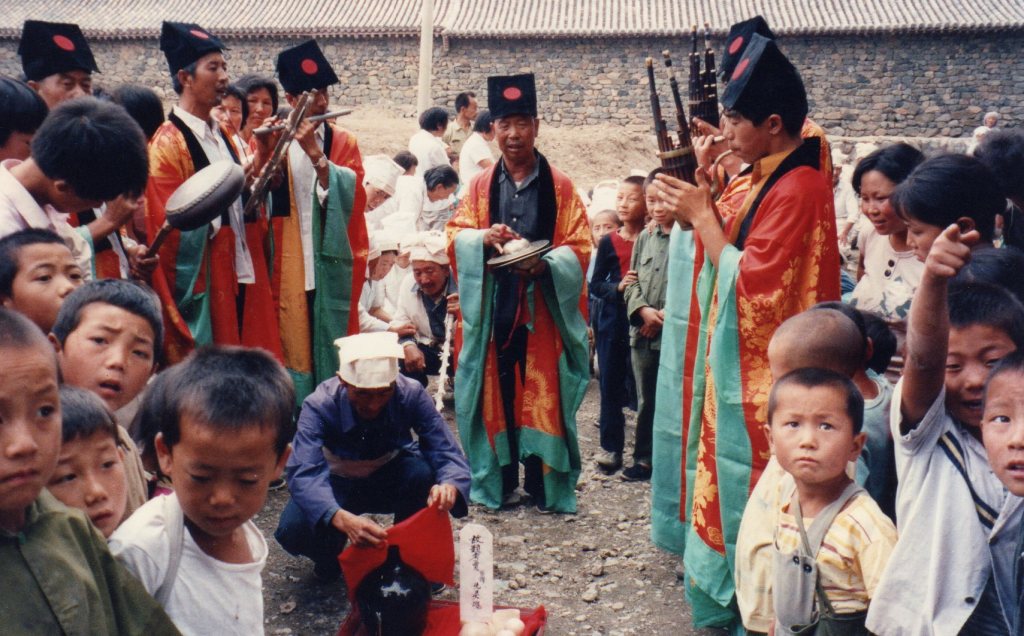
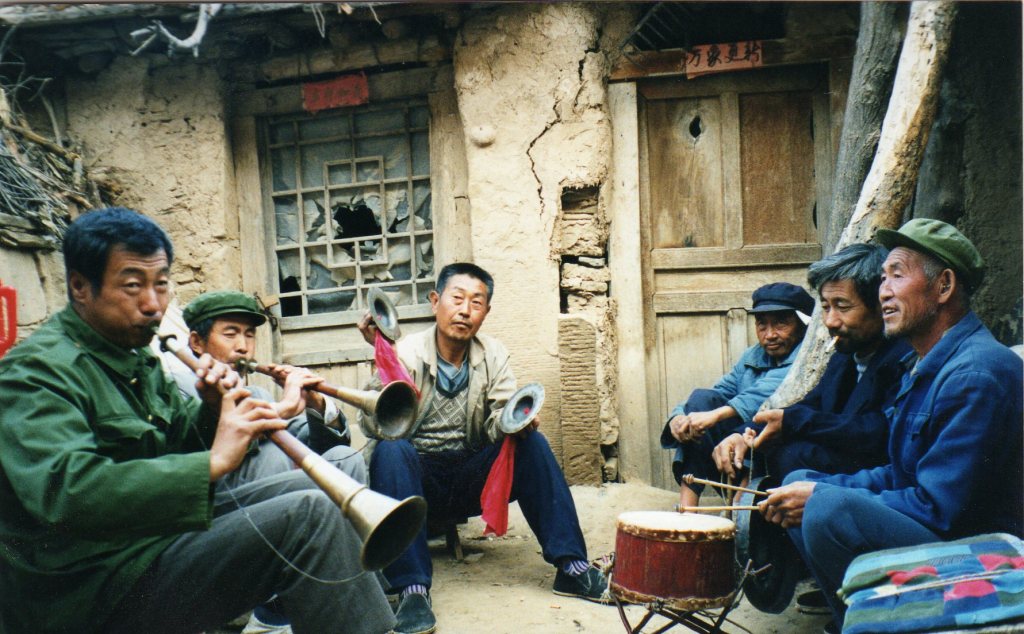
My own films include scenes of lowly shawm bands at village funerals, a blind bard performing for a family blessing, beggars singing at a wedding, and a drunken folk-singing session in a poor peasant home. There is nothing sensationalist or demeaning about all this. If we seek to document rural Chinese communities and their expressive culture, how can we then ignore the conditions in which it takes place? Even if I could think how to sanitise, beautify, and idealise such scenes, it would never occur to me to do so. The social and historical setting matters, but is airbrushed in China. While I see the differences between my approach and that of the ICH, I have no intention of being controversial: I merely seek to document traditional ritual culture as best I can.

Gaoluo: ritual, “music”, and daily life
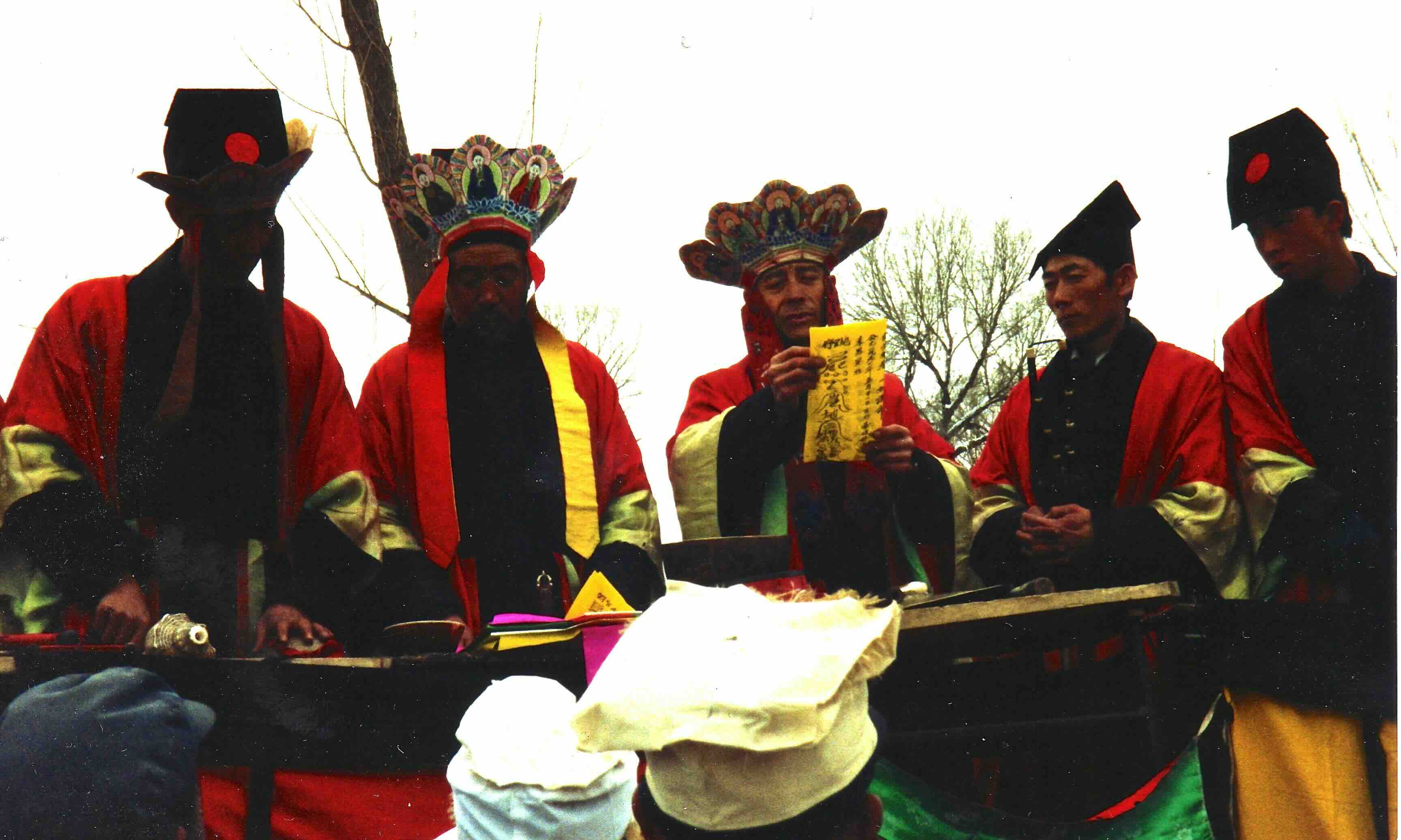
In filming the New Year’s rituals in Gaoluo, my choices were limited, largely consisting not of any grand conceptual vision but of finding physical positions from which to frame the scene.

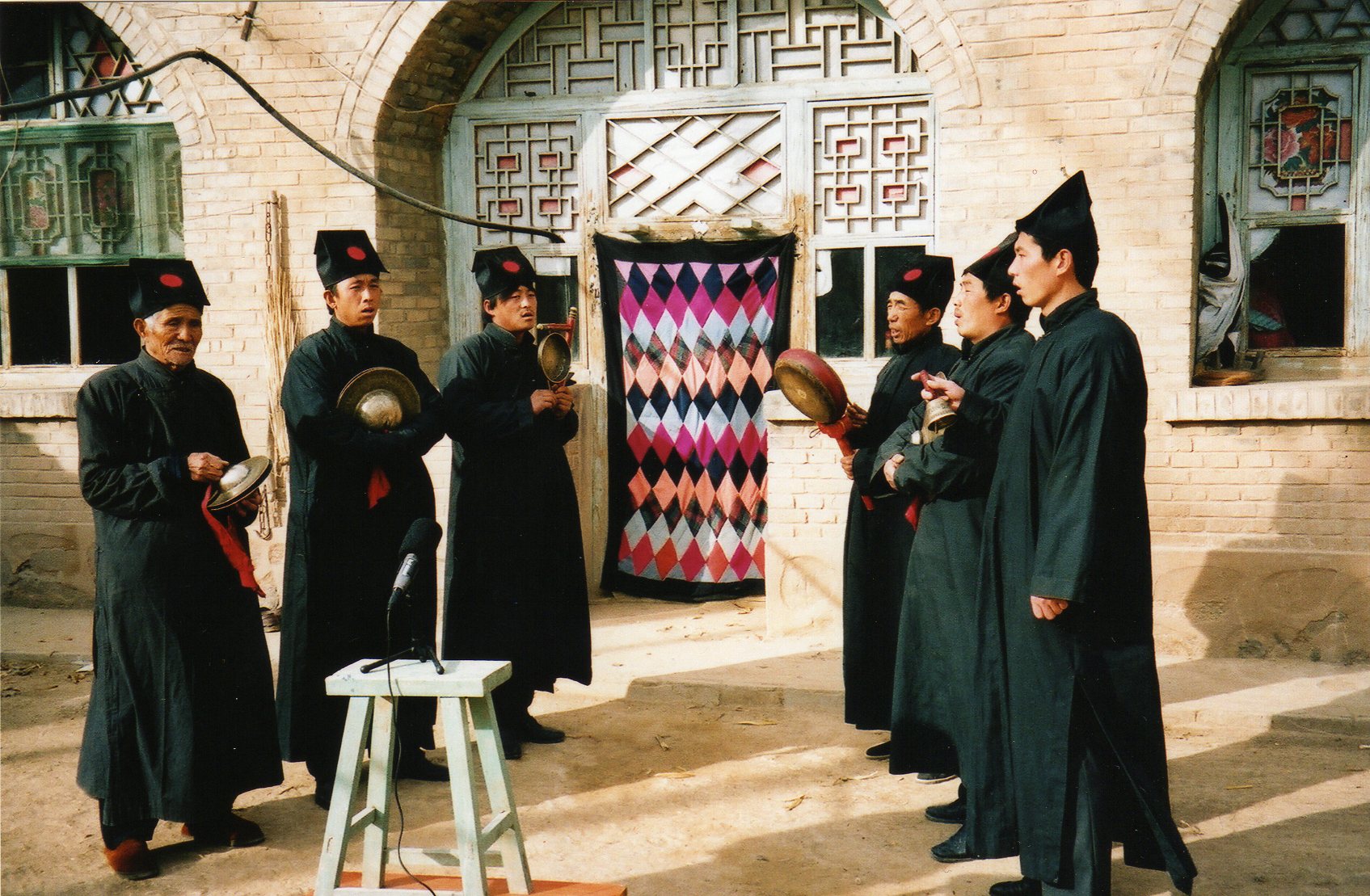
Knowing these villages so well, Zhang Zhentao seems both impressed and disturbed by my vignettes of daily life there—elderly people relaxing in the sunshine, Cai An at his general store, the family eating dumplings. Wearing their everyday clothes, villagers perform in simple peasant houses decorated only by pinups, or before the god paintings in their humble ritual buildings, with cigarette cartons and thermos flasks placed besides instruments on rickety wooden trestles—by contrast with the ICH format of presenting folk groups in fake-antique costumes performing on the concert stage or in tidy, arid government courtyards. Villagers smoke, they joke; they ride motor-bikes and use mobile phones. Social context is important; to censor the conditions of village life would be mendacious. It should go without saying that my films are made with the utmost respect for my village hosts, serving as a tribute to their resilience. **

“Music”
Zhang Zhentao stresses the contributions that musicologists can make to ethnographic filming, but for me the challenge is the other way round. In reviewing Seated at the altar he focuses on the recitation of “precious scrolls” and the moving performance of the percussion suite—but I see these as inevitable components of documenting the entire ritual process. What I find significant is including scenes that may appeal more to ethnographers than to musicologists, such as (in Li Manshan) choosing the date and siting of the burial, the encoffinment, and informal scenes of the Daoists relaxing between rituals; or (in Seated at the altar) worshippers kowtowing and offering incense, or preparing the soul tablet for the deceased.

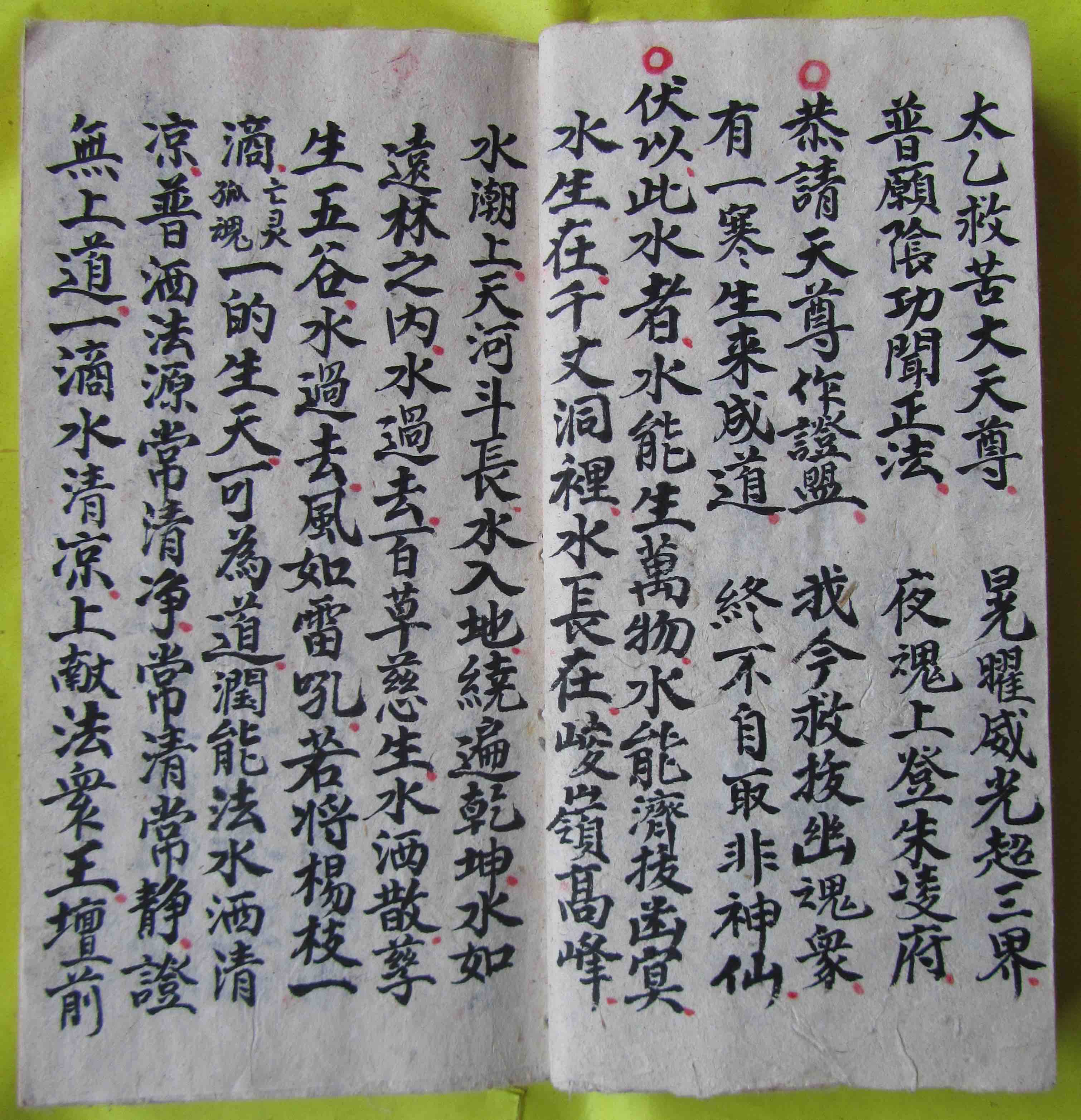
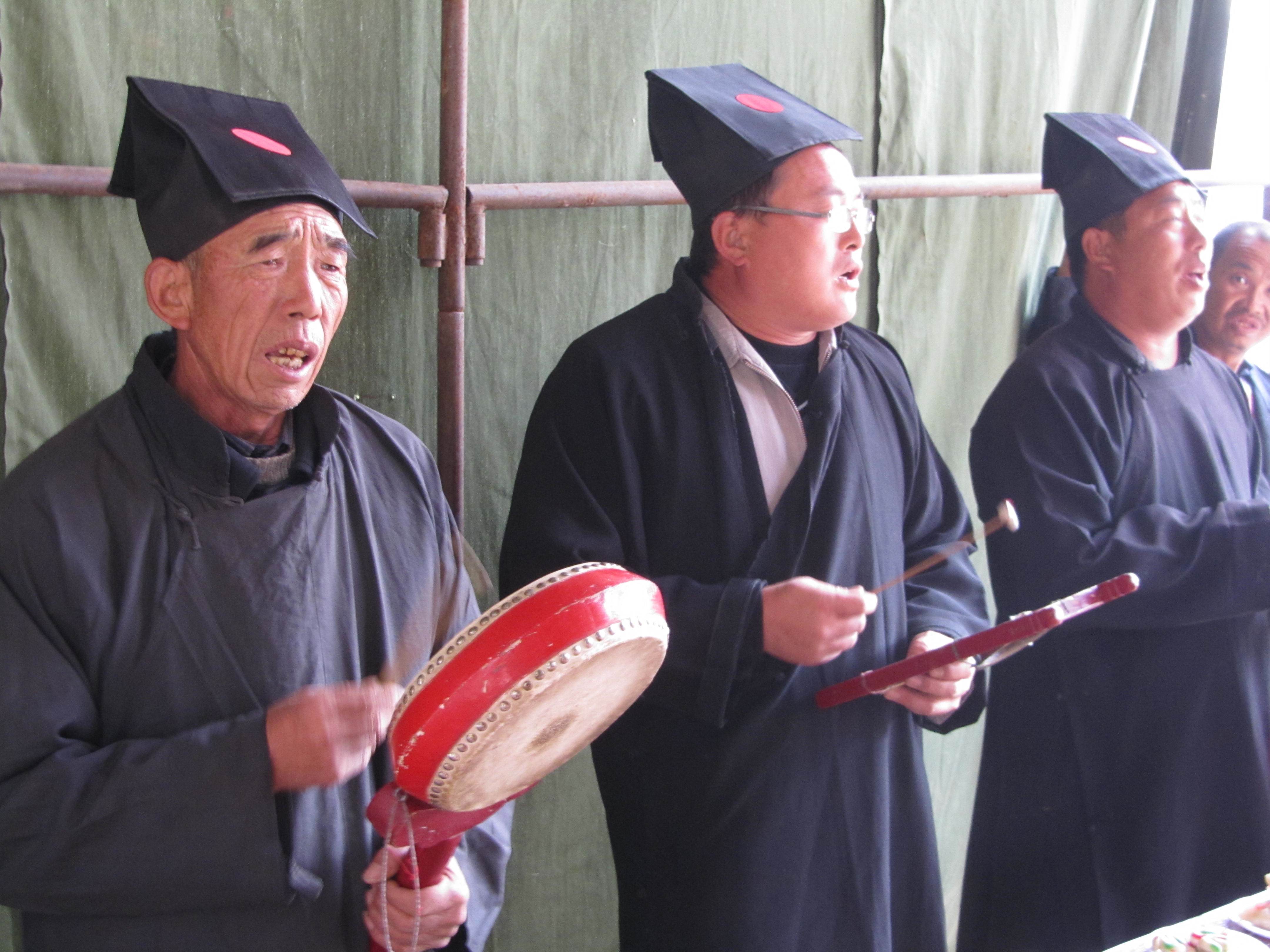
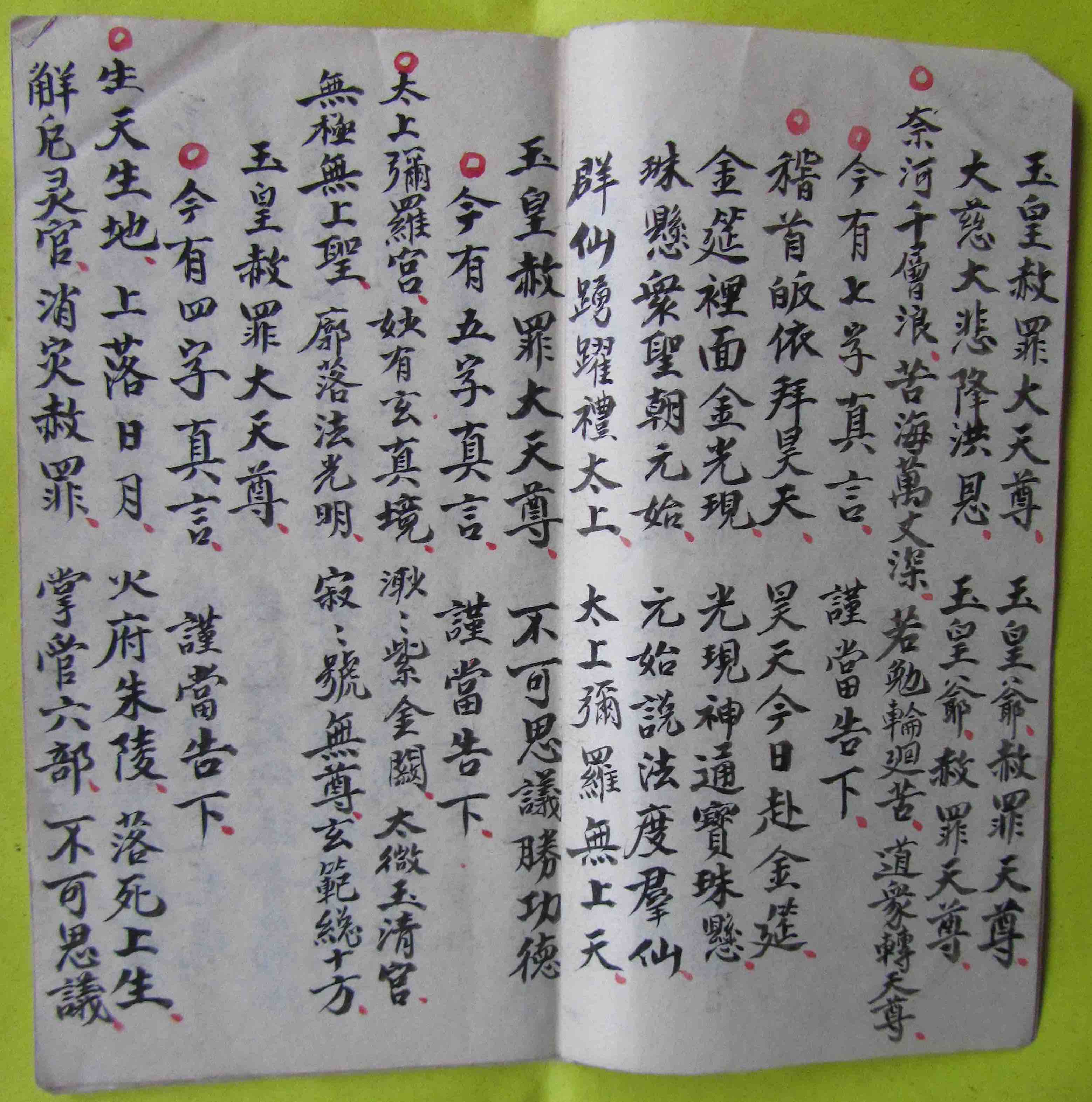
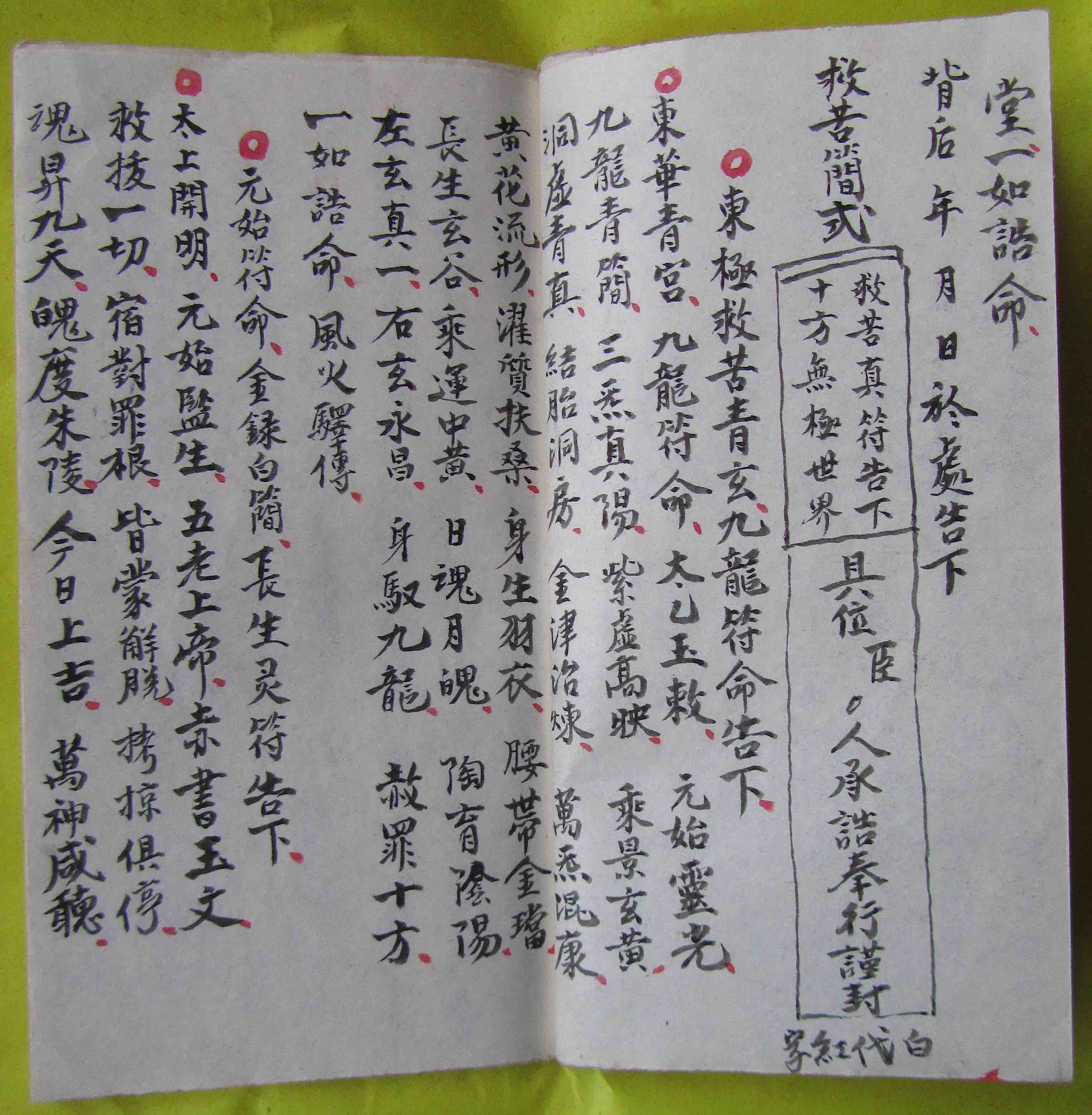
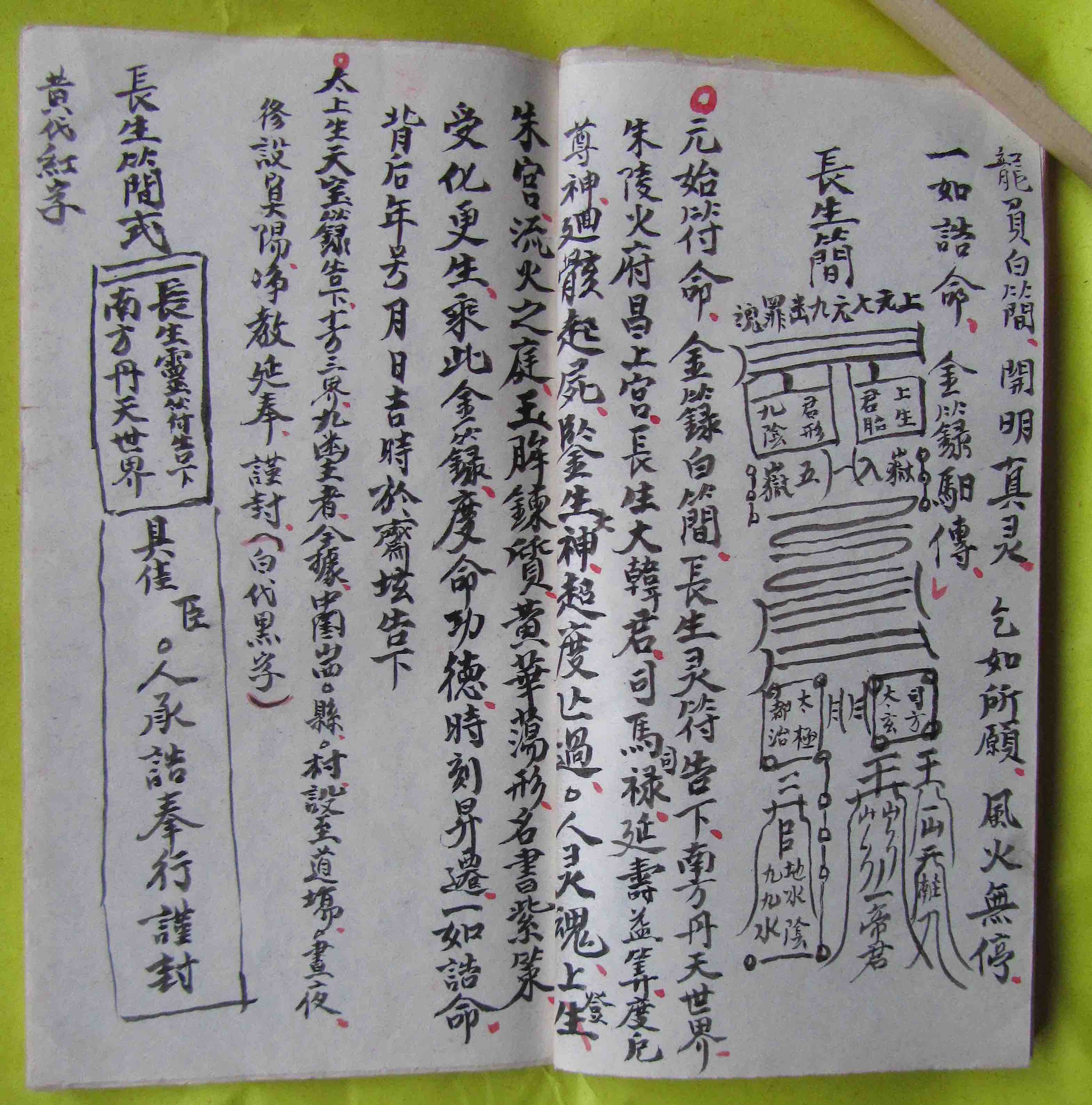
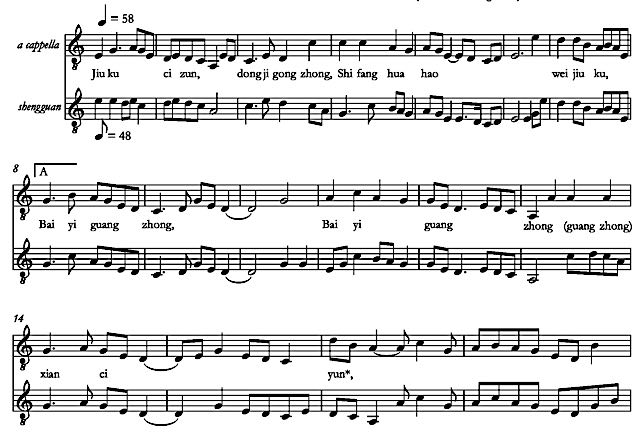
Zhang highlights the vocal liturgists’ renditions of the Houtu precious scroll before the gods in the lantern tent. Here he does well to observe that they had only been striving to recreate it in performance since 1993, at our behest; their efforts were less than ideal, and the future of the vocal liturgy still remains precarious. The recitation of the precious scrolls is most distinctive, but to me, just as crucial are the scenes that show their singing of the hymns that punctuate funerals and the New Year rituals, including The Incantation of Pu’an.

Similarly, while Zhang pays tribute to the visceral affective power of the percussion suite, I would also draw attention to the shorter percussion pieces that punctuate rituals. Still, the suite intoxicated me so much that over the years I missed no opportunity to film it during rituals, which taught me to find a suitable position and to zoom and pan at meaningful places. In China it would be unlikely to show the percussion suite within its actual function of ritual performance, but surely even Chinese audiences will find the result beautiful. True, in the Appendix that follows the final credits, our experiment with Cai An and Cai Yurun demonstrating the sections was one that might occur only to musicologists. ***

As to those final credits, Zhang notes the poignancy of the long list of performers, with their dates—many of them having died since the footage was filmed.

* * *

In sum, I simply fail to see how to evoke village ritual life, in either text or images, without providing social and historical context. Yet basic anthropological principles, that to us are self-evident, appear to struggle to gain acceptance in China—all the more under the current ICH regime. Because I’m so impressed by the work of my Chinese colleagues, I sometimes fail to register the constraints under which they operate.

Meanwhile at the Shanghai Centre for Ritual Music, Xiao Mei offers an impressive training in international approaches to ethnographic film-making, making me keen to see how they bridge the gulf—see my further reflections after my film won awards at the 4th Chinese Music Ethnographic Film Festival in Shanghai this July.


* And what if villagers actively prefer to be displayed in glamorous costumes on the concert stage?! So far I have no evidence that they are so allergic to displaying the conditions of their lives as are apparatchiks.

** Partly because I was reminded of the sad decline of revolutionary hero and vocal liturgist Cai Fuxiang, in the film’s funeral scene I included one tiny shot of the village’s only beggar at the time. I regret not chatting with him, because he would have added to our picture of village life, and our visit might have enhanced his self-esteem.
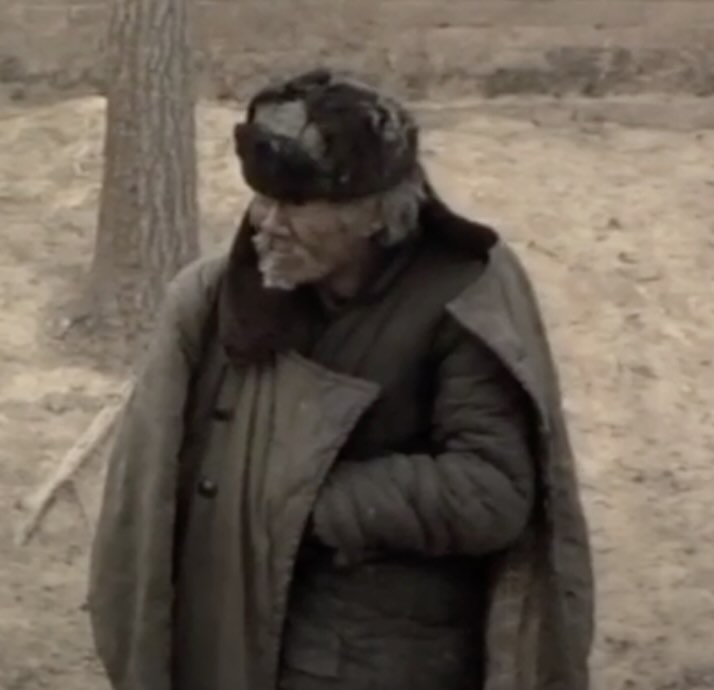
Cf. my sketch of the affable disabled ritual helper Yanjun in Yanggao, whose story I only gleaned at second hand (see under Yanggao: personalities).

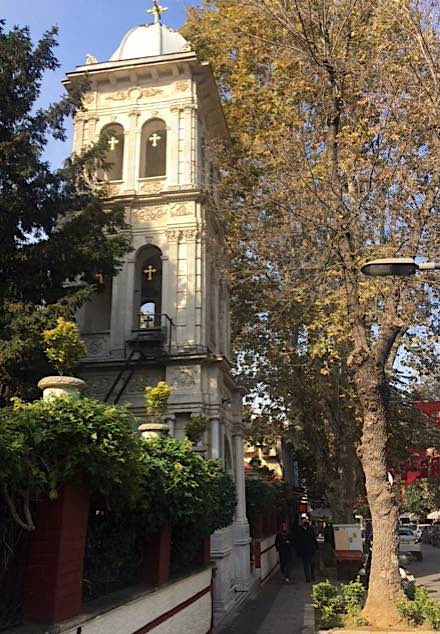
In the film I allude to the Catholic minority in Gaoluo since the late 19th century, the 1900 massacre, and their re-evangelisation by Italian priests from the 1920s. Their continuing activity is a sensitive subject, but the scene of their brass band parading at New Year 1995 was so striking that it seemed acceptable to include it.

*** Cf. the complete shawm suite (with useful musical signposts in the voiceovers) at a 1992 funeral that forms the Appendix of my 2007 DVD Doing things.

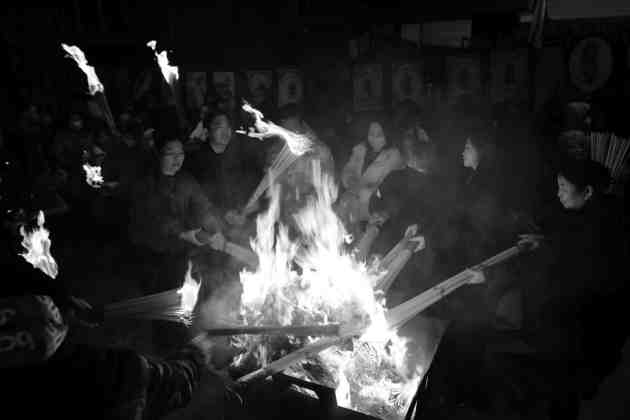
Gaoluo: some themes

Presenting my film on Gaoluo at SOAS the other day, and the following discussion, thoughtfully led by Rachel Harris and Feng Jun, prompted me to try and rework some of my thoughts.

My book on Gaoluo was published in 2004, the result of frequent fieldtrips ever since 1989, and it’s full of detail on the lives of villagers through all the social and political upheavals of the 20th century. But I then moved onto other projects, and I only returned to the topic recently, to compile this film from my footage of the 1995 New Year’s rituals, which makes a nice succinct subject—and already a historical one, as I say in the film.

I see ethnography and film as essential complements to library work on imperial history (see here). This kind of subject, though vital to folk society, can’t be addressed only by reading old books in libraries. Actually, the topic hardly appears at all in old books—it’s only revealed by fieldwork. Until the 1950s almost every village in the region had an organisation like this; and many of them still do. While I eventually focused on this one village, we also did a survey of over a hundred village associations nearby (see e.g. under “Hebei” in the main menu, including this survey).

Religion
The whole topic of the Hebei ritual associations was only “discovered” by Chinese musicologists in 1986, and it has become a major theme within that discipline—but alas, not in religious studies. I think there are two main reasons for this.

First, terminology. These groups are now commonly known by the umbrella term yinyuehui, which seems to translate simply as “Music Associations”. But it’s confusing: in these villages the term yinyue refers very specifically to the melodic instrumental ensemble that accompanies the rituals of Buddhist and Daoist temples. That indeed was our initial interest, but it’s only one aspect of the associations’ ritual activities, their “instrumental department”, if you like. The term does have an authentic historical pedigree, but to us (both in the West and for urban-educated Chinese) it suggests an unfortunately secular image, like some kind of folk club for entertainment, which encourages Chinese attempts (both in the media and in academia) to downplay the pervasive role of religion (or “superstition”!) in folk society. So I obstinately insist on calling them ritual associations. Despite the gradual decline of vocal liturgy in the region, associations preserve many ritual manuals. And while the melodic instrumental repertoire now dominates, many groups regard these pieces as “scriptures”.

Apart from terminology, folk religion is a sensitive subject. There are some fine scholars in China, but they mainly write about earlier history and written texts, and are cautious about documenting events since 1949, or current activity; whereas we who study expressive culture incline more towards fieldwork. At least, scholars of religion could choose a few villages to clarify the transmission (whether “Buddhist” or “Daoist”) from early temple priests, and study early artefacts such as ritual manuals (not least the “precious scrolls”) and god paintings. While it may now be hard to establish a different image to that of the ICH (see below), the system has legitimised such associations, and they are not subject to the taint of “superstition”—even if scholars of religion may choose to exercise a certain discretion about the early sectarian connections that we documented.

These associations on the Hebei plain are devotional, priding themselves on providing ritual services for their home village without payment. Their ritual sequences are not very dense, but their purpose is to appease the gods. I again put them in the context of other manifestations of religious behaviour in China (such as sects, occupational groups of household Daoists, and spirit mediums). Like my film on the Li family Daoists (which I also encourage you to watch!), this film is set in the north; the soundscapes of the two films are similar, but their social contexts are rather different.

After the end of the main film, the Appendix gives some clues to the workings of the majestic percussion suite, ending with the most moving complete rendition. This is the most convincing illustration of the inadequacy of text, audio recordings, and photos, and it shows the villagers’ deep commitment to the tradition.

All this is a good illustration of how ethnomusicology is based on society and soundscape. Ritual in performance is always animated by sound, so soundscape should always be a major element in our study of ritual. Indeed, most local traditions of “Chinese music” depend on ritual—folk-song, opera, narrative-singing, and dance. One might compare the ritual groups in southwest China studied by Helen Rees, or “song festivals” in the northwest. In Uyghur culture, the pervasive role of Islam is masked by Party propaganda on muqam. The world music industry also remoulds “Sufi music” misleadingly to highlight instrumental music.

Conflict, and the 1949 barrier
Politics and social change are major themes of my book and this website. It’s always important to break through the 1949 barrier. We must take modern history seriously. The story always continues, from imperial and Republican times to the Maoist and reform eras, adapting to the changing times. People’s life stories and personalities make a revealing human window onto history and social change. Stories like those that I document—amidst campaigns, conflicts, famine, massacres, thefts—are airbrushed under the current Chinese regime.

Unlike small occupational household groups such as Daoists and shawm bands, these associations are public bodies, which the villages cadres have always played a major role in supporting.

I’m always struck by this amazing image of a former monk training disciples in a nearby village in 1959 (see here, under North Xinzhuang), just as the devastating great famine was occurring—the famine is among crucial topics that can hardly be addressed in China.

Shadows in the field
I could only offer superficial responses to Feng Jun’s salient query about how I positioned myself in relation to the people and events I was documenting. It’s a major theme of the book (and of a thesis in Chinese). I was most fortunate to have two excellent fieldwork companions from Beijing, who were totally on board with studying social and religious change. It’s most important to stay in the village, and to take part in their ritual life (neither of which is common for Chinese scholars). The villagers were open in replying to my questions, which Chinese scholars hardly asked.

I never thought of making films for the public domain; I filmed strictly for my own research purposes, and only realised later that some footage could be edited into watchable films. Our visits energised the Gaoluo association, while others were declining, but transmission was a constant anxiety of theirs, and a theme of our discussions. We can now see this as a precursor of the Intangible Cultural Heritage system.

The ICH
Since my last visit in 2003, a lot has happened in these villages. They’re no longer so poor. Crucial issues, everywhere, are migration, social media, state education, and the whole emptying of the countryside. And there’s no escaping the ICH system, which has influenced many such village groups. Many authors have described how the system commodifies, secularises, and reifies local traditions (see e.g. here). It’s state propaganda; most “research” under its auspices is superficial. While my film, and the book, inadvertently make a contrast with the celebratory approach enshrined by the ICH, I’m perturbed that Chinese viewers don’t seem to articulate this; they can’t read my book in Chinese, and anyway I’m not sure they would care to dwell on my different approach. With recent Chinese fieldwork dominated by the ICH, it is hard to gain a more in-depth picture.

Although the system uses “music” and “culture” as a smokescreen to downplay religious life, it works both ways; for the communities themselves, it helps protect them, legitimise them. With the tenuous survival of these groups under question ever since the 1980s’ reforms, joining the ICH made a tempting expedient for the association leaders. And faith endures, with villagers using the system to their own ends; the Gaoluo association still does funerals, and villagers still offer incense.

New Year in Gaoluo, 2025. Image: Wei Xiaoshi.

The village’s Catholic minority (whose brass band took part in a “demonstration” on 1st moon 15th in 1995, shown in the film) makes an intriguing sub-plot in the story. In this whole area the relationship between “Patriotic” and underground churches has long been opaque, and without a prolonged stay it would be hard to further our understanding of the shifting scene.

As with my work on the Li family Daoists, the combination of book, film, and website is most instructive.

Not quite an update

I’m not exactly hibernating, but while I have various projects on the go, new posts are few and far between at the mo—so meanwhile do keep working through my previous ouevre:

Meanwhile, to follow this update on Nicolas Magriel’s voluminous sarangi site, he continues to add precious material… (see also under A garland of ragas).

I’m trying to abandon the iniquity of Twitter by moving to BlueSky, so do follow me there.

“Normal service will be resumed as soon as possible”

More films on my YouTube channel!!!

On my YouTube channel, besides my new film on the 1995 New Year’s rituals in Gaoluo, two exciting additions:

Screenshot

Screenshot

  • The amazing Hua family shawm band 滑家鼓乐班 playing the suite Da Yanluo 大雁落 for a funeral, Zhuanlou village, Yanggao county, north Shanxi, August 1992 (here).
    From the DVD Doing Things with my book Ritual and music of China: shawm bands in Shanxi (2007).
    The Hua band’s repertoire (“Ming dynasty bebop”) is heard on the ear-scouring CD Walking Shrill (Pan Records, 2004). Note also this detailed comparison of shawm bands with the qin zither, and this piece in particular! For more on shawm bands in China, see Walking Shrill, and for shawm bands around the world, here.

Do spread the word!

My YouTube channel!

I wonder how the new Menu is going down… Under “Roundups” there you’ll also see Playlists. I’ve never even noticed that I have a YouTube channel, but now—with the stimulus of publishing my new film on Gaoluo there—I’ve begun the long process of creating new content.

YT

In due course I’ll upload my other documentaries on Chinese ritual cultures. Meanwhile I’m gradually adding playlists to reflect some main topics of this site, so far including

This exercise might seem a tad nerdy, but I naively imagine the selection in the playlists may lead the listener [singularEd.] to the numerous posts in which I expand on them—hmm, I spend all my time going on about how silent immobile text isn’t enough, and I now find myself pointing out that film isn’t enough—No Pleasing Some People…

A new menu!

umbrella

Now that I’ve supplemented my  portrait film of Li Manshan with precious footage from the 1995 New Year’s rituals in Gaoluo, I feel it’s time to rearrange the deckchairs on the Titanic by revamping the Menu.

Here’s an instance of the submenus:

Screenshot

With a personal selection of some main topics, I hope it’s now more user-friendly. It’s work in progress, and doubtless I will continue refining it in the coming months, so please Bear With while I edit links throughout the site. It may take us all a while to get used to it—do keep using the search box too.

The new sequence (with many sub-menus to explore) goes

  • Home (also under reconstruction!)
  • POSTS
  • Li family Daoists
  • Gaoluo
  • Hebei
  • Elsewhere (Shaanbei, Gansu, Fujian…)
  • Themes (Zhengyi/Quanzhen, Fieldwork, Ritual, Famine…)
  • Roundups (including folk traditions around the world)
  • Western Art Music

Good luck! Feedback welcome.

Yanggao: a distant Daoist connection

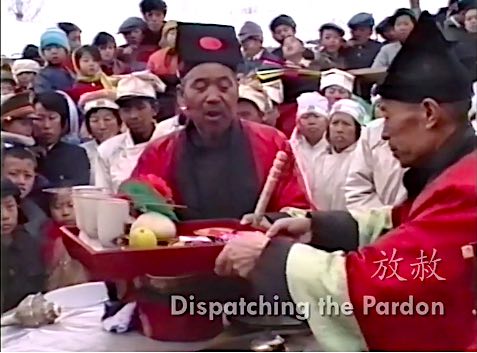
Pardon 1991The Li family Daoists perform the Pardon ritual at village funeral, Yanggao 1991.

My first visit to Yanggao in 1991 began an enduring relationship with the Li family Daoists and other ritual specialists of the otherwise unprepossessing county in north Shanxi. The great Li Qing (1926–99) was the seventh generation of household Daoists in the lineage, his son Li Manshan the eighth (besides my film and book, posts are rounded up here, including More Daoists of Yanggao, and Yanggao personalities).

Earlier this year I wrote about the venerable Buddhist monk Miao Jiang, also born in Yanggao. Now, thanks to Yves Menheere, I’m intrigued to learn of another native of the county: Li Wencheng 李文成 (no relation to our Daoist lineage!), an “old revolutionary” who miraculously became General Secretary of the Chinese Daoist Association in his 60s. He has just died at the age of 97, prompting nationwide memorial ceremonies (clearly secular services!).

Focused on the PRC, the Bitter Winter website’s coverage of (abuses of) religious liberty and human rights is important, even if I sometimes quibble with its stance (such as here). To augment its obituary of Li Wencheng I’ve gone back to the (selectively) detailed interview by the Chinese Daoist Association in 2021 (and this shorter eulogy, even more conformist). Bitter Winter is indeed frosty:

The former General Secretary of the Chinese Daoist Association knew nothing about religion but was made by the CCP first into a Catholic and then a Daoist leader. […] Li was a crucial figure in the history of government-controlled Daoism. His life and career shed a light on how the CCP selects the personnel it calls to lead the country’s religious organisations.

There can be no doubt about the subservience of state religious departments to the Party. Normally I would give short shrift to such high-ranking apparatchiks; while CCP religious policy is a perfectly valid research topic, it may obscure grassroots practice. Since Li Wencheng’s life makes an intriguing contrast with those of my Daoist masters in the county, here I will intersperse his story with that of the Li family Daoists on the eve of Liberation, under Maoism, and since the 1980s’ reforms (again, covered in my book and film); as well as with that of the eminent Miao Jiang. Despite my own aversion to officialdom, my interpretation will be rather less polemical than that of Bitter Winter.

* * *

With my field experience in Gaoluo, I was keen to document the early years of revolution on the plain just south of Yanggao county-town (for the disparity between my fieldwork methods in the two sites, see here). But I never found any “old revolutionaries” there who could describe the period in detail.

One could hardly expect upright cadres like Li Wencheng to volunteer frank reminiscences of the events surrounding the trauma of land reform. But his account makes a rather more personal supplement to that of the 1993 Yanggao county gazetteer. [1]

Some sites in the partial overlap between Li Wencheng’s war years and
(in red) household Daoist bases. Cf. map here.

Li WenchengLi Wencheng in 2021. Cool trousers, eh. Source: Weibo.
Li Wencheng was born in Gucheng village in 1927, the year after the great Li Qing. From July 1945, just before the surrender of the Japanese invaders, he “engaged in revolutionary activities” further south in Yanggao,  joining the motley armed militia of 2nd district, a mere couple of dozen men. The militia was soon disbanded, whereupon he was transferred to the county lianshe 联社 association (forerunner of the gongxiaoshe Supply and Marketing Cooperatives). He gained admission to the CCP in March 1946.

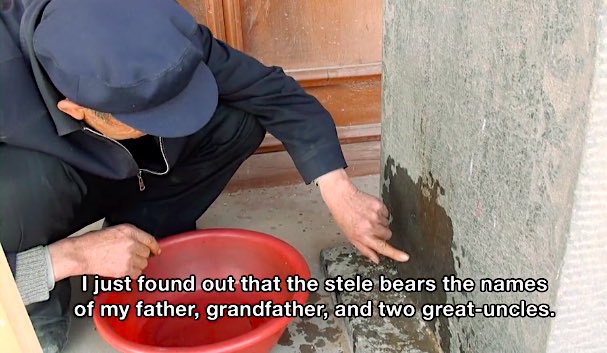
Ritual life in Yanggao had persisted even under Japanese occupation. A 1942 stele commemorating the Zhouguantun temple fair lists the names of five Daoists from the Li family, who dutifully “offered the scriptures”—including Li Qing, then 17 sui. Li Qing recalled, “Our ritual business didn’t suffer during the occupation—the troops, themselves devout, even made donations when they came across us doing Thanking the Earth rituals! The local bandits didn’t interfere either”. He married in early 1945; his son Li Manshan was born in 1946. Li Qing’s Daoist father Li Peixing was shot dead accidentally by Nationalist troops in 1947.

After the Japanese surrender the Communists briefly took over Yanggao town, but by autumn 1946 Li Wencheng joined them in retreating south to the hills to engage in guerilla activity when Fu Zuoyi’s forces occupied the area. Fording the Sanggan river, they traversed the mountains of Guangling and Lingqiu counties to reach safety in Fanshi. Though travelling in only two trucks, they had to take cover from bombings by KMT planes. In Fanshi Li Wencheng took part in the initial stages of land reform, training for three months in Hunyuan county-town, base of the North Shanxi district committee.

All these counties also had active groups of household Daoists, intermittently serving the ritual needs of their local communities (Guangling, Hunyuan, as well as the household Buddhists of Fanshi).

Li Wencheng’s first mission to implement land reform was doomed to failure, sent all alone to a mountain village on the very southern border of Yanggao county. In December 1947, while still involved in guerilla warfare, he was deployed to Yanggao 1st district, serving as financial assistant (cailiang zhuli 财粮助理) for the imposition of land reform in Upper village (Shangbu 上堡) just north of Dongjingji.

The CCP county administration had moved south of the Sanggan river, but the district base was just south of Gucheng at Dongxiaocun, a large village of over a thousand households, its Upper Fort (where they set up) towering over the Lower Fort. But it was sandwiched nervously in between the KMT strongholds of East Jingji township, just 20 Chinese li (10 km) east, and Xubu to the west. The guerillas often had to flee from KMT cavalry raids.

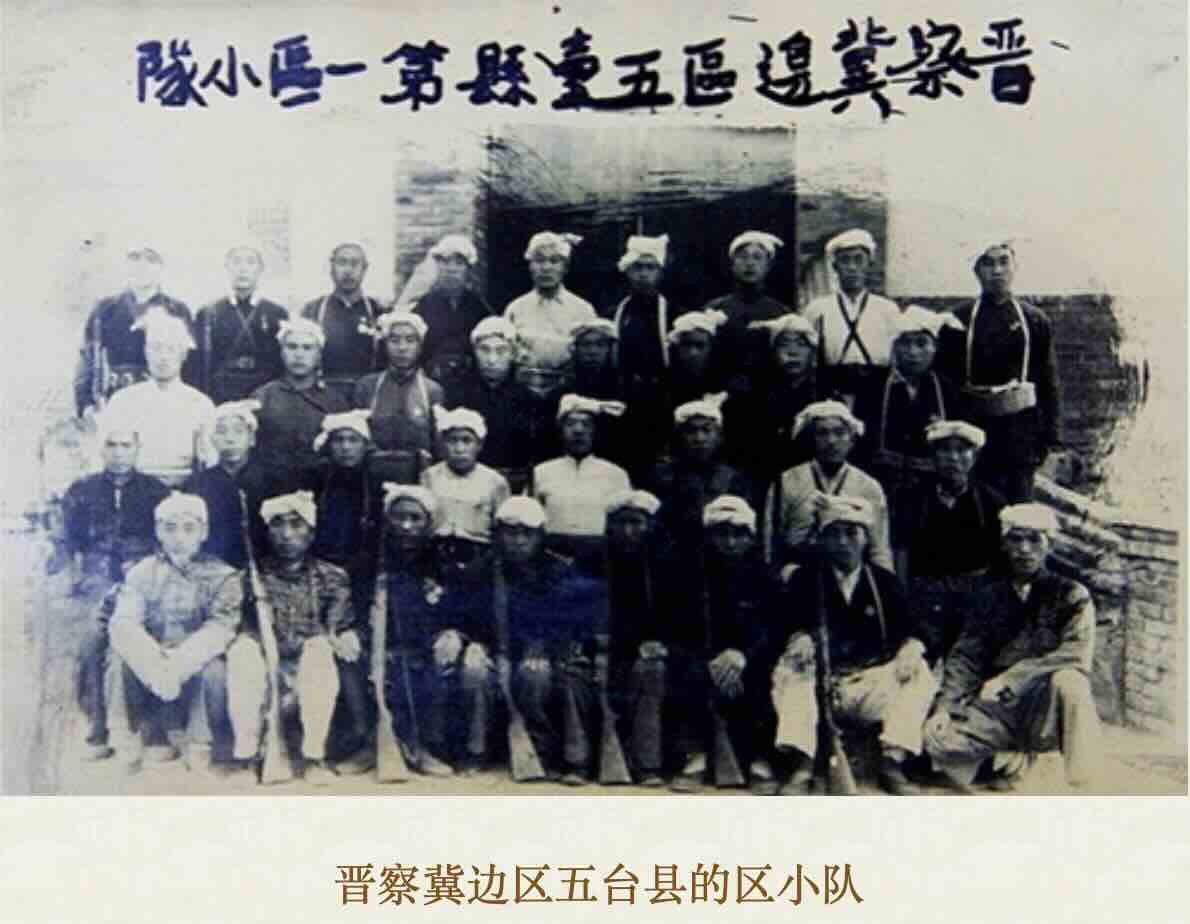
Li Wencheng xiaodui

Shanxi-Chahar-Hebei frontier zone, Wutai county 1st district “small team” militia. Source.
Note the headscarves, archetypal emblem of the revolution.

By 1948 the Communists could look forward to victory, and the Party government was able to move back to Yanggao town. In the autumn, with Yanggao already “liberated”, Li Wencheng was sent to “support the front line” (zhiqian 支前), providing supplies for the troops around the Sanggan river, Fengzhen and Jining further north, and Zhangjiakou.

LPS and wife

Li Peisen and his wife Yang Qinghua, late 1940s?

In 1947 in Upper Liangyuan, household Daoist Li Peisen, former village chief, perhaps realising that land reform was imminent, quietly moved his family to his wife’s natal village of Yang Pagoda in the hills just south, taking his sets of ritual instruments and costumes, as well as two trunks full of scriptures handed down in his branch of the lineage. People from “black” families tended to encounter less scrutiny outside their home village. The family of Li Peisen’s wife were well-off and well connected; both he and his wife are remembered as highly intelligent. Their move was clearly an astute way of sidestepping any investigations into his background—his economic standing, and his connections with the vilified Japanese and Nationalists. Yang Pagoda might make a safer base from which to survey the lie of the land under the new regime—the potential sensitivity of practicing ritual would have been a minor issue.

Yang PagodaLi Peisen’s cave-dwelling in Yang Pagoda village.
Anyway, Li Peisen wasted no time in displaying his political correctness. Amazingly, he now gains an honorable mention in the county gazetteer. In March 1949—just as family members back in Upper Liangyuan were being stigmatised with a “rich peasant” label—he was the very first in the whole county to organise a mutual aid co-op, consisting of three households. Li Peisen’s move to this tranquil village, and his wife’s careful assertion of local status, were to play a major role in enabling the lineage to preserve its Daoist traditions.

Most of the household Daoist traditions in Yanggao county were based on the plain just south of the county-town; in the hills further south in the county, such groups seem to have been quite few even before the 1950s (I listed some groups in my book, p.63).

Under Maoism
From early 1949 Li Wencheng took up a series of administrative posts in Yanggao, then part of Chahar province, serving as secretary of county and regional propaganda departments. In 1950 he married Zeng Hua in Yanggao town. She came from East Chang’an bu village, just southwest of Upper Liangyuan. Their three children went on to find work further afield, whereas Li Wencheng’s four siblings continued tilling the land in Yanggao.

By 1952 Li was assistant editor of the financial team of the Chahar Daily, but later that year Chahar province was abolished and he was transferred to Beijing with over twenty other journalists, where they found themselves under-employed. With two others he was soon selected for the Religious Affairs Department of the Cultural and Educational Committee of the State Council. For six months in 1954 he was trained in “religious history, religious policies, and the domestic and foreign religious situation”. He then took part in a study class for Catholic clergy in the Church of the Saviour (Xishiku) in Beijing, along with over a hundred priests and bishops. As he recalled, they mainly studied patriotism and anti-imperialism, on the basis of articles opposing religion by Fang Zhimin 方志敏, a Red Army military commander executed by the KMT in 1935. Whatever the truth of the incident leading to Fang’s execution, [2] this hardly made a promising introduction to the subject. Li Wencheng now worked loyally for the Chinese Patriotic Catholic Association and the Religious Affairs Bureau. Bitter Winter:

By his own admission, he was a Marxist who knew precious nothing (sic) about religion.

But in contrast to all the detail on the War of Liberation, the interview has a typically glaring lacuna between 1954 and 1984. Through successive political campaigns, even Party loyalists had to be very cautious; serving as a cadre was an unenviable task that could easily lead to labour camp, even before the violence of the Cultural Revolution. The interview doesn’t broach Li Wencheng’s duties in monitoring Catholicism through the 1950s and early 60s—a stressful period. After the arrest and imprisonment in 1955 of Bishop Gong Pinmei along with several hundred priests and Church leaders, the official Chinese Catholic Patriotic Association was founded in 1957, marking a schism with the Vatican, but underground house-churches continued to function. Nor does the article mention Li Wencheng’s experiences during the Cultural Revolution. We may never learn the story of how he weathered the period.

church

 The Catholic church, Gaoluo (just south of Beijing)—built in 1931, destroyed in 1966.
The village’s Catholic families maintained their faith through the decades of Maoism,
reviving since the 1980s but still resistant to the “Patriotic Church”.

Back in rural Yanggao, Miao Jiang (b.1953) came from a devout Buddhist family in West Yaoquan village, somehow maintaining his faith through campaigns, having his head shaved in Datong to become a monk at the extraordinary time of 1968.

While the Li family Daoists kept performing after Liberation, encroaching collectivisation led to ever more desperate poverty, and by 1958 Li Qing was happy to take a state job in the North Shanxi Arts Work Troupe based in Datong city, even though their tours of the countryside were tough. He returned home when the troupe was cut back in 1962, after the worst of the famine. Despite a brief revival, Daoist ritual was silenced by 1964, and through the Cultural Revolution the Li family lived in fear, vulnerable by virtue of their “black” class background.

Minghui

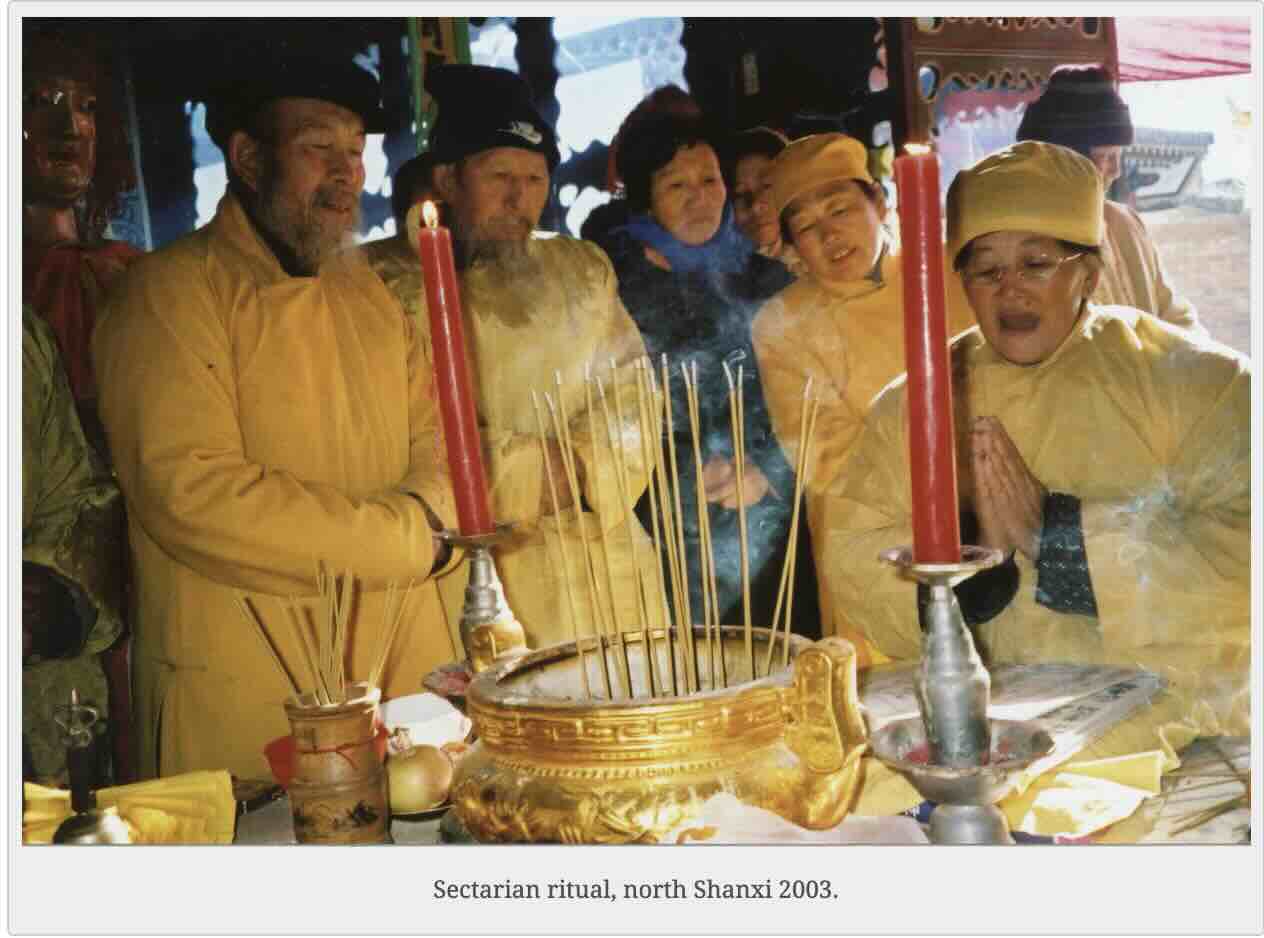
Even less palatable for a Party stalwart like Li Wencheng would be sectarians and spirit mediums, many of whom somehow maintained clandestine activity under Maoism despite campaigns to suppress them soon after Liberation. In Yanggao, village adherents of the Bright Association (Minghui) and Yellow Association (Huanghui) recited lengthy “precious scrolls” as part of rituals for their own followers; the leader of one such group even transmitted the liturgy to his teenage son early in the Cultural Revolution. Since the death of Mao and the downfall of the Gang of Four, both sectarians and mediums revived, broadly tolerated by the local authorities.

Since the reforms

Miao Jiang x

Miao Jiang has been based at the Buddhist mountain complex of Wutaishan since 1980, as the mountain opened up to a massive reinvigoration of “incense fire”after the depression of the Maoist era. His devotion to restoring temple life there was soon recognised as he was fêted with official titles.

But in utter contrast to Li Wencheng, he has remained aloof from worldly affairs: his allegiance has always been to the dharma, and any organisational responsibilities grew out of his faith. Eschewing the lifestyle of official banquets, he adheres to a simple Buddhist diet, while sponsoring charitable and relief projects. Still, religion needs organisers…

The Li family Daoists had begun to resume activity from around 1980 (see Testing the waters, and Recopying ritual manuals), and were soon busy “responding for household rituals”. In autumn that year, Li Manshan took his first train trip to Beijing, with his cousin Li Xishan. They wanted to buy a sewing machine, not available (or at least substandard) in Datong, but in the end they couldn’t find a good one in Beijing either—so Li Manshan bought a big bag of socks instead.

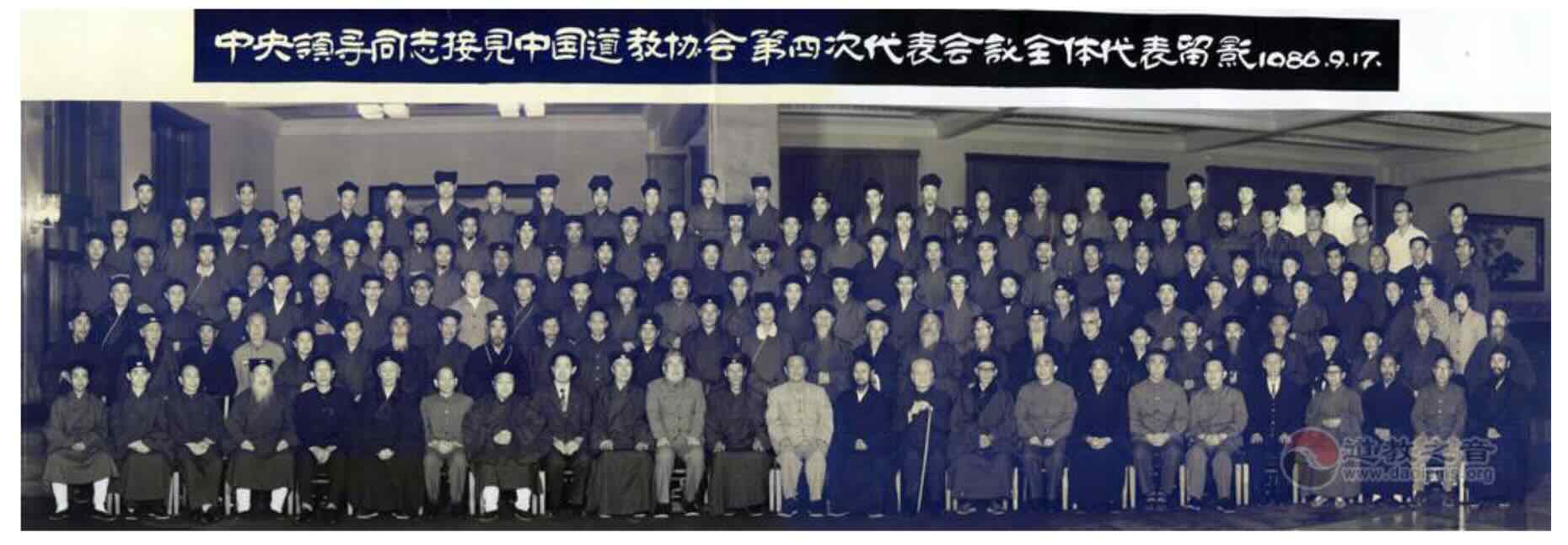
As Li Wencheng recalled, as he approached his 60th birthday he was expected to retire. But somehow in 1986 he was chosen to serve as General Secretary of the Chinese Taoist Association. Though at first reluctant, being in good health he was happy to keep working. He stayed in the post for thirteen years until retiring in 1999.

Daoxie 1986

Fourth conference of the Chinese Daoist Association, 1986. Source.

Through his early years around Yanggao, first as guerilla, then as cadre, Li Wencheng can hardly have had any contact with folk ritual activity—and like his comrades, had he chanced upon it, he would surely have disdained it. Once on the Party ladder in Beijing the only experience he gained of religion was overseeing CCP policy towards Catholicism. While many devout and prestigious Daoist and Buddhist clerics were recruited to official religious bodies after Liberation, they were often “mobilised” (coerced) as figureheads.

Li Wencheng now found himself responsible for state policy towards Daoism at a time of a spectacular religious revival (for a fine study of the grassroots revival in Fujian, click here). He helped found the Chinese Daoist Academy and the magazine Zhongguo Daojiao, mouthpiece of Party policy; he re-established the system of ordination in Beijing and elsewhere, working with Wang Lixian 王理仙, respected abbot of the Eight Immortals temple in Xi’an. But he doesn’t mention the great Min Zhiting, who was also summoned to the White Cloud Temple around this time (cf. Zhang Minggui, abbot of the White Cloud Temple in Shaanbei, whose efforts to maintain worship on the mountain ever since the 1940s have always involved negotiating local politics).

In 1990 Li Qing led a group of his Daoist colleagues to perform at a major festival of Buddhist and Daoist music in Beijing. The Li family Daoists were lodged in the White Cloud Temple along with several other Daoist groups from elsewhere in China invited for the festival, doing five performances (not rituals) for private invited audiences over fifteen days in the temple and at the Heavenly Altar. Some apparatchiks were opposed to the event, but influential senior ideologues like He Jingzhi and Zhao Puchu supported it. In the end, the Religious Affairs Bureau and the Chinese Daoist Association must have been among the official bodies sponsoring the festival. I wonder if Li Wencheng attended—would he have been curious to encounter Daoists from his old home of Yanggao, or would he have distanced himself from such household ritual specialists?

And I wonder how often he returned to Yanggao to visit his siblings and their children. For funerals there since the late 80s, it has again become routine to hire Daoists to perform rituals—events that Li Wencheng’s relatives would doubtless often attend.

1993 jiaoGreat Open-air Offering ritual, White Cloud Temple, Beijing 1993.
Source: Weibo.

Another comment in the Bitter Winter article that I find rather too stark: perhaps not exactly that Li Wencheng “used Daoism to spread CCP propaganda in Hong Kong and Taiwan”, rather that Daoism could indeed make a useful tool to further diplomatic rapprochement. To this end a significant step in 1993 was his organising of a Great Open-air Offering (Luotian dajiao 罗天大醮) ritual at the White Cloud Temple, bringing together Daoist priests from temples around the PRC—with representatives from Hong Kong and Taiwan. Clips can be found online, such as this by the Daoists of the Xuanmiao guan temple in Suzhou.

Li Wencheng 2015

In 2015, for the 70th anniversary of victory in the War of Resistance against Japan,
Huang Xinyang (left), Deputy Chief of the Chinese Daoist Association,
presented Li Wencheng with a commemorative medal. Source.

Shi Shengbao 2018

2018: Li Manshan with Shi Shengbao (b.1948), ritual director of Yangguantun village, Yanggao.

* * *

Li Wencheng’s responsibility in later life for marshalling CCP policy towards Daoism was quite serendipitous. Bitter winter again:

What is most interesting in this biography is that Li changed religions as others change shirts. He was first non-religious, then Catholic, then Daoist.

Interesting indeed, but the comment is somewhat misleading. Li Wencheng was surely never “religious”, and his task of monitoring Catholicism and then Daoism didn’t imply “belief”, any more than it does for ethnographers of religion; no conversion was involved (and anyway, Buddhist and Daoist deities can happily coexist in folk pantheons!). The article goes on:

This did not really matter since his job was to serve the CCP, not religion. He was sent to different religious organisations to “implement the Party’s religious work policies”. He was a typical example of the bureaucrats the CCP selects for the five authorised religions. Many of them do not believe in God or religion. They are there just to control religion on behalf of the Party.

Most appropriately, the official press release celebrated Li as somebody whose life was “an unremitting struggle for the cause of Communism”—not of Daoism or any other religion.

The Party’s efforts to control temple clerics were extensive, and effective; Buddhism was always based mainly in temples, and temple-dwelling Daoist priests too could be efficiently overseen too. But the life of Daoism depended less on temples, and the countless household Daoists throughout the countryside were harder to control—even if Li Wencheng was doubtless involved in the successive efforts to register them.

* * *

One could find similar grassroots religious activity in the home county of any secular Party apparatchik (all the way up to Chairman Mao and his Hunan origins)—I’ve just given these vignettes from my experience of Yanggao. The Li family Daoists remain busy performing rituals in the nearby villages; Miao Jiang, a devout Buddhist since his early youth, found himself becoming a revered master on Wutaishan; Li Wencheng, who never had any sympathy with religion, somehow ended up overseeing major Daoist projects from his Beijing office.

Conversely, Party overseers often lament cadres’ persistent adherence to “feudal superstition”. At the local level, it is perfectly routine for village cadres to consult household Daoists (like Li Manshan) or spirit mediums to “determine the date” or identify an auspicious site; some such cadres may even be ritual specialists themselves. But cadres higher up the Party ladder too may consult  “superstitious practitioners” (e.g. here).

Even among those who were earmarked to represent Party religious policy, we find a range of ideology. Some, like Li Wencheng, were entirely secular in their thinking, their sole mission to serve the Party. Temple priests invariably have to pay lip service to the CCP cause; like the broader population, they are used to compartmentalising public and private spheres. Back in the countryside, “faith” may play a certain role for some household Daoists (such as Jiao Lizhong in Hunyuan) but for others it is a minor issue, compared to the mundane exigency of feeding their families while serving the local community. 

As evoked movingly in Tian Zhuangzhuang’s 1993 film The blue kite, everyone was trying to survive, subject to the whims of Party campaigns. Some were able to escape the poverty of rural life by finding an “iron food-bowl” with a Party career, while others remained tied to the land and its rituals. Both were common trajectories. And both the CCP and religious observance, in all their diverse manifestations, are part of the fabric of life in China.


[1] Though I haven’t yet found Li Wencheng’s name in the county gazetteer, it’s a useful source for both the civil war and “revolutionary heroes”, with considerable detail on the period (mainly on pp.15–20 and 50–54), which I haven’t attempted to collate with Li’s own account.

[2] Bitter Winter notes that charges against Fang Zhimin had included the beheading of an American Christian missionary and his wife in 1934—although doubts have been raised whether Fang was directly involved (e.g. here, and here), and even whether the couple’s abduction and execution was among the KMT’s charges against him.

The Ghost Festival

SGL guiwangGhost King, South Gaoluo.

Today is the Ghost Festival in China, so I’ve been reflecting on calendrical rituals (further to my In search of the folk Daoists of north China, pp.7–8). Usually I draw attention to ritual days, but this seems to be one that I’m inclined to downplay.

XJY yankou 2003Yankou at Xujiayuan temple fair, north Shanxi 2003.

As one of the Three Primes (sanyuan 三元) over the annual calendar, the Ghost Festival (Guijie 鬼节, formally Yulanpen jie 盂兰盆节) on 7th moon 15th seems like a major event (see e.g. Stephen Teiser, The Ghost Festival in medieval China). On this evening, groups of temple clerics (both Daoist and Buddhist) still hold Flaming Mouth rituals (yankou, shishi) to exorcise the community, although they were surely performed more commonly before the pervasive impoverishment of temple life over the 20th century.

LQ yankou 1982Li Qing’s 1982 copy of the Li family Daoists’ shishi ritual manual.

There’s an extensive Chinese literature on this complex, lengthy Tantric ritual, but the Ghost Festival is far from its only context—besides other temple fairs over the annual cycle, it is (or was) routinely performed for funerals (see many posts under Local ritual).

Notwithstanding the importance of the Ghost King (Guiwang) and the Ten Kings of the Underworld (Shidian Yanjun) in village pantheons, in my experience of rural north China, 7th moon 15th is not (or is no longer?) a major day for rituals with liturgists presiding. Perhaps its liturgical importance varies by region; I’m not sure it depends on the community still having a viable temple, since ritual buildings can be re-activated for important ritual purposes. In my DVD Doing Things on ritual life in north Shanxi, §B5 has brief excerpts from a yankou performed by Buddhist monks for the “main day” of their village temple fair—which falls on 7th moon 3rd, not 15th.

Worshipping the ancestors, Xinzhou 7th moon 15th 1992.

What does endure is the custom of domestic offerings, burning paper at the ancestral graves, as we found in 1992 in Xinzhou on our trip through north Shanxi. Neither there nor in Yanggao is it a day to summon household Daoists to perform rituals.

zhaobeikou-lakeThe Zhaobeikou ritual association leads Releasing Lanterns ritual on Baiyangdian lake,
7th moon 15th, 1993.

For village associations on the Hebei plain, 7th moon 15th may have become less of a focus for communal observance over the 20th century. But the aquatic setting around the Baiyangdian lake (click here) prompts village ritual associations there to go on procession to “Release River [or Lotus?] Lanterns” (fang hedeng 放河/荷燈). Similar rituals are held in nearby counties such as Langfang. in Bazhou, the Zhangzhuang association, with its active group of liturgists, was one of few still performing yankou on the 15th. The association of Lesser Huangzhuang, Jinghai, performed Releasing God Lanterns (fang shendeng) on 1st moon 15th and Releasing Ghost Lanterns (fang guideng) on 7th moon 15th. Around Houshan, the major days to worship the goddess Houtu are 3rd moon 1st and 15th, but 7th moon 1st and 15th also attract many pilgrims.

So we may come across a range of exorcistic behaviour on 7th moon 15th: from burning paper at the ancestral graves, to processions Relasing the Lanterns, to full-scale yankou rituals.

As to the other days of the Three Primes, 1st moon 15th is the day around which the main annual rituals revolve (whereas only domestic offerings are made on New Year’s Day—e.g. Gaoluo); the ritual segments performed are exorcistic, like those for 7th moon 15th. But (again for north China) I haven’t heard of major communal observances for 10th moon 15th—leads welcome…

Anyway, the ritual days of the standard national calendar may arouse false hopes, requiring verification on the ground; once one gets down to the grassroots, other dates may require important calendrical rituals for local deities. In south China, even the major liturgical days of the 1st moon vary by locale. This is a significant fieldwork lesson: to see beneath the tip of the iceberg of temple practice and prescriptive history to digest folk observances at the grassroots (cf. Debunking “living fossils”).

Cf. Calendrical rituals, and for Bach and Saxony, The ritual calendar: cycles, seasons.

China not forgotten!

Over a summer hardly bathed in sunshine, but enlivened by football, tennis, Istanbul, and Proms, it may look as if I’m somewhat neglecting China. Still, just since May, posts include

China even plays a cameo role in

Actually, that should be enough to keep you busy (not to mention all the fieldnotes under Local ritual)—indeed, a little break might be welcome… I’m working on several new essays for my site, but in the interim I regularly post on Twitter—other recent China retweets including

Coming up soon is a reminder of a crucial theme, still little addressed:

It’s always worth reminding people of my work on the Li family Daoists:

And we should bear in mind the alternative perspectives of Tibetan, Uyghur, and Taiwanese cultures.

There’s a certain random quality to the topics of some of these retweets, but as with my original articles, I like to keep people guessing, and to remind readers of posts which may have escaped attention, or seem particularly apposite. So you may care to check my Twitter feed, or even “follow” me there…

A Buddhist centre in Peckham

Master Miao Jiang,
Wutaishan through successive regimes,
and religious life around Datong under Maoism

I got to know the Buddhist monk Kuan Guang 宽广 (b.1974) while he was doing his PhD at SOAS—guided by Tim Barrett—about the mountain temple complex of Wutaishan, epicentre of Buddhism in north China, where he trained.

Originally from Baoding south of Beijing, he is blessed with a calm and benevolent nature—such as one doesn’t always find among clerics, or indeed among the household ritual specialists whom I have consulted in north China. In addition, his deep, sonorous voice conveys his authority and wisdom.

So it’s wonderful to catch up with him. Apart from furthering his research on the history of Wutaishan in the Ming dynasty, he has created the Qingliang Buddhist Centre at a former church in Peckham, south London. Inspired by his venerable master Miaojiang 妙江法师 of the Bamboo Grove temple 竹林寺 on Wutaishan, Kuan Guang has undertaken this complex enterprise in the spirit of “expedient means” (Sanskrit upāya, Chinese fangbian 方便).

* * *

In both old and new societies, entering the clergy was often ascriptive, rather than a spiritual choice; poor families would routinely give a young son to a local temple as relief from adversity. However, in the case of Miao Jiang, his parents (surnamed Liu) were devout lay believers (the following account is based on this online biography; in English, see here).

Liu Jiang (his original name) was born in 1953 in Yanggao county (home of the Li family Daoists!) just east of the grimy coal city of Datong, in West Yaoquan village in Gucheng township. * The daily domestic worship of his family environment made a stark contrast with the escalating political campaigns of the 1950s. When he was only 3 years old, his parents, busy with agricultural chores for the collective, sent him to a nearby temple, where his master Chang Rong 常荣, himself only 15, lavished exceptional care on his bright young disciple.

In 1959, just as food shortages were becoming desperate, Liu Jiang’s mother took him to Datong to pledge allegiance at the Shanhua temple 善化寺. ** While receiving a rudimentary secular education at his village primary school, he prudently refrained from divulging that he was devoting most of his energies to his parallel cultivation of the dharma—praying with his mother before the family shrine, studying Buddhist texts such as the Pumen pin 普门品 scripture, and learning to recite the Dabei zhou 大悲咒 mantra. At a time when villagers were desperately foraging for food, when the meager crop from the autumn potato harvest was being divvied out among the brigade team, he would only take home his share after the others had chosen the best ones. As he later recalled, “I would eat whatever Old Budda Elder ate” (老佛爷吃啥我吃啥).

Shanhua siThe Shanhua temple during the 1933 fieldtrip of the architectural scholar Liang Sicheng.

Lin Huiyin
Lin Huiyin, architect wife of Liang Sicheng, Wutaishan c1937.
Source: Sixth Tone.

In Datong after the Japanese occupation and civil war, the extensive buildings of the imposing Upper and Lower Huayan temples 上下华严寺 were under restoration through the 1950s, and were designated as national cultural relics in 1961. As the Cultural Revolution broke out in 1966, while religious sites and clerics all over China were being assaulted, some of the major Datong temples were safeguarded under the aegis of a Bureau Chief, a Buddhist believer from Wutaishan. *** Although the Red Guards chased off most of the remaining monks, the Bureau Chief gathered some former monks—in plain clothes—to keep watch over the temples. So amidst all the chaos, the Upper Huayan temple became a clandestine meeting place where youngsters like young Liu Jiang and his fellow believers could seek instruction in the dharma

The Huayan temples, 1939:
left, Lower temple; right, grounds of Upper temple.
Source (colourized).

It was at the highly unlikely time of 1968 that he had his head shaved to become a monk, at the behest of his master in the Shanhua temple. With a group of senior monks officiating, they locked the gate early, and around midnight held his formal ceremony. Shortly afterwards, when his master returned from the nearby Buddhist cave complex of Yungang, the teenager was given the Buddhist name Miao Jiang.

Such biographies require us to adjust our simplistic view of the blanket destruction of religion though Maoism and the Cultural Revolution (for another instance, see Kang Zhengguo‘s account of his Buddhist grandfather).

After the liberalizations around 1980, five more members of Miao Jiang’s family over four generations joined the clergy: both his parents (in 1983), followed by two sons and a granddaughter in his older sister’s family. Popular opinion was full of praise for their exceptional devotion.

In 1973, when Miao Jiang was miraculously unscathed by an accident while repairing a reservoir, he considered it a sign of the protection of the Bodhisattva Mañjuśrī (Wenshu pusa 文殊菩萨). This was the inspiration for him to turn further south in Shanxi towards Wutaishan, around which his mature life has revolved. He has been based there since 1980, as the mountain opened up to a massive reinvigoration of “incense fire” (xianghuo 香火) after the depression of the Maoist era. Through those early reform years, he served as abbot in several temples, which thrived under his leadership. As Wutaishan became ever more commodified by tourism and heritagification, he was fêted with official titles—but he has remained aloof from worldly affairs.

Miao Jiang’s reputation grew, not by preaching but through the influence of his practice—”bodily instruction” (shenjiao 身教) rather than “verbal instruction” (yanjiao 言教). Still, after the challenges of practising Buddhism under Mao, it has been a very different kind of test to spread the dharma and maintain its integrity in the brash, mercenary new society. Eschewing the lifestyle of official banquets, he adheres to a simple Buddhist diet, while sponsoring charitable and relief projects.

See also Yanggao: a distant Daoist connection.

* * *

Kuan Guang formally joined the Buddhist order under the guidance of Miao Jiang in 1993. After Maoism and the reforms in China, nurturing the dharma in multicultural Peckham presents yet another kind of challenge. Apart from a programme of events at the Qingliang centre, such as guided meditation and calendrical rituals, Kuan Guang now plans to open a Buddhist vegetarian canteen there. He was always wise, but he too has now become a veritable master, whom his disciples can look up to. While I’m not generally predisposed towards Buddhist centres in Britain, this is a most admirable enterprise. In praising Kuan Guang, I’m reminded of the old Krishnamurti paradox: his efforts are selfless, devoted entirely to promoting the dharma (cf. Paths for the reluctant guru).

* * *

It also occurs to me that while I often come across devotional sects in my fieldwork (such as the Bright Association 明會 in Yanggao, scrolling down here), I have had little contact with jushi lay Buddhist adherents. In Yanggao since the 1980s, rather few temples have been restored: but in those temples which are active, their keepers were often ordained as Buddhist monks or spent time “roaming the clouds” in Wutaishan or Datong—such as the gentle Zhang Zheng, who helped Li Manshan decipher a stele at the Zhouguantun temple in Yanggao. ****

Having immersed myself in Zen in my teens, I rather lapsed, although for several years after first visiting China in 1986 I would regularly kowtow before the altar on entering a Buddhist or Daoist temple—mainly the grander ones of the cities and sacred mountains (Wutaishan was one of my first ports of call in 1986). But I came to feel a bit of a poseur, and later, frequenting small village temples, it hardly seemed appropriate…

* * *

In another post I explained why field studies of folk ritual in China mainly focus on household Daoists. While they dominate the rural ritual scene, when we find Buddhist ritual specialists, they may also perform similar rituals; the toolbox required to study the two is similar, and we shouldn’t compartmentalise our studies. Buddhism is more dominated by institutions (the major temples); formerly, Buddhist clerics worked mainly from their temples, and the 20th-century waves of laicization and temple destruction were more of a blow to the Buddhists than to the Daoists. The Buddhists perhaps tended to cater more for elite patrons, and were less able to survive during times of economic recession; state policies of the 1950s came as a double blow to them, as apart from laicizations and temple destruction, their former patrons also vanished. Conversely, the Daoists had long lay and household traditions, alongside any institutional base; they were more adaptable to local religious life, more all-embracing. The difficulty of regulating them has always been their hidden strength.

So I rarely encounter exalted Buddhist masters like Miao Jiang and Kuan Guang. But when I do, I am deeply impressed. While I have the utmost respect for the wisdom of more down-to-earth peasant ritual specialists like Li Qing and Li Manshan (see my film), around whom my fieldwork has revolved, in the presence of great temple clerics I feel a certain embarrassment that my path has led me away from the quest for spiritual enlightenment towards documenting the “heat and noise” of folk ritual; yet somehow my early background in that quest has formed an enduring foundation.

See also A Tang couplet, and Buddhism tag.


* Indeed, his disciple Kuan Guang was able to give me valuable help in 2011 when I struggled to decipher the dialect of Yanggao peasants on my fieldtapes. I am consoled and amused that when I screen my film for urban Chinese students, with Li Manshan’s own voiceovers, most of them have to rely on the English subtitles!

** Not long before Li Manshan’s trip to visit his father Li Qing at the Datong Arts Work Troupe

*** Around Datong the worst vandalisations only occurred in 1968; still, the Huayan temples soon resumed life as a museum—until the 1980s’ reforms, since when religious observances have had to compete with tourism.

**** My film, from 36.01; cf. my Ritual and music of north China: shawm bands in Shanxi, pp.71–8, and Daoist priests of the Li family, pp.50–51.

Another film screening

Erlangen blurb

Just back from Erlangen, where I presented my film Li Manshan: portrait of a folk Daoist (watch here).  The event was part of a stimulating series at CAS-E, devised by the socio-cultural anthropologist Raquel Romberg, research coordinator of the project Alternative Rationalities and Esoteric Practices from a Global Perspective; her own publications on Puerto Rican healers look fascinating.

Erlangen made a suitable and nostalgic venue for the film, having been the scene of the last concert on the delightful 2013 German tour of the Li family Daoists—my post on which I’ve just augmented. I even stayed in the same hotel, bringing back many fond memories of them.

courtyard

Partly because I can now take a further step back, and partly because I’ve just been editing my new documentary about Gaoluo, I’m all the more aware how demanding the Li Manshan film is—longer, I think, than the new one will be. But I remain amazed at all the technical and personal detail it contains, and all the work that went into it.

In the discussion following the screening, the bright audience made stimulating comments. Among them was Fabrizio Pregadio, * scholar of early Daoist internal alchemy, whose own work as editor of The encylopedia of Taoism and an invaluable reference guide to the Daoist canon doesn’t render him unmoved by the modern practice of peasant Daoists in the poor countryside of north China!

Click here for more thoughts arising from screenings of my film, here for reflections on the Erlangen showing, and here for a roundup of posts on the Li family Daoists.

Left: outside the hotel, where the Li family Daoists relaxed in 2013
Right: Bell Street, after my Chinese name


* I often wonder if his surname predestined him to become a scholar of religion!

An Italian renaissance

Along with the pleasures of editing my new film on Gaoluo with Andrea, it’s wonderful to be back in Italy.

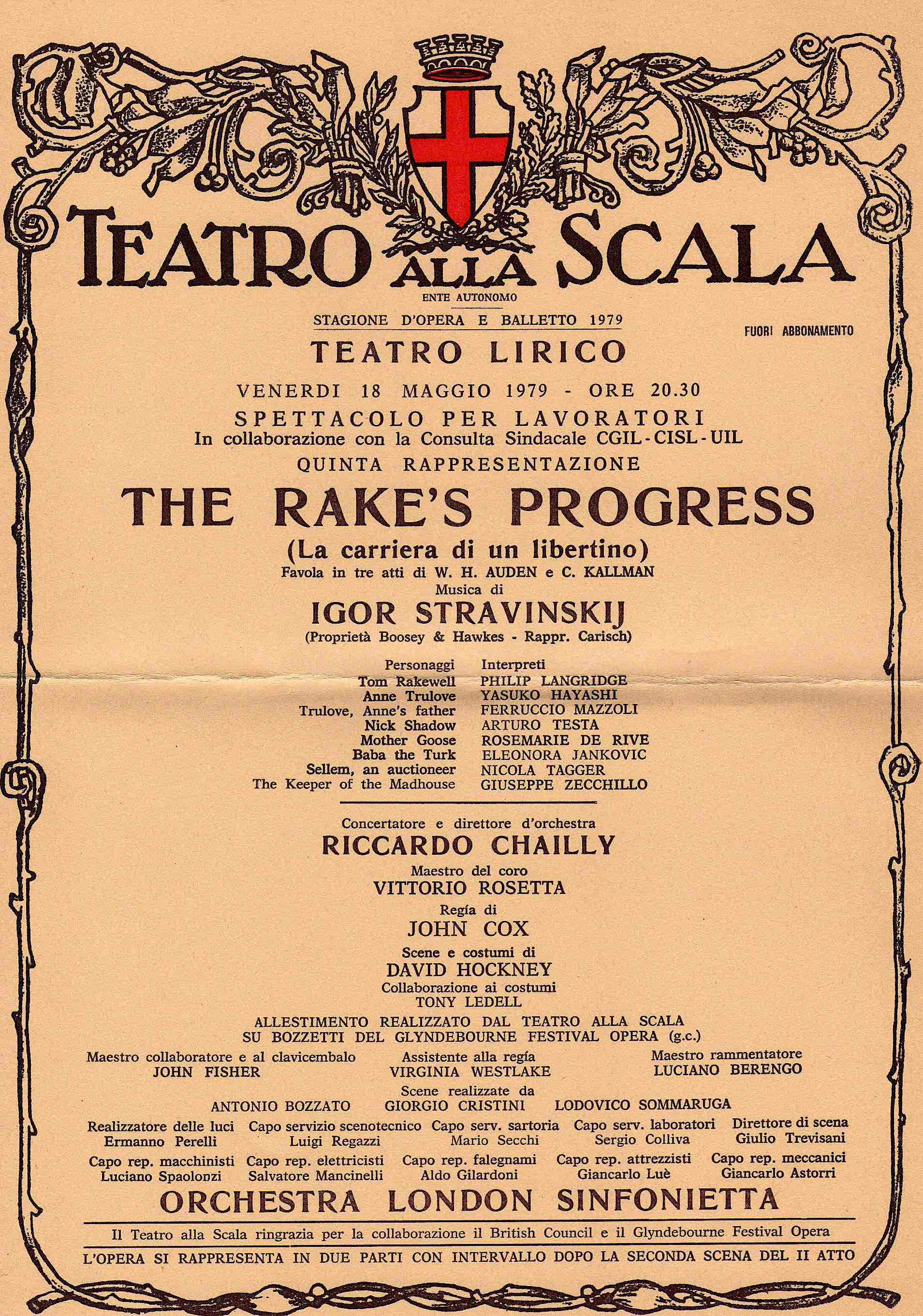
Rake 1979

My first proper opportunity to savour the delights of Italian life was an extended stay in Milan in 1979 to play The rake’s progress, which afforded me time to explore the nearby hill-towns. Over the following years I got to know the picturesque little towns around Tuscany and Umbria (cf. Italy: folk musicking), and through the 1990s I relished summer sojourns in Parma and Ferrara playing Mozart operas with John Eliot Gardiner; but Spain became a more regular venue for orchestral tours (allowing me to explore the exhilarating anguish of flamenco!), so I only got to do occasional gigs in Milan—the Brahms Requiem at La Scala, again with Gardiner, springs to mind.

img_2434With Li Manshan and his Daoist band at the Gallerie, Milan 2012.

My last visit was in 2012 on our memorable Italian tour with the Li family Daoists! Having made negligible progress with Turkish on my many recent visits to Istanbul, it’s been good to be back in a culture where I can communicate a bit more efficiently. Indeed, staying in a mixed quarter of Milan has something of the vibe of a migrant mahalle in Istanbul, and takes pressure off my efforts to regain my former semi-fluency in Italian.

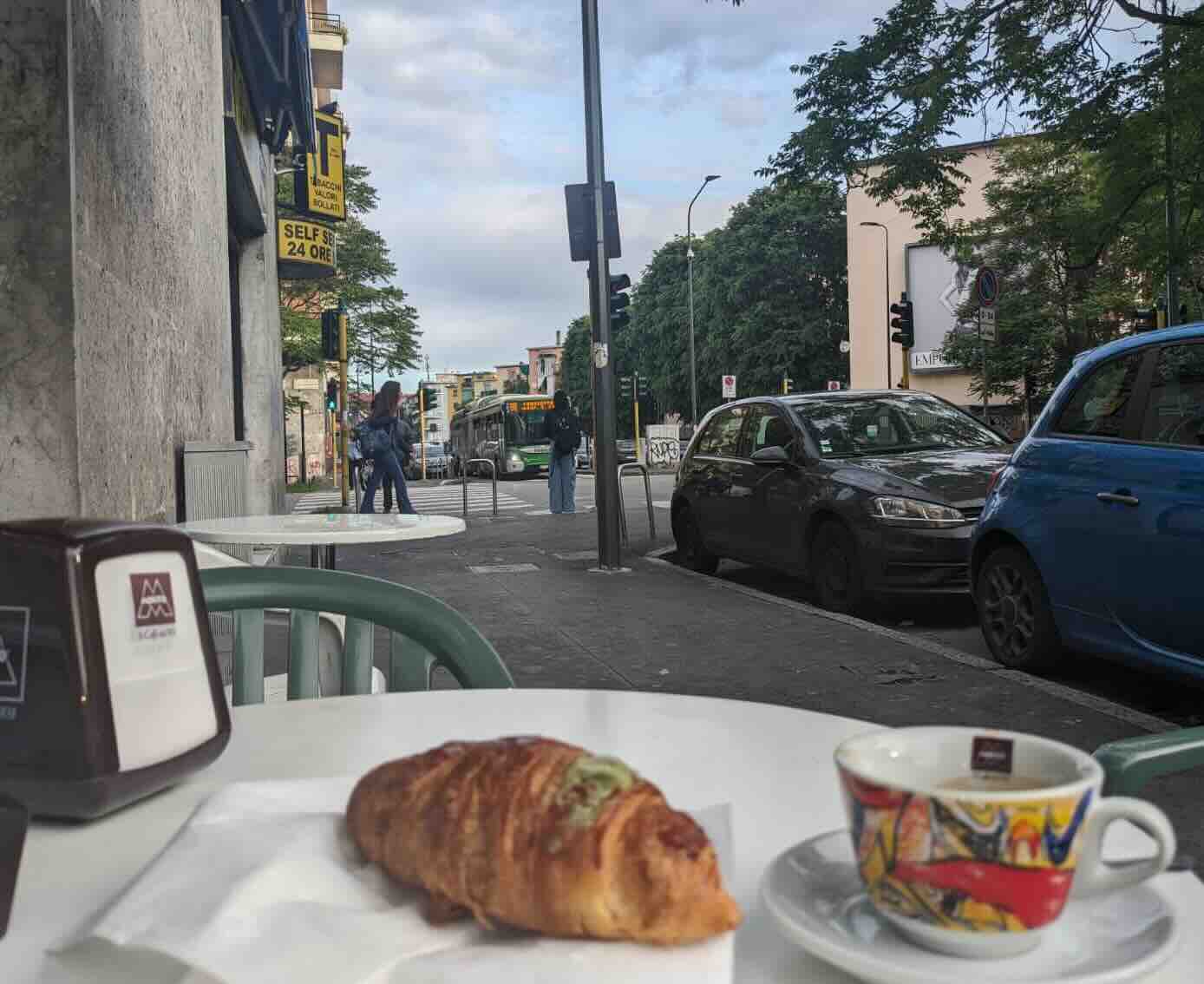
Last breakfast

Not the Last Supper, but my Last Breakfast.

Last supper

Taking a break from editing to watch the big Champions’ League match between Real Madrid and Bayern Munich, Andrea tells me he went to school in Modena with Carlo Ancelotti. When he tells people, they couldn’t be more impressed if he told them he was at school with Leonardo Da Vinci—”Da Vinci? Never heard of him, what team does he manage then?”

Alongside the numinous medieval hill-towns near Milan, the city may feel somewhat bland—but after a long absence, Italian street life still feels like a blessing.

See also Italy tag.

market

Daoist ritual in north Taiwan: an ethnography

Chu Chien-ch'eng
Taipei: Daoist priests working for the Hsien-miao altar 顯妙壇,
led by master Chu K’un-ts’an 朱堃燦, “open the eyes” of a god statue damaged in a temple fire.
All images courtesy of Yves Menheere. [1]

Pursuing a major theme that I broached in my superficial survey of music-ritual cultures in Taiwan, I learn much from

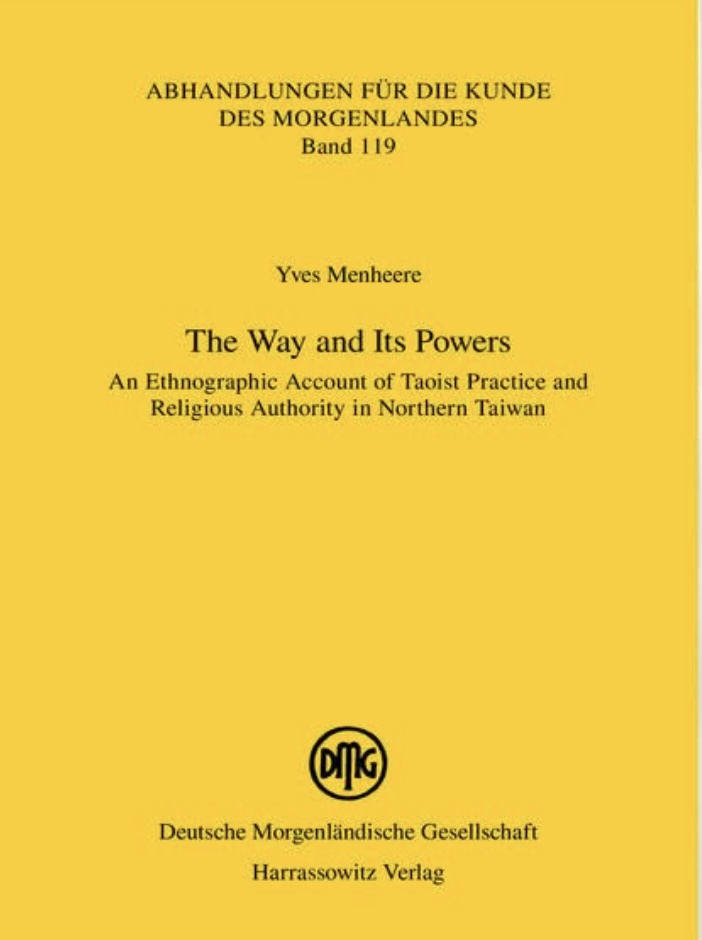
  • Yves Menheere, The Way and its powers: an ethnographic account of Taoist practice and religious authority in northern Taiwan (2020),

a lucid study which helps further my education on a topic that I previously found somewhat indigestible.

Menheere cover

The Introduction sets the tone for Menheere’s enquiry:

Why do people put their faith in religious specialists? Why are some people considered to be more adept at communicating with deities, explaining scriptures, blessing objects, or solving problems with ghosts and other malevolent forces?

Contrasting rituals that are “supposed to work” with those that are meant to be carried out “in the correct way”, Menheere finds that “neither efficacy nor proper performance can explain why people put more faith in one particular priest and not another”. In exploring authority and charisma he considers the work of Max Weber, Stephan Feuchtwang and Wang Mingming, Vincent Goossaert, and Pierre Bourdieu. 

His useful summary of previous research starts with J.J.M. De Groot in late-19th-century Xiamen (in mainland Fujian); and for Taiwan under Japanese rule (1895–1945), studies by Japanese scholars and colonial administrators, notably a 1919 report under the supervision of Marui Keijirō. After World War Two, the pioneering work of Kristofer Schipper (on south Taiwan) and Michael Saso (for Hsinchu in the north) was continued by John Lagerwey for both north and south. Taiwanese scholars have also been industrious, from Liu Chi-wan and Lee Fong-mao to Lü Ch’ui-k’uan, followed by Lin Chen-yuan and others. As Menheere notes, the main focus of such studies has been the description of rituals and the search for the origins of particular practices and traditions; however, scholars adopting more anthropological approaches include Stephan Feuchtwang, David Jordan, John McCreery, Robert Weller, and Chang Hsun.

ji waifang
Offering and Sending Away (che-sang 祭送) ritual segment.
Left: 1930s (from Kajiwara Michiyoshi 梶原通好, Taiwan nōmin seikatsu kō
台灣農民生活考, 1939).
Right: Lim Ch’ing-chih 林清智 (b.1952), 2015. 

For ritual studies, I’ve outlined how by the early 1980s, as the PRC opened up after three decades of Maoist repression, the scope of fieldwork at last expanded to mainland China—fanning out from south Fujian (ancestral home of the Taiwanese Daoist altars) in a succession of major projects, mostly led by scholars with experience of the religious scene in Taiwan. So whereas previously the island was almost the only accessible site where scholars could study the riches of Daoist ritual, a wealth of local traditions now beckoned all over the vast expanses of the PRC, “if not eclipsing the reputation of Taiwan’s heritage, then at least putting it into perspective”, as I wrote (cf. The resilience of tradition).

However, it’s always worth paying attention to the ritual life of Taiwan, subject to fewer disruptions than in the PRC—with research now enriched by access to traditions shared with the southeastern mainland. And since scholarship on both sides of the strait, though based on fieldwork, has stressed the early origins of rituals rather than social ethnography (cf. Debunking “living fossils”—combining these approaches for Fujian, though, is Ken Dean), Menheere offers a fresh perspective.

* * *

The distinction between Redhead (ang-thau 紅頭) and Blackhead (o-͘thau 烏頭) ritual specialists is particular to Taiwan and Fujian; while much discussed, it remains complex. In north Taiwan, Blackhead priests specialise in performing mortuary rituals, and are either Sek-kau 釋教 Buddhists, or Daoists sometimes described by the name Numinous Treasure (Leng-po / Lingbao 靈寶). Redhead Daoists—Menheere’s focus, whom he describes as “the Northern Priests”—refrain from performing funerals. While belonging to the Cheng-it / Zhengyi 正一 branch (like Daoists further south in Taiwan), they

carried out rites in ways that were broadly similar, and they were able to work together in ritual performances, which frequently occurred. Their way of working set them apart from priests from central or southern Taiwan, who performed rituals in different ways and were generally unable to work in concert with priests from northern Taiwan. These priests agreed that they belong to the same phai 派 or “branch” of Taoism and that priests from central and southern Taiwan belonged to a different branch. [2]

As Menheere observes, authority is relational: “it depends on the position of the individual priest in a wider network of priests, and it is always socially constructed and cannot be reduced to a particular priest’s personality or individual qualities”.

Between the Introduction and Conclusion, the book is arranged in six unnumbered chapters, to which I will award numbers here.

Chapter 1 (“Gods, ghosts and ancestors”) opens with a description of an exorcistic ritual intended to deter malignant forces of the road (lo-͘soah 路煞) from causing traffic accidents and other misfortunes besetting the community. Menheere goes on to give an overview of the religious environment in which the Northern Priests operate. Apart from large-scale temple ceremonies like the Chio / Jiao 醮 Offering, brief “minor rites” (sio-hoat 小法, or “little things” sio-su-a 小事) are also a regular part of the priests’ duties, often requiring only a single officiant. (I was glad to learn that priests in Taiwan describe the performance of ceremonies as “doing things” (cho-su 做事), cf. banshi 办事 in north China).

Always favouring practical grassroots perspectives above historical theory, Menheere unpacks the meaning of Cheng-it (Zhengyi)—”a term used by priests who shared their particular way of working, which presumed knowledge of two particular sets of rites; and did not perform funerary rites”.

By contrast with Schipper’s account for south Taiwan (e.g. his influential 1985 article), where “classical” and “vernacular” rites are carried out by different specialists, the Northern Priests practise a hybrid tradition, with two categories of rites, the “Way” (Tō / Dao 道) and “Methods” (Hoat / Fa 法): “two separate systems of rites, different in their performance, but referred to by the priests as complementary and sometimes even overlapping”. So Menheere ponders Schipper’s classical / vernacular dichotomy in the northern context, under the headings of language, pantheon, transmission, and the “mental states” of meditation and trance. Again working from the practical standpoint of the priests themselves, he confounds any simple distinction between the two types. Valuably, he notes contingency and modern change:

When we consider the meaning of Tō and Hoat and their associated ritual traditions, we must account for how the terms take shape in local practice and acquire different meanings, rather than ascribe them meaning devoid of social and historical context.

Still, “whether a rite was Tō or Hoat did not, for the priests at least, depend on its historical origins, but on the type of ceremony with which it was associated and on the way it was performed”. Noting that priests freely made use of the two categories during both exorcisms and offerings, Menheere illustrates this with Tō and Hoat versions of the “Worshipping the Lord of Heaven” ritual segment (pai Thin-kong 拜天公).

Chapter 2, a history of the Northern Priests from the Qing dynasty through the Japanese era to modern times, is full of detail on modern developments in their practice, showing that it is not immune to change. For the period since the 1980s, Menheere notes a shift away from healing rituals towards large-scale Offerings—which was attributed to perceived modernisation, notably in medical care. Thus “knowledge of the Tō rites for multiple-day Chio […] was slowly acquired by priests who initially performed mostly Hoat rites”. Moreover,

The expanding ritual market of the 1980s enabled several altars that at the time had only recently been established to rise to prominence. Indeed, some of the most successful and notable altars I observed doing fieldwork only began conducting offerings on a regular basis in the 1980s.

He also suggests a rather recent shift in the way the priests referred to themselves, with the autonym Cheng-it becoming more common.

Chapter 3, “Work and training”, looks at how ceremonies are performed and how the required knowledge to do so is transmitted. Menheere provides a good discussion of the role of “altars” (toan / tan 壇, an important term in south China that is seldom applied to household Daoists in the north), the physical and conceptual locus of a Daoist family tradition; and he gives a useful account of hierarchy and roles within the ritual group. As to personnel,

composition of groups varied from altar to altar and depended on the position of the priest in the field. Priests with more successful altars usually limited hires to their apprentices and a small group of priests that worked almost exclusively for them. Priests with fewer apprentices or fewer opportunities to organise ceremonies, however, had to look outside their immediate ties.

Menheere notes that “family was the principal source of knowledge for a small majority of the priests I observed”, but “recognising a master” from an unrelated family was also rather common. As to training in practice, he again finds variety, followed by a section on how priests assess competency:

A priest’s skills were described with the word kang-hu [gongfu] 功夫, and priests who lacked the physical attributes of the ideal priests—priests that were too short, for instance—could compensate for such perceived shortcomings with their kang-hu.

He continues with a most salient reminder:

It is perhaps worth noting that being familiar with the intricacies of Taoist doctrine as found in its classical texts did not play a role in the training of the priests or judgment of their competency.

The following two sections discuss the major ceremonies associated with the two ritual traditions. Chapter 4 explores the links between authority and the correct performance of rituals through a discussion of changes in the programme of the Chio Offering over the past century (with rich material in Appendix A listing sequences for ten such rituals).

After introducing the old “orthopraxy” trope and considering factors inhibiting change, Menheere argues “that despite the importance attached to correct performance, priests did occasionally—at least to a certain degree—have the ability to change the contents of rites and ceremonies and that such changes would not necessarily affect a priest’s authority”.

While the structure of three-day Chio seems quite constant over the century for which we have evidence, five-day Chio (an expanded version of the three-day programme) have also become increasingly common. The main addition here was the fast chanting of various [nationally standard] jing 經 scriptures—which household Daoists in north China have tended to omit in modern times, even though they comprise a major part of their ritual manuals (e.g. Daoist priests of the Li family, pp.211–13, 375–8).

Menheere continues with a detailed account of versions of the recently-elaborated ritual segment Ascending the Platform (teng-tai pai-pio 登台拜表) as interpreted by three different priests (cf. my account of Li Qing’s Pardon ritual):

All priests who performed the versions of the rite had access to Zhang Enpu’s text, yet none chose to follow his text to the letter. Even Master Tiong, who adhered to it most strictly, chose to add elements, attempting to, as he indicated in our discussions, make the rite more “correct”. It is possible that the priests in the other two cases chose to perform a much shorter rite because it was more convenient, not only for themselves, but also for all lay participants, who had to stand and watch the rite throughout.

He concludes the chapter thus:

The example of “Ascending the Platform” demonstrates that priests did have flexibility in revising rites in ways that did not transform them altogether. They were the experts, and as long as the performance of particular rites fulfilled expectations, the patrons neither grasped minor changes nor challenged a priest’s authority.

exorcismScene from the Great Improvement of Luck ritual:
the patron blows out a flame to send away the im fire.

Chapter 5 focuses on the links between authority and efficacy in the exorcistic Toa-po-͘un 大補運 Great Improvement of Luck, the major healing ceremony of the Northern Priests, when the patron often suffers from a serious medical condition. While careful not to add further layers of anthropological abstraction to the complexities of the ritual system itself, Menheere again begins with theoretical perspectives; [3] then, setting forth from the research of Hsu Li-ling, he moves on to elements in the adaptable programme for the Great Improvement of Luck ritual, and five vivid case studies from his own fieldwork (note the lists of ritual segments in Appendix C).

If patrons were not familiar with the logic of the Toa-po-͘un, they were generally free to interpret the ceremonies in ways not directly derived from the meanings enacted in the rites. For patrons, the “effective meaning” was found, not so much in the symbolism of the rite, but in the fact that a priest, possessing a body of specialised knowledge to which they had no access, was involved and employed his knowledge to interact with and implore deities to intercede. Such an attitude, combined with the spectacle of the ceremony and the impressions it left on the spectators, predisposed observers to connect the performance to any event during or after the ritual proceedings.

Menheere ends the chapter by considering efficacy (ling 靈)—the core of Chinese popular religion, according to Valerie Hansen and Adam Yuet Chau:

Patrons did not hire priests to conduct Toa-po-͘un because they knew the rituals would work. They hired priests because they believed in the potential of the ritual and that it was the right course of action. These beliefs were bolstered by, not so much prior successes in Toa-po-un performances, but by a priest’s connections with institutions and trusted individuals.

He argues that

efficacy was the product of authority, rather than the other way around. A priest did not become a great priest because he cured his patients, he came in the position to cure his patients—or not—because he had become a great priest.

Lin Changtong groupThe Wei Yuan Altar 威遠壇 in suburban Taipei,
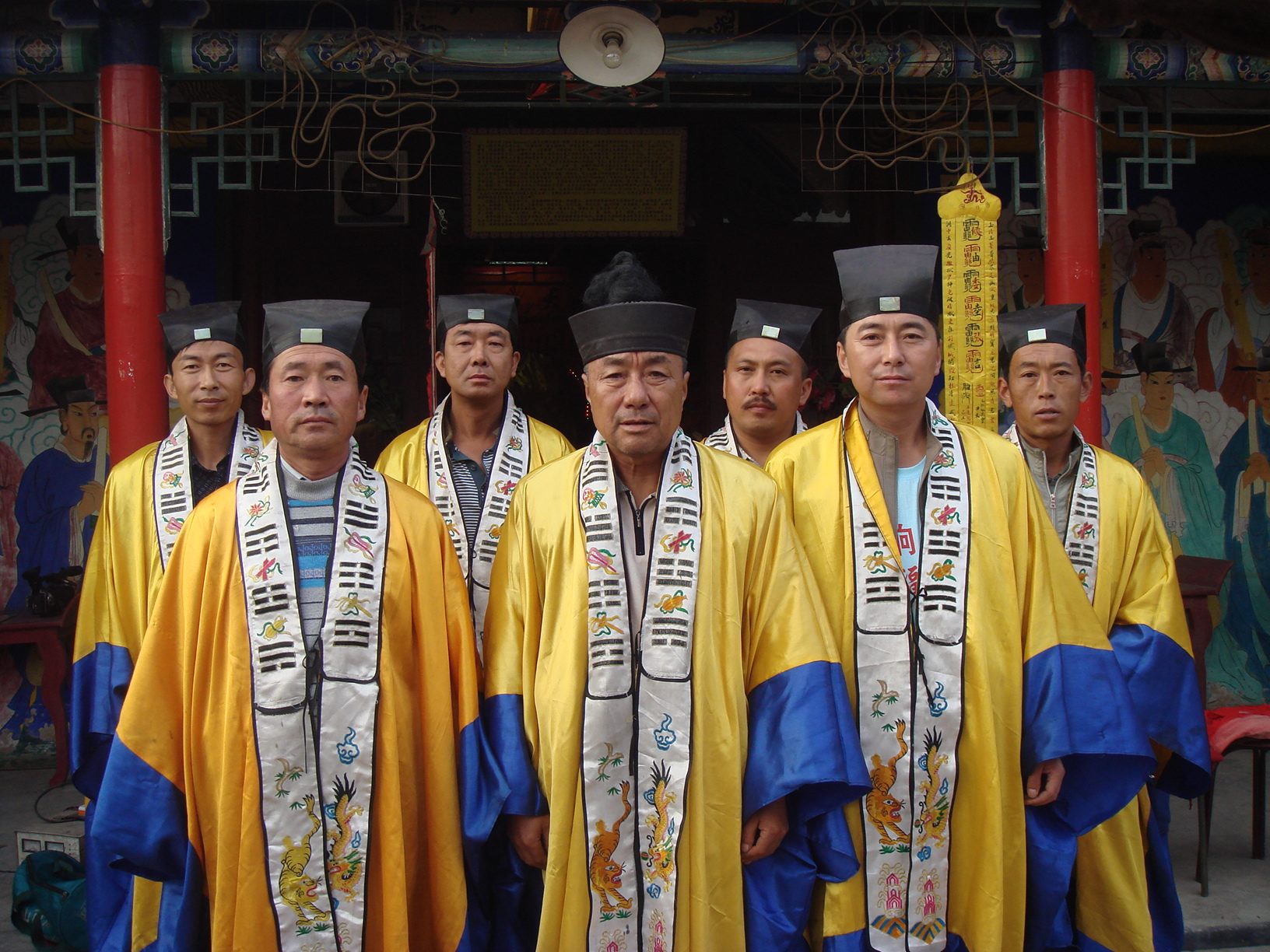
with Lin Ch’ang-tung 林昌桐 (1947–2019) presiding.

In Chapter 6 Menheere further ponders the way the organisation of ceremonies is distributed and how this relates to the idea of a field of priests. Recurring occasions include

ceremonies organised in honour of a deity’s anniversary; Worshipping the Dipper ceremonies, which many temples organised once or twice a year; ceremonies conducted for the construction of a new temple, the restoration of an old one, or the consecration of a new statue; and ceremonies held to feed the hungry ghosts during the seventh lunar month. Priests also commonly performed exorcisms […] as well as temple ceremonies held for the benefit of the ancestors of the faithful. On some of these occasions, temples could also choose to organise a Chio, but this was less common.

While he notes some exceptions,

more common, recurring ceremonies were typically conducted by the same priest; that is, the priest responsible for a ceremony on one occasion returned to perform the ritual again.[…] In some cases, relationships between temples and altars spanned multiple generations.

He finds that “patrons unconnected to either a priest or a temple resorted to other ways to find a priest”, mainly through local or personal networks.

Priests occasionally recounted how territorial claims were violently enforced in the past, but during my fieldwork, I was not aware of any violent incidents. Still, priests could be visibly displeased when they felt other priests were infringing on their perceived territory and would try to use their own local connections to displace the infringing priests if they felt that this was indeed happening.

Menheere details various procedures in organising the Chio Offering—“the most elaborate and important ceremonies in the Northern Priests’ repertoire”, which (nonetheless) few of them had a chance to organise during their career. There was considerable competition between priests for the task of presiding over this ritual. Temples might appoint a chief priest directly, solicit bids, or appoint through divination.

Knowledge of particular forms of ritual was a prerequisite to conduct ceremonies, but knowledge in itself did not guarantee success. The most knowledgeable priests were not necessarily those conducting the most ceremonies.

Still, “priests who inherited a successful altar had the best chances at claiming a dominant position in the field”. He ends the chapter thoughtfully by suggesting further factors that may need including:

It would probably be easier to develop new contacts and lead a flourishing altar in areas where fewer priests operated than in an area with many active priests. We must also consider historical conditions and change. The situation was quite different in the 1980s, when the market for religious services, including the ceremonies of the priests, was quickly expanding and a priest’s method of entering the field may have been less important.

In his Conclusion, Menheere reminds us that

terms like Tō, Hoat, Chio, and Cheng-it (and their Mandarin equivalents) have specific meanings that are locally and historically embedded, can change over time, and should not be taken for granted. […] Ritual practices can change, even if they are part of a tradition that highly values correct practices and sees immutability as a defining feature of what actually constitutes correct practice. While such changes can be triggered by external factors, specialists themselves do play an important role in shaping changes.

* * *

Time for my inevitable spiel: after silent, immobile text, nothing can compare to experiencing the “heat and bustle” (cf. Chau, Religion in China, pp.67–8) of Daoist ritual for real—here, for instance, is a “Great Improvement of Luck” ritual in 2022, just one of many online videos uploaded by the Wei Yuan Altar:

And to sample the more “classical” Tō tradition, click here for a 1977 introduction to a temple inauguration, filmed by Patrice Fava (another scholar whose grounding in Taiwanese ritual bore fruit on the mainland)—see his Un taoïste n’a pas d’ombre: mémoires d’un ethnologue en Chine (2023), pp.30–31, 53.

* * *

While I’m in awe of their erudition, some scholars of Daoist ritual seem so committed to the Wisdom of the Ancient Sages that their accounts may seem more prescriptive than descriptive, almost evangelical; in both Chinese and English, they can speak only to a highly limited audience. Instead Menheere, with his clear style, refrains from unduly mystifying either the priests or their rituals.

The Way and its powers is valuable for incorporating ethnography, modern change, and ritual theory—all largely absent from the field as it took shape—into the established concerns of scholarship on Daoist ritual, which (first for Taiwan, later for the PRC) has come to be dominated by the salvage of medieval ritual structures and texts. The study of ritual traditions in mainland China might look quite different if the ethnographic approach had found more of a voice in Taiwan.

SJ, Easter 2024.


[1] Sadly, Menheere’s original PhD thesis (2017) contains a mere three images (the published version has none!), so I’m grateful to him for helping me illustrate this post with some of his splendid fieldwork photos. Images by Patrice Fava are found in John Lagerwey’s attractively-illustrated book Le continent des esprits (1991); though the captions don’t give locations, I’m told that they show rituals and priests from both north and south Taiwan.

For transliterations of terms and names I have followed Menheere’s practice, based (for Taiwanese) on the “Church” romanization and (for Mandarin) on Wade-Giles, with some pinyin equivalents added for terms with wider significance (such as Cheng-it / Zhengyi 正一).

[2] Menheere comments further: “Taoist Blackhead priests were active in different areas in northern Taiwan, but only in locations such as Hsinchu and Tamsui would they regularly carry out other ceremonies in addition to funerals. In both areas, however, they had to compete with the Northern Priests”. Michael Saso gave an early taxonomy of the ritual life of Hsinchu in “The Taoist tradition in Taiwan” (1970).

Similar distinctions are commonly found in mainland south China, e.g. in Hunan; in the north I don’t recall hearing of household Daoists who refrain from performing funerals—if there are any areas where they do so (also for regions such as south Jiangsu), then I’m keen to learn. In north Shanxi the Li family Daoists used to perform rituals for both the living and the dead, but mortuary rituals now comprise the great majority of their business (see Ritual change in north Shanxi, and my film). Note also my major rethink of the Zhengyi–Quanzhen dichotomy.

[3] Here, besides the sources that he cites, it’s worth consulting Catherine Bell’s surveys of the field of ritual studies.

Rethinking Zhengyi and Quanzhen

Shuozhou Daoists

Household Quanzhen Daoists of Shuozhou, Shanxi.

I still find it worth reminding you of my page Rethinking Zhengyi and Quanzhen, for its fundamental rethink of Daoist ritual practice.

In my book In search of the folk Daoists of north China (2011) I began exploring the false dichotomy between Orthodox Unity (Zhengyi 正一) and Complete Perfection (Quanzhen 全真) branches (note especially pp.17–18). The page on my blog augments the material there in the light of further fieldwork.

Whereas the household Daoist groups of south China have dominated previous research, numerous groups of household Daoists are also active throughout the north—and they may nominally belong to either Orthodox Unity or Complete Perfection branches. But such simplistic pigeonholing may distract us from the details of their ritual practice; in both their rituals and ritual manuals I can rarely discern any significant distinction between them. When the Complete Perfection branch evolved in the 12th century, its priests (both temple and household) inherited a long tradition of Orthodox Unity ritual practice: as John Lagerwey once observed to me, “that was the only show in town”. And while a distinct Complete Perfection literature did evolve (see my book, pp.203–207), their ritual practice never developed into a separate corpus of Complete Perfection ritual texts.

That explains why such an august Complete Perfection temple priest as Min Zhiting was constantly citing Orthodox Unity ritual manuals from the Daoist Canon; and why the best mainstream source for the ritual texts of the Li family (Orthodox Unity) household priests in Yanggao is the repertoire of modern “Complete Perfection” temple practice like the Quanzhen zhengyun and Xuanmen risong.

vocal trio 2001

Household Zhengyi Daoists of the Li family, Shanxi.

In some places now—since around 2000—the picture is further confused by a certain “centripetal” tendency. With wider access (such as the internet), some groups that have always been Orthodox Unity may be exploring ways of “legitimising” themselves by seeking manuals from prestigious central sites like the White Cloud Temple in Beijing, and having costumes and hats made which make them appear to be Complete Perfection Daoists. They may even reform their “local” ritual practice by adopting elements from the “national” White Cloud Temple.

Hunyuan yankou 1

Daoists of Hunyuan, Shanxi—a most interesting case.

The local ritual scene is further obfuscated by a tendency among some scholars (both local and central) to assume that if a group is household-based, then they must be Orthodox Unity—a problem I have already queried. We really must debunk this assumption. Among my articles on Local ritual, the household Daoists of  Changwu in Shaanxi turn out to belong to the Huashan branch of Complete Perfection, and the household Daoists of Guangling in Shanxi appear to come from a Longmen tradition. Actually, this is not so clear-cut—even non-Quanzhen priests might adopt Longmen titles (note sources by Vincent Goossaert cited in my In search of the folk Daoists, p.18 n.34).

So while both the ritual texts and ritual sequences of the two notional branches are rather similar, what always makes local traditions distinctive is the way in which the texts are performed. Even here there’s another erroneous cliché that needs debunking. Generations of scholars of Daoist music have parroted the notion that in style the “music” of Orthodox Unity (conceived narrowly as “household” or folk) Daoists is more popular and lively, whereas that of Complete Perfection (again, conceived narrowly as austere monastic) Daoists is solemn, slow and restrained. This derives entirely from an unfounded theory about household and temple practice. We only need to watch my film about the Li family band to realise this simply won’t do. The basic style of Orthodox Unity Daoists (exemplified by the zantan hymns that permeate all their rituals) is extremely slow and solemn—but as you can hear, it is indeed punctuated by exhilarating moments. The idiom of (household!) Complete Perfection Daoists is certainly no more “solemn”. Both branches may use melodic shengguan instrumental ensemble—and if anything, that of the Orthodox Unity groups tends to be more slow and solemn.

Indeed, when I showed Li Manshan my videos of funeral segments by the Complete Perfection household Daoists in Shuozhou just south of Yanggao, he found their performance “chaotic” (luan). Orthodox Unity groups in Yanggao like that of Li Manshan pride themselves on the “order” (guiju) of their performance. My only ongoing note on this is that several household Complete Perfection groups (such as in Shuozhou and Guangling) may have preserved the element of fast tutti a cappella recitation of the jing scriptures better than in some Orthodox Unity traditions like those of Yanggao. But that doesn’t bear on the false stylistic dichotomy. Like Life, It’s Complicated… We always need to expand our database and use our critical faculties, rather than parroting outdated clichés.

Do refer to my original page, with its greater detail! More essays on conceptual issues in Chinese ritual under Themes in the top menu—besides many fieldnotes on Local ritual

Zen in the art of the baroque lute

Wuwei
For Roger Federer, click here.
In snooker, another instance of “effortless grace” is Ronnie O’Sullivan.

Always (nonchalantly) on the trail of non-action, I came across the stimulating article

While Daoism and Zen have long become glib buzzwords in the West, some such as R.H. Blyth and Alan Watts have given informed treatments, and some like Gary Snyder embody the ethos. In another post I alluded to Daoist wuwei while feeling sad that we can’t attribute the expression “Don’t just do something, stand there!” to Miles Davis.

Helen De Cruz contributes a thoughtful study from her background as performer and scholar of baroque lute and archlute. In studying a Zamboni prelude with her teacher, she elaborates on his advice “Be more Zen”:

to give shape to the extemporising, improvisatory nature of a prelude one should achieve more with less, giving an air of effortlessness to quick runs using difficult and sometimes awkward grips. The composition of a prelude embodies the aesthetic of studied effortlessness: at first, the notes sound spontaneous, searching, reaching, as if the player is merely tuning her instrument and improvising. But then, as the harmonies are given increasingly definite shape through blossoming arpeggios, the ear inclines to expect the next note with increasing confidence, and finally it all comes together: the earlier hesitant notes get their meaning, and the mind discerns the cohesive whole—it turns out not a single note was coincidental.

The term sprezzatura * (akin to “effortless grace” or “studied carelessness”) was introduced by the Italian Renaissance philosopher and diplomat Baldassare Castiglione in his etiquette manual Il Cortegiano (1528), written for the “small but chic” court at Urbino. Essential skills for the courtier included dancing, wrestling, fencing, horse riding, sports (such as tennis), and playing a musical instrument. The goal was “to steer away from affectation at all costs, […] to practice in everything a certain nonchalance [sprezzatura] that shall conceal design and show that what is done and said is done without effort and almost without thought”.

While the concealment of art can be affected, the aesthetic is still prized today—for instance,  in men’s fashion,

where one aims for an appearance of effortless grace in what is in reality a carefully curated wardrobe. It is part of how athletes are judged. […] The aesthetician Tom Cochrane equates sprezzatura with the aesthetic of cool, which he describes as containing “elements of aesthetic power or sublimity, specifically an elevation above the passions and indifference to danger.” The graceful courtier is (seemingly) unconcerned with the effect he has on the audience.  Ultimately, he is unconcerned with himself, he has lost all self-consciousness in the intrinsic beauty of his actions.

De Cruz notes that early discussions often focused on the practice of ritual. “To achieve true mastery, you must lose yourself in a skilled task that harmonises you with your physical and mental environment, and you will achieve mental quietude as a result.” Inevitably, I think of my great household Daoist mentors Li Qing and his son Li Manshan, both lowly peasants; this is also a question of charisma, not always a major theme of studies of Daoist ritual…

The early Daoist classic Zhuangzi evinces the art of the bell-stand maker, wheelwright—and butcher: as de Cruz explains a much-discussed passage,

Lord Wenhui watches in silent admiration as his butcher (who is also his cook) is cutting up an ox: “every move of his feet, every thrust of his knee—zip! zoop! He slithered the knife along with a zing, and all was in perfect rhythm, as though he were performing the dance of the Mulberry Grove or keeping time to the Jingshou music [ancient ritual items, the former part of rain ceremonies].

“Ah, this is marvelous!” said Lord Wenhui. “Imagine skill reaching such heights!”

Cook Ding laid down his knife and replied, “What I care about is the Way [dao], which goes beyond skill. When I first began cutting up oxen, all I could see was the ox itself. After three years I no longer saw the whole ox. And now – now I go at it by spirit and don’t look with my eyes.”

“Perception and understanding have come to a stop, and spirit moves where it wants. I go along with the natural makeup, strike in the big hollows, guide the knife through the big openings, and follow things as they are. So I never touch the smallest ligament or tendon, much less a main joint.” 

Zhuangzi also tells the story of a man swimming in fast-running currents, who tells Confucius:

 I have no way [無道 wu dao]. I began with what I was used to, grew up with my nature, and let things come to completion with fate. I go under with the swirls and come out with the eddies, following along the way the water goes and never thinking about myself. That’s how I can stay afloat.

De Cruz comments astutely:

Note the details in this story: the man has long hair that streams down, rather than being tied up in a knot, indicating he is of lower class. He sings not in a ritual context, as the Confucians would require, but out of sheer, unadulterated joy. Confucius is the main Confucian sage but (in Zhuangzian fashion) cannot fathom how someone is able to make such a dive and come out alive. Rather than a specific affectation, the swimmer has “no way.” He exhibits the essence of sprezzatura in his graceful movements and his indifference to danger.

Vermeer luteFor both folk and art music in the time of Vermeer, click here.

She cites the 17th-century English lutenist Mary Burwell:

One must then sit upright in playing to show no constraint or pains, to have a smiling countenance, that the company may not think you play unwillingly, and [to] show that you animate the lute as well as the lute does animate you. Yet you must not stir your body nor your head, nor show any extreme satisfaction in your playing. You must make no mouths, nor bite your lips, nor cast your hands in a flourishing manner that relishes of a fiddler [!]. In one word, you must not less please the eyes than the ears.

And Rameau in 1724:

the aptitudes for which [playing the harpsichord] calls are natural to everyone—much like in walking, or, if you like, running.

She cites the flow theory of Mihaly Csikszentmihalyi:

Self-forgetting opens the mind to the intrinsic beauty of skills we exhibit in the flow state,

explaining

In Zhuangzi’s butcher and swimmer and in Mary Burwell’s lutenist, the practitioner refuses to be identified with their performance, thus overcoming the self-centredness that often accompanies achievement.

This may be one reason why I became so resistant to Beethoven, for whom struggle—audible struggle—was central, becoming dominant in the romantic aesthetic of the virtuoso concerto soloist, striving to overcome.

De Cruz concludes:

We achieve an overall pleasing effect when we are in harmony with our physical constraints. When we achieve wuwei in skilled performance, we deliberately submit ourselves to our environment and to the limitations of our bodies—we place our actions rather than ourselves centre stage. We can say that sprezzatura presents a philosophy of life, an approach to our environment and our surroundings that acknowledges our bodily imperfections and our situatedness, and that yet enables us to achieve through non-action and mental stillness a kind of perfection that our audience can delight in and enjoy. Sometimes the beauty and wonder we bring into the world has more to do with our non-action than with our action.

I find this virtue in some exponents of Bach, such as David Tayler on archlute or Steven Isserlis on cello. Cf. the art of a wood turner in Istanbul.


*  Italian sprezzo/disprezzo “disdain” is another instance of the expressive Italian negative s.

News: special book offer!

DP
Special offer just for the month of March:

Three Pines Press is currently offering my book Daoist priests of the Li family: ritual life in village China at a reduced price of $30, with the PDF e-book for sale at $15.

Order here via publisher!

Hurry Now While Stocks Last!

(I’ve always wanted to say that…)

If you appreciate our film Li Manshan: portrait of a folk Daoist (*watch here*), then the book is an essential companion—further augmented on this site by a series of vignettes and updates, rounded up here.

DP contents

Introduction, and reviews from Ian Johnson, Stephan Feuchtwang, and Vincent Goossaert:

DP back

More discussions here—as well as some fantasy reviews!

“This book does for Daoism”—Nelson Mandela.

For my other books in affordable paperbacks, click here.

Roundup for 2023!

As I reflected in last year’s roundup,

like a suburban Sisyphus doing and undoing a jigsaw, having gone to great lengths to mix up the daily sequence of my diverse topics in a stimulating fashion, it’s that time of year when I try and reassemble them into some kind of thematic order.

In order for this exercise to be worthwhile, you’ll have to click on the links! Ideally, spread the word by reposting on one of those “Social Media” Thingies They Have Nowadays… Even if you only read a dozen of these posts, then my labours will not have been in vain!

I’m going to adopt Stella Gibbons’ drôle device in Cold Comfort Farm, drawing attention with *** to passages (mostly posts, in this case—indeed, the book’s protagonist is Flora Poste) Not To Be Missed. And this list isn’t even exhaustive—the committed masochist can consult the monthly archive in the sidebar, scrolling waaay down.

I’ll begin with Nicolas Robertson, who alas joined the Heavenly Choir in November (see my tribute). His extraordinary anagram tales (introduced and listed here***), a kind of fantasy Esperanto fiction, are among the highlights of this blog, and in further tribute to his brilliant mind I have recently added two more:

So here are listings under some main themes (many, of course, belong under several themes, which is the point of giving them categories and tags, listed in the sidebar):

China (culture and ritual, Maoism and politics):

East Asia, other:

This year’s additions to my education in Tibetan and Uyghur cultures:

Turkey and West/Central Asia (see roundup):

Modern Europe:

Ethnomusicology and world music:

Jazz (see roundup***):

Pop:

Western Art Music:

Sport (see roundup):

Film/TV:

Loft best new

Arising from the transformation of my home:

Other:

For roundups of previous years’ musings, see 2018201920202021, 2022. And here’s a roundup of roundups! The homepage is always useful for navigation.

And it’s always worth reminding you to watch my portrait film***
on the Li family Daoists,
 raison-d-être of this whole blog!

Image gallery—enough already!

A bit of (non-)housekeeping…

In the sidebar, the images near the top (14 at present) show POSTS I LIKE, and I recommend them! Much further down the page is a rather vast gallery of thumbnails that you can click on as a useful window onto other early posts. It was already extensive when I updated them in 2020, but I haven’t continued to do so, and I’m unlikely to add more now—not least because it’d make the sidebar even more unwieldy. So from here on, I guess you’ll have to find other ways in, like the Search box, the monthly Archives below the images, and a series of roundups

While I’m here, I may mention a few collections:

Li images

And to complement my film and book on the Li family Daoists, as well as this roundup of related posts, this page in the top menu introduces a wealth of images.

My extensive series on Local ritual (listed here) is full of photos from our fieldwork through the 1990s and beyond, mostly in Hebei and Shanxi.

Local ritual

For “enough already”, click here.

Water and ritual

flood
Source.

The current floods in north China are severely affecting counties on the Hebei plain such as Zhuozhou, Laishui, Bazhou, Xiongxian, and Anxin, whose villages were our fieldbase through the 1990s (see Menu under Hebei).

1930 donors' list, South Gaoluo
1930 donors’ list, South Gaoluo.

While the climate crisis intensifies, faith in the protection of the gods has diminished under the assaults of Maoism and capitalism. Those villages relatively unaffected by natural disasters traditionally attributed such immunity to the divine blessings afforded by their ritual association—as in Gaoluo, where the floods of 1917 and 1963 are still part of popular memory. The 1963 flood came during a brief cultural restoration between famine and the Cultural Revolution (see Cai An’s story here).

But whether or not villages still have active ritual associations, the current flooding is devastating people’s lives and livelihoods. Political decisions made to protect key economic areas (e.g. here, here) have also led to protests.

* * *

Conversely, the main affliction of north China is drought—as Li Manshan observes at the start of our film, “nine droughts every ten years”. For this the folk recourse for villagers was to make collective processions to pray for rain. Hence the importance of the Dragon Kings and their temples (note images on the website of Hannibal Taubes), and related deities like Elder Hu in north Shanxi.

SB rain DVD 2
Rain procession, Shaanbei.

As in much of the third world, for the fieldworker it is a salutary reminder of the precarity of life to wash one’s hands and face over the day in a single shared enamel bowl of water fetched from the well.

Fetching Water, Zhuanlou village funeral, Yanggao 1991.

shui in LQ shishi manual

Shishi quanbu Bestowing Food manual, copied by Li Qing,
segment on water from line 5, to be recited.

qushui placard

Template of memorial for Fetching Water to Release the Deceased, no longer displayed.
From Li Qing’s volume of miscellaneous ritual documents.

As to ritual, Fetching Water (qushui 取水) or Inviting Water (qingshui 請水) segments are common throughout China, for temple fairs, domestic blessings, and funerals, parading to a nearby well or stream. One might expect them to be especially meaningful in the drought-prone north. Inviting Water is common in temple ritual and in south China (e.g. Hunan), but I have hardly heard of it in northern folk ritual, where Fetching Water is standard (for Yanggao in Shanxi, see my film Li Manshan, from 41.06, and the DVD Doing Things; see also Daoist priests of the Li family, pp.67–8, 209–10).

The text on the right (“I declare, sprinkling the ritual water of the three lumens”) is a shuowen introit preceding the Gātha to Water on return to the soul hall.

Though running water has gradually been reaching more villages since the 1980s, such rituals continue to be a significant component of the whole symbolic repertoire of ritual sequences, perpetuating historical memory.

For water, religion, and politics in barren Gansu, see The temple of memories.

The Li family Daoists in Germany

Invitation, Beijing concert

My book Daoist priests of the Li family, and the film that complements it, mainly document the maintenance of their ritual tradition in the countryside of Yanggao county (for a roundup of posts on the Li family Daoists, click here). But Chapter 18 of the book makes an interlude discussing their recent wider exposure, “marching towards the world”.

Taking the Li family Daoists on tour between 2005 and 2018 was both delightful and instructive. Our first forays to perform abroad were to Amsterdam in 2005 and the USA in 2009. After I began visiting the Li family Daoists again in Yanggao in 2011, the following year we visited Italy in the first of three tours sponsored by local Confucius Institutes (CI) (see also here, and here).

* * *

In 2013, after a year of constant emailing with the various German CIs, we’re on the road again at last.

This time on gongs we have Guicheng instead of Third Tiger, who is busy organising a campaign in his work-unit. I meet up with the band at Hamburg airport on 5th April. At our hotel the Daoists get back in practice with the coffee machine, and we catch up. Next afternoon we walk over to the CI, impressive with its elegant new repro Yuyuan pavilion teahouse modelled on the one in Shanghai. They rehearse and discuss the new item I have suggested, an a cappella sequence based on the Invitation ritual at the edge of the village. At first they were reluctant, worried that performing an item so explicitly funerary might be unsuitable. I point out that some of the greatest music in the Western concert tradition is for the dead. Apart from requiems, I go onto YouTube to play them the Buxtehude Klaglied (do you know that piece? It’s amazing!). The Invitation turns out a great success in the program, a moving tranquil interlude between the uproar of “catching the tiger” and the wild percussion of Yellow Dragon.

Next morning we just make our connection to Geneva, first of several fraught changes at the labyrinthine Frankfurt airport. On the plane, without any encouragement from me, the Daoists soon realise the beer is free—touring musos after my heart. Wu Mei listens to Chinese pop on his headphones. At Geneva we are received splendidly by the CI and Xavier Bouvier, enthusiastic head of the Geneva Conservatoire. Apart from the concert I give a lecture and show my film. As in Italy, I am happy to introduce the Daoists to old friends. Before rehearsing in the fine conservatoire hall we take some fun photos, with Li Manshan seated at the grand piano.

At Leipzig airport we are met by Thomas Rötting, indefatigable CI fixer all these months. Leipzig is wonderful. Our hotel is right opposite the Nikolaikirche—not only Bach’s church but the starting point of the 1989 Montag protests, only a few months after the Tiananmen demos. If the date means anything to the Daoists, they would recall how they were learning to do rituals with Li Qing. Apart from the GDR legacy (see under Life behind the Iron Curtain), I feel as if I am taking the Daoists to a holy site (cf. Bach—and Daoist ritual). I have played Bach here myself, even before the fall of the Wall, and have been banging on about him to the Daoists for years. On our visit to the fine new Bach museum they are as spellbound as I am, finally getting what I have been on about all this time. As I stand with Li Manshan at the urinals in the posh new loo there, he muses, “Wow, so this is where old Bach used to take a piss, eh!”.

Next day in our lecture-workshop at the CI I observe, “Now that the Li family know about Bach and have heard his music, I wish I could invite him to hear them!” Bach would have adored Wu Mei’s guanzi playing (cf. Bach and the oboe).

The gig is magnificent. The audience goes wild, their faces rapt; I love the feeling of turning on audiences to this music that has enchanted me for so many years. By now all the CIs are latching onto how very special this tour is.

Hberg 2012
Heidelberg concert, April 2013.

Happily, our last two concerts are in churches, the two sheng mouth-organs filling the building with a majestic sound just like Bach on a huge organ with all the stops out; indeed, it is the same instrument. Heidelberg is charming, if overrun with tourists (again mostly Chinese), whereas Erlangen, our final stop, with its cobbled streets and a gemütlich little hotel, is more tranquil—a good place to recover after some rather hectic days, mostly involving challenging transfers at Frankfurt airport. And when our Confucius Institute hosts’ choice of sightseeing is either the art gallery or a guided tour of the brewery, I don’t even have to consult the Daoists… Leaving Li Manshan to rest at the hotel, we imbibe the beer tastings keenly—so we can organise a piss-up in a brewery, then. The final concert is majestic.

Erlangen session

Meanwhile I’ve had plenty of opportunity to keep consulting Li Manshan and Golden Noble about the finer details of funeral segments, both on the road and while resting at hotels—in Erlangen we had a particularly good session on the Invitation ritual (Daoist priests of the Li family, pp. pp.109–12, 298–307; my film from 58.14; and on this blog).

By now most of the Daoists are miraculously speaking standard Chinese—more, I hope, from talking with educated urban Chinese helpers and other laowai than from being with me. Next day we take the train from Nürnberg to Frankfurt airport. The Daoists get tax refunds on their gifts, which they promptly spend on duty-free. We bid fond farewells, their plane arrives on time for the train back to Yanggao, and next morning they’re ready to Open Scriptures for yet another funeral—hitting the ground running, just as on later tours (cf. Li Bin’s 2017 diary). For all the ephemeral pleasures of touring, the basic context for their performance, their daily “food-bowl”, remains the local funerary business.

For our 2017 mini-tour of France, click here, leading to a series of related posts.

Li Manshan: another film screening

film image

Among the numerous topics that have since amplified my blog, it’s always worth bearing in mind that its original raison d’être was to advertise my film Li Manshan: portrait of a folk Daoist (watch here!!!). It complements my book on the Li family, and numerous vignettes and updates on the blog (roundup here).

An initial round of screenings was followed by a lull during Covid, so I was happy to introduce it the other day for the Music Department of Bristol University, at the enterprising initiative of Michael Ellison, a composer with a strong focus on transcultural performance, in particular Turkish music (see e.g. here).

It was good to watch my film in company again. In my intro I observe that this kind of subject can’t be addressed only by reading old books in libraries: books are silent and immobile—fieldwork is the key! As I like to say, it’s not only about Daoism, it’s an everyday story of country folk—a bit like The Archers. So this isn’t some obscure academic subject, or some exotic remnant of ancient oriental wisdom—it evokes the basic concerns of local communities, and how they handle life and death.

Audiences will approach the film from different backgrounds: Daoist ritual (often with an emphasis on “salvage“), religious studies, ethnomusicology, anthropology, sinology, modern China, and so on. In my book (and on this blog) I try to show that all these strands have to be integrated. Students studying ethnomusicology (rather than “music”) will find it easier to grasp my comment that the film can’t be neatly pigeonholed under music; conversely, for students of Daoism (and even Daoist ritual) I stress that sound is the vehicle through which ritual texts are conveyed and animated; it should go without saying that soundscape must always be a major element in our study of ritual.

Watching the film again at a certain distance from my initial flurry of work, I worry that it may be somewhat tough going (Like, Hello?). For those eagerly awaiting the “red and fiery” bustle of ritual (Chau, Chapter 3), the opening sequence that sets the scene before we get to the funeral makes quite a lengthy prelude, and once the ritual begins the opening hymns (even abbreviated) are slow and perhaps a tad arcane for the uninitiated.

The pace gathers as we follow the sequence of funeral segments; the scenes with pop music, and the afternoon clowning, make suitable interludes; and viewers are reminded of the human personalities who have maintained the tradition through thick and thin, with vignettes on the great Li Qing (including his 1991 Pardon ritual) and the reminiscences of his widow being particularly moving. Li Manshan’s own voiceover is illuminating. So I still feel this is the way the film has to be…

Zhaoqing screenshot

Again, watching it at a certain remove, I recall with a certain amazement all the work involved in providing the translations for the vocal liturgy (with original texts shown on screen), and karaoke-style captions for the mnemonics illuminating the percussion patterns—culminating in the exhilarating Yellow Dragon Thrice Transforms Its Body, coda to the Transferring Offerings ritual (from 1.07.55). And I constantly admire Michele Banal’s fine editing.

While I point out that compared to some such groups in the south, the ritual practice of groups like the Li family band is quite simple, I still find it remarkable that they still do so much, even if it’s still a pale reflection of what they did 80 or even 20 years ago. Audiences tend to be interested in the future of the tradition, which I address in The life of the household Daoist. Other relevant posts from my roundup include

Anyway, DO watch the film (including the excellent joke after the end of the credits!), and spread the word!

Attending Greek liturgy in Istanbul

Greek church for blog

Having been impressed by Epiphany at the Greek church near the iskele ferry in Kuzguncuk, recently we got to attend Sunday service at the main Greek church further up the main street (for a fine study of the mahalle‘s multi-ethnic past, see Nostalgia for cosmopolitanism).

Greek church

The Greek population of Istanbul (like other ethnic groups there) having progressively dwindled since the early 20th century, only special feast days attract more than a very few worshippers from around the city.

One might just find the service a sad illustration of the decline of Greek culture in Istanbul, but it made me think. While I’ve long been alienated from prissy, drab Anglican worship, turning as an outsider to Orthodox liturgy (or to any ritual and musical tradition) I’m not in search of the exotic, but I’m drawn to it as if it’s a mystery, not in the sublime sense but like a thriller—trying to work out what’s going on, to decipher its rules.

The distinction between emic and etic perceptions comes into play. Rather than the more spectacular rituals that often attract scholars and visitors, stimulating their mystical romanticism, it’s good to attend normal services to get an impression of ritual as routine. As with the rituals I’ve frequented with Li Manshan’s Daoist band in rural China, one begins to perceive that for those attending it’s partly an obligation, and that for the ritual specialists, to some extent “it’s just a job” (more radically, Frits Staal described ritual as “meaningless”; cf. Catherine Bell). Of course, in both cases there are elements of duty to tradition, even faith; but any “meaning” we impute must be broader than mere doctrine, involving changing social perceptions.

In church the liturgists and assistants do their job unfussily; as in Britain, the little congregation goes through the motions with greater or lesser commitment—it’s a weekly duty. Devout spiritual feelings can’t be taken for granted.

In China, conversely, where the Gaoluo village Daoist/Buddhist ritual association often seemed to be going through the motions, attending vespers in the house church of the Catholic minority there I was struck by their intensity and solidarity, apparently a result of their outlaw status since the 1949 revolution. But whereas the Chinese village Catholics maintain their faith tenaciously, the Greek urban Catholics are a tiny minority overwhelmed in a sea of Islam.

Catholic vespers
Vespers in Gaoluo, 2001.

As to soundscape (the major vehicle for expressing whatever “purpose” there may be to ritual!), the Greek liturgists chant in monophony, with occasional organum, conscientiously alternating solo and choral sections. The tinkling of the thurifer, with the smell of incense, adds a further dimension—which to me remains transporting, though again that’s perhaps not the point.

And without being at all hung up on “living fossils” or Ancient Wisdom, I am somehow inspired by being reminded of a world beyond the dominance of the three-minute pop song, just as the sound of the Muslim call to prayer does more insistently, more publicly (and also routinely). Whereas the silences between phrases of the call to prayer are part of its magic (again, a magic that is not necessarily experienced), in church the liturgy is more continuous; even in melodic material, it reveals a different world from that of the call to prayer or ilahi hymns, though the latter are largely diatonic too.

See also Society and soundscape, and From the holy mountain.

A roundup of roundups!

Apart from my annual surveys (2024 here), I’ve added a tag in the sidebar for roundups, where I group together posts on a particular theme. Whether or not you share my fetish for taxonomy (see e.g. here) and the joys of indexing, as long as you start clicking away on the links (and the links within them…) then this could be a really useful navigational aid!

Note especially

China:

and surveys of my series on

I essayed an inventory of Chinese jokes under

Further global surveys:

Some other themes:

Western Art Music:

—a theme that also makes appearances under World musicking and ethnography:

Popular culture:

Drôlerie:

and

More composite characters

couplets for blog

Checking in with the Li family Daoists (click here for a roundup—and do watch our film, if you haven’t already!):

In the same vein as Li Qing’s poem to the Eight Immortals (Literary wordplay), his grandson Li Bin has just sent me this image of a cute New Year’s duilian couplet that he spotted, pasted up at a gateway in Anjiazao village in Gucheng district, south of the Daoists’ base at Upper Liangyuan.

At least, it looks like a duilian, with upper (right) and lower (left) columns both apparently comprising seven characters. Actually it’s another of those series of composite characters, each one containing four characters within it. The deciphered text is a fairly standard auspicious New Year’s wish for prosperity, but the visual effect is striking. As you will soon discern, the motto at the top reads

万事如意,招财进宝,三羊开泰,出门见喜。

The right-hand mottoes read

岁岁平安,五谷丰登,春满人间,八方来财,紫气东来,日进斗金,欢聚一堂

and to the left,

年年有余,四季安康,和春京月,七星高照,吉祥如意,恭喜发财,金玉满堂。

In a poor county where literacy levels were low right until the 1990s, I’m impressed by this creativity with the script.

57 shengguan trio

The shengguan group, 2011: left to right Li Bin, Wu Mei, Yang Ying.

Meanwhile, as the world lurches from one crisis to the next, Li Bin and the Yanggao Daoists are busy as ever providing ritual services to their local community. During the pandemic, while he couldn’t lead a ritual band for funerals, he was still in demand to determine the date, site the grave, supervise the encoffinment, and so on; and now that the initial alarm has receded in Yanggao, he again leads his band for the rituals culminating in the burial.

Roundup for 2021!

Emma Leylah

As I observed in my roundup for 2020, since part of my mission (whatever that is) is to vary the distribution of the diverse posts on this blog, keeping you guessing, this latest annual mélange is an occasion to group together some major themes from this past year. This is only a selection; for reasons of economy, I’ve tended to skip over some of the lighter items. You can also consult the tags and categories in the sidebar.

Some essential posts:

I’m going to emulate Stella Gibbons and award *** to some other *MUST READ!* posts too…

China: on the Li family Daoists, recent and older posts are collected in

and it’s always worth reminding you to watch our film

Elsewhere,

Tributes to three great sinologists:

The beleaguered cultures of the

  • Uyghurs (posts collected here) and
  • Tibetans (posts collected here), including

I’ve begun a growing series on Turkey (with a new tag for west/Central Asia):

Among this year’s additions to the jazz, pop, punk tags are

WAM:

Bach (added to the roundup A Bach retrospective):

as well as

On “world music” and anthropology:

On gender (category here, with basic subheads):

Germany:

Italy:

Britain (see also The English, home and abroad), and the USA:

More on stammering:

On a lighter note:

Even just for this last year, I realise there’s a lot to read there, but do click away on all the links! And I can’t resist reminding you of some of my earlier favourites, notably

Ma Yuan

A cappella singing

WD 2011

In China, the “orthodox” vocal liturgy of both Buddhist and Daoist temples has been thought to be properly accompanied only by ritual percussion (see e.g. here, and here)—just as in Islam and Christianity.

Although many temple and household ritual groups further incorporate melodic instrumental ensemble, the core practice among household ritual specialists is vocal liturgy with percussion.

For the Li family Daoists in north Shanxi, see my film, and e.g. The Invitation ritual, Pacing the Void 2, and audio tracks ##1–3 on the playlist (in the sidebar, with commentary here). Other instances of vocal liturgy with percussion include the Daoists of Changwu (Shaanxi), the performance of “precious scrolls” in Hebei (playlist #7), as well as ritual groups in Jiangsu and all around south China. So in order to understand religious practice in China, we must take into account how ritual texts are performed—through singing.

chant

Further west, note Byzantine and Gregorian chant cultures, and examples from Eritrea and Athos, as well as Ukraine. Around the world, a cappella singing (both liturgical and secular) is perhaps the dominant means of expression; see e.g. Sardinia, and Albania.

Byrd score

Some of these styles even dispense with percussion, and a cappella singing is a notable feature of religion-inspired WAM —some instances:

Some of the WAM pieces were composed for church services (and I haven’t even begun to broach the riches of Bach motets…); but as we move through the 19th century, pieces also began to be written for the quasi-secular setting of the concert stage.

Change of tone: for the Bolton Choral Society’s unsuccessful attempt to summarise Proust, click here.

Bach Passions at the Proms

Nicolaikirche

To complement Bach’s Matthew Passion from this year’s Proms—always a moving event—here’s a reminder of some relevant posts:

ritual-masters

Bach meets Li Manshan, Leipzig 2013.

All this, and much more, under A Bach retrospective.

For other Proms this season, see 1707, New British jazz, and Korngold. See also Proms tag.

One eye open, one eye closed

See Changing ritual artefacts.

A new draft regulation for Shanxi province (Chinese version here), propounding a ban on producing and selling funeral supplies such as paper artefacts, seems to have adverse implications for ritual activity and funeral shops. But it’s not so simple.

Official attempts to restrict “feudal superstition” and traditional funerary observances have a long history—not just under Maoism but through imperial and Republican eras. Indeed, temples have been destroyed and religious activity controlled throughout the 20th century, notably since the Communist takeover, and campaigns continue today.

But in my post on local government interference in Shandong I pondered the gap between rules and practice at local level. Often-heard phrases like “there’s a policy, but it isn’t implemented” and “one eye open, one eye closed” suggest the dilution of state policy as it works its way down to the grassroots, a long chain elegantly encapsulated in the expression yitiao long, “the whole dragon”.

Li Bin’s first funeral shop in town.

While state surveillance of the larger temples and their clerics has escalated since 2016, recent campaigns aimed at folk practice meet with resistance on social media even as they are diluted locally (for another instance, see here). Ritual specialists, their patrons, and local cadres take such official measures in their stride; campaigns blow over—this blog features several examples. Spirit mediums are a regular target of campaigns, but remain popular; and sectarian groups that are still officially proscribed can maintain activity discreetly (for Yanggao, see here).

Earth burial, long targeted, remains standard throughout rural areas like Yanggao, despite the government’s long propounding of cremation. So since “earth burial supplies can still be sold to ethnic minority residents who observe the custom”, it’s unclear if this rider will also apply to the Han Chinese—in which case, there’s nothing new here. And though a renewed attempt to enforce cremation also appears to be on the cards in Yanggao, a local observer reckons earth burial is safe for at least a dozen years yet—by which time the depletion of the rural population will have escalated yet further.

Over the first few years there after the reforms, officials made some attempts to contain the religious revival; but since household Daoists like Li Manshan’s son Li Bin and his colleagues took up the trade in the early 1990s they have practised without interference (see under The Li family Daoists: a roundup).

In my other main fieldsite of Gaoluo south of Beijing, we can see such manoeuvering in the stories of Shan Fuyi’s wedding in 1966 and the 1997 New Year’s rituals after Deng Xiaoping’s death.

Since the 1980s’ liberalisations, both household Daoists and amateur ritual associations have remained largely unaffected by any official prescriptions/proscriptions. More significant in the modification of ritual behaviour are factors such as migration, the changing tastes of local patrons, and the spread of pop music.

So it remains to be seen if the new draft directive for Shanxi will have any practical impact on local activity. While the destructive effects of state policy need to be reported, they may also serve as clickbait that obscures the maintenance of ritual life, which is stressed in detailed field reports from south China (see e.g. here).

Grave charts 2

fenpu

Li Manshan’s son Li Bin is still busy chasing around the Yanggao countryside providing mortuary services for the local villagers, both in his solo consultations and as band leader for the rituals of the funeral proper (cf. his 2017 diary).

While most of his work is in the immediate vicinity just south of Yanggao county-town, as we were discussing this post he was emailing me on his phone during breaks from leading his band to recite funerary scriptures for a family in Jining (Ulanqab region, Inner Mongolia), where the Yanggao Daoists also have longstanding connections based on waves of migration north “beyond the pass”.

Among the many tasks over which the chief Daoist presides soon after a death is siting the grave (see my film, from 16.21). To help him, the host family sometimes produces an old grave chart. Li Bin sent me his photos of two such charts in 2019, and now here’s another one, which he consulted recently while siting the grave for a family in the Eastgate quarter of Yanggao town. It was compiled in the 7th moon of 1945, just as Yanggao was being liberated from Japanese occupation.

1

2

3

4

5

6

7

In north China, ritual documents that have survived the ravages of Maoism, such as Thanking the Earth memorials, are rather rare. As with the latter, I surmise that such documents were compiled by the relatively affluent (“landlord” and “rich peasant”) families that suffered after the Communist takeover.

Cf. Chinese tomb decoration, ancient and modern.

Ritual change in north Shanxi

tray 91

By contrast with most research on Daoist ritual, change over the three modern eras (before Liberation, under Maoism, and since the 1980s’ reforms) is a constant theme of my work. These recent posts, elaborating on my film and book on the Li family Daoists, make a useful series:

Ritual business

See also e.g.

You can search further under the sub-heads of the Li family category in the sidebar.

Li category

Ritual change has become a significant theme within ritual studies; in Chinese, a classic on ritual and social change is the 1999 volume Yishi yu shehui bianqian 仪式与社会变迁 edited by Guo Yuhua.

Daoist ritual: the Pardon

This discussion of the Dispatching the Pardon (fangshe 放赦) ritual sets forth from my Daoist priests of the Li family, pp.246–50, exploring the imperfect match between Daoism as performed and as shown in ritual manuals.

The highlight of my first visit to Yanggao in March 1991 was witnessing the great Li Qing presiding over a funeral at Greater Antan (see my film, from 48.35). I didn’t know how lucky I was. It was as if a Martian happened to land on earth, not at a conference of middle managers in Belgium, nor even at a church fête in Suffolk—but in Leipzig in 1727, filming the premiere of the Matthew Passion on her 3D eye-laser system, and then assuming that this was typical of life on Planet Earth. And then recording an episode of Family Guy over it.

The Pardon ritual was traditionally performed for both funerals and temple fairs, with the words “filial sons” (xiaozi) or “filial kin” (xiaojuan) as alternatives for “master of the retreat” (zhaizhu) or “temple chief” (miaozhu).

For funerals the Pardon is normally only part of the three-day sequence; the 1991 funeral was held over only two days, but Li Qing performed the Pardon at the request of the son of the deceased, a gujiang shawm player who loved the ritual for its lively (honghuo) atmosphere.

Li Qing’s band that day included his senior colleagues Li Yuanmao and Yuan Lishan; the guanzi player for the jocular “catching the tiger” sequence was Wang Chang, from the related Wang family in Baideng township. Li Qing’s son Li Manshan was taking part on drum, and the young Wu Mei was there; the band also featured Li Peisen’s second son Li Hua, as well as Li Yushan, son of Li Peisen’s older son.

As Li Manshan later recalled, this was the third time he had taken part in the ritual; they performed it for the 1987 video project, and did it again around 1993 for a funeral in Wangjiatun. The younger recruits Li Bin and Golden Noble have performed it for temple fairs, but by 2015 they hadn’t done it for nearly ten years—like Crossing the Bridges, kin and villagers now consider it “too much hassle”. It hasn’t been used for temple fairs since the early 1950s.

The Pardon manual
The Li family Daoists distinguish between the routinely used “inner five rituals”,  and the optional “outer five rituals” (see Daoist priests of the Li family, pp.30–32). Before Liberation Li Peisen copied a lengthy manual including the latter, generously titled

LPS old coverLingbao kaifang shezhao yubao xianzhuan youlian poyu fangshe duqiao zhu baiyu rang huangwen [ke] 靈寶開放[方]攝召 預報獻饌遊蓮破獄放赦渡橋祝白雨禳蝗瘟[科]
Numinous Treasure [Manual] for Opening the Quarters, Summons, Reporting, Offering Viands, Roaming the Lotuses, Smashing the Hells, Dispatching the Pardon, Crossing the Bridges, Precautions against Hailstones, and Averting Plagues of Locusts.
There was little trace of these “outer” rituals in their practice after the 1980s’ revival.

Finding Li Qing consulting Li Peisen’s early manuscript at the 1991 funeral, I hastily took some photos, rather randomly; by 2011 Li Manshan could no longer find it, so we rely on the faithful copy that Li Qing made in the early 1980s, divided into two volumes, with 42 double pages in all.

The Pardon itself takes up fifteen double pages. It’s one of their most complex, opening with long sequences of zhenyan mantras in four-, five-, and seven-word structures, and containing elaborate fu 符 talismans and jian 简 slips. Whereas most funeral segments are now dominated by the Heavenly Worthy of Grand Unity who Rescues from Suffering (Taiyi jiuku tianzun), this ritual is addressed to the Jade Emperor, in his role as Heavenly Worthy Who Pardons Sins (Yuhuang shezui tianzun). The talismans are addressed to the Three Officers (sanguan). The 108 pardon slips (shetiao, shewen) to be recited are combined into a few long documents.

Some pages from Li Peisen’s copy:

LPS Pardon 1

Slips to Rescue from Suffering.

LPS Pardon 3

Recto: slip for Long Life.
Verso: in the last line, the term jiao (Offering) in “dark yang pure jiao
(mingyang jingjiao 冥陽凈醮) refers to a funeral;
the listing of “Shanxi Datong fu” shows its local origins.

And some pages from Li Qing’s copy of the manual:

LQ Pardon 1

Pp.1b–2a. Third line from right: the Naihe qianchi lang couplet,
followed by 7-, 5-, and 4-word mantras.

LQ Pardon 2

Verso: the talisman for the Heavenly Official.

And we can compare these pages with Li Peisen’s copy above:

LQ Pardon 4

Recto: template for slip to Rescue from Suffering, “in red characters, with white envelope”.

LQ Pardon 5

Slips for Long Life.

The ritual as performed in 1991
We can soon discover that the version performed that day by Li Qing and his colleagues (and again, do watch my film, from 48.35) bears little relation to that given in the manual.

Li Qing copying ritual document, 1991

First, in the scripture hall, Li Qing copies the lengthy series of pardon slips with their talismans, and envelopes to put them in—a lengthy process, for which he consults Li Peisen’s manual.

Meanwhile, in light snow, the other Daoists construct an open-air altar in a large clearing in the middle of the village near the funerary site, using tables, benches, and planks. On this structure are placed in a row five “palaces”—cardboard images mounted on stalks of gaoliang inserted into large rectangular dou bowls filled with grain—for the Jade Emperor Yuhuang, the Three Officers (sanguan, for heaven, earth, and water), and the pole star Purple Tenuity (Ziwei, not mentioned in the manual).

Pardon altar

Just below the central palace to the Jade Emperor is an altar table bearing the soul tablet, and below that, a long table around which the Daoists will stand to make offerings to the five palaces. Further behind, facing the palaces, a long high platform has been built on top of tables, from where the Daoists will later dispatch the writs of Pardon.

Around midday, after the morning visits to Deliver the Scriptures, the seven Daoists proceed from their scripture hall, playing percussion with occasional blasts on the conch. After paying a brief visit to the soul hall, they purify the arena by leading the kin on an elaborate winding procession around it. Virtually all the villagers have gathered round—by contrast with their apathy today, gorging instead on the pop music outside the gate.

The ritual is in two large sections: presenting the offerings from the altar table, and announcing the writs of pardon from the ritual platform before handing them down to the kin to be burned.

Pardon x

Acting as intermediary for the kin standing in a row behind him, the chief celebrant Li Qing, wielding his wooden “court placard” (chaoban) and sounding a hand-bell and a qing bowl on the table, now faces the altars and presents offerings to each of the five deities in turn on behalf of the kin. An offerings tray (of red lacquered wood, not like the metal one used now) is at first placed on the altar table before the god palaces.

While the Daoists play an instrumental piece (for this next sequence the two sheng accompany not the guanzi oboe but the dizi flute), Li Qing bids the oldest son to wash his face from water in a bowl and offer one preliminary stick of incense to the palace of the Jade Emperor. After he shakes the bell and strikes the qing bowl, the Daoists sing a sequence of a cappella choral hymns from the “words of blessing” (zhuyan 祝言) repertoire, accompanied only by the ritual percussion, beginning with Myriad Years to Elder Emperor (Huangdiye wansui). These hymns are punctuated by imposing patterns on nao and bo cymbals.

Li Qing recites a brief shuowen introit while the tray is handed to the oldest son of the deceased. Again accompanied by dizi, he takes the court placard, bows with it, and one by one places five cups of tea, with incense resting on them, on his court placard to transfer them onto a small raised table before the central palace to the Jade Emperor. The sticks of incense are then further placed before the god palaces, accompanied by dizi. After each offering they sing another a cappella hymn from the “words of blessing”.

Li Qing now clambers up onto the table, taking bell and placard with him. He leads the Daoists as they solemnly intone the two couplets “Thousand-foot waves at Bridge of No Return” (Naihe qianchi lang, from p.1b of the manual, also used at the end of the Invitation, my film from 1.03.25). Whereas the first sequence was punctuated by jaunty dizi, for this new sequence the hymns are to be accompanied by solemn shengguan wind ensemble, punctuated with interludes on large cymbals, while Li Qing kneels on the table, bows with the placard, and transfers the remaining offerings (incense, flowers, and so on) in turn before the god images, always placing them on the placard first. He recites another shuowen introit, shakes the bell, and the Daoists play another piece with dizi while Li Qing steps down from the table.

Then, taking all their ritual and musical instruments with them, the Daoists ascend the platform behind, standing in a long line behind a long row of tables to face the altars. As a majestic prelude they play the percussion piece Yellow Dragon Thrice Transforms Its Body.

The Pardon, 1991

Wang Chang recites a pardon writ from the ritual platform,
with Li Qing and Yuan Lishan further to our left;
to the right are Li Peisen’s grandson Li Yushan and a youthful Wu Mei.

Then the three leading officiants (Li Qing, Wang Chang, and Yuan Lishan) don five-buddhas hats, representing the Three Officers. The group plays The Five Offerings (Wu gongyang 五供養) on shengguan, and then the three officiants, in turn, solemnly read out the large and lengthy pardon slips. The first is read by Yuan Lishan. Li Qing calls out an instruction, folds the document up and places it in a large envelope, folds over the strip of paper to “seal” it, handing it down to the kin, again accompanied by the ensemble with dizi. The documents, envelopes, and seals are all of different colours, as specified in the manual.

Li Qing shakes the bell, recites a shuowen introit, and they sing the hymn Ten Repayments for Kindness (Shi bao’en 十報恩) with shengguan, another item common to several rituals. Li Qing recites a shuowen, and they play the cymbal interlude Sanqi song. Another shuowen leads into the second reading by Li Qing. Then a shuowen leads into a shengguan piece, which segues into a protracted “catching the tiger” clowning sequence.

Wang Chang

Wang Chang, the main guanzi player, standing to the left of Li Qing, plays two guanzi alternately and then at once, blows the mahan small telescopic curved trumpet, dismantles his instruments while playing them, plays a hefty whistle in his mouth, pretends to pluck snot from Li Qing’s nose and smear it over the face of the sheng player on his left, replaces the latter’s cap with a cymbal, puts on false eyes, and makes ribald gestures with the curved trumpet. Li Qing and the others try to keep a straight face throughout, but Wang Chang is having fun, and the villagers are in stitches.

Li Qing now recites a shuowen, followed by a percussion interlude. Then he recites the final pardon document, folds it up, places it in its envelope, and hands it down, accompanied by Sizi zhenyan 四子真言 on dizi. Finally, the Daoists descend from the platform, playing shengguan, and lead the kin on a slow parade around the arena. Li Qing guides the kin in the burning of the memorials in a pile together, while the Daoists stand round playing shengguan. They then retire to their scripture hall to rest and prepare for the next ritual segment.

Manual and practice
In sum, although we didn’t quite film the Pardon complete, they evidently didn’t perform the manual complete either. Li Qing was quite familiar with the text—he had lovingly copied it out a few years earlier. We can only surmise how often the senior Daoists Li Qing, Wang Chang, Yuan Lishan, and Li Yuanmao had performed the ritual before the 1950s with Li Peisen and others from that generation, but whereas they had maintained the “inner five rituals”, by 1991 their recollection of the Pardon may have been hazy, and the younger Daoists were quite unfamiliar with it. So perhaps this explains why the ritual was so transformed. Alas, on my first visits I lacked the background to consult Li Qing about such matters.

It is likely that sections like the Yellow Dragon percussion item and the “catching the tiger” sequence, though not specified in the manual, were traditionally included. But instead of the long series of four-, five-, and seven-word mantras in the manual, they alternated a cappella “words of blessing” from the Diverse Rituals for Joyous Scriptures (Xijing zayi 喜經雜儀) compendium for “earth scriptures” with an instrumental refrain using dizi, and sang standard “floating” hymns with shengguan. I suspect this was actually a version of the Noon Thanksgiving for temple fairs and Thanking the Earth, though the texts they performed also differed from those in the Xiewu ke 謝午科 manual. Only their final recitations of the Pardon writs appear to have been performed more or less intact as in the Pardon manual.

Anyway, rather as the temple fair sequence since the late 1980s seems to be a revision, this was already an adapted version. The ritual is lengthy and imposing, and its purpose is communicated, but it tallies only occasionally with the manual. With the same diligence that he had preserved the original content of the manuals, Li Qing was now selectively adapting rituals according to changing conditions—as Daoists (and other ritual specialists) have done throughout history; but it marks a substantial break with tradition.

Of course, scholars of Daoism may be more interested in the manual, which undoubtedly preserves early features. But (like the 1940s’ temple fair sequence) we can’t now witness it being performed; there is no demand for it among patrons, and even if we requested it specially, the current Daoists would be hard-put to recreate even Li Qing’s 1991 version, let alone attempting to perform it as shown in the manual. Even the “words of blessing” and the dizi interludes (which themselves may have been a substitute) are no longer part of their repertoire. For continuing ritual change, see A flawed funeral.

The Pardon elsewhere
The Pardon is commonly performed by household Daoists in southeast China, the heartland of research on Daoist ritual. For Taiwan it has been described in detail by John Lagerwey (based on the practice of the great Chen Rongsheng) and Jiang Shoucheng; and Ken Dean has documented it for south Fujian. [1]

While the text of Chen Rongsheng’s version appears different, its themes are similar. Apart from the mystical core of the ritual, Lagerwey draws attention to its dramatic, jocular interlude. In Yanggao such elements are absent from the manual, but an interesting connection seems to be implied in the “catching the tiger” sequence.

Lagerwey cites the 13th-century Daoist priest Wang Qizhen:

This Pardon document does not belong to our method for doing the fast. It is the invention of later people. Given the fact, however, that it has been used far and wide for some time, it would not do to eliminate it.

And he too notes variation between the early manual and modern practice.

For north China I have only a few other instances so far. [2] In Julu, south Hebei, it was performed on the afternoon of the 3rd day of funerals, comprising the segments qingshen 清神, ji lengshui 祭冷水, qing Yuhuang 請玉皇, song wulao 送五老, qing jianzhai 請監齋, and zhuan dagong 轉大供.

And in the jiao Offering around Baiyunshan in Shaanbei, again on the afternoon of the 3rd day, the Pardon is a spectacular (if not highly liturgical) ritual, with large god puppets of the Eight Immortals and the Four Officers of Merit (Sizhi Gongcao 四值功曹) descending on a rope down from the hillside to the bank of the Yellow River—somewhat reminiscent of the guandeng Beholding the Lanterns nocturnal ritual around Beijing (see here, under “A Buddhist and Daoist funeral”), on a far grander scale.

Pardon cover TianzhenBack in north Shanxi, in Tianzhen county just east of Yanggao, the Lü family of household Complete Perfection Daoists, whose tradition derives from the Nanmen si temple in Huai’an nearby, have a tradition of performing the Pardon, though it now seems to be defunct. Their lengthy manual, apparently copied in the Republican era, is entitled Taishang shuo Yuhuang shezui 太上玉皇說赦罪 or Yuhuang shezui tianzun shenjing 玉皇赦罪天尊神經. They also have a template for the writs of Pardon (“Pardon slips” shetiao 赦條):

shetiao

Aided by Lagerwey’s discussion, scholars of early Daoism will wish to trace the ancestry of “pardon for sins” (shezui 赦罪) in the Daoist Canon, with many sources following the Yuhuang shezui cifu baochan 玉皇赦罪賜福寶懺. Meanwhile, ethnographers are left to observe modern changes in the ritual adaptations of Daoists and patrons.


[1] See Lagerwey, Taoist ritual in Chinese society and history (1987), pp.202–215, Jiang Shoucheng 姜守誠, “Nan Taiwan Lingbaopai fangshe keyi zhi yanjiu” 南台灣靈寶派放赦科儀之研究 (2010); Dean, “Funerals in Fujian” (1988), pp.45, 52–53. Cf. Pregadio, Encyclopedia of Taoism (2008), pp.403–404.

[2] Based on my In search of the folk Daoists of north China, pp.91 and 99–100. The Julu material is from Yuan Jingfang 袁靜芳, Hebei Julu daojiao fashi yinyue 河北鉅鹿道教法事音樂 (1997), pp.72–4; for Baiyunshan, see e.g. Yuan Jingfang et al., Shaanxi sheng Jiaxian Baiyunguan daojiao yinyue 陝西省佳縣白雲觀道教音樂 (1999), pp.112–13, and Zhang Zhentao 张振涛, Zhuye qiuyue lu 诸野求乐录 (2002), pp.149–50.

Thanking the Earth, and words of blessing

Today the great majority of the Li family Daoists’ ritual work is for funerals. As to rituals for the living, they now rarely perform for temple fairs, and the Thanking the Earth ritual, once commissioned by families for domestic blessing, has not been required since 1953 (see my Daoist priests of the Li family, chapter 12).

Ritual business

The Yanggao Daoists now perform almost solely for funerals, but before Liberation the ritual they did most often was Thanking the Earth (xietu 謝土). [1] Held over two days during the winter, it was a domestic ritual for an individual household of certain means. The head of such a household might pledge a vow (xuyuan 許願) in the summer, and fulfil it (huanyuan 還願) by commissioning a Thanking the Earth ritual in the winter. The request was commonly prompted by illness or crisis, or in thanks for a good harvest or success in business. It could be held in the family household, or in a temple.

In 1991 the great Li Qing, oblivious to the Party line, recalled the Japanese occupation in the 1940s:

Our ritual business didn’t suffer during the occupation—the troops, themselves devout, even made donations when they came across us doing Thanking the Earth rituals! The local bandits didn’t interfere either.

Li Qing’s colleague Kang Ren (1925–2010) recalled performing Thanking the Earth rituals forty to fifty times every winter from the age of 15 sui (when he “graduated” as a Daoist) until he was 30 sui in 1954. Given the poverty of the area, this sounded a lot to me. Just west of Kang Ren’s house, poor peasant Li Cunren (1915–2013) recalled that only people with money could afford to commission the ritual—and even before the 1950s there were few of them. But Li Manshan believes Kang Ren’s account: even two or three moderately affluent household patrons for twenty or so villages would suffice to keep the Daoists busy. Forty to fifty such rituals meant eighty to a hundred days work each winter, not counting funerals, which were also most frequent then; they must have been busy virtually every day.

Even after the Communists took control in 1948 some households were still able to commission a Thanking the Earth ritual until 1953; but as the economy was levelled, beleaguered former “landlord” and “rich peasant” families could no longer afford to do so. Previously the ritual had involved making vows for prosperity and the health of their livestock, but now prosperity was unimaginable, and livestock collectivised.

By the 1990s, following the liberalisations after the collapse of the commune system, plenty of relatively affluent households began to re-emerge. But now that they could afford to hold Thanking the Earth rituals again, they were no longer inclined to do so. Whereas families still dutifully invite Daoists to perform funeral rituals, and still believe strongly in fengshui and determining the date, a lesser faith in divine aid to protect their crops and livestock has now rendered the Thanking the Earth ritual obsolete. So documenting it requires considerable reconstruction.

The Memorial
The memorial for Thanking the Earth doesn’t get burned, as it is for the living; the family keeps it after the ritual.

Li Qing’s uncle Li Peisen made a copy of one such memorial in 1981, for a ritual commissioned by his father Li Tang in the late 1920s, entitled “Document for good fortune, with genealogy, recopied” (Jixiang ruyi wen jiapu chongchao 吉祥如意文家譜重抄). Such genealogies often contain a genealogy, a useful resource (cf. Customs of naming):

LPS jiapu detail

Li family genealogy, detail from Li Tang’s memorial.

Li Qing himself wrote a Thanking the Earth memorial over New Year 1989, again including a detailed genealogy:

IMG_20151221_105009

Thanking the Earth memorial with genealogy, Li Qing 1989.

I was also lucky to be shown another memorial preserved by the Ren family in Apricot Orchard village nearby, with the more formal title of “Memorial for supplementing and thanking the five earths” (Buxie wutu yiwen 補謝五土意文), dated 1942—the very year that the Li family Daoists’ participation in the Zhouguantun temple fair is documented:

IMG_2258_2

Thanking the Earth memorial, Xingyuan village 1942.

Comparing the three memorials reveals a basic standard format. It opens with the date, the place, the purpose of the ritual (to fulfill a vow and guarantee well-being, expressed in a standard formula), and the name of the male head of household commissioning it. It then lists the names and birthdates of the family taking part. There follows a general description of the ritual, including titles of some of the ritual segments to be performed. Finally, after another request for well-being that includes the orphan souls, there comes a list of deceased kin—minimally the three generations of ancestors (sandai zongqin).

Among the ritual documents that LI Qing copied in In the early 1980s is this placard for Thanking the Earth:

On separate occasions, both Li Manshan and I asked the elderly Kang Ren to describe the former sequence for Thanking the Earth. The older generation, who recalled the “old rules” of ritual life before Liberation, had steered the group through the revival of the early 1980s (see my film, from 40.22), but in turn they passed away; after the death of Li Qing (1999) and Li Zengguang (2000), Kang Ren was the sole survivor, and he still continued “responding for household rituals” with Li Manshan’s band.

Li vocals 2001

Kang Ren (left) with Li Manshan and junior Daoists, 2001;
right middle, Golden Noble.

Apart from the vocal liturgy, note how Kang Ren detailed the instrumental pieces, both the long suites and the shorter melodies accompanying particular segments:

Thanking the Earth

Day 1
am:

  • Opening Scriptures (kaijing): recite scripture Yuhuang jing
  •      shengguan suite 1 Shuihonghua
  • recite scriptures Laojun jing and Bafang zhou

pm:

  • Fetching Water (qushui)
  •      shengguan suite 2 Zhuma ting
  • sing “words of blessing” (zhuyan)
  •      shengguan suite 3 Yaozhang
  • recite litany Yansheng chan

eve:

  • Communicating the Lanterns (guandeng) to Bestow Blessing (cifu).

Day 2
4–7am:

  • Opening Scriptures (kaijing): rising at the fifth watch (qi wujing);
    then “seven litanies”, including six-line hymn; “words of blessing” such as Zhenxin qingjing daoweizong; and scriptures including Yuhuang jing and Bafang zhou
  • exit the yard and play shengguan piece Qiansheng fo
  • enter yard and sing “words of blessing”: Huangdiye wansui
  • Parading the Streets (shangjie) to each temple, burning incense and paper, reciting mantra for offering paper and playing dizi flute
  •      shengguan suite 4 Pu’an zhou
  • Shenwen Announcing Text
  •      shengguan suite 5 Da Zouma
  • exit the yard playing shengguan piece Sizi zhenyan
  • on return, burn yellow paper (huangbiao) in the house

noon:

  • recite Noon Thanksgiving Ritual (Xiewu ke)
  •      shengguan piece Langtaosha

pm:

  • recite scripture Zhenwu chan
  •      shengguan suite 6 Ma yulang
  • depict the earth altar and recite Thanking the Earth Manual (Xietu ke), including scripture Bafang zhou and Yubu<cosmic steps

eve:

  • Offering to the Stove (jizao)
  • Bestowing Food (shishi) and Spreading Fowers (sanhua)
  • Escorting Away the Orphan Souls (songgu); Settling the Gods (anshen).

Xietu duilian

The first six of fifty couplets for Thanking the Earth in Li Qing’s Couplet volume.

First the chief Daoist had to write couplets from the series of fifty for this purpose within the Couplet Volume, to be pasted up around the site, as well as all the “god places” to the Three Pure Ones (sanqing) and Three Officers (sanguan), Lord Lao, the Heavenly Masters (tianshi), and Elder Emperor (Huangdiye).

As in the three-day funeral, the two major nocturnal rituals were Communicating the Lanterns and Bestowing Food. But whereas for funerals most ritual segments (including the seven visits to Deliver the Scriptures) feature sung “hymns of mourning,” the Thanking the Earth sequence included instead a repertoire of “words of blessing” (zhuyan 祝言), sung a cappella with percussion accompaniment, as well as a sequence of fast chanted scriptures. Note also the lengthy “rising at the fifth watch” on the second morning, and the six long shengguan suites in fixed sequence.

This is yet another case of the gulf between textual study and practical accounts. If we relied only on manuals, we might suppose the ritual consisted only of the Xietu ke, apparently the only relevant manual. And even once we learn which manuals were used, they describe neither the ritual business (like how to use the earth, or the mandala), nor how the texts are delivered.

LMS xietu mandala

Template for the mandala for Thanking the Earth
in Li Manshan’s blue notebook, 1990s.

The Earth Citadel
The core procedure of Thanking the Earth, on the second afternoon, is “depicting the earth citadel” (hua tucheng 畫土城, or just “depicting the citadel” huacheng; or “depicting the earth altar” hua tutan 畫土壇), on the floor of the central room before the god images. The texts performed here are those in the Xietu ke, a long manual of 17 double pages, apparently mostly for fast chanting on symbolic visits to the five quarters.

According to Li Manshan, the “Diverse rituals for joyous scriptures” (Xijing zayi 喜經雜儀) manual was for earth scriptures rather than temple fairs. At 27 double pages it is quite long, and its title suggests a compendium containing various optional sub-segments (like the funeral manual), not a manual to be performed complete. It contains some of the “words of blessing” mentioned in Kang Ren’s account (see below); a long sequence for Fetching Water, similar to that in the hymn volume; a series of eulogies (zan, not hymns here); and it concludes with a long series of thirty-five hymns in the classic six-line structure. As with the funerary manuals, there are lengthy sections here that even the senior generation seem not to have performed. There are several mentions of the Divine Empyrean (shenxiao 神宵), but Buddhist as well as Daoist elements look prominent.

The words of blessing
When Kang Ren talked me through the Thanking the Earth ritual in 2001, I mechanically wrote the term “words of blessing”, without querying it further. Only later did I find that these words of blessing were the equivalent for earth and temple scriptures of the funerary “hymns of mourning” (for vocal liturgy, see under Pacing the Void 2). From the late 1980s, when Li Qing taught his disciples, including his nephew Golden Noble (see film, from 53.15), he included the words of blessing in their training, but by the 1990s the rituals that required them were hardly needed, so that later the young recruits could barely recall them.

Not long before Kang Ren died in 2010, Golden Noble went to see him, using his mobile to record him singing a series of words of blessing, which Kang Ren recalled well despite hardly having occasion to sing them for over half a century.

zhuyan tapes contents

Golden Noble’s list of contents for his recordings of Kang Ren, 2010.

Li Qing didn’t include any of these “words of blessing” in his cipher-notation score in the 1980s, but later Golden Noble found some loose pages that Li Qing wrote just before his stroke in 1996.

Huangdiye score

Huangdiye wansui, opening.

Golden Noble did all this purely out of his own curiosity, before my own increasing attention to the ritual repertoire. For the recording Kang Ren marked the main beats with a woodblock, including the syncopated cadences, though making sense of them was doubtless easier for the Daoists than for us. Still, at our hotel in Beijing in 2013 we tried to record the songs with the aid of Kang Ren’s tapes, but it didn’t work out. (For Golden Noble’s exquisite leading of the Invitation ritual, see here, with my film, from 58.15.)

Here are Kang Ren’s recordings of the two “words of blessing” Zhenxin qingjing daoweizong [2] and Huangdiye wansui:


Though the texts are quite few, they make a precious addition to our impression of ritual as once performed. In melodic style they seem similar to the funerary hymns—although being sung a cappella, they would be sung rather faster. Golden Noble noted that their sections (gu 股) are punctuated by interludes on nao and bo cymbals.

This labour of love impresses me, even if it illustrates the tenuity of transmission; for more on ritual impoverishment, see Recreation. As usual, scholars of Daoist ritual will be content to have the texts, unencumbered by the messy realities of modern social change; but becoming a Daoist priest depends on learning how to perform the texts. 

Apart from the compendium, the manuals for Communicating the Lanterns and Bestowing Food (the yankou), and the chanted scriptures, we have Li Qing’s manuals for three more of the ritual segments specified: Announcing Text, the Noon Thanksgiving, and the Offering to the Stove. Note that we need to consult a range of manuals even in order to gain a full picture of the texts used in the Thanking the Earth ritual; and even this is no substitute for witnessing it in performance.


[1] For Shanxi, I gave a bare outline in In search of the folk Daoists of north China, pp.77–9. In Shuozhou just south of Yanggao, Daoists still perform jiao rituals pledged by individual families. For a description from a temple Daoist, see Ren Zongquan 任宗權, Daojiao keyi gailan 道教科儀概覽 (2012), pp.13–16. In south China there are many common terms for such domestic rituals, such as Settling the Dragon (anlong 安龍), and they are still commonly performed; for Thanking the Earth in Hunan (in the text-based style common in scholarship on religion in south China, free of modern social change), see the recent MA thesis by Tian Zeren 田泽人, Sheshu rudao: Hunan Xinhua xian minjian daotan xietu yu xiefen keyi yanjiu 摄术入道: 湖南新化县民间道坛谢土与谢坟科仪研究 (2021).

[2] Yet another text used in the daily services of Complete Perfection temples: Xuanmen risong pp.11–15, Quanzhen zhengyun puji pp.17–18.

A 1942 temple fair

LMS ZGT

Here I expand on a charming vignette in my film Li Manshan: portrait of a folk Daoist (from 35.45), and my book Daoist priests of the Li family (pp.60–61), illustrating how fieldwork can help us not just to observe current activity and collect historical material, but to illuminate earlier practices.

One morning in April 2011, at home in Upper Liangyuan village with Li Manshan, he casually told me that he knew of a stele at a nearby village temple which listed some names of his Daoist forebears. So after lunch we set off to the temple just northwest, known simply as “the Zhouguantun temple,” though it is rather distant in the fields to the north of the village (see maps here and here).

When we arrive, the temple grounds appear to be empty. Finding two weather-beaten stone steles planted on either side of the main entrance, we spend ages trying to make out the names of Li Manshan’s forebears. Eventually we go to disturb the siesta of the solitary temple keeper Zhang Zheng. Most affable, he helps us draw some water from the well so we can smear it over the stone to bring out the engraved characters.

ZGT kanmiaode

Zhouguantun temple keeper Zhang Zheng.

Slightly lame, Zhang Zheng is a bachelor. Brought up in Zhouguantun, he was attracted to Buddhism, spending time at Wutaishan; his master is now in Datong. As he “roamed the clouds” (yunyou, cf. the Hunyuan Daoist Jiao Lizhong), he came to look after this temple in 1998 (well before it was refurbished), becoming a monk in 2000 with the Buddhist name Shi Zhengci 釋正慈.

As Zhang Zheng tells us, the temple is now formally called Foxian si 佛仙寺; its original name was Zhangdenghe miao 張登河廟, to the deity Zhang laoxian shen 張老仙神. Its three annual temple fairs are on 3rd moon 3rd, 6th moon 6th, and 9th moon 9th.

As we apply water, the steles become easier to decipher. At last we can make out the date: they commemorate donors for the restoration of the temple in 1942, the 31st year of the Republican era—confirming that religious life was still thriving despite the Japanese occupation. If local people were seeking the protection of the deity at a time of crisis, it seemed to work, for today he is considered to have protected them then. Though the temple was destroyed under Maoism, it was refurbished in 2010, and is still considered very efficacious.

And sure enough, in a row near the foot of the right-hand stele, facing the temple, is a heading “Upper Liangyuan” followed by the names of five Lis; unclear at first, they scrub up nicely with plentiful applications of water, and eventually we make out the names of the three brothers Li Peiye, Li Peixing, and Li Peilong, as well as Li Peiye’s son Li Tong (then 33 sui) and Li Peixing’s son, our very own Li Qing (then 17 sui). The brothers’ cousin Li Peisen isn’t listed—he led a separate band. Here’s my genealogy of the nine generations of Daoists in the Li family, from Li Fu, first in the lineage to learn Daoist ritual in the 18th century:

Li generations

The stele doesn’t list any monetary donations from the Lis; as Li Manshan explains to me, this means that they were not mere donors, but were performing rituals for the temple fair as a “dutiful” (yiwu) offering of scriptures—a devotional act for which they would have been recompensed with donations over the course of the event. At the time, temple fairs were still known by the term jiao 醮 Offering, which is now little known in Yanggao.

Nowadays a band of six Daoists is standard in this area south of the town; but until around 2003 they still commonly used seven (as in my 2007 DVD Doing things, §B6). So the 1942 stele lists only the five adult Daoists; there were probably a couple of unspecified junior recruits too, playing percussion as they learned the ropes (see also here).

painting-detail-cropped

Ritual painting, detail, commissioned by Li Peisen from Artisan the Sixth, early 1980s.

This shows how fieldwork with living people can teach us about the past. It’s one thing to document early steles, listing dates and names of donors, but only acquaintance with Daoists like Li Manshan can reveal such clues. Who knows how many names of Daoist bands languish unremarked on old steles? Early artefacts are silent, immobile records of a vibrant ritual life.

Alas, the stele doesn’t record the sequence of rituals that they performed—such lists were commonly made, but on transient paper placards pasted up at the temple (cf. Changing ritual artefacts). Today the great majority of the Li family Daoists’ work is performing mortuary rituals; they still perform for a few temple fairs in the area (see the DVD with my 2007 book, §B), but the ritual sequence is less elaborate than before the 1950s, and has become quite similar to that of funerals (see my book, chapter 12). Most of the former segments have since become obsolete here, but we can glean clues from the ritual manuals that Li Qing and his uncle Li Peisen recopied upon the revival in the early 1980s (for a list, see Appendix 2 of my book), together with Li Manshan’s comments.

In 1942 the ritual segments would have included not only a cappella hymns and fast chanted scriptures such as Scriptures for Averting Calamity (Rangzai jing 禳災經), but also all six long shengguan suites for the instrumental ensemble. Apart from standard morning, noon, and evening segments, the Yanggao Daoists performed two major nocturnal rituals—temple-fair versions of rituals also used for funerals: the nocturnal “Bestowing Blessings” Communicating the Lanterns (cifu guandeng 賜福觀燈) and yankou 焰口; as well as Announcing Text (shenwen 申文), Presenting the Memorial (jinbiao 進表) and Stepping the Cosmos (tagang 踏罡), Inviting and Sending Off the Gods (qingshen, songshen 請送神); perhaps also Prior and Latter Invocations (qian’gao 前誥, hougao 后誥).

Moreover, Willem Grootaers and Li Shiyu were doing fieldwork in the region at the very time—how I would love to discover ciné footage of the 1942 temple fair at Zhouguantun!

It has been a pleasant, instructive afternoon. Before we leave, Zhang Zheng reads my hands. Bidding him farewell, we call a friendly local cab driver to take us back home to Upper Liangyuan. When we arrive, the main gate of Li Manshan’s house is locked, and his wife is out. We stand outside smoking contentedly in the early evening sunshine, waiting for her to return, until eventually I look at Li Manshan and ask him casually, “Do you, um, have a key?” He takes a leisurely drag on his cigarette and goes “Er… yeah.” We smoke some more, digesting this news. Me: “Ah… right.” Further long pause. “Um… Care to open the gate then?” Li Manshan shrugs nonchalantly: “OK then.”

Though the two main temples of Upper Liangyuan were demolished in the 1950s and never restored, on my 2013 stay in the village, thanks to the elderly Li Xu, we discovered steles lying abandoned and forgotten in ditches—again, see my film (from 8.18) and book (pp.46–9). The stele of the Temple of the God Palace (Fodian miao) is dated 1880; that of the Palace of the Three Pure Ones (Sanqing dian) is from 1942, like that of the Zhouguantun temple—again suggesting recourse to divine aid in times of crisis.

beiwen 2013

Li Manshan inspects the abandoned stele of the Temple of the Three Pure Ones,
with Li Bin (left) looking on.

Chinese scholars have been diligent in copying early steles in Shanxi; for me, such historical work merely provided punctuation for a daily schedule following Li Manshan’s band around the area as they performed funerals.

For a sequel, see Thanking the Earth.

Some memorable umbrellas, East and West

umbrellas

I’m inordinately fond of these handsome souvenir umbrellas that the Li family Daoists and I were given on tour: a capacious one at the Amsterdam China Festival in 2005, and a dinky one from the Confucius Institute of Clermont-Ferrand in 2017.

Left: folk-singer, southwest China.
Right: Wu Mei improvises rainwear during a storm at Nanterre before our trip south.

Tianjin huanghui tu

The Imperial Assembly, Tianjin.

Umbrellas, or rather parasols, are an important part of the paraphernalia of Chinese ritual processions. And they’re a common prop for folk-singers at festivals in northwest China.

Gansu miaohui FK

Temple procession, south Gansu, June 1997.
Photo: Frank Kouwenhoven. © CHIME, all rights reserved.

A suitable soundtrack would be Raindrops keep falling on my head, (with its leap of a major 7th!) under South American getaway.

In north Europe we are unlikely to pray for rain, so I have much more practical use for umbrellas than do the dwellers of drought-prone north China.

Left, “Place this immediately above your own. Saves getting it wet”.
Right: top, paternalistic umbrella; lower left, umbrella for dry climates “for collecting the water of life”.
From Jacques Carelman, Catalogue of extraordinary objects (1969).

On a personal note, it may be thanks to my great-aunt Edith Miles that I warm to the topic:

Red umbrella lowres

For the plucky resistance of British street-signs to continental conformity, see here.

umbrella


Shanxi, 1991: a message from beyond

Hua session 1

Second recording session with the Hua family shawm band, March 1991:
the afternoon entertainment repertoire (Walking shrill CD, §4).
Hua Yinshan on shawm, Hua Jinshan on yangqin;
sheng player on left is blindman Duan Guanming.

In early March 1991 I took the train from Beijing to Datong, accompanied by local scholar Chen Kexiu, for the first of many fieldtrips to Yanggao county, whose unprepossessing exterior cunningly concealed a wealth of ritual life.

Visiting the great household Daoist Li Qing at his home in Upper Liangyuan, we made a date for a grand funeral the following day at Greater Antan village, where he would be presiding over the Pardon ritual with his Daoist band (my film, from 48.35, cf. my book pp.246–50).

pardon-in-colour-version-2

The other main object of my studies in Yanggao was to be the Hua family shawm band, whom we first met one afternoon at their home in Yangjiabu village north of the county-town. We were already impressed by the solicitude of kindly Yanggao cultural cadre Li Jin, whom I have extolled here. He was working at the office in town that day. By the time I began to record the shawm band, most of the villagers were crammed into Hua Yinshan’s courtyard. As I sat there blown away (“literally”, as one says nowadays) by the band’s Ming-dynasty bebop (e.g. sidebar playlist §5, commentary here), Li Jin rode up on his bicycle bearing an urgent message for me.

David Adams, fixer for the English Baroque Soloists, was renowned for his persistence, and somehow he had managed to track me down to Yanggao, seeking to book me for some EBS dates. David had phoned my partner in London, with whom I had left the phone number of the Music Research Institute in Beijing, so he called them; I have no idea how they managed to communicate, but he got hold of the number for the Yanggao Bureau of Culture. No-one in Yanggao spoke any English, but again Li Jin surmised that the phone-call must be from England, and it must be for me (cf. Comrade Paul); and he gamely, if approximately, transcribed David’s name with its unfamiliar letters—Russian was the preferred foreign language when he was studying at school in the 1950s, and pinyin was still little known.

In light snow, Li Jin then promptly set off to Yangjiabu on his bicycle (a contraption that had only become common in Yanggao in the 1980s); somewhat bedraggled, he handed over this important message to me, whatever it meant, before the bemused villagers. Alas, I can’t now find Li Jin’s pencilled note, but the message read something like DEWUEDADAAMS. I was impressed.

Immersed as I was in Daoist ritual sequences and shawm suites, early-music touring already seemed rather remote to me, but it was a pleasant reminder of my other life. In those days, still before email, it was hard enough to make a phone-call from Yanggao to Beijing; it was clearly out of the question to try one of the few landlines in the village, and hey, I was busy… Even when we returned to the dingy county-town, making an international call looked most unlikely. I don’t recall how I eventually got through to David—I guess only on my return to Beijing the following week, in between attending folk Buddhist funerals there. Anyway, I must have hastily pencilled in dates for my diary, perhaps even our Barcelona trip for the Mozart anniversary the coming November?! (Contrast “Can you come and do a Messiah next Monday night in Scunthorpe? There’s no fee, but there’ll be a jolly good tea.”)

Palau Mozart

Like my early run-ins with the local constabulary, this story soon became a popular source of mirth among my friends in both China and London. Though my forays to the Chinese countryside were far from the utter isolation of early fieldworkers in remote climes like New Guinea or Easter Island, on my early fieldtrips I cheerfully gave up any notion of keeping in touch with home (cf. Laowai, on my 1999 Long March with Guo Yuhua in Shaanbei). Those were the days.

For more in this linguistic ball-park, see It’s the only language they understand, and Interpreting pinyin

* * *

Keen as I was to learn more about ritual life in Yanggao, I made it one of our destinations on a tour of Shanxi the following year with Xue Yibing. For the rest of the 1990s I was busy with a major project on the ritual associations of Hebei (see outline of the progression of my work in the second half of this post); but those early trips to Yanggao made an important basis for my more in-depth studies there from 2001 (for the Hua band) and 2011 (for the Li family Daoists).

IMG_1411 - Version 2

The Li family Daoist band tending their motor-bikes and mobiles
between funerary ritual segments, Houguantun 2011.

By around 2004 the ritual “food-bowl” of Daoists and shawm bands began revolving around motor-bikes and mobile phones, which allowed them to “respond for household rituals” far more promptly than their forebears over the previous centuries. By 2013, whereas my own phone had already stopped ringing, on our European tours with the Li family Daoists (see e.g. France 2018Li Manshan and his son Li Bin were busy fielding calls on their mobiles from Yanggao villagers asking them to determine the date for burials and arrange their funeral rituals—a rather similar circumstance to mine in 1991, albeit more convenient.

Images of the Li family Daoists, revised!

The Pardon, 1991

This is to direct you to a new revision of the photos (click here) on the first page of images of the Li family Daoists (in the top menu).

I first compiled it early in my blogging days, and since then I’ve added many more posts and photos (see also under the Li family category in the sidebar, with sub-heads); but this selection still makes a good introduction, so I’ve now overhauled it to make a handy way of surveying some of the topics covered, giving links.


And do also consult the other pages in that menu:

All this to complement your viewings of my film Li Manshan: portrait of a folk Daoist!

For more, see under Ritual paintings of north China.

Pacing the Void 2: styles in vocal liturgy

WD 2011

Li Manshan, Wang Ding, and Golden Noble Delivering the Scriptures at the soul hall, 2011.

To follow my article on Pacing the Void hymns, what I didn’t attempt there was to discuss the musical style of modern renditions of the genre. It’s clearly important to document the soundscape of ritual: the most basic argument for taking it into consideration is that ritual is about performance, and sound is the means through which silent texts are animated and ritual expressed.

However, I find it hard to find clues that might help differentiate styles within vocal repertoires (such as notional “archaic” elements), or to suggest how Pacing the Void hymns may be distinguished from other items—either among temple or household Daoists.

To illustrate the problem, here I’ll outline aspects of the vocal liturgy of the Li family in north Shanxi, based on chapters of my Daoist priests of the Li family, with examples from the complementary film Li Manshan: portrait of a folk Daoist (for a roundup of many posts, see here).

In Chapter 11, “The ancestry of texts”, I noted:

Scholars of ritual tend to discuss whole segments and whole ritual manuals, rather than the individual elements within them. But it’s not just music scholars who focus on the detail: collections of musical transcriptions from current temple practice reflect the emic views of Daoists themselves (both temple and household) in documenting individual hymns. Since the same text is often used in different rituals, we may call such texts “floating” hymns.

I find more of the Li family’s Orthodox Unity texts in modern Complete Perfection temple practice than in the Daoist Canon or the Daozang jiyao; most come from the daily services and the yankou. At least nine of the texts sung by the Li family today appear in the “Orthodox melodies of Complete Perfection” (Quanzhen zhengyun) (cf. Rethinking Zhengyi and Quanzhen).

In a ritual corpus like this we have three types of text, some highly standard and national, others apparently distinctive and regional, even local:

  • ritual manuals: now hardly performed; few sources in the Daoist Canon or elsewhere, either whole or in part
  • individual hymns still in use today: few appear in the Canon, but many are found in modern temple sources like the daily services and the nocturnal yankou ritual—which are now known mainly in Complete Perfection versions
  • scriptures (jing 經) and litanies (chan 懺), which the Li family no longer performs: nationally standard, ancient, and found in both the Daoist Canon and modern temple sources.

In content, Pacing the Void texts can’t be neatly distinguished from those of other hymns. Many of the same hymns may now be used for several different ritual segments. As I explained in my previous post, the Li family’s Pacing the Void hymn is performed at the central pole for Hoisting the Pennant (yangfan 揚幡) and just before the coffin is taken out of the house to be buried.

In structure and style there is no clear difference between song types, like hymns (zan 讚) , mantras (zhou 咒), and gāthas (ji 偈) (such as Hymn to the Three Treasures, Mantra to the Three Generations, Gātha to Water), so such titles provide few clues. Here the terms zhou 咒 and zhenyan 真言 (mantra) seem to be used interchangeably; and despite its title, Sanbao zan 三寶讚 isn’t a “hymn” in the classic six-line structure of 4-4-7-5-4-5 words, common to both Daoist and Buddhist ritual (for an extensive collection of such texts in the syncretic tradition of Lesser Huangzhuang village south of Tianjin, see here).

As to textual structure, some hymns are in regular verse with lines of five or seven words—such as Recitation to the Great Supreme (Taishang song 太上誦, our Pacing the Void hymn Taiji fen gaohou 太極分高厚) and Diverse and Nameless (Zhongzhong wuming 種種無名) respectively—but most are in verses of irregular lines. Some hymns are strophic, with a recurring melody for successive verses, though that of the opening line is usually somewhat different. Two textual structures with several different lyrics are sung to the same two melodies: the six-line hymns, and the Lantern structure. More often, one just has to learn them individually.

For the seven visits to the soul hall over the day to Deliver the Scriptures (songjing 送經) , some hymns are prescribed, others a free choice. The hymns sung at the five poles for the Hoisting the Pennant segment are prescribed, but their texts are not specific to the ritual; and those for Transferring the Offerings (zhuanxian 轉獻) are a free choice, with only the brief shouted instructions to the kin between the sequence of hymns relating to the ritual itself. Such flexibility might seem like an impoverishment, but we find similar versatility in the elite temples, where many of the same texts may be used within different rituals.

Sound
For contrasting reasons, the texts of both hymns and scriptures are barely intelligible to the human ear: whereas the former are sung very slowly with melisma, the latter were chanted very fast, isorhythmically.

In Chapter 14 of my book I went on to discuss the Li family Daoists’ vocal liturgy in some detail.

What the Daoists learn is not so much ritual manuals to be recited complete, as how to perform rituals—acquiring the building-blocks and learning how to put particular hymns together within the context of the ritual segments required.

Daoist and Buddhist traditions, both temple and household, use a variety of styles of vocal delivery along the continuum from speech to song. The Yanggao Daoists now distinguish only shuowen 說文 solo recited sections and zantan 讚嘆 sung hymns; they are all “recited” (nian 念), though for visiting scholars they may explain that the hymns are “sung” (chang 唱)—a word usually denoting popular secular singing. “Reciting” can mean singing a cappella, accompanied only by the ritual percussion; when a hymn is further accompanied by the shengguan wind instruments, they call it chui 吹 “blowing” (see Unpacking “Daoist music”)—the singing goes without saying. Before focusing on the sung hymns that are now the main content of the Li family’s ritual practice, we should note other vocal styles:

  • short chanted shuowen solo introits (film from 32.19)
  • fast chanted mantras (film from 35.00)
  • reciting documents (solo) (film from 1.02.55)
  • silence (rare!).

As an instance of variety within the seemingly narrow parameters of vocal liturgy, I analysed the Invitation (zhaoqing 召請) segment performed at dusk at the edge of the village.

Focusing on the hymns, most are sung in unison by the whole group—either all six Daoists (formerly seven) when singing a cappella with percussion accompaniment only, or three (formerly four) when accompanied by the shengguan wind ensemble.

Whereas the melodies of the shengguan ensemble are recorded in gongche solfeggio notation, vocal liturgy is not traditionally notated. But as I seek to identify a core melodic style in the latter,  the useful cipher-notation score (see here, under 3rd moon 4th), compiled by Li Manshan’s father Li Qing while he was recopying the ritual manuals upon the revival of the early 1980s, lists a group of several hymns with similar or identical melody. Of these, still performed are A Lantern (Yizhan deng 一盞燈, film from 27.30) and Mantra of the Wailing Ghosts (Guiku zhenyan 鬼哭真言, sung a cappella for Redeeming the Treasuries huanku 還庫, film from 1.03.58), as well as Diverse and Nameless, based on the same melodic material. Li Qing further listed four other hymns to the same melody that have not been performed since the 1950s. Also closely related in melody is the Mantra of the Skeleton (Kulou zhenyan 骷髏真言), used to Open the Scriptures in the afternoon (film from 56.08).

Some hymns are only sung a cappella—I haven’t heard a shengguan version of the Hymn to the Three Treasures (Sanbao zan 三寶贊), first hymn to Open the Scriptures in the morning (film from 22.02) though Li Qing notated it. Li Manshan observes that the a cappella versions must be primary; and that “six-line hymns” are hard to sing with shengguan.

Conversely, some other items seem to be performed only with shengguan, like our Pacing the Void hymn Recitation to the Great Supreme; Diverse and Nameless is rarely sung a cappella; and A Lantern could presumably be performed a cappella (as are some other hymns with the same melody and textual structure), but the Daoists never do so.

To the casual listener it’s not at all clear how a cappella and shengguan versions of the “same piece” align. In my score below, the upper stave shows Mantra of the Wailing Ghosts, the lower stave A Lantern—they may look quite similar, but note that the latter is performed very much slower than the former!

Li score 1

Today one of few hymns still regularly heard in both a cappella and shengguan versions is Mantra to the Three Generations (Sandai zhou 三代咒). My film shows the contrast between the a cappella rendition sung at the gate on the return from the Invitation (from 1.06.08; cf. Playlist in sidebar, §§2 and 3, with commentary here) and the magnificent slow decorated version with shengguan in Transferring the Offerings (from 1.08.01); again, this is how the openings of the two versions align:

SDZ opening

In Chapter 14 I went on to discuss cadences and melisma; repeated words, text-setting and timbre; vocal contour, register, and tempo progressions. The percussion accompaniment on drums and cymbals follows the same rules across the sung hymns (for the melody and accompaniment of the opening of Diverse and Nameless, see here, and here).

If we listen again to the Li family’s Pacing the Void hymn (with the aid of my score), while it contains some phrases from the core melodic repertoire, it also uses phrases not heard there. The patchwork of melodic elements has to be learned hymn by hymn.

* * *

In sum, there are many sonic distinctions to be made within any Daoist ritual corpus: the sung hymns, fast chanted sections, and so on. But I find little to distinguish the Li family Daoists’ Pacing the Void hymn from their other vocal liturgy: it belongs firmly within the general stylistic parameters of their repertoire. Any distinctive melodic, or even textual, identity is elusive. So we should treat it not as some exotic ancient remnant, but rather as a part of a living ritual tradition.

At the same time, a reminder: ritual is about performance, and sound is the means through which silent texts are animated and ritual expressed!

For ritual traditions elsewhere in north Shanxi, see under Local ritual.

Pacing the void 步虛

yangfan

Li family Daoists sing Taishang song at central pole to open Hoisting the Pennant ritual,
Yanggao 2011.

Following the recent commemorations of the great Kristofer Schipper, I’ve been re-reading his article

  • “A study of Buxu: Taoist liturgical hymn and dance”, in Pen-yeh Tsao [Tsao Poon-yee] and Daniel Law (eds), Studies of Taoist rituals and music of today (1989).

The volume was the result of a conference held in Hong Kong, just as the revival of ritual traditions was getting under way, with further contributions by such scholars as Michael Saso, Chen Yaoting, John Lagerwey, Ken Dean, Issei Tanaka, Qing Xitai, John Blacking, and Alan Kagan.

It’s impressive that “Daoist music” was considered to belong with Daoist ritual so early; later, scholars of ritual and those studying ritual soundscapes (a more suitable term) would work separately, to the detriment of both.

Many of the articles in the volume are historical; and most of those discussing “rituals and musics of today” concern southeast China and Taiwan. Indeed, even now, this focus of time and place still dominates the field.

Schipper’s article opens with modern practice in south Taiwan, noting that Buxu 步虛 Pacing the Void hymns are sung there in unison at the opening of jiao Offering rituals, as well as within chao Audience rituals. But the bulk of his article concerns early textual history. He notes that while Buxu hymns already opened jiao Offerings in the Southern Song dynasty, their texts date back as early as the 4th century, soon becoming enshrined in Lingbao liturgy. He also seeks clues about how such hymns were performed in medieval times, noting Buddhist influence. And he finds early associations with meditation, citing the 5th-century Daoist Lu Xiujing:

In the practice of the Lingbao Retreat, when reciting the stanzas of the Empty Cavern Buxu: grind the teeth three times, swallow three times, and then concentrate on the vision of the sun and the moon, in front of one’s face. The rays enter through the nose in the Palace of the Golden Flower. There, after a moment, they change into a nine-coloured halo… Again, grind the teeth three times and swallow three times, and then concentrate on the vision of the Primordial Lord of the Three Simple (pneumata) in the Palace of the Golden Flower, in the likeness of an infant…

Schipper also notes the link with the bugang 步綱 Pacing the Constellation (Yubu 禹步) liturgical dance steps, as well as the Buxu genre in secular literature. He ends by stressing the link between music and meditation in the simultaneous execution of an “interior” and external” ritual:

The way of achieving this, and this is borne out in a way no literary source can provide by today’s rituals, is through music. Only music can integrate the different levels of execution during a ritual, make the meditation and breathing of the Master follow step by step the performance of the outward ritual by the acolytes. Only music can bridge the separation between the two worlds and ensure the harmony of man and his environment and beyond that, of all the spheres of the universe.

I much admire Schipper’s stress here on soundscape; and the high bar that he sets for the “internal” aspects of Daoist ritual was indeed evident in the practices of his own Daoist masters in Taiwan. Yet the fundamental importance of soundscape in ritual practice (hardly pursued by later scholars of Daoism) is far wider than the abstruse arts of cosmic visualisation.

* * *

Schipper set the tone for Daoist ritual studies, which relate modern liturgy firmly to the medieval era. Yet the basis of modern practice is the formation of liturgical traditions since the late imperial period. Throughout China, at the opening of the rituals of both temple clerics and household ritual specialists (Orthodox Unity and Complete Perfection alike), Pacing the Void hymns turn out to be widely performed today. Thus modern collections of vocal liturgy and the provincial volumes of the Anthology of folk music of the Chinese peoples, compiled through the 1980s and early 90s (see e.g. under Suzhou Daoist ritual), contain numerous transcriptions of Pacing the Void hymns from all over China.

For temple practice, Buxu hymns such as Dadao dongxuan xu 大道洞玄虛 are part of the Xuanmen risong 玄們日誦 daily rituals (Min Zhiting 閔智亭 ed., Quanzhen zhengyun puji 全真正韵譜輯, pp.31–2):

And such hymns, sung very slowly with melisma, are just as common among household Daoists. In my chapter on vocal liturgy in Daoist priests of the Li family I gave an example:

Recitation to the Great Supreme (Taishang song 太上誦) is the main hymn that the Li family sings in the Pacing the Void (Buxu) genre. Its incipit is Taiji fen gaohou (“As the Great Ultimate divided high and broad”); this ancient text, sometimes attributed to the Daoist master Du Guangting (850–933), is often found both in the Daoist Canon and in current temple practice.

It consists of eight five-word lines, plus a final fast seven-word invocation to the Great Heavenly Worthy of Five Dragons who Expels Filth (Wulong danghui da tianzun). As ever, my translation stays rather close to a literal interpretation, though the text (such as the obscure third couplet) has been subjected to highly arcane commentary.

Only performed with shengguan wind ensemble, never a cappella, the hymn is mainly used in three rituals: Fetching Water (qushui 取水); Hoisting the Pennant (yangfan 揚幡), at the central pole; and at the soul hall before the coffin is taken out (film, from 45.20 and 1.14.38). Until the 1950s it was also sung for Opening the Quarters (kaifang 開方), and in the Announcing Text (shenwen 申文) ritual for earth and temple scriptures. Buxu is also the title of a percussion item, which they now rarely play—the longest interlude between sections of certain a cappella hymns, a slightly expanded version of Jiuqu (Daoist priests, p.286).

Taishang song

Taishang song score

So while the hymn texts are “in general circulation” (Schipper’s term again), the melodies to which they sung vary widely by locality.

Anyway, Schipper did well to point out the significance of Pacing the Void, even if he could hardly have imagined at the time how very widespread the genre was throughout the PRC. As he wrote, “an entire book could, and perhaps should, be written about Buxu.”

So our choice of emphasis is significant: whereas the sinological method is to use fieldwork as a mere adjunct to unearthing textual vestiges of medieval theology, a more ethnographic approach incorporates such ritual archaeology into our studies of living ritual repertoires in modern society—further discussed here.

TSS

Coda of Taishang song before the burial procession:
Li Manshan, Golden Noble, Wu Mei, Li Bin.

For a sequel on the Li family Daoists’ vocal liturgy, see here.

Chinese tomb decoration, ancient and modern

While I generally go for living embodiments of traditional culture, Shanxi province is a rich field for iconography, temples, murals, opera stages, and steles—for all periods of imperial history. Besides the major early sites, neglected little village temples also contain a wealth of murals since the Ming dynasty.

North Shanxi has long been one of my main bases for fieldwork (see under Local ritual). Traces of the Northern Wei dynasty (386­­–534), with its capital at Pingcheng (modern Datong), attract many visitors to the region—most famously, the Buddhist grottoes of Yungang just west of Datong city. The elite Daoist Kou Qianzhi 寇謙之 (365–448) is often wheeled out by scholars as an instance of the illustrious ancestry of Daoist ritual in north Shanxi.

The Shaling site, with mural.

Near Datong, excavations at a major Northern Wei tomb complex outside Shaling village in 2005 yielded impressive results, even though it had been subject to severe looting. Another remarkable tomb has recently been excavated at Qilicun village, revealing a lacquered tomb, murals, silk artefacts, and ceremonial lacquerware.

Qilicun: coffin, and mural.

Such elaborate tombs were made for the elite; while archaeologists still commonly excavate tombs from the period, it can be hard to relate them directly to ritual life today. And even before the modern disappearance of the old elite, the furnishing of tombs changed over more than two millennia.

Still around Datong, many tombs from the Khitan Liao dynasty (907–1125) have also been excavated. The Wohuwan site in the northern suburbs of Datong (c1119) was discovered in 1961–62—reminding us of the energy of archaeologists even under the difficult times of Maoism (cf. musicologists). More recent finds in the vicinity are introduced herehere, and here

Liao tomb: left, entrance; right, constellations—again, a living feature of Daoist ritual in
the litanies of stellar lords (xingjun 星君).

The new incarnation of the Datong museum (founded in the dark days of 1959) looks most impressive, with plentiful exhibits of early tomb art and artefacts. The compendium Yicai qiannian: Datong diqu muzang bihua  熠彩千年: 大同地区墓葬壁画 (2019) includes images from the Northern Wei, Liao, Jin, and Yuan dynasties.

* * *

Now, I’m underwhelmed by the fetish for blithely claiming connections between modern and ancient culture, flitting from millennium to millenium, as is popular in Chinese musicology—though I did make an exception for Li Qing and ancient sheng masters. In Daoist (and Buddhist) studies too, ritual archaeology is more popular than living ethnography (see Debunking “living fossils”).

For the wealthy families who had such early tombs built, elaborate mortuary rituals would have been held too—Daoist, Buddhist, perhaps both. The recent Northern Wei excavations naturally remind me of my times following Li Manshan round nearby villages as he determines the date, supervises the encoffinment, chooses the grave site, decorates the coffin, writes the tomb tile, and presides over the burial (all shown in my film, from 13.38). In between all the initial solo activities and the burial come the group rituals of the Daoist band that he leads—with repeated visits to the soul hall, as well as rituals in a more public arena, to a numinous source of water, and to the edge of the village at dusk, in prescribed ritual sequence.

Of course, today the main clientele of household Daoists like the Li family is the ordinary peasantry, by contrast with the imperial elite whose tombs are revealed by archaeologists.

Left, Li Manshan decorating a coffin;
right, an assistant placing the tomb tile over the bow-and-arrows on the coffin.

In modern times graves are only just big enough for the coffin itself, no longer containing any artefacts, apart from the tomb tile covering the little bow-and-arrows placed on top of the coffin—in Li Manshan’s own words (my film, from 1.18.12),

to protect against grave looting, the common people imitating the real bow and arrows used for the tombs of imperial princes of old.

But he and his son Li Bin do decorate the coffin (huacai 畫材), painting it with elaborate motifs such as “qin, chess, calligraphy, and painting” (qinqishuhua 琴棋書畫)—again emulating the culture of the imperial elite.

The Li family’s base of Yanggao county is just east of Datong; even closer to the Northern Wei site at Qilicun is Datong county, where we also found active household Daoist groups.

So artefacts are all very well; but one wants to relate them to people’s lives, and deaths. With finds like Qilicun, what I lack is knowledge of Northern Wei burial practices. Indeed, for folk ritual life in north Shanxi, it’s none too easy to glean firm clues right through from early medieval to late imperial times; for the period since the late Ming it is mainly through fieldwork that we at last begin to find clues to the forebears of the household Daoists practising today.

One fine study is

  • Jeehee Hong, Theater of the dead: a social turn in Chinese funerary art, 1000–1400 (2016),

focusing on a lively period for the evolution of drama—again, still a major aspect of modern expressive culture in Shanxi. With material on Shanxi (though not the Datong region), Hong uses tomb artefacts as evidence of the funerary practices of the day, and paying attention to the artisans who created them.

xuanhua liaomu HT lowest

Mural from Xuanhua tombs, 1116.  Reproduced in Yuan Quanyou 袁荃猷 (ed.),
Zhongguo yinyue shi tujian 中国音乐史图鉴 (1988), p.109.
This image ingeniously created by Hannibal Taubes from his own photo.

As to the soundscape of mortuary rituals, tomb murals and statuettes have long provided rich evidence for music historians—such as the above Liao-dynasty mural, a forebear of the shengguan ensemble still used by household Daoist bands in the region today. The pipa lute and paixiao panpipes were perhaps only common in the elite groups of regional courts, and were no longer used as ritual groups distilled the instrumentation to sheng mouth-organ, guanzi (bili) oboe, dizi flute, and yunluo gong-frame, with drum and cymbals. For some later murals of musicians from the region, see here. Of course, such images can only furnish scant clues to the vocal liturgy, the main component of ritual. Amidst all the artefacts within an ancient tomb, what is fatally lacking is video footage of the activities surrounding the event.

Anyway, the practices surrounding tombs of the medieval elite are quite remote ancestors of the mortuary rituals of common folk today—it just strikes me with my explorations in the region (“you dig?”), traipsing round gravelands and peering into freshly-dug graves. Fieldwork among living ritual specialists and their clientele can give us concrete images of the kinds of details we would like to learn about early practices—one way of coaxing ancient artefacts from their frozen silence.

See also e.g. Grave charts (and sequel), Changing ritual artefacts, and the funerary headgear of the kin; for Qing-dynasty temple murals in Yanggao, see The cult of Elder Hu.


With thanks to Hannibal Taubes.

Some meals with Li Manshan

Here’s yet another vignette to complement my portrait film on Li Manshan (watch here!!!) and his family Daoist tradition in north Shanxi.

Now I don’t want to make him out as some kind of Mystic Sage, but for village ritual clients his focus and integrity are a major aspect of his charisma. His unassuming personality shows itself in all the different contexts where we’ve shared food together over the years. He is far more comfortable with informal gatherings than with formal group banquets.

meal

Most relaxed is eating on the kang brick-bed at home in his village with his wife Yao Xiulian and second daughter Li Min, when I relish their gentle, humorous exchanges.

LMS funeral meal

For much of his life since the 1980s Old Lord Li has been fed during village funerals (brief scene in my film from 48.02), where the Daoists sit round their own table in the communal tent, usually with a couple of old friends, and perhaps a couple of members of a gujiang shawm band. He has written some of the ritual documents in advance (my film, from 10.44), but now, smoking as he dips sparingly into the sumptuous dishes, his mind is on the paperwork he still has to prepare back in the scripture hall (my film, from 19.38).

And on his own, when visiting village clients to determine the date, site the grave, supervise the encoffinment, decorate a coffin, and “smash the bowl” (see under Li Manshan’s latest diary), the host family also feed him.

lunch LJ LB LMS

Li Manshan, Li Bin, Li Jin, 2018.

Like the rest of his generation, Li Manshan was constantly hungry through his whole youth, from well before the famines caused by the Great Leap Backward right until the 1980s; the variety of dishes now served at funerals contrasts with the meagre fare then available. Along with other rural dwellers he shares an unease at the conspicuous consumption that came into favour in the towns after the reforms. His son Li Bin (also a Daoist), and his (much) younger brother Third Tiger (my film, from 55.23), who became a cadre in the county-town, are much more at ease with the world of banqueting. Even at a family meal in a posh Yanggao town restaurant, hosted by Third Tiger, with Li Bin and our old friend Li Jin, Li Manshan was quiet (see here, under “A trip into town”).

img_2448

Venice, 2012: lunch at Il Giardinetto with Mirella Licci, our favourite groupie.

Turning to our foreign tours since 2005, group meals with our hosts were none too formal, and pleasant. And with just the band and me, it’s been fun to find little restaurants free of formalities. We became regulars at Il Giardinetto in Venice, relishing delicious courses; and in Paris we were happy to walk round the corner from our hotel to take lunch at little Chinese restaurants, Li Manshan drumming peacefully away on the table with his chopsticks.

Buffet breakfasts at a succession of hotels were always fun too, as the Daoists kept in practice using the cappuccino machine. And on the train between venues in Italy, Germany, and France we enjoyed sandwiches (“the lunch-pack of Notre Dame”).

Less comfortable for Li Manshan (and for me) are mercifully rare official banquets, such as at a Hong Kong conference in 2011, and with the band after our workshops in Beijing in 2013. He doesn’t drink, or make grandiose speeches—which are the main objects of the exercise—so he just sits quietly before slurping the final bowl of noodles and gaining his freedom to go outside for a smoke, his main pleasures.

On our brief stay together in Beijing following our return from Hong Kong we both enjoyed the tranquility of sharing bowls of noodles in modest little noodle joints together before he took the train back home to Yanggao.

See also under Music and the potato.

Roundup for 2020!

Since part of my mission (whatever that is) is to vary the distribution of the diverse posts on this blog, keeping you guessing, this latest annual roundup (cf. 2018, 2019) is an occasion to group together some major themes from the last year (see also the tags and categories in the sidebar). This is just a selection (with apologies to the posts I’ve missed—do seek them out!):

For China, note

A substantial addition to my series on the ritual associations of Gaoluo:

Also new to the extensive Local ritual menu:

and on folk culture around Tianjin:

See also

Book reviews, mostly on religion and politics:

as well as

On modern Tibetan cultures, I’ve added a whole series, listed here:

—complementing my series on Uyghur culture in crisis, also with new input:

besides

* * *

For fieldwork and cultures elsewhere around the world—bearing in mind the important perspectives of

This year’s new posts on Indian raga, including some divine dhrupad singing:

* * *

On the travails of the 20th century:

* * *

On jazz:

and WAM:

On TV, film, popular culture:

* * *

Thanksgivings for liberation from tyranny:

And another sign of hope:

More jocular items include

as well as additions to The English, home and abroad:

and new entries under the headlines tag:

Further roundups:

And much much more, As They Say. Having grouped them together like this, I hope readers will scramble them all up again like a jigsaw, rather than retreating into their own little boxes… And do click on all the links within these posts! Happy, Happier New Year!

The mantric Shipping forecast

The Shipping forecast on BBC Radio 4, whose antecedents date from 1861, is an extraordinary marker of British identity (cf. The Archers and Desert island discs, among many posts under The English, home and abroad). To be fair, Radio 4 listeners may not quite be representative of the whole population (You Heard It Here First), but still…

The forecast is replete with the abstract, poetic litany of

North Utsire, South Utsire, Viking, Cromarty, Forth, Dogger, German Bight…

and

southwesterly veering northwesterly five or six, decreasing four. Rain then showers. Moderate with fog patches, becoming good.

In a perceptive chapter on “weather rules” from her brilliant book Watching the English, Kate Fox notes the power of this “arcane, evocative, and somehow deeply soothing meteorological mantra”:

None of this information is of the slightest use or relevance to the millions of non-seafarers who listen to it, but listen we do, religiously mesmerised by the calm, cadenced, familiar recitation of lists of names of sea areas.

Mark Damazer, Controller of Radio 4, attempted to explain its popularity:

It scans poetically. It’s got a rhythm of its own. It’s eccentric, it’s unique, it’s English. It’s slightly mysterious because nobody really knows where these places are. It takes you into a faraway place that you can’t really comprehend unless you’re one of these people bobbing up and down in the Channel.

Zeb Soanes, a regular Shipping Forecast reader:

To the non-nautical, it is a nightly litany of the sea. It reinforces a sense of being islanders with a proud seafaring past. Whilst the listener is safely tucked up in their bed, they can imagine small fishing-boats bobbing about at Plymouth or 170ft waves crashing against Rockall.

Like Fran in Black books, perhaps:

Charlie Connelly, in his engagingly nerdy book Attention all shipping: a journey around the Shipping forecast (2004, complementing the 1998 picture-book Rain later, good), notes the subtleties of reading the forecast at different times of day.

The late-night broadcast is particularly evocative (as in the old joke “Drink Horlicks before you go to sleep—otherwise you’ll spill it”). It’s perfectly crowned by the healing aural balm of Sailing by (1963), by the splendidly-named Ronald Binge, creator of Mantovani’s “cascading strings” effect [Persontovani, please!—Ed.]:

In case you’re still mystified as to what the forecast is for, click on the YouTube icon and note the BTL comments there.
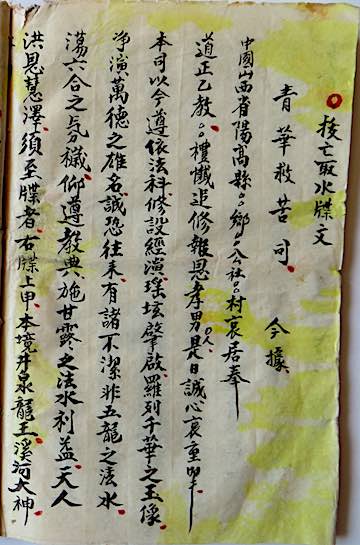
As reader Jane Watson comments, the forecast is “comforting for people at home, because they’re tucked up in bed and they’re hearing that it’s absolutely blowing a gale somewhere out at sea”—which might sound rather like Schadenfreude.

As with most ritual traditions, the language is slow to change—how I would love to hear the suave tones of Charlotte Green announcing

Pissing down. Bummer.

Among many parodies, most brilliant are Les Barker’s version as read by Brian Perkins:

and Stephen Fry (1988):

Back at the real script, Alan Bennett (“occasionally moderate”) read it for Radio 4’s Today at the inspired request of Michael Palin—taking on a quite different tone, both sinister and hilarious:

Talking of British identity, the forecast waxes philosophical in the phrase “losing its identity”—precisely the paranoid fear bandied by Brexiteers.

Yansheng chan gods

Stellar lords of the Northern Dipper, from the chanted Litanies for Prolonging Life
(Yansheng chan 延生懺) manual, copied by Li Qing, early 1980s.

SanskritRadio 4 listeners, bless their cotton socks, defend the ritual fiercely: there was a “national outcry when the BBC had the temerity to change the time of the late-night broadcast, moving it back by a mere 15 minutes (‘People went ballistic’, according to a Met. Office spokesman).” When the name of sea area Finisterre was changed to FitzRoy, “Anyone would think they’d tried to change the words of the Lord’s Prayer!”

Needless to say, such formalistic language reminds me of the long litanies of deities and pseudo-Sanskrit mantras that punctuate Daoist ritual (e.g. here, under “20th May”), whose efficacy for the devotee is also unsullied by mere cerebral comprehension.


For further meteorological drôlerie, see Cloudy with showery outbreaks, and More wisdom of the elders.

Minimalism, counter-tenors, and a viol consort

A little series setting forth from minimalism and the ethereal counter-tenor voice:

The genre-bending work of Orlando Gough:

and a plaintive Buxtehude lament, with versions by Michael Chance and Andreas Scholl—in a post on performing Daoist hymns on the concert stage:

Which leads us to Bach:

For Beethoven as a precursor of minimalism, click here.
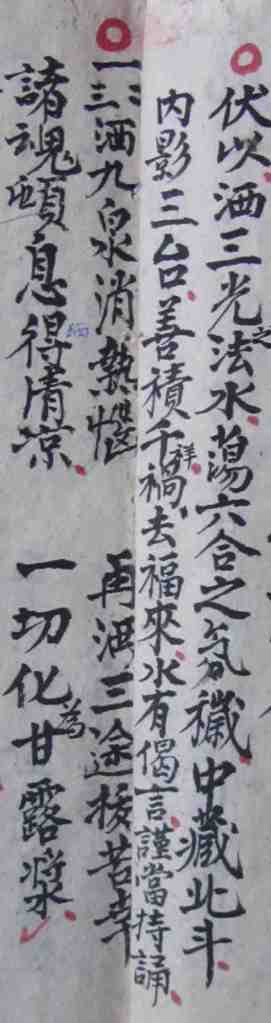
Resumé of Daoist film!

Left: Li Manshan doing ritual paperwork for the Lower Liangyuan temple fair, 2003
Right: Li Qing leading the Pardon ritual, funeral 1991.

Just a reminder:

I trust this trailer for my documentary Li Manshan: portrait of a folk Daoist will entice you to watch the whole film (click here!):

While you watch it—as you MUST!—do consult my drôle Franglais resumé A French letter (“Poseur? Moi? Je ne regrette rien!”). While meant as a jeu d’esprit for a screening in Paris (“île sacrée of Daoist studies”), I’ve added handy links to posts on particular themes.


Bon appetit!

My work on the Li family Daoists (including the book, complementing the film) was the whole initial raison d’être for this increasingly diverse blog, and I continue to add updates and vignettes. The sidebar category Li family being so very voluminous even with subheads, I compiled a more manageable roundup of some major posts here.

Epidemics in a Chinese county

Yizhan deng

Hymn A Lantern (Yizhan deng), a meditation on the impermanence of life,
sung before the coffin: see my film, from 27.07, and book, pp.264–6. Cf. the Shunzhi emperor’s poem, also part of the Li family Daoists’ repertoire.

When documenting a local ritual tradition, we need not only to home in on the detail of changing performance practice, but to spread our net quite widely—viewing our particular object of study as part of a system of other nearby ritual groups, as well as considering it within all kinds of social contexts. Changing material conditions tend to feature little in field reports on Daoist ritual (cf. Social issues in rural Hunan.).

In my work on the Li family Daoists in north Shanxi, I have found useful background on local history and culture in the accounts of the 1993 Yanggao county gazetteer (Yanggao xianzhi)—whose details on the Maoist era are far from the bland official depictions of many works of the period (see e.g. here, under “Famine in China”).

Weisheng

Having described the Li family Daoists’ continuing activity during the Coronavirus lockdown, I’m prompted to consult the gazetteer’s section on epidemic control in its chapter on Hygiene.

These villages are the catchment area of household Daoists groups like the Li family. Until the 1950s they performed for temple fairs and domestic rituals of blessing as well as providing all kinds of mortuary services; now they almost exclusively perform the latter. But all three types were responses to the fragility of human life, and it’s worth homing in on the painful progress of disease control through the 20th century. As I read, I think of Li Qing and his colleagues, catering to the ritual needs of their vulnerable village clients.

As we can see from the gazetteer’s chronology of “Major events”, epidemics—along with natural disasters and droughts—are a constant theme throughout imperial history, with high rates of mortality and low life expectancy. From 1884 rapacious wolves and rats caused a plague in the county. (For an ongoing bibliography on epidemics in late imperial China, click here; see also Vincent Goossaert, “Épidémies et religions chinoises”, Éphéméride, July 2020.)
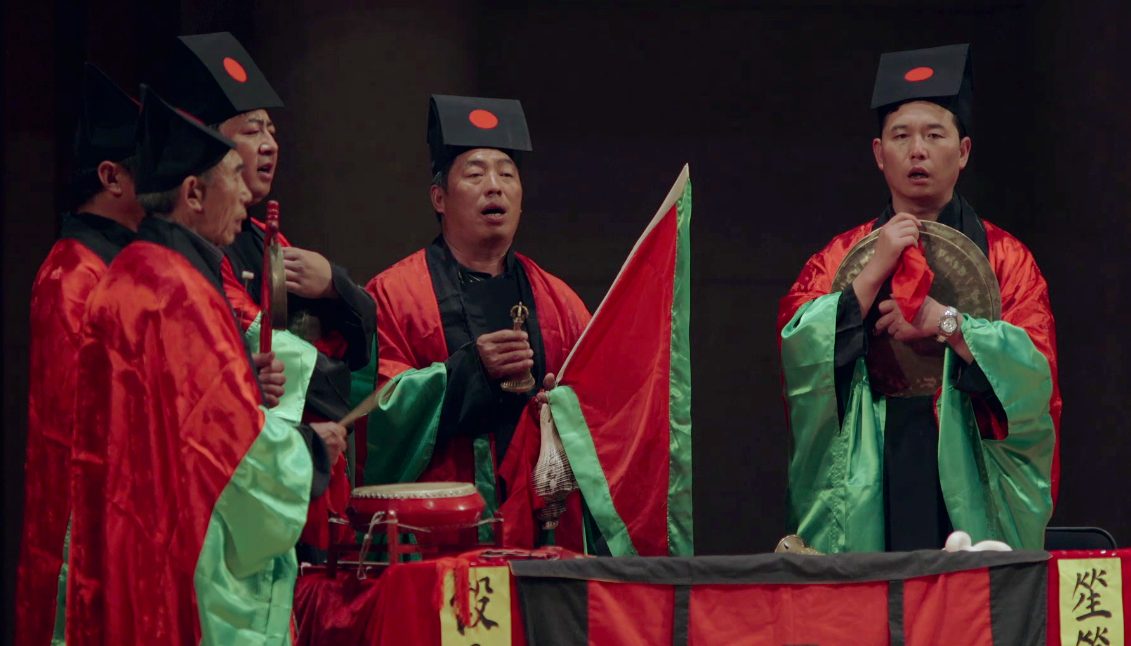
Stores selling Chinese medicine were common in the county-town and rural townships from the Republican era, as folk healers did the rounds of the villages; attempts were made to register them from 1935. On 4th moon 28th household Daoists and opera troupes performed for the temple fairs of the Medicine King deity (for Hebei, see under Bazhou, Xiongxian, and Baiyangdian). Before modern healthcare—and still now, where it still remains unaffordable or unavailable, or is considered only a partial remedy—curing illness has long been a major domain of spirit mediums.

Under Maoism
The story of disease control accompanies that of political campaigns. In chronically poor rural counties like Yanggao, given the extreme poverty inherited by the PRC, progress under Maoism was significant (see e.g. Mobo Gao on his home village in Jiangxi, and, by contrast, Erik Mueggler’s The age of wild ghosts—both cited here). Still, rural dwellers remained terribly vulnerable even after the collapse of the commune system, as illustrated in Liu Hongqing’s harrowing book on blind singers in another Shanxi county.

After Liberation, a system of state-supervised clinics expanded from 1952. But despite their best efforts, the county medical authorities were still desperately short of supplies. Most diseases were identified by the late 1950s, with attempts to bring them under control continuing through the Cultural Revolution (when the system of barefoot doctors pervaded the countryside); but as long as the commune system locked the population into poverty, it was only by the 1980s that such measures became more effective.

Smallpox was attacked after Liberation, but an outbreak occurred in 1963 in Anjiazao village. In 1965, amidst the Four Cleanups campaign, smallpox was reported in the village of Yang Pagoda, whither household Daoist Li Peisen had prudently retreated in the late 1940s in order to avoid political scrutiny. The village was sealed off and houses disinfected.

Measles, a common cause of child mortality, was gradually eradicated. Typhoid had also disappeared by the 1960s, though outbreaks occurred in 1980 and 1983. Hepatitis, tuberculosis, and meningitis, long major causes of mortality, were targets of the medical authorities after Liberation, with campaigns still being waged in the 1980s.

Brucellosis, also affecting livestock, was first identified in a village west of the county-town in 1957. By 1958 over 60 people were afflicted, and by 1959 it had spread to other nearby villages. As it continued to spread, attempts to control it continued from the early 1960s into the Cultural Revolution.

Graves’ disease was also identified in Yanggao in 1958, only declining in the 1980s. The county authorities only began seriously addressing the widespread dental ailment fluorosis in the 1980s. There was a deadly outbreak of cholera in Anjiazao in 1932. A county-wide vaccination programe was initiated in 1952; though it had basically disappeared by the 1970s, it resurfaced in 1983 in Baideng district, home of the Li family Daoists.

* * *

Turning to my other main fieldsite of Gaoluo village south of Beijing, I also consulted the briefer account of epidemic control in the Laishui county gazetteer (2000).

Again, before Liberation, diseases such as smallpox, measles, cholera, malaria, and typhoid were common. In August 1946 an outbreak of cholera struck; among 273 deaths in the county, 99 people died in the village of Kongcun alone—home of a ritual association that we visited in 1993 (see here, under “Other local ritual groups”). Smallpox was eradicated by the 1960s. After an outbreak of measles in 1954, there were further cases in 1962, 1963 (just as village ritual associations were reviving briefly after the famine), 1965, and 1970. Even during our fieldwork in Hebei through the 1990s both I and my colleagues from Beijing were frequently distressed by the vulnerability of peasants to illness.

While the county gazetteers vary in quality, there’s much more to explore in these sections. Such accounts are based on official depictions, and village-by-village fieldwork might still elicit more detailed stories; but all this provides useful background on cultural life before and since Liberation.

For me, incidentally, it makes good practice to expand my Chinese vocabulary; and just as I noted the importance of learning local folk terms for ritual and music, we find a similar popular lexicon for diseases—such as measles (standard mazhen 麻疹), locally known as hongbu 红布 or chai 差.


Photo gallery: updates

Now and then I add images to the Gallery that appears as you scroll wa-ay down in the sidebar. While selective, it serves partly to lead you to some of the posts and pages that I found interesting to write, supplementing the *MUST READ!* category.

Gallery 1

They’re very loosely grouped by theme, with the Li family Daoists and Hebei ritual associations at the top, followed by European cultures and politics; WAM, world music, and gender; and more personal posts further down.

So as you click on the images, do follow up by reading the posts to which they’re linked! Anyway, it’s another way of browsing. For a more recent (non-)update, click here.
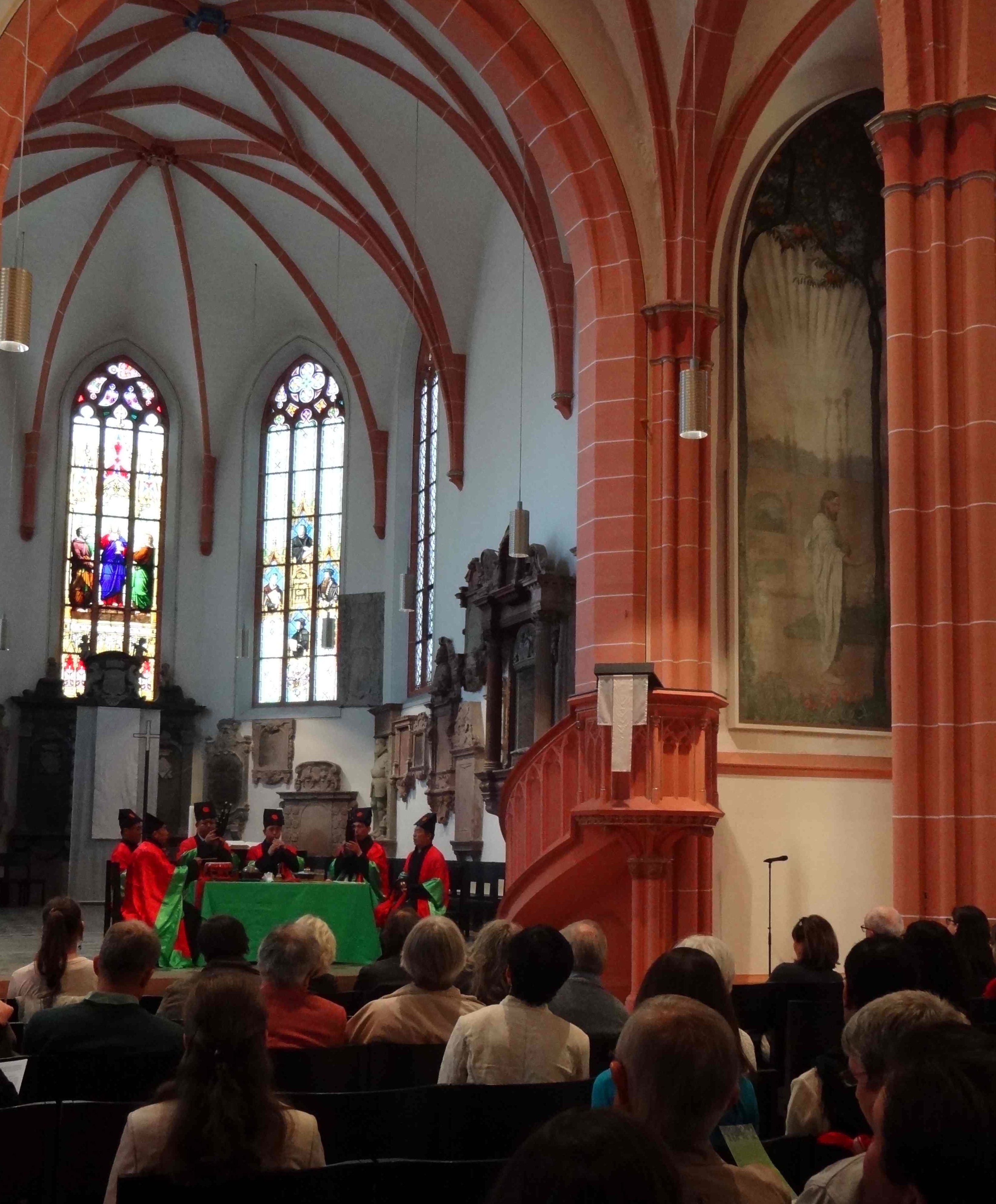
Coronavirus in China: four posts

LWL

To date I’ve published four posts on Coronavirus in China—two featuring songs critical of the official response, and two on local ritual activity. How strange it now seems to reflect that when I wrote these, the virus seemed like a distant problem.

  • Here I feature a song by blind bard Liu Hongquan in Shanxi, mourning whistleblower Li Wenliang—also including a harrowing account of rural poverty
  • and this post has some fine songs by Gansu singer Zhang Gasong, with a note on the traditional morality tales he studied with senior blind bards.

I made a digested version of these two posts into an article for the stimulating online magazine First of the Month, and an edited Italian version appears in the journal Sinosfere, also worth consulting.

  • Moving on to ritual life, here I explore temple activity behind closed doors in Sichuan
  • and this post details the uninterrupted activity of individual household Daoists in north Shanxi, “serving the people” as they meet the constant demand for routine burial services. In a recent update, I note that the full ritual sequence, with the whole Daoist group performing funeral liturgy, has now been restored.

See also the very end of my post on Navajo ritual and musical culture.

Coronavirus 4: household Daoists in Shanxi


Li Bin’s first funeral shop in town.

Li Bin’s funeral shop in Yanggao town.

To follow my earlier posts on Coronavirus (1, 2, 3), I’ve been catching up, remotely, with the household Daoists of the Li family in Yanggao county of north Shanxi, 300 km west of Beijing on the way to the city of Datong—in normal times, ever more accessible. Whereas my previous posts on the crisis have concerned responses online and behind the closed doors of temples, here we find how ritual activity is still being maintained for routine burials.

In recent years, as the wonderful Li Manshan has begun to take things easier in his eighth decade, his son Li Bin, working since 2007 from the base of his funeral shop in the county-town, has been worked off his feet (for their busy diaries, see here and here; and for the tough life of the household Daoist, here). Not only does he book and lead a band to perform funeral rituals throughout the villages, but he has to organise every stage of the mortuary procedure from death to burial—as well as making routine individual consultations to “determine the date” for weddings, health, journeys, selecting auspicious sites for new buildings, and so on.

Since the Coronavirus scare, strict measures have been in place in north Shanxi, though no cases seem to have been reported there. Many neighbourhoods in Datong city were sealed; in Yanggao town the gated communities monitored all activity. Restaurants and schools have been closed. For a change, there are no traffic jams at the crossroads just north of Li Bin’s funeral shop (my film, from 4.17).

Wedding festivities are on hold, and bereaved families are not currently allowed to invite Daoists or shawm bands to perform group funeral rituals (known as “opening the drum” kaigu 开鼓), as is normally de rigueur. So regular members of the Daoist sextet like Wu Mei and Li Sheng, normally busy reciting the scriptures with wind and percussion for the sequence of rituals they perform for funerals over two (sometimes three) days, now find themselves temporarily unemployed. Golden Noble, another core member of the band who leads the vocal liturgy, can perform the solo mortuary procedures like determining the date, siting graves, and supervising the burial, so he has picked up a bit of work in the immediate vicinity of his home township Houying.

One accomplished Daoist who has only rarely been able to appear with the ritual group since seeking work as a migrant labourer in 2004 is Li Qing’s nephew Erqing. Whereas the other Daoists are active over a small radius, his work has taken him over a large area of north and south China. He has been an important member of our foreign tours. Like Gansu singer Zhang Gasong and countless others, since returning home for New Year he has found himself exiled there.

Erqing and WM

Erqing (right) with Wu Mei, funeral 2009.

Despite the crisis, Yanggao didn’t go into total lockdown. Remarkably, Li Bin is still in considerable demand, individually, to meet people’s routine needs for mortuary procedures; indeed, he is just as busy as ever—the boss continuing to prosper as the workers are laid off?! Few customers have been venturing out to his funeral shop, but he fields constant messages on his smartphone. So he is still called out constantly, driving throughout the countryside but now having to pass through a laborious series of checkpoints on the main roads and at the entrance to every village, where temperatures are taken and all movements registered. Li Bin’s work is considered a legitimate cause for such journeys.

Checkpoints in Yanggao, February 2020. Photos: Li Bin.

In these poor villages that are depleted yearly by urban migration, with the population ageing, conditions of hygiene may have improved since around 2000, but remain far from ideal (for earlier epidemics in Yanggao, see here). Routine burials still need to be held—though currently by the immediate family alone, with one single Daoist carrying out the necessary procedures (see my Daoist priests of the Li family, pp.185–200).

After a death, the immediate task is to summon Li Bin to use his almanacs to determine the date for the burial—which may vary, as usual, from around five days to over a month. Then he has to write the placard announcing the death (yangzhuang 殃狀), supervise the encoffinment, and provide mourning clothes for the kin as well as the paper artefacts (which he and his wife make at their shop) to be displayed and eventually burned at the grave; he has to decorate the coffin, write the tomb tile, depict talismans to be pasted up at the house of the deceased, and choose an auspicious fengshui site for the grave, using his luopan compass to determine its position and alignment. All these tasks are shown in my film, and even over this stressful period Li Bin still continues to perform them constantly.

Left: reverse side of tomb tile; right, talismans. My photos, 2011.

Even in normal times some very poor families, unable to afford the elaborate funerary rituals of the full band, have long requested a single Daoist to preside over a simplified burial ritual (known as “settling the burial” anzang 安葬). During the current crisis this has become routine. Mostly it only takes an hour or two, though even now some families expect a rather longer ritual.

Li Manshan: decorating a coffin (2015), and exorcising the house (2013).

Just before the coffin is raised out of the central room of the deceased’s home (my film, from 1.16.31), the Daoist—now wearing a face-mask in addition to his red costume (fayi 法衣) and yinyang hat (riyue guan 日月冠)—exorcises the rooms (qiyang 起殃) by wielding a sheaf of gaoliang stalks and a cleaver, knocking them against the lintels and silently reciting the mantra Qiyang zhou 起殃咒. Then, as the coffin-bearers raise the coffin out of the house, the Daoist uses his cleaver to smash a food-bowl on the floor at the entrance to the room, marking the end of the son’s duties to feed his parent; indeed, “smashing the bowl” (dawan 打碗, more graphically “decapitating the bowl” zhanwan 斬碗) is the term commonly used to describe the whole simplified burial ritual. As he does so, the Daoist silently recites another mantra, the Zhanpen zhou 斩盆咒. These two mantras for dangerous liminal moments serve to protect the Daoist himself.*

Li Bin then accompanies the coffin through the fields to the grave he has chosen, and fine-tunes its alignment in the grave. After returning to the house he performs a further brief exorcism there. He then hurries off to other villages help more bereaved families.

Again, I note the adaptability of the “old rules”; in times of crisis, rituals can be simplified, yet a proper commemoration of grief is still needed. In Li Bin’s notebook he keeps a careful record of all his daily work, noting the precise date and time of death, details of the birth dates of the deceased and their sons and grandsons, the location of the grave, and the date that he determined for the burial.

Li Bin’s father Li Manshan too has to respond to the requests of his local clients, zooming round on his motorbike to determine the date, choose burial plots, and smash bowls. Sure, all this is their livelihood; but like their forebears right back to the 18th century, they are like parish priests, “serving the people”—a cliché now commonly used with a rather satirical edge, but in this case true. Meanwhile elsewhere in Yanggao, in neighbouring counties (see my other posts on Shanxi under local ritual), and doubtless further afield, other Daoists too will be continuing to meet the needs of their rural clients.

By 23rd February, with no new cases of the virus reported in Yanggao, roadside checks were easing and officials were only monitoring travellers’ temperatures, not registering their details. I wonder how long it will take for the more elaborate funeral rituals to be restored, with the other Daoists joining Li Bin in performing the full sequence of vocal liturgy, accompanied by wind and percussion.

Update
Indeed, since late February the full ritual sequence has been restored, with Li Bin booking the whole Daoist band to perform funerals; but since he has still been busy doing all the solo mortuary tasks, only on 5th April could he lead his group for the first time since the lockdown, “opening the drum” at a funeral in Upper Liangyuan.


silent mantras


* Though the texts of these two silent mantras don’t appear in any of the Li family’s surviving ritual manuals, Li Manshan eventually found them for me in his little blue pocket-book, which he copied in the 1980s from a similar notebook of his late great father Li Qing (for whom, see e.g. here, and, for his ritual manuals, here).

Seeking instruction with Li Manshan one day, I joked that I had learned them, “reciting” them for him, lips firmly closed—providing us with another creative topos (e.g. in France).


Coronavirus 3: temples, Sichuan

sdr

Daoist temple ritual, Sichuan, lunar New Year’s Eve, 2020. Photo: Volker Olles.

To follow my first two posts featuring songs commenting on the Coronavirus outbreak in China (here and here), I now consider how local ritual life has been adapting to the crisis at the grassroots.

* * *

Reflecting the age-old adaptability of ritual practice, much activity has moved to a virtual life on WeChat. I’m grateful to Volker Olles, based at Chengdu in Sichuan for his project on Daoist ritual traditions there, for this vignette. As he wrote on 17th February:

All temples are still locked down, but Daoist clerics in the sanctuaries will occasionally perform rituals or offer incense and candles in the name of adherents (thanks to WeChat!). ​So the temples are still working—behind closed doors. Through Wechat, people can even participate in rituals by having their names added in ritual documents. In this regard, WeChat is a real blessing, allowing communication, payment of liturgical fees (fajin 法金), and feedback by means of video sequences of the rituals posted by the clerics.

I spent the Spring Festival in a remote Quanzhen Daoist temple in Chongzhou, west of Chengdu, just when the lockdown started. The liturgies at Chinese New Year’s Eve and the welcoming of the God of Wealth were properly performed by the Daoists, burning masses of ritual documents (shuwen 疏文), with the help of lay adherents—who were partly stuck at the temple and unable to return home on time. ​

All religious institutions are closed and closely monitored by the authorities. I also had to register with the local government and the Bureau of Religious Affairs. However, I’m back in Chengdu now, and we all hope that spring (in the best sense) finally will arrive.

notice

Public notice [my translation—SJ]

Owing to the severity of the current Coronavirus outbreak, for the health and safety of everyone to pass a secure, auspicious, and blessed New Year, the temple Management Committee has decided after investigation:

From 8am on 24th January 2020 the temple is temporarily closed to outsiders. All activities seeking blessing to greet the New Year will be managed according to the law by the temple priests. Please do your best not to visit the temple, in order not to come into mutual contact, and to prevent the contagion of the virus. All prayers for blessing and the elimination of calamity are to be liased via WeChat. We request the great masses and the faithful to share [this information].

During the current initiative to restore traditional Chinese rites, when you meet, please clasp your hands in greeting and avoid shaking hands!*

Xizhu Daoist Temple Management Committee, Chongzhou
24th January 2020​

Huolei
Note also Ian Johnson’s article on the response to the outbreak from temples, mosques, and churches, covering charitable donations and rituals from all over China—including a Purifying the Land ritual at the Changchun Daoist temple in Wuhan; as well as a new Daoist song Huolei jiangmo lu 火雷降魔錄 by Sichuan dramatist Zhang Shuzhi.

For a Daoist priest’s memorial tablet for victims of the virus, click here; and for an update from Shanghai, here.

In my next post on Coronavirus I report on the busy schedule of the household Daoists of the Li family in Shanxi, even through the crisis, as they continue to meet the needs of their rural clients for routine burials.


* I now also see that as the virus spreads around the world, churches in Italy are issuing directives on ritual hygiene and online worship.

Coronavirus: mourning Li Wenliang, and blind bards

LWL

WeChat: “In this world there are no heroes descended from heaven, there are only ordinary people who come forward”.

Among the many areas of life in China that are suffering under the lockdown prompted by the Coronavirus outbreak are collective events such as life-cycle and calendrical ceremonies among rural communities.

SGL guiwang

Ghost king, South Gaoluo.

The grand New Year’s rituals from the 12th to the 16th of the 1st moon that take place throughout villages in north China, such as those of Gaoluo village in Laishui county south of Beijing, have had to be cancelled—though their purpose is precisely to “destroy the hundred diseases” (dui baibing 丢百病).

It reminds me of a story that villagers told me about the New Year’s rituals in 1997 (Plucking the winds, pp.317–18: passages below modestly edited). After thefts of the association’s ritual paintings the previous year, the New Year’s rituals now made a focus for a cultural fight-back. In preparation they managed to retrieve some of the paintings handed over the Baoding museum during the Cultural Revolution, and had handsome new donors’ lists (also stolen) rewritten and repainted from my photos, ready to display in the lantern tent.

But just as everyone was preparing for an ostentatious New Year, the death of Premier Deng Xiaoping threatened to disrupt it. A typical bit of mental juggling was now required in order for the village rituals to continue undisturbed. Deng died on the 11th day of the 1st moon in 1997, with remarkable, if uncharacteristic, attention to the rural calendar. When his death was announced, just before the major rituals around the 15th, the “commune” (as they still call the district authorities) dutifully ordered that New Year’s celebrations should be cancelled, and the village brigade had to tell the ritual association not to perform. As one musician confided, “I turns it over in my head: when someone dies in the village, we play for them, so didn’t we oughta be able to play when Deng Xiaoping dies too? So I reckons, how about writing a motto ‘In mourning for Deng Xiaoping’, pasting it up outside the lantern tent, and playing as usual?” The village’s “southern” ritual association followed suit, and the New Year’s rituals went ahead.

I love this story: in order to make sure that Premier Deng’s death will not get in the way of their customary entertainment, they profess respect by pointing out the traditional use of ritual to venerate the dead. As with all the best scams, its sincerity is unassailable. Things had changed a lot in the two decades since Chairman Mao’s death in 1976. Then the ritual association had virtually ceased to exist, and villagers had obeyed central orders without question out of genuine, indeed almost “superstitious”, belief in the Great Helmsman. Since 1978 villagers doubtless had a lot to thank Deng for, but there were ironies. It was thanks to Deng’s liberalizations that the association had been able to revive, but it was threatened by new pressures; it was also thanks to him that people no longer placed blind faith in leadership, and were now disinclined to let his death take priority over their local culture.

Villagers regarded the 1997 New Year as the most lively in living memory, perhaps partly by necessity, to legitimize the association’s new leadership and fight back against the theft of the paintings.

In many regions “rites of affliction” have long been an important part of the repertoire of ritual specialists—serving a symbolic rather than medical function. In the current crisis, however, such large-scale gatherings are unthinkable.

1965 poster campaign combining public hygiene and eliminating superstition: “Incense ash cannot cure disease” and “Human diseases are not an offence of the gods and ghosts”—another reminder (see e.g. here, under “Expressive culture”) that even at such a revolutionary time, plenty of people still thought so.
Source: https://chineseposters.net.

Elaborate funeral rituals, for which among the many locals attending are kin returning from distant parts of the country, have also been put on hold. Still, in Yanggao county in Shanxi, far from both the source of the outbreak in Wuhan and major urban centres like Beijing, the Li family Daoists, individually, are still in demand to provide routine burial services, as I describe here.

On local government websites (e.g. those of Laishui and Yanggao counties) I haven’t yet found any explicit bans on collective ritual activities—only bland, formulaic warnings proclaiming the state’s resolute response to the crisis. But morbidly creative slogans everywhere hammer out the message:

slogan

No visits for New Year this year
Those who come to visit you are enemies
Don’t open the door for enemies.

For the response in Tibetan regions, see e.g. here; and for concerns over Xinjiang, here.

* * *

 Even if folk musical activities are suspended, there are signs that local performers are reflecting the outbreak, in what Confucius would have called “the sentiments of the people” (minqing 民情). First, some background.
I’ve already written at some length about shawm players (many of whom were traditionally visually impaired) and blind bards (see also this roundup for narrative-singing). The blindmens’ propaganda troupe of Zuoquan county in the Taihang mountains of east-central Shanxi has a history dating back to 1938, under Japanese occupation. One of the most illuminating and harrowing books on rural life in north China is

  • Liu Hongqing 刘红庆, Xiangtian er ge: Taihang mangyirende gushi 向天而歌: 太行盲艺人的故事 [Singing to the heavens: stories of blind performers of the Taihang mountains] (2004, with VCD, and abundant photos by Wang Jingchun).

LHQ book

One of innumerable such groups throughout the countryside, the Zuoquan troupe has always adapted to the changing times, from the warfare of the 1940s through Maoism to the reform era. In the latter period they began to perform stories criticising corruption.

The book’s author Liu Hongqing (see e.g. this interview) is the older brother of blind performer Liu Hongquan, whose life features prominently. Though Hongqing escaped the rural life to become a journalist, he kept in regular contact with his family, providing vivid stories of the troupe’s itinerant lifestyle (cf. Li Qing’s stint in the Datong Arts-Work Troupe from 1958 to 1962) and writing with great empathy about the lives of poor peasants.

ZQ pic

Liu Hongqing also pays great attention to the wretched fate of women in a rural area that remained chronically poor under Maoism. Two twins in the troupe had an older sister, four of whose five children were born blind. After she died in 1963 the burden of caring for the whole family fell upon the oldest daughter Chen Xizi, then 15 sui. She too was ill-fated. Her first daughter died at the age of 11 sui after going dumb the previous year; her son, born in 1968, was blind, dumb, and disabled; a second daughter died at the age of 7 sui; and a third daughter was herself left with three daughters at the age of 32 sui after her husband died. But amazingly, Chen Xizi’s youngest son endured great tribulations to become a researcher at Shanghai Communications University—the family’s only hope in an ocean of misery. Chen Xizi’s older brother Xizhao, a fine shawm player who died at the age of 55 sui in 1998, “bought” four wives, all mentally disabled.

After the death of another blind performer in the troupe, his widow had moved in with his younger brother, a common expedient (xuqin 续亲) in poor communities where early deaths were common and widows vulnerable.

Such stories, all too common in rural China (note e.g. Guo Yuhua’s ethnography of a Shaanbei village, and Bards of Henan), make an important corrective to rosy state propaganda, putting into perspective scholarly accounts of machinations within the central leadership; and the fierce, anguished singing and playing of groups like this are utterly remote from the bland, cheery ditties of official troupes.

The Zuoquan performers are instrumentalists too—Liu Hongquan is a fine shawm player (for thoughts on the way shawm-band music reflects suffering, see here). Like others in the troupe, he has taken several adopted sons, forming a network of well-wishers throughout the villages where they perform. Like blind performers in north Shanxi, they had their own secret language (p.69), based on the ancient qiezi 切字 phonetic system.

TQ

Tian Qing (left, in white) with the blind performers of Zuooquan.

The group was soon promoted by eminent cultural pundit Tian Qing (see e.g. here, and this video). Following his visit to Zuoquan they gave their first Beijing performance in 2003. From 2007 the popular TV presenter and director Yani took them to heart, engaging with their lives in a documentary filmed over ten years.

Since being enrolled under the aegis of the Intangible Cultural Heritage, while continuing their itinerant lifestyle performing for rural ceremonial, they have become media celebrities, promoted in regular TV appearances.

But even once absorbed into the state apparatus, such folk groups are not always mere mouthpieces for state propaganda. We may tend to think of folk-songs as commemorating events in the distant past—even when describing traumas such as famine, they tend to refer to early famines before the 1949 revolution. Itinerant performers like blind bards are occasionally enlisted to explain state policies among the folk, but they may also express resistance. With such topical songs hardly appearing in the collections of Chinese fieldworkers, it’s hard to judge how common they are. In Bards of Shaanbei (under “Old and new stories”) I explored the themes of AIDS, SARS, and Mo Yan’s fictional portrayal of a bard protesting at unjust local government requisitions, also linking to a protest song by Beijing blindman Zhou Yunpeng.

* * *

And so to Coronavirus and the debate over freedom of speech. The Wuhan ophthalmologist Li Wenliang was among the first whistleblowers (among a multitude of tributes, see e.g. here and here; for more on the lockdown in Wuhan, see Ian Johnson’s book Sparks, chapter 12). Before his death on 6th February at the age of 34 he was punished for “spreading false rumours”. Though the central Party later backtracked on criticising him (and by April he was officially deemed a martyr), the widespread tributes on Chinese social media mourning his death were largely an outpouring of popular resentment against the state’s irredeemably secretive policies in reaction to the outbreak—at a time when popular resistance to state power (notably in Xinjiang and Hong Kong) is otherwise muted. But online discussions continue to be censored.

A tribute to Li Wenliang, posted on WeChat on 8th February and only deleted by the 13th, featured a folk-song movingly performed by none other than Zuoquan blindman Liu Hongquan (contrast his rosy forecast here). Do listen to the song, since you can no longer hear it on WeChat:

The lyrics were written by Peking University economist Zhang Weiying, a native of Shaanbei who in 2019 composed, and sang, a Xintianyou folk-song in defence of dissident law professor Xu Zhangrun (see this article in a lengthy series by Geremie Barmé; for his translation of Xu’s essay on the virus, see here, and here; cf. this article in Chinese by Zhang Qianfan, another righteous scholar). Zhang Weiying’s lyrics for the new song commemorating Li Wenliang adopt the distinctive idiom of Shaanbei folk-song language, hard to render in translation:

At dead of night appeared a star
The whole world weeping in unison, Oh brother, for you

Snowflakes flurrying over three thousand leagues
Sleepless for the first time, Oh brother, and who’s it for?

Semi-translucent like lighting eggshell lanterns
First they sealed your lips, Oh brother, then they sealed the city

All over the world people’s feelings are bitter
When has it become to hard to tell the truth, Oh brother, about one’s feelings?

When you blew the whistle in the twelfth moon no-one listened
Amidst the bustle of the first moon, Oh brother, the sound of your song was silenced

Lighting lanterns at New Year to see you off
But throughout the land, Oh brother, it’s like observing the Feast of the Dead

Bright blue skies of Sovereign heaven
Now that the whole nation has awakened, Oh brother, you are already far away

Now that the whole nation was awakened, Oh brother, you are already far away.

LWL lyrics

The Party has also recruited performers to play a more orthodox role in promoting public health, such as this epic singer from Inner Mongolia:

(more here) and this song in the style of Huadengxi opera in Guizhou, filmed to promote awareness of the crisis.

And during the 2022 outbreak, here’s a great thread on ache-lhamo opera at a roadside Covid checkpoint in Tibet:

For more songs from north China on the virus, see here; for temple ritual in Sichuan, here; and for continuing activity of household Daoists in Shanxi, here.

Amidst the widespread publicity on the global ramifications of the virus, it’s worth considering its effects on poor rural communities in China and their collective observances. Perhaps some of you have further instances of how folk culture is suffering, responding, resisting?


Appendix

A beguiling online post from Duyi Han shows murals purporting to come from a Hubei church, paying homage to Coronavirus medical workers. On reflection it’s clearly a virtual creation, but it makes an impressive and ingenious artistic tribute:

church murals

One has to read carefully to interpret this sentence as implying that it’s a virtual project:

The project sees the walls and ceilings of a historic church in Hubei province transformed into a large mural depicting figures dressed in white decontamination suits.

It’s clarified in this interview, but if one took that literally, some doubts might soon spring to mind—I append mine below merely to show you how gullible I was initially, how little I know about logistics of life in Hubei over these weeks—and how careful we have to be about what we find online, “nowadays”:

  • Where is this chapel, and how many Chinese churches have such classical architectural features?
  • Did the congregation not demur at the loss of their original Christian images?
  • Who is the artist, and if working alone (?), however could the murals be completed so quickly?  Supposing Hubei churches have been closed since the outbreak, OK I guess the artist could get a key.
  • We have to imagine them somehow finding a vast amount of paint (assuming there’s a well-stocked shop that’s open over this period), and putting up scaffolding…
  • And how about all the stages of painting murals, and drying times in winter?

Still, it’s easy to take at face value. Incidentally, apart from the major Daoist temple complex of Wudangshan, I haven’t sought material on folk ritual life around Hubei (as ever, we might start with the “instrumental music” volumes of the Anthology for Hubei), though the scene is (or was, before the virus struck) doubtless more active than this report may suggest.